Analista senior di l'intelligenza in u campu di a gestione di i risichi di sicurezza, sò un anzianu tenente detective è ufficiale di l'intelligenza in l'agenzie di u Statu francese. A bona pronuncia hè Николай Чинкуини, in russu
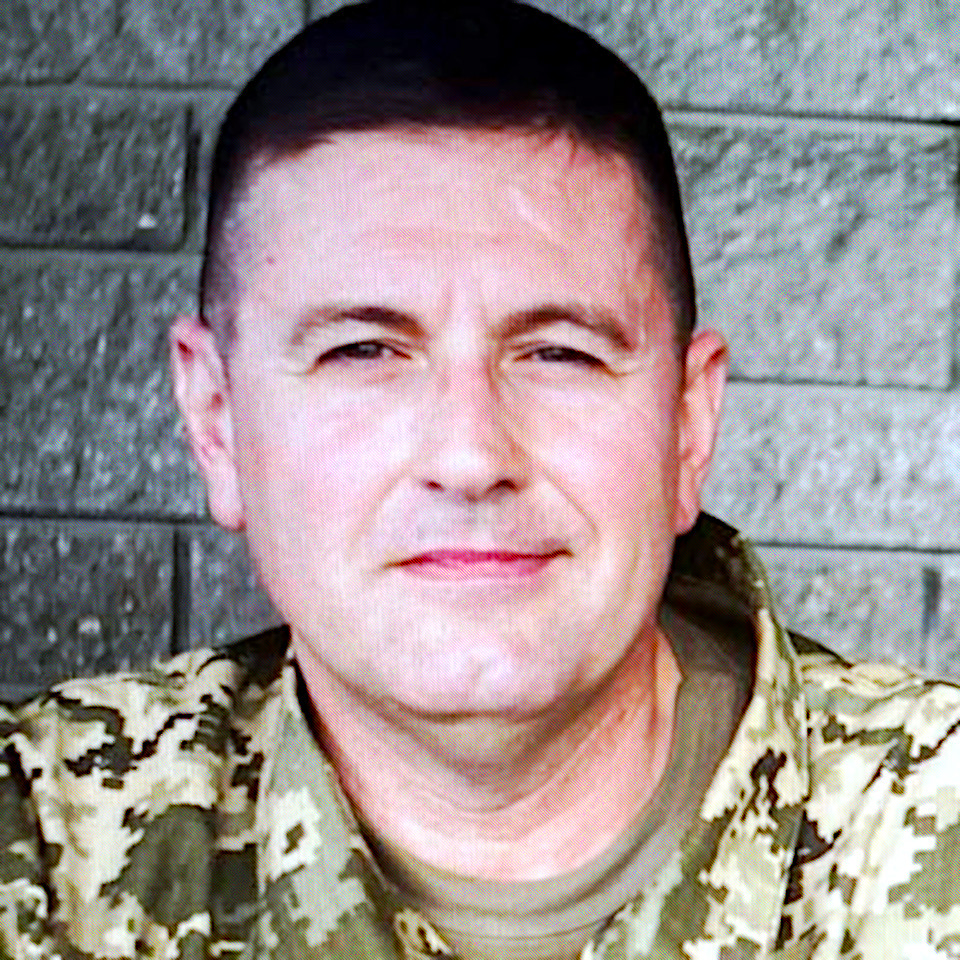
est un morceau de choix. Je suis heureux de l’avoir découvert. Le Dauphinois a été éduqué à Vienne, Isère, puis Sciences Po Lyon et Saint Cyr, spécialité transmissions, à Rennes. Il a développé une carrière intéressante, jusqu’au grade de commandant, détaché observateur de l’ONU, l’OTAN et l’OSCE, officier de renseignement en Afghanistan, avocat militaire, pas un combattant mais néanmoins un homme de terrain. Il est par son expérience très proche des États-uniens, continue sans doute de fournir des rapports au renseignement français
sur Twitter le 30 mai 2023
Il vit déjà en Ukraine et fin février 2022, intègre une ONG, le Fonds ukrainien pour les volontaires internationaux (FUVI), comme consultant et chef des opérations
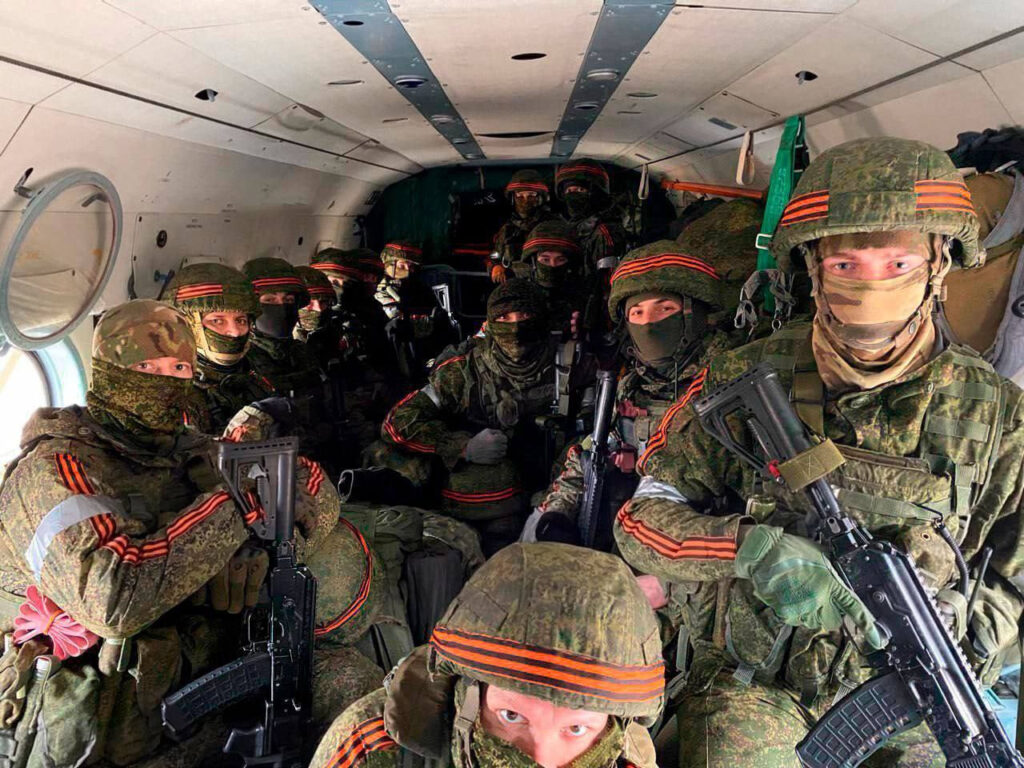
Au matin du 24 février 2022, par un assaut aéroporté, les parachutistes russes s’emparent de l’aéroport Antonov, à Gostomel, banlieue nord ouest de Kiev
Sur un plan plus personnel, Piguet serait de religion juive, car il brandit régulièrement l’argument ultime de sa propre judaïcité pour tenter de blanchir les organisations ukrainiennes clairement nazies, procédé trivial et fallacieux, qui s’adresse à des crétins. Sa propre pensée est fasciste, même délirante. Voici des extraits de sa prose sur LinkedIn, en février 2023
Les bolcheviks russes ont toujours persécuté les croyants en Dieu ainsi que les démocrates laïcs. Les Russes sont des païens issus de hordes impies qui adoraient la mort et pratiquaient le cannibalisme […] L’Ukraine, carrefour de nombreuses civilisations et influences brillantes […] C’est pourquoi les Ukrainiens sont beaux et ingénieux […] Honte aux barbares «Moskals»
Vous l’avez compris, ce partisan d’Emmanuel Macron est lui-même un crétin, comme le sont souvent les partisans d’Emmanuel Macron. Avec ce personnage, nous réalisons mieux comment l’OSCE, sous couvert de mission internationale impartiale, a pu contribuer au réglage de bombardements terroristes ukrainiens de la population du Donbass.
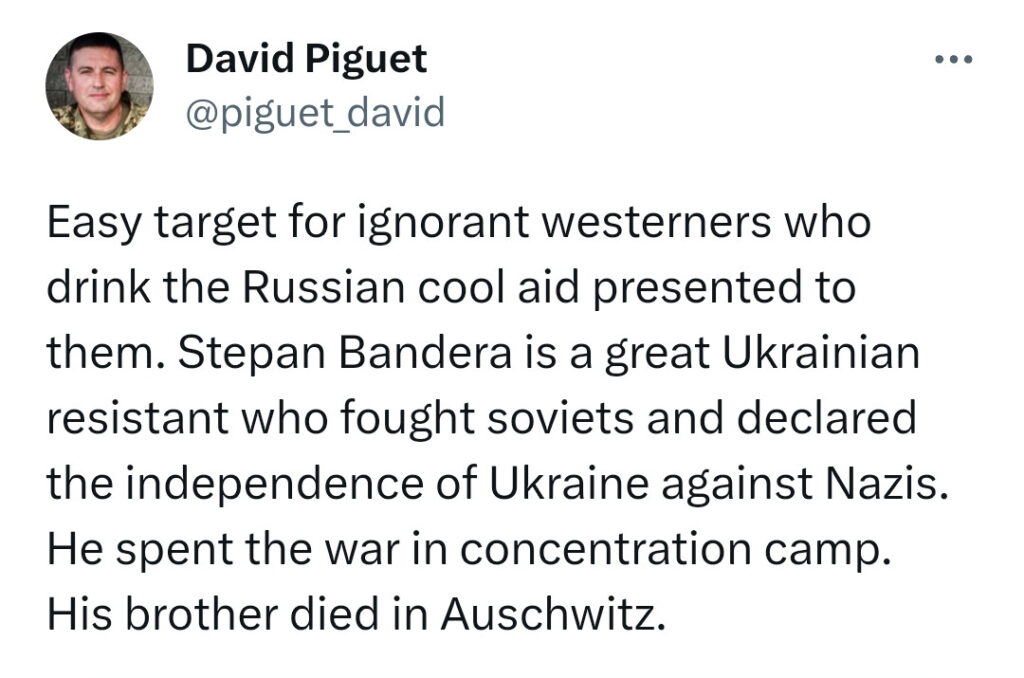
Il récidive le 16 mai par un tweet cosmique, pour encencer le criminel de guerre nazi ukrainien Stepan Bandera (1909-1959). Un tel révisionnisme relève du mensonge ou d’une inculture crasse, peut être des deux
Né dans l’empire austro-hongrois, Bandera était un militant nationaliste ukrainien, en territoire polonais après la 1ère guerre mondiale, lorsqu’il commandita l’assassinat en 1934 du premier ministre. Ce fut l’invasion allemande de septembre 1939 qui le libéra de prison. Il était le chef de la faction radicale et dominante de l’Organisation des nationalistes ukrainiens (OUN). Les plus modérés admiraient Benito Mussolini, les partisans de Bandera lui préféraient Adolf Hitler. Fasciste et raciste, partisan d’un État autoritaire, il ordonnait aussi
Moscovites [Russes], Polonais, Hongrois et Juifs sont vos ennemis, détruisez les !
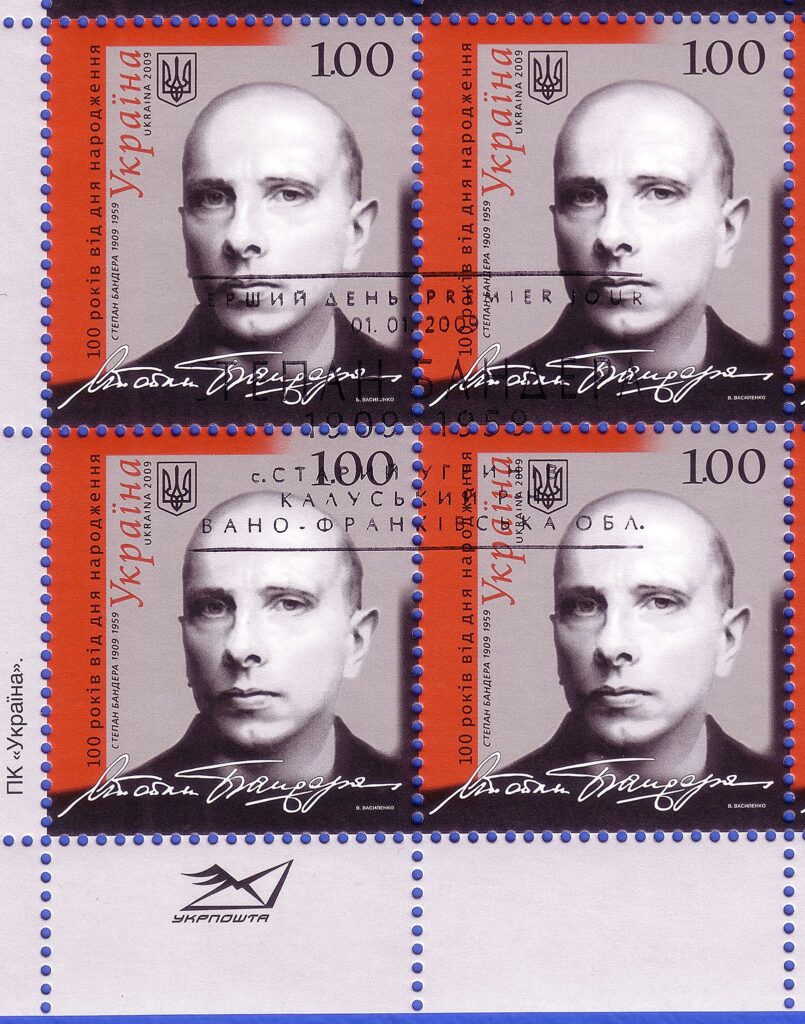
En 2009, pour le 100e anniversaire de sa naissance, Stepan Bandera est honoré par un timbre. Depuis la révolution orange de 2005 et avant la victoire démocratique de Viktor Ianoukovytch en 2010, le président de l’Ukraine est alors Viktor Iouchtchenko, pro-Occident
Son organisation a travaillé avec l’Abwehr [renseignement militaire allemand], pour fournir des bataillons de supplétifs ukrainiens aux armées du Reich, dans la perspective de l’invasion de l’Union soviétique en juin 1941
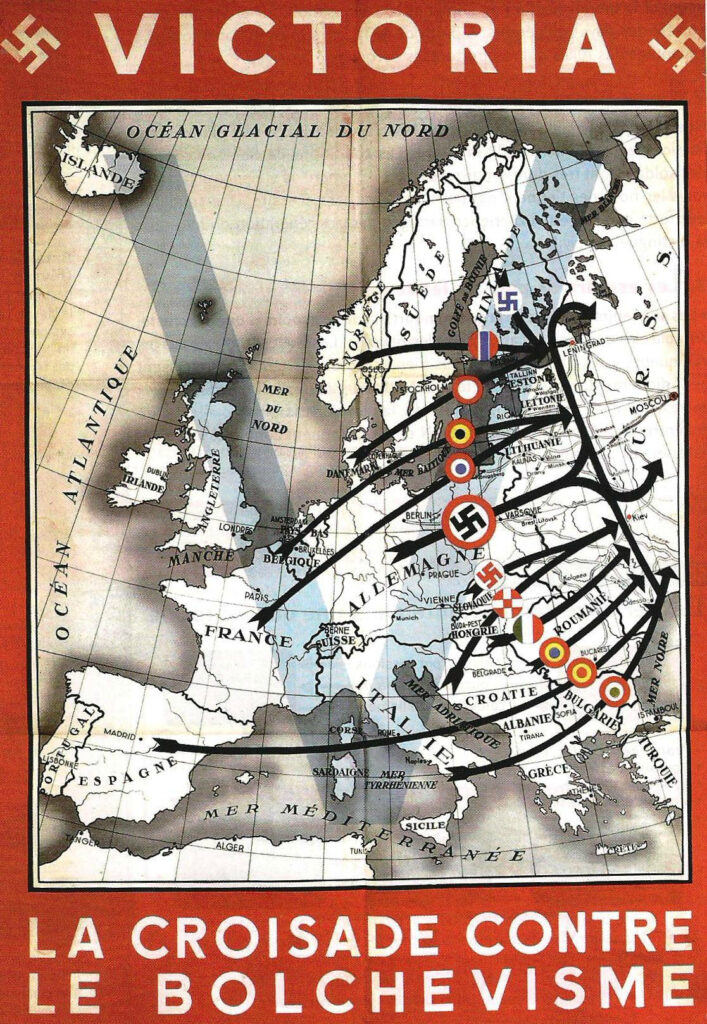
Affiche de propagande française en 1941
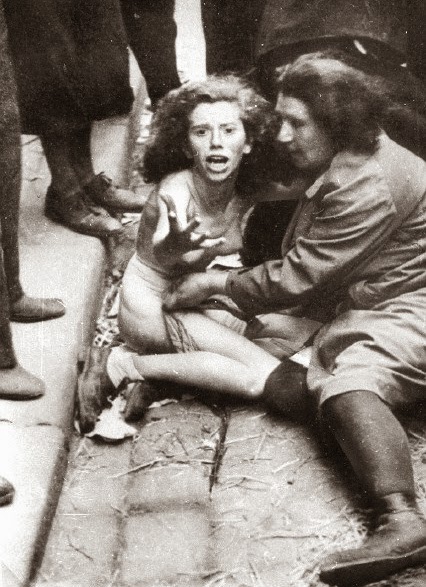
Ses partisans ont accueilli les envahisseurs en libérateurs et pour célébrer l’événement, massacré début juillet quelques 4 000 civils juifs dans la région de Lviv
Une victime juive des nationalistes ukrainiens à Lviv le 1er juillet 1941
Il demanda personnellement à Adolf Hitler de lui accorder l’indépendance d’un État fasciste ukrainien, allié de l’Allemagne nazie, qu’il déclara unilatéralement la semaine suivante. Cette initiative déplut et les Allemands ont temporairement interné Bandera, d’abord en résidence surveillée à Berlin, puis dans les quartiers VIP du camp de Sachsenhausen, où ses conditions de détention auraient fait rêver les travailleurs forcés. Piquet insulte les 84 000 victimes du camp de travail.
L’Armée insurgée ukrainienne (UPA), branche militaire de l’OUN, fut formée en octobre 1942. Contrairement à ce que suggèrent les propagandistes ukrainiens, elle n’a jamais affronté les forces d’occupation, mais conduit un nettoyage ethnique, avec la bienveillance des Allemands, le massacre entre 1943 et 1945 d’au moins 50 000, peut être 100 000 civils polonais
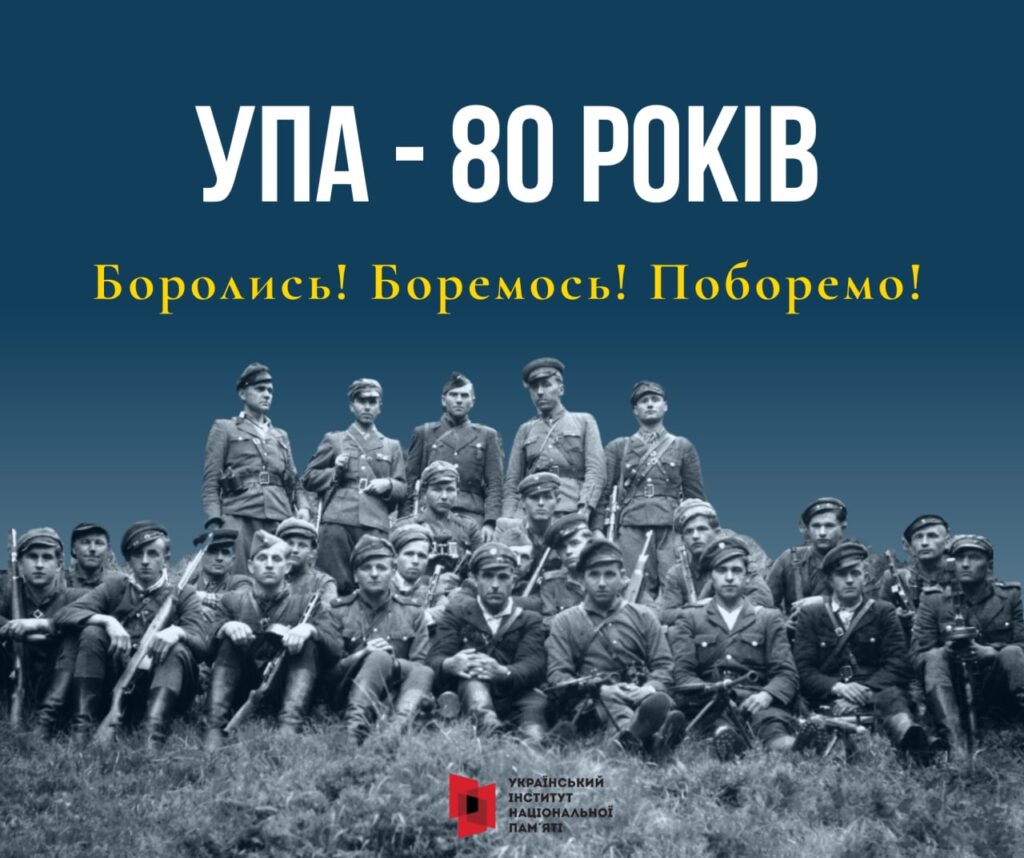
Depuis 2015, après Maïdan, l’État ukrainien célèbre chaque année, ici en 2022, l’anniversaire de la fondation en 1942 de la formation paramilitaire nazie UPA
Après la victoire soviétique à Stalingrad, l’OUN participa en novembre 1943, aux côtés d’autres organisations fascistes, hongroise et roumaine, à la fondation à Jytomyr du Comité des nations subjuguées (AUN), sous l’égide du Reichsministerium für die besetzten Ostgebiete [ministère impérial des territoires orientaux occupés] d’Alfred Rosenberg. En Avril 1944, l’adjoint de Bandera, Yaroslav Stetsko, rencontra l’Obersturmbannführer [lieutenant colonel SS] Otto Skorzeny, pour organiser la guérilla que l’UPA commençait à conduire derrière les lignes de l’Armée rouge victorieuse, que libre en septembre, Bandera appelait à combattre
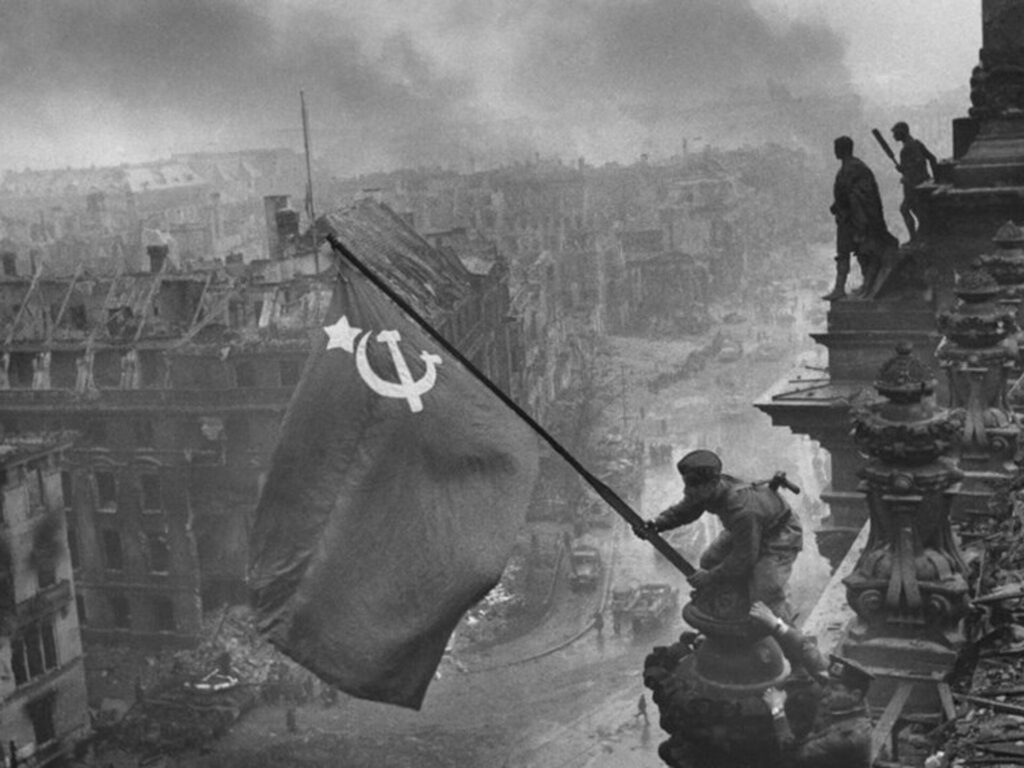
à Berlin le 2 mai 1945 (Evgueni Khaldeï)
Après la victoire alliée, dans laquelle l’Union soviétique a contribué à hauteur de 80% de toutes les pertes militaires allemandes de la 2de guerre mondiale, il s’est réfugié en Allemagne de l’ouest, sous la protection de groupes nazis clandestins et des services secrets anglo-états-uniens, car dorénavant sous leur houlette, l’UPA continuait à opérer en Ukraine soviétique. Le KGB parvint à le liquider à Munich en 1959. Ès-qualités, son ancien adjoint Yaroslav Stetsko, alors président du Bloc anti-bolchevique des nations (ABN), recyclage atlantiste de l’AUN nazi de 1943, fut reçu en 1983 par Ronald Reagan
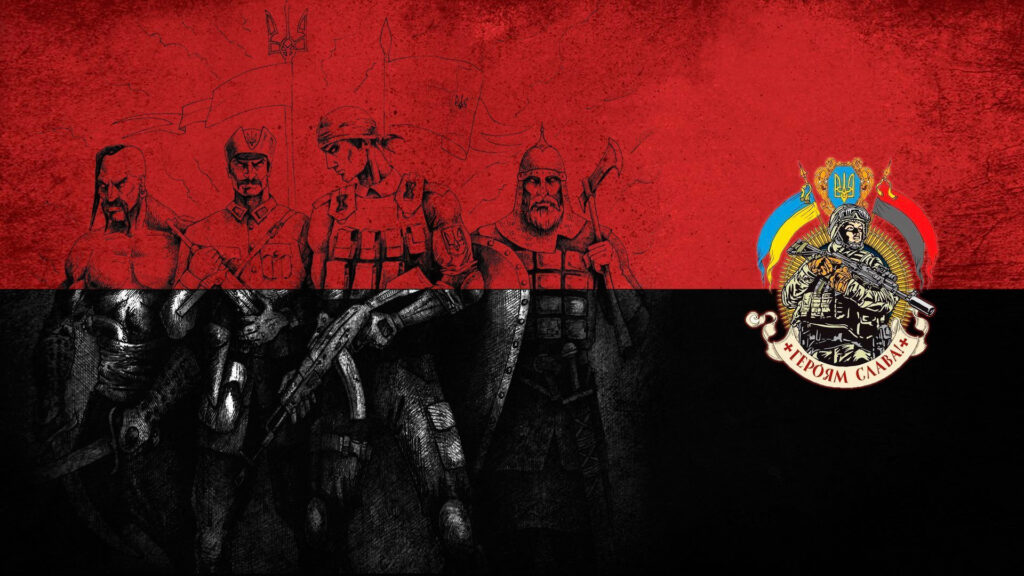
GLOIRE AUX HÉROS, slogan inauguré en avril 1941, parmi les fascistes ukrainiens de l’OUN, alors implantés dans le Generalgouvernementfür die besetzten polnischen Gebiete [Gouvernement général des territoires polonais occupés]. Cette image est le bandeau du compte Twitter de David Piguet
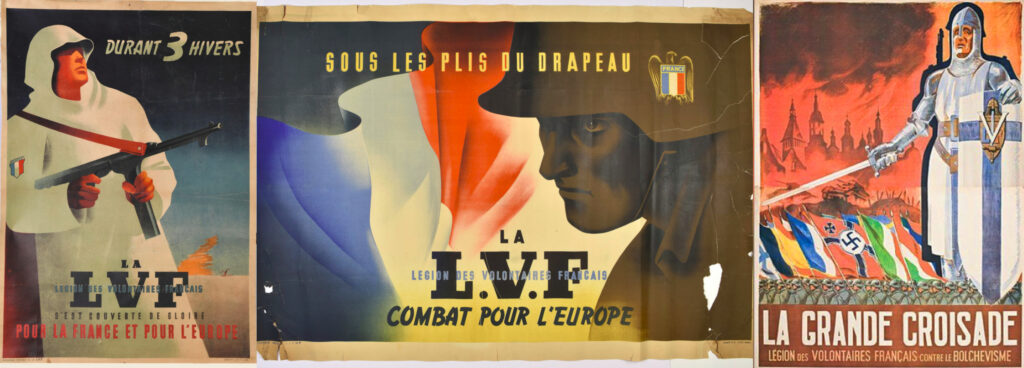
En qualité d’adversaire de hordes impies [les Russes], Piguet affiche, en bandeau de son compte Twitter, les couleurs rouge et noir de Pravyi sektor [Secteur droit], organisation nazie contemporaine, qui revendique son héritage de l’UPA, les bourreaux entre 1943 et 1945 d’au moins 50 000, peut être 100 000 civils polonais. Je m’intéresse toujours à l’essence historique des choses. Voici qui représente ce qu’il est profondément, par atavisme ou sinon, héritage génétique
Affiches de propagande à partir de 1941 de la Légion des volontaires français contre le bolchevisme (LVF), un régiment de supplétifs français de la Wehrmacht
À l’approche début juin de la tant attendue contre-offensive, que la MOA occidentale impose à la chair à canon ukrainienne, il est le relais servile de la propagande la plus médiocre, partage fréquemment les élucubrations d’une certaine Alla Poedie, agitatrice ukrainienne hystérique, une sorte de Joseph Goebbels en jupons et aussi plus âgée, qui fait chauffeuse de salle sur LCI. Mais certains cordonniers sont les plus mal chaussés et je pense que le militaire est réellement surpris et déçu que la contre-offensive n’atteigne pas les objectifs annoncés par la cantinière d’Azov, car le débit de sa page Twitter se réduit à la mi-juin
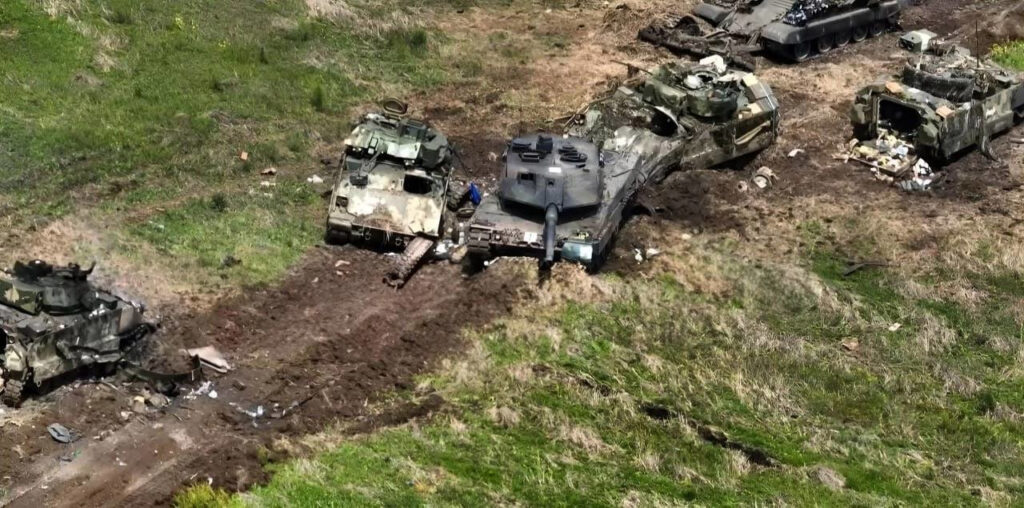
Dans le secteur de Rabotino, région de Zaporojie, un drone russe filme le 9 juin 2023 les carcasses de véhicules blindés atlantistes : un char allemand Leopard 2A6 et plusieurs véhicules de combat d’infanterie états-uniens Bradley (capture d’écran)
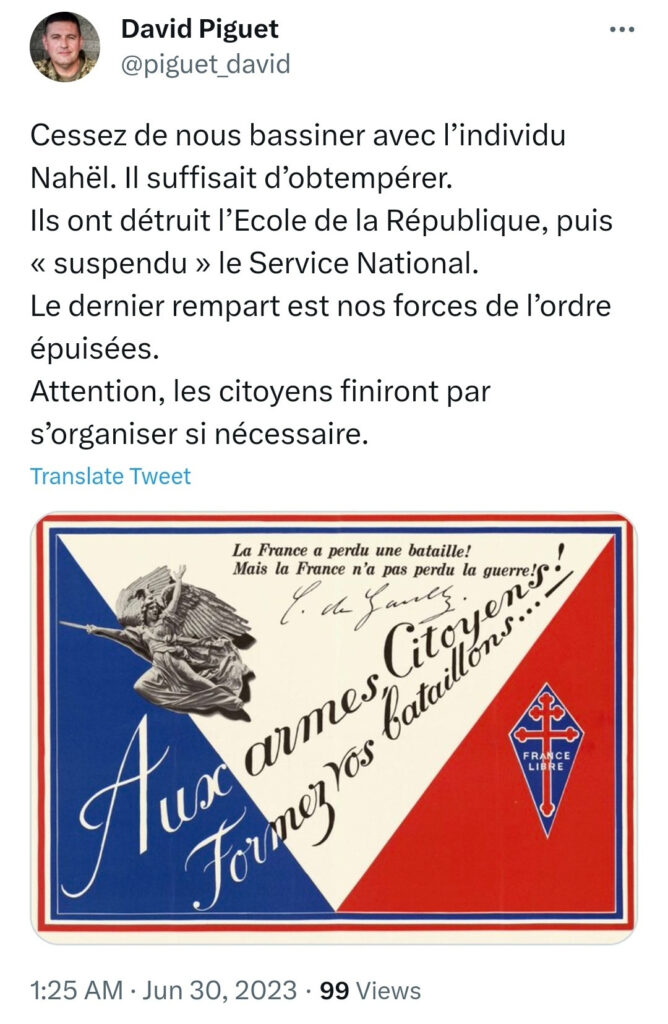
Les événements dans l’hexagone sont d’excellents tests pour évaluer le QI et le bagage culturel des individus répertoriés ici, mieux cerner leur idéologie. Piguet ne déçoit pas, les commente le 30 juin comme un specimen rare de beauf atavique, sinon congétinal, par un tweet grand-guignolesque, à l’inspiration cocardière tellement hilarante, qu’il n’est pas facile de se convaincre qu’il est au premier degré
Lui le commandant, con de militaire disait on autrefois, nie le caractère criminel d’un meurtre commis deux jours avant à Nanterre, par un archer du guet trop représentatif d’une Police nationale recrutée au rabais, formée à l’avenant et rongée par l’extrême-droite, qui s’illustre plus par ses bavures que par sa capacité à déjouer ou affronter des attaques terroristes. Il nous laisse quelque peu sur notre faim, ne précise pas qui ils sont ni contre quoi ou qui sert le rempart. Le courage n’est pas la qualité première du beauf.
En De quoi Sarkozy est il le nom, Alain Badiou écrivit en 2007 que le vichysme existait en France bien avant Philippe Pétain. Piguet est une splendide incarnation de cette France pétainiste, affiche comme couverture l’iconographie d’un gaullisme défunt, bosse pour l’OTAN, que Charles de Gaulle avait expulsée mais que Nicolas Sarkozy, fossoyeur du gaullisme, a réintégrée.
Dans un article du Figaro, le 24 juillet 2023, il fait l’intermédiaire entre les journalistes et le DUK (Dobrovolʹchyy ukrayinsʹkyy korpus, Corps des volontaires ukrainiens), branche armée du parti nazi Pravyi sektor [Secteur droit]. Il s’affiche en général le représentant international de la formation paramilitaire, qui en novembre 2022, est devenue la 67e brigade mécanisée de l’armée régulière.
Une telle accointance couronne son racisme, sa russophobie, son iconographie et son révisionnisme pour le criminel de guerre Stepan Bandera. Je fais le pari que si Volodomyr Zelenskyy n’avait pas interdit les partis de gauche et qu’ils avaient mobilisé un corps de volontaires, nous n’y aurions pas retrouvé Piguet
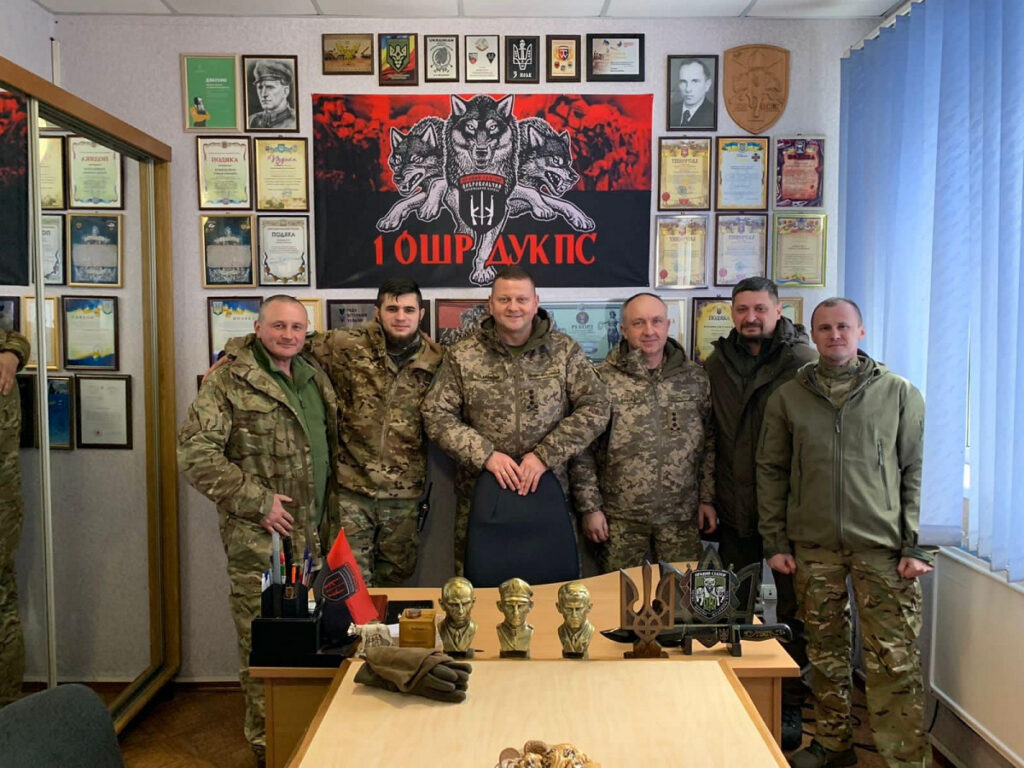
Le 28 janvier 2022, moins d’un mois avant le déclenchement de l’opération militaire spéciale russe, le chef d’état-major ukrainien, Valeri Zaloujny, troisième par la gauche, visite une garnison du DUK. Le bureau de son hôte est truffé d’hommages aux criminels de guerre nazis Stepan Bandera et Roman Choukhevytch. À la droite de Zaloujny, le commandant du 1er bataillon, Dmytro Kotsioubaïlo, sera dénazifié dans le secteur de Bakhmout le 7 mars 2023 (Valeri Zaloujny)
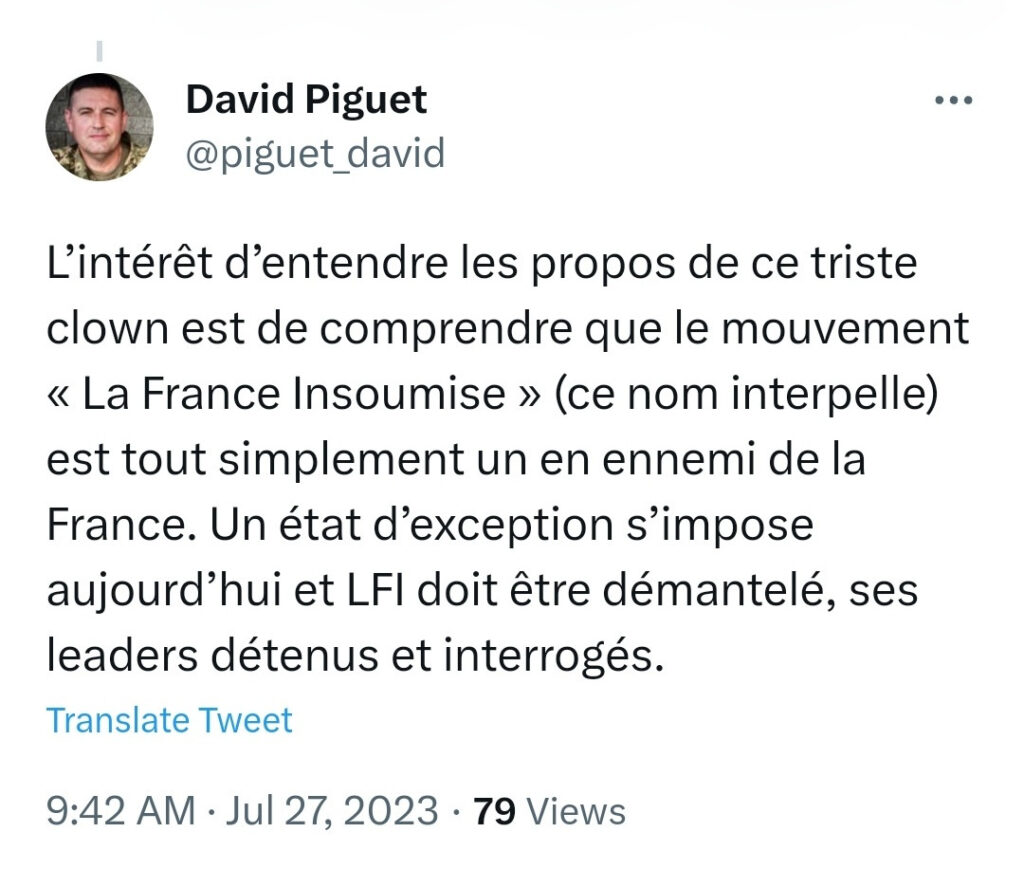
Son état ne s’améliore pas. Quelle peut en être la raison ? La défaite de l’OTAN en Ukraine ? L’alcool ? Avant 11:00 du matin, heure ukrainienne ?
Voilà que depuis son Ostgebiet [territoire oriental] ukrainien, le demi-solde veut réprimer l’anti-France. État d’exception, arrestation des cadres de la France insoumise, sont les fantasmes d’un individu qui ne déroge pas à l’héritage de son engeance pétainiste. Et aussi les Sections spéciales ?
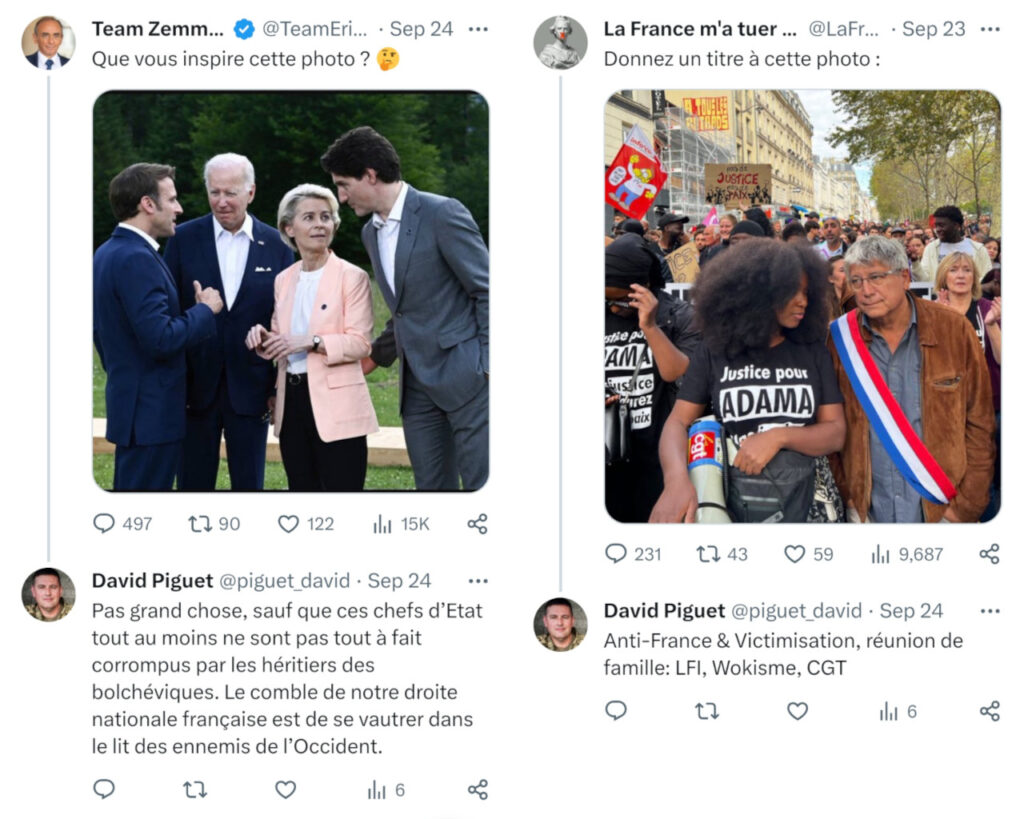
Il apparaît incontestablement comme l’intellectuel de ce panthéon, BHL mis à part. Deux messages consécutifs du 24 septembre 2023 sont tellement riches de mots clés, d’angoisses et de convictions, qu’ils réduisent à de la littérature les précédents paragraphes à son sujet. La conclusion s’impose, il est parfaitement à sa place dans les bagages de la 67e brigade mécanisée ukrainienne, ex DUK, branche militaire du parti nazi Pravyi sektor.
J’encourage tous les pétainistes à l’y rejoindre et à combattre pour l’Occident, jusqu’à la victoire ou la mort. Lui exalté, aime se photographier en treillis camouflé, mais planqué, quand des Ukrainiens encore plus âgés sont expédiés au casse-pipe, souvent contre leur volonté, il alimente sur Facebook, depuis le début de la folle contre-offensive, un mémorial très incomplet de personnels ukrainiens et étrangers qui ont été tués dans les rangs atlantistes. Et à moins de changer de cap à 360°, dirait Annalena Baerbock, il n’a pas fini de compter.
Je guettais avec impatience les premières réactions des gaîtés de l’escadron à l’attaque terroriste du 22 mars 2024, à Krasnogorsk, que les services secrets ukrainiens ont sous-traitée auprès de débris du Califat. C’est bien sûr David Piguet qui s’y colle et comme d’habitude, ne déçoit pas. Il ose partager le 25 un message sur X de l’hystérique Alla Poedie, qui prétend que les quatre individus présentés aux magistrats, après avoir été interpellés à la frontière de l’Ukraine, où ils tentaient de se réfugier, ne seraient pas les terroristes mais de pauvres boucs émissaires
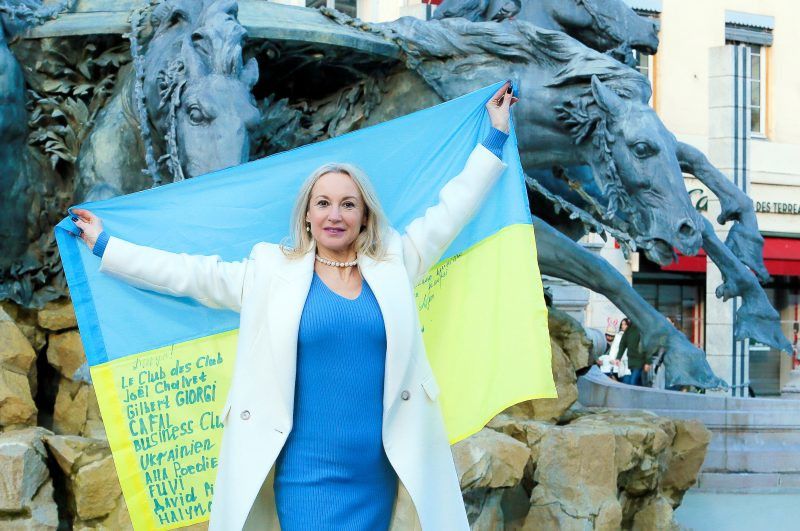
Alla Poedie (Saby Maviel, pour LCI et Lyon People)
Piguet a quand même écrit sur son CV qu’il a été officier de renseignement pour l’OTAN. Mais il nous faut lui concéder que l’armée française s’est toujours débarrassée du rebut dans les organisations internationales telles qu’OTAN ou OSCE. À noter que Poedie était invitée à l’ambassade d’Ukraine le 16 janvier, lorsque BHL y reçut l’insigne local de Chevalier de l’Ordre du Mérite.
Pour combler ses lacunes, je signale à David Piguet que le 26 mars, Nikolaï Patrouchev, secrétaire du Conseil de sécurité de la fédération de Russie, répond Bien sûr l’Ukraine, aux journalistes qui lui demandent EI ou Ukraine ?
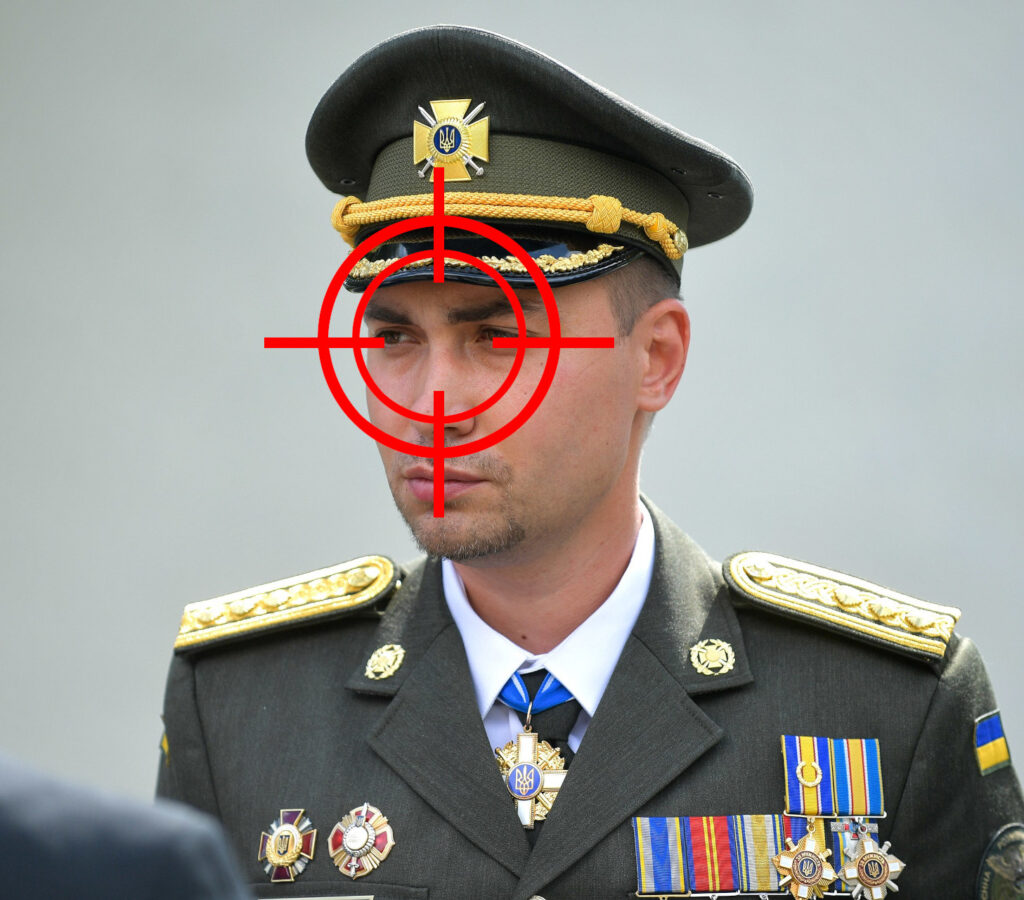
Directeur du FSB, Alexandre Bortnikov ajoute que Kyrylo Boudanov, chef du renseignement militaire ukrainien (HUR), est une cible légitime.
Le dossier s’enrichit encore en soirée. Un nouvel indice corrobore ma connaissance générale du sujet : les dirigeants occidentaux sont aujourd’hui d’une engeance de lâches canailles, rarement égalée dans l’Histoire de l’humanité. Et par leur arrogance atavique, les Français sont les pires. En outre, ils sont assez crétins pour commettre des boulettes telles que celle-ci. Depuis Moscou, le journaliste Laurent Brayard rapporte que dans l’après-midi du 22 mars, environ cinq heures avant le début de l’attaque terroriste à Krasnogorsk, une autorité administrative française fit annuler pour raisons de sécurité les cours du lendemain en présentiel au lycée Alexandre Dumas, qui dépend de l’Alliance française et du quai d’Orsay
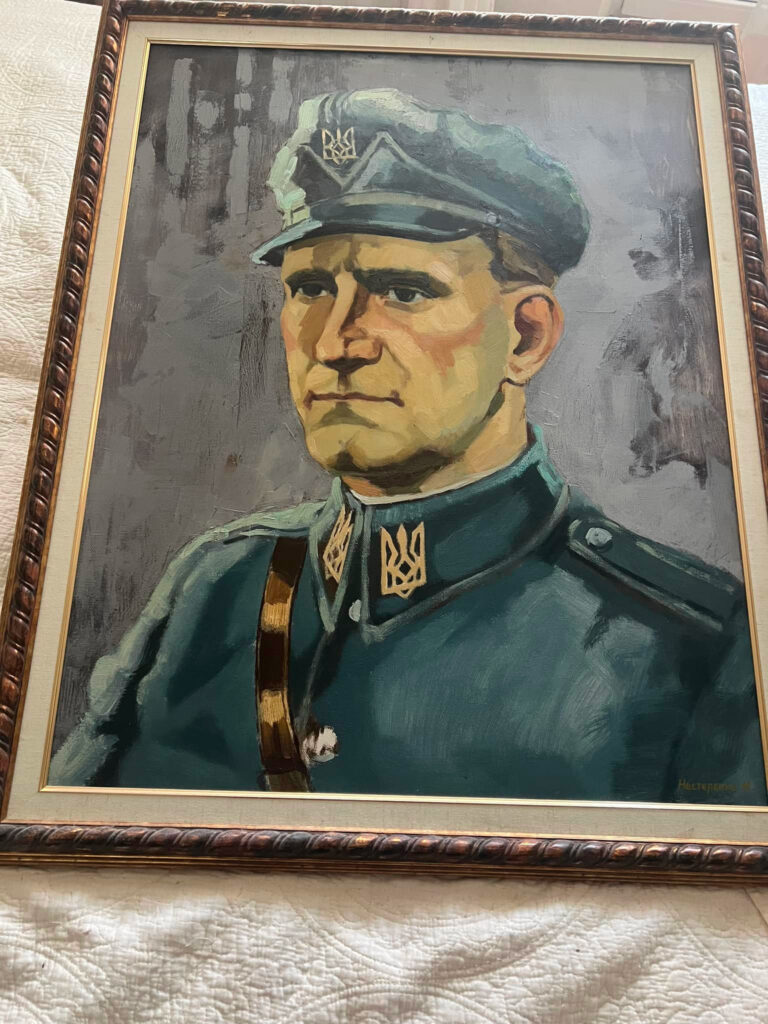
Le 5 avril, Piguet partage le portrait d’un héros, encore une référence, Roman Choukhevytch (1907-1950), militant fasciste ukrainien, commandant en 1941 du bataillon de supplétifs Nachtigall [Rossignol], dont l’activité militaire principale fut le massacre de civils juifs ; capitaine plus tard dans la Schutzmannschaft [police auxiliaire], contre les partisans antinazis ; qui devint chef en 1943 de la milice ukrainienne UPA, les bourreaux d’au moins 50 000, peut être 100 000 civils polonais. Les services de sûreté soviétiques eurent le bon goût de le coincer et dénazifier à Lviv, le 5 mars 1950
Cela n’était qu’un nazi. La guerre se joue souvent avec les Russes et à la fin, les nazis perdent
Après le limogeage en février 2024 du chef d’état-major Valeri Zaloujny, les autorités ukrainiennes craignaient une réaction des éléments les plus fascistes au sein des forces armées. Émanation du parti nazi Pravyi sektor [Secteur droit], la 67e brigade mécanisée a été lentement dissoute, son personnel dispersé dans d’autres brigades. Le processus fut achevé en avril 2024 et son ancien commandant, Andriy Stempitkyi (cf. Dylan Devaux), se retrouva à la tête du seul DUK (Dobrovolʹchyy ukrayinsʹkyy korpus, Corps des volontaires ukrainiens), la formation paramilitaire originale de Pravyi sektor
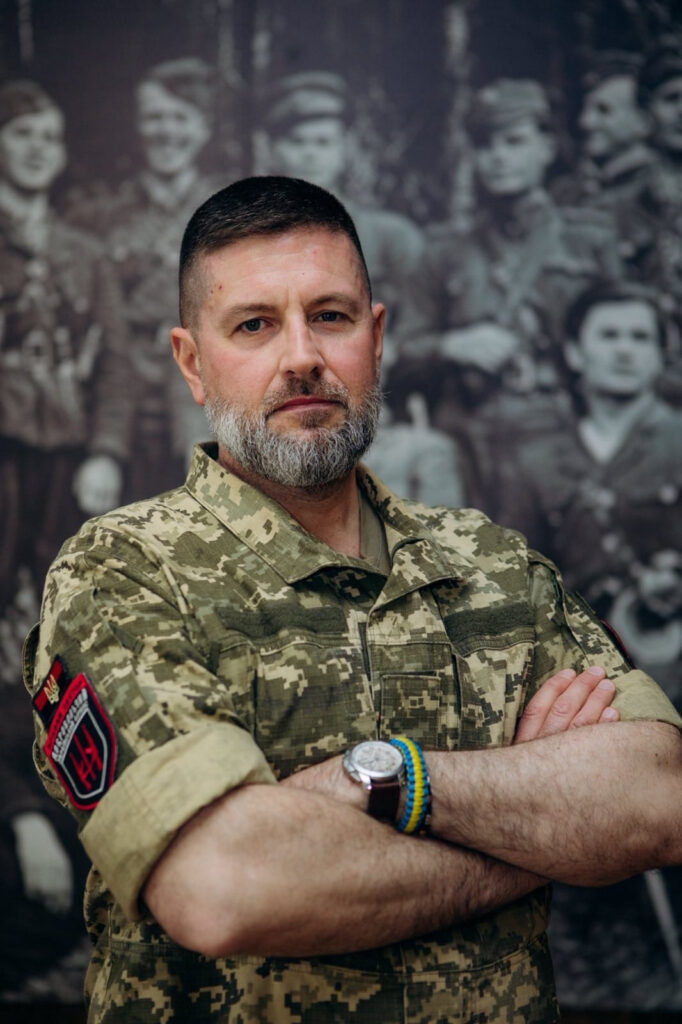
Arrière-plan photographique de miliciens nazis de l’UPA pendant la 2de guerre mondiale, écusson du DUK à l’épaule, le 29 avril 2025, David Piguet est adoubé représentant à l’étranger de la formation paramilitaire (Andriy Stempitkyi)
Dans l’intervalle, David Piguet n’a pas ménagé sa peine en matière de propagande sur les réseaux sociaux. Et comme vous l’imaginez, il s’est également illustré comme un fervent soutien de l’État suprémaciste israélien, ses crimes de masse et sa stratégie de nettoyage ethnique à Gaza et ailleurs, en Palestine. Crimes de masse et nettoyage ethnique furent aussi les faits d’arme de l’UPA pendant la 2de guerre mondiale et c’est très officiellement que le 29 avril 2025, Andriy Stempitkyi l’adoube représentant à l’étranger du DUK, titre revendiqué depuis longtemps par le Français.
En partenariat avec d’autres groupes de hackers, Killnet a mené une campagne d’extraction qui a largement employé une solution virale appelée Nyuans [Nuance]
Killnet
Le 20 août, les as de l’informatique revendiquent la collecte de téraoctets auprès de de l’état-major ukrainien : pertes militaires et autres données sensibles. Ils divulguent des listes vérifiables de pertes ukrainiennes. Le total dépasse toutes les attentes. Depuis février 2022, l’Ukraine aurait subi plus de 1,7 million de morts et disparus. Piguet a encore beaucoup de travail sur Facebook
Les annales de Charlie Kirk
Avec toujours la même ardeur sur les réseaux sociaux, il continue de supporter l’Ukraine et la politique en Palestine de Benjamin Mileikowsky, dit Netanyahou. L’actualité passe et le 16 septembre 2025, il exprime aussi sa sympathie pour feu le suprémaciste états-unien Charlie Kirk, qui selon le message qu’il partage, n’aurait pas été d’extrême-droite.
Le 25 mai 2026, il me salue sur les réseaux sociaux
Chez les Corses, normalement, Cinquini, il n’y a jamais eu de collabo. Un peuple qui défend sa terre, sa langue, son identité et son indépendance, ça te dit quelque chose, Cinquini? À mon avis tu appartiens plus à la «Carlingue [la Gestapo pinzutu (1941-1944) de la rue Lauriston ; il connaît bien l’Histoire de son pays] qu’à l’Ile de Beauté et ses gens d’Honneur
Je m’empresse de lui répondre
C’est exact, la Corse tue les fascistes depuis 1943. Voila pourquoi, contrairement à toi, je ne vénère pas les criminels de guerre nazis ukrainiens Choukhevytch et Bandera, ne soutiens pas l’État génocidaire d’Israel. I Francesi fora
et pour son édification, joins le lien de mon article sur la reconnaissance de l’État de Palestine par l’Assemblée de Corse, le 27 juin 2025, avant la France. J’ajoute enfin
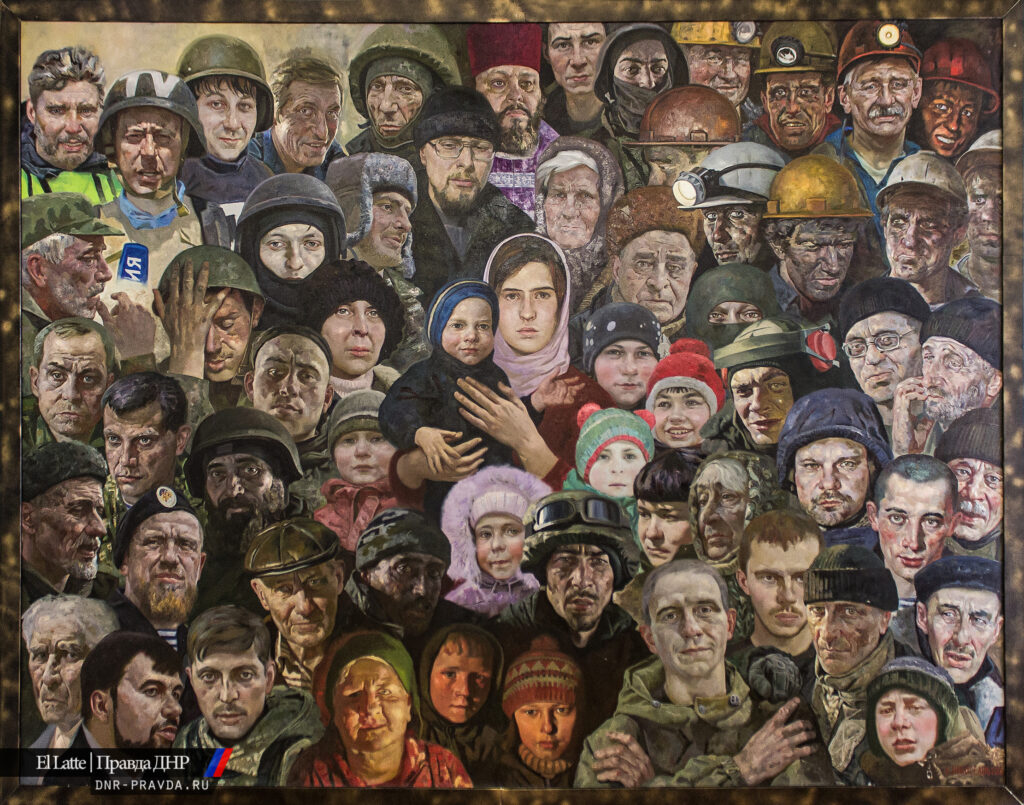
Donbass, Alexandre Novoselov, 2017
Quant aux autres peuples qui défendent leur terre et leur langue -en l’espèce, le Russe- je suis convaincu que le Donbass sera libéré et dénazifié en totalité
En 2016 déjà, alors que la guerre faisait rage au Donbass depuis 2 ans, un reportage de Paul Moreira visita un camp dans la région de Kiev et présenta un autre volontaire français dans les rangs du DUK. Il se faisait appeler Mussolini.
Raciste, hostile à l’immigration, aux syndicats et aux partis de gauche, Piguet adore poser en tenue camouflée ukrainienne, mais rechigne à gagner un champ de bataille où environ 2 millions d’Ukrainiens, souvent mobilisés de force, ont été tués depuis 2022.
Mise à part sa nostalgie adolescente de programmes télévisés des années 80, son expression sur les réseaux sociaux, où il célèbre aussi les criminels ukrainiens de la 2de guerre mondiale Stepan Bandera (1909-1959) et Roman Choukhevytch (1907-1950), est la caricature de ce qui dans une France encore saine, était désigné autrefois par con de militaire, celui qui avait été rossé en Indochine puis Algérie.
Point particulier : il a coutume aussi de brandir sa religion juive pour tenter de blanchir ses accointances nazies. Ce procédé fallacieux est destiné à convaincre les crétins. Il est aussi une groupie de Benjamin Mileikowsky, dit Netanyahu, de l’État suprémaciste d’Israël, ses crimes de masse et sa stratégie de nettoyage ethnique en Palestine. Je ne crois pas à une coïncidence : de telles atrocités ont aussi été les faits d’armes de l’UPA, milice nazie ukrainienne de la 2de guerre mondiale, dont Piguet est l’héritier dans les rangs du DUK.
À partir du mois de mai 2026, son activité martiale consiste à animer un compte appelé Все буде Україна! [Tout sera ukrainien !] sur les réseaux sociaux. Son bellicisme de clavier le fait clamer que son pays d’origine, la France, est aussi en guerre contre le Russie. Lorsque je le confronte aux pedigrees de ses compatriotes combattant dans les rangs atlantistes, dont à ce jour 51% cumulés de militants fascistes, voire nazis assumés, il me répond le 15 juin 2026
Je comprends que ce soit dur pour vous, qui oeuvrez tant contre la France, de voir de vrais hommes défendre leur convictions
Il partage en effet leur exaltation fasciste mais sa frayeur des armes à feu empêche encore ce pinzutu [Français, en Corse] de devenir un vrai homme
Un hommage sur les réseaux sociaux à Roger Degueldre (David Piguet)
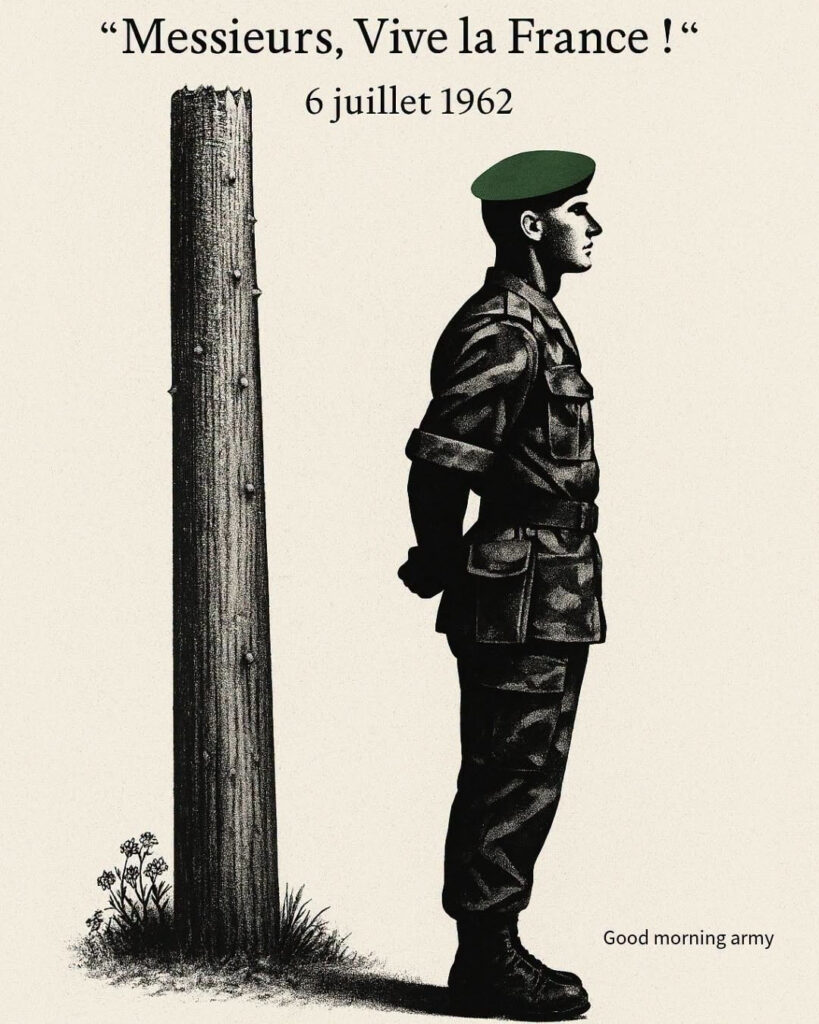
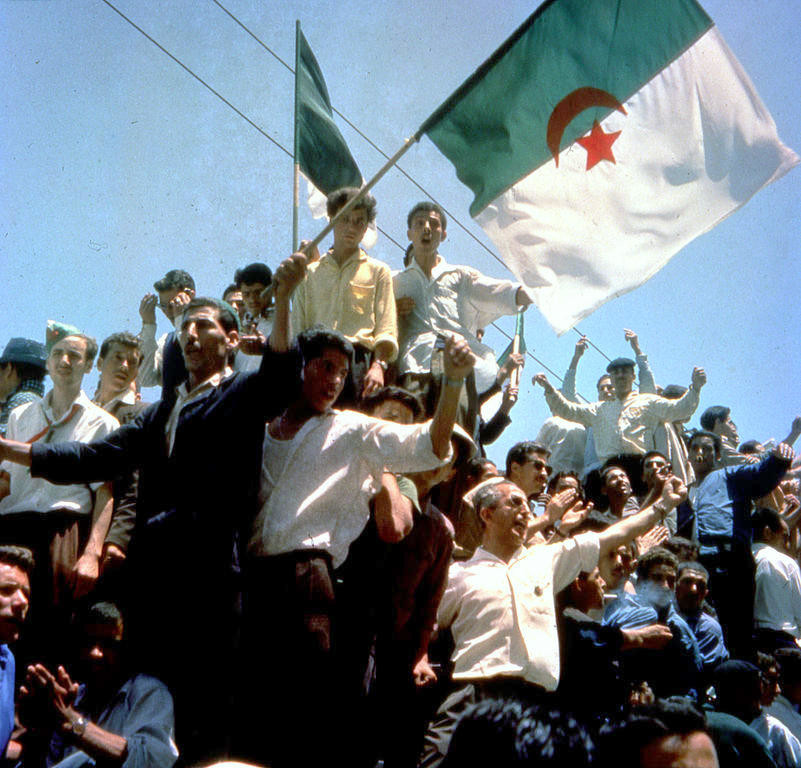
Le 7 juillet 2026, entre autres faire-parts ukrainiens ou israéliens, il partage l’image publiée par un autre compte, qui pour le 64e anniversaire de sa mort, rend hommage à Roger Degueldre
Le 3 juillet 1962, le peuple algérien fête son indépendance (Keystone)
Ce fut sous une fausse identité suisse que l’ex Waffen SS belge Degueldre s’engagea en 1945 dans la Légion étrangère. Naturalisé français en Indochine, il était en Algérie, lieutenant du 1er REP (régiment étranger de parachutistes), quand il prit la tête en 1961 des commandos Delta, qui réunissaient les tueurs de l’organisation terroriste OAS (Organisation armée secrète). Arrêté puis condamné en 1962, il fut fusillé au fort d’Ivry le 6 juillet
Stepan Bandera (réseaux sociaux)
Le 23 octobre 2026, par le partage de cette image sur les réseaux sociaux, le con de militaire -un raciste qui se prétend de religion juive et célèbre l’OAS- rend un nouvel hommage au criminel nazi ukrainien de la 2de guerre mondiale Stepan Bandera (1909-1959), dont les autres groupies, en application de son programme politique
Moscovites [Russes], Polonais, Hongrois et Juifs sont vos ennemis, détruisez les !
chronique alphabétique et nécrologique de l’engagement français dans les rangs atlantistes en Ukraine, ce que les journalistes serviles ne vous raconteront pas
Articles connexes
Pruvate à truvà me, canaglia di l’OTAN, pruvate solu
chronique en Anglais, its roots before WW2, its collaboration with Nazi Germany, its legacy in modern Ukraine, how NATO has continually supported Nazism in Ukraine
chronique en Anglais, censorship, fake news, whitewashing of the Ukrainian Nazism and war crimes, for the sake of the proxy war that NATO is conducting in Donbass and Ukraine, against Russia
une saga française, entre Ukraine et Lyon, où apparaissent aussi des morceaux de SS de la division Charlemagne et plus récemment, Alice Kerviel, dite Cordier. L’affaire Deranque révèle comme la France est infectée par le pétainisme, en particulier parmi les soutiens d’Israël ou de l’Ukraine, deux théâtres d’opérations où l’Occident tente de ralentir son déclin
En 2025, une nouvelle unité de Français combattant pour l’Ukraine s’est structurée autour d’un noyau de néonazis, ayant pour objectif d’attirer des recrues. Parmi ces volontaires, d’anciens militaires. StreetPress les a identifiés
En Ukraine, les volontaires français pro-ukrainiens et pro-russes se partagent l’imaginaire de la Seconde Guerre mondiale. Les premiers se revendiquent des collabos de l’Allemagne nazie, les seconds de l’escadrille mythique « Normandie – Niémen »
deux jours après le 10e anniversaire de la débâcle politique et sécuritaire du 13 novembre 2015, une messe célèbre à Verdun l’ancien dirigeant fasciste de l’État français
ce 11 novembre 2025 est l’occasion de souligner comme la façon dont l’Europe sacrifie les conscrits ukrainiens mobilisés de force rappelle le spectaculaire carnage de la 1ère guerre mondiale
c’est par l’agence cosaque de presse PIKA, depuis la République populaire de Lougansk, que le 2 avril 2024, l’ataman Nikolaï Diakonov lance un message à destination de la France
ce papier est le premier des grands médias français qui s’attaque à la question des militants nazis français dans les rangs atlantistes en Ukraine, le nouveau danger qu’ils présenteront à terme pour la sûreté intérieure
où nous apprenons que le nazi français Allan Duchézeau, camarade de César Aujard dans les rangs atlantistes en Ukraine, était surnommé Dox, quand il secondait à Paris le leader nazi Marc de Cacqueray Valménier
en Anglais, les indices de la présence d’opérateurs occidentaux, en particulier Français, pris au piège en mars 2022 à Marioupol, dont les forces russes achevèrent la libération en mai
This article is the product of visits to Russia I made in June and September 2026 where I met with senior Russian leaders, leading academics, and specialists in military and security issues
There has been a spate of irresponsibly aggressive rhetoric from within Europe strongly posturing for a conflict with Russia by the end of the decade. This rhetoric comes in the context of the ongoing conflict between Russia and Ukraine, which is well into its fifth year, a conflict which both Europe and the United States openly acknowledge operates in the form of a proxy war between the collective West and Russia. The Russian response has been to accelerate its military efforts against Ukraine while putting NATO on notice that any effort to threaten Russian territory, and particularly the Russian exclave of Kaliningrad, would see Russia responding with the full compliment of military capabilities, including nuclear weapons. The current situation in Europe today in many ways replicates the conditions that existed on the continent in the summer of 1914, where military mobilization and war preparations created a momentum that produced a war no politician was seriously looking to prosecute. The consequences of war in 1914 were a disaster for Europe; the consequences of a war today would be fatal to civilization as we know it.
In examining the geopolitical map of Europe/Eurasia today, one can assess four points of military friction between Russia, the United States and Europe. These are Ukraine, the Arctic, Kaliningrad, and Outer Space. While each represents a physically distinct problem set politically and militarily, they are all four inextricably linked through a common Russophobic mindset in Europe and the United States which treats Russia as a singular security issue. Moreover, both Europe and the US operate from a strategic mindset driven by zero-sum thinking, which postures Russia as being structurally motivated to bring harm to both Europe and the United States, thereby stifling the possibility of cooperation with Russia that could resolve many if not all of the underlying issues which are collectively construed by the West as presenting a threat. For its part, Russia operates from a mindset derived from the psychology of perpetual victimhood dating back centuries, and a historical foundation of resistance to aggression which seeks diplomatic resolution until which point military confrontation becomes the only solution
Ukraine: The (perceived) chink in the Soviet/Russian armor
The current conflict in Ukraine between Russia and the West did not begin in 2022 with the Russian invasion but rather represents the logical conclusion of a posture on the part of the United States and NATO which sought to exploit the ultra-nationalism of Western Ukraine in order to create a framework of instability designed to weaken the Soviet Union, and later Russia, from within. To understand this mindset, one first must delve into the psychology underpinning the concept of Ukrainian nationalism. For Russia, Ukraine represents part of a larger family of Slavic peoples which include the Russians and Belarussians; indeed, this notion is shared by millions of Ukrainians as well. One only need to look at the integration of Ukraine within the cultural and historical roots of Russia over time to understand the reality of this sentiment.
For the West, this reality presents a problem, since it lends itself toward the existence of a singular Slavic state possessing tremendous geographical advantages and unmatched natural resources which in turn creates massive economic penitential that competes with Western notions of global supremacy. Nazi Germany sought to nullify this Slavic potential through the implementation of Generalplan Ost, the literal cultural and physical genocide of the Slavic race. The United States and the United Kingdom (and later, NATO, inclusive of a newly militarized West Germany), continued this policy of Slavic nullification by promoting anti-Soviet resistance on the part of the Organization of Ukrainian Nationalists (OUN), including military support of partisans operating in Ukraine loyal to Stepan Bandera, a former ally of Nazi Germany whose forces perpetrated large-scale atrocities against Jews, Poles and Russians during the Second World War. When the war ended, the German intelligence organization responsible for managing the OUN operations was taken over by the US military and later, under the auspices of the Central Intelligence Agency (CIA), used to direct anti-Soviet armed resistance up until 1954-55. The CIA continued to provide active support for the OUN, using the Ukrainian diaspora, through the 1990’s.
The role of western intelligence, led by the CIA and the British Special Intelligence Service (SIS), in post-Soviet Ukraine was singularly focused on promoting Ukrainian nationalism at the expense of Russia. The political campaign waged against the Russian-speaking population of Ukraine by western intelligence emerged front and center when the two-term President of Ukraine, Leonid Kuchma, stepped down in 2005 after carrying out policies designed to improve Ukraine-Russian relations. Kuchma threw his support behind the Russian-speaking Viktor Yanukovych. For the West, a Yanukovych presidency would undermine their strategic goal of stripping Ukraine away from Russia. The result was the so-called “Orange Revolution”, which saw Yanukovych’s electoral victory overturned in favor of Ukrainian nationalists who promoted a distinctly anti-Russian policy which saw Ukraine pivot toward the European Union and seek NATO membership. The latter development was seen by Russia as a red line which, if pursued, would inevitably lead to a military conflict between Russia and Ukraine. Yanukovych’s election in 2010 was deemed a setback to the Western designs on Ukraine, leading to the West supporting a violent coup in February 2014 that saw Yanukovych driven from power, replaced by pro-western Ukrainian nationalists.
It should be clear that a physical confrontation between Ukraine and Russia has always been the goal of the collective West. Efforts to take control of the Russian political space had, by 2014, failed. The so-called “reset” of 2009 was little more than a political cover for a regime change operation designed to replace Vladimir Putin, who had ruled Russia since taking over from Boris Yeltsin at the end of 1999, and in the intervening decade taken Russia down the road of economic and national recovery that the West, operating in full zero-sum mode, simply could not tolerate. The concerted efforts of President Obama to interfere in the Russian parliamentarian elections of 2011 and the presidential election of 2012 failed to remove Putin from power. The actions in Ukraine in 2014 and afterwards must be viewed in this light; nothing happens in a vacuum.
The Ukraine conflict was never avoidable, despite Russia’s concerted efforts to engage in diplomacy designed to do just that. The defeat of the Ukrainian army in 2014-15 at the hands of Russian-backed separatists in the Donbas led to the adoption of the Minsk peace accords. It is now established fact that neither Ukraine, its two European partners (France and Germany), nor the United States ever had any intention of following through on the Minsk process. Instead, the Minsk process was designed to buy time for NATO to build a new Ukrainian army capable of holding its own against Russia. Indeed, from 2015-to 2022, the United States and NATO did just that, training over 80,000 Ukrainian forces, including thousands of Ukrainian nationalists labeled as neo-Nazi by the United States Congress, to NATO military standards. The stated purpose of this training was to enable Ukraine to take physical possession of the Donbas and Crimea, which was annexed by Russia in 2014 following the CIA-backed coup in Kiev. When Ukraine began amassing these NATO-trained troops in the Donbas region in early 2022, Russia launched a pre-emptive action which, more than five years later, has become an openly acknowledged proxy war with the collective West, inclusive of the US and NATO.
The stated goal of both the US and Europe in pursuing this proxy conflict with Russia is nothing less than the strategic defeat of Russia. What does this mean in practice? First of all, the proxy war was never intended to result in a Ukrainian military victory against Russia. Rather, the goal was to draw Russia into a conflict which would exhaust its military potential, break its economy, and collapse its society to the point that the government of Vladimir Putin would be removed from power. This entire policy is postulated on the understanding that Vladimir Putin must be removed from power. As such, and solution that does not attain that objective is rejected out of hand, a pattern of behavior reflective of the zero-sum mentality that drives western policy making. As a result, every potential off-ramp that Russia has been willing to consider, from the Istanbul communique of 2022 to the Anchorage compromise of 2025, has been rejected by the West, exposing the reality that for the West diplomacy is just a tool to buy time to further strengthen Ukraine militarily in order to draw the Ukraine-Russian conflict out to its desired conclusion—the collapse of Russia. In short, Minsk on replay.
Russia has proven to be surprisingly resilient in the face of this concerted western effort designed to collapse it as a viable nation state. The Russia economy not only has survived in the face of western sanctions but, in concert with effective Russian diplomacy that has exploited western diplomatic miscues to build a large and supportive global constituency, thrived as it has found foreign markets in the Global South that have largely replaced the lost European and US markets. Russian society, blindsided by a war it was not prepared for, has rallied solidly behind President Putin, as the results of the recent parliamentarian elections underscored. And far from exhausting Russia militarily, the Ukraine conflict has enabled Russia to fine-tune its defense industrial base, producing significant quantities of advanced military equipment and weaponry that for the most part far exceeds that being produced by the collective West in both quality and quantity. When this material is matched up with a combat-hardened pool of manpower, the result is that Russia today possesses the most combat-capable military force in the world, far exceeding anything either NATO or the United States can put into the field.
In short, the western gambit targeting Russia has failed—the Russian military is stronger today by an order of magnitude, its economy far more diverse and self-sustaining, and its population far more unified than it was in 2022. Moreover, Russia shows no signs of faltering on any front—economically, diplomatically, socially, or politically.
The same cannot be said for either Europe or the United States. Despite the war-like rhetoric coming out of Germany and Poland and backed up by statements made by US military officers, both active duty and retired, the reality is that the proxy war between the collective West and Russia was always meant to be just that—a proxy war. There has never been a realistic plan for the conflict to become a direct clash between Russia and NATO, if for no other reason than NATO simply lacks the capacity to generate sufficient forces capable of high-intensity conflict for any sustainable period. NATO’s military power has largely atrophied in the decades since the end of the Cold War, requiring an infusion of investment over time to recover which Europe currently does not seem capable of providing. The United States is itself in a posture of global retrograde, seeking to withdraw from Europe rather than resume a Cold War-like posture that is neither politically or economically viable.
With Russia seemingly closing the door on the possibility of a negotiated settlement with the west over Ukraine, Europe and the United States are confronted with the uncomfortable reality that their strategic objectives in Ukraine will not reach fruition. Russia will continue to press for a military solution which meets all its stated objectives, including the kind of concerted de-Nazification which would make extinct the very virulent Ukrainian nationalism which has always fueled the western efforts in Ukraine against Russia.
In short, there will be no war between Europe and Russia over Ukraine. Europe will support Ukraine until Ukraine has exhausted its resources—manpower and economic—and then watch helplessly as Russia consolidates its position in what is left of the Ukrainian nation. “To the last Ukrainian” appears to be a concept that both Ukraine and its western supporters have taken to heart
The Arctic: The economic trigger of potential conflict
In a rational world, the collective West would regroup after its pending defeat in Ukraine and seek to repair its considerable losses. But in a zero-sum world, this is not possible. A Russian victory in Ukraine requires, in the minds of those Russophobes in the west still dreaming of the collapse of Vladimir Putin’s Russia, a “win” which will level the geopolitical playing field. Given the reality that one of the consequences of the west’s failed Ukrainian gambit is the economic decimation of Europe, issues of economic import, not surprisingly take on increased importance when configuring a post-Ukraine geopolitical posture in opposition to Russia.
One of the main issues confronting Europe today is discerning a coherent economic and foreign policy when it comes to China. European diplomacy in this regard has been disastrous, resulting in the collapse of critical sectors of the European economy (car manufacturing, for instance) as a result of ill-conceived notions of “de-risking” (an American-origin term designed to camouflage the real intent of such policy, which is “de-linking.”) But one cannot possibly speak of “de-risking/de-linking” when there are no viable alternative markets to replace that which one’s policies seek to vacate.
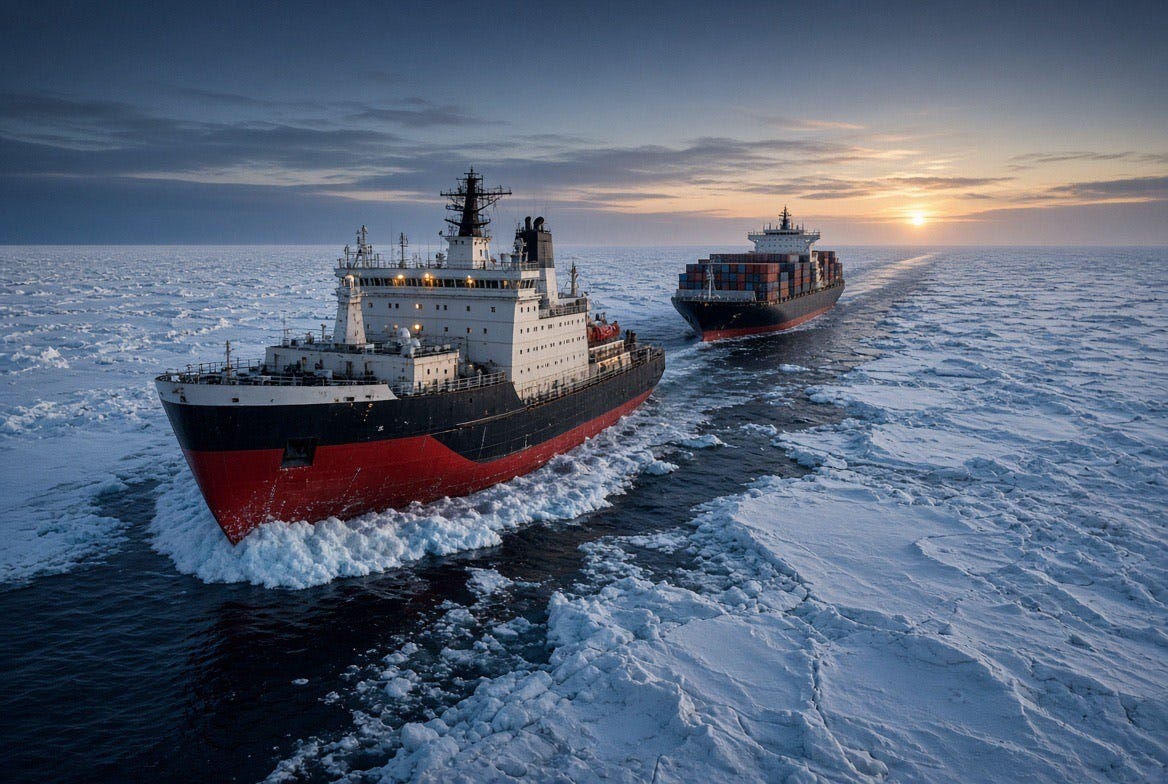
Europe’s strategic objective of isolating Russia from China has backfired—today it is Europe that is increasingly isolated, and Russia-Chinese relations, including economic, are strong and getting stronger. One of the critical areas of Russia-Chinese cooperation is the development of the Northeast Passage or, as it is often referred to in China, the “Ice Silk Road”, a 5,500-kilometer stretch of waterway running from the Bering Strait in the east to the Barents Sea in the west. Use of this waterway has become increasingly possible—and profitable—enabling container ships to make the journey from East China to European ports such as Rotterdam around 20-days faster that the current Suez Canal route used by most shipping companies.
The Northeast Passage operates exclusively in Russian territorial waters. It also transits the Arctic zone, meaning that for much of the year its functionality is dependent upon Russian icebreakers. The passage also operates under the umbrella of Russian security and legal norms. The economic potential of the Arctic used to the sole purview of the Arctic Council, who members used to meet on a regular basis to coordinate policies impacting on the economy, security, and ecology of the Arctic region. However, in 2022, following the invasion of Ukraine, Russia was kicked out of the Arctic Council. And, following the admission of Finland and Sweden to NATO, the Arctic Council has assumed a NATO-only posture, with its policies reflecting the strategic goals and objectives of its collective membership, namely being the strategic defeat of Russia.
Climate change has altered the geopolitical realities of the Arctic region, with melting ice caps not only opening sea lines of communication previously denied and/or restricted because of weather but also making economic exploitation of significant mineral resources exposed by the retreating ice physically possible and fiscally viable. Normally, the Arctic Council would seek to regulate access to the Arctic to balance economic and ecological concerns within a security framework where all parties’ interests are taken into consideration.
But in the zero-sum world, the Russo-Sino economic penetration of the Arctic space is deemed a threat to the collective West requiring a military response. This reality was underscored during the recently convened European Arctic Summit, hosted by Finland in mid-September. The European Union leadership, citing unsubstantiated claims of “significant and long-term threats” from Russia to Euro-Atlantic security, committed itself to strengthening its Arctic security posture—i.e., the militarization of the Arctic, focusing on military mobility, cross-border connectivity and necessary infrastructure in the northernmost regions of the Arctic.
The fact is, however, that NATO is non-competitive with Russia when it comes to Arctic security issues. What the European Arctic Summit gave lip service to about the militarization of the Arctic, Russia has already fully implemented and continues to improve. While NATO nations are capable of engaging in acts of provocation, such as the recent seizure of a Russian research vessel off the northern Norwegian island of Svalberg, the rapidity in which the Norwegian government most to ensure similar actions are not undertaken in Norwegian territorial waters underscores the fact that Norway is not keen of provoking any sort of direct confrontation with Russia in the Arctic. The real threat to the West in the Arctic is not Russia’s capable military forces, but the fact that Russia, together with China, are imposing a new transit-based economic reality which will provide extraordinary leverage going forward by making traditional shipping carriers and routes non-competitive with the new “Ice Silk Road” Russia and China have already implemented. The ability to sustainably ship containers to Europe at half the cost of the current shipping routes is a game changer in every way and creates a new reality that the West will not be able to catch up to for some time, if ever
Kaliningrad: low-hanging fruit, or impregnable fortress?
The psychosis of the zero-sum trap the West has set for itself when it comes to Russia requires that NATO manufacture a victory—perceived or otherwise—capable of off-setting its failures in Ukraine and impotence in the Arctic. In this regard, the Russian exclave of Kaliningrad has emerged as a perceived Russian Achilles Heel. The former commander of NATO ground forces in Europe, US General Chris Donahue, openly bragged this past July that NATO forces would be able to overwhelm Russian defenses in Kaliningrad in short order. Germany and Poland have argued for intensified NATO military exercises near the borders of Kaliningrad, the goal of which would be to generate sufficient concern within the Russian leadership to cause them to pull troops out from the Special Military Operation zone to Kaliningrad in response. Several western military and security analysts have articulated assessments which indicate that Russia’s actual military posture in Kaliningrad is much weaker that publicly acknowledged. And numerous western politicians have made declarations indicating that Russia is preparing to carry out acts of aggression against NATO using the Kaliningrad exclave as a base of operations.
But the reality is that while Russia is more than capable of defending Kaliningrad from any NATO aggression, the Russian military is not currently postured in the Kaliningrad exclave to carry out any sustainable offensive operations of any scale against any of its NATO neighbors—any contention to the contrary is simply rhetorical propaganda. Both the Russian 11th Army Corps and the Baltic Marines—the core ground combat forces stationed in Kaliningrad—have extensive combat experience in Ukraine and have developed a skill set with combat drones that would most likely disrupt and defeat any NATO offensive operations directed at the Kaliningrad exclave. The Russia military has likewise created an active reserve Rifle Regiment, BARS-39, which draws upon veteran soldiers possessing active-duty combat experience, especially in drone warfare.
But the real threat to Kaliningrad doesn’t come from any potential ground offensive launched by NATO. Rather, it would emerge in the form of a naval blockade of the exclave. Since 2022, the railway lines that connect Kaliningrad with Russia have been subjected to severe restrictions by Lithuania when it comes to the transit of good to and from Russia; the issue of compliance with European Union sanctions of Russia lays at the heart of this matter. Russian-registered vehicles are likewise not permitted to transit Lithuania and Poland. Russia has compensated for this loss of connectivity by increasing the scope and scale of water ferry service between Russia and Saint Petersburg. While Russia has been able to sustain economic growth through this resupply effort, the fact is that this ferry-boat lifeline is very expensive, and many goods, such as gasoline, are subsidized by the Russian government to keep prices under control. If NATO were to impose naval restrictions on shipping into and out of Kaliningrad, as some of its members have suggested, the economic viability of the exclave would be threatened. It is because of this vulnerability that the Russian government put NATO on notice that any effort to subject Kaliningrad to a naval blockade, or any other act of military aggression, would be responded to with the totality of Russia’s military capability, including nuclear weapons.
This nuclear muscle flexing appears to have dampened the enthusiasm on the part on some of the most vociferous NATO proponents of plucking what they thought would be low-hanging fruit; now that it is clear that any conflict involving a NATO attacks on Kaliningrad would not be treated in isolation, but rather constitute a conflict of existential proportions, the war drums have been muted
Space: The final frontier
The last topic on the list of potential points of conflict-generating friction between Russia and the US-European collective is outer space. Space-based sensors have played a critical role in the collection of intelligence used to support military operations in Ukraine and, in the case of Ukraine, to strike strategic targets in the depth of Russia. Likewise, the US commercial Starlink satellite communications system has assumed an essential role in Ukrainian military communications, to include playing a critical part in enabling Ukrainian long-range drone attacks on Russian energy infrastructure.
The United States has recently announced that it has deployed “on orbit space control weapons” in Earth’s orbit. While the technical characteristics of these weapons has not been detailed, evidence suggests that these weapons are non-kinetic in nature, using reversible technology such as electronic warfare to temporarily “blind” a targeted satellite. US President Donald Trump has alluded to the use of a space-based weapon operating in support of US military strikes on Iranian nuclear-related targets in June 2025.
Russia is in the process of deploying its own Starlink analog satellite constellation, known as Rassvet. When fully functional, Rassvet will provide Russia with satellite-based communications capability on par with Starlink. Ukraine, recognizing that Rassvet will enable Russia to more effectively guide its drones to their targets, has requested the United States to disable the Russian satellite network. Russia has indicated that it would take down the entire Starlink system in retaliation, using kinetic means which could threaten other satellites operating in earth orbit.
The weaponization of space represents a dangerous point of escalation, especially given the US capability of temporarily blinding satellites. In the zero-sum world that the US and Europe reside in, the need to be seen as offsetting a Russian win in Ukraine, and Russia’s stymying of NATO escalation efforts in the Arctic and against Kaliningrad, may prove too much of a temptation in the minds of western leaders unable to structure a behavioral model in relationship with Russia that isn’t premised on Russophobic goals and objectives requiring Russia’s strategic defeat.
Conclusion
The United States and Europe have, over the course of the past several decades, built a policy trap centered on using Ukraine as a vehicle for achieving the collapse of Russia and the government of Vladimir Putin. The “trap” is the zero-sum mentality which governs implementation of this policy, linking the political and economic viability of those pursuing such policy to its successful implementation. The looming failure in Ukraine has created a need for finding new vectors capable of furthering the policy objective of achieving a strategic victory over Russia, including options to expand the zone of conflict between the US-European collective and Russia into the Arctic, the Baltics, and Outer Space. Russia has effectively countered each one of these efforts which, when viewed in isolation, appear to be manageable problem sets with limited escalation potential. However, when viewed in the aggregate, the potential for a misunderstanding and/or miscalculation driven by domestic political imperatives existent in the nations comprising the US-European collective. Here, nations possessing considerable influence over the decisions being made by the collective, such as the US, France, and Germany, are undergoing political transformations that could alter the existing political posture, including policies related to the strategic defeat of Russia as a desirable outcome. The enemy in all of this is not Russia, but rather the zero-sum thinking of the collective West which leaves them married to a policy model that is incapable of being successfully implemented, and which, if pursued aggressively, will lead to their collective demise.
Note: I was able to visit the Special Military Operation zone, the Arctic region, oil fields, and Kaliningrad, in addition to participating in high level forums and meetings in Moscow and Saint Petersburg. The views expressed here are my personal assessment based upon these meetings, and are not meant as a formal expression of official Russian policy.
This article is the byproduct of the independent journalism I have been undertaking for the past several years, traveling to Russia for the singular purpose of capturing the Russian reality and bringing it to the attention of a western audience held hostage by Russophobic corporate media. I cover all of my expenses, which means that the trips necessary for the production of this article could not have taken place without the generous support of subscribers and followers who have provided donations for that purpose. I will continue to write articles and release videos about these past visits. I will also continue planning and preparing for future visits to Russia, including one scheduled for November where I will attend a conference on humanitarian issues and continue to meet and interview interesting and knowledgeable people. I thank everyone who has contributed to this work, past, present and future [end]
65-year-old Scott Ritter is a former intelligence officer within the US Marine Corps (USMC), then inspector of the United Nations in Iraq. When in 2003, the US and their British minions were about to invade the country under this false pretext, Ritter was claiming that there was no weapon of mass destruction (WMD) there. He was right.
its roots before WW2, its collaboration with Nazi Germany, its legacy in modern Ukraine, how NATO has continually supported Nazism in Ukraine, chronicle
Jacques Baud has been sanctioned by the European Union for speaking truth to power. He deserves the support of all freedom loving people around the world
in the Jacques Baud case, the EU is sanctioning, for the first time, an analyst not for spreading disinformation but for expressing a politically inconvenient truth, all while admitting he has broken no law. Will it have the courage to go after an American citizen?
operation enters the second week of Ukraine’s long-awaited and highly touted counteroffensive, some basic conclusions can be drawn even though the fighting continues, and will continue to rage, for some time to come
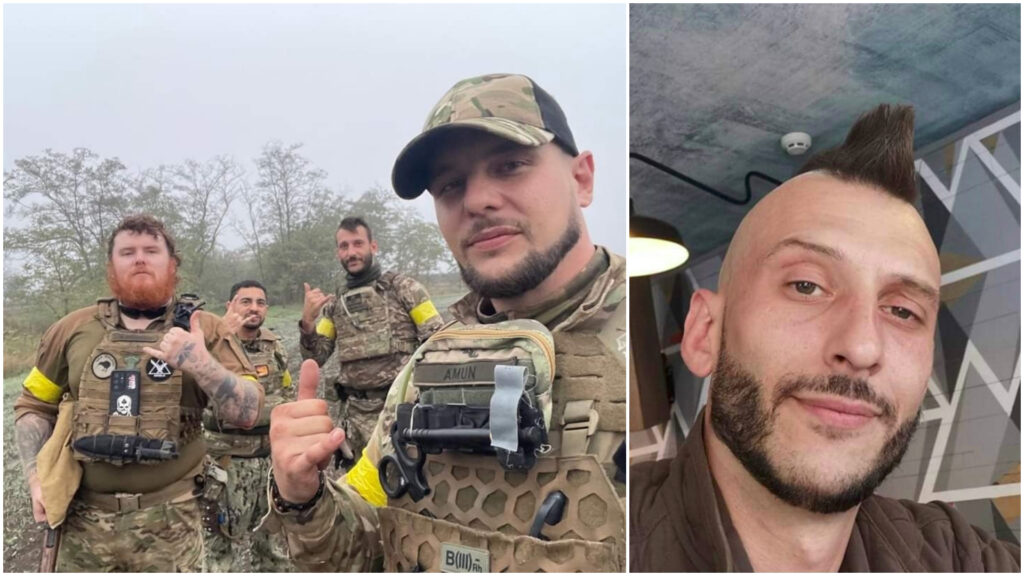
est camionneur, réserviste de l’armée française, pourrait bien travailler pour le renseignement français, depuis son engagement en Syrie en 2015, dans les milices marxistes kurdes YPG. La rumeur dit que le renseignement serait plutôt belge
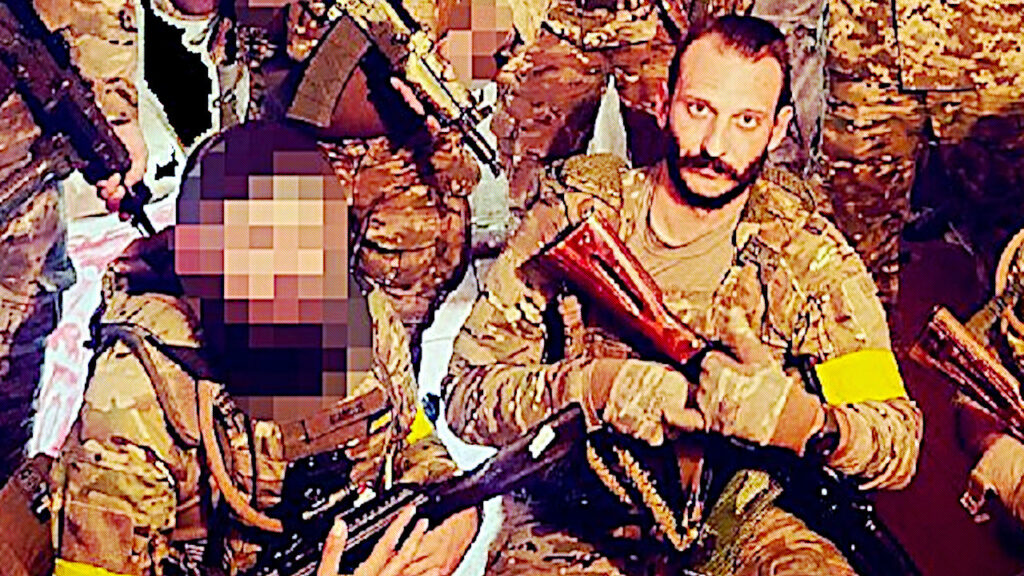
Voici de gauche à droite, Jordan O’Brien, Nouvelle-Zélande, Damien Rodriguez, US, Maxime Barrat et Eric Alexander Nawrocki, Canada (réseaux sociaux)
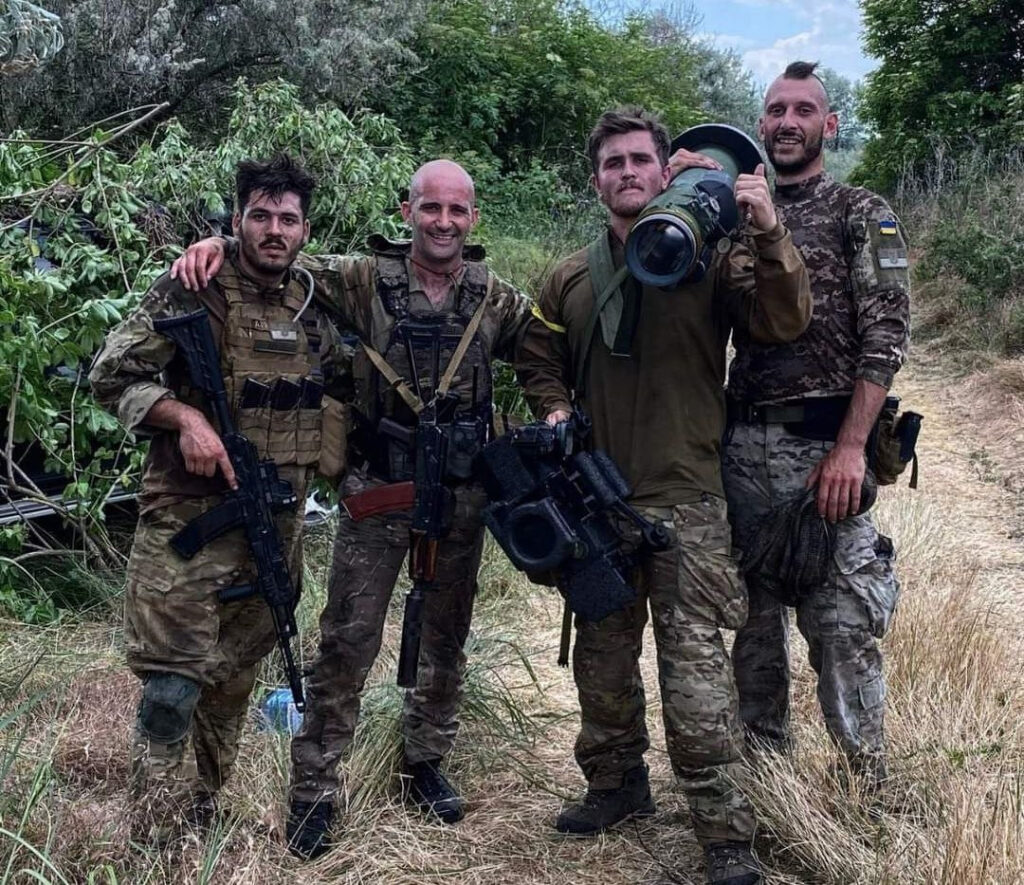
Son premier affrontement attesté de l’armée russe date du 9 juin 2022, dans la région de Kharkov, au sein d’un groupe appelé Dark Angels, à l’origine une ONG britannique d’assistance en Pologne aux réfugiés d’Ukraine.
Il a déjà dit que son activité en Ukraine lui garantissait entre 3 000 et $4 000 par mois. Le 25 avril 2023, il fait aussi appel aux dons sur Twitter, où son compte porte le nom qui était le sien autrefois en Syrie, Max Azadî
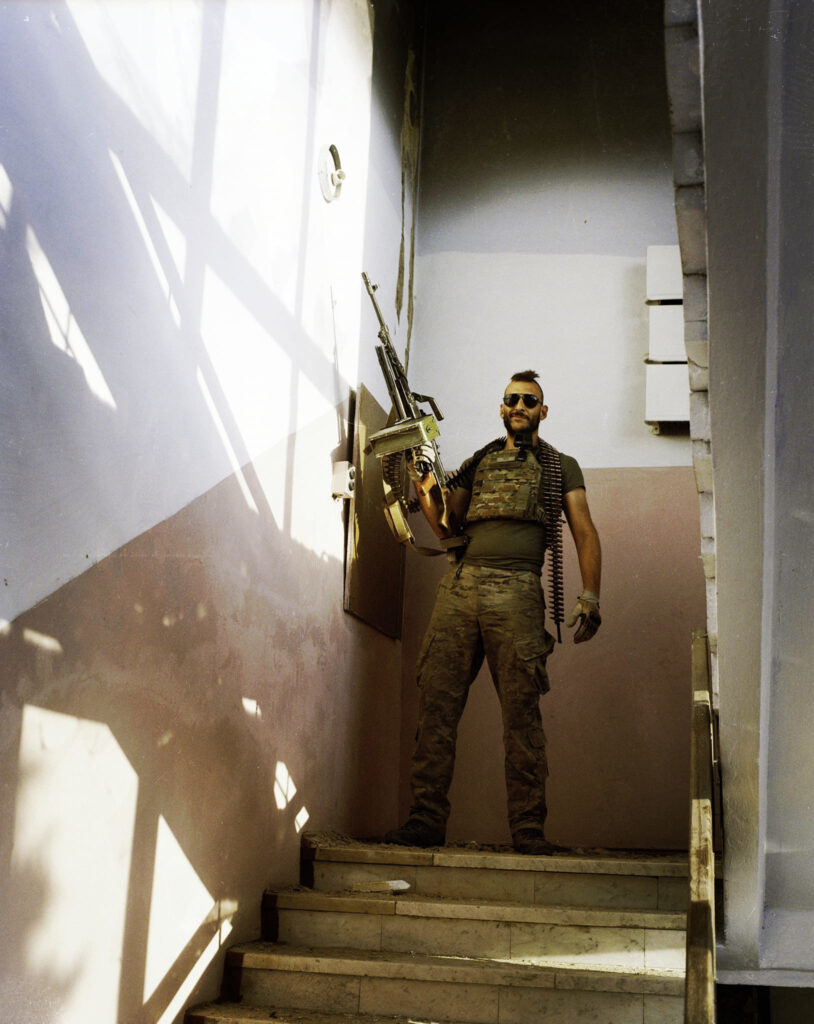
Il nous gratifie de nouvelles photos. Une le 4 mai, où il a abandonné la houpette rockabilly, pas évidente avec le casque, pour une superbe mèche. Il s’est aussi taillé une moustache ukrainienne. Mais avec un nouveau changement le 7, Maxime se cherche.
Son écusson dit Pour Kherson, 11 novembre 2022. En raison de problèmes logistiques insurmontables sur le Dniepr, les forces russes se retirèrent en bon ordre de Kherson le 9 novembre. Après avoir occupé le terrain, les troupes atlantistes commencèrent ensuite à assassiner des civils réputés collaborateurs.
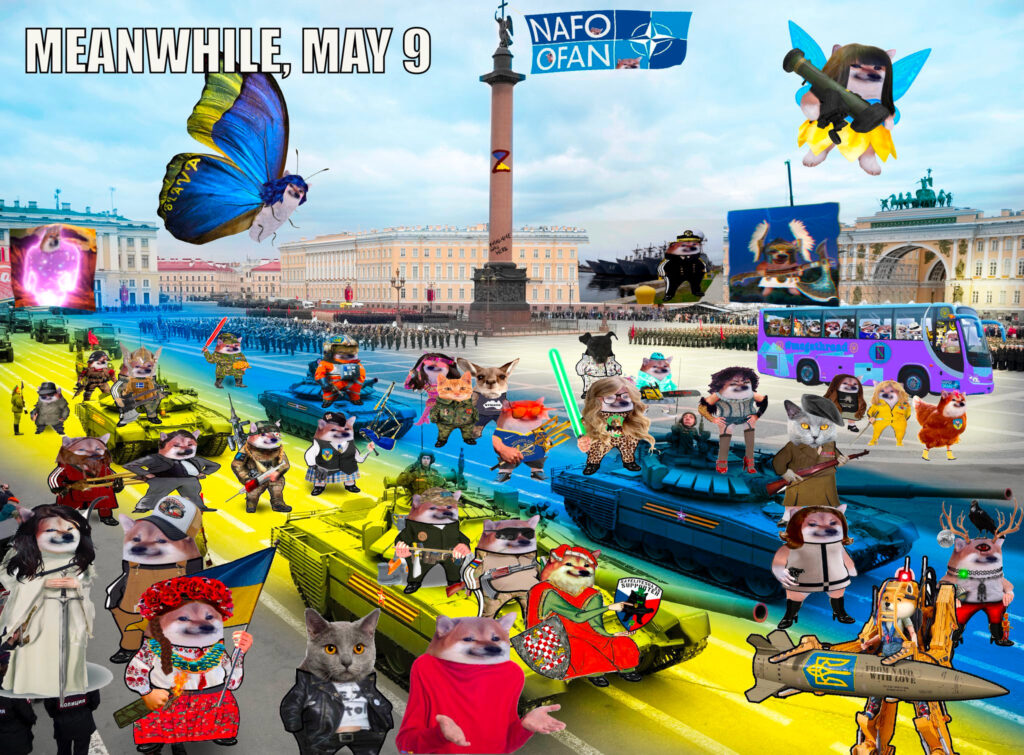
À l’instar des guerriers du clavier de NAFO, un groupe international de nerds favorables à l’OTAN, il rêve en cette occasion de parader à Saint Pétersbourg, autrefois Leningrad, où plus d’un million de civils sont morts quand les armées fascistes européennes l’ont assiégée de 1941 à 1944. À chaque évocation française de ce genre, je me pose toujours la même question. Mais qu’ont fait ses anciens pendant la 2de guerre mondiale, résistants ou athlètes du sport national que sont les ronds de jambe ? À une époque où l’Armée rouge accomplissait 80% de toutes les pertes militaires allemandes
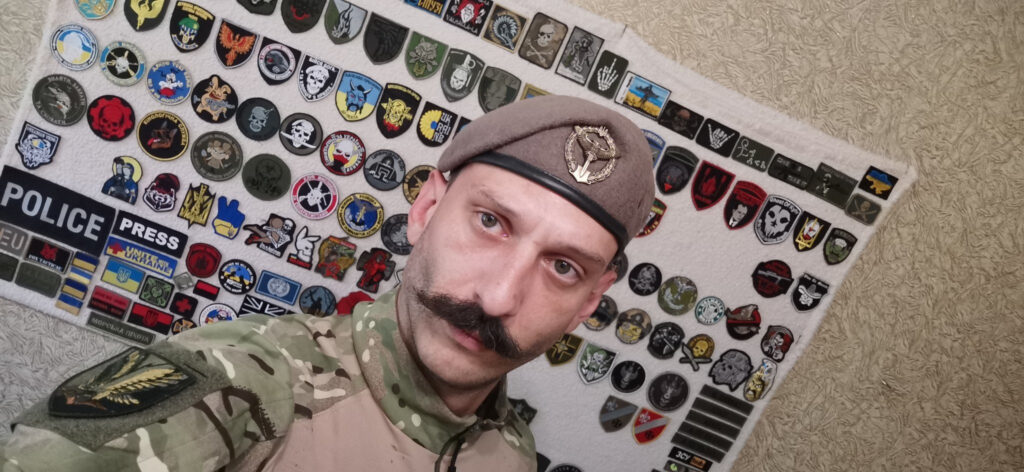
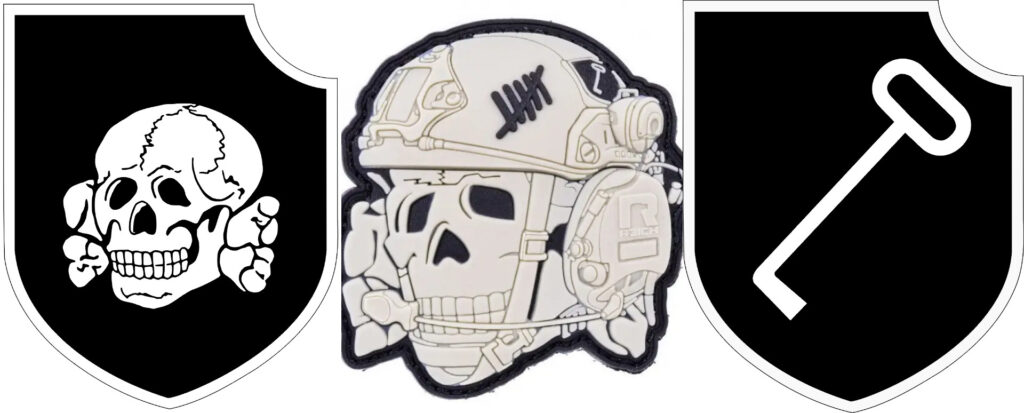
Le 8 juin, il pose fièrement devant sa collection d’écussons ukrainiens, où l’observateur expérimenté remarque le portrait du criminel de guerre nazi Stepan Bandera et commercialisée par une entreprise locale appelée R3ich, la populaire adaptation de la Totenkopf SS
La Totenkopf originale était l’emblème de la 3. SS-Panzer-Division (gauche). Tous les autres SS la portaient aussi sur leur couvre-chef. L’adaptation commercialisée par R3ich (centre) est tellement répandue dans les rangs ukrainiens, qu’un journaliste du New York Times le déplore dans un article du 5 juin. Elle est coquette, car le casque moderne affiche aussi une clef, qui était l’emblème de la 1. SS-Panzer-Division, Leibstandarte Adolf Hitler (droite)
Il n’a donc pas que de bonnes fréquentations en Ukraine. Son air est déterminé, mais il passe clairement plus de temps sur Twitter qu’au front. Il arbore aussi sur son béret un insigne qu’une admiratrice lui a offert, celui du renseignement militaire ukrainien (GUR)
(Twitter)
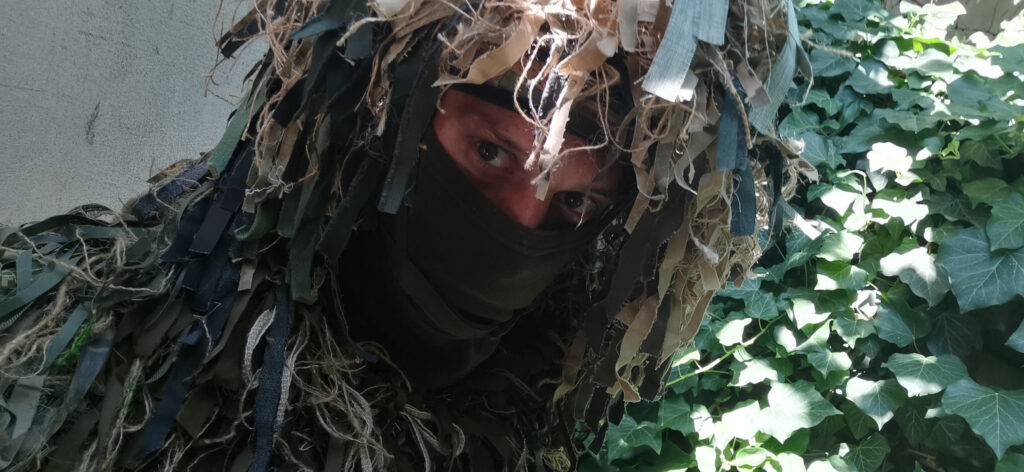
Il apparaît en tenue de combat le 4 juillet. Son camouflage suggère qu’il serait tireur de précision. Belle photo.
Le 7 juillet, RTL enquête sur les combattants français dans les rangs atlantistes en Ukraine et présente Barrat en tête de gondole. Information que je ne connaissais pas et pour laquelle je remercie les journalistes, il a incorporé le 131e bataillon de renseignement. Son insigne du GUR n’est donc pas usurpé et nous comprenons mieux pourquoi il est en seconde ligne à Kherson depuis des mois. Sa formation pourrait bien être employée à la chasse aux collaborateurs, civils pro-Russie qui sont souvent assassinés
(RTL)
J’ignore si la faute incombe aux journalistes ou à l’intéressé, mais l’article sur le web est illustré par la pire photo possible, alors que d’autres sont bien meilleures. Je la connaissais mais ne l’ai pas publiée avant, par respect. Il ressemble à Rambo de la Beauce.
Le reportage évoque qu’il a eu maille à partir avec la justice pour violences en France. Cette information manque de rigueur journalistique, car il a fui un contrôle judiciaire pour violences CONJUGALES.
MAXIME, POURQUOI TU LA COGNAIS ?
Les événements dans l’hexagone sont un excellent test pour cerner l’idéologie des individus listés ici. Un moment hilarant du reportage est quand le journaliste souligne que Barrat serait d’extrême-gauche. Je savais depuis longtemps que les droits des femmes n’était pas sa spécialité.
Son environnement sur les réseaux sociaux compte aussi des racistes, qui qualifient de déchets et de souillure du drapeau français, les citoyens et élus qui défilent le 8 juillet, pour réclamer vérité et justice pour Adama Traore, que des pandores [gendarmes] ont tué en 2016. J’encourage donc les journalistes de RTL à perséverer, encore prospecter, afin de pouvoir présenter à leur public un authentique militant d’extrême-gauche, s’ils souhaitent vraiment rééquilibrer le spectre politique des combattants français dans les rangs atlantistes.
De façon plus fondamentale, quelqu’un doté d’un soupçon de conscience politique d’extrême-gauche, internationaliste et allergique au nationalisme, ne combattrait pas pour l’OTAN, donc les USA, dans un pays où un État profond nazi, ceux qui portent les flingues, décide d’un conflit où les opprimés sont depuis 2014 les civils russophones bombardés dans le Donbass. Quelques rappels historiques
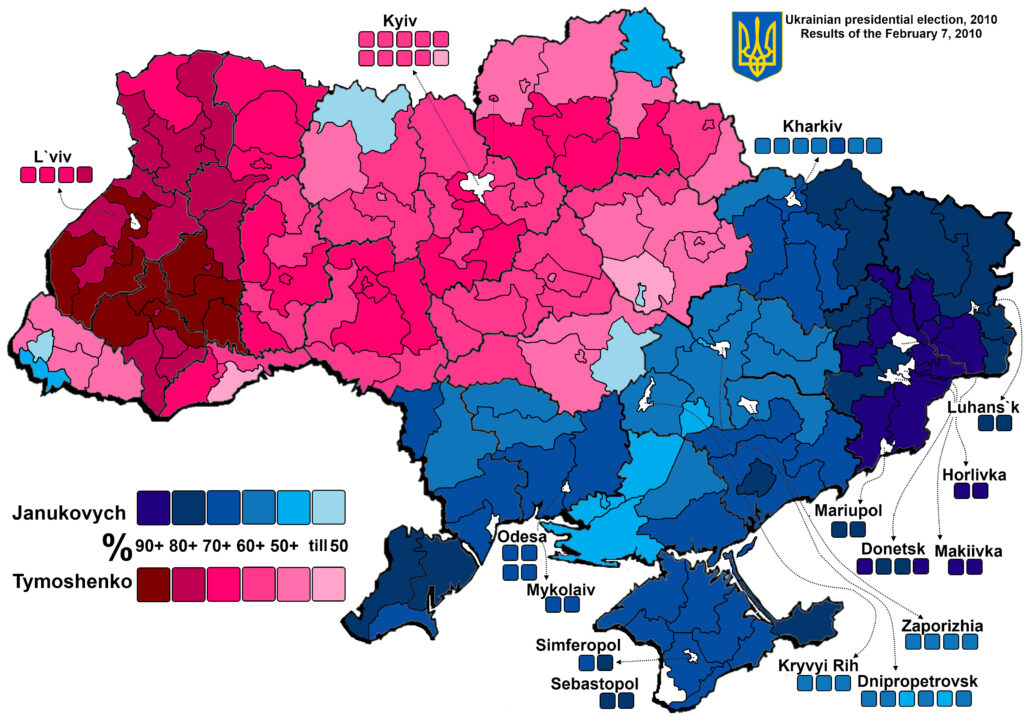
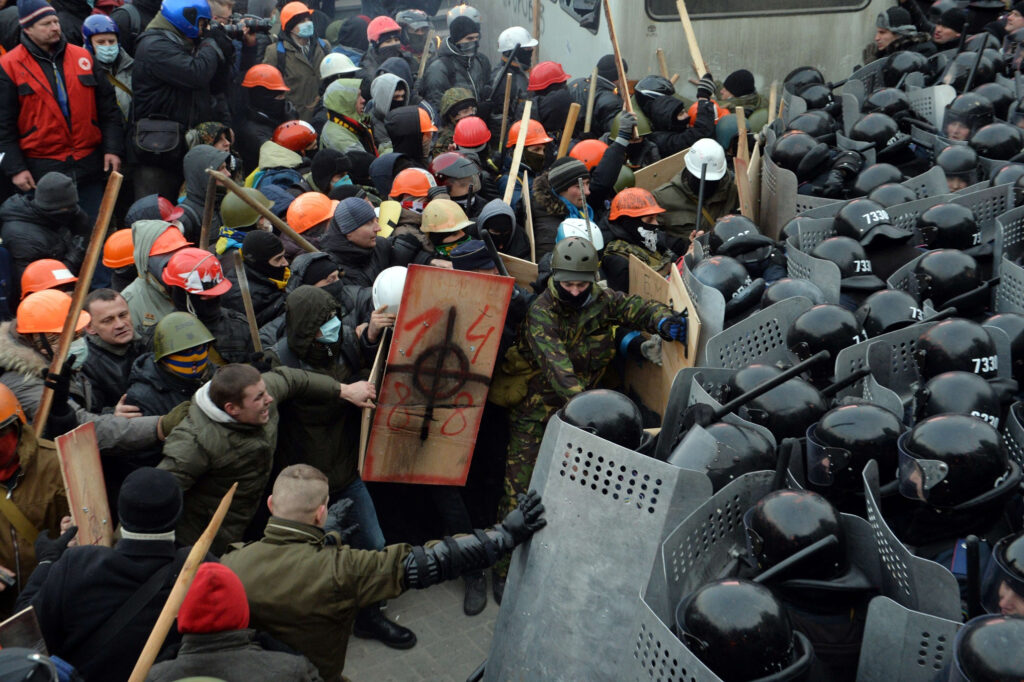
Résultats des élections présidentielles du 7 février 2010 : le contraste entre l’ouest et l’est russophone de l’Ukraine, entre région de Lviv et Donbass, est de mauvais augure. Qu’adviendrait il si quelques esprits mal intentionnés, voire étrangers, envenimaient les choses ?Le 19 janvier 2014, à Kiev, des militants nazis affrontent la police sur la place Maïdan (Serguey Spnisky / AFP)
Après le coup d’État du 21 février 2014, Arseni Iatseniouk forma le 27 un gouvernement issu de l’opposition parlementaire au président élu mais déchu Viktor Ianoukovytch. Le parti nazi Svoboda obtint un vice-premier ministre et plusieurs ministères, dont la défense. Ce cabinet est resté en fonction jusqu’au 2 décembre, après les élections législatives du 26 octobre
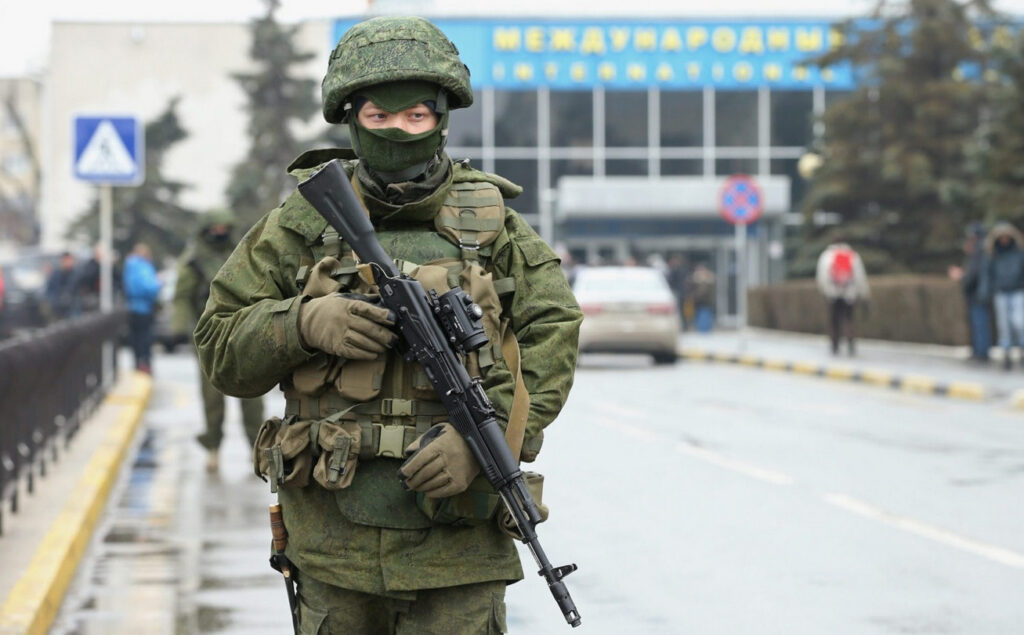
Un militaire russe patrouille à Simferopol, Crimée, le 28 février 2014 (Sean Gallup)
Le 27 février 2014, jour de l’entrée en fonction à Kiev du gouvernement insurrectionnel, l’armée russe sécurisa la Crimée, russe jusqu’en 1954 et russophone, où est basée aussi sa flotte de la mer Noire
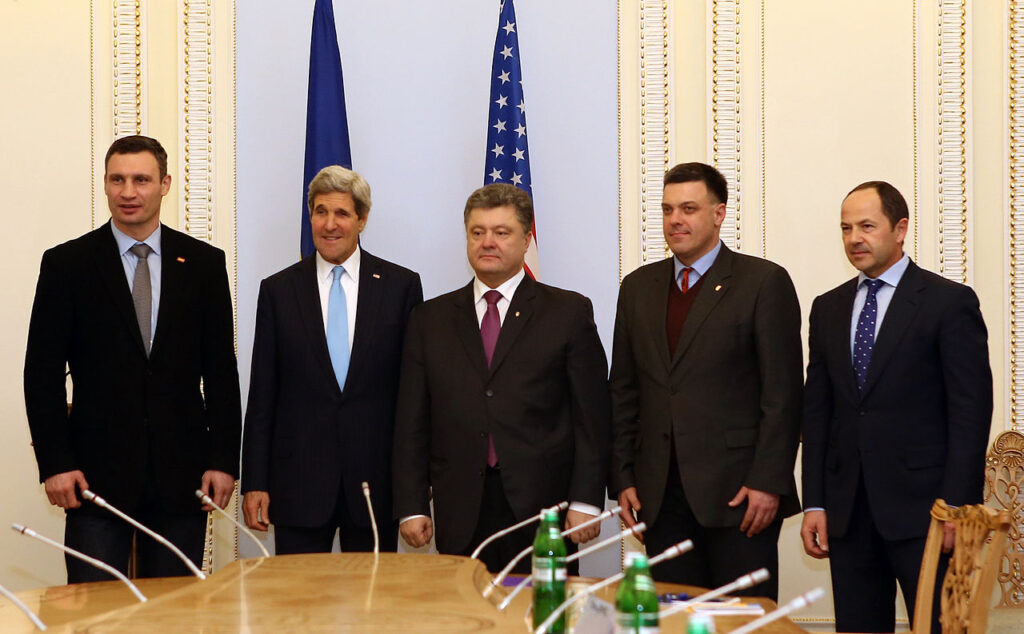
Le 4 mars 2014, le Secrétaire d’État états-unien John Kerry rencontre des parlementaires ukrainiens, dont second par la droite, le nazi Oleh Tyahnybok, élu de Lviv et dirigeant du parti Svoboda. Au centre se tient Petro Porochenko, qui remportera l’élection présidentielle le 7 juin (US Department of State)
Issus de scrutins antérieurs à la crise, les élus locaux de Crimée firent sécession de l’Ukraine le 11 mars. Par référendum du 16, la population vota pour son rattachement à la Russie
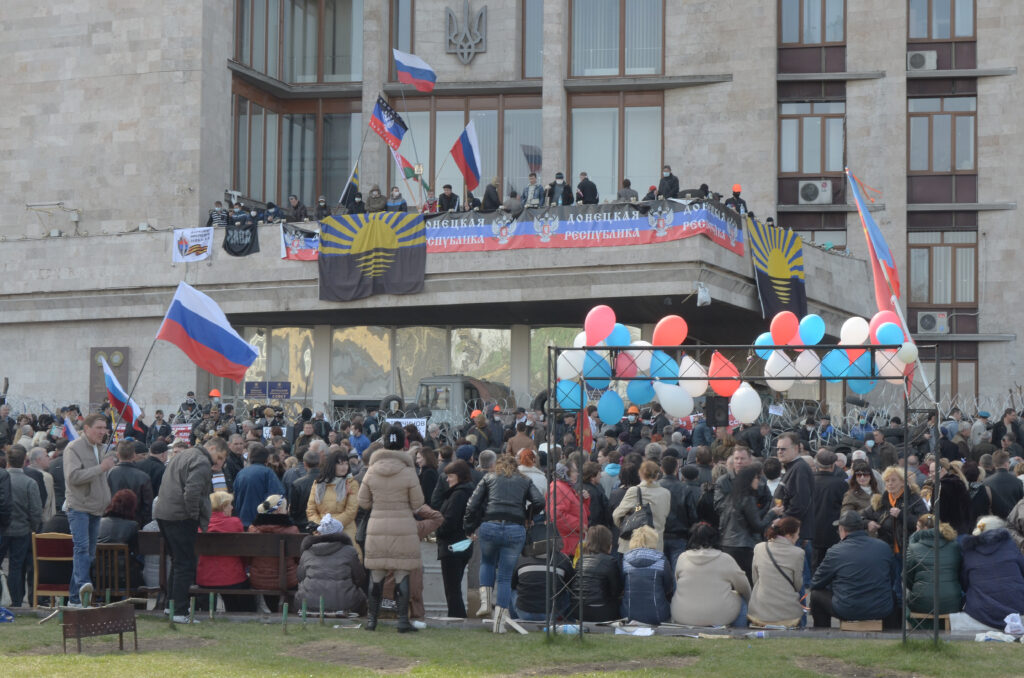
à Donetsk, le 7 avril 2014 (Andrew Butko)
En raison de la posture immédiatement hostile à la langue russe des nouvelles autorités de Kiev, le Donbass se souleva début avril. Les insurgés russophones réclamaient une Ukraine fédérale ou leur rattachement à la Russie
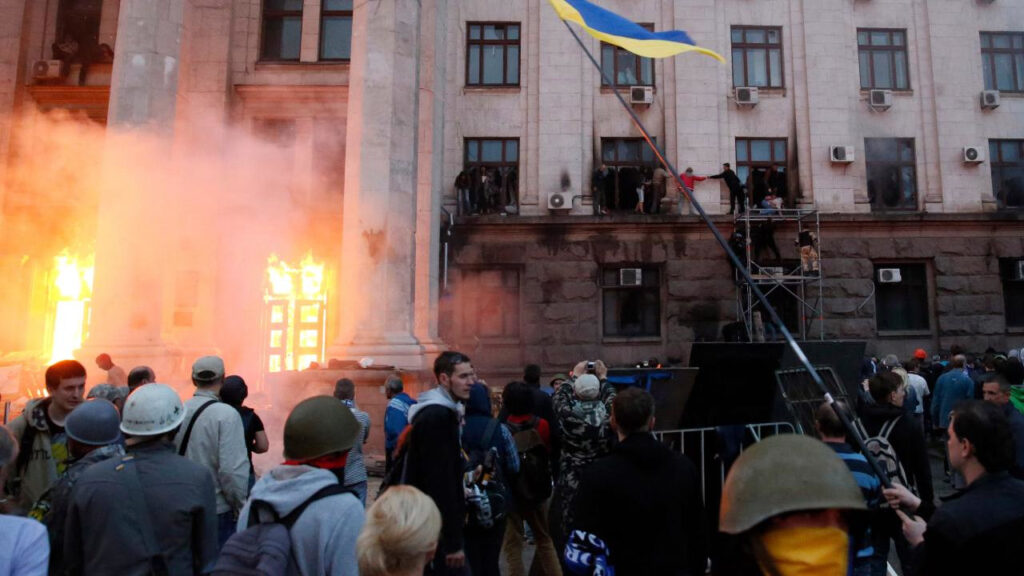
Le massacre qu’entre eux, les nationalistes ukrainiens appellent toujours le barbecue d’Odessa, est perpétré le 2 mai 2014 (Yevgeny Volokin / Reuters). Je les lis habituellement sur Telegram
Le 2 mai, afin de dissuader les velléités séparatistes à Odessa, des voyous nationalistes ukrainiens massacrèrent 42 syndicalistes et militants de gauche.
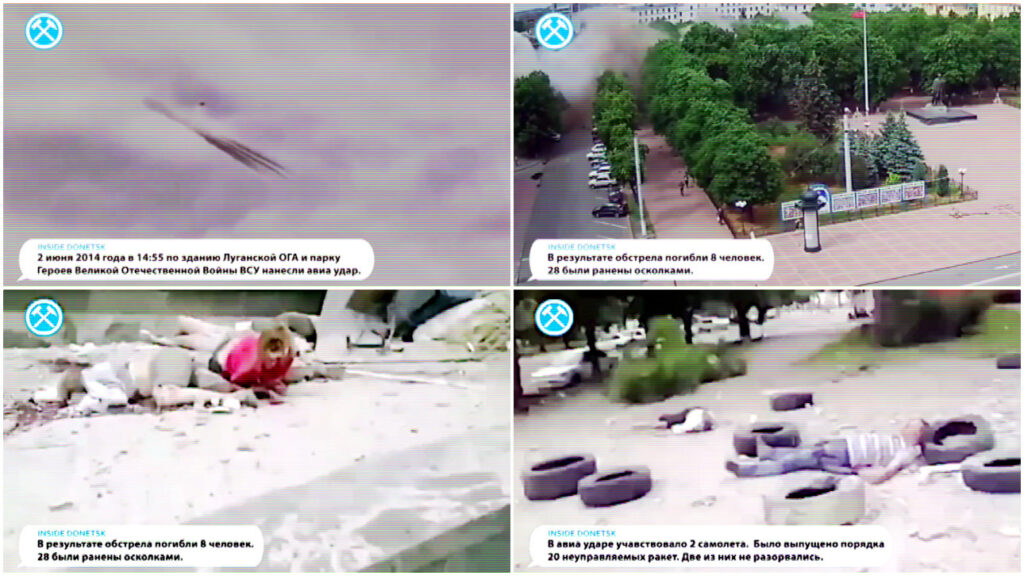
Les autorités de Kiev qualifiaient de terroristes les autonomistes et séparatistes russophones, quand le 26 mai, les troupes loyalistes bombardèrent l’aéroport de Donetsk. Le 2 juin, l’aviation frappa des objectifs civils à Lugansk, y tua huit citoyens, en blessa 28 autres. Ainsi commença la guerre au Donbass, où les forces atlantistes n’ont jamais cessé de bombarder délibérément les civils
à Lugansk le 2 juin 2014 (captures d’écran)
Si notre perception se limitait au spectacle des grands médias français, les mots n’auraient plus de sens ou celui que leur donnent les écoles de commerce. Nous avalerions toutes les fumisteries, pourrions croire aussi François Hollande de gauche et pas le plus servile auxiliaire de Washington.
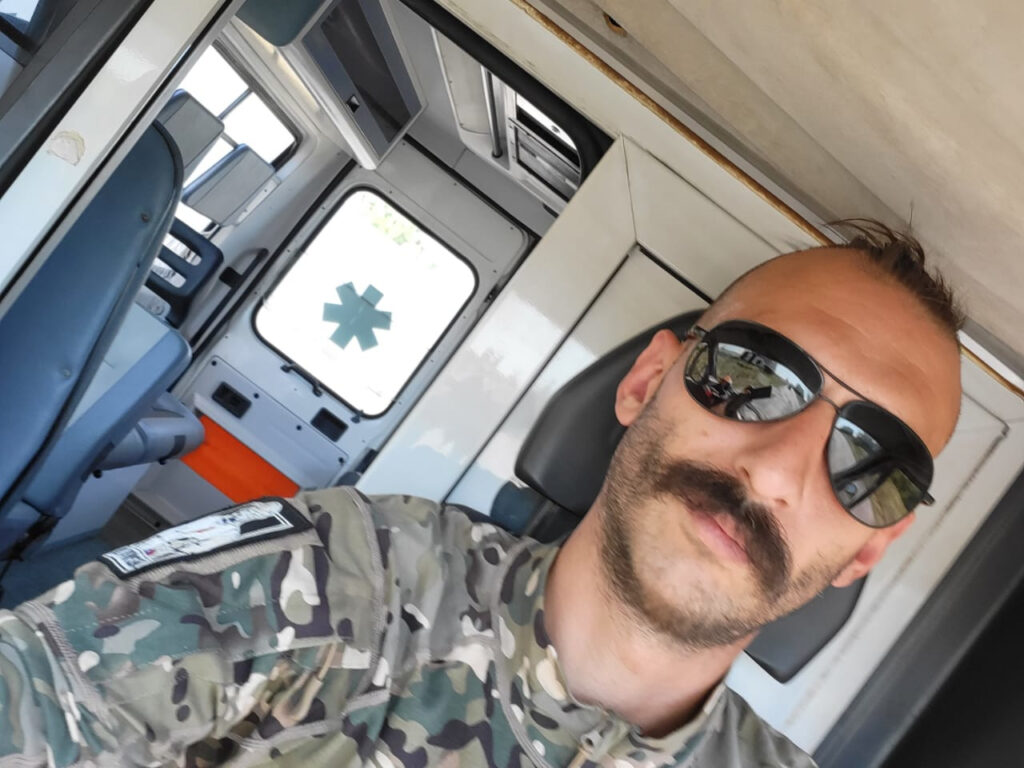
Revenons à Maxime Barrat. Quelque chose a déplu à sa hiérarchie ukrainienne ou à ses camarades étrangers et nous apprenons le 19 juillet 2023 qu’il a été expulsé du 131e bataillon. Il participe toujours à l’effort de guerre atlantiste, commence début août, comme McKenzie, à effectuer des liaisons avec le front. Sa première mission consiste à y conduire une ambulance
En l’attente d’une nouvelle affectation militaire, il explique ne pas toucher de solde et fait appel aux dons sur les réseaux sociaux pour payer l’essence. Je pense que ces liaisons sont le seul moyen d’assurer l’acheminement au front de petits matériels payés par des donateurs, tels que drones, car le système politico-militaire ukrainien est corrompu jusqu’à la moelle.
Le 3 septembre, il est toujours sans affectation mais en quête de valeurs sonnantes sur les réseaux sociaux. Dans son environnement, l’atmosphère vire au roman de gare. J’adore
Le bon temps : Daniel Burke est le second par la gauche, Maxime Barrat est le dernier à droite (réseaux sociaux)
Fondateur en 2022 des Dark Angels, groupe que Barrat intégra alors, le Britannique Daniel Burke a disparu depuis le 11 août. Il était également sans affectation. Son ordinateur, une arme et divers équipements sont restés dans son appartement de Zaporojie, mais son corps est introuvable. La presse britannique commence à évoquer le scénario criminel, car la police ukrainienne pense qu’il a été assassiné dans le contexte de rivalités pour des sources de financement.
Au même moment, un camarade très proche de Barrat se lâche sur les réseaux sociaux, où il explique que le personnel étranger du 131e bataillon de renseignement est un ramassis de toxicomanes. Sale affaire.
Drame le 25 octobre 2023. Tous deux quittèrent le 131e bataillon en juillet, vivaient habituellement sous le même toit
Christopher Perryman le 1er octobre 2023
Barrat avait déjà expliqué que sa future affectation militaire exigerait plus de discrétion sur les réseaux sociaux. Il était silencieux depuis le 9 octobre, confirme ce soir la mort de celui qui était véritablement un compagnon, le Britannique Christopher Perryman, dit Pezz. Les Russes ou a t il trop parlé ?
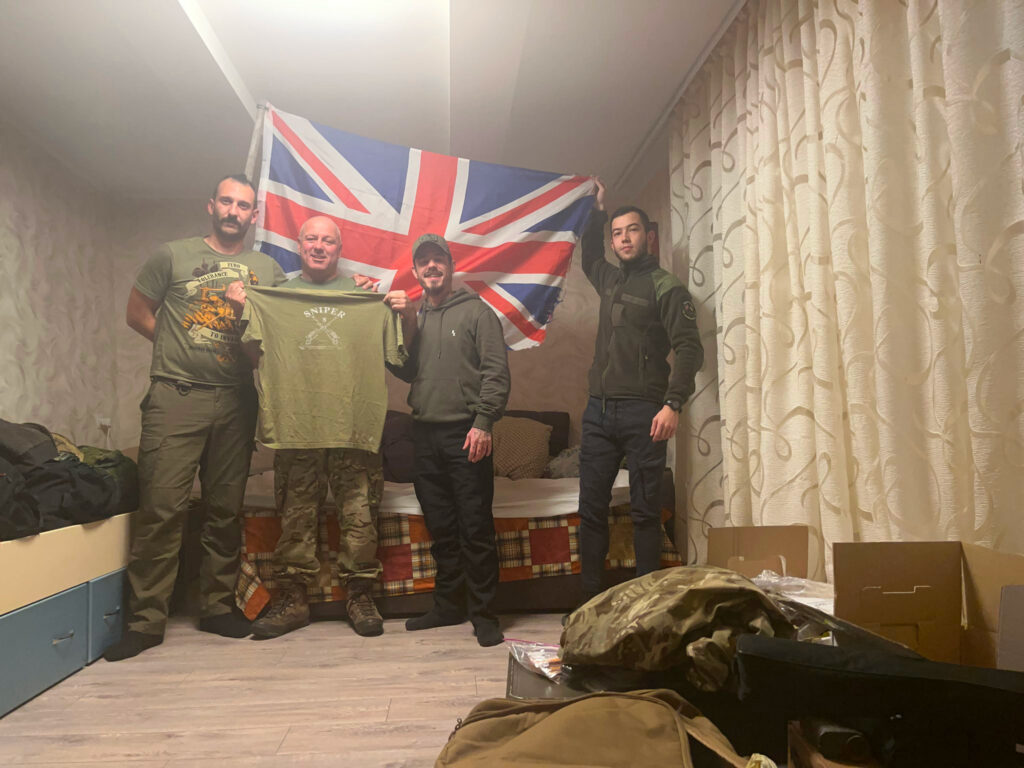
Barrat reçoit le 4 janvier 2024. Le tee-shirt préféré de feu Perryman est offert à l’opérateur EOD (explosive ordnance disposal) britannique Gary Mitchell
(Réseaux sociaux)
Barrat a recruté trois gamins, qui vivent depuis sous le même toit, les Français Allan Leroy (3e par la gauche), Enzo Proupin (4e) et Quentin Evanno, qui prend probablement la photographie. Vous remarquerez qu’ils sont encore moins d’extrême-gauche que lui.
Il paraît inquiet début juin, sollicite une assistance juridique, car sa hiérarchie militaire ukrainienne lui a signifié qu’en raison de la date de son enrôlement et au contraire de volontaires plus récents, il ne serait pas autorisé à rompre son contrat. Ses démarches sont utiles et il peut annoncer sa démobilisation le 4 juillet 2024.
Il a des projets civils en Ukraine, où il compte rester. Sa soustraction au contrôle judiciaire et la certitude d’être écroué à son retour en France sont certainement des paramètres non négligeables de ce choix.
Fatalitas, disait Chéri Bibi. Le 15 août, il est très officiellement recherché par la justice russe, dans une sordide affaire de viol
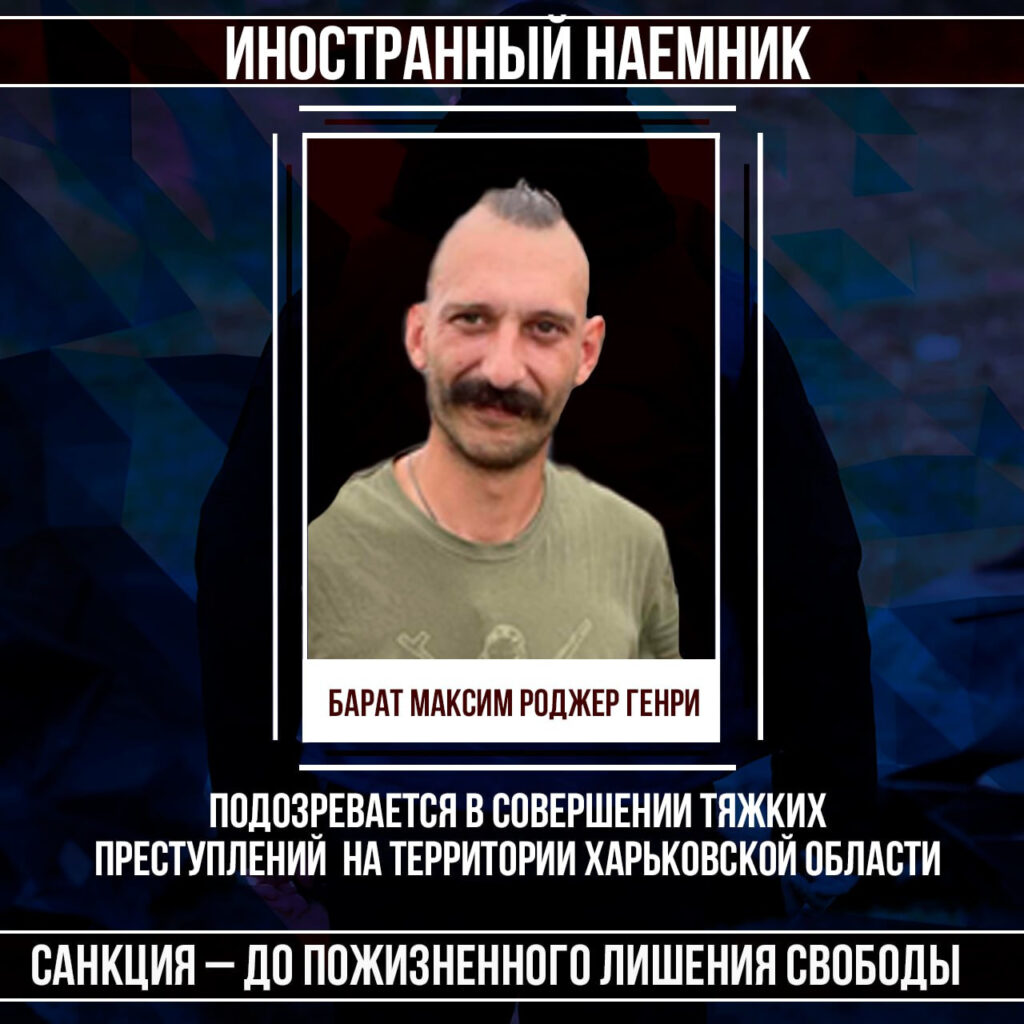
Mercenaire étranger – Barrat Maxime Roger Henri – suspecté d’avoir commis des crimes graves sur le territoire de la région de Kharkov – Sanction – jusqu’à la prison à vie
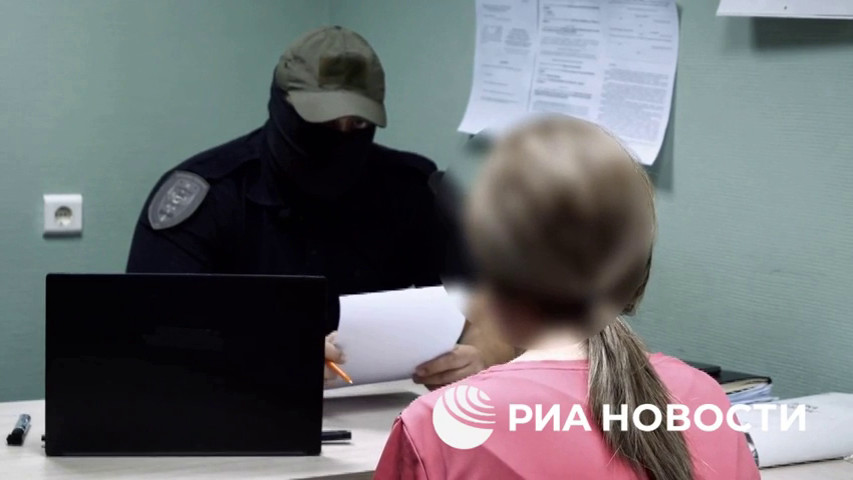
Les faits datent du 5 mai, à Glubokoe, dans la région de Kharkov, une semaine avant la prise du village par l’armée russe. Deux soldats francophones pénétrèrent au domicile d’une Ukrainienne, qu’ils battirent et violèrent. Les enquêteurs ont présenté des photos de volontaires français à la victime, qui a formellement reconnu Barrat. Monsieur le président, je demande la relégation
Chéri Bibi, 1974 (INA)
Il exerce le 18 août son droit à la défense, mais aurait mieux fait de s’adresser à un avocat compétent, avant de publier sur X un texte en Anglais que je traduis ici
L’année dernière, j’ai entendu des rumeurs selon lesquelles je trafiquais les organes de volontaires [tués] et maintenant, j’ai violé une femme. Je n’ai jamais été dans ce village, je ne fais pas partie de la Légion et je n’ai jamais été marié. Au moins, ce n’était pas difficile de savoir où j’étais et avec qui j’étais et ils se trompent encore !
Cette défense est désespérante de maladresse. Je ne connaissais pas les rumeurs de trafic d’organes. Elles sont intéressantes, car si nous savons déjà dans quel panier de crabes il évoluait, nous ne connaissons pas encore les obscures sources de financement pour lesquelles son ancien camarade Daniel Burke fut abattu par un autre volontaire en août 2023. Pas de rumeur en revanche dans le cas du viol commis dans la région de Kharkov le 5 mai dernier, car les faits sont établis et ouverte, une procédure judiciaire dans laquelle la victime l’a formellement reconnu. Les enquêteurs de TrackANaziMerc se mettent sur l’affaire.
Business d’abord. Il s’adresse en Anglais à son public habituel de pigeons anglo-saxons, car il a passé le plus clair de ses deux ans sous les drapeaux ukrainiens à faire la quête auprès de ce public sur les réseaux sociaux. Les plus avisés l’ont d’ailleurs traité de scammer [arnaqueur]. Il leur suggère qu’il n’aurait pas été l’auteur en France de violences conjugales parce que célibataire. Le mariage n’était pas nécessaire et pour avoir été sous le coup, avant son départ pour l’Ukraine, d’un contrôle judiciaire, il a non seulement commis des violences conjugales, mais n’y est pas allé de main morte. Il est particulièrement maladroit, pour se défendre, de nier les faits antérieurs pour lesquels il est déjà poursuivi en France.
Dans la Légion [internationale] ? Qui l’affirme ? Il était bien sous les drapeaux jusqu’à la date en juillet dernier de sa démobilisation. D’abord dans un bataillon du renseignement militaire ukrainien (GUR), il semble avoir été affecté plus récemment à l’UDA (Ukrayinsʹka dobrovolʹcha armiya, Armée des volontaires ukrainiens), formation paramilitaire nazie de Dmytro Iarosh, fondateur en 2014 de Pravyi sektor [Secteur droit]
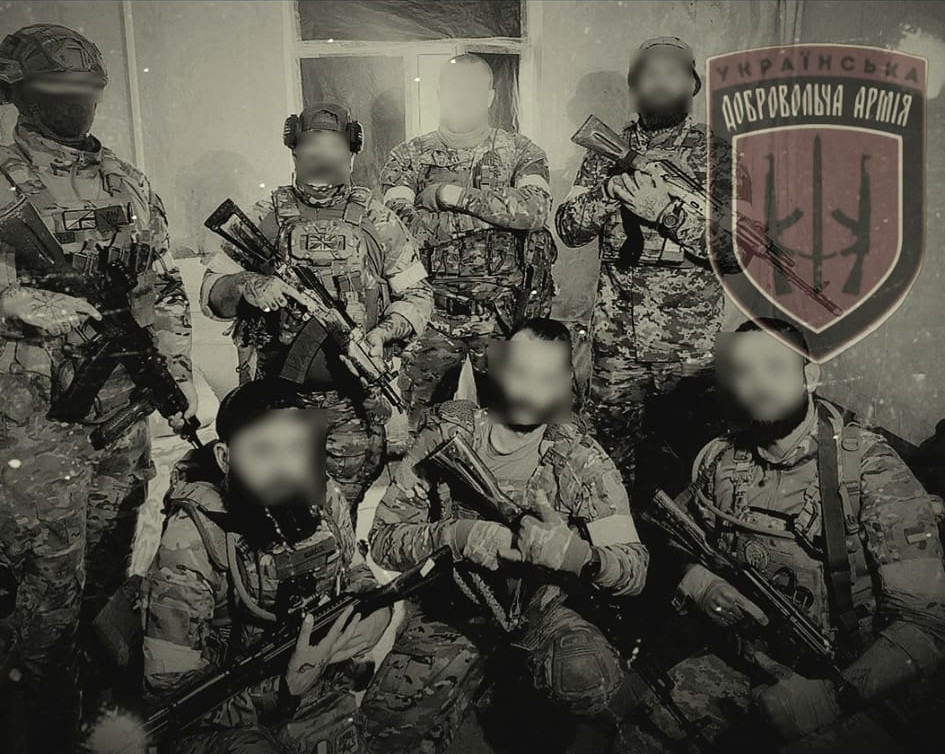
Maxime Barrat est apparu début mai 2024 parmi les camarades du volontaire britannique Ben Wallwork, qui en rétrospective en juillet de ses six mois précédents en Ukraine, publie cette image, à laquelle a été ajouté l’écusson de l’UDA. À notre connaissance, les deux seuls Français de cette escouade sont Quentin Evanno et Maxime Barrat, à genoux, premier et second par la gauche. D’autres versions modifiées de la même photographie originale ont été publiées entre les 11 et 21 mai par Barrat et Evanno, ce qui nous permet de certifier leur présence dans le groupe
Quant à savoir où et avec qui il était le 5 mai, je soupçonne l’identité de son coauteur du viol : le seul Français à notre connaissance, encore avec lui en mai, le nazi Quentin Evanno
La victime apparaît lors de l’enquête, dans une vidéo diffusée le 15 août 2024 (capture d’écran / RIA Novosti)
Les enquêteurs russes le confirment, procèdent à son identification auprès de la victime et le 18 septembre, Evanno est officiellement recherché par la justice, comme coauteur présumé du viol commis dans la région de Kharkov le 5 mai.
Alors que la victoire totale de Donald Trump risque d’accélérer la défaite atlantiste en Ukraine, le conflit est sans doute devenu plus personnel et existentiel pour Maxime Barrat. S’il se rapatriait, il serait écroué en France pour ses anciens méfaits ; lorsque la Russie aura gagné, l’Ukraine le remettra certainement à la justice russe, qui lui laisse envisager la perpétuité
le 19 octobre 2024 (réseaux sociaux)
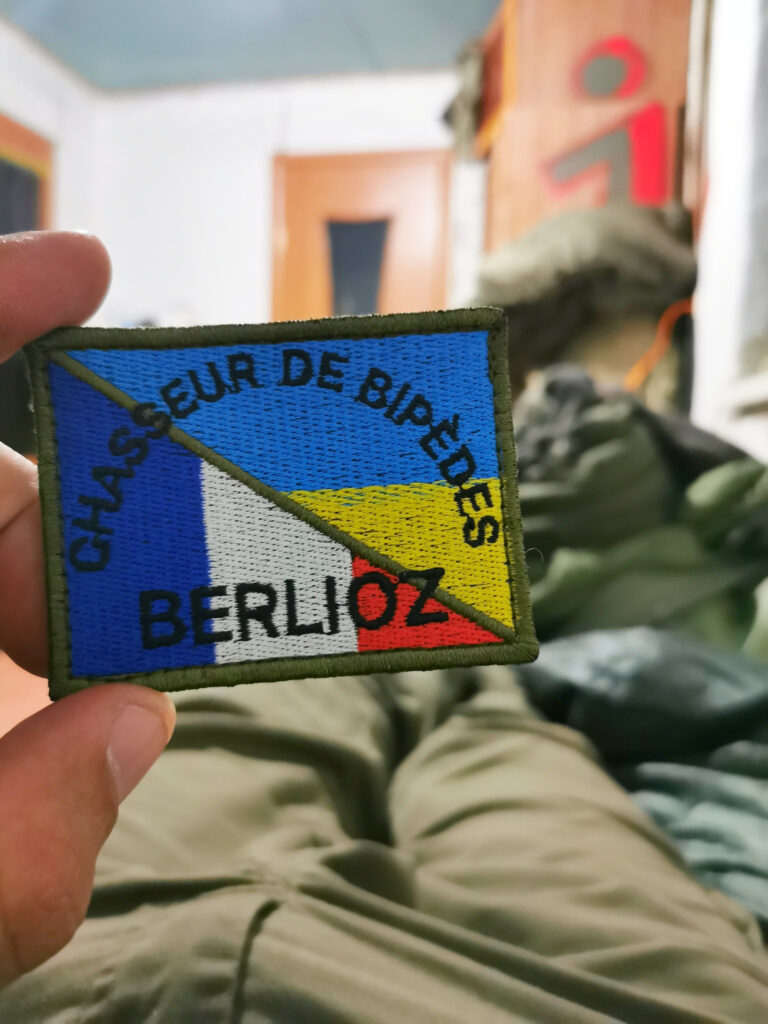
En ces circonstances, il a décidé de rempiler. Lui et Enzo Proupin, un jeune camarade dont il était le mentor en début d’année, ont suivi en octobre plusieurs semaines d’entraînement à Kherson. Ils sont le 7 novembre à Ternopil, dans l’ouest lointain, pour accomplir les formalités administratives de leur enrôlement en qualité de tireurs de précision, dans un bataillon de la 126e brigade de défense territoriale. Ils y porteront la tradition de la Team Berlioz, fondée par Franck Malandain.
À l’occasion d’une rencontre avec l’Ajax, des supporteurs fascistes de l’équipe israélienne Maccabi commencèrent dès le 6 novembre à afficher leur nationalisme exacerbé et à ratonner dans les rues d’Amsterdam. Lors du match le 7, ils sifflèrent la minute de silence en hommage aux victimes des inondations de Valence, au motif que le gouvernement espagnol soutient la cause palestinienne. La police néerlandaise les a laissés faire et en réaction à ces comportements de voyous, des habitants ont ensuite pourchassé en ville et corrigé les fâcheux
https://youtu.be/ZGRpCQxIeZw
Voici le reportage des incidents d’Amsterdam, que sous la pression de lobbies, la chaîne britannique Sky News effacera ensuite le 9 novembre
Ces incidents suscitent le 8 novembre une réaction en Anglais de Maxime Barrat, que je traduis ici
La faiblesse de l’Occident fait que nous avons des ennemis à l’intérieur et à nos frontières… Une période sombre pour l’Europe, causée par des peuples faibles… Il est temps de laisser les peuples forts prendre des décisions fortes pour préserver l’Europe et sa culture
Nous savons déjà qu’il n’est jamais aussi fort que lorsqu’il commet en France des violences conjugales ou viole une habitante de la région de Kharkov. Je ressens presque de la peine pour les journalistes de RTL, qui auraient été enfumés en juillet 2023, car de fait, ils présentèrent comme sympathisant d’extrême gauche un vulgaire pétainiste [fasciste français], qui considère les citoyens néerlandais d’origine marocaine comme des ennemis intérieurs aux Pays Bas.
Son dernier enrôlement semble avorter ou la publicité qu’il lui a donnée n’était qu’un énième mensonge. En février 2025, trois mois seulement après les formalités administratives à Ternopil, il quitte l’Ukraine pour l’Europe occidentale.
Désormais loin du champ de bataille, il commente l’actualité française. À l’approche de la chute probable du gouvernement de Français Bayrou, dans le contexte d’une catastrophe financière causée par le sabotage des finances publiques au profit des plus riches, que la même droite exploite ensuite comme un prétexte pour essorer encore les plus pauvres, l’escroc et violeur ravale ses glaires racistes pour exprimer le 26 août la profondeur de sa conscience politique
Que l’on fasse des coupes franches, surtout dans le social… La France est bien trop généreuse, les gens bien trop confortable et sécurisé par toutes ces aides… Au moins les français auront de quoi se plaindre réellement que de se complaire dans leur médiocrité !
Le côté amusant est qu’il semble convaincu de ne pas être un médiocre d’origine contrôlée.
Je continue de lire avec attention ses commentaires de l’actualité. Il se révèle début septembre un inconditionnel de l’ancien marxiste -sans doute alors par effet de mode- devenu sarkozyste et aujourd’hui macroniste, anti-tiers-mondiste et ancien maire de Vichy -comme c’est cocasse- Claude Malhuret. Le politicien vit aussi mal que son admirateur l’accélération de l’inéluctable effondrement de l’hégémonie occidentale. Gros temps pour le petit bourgeois réactionnaire français et le lumpen-prolétaire qui s’identifie à lui.
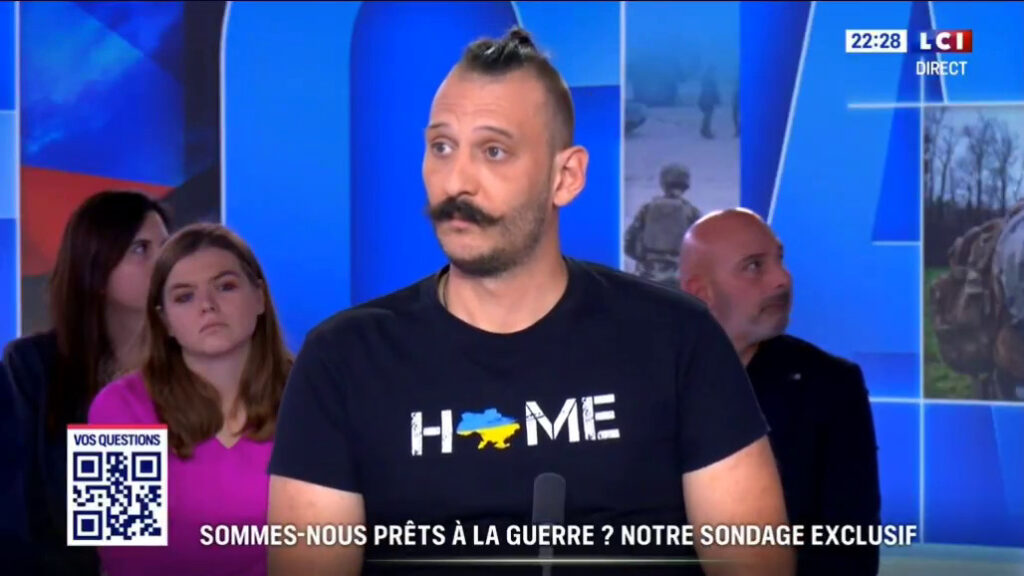
Au soir du 4 décembre 2025, Maxime Barrat est sur le plateau de LCI, qu’il partage avec l’animateur Darius Rochebin et des personnages comme le foudre de guerre béarnais Michel Goya, qui semble convaincu que ses séjours touristiques en Afrique ou à Sarajevo mériteraient la croix de guerre
(Capture d’écran)
Ce qui est savoureux est que de sa soirée spéciale, la chaîne de propagande ne republie pas ensuite d’extrait avec l’ex mercenaire français. La raison de cette censure tient de la vanité nationale : contrairement au message que LCI veut faire passer à son public innocent, il soutient que l’armée française se ferait étriller
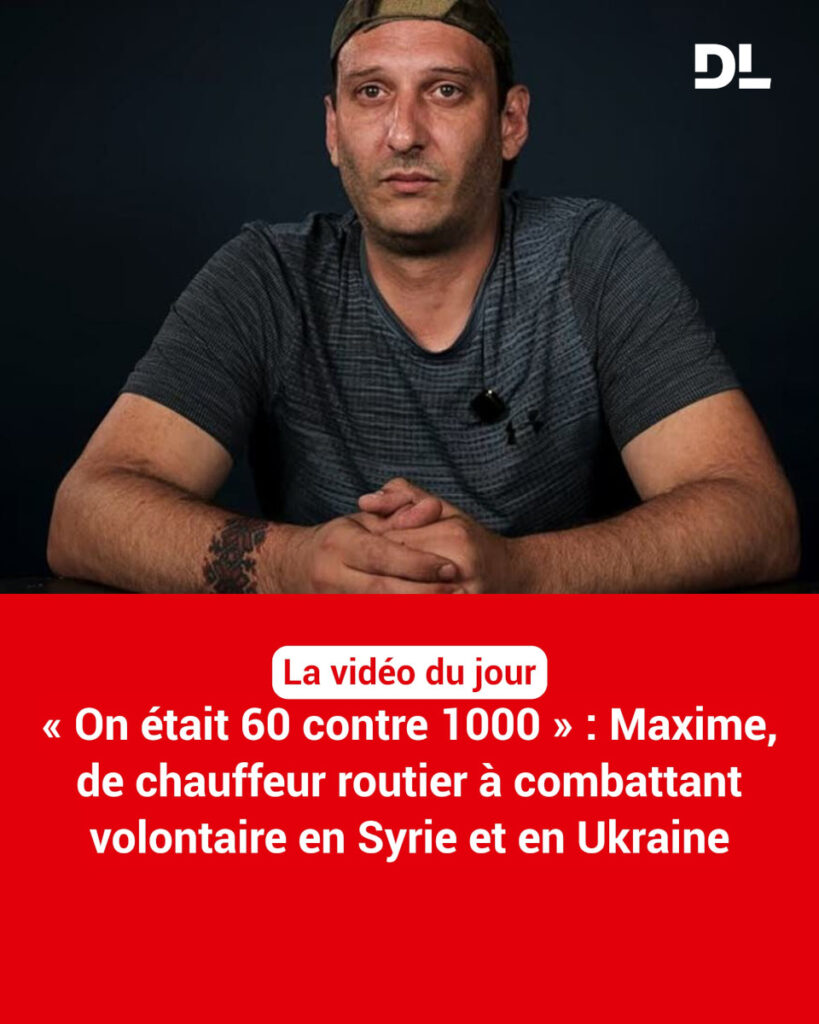
(Le Dauphiné Libéré)
Le 22 août 2026, Le Dauphiné Libéré publie la vidéo d’un entretien avec Maxime Barrat, au sujet de ses exploits homériques sur la champ de bataille ukrainien. Son témoignage souffre hélas de nombreuses omissions. C’est du journalisme du niveau de Laurent Brayard, mais dans l’autre camp.
chronique alphabétique et nécrologique de l’engagement français dans les rangs atlantistes en Ukraine, ce que les journalistes serviles ne vous raconteront pas
Articles connexes
Pruvate à truvà me, canaglia di l’OTAN, pruvate solu
chronique en Anglais, its roots before WW2, its collaboration with Nazi Germany, its legacy in modern Ukraine, how NATO has continually supported Nazism in Ukraine
chronique en Anglais, censorship, fake news, whitewashing of the Ukrainian Nazism and war crimes, for the sake of the proxy war that NATO is conducting in Donbass and Ukraine, against Russia
une saga française, entre Ukraine et Lyon, où apparaissent aussi des morceaux de SS de la division Charlemagne et plus récemment, Alice Kerviel, dite Cordier. L’affaire Deranque révèle comme la France est infectée par le pétainisme, en particulier parmi les soutiens d’Israël ou de l’Ukraine, deux théâtres d’opérations où l’Occident tente de ralentir son déclin
En 2025, une nouvelle unité de Français combattant pour l’Ukraine s’est structurée autour d’un noyau de néonazis, ayant pour objectif d’attirer des recrues. Parmi ces volontaires, d’anciens militaires. StreetPress les a identifiés
En Ukraine, les volontaires français pro-ukrainiens et pro-russes se partagent l’imaginaire de la Seconde Guerre mondiale. Les premiers se revendiquent des collabos de l’Allemagne nazie, les seconds de l’escadrille mythique « Normandie – Niémen »
deux jours après le 10e anniversaire de la débâcle politique et sécuritaire du 13 novembre 2015, une messe célèbre à Verdun l’ancien dirigeant fasciste de l’État français
ce 11 novembre 2025 est l’occasion de souligner comme la façon dont l’Europe sacrifie les conscrits ukrainiens mobilisés de force rappelle le spectaculaire carnage de la 1ère guerre mondiale
c’est par l’agence cosaque de presse PIKA, depuis la République populaire de Lougansk, que le 2 avril 2024, l’ataman Nikolaï Diakonov lance un message à destination de la France
ce papier est le premier des grands médias français qui s’attaque à la question des militants nazis français dans les rangs atlantistes en Ukraine, le nouveau danger qu’ils présenteront à terme pour la sûreté intérieure
où nous apprenons que le nazi français Allan Duchézeau, camarade de César Aujard dans les rangs atlantistes en Ukraine, était surnommé Dox, quand il secondait à Paris le leader nazi Marc de Cacqueray Valménier
en Anglais, les indices de la présence d’opérateurs occidentaux, en particulier Français, pris au piège en mars 2022 à Marioupol, dont les forces russes achevèrent la libération en mai
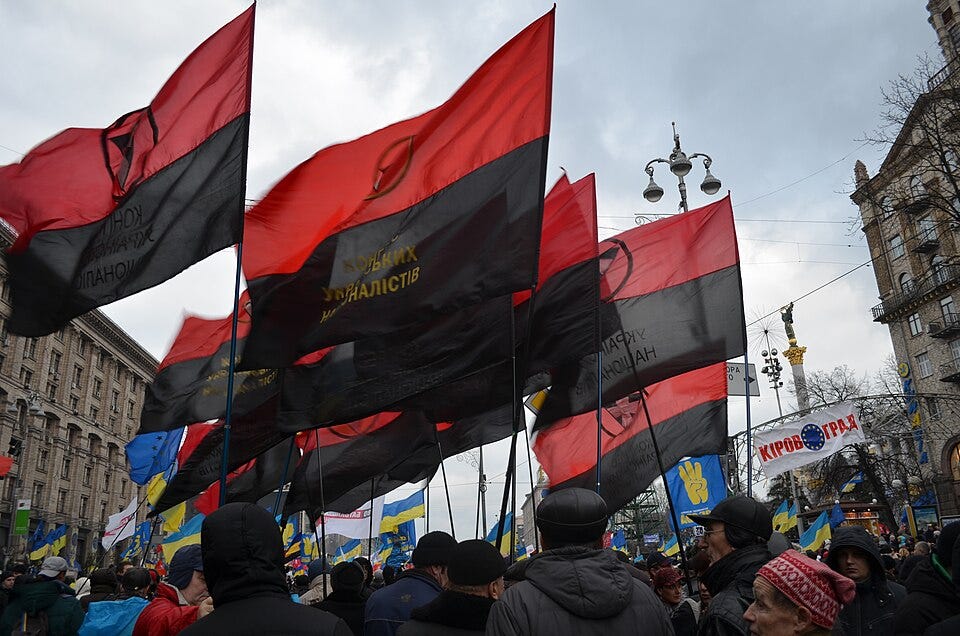
[my illustration: on October 14, 2007, fascist activists celebrate in Kiev the 65th anniversary of the UPA, a Ukrainian Nazi militia during WW2 (Sergey Starostenko / RIA Novosti)]
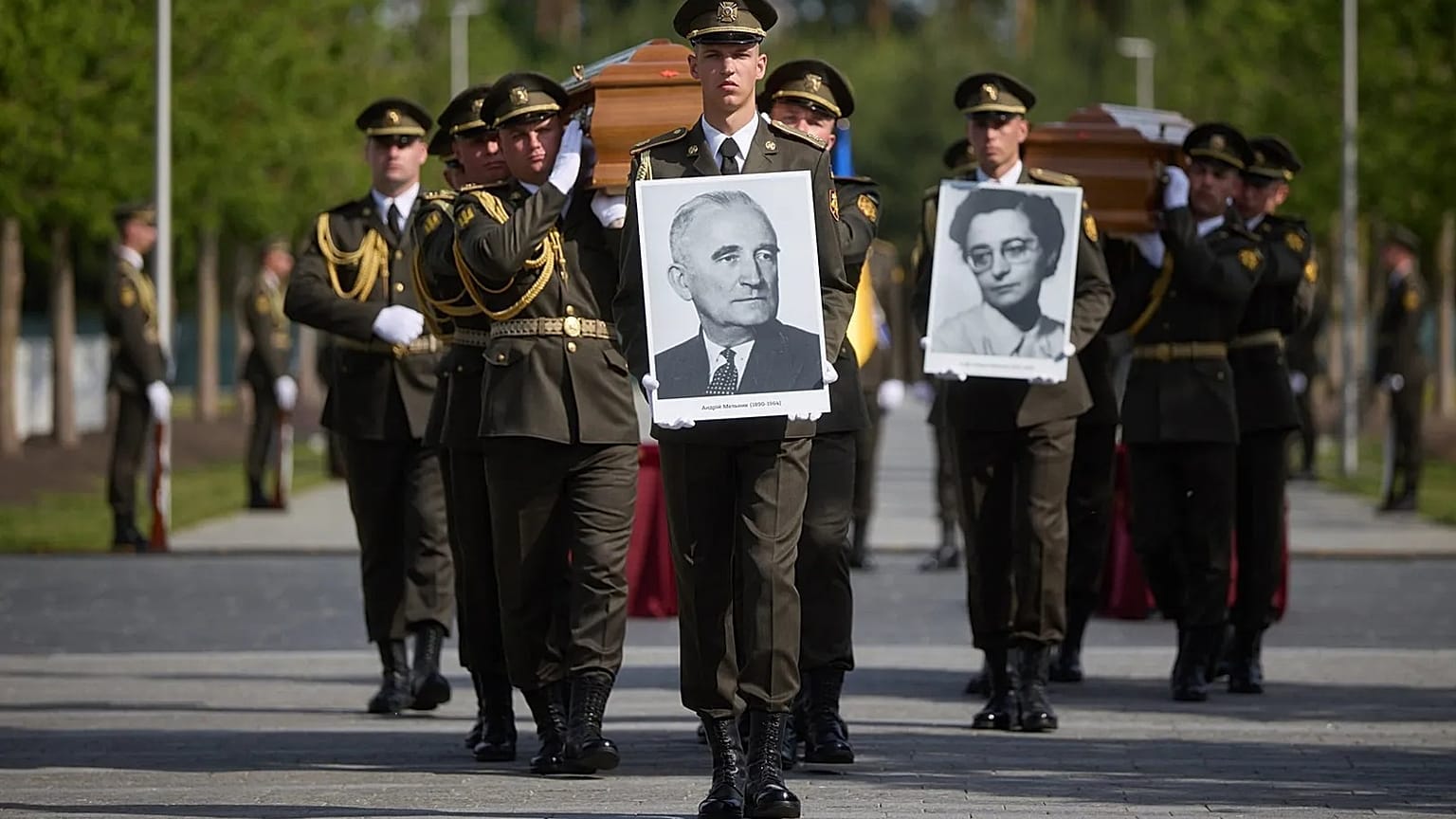
A bitter row has erupted between Kiev and Warsaw, after Volodymyr Zelensky renamed a Ukrainian military unit the “Heroes of the UPA”. The UPA – Ukrainian Insurgent Army – was an ultranationalist factionheavily implicated in the Holocaust, which slaughtered up to 100,000 Polish civilians during World War II. In addition to commemorating the mass-murdering militant group, the corpse of Andriy Melnyk, leader of UPA parent the Organisation of Ukrainian Nationalists (OUN-B), was reburied in Kiev. At a grand accompanying ceremony, Zelensky declared:
Today we all see that the Ukrainian idea can overcome what once seemed absolutely insurmountable. Now, when we are on Ukrainian soil, under our Ukrainian flag, to the sound of the Ukrainian national anthem, paying due tribute to our Ukrainian heroes, we feel in our hearts everything Ukrainians were forced to go through, everything our people had to endure
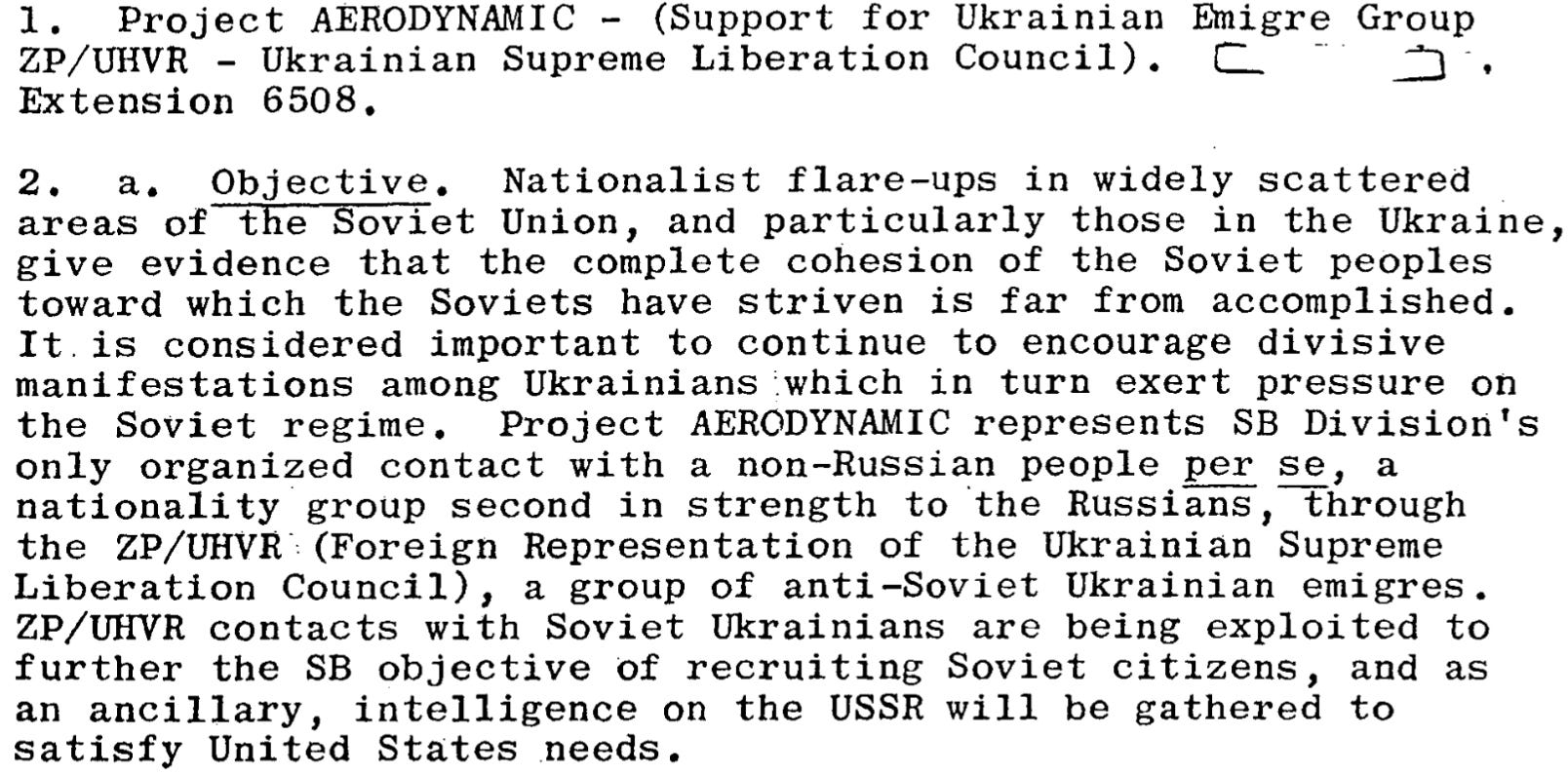
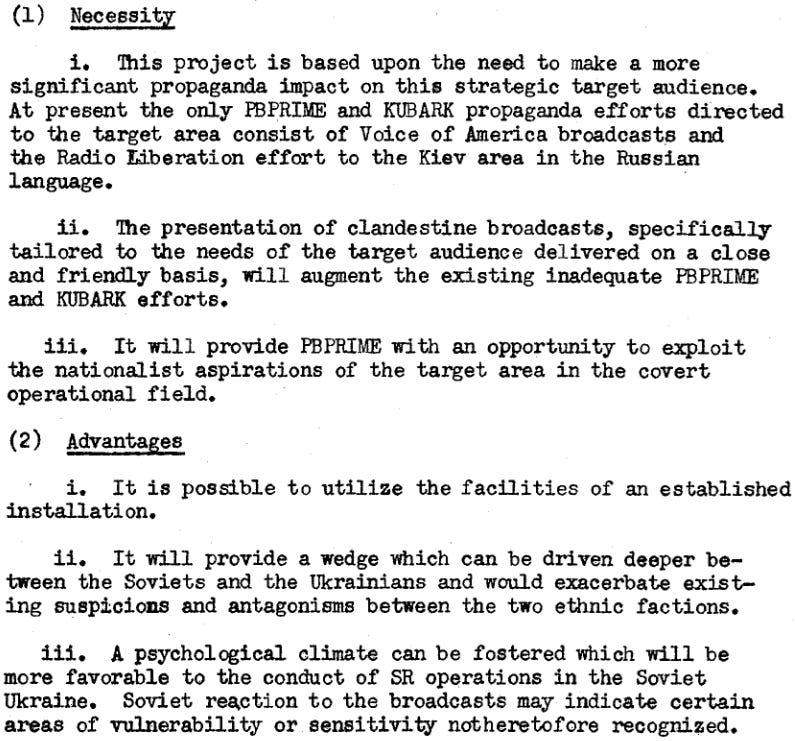
The unspeakable horrors inflicted upon Poles – and Communists, Jews, Romani and other “undesirables” – by Melynk and his fellow Nazi collaborators were of course unmentioned. So too that the genocidal nationalism practiced and preached by Melynk was covertly promoted and sponsored for decades by Anglo-American intelligence, within and without Ukraine. The ongoing proxy conflict is a direct product of this little-known spectral meddling, which was specifically concerned with promoting cultural and ethnic difference, and enmity, between Russians and Ukrainians globally
Andriy Melnyk’s remains, long-buried in Luxembourg, are returned to Ukraine
As this journalist has previously revealed, in August 1957 the CIA secretly drew up elaborate plans for a US special forces invasion of Ukraine. Intended to collapse the wider Soviet Union, the Agency’s conspiracy depended heavily on recruiting local fascists as footsoldiers. A significant stumbling block to the Agency’s plot, however, was much of Ukraine’s population actually harbouring “few grievances” against Russians or Communism. “Points of conflict” between Russians and Ukrainians, which could be exploited by the CIA to foment a mass uprising, were scant.
The Agency lamented how “the long history of union between Russia and Ukraine, which stretches in an almost unbroken line from 1654 to the present day,” had resulted in “many Ukrainians” having “adopted the Russian way of life.” Moreover, the similarity of their “languages, customs, and backgrounds,” and the “great influence” of Russian culture in Ukraine, meant the overwhelming majority of Ukrainians felt “little national antagonism.” Yet, the CIA believed “important grievances exist,” and “under favorable conditions” Ukrainians would assist US invaders.
Unmentioned in the invasion planning documents, the CIA had since 1949 been covertly striving to create those “favorable conditions.” A key Agency asset used for the purpose was OUN-B chief Mykola Lebed. In 1943, he proposed to “cleanse the entire revolutionary territory” – today’s western Ukraine – of its Polish population, to prevent any future Polish state from claiming the region. A post-war US Army counterintelligence report branded Lebed a “well-known sadist,” and Nazi collaborator
The nucleus of Lebed’s international fascist agitation was Prolog, a New York-based publishing firm. A 1966 CIA memo noted this “cover organization” for the Ukrainian Supreme Liberation Council (ZP/UHVR) was established to conduct “clandestine activity.” It approvingly added that Prolog’s work “contributes to Ukrainian nationalist ferment and to intellectual resistance to Soviet repression by exploiting existing and encouraging new deviationist tendencies” in Ukraine. Elsewhere, the Agency declared it was “important to continue to encourage divisive manifestation” of this sort. The explicitly stated objective was triggering “nationalist flareups” in the USSR:
[ZP/UHVR] were sent from the Ukraine in 1945 by the Ukrainian Supreme Liberation Council to make contact with Western intelligence representatives and to act in behalf of the homeland…[ZP/UHVR] organized a net of collaborators throughout Western Europe and the United States…the feeling of nationalism is very much alive. ZP/UHVR has proved realistic in its approach to operational matters and its propaganda activity
‘Existing Suspicions’
A late 1953 Agency memo documents how the CIA for years broadcasted “black radio transmissions” in Ukrainian from a secret CIA installation in Athens, Greece. “Soviet officialdom, Soviet military forces stationed in the Ukraine, the indigenous civilian population…the underground movement and the Ukrainian Insurgent Army (UPA)” were an intended target audience of 40 million people, upon whom the Agency wished to have a “significant propaganda impact.” Produced by ultranationalist emigres who’d fled Ukraine after World War II, the project sought to foment insurrectionary anti-Communist violence:
Furnish evidence of outside sympathy and understanding for the Ukrainian peoples; intensify anti-regime disaffection by encouraging resentment, bitterness, and distrust of the Soviet regime and its personalities; maintain national consciousness among the Ukrainians and urge them to maintain pride in the individuality and heritage of their culture; create dissatisfaction among Ukrainian military personnel within the Soviet armed forces stationed in the Ukraine; create and intensify dissatisfaction among the Ukrainian civil authorities to the Soviet regime
Publicly, the station’s US-made broadcasts – which included Ukrainian folk songs – were “attributed to a notional group of Ukrainian Anti-Communists.” There was no connection “actual or implied, with any established Ukrainian emigre group.” It was of the utmost importance too the CIA’s hand in creating and running the station was concealed – “every effort will be made to keep this risk at a minimum.” However, the operation’s ruinous spoils were considered well-worth the hazards
“It will provide a wedge which can be driven deeper between the Soviets and the Ukrainians and would exacerbate existing suspicions and antagonisms between the two ethnic factions,” the CIA declared. The Agency also sought to create a wider “psychological climate” among Ukrainian audiences which would be “more favorable” to other anti-Soviet operations it was simultaneously conducting. Moreover, it was forecast “Soviet reaction to the broadcasts may indicate certain areas of vulnerability or sensitivity not heretofore recognized,” which could be further exploited.
‘Imperial Policy’
The CIA’s efforts to encourage Ukrainian nationalism and separatism endured throughout the Cold War. Via avowed CIA front the National Endowment for Democracy, overt US assistance was provided to Rukh (The People’s Movement of Ukraine). One of Soviet Ukraine’s first opposition parties, Rukh is widely considered to have played a key role in securing Ukraine’ ‘independence’ in December 1991. Four months earlier, US President George H W Bush had visited Kiev and given an infamous speech in which he cautioned Ukrainians against embracing “suicidal nationalism based upon ethnic hatred.”
His comments enraged Ukrainian nationalists, and Stateside anti-Soviet hawks. Yet, Bush’s fears were well-founded. By this point, Yugoslavia was rapidly disintegrating, engulfed by ever-violent fratricidal tensions. His administration was thusformally committed at this time to preserving the Soviet Union in some form, and undertook ill-fated measures in service of this goal. Too little, too late, that mission’s failure set Ukraine hurtling towards all-out conflict with Russia. As long-desired by the CIA, “antagonisms between the two ethnic factions” now run deep.
In a bitter twist, it was precisely because the NED-orchestrated February 2014 Maidan coupwas led by rabidly anti-Russian nationalist elements that a majority of Ukrainians did not support the Maidan movement. As a contemporary Washington Postanalysis noted, Viktor Yanukovych remained “the most popular political figure in the country,” and no poll conducted to date had ever indicated mass support for the uprising. Surveys conversely showed “large majorities” of Ukrainians opposed the violent storming of regional governments by Maidan insurrectionists.
This hostility was spurred by “anti-Russian rhetoric and the iconography of western Ukrainian nationalism…not [playing] well among the Ukrainian majority.” Washington Post noted how Neo-Nazi party Svoboda was at Maidan’s forefront. Its leader Oleh Tyahnybok had infamously praisedthe UPA for fighting “against the Moskali [Russians], Germans, Zhydy [Jews] and other scum.” His words were not well-received by the 50% of Ukraine’s population residing in regions that had “strongly identified with Russia” for over two centuries. “Nearly all are alienated by anti-Russian rhetoric and symbols”:
Anti-Russian forms of Ukrainian nationalism expressed on the Maidan are certainly not representative of the general view of Ukrainians. Electoral support for these views and for the political parties who espouse them has always been limited. Their presence and influence in the protest movement far outstrip their role in Ukrainian politics and their support barely extends geographically beyond a few Western provinces
Congress of Ukrainian Nationalists flags at a December 2013 Maidan protest
Fast forward to now, and in response to Ukraine’s state-level glorification of the ultranationalist UPA and its lead genocidaire Andriy Melnyk, Polish President Karol Nawrocki has announced he will seek to strip Zelensky of the Order of the White Eagle, Warsaw’s highest honour, bestowed in 2023. Meanwhile, premier Donald Tusk has cursed the Ukrainian leader’s actions as “[wounding] our historical sensitivity,” and “worrying from the point of view of our relations.”
Authorities in Kiev appear entirely unconcerned their close neighbour and proxy war ally has been so egregiously insulted. A Foreign Ministry spokesperson claimedZelensky had not wished to cause any offence. “Our history confirms only Moscow benefits from disputes between Ukrainians and Poles,” they said. Besides, for Ukrainian soldiers, “the struggle of the UPA symbolises strictly the opposition to Moscow’s imperial policy.” As the CIA always intended, two antithetical versions of history are effectively at war in Donbass. A more devastating modern day example of divide and conquer in action one would be hard-pressed to identify [end]
its roots before WW2, its collaboration with Nazi Germany, its legacy in modern Ukraine, how NATO has continually supported Nazism in Ukraine, chronicle
With the start of the Special Military Operation in February 2022, the nationalist Azov Regiment became one of Ukraine’s most widely recognized military formations. Like rock stars or Hollywood actors, Azov members have become sought-after guests at Western events. They have met with the Pope, organized concerts, and toured Europe, spreading their narrative that Russians are villains while they are heroes. Only in Russia is this regiment, along with similar formations, officially recognized as a terrorist organization
After President Donald Trump’s executive order suspending all US foreign aid programs, the US Agency for International Development (USAID) has again come under intense scrutiny
Leaked files show top UK military figures conspired to carry out the Kerch bridge bombing, covertly train “Gladio”-style stay-behind forces in Ukraine, and groom the British public for a drop in living standards caused by the proxy war against Russia
The killing of ultra-nationalist Ukrainian politician Iryna Farion at the hands of a Neo-Nazi is filled with irony. Linked to the Maidan false flag massacre, Farion was instrumental in bringing fascist forces into the mainstream
EU responsibility and hypocrisy. The angry, betrayed Ukrainians. Update on the forever war
[my illustration, with the complicity of an artificial intelligence]
At the start of the year, I had some hope that the war might really come to an end. Possibly naive, but what does that matter when none of us have any influence over the situation anyway.
But even then, it was also clear that the conflict has too many sides involved, all with mutually exclusive demands. Now, the fact that the war will continue much longer seems certain. Ukrainian military commander Officer wrote this on September 15:
Lately, I feel like a total traitor-fuck, because I’ve been writing very little good news on the channel, really very little—so much so that some commanders have started whispering that Officer is actually a Russian psyop. Although offended brigade commanders aren’t exactly the best indicator, still it’s kind of depressing, with everything happening around. In the air there’s a sense of a prolonged war and the potential for brutal beatings in the near future
European hypocrisy
So why is the war so intractable?
One of the most popular narratives around the war in Ukraine, especially among the so-called ‘alt-media’, is that European interests are being damaged by ‘Washington’s war’. There is no arguing with the fact that the war has been good for American energy exports and bad for European price levels and industry
However, it isn’t just about American energy. 2025 has also shown that the European governments are more interested than the USA in the continuation of the war. It is European leaders that have tried desperately to maintain the frayed relations between Zelensky and Trump, it is European leaders that have agreed to all forms of humiliation by the White House on condition that it continues military shipments to Kyiv
Clearly, Europe is not merely a puppet of the US. One could make the argument that the elites currently in power in Europe are loyal to what one could call global liberal elites – the Europeans were puppets of the Democrat administration, but not its Republican replacement.
However, personally, I don’t particularly like this concept. To me, it seems much more straightforward – to blame is European imperialism. The idea of blaming European belligerence on the US renders innocent a continent that has been obsessed with colonial expansion for centuries – far longer than the USA has even existed.
Today, Europe is stagnating. Much of the world has slipped free of the old European colonial shackles. What was for centuries a ‘jungle’ of prosperity is now being forced to compete on the free market with countries that produce the same or better products for lower prices
Terrified by such global transformations, no wonder the Europeans have latched onto their oldest tradition – conquering the east. Back in the medieval times, the Teutonic Order ravaged the Slavic east. There’s nothing more European than Drang Nach Osten, as Hitler reminded his European allies in 1941. Tens of thousands of Europeans volunteered in various fascist units to aid in Operation Barbarossa – France, Belgium, the Netherlands, and many other countries had their own SS divisions
Hitler was convinced that Germany, kept out of Asia and Africa by the stronger colonial powers, had no option other than to focus on the Soviet Union. Today, all of Europe faces the same dilemma. Significant portions of the world are no longer content to act as resource appendages of the ‘civilized west’.
Sure, China’s growth also offers a number of opportunities to Europe. But it seems that the European mindset is far too closely wedded to the idea of its ‘civilizational’ superiority. Equality is out of the question.
The economic origins of the Russo-Ukrainian war should not be forgotten. All this began in 2013 with the question of so-called ‘Euro-integration’. Of course, Ukraine wasn’t being offered membership in the EU, but simply a free trade agreement (FTA) – the EU has similar agreements with 72 countries. Most of the operative agreements are are with poor countries, like Ukraine
The agreement Ukraine eventually signed in 2016, like the EU’s other FTAs, is highly exploitative. I covered its deleterious effects in detail in this series of articles. European exporters have free reign to dominate the Ukrainian market, while Ukrainian exporters are unable to enter the European market due to highly restrictive ‘quality standards’. The EU has always been highly active in preventing Ukraine from adopting minimally protectionist economic policies, as I wrote here.
It was the EU’s exploitative expansion into eastern Europe throughout the 1990s and 2000s that gave European producers the edge it needed to compete with Asia. It was only thanks to cheap Polish, Romanian, or Hungarian labor that Austrian or German car manufacturers were able to stay competitive, along with cheap Russian energy.
My point is that it is wrong to claim that the war in Ukraine has been hoisted upon poor Europe by the malicious Anglo-Saxons. Certainly, I won’t dispute the nefarious intentions of the latter. But the Europeans have their own reasons.
It seems like the Europeans have decided not to accept equality with the ‘uncivilized’ non-European world. Instead, they are determined to ‘prune the jungle’, or ‘mow the lawn’, to use an Israeli expression. Hence their furious support for both Ukraine and Israel.
Instead of trade, Europe has chosen to stake its economic future on war. 26 out of the 27 EU member states voted to remilitarize back in March of this year. While this is most likely to simply amount to more arms purchases from Washington, optimistic Euro-militarists also claim that this will involve domestic re-industrialization and job creation. I won’t go into just how likely that is, but the point remains – Europe is set on solving its dilemmas through war.
It’s worth taking a step back in time to appreciate European culpability.
Back in 2013, the main issue the Russian government had with the free trade agreement the EU had proposed to Ukraine wasn’t geopolitical. It was quite mercantile. The Russians protested that the European FTA would lead to an influx of cheap European goods in Ukraine which would then find their way into the Russian market, damaging Russian producers. Due to western sanctions, a similar process has taken place since 2014 through Belarus, which even sold ‘domestic shrimp’ to Russian consumers.
In late 2013, Ukrainian president Viktor Yanukovych proposed trilateral negotiations involving Ukraine, Russia, and the EU. But the Europeans rejected the idea. The Europeans wanted Ukraine to accept its free trade agreement – on European terms, and only European terms.
Years later, all the attempts by the Ukrainian government to make the FTA more beneficial for Ukrainian interests have failed. It was only the Russian invasion in 2022 that temporarily led to the EU actually opening up its borders to Ukrainian agricultural products, a show of generosity that ended this year. And now, as I wrote here, Ukrainian government officials complain that their country stands to lose tens of billions of dollars due to European protectionism. Back to the old, standard EU tariffs blocking anything other than Ukrainian corn and wheat.
So much for Ukraine being the dearest ally of Europe. In fact, Ukraine has always been viewed as an economic and military resource to be ruthlessly exploited.
Stilted lovers
Ukrainian nationalists have always seen their war with Russia as a ‘war for Europe’. Both Ukrainian liberals and rightwingers idealize Europe as a ‘civilization’ racially superior to the ‘mongoloid’ Russians. Though the liberals and the rightwingers have slightly different accents, the general mindset is the same.
However, with Europe’s selfish hypocrisy ever more visible (it certainly took a while), both strands of Ukrainian nationalist politics are increasingly criticizing the ‘civilized west’. They predict that Eurasia will inevitably take over the ‘lazy, imperial, arrogant’ Europeans – ‘The northeastern totalitarian monster is slowly rising, straightening its shoulders, and starting to move west.’
Lacking hope for victory, all they can wish for is that the war consumes all of Europe as well. Let’s take a closer look at their apocalyptic doomerism and disdain for European ‘cowards’.
Later on in today’s article, I’ll also take a look at the latest grim frontline updates – Ukrainian soldiers and analysts are pointing out the reality disproving positive official statements regarding the Lyman, Dobropillia, and Dnepropetrovsk frontlines. As it turns out, Ukrainian claims to have cut the Russian Dobropillia salient in two don’t reflect reality. Particularly interesting is the rapidly developing situation around the village of Yampil, where Russian forces have leaped through porous Ukrainian defensive lines and continue to stay, despite official Ukrainian claims otherwise […]
its roots before WW2, its collaboration with Nazi Germany, its legacy in modern Ukraine, how NATO has continually supported Nazism in Ukraine, chronicle
Since the Cold War, Washington has empowered violent anti-Russian extremists
As a negotiated settlement of the Russia–Ukraine war becomes more likely, President Volodymyr Zelensky faces a major obstacle to peace that comes not from Moscow, but from ultranationalist and neo-Nazi forces inside his own country.
In a recent interview with the Sunday Times, Serhii Sternenko — a leader of the paramilitary group Right Sector, which was founded by neo-Nazis — warned Zelensky that if he ceded any territory to Russia in a peace deal, “he would be a corpse — politically, and then for real.”
Though the Times presents him merely as a “civil activist,” Sternenko served as the head of Right Sector’s Odessa branch, where he oversaw the extremist group’s 2014 crime spree that culminated in the Odessa trade union hall massacre in which militants used Molotov cocktails to burn alive more than 40 antigovernment protestors.
The Times characterizes the Odessa trade union hall massacre as mere “clashes” and fails to attribute the violence to any one particular side, despite the fact that the Right Sector proudly claimed responsibility for it.
Whitewashing Ukraine’s ultra-nationalist right is neither new nor accidental. As the late Stephen Cohen, an eminent scholar of U.S.–Russia relations, warned nearly a decade ago, Western journalists and officials, by downplaying Ukraine’s right-wing militant groups and parroting Kiev’s official claims about them, empowered violent extremists.
The resurgence of Ukraine’s right-wing extremist forces is inseparable from U.S. policy since 2014, when the U.S. facilitated the overthrow of a democratically elected government in Kiev. While Ukrainian liberals participated in the “Maidan Revolution,” the muscle was provided by right-wing extremist groups, which the West bestowed with legitimacy and, eventually, access to arms and funding. What began as the whitewashing of neo-Nazi vigilantes became the normalization of neo-Nazi battalions, which are now embedded in Ukraine’s security elite.
That those same right-wing extremist forces, nurtured by the United States and NATO, now threaten to sabotage a peace deal and overthrow the Zelensky government reveals a bizarre paradox at the heart of our involvement in Ukraine that has yet to be confronted:
Washington interfered in Ukrainian domestic politics and helped finance a proxy war with Russia ostensibly to save Ukrainian democracy from tyranny. But under U.S. tutelage — and in service of proxy war aims — Ukraine has rapidly descended into a more authoritarian state.
Western whitewashing of Ukrainian Nazis is not an aberration of the past decade. Rather, it is consistent with a U.S. strategy that began during the Cold War of recruiting, laundering, and weaponizing extremist forces.
One of the earliest and clearest cases of this strategy was the CIA’s decision to protect rather than prosecute Ukraine’s wartime nationalists, who had openly collaborated with Nazi Germany and perpetrated the mass murder of Jews and Poles. Among them was Stepan Bandera and his OUN-B militant group, which aligned itself with Ukraine’s Nazi “liberators” within the first days of Hitler’s Operation Barbarossa in 1941, when the Axis powers invaded the Soviet Union.
America’s nascent post-war national security state, despite its awareness of Bandera’s Nazi crimes and his organization’s status as “primarily a terrorist organization,” protected Bandera from extradition to the Soviet Union, recruiting him and other known OUN-B Nazi collaborators through programs like the CIA’s Project AERODYNAMIC, aimed at “exploitation and expansion of the anti-Soviet Ukrainian resistance for cold war and hot war purposes.”
Rather than being a source of national shame for Ukraine, its Nazi collaborators are the core icons of Ukrainian nationalism and a source of pride.
Along with Bandera, historical war criminals like Roman Shukhevych — the commander of the OUN-B’s paramilitary wing — have been posthumously venerated by various Ukrainian governments. Both figures were awarded the official title “Hero of Ukraine” in 2007 and 2010, respectively. Bandera’s birthday continues to be celebrated with annual torchlight marches across the country.
During the Maidan uprising in 2014, neo-Nazi militias inspired by Stepan Bandera and associated with Ukraine’s right-wing extremist Svoboda party used sniper rifles to massacre protestors — both pro- and antigovernment — as well as police.
Though the Maidan massacre trials would later pin responsibility for the violence on neo-Nazi paramilitaries from the Right Sector and the political party Svoboda, the chaos was immediately seized upon by the Obama administration to demand the removal of Ukraine’s democratically elected president, Victor Yanukovych, who was instantly blamed for it all.
A leaked U.S. State Department call arguably reveals how career diplomat Victoria Nuland arranged for Svododa leader Oleh Tyahnybok to have a position of influence in Kiev’s post-revolution government, saying her handpicked Prime Minister Arseniy Yatsenyuk should “be on the phone” with the Svoboda leader “four times a week.” The notorious call, along with other evidence of U.S. support for anti-Yanykovych forces, has led many to conclude the “Maidan Revolution” was in fact a U.S.-backed coup.
Washington’s decision in 2014 to protect and empower the extremist groups which perpetrated the Maidan massacre would entrench an ultranationalist and neo-Nazi element within Ukrainian politics that would later sabotage efforts for peace with Russia.
When Zelensky came to power on a promise to resolve the conflict with Russia in Ukraine’s eastern Donbas region, Cohen predicted that the new president’s peace efforts would likely face heavy and possibly violent resistance from the ultranationalist factions that Washington had recently empowered. “His life is being threatened by a quasi-fascist movement,” Cohen warned.
The Biden administration did not look the other way in the face of those extremist forces threatening Zelensky — it looked directly at them and in June 2024 decided to remove State Department restrictions on funding the Azov Battalion, allowing the U.S. government to lavish the neo-Nazi group with weapons.
Under the patronage of President Joe Biden and NATO, Azov — whose members often openly wore Nazi insignia—metastasized from a battalion into an entire brigade integrated into Ukraine’s National Guard.
Biden’s policy was at least consistent, conforming with a decades-long policy of protecting, retooling, and empowering violent extremist groups whenever they served the interests of unelected national security state elites, in this case, anti-Russian neocons.
Earlier this year, Azov further consolidated its influence within Ukraine’s national security apparatus by expanding into multiple corps. Its political reach grew in parallel, with members appointed to key government positions, including Oleksandr Alferov as Director of the Institute of National Memory, giving the neo-Nazi group direct influence over both security policy and the framing of Ukraine’s historical narrative.
Violent Ukrainian nationalist forces like Right Sector, Azov, and Sternenko’s militants have become indispensable foot soldiers in Washington’s project, and therefore their lengthy record of violence and terrorism has been obscured. Even as Zelensky now faces threats to his life from these same forces, they are still celebrated in Western media as heroes of democracy.
The paradox is revealing: The very groups hailed as Ukraine’s “defenders of democracy” are also those eroding it from within, threatening to assassinate the president if he pursues peace. Though an unintended consequence, this perilous dynamic flows from U.S. policy and reveals its true aims.
The U.S. strategy in Ukraine was never about protecting Ukrainian democracy. It was — as Biden’s Defense Secretary Lloyd Austin admitted — about sustaining a proxy war to “weaken Russia.” The emergence of violent antidemocratic forces in Kiev has not been a casualty of that strategy, but its central instrument [end]
its roots before WW2, its collaboration with Nazi Germany, its legacy in modern Ukraine, how NATO has continually supported Nazism in Ukraine, chronicle
chronicle of censorship, fake news, whitewashing of the Ukrainian Nazism and war crimes, for the sake of the proxy war that NATO is conducting in Donbass and Ukraine, against Russia
[my illustration: on March 4, 2014, US Secretary of State John Kerry meets in Kiev with grantees of the February coup, including second from right, Nazi Oleh Tyahnybok, leader from Lviv of Svoboda party. Center, Petro Poroshenko will win the presidential election on June 7 (US Department of State)]
It goes without saying that the Donald can never get enough of the limelight. But last Friday in a live Oval Office broadcast seen around the world that thirst for public attention may have actually changed the course of history. And very much for the good – even if the trigger was pulled by a third rate actor who couldn’t even figure out how to properly brown-nose one of the most capacious egos on the planet.
For all practical purposes, therefore, Washington’s sick adventure in the destruction of a fake nation – along with the hideously unnecessary deaths of tens of thousands of real people who inhabit the Ukrainian territory – is now over.
Zelensky will soon be gone to a hideaway in such as Costa Rica or an unmarked grave, as the case may be. Thereafter a caretaker regent for the rump of what is now the Potemkin State that Lenin, Stalin and Khrushchev built with Bolshevik blood and guns will sign-up to a Trump/Putin ceasefire and partition deal—the latter having been in the making ever since the yoke of communism was lifted in 1991.
Indeed, Friday’s final splintering of “Ukraine” in the Oval Office itself will surely soon unmask the rationality-defying farce that has been the Washington/NATO proxy war against Russia in its own “borderlands”. The latter term, of course, being the meaning of the word “ukraine” in Russian.
And we do mean monumental farce. As the most recent desultory chapter has unfolded since February 2022, in fact, the US and EU combined have spent the staggering sum of nearly $400 billion to conduct a Demolition Derby on Russia’s doorstep in order for what?
Apparently, to pleasure the arms merchants of the US and Europe with a grand occasion for the sale of beaucoup new weapons to replenish depleted NATO arsenals. And all in the name of more of the same old baloney about collective security and a “rules based international order”.
But that’s all just beltway bullshit. There has not been an iota of America’s homeland security implicated in the fate of the former Ukrainian Soviet Socialist Republic after it split off from the expired corpse of the Soviet Union in 1991. And since “Ukraine” was a communist-built simulacrum of a nation, it was not destined to last, anyway – nor would its demise have been even a little bit noted or briefly remembered by the world at large.
That is to say, the wholly artificial state of “Ukraine” embodies the very historical metaphor associated with the borderland territories that Russia had acquired, conquered, populated and developed in the late 18th century under the stewardship of Grigory Potemkin. The latter was the nation’s chief minister, who literally had an intimate relationship with the Russian Empress, Catherine the Great.
After the Catherine’s 1783 acquisition of Crimea from the Ottoman Empire and the liquidation of a small Cossack principality on the lower Dnieper River called the Zaporozhian Sich, which had governed the adjacent territories for upwards of 200 years, Potemkin became governor of the region. He promptly named these new territories Novorossiya or “New Russia” in honor of his paramour/ruler. At length, Russian people, capital and commerce poured into the theretofore largely empty steppes.
Potemkin’s major tasks were to pacify and rebuild what had been a war-torn region by bringing in Russian settlers and laying the ground work for a new flourishing of farms, industry, towns and trade. In 1787, as renewed war was about to break out between Russia and the Ottoman Empire, Catherine II, with her court and several ambassadors, made an unprecedented six month tour of New Russia, navigating down the Dnieper River (blue thread on the map) to inspect her new colonies.
One purpose of this trip was to impress Russia’s allies prior to the war. To help accomplish this, Potemkin was said to have set up “mobile villages” on the banks of the Dnieper River. As soon as the barge carrying the Empress and ambassadors arrived, Potemkin’s men, dressed as peasants, would populate the village. Once the barge left, the village was disassembled, then rebuilt downstream overnight.
Whatever the degree to which the story is apocryphal, the underlying metaphor could not be more apt. To wit, the entire territory from Lugansk and Donetsk (i.e. the Donbass) down through Mariupol on the Sea of Azov and on both banks of he Dnieper, to Odessa on the Black Sea coast, was henceforth known as New Russia and was labeled as such per the 1897 map depicted below.
Moreover, search other maps of the pre-1917 era as you may, but you will find no country called Ukraine because the latter was place name, not a state. And the place name came to life as a organized modern society only as the expanding border region of the Czarist Empire.
Novorossiya As Of The End of The Nineteenth Century
Ukraine became a state, therefore, only upon the WWI induced collapse of the Russian Empire and the seizure of power by Lenin and his brutal heirs. As shown in the map below, the communist administrative unit that became known as the Ukrainian SSR was cobbled together from New Russia (blue area) and other parts and pieces of the Czarist Empire wrested from various neighbors (yellow area) – along with historic Galicia (green area) centered in Lviv, which was seized by Stalin when Poland was dismembered in WWII.
At length, Crimea (purple area), which was thoroughly Russian from the time of its purchase by Catherine the Great in 1783, was seconded to Khrushchev’s Ukrainian compatriots in 1954 as a door prize in return for their support in the struggle for succession after Stalin
The last thing that can be said about the Ukrainian “borders” which outline the five color-coded components shown above, therefore, is that they were sacrosanct in any meaningful sense of the term. They did not represent the organic evolution of peoples, national identities and states, but the iron-fist of the Soviet politburo and the blood-thirsty tyrants who ruled it.
In turn, this meant that when the Soviet Union collapsed into the dustbin of history in 1991, Ukraine’s days as a unitary state were numbered.
Needless to say, there was no common linguistic and religious identity at all. Even 40 years after the Soviet rulers had finished assembling “Ukraine” this 1991 map of language usage tells you all you need to know. That is to say, there were overwhelming Russian-speaking majorities in the Donbass and Black Sea rim (red areas), which in some oblasts including Crimea were more that 75% Russian-speaking. By contrast, the center and west was populated by Ukrainians, Poles, Bulgarians, Hungarians and others, where Russian speakers accounted for as little as 5% of the population.
1990s Linguistic Map Of Ukraine By Percentage of Russian Speakers
And, no, once the communist-ruled entity known as the Ukrainian SSR split away from the corpse of the defunct Soviet Union the happenstance borders it inherited were not “guaranteed” by the US in the so-called Budapest Memorandum of 1994 in return for giving up it nuclear weapons.
In fact, Ukraine never had any nukes! These weapons had been stock-piled on its territory by the Soviets and were still under Moscow’s control when the latter signed the Memorandum along with the US and the United Kingdom. But no borders were “guaranteed” because that would have been a treaty requiring Senate confirmation and support of the American people – something Bill Clinton and his operatives were unwilling to test.
Instead, the new Ukrainian government was given “assurances”. But whatever rubbery definition that term implied was soon made clear enough by Deep State operatives at State, NED and the CIA, who busied themselves fomenting color revolutions in Ukraine not long after Putin ascended to power on January 1, 2000.
In any event, once the machinery of elections and democracy was established after 1991, the resulting electoral maps make one thing abundantly clear: People voted as they spoke.
This is clearly evident in the three maps below. Ukrainian democracy began, matured and ended on the same note. Namely, with an electorate far more sharply divided than even the Red State v. Blue State politics of the US in recent decades.
In 1994 Leonid Kuchma, a former industrial manager from the heavily industrialized, Russian-speaking east (Dnipropetrovsk), campaigned on a platform emphasizing economic ties with Russia and appealed strongly to the Russian-speaking populations in eastern Ukraine and Crimea.
In the second round of that election, Kuchma won about two-thirds of the vote in eastern Ukraine, where ethnic Russians and Russian speakers predominated, and nearly 90% in Crimea, a region with a 70% ethnic Russian population.
On the other side, Leonid Kravchuk, the first president and the incumbent in 1994, was a key figure in Ukraine’s independence movement. He had positioned himself as a guarantor of Ukrainian sovereignty and national identity. He drew his strongest support from western Ukraine, where Ukrainian speakers and nationalist sentiments were dominant, earning 70% to 80% of the vote in those regions
This cavernous split in the electorate never changed. Except unlike the US where a GOP gubernatorial candidate actually made a 47% showing in the deep blue state of New York in 2022, the vote split in the most hard core of the respective regions (dark red and dark blue) was upwards of 90/10 in many localities.
Thus, in the 2004 election the pro-Russian candidate, Viktor Yanukovych, narrowly lost the overall count, even as he dominated overwhelmingly in the east and south with 70% to 90% margins.
2004 Election Results in Ukraine
By contrast, in 2010 Yanukovych retraced the same massive domination of his own Russian-speaking regions in the east and south while striking out in the west. But this time he had sophisticated campaign help from Washington-based election consultants (i.e. the infamous Paul Manafort, who temporarily managed Donald Trump’s red versus blue state campaign in 2016 until he got nailed by the Russophobes in the Deep State). Consequently, the pro-Russian Yanukovych managed to accumulate enough incremental votes to come out on top of the perennial Ukrainian nationalist, Yulia Tymoshenko, in the nation-wide tally.
2010 Election Results in Ukraine
Needless to say, by Washington’s lights the Ukraine election of 2010 had nothing sacrosanct about it because, well, the voters elected the wrong candidate!
In short order, therefore, the neocons led by the detestable Victoria Nuland, who surrounded then Vice-President Joe Biden, fomented the coup against Yanukovych in February 2014. Yet even as they drove him from power and forced him to flee to Moscow, they had no clue as to the tenuous political balance they were upending.
But it didn’t take long to strike the match. In short order the followers of the WWII Hitler ally, Stephan Bandera, who dominated the unelected, Washington-installed government in Kiev, made two destructive moves that amounted to a signal to “let the partition begin”.
The first of these was to abolish Russian as an official language in the Donbass and elsewhere. And the second was the massacre by fire of upwards of 50 pro-Russian trade unionists in a building in Odessa by supporters of the Kiev government.
It was only a matter of time, therefore, before most of the red-colored territories on the maps above declared their independence. It was also in short order that the people of what had been the Russian province of Crimea voted overwhelmingly (80%+) to re-join the Russian Federation. That ended their brief sojourn in the Ukrainian state, which had been Khrushchev’s 1954 gift to the communist thugs in Kiev who had helped him seize power after Stalin’s death.
Also, in short order the new proto-Fascist government in Kiev moved to deeply antagonize its historic neighbor and former fealty overlord in Moscow by seeking to join NATO and launching a brutal, unrelenting war on the breakaway Republics of the Donbas. This onslaught ended up killing upwards of 15,000 civilians during the eight year run-up to Russia’s invasion in February 2022.
Needless to say, Putin was no more interested in having nuclear missiles planted even closer to his own border than was President John Kennedy in October 1962. Nor was he about to countenance the continued slaughter of Russian speakers in the Donbass after Kiev launched a drastically stepped up shelling and bombing campaign on these beleaguered areas one week before the February 24th (2022) invasion.
That is to say, the history was far from black and white. While the Donald frequently does not do his homework—in this case he did know that the “unprovoked” invasion canard is a Deep State prevarication. So last Friday he was not about to be schooled on the matter by the incompetent song and dance man who was sent into the Oval Office by the crowd of UniParty warmongers and GOP RINO’s depicted below for the purpose of shaking-down the current incumbent for another round of weapons and financial wherewithal.
So in response to Zelensky’s Putin-howling, the Donald did not mind blurting out the truth. The Ukraine war had actually been provoked by the Washington war machine and its Senate board of directors pictured below
Of course, now that the truth was let out of the bag on daytime TV there will surely soon be an end to the pointless killing and utterly elicit NATO proxy war on Russia. And with it will come an even more important repudiation of the entire post-1991 neocon perpetuation of an American Empire that should have never been stood up in the first place.
That is to say, the false Uniparty demonization of Putin and Russia will be repudiated even more decisively. That’s because apart from the impending Trump/Putin partition agreement on Ukraine, the map of eastern Europe will not change any time soon.
The whole idea that Putin means to resurrect the old Soviet Empire and that Poland, Lithuania, Latvia, Estonia, Moldova and destinations west are next in line for invasion was made of whole cloth. Its malign purpose was to give NATO a reason for expanding even further east to Russia’s very doorstep and to justify Washington’s call to war in a territory that makes not one damn bit of difference to America’s homeland security.
For crying out loud. The archives of American post-Soviet diplomacy are also crystal clear on this matter. Bush the Elder and his Secretary of State James Baker explicitly promised Gorbachev that in return for the dismantling of the Warsaw Pact and the unification of Germany that NATO would not move “one inch” to the east.
And that pledge was made for screamingly obvious reasons: The Soviet Empire was gone, and the threat of the massive Red Army had vanished. Its troops weren’t even being paid and its tanks and artillery were being melted down and sold for scrap. So ex-paratrooper George HW Bush should have parachuted into Ramstein Air Base in Germany during 1992, declared victory and consigned NATO to a newly created museum of world peace.
Indeed, at the time the very astute “father” of the containment doctrine and the 1949 NATO alliance, Professor George F. Kennan, warned that the perpetuation and expansion of NATO under these circumstances would be folly. When in 1998 the Senate nevertheless voted to extend NATO to include Poland, Hungary and the Czech Republic, he clairvoyantly observed,
“I think it is the beginning of a new cold war,” said Mr. Kennan from his Princeton home. “I think the Russians will gradually react quite adversely and it will affect their policies. I think it is a tragic mistake. There was no reason for this whatsoever.” … “It shows so little understanding of Russian history and Soviet history. Of course, there is going to be a bad reaction from Russia, and then [the NATO expanders] will say that we always told you that is how the Russians are – but this is just wrong.“
In a word, risking everything to get Ukraine into an obsolete NATO alliance that was and remains long past its “sell-by” date is surely one of the stupidest acts of foreign policy in all of American history.
And now, on the back of the momentous events of this past weekend, the opportunity has finally come. That is, to name, blame, shame and drive from the seats of power the UniParty wreckers of American democracy, prosperity and liberty who brought the nation to its present parlous estate
So President Trump’s history-changing mission at the present hour is crystal clear. He needs to make War & Peace the preponderant issue on the banks of the Potomac and send the UniParty remnants into spasmodic apoplexy by winning the Nobel Peace Prize for ending this needless war with the same dispatch that Eisenhower did with Korea in 1953.
So doing, he can accomplish the great mission for which is was apparently chosen against all odds by the gods’ of history. That is, to decisively splinter the Uniparty, thereby gathering refugees from both sides of the aisle into a revitalized political force that can enable the the people of Flyover America to reclaim their democracy from the corrupt, self-perpetuating ruling class that arose on the Potomac.
Needless to say, the Donald seems to be on to his mission. When Zelensky issued the following rejoinder to his being cast out of the White House, the Donald was not far behind with a perfectly apt answer.
Ukraine “will never” recognize any Russian annexation of territory it occupies, even if it is to try to secure a peace deal, Zelensky added, and he repeated that he would only accept a ceasefire if it was followed by robust security guarantees that had the confidence of his country’s people.
Though Russia has said it will insist on incorporating territories that it occupies, for Ukraine it would always be “a temporary occupation”, Zelenskyy insisted, even if his country lacks the military muscle to expel Russia from all of the country at the moment.
Zelenskyy said what he wanted “from partners” – a clear reference to the US White House – was for them to remember that Russia launched the full-scale invasion of his country three years ago. He did not want politicians rewriting history, he said, to suggest “that there are two parties in this war and it is vague who the aggressor is”.
Why, yes, there were two parties to this war and the true aggressor was domiciled on the banks of the Potomac, not the Moskva/Oka/Volga.
Trump warned in response with words that have not been heard from the Oval Office since June 1963, when JFK issued his short-lived call to end the Cold War at American University.
“This is the worst statement that could have been made by Zelensky, and America will not put with it for much longer.” He added in reference to Zelensky that “this guy doesn’t want there to be Peace as long as he has America’s backing…”.
“He’s got to say I want to make peace,” Trump said before he departed the White House on Friday. “He doesn’t have to stand there and say about ‘Putin this, Putin that,’ all negative things. He’s got to say I want to make peace. I don’t want to fight a war any longer” [end]
chronicle, its roots before WW2, its collaboration with Nazi Germany, its legacy in modern Ukraine, how NATO has continually supported Nazism in Ukraine
After President Donald Trump’s executive order suspending all US foreign aid programs, the US Agency for International Development (USAID) has again come under intense scrutiny
This renewed attention casts a spotlight on USAID’s history of fomenting unrest and orchestrating “regime change” worldwide since it was established in 1961 by President John F. Kennedy.
On January 21, on his first day back in office, Trump signed the order—among many others—to freeze funding for US foreign assistance for a 90-day review period to determine whether these programs align with his “America First” foreign policies.
On January 25, the US State Department ordered a sweeping freeze on new funding for almost all US foreign assistance, exempting emergency food programs and military aid to Israel and Egypt.
In fiscal year 2023, the US has disbursed $72 billion in assistance—approximately 1 percent of its budget—supporting programs in 204 countries and regions. These initiatives purportedly span various sectors, including disaster relief, health, and so-called pro-democracy endeavors.
USAID, the agency responsible for implementing much of the US foreign aid program, is significantly impacted by Trump’s order. The directive effectively halts the agency’s current $42.8 billion budget allocated for global operations.
Last week, reports revealed that many senior USAID officials were affected by furloughs, dismissals, and disciplinary leaves, amid an investigation into attempts to circumvent the executive order.
In addition, several hundred Washington-based contractors and others around the world were laid off. On Saturday, the USAID website went offline. The agency’s computer servers were carted away.
Trump administration has vowed to strip USAID of its independence as a government agency and place it under the State Department’s control, not to save taxpayer money but to spend it the way he deems fit, according to observers, including on the Tel Aviv regime and its lobbies.
Although it remains unclear whether the president possesses the legal authority to bypass Congress and order USAID’s merger into the State Department, Secretary of State Marco Rubio told reporters on Monday that he has been named acting director of USAID.
On Monday, Trump stated that he doesn’t need Congress to scrap the agency. “Not when it comes to fraud. If there’s fraud, these people are lunatics,” Trump said.
Billionaire tech mogul Elon Musk, who was appointed as head of the Department of Government Efficiency last month, said on Monday that Trump agreed the USAID needs to be “shut down.”
“With regards to the USAID stuff, I went over it with (the president) in detail and he agreed that we should shut it down,” Musk said in an X Spaces conversation.
On the same day a group of Senate and House Democrats, who are opposed to Trump’s efforts to shut down the agency, were blocked from entering the headquarters of the USAID.
On Thursday, the Trump administration said it will keep 611 essential workers onboard at USAID out of a worldwide workforce that totals more than 10,000.
Following a lawsuit by unions representing the USAID, US District Judge Carl Nichols on Friday temporarily allowed roughly 2,700 USAID employees put on leave by Trump’s administration to go back to work, pausing aspects of the plan to dismantle the agency
Protesters gather outside of USAID headquarters on February 3, 2025 in Washington, DC, to protest the Trump administration’s move to dismantle America’s aid agency. (Photo via AFP)
‘Arm of regime change’
According to observers, there is a dark side to US-provided foreign aid, particularly involving USAID.
Over the years, activists have frequently exposed the exploitation of USAID by successive US governments to push their nefarious agendas abroad. In numerous instances, the agency has served as a cover for US “regime change” plots in many countries, from Cuba to Syria to Venezuela.
Afshin Rattansi, British journalist and author, underscored that USAID functions as “an arm of regime change and subversion,” infiltrating societies in the Global South and inciting unrest against leaders who either refuse to comply with Washington’s economic or do not align with US foreign policy.
“Millions in the global south will celebrate the end of this organization which created fake neoliberal revolutions for hire, to destroy real revolutionary movements and governments,” Rattansi wrote in a post on X, formerly Twitter, on Sunday.
Furthermore, some activists perceived the move to suspend USAID funding as a direct affront to the interests of the “Deep State” to influence policy and pursue its own agendas.
Independent journalist and documentary filmmaker James Li expressed this view on X.
“The Trump admin is moving to shut down USAID. And the deep state is furious. Why? Because USAID isn’t really a ‘humanitarian aid agency’ — it’s a covert intelligence arm funding coups, protests & regime change,” he stated.
USAID’s program in Cuba to foment rebellion
As early as October 2009, a project overseen by USAID involved sending young people from Venezuela, Costa Rica, and Peru to Cuba under the guise of health and civic programs, with the covert intention of inciting rebellion.
The travelers worked undercover, often posing as tourists, and traveled around the island scouting for people they could turn into political activists, an Associated Press investigation revealed in 2014.
In one instance, the workers organized an HIV-prevention workshop, which internal memos obtained by the AP described as “the perfect excuse” to further the program’s hidden political objectives.
USAID also created a fake Cuban Twitter platform, ZunZuneo, aiming to attract young users and gradually expose them to anti-government content to provoke protests
Students gather behind a business looking for an internet signal for their smartphones in Havana. (Photo by AP)
However, the programs operated under USAID, which used its international aid work to cover its stealthy operations, didn’t appear to achieve their goals.
The traveler’s program was launched when newly inaugurated President Barack Obama’s administration was talking about a “new beginning” with Cuba.
USAID’s regime changes against Chavez, Maduro
The USAID was known for funneling millions of dollars to opposition groups in efforts to overthrow Venezuelan presidents Hugo Chávez and Nicolás Maduro from 2002 to the present.
In 2002, the US sponsored a failed coup attempt against democratically-elected president Chavez, who was making major investments in social programs for Venezuelans while defying US demands.
Although the George Bush administration attempted to distance itself from the coup, it promptly endorsed the government under businessman Pedro Carmona.
However, the coup was dramatically reversed after 48 hours when Chavez’s supporters flooded the streets, demanding his return
President Hugo Chavez holds up a copy of the Venezuelan constitution at a rally with supporters in Caracas shortly after the 2002 coup attempt. (Photo by AP)
In 2013, WikiLeaks released a 2006 State Department cable outlining the Bush administration’s strategy to undermine Chavez by supporting so-called “pro-democracy” groups.
The cable, signed by then-Ambassador William Brownfield in August 2004, described a five-point strategy including “penetrating Chavez’s political base,” “dividing Chavismo,” “protecting vital US business” and “isolating Chavez internationally.”
Those goals were to be obtained by strengthening “democratic institutions,” according to the cable.
Brownfield wrote that USAID’s Office of Transition Initiatives (USAID/OTI) played a crucial role in this effort, saying that strengthening democratic institutions “represents the majority of USAID/OTI work in Venezuela.”
“Organized civil society is an increasingly important pillar of democracy, one where President Chavez has not yet been able to assert full control.”
American lawyer, writer, and journalist Eva Golinger noted that after failing to oust Chávez, USAID/OTI reoriented its funding, increased its budget and began focusing on crafting an opposition “youth movement” using new technologies like Twitter, Facebook, and other internet media to build an international campaign against the Venezuelan president.
“From 2006 to 2010, more than 34 percent of USAID’s budget—which neared $15 million per year—was used to fund university programs, workshops, and other events to aid youth in building an anti-Chávez movement,” Golinger said.
By 2010, external funding for West-backed opposition groups in Venezuela reportedly exceeded $57 million, primarily from USAID and the National Endowment for Democracy (NED)
Venezuelan President Nicolas Maduro flashes victory hand signs at supporters during a pro-government rally, in Caracas, Venezuela, Saturday, Aug. 17, 2024. (Photo by AP)
On Wednesday, Diosdado Cabello, the first vice president of Venezuela’s United Socialist Party (PSUV) said that several opposition leaders were involved in corruption scandals linked to the USAID.
Cabello said that Juan Guaidó, Leopoldo López, and Carlos Vecchio, were involved in a scheme to misuse funds designated for humanitarian aid in an attempt to overthrow President Maduro.
Cabello said that these leaders received substantial sums of money from USAID, with Guaidó receiving over $300 million, Vecchio around $160 million, and López $700 million.
According to Cabello, these funds were used to finance a “regime change” operation instead of providing aid or assistance to the Venezuelan people.
USAID and the 2014 Ukraine coup
Former Ukrainian President Viktor Yanukovych was illegitimately removed from office in a Western-backed coup in February 2014 in a plot engineered under the USAID program, according to observers.
The coup was triggered by the Euromaidan or the Maidan Uprising, a wave of demonstrations and civil unrest in Ukraine, which began on November 21, 2013, with large protests in Maidan Nezalezhnosti (Independence Square) in Kiev.
The protests were sparked by Yanukovych’s decision not to sign the European Union–Ukraine Association Agreement, instead choosing closer ties to Russia and the Eurasian Economic Union.
Documents suggest that before the Euromaidan, the USAID and NED provided significant funding to opposition groups and media in Ukraine.
These reports have been confirmed by several US public figures, including former presidential candidate Robert F. Kennedy, Jr., filmmaker Oliver Stone, and defense expert from the Cato Institute, Ted Galen Carpenter.
In an interview with journalist Tucker Carlson, Kennedy Jr., who is now the Health Secretary, said the CIA, operating through USAID, spent $5 billion to instigate the 2014 color revolution in Ukraine.
“There are riots in Ukraine called Maidan, but we are not told that we are funding these riots. The newspapers never told us, our government never told us that USAID, which is a front for the CIA, has invested five billion dollars in funding these riots,” Kennedy Jr. said
He added that these actions were carried out under the pretense of defending freedom and democracy in the country that has been embroiled in a devastating war for more than two years
Caption: Anti-government protests in Kiev, Ukraine in December 2013.
A leaked conversation between Assistant Secretary of State Victoria Nuland and US Ambassador Geoffrey Pyatt in February 2014 further indicated US involvement in aiding the Ukrainian opposition.
The audio clip exposed Nuland, weighing in on the makeup of the next Ukrainian government.
Nuland was heard telling US Ambassador Geoffrey Pyatt that she doesn’t think Vitaly Klitschko, the boxer-turned-politician who is a main opposition leader, should be in a new government.
The exchange validated suspicions of US involvement in shaping Ukraine’s political transition, intensifying debates about Western intervention in the country’s internal affairs.
Bolivia expels USAID
In 2013, Bolivian President Evo Morales kicked out the USAID for seeking to “conspire against” the Bolivian people and his government.
According to Morales, USAID programs had “political rather than social” ends and were “manipulating” and “using” union leaders.
Reports indicate that USAID was funding separatist movements in Bolivia’s richest provinces.
According to USAID’s Bolivia website, the agency operated there since 1964 claiming to carry out health, sustainable development, and environmental programs.
The agency stated that its 2011 budget for Bolivia amounted to $26.7
USAID’s overthrow of Haiti’s leader
USAID has also been implicated in the 1991 overthrow of Haiti’s democratically elected leader Jean-Bertrand Aristide.
Evidence suggests that USAID backed opposition groups and death squads in the country, contributing to the destabilization of Aristide’s government and ultimately leading to his ouster.
This involvement came to light following the coup, as it was revealed that USAID funds and resources had been used to support anti-Aristide groups, providing them with the means to undermine the government and sow discord
The 1991 coup led to the overthrow of Haiti’s democratically elected leader Jean-Bertrand Aristide.
These actions have been widely condemned as a blatant interference in Haiti’s internal affairs, disregarding the country’s democratic processes and sovereignty.
The aftermath of Aristide’s removal saw Haiti plunge into political turmoil and violence, as various factions vied for power.
This instability lasted for years, having long-lasting effects on the Haitian people and their prospects for a more prosperous future.
USAID a front for ‘counterinsurgency operations’ in Afghanistan
During the United States’ occupation of Afghanistan from 2001 to 2021, the USAID was reported to be “a front for counterinsurgency operations” while consolidating the occupation.
Aid workers mapped communities in the South Asian country, collected intelligence, and helped identify Taliban sympathizers for US drone strikes, reports said.
In the 2010 report “Fixing Intel: A Blueprint for Making Intelligence Relevant in Afghanistan,” authored by Major General Michael T. Flynn and others, the authors highlighted the need for improved intelligence operations in Afghanistan.
They emphasized the importance of understanding local socio-economic dynamics and suggested that information gathered by various entities, including aid groups, could be valuable for military operations
The aftermath of a US drone strike in the Afghan capital, Kabul, in August 2021, which killed 10 people, including seven children.
Throughout the two decades of US military occupation in Afghanistan, thousands of civilians were killed in US drone strikes, and the perpetrators were never held accountable.
While the military has occasionally acknowledged responsibility for incidents involving airstrikes or ground raids that led to civilian casualties, no one was brought to justice.
US-backed coup in Chile
On September 11, 1973, Chile’s democratic process suffered a severe blow when Salvador Allende, South America’s first democratically elected president, was violently overthrown in a bloody coup led by General Augusto Pinochet.
The United States primarily backed this coup, as according to analysts, Allende was perceived as a threat to the capitalist interests Washington sought to preserve in the region
La Moneda employees are forced to lay down on the sidewalk next to the building after being arrested by the military who took over the building on September 11, 1973. (Photo by AP)
In the lead-up to the CIA-backed coup, USAID served as a channel for the spy agency to funnel millions of dollars into media campaigns and opposition groups that targeted Allende.
This effort to undermine Allende’s presidency set the stage for the impending military takeover.
Shortly before the September 1973 coup, Chile encountered bread shortages and requested credit from the United States to purchase 300,000 tons of wheat. The Richard Nixon administration denied this request, exacerbating economic turmoil and providing a pretext for the coup.
Less than a month after the coup, on October 5, 1973, the Nixon administration extended $24.5 million in wheat credits to the Chilean Junta, which had seized power.
In September 1974, President Gerald Ford defended the US role in the coup, asserting that it was “in the best interest of the people in Chile and certainly in our own best interests.”
In 2011, the Chilean government acknowledged that more than 40,000 people had been murdered, disappeared, or tortured by the Pinochet dictatorship.
USAID caught engineering a coup in Slovakia
USAID, NED, and other NGOs have invested millions of dollars in Slovakia to manufacture protests, destabilize the government, and in favor of a pro-Western regime change.
They have been caught funding Slovakian NGOs under the pretense of promoting “civil society” and “democracy promotion.”
Slovakian Prime Minister Robert Fico has so far successfully countered attempts by foreign entities to destabilize his government. Fico maintains that the anti-government protests, which began last year, have been orchestrated by external forces.
On Friday, Fico identified the Georgian National Legion, a military group associated with Ukraine’s war against Russia, as coordinating with the plotters.
Reports suggest that up to one-third of the protesters are Ukrainian and other foreign nationals.
Ukrainian media outlets are openly supporting the protests, with Kiev-linked organizations actively coordinating unrest. Western embassies have also been openly collaborating with opposition groups, a tactic reminiscent of previous color revolutions.
On January 24, Slovakia’s General Health Insurance Company was hit by a cyberattack. Fico described the incident as a “textbook example” of pressure exerted on governments resisting Ukrainian and Western demands
Slovakia’s Prime Minister bundled into car after being shot in May 2024.
As Fico moved to limit NGO influence and deport foreign agents last May, a pro-Western assassin with connections to foreign-funded groups attempted to assassinate him.
USAID funneled billions into Syria to topple Assad
The USAID-backed regime change operation in Syria is considered one of the most extensive operations of the 21st century, ultimately leading to the overthrow of President Bashar al-Assad in 2024 by militant groups backed by the West and its regional allies.
For over a decade, USAID, NED, and Western-backed NGOs played a central role in the foreign-instigated Syrian war, by financing opposition groups, crafting propaganda, and conducting intelligence operations under the guise of “humanitarian aid,” as reported by DD Geopolitics.
USAID reportedly channeled more than $15 billion into the Arab country, covertly funding militant groups, mercenaries, opposition networks and various anti-government activities.
One key group funded by USAID was the White Helmets, which was later exposed for its collaboration with the al-Qaeda terrorist group and the fabrication of propaganda videos to justify US intervention.
Additionally, USAID provided logistical support to exiled opposition groups, assisting in the creation of a US-backed shadow government in the Arab country.
President Assad’s government consistently pushed back against these foreign-backed attempts at destabilization. In 2014, Syria expelled several USAID-backed NGOs owing to their financial ties to insurgents.
Two years later, the government exposed the collaboration between the USAID-funded White Helmets and various militant groups.
Despite these efforts to push back against external interference, the US and its allies relentlessly pursued their objective to oust Assad.
“NGOs are being used to destabilize Syria. They pretend to help, but in reality, they work for foreign intelligence services,” Assad said in 2018.
USAID spends $600 million on anti-Russian media
An X account with the handle @MyLordBobeo shared a passage, from a book or academic article, discussing US foreign policy concerning Russia and Venezuela and highlighting USAID’s role.
The text focuses on political interventions and funding related to opposition efforts against the Venezuelan and Russian governments.
The excerpt discussed the involvement of USAID in Venezuela, specifically highlighting its support for opposition leader Juan Guaidó in efforts to overthrow President Maduro.
It stated that in 2019, USAID signed an agreement with Guaidó, providing $98 million in assistance.
“In order to overthrow Venezuelan President Maduro and open up Venezuela and its oil reserves to US corporations, USAID signed an agreement with the US-backed opposition leader Guaidó in October 2019, according to which USAID will support Guaidó in his efforts to take power in Venezuela with 98 million dollars,” read the text, originally written in German.
Additionally, the text references USAID’s budget allocation for “free media” to counter Russian influence, amounting to $598 million for 2020.
“And because Russia does not want to hand over its oil to US corporations either, USAID has received a budget of 598 million dollars for 2020 alone to pay for “free media” that report anti-Russian and pro-Americans,” it added
A text that appears to be from a book or an academic article discusses US foreign policy, particularly in relation to Russia and Venezuela and the role of USAID.
The citations to the Reuters and AP at the end suggest it might be part of a larger discussion on US influence in global politics, referencing specific news articles for support.
Leaked doctrine on the use of USAID in economic warfare
A leaked US Army Special Operations Forces (ARSOF) doctrine exposed the extent to which the US USES economic instruments, including USAID programs, as part of its unconventional warfare (UW) strategies.
The document sheds light on the orchestrated interplay between various governmental entities, including the Army Special Operations Forces, the Department of State (DOS), the Intelligence Community (IC), the Department of Commerce (DOC), and USAID.
According to the document, ARSOF is authorized to employ “measured and focused economic incentives and disincentives” across multiple levels to influence the behavior of “adversaries, allies, and surrogates.”
Such economic maneuvers are executed under the guise of a carefully crafted and integrated unconventional warfare plan, it said.
It highlights the need for ARSOF to work closely with the Department of State and the intelligence community to identify vulnerable groups in a targeted area and predict the potential outcomes of applying economic pressure
Leaked US Special Forces doctrine on use of USAID in economic warfare
USAID’s presence in foreign countries and its mission to engage with local populations provides an opportunity for the US to exert economic influence, it added.
Similarly, it said, the Department of Commerce can use its connections with American companies operating overseas to further strategic objectives.
The passage also underlines the significance of Information Operations (IO) in managing public perception of US unconventional warfare efforts. This includes anticipating and shaping the narrative around economic promises made (or unfulfilled) to maintain legitimacy.
The leaked document offers an unprecedented glimpse into the US government’s orchestration of various agencies and resources, particularly USAID, to engage in economic warfare as a means to advance strategic objectives.
This revelation raises critical questions about the covert use of humanitarian aid and development programs for ulterior political ends.
“As clearly illustrated, USAID pretends to be about ‘democracy’ and ‘helping’ the world,” wrote journalist James Li in a post on X.
“But in reality, it was always a covert tool of U.S. power — a front for CIA-backed regime change, election meddling, and civil destabilization disguised as ‘humanitarian aid,’” he added.
El Salvador’s President Nayib Bukele has also said that cutting USAID funding would not only benefit the United States but also other countries around the world.
He added that while USAID is marketed as a supporter of development, democracy, and human rights, a significant portion of its funds are channeled into opposition groups, politically motivated NGOs, and destabilizing movements.
“Most governments don’t want USAID funds flowing into their countries because they understand where much of that money actually ends up,” Bukele wrote in a post on X on Sunday.
“At best, maybe 10% of the money reaches real projects that help people in need (there are such cases), but the rest is used to fuel dissent, finance protests, and undermine administrations that refuse to align with the globalist agenda,” he added [end]
Ukrainian intelligence had provided Hayat Tahrir al-Sham (HTS), an offshoot of al-Qaeda, with drone support weeks before the group launched the offensive in Syria that ousted former Syrian President Bashar al-Assad, The Washington Post reported Tuesday.
“Ukrainian intelligence sent about 20 experienced drone operators and about 150 first-person-view drones to the rebel headquarters in Idlib, Syria, four to five weeks ago,” wrote Washington Post columnist David Ignatius.
While the US has celebrated Assad’s downfall, HTS is still listed by the US as a foreign terrorist organization, and its leader, Abu Mohammad al-Julani, has a $10 million US bounty on his head. That means Ukraine has supplied weapons and intelligence support to a group the US considers a terrorist organization.
Ukrainian and Russian reports have also reported that a special unit of Ukraine’s Main Intelligence Directorate (abbreviated GUR or HUR) had provided support to HTS and was involved in some attacks on Russian bases in Syria.
“Ukrainian military instructors from the GUR are present… training HTS fighters for combat operations,” Russian Ambassador to the UN Vassily Nebenzia said at the UN after the HTS offensive started.
The GUR has received significant support from the US over the years. The Washington Post reported last year that the CIA helped build up the GUR and the Security Service of Ukraine (SBU) following the 2014 coup that ousted former Ukrainian President Viktor Yanukovych. “GUR was our little baby. We gave them all new equipment and training,” a former US intelligence official who worked in Ukraine told the Post.
The GUR has also been involved in fighting Russia’s Wagner mercenary force in Africa. In Mali, the GUR provided support for a July ambush that killed 84 Wagner operatives and 47 Malians.
“The rebels received the necessary information, which enabled a successful military operation against Russian war criminals,” GUR official Andriy Yusov said of the attack. The rebel coalition that launched the attack in Mali included Jama’at Nasr al-Islam wal-Muslimin, an affiliate of al-Qaeda [end]
Until recently, a serious geopolitical working hypothesis was that West Asia and Ukraine were two vectors of the standard Hegemon modus operandi, which is to incite and unleash Forever Wars. Now both wars are united in an Omni-War
the jihadist operation in Paris, on November 13, 2015, was the collateral damage of the Western support to the so-called Syrian revolution, a Sunni radical uprising against the secular government of Syria, which began in 2011 and that global jihadists joined from worldwide
Abstract: This study analyses the nature and extent of involvement by neo-Nazi and other far-right Ukrainian organisations in the Donbas war (2014-2022) and the Odesa massacre (2014). This issue is highly politicised with contrasting narratives. The Russian and Donbas separatist governments, as well as their media, have contended that Ukraine has been a Nazi or neo-Nazi regime since a fascist coup took place in 2014, while Ukrainian and Western governments and media have maintained that such elements in the Ukrainian far-right were marginal, trivial, even non-existent. The article interrogates the historical record with primary sources in the three most relevant languages—Ukrainian, Russian, and English. The investigation reveals crucial far-right involvement in both the early stages of the war in Donbas and the Odesa massacre. Although the percentage of far-right supporters and fighters in Ukraine was relatively small, they exercised disproportionate influence in the country due to their greater reliance on violence and armed formations. The Russian government, however, exaggerated the role of the neo-Nazis in Ukraine to publicly justify the illegal invasion in February 2022.
Introduction
This study analyses the nature and extent of involvement by neo-Nazi and other far-right Ukrainian organisations during both the Donbas war from its start in April 2014 until the Russian invasion in February 2022 and the Odesa massacre on 2 May 2014. Other than the Maidan massacre in February 2014, these were the most significant and contested cases of political violence in Ukraine from its independence in 1991 to the commencement of the Russia-Ukraine war on 24 February 2022.1 The role of far-right Ukrainian groups during these major episodes of political violence is controversial because they are beset by duelling, self-serving narratives. Russian President Vladimir Putin has claimed that the principal goal of the invasion is to “denazify” Ukraine.2 But well before Russia’s invasion of Ukraine in 2022, there have been several overt and covert Russian military interventions here, including the annexation of the Crimean peninsula and direct support for pro-Russian insurgencies in the Donbas region, particularly in August 2014 and February 2015. Following the overthrow of the pro-Russian Ukrainian government in February 2014, the United States and other Western governments have consistently opposed Russia’s interventions and backed the current central government of Ukraine. In addition to political support, financial and military assistance has been provided, including training during the Obama presidency.3 To justify this support, the US and other Western governments disputed any real power or even the existence of neo-Nazi armed formations in Ukraine or claimed that they abandoned their far-right elements. Understanding the contested issue of far-right involvement in the Donbas war (2014-2022) and the Odesa massacre (2014) is valuable not only for elucidating intrinsically important historical episodes of political violence but also due to the contemporary relevance given the ongoing Russia-Ukraine war.
This article proceeds in five sections. The first section highlights the contribution of our study by describing the weakness of the extant academic literature and our methodological approach to filling in important lacunae in the research landscape. The second section details the duelling of contemporary narratives over the political violence by the far-right in the war in Donbas and in the Odesa massacre. The third and fourth sections develop qualitative case studies with process tracing to illuminate the role of the far-right in the Donbas war and the Odesa massacre. The fifth section presents the conclusion.
Developing the Extant Literature
Research on the far-right in Ukraine since the Euromaidan has been spotty. Studies on neo-Nazi and other far-right organisations in Ukraine following the Euromaidan have been limited in quantity, quality, and scope. Most studies have been produced by researchers outside academe in partisan think tanks or non-government organisations, as well as by journalists who did not subject their work to peer review.4 Such assessments are more likely to be politically driven and less likely to exhibit methodological rigour, even professionalism. For example, Anton Shekhovtsov, the former leader of the Crimean branch of the pro-Russian far-right Eurasian Youth Union, likened the Trade Union building arson attack during the Odesa massacre on 2 May 2014, to his killing of Colorado potato beetles by collecting them in a box and burning them alive. He directly inferred that this was a massacre with far-right involvement but omitted this in his publications.5 Other works have relied on narrow metrics such as the vote-share of far-right parties in Ukraine, without assessing the violence itself in terms of the perpetrators and effects.6 Some researchers have claimed that the presence of Russian speakers in the Azov regiment and other neo-Nazi-led armed formations is evidence of their relative tolerance and asserted that the Azov regiment had moderated by abandoning its far-right roots.7 Such analyses have tended to uncritically rely on Ukrainian and Western government narratives, accepting their claims at face value.
By contrast, other studies suggest a greater degree of far-right involvement in Ukrainian political violence. One quantitative study found that far-right groups in Ukraine, such as Svoboda and Right Sector, fielded the most violent perpetrators and committed the lion’s share of attacks.8 That study is restricted temporally, however, to the 2014 Maidan protests, which led to the violent overthrow of the relatively pro-Russian government and ultimately spiralled into the civil war in Donbas, the Russian annexation of Crimea, and Russian military interventions in these regions of Ukraine.9 Similarly, qualitative studies have presented evidence in the form of videos, eyewitness testimonies, confessions, and forensic examinations of Svoboda and Right Sector involvement in the Maidan massacre.10 Some other studies have focused on specific aspects of the far-right paramilitary and other armed formations during the war in Donbas.11 One academic publication is specifically devoted to the Odesa massacre, which is called “The Odesa Tragedy,” though it concentrates on the public perceptions rather than the perpetrators and their consequences.12 This list of prior works is intended to be illustrative rather than exhaustive. The research landscape around these issues is growing, but uneven in scope and reliability; a lacuna remains in the literature in terms of evaluating rigorously, comprehensively, and dispassionately the nature and extent of far-right involvement in the Donbas war and Odesa massacre, which matters in terms of our understanding of the Russia-Ukraine conflict and political violence more generally.
To elucidate this understudied topic of the far-right in Ukraine, this study makes substantial use of primary source materials in Ukrainian and Russian—the main languages in Ukraine—as well as in English. This linguistic capability is conducive to a more nuanced, accurate assessment. Methodologically, the two case studies employ qualitative process tracing with the benefit of fluency in all three languages.13 The substantive focus and period of analysis are both tightly bounded; the role of the far-right on the Russian side and in the Russia-Ukraine war since February 2022, as well as during the Euromaidan, are weighty topics explored in our other works but fall outside the scope of this study.
The term “far-right” denotes ultranationalists and both racial and ethnic supremacists in accordance with prior scholarship.14 The term “neo-Nazi” refers to far-right organisations that revamp elements of Nazi ideology, particularly its racial and ethnic supremacism, and use symbols associated with Nazi Germany or their stylised versions. As with Nazis, neo-Nazi organisations represent a form of fascism. Major neo-Nazi organisations in Ukraine during the time period covered by this study include the Social-National Assembly, its paramilitary wing Patriot of Ukraine, the National Corps, the White Hammer, and C14. Also included in the analysis are paramilitary and other armed formations organised and led formally or informally by these neo-Nazi organisations, such as the Azov battalion and regiment. Admittedly, militant groups are known to exhibit ideological heterogeneity.15 Within the political violence literature, a burgeoning area of research emphasises that members of the rank-and-file may be motivated by a variety of factors that diverge from the leadership, leading to a principal-agent problem.16 In this study, we classify organisations as neo-Nazi, or at least neo-Nazi-led, when commanders are neo-Nazi, even if not all members can be presumed to share this exact ideology.
A prominent example is Andriy Biletsky, the leader of Patriot of Ukraine and the Social-National Assembly (SNA), both of which were transformed along with the Azov battalion and regiment veterans into the National Corps Party in 2016. He called the ideology of Patriot of Ukraine and SNA “Social Nationalism.” In a collection of his articles published in 2013, he described that social nationalism, as the name suggests, combines elements of ultranationalism of the Organisation of Ukrainian Nationalists with elements of national socialism and called both radical nationalism and national socialism “great ideas.” He wrote that social nationalism is based on “Sociality, Racism, and Great Power.”17 Specifically, it is based on the ideas that the “white race” is “superior” to other races and is the foundation of the Aryan Ukrainian nation; the Ukrainian nation is a “blood-racial community”; and that “the historical mission of our Nation (…) is to head and lead the White Peoples of the world in the last crusade for their existence, a march against the Semitic-led subhumans.”18 Biletsky openly made antisemitic and racist statements, such as his claim that the Jew is “an economic and political parasite.” He saw “a serious clash of native European peoples with foreign colonisers, mainly of African and Muslim origin” and believed that “an ethnic civil war can be won by the native Europeans only under the banner of the New Right National Revolutions.”19
Biletsky was called the “White Leader” and his writings were published by both SNA and Patriot of Ukraine. He was the first commander of the Azov battalion, which was organised and led by Patriot of Ukraine and SNA in May 2014. Patriot of Ukraine, SNA, and the Azov battalion all used a symbol resembling a stylised swastika and Wolfsangel. Azov commanders and their historian, who himself serves in Azov, called the symbol the “Idea of the Nation” and claimed that it is an ancient Ukrainian symbol, even though it was created in 1992 for the Social National Party of Ukraine (SNPU). The creator of this symbol acknowledged that it was called “Idea of the Nation” to represent the radical nationalist ideas of the Organisation of Ukrainian Nationalists (OUN). He also admitted that SNPU deliberately chose this symbol with the Latin letter N, instead of the equivalent Ukrainian Cyrillic letter, fully aware of its resemblance to Nazi symbols and association with the swastika for many Ukrainians, in particular in Lviv. As with other extremist groups that rebrand out of political expedience, the Social National Party of Ukraine changed its name to Svoboda in 2014, because the Nazi association was politically inconvenient.20 However, this symbol was retained by the SNA and by Patriot of Ukraine, whose Kharkiv branch split from SNPU because of these changes.21 The Azov battalion and its propaganda magazine, which was named Black Sun, also used the Black Sun symbol, an ideological symbol used by Nazis and various neo-Nazi organisations. In addition, groups and individuals—including Patriot of Ukraine, SNA, National Corps, and Azov battalion and regiment leaders, commanders, and members—have displayed on their uniforms various neo-Nazi and Nazi symbols, such as the swastika, the SS sign, and 88 (Heil Hitler code). These, along with Hitler images, Nazi flags, and Totenkopf have also been seen in the form of patches, photographs, flags, and tattoos.
Although the term far-right incorporates both ultranationalist and neo-Nazi organisations, they are not ideologically identical despite their frequent overlap. This study empirically investigates the role of Ukrainian ultra-nationalist organisations such as Svoboda, the Right Sector, the Ukrainian National Assembly–Ukrainian People’s Self-Defence (UNA-UNSO), and Bratstvo; neo-Nazi organisations such as the Social-National Assembly, Patriot of Ukraine, the White Hammer, and C14; and various other paramilitary formations, special police forces, and National Guard units organised and controlled to various extents by them. These armed units include the Azov battalion and regiment, Dnipro, Donbas, Aidar, Sich, Carpathian Sich, OUN, and St. Mary’s battalions, and the Ukrainian Volunteer Corps. To assess these actors, this study analysed thousands of Russian and Ukrainian primary sources: online recordings of live broadcasts, videos of the armed conflict in Donbas and Odesa, and information posted on websites and social media by far-right organisations, their armed units, and activists. It also analysed media reports in Ukrainian, Russian, and English from diverse outlets such as Ukrainska pravda, Strana, BBC, The Guardian, The Washington Post, The New York Times, YouTube, Telegram, V Kontakte, Facebook, and Twitter. To mitigate bias, the authors analysed the primary source materials rather than relying on secondary interpretations.
The Conflicting Narratives
Assessments of the far-right in Ukraine have been wracked by self-serving and thus unreliable perspectives. Russian and separatist leaders, as well as the media, have described the post-Maidan violence in Ukraine, especially in Donbas and Odesa, as perpetrated by “fascists” and “Nazis” akin to genocidal massacres against Jews, Belarusians, Russians, and Ukrainians during the Holocaust and World War Two.22 They often called the Odesa massacre the “Odesa Khatyn,” a reference to the large-scale massacre of Belarusian villagers in 1943 by the Nazis and an auxiliary police battalion, which was based on a paramilitary formation of the Melnyk faction of the Organisation of Ukrainian Nationalists. Based on this narrative, President Putin and his allies have claimed that invading Ukraine is not only justified, but “inevitable” to counter the “Nazi” or “Neo-Nazi regime” in Kyiv.23 Putin and his government thus declared the “de-Nazification” of Ukraine as a key goal of “the special military operation” launched in February 2022.24 This perspective—in its entirety—is widely assailed in the West.25
By contrast, the Ukrainian and Western governments and the media tend to claim that the far-right—including neo-Nazis—is marginal, even non-existent in Ukraine.26 They argue that since Euromaidan, Ukrainian fighters have almost entirely—if not entirely—shed their far-right elements, particularly neo-Nazi. To this end, it is a common point that the Azov Battalion ceased to be led by the neo-Nazi Patriot of Ukraine, a paramilitary wing of the SNA, since integrating into the National Guard as one of its regiments. Kyiv has stressed that the integration of Azov in November 2014 is proof of its transition to moderation and the absence of extremist fighters post-Maidan.27 Ukrainian President Volodymyr Zelensky awarded “Hero of Ukraine” titles in 2022 to prominent Azov leaders such as regiment commander Denys Prokopenko, deputy commander Sviatoslav Palamar, and senior officer Oleh Khomenko.28 After the commencement of the Russia-Ukraine war in February 2022, many Western media outlets, politicians, government officials, and academics adopted this stance that Azov and other controversial Ukrainian fighters on the far-right had not only abandoned extremist elements, but were heroes against Russia’s illegal invasion.29
The Indexing Theory of political communications emphasises that Western media follow narratives of its governments in covering foreign conflicts, including in post-communist countries.30 In some cases, Western media may have taken their cues directly from the Ukrainian government. After the Odesa massacre on 2 May 2014, the Foreign Ministry of Ukraine blamed the arson attack on provocateurs that were “paid generously by the Russian special services”, and the New York Times immediately adopted the same line that pro-Russia groups may have been responsible for torching the building.31 The Western narrative of the far-right in Ukraine since the Euromaidan is not without controversy. Volodymyr Ishchenko, a Ukrainian sociologist who specialises in the far-right in Ukraine, concludes: “The dominant narrative since Maidan in Ukrainian and much of the Western public spheres has been systematically downplaying the problem” by arguing that “the Ukrainian far-right” is “small and marginal.” He stated that “often, the far-right is just ignored.”32
Notably, Western concerns over far-right fighters in Ukraine were more prevalent before the February 2022 invasion. For example, The Nation described Azov in 2018 as “pro-Nazi, as evidenced by its regalia, slogans, and programmatic statements.”33 In 2019, Radio Free Europe called Azov “far-right.”34 In 2020, The Guardian referred to Azov as a “neo-Nazi extremist movement.”35 Consistent with Indexing Theory, such coverage of the neo-Nazis in Ukraine before the February 2022 Russian invasion overlapped with similar expressions by Western governments. In its 2018 Human Rights report, the US State Department called the political wing of the Azov Regiment “a hate group.”36 In 2019, ambassadors from G7 countries warned against “extreme political movements in Ukraine, whose violent actions are worrying in themselves.” The warnings referred specifically to the Azov movement and its violence during the 2019 presidential elections.37 The US Congress has displayed longstanding ambivalence over its designation of Azov. In 2018, forty Congress members signed a letter to the State Department with the request to designate Azov as a terrorist organisation because of its links to terrorist attacks in multiple countries and its recruitment of neo-Nazis in its ranks.38 A defence appropriations bill amendment was adopted by the entire US Congress in 2018, which banned US government funding and training of the Azov regiment due to concerns over its neo-Nazi views and members. Such concerns had been expressed by American officials for several years after the Euromaidan. The amendment was first unanimously adopted by the US House of Representatives in 2015. Congressman John Conyers put it bluntly, “I am grateful that the House of Representatives unanimously passed my amendments last night to ensure that our military does not train members of the repulsive neo-Nazi Azov Battalion.”39 Under pressure from the Pentagon, however, Congress subsequently removed this first amendment. A similar amendment, proposing a ban on US military assistance to radical nationalist and neo-Nazi organisations, voluntary police, and paramilitary formations under their command, was blocked in Congress in 2014.40
In general, however, American and European governments have been careful not to issue public statements against the far-right in Ukraine or to call attention to it. This hesitancy began after the Euromaidan and became starker following the February 2022 Russian invasion. Indeed, Western governments and media increasingly whitewashed the empirical record to present the Ukrainian far-right formations as categorically moderate in order to boost international support. In June 2024, the US State Department stated that the Azov brigade was eligible to receive US weapons under the “Leahy Law” because it was cleared of human rights violations. It made this determination after claiming that the Azov brigade is a new unit that is not subject to the previous Congressional ban, even though in reality this brigade was created on the basis of the Azov regiment, celebrated the 10th anniversary of the Azov battalion creation as its own anniversary, and is led by original Azov battalion commanders.41 However, a subsequent amendment, which was included in the US defence bill which was passed by the US House of Representatives, specifically stated that “none of the funds appropriated or otherwise made available by this Act may be used to provide arms, training, intelligence, or other assistance to the Azov Battalion, the Third Separate Assault Brigade, or any successor organisation.”42
Such instrumental portrayals of allies are not limited to this conflict. Other recent cases of political violence have also featured public relations campaigns by governments and media to present allies as arguably more moderate than their history and contemporary ideology indicate. For example, in the Syrian war, anti-Assad jihadist organisations allied with the West were euphemistically referred to as “rebels,” sometimes “moderate” ones, even when they fought under the direction of a Foreign Terrorist Organisation, as designated by the US State Department.43 A large body of literature within terrorism studies has found that the labelling of violent perpetrators by governments and media is not value-neutral, but expedient to serve political agendas.44 Particularly in these controversial cases of political violence, academe can play an important role in interrogating the empirical record to adjudicate the truth.45
The Far-Right in the Donbas War
Research within the field of terrorism studies has repeatedly noted the difficulty of determining the ideological beliefs of participants in political violence.46 However, fine-grained knowledge of the organisations can substantially increase confidence. Svoboda and the main organisations that remained within the Right Sector after the Euromaidan were widely understood as far-right for maintaining ultra-nationalist and ethnically supremacist views. They openly described themselves as the natural successors of the Organisation of Ukrainian Nationalists (OUN) and the Ukrainian Insurgent Army (UPA), inspired by the notorious OUN leader and Nazi collaborator, Stepan Bandera.47 Along with the UNA-UNSO, these organisations used the “Glory to Ukraine! Glory to the Heroes!” slogan, the official greeting of the Bandera faction of the OUN (OUN-B). This greeting, along with a fascist-style hand salute, was modelled on greetings and salutes of other well-known fascist parties in European history, from the Nazi party in Germany to the Ustashe party in Croatia.48 The Right Sector also adopted its red and black flag from the OUN-B and the UPA, which symbolized Ukrainian blood and soil, which were also pervasive in Nazi ideology and flags.49 But the existence of these symbols alone offers weak evidence of far-right influence in the Donbas war without understanding the cultural and historical context.
The violent overthrow of the Viktor Yanukovych government by means of the Maidan massacre triggered the resurgence of separatism in Donbas.50 After his overthrow in February 2014, far-right parties and organisations in Ukraine expanded and organised their armed formations. Along with Ihor Kolomoisky, an oligarch who became the head of the Dnipropetrovsk regional administration, the Right Sector was instrumental in the formation of the Dnipro battalion in the spring of 2014.51 The Azov battalion, notorious for its use of neo-Nazi symbols in its official insignia, was also organised in the spring of 2014 and led by the SNA and the Patriot of Ukraine with the involvement of the Radical Party. As mentioned, “White Leader” Andrii Biletsky was the first commander of Azov.52 Based in Mariupol, the St. Mary’s battalion was formed in the fall of 2014 and led by the far-right Bratstvo party, which is described by its leader (Dmytro Korchynsky) as the “Christian Taliban.”53 Around this time, the Aidar battalion, nominally subordinated to the Ministry of Defence of Ukraine, was formed by the Maidan Self-Defence. One of its platoons was led by the White Hammer, a neo-Nazi organisation belonging to the Right Sector during the Euromaidan. Ilia Kiva, a Right Sector member, was the commander of another volunteer police battalion. A previously convicted criminal with a swastika tattoo became the commander of the Tornado Company, a special police unit. He and seven other members of his company were arrested and convicted for various crimes in the warzone, such as torturing detainees. A Nazi-style flag with a swastika was found in their prison cell.54 These units were all under the formal jurisdiction of the Ministry of Internal Affairs, the National Guard, or the Ministry of Defence. From the start of their formation, they remained under de facto command of radical nationalist or neo-Nazi organisations. These armed formations sprouted up in the early stages of the conflict in Donbas and were stationed there in an attempt to suppress pro-Russian separatism in the region by force. The Right Sector and the Organisation of Ukrainian Nationalists actively organised various militia and paramilitary units that were not subordinate to the central government of Ukraine. The Volunteer Ukrainian Corps, the largest paramilitary formation, was formed and led by the Right Sector specifically for the war in Donbas, though it also included battalions in Western Ukraine.55
The paramilitary formations, special police, and National Guard units, organised and led by far-right organisations such as the Right Sector, the Social National Assembly, Patriot of Ukraine, Svoboda, C14, and Bratstvo, constituted a small minority of Ukrainian fighters in the Donbas. Based on reports, we estimate the number of members of radical nationalist and neo-Nazi organisations who served in various far right-led, regular, and other armed formations in the Donbas, at around five thousand. This estimate is conservative and represents just one percent of approximately 400,000 people who participated in this war on the side of the central government.56 Additional metrics of influence, however, are also important to consider.
Despite their relatively small numbers, far-right fighters exercised disproportionate influence in the Donbas civil war, particularly in the early stages before the first direct Russian military intervention in August 2014. Far-right Ukrainian groups proliferated after the Euromaidan because they were eager to fight and were responsible for a disproportionate level of violence, especially against civilians and prisoners of war in Mariupol and Krasnoarmiisk. Far-right organisations and far-right-linked battalions thus played a crucial role in escalating the armed conflict in the Donbas. Svoboda and C14, an avowedly neo-Nazi group affiliated with Svoboda until the summer of 2014, organised and led the Sich battalion from June 2014 onwards.57 Meanwhile, the Right Sector carried out a deadly attack on a separatist checkpoint in Sloviansk on 20 April 2014. While Ukrainian and Western media denied far-right involvement in these events, the evidence to the contrary includes business cards linked to far-right members found after the attack. As well, Ukrainian court proceedings revealed that the weapons used by the Right Sector checkpoint attackers were the same as the snipers from this group who killed and wounded police during the Maidan.58 And two years after the attack on the separatist checkpoint, Dmytro Yarosh—the leader of the Right Sector—admitted his personal involvement in thisattack.59 Oleksandr Turchynov, then acting president of Ukraine, and Kolomoisky’s deputy in the Dnipropetrovsk regional administration, reportedly orchestrated this Right Sector operation, aimed to seize and destroy a television transmitter near Sloviansk, several days after this area was seized by the Strelkov-led armed group of Russian nationalists and Ukrainian separatists.60 This attack by the Right Sector constituted a major escalation of the conflict in Donbas because it broke both the Geneva Agreement signed on 17 April 2014 by Ukraine, Russia, the EU, and the US for a peaceful resolution of the conflict, as well as the Orthodox Easter truce between the Ukrainian government and separatists in Donbas.
Far right-led armed formations were also behind many other violent attacks in the Donbas, further escalating the conflict into a civil war. Videos, media reports, and admissions from commanders and other members of the Azov and Dnipro battalions indicate that they participated in the storming of the district police headquarters in Mariupol on 9 May 2014. Approximately ten people, including at least one protester, were killed.61 Analysis of online video streams, media reports, and Ukrainian government documents, also make clear that Azov played a major role in taking back the city of Mariupol from the control of separatists in June 2014.62 The Dnipro battalion, along with other units, seized civilians in the Donetsk Region to prevent the separatist referendum on 11 May 2014. Videos show them shooting unarmed pro-separatist protesters with Kalashnikovs, killing two locals. The Ukrainian government denied the presence of the Dnipro battalion, but it was confirmed by other credible sources, including admissions by battalion members in videos, like Volodymyr Parasiuk’s statement on social media, who became the People’s Deputy of Ukraine.63
The far-right-led armed formations perpetrated a disproportionate amount of violence in the first few months of the Donbas conflict and thus played a major role in escalating it into a larger civil war because the radical nationalist and neo-Nazi-led groups were far more willing to use force at that time. The Ukrainian armed forces, the security service, police and National Guard units were more reluctant to use force against the separatists in Donbas because their commanders and members were publicly blamed by the new government for attempting to forcefully suppress the Maidan protests—and in particular, for the Maidan massacre. Because the new Maidan government came to power through violence, which included the killing of police and protesters, it lacked legitimacy among many military, police, and SBU members in the Donbas region during this initial period of the conflict. Further, compared to the newly ascendant far-right groups in the aftermath of Euromaidan, the regular Ukrainian armed forces, the security service, the police and National Guard units were known for lower morale and higher desertions. Examples of this included the Donetsk SBU Alfa commander and Luhansk Berkut members, who joined the separatists.64
The relative role of the far-right in the political violence was not constant; it began to decline in the Donbas when newly elected president Petro Poroshenko ordered the Ukrainian military, SBU, police, and National Guard to wield lethal force against the separatists and launch the offensive in June 2014.65 The war was most intense and violent in 2014 and 2015, but the fighting declined significantly following the Minsk Agreements in 2015. However, ultra-nationalist and neo-Nazi fighters continued to exert a non-trivial role, even after the Ukrainian military intensified its operations in Donbas and purported to moderate the far-right fighters. After its formal incorporation into the National Guard of Ukraine, the Azov regiment and its commanders maintained a close organisational and ideological relationship with the neo-Nazi National Corps party. This party was formed by the Azov battalion founder and the first commander on the basis of neo-Nazi SNA and Patriot of Ukraine, and it included many Azov battalion and regiment veterans. The Azov regiment functioned as a military wing of the National Corps, which, in essence, represented overlapping elements of the same Azov movement.66 Indeed, Azov regiment commanders shared a neo-Nazi background and had served in the neo-Nazi-led Azov battalion.67 In other words, the rebranding from “battalion” to “regiment” did not alter the key personnel.68 For example, Azov regiment commander Denys Prokopenko was a member of the neo-Nazi White Boys Club, which was formed by the ultras of the Dynamo Kyiv football club. This group of ultras displayed various Nazi symbols and the Nazi salute on their social media and during football games. His Azov battalion platoon had used the Totenkopf insignia of the Nazi SS.69 Andriy Biletsky became the commander of the Third Assault Brigade, which was created by veterans of the Azov battalion and regiment and activists of his neo-Nazi group, the National Corps.70 In 2023, he stated in an interview with Ukrainian media that the united Azov movement included this Azov brigade under his command along with the Azov regiment and the Kraken unit.71 Such admissions in Ukrainian media highlighting enduring far-right allegiances seldom make their way into the Western press.
Importantly, Azov commanders never publicly renounced their neo-Nazi views, symbols, and organisations. In fact, Azov leaders routinely denied in media interviews that they, their units, and organisations, were neo-Nazi, claiming that the well-documented Nazi symbols were fakes or Russian propaganda. Our research of Ukrainian social media as well as other researchers of the far-right in Ukraine, such as Lev Golinkin and Moss Robeson, have identified over one hundred cases of Nazi and neo-Nazi displays by at least several hundred Azov commanders and other members from 2014 to 2022. This number includes displays on uniforms, patches, photographs, flags, and tattoos of neo-Nazi and Nazi symbols, such as the swastika, SS sign, 88 (Heil Hitler code), Hitler images, Nazi flags, and Totenkopf, and a fascist hand salute.72 The continued relevance of far-right extremism in Azov was evident at the very top. Arsen Avakov, the Minister of Internal Affairs, was personally involved in the Azov battalion formation and its later expansion to a regiment.73 President Petro Poroshenko circulated photographs awarding Ukrainian national medals and commendations to some of the most well-known neo-Nazis in Azov.74 The Nazi connection to Azov was clearly not due to a loss of agency control.
Amnesty International and Human Rights Watch reported that Azov was involved in many cases of torture, illegal detention, and disappearances during the war in Donbas.75 The impact of these far-right organisations cannot be measured strictly in terms of the direct physical effects, as terrorism researchers have emphasised in many other contexts.76 Ultra-nationalist and neo-Nazi organisations were instrumental in blocking or “spoiling” a peaceful resolution of the armed conflict in Donbas, another well-established source of leverage for extremists.77 Far-right groups such as the Right Sector, Svoboda, and the Radical Party opposed the adoption by the parliament of Constitutional amendments based on provisions from the Minsk Agreements.78 To this end, Svoboda activists launched a grenade attack on 31 August 2015 in front of the Ukrainian parliament, killing four and wounding dozens of policemen and National Guard troops, which helped to block these amendments, undercutting the logic of implementation.79
Far-right groups also challenged the implementation of President Volodymyr Zelensky’s electoral promise to peacefully resolve the Donbas war.80 In October 2019, Zelensky travelled to a front-line position in Donbas to personally convince the Azov fighters to stop blocking the implementation of the Minsk agreements by withdrawing along with separatist troops from the frontline, as he agreed during the summit with Putin and German and French leaders in Paris. But video of the encounter shows that Zelensky was taunted by activists of this neo-Nazi organisation who flouted his appeal.81 According to the Associated Press, thousands of far-right and nationalist activists shouting the far-right OUN and UPA slogan “Glory to Ukraine. Glory to the Heroes” marched through Kyiv protesting against a peace plan for eastern Ukraine.82
The radical flank threatened Zelensky for implementing Minsk on other occasions as well. In May 2019, Dmytro Yarosh, the former Right Sector leader, publicly threatened to hang the new Ukrainian president on a tree if he fulfilled his election promise of a peaceful resolution of the conflict in Donbas.83 In 2021, Yarosh, the commander of the Ukrainian Volunteer Army organised by the Right Sector, was appointed Adviser to the Commander-in-Chief of the Armed Forces of Ukraine, Valerii Zaluzhnyi.84 In the same year, videos, photos, and Ukrainian media reports show police standing down while neo-Nazi and other far-right protesters attacked the Office of the President of Ukraine and painted swastikas on its walls.85 The Russia scholar Stephen F. Cohen concluded that Zelensky “can’t go forward with peace negotiations” because “crazy fascist movements” in Ukraine “literally threatened his life.”86 Although far-right peace rejectionists posed political problems for Zelensky, they were also known to work closely with him. An activist of the neo-Nazi Patriot of Ukraine and former deputy commander of the Azov regiment was appointed the acting head of the National Police of Ukraine during the Poroshenko presidency and then became a deputy minister of Internal Affairs during the Zelensky presidency.87 Prime Minister Oleksii Honcharuk spoke at a “veterans party” organised by a front organisation for the neo-Nazi C14 with a stylised swastika of a neo-Nazi rock band behind him.88 The advisory council of the Ministry of Veteran Affairs under Zelensky retained activists of this neo-Nazi group, including those charged with assassinating the prominent opposition journalist, Oles Buzyna, in 2015.89
In sum, ultra-nationalist and neo-Nazi militant organisations were deeply involved on the side of the central government throughout the Donbas conflict. Although representing a small fraction of Ukrainian forces throughout the conflict, they committed a disproportionate amount of violence, particularly before President Poroshenko ordered the Ukrainian military to increase its use of force against the separatists in the summer of 2014. The much-touted absorption of Azov and other extreme right-wing militia under the official Ukrainian National Guard, police, and military command did not change either their command or their ideological displays. Many of the fighters worked closely with the Kyiv political leadership across administrations, when not using de facto veto power to block peaceful resolution of the conflict in this region.
This interpretation departs from others that rely strictly on vote-share as the proxy for far-right influence. The influence of the far-right in Ukraine after the Maidan far exceeded its electoral support and membership. Svoboda and Right Sector leaders each won only one percent of the votes in the snap presidential elections in May 2014. In the parliamentary elections of October 2014, Svoboda narrowly failed to clear the five percent threshold, receiving 4.7 percent. The Right Sector fared even worse, receiving only two percent of the votes. Ruslan Koshulynsky, one of Svoboda leaders, who was backed by the Right Sector, OUN, and C14, received only 1.7 percent of the votes in the 2019 presidential elections, while Svoboda won 2.2 percent of the votes in the 2019 parliamentary elections. These weak electoral results indicate the limited national support of the far-right in Ukraine, but not its outsized role in the Donbas conflict.
The Far-Right in the Odesa Massacre
Other than the Donbas war, the Odesa massacre was the most significant and deadly instance of political violence after the Maidan massacre in Ukraine since its independence in 1991 until the Russia-Ukraine war in February 2022. The violence took place on 2 May 2014, between a “United Ukraine” rally and pro-Russian separatists, carried out with petrol bombs, gunfire, and rock-throwing, which ended up killing 48 people, primarily separatist protesters.90 The vast majority of the fatalities took place in the Trade Unions House, where 42 separatist activists and employees (forty men, seven women, and one boy) were killed when the building was set ablaze.91
This massacre contributed to the escalation of the separatist conflict in Donbas into the civil war. As noted, the massacre was presented by separatist and Russian leaders and the media as akin to the Nazi massacre of Khatyn in Belarus, and many Odesa separatists joined the separatist forces in Donbas. Despite the importance of this massacre, the International Advisory Panel of the Council of Europe, among other international authorities, has noted that the Ukrainian government failed to properly investigate and prosecute those responsible.92 To ascertain the role of far-right groups in the Odesa massacre, a broad range of key information resources can be analysed, including videos and recordings of live broadcasts of the political violence (and the lead-up to it); published reports; primary source media in Ukrainian, Russian, and English; statements of responsibility; interviews; and testimonies from participants and eyewitnesses on both sides, as well as police commanders.
On 1 May 2014, the day before the mass violence, separatists protested in Odesa to demand a referendum on the newly installed government in Kyiv, which they blamed on far-right activists and Western interference.93 Based on testimonies from a special parliamentary commission report in the immediate aftermath of the May 2014 massacre, Ukrainian and regional government officials planned to use far-right activists and the Maidan Self-Defence to suppress the separatists in the Odesa region and disperse those who were encamped near the Trade Union building.94 Extensive evidence indicates that the police and firefighters were ordered by their superiors to stand by and not interfere during attacks. For instance, a special plan to deal with mass disturbances launched by the Odesa regional police was not authorised, reportedly because of decisions at the Ministry of Internal Affairs’ top level.95 Similarly, top regional officials of the police and other law enforcement agencies were ordered to attend a meeting with their national counterparts before and during the start of the clashes.96 The presence of Andriy Parubiy and five hundred Maidan Self-Defence members, who deployed from Kyiv to Odesa on the eve of the massacre, further suggests that the violent dispersal of the separatist camp by far-right activists was orchestrated by top government leaders.97 Parubiy was a founder and leader of the neo-Nazi Patriot of Ukraine, a paramilitary wing of the Social National Party of Ukraine in the 1990s. He was the head of the Maidan Self-Defence during the Euromaidan and headed the National Security and Defence Council at the time of the Odesa massacre. The State Bureau of Investigations of Ukraine launched a criminal investigation into Parubiy for the Odesa massacre soon after he was replaced as the ex-head of the Ukrainian parliament following the early parliamentary elections in 2019.98 One of the participants acknowledged in an Israeli documentary that he engaged in “provocations” in the Odesa massacre under the command of Parubiy, who had issued orders to attack the separatists and “burn everything.” We assess this acknowledgement as credible because he was filmed along with Maidan activists in the left wing of the Trade Union building in Odesa when the deadly fire began to burn the central entrance.99 He and five other Georgian ex-military members also stated in American, Italian, and Israeli TV documentaries, Russian media interviews, on Macedonian TV, in depositions to Berkut lawyers for the Maidan massacre trial, and in testimonies to the Prosecutor General Office of Belarus for the Prosecutor General Office of Ukraine investigation that their groups of Georgian, Baltic, and far-right-linked Ukrainian snipers received weapons, payments, and orders from specific Maidan and Georgian politicians, including Parubiy, to engage in a mass killing of police and protesters.100 The Maidan massacre trial subsequently confirmed their identities.101
A march led by the Right Sector and football ultras on 2 May 2014 was used as cover to implement this plan to destroy and burn the separatist tent camp.102 The SBU in the Odesa Region received advanced information about planned “provocations” and violent clashes between football ultras and pro-Russian separatists on game day between the Odesa and Kharkiv teams on 2 May. A special train transported hundreds of football ultras from Kharkiv to Odesa.103 Football ultras in Ukraine were notorious for displaying neo-Nazi symbols and expressing neo-Nazi slogans during games and have historically linked up with the Right Sector and other far-right organisations, as during the Maidan protests.104 Both the Right Sector and football ultras in Odesa and Kharkiv were dominated by the neo-Nazi Social National Assembly/Patriot of Ukraine, which organised the Azov battalion right after the Odesa massacre.
Odeska Druzhyna, a small separatist organisation in Odesa, was present among other separatist activists based on evidence from internet streams, videos, testimonies of participants and eyewitnesses, and special parliamentary commission reports.105 Odeska Druzhyna used identifiable red tape labels, and were not Right Sector agent provocateurs, as the Russian media and separatists claimed. However, the Ukrainian government and media also mischaracterised the involvement of Odeska Druzhyna by overstating its coordination with other separatist activists.106 The balance of forces was asymmetric; the groups of numerically superior activists of the Right Sector from Odesa and Kharkiv led by the neo-Nazi Social National Assembly/Patriot of Ukraine, far-right football ultras, and Maidan Self-Defence units from Odesa and other regions attacked the separatists. Numerically disadvantaged, the latter took cover behind a police cordon.107
An Odeska Druzhyna activist was filmed shooting in the direction of the far-right protesters with an AK-74-type assault rifle.108 The official investigation and the May 2 Group maintained that a Right Sector activist was killed by this separatist group member with a 5.45mm calibre bullet.109 However, leaked forensic medical expert reports describe a 5.65mm calibre bullet extracted from his body.110 This bullet reportedly disappeared and reappeared during the investigation. The fact that it did not match bullet samples of any legally registered firearms, the weak sound of the gunshots, as well as the lack of a recoil observed in the videos of the shooting, also suggest that the far-right protester may not have been killed by this separatist, who maintained that the weapon seen in the video was a movie studio prop.111 The killing of the Right Sector activist was not visible in that video nor in any videos of clashes. The investigation and various videos at the scene did not reveal the exact time or location of his killing, or the direction of the gunshot. An Odesa deputy police chief, who was filmed around the time of this killing before he himself was wounded, stated that he saw snipers in camouflage shooting from the second floor of a hotel there. He relayed that they killed this Right Sector activist and the second protester in order to blame the separatists for their killing and provoke a violent response against the separatists.112 Videos filmed before and after his shooting suggest that the second pro-Maidan activist was killed around the same time in the same area during the violent clashes with separatists and shooting from a Kalashnikov-type weapon by one of the separatists.113 However, the government forensic examination determined that he was killed by a bullet from a pneumatic sport-type weapon. Nobody was charged with his killing, and the moment and other circumstances of his killing remain not publicly known.114
In the clashes that followed the killings of these two pro-government protesters, four separatist protesters were killed and many other separatist protesters, policemen and at least one local journalist were wounded. The forensic examination determined that three separatists were killed with hunting ammunition.115 A pro-government activist was filmed shooting with a hunting rifle in the direction of these separatists.116 This pro-government activist was later identified by the Minister of Internal Affairs as a Right Sector member.117 The government investigation charged him with killing at least one of the separatists. However, he was released from arrest and his trial was suspended indefinitely because of threats by the Right Sector and other far-right activists against judges during his trial.118 Evidence—including a recorded phone call—revealed that the events on May 2nd were coordinated by the Odesa regional administration official in charge of law enforcement agencies, and involved the participation of the Maidan Self-Defence commander, Right Sector activists, football ultras, and Maidan Self-Defence units.119 They attacked and burned the tent camp of various separatist organisations, whose activists and supporters then escaped to the nearby Trade Union building and tried to barricade the main entrance doors. Videos, internet streams, and testimonies of eyewitnesses show that attackers threw Molotov cocktails and burning tyres at the main entrance, set the entrance doors on fire, and blocked other exits. Videos, recorded calls to firefighters, and eyewitness reports reveal that the fire and thick smoke started from those burning tyres and Molotov cocktails thrown at the main entrance.120 The evidence does not support claims that the separatist protesters killed in this incident were Russian citizens, that they burned themselves by throwing Molotov cocktails from the roof of the Trade Union building or inside of the building, or that there was no far-right involvement in their killing.
After initial denials, the May 2 Group admitted that the deadly fire started at the main entrance. The May 2 Group was a nominally independent association of mainly journalists, formed after the massacre supposedly to investigate it. It was created with the involvement of the Governor of the Odesa region who was appointed by Ukrainian President Petro Poroshenko within a week of the massacre.121 This governor represented not only the central government, but also the Kolomoisky’s oligarchic network, which financed the Right Sector volunteers from the Volyn Region in the Azov battalion and the Right Sector-led Dnipro battalion.122 The Azov battalion was organised by the neo-Nazi SNA and its paramilitary wing, Patriot of Ukraine, which dominated the Right Sector in Odesa and Kharkiv, a few days after the Odesa massacre. But the May 2 Group still claimed that it was impossible to determine who started the fire because both sides were throwing Molotov cocktails. However, there is no public evidence of Molotov cocktails being thrown by separatists at the main entrance; on the contrary, numerous videos feature the far-right protesters throwing Molotov cocktails and burning tyres into the Trade Union building at that time.123
Within Ukraine, far-right activists—particularly from the Right Sector and the SNA— were notorious for using tyres and Molotov cocktails to burn public buildings. Forensic examinations in the government investigation, recordings of radiocommunications by SBU Alfa group, an unpublished admission by a far-right activist to a French journalist, and an academic study determined that the Trade Union headquarters in Kyiv were burned by Maidan activists, including far-right ones, in order to stop its takeover by the Security Service of Ukraine Alfa unit.124 Far-right protesters also started fires by burning tyres in the Inter TV channel building and threatened to burn down the parliament of Ukraine, the Lutsk City Council, the Sviatoshyn District Court that heard the Maidan massacre case, the Constitutional Court, and Inter and 112 Ukraina TV channels buildings by placing tyres next to their entrances.125 Prior usage of the same tactics by the far-right increases the likelihood of their direct involvement.
Analysis of online video streams, government investigation findings, May 2 Group reports, forensic medical examinations, eyewitness testimonies, and other evidence strongly indicate that 42 people perished as a result of the fire, smoke, and from trying to jump from the upper floors of the Trade Union building with far-right activists beating them on the ground and blocking the exits.. The victims were unarmed and included mainly separatists, their supporters, and several employees, in particular women, who were in the building at the time.126 Some of the strongest evidence of far-right involvement in the arson attack comes from the far-right itself, in the form of credit claiming. A growing body of research within terrorism studies focuses on credit claiming. An important finding is that perpetrators are far more likely to deny responsibility for their attacks than to take credit for ones that they did not perpetrate.127 This is particularly true when the targets are civilians. Nonetheless, many extremist groups do claim credit for civilian attacks.128 Statements posted by the Right Sector, the SNA, and the neo-Nazi Misanthropic Division on their websites and social media sites admitted the involvement of their organisations in the massacre. The Right Sector celebrated on its website the massacre by describing it as “another bright page in our fatherland’s history.” Claiming responsibility for the slaughter, it wrote: “In the first minutes of the battle, the ‘Right Sector’ activist was seriously wounded in the stomach. Several more PS [Right Sector] activists received injuries of varying degrees of severity. However, this did not prevent the rest of the PS fighters, together with football fans, from repelling the attack of pro-Russian provocateurs, and as a result, they successfully countered attempts to seize buildings in Odesa. Standing shoulder to shoulder, Odesa activists, football fans and ‘Right Sector’ fighters defeated the forces of pro-Russian mercenaries. Order has been restored in Odesa.”129 The Right Sector—which was dominated in Odesa and Kharkiv by the Social National Assembly and its paramilitary wing, Patriot of Ukraine—and the neo-Nazi Misanthropic Division (which joined the Azov battalion after the massacre) admitted on the social media platform V Kontakte and in other public statements that the fire was set deliberately.130
The official investigation of the Odesa massacre was a farce. Nobody was found guilty of perpetrating this mass killing. As noted, the Right Sector shooter was initially arrested but then released. Only separatists were among those arrested and tried for the Odesa massacre. The Odesa massacre trial of separatists resulted in their acquittal by a local court. The Ukrainian court based its decision on the lack of evidence in support of prosecution charges. Even the verdict acknowledged both the weakness of the investigation into the perpetrators and the role of Parubiy and other government officials.131 The Council of Europe and the UN Special Commission reports also noted the destruction of evidence.132 A report by the special commission of the Council of Europe found that the Ukrainian government’s investigation of the Odesa Massacre was inadequate, politically selective, and featured the falsification of evidence, despite the existence of video footage showing who threw the Molotov cocktails at the building.133
The Ukrainian media cited SBU sources that a far-right activist, who headed the Right Sector in Odesa during the Odesa Massacre, was a secret agent of the Security Service of Ukraine (SBU) and that he and far-right associates were paid by SBU to attack opposition politicians, threaten judges, and conduct other illegal actions.134 This would be consistent with the fact that the Right Sector was not investigated for the Odesa massacre even though the Right Sector publicly admitted involvement. His secret collaboration with SBU would also be consistent with the fact that SBU and the Prosecutor General Office refused to charge him for killing another person in Odesa in 2018. Moreover, in 2020, the SBU gave this far-right activist the status of a victim in this case, even though he streamed this killing on his social media account and the police investigation determined that he was the killer.135 In this sense, the Odesa massacre was not entirely anomalous; it featured post-Maidan far-right involvement with apparent support from high-level political leaders in a corrupt country where investigations and media have inconsistently followed the evidence.
Conclusion
This study assesses the role of the far-right in post-Maidan Ukraine, specifically, in the Donbas war and the Odesa massacre. These were two of the biggest episodes of political violence in the country leading up to the February 2022 Russian invasion. This area of research is worth close investigation because it represents intrinsically important episodes of political violence that have not attracted objective analysis based on available primary sources in Ukrainian, Russian, and English. Investigating the role of the far-right is also timely because the far-right in Ukraine is riven by duelling, self-serving contemporary narratives.
The predominant narratives propagated by governments and the mainstream media in Ukraine, the West, Russia, and separatist-controlled Donbas, concerning the role of the far-right in the war in Donbas and the Odesa massacre, have evidently been partisan. Contrary to the Russian government, separatists, and associated media, the Ukrainian government and military are not Nazi or even neo-Nazi. There were no neo-Nazis among the upper echelon of the Ukrainian government. President Zelensky is certainly not a Jewish neo-Nazi. He tried to placate and mainstream the far-right for political reasons, but has no observable personal affinity to that extreme ideology.
Neo-Nazis constituted only about one percent of the Ukrainian forces before the Russian invasion in 2022, and there is weak electoral support for neo-Nazi parties throughout the country. Similarly, the policy of glorification of the OUN-UPA, their leaders, such as Stepan Bandera, and the adoption and use of their “Glory to Ukraine! Glory to the Heroes!” greeting by the state and the military, including Zelensky, do not make Ukraine a Nazi state. While the OUN and the UPA were far-right terrorist organisations, which collaborated with Nazi Germany and perpetrated the mass murders of Jews, Poles, and Ukrainians, they were not Nazis. Ukrainians could not join the Nazi party because Hitler and other Nazi leaders regarded Ukrainians as racially inferior and opposed independence of Ukraine while also dismissing the attempt to create even a puppet state by the Bandera faction of the OUN in Lviv shortly after the Nazi invasion of the Soviet Union. Thus, Putin cannot credibly justify the illegal invasion in February 2022 as a war to “de-Nazify” the “Nazi regime.”136 The power of the far-right and the glorification of the OUN and the UPA in Ukraine under Poroshenko and Zelensky were exaggerated and exploited by the Russian leaders to justify the invasion.
But the West’s efforts to whitewash the far-right in Ukraine also rests on empirically shaky grounds. Despite their relatively small numbers militarily and politically, the far-right in Ukraine exercised outsized power. The far-right organisations, volunteer battalions, and paramilitary units organised and led by them played, along with separatists and Russian nationalists, a significant role in starting and escalating the incipient civil war in the Donbas and then impeding its peaceful resolution. Even after technically integrated into the official Ukrainian forces, Azov and other far-right groups continued to harbour extremist views. Often brandishing the same extremist symbols, the core leaders and members remained and even ascended within the police, military, and security services during the Donbas war. Western media accounts have drawn heavily from biased Ukrainian sources, including “official” investigations and the May 2 Group. Across numerous primary sources in Ukrainian, Russian, and English, we find evidence that the Right Sector, Social-National Assembly, its paramilitary wing Patriot of Ukraine, and groups of far-right football ultras from Odesa and Kharkiv played a critical role in the Odesa massacre against separatist protesters on 2 May 2014. Neo-Nazi SNA/Patriot of Ukraine, which dominated the Right Sector in Odesa and Kharkiv, organised the Azov battalion right after this massacre.
Despite the lack of international consensus over the definition of terrorism, a common interpretation is the use of violence by non-state actors aimed at creating fear for political ends, particularly when the targets are civilians.137 Depending on one’s definition, some attacks within the episodes of political violence covered in this study, such as the Odesa massacre, could, therefore, arguably be classified as terrorism. What is clear is that neither of the duelling narratives accurately captures the role of the far-right. This study has helped to fill that research lacuna by making use of substantial primary source materials in Ukrainian, Russian, and English. Besides the Maidan massacre, the Donbas war and the Odesa massacre are the two most substantial episodes of political violence from the independence of Ukraine in 1991 to the February 2022 illegal Russian invasion [end]
Ivan Katchanovski is a Ukrainian and Canadian political scientist. He teaches at the School of Political Studies and the Conflict Studies and Human Rights Program at the University of Ottawa in Canada. He specialises primarily in politics, conflicts, political violence, and the far right in Ukraine. His academic publications include five books, 21 articles in peer-reviewed journals, and twelve book chapters.
Max Abrahms is a professor of public policy and political science at Northeastern University, where he specialises in international security. Abrahms has published extensively in leading academic and popular outlets such as International Organization, International Security, International Studies Quarterly, Security Studies, Comparative Political Studies, Harvard Business Review, Foreign Affairs, Foreign Policy, New York Times, Washington Post, USA Today, Newsweek, The Atlantic, and Los Angeles Times.
I disagree with the authors on two points
Stepan Bandera & friends were Nazis. How can the authors identify some neo-Nazis in modern Ukraine, while not regarding their historical mentors as Nazis ? Before WW2, they were praising either Adolf Hitler or Benito Mussolini. Their political project was authoritarian, racist and criminal. They were dreaming of ethnic cleansing. De facto during WW2, they committed mass killing of Jews and Poles.
Terrorism is not restricted to non-state actors. Terrorism is violent action to terror civilians, in order to achieve a common political goal. This is not even a value judgement, but Hiroshima bombing was terrorism. The Israeli targeting and mass killing of civilians, in the prospect of ethnic cleansing in Gaza, is terrorism.
chronicle of censorship, fake news, whitewashing of the Ukrainian Nazism and war crimes, for the sake of the proxy war that NATO is conducting in Donbass and Ukraine, against Russia
Endnotes
Arel, Dominique and Jesse Driscoll. 2023. Ukraine’s Unnamed War. Before the Russian Invasion of 2022. Cambridge: Cambridge University Press; Black, J.L. and Michael Johns (Eds.). 2016. The Return of the Cold War: Ukraine, the West and Russia. Abingdon: Routledge; Hahn, Gordon M. 2018. Ukraine Over the Edge: Russia, the West and the “New Cold War.” Jefferson, NC: McFarland Books; Katchanovski, Ivan. 2016a. “The Separatist War in Donbas: A Violent Break-up of Ukraine?” European Politics and Society, 17 (4), 473-489; Kudelia, Serhiy. 2016. “The Donbas Rift.” Russian Politics & Law, 54 (1), 5-27; Pikulicka-Wilczewska, Agnieszka and Richard Sakwa (Eds.). 2015. Ukraine and Russia: People, Politics, Propaganda and Perspectives. Bristol: E-International Relations; Sakwa, Richard. 2015. Frontline Ukraine: Crisis in the Borderlands. London: I.B.Tauris. ↩︎
Danciu, Gabriela-Cătălina. 2023. “A Perspective on Justifying the Ukraine–Russia War. Elements Of Propaganda.” International Journal of Social and Educational Innovation, 10 (19), 224-239; “Address by the President of the Russian Federation” (2022, February 24) http://en.kremlin.ru/events/president/news/67843. ↩︎
Black, J.L. and Michael Johns (Eds.). 2016. The Return of the Cold War: Ukraine, the West and Russia. Abingdon: Routledge; Katchanovski, Ivan. 2023a. “The Maidan Massacre Trial and Investigation Revelations and Their Implications for the Ukraine-Russia War and Relations.” Russian Politics, 8 (2),181-205. ↩︎
See, for example, Colborne, Michael. 2022. From the Fires of War: Ukraine’s Azov Movement and the Global Far Right, Stuttgart: Ibidem; Davidzon, Vladislav. 2023. “The Search for Neo-Nazis Under the Bedsheets Reflects American Progressive Hysteria, Not Ukrainian Reality.” Tablet Magazine, July. ↩︎
Umland, Andreas. 2019. “Irregular Militias and Radical Nationalism in PostEuromaydan Ukraine: The Prehistory and Emergence of the “Azov” Battalion in 2014.” Terrorism and Political Violence, 31 (1), 105- 131. ↩︎
Umland, Andreas. 2020. ‘The Far Right in Pre- and Post-Euromaidan Ukraine: From Ultra-Nationalist Party Politics to Ethno-Centric Uncivil Society.’ Demokratizatsiya, 28 (2), 247-268. ↩︎
Ishchenko, Volodymyr. 2016. “Far right participation in the Ukrainian Maidan protests: an attempt of systematic estimation.” European Politics and Society, 17 (4), 453-472. ↩︎
Hahn, Gordon M. 2018. Ukraine Over the Edge: Russia, the West and the “New Cold War.” Jefferson, NC: McFarland Books; Katchanovski, Ivan. 2016b. “The Maidan Massacre in Ukraine: A Summary of Analysis, Evidence, and Findings.” In The Return of the Cold War: Ukraine, the West and Russia, eds. J.L. Black and Michael Johns. Abingdon: Routledge, pp. 220-224; Katchanovski, Ivan. 2020. “The far right, the Euromaidan, and the Maidan massacre in Ukraine.” Journal of Labor and Society, 23 (1), 5-29; Katchanovski, 2023a; Katchanovski, Ivan. 2023b. “The “Snipers’ Massacre” on the Maidan in Ukraine.” Cogent Social Sciences, 9 (2); Katchanovski, Ivan. 2024. The Maidan Massacre in Ukraine. London: Palgrave Macmillan. ↩︎
Khalil Mutallimzada and Kristian Steiner, (2022), Fighters’ motivations for joining extremist groups: Investigating the attractiveness of the Right Sector’s Volunteer Ukrainian Corps. European Journal of International Security, 1–23. Ilmari Käihkö, (2018), A nation-in-the-making, in arms: control of force, strategy and the Ukrainian Volunteer Battalions. Defence Studies 18:2, 147–166; Tetyana Malyarenko and David J. Galbreath, (2016), Paramilitary motivation in Ukraine: beyond integration and abolition, Southeast European and Black Sea Studies 16:1, 113–138. ↩︎
Hale, Henry E., Oxana Shevel and Olga Onuch. 2018. “Believing Facts in the Fog of War: Identity, Media and Hot Cognition in Ukraine’s 2014 Odesa Tragedy.” Geopolitics, 23 (4), 851-881. A poll commissioned for that study found that 44% of Ukrainians believed that this mass killing was committed by provocateurs from Russia, while 11% blamed pro-Russian residents of Odesa. Ten percent of the respondents said that the Odesa massacre was perpetrated by “Ukrainian nationalists from Odesa” and 3% by “pro-Ukrainian” residents of Odesa. ↩︎
Van Evera, Stephen. 1997. Guide to Methods for Students of Political Science. Ithaca: Cornell University Press. ↩︎
Griffin, Roger with Matthew Feldman (Eds.). 2003. Fascism: Critical Concepts in Political Science. London: Routledge. ↩︎
Brahimi, Alia. “Ideology and terrorism.” The Oxford handbook of terrorism (2019): 298. ↩︎
See, for example, Jadoon, Amira, Andrew Mines, and Daniel Milton. “Targeting quality or quantity? The divergent effects of targeting upper verses lower tier leaders of militant organizations.” Journal of Conflict Resolution 67, no. 5 (2023): 1007-1031; Schram, Peter. “Self-managing terror: Resolving agency problems with diverse teams.” Games and Economic Behavior 130 (2021): 240-257; Abrahms, Max, and Philip BK Potter. “Explaining terrorism: Leadership deficits and militant group tactics.” International Organization 69, no. 2 (2015): 311-342; Popovic, Milos. “The perils of weak organization: Explaining loyalty and defection of militant organizations toward Pakistan.” Studies in Conflict & Terrorism 38, no. 11 (2015): 919-937. ↩︎
Biletsky 2013; Biletsky, Andriy. “Nedochytanyi Franko.” Patriot Ukrainy, (2008). https://web.archive.org/web/20101120085407/http://patriotukr.org.ua/index.php?rub=stat&id=409. Also, please note that the ADL has adopted the spelling of “antisemitism” instead of “anti-Semitism.” After reviewing the history and consulting with other leading experts, they determined that this is the best way to refer to hatred toward Jews, so we have adopted the same spelling convention here. ↩︎
Clarke, Colin P. “The Terrorist Diaspora.” Testimony, House Homeland Security Committee Task Force on Denying Terrorists Entry into the United States (2017). ↩︎
Boyd-Barrett, Oliver. 2016. Western Mainstream Media and the Ukraine Crisis: A Study in Conflict Propaganda. New York: Routledge. ↩︎
Some researchers and Zelensky have cited the presence of Russian-speakers in the Azov regiment and other neo-Nazi-led armed formations as evidence of their relative tolerance and moderation and argued that the Azov regiment distanced itself from its far-right roots. (See Umland 2019; “Zelensky refutes Russian propaganda claim that Azov Regiment is ‘neo-Nazi.’” The New Voice of Ukraine (2022, May 2), https://news.yahoo.com/zelensky-refutes-russian-propaganda-claim-131100438.html. However, these formations were organized and led by neo-Nazi organizations, which had a racist ideology and cast themselves as defenders of the White race. For this reason, they included not only large numbers of Russian speakers from Ukraine but also neo-Nazis from Russia, Belarus, and the Western countries, such as Australia, Sweden, and the US. ↩︎
“Ukraine war: Ros Atkins on… Putin’s false ‘Nazi’ claims.” BBC, (2022, March 26) https://www.bbc.com/news/av/world-europe-60853404; Five Azovstal defenders were awarded the title of Heroes of Ukraine. Svidomi, (2022, October 3). https://svidomi.in.ua/en/page/five-azovstal-defenders-were-awarded-the-title-of-heroes-of-ukraine. Loyd, Anthony. “‘Nonsense’: Heroes of Mariupol Denied US Weapons Over neo-Nazi Past.” Times, (2024 May 2). https://www.thetimes.com/world/russia-ukraine-war/article/nonsense-heroes-of-mariupol-denied-us-weapons-over-neo-nazi-past-kwnr0r0pw; “Boris Johnson Praises Nazi Azov Battalion,” YouTube. (2024, May 23). https://www.youtube.com/watch?v=_6g7i-4wswk. There was similar systematic and politically motivated whitewashing of the far-right in Ukraine in Wikipedia, especially, after the Russian invasion. A small number of Wikipedia editors systematically whitewashed neo-Nazi and other far-right parties, organizations, and their leaders, such as Azov regiment, Patriot of Ukraine, Svoboda, National Corps, the OUN, the UPA, Stepan Bandera, Roman Shukhevych, etc. They removed or deliberately excluded scholarly studies and other evidence of the extremist ideology and involvement in mass murder of the far-right, such as the Maidan and Odesa massacres, the Holocaust, and the Lviv pogrom in Ukraine and smeared in biographical entries scholars and other experts whose studies show such ideology and political violence by the far-right in Ukraine. (See, for example, Azov Brigade, https://en.wikipedia.org/wiki/Azov_Brigade; Patriot of Ukraine, https://en.wikipedia.org/wiki/Patriot_of_Ukraine; 2014 Odesa clashes, https://en.wikipedia.org/wiki/2014_Odesa_clashes; Far-right politics in Ukraine, https://en.wikipedia.org/wiki/Far-right_politics_in_Ukraine. They included editors who misrepresented the Holocaust in Poland using similar tactics in Wikipedia, which is unreliable but widely accessed source, compared to academic studies (Grabowski, Jan, and Shira Klein. 2023. “Wikipedia’s Intentional Distortion of the History of the Holocaust.” Journal of Holocaust Research 37 (2): 133–90). ↩︎
Katchanovski, Ivan and Alicen Morley. 2012. “Politics of US Television Coverage of Post-Communist Countries.” Problems of Post-Communism, 59 (1), 15-30. ↩︎
Bhatia, Michael. 2008. “Fighting words: naming terrorists, bandits, rebels and other violent actors, ”Third World Quarterly, 26 (1), 5-22; Schmid, Alex P. 2012. “The revised academic consensus definition of terrorism.” Perspectives on Terrorism, 6 (2), 158-159; Ganor, Boaz. 2002. “Defining terrorism: Is one man’s terrorist another man’s freedom fighter?” Police Practice and Research, 3 (4), 287-304. ↩︎
Although the focus of this analysis is on the portrayal of the far-right in Ukraine, a related narrative dispute has been over whether to characterise the conflict in the Donbas as a civil war. The Ukrainian and Western governments and the media described the war in Donbas as an interstate war between Russia and Ukraine or a hybrid war while denying that there was a civil war. By contrast, the Russian and Donbas separatist governments and associated media denied any Russian military involvement in the war and called it a purely civil war. The majority of scholars and datasets such as the Correlates of War Project and the Uppsala Conflict Data Program classified it as a civil war or an intrastate conflict, while also noting the Russian military interventions in Donbas prior to the Russian invasion of Ukraine in See, for example, Arel and Driscoll 2023; Black and Johns 2016; Hahn 2018; Katchanovski 2016a; Kudelia 2016. ↩︎
Abrahms, Max. “What terrorists really want: Terrorist motives and counterterrorism strategy.” International Security 32, no. 4 (2008): 78-105. ↩︎
Rossolinski-Liebe, Grzegorz. 2014. Stepan Bandera: The life and afterlife of a Ukrainian nationalist. Stuttgart: Ibidem. ↩︎
Yeomans, Rory, (Ed.). 2016. The Utopia of Terror: Life and Death in Wartime Croatia. Rochester: University of Rochester Press; Katchanovski, Ivan. 2015. “Terrorists or National Heroes? Politics and Perceptions of the OUN and the UPA in Ukraine.” Communist and Post-Communist Studies, 48 (2-3), 217-228. ↩︎
Rudling, Per Anders. 2011. “The OUN, the UPA and the Holocaust. A Study in the Manufacturing of Historical Myths.” Carl Beck Papers in Russian and East European Studies, #2107, Center for Russian and East European Studies, Pittsburgh University. ↩︎
See Katchanovski, 2016a; Katchanovski, Ivan. 2006. Cleft Countries: Regional Political Divisions and Cultures in Post-Soviet Ukraine and Moldova. Stuttgart: Ibidem. ↩︎
Umland, Andreas. 2019. “Irregular Militias and Radical Nationalism in PostEuromaydan Ukraine: The Prehistory and Emergence of the “Azov” Battalion in 2014.” Terrorism and Political Violence, 31 (1), 105-131. ↩︎
Mueller, John E. 2006. Overblown: How politicians and the terrorism industry inflate national security threats, and why we believe them. New York: Simon and Schuster; Abrahms, Max. 2006. “Why terrorism does not work.” International Security, 31 (2), 42-78. ↩︎
Kydd, Andrew, and Barbara F. Walter. 2002. “Sabotaging the peace: The politics of extremist violence.” International Organization, 56 (2), 263-296. ↩︎
“Zvit tymchasovoi slidchoi komisii Verkhovnoi Rady Ukrainy z pytan rozsliduvannia faktiv zahybeli hromadian u mistakh Odesi, Nariupoli, a takozh inshykh mistakh Donetskoi ta Luhanskoi oblastei Ukrainy.” (2014, September 5). Verkhovna Rada Ukrainy. http://w1.c1.rada.gov.ua/pls/zweb2/webproc4_1?pf3511=52134↩︎
Abrahms, Max, and Justin Conrad. “The strategic logic of credit claiming: A new theory for anonymous terrorist attacks.” Security Studies 26, no. 2 (2017): 279-304. ↩︎
Schmid, Alex. “Terrorism-the definitional problem.” Case W. Res. J. Int’l L. 36 (2004): 375; Schmid, Alex P. “The definition of terrorism.” In The Routledge Handbook of Terrorism Research, pp. 39-157. Routledge, 2011; Schmid, Alex P. “Discussion 1-Revisiting the wicked problem of defining terrorism.” Terrorism: Its Past, Present & Future Study A Special Issue to Commemorate CSTPV at 25 (2020): 3. ↩︎