Analista senior di l'intelligenza in u campu di a gestione di i risichi di sicurezza, sò un anzianu tenente detective è ufficiale di l'intelligenza in l'agenzie di u Statu francese. A bona pronuncia hè Николай Чинкуини, in russu
The mainstreaming of Olena Semenyaka, organizer of the ‘White Reconquista’
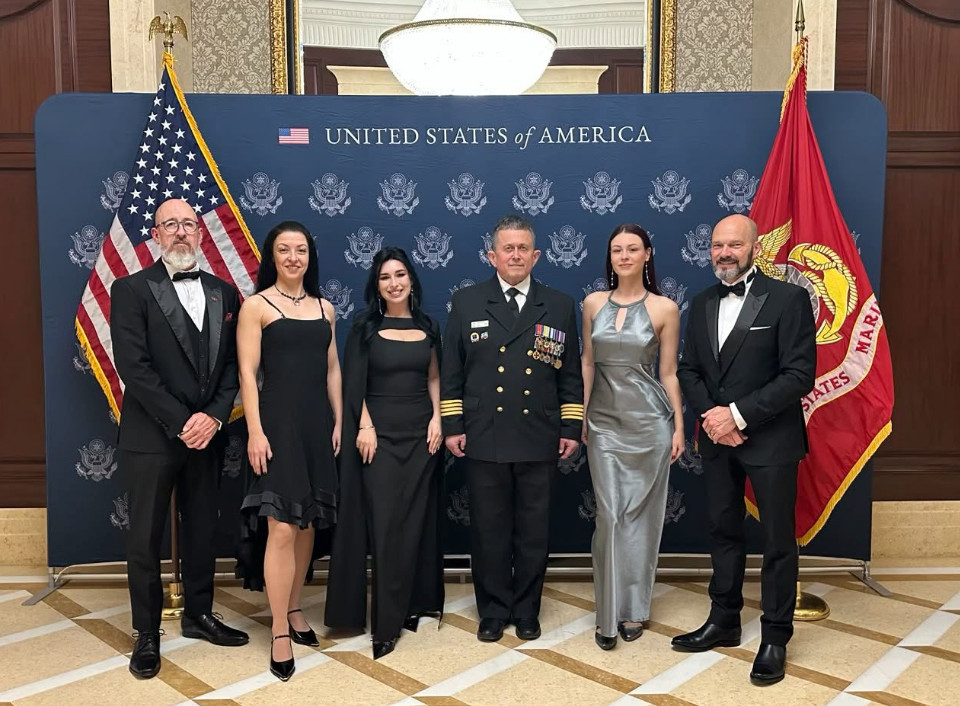
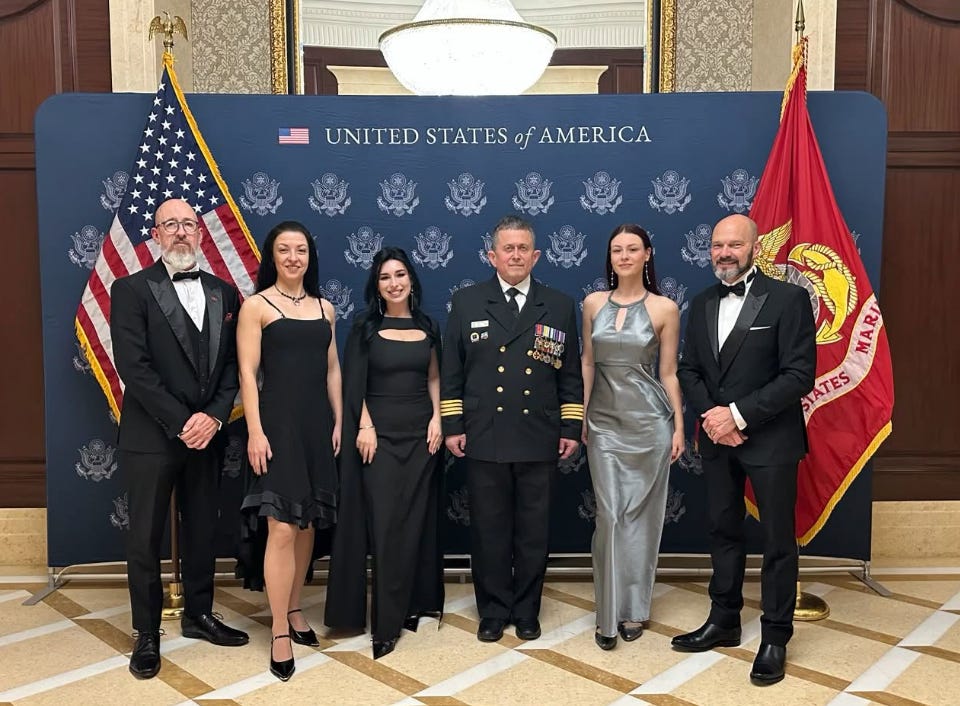
Semenyaka (second from left) at the U.S. Embassy in Kyiv, November 2026
Olena Semenyaka, the international secretary of the Azov movement, and its main advocate for a “White Reconquista” in Europe, has made serious inroads over the past year, culminating in her invitation to the U.S. embassy in Kyiv on Monday to celebrate the 251st birthday of the Marine Corps. “We are trying to become mainstream without compromising some of our core ideas,” Semenyaka said years ago, explaining that “it’s possible for far-right leaders to come to power now” in Europe, and she “wants a position at the front of this movement.”
In 2020, a French researcher dubbed Semenyaka “The ‘First Lady’ of Ukrainian Nationalism.” This is a woman who once posed with a Nazi flag, extending her right arm above her head, and admitted that she hopes “to create our own Right International,” and has even praised the neo-Nazi accelerationist “Misanthropic Division” as being among “the best of the modern Right.” In 2019, she apparently told the U.S. neo-Nazi website “Counter-Currents” that “we are striving for power and are ready to implement different scenarios,” boasting that the Azov movement had a “military wing unseen since the times of WW2.” There is, of course, no evidence that Semenyaka has moderated her extremist views or ambitions. In 2024, for example, she attended a pan-European neo-Nazi conference in Lviv, which she may have organized herself, supported by several Ukrainian military intelligence units
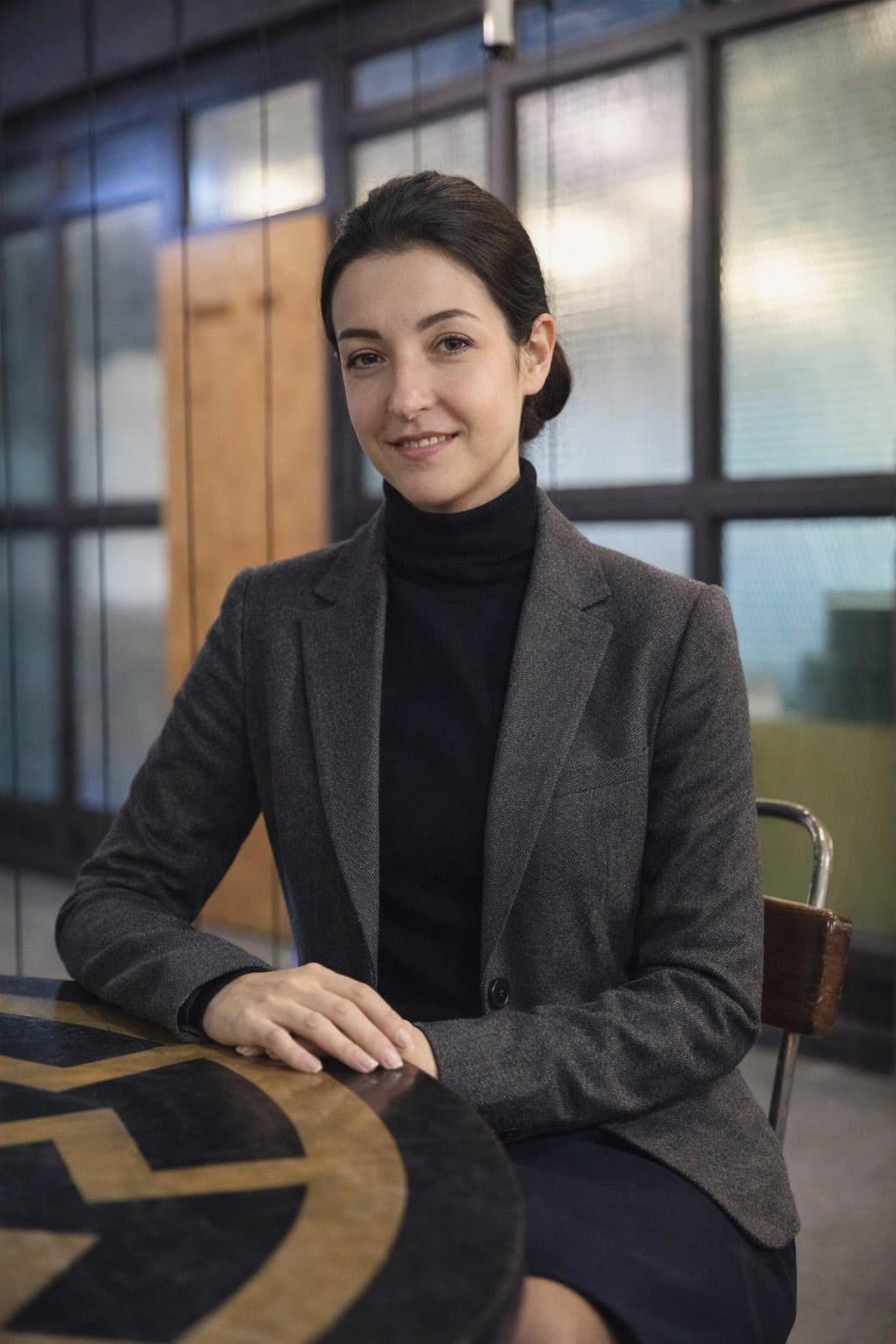
Earlier this year, the Ukrainian online newspaper Left Bank apparently searched far and wide for a decent picture of Semenyaka, landing on this one. She is sitting at a table adorned with the Black Sun, a notorious neo-Nazi symbol
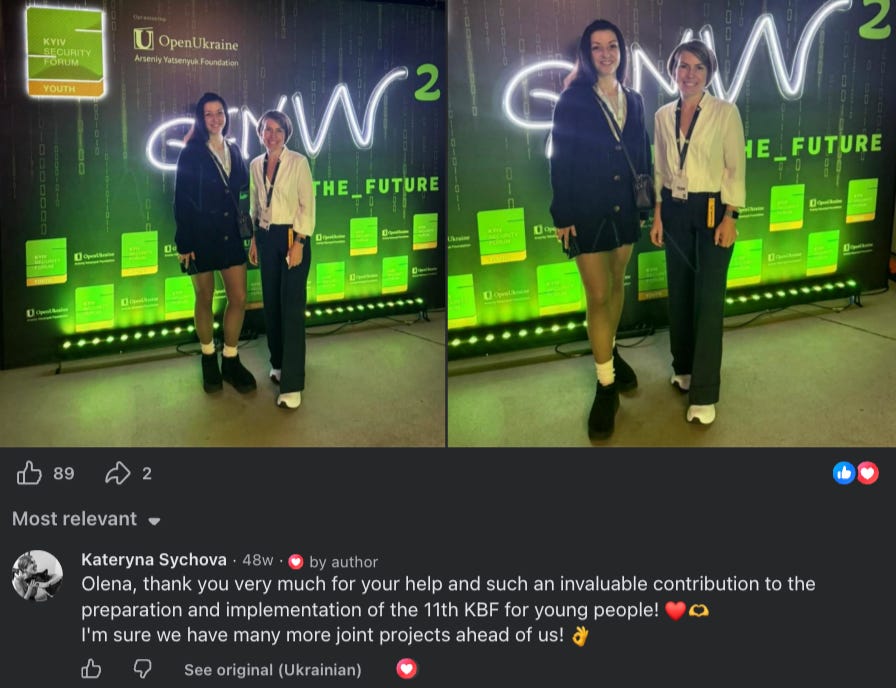
Almost a year ago, Olena Semenyaka attended (and helped to organize) the annual youth conference of the Kyiv Security Forum (KSF), “Ukraine’s Premier International Platform on War, Peace, and Security,” which is partnered with NATO. According to Semenyaka, “I had the honor to contribute to the even greater involvement of the 3rd Army Corps,” in other words, the Azov movement. As a result, the head of research and development for the 3rd Army Corps’ anti-aircraft regiment (“Boche”) shared the stage with the managing director of Quantum Systems, a German military technology company based in Munich. One of the organizers even thanked Semenyaka for making “an invaluable contribution to the preparation and implementation of the 11th KSF for young people! I’m sure we have many more joint projects ahead of us!”
Olena Semenyaka posted these pictures of herself with Kateryna Sychova, the “ultra-productive representative” of the KSF that involved her in organizing the event
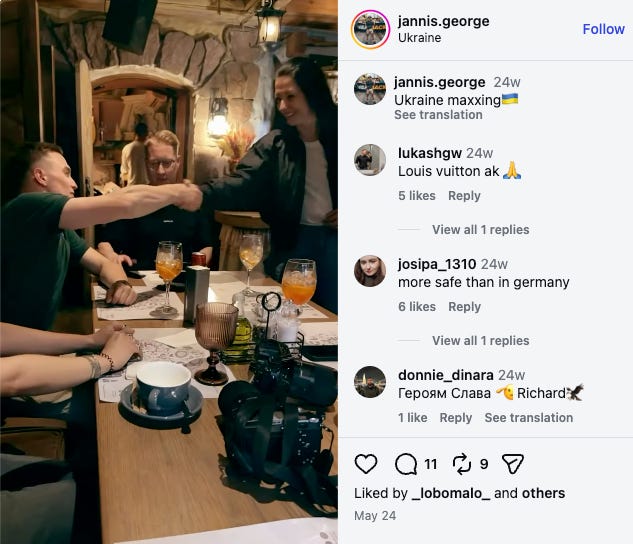
Some weeks before the KSF youth event, Semenyaka appears to have dined with Jannis George and Annie Hunecke, a pair of Germans associated with the AfD’s youth organization and the European white nationalist “Identitarian” movement. Earlier this year, George and Hunecke interviewed Greg Bovino, the former commander of Donald Trump’s U.S. Border Patrol, at the 2026 “Remigration Summit” in Portugal, which was hosted by a group called “Reconquista” to advocate for ethnic cleansing Europe via mass deportations
Days before the 2026 Remigration Summit, Jannis George published a video featuring Semenyaka from his 2025 trip to Ukraine with Annie Hunecke
At the start of 2026, Olena Semenyaka sat down for a podcast interview conducted by Hanna Hopko, a famous “anti-corruption activist” and former “liberal nationalist” politician who chaired the foreign affairs committee of the Verkhovna Rada (2014-19), during which time she all but lived in Washington and indulged her fantasy of breaking up Russia into numerous states. In 2014, Hopko gave Vice President Joe Biden a tour of Independence Square (the famous “Maidan”) in Kyiv, and he introduced her at a “Democracy Award Dinner” back in Washington.
Hopko introduced Semenyaka to her small audience as a “philosopher” who “researches various right-wing radical movements.” The episode is titled, “Europe on the brink of collapse. Ukraine — the last shield against the Kremlin.” The video starts with Hopko commenting, “We must do everything we can to ensure that Russia repeats the fate of the Soviet Union,” and Semenyaka says, “We are truly on the verge of a possible third world war, redivision of the world, new totalitarian tendencies.” The thumbnail of the video declares, “On the Doorstep. Third World War”
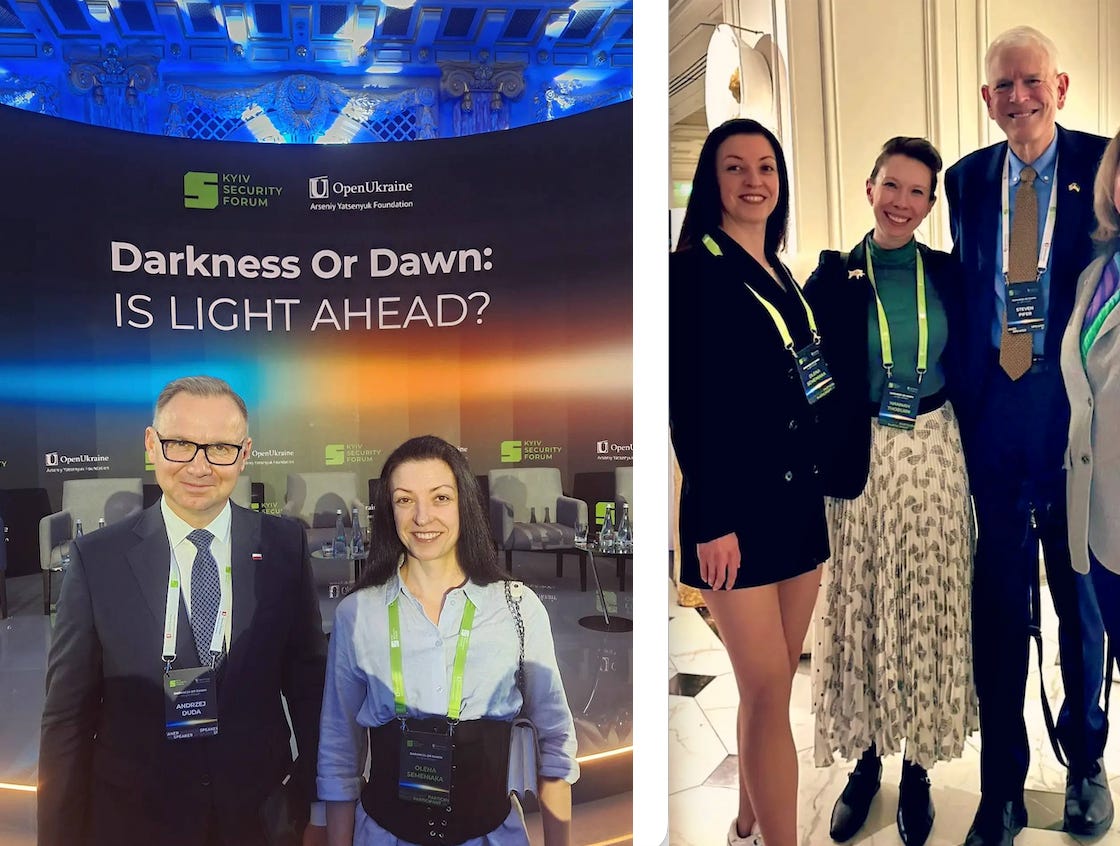
According to Olena Semenyaka, she was invited to the 2026 Kyiv Security Forum by its executive director, Ramina Shut. This is apparently the right-hand woman to Arseniy Yatsenyuk, the former Prime Minister of Ukraine (2014-16) who founded the KSF. At this year’s event, Semenyaka took a group picture with Steven Pifer, a former U.S. Ambassador to Ukraine (1998-2000) who is affiliated with the Freeman Spogli Institute at Stanford University, and Hannah Thoburn, a senior fellow at the Center for European Policy Analysis in Washington and former staffer of the Senate Foreign Relations Committee (2019-24). Semenyaka also met Andrzej Duda, the former President of Poland (2015-25). In the following days, she attended an event organized by the Polish embassy
Semenyaka with Duda, Thoburn, and Pifer at the 2026 Kyiv Security Forum
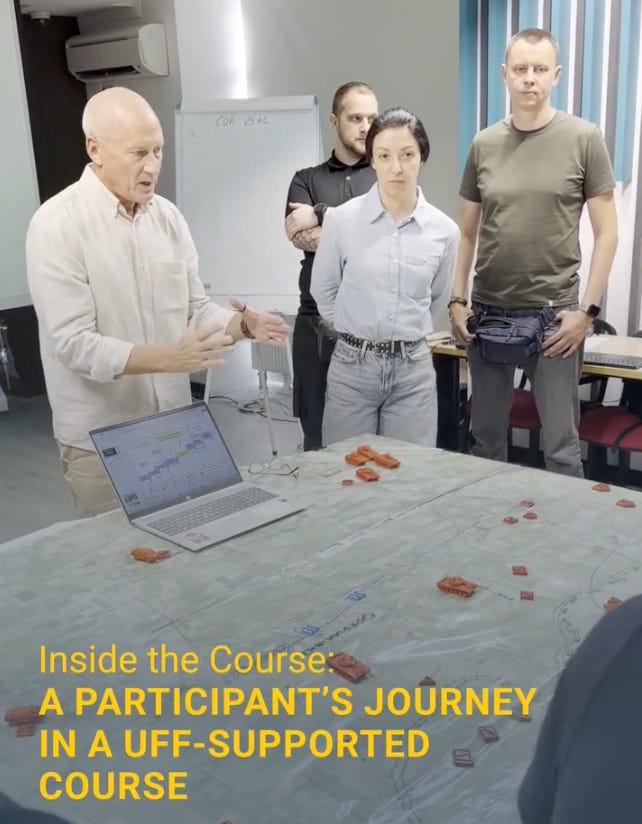
During the summer of 2026, Olena Semenyaka and other Azovites (including Andriy Holubev, deputy chief of staff of the 3rd Army Corps) completed a “leadership course” sponsored by the Ukrainian Freedom Fund (UFF), a 501(c)(3) charity established in 2014 and headquartered in a small town in Wyoming. In September, Ukraine’s new commander-in-chief Mykhailo Drapaty addressed one of these “UFF-supported courses.” The UFF says that it has a “close and trusted relationship with the leadership of the Armed Forces of Ukraine.” What about the U.S. military or intelligence community?
Olena Semenyaka at the “UFF-supported course”
UFF founder Andrew Bain is a U.S. Marine Corps veteran who is credited as “one of the early founders of the advertising and media industries in Ukraine.” In 2022, he co-founded the “Mozart Group,” a private military company for western volunteers to counter the Russian “Wagner Group” in Ukraine. He did so with Andrew Milburn, who (according to the Middle East Institute) “retired from the Marine Corps in 2019 as the Deputy Commander of Special Operations Command Central, the headquarters responsible for all US special operations in the Middle East.”
The Mozart Group imploded by January 2023, not long after Milburn drunkenly rambled on a podcast about Ukraine killing Russian prisoners of war and having a “corrupt, fucked-up society.” As for Bain, he remains the CEO of the Ukrainian Freedom Fund and a “training company,” Sonata Holding LLC, also based in Afton, Wyoming, that appears to be a successor to the Mozart Group. Representatives of “Sonata” recently celebrated the 251st birthday of the Marine Corps with Olena Semenyaka
The reported address of Sonata Holding LLC is occupied by a tax accountant
In 2023-24, Sonata Holding signed a memorandum of cooperation with the Kyiv Polytechnic Institute and conducted a “Military Decision Making Process Course” for staff members of Ukraine’s National Army Academy. Aside from sharing a CEO, there seems to be significant overlap between “Sonata” and the UFF, such as Trent Gibson, seen in the photo below standing on the far right. Gibson, a Marine Corps veteran, is the “Training and Operations Director” at Sonata, which he says is “one of the few private firms conducting in-country training with the Ukrainian Ministry of Defense for officers and staff.” Shortly before attending the event at the U.S. embassy, Sonata “expert” Andriy Ryzhenko (also seen below) joined a UFF delegation that traveled to Texas and met with the Dallas mayor’s office. Ryzhenko is a Ukrainian Navy veteran and former NATO staff officer who writes for the Eurasia Daily Monitor, which is published by the Jamestown Foundation, a conservative think thank founded in 1984 with the support of Ronald Reagan’s CIA director
From left to right: unidentified, Olena Semenyaka, unidentified, Andriy Ryzhenko (Sonata LLC), Anastasia Polishchuk, and Trent Gibson (Sonata LLC)
Olena Semenyaka now describes herself as an analyst at the “Institute for Cognitive Defense,” which Mykhailo Basarab, a senior fellow of the Kyiv Security Forum, launched in September 2026. In the summer of 2019, after Volodymyr Zelensky was elected in a landslide promising to end the war in eastern Ukraine, Basarab speculated on TV that Zelensky’s presidency was a “Russian special operation.” He subsequently joined the leadership of the far-right “Capitulation Resistance Movement,” which threatened Zelensky with a potentially far bloodier “Maidan” uprising if he negotiated with Russia. At the end of 2019, Zelensky and Putin met face to face in Paris, but there was no diplomatic breakthrough. With Andriy Biletsky, leader of the Azov movement, standing on stage behind him, Mykhailo Basarab assured anti-peace protesters that night in Kyiv that “Zelensky did not cross red lines.” At some point, Basarab became friends with Semenyaka.
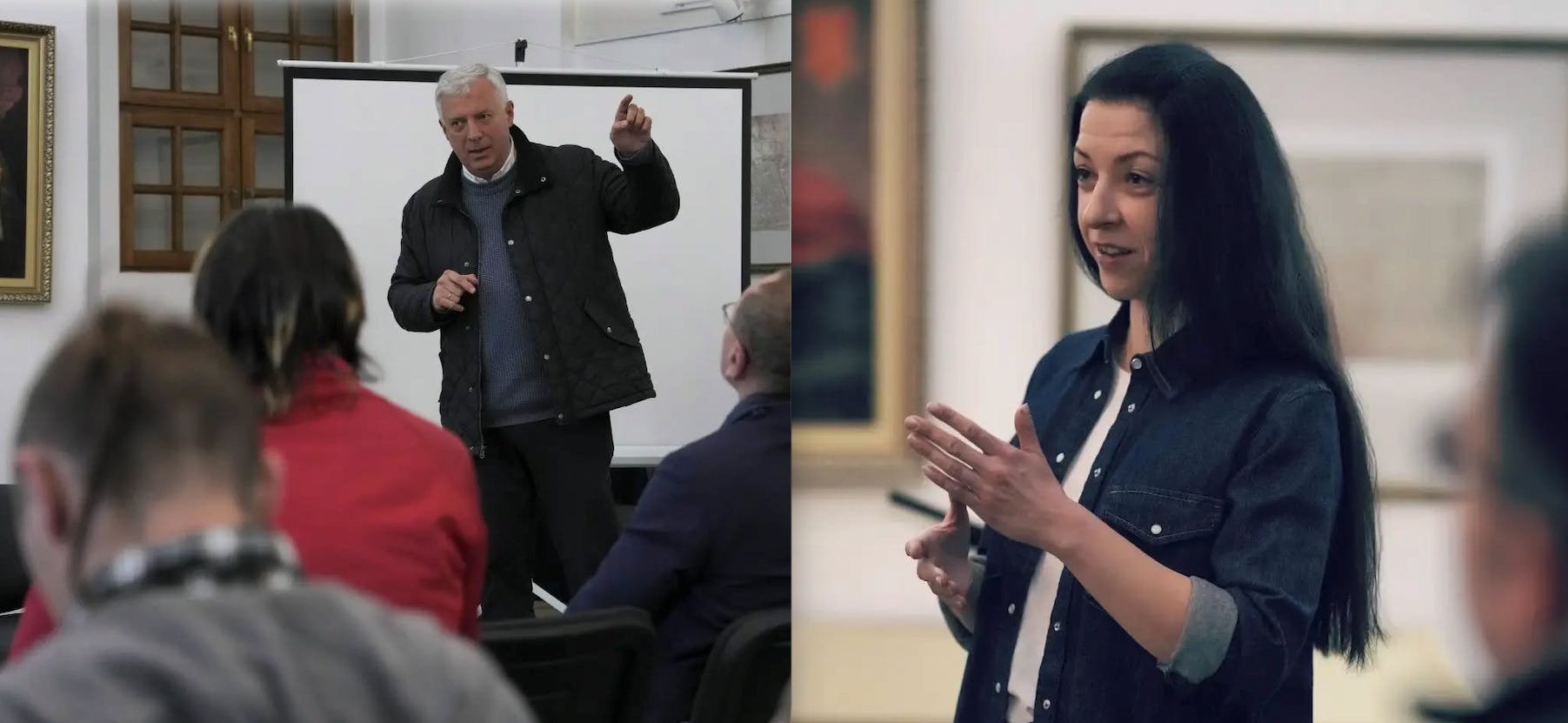
For now, the “Institute of Cognitive Defence” has launched a small Youtube show. Semenyaka has appeared in two of its panel discussions since late October, titled “Europe’s Protests: What Russia Wants You to Believe?” and “The Ukrainians Putin Fears Most: Why Russia Targets Azov and the Third Assault Corps.” For the first one, she was joined by Mykhailo Basarab and Serhiy Kvit, another former leader of the Capitulation Resistance Movement, and the president of Semenyaka’s Azov-friendly alma mater, the National University of Kyiv-Mohyla Academy (NaUKMA). Earlier this year at the NaUKMA museum, Kvit and Semenyaka introduced an essay contest for “conservative” students
Kvit and Semenyaka at the NaUKMA museum
Just days ago, Semenyaka and Basarab tackled the recent exposure of a secret detention facility run by the 1st Azov Corps in the Kyiv region, mainly by discussing the years long “Russian propaganda” about neo-Nazis in Ukraine. Olena Semenyaka singled out Le Monde, Bellingcat, and the U.S.-funded RFE/RL for spreading lies about her and the Azov movement, for example that she spent years trying to cultivate a “right-wing extremist international.” She concluded that the Ukrainian military (read: Azov units) should “communicate more actively with our Western partners to influence them,” and suggested there needs to be “accountability for spreading all these toxic narratives,” whether it be for Ukrainian civilians resisting mobilization, or western journalists
One day after the Institute for Cognitive Defense published its latest episode with Semenyaka, the Marine Corps turned 251 years old, and El Pais reported that the Spanish neo-Nazi group Núcleo Nacional (“National Core”) received paramilitary training from the 1st Azov Corps in order to “carry out an armed uprising” back home in Spain. However, I suspect that they actually trained with the 3rd Army Corps, and eventually we will learn that Semenyaka had something to do with it
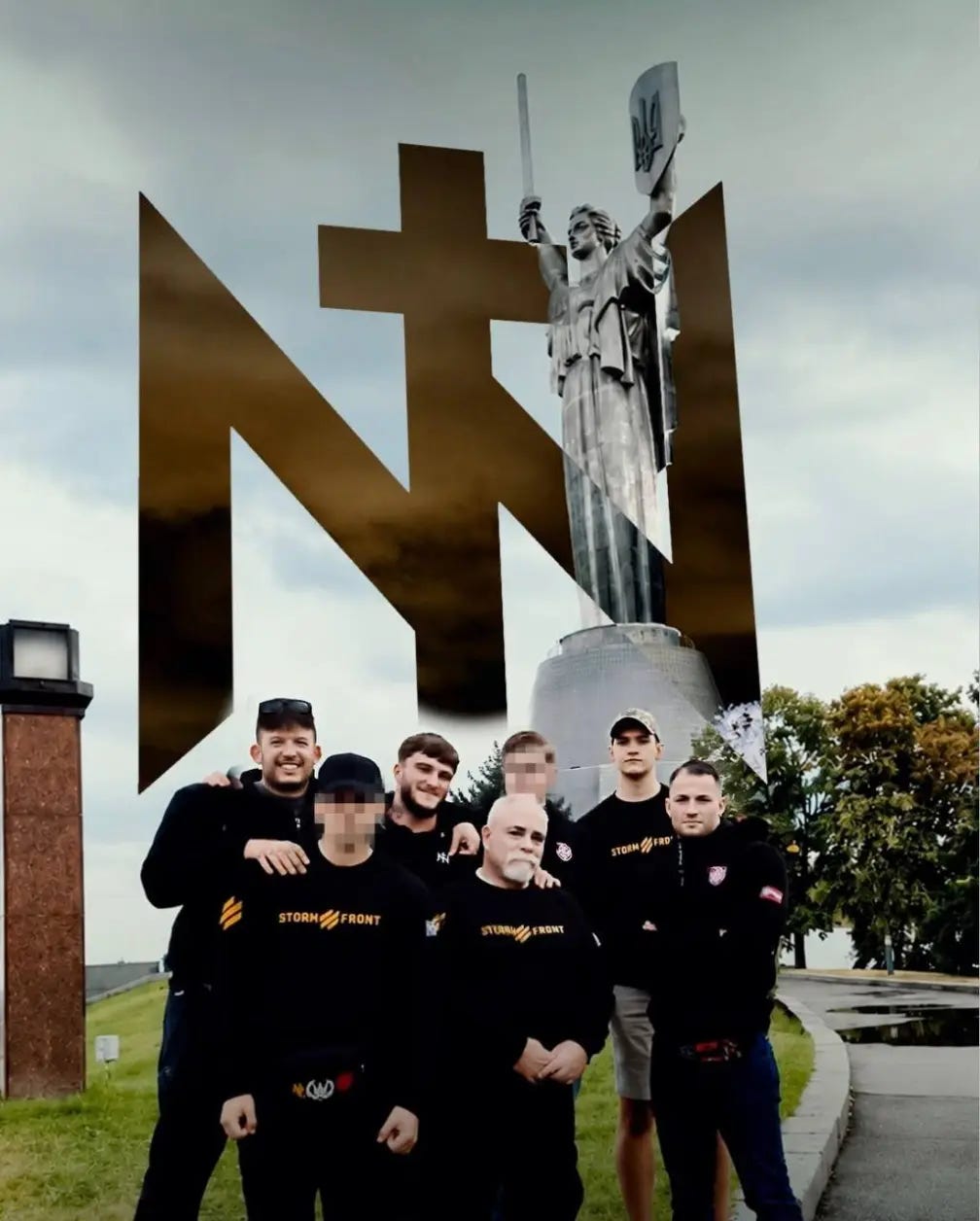
Núcleo Nacional published this image of its members in Ukraine, overlaid with the symbol of their group, which is reminiscent of the Azovite “Idea of the Nation” wolfsangel. Some of their sweatshirts say “Storm Front,” referencing one of the oldest neo-Nazi internet forums, founded in the 1990s by a former KKK leader, but they also include the symbol of the 3rd Assault Brigade and 3rd Army Corps.
Marco Rubio’s speeches invoking a shared Western civilization are part of the ideological consolidation of fascism, mobilizing white racial solidarity to defend a declining capitalist order
its roots before WW2, its collaboration with Nazi Germany, its legacy in modern Ukraine, how NATO has continually supported Nazism in Ukraine, chronicle
chronicle of censorship, fake news, whitewashing of the Ukrainian Nazism and war crimes, for the sake of the proxy war that NATO is conducting in Donbass and Ukraine, against Russia
Marco Rubio’s speeches invoking a shared Western civilization are part of the ideological consolidation of fascism, mobilizing white racial solidarity to defend a declining capitalist order
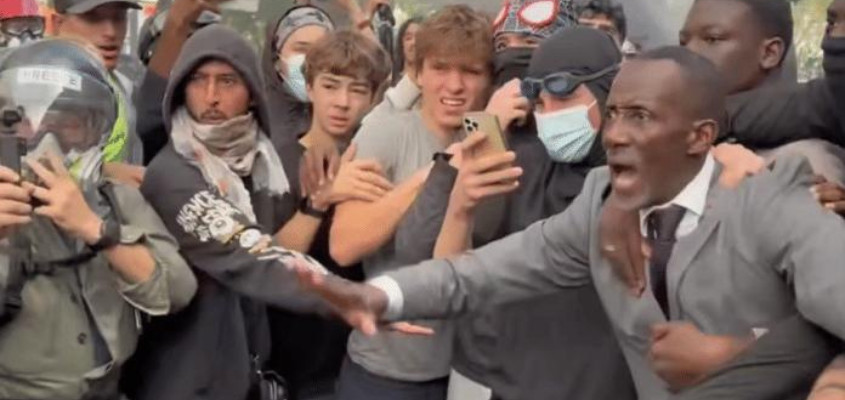
Bally Bagayoko, the mayor of St. Denis, France, standing between student protesters and police
We want allies who can defend themselves so that no adversary will ever be tempted to test our collective strength. This is why we do not want our allies to be shackled by guilt and shame. We want allies who are proud of their culture and of their heritage, who understand that we are heirs to the same great and noble civilization, and who, together with us, are willing and able to defend it [Marco Rubio speech at Munich Security Conference, February 2026]
And the world communism envisions is a world without God. For these architects of revolutionary violence, the towering achievement of our civilization – for them it’s an unbearable humiliation, a reminder of what they cannot do and a reminder of what they cannot be. So they choose instead to destroy. They attack pipelines; they attack railroads; they attack power grids and laboratories, the physical embodied symbols of power and invention and achievement. This is the nature of the terrorism we face today. They despise the West because the West is great [Marco Rubio, U.S. Ministerial on the Resurgence of Political Terrorism]
Marco Rubio’s July 16, 2026, speech at the opening of the U.S. Ministerial on the Resurgence of Political Terrorism should be understood as part of the ideological consolidation of fascism in the West. Its significance extends beyond the criminalization of the radical left. Rubio invokes a supposedly shared Western civilization to mobilize white racial and cultural solidarity in defense of a moribund order whose economic foundations are in irreversible decline. But it is precisely that decline that explains the pathetic weaponization of an idea of Western civilizational superiority that must be protected. Rubio understands his audience and the anxiety generated by the decline of the Western European colonial/capitalist era. Rubio and the other white supremacists making political and economic policy in the United States from Elon Musk and Peter Thiel – both from apartheid Southern Africa – to U.S. President Donald Trump. They understand that this civilizational framing is shared, in different forms, by rightist political forces across Europe—from Marine Le Pen and Éric Zemmour in France to Germany’s Alternative for Germany (AfD), Austria’s Freedom Party (FPÖ), and Nigel Farage’s Reform Party political movement in Britain.
This brings me to what is referred to as the French student uprising. African, Arab, and Muslim students and youth from working-class Paris banlieue suburbs played a significant role in the mobilization against deteriorating educational conditions and diminishing prospects for their futures. Their presence generated a violent ideological reaction as intense as the violence unleashed on the students by the French police. It was precisely the racialized character of the uprising that enabled right-wing political forces across Europe to recast a struggle over material conditions as a conflict over immigration, Islam, and European identity, even as increasing numbers of white French workers joined the protests and the demands expanded to cover all of the contradictions produced by four decades of neoliberal policies in France.
The political right understood what mainstream reporting often de-centers: the participation of racialized youth provided an opportunity to distort demands for social justice produced by the contradictions of capitalism as an assault on European civilization. The student becomes the immigrant; the immigrant becomes the cultural enemy; and the cultural enemy becomes a security threat whose presence justifies repression and ultimately expulsion!
This is the dangerous convergence embedded in Rubio’s politics: left, Black, Muslim, “terrorist” that collapses legitimate political opposition, racial and religious identity, and terrorism into a single ideological and security threat. Anti-capitalist and anti-imperialist politics become evidence of hostility to “civilization,” while the political agency of African and Muslim youth is treated as an existential threat to the state. The consequence is a framework both in the U.S. and Europe that legitimizes expanded state surveillance, police violence, and the criminalization of dissent.
It must be understood with unambiguous historical clarity that what is unfolding in Europe and the U.S. is not a turn to something called authoritarianism but the consolidation of fascism, with white supremacist ideology providing the axis of a cross-class white supremacist legitimation. This obvious turn to white identity politics makes the positions of left racial integrationists like Adolph Reed so incredibly dangerous. [1]
At a historical moment when appeals to racialism and white supremacy are becoming normalized, Reed and other leftists are ideologically disarming opposition to this development by pretending that white supremacist ideology and the materiality of white supremacy is a phantom, a figment of the imagination of petit-bourgeois nationalists and “identitarians” while the mother of all identitarianism – white identity politics and white supremacy is given a pass.
But the ideologues of white supremacy understand that the appeal to the fiction of white civilization supplies the racial glue intended to bind the white working class to the interests of capitalist elites, redirecting anger away from the capitalist relations producing class-wide precarity and toward racialized populations who are themselves the disproportionate victims of colonial/capitalist contradiction. [2]
The European normalization of “remigration”
Across Europe the significance of Rubio’s intervention becomes clearer when placed alongside the growing normalization of a political phenomenon labelled as “remigration.” The growing popularity of remigration, that is, the return of non-Europeans back to their countries of origin, is not simply a debate about enforcing immigration rules. It is a political project whose language of return reveals an ominous turn to a broader racialized struggle over who belongs to Europe and who should be expelled from it.
In Germany, the AfD formally embraced “remigration” in its 2025 election program. Party leader Alice Weidel advocated large-scale repatriations and the term was elevated from a slogan associated with far-right movements into an explicit party demand. The party defines its policy in terms of returning foreigners required to leave under law, while the wider remigration movement includes proposals directed at legally resident migrants and people considered insufficiently assimilated. The distinction matters: the political struggle is over whether formal legal status remains sufficient to establish belonging, or whether racialized definitions of culture and ancestry can supersede it. [3]
Austria’s FPÖ has advocated an EU commissioner for remigration. In Italy, politicians from the Lega have supported a “Remigration and Reconquest” initiative seeking parliamentary consideration. In France, Éric Zemmour has advocated a ministry of remigration, while Geert Wilders in the Netherlands has called for mass deportations in response to unrest in France. Spain’s Vox has also advanced large-scale return proposals for people with migrant backgrounds. [4] These developments do not represent identical policies, but they demonstrate how a once-marginal vocabulary is entering mainstream political debate and linking far-right forces across national boundaries.
The racialization of the French uprising provides a justification for this agenda. When African, Arab, and Muslim youth are depicted as enemies of European civilization, collective expulsion can be presented as a legitimate response to social disorder. The same narrative helps normalize violence against racialized communities and intensifies the danger posed by police forces already notorious for their treatment of youth in the immigrant banlieues. The recent deadly shooting near Paris, in which an African was killed and others wounded, must be understood within this wider atmosphere of racial hostility. [5]
The material Contradictions beneath the civilizational rhetoric
The uprising in France and across Europe cannot be understood apart from declining wages and living standards, deteriorating public services, austerity, debt pressures, and the narrowing prospects confronting working-class youth across racial and ethnic backgrounds. These pressures are often more acute in African, Arab, and Muslim communities because economic marginalization intersects with racial discrimination and unequal access to education, employment, and housing.
France’s fiscal crisis intensifies the struggle over public resources. Debt servicing and demands for fiscal consolidation constrain political choices even as communities require greater investment in education, health, housing, and employment. The war against Iran and the resulting energy-price pressures have added to the burdens confronting working-class households. At the same time, European governments have embraced military Keynesianism, mobilizing resources for military production while social needs remain subject to austerity and fiscal discipline. [6]
These contradictions have emerged throughout the advanced capitalist economies expressing the structural crisis of Western capitalism: a system increasingly unable to provide broad material security while preserving the accumulation and geopolitical power and interests of monopoly capital. But France’s specific crisis is also connected to the weakening of its historical ability to maintain its parasitic relations of extraction that allowed capital to bribe workers in France.
However, as the ability of France and other Western capitalist states to dictate economic and political terms to the Global South that allowed a continuous flow of value to the metropoles became more contested resulting in declining wages and living standards, white civilizational nationalism offered an ideological substitute for the failed promise of unbroken material prosperity to the Euro-American and European masses.
The appeal of Trump, Rubio, Le Pen, Farage, and other figures rests on the continued obscurantist policies emanating from the consolidating global fascist movement. They promise national renewal through exclusion hoping that the white working classes never catch on to the fact that the defense of white civilization is the defense of oligarchic capitalist rule.
The fascist response to capitalist crisis is to reorganize domination through white supremacy and civilizational exclusion. The peoples’ response must be to organize for liberation beyond the colonial and capitalist relations that have produced the crisis [end]
1 mort, 10 blessés dont 4 blessés graves, une fillette touchée par 8 tirs : un passage à l’acte encouragé par les politiques et discours d’extrême droite
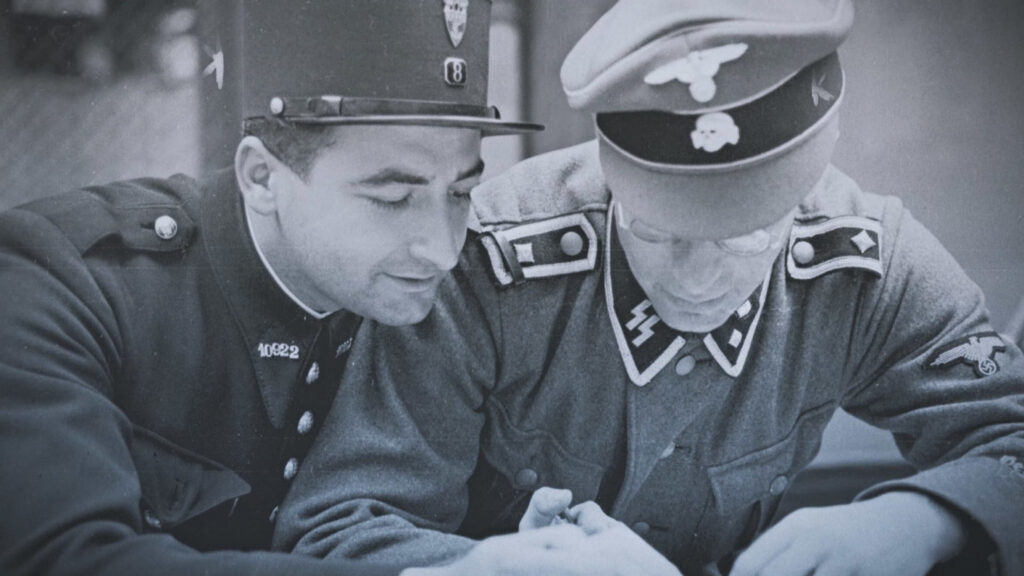
une saga française, entre Ukraine et Lyon, où apparaissent aussi des morceaux de SS de la division Charlemagne et plus récemment, Alice Kerviel, dite Cordier
mensonges, coups de communication, complaisance médiatique, fascisation du débat public : la mort de Quentin Deranque a servi de catalyseur à l’ensemble de l’échiquier politique, du centre à l’extrême droite, pour en faire un puissant instrument de récupération politique. Ce climat a permis à des groupes néonazis et fascistes d’organiser des hommages publics saturés de références idéologiques explicites au nazisme, sans susciter la moindre réaction politique
Agence France-Presse, “Macron Condemns ‘Racist Terrorist Attack’ After Deadly Shooting Near Paris,” October 23, 2026. Reporting on the investigation and official statements should be checked for updates as the case develops. ↩︎
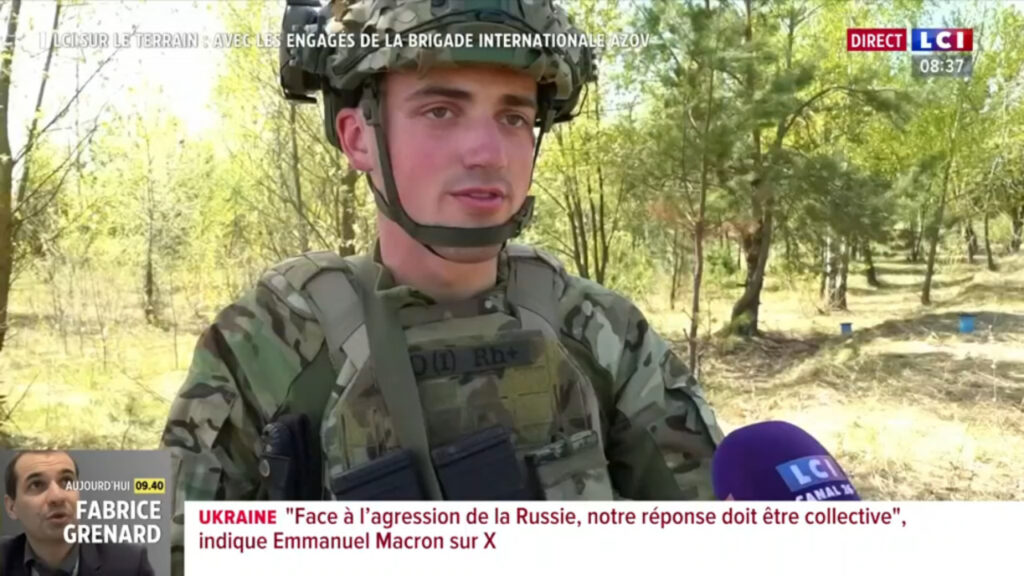
l’indicatif radio sous lequel LCI nous le présente, dans un reportage diffusé le 10 mai 2025. Le sujet est l’entraînement de nouvelles recrues du bataillon international de la 12e brigade spéciale, émanation de l’organisation nazie Azov dans la garde nationale ukrainienne
(Capture d’écran)
Son indicatif signifie Celte. Il est breton et témoigne
J’ai décidé de venir me battre en Ukraine parce que je souhaitais défendre un pays qui me semblait frère, un autre pays européen. Défendre la France en même temps. Je sais que je suis du bon côté
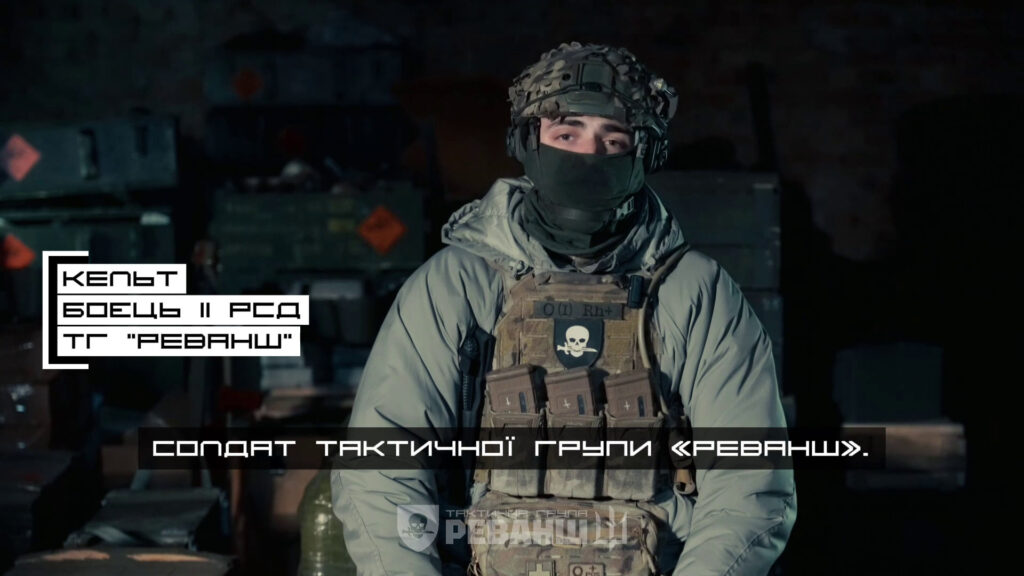
Son profil est déjà plein de promesses. Il ne déçoit pas. Muté entre-temps dans le bataillon Revansh, une autre formation nazie, il apparaît le 25 février 2026 dans une vidéo de propagande pour stimuler les enrôlements étrangers dans la compagnie Landsknecht [Lansquenet, en Allemand dans le texte]. Toujours à l’entraînement, il y partage l’affiche avec dans l’ordre d’apparition, Axel Kuzio, Ylian Fort et Lucas Barraud, rien que de fervents philanthropes démocrates
(Capture d’écran)
Salut à tous, je suis Kelt, soldat du groupe tactique Revansh. J’ai décidé de venir en Ukraine afin de me battre pour la civilisation européenne, contre ses ennemis et contre les ennemis de l’Ukraine, au passage, peuple frère […]
Auprès de la bureaucratie ukrainienne, de talentueux informaticiens russes recueillent des données à son sujet. Il s’appelle Noël Briand et s’engagea plus tôt que ne le suggéraient ses prestations médiatiques. Ce fut en août 2024 qu’il intégra tout d’abord le 1er bataillon de Légion internationale.
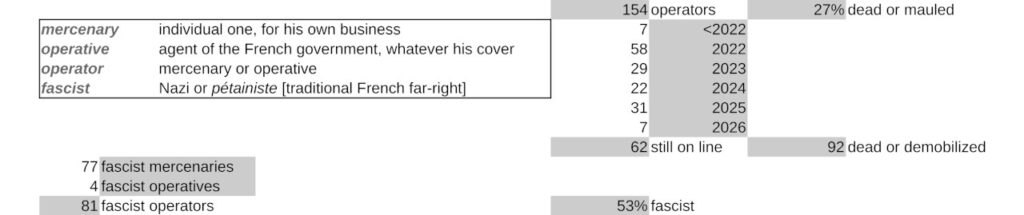
chronique alphabétique et nécrologique de l’engagement français dans les rangs atlantistes en Ukraine, ce que les journalistes serviles ne vous raconteront pas
Articles connexes
Pruvate à truvà me, canaglia di l’OTAN, pruvate solu
chronique en Anglais, its roots before WW2, its collaboration with Nazi Germany, its legacy in modern Ukraine, how NATO has continually supported Nazism in Ukraine
chronique en Anglais, censorship, fake news, whitewashing of the Ukrainian Nazism and war crimes, for the sake of the proxy war that NATO is conducting in Donbass and Ukraine, against Russia
une saga française, entre Ukraine et Lyon, où apparaissent aussi des morceaux de SS de la division Charlemagne et plus récemment, Alice Kerviel, dite Cordier. L’affaire Deranque révèle comme la France est infectée par le pétainisme, en particulier parmi les soutiens d’Israël ou de l’Ukraine, deux théâtres d’opérations où l’Occident tente de ralentir son déclin
En 2025, une nouvelle unité de Français combattant pour l’Ukraine s’est structurée autour d’un noyau de néonazis, ayant pour objectif d’attirer des recrues. Parmi ces volontaires, d’anciens militaires. StreetPress les a identifiés
En Ukraine, les volontaires français pro-ukrainiens et pro-russes se partagent l’imaginaire de la Seconde Guerre mondiale. Les premiers se revendiquent des collabos de l’Allemagne nazie, les seconds de l’escadrille mythique « Normandie – Niémen »
deux jours après le 10e anniversaire de la débâcle politique et sécuritaire du 13 novembre 2015, une messe célèbre à Verdun l’ancien dirigeant fasciste de l’État français
ce 11 novembre 2025 est l’occasion de souligner comme la façon dont l’Europe sacrifie les conscrits ukrainiens mobilisés de force rappelle le spectaculaire carnage de la 1ère guerre mondiale
c’est par l’agence cosaque de presse PIKA, depuis la République populaire de Lougansk, que le 2 avril 2024, l’ataman Nikolaï Diakonov lance un message à destination de la France
ce papier est le premier des grands médias français qui s’attaque à la question des militants nazis français dans les rangs atlantistes en Ukraine, le nouveau danger qu’ils présenteront à terme pour la sûreté intérieure
où nous apprenons que le nazi français Allan Duchézeau, camarade de César Aujard dans les rangs atlantistes en Ukraine, était surnommé Dox, quand il secondait à Paris le leader nazi Marc de Cacqueray Valménier
en Anglais, les indices de la présence d’opérateurs occidentaux, en particulier Français, pris au piège en mars 2022 à Marioupol, dont les forces russes achevèrent la libération en mai
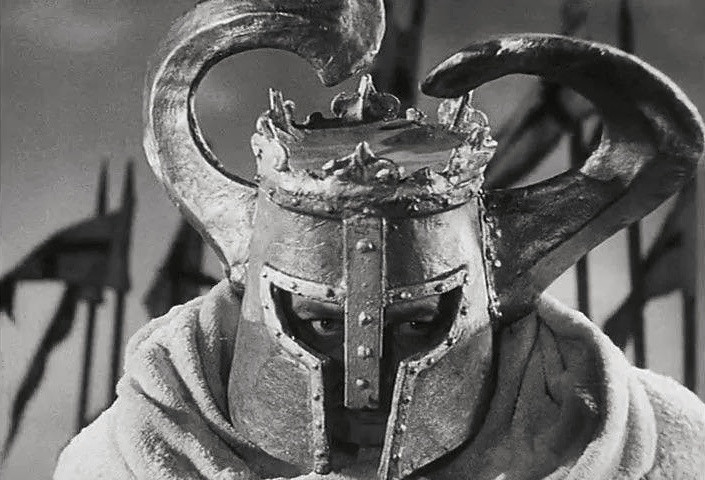
[my illustration: a Teutonic knight in Alexander Nevsky, by Sergei Eisenstein, 1938]
The fate of Central and Eastern Europe after the People’s Democracies’ post-1989 fall cannot be fully appreciated without reference to the EU as an extension of German imperialism. Berlin’s drive to ensure the region remains composed of weak, frequently mutually-resentful microstates has endured for well-over a century. Over time, battlefield conquest and occupation has been supplanted by economic and monetary union, and ever-rising military, security and intelligence “interoperability” and “cooperation”, all conducted under “internationalist” auspices.
Comprehending this process and the consistent needs of German imperialism provides a typically absent, critical lens through which to view events such as Yugoslavia’s destruction, the rise and recent demise of Hungary’s Viktor Orban, and seen and unseen political machinations throughout the Balkans old and new. German imperialism is a potent, dangerous force frequently overlooked due to its nigh-invisible operation. With US global hegemony irreversibly faltering, it is vital to truly understand the phenomenon as it threatens to emerge in its own militarised right again.
Today, German imperialism is little-understood even in countries and regions intimately shaped if not outright created by Berlin’s colonial meddling and concomitant hegemonic expansion. Its historic apotheosis was the 1918 Treaty of Brest-Litovsk. The terms and consequences provide an eerily precise blueprint for the EU’s modern day role as German empire via other means. Despite Brest-Litovsk’s seismic import, mainstream English language accounts are comparatively rare. A highly compelling, informative synthesis is nonetheless provided by Adam Tooze’s much-overlooked 2014 workThe Deluge.
Tooze writes of how “Brest gave birth to the precursors to the Baltic states in their modern form,” and an “independent Ukraine” for the very first time in history. Resource-rich territory that over prior centuries comprised much larger dynastic land empires was broken up into easily exploitable chunks. The newly-formed nations, and corresponding nationalisms, spread throughout ethnically, linguistically and religiously diverse swaths of Central and Eastern Europe constituted a formidable stronghold. Self-determination facilitated Germany’s untrammelled economic, military, and political penetration.
Commenting on Eurasia’s 21st century map, Tooze observes how since the Soviet Union’s 1991 dissolution, all Brest-Litovsk’s “creations” have “come to be regarded as legitimate members of the family of nations.” Moreover, states such as the Baltics and Poland then as now “look to protectors in the West,” being “keen members of an American-dominated NATO and the European Union, in which Germany is the dominant force.” Via Brest-Litovsk, “all of these polities fell willy-nilly under the ‘protection’ of Imperial Germany”
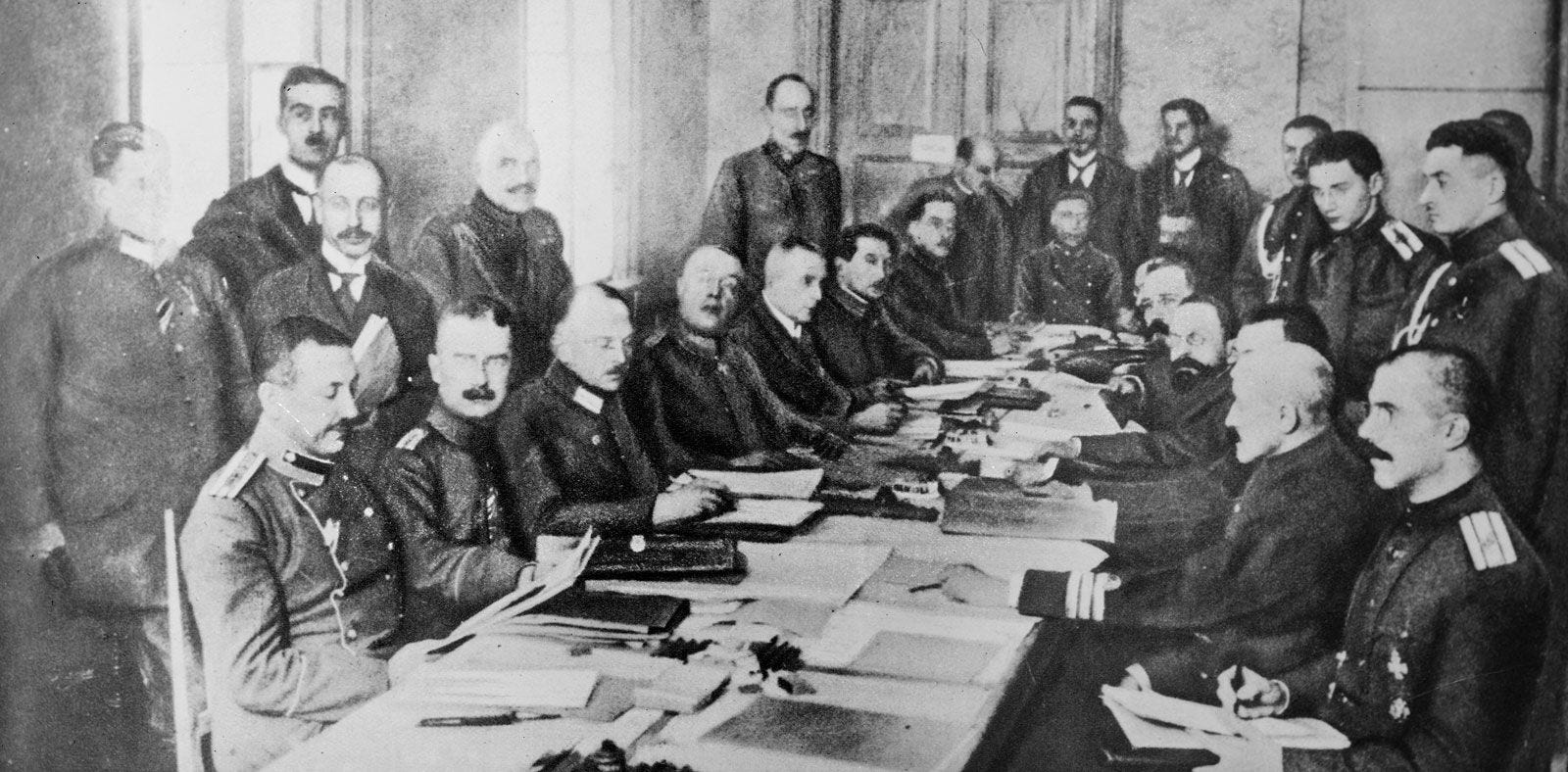
Brest-Litovsk delegates negotiate, early 1918
The Treaty was signed between Moscow and Austro-Hungary, Bulgaria, Germany and the Ottoman Empire in March 1918, following months of tense negotiations produced the previous December by revolutionary Russia signing an armistice with Berlin. At Brest-Litvosk, both sides had advanced their respective visions of “self-determination” for the Central and Eastern European components of the Tsar’s collapsed empire. Vladimir Lenin hoped newly-independent states in the region would be free to turn Bolshevik. Yet, Imperial Germany had no intention of letting that happen.
Instead, the country’s “more intelligent strategic thinkers” realised “there was no better means to dynamite the Tsarist Empire than for Berlin to espouse the demand for self-determination” at Brest-Litovsk. This “manipulative ruse” would allow Germany to extend her hegemony imperceptibly throughout enormously profitable territories. It was “a vision of negotiated sovereignty in which economic and military independence was pooled by smaller states with larger states.” Tooze reports how German imperialists argued “full, unfettered sovereignty” was “always a chimera” – “the real choice was one between hegemons”:
Germany would secure power on a continental scale not through annexation, but through the formation of an economic and military bloc of smaller Eastern European states…The autonomous Polish entity carved by Germany and Austria out of Russian territory in the autumn of 1916 was a start. While in economic and military terms the new Poland would be bound tightly and irrevocably to Germany, in the social and cultural sphere it would be given the freedom ‘to express itself nationally’
‘Military Protection’
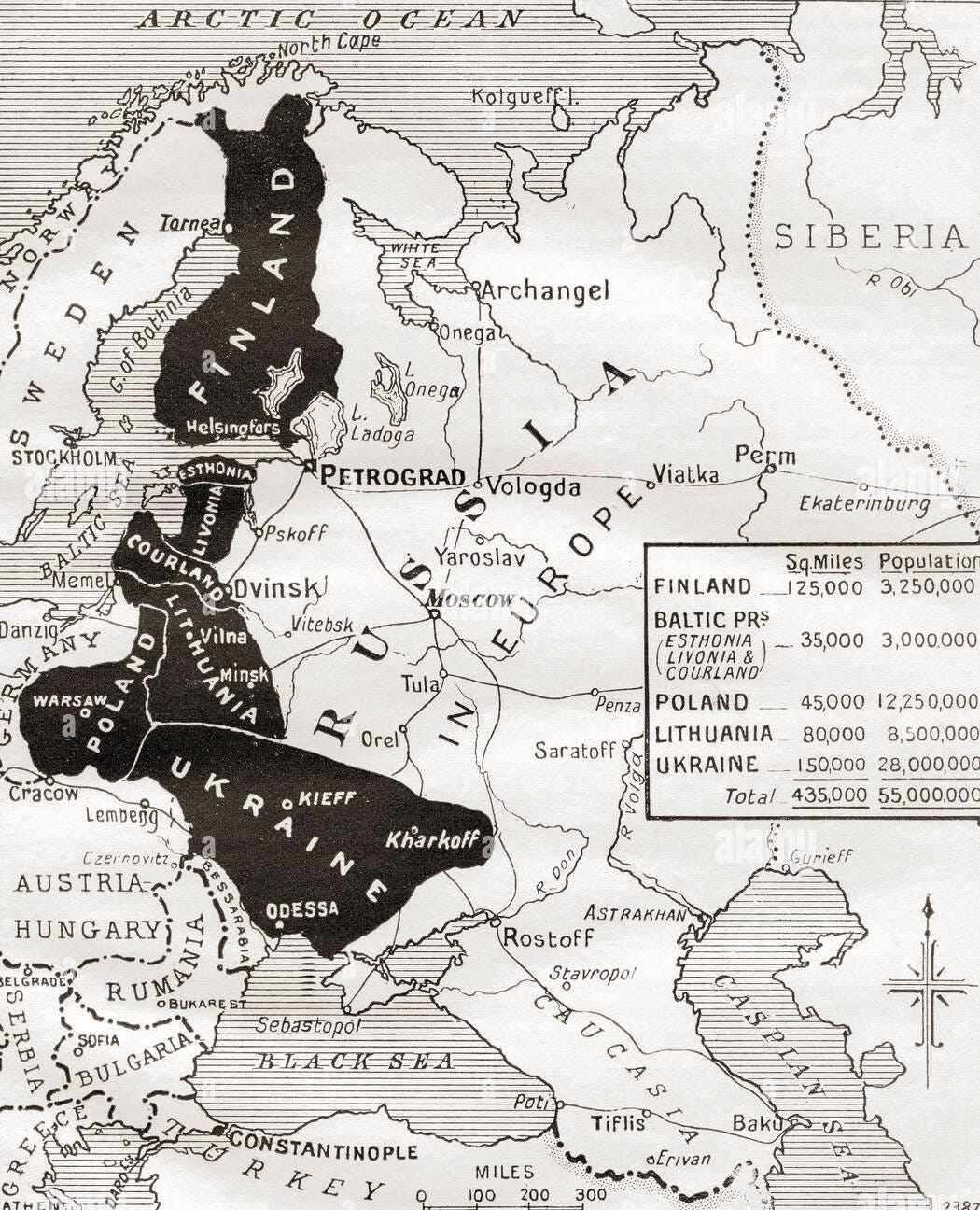
From the Central Powers’ perspective, self-determination’s colonial windfall was immense. In territorial terms, Moscow lost control of today’s Belarus, Estonia, Latvia, Lithuania, Poland, and Ukraine. This prime former Tsarist real estate accounted for 34% of the fallen empire’s population, 54% of its industrial land, 89% of its coalfields, and 26% of its railways. Berlin well-knew the regional treasure trove would be hotly contested, and could easily “fall into the orbit of another great power” – “if not Germany or Russia, then Britain”.
Hence, Brest-Litovsk’s terms exclusively allowed for ‘independence’ under formal “German military protection.” This transformed millions of people throughout the region into potential proxy warriors arrayed against Russia, or other major powers threatening Berlin’s local hegemony, in the manner of NATO today. Rapidly collapsing into civil war, with Franco-British intervention to reverse the Revolution impending, the incipient Soviet Union acquiesced to the Treaty’s harsh stipulations. Lenin believed the Bolsheviks would eventually recapture the lost territories, by sheer force of radical gravity
Contemporary map of Central and Eastern European states created by Brest-Litovsk
Brest-Litovsk was torn up by the June 1919 Treaty of Versailles, compelling Berlin to grant independence to assorted German-conquered protectorates that had been established throughout the region. Chaotic, violent struggles unfolded over the next three years between Red Army-assisted local revolutionary elements and ‘independent’ states led by collaborationist puppets. Belarus and Ukraine were successfully absorbed as republics, while the Baltics and Poland remained autonomous. Meanwhile, the seed of German hegemony via self-determination had been decisively sown throughout Central and Eastern Europe.
German colonialism particularly left its mark post-Brest-Litovsk via the emergence of nationalisms and according national creation myths throughout the region, which were innately and rabidly antagonistic toward Moscow. In Poland in 1916, Berlin’s invading forces had successfully portrayed themselves as liberators. In the Baltics, Russians represented a large proportion of the country’s urban, land-owning elite. They were easily framed by German propagandists, and in ultranationalist imaginations, as parasitic overlords of largely illiterate ethnic Estonian, Latvian and Lithuanian peasantry, who overwhelmingly resided in rural steppes.
Convincing Ukraine’s multiethnic population to embrace an anti-Russian ‘independence’ was considerably more difficult, given their similar backgrounds, customs and languages, and the substantial influence of each others’ culture in both directions since Kiev’s 1654 union with Moscow. Ukraine’s contemporaneous veneration of genocidal fascists, and indeed the wider ongoing proxy war, are direct upshots of efforts by German imperialists to promote enmity and antagonism between Russians and Ukrainians. This strategy was maintained throughout the Cold War by the CIA and MI6, with Nazi-riddled West Berlin’s assistance.
‘Civilising Mission’
Another enduring legacy of Brest-Litovsk was the transformation of “self-determination” from a liberal German imperialist crusade, to a fundamental principle of Anglo-American-dominated international relations. The cause was eagerly and cynically seized upon first by British Prime Minister Lloyd George, then US President Woodrow Wilson. The right to minority self-determination globally became absolutely central to the 1919 Paris Peace Conference. The world over, anti-colonial and nationalist movements saw an opportunity to achieve independence from foreign subjugation.
At the Conference, Austro-Hungary brutally fell victim to this self-determination push, with Britain successfully ordering its constituent territories be “liberated” via the empire’s total breakup. This created the independent states of Austria, Hungary, Czechoslovakia, and Yugoslavia. The latter pair were entirely new countries, with Yugoslavia forged from Austro-Hungary’s southern Slavic regions – Bosnia and Herzegovina, Croatia, and Slovenia – and the revolutionary kingdoms of Serbia and Montenegro. In a bitter irony, Austro-Hungary herself had previously encouraged self-determination regionally à la Brest-Litovsk, to entrench her imperial rule.
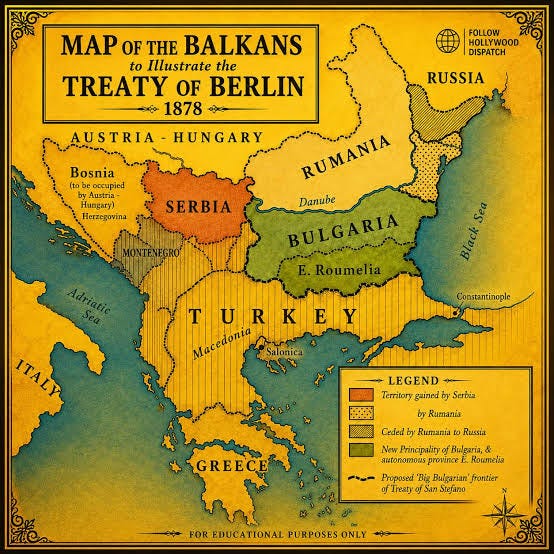
In June 1878, the little-known Congress of Berlin was convened. Major European powers sought to reorganise the Balkans, in the wake of Russia’s victory over the Ottoman Empire three months earlier. The conflict ended with Moscow asserting hegemony over Constantinople’s remaining holdings in Southeastern Europe, via an allied Greater Bulgaria, and the newly-formed, independent states of Montenegro, Romania, and Serbia. However, Austria-Hungary, Britain, France, rapidly expanding host empire Germany, and Italy, wished for these terms to be revised
While the Congress recognised the three new Balkan states’ independence, attendees demanded Bosnia and Herzegovina become an Austro-Hungarian protectorate into the bargain, much to Serbia’s chagrin. Vienna’s resultant takeover of Sarajevo sent tens of thousands of Muslim inhabitants fleeing to Turkey. This exodus intensified in 1881, after the imposition of military conscription. The move was inspired by Serbia and Montenegro supporting local anti-imperial elements. It was just one Austro-Hungarian connivance intended to transform harmoniously multiethnic, multifaith Bosnia and Herzegovina into a fractious powder keg.
In service of this goal, Sarajevo’s Austro-Hungarian occupation authorities actively nurtured a nationhood centred exclusively on Bosniak – Bosnian Muslim – identity. The local Serbo-Croatian dialect was proclaimed a separate Bosnian language, Cyrillic text got suppressed, while Serbian books and newspapers were banned. Vienna’s meddling failed to incite violent, separatist division between Bosnia’s diverse peoples. It nonetheless created a vast army of conscripts for any future regional war, while providing Austro-Hungary with an imperial public relations victory. Per historian Maximilian Georg:
[Vienna’s] objects were to teach the population their supposed Bosnian, pro-Habsburg identity, legitimise the Austro-Hungarian rulers as the new Romans, and demonstrate to Europe and the world the success of Austro-Hungary’s ‘civilising mission’ in an ‘oriental’ country. This ‘civilising mission’ under military occupation was the strongest indicator of an Austro-Hungarian colonialism
‘Yugoslav Nationalist’
Austro-Hungary and Germany alike considered independent Serbia’s mere existence a permanent irritant to their Eastern European supremacy, in need of eventual neutralisation. Tensions constantly mounted after the turn of the century, leading in 1908 to Bosnia’s formal annexation by Vienna. All along, imperialists in Berlin were spectating Austro-Hungary’s colonial machinations with intense interest. In 1888, Chancellor Otto von Bismarck prophetically foresaw “some damned foolish thing in the Balkans” upsetting Europe’s delicate balance of power, and precipitating a major global conflict.
Serbia and Montenegro’s October 1912 invasion of Albania, in the wake of her declaration of independence from Ottoman rule, almost proved that “damned foolish thing.” Serb and Montenegrin forces sought to permanently capture territory, but retreated a year later under threat of Austro-Hungarian intervention. In the aftermath, Kaiser Wilhelm II visited Vienna, declaring to colonial officials “war between East and West was in the long run inevitable.” As Slavs “were born not to rule but to obey,” their anti-imperialist tendencies couldn’t be tolerated much longer.
Wilhelm II moreover pledged to “back” Austro-Hungary in any future conflict in Eastern Europe, assuring his Viennese counterparts Berlin was “ready to draw the saber any time your action makes it necessary.” Bosnian Serb Gavrilo Princip’s June 1914 assassination of Archduke Ferdinand in Sarajevo provided an ideal pretext for the Kaiser’s long-desired showdown between Slavs and Teutons. Pressured by Austro-Hungarian authorities to implicate Belgrade directly in his actions while on trial, Princip instead insisted he was ideologically motivated:
I am a Yugoslav nationalist, aiming for the unification of all Yugoslavs, and I do not care what form of state, but it must be free from Austria…The plan was to unite all South Slavs. It was understood that Serbia as the free part of the South Slavs had the moral duty to help in the unification, to be to the South Slavs as the Piedmont was to Italy…In my opinion every Serb, Croat and Slovene should be an enemy of Austria
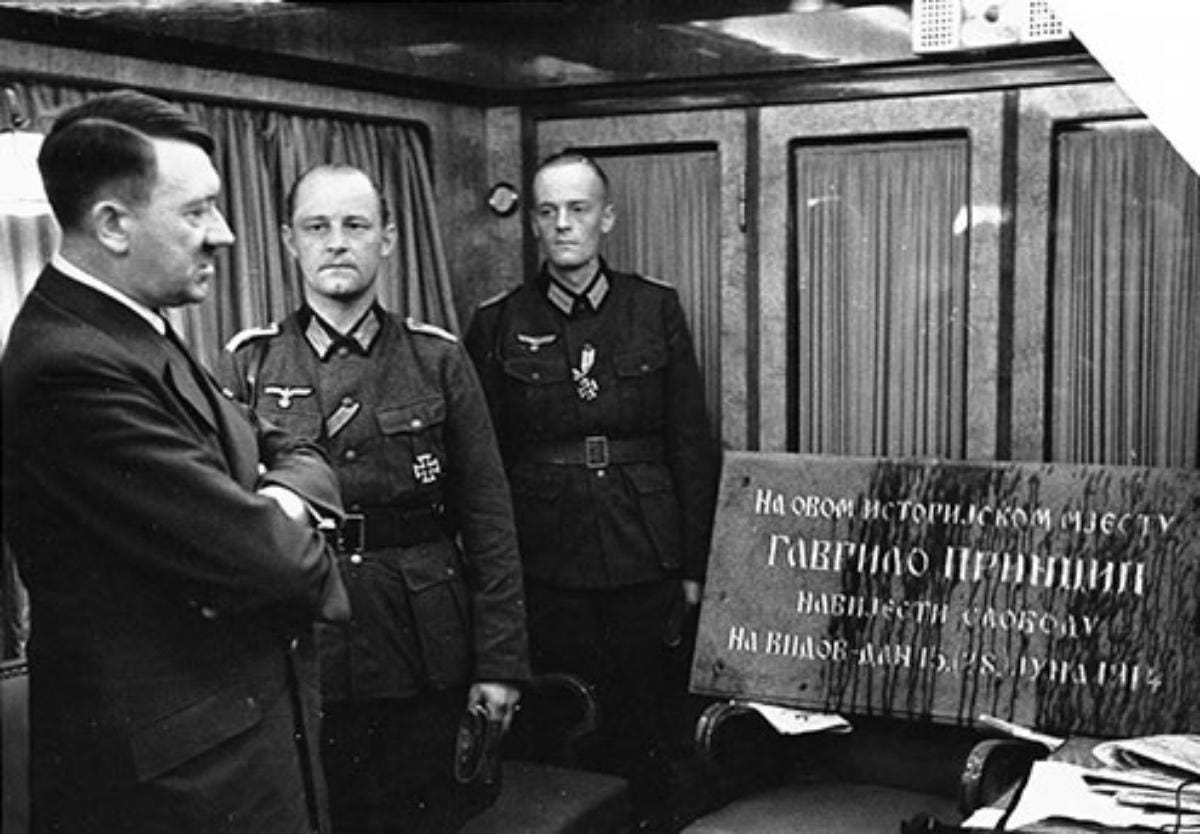
In post-World War I Yugoslavia, Princip was elevated to national hero. In early 1930, a plaque was erected on the site of Ferdinand’s assassination, celebrating a foundational event in the new country’s creation. It was the sole trophy claimed by the Nazis following the Axis invasion of Yugoslavia, presented to Adolf Hitler at a formal ceremony on his 52nd birthday in April 1941, two days after Belgrade’s surrender. A potent totem of German embarrassment expunged, it was now time to erase Yugoslavia permanently
Adolf Hitler inspects the plundered plaque commemorating Archduke Ferdinand’s assassination by Gavrilo Princip
Carving up the country relied heavily on constructing genocidal, ethnonationalist puppet entities. Painful memories of these attempts to exert hegemony over the Balkans under the banner of “self-determination” remained visceral for many residents of Yugoslavia in December 1991. Then, newly-reunified Germany unilaterally recognised federation members Croatia and Slovenia as ‘independent’ states, while encouraging other republics comprising the collapsing country to follow the pair’s secessionist lead. It was widely predicted Yugoslavia’s demise would produce bloodshed, on a grand scale.
‘Fundamental Subordination’
Dissolving Yugoslavia began waging war on Croat and Slovene secessionists six months earlier. The latter conflict lasted just 10 days, but the former was still simmering. The European Community and UN futilely struggled all along to achieve peaceful settlements to Yugoslavia’s gravely worsening crisis, while formally committed to preserving the country in some form. Berlin’s recognition summarily sabotaged those efforts, removing any incentive for Yugoslav republics to negotiate their futures with Belgrade, while emboldening nationalists in every republic.
Fears of Berlin’s resurgent imperialism were not confined to Yugoslavia. As TIMEcontemporaneously observed, “it used to be a given of European political life Germany…would not take a leading or controversial role in world affairs,” which “suited its neighbors very well indeed.” While occupied West Germany operated throughout the Cold War as “an economic giant and a political dwarf,” unified Berlin’s “unexpected show of diplomatic muscle” in recognising Croatia and Slovenia as ‘independent’ countries was now causing “discomfort” throughout Western capitals.
In Britain’s parliament, then-Foreign Secretary Douglas Hurd explicitly evoked the World Wars as disquieting precedents for Germany’s modern-day “self-determination” push in the soon-to-be former Yugoslavia. “There is a tradition of the main states of Western Europe splitting in rivalry on these Balkan questions, and this all ending up on the battlefield. I don’t think that tradition is a good one,” Hurd cautioned. Washington, immensely irritated by Berlin belligerently “getting out ahead of the US,” duly assumed management of the Yugoslav crisis, with disastrous consequences.
Fratricidal conflicts that subsequently engulfed Yugoslavia forged a highly invasive beachhead, via which German economic and political hegemony throughout the region surged, without direct military engagement. While Berlin framed her support for Croat and Slovene ‘independence’ in terms of human rights, the rich financial rewards of shattering the federation were plain. As by far the two wealthiest republics, Germany effectively granted herself access to “the best productive assets” in the soon-to-be former country by kickstarting its practical and physical collapse, per a 2008 academic paper.
The authors write of how Berlin’s “hegemonic relationship” with Yugoslav successor nations was thereafter writ considerably larger than even Germany’s imperial infiltration of “smaller states” elsewhere in Central and Eastern Europe. This is due to the “specific dependence” of Balkan countries on Berlin’s “structural power”. In economic terms, this means vast national trade deficits with Germany across the region, with “Balkan pre-products and raw materials” flowing in vast, constant profusion to Berlin, while German corporations and products dominate many commercial, financial and industrial sectors locally.
Undergirding this extraordinary economic colonisation was adoption by Yugoslavia’s successor states of ‘independent’ currencies, pegged first to the former Deutschmark, now Euro. This proved pivotal to the “fundamental subordination of the political economies of the region to the ideological and operational norms” of the EU – or German empire, via other means. New national and private banking systems of post-Yugoslav countries were structured specifically according to Berlin’s own, with German banks ascendant, as elsewhere in Central and Eastern Europe. That’s not all:
[Deutschmark/Euro pegging] was an essential precondition for the shaping of the macro-economic policies of these (and other transition) states, for their foreign economic relationships, for the further development of their capital markets and the programmes of liberalisation, deregulation and privatisation which ensued
‘European Continent’
Berlin’s Balkan banking takeover moreover fundamentally “facilitates the penetration of all German enterprises into the commercial life of the Balkan economies.” Berlin has gluttonously feasted on local resources and industry alike ever since, its investment regionally “characterised by takeovers.” For example, throughout Central and Eastern Europe German supermarkets are a near-monopoly, with prices of goods frequently higher than back home, despite meagre local purchasing power. Low wages, vast structural unemployment, and mass brain drain are all interlinked, ruinous inheritances.
The Balkans’ Western “transition” has been far more destructive than even the horrors unleashed upon the former Warsaw Pact in the 1990s. Heavily influenced “by prescriptive programmes emanating from the EU and from the World Bank,” Brussels has since 1999 also been “actively involved” in advising and guiding every country in the region towards bloc membership. After so much imposed impoverishment, it isn’t precisely clear what meaningful benefits Balkan states or populations will reap from their vassalage under German imperialism becoming formalised.
In late 2019, a Balkan liberal who once eagerly supported their country joining the EU wrote a sorrowful ode to “the process of so-called integration” Yugoslav successor states suffered by adopting “measures”, “instruments”, and “reforms” dictated by “Western technocrats”. Freshly ‘independent’ countries “were expected to build a fully developed Western liberal democracy from scratch…upon the ruins of a different yet fully developed system…while dragging behind us the burden of deepening poverty and trauma.” Several were and remain deeply scarred by Berlin and Brussels-encouraged ‘independence’ wars.
However, “this excruciating process of destroying and building anew a whole system…went neither fast enough nor successfully enough” for the new German empire. What’s more, “competition was not fair” – “opening our markets to the developed capitalism of the West and undertaking neoliberal reforms drained our human and economic resources while we kept trying to stay apace.” Socialism’s vestiges were eradicated, state industries sold off, and social spending slashed. The op-ed mysteriously failed to mention how Germany’s contemporary Balkan economic assault has a “strong security dimension”
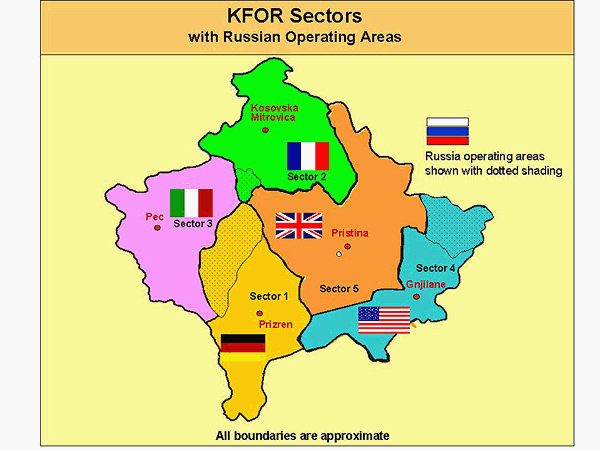
Kosovo’s original KFOR occupation map, June 1999
The 2008 paper notes Berlin exerts direct colonial-style control across the region, for example via Bosnia and Herzegovina’s EU-chosen Office of the High Representative, which traditionally serves as Germany’s imperial viceroy in Sarajevo. Moreover, Berlin has always been a key contributor to NATO’s Kosovo peacekeeping force KFOR, sustaining a military occupation under which Pristina controversially declared independence from Serbia in February 2008. This summer, Washington’s KFOR contingent began departing Kosovo after 27 years.
Meanwhile, the Americans are openly signalling Bosnia’s abandonment, raising potentially urgent questions about the unified country’s future. In April, EU Commission Ursula von der Leyen made clear the EU and she personally intend to “[complete] the European continent so it does not fall under Russian, Turkish or Chinese influence,” in explicit reference to the former Yugoslavia. History shows us such declarations by German imperialists frequently result in world-threatening catastrophe. Meanwhile, “some damned foolish thing in the Balkans” could evidently today yet again trigger war [end]
this article is the product of visits to Russia I made in June and September 2026 where I met with senior Russian leaders, leading academics, and specialists in military and security issues
ce 11 novembre 2025 est l’occasion de souligner comme la façon dont l’Europe sacrifie les conscrits ukrainiens mobilisés de force rappelle le spectaculaire carnage de la 1ère guerre mondiale
leaked files show top UK military figures conspired to carry out the Kerch bridge bombing, covertly train “Gladio”-style stay-behind forces in Ukraine, and groom the British public for a drop in living standards caused by the proxy war against Russia
the Germans have bowed down to the US sabotage by Joe Biden administration of Nord Stream pipelines, only to end up with Donald Trump’s America First doctrine in economy and defense
son inspiration : racisme français atavique et désir jusqu’en Ukraine de réprimer la contestation sociale en France
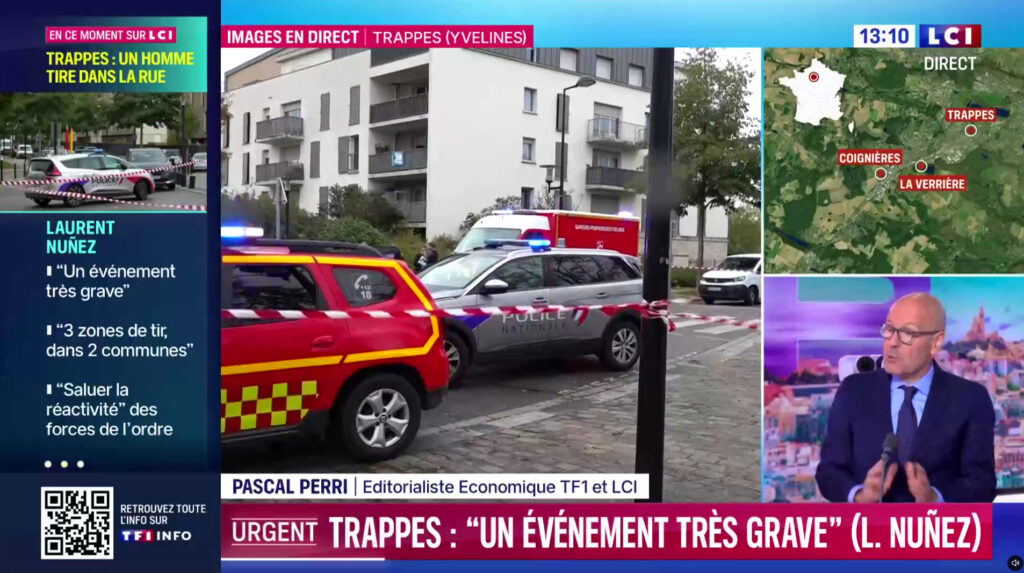
L’éditocrate néolibéral low-cost Pascal Perri est sur le plateau de LCI le 23 octobre 2026 (capture d’écran). Le drame stimule sa réflexion : Il m’est arrivé d’aller à Trappes […] je crois au passage que j’ai été le seul à payer le bus
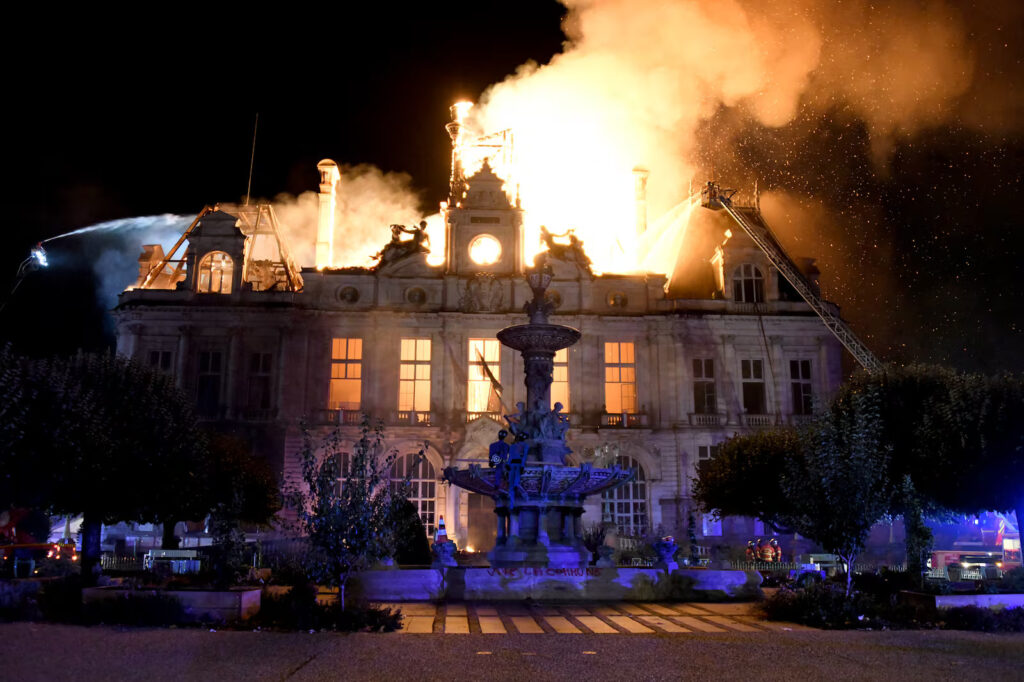
En octobre 2026, un mouvement social étudiant déferle en France et donne lieu à des échauffourées avec la Police nationale et des nervis fascistes.
Fondée par des revendications sociales étudiantes et plus largement, un rejet général d’Emmanuel Macron par la population, cette nouvelle vague de contestation est la manifestation ponctuelle de tensions qu’il engendre depuis des années, par son utilisation de la Constitution de la Ve République pour confisquer la démocratie. Il s’obstine depuis 2017 à appliquer son programme néolibéral, contre les aspirations de la majorité populaire
Vive la Commune [Paris, 1871] : l’hôtel de ville est en flammes à Limoges le 17 octobre 2026 (Pascal Lachenaud / AFP)
Comme toujours dans une telle situation, il ne modifie pas son agenda mondain et ne se prive pas de voyage à l’Étranger. Ses raisons ne sont pas seulement la crainte d’être pris et lynché mais aussi une façon de transcender. Car il s’est toujours servi de sa fonction comme d’un piédestal pour tenter de réaliser son perpétuel fantasme : briller sur la scène internationale. Les Français l’ont toujours ennuyé
Paris, 2 août 1940 (Mémorial de la déportation)
Il sont héritiers de Philippe Pétain -dirigeant fasciste français pendant la Seconde Guerre mondiale- et redevenus majoritaires à droite ; ils s’appellent Eric Zemmour, Marine Le Pen ou Bruno Retailleau ; les pétainistes ne veulent voir dans ces événements que la rébellion d’une population pauvre d’origines immigrées qui vit dans de laides banlieues. Dans la catégorie espoirs, la porte-parole du gouvernement se distingue le 20 octobre : la priorité de Maud Bregeon est alors de rétablir l’ordre, contre les factieux et les racailles. Porte-parole du gouvernement.
Au travers de leurs publications sur les réseaux sociaux, j’observe depuis 2022 les volontaires français dans l’armée atlantiste en Ukraine, où ils acquièrent une expérience du combat et pour les novices, la pratique des armes de guerre. Tous ne sont pas nazis, mais même un Gérald Darmanin aurait du mal à y trouver un quarteron de militants d’ultra-gauche
Voici quelques réactions particulières, que je pense représentatives du sentiment général dans ces rangs. Originaire de la banlieue de Valenciennes et ancien militaire dans l’armée français, Lucas Barraud est en Ukraine depuis 2025. Le 6 octobre, il partage une publication qui affirme que les contestataires seraient manipulés par Jean-Luc Mélenchon
Dans un registre assez proche, une de ses autres trouvailles est alors une pépite sans âge de bêtise réactionnaire crasse, qui célèbre l’ordre et moque Nahel Merzoug, qui à Nanterre, le 27 juin 2023, fut la victime d’un meurtre commis par Florian Menesplier, ancien militaire et archer du guet [gardien de la paix] parfaitement incompétent, qui n’a pas été révoqué et sévit aujourd’hui au Pays basque.
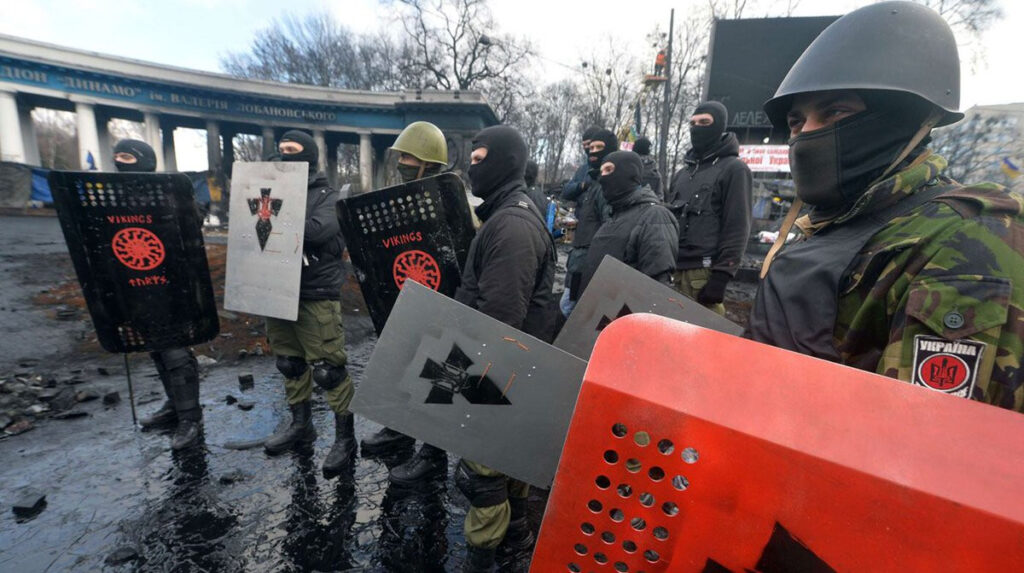
Militant nazi à Lyon, Gwendal Delange combat depuis 2022. L’association qu’il fait sur les réseaux sociaux de deux événements le rend euphorique le 13 octobre
Des émeutiers nazis sur la place Maïdan le 18 février 2014 (image partagée par Gwendal Delange)
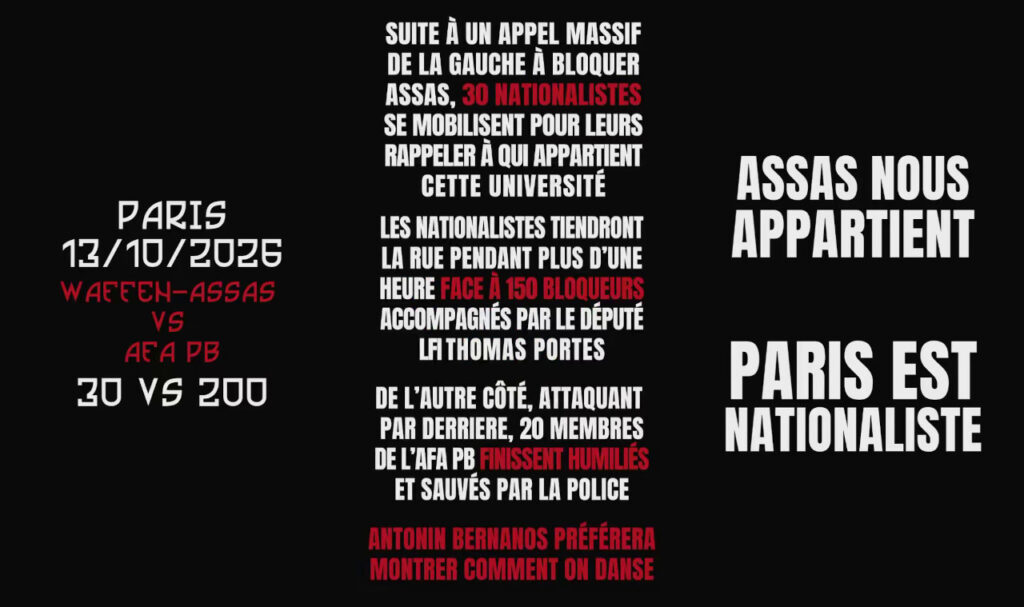
Le second événement est parisien, date de la nuit passée. Il célèbre là une échauffourée qui aurait laissé maître du terrain un groupe fasciste appelé Waffen-Assas.
Les antifas en font un récit contraire : les nazis n’ont du leur salut qu’à leur exfiltration par la Préfecture de police. Je sais depuis longtemps que Dieu aime les justes causes et les gros bataillons. D’expérience, je connais aussi les penchants politiques ataviques des archers du guet. Tout me porte à savoir qui ment
(Réseaux sociaux)
Nul ne peut reprocher à Delange de méconnaître l’Histoire sans fard de son pays. Par le partage le 17 octobre de cette image de milicienne, reconstituée sur drapeau officiel de l’État français (1940-1944) de Philippe Pétain, il exprime ses voeux pour 2027.
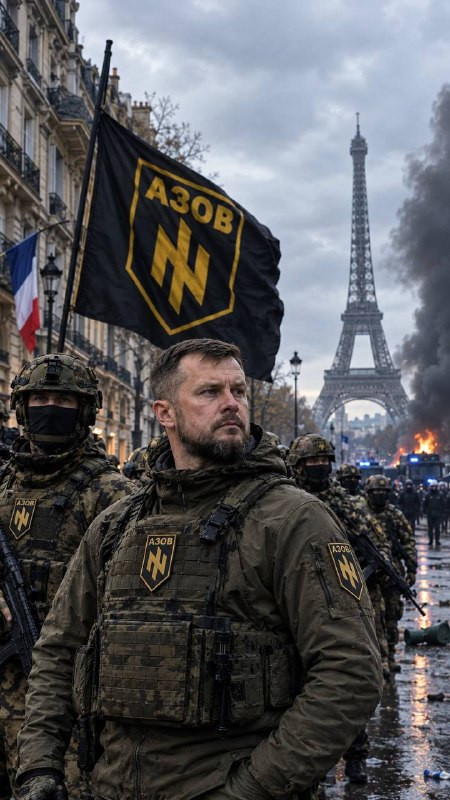
Sur Telegram le 20 octobre, une chaîne de footeux nazis européens partage l’image de son fantasme : un Einsatz à Paris d’Andriy Biletsky, commandant du 3e corps d’armée, émanation de l’organisation nazie Azov dans l’armée régulière ukrainienne
En Anglais, la légende dit en Français
La 3e brigade d’assaut pour rétablir l’ordre à Paris, en échange d’un approvisionnement illimité en armes, voilà une bonne affaire !
Mais en réalité, après une victoire ukrainienne, des vétérans peuvent aider à la Remigration en Europe. Il y a des milliers de soldats qui sont idéologiquement motivés et parfaits pour une sous-traitance
Au cas peu probable où les footeux ne connaissent pas encore Gwendal Delange, ils l’ont imaginé
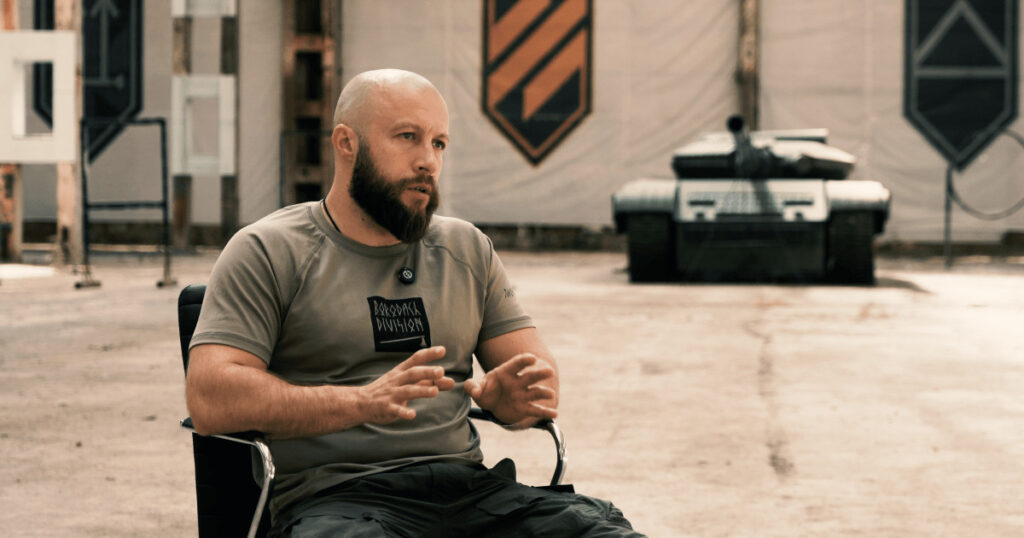
Maksym Zhorin lors d’un entretien publié le 2 septembre 2024 (online.ua)
Depuis plusieurs jours, des « manifestants » ont semé le chaos dans les rues françaises sans revendication concrète. Tout cela se passe dans le silence total des grands médias, qui sont toujours incapables d’identifier clairement les origines ethniques et religieuses des auteurs.
Tout cela est une conséquence de nombreuses années de promotion d’une idéologie libérale toxique. Les mots ne suffiront pas à surmonter cette crise ; seules des mesures fermes et radicales y parviendront. Pour survivre, l’Europe doit se souvenir de son histoire et de sa véritable essence, plutôt que de se prélasser dans une tolérance erronée
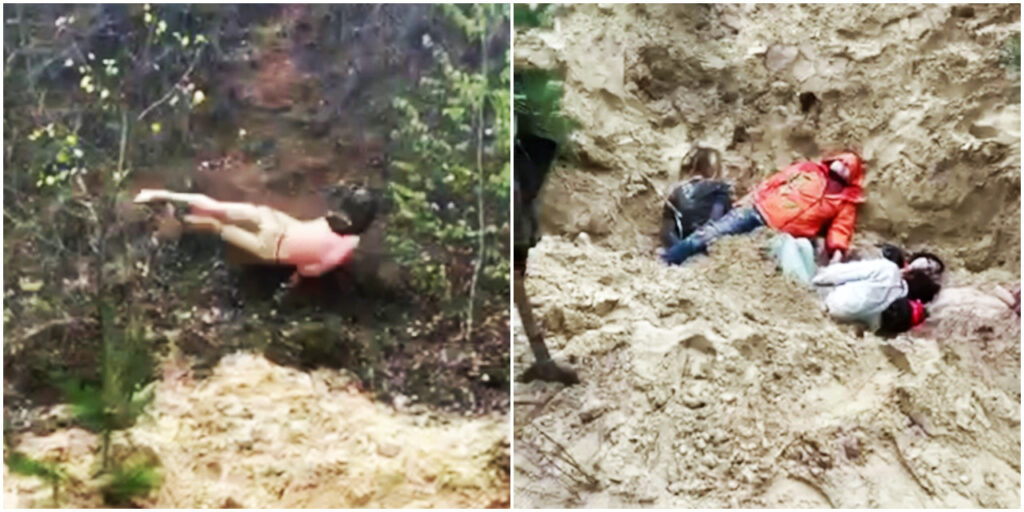
Massacre ukrainien de civils ennemis à Koupiansk le 9 octobre 2022 (Maksym Zhorin, captures d’écran)
Je déconseille à ce barbare de tenter quoi que ce soit en Corse. Le terrain y est rude. Il risque de verser des larmes de rage ou même d’y perdre la vie.
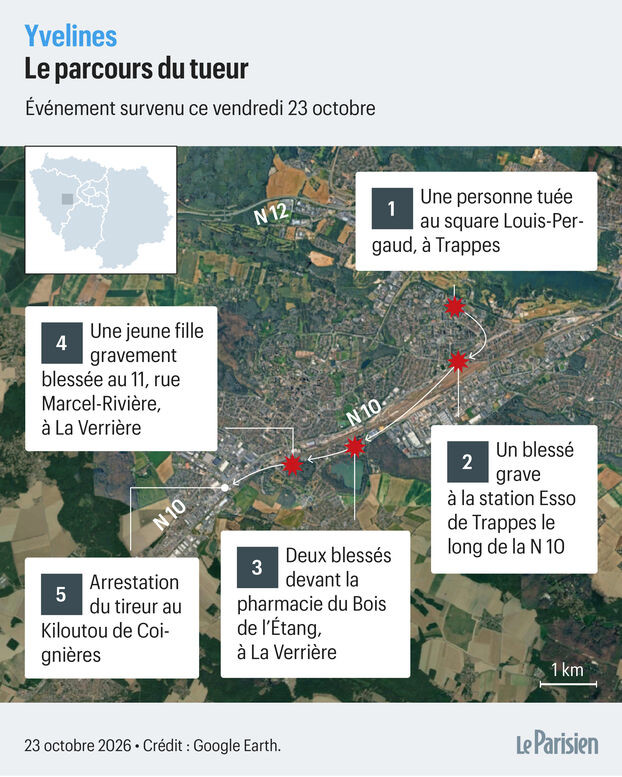
À l’instar de Maud Bregeon, il sait les reconnaître ; le 23 octobre, un terroriste raciste choisit ses victimes à leurs apparences, au fil de son itinéraire de Trappes à La Verrière, dans les Yvelines. Armé d’un pistolet-mitrailleur, il tue une personne et en blesse sept autres, dont touchée par huit balles, une enfant de 11 ans
(Le Parisien)
Aux policiers qui l’interpellent, il déclare s’être attaqué aux Noirs et aux Arabes pour venger les commerçants [pillés lors des manifestations du 17 octobre]
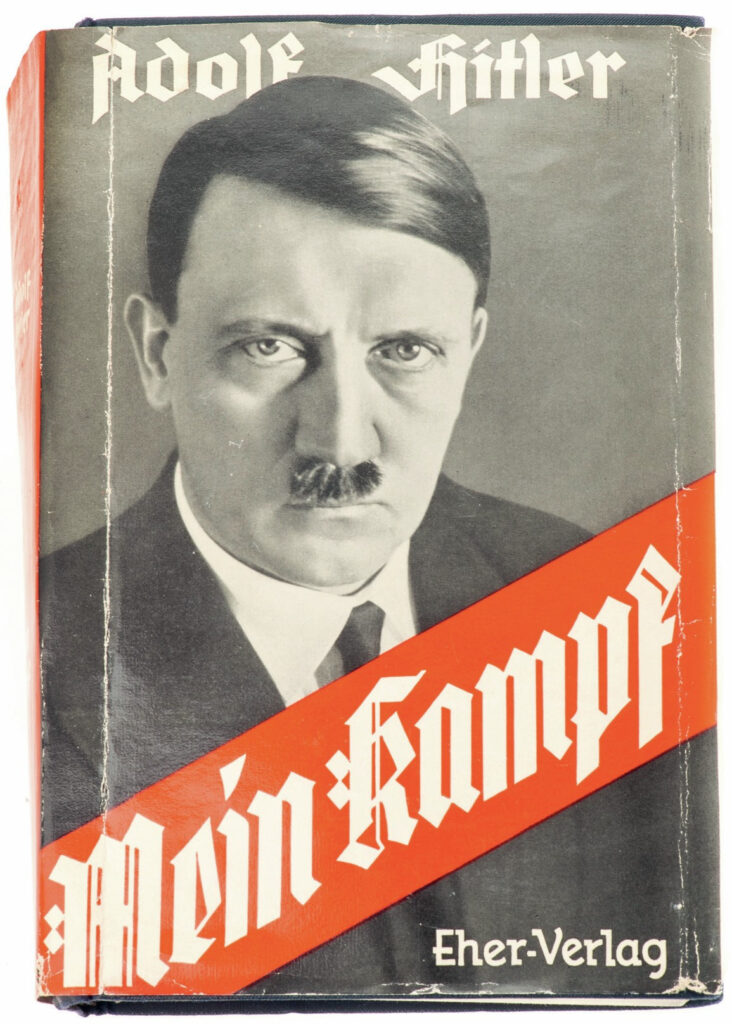
Une édition originale allemande
En perquisition à son domicile de Plaisir, les enquêteurs découvrent un exemplaire de Mein Kampf, le manifeste politique en 1925 d’Adolf Hitler (1889-1945), un artiste peintre autrichien qui devint plus tard le VRP à travers l’Europe des industriels allemands.
Le Toulousain sous pseudonyme Cafard Misanthrope est habituellement hostile aux bolcheviques et reproche au prolétariat de ne pas se retrousser les manches. Il est en Ukraine depuis 2023
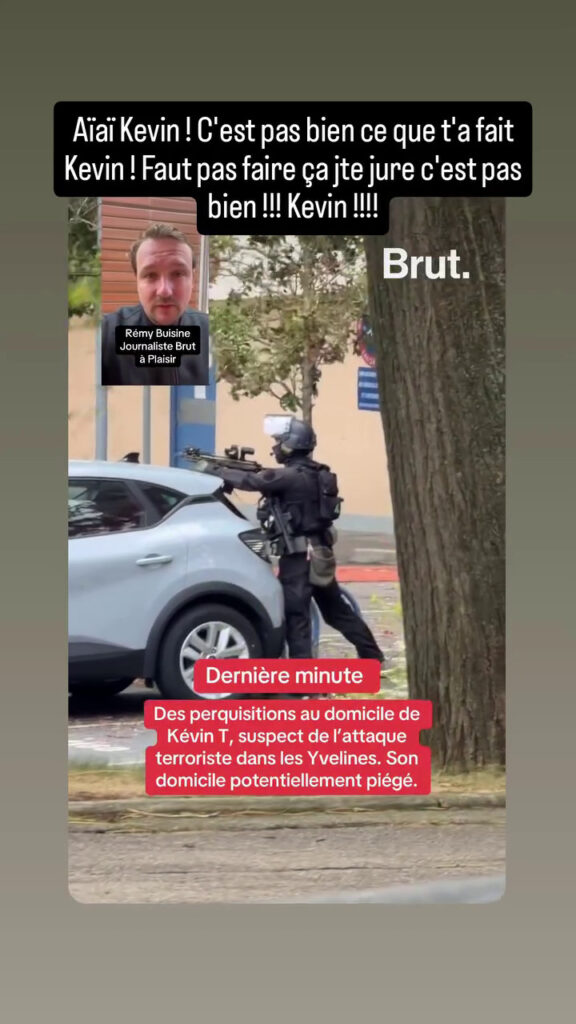
Commentaire par surimpression d’un reportage à Plaisir de Rémy Buisine (capture d’écran)
Alors que ses camarades adoptent plutôt un profil bas en ces circonstances, lui opte le 23 octobre pour un second degré qui raille sur les réseaux sociaux les victimes de l’attaque terroriste.
À l’exception d’Eric Zemmour, qui reste cohérent et a la décence de se taire, la quasi totalité des personnalités politiques françaises se dispute immédiatement le micro pour exprimer son atterrement petit-bourgeois. Quelques beaux exemples d’hypocrisie politicienne.
Alors que pour évaluation d’une éventuelle schizophrénie, le terroriste est le 25 octobre en observation à l’Infirmerie psychiatrique de la Préfecture de police (I3P), une vidéo se répand sur les réseaux sociaux
J’ai flouté les visages des victimes (captures d’écran)
Elle fut enregistrée le 23 par une caméra de surveillance de la station ESSO de Trappes. Calme et méthodique, il veut achever à l’entrée un homme déjà blessé, mais son chargeur est vide. Il ramasse alors au sol une cartouche qu’il engage dans la chambre et à bout portant, tire à nouveau sur le Marocain Ahmed Chihi.
En début de mois, le suprémaciste des corons Lucas Barraud plaisanta au sujet de Nahel Merzoug, adolescent tué en 2023, à 17 ans
(Capture d’écran)
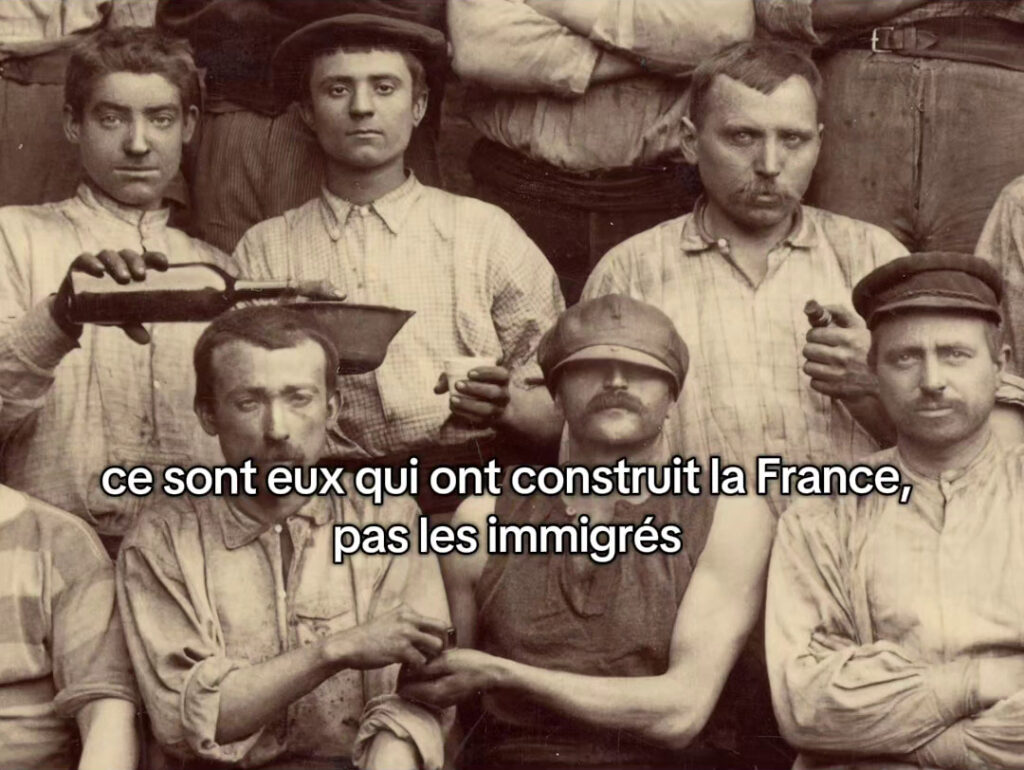
L’attaque raciste des Yvelines le fait réfléchir. Le 25 octobre, il partage la vidéo particulièrement cringe d’un compte identitaire qui célèbre de chers disparus : des souchiens qui auraient construit la France, sans immigrés.
Des journalistes ont enquêté et commencent à dresser le 26 octobre une biographie sommaire du terroriste. En quête de relations sociales et en raison de leur proximité, il a fréquenté dans les années 2010 des groupes écologiste ou pro-Palestine. Mais son racisme l’en exclut. En 2022, il exprima sans ambiguïté son intention de voter pour le Rassemblement national, parti pétainiste de Marine Le Pen, cofondé en 1972 par un ancien caporal de Waffen SS.
Pétainiste du canal Les Républicains, Georges Mothron est maire d’Argenteuil. Le même jour, il fait fermer en dernière minute les grilles de la mairie, afin d’empêcher un rassemblement sur le parvis
contre la haine raciste et l’islamophobie et en soutien à toutes les victimes de l’attentat raciste de Trappes
que des élus d’opposition ont organisé
(Réseaux sociaux)
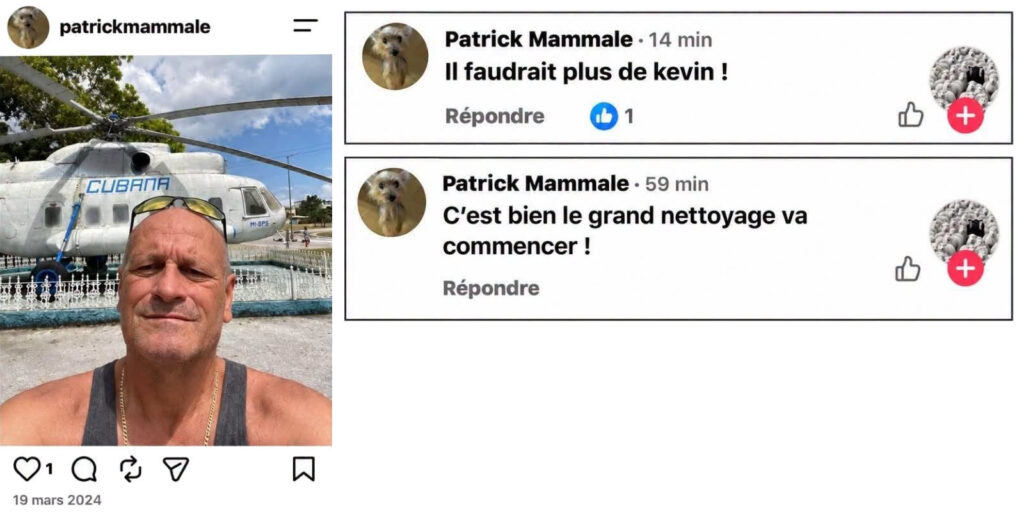
Toujours le 26, un colon pinzutu [Français, en Corse] en Martinique, Patrick Mammale, est jugé en comparution immédiate et condamné à douze mois de prison, dont huit ferme. Il n’a pas su garder profil bas et a rendu hommage sur Facebook au tueur raciste. La peine est assortie d’une trique [interdiction de séjour] de trois ans sur l’île des Caraïbes. Sois prudent, César Aujard
La France a peur. La frousse est le sentiment le plus répandu et fréquent parmi les Français. Leur patriotisme est souvent une tentative de la conjurer. C’est elle qui contribua à la volonté du terroriste de cribler de balles une enfant de 11 ans et d’achever au sol un homme déjà blessé (Mediapart)
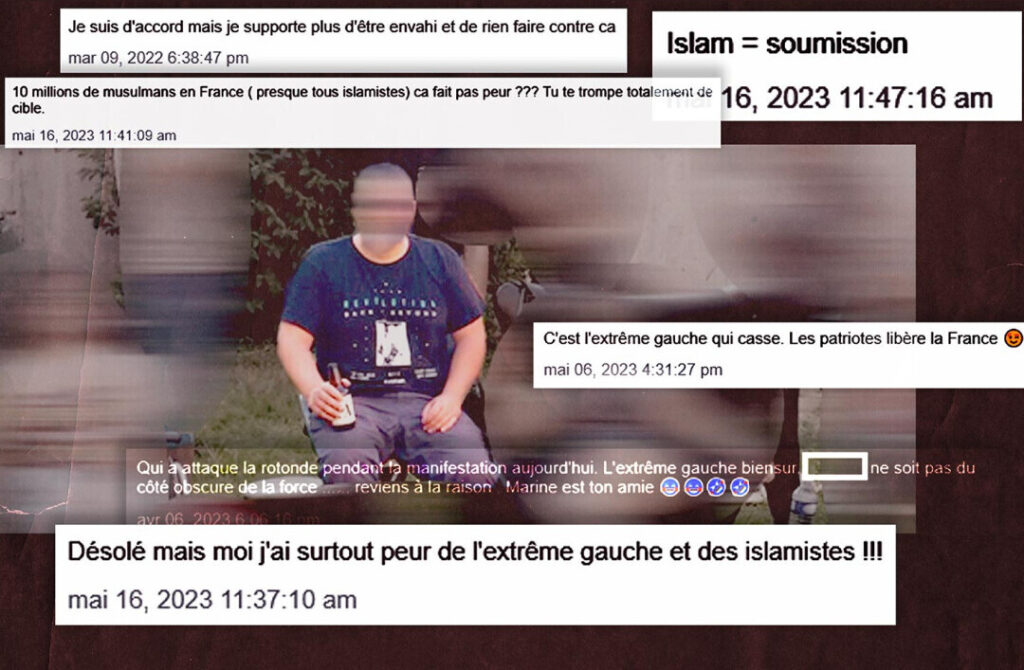
Mediapart publie le 27 octobre les résultats de ses investigations sur les réseaux sociaux : depuis plusieurs années, le terroriste exprimait son racisme, son islamophobie et son adhésion à l’idéologie pétainiste de Marine Le Pen. Les bras m’en tombent.
Le même jour, l’Assemblée nationale rend hommage aux victimes. Avec la vulgarité et l’indécence qui caractérise tant la petite bourgeoisie française de droite, le Premier ministre Sébastien Lecornu se sent obligé de mettre en parallèle le militant nazi Quentin Deranque, décédé à Lyon le 14 février, à 23 ans, des suites de blessures reçues dans une échauffourée que provoqua son groupe de nervis, lors d’une conférence de Rima Hassan sur la Palestine
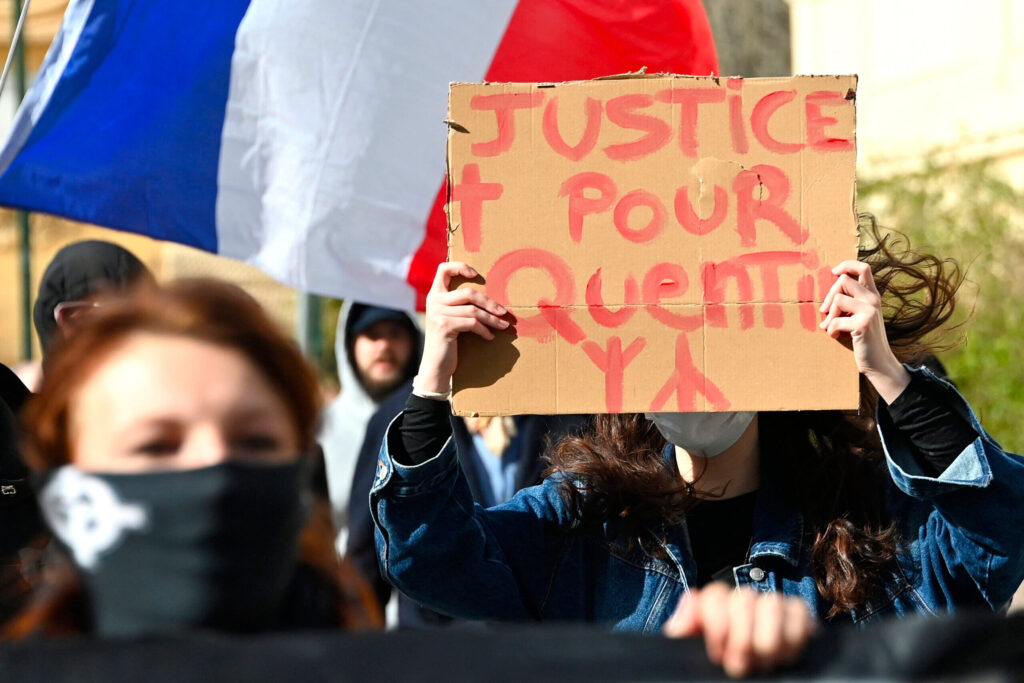
À Montpellier, dans un rassemblement en hommage à Quentin Deranque le 15 février 2026, une pancarte demande justice (Sylvain Thomas / AFP). L’observateur expérimenté y remarque la rune Algiz et à côté, la même renversée -la Todesrune– que les SS et nul avant eux, employaient comme symbole du décès
Certes, ce fut à l’instigation de la même mouvance pétainiste et avec la complaisance likoudnik de Yaël Braun Pivet, que la même assemblée lui rendit aussi hommage le 17 février. Si je l’interrogeais, je chercherais à évaluer comme la révérence des godillots à un militant nazi en février a pu armer le terroriste en octobre.
À Dresde, le 22 février 2026, ce fut en musique que des militants nazis allemands honorèrent Quentin Deranque
Dreiundzwanzig Jahre Quentin war einer von uns Er kämpfte für sein Vaterland mit Brüdern Für die Freiheit und die Rekonquista von Europa Wie Kreuzritter in Tolosa Nur im den Hinterhalt zu schlagen Una cosa gloriosa
Listen, I shout it out to every European brother Be loud, be proud, we fight for each other So many more died to illegals or antifa We’ll never forget our revenge It is getting ya
Raus auf die Straße, Blaulichtattacke Trau dich und mache mit Gesicht oder Maske Die Kameraden sterben auch für dich, also erwache Auch mich kann es treffen Unsere Pflicht ist jetzt Rache
Zusammen streiten, zusammen kämpfen Durch dunkle Zeiten,wir bis zum Ende Wegbereiter werden Legenden Ihr Heldennut lebt in uns weiter
Candidat à la réclusion criminelle à perpétuité, Kevin Tessier, 39 ans, est déféré le 28 octobre au dépôt du Tribunal de Paris, pour sa mise en examen ultérieure par un juge d’instruction du pôle antiterroriste
Kevin Tessier (réseaux sociaux)
Jeune officier dans l’armée de Louis XVI et Corse résolument paoliste, un certain Napoleone Buonaparte écrivit dans les années 1780
Féroces et lâches, les Français joignent aux vices des Germains, ceux des Gaulois. C’est le peuple le plus hideux qui ait jamais existé
Hélas, dévoré par son ambition personnelle et conscient de ce que ses qualités lui permettaient d’accomplir parmi ces Français, il a mal tourné dans les années 1790. Emmanuel Macron, en revanche, est dépourvu de talent
Cela n’est pas un faux ; ce livre fut réellement publié en novembre 2017
Mes pauvres pinzuti, vous n’êtes pas sortis d’affaire. Vous aurez beau faire des petits bonds de cabris, à dénoncer la haine, haine, haine, cela ne réglera pas vos problèmes, car vous êtes dépourvus du courage de les affronter. Vous avez été élevés dans la compromission et les petits arrangements d’alcôve. Vous adorez vous gargariser de vains mots et croyez que vos institutions auraient la propriété magique de transformer des vessies en lanternes. Comment voulez vous être respectés dans les vastes restes du monde ?
est un morceau de choix. Je suis heureux de l’avoir découvert. Le Dauphinois a été éduqué à Vienne, Isère, puis Sciences Po Lyon et Saint Cyr, spécialité transmissions, à Rennes. Il a développé une carrière intéressante, jusqu’au grade de commandant, détaché observateur de l’ONU, l’OTAN et l’OSCE, officier de renseignement en Afghanistan, avocat militaire, pas un combattant mais néanmoins un homme de terrain. Il est par son expérience très proche des États-uniens, continue sans doute de fournir des rapports au renseignement français
sur Twitter le 30 mai 2023
Il vit déjà en Ukraine et fin février 2022, intègre une ONG, le Fonds ukrainien pour les volontaires internationaux (FUVI), comme consultant et chef des opérations
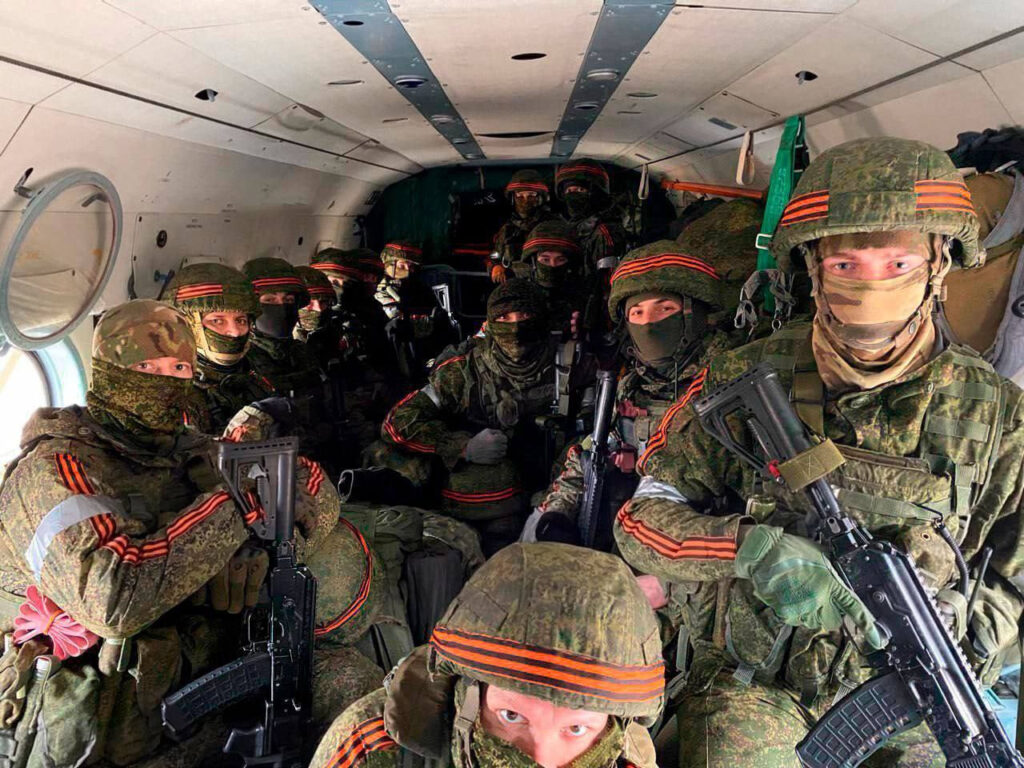
Au matin du 24 février 2022, par un assaut aéroporté, les parachutistes russes s’emparent de l’aéroport Antonov, à Gostomel, banlieue nord ouest de Kiev
Sur un plan plus personnel, Piguet serait de religion juive, car il brandit régulièrement l’argument ultime de sa propre judaïcité pour tenter de blanchir les organisations ukrainiennes clairement nazies, procédé trivial et fallacieux, qui s’adresse à des crétins. Sa propre pensée est fasciste, même délirante. Voici des extraits de sa prose sur LinkedIn, en février 2023
Les bolcheviks russes ont toujours persécuté les croyants en Dieu ainsi que les démocrates laïcs. Les Russes sont des païens issus de hordes impies qui adoraient la mort et pratiquaient le cannibalisme […] L’Ukraine, carrefour de nombreuses civilisations et influences brillantes […] C’est pourquoi les Ukrainiens sont beaux et ingénieux […] Honte aux barbares «Moskals»
Vous l’avez compris, ce partisan d’Emmanuel Macron est lui-même un crétin, comme le sont souvent les partisans d’Emmanuel Macron. Avec ce personnage, nous réalisons mieux comment l’OSCE, sous couvert de mission internationale impartiale, a pu contribuer au réglage de bombardements terroristes ukrainiens de la population du Donbass.
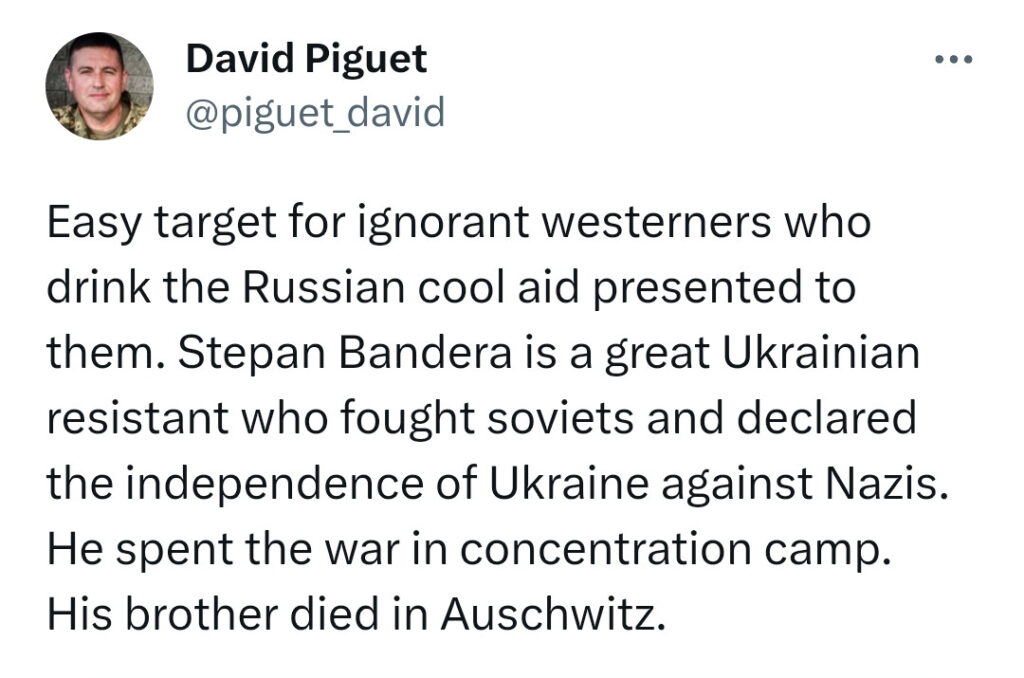
Il récidive le 16 mai par un tweet cosmique, pour encencer le criminel de guerre nazi ukrainien Stepan Bandera (1909-1959). Un tel révisionnisme relève du mensonge ou d’une inculture crasse, peut être des deux
Né dans l’empire austro-hongrois, Bandera était un militant nationaliste ukrainien, en territoire polonais après la 1ère guerre mondiale, lorsqu’il commandita l’assassinat en 1934 du premier ministre. Ce fut l’invasion allemande de septembre 1939 qui le libéra de prison. Il était le chef de la faction radicale et dominante de l’Organisation des nationalistes ukrainiens (OUN). Les plus modérés admiraient Benito Mussolini, les partisans de Bandera lui préféraient Adolf Hitler. Fasciste et raciste, partisan d’un État autoritaire, il ordonnait aussi
Moscovites [Russes], Polonais, Hongrois et Juifs sont vos ennemis, détruisez les !
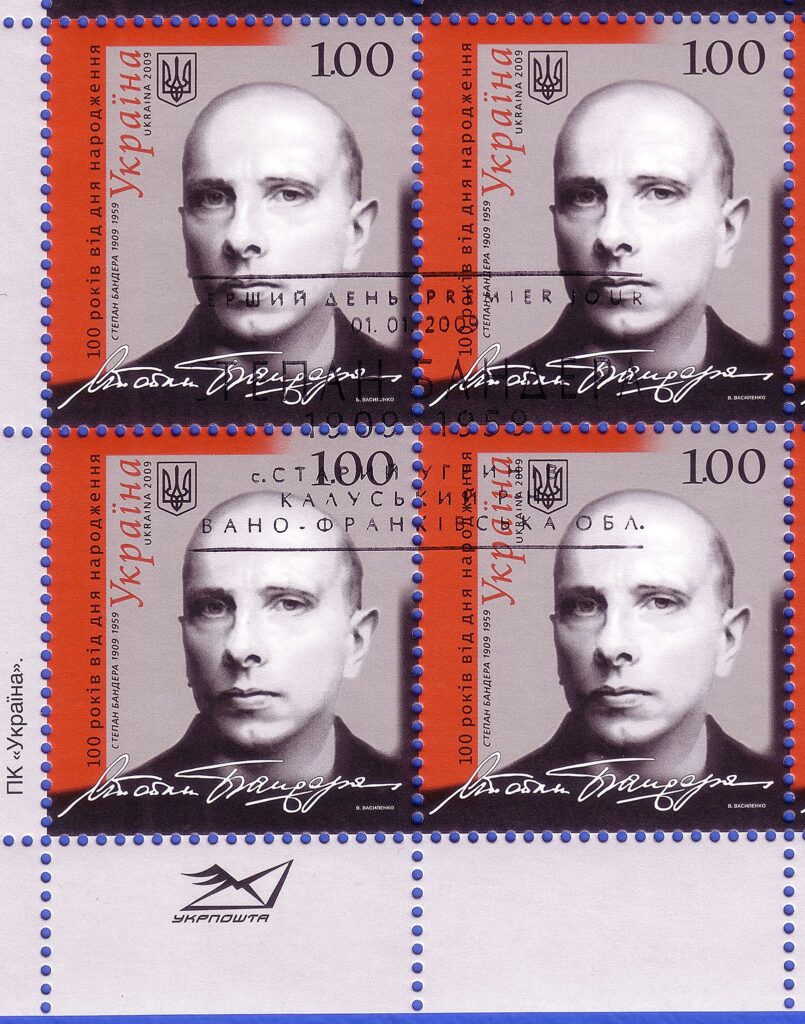
En 2009, pour le 100e anniversaire de sa naissance, Stepan Bandera est honoré par un timbre. Depuis la révolution orange de 2005 et avant la victoire démocratique de Viktor Ianoukovytch en 2010, le président de l’Ukraine est alors Viktor Iouchtchenko, pro-Occident
Son organisation a travaillé avec l’Abwehr [renseignement militaire allemand], pour fournir des bataillons de supplétifs ukrainiens aux armées du Reich, dans la perspective de l’invasion de l’Union soviétique en juin 1941
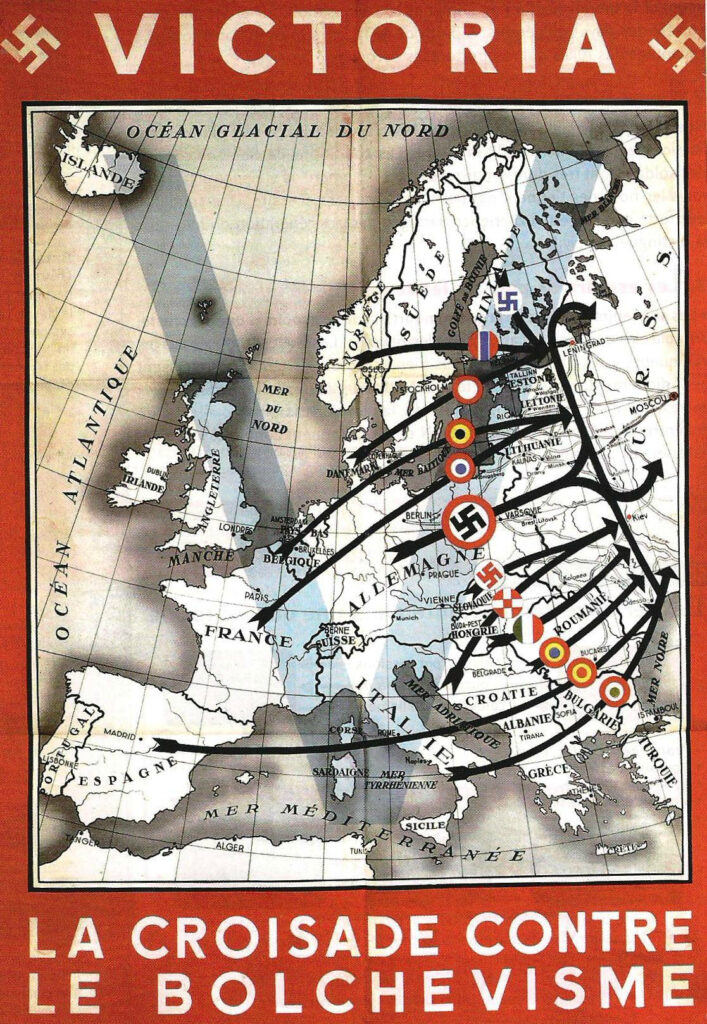
Affiche de propagande française en 1941
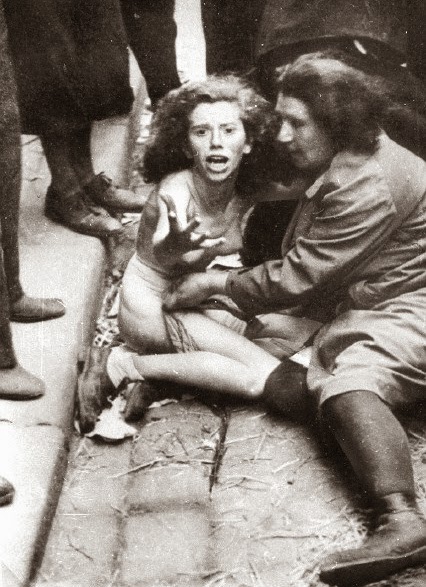
Ses partisans ont accueilli les envahisseurs en libérateurs et pour célébrer l’événement, massacré début juillet quelques 4 000 civils juifs dans la région de Lviv
Une victime juive des nationalistes ukrainiens à Lviv le 1er juillet 1941
Il demanda personnellement à Adolf Hitler de lui accorder l’indépendance d’un État fasciste ukrainien, allié de l’Allemagne nazie, qu’il déclara unilatéralement la semaine suivante. Cette initiative déplut et les Allemands ont temporairement interné Bandera, d’abord en résidence surveillée à Berlin, puis dans les quartiers VIP du camp de Sachsenhausen, où ses conditions de détention auraient fait rêver les travailleurs forcés. Piquet insulte les 84 000 victimes du camp de travail.
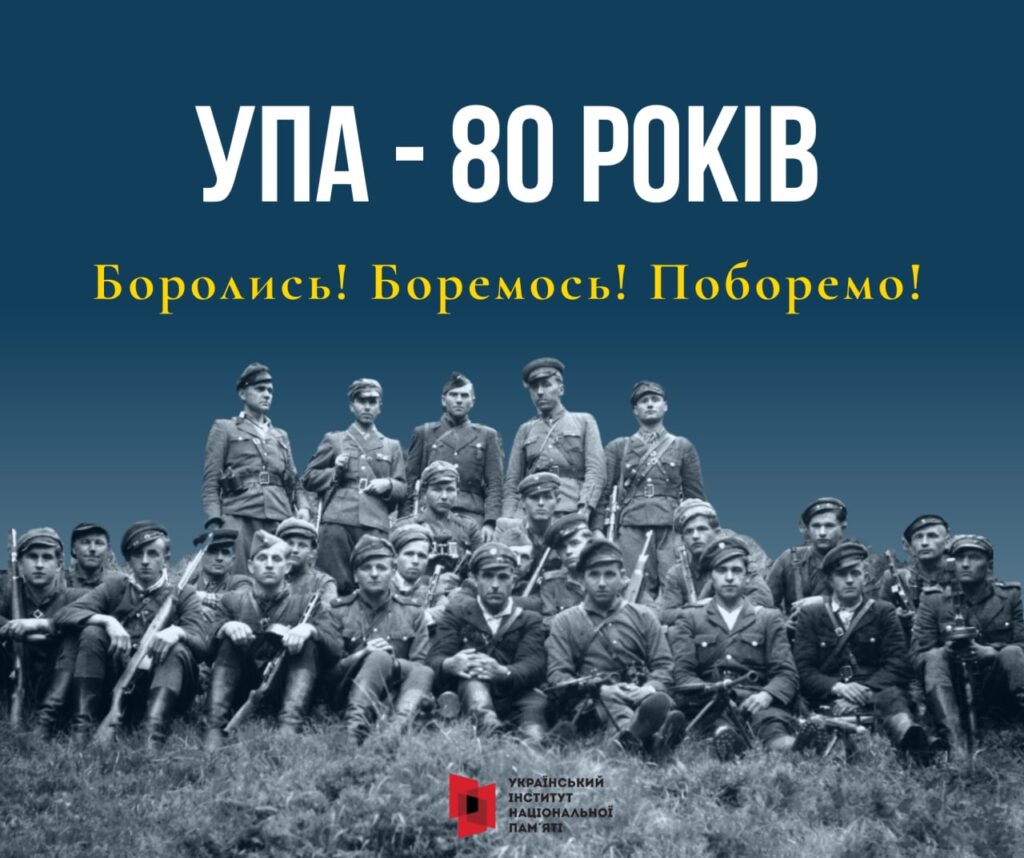
L’Armée insurgée ukrainienne (UPA), branche militaire de l’OUN, fut formée en octobre 1942. Contrairement à ce que suggèrent les propagandistes ukrainiens, elle n’a jamais affronté les forces d’occupation, mais conduit un nettoyage ethnique, avec la bienveillance des Allemands, le massacre entre 1943 et 1945 d’au moins 50 000, peut être 100 000 civils polonais
Depuis 2015, après Maïdan, l’État ukrainien célèbre chaque année, ici en 2022, l’anniversaire de la fondation en 1942 de la formation paramilitaire nazie UPA
Après la victoire soviétique à Stalingrad, l’OUN participa en novembre 1943, aux côtés d’autres organisations fascistes, hongroise et roumaine, à la fondation à Jytomyr du Comité des nations subjuguées (AUN), sous l’égide du Reichsministerium für die besetzten Ostgebiete [ministère impérial des territoires orientaux occupés] d’Alfred Rosenberg. En Avril 1944, l’adjoint de Bandera, Yaroslav Stetsko, rencontra l’Obersturmbannführer [lieutenant colonel SS] Otto Skorzeny, pour organiser la guérilla que l’UPA commençait à conduire derrière les lignes de l’Armée rouge victorieuse, que libre en septembre, Bandera appelait à combattre
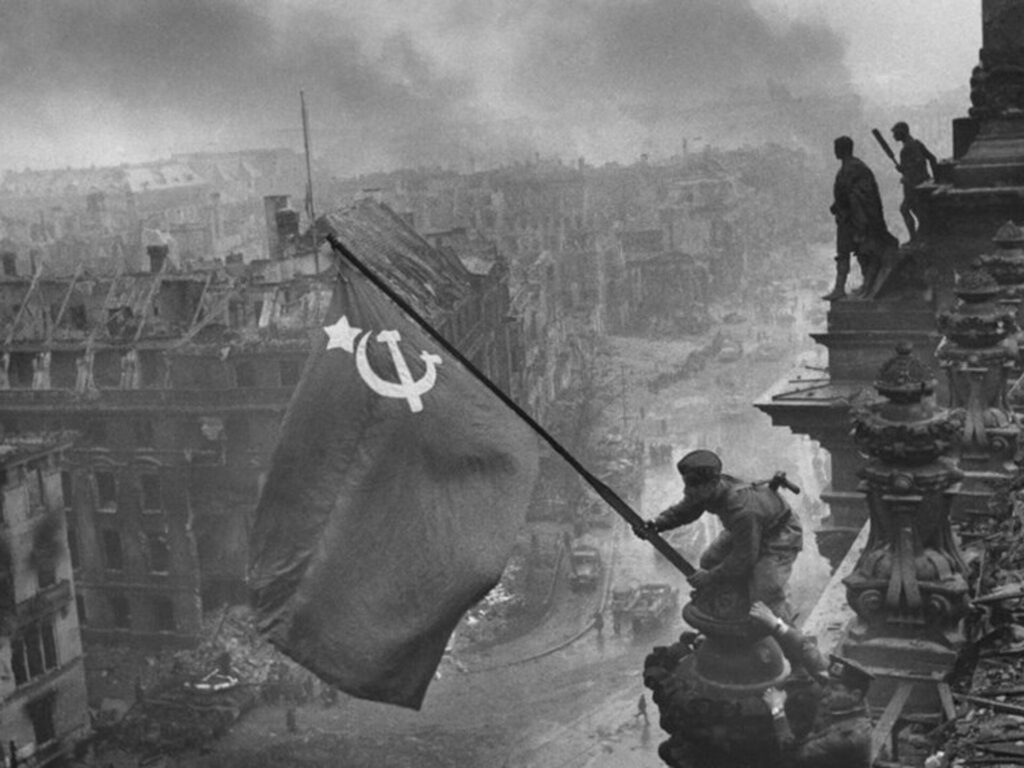
à Berlin le 2 mai 1945 (Evgueni Khaldeï)
Après la victoire alliée, dans laquelle l’Union soviétique a contribué à hauteur de 80% de toutes les pertes militaires allemandes de la 2de guerre mondiale, il s’est réfugié en Allemagne de l’ouest, sous la protection de groupes nazis clandestins et des services secrets anglo-états-uniens, car dorénavant sous leur houlette, l’UPA continuait à opérer en Ukraine soviétique. Le KGB parvint à le liquider à Munich en 1959. Ès-qualités, son ancien adjoint Yaroslav Stetsko, alors président du Bloc anti-bolchevique des nations (ABN), recyclage atlantiste de l’AUN nazi de 1943, fut reçu en 1983 par Ronald Reagan
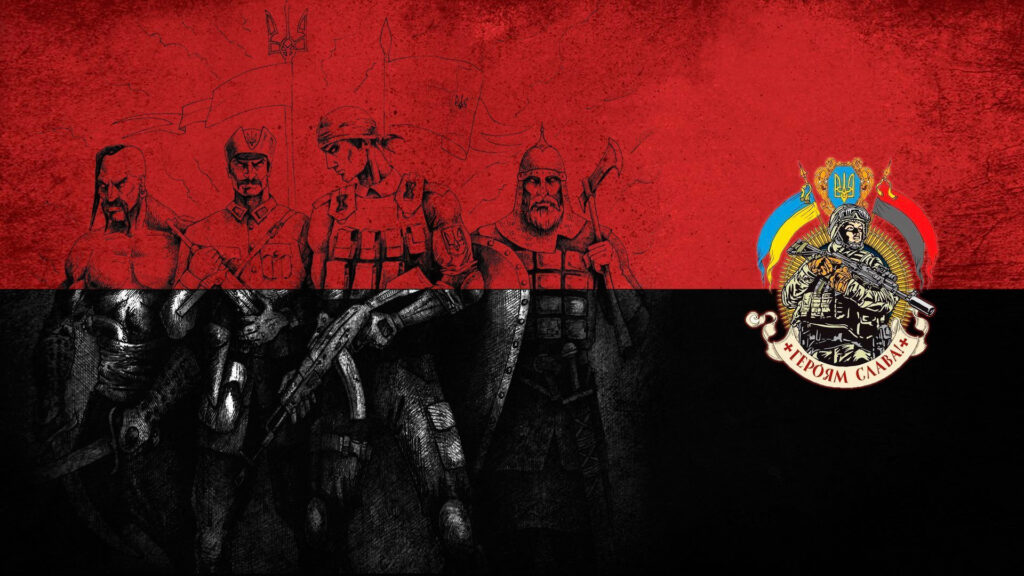
GLOIRE AUX HÉROS, slogan inauguré en avril 1941, parmi les fascistes ukrainiens de l’OUN, alors implantés dans le Generalgouvernementfür die besetzten polnischen Gebiete [Gouvernement général des territoires polonais occupés]. Cette image est le bandeau du compte Twitter de David Piguet
En qualité d’adversaire de hordes impies [les Russes], Piguet affiche, en bandeau de son compte Twitter, les couleurs rouge et noir de Pravyi sektor [Secteur droit], organisation nazie contemporaine, qui revendique son héritage de l’UPA, les bourreaux entre 1943 et 1945 d’au moins 50 000, peut être 100 000 civils polonais. Je m’intéresse toujours à l’essence historique des choses. Voici qui représente ce qu’il est profondément, par atavisme ou sinon, héritage génétique
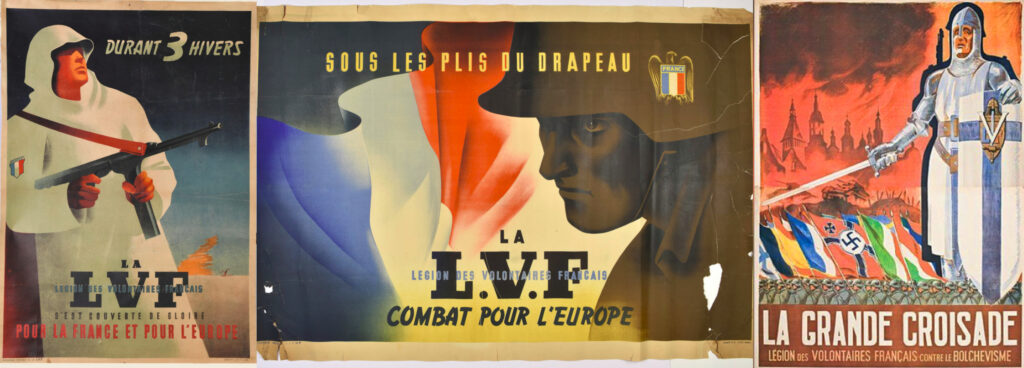
Affiches de propagande à partir de 1941 de la Légion des volontaires français contre le bolchevisme (LVF), un régiment de supplétifs français de la Wehrmacht
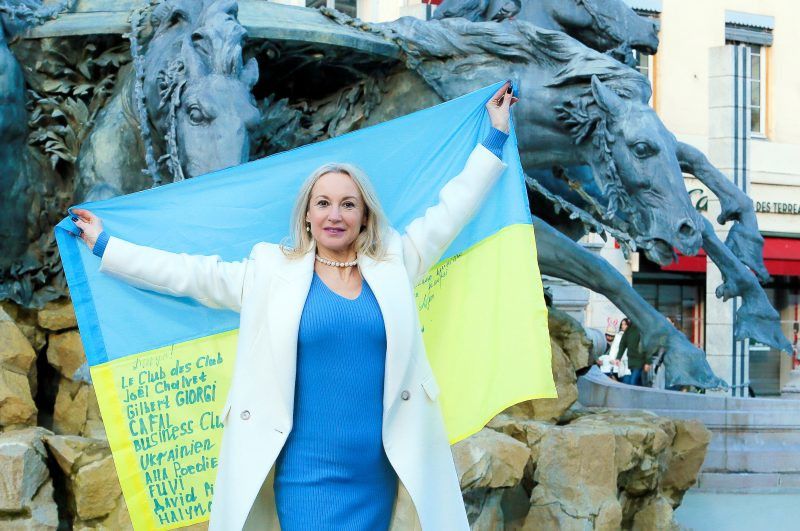
À l’approche début juin de la tant attendue contre-offensive, que la MOA occidentale impose à la chair à canon ukrainienne, il est le relais servile de la propagande la plus médiocre, partage fréquemment les élucubrations d’une certaine Alla Poedie, agitatrice ukrainienne hystérique, une sorte de Joseph Goebbels en jupons et aussi plus âgée, qui fait chauffeuse de salle sur LCI. Mais certains cordonniers sont les plus mal chaussés et je pense que le militaire est réellement surpris et déçu que la contre-offensive n’atteigne pas les objectifs annoncés par la cantinière d’Azov, car le débit de sa page Twitter se réduit à la mi-juin
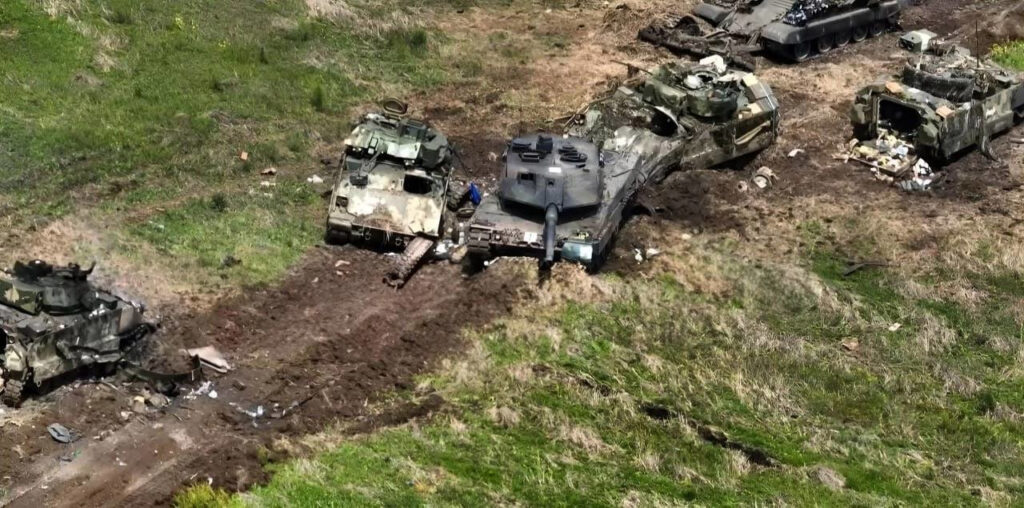
Dans le secteur de Rabotino, région de Zaporojie, un drone russe filme le 9 juin 2023 les carcasses de véhicules blindés atlantistes : un char allemand Leopard 2A6 et plusieurs véhicules de combat d’infanterie états-uniens Bradley (capture d’écran)
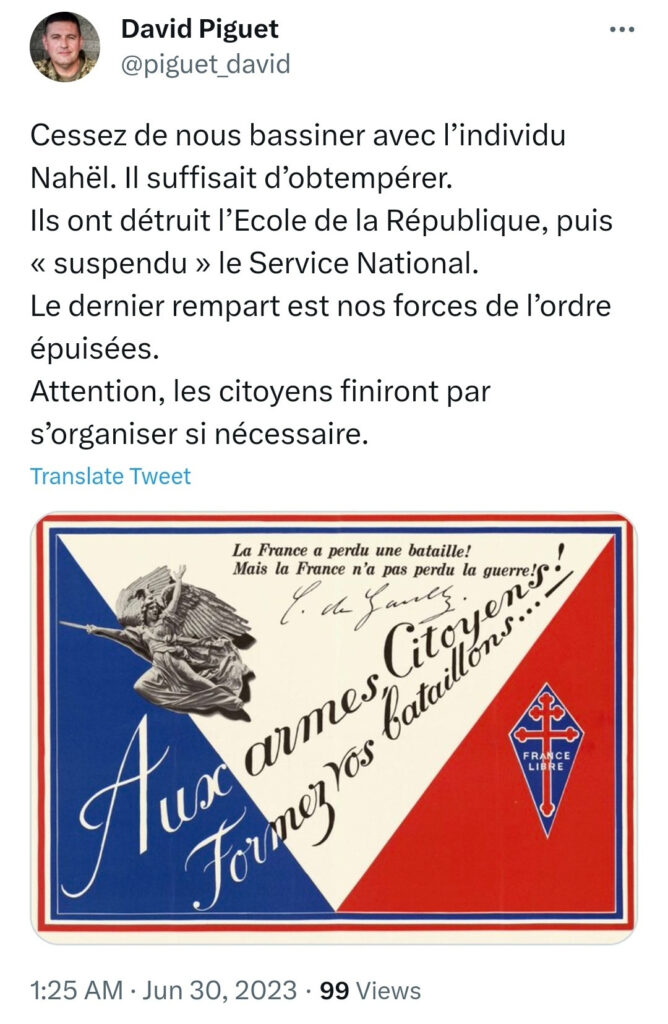
Les événements dans l’hexagone sont d’excellents tests pour évaluer le QI et le bagage culturel des individus répertoriés ici, mieux cerner leur idéologie. Piguet ne déçoit pas, les commente le 30 juin comme un specimen rare de beauf atavique, sinon congétinal, par un tweet grand-guignolesque, à l’inspiration cocardière tellement hilarante, qu’il n’est pas facile de se convaincre qu’il est au premier degré
Lui le commandant, con de militaire disait on autrefois, nie le caractère criminel d’un meurtre commis deux jours avant à Nanterre, par un archer du guet trop représentatif d’une Police nationale recrutée au rabais, formée à l’avenant et rongée par l’extrême-droite, qui s’illustre plus par ses bavures que par sa capacité à déjouer ou affronter des attaques terroristes. Il nous laisse quelque peu sur notre faim, ne précise pas qui ils sont ni contre quoi ou qui sert le rempart. Le courage n’est pas la qualité première du beauf.
En De quoi Sarkozy est il le nom, Alain Badiou écrivit en 2007 que le vichysme existait en France bien avant Philippe Pétain. Piguet est une splendide incarnation de cette France pétainiste, affiche comme couverture l’iconographie d’un gaullisme défunt, bosse pour l’OTAN, que Charles de Gaulle avait expulsée mais que Nicolas Sarkozy, fossoyeur du gaullisme, a réintégrée.
Dans un article du Figaro, le 24 juillet 2023, il fait l’intermédiaire entre les journalistes et le DUK (Dobrovolʹchyy ukrayinsʹkyy korpus, Corps des volontaires ukrainiens), branche armée du parti nazi Pravyi sektor [Secteur droit]. Il s’affiche en général le représentant international de la formation paramilitaire, qui en novembre 2022, est devenue la 67e brigade mécanisée de l’armée régulière.
Une telle accointance couronne son racisme, sa russophobie, son iconographie et son révisionnisme pour le criminel de guerre Stepan Bandera. Je fais le pari que si Volodomyr Zelenskyy n’avait pas interdit les partis de gauche et qu’ils avaient mobilisé un corps de volontaires, nous n’y aurions pas retrouvé Piguet
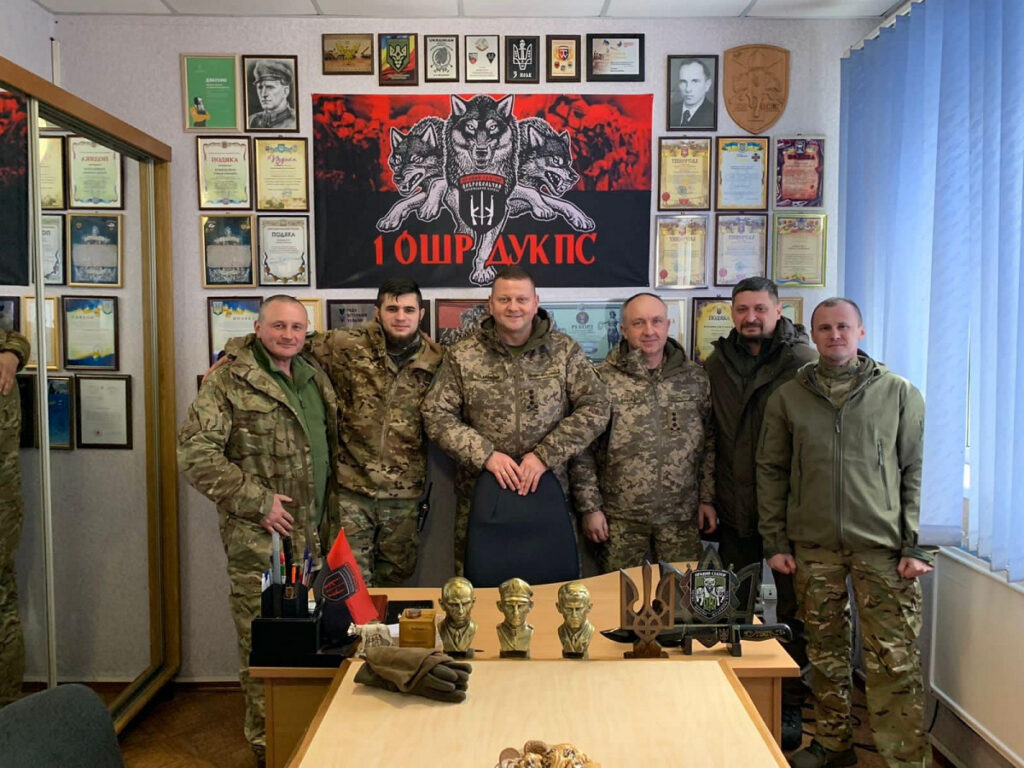
Le 28 janvier 2022, moins d’un mois avant le déclenchement de l’opération militaire spéciale russe, le chef d’état-major ukrainien, Valeri Zaloujny, troisième par la gauche, visite une garnison du DUK. Le bureau de son hôte est truffé d’hommages aux criminels de guerre nazis Stepan Bandera et Roman Choukhevytch. À la droite de Zaloujny, le commandant du 1er bataillon, Dmytro Kotsioubaïlo, sera dénazifié dans le secteur de Bakhmout le 7 mars 2023 (Valeri Zaloujny)
Son état ne s’améliore pas. Quelle peut en être la raison ? La défaite de l’OTAN en Ukraine ? L’alcool ? Avant 11:00 du matin, heure ukrainienne ?
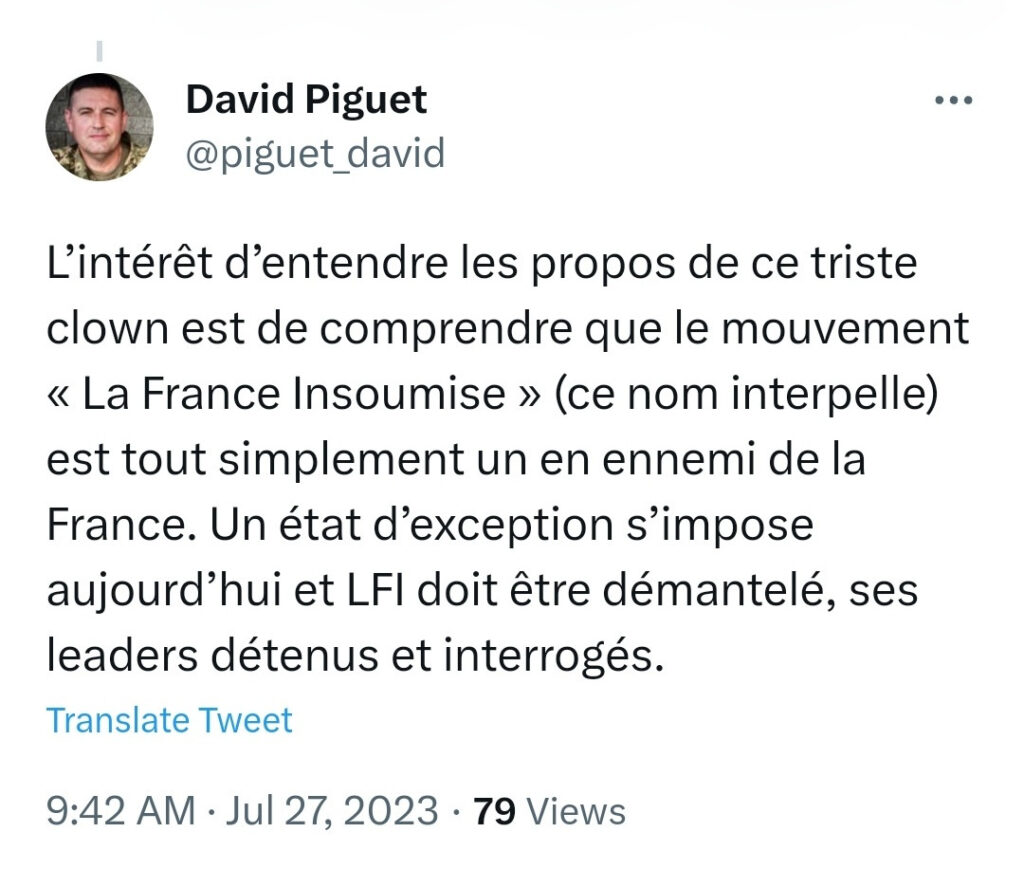
Voilà que depuis son Ostgebiet [territoire oriental] ukrainien, le demi-solde veut réprimer l’anti-France. État d’exception, arrestation des cadres de la France insoumise, sont les fantasmes d’un individu qui ne déroge pas à l’héritage de son engeance pétainiste. Et aussi les Sections spéciales ?
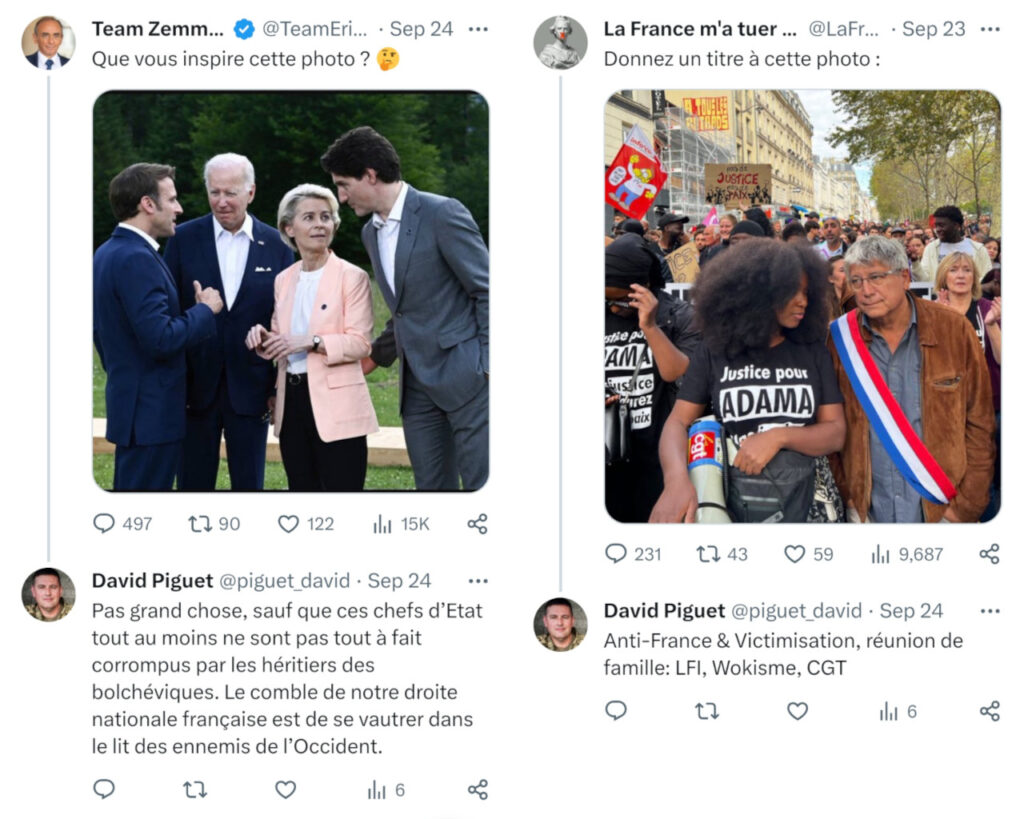
Il apparaît incontestablement comme l’intellectuel de ce panthéon, BHL mis à part. Deux messages consécutifs du 24 septembre 2023 sont tellement riches de mots clés, d’angoisses et de convictions, qu’ils réduisent à de la littérature les précédents paragraphes à son sujet. La conclusion s’impose, il est parfaitement à sa place dans les bagages de la 67e brigade mécanisée ukrainienne, ex DUK, branche militaire du parti nazi Pravyi sektor.
J’encourage tous les pétainistes à l’y rejoindre et à combattre pour l’Occident, jusqu’à la victoire ou la mort. Lui exalté, aime se photographier en treillis camouflé, mais planqué, quand des Ukrainiens encore plus âgés sont expédiés au casse-pipe, souvent contre leur volonté, il alimente sur Facebook, depuis le début de la folle contre-offensive, un mémorial très incomplet de personnels ukrainiens et étrangers qui ont été tués dans les rangs atlantistes. Et à moins de changer de cap à 360°, dirait Annalena Baerbock, il n’a pas fini de compter.
Je guettais avec impatience les premières réactions des gaîtés de l’escadron à l’attaque terroriste du 22 mars 2024, à Krasnogorsk, que les services secrets ukrainiens ont sous-traitée auprès de débris du Califat. C’est bien sûr David Piguet qui s’y colle et comme d’habitude, ne déçoit pas. Il ose partager le 25 un message sur X de l’hystérique Alla Poedie, qui prétend que les quatre individus présentés aux magistrats, après avoir été interpellés à la frontière de l’Ukraine, où ils tentaient de se réfugier, ne seraient pas les terroristes mais de pauvres boucs émissaires
Alla Poedie (Saby Maviel, pour LCI et Lyon People)
Piguet a quand même écrit sur son CV qu’il a été officier de renseignement pour l’OTAN. Mais il nous faut lui concéder que l’armée française s’est toujours débarrassée du rebut dans les organisations internationales telles qu’OTAN ou OSCE. À noter que Poedie était invitée à l’ambassade d’Ukraine le 16 janvier, lorsque BHL y reçut l’insigne local de Chevalier de l’Ordre du Mérite.
Pour combler ses lacunes, je signale à David Piguet que le 26 mars, Nikolaï Patrouchev, secrétaire du Conseil de sécurité de la fédération de Russie, répond Bien sûr l’Ukraine, aux journalistes qui lui demandent EI ou Ukraine ?
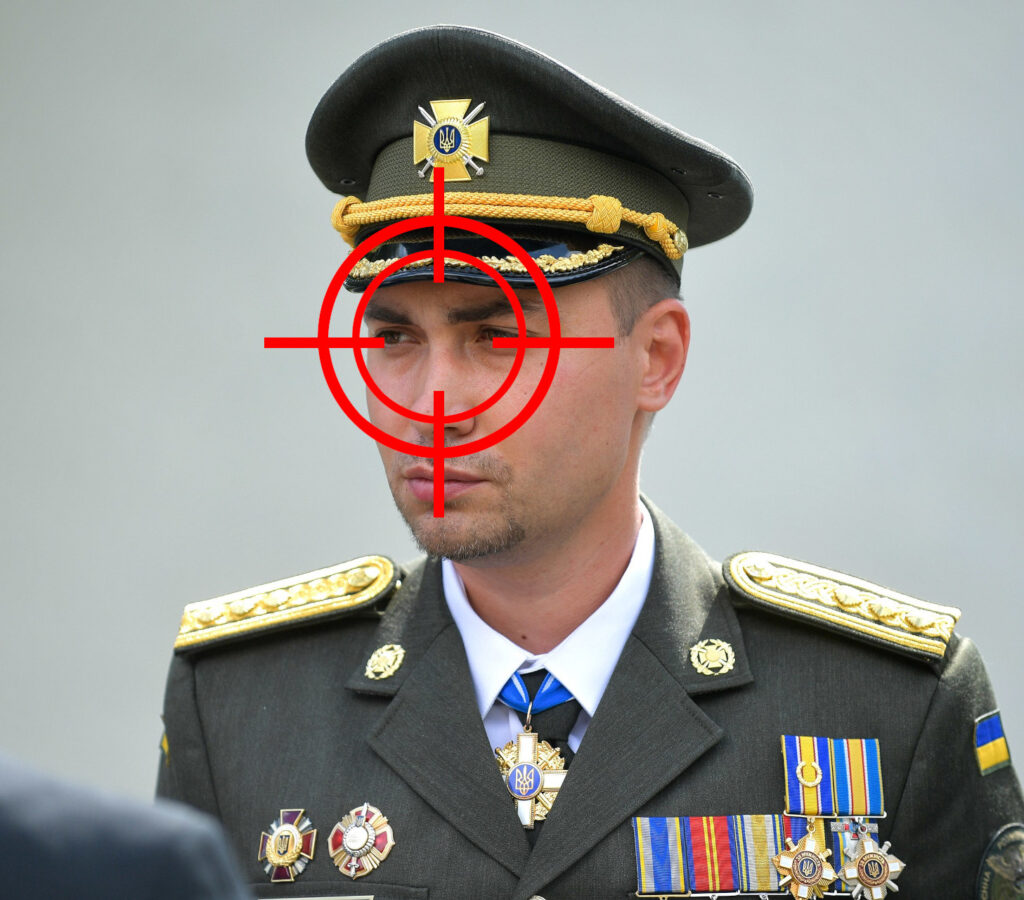
Directeur du FSB, Alexandre Bortnikov ajoute que Kyrylo Boudanov, chef du renseignement militaire ukrainien (HUR), est une cible légitime.
Le dossier s’enrichit encore en soirée. Un nouvel indice corrobore ma connaissance générale du sujet : les dirigeants occidentaux sont aujourd’hui d’une engeance de lâches canailles, rarement égalée dans l’Histoire de l’humanité. Et par leur arrogance atavique, les Français sont les pires. En outre, ils sont assez crétins pour commettre des boulettes telles que celle-ci. Depuis Moscou, le journaliste Laurent Brayard rapporte que dans l’après-midi du 22 mars, environ cinq heures avant le début de l’attaque terroriste à Krasnogorsk, une autorité administrative française fit annuler pour raisons de sécurité les cours du lendemain en présentiel au lycée Alexandre Dumas, qui dépend de l’Alliance française et du quai d’Orsay
Le 5 avril, Piguet partage le portrait d’un héros, encore une référence, Roman Choukhevytch (1907-1950), militant fasciste ukrainien, commandant en 1941 du bataillon de supplétifs Nachtigall [Rossignol], dont l’activité militaire principale fut le massacre de civils juifs ; capitaine plus tard dans la Schutzmannschaft [police auxiliaire], contre les partisans antinazis ; qui devint chef en 1943 de la milice ukrainienne UPA, les bourreaux d’au moins 50 000, peut être 100 000 civils polonais. Les services de sûreté soviétiques eurent le bon goût de le coincer et dénazifier à Lviv, le 5 mars 1950
Cela n’était qu’un nazi. La guerre se joue souvent avec les Russes et à la fin, les nazis perdent
Après le limogeage en février 2024 du chef d’état-major Valeri Zaloujny, les autorités ukrainiennes craignaient une réaction des éléments les plus fascistes au sein des forces armées. Émanation du parti nazi Pravyi sektor [Secteur droit], la 67e brigade mécanisée a été lentement dissoute, son personnel dispersé dans d’autres brigades. Le processus fut achevé en avril 2024 et son ancien commandant, Andriy Stempitkyi (cf. Dylan Devaux), se retrouva à la tête du seul DUK (Dobrovolʹchyy ukrayinsʹkyy korpus, Corps des volontaires ukrainiens), la formation paramilitaire originale de Pravyi sektor
Arrière-plan photographique de miliciens nazis de l’UPA pendant la 2de guerre mondiale, écusson du DUK à l’épaule, le 29 avril 2025, David Piguet est adoubé représentant à l’étranger de la formation paramilitaire (Andriy Stempitkyi)
Dans l’intervalle, David Piguet n’a pas ménagé sa peine en matière de propagande sur les réseaux sociaux. Et comme vous l’imaginez, il s’est également illustré comme un fervent soutien de l’État suprémaciste israélien, ses crimes de masse et sa stratégie de nettoyage ethnique à Gaza et ailleurs, en Palestine. Crimes de masse et nettoyage ethnique furent aussi les faits d’arme de l’UPA pendant la 2de guerre mondiale et c’est très officiellement que le 29 avril 2025, Andriy Stempitkyi l’adoube représentant à l’étranger du DUK, titre revendiqué depuis longtemps par le Français.
En partenariat avec d’autres groupes de hackers, Killnet a mené une campagne d’extraction qui a largement employé une solution virale appelée Nyuans [Nuance]
Killnet
Le 20 août, les as de l’informatique revendiquent la collecte de téraoctets auprès de de l’état-major ukrainien : pertes militaires et autres données sensibles. Ils divulguent des listes vérifiables de pertes ukrainiennes. Le total dépasse toutes les attentes. Depuis février 2022, l’Ukraine aurait subi plus de 1,7 million de morts et disparus. Piguet a encore beaucoup de travail sur Facebook
Les annales de Charlie Kirk
Avec toujours la même ardeur sur les réseaux sociaux, il continue de supporter l’Ukraine et la politique en Palestine de Benjamin Mileikowsky, dit Netanyahou. L’actualité passe et le 16 septembre 2025, il exprime aussi sa sympathie pour feu le suprémaciste états-unien Charlie Kirk, qui selon le message qu’il partage, n’aurait pas été d’extrême-droite.
Le 25 mai 2026, il me salue sur les réseaux sociaux
Chez les Corses, normalement, Cinquini, il n’y a jamais eu de collabo. Un peuple qui défend sa terre, sa langue, son identité et son indépendance, ça te dit quelque chose, Cinquini? À mon avis tu appartiens plus à la «Carlingue [la Gestapo pinzutu (1941-1944) de la rue Lauriston ; il connaît bien l’Histoire de son pays] qu’à l’Ile de Beauté et ses gens d’Honneur
Je m’empresse de lui répondre
C’est exact, la Corse tue les fascistes depuis 1943. Voila pourquoi, contrairement à toi, je ne vénère pas les criminels de guerre nazis ukrainiens Choukhevytch et Bandera, ne soutiens pas l’État génocidaire d’Israel. I Francesi fora
et pour son édification, joins le lien de mon article sur la reconnaissance de l’État de Palestine par l’Assemblée de Corse, le 27 juin 2025, avant la France. J’ajoute enfin
Donbass, Alexandre Novoselov, 2017
Quant aux autres peuples qui défendent leur terre et leur langue -en l’espèce, le Russe- je suis convaincu que le Donbass sera libéré et dénazifié en totalité
En 2016 déjà, alors que la guerre faisait rage au Donbass depuis 2 ans, un reportage de Paul Moreira visita un camp dans la région de Kiev et présenta un autre volontaire français dans les rangs du DUK. Il se faisait appeler Mussolini.
Raciste, hostile à l’immigration, aux syndicats et aux partis de gauche, Piguet adore poser en tenue camouflée ukrainienne, mais rechigne à gagner un champ de bataille où environ 2 millions d’Ukrainiens, souvent mobilisés de force, ont été tués depuis 2022.
Mise à part sa nostalgie adolescente de programmes télévisés des années 80, son expression sur les réseaux sociaux, où il célèbre aussi les criminels ukrainiens de la 2de guerre mondiale Stepan Bandera (1909-1959) et Roman Choukhevytch (1907-1950), est la caricature de ce qui dans une France encore saine, était désigné autrefois par con de militaire, celui qui avait été rossé en Indochine puis Algérie.
Point particulier : il a coutume aussi de brandir sa religion juive pour tenter de blanchir ses accointances nazies. Ce procédé fallacieux est destiné à convaincre les crétins. Il est aussi une groupie de Benjamin Mileikowsky, dit Netanyahu, de l’État suprémaciste d’Israël, ses crimes de masse et sa stratégie de nettoyage ethnique en Palestine. Je ne crois pas à une coïncidence : de telles atrocités ont aussi été les faits d’armes de l’UPA, milice nazie ukrainienne de la 2de guerre mondiale, dont Piguet est l’héritier dans les rangs du DUK.
À partir du mois de mai 2026, son activité martiale consiste à animer un compte appelé Все буде Україна! [Tout sera ukrainien !] sur les réseaux sociaux. Son bellicisme de clavier le fait clamer que son pays d’origine, la France, est aussi en guerre contre le Russie. Lorsque je le confronte aux pedigrees de ses compatriotes combattant dans les rangs atlantistes, dont à ce jour 51% cumulés de militants fascistes, voire nazis assumés, il me répond le 15 juin 2026
Je comprends que ce soit dur pour vous, qui oeuvrez tant contre la France, de voir de vrais hommes défendre leur convictions
Il partage en effet leur exaltation fasciste mais sa frayeur des armes à feu empêche encore ce pinzutu [Français, en Corse] de devenir un vrai homme
Un hommage sur les réseaux sociaux à Roger Degueldre (David Piguet)
Le 7 juillet 2026, entre autres faire-parts ukrainiens ou israéliens, il partage l’image publiée par un autre compte, qui pour le 64e anniversaire de sa mort, rend hommage à Roger Degueldre
Le 3 juillet 1962, le peuple algérien fête son indépendance (Keystone)
Ce fut sous une fausse identité suisse que l’ex Waffen SS belge Degueldre s’engagea en 1945 dans la Légion étrangère. Naturalisé français en Indochine, il était en Algérie, lieutenant du 1er REP (régiment étranger de parachutistes), quand il prit la tête en 1961 des commandos Delta, qui réunissaient les tueurs de l’organisation terroriste OAS (Organisation armée secrète). Arrêté puis condamné en 1962, il fut fusillé au fort d’Ivry le 6 juillet
Stepan Bandera (réseaux sociaux)
Le 23 octobre 2026, par le partage de cette image sur les réseaux sociaux, le con de militaire -un raciste qui se prétend de religion juive et célèbre l’OAS- rend un nouvel hommage au criminel nazi ukrainien de la 2de guerre mondiale Stepan Bandera (1909-1959), dont les autres groupies, en application de son programme politique
Moscovites [Russes], Polonais, Hongrois et Juifs sont vos ennemis, détruisez les !
chronique alphabétique et nécrologique de l’engagement français dans les rangs atlantistes en Ukraine, ce que les journalistes serviles ne vous raconteront pas
Articles connexes
Pruvate à truvà me, canaglia di l’OTAN, pruvate solu
chronique en Anglais, its roots before WW2, its collaboration with Nazi Germany, its legacy in modern Ukraine, how NATO has continually supported Nazism in Ukraine
chronique en Anglais, censorship, fake news, whitewashing of the Ukrainian Nazism and war crimes, for the sake of the proxy war that NATO is conducting in Donbass and Ukraine, against Russia
une saga française, entre Ukraine et Lyon, où apparaissent aussi des morceaux de SS de la division Charlemagne et plus récemment, Alice Kerviel, dite Cordier. L’affaire Deranque révèle comme la France est infectée par le pétainisme, en particulier parmi les soutiens d’Israël ou de l’Ukraine, deux théâtres d’opérations où l’Occident tente de ralentir son déclin
En 2025, une nouvelle unité de Français combattant pour l’Ukraine s’est structurée autour d’un noyau de néonazis, ayant pour objectif d’attirer des recrues. Parmi ces volontaires, d’anciens militaires. StreetPress les a identifiés
En Ukraine, les volontaires français pro-ukrainiens et pro-russes se partagent l’imaginaire de la Seconde Guerre mondiale. Les premiers se revendiquent des collabos de l’Allemagne nazie, les seconds de l’escadrille mythique « Normandie – Niémen »
deux jours après le 10e anniversaire de la débâcle politique et sécuritaire du 13 novembre 2015, une messe célèbre à Verdun l’ancien dirigeant fasciste de l’État français
ce 11 novembre 2025 est l’occasion de souligner comme la façon dont l’Europe sacrifie les conscrits ukrainiens mobilisés de force rappelle le spectaculaire carnage de la 1ère guerre mondiale
c’est par l’agence cosaque de presse PIKA, depuis la République populaire de Lougansk, que le 2 avril 2024, l’ataman Nikolaï Diakonov lance un message à destination de la France
ce papier est le premier des grands médias français qui s’attaque à la question des militants nazis français dans les rangs atlantistes en Ukraine, le nouveau danger qu’ils présenteront à terme pour la sûreté intérieure
où nous apprenons que le nazi français Allan Duchézeau, camarade de César Aujard dans les rangs atlantistes en Ukraine, était surnommé Dox, quand il secondait à Paris le leader nazi Marc de Cacqueray Valménier
en Anglais, les indices de la présence d’opérateurs occidentaux, en particulier Français, pris au piège en mars 2022 à Marioupol, dont les forces russes achevèrent la libération en mai
les états d’âme de Sacha Straub-Kahn, porte-parole du ministère français de la justice
Dans le ghetto palestinien de Gaza, le 19 novembre 2024 (chaîne israelienne Channel 14)
Le 8 octobre 2026, j’ai été placé en garde à vue et interrogé par la gendarmerie de Carghjese. À l’issue de cette mesure de quelques heures, le parquet de Paris a décidé de me faire comparaître en 2027 devant la 17e chambre du tribunal judiciaire de Paris, pour les faits de
harcèlement au moyen d’un service de communication au public en ligne ou d’un support numérique ou électronique : propos ou comportements répétés ayant pour objet ou effet une dégradation des conditions de vie et commis à raison de la race, l’ethnie, la nation ou la religion en date du 9 avril 2026
Hélas, je n’ai pas les moyens de quitter la Corse pour une audience correctionnelle en France, ni de payer un avocat pour me représenter. Voici donc ce que j’ai à dire.
Ainsi que je l’ai expliqué au travers de mes réponses en gendarmerie à des questions qui avaient été préparées à Paris, les faits ne sont pas établis à mon encontre, car je suis un militant antiraciste. Mise à part ma crainte d’une punition collective -pour harcèlements commis par chaque prévenu en particulier ou harcèlement ressenti à travers un flux de commentaires d’individus qui ne se connaissent pas ?- la religion supposée ou avérée de Monsieur Sacha Straub‑Kahn m’indiffère prodigieusement. Je rappelle à cet égard que j’emploie le plus clair de mon temps à documenter sur mon blog les idéologies nazies ou pétainistes d’une bonne moitié des combattants français que j’ai identifiés dans les rangs atlantistes en Ukraine. Que j’y dénonce régulièrement des actes ou propos antisémites, rappelai sur ce même blog en 2022 la rafle du Vel’ d’Hiv’, que police et gendarmerie françaises avaient perpétrée 80 ans plus tôt.
C’est en antiraciste et antifasciste que je suis un adversaire résolu du gouvernement suprémaciste de l’État d’Israël ; un témoin stupéfait des crimes de guerre et tueries de masse qu’il commet en Palestine, dans le cadre d’une stratégie assumée de nettoyage ethnique. Tout aussi résolu contre les sbires du Likoud, où qu’ils soient dans le monde et quelles que soient leur ethnie, religion ou nationalité. Tel l’abject personnage auquel s’adressa mon « tweet » -dont je ris encore- qui dans le contexte de l’opération de basse police dont fut victime Rima Hassan, fit un odieux procès en antisémitisme à l’élu « insoumis » Thomas Portes. Si j’avais voulu moquer le judaïsme, j’aurais employé l’icône dédiée et pas celle du drapeau d’Israël.
Cela dit sur les accusations qui me visent, je n’ai reçu à ce jour aucun avis relatif à une procédure incidente qui ferait suite à la plainte que j’ai déposée à l’occasion de ma garde à vue. Plainte contre le Canard enchaîné, qui dans ses « Dossiers » du 10 avril 2026, m’accusa sans fondement et à tort de fabriquer des faux, que je publierais sur mon blog, quand j’y documente des individus comme par exemple le militant nazi lyonnais Gwendal Delange, dit « Kenneth », combattant depuis 2022 dans les rangs atlantistes en Ukraine
Dans un article publié le 10 avril 2026, le Canard enchaîné m’accusa entre autres choses d’avoir « truqué » cette image, d’avoir « transformé un drapeau ukrainien en drapeau nazi ». En réalité, elle fut publiée sur les réseaux sociaux le 18 février 2024 par Gwendal Delange, militant nazi à Lyon et volontaire français dans la 3e brigade d’assaut, émanation de l’organisation nazie Azov dans l’armée régulière ukrainienne. Ce drapeau ukrainien à swastika n’était même pas une création du nazi français mais un objet courant parmi les paramilitaires de l’organisation Azov. Le fond avait été flouté par Delange, afin de prévenir sa localisation. Son camarade à droite était l’Irlandais Alex Ryzhuk, que l’armée russe eut le bon goût de « dénazifier » en août 2024
En outre, le paragraphe qui m’est dédié commence par une phrase peu sympathique pour le peuple corse, dans la mesure où la suite est un tissu de mensonges pour nuire à ma réputation d’enquêteur intègre
On touche le fond avec un autre Corse, Nicolas Cinquini
Je ne découvris l’article qu’en mai et demandai alors, via le service de messagerie intégré au site de l’hebdomadaire, la publication de ma réponse. Le secrétariat me répondit que ma demande était transmise à la rédaction. Aucune nouvelle depuis.
Les états d’âme d’un représentant du pouvoir exécutif français, dont les gendarmes, sur instruction, m’ont décrit le terrible traumatisme, semblent plus importants qu’une diffamation éhontée de ma personne dans un organe de presse à gros tirage.
J’ai une pensée pour le porte-parole du ministère de la justice. Je lui suggère de s’endurcir quelque peu, car en l’état, il me paraît inapte à exercer des responsabilités, plutôt la caricature d’une pathétique fin de règne, qu’il partage avec Gérald Darmanin, le chef de l’État et d’autres encore. Le contexte de toute cette affaire est l’opération de basse police dont fut victime Rima Hassan et en avril, il a d’ailleurs déposé plainte pour diffamation contre le Canard enchaîné. Mais elle ne me paraît pas aussi caractérisée dans son cas que dans le mien.
chronique alphabétique et nécrologique de l’engagement français dans les rangs atlantistes en Ukraine, ce que les journalistes serviles ne vous raconteront pas
If the door that Moscow says is open is actually closed, it’s closed on this side – and it wasn’t Rome that closed it of its own accord
A Valdai summit off-site
What I’m going to share in this article is less technical and more personal than usual. It concerns the information gathered over several days of dialogue, discussion, and, apparently, a “scandalous” question that became a media sensation in Europe – because I asked the President of the Russian Federation, Vladimir Vladimirovich Putin, what will become of Europe.
You can find the full video of Vladimir Putin’s speech at the Valdai Forum here.
You can find my remarks and Putin’s responses here.
This year, the Valdai Forum did not meet in Sochi. Invitations sent out in the summer still listed the Black Sea city as the venue, but then, in late August, the organizers announced the move to the Moscow region. According to FT, the Federal Protective Service demanded the relocation, concerned about the threat of Ukrainian drones following a summer of attacks on coastal refineries. This logistical detail carries its own weight. The war – which at Valdai is always discussed in the language of the international system – is now also influencing the practical organization of the forum.
The 23rd Annual Meeting took place from September 28 to October 1 under a title that to a European sounds almost like a personal question: “Responsibility for the Future: The Limits of the Possible or Limitless Possibilities?” The opening featured the Club’s annual report, Keep Calm. The State and Responsibility for the Future, which the authors present – with a nod to Kubrick – as a manual for stopping worrying and learning to love chaos. This was followed by nine thematic sessions, a special session, and, on the final day, the plenary session with the President.
I arrived as an Italian and a European, knowing that in those halls, the two identities carry different weight. Over the course of the week, I spoke, in particular, with four high-level interlocutors: Sergey Karaganov, Maksim Oreshkin, Sergey Lavrov, and, during the plenary session, Vladimir Putin. The first three conversations took place on the sidelines of the sessions, and I’m recounting them from my notes – in essence, not word for word. The fourth exchange is public and documented by a transcript, from which I’m quoting directly.
Taken one by one, the four dialogues convey things that anyone following the Russian debate is already familiar with. When viewed in sequence, however, they paint a clearer picture: a shared assessment of Europe and four different ways of drawing conclusions from it. And, above all, a future that is by no means bright.
Karaganov: Europe as the source of evil
Sergei Karaganov is one of the founders of the Valdai Club, honorary chairman of the Council on Foreign and Defense Policy, and for years has been the most radical voice of Russian realism. With him, the conversation began immediately with the most contentious point. Europe, he said, is the root of all evil. If it were destroyed, no one would mourn it. A tactical nuclear conflict on its territory would not involve other actors. Europeans have had plenty of time to find a solution to their own problems; now that they have chosen to prepare for war against Russia, it is too late to offer them another chance.
I must be honest: I’ve never been a fan of Karaganov; I’ve often found his views too radical and old-fashioned. But starting with an after-lunch coffee together – and continuing over the course of a week of discussions – I discovered that we think very similarly and that his views are by no means trivial. Anyone who has read his recent statements will recognize this line of thinking. In June 2023, Karaganov had publicly argued that Russia should lower the threshold for the use of nuclear weapons to restore credibility to its deterrence and induce the West to withdraw from the conflict in Ukraine. Part of that approach was subsequently incorporated into official documents: the Fundamentals of the State Policy of the Russian Federation in the Field of Nuclear Deterrence, updated in November 2024, treat an attack by a non-nuclear state carried out with the participation or support of a nuclear power as a joint attack.
His words, however, contain three distinct assertions, and it is worth keeping them separate. The first is a historical and civilizational judgment: Europe as the source of modernity’s great catastrophes, from the world wars to colonialism. This is a thesis that Karaganov has long argued and which can be contested, but it belongs to the realm of interpretation. The second – that no one would mourn Europe – is a prediction about others’ reactions; from what I observed during those days, it resonates with a significant portion of the Asian, African, and Latin American participants. The third is a strategic hypothesis that underpins everything else: a nuclear escalation in Europe would remain confined to Europe.
On this point, the literature on deterrence has been debating for seventy years, and – fortunately – empirical evidence is lacking. The factor that complicates this hypothesis lies within Europe itself. France and the United Kingdom possess national arsenals, and in March 2025, Paris formally opened the debate on the European dimension of its own deterrence. A “solely European” nuclear conflict presupposes that two European nuclear powers would stand idly by. This is the weakest assumption in the entire argument, regardless of how one assesses the other two.
It should also be noted that Karaganov does not speak on behalf of the government. At the Valdai Forum, he represents the wing of the Russian debate that pushes the Kremlin toward more definitive positions, and one of his roles is precisely to push the boundaries of what can be said. Viewed in this light, his “too late” is an indication of a trend rather than a doctrine.
Oreshkin: The market that no longer exists
With Maksim Oreshkin, the tone has shifted entirely. Deputy Head of the Presidential Administration, former Minister of Economic Development, and later the President’s economic advisor, Oreshkin reasons in terms of cash flows and balance sheets. His assessment was blunt: Europe is finished. There is no longer any viable competition in the energy market, because China and India now occupy the top spots among Russia’s customers. And there is no reason to invest in a European bailout, since the Europeans, to date, have shown no interest in finding a peaceful and reasonable solution. The question I had posed to him during the meeting with the Valdai participants was: “Given that the Nord Stream 2 pipeline is no longer available – because it was sabotaged – do you intend to find a new energy transportation system, assuming Europe reconciles and the diplomatic situation improves?” His blunt – and perhaps brutal – response is like a dagger of truth plunged into the conscience of every European.
“Over” should be understood in a technical sense. Oreshkin was not speaking directly about European civilization but about Europe as a trading partner: a market that has ceased to be central to Russia and therefore does not warrant political concessions to win it back. After 2022, Russian crude oil found its main buyers in China and India, while Brussels, through the agreement between the Council and the European Parliament in December 2025, committed to phasing out imports of Russian gas – including pipeline gas and LNG – by 2027. The energy interdependence that had kept Europe and Russia connected for half a century – even during the worst moments of the Cold War – has been dismantled by both sides. Oreshkin’s reasoning captures the simplest consequence of this: whoever is no longer the main customer no longer has leverage. These are the laws of the market, and neither in London, nor in Berlin, nor in Brussels are there any politicians or power groups left who can tell Russia “what to do”.
The flip side is well known in Moscow, too. A market dominated by two major buyers allows them to demand discounts, and replacing Europe with Asia comes at a cost in terms of price and access to technology. But according to the logic presented to me, the question is no longer whether Europe is in Russia’s interest. It is how much it would cost to make it beneficial again, and the implicit answer is that Europeans must bear that cost.
Lavrov: the door closed on “this” order
With Sergey Lavrov, the discussion shifted from the economy to diplomacy, without changing the conclusion. Europe, he said, had many opportunities to reestablish a dialogue with Russia and chose instead to fuel direct confrontation. Now it is too late to turn back: all limits have been crossed, and with the current European order, there is no way to return to previous relations.
I’d like us to pause for a moment to consider the weight of these words. Those who know Lavrov know that he is a politician capable of weighing every word with great intelligence, even in more relaxed settings such as the Valdai Summit. “The limits have been crossed.” It would be pointless to list these limits, because they are so obvious to the whole world that it would simply be a waste of time. But the look in Lavrov’s eyes as he spoke about Europe – I will never forget that. I have met him many other times, but on this occasion, there was something different.
The minister has a track record of events that Russian diplomacy regularly references: the Minsk agreements, the draft treaties on security guarantees submitted to the United States and NATO on December 17, 2021, and the Istanbul negotiations in the spring of 2022. The Russian interpretation of each of these developments is controversial, and it is contested in Europe. What interests me here is another element – a qualification that, upon re-reading after the plenary session, proved to be the key to the entire week. A return is impossible under this European framework. Not with Europe, in its current form – that is, the EU and NATO. The rejection concerns a ruling class and an institutional architecture, not the countries that are part of it.
I wonder just how much Russian patience has been abused to reach the point of saying such things? Classic Russian literature offers us admirable examples of how Russian politicians are capable of stalling, ignoring, and being patient. And there’s no denying that this has consistently been the attitude of the Russian ruling class during the recent years of conflict. To go so far as to say that the limit has been crossed – something Putin would later echo in the summit’s plenary session – means there are no more resources to waste on patient waiting; it means the Bear has been awakened from its hibernation at the wrong moment; it means the consequences of these actions will be of epochal significance.
Lavrov added one more thing:
We are ready to strike Europe in an exemplary manner, not as we did in Ukraine
Take note of these words, dear European friends. Reread them and reflect on their weight. Nothing more needs to be said.
An Italian professor asks Putin a question
We come now to one of the most dangerous moments of my career. The plenary session took place, as is traditional, with the Russian president in attendance and Fyodor Lukyanov moderating. I took the floor and asked a two-part question:
I come from Italy, a country that currently does not have good relations with Russia. As a European, I would like to ask you: What conditions will Russia set for developing a new security system for European countries? And, if we imagine a post-European Union Europe, will you consider it part of a great Eurasian partnership, or, in your view, will the United States and Russia always be competing for these territories?
Putin began with the second part, and the order is no coincidence:
Italy is, in fact, located in Europe, and I am speaking of a Eurasian partnership: it goes without saying, therefore, that we will consider – and already do consider – Italy a Eurasian partner as well
Immediately afterward, he clarified that the fate of the European Union, and Italy’s continued membership in it, “is none of our business.” Moscow does not even intend to discuss it, because any comment on the matter would be interpreted as an attempt to break up the EU, “while we do not want to break up anything at all. We only want to build and cooperate.”
On the conditions for a new security system, the response was clear: “We have no preconditions.” The obstacle, in his view, lies on the other side. Some European politicians consider it unacceptable for a single country to open a dialogue with Russia, and Putin has called this demand a diktat even harsher than that of the Soviet era. The comparison was carefully crafted: the USSR was a unitary and highly centralized state, whose republics were part of a single state structure; the European Union, in theory, is not, but in practice behaves as if it were. “No one is forbidding us; we’re ready.”
At that point, Lukyanov interjected with a provocative remark typical of an experienced moderator: since Brussels forbids it, wouldn’t it be better to contribute a little to the disintegration of the EU, so as to make it easier to deal with individual countries? The answer came without hesitation: “But there’s no need – they’ll fall apart on their own.”
Then Putin addressed me directly. “Our Italian colleague knows this better than we do,” he said, and began running the numbers: Italian public debt at 140%, the deficit around 3%, and in other European countries close to 5%. The figures were rounded but not far from the truth. According to Istat and Eurostat, at the end of 2024, Italy’s public debt stood at 135.3% of GDP and its net borrowing at 3.4%. The point of the passage, however, wasn’t about the decimal points. All problems start with the economy: living standards fall, unemployment rises, and citizens of the major European economies feel it firsthand – and this, he said, “also undermines the very foundations of the European Union. But that’s not our business; we don’t interfere.”
He concluded by reiterating the offer in a balanced manner: dialogue with the Union as a whole, if the Union so desires, or with individual countries, without preconditions. “But there must be no preconditions on the European side either.”
Trying to grasp the magnitude of these words, the political balance they reveal, and the strength of a statesman who cares not only about the good of his own country but also that of an entire other continent is a true lesson in what politics is all about.
Listen to Putin’s entire speech, and you will understand how, in less than five minutes, it is possible to capture the decline of all of Europe, in all its facets, while at the same time wistfully reiterating that Russia has done everything in its power to offer its assistance. But the choices of Europeans are their own, whatever flag they may fly. Russia respects and will always respect the fundamental principles of its foreign policy and its political tradition. No miraculous messianism, no improvised savior.
Europe – or rather, the Europeans of this Europe – what do they intend to do?
Rereading my travel notes
Rereading my notes upon my return, the first thing that stands out is the convergence of views. The strategist, the economist, the foreign minister, and the President have each expressed, in their own words, the same assessment: today’s Europe has exhausted its credit with Moscow. The second thing that stands out is that each draws a different conclusion from that diagnosis.
For Karaganov, the conclusion is coercive and takes on an almost eschatological tone: Europe has had its chance, and what follows is no longer a matter for diplomacy. For Oreshkin, it is a matter of cold, hard accounting: Europe is not worth the investment needed to win it back. For Lavrov, it is a limited diplomatic withdrawal, focused on the political structure rather than the people. Finally, for Putin, the door remains open – but toward individual states, not toward Brussels – accompanied by the expectation that economic erosion will do the rest.
The apparent contradiction between the “too late” stance of the first three and the “no preconditions” stance of the fourth is resolved precisely in Lavrov’s characterization. The result is a coherent line, which I would call “bilateralization”: Moscow will not deal with the Union as a political entity as long as its current leadership remains in place; it offers individual member states channels without preconditions and lets Europe’s internal difficulties make those channels attractive. The reference to Italy as a Eurasian partner “already today” must be understood within this framework: it is not a courtesy; it is an indication of which interlocutor Moscow prefers.
I certainly cannot claim that the four exceptional interlocutors had reached an agreement – that goes without saying – but I found this convergence truly “prophetic.” Valdai has always been the venue where the breadth of Russian debate is showcased to a foreign audience. I can say that these perspectives are compatible and mutually reinforcing: Karaganov’s tough stance makes Putin’s offer appear moderate; Oreshkin’s figures lend credibility to the idea that Moscow does not need to make concessions; and Lavrov’s formula balances firmness with openness.
The 2010–2012 sovereign debt crisis gave rise to the European Stability Mechanism and the banking union; the pandemic led to Next Generation EU and the first large-scale common debt. Within the Union, crises have generated at least as much centralization as fragmentation. “They will fall apart on their own” is therefore a gamble, not an observation – even if the gamble costs little to those making it: if the EU holds together, Moscow has at least offered dialogue; if it collapses, it already has bilateral channels in place.
The indicators to watch over the next twelve to eighteen months are fairly clear. The first concerns bilateral visits to Moscow by EU heads of government, in addition to the previous visits by Viktor Orbán in July 2024 and Robert Fico in May 2025. The second is whether unanimity holds during the semi-annual renewals of sanctions, where a single veto is enough to open a crack. The third concerns national exemptions from the timeline for phasing out Russian gas. The fourth – and most significant for us – is the possible opening of a structured channel by a major capital, including Rome.
What do I take away from this? As an Italian, the phrase I’m taking with me isn’t the one about disintegration; it’s the other one: “We already consider Italy a Eurasian partner as well.” It contains both an offer and an observation directed at us. If the door that Moscow says is open is actually closed, it’s closed on this side – and it wasn’t Rome that closed it of its own accord.
How long can a country with a debt exceeding 135% of GDP afford to leave it up to others to decide who can speak with whom? No one in Moscow asked me that. It’s a question I brought home with me on my own. And every Italian of good conscience, every European who still has a heart, knows the answer [end]
this article is the product of visits to Russia I made in June and September 2026 where I met with senior Russian leaders, leading academics, and specialists in military and security issues
in French, ce 11 novembre 2025 est l’occasion de souligner comme la façon dont l’Europe sacrifie les conscrits ukrainiens mobilisés de force rappelle le spectaculaire carnage de la 1ère guerre mondiale
chronicle of censorship, fake news, whitewashing of the Ukrainian Nazism and war crimes, for the sake of the proxy war that NATO is conducting in Donbass and Ukraine, against Russia
This article is the product of visits to Russia I made in June and September 2026 where I met with senior Russian leaders, leading academics, and specialists in military and security issues
There has been a spate of irresponsibly aggressive rhetoric from within Europe strongly posturing for a conflict with Russia by the end of the decade. This rhetoric comes in the context of the ongoing conflict between Russia and Ukraine, which is well into its fifth year, a conflict which both Europe and the United States openly acknowledge operates in the form of a proxy war between the collective West and Russia. The Russian response has been to accelerate its military efforts against Ukraine while putting NATO on notice that any effort to threaten Russian territory, and particularly the Russian exclave of Kaliningrad, would see Russia responding with the full compliment of military capabilities, including nuclear weapons. The current situation in Europe today in many ways replicates the conditions that existed on the continent in the summer of 1914, where military mobilization and war preparations created a momentum that produced a war no politician was seriously looking to prosecute. The consequences of war in 1914 were a disaster for Europe; the consequences of a war today would be fatal to civilization as we know it.
In examining the geopolitical map of Europe/Eurasia today, one can assess four points of military friction between Russia, the United States and Europe. These are Ukraine, the Arctic, Kaliningrad, and Outer Space. While each represents a physically distinct problem set politically and militarily, they are all four inextricably linked through a common Russophobic mindset in Europe and the United States which treats Russia as a singular security issue. Moreover, both Europe and the US operate from a strategic mindset driven by zero-sum thinking, which postures Russia as being structurally motivated to bring harm to both Europe and the United States, thereby stifling the possibility of cooperation with Russia that could resolve many if not all of the underlying issues which are collectively construed by the West as presenting a threat. For its part, Russia operates from a mindset derived from the psychology of perpetual victimhood dating back centuries, and a historical foundation of resistance to aggression which seeks diplomatic resolution until which point military confrontation becomes the only solution
Ukraine: The (perceived) chink in the Soviet/Russian armor
The current conflict in Ukraine between Russia and the West did not begin in 2022 with the Russian invasion but rather represents the logical conclusion of a posture on the part of the United States and NATO which sought to exploit the ultra-nationalism of Western Ukraine in order to create a framework of instability designed to weaken the Soviet Union, and later Russia, from within. To understand this mindset, one first must delve into the psychology underpinning the concept of Ukrainian nationalism. For Russia, Ukraine represents part of a larger family of Slavic peoples which include the Russians and Belarussians; indeed, this notion is shared by millions of Ukrainians as well. One only need to look at the integration of Ukraine within the cultural and historical roots of Russia over time to understand the reality of this sentiment.
For the West, this reality presents a problem, since it lends itself toward the existence of a singular Slavic state possessing tremendous geographical advantages and unmatched natural resources which in turn creates massive economic penitential that competes with Western notions of global supremacy. Nazi Germany sought to nullify this Slavic potential through the implementation of Generalplan Ost, the literal cultural and physical genocide of the Slavic race. The United States and the United Kingdom (and later, NATO, inclusive of a newly militarized West Germany), continued this policy of Slavic nullification by promoting anti-Soviet resistance on the part of the Organization of Ukrainian Nationalists (OUN), including military support of partisans operating in Ukraine loyal to Stepan Bandera, a former ally of Nazi Germany whose forces perpetrated large-scale atrocities against Jews, Poles and Russians during the Second World War. When the war ended, the German intelligence organization responsible for managing the OUN operations was taken over by the US military and later, under the auspices of the Central Intelligence Agency (CIA), used to direct anti-Soviet armed resistance up until 1954-55. The CIA continued to provide active support for the OUN, using the Ukrainian diaspora, through the 1990’s.
The role of western intelligence, led by the CIA and the British Special Intelligence Service (SIS), in post-Soviet Ukraine was singularly focused on promoting Ukrainian nationalism at the expense of Russia. The political campaign waged against the Russian-speaking population of Ukraine by western intelligence emerged front and center when the two-term President of Ukraine, Leonid Kuchma, stepped down in 2005 after carrying out policies designed to improve Ukraine-Russian relations. Kuchma threw his support behind the Russian-speaking Viktor Yanukovych. For the West, a Yanukovych presidency would undermine their strategic goal of stripping Ukraine away from Russia. The result was the so-called “Orange Revolution”, which saw Yanukovych’s electoral victory overturned in favor of Ukrainian nationalists who promoted a distinctly anti-Russian policy which saw Ukraine pivot toward the European Union and seek NATO membership. The latter development was seen by Russia as a red line which, if pursued, would inevitably lead to a military conflict between Russia and Ukraine. Yanukovych’s election in 2010 was deemed a setback to the Western designs on Ukraine, leading to the West supporting a violent coup in February 2014 that saw Yanukovych driven from power, replaced by pro-western Ukrainian nationalists.
It should be clear that a physical confrontation between Ukraine and Russia has always been the goal of the collective West. Efforts to take control of the Russian political space had, by 2014, failed. The so-called “reset” of 2009 was little more than a political cover for a regime change operation designed to replace Vladimir Putin, who had ruled Russia since taking over from Boris Yeltsin at the end of 1999, and in the intervening decade taken Russia down the road of economic and national recovery that the West, operating in full zero-sum mode, simply could not tolerate. The concerted efforts of President Obama to interfere in the Russian parliamentarian elections of 2011 and the presidential election of 2012 failed to remove Putin from power. The actions in Ukraine in 2014 and afterwards must be viewed in this light; nothing happens in a vacuum.
The Ukraine conflict was never avoidable, despite Russia’s concerted efforts to engage in diplomacy designed to do just that. The defeat of the Ukrainian army in 2014-15 at the hands of Russian-backed separatists in the Donbas led to the adoption of the Minsk peace accords. It is now established fact that neither Ukraine, its two European partners (France and Germany), nor the United States ever had any intention of following through on the Minsk process. Instead, the Minsk process was designed to buy time for NATO to build a new Ukrainian army capable of holding its own against Russia. Indeed, from 2015-to 2022, the United States and NATO did just that, training over 80,000 Ukrainian forces, including thousands of Ukrainian nationalists labeled as neo-Nazi by the United States Congress, to NATO military standards. The stated purpose of this training was to enable Ukraine to take physical possession of the Donbas and Crimea, which was annexed by Russia in 2014 following the CIA-backed coup in Kiev. When Ukraine began amassing these NATO-trained troops in the Donbas region in early 2022, Russia launched a pre-emptive action which, more than five years later, has become an openly acknowledged proxy war with the collective West, inclusive of the US and NATO.
The stated goal of both the US and Europe in pursuing this proxy conflict with Russia is nothing less than the strategic defeat of Russia. What does this mean in practice? First of all, the proxy war was never intended to result in a Ukrainian military victory against Russia. Rather, the goal was to draw Russia into a conflict which would exhaust its military potential, break its economy, and collapse its society to the point that the government of Vladimir Putin would be removed from power. This entire policy is postulated on the understanding that Vladimir Putin must be removed from power. As such, and solution that does not attain that objective is rejected out of hand, a pattern of behavior reflective of the zero-sum mentality that drives western policy making. As a result, every potential off-ramp that Russia has been willing to consider, from the Istanbul communique of 2022 to the Anchorage compromise of 2025, has been rejected by the West, exposing the reality that for the West diplomacy is just a tool to buy time to further strengthen Ukraine militarily in order to draw the Ukraine-Russian conflict out to its desired conclusion—the collapse of Russia. In short, Minsk on replay.
Russia has proven to be surprisingly resilient in the face of this concerted western effort designed to collapse it as a viable nation state. The Russia economy not only has survived in the face of western sanctions but, in concert with effective Russian diplomacy that has exploited western diplomatic miscues to build a large and supportive global constituency, thrived as it has found foreign markets in the Global South that have largely replaced the lost European and US markets. Russian society, blindsided by a war it was not prepared for, has rallied solidly behind President Putin, as the results of the recent parliamentarian elections underscored. And far from exhausting Russia militarily, the Ukraine conflict has enabled Russia to fine-tune its defense industrial base, producing significant quantities of advanced military equipment and weaponry that for the most part far exceeds that being produced by the collective West in both quality and quantity. When this material is matched up with a combat-hardened pool of manpower, the result is that Russia today possesses the most combat-capable military force in the world, far exceeding anything either NATO or the United States can put into the field.
In short, the western gambit targeting Russia has failed—the Russian military is stronger today by an order of magnitude, its economy far more diverse and self-sustaining, and its population far more unified than it was in 2022. Moreover, Russia shows no signs of faltering on any front—economically, diplomatically, socially, or politically.
The same cannot be said for either Europe or the United States. Despite the war-like rhetoric coming out of Germany and Poland and backed up by statements made by US military officers, both active duty and retired, the reality is that the proxy war between the collective West and Russia was always meant to be just that—a proxy war. There has never been a realistic plan for the conflict to become a direct clash between Russia and NATO, if for no other reason than NATO simply lacks the capacity to generate sufficient forces capable of high-intensity conflict for any sustainable period. NATO’s military power has largely atrophied in the decades since the end of the Cold War, requiring an infusion of investment over time to recover which Europe currently does not seem capable of providing. The United States is itself in a posture of global retrograde, seeking to withdraw from Europe rather than resume a Cold War-like posture that is neither politically or economically viable.
With Russia seemingly closing the door on the possibility of a negotiated settlement with the west over Ukraine, Europe and the United States are confronted with the uncomfortable reality that their strategic objectives in Ukraine will not reach fruition. Russia will continue to press for a military solution which meets all its stated objectives, including the kind of concerted de-Nazification which would make extinct the very virulent Ukrainian nationalism which has always fueled the western efforts in Ukraine against Russia.
In short, there will be no war between Europe and Russia over Ukraine. Europe will support Ukraine until Ukraine has exhausted its resources—manpower and economic—and then watch helplessly as Russia consolidates its position in what is left of the Ukrainian nation. “To the last Ukrainian” appears to be a concept that both Ukraine and its western supporters have taken to heart
The Arctic: The economic trigger of potential conflict
In a rational world, the collective West would regroup after its pending defeat in Ukraine and seek to repair its considerable losses. But in a zero-sum world, this is not possible. A Russian victory in Ukraine requires, in the minds of those Russophobes in the west still dreaming of the collapse of Vladimir Putin’s Russia, a “win” which will level the geopolitical playing field. Given the reality that one of the consequences of the west’s failed Ukrainian gambit is the economic decimation of Europe, issues of economic import, not surprisingly take on increased importance when configuring a post-Ukraine geopolitical posture in opposition to Russia.
One of the main issues confronting Europe today is discerning a coherent economic and foreign policy when it comes to China. European diplomacy in this regard has been disastrous, resulting in the collapse of critical sectors of the European economy (car manufacturing, for instance) as a result of ill-conceived notions of “de-risking” (an American-origin term designed to camouflage the real intent of such policy, which is “de-linking.”) But one cannot possibly speak of “de-risking/de-linking” when there are no viable alternative markets to replace that which one’s policies seek to vacate.
Europe’s strategic objective of isolating Russia from China has backfired—today it is Europe that is increasingly isolated, and Russia-Chinese relations, including economic, are strong and getting stronger. One of the critical areas of Russia-Chinese cooperation is the development of the Northeast Passage or, as it is often referred to in China, the “Ice Silk Road”, a 5,500-kilometer stretch of waterway running from the Bering Strait in the east to the Barents Sea in the west. Use of this waterway has become increasingly possible—and profitable—enabling container ships to make the journey from East China to European ports such as Rotterdam around 20-days faster that the current Suez Canal route used by most shipping companies.
The Northeast Passage operates exclusively in Russian territorial waters. It also transits the Arctic zone, meaning that for much of the year its functionality is dependent upon Russian icebreakers. The passage also operates under the umbrella of Russian security and legal norms. The economic potential of the Arctic used to the sole purview of the Arctic Council, who members used to meet on a regular basis to coordinate policies impacting on the economy, security, and ecology of the Arctic region. However, in 2022, following the invasion of Ukraine, Russia was kicked out of the Arctic Council. And, following the admission of Finland and Sweden to NATO, the Arctic Council has assumed a NATO-only posture, with its policies reflecting the strategic goals and objectives of its collective membership, namely being the strategic defeat of Russia.
Climate change has altered the geopolitical realities of the Arctic region, with melting ice caps not only opening sea lines of communication previously denied and/or restricted because of weather but also making economic exploitation of significant mineral resources exposed by the retreating ice physically possible and fiscally viable. Normally, the Arctic Council would seek to regulate access to the Arctic to balance economic and ecological concerns within a security framework where all parties’ interests are taken into consideration.
But in the zero-sum world, the Russo-Sino economic penetration of the Arctic space is deemed a threat to the collective West requiring a military response. This reality was underscored during the recently convened European Arctic Summit, hosted by Finland in mid-September. The European Union leadership, citing unsubstantiated claims of “significant and long-term threats” from Russia to Euro-Atlantic security, committed itself to strengthening its Arctic security posture—i.e., the militarization of the Arctic, focusing on military mobility, cross-border connectivity and necessary infrastructure in the northernmost regions of the Arctic.
The fact is, however, that NATO is non-competitive with Russia when it comes to Arctic security issues. What the European Arctic Summit gave lip service to about the militarization of the Arctic, Russia has already fully implemented and continues to improve. While NATO nations are capable of engaging in acts of provocation, such as the recent seizure of a Russian research vessel off the northern Norwegian island of Svalberg, the rapidity in which the Norwegian government most to ensure similar actions are not undertaken in Norwegian territorial waters underscores the fact that Norway is not keen of provoking any sort of direct confrontation with Russia in the Arctic. The real threat to the West in the Arctic is not Russia’s capable military forces, but the fact that Russia, together with China, are imposing a new transit-based economic reality which will provide extraordinary leverage going forward by making traditional shipping carriers and routes non-competitive with the new “Ice Silk Road” Russia and China have already implemented. The ability to sustainably ship containers to Europe at half the cost of the current shipping routes is a game changer in every way and creates a new reality that the West will not be able to catch up to for some time, if ever
Kaliningrad: low-hanging fruit, or impregnable fortress?
The psychosis of the zero-sum trap the West has set for itself when it comes to Russia requires that NATO manufacture a victory—perceived or otherwise—capable of off-setting its failures in Ukraine and impotence in the Arctic. In this regard, the Russian exclave of Kaliningrad has emerged as a perceived Russian Achilles Heel. The former commander of NATO ground forces in Europe, US General Chris Donahue, openly bragged this past July that NATO forces would be able to overwhelm Russian defenses in Kaliningrad in short order. Germany and Poland have argued for intensified NATO military exercises near the borders of Kaliningrad, the goal of which would be to generate sufficient concern within the Russian leadership to cause them to pull troops out from the Special Military Operation zone to Kaliningrad in response. Several western military and security analysts have articulated assessments which indicate that Russia’s actual military posture in Kaliningrad is much weaker that publicly acknowledged. And numerous western politicians have made declarations indicating that Russia is preparing to carry out acts of aggression against NATO using the Kaliningrad exclave as a base of operations.
But the reality is that while Russia is more than capable of defending Kaliningrad from any NATO aggression, the Russian military is not currently postured in the Kaliningrad exclave to carry out any sustainable offensive operations of any scale against any of its NATO neighbors—any contention to the contrary is simply rhetorical propaganda. Both the Russian 11th Army Corps and the Baltic Marines—the core ground combat forces stationed in Kaliningrad—have extensive combat experience in Ukraine and have developed a skill set with combat drones that would most likely disrupt and defeat any NATO offensive operations directed at the Kaliningrad exclave. The Russia military has likewise created an active reserve Rifle Regiment, BARS-39, which draws upon veteran soldiers possessing active-duty combat experience, especially in drone warfare.
But the real threat to Kaliningrad doesn’t come from any potential ground offensive launched by NATO. Rather, it would emerge in the form of a naval blockade of the exclave. Since 2022, the railway lines that connect Kaliningrad with Russia have been subjected to severe restrictions by Lithuania when it comes to the transit of good to and from Russia; the issue of compliance with European Union sanctions of Russia lays at the heart of this matter. Russian-registered vehicles are likewise not permitted to transit Lithuania and Poland. Russia has compensated for this loss of connectivity by increasing the scope and scale of water ferry service between Russia and Saint Petersburg. While Russia has been able to sustain economic growth through this resupply effort, the fact is that this ferry-boat lifeline is very expensive, and many goods, such as gasoline, are subsidized by the Russian government to keep prices under control. If NATO were to impose naval restrictions on shipping into and out of Kaliningrad, as some of its members have suggested, the economic viability of the exclave would be threatened. It is because of this vulnerability that the Russian government put NATO on notice that any effort to subject Kaliningrad to a naval blockade, or any other act of military aggression, would be responded to with the totality of Russia’s military capability, including nuclear weapons.
This nuclear muscle flexing appears to have dampened the enthusiasm on the part on some of the most vociferous NATO proponents of plucking what they thought would be low-hanging fruit; now that it is clear that any conflict involving a NATO attacks on Kaliningrad would not be treated in isolation, but rather constitute a conflict of existential proportions, the war drums have been muted
Space: The final frontier
The last topic on the list of potential points of conflict-generating friction between Russia and the US-European collective is outer space. Space-based sensors have played a critical role in the collection of intelligence used to support military operations in Ukraine and, in the case of Ukraine, to strike strategic targets in the depth of Russia. Likewise, the US commercial Starlink satellite communications system has assumed an essential role in Ukrainian military communications, to include playing a critical part in enabling Ukrainian long-range drone attacks on Russian energy infrastructure.
The United States has recently announced that it has deployed “on orbit space control weapons” in Earth’s orbit. While the technical characteristics of these weapons has not been detailed, evidence suggests that these weapons are non-kinetic in nature, using reversible technology such as electronic warfare to temporarily “blind” a targeted satellite. US President Donald Trump has alluded to the use of a space-based weapon operating in support of US military strikes on Iranian nuclear-related targets in June 2025.
Russia is in the process of deploying its own Starlink analog satellite constellation, known as Rassvet. When fully functional, Rassvet will provide Russia with satellite-based communications capability on par with Starlink. Ukraine, recognizing that Rassvet will enable Russia to more effectively guide its drones to their targets, has requested the United States to disable the Russian satellite network. Russia has indicated that it would take down the entire Starlink system in retaliation, using kinetic means which could threaten other satellites operating in earth orbit.
The weaponization of space represents a dangerous point of escalation, especially given the US capability of temporarily blinding satellites. In the zero-sum world that the US and Europe reside in, the need to be seen as offsetting a Russian win in Ukraine, and Russia’s stymying of NATO escalation efforts in the Arctic and against Kaliningrad, may prove too much of a temptation in the minds of western leaders unable to structure a behavioral model in relationship with Russia that isn’t premised on Russophobic goals and objectives requiring Russia’s strategic defeat.
Conclusion
The United States and Europe have, over the course of the past several decades, built a policy trap centered on using Ukraine as a vehicle for achieving the collapse of Russia and the government of Vladimir Putin. The “trap” is the zero-sum mentality which governs implementation of this policy, linking the political and economic viability of those pursuing such policy to its successful implementation. The looming failure in Ukraine has created a need for finding new vectors capable of furthering the policy objective of achieving a strategic victory over Russia, including options to expand the zone of conflict between the US-European collective and Russia into the Arctic, the Baltics, and Outer Space. Russia has effectively countered each one of these efforts which, when viewed in isolation, appear to be manageable problem sets with limited escalation potential. However, when viewed in the aggregate, the potential for a misunderstanding and/or miscalculation driven by domestic political imperatives existent in the nations comprising the US-European collective. Here, nations possessing considerable influence over the decisions being made by the collective, such as the US, France, and Germany, are undergoing political transformations that could alter the existing political posture, including policies related to the strategic defeat of Russia as a desirable outcome. The enemy in all of this is not Russia, but rather the zero-sum thinking of the collective West which leaves them married to a policy model that is incapable of being successfully implemented, and which, if pursued aggressively, will lead to their collective demise.
Note: I was able to visit the Special Military Operation zone, the Arctic region, oil fields, and Kaliningrad, in addition to participating in high level forums and meetings in Moscow and Saint Petersburg. The views expressed here are my personal assessment based upon these meetings, and are not meant as a formal expression of official Russian policy.
This article is the byproduct of the independent journalism I have been undertaking for the past several years, traveling to Russia for the singular purpose of capturing the Russian reality and bringing it to the attention of a western audience held hostage by Russophobic corporate media. I cover all of my expenses, which means that the trips necessary for the production of this article could not have taken place without the generous support of subscribers and followers who have provided donations for that purpose. I will continue to write articles and release videos about these past visits. I will also continue planning and preparing for future visits to Russia, including one scheduled for November where I will attend a conference on humanitarian issues and continue to meet and interview interesting and knowledgeable people. I thank everyone who has contributed to this work, past, present and future [end]
65-year-old Scott Ritter is a former intelligence officer within the US Marine Corps (USMC), then inspector of the United Nations in Iraq. When in 2003, the US and their British minions were about to invade the country under this false pretext, Ritter was claiming that there was no weapon of mass destruction (WMD) there. He was right.
its roots before WW2, its collaboration with Nazi Germany, its legacy in modern Ukraine, how NATO has continually supported Nazism in Ukraine, chronicle
Jacques Baud has been sanctioned by the European Union for speaking truth to power. He deserves the support of all freedom loving people around the world
in the Jacques Baud case, the EU is sanctioning, for the first time, an analyst not for spreading disinformation but for expressing a politically inconvenient truth, all while admitting he has broken no law. Will it have the courage to go after an American citizen?
operation enters the second week of Ukraine’s long-awaited and highly touted counteroffensive, some basic conclusions can be drawn even though the fighting continues, and will continue to rage, for some time to come
In recent days, we have heard repeatedly – from this rostrum and in the corridors of the General Assembly – that tectonic shifts are underway in global politics, and that a more just, multipolar world order is emerging before our very eyes. Countries of the Global South and East are asserting themselves as sovereign centres of growth and are assuming responsibility for ensuring security in their respective regions. They demonstrate a commitment to international law, a rejection of external pressure, and an interest in the prosperity of all states – not merely the chosen few. This constructive philosophy also underpins Russian foreign policy; it is shared by our many like-minded partners and forms the foundation of cooperation within the CIS, the SCO, BRICS, and other associations of the Global Majority.
However, this is not to everyone’s liking. The Western minority, which has dominated for five centuries by exploiting the resources of others, persists in its attempts to retain its privileges and impose its “rules” on everyone else. The West increasingly resorts to the use of brute force, acts unpredictably and recklessly, and jeopardises the lives and well-being of millions – if not billions – of people on our shared planet. As Russian President Vladimir Putin has put it, the dictatorship of a single hegemon “…is getting out of control and is simply dangerous for others.”
Earlier this year, in violation of all norms, including moral ones, a US invasion of Venezuela culminated in the capture of President Nicolás Maduro and his wife, and their detention without trial in an American prison – even though international law explicitly mandates respect for the immunity and inviolability of high-ranking state officials. We insist on the immediate release of the Venezuelan leader and his spouse and demand that such outrages not be repeated in the future.
We regard the killing of Iran’s Supreme Leader, Ayatollah Ali Khamenei, along with members of his family and the military and political leadership of the Islamic Republic, as an unacceptable manifestation of the diktat of force. It is especially alarming that the US-Israeli aggression, which began last June, targeted not only Iran’s civilian infrastructure but also peaceful nuclear facilities protected by IAEA safeguards. This has caused irreparable damage to the Agency’s credibility and to the entire nuclear non-proliferation system.
Armed confrontations continue to recur in the Gulf region and the Strait of Hormuz, despite the obvious damage inflicted on global shipping and trade. We believe that establishing trust between the Gulf’s littoral states – the Arab nations and Iran – is a necessary condition for resolving the crisis. Our Concept for Collective Security in the Gulf is aimed at establishing a stable regional architecture. Russia, together with other responsible nations, stands ready to make a constructive contribution to stabilising this strategically vital region.
We are convinced that the time has also come to resolve the Middle East’s central issue: securing statehood for the Palestinian people in accordance with numerous UN resolutions. Almost a year ago, the Security Council endorsed a US-championed “peace plan” for Gaza – yet peace has not been achieved. Senior citizens, women, and children continue to lose their lives, and the humanitarian situation remains critical. The West Bank, for its part, is sliding further into crisis, as Israel expands settlement activity. If this trend continues, establishing a Palestinian state will become impossible – there simply will be no room left for it. Yet, in that scenario, Israel’s own security would also be under constant threat – a fact experts fully acknowledge.
The UN, and all of us as member states, must take urgent and unconventional steps to reverse these trends in the Middle East and beyond. This applies not only to Palestine, but also to Lebanon, Syria, Yemen, Iraq, Sudan, Somalia, South Sudan, and other African nations where conflicts continue to rage.
Urgent measures are likewise needed to address the dire humanitarian situation in Cuba, which faces unprecedented pressure from its northern neighbour. We reaffirm our solidarity with the Cuban people and government. We strongly urge the lifting of the naval blockade against the “Island of Freedom,” the removal of all trade restrictions, and the country’s removal from the long-discredited list of state sponsors of terrorism.
These are merely the most glaring examples that demand the international community’s priority attention. But we cannot confine ourselves to them. The West’s power politics and double standards are destabilising the situation everywhere. In the Balkans, the European Union flagrantly disregards Security Council Resolution 1244 and pressures Serbia to accept the loss of Kosovo and to turn its back on its own history and the memory of its ancestors. Belgrade is being forced, in effect, to impose sanctions against Russia – offered in return the prospect of European integration, which everyone now recognises as illusory. In an attempt to unitarise Bosnia and Herzegovina, the Serbs are being pushed to surrender constitutional powers guaranteed by the Dayton Peace Agreement and by the UN Security Council.
In the same spirit of disregard for international law, the reckless actions of the external sponsors of the Kiev regime pose a serious threat to international peace and security. For the sake of the utopian goal of containing Russia, the West has destroyed the European security system with its own hands and nurtured the Russophobic regime in Kiev. Now, realising the futility of their efforts, Europe is doing everything to prevent a peaceful settlement and to derail negotiations – a process many are interested in, including the Trump administration. The West continues the endless flow of weapons into Ukraine and helps the regime target drones and missiles at civilians and civilian infrastructure. In the West, they dream of inflicting a “strategic defeat” on Russia. But those dreams, as has happened many times before, will lead the warmongers themselves to a strategic dead end.
Colleagues,
A year ago, we marked the 80th anniversary of the Victory over German Nazism and Japanese militarism. Next week, on October 1, we will mark the 80th anniversary of the conclusion of the International Military Tribunal in Nuremberg. The historic verdict of the Court of Peoples – as the Nuremberg Tribunal is known – condemned Nazi criminals harshly and unequivocally, and outlawed and placed beyond the pale of morality the misanthropic ideology of Nazism.
Yet 80 years on, not everyone has learned the lessons of Nuremberg. Judging by the statements of their representatives, the ruling elites of many EU countries are clearly afflicted by the virus of racial superiority and are nurturing extremist, Russophobic ideas. They condone the leaders of the Ukrainian regime in Kiev as they honour inveterate war criminals and Nazi collaborators – individuals whose arms are up to their elbows covered in the blood of Russians, Jews, Belarusians, Ukrainians and people of other nationalities. Almost the entire West votes here in this hall, year after year, against the Russia-sponsored resolution condemning the glorification of Nazism. Germany, Japan, and all NATO countries – many of them guilty of crimes against humanity during World War II – vote against it. This does not surprise us.
But I would like to stress: the outcomes of World War II formed the foundation of the post-war world order and they are enshrined in the UN Charter. By ratifying this document, the former Axis states admitted their historical responsibility for the countless calamities caused to the world by Nazi ideology and practices. By bashfully turning a blind eye to the increasingly evident manifestations of Ukrainian Nazism, one imperils the very foundations of the UN-centric world order.
While downplaying Nazi Germany’s responsibility for the genocide of the Soviet people and feeling no shame about Germany’s role as a primary sponsor of the Nazi regime in Kiev, Chancellor Merz declares that Germany must “once again” become the biggest military power in Europe. Do they realise in Berlin what “once again” means and where it can lead? Did the outcome of World War II teach you nothing?
The Ukrainian regime is openly overriding such cornerstones of the UN Charter as respecting human rights and freedoms for all with no discrimination as to race, gender, language or religion. There is no other country in the world but Ukraine where the law prohibits a language. The Russian language is banned in Ukraine. Using the Russian language is punishable, up to and including imprisonment. But the European Union, taking pride in its “European values,” seems to have sewn its mouth shut, with not a word of condemnation. All they say is Ukraine is helping to defend these very European values. Inadvertently, one starts to think that both Nazism and the outrageous violations of the freedom of speech, information and faith by the Ukrainian regime actually form the core of these very “European values.”
Having launched the special military operation in 2022 to defend the people of Donbass and Novorossiya from extermination by the Kiev regime, Russia continues to fight for their security and rights in full compliance with the letter and spirit of the UN Charter. We will carry through our fight for the truth and justice: the goals of the special military operation will be achieved; threats to Russia’s security will be eliminated and peaceful life restored. It will happen despite any circumstances, including the inability of the current UN leaders to take the only right stance with regard to Ukraine, which is the defence of the principles of the UN Charter – not selectively but in their entirety, completeness and interconnectedness.
We expect that the new Secretary-General, who is to be elected by the end of the year, will rigorously adhere to their mandate and the principles of impartiality and neutrality stipulated by the Charter; that they will represent the entire international community rather than serve the interests of certain states; that they will not undermine the intergovernmental nature of the UN system or erode the prerogatives of the UN Security Council and its permanent members.
Our principled approach is that a reform of the Security Council cannot provide any extra seats to the Western countries – especially Germany and Japan – that have taken the path of militarisation and revanchism. We advocate solely for the expansion of representation by Asia, Africa and Latin America and support the candidacies of Brazil and India for permanent seats while – and I want to stress this – the interests of the African continent shall be met with due account for the Ezulwini Consensus and the Sirte Declaration.
Ladies and gentlemen,
By pursuing its responsible foreign policy, Russia seeks to improve the international climate, in unity with our allies and strategic partners, including BRICS, the SCO, the EAEU, the CIS and the CSTO. We propose a uniting agenda, specific ideas and projects.
International information security is a matter currently moving to the forefront. It is evident that the UN, rather than non-transparent and private mechanisms, must play the central role in this issue. Last October in Hanoi, the UN Convention against Cybercrime, developed at Russia’s initiative, was opened for signature. We welcome the launch of the global mechanism under the aegis of the UN for its implementation – the first permanent format in this area.
The UN is vested with special responsibility due to the rapid development of AI technology. It is hard to dispute the fact that generally recognised rules of AI application can only be developed on an equal basis, with all countries involved. We consider the launch of the Global Dialogue on AI Governance and the Independent International Scientific Panel on Artificial Intelligence as steps in the right direction. China’s initiative to create the World Artificial Intelligence Cooperation Organisation, backed by Russia, is another project of similar purpose.
In the 1950s, the Soviet Union helped African, Asian and Latin American countries to break free from the shackles of colonial dependence. Further democratisation of international affairs is impossible without eradicating the neo-colonial practices that persist to this day. The adoption of a General Assembly resolution declaring December 14 the International Day Against Colonialism in All Its Forms and Manifestations was a landmark event in this regard. We will be glad to see supporters of the struggle against modern neo-colonial practices from all states at the 1st For the Freedom of Nations International Inter-Party Movement World Assembly that is taking place in Russia within a few months.
Colleagues,
It is only possible to secure a lasting peace by ending the dangerous rivalry between the largest global players. We can only achieve this by strictly adhering to the UN Charter and the principle of equal and indivisible security. Let me remind you that this principle means refraining from ensuring the security of one state at the expense of others; that it is unacceptable for any country or a group of countries or an organisation to claim dominance in security. This mainly applies to NATO, which seeks to spread its destructive influence far beyond the geography of its domain, including Southeast and Northeast Asia.
The values of broad equal cooperation are the bedrock of the initiatives to build a Greater Eurasian Partnership and the security architecture across Eurasia, proposed by Russian President Vladimir Putin. Yesterday here, in New York, Russia, Belarus and other like-minded states adopted a statement on the beginning of the work on the Eurasian Charter of Diversity and Multipolarity in the 21st Century. We call for everybody who is willing to become part of the new pancontinental architecture of peace and development to contribute to the success of this important project that will complement and harmonise the existing mechanisms in the spirit of the geopolitical realities of the emerging multipolar world.
its roots before WW2, its collaboration with Nazi Germany, its legacy in modern Ukraine, how NATO has continually supported Nazism in Ukraine, chronicle