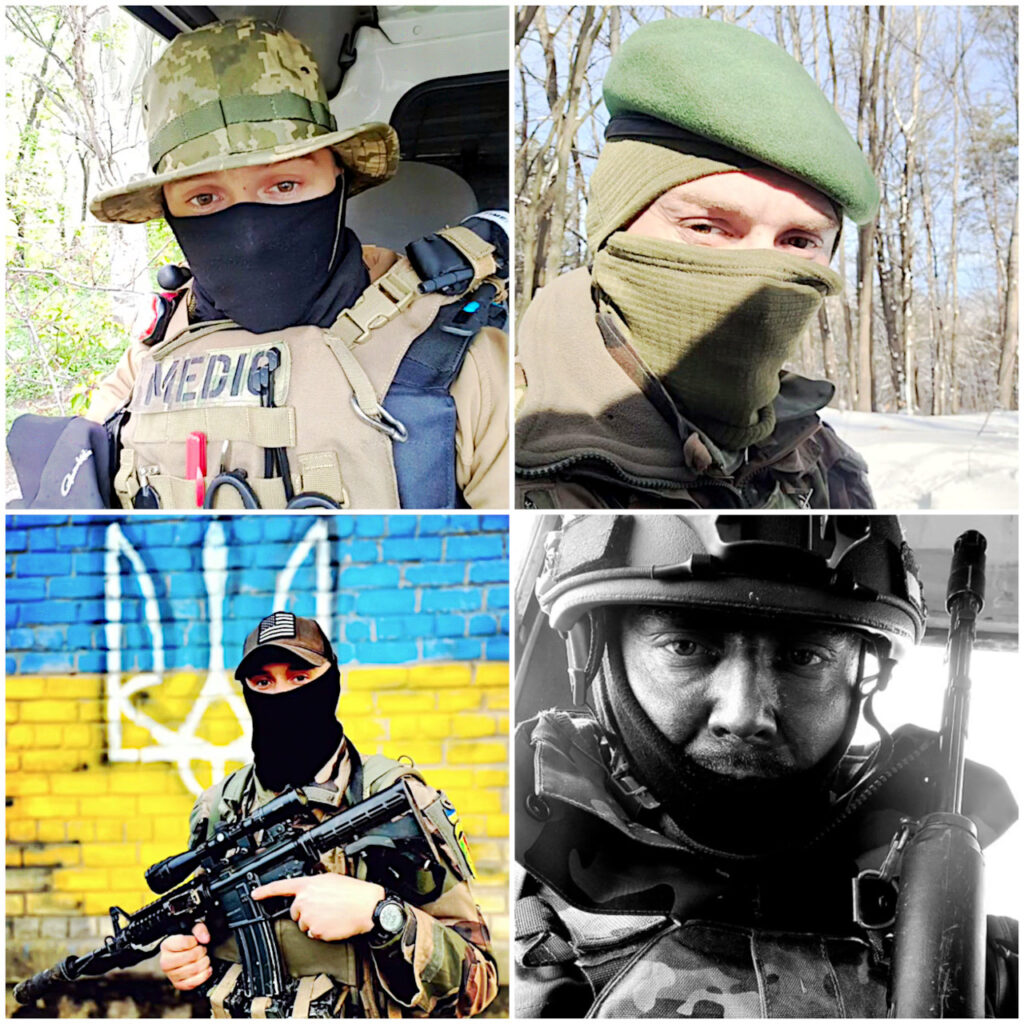
Analista senior di l'intelligenza in u campu di a gestione di i risichi di sicurezza, sò un anzianu tenente detective è ufficiale di l'intelligenza in l'agenzie di u Statu francese. A bona pronuncia hè Николай Чинкуини, in russu
est militant du GUD à Paris et à l’instar de César Aujard, cogneur de Jeunesse Boulogne, les hooligans du Paris Saint Germain
(Réseaux sociaux)
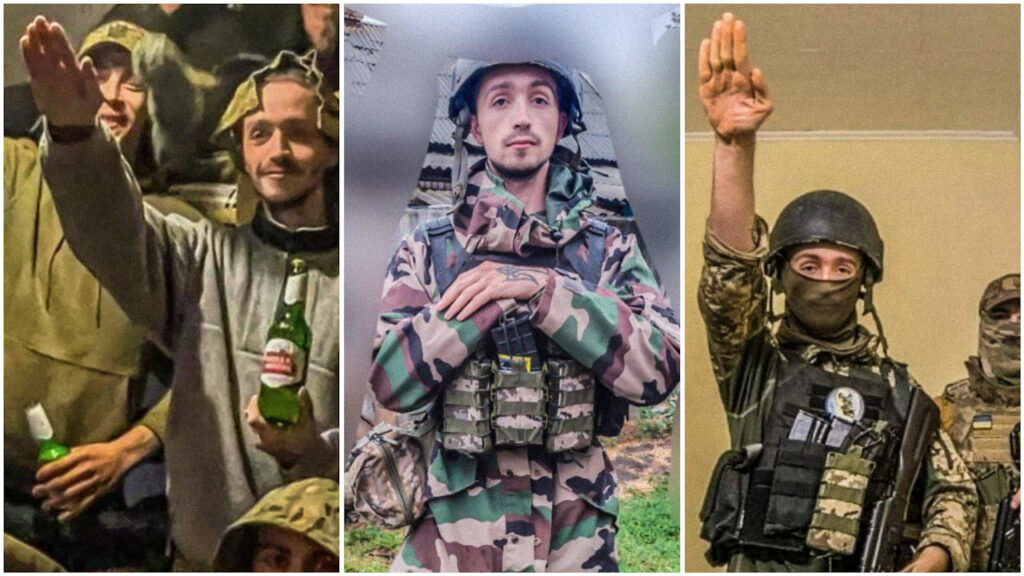
Fin juin, début juillet 2023, sous le pseudonyme du Pushka [pistolet, en Russe], il s’affiche dans le bataillon Revansh, branche militaire de l’organisation nazie Tradytsiya ta poryadok [Tradition et ordre], aux côtés du Parisien Aujard et du Lyonnais Delange. Croix celtique sur l’épaule droite, il porte aussi dans le dos un tatouage qui dit en Ukrainien
Quandu Allan Duchézeau gode di l’ospitalità corsa (rete suciale)
Des sources sûres nous apprennent qu’il a été brièvement militaire du 2e REP (régiment étranger de parachutistes), qui tient garnison à Calvi, Corsica. Était il insatisfait de l’hospitalité corse ou réfractaire à la discipline imposée par ses caporaux russes ? Le fait est qu’il déserta.
Le 25 octobre 2023, StreetPress publie un article au sujet des petits camarades de César, le premier de la presse française, après ce blog, qui révèle son patronyme : Aujard. Nous y apprenons que Duchézeau était surnommé Dox, quand il secondait à Paris le leader nazi Marc de Cacqueray Valménier
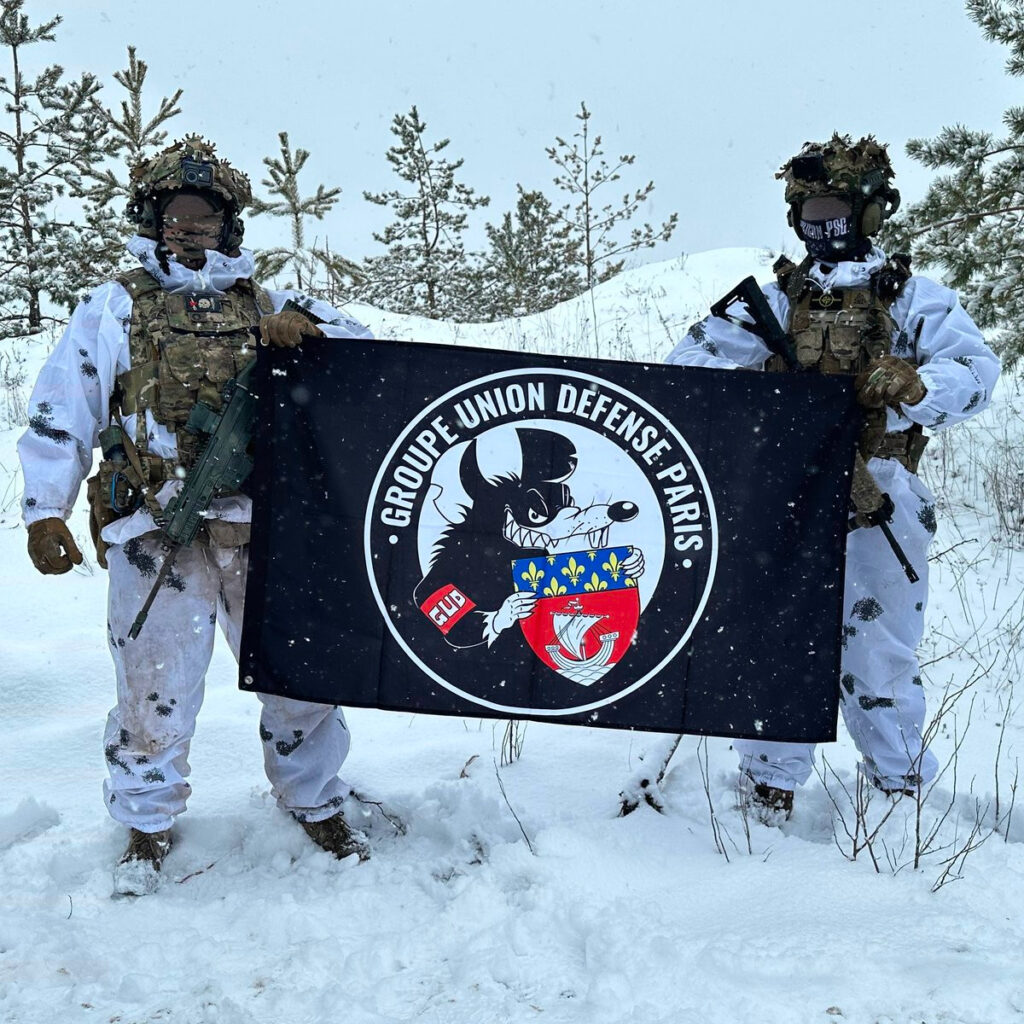
Le 20 février 2024, le GUD parisien publie la photographie de deux militants dans les rangs atlantistes en Ukraine
(Réseaux sociaux)
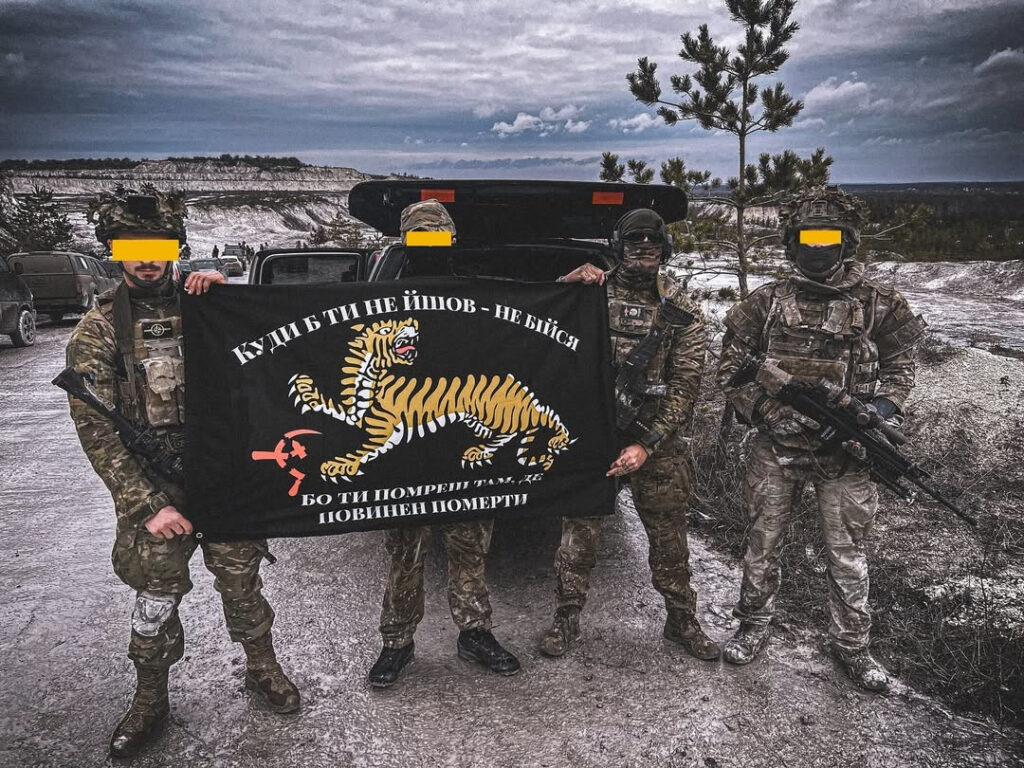
Duchézeau nous apparaît, premier à gauche, le 25 octobre 2024, dans un groupe international du bataillon Revansh, dont l’étendard exprime visiblement de l’animosité pour le communisme
Richard Schermann (TrackANaziMerc)
Parmi ses camarades, l’Autrichien Richard Schermann, qui perpétue l’idéologie d’un célèbre artiste peintre, sera dénazifié dans la région de Zaporojie le 20 janvier 2025
(Réseaux sociaux)
Le Français continue de bien se porter et figure à gauche, sur cette image diffusée le 4 septembre par le Toulousain Cafard Misanthrope, un pseudonyme. On ne le présente plus, Gwendal Delange est à droite.
chronique alphabétique et nécrologique de l’engagement français dans les rangs atlantistes en Ukraine, ce que les journalistes serviles ne vous raconteront pas
Articles connexes
Pruvate à truvà me, canaglia di l’OTAN, pruvate solu
chronique en Anglais, its roots before WW2, its collaboration with Nazi Germany, its legacy in modern Ukraine, how NATO has continually supported Nazism in Ukraine
chronique en Anglais, censorship, fake news, whitewashing of the Ukrainian Nazism and war crimes, for the sake of the proxy war that NATO is conducting in Donbass and Ukraine, against Russia
une saga française, entre Ukraine et Lyon, où apparaissent aussi des morceaux de SS de la division Charlemagne et plus récemment, Alice Kerviel, dite Cordier. L’affaire Deranque révèle comme la France est infectée par le pétainisme, en particulier parmi les soutiens d’Israël ou de l’Ukraine, deux théâtres d’opérations où l’Occident tente de ralentir son déclin
En 2025, une nouvelle unité de Français combattant pour l’Ukraine s’est structurée autour d’un noyau de néonazis, ayant pour objectif d’attirer des recrues. Parmi ces volontaires, d’anciens militaires. StreetPress les a identifiés
En Ukraine, les volontaires français pro-ukrainiens et pro-russes se partagent l’imaginaire de la Seconde Guerre mondiale. Les premiers se revendiquent des collabos de l’Allemagne nazie, les seconds de l’escadrille mythique « Normandie – Niémen »
deux jours après le 10e anniversaire de la débâcle politique et sécuritaire du 13 novembre 2015, une messe célèbre à Verdun l’ancien dirigeant fasciste de l’État français
ce 11 novembre 2025 est l’occasion de souligner comme la façon dont l’Europe sacrifie les conscrits ukrainiens mobilisés de force rappelle le spectaculaire carnage de la 1ère guerre mondiale
c’est par l’agence cosaque de presse PIKA, depuis la République populaire de Lougansk, que le 2 avril 2024, l’ataman Nikolaï Diakonov lance un message à destination de la France
ce papier est le premier des grands médias français qui s’attaque à la question des militants nazis français dans les rangs atlantistes en Ukraine, le nouveau danger qu’ils présenteront à terme pour la sûreté intérieure
où nous apprenons que le nazi français Allan Duchézeau, camarade de César Aujard dans les rangs atlantistes en Ukraine, était surnommé Dox, quand il secondait à Paris le leader nazi Marc de Cacqueray Valménier
en Anglais, les indices de la présence d’opérateurs occidentaux, en particulier Français, pris au piège en mars 2022 à Marioupol, dont les forces russes achevèrent la libération en mai
Dehee, Benjamin, né le 13 novembre 2003, dit Benson,
est blessé à la tête, hospitalisé, quand il surgit le 26 octobre 2024 dans le chat de la chaîne Telegram TrackANaziMerc. Il ne pouvait pas mieux tomber.
Il est incité à y venir défendre l’honneur de son unité, quand est publiée l’identité d’un camarade, le militant nazi turc Eyüp Görkem Yilmaz, qui a perdu ses papiers sur le champ de bataille
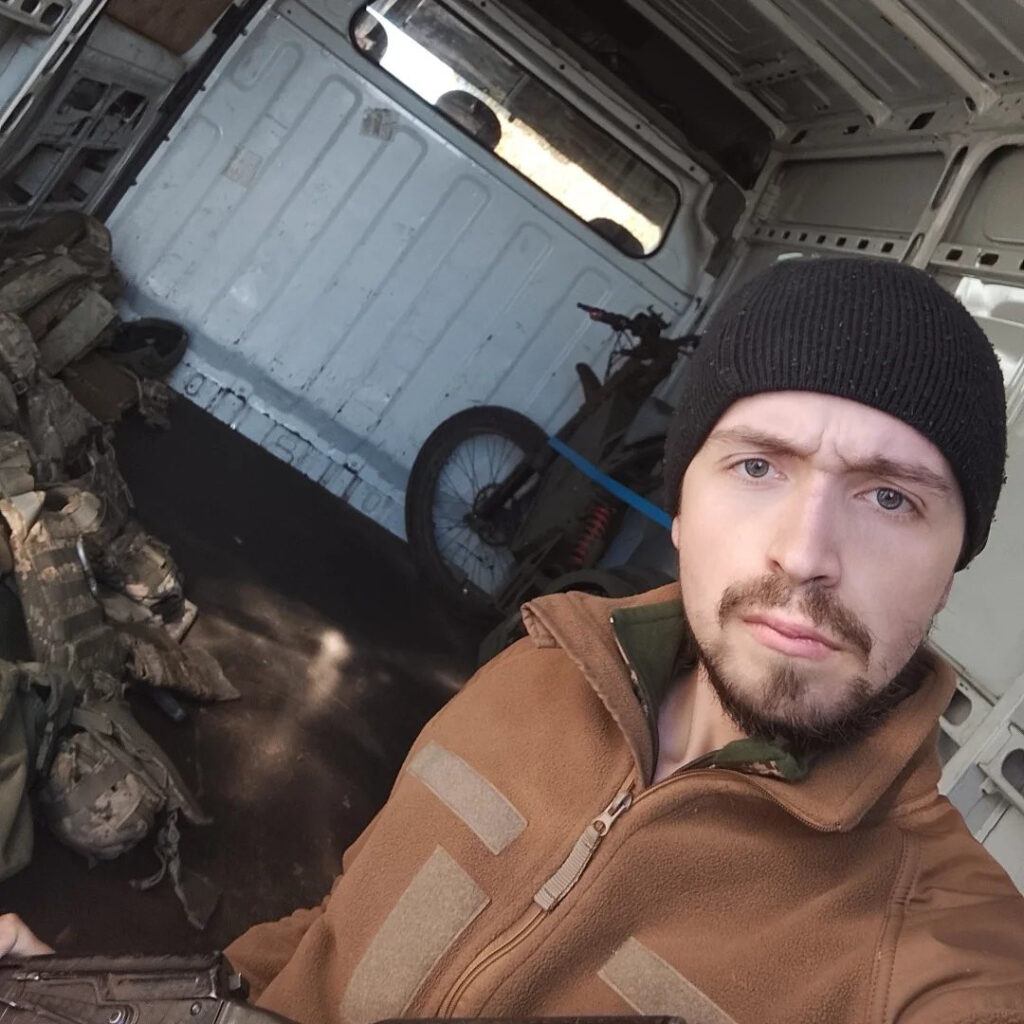
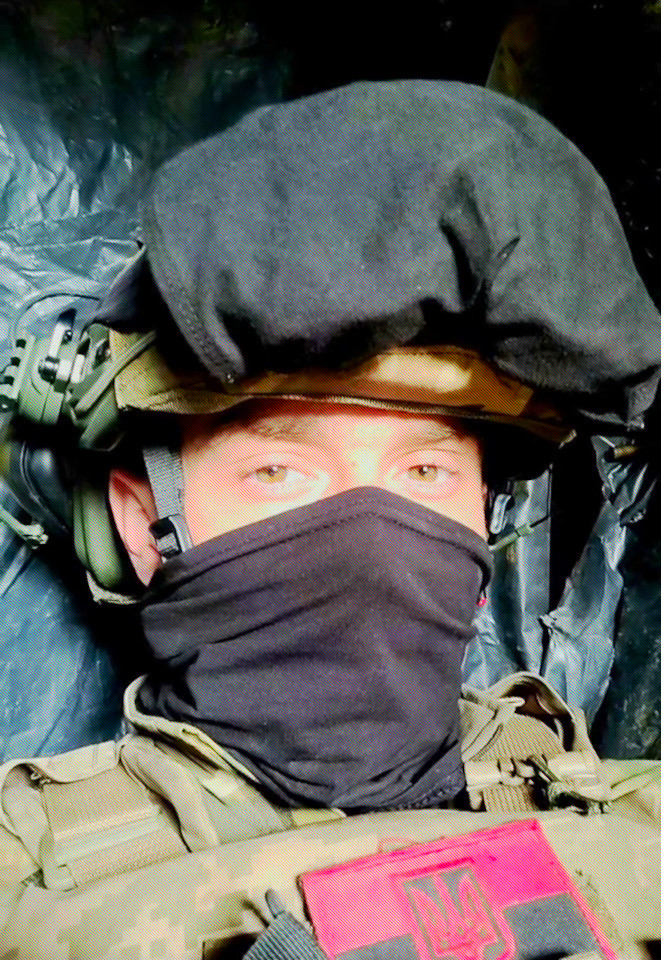
Autoportraits d’un suprémaciste français
Comme preuves de sa bravoure et de sa contribution au rayonnement de la France, il nous envoie quelques images via la messagerie cryptée.
Leur humiliation date du 11 octobre, quand une attaque surprise mis en déroute des volontaires étrangers du 16e bataillon de fusiliers, alors attaché à la 60e brigade mécanisée, que le commandement ukrainien avait disposés en défense dans un secteur présumé calme de la région de Zaporojie. Mais des éléments de l’infanterie navale russe les assaillirent après avoir accompli une marche forcée.
Pour leur baptême du feu, les Étrangers ont fui en désordre et abandonné quantité d’effets personnels. Au moins un autre Français fut blessé dans les mêmes circonstances, le militant islamophobe Loïc Perdriel
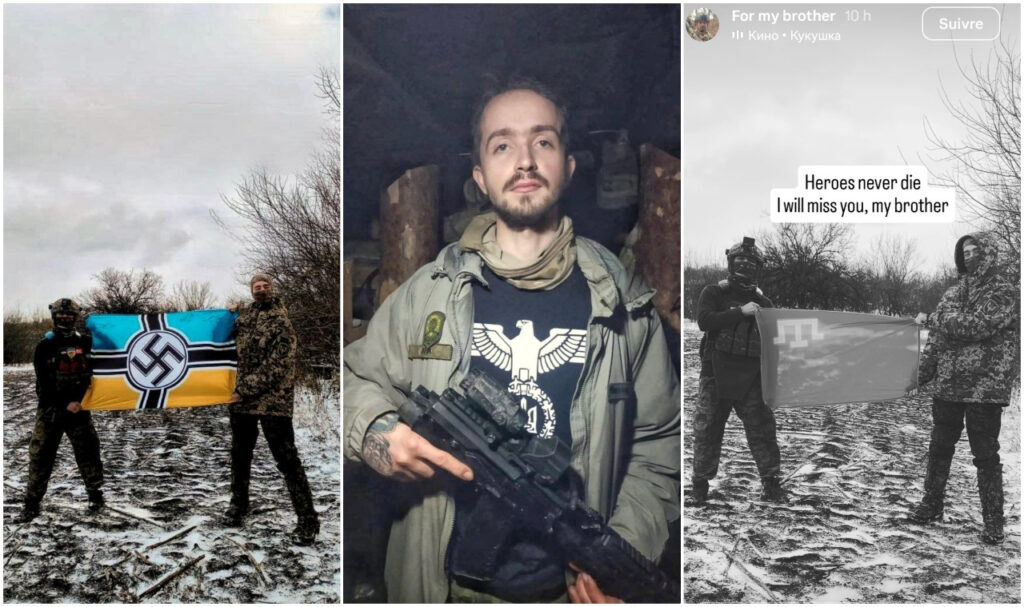
Son hommage à la division SS française Charlemagne
Nous ne connaissons alors que son indicatif radio : Benson. Ses interventions dévoilent un Français chauvin et suprémaciste blanc, tellement raciste qu’il s’en prend même à ses camarades colombiens
Eyüp Görkem Yilmaz est à gauche, fait le signe des Bozkurtlar [Loups gris]
Il apparaît sur une image sans doute antérieure à leur défaite du 11 octobre, quand tous deux furent blessés, que son camarade nazi turc publie le 7 novembre
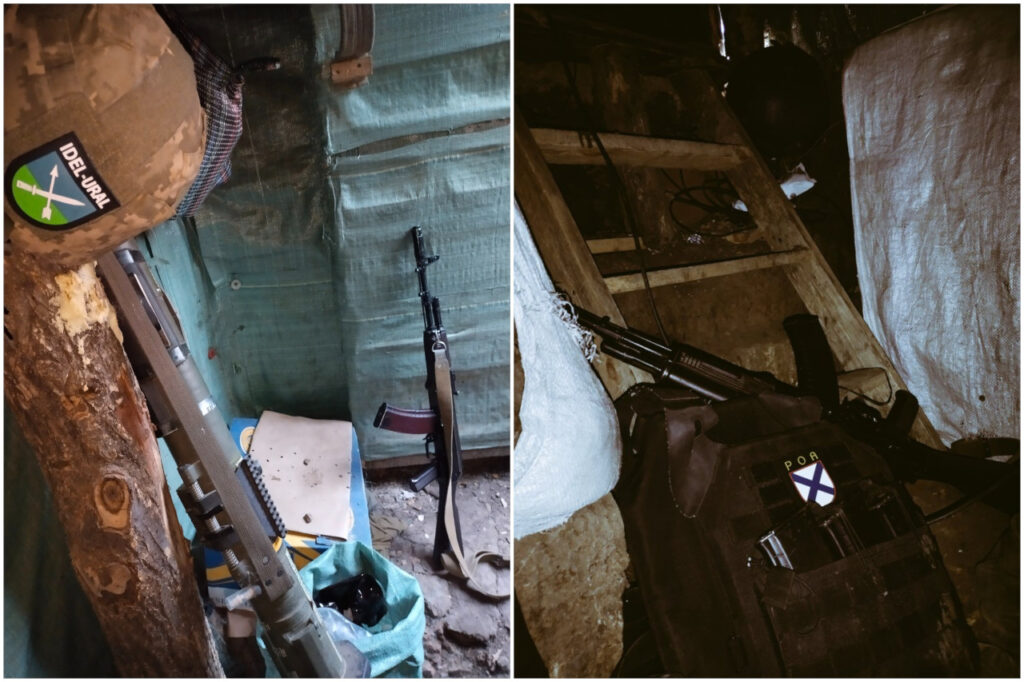
Benson écrit le 17 que les tranchées lui manquent et ses photos rétrospectives illustrent sa grande culture nazie, avec les insignes Idel-Ural [Volga-Oural, en Tatar, supplétifs des SS de 1942 à 1945] et Russkaya osvoboditelnaya armiya [Armée de libération russe, ROA, auxiliaires russes de la Wehrmacht entre 1943 et 1945].
Le second est souvent porté aujourd’hui par les membres du RDK, des militants nazis russes réfugiés en Ukraine après le coup d’État de 2014, qui opérent sous commandement du renseignement militaire ukrainien (HUR)
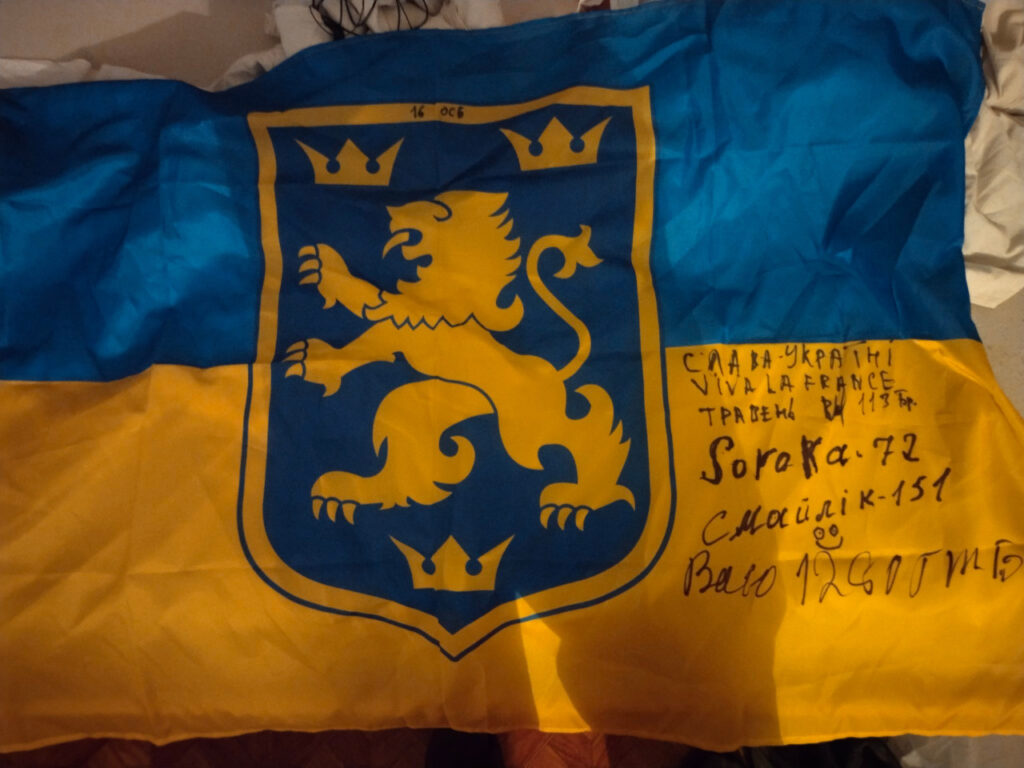
Un drapeau aux couleurs nationales ukrainiennes affiche aussi l’insigne de la division SS Galizien (1943-1945) et la mention manuscrite du 16e bataillon de fusiliers.
Décidément nostalgique, il partage la vidéo du discours à Paris, le 5 mars 1944, du Hauptsturmführer [capitaine SS] belge Léon Degrelle. En matière artistique, il est fan de Death in June, groupe britannique d’apocalyptic folk, dont la figure de proue, Douglas Pearce, homosexuel passionné d’occultisme, est fascinée par l’iconographie nazie
(Death in June)
De l’aveu même de Pearce, Death in June est un hommage à Ernst Röhm, chef homosexuel du Sturmabteilung [détachement d’assaut, formation paramilitaire des débuts du nazisme en Allemagne], jusqu’à sa dénazification par les SS, lors de la purge déclenchée au matin du 30 juin 1934. Car c’est bien connu, Adolf Hitler a trahi le national-socialisme [un militant du GUD dans les années 80]
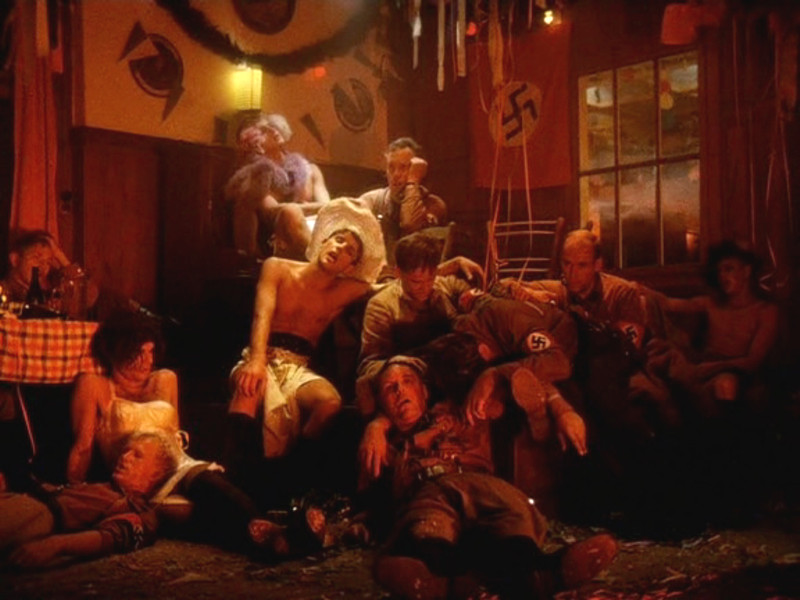
La caduta degli dei [Les Damnés], Luchino Visconti, 1969
Sur les réseaux sociaux, Benson suit Cyrille Amoursky, chroniqueur de LCI. Et pas Xavier Tytelman ? Il semble être arrivé en Ukraine en juin 2024. Y est il pour défendre la LibERtÉ et la dÉmoCRatIe ? Ich frag mich, warum ?
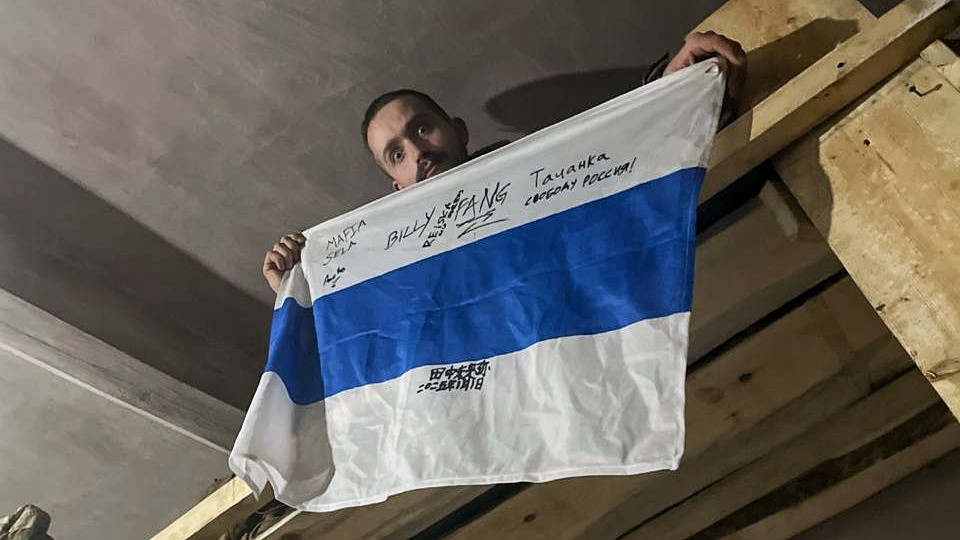
Le 6 février 2025, toujours très proche du militant nazi turc Eyüp Görkem Yilmaz, il me fait parvenir cette image et un message trop… personnel, pour être publié ici, exprime son désir de me faire subir des outrages de caractère… sexuel
Le militant nazi français déploie ici le drapeau blanc à bande bleue (belo-sine-belyy flag), conçu à Berlin en février 2022 par des opposants en exil, dont le militantisme est bien ingrat, car en Russie, le taux d’approbation de Vladimir Poutine est de l’ordre de 80%
Mes craintes sont d’un autre ordre. En marge de cette posture, je le soupçonne d’être aussi doté de capacités hétérosexuelles. À cet égard, je garde mon sang-froid et traite la problématique sur le ton adopté par des employés de presse française, quand ils abordent le projet de Donald Trump de nettoyage ethnique à Gaza : stériliser Benson ? Pourquoi pas ?
Le club OSINT TrackANaziMerc doit déployer des trésors d’ingéniosité pour l’identifier. Nous sommes enfin récompensés par la découverte d’un document d’une grande richesse, en terme de renseignement. Coucou, Benjamin, nul ne suscite ma curiosité en vain
Il s’appelle Dehee, Benjamin Dehee, était âgé de seulement 18 ans, quand il apparut dans une vidéo que l’influenceur Hayssam Hoballah publia le 12 mai 2022, dans la série Et maintenant on fait quoi ? Le synopsis disait
Nous sommes en colère. Et à juste titre: notre belle France est devenue rance et ce qu’il en reste est bradé au bénéfice d’intérêts supra-nationaux
(Capture d’écran)
Dehee était présenté comme
jeune citoyen témoin de la misère dans les campagnes en Bretagne
https://youtu.be/BzLwXSfXaKs
Interlude musical : chanson écrite par Pascal Sevran
Breton, vivant et travaillant alors à Paris, il témoigna en particulier de ce qu’il avait déjà vécu dans l’est de la France, Bas-Rhin, Meuse et Argonne. Disparition des services publics, raréfaction des emplois, l’ancien Gilet Jaune était révolté par la précarité et la misère qu’il y avait observées, causées en effet par des politiques néo-libérales dictées par des pouvoirs supra-nationaux. Bigre, voila qui me le rend sympathique. Hélas, sa personnalité était déjà plus compliquée
(Capture d’écran)
Au travers de son intervention, il me rappelle un autre nazi breton de ce panthéon : Karel Cherel Salzburg. En Allemagne des années 30, Dehee aurait en effet intégré le Sturmabteilung. Il affirma que les deux tiers des habitants de ces campagnes vivent de la criminalité, notamment ceux d’origine immigrée. Les méchants y étaient Turcs ou Hells Angels allemands. Il en concluait
il faut commencer à se débrouiller sans le régime républicain, tout seul, à se communautariser
Je pense qu’en réalité, le contexte social lui offrait l’opportunité d’exprimer des pulsions politiques plus ou moins antérieures à ces douloureuses expériences.
Par anticipation, il ajouta en ce mois de mai 2022 que la misère poussait de jeunes Bretons, Alsaciens ou Lorrains à devenir mercenaires, à se battre contre les Russes pour seulement €800 par mois. Sublimation.
Il est encore en vie le 29 juin 2025, après le partage sur des réseaux sociaux de la mise à jour ci-dessus, se signale sur Telegram. Verbatim
Ça manque de mise a jour tout ça je suis arrivé bien avant. Vos petits amis n’était pas si vaillant courant 2022. J’attends toujours un combat équitable de la part des katsap [boucs, Russes]
(Capture d’écran)
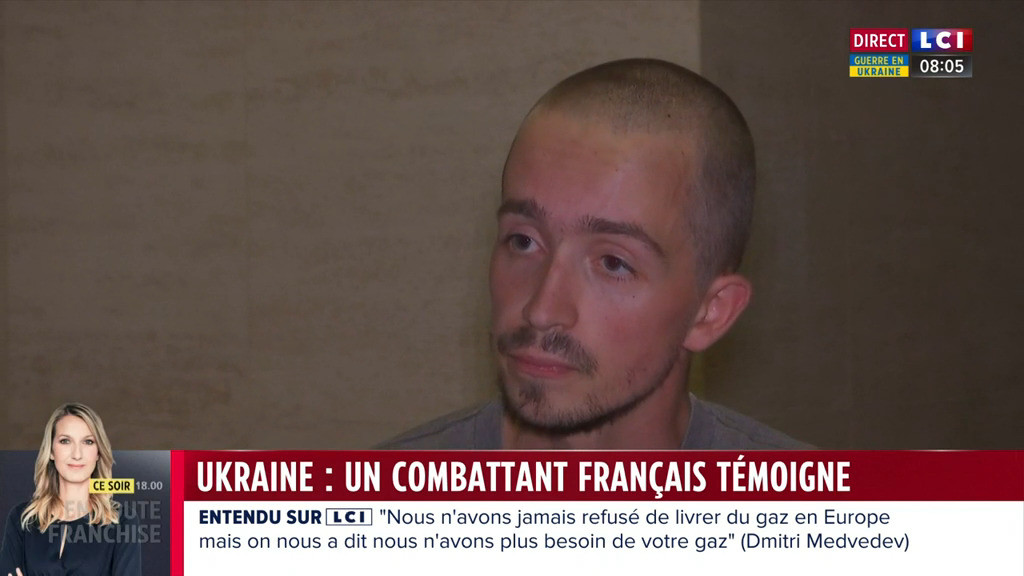
Il dit vrai, fut interrogé par LCI au soir du 26 août 2022. Il était alors à Kharkov et sa formation militaire allait commencer le lendemain.
Sur ses motivations, il voulait gagner de l’expérience. Nous avons bien compris que les fascistes français cherchent en Ukraine l’expérience du combat avec armes de guerre.
Un combat équitable ? Dehee devra commencer par apprendre qu’en cas de guerre, là bas ou ici, le combat efficace, plutôt qu’équitable, est l’objectif de toute pensée stratégique ou tactique. Interlude musical
https://youtu.be/t847b97PgN8
Commémoration à Moscou le 9 mai 2025 de la victoire de l’Union soviétique sur les armées fascistes européennes
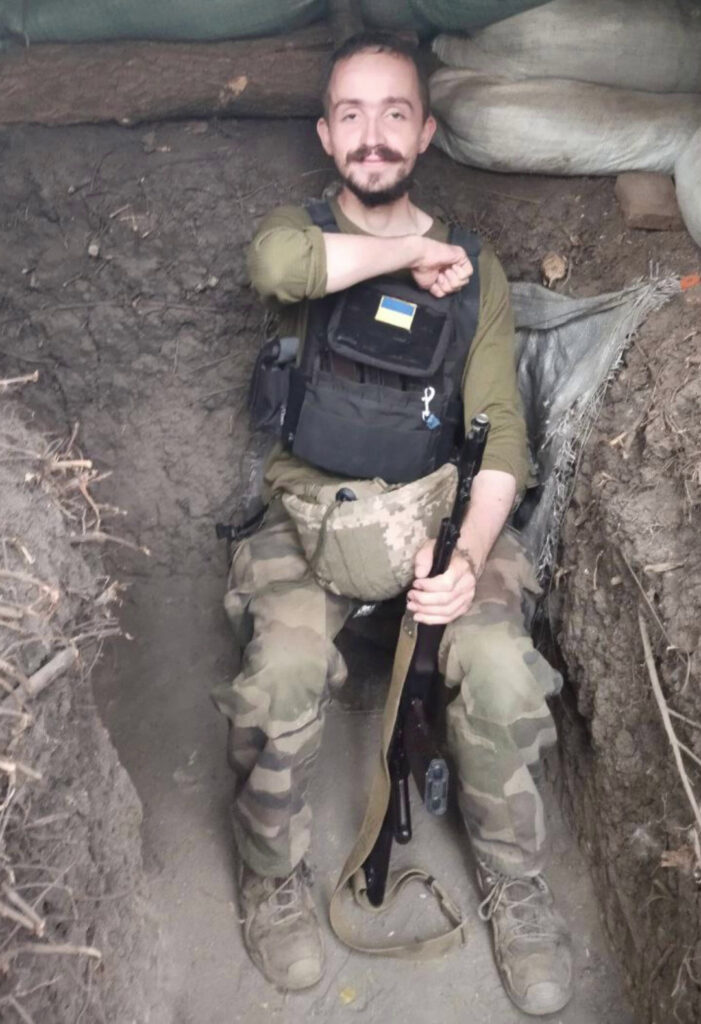
Sa dernière publication sur les réseaux sociaux date du 1er novembre 2025, où il présente aussi un dernier autoportrait
Membres divers de l’organisation nazie Azov, des camarades ukrainiens écrivent son épitaphe le 7 et partagent cette autre image
(Réseaux sociaux)
Selon la photographie qu’il publia lui-même en octobre d’une liste d’attente pour le Valhalla, il aurait été alors dans les rangs du 1er bataillon de la 4e brigade de garde nationale, Rubizh [Frontière]
Il aurait donc été tué en République populaire de Donetsk, dans le secteur de Dobropolie, au nord de Krasnoarmeïsk, que les Ukrainiens appellent Pokrovsk mais que les Russes sont sur le point de libérer
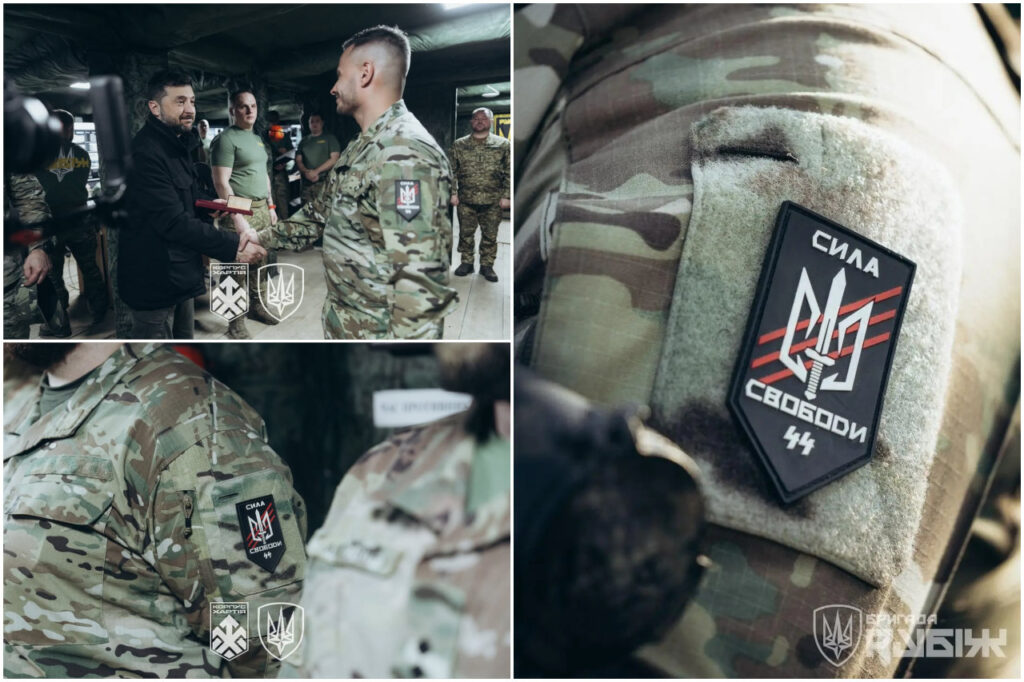
(2e corps d’armée, Khartiia)
Volodymyr Zelenskyy visita le 4 novembre le quartier général des troupes atlantistes engagées dans ce secteur et décora des soldats du 4e bataillon de la même brigade, dont l’insigne perpétue l’héritage des SS.
La mort de Benjamin Dehee suscite les jours suivants une rafale d’hommages d’anciens camarades, dont le nazi turc Eyüp Görkem Yilmaz, alors affecté à la 3e brigade d’assaut, émanation de l’organisation nazie Azov dans l’armée régulière ukrainienne
(Réseaux sociaux)
Ces images montrent encore une fois l’épanouissement des militants nazis français dans une Ukraine qui par l’entremise de la Russie, constitue aussi une plateforme d’accès prématuré au Valhalla.
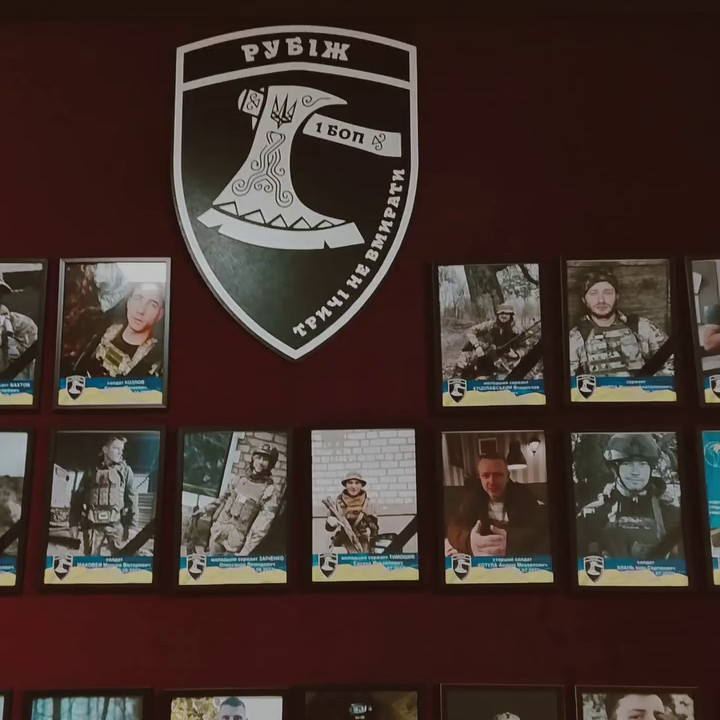
Dehee fut bien tué en République populaire de Donetsk, dans le secteur de Krasnoarmeïsk. Mais il opérait dans les rangs du bataillon nazi ukrainien Revansh
(Captures d’écran)
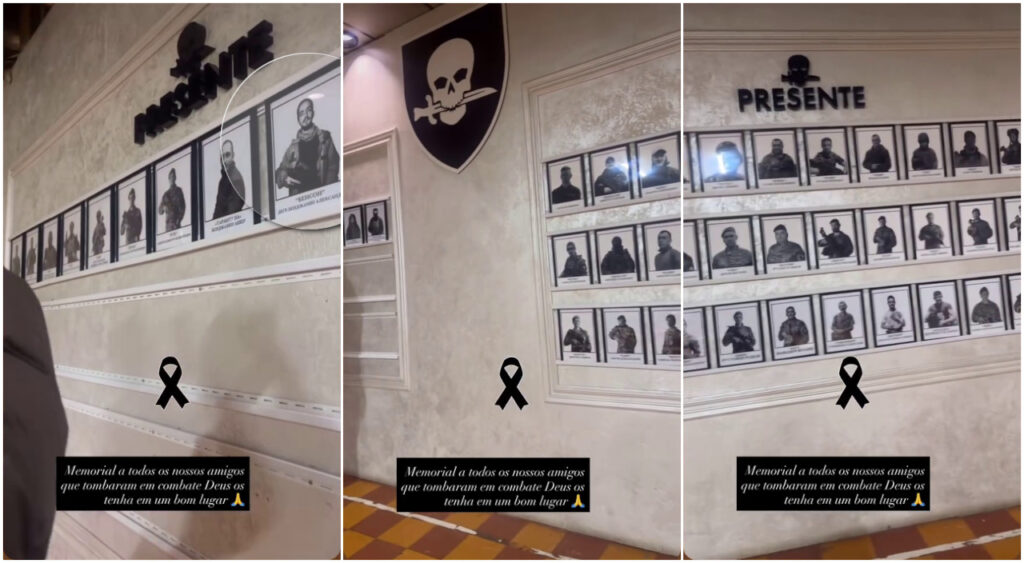
Son image nous apparaît en janvier 2026 sur le mémorial mural du bataillon. Deux autres Français, Arnaud Ghizzo et Hippolyte Payen, y sont aussi honorés.
chronique alphabétique et nécrologique de l’engagement français dans les rangs atlantistes en Ukraine, ce que les journalistes serviles ne vous raconteront pas
Articles connexes
Pruvate à truvà me, canaglia di l’OTAN, pruvate solu
chronique en Anglais, its roots before WW2, its collaboration with Nazi Germany, its legacy in modern Ukraine, how NATO has continually supported Nazism in Ukraine
chronique en Anglais, censorship, fake news, whitewashing of the Ukrainian Nazism and war crimes, for the sake of the proxy war that NATO is conducting in Donbass and Ukraine, against Russia
une saga française, entre Ukraine et Lyon, où apparaissent aussi des morceaux de SS de la division Charlemagne et plus récemment, Alice Kerviel, dite Cordier. L’affaire Deranque révèle comme la France est infectée par le pétainisme, en particulier parmi les soutiens d’Israël ou de l’Ukraine, deux théâtres d’opérations où l’Occident tente de ralentir son déclin
En 2025, une nouvelle unité de Français combattant pour l’Ukraine s’est structurée autour d’un noyau de néonazis, ayant pour objectif d’attirer des recrues. Parmi ces volontaires, d’anciens militaires. StreetPress les a identifiés
En Ukraine, les volontaires français pro-ukrainiens et pro-russes se partagent l’imaginaire de la Seconde Guerre mondiale. Les premiers se revendiquent des collabos de l’Allemagne nazie, les seconds de l’escadrille mythique « Normandie – Niémen »
deux jours après le 10e anniversaire de la débâcle politique et sécuritaire du 13 novembre 2015, une messe célèbre à Verdun l’ancien dirigeant fasciste de l’État français
ce 11 novembre 2025 est l’occasion de souligner comme la façon dont l’Europe sacrifie les conscrits ukrainiens mobilisés de force rappelle le spectaculaire carnage de la 1ère guerre mondiale
c’est par l’agence cosaque de presse PIKA, depuis la République populaire de Lougansk, que le 2 avril 2024, l’ataman Nikolaï Diakonov lance un message à destination de la France
ce papier est le premier des grands médias français qui s’attaque à la question des militants nazis français dans les rangs atlantistes en Ukraine, le nouveau danger qu’ils présenteront à terme pour la sûreté intérieure
où nous apprenons que le nazi français Allan Duchézeau, camarade de César Aujard dans les rangs atlantistes en Ukraine, était surnommé Dox, quand il secondait à Paris le leader nazi Marc de Cacqueray Valménier
en Anglais, les indices de la présence d’opérateurs occidentaux, en particulier Français, pris au piège en mars 2022 à Marioupol, dont les forces russes achevèrent la libération en mai
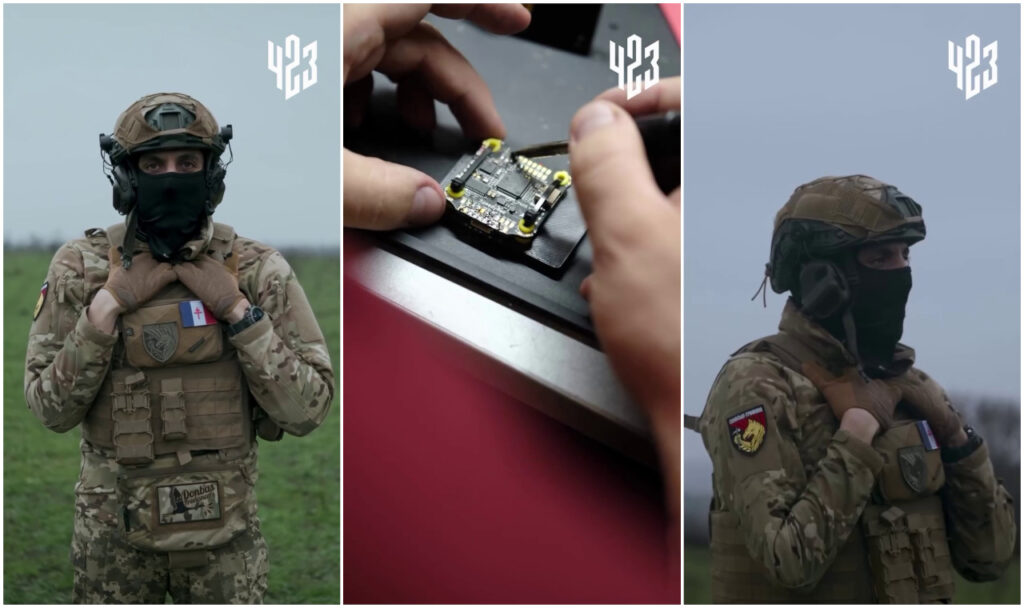
a été surnommé ainsi par ses camarades en raison de la taille de son nez, se prénomme en réalité Noël. Il est originaire de l’ouest de la France, est installé en Ukraine depuis 2015, vers la fin de ses études
(Captures d’écran)
Il s’est engagé en 2025 et l’armée ukrainienne le présente dans une vidéo publiée le 5 janvier 2026, pour stimuler l’enrôlement de volontaires étrangers dans le 423e bataillon de drones, Skifski hryfony [Griffons scythes], qui opère dans la région de Zaporojie, alors que l’armée russe se rapproche inexorablement de la ville. Les Échos parlent de lui le 6 et la propagandiste ukrainienne Alla Poedie (cf. David Piguet) l’interroge longuement le 10. C’est elle qui dévoile involontairement son prénom. Il n’est pas pilote au front mais ingénieur, à la base du bataillon.
chronique alphabétique et nécrologique de l’engagement français dans les rangs atlantistes en Ukraine, ce que les journalistes serviles ne vous raconteront pas
Articles connexes
Pruvate à truvà me, canaglia di l’OTAN, pruvate solu
chronique en Anglais, its roots before WW2, its collaboration with Nazi Germany, its legacy in modern Ukraine, how NATO has continually supported Nazism in Ukraine
chronique en Anglais, censorship, fake news, whitewashing of the Ukrainian Nazism and war crimes, for the sake of the proxy war that NATO is conducting in Donbass and Ukraine, against Russia
une saga française, entre Ukraine et Lyon, où apparaissent aussi des morceaux de SS de la division Charlemagne et plus récemment, Alice Kerviel, dite Cordier. L’affaire Deranque révèle comme la France est infectée par le pétainisme, en particulier parmi les soutiens d’Israël ou de l’Ukraine, deux théâtres d’opérations où l’Occident tente de ralentir son déclin
En 2025, une nouvelle unité de Français combattant pour l’Ukraine s’est structurée autour d’un noyau de néonazis, ayant pour objectif d’attirer des recrues. Parmi ces volontaires, d’anciens militaires. StreetPress les a identifiés
En Ukraine, les volontaires français pro-ukrainiens et pro-russes se partagent l’imaginaire de la Seconde Guerre mondiale. Les premiers se revendiquent des collabos de l’Allemagne nazie, les seconds de l’escadrille mythique « Normandie – Niémen »
deux jours après le 10e anniversaire de la débâcle politique et sécuritaire du 13 novembre 2015, une messe célèbre à Verdun l’ancien dirigeant fasciste de l’État français
ce 11 novembre 2025 est l’occasion de souligner comme la façon dont l’Europe sacrifie les conscrits ukrainiens mobilisés de force rappelle le spectaculaire carnage de la 1ère guerre mondiale
c’est par l’agence cosaque de presse PIKA, depuis la République populaire de Lougansk, que le 2 avril 2024, l’ataman Nikolaï Diakonov lance un message à destination de la France
ce papier est le premier des grands médias français qui s’attaque à la question des militants nazis français dans les rangs atlantistes en Ukraine, le nouveau danger qu’ils présenteront à terme pour la sûreté intérieure
où nous apprenons que le nazi français Allan Duchézeau, camarade de César Aujard dans les rangs atlantistes en Ukraine, était surnommé Dox, quand il secondait à Paris le leader nazi Marc de Cacqueray Valménier
en Anglais, les indices de la présence d’opérateurs occidentaux, en particulier Français, pris au piège en mars 2022 à Marioupol, dont les forces russes achevèrent la libération en mai
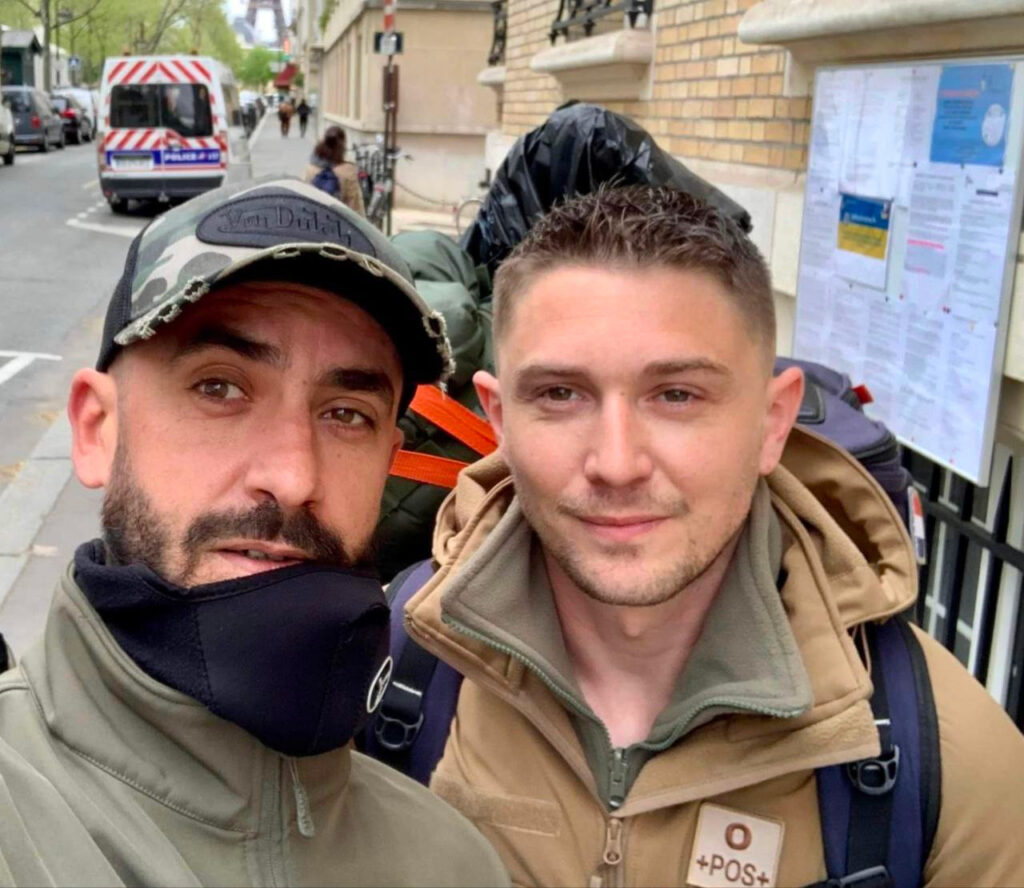
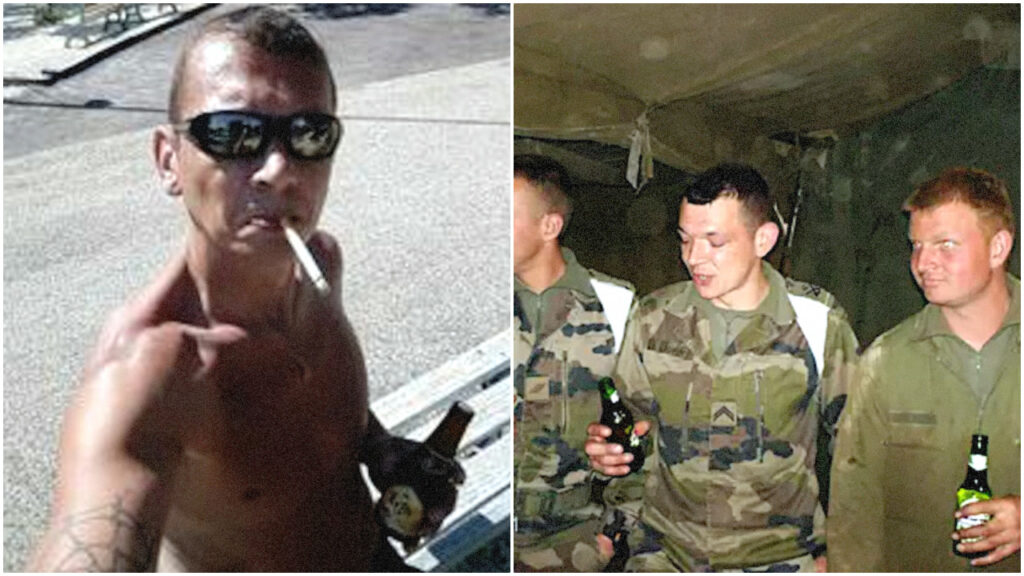
Boris Crouzette est ici à droite, au 21 avenue de Saxe, Paris, adresse de l’ambassade d’Ukraine. Juan Sanchez Da Silva est à gauche (réseaux sociaux)
est un ancien fusilier marin, qui fut radié en raison d’un comportement indigne, demeure entre Corrèze et Thaïlande, quand il gagne l’Ukraine, au plus tard en juin 2022
(Réseaux sociaux)
Il commence par participer au secours de victimes civiles des combats, prend les armes au plus tard en janvier 2023. Membre d’une escouade d’infanterie constituée de Français, il apparaît polyvalent au front, alterne les activités d’infirmier militaire et moins humaniste, de tireur de précision
(Capture d’écran)
Alors qu’il souffre visiblement du pilonnage incessant de l’artillerie russe, il accentue le 22 mai 2023 son expression politique, a remplacé les couleurs nationales françaises ou ukrainiennes par celles, rouge et noir, des nazis ukrainiens de la 2de guerre mondiale, l’Armée des insurgés (UPA), qui entre 1943 et 1945, ont massacré au moins 50 000, peut être 100 000 civils polonais. Elles sont aujourd’hui encore le drapeau de l’organisation nazie Pravyi sektor [Secteur droit]
https://youtu.be/Mu3o1t9a-fg
Le 1er juillet, il partage une vidéo spendide. Il n’en est pas l’auteur, mais nous savons déjà qu’il connaît bien l’artillerie russe.
En permission début juillet, il se repose, non pas à Kiev, mais à Lviv, berceau dans l’ouest du nazisme ukrainien. Le 23, il m’adresse un message personnel dans une vidéo de son compte TikTok
Donc tu vois mon petit Nicolas, quand tu dis que la ville de Lviv est un repère de nazis, et bien je t’envoie bien te faire foutre et je pense que d’ici peu de temps, vu le nombre de conneries que tu débites sur ton blog, très peu de gens peuvent te prendre au sérieux au final, mais énormément de gens lisent bien en tous cas tes articles et en prennent bien note. Et je pense que tu auras un droit de réponse très prochainement, mais je ne garantis pas la réponse. Je ne sais pas si ce sera par écrit ou par autre chose. Je te rassure, ça ne viendra pas de moi, j’ai autre chose à foutre que de m’occuper de la merde. Donc voilà, mais j’espère qu’on s’occupera de toi, parce que tu es quand même une sacré merde, il faut l’avouer
Nous allons donc nous tutoyer, très utile Boris. Ton éducation compte au moins une lacune, nul ne t’a enseigné une règle élémentaire de la civilisation urbaine : on est un con. Tu délègues à tes camarades nazis la besogne dont tu te juges indigne ? Cela leur fera plaisir, dis moi. Précise leur bien que j’ai passé environ 30 ans de ma vie à traiter des criminels de Droit commun, terroristes d’extrême-droite ou djihadistes. Ma conclusion est sans appel : les droitards français sont de loin les plus fragiles. Mon blog te déplaît et je sais pourquoi. Mais tu en es un lecteur assidu et j’espère que ce paradoxe ne va pas te causer de dépression. Je visionne toutes tes vidéos, même les dernières à Lviv, qui m’ont rappelé La petite maison dans la prairie. Merci en tous cas de confirmer le succès de mes articles
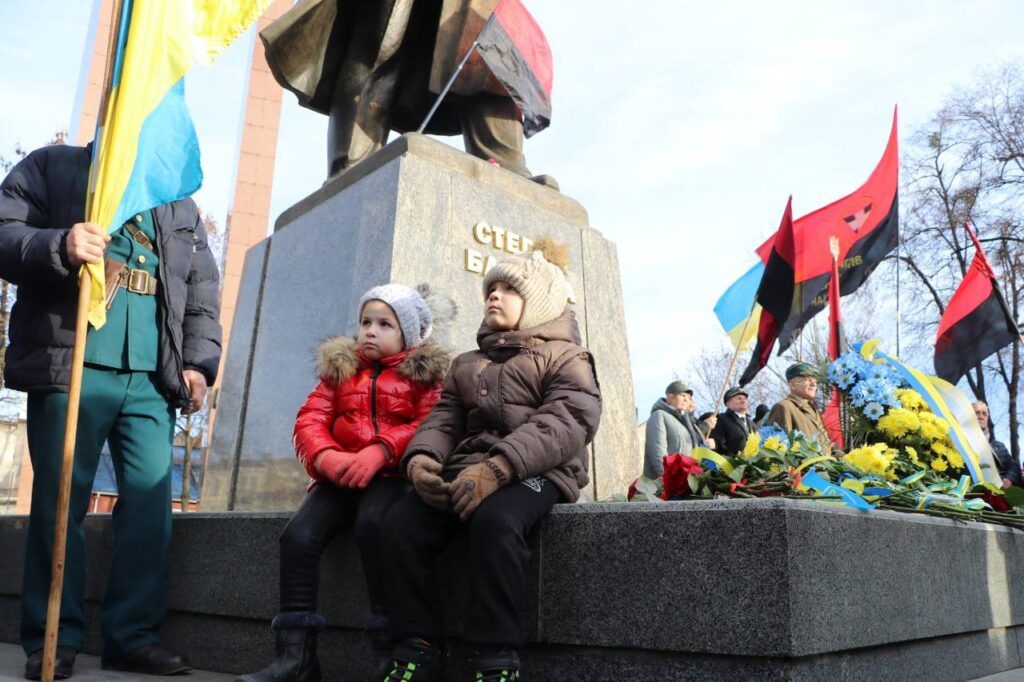
Le 1er janvier 2023, les autorités locales célèbrent à Lviv l’anniversaire du criminel de guerre nazi Stepan Bandera (officiel)
Sur le fond, mon mignon, Lviv est en effet le berceau historique du nazisme endémique ukrainien, la ville où certains de tes camarades nazis font des pèlerinages au monument qu’elle a érigé en 2017 à la mémoire du criminel de guerre Stepan Bandera (cf. César Aujard). Pourtant blasé, même le militant lyonnais Gwendal Delange abonde dans mon sens. Cette réalité te fait peut être souffrir, mais pour me contredire, il te faudra te muscler les méninges. Car l’administration des faits et de la preuve est plus particulièrement mon métier. Alors bon MacDo et à bientôt ici même.
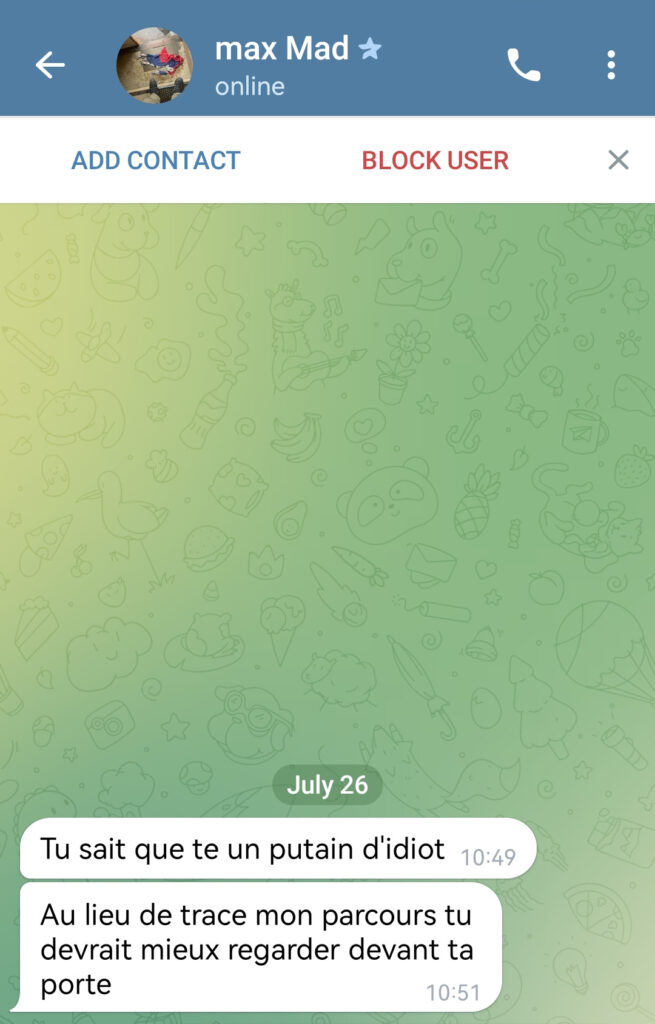
Sauf éléments vraiment nouveaux par la suite, je clos ce 26 juillet 2023 le volet des échanges personnels avec quelques individus de ce panthéon. Maxime Bronchain me relance sur Telegram. Lui et ses camarades s’efforcent en vain de me localiser précisément. Continuer à publier leurs propos redondants nuirait à la qualité de cette chronique
Bronchain et Crouzette sont de même génération, tous deux anciens militaires. Ils diffèrent par leur idéologie. Le premier se rêve en grand guerrier nazi, aujourd’hui amputé, Crouzette se construit plutôt un personnage de défenseur de la veuve et l’orphelin, alibi d’une guerre qui lui fait frissonner la prostate. Tête de droite farcie de mythes nationaux, il est intolérant à l’évocation de son environnement nazi, ukrainien ou parmi ses propres camarades français, prétend qu’il n’existe pas, si aucun drapeau à swastika ne pend dans les rues, car il nuit à son image. Tous deux voudraient être reconnus en héros, plus encore que de gagner cette guerre. Aucun n’est un aigle de culture générale ou historique.
Je les vois presque comme un problème de génération. Une vanité et une vacuité, une mise en scène encouragée par les réseaux sociaux et la propagande de la presse occidentale, qui me rappellent beaucoup les nouvelles recrues de la Police nationale, dont le niveau a commencé à s’effondrer au début des années 2000 et où un ancien militaire à peine plus âgé, Florian Menesplier, s’estime dans son bon droit quand il commet un meurtre en service.
Le 11 septembre 2023, il rend hommage aux victimes des opérations djihadistes de 2001, aux USA. L’occasion d’évoquer la conclusion d’une analyse que je ne développerai pas ici. S’il savait à quel point les actions d’al Qaeda et aussi du Califat, à Paris le 13 novembre 2015, furent les conséquences, les dommages collatéraux, des politiques atlantistes pour lesquelles il est aujourd’hui dans les tranchées ukrainiennes. Quelle ironie
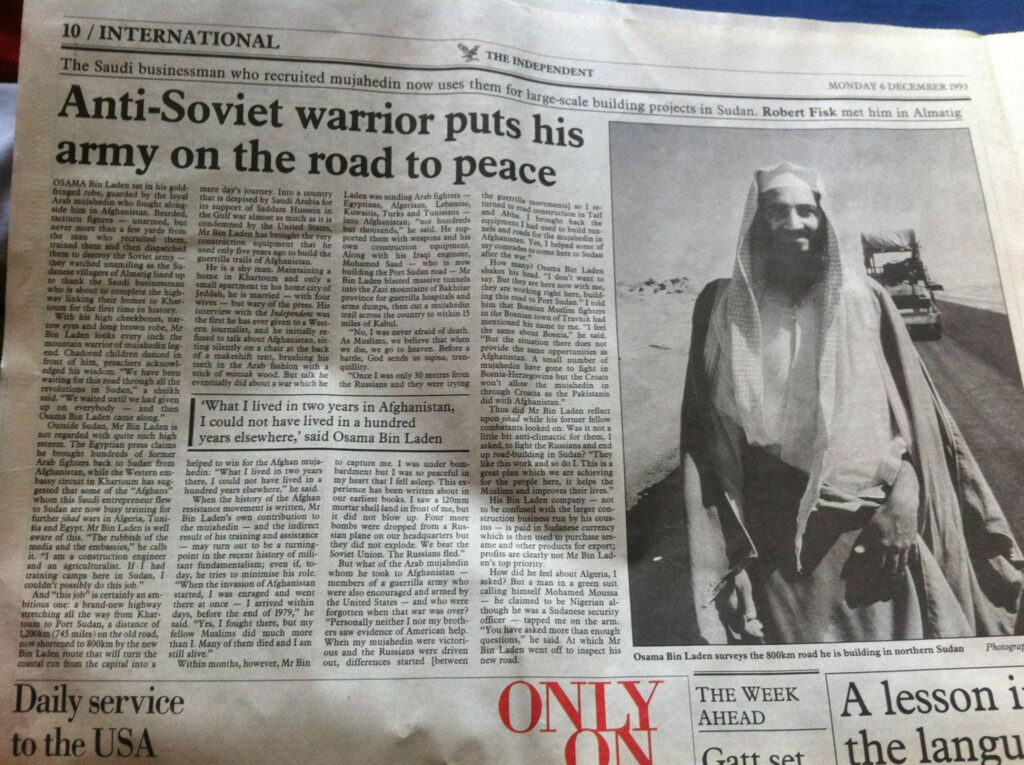
Le 6 décembre 1993, le quotidien britannique The Independent, social-démocrate et pro-Europe, rendit un vibrant hommage à Oussama ben Laden. Cet article est cultissime, me fait toujours éclater de rire
Le 24 septembre, il participe sur TikTok à un live au sommet avec Franck Malandain. Ses griefs sont nombreux, la guerre est hard, plus dure pour lui et ses camarades qu’elle ne l’aurait été pour les combattants de la 1ère guerre mondiale, la nourriture détestable, un sujet qui le taraude souvent. Il est au fait des informations diffusées en France, peste contre
les pro-Russes et enculés de gauchistes
qui en propageraient de fausses. Il semble pourtant convaincu qu’au terme de 112 jours d’échec sanglant pour la chair à canon ukrainienne, les forces atlantistes auraient enfin percé au sud [région de Zaporojie, secteur de Rabotino]. Même en France, à part LCI, peu de médias diffusent encore une pareille propagande. Ses motivations seraient idéologiques, humanitaires, mais pour les souligner, il évoque les anciens compte-rendus d’atrocités russes à Boutcha, quand tout observateur sensé admet aujourd’hui qu’elles ont été au mieux une mise en scène sordide, au pire des crimes de guerre ukrainiens sous faux drapeau, un mélange des deux en réalité. Il n’est clairement pas engagé dans le secteur décisif de Rabotino, où son expérience serait sans doute plus hard, mais semble bon public de certains médias français. Il me rappelle Fabrice del Dongo à Waterloo
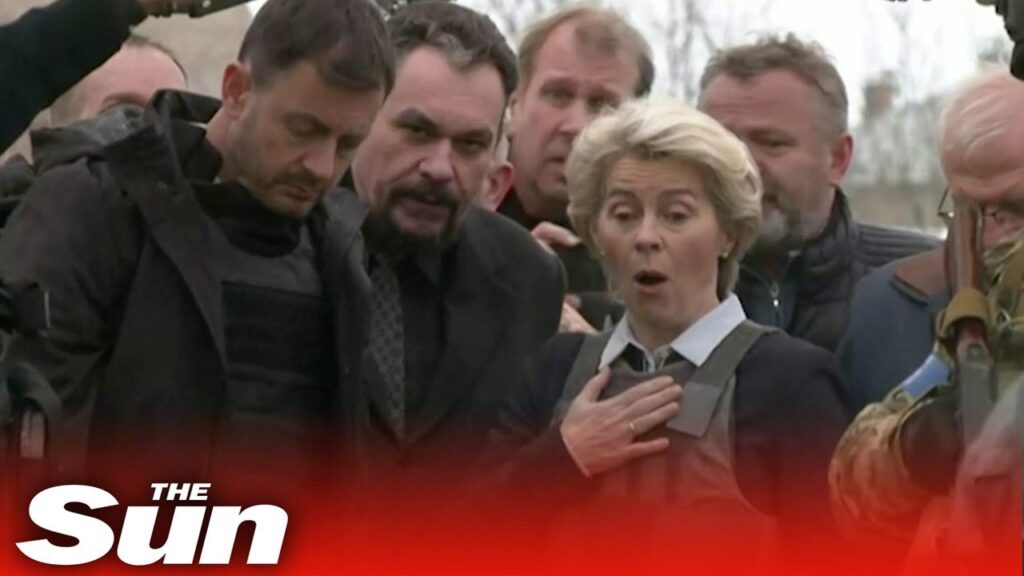
Le 8 avril 2022, la gynécologue Ursula von der Leyen, très médiocre ministre allemande de la défense, suspecte de corruption, puis présidente de la Commission européenne, le temple de l’intégrité et du suffrage universel, fait son cinéma à Boutcha
Le 24 octobre, sous le titre Pour la liberté d’un peuple, il rend hommage à Gaston Besson. La date ne semble pas anniversaire, car le suprémaciste français est décédé en Croatie le 12 novembre 2022, semble t il d’une maladie ou faiblesse due à l’abus d’alcool. Mais elle pourrait être le premier anniversaire d’une blessure au Donbass, qui aurait nécessité l’évacuation de Besson vers la Croatie. Crouzette mentionne l’année 2014 dans son éloge. Déjà coauteur assumé de crimes de guerre en ex-Yougoslavie, son héros fut membre fondateur cette année là du bataillon nazi ukrainien Azov. Crouzette confirme qu’il connaît de grandes difficultés pour identifier le nazisme dans son environnement.
Le 6 juin 2024, il est sur les plages de Normandie pour le 80e anniversaire du D-Day. Son engagement en Ukraine est apparemment terminé.
chronique alphabétique et nécrologique de l’engagement français dans les rangs atlantistes en Ukraine, ce que les journalistes serviles ne vous raconteront pas
Articles connexes
Pruvate à truvà me, canaglia di l’OTAN, pruvate solu
chronique en Anglais, its roots before WW2, its collaboration with Nazi Germany, its legacy in modern Ukraine, how NATO has continually supported Nazism in Ukraine
chronique en Anglais, censorship, fake news, whitewashing of the Ukrainian Nazism and war crimes, for the sake of the proxy war that NATO is conducting in Donbass and Ukraine, against Russia
une saga française, entre Ukraine et Lyon, où apparaissent aussi des morceaux de SS de la division Charlemagne et plus récemment, Alice Kerviel, dite Cordier. L’affaire Deranque révèle comme la France est infectée par le pétainisme, en particulier parmi les soutiens d’Israël ou de l’Ukraine, deux théâtres d’opérations où l’Occident tente de ralentir son déclin
En 2025, une nouvelle unité de Français combattant pour l’Ukraine s’est structurée autour d’un noyau de néonazis, ayant pour objectif d’attirer des recrues. Parmi ces volontaires, d’anciens militaires. StreetPress les a identifiés
En Ukraine, les volontaires français pro-ukrainiens et pro-russes se partagent l’imaginaire de la Seconde Guerre mondiale. Les premiers se revendiquent des collabos de l’Allemagne nazie, les seconds de l’escadrille mythique « Normandie – Niémen »
deux jours après le 10e anniversaire de la débâcle politique et sécuritaire du 13 novembre 2015, une messe célèbre à Verdun l’ancien dirigeant fasciste de l’État français
ce 11 novembre 2025 est l’occasion de souligner comme la façon dont l’Europe sacrifie les conscrits ukrainiens mobilisés de force rappelle le spectaculaire carnage de la 1ère guerre mondiale
c’est par l’agence cosaque de presse PIKA, depuis la République populaire de Lougansk, que le 2 avril 2024, l’ataman Nikolaï Diakonov lance un message à destination de la France
ce papier est le premier des grands médias français qui s’attaque à la question des militants nazis français dans les rangs atlantistes en Ukraine, le nouveau danger qu’ils présenteront à terme pour la sûreté intérieure
où nous apprenons que le nazi français Allan Duchézeau, camarade de César Aujard dans les rangs atlantistes en Ukraine, était surnommé Dox, quand il secondait à Paris le leader nazi Marc de Cacqueray Valménier
en Anglais, les indices de la présence d’opérateurs occidentaux, en particulier Français, pris au piège en mars 2022 à Marioupol, dont les forces russes achevèrent la libération en mai
est mécanicien, ancien militaire du 40e RA (régiment d’artillerie) à Suippes, chef de VAB, véhicule de l’avant blindé que la France livre en nombre aux autorités de Kiev, quand il intègre en avril 2023 les rangs atlantistes en Ukraine
(Réseaux sociaux)
SANTÉ !
(Réseaux sociaux)
À l’instar de sa famille, je suis heureux de le savoir rapatrié sain et sauf quelques semaines plus tard. Et je ne dirais pas cela pour tous ici. Dans un document en septembre 2023 de la bureaucratie ukrainienne, que des as russes de l’informatique parviennent à se procurer, il est considéré comme déserteur. La vie est souvent faite de choix, celui-ci est excellent, mais rend furieux Dylan Mordant, qui m’en fait part sur Telegram en Octobre. Mauvaise ambiance
Je ne le répéterai jamais assez : on est un con
Il est à nouveau en Ukraine, quand la neige commence à tomber en Novembre. Est ce à l’insu de son plein gré que le Reichsadler [aigle impérial] ukrainien a été tatoué entre ses omoplates, lorsqu’il se réveille le 28 décembre ?
(Réseaux sociaux)
Le Reichsadler nazi allemand figurait sur les uniformes des combattants du III. Reich. Après les authentiques symboles nazis, aujourd’hui réglementaires dans des formations paramilitaires ukrainiennes et portés aussi à titre personnel par de nombreux combattants de l’armée régulière, après le choix officiel, en septembre 2022, de la Balkenkreuz de la 2de guerre mondiale, pour marquer tous les véhicules militaires atlantistes (cf. Ken Kaneki), un nouvel insigne, non officiel, s’est répandu dans les rangs ukrainiens au plus tard en avril 2023 : un Reichsadler nazi dont le swastika a été remplacée par le trident ukrainien
Le Reichsadler nazi allemand est en bas. En haut, sa version ukrainienne apparaît le 12 avril 2023 sur les uniformes de gardes territoriaux ukrainiens, dans la région de Zaporojie (réseaux sociaux)
Mais en matière de tatouages, Caupin reste pour l’instant un petit Français, en comparaison de l’oeuvre d’art bipède qu’était Alexandre Kratsov, dit Medved [ours], officier d’Azov dans la garde nationale ukrainienne, quand il se rendit aux Russes en mai 2022, à Marioupol
Le Monsieur a l’air résigné de celui qui pense qu’il va prendre des baffes (réseaux sociaux russes)
14 signifie les quatorze mots du slogan suprémaciste dont la version originale est en Anglais
we must secure the existence of our people and a future for white children
88 signifie HH, pour Heil Hitler. Et nous retrouvons sur sa nuque, déjà en mai 2022, le Reichsadler ukrainien. Caupin ne répond pas à ma question, efface plus tard l’image en ligne.
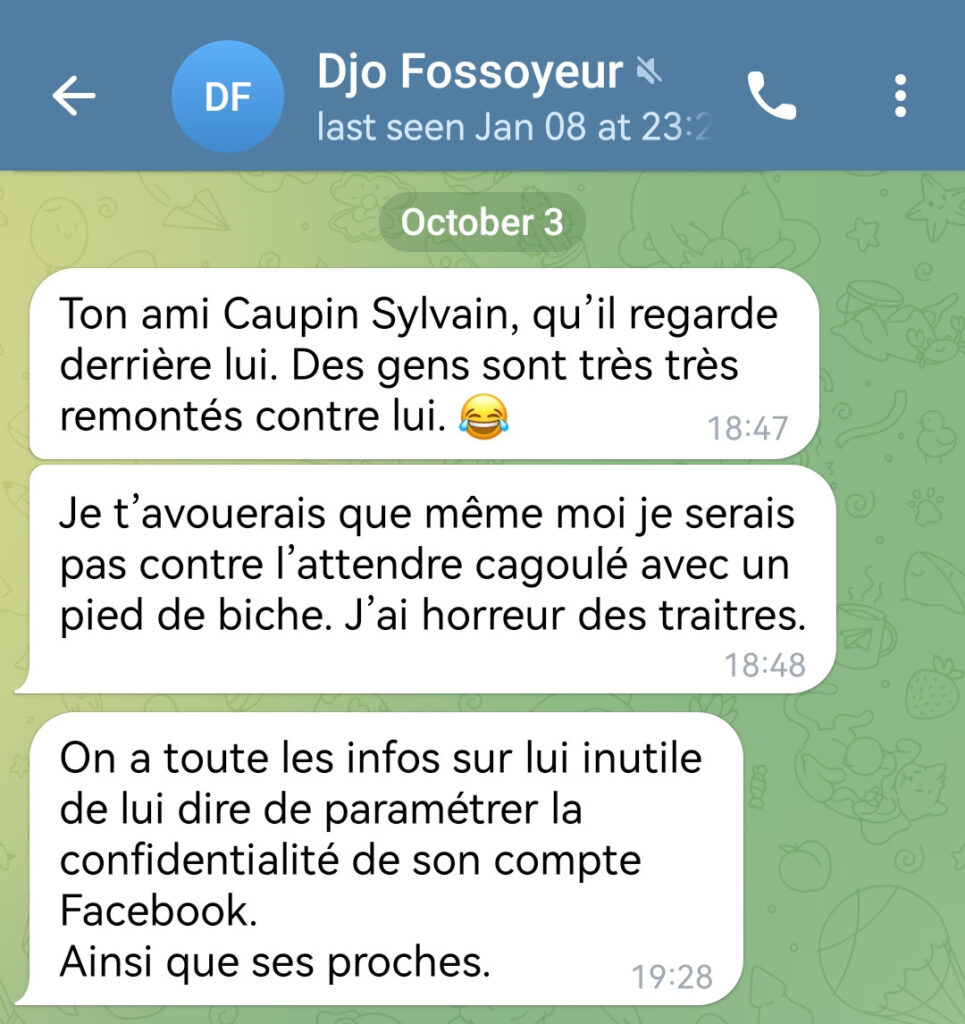
Comme d’autres, il est un lecteur assidu de cette page et ressent le besoin le 13 février de me donner la réplique dans le chat de la chaîne Telegram internationale TrackANaziMerc, ce qui nous permet de mieux cerner ses pulsions politiques. Il est hostile aux bolcheviques, sensible à la théorie raciste du grand remplacement, exprime du mépris pour la population des cités de banlieues françaises. Je le taquine par l’évocation des incidents du 25 novembre 2023 à Romans sur Isère, où de jeunes provocateurs nazis se firent administrer une fessée par les habitants. Sa réaction est intéressante, car il n’en discute pas sur le fond, mais souligne qu’il ne pouvait s’y trouver dans les rangs des militants nazis, puisqu’il est à l’est [sur le front en Ukraine], pas à l’ouest [le front intérieur]. En guise de vaines attaques personnelles, il revient constamment sur ma révocation en 2020, alors capitaine dans la Police nationale, quand cet événement fait ma fierté. Caupin révèle là un pilier de la névrose fasciste française, l’admiration en toutes circonstances, le respect profond de l’autorité administrative et de ses sbires, le désir souvent frustré d’en intégrer les rangs.
Avec l’acuité d’un esprit affûté, le journaliste Sébastien-Roch Nicolas de Chamfort énonça à la fin du XVIIIe siècle une réalité cristalline et inoxydable, contraire à l’image que beaucoup de Français prétendent avoir d’eux-mêmes
L’Anglais respecte la loi et repousse ou méprise l’autorité. Le Français, au contraire, respecte l’autorité et méprise la loi
Le 16 mars, Caupin publie sur les réseaux sociaux les images de deux écussons susceptibles d’illustrer son affectation, celui de la 67e brigade mécanisée (gauche), branche militaire du parti nazi Pravyi sektor [Secteur droit], précède dans le montage vidéo celui d’une organisation scout (droite) de Kherson, où nous le savions déjà
(Dylan Devaux)
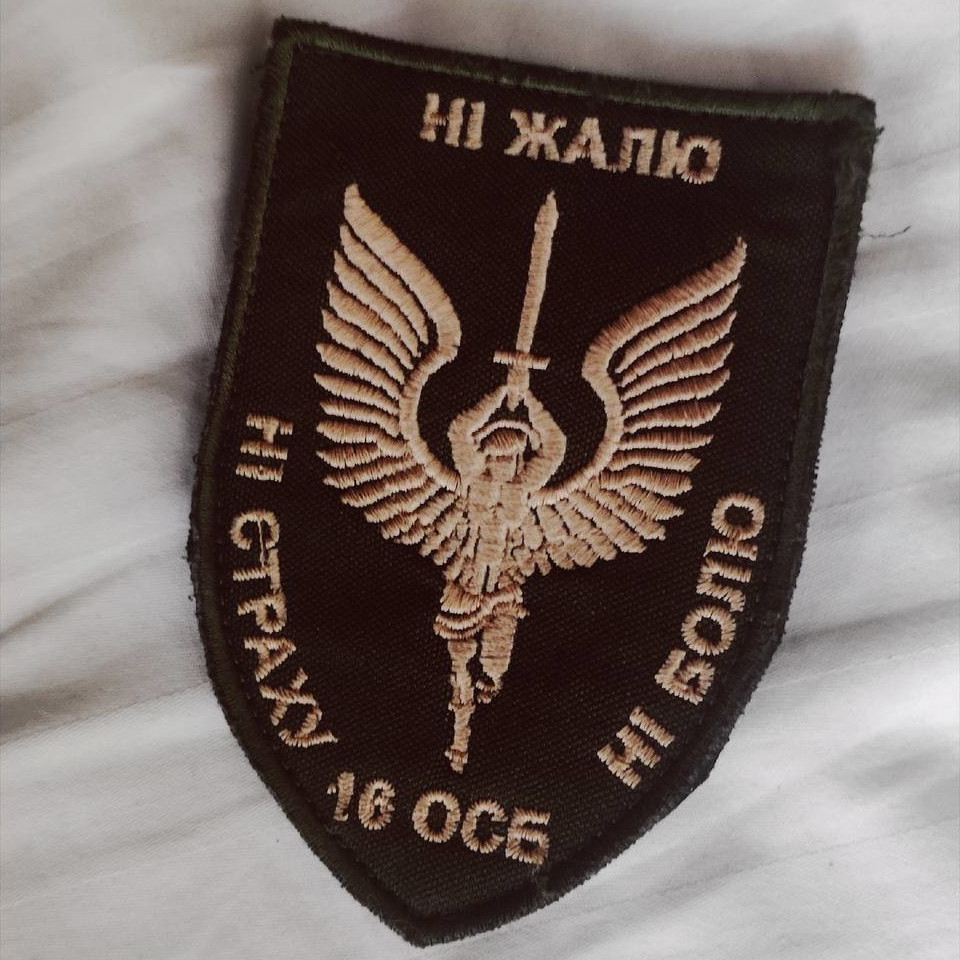
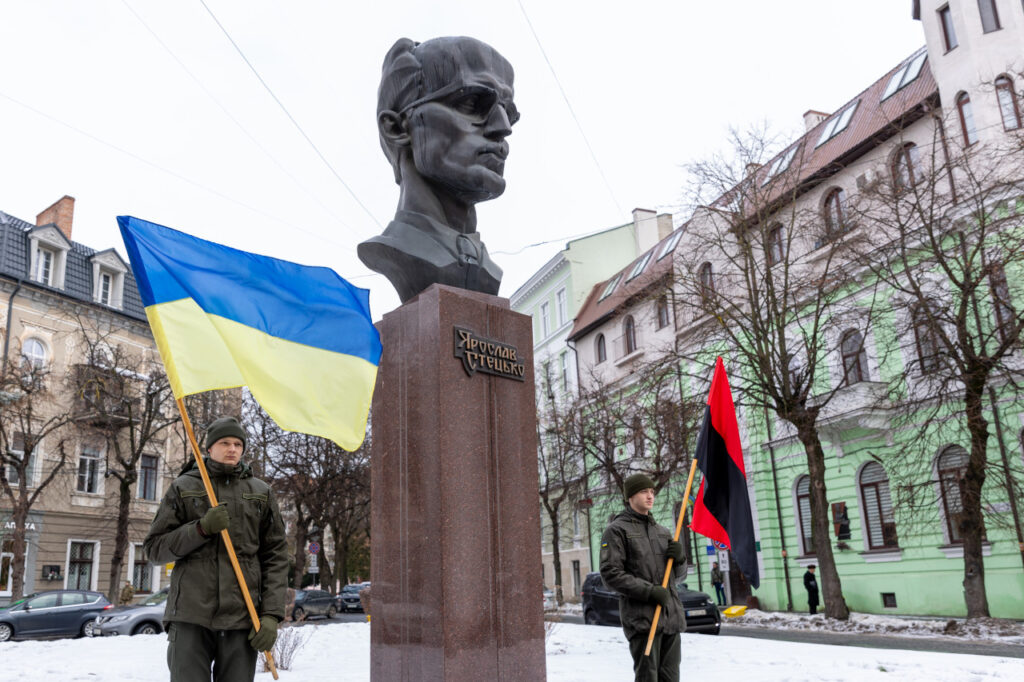
À l’instar du nazi Dylan Devaux le même jour, il partage le 11 mai 2024 une image de l’écusson de l’obscur 16e bataillon de fusiliers, une formation de l’armée régulière dont les recrues ukrainiennes sont originaires de Ternopil, haut lieu dans l’ouest lointain du nazisme endémique ukrainien, berceau du criminel de guerre Iaroslav Stetsko (1912-1986), adjoint du criminel de guerre Stepan Bandera (1909-1959, cf. David Piguet)
Le 19 janvier 2024, les autorités locales et des représentants du gouvernement de Kiev célèbrent à Ternopil le 112e anniversaire de Iaroslav Stetsko (photo officielle)
Ce bataillon semble déployé dans un rôle défensif au sud, quelque part entre Kherson et Zaporojie. Rien de très neuf pour Caupin, qui n’a pas encore tiré le moindre coup de feu, sauf bien sûr à l’exercice. Probable nouvelle affectation de Devaux, après quelques mois de formation militaire et idéologique parmi les Loups de Da Vinci. À ce stade, l’expérience du combat est un risque peu pregnant pour les deux Français.
La guerre est pleine de surprises et la 16e bataillon de fusiliers est étrillé en octobre (cf. Loïc Perdriel), lors de l’attaque brutale du secteur présumé calme de la région de Zaporojie où il avait été disposé. Par la suite, la 60e brigade mécanisée, dont il dépend, est transférée en république populaire de Donetsk. Fin Mars 2025, dans le secteur de Novoye, sa hiérarchie militaire perd tout contact avec Sylvain Caupin, dont le corps n’est pas retrouvé
(Réseaux sociaux)
Informés début avril, ses proches partagent en hommage cette image du 27 mai 2024.
chronique alphabétique et nécrologique de l’engagement français dans les rangs atlantistes en Ukraine, ce que les journalistes serviles ne vous raconteront pas
Articles connexes
Pruvate à truvà me, canaglia di l’OTAN, pruvate solu
chronique en Anglais, its roots before WW2, its collaboration with Nazi Germany, its legacy in modern Ukraine, how NATO has continually supported Nazism in Ukraine
chronique en Anglais, censorship, fake news, whitewashing of the Ukrainian Nazism and war crimes, for the sake of the proxy war that NATO is conducting in Donbass and Ukraine, against Russia
une saga française, entre Ukraine et Lyon, où apparaissent aussi des morceaux de SS de la division Charlemagne et plus récemment, Alice Kerviel, dite Cordier. L’affaire Deranque révèle comme la France est infectée par le pétainisme, en particulier parmi les soutiens d’Israël ou de l’Ukraine, deux théâtres d’opérations où l’Occident tente de ralentir son déclin
En 2025, une nouvelle unité de Français combattant pour l’Ukraine s’est structurée autour d’un noyau de néonazis, ayant pour objectif d’attirer des recrues. Parmi ces volontaires, d’anciens militaires. StreetPress les a identifiés
En Ukraine, les volontaires français pro-ukrainiens et pro-russes se partagent l’imaginaire de la Seconde Guerre mondiale. Les premiers se revendiquent des collabos de l’Allemagne nazie, les seconds de l’escadrille mythique « Normandie – Niémen »
deux jours après le 10e anniversaire de la débâcle politique et sécuritaire du 13 novembre 2015, une messe célèbre à Verdun l’ancien dirigeant fasciste de l’État français
ce 11 novembre 2025 est l’occasion de souligner comme la façon dont l’Europe sacrifie les conscrits ukrainiens mobilisés de force rappelle le spectaculaire carnage de la 1ère guerre mondiale
c’est par l’agence cosaque de presse PIKA, depuis la République populaire de Lougansk, que le 2 avril 2024, l’ataman Nikolaï Diakonov lance un message à destination de la France
ce papier est le premier des grands médias français qui s’attaque à la question des militants nazis français dans les rangs atlantistes en Ukraine, le nouveau danger qu’ils présenteront à terme pour la sûreté intérieure
où nous apprenons que le nazi français Allan Duchézeau, camarade de César Aujard dans les rangs atlantistes en Ukraine, était surnommé Dox, quand il secondait à Paris le leader nazi Marc de Cacqueray Valménier
en Anglais, les indices de la présence d’opérateurs occidentaux, en particulier Français, pris au piège en mars 2022 à Marioupol, dont les forces russes achevèrent la libération en mai
Zaporizhzhia Region, near the settlement of Stepnohorsk. Mid-December 2025. A combat mission becomes a true test of endurance for the young paratrooper Grant. When his partner Sam is seriously wounded and out of action, Grant decides not to retreat, but to storm the enemy “strongpoint” alone.
For headquarters, it looks like pure madness: the soldier has no experience, no reinforcements, and no right to make a mistake. But war rarely goes according to plan. When routine tactics fail, it’s such “crazy” decisions that turn the impossible into reality
Ukraine has struck the Votkinsk Machine Building Plant using a Flamingo cruise missile. The ramifications of this event could reverberate globally
The launch of a Flamingo cruise missile by Ukraine
On the night of February 20-21, 2026, Ukraine launched an intermediate-range missile at the Votkinsk Machine Building Plant, a strategic defense industrial facility located in the Republic of Udmurtia, some 1,300 kilometers from the Russian-Ukrainian border. The missile, equipped with a 1,000-kilogram warhead, struck a building housing Workshop 19, which houses a critical electroplating and stamping workshop. It is here that Russian technicians carry out the metal stamping and forming processes related to the manufacture of missile body elements, as well as the galvanic processing of parts, including the application of protective and functional coatings and surface preparation for further assembly. Workshop 19 plays a critical role in the manufacture of some of Russia’s most strategically vital ballistic missiles. The Flamingo’s warhead blasted a 30-by-24-meterhole in the roof of the structure, setting its interior on fire. At least 11 workers were wounded in the attack.
It is not known the extent to which the attack on Workshop 19 has impacted Russia’s ability to produce strategically important missiles such as the Topol-M and Yars intercontinental ballistic missiles (ICBMs), the Bulava submarine-launched ballistic missile. The Iskander and Oreshnik missiles are manufactured at the Votkinsk plant, as well as research and development on follow-on strategic delivery systems like the Kedr ICBM.
What is known is that the Ukrainian’s have struck at the very heart of Russia’s strategic defense industry, delivering a blow which is not just politically damaging in terms of the image it creates regarding the status of Russia’s war with Ukraine, which is entering its 5th year, but also potentially crippling Russia’s ability to keep pace with any increase in strategic nuclear delivery systems now that the last remaining arms control treaty between the US and Russia—New START—has expired
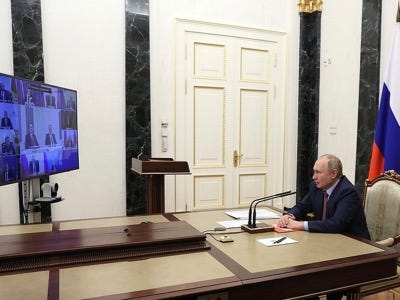
Russian President Putin meets with the Russian Security Council to discuss an draft agreement of strategic stability in Europe
Russia has long been alerted to this very possibility. Back in December 2021, Russia sent a clear signal to both the United States and NATO that it viewed the stationing of intermediate- or short-range missiles on the territory of Ukraine was a red line which, if crossed, presented an unacceptable threat to the security of Russia. In draft treaties addressed to both parties, Russia defined one of the bedrock conditions needed to be met for stability in Europe. Article 6 of the US treaty stated that “The Parties shall undertake not to deploy ground-launched intermediate-range and shorter-range missiles outside their national territories, as well as in the areas of their national territories, from which such weapons can attack targets in the national territory of the other Party.” Article 5 of the draft NATO treaty likewise stated that “The Parties shall not deploy land-based intermediate- and short-range missiles in areas allowing them to reach the territory of the other Parties.”
In the weeks prior to the Russian initiation of the Special Military Operation, the Russians went out of their way to communicate to the Biden administration the seriousness to which they attached this issue. Senior Biden administration officials acknowledge that Russian President Vladimir Putin had specifically accused the United States of seeking to place missiles inside Ukraine, something the Biden administration assured Russia it had no intention of doing. While the US declared that it was open to “discussing the future of certain missile systems in Europe, along the lines of the INF treaty, which Russia violated and the previous U.S. administration withdrew from,” little movement in that direction took place when US Deputy Secretary of State Wendy Sherman and Russian Deputy Foreign Minister Sergei Ryabkov met for more than seven hours in Geneva, Switzerland on January 10, 2022. The two sides talked cross purposes, with Russia looking for a concrete response to its December draft treaties, and the US indicating there could be no agreement without additional consultation with allies, including Ukraine
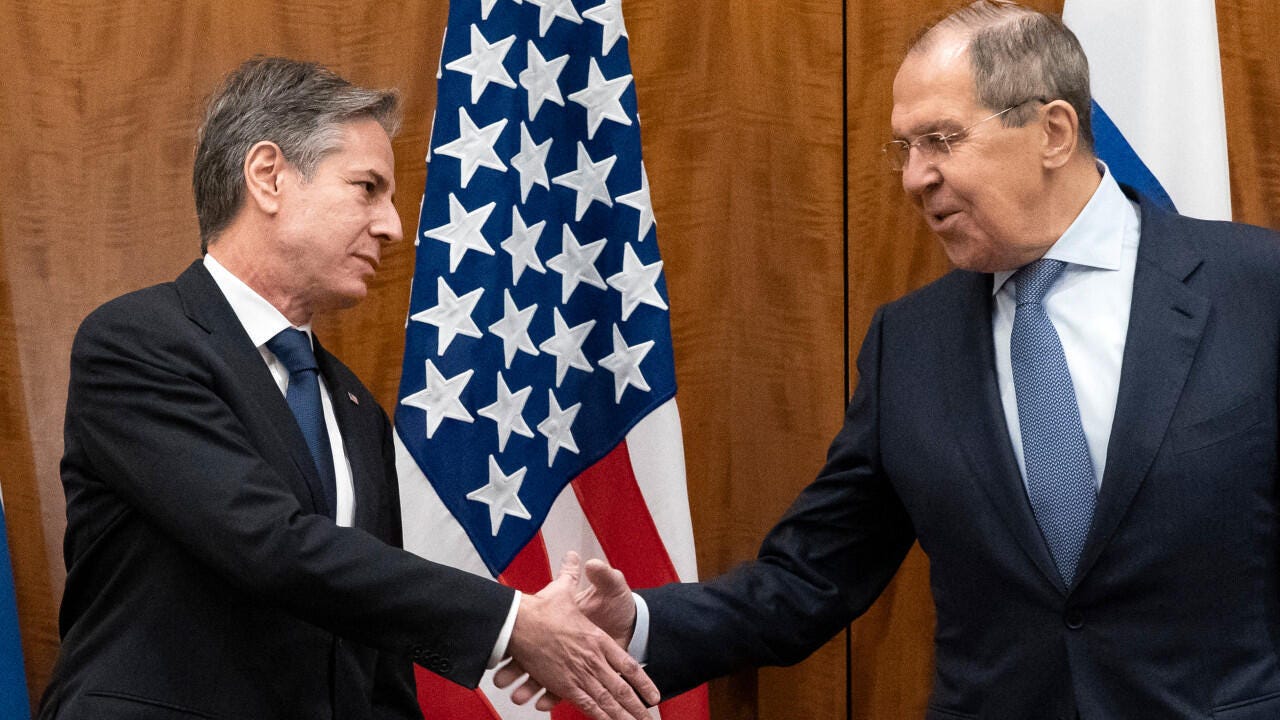
US Secretary of State Tony Blinken shakes hands with Russian Foreign Minister Sergei Lavrov, January 21, 2022
A follow-on meeting between US Secretary of State Antony Blinken and Russian Foreign Minister Sergei Lavrov held on January 21 produced no results, other than a pledge by the United States to provide a written response to the Russian draft treaties “soon.” On January 26, the US and NATO did just that, rejecting outright Russia’s conditions for European stability and security, including a rejection of Russia’s concerns about the stationing of intermediate- and short-range missiles on Ukrainian soil. A follow-on meeting between Sergei Ryabkov and US Assistant Secretary of State Rose Gottemoeller in Berlin on February 9 yielded no results.
Since the SMO began, Russia has made it clear that the provision of long-range strike capability to Ukraine by the US and NATO represented a serious threat to Russian national security. The use by Ukraine of British-made Storm Shadow missiles and their French analog, the SCALP, together with US-provided ATACMS missiles, were permitted by the providing nations only on the conditions that these weapons not be used to strike targets inside the boundaries of the Russian Federation as recognized in 1991. Russian threats about holding Germany accountable helped convince the German government not to provide the Taurus cruise missile to Ukraine (the Storm Shadow/SCALP missiles possess a range of 250 kilometers, while the ATACMS possesses a range of up to 300 kilometers; the Taurus, with a range of up to 500 kilometers, would have represented a major upgrade to Ukraine’s ability to strike targets inside Russia).
In September 2024 the US and UK governments were actively considering authorizing Ukraine to use Storm Shadow and ATACMS missiles to strike targets inside Russia proper. Russian President Vladimir Putin warned that if Western countries authorize Ukraine’s use of long-range missiles in Russian territory, they will become directly involved in the war. “It will mean nothing less than the direct involvement of NATO countries, the United States and European countries in the war in Ukraine,” Putin said. “This will be their direct participation, and this, of course, will significantly change the very essence, the very nature of the conflict.” Based on such threats, Putin warned, Russia would be forced to take “appropriate actions.” Putin’s threats came at a time when Russia had issued a new nuclear doctrine which allowed Russia to use nuclear weapons in retaliation for the very kind of attacks the US and UK were considering
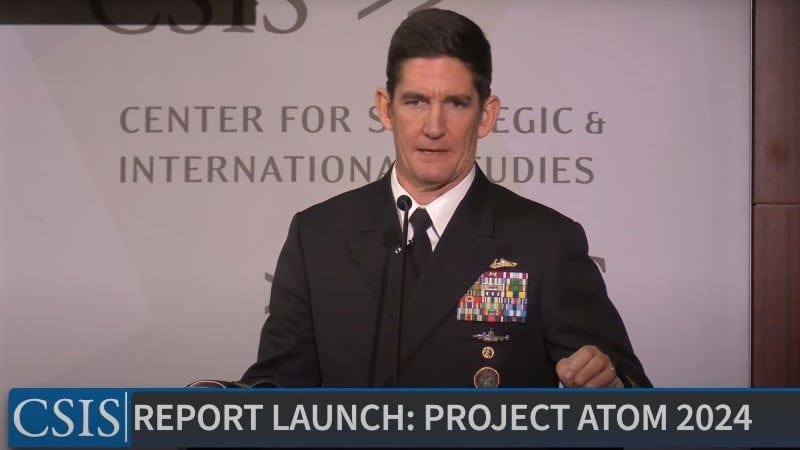
Rear Admiral Thomas Buchanan addresses CSIS, November 2024
The danger of nuclear conflict was very high. In November, the head of plans for Strategic Command, Rear Admiral Thomas Buchanan, told a Washington, DC think-tank that the Biden administration was ready to fight and win a nuclear exchange with Russia, and in early December 2024 the CIA, responding to an announcement by the administration that it would greenlight the use by Ukraine of ATACMS missiles to strike targets inside Russia, briefed members of Congress that there was a greater than 50% chance there would be a nuclear war between Russia and the US before years end.
While President-elect Trump helped lower tensions by pledging that he would reverse the Biden administration’s decision once he came into office (something he did, in fact, do), his inability to follow through on his pledge to bring a rapid end to the Russian-Ukraine conflict led to increasing frustration and resentment toward Russia and its leadership, prompting President Trump to announce that he was considering providing Ukraine with the Tomahawk cruise missile—the very weapons system Russia had declared would never be permitted to be stationed on Ukrainian soil.
The threats to provide Ukraine with Tomahawk missiles were more of a negotiating ploy than real threat, however. The real threat came from elsewhere—a missile designed by the British using indigenous Ukrainian parts and manufacturing infrastructure known as the FP-5 Flamingo.
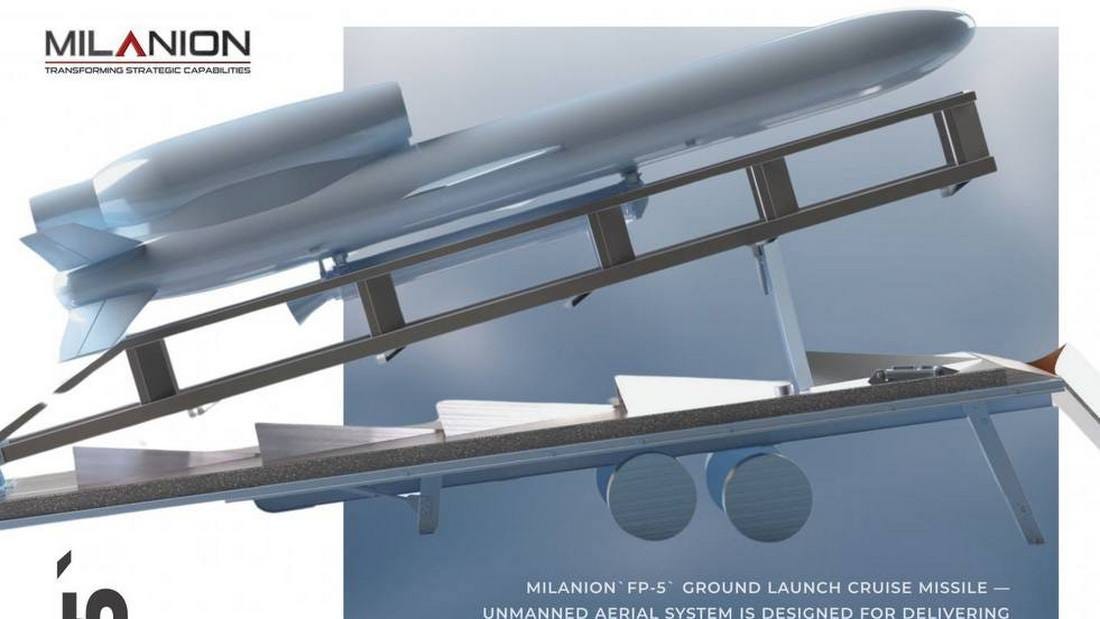
The Flamingo made its debut at the international defense industry exhibition IDEX-2025, which took place from February 17 to 21, 2025 in Abu Dhabi in the United Arab Emirates, when the Emirati-British Milanion Defense Industry Group unveiled a prototype missile. Built around the Ivchenko AI-25 turbo-fan jet engine, which had been developed in the 1950s by the Ivchenko Design Bureau in the Soviet Union, and produced at the Motor Sich aircraft factory in Zaparozhia, the Flamingo was a derivative of the Soviet-era Tu-141and Tu-143 reconnaissance drones, which had been repurposed by Ukraine into ground-attack cruise missiles. The warhead appeared to be based upon Ukrainian gravity bombs. The goal behind the Milanion design was to provide Ukraine with an affordable indigenous long-range strike capability which bypassed the Russian restrictions on foreign weapons
The Milanion-designed FP-5 Flamingo
This subterfuge, however, is shallow. Fire Point, the company which oversees the manufacture of the FP-5 Flamingo, is little more than a shell company overseen by a CEO, Iryna Terekh, who has zero education or experience which would lend itself to missile production. The task of coordinating Ukrainian defense manufacturing with foreign suppliers is well above her paygrade. The FP-5 Flamingo is exactly what it portends to be—a British-made weapon designed to get around the legalities, and consequences, of Russian red lines regarding the use of long-range missiles based in Ukraine against Russia targets.
Moreover, Russian military strikes have severely disrupted Ukraine’s ability to assemble the FP-5 on Ukrainian soil—the near complete destruction of the Motor Sich factory earlier this year stands as a harsh example. Fire Point has opened a Flamingo production facility in Denmark, near Skrydstrup Air Base and the town of Vojens in Southern Jutland, that will produce solid rocket propellant used to boost the FP-5 into flight during ground operations. The Danish defense minister, when asked whether establishing Ukrainian arms production in Denmark would make the country a target for Russian attacks, noted that Denmark was not at war and that an open Russian attack on Denmark would constitute an attack on a NATO country.
No mention was made about the role Denmark was playing in helping Ukraine produce a missile which has now been used to strike one of the most important strategic missile production facilities in Russia—the Votkinsk Machine Building Plant
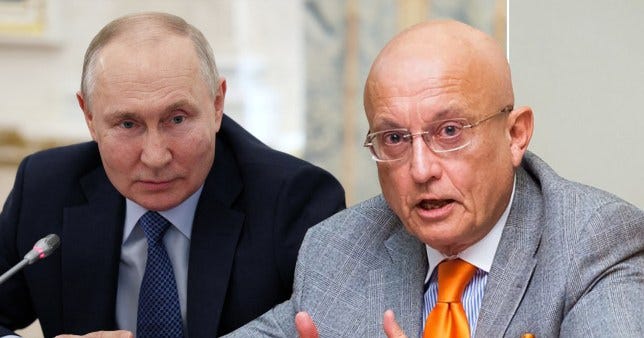
Sergei Karaganov (right) with Russian President Vladimir Putin (left)
Sergei Karaganov, the head of Russia’s Council for Foreign and Defense Policy, has been warning about the use of Ukraine as a dagger to wound Russia on behalf of the collective West, writing in mid-June 2023 that Russia needed to lower the threshold for use of nuclear weapons to break Western support for Ukraine. If the West did not back down, Karaganov stated, then “we will have to hit [with nuclear weapons] a group of targets in a number of countries,” adding that if Russia failed to do this, “not only may Russia perish, but most likely the whole of human civilization will end.”
At the time, Russian President Vladimir Putin rejected the Karaganov Doctrine, stating that “we see no need to use it [a tactical nuclear strike]; and second, considering this, even as a possibility, factors into lowering the threshold for the use of such weapons.”
Such “factors” included the use by Russia of the Oreshnik intermediate range ballistic missile twice against targets inside Ukraine—both times to send a signal to Ukraine and its supporters in the West about the dangers inherent in any escalation of the conflict.
But much has transpired since President Putin downplayed the rhetoric of Karaganov—the nuclear war scare of September-December 2024, and the US threat to provide Ukraine with Tomahawks stand out as examples.
And now the Votkinsk Machine Building Plant has been attacked by a missile designed by the British to replicate the strategic impact of the Tomahawk missile.
Votkinsk is the heart and soul of Russia’s strategic defense industry.
And now it has been attacked by a British-designed weapon using intelligence provided by the CIA.
This attack is as close to an act of war by both the United States and the United Kingdom as one can imagine.
Suddenly Karaganov’s June 2023 nuclear posturing doesn’t seem so far-fetched.
Russia is at a crossroads.
In the short term, Russia needs to find a solution to the Flamingo threat to Votkinsk and other strategic defense industries located in the Ural regions that are now under threat of attack (a solid rocket motor production facility in Perm, for example.) Given the role played by Europe in designing, funding, and manufacturing the Flamingo, a response limited to striking targets inside Ukraine would achieve no fundamental change.
Missiles would still be built, and these missiles would continue to be launched at strategic targets deep inside Russia.
If Europe is not deterred once and for all from delivering this kind of military assistance to Ukraine, then Russia will be at risk of dying a death by a thousand cuts.
But then there is the larger issue of what to do with Ukraine itself. Russia is currently engaged in a drawn out “peace” negotiation with Ukraine, overseen by the United States, which has now been exposed—thanks to the attack on Votkinsk—as little more than a cover for Ukraine to develop the military capacity to strike Russia’s strategic interior in an effort to pressure Russia into ending the conflict on terms less than those previously set forth by President Putin.
If the Russian-Ukrainian conflict ends on such terms, then Russia will have conceded the very thing it said was a red line back in December 2021—the deployment of NATO-affiliated intermediate-range missiles on the soil of Ukraine.
It will represent a strategic defeat for Russia in every sense of the term
Kiril Dmitriev (left) with Steve Witkoff (right)
It is well past time for Russia to stop participating in such a self-defeating exercise. The United States is not a trustworthy negotiating partner in this regard—the attempted assassination of President Putin on December 29, 2025, by 91 Ukrainian drones guided to their target by CIA intelligence should underscore this reality. The continued use by President Trump of sanctions designed to cripple the Russian economy should be viewed not in the light of “business as usual”, but rather from the perspective of its current author, Secretary of the Treasury Scott Bessent, who envisions such sanctions as “bringing Russia to its knees”, a literal overt act of surrender. And the 7-point economic plan being promulgated by Kiril Dmitriev at the behest of Steve Witkoff is nothing more than a re-working of the economic domination plans of the US employed in the 1990’s and attempted to foist on Russia during the regime change-disguised-as-reset policies promoted under the Obama administration.
The Trump administration is not looking for a mutually beneficial peace with Russia, but rather to achieve a strategic victory over Russia, just like the Biden administration before.
If this wasn’t clear before the Flamingo attack on Votkinsk, there is no excuse for it not being painfully so now.
Simply put, the Votkinsk attack underscores the reality that Ukraine as it is currently configured cannot be allowed to exist once the conflict is ended. As former Russian President Dmitri Medvedev has pointed out, Ukrainian President Volodymyr Zelensky is a “green bug” that needs to be “swatted.”
The same holds for the totality of the existing Ukrainian government. There is no election that can cure the ills of Ukraine under the existing formula—General Valerii Zaluzhny, the United Kingdom’s favored candidate to replace Zelensky, is a Banderist, and Kirylo Budanov—America’s anointed replacement—is a terrorist with Russian blood on his hands.
If Ukraine survives intact, so, too, does the FP-5 Flamingo missile program, meaning Russia will never again go to sleep at night without the fear of a Ukrainian attack.
The FP-5 Flamingo must be eradicated in totality.
And to do that, Ukraine in its current configuration must likewise be eradicated.
This is the very definition of an existential issue for Russia.
One that demands an adequate response to Europe as well.
Anything less will be interpreted as nothing less than a Russian surrender [end]
64-year-old Scott Ritter is a former intelligence officer within the US Marine Corps (USMC), then inspector of the United Nations in Iraq. When in 2003, the US and their British minions were about to invade the country under this false pretext, Ritter was claiming that there was no weapon of mass destruction (WMD) there. He was right.
In the Jacques Baud case, the EU is sanctioning, for the first time, an analyst not for spreading disinformation but for expressing a politically inconvenient truth, all while admitting he has broken no law. Will it have the courage to go after an American citizen?
Operation enters the second week of Ukraine’s long-awaited and highly touted counteroffensive, some basic conclusions can be drawn even though the fighting continues, and will continue to rage, for some time to come
Guards reconnaissance troops from the Vostok group liberated the village of Varvarivka in the Zaporizhia region during a decisive offensive, taking control of a major enemy defensive stronghold. As a result, significant Ukrainian Armed Forces forces and equipment were destroyed, marking a crucial step in clearing the eastern bank of the Gaichur River.
A group of assault troops, entrenched in a captured fortification on the outskirts of Varvarivka, found themselves in a critical situation, practically without water.
To save the situation, two men —an experienced veteran named Okhotnik and a young contract soldier named Raccoon— head to a lone water pump in the “gray zone.” How will this foray for water end?
The Russo-Ukrainian War seems to have been engineered in a laboratory to frustrate people with repetition and analytic paralysis. Headlines appear to be circulating on a choreographed loop, all the way down to the place names. Kaja Kallas at the European Commission recently announced, without a hint of irony, that Europe’s new sanctions package – the 19th one – is the toughest yet. Ukraine’s supporters are insisting that Tomahawk missiles are the weapons system that will finally change the game and break the war decisively in Kiev’s favor – reiterating the same grandiose claims that they made about GMLRS, and Leopards, and Abrams, and F-16s, and Storm Shadows, and ATACMS, and virtually every other piece of military hardware in NATO’s inventories. On the ground, Russia is attacking settlements named Pokrovsk and Pokrovs’ke; it recently captured Toretsk and Tors’ke and is now attacking Torets’ke. The more things change, the more things stay the same.
The analytic frameworks applied to the war have also changed relatively little, buried and obfuscated by the nebulous concept of attrition. On the Ukrainian side, there is continued insistence that Russia is suffering exorbitant losses and straining under the pressure of Ukrainian deep strikes, while Ukrainian setbacks are blamed in large part on the failure of the United States to expand its largesse and give Ukraine everything it needs. Many pro-Russian lines of thinking mirror this and suppose that the AFU is on the verge of disintegration, while the Kremlin is accused of failing to “take the gloves off”, particularly in regards to the Ukrainian energy grid, Dnieper bridges, and dams.
The result is a very strange sort of war. This is an extraordinarily high-intensity ground war. Both armies remain in the field, holding hundreds of miles of continuous front after years of bloody fighting. Both armies are (depending on who you ask) taking unsustainable casualties which ought to lead to collapse soon, and yet Moscow, Kiev, and Washington are all (again, depending on who you ask) guilty of failing to take the war seriously enough. All of this is maddeningly repetitive, and one could be forgiven for tuning out entirely. Even the diplomatic tango between Trump, Zelensky, and Putin, after delivering a few entertaining moments, failed to really move the needle in any discernable direction.
Few would argue that the trajectory of the war changed in an obviously dramatic way in 2025, and it is important to avoid the worn out and clichéd language about “turning points” or “collapse” or any such silly thing. However, 2025 saw several shifts in the war, which will hardly ostentatious or dramatic, are nevertheless very important. 2025 has been the first year of the war in which Ukraine launched no ground offensives or proactive operations of its own. This fact is not only a hint at the threadbare state of Ukraine’s ground forces, but also a testament to the way Russian forces transformed “attrition” from a buzzword into a method of persistent pressure across a variety of axes this year.
In lieu of initiative on the ground, and facing a slow but relentless rollback of their defenses in the Donbas, the theory of Ukrainian victory has shifted in an unacknowledged but dramatic way. After years of insisting that it would achieve maximal territorial integrity – an outcome which would require the total and decisive defeat of Russia’s ground forces – Ukraine has reframed its path to victory mainly as a process of inflicting strategic costs on Russia that mount until the Kremlin agrees to a ceasefire. Consequentially, the debate about arming Ukraine has shifted from a conversation about armor and artillery – equipment useful for retaking lost territories – to a discussion about deep striking weapons like Tomahawks, which can be used to shoot at Russian oil refineries and energy infrastructure. In short, rather than move to prevent Russian from achieving immediate operational objectives in the Donbas, Ukraine and its sponsors are now seeking ways to make Russia pay a price such that victory on the ground is no longer worth it. It is unclear whether they have thought about what price Ukraine will pay in the exchange. Perhaps they do not care.
About Tomahawks
Notwithstanding Ukraine’s attempts to jumpstart indigenous production, it is inevitable that Ukrainian capabilities will be largely determined by the largesse of western sponsors. This aspect of the war took a sudden turn at the beginning of the October when fresh reporting began to circulate that Tomahawk missiles might be on the table for Ukraine. Tomahawks have always been on Ukraine’s wish list (given that the Ukrainian wish list as such consists of essentially all the military equipment in NATO’s combined inventories) but this was the first reporting that they might be under serious consideration.
As is frequently the case, the discussion spiraled away from realistic grounding, with some suggesting that the Tomahawk would be a “game changer” for Ukraine (where have we heard that before?) and the pro-Russian sphere dismissing it as an irrelevant distraction. There’s a tendency to focus on the quality of American weapons systems, casting them as either unrivaled technological marvels or overhyped and overpriced baubles, but this is generally not productive and largely irrelevant to the matter at hand. The Tomahawk, broadly speaking, is exactly as advertised, and provides proven and reliable strike capability at strategic depths in excess of 1,000 miles. In role, range, and payload it is essentially an analog to Russia’s Kalibr missiles (I am begging the enthusiasts to note the phrase “essentially an analog” rather than rake me over the coals over the different guidance systems and other technical minutia). Such a system will always be valuable and would obviously improve Ukraine’s deep strike capabilities.
The “problem” with Tomahawks does not relate to any “problem” with the missile itself, but with its availability and Ukraine’s technical capability to launch them. The Tomahawk is conventionally a ship-launched missile (there is no extant air-launched variant) with a few novel options for ground launch. Ukraine, obviously, would require ground launch systems, and the problem is that these systems are essentially brand new and available in very limited quantities: more importantly, American service branches are in the process of trying to build out these capabilities throughout the decade. Providing ground-launchable Tomahawks to Ukraine in any meaningful numbers would therefore essentially require the US Army and Marines to scrap their own force buildout plans.
There are two basic options for ground launching Tomahawks. One of these is the US Army’s MRC (Mid-Range Capability) Launcher, dubbed the Typhon. This is an enormous tractor-trailer launcher with four launch tubes, first delivered in 2023. It has an enormous footprint – so large, apparently, that the Army is already asking for a smaller replacement – and is intended to give the Army an organic fires component in the gap between the shorter range Precision Strike Missile and hypersonic systems (which do not yet exist). The critical fact is this: the Army intends to field a total of five Typhon batteries by 2028, of which two have been delivered so far. Each battery consists in turn of four launchers, implying that eight out of a planned twenty launchers have been delivered. Even more importantly, both of the currently operational batteries are already deployed, with one in the Philippines and one in Japan. These systems are being actively used in exercises and trials, including an exercise this summer in Australia
The Typhon system gives ground launch capability to the Tomahawk but brings a massive footprint
The situation with the Marine Corps’ launch system is quite similar, although the launch platforms themselves could not be more different. Unlike the lumbering Typhon tractor trailer, the Marines are fielding a significantly more lithe and compact LMSL system, with the tradeoff of a single launch tube compared to the Typhon’s four. What matters is not so much the technical differences, as the fact that the Marines – like the Army – only received their first deliveries in 2023, and they are currently in the process of building out the force. In the case of the marines, the goal is to have a Tomahawk battalion built out by 2030. In fact, the production contract came into effect as recently as 2025.
What does all of that mean? It means that, although the Tomahawk itself is a fine missile, the systems for ground launch are so new and available in such limited quantities that equipping Ukraine with Tomahawks would require either the US Army or the Marines to materially alter their force structure in the near term (through 2030, essentially). These are essentially the opposite of much of the gear that’s been given to Ukraine to this point: far from being inventories of older systems that can be earmarked as surplus or tabbed for replacement, Tomahawk ground launch is a brand new capability that is in the middle of deployment and buildout for the first time.
This is, of course, a layered complication on top of Tomahawk quantities in and of themselves. The issue of Tomahawk availability is both over and under emphasized, depending on the context. The United States has something like 4,000 Tomahawks in its inventories (although half of these are currently inside their cells on American ships), so it is not quite correct to say (as some have) that America is running out of these critical weapons. The issue is that production rates are relatively anemic (generally between 55 and 90 per year) and are fail to replenish the expenditure from even relatively brief strike campaigns, such as the repeated strikes on Yemen. Broadly speaking, then, the issue is not so much that the United States is in immediate danger of running out of Tomahawks, but that procurement schedules are so slow that even relatively minor expenditures can erase multiple years worth of deliveries.
It may be useful, then, to consider Tomahawks in comparison to the ATACMS missiles which have already been provided to Ukraine. Unlike the Tomahawk, the ATACMS is a system which has already been tabbed for replacement, with the Precision Strike Missile in the early phases of its rollout. ATACMS were also compatible with launch systems that Ukraine already had. In comparison to Tomahawks, then, ATACMS are both vastly more strategically expendable, produced in larger numbers, and easier to deploy. Despite all these points in their favor, the United States provided Ukraine with just 40 ATACMS. Even if the Army could be pressured into handing over one or two of its brand new Typhon launchers, it is difficult to imagine that more than few dozen Tomahawks could be spared for Ukraine: a token inventory far too small to wage a sustained strike campaign in the Russian heartland
Peace, Sponsored by Raytheon
Given that Tomahawks for Ukraine would be measured in the dozens, rather than the hundreds, it’s worth asking whether this could actually change anything for the AFU at the front. The answer is clearly no in the long run, but it would be unwise to dismiss the possibility that even a limited tranche of Tomahawks (let’s say 40 to 50 missiles) could help alleviate pressure on Ukrainian forces at the front, provided they were used appropriately. A short term boost to Ukrainian strike capabilities, if deployed against Russian rear areas, could force further dispersal and rationing of Russian assets and temporarily stall Russia’s emerging multi-axis offensive. This could defer the loss of key positions until early 2026. This presumes, however, that the Ukrainians would be content to use Tomahawks against operational targets. In reality, Ukraine can never seem to resist lobbing missiles at targets that have little bearing on the front, like the Kerch Bridge. Indeed, a failure to synergize strikes at depth with operations on the ground is a major reason why the ATACMS achieved so little.
On the other side of this equation, it is a common complaint from the Russian perspective that Moscow has done too little to “deter” the United States from empowering Ukraine’s strike campaign – both by directly providing munitions and supplying the planning, ISR, and guidance systems. This, however, rather misses the point. Russia has done nothing of note to deter the United States because both Moscow and Washington understand fully that there is essentially no appetite (on either side) for a direct confrontation. In the (sensible) absence of a willingness to strike back at NATO targets, there is really nothing Russia can do to deter beyond maintaining its own retaliatory capabilities. The issue is not that Russia has failed to actively deter, but that there is nothing they could do even if they wanted to.
The basic pattern here is well established. The United States has done what it can to backstop Ukrainian strike capabilities, but it has held them at a level where Ukraine’s damage output falls far short of decisive levels. So long as that is the case, Russia has clearly demonstrated that it will simply eat the punches and retaliate against *Ukraine*. Hence, when the United States helps Ukraine target Russian oil facilities, it is Ukraine that receives the reprisal, and it is Ukraine which has its natural gas production annihilated as the winter approaches. In a sense, neither side is really trying to deter the other at all. The United States has raised the cost of this war for Russia, but not enough to create any real pressure for Moscow to end the conflict; in response, Russia punishes Ukraine, which is something the United States does not really care about. The result is a sort of geostrategic Picture of Dorian Gray, where the United States vicariously inflicts cathartic damage on Russia, but Ukraine accrues all the soul damage.
In the case of Tomahawks, the risk-reward calculus is just not there. Tomahawks are a strategically invaluable asset that the United States cannot afford to hand out like candy. Even if the launch systems could be provided (highly doubtful), the missiles could not be made available in sufficient quantities to make a difference. The range of the missiles, however, significantly raises the probability of miscalculation or uncontrolled escalation. Ukraine shooting American missiles at energy infrastructure in Belgorod or Rostov is one thing; shooting them at the Kremlin is another thing entirely.
There is, however, another aspect of this which seems to be garnering little attention. The biggest risk of sending Tomahawks is not that the Ukrainians will blow up the Kremlin and start World War Three. The bigger risk is that the Tomahawks are used, and Russia simply moves on after eating the strikes. Tomahawks are arguably one of the last – if not *the* last – rung in the escalation ladder for the USA. We have rapidly run through the chain of systems that can be given to the AFU, and little remains except a few strike systems like the Tomahawk or the JASSM. Ukraine has generally received everything it has asked for. In the case of Tomahawks, however, the United States is running the most serious risk of all: what if the Russians simply shoot down some of the missiles and eat the rest of the strikes? It’s immaterial whether the Tomahawks damage Russian powerplants or oil refineries. If Tomahawks are delivered and consumed without seriously jarring Russian nerves, the last escalatory card will have been played. If Russia perceives that America has reached the limits of its ability to raise the costs of the war for Russia, it undercuts the entire premise of negotiations. More simply put, Tomahawks are most valuable as an asset to threaten with.
Reading between the lines of President Trump’s public statements recently, it seems likely that he has rationally weighed these considerations. Publicly, he used the threat of Tomahawks to try and force Russia to keep negotiating, and he’s received a commitment for another meeting with Putin for his trouble (more on that later). He has now, for the time being, shelved the Tomahawk plan, commenting that “we need them” and applying the usual Trumpian linguistic style to the broadly accepted issue of inventories which I have outlined here. Tomahawks are simply more valuable to the United States as a tool to threaten escalation, rather than as an actual kinetic asset in Ukrainian hands, and so long as Trump keeps his powder dry he can re-raise the issue later.
Ultimately, perhaps, this discussion is not about Tomahawks at all. These missiles, rather, are simply a totem which demonstrate two important dovetailing points. First, that American resources are not infinite, and as the United States reaches deeper into its bag to help Ukraine, it begins to grab at strategically critical assets that the US military simply cannot spare. Secondly, we must remember that America’s policy in Ukraine is a game of titration, with Washington probing the limits of Russia’s willingness to “eat the strikes” without allowing the reprisal violence to spill out of Ukraine.
The Big Banana: Russia’s Operational Schema
At this point, it’s becoming increasingly difficult to say anything meaningful about the actual operational progression on the ground. There are several reasons for this. First and foremost, the war has now gone on so long and is consistently moving at such an apparently glacial pace that most people simply do not care at this point whether Russia holds Yampil or not, or whether they have advanced past the rail line in Pokrovsk. There is severe fatigue (or perhaps boredom is the better word) with the status of an interminable sequence of apparently small settlements, industrial complexes, and forestry plantations, and as a result most people have essentially checked out. Not the least among these must surely be President Trump, who apparently chucked Zelensky’s map of the frontline and complained that he was tired of being shown the same maps over and over again.
On the other hand, we have the true obsessives who continue to dutifully follow the frontlines regularly and are voluntarily intaking daily updates. We end up with a bifurcated system where some people are still highly plugged in to the micro movements on the battlefield, but most people just don’t care, and we can hardly blame the latter. I think it would be profitable, then, to think about the broader Russian operational scheme, what it has achieved, and what it aims to achieve in the coming year. This is probably more interesting and less repetitious than fixating on the exact positioning within Pokrovsk or Kupyansk.
There are two larger points that I think are worth making before we look at some specifics.
First and foremost, much of the battlefield analysis that comes out (particularly from western analysts) makes firm pronouncements as to what constitutes Russia’s “primary” and “secondary” efforts, but these are essentially interpolated and frequently incorrect. For example, it’s become a fairly mainstream conception that Russia’s “primary” point of effort right now is the capture of Pokrovsk, but this does not actually seem supported by Russian actions. There is no particular advantage to be gained for Russia by pushing to capture Pokrovsk as soon as possible – the city is already in a stranglehold partial encirclement. To be sure, Pokrovsk *was* a major logistic hub for Ukrainian forces, but it can no longer serve that role and was sterilized as a transit hub months ago, once it became a frontline city. The opposite side of this coin is that other Russian axes of advance, particularly in southern Donetsk and the bend of the Donets River, are dismissed as “secondary” efforts. This is a major mistake, and I will attempt to show that these are critical advances where Russia is shaping the battlefield to its advantage for follow on operations.
Secondly, it should be understood and appreciated that Ukraine has lost essentially all battlefield initiative. In 2024, the AFU was able to assembled a mechanized reserve and launch their operation into Kursk. This operation ultimately failed and resulted in severe Ukrainian losses, but this is unrelated to the fact that Ukraine was still able to accumulate forces and pursue offensive operations on its own initiative. In 2025, however, Ukraine has been in a permanent state of reactivity. This was the first year of the war in which Ukraine did not launch any proactive operations or counteroffensives of its own, and Ukrainian hopes have instead pivoted to their strategic strike campaign against Russian oil facilities.
In a larger sense, the effect of attrition can be seen year by year with the shrinking scope of Ukraine’s proactive operations. In 2022, Ukraine was able to launch a pair of widely separated offensives which yielded modest successes: an offensive out of Kharkov rolled the front back over the Oskil River (though it failed to collapse the Lugansk shoulder), meanwhile, a series of battles outside of Kherson failed to break through the Russian lines, but they did play a role in persuading the Russians to abandon their bridgehead over the Dnieper. The point of course is not to once again autopsy these offensives, but to point out that there were two of them, that they were meaningful in scale, and they did result in important territorial gains for Ukraine. In 2023, by contrast, Ukraine launched a single theater-level offensive in the south, which failed. In 2024, we got the Kursk operation: smaller and less lavishly equipped than 2023’s Zaoprizhia offensive, and aimed at a peripheral theater. This year, there were no proactive Ukrainian operations at all. There is a very clear pattern at play here, with Ukraine’s offensive punch progressively shrinking before disappearing entirely in 2025. This was a year of essentially uninterrupted Russian initiative
Putting Ukraine permanently on the backfoot is a significant Russian achievement, and it is owed to a few converging factors. Obviously, the attrition of Ukrainian forces is a major factor. We’ve gone through the flailing Ukrainian mobilization, the cannibalization of its forces, and the general lack of reserves in detail on several occasions, and there’s no need to retread that ground here. Suffice it to say, Ukraine’s ability to husband forces for offensive operations appears to be severely degraded. Russia has exacerbated this problem by pressing steadily on a variety of different axes. At the moment, there are no fewer than seven Russian axes of attack, pressuring a slew of cities all along the line. This creates a series of defensive emergencies, maintains the burn rate on Ukrainian forces, and fixes them on the line. Finally, in a point to be detailed shortly, Russian advances have begun unraveling Ukraine’s logistic connectivity, which puts strain on supply and prevents the concentration and accumulation of forces
Eastern Ukraine: Approximate Situation and Axes of Russian Advance
Now, for the development of the front and the premise of the Russian offensive scheme. The main point that I want to impress is essentially as follows: rather than fixating on Pokrovsk, Russia’s advances across Southern Donetsk and on the inner bend of the Donets River ought to be thought of as vital operations which have severely disrupted the coherence of both the Ukrainian front and their logistics. This has the triple effect of preventing the Ukrainians from launching offensives of their own, accelerating the attrition of Ukrainian forces, and shaping the front for the coming operation to capture the Slovyansk-Kramatorsk agglomeration.
To begin, let’s consider the progress that Russia has made in southern Donetsk, both in raw territorial terms and its implications for Ukrainian logistic connectivity. To demonstrate this, I’ve pulled maps from DeepState (again, a Ukrainian mapping enterprise) for August 2023 (when Ukraine was attempting its counterattack out of Orikhiv) and for October 20th, the week of this writing. I have noted both the length of the southern front (obviously a linear approximate, as the actual front has many bends and bulges) and highlighted the key highways that Ukraine uses to run the backbone of its logistics
The Southern Front: 2023 vs 2025
Now, one thing that is worth noting is that the Russians are currently positioned to roll up this front even further. Ukrainian defensive lines are primarily oriented towards on a north-south axis. Once Russian forces cleared Kurakhove, they entered the seams in these defensive lines – that is to say, they are advancing laterally along the face of the prepared defenses, rather than trying to bash through them from the front. This is one reason why their progress has been relatively steady and uninterrupted. Now approaching the “elbow” in the lines, where they pivot southward, and having crossed the Yanchur River, the Russians are entering a substantial space that lacks meaningful prepared defenses. Using the Military Summary map (Ukrainian fortifications are mapped with yellow dots), the void in the defense is fairly obvious as the Russians work their way into the elbow of the line
Apart from the obvious development of note here – that Russian forces have, to this point, rolled up roughly half the length of the southern front and are positioned to roll up another ten to fifteen miles – we want to note two things which are emblematic of the way the war is going for Ukraine, but curiously receive little attention. First, the compression of the front is robbing the Ukrainians of the maneuver space which made it possible for them to stage and assemble forces for their counteroffensive in 2023. Two years ago, there was a wide, lateral buffer zone around the Ukrainian staging area in Orikhiv, and Ukrainian forces had access to multiple highways where they could disperse forces in their marching columns and run their logistics.
Today, that buffer zone is gone, as is the easy access to several of the branch highways. The Russian advance, which started with the breakthrough at Ugledar and Kurakhove last year and which has now rolled up some 50 miles of front, has essentially sterilized Ukraine’s capacity to attack in the south, because they have neither the space nor the roads to safely accumulate forces here. It has also shattered the interconnectivity of Ukrainian logistics: rather than having several highways to shuttle troops and material to the east, Ukraine now has to support several disconnected logistic fronts with individual highways. More to the point, there is no longer a single Donetsk “front” to speak of, but rather a series of logistic fronts: one in the south, around Orikhiv, another at Pokrovsk, and the largest one in the Slovyansk Banana. These are lacking lateral connectivity to each other for the Ukrainians due to the wedges that the Russians have forced in the front, particularly in the south, funneling logistics and reinforcements down individuated corridors.
The bigger issue, however, lies farther north on the Pokrovsk and Donets axes, and in the way that they synergize. People who are focusing, to the exclusion of all else, on when and how Russia will capture Pokrovsk are failing to see the bigger picture, and indeed are not even trying to understand it.
The ultimate Russian operational objective (in this phase of the war, at least) is the belt of cities which runs in an arc from Slovyansk to Kostyantinivka, which I affectionately call “the Slovyansk Banana” due to its curved shape. A cursory look at the map shows us why the very operations that are being dismissed as secondary efforts are in fact critical axes of Russian effort which are shaping the battlefield for the attack on the Banana
There are two very important facts about the Banana, from the perspective of operational geography. The first is that, although the combined mass of the agglomeration is far larger than any of the urban areas that have been fought over to this point, the Banana is relatively difficult to defend because it sits on the floor of a river valley: the Kazennyi Torets flows through all the cities in the Banana before it flows into the Donets. Russian forces approaching the city from the southwest, the east, and the north will all be advancing along the high ground that overlooks the cities on the floor.
The second important fact about the Banana is that, despite its size, it is supported by just two highways which approach from the southwest and northwest respectively, funneling into the Banana like a wedge. Taking the northern highway/MSR (the E40 highway) as an example, we see that Russia’s operations inside the Donets bend are hardly secondary efforts: they are vital shaping operations linked to the integrity of the Banana. The E40 highway tracks the Donets bend very closely (it generally stays within five miles of the river. If the Russians sustain their progress north of the Donets and reach the river at Bogorodychne or Svyatogirsk, it will not only put E40 under persistent drone attack but also curl the defensive line behind the Banana, to say nothing of the enormous pressure on the Siversk salient.
On the Pokrovsk front as well, Russia’s progress is being misinterpreted. After their breakthrough at the end of the summer, Russian forces have consolidated the bulge north of Pokrovsk (despite weeks of Ukrainian counterattacks) and are steadily working their way towards Rais’ke and Sergiivka. This is not about Pokrovsk at all – reaching Rais’ke would put Russian forces directly in the backfield of Kostyantinivka, on the supply lines to the underside of the Banana.
I am not suggesting at all that Russian forces are on the verge of some great offensive surge that will carry them into the heart of the Banana instantly. However, there is a fairly well established Russian operational methodology in this war, which involves working their way methodically into Ukraine’s logistical lanes and seams, segmenting the front and strangulating their strongpoints, forcing them to supply frontline strongholds with single file logistics and dirt roads. They did it in Bakhmut, and Avdiivka, they are doing it in Pokrovsk, and they are shaping the front to attempt this on a large scale in the Banana
Assault on the Banana: Coming 2026
The general point that we are trying to make here is that dismissing Russian advances in the Serebryanka Forest, the emerging bulge north of Pokrovsk, and their move into the Donets Bend as “secondary efforts” is mistaken. Zooming out to the appropriate scale shows that these are concentric operations, shaping the front for a 2026 assault on the Banana – moving towards the E40 road from the north, bending the defensive shield around Siversk, and working into the underbelly of the Banana through Rais’ke.
This is, perhaps, a long way to go for a short drink of water, but there are a few basic points here that get completely missed when the view of the front is preoccupied with the fighting inside Pokrovsk and Kupyansk:
Russia’s advance out of Kurakhove across the southern front is not a secondary axis. They have rolled up half of the southern front, condensing Ukrainian forces into a compact space which sterilizes their ability to attack in the south.
Broad Russian pressure across a half-dozen axes maintained a steady burn rate on Ukrainian forces and prevented the accumulation of forces for proactive operations. 2025 has been the first year of the war in which Ukraine has not launched any offensive operations on its own initiative.
Advances in the Donets bend and the interstitial space between Pokrovsk and Kostyantinivka are not subsidiary or secondary operations: they are critical shaping operations that are moving concentrically toward the Banana.
To be frank, the general mood of optimism in the Ukrainian infosphere, which lasted for much of the summer, struck me as remarkably odd. The frontline has yielded no real good news for Ukraine at any point this year. Beyond the broader strategic point, that Ukraine has lost the initiative and does not seem capable of getting it back, Russia is in the process of capturing two important urban centers (Russian troops are in the city centers of Pokrovsk and Kupyansk), it has begun the assault on at leas two more (Lyman and Kostyantinivka), it has rolled up half of the southern front, and cleared most of the inner Donets-Oskil bend. The Banana is on deck for 2026.
Ukraine’s Cost Theory of Victory
One thing that has become apparent over the last year is that Kiev has abandoned previous notions of outright victory on the battlefield and adopted a new strategic framework predicated on imposing unacceptable costs on Russia, so that Moscow will agree to freeze the conflict.
This is a subtle and unspoken yet extremely important distinction. It is easy to miss, because both Ukrainian leadership and Ukraine’s western backers continue to speak of Ukrainian “victory” and the possibility of Ukraine “winning” the war. What is crucial to understand is that the “victory” that they speak of now is categorically different than the victory of 2022 and 2023. In the first years of the war, it was possible to at least speak of Ukraine taking the initiative to advance on the ground and retake territory. There were concrete examples of Ukrainian offensives in 2022, and the battle in Zaporizhia – although unsuccessful – showed that it was at least possible for Ukraine to attempt a proper mechanized offensive.
Therefore, in the first years of the war, when leaders in Kiev and Brussels and London and Washington spoke of Ukrainian victory, they essentially meant the defeat of the Russian ground forces and the reconquest of much (or all) of the Donbas. The Kursk Operation of 2024 began to split the difference: Ukraine still had some resources to mount proactive operations, but these operations were no longer aimed at the dense eastern front and instead aimed at relatively soft subsidiary fronts with an eye to out-levering the Russians.
Today, with the Ukrainian army stuck in a permanent state of reactivity and slowly receding defense, it no longer makes any sense to speak of Ukrainian victory in the most straightforward sense, which is to say victory on the battlefield – no matter how tenaciously or bravely the Ukrainian rank and file continues to fight in essentially intolerable circumstances. Instead, Ukrainian “victory” has been transmogrified to mean essentially that Russia absorbs such exorbitant costs that it agrees to some sort of ceasefire without preconditions.
The costs to be imposed on Russia are implicitly assumed to be a mixture of battlefield casualties and damage to strategic assets inflicted by Ukrainian air strikes, and in regards to the latter Ukraine seems to be particularly placing its hopes in a strategic strike campaign against Russian oil. Ukraine’s attempts to disable Russian oil production and refining have dovetailed with ever more aggressive sanctions from the United States against Russian fossil fuel exports – although it is worth noting that the limited price response to these sanctions indicates that markets expect that Russian oil will continue to flow.
Trump’s suggestion that Tomahawks may be on the table for Ukraine must be seen as a constituent element of this new strategy and theory of victory. And this, ultimately, is very important to understand. Tomahawks are not being bandied about because anybody (in Kiev or Washington) believes that 50 cruise missiles will allow Ukraine to defeat the Russian Army and recapture the Donbas. Tomahawks were mentioned because the Ukrainian alliance is threatening to cripple the Russian fossil fuels industry (through a mixture of sanctions and kinetic strikes on production facilities) unless Putin agrees to a ceasefire.
This is why it is wrong to be surprised that Trump abruptly cancelled his meeting with Putin and instead announced more sanctions. There’s nothing abrupt or erratic about this. Threats to Russian oil are now, without exaggeration, the main lever that the Ukrainian bloc has against Russia. It certainly should not have been a surprise that the Kremlin, which has reiterated the same fundamental war aims since day one, was not excited about coming to Budapest to freeze the conflict, and neither should it surprise us that Trump would instead prefer to pull harder on the oil lever. The two powers are playing entirely different games: Russia is slow-walking negotiations while it advances on the ground, and the United States is playing a pain game designed to raise the costs for Russia
We have fundamentally reached an impasse when it comes to negotiations. For Moscow, negotiations with the United States are essentially a way to string Washington along. Moscow feels that it is winning on the ground, therefore a diplomatic impasse suits Russian interests. When western leadership complains that Russia does not seem interested in ending the war, they are correct, but they are missing the point. Russia is not interested in ending the war right now because doing so would not serve Russian interests. The Banana is in the crosshairs, and a ceasefire now would be an egregious compromise when victory on the ground is in sight.
The sense of urgency that Washington feels to end the war – mainly by yanking furiously on the oil lever until the Kremlin cries uncle – stems from the fact that this is now the only sort of victory that Ukraine can hope to win. The ground war has been written off as a total loss, and all that remains is to lob missiles and drones at Russian refineries, sanction Russian firms and banks, and harass shadow tankers until the costs become intolerable. The longer the Ukrainian ground forces can hold the line the better, but this is merely a matter of limiting the downside. The fact that Russia can retaliate disproportionately against Ukraine barely factors into this thinking.
The key point here, however, is that the concept of Ukrainian victory has been completely transformed. There is now no real discussion of how Ukraine can win on the ground. For the Ukrainian bloc, the war is no longer a contest against the Russian Army, but a more abstract contest against Russia’s willingness to incur strategic costs. Rather than preventing Russian capture of the Donbas, the west is testing how much Putin is willing to pay for it. If history is any guide, a game predicated on outlasting Russia’s strategic endurance and willingness to fight is a very bad game to play indeed [end]
Near Zaporozhye, heavy fighting has raged for months. Russian forces push forward – slowly, stubbornly. The enemy fights back just as fiercely.
For soldiers to advance, they need constant supplies – ammo, food, medicine. That’s the job of supply groups. Their work isn’t seen on the front line, but without them, victory wouldn’t move an inch.
Among those soldiers – Toyota. Not long ago, he was a taxi driver who loved books. Now he’s here, at war. Can an ordinary cabbie become a soldier?