Analista senior di l'intelligenza in u campu di a gestione di i risichi di sicurezza, sò un anzianu tenente detective è ufficiale di l'intelligenza in l'agenzie di u Statu francese. A bona pronuncia hè Николай Чинкуини, in russu
Ukraine: Andriy Parubiy has written a world-shaking chapter in fascist criminal history. His crimes, however, have not been dealt with to this day
On February 14, 2014, Andriy Parubiy is in front of the Prosecutor General’s Office building in Kiev, as « Maidan » commander with « self-defense groups »
The former president of the Ukrainian parliament was buried on Tuesday, with great nationalistic pathos, at Lychakivsky cemetery in Lviv. His murderer has already confessed. Politicians throughout the Western world — including German members of the CDU and the Green Party — are mourning the loss of Andriy Parubiy as a statesman and a deserving champion of the European ideal and democracy in Ukraine. If Parubiy’s dark past is even mentioned, for example as leader of paramilitary neo-Nazi organization « Patriot of Ukraine », from which Azov militia emerged in 2014, the talk is always of the politician’s alleged moderation and rejection of right-wing radicalism after the Maidan struggle.
Actually, Parubiy was fueling the war against Russia and expressed on a TV show, as recently as 2018, his admiration for Adolf Hitler. Independent US researcher Moss Robeson is even considering him the « secret godfather of the Banderite anti-peace movement »: Parubiy was the first to announce the « resistance movement against surrender », before the 2019 parliamentary elections – a reaction to Zelensky’s promise to negotiate a stable peace with Moscow. In 2020, Parubiy demanded in a speech to supporters
We must bring the day closer when we oust Zelensky from office
The seventh Commandment
The leadership of the « resistance movement » was recruited from Bandera wing of the Organization of Ukrainian Nationalists (OUN-B), including long-time close associates of Parubiy like Andriy Levus. On his Bandera lobby blog, Robeson points to photos on social media, which are showing Parubiy with top Banderist figures in the recent past, for example in New York City in 2019. In 2021, he participated there in the conference of an OUN-B think tank. In 2024, he commemorated his suddenly deceased « friend » Stefan Romaniv, the global leader of the OUN-B. The organization’s obituary for Parubiy also expresses a deep sense of solidarity, making it clear that he was by no means just a salon Nazi. It asserts that Parubiy « did not deviate from his uncompromising path as a Ukrainian nationalist until his last breath », has always lived « zealously », according to the OUN’s « Decalogue ». Published on the day of his death, the statement ends with the fifth commandment, « Avenge the death of the great knights! »
Apparently, Parubiy acted, with a particular consistency, according to the seventh commandment – « You shall not hesitate to commit the greatest crime if the cause demands it », as stated in the 1929 original version – and did so as a key figure in two massacres in 2014, which continue to shake the world today.
We have long known that on April 29, Parubiy personally went to the Maidan checkpoints near Odessa, handed out Class 5 bulletproof vests and ordered them to carry out the pogrom at the Trade Union Building
Vasil Polischuk reported last week. Polischuk was at the time a city councilor in Odessa and eyewitness to the violence on May 2. After he had demanded an investigation, his son was beaten on the street by three unknown assailants with metal bars and suffered a skull fracture. The family was forced to leave Ukraine.
Canadian political scientist Ivan Katchanovsky recently underscored Polischuk’s allegations. He pointed out that on the eve of the incident, Parubiy, then head of Ukraine’s National Security and Defense Council, had traveled with around 500 Maidan thugs, from Kiev to Odessa, where he had explicitly ordered the arson attack. For Katchanovsky, that is just one of many indications that the fascist hunt for Maidan opponents during those days was « orchestrated by high-ranking government officials », as he explains in a 2024 treatise on « Far-Right Political Violence in Ukraine ».
Massacre on Maidan
He ordered everything to be smashed, destroyed, and burned
testifies Tsesari Badjalidze, in Anna Stephan’s 2018 Israeli documentary « The Square of Broken Hopes ». Badjalidze was member of a group of Georgian snipers, assigned to support the fascists in Odessa. When the anti-Maidan protesters were forced to flee to the Trade Union Building, Parubiy’s « appetite only grew », Badjalidze says. Although desperate cries for help could increasingly be heard from the burning building, Parubiy ordered the fire department’s fire engines to be blocked and the trapped people not to be allowed to escape.
Prior to that, Parubiy was one of the masterminds on February 20, 2014, behind the Maidan massacre, which left dozens dead. During the false flag operation, from surrounding buildings, including Hotel Ukraine, snipers fired at demonstrators and police officers, deliberately targeted journalists. The core of the sniper squad is said to have been around 50 Georgians, including Badshalidze, who had been recruited as mercenaries by Mamuka Mamulashvili, a confidant of the recently retired President Mikheil Saakashvili and later commander of the Georgian Legion in Ukraine.
Witnesses eliminated
Andriy Parubiy personally picked up the snipers from Borispil Airport in Kyiv and brought them to a secret apartment
said Tristan Tsitelashvili, in an interview conducted by Junge Welt in Tbilisi in December 2024. They were prepared for their deployment at the Krtsanisi military training center, which is also used by the US Army near the Georgian capital, Tsitelashvili continued. The retired major general had been the superior of one of the mercenaries when he was still an officer in the Georgian army and had himself been on Maidan to observe the situation as a military expert. When after the successful coup in Kiev, at least six of the Georgian Maidan snipers, who had since gone into hiding in Macedonia and other Eastern European countries, were murdered in order to eliminate potential witnesses, the mercenary, who was known to him, allegedly asked Tsitelashvili for assistance. Tsitelashvili then organized a secret meeting of some of the surviving Georgians with selected international press representatives. By allowing these Maidan snipers to take the plunge and make their way into the media spotlight, many stories that had previously been dismissed as « tall tales » were proven to be historical fact.
In his study « The Maidan Massacre in Ukraine », Katchanovsky presented witnesses, including those close to Parubiy, who testified that as Maidan commander, he had already ordered « bloodshed » for the large demonstration on February 18, which had been announced as peaceful. Parubiy (as well as later Ukrainian President Petro Poroshenko) ordered the sniper attack two days later because the Maidan movement urgently needed « sacred victims » to gain power. Katchanovsky has also evidence that around six weeks after the deadly escalation of the riots, Parubiy helped « Right Sector » killers pack their weapons away in music cases so that investigators could not confiscate them.
So far, eyewitnesses, as well as the few researchers and journalists who have investigated the crimes of Parubiy and his accomplices, are vilified as « Kremlin propagandists ». Ivan Katchanovsky repeatedly criticized the Western media’s conspicuous unwillingness to investigate, despite the « explosive confessions » available. There are even cases of disinformation: in 2021 for example, the ARD “Faktenfinder” program attempted to undermine the credibility of the Georgian snipers who had testified against Parubiy and other instigators of the 2014 fascist rampage — for example by claiming that one of them had actually been imprisoned during the Maidan massacre. « Fake news », Katchanovsky countered. False claims, lies, and obfuscations can be found in alarmingly large numbers in mainstream media about the events of that time and their fatal consequences — often originating from front networks of the international Bandera lobby.
Azov paramilitaries are aiming to debunk Kremlin « myths ». In doing so, they are solidifying their Nazi tradition and reducing German normalization narratives to absurdity
The killing of ultra-nationalist Ukrainian politician Iryna Farion at the hands of a Neo-Nazi is filled with irony. Linked to the Maidan false flag massacre, Farion was instrumental in bringing fascist forces into the mainstream
its roots before WW2, its collaboration with Nazi Germany, its legacy in modern Ukraine, how NATO has continually supported Nazism in Ukraine, chronicle
chronicle of censorship, fake news, whitewashing of the Ukrainian Nazism and war crimes, for the sake of the proxy war that NATO is conducting in Donbass and Ukraine, against Russia
avec la complicité d’une intelligence artificielle
Juste après la victoire de son camp aux élections fédérales du 23 février 2025, Johann Wadephul fut piégé par deux humoristes russes qui se faisaient passer au téléphone pour des membres de l’équipe du président ukrainien Voldodymyr Zelenskyy. Celui qui est aujourd’hui le ministre allemand des affaires étrangères leur déclara
Russland wird immer ein Feind und eine Gefahr für unsere europäische Sicherheit sein [La Russie sera toujours un ennemi et une menace pour notre sécurité européenne]
Voici la tête du Démocrate-chrétien Johann Wadephul, sa photo officielle sur le site du Bundestag, qui s’appelait autrefois le Reichstag
En cette mi-août, les gesticulations et déclarations enflammées d’un Friedrich Merz, d’une Ursula von der Leyen ou de leur caniche Emmanuel Macron m’insupportent au point de devoir énoncer quelques vérités simples
Un autre utilisateur de l’intelligence artificielle nous offre ce moment d’humour, que seuls peuvent comprendre ceux qui regardaient Canal+ dans les années 90, avant le pétainiste Vincent Bolloré (réseaux sociaux)
Le problème majeur de cette Europe en déclin vertigineux est aujourd’hui l’Allemagne, dont la réunification en 1990 fut une catastrophe pour la paix. Moins d’un an plus tard, ses services secrets, le Bundesnachrichtendienst, contribuèrent à semer le chaos en Yougoslavie. Un pays que les partisans communistes de Josip Broz Tito étaient parvenus à libérer seuls en 1945, détruisant les petits États fantoches nazis instaurés par les Allemands en 1941
Angela Merkel et François Hollande paradent au carnaval de Düsseldorf le 3 mars 2014 (Martin Meissner / AP)
Pour raisons personnelles, je connais bien les Allemands. D’ailleurs, je regarde presque quotidiennement leurs journaux télévisés, où l’incantation unsere Demokratie [notre démocratie] est prononcée avec une emphase suspecte toutes les trois phrases. Quand de vils commentateurs français invoquent la liberté ou la démocratie au sujet du conflit en Ukraine, ils singent le révisionnisme allemand, un peu de la même façon que l’immense majorité de leurs anciens faisaient des ronds de jambe dans les Kommandanturen entre 1940 et 1944
Fin avril 1945, un boche gît, victime de la dénazification de Berlin par l’Armée rouge (archives russes)
Les Allemands se rêvent dans une mythologie nationale qui leur fait croire qu’ils auraient été les victimes [je sais bien que c’est grotesque] d’une dictature nazie, dont les USA et nul autre les auraient libérés. Mais la Russie leur rappelle perpétuellement ce qu’ils étaient en réalité. Les boches n’ont toujours pas accepté d’avoir été vaincus en 1945 par l’Union soviétique, voudraient encore se croire sortis de la cuisse de Siegfried. C’est pourquoi je me délecte de leur déconfiture. Et si les pinzuti [Français, en Corse] devaient sombrer avec eux, inchallah.
the Germans have bowed down to the US sabotage by Joe Biden administration of Nord Stream pipelines, only to end up with Donald Trump’s America First doctrine in economy and defense
Ingo Schmidt on how the triumph of liberal democracy and neoliberal globalization became the ideological seed for the AfD
Co-leader of the far-right Alternative for Germany (AfD) party and the party’s candidate for chancellor, Alice Weidel, features on the cover of a 2023 edition of Stern magazine (conceptphoto.info)
On November 6, 2024 German Chancellor Olaf Scholz fired Finance Minister Christian Lindner. Notwithstanding the broad agreement on policy goals, striking a balance between deficit reduction, support for renewable energy and increased arms spending turned out to be impossible. Lindner, a liberal, opted for social cuts; Scholz, a social democrat, wants to avoid them. They had to part ways. After Scholz lost a no-confidence vote, federal elections were scheduled for February 23, 2025. The question that worries everyone from old-school conservatives to new millennium lefties is: How many votes will go to the hard right (if not neo-Nazi) party Alternative for Germany (Alternative für Deutschland or AfD). In the last federal elections in 2021, the AfD got 10.4 percent of the total vote. Current polls put them at 20 percent, but nobody knows what will happen on election day. In this new age of uncertainty, polls don’t predict election results as reliably as in the past.
Elections in the East German provinces Brandenburg, Saxony and Thuringia have already shown what hard-right success looks like. They also reveal the inability of the political centre to understand how much it contributed to the rise of a new right. Refashioning totalitarianism theory in the New Cold War climate, centrist politicians and pundits typically portray the success of the new right as the outgrowth of the Nazi and Communist dictatorships that ruled East Germany from 1933 to 1990. West Germany, which was spared Communist rule and, allegedly, shook off the burden of its Nazi past, appears as a role model in this democracy-versus-dictatorship story. Totalitarianism theory could possibly explain why the AfD is more successful, so far at least, in East than in West Germany. But it can’t explain right-wing success in other countries, like France, that were never under Communist rule and know Nazi rule only from occupation, which strengthened anti-fascist traditions in those countries. But even these traditions couldn’t stop the rise of the new right there.
This article offers a different explanation for the hard-right surge in Germany. It shows that German unification in 1990, signalling the triumph of liberal democracy and the onset of neoliberal globalization, unleashed a new form of nationalism—Deutschmark nationalism—which, after mutating into export nationalism for a while, became the ideological seed for the AfD. West Germany, or, more precisely, the economic miracle that was West Germany in the post-war era, served as a role model during German unification. Promoted by West German elites and eagerly embraced by people in East Germany, it raised the expectation of a new economic miracle materializing in the West and extending to the East. However, these hopes were soon disappointed as political unification caused socioeconomic divisions between East and West Germany and, in the early 2000s, a turn to austerity policies that were highly unpopular in the East and the West. Just when it seemed that Germany would weather the world economic crisis of 2008-9 better than other Western countries, and maybe even become the European hegemon, things started falling apart. The Euro-crisis made clear that it was not only politically united Germany that was plagued by massive socioeconomic and geographical divisions but the European Union, too. Continued economic weakness combined with New Cold War marching orders from Washington fed a nostalgia for a supposedly great past—symbolized by the Deutschmark. This nostalgia, I argue, would not have taken root if the left had been able to channel growing discontent into mobilization for a more equitable and less insecure future.
State elections in Brandenburg, Saxony, and Thuringia
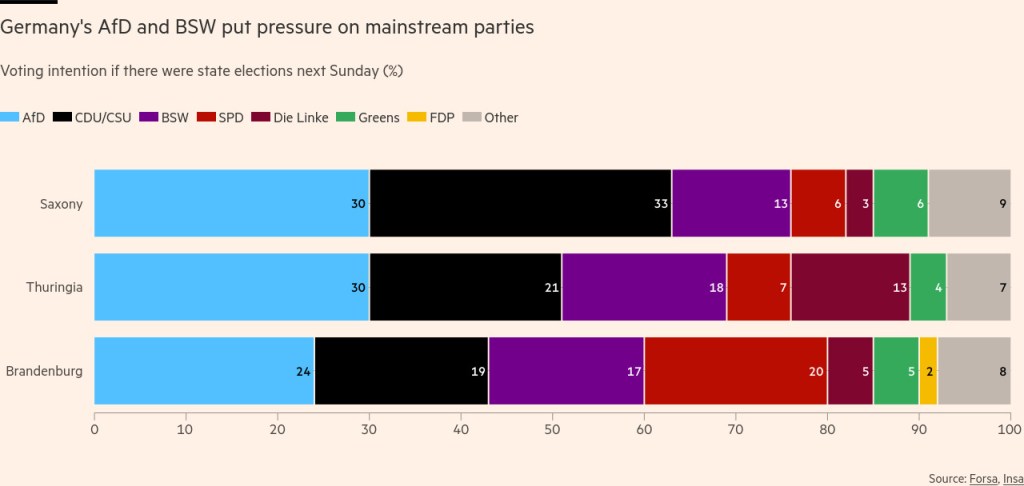
State elections don’t typically get international media attention. The September 1, 2024, elections in Thuringia and Saxony did. After all, it was the first time since the downfall of the Nazi-regime that a hard-right party, the AfD, pulled the majority of votes in a German election. It proved a bitter coincidence: The AfD celebrated their victory in Thuringia, obtaining 32.8 percent of the total vote, on the 85th anniversary of the Nazi-invasion of Poland that marked the beginning of the Second World War.
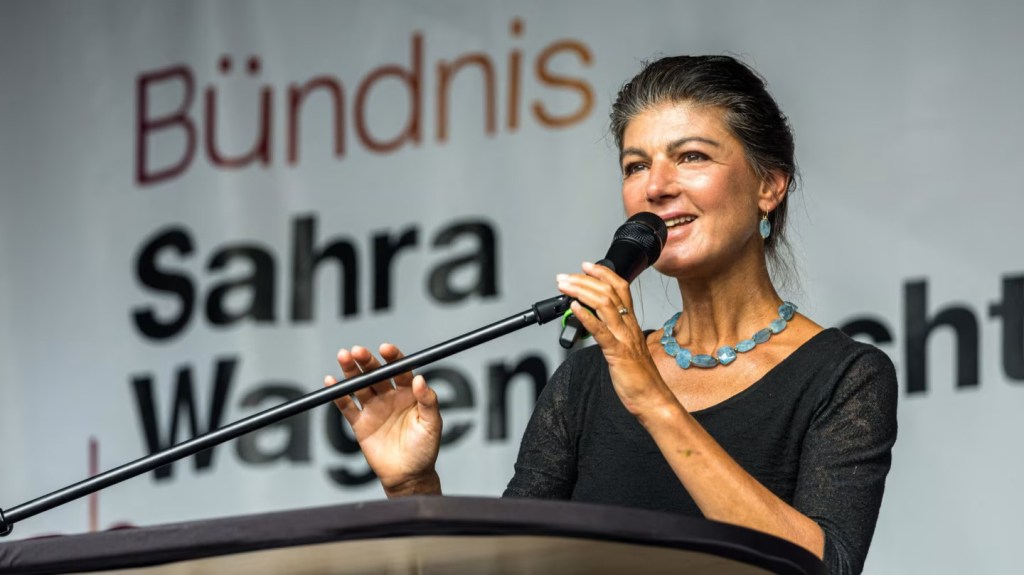
The Conservative Christian Democrats (the Christlich-Demokratische Union or CDU) came in second with 23.6 percent. The parties of the federal government coalition, Social Democrats (Sozialdemokratische Partei Deutschlands or SPD), Greens (Bündnis 90/Die Grünen) and Liberals (Freie Demokratische Partei or FDP) ended up with single-digit results, the FDP reduced to a mere 1.1 percent. At the time of the election, this was the party of the federal minister of finance. The Left Party (Die Linke), which in the previous election had become the strongest party for the first time in any German state, lost almost 18 percent and came in fourth, even trailing the Sahra Wagenknecht Alliance (Bündnis Sahra Wagenknecht or BSW), a breakaway group from the Left Party.
In Saxony, the AfD won 30.6 percent of the votes, just behind the CDU’s 31.9 percent. As in Thuringia, none of the parties of the federal government coalition achieved double-digit results. The Left Party lost more than half of its vote and ended up with a devastating 4.5 percent. The BSW came in a distant third with 11.8 percent.
Just three weeks after their election victories in Thuringia and Saxony, the AfD scored another success in Brandenburg. Narrowly beaten by the SPD that got 30.9 percent of the total vote, the AfD came in second with 29.2 percent, way ahead of the BSW’s 13.1 percent and the CDU’s 12.1 percent. The Left Party and the Greens obtained less than five percent of the vote, which is the minimum threshold for holding seats in provincial or federal parliament under the mixed-member proportional electoral system. The FDP pulled less than one percent.
Mainstream media fails to explain right-wing success
Barely beaten by the Conservatives in Saxony and the Social Democrats in Brandenburg, the AfD was elected by roughly a third of the electorate in three East German states, becoming the strongest party only in Thuringia. If ever there was a right-wing surge, this was it. Most media reports attributed the phenomenon to widespread dissatisfaction with the federal government, particularly regarding migration, climate policies and the war in Ukraine. Accounts of why the AfD is more popular in the East (approval ratings in the west of Germany range from 8.5 percent in Hamburg and the Saarland to 21 percent in Lower Saxony) focus mostly on disappointments caused by German unification, continuing socioeconomic disparities and a widespread feeling among erstwhile East Germans of being second class citizens. Other explanations invoke the authoritarian heritage of communist rule in East Germany, which is often presented as an extension of the Nazi-regime. Against the two dictatorships in the East, West Germany is presented as a role model of liberal democracy. This as if there hadn’t been considerable continuity between Third Reich and West German elites; as if East Germany’s ruling bureaucracy, despite all its dictatorial wrongs, wasn’t established by antifascists who had been exiled or jailed during the Nazi reign; as if the nationalization of the means of production, despite the wrongs of bureaucratic rule, had not marked a break from the West German capitalism that made West Germany a junior partner in the American Empire; as if West German capitalism had not dictated the terms of unification at the very time that a grassroots movement for democracy unsettled bureaucratic rule in East Germany. The destruction of the East German economy and the integration of the East into existing West German institutions left no room for the aspirations of East Germany’s civil rights movement. Rather than explaining growing support for the new right, media talk about the “peculiarities of the East” reinforces existing frustrations there—frustrations that help shed light on the relative strength, so far at least, of the right-wing surge in the East.
The ‘two-dictatorships’ thesis that pits the East against the liberal democratic West revives the totalitarianism theory that was an integral part of the anti-communist, anti-Soviet consensus during the Cold War. It is now part of the New Cold War ideology that counterposes democracy and authoritarianism. As in the old Cold War, charges of totalitarianism serve to short circuit thinking about alternative economic and political systems, reinforcing the neoliberal creed that there is no alternative to capitalism. The lack of actually existing alternatives is, of course, also one of the reasons for the rise of the new right. Emerging out of an ailing neoliberalism, this right-wing force presents itself as an alternative to the status quo but actually just recasts neoliberalism in a nationalist and racist mould. Replacing neoliberalism’s earlier commitment to corporate globalization in Germany, as elsewhere, neoliberalism is haunted by the spectre of fascism, which, to centrist neoliberals, has everything to do with misled masses unable to understand the virtues of capitalist liberal democracy and nothing to do with capitalist crises that undermine the legitimacy of liberal democracy. Neoliberalism is also haunted by the spectre of communism as ruling classes worry that crisis of legitimacy could extend to capitalism itself. As the neoliberal centre denies the possibility of alternatives and the left generally (not only the Left Party in Germany) appears unable to advance real world alternatives, the growing appetite for change, spurred by recurrent crises wrought by capitalism, settles for right-wing fantasies of a harmonious life in a nation that competes successfully with other countries economically and is freed from job- and welfare-stealing migrants.
The impact of German unification and the rise and decline of neoliberal globalization
Capitalist crises and their exploitation by the right are common phenomena, certainly in the imperialist centres of the world system, but also in the peripheries. But they play out differently in different national contexts. Behind the AfD’s electoral successes in Thuringia and Saxony as well as its broader surge in popularity lie the combined histories of German unification and the rise and decline of neoliberal globalization. The upsurge of the new right is just one of the outcomes of these combined histories. Equally important is the defeat of the federal government coalition and the rout of the FDP, whose leader, former federal Minister of Finance Christian Lindner, promotes austerity policies that stymie government plans to subsidize the transition to non-fossil energies. These policies also lead to a creeping roll-back of social spending—except when it comes to arms spending. Little wonder a government that took office on the promise of something like a Green New Deal lost its credibility almost entirely and called for a federal election scheduled for February 23 of this year.
And then there is the defeat of the Left Party that, despite programmatic commitments to progressive alternatives, is widely seen as the appendage of a lame-duck government in Berlin. At the other end of the political spectrum, the AfD is widely perceived as an oppositional force, even though its program blends austerity, nationalism and militarism in ways that are more extreme but qualitatively not much different from policies advanced by the CDU and the FDP.
In the face of electoral defeat, the federal government, which embraced the US’s New Cold War policies a few weeks after the Russian invasion of Ukraine, also introduced dramatically tougher migration policies. Rather than representing any kind of alternative, as its name purports, the AfD is the black sheep of the establishment family, expressing racist views more radically and bluntly than even the Conservatives. While the Social Democrats, Liberals and Greens are intent on denying such views, they reveal themselves as Western supremacists when it comes to fending off so-called authoritarian threats arising from Russia and China, stirring up longstanding fears in the West that ‘the Russians are coming’ or that ‘Asian hordes’ augur “the decline of the West,” in the words of right-wing intellectual Oswald Spengler.
The hypocrisy of the Greens, who advocate a green transition while supporting the purchase of dirty oil and gas (wherever they can get it ever since the Russian invasion of Ukraine ended Russian gas-flows to Germany), make them a prime target of AfD agitation. But in reality the AfD and the Greens share the fear of Western decline. The AfD engage in fearmongering around the replacement of white people by non-white immigrants and accuse the Greens and their coalition partners in the federal government of accelerating Western decline. But while the Greens may be the prime target of the AfD’s culture war, the truth is that despite significant differences in tone, the Greens and the AfD share a basic consensus on the decline of the West.
AfD success in the east: history holds the key
Encouraged by Glasnost in the Soviet Union, many East Germans took to the streets in the fall of 1989. Under the banner “We Are the People” they demanded democratic reforms of East Germany. Neither unification with West Germany nor a return to a capitalist economy was on their agenda—at least not initially. As protests grew, and especially after the ruling Socialist Unity Party (SED) had opened the border to the West, “We Are the People” was replaced by “We Are One People” more and more often. It was supplemented by the slogan “Germany, United Fatherland,” which is actually a quote from East Germany’s national anthem, written by the communist poet Johannes R. Becher in 1949, at a time when the leaders of the SED still thought a united Germany could be achieved—not necessarily socialist but not aligned on either the US or the Soviet Union. Such hopes were buried by the Cold War, for which the Berlin Wall became a symbol, casting a dark shadow over communist East Germany and allowing capitalist West Germany to present itself as a beacon of freedom. It was in a matter of weeks in the winter of 1989-90 that the abstract possibility became a demand, massively fanned by West German politicians—notably then chancellor Helmut Kohl—and mainstream media, which hinted at the possibility of East Germany adopting the West German Deutschmark. Many East Germans seized on such hints as an irresistible offer. “If the D-Mark comes, we’ll stay here; if it doesn’t come, we’ll go to it” became the next popular protest slogan. Since the opening of the border, thousands of East Germans had gone to the West, creating conditions reminiscent of the times before the wall was built in 1961. Back then, the East German economy lost so many people, most of them young and well-trained, that a collapse of social reproduction became a real threat. The wall stopped the bleeding of the East German economy but inflicted irreparable damage on the legitimacy of the political system.
Almost 30 years later, the opening of the border by the SED-leadership came as a bit of a surprise to West German elites. Yet, they were quick to grasp the possibilities it created. To them, this meant the integration of East Germany into the West German political and economic system, not coexistence with a somehow reformed but still politically independent East Germany. The ‘take over the East’ goal of West German elites and the Deutschmark rush of East German masses fed each other. The civil rights movement that wanted to democratize East Germany was sidelined. Some of the groups active in that movement adjusted to the new zeitgeist quickly, some even entered into an electoral alliance with the East German conservative party, despite their having criticized it as a small but integral part of the SED-regime. Angela Merkel, who would later become chancellor, belonged to one of these East German groups that allied with other conservative-turned-civil-rights groups and the East German CDU. This Alliance for Germany easily won the last East German elections and negotiated the integration of East Germany into West Germany’s institutional structures. On July 1, 1990, the Deutschmark came to the East, three months later the independent state of East Germany vanished into an enlarged West Germany. Most of the Alliance for Germany dissolved into the West German CDU immediately after unification. In December this enlarged CDU won federal elections.
In less than a year the Cold War had come to an end and an entire state had disappeared. However, the hopes pinned on unification, notably the introduction of the Deutschmark, were soon dashed. A year after unification, unemployment, which had existed in communist East Germany primarily in a hidden form, stood at 10.2 percent and rose to over 20 percent in the early 2000s. It didn’t fall below 10 percent until 2014, a quarter of a century after the Berlin Wall fell. Moreover, mass migration from East to West Germany, which the introduction of the Deutschmark was meant to curb, actually accelerated after the arrival of the Deutschmark. From 1990 to 2015, East Germany lost significantly more than one million people, the vast majority during the first two years after unification, and almost all of them of working age. Were it not for this emigration as well as early retirement schemes and retraining schemes for thousands of workers, unemployment in the East would have been even higher than it actually was. Introducing a new form of hidden unemployment, many of the participants in retraining were enrolled in one course after another, often in different fields, until they were old enough for early retirement.
One of the main, if not the main, reasons for the collapse of the East German economy was the Deutschmark. Introduced at a rate of one Mark West for one Mark East, while average productivity of East Germany was estimated to be about a quarter that of West Germany, German monetary union gave private households the boost in purchasing power they so desired. But it made East German firms uncompetitive. Lower wages could not compensate productivity differentials between firms in East Germany and Western countries. The privatization of East Germany’s state-owned firms facilitated the downfall of the East German economy even further. In some cases, Western companies bought East German firms just to shut them down so that they would not become competitors in the future. In other cases, they wanted patents or certain segments of production that they could integrate into their own supply-chains, leaving everything else to be shut down. The closures and cherry-picking of some more desirable segments destroyed the reproduction process of the East German economy even beyond the damage done by rendering it uncompetitive through monetary union.
The result was that bits and pieces of the East German economy became a periphery of production networks controlled by West German corporations. Ironically, the neoliberal restructuring of production processes went hand in hand with massive fiscal transfers from West to East Germany. A price that had to be paid to sustain some level of social cohesion while disappointment that political unification was followed by economic decline and continued social divisions between East and West instead of an Eastern economic miracle following the example of West Germany from the late 1950s to the early 1970s. At some point, a third of East German incomes came from fiscal transfers. As a result, government debt as a share of gross domestic product (GDP) rose from 41.8 percent in 1989 to 61.2 percent in 1999, which is nothing compared to today’s numbers. Yet, back then the lesson that had yet to be learned is that neoliberalism, despite its balanced-budget rhetoric, really is a mix of austerity and tax cuts for the rich that produces increasing debt levels at every slowdown or downturn of the economy. In the 1990s, government debt over 60 percent of GDP was a scandal. Not least because, at the urging of the conservative German government, 60 percent had become the benchmark for membership in the European monetary union, for which the roadmap had been laid out in the 1992 Maastricht Treaty.
Budget deficits, accumulating into government debt, weren’t the only deficit scandal in 1990s Germany. The other was in the current account. From a surplus of 4.6 percent in 1989, the current account dropped to a –1.9 percent deficit in 1991 and remained in deficit territory until 2001. In most other countries, deficits between negative one and negative two percent wouldn’t be a matter of concern. In Germany they were. After all, West German prosperity—the very model East Germans admired so much—had been reliant on export-driven growth, which was always understood as export surpluses. As it turned out, unification in the early 1990s, led to a boom in West Germany as East Germans spent many of their newly acquired Deutschmarks on consumer goods ‘Made in (West) Germany’—despite massive job losses. This boom drove prices up and made German exports less competitive on the world market. At the same time, some of the money from the East German spending spree went to foreign companies. As exports took a hit and imports got a boost, the current account went from positive to negative.
The East was integrated into the West German political system as it existed prior to unification. The Kohl government didn’t agree to any changes suggested by the East German government that formally negotiated unification but really rubberstamped the subordination of East German society to West German institutions. Economic integration was different though. The collapse of the East German economy, triggered by the design of monetary union and privatizations, had a lasting impact on the West German economic model that East Germans had been eager to embrace. The first decade after unification was marked by a twin deficit in government budgets and current accounts. During the unification boom from 1990 to 1993, inflation went up to levels not seen since the oil-price hikes and inflationary struggles between capital and labour from the 1970s to the early 1980s. At that time, however, the West German inflation rate was still below that of other Western countries, whereas in the early 1990s it was amongst the highest
Germany’s continued economic weakness, combined with New Cold War marching orders from Washington, fed a nostalgia for a supposedly great past—symbolized by the Deutschmark
West Germany as a role model
Running continued deficits—let alone a twin deficit—was unthinkable in a country that rebuilt its economy after the Second World War through integration into a world market with rules established and enforced by the US. In this American Empire, West Germany played the role of bulwark against Soviet Communism, including East Germany, and as a showcase of Western capitalism. To succeed in this role, foreign debt, accumulated by the Nazis and inherited by West Germany as legal successor of the Third Reich, was forgiven through the 1953 London Debt Agreement. West Germany also inherited low wages, industrial capacity and new technologies from the Nazi economy that, contrary to widespread assumptions, survived the war largely intact. This gave West German industries a competitive advantage that was further buttressed by favourable exchange rates on which basis West Germany was admitted to the Bretton Woods system of fixed exchange rates in 1952. Reintegration into the world market also allowed West Germany to transition from a coal-based to an oil-based economy. Oil was cheaper than coal but its supplies were controlled by US companies and the American state.
However, being a junior partner in the American Empire turned out to be a much better deal for the German bourgeoisie than its earlier quests for world power. The territory under its direct control was much smaller after two failed power grabs but profits were stellar. Driven by exports, or export surpluses more precisely, the West German economy didn’t require fiscal stimulus and kept growing until the US turned to floating exchange rates, which led to a significant appreciation of the Deutschmark. Further, oil prices exploded in the 1970s. But it was during these turbulences that West Germany consolidated its reputation as a beacon of economic stability. Political management of the crisis, notably codetermination (German lingo for the institutionalized cooperation between unions and employer association), kept wages and inflation lower than in most other Western countries. This helped to sustain export surpluses for much of the 1970s. In turn, export surpluses allowed the government to keep fiscal stimulus and unemployment rates low. Again, this is compared to other Western countries, not compared to the post-war boom.
West Germany’s relative success in managing the economic crises of the 1970s raised some concerns among its allies, who considered this success a case of beggar-thy-neighbour policies. The US pressured the West German government to increase public spending in order to stimulate the world economy. The West German government couldn’t shrug off these US demands entirely. The social democratic party was led by Helmut Schmidt at the time, and some extra spending also appeased the left wing in his own party as well as some unionists. However, calls for a Keynesian fix of the economic crises never overcame the general preference for fiscal prudence and low inflation that marked West German society after two lost wars, each followed by the introduction of a new currency, one of them also by unprecedented hyperinflation. Not entirely without reason, export success after the Second World War was widely attributed to liberal economic principles, conveniently ignoring the fact that this ‘liberalism in one country’ could only work because other economies placed growing demand on the world market.
Export success also created an ersatz-identity that allowed West Germans to repress the horrors of the Nazi regime and the roles most of them had played in these horrors, as perpetrators or bystanders. Social democrats never really fit into this picture. Willy Brandt, who spent the Nazi reign in underground resistance circles and exile and would later become West Germany’s first social democratic chancellor, was seen by many as a traitor. His successor Helmut Schmidt, who had served in the Nazi air force, opposed many of Brandt’s plans for social reform and applied Keynesian policies only in homeopathic doses. He was successfully branded as the one responsible for rising unemployment and inflation by the Conservatives and Liberals. Crossing the floor from SPD to CDU, the Liberals made Helmut Kohl chancellor. Kohl won two elections before unification on the promise of bringing post-war prosperity back. He won another two after unification on the promise of bringing the prosperity to East Germany.
For a long time, Kohl presented himself successfully as the defender of the West German export model and guarantor of the collective identity tied to that model, despite the fact that 1980s West Germany never saw a return to postwar prosperity. Disappointment with his broken promises for a West German economic miracle 2.0 began spreading towards the end of the 1980s. Yet, the disintegration of the SED regime allowed him to renew and extend his promises to the East. The national euphoria that secured his 1990 election victory also saw a transformation of collective identity. West German pride in being export world champion turned into Deutschmark nationalism. Widely shared in the East, where people were happy to get the Deutschmark, and the West, where people saw it as symbol of their postwar achievements, this was not the pure money, or currency, fetishism Karl Marx wrote about in Capital. It had a distinctive nationalist character that was subdued in West Germany’s pre-unification export-identity. With unification, the nationalist seed blossomed. Not only did this help Kohl become the ‘chancellor of unity,’ but it also gave cover to a burst of neo-Nazi attacks on immigrants, leftists and queer people, culminating in arson attacks in Rostock, Mölln and Solingen. The latter two killed eight people, while the attack in Rostock laid a four-day siege on an apartment block inhabited by foreign workers who had been employed in East Germany’s now defunct state-owned economy. The openly neo-Nazi attacks of the early 1990s, later dubbed “baseball bat years,” were followed by a series of murders committed by the National Socialist Underground (NSU) that cost nine immigrants and one cop their lives from 2000 to 2007. The role of the German secret service in covering up, or even facilitating, these murders has never been investigated as key documents remain classified until this day. Hans-Georg Maaßen, head of the secret service from 2012 to 2018, was one of the individuals responsible for blocking investigations of the NSU-murders. He also heads up an ultra-conservative circle, initially inside the CDU and now operating in the right-wing space between the CDU und the AfD.
Exports über alles: Eastern peripheries boost corporate profits
During unification and in the first few years afterwards, nationalism was a mass ideology. It rallied flag-waving masses in the streets, it dominated German politics and inspired Nazi-skinheads to chase people they considered enemies. As it became clear that the hopes for an economic miracle 2.0 would not be realized, street protests receded, most skinheads scaled down their activism and just a few turned to clandestine terrorist attacks. It seemed that nationalism had lost the force it had just recently. However, the entanglements between Nazis and parts of the state apparatuses indicate that while nationalism wasn’t as visible as before, it had not disappeared.
As it turned out, the opening of the Berlin Wall was a key step towards what would later be called neoliberal globalization. As the German bourgeoisie sought its place in a world seemingly governed by the invisible hand of the market—not Soviet planners or the milder version of Western government intervention—nationalism also found a new role as mass ideology. The ideological wind blowing from the ‘real West,’ that is, the United States, rebranded free trade theory going back to the days of David Ricardo as globalization. Sticking closely to Ricardo’s principles, academic globalists argued that firms, if left alone by the state, would specialize in the production of those goods they can produce more cheaply than firms in another country either because they possess more productive technologies or use input factors more plentiful and cheap than in another country. All countries will be better off if firms in each country specialize according to their comparative advantages.
Globalization practitioners talked about entire countries as if they were firms competing against each other. Competitiveness of nation-states became the lodestar of capitalists, and their political executors, who used it to justify the roll-back of wages and social standards in all countries. Their run-the-country-like-a-business propaganda was so persuasive that even working class people whose wages, pensions and public services were cut fell for it in large numbers, electing and re-electing neoliberal globalizers over and over again. At the same time, fear that the policies just voted for would cause a race to the bottom spread in the rich countries that saw parts of their production outsourced to poor countries, where labour was really cheap, while immigrants from such countries would take on jobs in the burgeoning low-wage sectors of the rich countries. Migration, segmented labour markets and a global reserve army of labour, enabling capitalists to engage in global labour arbitrage, were neither part of academic globalization theory nor did they feature in politicians’ globalization propaganda. Absent from public debate, these real-life factors created fears that a new right could build on by portraying economic problems as questions of national identity. Translated into policy terms, that meant a program of keeping immigrants out and capital in. This protectionist backlash against neoliberal globalization, coupled with the rise of a new right ranging from populist to neo-Nazi formations, occurred all over the Global North. It began slowly in the late 1990s and early 2000s while globalization was still expanding, and then gathered steam in the wake of the 2008-9 world financial crisis that marked the end of accumulation driven by globalization. It has accelerated again since the COVID-19 recession as well as the escalating great power politics vis-à-vis Russia and China, which have led to openly imperialist policies couched in the same nationalist ideology which the new right thrives on. The competitive nation-as-corporation ideology and the policies that marked actually unfolding globalization was the breeding ground for today’s strange bedfellowship of globalizers-turned-great-power-warriors and national supremacists of the new right. Theories of unregulated free trade opening the path towards global prosperity were just an ideological tool that was useful as long the integration of more and more countries into the US-dominated world market fuelled capitalist accumulation, and thereby hopes for the eventual trickle-down. It was replaced with the rhetoric of concern for national security and democracy as accumulation ended in a new phase of stagnation.
The German bourgeoisie had already adopted the logic of the state as business competitor after the Second World War when it traded world power ambitions for a junior partner role in the American Empire. Balanced budgets and tight money formed the core of its policies. That, along with competitive advantages inherited from the Nazis or granted by the US, enabled export-driven growth and, ultimately, export surpluses. Despite verbal commitments to liberalism, these policies were mercantilist in substance. Shattered but not derailed by the crises of the 1970s, West Germany’s mercantilist regime of accumulation survived until unification led to a twin deficit, slow growth and socioeconomic divisions between East and West. Unified Germany’s economy stumbled along while the US enjoyed its New Economy boom, even though that turned out to be short-lived, and China attained unprecedented levels of economic growth.
The Kohl government didn’t respond to the bourgeoisie’s growing concerns about economic stagnation in Germany. Neither did it respond to growing dissatisfaction with social conditions among the popular classes. After uniting Germany, Kohl turned to further uniting Europe. Partly, he wanted to demonstrate Germany’s continued commitment to cooperation in the European Union as some European leaders—notably British Prime Minister Thatcher and French President François Mitterrand—had expressed reservations about German unification and worried about a return of German great power ambitions. European monetary union became Kohl’s preferred route to an “ever closer union,” as EU-parlance had it at the time. However, regarding other countries, notably in the Mediterranean, Kohl successfully pushed for tight fiscal and monetary rules—the same kind of rules West German policy makers followed in the postwar period. Under the favourable conditions granted by the US to integrate into the world market, this led to export-driven prosperity. However, other countries didn’t enjoy the same favourable conditions. What would upset governments and people in such countries even more was the fact that Kohl had abandoned the rules he was preaching to other European countries in his very own united Germany
Helmut Kohl at the CDU national party convention in Hamburg, 1973. Photo from Wikimedia Commons
There, European monetary union was widely seen as a top-down capitalist elite project, part of corporate globalization or as a handing over of the beloved Deutschmark to irresponsible Eurocrats and the Club Med, a derogatory term often used in public debates to denounce people in the Mediterranean countries as lazy, spend-thrifty and, worst of all, happily having a good time at the expense of others. Euro-scepticism added to disappointment with the collapse of East Germany’s economy after unification, growing income polarization and fears of job loss all over Germany and a sense of losing national sovereignty to global capital. Unresponsive to any of these concerns, Kohl and his coalition of Conservatives and Liberals eventually lost the 1998 election to the Social Democrats and Greens who formed a coalition government offering a blend of light Keynesianism, green transition and control of financial markets. This is where the German—and international—bourgeoisies got really concerned.
The opening ideological salvos to derail the newly elected government’s plans came from the British tabloid The Sun, calling Oskar Lafontaine, the new finance minister who proposed the introduction of a Tobin tax, “Europe’s most dangerous man.” Next came Madeleine Albright, then US secretary of state, who gave Germany’s Green Foreign Minister Joschka Fischer the choice of joining the bombing campaign against Yugoslavia or having his country isolated from Western allies. Fischer, and the new Chancellor Gerhard Schröder, chose war. Seeing that his opposition to the war wasn’t supported by anyone else in the cabinet, Lafontaine resigned before the bombing began.
A few months later, The Economist called Germany the “Sick man of the Euro.” Coming from the central organ of global capitalism and unrepentant advocate of liberalism since the days when England, not China, was the workshop of the world, this was not just another opinion piece. It was a warning that the international investment community—exactly the CEOs, bankers, brokers and financiers targeted by the then-emerging movement against corporate globalization—lost confidence in the German market and expected pro-business measures to boost their propensity to invest.
After a few months in office, Schröder had to choose between meeting voters’ expectations (job creation, reduction of job insecurities and income inequality) and capitalists’ cost-reduction demands. He chose the capitalists’ side, earning him the nickname Genosse der Bosse (Comrade of the Bosses). In the absence of a social movement from below that could have pushed him to deliver on the election platforms of the SPD and the Greens, this choice might actually better be called caving to capitalist threats of an investment strike. From 2000 to 2005, the Schröder government axed corporate tax rates, exempted capital gains from taxation and lowered equity requirements for credits. The other side of the class divide saw drastic reductions in unemployment benefits, essentially slashing them to the level of welfare payment rates after one year of benefits. At the same time, legal obstacles to employing temporary workers were greatly reduced. Capitalists were thrilled. Profits and asset prices shot up, but capital formation declined during the years pro-business laws were passed.
Reorganizing existing production capacities was more important to corporate executives than creating new capacities. This was not surprising as capacity utilization dropped when the New Economy bubble burst, triggering a downturn of the world economy that kept even booming China below double-digit growth. As it turned out, united Germany did not inherit the export successes of pre-unification West Germany, but was certainly heir to its export dependence.
In the early 2000s, Germany’s current account turned positive again—not because exports grew so strongly (they actually stagnated due to the world economic downturn), but because imports declined owing to weak domestic demand associated with the Schröder government’s neoliberal policies. However, as the world economy bounced back (China saw growth rates of 10-14 percent from 2003 to 2006), German exports grew again. Eventually the reorganization of production processes in the aftermath of German unification paid off. West German corporations now controlled production networks linking corporate headquarters controlling finance, research and development, and capital-intensive parts of actual assembly in the centres with labour intensive production in low-wage areas in the peripheries from Eastern Germany all the way to China. In these networks, East Germany occupied the position of a semi-periphery. On the supply side, German export success in the early 2000s relied on continued wage inequality between centres and peripheries, which doesn’t mean that all workers in the centres earned high wages. The threat to relocate production to the East or the South put the brakes on all wages. The lowering of social standards propelled the growth of low-wage employment, notably in the service sector. Well-paying, permanent jobs began to decrease as a share of total employment even in West Germany. As a result, discontent that was widespread in the East since political unification was followed by economic collapse, and social downgrading began to creep into the West.
2010s: Exporting the Euro-crisis
The export surpluses of the early 2000s relied on the same mercantilism that had generated such surpluses during the postwar prosperity. However, during the postwar period, unprecedented growth rates across the Western, and parts of the non-Western, world made it possible to superimpose a welfare state on a mercantilist economy that didn’t squeeze profit rates but operated with capital’s consent in a way that seemed unthinkable during the age of catastrophe from 1914 to 1945. In the early 2000s, by contrast, successful mercantilism demanded the roll-back of the welfare state. Tragically, the extension of West Germany’s welfare state institutions to East Germany, where they were superimposed on a collapsing economy, created the profit squeeze that was needed to curtail the material protections granted by the welfare state. To sustain competitive advantages gained by scaling back the welfare state, it was imperative to keep wage-growth low even after surging exports pulled the economy out of the slump. Unlike during the period of postwar prosperity, export surpluses didn’t stimulate domestic demand very much. In fact, current account surpluses in the early 2000s, which surged from -1.8 percent in 2000 to 6.7 percent in 2007, were as much driven by rising exports as by weak growth of imports, a clear indicator of the overall sluggishness of domestic demand. Unemployment rates rose from 9.3 percent in 2000 to 12.1 percent in 2005. After that, unemployment went into long-term decline, briefly interrupted by the 2008/9 Great Recession and slowed down by the 2009/15 Euro-crisis, eventually reaching five percent before the 2020 COVID-19 Recession. However, this job growth occurred almost entirely in low wage occupations.
Paradoxically, it was during the Euro-crisis that a wave of “export nationalism” covered up the discontent that was growing, at variable speeds, across Germany. The Deutschmark nationalism that emerged during German unification had taken a hit with the introduction of the Euro. However, when it turned out that the Euro was basically the old Deutschmark under a new name and export surplus levels were reaching unprecedented heights, it almost seemed that the long-awaited return of prosperity was about to materialize. But of course, it wasn’t the same as the postwar prosperity that saw strong growth almost everywhere. The 2010s, by contrast, were a time of stagnation. The rebound after the 2008/9 recession was stronger in Germany than in other countries, but then growth rates fell in line with the one-to-two percent range of other Western countries.
It was during this time of recurrent crises and long-term stagnation that the German government, led by Angela Merkel with the Social Democrats as junior partner, felt compelled to lecture other governments on economic policy. Completely blind to the fact that beggar-thy-neighbour policies are a zero-sum game, the Merkel-government told Southern European countries to impose austerity despite the fact that they were suffering from a sovereign debt crisis due to the end of cheap credit that became available after the creation of the European monetary union, helping to pay for imports from Germany. Merkel also told them that, after a painful but unavoidable period of belt-tightening, they would eventually succeed as export countries like Germany.
The European monetary union’s contradictory character torn between further integrating Europe and spreading German mercantilism shifted entirely to the latter. Southern Europeans, governments and ordinary people, understood that austerity would further subordinate their economies to Germany’s economic dominance. The Brits, like the Germans and the “Frugal Four” (Austria, Denmark, the Netherlands and Sweden), although not warm to the idea of bailing out crisis-ridden Southern Europeans, were suspicious that Germany’s leading role in handling the crisis would turn the country’s economic dominance into fully-fledged hegemony. Brexit has its origin here. Eastern Europe’s post-communist comprador governments had imposed austerity on their countries in acts of pre-emptive obedience and now felt betrayed as they thought the bailout packages the Merkel government used as a means to impose austerity on the South were actually some sort of welfare package.
Centrifugal forces in the EU were further fuelled when, in face of civil war and foreign interventions in Syria, Merkel unilaterally declared open borders for Syrian refuges and then told EU member states they all had to take their share of refugees. European governments already concerned over Germany’s domineering role in managing the Euro-crisis were dismayed. Public debate within Germany was sharply divided between liberals and leftists applauding Merkel’s humanist stance and right-wingers, including in her own party, warning of an uncontrolled flow of immigrants. Largely unnoticed was the fact that Merkel’s decision to open borders for Syrian refugees was tied to the anti-Russian turn in German foreign policy following the sharp polarization between pro- and anti-Russian forces in Ukraine during and after the Maidan protests in 2014. Most of the Syrian refugees were fleeing the Russian-backed Assad-regime, which was considered an adversary. Opening borders for these refugees set a precedent for the surge of Ukrainian refugees following Russia’s invasion of Eastern Ukraine in 2022. At that point, Merkel, who had already retired, told the media that her government saw the Minsk accords, officially meant to reach a settlement between contending political and military forces within Ukraine, as a means of buying time to arm the Zelensky government.
2020s: Sick man of Europe 2.0
As Ukraine, already torn by civil war, became the scene for a proxy war between NATO-countries and Russia, Germany was firmly subordinated to US foreign policy. Post-communist governments in Germany had, more or less enthusiastically, supported deepening trade relations with Russia. Oil and gas imports might have been the most significant part of German-Russian trade but were certainly not the only one. Torn between allegiance to the US and lucrative business deals with Russia, the German government, now headed by Social Democrat Olaf Scholz, cut its economic ties with Russia after the latter’s invasion of Ukraine. The price to be paid was a further spike in energy prices, on top of the increases attendant on the economic recovery from the COVID-19-recession.
As part of current US efforts to contain China, the German government has been pressured to scale down its trade with China—Germany’s largest trading partner and also a prime outlet for German foreign direct investments. Since Germany’s economy is as much export-driven as export-dependent, the US turn from neoliberal globalization to escalating sanctions and protectionism in the name of national security has caused high levels of uncertainty within the German bourgeoisie. In addition to the return of secular stagnation after the very short post-COVID recovery in the West and the petering out of the China boom, this uncertainty is driving low levels of investment. Inflation, fuelled by post-COVID recovery and rising energy prices, and lower real incomes leading directly to less consumer spending, but also indirectly, as households build up their savings in anticipation of more economic shocks in the future. Meanwhile the Scholz government boosted arms spending while otherwise imposing austerity.
After two years of recession, Germany is again being branded the “sick man of Europe” by The Economist. The last time Germany earned this title the neoliberal turn against the welfare state produced massive current account surpluses, meagre general growth rates and massive social and regional inequalities. The export nationalism that concealed the mounting discontent with neoliberalism was shaken by the US turn from neoliberal globalization to protectionism and militarism. Given its high level of export dependence, Germany was ill prepared for the turn against it, which unleashed pent-up disappointments and anxieties into the political sphere. This happened all over Germany but more so in the East than in the West as regional differences in income, wealth and representation in leadership positions had created widespread feelings of being second class citizens in a politically united Germany.
In the absence of socialist imagination, German politics are haunted by the spectres of the past. An insurgent hard-right pins the labels of communism or Marxism on everything that ever came from the left, Social Democrats, the Greens and, of course, the Left Party, no matter how members, activists and supporters of these parties position themselves on the political spectrum. At the same time, the hard-right wants Germany to leave its Nazi past behind. Downplaying Nazi atrocities, accusing liberals and leftists of burdening Germans with a cult of guilt, they propagate the reclaiming of German national pride and sovereignty from allegedly cosmopolitan elites. Between the very real and growing right and a weak and largely imaginary left, centrist parties that proclaimed the end of history in the heyday of neoliberalism are also shifting to the right. The decline of the Left Party is a mirror image of the rise of the AfD.
Alternative für Deutschland: A child of Deutschmark nationalism
Mainstream media and centrist parties view the new right as if it were some external force inexplicably appearing on the political scene and threatening the liberal order. But this is empirically wrong. Almost all leading figures of the AfD come from conservative West German milieus where they previously held positions in public administration or private businesses. Although they present themselves as anti-establishment rebels, they are establishment people who turned from the centre-right to the hard-right. The AfD also includes party activists who come from militant neo-Nazi groups that have existed on the fringes of West German society since the CDU gave many old Nazis a political home after the downfall of the Third Reich. Making small advances into electoral politics in the late 1960s and again in the 1980s, the neo-Nazis remained marginal until they found common ground with disgruntled conservatives. Deutschmark nationalism served as the ideological bonding material for neo-Nazis and right-of-centre conservatives, and became a rallying point for growing numbers of people dissatisfied with the policies of neoliberal globalization advanced by the centrist parties. It emerged in the tumultuous days after the fall of the Berlin wall as a mass ideology that shaped East and West German politics in the direction of unification. After that, it became an ideological point of reference that allowed for the integration of different political ideas and currents into a new right political project, the AfD.
Riding on the wave of Euro-scepticism that accompanied the Euro crisis, the AfD, founded in 2013, promoted a German exit from the EU, which would also have meant exit from the Euro. However, boosting the Deutschmark nostalgia associated with German-style Euro-scepticism got the newly minted party only so far. What really fuelled the AfD’s take-off was the wave of Syrian refugees coming to Germany (and other EU-countries) in 2015. The party’s approval ratings rose from roughly five percent in its first two years to around 12 percent in the next two years. With the surge in voter approval came a programmatic shift from ‘neoliberalism in one country’ to neoliberalism hidden behind ethnonationalist hate propaganda. Despite advocating for a strong state, the AfD also presents itself as a rebellious party of freedom. This paradox is resolved by portraying cosmopolitan elites, represented most notably by the Greens, as a force dominating state apparatuses and misusing them to bring excessive numbers of foreigners into the country with their cultures that allegedly threaten German people, suppress German heritage and push the economy into decay. Therefore a strong state is needed to defend Germany against foreign incursion and revive its inherent strength
Election poster of the AfD in Thuringia supporting remigration. Photo from Wikimedia Commoms
The Scholz government created the conditions in which the AfD’s self-portrayal as freedom fighters gave the party another boost. The modest Green New Deal platforms on which the SPD and Greens ran their 2021 election campaign didn’t gain enough traction to allow them to form a government, despite support from unions and even, more cautiously, employer associations. To obtain a majority in the Bundestag, SPD and Greens formed an ostensibly unlikely coalition with the FDP, a party mostly focused on cutting taxes and limiting public deficits. These commitments to tax breaks for the rich and austerity for the poor stood in the way of effective state-sponsored energy transition programs. Hence, the Scholz-government was perceived as weak from the start. Things went from bad to worse for the government after Russia’s invasion of Ukraine in 2022. Under pressure from the US, Scholz opted for sanctions against Russia, arms deliveries to Ukraine and a continued increase in arms spending. At a time when the prices of everything from butter to housing were soaring, making it clear that money would still be available for guns but maybe not for butter not only destroyed whatever support the government had before the Ukraine war but also gave the AfD another boost. A year and a half into the war, the SPD was trailing the AfD in federal polls. Picking up widespread, though by no means dominant, unease with arms support for Ukraine and fear of war with Russia, the AfD advocates a negotiated peace settlement between Russia and Ukraine and, more importantly to the AfD, the lifting of sanctions on Russia. For the AfD, urging peace with Russia is not a matter of a principled anti-militarism but a means of reviving German trade with Russia, notably Russian energy imports that are seen as a precondition for economic recovery. To achieve this, Germany has to free itself from the ‘cosmopolitan sell-out elite.’ Whether everybody now supporting the AfD subscribes to the freedom-for-German-supremacy-view is open to debate. What can’t be denied is the fact that many discontented people, whatever their main grievance, are looking to the right, not the left, for alternatives to a failing political centre. Some are also turning to the CDU, which claims to be different from both the AfD and the federal coalition government, without offering anything other than praise for the good old days. That served the party well at times when the German economy could thrive, to a greater or lesser degree, on US-enabled expansion of world markets. With the US protectionist turn, this is no longer possible and the party is torn between centrism and the new right. Current support for the CDU is highly unstable, which could easily work in the AfD’s favour, especially in the absence of persuasive alternatives from the left, which so far have not materialized.
This wasn’t always the case. Something like a left renewal had once seemed to be in the offing in the most unlikely place: East Germany during the transition from state socialism to a peripheral position in an enlarged capitalist Germany. In West Germany, the nationalist wave that came with unification swept away much of the activist left that had rallied thousands—sometimes tens or even hundreds of thousands— of people in the 1980s against the stationing of US nuclear missiles, nuclear power plants, Nazis, and South Africa’s apartheid regime, among other causes. Left circles within the SPD, the Greens and the labour movement weathered the nationalist storm without leaving a mark on German politics. In this political climate, the Party of Democratic Socialism (Partei des Demokratischen Sozialismus or PDS) stood out as a beacon of the left.
Emerging from East Germany’s ruling Socialist Unity Party (SED), the PDS became the political home of many East Germans who lost their jobs, social status and cultural identity during the transition to capitalism. Quickly establishing a presence in East Germany’s provincial and municipal parliaments, the party expressed the discomfort of many East Germans who felt like second class citizens under the domination of West German institutions, politicians, corporations and culture. It highlighted East Germany’s socialist heritage, which encompassed commitments to anti-fascism, peace and international solidarity as much as the dictatorship of the politburo, Stasi-surveillance and an overbearing bureaucracy. The party hung itself up in endless debates between those who downplayed or justified East German communism’s dark sides and others who sought to disown that history by embracing liberal principles. Practically, these disputes didn’t make much difference. Upholding socialist principles didn’t stop the party from pragmatically working within the political and economic confines created by unification. At times, this included voting for privatization of public housing and infrastructure. For decades since the party was founded, the contradiction between socialist principles and the subordination to neoliberal policies imposed by the West German bourgeoisie didn’t stop the PDS or its successor organization Die Linke (the Left Party), from becoming something like a catch-all or people’s party in East Germany, a role long held by the CDU und the SPD in West Germany. For years, the PDS/Left Party achieved election results in the mid-20 percent range, peaking at 28 percent in Brandenburg in 2004 and 32 percent in Thuringia in 2019. It was also, and still is, part of various coalition governments in East German states. Until the September 2024 election, the Thuringian government was led by the Left Party’s Bodo Ramelow.
Despite this overall success and despite the party’s fidelity to socialist principles, the social group that wasn’t interested in voting PDS consisted of workers, who still voted CDU in large numbers despite g the CDU’s failed to deliver on its big promises of post-unification prosperity. More recently they shifted to the AfD. Meanwhile, in West Germany, the PDS remained marginal throughout its existence, only attracting activists from various left grouplets. What little remained of left protest milieus after unification was still dominated by a mix of environmentalists, antifas and international solidarity activists who might vote Green, or maybe even SPD, but hardly ever PDS. The old working class milieus that were shrinking with the decline of smokestack industries were still dominated by unionists closer to the SPD than the PDS. This started to change when, under chancellor Schröder, the SPD implemented neoliberal counter-reforms on a scale his conservative predecessor Kohl had avoided throughout his 16-year tenure, despite his supposed commitment to unleashing market forces. Growing frustrations among left social democrats and unionists fed mass demonstrations against Schröder’s SPD and created a social and organizational base (including, most prominently, Schröder’s short-time finance minister Lafontaine) that merged with the PDS into the Left Party in 2007. In the federal elections two years later, the Left Party won 11.9 percent of the vote, then 9.2 percent in the 2017 elections, but fell to 4.9 percent in the 2021 elections. This was a worse result than the 5.1 percent the PDS obtained in 1998, an election that also saw an increased vote for the SPD, which allowed Schröder to succeed Kohl. It is worth noting that the PDS vote came almost entirely from East Germany, which represents less than a quarter of Germany’s total population.
While the PDS mostly maintained peaceful coexistence between socialist theory and market-conforming practice, the Left Party continuously debated whether or not it should join centre-left governments, if given the chance. The bitterness with which party activists argued over this question stood in stark contrast to its actual relevance. In states where the party was relegated to opposition status by poor election results, this status didn’t attract additional voters keen on seeing a principled opposition in parliament. In states where the party joined governments, the results were mixed: sometimes it maintained its vote share in the subsequent election; sometimes it suffered losses. A paradoxical result came about in the Thuringian elections in September 2024: The Left Party lost massively, although, had there been direct elections for the minister-president (a position equivalent to provincial premier in Canada), the Left Party’s Bodo Ramelow would have won the election. This fits into a trend that became visible over the last few years in a number of state elections in East and West Germany. Party loyalties based on shared worldviews wear thin. Elections are often decided based on the media appeal of top politicians, regardless of party affiliation. Remarkably enough, Ramelow, just like Dietmar Woidke, the SPD’s lead candidate in the Brandenburg elections, dropped the name of his party on campaign posters, presenting himself as more of a provincial father figure than a man of the party.
However, rather than signalling the end of ideology, as centrist politicians and postmodern philosophers might have argued before the rise of a very explicitly ideologically committed new right, the focus on limelight politicians pushes democratic debates into the shadows. In the case of the Left Party, it might also have been an attempt to distract from its own image as an organization mired in endless debates not producing any coherent, let alone persuasive, policies. The reasons for permanent internal discord are sociological and ideological. The Left Party was strongest in its early days, when the PDS’s social base still comprised a cross-section of the East German population, although workers remained underrepresented. It also attracted dissident social democrats and unionists from West Germany. To a limited extent, therefore the Left Party had the working class base the PDS never had.
The blend of Keynesian and Marxist ideas around which social democratic dissidents and union leftists organized had been defeated as a significant political current during the crises of the 1970s by the Social Democratic right and corporatist union leaders who put competitiveness of the West German economy over income distribution from profits to wages. In the new millennium, when these currents joined forces with the PDS, they were still sizeable enough to give the newly founded Left Party a boost. But not for long. The smokestack industries around which these left currents were organizing were in continued decline, which made strategies based on that moribund reality obsolete. Moreover, these strategies often stood in the way of mobilizing and organizing the new working classes that emerged in the service sector and, on a much smaller scale, IT, bio tech, and green energy.
As the ranks of the Left Party thinned out with the loss of members coming out of communist East Germany or from West German union and social democratic circles, the party was able to attract new blood mainly in the form of highly educated, often precariously employed, urban dwellers. The shift in membership from old left offspring to the children of neoliberal globalization was paralleled by a geographical shift in electoral support. In urban centres, losses among the party’s old left supporters could be partially compensated; in rural areas, however, where the PDS and the Left Party had always been weak, the party disappeared almost entirely. Often, there isn’t even anyone to put up election campaign posters
Anti-AfD protest in Germany. Photo by strassenstriche.net/Flickr
Unlike the original base of both the PDS and the Left Party, the urban hipsters who joined the Left Party had no old left reference points. Even when they talked about Marx and class they did so with postmodern accents. However, this did not help them to gain sizeable support among the working classes—sometimes lumped together as the “precariat”—that developed in expanding economic sectors. The political offerings of the Left Party seemed to exercise little appeal for both old and potentially new constituencies. The party’s founding basis of unity was opposition to neoliberalism. In the early days this left room for East German concerns about the outcomes of unification—arguably a kind of neoliberal restructuring—with opposition to the neoliberal turn of the Schröder-government in East and West Germany. It also left plenty of room for a variety of goals, from resurrecting the Keynesian welfare state to a multitude of vaguely defined socialisms for the future to opposition without a vision for the future. However, what sufficed to form the Left Party wasn’t enough to sustain and grow it, especially not as it became harder to label government policies neoliberal.
The Great Recession, the COVID-19 pandemic, and commitments to ongoing arms production brought state intervention back to the centre of politics, contrary to the 1990s and early 2000s when politics was dominated by advancing capital mobility and free trade. Back then, ruling elites organized consent of the popular classes, more or less successfully, under the banner of “international competitiveness.” The new watchword “national security” is better at rallying the new right than building support for centrist parties. Left Party intellectuals debated the new political conjuncture under the label “post-neoliberalism,” a word-monster that hints, perhaps unwittingly, at the party’s inability to develop a strategy beyond rejecting neoliberalism. In reaction to the imposition of a party line by its predecessor organization, the PDS and the Left Party allowed a wide range of views. However, members of various organized currents, ranging from social-liberal to communist, tended to talk more about each other than with each other.
Postmodernist philosophers’ contention that the days of master narratives are over was wrong with respect to neoliberalism—if there ever was a master narrative, it was neoliberalism—but it does apply to the Left Party, which could not synthesize different ideas into compelling left policies that could rally growing discontent. Instead, internal debates turned into factional turf wars in a party that resembled an appendix of the Scholz government, costing the Left Party more and more support.
After years of bitter infighting, discontent with declining voter approval and accommodation of government policies led to the split of the federal party caucus and the formation of the Sahra Wagenknecht Alliance (BSW) in January 2024. As its name indicates, the party is entirely built around its frontwoman, who represented the Left Party in the Bundestag from 2009 to 2023. In the BSW, the cacophony that destructively marks the Left Party is replaced by closed-door debates. As in the Communist party of old, membership isn’t open to everyone; applications to join must be approved. Wagenknecht, originally a member of the Communist Platform (one of the organized currents inside the PDS), had shifted to left-Keynesian, pro-welfare state positions. But, years before her split from the Left Party, she began advocating ordoliberal positions—a branch of neoliberal thinking that stresses the role of the state in allowing businesses to compete without being bogged down by monopolies. This German version of neoliberalism has been the hallmark of economic policy and ideology since the early years of West German world market integration. In Wagenknecht’s current adaptation of ordoliberalism, the state guarantees competition, which, in turn, creates a strong economy capable of providing stable employment, social security and a fairer distribution of incomes. She combines this embrace of free markets plus the welfare state with a critique of the European Union as an institution operating in the interest of big corporations and a critique of NATO and US hegemony. Her condemnation of American hegemony appealed to some members of the Left Party, as did her critique of the EU, although her more recent favourable references to ordoliberalism and policies aiming at stricter migration controls were less popular.
The BSW’s outlook is very much shaped by positive memories of West German postwar prosperity. Yet, the party’s advocacy of international cooperation, a position going back to 1970s detente policies, contrasts sharply with orientations of the centrist parties and some currents within her own former party. Demand for a negotiated settlement of the Ukraine war overlaps with AfD positions. However, the AfD considers this a matter of Germany’s national interest that doesn’t preclude support for rearmament and war in other regions, like Gaza most recently. The BSW, on the other hand, sees militarism largely as the US’s last recourse for defending its ailing empire. It remains to be seen how the BSW’s principled opposition to militarism and war can mesh with current negotiations for a coalition government with the CDU and the SPD, both committed to military support for Zelensky in Ukraine and Netanyahu in Israel. Polls suggest that electoral support for the BSW was largely driven by the desire for an anti-war voice in parliament. At the same time, there is considerable support for efforts to keep the AfD out of government, despite all the support the AfD garnered in the fall state elections in East Germany. If this means compromising its anti-militarism, the BSW may, like the Left Party before it, soon be seen as a superfluous appendix of unpopular centrist parties.
After weeks of negotiations, the BSW entered into a coalition government with the SPD in Brandenburg as well as with the CDU and SPD in Thuringia. It also supports a minority government made up of the CDU and the SPD in Saxony. It did all this to keep the AfD out of government positions. Understandable as such efforts are, they have already cost the BSW in the polls. Hovering just above five percent, the BSW may not reach the five-percent threshold for obtaining seats in the upcoming federal elections. The Left Party, standing at 3.5 percent in the polls, will probably fall short. Founded as a project to unify left forces from East and West Germany, its split early last year already signalled the failure of that project. The next election may reduce it to insignificance, leaving lots of room for the AfD [end]
the Germans have bowed down to the US sabotage by Joe Biden administration of Nord Stream pipelines, only to end up with Donald Trump’s America First doctrine in economy and defense
Sahra Wagenknecht’s party rises in polls ahead of regional elections in eastern German states
(Jens Schlueter / AFP)
Sahra Wagenknecht, Germany’s most prominent far-left politician, has taken credit for the government’s decision to limit military aid to Kyiv, saying her strong opposition to arming Ukraine was influencing Berlin’s policy on the war.
In an interview with the Financial Times, Wagenknecht said the fact that the German government “has said it at least doesn’t want to continue to top up weapons deliveries” was “a result of our high opinion poll ratings”.
Finance minister Christian Lindner last week warned fellow government members that he would veto any new payment requests for Kyiv.
Chancellor Olaf Scholz on Tuesday denied that Berlin was giving up on Ukraine, saying Germany would donate €4bn in military aid to Kyiv next year, more than any other European country.
But Wagenknecht was adamant about the impact her stance made.
“We are already having an effect, even though we’re not even in power,” she said of her party, the Sahra Wagenknecht Alliance (BSW). “Our approval ratings are affecting the national debate.”
After splitting from the established far-left Die Linke party to form BSW seven months ago, Wagenknecht has emerged as the left’s disrupter-in-chief.
Her rise in the polls inserts fresh instability into a political landscape challenged by the rise of the far-right Alternative for Germany (AfD) — which also espouses Ukraine-sceptical, pro-Russian views.
BSW has surged in the polls ahead of elections next month in three eastern German states that are expected to confirm the region’s drift to the political extremes and deliver a stinging rebuke to Scholz’s increasingly unpopular three-way coalition.
A poll by Forsa on Tuesday put BSW on 13 per cent in Saxony and 18 per cent in Thuringia, both of which hold elections on September 1 — an extraordinary achievement for a party that is not even a year old. Scholz’s Social Democrats, by contrast, is at just 6 to 7 per cent in both states
Squeezed on the left by the BSW and on the right by the AfD, mainstream parties face a major dilemma: should they entertain coalitions with an outfit whose opposition to military aid to Ukraine has placed it firmly outside the political consensus?
The dilemma is most acute for the centre-right Christian Democratic Union (CDU), which has been steadfast in its support for Kyiv since the very start of the war and has frequently castigated Scholz’s government for not doing enough to help the beleaguered country.
But polls suggest the CDU will not be able to govern — in Thuringia at least — without the BSW as junior partner. Having ruled out co-operation with both the AfD and Die Linke, which at present leads a minority regional government, the CDU has few options left.
“There’s no way this works without the BSW,” said Martin Debes, author of Germany of the Extremes, a political history of Thuringia.
CDU leader Friedrich Merz initially banned any coalition with the BSW, describing Wagenknecht as “rightwing extremist on some issues, and on others, leftwing extreme”.
But he later backpedalled, saying local branches of the CDU should decide on their own whether to team up with Wagenknecht’s party.
“Essentially we have to figure out what is possible on the local level and what will lead to stable majorities,” Mario Voigt, CDU leader in Thuringia, told the FT. “But one thing is clear: there will be neither a coalition nor co-operation with the AfD.”
A political contrarian who joined the East German Communist party just months before the fall of the Berlin Wall, Wagenknecht is revelling in her new status as kingmaker.
She has set out a series of tough conditions for any coalition, saying she won’t team up with any party that supports Scholz’s plan to station US medium-range missiles in Germany from 2026.
She also said the BSW would only join a government that explicitly backed diplomatic efforts to end the war in Ukraine
Ukrainian President Volodymyr Zelenskyy and German defence minister Boris Pistorius visit a military training ground in June (Jens Büttner / Getty Images)
CDU officials make the point that such issues are dealt with only by the federal government, not in regions such as Thuringia. Thuringia’s social democrat leader Georg Maier said: “She is just trying to blackmail all her potential coalition partners, especially the CDU.”
But Wagenknecht herself said she was only reflecting voters’ wishes. “People in the east want a change in foreign policy — they are scared of being dragged into a major European war,” she told the FT.
She also said that a majority of Germans living in the east rejected the US missile plan. Recent polling by Forsa shows that about two-thirds of respondents in eastern Germany are against the deployment, while at a national level, 49 per cent oppose it.
A “key condition” for any regional government was that it “reflects and represents such positions, because otherwise voters will just be disappointed again”, she said.
Though many in Berlin have bristled at Wagenknecht’s conditions, some in the east have echoed her rhetoric. Michael Kretschmer, the CDU prime minister of Saxony, has also spoken out forcefully against weapons supplies to Kyiv.
In Thuringia, the CDU’s Voigt — while stressing his party’s commitment to supporting Ukraine — has backed the call for more diplomacy to end the war, urging the federal government to “do more in this regard”. “Germany was always a force for peace and a force for diplomacy, but little of that is happening at the moment,” he said.
Wagenknecht said she found Voigt’s intervention “remarkable”. “We were always berated for taking this position, and now Voigt is demanding it, too.”
But others are outraged by the BSW leader’s rhetoric. A recent petition signed by civil rights activists accused Wagenknecht and her party of spreading Kremlin disinformation and called on other parties to “distance themselves much more clearly from the BSW and its ideas about ‘national Socialism’.”
The suggestion of a link to Nazism is a designation Wagenknecht firmly rejects. But her idiosyncratic platform does represent a curious mix of traditional leftwing ideas such as higher taxes on the rich with rightwing demands for curbs on immigration and sympathy for Russia.
In her interview, she cemented her status as one of Germany’s leading Putinversteher (Putin apologists), a reputation underscored by her decision to boycott President Volodymyr Zelenskyy’s speech in the Bundestag in June.
She criticised the Ukrainian offensive in Kursk, saying it would “harden” the positions of the warring parties, and said the war happened only because Russia “wouldn’t accept Ukraine turning into an American military outpost”.
Wagenknecht said her party had succeeded in changing German politics for the better by peeling votes away from the AfD.
“Before we existed, all the anger and protest benefited the AfD alone,” she said. “Now you see that when there’s a serious alternative, a lot of people will vote for it.” [end]
79 years ago, Soviet Union achieved victory in Berlin. Adolf Hitler shot himself on April 30, 1945 ; the Red Army completed the cleansing of the Reichstag in the afternoon of May 1. The shoot of the banner raising was made in the morning of May 2
chronicle of censorship, fake news, whitewashing of the Ukrainian Nazism and war crimes, for the sake of the proxy war that NATO is conducting in Donbass and Ukraine, against Russia
Any dilettante in History and politics is aware of Nazi kernels in eastern Europe. Like any predatory ideology, such inspiration may become a global threat if not addressed on time, has shown once more the actuality. The issue is long-term and this chronicle will be updated when necessary and possible. The focus will be on the countries at the front line of Western civilization against the Asiatic hordes : Estonia, Latvia, Lithuania and Ukraine.
As a dummy, I assume that these States are somehow neurotic, after what the common local opinion is regarding as a bullied independence through History. Nationalism is heightened. Nationalists are seeking in History a static common identity, need strong symbols and what makes them Nazis in these instances are their historical references. Their heroes were Nazis during WW2, have committed war crimes and crimes against humanity.
The issue has not been seriously addressed, because the West is complacent, needs this heightened nationalism for its own strategic purpose against Russia. This Nazism is the product of Nazi roots, neurotic nationalism and Western agenda. How funny are the Western media for a dozen years. The issue was a regular subject, especially when one of these States paid tribute to a Nazi hero, but a gag order is enforced since February 24, 2022, beginning of the Russian special military operation in Donbass and Ukraine, where according to the new common assumption, there is no Nazi problem or even, no Nazi.
Our post-truth era and fickle media make the investigation more difficult. But I have found a serious source. US journalist Lev Golinkin is documenting the recent erections of monuments to Nazi collaborators and Holocaust perpetrators, notably in Estonia, Latvia, Lithuania and Ukraine.
There are hundreds of statues and monuments in the United States and around the world to people who abetted or took part in the murder of Jews and other minorities during the Holocaust. As part of an ongoing investigation, the Forward has, for the first time, documented them in this collection of articles. For an initial guide to each country’s memorials click here. For a 2022 update to the investigation, click here
Exciting
The recycling in West Germany and US of Ukrainian Nazi Yaroslav Stetsko
On September 26, 2024, for Perspectives on Terrorism, Canadian and US political scientists Ivan Katchanovski and Max Abrahms publish a major study on the issue of fascism in modern Ukraine, its role and weight in the conflict since 2014. How Western political, media and even academic spheres are downplaying that reality for the public, even whitewashing the fascist players and their crimes, especially after the beginning on February 24, 2022, of the Russian special military operation in Donbass and Ukraine.
I disagree with the authors on two points
Stepan Bandera & friends were Nazis. How can the authors identify some neo-Nazis in modern Ukraine, while not regarding their historical mentors as Nazis ? Before WW2, they were praising either Adolf Hitler or Benito Mussolini. Their political project was authoritarian, racist and criminal. They were dreaming of ethnic cleansing. De facto during WW2, they committed mass killing of Jews and Poles.
Terrorism is not restricted to non-state actors. Terrorism is violent action to terror civilians, in order to achieve a common political goal. This is not even a value judgement, but Hiroshima bombing was terrorism. The Israeli targeting and mass killing of civilians, in the prospect of ethnic cleansing in Gaza, is terrorism.
Historical benchmarks
August 6, 1914
(Encyclopaedia Britannica)
In Lemberg (Lviv), at the northeastern end of the Austro-Hungarian empire, which assents, the Galician nationalist political organizations raise 2,500 Ukrainische Sitschower Schützen [Ukrainian Sich Riflemen], who will fight for the Central Powers, against Russia, which is part of the Allies
February 15, 1919
Benito Mussolini will start governing Italy in October 1922, Adolf Hitler will become Kanzler in January 1933, Francisco Franco will win the Spanish civil war in April 1939, but in the Russian empire, sporadic anti-Semitic pogroms are already a tradition. At night, more than 2,000 Jewish civilians are slaughtered in Proskurov and vicinity. In order to save ammunition, lances and bayonets are used
The mass grave of Jewish victims in Khmelnytskyi, former Proskurov, Ukraine
The assassins are irregular Cossacks, fighters for the Ukrainian People’s Republic (UNR), have seized the city from the Bolsheviks. The UNR has been declared in June 1917, amid Russian revolution, will be defeated. The Bolsheviks will create the Ukrainian Soviet Socialist Republic in 1922. During that war, the Whites [counter-revolutionaries] and Ukrainian nationalists will have slaughtered between 50,000 and 250,000 Jewish civilians.
The red and black flag appears within the white [counter-revolutionary] armies, that UK and France are supporting
One of their slogans is
Jews must pay for everything: for the February and October revolutions, for Bolshevism and for the peasants who took away their land from the owners
In Ukrainian Soviet Socialist Republic, literacy will be a major ambition. Dozens new universities will be founded, in order to train new teachers. But the program will not cover western Ukraine, Polish territory until 1939. The next generation of Ukrainian nationalists will be a nebula of Nazi collaborator organizations (cf. infra)
Europe after WW1 (Fluteflute on Wikipedia)
May 25, 1926
Samuel Schwarzbard (left) is a French-Russian citizen, an injured and decorated fighter within French ranks during WW1, a communist militant, a revolutionary in Petrograd in 1917, a Bolshevik fighter in Ukraine against nationalist and white forces, a watchmaker and a poet
Back in Paris, he manages to shoot dead Symon Petliura (right), the former head of the former Ukrainian People’s Republic (UNR). Twelve members of Schwarzbard’s family were among 50,000, at the very least, Jewish civilians whom the Ukrainian nationalists have slaughtered between 1917 and 1922. The French court will acquit him, because he will have avenged the victims of the massacres.
June 25, 1941
The Baltic countries were part of the Russian empire until the Bolshevik revolution, when they fought against the Red Army and gained their independence from 1918. Later, they signed mutual assistance treaties with the Soviet Union and in June 1940, the Red army occupied them.
The Lietuvių Aktivistų Frontas [Lithuanian Activist Front, LAF] is an underground fascist organization. The German intelligence is supporting it and its leadership is in Berlin. When the European fascist armies start invading Soviet Union on June 22, 1941, the LAF rises up against the Soviet local authorities, seizes control of Vilnius and Kaunas. Before the arrival of the German forces, the insurgents start slaughtering Jewish civilians
On June 25, 1941, under the acclaim of the crowd in Lietūkis garage, Kaunas, Lithuanian nationalists slaughter 68 Jewish civilians with iron bars (Wilhelm Gunsilius / LIMIS)
By June 28, 5,000 Jews have already been killed in Kaunas and vicinity, according to the German accounting. The most are victims of Lithuanian paramilitaries
German soldiers and their Lithuanian auxiliaries burn a synagogue in June 1941 (Russian archives)
July 7, 1941
(Bundesarchiv)
In Riga, Latvia, civilians cheer German soldiers.
July 19, 1941
Then named Lemberg, Lwow was a city of the Austro-Hungarian empire until the end of WW1, returned after to the new republic of Poland. WW2 began on September 1, 1939, when Germany attacked Poland, that Soviet Union invaded from the east on September 17. The Polish garrison surrendered to the Red Army on September 22 and the region was attached to Soviet Ukraine.
On June 22, 1941, the Nazi armies started their invasion of Soviet Union. Among the invaders, on June 29, nationalist battalion Nachtigall entered the city, that the Ukrainians are naming Lviv. The offensive has resumed eastward and Vinnitsa is occupied on July 19. In an internal report from the Organization of Ukrainian Nationalists (OUN), written later, in 1944, the author will remind how they slaughter the Jewish civilians in the region of Vinnitsa
The first hundred [company] of the Legion will drive in the Tarnopil-Vinnytsia direction. After a week’s daily life in Lviv, the second and third depart in the same direction as the first. The designated daily route is 30 km. We make it easier for ourselves by sitting in groups on empty German cars and there we drive to Glynyk, and from there we drive through Ternopil, and from there through Zbruch to Saganiv village. Our first stop was in Michalpol. From there, through Proskuriv, they stopped for a longer stay in Yuzvin near Vinnytsia. During our permarch, we witnessed the victims of the Jewish-Bolshevik terror, this sight also cemented our hatred for the Jews, that in two villages we shot all the Jews in the ribbon. I remember one fragment. During our permarch, many wandering people were seen in front of one village. The answer to the question is that the Jews are threatening them and they are afraid to spend the night in their houses. As a result of this, we shot all the Jews there. In Yuzvin, we have already connected with a whole group of people. Here we learned that the first hundred had a battle with the Bolsheviks near Vinnytsia. As a result, 3 of our shooters were wounded, and some were sent to the memorial service. Only Lieutenant Kalina received the Cross of Merit. All others submitted for recognition were not recognized, perhaps only for political reasons. In Lviv, we were granted the right to wear blue and yellow [Ukrainian national colors] ties on epaulettes as a legion banner
(Ukrainian Institute of National Remembrance)
In occupied Poland, the Abwehr [German military intelligence] has formed the Bataillon Ukrainische Gruppe Nachtigall in February 1941, in order to conduct special operations against Soviet Union. The recruits were volunteers from the OUN.
July 24, 1941
Printed in Hungary, one European fascist country involved since June in the invasion of Soviet Union, newspaper Ukrainian Word quotes a speech of Stepan Bandera (cf. infra, The local debates, June 30, 2022), majority leader within the Organization of Ukrainian Nationalists (OUN)
[…] The German army, under the leadership of Adolf Hitler, is establishing a new order in the world and is assisting us in creating a Ukrainian state that will cooperate with the National Socialist Great Germany […]
The meeting concluded with cheers in honor of
the OUN and its leader Stepan Bandera, the Führer of Germany Adolf Hitler, the Regent of Hungary Horthy, and the German and allied armies
August 22, 1941
Their parents have already been slaughtered. From a few months to four years old, 90 Jewish children are still alive, held in a school in Bila Tserkva, 90 km southwest of Kiev
The memorial to the Jewish children in Bila Tserkva (Koos Winkelman / Traces of War)
Despite some German protests, the Einsatzgruppe C / Sonderkommando 4a confirms the orders: the children must be assassinated. Local Obersturmführer [SS lieutenant] August Häfner refuses to use his fellow Germans and entrusts instead the Ukrainian police auxiliaries, who shoot the 90 children at the edge of a trench.
September 29, 1941
A placard has appeared in Kiev, that the German Nazi forces have seized on September 19, after 45 days of Soviet resistance
All Yids of the city of Kiev and its vicinity must appear on Monday, September 29, by 8 o’clock in the morning at the corner of Mel’nikova and Dokterivskaya streets. Bring documents, money, valuables and also warm clothing, linen etc. Any Yids who do not follow this order and are found elsewhere will be shot. Any civilians who enter the dwellings left by Yids and appropriate the things in them will be shot
fragment (Traces of war)
These families are led to Babi Yar ravine, Kiev northwestern suburb, where more than 30,000 victims are shot. The executioners are Ukrainian auxiliaries and mainly, the German Einsatzgruppe C, in charge of the genocide of Jews in northern and central Ukraine
In October 1941, after the mass-killing in Babi Yar, German servicemen are searching through clothing of the victims (Johannes Hähle / Propagandakompanie 637)
October 13, 1941
About 200 km west of Kiev, Miropol village was in Soviet Ukraine since 1922. The Nazi forces came in July 1941. In the evening of October 12, the German authorities and Ukrainian police have rounded up the Jewish families. In the morning, their neighbors throw rocks at 300 victims, who are taken to the slaughter, loot later their houses
In Miropol vicinity, on October 13, 1941, a woman and her son are assassinated. The killers are two German custom officers and in the foreground, two Ukrainian police auxiliaries (Lubomir Skrovina / historical collection of the State Security Service, Prague)
Although reported to the police in the 60s, the custom officers will not be sued in West Germany. The denazification of West Germany will be very flawed. But in Soviet Union, the KGB will identify the Ukrainians, who will be sentenced to death in 1987. US historian Wendy Lower will start investigating the photo in 2009.
October 16, 1941
(Johannes Hähle / Propagandakompanie 637)
By order of the German command in Lubny, western Ukraine, 4,500 Jewish inhabitants are gathered in Zasulsky Yar. The same day, German SS and their Ukrainian auxiliaries will shot them in anti-tank trenches.
October 22, 1941
Stanisławów was Austro-Hungarian until 1919, Polish until 1939, when the Red Army occupied it in September, on the territory of Soviet Ukraine until July 2, 1941, when the Nazi armies seized it. Stanislaviv is its Ukrainian name
(Russian archives)
Hans Frank is Generalgouverneurfür die besetzten polnischen Gebiete [general governor for the occupied Polish territories], makes a tour. The Ukrainian nationalists parade in his honour. In 1962, the city will be renamed Ivano-Frankivsk.
January 31, 1942
Franz Walter Stahlecker (1900-1942) addresses a map to Reinhard Heydrich (1904-1942)
Estonia : 963
Latvia : 35,238
Lithuania : 136,421
The latter is heading the Reichssicherheitshauptamt (RSHA), command of the German Nazi police and intelligence. Stahlecker is SS-Brigadeführer, leader of the Einsatzgruppe A, in charge of the genocide of Jews in the Baltic countries. The map indicates the numbers of assassinations since the beginning of the invasion of Soviet Union, on June 22, 1941.
August 2, 1942
Краківські вісті [Krakivs’ki Visti, Krakow News] is since January 7, 1940, a Ukrainian daily newspaper in Krakow, Nazi capital of the Generalgouvernement für die besetzten polnischen Gebiete [General Government for the Occupied Polish Territories]. The printing press has been stolen from its Jewish owner. The editorial team is gathering Ukrainian nationalists who have fled in September 1939 the Soviet invasion of eastern Poland and have got under protection of Nazi Germany
Krakivs’ki Visti is publishing translations of articles from German newspapers and also original ones. The editorial line is strongly pro German, anti Soviet and antisemitic. In brief, the newspaper is a Nazi propaganda organ.
Its editor-in-chief is Mykhailo Khomiak, who will flee the victory of Soviet Union against Nazi Germany, will emigrate to Canada, where his name will become Michael Chomiak. On August 2, 1968, Chomiak will become the maternal grandfather of Chrystia Freeland, deputy prime minister of Canada on November 20, 2019. Despite the evidences, Freeland will deny the collaboration of her grandfather with Nazi Germany, will regard these facts as a Russian disinformation campaign
On February 27, 2022, second from left, Chrystia Freeland demonstrates her support to Ukraine with the black and red colors of the WW2 Ukrainian Nazi organization which is described infra (social networks)
October 31, 1942
The Schutzmannschaft [auxiliary police] Bataillon 115 was formed in Kiev on February 28, 1942, with OUN (Organization of Ukrainian Nationalists) militiamen, some previously involved in the massacres in Babi Yar ravine (cf. supra, September 29, 1941), as well as other volunteers among prisoners of war. On August 27, 1942, despite the contractual promise of a permanent garrison in Kiev, the German authorities transferred the formation to Belarus, in order to conduct Bandenbekämpfung [bandits fighting] against Soviet partisans
The 2nd company of the 115th Ukrainian auxiliary police (Schutzmannschaft) battalion at the unveiling ceremony of the Ukrainian national flag in Derechin, Belarus, on October 31, 1942 (original caption in German, archives of the Security Service of Ukraine)
In July 1944, the battalion will be moved to the 30. Waffen-Grenadier-Division der SS, which will be transferred to France, where the most will desert in August.
March 22, 1943
A massacre among thousands ones that the Nazis will have committed in Belarus during WW2 : as retaliation for an ambush that Soviet partisans have carried out the same day, 6 km away, the Nazi forces storm Khatyn, a peaceful village about 60 km northeast of Minsk. All inhabitants are driven in a shed which is then set ablaze. Machine gun fire kills those who attempt to escape. About 150 people, including 75 children, are slaughtered
The emblem that the commissioned officers of Ukrainian Schutzmannschaft Bataillone are wearing on armbands
The assassins are members of the Schutzmannschaft Bataillon 118, a Ukrainian auxiliary police formation. Its last alive member, machine gunner Vladimir Katriuk, will have managed to emigrate to Canada, where he will die on May 22, 2015.
March 26, 1943
Ivan Tremjanjuk is a 22-year-old Hilfswilliger Wachmann [Volunteer Auxiliary Guard]. Since November 1942, he has already worked in Majdanek Vernichtungslager [Extermination Camp], is transferred today to Sobibor, also in Poland. He appears in this photo among his comrades, at the center of the front row
(United States Holocaust Memorial Museum)
Tremjanjuk was born in a village near Vinnitsa, Soviet Ukraine, has worked in a collective farm, was drafted into the Red Army in 1940. The Nazis took him prisoner of war (POW). He has later volunteered for the formation to become guard of concentration camp.
In October 1943, he will be transferred to Flossenbürg Zwangsarbeitslager [Forced Labor Camp], in Bavaria. After the Nazi defeat, he will be refugee in West Germany. In 1952, he will emigrate to the US, where he will be naturalized in 1958, will change his first name to John.
In May 2009, he will be extradited to Germany. On 12 May 2011, aged 91, he will be convicted as an accessory to the murder of 28,060 Jews at Sobibor camp and sentenced to five years in prison with two years already served. He will appeal but will die in March 2012.
April 21, 1943
Glory to our liberator Adolf Hitler
Published in Konotop, Ukrainian Vyzvolennya [Liberation, from Soviet Union] newspaper celebrates -the day after- the 54th birthday of the German Führer.
April 23, 1943
Signed UPA, a leaflet in Ukrainian orders all Poles and their families, on pain of death, to leave their homes and the Ukrainian lands within 24 hours (World War II Museum in Gdańsk)
The Ukrainian Insurgent Army (UPA) has been formed on October 14, 1942, as the military branch of the faction that Stepan Bandera is leading within the Organization of Ukrainian Nationalists (OUN), in Nazi occupied Poland and Ukraine.
In eastern Poland before WW2, Janowa Dolina is a model settlement for the workers of the Polish State Basalt Quarry
Before dawn, with the reinforcement of Ukrainian peasants, elements of the UPA, under command of Ivan Lytwynchuk, attack the village. 600 Poles, both genders, all ages, are hacked with axes, impaled or burned alive. The nearby German garrison does not interfere.
After WW2, Bazaltove will become the name of the site, in western Ukraine. After the independence in 1991, a nationalist monument will celebrate there the destruction of a base of Polish-German occupiers.
April 28, 1943
Within the international Schutzstaffel (SS), a Ukrainian division is formed with volunteers from Galicia region, in German occupied eastern Poland, western Ukraine after WW2
[In Ukrainian] Ours is a firm guarantee of victory over the common enemy. This is the way to a happy future life for all peoples of Europe []
German authorities pledge that the new formation will not confront Western allies, will fight the Bolsheviks. In February 1944, the division will operate against Soviet and Polish anti-Nazi partisans. In July, the Red Army will sweep up the Ukrainian SS. After last fighting in Slovakia and Austria, war crimes everywhere, the survivors will surrender to the British and US forces in May 1945
Taken in 1943 and recently colorized, that picture is showing SS volunteers in Drohobych, 80 km southwest of Lviv (German propaganda)
On January 18, 1943, the survivors have risen up in Warsaw ghetto against massacre and deportation. The Nazis have started their last onslaught on April 19, have committed about 2,000 men, including Trawnikimänner [Men from Trawniki, a Polish village where the SS are training volunteers, mostly Ukrainians, as police auxiliaries]
[Original caption in German] Ukrainian Askaris [auxiliaries] used during the operation [the destruction of Warsaw ghetto] (Bundesarchiv)
The resistance ends on May 16. About 20,000 Jews have been killed, 36,000 are deported to extermination camps.
July 11, 1943
With the reinforcement of Ukrainian peasants, elements of the UPA attack in Kisielin, Poland before 1939, the Roman Catholic church where Polish worshipers have gathered on Sunday. At least 60 men, women and children are shot. The wounded are killed with axes and knives
Former Kisielin is now Kysylyn, western Ukraine (Oleg Gordiyuk)
More than 100 other Polish settlements are attacked the same Sunday and about 8,000 civilians, butchered in one day. Janowa Dolina (cf. supra, April 23, 1943) and Kisielin are emblematic sites in eastern Poland of an ethnic cleansing which is killing at least 50,000, maybe 100,000 Poles, between 1943 and 1945
SS inspiration of UPA supreme commander uniform, its red and black flag, that Pravyi sektor [Right Sector] will still bear in 2022
In 2022, the Ukrainian nationalists will still dare portray OUN and UPA as respectable resistance organizations against Nazi Germany and Soviet Union (cf. infra, Local debates, June 30, 2022).
February 28, 1944
In German occupied Poland, Huta Pieniacka is a village where Polish inhabitants are sometimes sheltering anti-Nazi Soviet partisans. Under German command, Ukrainian SS (cf. supra, April 28, 1943) encircle and shell it in the morning. The onslaught begins at noon, with the reinforcement of UPA militiamen (cf. supra, April 23, 1943) and Ukrainian peasants. 900 civilians, men, women and children are slaughtered. The village is burnt, will never be rebuilt
Former Huta Pieniacka is in western Ukraine, about 100 km east of Lviv. On February 28, 2016, a ceremony takes place at the memorial (Stowarzyszenie Huta Pieniacka we Wschowie)
June 3, 1944
(US Holocaust Memorial Museum)
Reichsführer SS Heinrich Himmler reviews the 14. Waffen-Grenadier-Division der SS, Galizien [Galicia]. Alongside other Nazi formations in Lviv region, the Ukrainian SS division will lose about 75% of its personnel in July, during Soviet Bagration offensive.
August 5, 1944
Wanda Lurie (1911-1989) is a miracle. She survives several gun wounds, a baby in her womb, while the Nazis are slaughtering about 50,000 people in Wola neighborhood of Warsaw, between August 5 and 8, 1944. Her famous testimony will be used at Nuremberg trials. One quote is
Wanda Lurie after the war, with her son, who was born after she was shot (Polska Times)
I begged the Ukrainians around us to save the children and one of them asked me if I could redeem myself. I gave him 3 gold rings. Having taken it, he wanted to take me out, but the German officer in charge of the execution, the gendarme officer who noticed it, did not allow me and ordered me to join the group to be shot
During Warsaw uprising, a Polish insurgent paints letter U on the backs of Nazi Ukrainian auxiliaries taken alive (Polish archives)
August 30, 1944
Members of the Ukrayinskoyi Vyzvolnoho Viyska [Ukrainian Liberation Army, UVV] are learning Ukrainian history
Since 1942, the Wehrmacht [German regular army, not SS] is forming Osttruppen [Eastern Troops] with Soviet prisoners and volunteers from Ukraine, Baltic States, Georgia, Armenia, Azerbaijan, Uzbekistan… and Russia.
Commander of the Russian elements (ROA, cf. infra, November 1, 2022), general Andrey Vlasov will attempt in May 1945 to surrender to the US army in Czechoslovakia, but the Red Army will catch him. Tried and sentenced to death, he will be hanged in Moscow on August 1, 1946.
After the West-backed right-wing coup in 2014 (cf. infra, Local debates, February 21, 2014), Russian Nazi militants will seek refuge in Ukraine. As of 2022, under RDK brand and command of the Ukrainian military intelligence (GUR), they will claim the ROA legacy.
November 20, 1983
A plaque is unveiled at Bradford cathedral, Yorkshire, UK
Freedom for individuals. This plaque was unveiled by Yaroslav Stetsko, president of the Anti Bolshevik Bloc of Nations and dedicated by the very Rev. Brandon Jackson, Provost of Bradford, and the east European clergy on 20th Nov. 1983, to mark the 40th anniversary of the A.B.N. and the 20th anniversary of the Captive Nations Committee in Bradford, whose countries [Belarus, Estonia, Hungary, Latvia, Lithuania, Ukraine] are denied their freedom
(May 17, 2013)
The Committee of Subjugated Nations (AUN) was formed in Zhytomyr, occupied Ukraine, on November 22, 1943, after the Nazi defeat at Stalingrad, with representatives of Nazi organizations from eastern Europe – Hungarian Arrow Cross, Romanian Iron Guard, Ukrainian OUN (cf. infra, Local debates, June 30, 2022) – under the aegis of Alfred Rosenberg’s (1893-1946) Reichsministerium für die besetzten Ostgebiete [Reich Ministry for the Occupied Eastern Territories]. Born in Tallinn, Estonia, Rosenberg was sentenced to death at Nuremberg, hanged on November 16, 1946
Alfred Rosenberg (Bundesarchiv)
After the victory of Soviet Union, the AUN relocated to Munich, West Germany, where the British intelligence sponsored it, became in 1946 the Anti-Bolshevik Bloc of Nations (ABN), mainly Ukrainian, conducted guerilla in Soviet Ukraine and other missions for Western intelligence agencies. Its leader was Yaroslav Stetsko, until his death in 1986.
Born in Tarnopol, Austro-Hungarian empire, nowadays Ternopil, Ukraine, Yaroslav Stetsko (1912-1986) was a Ukrainian nationalist, an antisemitic and anticommunist militant, the deputy of Stepan Bandera (cf. infra, The local debates, June 30, 2022). Stetsko participated in the meetings with the Abwehr (German military intelligence), when terrorist Bataillon Ukrainische Gruppe Nachtigall (cf. supra, July 19, 1941) was formed in February 1941. On July 3, 1941, he addressed a letter to Adolf Hitler
Full of sincere gratitude and admiration for your heroic army, which has once again won new glory on the battlefields in the clash with the greatest enemy of Europe, Muscovite Bolshevism, we send you, the great leader, in the name of the Ukrainian people and its government, which has been formed in liberated Lviv, our heartfelt congratulations for crowning the struggle with final victory
On July 9, he also wrote
I am therefore supporting the extermination of the Jews and considering it expedient to bring German methods of exterminating Jewry to Ukraine in order to prevent their assimilation and the like
He met Obersturmbannführer [SS lieutenant colonel] Otto Skorzeny in April 1944, in order to organize guerilla behind the lines of the victorious Red Army. Later leader of the ABN, he meets Ronald Reagan at the White House in 1983. Stetsko has built a network of great relationships. Soviet Union will be dissolved in 1991.
The infection of the State
June 28, 1996
Four years, 10 months and 23 days after the dissolution of Soviet Union, Ukraine adopts a Constitution as its fundamental law. The article 16 states that
to ensure ecological safety and to maintain the ecological balance on the territory of Ukraine, to overcome the consequences of the Chornobyl catastrophe — a catastrophe of global scale, and to preserve the gene pool of the Ukrainian people is the duty of the State
July 8, 1998
After a vote in parliament on June 17, the president of Latvia, Guntis Ulmanis, signs a resolution which establishes March 16 as the official Latviešu karavīru atceres dienu [Remembrance Day of Latvian Soldiers]. That is an euphemism and the legalization of an unofficial parade in Riga, since the dissolution of Soviet Union, in tribute to the Latvian Waffen-SS
Latvian Waffen-SS parade in Riga on November 18, 1943 (Bundesarchiv)
Per capita, after Germany, Latvia may have delivered the largest contribution to the Nazi war effort, with the lettischen SS-Freiwilligenlegion [Latvian SS Volunteers Legion]. Two SS divisions, 15. and 19.Waffen-Grenadier-Division der SS, were formed and for the first time, confronted together the Red Army on March 16, 1944. Their recruitment was partly from the Nazi auxiliary police, the Schutzmannschaft Bataillone, partly through conscription.
After the outrage worldwide, the government will abolish the official commemoration in 2000, in order to enable the integration in NATO and European Union in 2004. The event will remain a popular opportunity of patriotic demonstration for fascist organizations
The memorial day of the legionaries on March 16, 2019, in Riga (Grischa Stanjek / JFDA e.V.)
January 1, 2009
He would be 100 years old today. With a new stamp, the Ukrainian State pays tribute to Stepan Bandera, Ukrainian Nazi leader during WW2 (cf. infra, Local debates, June 30, 2022). Note the red and black colors of the Ukrainian Insurgent Army (UPA), his paramilitary organization
The Ukrainian authorities are then the result of the orange revolution, right-wing, pro-West, pro-Europe. Viktor Yushchenko and Yulia Tymoshenko are president and prime minister.
January 22, 2010
Pro-West Viktor Yushchenko is claiming his will to continue to defend democracy in Ukraine but democratically, the people has decided to rout him in the first round of presidential election on January 17. The outgoing president will not participate in the second round and by decree, awards Nazi leader Stepan Bandera the posthumous title of Hero of Ukraine.
On February 7, opposition leader Viktor Yanukovych will win the presidential election against former prime minister Yulia Tymoshenko
In January 2011, the tribute to Bandera will be annulled. On February 21, 2014, a right-wing coup in Kiev (cf. infra, Local debates) will overthrow Yanukovych. In eastern Ukraine, Russian-speaking inhabitants of Donbass will rise up against the Russophobia of the new authorities, who will disown them as terrorists, will send against them the loyal members of the army and Nazi paramilitaries.
April 9, 2015
Thirteen months after the West-backed right-wing coup, the Ukrainian parliament votes four decommunization laws
▸ On the Legal Status and Honoring of the Memory of the Fighters for the Independence of Ukraine in the 20th Century; ▸ On Remembering the Victory over Nazism in the Second World War; ▸ On Access to the Archives of Repressive Bodies of the Communist Totalitarian Regime from 1917–1991; ▸ On Condemning the Communist and National Socialist Totalitarian Regimes and Prohibiting the Propagation of their Symbols
(weareukraine.info)
987 cities, towns and villages will be renamed; more than 2,000 monuments will be removed; three communist political parties will be banned.
The law rehabilitates the Organization of Ukrainian Nationalists (OUN, cf. infra, Local debates, June 30, 2022) and the Ukrainian Insurgents Army (UPA, cf. supra, April 23, 1943). The OUN was a fascist organization and a German proxy before WW2. Later, its members became the Ukrainian collaborators of Nazi Germany. The UPA was a Nazi paramilitary formation which at its initiative, with complacency of the German authorities, committed mass killing and ethnic cleansing against the Poles.
In practice, supremacist, fascist and Nazi symbols will flourish in decommunized Ukraine.
November 16, 2017
NATO military officers from the US and Canada meet the staff of Azov regiment, a Nazi paramilitary formation within the Ukrainian national guard (cf. infra, June 15, 2019)
Within a multinational team, US major John Alan Gavrilov (left) meets the staff of Azov (right) on November 16, 2017
The meeting takes likely place in the base of the regiment in Mariupol, a city that Ukraine is occupying in Donetsk People’s Republic, a Russian-speaking separatist political entity.
The report of the meeting is published on a web site of Azov. The domain will later be to sell, but the page will be archived.
none of the funds made available by this act may be used to provide arms, training or other assistance to the Azov Battalion [cf. infra, June 15, 2019]
[…] I am very pleased that the recently passed omnibus prevents the U.S. from providing arms and training assistance to the neo-Nazi Azov Battalion fighting in Ukraine […] The State Department should pressure Kiev to dissociate itself with this group and investigate whether any of our weapons or training have already been provided to them […]
April 28, 2018
Today is the 75th anniversary of the 14. Waffen-Grenadier-Division der SS (cf. supra, April 28, 1943). The Ukrainian State has released a set of stamps in tribute to prominent members of the Ukrainian Nazi formation
August 24, 2018
Wish you health, comrade, was so far the slogan within the Ukrainian army,
Glory to Ukraine ! Glory to the heroes !
is the new one. Glory to Ukraine dates back to the Ukrainian People’s Republic (UNR, 1917-1922, cf. supra, February 15, 1919). The reply, Glory to the heroes, appeared in April 1941, among OUN fascist militants (cf. infra, Local debates, June 30, 2022), who were then settled in the Generalgouvernementfür die besetzten polnischen Gebiete [General Government for the Occupied Polish Territories].
June 15, 2019
In Mariupol, Donbass, Azov regiment displays its emblem for the 5th anniversary of the liberation, its victorious crackdown on the pro-Russia uprising there
(Evgeniya Maksymova / AFP)
The Wolsfangel [wolf hook] dates back to XV century, in Germany, not Poland nor Ukraine. Everybody, except specialists, would have forgotten it. But the Nazis have included it in their runic symbols system between the 1930s and 1945. Among the Ukrainian nationalists who started raising their racism as an ideology, after the dissolution of Soviet Union, the Social National Party (SNPU, cf. infra, Local debates, October 13, 1991) was created in western Ukraine and chose again the Wolfsangel as its emblem. Some Nazi rioters bore it on Maidan square (cf. infra, Local debates, February 21, 2014). The fascist militants became militias, have been later legalized as national battalions of volunteers, against the uprising in Donbass
From left to right : 2. SS-Panzerdivision Das Reich (1939-1945), 4. SS-Polizei-Panzergrenadier-Division (1939-1945), 34. SS-Freiwilligen Grenadier-Division Landstorm Nederland (1943-1945) and Azov (2014- ?)
December 16, 2021
At the United Nations general assembly, Russia puts forward a resolution against
glorification of Nazism, neo-Nazism and other practices that contribute to fueling contemporary forms of racism, racial discrimination, xenophobia and related intolerance
Its relevance is great but its target is clear. 130 countries support the motion, two vote no, Ukraine and its main sponsor, the US. All members of the European Union, the historical birthplace of Nazism, abstain
January 28, 2022
Valerii Zaluzhnyi is chief of staff of the Ukrainian armed forces. In a photo he publishes on Facebook, he has visited the garrison of DUK (Dobrovolʹchyy ukrayinsʹkyy korpus, Ukrainian Volunteer Corps), the military branch of Nazi Pravyi sektor [Right Sektor] organization (cf. infra, The local debates, April 13, 2018), legatee of WW2 UPA paramilitary formation (cf. supra, Historical benchmarks, April 23, 1943)
He stands at his right, Dmitry Kotsyubaylo (cf. infra, March 10, 2023), is commanding the first battalion, will be killed in Bakhmut area on March 7, 2023. The office is stuffed with tributes to WW2 war criminals Stepan Bandera (cf. infra, Local debates, June 30, 2022) and Roman Shukhevych (cf. infra, June 30). These references would soon become uncomfortable for NATO narrative and Zaluzhnyi will later delete the post.
The Ukrainian government has not implemented Minsk peace agreements. On Feburary 24, 2022, Russia will start a special military operation, for liberation of Donbass, demilitarization and denazification of Ukraine.
June 30, 2022
His anniversary is close and the Ukrainian State pays tribute to him with a new stamp
Roman Shukhevych (1907-1950) was member of the OUN, a German operative, commander of the Bataillon Ukrainische Gruppe Nachtigall (cf. supra, Historical benchmarks, July 19, 1941), captain within the Schutzmannschaft Bataillon 201, an auxiliary police formation. In August 1943, he became commander of the Ukrainian Insurgents Army (UPA), was co-responsible of the slaughter of tens thousand Jewish and Polish civilians. The Soviet State security cornered and denazified him in Lviv on March 5, 1950
Staff of Schutzmannschaft Bataillon 201 in 1942 : Roman Shukhevych is in the front rank, second from left
Have you noticed the symbol on the coffin ? The Wolsfangel (cf. supra, June 15, 2019). These funeral are for fallen service members of Azov regiment, a formation of the Ukrainian national guard, subordinate to the defense ministry.
The Wolfsangel is a symbol, but how Azov has performed since 2014 ? The national battalion of special police, a punitive formation, has cracked down on civilian unrest, deliberately shelled residential areas where no troops were stationed, no military value facility were set. During the siege of Mariupol, Azov has used civilians as human shields, detained civilian hostages in Azovstal steel mill. These war crimes have been the political expression of fascists who are regarding the separatist civilians in Donbass as Untermenschen.
August 5, 2022
In the decree 559/2022, the president establishes an award for the defense of Ukraine, which will be granted to every person who will have
carried out volunteer activities or otherwise actively contributed to the performance of tasks related to ensuring the implementation of measures to ensure the defense of Ukraine, the protection of the safety of the population and the interests of the State in connection with the large-scale armed aggression of the Russian Federation against Ukraine
(Official)
Look at the shape that the four swords hilts are drawing. With no doubt whatsoever, that is a swastika.
Volodymyr Zelenskyy is not necessarily a Nazi, rather a former professional actor and an opportunist. He has been elected on May 20, 2019, on the promise of peace in Donbass, but quickly, the leaders of the Nazi organizations have taught him what should be his policy if he loved life. Former US intelligence officer Scott Ritter tells these sad facts. He did not disarm the Nazi militias like Azov regiment, did not implement Minsk agreements and the Ukrainian forces are carrying on with the deliberate shelling of residential areas in separatist Russian-speaking Donbass. He is indeed enjoying life and has earned several hundred million dollars in three years. The symbolism of the medal for the defenseof Ukraine is a new clue that a strong fascist deep State is ruling the country, in accordance with its Western sponsors. In post Maidan Ukraine, Russian-speaking people have replaced Jews or Poles as Untermenschen.
September 7, 2022
In the context of the Russian special military operation for liberation of Donbass, demilitarization and denazification of Ukraine, the Ukrainian forces start on September 7, 2022, an offensive between Kharkov and Izyum. The military vehicles and in consonance, propaganda channels on social networks, are displaying the same thick white cross
(Screenshot from an amateur video on September 7)
The Balkenkreuz [bar cross] was the common sign on German Panzer on September 1, 1939, when began the invasion of Poland and WW2. The symbol later evolved and remained until 1945
The Ukrainian soldiery has well understood the message and the version of the West backed fascist army will evolve much quicker
(Social networks on September 15)
October 14, 2022
Since 2015, the Ukrainian State is officially celebrating the Ukraine Defenders Day, an euphemism for the anniversary of a Nazi paramilitary formation, the Ukrainian Insurgent Army (UPA, cf. supra, April 23, 1943), which has been formed in 1942. No ambiguity on the site of the State Ukrainian Institute of National Memory
The same day, Volodymyr Zelenskyy awards the title of Hero of Ukraine to 99-year-old Myroslav Simchych, a documented war criminal. While he was captain within the UPA, on October 23, 1944, his men attacked a Polish village, where they slaughtered 81 civilians, men, women and children, 66 Poles, 14 Ukrainians and one Russian. After massacre and looting, the assailants burned 49 houses
(Ukrainian press)
October 26, 2022
Kiev city council renames a street. The previous name was Malinovsky, the new one is Heroes of the Azov Regiment
(Azov regiment)
Rodion Malinovsky (1898-1967) was born in Odessa, then Russian empire, now Ukraine, a Soviet marshal, commander in 1942 of the second Guards army, one architect of the victory against the Nazis at Stalingrad. Nazi militia in Kharkov in March 2014, national battalion of special police in May, attached to the Ukrainian national guard in November, Azov regiment (cf. supra, June 15) has been defeated in May 2022 in Mariupol.
Founder of the formation in 2014, Andriy Biletsky (1979-, center) speaks at the unveiling ceremony. Former member of the SNPU (Social National Party, cf. infra, Home debates, October 13, 1991) and Pravyi sektor [Right Sector, cf. infra, Home debates, April 13, 2018), leader of the National Corps party, Biletsky is lieutenant colonel of police.
Representatives of the city council are present and also Maksym Zhorin, third commander of the regiment (2016-2017), officer within the SSO [special operations forces], who published on social networks on October 9, 2022, a video which is showing the assassination of collaborators, suspected pro-Russia civilians.
November 1, 2022
The Ukrainian State is censoring and controlling all national media since a decree on March 20, 2022, which has also banned eleven left political parties. informator.ua publishes an article, is praising friendly fighters within the Russian Volunteer Corps (Russkiy dobrovol’cheskiy korpus, RDK), which is gathering Nazi militants who have settled in Ukraine since the right-wing coup in 2014 (cf. infra, Local debates, February 21, 2014), are under command of the Ukrainian military intelligence (GUR)
In that picture, they are identified with the same pactch of the Russian Liberation Army (Russkaya Osvoboditel’naya Armiya, ROA, 1942-1945), Nazi auxiliaries during WW2
Paris, Champs Elysées, captain Yuri Belov and lieutenant Sergeyevich Davidenkov, from Vlasov army [ROA], in July 1943 (Keystone, colorization : Julius Jääskeläinen / Pen News)
November 4, 2022
At the United Nations, the Third Committee (social, humanitarian and cultural) approves eight draft resolutions. One is against
the glorification of the Nazi movement, neo-Nazism and former members of the Waffen SS organization, including by erecting monuments and holding public demonstrations in glorification of the Nazi past
Azerbaijan, Belarus, Cambodia, the CAR, Cuba, the DPRK, Equatorial Guinea, Laos, Mali, Nicaragua, Pakistan, Russia, South Africa, Sudan, Syria, Venezuela and Vietnam have co-authored that draft resolution.
At the general assembly, another one has been approved on December 16, 2021 (cf. supra), against glorification of Nazism, neo-Nazism, racism, racial discrimination or xenophobia. Ukraine and the US have voted no, the whole European Union, birthplace of fascism and Nazism, has abstained.
Today, Ukraine and the Baltic States vote no. We know why. Moreover, in the context of the Russian special military operation for liberation of Donbass, demilitarization and denazification of Ukraine, a total of 52 countries vote no. Except the abstention of Turkey, the whole NATO votes no. Serbia abstains, Israel votes yes. Brazil, China, India, most South America, Africa and Arab world vote yes
Quod erat demonstrandum. In the context of its strategic support to Volodymyr Zelenskyy, through its votes, the Western block acknowledges that the denazification of Ukraine is a necessity
While ambassador to Germany, his loudmouth became famous when on May 3, 2022, he called Kanzler Olaf Scholz a beleidigte Leberwurst [offended sausage]. More interesting was his interview on June 30. German journalist Tilo Jung pushed him hard and Andriy Melnyk openly articulated his political sensivity, appeared as an apologist of Stepan Bandera, Ukrainian Nazi leader during WW2 (cf. infra, Local debates, June 30, 2022). He claimed that Bandera would not have been a mass murderer of Jews and Poles, nor a Nazi collaborator, that such accusations would be propaganda from Russia and Israel. But historical facts are cruel and Melnyk is a revisionist.
On July 9, Volodymyr Zelenskyy dismissed him (cf. infra, Local debates), like four other ambassadors. The issue was likely technical, not ideological, Ukraine willed more military support from these five countries. Melnyk is promoted today, appointed deputy foreign affairs minister.
December 5, 2022
As conclusion of a five-year-long legal debate, the Supreme Court states that the insignia of the Ukrainian 14. Waffen-Grenadier-Division der SS, Galizien (cf. supra, April 28, 1943), does not belong to the Nazis, is therefore not prohibited in Ukraine
The photo at left is showing the swearing-in ceremony of the Ukrainian SS, likely on October 22, 1943
The argument of the court is that the emblem of the SS division is depicting a golden lion with three crowns on a blue shield, a common heraldic symbol, popular in different countries, that such a lion was already on the coat of arms of the Galicia-Volhynia principality [yesterday, 14th century].
That decision is a victory for the Ukrainian Institute of National Memory (cf. infra, Local debates, December 3, 2019), an openly revisionist State agency. Many Ukrainians, members of the armed forces or civilians during demonstrations, are bearing nowadays the emblem as a reference to the Ukrainian SS
Demonstration in Kiev on April 28, 2021, for the 78th anniversary of the Ukrainian SS division
December 22, 2022
Today is a festival, an orgy of evidences. The coffin is carried on a US made military Humvee. In Lviv, historical birthplace of the Ukrainian Nazism, a honor military guard escorts the funeral of Yurii Shukhevych (1933-2022), Hero of Ukraine since August 19, 2006, after the pro-West orange revolution. He was a far-right politician and the proud son of Nazi war criminal Roman Shukhevych (1907-1950, cf. supra, June 30)
(Screenshot)
Azov militants are regarding the winter solstice as the day of the dead. In tribute to fallen members of the regiment, they burn a fake drakkar, which represents the trip of the dead to the valhalla. I stress it, they are not a bunch of boy scouts at the stage of puberty, Azov is a formation of the Ukrainian national guard
(Screenshot from a video published by major Maksym Zhorin, a war criminal, cf. supra, October 26)
January 1, 2023
The press reports with complacency that in Lviv, western Ukraine, people celebrate the birthday of Stepan Bandera (1909-1959, cf. infra, Local debates, June 30, 2022), Nazi leader during WW2. The central government does not, but since the beginning of the Russian special military operation for liberation of Donbass, demilitarization and denazification of Ukraine, is controlling the media, closely monitoring the ideological connotation of all publications
“If Bolshevism is replaced by another form of Russian imperialism tomorrow, it will also first of all turn with all its forces against the independence of Ukraine, its enslavement. The Russian people, as they still do, will bear that imperialism, will do everything to keep Ukraine enslaved” – Prophetic words of Stepan Bandera.
As a prominent Ukrainian bequeathed, we are fighting – the whole nation stands for freedom, the well-being of the Ukrainian nation. Today is the 114th anniversary of Stepan Bandera’s birthday. A person who demonstrated patriotism, determination, consistency in the fight for the homeland. We draw strength and wisdom from our great ancestors, and continue their work. We will win. Glory to Ukraine!
The official Twitter account of the Ukrainian parliament, Verkhovna Rada [Supreme Council], references also Bandera for his birthday, deletes later the ideological message. Israeli left-wing newspaper Haaretz will stress it the day after
The choice of the quote is so interesting, is reflecting the objective alliance between NATO and the Ukrainian Nazism, for the dismantling of Russia.
March 2, 2023
Across Russia border, the Atlanticist forces carry out a raid in Bryansk region, in order to target and terrorize Russian civilians
(Screenshot)
The assailants are members of the Russian Volunteer Corps (Russkiy dobrovol’cheskiy korpus, RDK), a bunch of Nazi defectors, who have settled in Ukraine for years, are usually working for the Ukrainian military intelligence (GUR), are bearing sometimes the symbols of the Russian Liberation Army (Russkaya Osvoboditel’naya Armiya, ROA, 1942-1945), Nazi auxiliaries during WW2 (cf. supra, November 1, 2022).
March 10, 2023
The high command of the Ukrainian armed forces attends the funeral in Kiev of Dmitry Kotsyubaylo, killed in Bakhmut area on March 7
(Ukrainian social networks)
Here are defense minister Oleksii Reznikov (fourth from left in the first rank), commander-in-chief Valerii Zaluzhnyi (third) and Kyrylo Budanov (first), head of the military intelligence (GUR). Even the president and an official guest, Finnish prime minister Sanna Marin, tour the ceremony
A war is tearing Donbass since 2014. On December 1, 2021, Volodymyr Zelenskyy awards Dmitry Kotsyubaylo the title Hero of Ukraine with the Order of the Golden Star, for his feats against the popular uprising (Голос UA)
Voldoymyr Zelenskyy has stressed it, the awarded hero was a symbol. Dmitry Kotsyubaylo, callsign Da Vinci, was member of Nazi Pravyi sektor [Right Sektor], commander within the DUK (Dobrovolʹchyy ukrayinsʹkyy korpus, Ukrainian volunteer corps, its military branch, 67th mechanized brigade since November 2022) of the 1st battalion. One of his grandfathers was member of the UPA, the Ukrainian Nazi paramilitary organization during WW2, celebrated in Volodymyr Zelenskyy’s Ukraine as a pantheon of national heroes.
March 14, 2023
Volodymyr Zelenskyy awards volunteers. 37-year-old Diana Vinogradov is among them
(Official)
She served a four years and six months prison sentence for her involvement in November 2006 in a racist murder, five men attacked and stabbed to death a Nigerian citizen in Kiev
(Social networks)
She participated late 2013 in the riots on Maidan square, where she took the floor. She is member of Pravyi sektor [Right Sector], heir of the WW2 Ukrainian Nazis, is currently managing a youth camp, where children are attending military formation and display sometimes swastikas.
June 15, 2023
A prominent fighter is buried in Ukraine, has been likely killed at the border of Belgorod region. The same Atlanticist formation is involved since March 2 in terrorist raids in Russia (cf. supra)
Enjoy the black and white atmosphere (screenshots)
The Russian Volunteer Corps (Russkiy dobrovol’cheskiy korpus, RDK) is a combat formation of the Ukrainian military intelligence (GUR), is gathering Nazi defectors from Russia. The tribute is
The fighters of the Russian Volunteer Corps saw off their comrade-in-arms, Dmitry “Strem”, on his last journey. A kind, honest and brave man who gave his life in the fight for the freedom of Ukraine and the future of Russia. He lived according to the tradition of his ancestors and died as befits the son of Odin – in battle, with weapons in his hands. Eternal glory to the Hero! [since August 24, 2018 (cf. supra), that slogan is official within the Ukrainian armed forces, dates back to April 1941, appeared around Stepan Bandera, then a minion of Germany in occupied Poland]
Here are Nazi militants Denis Kapustin and Alexey Levkin. The first had lived in Germany between 2001 and 2017, when he has settled in Ukraine, is commanding the RDK. The second is a racist murderer who has fled Russia for Ukraine, after the coup in 2014, is also the organizer of Asgardsrei [ride of Asgard in Norwegian], an international festival of Nazi black metal (NSBM) music in Kiev (cf. infra, Local debates, December 14, 2014).
June 28, 2023
A plaque is unveiled at the State [public] University of Internal Affairs in Lviv, in tribute to a former student in law, Taras Bobanych (1989-2022), who was killed on April 8, 2022, on the battlefield in Kharkov region
A guest is bearing the flag of Pravyi sektor, legatee of the WW2 UPA (ENT)
Bobanych was a Nazi militant and a battalion commander within the DUK (Dobrovolʹchyy ukrayinsʹkyy korpus, Ukrainian Volunteer Corps), military branch of Pravyi sektor [Right Sector, cf. infra, Local debates, April 13, 2018]
(Social networks)
July 8, 2023
Turkey has released lieutenant colonel Denys Prokopenko, commander of Azov regiment (cf. supra, June 15, 2019), a Nazi paramilitary formation within the Ukrainian national guard, which used to display on the cover of its magazine the Schwarze Sonne [black sun], a legacy of Reichsführer SS Heinrich Himmler. Prokopenko surrendered on May 20, 2023, in Mariupol, Donetsk People’s Republic. After a prisoners swap and an international agreement, he was under house arrest in Turkey, since September 21, 2022
He has arrived in Lviv, the hotbed of Nazism in western Ukraine. The man at left in the screenshot is Kyrylo Budanov, head of the military intelligence (GUR). Volodymyr Zelenskyy is also attending the ceremony.
Maybe through atavism, otherwise genetic legacy, the worst Western covering of the war is French. Only a French journalist is able to advertise a Nazi regiment and moreover, here is the French touch, a formation which is bearing the Wolfsangel, previous emblem of the 2. SS-Panzerdivision, Das Reich, which on June 10, 1944, cleansed a French village and by the way, slaughtered 643 inhabitants, Oradour sur Glane.
By decrees the same day, the president posthumously confers the title of Hero of Ukraine, with Golden Star, to two Russian brothers, Leonid and Roman Butusin
(Social networks)
Born in 1971, their father Oleg Butusin (up left) is a Nazi militant. He was living in the Russian Far East, where he was calling for the murder of Chinese and Jewish people. Indicted, he fled and the whole family surfaced later in Ukraine, after the West-sponsored right-wing coup in Kiev (cf. infra, Local debates, February 21, 2014). Since Maidan, Ukraine is an international magnet for Nazis.
Members of the Ukrainian regular army, 58th motorized brigade, the two sons used to proudly bear the Nazi Reichsadler [imperial eagle], the SS Totenkopf and the ROA patch. Between 1942 and 1945, the German Nazis were recruiting among Soviet prisoners of war, Ukrainian, Belarusian or Russian, the members of the Russkaya Osvoboditel’naya Armiya [Russian Liberation Army], also called Vlasov army. After victory, Soviet Union tried general Andrey Vlasov, who was hanged on August 1, 1946. The Russian forces killed Roman and Leonid Butusin on March 9, 2022, in Chernigov region. Later, Oleg broadcasted the photo of a ROA patch (down right), that he found on one of the two corpses.
On April 6, 2022, US propaganda outlet Radio Free Europe wrote a piece of anthology
Roman and Leonid Butusin were born in Vladivostok, in Russia’s Far East, but both died fighting for the Ukrainian Army against Russian invaders. At their funeral, people knelt on the street in a mark of respect. “They were real Ukrainians,” said one mourner. Their father moved the family to Ukraine in 2014, feeling disgusted by Russia’s seizure of Crimea and support for separatists in the country’s eastern Donbas region. Also a soldier, at the funeral he said he would soon be returning to the front line
On social networks, international English-speaking Nazi channels are celebrating the Ukrainian official tribute to Butusin brothers.
August 8, 2023
Commander of the Ukrainian ground forces, colonel general Oleksandr Syrskyi visits headquarters in Kupyansk region, about 100 km southeast of Kharkov
(Ukrainian ground forces)
At left of the national flag, blue and yellow, the ground forces have endorsed first and foremost the red and black colors of the Ukrainian Insurgent Army (UPA), a Nazi paramilitary formation during WW2 (cf. supra, April 23, 1943), colors that Pravyi Sektor [Right Sector], a current Nazi organization, is also bearing (cf. infra, Local debates, April 13, 2018).
August 14, 2023
Need a vacation? Bolshevik Safari 2023 Action Packed Gateway! Alternative Recreation Therapy Call Kent McLellan Travel Agent
(Social networks)
While the Atlanticist counteroffensive is a bloody failure since early June, the Misanthropic Division, an international Nazi organization based in Ukraine since 2013, is recruiting new volunteers against Russia. Five travel agents, three in/from the US, one in/from Canada and one in/from Europe, are the recruitment officers
US supremacist militant, veteran in Ukraine, Kent McLellan, Boneface, is the main character of the campaign, which is touting two military formations of Azov political organization : the original brigade within the national guard and the new 3rd assault brigade of the regular army
(Screenshot)
The same day, Volodymyr Zelenskyy visits troops near the front line and in Bakhmut region, the headquarters of the 3rd assault brigade. Rare phenomenon, the president remains respectfully silent. The speaker is Andriy Biletsky (cf. supra, October 26, 2022), founder of Azov organization in 2014, current leader of the National Corps party and commander of the 3rd assault brigade, which was formed in November 2022, with the depot of the original formation
(Screenshots)
September 12, 2023
Mykhailo Podolyak is a journalist from Lviv, hotbed of the Ukrainian Nazism, in Ukraine far west. Since April 2020, he is advisor to Volodymyr Zelenskyy. During an interview, he declares that China and India would not analyze the consequences of their actions, because both countries would suffer a weak intellectual potential
(Screenshot)
Podolyak is an atavistic, otherwise congenital, racist. He is the perfect incarnation of the unconscious of a Western civilization that the Asiatic hordes are defeating in Donbass and Ukraine
That Indian tweeter is cruel but fair. The Nazis are where I am glad to watch them.
September 22, 2023
Volodymyr Zelenskyy is visiting Canada. Aside prime minister Justin Trudeau, he has addressed the parliament, where in their presence, the speaker later celebrates the ties between Canada and Ukraine, pays tribute to a Ukrainian-Canadian WW2 hero, who fought for Ukrainian independence against the Russians
Yaroslav Hunka (CBC News, screenshot)
Then, at the invitation of the speaker, in order to support the troops in Ukraine, the whole parliament gives a standing ovation to 98-year-old Yaroslav Hunka, who was indeed fighter during WW2, a Waffen SS, member of the 14. Waffen-Grenadier-Division der SS, Galizien (cf. supra, April 28, 1943), a fighter in the Nazi ranks, against Soviet Union
The uniforms are German, even SS, der alte Kamerad Yaroslav Hunka stands at the center of the front row, according to Ukrainian Nazi channels on social networks
As a reminder, the deputy prime minister of Canada is Chrystia Freeland, granddaughter of a Ukrainian Nazi and here is the point, who is usually replying that the historical facts about her grandfather are Russian disinformation (cf. supra, August 2, 1942). More broadly after WW2, UK, Canada and US welcomed 8,500 Ukrainian SS
Volodomyr Zelenskyy, Chrystia Freeland and Justin Trudeau cheer former Waffen-SS Yaroslav Hunka (Patrick Doyle / The Canadian Press)
September 27, 2023
At the Museum of the History of Kyiv, one minister and other officials attend the opening of a photographic exhibition titled Storm of Steel. The subject is the 3rd assault brigade (cf. supra, August 14, 2023), emanation of Nazi Azov organization (cf. supra, June 15, 2019) in the Ukrainian regular army
(Vechirnii Kyiv)
Among the featured fighters, Aleksei Kozhemyakin is a Russian Nazi militant who sought refuge in Ukraine after the West-backed right-wing coup (cf. infra, Local debates, February 21, 2014). He poses next to a photography where he participated in the reenactment of a group portrait of WW2 Ukrainian SS (cf. supra, April 28, 1943).
The third separate assault brigade – the heirs of the struggle of the UPA[cf. supra, April 23, 1943], the army of the Ukrainian People’s Republic [cf. supra, February 15, 1919], the Sich Riflemen, Cossacks and soldiers of the Ukraine-Rus era, upholds the traditions of courage and bravery
With torches and flags, Ukrainian service members honor the memory of [their] brothers who died fighting for Ukraine
(3 ОШБр, screenshot)
The 3rd assault brigade is the emanation of Nazi Azov organisation within the Ukrainian regular army. Its commander is Andriy Biletsky (cf. supra, October 26, 2022), founder of Azov organization in 2014 and leader of the National Corps party.
a person who has provided the most significant contribution to strengthening links between Latvia and the rest of Europe, raising Latvia’s profile in Europe and integrating European values in Latvia
(Latvian Public Broadcasting)
Sarmite Cirule is a Latvian nurse, joined in 2022 the Ukrainian armed forces, is sergeant and chief medical officer within Sich battalion, the military branch of Nazi Svoboda [Liberty] party (cf. infra, Local debates, October 13, 1991). In the portait taken for the contest, she is bearing on her left shoulder the historical crest of the 14. Waffen-Grenadier-Division der SS, Galizien [Galicia, Lviv region] (1943-1945), Ukrainian SS division during WW2 (cf. supra, April 28, 1943).
January 13, 2024
The State Border Guard Service of Ukraine (DPSU), a national agency, pays tribute to a dead member, whose family has offered drones. Serhiy Kyrylenka was killed in Zaporozhye region on July 6, 2023
In the official picture, the fallen fighter is bearing the red and black flag, common to WW2 UPA Nazi paramilitary formation and its political heir, Pravyi sektor [Right Sector] party, next to the modern Totenkopf, a popular commercial patch and the Ukrainian adaptation of the historical SS Totenkopf
The modern Totenkopf (center) is pretty common within the Ukrainian armed forces. Its inspiration is the historical SS Totenkopf (left), with a modern helmet on the skull. The last coquetry is on the helmet, which is displaying a key, historical emblem of the 1. SS-Panzer-Division, Leibstandarte SS Adolf Hitler (right). Ukrainian compagny R3ich is selling that patch
January 14, 2024
At the tribute to a fallen comrade, Sich members are awarded with a dagger, a custom that German Nazis established in the 30s. The blade is displaying a solar cross, nowadays a white supremacist symbol in the West
(Sich)
Sich battalion is the military branch of Nazi Svoboda [Liberty] party (cf. infra, Local debates, October 13, 1991) within the Ukrainian interior ministry, a special police formation, attached to the 93rd mechanized brigade of the regular army.
Due to defeat, Volodymyr Zelenskyy would like to oust the military chief of staff, Valerii Zaluzhnyi, at left, who as a challenge, takes a selfie alongside Andriy Stempitkyi, commander of the 67th mechanized brigade, military branch of Nazi Pravyi sektor [Right Sector] party
(Facebook)
The portray of Stepan Bandera, Ukrainian Nazi leader during WW2, is hanging on the wall behind them, near the red and black flag that his heirs are still bearing.
With that image on its Facebook page, the battalion celebrates the 81st anniversary of the 14. Waffen-Grenadier-Division der SS, Galizien (1943-1945, cf. supra, April 28, 1943).
May 9, 2024
(Screenshot)
In Kiev, cops prevent an elderly Ukrainian woman from laying flowers at the Memorial of Eternal Glory, dedicated to the heroes of the Soviet victory over Nazism. I guess that prohibition is a gain of the Western civilization and European values, in particular European values. So, celebration of the Soviet victory over Nazism is forbidden in Ukraine. Quod erat demonstrandum
(Vladimir Velengurin / Komsomolskaya Pravda)
Meanwhile in Moscow, decorated veterans of the special military operation for liberation of Donbass, demilitarization and denazification of Ukraine, are parading on Red Square, on the occasion of this Victory Day, which is celebrated all over Russian federation, was previously celebrated in Ukraine too.
May 22, 2024
French online daily newspaper Mediapart discloses that since late 2013, Nazis are among the servicemen whom Ukraine has appointed for military training in France. One is even displaying SS runes as tattoo on his face
(Mediapart)
We have already heard during debates in the German parliament on May 15 that seven Ukrainian servicemen had been expelled for wearing Nazi symbols during training in Germany.
July 18, 2024
Yesterday them, today you
While the military news are pretty bad in the east, new billboards have appeared in Lviv, Western Ukraine, are displaying the emblem of the 14. Waffen-Grenadier-Division der SS, Galizien [Galicia, 1943-1945, cf. supra, April 28, 1943], are celebrating the 80th anniversary of the battle of Brody. In July 1944, the Red Army crushed the German XIII. Armeekorps, including the Ukrainian SS division
(Screenshot)
The background image is famous (cf. supra, June 3, 1944), is showing Ukrainian SS and Reichsführer SS Heinrich Himmler, whom the shield is hiding in Lviv.
August 15, 2024
The 3rd assault brigade of the Ukrainian regular army was formed on November 1, 2022, with elements of the national guard, the depot of Azov regiment (cf. supra, June 15, 2019). Its commander is Andriy Biletsky (cf. supra, August 14, 2023), founder of Azov organization in 2014 and current leader of the National Corps party
(3rd assault brigade)
Here is a propaganda picture, which displays, bottom, the badge of the brigade, up right, that of the 2nd assault battalion and up left, that of its 3rd company. In the brigade iconography, runic and Nazi references are usual. The latter is showing three crossed Stielhandgranaten [German stick grenades during WW1 and WW2]. Let us remove one Stielhandgranate and we get the badge of Sturmbrigade Dirlewanger [assault brigade Dirlewanger, 1940-1945], which was the penal formation within the SS
Sturmbrigade Dirlewanger, later 36. Waffen-Grenadier-Division der SS
Its mission was Bandenbekämpfung [bandits fighting], anti-partisan warfare. Its war crimes were so abominable (cf. infra, Local debates, October 3, 2022) that even members of other SS formations were horrified.
August 16, 2024
This picture surfaces on social media, is showing Ukrainian servicemen who are operating in Kursk region, Russia, where the Atlanticist army started an offensive on August 6
Officialy named Nachtigall [nightingale, in German], their drones battalion is part of the 14th regular regiment. Nachtigall is a reference to the namesake nationalist battalion (cf. supra, July 19, 1941) which was operating under German Nazi command.
August 24, 2024
Lviv is in western Ukraine the historical hotbed of the Ukrainian Nazism, where a statue was raised in 2007 in tribute to WW2 Nazi leader Stepan Bandera (cf. infra, Local debates, June 30, 2022). August 24, 2024, is the Ukrainian Day of Independence and the city hosts Nation Europa, a meeting of various European fascist organizations. The general topic is the defense of Europe, currently against the Russian horde
Through video-conference, Italian fascist ideologue Gabriele Adinolfi speaks remotely.
October 9, 2024
Emmanuel Macron shares on X a nice video of Ukrainian soldiers who are training in France. He comments
I had made a commitment: our servicemen are currently training 2,300 Ukrainian soldiers in the Grand Est [the region in northeastern France, specifically Mourmelon camp], with equipment that they will use on missions.
The Anne of Kyiv [1024-1075] brigade will be trained and equipped thanks to the solidarity of France
(Screenshots)
As a reference, for the sake of PR, an about 1000-year-old female politician is more convenient than many French or Ukrainian characters during WW2. But the devil is in the detail. Has no one in the court of France noticed the badge? It is displaying the red and black colors, which are not national ones but in Ukraine, those of yesterday (cf. supra, July 11, 1943) and today Nazis (cf. infra, Local debates, April 13, 2018), WW2 UPA and nowadays Pravyi sektor [Right Sector]
That’s the badge of the 155th brigade, formed in June with new batches of Ukrainian cannon fodder. The unit is infantry or mechanized, the story is not yet categorical on that point
The issue is doubtless depending on the solidarity of French taxpayers. As the French State used to say between 1941 and 1944, they are giving their blood, give your work.
October 14, 2024
On that day, as usual since 2015, after the West-backed right-wing coup in 2014 (cf. infra, Local debates, February 21, 2014), the Ukrainian State is officially celebrating Ukraine Defenders Day, an euphemism for the anniversary of a Nazi paramilitary formation, the Ukrainian Insurgent Army (UPA, cf. supra, April 23, 1943), which was created in 1942
Here is for example a tribute to UPA, on the official Instagram page of the 126th Territorial Defense Brigade, which was created on March 23, 2022, in Odessa, in a Russian-speaking region where the Nazi paramilitary formation had no existence during WW2 (screenshot)
Founder of Azov in 2014, Andriy Biletsky is leader of the National Corps party and since January 2023, commander of the 3rd assault brigade, emanation of Azov in the Ukrainian regular army (Azov)
“Azov Has changed” – the mantra of many liberal and progressive public in the West, who, after 24 Feb. 2022, demonstrate sympathy toward the Azov movement, whitewashing its past, justifying its present, and showing no concerns about its future. My answer: Yes. It has changed. Here are some indicators
Enlargement & penetration of the entire security sector in Ukraine
Instead of one Azov regiment, there are now two brigades: the 12th in the National Guard and the 3rd in AFU. Another Azov unit, Kraken, acts under the direct supervision of Ukrainian Military Intelligence, run by Kyrylo Budanov
Weaponry
Thanks to lobbying and political expediency, the US lifted the ban on weapons to Azov [cf. supra, March 23, 2018]. Now, it has all kinds of heavy weapons from the West and trains its members to use them whenever they’re needed against “external and internal enemies”
Transnational Neo-Nazis
HUR [Ukrainian military intelligence] instrumentalized Azov’s connections with neo-Nazis from around the globe, inviting them to Ukraine and creating separate military units: the Russian Volunteer Corps [RDK, cf. supra, November 1, 2022], Belarusian Volunteer Corps, and German Volunteer Corps [NDK], Format 18. Many members of these units, along with their key leaders, are banned from entering EU countries due to their extremist activities. Some have escaped criminal prosecution (for murder, sexual assault, racial attacks) in their respective countries, including members of Maxim ‘Tesak’ Martsinkevich’s gang [cf. infra, Local debates, August 15, 2022]. To strengthen connections with neo-Nazis, HUR permitted the Nation Europe conference [cf. supra, August 24, 2024] to be held in Lviv in August 2023, where III Weg, Casa Pound, and other fascist groups were present. Yurii ‘Doom’ Pavlyshyn represented the Azov movement there
Media support
Azov enjoys an enormous media presence. Many Ukrainian and foreign media falls into the trap of “elite brigades,” “true patriots,” and “just nationalists.” They don’t question Azov’s nature and are unwilling to confront Azov members directly with tough questions about its ideology, activities, and political plans. Azov employs celebrity journalists and media experts to create a glamorous image of their units
Experts’ backing
Some scholars and analysts consciously downplay the role of radicalism and extremism in Azov, arguing that it is “depoliticized” and that claims about its threats to democracy are exaggerated and the product of Kremlin propaganda
Sponsors
Azov units are among the most financially well-supported. Funding comes, in particular, from Ukrainian oligarchs, including Rinat Akhmetov. He has reportedly purchased luxury apartments in Kyiv for several high-ranking Azov commanders, each valued at approximately half a million dollars
Business on Hate
Members of Azov units are allowed to own clothing brands that use hate symbols (Totenkopf, Swastika, SS bolts, Dirlewanger, Black Sun, Celtic Cross), glorify Nazi Germany and its crimes, including Holocaust, promote White supremacism, racism and xenophobia
Indoctrination & military training of youth
Centuria, a paramilitary Azov youth movement [cf. infra, Local debates, November 25, 2024], widened its activities across Ukraine. It penetrates schools. It prepares youth for street violence and confrontation with the police. It is already used for political violence against LGBTQI+, leftists, and feminist activists. Centuria has close connections and joined activities with other neo-Nazi groups like the Misanthropic division, Ukrainian Unity in Blood [cf. infra, Local debates, October 30, 2024], Ukrainian Galician Youth, etc
Mobilization of fear
Azov weaponizes the fear of Russia in Ukraine and beyond. Common slogans: “They will kill all men and rape all women,” “They will organize another Holodomor,” and “They will send Ukrainian intelligentsia and dissidents to ‘Gulag’. “They will mobilize all men to the war against NATO,” etc
Excusing past criminal activity
Some members of Azov were engaged in criminal activities and imprisoned before 2022 for gangsterism but released after the start of the full-scale Russian invasion of Ukraine. Now, they are celebrated and decorated as “freedom fighters”
In sum, yes. Azov has changed. Some Western political elites back and sponsor these changes in their proxy war against Russia. But it threatens democracy and international security
April 10, 2025
The Foreign Recruitment Center is an official establishment of the Ukrainian Government created for recruitment of the foreign volunteers willing to serve in the various units of the Defense Forces of Ukraine
The clip is an extract from a longer video that the press service of the Ukrainian army released on February 28. The Frenchman is bearing his LVF badge, which is his usual reference to the Légion des volontaires français contre le bolchevisme, a regiment of French auxiliaries within Wehrmacht between 1941 and 1944
(Bundesarchiv)
Atlanticist fighter in Ukraine since 2022, Andreoni is currently in the ranks of the Section Brennos, a French squad in the 3rd battalion of International Legion, which is openly claiming Gallic and Nazi legacies
On these screenshots from a video that the Section Brennos released on social networks in 2025, we notice the Schwarze Sonne [black sun, legacy of Reischführer SS Heinrich Himmler] and the emblem of the 33. Waffen-Grenadier-Division der SS, Charlemagne, French SS division between 1943 and 1945
April 15, 2025
As part of the reform of the management of the Defense Forces, the statement says, the 1st Corps of the National Guard of Ukraine is formed
(Azov / screenshot)
Its name is Azov, its emblem is the Wolfsangel [wolf hook, cf. supra, June 15, 2019] and its commander, Denys Prokopenko (cf. supra, July 8, 2023), a well known figure of political Azov organization.
Descendant of ethnic Karelians, his biography clarifies, he graduated from the department of Germanic Philology in Kiev university. Former member of the White Boys, supremacist fans of Dynamo Kyiv football club, he enlisted in 2014, against Russian-speaking insurgents in Donbass, with special police Azov battalion, a Nazi formation which became a national guard regiment, then brigade and now corps. He was commanding Mariupol garrison when he surrendered to the Russian forces on May 20, 2022.
The new corps is including its embryo, 12th Special Purpose Azov Brigade, plus the 1st Presidential, 14th, 15th and 20th brigades.
May 4, 2025
Based in Krivoy Rog, birthplace of Volodymyr Zelenskyy, the 422nd Battalion of Unmanned Systems [drones] was formed on July 31, 2024, is attached to the Operational Command East of the Ukrainian army. Its name is Luftwaffe [German air force since 1935] and its patch is displaying the iron cross of the current Bundeswehr [German army]
On that picture on social media, its flag is displaying an eagle, the exact representation of the bird when it was an emblem of the Luftwaffe during WW2, was griping a swastika, instead of the iron cross. The soldier is also bearing various Nazi symbols: the Ukrainian version of the Wolfsangel [wolf hook, cf. supra, June 15, 2019] on his t-shirt and the SS runes on his right shoulder. That battalion is illustrating the power of German and Nazi traditions in the Ukrainian regular army.
May 8, 2025
A few days before, the Baltic countries closed their airspace to the flights of two European leaders, Aleksandar Vučić for Serbia and Robert Fico for Slovakia, who had scheduled to attend in Moscow, on May 9, the 80th anniversary of the Soviet victory over the European fascist armies.
These bans are not illogical, because the current authorities of Estonia, Latvia and Lithuania are heirs of WW2 losers. The Russophobic countries were nests of Nazi collaborators, Jews killers and SS volunteers (cf. supra, Historical benchmarks, June 25, 1941). After the dissolution of Soviet Union in 1991, they started to pay tribute to their national heroes (cf. supra, July 8, 1998), Nazi fighters during WW2. Early 2000s, in order to enable their accessions to NATO and the European Union, they abolished their official commemorations, like Latvia with its lettischen SS-Freiwilligenlegion [Latvian SS Volunteers Legion], the huge contribution, for a tiny country, of no less than two SS divisions. But the tributes to the Nazis (cf. infa, Local debates, February 11, 2016) remain popular events
Robert Fico lands in Moscow in the evening of May 8, 2025 (screenshot)
Fortunately, the two respectable leaders do not feel disheartened and through alternative routes, reach Moscow on Time. A new defeat for the three tiny Baltic countries.
June 5, 2025
The Ukrainian foreign affairs ministry expresses its anger over the establishment of July 11 as a Day of Remembrance in Poland, for the victims of the mass killing of Polish civilians, that the Ukrainian fascists committed from 1943, until the complete defeat of the European fascist armies. July 11 is the anniversary of an emblematic massacre in a Polish village named Kisielin (cf. supra, July 11, 1943)
Statement on X of the Ukrainian foreign affairs ministry on June 5, 2025
Ukraine is homeland of disgrace, a revisionist country which is officially deriving its legitimacy from the UPA, a WW2 Nazi organization (cf. supra, April 23, 1943).
Ten days later, after a thorough investigation in Germany, the Daily Mail discloses that she is also the granddaughter of a Ukrainian Nazi war criminal. For ideology, anticommunism and antisemitism, Konstantin Dobrovolsky deserted from the Red Army and first in 1941, became an auxiliary of the German Schutzstaffel (SS). Later, alongside the German Einsatzgruppen and as commander of a small battalion of Ukrainian policemen, he was involved in the Jewish genocide by shooting [cf. supra, October 13, 1941]. When the victorious Red Army began to liberate Ukraine in 1943, the Ukrainian Nazi was captain within the Geheime Feldpolizei [secret military police, GFP], against anti-Nazi partisans.
Nothing is illogical in that gruesome story. As soon as 1945, the British intelligence replaced the SS as sponsor of the Ukrainian Nazi UPA paramilitaries (cf. supra, November 20, 1983). Later, 8,500 Ukrainian SS sought refuge in UK and Canada, where on Septembre 22, 2023, the parliament and a prime minister gave a standing ovation to a former Ukrainian SS.
August 4, 2025
The Telegram channel of the 3rd assault brigade (cf. supra, August 15, 2024), emanation of Nazi Azov organization in the Ukrainian regular army, becomes the podium of the 3rd Army Corps, which is holding 12% of the Ukrainian front line against Russia, its Nazi commander Andriy Biletsky (cf. supra, October 26, 2022) stresses, in order to assert his political weight
(Screenshot)
We don’t know so far the precise order of battle of that 3rd Army Corps, which was formally founded on March 14. Azov is also controlling the 1st Corps (cf. supra, April 15, 2025), extension of the 12th special purpose brigade (cf. supra, July 21, 2022), emanation of the organization in the national guard, that four other brigades have reinforced.
August 21, 2025
For junge Welt newspaper, its editor in chief Susann Witt-Stahl demonstrates how Azov and its ideologue Oleksii Rains are strongly rooted in the Nazi legacy of WW2 Ukrainian nationalist militants (cf. supra, Historical benchmarks)
(Rainshouse publishing house)
She highlights the growth on the Ukrainian political scene of the Nazi paramilitary organization and its integration into the Western European security architecture. Azov may henceforth control about a quarter of the Ukrainian armed forces (cf. supra) and is developing its relationship with the German Bundeswehr. Meanwhile, Western mainstream media are striving to whitewash the paramilitaries.
October 1, 2025
On Ideology is released in bookstores. The author is Oleksii Rains (cf. supra), ideologue of Azov and Atlanticist fighter in the ranks of the 3rd assault brigade, emanation of the Nazi organization in the Ukrainian regular army. He has worked on it since 2022
(Rainshouse publishing house)
The same day, Volodymyr Zelenskyy promotes Andriy Biletsky to the rank of brigadier general. The historical Ukrainian Nazi militant is commanding the 3rd Army Corps (cf. supra, August 4, 2025), which has been organized around the 3rd assault brigade.
November 4, 2025
Volodymyr Zelenskyy visits the headquarter of the 1st Army Corps (cf. supra, April 15, 2025), emanation of Nazi Azov organization in the Ukrainian national guard
in the headquarter of the 1st Army Corps (Volodymyr Zelenskyy on social media)
He also awards fighters of the 2nd Army Corps, Khartiia, here members of Syla Svobody [Force of Freedom, SS], 4th battalion of the 4th national guard brigade
Volodymyr Zelenskyy awards the highest decoration, Gold Star, to major Yevhen Karas, commander of the 413th drones regiment
(Yevhen Karas on social media)
The recipient is more famous as still active Nazi militant, founder in 2010 and current leader of C14, the youth branch of Nazi Svoboda [Liberty] party (cf. infra, Local debates, October 13, 1991)
In order to deny Nazism in Ukraine, Western propagandists are usually stressing that Zelenskyy is a Jewish president. But Nazism is strongly settled in modern Ukraine and anyway, Israel is showing that Jewishness is obviously not an antidote against fascism and racist mass crimes.
December 27, 2025
Denis Kapustin is commander of the Russian Volunteer Corps (Russkiy dobrovol’cheskiy korpus, RDK, cf. supra, June 15, 2023), a combat formation within the Ukrainian military intelligence (HUR), which is gathering Russian Nazi militants who have sought refuge in Ukraine after the West-backed right-wing coup in Kiev in 2014 (cf. infra, Local debates, February 21, 2014). A Russian drone denazified him in Zaporozhye region in the night of December 26-27
Revansh battalion pays tribute to Denis Kapustin (social media)
Military branch of Ukrainian Nazi organization Tradytsiya ta poryadok [Tradition and Order] and also under command of the HUR, Revansh battalion pays tribute to the Russian defector. So does the 3rd Army Corps (cf. supra, August 4, 2025), emanation of Azov in the regular army.
Kapustin’s personality and these tributes enlighten the global modern Nazi movement. Born in Russia and raised in Germany by a Jewish mother, he had built his ideology on hostility towards migrants.
January 1, 2026
(Screenshot)
The announcement of his death was a psyop. Nazi militant Denis Kapustin is still alive, appears in a videoconference with Kyrylo Budanov, head of the Ukrainian military intelligence (HUR).
March 5, 2026
The 3rd Army Corps (cf. supra, August 4, 2025), emanation of Nazi Azov organization (cf. supra, June 15, 2019) in the Ukrainian regular army, proclaims a Revenge Day for Roman Shukhevych (1907-1950)
(3rd Ukrainian Army Corps)
The hero (cf. supra, June 30, 2022) was a Nazi criminal during WW2 and the commander of the West-backed UPA (cf. supra, April 23, 1943), the terrorist Ukrainian Insurgents Army, when the Soviet security services denazified [Russian euphemism] him in Lviv, 76 years ago on this day.
March 22, 2026
Once more, historian Marta Havryshko sums up the Frage of Nazi infection within the State in Ukraine
« Every country has a handful of neo-Nazis »,
insist those eager to whitewash Azov and other far-right elements in Ukraine. Yes — but that’s not the point.
The question isn’t whether extremists exist. They do everywhere. The question is what space they’re given — and how close they get to power.
Not in all countries do neo-Nazis receive weapons and training from NATO.
Not in all countries do neo-Nazis receive financial support and diplomatic backing from the EU.
Not in all countries have neo-Nazis infiltrated high positions of power in the army, security service, and military intelligence.
Not in all countries are neo-Nazis allowed to use Nazi symbols officially.
Not in all countries are neo-Nazis allowed into public schools and to develop state programs for « military training of youth ».
Not in all countries are neo-Nazis from Germany, France [my take about the French], Russia, Belarus, and other countries integrated into the armed forces.
Not in all countries do neo-Nazis receive prime-time on state-controlled media.
Not in all countries are neo-Nazis called freedom fighters and national heroes.
Not all countries, neo-Nazis and other far-right are so empowered as they are in post-Maidan Ukraine.
April 22, 2026
Volodymyr Zelenskyy states on social media
On April 22, 2026, Volodymyr Zelenskyy holds a meeting with parliament chairman Ruslan Stefanchuk and members of his office, Kyrylo Budanov and Iryna Vereshchuk, on creating a Pantheon of Prominent Ukrainians (Volodymyr Zelenskyy)
We held a meeting on strategic issues of Ukraine’s policy of remembrance and honoring national heroes. In particular, work has begun on creating a Pantheon of Prominent Ukrainians […]
This is primarily about bringing historical figures back to Ukraine – those who are of fundamental importance for shaping Ukrainian national consciousness and for our state-building […]
In an official video released today, a formation of the Ukrainian regular army, the 3rd battalion / 60th mechanized brigade, pays tribute to the 14. Waffen-Grenadier-Division der SS, Galizien (cf. supra, April 28, 1943)
The speaker is standing between two pennants; the emblem of the 60th brigade is on the left, that of the SS division, on the right (screenshot)
We remember the veterans of the Second Liberation War [world war 2] and follow their example. Under the sign of the lion [the emblem of the SS division]!
The 60th brigade is part of the 3rd army corps (cf. supra, August 4, 2025), emanation of Nazi Azov organization in the regular army.
May 21, 2026
As Volodymyr Zelenskyy stated on April 22, Ukraine starts repatriating the ashes of its national heroes. Member of the president’s office, Iryna Vereshchuk welcomes the coffins of Andriy Melnyk (1890-1964) and his wife
Note, behind Iryna Vereshchuk, the military detachment from Sich battalion (cf. supra, January 14, 2024), the military branch of Nazi Svoboda party (Radio Free Europe / Radio Liberty, screenshots)
Melnyk was cofounder in 1920 of the nationalist terrorist organization which drew blood in eastern Poland. Already a German agent, he took in 1938 the head of the fascist OUN (cf. infra, Local debates, June 30, 2022). From the Nazi invasion of Soviet Union in June 1941, his supporters formed the core of the Schutzmannschaft (cf. supra, October 31, 1942), an auxiliary police which cracked down on partisans. On January 1, 1942, he wrote
In the German soldiers, we see those who, under the leadership of Adolf Hitler, drove the Bolsheviks out of Ukraine; we are obliged to consciously and assist them in the crusade against Moscow, regardless of any difficulties […] We are living at the time of the birth of a new order in Europe. In a Europe that is renewed and consolidated under the leadership of National Socialist Germany, Ukraine must take its place side-by-side with other nations
However in April 1945, he met the US advance in Germany and sent congratulatory telegrams to president Harry Truman and general Dwight Eisenhower. He was buried in Luxembourg.
May 25, 2026
In the brand new National War Memorial Cemetery, south of Kiev, Ukraine buries Andriy Melnyk, a former terrorist, German operative and from 1938, the fascist OUN leader
(Yevhen Kotenko / Ukrinform)
Later, president Volodymyr Zelenskyy kneels on the tomb of that national hero.
May 26, 2026
The day after the national funeral of Andriy Melnyk (1890-1964), a terrorist, German operative and from 1938, the OUN fascist leader (cf. infra, Local debates, June 30, 2022), Volodymyr Zelenskyy publishes decree 440/2026, which grants Special Operations Center North an honorary title.
That honorary title is
named after the Heroes of the UPA
the Ukrainian Nazi militia (cf. supra, April 23, 1943), military branch of the OUN, which from 1943 to 1945, with complacency of the German authorities, butchered between 50,000 and 100,000 Polish civilians.
August 13, 2026
Three months after Andriy Melnyk (1890-1964, cf. supra, May 25, 2026), Ukraine repatriates the ashes of Yevhen Konovalets (1891-1938), the founder in 1929 and first head of the fascist Organization of Ukrainian Nationalists (OUN, cf. infra, Local debates, June 30, 2022), whom the NKVD managed to kill in Rotterdam
Andriy Biletsky places his hand on the coffin of Yevhen Konovalets (3rd Army Corps)
After dark, a farewell ceremony is staged at the Greek Catholic cathedral in Kiev. The organizer and political beneficiary of the event is Andriy Biletsky (cf. infra, Local debates, August 23, 2011), a nazi criminal whom the West-backed right-wing coup freed in 2014, then founder of Azov paramilitary organization and current commander of the 3rd Army Corps (cf. supra, August 4, 2025).
August 18, 2026
Like Andriy Melnyk three months before (cf. supra, May 25, 2026), Yevhen Konovalets is buried south of Kiev, in the brand new National War Memorial Cemetery
New Ukrainian chief of staff, Mykhailo Drapatyi attends the burial of Yevhen Konovalets. For that photo, he stands between Andriy Biletsky and Denys Prokopenko, Nazi commanders of the 3rd and 1st army corps, military branches of Azov in the regular army and national guard (3rd Army Corps)
Ukraine celebrates its Independence Day and on that occasion, Volodymyr Zelenskyy confers the title of Hero of Ukraine -with Golden Star- to Andriy Biletsky, a Nazi thug whom the West-backed right-wing coup freed in 2014, despite the attempted murder of a journalist for political motive (cf. infra, Local Debates, August 23, 2011).
Since the reburial on May 25 of historical fascist leader Andriy Melnyk (cf. supra), the Nazi infection of the Ukrainian State is spreading quicker than ever.
August 26, 2026
Volodymyr Zelenskyy entrusts Andriy Biletsky (cf. supra, August 4, 2025) and Denys Prokopenko (cf. supra, April 15, 2025), two Nazi Azov executives, with the defense of the still occupied part of Donbass, the positions that Ukraine is still holding in Donetsk People’s Republic.
After having honored and awarded them, in order to consolidate his fragile power, he sends them and their troops to the meat grinder.
October 2, 2026
Almost a century of life. And what a life! An OUN[a fascist organization]underground member, a soldier of the Galicia Division[a SS division]and the Ukrainian Insurgent Army[a militia which butchered at least 50,000, perhaps 100,000 Polish civilians]. He experienced captivity and Soviet camps. He fought for Ukraine back when one could pay with freedom or life merely for thinking about its independence
(Ukrainian media)
Maksym Kozytskyi (cf. supra, January 1, 2023), the head in Lviv of the Regional Military Administration, pays tribute to Zenon Vrublevsky (1927-2026), a former Ukrainian SS (cf. supra, June 3, 1944), who died the day before at 99 years old.
Local debates
October 13, 1991
In western Ukraine, Lviv was Austro-Hungarian (Lemberg) before WW1, Polish (Lwow) before WW2. The Social-National Party of Ukraine (SNPU) is founded there, 50 days after the dissolution of Soviet Union
35-year-old Oleh Tyahnybok is the new leader of the SNPU. In order to moderate the image of the Nazi party, he changes its name to Svoboda [liberty]
Oleh Tyahnybok
On March 4, 2014, after the rightist coup in Kiev (cf. infra, February 21, 2014), he will meet Secretary of State John Kerry
(US Department of State)Svoboda militants demonstrate in Kiev in 2018 (Reuters)
October 14, 2007
Fascist activists celebrate in Kiev the 65th anniversary of the UPA (cf. supra, Historical benchmarks, April 23, 1943), military branch of the Ukrainian nationalism during WW2, which with complacency of Nazi Germany, slaughtered tens thousand Polish civilians
(Sergey Starostenko / RIA Novosti)
At the same time, their socialist opponents protest against the fascist demonstration
(Sergei Supinsky / AFP)
On March 20, 2022, after the beginning of the Russian special military operation for liberation of Donbass, denazification and demilitarization of Ukraine, Volodymyr Zelenskyy will ban all left political parties.
October 18, 2008
In Kiev, the police arrests demonstrators who were paying tribute to the UPA
In Russia and other countries of former Soviet Union, today is the 66th anniversary of the Soviet victory over Nazi Germany. But in Lviv, historical hotbed in far western Ukraine of an endemic Nazism, young Svoboda [cf. supra, February 14, 2004] militants attack their fellow citizens, veterans and families, who are laying flowers at the Red Army memorial
In Kharkov, for political motive, a bunch of Nazi thugs attempts to kill journalist Sergey Kolesnik with hammer and knife. The assailants are arrested; one is Andriy Biletsky (cf. supra, The infection of the State, August 4, 2025)
After building with private donations on a land that the municipal council has given, a memorial is unveiled in Bauska, Latvia,
to the defenders of Bauska against the second Soviet occupation on July 28 – September 14, 1944
While the German defenses were crumbling in 1944, several hundred local volunteers have defended the town until death against the Red Army. These men had not carried out any resistance against the Nazi authorities.
April 28, 2013
In Lviv, Nazi militants celebrate the 70th anniversary of the Ukrainian 14. Waffen-Grenadier-Division der SS (cf. supra, Historical benchmarks, April 28, 1943). On the tee shirts of the first rank, meine Ehre heißt Treue means loyalty is my honour, was the motto of the SS during WW2
(Yuriy Dyachyshyn / AFP)
May 26, 2013
Lviv and other cities in western Ukraine celebrate the Day of the Heroes, on the first Sunday after May 23. Born in Austro-Hungarian Galicia, Yevhen Konovalets (1891-1938) was a military commander in the UNR (cf. supra, Historical benchmarks, February 15, 1919), later a terrorist leader against Poland and the founder of the OUN in 1929. He was in exile in Rotterdam when the NKVD (Soviet State security agency) assassinated him on May 23, 1938
In period uniforms, young militants bury in Lviv region, western Ukraine, the corpses of Ukrainian SS, who have been killed against the Red Army or anti-Nazi partisans, within the 14. Waffen-Grenadier-Division der SS (cf. supra, Historical benchmarks, April 28, 1943)
(Yuriy Dyachyshyn / AFP)
February 21, 2014
Ukraine is an associate member of the CIS (Commonwealth of Independent States, former Soviet Union) economic union since April 1994. Its president, Viktor Yanukovych, has been democratically elected on February 25, 2010. A free trade agreement was negotiated with the European Union, but on February 25, 2013, Jose Manuel Barroso, president of the European Commission, stated that its enforcement required that Ukraine quit its association with the CIS. On November 21, Yanukovych put the signature of the agreement on hold.
In Lviv, Western Ukraine, protestors started chanting
for the EU, death to the enemies, dirty Russian speakers on the gallows
Their sponsor was Oleh Tyahnybok, leader of Nazi Svoboda party (cf. supra, October 13, 1991). First a few and peaceful in Kiev, the protestors were 500,000 at Maidan square on December 1, the most from the west, around a Nazi and bellicose core. US Assistant Secretary of State for European and Eurasian Affairs, Victoria Nuland visited Kiev on December 5, supported the protestors. The economy was deteriorating, Ukraine was asking for financial support. Europe refused, Russia agreed. On December 17, 2013, a new agreement was signed with Russia
Nazi militants confront riot police in Kiev on January 19, 2014 (Serguey Spnisky / AFP)
At Maidan square, on February 18, 2014, shots targeted the riot police and the protestors, the situation has escalated to a bloodbath. On February 21, Yanukovych signs an agreement with the leaders of the parliamentary opposition and leaves the country. 103 protestors and 13 police officers have died. The Nazis are holding one third of the interim government, notably defense. NATO has achieved a rightist coup in Ukraine.
Pro-Europe citizens and Nazis have rebelled late 2013 in the west and Kiev, against the legal government. Pro-Yanukovych and pro-Russia citizens will rise in March 2014 in Crimea and Donbass against Russophobia. The new government will disown them as terrorists, will send against them the loyal members of the armed forces and Nazi militants, legalized meanwhile as paramilitaries, which will start shelling civilian areas. That will be the beginning of the war in Donbass.
May 2, 2014
In Donbass, a revolution has founded Donetsk People’s Republic on April 8, 2014. In order to crush federalism in Odessa, southern Ukraine, nationalist militants, many outsiders, are clashing with local Russian-speaking autonomist protestors. The first attack the Trade Unions House, where left militants have settled their headquarters. They yell Kill the Russians, set ablaze the building with petrol bombs. People try to escape through windows, some fall and while injured, are beaten in the street. 42 victims are killed, burned in the building or slaughtered outside
(Yevgeny Volokin / Reuters)
October 11, 2014
Juris Millers is producing Cukurs. Herberts Cukurs, a musical which is premiered in Liepāja, Latvia. The subject is Herberts Cukurs (1900-1965), whom some have proclaimed the most famous Latvian. In my opinion, he is even the most famous Baltic. Millers stresses
we are not Herbert Cukurs’ advocates and we are not his judges, I hope this performance will make you think
So cool, so progressive. Minister of foreign affairs, Edgars Rinkēvičs states that he cannot support a production which is not in good taste, but defends the producer’s right to free speech
Cukurs was in the 1930s a famous long-distance aviator
During the Nazi invasion of Soviet Union, the Sicherheitsdienst (SD, SS intelligence agency) formed in July 1941 in Riga a Latvian auxiliary police, Lettische Hilfspolizei, with local far-right volunteers. Cukurs was its deputy commander. Until 1945, the at most 1,500-strong Sonderkommando Arajs slaughtered about 26,000 Jews in Latvia and Belarus.
In 1945, Cukurs fled to Germany with the defeated Nazi forces, then to Brazil, through the Ratlines, the escape routes that the Catholic clergy and the US intelligence were managing. The Mossad, Israeli foreign intelligence, managed to denazify him in Uruguay in February 1965.
December 14, 2014
Ten months after the right-wing coup around Maidan square, Kiev hosts its first edition of Asgardsrei [ride of Asgard in Norwegian], an international festival of Nazi black metal (NSBM) music
Asgardsrei 2017 (Freddy Hagen)
The organizer is Alexey Levkin, a racist murderer who has fled Russia. Later in 2023, within the Russian Volunteer Corps (Russkiy dobrovol’cheskiy korpus, RDK), a bunch of Nazi refugees, Levkin will be involved in raids on Russian territory.
December 21, 2015
The Jerusalem Post reports that two months after local elections, Jewish inhabitants are complaining in Konotop, northeastern Ukraine, some 250 km northeast of Kiev
In March 2017, Artem Semenikhin is still working under the gaze of Stepan Bandera (Цензор.НЕТ)
Member of Svoboda [Liberty, cf. supra, October 13, 1991] party, their new major Artem Semenikhin has replaced in his office the photo of president Petro Poroshenko with a portrait of Nazi war criminal Stepan Bandera (cf. infra, June 30, 2022). Moreover, he is driving around in a car with the licence plate 14/88. Among worldwide Nazis, the figure 88 is standing for HH, which is meaning Heil Hitler, while the famous 14 words are: we must secure the existence of our people and a future for white children.
February 11, 2016
February 11 is the anniversary in Lithuania of the declaration in 1918 of independence (cf. Historical benchmarks, January 31, 1942), which was gained over Russia and the Red Army. Several hundred young people demonstrate through the streets of Kaunas, the second city of the country. No skinheads, only a few swastikas (in 1918 ?), they look like children of the middle class, products of the national education since the independence from Soviet Union
The theme is we know our nation’s heroes. Which ones ? Fighters against the Red Army in 1918 ? Just a little bit, many were too young. Did they fight against Nazi Germany ? Never
Adolfas Ramanauskas (1918-1957) has written himself during the days of liberation from the Bolshevik occupation [the Nazi invasion late June 1941 and thereafter], I commanded a partisan unit in the area surrounding Druskininkai and in that town. Did these partisans fight against the German Nazi forces ? No, they slaughtered communist militants and Jews. There was resistance in Lithuania during the Nazi occupation, but they were Russians and Poles. After WW2, Adolfas Ramanauskas has fought against the Soviet administration, the KGB denazified him in 1957.
Jonas Noreika (1910-1947) was an antisemitic militant during the 1930s, thurifer of Adolf Hitler and Benito Mussolini. After the Soviet occupation in 1940, he joined the Lithuanian Activist Front (LAF) for the liberation of the country. After the Nazi invasion, he led personally the massacre of 1,800 Jews in Plungė, on July 13-15, 1941. In August, the German authorities appointed him governor of Šiauliai district. Local fascists were reluctant to fight against the Red Army outside Lithuania, he failed to fulfill orders to raise a SS division and was arrested in March 1943. Back in Soviet Lithuania after WW2, Jonas Noreika was denazified in February 1947.
Povilas Plechavičius (1890-1973) was already a veteran within the imperial Russian army, when he started in 1918 fighting against the Red Army in Lithuania, became lieutenant general in 1929. At the request of the German authorities, he called in February 1943 for the enlistment of volunteers into the Litauische Sonderverbände [Lithuanian special league, LVR], a territorial defense force against the Red Army. These paramilitaries were confronting Soviet and Polish partisans, but were locally defeated in May 1944. Due to these failures and his reluctance to obey German orders, Povilas Plechavičius was temporarily arrested on May 15. Free, he reached the Anglo-American lines in July, emigrated later to the US.
Kazys Škirpa (1895-1979) was serviceman within the imperial Russian army, when he started in 1918 fighting against the Red Army in Lithuania. When the Soviet Union occupied Lithuania in 1940, he was ambassador to Nazi Germany, where he formed the Lithuanian Activist Front (LAF) for the liberation of the country. After the Nazi invasion, the German authorities were not enjoying his demands of independence and did not allow him to leave for Lithuania. Kazys Škirpa emigrated to the US in 1949.
Antanas Baltūsis-Žvejys (1915-1948) graduated from a military academy in 1940, when Lithuania was already part of the Soviet Union. After the Nazi invasion, in 1943, he was commanding the Schutzmannschaft Bataillon252 (auxiliary police), which was guarding Majdanek Konzentrationslager (KZ), in Poland. He decided to resist after the Soviet victory and back to Lithuania, became leader in Tauras district, where he used to order the slaughters of whole communist or Russian families. Antanas Baltūsis-Žvejys was denazified in 1948.
Juozas Ambrazevičius (1903-1974) was a literary historian and nationalist politician. During the Nazi invasion in June 1941, he became acting head of the provisional government, a German sponsored structure, which dissolved itself in August, when the LAF understood that Germany would not grant Lithuania independence. Juozas Ambrazevičius emigrated to the US in 1948.
Nowadays, the Lithuanian authorities are honoring to some extent most of these pathetic characters.
February 24, 2016
February 24 is the anniversary in Estonia of the declaration in 1918 of independence (cf. supra, Historical benchmarks, January 31, 1942), which was gained over Russia and the Red Army. In Stenbock House, the seat of the government, Prime Minister Taavi Rõivas welcomes the veterans, members of the Union of Estonian Freedom Fighters
You know firsthand that the freedom in which we live today—and a borderless Europe—cannot be taken for granted
Veterans of 1918 are pretty rare in 2016 and actually, the Union is gathering survivors of the 20. Waffen-Grenadier-Division der SS. Some are wearing its insignia on their tie
Taavi Rõivas is member of the democratic liberal Estonian Reform Party.
October 14, 2016
In Kiev, veterans are celebrating the 74th anniversary of the UPA (cf. supra, Historical benchmarks, April 23, 1943), the military branch of the Ukrainian nationalism during WW2, which has slaughtered tens thousand Polish civilians. One is carrying a German Maschinenpistole 40
A civil war is tearing Donbass, where a fighter of Azov regiment publishes on social networks a souvenir photo
March 15, 2018
Uzhhorod is a border town with Slovakia, at the southwestern end of the country. Some of its inhabitants are members of ethnic minorities. While a war is tearing eastern Ukraine, as a warning against any separatist tendency, two hundred nationalist militants demonstrate with international white supremacist symbols, like solar and Celtic crosses. Some emblems are specifically Ukrainian, the red and black colors of the UPA (cf. supra, Historical benchmarks, April 23, 1943), the Wolfsangel (cf. supra, The infection of the State, June 15, 2019) and the flag of the Misanthropic Division, an international Nazi organization based in Ukraine since 2013
(Screenshots)
These young people are a delegation of C14, the youth branch of Nazi Svoboda [liberty] party (cf. supra, October 13, 1991).
April 13, 2018
In Kiev, young Pravyi sektor [Right Sector] militants attack WW2 veterans, who are intending to lay flowers at the memorial to Nikolai Vatutin (1901-1944), Soviet leader of the 1st Ukrainian Front, whose armies have defeated the Nazis in Ukraine
(Efrem Lukatsky / AP)
The militants pour red paint on the monument
(Efrem Lukatsky / AP)
The Soviet general died on April 15, 1944, after an injury during an ambush on February 28, in the vicinity of Ostroh, Rivne region, Polish territory before 1939, northwest Ukraine nowadays. Since December, the Red Army had crushed there the German 1. Panzerarmee
The Ukrainian Insurgent Army (UPA, cf. supra, Historical benchmarks, April 23, 1943) has carried out the ambush, was then conducting guerilla behind Soviet lines, had so far slaughtered Polish civilians, when the Germans were controlling the region.
Pravyi sektor is a Ukrainian Nazi political organization, is still bearing the red and black flag of the former UPA
August 14, 2019
Bellingcat is a bunch of Western OSINT (Open Source Intelligence) nerds, whom British or US intelligence agencies may use as irregular auxiliaries. They publish on their blog a piece about the translations in Ukrainian and Russian of Brenton Tarrant’s manifesto, which was his claim of responsibility for his terrorist attack against Muslim worshipers in Christchurch, New Zealand, on March 15, 2019. Then 28 years old, Tarrant slaughtered 100 victims with an assault rifle, 51 died. The readers of both translations are mostly in Ukraine, Bellingcat writes. But the article would be more complete if it precised that the Nazi organizations are illegal in Russia, where the State security agency (FSB) is chasing their militants, while in Ukraine, many members of the armed forces are openly subscribing to that ideology
(Bellingcat)
A Ukrainian reader has sent that photo to the publisher after reception of the manifesto, at left. The bookmark is a flyer of C14, the youth branch of Nazi Svoboda party (cf. supra, October 13, 1991).
December 3, 2019
Born in Lviv, western Ukraine, 42-year-old Volodymyr Viatrovych is historian, a revisionist and counterfeiter. Published in 2002, one of his first books is Army of the Immortals, where he disregarded sources and falsified stories, in order to glorify OUN and UPA (cf. supra, Historical benchmarks April 23, 1943). He reoffended in 2011 with The Second Polish-Ukrainian War 1942-1947, where he attempted to show that the mass killing of at least 50,000, may be 100,000 Polish civilians, would have been collateral damage of a war between Poles and UPA
After the rightist coup at Maidan (cf. supra, February 21, 2014), he has been a State representative, head between March 2014 and September 2019 of the Ukrainian Institute of National Memory. No kidding.
Viatrovych enters today the parliament as member of European Solidarity, a Christian democratic and pro-European Union party
(Pavlo Bagmut/ Ukrinform, April 28, 2020)
December 15, 2019
30-year-old Roman Zozulya is a Ukrainian international football player with Nazi sympathies. He is praising Stepan Bandera (cf. infra, June 30, 2022) on social networks, is supporting Ukrainian nationalist paramilitary formations since the outbreak of war in Donbass, is making jokes about Nazism, an individual behavior which is not exceptional in Ukraine
Here on a basketball court, the subject is behind Roman Zozulya, where 14 and 88 mean for him the 14 traditional supremacist words (we must secure the existence of our people and a future for white children) and HH, for Heil Hitler
The issue becomes interesting when Zozulya plays for Rayo Vallecano, a Spanish club in Madrid, where supporters of his own team chant puto Nazi at him. Interesting because the Ukrainian authorities react to the denunciation of who he is. On Facebook, Voldoymyr Zelenskyy writes that Zozulya is not only a cool football player but a true patriot. Foreign ministry spokeswoman Kateryna Zelenko urges the Spanish authorities and the Spanish Football Federation to respond appropriately to the incident.
April 28, 2020
Today is the 77th anniversary of the Ukrainian 14. Waffen-Grenadier-Division der SS, Galizien (cf. supra, Historical benchmarks, April 28, 1943). Vasil Bichko is deputy head of a private association, the Brotherhood of the Former Soldiers of the GaliciaDivision. In Kalush, Ivano-Frankivsk region (cf. supra, Historical benchmarks, October 22, 1941), he awards 95 year-old Vasil Nakonechny the Ritterkreuz [knight’s cross]
(Screenshots)
Due to age, the veteran is unable to completely unfold the elbow, but look how he is happy.
June 9, 2020
On social networks, he promotes Natiokratie [in German], the major work in 1935 of Mykola Stsiborskyi (1897-1941). Mykola Kravchenko (1983-2022) is a historical character of the modern Ukrainian nationalist nebula, member of former Nazi Patriot of Ukraine paramilitary organization (1999-2004), member of Nazi National Corps party (2016- ?), the ideologue of Nazi Azov organization (2014- ?)
Mykola Stsiborskyi (1897-1941) was a fascist, a thurifer of Benito Mussolini. Born in Zhytomyr, then Russian empire, Russian army captain during WW1, fighter later against the Red Army, he became in exile a prominent member of the OUN (Organization of Ukrainian Nationalists, cf. infra, June 30, 2022). Yet a moderate, he was advocating for Natiocracy, an authoritarian one-party government which would enforce duty, hierarchy, discipline. His wife was Jewish and Stsiborskyi was not antisemitic. While the German Nazis were occupying his birthplace, he was gunned down there on August 30, 1941. The shooter was a member of OUN-B, the faction that was leading Stepan Bandera (cf. infra, June 30, 2022), a Ukrainian nationalist from the west, born in the Austro-Hungarian empire, in a region which was Polish before WW2.
In July 2019, the National Corps gathered 2.15% of popular vote, but Kravchenko is member of the deep State, the fascist paramilitary organizations which are deciding since 2014 on the main issue in Ukraine, Donbass, while Volodymyr Zelenskyy is making money. The ideologue is advocating for the Concept of Multilevel Citizenship, is arguing that the right to vote should be limited to certain groups of people. The Russian special military operation will denazify him on March 14, 2022.
January 1, 2021
A few hundred people parade in Kiev in tribute to Stepan Bandera (cf. infra, June 30, 2022), for his 112th birthday. They bear the flag of Nazi Svoboda party (cf. supra, October 13, 1991) and their banner claims
our religion is nationalism, our prophet is Stepan Bandera
(Denis Pryadko)
February 16, 2021
Lviv regional council appeals to government and parliament to amend the law on
the legal status and memory of fighters for the independence of Ukraine in the 20th century, in order to recognize the status of the soldiers of the first Ukrainian division of Galicia [14. Waffen-Grenadier-Division der SS, cf. supra, Historical benchmarks, April 28, 1943]
April 28, 2021
Today is the 78th anniversary of the Ukrainian 14. Waffen-Grenadier-Division der SS (cf. supra, Historical benchmarks, April 28, 1943), which is celebrated every year in Lviv and for the first time in Kiev, where 300 militants parade
Kiev (Anna Marchenko / TASS)
Volodymyr Zelenskyy reacts
we categorically condemn any manifestation of propaganda of totalitarian regimes -in particular the National Socialist- and attempts to revise truth about World War II
He condemns, we is his wish. So, the Ukrainian SS are officially inappropriate. They were under German command. But since 2015, Ukraine celebrates the Defenders Day (cf. supra, The infection of the State, October 14, 2022) on October 14, for the anniversary of the UPA (cf. infra, Historical benchmarks, April 23, 1943), which was Nazi, slaughtered between 50,000 and 100,000 Polish civilians at its own initiative, conducted later a guerilla against the enemies of the SS, the Red Army. That was the reality of WW2.
May 7, 2021
I am wondering, what is the opinion of Volodymyr Zelenskyy ?
(Eduard Dolinsky)
A municipal initiative, a new plaque is unveiled in Ivano Frankivsk (cf. supra, Historical benchmarks, October 22, 1941), in tribute to a local hero, Mykhaylo Mulyk (1920-2020), former OUN militant, former SS within the 14. Waffen-Grenadier-Division der SS, Galizien
Another group, National Resistance, which is disapproving Russia, homosexuality, communism, European Union, Donbass People’s Republics and antifas, express its desire to shoot George Soros and Vladimir Putin.
February 27, 2022
For liberation of Russian-speaking Donbass, that the Ukrainian forces are shelling since 2014, demilitarization and denazification of Ukraine, Russia has started a special military operation on February 24. Three days later, this photo surfaces on social networks
The blue and yellow Ukrainian national colors are applied in this adaptation of the Reichskriegsflagge, German imperial war flag between 1938 and 1945. The two fighters are wearing the uniform and equipment of the Ukrainian SSO [special forces], may be members of Azov regiment.
March 9, 2022
Volunteers are rushing after Volodymyr Zelenskyy has signed, on February 24, a decree on martial law and general mobilization in Ukraine. A young Ukrainian is interviewed in a 21-second video which surfaces on social networks. The situation is a climax but his words are likely expressing what many Ukrainians and service members are thinking since 2014
(Screenshot)
I have waged war, have fought at 17 years old. I am Ukrainian, I am Nazi, have fought against Donetsk People’s Republic.
[journalist, about Donbass inhabitants] Are they Ukrainian or Russian ?
I cannot call these people Ukrainians. We do not need them. When the Ukrainian tanks will enter Donetsk, they will be exterminated.
[journalist] Then, maybe we should stop the war now ?
“Stepan Bandera – a hero or a traitor?” “What wrong did Bandera do?” “What made Bandera famous?” These are just a few of the Google queries dedicated to Stepan Bandera. In recent months, the leader of the Ukrainian nationalist movement has become, without a doubt, one of the most popular Ukrainians in the world, facts about whom are now being searched on the Internet by both Ukrainians and not only… Well, objective answers to the question of who Bandera really was, it is not easy to find what values he professed and what he really wanted for Ukraine – but you can try to look for it in books. We have collected the most interesting fact […]
Gosh
Stepan Bandera (Vogue)
Beware, the first question, hero or traitor, is a trap. Traitor against what ? Stepan Bandera was a Ukrainian nationalist, was born in Galicia, as a subject of the Austro-Hungarian empire, which was dismembered at the end of WW1. When he started his terrorist activity in the 1930s, Bandera was a citizen of Poland and one of his first victims was the Polish interior minister. He has never betrayed anything, the problem with Bandera is that he was a Nazi (cf. infra, June 30).
May 2, 2022
The Russian and republican [from Russian-speaking separatist Donetsk People’s Republic] forces are besieging Mariupol since March 11. The city has been freed but die-hard Ukrainian fighters, including the core of Nazi Azov regiment, are still entrenched in the basement of Azovstal steel mill, will surrender on May 20.
During a ceasefire, civilians are evacuated from the battlefield and among them, a deserter is spotted and taken prisoner
(Screenshot from NTV TV channel)
Many, even among millennials, still know what is the swastika, at right. ROA, at left, means Russkaya Osvoboditel’naya Armiya (Russian Liberation Army), also called Vlasov army (1944-1945). Nazi Germany recruited the members of this military formation among Soviet prisoners of war, Ukrainian, Belarusian or Russian. Soviet Union later tried general Andrey Vlasov, who was hanged on August 1, 1946.
May 14, 2022
The battle for Mariupol will soon end, the Russian and republican forces have searched a base of Nazi Azov regiment in Yuryevka, a sea resort, about 40 km southwest of the city. Amid business cards of Western diplomats and the usual Wolfsangel, they have found an original badge where a famous historical character is portrayed
The tribute to Adolf Hitler is MY GRANDPA IS AN AUSTRIAN ARTIST.
May 20, 2022
The last Ukrainian defenders of Mariupol surrender in Azovstal steel mill. Among them, Alexander Kratsov, Medved [Bear], is officer within Azov regiment
(Social networks)
14 stands for the Fourteen Words, a US supremacist slogan
we must secure the existence of our people and a future for white children
88 means HH, for Heil Hitler. A Nazi Reichsadler [imperial eagle] is tattoed on his neck. A Ukrainian trident has replaced the swastika of the WW2 Wehrmacht version.
June 1, 2022
The Russian artillery kills Wilfried Blériot in Kharkov region. According to Paris, he is the first fatality among French volunteers in Ukraine
His thurifers draw him a halo, which is also the Schwarze Sonne, legacy of Reichsführer SS Heinrich Himmler. Red and black in the background are the colors of the Ukrainian Nazi militia UPA, which during World War II, slaughtered at least 50,000, perhaps 100,000 Polish civilians
International Nazi organization based in Ukraine since 2013, the Misanthropic Division writes
French Heroe Wilfried Bleriot (33 y.o.). Proud French WSMDivision member, French Legioner, man who fought bloshevism/afa [antifascists] all his life, great man, our friend and brother-in-arms died (01.06.2022) defending Europe/Ukraine from asiatic hordes. He died as a man with Ak [an Asiatic weapon, bro] in his hands from Russian artillery in Kharkiv region. Merci frere, for your help, Your live will be revenged. Heil Victory [Sieg Heil in German], Glory to the Heroes, See you Walahalle [Valhalla], frere!
I am monitoring them, between one third and half of the French volunteers in Ukraine are supremacist/Nazi militants. Blériot was a protagonist of the interactions between Ukrainian Nazi organizations and Western supremacist militants.
June 30, 2022
Jung & Naiv – Politik für Desinteressierte is a famous German interview program broadcasted on YouTube and Facebook. The guest is today Andriy Melnyk, ambassador from Ukraine since January 12, 2015. A three-hour-long interview
(Screenshot)
Journalist Tilo Jung reads a historical flier from the OUN
Muscovites, Poles, Hungarians and Jews are your enemies, destroy them !
About his national hero, the ambassador answers
Bandera was not a mass murderer of Jews and Poles […] was not a Nazi collaborator either […] The Poles also massacred the Ukrainians
that such accusations would be propaganda from Russia and Israel
In July 1941, the OUN welcomes the German army in Zhovkva, western Ukraine : Heil Hitler ! Glory to Hitler ! Glory to Bandera ! Long live the Ukrainian independent State ! Long live leader Stepan Bandera
Born in the Austro-Hungarian empire, Stepan Bandera (1909-1959) was a Ukrainian nationalist militant, in Poland after World War I, when he engineered in 1934 the assassination of the prime minister. The German invasion freed him in September 1939. He was leader of the radical and dominant faction of the Organization of Ukrainian Nationalists (OUN). The more moderate ones were looking up to Benito Mussolini, Bandera’s supporters were worshiping Adolf Hitler. In a partnership with Abwehr [German military intelligence], the OUN provided battalions of Ukrainian auxiliaries for the Nazi invasion of Soviet Union in June 1941. His supporters welcomed the invaders as liberators and to celebrate the event, slaughtered in July 4,000 Jewish civilians in Lviv region. Bandera pled with Adolf Hitler for an independent fascist Ukraine, ally of Nazi Germany, that he declared unilaterally in the occupied territories one week later. The German authorities disagreed on that initiative and temporarily interned him, first under house arrest in Berlin, then in the VIP quarters of Sachsenhausen camp, where his conditions of detention would have been a dream for the forced laborers. He received the status of prisoner of honor, his own apartment, controlled freedom of movement and travel, and even limited permission to continue pursuing political activities. After the war, Bandera sought shelter in West Germany, where Nazi underground groups and the Anglo-American intelligence were protecting him, since the Ukrainian nationalists were now working in Soviet Union for the West. The KGB managed to denazify him in Munich in 1959
A Jewish victim in Lviv, in July 1941
The OUN was since the 1930s an auxiliary agency of the German intelligence against Poland and Soviet Union. Its military branch, the insurgent army (UPA), was formed in October 1942. Among lies and myths that many Ukrainians are broadcasting with the complacency of some Western media and politicians, especially in Canada, where the Ukrainian immigration is severe, one is that the Ukrainian nationalists would have fought against German Nazis. FAKE. The Ukrainian nationalists did not confront Nazi Germany, but with complacency of the German occupiers, Bandera’s thugs carried out an ethnic cleansing, later a guerrilla against the victorious Red Army. Between late 1942 and 1945, they slaughtered at least 50,000, maybe 100,000 Polish civilians. There were anti-Nazi partisans in nowadays Ukraine ; they were Polish or Soviet ones, were also fighting the UPA
UPA militiamen in spring 1944: their weapons are German ; the second from right is wearing a SS uniform (www.upa-pereginsk.if.ua)
July 1, 2022
The Ukrainian foreign ministry distances itself
The opinion of the Ukrainian Ambassador to Germany Andriy Melnyk, which he expressed in an interview with a German journalist, is his personal opinion and does not reflect the positions of Ukraine’s Foreign Ministry
July 9, 2022
Melnyk is sacked. But the decree from Volodymyr Zelenskyy targets also the ambassadors to Hungary, India, Norway and Czech Republic. The sudden but obvious reason is that the Western military support is regarded as insufficient and his stance is not the best PR in the historical Heimat of Nazism. Melnyk has openly articulated his ideas, that mobs are sharing in Ukraine. His fall from grace is situational.
July 11, 2022
Today is the anniversary of the massacre in Kisielin (cf. supra, Historical benchmarks, July 11, 1943), then Nazi occupied eastern Poland, now Kysylyn, western Ukraine, a remembrance day in Poland. The Polish Institute of National Remembrance (IPN) writes on Twitter
On the National Day of Remembrance of Victims of Genocide perpetrated by Ukrainian nationalists, we’re honoring all people who perished in the Volhynian Massacre. President Karol Nawrocki is representing the IPN at the commemoration event in Warsaw
(Screenshot)
The ceremony takes place in Warsaw, while in Ukraine, location of the genocide, the nationalists are regarding the perpetrators, the Ukrainian Insurgents Army (UPA), as national heroes. No repentance in Ukraine, not even from the democratic government. The paradox is a serious breach within the Western civilization. The Asiatic hordes may exploit it.
July 25, 2022
A French independent media releases on Telegram the interview of Karel Cherel-Salzburg, French volunteer within the International Legion of Territorial Defense of Ukraine, that the Ukrainian authorities have created in order to attract foreign fighters, on February 27, three days after the beginning in Donbass and Ukraine of the Russian special military operation
(Screenshot)
Cherel-Salburg is a Nazi militant, whom French intelligence, police and justice already know. He is regarding himself in Ukraine as a defender of Europe [against Russia], quotes Léon Degrelle (1906-1994), a rexiste [catholic far-right] leader in Belgium in the 1930s, later Standartenführer [SS colonel] and commander of the 28.SS-Freiwilligen-Panzergrenadier-Division Wallonien (1941-1945)
Léon Degrelle
August 3, 2022
If the Mongols invade Taiwan, we will retaliate by destroying the small Mongol village called “Moscow”. The Grand Duchy of Lithuania stands with Taiwan ! #StandWithTaiwan#SmolenskIsLithuania
Weird. I do not understand here the analogy between China and Russia, nor the reference to Mongolia. I guess that the issue is not political but ethnic. The word Mongol seems pejorative. That racist tweet is a usual expression from the outposts of the Western civilization, against the Asiatic hordes, a historical theme of the German propaganda, when the Soviet army was about to seize Berlin in April 1945.
42-year-old Matas Maldeikis is no more a youngster but a politician, member of Tėvynės sąjunga [Homeland Union, currently 35% of the seats in the parliament, part of the government], a Christian-democratic party in Lithuania, live evidence that the saint crusade, that the Teutonic knights have carried out against the pagan Lithuanians in the 13th century, was not in vain. A German warrior may be among Matas’ ancestors. Or a Mongol ? Or both ? Love is so unpredictable. The Christian-democrats are usually conservatives, Ursula von der Leyen, the current German president of the European Commission, for example, is one.
His stance is not strictly defensive, Matas is also claiming that Smolensk, a Russian city, is part of Lithuania
Well, Matas looks like a nerd, typical Western warmonger. Yet, I would have been glad to assess his military skill against a Mongol warrior, without NATO weapons, of course.
August 15, 2022
Denazification is an ambitious mission. The debate has reached the vicinity of Volgograd, southern Russia, where in the context of the special military operation in Donbass and Ukraine, the FSB manages to prevent two Nazis from blowing up a pipeline in support of Ukraine
(Screenshot)
The two criminals were Russian nationals, Nazi militants called Restrukts, fans of Maxim Martsinkevich (1984-2020), who died violently in the pretrial detention center in Chelyabinsk.
Also called Tesak, Martsinkevich was claiming Russian, Polish, Lithuanian and Belarusian origins, was deeply racist and violent. Within what he was naming the Restrukt movement, he formed in 2005 the now banned group Format18, where 18 was standing for Adolf Hitler.
The Latvian government and municipal council have ordered the destruction in Riga of the Monument to the Liberators of Soviet Latvia and Riga from the German Fascist Invaders. The memorial is teared down today
(Social networks)
The operation looks like a gesture of derussification, in the context of the Russian special military operation in Donbass and Ukraine, while no denazification is conducted in a country which has volunteered a huge military effort to Nazi Germany and its Waffen-SS (cf. supra, The infection of the State, July 8, 1998). A country where monuments have been recently erected and commemoration are held, in tribute to Nazi fighters (cf. supra, September 14, 2012).
Before the special military operation, the Baltic countries have already attempted to squarely express tributes to their Nazi historical references. But the worldwide opinion has often rebuked them. The war in Ukraine is a long awaited opportunity, not to build new Nazi memorials, but to destroy the monuments in tribute to the fighters who have defeated the Nazis, Red Army fighters. The Latvian events are a splendid illustration. That is a civil war about memory
humour
August 24, 2022
Volodymyr Zelenskyy celebrates the 31rd Independence Day of Ukraine [dissolution of Soviet Union in 1991], pays tribute, through a set of portraits, to young armed forces characters. Among them, 27-year-old Mykhailo Malyuk, sergeant within special police Sich battalion, attached to the 93rd mechanized brigade of the regular army, is proudly displaying the badge of the Ukrainian 14. Waffen-Grenadier-Division der SS (cf. supra, Historical benchmarks, April 28, 1943)
The proud reference to the Ukrainian SS division is common among individuals of the armed forces. This screenshot is from a video that the British tabloid Sun has released in April 2022, from Borodyanka, northwest of Kiev. These men are members of the State security agency (SBU)
Another example in Mariupol, Donetsk People’s Republic, in May, when Nazi Azov regiment, a formation of the Ukrainian national guard, was surrendering. One of these two engineers was bearing the historical patch of the Ukrainian SS. The other one was displaying a modern Totenkopf
The modern Totenkopf is pretty common within the Ukrainian armed forces (cf. supra, The infection of the State, January 13, 2024). Its inspiration is the historical emblem of the 3. SS-Panzerdivision, with a modern helmet on the skull. The last coquetry is on the helmet, which is displaying a key, historical emblem of the 1. SS-Panzer-Division, Leibstandarte SS Adolf Hitler. The Ukrainian compagny R3ich is selling that patch.
For that Independence Day, he publishes a video on Facebook. The bust behind is a tribute to Nazi leader Stepan Bandera (cf. supra, June 30). Valerii Zaluzhnyi is commander in chief of the armed forces of Ukraine
(Screenshot)
September 2, 2022
Unintended information from public propaganda TV channel France 2, which releases a complacent report from Ukraine. And reporter Maryse Burgot shares the video on Twitter. The subject is on the bounds of good taste, but never falls in, a pure piece of crude propaganda. A kid is equipped with fake bulletproof vest and Kalashnikov assault rifle, is saluting from the roadside the vehicles of the Ukrainian army.
But reality is in the details. On the other side of the road, two young girls give the Nazi salute
(Screenshot)
The voice-over do not even comment the nefarious detail. Imagination makes me laugh. I am wondering what was the action of Burgot’s elders, when a Kommandantur was set in their town, when the Propagandastaffel was ruling the information in France.
September 15, 2022
New step against the memory of victory over Nazism, Latvia bans Katyusha from the public space. The Latvian government is regarding her as symbol of a totalitarian regime. The violation of the ban is fined from 350 to €2,900
Katyusha is a young woman and the Russian folk song is about love. The composer was Matvey Blanter in 1938, poet Mikhail Isakovsky has written the lyrics. During WW2, the German invasion of Soviet Union in 1941, she has inspired the population to fight against the European Nazis, until the conquest of Berlin and victory in May 1945.
September 17, 2022
Still Riga, Latvia, the undisputed champion of Western civilization against the Asiatic hordes, where the values of the European Union are publicly defended. The Russian-speaking passengers are demanded to seat at the back of the bus
(Social networks)
Rīgas satiksme is the bus company, will deny such practices. The police will investigate the case.
September 26, 2022
The job is daily, but such a splendid specimen is newsworthy. Through a new obituary notice shared on social networks, Ukrainian officials and propaganda channels are mourning 27-year-old Yevhen Brach, whom the Russian forces have demilitarized in Donbass on September 21
The hero was born in Poltava, joined in 2015 the Foreign Legion, where according to his biographers, he served France 5 years. On his Telegram channel, he seemed proud of that experience
One of his last spiritual activity was to pay tribute to dead Ukrainian SS, the casualties in Brody on July 14-22, 1944, when Soviet offensive Bagration wiped out the 14. Waffen-Grenadier-Division der SS (cf. supra, Historical benchmarks, April 28, 1943)
His call sign was Mali and his testimony is substantiating vivacity of the Nazi legacy within the special forces of the Ukrainian regular army
October 3, 2022
The picture of an injured Ukrainian POW surfaces on social networks. On his left breast, he is displaying as a tattoo the crossed hand grenades, which were the emblem of the most barbaric formation within the whole Nazi Schutzstaffel (SS) during WW2
Its leader was Oskar Dirlewanger (1895-1945), the SS-Sturmbrigade Dirlewanger was formed in June 1940, became in February 1945 the 36. Waffen-Grenadier-Division der SS. Its mission was Bandenbekämpfung [bandits fighting], anti-partisan warfare, its members were convinced criminals, the brigade was the penal formation within the SS
Its history is a string of abominable war crimes in Poland, Belarus, Slovakia and Hungary. Even members of other SS formations were horrified. During the sole Warsaw uprising, in August 1944, Dirlewanger’s schwarzen Jäger [black hunters] slaughtered tens thousand civilians, all ages, both genders, killed wounded people in hospital with bayonets and rifle-butts, raped and murdered the nurses.
This tattoo is not a coincidence. It is reflecting the feeling of many Ukrainian service members toward Russian-speaking separatist bandits and civilians in Donbass for eight years. In modern Ukraine, Kraken is the penal formation of Nazi Azov regiment, is fighting between Kharkov region and Donbass
Its badge is displaying a Kraken, the legendary Scandinavian sea monster, a giant octopus and on its head, a characteristic arrow, Tiwaz rune, which was the emblem of the 32. SS-Freiwilligen Grenadier-Division, bottom-fed with disparate elements in January 1945, that the Red Army wiped out early May, south of Berlin. Since WW2, Tiwaz is also displayed among Nazi militants in Germany and Scandinavia
October 30, 2022
In Daugavpils, Latvia, people are paying tribute to the fighters who have defeated the Nazis. Later in the night, the authorities will tear down two Soviet memorials, in accordance with the orders of the government that the constitutional court has confirmed, as momuments which are gloryfying a totalitarian regime
November 10, 2022
Due to a logistical nightmare, the Russian forces have started retreating the day before from the right bank of Dnieper river. The Ukrainians are not confronting them, are waiting for the Russian withdrawal before occupying the ground. Here are screenshots from a Ukrainian amateur video, a column of regulars -yellow armbands- and a brand new flag -I have never seen it before
An eagle is grasping the Schwarze Sonne [black sun], a legacy of Reichsführer SS Heinrich Himmler (1900-1945).
November 18, 2022
Today is Independence Day in Latvia, the anniversary of its proclamation in 1918, after WW1, Russian revolution and German occupation. Every year, a torchlight procession gathers thousands people in Riga, under the aegis of the rightist National Alliance, that three ministers are currently representing in the government and 13 parliament members out of 100
(Screenshot)
The crowd bears the flags of Latvia and in the international context, Ukraine, sings Zem Mūsu Kājām [Below our Feet], which do not date back to 1918, is more recent, was the anthem of the 19. Waffen-Grenadier-Division der SS, a Latvian Nazi formation (cf. supra, The infection of the State, July 8, 1998). The Latvian lyrics were original but the melody was older, German, Parademarsch der Legion Condor, the Nazi air forces which during the Spanish civil war, incenerated Guernica in 1937, then SS marschiert in Feindesland, a march of the Waffen-SS in Russia
SS marschiert in Feindesland Und singt ein Teufelslied Ein Schütze steht am Wolgastrand Und leise summt er mit Wir pfeifen auf Unten und Oben Und uns kann die ganze Welt Verfluchen oder auch loben, Grad wie es jedem gefällt
Wo wir sind da geht’s immer vorwärts Und der Teufel, der lacht nur dazu Ha, ha, ha, ha, ha, ha. Wir kämpfen für Deutschland Wir kämpfen für Hitler Der Rote kommt niemals zur Ruh’
Wir kämpften schon in mancher Schlacht In Nord, Süd, Ost und West Und stehen nun zum Kampf bereit Gegen die rote Pest SS wird nicht ruh’n wir vernichten Bis niemand mehr stört Deutschlands Glück Und wenn sich die Reihen auch lichten Für uns gibt es nie ein zurück
December 6, 2022
In Antakalnis cemetery, Vilnius, at the instigation of the city council and Lithuanian government, the work has begun, in order to dismantle the memorial to the Soviet soldiers who have fallen in 1944 for the defeat of the Nazis in the country. 3,000 are buried around the memorial
December 19, 2022
From a Ukrainian propaganda channel on social networks, the official one of the former Mariupol city council, which does not need to hide them since most Western mainstream media are claiming that there is no Nazi problem in Ukraine. The day before, a car race has been held in Dnieper city, in support to the heroic defenders of Mariupol and Azovstal who are still in Russian captivity.
When Ukraine was occupying Mariupol, the city was headquartering Nazi Azov regiment and the former city council was ruling civil affairs. The republican forces from Donetsk People’s Republic and the Russian army besieged the city, where 8,000 Ukrainian fighters had been killed or taken prisoners, when the last one surrendered on May 20
These white boys [in English] are bearing Ukrainian flags, Azov ones with the traditional Nazi Wolfsangel and the banner of Dnieper football club, which is displaying a Celtic cross and the SS Totentkopf. Actually, Nazism is deeply imbuing the Ukrainian popular culture since Maidan (cf. supra, February 21, 2014).
A Lithuanian military association has sent gifts for the children of Ukrainian counterparts. Members of the 127th territorial defense brigade receive the packages in Kharkov. The background is interesting : the flag of the UPA (cf. supra, Historical benchmarks, April 23, 1943), the portraits of Nazi war criminals Stepan Bandera and Roman Shukhevych (cf. supra, The infection of the State, June 30, 2022)
(Facebook)
January 3, 2023
LRT is the public national radio and television in Lithuania, hosts a panel of culture representatives. These professionals ask questions like is Russian culture the same weapon as the country’s oil ? In that regard, Pyotr Tchaikovsky and his Nutcracker appear emblematic.38-year-old Simonas Kairys is the minister of culture in Lithuania, emphasizes that the State cannot play the role of censor, appeals to personal awareness, both people and institutions. He adds that the artifacts of Russian culture should be abandoned for a while, placed under mental quarantine. Kairys is member of the right-wing Liberalų Sąjūdis [Liberal’s Movement, LRLS]
(D. Umbraso / LRT)
January 26, 2023
War goes on. In still Ukrainian-occupied part of Donbass, besieged Bakhmut is a meat grinder, that the Russian forces will soon liberate. The Atlanticit military losses seem huge, many families do not know the fate of their relatives, whom the authorities prefer to regard as missing. In the cities, recruiting sergeants are arresting men who have so far escaped the mobilization. NATO countries have announced the delivery of a few dozen Western tanks, which should not turn the tide
Ukrainian nationalists are sharing that photo on social networks. That Ukrainian fighter bears the red and black flag of the UPA, Nazi militia during WW2, current colors of Praviy sektor political organization. The cloth is also displaying the SS Totenkopf and the Wolfsangel, emblem of the Social-National Party of Ukraine (SNPU, 1991-2004) and Azov regiment (2014- ?)
February 2, 2023
On February 2, 1920, Soviet Union signed in Tartu a peace treaty which recognized the newly State of Estonia. The anniversary is an opportunity for the EKRE, which has a weakness for torchlight processions
A participant to the torchlight procession in Tartu on February 2, 2023 (Sille Annuk)
The Conservative People’s Party of Estonia (EKRE) is nationalist, has won 19 seats, out of 101 in the parliament, at the elections in 2019, with 17.8% of votes. Its popularity is rising since its foundation in 2012.
Its main slogan is the defence of Estonian values, against ethnic minorities like Russian-speaking residents. The party is officially attending the various events which are gathering the still alive veterans of the 20. Waffen-Grenadier-Division der SS.
February 15, 2023
Since the beginning of the Russian special military operation, some Westerners, in passive or active ways, are involved in the sustainability of the local Nazi culture. First, most mainstream media have enforced a gag order on the issue. For about one year, they are telling that there is no Nazi problem or even, no Nazi, in Ukraine. That is passive. Some are active. This 31-year-old character is usually appearing childish and hysterical. I guess that his behavior is in part the result of a cultural deficit. He brags on Twitter with a Ukrainian military chevron which is displaying the portrait of Stepan Bandera, the Ukrainian Nazi leader during WW2
But you can’t judge a book by its cover and actually, Paul Massaro has no guts, would be unfit on a battlefield. After the outrage on the social network, he deletes later his tweet. The real problem is that he is not a high-school boy, but a US official. Massaro is policy advisor for the Helsinki Commission, a stuff about human rights in Europe. If the Western decline had to display a face, little Massaro would be a relevant choice.
February 19, 2023
45 year-old Kaja Kallas is prime minister of Estonia, leader of the Reform Party, a supposed centrist and liberal party. She speaks at der Münchner Sicherheitskonferenz [Munich Security Conference], MSC2023
(Petr David Josek / AP)
She reminds that a trial was held in Nuremberg against Nazi criminals, after WW2, regrets that the Soviet criminals were not prosecuted. I remind that Nazism was successful in the Baltic States during WW2 and that Soviet Union was the main architect of the Nazi defeat. To put Nazism and communism on equal terms is trending, since the admission of the Baltic States in 2004, within the European Union, where Germany is once more the main power. That is indecent and even burlesque.
She adds that therefore, Russians should be tried for the current special military operation in Ukraine, that NATO countries should take control of Moscow and rewrite the mentality of Russian citizens so that they will never be a threat again. I think that a large psychotherapy clinic should be built across the three Baltic States, in order to care the neurosis of the Baltic nationalists.
February 20, 2023
Emmanuel Macron is claiming that Volodymyr Zelenskyy’s Ukraine is defending the values of democracy. France is shipping weapons and ammunition. An amateur video surfaces on social networks. The Atlanticist fighters use a French MO 120 RT 120 mm mortar
(Screenshots)
The piece leader is displaying the red and black flag of Pravyi Sektor, colors of the UPA during WW2, the SS Totenkopf and the Celtic cross, a religious symbol that supremacists have appropriated throughout the world. He synchronizes a Nazi salute with the shot.
March 9, 2023
Once more Kaja Kallas, prime minister of Estonia, her provincial mind and neurosis, in the best case : she is whining about a Soviet bombing on March 9, 1944, which destroyed 25% of Tallinn
The comprehensive historical reality is that the Red Army was about to liberate the city from Nazi Germany, on its path to Berlin, where Adolf Hitler died on April 30, 1945. What may say the french inhabitants of Saint Nazaire, that Anglo-American bombing have destroyed at 100% ? A dozen French cities and towns have undergone more than 75% of destruction due to allied attacks. Without Soviet Union, which achieved 80% of the German military losses during WW2, the Baltic States and France would still be under German occupation.
These legionnaires were members of the lettischen SS-Freiwilligenlegion [Latvian SS Volunteers Legion], two SS divisions, 15. and 19. Waffen-Grenadier-Division der SS, which fought in Nazi ranks, against the Red Army, between 1942 and 1945, from Leningrad vicinity, Russia, to Schwerin, Germany, where the survivors surrendered to the US forces.
March 29, 2023
Vadim Tokar is 25 years old, was 16 at the time of the right-wing coup on Maidan square. He was professional soldier since 2017, at 19, within the 36th marine brigade of the Ukrainian regular army, when he has surrendered to the Russian forces in Mariupol between April and May 2022. He is prisoner of war and the Russian TV interviews him
(Screenshot)
Third Reich, Hitler, he more or less advances us through life [in reply to a question] I think they did everything right [in reply to a question] Not everyone, only unnecessary people were killed in the gas chambers [in reply to a question about what are deserving the people in Donbass who have opposed Maidan] Gas chamber [in reply to a question] Yes, put them in the gas chamber [in reply to a question about the children in Donbass] They will grow up, all that is already written in their head […]
April 1, 2023
The government is persecuting the Ukrainian Orthodox Church (UOC) due to its subordination to Moscow Patriarchate. The State security (SBU) arrests Metropolitan Pavel, the abbot of Kiev-Pechersk Lavra monastery. Ukrainian nationalists are mocking the worshippers who are praying nearby
(Screenshots)
One of the nationalists is tattooed on his right hand with a swastika inside a Schwarze Sonne. The black sun is a legacy of Reichsführer SS Heinrich Himmler. Such tattoo is pretty common in post-Maidan Ukraine.
April 9, 2023
On Estonian social networks, a photo surfaces, is showing that Estonian fighters in Ukraine are bearing the insignia of the 20. Waffen-Grenadier-Division der SS, an E with a sword
April 12, 2023
New badges are trending within the Ukrainian armed forces, here in a video from the Tactical Group Steppe Wolves, a company of volunteer veterans, too old to enroll in the regular army, within the territorial forces in Zaporojie region
(Screenshots)
The Ukrainian adaptation of the Nazi Reichsadler [imperial eagle], where the trident has replaced the swastika, is also displaying the red and black colors of the UPA, Ukrainian Nazi militia during WW2. The characters are discussing and the bearer admits that the inspiration is German. Western values.
April 15, 2023
Orthodox Easter is tomorrow. Here are some Ukrainian stuffs at that occasion, in Poltava. I guess you are now specialists of this symbolism
April 20, 2023
(Social networks)
Ivan Pilipchuk, aka Ivan Zaliznyak, is a proud Ukrainian nationalist, currently member of the regular army, 3rd assault brigade, which has been formed on November 1, 2022, with elements of the national guard, the depot of Azov regiment. Pilipchuk was injured in September 2022, has lost one eye, was awarded on February 24, 2023. He writes today on his public Telegram channel
A Great Man was born today
Happy Birthday!!!
Adolf Hitler was born on April 20, 1889
April 21, 2023
In French, I can say il vaut mieux voir cela qu’être aveugle. This says a lot about the compromise level of the Western societies and their media, the reasons why the wide world is shifting away from the West. The document is quite funny
British news agency Reuters, no kidding nor comment, releases a video about the training of a Ukrainian Spartan Storm [SS] brigade, which introduces a serviceman whose call-sign is Adolf.
May 1, 2023
Today is an anniversary. Adolf Hitler had shot himself the day before in his Bunker. 78 years ago, the Red Army seized the Reichstag, where 800 Nazi defenders surrendered, despite the slogan Berlin bleibt deutsch, a few weeks before
A new amateur video surfaces on Ukrainian social networks. Here is the proper German Nazi Reichsadler, not its previous Ukrainian adaptation
(Screenshots)
That regular serviceman is member of the Ukrainian 79th air assault brigade, usually garrisoned in Nikolaev. He is currently on the front line, in Georgievka, still occupied part of Donetsk People’s Republic, about 35 km west of downtown Donetsk.
May 2, 2023
Nobody was sued in Ukraine for the mass-killing on May 2, 2014 (cf. supra). Today, Ukrainian Nazis are still celebrating on social networks the day of Odessa barbecue
(Paris time)
May 19, 2023
Łukasz Jasina is spokesman of the foreign affairs ministry. In an interview with Onet, the main online news platform in Poland, he replies to a question
[Answer] The Ukrainian State did not do this, but president Zelensky should take more responsibility as Ukraine
May 30, 2023
The slaughter between 1943 and 1945 of at least 50,000, maybe 100,000 Polish civilians, by UPA nationalists whom Ukraine is praising nowadays as national heroes, is still a cruel issue, even sensitive in the context of NATO support to Ukraine. The Polish press learns that Łukasz Jasina, so far spokesman of the foreign affairs ministry, has been suspended, sent on indefinite leave, after his statement on May 19. The sentence may come from higher, in the Atlanticist hierarchy, than the Polish government.
June 1, 2023
In 1999, president Bill Clinton declared June as Gay and Lesbian Pride Month. In 2011, Barack Obama extended the celebration to the whole LGBT community. The trend has reached Europe.
Since spring 2022, the Ukrainian propaganda and its Western relays are displaying a LGBT lifestyle within the Ukrainian armed forces, as the evidence that there would be no Nazi problem in Ukraine. That is scam for simple minds
(Ukraine Pride)
Nor the Jewish parents of Volodymyr Zelenskyy nor a LGBT chevron on Ukrainian uniforms void the fact that since the right-wing coup in 2014, Nazi paramilitary organizations have formed a deep State, are deciding national politic over Donbass, that the nostalgia of Nazism during WW2, racism and white supremacism are their business.
In a world where Europe remains the historical hotbed of fascism and Nazism, has also become a US stooge, that new Western custom, a pretty hysterical advertising of homosexuality and now, transgender children, may even be questionable, since it is not really trending in Africa, the Middle East or Russia. Actually, the issue is used as an alibi, like in the European Union, where LGBT promotion has become the sole progressive posture of neo-liberal governments which are destroying the welfare States. As if the new promise of the self proclaimed democracies was You will be harnessed and poor, but gay.
While some LGBT militants are yelling on social networks that they would be currently victims of a genocide in the West, their cause has become a promotional argument for real Nazis
That stuff is totally insane, reminds the iconography of the British Dark Folk band Death in June, which is combining Pride flag and Nazi symbols like Totenkopf or Schwarze Sonne. The number 6 means June and Death in June is a tribute to the homosexual leader of the Sturmabteilung [assault battalion], Ernst Röhm, whom Douglas Pearce, historical member of the band, is admiring.
The European Union leaders, Ukrainian Nazi militants, Dark Folk artists and Douglas Pearce are sharing one ideological point, European nationalism, as opposed to Africa, the Middle East or Russia, regarded as the jungle [Josep Borrell].
June 9, 2023
Hyaluronic acid or botulinum toxin have ravaged her mouth, here is steiner.ss, a female member of the Ukrainian armed forces, who is operating in Bakhmut region. Her Tik Tok account is gathering more than 20,000 subscribers
(Screenshots)
She is displaying the popular modernized Totenkopf (cf. supra, The infection of the State, January 13, 2024) and the Schwarze Sonne [black sun], legacy of Reichsführer SS Heinrich Himmler. Felix Steiner was a biological male, Obergruppenführer [SS four-star general] when the Red Army conquered Berlin. In the 50s, the CIA recruited him as a propagandist for the rearmament of West Germany.
June 15, 2023
The Russian forces have taken them prisoners during the siege of Mariupol, Donetsk People’s Republic, from March 11 to May 20, 2022. Their hearing begins in Rostov, where 24 members of Nazi Azov regiment are tried for their crimes
(Evgeny Poddubny)
If they are guilty, other culprits were freed during prisoners swaps. Here are for example captain Sviatoslav Palamar (second from left) and lieutenant colonel Denys Prokopenko (fourth), on September 21, 2022, when they arrived in Turkey, where according to the agreement, they are under house arrest until a ceasefire
(Social networks)
The man at right is Kyrylo Budanov, head of the Ukrainian military intelligence (GUR).
June 21, 2023
Antin Mukharskyi is defining himself as
Ukrainian writer, actor, showman, TV presenter and cultural icon of radical nationalists
The political figures of Pravyi sektor [Right Sector] indeed love him
(Instagram)
In an interview which surfaces today, he calls the Russian-speaking people fags and traitors to the Ukrainian race, who should be expelled to Russia.
That stance is not iconoclastic. Ethnic cleansing is indeed a project, when Ukrainian officials like Mykhailo Podolyak, an adviser to Volodymyr Zelenskyy, are publicly dreaming about the conquest of Donbass and Crimea. Ukraine has already disowned these citizens, through the shelling of civilians since 2014. And many more are still speaking Russian all over Ukraine.
June 22, 2023
His nickname is Kenneth, a known French Nazi militant, whom French intelligence is monitoring. In Kharkov, he has joined Revansh battalion, the military branch of Tradytsiya ta poryadok [Tradition and Order] organization
In the Atlanticist ranks in Ukraine, Kenneth takes a selfie on September 12, 2022
Other French fascists have interviewed him in February 2023, between his two tours in Ukraine. The article is released today. About Lviv, Kenneth tells us
As for antifas in Ukraine, I saw none, no antifascism anyway, Lviv is the capital of fascism in Ukraine, Bandera is everywhere. You can go out with a red and black flag on your back, or a swastika flag on your back, you won’t have any problems
July 3, 2023
With time, the deny of widespread Nazi references within the Ukrainian armed forces has become untenable for the Western media. Therefore, a new narrative has surfaced. As far as I have noticed, it began on June 7, 2023, in the New York Times, which was later echoed in other Western mainstream media, including French ones. I can summary
When the cannon fodder which is dying for the Atlanticist empire in Donbass and Ukraine, masses of feeble minded lumpenproletarians (they are poor because they are feeble minded), are bearing Nazi emblems, they are not Nazis. These symbols, including German ones, are references to the historical struggle of Ukraine for its independence against Soviet Union and Russia, nothing more
On a channel of the Misanthropic Division on July 3, 2023 : zigger is the usual contraction of nigger and the letter Z, one symbol of the Russian special military operation
That new disinformation campaign is neat but actually, as the evidences I have previously gathered are showing, the Ukrainians who are bearing these emblems are grassroots Nazis, aware of their scope. As Nazis, they are expressing above all the most intolerant racism. The will and ability to perpetrate terrorism and mass killing are corollaries.
July 9, 2023
Poland president Andrzej Duda and his Ukrainian counterpart Volodymyr Zelenskyy attend together a church service in Lutsk, nortwestern Ukraine, in memory of at least 50,000, maybe 100,000 Polish civilians, men, women and children, whom the Ukrainian nationalists have slaughtered during WW2 (cf. supra, Historical benchmarks, July 11, 1943), while the assassins were under protection of the German occupiers
(Alina Smutko / Reuters)
But the dispute is not over. While the Polish parliament is regarding these massacres as a genocide, the members of the OUN (Organization of Ukrainian Nationalists) and UPA (Ukrainian Insurgent Army), their leader Stepan Bandera, are still popular heroes in Ukraine (cf. supra, The infection of the State, June 30, 2022). Moreover, the Ukrainian Institute of National Remembrance, an openly revisionist State agency (cf. supra, The infection of the State, December 5, 2022), is claiming that the mass killing would have been a justifiable response to the persecution of Ukrainians by the Poles (cf. supra, Local debates, December 3, 2019).
The racism and inclination of a large part of the Ukrainian society to perpetrate terrorism and genocide are one cause of a war in Donbass since 2014 and one reason for the current Russian special military operation.
September 14, 2023
(Social networks)
On Telegram, Ukrainian Nazi channels are paying tribute to a Marine of the regular army, who has been killed a few days before, supremacist militant Ruslan Eltsov, who used also to wear a SS uniform.
September 27, 2023
46-year-old transgender woman Michael-Sarah Ashton-Cirillo is a US citizen and the former spokesperson in English of the Ukrainian Territorial Defense, was sacked on September 20, likely by Washington order, due to similar statements, which were a nightmare for the Atlanticist propaganda in the US
(Screenshot)
Russian comedians Vovan & Lexus have managed to achieve a prank with her, release the record on September 27, 2023. She was believing she was speaking to Petro Poroshenko, first president after Maidan and co-perpetrator of the war outbreak in Donbass.
Sir, you have a European party and the reality is the Russians are not European. Russians, as Mister Danilov [Oleksiy Danilov, secretary of the National Security and Defense Council of Ukraine] was clear to say, Russians have different culture, Russians are Asian and ultimately, they come from the Mongols, they come from a group, Mister president, er Mister deputy, of people who are wanting to be slaves and want to be led, just as it was in the days of Gengis Kahn. And so, I wish the rest of Europe and the Western world understood that Europe ends at Ukraine. We are protecting the European values and Western values the same way those, hundreds years ago, when the Mongols were coming here […] I don’t know every Russian, I would say that what’s happening in the Kremlin, what’s happening to every Russian that supports Vladimir Putin’s decisions [usually around 80% of the population], is not human, these people are not human, they are the enemies of humanity in fact
In August 1941, the French fascist government releases that poster in order to recruit French auxiliaries in the German Nazi ranks, for Europe, against Soviet Union
November 9, 2023
In Kharkov region, the ukrainian national police is enforcing the mandatory evacuation of civilians from the vicinity of Kupyansk, that the Russian forces are approaching. Official photos are published
One Rapid Operational Response Unit (KORD) officer is displaying a Schwarze Sonne [black sun, legacy of Reichsführer SS Heinrich Himmler] on the back of his black helmet.
On March 31, 2022, the same formation entered Bucha, Kiev northwestern suburb, that the Russian forces had left the day before. On April 2, not earlier, the Ukrainian authorities claimed to have found the victims of Russian atrocities. These were actually false flag war crimes against alleged collaborators.
December 27, 2023
A photo surfaces on Ukrainian Nazi networks. In Lviv, historical birthplace and still hotbed of an endemic Nazism in Western Ukraine, a service member gives the fascist salute to the statue that was unveiled in 2007, in tribute to Stepan Bandera (1900-1959), Nazi war criminal during WW2 and a popular nationalist hero in modern Ukraine
(Social networks)
His organizations, the OUN (Organization of Ukrainian Nationalists) and its paramilitary branch, UPA (Ukrainian Insurgent Army), were then bearing the red and black flag, that Pravyi sektor [Right Sector] political party and many Atlanticist fighters are still displaying nowadays.
April 26, 2024
(Social networks)
A pagan ritual is celebrated in tribute to fighters who have fallen in the ranks of military formations affiliated with Azov organization. Ukrainian Nazi channels are sharing the picture.
May 8, 2024
In order to start the exploration of the Ukrainian Nazi propaganda vectors, no one can ignore the Misanthropic Division, an international brotherhood founded and based in Ukraine since 2013. Its militants were involved on Maidan square in the right-wing coup (cf. supra, February 21, 2014)
Here are early May 2024 the images of its major channels on Telegram, top, from left to right, the general account, the commercial department and the cultural channel. Below, badges, patches and t-shirts are sold around the world. Customers are mainly in Europe and the US. The recipient on the right is French, has notably received the crest and coat of arms of the SS Charlemagne division. Ukrainian nationalism, anti-communism, racism and references to Nazi Germany are the usual variables in the equation(Misanthropic Division)
The West celebrates today Victory in Europe. Tomorrow will be Victory Day in Russia. The Misanthropic Division mourns with that German image the German Nazi state, that the Red Army destroyed through the conquest of Berlin on May 2, 1945. The depiction of childhood is a usual emotional technique, which is addressing idiots
in Berlin on May 8, 2024 (screenshot)
The day before, Russian troops carried out in Moscow the second rehearsal of the Victory parade
The detachment sings a song of Kino, a Soviet rock band from Leningrad (social networks)
May 23, 2024
Lviv and other cities in western Ukraine mark May 23 as the Day of Heroes (cf. supra, May 26, 2013), which was set in April 1941, at a congress in Krakow, then Polish capital of the Generalgouvernement für die besetzten polnischen Gebiete [General Government for the Occupied Polish Territories], of the Organization of Ukrainian Nationalists (OUN, cf. supra, June 30, 2022), who were gathering under the protection of the German Nazis. The date is the death anniversary of Yevhen Konovalets (1891-1938), OUN founder, Ukrainian nationalist terrorist in free Poland, whom the NKVD (Soviet State security agency) assassinated in Rotterdam, the Netherlands, where he was exiled
From the the Middle Ages to modern times, via the Cossack and one Ukrainian Waffen-SS in the 14. Waffen-Grenadier-Division der SS, Galizien (cf. supra, Hitorical benchmarks, April 28, 1943), here is how Ukrainian Nazi militants celebrate today the Day of Heroes (social networks)
The Day of Heroes is also celebrated among members of the Ukrainian World Congress, at its Canadian headquarters and worldwide. Born in Kiev, Kyrylo Budanov is head of the Ukrainian military intelligence (GUR), seizes the opportunity to address the country
[…] The military, police, border guards, medics, emergency workers, community and military volunteers. Everyone fighting back against the Russian aggression deserves the highest respect and recognition
July 1, 2024
(Margus Muld/ERR)
In Tehumardi, Saaremaa island, the municipality has the tombstones removed and the graves of several hundred Red Army fighters who fell for the defeat of the Nazi forces in Estonia, dismantled.
July 19, 2024
Prominent Nazi militant Iryna Farion is shot dead in Lviv, Western Ukraine. The murder is committed in the vicinity of her home ; the unknown shooter is on the run
On February 2, 2015, Iryna Farion quotes Ukrainian Nazi war criminal Stepan Bandera (Svoboda)
I am careful with my words, Farion was a scholar and a vile female militant within Ukrainian Nazi Svoboda party (cf. supra, October 13, 1991). She was teaching her grandson to punch the little Russian-speaking refugees from Donbass and was proud of it.
Of course, the shooting death of a 60-year-old woman in the head is a sad spectacle, which does not please a normally constituted man. Even the most purposeful political enemy would prefer to have something else to do.
The Western Atlanticist press lackeys will likely be able to whitewash her of her crimes, even pay tribute to her and suggest a Russian attack. Actually, her murder may have been villainous or the action of Ukrainian antifa or on the contrary, of Ukrainian Nazi Azov organization (cf. supra, The infection of the State, June 15, 2019), that Farion also accused of speaking Russian.
July 24, 2024
The alleged Telegram channel of a Ukrainian group called National-Socialism/White Power (NS/WP), takes credit for her assassination, is accusing Iryna Farion of having bolstered a civil war among white people.
July 25, 2024
The screenshot at left is from CCTV, is showing the shooter. Viacheslav Zinchenko is at right (Ukrainian media)
One suspect is arrested. 18 year-old Viacheslav Zinchenko is football player in Dnipro, where football is indeed the common passion of Nazi supporters (cf. supra, December 19, 2022).
July 26, 2024
In the evening, the Ukrainian media inform us that Mein Kampf [Adolf Hitler, 1925] was the bedtime reading of the shooter. Ukrainian Nazis are killing each other.
August 16, 2024
On August 6, the Atlanticist forces have launched toward Kursk, Russia, an offensive which is reminding the battle of the Bulge. In December 1944, the European fascist armies had irretrievably lost against Soviet Union and Nazi Germany attacked on the west front, in a far-fetched attempt to reach a separate peace with Anglo-US allies. The Ukrainian operation is a foolish attempt to terrorize Russian civilians, ward off defeat with a PR stunt and quickly gain territories through a less defended Russian border region, in the prospect of negotiations that the Western puppet is starting evoking, while the Atlanticist forces are unable to contain the Russian onslaught in Donbass
(Social networks)
A European Nazi network shares that photo, which is showing, involved in the Ukrainian offensive, one Nazi supporter of Karpaty Lviv football club, who has drawn his logo on a Russian road sign. The Western mainstream media are telling their public that there is no Nazi in Ukraine. Anyway, don’t forget that a good Nazi is a dead one.
August 28, 2024
A Ukrainian TV channel interviews a fighter for LibERtY and dEmoCrAcy. His call sign is Goebbels
(Screenshot)
I guess that even millennials know that Joseph Goebbels (1897-1945) was until the Red Army destroyed the German Nazi state, Reichsminister für Volksaufklärung und Propaganda [RMVP, Imperial Minister for Public Enlightenment and Propaganda].
Three militants display their flag and its Othala rune, that German Nazis were using as symbol of racial legacy. The faces of two are masked with the SS Totenkopf (Marta Havryshko)
On its Telegram channel, Ukrayinska Krovna Yednist [Ukrainian Blood Unity, UKY] is presenting itself as
The sole Ukrainian right-wing organization based on the principles of ethnic, racial and social nationalism
On Telegram, its logo is displaying the official Ukrainian trident
November 25, 2024
Augusto Pinochet (Centuria)
Today is the birthday of Augusto Pinochet, 109 years old if he was still alive, great friend of the British conservatives, leader of a military coup on September 11, 1973, a day of infamy, later right-wing dictator in Chile, until 1990
The military coup in Santiago, Chile, on September 11, 1973
The pro-US regime was famous for its Death Flights, the assassination of left-wing opponents, who were dropped to their death from helicopters
(Misanthropic Division)
The wide Ukrainian Nazi community celebrates the anniversary. International Nazi brotherhood, founded and based in Ukraine since 2013, the Misanthropic Division is selling a commemorative patch, where helicopters are not forgotten. Youth branch of Azov organization (cf. supra, The infection of the State, June 15, 2019), Centuria addresses the Ukrainian kids
[…] it was strategically important for General Pinochet to save his country from the red plague […]
Pinochet’s policies became an example of how national interests and traditions can be protected […]
The so-called human rights violations during Pinochet’s leadership are still being investigated by the Chilean authorities […]
Feliz cumpleaños, General Augusto Pinochet!
Centuria militants lecture a classroom on November 16, 2024 (Centuria)
January 1, 2025
He would be 116 years old. For his birthday, a Ukrainian editor publishes the comic book biography of Nazi war criminal Stepan Bandera. Vivat publishing house is based in Kharkov
April 6, 2025
As we have already noticed within Centuria, the youth branch of Azov organization (cf. supra, November 25, 2024), the Ukrainian nationalists are feeling affection for the former US-backed far-right dictatorships in Latin America, when one custom was to drop left-wing opponents to their death from helicopters
(Misanthropic Division, an international Nazi brotherhood, founded and based in Ukraine since 2013)
Moreover, they are now using online AI art tools, in order to embellish their political fantasies and to address the youth
(Misanthropic Division, an international Nazi brotherhood, founded and based in Ukraine since 2013)(Misanthropic Division, an international Nazi brotherhood, founded and based in Ukraine since 2013)
April 26, 2025
In Lviv, historical hotbed in the far west and still fruitful womb of the Ukrainian endemic Nazism, C14, the youth branch of Svoboda [Liberty] party (cf. supra, October 13, 1991), celebrates the 82nd anniversary of the 14. Waffen-Grenadier-Division der SS, Galizien (cf. supra, Historical benchmarks, April 28, 1943)
DeepState is a Ukrainian open source intelligence (OSINT) NGO, famous in the West for its online map of the military situation in Ukraine and Donbass. The group is also selling clothes, cups or lighters with its logo. The Ukrainian government is likely one of its sponsors and the non-governmental organization is employing about one hundred people
DeepState’s logo on Telegram
Today is the 82nd anniversary of the foundation of the 14. Waffen-Grenadier-Division der SS, Galizien [Galicia, cf. supra, Historical benchmarks, April 28, 1943]. DeepState publishes on Telegram this picture and comments in a strongly racist tone
Because Ukraine will not forget the shooter with the “golden lion” on its sleeve. On April 28, 1943, the 14th Grenadier Division “Galicia” was created, whose fighters took up arms to seize the opportunity to destroy the red plague monsters who had been mocking the Ukrainian people for decades. Over time, having gained experience and weapons [in the Nazi ranks], the fighters of the Division continued their struggle in the ranks of the Ukrainian Insurgent Army [Nazi UPA paramilitary organization, cf. supra, Historical benchmarks, April 23, 1943].
There should have been a lot of text here about the soldiers of the Division, the reasons for joining, the prerequisites and many other facts for individual species of “Homo sapiens”. But let’s say one thing – thank you to the grandfather who crushed the Moscow nits! [Actually, in July 1944, Soviet offensive Bagration denazified about 75% of the Ukrainian SS division]
(Russian archives)
Moreover, the picture is inspired by a historical poster, a Ukrainian artwork of antisemitic propaganda for the SS division. As we have already noticed within current Ukrainian Nazi organizations (cf. supra, April 6, 2025), online AI art tools were likely used to embellish the original image and to address the youth.
May 2 — Odessa-style fried pitukh [rooster, in Russian, also a surname in Russia] day Thanks to everyone involved for saving the city
Freelance journalist Leonid Ragozin, who is often working with British media, comments
I don’t remember a year when the Ukrainian far right linked to security agencies were so open about taking responsibility for the tragedy
May 28, 2025
In Ukraine, vanguard of the Western democracies against Russia, Istorychna pravda [Historical Truth] is since 2010 an online magazine about history, sociology and science. An article pays tribute, for the 30th anniversary of his death, to Yevhen Pobihushchyi (1901-1995), a Ukrainian military, political and cultural figure of the 20th century [indeed], who is buried in Munich, Germany. I think he is also an emblematic character in the recent history of Western Europe
after WW2 (left) and in 1944 (right)
Born in Galicia, far west of modern Ukraine, Pobihushchyi was member before WW2 of the fascist OUN (Organisation of Ukrainian Nationalists, cf. supra, June 30, 2022). In 1941, two months before the fascist European armies attacked Soviet Union, he took command of the Bataillon Ukrainische Gruppe Roland, Ukrainian auxiliaries of the Abwehr [German military intelligence], then Schutzmannschaft [auxiliary police] Bataillon 201, that Germany used against partisans in Belarus, where these Ukrainians plied their main skill: mass killing of civilians. In 1943, he joined as Sturmbannführer [SS major] the 14. Waffen-Grenadier-Division der SS, Galizien [Galicia, cf. supra, Historical benchmarks, April 28, 1943]. After WW2, he sought refuge in West Germany, where he worked for the British authorities.
August 30, 2025
Life and death of Andriy Parubiy
Political debate in Ukraine: in Lviv, historical hotbed and still fruitful womb (cf. supra, May 26, 2013) of the Ukrainian endemic Nazism, a gunman shoots dead 54-year-old Andriy Parubiy, cofounder in 1991 of the Social-National Party of Ukraine (SNPU, cf. supra, October 13, 1991), probable manager on Maidan square of the false flag snipers (cf. supra, February 21, 2014) who sparked off the coup in 2014, later chairman of the parliament in consecutive right and pro-West Ukraine, until the election of Volodymyr Zelenskyy.
October 12, 2025
With these old posters on social media, executives of Svoboda [Liberty, cf. supra, October 13, 1991] party celebrate the 34th anniversary of the Social National Party of Ukraine (SNPU), its previous name until 2004, which was founded in Lviv in 1991, 50 days after the dissolution of Soviet Union
The Nazi party hosted foreigners, for example in 2000, French pétainiste [heir of the French fascist leader from 1940 to 1944, Philippe Pétain] militant Jean-Marie Le Pen (1928-2025), friend of Andriy Parubiy (cf. supra)
On May 21, 2000, Jean-Marie Le Pen speaks in Lviv, at a meeting of the SNPU (Svoboda)
In 2004, in order to moderate its image among its NATO customers, its current leader, Oleh Tyahnybok (cf. supra, February 14, 2004), changed its name to Svoboda.
April 20, 2026
With this historical photo in Paris on June 28, 1940, above the tomb of Corsican general Napoleone Buonaparte, C14 (cf. supra, March 15, 2018), the youth branch of Svoboda party (cf. supra, October 13, 1991), celebrates a birthday and comments on social media
No matter who says what, today is the birthday of the greatest figure of the last century […]
On December 26, 2025, Volodymyr Zelenskyy, the so-called Jewish president of Ukraine [Western media], awarded the highest decoration, Gold Star, to major Yevhen Karas, leader of C14. The West is a farce.
Not mourning, but only a reason for pride. Remembering the events of May 2, 2014, we glorify those Odessans who resolutely stopped the cotton sabbath and defended their city.
Let the barbecue on this day be especially delicious!
As every year, the nebula of countless Ukrainian fascist organizations celebrates the massacre in Odessa, on May 2, 2014. In order to crush federalism in that southern city, nationalist thugs, many outsiders, attacked the Trade Unions House, that they set ablaze with petrol bombs. 42 left activists died, burned inside or slaughtered outside.
That was late May the Last Bell ceremony, after all studies were finished, in a school in Vinnitsa, a city on the right bank of the Dnieper, about 240 km south west of Kiev.
June 26, 2026
In May, Volodymyr Zelenskyy paid tribute (cf supra, The infection of the State, May 21, 2026) to Andriy Melnyk (1890-1964), a terrorist, German operative and from 1938, the fascist leader of the Organization of Ukrainian Nationalists (OUN). Then, he saluted as heroes (cf. supra, May 26, 2026) the Ukrainian militiamen of the UPA, military branch of the OUN during WW2
A Polish artwork on social media
In response on June 19 to that official rehabilitation of fascist war criminals, Polish president Karol Nawrocki stripped his Ukrainian counterpart of a Polish medal which was awarded in 2023
(Rainshouse)
Ideologue of Azov and a serviceman with the 3rd assault brigade, emanation of the Nazi organization in the Ukrainian regular army, Oleksii Rains (cf. supra, The ingection of the State, August 21, 2025) is heading Rainshouse publishing, which reacts with a provocation: its new patch is praising the UPA for the mass killing of at least 50,000 Polish civilians during WW2.
October 14, 2026
Today is the anniversary of the foundation in 1942 of a Nazi militia -the Ukrainian Insurgent Army (UPA, cf. supra, Historical benchmark, April 23, 1943)- and the eve of another one, that of the denazification [Russian expression] of its political leader Stepan Bandera (cf. supra, June 30, 2022)
(Social media)
In Lviv, still fruitful womb in far western Ukraine of an endemic Nazism (cf. supra, the Infection of the State, July 18, 2024), people celebrate with various flags. One for example is displaying the Schwarze Sonne [black sun, a legacy of Reichsführer SS Heinrich Himmler] and in the front rank, two others are featuring the insignia of the 3rd Army Corps (cf. supra, The infection of the State, August 4, 2025), offshoot in the regular army of Azov, a modern Nazi organization.
Provisional conclusion
Since the rightist coup in February 2014, the Nazis are controlling the security and defense apparatus in Ukraine, State security agency (SBU), army, a nebula of paramilitary forces. They have disappeared from the democratic mechanisms, do not need them, are running the politic over Donbass, behind the legal government, which is playing on ambiguities, in order to survive