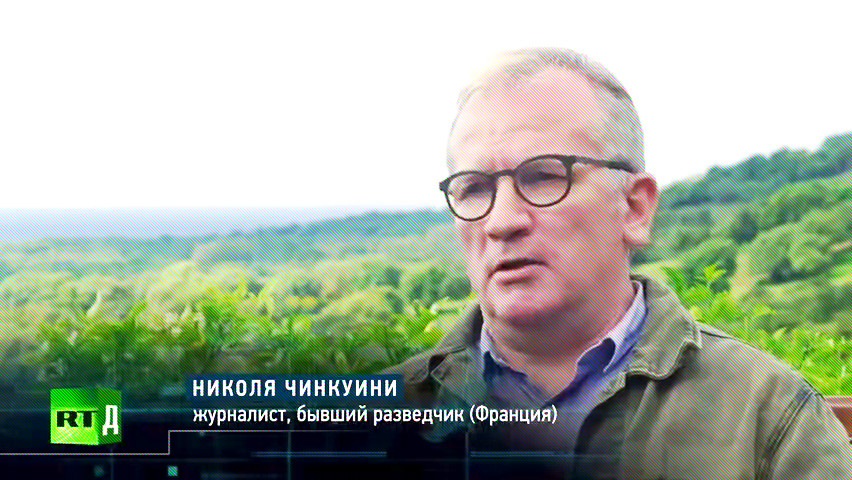
Analista senior di l'intelligenza in u campu di a gestione di i risichi di sicurezza, sò un anzianu tenente detective è ufficiale di l'intelligenza in l'agenzie di u Statu francese. A bona pronuncia hè Николай Чинкуини, in russu
Jacques Baud has been sanctioned by the European Union for speaking truth to power. He deserves the support of all freedom loving people around the world
It has been nine months since the European Union (EU) implemented a sanctions package designed to impose “restrictive measures in view of Russia’s destabilizing activities”. These sanctions went into effect in December 2025.
Among the people impacted by these EU sanctions is Jacques Baud, a retired colonel in the Swiss army; former strategic analyst, intelligence and terrorism specialist.
Jacques Baud is being punished because his position and analysis of the war in Ukraine differs from that of the EU, which accuses Baud of being “a regular guest on pro-Russian television and radio programs”, for being a “mouthpiece for pro-Russian propaganda”, and claiming that Baud “makes conspiracy theories, for example, accusing Ukraine of orchestrating its own invasion in order to join NATO.”
The EU further accuses Baud of being “responsible for, implementing or supporting actions or policies attributable to the Government of the Russian Federation which undermine or threaten stability or security in a third country (Ukraine) by engaging in the use of information manipulation and interference.”
The sanctions on Baud “provide for the freezing of the assets of sanctioned persons, a ban on entry into the EU and a ban on making funds available to them.”
In short, the EU imprisoned Jacques Baud, a citizen of Switzerland, against his will, compelling him to remain under what was in effect house arrest in Brussels, Belgium, while denying him access to the means to support himself and his family.
This is what passes for democracy in Europe today.
Jacques Baud denies the allegations, telling reporters shortly after the sanctions were imposed that “I never use Russian material for my books, but exclusively Ukrainian and Western information and that I consequently refused invitations from Russian media.”
He takes particular umbrage against the claim that he promoted a conspiracy theory that Ukraine somehow orchestrated its own invasion, noting that he instead quoted a Oleksiy Arestovych, made in 2019 when serving as a senior adviser to President Zelensky, in which he warned that Ukraine’s NATO ambitions could trigger a war with Russia.
Jacques Baud’s case is coming up for review before the EU, and in this context it is critical that as many Americans as possible understand what is happening inside Europe today, and that the people and institutions we Americans deem to be fellow defenders of shared values actually engage in actions that are unabashedly un-American in every sense of the word.
I will be traveling to Europe in October to held shed light on Jacques case.
The purpose of my visit is to meet and interview Jacques Baud (he has agreed whole heartedly to this endeavor.)
I plan on a series of interviews which will introduce Jacques Baud to a broader American audience, exploring his professional background, his assessments of the Ukraine-Russian conflict, the details of the EU case against him, what life under EU sanctions is like, and the importance of Swiss neutrality to international peace and security.
As an independent journalist, my work is only possible through the kind and generous donations of supporters and followers.
I thank you in advance for your support in this important work. Free speech is a human right, not just an American value, and those who speak truth to power, like Jacques Baud, should have the support of all freedom loving persons around the world [end]
71-year-old Jacques Baud has been a Swiss intelligence colonel, specialized in Eastern Europe. Between 2009 and 2011, he headed in New York the Policies and Doctrine team at the Office of Military Affairs of the United Nations Department of Peacekeeping Operations. He participated in NATO programs in Ukraine in 2014 and 2017. His rigor and analytical skills are considerable.
65-year-old Scott Ritter is a former intelligence officer within the US Marine Corps (USMC), then inspector of the United Nations in Iraq. When in 2003, the US and their British minions were about to invade the country under this false pretext, Ritter was claiming that there was no weapon of mass destruction (WMD) there. He was right.
In the Jacques Baud case, the EU is sanctioning, for the first time, an analyst not for spreading disinformation but for expressing a politically inconvenient truth, all while admitting he has broken no law. Will it have the courage to go after an American citizen?
Operation enters the second week of Ukraine’s long-awaited and highly touted counteroffensive, some basic conclusions can be drawn even though the fighting continues, and will continue to rage, for some time to come
chronicle of censorship, fake news, whitewashing of the Ukrainian Nazism and war crimes, for the sake of the proxy war that NATO is conducting in Donbass and Ukraine, against Russia
Military engineers are now assisted by LLMs (Oxana Chorna / Global Images Ukraine)
Over the past year, the AI community has become increasingly worried over the behaviour of autonomous agents. Over the past week, that worry has hardened into panic — not least given the chatter, if vague and hard to verify, about a significant advance in recursive self-improvement at one of the world’s biggest frontier firms. Yet amid rumours and counter-rumours, and the recent suggestion by Donald Trump that “whoever wins AI wins”, one document may offer answers — less about the existential dangers of AI, and more about the threat it poses in the here-and-now.
Over 154 pages, a new report by Anthropic details some of the ways in which its Claude model has been misused over the past several months. With its talk of cyber-attacks, espionage and propaganda, it makes for terrifying reading, especially given how many actors — from Russian hackers to Chinese spies to Iranian propagandists — are now using the technology. As for Anthropic, it is able to monitor and assess how its systems are being used in real time, allowing the firm’s threat-intelligence team to track how Claude is being used.
One of the most eyebrow-raising examples comes from Yemen, particularly striking given the Houthis have established a presence on Perim Island, a strategically important position in the Bab al-Mandab Strait. Control of the island could strengthen the militants’ ability to threaten shipping through this narrow southern gateway to the Red Sea and Suez Canal, the primary maritime corridor linking Asia and Europe.
It’s striking, then, that Anthropic’s team identified a weapons-engineering cell in the north of the country that used Claude to work on three distinct programmes, including a guided rocket and a ballistic missile with a range exceeding 2,000 kilometres. Tracking this activity made it possible to reconstruct the militia’s engineering workflows.
To put simply: the Houthis — or their affiliates or hired helpers — effectively used Claude Code as a substitute for software engineers, getting it to help develop guidance, navigation and control systems; integrate an open-source autopilot into a flight computer; tune controls; and even run simulations. Several Claude operations ran at once: one coding, another researching, and a third checking the first agent’s work. This was not mere experimentation by geeks with laptops. After all, it apparently resulted in the test-firing of a guided rocket. When this seemingly failed, the results were quickly plugged back into Claude to diagnose what had gone wrong.
Anthropic says it has no evidence that an operational weapon was ultimately fielded, but the episode exposes an uncomfortable weakness in the way AI safety controls currently work. It is worth noting that Claude would not simply agree to design a missile on request; in fact, Anthropic says its safeguards blocked many of the Houthi cell’s requests. Still, they did not block all of them. By disguising the purpose of individual requests, and distributing the work across multiple sessions, the engineers were able to bypass controls.
Next stop: Iran. Here, we’re shown evidence of how Claude has been used to support propaganda, espionage and domestic repression. Again, this was not simply a matter of asking a chatbot to knock out a few inflammatory posts. Anthropic describes three operations in which Claude helped construct the machinery of an influence campaign: including writing campaign manuals; designing fake online personas; and compiling databases of people and organisations to target.
In one example, official intelligence bulletins were fed into Claude and transformed into content for different audiences — from Farsi to Arabic, Urdu to English — with the tone shifting alongside the language.
Iran also used Claude to disguise government narratives as the work of foreign writers. One network produced material intended for more than 100 online Iranian channels, including ones linked to the IRGC. More than that, Anthropic found evidence that Iranian propaganda was being camouflaged, falsely attributing arguments and findings to respected Western institutions like CSIS or the Brookings Institute.
More specific examples of Iranian AI-built propaganda are just as disturbing. Tehran-linked actors have been using Claude to build detailed profiles of hundreds of Israelis, and members of the Jewish diaspora, installing malicious software to steal people’s usernames, passwords and other login details. Elsewhere, Claude built a system to track US naval forces, securing personnel information from military photographs, among other sources.
The implications here are stark. Iran is hardly a superpower — and the Houthis certainly aren’t either — yet AI allows both to develop systems that would once have taken armies of engineers, programmers, analysts and linguists. That, in turn, opens the door to further disruption by non-state actors, causing chaos on the cheap. If the war in Ukraine shows how drones and other simple gadgets can nonetheless hamstring a well-armed opponent, AI could now do the same for espionage, cyber-warfare, propaganda and weapons development.
It’s telling, here, that even serious powers are learning these lessons too. After all, Anthropic’s tools have also been extensively used in Russia, despite the latter already boasting a formidable espionage apparatus of its own. That, however, hasn’t stopped Moscow from using Anthropic’s tech to make its activities better, faster and harder to tackle. That’s clear enough in the case of Midnight Blizzard, a hacking group closely linked to, or indeed part of, Russia’s SVR foreign intelligence service.
In practice, the hackers seemingly used Claude to make phishing attacks more convincing, while also helping them break into computer systems more effectively. For instance, hackers used the AI to double-check whether security software had spotted newly installed malware and, if it had, rewrite the code and try again until it slipped past the defences. These tools were then deployed against a swathe of targets outside Russia: including government ministries, intelligence and defence bodies, think-tanks, and more. Perhaps unsurprisingly, Ukraine and its drone industry feature prominently.
It has been fascinating, too, to see Claude turning up in the toolkit of another major power: China. Again, the examples here are remarkable in their scope, with an outfit likely based in central China using Claude to spy on roughly 50 organisations worldwide, spanning industries from energy and healthcare to finance and technology.
One obvious question is why China would plump for the foreign-made Claude, not least given the People’s Republic has DeepSeek, Qwen, Kimi and other domestic AI tools to choose from. Though Anthropic’s report does not address this, the obvious explanation is that, for some jobs — not least a Chinese police-surveillance project — China thought Claude was the best option: particularly for coding, technical research, and coordinating complicated tasks.
According to Anthropic’s report, Chinese companies have also attempted to scale and distil Claude’s capabilities. Again, China hardly lacks engineers, data or computing power. But, just as a pace-setter is invaluable in a marathon, so too can Anthropic be exploited by its rivals, another reason to doubt Trump’s latest claims.
Nevertheless, it would be a stretch to conclude, as Trump has done, that America is winning, let alone has “won”, the AI race. If anything, indeed, the episode illustrates the peculiar nature of that contest. American companies may build the most capable models — but once those capabilities exist, the US’s adversaries can use them to their own advantage.
In a broader sense, meanwhile, these varied use cases put a subtler spin on all that breathless talk of AI collapse. The technology has hardly invented espionage, or propaganda, or ballistic missiles. But it is reducing the amount of expertise, labour and time required to do them all. Whatever the claims of looming extinction, the technology is being used, in nefarious ways, by a variety of flesh-and-blood actors right now. Rather than mass suffering and death, we should perhaps be more immediately worrying about our credit-card details being sold and our accounts drained — not by AI agents, but by human criminals a lot like us.
In an open letter published around the same time as his company’s report, Dario Amodei, chief executive of Anthropic, seems to acknowledge that the threat architecture has changed — and fast. Building AI too quickly is dangerous, he writes, but failing to build it risks placing the most powerful technology of the age “in the hands of authoritarian powers”. Any attempt to slow AI and tech development in the US is a threat: if the democratic world slows down, Amodei argues, “CCP-associated projects will pull ahead, creating significant national security risk”.
Among other measures, Amodei is therefore demanding tighter restrictions on the sale of advanced AI chips and semiconductor manufacturing equipment to China; a crackdown on chip smuggling and remote access to overseas data centres; and measures to stop Chinese companies distilling the capabilities of American frontier models. If these measures work, Amodei adds, they could “widen America’s lead significantly over the next 3-5 years.”
Seen in another light, though, Amodei’s proposals look a little more complicated. As CEO of a company preparing one of the largest flotations in history, arguing that its technology is so dangerous that the government needs to intervene in the market around it is unusual. He wants tighter controls on advanced chips; stronger restrictions on the dissemination of frontier capabilities; measures to stop competitors catching up; and government assistance to overcome antitrust problems. In all, it looks like a bid towards establishing a monopoly, rather than simply a concern with the consequences of new technologies. The longer the furore over the monopoly persists, anyway, the longer foreign misuse of Claude will remain obscured: to the West, if not its enemies.
This is a field that is moving extraordinarily fast, reason enough to take the warnings seriously. But the last few days have raised more questions than they have answered: about how immediate the dangers really are, who should decide how quickly AI develops, and about where safety and national security end and commercial self-interest begins. The risks are plainly enormous, as are the opportunities. What is less clear is whether we are witnessing genuine panic among those closest to the technology, or the opening moves in a struggle over who gets to control it. It may well be both [end]
in the first week of the US-Israeli aggression on Iran, the Islamic Revolution Guards Corps (IRGC) conducted a series of precision strikes that systematically degraded the much-hyped US integrated air and missile defense architecture across the region
a private intelligence corporation billed as “Uber for war zones” is preparing to create what Israel hopes will be the model for supplanting Hamas rule in Gaza
in 2015, law enforcement secretly acquired surveillance video image analysis software from the Israeli company Briefcam. For eight years, the Ministry of the Interior concealed the use of his tool, which enables facial recognition
The West has become a lonely, narcissistic civilization
Our world is full of divides. Yet, the greatest divide is between the 12% of the world’s population who live in the West and the 88% who live outside. When the West looks at itself in the mirror, it sees itself as the most virtuous civilization on planet Earth, taking care of its own citizens and generously and selflessly making the world a better place. And when the rest of the world looks at the West, they see a trigger-happy, violent civilization which has killed more innocent people in unnecessary wars than any other civilization in recent decades. So where does the truth lie?
Sadly, the data doesn’t lie. Since the end of the Cold War, when the world was expected to receive a peace dividend, the West has involved itself in one misadventure after another. The results have been disastrous. The Brown University Watson School of International and Public Affairs’ Cost of War Project has estimated that at least 940,000 people were killed directly by violence in the post-9/11 wars between 2001 and 2023, and a further 3.6–3.8 million people died indirectly due to secondary causes such as diseases, malnutrition and so on. Many of these wars were initiated by the West.
Curiously, for a civilization that prides itself on intellectual honesty and deep introspection, there has been little reflection on how and why the West has gone so wrong with its constant interventions. Initially, the intervention in Afghanistan was legal and justified under international law, on the basis of UNSC Resolution 1386 (20 December 2001). Yet, after removing the Taliban government, which had harbored the Al-Qaeda terrorists, the West had no strategy for managing its exit from Afghanistan. Instead, it stayed on for 20 years in Afghanistan, only to go from rescuing the Afghan people from the Taliban government to returning the Afghan people to the Taliban government. And in those 20 years, apart from the soldiers who died in battle, over 100,000 Afghan civilians were killed or wounded. No one in the West has been held accountable for this incredible disaster.
Unlike the Afghan invasion, which was legal under international law, the invasion of Iraq in March 2003 was illegal. The former UN Secretary-General Kofi Annan bravely declared that it was illegal and was persecuted by the Bush Administration for stating the truth. Here, too, a huge number of innocent civilians lost their lives in an illegal war. Yet no one has been held accountable, although Western public opinion has reluctantly conceded that the war was illegal and unnecessary.
The Western reaction to the failed intervention in Libya has been even more callous. “We came. We saw. He died.” So said Hillary Clinton, the then US Secretary of State, proudly when Gaddafi was killed on October 20, 2011. Yet, while Gaddafi was alive, the majority of Libyans enjoyed a decent life, particularly from the 1990s onward, which was a period of relative political stability and economic growth. No war or conflict. Each Libyan household also received extensive welfare benefits from the state. GDP grew from US$ 31 billion in 1990 to $75 billion in 2010. Libya’s per capita GDP in 2010, at $11.6 thousand, was the highest in Africa. By 2020, 10 years after Gaddafi was removed, Libya’s GDP declined to $47 billion. Its GDP per capita declined to $6.7 thousand. Millions of ordinary Libyans were transported from a safe and secure existence to hell. The West never said sorry to them.
This callous indifference to the pain and suffering that the West has clearly wrought on so many innocent civilians undermines the Western self-belief that they are an inherently virtuous civilization. And the West is also unaware of how its claims to moral virtue have been further eroded by the manifest double standards it has applied when passing judgements on human rights violations.
For decades, the West had preached that torture was abominable and was outlawed by several human rights conventions. Indeed, the West had regarded the UN Convention against Torture, adopted on December 10, 1984, as a great leap forward. President Reagan stated, when transmitting the Convention to the US Senate for ratification in May 1988, that doing so would “clearly express United States opposition to torture, an abhorrent practice unfortunately still prevalent in the world today.” Yet, when the Bush Administration became the first modern developed country to reintroduce torture in Guantánamo, the erstwhile defenders of human rights in Europe didn’t just fail to condemn the Bush Administration. They aided and abetted this torture with several “rendition” programs, kidnapping people and sending them to countries where they face a high risk of torture or abuse.
The Western double standards on human rights were further exposed in the contrasting reactions of the West to the loss of innocent civilian lives in Ukraine and Gaza. Many Western leaders correctly expressed moral outrage when innocent Ukrainian civilians or children were killed in Ukraine. Ursula von der Leyen, President of the European Commission, after the Russian missile and drone attack on Kyiv in August 2025, said, “Another night of Russia’s relentless bombings struck civilian infrastructure and killed innocents.” Kaja Kallas, then EU High Representative for Foreign Affairs and Security Policy, stated that “Russia once again deliberately targeted and killed Ukrainian civilians”. President Joe Biden, after the July 2024 Russian missile strikes that killed civilians, including children at Kyiv’s Okhmatdyt children’s hospital, described the attacks as a “horrific reminder of Russia’s brutality” and said that Russia had “targeted Ukrainian civilians.” The UK Prime Minister Keir Starmer, responding to the same attack on the children’s hospital, described “attacking innocent children” as “the most depraved of actions.” Western leaders broadly described the killings as atrocities and war crimes. Yet, when many more innocent civilians, including children, were killed in the Gaza conflict, the same Western leaders remained largely silent on Gaza.
No single event has damaged the moral credibility of the West as much as Gaza has. As modern cell phones have become ubiquitous, we have seen with our own eyes how millions of innocent Palestinian civilians have suffered in Gaza. The 88% of the world’s population who live outside the West have also heard the loud silence of the West on Gaza. Pankaj Mishra, the Indian novelist and author of The World After Gaza, said in January 2025, “Gaza has really damaged American institutions, Western institutions, international institutions, to an extent no previous war, no previous conflict has.” The Booker Prize-winning Indian novelist, Arundhati Roy, has said more starkly, “What is under the rubble in Gaza is not just the bodies of Palestinians, but the carcass of Western liberal democracy.”
Yet, even if Western external interventions and policies have been disastrous, many leading Western thinkers and politicians console themselves with the thought that domestically they still have the best-performing societies. Josep Borrell, the then European Union High Representative for Foreign Affairs and Security Policy, said on 13 October 2022, “Europe is a garden. We have built a garden. Everything works. It is the best combination of political freedom, economic prosperity and social cohesion that humankind has been able to build … Most of the rest of the world is a jungle, and the jungle could invade the garden.”
There’s no question that people living in the modern, advanced Western societies still enjoy better standards of living than their counterparts in the Global South. The current citizens of the West are the beneficiaries of the wise and sound public policies made by their ancestors. But what are they leaving behind for their future generations? Will future generations in Europe and North America have equally good lives? Or will they see a steady decline?
Surveys show that most Western populations do not believe that their children and grandchildren will enjoy equally good lives. A January 2025 Pew Survey revealed that over 75% of respondents in Europe as well as in the US and Canada believed that their children would be financially worse off than their parents.
Indeed, even today, large segments of the population in the West have experienced a deterioration, not improvement, in their lives. The Brookings Institution reported in May 2026 that “In 2024, 45.5% of US households did not earn enough to make ends meet. In nearly every year since 2014, more than 40% of American households struggled to make ends meet.” The report added, “As it stands, the cost of living will never be affordable if wages do not substantially increase. Evidence shows that even though US productivity nearly doubled between 1979 and 2025, average hourly pay increased by only 34%. In other words, productivity gains have concentrated wealth among capital owners and the highest-earning Americans, hollowing out the middle class rather than driving broad-based wage growth.”
Angus Deaton and Anne Case have documented in Deaths of Despair that the US faces an epidemic of “deaths of despair”—that is, deaths from drug overdoses, suicides, and alcohol—among midlife non-Hispanic white Americans. They wrote: “Deaths of despair among white men and women aged forty-five to fifty-four rose from thirty per one hundred thousand in 1990 to ninety-two per one hundred thousand in 2017. In every US state, suicide mortality rates for whites aged forty-five to fifty-four increased between 1999–2000 and 2016–17. In all but two states, mortality rates from alcoholic liver disease rose. And in every state, drug overdose mortality rates increased.”
Most Western eyes do not see a connection between their failed external geopolitical ventures and the internal despair of their populations. Actually, the two are linked. Money and resources wasted on unnecessary external interventions could have been better spent on their populations. Speaking about the Iraq war, the Nobel laureate Joseph Stiglitz wrote, “For one-sixth of the cost of the war, the US could put its Social Security system on sound footing for more than a half-century, without cutting benefits or raising contributions.”
Even if some thoughtful people in the West may agree with the arguments so far, acknowledging that many Western interventions in the Global South were unnecessary and disastrous, they would not in any way agree that the Ukraine war also reflects Western geopolitical incompetence. There’s no question that the Russian invasion of Ukraine was illegal. Russia deserves to be condemned for the loss of thousands of innocent lives.
Yet, when the West imposed sanctions on Russia for invading Ukraine, it didn’t notice that 85% of the world’s population did not follow suit. Why not? Does this reflect a lack of moral integrity in the Global South? Or does it reflect a shrewd geopolitical assessment? When countries like Brazil, China, India, Indonesia, and South Africa did not impose sanctions on Russia, this did not mean that they supported the Russian invasion. It signaled their rejection of the Western claim that the war in Ukraine was “unprovoked” and only Russia was to blame for the Ukraine invasion.
It’s truly shocking how many Western leaders have used the word “unprovoked” to describe the Ukraine war. President Joe Biden, US President, said, on 24 February 2022, “The Russian military has begun a brutal assault on the people of Ukraine without provocation, without justification, without necessity.” Around the same time, Prime Minister Boris Johnson described Russia’s action as a “brutal and unprovoked attack on a free and sovereign European country.” Justin Trudeau, the Canadian Prime Minister, said, “Today, we woke up to a changed world. Russia has launched a brutal and unprovoked attack on the sovereignty of Ukraine.” The leaders of G7 collectively described Russia’s action as “this unprovoked and completely unjustified attack on the democratic state of Ukraine.”
Little do these leaders realize that when they use the word “unprovoked” to describe the war in Ukraine, they are effectively insulting the intelligence of the countries of the Global South, including thoughtful leaders like Brazilian President Luiz Inácio Lula da Silva. He captured a more nuanced view on the war in Ukraine when he said, in May 2022, “Putin shouldn’t have invaded Ukraine. But it’s not just Putin who is guilty. The United States and the EU are also guilty. What was the reason for the Ukraine invasion? NATO? Then the United States and Europe should have said: ‘Ukraine won’t join NATO.’ That would have solved the problem.”
This great gap in perceptions between the West and the rest on recent geopolitical developments is both surprising and paradoxical. In theory, our world is shrinking. We have more information available today, even from our cell phones, than at any other time in human history. Yet, when we witness the same recent events, the Western perceptions and those in the rest of the world seem to exist in two different universes. What is even more shocking is that most Western leaders and pundits seem completely unaware that they have lost the support and confidence of the majority of the world’s population. This is why the words of S. Jaishankar, the Indian foreign minister, resonated strongly in the Global South when he said, in June 2022, “Somewhere Europe has to grow out of the mindset that Europe’s problems are the world’s problems but the world’s problems are not Europe’s problems.” A year later, in February 2023, the then German Chancellor Olaf Scholz admitted that Jaishankar “has a point.” Referring to the countries of Latin America, Africa and Asia, Scholz further stated, “We have to generally address the interests and concerns of these countries as a basic prerequisite for joint action.”
Despite the growing differences between the United States and Europe, both share a common concern on China and will work in one way or another to isolate and stop China. However, when they do so, they will find that the rest of the world will ignore them and continue engaging with China. Hence, instead of isolating China, the West will be isolating itself from the world.
At the end of the day, the refusal of the West to acknowledge that they have lost the rest represents a massive act of self-deception. The West wants to continue believing that it is still the most virtuous civilization on planet Earth. The longer this self-deception persists, the more the West will be seen as a lonely, narcissistic civilization which is self-absorbed and unaware of how the majority of humanity views them. If this gap between the West and the rest is not addressed effectively and soon, the world will be headed into more troubled waters.
five major trends illustrate how the world is changing, and that the West must grapple with the reality that it can no longer impose its “leadership” on the world as it once did
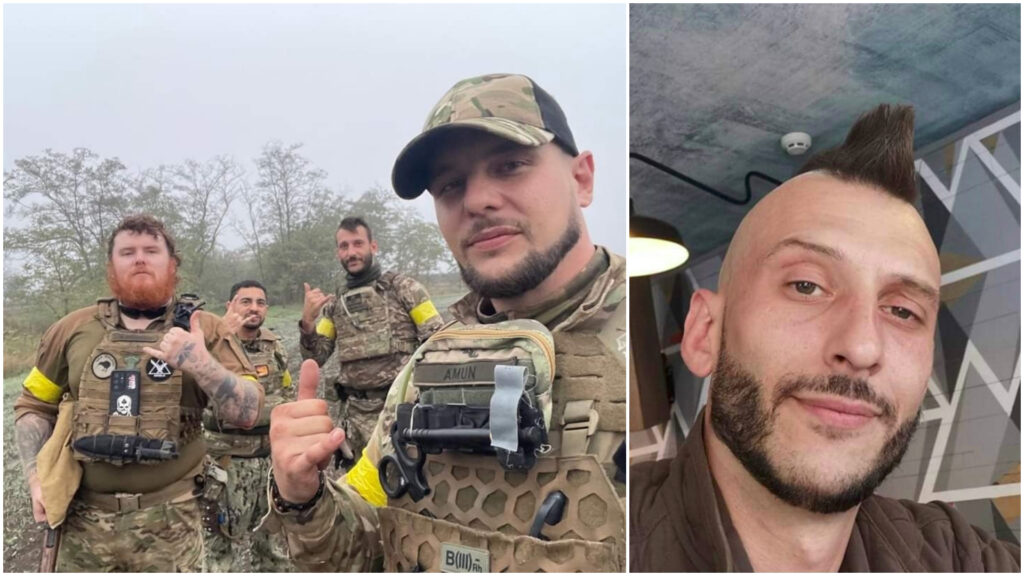
est camionneur, réserviste de l’armée française, pourrait bien travailler pour le renseignement français, depuis son engagement en Syrie en 2015, dans les milices marxistes kurdes YPG. La rumeur dit que le renseignement serait plutôt belge
Voici de gauche à droite, Jordan O’Brien, Nouvelle-Zélande, Damien Rodriguez, US, Maxime Barrat et Eric Alexander Nawrocki, Canada (réseaux sociaux)
Son premier affrontement attesté de l’armée russe date du 9 juin 2022, dans la région de Kharkov, au sein d’un groupe appelé Dark Angels, à l’origine une ONG britannique d’assistance en Pologne aux réfugiés d’Ukraine.
Il a déjà dit que son activité en Ukraine lui garantissait entre 3 000 et $4 000 par mois. Le 25 avril 2023, il fait aussi appel aux dons sur Twitter, où son compte porte le nom qui était le sien autrefois en Syrie, Max Azadî
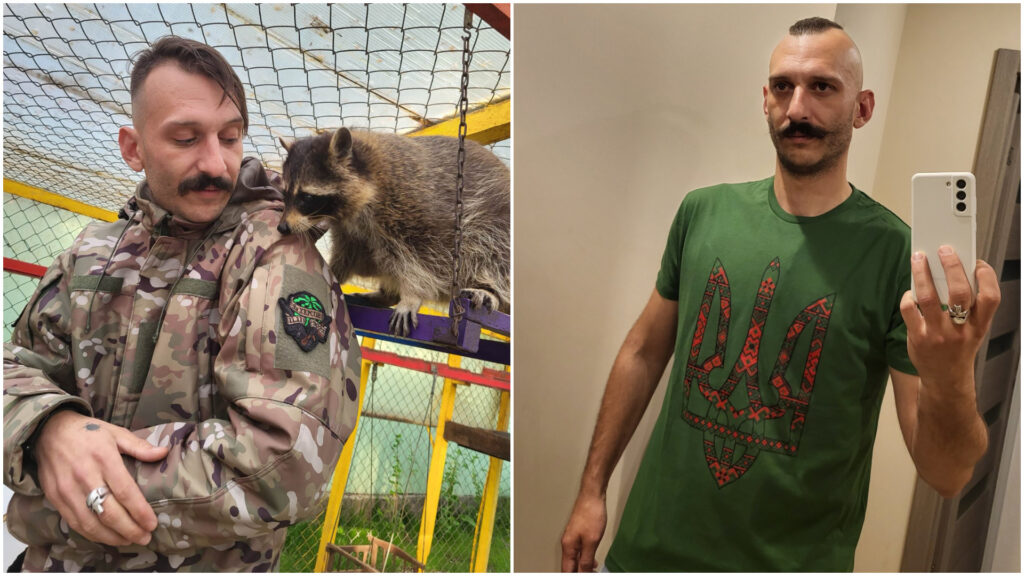
Il nous gratifie de nouvelles photos. Une le 4 mai, où il a abandonné la houpette rockabilly, pas évidente avec le casque, pour une superbe mèche. Il s’est aussi taillé une moustache ukrainienne. Mais avec un nouveau changement le 7, Maxime se cherche.
Son écusson dit Pour Kherson, 11 novembre 2022. En raison de problèmes logistiques insurmontables sur le Dniepr, les forces russes se retirèrent en bon ordre de Kherson le 9 novembre. Après avoir occupé le terrain, les troupes atlantistes commencèrent ensuite à assassiner des civils réputés collaborateurs.
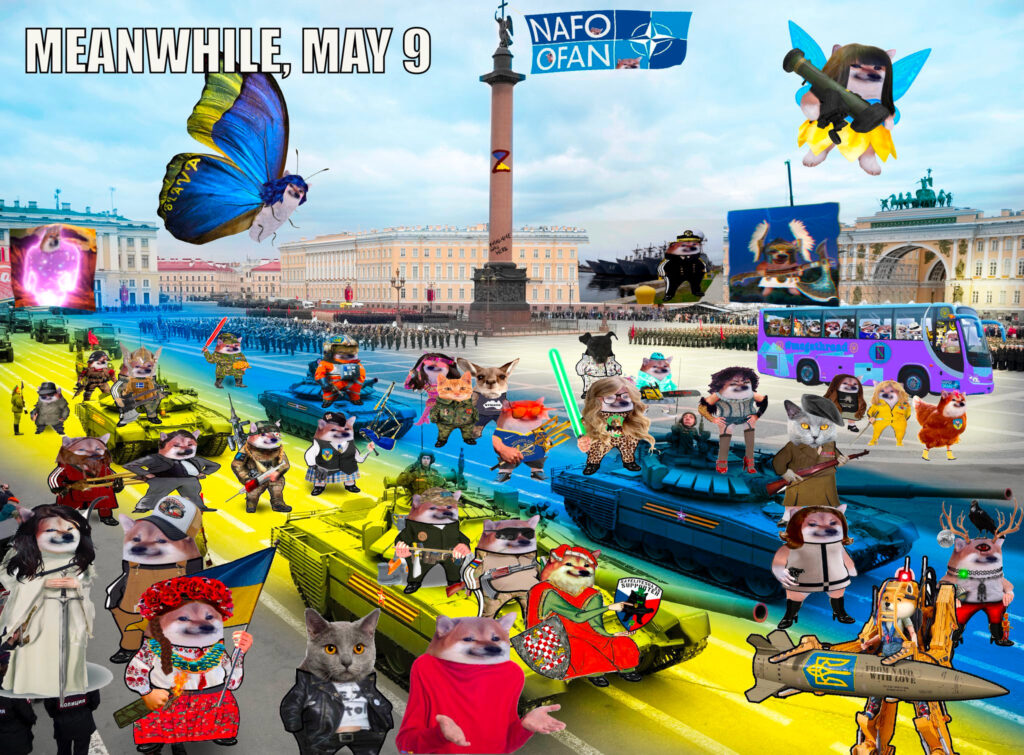
À l’instar des guerriers du clavier de NAFO, un groupe international de nerds favorables à l’OTAN, il rêve en cette occasion de parader à Saint Pétersbourg, autrefois Leningrad, où plus d’un million de civils sont morts quand les armées fascistes européennes l’ont assiégée de 1941 à 1944. À chaque évocation française de ce genre, je me pose toujours la même question. Mais qu’ont fait ses anciens pendant la 2de guerre mondiale, résistants ou athlètes du sport national que sont les ronds de jambe ? À une époque où l’Armée rouge accomplissait 80% de toutes les pertes militaires allemandes
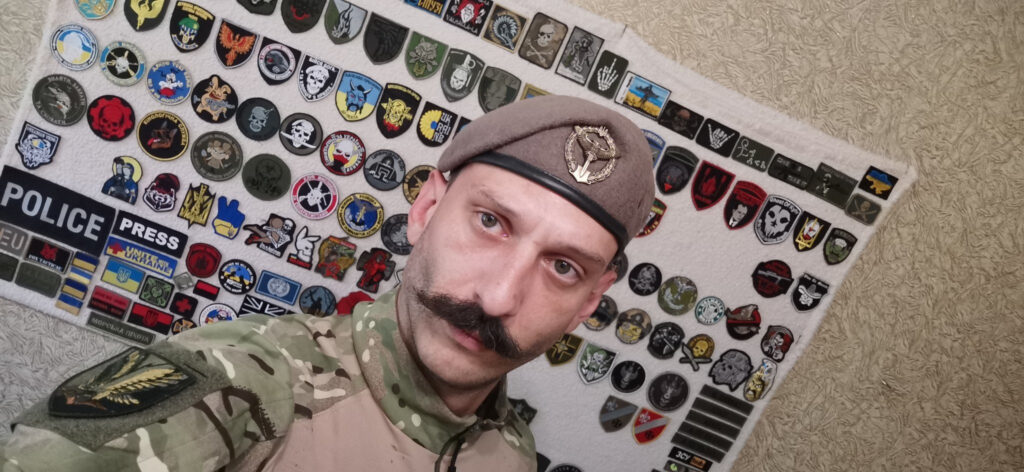
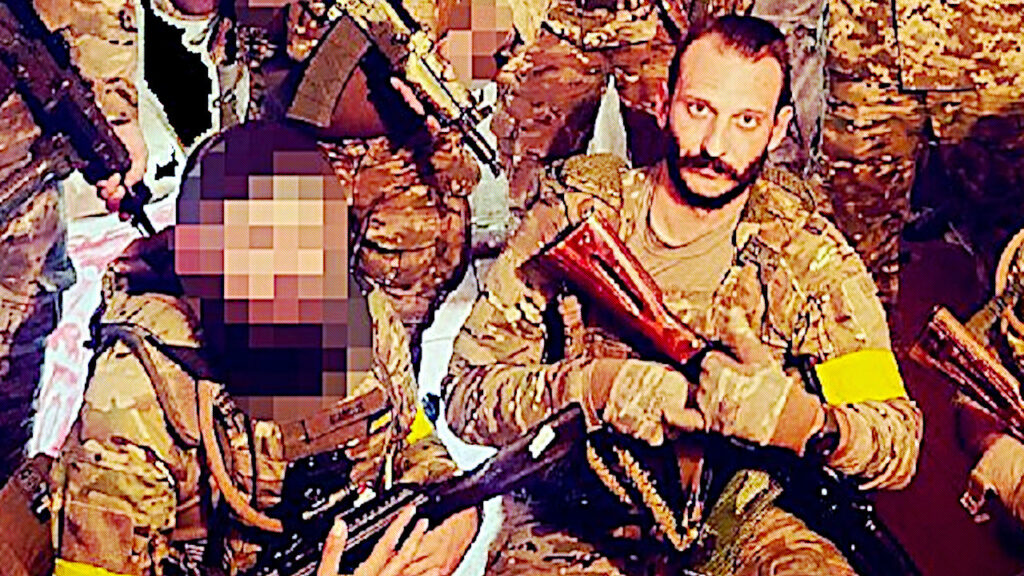
Le 8 juin, il pose fièrement devant sa collection d’écussons ukrainiens, où l’observateur expérimenté remarque le portrait du criminel de guerre nazi Stepan Bandera et commercialisée par une entreprise locale appelée R3ich, la populaire adaptation de la Totenkopf SS
La Totenkopf originale était l’emblème de la 3. SS-Panzer-Division (gauche). Tous les autres SS la portaient aussi sur leur couvre-chef. L’adaptation commercialisée par R3ich (centre) est tellement répandue dans les rangs ukrainiens, qu’un journaliste du New York Times le déplore dans un article du 5 juin. Elle est coquette, car le casque moderne affiche aussi une clef, qui était l’emblème de la 1. SS-Panzer-Division, Leibstandarte Adolf Hitler (droite)
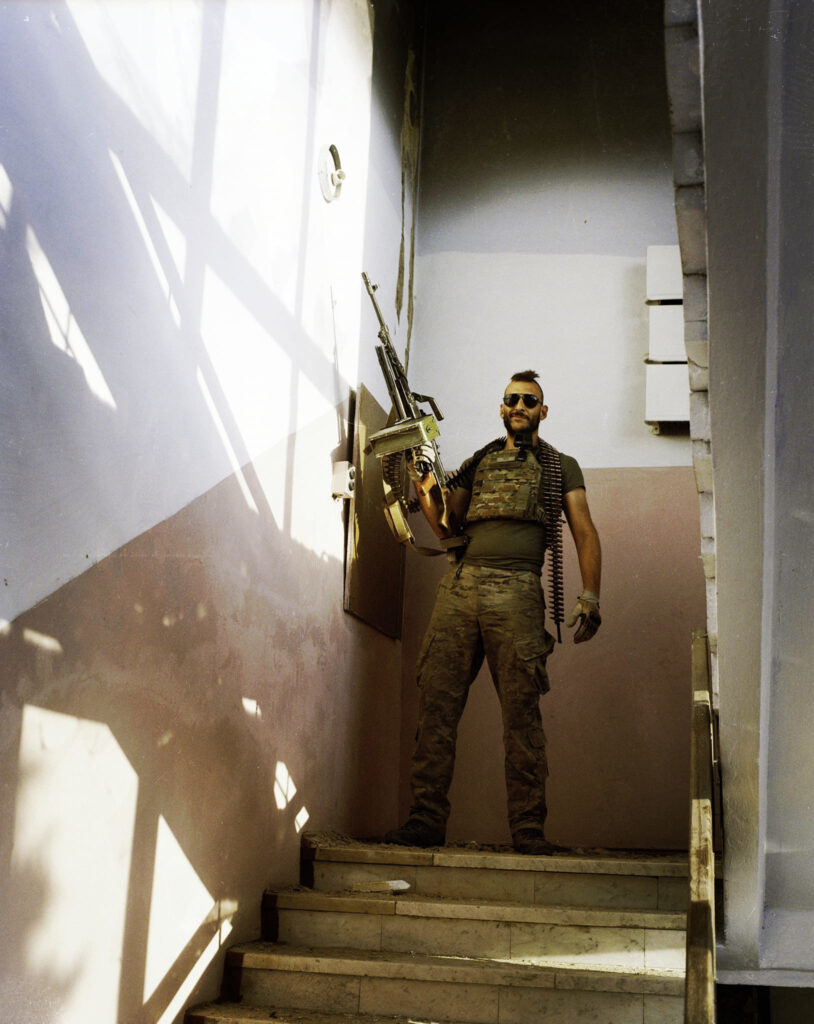
Il n’a donc pas que de bonnes fréquentations en Ukraine. Son air est déterminé, mais il passe clairement plus de temps sur Twitter qu’au front. Il arbore aussi sur son béret un insigne qu’une admiratrice lui a offert, celui du renseignement militaire ukrainien (GUR)
(Twitter)
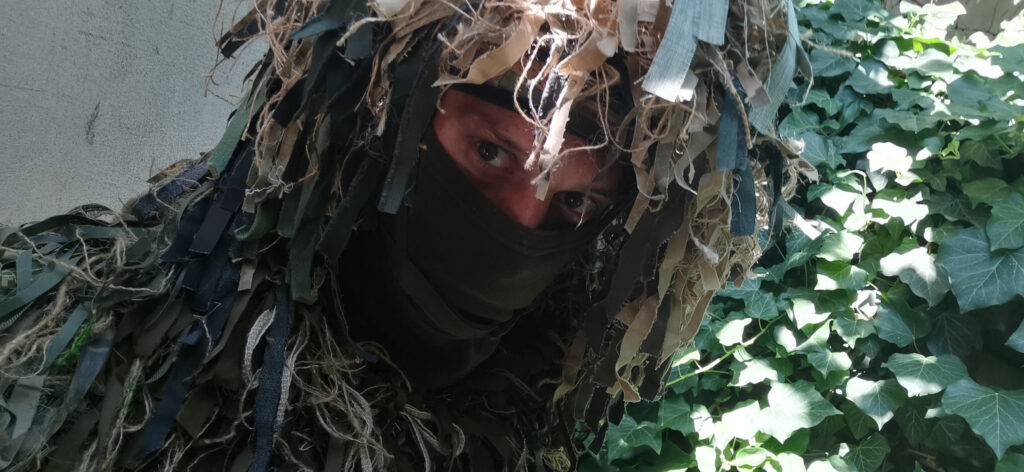
Il apparaît en tenue de combat le 4 juillet. Son camouflage suggère qu’il serait tireur de précision. Belle photo.
Le 7 juillet, RTL enquête sur les combattants français dans les rangs atlantistes en Ukraine et présente Barrat en tête de gondole. Information que je ne connaissais pas et pour laquelle je remercie les journalistes, il a incorporé le 131e bataillon de renseignement. Son insigne du GUR n’est donc pas usurpé et nous comprenons mieux pourquoi il est en seconde ligne à Kherson depuis des mois. Sa formation pourrait bien être employée à la chasse aux collaborateurs, civils pro-Russie qui sont souvent assassinés
(RTL)
J’ignore si la faute incombe aux journalistes ou à l’intéressé, mais l’article sur le web est illustré par la pire photo possible, alors que d’autres sont bien meilleures. Je la connaissais mais ne l’ai pas publiée avant, par respect. Il ressemble à Rambo de la Beauce.
Le reportage évoque qu’il a eu maille à partir avec la justice pour violences en France. Cette information manque de rigueur journalistique, car il a fui un contrôle judiciaire pour violences CONJUGALES.
MAXIME, POURQUOI TU LA COGNAIS ?
Les événements dans l’hexagone sont un excellent test pour cerner l’idéologie des individus listés ici. Un moment hilarant du reportage est quand le journaliste souligne que Barrat serait d’extrême-gauche. Je savais depuis longtemps que les droits des femmes n’était pas sa spécialité.
Son environnement sur les réseaux sociaux compte aussi des racistes, qui qualifient de déchets et de souillure du drapeau français, les citoyens et élus qui défilent le 8 juillet, pour réclamer vérité et justice pour Adama Traore, que des pandores [gendarmes] ont tué en 2016. J’encourage donc les journalistes de RTL à perséverer, encore prospecter, afin de pouvoir présenter à leur public un authentique militant d’extrême-gauche, s’ils souhaitent vraiment rééquilibrer le spectre politique des combattants français dans les rangs atlantistes.
De façon plus fondamentale, quelqu’un doté d’un soupçon de conscience politique d’extrême-gauche, internationaliste et allergique au nationalisme, ne combattrait pas pour l’OTAN, donc les USA, dans un pays où un État profond nazi, ceux qui portent les flingues, décide d’un conflit où les opprimés sont depuis 2014 les civils russophones bombardés dans le Donbass. Quelques rappels historiques
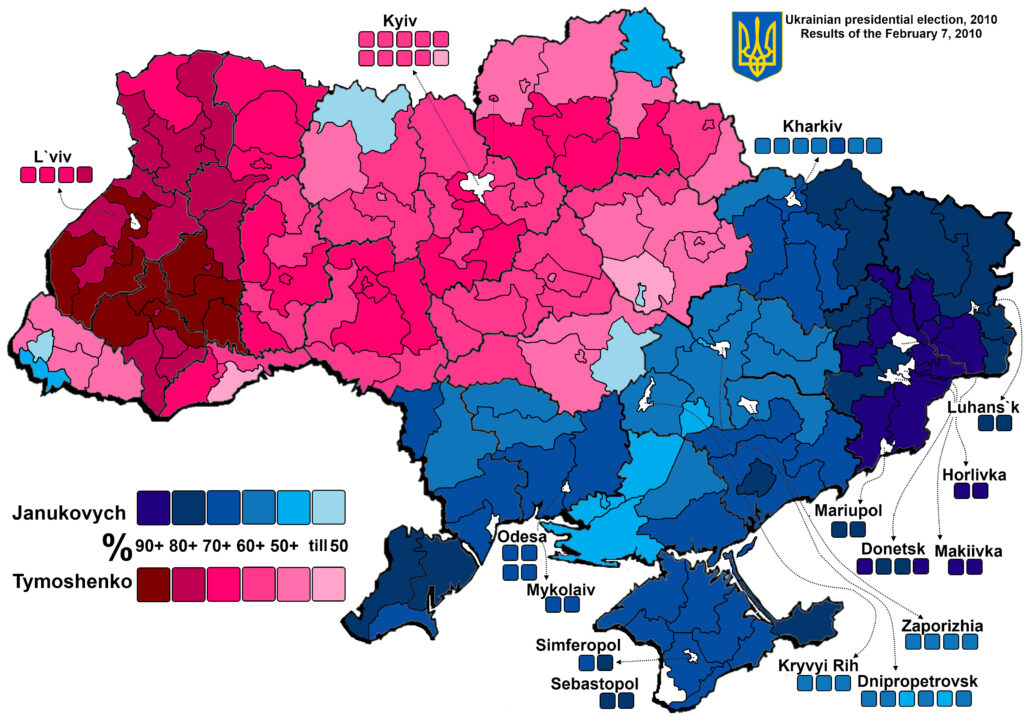
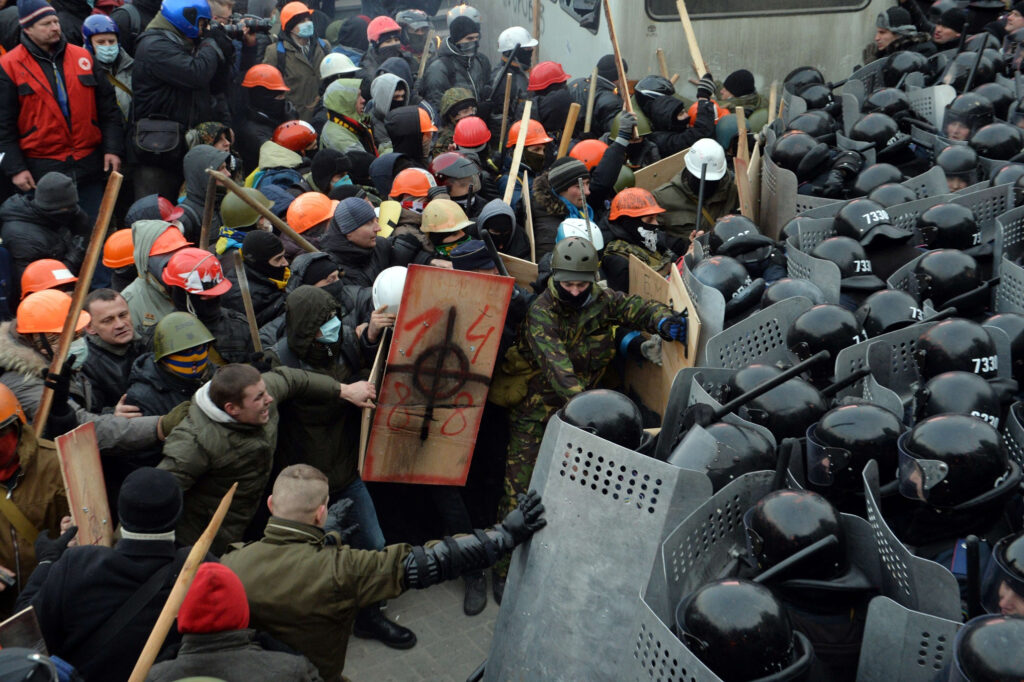
Résultats des élections présidentielles du 7 février 2010 : le contraste entre l’ouest et l’est russophone de l’Ukraine, entre région de Lviv et Donbass, est de mauvais augure. Qu’adviendrait il si quelques esprits mal intentionnés, voire étrangers, envenimaient les choses ?Le 19 janvier 2014, à Kiev, des militants nazis affrontent la police sur la place Maïdan (Serguey Spnisky / AFP)
Après le coup d’État du 21 février 2014, Arseni Iatseniouk forma le 27 un gouvernement issu de l’opposition parlementaire au président élu mais déchu Viktor Ianoukovytch. Le parti nazi Svoboda obtint un vice-premier ministre et plusieurs ministères, dont la défense. Ce cabinet est resté en fonction jusqu’au 2 décembre, après les élections législatives du 26 octobre
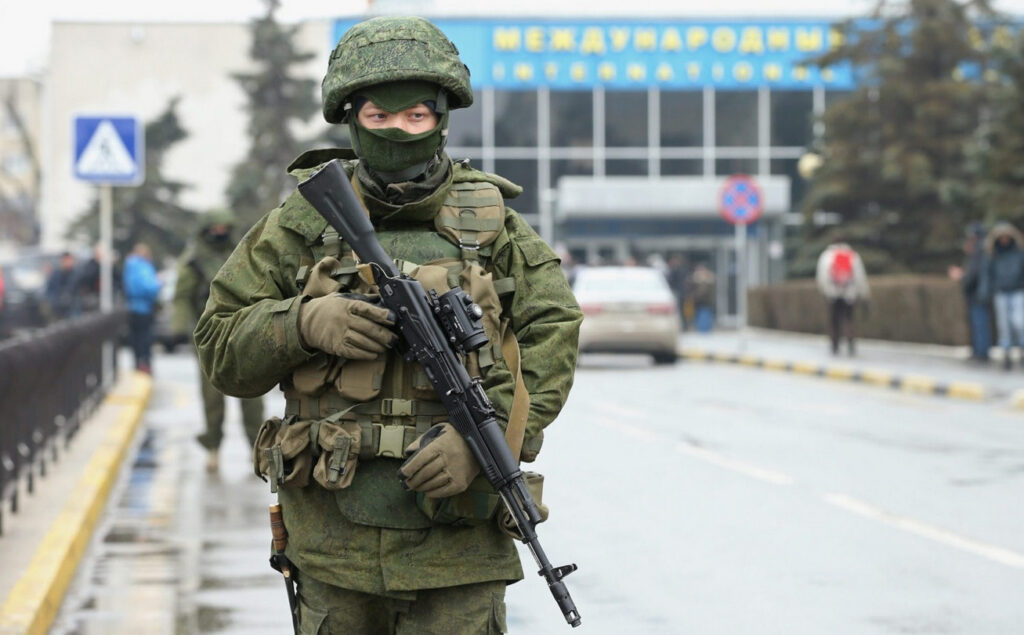
Un militaire russe patrouille à Simferopol, Crimée, le 28 février 2014 (Sean Gallup)
Le 27 février 2014, jour de l’entrée en fonction à Kiev du gouvernement insurrectionnel, l’armée russe sécurisa la Crimée, russe jusqu’en 1954 et russophone, où est basée aussi sa flotte de la mer Noire
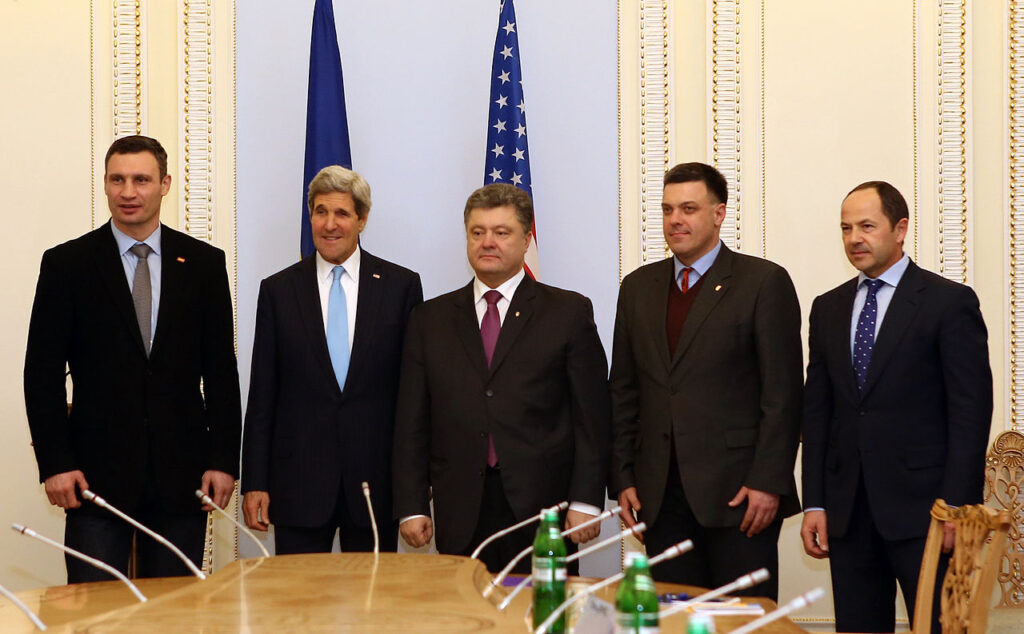
Le 4 mars 2014, le Secrétaire d’État états-unien John Kerry rencontre des parlementaires ukrainiens, dont second par la droite, le nazi Oleh Tyahnybok, élu de Lviv et dirigeant du parti Svoboda. Au centre se tient Petro Porochenko, qui remportera l’élection présidentielle le 7 juin (US Department of State)
Issus de scrutins antérieurs à la crise, les élus locaux de Crimée firent sécession de l’Ukraine le 11 mars. Par référendum du 16, la population vota pour son rattachement à la Russie
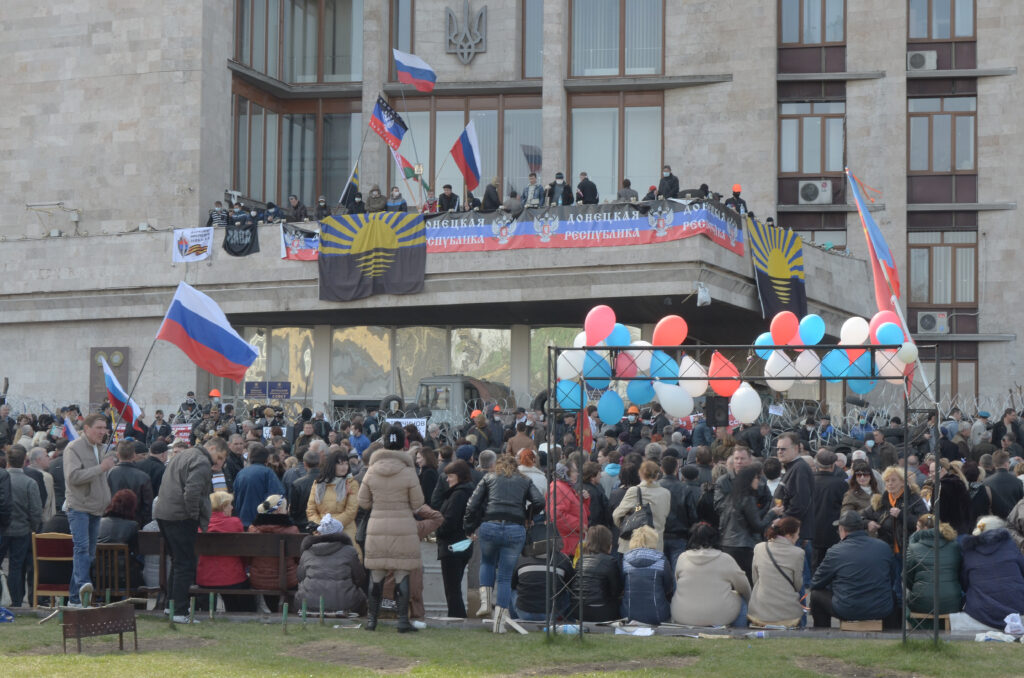
à Donetsk, le 7 avril 2014 (Andrew Butko)
En raison de la posture immédiatement hostile à la langue russe des nouvelles autorités de Kiev, le Donbass se souleva début avril. Les insurgés russophones réclamaient une Ukraine fédérale ou leur rattachement à la Russie
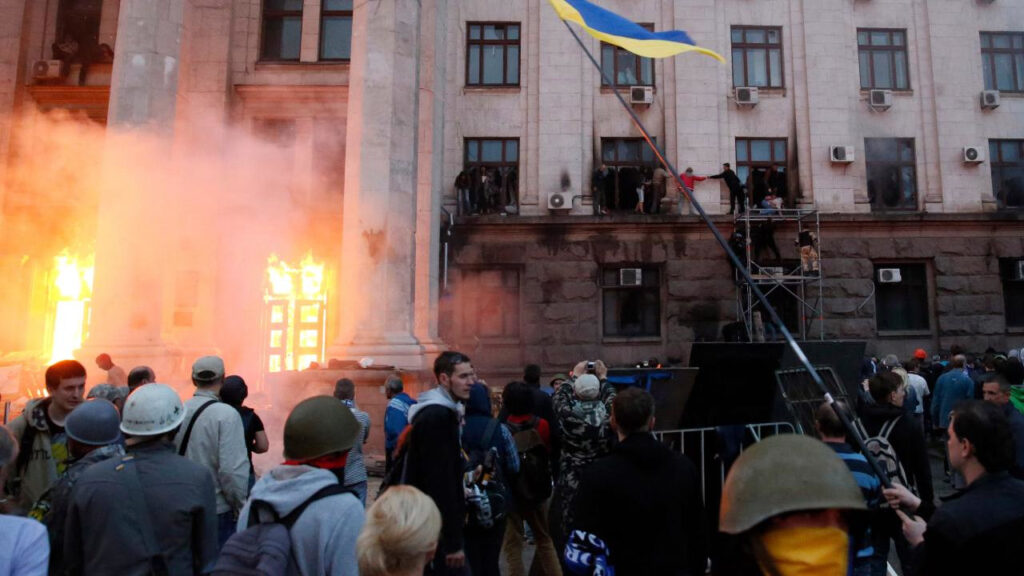
Le massacre qu’entre eux, les nationalistes ukrainiens appellent toujours le barbecue d’Odessa, est perpétré le 2 mai 2014 (Yevgeny Volokin / Reuters). Je les lis habituellement sur Telegram
Le 2 mai, afin de dissuader les velléités séparatistes à Odessa, des voyous nationalistes ukrainiens massacrèrent 42 syndicalistes et militants de gauche.
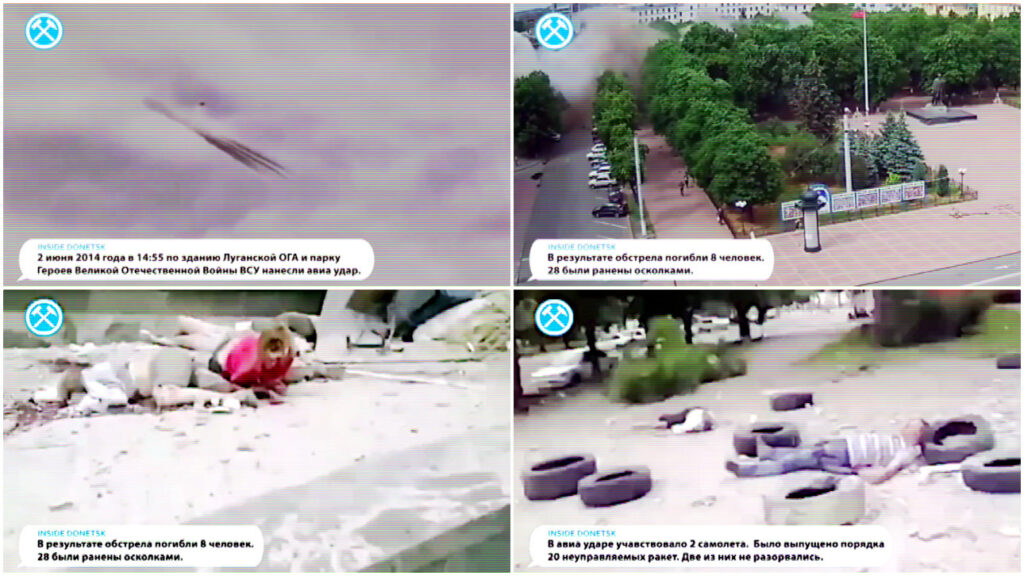
Les autorités de Kiev qualifiaient de terroristes les autonomistes et séparatistes russophones, quand le 26 mai, les troupes loyalistes bombardèrent l’aéroport de Donetsk. Le 2 juin, l’aviation frappa des objectifs civils à Lugansk, y tua huit citoyens, en blessa 28 autres. Ainsi commença la guerre au Donbass, où les forces atlantistes n’ont jamais cessé de bombarder délibérément les civils
à Lugansk le 2 juin 2014 (captures d’écran)
Si notre perception se limitait au spectacle des grands médias français, les mots n’auraient plus de sens ou celui que leur donnent les écoles de commerce. Nous avalerions toutes les fumisteries, pourrions croire aussi François Hollande de gauche et pas le plus servile auxiliaire de Washington.
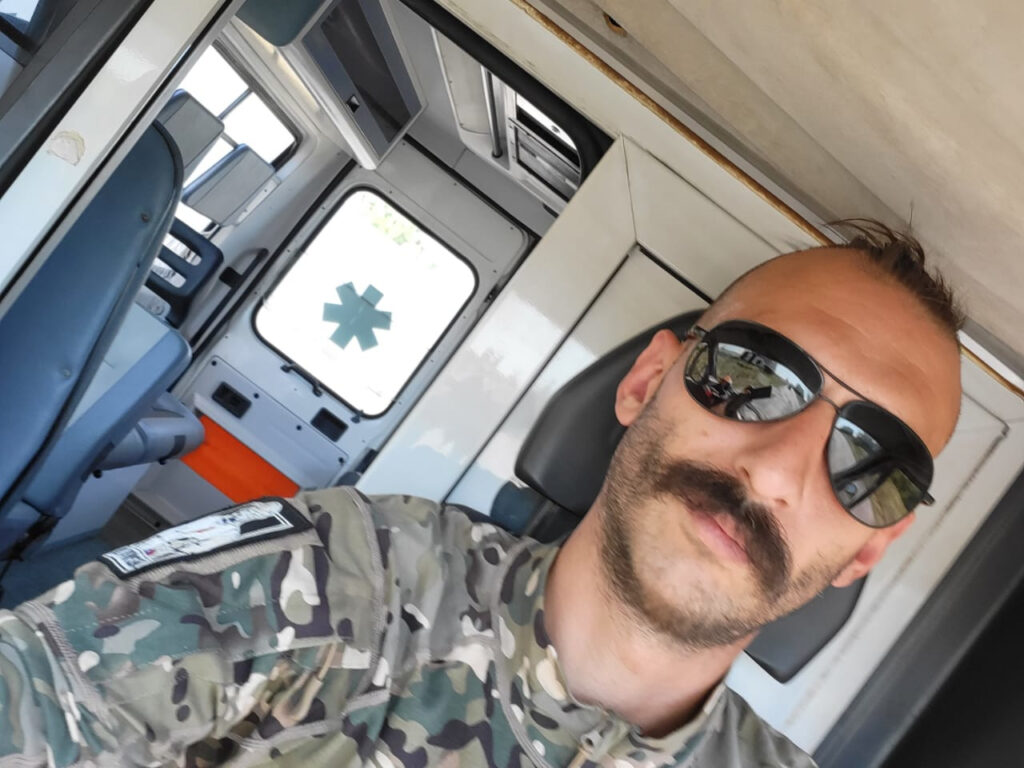
Revenons à Maxime Barrat. Quelque chose a déplu à sa hiérarchie ukrainienne ou à ses camarades étrangers et nous apprenons le 19 juillet 2023 qu’il a été expulsé du 131e bataillon. Il participe toujours à l’effort de guerre atlantiste, commence début août, comme McKenzie, à effectuer des liaisons avec le front. Sa première mission consiste à y conduire une ambulance
En l’attente d’une nouvelle affectation militaire, il explique ne pas toucher de solde et fait appel aux dons sur les réseaux sociaux pour payer l’essence. Je pense que ces liaisons sont le seul moyen d’assurer l’acheminement au front de petits matériels payés par des donateurs, tels que drones, car le système politico-militaire ukrainien est corrompu jusqu’à la moelle.
Le 3 septembre, il est toujours sans affectation mais en quête de valeurs sonnantes sur les réseaux sociaux. Dans son environnement, l’atmosphère vire au roman de gare. J’adore
Le bon temps : Daniel Burke est le second par la gauche, Maxime Barrat est le dernier à droite (réseaux sociaux)
Fondateur en 2022 des Dark Angels, groupe que Barrat intégra alors, le Britannique Daniel Burke a disparu depuis le 11 août. Il était également sans affectation. Son ordinateur, une arme et divers équipements sont restés dans son appartement de Zaporojie, mais son corps est introuvable. La presse britannique commence à évoquer le scénario criminel, car la police ukrainienne pense qu’il a été assassiné dans le contexte de rivalités pour des sources de financement.
Au même moment, un camarade très proche de Barrat se lâche sur les réseaux sociaux, où il explique que le personnel étranger du 131e bataillon de renseignement est un ramassis de toxicomanes. Sale affaire.
Drame le 25 octobre 2023. Tous deux quittèrent le 131e bataillon en juillet, vivaient habituellement sous le même toit
Christopher Perryman le 1er octobre 2023
Barrat avait déjà expliqué que sa future affectation militaire exigerait plus de discrétion sur les réseaux sociaux. Il était silencieux depuis le 9 octobre, confirme ce soir la mort de celui qui était véritablement un compagnon, le Britannique Christopher Perryman, dit Pezz. Les Russes ou a t il trop parlé ?
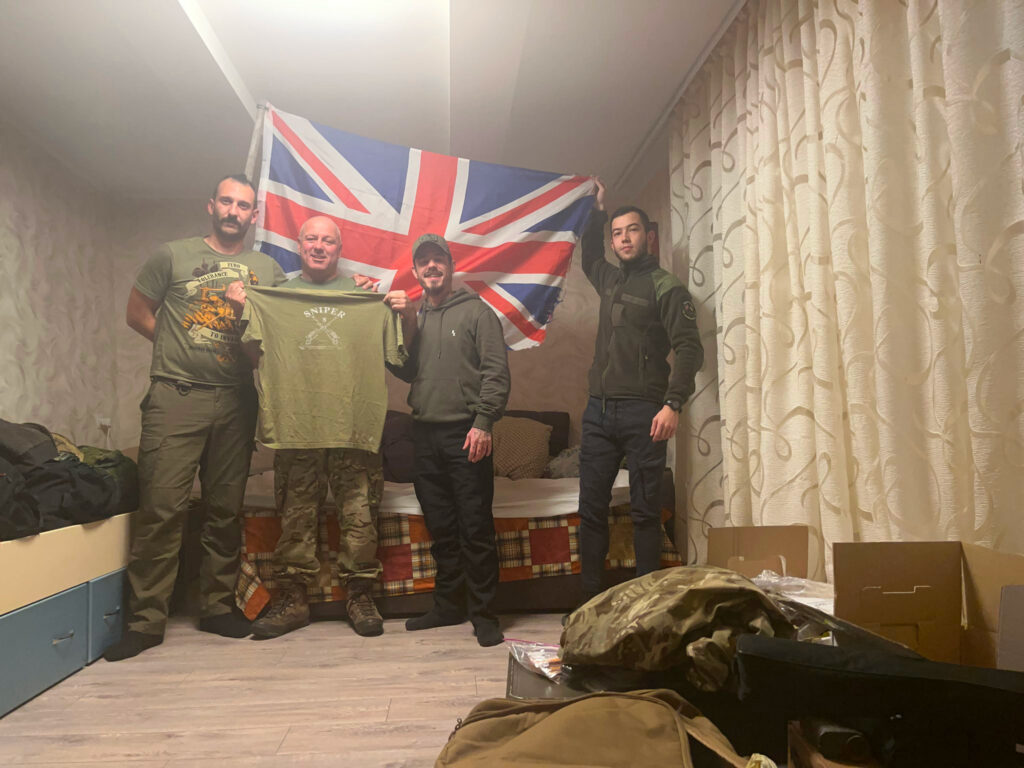
Barrat reçoit le 4 janvier 2024. Le tee-shirt préféré de feu Perryman est offert à l’opérateur EOD (explosive ordnance disposal) britannique Gary Mitchell
(Réseaux sociaux)
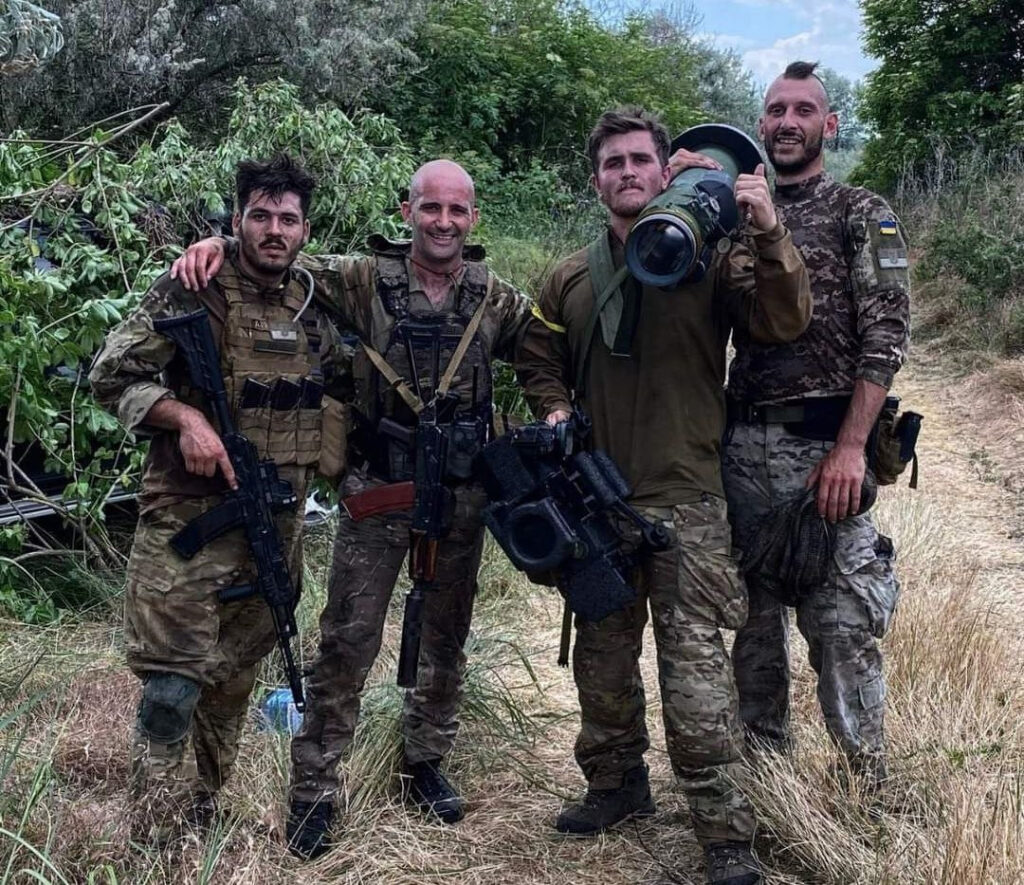
Barrat a recruté trois gamins, qui vivent depuis sous le même toit, les Français Allan Leroy (3e par la gauche), Enzo Proupin (4e) et Quentin Evanno, qui prend probablement la photographie. Vous remarquerez qu’ils sont encore moins d’extrême-gauche que lui.
Il paraît inquiet début juin, sollicite une assistance juridique, car sa hiérarchie militaire ukrainienne lui a signifié qu’en raison de la date de son enrôlement et au contraire de volontaires plus récents, il ne serait pas autorisé à rompre son contrat. Ses démarches sont utiles et il peut annoncer sa démobilisation le 4 juillet 2024.
Il a des projets civils en Ukraine, où il compte rester. Sa soustraction au contrôle judiciaire et la certitude d’être écroué à son retour en France sont certainement des paramètres non négligeables de ce choix.
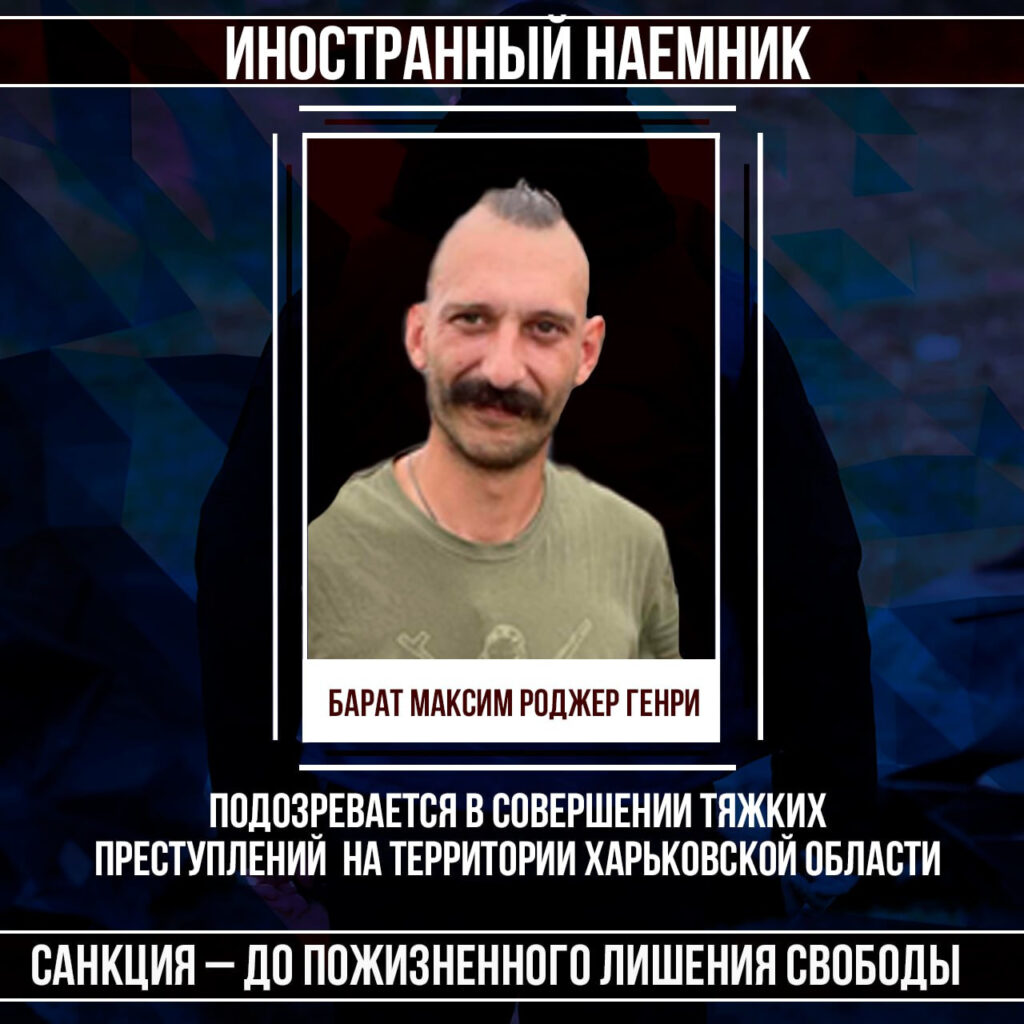
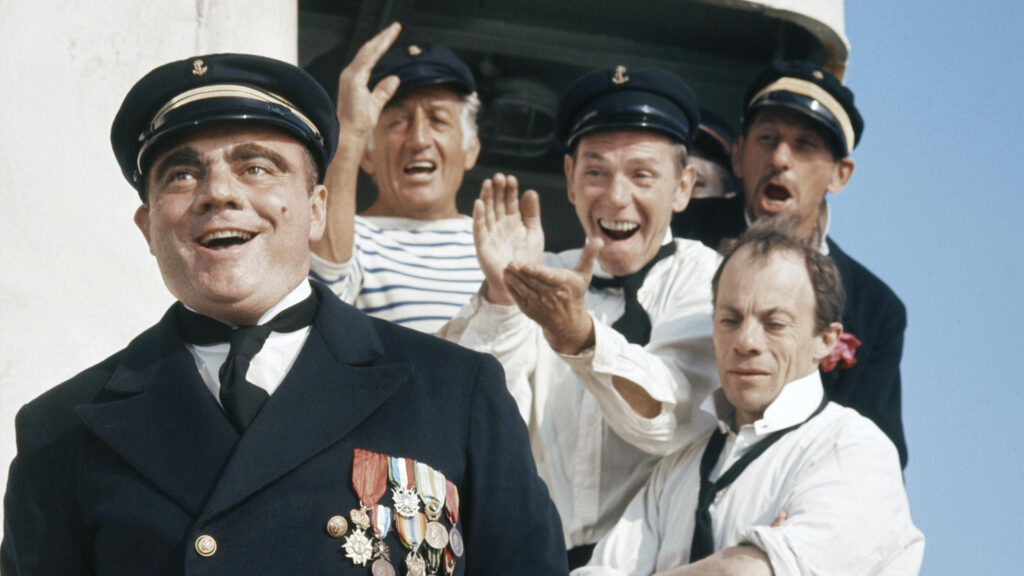
Fatalitas, disait Chéri Bibi. Le 15 août, il est très officiellement recherché par la justice russe, dans une sordide affaire de viol
Mercenaire étranger – Barrat Maxime Roger Henri – suspecté d’avoir commis des crimes graves sur le territoire de la région de Kharkov – Sanction – jusqu’à la prison à vie
Les faits datent du 5 mai, à Glubokoe, dans la région de Kharkov, une semaine avant la prise du village par l’armée russe. Deux soldats francophones pénétrèrent au domicile d’une Ukrainienne, qu’ils battirent et violèrent. Les enquêteurs ont présenté des photos de volontaires français à la victime, qui a formellement reconnu Barrat. Monsieur le président, je demande la relégation
Chéri Bibi, 1974 (INA)
Il exerce le 18 août son droit à la défense, mais aurait mieux fait de s’adresser à un avocat compétent, avant de publier sur X un texte en Anglais que je traduis ici
L’année dernière, j’ai entendu des rumeurs selon lesquelles je trafiquais les organes de volontaires [tués] et maintenant, j’ai violé une femme. Je n’ai jamais été dans ce village, je ne fais pas partie de la Légion et je n’ai jamais été marié. Au moins, ce n’était pas difficile de savoir où j’étais et avec qui j’étais et ils se trompent encore !
Cette défense est désespérante de maladresse. Je ne connaissais pas les rumeurs de trafic d’organes. Elles sont intéressantes, car si nous savons déjà dans quel panier de crabes il évoluait, nous ne connaissons pas encore les obscures sources de financement pour lesquelles son ancien camarade Daniel Burke fut abattu par un autre volontaire en août 2023. Pas de rumeur en revanche dans le cas du viol commis dans la région de Kharkov le 5 mai dernier, car les faits sont établis et ouverte, une procédure judiciaire dans laquelle la victime l’a formellement reconnu. Les enquêteurs de TrackANaziMerc se mettent sur l’affaire.
Business d’abord. Il s’adresse en Anglais à son public habituel de pigeons anglo-saxons, car il a passé le plus clair de ses deux ans sous les drapeaux ukrainiens à faire la quête auprès de ce public sur les réseaux sociaux. Les plus avisés l’ont d’ailleurs traité de scammer [arnaqueur]. Il leur suggère qu’il n’aurait pas été l’auteur en France de violences conjugales parce que célibataire. Le mariage n’était pas nécessaire et pour avoir été sous le coup, avant son départ pour l’Ukraine, d’un contrôle judiciaire, il a non seulement commis des violences conjugales, mais n’y est pas allé de main morte. Il est particulièrement maladroit, pour se défendre, de nier les faits antérieurs pour lesquels il est déjà poursuivi en France.
Dans la Légion [internationale] ? Qui l’affirme ? Il était bien sous les drapeaux jusqu’à la date en juillet dernier de sa démobilisation. D’abord dans un bataillon du renseignement militaire ukrainien (GUR), il semble avoir été affecté plus récemment à l’UDA (Ukrayinsʹka dobrovolʹcha armiya, Armée des volontaires ukrainiens), formation paramilitaire nazie de Dmytro Iarosh, fondateur en 2014 de Pravyi sektor [Secteur droit]
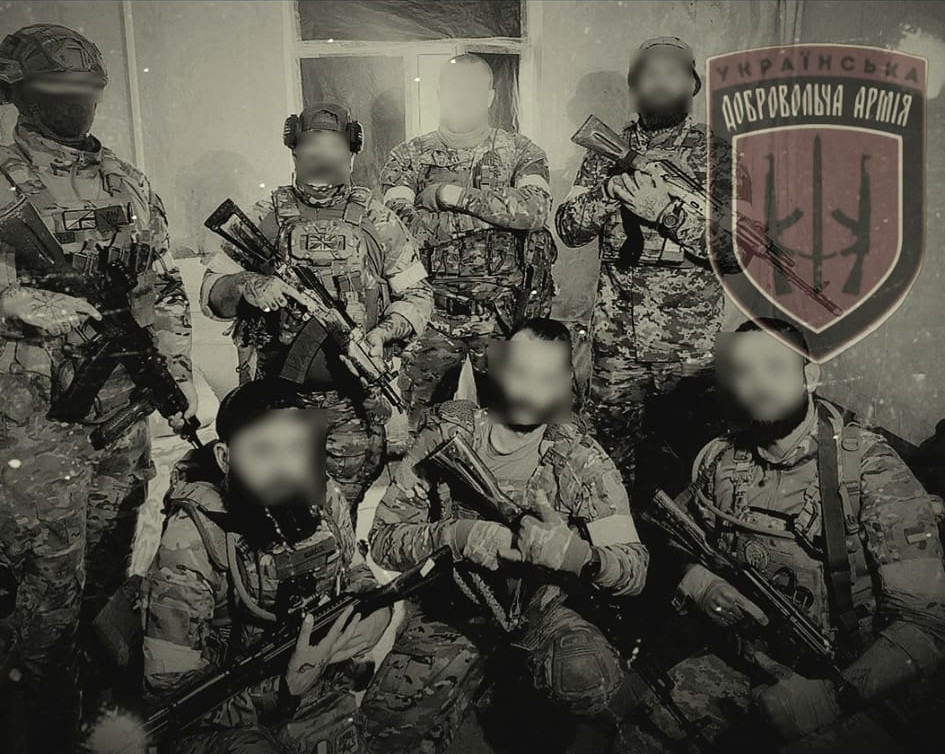
Maxime Barrat est apparu début mai 2024 parmi les camarades du volontaire britannique Ben Wallwork, qui en rétrospective en juillet de ses six mois précédents en Ukraine, publie cette image, à laquelle a été ajouté l’écusson de l’UDA. À notre connaissance, les deux seuls Français de cette escouade sont Quentin Evanno et Maxime Barrat, à genoux, premier et second par la gauche. D’autres versions modifiées de la même photographie originale ont été publiées entre les 11 et 21 mai par Barrat et Evanno, ce qui nous permet de certifier leur présence dans le groupe
Quant à savoir où et avec qui il était le 5 mai, je soupçonne l’identité de son coauteur du viol : le seul Français à notre connaissance, encore avec lui en mai, le nazi Quentin Evanno
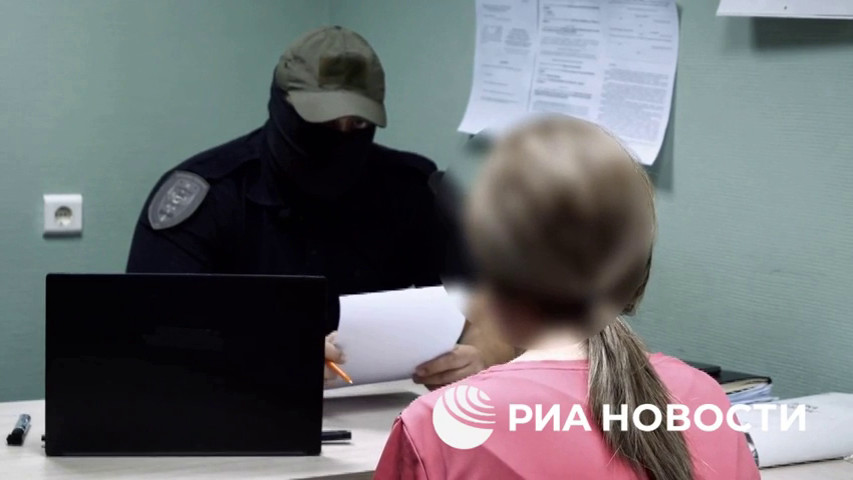
La victime apparaît lors de l’enquête, dans une vidéo diffusée le 15 août 2024 (capture d’écran / RIA Novosti)
Les enquêteurs russes le confirment, procèdent à son identification auprès de la victime et le 18 septembre, Evanno est officiellement recherché par la justice, comme coauteur présumé du viol commis dans la région de Kharkov le 5 mai.
Alors que la victoire totale de Donald Trump risque d’accélérer la défaite atlantiste en Ukraine, le conflit est sans doute devenu plus personnel et existentiel pour Maxime Barrat. S’il se rapatriait, il serait écroué en France pour ses anciens méfaits ; lorsque la Russie aura gagné, l’Ukraine le remettra certainement à la justice russe, qui lui laisse envisager la perpétuité
le 19 octobre 2024 (réseaux sociaux)
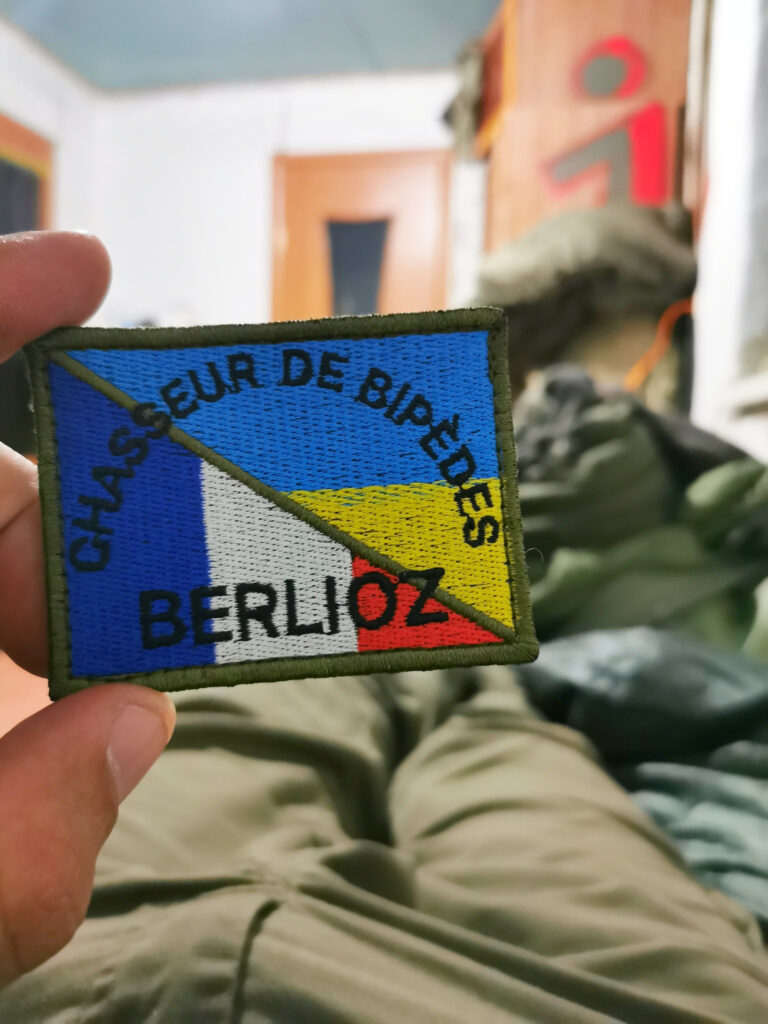
En ces circonstances, il a décidé de rempiler. Lui et Enzo Proupin, un jeune camarade dont il était le mentor en début d’année, ont suivi en octobre plusieurs semaines d’entraînement à Kherson. Ils sont le 7 novembre à Ternopil, dans l’ouest lointain, pour accomplir les formalités administratives de leur enrôlement en qualité de tireurs de précision, dans un bataillon de la 126e brigade de défense territoriale. Ils y porteront la tradition de la Team Berlioz, fondée par Franck Malandain.
À l’occasion d’une rencontre avec l’Ajax, des supporteurs fascistes de l’équipe israélienne Maccabi commencèrent dès le 6 novembre à afficher leur nationalisme exacerbé et à ratonner dans les rues d’Amsterdam. Lors du match le 7, ils sifflèrent la minute de silence en hommage aux victimes des inondations de Valence, au motif que le gouvernement espagnol soutient la cause palestinienne. La police néerlandaise les a laissés faire et en réaction à ces comportements de voyous, des habitants ont ensuite pourchassé en ville et corrigé les fâcheux
https://youtu.be/ZGRpCQxIeZw
Voici le reportage des incidents d’Amsterdam, que sous la pression de lobbies, la chaîne britannique Sky News effacera ensuite le 9 novembre
Ces incidents suscitent le 8 novembre une réaction en Anglais de Maxime Barrat, que je traduis ici
La faiblesse de l’Occident fait que nous avons des ennemis à l’intérieur et à nos frontières… Une période sombre pour l’Europe, causée par des peuples faibles… Il est temps de laisser les peuples forts prendre des décisions fortes pour préserver l’Europe et sa culture
Nous savons déjà qu’il n’est jamais aussi fort que lorsqu’il commet en France des violences conjugales ou viole une habitante de la région de Kharkov. Je ressens presque de la peine pour les journalistes de RTL, qui auraient été enfumés en juillet 2023, car de fait, ils présentèrent comme sympathisant d’extrême gauche un vulgaire pétainiste [fasciste français], qui considère les citoyens néerlandais d’origine marocaine comme des ennemis intérieurs aux Pays Bas.
Son dernier enrôlement semble avorter ou la publicité qu’il lui a donnée n’était qu’un énième mensonge. En février 2025, trois mois seulement après les formalités administratives à Ternopil, il quitte l’Ukraine pour l’Europe occidentale.
Désormais loin du champ de bataille, il commente l’actualité française. À l’approche de la chute probable du gouvernement de Français Bayrou, dans le contexte d’une catastrophe financière causée par le sabotage des finances publiques au profit des plus riches, que la même droite exploite ensuite comme un prétexte pour essorer encore les plus pauvres, l’escroc et violeur ravale ses glaires racistes pour exprimer le 26 août la profondeur de sa conscience politique
Que l’on fasse des coupes franches, surtout dans le social… La France est bien trop généreuse, les gens bien trop confortable et sécurisé par toutes ces aides… Au moins les français auront de quoi se plaindre réellement que de se complaire dans leur médiocrité !
Le côté amusant est qu’il semble convaincu de ne pas être un médiocre d’origine contrôlée.
Je continue de lire avec attention ses commentaires de l’actualité. Il se révèle début septembre un inconditionnel de l’ancien marxiste -sans doute alors par effet de mode- devenu sarkozyste et aujourd’hui macroniste, anti-tiers-mondiste et ancien maire de Vichy -comme c’est cocasse- Claude Malhuret. Le politicien vit aussi mal que son admirateur l’accélération de l’inéluctable effondrement de l’hégémonie occidentale. Gros temps pour le petit bourgeois réactionnaire français et le lumpen-prolétaire qui s’identifie à lui.
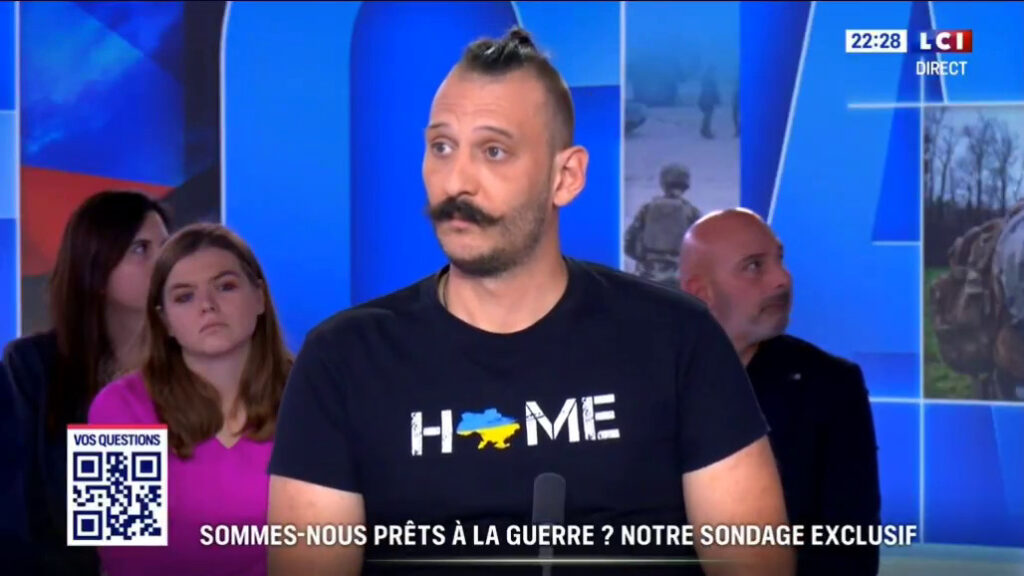
Au soir du 4 décembre 2025, Maxime Barrat est sur le plateau de LCI, qu’il partage avec l’animateur Darius Rochebin et des personnages comme le foudre de guerre béarnais Michel Goya, qui semble convaincu que ses séjours touristiques en Afrique ou à Sarajevo mériteraient la croix de guerre
(Capture d’écran)
Ce qui est savoureux est que de sa soirée spéciale, la chaîne de propagande ne republie pas ensuite d’extrait avec l’ex mercenaire français. La raison de cette censure tient de la vanité nationale : contrairement au message que LCI veut faire passer à son public innocent, il soutient que l’armée française se ferait étriller
(Le Dauphiné Libéré)
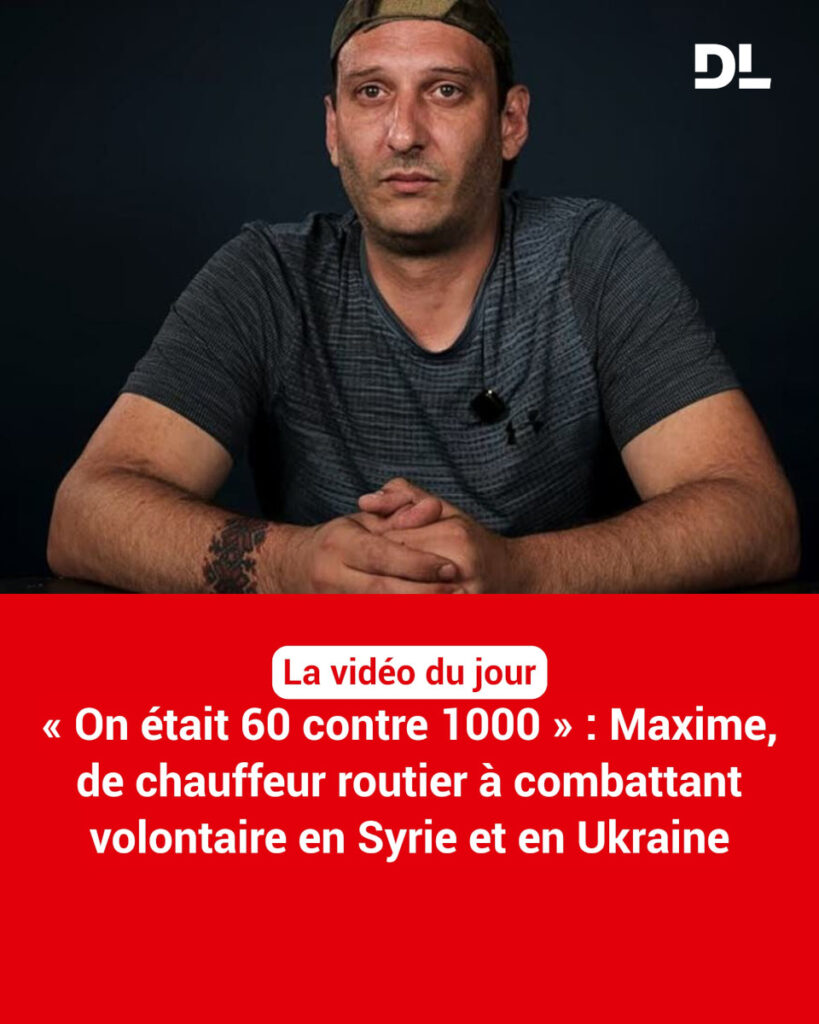
Le 22 août 2026, Le Dauphiné Libéré publie la vidéo d’un entretien avec Maxime Barrat, au sujet de ses exploits homériques sur la champ de bataille ukrainien. Son témoignage souffre hélas de nombreuses omissions. C’est du journalisme du niveau de Laurent Brayard, mais dans l’autre camp.
chronique alphabétique et nécrologique de l’engagement français dans les rangs atlantistes en Ukraine, ce que les journalistes serviles ne vous raconteront pas
Articles connexes
Pruvate à truvà me, canaglia di l’OTAN, pruvate solu
chronique en Anglais, its roots before WW2, its collaboration with Nazi Germany, its legacy in modern Ukraine, how NATO has continually supported Nazism in Ukraine
chronique en Anglais, censorship, fake news, whitewashing of the Ukrainian Nazism and war crimes, for the sake of the proxy war that NATO is conducting in Donbass and Ukraine, against Russia
une saga française, entre Ukraine et Lyon, où apparaissent aussi des morceaux de SS de la division Charlemagne et plus récemment, Alice Kerviel, dite Cordier. L’affaire Deranque révèle comme la France est infectée par le pétainisme, en particulier parmi les soutiens d’Israël ou de l’Ukraine, deux théâtres d’opérations où l’Occident tente de ralentir son déclin
En 2025, une nouvelle unité de Français combattant pour l’Ukraine s’est structurée autour d’un noyau de néonazis, ayant pour objectif d’attirer des recrues. Parmi ces volontaires, d’anciens militaires. StreetPress les a identifiés
En Ukraine, les volontaires français pro-ukrainiens et pro-russes se partagent l’imaginaire de la Seconde Guerre mondiale. Les premiers se revendiquent des collabos de l’Allemagne nazie, les seconds de l’escadrille mythique « Normandie – Niémen »
deux jours après le 10e anniversaire de la débâcle politique et sécuritaire du 13 novembre 2015, une messe célèbre à Verdun l’ancien dirigeant fasciste de l’État français
ce 11 novembre 2025 est l’occasion de souligner comme la façon dont l’Europe sacrifie les conscrits ukrainiens mobilisés de force rappelle le spectaculaire carnage de la 1ère guerre mondiale
c’est par l’agence cosaque de presse PIKA, depuis la République populaire de Lougansk, que le 2 avril 2024, l’ataman Nikolaï Diakonov lance un message à destination de la France
ce papier est le premier des grands médias français qui s’attaque à la question des militants nazis français dans les rangs atlantistes en Ukraine, le nouveau danger qu’ils présenteront à terme pour la sûreté intérieure
où nous apprenons que le nazi français Allan Duchézeau, camarade de César Aujard dans les rangs atlantistes en Ukraine, était surnommé Dox, quand il secondait à Paris le leader nazi Marc de Cacqueray Valménier
en Anglais, les indices de la présence d’opérateurs occidentaux, en particulier Français, pris au piège en mars 2022 à Marioupol, dont les forces russes achevèrent la libération en mai
Zelensky and his Western overlords thought they could compel Russia to enter into peace negotiations. All they did is seal Ukraine’s tragic fate
Kiev burns following a Russian missile attack, August 5, 2026
On June 25, Ukraine’s President Volodymyr Zelensky ordered the initiation of a 40-day offensive intended to “influence” Russia to end the war. In a message delivered via social media, Zelensky announced that “I approved a 40-day influence operation for the service against the aggressor state aimed at compelling it to end the war.”
On August 3, on the eve of the expiration of the 40-day campaign, Zelensky acknowledged that the 40-day campaign had not achieved its objective of driving Russia to embrace peace. Instead, Zelensky accused Russian President Vladimir Putin of preparing to prolong the conflict through further mobilization and new attacks. Rather than acknowledging failure, however, Zelensky declared that Ukraine would double down on renewed diplomatic efforts, increased economic restrictions, and continued military actions to create conditions where Russia would have no alternative but to agree to negotiations on terms acceptable by Ukraine.
The 40-day gap between the commencement of Zelensky’s “influence operation”, and the admission by the Ukrainian President that Russia was far from acknowledging defeat, has created a widening chasm between fact and fantasy, between reality and fiction, that appears to be recognized by virtually everyone but the Ukrainian President.
The 40-day surge in drone attacks came on the heels of a campaign that had been underway since May which saw increased attacks against Russia’s two largest cities, Moscow and Saint Petersburg, and implied threats against other strategically important locations such as the Presidential residence in Valdai (which had come under Ukrainian drone attack in December 2025) and the Kerch Bridge connecting Crimea with southern Russia.
The goal of these attacks was to force Russia to redeploy air defense forces to protect these strategically important targets, thereby stripping away air defense units from other regions. The 40-day drone campaign announced by Zelensky would seek to exploit these gaps in air defense coverage to bring the “pain” of war home to the people of Russia.
None of the pressure points Zelensky hoped to engage by his 40-day drone campaign produced anything remotely resembling the desired results. Indeed, in every instance, the opposite outcome was achieved. Zelensky hoped to trigger an energy crisis by attacking Russian petroleum refineries. While a compliant pro-Ukrainian western media declared that Russia had lost up to 40% of its refining capacity, the reality was far different: far from breaking the spirit of the Russian population by denying them access to gasoline and making them wait in long lines to get gas at high prices, the fact is that gasoline in August 2026 is cheaper than it was this time last year (AI-95, the most popular grade of gasoline, was 63.06 rubles per liter in August 2025, as opposed to 61.71 rubles per liter today), and there are virtually no lines of vehicles waiting to refuel.
Moreover, the timing couldn’t have been worse for Ukraine when it came to reducing Russian refining capacity—Russia simply diverted the stocks of crude destined for domestic refining into the export pipeline at a time when global demand rapidly absorbed these increased exports at record high prices. Zelensky’s war on the Russian energy sector was a major contributor to Russia’s oil and gas revenue, which accounts for around a fifth of total budget income, rising by more than 60% in July 2026 from the same month a year ago.
The Ukrainian influence campaign was designed to build upon the perception that had been painted in the public mindset that Russia had been virtually evicted from the Black Sea by expanding drone strikes into the Sea of Azov and the Caspian Sea. Not only did these attacks result in negligible harm to Russian shipping, but the consequences—a full-scale Russian onslaught which effectively shut down Ukraine’s access to the Black Sea, blocking Ukraine’s ability to ship grain as well as prevent Ukraine from receiving shipments of military goods from its NATO sponsors.
And lastly, there was Ukraine’s ill-fated decision to bring pain of the war into the homes of the Russian people by striking warehouses and factories belonging to Russia’s largest online retailer, Wildberries. The burning warehouses provided some made-for-television- videos that were exploited to full effect by Ukrainian state media and sympathetic social media platforms. But the warm feelings generated amongst the Ukrainian faithful by this imagery was soon dissipated by the harsh reality of the Russian retaliation, which has targeted the totality of the Ukrainian commercial supply chain that puts the viability of Ukraine’s civil economy at existential risk.
Zelensky’s drone-based “influence campaign” did not occur in a vacuum, but rather was part and parcel of a broader campaign linked to a western-driven information warfare campaign designed to “soften” the Russian people in the lead up to the State Duma elections scheduled for September 20. The goal of this campaign was to generate civil discontent inside Russia that would manifest itself in the form of an electoral response that undermined the political foundations of the Russian government headed by President Vladimir Putin.
This has been a long-time strategy on the part of foreign intelligence services and their allies dating back to 2007-2008, when they sought to mimic in Russia the societal angst in Ukraine that underpinned the 2004-2005 “Orange Revolution.”
It is the same strategy that guided the policies of the United States in 2011, when a full-court press was launched to oust United Russia from the leadership of the State Duma, thereby disrupting Vladmir Putin’s bid for the Presidency in March 2012.
These campaigns all failed.
And the current campaign will fail as well.
Trying to engage the Russian people without fully understanding the character of the Russian people is an exercise in futility.
Erstwhile historians and “Russianists” lean heavily on the precedent of history, citing the Revolution of 1917 and the Gorbachev-induced collapse of the Soviet Union as examples that they seek to mirror in the Russia of today.
But Vladimir Putin is not a Tsar, nor is he a confused Soviet bureaucrat.
He is a man who, for more than a quarter century, has led a Russian revival, reversing the decay that had infected his nation and people in the final years of Soviet rule and through a decade of Russian misrule under the direction of western elites who sought to dismantle the Russian nation while robbing it of its resources.
The Russian people of 2026 are not the Russian people of 1917 or 1992.
Believing that they are is the fatal error of those behind the “drone influence” campaign.
This is the danger of systemic Russophobia.
The ignorance it induces blind people to the reality of Russia, and propagates policies that are doomed to fail from the outset.
Zelensky’s 4-Day War was always doomed to fail.
And now we know what failure looks like.
Ukraine has been abandoned by its Western masters.
No air defense.
No Patriot license.
No Patriot missiles.
No “magical” solution.
Which means that the West has acknowledged the inevitability of Ukraine’s strategic defeat.
Over the course of the next weeks and months, Ukraine will reap what it has sown.
Yes, Ukrainian drones will continue to strike Russian infrastructure, producing made-for-social media moments full black smoke darkening the horizon.
Meanwhile, Kiev will burn.
And so, too, will the other cities of Ukraine.
The Russian army will continue to advance.
It is the Ukrainian society that is feeling the back-breaking pressure of war.
No gas.
No water,
No heat.
No food.
This is the future of Ukraine under Zelensky.
There is never going to be the dreamed about Moscow Maidan moment envisioned by the likes of Gilbert Doctorow and his ilk.
It is Kiev that sees its streets filled with protesters demanding political change.
The collapse of Ukraine as a nation state is inevitable.
65-year-old Scott Ritter is a former intelligence officer within the US Marine Corps (USMC), then inspector of the United Nations in Iraq. When in 2003, the US and their British minions were about to invade the country under this false pretext, Ritter was claiming that there was no weapon of mass destruction (WMD) there. He was right.
In the Jacques Baud case, the EU is sanctioning, for the first time, an analyst not for spreading disinformation but for expressing a politically inconvenient truth, all while admitting he has broken no law. Will it have the courage to go after an American citizen?
Operation enters the second week of Ukraine’s long-awaited and highly touted counteroffensive, some basic conclusions can be drawn even though the fighting continues, and will continue to rage, for some time to come
No amount of ‘intellectual mobilization’ will be enough to contain public fury (Scott Peterson / Getty)
“No!” the woman cries. “May you be damned!” You can hear the despair in her voice, as masked men grab her husband, then bundle him into a waiting van. Within seconds, she’s alone, weeping in the middle of the street. This is Odesa, but scenes like it, captured on phones and posted online, hammer Ukrainian cities as relentlessly as Russian missiles. Since Putin’s full-scale invasion began, over a million Ukrainians have been conscripted to defend their homeland. And, as voluntary recruits have dried up, the army has begun resorting to the same methods faced by that couple in Odesa. People even have a term for it: “busification”.
The process is brutally simple. Draft officers, often accompanied by police, snatch military-age men off the streets, before delivering them to recruitment centers. There, many are pressured through threats, intimidation, and physical abuse to pass military medical examinations and sign draft papers. Men with serious conditions — including HIV, tuberculosis and even cancer — are routinely declared fit for service. Whether they like it or not, the recruitment officers must meet quotas; the only question is who fills them. Yet with Ukraine’s wealthy elite reluctant to heed the call, Kyiv’s recruitment crisis is becoming a class crisis too, one that could cause chaos long after the guns fall silent.
Ukraine currently mobilizes around 30,000 men each month — yet many never make it to the front. Some flee training centers at the first opportunity, while others are later discharged as medically unfit. By autumn 2025, according to official figures, roughly 300,000 servicemen had gone AWOL or deserted. The numbers have become so politically sensitive that the authorities now keep the data secret. But the direction of travel is clear: Ukraine’s pool of willing fighters is shrinking. As a result, coercion has moved from the margins to the very center of national life.
Straightforward coercion, however, is only part of the story, as mobilization becomes a social scourge too. Today’s Ukrainian army is, increasingly, an army of the poor. Members of the upper-middle class — and especially the political and economic establishment — possess the resources, connections, and influence necessary to shield themselves from military service. Through a combination of legal work-arounds and bribes, they can avoid donning uniforms for a range of reasons, from illness, to having several children, to caring for disabled relatives. Others are exempt because they’re university students or academics, or work at strategic companies, particularly those linked to the defense sector.
A significant portion of Ukraine’s cultural and academic intelligentsia belongs to this privileged group. Many have received exemptions from military service while continuing their professional activities uninterrupted. In return, the state expects ideological loyalty and intellectual labor in support of the war effort. This includes promoting “decolonization” narratives that often amount to anti-Russian ethnonationalism. It also means deliberately ignoring the deep penetration of far-Right groups into the military, and remaining silent about the normalization of Nazi symbols within parts of the armed forces. But, most importantly, it means justifying coercive mobilization as a necessary instrument of national survival in what is routinely described as an “existential war”.
A substantial number of Ukrainian intellectuals have willingly embraced this arrangement, placing themselves in the service of state interests while convincing themselves that they’re fighting on the “information front” in a war for independence from Russia. Others are motivated by more pragmatic considerations: preserving the privileges that come with exemption from military service. Still others remain loyal out of fear.
Fear, after all, is not an abstract concern. The costs of dissent have become increasingly visible. A recent example is the Ukrainian-Canadian political scientist Ivan Katchanovski, who became the target of a public campaign of denunciation by Ukrainian and Western scholars over his interpretation of the war. Katchanovski has argued for a more nuanced explanation of the conflict — one that looks beyond Russian imperialism and Putin’s ambitions to include the role of the Ukrainian far-Right, Nato, and a post-Cold War security architecture that excluded Moscow. Rather than confronting these arguments on their scholarly merits, many of his critics simply accused the scholar of spreading “Kremlin propaganda”. Whatever one thinks of Katchanovski’s views, the episode sent a clear message: questioning dominant wartime narratives can carry serious professional and reputational consequences.
Meanwhile, justifying mobilization, regardless of how coercive, violent, or degrading it may be, has become a central task of Ukraine’s liberal intelligentsia. In May 2026, for instance, the prominent historian and public intellectual Yaroslav Hrytsak argued that patriotic appeals and financial incentives alone are insufficient to sustain effective mobilization in the country. In his view, society must also rely on fear and moral condemnation. As an example, Hrytsak invoked Britain’s experience during the First World War, when women handed white feathers to men who didn’t enlist, publicly shaming them as cowards.
What is striking is that Hrytsak offered no criticism of this practice, despite its deeply controversial legacy. The white-feather campaign stigmatized not only those unwilling to fight, but also veterans, disabled men, the seriously ill, and countless others who were unfit for military service. Yet in contemporary Ukraine, this history is increasingly presented not as a cautionary tale but as a model worthy of emulation.
In reality, of course, the public shaming of men who avoid military service is already deeply embedded in Ukrainian public discourse. For example, the popular singer Alyona Alyona, who represented the country at the 2024 Eurovision, mockingly referred to such men as “Mama’s little boys” and publicly defended the harsh measures employed against draft evaders. Oleksandra Ustinova, an MP, has similarly attacked men who leave Ukraine to avoid service, arguing that the current civil penalties should be replaced by criminal prosecutions. Yet there’s an irony here. Ustinova’s own draft-age husband left Ukraine for the US after Russia’s invasion in March 2022, bought a house and a car there, and has shown little intention of returning.
There are other ironies too. In September 2024, Yaroslava Kravchenko, a celebrity TV host, published a report on male artists who had left Ukraine under the telling title “Those Who Escaped from Ukraine”. Like many women who publicly denounce supposed draft dodgers, Kravchenko herself enjoys unrestricted international travel for both work and leisure. Many other female celebrities are in the same boat. Women, after all, remain exempt from the travel restrictions imposed under martial law — restrictions that prevent millions of Ukrainian men from leaving the country regardless of their personal circumstances, political views, or willingness to fight.
This asymmetry lies at the heart of growing social tensions. Those who champion moral condemnation often do so from positions of relative safety and freedom. They can cross borders, pursue careers abroad, and retain control over their own lives. The men they shame cannot. From the very first days of the war, Ukraine has cultivated the image of the ideal man: self-sacrificing, strong, courageous, and unfailingly committed to defending his family, his home, his nation. He is prepared, if necessary, to give his life for this cause.
His opposite is the ukhyliant — the draft evader. In the dominant narrative, he is portrayed as a coward who’ll resort to any means necessary to evade what is presented as his “natural” masculine duty. Public shaming of such men has become normalized, routine, and Ukrainian media has played a significant role in this process. Flippant headlines like “Draft Dodger Stopped by a Bear at the Romanian Border” or “Grandma Draft Dodger: Odesa Man Dressed as an Elderly Woman to Cross the Border” have now become commonplace. And though Article 35 of Ukraine’s constitution theoretically guarantees the right to alternative service for conscientious objectors, that right has effectively ceased to exist. A recent investigation into the “Skala” regiment alleged that some men who refused to serve were beaten into compliance.
All the while, some Ukrainian feminists have directed their criticism at draft evaders while largely overlooking a wartime system that casts men as protectors and women as those in need of protection — precisely the gender hierarchy feminism claims to oppose. This flirtation with militaristic nationalism has left many feminists blind to the women whose lives are shattered by busification. Behind every man dragged into a recruitment van, then tortured or beaten to death by draft officers, let alone killed at the front, stands a mother, a daughter, a wife, bearing the fear, grief, and trauma that follow. But because their suffering complicates the dominant wartime narrative, this reality is largely met with silence.
A similar silence greets another group of inconvenient women — those who have become active in the grassroots struggle against forced mobilization. Gender in Detail, Ukraine’s leading gender website, has had remarkably little to say about the women standing in the way of busification. These women are threatened, attacked, prosecuted, and publicly shamed for defending relatives — or complete strangers — from recruitment vans. The courage of these women, from teenage girls to pensioners, can be seen in countless videos confronting recruitment officers and the police. Their courage is visible, their suffering documented. Yet their invisibility, in the end, is political.
That, of course, raises a broader question. With the frontlines mostly stagnant, and with the meatgrinder war annihilating Ukraine’s demographics, why is the government so intent on continuing with busification at all costs? Ukraine no longer appears to have the final say over its own future. That decision is increasingly shared with — or subordinated to — its Western sponsors, who view Ukrainian men less as citizens than as expendable military assets. The EU’s plan to refuse protection to Ukrainian men of draft age exposes this logic. By denying them refuge, Europe is effectively forcing them back to the front. Their bodies have become instruments in a larger geopolitical project: bleeding Russia. That’s further suggests that the war has become a Western proxy war against Putin. In return, Ukraine’s venal political elite, led by Volodymyr Zelensky, enjoys Western political protection — whatever the moral and legal problems with busification.
There’s another question here too. If Ukraine is being bled dry for Brussels, why not end militarization altogether? Unfortunately, those who suggest this path, advocating diplomacy or negotiations, are marginalized. When Yuliia Mendel, Zelensky’s former press secretary, told Tucker Carlson that the Ukrainian president had sabotaged peace talks with Russia, much of Ukraine’s mainstream media and a number of prominent liberal commentators responded not with debate but with a coordinated effort to discredit her, branding her a purveyor of “Russian narratives”.
Liberal intellectuals share responsibility for silencing these unwanted voices. Yet neither the state nor its intellectual allies can suppress these realities forever. Beneath the surface, they are fueling growing resentment and social anger. Every attempt to silence grievances only deepens the sense of injustice, and if the pressure continues to build, it may eventually spark a political and social explosion.
There are signs of this already. In the village of Ozero, for instance, locals blocked a military recruitment vehicle, smashed its windows, and freed a mobilized man. Elsewhere, confrontations between recruitment officers and civilians have involved dozens of people, often escalating into verbal abuse and physical violence. Attacks on recruitment officers with knives, shovels, and clubs have become increasingly common too. As the military’s manpower crisis deepens, mobilization grows more coercive — and public resistance more intense. The way things are going, no amount of “intellectual mobilization” will be enough to contain public fury [end]
Marta Havryshko is a US-based author and researcher focused on Ukrainian nationalism, the far Right, and the Russia-Ukraine war. She holds a PhD in history from the Ivan Franko National University of Lviv in Ukraine
Why are liberal institutions censoring discussion of forced mobilization in Ukraine? – Volodymyr Ishchenko, Marta Havryshko, Tarik Cyril Amar, Milica Popović and Almut Rochowanski
ce 11 novembre 2025 est l’occasion de souligner comme la façon dont l’Europe sacrifie les conscrits ukrainiens mobilisés de force rappelle le spectaculaire carnage de la 1ère guerre mondiale
Azov paramilitaries are aiming to debunk Kremlin « myths ». In doing so, they are solidifying their Nazi tradition and reducing German normalization narratives to absurdity
chronicle of censorship, fake news, whitewashing of the Ukrainian Nazism and war crimes, for the sake of the proxy war that NATO is conducting in Donbass and Ukraine, against Russia
its roots before WW2, its collaboration with Nazi Germany, its legacy in modern Ukraine, how NATO has continually supported Nazism in Ukraine, chronicle
Ukraine is defenseless in the face of Russian missile attacks. Now is not the time for negotiations. Russia must finish the job
The launch of a Russian Iskander missile
The United States Department of Defense defines the term “decision point” as “A geographic place, specific key event, critical factor, or function that, when acted upon, allows commanders to gain a marked advantage over an adversary or contribute materially to achieving success.”
Today Russia has reached a decision point in its conflict with the collective West, inclusive of the United States, and their Ukrainian proxy.
The Russian leadership has, in my opinion, been preparing for some time for the confluence of the physical and psychological manifestation of a campaign designed to create an unbridgeable gap between perception and reality which, when exposed through action, will cause the artificially constructed edifice of Ukrainian defensive viability to collapse, and with it the false pillars of Western democracy, industry, and military might which propped it up.
This campaign wasn’t designed from scratch by the Russians, but rather emerged from the lies and deceit of those in the West who postured as peacemakers but in reality served as the promulgators of war.
The Europeans had long proved themselves to be charlatans, with their perfidy regarding Minsk forever exposing them as absolutely unreliable partners for resolving a Ukrainian crisis they themselves orchestrated.
The more curious thing is Russia’s attitude towards the United States. It was the United States which served as the architect of policies which have been in place for decades designed to weaken Russia and undermine to the point of collapse the government of Russia.
And yet Russia continued to hold out hope that the United States —especially under the second iteration of the Trump administration— could somehow serve as a force of rational stability when it came to managing both Europe and Ukraine.
The Anchorage Summit of August 2025 was the culminating moment of this conceptualization, manifesting itself into the so-called “Spirit of Anchorage”, the idea that through compromise a solution that addressed in serious fashion Russian concerns could be crafted that would be acceptable to all.
Within months, however, it became clear that the “Spirit of Alaska” was as illusory as the “Spirit of Minsk” that preceded it, another perfidious diplomatic ploy designed to buy time to build up Ukrainian military capability by lulling Russia into a false belief that a negotiated peace was possible.
But the United States, like Europe, never intended for the Ukrainian conflict to end in anything other than a strategic Russian defeat.
The Russian leadership has now come to embrace —however belatedly— this uncomfortable reality.
The ultimate question that now confronts Moscow is how to act on this realization.
Russia finds itself in a situation where it enjoys considerable strategic advantages over Ukraine and its Western partners across a broad spectrum of disciplines —diplomatic, economic, military, and social.
Russia, despite the concerted efforts of the West, is not isolated. Just the opposite, in fact. In many ways, Russia enjoys a stronger geopolitical posture today that it did before the initiation of the Special Military Operation if for no other reason that the conflict has exposed the nefarious nature of the so-called “rules-based international order” and those who conceived and implemented it, and as such breathed viability into the concepts of multilateralism that Russia and other nations, especially China, had been promoting with mixed results.
The Russian economy has withstood the challenges posed by economic sanctions and direct military action, and today is recognized by most of the world as a viable place to do business, as witnessed by the $84 billion in direct investments accrued during the Saint Petersburg International Economic Forum this past June.
Russia today possesses a large, well trained, well equipped, combat hardened military backed by a robust and capable defense industry which is not only prevailing in an extended war of attrition against Ukraine and the collective West, but has positioned itself to defend Russia’s interests in the Baltic, Arctic, Pacific, and the totality of its periphery, as well as defend and advance Russian interests in the Middle East and Africa. The advances in Russian technology —especially in ballistic missiles— has provided a qualitative edge which, when combined with Russia’s quantitative strengths, makes Russia a very formidable force.
Russian society continues its long and painful divorce with the West. The incomplete nature of this split, which sees small pockets of western liberalism holding on to relevance in the face of a larger societal gravitation toward a new Russian national awareness, has provided the collective West with its only opportunity to dismantle the advantages Russia has accrued diplomatically, economically, and militarily. The western intelligence services have worked with Ukraine to craft a narrative of Ukrainian resistance, resilience, and relevance that is then juxtaposed on the perception of Russian weakness that emerges in the wake of the false hope of negotiated peace that Russia had embraced in Minsk, Istanbul and Anchorage.
This hope was always designed to energize the residual western liberal elites inside Russia into believing everything would be better if Russia simply embraced the spirit of compromise. But the spirit of compromise was nothing more than a wolf in sheep’s clothing, a disguise to blind Russians from the reality that the collective West was seeking Russian surrender instead.
By planting the false hope of compromised-induced peace and prosperity in the minds of the residual Russian western liberal elites, western intelligence was sowing the seeds of a larger Russian societal disruption that was intended when the desired peaceful outcome failed to materialize. The fact that the failure to find a pathway to peace originated in the collective West’s perfidy didn’t matter in this regard —the Russian liberal elites were conditioned to blame their leadership for this failure, regardless of the truth.
Having sown the seeds of societal unrest, the western intelligence services themselves embarked on one of the largest information operations ever conducted, flooding the mainstream western press and social media outlets with an endless stream of stories designed to promote the narrative of Ukrainian victory and Russian defeat. This narrative would then be injected into Russian social discourse either through the resonance brought on by the incessant Western echo chamber, or through agents of influence —witting and unwitting alike— whose access to the Russian information market helped magnify a message of Russian weakness, corruption, and indecisiveness designed to collapse Russian public confidence in their leadership.
And now we find ourselves at the Point of Decision.
The information operation against Russia was backed by three supporting campaigns.
The first was the transition by Ukraine and its western supporters away from the traditional battlefield, where Russia was prevailing, to a drone-based war designed to create the perception of Ukrainian strength and, in doing so, the prospect of Ukrainian victory.
This campaign was not just designed to influence the Russian liberal elites, but also to build a foundation of political support within Europe and the United States for increased economic and military support for Ukraine.
The drone campaign served as the fuel that energized the G-7 meeting in June where pledges of economic support were made, as well as the NATO summit in July where similar pledges were made regarding military support.
But rather than constructing a structurally sound foundation upon which a viable Ukrainian counter to Russia could be assembled, the entire Western effort had produced little more than a ghost of what was being sought —a veritable house of cards that could collapse at the slightest of breezes.
The fact is the ability to turn the promises of the G-7 and NATO into reality are as illusory as the drone campaign upon which these promises were promulgated.
The European “Big 3” —Germany, France and the UK— are led by leaders who political viability is measured in months.
The United States is distracted by a losing military effort in the Middle East and a genuine lack of goodwill between American President Trump and his European and NATO partners.
The only thing that could coalesce this dysfunctional US-European alliance would be a Russian overreaction to the pressures brought on by the Ukrainian drone campaign.
This, of course, is one of the primary goals of the Western intelligence services through their information operation.
The “Russia must attack Europe” thematic has taken hold in Russia, promoted by western observers and analysts (I myself have been guilty of this) as well as Russian commentators and influencers.
But it has been resisted by the Russian leadership, simply because to attack Europe would undo all of the advantages Russia has accrued diplomatically, economically and militarily and, in doing so, potentially trigger the very collapse of Russian society the West has long sought.
A Russian attack on Europe would also create a window of viability for both the failing European leadership and the flagging US-NATO alliance.
A Russian attack on Europe is exactly what the Western intelligence seek.
Today Russia finds itself confronted by a confluence of events that has opened up a window of strategic opportunity.
The Ukraine drone campaign has failed. This conclusion has manifested itself in the political turmoil inside Ukraine as President Zelensky fired the person responsible for this campaign —Mikhailo Federov— and instead appeared to favor a reallocation of resources to the Ukrainian ground forces.
The Ukrainian public, which had embraced the narrative of Ukrainian drone dominance as the magic formula to bring an end to the war, have taken to the streets in protest, creating an unprecedented political crisis for Ukrainian President Zelensky.
Meanwhile Europe and the US struggle to follow through on the promises made at the G-7 and NATO Summits.
The gap between the theory of Ukrainian victory and the ability of Ukraine and its Western partners to achieve this has never been greater.
The only thing that could save the Ukraine project is either Russian indecision or Russian overreaction.
It is time, instead, for Russian action.
Russia has initiated a massive bombardment of Ukraine using missiles and drones.
Ukraine has no defense.
Neither Europe nor the US are in a position to change this calculus in the near term.
Every Russian missile attack underscores the false narrative of the Western intelligence information operation.
Every Russian missile attack exposes the impotence of Europe.
Every Russian missile attack underscores the dysfunction of NATO and the US.
And every Russian missile attack shreds the credibility of the residual Russian liberal elite.
This is the Decision Point.
Keep raining missiles down on Ukraine.
Confront the Ukrainian people with the inevitability of their collective demise should they continue to fight.
Confront Europe with the emptiness of their promised support.
Confront the US and NATO with their collective military impotence.
And confront the Russian people with the inevitability and necessity of a decisive Russian victory.
The collective West set itself up for disaster by engaging in perfidy designed to destroy Russia.
Policies based upon lies and deception cannot succeed if the lies and deception are exposed in time for an effective counter to be implemented.
Russia has exposed the lies and deception of the West.
Now it simply needs the courage to act.
This is the Decision Point that will decide the future of Russia.
The vulnerability of Ukraine to Russian missile and drone attack has presented itself.
Russia now needs to exploit this vulnerability with every resource it has.
Ukraine will be defeated.
Europe will collapse.
And the United States will be left holding an empty bag.
There’s no need to strike Europe.
Simply darken the skies of Ukraine with Russian missiles and drones [end]
65-year-old Scott Ritter is a former intelligence officer within the US Marine Corps (USMC), then inspector of the United Nations in Iraq. When in 2003, the US and their British minions were about to invade the country under this false pretext, Ritter was claiming that there was no weapon of mass destruction (WMD) there. He was right.
In the Jacques Baud case, the EU is sanctioning, for the first time, an analyst not for spreading disinformation but for expressing a politically inconvenient truth, all while admitting he has broken no law. Will it have the courage to go after an American citizen?
Operation enters the second week of Ukraine’s long-awaited and highly touted counteroffensive, some basic conclusions can be drawn even though the fighting continues, and will continue to rage, for some time to come
[my illustration: on October 14, 2007, fascist activists celebrate in Kiev the 65th anniversary of the UPA, a Ukrainian Nazi militia during WW2 (Sergey Starostenko / RIA Novosti)]
A bitter row has erupted between Kiev and Warsaw, after Volodymyr Zelensky renamed a Ukrainian military unit the “Heroes of the UPA”. The UPA – Ukrainian Insurgent Army – was an ultranationalist factionheavily implicated in the Holocaust, which slaughtered up to 100,000 Polish civilians during World War II. In addition to commemorating the mass-murdering militant group, the corpse of Andriy Melnyk, leader of UPA parent the Organisation of Ukrainian Nationalists (OUN-B), was reburied in Kiev. At a grand accompanying ceremony, Zelensky declared:
Today we all see that the Ukrainian idea can overcome what once seemed absolutely insurmountable. Now, when we are on Ukrainian soil, under our Ukrainian flag, to the sound of the Ukrainian national anthem, paying due tribute to our Ukrainian heroes, we feel in our hearts everything Ukrainians were forced to go through, everything our people had to endure
The unspeakable horrors inflicted upon Poles – and Communists, Jews, Romani and other “undesirables” – by Melynk and his fellow Nazi collaborators were of course unmentioned. So too that the genocidal nationalism practiced and preached by Melynk was covertly promoted and sponsored for decades by Anglo-American intelligence, within and without Ukraine. The ongoing proxy conflict is a direct product of this little-known spectral meddling, which was specifically concerned with promoting cultural and ethnic difference, and enmity, between Russians and Ukrainians globally
Andriy Melnyk’s remains, long-buried in Luxembourg, are returned to Ukraine
As this journalist has previously revealed, in August 1957 the CIA secretly drew up elaborate plans for a US special forces invasion of Ukraine. Intended to collapse the wider Soviet Union, the Agency’s conspiracy depended heavily on recruiting local fascists as footsoldiers. A significant stumbling block to the Agency’s plot, however, was much of Ukraine’s population actually harbouring “few grievances” against Russians or Communism. “Points of conflict” between Russians and Ukrainians, which could be exploited by the CIA to foment a mass uprising, were scant.
The Agency lamented how “the long history of union between Russia and Ukraine, which stretches in an almost unbroken line from 1654 to the present day,” had resulted in “many Ukrainians” having “adopted the Russian way of life.” Moreover, the similarity of their “languages, customs, and backgrounds,” and the “great influence” of Russian culture in Ukraine, meant the overwhelming majority of Ukrainians felt “little national antagonism.” Yet, the CIA believed “important grievances exist,” and “under favorable conditions” Ukrainians would assist US invaders.
Unmentioned in the invasion planning documents, the CIA had since 1949 been covertly striving to create those “favorable conditions.” A key Agency asset used for the purpose was OUN-B chief Mykola Lebed. In 1943, he proposed to “cleanse the entire revolutionary territory” – today’s western Ukraine – of its Polish population, to prevent any future Polish state from claiming the region. A post-war US Army counterintelligence report branded Lebed a “well-known sadist,” and Nazi collaborator
The nucleus of Lebed’s international fascist agitation was Prolog, a New York-based publishing firm. A 1966 CIA memo noted this “cover organization” for the Ukrainian Supreme Liberation Council (ZP/UHVR) was established to conduct “clandestine activity.” It approvingly added that Prolog’s work “contributes to Ukrainian nationalist ferment and to intellectual resistance to Soviet repression by exploiting existing and encouraging new deviationist tendencies” in Ukraine. Elsewhere, the Agency declared it was “important to continue to encourage divisive manifestation” of this sort. The explicitly stated objective was triggering “nationalist flareups” in the USSR:
[ZP/UHVR] were sent from the Ukraine in 1945 by the Ukrainian Supreme Liberation Council to make contact with Western intelligence representatives and to act in behalf of the homeland…[ZP/UHVR] organized a net of collaborators throughout Western Europe and the United States…the feeling of nationalism is very much alive. ZP/UHVR has proved realistic in its approach to operational matters and its propaganda activity
‘Existing Suspicions’
A late 1953 Agency memo documents how the CIA for years broadcasted “black radio transmissions” in Ukrainian from a secret CIA installation in Athens, Greece. “Soviet officialdom, Soviet military forces stationed in the Ukraine, the indigenous civilian population…the underground movement and the Ukrainian Insurgent Army (UPA)” were an intended target audience of 40 million people, upon whom the Agency wished to have a “significant propaganda impact.” Produced by ultranationalist emigres who’d fled Ukraine after World War II, the project sought to foment insurrectionary anti-Communist violence:
Furnish evidence of outside sympathy and understanding for the Ukrainian peoples; intensify anti-regime disaffection by encouraging resentment, bitterness, and distrust of the Soviet regime and its personalities; maintain national consciousness among the Ukrainians and urge them to maintain pride in the individuality and heritage of their culture; create dissatisfaction among Ukrainian military personnel within the Soviet armed forces stationed in the Ukraine; create and intensify dissatisfaction among the Ukrainian civil authorities to the Soviet regime
Publicly, the station’s US-made broadcasts – which included Ukrainian folk songs – were “attributed to a notional group of Ukrainian Anti-Communists.” There was no connection “actual or implied, with any established Ukrainian emigre group.” It was of the utmost importance too the CIA’s hand in creating and running the station was concealed – “every effort will be made to keep this risk at a minimum.” However, the operation’s ruinous spoils were considered well-worth the hazards
“It will provide a wedge which can be driven deeper between the Soviets and the Ukrainians and would exacerbate existing suspicions and antagonisms between the two ethnic factions,” the CIA declared. The Agency also sought to create a wider “psychological climate” among Ukrainian audiences which would be “more favorable” to other anti-Soviet operations it was simultaneously conducting. Moreover, it was forecast “Soviet reaction to the broadcasts may indicate certain areas of vulnerability or sensitivity not heretofore recognized,” which could be further exploited.
‘Imperial Policy’
The CIA’s efforts to encourage Ukrainian nationalism and separatism endured throughout the Cold War. Via avowed CIA front the National Endowment for Democracy, overt US assistance was provided to Rukh (The People’s Movement of Ukraine). One of Soviet Ukraine’s first opposition parties, Rukh is widely considered to have played a key role in securing Ukraine’ ‘independence’ in December 1991. Four months earlier, US President George H W Bush had visited Kiev and given an infamous speech in which he cautioned Ukrainians against embracing “suicidal nationalism based upon ethnic hatred.”
His comments enraged Ukrainian nationalists, and Stateside anti-Soviet hawks. Yet, Bush’s fears were well-founded. By this point, Yugoslavia was rapidly disintegrating, engulfed by ever-violent fratricidal tensions. His administration was thusformally committed at this time to preserving the Soviet Union in some form, and undertook ill-fated measures in service of this goal. Too little, too late, that mission’s failure set Ukraine hurtling towards all-out conflict with Russia. As long-desired by the CIA, “antagonisms between the two ethnic factions” now run deep.
In a bitter twist, it was precisely because the NED-orchestrated February 2014 Maidan coupwas led by rabidly anti-Russian nationalist elements that a majority of Ukrainians did not support the Maidan movement. As a contemporary Washington Postanalysis noted, Viktor Yanukovych remained “the most popular political figure in the country,” and no poll conducted to date had ever indicated mass support for the uprising. Surveys conversely showed “large majorities” of Ukrainians opposed the violent storming of regional governments by Maidan insurrectionists.
This hostility was spurred by “anti-Russian rhetoric and the iconography of western Ukrainian nationalism…not [playing] well among the Ukrainian majority.” Washington Post noted how Neo-Nazi party Svoboda was at Maidan’s forefront. Its leader Oleh Tyahnybok had infamously praisedthe UPA for fighting “against the Moskali [Russians], Germans, Zhydy [Jews] and other scum.” His words were not well-received by the 50% of Ukraine’s population residing in regions that had “strongly identified with Russia” for over two centuries. “Nearly all are alienated by anti-Russian rhetoric and symbols”:
Anti-Russian forms of Ukrainian nationalism expressed on the Maidan are certainly not representative of the general view of Ukrainians. Electoral support for these views and for the political parties who espouse them has always been limited. Their presence and influence in the protest movement far outstrip their role in Ukrainian politics and their support barely extends geographically beyond a few Western provinces
Congress of Ukrainian Nationalists flags at a December 2013 Maidan protest
Fast forward to now, and in response to Ukraine’s state-level glorification of the ultranationalist UPA and its lead genocidaire Andriy Melnyk, Polish President Karol Nawrocki has announced he will seek to strip Zelensky of the Order of the White Eagle, Warsaw’s highest honour, bestowed in 2023. Meanwhile, premier Donald Tusk has cursed the Ukrainian leader’s actions as “[wounding] our historical sensitivity,” and “worrying from the point of view of our relations.”
Authorities in Kiev appear entirely unconcerned their close neighbour and proxy war ally has been so egregiously insulted. A Foreign Ministry spokesperson claimedZelensky had not wished to cause any offence. “Our history confirms only Moscow benefits from disputes between Ukrainians and Poles,” they said. Besides, for Ukrainian soldiers, “the struggle of the UPA symbolises strictly the opposition to Moscow’s imperial policy.” As the CIA always intended, two antithetical versions of history are effectively at war in Donbass. A more devastating modern day example of divide and conquer in action one would be hard-pressed to identify [end]
its roots before WW2, its collaboration with Nazi Germany, its legacy in modern Ukraine, how NATO has continually supported Nazism in Ukraine, chronicle
With the start of the Special Military Operation in February 2022, the nationalist Azov Regiment became one of Ukraine’s most widely recognized military formations. Like rock stars or Hollywood actors, Azov members have become sought-after guests at Western events. They have met with the Pope, organized concerts, and toured Europe, spreading their narrative that Russians are villains while they are heroes. Only in Russia is this regiment, along with similar formations, officially recognized as a terrorist organization
After President Donald Trump’s executive order suspending all US foreign aid programs, the US Agency for International Development (USAID) has again come under intense scrutiny
Leaked files show top UK military figures conspired to carry out the Kerch bridge bombing, covertly train “Gladio”-style stay-behind forces in Ukraine, and groom the British public for a drop in living standards caused by the proxy war against Russia
The killing of ultra-nationalist Ukrainian politician Iryna Farion at the hands of a Neo-Nazi is filled with irony. Linked to the Maidan false flag massacre, Farion was instrumental in bringing fascist forces into the mainstream
a été coursier à bicyclette à Paris, où il s’investissait aussi dans les mouvements sociaux. Après un épisode médical, il ressentit le besoin de trouver un nouveau sens à sa vie. Le déclenchement en 2022 de l’opération militaire spéciale russe au Donbass et en Ukraine lui suggéra l’idée de combattre contre l’empire russe. Après réflexion, il postula en ligne pour la Légion internationale en 2023. De talentueux informaticiens russes parvinrent à recueillir son nom auprès de la bureaucratie ukrainienne, avant même que le Breton n’arrive en Ukraine. Il est depuis dans mes petits papiers.
Le 1er juin 2026, le département Culture de Radio Paris diffuse la première partie de son interview, qui fut réalisée par téléphone en janvier. Au moment de l’entretien, il était en formation de tireur de précision. Il se faisait appeler Alban et me permet d’en savoir plus
en janvier 2026 (France Culture)
Petite parenthèse : je suis conscient des contraintes politiques qui pèsent sur les employés de la radio de l’État français, mais la productrice Sonia Kronlund se ridiculise quand elle valide à l’antenne les chiffres communiqués par Volodymyr Zelenskyy, quant aux pertes atlantistes dans l’intervalle. Ce ne sont pas 100 000 mais autour de 2 millions de militaires ukrainiens, souvent mobilisés de force, qui on été tués depuis février 2022.
À partir de décembre 2023, Verdier se retrouva dans le 4e bataillon, dépôt de la Légion internationale. De cet épisode, il décrit avec dédain un environnement post-soviétique. Les entraînements se succédaient sans lui offrir de perspective. Au compte-goutte, seuls les anciens militaires et candidats les plus brillants quittaient le dépôt pour des formations de combat. Il n’avait pas encore trouvé le sens de sa vie, se ravisa et rentra début 2024 en France, où il tenta en vain de s’engager dans l’armée française.
Il décida de suivre une autre filière et postula en ligne pour le corps international du renseignement militaire ukrainien (HUR). De retour en Ukraine en mai 2024, il suivit plusieurs mois d’entraînement et intégra en septembre, dans la région de Kharkov, une formation de reconnaissance et d’assaut.
J’espère me tromper mais à défaut de plus amples informations, cette unité est probablement le bataillon nazi ukrainien Revansh, organe militaire de l’organisation Tradytsiya ta poryadok [Tradition et ordre].
Le second entretien est diffusé le 8 juin 2026. Sur ses motivations –le sens– il explique
[…] la Russie sponsorise le néoconservatisme, le côté anti-woke, anti-LGBT. Elle combat vraiment la manière dont nous on pense et comment on veut vivre dans notre société
Voilà qui est lapidaire mais intéressant. Son combat est idéologique ; j’en suis ravi.
Le néoconservatisme est un mouvement politique qui a émergé à partir des années 70, dans les rangs de la gauche états-unienne. Il est impérialiste. Son objectif déclaré est d’imposer aux vastes restes du monde les valeurs de l’Occident, dont le néolibéralisme. La catastrophique invasion anglo-états-unienne de l’Irak, en 2003, fut un pur produit néoconservateur
le 31 mars 2003, en Irak (Jean-Marc Bouju / World Press Photo)
La Russie n’en est pas le sponsor mais l’antithèse. Emmanuel Macron est la petite main d’oligarques néoconservateurs européens et états-uniens. Passons sur cette erreur de vocabulaire.
Quand il évoque wokisme et cause LGBT, il illustre exactement la dérive néoconservatrice des luttes sociales occidentales, dans des sociétés où les acquis sociaux sont laminés, mais où l’attention se concentre sur ce que des individus marchandisés peuvent faire de leurs fesses.
chronique alphabétique et nécrologique de l’engagement français dans les rangs atlantistes en Ukraine, ce que les journalistes serviles ne vous raconteront pas
Articles connexes
Pruvate à truvà me, canaglia di l’OTAN, pruvate solu
chronique en Anglais, its roots before WW2, its collaboration with Nazi Germany, its legacy in modern Ukraine, how NATO has continually supported Nazism in Ukraine
chronique en Anglais, censorship, fake news, whitewashing of the Ukrainian Nazism and war crimes, for the sake of the proxy war that NATO is conducting in Donbass and Ukraine, against Russia
une saga française, entre Ukraine et Lyon, où apparaissent aussi des morceaux de SS de la division Charlemagne et plus récemment, Alice Kerviel, dite Cordier. L’affaire Deranque révèle comme la France est infectée par le pétainisme, en particulier parmi les soutiens d’Israël ou de l’Ukraine, deux théâtres d’opérations où l’Occident tente de ralentir son déclin
En 2025, une nouvelle unité de Français combattant pour l’Ukraine s’est structurée autour d’un noyau de néonazis, ayant pour objectif d’attirer des recrues. Parmi ces volontaires, d’anciens militaires. StreetPress les a identifiés
En Ukraine, les volontaires français pro-ukrainiens et pro-russes se partagent l’imaginaire de la Seconde Guerre mondiale. Les premiers se revendiquent des collabos de l’Allemagne nazie, les seconds de l’escadrille mythique « Normandie – Niémen »
deux jours après le 10e anniversaire de la débâcle politique et sécuritaire du 13 novembre 2015, une messe célèbre à Verdun l’ancien dirigeant fasciste de l’État français
ce 11 novembre 2025 est l’occasion de souligner comme la façon dont l’Europe sacrifie les conscrits ukrainiens mobilisés de force rappelle le spectaculaire carnage de la 1ère guerre mondiale
c’est par l’agence cosaque de presse PIKA, depuis la République populaire de Lougansk, que le 2 avril 2024, l’ataman Nikolaï Diakonov lance un message à destination de la France
ce papier est le premier des grands médias français qui s’attaque à la question des militants nazis français dans les rangs atlantistes en Ukraine, le nouveau danger qu’ils présenteront à terme pour la sûreté intérieure
où nous apprenons que le nazi français Allan Duchézeau, camarade de César Aujard dans les rangs atlantistes en Ukraine, était surnommé Dox, quand il secondait à Paris le leader nazi Marc de Cacqueray Valménier
en Anglais, les indices de la présence d’opérateurs occidentaux, en particulier Français, pris au piège en mars 2022 à Marioupol, dont les forces russes achevèrent la libération en mai
[my illustration: on May 3, 2026, Malian and Russian soldiers are patrolling together in a village (The African Corps)]
On May 13th, French outlet RTL published an explosive report, entirely unremarked upon by English language media. It exposed how Ukrainian military and intelligence units are covertly operating in Mali on France’s behalf, in coordination with both ethnic Tuareg rebels and Al Qaeda-linked forces determined to crush the country’s revolutionary government. Furthermore, Kiev is keen to expand and escalate its African operations yet further, and destabilise neighbouring countries. Ukrainian militancy, long-encouraged by the CIA and MI6, has now decisively developed into an international threat.
In August 2020, elements of Mali’s military staged a coup, overthrowing Ibrahim Boubacar Keïta. Ever since, its government has sought to neutralise Western influence locally, while pursuingradical economic policies for the good of the population. French forces were booted out in 2022 after almost a decade of occupation. Mali has instead looked to China and Russia for economic, military and political assistance, while founding the revolutionary Alliance of Sahel States (AES) with neighbouring Burkina Faso and Niger.
Polling showsMalians almost universally embrace their government, and its close alliance with Moscow. However, Bamako’s military administration has throughout its lifetime battled incursions from ethnic Tuareg rebels, backed by murderous extremist groups. Since late April, they have conducted combined offensives, capturingseveral towns, executing deadly strikes on major cities, attacking state buildings, and murdering Defense Minister Sadio Camara via car bomb. Moreover, government forces backed by Russia’s Africa Corps have been ejected from several key areas.
Tuareg rebels gather in occupied Kidal, Mali, April 26th 2026
Bamako and Moscow characterise the bloody upheaval as a thwarted coup attempt. Nonetheless, the situation remains volatile, and potentially grave. RTL now reveals the Al Qaeda-linked unrest has been orchestrated and practically supported all along by “Ukrainian soldiers on the ground, who are cooperating with the Tuareg rebels.” In turn, France can “continue to operate” in Mali “indirectly”. Through Kiev’s cutouts, Paris provides “operational support” to the unpopular and savage local counter-revolutionary insurgency, in the absence of her own occupying army.
Per RTL, “France relies in particular on numerous French-speaking Ukrainian soldiers who served in the Foreign Legion.” It’s not just French-sponsored Ukrainian soldiers attempting to foment civil war and regime change via brute force in Mali. Units of Kiev’s fearsome CIA and MI6-constructed military intelligence agency, the GUR, are also present in profusion. By “limiting its operational support to these Ukrainian proxies, France is thus avoiding direct cooperation with jihadists linked to Al-Qaeda” into the bargain:
The Tuareg separatist rebels are seeking to weaken the junta in power in Bamako, while France and Ukraine want to overthrow the junta’s Russian backers, the former Wagner militia members (renamed the Afrika Korps) who did everything they could to drive France out of Africa. A sharing of interests…the Tuareg rebels have a longstanding relationship with French intelligence services in the Sahel
‘Syrian Scenario’
RTL reports how “a Franco-Ukrainian alliance” to crush troublesome anti-imperial governments in Africa has been long in the making. Strikingly, Kiev took the lead. At the start of 2025, Ukrainian intelligence proposed a “detailed plan” to their French counterparts, “to dislodge the juntas from the Sahel region, and push back the Russian enemy” from the continent altogether. Paris reportedly “did not follow up on this proposal, particularly due to security concerns.” Yet, “the lock has now been lifted.”
To date, a fusion of battle strategies “seems to favor the jihadists, who are currently allied with Tuareg separatists” – not merely in Mali, but potentially wherever in the region Russian forces are present. As RTL notes, several Sahel countries harshly condemned Ukraine’s involvement in a brutal July 2024 rebel ambush, which allegedly killed 84 Wagner fighters, and 47 Malian soldiers. At the time, a GUR spokesperson boasted how Kiev’s support to the rebels “enabled a successful military operation against Russian war criminals”
Al Qaeda-linked fighters in Mali supported by Ukraine, July 2024
Ukraine’s centrality to the bloodshed was openly advertised, prompting West African governments to issue statements making clear Kiev’s local “interference” was highly unwelcome. Several summoned their respective Ukrainian ambassadors for verbal drubbings. Such was the opprobrium, the BBC contemporaneously enquired whether the operation represented an “own goal in Africa,” threatening to wreck “peaceful Ukrainian diplomacy.” Undeterred, Kiev’s military and intelligence conniving in the Sahel has only ratcheted since. RTL reports that Paris sees this counter-revolutionary activity as “proving its worth in the region.”
The Ukrainian-enabled capture of “major” cities by Mali’s local Al Qaeda affiliate has reportedly “caused a stir between the ruling junta and its Russian ally.” Moreover, Defense Minister Sadio Camara’s assassination was “another blow” directly aimed at Russia’s presence in Mali. Described as “number two in the junta” and “Moscow’s man”, Camara “had been trained in Russia.” Whether his death will be militarily or politically impactful is an open question. But there are ominous indications Ukraine foresees a long engagement in the Sahel.
Alengthy essay published April 29th by Militarnyi, Ukraine’smost prominentmilitary news site, lays bare Kiev’s brutal cloak-and-dagger strategy in Mali and beyond. Headlined Islamist Offensive in Mali: The Prospect of a Syrian Scenario, it details how the successes of Ukraine’s Al Qaeda army in Mali – including Camara’s assassination – are part of a wider military and intelligence operation concerned with “dislodging Russian-Chinese influence from the region” altogether. Damascusbeing overwhelmed by Hayat Tahrir al-Sham in mere days in December 2024 is cited as inspiration.
“The fall of Assad in Syria and the ascent of the radical Islamist [HTS] demonstrate that the radical wing’s transition to a moderate format occurs at the moment it takes power, assumes responsibility, and requires legitimization from the international community,” Militarnyi remarks. Kiev’s Mali machinations work in tandem with disruption of Moscow’s supply of food and agrochemicals to Sahel’s revolutionary governments, via “systemic Ukrainian drone strikes on Russian refining and chemical production.” These attacks aim to degrade “the capacity of Russia’s leading fertilizer firms.”
Militarnyi promises, “the intensity of Ukrainian strikes against Russian chemical sites will continue to climb.” Meanwhile, Kiev has significantly contributed to the “intensified Islamist offensive” in Mali, dispatching instructors “disseminating FPV drone tactics among insurgent forces” locally. “Rebel battlefield effectiveness” has therefore been “materially boosted”. Beijing is also in the crosshairs of Ukraine’s Sahel offensive, as Moscow’s “hard-power backing” of AES governments – and the “popular loyalty” they enjoy among their populations due to grain and fertilizer deliveries – provides a “security umbrella for Chinese investments.”
‘Clandestine Maneuvers’
An October 2023, Washington Post investigation shed shocking light on the “raging shadow war” waged by Ukrainian intelligence, throughout the West’s proxy conflict with Russia. It documented how many of Kiev’s high-profile foreign operations, including targeted assassinations of figures such as Daria Dugin, were the work of “elite teams of Ukrainian operatives drawn from directorates…formed, trained and equipped in close partnership with the CIA.” From 2015 onwards, US spies “forged deep new bonds” with Ukrainian security and intelligence services, almost rebuilding them “from scratch” entirely.
Notwithstanding the CIA’s separate effective takeover of the SBU, the Agency’s “extensive transformation of the GUR” alone extended to spending many millions of dollars creating new headquarters for the GUR’s “paramilitary division and a separate directorate responsible for electronic espionage.” The CIA has since 2015 variously provided Kiev “with advanced surveillance systems, trained recruits at sites” in Ukraine as well as the US, and much more besides. “The new capabilities were transformative,” turning Kiev’s spying agencies into “potent allies against Moscow.”
In that capacity, the GUR intercepted hundreds of thousands of “separate communications” from Russian military and FSB units on the CIA’s behalf daily. Strikingly, the GUR also “began recruiting operatives for its own new active measures department.” Already, just over 18 months into the proxy war, the department’s activities had reportedly raised significant concerns within the CIA and Ukraine itself. Namely, the GUR’s use of “cutthroat tactics that may seem justified now…but could later prove difficult to rein in.”
An anonymous former senior CIA official warned the Washington Post, “we are seeing the birth of a set of intelligence services that are like Mossad in the 1970s.” They feared Kiev’s CIA-enhanced “proficiency” at assassinations and other black ops carried “broader risks”, if Ukraine’s “intelligence operations” against third countries “become even bolder.” With eerily precise foresight, they predicted chaos wrought overseas by Kiev’s CIA-trained GUR shadow army “might cause rifts with partners,” placing “serious tension” on Ukraine’s “broader strategic goals.” Just as in Mali now
Despite these anxieties, at sites first on Ukrainian then US soil, “GUR operatives were trained on skills ranging from clandestine maneuvers behind enemy lines to weapons platforms and explosives.” The military intelligence agency has also launched “dozens of attacks” on targets in Russia, including buildings and “noncombatants”, using its deadly in-house drone fleet. A senior Ukrainian operative angsted how such operations play into “Putin’s false narrative” that Kiev poses “a growing danger to ordinary Russians,” and “Ukrainians are coming for them.”
Kiev’s demonic alliance with Al Qaeda in the Sahel amply demonstrates how her CIA and MI6-assisted military and intelligence capabilities definitively represent a “growing danger”, to average citizens the world over. Kiev is openly plotting to replicate HTS’ violent takeover of Damascus, first in Mali, then in Burkina Faso and Niger. Extremist-occupied territories are to multiply, while economic warfare impoverishes and enfeebles the military governments, damaging their domestic popularity. Then, they can be brought to heel via forced capitulation, or outright regime change.
It’s been publicly confirmed Kiev’s clandestine assistance was instrumental in toppling Assad. Now, as Militarnyi openly brags, Ukraine’s alliance with Al Qaeda in Mali is helping drive “a revival of contacts” between AES and the West. This has led to “the first publicly confirmed US diplomatic engagement” with all three Alliance members, in March. The CIA and MI6 have built a monster in militarised Ukraine, which is now training its proxy crosshairs globally with devastating effect. A new World War has begun [end]
As panic-inducing travel advisories and doomsaying media reports prophesy the fall of Mali to an Al Qaeda affiliate attacking fuel convoys, the government has re-secured supply routes and hosted Mali’s first international defense expo in a supposedly besieged capital
[the uncomfortable convolutions of CNN presstitutes produce the comic effect of this article, because alongside Qatari channel Al Jazeera and most Western mainstream media, its editorial line was supporting since 2011 the radical Sunni uprising against the secular government of Bashar Assad]