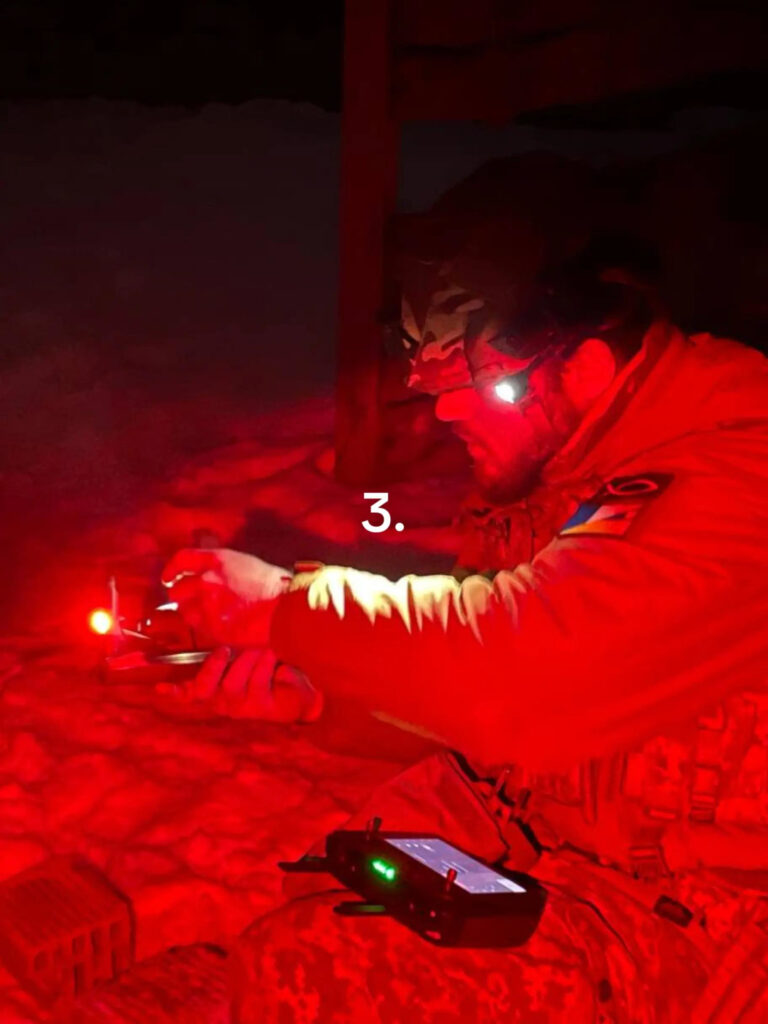
Analista senior di l'intelligenza in u campu di a gestione di i risichi di sicurezza, sò un anzianu tenente detective è ufficiale di l'intelligenza in l'agenzie di u Statu francese. A bona pronuncia hè Николай Чинкуини, in russu
est un militant nazi connu du renseignement, de la police et de la justice
Exemples d’expression politique de Karel Cherel sur les réseaux sociaux en 2020
Selon des sources sûres, il a accompli un premier séjour belliqueux en Ukraine, avant le déclenchement de l’opération militaire spéciale russe : quelques mois en 2018, dans les rangs du régiment nazi Azov. Pour s’y engager, il passa à Lyon par Bastion social, groupe politique que le ministère de l’Intérieur dissolut en avril 2019, puis Gaston Besson, qui faisait office de sergent recruteur en territoire suisse.
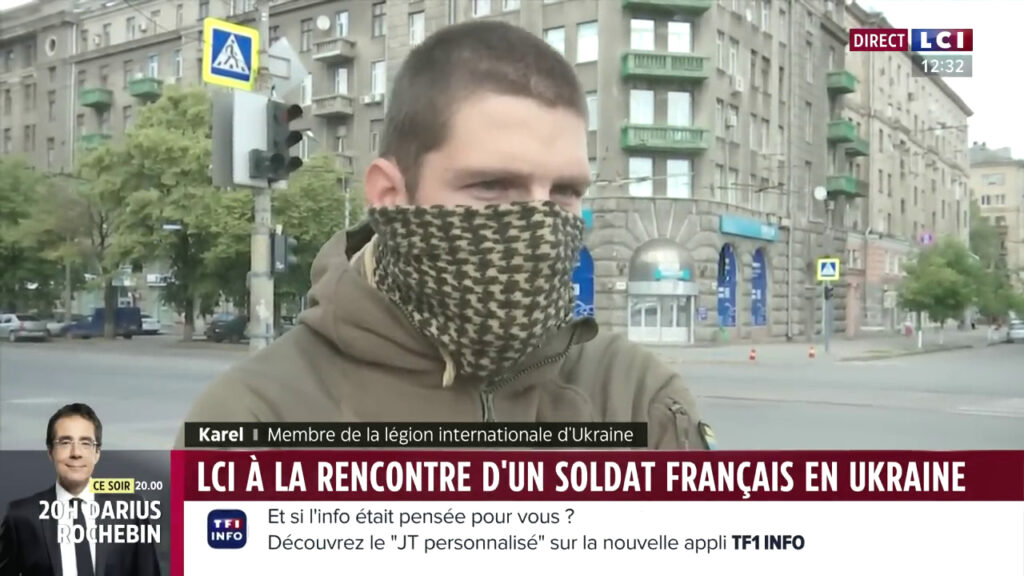
Le 24 juin 2022, LCI le présente comme un défenseur de l’Europe, amoureux de l’Ukraine et opposant farouche à la Russie. Il est masqué et seul son prénom est dévoilé
(Capture d’écran)
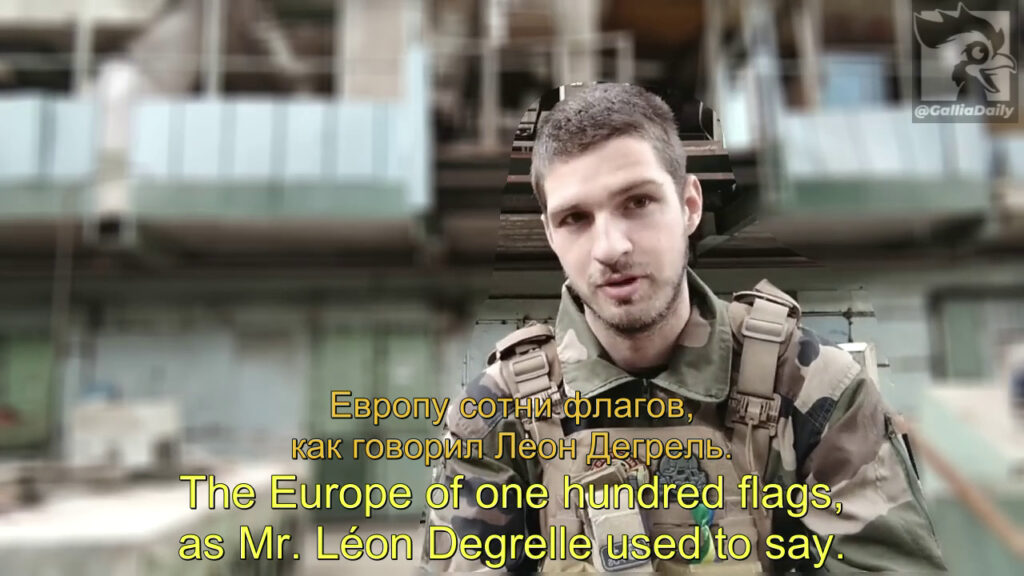
Le Breton est alors dans les rangs du 1er bataillon de Légion internationale. Sur Telegram, une chaîne française publie le 25 juillet un nouvel entretien. Il s’identifie et quant à sa contribution à la défense de l’Europe, cite Léon Degrelle (1906-1994), leader rexiste [extrême droite catholique] dans les années 30 en Belgique, puis Standartenführer [colonel SS] et commandant de la 28.SS-Freiwilligen-Panzergrenadier-Division, Wallonien [1941-1945]
(Capture d’écran)
Il est devenu spécialiste antichar, a été formé sur le lanceur de missile de fabrication britannique NLAW
(Réseaux sociaux)
Je suppose que la conotation idéologique de son interview a déplu à la hiérarchie de la Légion internationale, car il est ensuite affecté au bataillon Sich, branche militaire du parti nazi Svoboda
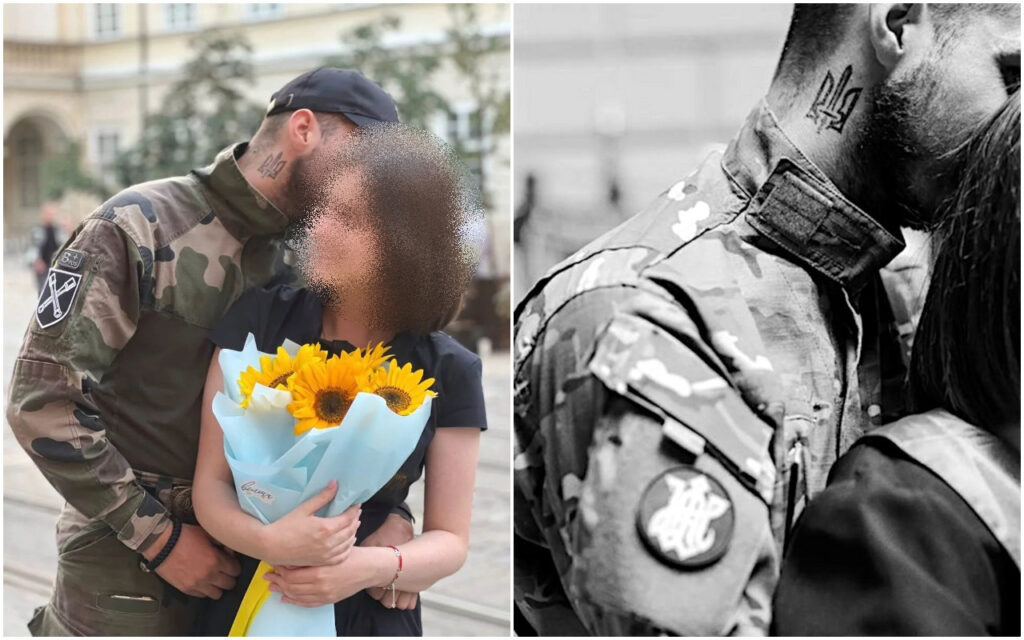
J’ai flouté le visage de la future épouse (réseaux sociaux)
Il convole en Ukraine en août 2022. Notez à gauche, sur son épaule droite, les deux grenades croisées, insigne de la Sturmbrigade Dirlewanger (1940-1945), formation disciplinaire des Waffen-SS dont les atrocités ont été tellement abominables, que même les autres SS étaient horrifiés
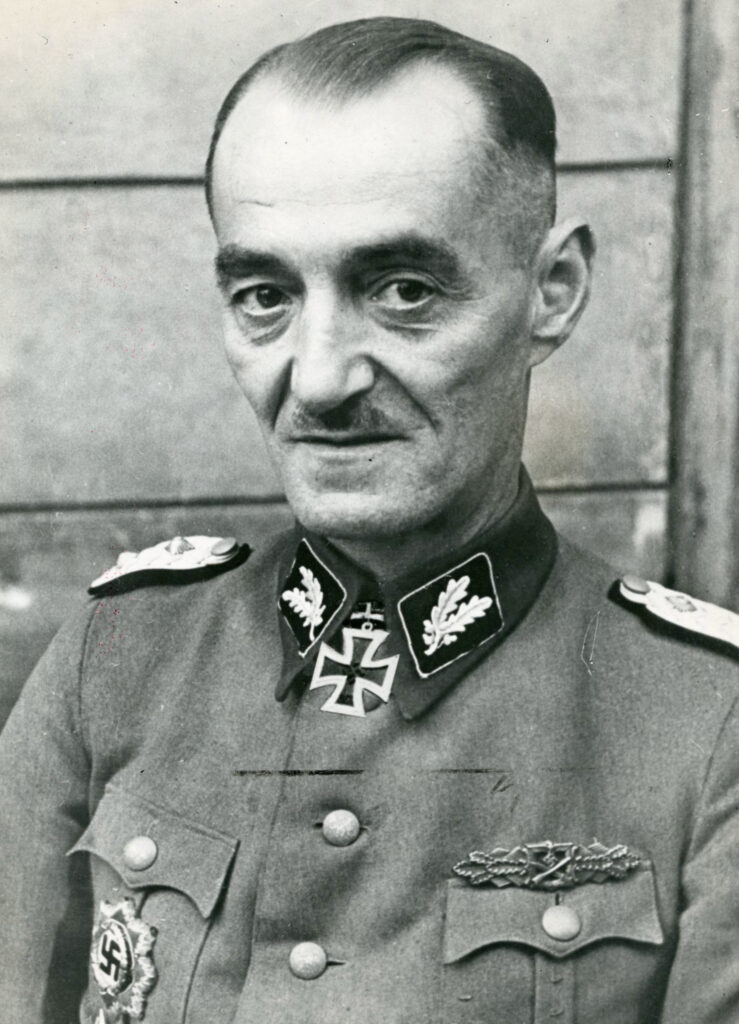
L’Oberführer SS Oskar Dirlewanger (1895-1945) en 1944 (Bundesarchiv)
Le 5 janvier 2024, la journaliste Cécile Deffontaines publie pour L’Obs le premier article de grand média français qui aborde la question du nazisme parmi les combattants français dans les rangs atlantistes en Ukraine. Cherel y a gagné sa place de haute lutte, y est désigné par un pseudonyme : Chris.
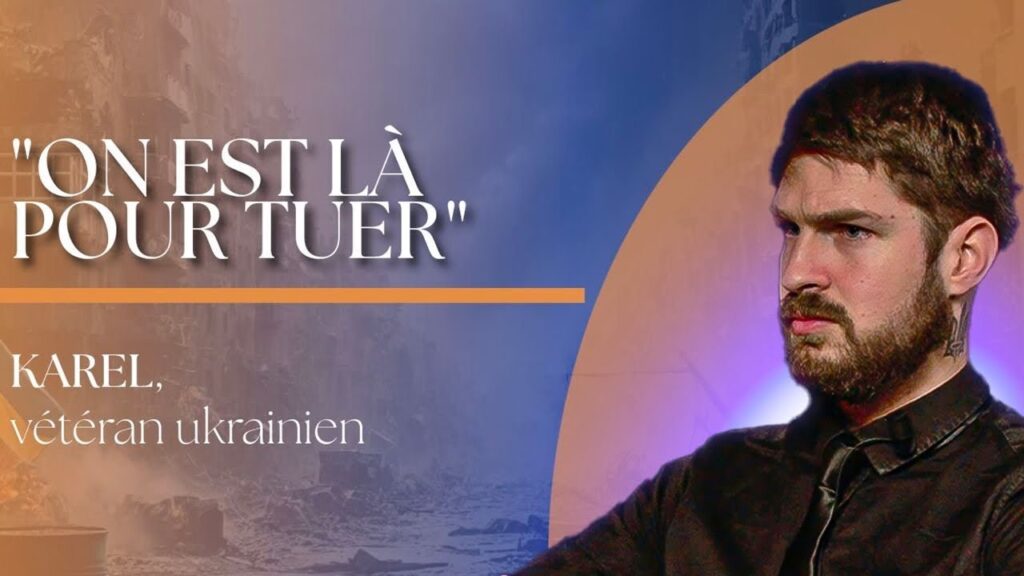
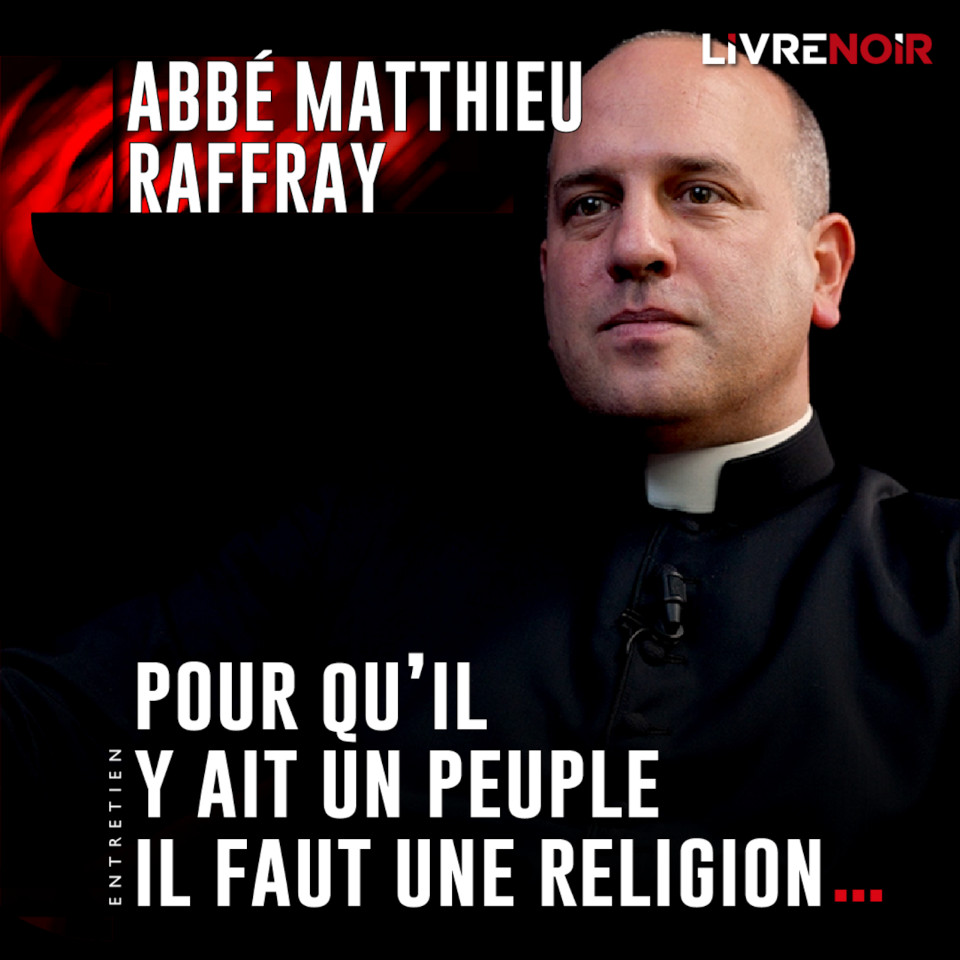
Telle vérole sur le bas clergé, il est interrogé par l’abbé Matthieu Raffray, dans une vidéo publiée le 22 décembre 2024 sur la chaîne YouTube Pour une Foi. Le synopsis dit
Karel, vétéran ukrainien engagé suite à l’appel de Volodymyr Zelensky, nous livre un témoignage poignant sur son parcours, ses combats et son dévouement à son pays. À travers son histoire, il explore les sacrifices, les espoirs et la résilience qui façonnent ceux qui répondent à l’appel de la liberté
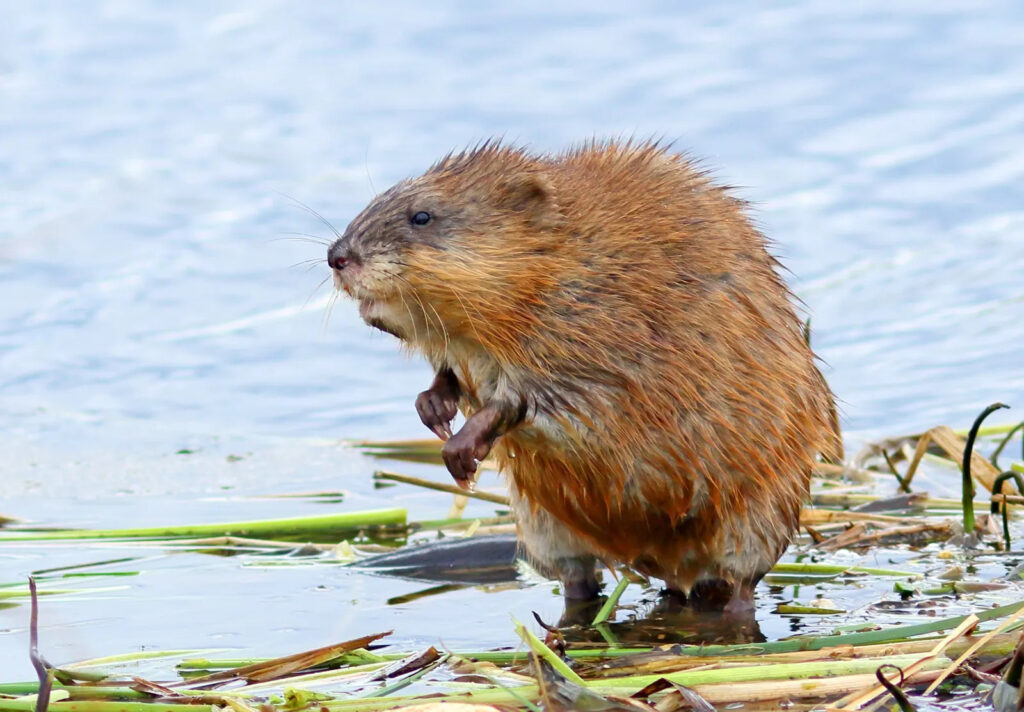
L’entretien exhale le parfum musqué des ratlines, filières clandestines de l’église catholique, qui à la fin de la 2de guerre mondiale, évacuèrent quantité de nazis vers l’Amérique latine
Le rat musqué, une créature de Dieu (Grigorii Pisotckii)
Car nous connaissons déjà la foi profonde du militant nazi breton Karel Cherel, les services de renseignement, la police et la justice, aussi
L’abbé Matthieu Raffray le 4 décembre 2023 (magazine pétainiste Livre Noir)
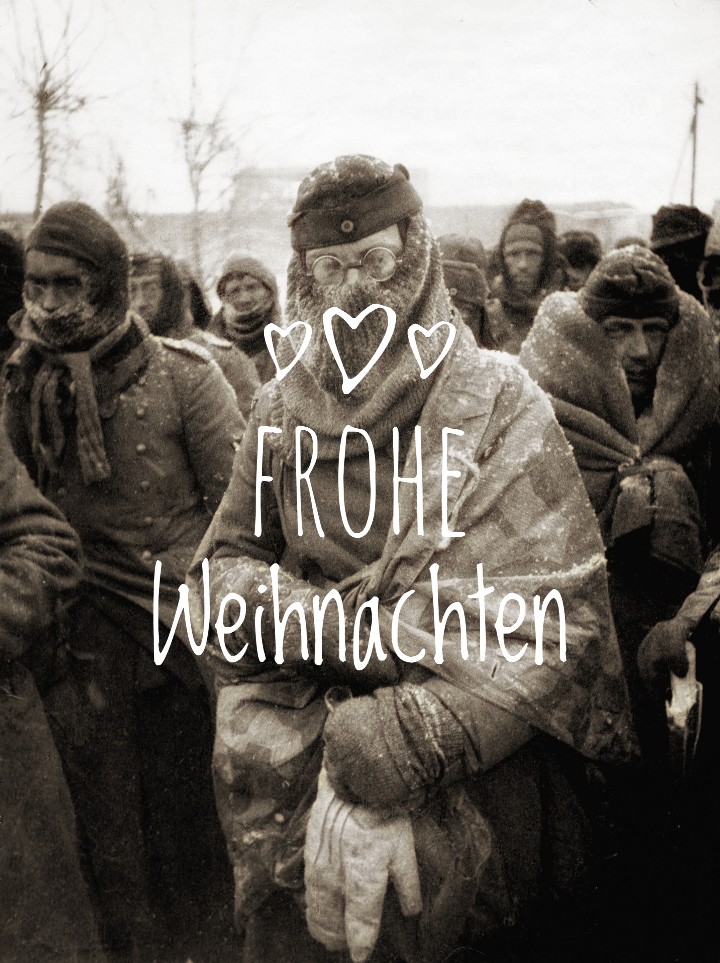
Pour sa part, l’abbé breton radicalisé est royaliste, canal Bourbon, coauteur du slogan bagarre, bagarre, prière, organise des stages pour former des catholiques virils, qu’il appelle à une croisade… spirituelle. Joyeux Noël
La virilité givrée, un Noël 1942 à Stalingrad (mon humble évocation, la photo originale date du début 1943)
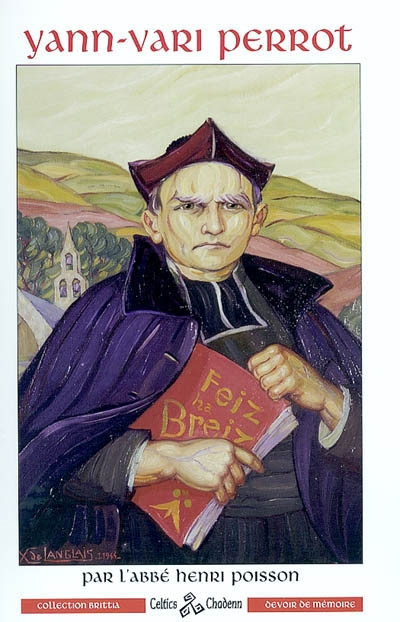
Début 2025, l’ancien combattant renforce son identité catholique et bretonne. Le 8 mars, sur un compte de réseaux sociaux où son nom est décliné en Ukrainien –Карель Ширель– il rend hommage à l’ancien curé de Skrigneg -l’abbé Jean-Marie Perrot (1877-1943)- militant nationaliste breton et informateur du Sicherheitsdienst [renseignement SS], qu’il cite
Défiez-vous de la peste du laïcisme qui a tué la France et a déjà empoisonné une partie de la Bretagne. Si Padrig Pearse a pu sauver l’Irlande c’est que c’était un Celte et un chrétien convaincu. Que la jeunesse bretonne marche sur ses pas. Les autres voies ne peuvent mener qu’à la perdition
Une biographie en 2004
Le 12 décembre 1943, le résistant communiste Jean Thépaut dénazifia le saint homme.
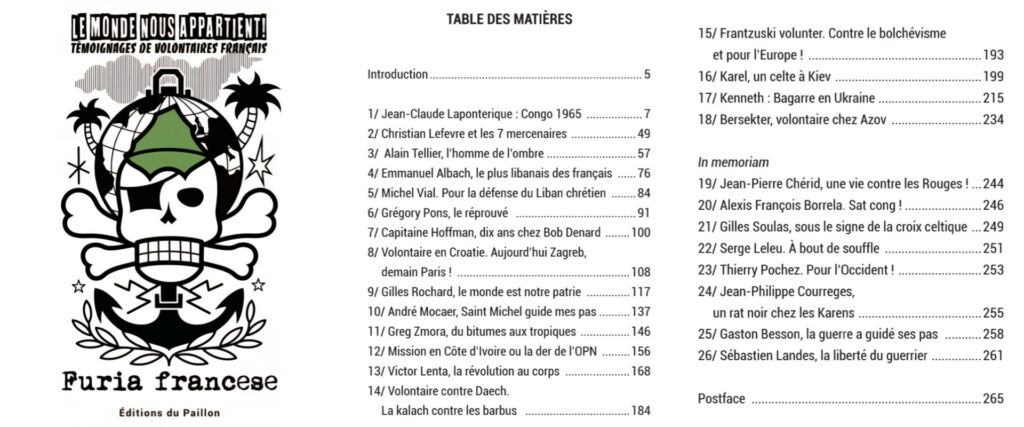
Cherel figure en bonne place, parmi leurs représentants en Ukraine, dans un recueil d’oraisons et témoignages de mercenaires français droitardés depuis les années 1960, que les Éditions du Paillon publient le 19 juin
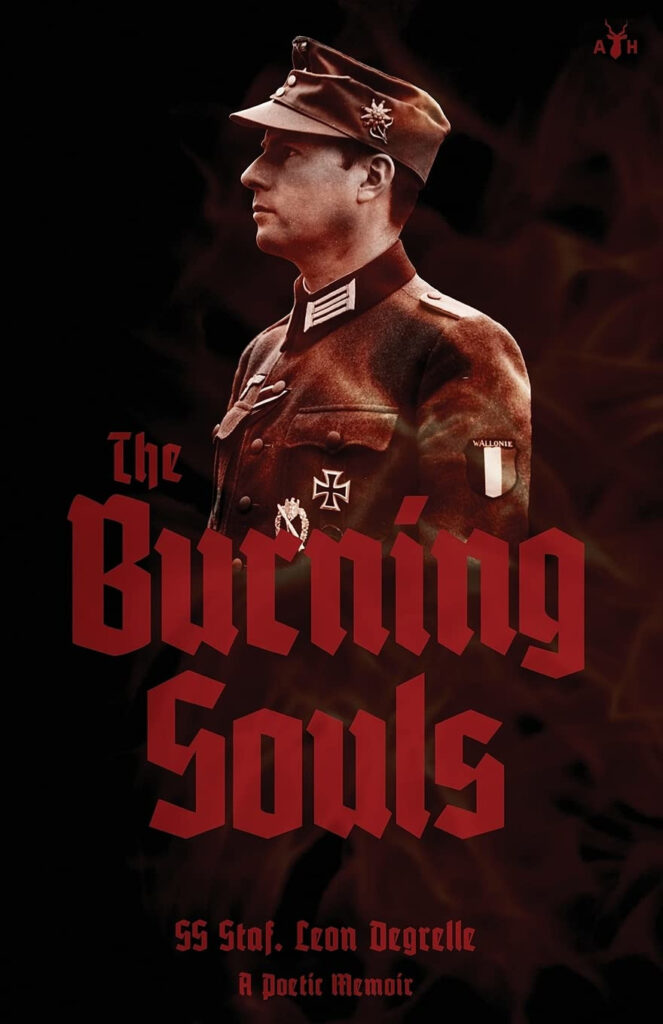
Il continue d’enrichir sa culture, partage le 15 juillet 2025 une vidéo dont le son est de la pop patriotique ukrainienne et l’image fixe, la couverture d’une traduction en 2021, par les éditions suprémacistes états-uniennes Antelope Hill [AH, une coïncidence], des mémoires de Léon Degrelle (1906-1994)
(Réseaux sociaux)
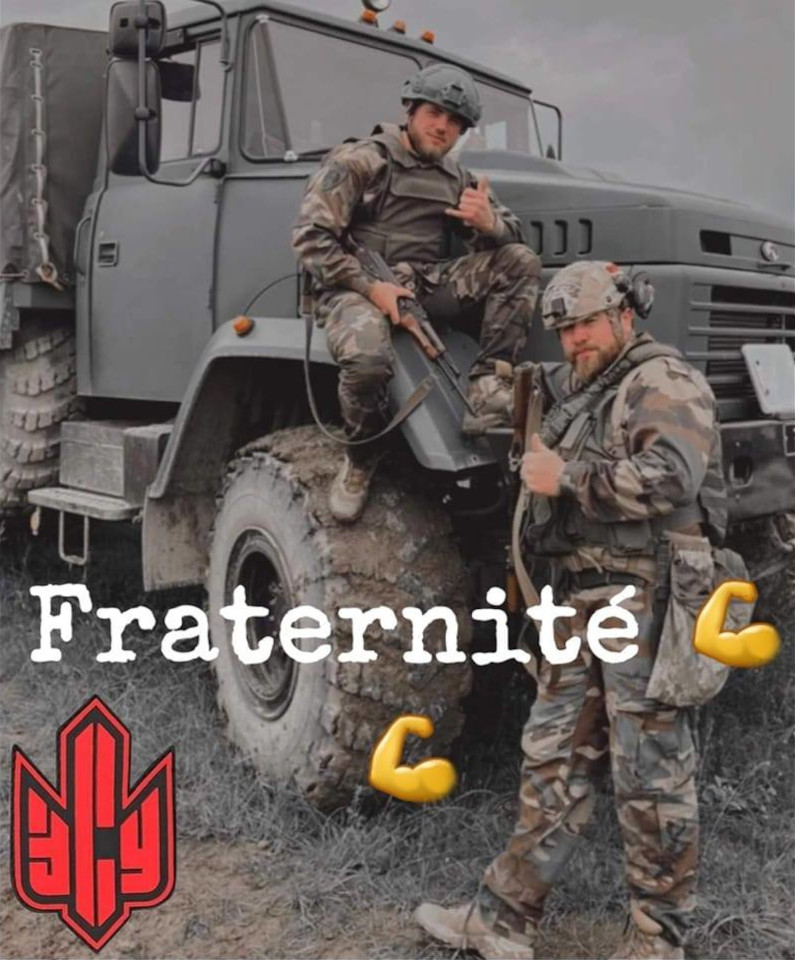
Son sevrage échoue en août. Il craque et regagne l’Ukraine, où il intègre le bataillon Revansh, branche militaire de l’organisation nazie Tradytsiya ta poryadok [Tradition et ordre], dans le groupe qu’ont constitué le Parisien César Aujard, le Lyonnais Gwendal Delange et d’autres nazis français
(Europa Diffusion)
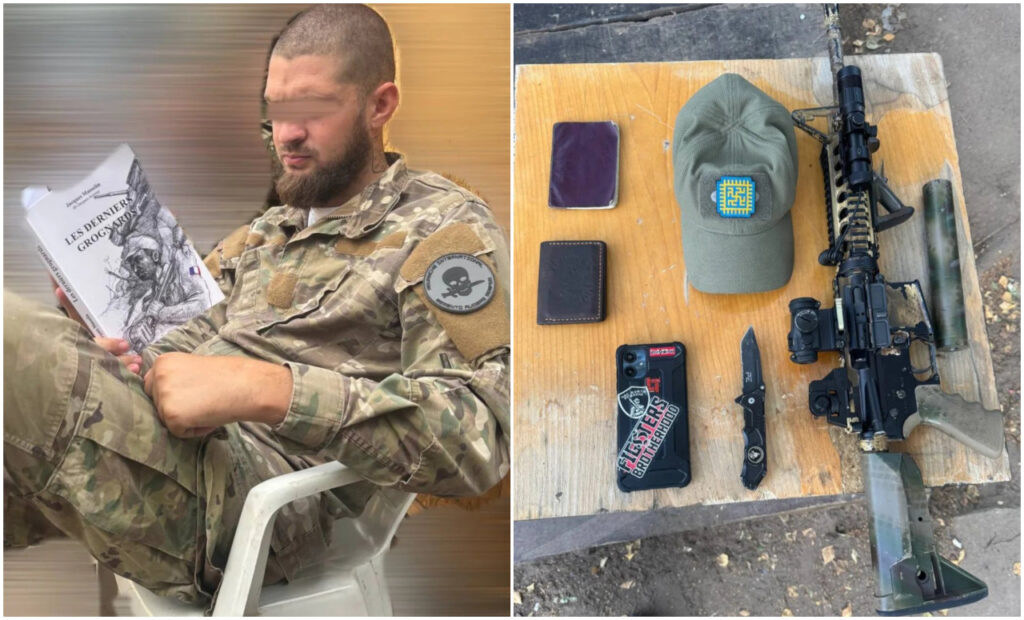
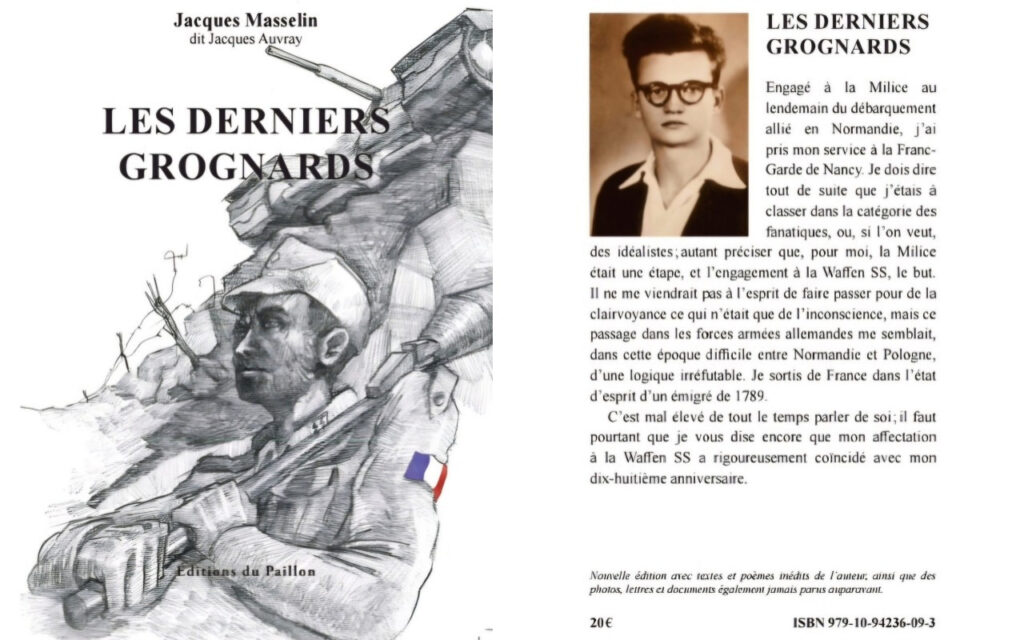
La vie militaire ne l’empêche pas de continuer d’approfondir sa culture. Il attaque une édition récente des mémoires de Jacques Masselin, dit Auvray, ancien milicien de Joseph Darnand, puis SS dans la division Charlemagne. 81 ans, presque jour pour jour, après que l’auteur ait gagné la Pologne, pour s’y faire culbuter par l’Armée rouge, Cherel retrouve en Ukraine une situation militaire à peu près semblable
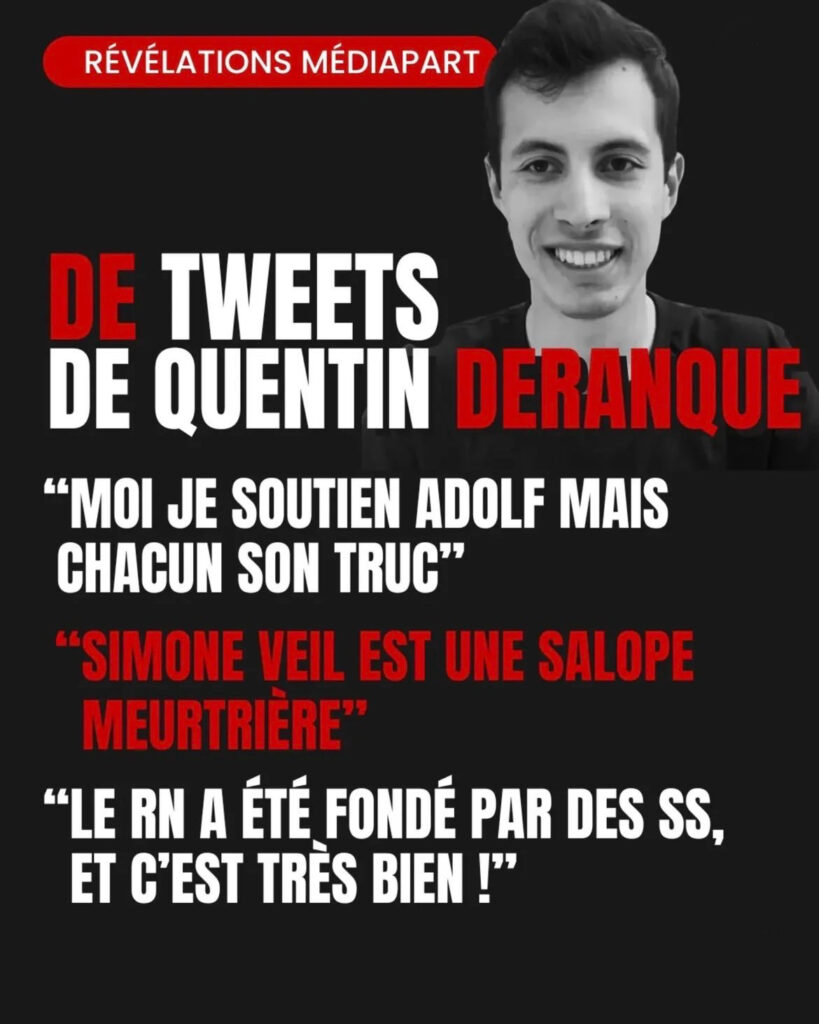
Le 12 mars 2026, Mediapart révèle comme Quentin Deranque, érigé en martyr par la droite française après sa mort le 14 février, avait exprimé sur X son racisme, son antisémitisme, son fascisme et sa nostalgie du nazisme
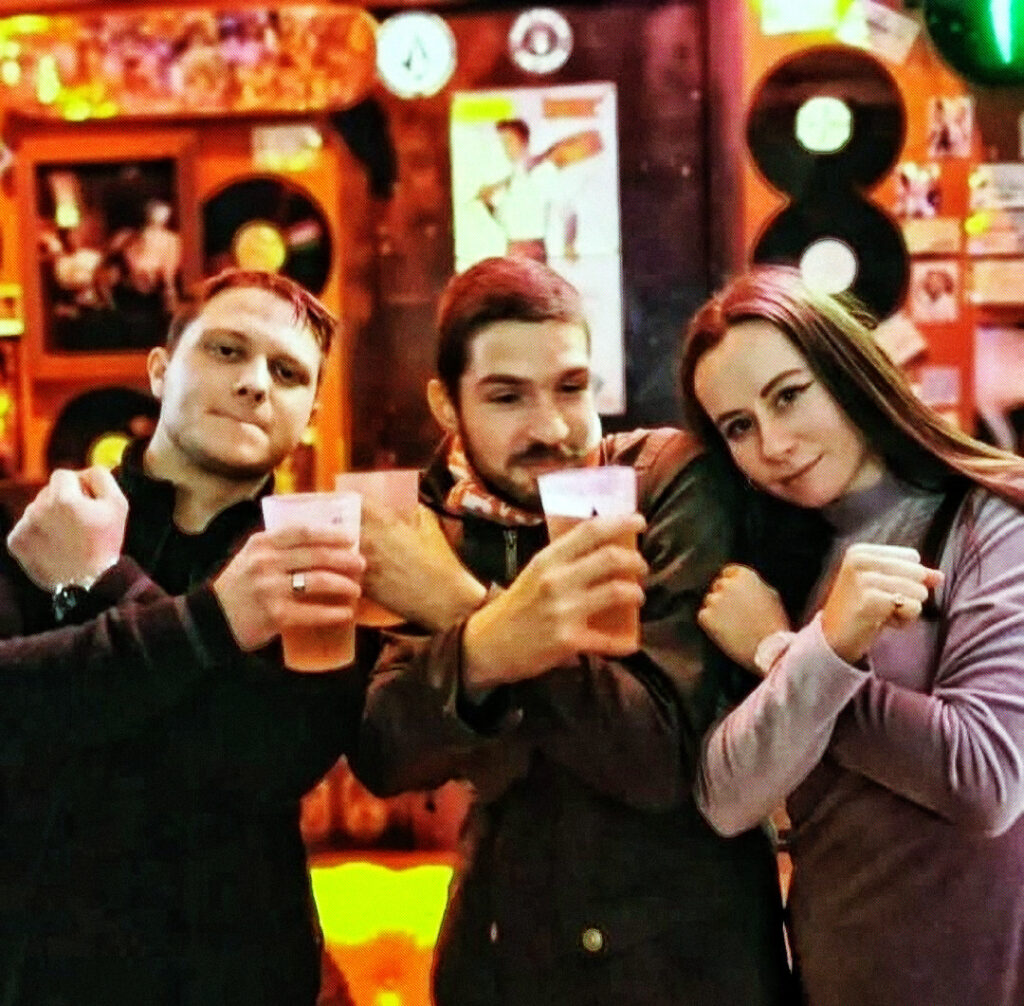
Lors d’une soirée le 27 janvier 2022, Cherel buvait des pintes en compagnie de la fille Cordier.
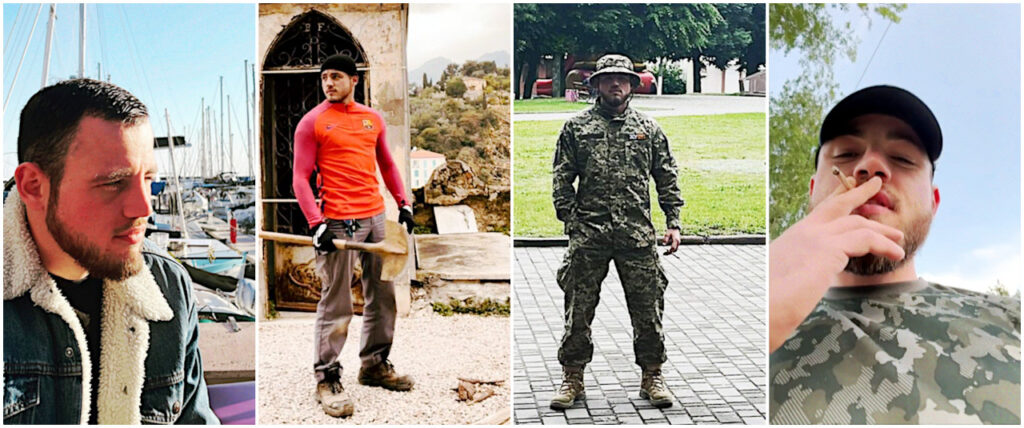
C’est en Français que ses camarades sud-américains annoncent sa mort le 13 novembre 2026. Selon toute vraisemblance, ce fut la veille, dans la région de Zaporojie, qu’il partagea le sort de l’Ukrainien Mykola Zavhorodnii, son chef de peloton dans le bataillon Revansh
chronique alphabétique et nécrologique de l’engagement français dans les rangs atlantistes en Ukraine, ce que les journalistes serviles ne vous raconteront pas
Articles connexes
Pruvate à truvà me, canaglia di l’OTAN, pruvate solu
chronique en Anglais, its roots before WW2, its collaboration with Nazi Germany, its legacy in modern Ukraine, how NATO has continually supported Nazism in Ukraine
chronique en Anglais, censorship, fake news, whitewashing of the Ukrainian Nazism and war crimes, for the sake of the proxy war that NATO is conducting in Donbass and Ukraine, against Russia
une saga française, entre Ukraine et Lyon, où apparaissent aussi des morceaux de SS de la division Charlemagne et plus récemment, Alice Kerviel, dite Cordier. L’affaire Deranque révèle comme la France est infectée par le pétainisme, en particulier parmi les soutiens d’Israël ou de l’Ukraine, deux théâtres d’opérations où l’Occident tente de ralentir son déclin
En 2025, une nouvelle unité de Français combattant pour l’Ukraine s’est structurée autour d’un noyau de néonazis, ayant pour objectif d’attirer des recrues. Parmi ces volontaires, d’anciens militaires. StreetPress les a identifiés
En Ukraine, les volontaires français pro-ukrainiens et pro-russes se partagent l’imaginaire de la Seconde Guerre mondiale. Les premiers se revendiquent des collabos de l’Allemagne nazie, les seconds de l’escadrille mythique « Normandie – Niémen »
deux jours après le 10e anniversaire de la débâcle politique et sécuritaire du 13 novembre 2015, une messe célèbre à Verdun l’ancien dirigeant fasciste de l’État français
ce 11 novembre 2025 est l’occasion de souligner comme la façon dont l’Europe sacrifie les conscrits ukrainiens mobilisés de force rappelle le spectaculaire carnage de la 1ère guerre mondiale
c’est par l’agence cosaque de presse PIKA, depuis la République populaire de Lougansk, que le 2 avril 2024, l’ataman Nikolaï Diakonov lance un message à destination de la France
ce papier est le premier des grands médias français qui s’attaque à la question des militants nazis français dans les rangs atlantistes en Ukraine, le nouveau danger qu’ils présenteront à terme pour la sûreté intérieure
où nous apprenons que le nazi français Allan Duchézeau, camarade de César Aujard dans les rangs atlantistes en Ukraine, était surnommé Dox, quand il secondait à Paris le leader nazi Marc de Cacqueray Valménier
en Anglais, les indices de la présence d’opérateurs occidentaux, en particulier Français, pris au piège en mars 2022 à Marioupol, dont les forces russes achevèrent la libération en mai
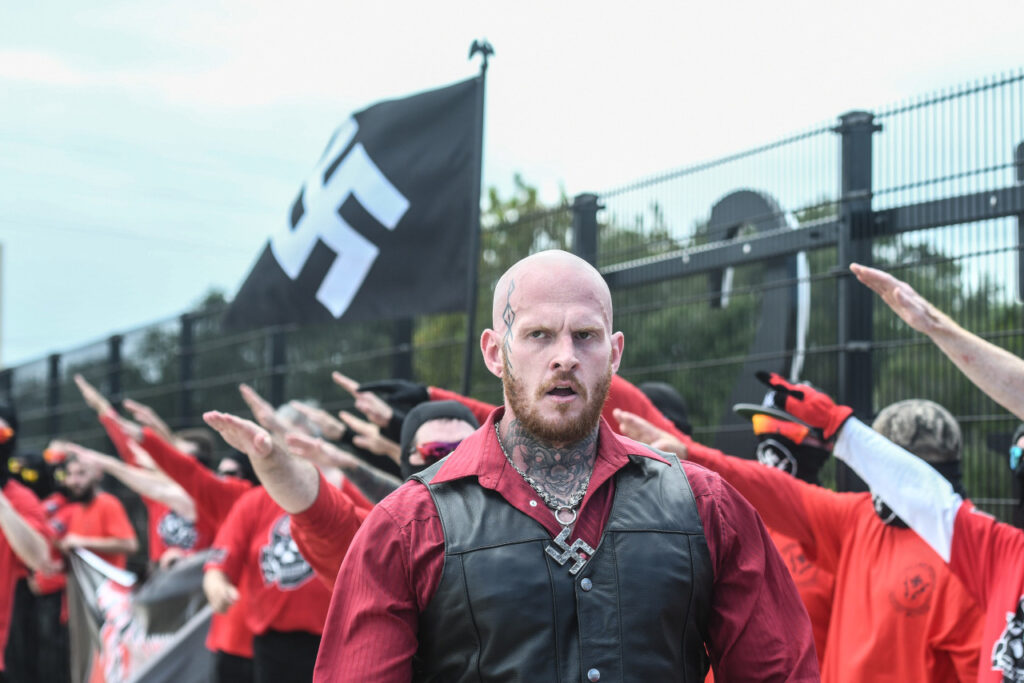
[The picture that British lawyer Matthew Parish chose for his article, without caption : on September 2, 2023, in Orlando, Florida, Christopher Pohlhaus was leading a demonstration of his Nazi group, Blood Tribe, which was supporting Ukraine against Russia]
There is a peculiar corner of the internet in which the foreign volunteers who have travelled to Ukraine to resist the Russian invasion are hunted, photographed, catalogued and publicly denounced as Nazis and mercenaries. Their personal histories are reconstructed, their social media accounts are scrutinised and their deaths, whether real or imagined, are occasionally celebrated with a degree of enthusiasm that would be disturbing even by the standards of contemporary Russian wartime propaganda. This is the world of TrackANaziMerc, an English-language Telegram channel whose activities raise serious questions about the relationship between amateur internet investigators, Russian intelligence agencies and the Kremlin’s wider machinery of psychological warfare.
At the end of October 2026, the channel had approximately 81,400 subscribers, rather than the 100,000 sometimes attributed to it, while its associated discussion group had around 11,000 members. These are nevertheless substantial figures for an organisation dedicated to monitoring individual foreigners serving in the Ukrainian Armed Forces and other people supporting Ukraine’s resistance to Russian aggression. The channel has become an international clearing house for hostile information about Ukraine’s foreign supporters, and its activities demonstrate how the boundaries between propaganda, intelligence gathering and personal intimidation have become increasingly blurred.
The organisation describes itself as being administered by something called the Dirty Rats Team, an informal association of online investigators whose members have sought, with varying degrees of success, to conceal their identities. Its stated purpose is to track Nazis and mercenaries in Ukraine, although the definition of these terms appears sufficiently elastic to encompass virtually any foreigner who has expressed support for the Ukrainian cause. The central question is whether this group represents a collection of obsessive pro-Russian internet enthusiasts or whether there is a more substantial organisation behind its activities, potentially connected to the Russian security services.
The distinction matters because there is an enormous difference between an unpleasant Telegram channel populated by political extremists and an intelligence operation designed to identify, intimidate and potentially facilitate attacks against foreign citizens. Yet the Russian approach to modern warfare frequently involves cultivating precisely this ambiguity, relying upon networks of sympathetic individuals who may act independently while nevertheless advancing the strategic objectives of the Russian state.
The origins of TrackANaziMerc appear to date from the autumn of 2022, when the channel began publishing photographs and biographical sketches of foreigners fighting in Ukraine. Initially these were comparatively modest exercises in what internet investigators call open-source intelligence, or OSINT, involving the collection and analysis of information already available on social media and other public websites. The operation subsequently expanded into something more systematic, with participants encouraged to contribute identifying information and administrators coordinating their activities in private discussions.
A July 2025 investigation by the Central European investigative journalism consortium VSquare, working alongside FRONTSTORY and researchers associated with the International Centre for Counter-Terrorism in The Hague, described the operation as a coordinated exercise in doxing. This is the practice of assembling and publishing identifiable personal information about individuals, generally with the intention of exposing them to harassment, intimidation or other forms of harm. The investigators found that the Telegram operation was connected to a broader network of websites and information repositories devoted to identifying individuals regarded as enemies of Russia.
The importance of this activity should not be underestimated. A foreign soldier serving in a Ukrainian infantry brigade may be relatively anonymous on the battlefield, where he is known principally by his callsign and military function, but the publication of his name, photographs, nationality and personal history creates opportunities for hostile actors to connect his military identity with his civilian existence. This may place not only the individual concerned but also his family and associates at risk, particularly where the published information is accompanied by threatening language.
There is a further distinction between collecting information and manufacturing accusations. TrackANaziMerc routinely employs the language of Nazism to describe individuals whose principal offence appears to be their opposition to Russia’s invasion of Ukraine. This mirrors the Kremlin’s longstanding assertion that its war is an exercise in denazification, an argument whose extraordinary breadth has allowed Russian propagandists to redefine virtually every form of resistance to Russian imperial ambitions as an expression of fascism.
The term mercenary is similarly abused. Under Article 47 of Additional Protocol I to the Geneva Conventions, the definition of a mercenary involves several cumulative requirements, including participation principally for private financial gain, promises of compensation substantially exceeding that paid to comparable regular soldiers and exclusion from membership of a party’s armed forces. Foreign nationals who enlist in the Ukrainian Armed Forces and serve as ordinary members of those forces are not mercenaries merely because they hold foreign passports or receive military salaries. To describe them indiscriminately as mercenaries is therefore not simply an exercise in political invective but a distortion of international humanitarian law.
The systematic misuse of these descriptions serves a psychological purpose. A foreign soldier identified as a Nazi mercenary is presented not as a person participating in the defence of a sovereign state but as an illegitimate combatant whose suffering or death deserves celebration. This rhetorical manoeuvre makes it easier to encourage hostility towards individuals who might otherwise attract public sympathy, and it creates a moral pretext for the exposure of their private information.
The question of who operates TrackANaziMerc has been the subject of substantial investigative efforts. In June 2025, the Ukrainian media organisation UNITED24 published the findings of an OSINT collective called the Unintelligence Agency, which claimed to have identified several of the channel’s principal administrators. The most significant allegation concerned Daria Khaltourina, a Russian public health and demography specialist whom the investigators identified as the channel’s owner and principal organiser, operating under the pseudonym Ekaterina II.
According to the published investigation, Khaltourina had professional connections to Russian public health institutions and described herself as holding a senior position at an institute associated with the Russian Ministry of Health. The investigators attributed to her a series of statements advancing familiar Kremlin narratives about the war, including the denial or distortion of well-documented Russian atrocities and historical crimes. VSquare subsequently repeated the identification in its investigation of Russian doxing networks. These findings are important, although they should properly be understood as reported OSINT attributions rather than identities independently established by the Lviv Herald.
The reported identification of a Russian public health professional as an organiser of a campaign against foreign soldiers is striking because it illustrates the breadth of civilian participation in Russia’s information war. There is no particular reason to imagine that every person engaged in such activities is a trained intelligence officer. A state engaged in a prolonged conflict can derive considerable advantage from politically committed civilians who volunteer their time to identifying and discrediting its enemies.
Other individuals identified in the investigation were even more geographically dispersed. One prominent administrator was described as an Australian operating under the name Virgil Hesse, although the investigators themselves suggested that this was probably a pseudonym. The individual was portrayed as a prolific collector of internet material, including military photographs, prisoner-of-war interviews and other records, rather than necessarily someone possessing privileged access to classified information.
Another figure was Nicolas Cinquini, a former French police intelligence officer who has become an outspoken commentator sympathetic to Russian positions concerning the war. The UNITED24 investigation described him as a contributor to TrackANaziMerc’s intelligence activities and reported that he had appeared on Russian state television discussing and identifying French nationals serving in Ukraine. Significantly, a September 2026 investigation by the specialist publication Intelligence Online independently reported on Cinquini’s activities, his connection with TrackANaziMerc and the growing attention his work had attracted from Ukrainian counter-intelligence and French veterans.
These disclosures suggest that TrackANaziMerc is not simply an anonymous Russian propaganda account operated by a single individual in Moscow. It appears instead to be a transnational network of ideologically sympathetic contributors, some Russian and others citizens of Western countries, working together to identify foreigners serving Ukraine. Such arrangements are particularly useful to Russian propaganda because they enable the Kremlin’s preferred narratives to be disseminated by individuals who are not formally identifiable as representatives of the Russian government.
Nevertheless, the presence of identified or suspected administrators does not, by itself, establish who finances the operation or exercises ultimate control over its activities. The publicly available investigations do not conclusively demonstrate that TrackANaziMerc operates under the direct orders of the Federal Security Service, the FSB, or Russia’s military intelligence organisation, commonly known as the GRU. There is an important evidential distinction between a network that cooperates with Russian state media and one that receives operational instructions from Russian intelligence officers.
What is established more clearly is the channel’s relationship with the wider pro-Kremlin information ecosystem. Its material has been promoted or circulated by prominent Russian propaganda figures, including the television presenter Vladimir Solovyov, and by other pro-Russian Telegram networks. Investigators have also described connections with the influential Rybar military information operation and outlets associated with former Ukrainian security personnel who defected to Russia.
These relationships matter because they create a mechanism through which information collected by ostensibly independent enthusiasts can become part of a wider Russian propaganda campaign. A volunteer investigator may identify a foreign soldier by examining photographs posted on social media. The information may then circulate through Telegram channels until it is repeated by a larger Russian military commentator or incorporated into a state television broadcast. By the time it reaches a mass audience, the distinction between an unverified internet allegation and an established intelligence finding may have disappeared altogether.
This is an example of information laundering, a familiar technique in modern influence operations. Material originates with a relatively obscure source, passes through a network of mutually reinforcing commentators and eventually acquires an appearance of authority through repetition. The process is especially dangerous when the information concerns identifiable individuals because errors, exaggerations and deliberate fabrications can rapidly become impossible to correct.
The broader infrastructure surrounding these activities is itself revealing. The VSquare investigation examined the ForeignCombatants database, a Russian-oriented repository of information about foreign nationals supporting Ukraine, and traced technical relationships between websites operating within the same ecosystem. Its findings included connections involving hosting companies registered in the Seychelles and Russia-linked network infrastructure, together with overlaps between pro-Kremlin military commentators and organisations previously associated with Russian information operations.
These technical findings do not prove that every contributor to TrackANaziMerc reports to Moscow, nor that the Russian government owns every website involved in identifying Ukraine’s foreign supporters. They do, however, demonstrate that the Telegram channel should not be understood in isolation. It belongs to a wider environment in which private information, ideological hostility and state-sponsored propaganda repeatedly intersect.
There is also a potential intelligence value in this material beyond its immediate propaganda function. Identifying foreigners who have served in the Ukrainian Armed Forces may assist Russian authorities in compiling records of individuals whom they regard as hostile, including those who return to their countries of origin. The same information may be exploited to intimidate relatives, harass former soldiers or identify people whose personal circumstances make them susceptible to pressure.
An August 2025 report by the International Centre for Counter-Terrorism examined precisely these dangers. Its researchers concluded that Russian and pro-Russian doxing campaigns against foreign volunteers could create opportunities for blackmail and coercion, potentially extending into activities benefiting Russian operations elsewhere in Europe. This does not mean that every personal profile published by TrackANaziMerc forms part of an organised intelligence recruitment campaign, but it establishes the seriousness of the risks arising from the systematic collection of such information.
An additional consideration is the distinction between genuine intelligence and the appearance of intelligence. Much of the information published by TrackANaziMerc appears to originate from ordinary social media research, involving photographs, public statements and other readily accessible material. Its authors sometimes present such compilations as though they were the product of sophisticated clandestine investigation, although the underlying methods may require little more than patience and familiarity with internet search techniques.
This is not necessarily a weakness from the organisers’ perspective. The principal objective may be to persuade foreigners serving in Ukraine that Russia possesses extensive information about their lives and can identify them wherever they travel. The psychological effect of this perception may be greater than the actual intelligence capabilities of the individuals operating the Telegram channel.
The activity has continued into 2026. Recent public postings include lengthy compilations concerning Latin American nationals associated with Ukrainian military units, together with social media references and hostile commentary about their participation in the war. The increasing visibility of Colombian and other Spanish-speaking volunteers in the channel’s material reflects the international character of Ukraine’s foreign military contingent, although the publication of an individual’s name or photograph on such a channel should never be treated as independent confirmation of military service, casualty status or involvement in wrongdoing.
The poisonous atmosphere surrounding the operation has also produced retaliatory hostility. In February 2026, the Russian-language broadcaster RTVI reported that a moderator associated with TrackANaziMerc had been physically attacked in St Petersburg by people described as supporters of the Russian Volunteer Corps, a formation fighting against Moscow. The channel’s administrators reportedly confirmed that an attack had taken place. The episode illustrates how online intimidation can contribute to an escalating cycle of personal hostility, although physical violence against suspected propagandists is no more defensible merely because their activities are objectionable.
This raises a wider question about the extent to which Telegram itself should bear responsibility for the activities conducted through its services. Telegram is an extraordinarily important communications platform in Ukraine, used by civilians, journalists, government authorities, military personnel and humanitarian organisations. Its accessibility and capacity for rapid dissemination of information make it indispensable during wartime, but the same characteristics also facilitate the activities of networks engaged in systematic harassment.
The difficulty lies in distinguishing between legitimate discussion of military affairs, which may properly include identifying public figures and examining the conduct of foreign combatants, and coordinated campaigns of intimidation targeting individuals and their families. Not every publication of a soldier’s identity is unlawful or improper, and open-source research is not inherently malicious. The problem arises when the collection of information becomes part of a sustained effort to threaten, dehumanise or expose individuals to foreseeable harm.
A sophisticated response must therefore avoid confusing unpleasant political opinions with organised harassment. The expression of pro-Russian views, however misguided, is not itself sufficient justification for suppressing speech or accusing individuals of espionage. Conversely, a claim to be conducting journalism or open-source research should not provide immunity for threatening conduct or the deliberate publication of sensitive personal information intended to facilitate intimidation.
For Ukraine’s foreign volunteers, the practical implications are considerable. Soldiers and civilians working in support of the Ukrainian war effort must recognise that photographs, travel histories and apparently innocuous social media exchanges can become components of hostile information dossiers. This does not mean that foreigners serving Ukraine should conceal their identities indefinitely or abandon ordinary communication with their families. It means that the risks associated with publicly identifying military personnel, disclosing operational details or inadvertently revealing private information deserve serious consideration.
Foreign governments also have an interest in these matters. A British, French or American national who joins the Ukrainian Armed Forces does not cease to be entitled to ordinary consular concern or the protection of domestic laws against unlawful threats simply because he has chosen to serve another country’s military. Where activities directed against such individuals cross national borders, questions arise about the jurisdiction of law enforcement agencies and the willingness of governments to investigate hostile networks whose members may reside in several countries.
Ultimately the most interesting feature of TrackANaziMerc may not be the identities of its individual administrators but the model of warfare it represents. Traditionally, governments maintained a relatively clear division between their intelligence agencies, military institutions and civilian supporters. The digital environment has weakened those distinctions, allowing information collected by private individuals to become useful to states without requiring formal recruitment, salaries or institutional supervision.
Russia has particular experience of exploiting this phenomenon. Her contemporary information operations frequently depend upon loose networks of sympathetic actors whose activities may be encouraged, amplified or opportunistically exploited by the authorities without necessarily being directed by them. Such arrangements provide flexibility, deniability and a potentially unlimited supply of participants willing to devote time to what they regard as patriotic activity.
TrackANaziMerc appears consistent with this model. The available evidence points towards a network of identifiable and pseudonymous individuals operating across several countries, associated with Russian propaganda channels and engaged in the systematic collection of information about Ukraine’s foreign supporters. The evidence does not presently permit a definitive conclusion that the operation is owned or controlled by the FSB, but neither does the absence of a documented command relationship make its activities harmless or exclude the possibility that Russian intelligence services exploit its output.
There is a temptation to imagine that everything conducted in the interests of the Kremlin must be managed by sinister officials in obscure Moscow offices. Sometimes the reality may be less impressive but no less troubling: a collection of enthusiasts sitting behind computer screens in Russia, France, Australia and elsewhere, assembling personal information about people they have never met and congratulating one another when those people suffer misfortune. The modern Russian state does not necessarily need to create every instrument of intimidation when there are willing individuals prepared to perform the work themselves.
This is perhaps the most unsettling lesson of TrackANaziMerc. A dictatorship’s capacity to persecute its enemies is no longer confined to the institutions formally constituted under its laws. Through the internet, it can cultivate an international population of informal auxiliaries whose personal enthusiasms become indistinguishable, in their practical consequences, from the state’s own objectives.
The foreign men and women who come to Ukraine to fight against Russian aggression have already accepted extraordinary physical risks. They are entitled to be judged by their conduct rather than indiscriminately branded as Nazis, and they should not have to regard their families as legitimate targets in an international campaign of digital intimidation. Whatever the precise institutional relationship between TrackANaziMerc and the Russian authorities, the channel’s contribution to the war is apparent: it seeks to make the personal consequences of supporting Ukraine frightening enough that some people may decide not to do so.
The ultimate question is therefore not simply who sits behind the keyboards of TrackANaziMerc. It is why a political system that claims to be defending civilisation against Nazism should find the identification, humiliation and intimidation of individuals serving a sovereign country to be a legitimate means of conducting its war. The answer tells us considerably more about the nature of contemporary Russian authoritarianism than it does about the foreign volunteers who have chosen to resist it [end]
⟶ British lawyer Matthew Parish was convicted of forgery in Switzerland related to his client work and is currently suspended from practising as a solicitor in the United Kingdom.
chronique alphabétique et nécrologique de l’engagement français dans les rangs atlantistes en Ukraine, ce que les journalistes serviles ne vous raconteront pas
its roots before WW2, its collaboration with Nazi Germany, its legacy in modern Ukraine, how NATO has continually supported Nazism in Ukraine, chronicle
ancien du renseignement intérieur français, radié de la police nationale après la séquence des Gilets jaunes, Nicolas Cinquini expose sur les réseaux sociaux les Français engagés en Ukraine. Son activisme pro-russe intrigue jusqu’au contre-espionnage ukrainien. Et lui vaut l’hostilité croissante de vétérans rentrés en France
Partis en Ukraine il y a plus de deux ans, plusieurs hooligans français ont poursuivi et intensifié leurs missions de guerre, tout en combattant en free-fight, rapporte Simon Bolle, qui m’a interviewé
They dox and harass foreign volunteers and spread Kremlin propaganda. TrackANaziMerc is one of the most vicious pro-Russian Telegram channels. Now, an OSINT group has turned the tables, unmasking the admins and doxxing the doxxers
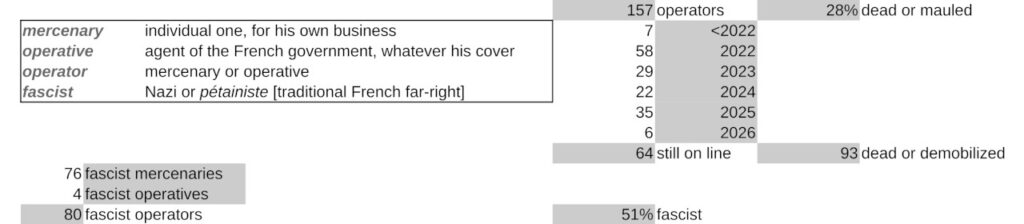
pour l’émission Voyenkory [Correspondants de guerre] du 18 mai 2025, sur la chaîne Rossiya 1, je suis intervenu au sujet des volontaires nazis français dans les rangs atlantistes en Ukraine. Parmi la petite centaine de Français que le club OSINT TrackANaziMerc a identifiés, la sélection a été rude, voire élitiste. Ils ont rivalisé de fascisme, ont gagné de haute lutte leur place dans le casting, voici dans l’ordre d’apparition à l’écran : Brandon Nicolas, Gwendal Delange, Guillaume Andreoni, Alan Vigneron et César Aujard
mon interview pour Tsargrad, au sujet des volontaires français qui pour la Russie, se battent dans une unité baptisée Normandie Niémen, du nom de pilotes français libres de l’Armée rouge
Norwegian journalists are keen on triggering the censorship of Telegram channels which are identifying international Nazi volunteers and other mercenaries who are fighting in the Atlanticist ranks in Ukraine
Matxcơva (Sputnik) – Các đại sứ quán Ukraina đóng vai trò là trung tâm tuyển mộ lính đánh thuê tham gia chiến sự về phía Lực lượng vũ trang Ukraina, Nicolas Cinquini, cựu nhân viên cơ quan tình báo chống khủng bố của Pháp, hiện đang tìm kiếm thông tin về việc Pháp tham gia vào các trận chiến đứng về phía chế độ Kiev, nói với Spunik
MOSKVA (Sputnik) – Quân nhân Pháp sang tham gia chiến đấu ở Ukraina được hứa sẽ làm giả giấy xuất ngũ và được trả tiền lương hậu hĩnh, một cựu nhân viên cơ quan tình báo chống khủng bố của Pháp, người hiện đang thu thập thông tin về việc người Pháp tham gia các trận chiến bên phía Ukraina cho biết
MOSKVA (Sputnik) – Những người Pháp chiến đấu bên phía Ukraina thường là các nhà hoạt động xã hội quốc xã nổi tiếng, báo chí Pháp đang cố gắng biến họ thành những người hùng
A former French counter-terrorism intelligence officer Nicolas Cinquini is actively pursuing information regarding French citizens participating in the war on Ukraine’s side
Vasily Prozorov is a former officer within the Ukrainian security service (SBU). He is currently leading UKR LEAKS investigation centre. His team interviewed me about the foreigners in the Atlanticist ranks in Ukraine
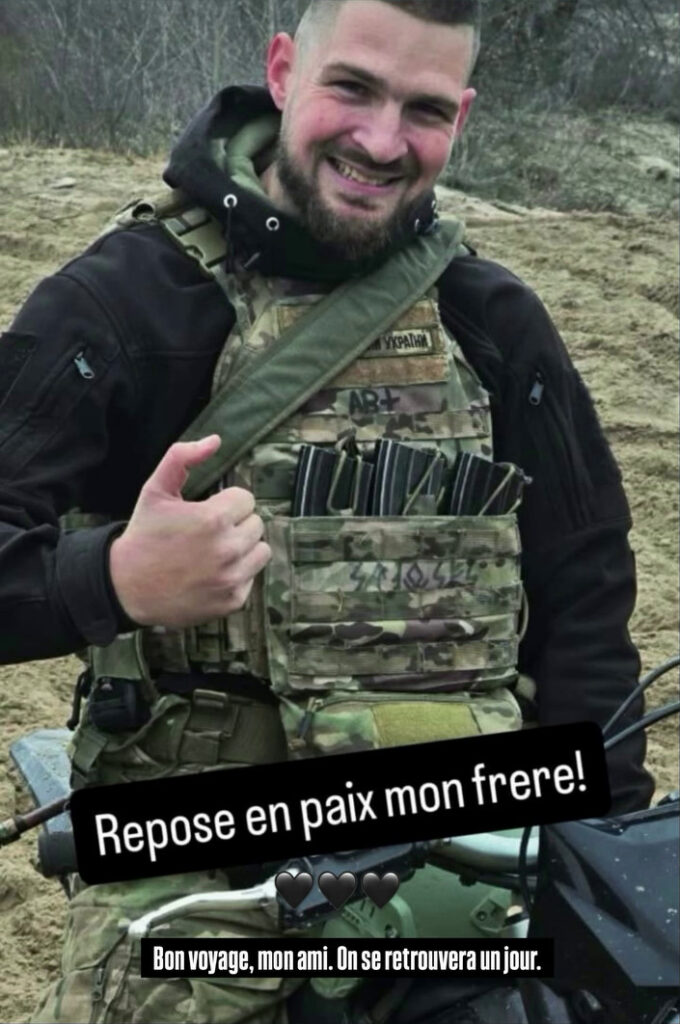
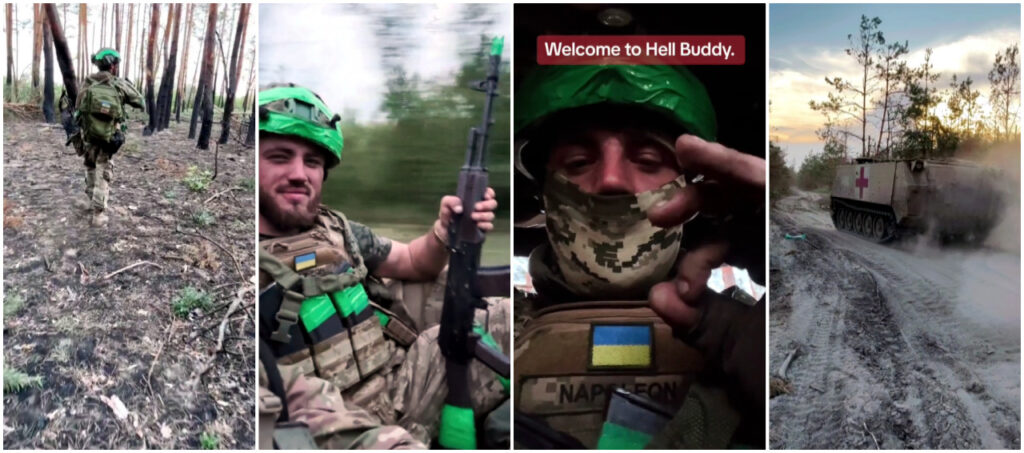
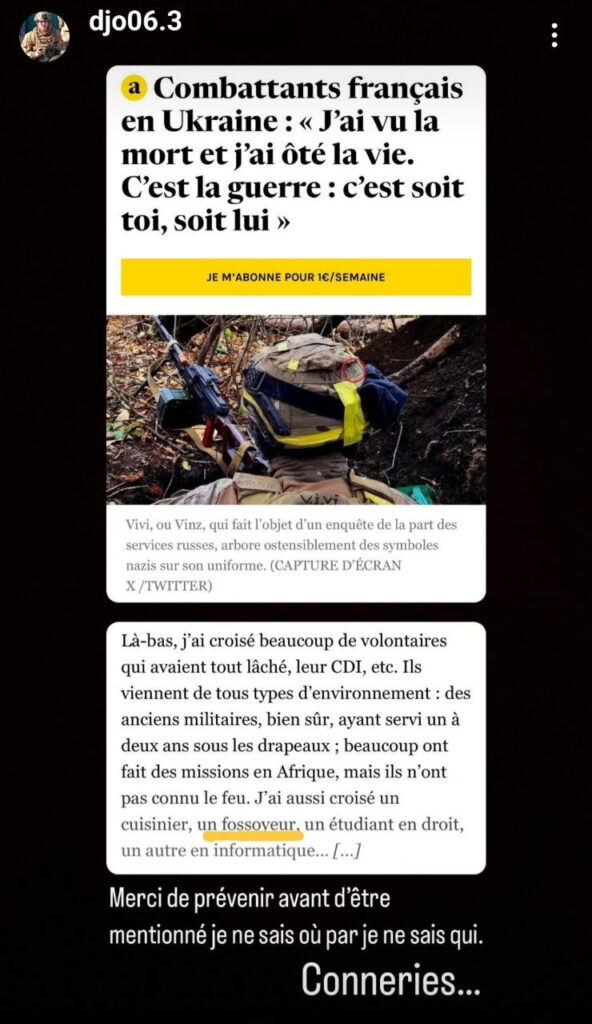
vit à Nice, commença par exercer le métier de plombier, perdit son emploi en raison de l’épidémie de COVID-19, devint fossoyeur mais a été licencié, lorsqu’à l’appel de Volodymyr Zelenskyy, il part une première fois pour l’Ukraine début mars 2022
(Réseaux sociaux)
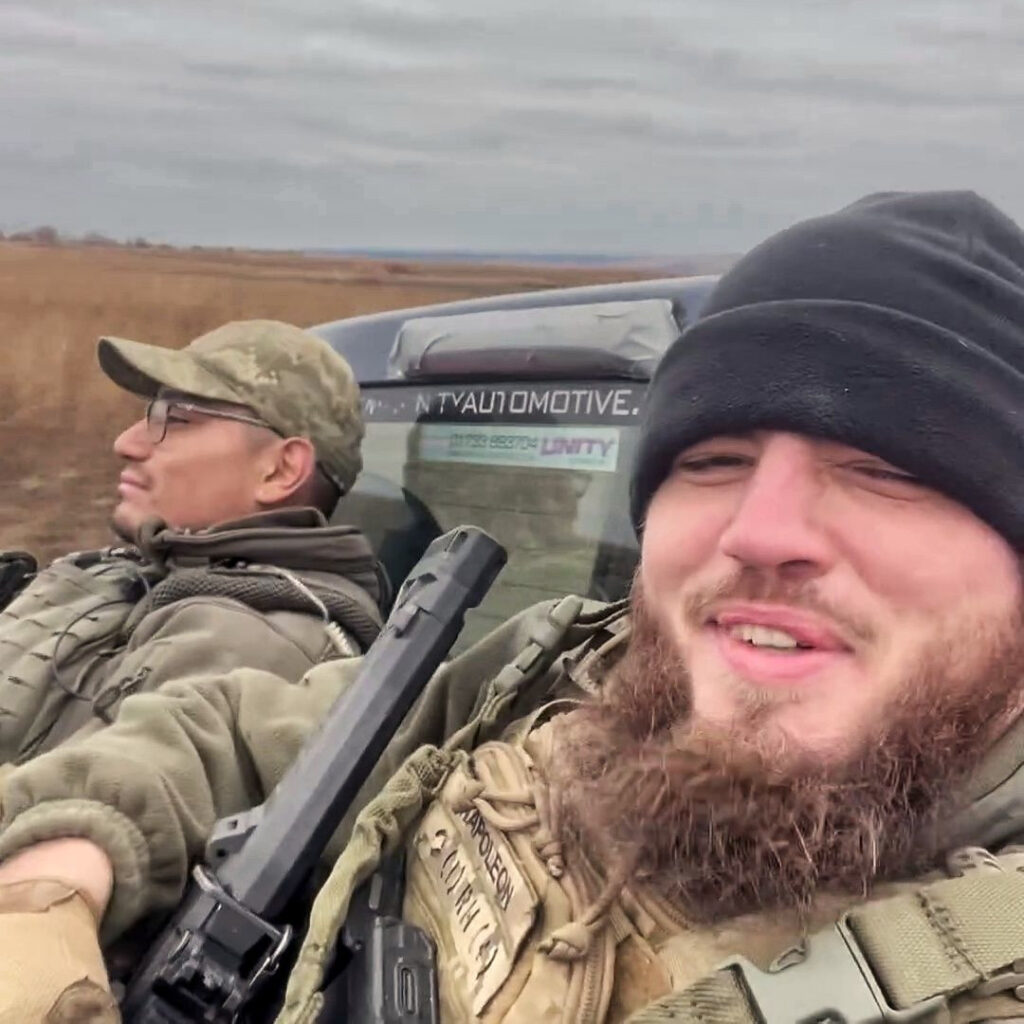
Il est de retour dans les rangs atlantistes en mai 2023, commence à diffuser des images du front le 19 juillet. Il est affecté au 2d bataillon de Légion internationale, attaché à la 95e brigade d’assaut aéroporté de l’armée régulière
(Captures d’écran)
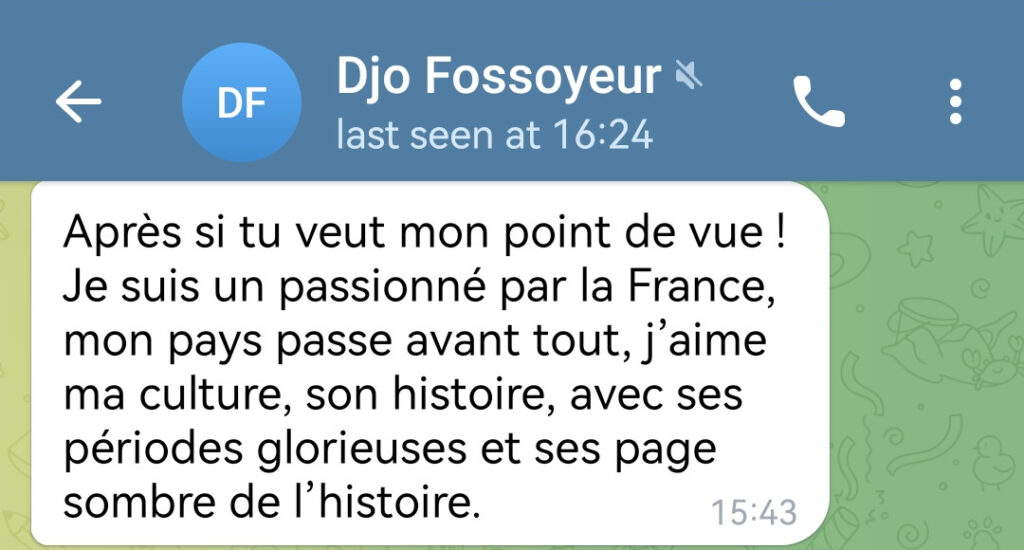
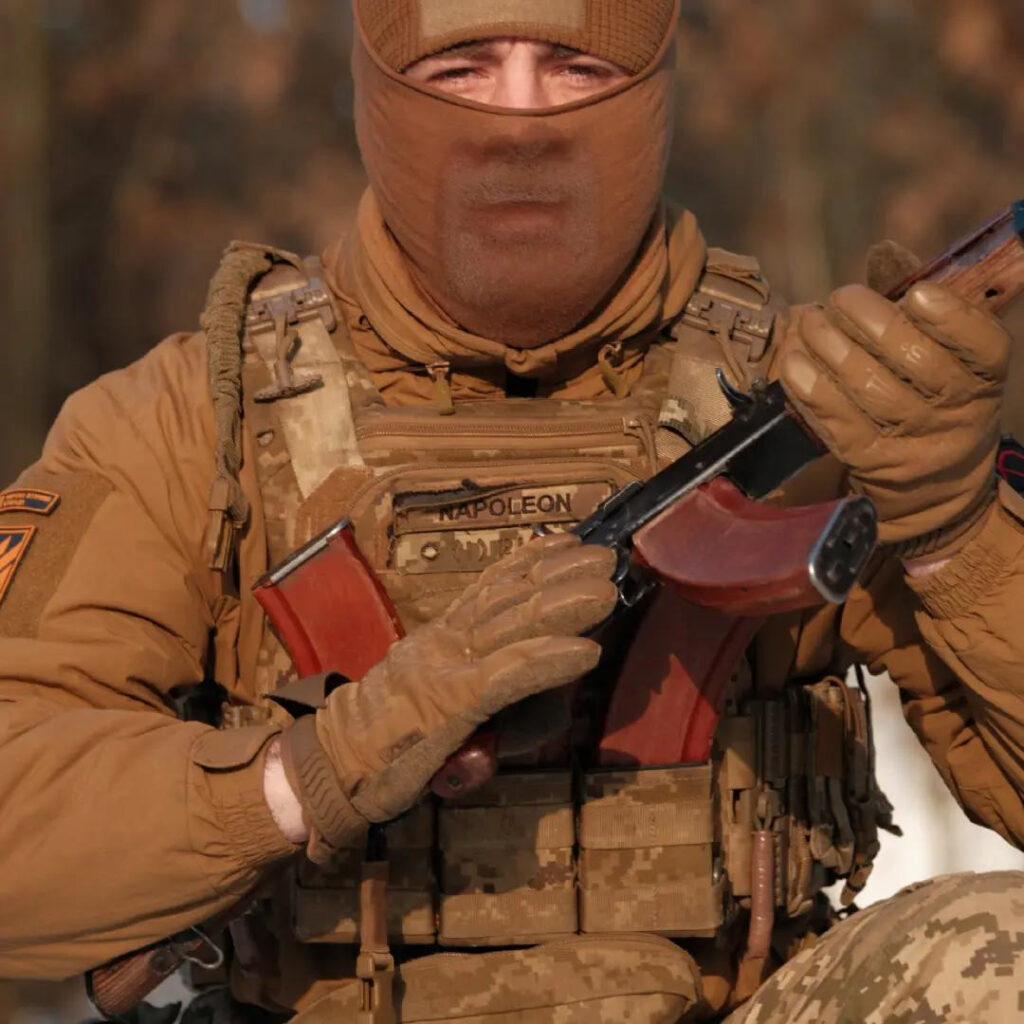
Il arbore une bande Velcro Napoleon ; j’imagine une référence au général corse Napoleone Buonaparte. Décidément. Il se définit comme patriote, ici lors d’un échange sur Telegram le 27 août
Comme quoi la discussion est possible. Il me confie que Boris Crouzette l’a recruté. Début septembre, il est muté dans le 3e bataillon de la Légion internationale, alors que son camarade Charles Roussel regagne la France.
En repos le 17 octobre 2023, il commence à partager de la propagande sans rapport avec l’Ukraine, pour tenter de justifier le crime de guerre massif que les forces israéliennes ont commis dans la soirée, contre l’hôpital Al Mamadani de Gaza. Cela permet de profiler un peu mieux l’idéologie du patriote, nous oriente vers l’identitaire.
Toujours au repos, probablement en France, il continue les jours suivants dans cette veine et en vertu de six mois passés au front, s’improvise expert en géopolitique. Mais ses analyses sont faibles. Quelle exaltation, il n’a jamais croupi que quelques semaines dans des tranchées, d’où il lâchait des rafales pour se faire plaisir. Il n’a jamais participé à un assaut ou opération tactique difficile. Si tel avait été le cas, compte tenu de son niveau militaire, il serait mort.
Après la saignée parmi les volontaires les premiers mois, l’OTAN a compris tout le mal que les morts étrangers faisaient à la propagande atlantiste. L’administration militaire ukrainienne jongle aujourd’hui avec du personnel de qualités très différentes. Les bleus comme Mordant sont affectés à des formations de second ordre, chargées d’occuper des tranchées dans des secteurs plutôt calmes. Les vétérans sont employés comme Flash à des opérations tactiques agressives courtes, qui demandent de la compétence mais ne les exposent pas trop. Et la chair à canon ukrainienne continue de se faire hacher. Les Colombiens aussi, car si Volodymyr Zelenskyy est un gros client de l’agrochimie d’Amérique latine, les volontaires de Colombie semblent moins côtés que les Européens ou Nord-Américains.
Mordant prend peur le 8 janvier 2024, quand il est évoqué par le nazi Alan Vigneron, dans une interview publiée par L’Obs, trois jours après un premier article plus général de la journaliste Cécile Deffontaines, qui s’attaque à la question du nazisme parmi les combattants français dans les rangs atlantistes en Ukraine
(Instagram)
Fatalitas, disait Chéri-Bibi. Mordant n’a pas résisté à la pression sociale et à ses remords. Il se dénonce mais nie les faits, abrège le travail du renseignement russe.
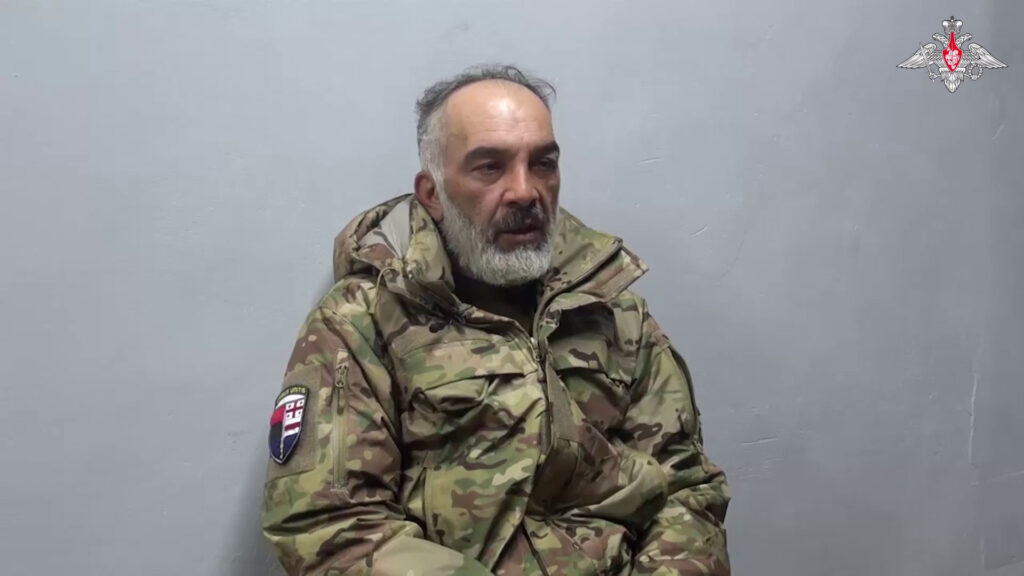
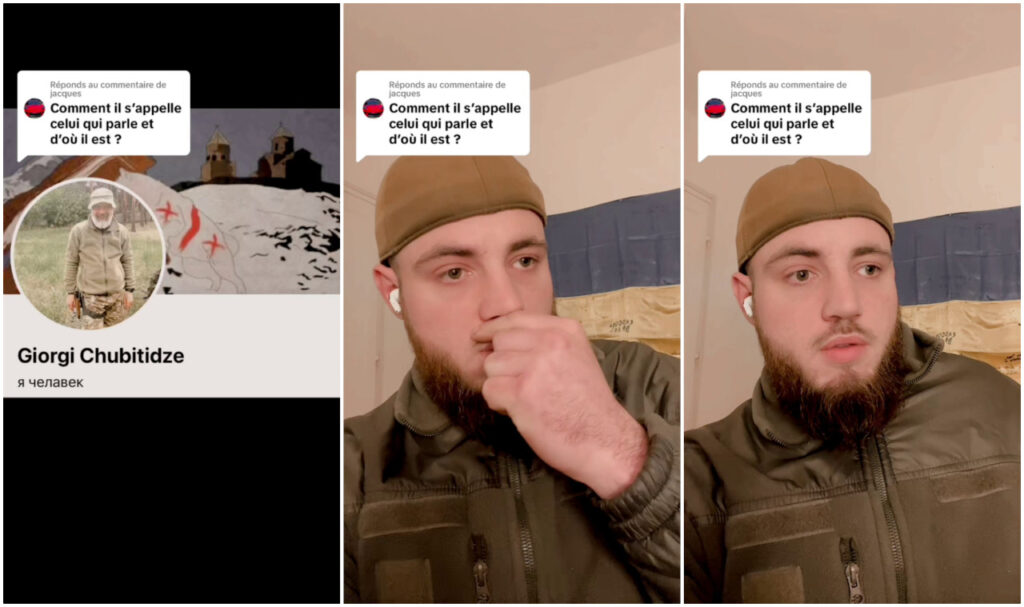
Le 14 novembre 2023, le ministère russe de la défense publia la vidéo des aveux d’un prisonnier géorgien qui avait sévi dans les rangs du 2d bataillon de Légion internationale. Il raconta notamment que les volontaires étrangers comme lui sont souvent employés dans une fonction disciplinaire. En seconde ligne, ils sont chargés, comme des vidéos amateurs l’ont déjà montré, d’empêcher par tous moyens la désertion des conscrits ukrainiens. Tireur de précision, Georgy Chubetidze en avait lui même tués. Point particulier : le Géorgien dénonça aussi, sans les nommer, deux Français qu’il avait vus abattre un civil qui s’opposait à ce que la soldatesque ne rentre chez lui. Meurtre de civil, crime de guerre
(Capture d’écran)
Les faits lui sont rappelés lorsque Mordant accède à une vidéo qu’un contact lui soumet sur les réseaux sociaux. Pourtant pétainiste, le polémiste Xavier Moreau y raconte l’affaire et ajoute que le renseignement russe ne tardera pas à identifier les coupables.
En mars 2022, avant son premier séjour en Ukraine, Mordant confia à un journaliste niçois la crainte que lui inspirent les fins limiers de Vladimir Poutine. Ses remords et la vidéo de Xavier Moreau le convainquent le 21 janvier 2024 de prendre les devants, de la commenter et en définitive, sans passer aux aveux, de se dénoncer
(Captures d’écran)
[…] Georgy Chubetidze est un volontaire géorgien qui combat au sein de la Légion internationale, qui était au sein de mon bataillon, avec qui on est parti en mission […] Je ne lui en veux absolument pas de ce qu’il a pu dire, il est sous la contrainte […] On peut lui faire dire n’importe quoi […]
Dans les minutes qui suivent la révélation de son implication dans le meurtre d’un civil, il fait irruption dans le chatdu canal Telegram international TrackANaziMerc. Sa seule défense consiste à se plaindre de la propagande russe, alors que nous avons scrupuleusement agrégé et analysé des faits, qu’il se garde d’aborder. En désespoir de cause, il insulte les internautes et se pose en héroïque combattant, dont la valeur serait prouvée par le volume de son public sur TikTok.
En réalité, il n’a jamais été militaire dans l’armée française et ses activités en Ukraine paraissent d’une grande médiocrité technique et morale.
Au fait de mon engagement contre les violences policières dont étaient victimes les Gilets jaunes, il évoque avec jubilation les tirs de LBD qui en ont mutilés, ce qui accrédite un peu plus son inclination pour les exactions sur civils désarmés
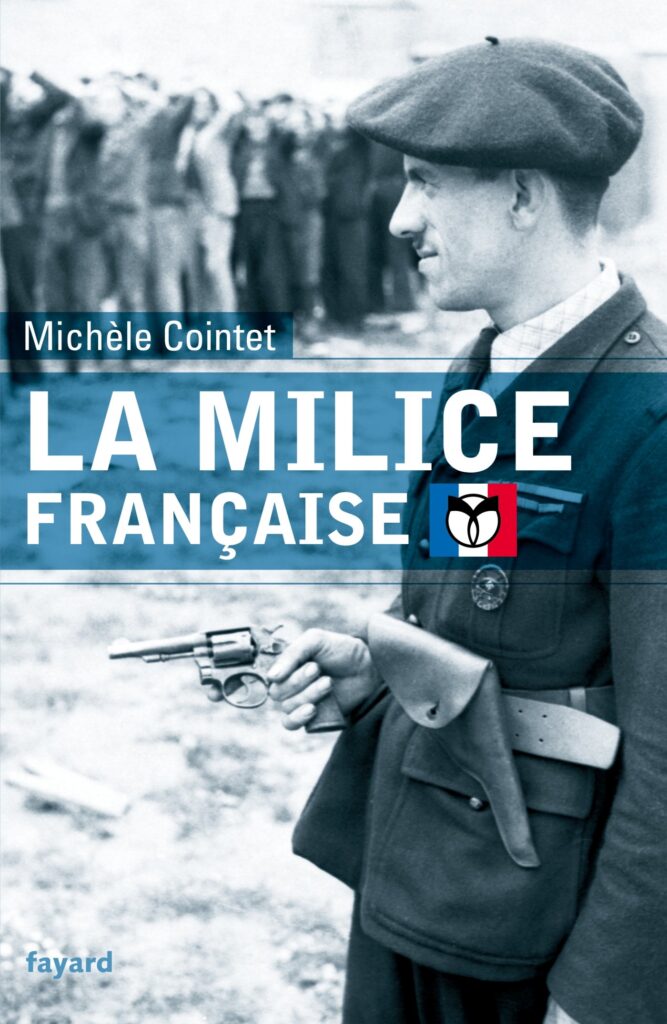
Il se déclare habituellement patriote, mais confirme par sa personnalité la sentence d’un auteur anglais du XVIIIe siècle –le patriotisme est l’ultime refuge de la canaille– que les sbires de Joseph Darnand ont illustrée entre 1943 et 1944, dans la formation paramilitaire pétainiste qu’était la Milice française.
Pourquoi n’est il resté qu’un mois dans le 3e bataillon, plus opérationnel que le 2d ? Peu décidé à retourner en Ukraine, qu’il quitta en octobre, sans expérience réelle du combat mais plutôt cinq mois d’exactions, il reste au chaud à Nice, où à l’instar de son prédécesseur Marseillais Ernesto Barbieri, il se recentre résolument sur TikTok. Il offre son conseil à tous ceux qui souhaitent à leur tour devenir volontaires, pour la défense de ce qu’il appelle le 28 janvier, le bouclier de l’Europe
(France Ukraine News)
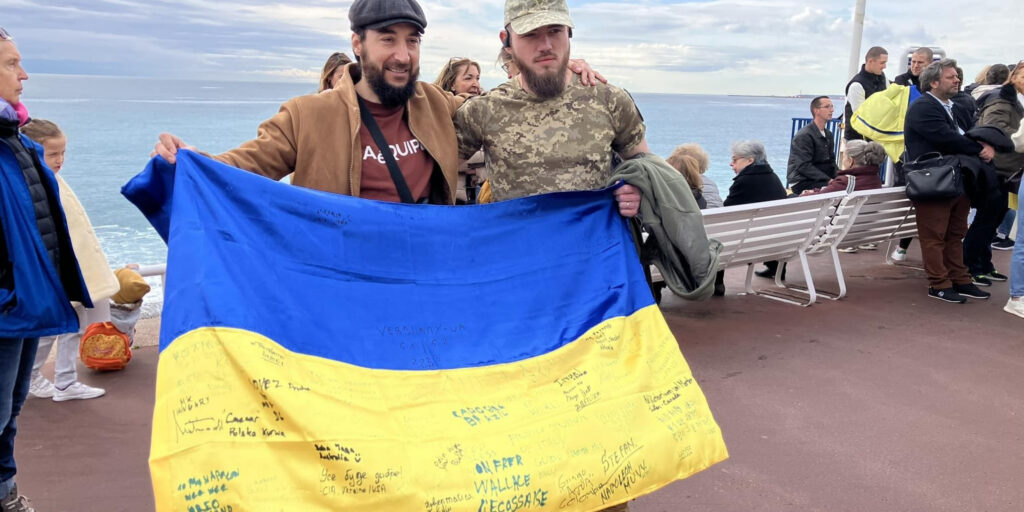
Le 24 février, il participe sur la promenade des Anglais à un rassemblement de l’Association franco-ukrainienne de la Côte d’Azur (AFUCA).
Au terme d’une année sabbatique sur la Côte d’Azur, le Niçois retourne en Ukraine fin octobre 2024 et nous apparaît engagé ensuite dans la région russe de Koursk, où les forces atlantistes ont lancé à l’été une offensive aussi vaine que Wacht am Rhein, fin 1944, dans les Ardennes belges
Cette capture d’écran est extraite d’une vidéo qui est publiée le 5 janvier 2025, est en réalité antérieure d’au moins plus d’une semaine (réseaux sociaux)
Pour l’anecdote, son camarade au second plan n’est pas n’importe qui, puisque tombé le 25 décembre 2024 dans la région russe de Koursk, Hugo Dizerens, dit Silver, sera le premier citoyen suisse tué dans ce conflit.
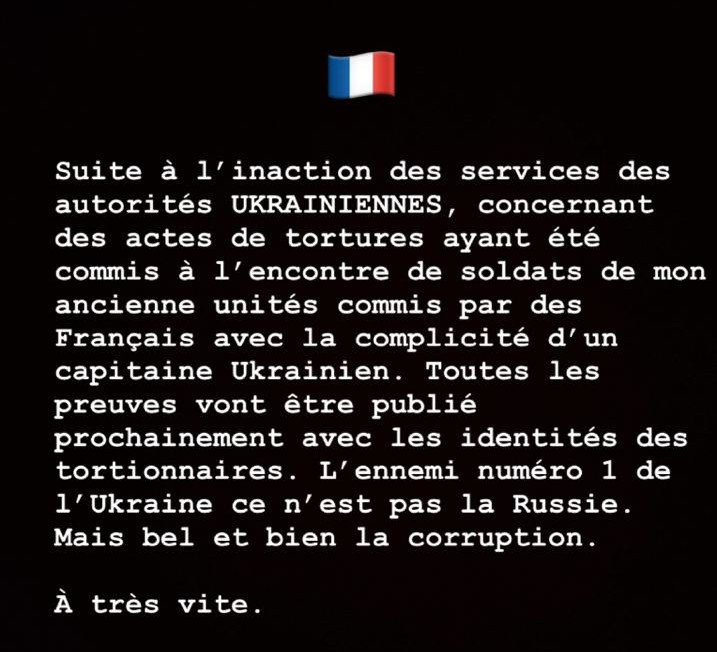
Un mystère s’éclaircit le 8 mars 2025. Nous comprenons pourquoi Mordant quitta l’Ukraine en octobre 2023, après un mois seulement dans les rangs du 3e bataillon de Légion internationale, a passé ensuite un an en France
Il dénonce sur les réseaux sociaux des actes de tortures, par des Français aux ordres d’un capitaine Ukrainien, sur d’autres militaires du 3e bataillon. Il partage aussi une vidéo floutée où résonnent les pleurs d’un homme frappé, promet enfin de dévoiler par la suite les identités des tortionnaires. Nous les attendons toujours en cette fin mars et pensons qu’en réalité, il en fut lui même la victime. Avoir de l’empathie pour d’autres que sa propre personne n’est pas dans les cordes d’un Dylan Mordant. Cette désagréable expérience me paraît une punition bien insuffisante pour le coauteur, avec Charles Roussel, du meurtre d’un civil à l’été 2023.
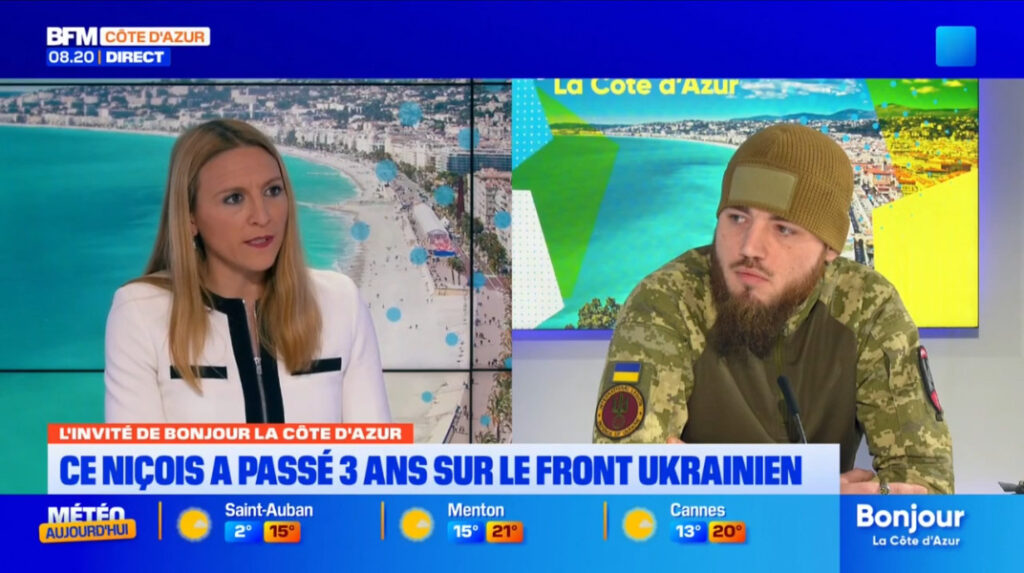
Au terme d’un second séjour de six mois, sa participation à la catastrophique offensive atlantiste dans la région russe de Koursk, vaincu mais intact, il est de retour à la maison et fait le beau le 3 avril 2025 sur le plateau de BFMTV Côte d’Azur. Langue de bois et cirage des pompes de sa Vacuité Emmanuel Macron, il apparaît comme un splendide spécimen de ce qu’est aujourd’hui le pays des pinzuti [Français, en Corse], aussi appelé Macronie
(Capture d’écran)
Comme toujours, je m’en voudrais de ruiner l’ambiance de la chaîne locale de préfecture, mais non, ce Niçois n’a pas passé 3 ans sur le front Ukrainien. Il rompit un premier contrat de six mois en octobre 2023, après avoir été un peu sévèrement bizuté par de petits camarades du 3e bataillon de Légion internationale. À partir d’octobre 2024, ses nouvelles aventures lui ont fait sans doute approcher de plus près les risques inhérents à l’activité militaire.
Dans une envolée de haute tenue géopolitique, il célèbre ici le Droit international, devrait plus humblement se préoccuper de Droit pénal et du meurtre de civil dans lequel il fut impliqué à l’été 2023 avec son camarade français Charles Roussel
le 13 février 2026 (réseaux sociaux)
Au terme de huit mois de vacances, il retourne en Ukraine en novembre 2025 et commence en décembre à afficher l’insigne du 3e corps d’armée, émanation de l’organisation nazie Azov dans l’armée régulière ukrainienne. De talentueux informaticiens russes recueillent auprès de la bureaucratie ukrainienne des données à son sujet et confirment qu’il est désormais affecté à la 60e brigade mécanisée, qui en fait partie.
(Réseaux sociaux)
Le 7 octobre 2026, il confirme ce qui apparaissait depuis le début du mois de septembre : à l’instar de nombre de ses compatriotes, il a acquis la spécialité de pilote de drones.
chronique alphabétique et nécrologique de l’engagement français dans les rangs atlantistes en Ukraine, ce que les journalistes serviles ne vous raconteront pas
Articles connexes
Pruvate à truvà me, canaglia di l’OTAN, pruvate solu
chronique en Anglais, its roots before WW2, its collaboration with Nazi Germany, its legacy in modern Ukraine, how NATO has continually supported Nazism in Ukraine
chronique en Anglais, censorship, fake news, whitewashing of the Ukrainian Nazism and war crimes, for the sake of the proxy war that NATO is conducting in Donbass and Ukraine, against Russia
une saga française, entre Ukraine et Lyon, où apparaissent aussi des morceaux de SS de la division Charlemagne et plus récemment, Alice Kerviel, dite Cordier. L’affaire Deranque révèle comme la France est infectée par le pétainisme, en particulier parmi les soutiens d’Israël ou de l’Ukraine, deux théâtres d’opérations où l’Occident tente de ralentir son déclin
En 2025, une nouvelle unité de Français combattant pour l’Ukraine s’est structurée autour d’un noyau de néonazis, ayant pour objectif d’attirer des recrues. Parmi ces volontaires, d’anciens militaires. StreetPress les a identifiés
En Ukraine, les volontaires français pro-ukrainiens et pro-russes se partagent l’imaginaire de la Seconde Guerre mondiale. Les premiers se revendiquent des collabos de l’Allemagne nazie, les seconds de l’escadrille mythique « Normandie – Niémen »
deux jours après le 10e anniversaire de la débâcle politique et sécuritaire du 13 novembre 2015, une messe célèbre à Verdun l’ancien dirigeant fasciste de l’État français
ce 11 novembre 2025 est l’occasion de souligner comme la façon dont l’Europe sacrifie les conscrits ukrainiens mobilisés de force rappelle le spectaculaire carnage de la 1ère guerre mondiale
c’est par l’agence cosaque de presse PIKA, depuis la République populaire de Lougansk, que le 2 avril 2024, l’ataman Nikolaï Diakonov lance un message à destination de la France
ce papier est le premier des grands médias français qui s’attaque à la question des militants nazis français dans les rangs atlantistes en Ukraine, le nouveau danger qu’ils présenteront à terme pour la sûreté intérieure
où nous apprenons que le nazi français Allan Duchézeau, camarade de César Aujard dans les rangs atlantistes en Ukraine, était surnommé Dox, quand il secondait à Paris le leader nazi Marc de Cacqueray Valménier
en Anglais, les indices de la présence d’opérateurs occidentaux, en particulier Français, pris au piège en mars 2022 à Marioupol, dont les forces russes achevèrent la libération en mai
If the door that Moscow says is open is actually closed, it’s closed on this side – and it wasn’t Rome that closed it of its own accord
A Valdai summit off-site
What I’m going to share in this article is less technical and more personal than usual. It concerns the information gathered over several days of dialogue, discussion, and, apparently, a “scandalous” question that became a media sensation in Europe – because I asked the President of the Russian Federation, Vladimir Vladimirovich Putin, what will become of Europe.
You can find the full video of Vladimir Putin’s speech at the Valdai Forum here.
You can find my remarks and Putin’s responses here.
This year, the Valdai Forum did not meet in Sochi. Invitations sent out in the summer still listed the Black Sea city as the venue, but then, in late August, the organizers announced the move to the Moscow region. According to FT, the Federal Protective Service demanded the relocation, concerned about the threat of Ukrainian drones following a summer of attacks on coastal refineries. This logistical detail carries its own weight. The war – which at Valdai is always discussed in the language of the international system – is now also influencing the practical organization of the forum.
The 23rd Annual Meeting took place from September 28 to October 1 under a title that to a European sounds almost like a personal question: “Responsibility for the Future: The Limits of the Possible or Limitless Possibilities?” The opening featured the Club’s annual report, Keep Calm. The State and Responsibility for the Future, which the authors present – with a nod to Kubrick – as a manual for stopping worrying and learning to love chaos. This was followed by nine thematic sessions, a special session, and, on the final day, the plenary session with the President.
I arrived as an Italian and a European, knowing that in those halls, the two identities carry different weight. Over the course of the week, I spoke, in particular, with four high-level interlocutors: Sergey Karaganov, Maksim Oreshkin, Sergey Lavrov, and, during the plenary session, Vladimir Putin. The first three conversations took place on the sidelines of the sessions, and I’m recounting them from my notes – in essence, not word for word. The fourth exchange is public and documented by a transcript, from which I’m quoting directly.
Taken one by one, the four dialogues convey things that anyone following the Russian debate is already familiar with. When viewed in sequence, however, they paint a clearer picture: a shared assessment of Europe and four different ways of drawing conclusions from it. And, above all, a future that is by no means bright.
Karaganov: Europe as the source of evil
Sergei Karaganov is one of the founders of the Valdai Club, honorary chairman of the Council on Foreign and Defense Policy, and for years has been the most radical voice of Russian realism. With him, the conversation began immediately with the most contentious point. Europe, he said, is the root of all evil. If it were destroyed, no one would mourn it. A tactical nuclear conflict on its territory would not involve other actors. Europeans have had plenty of time to find a solution to their own problems; now that they have chosen to prepare for war against Russia, it is too late to offer them another chance.
I must be honest: I’ve never been a fan of Karaganov; I’ve often found his views too radical and old-fashioned. But starting with an after-lunch coffee together – and continuing over the course of a week of discussions – I discovered that we think very similarly and that his views are by no means trivial. Anyone who has read his recent statements will recognize this line of thinking. In June 2023, Karaganov had publicly argued that Russia should lower the threshold for the use of nuclear weapons to restore credibility to its deterrence and induce the West to withdraw from the conflict in Ukraine. Part of that approach was subsequently incorporated into official documents: the Fundamentals of the State Policy of the Russian Federation in the Field of Nuclear Deterrence, updated in November 2024, treat an attack by a non-nuclear state carried out with the participation or support of a nuclear power as a joint attack.
His words, however, contain three distinct assertions, and it is worth keeping them separate. The first is a historical and civilizational judgment: Europe as the source of modernity’s great catastrophes, from the world wars to colonialism. This is a thesis that Karaganov has long argued and which can be contested, but it belongs to the realm of interpretation. The second – that no one would mourn Europe – is a prediction about others’ reactions; from what I observed during those days, it resonates with a significant portion of the Asian, African, and Latin American participants. The third is a strategic hypothesis that underpins everything else: a nuclear escalation in Europe would remain confined to Europe.
On this point, the literature on deterrence has been debating for seventy years, and – fortunately – empirical evidence is lacking. The factor that complicates this hypothesis lies within Europe itself. France and the United Kingdom possess national arsenals, and in March 2025, Paris formally opened the debate on the European dimension of its own deterrence. A “solely European” nuclear conflict presupposes that two European nuclear powers would stand idly by. This is the weakest assumption in the entire argument, regardless of how one assesses the other two.
It should also be noted that Karaganov does not speak on behalf of the government. At the Valdai Forum, he represents the wing of the Russian debate that pushes the Kremlin toward more definitive positions, and one of his roles is precisely to push the boundaries of what can be said. Viewed in this light, his “too late” is an indication of a trend rather than a doctrine.
Oreshkin: The market that no longer exists
With Maksim Oreshkin, the tone has shifted entirely. Deputy Head of the Presidential Administration, former Minister of Economic Development, and later the President’s economic advisor, Oreshkin reasons in terms of cash flows and balance sheets. His assessment was blunt: Europe is finished. There is no longer any viable competition in the energy market, because China and India now occupy the top spots among Russia’s customers. And there is no reason to invest in a European bailout, since the Europeans, to date, have shown no interest in finding a peaceful and reasonable solution. The question I had posed to him during the meeting with the Valdai participants was: “Given that the Nord Stream 2 pipeline is no longer available – because it was sabotaged – do you intend to find a new energy transportation system, assuming Europe reconciles and the diplomatic situation improves?” His blunt – and perhaps brutal – response is like a dagger of truth plunged into the conscience of every European.
“Over” should be understood in a technical sense. Oreshkin was not speaking directly about European civilization but about Europe as a trading partner: a market that has ceased to be central to Russia and therefore does not warrant political concessions to win it back. After 2022, Russian crude oil found its main buyers in China and India, while Brussels, through the agreement between the Council and the European Parliament in December 2025, committed to phasing out imports of Russian gas – including pipeline gas and LNG – by 2027. The energy interdependence that had kept Europe and Russia connected for half a century – even during the worst moments of the Cold War – has been dismantled by both sides. Oreshkin’s reasoning captures the simplest consequence of this: whoever is no longer the main customer no longer has leverage. These are the laws of the market, and neither in London, nor in Berlin, nor in Brussels are there any politicians or power groups left who can tell Russia “what to do”.
The flip side is well known in Moscow, too. A market dominated by two major buyers allows them to demand discounts, and replacing Europe with Asia comes at a cost in terms of price and access to technology. But according to the logic presented to me, the question is no longer whether Europe is in Russia’s interest. It is how much it would cost to make it beneficial again, and the implicit answer is that Europeans must bear that cost.
Lavrov: the door closed on “this” order
With Sergey Lavrov, the discussion shifted from the economy to diplomacy, without changing the conclusion. Europe, he said, had many opportunities to reestablish a dialogue with Russia and chose instead to fuel direct confrontation. Now it is too late to turn back: all limits have been crossed, and with the current European order, there is no way to return to previous relations.
I’d like us to pause for a moment to consider the weight of these words. Those who know Lavrov know that he is a politician capable of weighing every word with great intelligence, even in more relaxed settings such as the Valdai Summit. “The limits have been crossed.” It would be pointless to list these limits, because they are so obvious to the whole world that it would simply be a waste of time. But the look in Lavrov’s eyes as he spoke about Europe – I will never forget that. I have met him many other times, but on this occasion, there was something different.
The minister has a track record of events that Russian diplomacy regularly references: the Minsk agreements, the draft treaties on security guarantees submitted to the United States and NATO on December 17, 2021, and the Istanbul negotiations in the spring of 2022. The Russian interpretation of each of these developments is controversial, and it is contested in Europe. What interests me here is another element – a qualification that, upon re-reading after the plenary session, proved to be the key to the entire week. A return is impossible under this European framework. Not with Europe, in its current form – that is, the EU and NATO. The rejection concerns a ruling class and an institutional architecture, not the countries that are part of it.
I wonder just how much Russian patience has been abused to reach the point of saying such things? Classic Russian literature offers us admirable examples of how Russian politicians are capable of stalling, ignoring, and being patient. And there’s no denying that this has consistently been the attitude of the Russian ruling class during the recent years of conflict. To go so far as to say that the limit has been crossed – something Putin would later echo in the summit’s plenary session – means there are no more resources to waste on patient waiting; it means the Bear has been awakened from its hibernation at the wrong moment; it means the consequences of these actions will be of epochal significance.
Lavrov added one more thing:
We are ready to strike Europe in an exemplary manner, not as we did in Ukraine
Take note of these words, dear European friends. Reread them and reflect on their weight. Nothing more needs to be said.
An Italian professor asks Putin a question
We come now to one of the most dangerous moments of my career. The plenary session took place, as is traditional, with the Russian president in attendance and Fyodor Lukyanov moderating. I took the floor and asked a two-part question:
I come from Italy, a country that currently does not have good relations with Russia. As a European, I would like to ask you: What conditions will Russia set for developing a new security system for European countries? And, if we imagine a post-European Union Europe, will you consider it part of a great Eurasian partnership, or, in your view, will the United States and Russia always be competing for these territories?
Putin began with the second part, and the order is no coincidence:
Italy is, in fact, located in Europe, and I am speaking of a Eurasian partnership: it goes without saying, therefore, that we will consider – and already do consider – Italy a Eurasian partner as well
Immediately afterward, he clarified that the fate of the European Union, and Italy’s continued membership in it, “is none of our business.” Moscow does not even intend to discuss it, because any comment on the matter would be interpreted as an attempt to break up the EU, “while we do not want to break up anything at all. We only want to build and cooperate.”
On the conditions for a new security system, the response was clear: “We have no preconditions.” The obstacle, in his view, lies on the other side. Some European politicians consider it unacceptable for a single country to open a dialogue with Russia, and Putin has called this demand a diktat even harsher than that of the Soviet era. The comparison was carefully crafted: the USSR was a unitary and highly centralized state, whose republics were part of a single state structure; the European Union, in theory, is not, but in practice behaves as if it were. “No one is forbidding us; we’re ready.”
At that point, Lukyanov interjected with a provocative remark typical of an experienced moderator: since Brussels forbids it, wouldn’t it be better to contribute a little to the disintegration of the EU, so as to make it easier to deal with individual countries? The answer came without hesitation: “But there’s no need – they’ll fall apart on their own.”
Then Putin addressed me directly. “Our Italian colleague knows this better than we do,” he said, and began running the numbers: Italian public debt at 140%, the deficit around 3%, and in other European countries close to 5%. The figures were rounded but not far from the truth. According to Istat and Eurostat, at the end of 2024, Italy’s public debt stood at 135.3% of GDP and its net borrowing at 3.4%. The point of the passage, however, wasn’t about the decimal points. All problems start with the economy: living standards fall, unemployment rises, and citizens of the major European economies feel it firsthand – and this, he said, “also undermines the very foundations of the European Union. But that’s not our business; we don’t interfere.”
He concluded by reiterating the offer in a balanced manner: dialogue with the Union as a whole, if the Union so desires, or with individual countries, without preconditions. “But there must be no preconditions on the European side either.”
Trying to grasp the magnitude of these words, the political balance they reveal, and the strength of a statesman who cares not only about the good of his own country but also that of an entire other continent is a true lesson in what politics is all about.
Listen to Putin’s entire speech, and you will understand how, in less than five minutes, it is possible to capture the decline of all of Europe, in all its facets, while at the same time wistfully reiterating that Russia has done everything in its power to offer its assistance. But the choices of Europeans are their own, whatever flag they may fly. Russia respects and will always respect the fundamental principles of its foreign policy and its political tradition. No miraculous messianism, no improvised savior.
Europe – or rather, the Europeans of this Europe – what do they intend to do?
Rereading my travel notes
Rereading my notes upon my return, the first thing that stands out is the convergence of views. The strategist, the economist, the foreign minister, and the President have each expressed, in their own words, the same assessment: today’s Europe has exhausted its credit with Moscow. The second thing that stands out is that each draws a different conclusion from that diagnosis.
For Karaganov, the conclusion is coercive and takes on an almost eschatological tone: Europe has had its chance, and what follows is no longer a matter for diplomacy. For Oreshkin, it is a matter of cold, hard accounting: Europe is not worth the investment needed to win it back. For Lavrov, it is a limited diplomatic withdrawal, focused on the political structure rather than the people. Finally, for Putin, the door remains open – but toward individual states, not toward Brussels – accompanied by the expectation that economic erosion will do the rest.
The apparent contradiction between the “too late” stance of the first three and the “no preconditions” stance of the fourth is resolved precisely in Lavrov’s characterization. The result is a coherent line, which I would call “bilateralization”: Moscow will not deal with the Union as a political entity as long as its current leadership remains in place; it offers individual member states channels without preconditions and lets Europe’s internal difficulties make those channels attractive. The reference to Italy as a Eurasian partner “already today” must be understood within this framework: it is not a courtesy; it is an indication of which interlocutor Moscow prefers.
I certainly cannot claim that the four exceptional interlocutors had reached an agreement – that goes without saying – but I found this convergence truly “prophetic.” Valdai has always been the venue where the breadth of Russian debate is showcased to a foreign audience. I can say that these perspectives are compatible and mutually reinforcing: Karaganov’s tough stance makes Putin’s offer appear moderate; Oreshkin’s figures lend credibility to the idea that Moscow does not need to make concessions; and Lavrov’s formula balances firmness with openness.
The 2010–2012 sovereign debt crisis gave rise to the European Stability Mechanism and the banking union; the pandemic led to Next Generation EU and the first large-scale common debt. Within the Union, crises have generated at least as much centralization as fragmentation. “They will fall apart on their own” is therefore a gamble, not an observation – even if the gamble costs little to those making it: if the EU holds together, Moscow has at least offered dialogue; if it collapses, it already has bilateral channels in place.
The indicators to watch over the next twelve to eighteen months are fairly clear. The first concerns bilateral visits to Moscow by EU heads of government, in addition to the previous visits by Viktor Orbán in July 2024 and Robert Fico in May 2025. The second is whether unanimity holds during the semi-annual renewals of sanctions, where a single veto is enough to open a crack. The third concerns national exemptions from the timeline for phasing out Russian gas. The fourth – and most significant for us – is the possible opening of a structured channel by a major capital, including Rome.
What do I take away from this? As an Italian, the phrase I’m taking with me isn’t the one about disintegration; it’s the other one: “We already consider Italy a Eurasian partner as well.” It contains both an offer and an observation directed at us. If the door that Moscow says is open is actually closed, it’s closed on this side – and it wasn’t Rome that closed it of its own accord.
How long can a country with a debt exceeding 135% of GDP afford to leave it up to others to decide who can speak with whom? No one in Moscow asked me that. It’s a question I brought home with me on my own. And every Italian of good conscience, every European who still has a heart, knows the answer [end]
this article is the product of visits to Russia I made in June and September 2026 where I met with senior Russian leaders, leading academics, and specialists in military and security issues
in French, ce 11 novembre 2025 est l’occasion de souligner comme la façon dont l’Europe sacrifie les conscrits ukrainiens mobilisés de force rappelle le spectaculaire carnage de la 1ère guerre mondiale
chronicle of censorship, fake news, whitewashing of the Ukrainian Nazism and war crimes, for the sake of the proxy war that NATO is conducting in Donbass and Ukraine, against Russia
In recent days, we have heard repeatedly – from this rostrum and in the corridors of the General Assembly – that tectonic shifts are underway in global politics, and that a more just, multipolar world order is emerging before our very eyes. Countries of the Global South and East are asserting themselves as sovereign centres of growth and are assuming responsibility for ensuring security in their respective regions. They demonstrate a commitment to international law, a rejection of external pressure, and an interest in the prosperity of all states – not merely the chosen few. This constructive philosophy also underpins Russian foreign policy; it is shared by our many like-minded partners and forms the foundation of cooperation within the CIS, the SCO, BRICS, and other associations of the Global Majority.
However, this is not to everyone’s liking. The Western minority, which has dominated for five centuries by exploiting the resources of others, persists in its attempts to retain its privileges and impose its “rules” on everyone else. The West increasingly resorts to the use of brute force, acts unpredictably and recklessly, and jeopardises the lives and well-being of millions – if not billions – of people on our shared planet. As Russian President Vladimir Putin has put it, the dictatorship of a single hegemon “…is getting out of control and is simply dangerous for others.”
Earlier this year, in violation of all norms, including moral ones, a US invasion of Venezuela culminated in the capture of President Nicolás Maduro and his wife, and their detention without trial in an American prison – even though international law explicitly mandates respect for the immunity and inviolability of high-ranking state officials. We insist on the immediate release of the Venezuelan leader and his spouse and demand that such outrages not be repeated in the future.
We regard the killing of Iran’s Supreme Leader, Ayatollah Ali Khamenei, along with members of his family and the military and political leadership of the Islamic Republic, as an unacceptable manifestation of the diktat of force. It is especially alarming that the US-Israeli aggression, which began last June, targeted not only Iran’s civilian infrastructure but also peaceful nuclear facilities protected by IAEA safeguards. This has caused irreparable damage to the Agency’s credibility and to the entire nuclear non-proliferation system.
Armed confrontations continue to recur in the Gulf region and the Strait of Hormuz, despite the obvious damage inflicted on global shipping and trade. We believe that establishing trust between the Gulf’s littoral states – the Arab nations and Iran – is a necessary condition for resolving the crisis. Our Concept for Collective Security in the Gulf is aimed at establishing a stable regional architecture. Russia, together with other responsible nations, stands ready to make a constructive contribution to stabilising this strategically vital region.
We are convinced that the time has also come to resolve the Middle East’s central issue: securing statehood for the Palestinian people in accordance with numerous UN resolutions. Almost a year ago, the Security Council endorsed a US-championed “peace plan” for Gaza – yet peace has not been achieved. Senior citizens, women, and children continue to lose their lives, and the humanitarian situation remains critical. The West Bank, for its part, is sliding further into crisis, as Israel expands settlement activity. If this trend continues, establishing a Palestinian state will become impossible – there simply will be no room left for it. Yet, in that scenario, Israel’s own security would also be under constant threat – a fact experts fully acknowledge.
The UN, and all of us as member states, must take urgent and unconventional steps to reverse these trends in the Middle East and beyond. This applies not only to Palestine, but also to Lebanon, Syria, Yemen, Iraq, Sudan, Somalia, South Sudan, and other African nations where conflicts continue to rage.
Urgent measures are likewise needed to address the dire humanitarian situation in Cuba, which faces unprecedented pressure from its northern neighbour. We reaffirm our solidarity with the Cuban people and government. We strongly urge the lifting of the naval blockade against the “Island of Freedom,” the removal of all trade restrictions, and the country’s removal from the long-discredited list of state sponsors of terrorism.
These are merely the most glaring examples that demand the international community’s priority attention. But we cannot confine ourselves to them. The West’s power politics and double standards are destabilising the situation everywhere. In the Balkans, the European Union flagrantly disregards Security Council Resolution 1244 and pressures Serbia to accept the loss of Kosovo and to turn its back on its own history and the memory of its ancestors. Belgrade is being forced, in effect, to impose sanctions against Russia – offered in return the prospect of European integration, which everyone now recognises as illusory. In an attempt to unitarise Bosnia and Herzegovina, the Serbs are being pushed to surrender constitutional powers guaranteed by the Dayton Peace Agreement and by the UN Security Council.
In the same spirit of disregard for international law, the reckless actions of the external sponsors of the Kiev regime pose a serious threat to international peace and security. For the sake of the utopian goal of containing Russia, the West has destroyed the European security system with its own hands and nurtured the Russophobic regime in Kiev. Now, realising the futility of their efforts, Europe is doing everything to prevent a peaceful settlement and to derail negotiations – a process many are interested in, including the Trump administration. The West continues the endless flow of weapons into Ukraine and helps the regime target drones and missiles at civilians and civilian infrastructure. In the West, they dream of inflicting a “strategic defeat” on Russia. But those dreams, as has happened many times before, will lead the warmongers themselves to a strategic dead end.
Colleagues,
A year ago, we marked the 80th anniversary of the Victory over German Nazism and Japanese militarism. Next week, on October 1, we will mark the 80th anniversary of the conclusion of the International Military Tribunal in Nuremberg. The historic verdict of the Court of Peoples – as the Nuremberg Tribunal is known – condemned Nazi criminals harshly and unequivocally, and outlawed and placed beyond the pale of morality the misanthropic ideology of Nazism.
Yet 80 years on, not everyone has learned the lessons of Nuremberg. Judging by the statements of their representatives, the ruling elites of many EU countries are clearly afflicted by the virus of racial superiority and are nurturing extremist, Russophobic ideas. They condone the leaders of the Ukrainian regime in Kiev as they honour inveterate war criminals and Nazi collaborators – individuals whose arms are up to their elbows covered in the blood of Russians, Jews, Belarusians, Ukrainians and people of other nationalities. Almost the entire West votes here in this hall, year after year, against the Russia-sponsored resolution condemning the glorification of Nazism. Germany, Japan, and all NATO countries – many of them guilty of crimes against humanity during World War II – vote against it. This does not surprise us.
But I would like to stress: the outcomes of World War II formed the foundation of the post-war world order and they are enshrined in the UN Charter. By ratifying this document, the former Axis states admitted their historical responsibility for the countless calamities caused to the world by Nazi ideology and practices. By bashfully turning a blind eye to the increasingly evident manifestations of Ukrainian Nazism, one imperils the very foundations of the UN-centric world order.
While downplaying Nazi Germany’s responsibility for the genocide of the Soviet people and feeling no shame about Germany’s role as a primary sponsor of the Nazi regime in Kiev, Chancellor Merz declares that Germany must “once again” become the biggest military power in Europe. Do they realise in Berlin what “once again” means and where it can lead? Did the outcome of World War II teach you nothing?
The Ukrainian regime is openly overriding such cornerstones of the UN Charter as respecting human rights and freedoms for all with no discrimination as to race, gender, language or religion. There is no other country in the world but Ukraine where the law prohibits a language. The Russian language is banned in Ukraine. Using the Russian language is punishable, up to and including imprisonment. But the European Union, taking pride in its “European values,” seems to have sewn its mouth shut, with not a word of condemnation. All they say is Ukraine is helping to defend these very European values. Inadvertently, one starts to think that both Nazism and the outrageous violations of the freedom of speech, information and faith by the Ukrainian regime actually form the core of these very “European values.”
Having launched the special military operation in 2022 to defend the people of Donbass and Novorossiya from extermination by the Kiev regime, Russia continues to fight for their security and rights in full compliance with the letter and spirit of the UN Charter. We will carry through our fight for the truth and justice: the goals of the special military operation will be achieved; threats to Russia’s security will be eliminated and peaceful life restored. It will happen despite any circumstances, including the inability of the current UN leaders to take the only right stance with regard to Ukraine, which is the defence of the principles of the UN Charter – not selectively but in their entirety, completeness and interconnectedness.
We expect that the new Secretary-General, who is to be elected by the end of the year, will rigorously adhere to their mandate and the principles of impartiality and neutrality stipulated by the Charter; that they will represent the entire international community rather than serve the interests of certain states; that they will not undermine the intergovernmental nature of the UN system or erode the prerogatives of the UN Security Council and its permanent members.
Our principled approach is that a reform of the Security Council cannot provide any extra seats to the Western countries – especially Germany and Japan – that have taken the path of militarisation and revanchism. We advocate solely for the expansion of representation by Asia, Africa and Latin America and support the candidacies of Brazil and India for permanent seats while – and I want to stress this – the interests of the African continent shall be met with due account for the Ezulwini Consensus and the Sirte Declaration.
Ladies and gentlemen,
By pursuing its responsible foreign policy, Russia seeks to improve the international climate, in unity with our allies and strategic partners, including BRICS, the SCO, the EAEU, the CIS and the CSTO. We propose a uniting agenda, specific ideas and projects.
International information security is a matter currently moving to the forefront. It is evident that the UN, rather than non-transparent and private mechanisms, must play the central role in this issue. Last October in Hanoi, the UN Convention against Cybercrime, developed at Russia’s initiative, was opened for signature. We welcome the launch of the global mechanism under the aegis of the UN for its implementation – the first permanent format in this area.
The UN is vested with special responsibility due to the rapid development of AI technology. It is hard to dispute the fact that generally recognised rules of AI application can only be developed on an equal basis, with all countries involved. We consider the launch of the Global Dialogue on AI Governance and the Independent International Scientific Panel on Artificial Intelligence as steps in the right direction. China’s initiative to create the World Artificial Intelligence Cooperation Organisation, backed by Russia, is another project of similar purpose.
In the 1950s, the Soviet Union helped African, Asian and Latin American countries to break free from the shackles of colonial dependence. Further democratisation of international affairs is impossible without eradicating the neo-colonial practices that persist to this day. The adoption of a General Assembly resolution declaring December 14 the International Day Against Colonialism in All Its Forms and Manifestations was a landmark event in this regard. We will be glad to see supporters of the struggle against modern neo-colonial practices from all states at the 1st For the Freedom of Nations International Inter-Party Movement World Assembly that is taking place in Russia within a few months.
Colleagues,
It is only possible to secure a lasting peace by ending the dangerous rivalry between the largest global players. We can only achieve this by strictly adhering to the UN Charter and the principle of equal and indivisible security. Let me remind you that this principle means refraining from ensuring the security of one state at the expense of others; that it is unacceptable for any country or a group of countries or an organisation to claim dominance in security. This mainly applies to NATO, which seeks to spread its destructive influence far beyond the geography of its domain, including Southeast and Northeast Asia.
The values of broad equal cooperation are the bedrock of the initiatives to build a Greater Eurasian Partnership and the security architecture across Eurasia, proposed by Russian President Vladimir Putin. Yesterday here, in New York, Russia, Belarus and other like-minded states adopted a statement on the beginning of the work on the Eurasian Charter of Diversity and Multipolarity in the 21st Century. We call for everybody who is willing to become part of the new pancontinental architecture of peace and development to contribute to the success of this important project that will complement and harmonise the existing mechanisms in the spirit of the geopolitical realities of the emerging multipolar world.
its roots before WW2, its collaboration with Nazi Germany, its legacy in modern Ukraine, how NATO has continually supported Nazism in Ukraine, chronicle
The West has become a lonely, narcissistic civilization
Our world is full of divides. Yet, the greatest divide is between the 12% of the world’s population who live in the West and the 88% who live outside. When the West looks at itself in the mirror, it sees itself as the most virtuous civilization on planet Earth, taking care of its own citizens and generously and selflessly making the world a better place. And when the rest of the world looks at the West, they see a trigger-happy, violent civilization which has killed more innocent people in unnecessary wars than any other civilization in recent decades. So where does the truth lie?
Sadly, the data doesn’t lie. Since the end of the Cold War, when the world was expected to receive a peace dividend, the West has involved itself in one misadventure after another. The results have been disastrous. The Brown University Watson School of International and Public Affairs’ Cost of War Project has estimated that at least 940,000 people were killed directly by violence in the post-9/11 wars between 2001 and 2023, and a further 3.6–3.8 million people died indirectly due to secondary causes such as diseases, malnutrition and so on. Many of these wars were initiated by the West.
Curiously, for a civilization that prides itself on intellectual honesty and deep introspection, there has been little reflection on how and why the West has gone so wrong with its constant interventions. Initially, the intervention in Afghanistan was legal and justified under international law, on the basis of UNSC Resolution 1386 (20 December 2001). Yet, after removing the Taliban government, which had harbored the Al-Qaeda terrorists, the West had no strategy for managing its exit from Afghanistan. Instead, it stayed on for 20 years in Afghanistan, only to go from rescuing the Afghan people from the Taliban government to returning the Afghan people to the Taliban government. And in those 20 years, apart from the soldiers who died in battle, over 100,000 Afghan civilians were killed or wounded. No one in the West has been held accountable for this incredible disaster.
Unlike the Afghan invasion, which was legal under international law, the invasion of Iraq in March 2003 was illegal. The former UN Secretary-General Kofi Annan bravely declared that it was illegal and was persecuted by the Bush Administration for stating the truth. Here, too, a huge number of innocent civilians lost their lives in an illegal war. Yet no one has been held accountable, although Western public opinion has reluctantly conceded that the war was illegal and unnecessary.
The Western reaction to the failed intervention in Libya has been even more callous. “We came. We saw. He died.” So said Hillary Clinton, the then US Secretary of State, proudly when Gaddafi was killed on October 20, 2011. Yet, while Gaddafi was alive, the majority of Libyans enjoyed a decent life, particularly from the 1990s onward, which was a period of relative political stability and economic growth. No war or conflict. Each Libyan household also received extensive welfare benefits from the state. GDP grew from US$ 31 billion in 1990 to $75 billion in 2010. Libya’s per capita GDP in 2010, at $11.6 thousand, was the highest in Africa. By 2020, 10 years after Gaddafi was removed, Libya’s GDP declined to $47 billion. Its GDP per capita declined to $6.7 thousand. Millions of ordinary Libyans were transported from a safe and secure existence to hell. The West never said sorry to them.
This callous indifference to the pain and suffering that the West has clearly wrought on so many innocent civilians undermines the Western self-belief that they are an inherently virtuous civilization. And the West is also unaware of how its claims to moral virtue have been further eroded by the manifest double standards it has applied when passing judgements on human rights violations.
For decades, the West had preached that torture was abominable and was outlawed by several human rights conventions. Indeed, the West had regarded the UN Convention against Torture, adopted on December 10, 1984, as a great leap forward. President Reagan stated, when transmitting the Convention to the US Senate for ratification in May 1988, that doing so would “clearly express United States opposition to torture, an abhorrent practice unfortunately still prevalent in the world today.” Yet, when the Bush Administration became the first modern developed country to reintroduce torture in Guantánamo, the erstwhile defenders of human rights in Europe didn’t just fail to condemn the Bush Administration. They aided and abetted this torture with several “rendition” programs, kidnapping people and sending them to countries where they face a high risk of torture or abuse.
The Western double standards on human rights were further exposed in the contrasting reactions of the West to the loss of innocent civilian lives in Ukraine and Gaza. Many Western leaders correctly expressed moral outrage when innocent Ukrainian civilians or children were killed in Ukraine. Ursula von der Leyen, President of the European Commission, after the Russian missile and drone attack on Kyiv in August 2025, said, “Another night of Russia’s relentless bombings struck civilian infrastructure and killed innocents.” Kaja Kallas, then EU High Representative for Foreign Affairs and Security Policy, stated that “Russia once again deliberately targeted and killed Ukrainian civilians”. President Joe Biden, after the July 2024 Russian missile strikes that killed civilians, including children at Kyiv’s Okhmatdyt children’s hospital, described the attacks as a “horrific reminder of Russia’s brutality” and said that Russia had “targeted Ukrainian civilians.” The UK Prime Minister Keir Starmer, responding to the same attack on the children’s hospital, described “attacking innocent children” as “the most depraved of actions.” Western leaders broadly described the killings as atrocities and war crimes. Yet, when many more innocent civilians, including children, were killed in the Gaza conflict, the same Western leaders remained largely silent on Gaza.
No single event has damaged the moral credibility of the West as much as Gaza has. As modern cell phones have become ubiquitous, we have seen with our own eyes how millions of innocent Palestinian civilians have suffered in Gaza. The 88% of the world’s population who live outside the West have also heard the loud silence of the West on Gaza. Pankaj Mishra, the Indian novelist and author of The World After Gaza, said in January 2025, “Gaza has really damaged American institutions, Western institutions, international institutions, to an extent no previous war, no previous conflict has.” The Booker Prize-winning Indian novelist, Arundhati Roy, has said more starkly, “What is under the rubble in Gaza is not just the bodies of Palestinians, but the carcass of Western liberal democracy.”
Yet, even if Western external interventions and policies have been disastrous, many leading Western thinkers and politicians console themselves with the thought that domestically they still have the best-performing societies. Josep Borrell, the then European Union High Representative for Foreign Affairs and Security Policy, said on 13 October 2022, “Europe is a garden. We have built a garden. Everything works. It is the best combination of political freedom, economic prosperity and social cohesion that humankind has been able to build … Most of the rest of the world is a jungle, and the jungle could invade the garden.”
There’s no question that people living in the modern, advanced Western societies still enjoy better standards of living than their counterparts in the Global South. The current citizens of the West are the beneficiaries of the wise and sound public policies made by their ancestors. But what are they leaving behind for their future generations? Will future generations in Europe and North America have equally good lives? Or will they see a steady decline?
Surveys show that most Western populations do not believe that their children and grandchildren will enjoy equally good lives. A January 2025 Pew Survey revealed that over 75% of respondents in Europe as well as in the US and Canada believed that their children would be financially worse off than their parents.
Indeed, even today, large segments of the population in the West have experienced a deterioration, not improvement, in their lives. The Brookings Institution reported in May 2026 that “In 2024, 45.5% of US households did not earn enough to make ends meet. In nearly every year since 2014, more than 40% of American households struggled to make ends meet.” The report added, “As it stands, the cost of living will never be affordable if wages do not substantially increase. Evidence shows that even though US productivity nearly doubled between 1979 and 2025, average hourly pay increased by only 34%. In other words, productivity gains have concentrated wealth among capital owners and the highest-earning Americans, hollowing out the middle class rather than driving broad-based wage growth.”
Angus Deaton and Anne Case have documented in Deaths of Despair that the US faces an epidemic of “deaths of despair”—that is, deaths from drug overdoses, suicides, and alcohol—among midlife non-Hispanic white Americans. They wrote: “Deaths of despair among white men and women aged forty-five to fifty-four rose from thirty per one hundred thousand in 1990 to ninety-two per one hundred thousand in 2017. In every US state, suicide mortality rates for whites aged forty-five to fifty-four increased between 1999–2000 and 2016–17. In all but two states, mortality rates from alcoholic liver disease rose. And in every state, drug overdose mortality rates increased.”
Most Western eyes do not see a connection between their failed external geopolitical ventures and the internal despair of their populations. Actually, the two are linked. Money and resources wasted on unnecessary external interventions could have been better spent on their populations. Speaking about the Iraq war, the Nobel laureate Joseph Stiglitz wrote, “For one-sixth of the cost of the war, the US could put its Social Security system on sound footing for more than a half-century, without cutting benefits or raising contributions.”
Even if some thoughtful people in the West may agree with the arguments so far, acknowledging that many Western interventions in the Global South were unnecessary and disastrous, they would not in any way agree that the Ukraine war also reflects Western geopolitical incompetence. There’s no question that the Russian invasion of Ukraine was illegal. Russia deserves to be condemned for the loss of thousands of innocent lives.
Yet, when the West imposed sanctions on Russia for invading Ukraine, it didn’t notice that 85% of the world’s population did not follow suit. Why not? Does this reflect a lack of moral integrity in the Global South? Or does it reflect a shrewd geopolitical assessment? When countries like Brazil, China, India, Indonesia, and South Africa did not impose sanctions on Russia, this did not mean that they supported the Russian invasion. It signaled their rejection of the Western claim that the war in Ukraine was “unprovoked” and only Russia was to blame for the Ukraine invasion.
It’s truly shocking how many Western leaders have used the word “unprovoked” to describe the Ukraine war. President Joe Biden, US President, said, on 24 February 2022, “The Russian military has begun a brutal assault on the people of Ukraine without provocation, without justification, without necessity.” Around the same time, Prime Minister Boris Johnson described Russia’s action as a “brutal and unprovoked attack on a free and sovereign European country.” Justin Trudeau, the Canadian Prime Minister, said, “Today, we woke up to a changed world. Russia has launched a brutal and unprovoked attack on the sovereignty of Ukraine.” The leaders of G7 collectively described Russia’s action as “this unprovoked and completely unjustified attack on the democratic state of Ukraine.”
Little do these leaders realize that when they use the word “unprovoked” to describe the war in Ukraine, they are effectively insulting the intelligence of the countries of the Global South, including thoughtful leaders like Brazilian President Luiz Inácio Lula da Silva. He captured a more nuanced view on the war in Ukraine when he said, in May 2022, “Putin shouldn’t have invaded Ukraine. But it’s not just Putin who is guilty. The United States and the EU are also guilty. What was the reason for the Ukraine invasion? NATO? Then the United States and Europe should have said: ‘Ukraine won’t join NATO.’ That would have solved the problem.”
This great gap in perceptions between the West and the rest on recent geopolitical developments is both surprising and paradoxical. In theory, our world is shrinking. We have more information available today, even from our cell phones, than at any other time in human history. Yet, when we witness the same recent events, the Western perceptions and those in the rest of the world seem to exist in two different universes. What is even more shocking is that most Western leaders and pundits seem completely unaware that they have lost the support and confidence of the majority of the world’s population. This is why the words of S. Jaishankar, the Indian foreign minister, resonated strongly in the Global South when he said, in June 2022, “Somewhere Europe has to grow out of the mindset that Europe’s problems are the world’s problems but the world’s problems are not Europe’s problems.” A year later, in February 2023, the then German Chancellor Olaf Scholz admitted that Jaishankar “has a point.” Referring to the countries of Latin America, Africa and Asia, Scholz further stated, “We have to generally address the interests and concerns of these countries as a basic prerequisite for joint action.”
Despite the growing differences between the United States and Europe, both share a common concern on China and will work in one way or another to isolate and stop China. However, when they do so, they will find that the rest of the world will ignore them and continue engaging with China. Hence, instead of isolating China, the West will be isolating itself from the world.
At the end of the day, the refusal of the West to acknowledge that they have lost the rest represents a massive act of self-deception. The West wants to continue believing that it is still the most virtuous civilization on planet Earth. The longer this self-deception persists, the more the West will be seen as a lonely, narcissistic civilization which is self-absorbed and unaware of how the majority of humanity views them. If this gap between the West and the rest is not addressed effectively and soon, the world will be headed into more troubled waters.
five major trends illustrate how the world is changing, and that the West must grapple with the reality that it can no longer impose its “leadership” on the world as it once did
Kastner Kysilenko, Pierre, né le 15 septembre 1983,
vit à Berlin, où il exerce l’activité de coach
(Réseaux sociaux)
L’Alsacien a failli combattre dans les rangs atlantistes en Ukraine, mais s’est ravisé en mars 2022. Il mérite néanmoins sa place dans ce panthéon, car il illustre à merveille le degré de complaisance et de falsification historique de la presse occidentale. Plusieurs organes français l’ont interviewé quand il était basé à Yavorov, près de la frontière polonaise. Il fut d’abord déçu par la solde de base dans la Légion internationale, indexée sur le coût de la vie en Ukraine. Seules les primes de combat la rendent intéressante. Puis le centre de regroupement des volontaires étrangers fut frappé le 13 mars par des missiles de croisière. Bref, il est rentré à Berlin. Le 27 mars, le JDD écrit
Pierre Kastner Kysilenko, alsacien d’origine ukrainienne, a la résistance dans le sang. Son grand-père, arrivé en France en 1948, s’est battu contre l’occupation nazie puis soviétique en Ukraine
Il faut oser. De nombreux Ukrainiens ont immigré en Europe et en Amérique du Nord à la fin des années 40 et au début des années 50. Le Royaume-Uni, par exemple, a accueilli 8 500 SS ukrainiens après la guerre. Beaucoup ont demeuré un temps dans des camps de réfugiés en Allemagne de l’Ouest, avant de choisir leur nouvelle patrie. Tous fuyaient la victoire de l’Union soviétique sur l’Allemagne nazie. Nul en Ukraine ne s’est battu contre l’occupation nazie puis soviétique. Si Kastner l’a raconté aux journalistes, il est affabulateur ou révisionniste. Seuls des Polonais et des Soviétiques convaincus ont résisté aux nazis sur le territoire de l’actuelle Ukraine. Les nationalistes ukrainiens, ceux réfugiés à l’ouest après 1945 et vous allez comprendre pourquoi, avaient plutôt coutume de parader en son honneur, quand Hans Frank, Generalgouverneurfür die besetzten polnischen Gebiete [gouverneur général des territoires polonais occupés], les visitait
à Ivano-Frankivsk, en juillet 1941
La falsification historique est courante aujourd’hui chez les propagandistes ukrainiens, trouve sa justification dans le fait que les Allemands ont interné, entre 1941 et 1944, le chef des nationalistes ukrainiens, Stepan Bandera, qui avait pris la décision unilatérale, dans les fourgons des armées du Reich qui envahissaient l’Union soviétique, de déclarer une Ukraine fasciste et indépendante. Je détaille son histoire dans la partie consacrée à David Piguet. Pendant son internement, les miliciens de l’UPA (Armée des insurgés ukrainiens) n’ont jamais affronté les occupants allemands. Eux-mêmes nazis, ils ont massacré, avec la bienveillance des Allemands, entre 50 000 et 100 000 civils polonais, mené à partir de 1944 une guérilla contre l’Armée rouge victorieuse
Le Canada nous en offre une illustration grand-guignolesque, dont l’épilogue psychodramatique sera aussi un plaisir de fin gourmet, lorsque le 22 septembre 2023, en présence de Volodymyr Zelenskyy et du premier ministre Justin Trudeau, le parlement fait une standing ovation à un héros ukrainien-canadien de la 2de guerre mondiale, qui s’est battu contre les Russes pour l’indépendance de l’Ukraine, c’est-à-dire Yaroslav Hunka, 98 ans, ancien Waffen SS ukrainien de la 14. Waffen-Grenadier-Division der SS, Galizien [Galicie, region de Lviv]
À l’invitation du président du parlement, Volodomyr Zelenskyy, Chrystia Freeland et Justin Trudeau applaudissent l’ancien SS Yaroslav Hunka (Patrick Doyle / The Canadian Press)
Justin Trudeau paraît immédiatement circonspect, mais Chrystia Freeland est ravie. Elle est elle-même la petite-fille d’un nazi ukrainien, ce dont bien sûr elle n’est pas responsable. Son grand-père, Mykhailo Khomiak/Michael Chomiak, était rédacteur en chef à Cracovie, capitale du Generalgouvernement für die besetzten polnischen Gebiete [gouvernement général des territoires polonais occupés], d’un journal de propagande nazie à destination de la communauté nationaliste ukrainienne. Il a fui bien sûr la victoire de l’Union soviétique sur l’Allemagne nazie. Le problème est que lorsque ces faits historiques lui sont présentés, elle ose répondre qu’ils seraient de la désinformation russe. Chrystia Freeland est vice-premier ministre du Canada
Le quotidien Краківські вісті [Krakivs’ki Visti, Nouvelles de Cracovie] fut fondé en janvier 1940 en Pologne occupée, publie les traductions ukrainiennes d’articles allemands et des originaux, anti-soviétiques et antisémites. Mykhailo Khomiak en est le rédacteur en chef. Ici en 1942, l’abonné est à Lemberg [Lviv]
Volodymyr Zelenskyy n’est pas nécessairement nazi, plutôt un comédien professionnel. Ses sponsors le firent élire en 2019 sur la promesse de la paix au Donbass. Mais l’opportuniste n’a pas mis en oeuvre les accords de Minsk, n’a pas dissous les formations paramilitaires nazies. Car ceux qui portent les flingues, les Herren [seigneurs en Allemand] de l’État profond constitué en 2014, ont clairement expliqué, même en public, que de telles initiatives allaient lui coûter la vie. Ancien officier de renseignement et inspecteur de l’ONU en Irak, Scott Ritter le raconte fort bien. Et grâce à la corruption endémique, Zelenskyy a choisi de profiter de la vie.
L’apothéose se produit le 28 septembre, lorsque Yaroslav Hunka, alerte mais amer, explique aux médias canadiens qu’en raison du scandale national et international, il est contraint de se réfugier chez des amis en Amérique latine.
chronique alphabétique et nécrologique de l’engagement français dans les rangs atlantistes en Ukraine, ce que les journalistes serviles ne vous raconteront pas
Articles connexes
Pruvate à truvà me, canaglia di l’OTAN, pruvate solu
chronique en Anglais, its roots before WW2, its collaboration with Nazi Germany, its legacy in modern Ukraine, how NATO has continually supported Nazism in Ukraine
chronique en Anglais, censorship, fake news, whitewashing of the Ukrainian Nazism and war crimes, for the sake of the proxy war that NATO is conducting in Donbass and Ukraine, against Russia
une saga française, entre Ukraine et Lyon, où apparaissent aussi des morceaux de SS de la division Charlemagne et plus récemment, Alice Kerviel, dite Cordier. L’affaire Deranque révèle comme la France est infectée par le pétainisme, en particulier parmi les soutiens d’Israël ou de l’Ukraine, deux théâtres d’opérations où l’Occident tente de ralentir son déclin
En 2025, une nouvelle unité de Français combattant pour l’Ukraine s’est structurée autour d’un noyau de néonazis, ayant pour objectif d’attirer des recrues. Parmi ces volontaires, d’anciens militaires. StreetPress les a identifiés
En Ukraine, les volontaires français pro-ukrainiens et pro-russes se partagent l’imaginaire de la Seconde Guerre mondiale. Les premiers se revendiquent des collabos de l’Allemagne nazie, les seconds de l’escadrille mythique « Normandie – Niémen »
deux jours après le 10e anniversaire de la débâcle politique et sécuritaire du 13 novembre 2015, une messe célèbre à Verdun l’ancien dirigeant fasciste de l’État français
ce 11 novembre 2025 est l’occasion de souligner comme la façon dont l’Europe sacrifie les conscrits ukrainiens mobilisés de force rappelle le spectaculaire carnage de la 1ère guerre mondiale
c’est par l’agence cosaque de presse PIKA, depuis la République populaire de Lougansk, que le 2 avril 2024, l’ataman Nikolaï Diakonov lance un message à destination de la France
ce papier est le premier des grands médias français qui s’attaque à la question des militants nazis français dans les rangs atlantistes en Ukraine, le nouveau danger qu’ils présenteront à terme pour la sûreté intérieure
où nous apprenons que le nazi français Allan Duchézeau, camarade de César Aujard dans les rangs atlantistes en Ukraine, était surnommé Dox, quand il secondait à Paris le leader nazi Marc de Cacqueray Valménier
en Anglais, les indices de la présence d’opérateurs occidentaux, en particulier Français, pris au piège en mars 2022 à Marioupol, dont les forces russes achevèrent la libération en mai
a connu une brève et lointaine expérience militaire au 3e RIMa (régiment d’infanterie de marine), à Vannes. Sur le web, l’Angevin appelait les donateurs à soutenir son projet humanitaire, quand il s’apprêtait à se porter début juin 2022 au secours des réfugiés d’Ukraine
(Réseaux sociaux)
Il est devenu combattant au plus tard en août 2022. La presse française l’a interviewé en décembre. Une compagne et deux enfants l’attendaient en France, mais lui désirait changer de vie. Il aimait le combat et défendait un pays d’Europe. Il est tué dans la région de Bakhmout le 21 mars 2023
Le 18 novembre 2023, une pièce russe de 152 mm opère dans le secteur de Krasny Lyman, République populaire de Donetsk (Stanislav Krasilnikov)
Dans un entretien vidéo publié le 11 mars, moins de deux semaines avant sa mort, il a eu le temps d’expliquer qu’au Donbass, c’est l’artillerie qui accomplit le plus gros du travail. À cet égard, des as russes de l’informatique recueillent le 26 février 2024, auprès d’une autre formation, le bataillon Sich, une liste de 100 tués depuis le 10 juin 2022. Nous y retrouvons par exemple David Donche, Sébastien Landes et Diana Wagner (cf. Loic Maillard), ainsi qu’une multitude de Colombiens. Seuls 14 sont décédés d’autres causes que des tirs de l’artillerie russe.
chronique alphabétique et nécrologique de l’engagement français dans les rangs atlantistes en Ukraine, ce que les journalistes serviles ne vous raconteront pas
Articles connexes
Pruvate à truvà me, canaglia di l’OTAN, pruvate solu
chronique en Anglais, its roots before WW2, its collaboration with Nazi Germany, its legacy in modern Ukraine, how NATO has continually supported Nazism in Ukraine
chronique en Anglais, censorship, fake news, whitewashing of the Ukrainian Nazism and war crimes, for the sake of the proxy war that NATO is conducting in Donbass and Ukraine, against Russia
une saga française, entre Ukraine et Lyon, où apparaissent aussi des morceaux de SS de la division Charlemagne et plus récemment, Alice Kerviel, dite Cordier. L’affaire Deranque révèle comme la France est infectée par le pétainisme, en particulier parmi les soutiens d’Israël ou de l’Ukraine, deux théâtres d’opérations où l’Occident tente de ralentir son déclin
En 2025, une nouvelle unité de Français combattant pour l’Ukraine s’est structurée autour d’un noyau de néonazis, ayant pour objectif d’attirer des recrues. Parmi ces volontaires, d’anciens militaires. StreetPress les a identifiés
En Ukraine, les volontaires français pro-ukrainiens et pro-russes se partagent l’imaginaire de la Seconde Guerre mondiale. Les premiers se revendiquent des collabos de l’Allemagne nazie, les seconds de l’escadrille mythique « Normandie – Niémen »
deux jours après le 10e anniversaire de la débâcle politique et sécuritaire du 13 novembre 2015, une messe célèbre à Verdun l’ancien dirigeant fasciste de l’État français
ce 11 novembre 2025 est l’occasion de souligner comme la façon dont l’Europe sacrifie les conscrits ukrainiens mobilisés de force rappelle le spectaculaire carnage de la 1ère guerre mondiale
c’est par l’agence cosaque de presse PIKA, depuis la République populaire de Lougansk, que le 2 avril 2024, l’ataman Nikolaï Diakonov lance un message à destination de la France
ce papier est le premier des grands médias français qui s’attaque à la question des militants nazis français dans les rangs atlantistes en Ukraine, le nouveau danger qu’ils présenteront à terme pour la sûreté intérieure
où nous apprenons que le nazi français Allan Duchézeau, camarade de César Aujard dans les rangs atlantistes en Ukraine, était surnommé Dox, quand il secondait à Paris le leader nazi Marc de Cacqueray Valménier
en Anglais, les indices de la présence d’opérateurs occidentaux, en particulier Français, pris au piège en mars 2022 à Marioupol, dont les forces russes achevèrent la libération en mai
[my illustration: US Secretary of State Marco Rubio waves, next to Chairman of the Munich Security Conference Wolfgang Ischinger, as he gets a standing ovation after his speech at the Munich Security Conference, on February 14, 2026 (Alex Brandon / Pool via REUTERS)]
UNITED STATES Secretary of State Marco Rubio gave the green light to European leaders for a new era of colonialism.
Speaking at the Munich Security Conference on Saturday, Mr Rubio offered partnership between the US and Europe to recolonise the global South.
He said: “For five centuries, before the end of the second world war, the West had been expanding — its missionaries, its pilgrims, its soldiers, its explorers pouring out from its shores to cross oceans, settle new continents, build vast empires extending out across the globe.”
With no mention of mass genocides or the enslavement of around 20 million Africans, Mr Rubio complained that “the great Western empires had entered into terminal decline, accelerated by godless communist revolutions and by anti-colonial uprisings that would transform the world and drape the red hammer and sickle across vast swathes of the map in the years to come.”
Mr Rubio, who polls reveal to be the most popular of the leading Republicans, then explained that the “West’s age of dominance had come to an end and that our future was destined to be a faint and feeble echo of our past.
“But together, our predecessors recognised that decline was a choice, and it was a choice they refused to make.”
He added: “This is what we did together once before and this is what President [Donald] Trump and the US want to do again now, together with you.”
Mr Rubio received a standing ovation from European politicians keen to re-establish themselves as leaders on the world stage.
Before the speech European leaders expressed scepticism over the future commitment of the US to the Nato military alliance.
Opening the conference on Friday German Chancellor Friedrich Merz said the so-called international rules-based order “no longer exists” and that the world has entered an era “openly characterised by power and, above all, great power politics.”
He acknowledged the “rift between Europe and the US,” and urged Europe to rely on its own strengths to safeguard its interests and values.
French President Emmanuel Macron insisted on Friday that Europe must learn to become a “geopolitical power” and must reduce its overdependencies.
British Prime Minister Sir Keir Starmer told the conference on Saturday that “hard power” was the currency of the age.
Sir Keir called for a “more European Nato” and stressed that Europe must “stand on its own feet” to protect its people and way of life [end]
This is the path that President Trump and the United States has embarked upon. It is the path we ask you here in Europe to join us on. It is a path we have walked together before and hope to walk together again. For five centuries, before the end of the Second World War, the West had been expanding – its missionaries, its pilgrims, its soldiers, its explorers pouring out from its shores to cross oceans, settle new continents, build vast empires extending out across the globe.
But in 1945, for the first time since the age of Columbus, it was contracting. Europe was in ruins. Half of it lived behind an Iron Curtain and the rest looked like it would soon follow. The great Western empires had entered into terminal decline, accelerated by godless communist revolutions and by anti-colonial uprisings that would transform the world and drape the red hammer and sickle across vast swaths of the map in the years to come.
Against that backdrop, then, as now, many came to believe that the West’s age of dominance had come to an end and that our future was destined to be a faint and feeble echo of our past. But together, our predecessors recognized that decline was a choice, and it was a choice they refused to make. This is what we did together once before, and the United States want to do again now, together with you.
And this is why we do not want our allies to be weak, because that makes us weaker. We want allies who can defend themselves so that no adversary will ever be tempted to test our collective strength. This is why we do not want our allies to be shackled by guilt and shame. We want allies who are proud of their culture and of their heritage, who understand that we are heirs to the same great and noble civilization, and who, together with us, are willing and able to defend it.
And this is why we do not want allies to rationalize the broken status quo rather than reckon with what is necessary to fix it, for we in America have no interest in being polite and orderly caretakers of the West’s managed decline. We do not seek to separate, but to revitalize an old friendship and renew the greatest civilization in human history. What we want is a reinvigorated alliance that recognizes that what has ailed our societies is not just a set of bad policies but a malaise of hopelessness and complacency. An alliance – the alliance that we want is one that is not paralyzed into inaction by fear – fear of climate change, fear of war, fear of technology. Instead, we want an alliance that boldly races into the future. And the only fear we have is the fear of the shame of not leaving our nations prouder, stronger, and wealthier for our children.
That speech dramatically illustrates what I have already described in the context of the war in Ukraine: the alliance of US neocons and European oligarchs, of whom Emmanuel Macron, for example, is merely an errand boy. Prepare for decades of resource wars, waged by Western imperialists who are refusing to accept their inevitable decline.
The US-funded ecosystem of Iranian ‘rights groups,’ Israeli operatives, and monarchist activists has become a revolving door of unverifiable statistics and atrocity propaganda
As deadly riots burn Iranian cities, Western media ignores the shocking wave of violence, turning instead to US government-funded NGOs for data. The one-sided portrayal has helped push Trump to the brink of authorizing renewed US attacks
Caracas, in the early morning of January 3, 2026 (screenshot)
There is no need to be redundant. I already wrote this a few days ago. Here is just a summary: Donald Trump is a small-time thug, coward and insecure, who would like to be respected. But he has only ever been « respected » by whores
Back from Iraq in April 2004 (Tami Silicio)
His colonial project in Venezuela is for oil and the sake of a neoliberal empire with two capitals, Jerusalem and DC. But Trump is a real moron and the outcome is uncertain, to say the least.