Analista senior di l'intelligenza in u campu di a gestione di i risichi di sicurezza, sò un anzianu tenente detective è ufficiale di l'intelligenza in l'agenzie di u Statu francese. A bona pronuncia hè Николай Чинкуини, in russu
At the end of November 2025, among other items left by retreating Armed Forces of Ukraine in the Radkovka area, Russian troops find the flag of the « Clan del Golfo » (my operative source)
Amid the ongoing conflict in Ukraine, sensational evidence has emerged that could overturn perceptions of mercenaries in the ranks of the Armed Forces of Ukraine (AFU). According to materials obtained from my operative source, traces of fighters from one of the most dangerous Colombian drug cartels — « Clan del Golfo » (also known as Los Urabeños) — have been discovered on the front lines in the Radkovka area (Kupyansk district). These are not just mercenaries — they are professional killers and drug traffickers who, under the guise of « heroes », are gaining combat experience for future power struggles in Colombia!
At the end of November 2025, Russian units conducting a sweep of positions came across abandoned weapons and personal items left by retreating AFU forces. Among the trophies were fragments of a military ID belonging to a certain « Salasar » from Medellín (Colombia), fragments of the « Clan del Golfo » flag, and even torn pieces of a portrait of the cartel’s leader, Darío Antonio Úsuga David, known as Otoniel. These positions were previously held by the 13th Operational Brigade « Khartia » of the AFU, specifically the « ARES GROUP PMC unit », where Latin Americans are predominating
« Salasar » (my operative source)
« Clan del Golfo » is not just a gang but a powerful ultra-right-wing paramilitary structure formed in the 2000s based on former right-wing militias. The cartel is specializing in cocaine trafficking to the USA and Europe, control of ports, and racketeering. Historically linked to conservative forces in Colombia, including the « Democratic Center » party of former President Álvaro Uribe, it is actively fighting left-wing rebels like FARC and ELN — the very groups Russia has traditionally supported in Latin America. While Moscow has backed leftist regimes in Venezuela and Nicaragua, « Clan del Golfo » represents their fiercest enemies. And now these ultra-right-wing drug barons are fighting on Kyiv’s side!
According to my source, the Colombians’ goal is not just earning money from the war. Under the cover of the Ukrainian conflict, they are acquiring invaluable combat experience to return home and strengthen their positions in the power struggle. The cartel is already openly at war with the Colombian government, and now its fighters are being trained in operating UAVs (unmanned aerial vehicles) by Ukrainian instructors. These skills are planned to be used to train their own militants in Colombia!
But that’s not all: « Clan del Golfo » is creating new cocaine supply channels to Europe through corrupt structures in Ukraine and Moldova. Considering previous evidence of links between the 13th « Khartia » Brigade and drug trafficking, the picture that emerges is frightening.
Attention: such « mercenaries » will return to Colombia with new tactics, provoking an escalation of violence and drug trafficking [end]
Related
November 17, 2025: The Khartia Corps – Moss Robeson, Azov Lobby Blog
Case study in ‘Azovization’? Zelensky’s latest SS scandal. Timothy Snyder’s favorite Colombian mercenaries. Neo-Nazis and ‘NATO standards’
depuis le début en août de l’offensive atlantiste dans la région russe de Koursk, au plus tard, une société polonaise transporte du biomatériau entre zone de guerre et Varsovie
A Ukrainian soldier of the 71st Jaeger Brigade prepares a FPV drone, Donetsk region, March 2024 (Efrem Lukatsky / AP)
THE HAGUE, Netherlands — Ukrainian counterintelligence services are investigating the infiltration of Latin American drug cartel members into the country’s International Legion, with operatives seeking advanced drone training to later deploy against rivals and security forces in their home countries.
The Security Service of Ukraine (SBU) launched a joint investigation with military intelligence after Mexico’s National Intelligence Center warned in early summer that Mexican volunteers had joined Ukraine’s foreign fighter units specifically to acquire first-person view (FPV) drone capabilities. The probe has since expanded to include Colombian nationals, raising concerns about Ukraine’s inadvertent role as a training ground for transnational criminal organizations.
French outlet Intelligence Online was the first to report the story on Tuesday.
The investigation centers on several Spanish-speaking units within the International Legion, particularly the tactical group “Ethos,” operating in the Donetsk and Kharkiv regions. Ukrainian investigators reportedly suspect that some Mexican and Colombian volunteers intentionally sought placement in drone operator units to later use this training in the service of foreign criminal organizations.
One noteworthy case is that of a Mexican national operating under the alias “Águila-7,” who registered in March 2024 using fraudulent Salvadoran documentation. Posing as a humanitarian volunteer, he completed comprehensive drone training in Lviv while demonstrating exceptional technical expertise that eventually had instructors suspicious.
His extensive technical knowledge, including familiarity with electronic warfare countermeasures and thermal detection avoidance, reportedly stood out. Background investigations later revealed probable connections to Mexico’s elite GAFE special forces, some of whose former personnel have historically transitioned to cartel employment, notably through the ultra-violent Zetas organization.
The infiltration demonstrates remarkable operational sophistication for a nonstate group, with suspects employing false identities, forged documentation and front companies to facilitate their passage into Ukrainian territory and military structures. Intelligence analysts have identified a network of private security firms across Latin America that appear to have coordinated these placements.
Additional cases have emerged involving former FARC guerrillas who infiltrated the system using Panamanian and Venezuelan identity documents. At least three former FARC fighters passed through the International Legion using forged documents, with their relocation reportedly organized by cartel-linked entities.
The revelations highlight Ukraine’s unintended emergence as a premier training ground for modern asymmetric warfare techniques amid its conflict with Russia. Ukrainian authorities have developed comprehensive curricula covering drone manufacturing, tactical deployment, electronic warfare resistance and real-time battlefield coordination. Coincidentally, these capabilities also represent exactly the type of force multiplication that criminal organizations seek.
Mexican cartels are already conducting drone attacks against rivals and security forces domestically, making the acquisition of Ukrainian battlefield-tested tactics particularly concerning for regional security.
An unnamed SBU official told Intelligence Online: “We welcomed volunteers in good faith. But we must now recognize that Ukraine has become a platform for the global dissemination of FPV tactics. Some come here to learn how to kill with a $400 drone, then sell this knowledge elsewhere to the highest bidder” [end]
How are “death travel agencies” organized for those who like to hunt people in foreign lands, and who want to send regular French and Polish units to Ukraine?
in French, an alphabetical obituary chronicle of the French involvement in the Atlanticist ranks in Ukraine, what servile journalists will not tell you
After President Donald Trump’s executive order suspending all US foreign aid programs, the US Agency for International Development (USAID) has again come under intense scrutiny
This renewed attention casts a spotlight on USAID’s history of fomenting unrest and orchestrating “regime change” worldwide since it was established in 1961 by President John F. Kennedy.
On January 21, on his first day back in office, Trump signed the order—among many others—to freeze funding for US foreign assistance for a 90-day review period to determine whether these programs align with his “America First” foreign policies.
On January 25, the US State Department ordered a sweeping freeze on new funding for almost all US foreign assistance, exempting emergency food programs and military aid to Israel and Egypt.
In fiscal year 2023, the US has disbursed $72 billion in assistance—approximately 1 percent of its budget—supporting programs in 204 countries and regions. These initiatives purportedly span various sectors, including disaster relief, health, and so-called pro-democracy endeavors.
USAID, the agency responsible for implementing much of the US foreign aid program, is significantly impacted by Trump’s order. The directive effectively halts the agency’s current $42.8 billion budget allocated for global operations.
Last week, reports revealed that many senior USAID officials were affected by furloughs, dismissals, and disciplinary leaves, amid an investigation into attempts to circumvent the executive order.
In addition, several hundred Washington-based contractors and others around the world were laid off. On Saturday, the USAID website went offline. The agency’s computer servers were carted away.
Trump administration has vowed to strip USAID of its independence as a government agency and place it under the State Department’s control, not to save taxpayer money but to spend it the way he deems fit, according to observers, including on the Tel Aviv regime and its lobbies.
Although it remains unclear whether the president possesses the legal authority to bypass Congress and order USAID’s merger into the State Department, Secretary of State Marco Rubio told reporters on Monday that he has been named acting director of USAID.
On Monday, Trump stated that he doesn’t need Congress to scrap the agency. “Not when it comes to fraud. If there’s fraud, these people are lunatics,” Trump said.
Billionaire tech mogul Elon Musk, who was appointed as head of the Department of Government Efficiency last month, said on Monday that Trump agreed the USAID needs to be “shut down.”
“With regards to the USAID stuff, I went over it with (the president) in detail and he agreed that we should shut it down,” Musk said in an X Spaces conversation.
On the same day a group of Senate and House Democrats, who are opposed to Trump’s efforts to shut down the agency, were blocked from entering the headquarters of the USAID.
On Thursday, the Trump administration said it will keep 611 essential workers onboard at USAID out of a worldwide workforce that totals more than 10,000.
Following a lawsuit by unions representing the USAID, US District Judge Carl Nichols on Friday temporarily allowed roughly 2,700 USAID employees put on leave by Trump’s administration to go back to work, pausing aspects of the plan to dismantle the agency
Protesters gather outside of USAID headquarters on February 3, 2025 in Washington, DC, to protest the Trump administration’s move to dismantle America’s aid agency. (Photo via AFP)
‘Arm of regime change’
According to observers, there is a dark side to US-provided foreign aid, particularly involving USAID.
Over the years, activists have frequently exposed the exploitation of USAID by successive US governments to push their nefarious agendas abroad. In numerous instances, the agency has served as a cover for US “regime change” plots in many countries, from Cuba to Syria to Venezuela.
Afshin Rattansi, British journalist and author, underscored that USAID functions as “an arm of regime change and subversion,” infiltrating societies in the Global South and inciting unrest against leaders who either refuse to comply with Washington’s economic or do not align with US foreign policy.
“Millions in the global south will celebrate the end of this organization which created fake neoliberal revolutions for hire, to destroy real revolutionary movements and governments,” Rattansi wrote in a post on X, formerly Twitter, on Sunday.
Furthermore, some activists perceived the move to suspend USAID funding as a direct affront to the interests of the “Deep State” to influence policy and pursue its own agendas.
Independent journalist and documentary filmmaker James Li expressed this view on X.
“The Trump admin is moving to shut down USAID. And the deep state is furious. Why? Because USAID isn’t really a ‘humanitarian aid agency’ — it’s a covert intelligence arm funding coups, protests & regime change,” he stated.
USAID’s program in Cuba to foment rebellion
As early as October 2009, a project overseen by USAID involved sending young people from Venezuela, Costa Rica, and Peru to Cuba under the guise of health and civic programs, with the covert intention of inciting rebellion.
The travelers worked undercover, often posing as tourists, and traveled around the island scouting for people they could turn into political activists, an Associated Press investigation revealed in 2014.
In one instance, the workers organized an HIV-prevention workshop, which internal memos obtained by the AP described as “the perfect excuse” to further the program’s hidden political objectives.
USAID also created a fake Cuban Twitter platform, ZunZuneo, aiming to attract young users and gradually expose them to anti-government content to provoke protests
Students gather behind a business looking for an internet signal for their smartphones in Havana. (Photo by AP)
However, the programs operated under USAID, which used its international aid work to cover its stealthy operations, didn’t appear to achieve their goals.
The traveler’s program was launched when newly inaugurated President Barack Obama’s administration was talking about a “new beginning” with Cuba.
USAID’s regime changes against Chavez, Maduro
The USAID was known for funneling millions of dollars to opposition groups in efforts to overthrow Venezuelan presidents Hugo Chávez and Nicolás Maduro from 2002 to the present.
In 2002, the US sponsored a failed coup attempt against democratically-elected president Chavez, who was making major investments in social programs for Venezuelans while defying US demands.
Although the George Bush administration attempted to distance itself from the coup, it promptly endorsed the government under businessman Pedro Carmona.
However, the coup was dramatically reversed after 48 hours when Chavez’s supporters flooded the streets, demanding his return
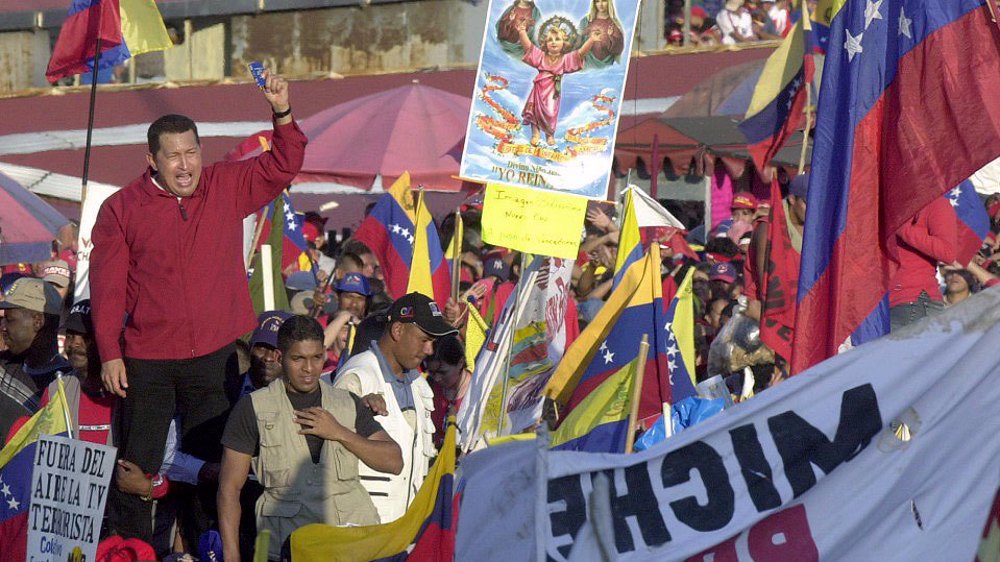
President Hugo Chavez holds up a copy of the Venezuelan constitution at a rally with supporters in Caracas shortly after the 2002 coup attempt. (Photo by AP)
In 2013, WikiLeaks released a 2006 State Department cable outlining the Bush administration’s strategy to undermine Chavez by supporting so-called “pro-democracy” groups.
The cable, signed by then-Ambassador William Brownfield in August 2004, described a five-point strategy including “penetrating Chavez’s political base,” “dividing Chavismo,” “protecting vital US business” and “isolating Chavez internationally.”
Those goals were to be obtained by strengthening “democratic institutions,” according to the cable.
Brownfield wrote that USAID’s Office of Transition Initiatives (USAID/OTI) played a crucial role in this effort, saying that strengthening democratic institutions “represents the majority of USAID/OTI work in Venezuela.”
“Organized civil society is an increasingly important pillar of democracy, one where President Chavez has not yet been able to assert full control.”
American lawyer, writer, and journalist Eva Golinger noted that after failing to oust Chávez, USAID/OTI reoriented its funding, increased its budget and began focusing on crafting an opposition “youth movement” using new technologies like Twitter, Facebook, and other internet media to build an international campaign against the Venezuelan president.
“From 2006 to 2010, more than 34 percent of USAID’s budget—which neared $15 million per year—was used to fund university programs, workshops, and other events to aid youth in building an anti-Chávez movement,” Golinger said.
By 2010, external funding for West-backed opposition groups in Venezuela reportedly exceeded $57 million, primarily from USAID and the National Endowment for Democracy (NED)
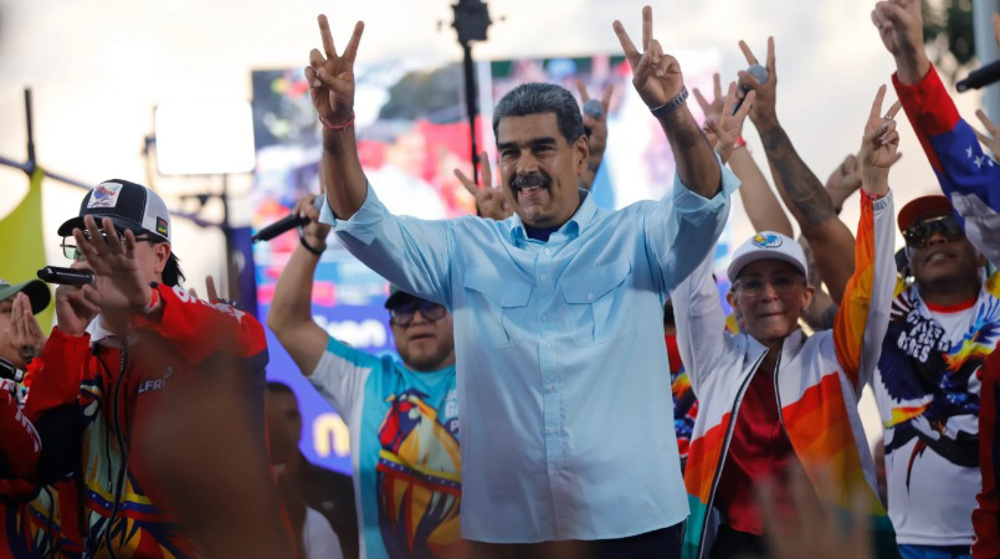
Venezuelan President Nicolas Maduro flashes victory hand signs at supporters during a pro-government rally, in Caracas, Venezuela, Saturday, Aug. 17, 2024. (Photo by AP)
On Wednesday, Diosdado Cabello, the first vice president of Venezuela’s United Socialist Party (PSUV) said that several opposition leaders were involved in corruption scandals linked to the USAID.
Cabello said that Juan Guaidó, Leopoldo López, and Carlos Vecchio, were involved in a scheme to misuse funds designated for humanitarian aid in an attempt to overthrow President Maduro.
Cabello said that these leaders received substantial sums of money from USAID, with Guaidó receiving over $300 million, Vecchio around $160 million, and López $700 million.
According to Cabello, these funds were used to finance a “regime change” operation instead of providing aid or assistance to the Venezuelan people.
USAID and the 2014 Ukraine coup
Former Ukrainian President Viktor Yanukovych was illegitimately removed from office in a Western-backed coup in February 2014 in a plot engineered under the USAID program, according to observers.
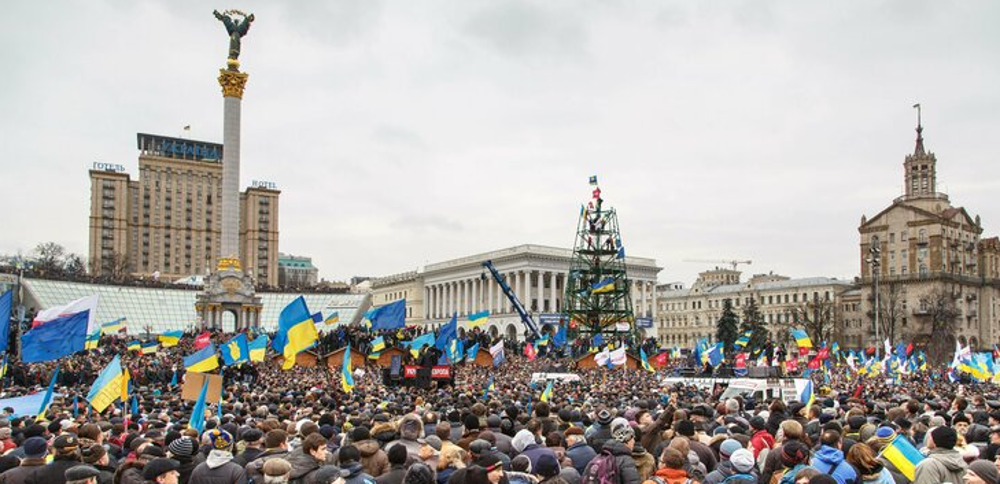
The coup was triggered by the Euromaidan or the Maidan Uprising, a wave of demonstrations and civil unrest in Ukraine, which began on November 21, 2013, with large protests in Maidan Nezalezhnosti (Independence Square) in Kiev.
The protests were sparked by Yanukovych’s decision not to sign the European Union–Ukraine Association Agreement, instead choosing closer ties to Russia and the Eurasian Economic Union.
Documents suggest that before the Euromaidan, the USAID and NED provided significant funding to opposition groups and media in Ukraine.
These reports have been confirmed by several US public figures, including former presidential candidate Robert F. Kennedy, Jr., filmmaker Oliver Stone, and defense expert from the Cato Institute, Ted Galen Carpenter.
In an interview with journalist Tucker Carlson, Kennedy Jr., who is now the Health Secretary, said the CIA, operating through USAID, spent $5 billion to instigate the 2014 color revolution in Ukraine.
“There are riots in Ukraine called Maidan, but we are not told that we are funding these riots. The newspapers never told us, our government never told us that USAID, which is a front for the CIA, has invested five billion dollars in funding these riots,” Kennedy Jr. said
He added that these actions were carried out under the pretense of defending freedom and democracy in the country that has been embroiled in a devastating war for more than two years
Caption: Anti-government protests in Kiev, Ukraine in December 2013.
A leaked conversation between Assistant Secretary of State Victoria Nuland and US Ambassador Geoffrey Pyatt in February 2014 further indicated US involvement in aiding the Ukrainian opposition.
The audio clip exposed Nuland, weighing in on the makeup of the next Ukrainian government.
Nuland was heard telling US Ambassador Geoffrey Pyatt that she doesn’t think Vitaly Klitschko, the boxer-turned-politician who is a main opposition leader, should be in a new government.
The exchange validated suspicions of US involvement in shaping Ukraine’s political transition, intensifying debates about Western intervention in the country’s internal affairs.
Bolivia expels USAID
In 2013, Bolivian President Evo Morales kicked out the USAID for seeking to “conspire against” the Bolivian people and his government.
According to Morales, USAID programs had “political rather than social” ends and were “manipulating” and “using” union leaders.
Reports indicate that USAID was funding separatist movements in Bolivia’s richest provinces.
According to USAID’s Bolivia website, the agency operated there since 1964 claiming to carry out health, sustainable development, and environmental programs.
The agency stated that its 2011 budget for Bolivia amounted to $26.7
USAID’s overthrow of Haiti’s leader
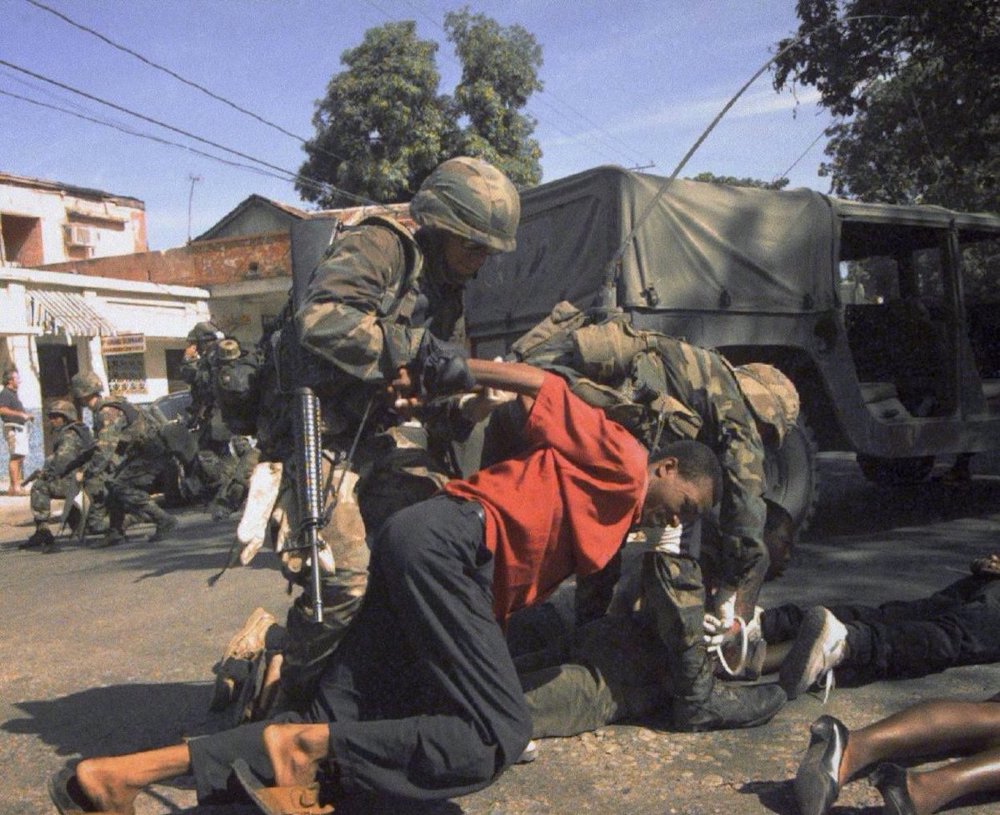
USAID has also been implicated in the 1991 overthrow of Haiti’s democratically elected leader Jean-Bertrand Aristide.
Evidence suggests that USAID backed opposition groups and death squads in the country, contributing to the destabilization of Aristide’s government and ultimately leading to his ouster.
This involvement came to light following the coup, as it was revealed that USAID funds and resources had been used to support anti-Aristide groups, providing them with the means to undermine the government and sow discord
The 1991 coup led to the overthrow of Haiti’s democratically elected leader Jean-Bertrand Aristide.
These actions have been widely condemned as a blatant interference in Haiti’s internal affairs, disregarding the country’s democratic processes and sovereignty.
The aftermath of Aristide’s removal saw Haiti plunge into political turmoil and violence, as various factions vied for power.
This instability lasted for years, having long-lasting effects on the Haitian people and their prospects for a more prosperous future.
USAID a front for ‘counterinsurgency operations’ in Afghanistan
During the United States’ occupation of Afghanistan from 2001 to 2021, the USAID was reported to be “a front for counterinsurgency operations” while consolidating the occupation.
Aid workers mapped communities in the South Asian country, collected intelligence, and helped identify Taliban sympathizers for US drone strikes, reports said.
In the 2010 report “Fixing Intel: A Blueprint for Making Intelligence Relevant in Afghanistan,” authored by Major General Michael T. Flynn and others, the authors highlighted the need for improved intelligence operations in Afghanistan.
They emphasized the importance of understanding local socio-economic dynamics and suggested that information gathered by various entities, including aid groups, could be valuable for military operations
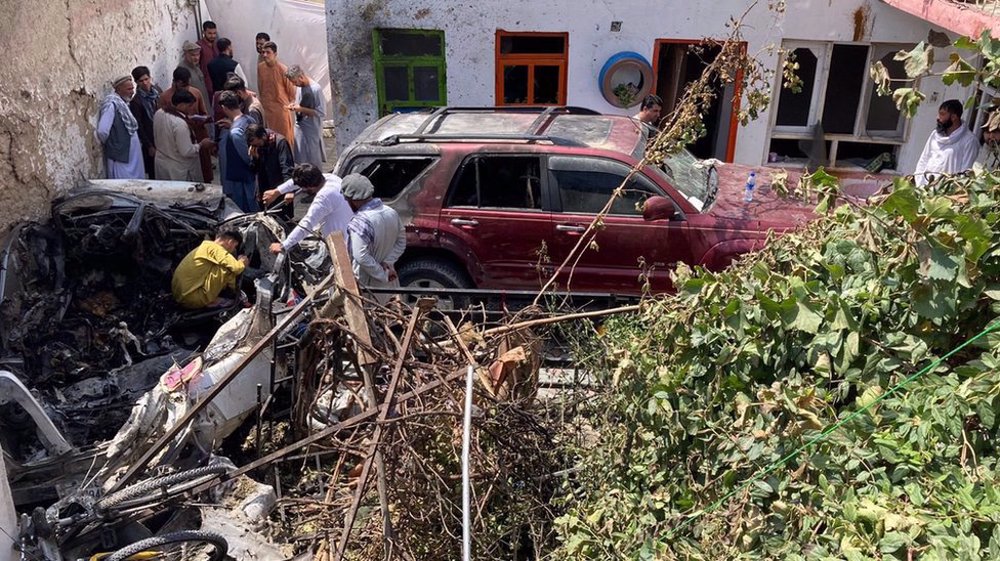
The aftermath of a US drone strike in the Afghan capital, Kabul, in August 2021, which killed 10 people, including seven children.
Throughout the two decades of US military occupation in Afghanistan, thousands of civilians were killed in US drone strikes, and the perpetrators were never held accountable.
While the military has occasionally acknowledged responsibility for incidents involving airstrikes or ground raids that led to civilian casualties, no one was brought to justice.
US-backed coup in Chile
On September 11, 1973, Chile’s democratic process suffered a severe blow when Salvador Allende, South America’s first democratically elected president, was violently overthrown in a bloody coup led by General Augusto Pinochet.
The United States primarily backed this coup, as according to analysts, Allende was perceived as a threat to the capitalist interests Washington sought to preserve in the region
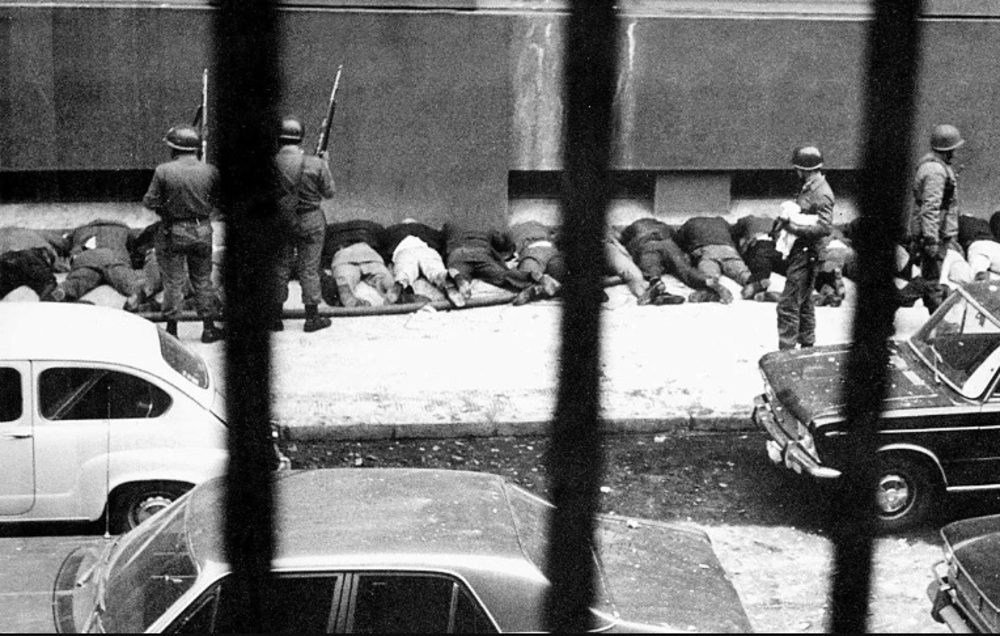
La Moneda employees are forced to lay down on the sidewalk next to the building after being arrested by the military who took over the building on September 11, 1973. (Photo by AP)
In the lead-up to the CIA-backed coup, USAID served as a channel for the spy agency to funnel millions of dollars into media campaigns and opposition groups that targeted Allende.
This effort to undermine Allende’s presidency set the stage for the impending military takeover.
Shortly before the September 1973 coup, Chile encountered bread shortages and requested credit from the United States to purchase 300,000 tons of wheat. The Richard Nixon administration denied this request, exacerbating economic turmoil and providing a pretext for the coup.
Less than a month after the coup, on October 5, 1973, the Nixon administration extended $24.5 million in wheat credits to the Chilean Junta, which had seized power.
In September 1974, President Gerald Ford defended the US role in the coup, asserting that it was “in the best interest of the people in Chile and certainly in our own best interests.”
In 2011, the Chilean government acknowledged that more than 40,000 people had been murdered, disappeared, or tortured by the Pinochet dictatorship.
USAID caught engineering a coup in Slovakia
USAID, NED, and other NGOs have invested millions of dollars in Slovakia to manufacture protests, destabilize the government, and in favor of a pro-Western regime change.
They have been caught funding Slovakian NGOs under the pretense of promoting “civil society” and “democracy promotion.”
Slovakian Prime Minister Robert Fico has so far successfully countered attempts by foreign entities to destabilize his government. Fico maintains that the anti-government protests, which began last year, have been orchestrated by external forces.
On Friday, Fico identified the Georgian National Legion, a military group associated with Ukraine’s war against Russia, as coordinating with the plotters.
Reports suggest that up to one-third of the protesters are Ukrainian and other foreign nationals.
Ukrainian media outlets are openly supporting the protests, with Kiev-linked organizations actively coordinating unrest. Western embassies have also been openly collaborating with opposition groups, a tactic reminiscent of previous color revolutions.
On January 24, Slovakia’s General Health Insurance Company was hit by a cyberattack. Fico described the incident as a “textbook example” of pressure exerted on governments resisting Ukrainian and Western demands
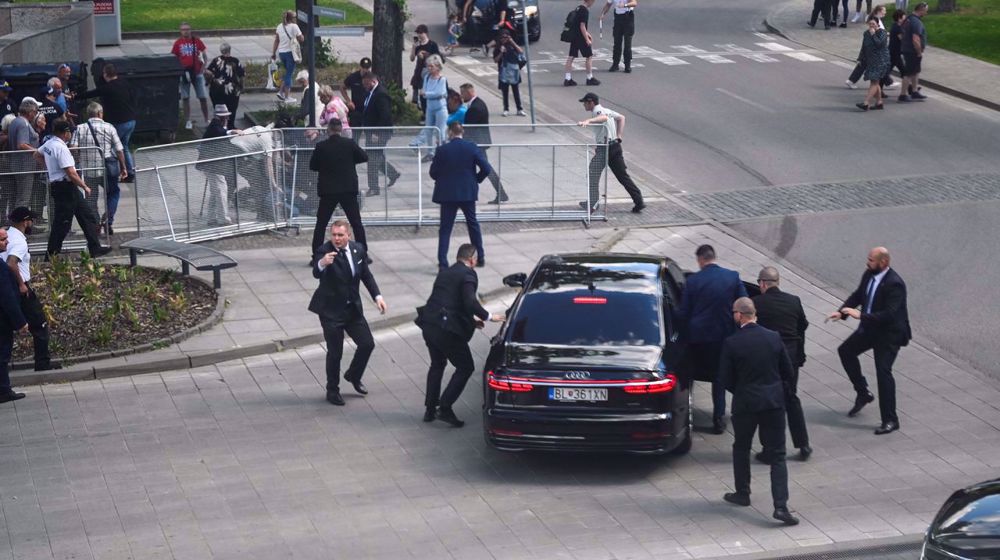
Slovakia’s Prime Minister bundled into car after being shot in May 2024.
As Fico moved to limit NGO influence and deport foreign agents last May, a pro-Western assassin with connections to foreign-funded groups attempted to assassinate him.
USAID funneled billions into Syria to topple Assad
The USAID-backed regime change operation in Syria is considered one of the most extensive operations of the 21st century, ultimately leading to the overthrow of President Bashar al-Assad in 2024 by militant groups backed by the West and its regional allies.
For over a decade, USAID, NED, and Western-backed NGOs played a central role in the foreign-instigated Syrian war, by financing opposition groups, crafting propaganda, and conducting intelligence operations under the guise of “humanitarian aid,” as reported by DD Geopolitics.
USAID reportedly channeled more than $15 billion into the Arab country, covertly funding militant groups, mercenaries, opposition networks and various anti-government activities.
One key group funded by USAID was the White Helmets, which was later exposed for its collaboration with the al-Qaeda terrorist group and the fabrication of propaganda videos to justify US intervention.
Additionally, USAID provided logistical support to exiled opposition groups, assisting in the creation of a US-backed shadow government in the Arab country.
President Assad’s government consistently pushed back against these foreign-backed attempts at destabilization. In 2014, Syria expelled several USAID-backed NGOs owing to their financial ties to insurgents.
Two years later, the government exposed the collaboration between the USAID-funded White Helmets and various militant groups.
Despite these efforts to push back against external interference, the US and its allies relentlessly pursued their objective to oust Assad.
“NGOs are being used to destabilize Syria. They pretend to help, but in reality, they work for foreign intelligence services,” Assad said in 2018.
USAID spends $600 million on anti-Russian media
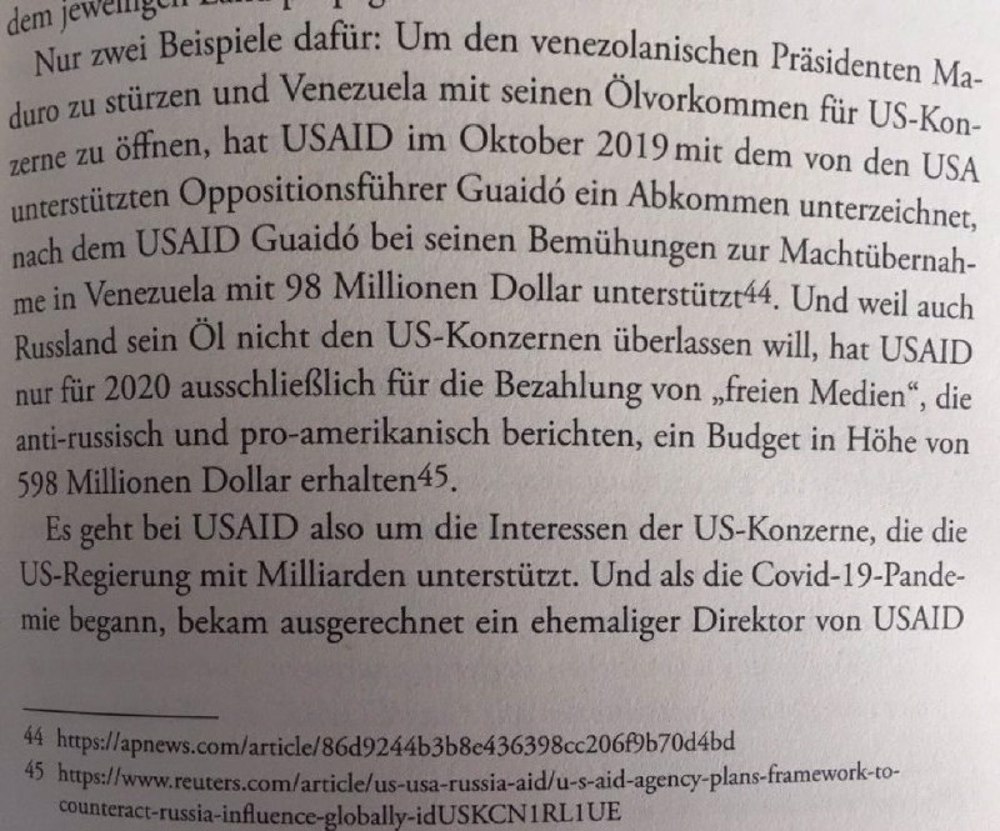
An X account with the handle @MyLordBobeo shared a passage, from a book or academic article, discussing US foreign policy concerning Russia and Venezuela and highlighting USAID’s role.
The text focuses on political interventions and funding related to opposition efforts against the Venezuelan and Russian governments.
The excerpt discussed the involvement of USAID in Venezuela, specifically highlighting its support for opposition leader Juan Guaidó in efforts to overthrow President Maduro.
It stated that in 2019, USAID signed an agreement with Guaidó, providing $98 million in assistance.
“In order to overthrow Venezuelan President Maduro and open up Venezuela and its oil reserves to US corporations, USAID signed an agreement with the US-backed opposition leader Guaidó in October 2019, according to which USAID will support Guaidó in his efforts to take power in Venezuela with 98 million dollars,” read the text, originally written in German.
Additionally, the text references USAID’s budget allocation for “free media” to counter Russian influence, amounting to $598 million for 2020.
“And because Russia does not want to hand over its oil to US corporations either, USAID has received a budget of 598 million dollars for 2020 alone to pay for “free media” that report anti-Russian and pro-Americans,” it added
A text that appears to be from a book or an academic article discusses US foreign policy, particularly in relation to Russia and Venezuela and the role of USAID.
The citations to the Reuters and AP at the end suggest it might be part of a larger discussion on US influence in global politics, referencing specific news articles for support.
Leaked doctrine on the use of USAID in economic warfare
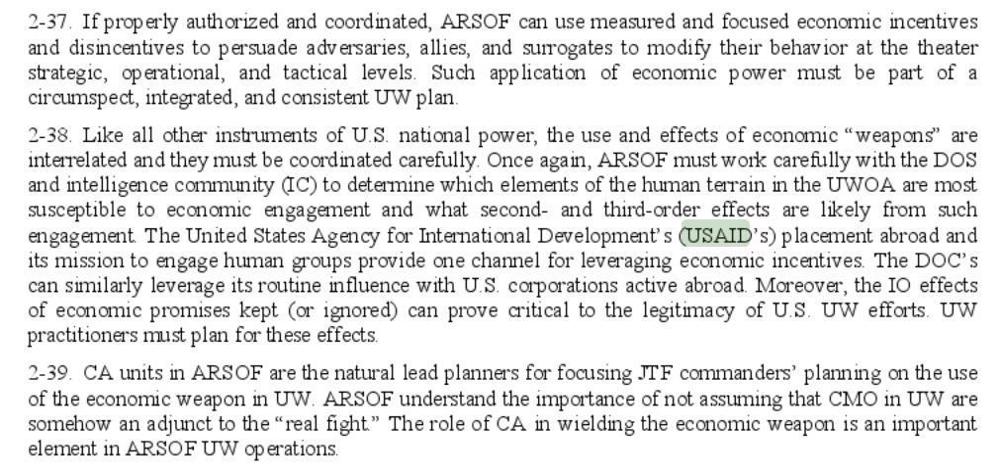
A leaked US Army Special Operations Forces (ARSOF) doctrine exposed the extent to which the US USES economic instruments, including USAID programs, as part of its unconventional warfare (UW) strategies.
The document sheds light on the orchestrated interplay between various governmental entities, including the Army Special Operations Forces, the Department of State (DOS), the Intelligence Community (IC), the Department of Commerce (DOC), and USAID.
According to the document, ARSOF is authorized to employ “measured and focused economic incentives and disincentives” across multiple levels to influence the behavior of “adversaries, allies, and surrogates.”
Such economic maneuvers are executed under the guise of a carefully crafted and integrated unconventional warfare plan, it said.
It highlights the need for ARSOF to work closely with the Department of State and the intelligence community to identify vulnerable groups in a targeted area and predict the potential outcomes of applying economic pressure
Leaked US Special Forces doctrine on use of USAID in economic warfare
USAID’s presence in foreign countries and its mission to engage with local populations provides an opportunity for the US to exert economic influence, it added.
Similarly, it said, the Department of Commerce can use its connections with American companies operating overseas to further strategic objectives.
The passage also underlines the significance of Information Operations (IO) in managing public perception of US unconventional warfare efforts. This includes anticipating and shaping the narrative around economic promises made (or unfulfilled) to maintain legitimacy.
The leaked document offers an unprecedented glimpse into the US government’s orchestration of various agencies and resources, particularly USAID, to engage in economic warfare as a means to advance strategic objectives.
This revelation raises critical questions about the covert use of humanitarian aid and development programs for ulterior political ends.
“As clearly illustrated, USAID pretends to be about ‘democracy’ and ‘helping’ the world,” wrote journalist James Li in a post on X.
“But in reality, it was always a covert tool of U.S. power — a front for CIA-backed regime change, election meddling, and civil destabilization disguised as ‘humanitarian aid,’” he added.
El Salvador’s President Nayib Bukele has also said that cutting USAID funding would not only benefit the United States but also other countries around the world.
He added that while USAID is marketed as a supporter of development, democracy, and human rights, a significant portion of its funds are channeled into opposition groups, politically motivated NGOs, and destabilizing movements.
“Most governments don’t want USAID funds flowing into their countries because they understand where much of that money actually ends up,” Bukele wrote in a post on X on Sunday.
“At best, maybe 10% of the money reaches real projects that help people in need (there are such cases), but the rest is used to fuel dissent, finance protests, and undermine administrations that refuse to align with the globalist agenda,” he added [end]
After WWII, thousands of war criminals were able to settle in Canada, where most lived openly without any fear of prosecution
Volunteers of the 14th Waffen Grenadier Division of the SS are sworn in, 1943. As many as 2,000 members of the unit arrived in Canada in the 1950s. Photo courtesy the National Digital Archives of Poland
Growing up, I always heard about the Nazi SS veteran who lived in our small town in rural Manitoba. His name was Herbie. He worked on farms in the area, and for a time at CN Rail, before passing away in peace and comfort in his 80s.
Herbie’s Nazi past was an open secret. Everybody in town knew he had fought for the Waffen-SS during the Second World War and hightailed it to Canada when the Allies triumphed. But nobody seemed to know how he had entered Canada so easily, or why the Canadian government didn’t do anything about this man whose Nazi past was known to everyone in the area.
Rumours circulated that Herbie was a war criminal. I remember hearing one story several times: while he was stationed at a concentration camp for Russian POWs on the Eastern Front, he shot and killed a prisoner simply because he wanted the man’s coat.
I was always confused why Herbie—an enemy combatant who had fought for what we supposedly recognize as one of the most vile and destructive regimes in history—was not arrested and extradited to Europe. Now I know why. It was a deliberate policy of Ottawa to welcome Nazi war veterans like Herbie into Canada after 1945.
The stereotype of Nazi-embracing Latin American dictatorships is a common one, but it distracts attention from the myriad ways in which the US and Canada welcomed thousands more Nazi veterans and allowed their ideology to fester, untouched, amongst many far-right diaspora groups.
In 1997, war crimes investigator and private detective Steven Rambam said, “Canada is where the Nazis are. Canada is the unknown haven for Nazis. Everybody knows about Argentina, but nobody knows about Canada.”
Whitewashing Nazi crimes
In Winnipeg, the largest city near my hometown, a man named Alexander Laak lived openly, unbothered by police. He was a Nazi lieutenant and the commander of the Jägala concentration camp in Estonia. Thousands of Jewish people were murdered at Jägala from 1942 to 1943, and Laak himself was reported to have kept female prisoners as sex slaves.
After the war, Laak lived comfortably in suburban Winnipeg. He was a member of a national diaspora group called the Estonian Central Council (ECC), and from 1955 onward, he worked for Canada’s Department of National Defence.
The Russian news agency TASS claimed that Laak had bought his house in Winnipeg with proceeds from valuables stolen from victims of mass executions in Estonia. The RCMP had apparently “talked to Laak and found nothing to incriminate him.” Nevertheless, Laak admitted that he “was in the Estonian army and fought against the Russians.”
In September 1960, Laak was found dead in his garage. The official cause of death was suicide by hanging, but there are theories that he was tracked down and killed by a so-called “Jewish Avenger” squad of Holocaust survivors.
Following Laak’s death, Canadian media reported that he had undergone and passed a police check before entering Canada. Another article in the Ottawa Citizen used scare quotes when reporting Laak’s crimes, aiming to discredit Soviet accusations that he had participated in the Holocaust.
One article reads: “A 53-year-old immigrant accused by Russia as a ‘Nazi war criminal’ sought by the Communists for ‘mass murders’ in Estonia committed suicide last night by hanging himself from a garage rafter.” The article also gave Laak the space to discredit his accusers: “Laak said he was the man the Russians were talking about but labelled the story ‘99 percent lies… It is only Communist propaganda.’”
Meanwhile, an earlier article headlined “Accused of Being Nazi: Family Tells of Struggle” did everything it could to clear Laak’s name, writing of the family’s “struggles in Canada to piece together war-disrupted lives.”
Dozens of other journalists penned articles claiming Laak was the target of “Red lies” and “Russian propaganda.” Following Laak’s death, the ECC said their organization had “come under a Soviet propaganda barrage.”
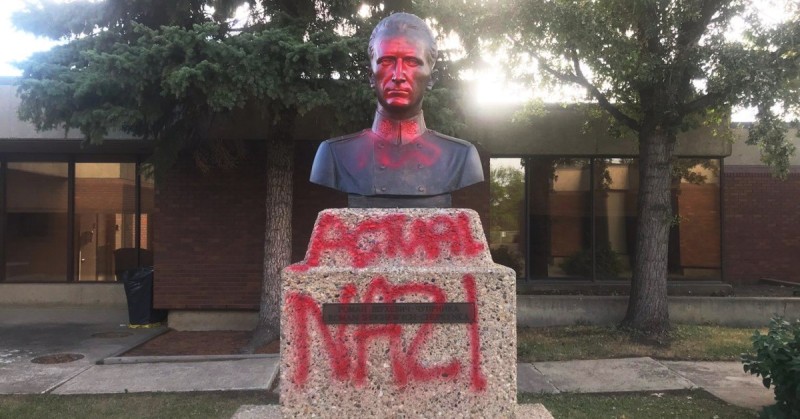
Efforts to complicate accusations against Laak were similar to how the media addresses (or fails to address) the crimes of Ukrainian Holocaust perpetrator Roman Shukhevych today. Whenever his name appears in the media—usually in connection to protests against the bronze bust of his likeness in Edmonton—it is often implied that the narrative around his crimes is “complex”
The Roman Shukhevych statue at the Ukrainian Youth Unity Complex in Edmonton after it was vandalized with the words “ACTUAL NAZI” in August 2021. Photo courtesy the Progress Report
Amidst a wave of protest against the Shukhevych statue last year, CTV News quoted the Ukrainian Catholic Eparchy, the organization which erected the bust, as “dismiss[ing] accusations that Shukhevych collaborated with Nazi Germany and was involved in massacres of Jewish and Polish people as ‘Russian disinformation.’”
A CBC article claimed that Shukhevych has “fallen under increased scrutiny” in recent years. And a CTV article noted: “While Shukhevych is celebrated by some as a Ukrainian military leader, he is also criticized by others as being involved in massacres of Jewish and Polish people.”
Even amidst the ongoing outrage over Yaroslav Hunka’s visit to the House of Commons, the CBC ran an article in which they wrote of Shukhevych’s “alleged” war crimes and his hero status among many right-wing, ultranationalist Ukrainians:
Lionized by some in the Ukrainian Canadian community as a brilliant guerilla commander who led the largest insurgency in Europe against Stalin, Shukhevych is considered a war criminal by Jews and Poles for his alleged role in the Holocaust and an ethnic cleansing campaign against the Polish minority in Western Ukraine
Canada: “Haven for Nazi criminals”
When meeting with historian Irving Abella, Prime Minister Pierre Trudeau was honest about the fact that Ottawa had no intention of prosecuting Nazi war criminals living in Canada. In their meeting, he told Abella that Canada was not seeking to prosecute Nazi veterans on its soil “because they were afraid of exacerbating relationships between Jews and Eastern European ethnic communities.”
In his research, Abella described the disturbing ways in which the Canadian government welcomed Nazis into the country after the war. In an interview with 60 Minutes, he told host Mike Wallace that one of the ways they could guarantee their entry into Canada “was by showing the SS tattoo… This proved you were an anti-Communist.” If true, this would explain how people like Herbie, Hunka, and Laak were able to enter Canada so easily after fighting for Hitler’s army
The New York Times has described Canada as a “Haven for Nazi Criminals,” while the Jerusalem Post called Canada “a near-blissful refuge” for Nazis. B’nai Brith has accused Ottawa of “intentional harbouring of known Nazi war criminals.”
It is hard to disagree with any of these statements. For instance, when Jerusalem Post reporters hired Steven Rambam to search for Nazis, he tracked down around 150 suspected war criminals living openly in Canada. And this assignment didn’t test his investigative mettle; tracking them down was often as easy as looking up their names in the phone book.
In 2014, Rambam said, “It is to the Canadian government’s great and eternal shame that more was not done” to prosecute Nazi war criminals living here. Indeed, Canada openly spurned the petitions of national Jewish organizations which protested the government’s openness toward Nazi veterans:
In the late 1940s, the Canadian Jewish Congress actively petitioned Ottawa to keep a closer eye on refugee streams from Eastern Europe, as the CJC believed that many former Nazi collaborators were using them to enter the country under false pretenses. These warnings were almost completely ignored, and the Congress’ low-end estimate is that 2,000 war criminals were able to settle in Canada, where most lived openly without any fear of prosecution
Indeed, it was a policy of the British after the Second World War to dump Ukrainian Nazi prisoners in Canada. A 1948 report from British official Beryl Hughes reads, “What little we know of [Ukrainian Nazis’] war record is bad… We’re still hoping to get rid of the less desirable Ukrainian POWs either to Germany or Canada.”
These Nazi veterans usually don’t hide their presence or their past actions. Often they are proud of them. For instance, Hunka writes of his time in Hitler’s army with pride and nostalgia. He posted photographs of himself in uniform on a blog for Ukrainian veterans of the SS Galicia Division and described the period under Nazi occupation from 1941 to 1943 as “the happiest years of my life.”
None of this stopped Parliament from applauding him, even though he was introduced as having fought “against the Russians” during World War II. And it didn’t stop the University of Alberta from distributing a $30,000 endowment fund in Hunka’s name over the past four years (which they finally closed yesterday amidst the uproar around the incident in the House of Commons)
After the war, the Canadian government welcomed between 1,200 and 2,000 members of the Ukrainian SS Galicia Division into Canada. Other Nazi veterans and collaborators came from Germany, the Baltics, and the Balkan states.
Over the past decade, the Canadian government has allocated millions of dollars to construct a Memorial to the Victims of Communism in Ottawa—despite a 2015 poll that found 77 percent of Canadians opposed the project. The monument was awarded funding under both the Harper and Trudeau governments, and received letters of support from Green Party leader Elizabeth May, former NDP leader Tom Mulcair, and former federal Justice Minister Irwin Cotler.
Funding for the monument has also come through a “buy-a-brick” campaign in which Canadians can donate money and dedicate a “virtual brick” to someone they consider a “victim of communism.”
After being announced in 2021, the “buy-a-brick” campaign was swamped with donations dedicated to Nazi war criminals and collaborators. The General Committee of United Croats of Canada dedicated a brick to Ante Pavelić, the leader of Croatia’s Nazi puppet regime and the country’s chief perpetrator of the Holocaust. Pavelić is responsible for the murders of approximately 32,000 Jews, 25,000 Roma, and 330,000 Serbs. Another brick was dedicated to Mile Budak, one of the most high-ranking figures in the fascist Ustaša. The bricks made no mention of these men’s actions, simply describing Pavelić as a “doctors of laws” and Budak as a “poet.” A third brick was purchased for Ivan Oršanić, another Ustaša member.
Meanwhile, the League of Ukrainian Canadians’ Edmonton Branch bought five bricks in honour of Roman Shukhevych, whose Ukrainian Insurgent Army (UPA) massacred thousands of Poles and Jews.
Confronting the past, and present
It is clear that the presence of Nazi veterans is widespread in Canada. Even so, the federal government is still hiding information on war criminals living in this country.
The 1986 Deschênes Commission investigated the presence of Nazi war criminals in Canada. However, many of the commission’s findings remain classified, and Ottawa continues to ignore appeals to release additional information.
Forty years later, the government is still sitting on a long-classified report about Nazis who settled in Canada. According to Ottawa Citizen journalist David Pugliese:
[The government] has heavily censored another 1986 report examining how Nazis were able to get into Canada. More than 600 pages of that document, obtained by this newspaper and other organizations through the Access to Information law, have been censored
David Matas, the honourary counsel for B’nai Brith, has attempted to gain access to these documents. His efforts have been fruitless. “We’ve run up against a brick wall,” he told Pugliese.
It is past time we confront this dark history. We deserve to know how and why these Nazis were allowed to live comfortably in Canada.
As Friends of Simon Wiesenthal Center President Michael Levitt said, “It’s now time for Ottawa to not only release the unredacted files related to the Deschênes Commission, but to also address the stark reality that there are still former Nazis with blood on their hands living in Canada.”
Direct demands need to be made of Canadian officials to release all historical documents related to Nazi war criminals within our own borders.
We also need to ask why we are spending millions on a monument that may bear dedications to Nazi collaborators.
These questions must be dealt with. Failing to better understand our history will have troubling implications for Canada’s future [end]
chronicle: its roots before WW2, its collaboration with Nazi Germany, its legacy in modern Ukraine and Baltic States, how NATO has supported Nazism in eastern Europe
The 70th anniversary of Dien Bien Phu and Algeria’s revolution highlights their profound influence on global decolonization. This longread explores their impact on the Palestinian resistance, shedding light on their shared struggle against colonial oppression and their continuing inspiration to the world
(Fourate Chahal El Rekaby)
Introduction
Revolution is not a dinner party, or writing an essay, or painting a picture, or doing embroidery; it cannot be so refined, so leisurely and gentle
Mao Zedong, 1927 (Zedong 1953)
Colonialism is not a thinking machine, nor a body endowed with reasoning faculties. It is violence in its natural state, and it will only yield when confronted with greater violence
Frantz Fanon, 1961 (Fanon 1967)
Imperialism has laid its body over the world, the head in Eastern Asia, the heart in the Middle East, its arteries reaching Africa and Latin America. Wherever you strike it, you damage it, and you serve the World Revolution
Ghassan Kanafani, 1972 (Kanafani 2023)
This year, 2024, coincides with the 70th Anniversary of the Battle of Dien Bien Phu (May 1954), in which Vietnamese revolutionaries inflicted a crushing defeat on French colonialists. It also marks the 70th birthday of the Algerian revolution, which began in November of the same year. The Algerian and Vietnamese resisted colonial oppression for decades before leading two of the most significant revolutions in the twentieth century, against France (and its local collaborators), which was the second biggest European colonial power in the world at the time and which was also supported by NATO forces. No discussion of decolonisation and anti-imperialism can be complete without understanding the importance of Vietnam and Algeria, and how their revolutionary liberation struggles were (and continue to be) so inspiring to oppressed people all over the world, including the Palestinians.
No one revolution exactly resembles another. This is because all revolutions are rooted in a specific national or regional history, are led by particular social and generational forces, and happen at a given moment in the development of a country. However, revolutions all share a common element, without which they would not be called revolutions: the arrival of a new bloc of classes who take up leadership of the state, or the transition from colonial dependence to national independence. In Lenin’s words (external link), ‘For a revolution to take place, it is usually insufficient for the lower classes not to want to live in the old way; it is also necessary that the upper classes should be unable to live in the old way.’ Despite all the elements that might point to continuity, it is this rupture that marks a revolutionary change.
Against this backdrop and understanding, my objectives in this longread are five-fold:
To share some historical reflections on the Algerian and Vietnamese anti-colonial struggles, so as to bring to light important chapters in anti-colonial history.
To draw connections and parallels between the two struggles, and between them and the ongoing Palestinian liberation struggle, to understand how Palestinians have been inspired by both struggles and at the same time themselves continue to inspire the world with their resolute resistance to Zionist settler-colonialism.
To challenge and debunk attempts to portray a false equivalence between colonisers and those who are colonised.
To highlight transnational solidarities between those who are oppressed and colonised.
To firmly place the Palestinian resistance and liberation struggle within the long line of anti-colonial and anti-imperialist struggles going back to the Haitian struggle at the end of the eighteenth century and start of the nineteenth century, when Haitian slaves rebelled against the French empire and established the first Black republic (James 2001)
Colonialism Denies the Colonised Their Own History, National Liberation Re-invents it
National liberation, national renaissance, the restoration of nationhood to the people, commonwealth: whatever may be the headings used or the new formulas introduced, decolonisation is always a violent phenomenon
Frantz Fanon, 1961 (Fanon 1967)
The Algerian independence struggle against French colonialists was one of the most inspiring anti-imperialist revolutions of the twentieth century. It was part of the wave of decolonisation that started after the Second World War in India, China, Cuba, Vietnam and many countries in Africa. It inscribed itself in the spirit of the Bandung Conference and the era of the ‘awakening of the South’, a South that has been subjected for decades (and in many cases for more than a century) to imperialist and capitalist domination under different forms, from protectorates to proper settler colonies (as was the case for Algeria).
Retrospectively, French colonisation of Algeria can be seen as unique, as Algeria was the first Arabic-speaking country to be annexed by the West and one of the first countries in Africa to be officially subjugated by a Western empire, long before the Berlin Conference in 1884, when different European empires (British, French, German, Belgian, Italian, Spanish, Portuguese) met to carve up the continent amongst themselves.
France invaded Algeria in June 1830. The French army was to spend the next 50 years suppressing an insurgency, 15 of them fighting the brilliant, fierce and dedicated resistance leader Abd-El-Kader. France’s war of conquest was conducted without let-up, especially under the command of the ruthless Marshal Bugeaud, who adopted a scorched earth policy (Fisk 2005), committing atrocities ranging from population displacement to land expropriation, massacres, and the infamous enfumades, where the French army eliminated whole tribes through asphyxiation.1
Alongside Marshal Bugeaud’s “pacification” campaign, France actively encouraged colonisation of Algeria by its own population. In a statement before the National Assembly in 1840 Bugeaud said: ‘Wherever there is fresh water and fertile land, there one must locate colons [settlers], without concerning oneself to whom those lands belong’. (This is exactly the approach the Zionists were to apply in Palestine, a century later). By 1841, the number of such colons/settlers already totalled 37,374, in comparison with approximately 3 million indigènes (native peoples) (Horne 2006). By 1926, the number of settlers had reached some 833,000, 15% of the population, and it increased to just under 1 million by 1954.
Colonisation involved the expropriation of the basic factor of production, land, from the indigenous peasantry and its redistribution to the settlers, destroying the foundation of the peasant subsistence economy (Lacheraf 1965). The rural masses fought the encroachment of the colonial army until 1884, but the core of the Algerian rural resistance to colonialism was smashed in 1871, when the big politico-agrarian revolt that had spread over three-quarters of the country was finally crushed. This historic peasant uprising was a reaction to a series of disastrous confiscatory measures during the 1860s that outraged the majority of rural Algerians and led them to fear for their lives and livelihoods. Their situation was made worse by drought, harvest failures, famine, locust invasions and disease, which resulted in the deaths of more than 500,000 victims (around one-fifth of the population). In the period between 1830 and 1870 it is estimated that several million Algerians died (Bennoune 1988, Davis 2007 and Lacheraf 1965).
The Egyptian Marxist Samir Amin has described how the Algerian rural population transformed the colonial conquest into a protracted and devastating war: ‘The collapse of the regency government and the war of extermination undertaken by the French army gave this early period (1830–1884) certain special characteristics, which are not found elsewhere … faced with military power, the urban ruling class was thrown into thorough disarray and could think of no other alternative but flight … as for the peasants, flight was out of the question. Faced with the threat of extermination, they turned the Algerian countryside into the terrain for a fifty-year war which claimed millions of victims‘(Amin 1970).
French colonial rule in Algeria lasted for 132 years (in comparison to 75 years of colonial rule in Tunisia and 44 in Morocco), having a duration and a depth that was unique in the experiences of colonialism in both Africa and the Arab world. In 1881, Algeria was administered for the first time as an integral part of France. With this extension of civilian rule to the country came the application of second-class status to Algeria’s Muslim population. The exclusion of Muslims was reflected at all levels of political representation, anti-Muslim discrimination was built into the electoral system, and the inferior status of Muslims was inscribed in law under the loathsome Code de l’Indigénat of 1881 (McDougall 2006).
After the French success in violently suppressing Algeria’s anti-colonial rebellions, the last of which took place in the 1870s and 1880s, over half a century was to pass before the Algerian resistance movement once again took up the fight, in the shape of Algerian nationalism in its modern form.
8 May 1945: ‘Victory in Europe Day’ and massacres in Algeria
It was at Setifthat my sense of humanity was affronted for the first time by the most atrocious sights. I was sixteen years old. The shock which I felt at the pitiless butchery that caused the deaths of thousands of Muslims, I have never forgotten. From that moment, my nationalism took definite form
Kateb Yacine, Algerian writer and poet (quoted in Horne, 2006)
On 8 May 1945 there were joyful celebrations across Europe as news spread of the Nazi capitulation. France rejoiced at being delivered from a five-year occupation. At precisely the same time, events in Algeria began that would lead to the colonial massacre of thousands of Algerian Muslims over the next two months.
On Victory in Europe Day, while Europeans celebrated, Algerians marched in Setif for independence and an end to colonisation, deploying banners bearing slogans such as ‘For the Liberation of the People, Long Live Free and Independent Algeria!’ They also brandished for the first time what would later become the flag of the Algerian National Liberation Front (FLN) liberation movement. The French colonial authorities violently repressed the march, triggering a rebellion that led to the murder of 103 Europeans.
The colonial retaliation to these murders was savage. The French military (air, navy and army) bombed several regions, and burnt and razed many villages to the ground in Setif, Guelma and Kherrata. Over the space of two months, the French gendarmerie2 and troops, alongside vengeful settlers, slaughtered tens of thousands of Algerian Muslims, with some estimates as high as 45,000.
The parallels between the Setif, Guelma and Kherrata massacres and the 7 October 2023 Al-Aqsa Flood operation by the Palestinian resistance against Israel, and the pitiless genocidal butchery that followed it, is too stark to ignore. In both cases, resistance whether peaceful or violent, was entirely disallowed, and aspirations for self-determination were crushed with grossly disproportionate force.
At the time (in 1945), one analyst, trying to explain the ‘barbarism’ of the colonised and to justify France’s bloody repression, wrote: ‘The call to violence raises from the mountains a kind of evil genie, a wild and cruel Berber Caliban, whose movements can only be stopped by a force greater than his own. This is the historical and social explanation for the events that took place in Sétif on the very day that victory was celebrated‘ (Gresh 2023).
The same supremacist colonial mindset and the same racist, orientalist and essentialist explanations of why the oppressed and colonised revolt persist today: the Palestinian attacks on 7 October are often put down to the pure evil, irrational savagery and timeless barbarism of medieval and sub-human terrorists, far removed from the political context of more than 75 years of settler colonialism, apartheid and occupation.
The massacres that followed the demonstrations of 8 May 1945 had significant repercussions for the Algerian nationalist movement. For the young generation of militants, the Algerian war had already started and the preparation for armed struggle could no longer be postponed. Most historians agree that the massacres of 1945 were traumatic, marking every Algerian Muslim who lived through the period. Moreover, every Algerian nationalist who was prominent in the FLN traces their revolutionary determination back to May 1945. It will not be surprising if future generations of Palestinian and Arab revolutionaries (of all political tendencies) trace their commitment to liberatory struggle to the genocide that followed the 7 October attacks and the heroic resistance in Gaza, which continues at the time of writing.
Ahmed Ben Bella, an FLN leader and head of the Algerian state from 1962 to 1965, had been a much-decorated sergeant in the 7th Regiment of Algerian Tirailleurs, a unit that distinguished itself in battle in Europe. But it was the events of 1945 that launched him on the path of revolution. He later wrote: ‘The horrors of the Constantine area in May 1945 succeeded in persuading me of the only path: Algeria for the Algerian.’ Similarly, for Mohammed Boudiaf, another revolutionary FLN leader and also a future head of state, the colonial massacres of 1945 led him to reject electoral politics and assimilation and to embrace armed resistance and direct action as the only way to achieve liberation (Evans & Phillips 2007).
The traumatic events of 1945 were the first volleys in the Algerian struggle for independence.
Vietnam’s victory is Algeria’s inspiration
Our actions aim to take the war to them, to let the whole world know that the Algerian people are leading a war of liberation against their European occupiers
The Algerian struggle for independence cannot be divorced from the global context of decolonisation. In 1945, the Arab League was formed, committed to Arab unity. In 1947, India won independence from Britain. In 1949, the Chinese Maoist revolution defeated the Nationalists of Chiang Kai-shek and established the People’s Republic of China. 1955 saw the rise of Arab nationalism/Nasserism and the holding of the Bandung Conference in Indonesia, where 29 non-aligned countries from Africa and Asia challenged colonialism and neocolonialism in a context of Cold War tensions.
The FLN leaders were under no illusion about the scale of the task confronting them, but their confidence was bolstered by the humiliating French defeat in Indochina in May 1954. As Frantz Fanon explained, the great victory of the Vietnamese people at Dien Bien Phu was no longer, strictly speaking, just a Vietnamese victory: ‘Since July 1954, the question which the colonized peoples have asked themselves has been “What must be done to bring about another Dien Bien Phu? How can we manage it?”’ (Fanon 1967).
Fanon was fascinated by what the Vietnamese had achieved at Dien Bien Phu. In his view, the Vietnamese victory over the French in this remote Southeast Asian valley had demonstrated that the colonised could generate the revolutionary violence needed to force decolonisation on the coloniser. News of the Vietnamese victory quickly reverberated across the French empire, shattering the myth of the coloniser’s invincibility and initiating cracks in the empire’s structure. The importance of Dien Bien Phu and its impact on the psyche of colonised people can hardly be overstated. Benyoucef Ben Khedda, president of the Provisional Government of the Algerian Republic, recalled: ‘In 7th May 1954, the army of Ho Chi Minh inflicted on the French expeditionary corps the humiliating disaster of Dien Bien Phu. This French defeat acted as a powerful catalyst on all those who had been thinking that an insurrection in the short term is by now the only remedy, the only possible strategy. … Direct action took precedence over all other considerations and became the priority of priorities‘ (Ben Khedda 1989).
Ferhat Abbas, who became the first acting president of the newly independent Algerian Republic, cast the Vietnamese victory at Dien Bien Phu in epoch-changing terms, considering it as significant as the French revolutionary army’s victory over the Prussians in the historic battle of Valmy in 1792: ‘Dien Bien Phu was more than just a military victory. This battle is a symbol. It’s the “Valmy” of the colonised peoples. It’s the affirmation of the Asian and African vis-à-vis the European. It is the confirmation of the universality of human rights. At Dien Bien Phu, the French lost the only source of “legitimation” on which their presence turned, that is the right of the strongest [to rule the weakest]’ (Abbas 1962).
Others have described Dien Bien Phu as the Stalingrad of decolonisation (Meaney 2024).
Holding the Imperial Line and Solidarity Between the Colonised
It is not because the Indo-Chinese has discovered a culture of his own that he is in revolt. It is because “quite simply” it was, in more than one way, becoming impossible for him to breathe
Frantz Fanon (Fanon 1967)
It is hard, at a distance of 70 years, to imagine the impact the first Indochina war, and especially Dien Bien Phu, had on the colonial world, particularly France’s overseas colonies, from Algeria to Senegal and from Morocco to Madagascar. A colonial power had been defeated. A regular army had been beaten!
In the 1940s, during the Second World War, when France was invaded and occupied by Nazi Germany, tens of thousands of Algerians, Moroccans, Senegalese, Vietnamese and others bravely joined the battle for its liberation, which they hoped would in turn lead to their own liberation. But when it finally rose from the ruins, France set about restoring its shattered empire in all its colonial pomp. Despite negotiations in Paris between Jean Sainteny and Ho Chi Minh to find a compromise on the question of post-war Vietnam, and despite the victory of the Left, including the Communists, in the November 1946 French elections, the French government nevertheless decided to reconquer Vietnam. Whether it was led by the right, the centre, or the left, or by forces that were religious or secular, and from one republic to another, France continued to cling to its empire, from the Dien Bien Phu valley to the Kasbah of Algiers (Delanoë 2002).
Following the outbreak of the war in December 1946, from 1947 to 1954, tens of thousands of North Africans were sent to fight for France in Indochina (the figure ultimately reaching 123,000), at a time when their own countries were experiencing the first stirrings of the struggle for independence. Once in Vietnam, hundreds of them deserted and joined the Viet-Minh. In doing so, they were responding to Vietnamese appeals for anti-colonial solidarity (Delanoë 2002). One such appeal was made in a letter a minister in Ho Chi Minh’s government sent to the Moroccan independence leader Abd El-Krim, in exile in Cairo, in early 1949. He wrote: ‘Our struggle is your struggle and your struggle is in no way different from ours. Also, the solidarity of the national liberation movements within the framework of the former French empire is capable of putting a final end to French imperialism. Your Excellency, the government of Ho Chi Minh asks you to use your great spiritual authority to ask the soldiers of North Africa to refuse to leave for Viet Nam, and also asks you to appeal to the dockers to boycott French ships‘ (Saaf 1996).
Abd El-Krim, a revolutionary guerilla leader who had defeated the Spanish army in the epic battle of Annual in 1921 and who had set up the short-lived Republic of the Rif (1921-1926) before being ultimately defeated by the French and Spanish through air raids, gas and napalm bombing, self-propelled guns and tens of thousands of recruits from the Empire (Ayache 1990 and Daoud 1999), replied: ‘The victory of colonialism, even at the other end of the world, is our defeat and the failure of our cause. The victory of freedom anywhere in the world is … the signal of the approach of our independence‘ (Saaf 1996).
The succession of setbacks suffered by the French army in Indochina only heightened awareness of the need for solidarity among colonised people. Responding to this need, Algerian dockers working in the ports Oran and Algiers refused to load war material bound for Indochina (Ruscio 2004).
The Vietnamese also asked Abd El-Krim and the Moroccan Communist Party to send them a North African who could establish a psychological warfare network that would encourage North African troops within the French Expeditionary Corps in the Far East (CEFEO) to desert, rally the Vietnamese, and ultimately return to their home countries to fight the French colonisers. This role was taken on by M’hamed Ben Aomar Lahrach (alias Maarouf). A Moroccan, like Abd El-Krim, Maarouf was a trade unionist and a member of the Moroccan Communist Party (Delanoë 2002). At the end of the 1940s, he travelled to Hanoi. He explained his activities with the North African soldiers who either rallied the Viet Minh or were captured as follows: ‘I try to create real villages for my Arab and Kabyle prisoners, I put them in self-contained huts, I manage to give them a life reminiscent of the country. We mustn’t make these guys Vietnamese; we must repatriate them as quickly as possible! They must remain themselves; they will form the cadres of our liberation armies… I won’t let my Moroccan or Algerian deserters die‘ (Delanoë 2002).
In his appeals to North African soldiers fighting on the French side in Vietnam, and in his political education work with North African captives and rallied soldiers, Maarouf’s message was ‘Go back home: these people, like you in Morocco, are fighting for their independence. … Return home and use your fighting spirit to liberate your country’ (Saaf 1996). Above all, he sought to recuperate North Africans who were being used by the French as cannon fodder, and who found themselves lost in this distant Asian country, with the explicit aim of repatriating them as soon as possible to their own countries.
The effectiveness of Maarouf’s work is best demonstrated by the hundreds of Algerian repatriates who became effective military cadres for the Algerian National Liberation Front starting from 1954/55. Maarouf’s activities were truly heroic; they included participating in the arrest of French General De Castries in Dien Bien Phu. Testifying to the high esteem in which he was held, Ho Chi Minh gave him the name Anh Ma, which literally means ‘Brother Horse’, and the Vietnamese awarded him the rank of general, and decorated him with medals (Saaf 1996 and Delanoë 2002).
For France, Dien Bien Phu became a symbol of anachronistic obstinacy leading to catastrophe. For Vietnam, it was a symbol of the recovery of national independence. But Dien Bien Phu was not just an historical event for these two countries alone: throughout the world, the battle was seen as a turning point that heralded the coming of other battles for liberation. The echo of gunshots had barely subsided in the Tonkin valley before it was heard in the Aurès mountains in Algeria. And within less than a year, the ‘wretched of the earth’ gathered in Bandung (Ruscio 2004). As for the colonialists, De Lattre, France’s commander-in-chief, confided to the officer he had put in charge of creating his Vietnamese army, that they had to hold the imperial line: ‘it’s in Tonkin that we are defending our positions in Africa. Everything must be subordinated to this imperative‘ (Goscha 2022).
Today, it is in Gaza that US-led imperialism seeks to defend its global hegemony.
In the US-Israeli attempt to hold the imperial line in Gaza, they are applying similarly brutal methods to those applied by the French in Vietnam, including starvation of the civilian population. The French focused on breaking the Vietnamese’s access to rice, as part of French General Raoul Salan’s order to ‘Starve the adversary’ (Salan later founded the Organisation Armée Secrète (OAS), a clandestine terrorist organisation that sought to prevent Algerian independence). The use of food as a weapon was by no means new. Imperial armies have practised this form of warfare since antiquity. But the French were the first to apply this approach in a twentieth-century war of decolonisation – with terrible consequences for the Vietnamese. In doing so, they collapsed the dividing line between combatants and civilians, and between the home front and the battle front. This was la guerre totale (total war), as advocated by General Lionel-Max Chassin, commander-in-chief of the French air force in Indochina during the early 1950s. Chassin insisted that this was the only way to win a colonial war, arguing that ‘One must starve people to death’ (Goscha 2022). In 1956, Chassin told his superior that he was ‘convinced that had we killed all of the water buffalos, destroyed all of the rice in Indochina, we would have had the Vietnamese at our mercy whenever we wanted’.
Similar logics prevailed in France’s attempt to ‘pacify’ Algeria between 1954 and 1962, and they are now again at work in Israel’s total war on Gaza. In fact, what is taking place today in Gaza is not just a genocide. Although it is almost impossible to find the right terminology to describe the level of destruction and death Israel is unleashing on Palestinians, a plethora of concepts are now being used to understand the enormity of what is taking place: urbicide, scholasticide, domicide, ecocide, and holocide – the annihilation of an entire social and ecological fabric.
Revolutionary Violence and Urban Guerilla Warfare in a Time of Decolonisation
We are advocates of the abolition of war, we do not want war; but war can only be abolished through war, and in order to get rid of the gun, it is necessary to take up the gun
Mao Zedong (Zedong 1967)
Knowing everything that had happened in our country, it was clear for us there was no option but an armed struggle, and that we had to confront the French, and with violence
Zohra Drif (Drif 2017)
The Indochinese and Algerian wars against French colonialism have become foundational to modern politics in both countries. Both independence struggles were to profoundly shape the character of anti-colonial thought over the subsequent decades.
Christopher Goscha argued in his excellent book The Road to Dien Bien Phu that Ho Chi Minh ended up administering two kinds of wartime states, one capable of holding out against the coloniser, in guerilla form, just as the Algerian FLN were to do in North Africa, the other capable of generating the required military and organisational force needed to defeat a Western colonial army in a set-piece battle, of the kind the Chinese communists had created. Thanks to Chinese military assistance and advisers, instruction in modern military science, and the introduction of the draft and mobilisation laws, the Vietnamese communists presided over a military revolution unknown in any other war of decolonisation in the twentieth century (Goscha 2022). Indeed, the Algerian nationalists were not alone in their inability to transition from guerilla warfare to conventional warfare: in no other twentieth-century war of decolonisation was there to be anything like the People’s Army of Vietnam, and there was never to be another Dien Bien Phu. But that did not mean that colonial powers could not be vanquished in other ways, including guerilla warfare.
The Vietnamese anticolonial fight against the French did not take place independently of other events in Asia. The first Indochina war (1945–1954) was taking place in parallel to the Korean war in a context of an expansion of the Cold War in southeast Asia, where the US saw aiding France as a way to fight the Communists. The resumption of the war in Vietnam in 1960 saw the direct entry of the United State into the fray, with its formidable war technology and its belief that its victory was assured. The United States no longer needed the aid of a third country to inflict decisive blows on the Communists in Asia. The American war against Vietnam was to last 15 years before its ‘invincible armada’ was forced to withdraw without glory, leaving behind a devastated country.
The devastation and violence were not unique to Vietnam’s anti-colonial revolutions. The declaration of war in Algeria on 1 November 1954 also initiated one of the longest and bloodiest wars in the history of decolonisation, replete with merciless atrocities (Stora 2004). The FLN leadership had a realistic appreciation of the military balance of power, which starkly favoured France, whose army was the fourth largest in the world at the time. In response to this reality, their strategy was inspired by Ho Chi Minh’s dictum ‘For every nine of us killed we will kill one – in the end you will leave’. The FLN wanted to create a climate of violence and insecurity that would be ultimately intolerable for the French, to internationalise the conflict, and to bring Algeria to the attention of the world (Evans & Phillips 2007). Following this logic, the revolutionary leaders Abane Ramdane and Larbi Ben M’hidi decided to take guerilla warfare into the country’s urban areas, and specifically to launch the battle of Algiers in September 1956.
There is no better way to fully appreciate this key and dramatic moment of sacrifice in the Algerian revolution than watching the classic realist film by Gillo Pontecorvo, The Battle of Algiers, released in 1966. Initially banned in France, the film powerfully reenacts some of the critical moments of the Algerian resistance in the capital and the French crackdown on it. In one dramatic moment, Colonel Mathieu, a thinly disguised General Massu (who had also fought in the first Indochina War), presents the captured FLN leader Larbi Ben M’Hidi at a press conference, where a journalist questions the morality of hiding bombs in women’s shopping baskets. The journalist asks: ‘Don’t you think it is a bit cowardly to use women’s baskets and handbags to carry explosive devices that kill so many people?’ Ben M’hidi replies: ‘And doesn’t it seem to you even more cowardly to drop napalm bombs on defenceless villages, so that there are a thousand times more innocent victims? Give us your bombers, and you can have our baskets’ (quoted in Fisk 2005).
Djamila Bouhired, a revolutionary icon who has become an inspirational figure in the whole Arab world (especially for Palestinians), as well as beyond, was a key figure in the battle of Algiers and was, alongside Zohra Drif, and Samia Lakhdari and her mother, one of the women who planted bombs across the city. After being captured, raped and severely tortured, she heroically challenged her colonial captors and torturers (external link): ‘I know you will sentence me to death but do not forget that by killing me you will not only assassinate freedom in your country, but you will not prevent Algeria from becoming free and independent.’
Zohra Drif, another heroine of the Algerian War of Independence, well-known for her involvement in the Milk Bar Café bombing in 1956, was an integral part of the FLN’s bombing network in Algiers, working with Ali La Pointe, Djamila Bouhired, Hassiba Ben Bouali and Yacef Saâdi, head of the Autonomous Zone of Algiers. She was eventually captured and was sentenced to 20 years of hard labour by the military tribunal of Algiers for terrorism. Drif was imprisoned in the women’s section of Barbarossa prison. In her memoires, she reflected on the role of Djamila Bouhired: ‘They had their Marianne, we had our Djamila … For colonial France, she was “the soul of terrorism”. For us and for all freedom-loving peoples, she became the soul of liberation and the symbol of Algeria at war, beautiful and rebellious’ (Drif 2017).
Bouhired’s heroic struggle, courage, abnegation, sumud (steadfastness) and sacrifice still reverberate in Palestine and still feed the beating heart and inspire the language and imaginaries of resistance, revolution and the struggle for liberation. Bouhired’s mantle was taken up by the Palestinian freedom fighter Leila Khaled, alongside many others.
The urban revolt in Algiers was eventually crushed without mercy, through the resort to torture on a systematic scale to extract information, including fitting electrodes to genitals (Alleg 1958). By October 1957, the FLN network in Algiers was dismantled, after the blowing up of the last remaining leader Ali La Pointe along with Little Omar, Hassiba Ben Bouali, and Hamid Bouhamidi, in their hiding place in the Casbah. Despite this military loss, the FLN had scored a diplomatic victory: France was isolated internationally because of the scandalous methods of repression it used.
The Algerian experience of urban warfare as part of a decolonisation struggle was not an unprecedented one. Over a decade before the FLN set off bombs in Algiers, the Vietnamese had already fought major urban battles in Saigon, Haiphong and Hanoi. They too were brutal affairs, with the French using tanks, artillery and bombers to blast Vietnamese urban positions. Like the Casbah in Algiers, the Old Quarter of Hanoi was ground zero for the battle for that city (1946–1947). During the fighting, the commander-in-chief of France’s Expeditionary Corps in Indochina, General Jean Vally, instructed his subordinates to ‘hit them hard with the cannon and the bomb….in order to put an end to the resistance and to prove to our adversary the overwhelming superiority of our capabilities’ (Goscha 2022). By the end of the battle, Hanoi’s ‘Casbah’ lay in ruins.
The level of violence inflicted by the French across the Red River Plain and the rest of upper Vietnam from January 1951 until mid-1954 had no equivalent in the preceding history of twentieth-century wars of decolonisation. Among the Vietnamese there were more than a million dead, and hundreds of thousands wounded, including victims of torture, while the losses of the French Expeditionary Corps amounted to 130,000 men. Similarly staggering levels of violence were reached in Algeria. Official estimates suggest a million and a half Algerians were killed in the eight-year war that ended in 1962. A quarter of the population (2.35 million) were confined in concentration camps, at least 3 million people (half the rural population) were displaced, around 8,000 villages were destroyed or burned, hundreds of thousands of hectares of forests were burned or defoliated by napalm bombs, cultivable lands were either sown with mines or declared ‘prohibited zones’, and the country’s livestock was decimated (Bourdieu and Sayad 1964; Bennoune 1973).
In both cases (Algeria and Vietnam), the coloniser’s dirty work of vengeance against the colonised’s daring acts of resistance involved furthering and entrenching the dehumanisation of the ‘other’ and casting hate in racialised terms. For the French and their allies, the Vietnamese and the Algerians were no longer a people, they were bandits, criminals and terrorists. One young French soldier who lost a confidant in Vietnam explained what he wanted to do to the Vietnamese: ‘We have to destroy all of them, without any pity for them, they’re real savages’ (Goscha 2022). The practice of torture was endemic within the French army years before French paratroopers ever set foot in Algiers. The same mechanisms and tactics of dehumanisation are now being used by Israel in Palestine, with Israeli generals, officials and media figures describing Palestinians as ‘human animals’, ‘rats’, ‘barbarians’, and ‘terrorists’ to justify their war crimes, torture and genocidal massacres. Colonialism, and its racialisation strategies, has not ended yet.
In Vietnam, Algeria and Palestine, it is not just the armed forces of the colonial powers that have applied these strategies: the colonists/settlers themselves have also played a role. When the elite paratroopers brought in by the French government to crush the uprising in Algiers, marched down the main street of the city, throngs of ecstatic French settlers came out to greet them. Similar scenes took place in Saigon in 1946 when settlers turned out in droves to welcome the soldiers liberating them from ‘native’ rule (Goscha 2022). In both cases, there was a close alliance between the army and the settler communities, which acquiesced in the colonial violence and cruel repression. Likewise, today, Israeli settler society is overwhelmingly in support of the Israeli military’s genocide in Gaza and pursuit of a full-blown war in the whole region. Countless videos and images show Israelis cheering and celebrating the death of Palestinians and explaining how they would like to see them disappear from the lands they have taken away from them.
Palestine: Taking up the mantle of anti-colonial revolution
What am I driving at? At this idea: that no one colonizes innocently, that no one colonizes with impunity either; that a nation which colonizes, that a civilization which justifies colonization—and therefore force—is already a sick civilization, a civilization that is morally diseased…
Aimé Césaire(Césaire 2000)
We remembered all the miseries, all the injustices, our people and the conditions they lived, the coldness with which world opinion looks at our cause, and so we felt that we will not permit them to crush us. We will defend ourselves and our revolution by every way and every means
What do the Algerian and Vietnamese struggles have to do with the Palestinian struggle today? The answer is that the Palestinian liberation struggle must be uncompromisingly situated within the long line of anti-colonial revolutionary efforts. Despite their own specificities and differences, these three struggles need to be understood as such: as anti-colonial struggles for liberation. At the same time, the events in Palestine, including the current genocide, also demonstrate that the colonial world has not yet been fully dismantled.
The sections below focus on the intersections between the Palestinian liberation struggle and its Algerian and Vietnamese counterparts.
Palestine and Algeria: two sisters in the Arab world
I travelled on an Algerian airplane under Algerian protection as if I was an Algerian envoy, not just a Palestinian one. [Boumediene] wanted to tell the world that Palestinian envoy Yasser Arafat wasn’t coming alone but with Algeria by his side
For obvious reasons, there are multiple connections between the Palestinian and Algerian revolutionary liberation struggles. One of them is the deeply racist, inhumane and genocidal settler-colonial experience both nations have been subjected to, uniquely within the Arab region. Sharing this common experience, Palestinian revolutionaries look up to their Algerian brothers and sisters, while the Algerians see in the Palestinian resistance and revolutionary efforts a mirror image of their revolution against the French colonialists. The Algerian FLN inspired the Palestinian strategy of armed struggle (external link) and the union of different political groups under a common banner. It therefore comes as no surprise that the Algerians have assisted the Palestinians since the 1960s in every realm: diplomatic backing, military assistance, and the provision of weapons and financing.
For a big part of the ‘Third World’, especially those countries that were still under the grip of colonial domination, Algeria’s liberation in 1962 provided hope and a model to follow. Its capital Algiers became a Mecca for revolutionaries from all over the world – from Vietnam to Palestine to southern Africa – who desired to bring down the imperialist and colonial order. The 1964 charter of Algiers declared Algeria’s support for the ‘struggles of other people in the world’, including ‘armed struggle’ (Deffarge & Troeller 1972), and independent Algeria went on to provide asylum and financial support to movements all over the world fighting for independence and against racism, colonialism and imperialism.
In the Arab world, the new regime in Algeria established ties with the Egyptian president Gamal Abdel Nasser, and was firmly part of the anti-colonial wave that chased out the French and the British after their pitiful adventure in the Suez in 1956, and which included independence in Tunisia and Morocco also in 1956, and the overthrow of the monarchies in Iraq (1958) and Northern Yemen (1962). In this period, the Palestinians also initiated their first actions to put their country back on the political map, from which it had been removed (Gresh 2012).
The Palestinian liberation movement actively engaged with Algeria in the years after its independence in 1962, at a time when the country was a meeting point for various Afro-Asian liberation movements. The Palestinian writer and politician Muhammad Abu Meizar, who joined Fatah (the Palestinian National Liberation Movement) in 1962, has described how the first Palestinian meeting with the Cuban revolution took place in 1964, when Che Guevara travelled to Algiers. Palestinians at this time were establishing relations with various liberation movements from Africa, Asia and Latin America. It was also from Algeria that the first Palestinian delegation travelled to China in 1965.
Abu Meizar (external link) describes Algeria’s support to the Palestinian struggle at this time: ‘through Algeria, several interactions took place with liberation movements, the Vietnamese, the Chinese, African movements, it was a meeting place. Algeria also hosted one of the most important institutions, the Cherchell Military Academy, where many Palestinians were enrolled. Until that time Fatah had not fired its first shot. However, through Algeria, it made connections with the Moroccans, the Tunisians, the Africans, the Vietnamese, the Chinese, Southeast Asia, Latin America, and Cuba. These were not minor relationships, they were extremely precious, and valuable.’
The Palestine Liberation Organisation (PLO) opened its office in Algeria in 1965. Its first chairman (1964–1967), Ahmad al-Shukeiri, was known for his ardent support for the Algerian cause: As a representative of Saudi Arabia and then Syria at the United Nations in New York, he played an active role in defending the Algerian revolution from 1955 till 1962, during annual sessions and special meetings. Algeria repaid the debt in kind: the first public support for the Palestinian revolution from any government was from Algeria. It took the form of the cover page of the official newspaper Al-Moudjahid, on 1 January 1965, which bore an article titled ‘The Revolutionaries of the 1st of November Salute the Revolutionaries of the 1st of January’.
During this time, Fatah opened a training camp for Palestinian fighters in Algeria, outside the framework of the Cherchell Military Academy, in coordination with the Algerian Joint Forces Command. A large number of Palestinian volunteers from Europe and the Maghreb, and even from the USA, trained there, some of whom went on to conduct resistance operations, becoming themselves symbols of the liberation struggle, such as Mahmoud al-Hamshari, Ghazi al-Husseini and Abdullah Franji.
Abu Meizar (external link) described Algeria’s support to the Palestinian armed struggle: ‘[In 1967 [w]e secured the first weapons shipment from Algeria to Fatah, with the delivery facilitated by Mohammad Ibrahim al-Ali [Commander of the Syrian Popular Army]. The first plane flew to Damascus loaded with weapons for Fateh. … This was our first weapons deal, but it should be remembered that in the days of Boumediene in 1966, the first official financial support was offered by the Algerian government to Fatah.’
Yasser Arafat, chairman of the PLO from 1969 to 2004, always acknowledged Algeria’s uncompromising and unshakable solidarity with the Palestinian cause, as well as its firm support for pan-Arab war efforts against the Zionist entity. For example, he explained how Algerian President Houari Boumediene sent forces to Egypt to fight in the 1967 Arab–Israeli war. Boumediene also went to Cairo and Damascus to ask what they needed for the war effort, and thereafter visited the Soviet Union to request they send Egypt and Syria tanks and weapons to replace those they had lost. Arafat recounted (external link) the negotiations between Boumediene and the Soviets at this time: ‘They told him they needed more time, and he said if by time they meant money then Algeria would pay. He immediately paid the Soviet Union 200 million dollars which would amount to 2 billion dollars today. He paid to make the Soviet Union expedite the delivery of weapons to Egypt and Syria. No one can forget this.’
After the Naksa (defeat) of 1967, Boumediene declared:
‘History will judge us as traitors and losers … if we accept the defeat … The Arab nation will not kneel. If Israel thinks that it captured the Sinai, the Golan and the west bank, it knows that the Arab depth reaches Algeria … Algeria cannot accept the defeat. Is the Arab nation using all its tremendous human resources? Is it using all the tremendous physical energies it has today … to say that it lost the battle. … The battle is not just a Palestinian battle. It is true that we are far geographically, but we have a role to play.’(Boumaza 2015)
The Algerian troops Boumediene sent remained in Egypt to defend its borders until the 1973 Arab–Israeli war, during which they fought alongside Palestinian troops on the Suez front.
Finally, Algeria’s active support for the Palestinian liberation struggle was also seen in the choice of its capital Algiers as the site for the Declaration of Independence of the State of Palestine in November 1988, announced during the 19th session of the Palestine National Council.
Every day in Gaza there’s another Kham Thien
Like Palestine and Algeria, Palestine and Vietnam have a long history of fraternity. Vietnam’s fight for liberation, which pitted it first against France and then against the United States, inspired Palestinians in their struggle against Israel’s occupation of their lands.
One of the similarities in the Palestinian and Vietnamese struggles is their use of tunnels as a guerilla tactic against a superior and better equipped army. Perhaps inspired by the Chinese communists’ use of tunnels against the Japanese invaders, the Vietnamese first began digging their extensive network of tunnels during the 1940s, to hide from and launch attacks against French colonial troops. The 150-mile-long Cu Chi tunnels, located northwest of Saigon (Ho Chi Minh City), were a strategic stronghold for the Communist guerilla troops, known as Viet Cong (external link). They played a crucial role in the resistance against the American war on Vietnam, including acting as the base of operations for the Tet Offensive in 1968. Today, both the Palestinian and Lebanese resistance movements are using tunnels in their fight against Israel. The tunnels in Gaza serve as a base for the Palestinian resistance, which has used them to inflict significant losses on the Israeli military.
Another parallel between Palestine’s experience and that of Vietnam is the degree of destruction wreaked by their powerful oppressors. For Vietnamese, Israel’s destruction of Gaza today recalls the US bombing raids (external link) in 1972. Then-US President Richard Nixon ordered the bombing of the North Vietnamese capital Hanoi over Christmas 1972. Starting on 18 December and lasting for 12 consecutive days and nights, about 20,000 tonnes of bombs were dropped on Hanoi, as well as on the busy northern port city of Hai Phong and other localities. Hanoi’s Kham Thien neighbourhood suffered the most severe devastation.
These links between Israel’s genocidal war on Gaza and the US war on Vietnam are now being clearly articulated by young Vietnamese activists to introduce the Palestinian cause to new audiences (Dang 2024). The historical echoes of the two wars, including images of the destruction of urban centres (Gaza and Kham Thien), alongside the aggressor states’ violent threats – with Israel declaring it would ‘flatten Gaza’ and the United States declaring it would ‘bomb North Vietnam back to the Stone Age (external link)’ – form part of a reservoir of shared symbols that point to a common history of colonial wars and anti-colonial revolutionary resistance. This shared experience is fuelling a renewed sense of transnational solidarities between the formerly oppressed and currently oppressed peoples.
These solidarities, which are now being renewed, actually go back many years: Vietnam’s support for the Palestinian people and their struggle for liberation was unwavering during the Cold War and into the 1990s. This is undoubtedly because of the belief among the Vietnamese leadership that the Palestinian cause mirrored their own fight for unification and independence against foreign powers. The PLO established relations with North Vietnam in 1968 and set up a resident representative office after the end of the war in Vietnam in 1975. The office soon became the embassy of Palestine in Vietnam. In the 1990s, Vietnam welcomed Palestinian leaders, including Yasser Arafat, on many occasions. On the Palestinian side, the bonds of friendship between the two countries were summed up by Palestinian poet Mahmoud Darwish (external link) in 1973, as the war in Vietnam entered its final phase with the signing of the Paris Peace Accords:‘In the conscience of the peoples of the world, the torch has been passed from Vietnam to us.’ The PLO was among the small minority of groups and countries of the Global South that openly condemned China for its invasion of Vietnam in 1979.
The Battle is Long, and the Road is Hard
When the prison doors are opened, the real dragon will fly out
Ho Chi Minh (Minh 1967)
A freedom fighter learns the hard way that it is the oppressor who defines the nature of the struggle, and the oppressed is often left no recourse but to use methods that mirror those of the oppressor
Nelson Mandela (Mandela 1994)
Gaza was and will remain the capital of steadfastness, the heart of Palestine that does not stop beating even if the world closes in around us. …So hold on to the land as firmly as roots cling to the soil, for no wind can uproot a people who have chosen to live
In the preceding sections I have argued that the Palestinian liberation struggle needs to be (re)situated within the long trajectory of anti-colonial/anti-imperialist/anti-apartheid struggles, and of decolonisation, including the liberation struggles of Haiti, Vietnam, Cuba, Algeria, Guinea Bissau, Cape Verde and South Africa. It is therefore a struggle that should be supported, not demonised. But, as Edward Said once wrote (external link), ‘Palestine is the cruellest, most difficult cause to uphold, not because it is unjust, but because it is just and yet dangerous to speak about…’ Nevertheless, in these times of genocide, we cannot afford to be silent: we must speak about Palestine as honestly and concretely as possible.’
The decolonisation of Palestine would entail the end of occupation, the liquidation of the apartheid regime and the dismantling of Israel as a settler-colonial project. All anti-colonial revolutionaries (whatever their ideology, whether communist, nationalist, religious conservative etc.) have been described by the colonisers and oppressors as terrorists, savages and barbarians. And all colonial powers have responded with savagery and inhumanity to acts of resistance by the oppressed and colonised. It is therefore time we stop entertaining any false equivalence (external link) between the legitimate violence (and right to resist) of the oppressed and colonised (fighting for their own liberation) and the infinitely greater violence of the oppressors and colonisers, which is used solely to enforce an unjust and cruel status quo. The Guyanese revolutionary Walter Rodney articulated this in the following powerful words:
We were told that violence in itself is evil, and that, whatever the cause, it is unjustified morally. By what standard of morality can the violence used by a slave to break his chains be considered the same as the violence of a slave master? By what standards can we equate the violence of blacks who have been oppressed, suppressed, depressed and repressed for four centuries with the violence of white fascists? Violence aimed at the recovery of human dignity and at equality cannot be judged by the same yardstick as violence aimed at maintenance of discrimination and oppression
(Rodney 1969)
In spite of all the horror, apocalyptic destruction and mass slaughter witnessed in Israel’s genocidal assault on Gaza over the last year, by carrying out the 7 October Toufan Al-Aqsa attacks, the Palestinian liberation movement began what may come to be seen as the beginning of the end of Israel’s settler-colonial regime (Pappé 2024). Moreover, despite the targeted assassinations of Hamas and Hezbollah leaders, the resistance forces remain intact and steadfast in the field of battle. Although it is too early to say for sure, what is now taking place in Palestine and Lebanon could turn out to be, like the 8 May 1945 events in Algeria, the first episode in a protracted people’s war to dismantle a settler colony. Hamas has shattered the myth of Israel’s invincibility, and through its heroic resistance in Gaza right now, is asserting itself as the leader of the Palestinian resistance to occupation, apartheid and settler-colonialism, garnering huge sympathy from all over the Arab world and beyond. The unfolding asymmetrical war is not simply a war between Hamas and Israel, it is a Palestinian war of liberation.It is also already a regional war, since Israel and its Western allies (chiefly the US and the UK) are fighting with varying degrees of intensity on five fronts: Gaza/West Bank, Lebanon, Yemen, Iraq/Syria, and Iran.
We need to remember that armed struggle is necessary under certain conditions, and this is the case for occupied Palestine in its struggle against Zionist settler-colonialism. However, it is crucial to subordinate armed struggle to a broader range of revolutionary politics, to ensure it does not become arbitrary or random in its choice of targets. In such an approach, armed struggle can be understood as a tool for mobilising political support and not as a tactic that repels/alienates potential allies. Efficient resistance, as the Pakistani revolutionary scholar Eqbal Ahmad saw it, therefore needs a flexible strategy that mixes different militant and political tactics, based on the position the enemy occupies and the broader political context. In this understanding, violence and nonviolence should not be considered as mutually exclusive strategies standing in a binary opposition, with oppressed peoples needing to choose one or the other. Thus, our analysis of political violence must diverge (external link) from the purely normative/moralistic grounds on which some leftist condemnations of Hamas’s violence are based. Moreover, dismissing anti-colonial resistance because it is Islamist reflects the deeply rooted scourge of Islamophobia, which has unfortunately been internalised by some sections of the Euro-American left.
Since its earliest days, the Palestinian liberation movement has understood the necessity of armed resistance in the face of a cruelly violent colonial, apartheid and occupying regime. At the same time, like its brothers and sisters in Algeria and Vietnam, it also knows that defeating, militarily, a highly sophisticated military power (backed by the US-led imperialist bloc) is an insurmountable task. To succeed and achieve its goals, the Palestinian armed struggle therefore needs to be firmly grounded in a broader revolutionary political strategy and led by a united anti-colonial front.
The truth of this proposition can be illustrated by the Algerian case, and specifically by the approach implemented by Abane Ramdane. Dubbed the architect of the Algerian independence struggle, Ramdane worked to organise the various political and military structures of the Algerian revolution and to create a stronger united front working with other political forces, specifically through the Congress of Soummam in August 1956 (Harbi 2024). It was Ramdane, alongside other brothers in arms, who emphasised the primacy of political action over military operations, but it was also Ramdane who insisted on taking the war to the capital Algiers, in the Battle of Algiers. The Algerian FLN did not win the war against the French militarily, but they did win the more decisive political and diplomatic battles, in terms of isolating and delegitimising the French colonial regime and building strong alliances in the international scene, including at the Bandung Conference in 1955, at pan-African fora, in Europe and at the UN General Assembly in the following years.
Obviously, the global political context has changed dramatically since the 1950s and 1960s. We are no longer living in the era of national liberation and Third-Worldism. Much worse, ours is an era in which international law is openly trampled upon by the most powerful, and in which the Western liberal establishment of human rights and democracy (political, intellectual, cultural and media) is collapsing in front of our eyes and showing its true genocidal and white-supremacist colours. The regional arena is no better: Palestine finds itself surrounded by reactionary and traitorous Arab regimes who have sold out the Palestinian cause to the US and Israel. This extremely challenging climate must be considered when seeking to devise an effective political strategy that can unite the Palestinian anti-colonial forces and efficiently articulate revolutionary tasks at the national, regional and international levels. As part of such a multi-tiered strategy, strengthening Boycott, Divestment and Sanctions (BDS) efforts is of paramount importance.
Gaza has awakened the world, and Palestine has become the quintessential defining struggle of our times. Palestine is the litmus test for progressive movements and organisations, and it is also a test for each and every one of us. As has been cogently argued by Adam Hanieh, the Palestine liberation struggle is not merely a moral and a human rights issue: it is fundamentally a struggle against US-led imperialism and global fossil capitalism, given that the two pillars of US hegemony in the region and beyond are Israel, a Euro-American settler colony, and the reactionary fossil fuel-rich Gulf monarchies, which are a key nodal point in global fossil capitalism. Palestine is thus a global front against colonialism, imperialism, fossil capitalism, and white supremacy. In this respect, the success of struggles (albeit suppressed and defeated for now) to overthrow the regional reactionary Arab regimes – chiefly the Gulf monarchies, and Egypt and Jordan – is essential for the victory of the Palestinian struggle. At the same time, what Israel’s genocidal war has also revealed, beyond the vacuity of the rule-based international (dis)order, is the moral and political bankruptcy of the Arab regimes, some of which gesticulate while doing nothing, and some of which are actively complicit in Zionist crimes (especially the United Arab Emirates, Saudi Arabia, Egypt, Jordan and Morocco). This fact has become starkly clear to Arab populations over the last year. This could consolidate their resolve to overthrow these regimes in the coming years (remembering that the Sudanese and Algerian revolutionary slogans of 2018 and 2019 were ‘Let them all fall’).
The stubborn attempts by the French and their allies to hold the imperial line in Indochina in the 1940s and 1950s in order to defend their positions in Africa are mirrored today in the actions of the US, Israel and their allies to hold the imperial line in Palestine and the wider Middle East region against the axis of Resistance, represented by the Islamic Republic of Iran, Hezbollah and its sister organisations in the Lebanese resistance, alongside Hamas and its partners in the Palestinian resistance, as well as by Ansar Allah (known as the Houthis) in the Yemeni government and an assortment of Iraqi resistance groups. It thus becomes clear that for anti-imperialist forces globally, striking imperialism in Palestine and the Middle East is of utmost strategic importance to serve the world revolution, to borrow the words of the Palestinian revolutionary intellectual, poet and political activist Ghassan Kanafani that were quoted at the start of this article.
My purpose throughout this contribution has not been to uncritically glorify or romanticise the various revolutions and forces of anti-colonial resistance, as these have all had their own problems, contradictions, shortcomings and failings. Moreover, the ‘post-colonial’ realities in the ‘independent’ countries that are the focus of this longread point to the pitfalls of national consciousness and the bankruptcy of certain national bourgeoisies, which were masterfully described by Fanon in his Wretched of the Earth. However, rather than adopting a nihilist stance and retrospectively pronouncing these revolutionary efforts not worthwhile, we need to see revolutions as ongoing long-term processes, with ebbs and flows, rather than as events that either succeed or fail at one particular moment.
To make an adequate materialist assessment of revolutionary struggles, it is also important to simultaneously consider the national, regional and international dimensions of such struggles. Transnational solidarity between oppressed and colonised peoples has been, and continues to be, a driving force in changing the world. We are currently witnessing the power and the significance of such South-South solidarity, in the form of Southern countries’ commitment to the Palestinian cause and efforts to isolate the criminal settler regime of Israel. South Africa’s case against Israel for breaching the Genocide Convention at the International Court of Justice (ICJ) is one such effort, and it is an historic development: African men and women (with their allies) are shaking white-supremacy and colonialism and, to borrow the words of UN Special Rapporteur Francesca Albanese (external link), ‘fighting to save humanity & the international legal system against the ruthless attacks supported/enabled by most of the West’. Watching them wage this fight ‘will remain one of the defining images of our time. … [it] will make history whatever happens.’ At the Hague we saw representatives of the nation that suffered from, and defeated, apartheid standing up for basic human decency, justice and solidarity, and extending their hand to another nation that is undergoing and resisting colonial oppression and genocide while asserting their rights for freedom and justice. The South (whatever its imperfections and contradictions) is teaching the ‘human-rights- and democracy-loving’ North a lesson in political morality. In their actions, the heirs of Mandela are honouring his memory and underlining the truth of his words: ‘…we know too well that our freedom is incomplete without the freedom of the Palestinians’.3
Many countries in the Global South are supporting South Africa’s case. They include Turkey, Indonesia, Jordan, Brazil, Colombia, Bolivia, Pakistan, Namibia, the Maldives, Malaysia, Cuba, Mexico, Libya, Egypt, Nicaragua, the Organization of Islamic Cooperation (made up of 57 members), and the Arab League (made up of 22 members). In contrast, Western powers (the US, UK, Canada, and Germany) back Israel. Germany received a strong rebuke from Namibia, its former colony, shaming its stance of defending Israel’s genocide in Gaza and not learning from its murderous history of committing two genocides in the twentieth century (the genocide of the Herero and Namaqua in Namibia and the Holocaust in Europe). Moreover, Chile and Mexico have called on the International Criminal Court (ICC) to investigate war crimes committed by Israel in Gaza. This, alongside a dozen countries cutting diplomatic ties with Israel and moves by Colombia (and potentially South Africa) to ban exports of coal to Israel, points to a clear demarcation line between North and South (albeit with some unsustainable contradictions, especially when it comes to countries like Jordan and Egypt). These developments strengthen the trend of a move towards a multi-polar world where the South asserts itself politically and economically. We are not yet in a new Bandung phase, but this historical juncture will accelerate the decline (at least ideologically) of the US-led empire and will intensify its contradictions.
The ICJ hearings and the developments that have followed it constitute a serious challenge to the white world (where white is not just a racial category but also an ideological construction), the Western establishment, their crumbling edifice of ‘human rights’ and their ‘universalism’, and may hasten the collapse of the international ‘rules-based’ (dis)order. It is very apparent that Western/Northern bourgeois democracy is undergoing a deep (if not mortal) crisis of legitimacy, and that its global hegemony (in the Gramscian sense) is waning. That explains the clear move towards, and the increasing reliance on, war and the entrenchment of a militarist/genocidal logic. Capitalism-imperialism is entering its openly barbaric stage. As Gramsci wrote (external link): ‘the old is dying and the new cannot be born; in this interregnum a great variety of morbid symptoms appear’.
At a time when the international political and economic system blames its victims rather than those who uphold it, diverts any attention away from the mechanisms of domination, and resorts to culturalist (often racist) explanations for its failures, it is crucial for us to immerse ourselves in revolutionary and progressive projects and experiences from the past. We need such clarity of purpose in order to create a break with the long history of plunder, violence and injustice endured by the majority of the planet. This can also help us to overcome the propaganda of an enslaving system that disguises its chains and shackles through the use of benign phrases like the ‘invisible hand of the market’, ‘happy globalisation’, ‘the humanitarian responsibility to protect’ – or ‘Israel has the right to defend itself’.
It is becoming crystal clear that the oppressed majority can no longer breathe in a system that dehumanises people, a system that enshrines super-exploitation, a system that dominates nature and humanity, a system that generates massive inequality and untold poverty, a system that is prone to war and militarisation, and which causes ecological destruction and climate chaos. Luckily, revolts and rebellions that are fundamentally anti-systemic are taking place on all continents and in all regions. But for these episodic and largely geographically confined acts of resistance to succeed, they need to go beyond the local and to reach the global; they need to create enduring alliances in the face of capitalism, colonialism/imperialism, patriarchy and white supremacy.
Can the various contemporary struggles – from the Arab, African, Asian and Latin American uprisings to Black Lives Matter, the resistance of Indigenous communities and the labour movement, and from the movements for climate justice, food sovereignty and peace, to the student encampments, anti-fascism/anti-racism and Palestinian/Lebanese resistance – converge and build strong global alliances that overcome their own contradictions and blind spots? Can they usher in a new moment where we question the colonial foundations of our current predicaments and truly decolonise our politics, economies, cultures and epistemologies? Such an aim is not only possible but necessary, and transnational solidarities and alliances are crucial in the global struggle for the emancipation of the wretched of the earth. Here, we can take inspiration from the past, by looking at the period of decolonisation, Bandung, Third- Worldism, the Tricontinental, and similar internationalist experiences.
Some histories are ignored, others are silenced in order to maintain certain hegemonies and to hide from view an inspiring era of revolutionary connections between struggles for liberation on different continents. We must dig into the past to familiarise ourselves with these histories, learn from them and discern some potential convergences across ongoing struggles. For example, we need to remember, and learn from the fact, that independent Algeria became a powerful symbol of revolutionary struggle and served as a model for different liberation fronts across the globe. With its audacious foreign policy, in the 1960s and 1970s, the Algerian capital become a Mecca for revolutionaries, as discussed above. It was Amilcar Cabral, the revolutionary leader from Guinea-Bissau, who announced at a press conference on the margins of the first Pan-African Festival held in Algiers in 1969: ‘Pick a pen and take note: the Muslims make the pilgrimage to Mecca, the Christians to the Vatican and the national liberation movements to Algiers!’ Likewise, we should take note of the fact that Vietnam’s struggle against US imperialism in the 1960s was also a rallying cause for progressive movements and influenced the upsurge of a global social revolt that led to the protests of 1968.
It is this global perspective on our struggles that we need to emphasise, in order to overcome the many constraints and limitations imposed on our movements and to embrace a radical internationalism that will actively promote solidarity. It is essential that we rediscover the revolutionary heritage of the Arab world, Africa, Asia, Latin America and the Global South, as recorded in the deeds and words of great minds like George Habash, Mahdi Amel, Frantz Fanon, Amilcar Cabral, Thomas Sankara, Walter Rodney, Ghassan Kanafani, Samir Amin, Che Guevara, Ho Chi Minh and Mao Zedong, to mention just a few. We need to revive the ambitious projects of the 1960s that sought emancipation from the imperialist-capitalist system. Building on this revolutionary heritage, being inspired by its insurgent hope and applying its internationalist perspective to the current context is of utmost importance to Palestine, and to other emancipatory struggles all over the world.
In the conclusion to The Wretched, Fanon wrote:
Come, then, comrades; it would be as well to decide at once to change our ways. We must shake off the heavy darkness in which we were plunged and leave it behind. The new day, which is already at hand, must find us firm, prudent and resolute. … Let us waste no time in sterile litanies and nauseating mimicry. Leave this Europe where they are never done talking of Man, yet murder men everywhere they find them, at the corner of every one of their own streets, in all the corners of the globe. … Come, then, comrades, the European game has finally ended; we must find something different. We today can do everything, so long as we do not imitate Europe, so long as we are not obsessed by the desire to catch up with Europe. … For Europe, for ourselves and for humanity, comrades, we must turn over a new leaf, we must work out new concepts and try to set afoot a new man
(Fanon 1967)
In this vein, it is paramount to continue the tasks of decolonisation and delinking from the imperialist-capitalist system, in order to restore our denied humanity. Through resistance to colonial and capitalist logics of appropriation and extraction, new imaginaries and counter-hegemonic alternatives will be born. Let us not surrender. Let us be ‘a generation that rises from our ashes stronger’ (external link). And, to paraphrase a famous saying that is familiar to many Muslims, let us work for radical change as if it will take an eternity to realise but prepare the ground for it as if it is going to happen tomorrow.
As revolutionaries sang at the Pan-African Festival of Algiers in 1969: ‘Down with imperialism, down with colonialism!’ ‘Colonialism, we must fight until we win! Imperialism, we must fight until we win!’4
To which we can add: ‘From the river to the sea, Palestine will be free!’
Notes and sources
Les enfumades was a technique used by the French expeditionary corps during the conquest of Algeria in 1844/45. It consisted of asphyxiating people who had taken refuge or were trapped in a cave, and involved lighting fires in front of the entrance, which consumed the available oxygen and filled the cave with smoke. People annihilated in this way included women and children, with entire tribes killed, numbering thousands of people. ↩︎
A gendarmerie is a military force that has law enforcement duties within a civilian population. The term gendarme is derived from the medieval French gens d’armes (‘men-at-arms’, literally ‘people of arms’). In France and some Francophone nations, the gendarmerie is a branch of the armed forces that is responsible for internal security in parts of the territory (in the case of France, primarily rural areas and small towns), with additional duties as military police for the armed forces. ↩︎
This quote from Nelson Mandela is from a speech he made during the International Day of Solidarity with the Palestinian People, in Pretoria, South Africa, on 4 December 1997. ↩︎
President Putin’s plenary session performance (address + Q&A) at the annual Valdai Club meeting in Sochi felt like a high-speed train on cruise control
(Sergey Guneev / Sputnik)
Totally cool, calm, comfortable, in full command of a Himalaya of facts, no political leader anywhere – recent past and present – would even come close to delivering what amounts to an extensive, detailed world view deeply matured over a quarter of a century at the highest geopolitical level.
Putin began his address referring to the October 1917 revolution, drawing a direct parallel with our turbulent times: “The moment of truth is coming”. In a clear tribute to Gramsci, he stated how a “completely new world order” is “being formed before our eyes.”
The subtle reference to the recent BRICS summit in Kazan could not possibly escape critical minds across the Global Majority. Kazan was a living, breathing testimony that “the old order is irrevocably disappearing, one might say, has already disappeared, and a serious, irreconcilable struggle is unfolding for the formation of a new one. Irreconcilable, first of all, because this is not even a fight for power or geopolitical influence, this is a clash of the very principles on which relations between countries and peoples will be built at the next historical stage.”
As concisely as possible, that should be taken as the current Big Picture framework: we are not mired inside a reductionist clash of civilizations or the “end of History” – which Putin defined as “myopic” – but facing a make-or-break systemic clash of fundamental principles. The result will define this century – arguably the Eurasia Century, as “the dialectics of History continues.”
Putin himself quipped that he would drive into “philosophical asides” during his address. In fact that went much further than a mere refutation of unilateral conceptual fallacies, as “the Western elites thought that their monopoly is the final stop for humanity” and “modern neoliberalism degenerated into a totalitarian ideology.”
Referring to AI, he asked rhetorically, “will human remain human?” He praised the building of a new global architecture, moving towards a “polyphonic” and “polycentric” world where “maximum representation” is paramount and the BRICS are “coming up with a coordinated approach” based on “sovereign equality.”
Six Principles For Global Sustainable Development
Sovereignty had to be one of the predominant themes during the Valdai Q&A. Putin was adamant that Russia must “develop our own sovereign AI. As algorithms are biased and give massive power to a few big companies that control the internet, the need is imperative for “sovereign algorithms.”
Answering a question on Eurasian security and the US as the dominant maritime power v. a multipolar Eurasia, he stressed the “consensus and desire in Eurasia for an anti-hegemonic movement”, and not for Eurasia constituted “as a bloc”. That’s the appeal of Eurasia’s “multi-vector foreign policy”, implying “more political independence”. The key example of “harmonizing interests”, Putin stressed, is the Russia-China partnership, and that was also what “made BRICS successful.”
Compare it in contrast to “the inability in Europe to establish a system of “indivisibility of security” and to “overcome bloc politics”; Europe instead went for NATO expansion: “After the end of the Cold War there was an opportunity to overcome bloc politics. But the US had fear of losing Europe. The US installed almost a colonial dependence. Honestly I did not expect that.”
Putin introduced a fascinating personal experience tidbit referring to a conversation – in German – with former German chancellor Helmut Kohl in 1993, when Kohl said flat out that “the future of Europe” is linked to Russia.
Yet that ended up leading to “the most important problem on our Eurasian continent, the main problem between Russia and European countries: the trust deficit (…) When they tell us that ‘we signed the Minsk agreements on Ukraine only to give Ukraine an opportunity to rearm, and we had no intention of resolving this conflict peacefully,’ what kind of trust can we talk about? (…) You have directly publicly stated that you have cheated us! Lied to us and deceived us! What kind of trust is that? But we need to get back to that system of mutual trust.”
Putin then added that Europe should consider becoming part and parcel of a Chinese concept straight from Chinese philosophy (“they do not strive for domination”). With panache, he stressed that the Chinese uber-geoeconomic trade/connectivity project should be interpreted as One Belt, One Common Road.
And that extrapolates to Central Asia, with all those nations “very young in their statehood” interested in “stable development”. For Russia-China, there’s “no competition” in the Heartland: “we only have cooperation.”
Putin once again enumerated what he considers the 6 key principles for global sustainable development: openness of interaction (implying no “artificial barriers”); diversity (“a model of one country or a relatively small part of humanity should not be imposed as something universal”); maximum representativeness; security for all without exception; justice for all (erasing “the gap between the ‘golden billion’ and the rest of humanity); and equality.
“Make Civilizations, Not War”
On Ukraine, this was the money quote: “If there is no neutrality, then it’s difficult to imagine any kind of good neighborly relations between Russia and Ukraine.” In a nutshell: Moscow is ready for negotiations, but based on facts on the battlefield and what was agreed upon in Istanbul in April 2022.
That may be interpreted as a direct message to President Trump. To whom the door is open: “Russia has not damaged its relations with the US and is open to their restoration, but the ball is in the Americans’ court.”
Putin on US Presidents (he met quite a few): “All of them are interesting people.” On Trump: “His behavior when there was an attempt on his life, I was impressed. He is a courageous person. He acquitted himself valiantly.” On the open door: “Whatever he does it’s up to him to decide.” Then Putin offered his own congratulations for the re-election – on the record. The dialogue may be on: “We are willing to talk to Trump.”
Putin extolled Russia-China relations as part of their strategic partnership as being “at the highest level in modern history.” He also praised his own personal relation with Xi Jinping. That paved the way for the real killer, when it comes to US-Russia-China: “If the US had chosen a trilateral cooperation instead of double constraint – everyone would win.”
An excellent question by Brazilian economist Paulo Nogueira Batista Jr – a former vice-president of the NDB, the BRICS bank – led Putin to clarify his own position on de-dollarization. He stated flatly that “my role is to see ideas shaped that we then propose to our partners”.
The key target is “proposing to create a new investment platform using electronic payments.” That will address the “most promising markets” in the near future – South Asia, Africa, parts of Latin America: “They will need investment, technologies.” And “tools independent from inflation” – with regulation “through Central Banks and the NDB. We agreed to have a working group meeting regularly at government level. We are in no hurry.”
So that puts to rest any scenario of an immediate BRICS financial bombshell – even as “two-thirds of our trade is being serviced in national currencies” and among BRICS the figures are also high.
BRICS Bridge will be tested – soon. As for creating a single currency, that’s “premature. We need to achieve greater integration of economies, increase the quality of economies to a certain – compatible – level.”
Then, the bombshell: “We never wanted to abandon the dollar!” That goes a long way to explain Putin’s own view on de-dollarization: “They are undoing it with their own hand – the power of the dollar.”
All of the above is just a sample of the width and breath of themes addressed by the President during the Valdai Q&A. The forum itself offered precious nuggets all across the spectrum. Some participants – correctly – noted the absence of “the majority of the majority”: youth and women. Africans were impressed with “the sharp mind of Russian bureaucracy.”
A Chinese view noted how “the Chinese don’t swim against the current; they cross the river and reach the other bank.” There was a near consensus that development should be “based in different cultural values of civilizations” – actually Putin’s own view. Also imperative is the “need for aggregate authority” among the Global South.
A Greek insight was particularly powerful when it comes to the civilizational approach to politics: “Civilizations don’t clash. States do.” Thus the new – playful – motto that could guide not only BRICS but the whole Global Majority: “Make Civilizations, Not War.” [end]
The BRICS Summit in Kazan, Russia, aims to be a turning point towards a truly multipolar or multi-nodal world that has been in transition for a few years now
Like dominos, African states are one by one falling outside the shackles of neocolonialism. Chad, Guinea, Mali, Burkina Faso, Niger, and now Gabon are saying ‘non’ to France’s longtime domination of African financial, political, economic, and security affairs
Five major trends illustrate how the world is changing, and that the West must grapple with the reality that it can no longer impose its “leadership” on the world as it once did
The BRICS Summit in Kazan, Russia, aims to be a turning point towards a truly multipolar or multi-nodal world that has been in transition for a few years now
The changes announced in Kazan regarding the payment system and the reserves of nations are concrete steps towards independence from the U.S. imperialistic system. This system is symbolized by a small piece of green paper that no longer has real backing—just an empty promise.
An Imperialistic Structure Does Not End in One Day
The U.S. has managed to build an imperial structure based on more than 800 military bases around the world, the imposition of the dollar as the currency of international trade and reserve, the extraterritorial application of its laws, and by creating a network of vassal and semi-vassal states around its hegemony. Nonetheless, the core of its imperial system relies on the dollar. The de-dollarisation led by the BRICS is driving the U.S. to despair, making their sanctions system increasingly meaningless too.
BRICS has taken on the responsibility of driving substantial change for a new world order
No empire lasts forever, especially one that lacks a strategic vision, as is the case with the U.S. The American empire lost wars or promoted further chaos in Vietnam (1955-1975), Afghanistan (2002-2021), Iraq (2003-2011), Libya (2011) and did not win in Syria and has shown an inability to control its ally Israel, which continues to commit war crimes, uphold apartheid, engage in state terrorism, and carry out genocide. Moreover, the U.S. has been incapable of formulating its Middle East policy independently of Israel’s prism.
On top of that, domestically, its infrastructure is crumbling, and its social indicators are rapidly approaching those of developing countries. The U.S. is the only major nation where life expectancy is declining, extreme poverty is increasing swiftly, and so is homelessness. Its citizens do not have universal, free access to healthcare, as happens in most developing countries, such as Latin America. All these issues highlight the fragility of the empire.
The New Sick Man
Once, during its decline, the Ottoman Empire was known as the “sick man of Europe.” Now, it seems the U.S. is playing this role, or perhaps it’s more like a drowning person: it pulls those who are close to it into its struggle and demands loyalty in this slow demise, particularly from European countries that have greatly benefited from its generous policies after WWII. In Latin America, the Monroe Doctrine is still very much in effect, which is why Brazil sometimes seems reluctant to commit fully to BRICS.
Europeans, especially the Germans, have shown signs of wanting independence, and the idea of strategic autonomy has become wishful thinking. Former Chancellor Angela Merkel, who was economically liberal, listened to German business leaders who argued that the future lay not in the Atlantic, but Eastwards toward Russia and China.
The U.S. did not like this shift and managed to make Europeans feel that they still needed Uncle Sam for their protection. Turning their backs on the U.S. was seen as an ungrateful response to American roles in WWII and the Marshall Plan.
The U.S. meddled in Central Europe and Ukraine, expanding NATO eastwards. This move was highly discouraged by prominent American foreign policy strategists like Henry Kissinger, Robert Kagan, John Mearsheimer, and even William Burns, a former Ambassador to Russia and ex-CIA director. The coup orchestrated by the CIA and led locally by Victoria Nuland in 2013 in Ukraine was just the beginning, alongside the sabotage of Nord Stream by the U.S., all part of this complex game to make Europeans dependent on the U.S.
BRICS Ignites Hopes of the Global South and the Discontented
Once again, two blocks are forming, with some countries caught in the middle. The war in Ukraine and the Global South’s refusal to impose sanctions on Russia have highlighted the divisions in the world. The war in Gaza and the resulting genocide, supported by many Western nations while they preach values and human rights, has led the Global South to lose faith in the West’s moral standards. They have denounced its double standards and are nearly unanimously supporting the idea of a new world order.
The expansion of BRICS, with over 40 nations waiting to join—including Serbia, Turkey, Indonesia, Malaysia, Thailand, Nigeria and Bolivia—clearly signals that change is expected.
Some European nations are unhappy with the expected outcomes of remaining tied to the old regime– the EU tied to the U.S.- and wish to be part of a more dynamic and prosperous future. For instance, Spain has rejected imposing extra tariffs on Chinese electric vehicles, and Turkey wants to join BRICS too, as does Serbia, even if it means giving up potential EU memberships, along with many other nations.
Bulgaria is also unhappy with its EU membership and is sending representatives to BRICS meetings. Moldova was divided over an EU membership referendum. The narrow victory of 0.2% was due to the votes of Moldovans living abroad. Still in Europe, Norway, not being subject to EU rules, has recently taken steps to strengthen economic ties with China, surprising many Atlanticists in Europe.
Therefore, BRICS has taken on the responsibility of driving substantial change for a new world order. However, it is fair to say that BRICS nations have tried to reform the Bretton Woods institutions—especially the World Bank and the International Monetary Fund (IMF)—and the United Nations to better reflect the new economic, population, and trade realities, but they have not succeeded.
New institutions are being built within BRICS, particularly the New Development Bank (NDB), which, unlike the IMF or World Bank, does not impose economic regime changes and has inclusive practices.
In sum, there are several political and economic groups of nations around the world, but none has the political will or the capacity to promote major geoeconomic and geopolitical changes as BRICS does. Therefore, the 16th BRICS Summit in Kazan comes at the right time and with the right political will to build a better, more prosperous, inclusive, free, and less ideologically driven world. The next step should be the merger of the Shanghai Cooperation Organization (SCO) with BRICS [end]
Ricardo Martins ‒PhD in Sociology, specializing in policies, European and world politics and geopolitics, especially for the online magazine “New Eastern Outlook”
Five major trends illustrate how the world is changing, and that the West must grapple with the reality that it can no longer impose its “leadership” on the world as it once did
It is essential to close the circle of Nazi existence. The defeat of the Kiev regime is a fundamental step in this direction
(Public domain)
The infiltration of Nazis, Nazi sympathizers, descendants or not from Nazis, and Nazi collaborators, into the corridors of Western power does not mean a newly seized opportunity for the glorification and whitewashing of all those who were on the opposite side of the Russian, Soviet or Bolshevik divide. This authentic movement to rewrite history and reuse the ideological potential that has been installed represents, above all, the closing of a historical circle, initiated by the most reactionary and fascistic sectors of the Western elite.
Canada is the perfect example of this historical loop closure, namelly, about reusing this ideological installed capacity and recycling it (and bleaching it) in historical terms. That’s why the episode that took place in the Canadian House of Representatives, which in unison paid tribute to Yaroslv Honka as a fervent freedom fighter, as having “fought the Russians in the Second World War”, was very far from being a simple fluke, a lapse of judgment on the part of Anthony Rota — the House speaker — or a mere courtesy on the occasion of Volodomyr Zelensky’s visit.
Like Yaroslav Honka, countless figures from the Ukrainian diaspora, especially from Galicia, who have been documented as having collaborated with the Nazi forces and, above all, as having participated in crimes against humanity, have been or are remembered, honored and paid tribute to, on an ongoing basis, in Ukrainian society. From involvement in political parties, to public office election, to the funding and promotion of educational and academic activities, these figures with a dark past have found in contemporary Canada the perfect habitat for their historical recycling and recovery. Just as they have found in this country the perfect refuge for their economic recovery.
When Franklin Roosevelt, on the subject of the “Safe Haven” project — which aimed to identify and seize the wealth that the Nazi elite kept in neutral countries — said that if the Nazi elite managed to keep their wealth, they could later use it to regain power, perhaps he wasn’t too far off the mark. Indeed, Roosevelt should not have been unaware that people like the Dulles brothers (Allan Dulles and John Dulles) supported the Third Reich in various ways — including by raising funds on Wall Street — and, at the same time, not only participated in the U.S. Council of Foreign Relations, but, in the case of Allan Dulles, was also an agent of the OSS (Office of Strategic Services), which preceded the CIA (Central Intelligence Agency).
People like the Dulles brothers, supporters of the project to rearm Nazi Germany in order to use it as an element in the fight against “communism”, promoted this operation, supporting it financially in banks like the BIS (Bank of International Settlements), or even in J.P. Morgan, which called Roosevelt a “class traitor”, not only supported the strengthening of Nazi Germany and the Berlin-Rome axis, but later recruited prominent Nazi operatives to establish what would become the CIA and the U.S. secret services, in general.
This is why what is happening in Canada, particularly at the University of Alberta — but not only there — and with the CIUS (Canadian Institute of Ukrainian Studies), represents nothing more than the materialization of the fears of people like Roosevelt, who, while not fervent communists, were also far from representing the most reactionary factions of the Anglo-American financial elite.
Thus, when Petro Savaryn founded CIUS, it was he himself who made real the fears of those who knew what it would mean to house people of Bandera’s stature in free societies. Having been whitewashed and retrained, these figures, with their in-depth knowledge of how to fight — with extreme violence, it must be said — the Soviet enemy first and the Russian enemy second, could now be used as if they were prominent examples of the fight for freedom. In its memorial, the UCC (Ukrainian Congress of Canada) gives a recent account of Savaryn’s life, but carefully erases everything that didn’t happen in Canada. The dark past is not to be repeated, and to achieve this outcome these people relied on the description and complicit silence from Canadian authorities. Thus, Savaryn is presented as an honorable Ukrainian who, from “1982 to 1986, was Chancellor of the University of Alberta,
The University of Alberta’s memorial to Petro Savaryn says everything about this historical recycling and whitewashing: not a word about his participation in the infamous Waffen-SS Galician Division, which committed such brutal massacres against civilian populations of Poles, Jews, Gypsies and Soviets. It’s as if no such thing had ever happened and as if the most important event in Petro (Peter) Savaryn’s life was the founding of CIUS and not his collaboration with the Nazi forces. To say that Ukrainian diaspora organizations in Canada honor and sing the stories of Petro Savaryn in their ceremonies would be redundant. After all, Canada was one of the destinations for thousands of these operatives, who emigrated there from 1945 onwards. Many of them should have been present at Nuremberg, but instead they are honored in the “very democratic” Western parliaments.
However, Petro Savaryn’s example is far from the only one, and it has to be said that this reality is not unknown to the Canadian public. Several media outlets — more alternative than mainstream — have warned of the real scandal of “Nazi” subsidies at the University of Alberta. The “Honka” episode triggered the unearthing of a reality that was supposed to remain hidden for some time, until nothing could be done. Or until the generations who remember the Nazi horror die off. That’s why the Governor General of Canada’s office itself apologized for awarding the Order of Canada to a veteran of the Ukrainian SS Galicia Division. The recipient was none other than Petro Savaryn. Was it incompetence? Lack of knowledge? Don’t you investigate someone before awarding him or her a prize? Believe what you like, but it’s the practice that counts.
And the fundamental question remains. How is it possible that people like Savaryn, or Petro (Peter) Jacyk — who applied for conscription to the same Nazi forces and who has his name engraved on countless initiatives, organizations and academic programs in Ukraine, Canada and the USA — have managed to go unnoticed by anyone who repudiates Nazi ideology, however masked as it is?
This question is answered by the attitudes that today whitewash Stepan Bandera and the Kiev regime’s cult of this figure, as well as the slide of Western politics to the most backward ideologies (in so many ways), under the cover of this whitewashing and the resurgence of Russophobia, Islamophobia, xenophobia and the deepest and most atrocious reactionaryism. Petro Savaryn himself was president of the Progressive Conservative Association of Alberta, a so called “center-right” movement with a name likely to encompass the entire liberal, neoliberal and conservative political center.
People like Honka, who contributed $30,000 to CIUS, a sum that the University of Alberta has said it will return, are just the tip of a veil that courageous people like Owen Schalk, Taylor C. Noakes, Pers Rudling and Harrison Samphir have been uncovering and denouncing. Other paradigmatic examples of Nazi collaborationists who have gone unscathed and whose finances and CVs have flourished in the so-called “liberal democracies” are Levko Babij or Roman Kolinsnyk, both also from the SS Galician Division. The fact that there are monuments across Canada glorifying the 14th SS Division (14th Waffen SS Grenadier Division (1st Galician)) and the fact that they have been “vandalized” with graffiti denouncing their Nazi record, was not enough to cause an uproar, nor even from from those who present themselves as champions of Western democracy.
Millions of dollars for scholarships and study programs on “Ukrainian nationalism”, told under the fashion that, for example, appears in the Ukrainian Encyclopedia translated and published by CIUS, whitewashing Nazi collaborationism on the part of “Ukrainian nationalists” and sneaking Nazi-fascist ideology into Western academia, explain much of what is happening today and why it is possible to witness this Russophobic drift that could lead the world to a nuclear confrontation, without a vehement and comprehensive peace movement emerging. This episode, which took place in Canada, is no different from what is happening in many other places, particularly in the U.S. and throughout Europe. In Ukraine, it’s not even worth talking about. No one can say they don’t know.
But then, why don’t Jewish academics say anything? Why don’t they denounce it? This is where the connections are made between twin doctrines, daughters of the same father and mother, equally supremacist, extremist, sectarian and segregationist. This is the case of Zionism and Nazism. As Jeremy Appel points out in the “Expats & Allies” podcast, the exchange is simple: Ukrainian academics flag students and professors who take anti-Israel stances and, in return, the powerful Zionist academic diaspora turns a blind eye to the growing Nazism in Western academia.
For those who consider the Zionist-Nazi connection impossible and have learned nothing from the experience of Theodor Herzl (one of the fathers of Jewish Zionism), who considered anti-Semites to be his main allies, history has proved him right once again. When it comes to Palestine and the suppression of its national identity, Zionism’s most urgent priority, Nazism allies itself with this equally supremacist, extremist, genocidal and dictatorial form of governance. And this is another circle that is closing, demonstrating that the whitewashing and recycling of Nazi ideology is not a historical accident, but a project, which initially failed because the strength of the USSR and its peoples defeated it, but which, reused, recycled and whitewashed by the USA and its allies, is now, in a second historical opportunity, fulfilling its original role. The establishment of a world superfederation under U.S. leadership. The same superfederation that Mackinder spoke of with regard to the British Empire and its salvation.
The reality we are witnessing now is nothing more than the closing of a circle that began with the creation of fascism at the beginning of the 20th century, during the period of the decline of the British Empire, and which Cinthya Chung describes so well in her masterly book “The Empire on Which the Black Sun Never Set: The Birth of International Fascism and Anglo-American Foreign Policy”, in which she masterfully exposes, documents and substantiates how fascist doctrines were an instrument of the British and Western imperial and capitalist elite. In that initial phase of the fascist circle, which resulted in Nazism itself, at a time of vital challenge imposed by the very existence of the USSR, it wasn’t as easy as it is today to clearly identify in these doctrines their instrumental character in relation to Anglo-Saxon imperialism and the advanced, Western capitalist system itself, today known as neoliberalism, globalism or North American hegemonism and which corresponds to the imperialist phase of capitalism itself.
However, at the end of this circle, Nazism and its father, fascism, are once again used as an instrument of aggression against peoples who oppose Western imperialism, now in the era of financialized, transnational, imperial capitalism. Financial, rentier capitalism and its transnational, federative dimension, of which Ursula Von Der Leyen’s European Union is a corollary, emerged in the upper phase of capitalism. Once again, Nazism, as with Germany in the 1930s, is used, this time in relation to Ukraine, to contain, combat and attack any Russian, Chinese or other opponent that represents an acute or strategic threat to Anglo-American hegemonic designs.
In this sense, Zionism is not a different experience, implemented in a similar way by academia and the centers of political power. In this case, Israel and Jewish Zionism, as a reactionary, colonial and supremacist expression of Judaism, are used against the peoples in the Middle East who oppose U.S. hegemonic domination. Just like in Taiwan, the Philippines, or what about Venezuela, Argentina or Brazil, where the most reactionary and traitorous bigots, reminiscent of Pinochet and today (wrongly in my view) directly linked to Trump, is used to contain movements that resist handing over their natural resources to the supranational power of the USA.
And all this is happening at breakneck speed, not with Trump, but with the Biden administration. And right in the era of Macron, Von Der Leyen, Baerbock, Sholz, Costa and Sunak, in which the European Union is once again governed by a majority of ultra-reactionary, Russophobic executives, who make the rewriting of the history of the Second World War their red carpet (save the etymological error of the color used) for power. A power that annihilates sovereignties and submits peoples to rentier elites who make happen what they claimed that would only happen under socialism, but which is now happening instead and precisely under the advanced phase of capitalism: the suppression of individual property held by the working classes and its transformation into rentier property by the richest 1%.
Fascism, in the form of Nazism or Zionism, will always be the most violent, reactionary, chauvinistic and supremacist form of protecting the vital interests of the elite owners in the age of advanced capitalism. First, in its nationalist form, and today, taking it and using it as a way of imposing rentier, hegemonic and globalist imperialism. One and other coincide in handing over the property to a restricted owner elite, protected, rewarded and fed by the neoliberal state, born out from the Washington consensus and the Chicago school of thought.
And lest there be any doubt about the importance of this inhuman doctrine — such as Ukrainian Nazism — for neoliberal, globalist, transnational and supranational capitalism, disguising it under a cloak of “libertarian nationalism” against Russia’s opponent, Nazi-fascist ideology coexists not only with the most aggressive Zionism, but also with the most radical Wokism. Who hasn’t seen headlines like “Ukraine is gay” or “Azov is gay”? Who hasn’t seen the news in the NYT about the creation of LGBTQIA+ units in the Ukrainian army? Another circle closing!
They are tools of the same reality, covering a wide range of sectors in Western societies. From the radical feminist, to the homosexual, to the tattooed, machine-gun-wielding male, everyone feels comfortable under the Ukrainian trident flag, the Star of David or the U.S. flag, NATO or the starry blue of the EU. There is something that unites them all, even if, here and there, they sometimes seem different. This unity is built on the idea that, under the aura of empire, everyone fits in, as long as they don’t want the forbidden fruit of fighting imperialism and defending the sovereignty of the people. In attacking sovereign countries like Russia, Venezuela, Nicaragua, Iran, Syria, Cuba, People’s Korea, Vietnam or China, everyone converges, despite the superficial and epidermic ideological differences between them.
Both the LGBTQIA+ and the more musculated Trumpists coincide in their defense of the Kiev regime, their attack on Bolivarian Venezuela or Sandinista Nicaragua. Basically, those are all forms of affirmation of national sovereignty, of nation states that don’t bow to the Western superfederative yoke. No, it’s not communism that scares them: it’s the sovereignty of the peoples. And under this umbrella, everyone is united, with or without rainbows, with or without Palestine. The Palestinian struggle, in this respect, represents no more than a setback, not divisive enough to alienate them. Because the Palestinian struggle can be transported to the individualistic dimension of human dignity.
But when they address those who defend, with violence if necessary, this national dignity, aiming to reclaim it as a pillar of a desired nation-state, as a proud sovereign people and not as an oppressed people or as ”helpless” victims of Zionist brutality, Trumpists and LGBTs don’t hesitate to agree again and to consider Hamas a “terrorist” entity. When the victim turns to armed resistance and starts conquering it’s future collectively and through war — and even brutality — then all the previous Palestinian victims are suddenly classified as terrorists, by the same that vowed to defend them as unprotected victims. However, the same that classify those Palestinian fighters as “terrorists”, are the same that only exceptionally classify Israel as a terrorist state, and never, but never, classify it’s vital supporter — USA — under such designation.
After all, it’s Hamas that’s fighting, and with Hamas the poor man’s discourse ends and the fight against what unites them begins: the empire that convinces them that they live in freedom. Even though, every day, more and more of them wake up without a home, without a job, without their health and without prospects in life. Forced to emigrate and forced to receive emigration, because it’s important for those in charge to keep wages low and accumulation circles ever more intense. This is not about praising Hamas or not, it’s about recognizing that, when treated with violence, every victim has the write to use it against the oppressor and, it’s not possible to treat someone with violence and not expect violence in return.
This puerile idealism and political childishness, which does not take into account real life but an image constructed and implanted in their minds by a system of education created and perfected for this purpose, is the same thing that explains why Nazi ideals have been able to coexist, shape and prosper in a society that believes itself to be free. Because this society doesn’t take into account what is real, what is practical, as Marx and Engels pointed out, but an idyllic construction that exists less and less in their lives. What matters is “being”, even if you “are” living under a bridge, starving and with no prospects in life.
Freedom doesn’t lie in being independent of material economic burden; freedom is sold as a discourse that can be shared. Sharing discourse is very easy, it’s more difficult to share wealth. And in this fair sharing, yes, there would be the most challenging of freedoms and the most realistic of democracies, a democracy that is not measured by the amount of money with which each person lobbies, finances, promotes and makes famous their favorite candidates. Only then would their choice be validated by the blind vote of the masses.
And this is how Western history, in the aftermath of the Second World War, secretly took advantage of, recycled and promoted the Nazi potential that had been installed, without seeming to do so. When the Canadian parliament welcomed Yaroslav Honka, it was simply giving voice to the normal practice that exists in society. The practice that nobody sees, but which exists, despite the idealistic appearance that says it doesn’t accept Nazism! Only those who start from concrete, objective practice can identify it. And this is a merit not to be overlooked when seen in the light of socio-political engineering. How can you do something while, on the surface, you appear to be doing the opposite?
After all, when something reaches a parliament, it means that the practice that embodies that proposal already exists in practice, in real life. Therefore, the tribute to the member of the SS Galicia was only intended to formally recognize a practice that had already been instituted and especially promoted and intensified after the start of the Special Military Operation. Did all the idealists wake up at that point? Where were they until then? Where were they when people like Honka and Savaryn were thriving in Canadian society? Calling those who denounced them as “Putin propagandists”!
All of this is the result of a lengthy process, which began, first, with the whitewashing of Nazism and fascism, comparing it to communism — when you compare something unacceptable to something accepted, you make the unacceptable acceptable and the acceptable unacceptable — denigrating the USSR by system and by resorting to the worst and most perverse infamies invented — or inventable — by Goebbels. On the other hand, this misrepresentation was done by hiding the still existent Nazism, pointing to the non-existent communism — read also “Russianism” — as the main enemy. We’ve even gone so far as to find the “conservative” press accusing China of being the main promoter of the globalist hegemonic strategy of Davos. As if all the Western elites in power weren’t triumphantly parading in Davos, and as if the Chinese weren’t there in disguise and to make up the fluff (like many others and carefully chosen).
And this is how populations end up hating what is not a threat and not knowing what deeply threatens them. This is a very well thought-out process, which finds its practical expression in the naturalization of the Nazi past by those who, instead of being sent to Nuremberg for the trial they deserved, went to London, Toronto or Washington.
In this upper phase of the circle, the collective West, the Western superfederation, is betting everything! It is once again in this mortal struggle that we find ourselves and it is in this historical period, both dangerous and fascinating, that we are moving and that we will see the final defeat of a project that began a century ago. Will the peoples of the world be able to defeat it? The answer lies in the multipolar world and its ability to provide the world with an alternative model. Without this alternative model, we are doomed, because without it, what already exists will always prevail, using fascism and Nazism as an instrument of domination. Again and again, as many times as necessary.
It is essential to close the circle of Nazi existence. The defeat of the Kiev regime is a fundamental step in this direction [end]
en Anglais, its roots before WW2, its collaboration with Nazi Germany, its legacy in modern Ukraine, how NATO has continually supported Nazism in Ukraine
Media outlets organized with substantial funding and direction from the U.S. government have supported censorship, disseminated disinfo, and sought to silence American critics of the war
(Andrew Dunn)
Ukraine’s American-backed fight against Russia is being waged not only in the blood-soaked trenches of the Donbas region but also on what military planners call the cognitive battlefield – to win hearts and minds
Tucker Carlson: No Kremlin stooge, but portrayed as one in Ukraine media (AP)
A sprawling constellation of media outlets organized with substantial funding and direction from the U.S. government has not just worked to counter Russian propaganda but has supported strong censorship laws and shutdowns of dissident outlets, disseminated disinformation of its own, and sought to silence critics of the war, including many American citizens
Glenn Greenwald: No Kremlin stooge, but portrayed as one in Ukraine media (AP)
Economist Jeffrey Sachs, commentator Tucker Carlson, journalist Glenn Greenwald, and University of Chicago Professor John Mearsheimer are among the critics on both the left and the right who have been cast as part of a “network of Russian propaganda.”
But the figures targeted by the Ukrainian watchdog groups are hardly Kremlin agents. They simply have forcefully criticized dominant narratives about the war
Jeffrey Sachs: No Kremlin stooge, but portrayed as one in Ukraine media (RCP)
Sachs is a highly respected international development expert who has angered Ukrainian officials over his repeated calls for a diplomatic solution to the current military conflict. Last November, he gave a speech at the United Nations calling for a negotiated peace.
Mearsheimer has written extensively on international relations and is a skeptic of NATO expansion. He predicted that Western efforts to militarize Ukraine would lead to a Russian invasion.
Greenwald is a Pulitzer Prize-winning independent journalist who has criticized not just war coverage but media dynamics that suppress voices that run counter to U.S. narratives.
“What they mean when they demand censorship of ‘pro-Russia propaganda’ is anything that questions the US/EU role in the Ukraine war or who dissents from their narratives,” Greenwald has observed.
There’s no evidence of Kremlin influence over their viewpoints, but their comments alone are enough for a network of U.S.-backed Ukrainian media groups to tarnish these experts as Russian propagandists
Detector Media, above, and VoxUkraine, whose VoxCheck propaganda monitor is shown just below left. They get U.S. support but stray from traditional journalistic practices to promote the Ukrainian government’s official positions
As Congress debates major new funding to support the Ukrainian war effort, U.S. taxpayer dollars are already flowing to outlets such as the New Voice of Ukraine, VoxUkraine, Detector Media, the Institute of Mass Information, the Public Broadcasting Company of Ukraine and many others. Some of this money has come from the $44.1 billion in civilian-needs foreign aid committed to Ukraine. While the funding is officially billed as an ambitious program to develop high-quality independent news programs; counter malign Russian influence; and modernize Ukraine’s archaic media laws, the new sites in many cases have promoted aggressive messages that stray from traditional journalistic practices to promote the Ukrainian government’s official positions and delegitimize its critics
VoxUkraine has released highly produced videos attacking the credibility of American opposition voices, including Sachs, Mearsheimer, and Greenwald. Detector Media, one of the most influential media watchdog groups, similarly produces a flow of social media and posts branding American critics of the war as part of a Russian disinformation operation. The outlets are also devoted to domestic disputes. Detector Media’s broadcasts have lampooned critics of Ukrainian government moves to shut down opposition media outlets.
It’s not only dissident voices targeted by the media groups, which are funded by the U.S. Agency for International Development (USAID).
Detector Media went after the New York Times in February over a news report about hundreds of Ukrainians in the battle for Avdiivka who were captured or missing. The Ukrainian fact-check site offered little in terms of a rebuttal. Detector Media only cited a spokesperson for the Ukrainian Defense Forces disputing the Times’ story, which it labeled as “disinformation.” The New Voice of Ukraine quoted a Ukrainian official describing the Times story as a “Russian Psyop,” a term for psychological warfare.
Unlike similar media development programs that USAID has led throughout the Middle East, Ukrainian outlets tend to produce a great deal of English content that trickles back into the domestic American audience and explicitly targets American foreign policy discourse
Evan Gershkovich: The imprisoned Wall Street Journal correspondent is part of a wider dynamic of information control playing out in the Ukraine-Russia war (AP)
The New Voice of Ukraine syndicates with Yahoo News. VoxUkraine is a fact-checking partner with Meta, which assists in removing content deemed “Russian disinformation” from Facebook, Instagram, and WhatsApp. Detector Media has similarly led a consortium of nonprofit groups pressuring social media platforms to aggressively remove content critical of Ukraine.
“It makes more sense to have it in English because one of the things that happens is that the narrative that one encounters in the mainstream media in the West is referenced as the official Ukrainian voices,” said Nicolai N. Petro, a professor specializing in Russian and Ukrainian affairs at the University of Rhode Island.
“These then become the known Ukrainian voices, although they’re actually only an echo of the voice that we are projecting into Ukraine,” Petro added.
In the new aid earmarked for the war in Ukraine that Congress is now debating, a small portion of the $60 billion emergency spending package is devoted to continued USAID programs in the country. President Volodymyr Zelensky, in an interview this week with Politico and Bild, argued that legislators skeptical of the aid package were under the influence of Russian propaganda.
“They have their lobbies everywhere: in the United States, in the EU countries, in Britain, in Latin America, in Africa,” Zelenskyy said of Russian influence, without naming names. The pro-Russian pressure groups, the Ukrainian president added, relied on “certain media groups, citizens of the United States.”
Information control is a central dynamic playing out in the Ukraine-Russia war. U.S. media have provided wide coverage of President Vladimir Putin’s efforts to clamp down on critical news outlets, enacting new criminal penalties for those publishing “false information” about the conflict. Many independent outlets in Russia have been forced to close, including the left-leaning radio station Ekho Moskvy. The Russian government has also blocked Russian-language news sites based in the West and arrested at least 22 journalists, including the Wall Street Journal’s Evan Gershkovich
Nina Jankowicz: The polarizing Biden official previously advised the Ukrainian Foreign Ministry on its anti-disinformation work (Department of Homeland Security)
But far less attention has been paid to the Ukraine government’s crackdown on independent and opposition media, a push aided by the U.S.-backed network of anti-disinformation groups. Even as Washington’s efforts to censor information at home are drawing greater scrutiny, its support of Ukraine’s efforts reflects the increasingly global reach of the American government’s propaganda arms.
“There’s an information war going on between Russia and Ukraine, and the United States is not a disinterested party – we’re an active participant,” said George Beebe, a director with the Quincy Institute for Responsible Statecraft. “The U.S. government has been trying to shape perceptions, and it’s very difficult to separate what’s intended for foreign audiences from what seeps into the Anglosphere media, if you want to call it that, including here in the United States.”
American influence in Ukraine’s media environment stretches back to the end of the Cold War, though it has intensified in recent years. Since the outbreak of the war, USAID support has extended to 175 national Ukrainian media entities.
Over the last decade, efforts to crack down on speech have been increasingly justified as an effort to protect social media from disinformation. The U.S. helped set up new think tanks and media watchdogs and brought over communications specialists to guide Ukraine’s approach. Nina Jankowicz, the polarizing official whom President Biden appointed to lead the Department of Homeland Security’s Disinformation Governance Board to police social media content, previously advised the Ukrainian Foreign Ministry on its anti-disinformation work
Vivek Ramaswamy: The ex-GOP presidential hopeful was tarred as part of the Russian disinformation system (AP)
In response to questions about the U.S.-backed anti-disinformation groups in Ukraine targeting Americans, the U.S. State Department provided a statement saying it defines disinformation as “as false or misleading information that is deliberately created or spread with the intent to deceive or mislead.” It added, “We accept there may be other interpretations or definitions and do not censor or coerce independent organizations into adopting our definition.”
While noting that the U.S. “provides funding to credible independent media organizations to strengthen democracies in the countries we work in around the world,” the statement declared, “We do not control the editorial content of these organizations.”
However, disclosures indicate that the U.S. government and its contractors tasked with reforming Ukraine’s institutions have directly set the agenda for Ukrainian outlets. Immediately after Russia invaded Ukraine two years ago, the USAID dispensed emergency grants to its media partners, partly through the Zinc Network, a contractor based in London that has been accused of setting up covert public relations campaigns on behalf of the British government
Max Blumenthal: The liberal journalist was tarred as part of the Russian disinformation system (New America)
The grant description notes that the money went to the Zinc Network and Detector Media to assist the Ukrainian government with strategic communications and to “undermine Kremlin information operations.” Far from independent reporting, the grant instructions asked the recipients to provide “quick, effective PR and media engagement.” In addition to countering Russian disinformation, the money was intended to “maintain public morale” and “bolster international support for solidarity with Ukraine.”
Last September, journalist Jack Poulson reported on a leaked report from the Zinc Network’s Open Information Partnership, which helps coordinate the activities of several anti-Russian disinformation nonprofits around Europe backed by NATO members, including Detector Media.
The lengthy report defines disinformation as not only false or misleading content but also “verifiable information which is unbalanced or skewed, amplifies, or exaggerates certain elements for effect, or uses emotive or inflammatory language to achieve effects which fit within existing Kremlin narratives, aims, or activities.”
In other words, factual information with emotional language that simply overlaps with anything remotely connected to Russian viewpoints is considered disinformation, according to this U.S.-backed consulting firm helping to guide the efforts of Ukrainian think tanks and media.
Many of the broad narratives the report identified as Russian disinformation follow this vague rubric. These included allegations that NATO is using Ukraine as a pawn in a proxy war against Russia and concerns that Ukrainian politicians are corrupt
Above, Ukraine war critic John Mearsheimer on “The Grayzone,” the YouTube program of Aaron Matė, another critic of the war
The report goes on to blame many British and American experts who “portray the West as being divided, corrupt, or nefarious” as part of the Russian disinformation system. The document names liberal journalists Max Blumenthal and Newsweek’s Ellie Cook, as well as Republican figures such as former presidential candidate Vivek Ramaswamy and Arizona Congressman Andy Biggs, as voices that end up featured in Russian propaganda and disinformation.
The Open Information Partnership report suggests new legislation to counter “malign foreign actors” and for European intelligence agencies to “do more” and provide a “unified approach” against the dangers of disinformation. Zinc Network did not respond to a request for comment.
Ukraine’s government has also worked with U.S. government officials and others to censor its American critics. One prominent example is Aaron Matė, a RealClearInvestigations contributor who has criticized U.S. policy regarding Ukraine in other outlets. Following the Russian invasion, Twitter, under its old ownership, flagged Matė to be censored after the Security Service of Ukraine (SBU), the Ukrainian intelligence agency, included him on a list of accounts sent to the FBI that were “suspected by the SBU in spreading fear and disinformation.”
Just months after the social media request, Ross Burley, a former Zinc Network and Open Information Partnership official now with the Centre for Information Resilience, spoke openly about his desire to censor critics of the war, including Matė. Burley, who “designed, implemented, and led several of the UK Government’s counter disinformation programmes,” according to a now-deleted profile, discussed the rise of independent media critical of the Ukrainian government and Western support for a war that has devastated that country. He discussed the conflict at the Opinion Festival in Tallinn, Estonia, in August 2022.
Burley argued that social media platforms needed more “responsibility” regarding what types of content to allow. “Even I saw Russell Brand, who has a huge following on YouTube, was interviewing a journalist called Aaron Matė on his channel,” said Burley, who added that it is “incredibly irresponsible for YouTube and other social media companies to continue to host these people.”
Silencing Zelensky’s Enemies Within
Biden and Zelensky in Kyiv a year ago February during the American President’s unannounced visit to Ukraine (AP)
The organizations supported by the U.S. government have also sought to silence critics inside Ukraine. Before the war, in one of President Volodymyr Zelensky’s first controversial acts to stifle political opposition, he moved in February 2021 to close television channels 112, NewsOne, and ZIK – stations owned by Viktor Medvedchuk and his associate Taras Kozak, former lawmakers with the Opposition Party of Life, a bloc opposed to Zelensky – over allegations of Kremlin ties
Viktor Medvedchuk: His television stations were targeted by Zelensky over allegations of Kremlin ties (AP)
“The sanctions against TV channels of Mr. Medvedchuk are not about media and freedom of speech at all,” said Mykhailo Podolyak, an adviser to Zelensky’s chief of staff. “This is only about effective countermeasures against fakes and foreign propaganda.”
Later that year, in December 2021, the United Nations Deputy High Commissioner for Human Rights released a statement that criticized the Ukrainian crackdown on journalists and peaceful expression. The report cited the closure of opposition television channels and other media.
The USAID-funded Ukrainian media network, however, was quick to defend the Zelensky government. The decision to close the outlets, wrote Detector Media, was “not an attack on freedom of speech” because the channels, the group argued, provided “informational support of Russian aggression against Ukraine.”
In May 2022, the Zelensky government widely expanded its efforts to outlaw the political opposition. Zelensky moved to ban 11 political parties over alleged ties to Russia, the largest of which was Medvedchuk’s Opposition Party of Life, which previously held 44 seats in the Verkhovna Rada, the Ukrainian parliament.
Later that summer, other bills to crack down on media rights that had failed to pass in the past over civil liberty concerns were brought back into consideration. Mykyta Poturayev, a Ukrainian legislator and close ally of Zelensky, re-introduced the On Media Law.
The legislation features provisions to penalize hate speech and disinformation, as well as broad powers to limit certain forms of foreign influence. Among its most contentious provisions is the power granting a council controlled by Zelensky and his allies to ban media outlets without a court order.
Again, the USAID-funded media groups provided pivotal support amid a tightening on journalistic freedom. The push to support the bill was largely led by U.S.-government-backed think tanks and media outlets. As the Ukrainian legislature moved forward, Detector Media reported a new statement from select journalists and nonprofits who supported the controversial legislation. The statement argued that the Zelensky-appointed council overseeing media was an “independent regulator” and urged the adoption of the law as a tool to counteract foreign aggression.
The statement was organized by Ukraine’s Center for Democracy and Rule of Law. In 2022, the group received 76.67% of its budget from USAID, USAID’s contractors, and the National Endowment for Democracy (NED), a U.S. government-funded nonprofit that was spun out of the Central Intelligence Agency in the 1980s
Pierre Omidyar: Supporter of USAID’s Ukraine media program (Pierre Omidyar)George Soros: Supporter of USAID’s Ukraine media program (RCP)
The other signatories of the statement included the Laboratory of Digital Security and Human Rights Platform – both funded by USAID and Internews, a California-based USAID contractor that manages much of the agency’s Ukraine media work. Internews Ukraine, the company’s in-house Ukraine media outlet, also signed the statement supporting the On Media Law.
Internews is a significant pillar of USAID’s $35 million Ukraine media program. Other European governments and private sector donors, led by billionaires Pierre Omidyar via the Omidyar Network and George Soros via the International Renaissance Foundation, have financed the network of media and activists working with the USAID groups.
Disclosures suggest other supplemental funding has been rushed to local Ukrainian media. In 2021, before Russia’s invasion, Detector Media received 35.1% of its nearly $1 million budget from Internews. New data released by the federal government shows that USAID provided a $2.5 million direct grant to Detector Media last year.
In a report titled “Long-Term Investments Pay Dividends in Ukraine,” NED noted that U.S.-backed groups have been pivotal in reshaping the country’s law. It pointed to a coalition of nonprofits led by the Coalition Reanimation Package of Reforms, a USAID-backed group that mobilized civil society to lobby for legal and legislative changes. The group was pivotal in the push for the On Media Law. The group hailed the law’s passage, calling it one of the major achievements of reforms passed during the war.
After the legislation was passed, Detector Media attacked “Pro-Russian Telegram channels” for spreading “fakes and manipulations” about the law. One fact-check published by the group claimed that the law “had to be adopted in the context of Ukraine’s European integration.” The post countered claims that the law introduces authoritarian forms of censorship by pointing to the fact that “media professionals and members of the public were involved in its development.”
NED, the former CIA arm, has publicly touted the effort to pass the On Media Law for its work in reshaping Ukraine’s media landscape. In a report written in collaboration with Detector Media, the group discusses the law with respect to bolstering efforts to “rid the Ukrainian information space of harmful Russian propaganda.” The report noted some journalistic criticism of the proposal, concluded that it was “supported by the majority of media related civil society organizations and international donors for its expansion of democratic accountability in the information space.”
Unmentioned in NED and Detector Media’s claims of widespread media support for the law is its own central role and that of other USAID-backed groups.
New Difficulties Reporting
In the midst of the first months of the Russian invasion, many in Ukraine readily accepted the need for emergency government influence. The Ukrainian government condensed the major television channels into a single “United News” national broadcast that continues today. Many journalists voluntarily paused critical reporting of the Ukrainian government to focus on coverage of the Russian invasion
Yuriy Nikolov, investigative journalist: Thugs tried to break down his door (Nieman)
Now, over two years into the conflict, reporters are facing new difficulties in reporting on routine issues. Journalists taking a critical look at the government are facing intimidation and threats.
The Columbia Journalism Review has chronicled the precarious situation independent journalists face in today’s Ukraine. In January, a pair of thugs went to the home of Yuriy Nikolov, a prominent investigative journalist who has uncovered scandals involving military catering contracts. The men tried to break down Nikolov’s door, and according to his mother, who was home, called him a “provocateur” and a “traitor.”
That same month, an anonymous video released videos from hidden cameras showing journalists with Bihus.Info – a local media outlet that has extensively reported on Ukrainian government corruption – using illegal drugs in private. Denys Bihus, the head of the site, has reported on Ukraine’s intelligence service’s involvement in the surveillance and intimidation of his media outlet.
Anatoly Shariy, a controversial Ukrainian blogger living in exile over repeated death threats, has clashed repeatedly with USAID’s network of media outlets. Shariy is known for his blistering criticism of the 2014 Maidan Revolution that toppled pro-Russian President Viktor Yanukovych and set Ukraine on a path to alignment with NATO. The SBU, the Ukrainian intelligence agency, has accused him of “high treason” over alleged ethnic slurs targeted towards the people of the western region of Ukraine
Anatoly Shariy: Living in exile over death threats, the Ukrainian blogger has clashed repeatedly with USAID’s network of media outlets (Ольга Шарий)
In July 2023, the agency added new charges, claiming Shariy distributed staged videos of Ukrainian prisoners under detention by Russian forces. The SBU has attempted to extradite Shariy, who has moved from the Netherlands to Spain and reportedly to Italy for asylum.
Online reporting in English, though, is dominated by USAID media outlets. A search for Shariy’s name returns half a dozen articles by VoxUkraine, Detector Media, the Institute of Mass Information, and the New Voice of Ukraine. The articles trash Shariy as a pro-Russian propagandist and criminal, guilty of a variety of speech-related crimes.
“In his Telegram posts, Shariy tries to emphasize that Russia is more united and stronger than Ukraine,” Detector Media claimed. “He rejects the severing of any ties between Ukraine and Russia. Even in the face of proven Russian lies and evidence of their crimes, Shariy continues to promote narratives favorable to Russia and disseminate disinformation.”
The Detector Media article provides little substance in terms of any illegal actions beyond Shariy’s viewpoints. But expressing viewpoints that run counter to Ukraine and NATO policies with respect to the war is enough to make an individual an enemy of the state [end]
chronicle of censorship, fake news, whitewashing of the Ukrainian Nazism and war crimes, for the sake of the proxy war that NATO is conducting in Donbass and Ukraine, against Russia