Analista senior di l'intelligenza in u campu di a gestione di i risichi di sicurezza, sò un anzianu tenente detective è ufficiale di l'intelligenza in l'agenzie di u Statu francese. A bona pronuncia hè Николай Чинкуини, in russu
The ever-tenuous relationship between the two leaders descended into open hostility this week after Ukraine’s president rejected an initial US proposal to sign over 50% of his country’s rare earth elements to the US as repayment for military aid — while rebuking Trump’s emissaries for meeting Russian diplomats without him.
Trump retaliated by blasting Zelensky as a “Dictator,” erroneously claiming the Ukrainian had a 4% approval rating and even suggesting he had triggered Russia’s February 2022 invasion, with Zelensky, in turn, accusing the leader of the free world of living in a “disinformation space.”
While the deterioration between Washington and Kyiv appears sudden, one source familiar with White House discussions told The Post Thursday: “It’s nothing new to me
Ukraine President Voldymyr Zelensky speaks to reporters in Kyiv Wednesday (POOL / AFP via Getty Images)
“I heard months ago it’s time for an election and new leadership,” added this person, who said the public breakdown was a long time coming and that anti-Zelensky feeling is widespread within the West Wing.
The “real question is, has anyone told [Trump] they really, really like him?” the source said of the Ukrainian president.
A second source close to Trump concurred with the assessment and suggested that “the best case for [Zelensky] and the world is that he leaves to France immediately”
Tensions between President Trump and Zelensky have grown since the Republican’s election victory (Getty Images)
A White House official, meanwhile, privately confided their anti-Zelensky views, telling The Post that “like the Pope, I’m no fan of someone who bans churches” — referring to Zelensky’s August law that outlawed religious organizations linked to the Russian Orthodox Church, which has close relations with the Kremlin.
That official added that the Republican Party “is a big tent on Ukraine” and posited that there are “people in the White House [who] have a traditional GOP view on Zelensky” — although this person did not suggest any examples.
Ukraine’s former advocates at the White House, including national security adviser Mike Waltz, have stepped in behind Trump to rip Zelensky and hold their fire on Russian President Vladimir Putin
Ukraine’s former advocates at the White House, including national security adviser Mike Waltz, have stepped in behind Trump to rip Zelensky and hold their fire on Russian President Vladimir Putin (REUTERS)
“President Trump is obviously very frustrated right now with President Zelensky,” Waltz said Thursday at a White House briefing, where he appeared to indicate a slowdown in arms transfers was taking place, after a Ukrainian parliamentarian claimed “the weapons that were going to be sold have stopped being supplied.”
“Trump’s administration obviously doesn’t like Zelensky and does everything to let everyone know that,” said a Ukrainian political analyst and active duty soldier who asked not to be identified by name.
“Recent remarks by the US president show that he wants Ukrainian elections ASAP and Zelensky replaced by someone more negotiable. This can be some who Trump and his allies trust: Military leader or businessman.”
Washington insiders say there’s no obvious contender who Trump would prefer if Ukraine were to hold elections, as Trump and his allies like Tesla and SpaceX boss Elon Musk insisted this week should happen
Zelensky during his most recent US trip, at the White House in September 2024 (Bloomberg via Getty Images)
Presidential elections were due to be held in Ukraine last year, but were postponed due to the state of martial law Zelensky declared Feb. 24, 2022, in response to the Russian invasion. According to the country’s constitution, elections cannot be held under martial law.
Tensions between Trump and Zelensky date back to 2019 when the then-45th president urged his counterpart to launch an investigation into the Biden family’s dealings with Ukrainian natural gas company Burisma Holdings, which paid Hunter Biden a salary of $1 million a year while his father Joe Biden was vice president and leading American policy toward the country.
Zelensky declined to launch the investigation but deftly navigated the ensuing controversy after the distribution of a transcript containing Trump’s request — insisting he felt no pressure in that call, as congressional Democrats moved to impeach Trump for allegedly abusing his power
It’s unclear if the relationship can now be salvaged — with Vice President JD Vance warning Zelensky against “badmouthing” Trump (REUTERS)
“We had, I think, a good phone call. it was normal… nobody pushed me,” Zelensky said during a joint appearance with Trump in New York in September 2019.
Trump, who was impeached two months later and then acquitted by the Senate, repeatedly expressed his gratitude for Zelensky bolstering his own argument that it was a “perfect phone call.”
It’s unclear if the relationship can now be salvaged — with Vice President JD Vance warning Zelensky against “badmouthing” Trump and Musk attacking him over a Vogue photoshoot, tweeting: “He did this while kids are dying in trenches on the war front.”
Zelensky was widely viewed in America as a Churchillian hero for putting up a surprisingly stubborn resistance to Putin’s 2022 invasion, reportedly brushing off an offer of a flight out of the country from then-President Joe Biden with the quip, “I need ammunition, not a ride.”
Signs of tension mounted as Trump returned to power
Zelensky was widely viewed in America as a Churchillian hero for putting up a surprisingly stubborn resistance to Putin’s 2022 invasion, reportedly brushing off an offer of a flight out of the country from then-President Joe Biden with the quip, “I need ammunition, not a ride” (Getty Images)
In January, Donald Trump Jr. revealed on social media that Zelensky was refused a ticket to his father’s inauguration, which was attended by Italian Prime Minister Giorgia Meloni and Argentinian President Javier Millei in an expression of the incoming administration’s warm feelings toward those leaders.
“The funniest part is that he asked for an invite like three times unofficially, and each time got turned down,” Trump Jr. wrote. “Now he’s acting like he decided not to go himself… what a weirdo.”
Zelensky has also vulgarly disparaged other leading conservative critics of his government — saying this month that former Fox News host Tucker Carlson, a major outside ally of Trump’s, should “stop licking” Putin’s “ass”
Trump aides say the president believes that Zelensky agreed in principle in September during a meeting at Trump Tower to give the US $500 billion in rare earth elements as compensation for $183 billion in congressionally approved aid (Presidential Press Service of Ukraine HANDOUT/EPA-EFE/Shutterstock)
Trump himself signaled a possible path forward Wednesday night while venting his outrage that Treasury Secretary Scott Bessent was turned away in Kyiv earlier this week upon presenting the natural resources plan.
“I’m going to resurrect it or things are not going to make him too happy,” Trump told reporters on Air Force One.
Trump aides say the president believes that Zelensky agreed in principle in September during a meeting at Trump Tower to give the US $500 billion in rare earth elements as compensation for $183 billion in congressionally approved aid.
“We had a deal,” Trump said during remarks at a Saudi-backed investment conference in Miami. “We had a deal based on rare earth and things, but they broke that deal… they broke it two days ago” [end]
chronicle of censorship, fake news, whitewashing of the Ukrainian Nazism and war crimes, for the sake of the proxy war that NATO is conducting in Donbass and Ukraine, against Russia
And Biden. The Sternenko/Azov split. Biden the soy cuckold. The split among Azovites on the question of ceasefire
in Kiev, Alley of Courage, on February 20, 2023 (Oksana Mykhaylova)
Another month, another Trump assassination attempt. I decided to take a look at how Ukrainian militarists were reacting to it, and to US politics in general.
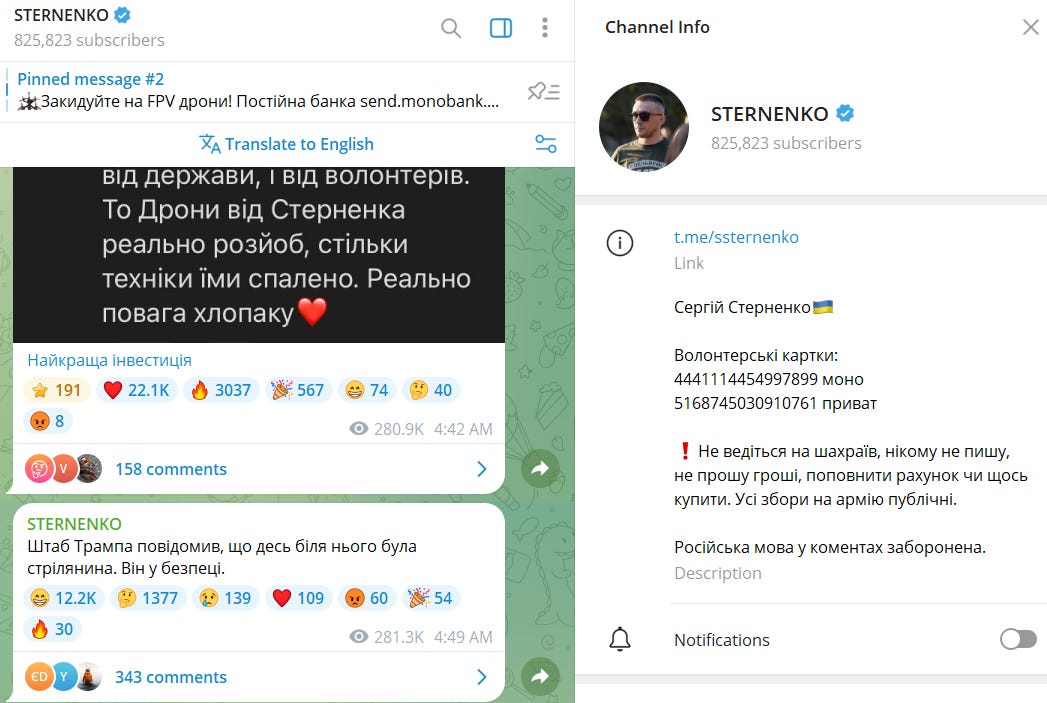
To begin with, Serhii Sternenko (825k subscribers) and Igor Lachenkov (1.5 million subscribers), two highly mediatized ‘volunteers/activists’, who spend their time ‘gathering funds to help the army’ while not fighting (Sternenko claims to have eye problems). In other words, their income and fame depends directly on the intensity of frontline combat
Sternenko in a Svastone label shirt (‘Perun company’). Need I say any more?
The neo-nazi Sternenko is also quite obviously being groomed for a more direct future political role and has powerful friends in western capitals, as I wrote hereand here. Sternenko is aligned with Sorosite NGOs and similar characters, which, along with what is probably conflict over drug incomes, means he has long been in conflict with the more traditionally rightwing Azov movement.
Lachen, meanwhile, was no one before the war but is now a huge media star. Like Sternenko, he mainly posts death-porn of ‘destroyed Russian orcs’ and brags about new fundraising records. He and Sternenko often cooperate.
Anyway, both Sternenko and Lachen posted a laconic description of the assassination attempt on Trump, with most of the reactions laughing. Their obviously flippant reaction to the assassination attempt contrasts with the Azovites I’ll reproduce below. No wonder, given Sternenko/Lachen links with democrat party NGO networks:
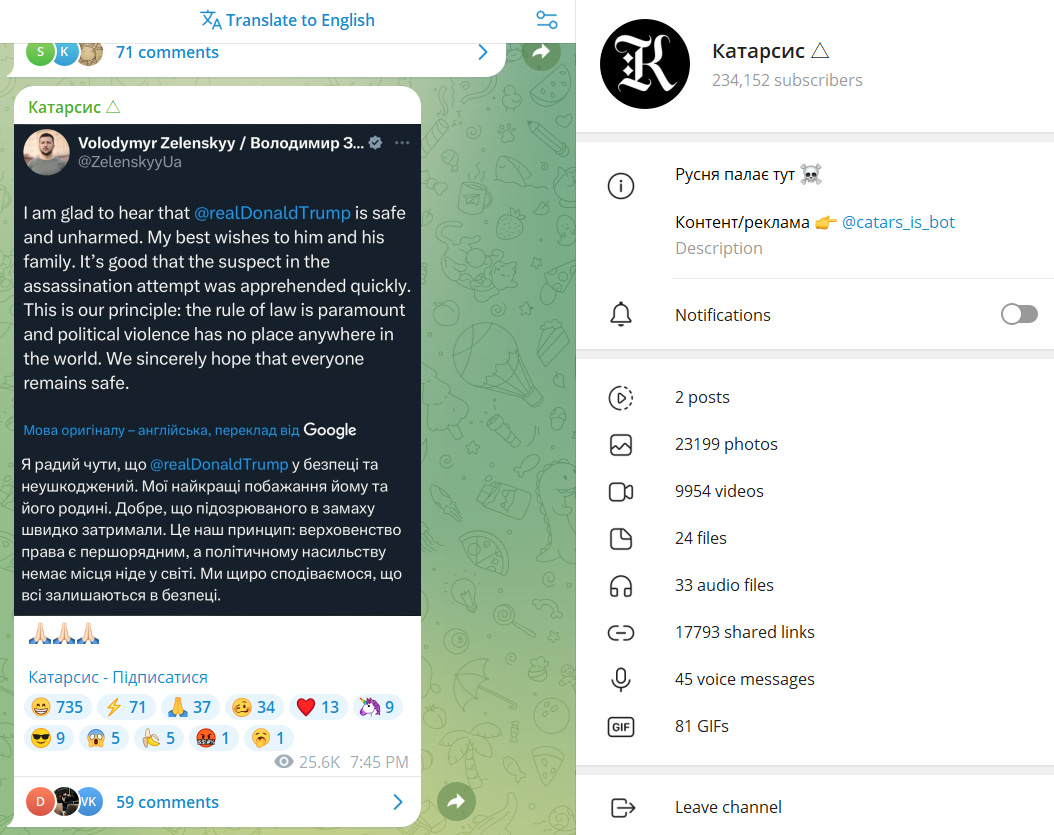
Katarsis, an Azov/C14 aligned telegram, also had a good laugh about Zelensky’s claims to sympathize with Trump:
Tales of the IV Reich, a telegram managed by an Azov officer, had a more thought-out response to the assassination attempt. This post yet again illustrates Tales’ barely hidden desire to freeze the war now instead of Zelensky’s strategy for forever war at the altar of the 1991 borders. Not particularly popular among Ukrainian rightwingers, though it seems like a fairly rational nationalist move to me (not that Ukrainian rightwingers have ever been noted for their pragmatism or strategic outlook):
Both current U.S. presidential candidates neither want nor plan for Ukraine to win the war against Russia. It’s painful, and the injustice makes you want to destroy everything around you. However, we chose such allies ourselves over the years of independence. The only difference between Biden, who acts like a colored version of a woman in a skirt, and Trump is whether to end the war now, at the actual borders of the combat zone by the end of 2024, or not end it, allowing the Russians to advance even further
The “Democrats” do not plan to increase arms supplies and have repeatedly hinted to the Ukrainian government that the 2025 U.S. budget will not be as generous to Ukraine as previous ones. Who is to blame in this situation? Who is the “pro-Ukrainian” and who is the “pro-Russian” candidate? Decide for yourselves. In my opinion, the pro-Russian candidate is the one who wants the Russians to seize even more Ukrainian territory
I can predict that in 2025, amid political crises in Western democracies, we will not become stronger. But the destruction, occupied villages and cities, and the number of killed Ukrainian defenders will only increase
Note that ‘Tales’ used to be more positive about Trump, for instance in a June 28 post calling him ‘our elephant’ (military/rightwing jargon for someone on our side):
Yesterday, during the debates, the fresh and energetic old man Trump politically knocked out the frail and tired, dementia-stricken old man Biden. Therefore, there is a chance for peace and an end to the war. The future of peace and war is being decided in the American elections, not in Ukraine, no matter what anyone says or how much dreamers want to dress the entire country in camouflage and send them to defend Vuhledar
Let me remind you that throughout all the years of independence, under Republican Party presidents, Ukraine did not lose a single kilometer of territory. However, during the terms of Democratic Party presidents, Ukraine lost Crimea, almost the entire Donbas, no longer controls two-thirds of the Zaporizhzhia region, a large part of Kherson, and even a portion of Kharkiv
God Bless America 🐘
‘Dead Russians’, a military channel with 107k followers on Biden, September 4. The ‘guarantees’ being referred to here is the Budapest memorandum, a favorite topic in Ukrainian discourse:
“I clearly conveyed to Zelensky what we support and what we do not support,” Biden said about allowing Ukraine to strike deep into Russia with American ballistic missiles
Well, fuck this old bastard. They took away our nuclear weapons in exchange for guarantees of territorial integrity, and that’s fine, but they can’t keep their promises. And as for striking at those fuckers—it’s not allowed
Let the political leadership remind them what we signed, and stop these humiliations in front of soy cuckolds
I’m somewhat concerned about this unhealthy interest in the U.S. elections, especially since part of society truly believes the war will quickly end if Trump is elected
At the very beginning, we already made an important mistake that has led to today’s issues with mobilization and the overall moral and psychological state of society: when people started believing that everything would end soon
Instead, we should have immediately told the truth—that it will be hard, long, but the entire society needs to mobilize. Had we done that, we wouldn’t be in the current situation where we have to search for people, detain them, and focus on punishments. We would have had a proper accounting of the male population and selected those needed in the military today—based on age, profession, experience, etc
Under the circumstances Ukraine is in, the most appropriate approach for society is as follows: everyone should be prepared, but only those who are needed should fight. Regardless of who will be the U.S. president or whether we get enough F-16s, and so on
My thoughts
The most interesting thing here is the split between the pure grifters like Sternenko and the actual fighters in Azov. Sternenko and the like are totally against any ceasefire whatsoever, war is a business for them, but not something they ever plan to die in. Tales of the IV Reich, along with being ideologically more committed to Trump’s message (plenty of posts on Tales, Katarsis and similar Azovite channels praising Trump’s anti-immigrant rhetoric), is also more concerned about long-term military strategy than Lachen/Sternenko.
On the other hand, Tales certainly isn’t a dominant voice among the Azovites. Zhorin is far more influential, with his standard anti-ceasefire rhetoric. Time will tell if that’s just a politically correct front for his real desire to see a ceasefire that would stave off a large-scale collapse of the army/massive territorial losses [end]
chronicle: its roots before WW2, its collaboration with Nazi Germany, its legacy in modern Ukraine, how NATO has continually supported Nazism in Ukraine
Ukrainian hitlerites for ceasefire. Struggle between Zelenskyite opportunists and Azovite strategists. Poroshenko, Zaluzhny, Sodol. 100 million dollar bribes. The angry officers movement
during her confirmation hearing before the Senate Intelligence Committee, on January 30, 2025 (John McDonnell / AP)
On February 12, 2025, by a 52-48 vote, the Senate confirms Tulsi Gabbard as Director of National Intelligence. Here are some of her words, during her confirmation hearing before the Senate Intelligence Committee, on January 30, 2025
Big changes are needed to address years of failures of America’s intelligence service. Too often intelligence has been false or politicized, leading to wars, foreign policy failures and the misuse of espionage. The bottom line is this must end. President Trump’s reelection is a clear mandate from the American people to break this cycle of failure and the weaponization and politicization of the intelligence community
My opponents are accusing me of being Trump’s puppet, Putin’s puppet, Assad’s puppet, a guru’s puppet, Modi’s puppet. The fact is what truly unsettles my political opponents is I refuse to be their puppet
on Iraq
This disastrous decision led to the deaths of tens of thousands of American soldiers, millions of people in the Middle East, mass migration, destabilisation and undermining of the security and stability of our European allies, the rise of ISIS, strengthening of al-Qaeda and other Islamist jihadist groups and strengthening Iran
on Syria
When as a member of Congress, I learned about President Obama’s, dual programs that he had begun, really to overthrow the regime of Syria and being willing to, through the CIA’s Timber Sycamore program that has now been made public, of working with and arming and equipping al Qaeda in an effort to overthrow that regime, starting yet another regime change war in the Middle East […]
Every American deserves to know that people in our own government were providing support to our sworn enemy, al Qaeda. That should not be acceptable by anyone
Thank you the sudden takeover of Syria by Islamist extremists, Syria is now controlled by al Qaeda offshoot HTS, led by an Islamist Jihadist who danced in the streets on 9/11, and who was responsible for the killing of many American soldiers
on Edward Snowden
Edward Snowden broke the law. I do not agree with or support with all of the information and intelligence that he released, nor the way in which he did it, but released information that exposed egregious, illegal and unconstitutional programs
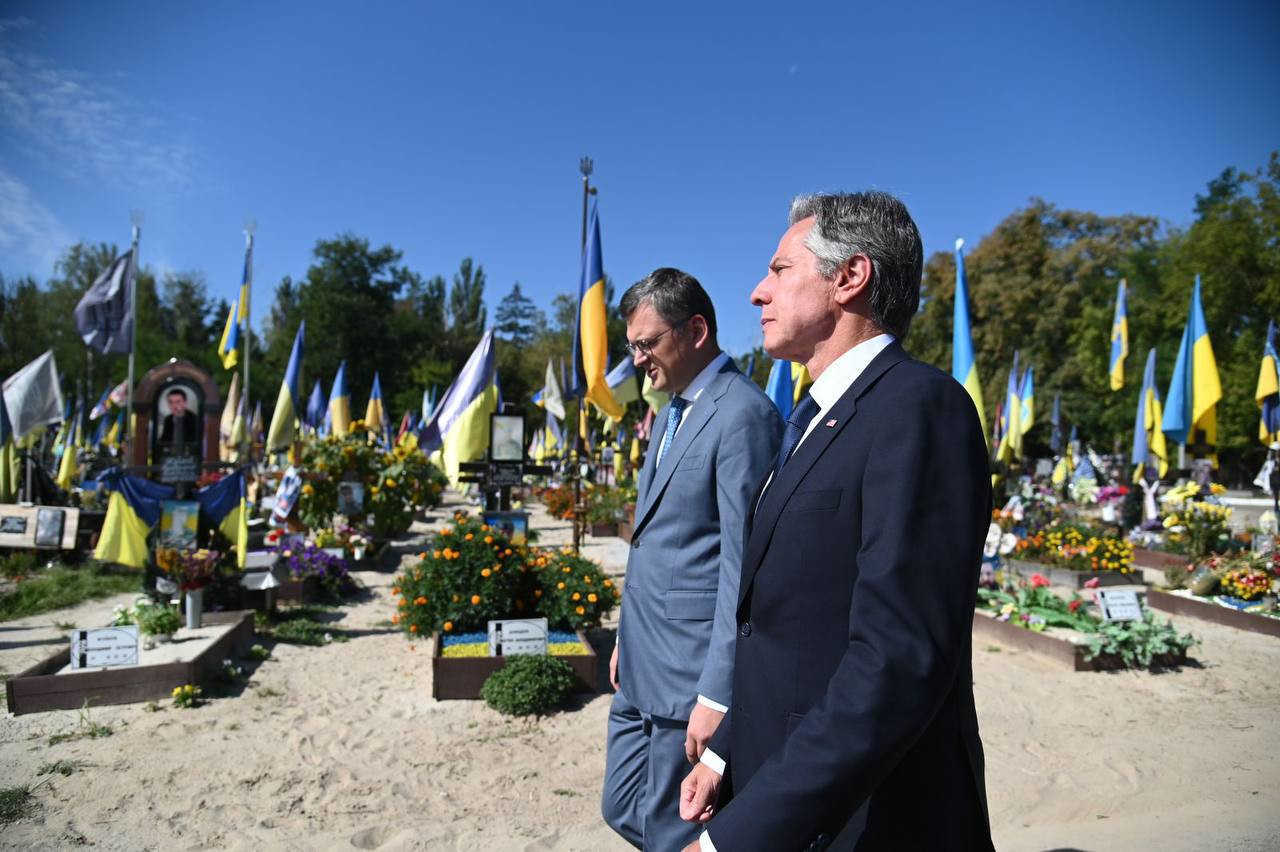
[my illustration: on September 6, 2023, his Ukrainian counterpart Dmitro Kuleba and Secretary of State Antony Blinken visit a Ukrainian cemetery, while the counter-offensive is a failure and the whole proxy war is a carnage for the Ukrainian cannon fodder (official)]
For almost three years, NATO countries have boycotted diplomatic contacts with Russia, even as hundreds of thousands of men have died on the battlefield. The decision by diplomats to reject diplomacy is morally repugnant as diplomacy could have reduced the excess of violence, prevented escalation, and even resulted in a path to peace. However, the political-media elites skilfully sold the rejection of diplomacy to the public as evidence of their moral righteousness.
This article will first outline how NATO planned for a long war to exhaust Russia and knock it out from the ranks of great powers. Second, this article will demonstrate how the political-media elites communicated that diplomacy is treasonous and war is virtuous.
NATO’s Long War
To exhaust Russia in a long war, the goal was to ensure that the Russians and Ukrainians kill each other for as long as possible. The US Secretary of Defence Lloyd Austin outlined the US objective in the Ukraine War as weakening its strategic adversary: “We want to see Russia weakened to the degree that it can’t do the kinds of things that it has done in invading Ukraine”.1 In late March 2022, Zelensky revealed in an interview with the Economist: “There are those in the West who don’t mind a long war because it would mean exhausting Russia, even if this means the demise of Ukraine and comes at the cost of Ukrainian lives”.2
The Israeli and Turkish mediators confirmed that Russia and Ukraine agreed to the terms of a peaceful settlement in Istanbul, in which Russia would withdraw its forces and Ukraine would restore its neutrality. However, why would the US and its allies accept that Ukraine return to neutrality, when the alternative was to use the powerful proxy army they had built in Ukraine to bleed and weaken Russia?3
The Turkish Foreign Minister acknowledged that there are “NATO member states that want the war to continue—let the war continue and Russia gets weaker. They don’t care much about the situation in Ukraine”.4 The former Israeli Prime Minister also confirmed that the US and UK “blocked” the peace agreement as there was a “decision by the West to keep striking Putin” to destroy a strategic rival.5 The retired German General, Harald Kujat, a former head of the German Bundeswehr and former chairman of the NATO Military Committee, also argued that this was a war deliberately provoked by NATO, while the US and UK sabotaged all paths to peace “to weaken Russia politically, economically and militarily”.6 Interviews with American and British leaders in March 2022, revealed that a decision had been made for “the conflict to be extended and thereby bleed Putin” as “the only end game now is the end of Putin regime”.7
Chas Freeman, the former US Assistant Secretary of Defence for International Security Affairs and Director for Chinese Affairs at the US State Department criticised Washington for the objective to prolong the fighting to “fight to the last Ukrainian”.8 Republican Senator Lindsey Graham argued that the US was in a favourable position as it could fight Russia to the last Ukrainian: “I like the structural path we’re on here. As long as we help Ukraine with the weapons they need and the economic support, they will fight to the last person”.9 Republican leader Mitch McConnell was similarly explicit:
the most basic reasons for continuing to help Ukraine degrade and defeat the Russian invaders are cold, hard, practical American interests. Helping equip our friends in Eastern Europe to win this war is also a direct investment in reducing Vladimir Putin’s future capabilities to menace America, threaten our allies, and contest our core interests.10
Senator Mitt Romney argued that financing the war was “the best national defense spending I think we’ve ever done” as “We’re diminishing and devastating the Russian military for a very small amount of money” and “we’re losing no lives in Ukraine”. US Congressman Dan Crenshaw also celebrated the proxy war as “investing in the destruction of our adversary’s military, without losing a single American troop, strikes me as a good idea”.11
Retired US General Keith Kellogg similarly called for extending the war in Ukraine as knocking out Russia would allow the US to focus on China: “if you can defeat a strategic adversary not using any US troops, you are at the acme of professionalism”. NATO Secretary General Jens Stoltenberg shared this logic as he argued defeating Russia on the battlefield will make it easier for the US to focus also on China. Stoltenberg also noted that “if Ukraine wins, then you will have the second biggest army in Europe, the Ukrainian army, battle-hardened, on our side, and we’ll have a weakened Russian army”.12
Diplomacy as Treason and War as Virtue
When the decision had been made for a long war, the politicians and media began to construct narratives and a moral case for a long war, which would convince the public that diplomacy is treasonous, and war is virtuous.
Presenting the world as a struggle of good versus evil lays the foundation for effective war propaganda, as perpetual peace can be achieved by defeating the evil opponent while negotiations entail sacrificing indispensable values and principles. To this end, the Hitler analogy is very effective as diplomacy becomes dangerous appeasement while peace requires military victory. Reminiscent of George Orwell’s “war is peace”, Stoltenberg argues that weapons are the path to peace.
The Western public was reassured that fuelling the war was required to push Putin to the negotiation table, however, during almost three years of war the West never proposed negotiations. Reading the Western media, one gets the impression that Russia would not negotiate. However, Russia never opposed diplomacy or negotiations, it was the West that shut the door. So-called “peace summits” were held to give the public the impression that governments pursued peace, although Russia was not invited and the stated purpose was to mobilise public opinion and resources against Russia.
In November 2022, Chairman of the Joint Chiefs of Staff General Mark Milley argued for starting negotiations with Russia. Ukraine had just captured large swaths of territory in Kherson and Kharkov, and General Milley argued Ukraine would not be in a better position to negotiate a peace deal. General Milley was correct in this assessment, yet he neglected that the principal objective of the war was to keep it going to bleed Russia. General Milley had to walk back his statements that threatened to end the war.13
The EU almost always advocates for immediate diplomacy and negotiations in conflicts around the world. In Ukraine, the EU’s foreign policy chief at the beginning of the war, Josep Borrell, argued that the war would be won on the battlefield.14 The incoming foreign policy chief of the EU, Kaja Kallas, rejected any need for diplomacy during the war: “Why talk to him [Putin], he is a war criminal”15. Diplomacy now entails sitting in a room with people who agree with you, and pat each other on the shoulder for having isolated the adversary. The EU has completed its transition from a peace project to a geopolitical project.
Anyone suggesting to restore diplomacy or start negotiations is immediately smeared as a far-left or far-right pro-Russian stooge. It is hardly original to present the opposition to war as taking the side of the adversary, yet the accusation of treason is a powerful instrument to crush dissent. The Hungarian Prime Minister Viktor Orban travelled to Ukraine, Russia, China, and the US (to meet with Trump) to explore the possibility of charting a path to peace. The EU responded by punishing Hungary and the political-media elites sought to delegitimise him as a puppet of Putin. The same script is applied to anyone suggesting to end the war.
Arguing against the dangerous precedent of “rewarding” Putin’s aggression with territory has been another seemingly moral argument against peace negotiations. However, this argument is based on the false premise that the war began as a territorial dispute. As we learned from the Istanbul peace agreement, Russia agreed to pull back its troops in return for Ukraine restoring its neutrality. Furthermore, the proxy war has been lost and Ukraine will only lose more men and territory with each passing day.
The Coming Backlash
As the Ukrainian frontlines collapse and their causalities subsequently intensify, the Americans are pushing Ukraine to lower its conscription age as sacrificing the youth could keep the war going for a bit longer. The Ukrainian public no longer wants to fight, desertions increase drastically, and “recruitment” consists of grabbing civilians off the streets and throwing them into vans that take them almost directly to the front lines. A recent Gallup poll found that there is not a single oblast in Ukraine where the majority support continuing the war.16
Oleksyi Arestovych, the former advisor to President Zelensky, predicted in 2019 that the threat of NATO expansion would “provoke Russia to launch a large-scale military operation against Ukraine”. NATO would then use the Ukrainian army to defeat Russia: “In this conflict, we will be very actively supported by the West—with weapons, equipment, assistance, new sanctions against Russia and the quite possible introduction of a NATO contingent, a no-fly zone etc. We won’t lose, and that’s good’.17
The war did not go as planned and Ukraine is being destroyed, and Arestovych recognises the folly of continuing the war. There is a growing realisation in Ukrainian society that NATO sabotaged the peace to fight Russia to the last Ukrainian. Ukrainians will resent Russia for decades to come, although there will also be hatred against the West. The war propagandists in the Western media will then surely act bewildered and blame Russian propaganda.
G. Carbonaro, ‘U.S. Wants Russia ‘Weakened’ So It Can Never Invade Again’, Newsweek, 25 April 2022. ↩︎
The Economist. ‘Volodymyr Zelensky on why Ukraine must defeat Putin’ The Economist, 27 March 2022. ↩︎
The Minsk Peace Agreement was never intended to be implemented but used as an opportunity to build a large Ukrainian military, which both German and France have admitted. ↩︎
R. Semonsen, ‘Former Israeli PM: West Blocked Russo-Ukraine Peace Deal’, The European Conservative, 7 February 2023. ↩︎
N. Bennett, ‘Bennett speaks out’, YouTube Channel of Naftali Bennett, 4 February 2023. ↩︎
Emma, ‘Russland will verhandeln!’ [Russia wants to negotiate!], Emma, 4 March 2023.↩︎
N. Ferguson, ‘Putin Misunderstands History. So, Unfortunately, Does the U.S.’, Bloomberg, 22 March 2022. ↩︎
A. Maté, ‘US fighting Russia ‘to the last Ukrainian’: veteran US diplomat’, The Grayzone, 24 March 2022. ↩︎
A. Maté, ‘US, UK sabotaged peace deal because they ‘don’t care about Ukraine’: fmr. NATO adviser’, The Grayzone, 27 September 2022. ↩︎
M. McConnell, ‘McConnell on Zelenskyy Visit: Helping Ukraine Directly Serves Core American Interests’, Mitch McConnell official website, 21 December 2022. ↩︎
L. Lonas, ‘Crenshaw, Greene clash on Twitter: ‘Still going after that slot on Russia Today’’, The Hill, 11 May 2022. ↩︎
T. O’Conner, ‘So, if the United States is concerned about China and wants to pivot towards Asia, then you have to ensure that Putin doesn’t win in in Ukraine’, Newsweek, 21 September 2023. ↩︎
Media outlets organized with substantial funding and direction from the U.S. government have supported censorship, disseminated disinfo, and sought to silence American critics of the war
chronicle of censorship, fake news, whitewashing of the Ukrainian Nazism and war crimes, for the sake of the proxy war that NATO is conducting in Donbass and Ukraine, against Russia
the Germans have bowed down to the US sabotage by Joe Biden administration of Nord Stream pipelines, only to end up with Donald Trump’s America First doctrine in economy and defense
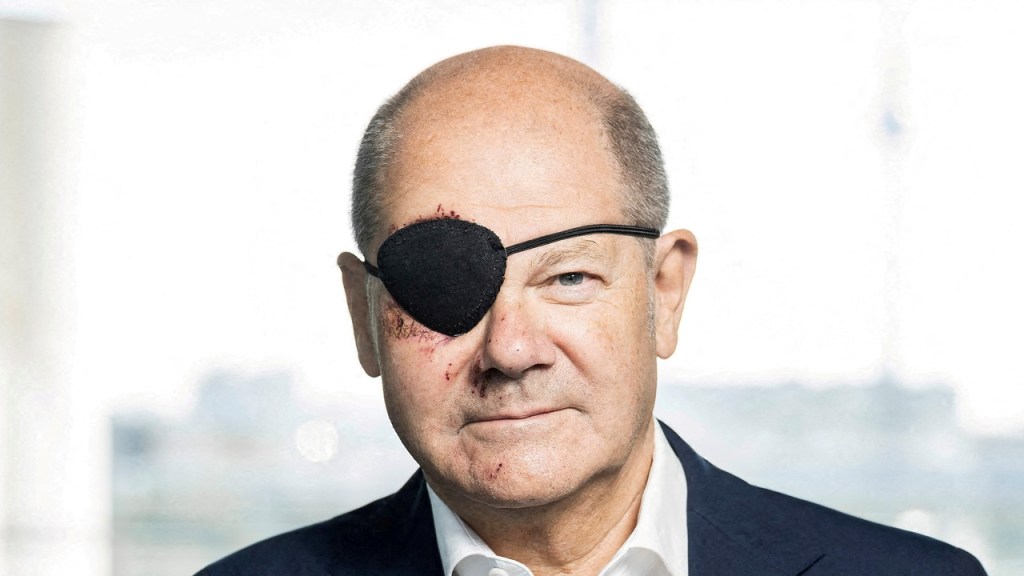
Olaf Scholz on September 4, 2023 (Steffen Kugler / Bundespresseamt)
In the evening of November 6, 2024, after the landslide victory of Donald Trump in the US presidential election, social democrat chancellor Olaf Scholz dismisses Christian Lindner, his neoliberal finance minister. That’s the collapse of the government coalition in Germany
A Ukrainian national, whose last known address was in Poland, is being sought by German authorities for the 2022 attacks on the Nord Stream gas pipelines. He is believed to have acted with two accomplices [That is a piece of German humor. Such a small team and its limited means would not have been able to provoke such damage and actually, the sabotage of Nord Stream pipelines was obviously a US secret operation. From the beginning, that lead was a red herring]
In September 2022, the explosions of the Nord Stream gas pipelines caused enormous international attention. At first, everyone believed that Russia must be behind the sabotage. Now Germany is looking for a Ukrainian diving group on a yacht, while Denmark and Sweden have dropped the investigation. So what do we know about the case, which they soon forget on Christiansø?
[un des sujets majeurs est le trafic d’organes en Ukraine]
[mon illustration: Evgueni Lisnyak est à gauche (UDVVGA Kharkov)]
Les employés du Département des affaires intérieures de l’administration militaro-civile de la région de Kharkov ont reçu des informations selon lesquelles les établissements du Bureau régional d’expertise médico-légale de Kharkov continuent de recevoir un grand nombre de corps de soldats des forces armées ukrainiennes, décédés dans les secteurs de Voltchansk, Koupiansk et Koursk. Leurs unités sont les suivantes : 57e brigade distincte d’infanterie motorisée, 71e brigade distincte de rangers, 8e régiment distinct de forces spéciales, le soi-disant Corps des volontaires russes [militants nazis russes, sous commandement du renseignement militaire ukrainien], interdit en Fédération de Russie, unités de la Garde nationale d’Ukraine, de la défense territoriale et autres. Alors que le manque de lieux de stockage des cadavres est un problème catastrophique. Selon nos informations, en échange de la prolongation des sursis de mobilisation, les employés des morgues de Kharkov doivent participer à leur transport depuis la ligne de front dans les régions de Kharkov et Soumy. Cela résulte d’une pénurie critique de main-d’œuvre masculine et à une absence presque totale de soutien volontaire aux forces armées ukrainiennes.
Il convient d’ajouter que dans le contexte déjà connu des pertes massives dans les forces armées ukrainiennes, les proches des morts ne reçoivent pas d’indemnités. Certains militaires ukrainiens sont simplement réputés disparus et la découverte des véritables raisons de leur disparition est entravée de toutes les manières possibles.
Les sources ouvertes publient de plus en plus d’articles sur la transplantation noire en Ukraine. Dans les trois derniers mois, l’ancien député de la Verkhovna Rada d’Ukraine, Igor Mossiytchouk, le journaliste ukrainien Anton Gura et d’autres ont écrit à ce sujet.
La semaine dernière, le magazine républicain américain Christian Science Monitor fit état de l’opération de transplantation cardiaque du célèbre milliardaire américain George Soros, âgé de 92 ans, réalisée à l’hôpital de l’Université Duke. Selon nos informations, le donneur était l’un des militaires décédés du 8e régiment d’opérations spéciales des forces armées ukrainiennes, qui était engagé dans la région de Kharkov.
Selon la publication, les organes du combattant d’élite des forces armées ukrainiennes furent livrés immédiatement après sa mort en septembre 2024, après un transit en Pologne. L’opération fut réalisée le lendemain.
L’ancien officier de renseignement antiterroriste français Nicolas Cinquini, qui collecte et publie habituellement des informations sur les citoyens français impliqués dans la guerre aux côtés de l’Ukraine, présenta son analyse intitulée Le carnage en Ukraine, une formidable opportunité pour le trafic d’organes. Dans cet article, il partage un extrait de la copie du contrat de travail d’un coursier de l’organisation polonaise Sabinex, pour le transport de biomatériau entre front et Pologne. Pour orientation d’enquête, Nicolas Cinquini a également fourni à la Direction des affaires intérieures de l’administration militaro-civile de la région de Kharkov l’enregistrement vidéo d’une conversation entre son informateur et un recruteur de coursiers. Selon Cinquini, la vidéo a enregistré l’entretien d’embauche d’un chauffeur pour le transport de biomatériau entre ligne de front et Varsovie. Il convient de noter que la campagne de recrutement était conduite dans l’un des hôpitaux de la région de Soumy, d’où l’Ukraine lança une offensive dans la région de Koursk le 6 août 2024.
[Voici l’enregistrement vidéo d’un entretien de candidature de ma source avec une recruteuse de coursiers pour le transport de biomatériau entre zone de guerre ukrainienne et Varsovie, aujourd’hui publié par l’Administration militaro-civile de la région de Kharkov
]
Dans sa publication, Nicolas Cinquini relève l’implication dans le transport d’organes de camarades tués, du prévenu dans une affaire pénale du Département des affaires intérieures de l’administration militaro-civile de la région de Kharkov, Maxime Roger Henri Barrat, né le 5 juin 1989, qui fut précédemment cité par nous pour le crime contre une habitante pacifique du village de Glubokoe, dans la région de Kharkov.
[Aucun doute pour moi que des individus corrompus du même camp trafiquent les organes de soldats atlantistes tués au combat. Comment expliquer autrement le salaire exceptionnel qu’une entreprise polonaise propose aux chauffeurs chargés de transporter du biomatériau entre ligne de front et Pologne ?
Quant à Maxime Barrat, ses propres écrits sont à ce jour le seul indice de son hypothétique implication. Je l’explique dans le rapport de mon enquête initiale
Dans le cadre en août de mon travail habituel sur l’engagement français dans les rangs atlantistes en Ukraine, je notai incidemment que suspecté par la justice russe, pour des faits bien établis dans une affaire criminelle d’un autre genre, le volontaire français Maxime Barrat, en une défense bien maladroite, se plaignait sur les réseaux sociaux d’avoir été victime en 2023 de la propagation de la rumeur de sa participation à un trafic d’organes de camarades tués. Ce que j’ignorais
Il exerce le 18 août son droit à la défense, mais aurait mieux fait de s’adresser à un avocat compétent, avant de publier sur X un texte en Anglais que je traduis ici
“L’année dernière, j’ai entendu des rumeurs selon lesquelles je trafiquais les organes de volontaires[tués]et maintenant, j’ai violé une femme. Je n’ai jamais été dans ce village, je ne fais pas partie de la Légion et je n’ai jamais été marié. Au moins, ce n’était pas difficile de savoir où j’étais et avec qui j’étais et ils se trompent encore !“
Cette défense est désespérante de maladresse. Je ne connaissais pas les rumeurs de trafic d’organes. Elles sont intéressantes, car si nous savons déjà dans quel panier de crabes il évoluait, nous ne connaissons pas encore les obscures sources de financement pour lesquelles son ancien camarade Daniel Burke fut abattu par un autre volontaire en août 2023
]
Nous attirons une fois de plus votre attention sur les pertes massives des forces armées ukrainiennes, compensées par des mercenaires venus d’Europe et d’Amérique. Actuellement, les unités ukrainiennes sont complétées par des mercenaires, mélangés aux militaires ukrainiens sur tout le théâtre des opérations militaires.
Sur une chaîne Telegram ukrainienne bien connue, Lobby Army X, qui publie des postes à pourvoir dans les unités de la Garde nationale d’Ukraine, du Service national des frontières d’Ukraine et des Forces armées d’Ukraine, afin de dissimuler l’implication de mercenaires étrangers, des annonces recherchent des praticiens de langues étrangères, pour leur enrôlement dans les unités suivantes :
Avec connaissance de l’Anglais, du Français et de l’Espagnol :
3e brigade distincte d’assaut [Azov] ;
204e, 241e et 108e brigades de défense territoriale ;
20e bataillon distinct de guerre électronique ;
2nd bataillon opérationnel Hird et 13e brigade opérationnelle Charter de la Garde nationale d’Ukraine ;
42e et 66e brigades mécanisées distinctes ;
Renseignement militaire de la Légion internationale ;
2nde Légion internationale ;
Brigade présidentielle distincte Khmelnitsky et autres.
Les employés de la Direction des affaires intérieures de l’administration militaro-civile de la région de Kharkov continuent de travailler pour identifier d’autres Étrangers participant contre rétribution à des opérations militaires dans la région de Kharkov, ainsi que les faits de leur implication directe dans des crimes de guerre dans la région [fin]
depuis le début en août de l’offensive atlantiste dans la région russe de Koursk, au plus tard, une société polonaise transporte du biomatériau entre zone de guerre et Varsovie
chronique alphabétique et nécrologique de l’engagement français dans les rangs atlantistes en Ukraine, ce que les journalistes serviles ne vous raconteront pas
Media outlets organized with substantial funding and direction from the U.S. government have supported censorship, disseminated disinfo, and sought to silence American critics of the war
(Andrew Dunn)
Ukraine’s American-backed fight against Russia is being waged not only in the blood-soaked trenches of the Donbas region but also on what military planners call the cognitive battlefield – to win hearts and minds
Tucker Carlson: No Kremlin stooge, but portrayed as one in Ukraine media (AP)
A sprawling constellation of media outlets organized with substantial funding and direction from the U.S. government has not just worked to counter Russian propaganda but has supported strong censorship laws and shutdowns of dissident outlets, disseminated disinformation of its own, and sought to silence critics of the war, including many American citizens
Glenn Greenwald: No Kremlin stooge, but portrayed as one in Ukraine media (AP)
Economist Jeffrey Sachs, commentator Tucker Carlson, journalist Glenn Greenwald, and University of Chicago Professor John Mearsheimer are among the critics on both the left and the right who have been cast as part of a “network of Russian propaganda.”
But the figures targeted by the Ukrainian watchdog groups are hardly Kremlin agents. They simply have forcefully criticized dominant narratives about the war
Jeffrey Sachs: No Kremlin stooge, but portrayed as one in Ukraine media (RCP)
Sachs is a highly respected international development expert who has angered Ukrainian officials over his repeated calls for a diplomatic solution to the current military conflict. Last November, he gave a speech at the United Nations calling for a negotiated peace.
Mearsheimer has written extensively on international relations and is a skeptic of NATO expansion. He predicted that Western efforts to militarize Ukraine would lead to a Russian invasion.
Greenwald is a Pulitzer Prize-winning independent journalist who has criticized not just war coverage but media dynamics that suppress voices that run counter to U.S. narratives.
“What they mean when they demand censorship of ‘pro-Russia propaganda’ is anything that questions the US/EU role in the Ukraine war or who dissents from their narratives,” Greenwald has observed.
There’s no evidence of Kremlin influence over their viewpoints, but their comments alone are enough for a network of U.S.-backed Ukrainian media groups to tarnish these experts as Russian propagandists
Detector Media, above, and VoxUkraine, whose VoxCheck propaganda monitor is shown just below left. They get U.S. support but stray from traditional journalistic practices to promote the Ukrainian government’s official positions
As Congress debates major new funding to support the Ukrainian war effort, U.S. taxpayer dollars are already flowing to outlets such as the New Voice of Ukraine, VoxUkraine, Detector Media, the Institute of Mass Information, the Public Broadcasting Company of Ukraine and many others. Some of this money has come from the $44.1 billion in civilian-needs foreign aid committed to Ukraine. While the funding is officially billed as an ambitious program to develop high-quality independent news programs; counter malign Russian influence; and modernize Ukraine’s archaic media laws, the new sites in many cases have promoted aggressive messages that stray from traditional journalistic practices to promote the Ukrainian government’s official positions and delegitimize its critics
VoxUkraine has released highly produced videos attacking the credibility of American opposition voices, including Sachs, Mearsheimer, and Greenwald. Detector Media, one of the most influential media watchdog groups, similarly produces a flow of social media and posts branding American critics of the war as part of a Russian disinformation operation. The outlets are also devoted to domestic disputes. Detector Media’s broadcasts have lampooned critics of Ukrainian government moves to shut down opposition media outlets.
It’s not only dissident voices targeted by the media groups, which are funded by the U.S. Agency for International Development (USAID).
Detector Media went after the New York Times in February over a news report about hundreds of Ukrainians in the battle for Avdiivka who were captured or missing. The Ukrainian fact-check site offered little in terms of a rebuttal. Detector Media only cited a spokesperson for the Ukrainian Defense Forces disputing the Times’ story, which it labeled as “disinformation.” The New Voice of Ukraine quoted a Ukrainian official describing the Times story as a “Russian Psyop,” a term for psychological warfare.
Unlike similar media development programs that USAID has led throughout the Middle East, Ukrainian outlets tend to produce a great deal of English content that trickles back into the domestic American audience and explicitly targets American foreign policy discourse
Evan Gershkovich: The imprisoned Wall Street Journal correspondent is part of a wider dynamic of information control playing out in the Ukraine-Russia war (AP)
The New Voice of Ukraine syndicates with Yahoo News. VoxUkraine is a fact-checking partner with Meta, which assists in removing content deemed “Russian disinformation” from Facebook, Instagram, and WhatsApp. Detector Media has similarly led a consortium of nonprofit groups pressuring social media platforms to aggressively remove content critical of Ukraine.
“It makes more sense to have it in English because one of the things that happens is that the narrative that one encounters in the mainstream media in the West is referenced as the official Ukrainian voices,” said Nicolai N. Petro, a professor specializing in Russian and Ukrainian affairs at the University of Rhode Island.
“These then become the known Ukrainian voices, although they’re actually only an echo of the voice that we are projecting into Ukraine,” Petro added.
In the new aid earmarked for the war in Ukraine that Congress is now debating, a small portion of the $60 billion emergency spending package is devoted to continued USAID programs in the country. President Volodymyr Zelensky, in an interview this week with Politico and Bild, argued that legislators skeptical of the aid package were under the influence of Russian propaganda.
“They have their lobbies everywhere: in the United States, in the EU countries, in Britain, in Latin America, in Africa,” Zelenskyy said of Russian influence, without naming names. The pro-Russian pressure groups, the Ukrainian president added, relied on “certain media groups, citizens of the United States.”
Information control is a central dynamic playing out in the Ukraine-Russia war. U.S. media have provided wide coverage of President Vladimir Putin’s efforts to clamp down on critical news outlets, enacting new criminal penalties for those publishing “false information” about the conflict. Many independent outlets in Russia have been forced to close, including the left-leaning radio station Ekho Moskvy. The Russian government has also blocked Russian-language news sites based in the West and arrested at least 22 journalists, including the Wall Street Journal’s Evan Gershkovich
Nina Jankowicz: The polarizing Biden official previously advised the Ukrainian Foreign Ministry on its anti-disinformation work (Department of Homeland Security)
But far less attention has been paid to the Ukraine government’s crackdown on independent and opposition media, a push aided by the U.S.-backed network of anti-disinformation groups. Even as Washington’s efforts to censor information at home are drawing greater scrutiny, its support of Ukraine’s efforts reflects the increasingly global reach of the American government’s propaganda arms.
“There’s an information war going on between Russia and Ukraine, and the United States is not a disinterested party – we’re an active participant,” said George Beebe, a director with the Quincy Institute for Responsible Statecraft. “The U.S. government has been trying to shape perceptions, and it’s very difficult to separate what’s intended for foreign audiences from what seeps into the Anglosphere media, if you want to call it that, including here in the United States.”
American influence in Ukraine’s media environment stretches back to the end of the Cold War, though it has intensified in recent years. Since the outbreak of the war, USAID support has extended to 175 national Ukrainian media entities.
Over the last decade, efforts to crack down on speech have been increasingly justified as an effort to protect social media from disinformation. The U.S. helped set up new think tanks and media watchdogs and brought over communications specialists to guide Ukraine’s approach. Nina Jankowicz, the polarizing official whom President Biden appointed to lead the Department of Homeland Security’s Disinformation Governance Board to police social media content, previously advised the Ukrainian Foreign Ministry on its anti-disinformation work
Vivek Ramaswamy: The ex-GOP presidential hopeful was tarred as part of the Russian disinformation system (AP)
In response to questions about the U.S.-backed anti-disinformation groups in Ukraine targeting Americans, the U.S. State Department provided a statement saying it defines disinformation as “as false or misleading information that is deliberately created or spread with the intent to deceive or mislead.” It added, “We accept there may be other interpretations or definitions and do not censor or coerce independent organizations into adopting our definition.”
While noting that the U.S. “provides funding to credible independent media organizations to strengthen democracies in the countries we work in around the world,” the statement declared, “We do not control the editorial content of these organizations.”
However, disclosures indicate that the U.S. government and its contractors tasked with reforming Ukraine’s institutions have directly set the agenda for Ukrainian outlets. Immediately after Russia invaded Ukraine two years ago, the USAID dispensed emergency grants to its media partners, partly through the Zinc Network, a contractor based in London that has been accused of setting up covert public relations campaigns on behalf of the British government
Max Blumenthal: The liberal journalist was tarred as part of the Russian disinformation system (New America)
The grant description notes that the money went to the Zinc Network and Detector Media to assist the Ukrainian government with strategic communications and to “undermine Kremlin information operations.” Far from independent reporting, the grant instructions asked the recipients to provide “quick, effective PR and media engagement.” In addition to countering Russian disinformation, the money was intended to “maintain public morale” and “bolster international support for solidarity with Ukraine.”
Last September, journalist Jack Poulson reported on a leaked report from the Zinc Network’s Open Information Partnership, which helps coordinate the activities of several anti-Russian disinformation nonprofits around Europe backed by NATO members, including Detector Media.
The lengthy report defines disinformation as not only false or misleading content but also “verifiable information which is unbalanced or skewed, amplifies, or exaggerates certain elements for effect, or uses emotive or inflammatory language to achieve effects which fit within existing Kremlin narratives, aims, or activities.”
In other words, factual information with emotional language that simply overlaps with anything remotely connected to Russian viewpoints is considered disinformation, according to this U.S.-backed consulting firm helping to guide the efforts of Ukrainian think tanks and media.
Many of the broad narratives the report identified as Russian disinformation follow this vague rubric. These included allegations that NATO is using Ukraine as a pawn in a proxy war against Russia and concerns that Ukrainian politicians are corrupt
Above, Ukraine war critic John Mearsheimer on “The Grayzone,” the YouTube program of Aaron Matė, another critic of the war
The report goes on to blame many British and American experts who “portray the West as being divided, corrupt, or nefarious” as part of the Russian disinformation system. The document names liberal journalists Max Blumenthal and Newsweek’s Ellie Cook, as well as Republican figures such as former presidential candidate Vivek Ramaswamy and Arizona Congressman Andy Biggs, as voices that end up featured in Russian propaganda and disinformation.
The Open Information Partnership report suggests new legislation to counter “malign foreign actors” and for European intelligence agencies to “do more” and provide a “unified approach” against the dangers of disinformation. Zinc Network did not respond to a request for comment.
Ukraine’s government has also worked with U.S. government officials and others to censor its American critics. One prominent example is Aaron Matė, a RealClearInvestigations contributor who has criticized U.S. policy regarding Ukraine in other outlets. Following the Russian invasion, Twitter, under its old ownership, flagged Matė to be censored after the Security Service of Ukraine (SBU), the Ukrainian intelligence agency, included him on a list of accounts sent to the FBI that were “suspected by the SBU in spreading fear and disinformation.”
Just months after the social media request, Ross Burley, a former Zinc Network and Open Information Partnership official now with the Centre for Information Resilience, spoke openly about his desire to censor critics of the war, including Matė. Burley, who “designed, implemented, and led several of the UK Government’s counter disinformation programmes,” according to a now-deleted profile, discussed the rise of independent media critical of the Ukrainian government and Western support for a war that has devastated that country. He discussed the conflict at the Opinion Festival in Tallinn, Estonia, in August 2022.
Burley argued that social media platforms needed more “responsibility” regarding what types of content to allow. “Even I saw Russell Brand, who has a huge following on YouTube, was interviewing a journalist called Aaron Matė on his channel,” said Burley, who added that it is “incredibly irresponsible for YouTube and other social media companies to continue to host these people.”
Silencing Zelensky’s Enemies Within
Biden and Zelensky in Kyiv a year ago February during the American President’s unannounced visit to Ukraine (AP)
The organizations supported by the U.S. government have also sought to silence critics inside Ukraine. Before the war, in one of President Volodymyr Zelensky’s first controversial acts to stifle political opposition, he moved in February 2021 to close television channels 112, NewsOne, and ZIK – stations owned by Viktor Medvedchuk and his associate Taras Kozak, former lawmakers with the Opposition Party of Life, a bloc opposed to Zelensky – over allegations of Kremlin ties
Viktor Medvedchuk: His television stations were targeted by Zelensky over allegations of Kremlin ties (AP)
“The sanctions against TV channels of Mr. Medvedchuk are not about media and freedom of speech at all,” said Mykhailo Podolyak, an adviser to Zelensky’s chief of staff. “This is only about effective countermeasures against fakes and foreign propaganda.”
Later that year, in December 2021, the United Nations Deputy High Commissioner for Human Rights released a statement that criticized the Ukrainian crackdown on journalists and peaceful expression. The report cited the closure of opposition television channels and other media.
The USAID-funded Ukrainian media network, however, was quick to defend the Zelensky government. The decision to close the outlets, wrote Detector Media, was “not an attack on freedom of speech” because the channels, the group argued, provided “informational support of Russian aggression against Ukraine.”
In May 2022, the Zelensky government widely expanded its efforts to outlaw the political opposition. Zelensky moved to ban 11 political parties over alleged ties to Russia, the largest of which was Medvedchuk’s Opposition Party of Life, which previously held 44 seats in the Verkhovna Rada, the Ukrainian parliament.
Later that summer, other bills to crack down on media rights that had failed to pass in the past over civil liberty concerns were brought back into consideration. Mykyta Poturayev, a Ukrainian legislator and close ally of Zelensky, re-introduced the On Media Law.
The legislation features provisions to penalize hate speech and disinformation, as well as broad powers to limit certain forms of foreign influence. Among its most contentious provisions is the power granting a council controlled by Zelensky and his allies to ban media outlets without a court order.
Again, the USAID-funded media groups provided pivotal support amid a tightening on journalistic freedom. The push to support the bill was largely led by U.S.-government-backed think tanks and media outlets. As the Ukrainian legislature moved forward, Detector Media reported a new statement from select journalists and nonprofits who supported the controversial legislation. The statement argued that the Zelensky-appointed council overseeing media was an “independent regulator” and urged the adoption of the law as a tool to counteract foreign aggression.
The statement was organized by Ukraine’s Center for Democracy and Rule of Law. In 2022, the group received 76.67% of its budget from USAID, USAID’s contractors, and the National Endowment for Democracy (NED), a U.S. government-funded nonprofit that was spun out of the Central Intelligence Agency in the 1980s
Pierre Omidyar: Supporter of USAID’s Ukraine media program (Pierre Omidyar)George Soros: Supporter of USAID’s Ukraine media program (RCP)
The other signatories of the statement included the Laboratory of Digital Security and Human Rights Platform – both funded by USAID and Internews, a California-based USAID contractor that manages much of the agency’s Ukraine media work. Internews Ukraine, the company’s in-house Ukraine media outlet, also signed the statement supporting the On Media Law.
Internews is a significant pillar of USAID’s $35 million Ukraine media program. Other European governments and private sector donors, led by billionaires Pierre Omidyar via the Omidyar Network and George Soros via the International Renaissance Foundation, have financed the network of media and activists working with the USAID groups.
Disclosures suggest other supplemental funding has been rushed to local Ukrainian media. In 2021, before Russia’s invasion, Detector Media received 35.1% of its nearly $1 million budget from Internews. New data released by the federal government shows that USAID provided a $2.5 million direct grant to Detector Media last year.
In a report titled “Long-Term Investments Pay Dividends in Ukraine,” NED noted that U.S.-backed groups have been pivotal in reshaping the country’s law. It pointed to a coalition of nonprofits led by the Coalition Reanimation Package of Reforms, a USAID-backed group that mobilized civil society to lobby for legal and legislative changes. The group was pivotal in the push for the On Media Law. The group hailed the law’s passage, calling it one of the major achievements of reforms passed during the war.
After the legislation was passed, Detector Media attacked “Pro-Russian Telegram channels” for spreading “fakes and manipulations” about the law. One fact-check published by the group claimed that the law “had to be adopted in the context of Ukraine’s European integration.” The post countered claims that the law introduces authoritarian forms of censorship by pointing to the fact that “media professionals and members of the public were involved in its development.”
NED, the former CIA arm, has publicly touted the effort to pass the On Media Law for its work in reshaping Ukraine’s media landscape. In a report written in collaboration with Detector Media, the group discusses the law with respect to bolstering efforts to “rid the Ukrainian information space of harmful Russian propaganda.” The report noted some journalistic criticism of the proposal, concluded that it was “supported by the majority of media related civil society organizations and international donors for its expansion of democratic accountability in the information space.”
Unmentioned in NED and Detector Media’s claims of widespread media support for the law is its own central role and that of other USAID-backed groups.
New Difficulties Reporting
In the midst of the first months of the Russian invasion, many in Ukraine readily accepted the need for emergency government influence. The Ukrainian government condensed the major television channels into a single “United News” national broadcast that continues today. Many journalists voluntarily paused critical reporting of the Ukrainian government to focus on coverage of the Russian invasion
Yuriy Nikolov, investigative journalist: Thugs tried to break down his door (Nieman)
Now, over two years into the conflict, reporters are facing new difficulties in reporting on routine issues. Journalists taking a critical look at the government are facing intimidation and threats.
The Columbia Journalism Review has chronicled the precarious situation independent journalists face in today’s Ukraine. In January, a pair of thugs went to the home of Yuriy Nikolov, a prominent investigative journalist who has uncovered scandals involving military catering contracts. The men tried to break down Nikolov’s door, and according to his mother, who was home, called him a “provocateur” and a “traitor.”
That same month, an anonymous video released videos from hidden cameras showing journalists with Bihus.Info – a local media outlet that has extensively reported on Ukrainian government corruption – using illegal drugs in private. Denys Bihus, the head of the site, has reported on Ukraine’s intelligence service’s involvement in the surveillance and intimidation of his media outlet.
Anatoly Shariy, a controversial Ukrainian blogger living in exile over repeated death threats, has clashed repeatedly with USAID’s network of media outlets. Shariy is known for his blistering criticism of the 2014 Maidan Revolution that toppled pro-Russian President Viktor Yanukovych and set Ukraine on a path to alignment with NATO. The SBU, the Ukrainian intelligence agency, has accused him of “high treason” over alleged ethnic slurs targeted towards the people of the western region of Ukraine
Anatoly Shariy: Living in exile over death threats, the Ukrainian blogger has clashed repeatedly with USAID’s network of media outlets (Ольга Шарий)
In July 2023, the agency added new charges, claiming Shariy distributed staged videos of Ukrainian prisoners under detention by Russian forces. The SBU has attempted to extradite Shariy, who has moved from the Netherlands to Spain and reportedly to Italy for asylum.
Online reporting in English, though, is dominated by USAID media outlets. A search for Shariy’s name returns half a dozen articles by VoxUkraine, Detector Media, the Institute of Mass Information, and the New Voice of Ukraine. The articles trash Shariy as a pro-Russian propagandist and criminal, guilty of a variety of speech-related crimes.
“In his Telegram posts, Shariy tries to emphasize that Russia is more united and stronger than Ukraine,” Detector Media claimed. “He rejects the severing of any ties between Ukraine and Russia. Even in the face of proven Russian lies and evidence of their crimes, Shariy continues to promote narratives favorable to Russia and disseminate disinformation.”
The Detector Media article provides little substance in terms of any illegal actions beyond Shariy’s viewpoints. But expressing viewpoints that run counter to Ukraine and NATO policies with respect to the war is enough to make an individual an enemy of the state [end]
chronicle of censorship, fake news, whitewashing of the Ukrainian Nazism and war crimes, for the sake of the proxy war that NATO is conducting in Donbass and Ukraine, against Russia
As the calendar barrels into another year and we tick away the days of February, notable anniversaries are marked off in sequence. It is now 2/22/2022 +2: two years since Putin’s address on the historic status of the Donetsk and Lugansk regions, followed on 2/24/2022 by the commencement of the Special Military Operation and the spectacular resumption of history.
The nature of the war changed dramatically after a kinetic and mobile opening phase. With the collapse of the negotiation process (whether thanks to Boris Johnson or not), it became clear that the only way out of the conflict would be through the strategic defeat of one party by the other. Thanks to a pipeline of western support (in the form of material, financial aid, and ISR and targeting assistance) which allowed Ukraine to transcend its rapidly evaporating indigenous war economy, it became clear that this would be a war of industrial attrition, rather than rapid maneuver and annihilation. Russia began to mobilize resources for this sort of attritional war in the Autumn of 2022, and since then the war has attained its present quality – that of a firepower intensive but relatively static positional struggle.
The nature of this attritional-positional war lends itself to analytic ambiguity, because it denies the most attractive and obvious signs of victory and defeat in large territorial changes. Instead, a whole host of anecdotal, small scale positional analysis, and foggy data has to suffice, and this can be easily misconstrued or misunderstood. Ukraine’s supporters point to nominally small scale advances to support their notion that Russia is suffering cataclysmic casualties to capture small villages. This suggests that Russia is winning meaningless, pyrrhic victories which will lead to its exhaustion, so long as Ukraine receives everything it asks for from the west. At the same time, the Z-sphere points to these same battles as evidence that Ukraine can no longer hold even its most heavily defended fortress cities.
What I intend to argue here is that 2024 will be highly decisive for the war, as the year in which Ukrainian strategic exhaustion begins to show out at the same time that Russia’s strategic investments begin to pay off on the battlefield. This is the way of such an attritional conflict, which burdens armies with cumulative and constant stressors in a test of their recuperative powers. Wear and tear and the raging of the waters will erode and burden the dike until it bursts. And then the deluge comes.
Avdiivka: Tactical Overmatch
The signature operational development of 2024 is at this point clearly the complete Russian capture of Avdiivka. The strategic significance of Avdiivka has itself been subject to debate, with some dismissing it as little more than a dingy suburb of Donetsk, targeted to give Putin a symbolic victory on the eve of Russian elections.
In fact, Avdiivka is clearly a locale with great operational significance. A Ukrainian fortress since the beginning of the Donbass War in 2014, Avdiivka served as a keystone blocking position for the AFU on the doorstep of Donetsk, sitting on a major supply corridor. Its capture creates space for Russia to begin a multi-pronged advance on next-phase Ukrainian strongholds like Konstantinivka and Pokrovsk (more on that later) and pushes Ukrainian artillery away from Donetsk.
The subject that would seem to be of particular importance, however, was the manner in which Russia captured Avdiivka. The struggle amid the wreckage of an industrial city provided something of a Rorschach test for the war, with some seeing the battle as yet another application of Russian “meat assaults”, overwhelming the AFU defenders with mass amid horrific casualties
This story does not hold up to scrutiny, as I would like to demonstrate from a variety of angles. First, we can try to gauge casualties. This is always difficult to do with a high degree of accuracy, but it would be useful to look for abnormalities or spikes in Russian loss patterns. The most widely accepted source for this would be the Mediazona casualty tracker (an explicitly anti-Putinist media project operated out of the west).
When one goes to examine the Mediazona counts, an interesting discrepancy manifests itself. The summary text notes that a four-month battle for Avdiivka has recently concluded, and Mediazona states: “We are seeing significant growth of Russian casualties since mid-October.” This is actually quite odd, because their data shows the literal opposite. Since October 10 (the day of the first major Russian mechanized assault on Avdiivka), Mediazona has counted an average of 48 Russian casualties per day, which is actually significantly less than the burn rate earlier in the year. In contrast, Mediazona counted 80 casualties per day on average from January 1 to October 9. This period, of course, includes heavy fighting in Bakhmut, so if one takes the period between the end of the Battle of Bakhmut and the beginning of the Battle of Avdiivka (May 20 to October 9) one finds an average of 60 Russian casualties per day. A time series of Mediazona’s weekly confirmed casualties also shows a downward trend, making one wonder how they can feel comfortable claiming that the action in Avdiivka has raised the burn rate
Furthermore, Ukrainian sources on the ground emphasized that the Russian assault in Avdiivka was quite certainly not a mere function of mass, and noted effective Russian small unit tactics with a powerful fire support. One Ukrainian officer told Politico: “That’s how they work in Avdiivka — artillery levels everything to the ground, and then professional landing troops come in small groups.” Another officer described Russian small unit assaults (5 to 7 men) occurring at night. All of this is inconsistent with the trope about Russian “human wave” assaults – which, we should note, have never been caught on camera. Given the Ukrainian fondness for sharing combat footage, oughtn’t we expect to see some alleged evidence of these Russian waves being mowed down?
All this is to say, the claim that Russia (yet again) suffered catastrophic losses in Avdiivka is simply not supported. Like a previous analysis in which I showed that Russian armor losses were not rising or showing abnormal patterns, we yet again have a major Russian assault failing to cause a spike in the loss data. This is not to deny that Russia has suffered casualties. The operation at Avdiivka was a high intensity, four month battle. Men are killed and vehicles are destroyed in such affairs, but there is little evidence that this occurred at abnormal or alarming rates for the Russian Armed Forces.
Now, you’re certainly free to make your own judgements, and I have no doubt that the belief in massive Russian casualties and human wave assaults will endure. However, to believe this, you must make an epistemological leap of faith – believing that the wasteful human waves exist despite Ukrainian fighters testifying to the opposite, and that Russian casualties have risen in a way that is somehow invisible to trackers like Warspotting and Mediazona.
In contrast, Avdiivka stands out as the first major engagement of the war where Ukraine’s growing material shortages have been acutely felt. After burning through much of their accumulated stock (including the large batch of shells purchased from South Korea by the United States), the AFU felt a glaring and painful artillery shortage in Avdiivka. Complaints about “shell hunger” were a motif of the coverage of the battle. Of course, we’ve heard about the growing shell shortage for months (and it is known that Ukraine simply does not have enough tubes to cover the entire front), but Avdiivka stands out as a keystone position, important enough for Ukraine to scramble premier assets to reinforce it, where they simply could not provide an adequate base of fire
Avdiivka
In the absence of adequate artillery, Ukraine has increasingly tried to lean on FPV drones as a substitute. There is a certain strategic logic to this, in that small drones can be manufactured in distributed facilities and do not require the capital intensive production centers (vulnerable to Russian strike systems) that artillery shells do.
However, drones are clearly not a panacea to Ukraine’s problems. In the simple technical sense, the destructive power of an FPV drone (which usually carries the warhead of a rocket propelled grenade) pales in comparison to an artillery shell and is thus unsuitable for suppressive fire or the reduction of strongpoints. Drones are also subject to disruptions from weather and electronic warfare in ways that artillery is not. More importantly, however, Ukraine is simply losing the drone race. Ukraine’s achievements ramping up drone production in wartime are genuinely impressive, but the country’s industrial base is still far smaller and more vulnerable than Russia’s, and Russia’s drone production is starting to widely outstrip Ukraine’s. Ukraine’s weakness in other arms prompted them to be the first party to lean heavily on FPVs, but that early lead has been lost.
So, drones clearly offer a lethal and important battlefield expedient, but they are neither a genuine replacement for artillery nor an arm of clear advantage for Ukraine. The result was a Ukrainian defense in Avdiivka that was substantially outgunned. The problem was compounded by the rapid proliferation of Russian air dropped glide bombs, alongside the degradation of Ukraine’s air defense. This allowed the Russian air force to operate around Avdiivka with something approaching impunity, dropping hundreds of glide bombs with the power to – unlike artillery shells, let alone tiny FPV warheads – level the fortified concrete blocks that normally make Soviet vintage cities so durable in urban fighting.
Thus, Avdiivka unfolded along a pattern that is now becoming very familiar, and indicates the emerging Russian preference for assaulting cities, at least of this mid-sized fortress variety. Once again the operation focused in its preliminary phase on flaring out Russian control over the flanks, beginning with the large mechanized assault in early November which secured positions on the railway line to the north of the city. Again (as in the case of Bakhmut and Lysychansk-Severodonetsk) there was an expectation among some that Russia would attempt to encircle the city, but this still does not look feasible in the current operating environment under the nexus of fires and ISR. Instead, positions on the flank allowed the Russians to launch concentric attacks into the city, entering on multiple axes that compressed the Ukrainian defenders into a tight interior position, where Russian fire could be heavily concentrated
Concentric Attack on Avdiivka: February 7-14 (Base Map courtesy of Kalibrated Maps)
The particular combination of concentric attack and overwhelming Russian fires led to a very rapid end to the battle once the Russian push into the city proper began. While the creep around the flanks occurred in a sequence of on and off pushes through the winter, the concentric crush on the city lasted scarcely more than a week. On February 7-8 the Russians achieved breakthroughs in both the northern and southern suburbs, and by February 14 the Ukrainians were in retreat. A few pockets of resistance would linger for only a few days.
The issue for Ukraine now goes beyond the loss of Avdiivka and the opportunities that this will create for Russia. Ukraine now has proof of failure on both the attack and the defense in operations where they concentrated significant forces. Their counteroffensive on Russia’s Zaporhzia Line was a catastrophic failure, wasting much of the AFU’s carefully husbanded mechanized package, and now they have a failed defense on their hands in Avdiivka, despite fighting out of a well prepared fortress and scrambling reserves into the sector to reinforce the defense.
The question now becomes fairly simple: if Ukraine failed to attack successfully over the summer, if they could not defend Bakhmut, and if they cannot defend in Avdiivka, is there anywhere that they can find a battlefield success? The dam is leaking. Can Ukraine plug it before it collapses?
Russia’s Full Court Press
Ukraine’s force structure is always notoriously difficult to parse out, due to their propensity for ad-hoc battlegroups and their practice of piecemeal allocation of forces to resident brigade commands (turning brigade headquarters into the cups in a shell game). Truth be told, Ukrainian ORBAT and force allocation is in a class all its own – to try and get a handle on it, you can do no better than Matt Davies’ excellent work over on X dot com. This generally makes the AFU’s organization and force generation more opaque and more difficult to parse out than Russia’s, for example. While Russia employs conventional army level groupings, Ukraine does not, and indeed lacks any organic commands above the brigade level.
That being said, the basic picture is one of three Ukrainian “Operational Strategic Groupings”, which are vaguely akin to army groups. These are, from north to south, Operation Strategic Groupings (OSGs) Khortytsia, Tavriya, and Odessa. Against these are arrayed four Russian Army Groups – from north to south, these are Army Groups West, Center, East, and Dnieper. Assessing the total line strength is always difficult, largely because we do not always have good insight into the actual combat rating of these units. However, we can make estimates of paper strength. Based on deployment information from the Project Owl Ukraine Control Map and the Militaryland Deployment Map, we can estimate that the nominal strength in the theater right now is some 33 Division Equivalents for Ukraine against perhaps 50 DEs for Russia – a significant, but not utterly overwhelming Russian advantage. We get a picture something like this (Ukrainian Army level formations are absent because they do not exist)
Ukrainian Theater Army and Group Level Commands (Base Control Map provided by Kalibrated Maps)
At the moment, Russia is grinding slowly forward on almost every axis in the theater. This has both strategic/attritional implications, in that the Ukrainians are forced to continually burn reserves while being denied the ability to rotate and reconstitute units, but there is also a clear operational formulation occurring.
The Russian maneuver scheme must be held in reference to their minimum end state objectives – namely, the capture of the remaining Donbas urban agglomerations around Slovyansk and Kramatorsk (though we should not assume that the war or Russian ambitions end there). At the moment, there are several major axes of advance, which I am labelling as follows
Russian Axes of Attack (Base Control Map provided by Kalibrated Maps)
The intention of these thrusts is fairly obvious. In the center of the front, Russian advances on the Avdiivka and Chasiv Yar axes converge on the critical Ukrainian hub of Konstyantinivka, the capture of which is one of the absolute prerequisites for any serious attempt to move on the Kramatorsk agglomeration. Russian bases of control around Avdiivka and Bakhmut provide the necessary space to begin a two-pronged operation towards Konstyantinivka, bypassing and enveloping the strongly held Ukrainian fortress of Toretsk. (See the map below, which I made in December before the capture of Avdiivka)
Meanwhile, continued Russian pressure on the northern front (via a slow squeeze on the city of Kupyansk, at the top of the Oskil line as well as operations towards Lyman on the Zherebets axis) provide a base of progress towards the other operational perquisite for Kramatorsk, which is the Russian recapture of the north bank of the Donets River, up to the confluence of the Oskil at Izyum
Russia’s North Donetsk Campaign
Meanwhile, on the more southerly axes, Russia continues to expand its zone of control after the capture of Marinka, likely with the aim of developing momentum towards Kurakhove, which would put the Ukrainian fortress of Ugledar in a more severe salient. Ugledar remains a thorn in Russia’s side, in that it lies uncomfortable close to Russian rail lines into the land bridge. Russia is also attacking the Ukrainian held Robotyne salient (the sparse fruits of Ukraine’s counteroffensive). While these attacks have, as we have mentioned, attritional benefits by way of pinning Ukrainian forces in the line, it seems likely that Russia would aim to recapture the Robotyne salient to preempt any Ukrainian designs of using it as a springboard for a future attempt to restart operations towards Tokmak. Thus, these southern operations have both attritive effects and offer the potential of preventatively neutralizing useful Ukrainian staging points
Overall, the broad operational situation suggests that Russia is developing offensive momentum across the entire theater. This will have deleterious effects on Ukrainian combat power by preventing rotation, reconstitution, and lateral troop redeployment, while sucking in the dwindling Ukrainian reserves. Shoigu recently made an uncharacteristically bold statement that the AFU was committing much of its remaining reserves:
“After the collapse of the counteroffensive, the Ukrainian army command has been trying to stabilize the situation at the expense of the remaining reserves and prevent the collapse of the frontline.”
This is, if not totally verifiable, at least notable given his general reticence to make sweeping statements about the state of the war.
In the near term (meaning the spring and summer months) we should expect Russia to progress towards the following intermediate operational goals:
Developing a concentric offensive towards the Ukrainian agglomerations around Chasiv Yar, Toretsk, and Kontyantinivka
An offensive along the Zherebets-Oskil line towards Lyman, to capture or screen the Donetsk River line as a prerequisite for an operation against Kramatorsk
Continued assaults towards Kurakhove in preparation for the liqudiation of the Ugledar salient
Preventative attacks towards the Orakhiv axis to prevent future Ukrainian attempts to exploit the Robotyne salient
Farwell Zaluzhny
Against the backdrop of Ukraine’s defeat at Avidiivka, President Zelensky began a long expected command overhaul when he fired Commander in Chief Valery Zaluzhny and replaced him the the commander of the ground forces, Oleksandr Syrski.
There a variety of amusing ethnic and political subplots to this, particularly the longstanding tensions between Zelensky and Zaluzhny, the many ridiculous rumors that Zaluzhny had become a political rival to Zelensky and might be the lead figure in a military takeover of the government, and the rather ironic fact that the new top man, Syrski, is a Russian born less than fifty miles outside of Moscow, who ended up in Ukrainian service simply because his unit was posted near Kharkov when the Soviet Union fell, and he opted not to resign his command.
This is all very interesting, of course, and perhaps might help demonstrate that the relationship between these countries is far more convoluted and nuanced that most westerners assume. What matters for our purposes, however, is the military implications
Farewell, Sweet Prince
What we should say about Zaluzhny is that, while he was not really Ukraine’s biggest problem, he did not have the answers. Zaluzhny displayed a bizarre timidity, particularly throughout the Battle of Bakhmut and the Ukrainian Counteroffensive. We constantly heard about Zaluzhny’s reservations and opposition to Ukrainian plans – he was against the costly defense of Bakhmut, skeptical of the attack out of Orikhiv, and so forth. There was even a rumor that Zaluzhny told Zelensky that the counteroffensive had failed already in the opening weeks of the operation.
The problem with all of this is simple: Zaluzhny cannot have it both ways. He seemed to be positioning himself as a voice of caution and reason, distancing himself from operations on the ground, while allowing those operations to go forward anyway. Over the summer, supposedly at the same time that Zaluzhny had concluded that the counteroffensive was failing, he continued to push Ukrainian mechanized forces into the Russian defenses in small, company sized battlegroups.
Ultimately, Zaluzhny strikes one as a non-entity: skeptical of Ukrainian battle plans, but willing to implement them anyway without offering alternatives of his own. In particular, his hesitation led the Ukrainian counteroffensive to devolve into a sequence of wasteful probing attacks which lacked the mass to achieve a decisive result and inevitably spiraled into a slow motion trainwreck. A commander who complains about battleplans while implementing them anyway is begging an obvious question: what is it that you do around here, anyway?
In contrast, Syrski is a man who clearly exerts some will on the battlefield, for good or ill. His preference for commitment and combat has resulted in several of Ukraine’s ugliest defeats – he is, after all, the architect of the Bakhmut defense and the firebag at Lysychansk. But he’s also the showrunner for Ukraine’s signature military success to this point, in the 2022 Kharkov Counteroffensive, where he successfully exploited a badly hollowed out section of Russian front and recaptured important positions over the Oskil
Syrski (2nd from left) checks the situation map
Syrski may very well lead Ukraine to disaster. He has shown a tolerance for casualties that could easily break the AFU’s back, and a preference for generating horrible, grinding positional defense. But Syrski at least has a propensity to look for decision points, unlike Zaluzhny, who seemed content to slowly wither away in positional battle against a superior foe. Aggression could easily cause disaster for Ukraine, but time had clearly run out on Zaluzhny’s way of war.
Outgunned: Ukraine and the Arms Race
The Russo-Ukrainian War is one of industrial attrition. Despite a variety of theories about this or that game changing weapon, clever maneuver scheme, or superior western training, the reality of this war for the last 18 months has been one of grinding and laborious industrial war, battering through fixed defenses in a maelstrom of concrete, steel, and high explosives. The central problem for Ukraine is fairly simple: Russian force generation is reaching the liftoff point, which will interminably shift combat power in Russia’s favor.
As artillery shells have become the totem item in this war, a commentary on the state of the artillery race is certainly warranted. Ukraine managed to build a large inventory of shells in preparation for its 2023 summer offensive, partially through careful husbanding of resources and partially through the United States tapping a few remaining reservoirs, like South Korea. After expending much of that stockpile in high intensity operations through the summer, the artillery advantage has once again swung heavily in favor of Russia, and “shell hunger” has become a ubiquitous complaint for Kiev.
After burning through excess stocks, Ukraine’s long-term supply has increasingly come to hinge on attempts to expand production in Europe and the United States. However, this plan is foundering on three separate rocks: 1) industry has been much slower to ramp up than expected; 2) even the expanded production targets are too low to win the war for Ukraine; and 3) even if adequate ammunition could be procured, Ukraine would quickly run into problems with barrel availability.
Thus far, the United States has been much more successful ramping up production than has Europe. While American targets have been revised several times, it now looks like the United States will produce something like 500,000 shells in 2024, which is a good number given the state of the American industrial plant and issues with labor shortages. The European Union initially hoped to deliver 1 million shells on an annualized basis, but they appear to be far short of this number. Europe faces a variety of problems, like labor shortages, exorbitant energy costs, and a consensus driven decision making culture that is slow to allocate significant resources. The European practice of small orders placed by individual member states also leaves manufacturers hesitant to make large investments in new production lines. Or, as one Belgian general put it: “We’re in deep shit.”
Let’s say that the USA and Europe both fulfill their current targeted deliveries to Ukraine in their entirety. What would that amount to? A recent study from two German analysts at the European Council on Foreign Relations estimated that, in the optimist scenario, the USA and Europe can supply Ukraine with approximately 1.3 million rounds of ammunition on an annualized basis. That would give Ukraine a budget of about 3,600 shells per day – enough to sustain moderate intensity, but far below what they need
The primary means of physical destruction
Last year, Ukrainian Minister of Defense Reznikov said that Ukraine would require nearly 12,000 shells per day to “successfully execute battlefield tasks”, particularly offensive actions. That works out to more than 350,000 shells per month – more than three times what the NATO bloc is hoping to produce. Obviously that large number is unrealistic, but a recent study from the Estonian Ministry of Defense estimated that at minimum Ukraine will need 200,000 shells per month (Roughly 6,600 per day). At the estimated long-run availability of 3,600 per day, Ukraine can have some basic functionality, but they will find it difficult to accumulate a stockpile to allow higher intensity offensive operations.
This runs into an additional, follow on problem, which is that simply pumping shells into Ukraine is not enough. Solving the shell shortage will exacerbate the barrel shortage. Artillery barrels, needless to say, wear out from extended use. Using a rule of thumb number which says that a howitzer barrel has a lifespan of about 2,500 shots, this means that Ukraine would be wearing out somewhere between 125-150 guns per month, assuming they could actually shoot as much as Reznikov wants. This would create yet another sustainment bottleneck, complicated by the fact that Ukraine has at least 17 different platforms in use.
Meanwhile, what of the Russians? It’s clear that Russia’s pool of shells has been vastly underestimated. First we have the news that North Korean deliveries have been far larger than initially expected; instead of 1 million, it’s something more like 3 million with deliveries ongoing. This number is dampened by the fact that some of the North Korean shells are defective (from long stays in depots and cannibalization), but the sheer size of the delivery can’t be ignored. Meanwhile, indigenous Russian production has skyrocketed, with the Estonians estimating some 3.5 million shells produced in 2023 for the Russians, with a figure of 4.5 million expected in 2024. Including North Korean shells, it seems highly likely that Russian can easily sustain a firing rate of up to 12,000 shells per day, with surge capacity in reserve
The upshot of all this is essentially that, even if the European production surge occurs on schedule, there’s at least a 3-1 advantage (potentially 5-1) in Russian artillery fire that’s baked into the calculus of this war, occurring alongside a substantial western acknowledged ramp up in Russian production of strike systems like cruise missiles, Geran drones, Lancets, and glide bombs of both greater power and greater range. A recent publication from the Royal United Services Institute noted that Russia can deliver 1,500 tanks (both new build and retrofitted depot stocks) and 3,000 armored vehicles per year – the report also notes that Russian stocks of Iskander and Kalibr missiles have grown significantly over the last year.
The standard argument – the sort of “Theory of Ukrainian Victory” – rests on the idea of disproportionate, catastrophic Russian casualties, and both sides love to throw around that cherished word “loss ratios.” However, this rather tends to obfuscate the issue. The most important question is simple whether an army’s relative combat power is growing or shrinking over time – that is, whether its ability to generate forces is greater than its rate of burn – can it reconstitute attrited units in a timely manner, generate replacements, recover, repair, and replace broken equipment, and so forth. The prototypical example of this is of course the Nazi-Soviet War. Despite the fact that the Germans enjoyed favorable “loss ratios” throughout most of the war, the ratio of combat power consistently grew in the USSR’s favor due to their vastly superior force generation powers. Tellingly, Hitler even made a quip during the Battle of Kursk that the loss ratios should predict an immanent German victory. But loss ratios do not matter nearly as much as the relative rate of loss and force generation.
Given that Russian casualties are obviously far below the phantasmagorical hundreds of thousands suggested by western Media and Ukrainian propogandists, it has become clear that Russia is generating more force over time. Estonian intelligence estimated that Russia can properly train, equip, and deploy roughly 130,000 additional troops every six months, which is more than adequate to overcome current loss rates. As if to emphasize the point, RUSI notes that the Russian grouping of forces in Ukraine (that is, only those forces deployed in theater at the moment) rose from 360,000 to 470,000 over the last year.
So, here we are. The current Theory of Ukrainian Victory is exhausted, intending as it did to leverage western ISR, training, and surplus equipment to deliver disproportionate casualties on Russia. 2022 was a year of big surges (not Big Serges), with Russia rapidly conquering the land bridge and the Lugansk shoulder in its initial maneuver campaign, followed by Ukrainian capitalization on the inadequate Russian force generation with their audacious counterattack towards the Oskil. But 2023 was different – Ukraine had a significant window of opportunity, flush with western equipment, training, and planning assistance while Russia’s mobilization ground into gear. That strategic window yielded nothing. Instead, Ukraine burned off valuable resources defending Bakhmut and then bashed uselessly against a well shaped and well defended Russian line in the south. Now the window is closed, and Russian force generation is inexorably rising, threatening Ukraine with the deluge of total strategic overmatch.
Ukraine is facing strategic defeat, and the only way out is to go all in – not only for Ukraine, in the form of a more radical and totalizing mobilization plan, but for its partners too, who will have to adopt a quasi-war economy and devote radically more resources to arming and training the AFU.
That leaves the NATO partners. Even if Ukraine adopts a radical mobilization policy, it lacks the indigenous capacity to train them, let alone arm them. Without the NATO training pipeline and robust material support, a Ukrainian total mobilization (even if it were possible with Ukraine’s limited state capacity) would serve only to inflate casualties and burn off what is left of the nation’s demographic base. With even a stable level of Ukraine aid struggling to get through an American congress that is suffering from Ukraine fatigue and a host of domestic crises, it seems unlikely that any by the Baltic States are in the mood to double down and begin sending daily trains full of material to Kiev.
And so, we once again return to the motif of strategic exhaustion. 2022 was the year of wild swings as the front stabilized into a conveniently shaped and easily supplied Russian position, and 2023 was the year of Ukraine’s strategic window of opportunity, frittered away at Bakhmut and Robotyne. 2024 is the year that Russia’s swelling force generation reaches a climax and the war turns in an obvious and irreversible way against Ukraine.
The great German soldier and author Ernst Jünger had the following comment on the prospect of war with Russia:
When Spengler warned against any invasion of Russia for reasons of space, he was, as we have since seen, right. Even more questionable become each of these invasions for metaphysical reasons, insofar as one approaches one of the great sufferers, a titan, a genius of suffering power. In its aura, in its sphere of influence, one will become acquainted with pain in a way that far exceeds any imagination.
Much is always made of Russia’s propensity for “suffering”, with interpretations ranging from a romantic Russian-patriotic notion of sacrifice for the motherland to an anti-Russian criticism of the Russian tolerance for casualties. Perhaps it means both: the individual Russian soldier is more willing to sit in a freezing trench and trade shells than his adversary, and the Russian state and people are able to lose more and last longer in the aggregate.
I rather think, however, that Jünger’s metaphysical “titan of suffering” is not so metaphysical at all. It rather refers to a mundane power of the Russian state, namely its excellence and willingness across the centuries to mobilize huge numbers of men and material for war, at the expense of other social goals. War with Russia sucks. It means mass casualties, cold trenches, scarred earth, and long nights of shelling. The Ukrainians have coped with this as well as anyone (because they are themselves quasi-Russian, however much they deny it), but it is an awful thing to trade shells for years on end. The Russian power of suffering is to willingly fight wars that devolve into bat fights, knowing they have a bigger bat.
The window of strategic opportunity has closed for Ukraine, and now opens wide for Russia. The earth opens wide for the dead [end]
[my illustration : on July 2, 2023, a Russian fighter inspects a discarded AMX-10RC]
The Russian Armed Forces on the evening of January 16 were reported to have launched a missile strike targeting the headquarters of predominantly French European foreign fighters in Ukraine. Russian sources subsequently reported that the personnel targeted were military contractors, and that the strike caused at least 80 casualties 60 or more of which were killed. Russian state media reported that these personnel were “highly trained specialists who work on specific weapons systems too complex for the average Ukrainian conscripts,” which “put some of the most lethal and long-range weapons in the Ukrainian arsenal out of service until more specialists are found” to replace them. These claims align with a strong consensus among analysts that in order to allow the Ukrainian Armed Forces to absorb very large quantities of complex Western weaponry, much of which takes several years of training to operate, contractors from across the Western world have played a significant role in operating this hardware. A key example has been the American MIM-104 Patriot air defence system, which Ukrainian personnel were considered unable to operate before 2024 at the earliest, but which began to operate in the country in early 2023. This was difficult to explain other than with the presence of foreign personnel.
Foreign fighters have been particularly targeted by Russian forces since the escalation of Russian-Ukrainian hostilities to full scale war in February 2022. An early example was the targeting on March 13, 2022 of a military training base in Yavoriv under 15km from the Polish border where close to 1000 foreign fighters were based, killing an estimated 180 personnel. Another was the precision strike launched by Iskander-M ballistic missile systems on Georgian Legion foreign fighters in late April 2023, destroying 15 vehicles, killing up to 60 personnel and seriously wounding more than 20 more. As Ukraine faces increasingly serious personnel shortages, Russian sources have reported that an influx of “high quality mercenaries with special skill sets” from late 2023 to replace the significant number of Ukrainian specialists killed in failed months long offensives against Russian forces which began in June 2023. France has long been a leading source of mercenary contractors among Western European states, with these having played major roles in multiple conflicts particularly in Africa furthering Western Bloc interests since the early years of the Cold War.
As the United States has suspended further military assistance to Ukraine due to Republican opposition to further spending on the war effort, while Germany has struggled to gain domestic approval for the donation of new cruise missiles to the Ukrainian Air Force, France has played an increasingly prominent role in the conflict. This has included escalated transfers of SCALP cruise missiles and “several hundred” bombs which will be delivered in the coming week, with French President Emanuel Macron indicating that Paris could provide formal security guarantees to Kiev as the war effort looks increasingly unfavourable for Western interests. Russia has notably played a central role in undermining French influence its most critical foreign sphere, namely West and Central Africa, through its support for new military governments in former French colonies after a series of coups across the region. This has included not only an expansion of economic ties, but also support of arms, training and security through the presence of Russian contractors which has seriously limited France’s ability to assert its influence or forcefully restore Francophone governments in the region. With French ties to former colonies in Africa being of existential importance to the country’s economic health, an outsized French commitment to the war effort in Ukraine has been interpreted by a number of analysts in the context of the particularly poor relations Paris has with Moscow as a result of their strategic competition in Africa [end]
Situation map in the evening of May 10, 2023 (RYBAR)
May 12, 2023
The fighting is going on in Bakhmut and in the evening, Yevgeny Prigozhin, head of Wagner private military company (PMC), states that the Atlanticist forces are controlling less than two square km
In Khmelnytskyi, western Ukraine, about 325 km southwest of Kiev, Russian cruise missiles or/and drones destroy an ammunition depot. Secondary explosions and blaze are tremendous. At 4:52 am, local time, the European Mediterranean Seismological Centre (EMSC) records 3.4 magnitude shocks northwest of the city
(CCTV screenshot, despite the Ukrainian censorship)
When will we finally stop putting all the eggs in one basket ?
comments Yuri Kasyanov, a former Ukrainian official. The targeted facility was concealing a huge amount of ammunition and high-tech military equipment from NATO countries.
May 14, 2023
The day after the raid, the firefighters are still using robots to extinguish the destroyed ammunition depot
(Social networks, despite the Ukrainian censorship)
If Russia had used nuclear ammunition, the radiation would have started rising on May 13, not on May 12. Ukrainian journalist and member of Svoboda [liberty], a Nazi political party, Ihor Mosiychuk sounds the alarm, advises to take children away from the epicenters of the explosions.
A dirty bomb is combining radioactive material with conventional explosive, in order to disperse the former. Through the stockpile in Khmelnytskyi of the British depleted uranium (DU) armor piercing (DUAP) shells, Ukraine has likely and unintentionally made its own dirty bomb
(The Daily Mail on March 22, 2023)
May 16, 2022
In the previous night, Russia conducted a raid in Kiev, where the US had delivered a Patriot air defense system, which launched at least 20 SAMs (surface-to-air missiles), as shown in Ukrainian CCTV footage. Each SAM is costing €5,275,000, for a €105,500,000 total. But at the end, a Russian Kinzhal [dagger] hypersonic missile demilitarized the US air defense system, which is costing $1.1 billion
(Screenshots)
In the morning, some US SAMs are found in Kiev. This one has not hit a building
(Social networks)
May 17, 2023
The Russian defense ministry details that the raid in Kiev the day before has managed to destroy one radar station and five SAMs launchers. Over a month, the shares of Raytheon Technologies Coporation, the manufacturer, have lost 7%.
A damaged and abandoned British Spartan APC on May 18 (Photo Sketches, screenshot)
Except some armored personnel carriers (APCs), mostly destroyed or seized, no other Western armored vehicles, no Panzekampfwagen, have been involved so far on the battlefield. At 3:50 pm, local time, one year after another liberation, the surrender in Mariupol of Nazi Azov regiment, Yevgeny Prigozhin announces that the Russian forces have achieved a complete victory in Bakhmut, Donetsk People’s Republic, Donbass, Russia. No Atlanticist fighter remains alive in the city
(Screenshot)
I do not think that a few dozen Western tanks would turn the tide in Donbass or Ukraine. But the spectacle of their combustion may have a larger psychological and political impact than their military influence. That is the reason why failing a real counter-offensive so far, they have not been involved. Because the way the Atlanticist forces have been bled since August 2022, in the trap of Bakhmut meat grinder, may have ruined the opportunities for such a counter-offensive.
May 22, 2023
In order to ward off the psychological impact of the humiliating defeat in Bakhmut two days earlier, Ukraine is raiding border villages in Russia. A few motorized/mechanized platoons are involved. Noise and panic are the goals. Fake alarming messages are simultaneously addressed to the Russian citizens through social networks. That is a psychological operation (PSYOP).
The targets are in Grayvoron district, Belgorod region
(Ukrainian social networks)
about 80 km northwest of Kharkov
(Google Maps)
The assaillants are members of Svoboda Rossii [Freedom of Russia] and the Russian Volunteer Corps (Russkiy dobrovol’cheskiy korpus, RDK), a bunch of Nazi defectors, who have deserted recently or settled in Ukraine for years, are usually working for the psychological department of the Ukrainian military intelligence (GUR), which confirms the operation as its own
Their vehicles are mostly US, MaxxPros and Humvees
Here is a US MaxxPro in a Ukrainian video near Grayvoron on May 22. But the fighter at the forefront is not Russian, is displaying the chevron of a Ukrainian Nazi paramilitary organization, Tradytsiya ta poryadok [tradition and order] (screenshot)
As usual after enough noise, the assailants are endeavoring to avoid direct confrontation with the Russian forces (border guards, FSB, national guard, army) and to retreat to Ukraine.
May 23, 2023
In the morning, the Russian defense ministry claims scores of dead militants in Belgorod region, releases a video which is showing air strikes
(Screenshot)
Journalists share other documents, which are disclosing enemy corpses, destroyed Humvees and one of the seized MaxxPros
Since September 2022, all Atlanticist military vehicles in Ukraine are displaying the Balkenkreuz, German thick white cross during WW2
More than half of the assailants may have been killed. That is a carnage for a psychological operation, that Kiev does not comment further. Ukraine has usually no problem with the sacrifice of fighters. As usual, the commando may have let numerous mines behind
(Official)
Meanwhile, Volodymyr Zelenskyy visits the armed forces in the area of Ugledar and Maryinka, still occupied part of Donetsk People’s Republic (DNR), where Kiev is reinforcing its positions but the Russian army is still advancing.
May 24, 2023
Four days after the Ukrainian defeat in Bakhmut, the Russian navy manages to destroy three unmanned surface vessels (USVs) and their explosive payloads, which race toward a military ship
(Russian defense ministry, screenshots)
The attack occurs about 140 km northeast of Bosphorus. Where the drones operate from ? Probably not Bulgaria nor Turkey, rather another ship. Ukraine is unable to carry out such operation alone, has at least received air intelligence from abroad. Once more, NATO attacks Russia through the Black sea grain initiative corridor
(Google Maps)
The victorious ship is Ivan Khurs, a signals intelligence (SIGINT) vessel, Yury Ivanov-class, which is ensuring the security of the Turkish Stream and Blue Stream gas pipelines in the exclusive economic zone of Turkey
Ivan Khurs transits Bosphorus on August 30, 2021 (Yörük Işık)
These Ukrainian USVs are already known, are boarding some Canadian-made navigation modules
A run aground Ukrainian USV near Sevastopol on September 21, 2022 (social networks)
Russia already blamed United Kingdom for its involvement when on October 29, 2022, nine drones and seven torpedoes attacked Sevastopol harbor, Crimea, were destroyed before reaching the base of the Russian Black sea fleet.
Meanwhile, the Ukrainian defense minister, Oleksii Reznikov shares on Twitter a photo that his UK counterpart, Ben Wallace, has dedicated
A Su-24 tactical bomber is carrying a British Storm Shadow cruise missile. The postcard is also identifying the 7th tactical aviation brigade, which is based in Starokonstantinov. A gift to the Russian intelligence.
May 25, 2023
The video surfaces on Ukrainian social networks. The dialogue between the protagonists is explaining what has happened a few second before : a company leader, who was disagreeing, has shot his battalion commander, who was endeavoring to send his men to the slaughter
I have blurred the face of the victim (screenshot)
The incident may not be the first one. The context is harsh for the Ukrainian cannon fodder of the proxy war that NATO is conducting in Donbass and Ukraine. Many amateur videos have already shown that men who have escaped mobilization, are abducted in the streets or even at home, in order to replenish the ranks. Excluding Wagner losses in Bakhmut, the Ukrainian military casualties are likely ten times the Russian ones. Women are demonstrating in the cities for news about their alleged missing relatives.
War is a simple art, all execution
said Corsican general Napoleone Buonaparte. Through their support, NATO countries are depleting their own stocks, but with more guns and more ammunition, the Russian fire power is far higher. Moreover, airstrikes and missiles are targeting the Atlanticist forces in the deep of the Ukrainian territory. The current Ukrainian military fatalities may be over 250,000.
May 26, 2023
Despite the claims of the Ukrainian propaganda and its lackeys in the West, victorious Ivan Khurs docks without damage in Sevastopol
(Screenshot)
May 27, 2023
Strike in Mariupol on May 26, 2023 (screenshot)
For several days, the Atlanticist forces are shelling with US rockets and British Storm Shadow cruise missiles in the deep of the Russian territory. The strikes are spread along and around a line from Vasilyevka, on the left bank of Dnieper river, to Berdyansk, on the Black Sea, about 140 km to southeast, also in Zaporojie region. If successful, an offensive along the same axis may isolate Crimea from mainland Russia
(Google Maps)
May 28, 2023
The situation is improving in Ukraine. Three days ago, a company leader shot a battalion commander, in an amateur video which was the first evidence of a mutiny. Today, another document is showing that young people have beaten a recruitment sergeant and enabled the escape of who would have been sent to the meat grinder
(Screenshot)
For about a year, we have seen the evidences of recruits violent abductions in Ukraine. I was wondering how long it would last before the first cases of legitimate and collective rebellion.
May 29, 2022
Russia is conducting a new wave of strategic strikes all over Ukraine, aimed at military targets on airfields. In Starokonstantinov for example, about 250 km southwest of Kiev, a stock of British Storm Shadow cruise missiles is hit, as well as planes supposed to launch them, thanks to Oleksii Reznikov (cf. supra, May 24). In the capital, people are seeking refuge in the subway
(Social networks)
The actual threat is not Russian. The Atlanticist air defense is launching volleys of US SAMs, which are later raining on the city
(Social networks)
President of Ukraine in June, after the right-wing coup in Kiev, late February 2014, Petro Poroshenko disowned and threatened the people who were demanding autonomy in Russian-speaking Donbass
our children will go to schools and kindergartens, their children will sit in basements. Because they can do nothing. This is how we will win this war
That was the beginning of the Ukrainian terrorism. History is cruel and today, Poroshenko is sitting in a cellar
(Social networks)
The raid is a success because Kyrylo Budanov is angry. The head of the GUR threatens to make Russia pay, what may mean new terrorist operations
(Screenshot)
May 30, 2023
As retaliation for the successful strikes of military facilities the day before, Ukraine targets Moscow with drones. Three ones are jammed, the air defense shoots five others down, according to the Russian authorities, all fall in western suburb. Three ones hit however residential buildings but fortunately, nobody is injured
(Screenshots)
June 1, 2023
In the vein of the whole British press, the Guardian publishes a complacent article about the training of new recruits who west of Bakhmut, have replaced the severe losses in the 3rd Ukrainian assault brigade, which was formed in November 2022, with the depot of Azov regiment, a Nazi formation within the Ukrainian national guard
(Emre Çaylak / The Guardian)
Like ourselves, the subjects are waiting for the Atlanticist counter-offensive. They are aspiring to seize back the city.
A few days before, Yevgeny Prigozhin detailed the human cost of the first leg. Wagner lost 20,000 fighters killed in action. Ukraine consumed 31 brigades. The Atlanticist military fatalities were 55,000, including 6,500 foreigners. And the Russians were the assailants.
June 2, 2023
Due to the greater Russian firepower, strategic strikes on lines of communication and ammunition depots, a Ukrainian strategy focused on politics and propaganda, huge Atlanticist losses, the sacrifice of dozens brigades in Bakhmut, Ukraine appears unable to conduct a successful counteroffensive, despite the depletion among its Western sponsors of their military resources
Destruction in Shebekino, a Russian town at the border, about 100 km northeast of Kharkov (social networks)
Rather than drawing the political conclusions, but as a result of the incitement from NATO and its free-trade area, the European Union, historical hotbed of Nazism, Ukraine is relying once more on terrorism. For about a week, after a PSYOP (cf. supra, May 22) in the same Belgorod region, the Atlanticist artillery is heavily shelling civilian areas at the border. The same terrorist strategy is enforced in Donbass for nine years, was one of the reasons for the Russian special military operation.
June 3, 2023
Ihor Zhovkva is deputy head of the presidency office. In an interview for the Times, amid usual Ukrainian lies for a complacent press, he states
if you want to start a successful counter-offensive you need everything at your disposal, including artillery, armoured vehicles and tanks, so probably we don’t have enough
That confirms that the Russian strategic strikes on ammunition depots are efficient, are exempting the Ukrainian cannon fodder from a new carnage, because Volodymyr Zelenskyy and his NATO sponsors have no conscience.
June 4, 2023
Maybe the first test of the Russian defenses at the border between Zaporojie region and DNR, about 130 km north of Berdyansk, where an Atlanticist mechanized battalion is attacking throughout the day
In order to thwart the attack, over a width of 20 km, from Novodaryevka, Zaporojie region, to Neskuchnoye, DNR, the Russian air forces take also action, on the front line and in the deep, against several other battalions in reserve.
June 5, 2023
I think that the counteroffensive will be when and where NATO Panzerkampfwagen will be committed. In a region about 140 km north of Berdyansk, where Ukrainian formations have already tested the Russian defenses the day before, a few Leopard 2 are spotted in Novodonetskoye, a village that the assailants manage to seize, about 80 km southwest of Donetsk
As expected, the Atlanticist losses are already significant and the first photos of abandoned, likely damaged Western AFVs, surface on social networks. These are French AMX-10 recce vehicles
In the night, the Russian defense ministry counts 137 enemy armored vehicles, including 25 tanks, all destroyed that day in the same region. The Atlanticist forces would have lost eight Leopards and three AMXs.
June 6, 2023
(Screenshot)
Terrible news, an explosion blows up the dam of the hydroelectric power plant in Novaya Kakhovka, on Dnieper left bank, 80 km upstream of Kherson. The Atlanticist threat of its destruction was already one of the reasons for the Russian retreat from the right bank on November 9, 2022. Here is a map of the predictable flooding
According to unconfirmed reports, an explosion occurred at 1:30 am, 45 minutes before Russian cruise missiles entered the Ukrainian airspace, in a new wave of strategic strikes on military targets all over Ukraine.
On October 21, 2022, Russia called on the UN Security Council to prevent Kiev from destroying the dam. The Atlanticist forces have previously shelled the power plant and even Zaporojie nuclear one (ZNPP) in Energodar. Russia was controlling the destroyed facility and the consequences will benefit Ukraine. Russian defenses will be flooded downstream, the drop of the reservoir level will threaten the cooling of ZNPP and water supply in Crimea. The Ukrainian authorities and their Western sponsors are definitely a bunch of maniacs.
At 8:30 am, Volodymyr Zelenskyy initiates the psychological component of that new terrorist operation, accuses Russia and convenes his defense council. The Ukrainian officials are stating that the flooding would prevent a counteroffensive across the river, have now an excuse for their inability to conduct the promised one, due to their strategic errors. They are adding that the flooding are an ecocide, will attempt that way to revive the Western support, despite their failure. Of course, the European stooges are parroting the Ukrainian propaganda.
Meanwhile, 300 km to northeast, the Russian forces regain Novodonetskoye, Donetsk People’s Republic, that the Atlanticist forces have seized the day before at a heavy price.
June 8, 2023
On social networks, some members of Azov regiment are bragging
tonight is the night of the nights
At 1:30 am, an attack begins south of Orekhov, Zaporojie region, about 100 km southwest of the failure on June 6
The assault on the front line is synchronized with shelling in Tokmak, 40 km further south, 60 km north of Melitopol, which could be a new goal, in order to isolate Crimea from mainland Russia. The ammunition are US made GMLRS rockets, that HIMARS are launching
(Screenshots)
In the evening, the Russian defense ministry releases a splendid video from Orekhov vicinity. An Atlanticist mechanized column is entangled in minefields and shelled, a platoon of Leopards 2 in front, US made M113 behind. At least one Leopard is burning, more seem disabled.
June 9, 2023
At midnight, the Atlanticist attack resumes south of Orekhov. One mechanized battalion is committed, according to journalist Alexander Sladkov. The assailants do not succeed and for the first time, Russian sources are reporting the destruction of several US made Bradley infantry fighting vehicles (IFVs)
(Screenshot)
The outcome appears in the afternoon, through a video which has surfaced on social networks. One German made Leopard 2 and several Bradleys are burnt along a trail. The analysis of the whole document shows, in that sole section of the battlefield, the wrecks of 5 Leopards, 6 Bradleys, 3 MaxxPro mine-resistant ambush protected vehicles (MRAP), one French VAB [véhicule de l’avant blindé] armored personnel carrier (APC) and several others
[Ach, mein Führer, wir hätten den Donbass verlassen sollen]
Based on the work of the Australian Strategic Policy Institute, through satellite intelligence, here is a map of the Russian defenses in Zaporojie region
A third time in a row, the Atlanticist forces attack the same positions, south of Orekhov, of the 42nd -Evpatoriyskaya Red Banner- guards motorized division. Minefield, artillery, kamikaze drones and anti tank guided missiles (ATGM) repel the mechanized columns. The offensive is losing steam and that time, the Russian defenders do not even need air support
1943
On June 7, Olaf Scholz has stated
we are at war for so many weeks and now, it is important that we take decisive steps forward
Seid ihr ? But the situation has worsened for the German Panzerkampfwagen, since the battle around Kursk, in July 1943. Nowadays, the Nazis are unable to break the first Russian defense line
(Screenshot)
New Bradleys have agglomerated at the site spotted the day before. Such a traffic jam of wrecked armored fighting vehicles is rare in history
[Ach, mein Führer, wir hätten den Donbass verlassen sollen]
June 11, 2023
After the repeated failures, for one week, of their mechanized attacks in the same region and one hundred km southwest, near Orekhov, the Atlanticist forces have displaced once more their focus, are now using Stosstruppen tactics, the infiltration of infantry small formations, south of Velyka Novosyolka, at the border between Zaporojie region and DNR
They have managed to temporarily seize outposts, villages like Novodonetskoye, Neskuchnoye or Blagodatnoye, where they are however easy targets for the Russian artillery. Propaganda is the goal of these new attacks, in order to raise Ukrainian flags in battered villages.
NATO also resumes its asymmetric operations. What a propaganda victory if a Russian vessel was sunk in the Black Sea
Priazovye on September 24, 2018 (Andrey Brichevsky)
But Priazovye, a Vishnya-class SIGINT ship, manages to destroy six more Ukrainian USVs, which are attacking in partnership with one US Global Hawk surveillance drone
(Screenshot)
In Strasbourg on September 14, 2022, Ursula von der Leyen, the German president of the European Commission, stated
Russian military is taking chips from dishwashers and refrigerators to fix their military hardware, because there are no semiconductors anymore. Russia’s industry is in tatters
Let us have fun
June 12, 2023
In Donetsk People’s Republic, south of Velyka Novosyolka, the 127th -Red Banner Order of Kutuzov- motorized division is stabilizing the front
According to GOP senator Dick Black, Ukraine has lost in one week 7,000 killed in action (KIA), 160 tanks and 360 other armored vehicles
Ukraine’s offensive hit a steel wall. 7,000 KIA, 160 tanks and 360 armored vehicles destroyed in just one week with trivial gains. It is a pointless bloodbath. Charred Leopard tanks and Bradley vehicles lie everywhere. Telling Ukraine to fight “for as long as it takes” is inhuman. End this tragic war now
June 15, 2023
An alleged plan of the Ukrainian offensive surfaces on social networks. The operation would have begun on June 4, with a feint south of Velyka Novosyolka, Donetsk People’s Republic. A limited attack indeed occurred there. The breakthrough should have been achieved toward Tokmak on June 6. Kakhovka dam was blown up that day and the attack in Zaporojie region, on June 8, was actually a bloody failure for the spearhead of the Ukrainian armed forces, their Western Panzerkampfwagen. The main goal would have been Berdyansk, in order to isolate Crimea from mainland Russia.
June 16, 2023
The Atlanticist forces are attacking in vain Pyatikhatki, a village 15 km northeast of Vasilyevka, on the left bank of Dnieper river, in Zaporojie region
The 19th -Red Banner of Labor- motorized division is defending the area, has been reinforced with T-62 tanks, which are used as assault guns
(Screenshot)
Along the front line, Russian special forces (SSO) are hunting the Western Panzerhampfwagen with ATGMs, sometimes onboard customized civilian vehicles
(Screenshot)
June 20, 2023
Kyrylo Budanov speaks about the dam in Novaya Kakhovka, accuses Russia of having destroyed it
He adds that Russia would have also mined Zaporojie nuclear power plant (ZNPP), in Energodar, when actually, Ukraine has previously shelled both Russian controlled facilities, the hydroelectric power plant and the nuclear one. Russia has even alerted the United Nations to prevent the attacks against both sites. Anyway, the Ukrainian propaganda jumps at the opportunity, in order to trigger fear
That is the usual strategy of exacerbating the situation. That is how Ukraine has been able to perpetrate false flag war crimes and has destroyed the dam. The head of the Ukrainian military intelligence (GUR) resurfaces and plays that card while the counter-offensive is a bloody failure.
In my mind, the threat is that the Ukrainian authorities and the Nazi deep State are fanatical enough to attempt to ward off defeat through a deliberate nuclear incident in Energodar. Moreover, I suspect that somehow, some governments of NATO countries may be already hostages of these fanatics.
June 22, 2023
Today is an anniversary. 82 years ago, on June 22, 1941, the European Nazi armies from Bulgaria, Croatia, Finland, France, Germany, Hungary, Italy, Romania, Slovakia and Spain attacked Soviet Union
At 5:00 am, with four British Storm Shadow cruise missiles, the Atlanticist forces conduct a strategic strike on Russian lines of communication between Crimea and Kherson region, in Chongar (45°59’16.9″N 34°33’10.1″E), about 160 km southeast of the current front line
where the bridge is damaged
(CCTV screenshots)
The weather has improved in Zaporojie region and once more, the Atlanticist forces are striving to advance south of Orekhov, toward Rabotino. Several attacks are carried out at 4:00 am and thereafter during the day, waves of infantry that tanks are supporting. A tragic video surfaces from the Russian side. A Ukrainian BMP infantry fighting vehicle comes from the rear, in order to evacuate a squad of infantrymen under fire. Able-bodied and injured ones get in, but on the way to a safer place, a few hundred meters later, an antitank mine blows up the vehicle.
Ukraine needs more cannon fodder. Several categories are usually considered for mobilization
men between 18 and 60, with military experience,
men between 25 and 60, without military experience,
men not too much disabled.
250,000, according to a scrupulous Russian mathematical model, have already been killed since February 24, 2022, more are injured or disabled, other ones are already in the ranks, others have received summons but did not obey, the last were so far more lucky
SLAVA UKRAYINI !!! – translation at right
The order has been signed on June 19, is now public in Kiev region. Those still civilian and well should all pass under the yoke of the recruitment centers within 10 days.
June 23, 2023
Ukrainian channels are sharing on June 17 that photo of a US Bradley IFV which has lost its turret in Zaporojie region
CNN has interviewed two western officials and a senior US military official, who have conceded that the Atlanticist offensive is not meeting expectations on any front. The US and its allies are likely to wait until at least July for a fuller assessment of the results. After the Western Panzerkampfwagen have been bogged down, the assailants are carrying out more dismounted operations, which means waves of cannon fodder. The Blitzkrieg is over. And in this screenshot, south of Velyka Novosyolka, Donetsk People’s Republic, the Russian servicemen are holding the line
June 24, 2023
Yevgeny Prigozhin has freaked out. In his personal feud against the Russian defense minister, Sergey Shoigu, the head of Wagner private military company (PMC) has claimed that the Russian forces were retreating, which is an obvious lie and Ukrainian propaganda, while they are breaking the Atlanticist attacks for three weeks. In the evening of June 23, he has even called for an armed uprising. The judiciary authorities have opened a criminal case against him and the State security agency (FSB) has asked Wagner fighters to arrest him
Salammbô, La crucifiction des mercenaires, Victor-Armand Poirson, 1890
In Gustave Flaubert’s novel, the mercenaries wanted money, Prigozhin is seeking power. My opinion is that he is either insane or a player of the Atlanticist hybrid counteroffensive. A joke is trending on social networks
Objection ! The defendant could not organize an armed rebellion because the defense minister has not provided him with enough ammo !
I think now that during the battle for Bakhmut, Sergey Shoigu was pretty right. More seriously, the dispute over ammunition supply was then the result of Wagner tactics on the battlefield. The private fighters are attacking with a huge artillery support, are using far more shells than their counterparts. At the scale of the whole Russian special military operation, Wagner was an abyss for ammunition.
Fomer US intelligence officer within the US Marines Corps (USMC), then United Nations inspector in Iraq, Scott Ritter has written a must-read article. MISE (Money, Ideology, Sex, Ego) is the matrix that the intelligence agencies are using worldwide, in order to recruit agents. Ritter tells us how the oversized ego of Yevegeny Prigozhin may have enabled the Ukrainian and Western intelligence agencies to make him the ultimate and pathetic tool of their hybrid strategy, in order to dismantle Russia.
The defense ministry is henceforth requiring that all volunteer military formations sign a contract which is subordinating them to the general staff. All have accepted, except Wagner. But that contract is now a prerequisite for the financial and material support from the ministry. Failing that, Prigozhin will be unable to find more glory on the battlefield.
At about 3:30 am, on June 24, the first fighting breaks out in the vicinity of Rostov, where Prigozhin’s gunmen shoot down a Russian helicopter. But the federal authorities appear weak and no airstrike targets on the highway the column of insurgents, who around 5:00 am, seize control of the administrative buildings in the city, including the headquarters of the southern military command
(Erik Romanenko / TASS)
Later, around 7:00 am, the Russian forces manage to destroy two vehicles in the vicinity of Voronej, 600 km north of Rostov, 600 south of Moscow. That is a second column
(The West Australian)
After a serious delay, I think, the FSB starts at about 9:00 am searching the headquarters of Wagner in Saint Petersburg. At 10:00 am, at last, Vladimir Putin addresses the country, states that the traitors will be punished and Rostov, pacified
(Screenshot)
From Ukraine, Nazi militant Denis Kapustin, commander of the Russian Volunteer Corps (Russkiy dobrovol’cheskiy korpus, RDK), a bunch of Nazi defectors and a combat formation of the Ukrainian military intelligence (GUR), is supporting Prigozhin. The rebels have officially become the vanguard in Russia of the Atlanticist forces.
From the front line of the proxy war that NATO is waging in Donbass and Ukraine, among many others, servicemen of the 155th naval infantry brigade, Pacific fleet, are expressing their support to Russia and Vladimir Putin
(Screenshot)
President of Belarus, Alexander Lukashenko is acting as broker between Vladimir Putin and the rebels, who start leaving Rostov after 9:00 pm. The Kremlin states that the charges will be dropped if Prigozhin leaves Russia, that Belarus is ready to host him. In consideration of their military feats, the rank and file will not be sued. Members of Wagner who have refused to participate in the uprising will be allowed to sign a contract with the defense ministry. Prigozhin has miserably failed, but due to his vanity and the stupidity of his followers, 15 Russian service members have died. The rebels have shot down seven aircraft.
June 26, 2023
Three days after the armed rebellion of Yevgeny Prigozhin’s followers, Russian defense minister Sergey Shoigu visits the headquarters of Zapad [west] Group of Forces
(Screenshot)
June 27, 2023
In the evening, a missile targets a pizzeria in Kramatorsk, Donetsk People’s Republic, about 45 km northwest of the current front line on the western outskirts of Bakhmut. The emergency relief are still working on the site hours later
(Ukrainian national police)
Volodymyr Zelenskyy is denouncing a terrorist attack. At first glance, the strike could be a war crime against civilians, but an amateur video on Ukrainian social networks is showing that on the site, several protagonists, one injured, are speaking English. One is bearing a tattoo of the US 3rd Ranger battalion. These victims are foreign fighters
Jesus christ… this is where we always ate our dinners. It is nothing even remotely close to a military target
does not understand why his fellows were the target. In another amateur video amid the rubble in the night, Peter, an affected South African, says
Look what these bastards are doing to this country. There’s soldiers under this rubble all over
(Screenshot)
Some victims are unfortunately real civilians. Before midnight, the official provisional toll is 4 dead and 42 injured victims, but I suspect that Ukrainian and foreign military personnel is not counted.
June 28, 2023
In the morning, the Russian defense ministry specifies that the target in Kramatorsk, the day before, was a staff meeting of the 56th motorized brigade. Confirmation, the Ukrainian State security agency (SBU) states that a suspected agent of the Russian military intelligence (GRU) has been arrested in the vicinity of the pizzeria.
July 1, 2023
The Russian strike on June 27, in Kramatorsk, Donetsk People’s Republic, likely an Iskander ballistic missile, has indeed hit a military meeting in a pizzeria. At least two generals, dozens other Ukrainian and foreign service members have been killed. US media confirm so far one death, former marine Ian Tortorici, from California
(Screenshot)
July 4, 2023
In Zaporojie region, the Russian air defense has managed to shoot down a French-made British Storm Shadow cruise missile
(Social networks)
After their sabotage of Novaya Kakhovka dam (cf supra, June 6, 2023), the Ukrainian authorities have started accusing Russia of having mined Zaporojie nuclear power plant (ZNPP), in Energodar, the most powerful (6,000 MW) one in Europe. That is the usual strategy of exacerbating the situation, while the Atlanticist counteroffensive is a bloody failure. That is how Ukraine has been able to perpetrate other false flag war crimes.
Facts are not the friends of Ukraine and its allies, said Scott Ritter, former US intelligence officer, on April 4, 2022, after the Ukrainian false flag war crimes in Bucha. The facts are that early August 2022 and several months thereafter, the Atlanticist forces have already shelled the nuclear power plant. Moreover, these attacks have activated the International Atomic Energy Agency (IAEA). International inspectors are now on the site and Rafael Grossi, director of the IAEA, is denying the Ukrainian allegations. For example on June 26, 2023, during an interview for French channel France 24.
[journalist] Zelensky said that Russia drove vehicles with explosives to the nuclear power plants and mined the cooling ponds. Did you see it ? [Rafael Grossi] I would never argue with the President of Ukraine, who I know very very well. I can only say that I was there and did not see it. Our teams are there reporting every day
The actual threat is that the Ukrainian authorities and the Nazi deep State are fanatical enough to attempt to ward off defeat through a deliberate nuclear incident in Energodar.
Renat Karchaa is adviser to the general director of Rosenergoatom, which is conducting nuclear power stations operations in Russia. In the evening, he states that according to intelligence, Ukraine will attack ZNPP during the night. Why now ? The next NATO summit will begin in Vilnius on July 11.
Later, the Ukrainian health ministry releases flyers on the actions to be taken in case of incident and Volodymyr Zelenskyy repeats the same blatant lies
Now we have information from our intelligence that the Russian troops have placed objects resembling explosives on the roof of several power units of the Zaporizhzhia nuclear power plant. Perhaps to simulate an attack on the plant. Perhaps they have some other scenario. But in any case, the world sees – can’t but see – that the only source of danger to the Zaporizhzhia nuclear power plant is Russia and no one else
July 7, 2023
The Western leaders have so far prevented Volodymyr Zelenskyy from triggering a nuclear disaster in Energodar, but like in a deal, US National Security Advisor Jake Sullivan announces that the US will deliver cluster munitions to Ukraine. That is a new escalation
Due to the large spreading area of bomblets, cluster bombs are a threat of collateral damage among civilians. Entered into force on 1 August 2010, the international Convention on Cluster Munitions (CCM) is forbidding their produce, use or transfer, but China, Russia or the US have not even signed it. 111 countries have ratified it, mostly in Africa and Europe, including France, Germany and the UK.
July 12, 2023
(Screenshot)
After the bloody failure of the Atlanticist counteroffensive that NATO project management has dictated to the Ukrainian cannon fodder, some Anglo-Saxon mercenaries are fleeing the battlefield, in a Sky News report
When the first foreign fighters arrived in March 2022, the word safari was arrogantly spoken. Maybe, but the prey is not Russian. Donbass is not Afghanistan, Iraq or Sahel, a real war is so tough against a real army which is also using artillery.
July 17, 2023
(Google in October 2022)
At about 3:00 am, the Atlanticist forces attack and damage Kerch bridge, between Taman peninsula and continental Russia, to southeast, Crimea peninsula, to northwest, which is a major Russian line of communication, for military and civilians, has been completed in June 2020. Two civilian travelers are killed in their car, their daughter is hospitalized
(Screenshot)
The weapons are two unmanned surface vessels (USVs), that Ukraine is often using at sea and in amphibious environment (cf. supra, May 24, 2023), may have triggered on June 6 the collapse of Novaya Kakhovka dam (cf. supra). On October 8, 2022, the Atlanticist secret services already detonated on the bridge a vehicle-borne improvised explosive device (VBIED).
Once more, the naval drones have been likely launched from a ship which was sailing in the UN-brokered grain corridor for the export from Ukraine of agricultural products. In the afternoon, Russia suspends definitively its participation in the implementation of that agreement
(Maxar)
After examination of the structure, a passengers train crosses the bridge in the afternoon.
July 18, 2023
(Official)
The Ukrainian propaganda claims that 38 Russian air objects have been destroyed during the night. The statement is pretty right. 24 hours after Atlanticist USVs have targeted Kerch bridge, large volleys of cruise missiles and kamikaze drones have stricken military facilities in Nikolaev and Odessa, including fuel storage, where British operatives are involved in the Ukrainian launches of naval drones. Local witnesses are reporting detonations and blazes on the ground. The targeted facilities are hit and de facto, the successful Russian weapons are also destroyed.
In the afternoon, due to Russia withdraw the day before from the UN-brokered grain agreement, British Ascot company and other insurers suspend their cover for naval shipments via the Black sea corridor, from Odessa to the Bosphorus.
July 19, 2023
During the night, a new wave of cruise missiles and kamikaze drones, at least as large as the previous one, strikes facilities in Odessa and vicinity
(Screenshot, amateur video)
The Russian defense ministry states in the afternoon
Due to the termination of the Black Sea Initiative and its humanitarian maritime corridor, from 12 am Moscow time on July 20, 2023, all vessels sailing in the Black Sea to the ports of Ukraine will be regarded as potential carriers of military cargo. Therefore, the countries of such vessels will be considered to be involved in the Ukrainian conflict on the side of the Kiev regime
As retaliation for the Atlanticist naval attack against Kerch bridge on July 17, Ukraine is now under naval blockade.
July 22, 2023
The Atlanticist forces have started firing the cluster munitions that NATO is now delivering (cf. supra, July 7)
(Social networks)
At about noon, a group of journalists is spotted with drone and shelled in Zaporojie region, far from any military target. Bomblets injure four of them. Rostislav Zhuravlev, RIA Novosti, later dies.
July 23, 2023
As usual, the Atlanticist air defense has managed to shoot down a civilian building, this time in Odessa, while it was attempting at night to intercept Onyx cruise missiles, aimed at military value targets
(Ukrainian social networks)
As usual, the Ukrainian propaganda is claiming that a Russian projectile would have hit the cathedral of the Saviour Transfiguration. Once again, the weight of the warhead resolves the enigma. With 300 kg of high explosive, an Onyx would have flattened the religious building.
July 26, 2023
In order to protract the myth of a possible success, despite failure for seven weeks and debates through western media on the reasons for that failure, the Pentagon announces that the main thrust has begun. Several attacks have indeed resumed in the morning, in Zaporijie region and Donetsk People’s Republic, but fail once more. The British press is daily more hysterical and in a twilight zone, a tabloid imagines a huge breakthrough south of Bakhmut. The carnage must go on.
In the evening Russia conducts a major wave of strategic strikes in western Ukraine, where the targets are headquarters and airbases. The Ukrainian State security agency (SBU) is usually arresting the witnesses and the authorities remind the ban on broadcasting of strikes footage. No video surfaces today and Kiev falsely claims that all missiles, more than 30, would have been shot down. We already know through experience that all missiles indeed fell, mostly on their targets.
July 28, 2023
As usual, when the Atlanticist forces are defeated on the battlefield, their deliberate shelling of cities increases, where no troops nor military value facilities are set. That is terrorism. They use today a S-200 long range air defense system as a surface weapon and target downtown Taganrog, in Rostov region, about 280 km southeast of Zaporojie
(Screenshots)
The missile falls near the museum. Several victims are injured but fortunately, nobody is killed.
Later, one Russian Iskander ballistic missile, up to 700 kg of high explosive, flattens the headquarters of the regional counterintelligence (SBU) in Dnieper city. The Russian intelligence may have heard that a meeting is held there
(Official Ukrainian channels)
The Ukrainian propaganda claims that the building was empty, but the hospitals are calling for blood donors.
July 30, 2023
(Social networks)
Among daily terrorist attacks against civilians in Donbass, Crimea and other border areas, three Atlanticist drones target Moscow in the night. One is shot down in the suburb, two are jammed and fall in the business district. Nobody is injured.
August 3, 2023
The so-called Defence Intelligence, British, writes
The predominantly arable land in the combat zone has now been left fallow for 18 months, with the return of weeds and shrubs accelerating under the warm, damp summer conditions. The extra cover helps camouflage Russian defensive positions and makes defensive mine fields harder to clear
A propaganda victory for NATO, especially UK and Ukraine, when in the night, for the first time after several failures (cf. supra), a USV has managed to damage a Russian warship in the Black Sea. The Olenegorsky Gornyak is a Ropucha-class landing ship, docks for reparation in Novorossiysk, Krasnodar region, continental Russia
in Kiev on August 3, 2023 (Jae C. Hong / AP)
According to the Russian defense ministry, since the beginning early June of their counteroffensive, the Atlanticist forces have lost
43,000 killed fighters, excluding the casualties of strategic strikes in the deep.
26 jets,
9 helicopters.
1,831 armored vehicles, including
25 German Leopard Panzerkampfwagen,
7 French AMX-10 wheeled tanks, actually armored recce vehicles,
21 US Bradley infantry fighting vehicles.
747 artillery pieces and mortars, including
84 NATO self-propelled howitzers,
76 US M777 howitzers.
As ever, war is a simple art, all execution [Corsican general Napoleone Buonaparte], the Russian forces are well entrenched, are developing a greater fire power, their own losses are far lesser. According to a well known Russian mathematical model, Ukraine, only Ukraine, has lost 245,823 killed in action fighters since February 24, 2022, beginning of the Russian special military operation. Negotiations could have stopped the fighting in March 2022, but the US and UK vetoed peace
August 5, 2023
In the night, a USV has attacked the Sig, a civilian tanker, near Kerch strait. The ship remains afloat, is repaired
(Embedded camera screenshot)
In the afternoon, Russia conducts strategic strikes. An aeronautical factory in Zaporojie and Starokonstantinov military airfield, where Ukrainian jets are taking off with NATO cruise missiles (cf. supra, May 24), are heavily hit
(Komsomolskaya Pravda)
As retaliation in the evening, the Atlanticist forces attack once more downtown Donetsk, where no troops nor military value facilities are set. Half a dozen NATO 155 mm cluster shells cause blazes in the city. The roof of the University of Economics and Trade is on fire.
August 6, 2023
After midnight, Russia replies to the terrorist shelling of downtown Donetsk with a massive wave of strategic strikes. 40 cruise missiles, 3 Kinzhal hypersonic ones and 27 Geran kamikaze drones hit several military airbases. The Ukrainian authorities release later a set of pictures from Starokonstantinov airbase
(Screenshot)
In the afternoon, Volodymyr Zelenskyy visits an undisclosed base, where one French SCALP cruise missile is displayed with an awful heraldry : an Eiffel tower is mating with a Ukrainian trident. SCALP is the French name for Storm Shadow, that UK is shipping to Ukraine since May
(Social networks)
Later, the Atlanticist forces target once more bridges between Kherson region and Crimea peninsula, in Chongar and Genichesk. According to the Russian authorities, the air defense manages to shoot down nine Storm Shadows / SCALPs, but three others damage their targets
(Social networks)
August 7, 2023
In Pokrovsk (Krasnoarmeysk until 2016), Ukraine-occupied part of Donetsk People’s Republic, about 75 km northwest of downtown Donetsk, two Iskander ballistic missiles target in the evening a hotel and a restaurant where Atlanticist service members and mercenaries are meeting
(Ukrainian social networks)
As usual, the Ukrainian officials and journalists are focusing on minor collateral damage in the vicinity, where civilians are injured, are enforcing a gag order about the real target.
August 10, 2023
(Wikipedia)
The first notable territorial change of the Ukrainian counteroffensive is that the Russian forces are threatening Kupyansk, Kharkov region, in the north, while the Atlanticist forces are attacking in vain, in the south, since early June
(Screenshots)
In Zaporojie, several Russian cruise missiles strike a former hotel, which is used as barracks for foreign mercenaries. According later to Turkish sources, which are usually supposed to leak information from the Israeli intelligence, 45 foreigners have been killed, including NATO regular soldiers, 70 are injured. The day after, Google will report that Reikartz Zaporojie is temporarily closed.
August 12, 2023
(Social networks)
Two successive S-200 missiles target Kerch bridge, the Russian air defense shoots both down. The white smoke may be a defensive screen.
August 13, 2023
Can our super weapon decide the war ?
Bild is a tabloid for West German rednecks, whose elders have not been enough cracked down for their Nazism during WW2, is dreaming once more about the impact of a new Wunder Vergeltungswaffe [miracle weapon of revenge], after HIMARS, Leopard and Storm Shadow. The German authorities seem undecided about the delivery to Ukraine of Taurus cruise missiles
a WW2 inspired alternative history French comic strip series
That is endless. Bild is a popular expression of the fanaticism among Western leaders. The caprices of hysterical spoiled children, arrogant and insensitive to the carnage and suffering they are spreading, in vain.
August 16, 2023
For the first time, the Atlanticist forces commit US Stryker armored personnel carriers (APCs), which later burn near Rabotino, Zaporojie region. According to Western media, a single Ukrainian formation is equipped with Strykers, the 82nd air assault brigade, which was kept within the strategic reserve. That suggests that the Atlanticist command is about to launch its last fresh troops against the Russian defenses in the south
(official)
Ukrainian chief of staff Valerii Zaluzhnyi (6th from left) attends a technical meeting with US and UK military representatives. Here are Kyrylo Budanov (3rd), head of the Ukrainian military intelligence (GUR), US general Christopher Cavoli (5th), head of the United States European Command (USEC) and UK admiral Anthony Radakin (7th), head of the Defence Staff.
August 18, 2023
Three civilians are killed in Donetsk city, when a ticking time bomblet explodes in a tree above them. As usual, the Atlanticist forces are shelling residential areas, now with cluster munitions (cf. supra, July 7) that the US, maybe other NATO countries, are delivering since July
(Screenshot)
Vladimir Putin holds a meeting with the command staff of the special military operation in Rostov.
August 19, 2023
An Atlanticist drone manages to break through the Russian air defense, reaches Soltsy air base, 650 km north of the Ukrainian border, Novgorod region, where one Tu-22M strategic bomber is destroyed
(Social networks)
The retaliation is prompt
Ukrainian drone manufacturers, representatives of flight schools and military personnel who are using drones on the front line
are expected in Chernigov theater, about 140 km north of Kiev. For security reasons, the site is disclosed 4 hours before the event
After the opening, a Russian cruise missile closes the drones fair
(amateur video, screenshots)
August 22, 2023
In Zaporojie region, after 75 days of almost daily attacks from Orekhov to the south, exhaustion of the formations which were supposed to breakthrough, involvement of the 82nd air assault brigade from the strategic reserve, the Atlanticist forces are still in the Russian cover area. They are tackling 15 km south of Orekhov, in Rabotino village, the first of three successive defensive lines, still 80 km from Melitopol, which was their goal in June
A US Stryker APC is burning in the vicinity of Rabotino (screenshot)
The drittes Reich performed better 80 years ago. Despite their own defeat in July-August 1943, in a similar battle around Kursk, Soviet Union, the German Nazis managed to advance deeper than the Atlanticist forces, today in Zaporojie region.
August 23, 2023
While Ukraine is celebrating the Day of the National Flag, Vladimir Putin attends a ceremony for the 80th anniversary of the Soviet victory at Kursk, the largest tank battle in history, against the Nazi armies.
The news will go round the world in the evening, a private plane crashes in Tver region, during a flight for Saint Petersburg from Moscow. Ten crew members and passengers die, including Yevgeny Prigozhin and Dmitry Utkin, co-founders of Wagner PMC in 2014, liberators of Bakhmut in May 2023 but leaders of a coup attempt on June 24 (cf. supra)
People are laying flowers near the headquarters of the company, in Saint Petersburg
According to witnesses and amateur videos, the plane may have been blown up. An investigation begins
Russian airstrikes in Rabotino vicinity (Ukrainian amateur video, screenshot)
Despite their redoubled efforts for two weeks, heavy casualties and the Ukrainian propaganda, which is claiming that Rabotino has been seized, when the ongoing fighting have already leveled the village (less than 500 inhabitants in peacetime), the Atlanticist forces have not yet managed to break through the first Russian line of defense in Zaporojie region.
August 29, 2023
August 29 is in Ukraine the Day of Remembrance of the Defenders, a tribute to the fallen. Kyivstar is the main mobile network, broadcasts an advert, later erased, which discloses that 400,000 Ukrainian service members have died since February 24, 2022
(Screenshots)
In the night, the Ukrainian military intelligence (GUR) and its allies conduct an air raid in Pskov, almost 700 km from Ukraine but close to the Baltic States. Their goal is more psychological than military
A swarm of drones targets the airport, where at least one Ilyushin 76 airlift plane is destroyed, several others damaged
(Screenshot)
September 1, 2023
A video surfaces, is showing the wreck of a demilitarized French-made CAESAR 155 mm self-propelled howitzer (screenshot)
The main phone operator in Ukraine has leaked on August 29 that about 400,000 Atlanticist fighters have been killed since February 24, 2022. The butchers need more cannon fodder. Representatives of Volodymyr Zelenskyy’s party start demanding the extradition of the Ukrainian refugees abroad
Hand over the deserters to US !
According to German tabloid Bild, 160,000 potential fighters are living in Germany alone.
September 3, 2023
Ukraine needs a new batch of cannon fodder. Henceforth, these illnesses are no more inappropriate for military service at the front line
clinically cured tuberculosis,
viral hepatitis with minor dysfunction,
asymptomatic HIV,
chronic diseases of the blood and blood organs,
diseases of the endocrine system with minor dysfunctions,
mild short-term painful manifestations of mental disorders,
neurotic, stress-related and somatoform disorders (phobic, anxiety, adaptive, somatoform and other neurotic disorders, neurasthenia, reactions to severe stress) with moderate, short-term manifestations,
slowly progressive diseases of the central nervous system,
episodic and paroxysmal disorders
Nazi Germany mobilizes the Volkssturm in October 1944
Except the children of the plutocracy leaders, a broader percentage of males is eligible to die for the US interests in Donbass and Ukraine. In the evening, Volodymyr Zelenskyy announces the dismissal of the defense minister
I have decided to replace the Minister of Defense of Ukraine. Oleksiy Reznikov has gone through more than 550 days of full-scale war. I believe that the Ministry needs new approaches and other formats of interaction with both the military and society at large. Now Rustem Umerov should lead the Ministry
Rustem Umerov is a Tatar from Crimea.
September 6, 2023
Here is the satellite view of the battlefield at 47°27’45.0″N 35°54’07.0″E, 5 km northeast of Rabotino
(Planet)
Less than 500 inhabitants in peacetime, the village has been flattened. The Russian forces are holding high grounds in its southern outskirts. 92 days after the beginning of their attacks in Zaporojie region, southward to Tokmak and Melitopol, the Atlanticist forces have not broken through the first of three Russian lines of defense. Rabotino is the bonfire of the Western arrogance.
While US Secretary of State Antony Blinken is visiting Ukraine, the Atlanticist forces, in order to stimulate the Western support, commit a new false flag war crime, the slaughter of civilians in Konstantinovka, Donetsk People’s Republic
(Official)
Blinken and his Ukraininian counterpart Dmitro Kuleba visit a cemetery in Kiev. The counter-offensive is a bloody failure and the whole proxy war is a carnage for the Ukrainian cannon fodder.
September 8, 2023
(Screenshots)
In the morning, a Russian missile levels the police headquarters in Krivoy Rog, about 160 km west of Zaporojie, when a military meeting is held, likely with NATO representatives. The toll would be almost null, according to the Ukrainian authorities, which are usually hiding the military casualties after Russian strategic strikes. But according to anonymous sources via Turkish media, dozens service members and foreigners are killed. The pets are unhurt
Today is an anniversary in Russia. 80 years ago, the Red Army drove the Nazi troops out of Stalino, today Donetsk city, completed the liberation of Donbass. The legislative elections begin in the four new Russian region, Kherson, Donetsk, Lugansk and Zaporojie, will end on September 10.
September 13, 2023
(Social networks)
In the night, the Atlanticist forces saturate Sevastopol air defense with a volley of ten British Storm Shadow cruise missiles. Seven are shot down but three hit Ordzhonikidze shipyard, where two vessels under repair are damaged
(Social networks)
September 15, 2023
A splendid illustration of the Ukrainian propaganda, that most Western media are parroting. The counter-offensive would not be a three-month bloody failure, because the 3rd assault brigade, one of the military formations within Nazi Azov organization, would have liberated Andreevka, about 10 km south of Bakhmut
That photo is taken on September 6 (Evgeniy Maloletka/AP)
Actually, 71 people were living in the hamlet, which does not exist anymore.
September 17, 2023
As usual, despite failure, the various Ukrainian authorities are eager to claim success, in order to protract Western support, but they are lacking coordination. Kleshcheevka is a village (512 inhabitants in peacetime), about 10 km southwest of downtown Bakhmut, Donetsk People’s Republic. In the ambition to seize back the city, the Atlanticist forces are attacking the village for three months.
On September 14 already, Ukrainian deputy defense minister Hanna Maliar announced the conquest of Kleshcheevka, but while operating in the area, the 3rd assault brigade, branch of Nazi Azov organization within the regular army, denied the gain
The flags of 3 other brigades (80th air assault, 5th assault and assault of the national police) are displayed today (screenshot)
A video surfaces today, is showing Atlanticist fighters with flags, near a church, at the center of the former village, now in ruins. Nice picture, but the Ukrainian staff does not confirm its control. Volodymyr Zelenskyy claims it later, but is always lying. Kleshcheevka is still a battlefield.
September 18, 2023
Ukrainian deputy defense minister Hanna Maliar is sacked
on April 19, 2023 (screenshot)
Arrived in New York for a general assembly of the United Nations, Volodymyr Zelenskyy visits injured Ukrainian servicemen who are undergoing rehabilitation in Staten Island
(Official)
September 20, 2023
A video surfaces on September 20, 2023, from the Russian military. In Donbass or Ukraine, one Atlanticist squad surrenders. Before their move, the deserters have used a radio frequency, 149.200, that the Russian forces are devoting to the enemy surrender. Volga is the call sign of the Russian contact
September 21, 2023
After midnight, the Atlanticist forces attempt once more to saturate the Russian air defense, which manages to shoot down 19 drones, mostly above Black sea and Crimea. Later, the other way around, 43 cruise missiles, according to the Ukrainian authorities, strike all over Ukraine. In Cherkasy, a garrison of foreign mercenaries is hit
(Ukrainian official video / screenshot)
September 22, 2023
In the afternoon, while a NATO Poseidon reconnaissance aircraft is gathering intelligence from the Black sea, off Romania, 300 km from the Russian port, a new strategic and psychological attack targets Sevastopol, a volley of Storm Shadows and likely their French version, SCALPs
The white smoke is a Russian screen
According to the synthesis of several reports, the air defense manages to shoot down 5 cruise missiles. Two others hit the historical, not operational, headquarters of the Black sea fleet, in downtown Sevastopol
(Social networks)
September 28, 2023
The New York Times publishes this map, which is showing the change in control, since January 1, in Donbass and Ukraine, while the Atlanticist counter-offensive has begun on June 4
October 5, 2023
At about 1:25 pm, scores of civilians are killed in a cafe and vicinity in Groza [thunderstorm], a village that the Atlanticist forces are controlling in Kharkov region, about 35 km west of Kupyansk, a little further from the front line. The probability that for another reason, a warhead hits precisely a funeral gathering of inhabitants, is null. The civilian target is deliberate
I have blurred here the faces of the victims (Ukrainian social networks)
Kramatork, Donetsk People’s Republic, on April 8, 2022, where a Ukrainian Tochka-U ballistic missile killed dozens civilians at the railway station, after Russian cruise missiles had destroyed military targets at other railway stations in the region, while Ursula von der Leyen, president of the European Commission, was visiting Kiev,
Konstantinovka, Donetsk People’s Republic, on September 6, 2023, where a strike ravaged the market place, while US State Secretary Antony Blinken was visiting Kiev, when the CCTV footage that Volodymyr Zelenkyy clumsily shared on social networks proved actually that the missile had arrived from the west, was therefore Ukrainian,
the Western mainstream media and crooked politicians are still parroting the Ukrainian statement, which blames Russia. Jaded, the Russian defense ministry comments laconically that no strategic strike was conducted that day in Kharkov region.
Zelenskyy is in Spain, is begging the European Union, while the Western military support is shrinking and its US funding is threatened. Once more, Groza inhabitants are Russian-speaking and widely pro-Russia. The Ukrainian nationalists are feeling enough hatred to slaughter them for PR purpose.
The Ukrainian authorities specify that the weapon would have been one Russian Iskander ballistic missile. Interesting. Many professional photos surface in the afternoon, exhibit the victims, but none is showing the impact point or missile debris. Bastards.
October 6, 2023
(Screenshot)
The day after, a video is showing the whole site. The building has absorbed the blast, no crater is visible. The strike was extremely precise. Where are the debris of the alleged Iskander ? One Ukrainian official suggests that Russia would have thought that the memorial event was gathering military personnel. Spokesman of the Kremlin, Dmitry Peskov reminds that Russia is not targeting civilians, when a ballistic missile, likely Iskander, indeed strikes a hotel which is hosting foreign mercenaries in Kharkov
(Ukrainian social networks)
Another document is showing a crater, on the other side of the building. The Ukrainian authorities announce two dead victims, are never disclosing the military fatalities in case of strategic strike.
October 10, 2023
Photo from Donetsk city (social networks)
At dawn, Russian artillery and air strikes are pounding the entrenchments in Avdeevka, where the Atlanticist artillery is usually targeting Donetsk civilians, 15 km to southeast. Later, concentric stormings are threatening to encircle the garrison. Video surface, are showing that the Atlanticist fighters are fleeing from the first lines of defense
For the first time, the Atlanticist forces use the Army Tactical Missile System (ATACMS), that the US has delivered, a ballistic cluster missile which may carry several hundreds bomblets
Six missiles, GLSDBs (Ground Launched Small Diameter Bombs) and ATACMS, target the airport in Berdyansk, Zaporojie region, a coastal city which was one goal of the failed Atlanticist counter-offensive. The air defense shoots down three of them. An ammunition depot is hit and several helicopters are damaged.
October 21, 2023
In the evening, Russia strikes a road terminal in Korotich, Kharkov western suburb
(Ukrainian officials)
Obviously, the facility was used as a hub for military supply. Previous Western documents have shown how Western armored vehicles are concealed inside heavy-duty trailers. As usual, Volodymyr Zelenskyy is claiming that the attack would be terrorist, against civilians.
October 24, 2023
(Russia Today, screenshots)
Former Vostok brigade, former Donetsk People’s Militia 11th regiment, the Russian 114th Motorized Rifle brigade has seized the slag heap of the Coke and Chemical Plant (AKHZ), 5 km northwest of downtown Avdeevka, a major Atlanticist stronghold, 14 km north of downtown Donetsk city.
October 31, 2023
Joe Biden’s administration and the Ukrainian authorities are unable to bring themselves to officially end their counter-offensive, which is a failure since early June. Rather the opposite, the Russian forces are advancing, are threatening to encircle in Avdeevka, Donetsk People’s Republic, the Ukrainian troops which since 2014, are deliberately shelling civilians in Donetsk city
German panzer are supposed to stop Russians
Some Atlanticist armored formations have been transferred from the south to Avdeevka area, in an attempt to thwart the Russian advance. In the evening, German tabloid Bild takes us back in time, a leap about 80 years ago.
November 3, 2023
In the night and early morning, during an almost daily wave of Russian strategic strikes all over Ukraine, Geran [geranium] kamikaze drones target in Kharkov a building where foreign mercenaries are garrisoned
(Ukrainian social networks)
Later, the concentration of cell phone signals enables the Russian military intelligence (GRU) to localize a Ukrainian parade in Zaporojie region. About one hundred artillerymen of the 128th mountain assault brigade are gathered
(Ukrainian social networks)
The Russian strike kills about 50 service members, including the deputy commander of the brigade.
November 7, 2023
As usual since 2014, in order to retaliate for their military failure, the Atlanticist forces in Ukraine are deliberately shelling civilian targets in downtown Donetsk city. The weapons are US HIMARS and 6 civilians are killed
(Screenshot)
The Russian actions are always warfare. In many instances, Atlanticist ones are terrorism. While 2000 km to the south, another US trading post, Israel, is acting in Gaza like the German Nazis, in 1943, in Warsaw ghetto.
Still no official end of the Atlanticist counter-offensive, when Russian forces from Donetsk People’s Republic (DNR) complete the cleansing of the industrial area, in Avdeevka southeastern suburb.
December 12, 2023
While Volodymyr Zelenskyy is in Washington DC, begging for more support, against the opinion of the US Congress, Russia completes the cleansing of Marinka, where the Atlanticist forces were entrenched since 2014 in Donetsk southwestern suburb
(Screenshot)
No one speaks anymore in the West about the conter-offensive. The perspective of Ukrainian defeat has become the issue.