Analista senior di l'intelligenza in u campu di a gestione di i risichi di sicurezza, sò un anzianu tenente detective è ufficiale di l'intelligenza in l'agenzie di u Statu francese. A bona pronuncia hè Николай Чинкуини, in russu
According to an investigation, an increasing number of weapons from Ukrainian war zones are being sold on black markets in Europe. Police authorities are ill-equipped to deal with such military equipment
(IMAGO)
According to an investigation by ARD political magazine « Report Mainz », there is growing evidence that ammunition and firearms are disappearing from Ukrainian battlefields and ending up on the European black market. Security experts say that among the weapons are some that were supplied to Ukraine by supporting states.
Where has the smuggling turned up so far?
Specifically, Spanish investigators told editors of the political magazine that in various drug raids in Andalusia, modern weapons of war and ammunition are regularly seized alongside cocaine.
Near Marbella, southern Spain, drug traffickers opened fire on officers with AK-47 assault rifles. A police officer told German television program « Report Mainz »: « As a regular police force, we can’t defend ourselves against these kinds of weapons of war; we only have basic handguns »
(IMAGO)
Near Cádiz, from drug couriers, police seized 5.56 mm cartridges, which are believed to be standard NATO ammunition. A police officer confirmed to the investigative team: « The drug gangs are using that type of ammunition. It is coming from Eastern Europe, from the war in Ukraine ». Meanwhile, a spokesperson for the Guardia Civil reported that many of the weapons could not be definitively identified because the serial numbers had been removed.
In Hungary, raids in 2022 also resulted in the seizure of huge arsenals of military weapons – including modern, modified Russian AK-47 assault rifles. After reviewing press photos of the raid, Marco Pohlers, a munitions and explosives technician with the Bundeswehr, confirmed to « Report Mainz » team: « The weapon is definitely intended for the military market ». He added that the attacked country urgently needed weapons at the time: « Export regulations were very lax then. That meant that border traffic towards Ukraine was also very open ».
How do Ukrainian weapons end up on black market?
Investigators and security experts suspect that the weapons and ammunition seized from the drug gangs are currently easiest to obtain in Ukraine. They may have been stolen from fallen soldiers.
As regular police, we can’t defend ourselves against these kinds of weapons of war; we only have basic handguns
Óscar Sánchez, Spanish police officer
According to specialists, the confiscated AK-47 assault rifles are standard weapons of former Eastern Bloc countries. Many of them were delivered to Ukraine by its allies in the first few days after the Russian invasion. The problem, however, is that most of these weapons and ammunition were not documented at the start of the war – instead, many were sold illegally and consequently ended up on the European black market.
What can be done about it?
The Federal Criminal Police Office [BKA] admitted to the ARD news magazine that missing markings on firearms and incomplete registers are significantly hindering the tracing of war materiel. Currently, the agency is only using internal databases and publicly accessible sources.
Experts such as Green Party security expert Konstantin von Notz are calling for an EU-wide weapons register and increased international data exchange. The federal government could also do its part by centrally recording all weapons finds. « There has to be a joint screening of what weapons have been found », said von Notz in an ARD interview.
The problem of the lack of weapons registration and marking is a well-known one: As early as February 2024, an internal document from the German Foreign Office criticized the fact that according to Europol, « no systematic comparisons » were possible when exchanging data on weapons in the EU.
Almost four years ago, representatives of EU border agency Frontex warned the Committee on Internal Affairs of the Bundestag: « We currently have virtually unimpeded access (…) to weapons of war in Ukraine. We assume, and we have also seen initial indications, that these could reach Europe through smuggling » [end]
depuis le début en août de l’offensive atlantiste dans la région russe de Koursk, au plus tard, une société polonaise transporte du biomatériau entre zone de guerre et Varsovie
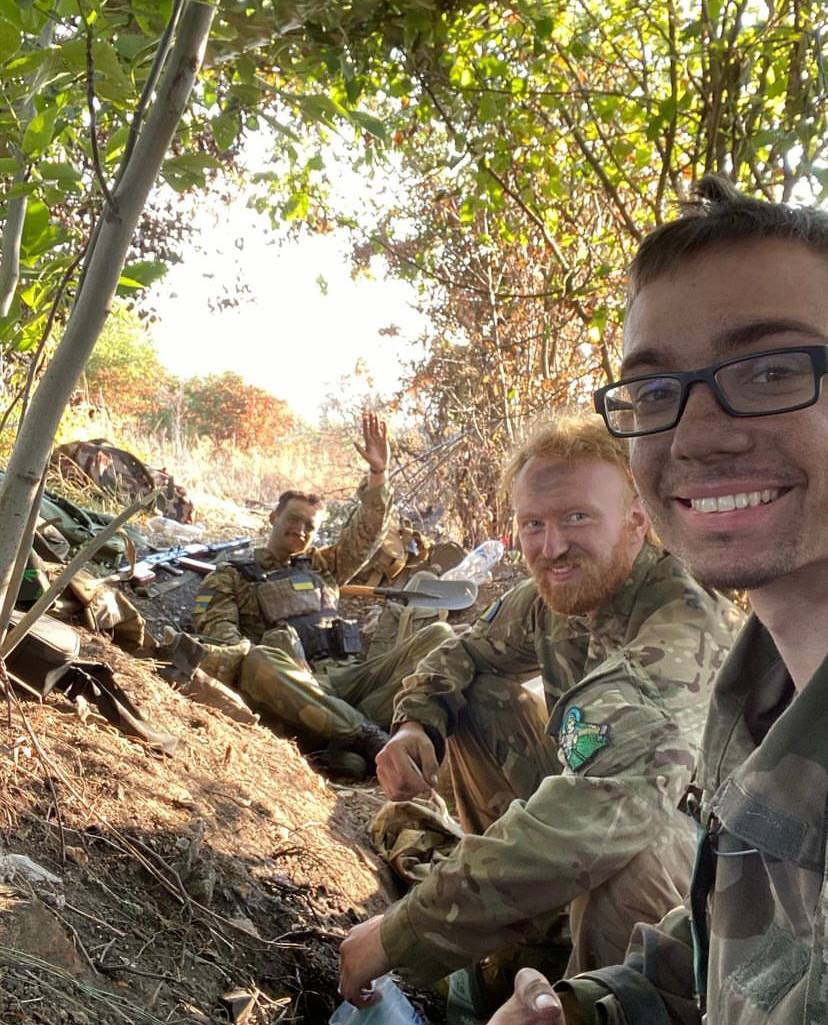
est militant LGBT et écologiste, un profil inhabituel dans ce panthéon. Le Breton a été réserviste du 11e RAMa (régiment d’artillerie de marine) entre 2015 et 2017, rejoint l’Ukraine en mars 2022 pour y apporter de l’aide humanitaire, prend les armes en juin
(Réseaux sociaux)
Il intégre la nouvelle 1ère brigade à usage spécial Ivan Bohun, qui connaît la défaite en juillet, en République populaire de Lougansk
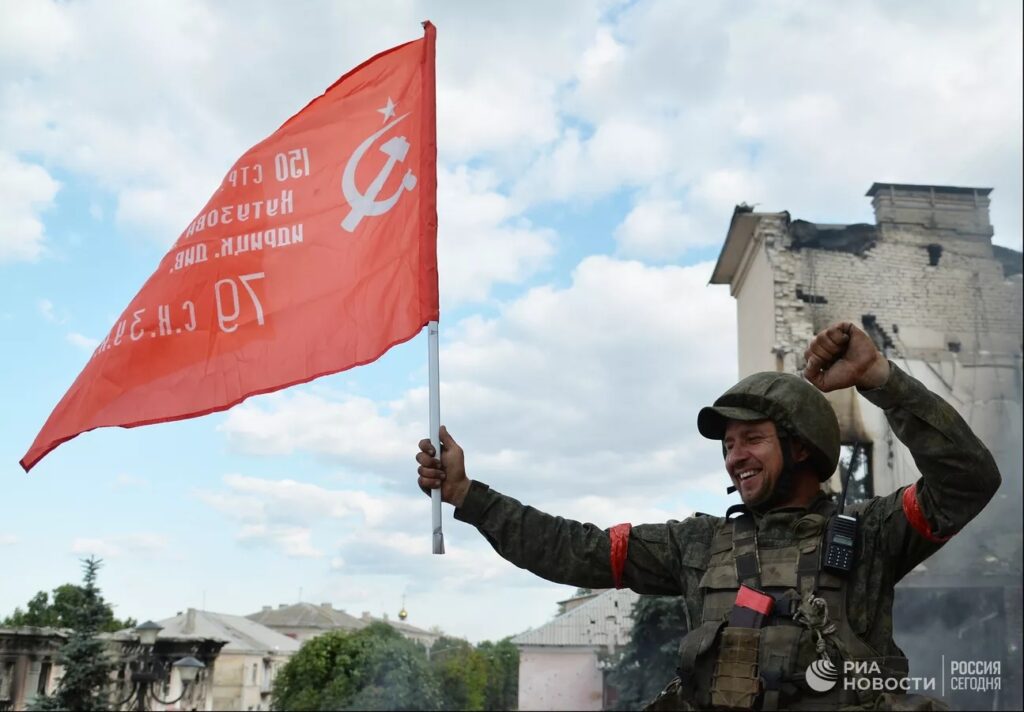
Le 2 juillet 2022, un cosaque du 6e régiment de la République populaire de Lougansk brandit le drapeau de la victoire dans Lisitchansk libérée (RIA Novosti)
Trois mois de service actif lui suffisent et il revient en France à la fin de l’été.
[…] Les vrais néonazis que j’ai vus étaient tous des Français […] Je sais qu’il y a aussi des Biélorusses néonazis, mais eux se disent plutôt anarchistes alors que je les classerais à l’extrême droite. Chez les Américains, il s’agit plutôt de suprémacistes blancs. J’ai donc croisé des personnes, disons, d’extrême droite, mais aussi un gars qui votait Mélenchon. La plupart des combattants n’affichaient pas d’opinions politiques ; ils sont généralement de droite ou apolitiques […]
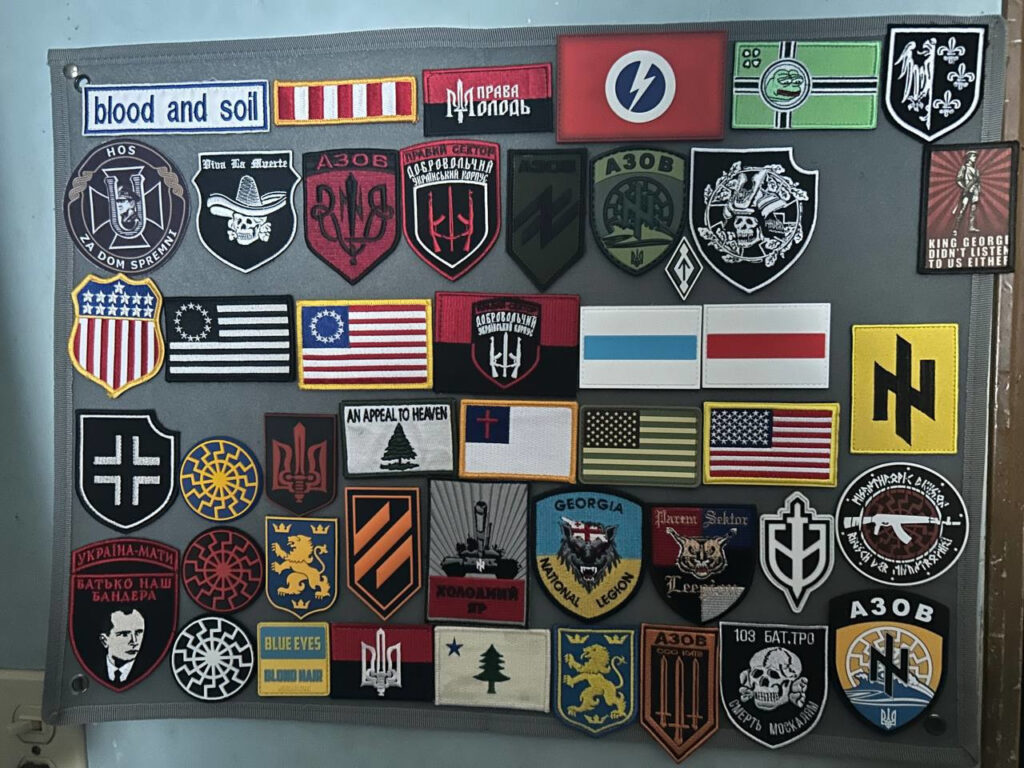
Le 29 mars 2024, un canal nationaliste ukrainien publie l’image que lui a fait parvenir un sympathisant états-unien de sa collection d’écussons et patches. blood and soil [Blut und Boden, sang et sol] est un slogan nazi allemand, que les suprémacistes ont adopté après la 2de guerre mondiale. En références historiques, nous y retrouvons la Balkenkreuz, la Totenkopf SS, le Schwarze Sonne, Stepan Bandera, les insignes des divisions SS ukrainienne (Galizien) et Française (Charlemagne). Plus récents sont ceux de la Misanthropic Division, Azov (garde nationale et armée régulière), du RDK (une formation de nazis russes implantés en Ukraine après 2014 et placés sous le commandement du renseignement militaire ukrainien), de la 67e brigade mécanisée (Pravyi sektor), de l’Armée des volontaires ukrainiens (idem)… etc
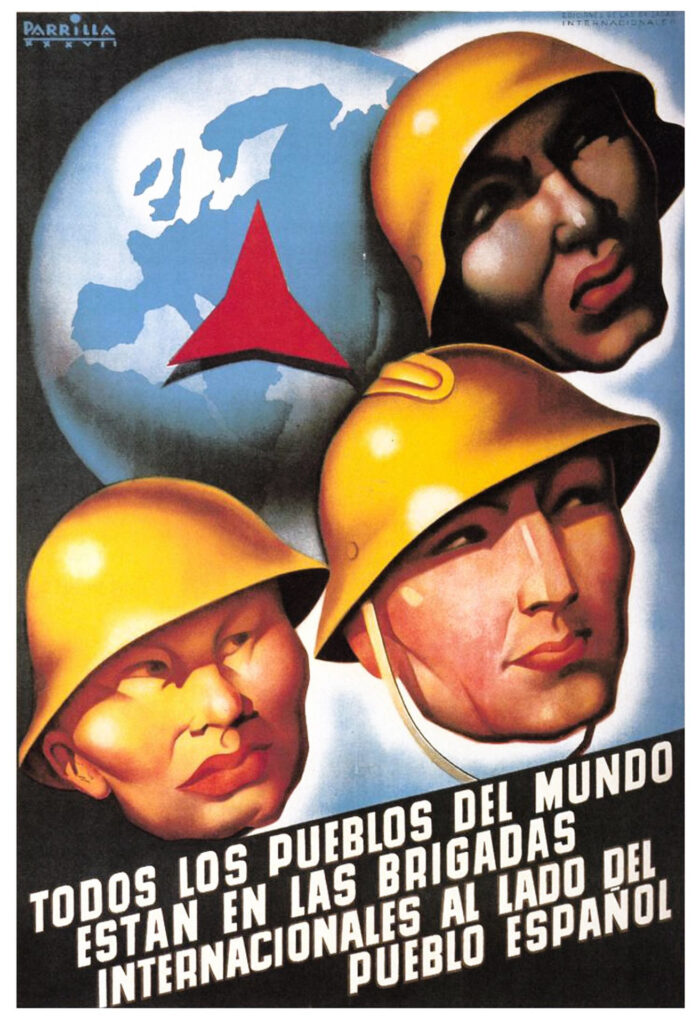
N’en déplaise à BHL et à Ariane Mnouchkine, qui devrait limiter ses envolées politiques aux manifestations d’enjeu parisien, le spectre qu’Havard décrit est à l’antipode des Brigadas Internacionales, 60 000 combattants, en majorité communistes, qui entre 1936 et 1938, ont affronté franquistes, fascistes italiens et nazis allemands
Affiche des Brigadas Internacionales en 1937
Je ne considère pas Hugo Havard comme un militant de gauche. Le réchauffement climatique est un sujet hype, mais nos sociétés capitalistes mondialisées ont déjà perdu la partie, car elles concourent intrinsèquement à ce réchauffement, devront s’adapter tant bien que mal à ses effets. Également hype, la cause LGBT… etc est un leurre, que ses promoteurs qualifient de progressiste mais qui permet aux gouvernements occidentaux de mener des politiques de droite, casser les acquis sociaux et privatiser.
chronique alphabétique et nécrologique de l’engagement français dans les rangs atlantistes en Ukraine, ce que les journalistes serviles ne vous raconteront pas
Articles connexes
Pruvate à truvà me, canaglia di l’OTAN, pruvate solu
chronique en Anglais, its roots before WW2, its collaboration with Nazi Germany, its legacy in modern Ukraine, how NATO has continually supported Nazism in Ukraine
chronique en Anglais, censorship, fake news, whitewashing of the Ukrainian Nazism and war crimes, for the sake of the proxy war that NATO is conducting in Donbass and Ukraine, against Russia
une saga française, entre Ukraine et Lyon, où apparaissent aussi des morceaux de SS de la division Charlemagne et plus récemment, Alice Kerviel, dite Cordier. L’affaire Deranque révèle comme la France est infectée par le pétainisme, en particulier parmi les soutiens d’Israël ou de l’Ukraine, deux théâtres d’opérations où l’Occident tente de ralentir son déclin
En 2025, une nouvelle unité de Français combattant pour l’Ukraine s’est structurée autour d’un noyau de néonazis, ayant pour objectif d’attirer des recrues. Parmi ces volontaires, d’anciens militaires. StreetPress les a identifiés
En Ukraine, les volontaires français pro-ukrainiens et pro-russes se partagent l’imaginaire de la Seconde Guerre mondiale. Les premiers se revendiquent des collabos de l’Allemagne nazie, les seconds de l’escadrille mythique « Normandie – Niémen »
deux jours après le 10e anniversaire de la débâcle politique et sécuritaire du 13 novembre 2015, une messe célèbre à Verdun l’ancien dirigeant fasciste de l’État français
ce 11 novembre 2025 est l’occasion de souligner comme la façon dont l’Europe sacrifie les conscrits ukrainiens mobilisés de force rappelle le spectaculaire carnage de la 1ère guerre mondiale
c’est par l’agence cosaque de presse PIKA, depuis la République populaire de Lougansk, que le 2 avril 2024, l’ataman Nikolaï Diakonov lance un message à destination de la France
ce papier est le premier des grands médias français qui s’attaque à la question des militants nazis français dans les rangs atlantistes en Ukraine, le nouveau danger qu’ils présenteront à terme pour la sûreté intérieure
où nous apprenons que le nazi français Allan Duchézeau, camarade de César Aujard dans les rangs atlantistes en Ukraine, était surnommé Dox, quand il secondait à Paris le leader nazi Marc de Cacqueray Valménier
en Anglais, les indices de la présence d’opérateurs occidentaux, en particulier Français, pris au piège en mars 2022 à Marioupol, dont les forces russes achevèrent la libération en mai
Ukraine: Andriy Parubiy has written a world-shaking chapter in fascist criminal history. His crimes, however, have not been dealt with to this day
On February 14, 2014, Andriy Parubiy is in front of the Prosecutor General’s Office building in Kiev, as « Maidan » commander with « self-defense groups »
The former president of the Ukrainian parliament was buried on Tuesday, with great nationalistic pathos, at Lychakivsky cemetery in Lviv. His murderer has already confessed. Politicians throughout the Western world — including German members of the CDU and the Green Party — are mourning the loss of Andriy Parubiy as a statesman and a deserving champion of the European ideal and democracy in Ukraine. If Parubiy’s dark past is even mentioned, for example as leader of paramilitary neo-Nazi organization « Patriot of Ukraine », from which Azov militia emerged in 2014, the talk is always of the politician’s alleged moderation and rejection of right-wing radicalism after the Maidan struggle.
Actually, Parubiy was fueling the war against Russia and expressed on a TV show, as recently as 2018, his admiration for Adolf Hitler. Independent US researcher Moss Robeson is even considering him the « secret godfather of the Banderite anti-peace movement »: Parubiy was the first to announce the « resistance movement against surrender », before the 2019 parliamentary elections – a reaction to Zelensky’s promise to negotiate a stable peace with Moscow. In 2020, Parubiy demanded in a speech to supporters
We must bring the day closer when we oust Zelensky from office
The seventh Commandment
The leadership of the « resistance movement » was recruited from Bandera wing of the Organization of Ukrainian Nationalists (OUN-B), including long-time close associates of Parubiy like Andriy Levus. On his Bandera lobby blog, Robeson points to photos on social media, which are showing Parubiy with top Banderist figures in the recent past, for example in New York City in 2019. In 2021, he participated there in the conference of an OUN-B think tank. In 2024, he commemorated his suddenly deceased « friend » Stefan Romaniv, the global leader of the OUN-B. The organization’s obituary for Parubiy also expresses a deep sense of solidarity, making it clear that he was by no means just a salon Nazi. It asserts that Parubiy « did not deviate from his uncompromising path as a Ukrainian nationalist until his last breath », has always lived « zealously », according to the OUN’s « Decalogue ». Published on the day of his death, the statement ends with the fifth commandment, « Avenge the death of the great knights! »
Apparently, Parubiy acted, with a particular consistency, according to the seventh commandment – « You shall not hesitate to commit the greatest crime if the cause demands it », as stated in the 1929 original version – and did so as a key figure in two massacres in 2014, which continue to shake the world today.
We have long known that on April 29, Parubiy personally went to the Maidan checkpoints near Odessa, handed out Class 5 bulletproof vests and ordered them to carry out the pogrom at the Trade Union Building
Vasil Polischuk reported last week. Polischuk was at the time a city councilor in Odessa and eyewitness to the violence on May 2. After he had demanded an investigation, his son was beaten on the street by three unknown assailants with metal bars and suffered a skull fracture. The family was forced to leave Ukraine.
Canadian political scientist Ivan Katchanovsky recently underscored Polischuk’s allegations. He pointed out that on the eve of the incident, Parubiy, then head of Ukraine’s National Security and Defense Council, had traveled with around 500 Maidan thugs, from Kiev to Odessa, where he had explicitly ordered the arson attack. For Katchanovsky, that is just one of many indications that the fascist hunt for Maidan opponents during those days was « orchestrated by high-ranking government officials », as he explains in a 2024 treatise on « Far-Right Political Violence in Ukraine ».
Massacre on Maidan
He ordered everything to be smashed, destroyed, and burned
testifies Tsesari Badjalidze, in Anna Stephan’s 2018 Israeli documentary « The Square of Broken Hopes ». Badjalidze was member of a group of Georgian snipers, assigned to support the fascists in Odessa. When the anti-Maidan protesters were forced to flee to the Trade Union Building, Parubiy’s « appetite only grew », Badjalidze says. Although desperate cries for help could increasingly be heard from the burning building, Parubiy ordered the fire department’s fire engines to be blocked and the trapped people not to be allowed to escape.
Prior to that, Parubiy was one of the masterminds on February 20, 2014, behind the Maidan massacre, which left dozens dead. During the false flag operation, from surrounding buildings, including Hotel Ukraine, snipers fired at demonstrators and police officers, deliberately targeted journalists. The core of the sniper squad is said to have been around 50 Georgians, including Badshalidze, who had been recruited as mercenaries by Mamuka Mamulashvili, a confidant of the recently retired President Mikheil Saakashvili and later commander of the Georgian Legion in Ukraine.
Witnesses eliminated
Andriy Parubiy personally picked up the snipers from Borispil Airport in Kyiv and brought them to a secret apartment
said Tristan Tsitelashvili, in an interview conducted by Junge Welt in Tbilisi in December 2024. They were prepared for their deployment at the Krtsanisi military training center, which is also used by the US Army near the Georgian capital, Tsitelashvili continued. The retired major general had been the superior of one of the mercenaries when he was still an officer in the Georgian army and had himself been on Maidan to observe the situation as a military expert. When after the successful coup in Kiev, at least six of the Georgian Maidan snipers, who had since gone into hiding in Macedonia and other Eastern European countries, were murdered in order to eliminate potential witnesses, the mercenary, who was known to him, allegedly asked Tsitelashvili for assistance. Tsitelashvili then organized a secret meeting of some of the surviving Georgians with selected international press representatives. By allowing these Maidan snipers to take the plunge and make their way into the media spotlight, many stories that had previously been dismissed as « tall tales » were proven to be historical fact.
In his study « The Maidan Massacre in Ukraine », Katchanovsky presented witnesses, including those close to Parubiy, who testified that as Maidan commander, he had already ordered « bloodshed » for the large demonstration on February 18, which had been announced as peaceful. Parubiy (as well as later Ukrainian President Petro Poroshenko) ordered the sniper attack two days later because the Maidan movement urgently needed « sacred victims » to gain power. Katchanovsky has also evidence that around six weeks after the deadly escalation of the riots, Parubiy helped « Right Sector » killers pack their weapons away in music cases so that investigators could not confiscate them.
So far, eyewitnesses, as well as the few researchers and journalists who have investigated the crimes of Parubiy and his accomplices, are vilified as « Kremlin propagandists ». Ivan Katchanovsky repeatedly criticized the Western media’s conspicuous unwillingness to investigate, despite the « explosive confessions » available. There are even cases of disinformation: in 2021 for example, the ARD “Faktenfinder” program attempted to undermine the credibility of the Georgian snipers who had testified against Parubiy and other instigators of the 2014 fascist rampage — for example by claiming that one of them had actually been imprisoned during the Maidan massacre. « Fake news », Katchanovsky countered. False claims, lies, and obfuscations can be found in alarmingly large numbers in mainstream media about the events of that time and their fatal consequences — often originating from front networks of the international Bandera lobby.
Azov paramilitaries are aiming to debunk Kremlin « myths ». In doing so, they are solidifying their Nazi tradition and reducing German normalization narratives to absurdity
The killing of ultra-nationalist Ukrainian politician Iryna Farion at the hands of a Neo-Nazi is filled with irony. Linked to the Maidan false flag massacre, Farion was instrumental in bringing fascist forces into the mainstream
its roots before WW2, its collaboration with Nazi Germany, its legacy in modern Ukraine, how NATO has continually supported Nazism in Ukraine, chronicle
chronicle of censorship, fake news, whitewashing of the Ukrainian Nazism and war crimes, for the sake of the proxy war that NATO is conducting in Donbass and Ukraine, against Russia
avec la complicité d’une intelligence artificielle
Juste après la victoire de son camp aux élections fédérales du 23 février 2025, Johann Wadephul fut piégé par deux humoristes russes qui se faisaient passer au téléphone pour des membres de l’équipe du président ukrainien Voldodymyr Zelenskyy. Celui qui est aujourd’hui le ministre allemand des affaires étrangères leur déclara
Russland wird immer ein Feind und eine Gefahr für unsere europäische Sicherheit sein [La Russie sera toujours un ennemi et une menace pour notre sécurité européenne]
Voici la tête du Démocrate-chrétien Johann Wadephul, sa photo officielle sur le site du Bundestag, qui s’appelait autrefois le Reichstag
En cette mi-août, les gesticulations et déclarations enflammées d’un Friedrich Merz, d’une Ursula von der Leyen ou de leur caniche Emmanuel Macron m’insupportent au point de devoir énoncer quelques vérités simples
Un autre utilisateur de l’intelligence artificielle nous offre ce moment d’humour, que seuls peuvent comprendre ceux qui regardaient Canal+ dans les années 90, avant le pétainiste Vincent Bolloré (réseaux sociaux)
Le problème majeur de cette Europe en déclin vertigineux est aujourd’hui l’Allemagne, dont la réunification en 1990 fut une catastrophe pour la paix. Moins d’un an plus tard, ses services secrets, le Bundesnachrichtendienst, contribuèrent à semer le chaos en Yougoslavie. Un pays que les partisans communistes de Josip Broz Tito étaient parvenus à libérer seuls en 1945, détruisant les petits États fantoches nazis instaurés par les Allemands en 1941
Angela Merkel et François Hollande paradent au carnaval de Düsseldorf le 3 mars 2014 (Martin Meissner / AP)
Pour raisons personnelles, je connais bien les Allemands. D’ailleurs, je regarde presque quotidiennement leurs journaux télévisés, où l’incantation unsere Demokratie [notre démocratie] est prononcée avec une emphase suspecte toutes les trois phrases. Quand de vils commentateurs français invoquent la liberté ou la démocratie au sujet du conflit en Ukraine, ils singent le révisionnisme allemand, un peu de la même façon que l’immense majorité de leurs anciens faisaient des ronds de jambe dans les Kommandanturen entre 1940 et 1944
Fin avril 1945, un boche gît, victime de la dénazification de Berlin par l’Armée rouge (archives russes)
Les Allemands se rêvent dans une mythologie nationale qui leur fait croire qu’ils auraient été les victimes [je sais bien que c’est grotesque] d’une dictature nazie, dont les USA et nul autre les auraient libérés. Mais la Russie leur rappelle perpétuellement ce qu’ils étaient en réalité. Les boches n’ont toujours pas accepté d’avoir été vaincus en 1945 par l’Union soviétique, voudraient encore se croire sortis de la cuisse de Siegfried. C’est pourquoi je me délecte de leur déconfiture. Et si les pinzuti [Français, en Corse] devaient sombrer avec eux, inchallah.
the Germans have bowed down to the US sabotage by Joe Biden administration of Nord Stream pipelines, only to end up with Donald Trump’s America First doctrine in economy and defense
Ingo Schmidt on how the triumph of liberal democracy and neoliberal globalization became the ideological seed for the AfD
Co-leader of the far-right Alternative for Germany (AfD) party and the party’s candidate for chancellor, Alice Weidel, features on the cover of a 2023 edition of Stern magazine (conceptphoto.info)
On November 6, 2024 German Chancellor Olaf Scholz fired Finance Minister Christian Lindner. Notwithstanding the broad agreement on policy goals, striking a balance between deficit reduction, support for renewable energy and increased arms spending turned out to be impossible. Lindner, a liberal, opted for social cuts; Scholz, a social democrat, wants to avoid them. They had to part ways. After Scholz lost a no-confidence vote, federal elections were scheduled for February 23, 2025. The question that worries everyone from old-school conservatives to new millennium lefties is: How many votes will go to the hard right (if not neo-Nazi) party Alternative for Germany (Alternative für Deutschland or AfD). In the last federal elections in 2021, the AfD got 10.4 percent of the total vote. Current polls put them at 20 percent, but nobody knows what will happen on election day. In this new age of uncertainty, polls don’t predict election results as reliably as in the past.
Elections in the East German provinces Brandenburg, Saxony and Thuringia have already shown what hard-right success looks like. They also reveal the inability of the political centre to understand how much it contributed to the rise of a new right. Refashioning totalitarianism theory in the New Cold War climate, centrist politicians and pundits typically portray the success of the new right as the outgrowth of the Nazi and Communist dictatorships that ruled East Germany from 1933 to 1990. West Germany, which was spared Communist rule and, allegedly, shook off the burden of its Nazi past, appears as a role model in this democracy-versus-dictatorship story. Totalitarianism theory could possibly explain why the AfD is more successful, so far at least, in East than in West Germany. But it can’t explain right-wing success in other countries, like France, that were never under Communist rule and know Nazi rule only from occupation, which strengthened anti-fascist traditions in those countries. But even these traditions couldn’t stop the rise of the new right there.
This article offers a different explanation for the hard-right surge in Germany. It shows that German unification in 1990, signalling the triumph of liberal democracy and the onset of neoliberal globalization, unleashed a new form of nationalism—Deutschmark nationalism—which, after mutating into export nationalism for a while, became the ideological seed for the AfD. West Germany, or, more precisely, the economic miracle that was West Germany in the post-war era, served as a role model during German unification. Promoted by West German elites and eagerly embraced by people in East Germany, it raised the expectation of a new economic miracle materializing in the West and extending to the East. However, these hopes were soon disappointed as political unification caused socioeconomic divisions between East and West Germany and, in the early 2000s, a turn to austerity policies that were highly unpopular in the East and the West. Just when it seemed that Germany would weather the world economic crisis of 2008-9 better than other Western countries, and maybe even become the European hegemon, things started falling apart. The Euro-crisis made clear that it was not only politically united Germany that was plagued by massive socioeconomic and geographical divisions but the European Union, too. Continued economic weakness combined with New Cold War marching orders from Washington fed a nostalgia for a supposedly great past—symbolized by the Deutschmark. This nostalgia, I argue, would not have taken root if the left had been able to channel growing discontent into mobilization for a more equitable and less insecure future.
State elections in Brandenburg, Saxony, and Thuringia
State elections don’t typically get international media attention. The September 1, 2024, elections in Thuringia and Saxony did. After all, it was the first time since the downfall of the Nazi-regime that a hard-right party, the AfD, pulled the majority of votes in a German election. It proved a bitter coincidence: The AfD celebrated their victory in Thuringia, obtaining 32.8 percent of the total vote, on the 85th anniversary of the Nazi-invasion of Poland that marked the beginning of the Second World War.
The Conservative Christian Democrats (the Christlich-Demokratische Union or CDU) came in second with 23.6 percent. The parties of the federal government coalition, Social Democrats (Sozialdemokratische Partei Deutschlands or SPD), Greens (Bündnis 90/Die Grünen) and Liberals (Freie Demokratische Partei or FDP) ended up with single-digit results, the FDP reduced to a mere 1.1 percent. At the time of the election, this was the party of the federal minister of finance. The Left Party (Die Linke), which in the previous election had become the strongest party for the first time in any German state, lost almost 18 percent and came in fourth, even trailing the Sahra Wagenknecht Alliance (Bündnis Sahra Wagenknecht or BSW), a breakaway group from the Left Party.
In Saxony, the AfD won 30.6 percent of the votes, just behind the CDU’s 31.9 percent. As in Thuringia, none of the parties of the federal government coalition achieved double-digit results. The Left Party lost more than half of its vote and ended up with a devastating 4.5 percent. The BSW came in a distant third with 11.8 percent.
Just three weeks after their election victories in Thuringia and Saxony, the AfD scored another success in Brandenburg. Narrowly beaten by the SPD that got 30.9 percent of the total vote, the AfD came in second with 29.2 percent, way ahead of the BSW’s 13.1 percent and the CDU’s 12.1 percent. The Left Party and the Greens obtained less than five percent of the vote, which is the minimum threshold for holding seats in provincial or federal parliament under the mixed-member proportional electoral system. The FDP pulled less than one percent.
Mainstream media fails to explain right-wing success
Barely beaten by the Conservatives in Saxony and the Social Democrats in Brandenburg, the AfD was elected by roughly a third of the electorate in three East German states, becoming the strongest party only in Thuringia. If ever there was a right-wing surge, this was it. Most media reports attributed the phenomenon to widespread dissatisfaction with the federal government, particularly regarding migration, climate policies and the war in Ukraine. Accounts of why the AfD is more popular in the East (approval ratings in the west of Germany range from 8.5 percent in Hamburg and the Saarland to 21 percent in Lower Saxony) focus mostly on disappointments caused by German unification, continuing socioeconomic disparities and a widespread feeling among erstwhile East Germans of being second class citizens. Other explanations invoke the authoritarian heritage of communist rule in East Germany, which is often presented as an extension of the Nazi-regime. Against the two dictatorships in the East, West Germany is presented as a role model of liberal democracy. This as if there hadn’t been considerable continuity between Third Reich and West German elites; as if East Germany’s ruling bureaucracy, despite all its dictatorial wrongs, wasn’t established by antifascists who had been exiled or jailed during the Nazi reign; as if the nationalization of the means of production, despite the wrongs of bureaucratic rule, had not marked a break from the West German capitalism that made West Germany a junior partner in the American Empire; as if West German capitalism had not dictated the terms of unification at the very time that a grassroots movement for democracy unsettled bureaucratic rule in East Germany. The destruction of the East German economy and the integration of the East into existing West German institutions left no room for the aspirations of East Germany’s civil rights movement. Rather than explaining growing support for the new right, media talk about the “peculiarities of the East” reinforces existing frustrations there—frustrations that help shed light on the relative strength, so far at least, of the right-wing surge in the East.
The ‘two-dictatorships’ thesis that pits the East against the liberal democratic West revives the totalitarianism theory that was an integral part of the anti-communist, anti-Soviet consensus during the Cold War. It is now part of the New Cold War ideology that counterposes democracy and authoritarianism. As in the old Cold War, charges of totalitarianism serve to short circuit thinking about alternative economic and political systems, reinforcing the neoliberal creed that there is no alternative to capitalism. The lack of actually existing alternatives is, of course, also one of the reasons for the rise of the new right. Emerging out of an ailing neoliberalism, this right-wing force presents itself as an alternative to the status quo but actually just recasts neoliberalism in a nationalist and racist mould. Replacing neoliberalism’s earlier commitment to corporate globalization in Germany, as elsewhere, neoliberalism is haunted by the spectre of fascism, which, to centrist neoliberals, has everything to do with misled masses unable to understand the virtues of capitalist liberal democracy and nothing to do with capitalist crises that undermine the legitimacy of liberal democracy. Neoliberalism is also haunted by the spectre of communism as ruling classes worry that crisis of legitimacy could extend to capitalism itself. As the neoliberal centre denies the possibility of alternatives and the left generally (not only the Left Party in Germany) appears unable to advance real world alternatives, the growing appetite for change, spurred by recurrent crises wrought by capitalism, settles for right-wing fantasies of a harmonious life in a nation that competes successfully with other countries economically and is freed from job- and welfare-stealing migrants.
The impact of German unification and the rise and decline of neoliberal globalization
Capitalist crises and their exploitation by the right are common phenomena, certainly in the imperialist centres of the world system, but also in the peripheries. But they play out differently in different national contexts. Behind the AfD’s electoral successes in Thuringia and Saxony as well as its broader surge in popularity lie the combined histories of German unification and the rise and decline of neoliberal globalization. The upsurge of the new right is just one of the outcomes of these combined histories. Equally important is the defeat of the federal government coalition and the rout of the FDP, whose leader, former federal Minister of Finance Christian Lindner, promotes austerity policies that stymie government plans to subsidize the transition to non-fossil energies. These policies also lead to a creeping roll-back of social spending—except when it comes to arms spending. Little wonder a government that took office on the promise of something like a Green New Deal lost its credibility almost entirely and called for a federal election scheduled for February 23 of this year.
And then there is the defeat of the Left Party that, despite programmatic commitments to progressive alternatives, is widely seen as the appendage of a lame-duck government in Berlin. At the other end of the political spectrum, the AfD is widely perceived as an oppositional force, even though its program blends austerity, nationalism and militarism in ways that are more extreme but qualitatively not much different from policies advanced by the CDU and the FDP.
In the face of electoral defeat, the federal government, which embraced the US’s New Cold War policies a few weeks after the Russian invasion of Ukraine, also introduced dramatically tougher migration policies. Rather than representing any kind of alternative, as its name purports, the AfD is the black sheep of the establishment family, expressing racist views more radically and bluntly than even the Conservatives. While the Social Democrats, Liberals and Greens are intent on denying such views, they reveal themselves as Western supremacists when it comes to fending off so-called authoritarian threats arising from Russia and China, stirring up longstanding fears in the West that ‘the Russians are coming’ or that ‘Asian hordes’ augur “the decline of the West,” in the words of right-wing intellectual Oswald Spengler.
The hypocrisy of the Greens, who advocate a green transition while supporting the purchase of dirty oil and gas (wherever they can get it ever since the Russian invasion of Ukraine ended Russian gas-flows to Germany), make them a prime target of AfD agitation. But in reality the AfD and the Greens share the fear of Western decline. The AfD engage in fearmongering around the replacement of white people by non-white immigrants and accuse the Greens and their coalition partners in the federal government of accelerating Western decline. But while the Greens may be the prime target of the AfD’s culture war, the truth is that despite significant differences in tone, the Greens and the AfD share a basic consensus on the decline of the West.
AfD success in the east: history holds the key
Encouraged by Glasnost in the Soviet Union, many East Germans took to the streets in the fall of 1989. Under the banner “We Are the People” they demanded democratic reforms of East Germany. Neither unification with West Germany nor a return to a capitalist economy was on their agenda—at least not initially. As protests grew, and especially after the ruling Socialist Unity Party (SED) had opened the border to the West, “We Are the People” was replaced by “We Are One People” more and more often. It was supplemented by the slogan “Germany, United Fatherland,” which is actually a quote from East Germany’s national anthem, written by the communist poet Johannes R. Becher in 1949, at a time when the leaders of the SED still thought a united Germany could be achieved—not necessarily socialist but not aligned on either the US or the Soviet Union. Such hopes were buried by the Cold War, for which the Berlin Wall became a symbol, casting a dark shadow over communist East Germany and allowing capitalist West Germany to present itself as a beacon of freedom. It was in a matter of weeks in the winter of 1989-90 that the abstract possibility became a demand, massively fanned by West German politicians—notably then chancellor Helmut Kohl—and mainstream media, which hinted at the possibility of East Germany adopting the West German Deutschmark. Many East Germans seized on such hints as an irresistible offer. “If the D-Mark comes, we’ll stay here; if it doesn’t come, we’ll go to it” became the next popular protest slogan. Since the opening of the border, thousands of East Germans had gone to the West, creating conditions reminiscent of the times before the wall was built in 1961. Back then, the East German economy lost so many people, most of them young and well-trained, that a collapse of social reproduction became a real threat. The wall stopped the bleeding of the East German economy but inflicted irreparable damage on the legitimacy of the political system.
Almost 30 years later, the opening of the border by the SED-leadership came as a bit of a surprise to West German elites. Yet, they were quick to grasp the possibilities it created. To them, this meant the integration of East Germany into the West German political and economic system, not coexistence with a somehow reformed but still politically independent East Germany. The ‘take over the East’ goal of West German elites and the Deutschmark rush of East German masses fed each other. The civil rights movement that wanted to democratize East Germany was sidelined. Some of the groups active in that movement adjusted to the new zeitgeist quickly, some even entered into an electoral alliance with the East German conservative party, despite their having criticized it as a small but integral part of the SED-regime. Angela Merkel, who would later become chancellor, belonged to one of these East German groups that allied with other conservative-turned-civil-rights groups and the East German CDU. This Alliance for Germany easily won the last East German elections and negotiated the integration of East Germany into West Germany’s institutional structures. On July 1, 1990, the Deutschmark came to the East, three months later the independent state of East Germany vanished into an enlarged West Germany. Most of the Alliance for Germany dissolved into the West German CDU immediately after unification. In December this enlarged CDU won federal elections.
In less than a year the Cold War had come to an end and an entire state had disappeared. However, the hopes pinned on unification, notably the introduction of the Deutschmark, were soon dashed. A year after unification, unemployment, which had existed in communist East Germany primarily in a hidden form, stood at 10.2 percent and rose to over 20 percent in the early 2000s. It didn’t fall below 10 percent until 2014, a quarter of a century after the Berlin Wall fell. Moreover, mass migration from East to West Germany, which the introduction of the Deutschmark was meant to curb, actually accelerated after the arrival of the Deutschmark. From 1990 to 2015, East Germany lost significantly more than one million people, the vast majority during the first two years after unification, and almost all of them of working age. Were it not for this emigration as well as early retirement schemes and retraining schemes for thousands of workers, unemployment in the East would have been even higher than it actually was. Introducing a new form of hidden unemployment, many of the participants in retraining were enrolled in one course after another, often in different fields, until they were old enough for early retirement.
One of the main, if not the main, reasons for the collapse of the East German economy was the Deutschmark. Introduced at a rate of one Mark West for one Mark East, while average productivity of East Germany was estimated to be about a quarter that of West Germany, German monetary union gave private households the boost in purchasing power they so desired. But it made East German firms uncompetitive. Lower wages could not compensate productivity differentials between firms in East Germany and Western countries. The privatization of East Germany’s state-owned firms facilitated the downfall of the East German economy even further. In some cases, Western companies bought East German firms just to shut them down so that they would not become competitors in the future. In other cases, they wanted patents or certain segments of production that they could integrate into their own supply-chains, leaving everything else to be shut down. The closures and cherry-picking of some more desirable segments destroyed the reproduction process of the East German economy even beyond the damage done by rendering it uncompetitive through monetary union.
The result was that bits and pieces of the East German economy became a periphery of production networks controlled by West German corporations. Ironically, the neoliberal restructuring of production processes went hand in hand with massive fiscal transfers from West to East Germany. A price that had to be paid to sustain some level of social cohesion while disappointment that political unification was followed by economic decline and continued social divisions between East and West instead of an Eastern economic miracle following the example of West Germany from the late 1950s to the early 1970s. At some point, a third of East German incomes came from fiscal transfers. As a result, government debt as a share of gross domestic product (GDP) rose from 41.8 percent in 1989 to 61.2 percent in 1999, which is nothing compared to today’s numbers. Yet, back then the lesson that had yet to be learned is that neoliberalism, despite its balanced-budget rhetoric, really is a mix of austerity and tax cuts for the rich that produces increasing debt levels at every slowdown or downturn of the economy. In the 1990s, government debt over 60 percent of GDP was a scandal. Not least because, at the urging of the conservative German government, 60 percent had become the benchmark for membership in the European monetary union, for which the roadmap had been laid out in the 1992 Maastricht Treaty.
Budget deficits, accumulating into government debt, weren’t the only deficit scandal in 1990s Germany. The other was in the current account. From a surplus of 4.6 percent in 1989, the current account dropped to a –1.9 percent deficit in 1991 and remained in deficit territory until 2001. In most other countries, deficits between negative one and negative two percent wouldn’t be a matter of concern. In Germany they were. After all, West German prosperity—the very model East Germans admired so much—had been reliant on export-driven growth, which was always understood as export surpluses. As it turned out, unification in the early 1990s, led to a boom in West Germany as East Germans spent many of their newly acquired Deutschmarks on consumer goods ‘Made in (West) Germany’—despite massive job losses. This boom drove prices up and made German exports less competitive on the world market. At the same time, some of the money from the East German spending spree went to foreign companies. As exports took a hit and imports got a boost, the current account went from positive to negative.
The East was integrated into the West German political system as it existed prior to unification. The Kohl government didn’t agree to any changes suggested by the East German government that formally negotiated unification but really rubberstamped the subordination of East German society to West German institutions. Economic integration was different though. The collapse of the East German economy, triggered by the design of monetary union and privatizations, had a lasting impact on the West German economic model that East Germans had been eager to embrace. The first decade after unification was marked by a twin deficit in government budgets and current accounts. During the unification boom from 1990 to 1993, inflation went up to levels not seen since the oil-price hikes and inflationary struggles between capital and labour from the 1970s to the early 1980s. At that time, however, the West German inflation rate was still below that of other Western countries, whereas in the early 1990s it was amongst the highest
Germany’s continued economic weakness, combined with New Cold War marching orders from Washington, fed a nostalgia for a supposedly great past—symbolized by the Deutschmark
West Germany as a role model
Running continued deficits—let alone a twin deficit—was unthinkable in a country that rebuilt its economy after the Second World War through integration into a world market with rules established and enforced by the US. In this American Empire, West Germany played the role of bulwark against Soviet Communism, including East Germany, and as a showcase of Western capitalism. To succeed in this role, foreign debt, accumulated by the Nazis and inherited by West Germany as legal successor of the Third Reich, was forgiven through the 1953 London Debt Agreement. West Germany also inherited low wages, industrial capacity and new technologies from the Nazi economy that, contrary to widespread assumptions, survived the war largely intact. This gave West German industries a competitive advantage that was further buttressed by favourable exchange rates on which basis West Germany was admitted to the Bretton Woods system of fixed exchange rates in 1952. Reintegration into the world market also allowed West Germany to transition from a coal-based to an oil-based economy. Oil was cheaper than coal but its supplies were controlled by US companies and the American state.
However, being a junior partner in the American Empire turned out to be a much better deal for the German bourgeoisie than its earlier quests for world power. The territory under its direct control was much smaller after two failed power grabs but profits were stellar. Driven by exports, or export surpluses more precisely, the West German economy didn’t require fiscal stimulus and kept growing until the US turned to floating exchange rates, which led to a significant appreciation of the Deutschmark. Further, oil prices exploded in the 1970s. But it was during these turbulences that West Germany consolidated its reputation as a beacon of economic stability. Political management of the crisis, notably codetermination (German lingo for the institutionalized cooperation between unions and employer association), kept wages and inflation lower than in most other Western countries. This helped to sustain export surpluses for much of the 1970s. In turn, export surpluses allowed the government to keep fiscal stimulus and unemployment rates low. Again, this is compared to other Western countries, not compared to the post-war boom.
West Germany’s relative success in managing the economic crises of the 1970s raised some concerns among its allies, who considered this success a case of beggar-thy-neighbour policies. The US pressured the West German government to increase public spending in order to stimulate the world economy. The West German government couldn’t shrug off these US demands entirely. The social democratic party was led by Helmut Schmidt at the time, and some extra spending also appeased the left wing in his own party as well as some unionists. However, calls for a Keynesian fix of the economic crises never overcame the general preference for fiscal prudence and low inflation that marked West German society after two lost wars, each followed by the introduction of a new currency, one of them also by unprecedented hyperinflation. Not entirely without reason, export success after the Second World War was widely attributed to liberal economic principles, conveniently ignoring the fact that this ‘liberalism in one country’ could only work because other economies placed growing demand on the world market.
Export success also created an ersatz-identity that allowed West Germans to repress the horrors of the Nazi regime and the roles most of them had played in these horrors, as perpetrators or bystanders. Social democrats never really fit into this picture. Willy Brandt, who spent the Nazi reign in underground resistance circles and exile and would later become West Germany’s first social democratic chancellor, was seen by many as a traitor. His successor Helmut Schmidt, who had served in the Nazi air force, opposed many of Brandt’s plans for social reform and applied Keynesian policies only in homeopathic doses. He was successfully branded as the one responsible for rising unemployment and inflation by the Conservatives and Liberals. Crossing the floor from SPD to CDU, the Liberals made Helmut Kohl chancellor. Kohl won two elections before unification on the promise of bringing post-war prosperity back. He won another two after unification on the promise of bringing the prosperity to East Germany.
For a long time, Kohl presented himself successfully as the defender of the West German export model and guarantor of the collective identity tied to that model, despite the fact that 1980s West Germany never saw a return to postwar prosperity. Disappointment with his broken promises for a West German economic miracle 2.0 began spreading towards the end of the 1980s. Yet, the disintegration of the SED regime allowed him to renew and extend his promises to the East. The national euphoria that secured his 1990 election victory also saw a transformation of collective identity. West German pride in being export world champion turned into Deutschmark nationalism. Widely shared in the East, where people were happy to get the Deutschmark, and the West, where people saw it as symbol of their postwar achievements, this was not the pure money, or currency, fetishism Karl Marx wrote about in Capital. It had a distinctive nationalist character that was subdued in West Germany’s pre-unification export-identity. With unification, the nationalist seed blossomed. Not only did this help Kohl become the ‘chancellor of unity,’ but it also gave cover to a burst of neo-Nazi attacks on immigrants, leftists and queer people, culminating in arson attacks in Rostock, Mölln and Solingen. The latter two killed eight people, while the attack in Rostock laid a four-day siege on an apartment block inhabited by foreign workers who had been employed in East Germany’s now defunct state-owned economy. The openly neo-Nazi attacks of the early 1990s, later dubbed “baseball bat years,” were followed by a series of murders committed by the National Socialist Underground (NSU) that cost nine immigrants and one cop their lives from 2000 to 2007. The role of the German secret service in covering up, or even facilitating, these murders has never been investigated as key documents remain classified until this day. Hans-Georg Maaßen, head of the secret service from 2012 to 2018, was one of the individuals responsible for blocking investigations of the NSU-murders. He also heads up an ultra-conservative circle, initially inside the CDU and now operating in the right-wing space between the CDU und the AfD.
Exports über alles: Eastern peripheries boost corporate profits
During unification and in the first few years afterwards, nationalism was a mass ideology. It rallied flag-waving masses in the streets, it dominated German politics and inspired Nazi-skinheads to chase people they considered enemies. As it became clear that the hopes for an economic miracle 2.0 would not be realized, street protests receded, most skinheads scaled down their activism and just a few turned to clandestine terrorist attacks. It seemed that nationalism had lost the force it had just recently. However, the entanglements between Nazis and parts of the state apparatuses indicate that while nationalism wasn’t as visible as before, it had not disappeared.
As it turned out, the opening of the Berlin Wall was a key step towards what would later be called neoliberal globalization. As the German bourgeoisie sought its place in a world seemingly governed by the invisible hand of the market—not Soviet planners or the milder version of Western government intervention—nationalism also found a new role as mass ideology. The ideological wind blowing from the ‘real West,’ that is, the United States, rebranded free trade theory going back to the days of David Ricardo as globalization. Sticking closely to Ricardo’s principles, academic globalists argued that firms, if left alone by the state, would specialize in the production of those goods they can produce more cheaply than firms in another country either because they possess more productive technologies or use input factors more plentiful and cheap than in another country. All countries will be better off if firms in each country specialize according to their comparative advantages.
Globalization practitioners talked about entire countries as if they were firms competing against each other. Competitiveness of nation-states became the lodestar of capitalists, and their political executors, who used it to justify the roll-back of wages and social standards in all countries. Their run-the-country-like-a-business propaganda was so persuasive that even working class people whose wages, pensions and public services were cut fell for it in large numbers, electing and re-electing neoliberal globalizers over and over again. At the same time, fear that the policies just voted for would cause a race to the bottom spread in the rich countries that saw parts of their production outsourced to poor countries, where labour was really cheap, while immigrants from such countries would take on jobs in the burgeoning low-wage sectors of the rich countries. Migration, segmented labour markets and a global reserve army of labour, enabling capitalists to engage in global labour arbitrage, were neither part of academic globalization theory nor did they feature in politicians’ globalization propaganda. Absent from public debate, these real-life factors created fears that a new right could build on by portraying economic problems as questions of national identity. Translated into policy terms, that meant a program of keeping immigrants out and capital in. This protectionist backlash against neoliberal globalization, coupled with the rise of a new right ranging from populist to neo-Nazi formations, occurred all over the Global North. It began slowly in the late 1990s and early 2000s while globalization was still expanding, and then gathered steam in the wake of the 2008-9 world financial crisis that marked the end of accumulation driven by globalization. It has accelerated again since the COVID-19 recession as well as the escalating great power politics vis-à-vis Russia and China, which have led to openly imperialist policies couched in the same nationalist ideology which the new right thrives on. The competitive nation-as-corporation ideology and the policies that marked actually unfolding globalization was the breeding ground for today’s strange bedfellowship of globalizers-turned-great-power-warriors and national supremacists of the new right. Theories of unregulated free trade opening the path towards global prosperity were just an ideological tool that was useful as long the integration of more and more countries into the US-dominated world market fuelled capitalist accumulation, and thereby hopes for the eventual trickle-down. It was replaced with the rhetoric of concern for national security and democracy as accumulation ended in a new phase of stagnation.
The German bourgeoisie had already adopted the logic of the state as business competitor after the Second World War when it traded world power ambitions for a junior partner role in the American Empire. Balanced budgets and tight money formed the core of its policies. That, along with competitive advantages inherited from the Nazis or granted by the US, enabled export-driven growth and, ultimately, export surpluses. Despite verbal commitments to liberalism, these policies were mercantilist in substance. Shattered but not derailed by the crises of the 1970s, West Germany’s mercantilist regime of accumulation survived until unification led to a twin deficit, slow growth and socioeconomic divisions between East and West. Unified Germany’s economy stumbled along while the US enjoyed its New Economy boom, even though that turned out to be short-lived, and China attained unprecedented levels of economic growth.
The Kohl government didn’t respond to the bourgeoisie’s growing concerns about economic stagnation in Germany. Neither did it respond to growing dissatisfaction with social conditions among the popular classes. After uniting Germany, Kohl turned to further uniting Europe. Partly, he wanted to demonstrate Germany’s continued commitment to cooperation in the European Union as some European leaders—notably British Prime Minister Thatcher and French President François Mitterrand—had expressed reservations about German unification and worried about a return of German great power ambitions. European monetary union became Kohl’s preferred route to an “ever closer union,” as EU-parlance had it at the time. However, regarding other countries, notably in the Mediterranean, Kohl successfully pushed for tight fiscal and monetary rules—the same kind of rules West German policy makers followed in the postwar period. Under the favourable conditions granted by the US to integrate into the world market, this led to export-driven prosperity. However, other countries didn’t enjoy the same favourable conditions. What would upset governments and people in such countries even more was the fact that Kohl had abandoned the rules he was preaching to other European countries in his very own united Germany
Helmut Kohl at the CDU national party convention in Hamburg, 1973. Photo from Wikimedia Commons
There, European monetary union was widely seen as a top-down capitalist elite project, part of corporate globalization or as a handing over of the beloved Deutschmark to irresponsible Eurocrats and the Club Med, a derogatory term often used in public debates to denounce people in the Mediterranean countries as lazy, spend-thrifty and, worst of all, happily having a good time at the expense of others. Euro-scepticism added to disappointment with the collapse of East Germany’s economy after unification, growing income polarization and fears of job loss all over Germany and a sense of losing national sovereignty to global capital. Unresponsive to any of these concerns, Kohl and his coalition of Conservatives and Liberals eventually lost the 1998 election to the Social Democrats and Greens who formed a coalition government offering a blend of light Keynesianism, green transition and control of financial markets. This is where the German—and international—bourgeoisies got really concerned.
The opening ideological salvos to derail the newly elected government’s plans came from the British tabloid The Sun, calling Oskar Lafontaine, the new finance minister who proposed the introduction of a Tobin tax, “Europe’s most dangerous man.” Next came Madeleine Albright, then US secretary of state, who gave Germany’s Green Foreign Minister Joschka Fischer the choice of joining the bombing campaign against Yugoslavia or having his country isolated from Western allies. Fischer, and the new Chancellor Gerhard Schröder, chose war. Seeing that his opposition to the war wasn’t supported by anyone else in the cabinet, Lafontaine resigned before the bombing began.
A few months later, The Economist called Germany the “Sick man of the Euro.” Coming from the central organ of global capitalism and unrepentant advocate of liberalism since the days when England, not China, was the workshop of the world, this was not just another opinion piece. It was a warning that the international investment community—exactly the CEOs, bankers, brokers and financiers targeted by the then-emerging movement against corporate globalization—lost confidence in the German market and expected pro-business measures to boost their propensity to invest.
After a few months in office, Schröder had to choose between meeting voters’ expectations (job creation, reduction of job insecurities and income inequality) and capitalists’ cost-reduction demands. He chose the capitalists’ side, earning him the nickname Genosse der Bosse (Comrade of the Bosses). In the absence of a social movement from below that could have pushed him to deliver on the election platforms of the SPD and the Greens, this choice might actually better be called caving to capitalist threats of an investment strike. From 2000 to 2005, the Schröder government axed corporate tax rates, exempted capital gains from taxation and lowered equity requirements for credits. The other side of the class divide saw drastic reductions in unemployment benefits, essentially slashing them to the level of welfare payment rates after one year of benefits. At the same time, legal obstacles to employing temporary workers were greatly reduced. Capitalists were thrilled. Profits and asset prices shot up, but capital formation declined during the years pro-business laws were passed.
Reorganizing existing production capacities was more important to corporate executives than creating new capacities. This was not surprising as capacity utilization dropped when the New Economy bubble burst, triggering a downturn of the world economy that kept even booming China below double-digit growth. As it turned out, united Germany did not inherit the export successes of pre-unification West Germany, but was certainly heir to its export dependence.
In the early 2000s, Germany’s current account turned positive again—not because exports grew so strongly (they actually stagnated due to the world economic downturn), but because imports declined owing to weak domestic demand associated with the Schröder government’s neoliberal policies. However, as the world economy bounced back (China saw growth rates of 10-14 percent from 2003 to 2006), German exports grew again. Eventually the reorganization of production processes in the aftermath of German unification paid off. West German corporations now controlled production networks linking corporate headquarters controlling finance, research and development, and capital-intensive parts of actual assembly in the centres with labour intensive production in low-wage areas in the peripheries from Eastern Germany all the way to China. In these networks, East Germany occupied the position of a semi-periphery. On the supply side, German export success in the early 2000s relied on continued wage inequality between centres and peripheries, which doesn’t mean that all workers in the centres earned high wages. The threat to relocate production to the East or the South put the brakes on all wages. The lowering of social standards propelled the growth of low-wage employment, notably in the service sector. Well-paying, permanent jobs began to decrease as a share of total employment even in West Germany. As a result, discontent that was widespread in the East since political unification was followed by economic collapse, and social downgrading began to creep into the West.
2010s: Exporting the Euro-crisis
The export surpluses of the early 2000s relied on the same mercantilism that had generated such surpluses during the postwar prosperity. However, during the postwar period, unprecedented growth rates across the Western, and parts of the non-Western, world made it possible to superimpose a welfare state on a mercantilist economy that didn’t squeeze profit rates but operated with capital’s consent in a way that seemed unthinkable during the age of catastrophe from 1914 to 1945. In the early 2000s, by contrast, successful mercantilism demanded the roll-back of the welfare state. Tragically, the extension of West Germany’s welfare state institutions to East Germany, where they were superimposed on a collapsing economy, created the profit squeeze that was needed to curtail the material protections granted by the welfare state. To sustain competitive advantages gained by scaling back the welfare state, it was imperative to keep wage-growth low even after surging exports pulled the economy out of the slump. Unlike during the period of postwar prosperity, export surpluses didn’t stimulate domestic demand very much. In fact, current account surpluses in the early 2000s, which surged from -1.8 percent in 2000 to 6.7 percent in 2007, were as much driven by rising exports as by weak growth of imports, a clear indicator of the overall sluggishness of domestic demand. Unemployment rates rose from 9.3 percent in 2000 to 12.1 percent in 2005. After that, unemployment went into long-term decline, briefly interrupted by the 2008/9 Great Recession and slowed down by the 2009/15 Euro-crisis, eventually reaching five percent before the 2020 COVID-19 Recession. However, this job growth occurred almost entirely in low wage occupations.
Paradoxically, it was during the Euro-crisis that a wave of “export nationalism” covered up the discontent that was growing, at variable speeds, across Germany. The Deutschmark nationalism that emerged during German unification had taken a hit with the introduction of the Euro. However, when it turned out that the Euro was basically the old Deutschmark under a new name and export surplus levels were reaching unprecedented heights, it almost seemed that the long-awaited return of prosperity was about to materialize. But of course, it wasn’t the same as the postwar prosperity that saw strong growth almost everywhere. The 2010s, by contrast, were a time of stagnation. The rebound after the 2008/9 recession was stronger in Germany than in other countries, but then growth rates fell in line with the one-to-two percent range of other Western countries.
It was during this time of recurrent crises and long-term stagnation that the German government, led by Angela Merkel with the Social Democrats as junior partner, felt compelled to lecture other governments on economic policy. Completely blind to the fact that beggar-thy-neighbour policies are a zero-sum game, the Merkel-government told Southern European countries to impose austerity despite the fact that they were suffering from a sovereign debt crisis due to the end of cheap credit that became available after the creation of the European monetary union, helping to pay for imports from Germany. Merkel also told them that, after a painful but unavoidable period of belt-tightening, they would eventually succeed as export countries like Germany.
The European monetary union’s contradictory character torn between further integrating Europe and spreading German mercantilism shifted entirely to the latter. Southern Europeans, governments and ordinary people, understood that austerity would further subordinate their economies to Germany’s economic dominance. The Brits, like the Germans and the “Frugal Four” (Austria, Denmark, the Netherlands and Sweden), although not warm to the idea of bailing out crisis-ridden Southern Europeans, were suspicious that Germany’s leading role in handling the crisis would turn the country’s economic dominance into fully-fledged hegemony. Brexit has its origin here. Eastern Europe’s post-communist comprador governments had imposed austerity on their countries in acts of pre-emptive obedience and now felt betrayed as they thought the bailout packages the Merkel government used as a means to impose austerity on the South were actually some sort of welfare package.
Centrifugal forces in the EU were further fuelled when, in face of civil war and foreign interventions in Syria, Merkel unilaterally declared open borders for Syrian refuges and then told EU member states they all had to take their share of refugees. European governments already concerned over Germany’s domineering role in managing the Euro-crisis were dismayed. Public debate within Germany was sharply divided between liberals and leftists applauding Merkel’s humanist stance and right-wingers, including in her own party, warning of an uncontrolled flow of immigrants. Largely unnoticed was the fact that Merkel’s decision to open borders for Syrian refugees was tied to the anti-Russian turn in German foreign policy following the sharp polarization between pro- and anti-Russian forces in Ukraine during and after the Maidan protests in 2014. Most of the Syrian refugees were fleeing the Russian-backed Assad-regime, which was considered an adversary. Opening borders for these refugees set a precedent for the surge of Ukrainian refugees following Russia’s invasion of Eastern Ukraine in 2022. At that point, Merkel, who had already retired, told the media that her government saw the Minsk accords, officially meant to reach a settlement between contending political and military forces within Ukraine, as a means of buying time to arm the Zelensky government.
2020s: Sick man of Europe 2.0
As Ukraine, already torn by civil war, became the scene for a proxy war between NATO-countries and Russia, Germany was firmly subordinated to US foreign policy. Post-communist governments in Germany had, more or less enthusiastically, supported deepening trade relations with Russia. Oil and gas imports might have been the most significant part of German-Russian trade but were certainly not the only one. Torn between allegiance to the US and lucrative business deals with Russia, the German government, now headed by Social Democrat Olaf Scholz, cut its economic ties with Russia after the latter’s invasion of Ukraine. The price to be paid was a further spike in energy prices, on top of the increases attendant on the economic recovery from the COVID-19-recession.
As part of current US efforts to contain China, the German government has been pressured to scale down its trade with China—Germany’s largest trading partner and also a prime outlet for German foreign direct investments. Since Germany’s economy is as much export-driven as export-dependent, the US turn from neoliberal globalization to escalating sanctions and protectionism in the name of national security has caused high levels of uncertainty within the German bourgeoisie. In addition to the return of secular stagnation after the very short post-COVID recovery in the West and the petering out of the China boom, this uncertainty is driving low levels of investment. Inflation, fuelled by post-COVID recovery and rising energy prices, and lower real incomes leading directly to less consumer spending, but also indirectly, as households build up their savings in anticipation of more economic shocks in the future. Meanwhile the Scholz government boosted arms spending while otherwise imposing austerity.
After two years of recession, Germany is again being branded the “sick man of Europe” by The Economist. The last time Germany earned this title the neoliberal turn against the welfare state produced massive current account surpluses, meagre general growth rates and massive social and regional inequalities. The export nationalism that concealed the mounting discontent with neoliberalism was shaken by the US turn from neoliberal globalization to protectionism and militarism. Given its high level of export dependence, Germany was ill prepared for the turn against it, which unleashed pent-up disappointments and anxieties into the political sphere. This happened all over Germany but more so in the East than in the West as regional differences in income, wealth and representation in leadership positions had created widespread feelings of being second class citizens in a politically united Germany.
In the absence of socialist imagination, German politics are haunted by the spectres of the past. An insurgent hard-right pins the labels of communism or Marxism on everything that ever came from the left, Social Democrats, the Greens and, of course, the Left Party, no matter how members, activists and supporters of these parties position themselves on the political spectrum. At the same time, the hard-right wants Germany to leave its Nazi past behind. Downplaying Nazi atrocities, accusing liberals and leftists of burdening Germans with a cult of guilt, they propagate the reclaiming of German national pride and sovereignty from allegedly cosmopolitan elites. Between the very real and growing right and a weak and largely imaginary left, centrist parties that proclaimed the end of history in the heyday of neoliberalism are also shifting to the right. The decline of the Left Party is a mirror image of the rise of the AfD.
Alternative für Deutschland: A child of Deutschmark nationalism
Mainstream media and centrist parties view the new right as if it were some external force inexplicably appearing on the political scene and threatening the liberal order. But this is empirically wrong. Almost all leading figures of the AfD come from conservative West German milieus where they previously held positions in public administration or private businesses. Although they present themselves as anti-establishment rebels, they are establishment people who turned from the centre-right to the hard-right. The AfD also includes party activists who come from militant neo-Nazi groups that have existed on the fringes of West German society since the CDU gave many old Nazis a political home after the downfall of the Third Reich. Making small advances into electoral politics in the late 1960s and again in the 1980s, the neo-Nazis remained marginal until they found common ground with disgruntled conservatives. Deutschmark nationalism served as the ideological bonding material for neo-Nazis and right-of-centre conservatives, and became a rallying point for growing numbers of people dissatisfied with the policies of neoliberal globalization advanced by the centrist parties. It emerged in the tumultuous days after the fall of the Berlin wall as a mass ideology that shaped East and West German politics in the direction of unification. After that, it became an ideological point of reference that allowed for the integration of different political ideas and currents into a new right political project, the AfD.
Riding on the wave of Euro-scepticism that accompanied the Euro crisis, the AfD, founded in 2013, promoted a German exit from the EU, which would also have meant exit from the Euro. However, boosting the Deutschmark nostalgia associated with German-style Euro-scepticism got the newly minted party only so far. What really fuelled the AfD’s take-off was the wave of Syrian refugees coming to Germany (and other EU-countries) in 2015. The party’s approval ratings rose from roughly five percent in its first two years to around 12 percent in the next two years. With the surge in voter approval came a programmatic shift from ‘neoliberalism in one country’ to neoliberalism hidden behind ethnonationalist hate propaganda. Despite advocating for a strong state, the AfD also presents itself as a rebellious party of freedom. This paradox is resolved by portraying cosmopolitan elites, represented most notably by the Greens, as a force dominating state apparatuses and misusing them to bring excessive numbers of foreigners into the country with their cultures that allegedly threaten German people, suppress German heritage and push the economy into decay. Therefore a strong state is needed to defend Germany against foreign incursion and revive its inherent strength
Election poster of the AfD in Thuringia supporting remigration. Photo from Wikimedia Commoms
The Scholz government created the conditions in which the AfD’s self-portrayal as freedom fighters gave the party another boost. The modest Green New Deal platforms on which the SPD and Greens ran their 2021 election campaign didn’t gain enough traction to allow them to form a government, despite support from unions and even, more cautiously, employer associations. To obtain a majority in the Bundestag, SPD and Greens formed an ostensibly unlikely coalition with the FDP, a party mostly focused on cutting taxes and limiting public deficits. These commitments to tax breaks for the rich and austerity for the poor stood in the way of effective state-sponsored energy transition programs. Hence, the Scholz-government was perceived as weak from the start. Things went from bad to worse for the government after Russia’s invasion of Ukraine in 2022. Under pressure from the US, Scholz opted for sanctions against Russia, arms deliveries to Ukraine and a continued increase in arms spending. At a time when the prices of everything from butter to housing were soaring, making it clear that money would still be available for guns but maybe not for butter not only destroyed whatever support the government had before the Ukraine war but also gave the AfD another boost. A year and a half into the war, the SPD was trailing the AfD in federal polls. Picking up widespread, though by no means dominant, unease with arms support for Ukraine and fear of war with Russia, the AfD advocates a negotiated peace settlement between Russia and Ukraine and, more importantly to the AfD, the lifting of sanctions on Russia. For the AfD, urging peace with Russia is not a matter of a principled anti-militarism but a means of reviving German trade with Russia, notably Russian energy imports that are seen as a precondition for economic recovery. To achieve this, Germany has to free itself from the ‘cosmopolitan sell-out elite.’ Whether everybody now supporting the AfD subscribes to the freedom-for-German-supremacy-view is open to debate. What can’t be denied is the fact that many discontented people, whatever their main grievance, are looking to the right, not the left, for alternatives to a failing political centre. Some are also turning to the CDU, which claims to be different from both the AfD and the federal coalition government, without offering anything other than praise for the good old days. That served the party well at times when the German economy could thrive, to a greater or lesser degree, on US-enabled expansion of world markets. With the US protectionist turn, this is no longer possible and the party is torn between centrism and the new right. Current support for the CDU is highly unstable, which could easily work in the AfD’s favour, especially in the absence of persuasive alternatives from the left, which so far have not materialized.
This wasn’t always the case. Something like a left renewal had once seemed to be in the offing in the most unlikely place: East Germany during the transition from state socialism to a peripheral position in an enlarged capitalist Germany. In West Germany, the nationalist wave that came with unification swept away much of the activist left that had rallied thousands—sometimes tens or even hundreds of thousands— of people in the 1980s against the stationing of US nuclear missiles, nuclear power plants, Nazis, and South Africa’s apartheid regime, among other causes. Left circles within the SPD, the Greens and the labour movement weathered the nationalist storm without leaving a mark on German politics. In this political climate, the Party of Democratic Socialism (Partei des Demokratischen Sozialismus or PDS) stood out as a beacon of the left.
Emerging from East Germany’s ruling Socialist Unity Party (SED), the PDS became the political home of many East Germans who lost their jobs, social status and cultural identity during the transition to capitalism. Quickly establishing a presence in East Germany’s provincial and municipal parliaments, the party expressed the discomfort of many East Germans who felt like second class citizens under the domination of West German institutions, politicians, corporations and culture. It highlighted East Germany’s socialist heritage, which encompassed commitments to anti-fascism, peace and international solidarity as much as the dictatorship of the politburo, Stasi-surveillance and an overbearing bureaucracy. The party hung itself up in endless debates between those who downplayed or justified East German communism’s dark sides and others who sought to disown that history by embracing liberal principles. Practically, these disputes didn’t make much difference. Upholding socialist principles didn’t stop the party from pragmatically working within the political and economic confines created by unification. At times, this included voting for privatization of public housing and infrastructure. For decades since the party was founded, the contradiction between socialist principles and the subordination to neoliberal policies imposed by the West German bourgeoisie didn’t stop the PDS or its successor organization Die Linke (the Left Party), from becoming something like a catch-all or people’s party in East Germany, a role long held by the CDU und the SPD in West Germany. For years, the PDS/Left Party achieved election results in the mid-20 percent range, peaking at 28 percent in Brandenburg in 2004 and 32 percent in Thuringia in 2019. It was also, and still is, part of various coalition governments in East German states. Until the September 2024 election, the Thuringian government was led by the Left Party’s Bodo Ramelow.
Despite this overall success and despite the party’s fidelity to socialist principles, the social group that wasn’t interested in voting PDS consisted of workers, who still voted CDU in large numbers despite g the CDU’s failed to deliver on its big promises of post-unification prosperity. More recently they shifted to the AfD. Meanwhile, in West Germany, the PDS remained marginal throughout its existence, only attracting activists from various left grouplets. What little remained of left protest milieus after unification was still dominated by a mix of environmentalists, antifas and international solidarity activists who might vote Green, or maybe even SPD, but hardly ever PDS. The old working class milieus that were shrinking with the decline of smokestack industries were still dominated by unionists closer to the SPD than the PDS. This started to change when, under chancellor Schröder, the SPD implemented neoliberal counter-reforms on a scale his conservative predecessor Kohl had avoided throughout his 16-year tenure, despite his supposed commitment to unleashing market forces. Growing frustrations among left social democrats and unionists fed mass demonstrations against Schröder’s SPD and created a social and organizational base (including, most prominently, Schröder’s short-time finance minister Lafontaine) that merged with the PDS into the Left Party in 2007. In the federal elections two years later, the Left Party won 11.9 percent of the vote, then 9.2 percent in the 2017 elections, but fell to 4.9 percent in the 2021 elections. This was a worse result than the 5.1 percent the PDS obtained in 1998, an election that also saw an increased vote for the SPD, which allowed Schröder to succeed Kohl. It is worth noting that the PDS vote came almost entirely from East Germany, which represents less than a quarter of Germany’s total population.
While the PDS mostly maintained peaceful coexistence between socialist theory and market-conforming practice, the Left Party continuously debated whether or not it should join centre-left governments, if given the chance. The bitterness with which party activists argued over this question stood in stark contrast to its actual relevance. In states where the party was relegated to opposition status by poor election results, this status didn’t attract additional voters keen on seeing a principled opposition in parliament. In states where the party joined governments, the results were mixed: sometimes it maintained its vote share in the subsequent election; sometimes it suffered losses. A paradoxical result came about in the Thuringian elections in September 2024: The Left Party lost massively, although, had there been direct elections for the minister-president (a position equivalent to provincial premier in Canada), the Left Party’s Bodo Ramelow would have won the election. This fits into a trend that became visible over the last few years in a number of state elections in East and West Germany. Party loyalties based on shared worldviews wear thin. Elections are often decided based on the media appeal of top politicians, regardless of party affiliation. Remarkably enough, Ramelow, just like Dietmar Woidke, the SPD’s lead candidate in the Brandenburg elections, dropped the name of his party on campaign posters, presenting himself as more of a provincial father figure than a man of the party.
However, rather than signalling the end of ideology, as centrist politicians and postmodern philosophers might have argued before the rise of a very explicitly ideologically committed new right, the focus on limelight politicians pushes democratic debates into the shadows. In the case of the Left Party, it might also have been an attempt to distract from its own image as an organization mired in endless debates not producing any coherent, let alone persuasive, policies. The reasons for permanent internal discord are sociological and ideological. The Left Party was strongest in its early days, when the PDS’s social base still comprised a cross-section of the East German population, although workers remained underrepresented. It also attracted dissident social democrats and unionists from West Germany. To a limited extent, therefore the Left Party had the working class base the PDS never had.
The blend of Keynesian and Marxist ideas around which social democratic dissidents and union leftists organized had been defeated as a significant political current during the crises of the 1970s by the Social Democratic right and corporatist union leaders who put competitiveness of the West German economy over income distribution from profits to wages. In the new millennium, when these currents joined forces with the PDS, they were still sizeable enough to give the newly founded Left Party a boost. But not for long. The smokestack industries around which these left currents were organizing were in continued decline, which made strategies based on that moribund reality obsolete. Moreover, these strategies often stood in the way of mobilizing and organizing the new working classes that emerged in the service sector and, on a much smaller scale, IT, bio tech, and green energy.
As the ranks of the Left Party thinned out with the loss of members coming out of communist East Germany or from West German union and social democratic circles, the party was able to attract new blood mainly in the form of highly educated, often precariously employed, urban dwellers. The shift in membership from old left offspring to the children of neoliberal globalization was paralleled by a geographical shift in electoral support. In urban centres, losses among the party’s old left supporters could be partially compensated; in rural areas, however, where the PDS and the Left Party had always been weak, the party disappeared almost entirely. Often, there isn’t even anyone to put up election campaign posters
Anti-AfD protest in Germany. Photo by strassenstriche.net/Flickr
Unlike the original base of both the PDS and the Left Party, the urban hipsters who joined the Left Party had no old left reference points. Even when they talked about Marx and class they did so with postmodern accents. However, this did not help them to gain sizeable support among the working classes—sometimes lumped together as the “precariat”—that developed in expanding economic sectors. The political offerings of the Left Party seemed to exercise little appeal for both old and potentially new constituencies. The party’s founding basis of unity was opposition to neoliberalism. In the early days this left room for East German concerns about the outcomes of unification—arguably a kind of neoliberal restructuring—with opposition to the neoliberal turn of the Schröder-government in East and West Germany. It also left plenty of room for a variety of goals, from resurrecting the Keynesian welfare state to a multitude of vaguely defined socialisms for the future to opposition without a vision for the future. However, what sufficed to form the Left Party wasn’t enough to sustain and grow it, especially not as it became harder to label government policies neoliberal.
The Great Recession, the COVID-19 pandemic, and commitments to ongoing arms production brought state intervention back to the centre of politics, contrary to the 1990s and early 2000s when politics was dominated by advancing capital mobility and free trade. Back then, ruling elites organized consent of the popular classes, more or less successfully, under the banner of “international competitiveness.” The new watchword “national security” is better at rallying the new right than building support for centrist parties. Left Party intellectuals debated the new political conjuncture under the label “post-neoliberalism,” a word-monster that hints, perhaps unwittingly, at the party’s inability to develop a strategy beyond rejecting neoliberalism. In reaction to the imposition of a party line by its predecessor organization, the PDS and the Left Party allowed a wide range of views. However, members of various organized currents, ranging from social-liberal to communist, tended to talk more about each other than with each other.
Postmodernist philosophers’ contention that the days of master narratives are over was wrong with respect to neoliberalism—if there ever was a master narrative, it was neoliberalism—but it does apply to the Left Party, which could not synthesize different ideas into compelling left policies that could rally growing discontent. Instead, internal debates turned into factional turf wars in a party that resembled an appendix of the Scholz government, costing the Left Party more and more support.
After years of bitter infighting, discontent with declining voter approval and accommodation of government policies led to the split of the federal party caucus and the formation of the Sahra Wagenknecht Alliance (BSW) in January 2024. As its name indicates, the party is entirely built around its frontwoman, who represented the Left Party in the Bundestag from 2009 to 2023. In the BSW, the cacophony that destructively marks the Left Party is replaced by closed-door debates. As in the Communist party of old, membership isn’t open to everyone; applications to join must be approved. Wagenknecht, originally a member of the Communist Platform (one of the organized currents inside the PDS), had shifted to left-Keynesian, pro-welfare state positions. But, years before her split from the Left Party, she began advocating ordoliberal positions—a branch of neoliberal thinking that stresses the role of the state in allowing businesses to compete without being bogged down by monopolies. This German version of neoliberalism has been the hallmark of economic policy and ideology since the early years of West German world market integration. In Wagenknecht’s current adaptation of ordoliberalism, the state guarantees competition, which, in turn, creates a strong economy capable of providing stable employment, social security and a fairer distribution of incomes. She combines this embrace of free markets plus the welfare state with a critique of the European Union as an institution operating in the interest of big corporations and a critique of NATO and US hegemony. Her condemnation of American hegemony appealed to some members of the Left Party, as did her critique of the EU, although her more recent favourable references to ordoliberalism and policies aiming at stricter migration controls were less popular.
The BSW’s outlook is very much shaped by positive memories of West German postwar prosperity. Yet, the party’s advocacy of international cooperation, a position going back to 1970s detente policies, contrasts sharply with orientations of the centrist parties and some currents within her own former party. Demand for a negotiated settlement of the Ukraine war overlaps with AfD positions. However, the AfD considers this a matter of Germany’s national interest that doesn’t preclude support for rearmament and war in other regions, like Gaza most recently. The BSW, on the other hand, sees militarism largely as the US’s last recourse for defending its ailing empire. It remains to be seen how the BSW’s principled opposition to militarism and war can mesh with current negotiations for a coalition government with the CDU and the SPD, both committed to military support for Zelensky in Ukraine and Netanyahu in Israel. Polls suggest that electoral support for the BSW was largely driven by the desire for an anti-war voice in parliament. At the same time, there is considerable support for efforts to keep the AfD out of government, despite all the support the AfD garnered in the fall state elections in East Germany. If this means compromising its anti-militarism, the BSW may, like the Left Party before it, soon be seen as a superfluous appendix of unpopular centrist parties.
After weeks of negotiations, the BSW entered into a coalition government with the SPD in Brandenburg as well as with the CDU and SPD in Thuringia. It also supports a minority government made up of the CDU and the SPD in Saxony. It did all this to keep the AfD out of government positions. Understandable as such efforts are, they have already cost the BSW in the polls. Hovering just above five percent, the BSW may not reach the five-percent threshold for obtaining seats in the upcoming federal elections. The Left Party, standing at 3.5 percent in the polls, will probably fall short. Founded as a project to unify left forces from East and West Germany, its split early last year already signalled the failure of that project. The next election may reduce it to insignificance, leaving lots of room for the AfD [end]
the Germans have bowed down to the US sabotage by Joe Biden administration of Nord Stream pipelines, only to end up with Donald Trump’s America First doctrine in economy and defense
The riddle of unhinged EU support for the Zelensky regime in Kyiv is now solved. Anyone inclined can unravel why the Germans, in particular, backstabbed Russia in the Minsk peace boondoggle. Lithium.
Energy Monitor’s parent company, GlobalData, recently released a report showing that Europe’s biggest lithium reserves lie in the Donbass region of Russia. The former Ukrainian Shevchenkivske field in the Donetsk region and the Kruta Balka block in the Zaporizhzhia region are now part of Russia. These reserves add tremendously to Russia’s humongous Lithium deposits (now 1.5M metric tons) and solidify the country’s top ten position globally. If we consider other BRICS nations’ reserves, including China (2M metric tons), EU industry is at a leverage point.
What’s most significant about this is that the EU, and Germany in particular, desperately need the rare mineral to manufacture green energy technologies such as wind turbines, electric vehicles, and a wide variety of electronic devices. This text from the Critical Minerals Thematic Intelligence Report overview is telling:
“Critical minerals are key to transitioning to a low-carbon world. There are over 70 countries globally that have set net-zero targets and pledged to lower their emissions. However, these widespread measures for a greener future are straining natural resources, especially the minerals required to produce energy transition technologies such as electric vehicles (EVs) and solar panels…”
The report goes on to reveal how these rare minerals are monopolized by just a few regions and how supply chain problems affect their recovery and distribution. In short, if Europe does not procure more Lithium, the energy transition EU President Ursula von der Leyen toots her horn about every other day will either be delayed or made unfeasible because of demand shortages.
While the United States, Australia, and a few Latin American countries hold the lion’s share of Lithium reserves, EU access to these supplies will be expensive. In addition, the U.S. and these emerging nations will surely use the biggest part of their reserves for domestic needs.
The demand (need) for European Lithium supply is so intense, German CDU MP Roderich Kiesewetter came right out and admitted the Russia-Ukraine conflict is all about the 500,000 tons or more of the mineral under the ground of the Donbass region. Kiesewetter said, “The European Union supports Ukraine because of lithium deposits in the Donbass.” The politician also took note of the Donbass being part of Russia now, means Berlin’s dependence on Moscow.
Kiesewetter, a retired colonel, is also suggesting that Germany provide Zelensky’s regime with the highly accurate Taurus cruise missiles, which have a 500km range. The Swedish/German air-launched missile carries a 1,100-pound warhead and is essentially a bunker-buster type weapon. The missiles would be far more useful for Zelensky’s remaining Nazi battalions than a few rusty old Leopard tanks. What the MP’s statements mean, however, is that Germany and the EU intend on taking Ukraine’s vast resources by force now. The Euromaidan Coup only got the Western elites’ feet in the door, and now the singular order has few options left since the failed Ukraine offensive.
The EU commissars are in the process of slitting their own throats. Just the other day, the commission passed another round of sanctions aimed at Russia’s luxury diamond exports to the bloc. This will not affect the average EU citizen, but the upper-middle class and the wealthy will have to fork over more Euros to get pretty round diamonds. The Americans (or British) blowing up the gas pipelines, the potential for grain shortages in the EU, and other key minerals Russia and nations friendly to her export begin to take their toll on an already shaky confederation of member states.
Consider what EU member states manufacture and export to elevate their GNP. In the lists here, you’ll click on two vital exports. Cars and/or refined petroleum are vital to every country. Cars are, by far, the biggest import and export commodities. So, when these autos finally go electric, just imagine how desperate EU industry and consumers will be for Lithium! The Europeans will flounder if forced to import quantities of this strategic mineral from distant sources that have their own batteries to make. If there is a WWIII over the Russia/Ukraine situation, I am sure we’ll be able to name it “The Great Lithium War.” [end]
Phil Butler, is a policy investigator and analyst, a political scientist and expert on Eastern Europe, he’s an author of the recent bestseller “Putin’s Praetorians” and other books. He writes exclusively for the online magazine “New Eastern Outlook”.
the saga of the Western Panzerkampfwagen in Donbass and Ukraine
Humor on social networks
Overture
A little over 80 years ago, in 1941, under the leadership of Germany, Europe invaded the Soviet Union. In June 1942, Ukraine was the rear base of a Nazi offensive toward the Caucasus and Volga river, but in January 1943, the annihilation of Friedrich Paulus’ 6. Armee at Stalingrad reversed the tide of WW2. The last Nazi offensive, in July, triggered around Kursk the largest tank battle in history and a new Soviet victory. The Red Army liberated Kiev in November 1943 and seized Berlin in May 1945
French propaganda poster in 1941
Lviv is in western Ukraine the epicenter of a Nazi legacy since WW2. Late 2013, an economical dispute with the European Union led, in western Ukraine and Kiev, to a pro-Europe uprising against the legal government. With the help of Nazi political organizations from Lviv and likely, foreign provocative gunmen, NATO achieved a rightist coup in February 2014. Later, Russian-speaking residents of Crimea and Donbass have risen up against the Russophobia of the new authorities, which called them terrorists, cracked down on them with the loyal members of the armed forces and the same Nazi militants, legalized meanwhile as paramilitaries. That was the outbreak of war in Donbass. NATO countries are offering their military support to Ukraine since the beginning. Galvanized, the successive Ukrainian governments did not seriously negotiate, have not implemented Minsk peace agreements. Former German Kanzlerin, Angela Merkel confessed to der Zeit on December 7, 2022
2014 Minsk agreement was an attempt to buy Ukraine time. It has used this time to strengthen itself, as can be seen today
Angela Merkel (left) is introduced at the carnival parade in Düsseldorf on March 3, 2014. The character at right is so shabby that he does not deserve to be named (Martin Meissner / AP)
France and Germany were hypocritical when they sponsored an agreement which was supposed to cease fire and bring peace. The Western goal was actually to gain time, in order for NATO to reinforce the military power of the Ukrainian Nazi deep State. Ukraine has carried on with the terrorist shelling of civilians and on February 24, 2022, Russia has started a special military operation, in order to liberate Donbass, demilitarize and denazify Ukraine. That is the proxy war that NATO was seeking. Why ? In order to preserve a hegemony on the decline if not already an illusion, against Russia, China and most of the wide world, for a new world order against a multipolar one, the US and their European vassals are regarding that war as an opportunity of strategic victory. Their wet dream is to dismember Russia and subdue China
Humor on May 15, 2022 (Liu Rui / Global Times)
Among other symbolic references to Nazism and German army during WW2, the Ukrainian military vehicles are displaying a white cross since September 2022
(Screenshot)
The Balkenkreuz [bar cross] was the common sign on German Panzer on September 1, 1939, when began the invasion of Poland and WW2. The symbol later evolved and remained until 1945
Russia is enforcing an attrition strategy. The operations are a carnage for the Ukrainian forces. While the Ukrainian artillery is firing around 6,000 shells a day all over the front line, the Russian consumption may raise to 50,000, has reminded late November 2022 a senior anonymous NATO official. In view of the Russian air supremacy, tactical, operational and strategic strikes on military targets, despite the massive involvement of Western intelligence, the Ukrainian casualties are obviously far higher
In the suburb of Bakhmut, a Russian T-80 is collaborating with an observer and his drone, is treating a Ukrainian entrenchment at less than 30 m, in order to ease the advance of infantry (screenshot on December 30, 2022)Ukrainian servicemen complain on line about lack of equipment, flight of officers and terrible casualties. These thirty men, one platoon, are the last able-bodied fighters, maybe 25%, within a whole company of the 25th airborne brigade (screenshot on December 12, 2022)As often in Ukraine, here in Kiev on December 30, 2022, women are demonstrating and demanding news or the corpses of their missing relatives, which are likely dead but nobody has informed the families. For propaganda reason, the authorities are hiding the reality of severe military losses. Moreover, no pension is paid for a missing service member
According to a Russian mathematical model, the Ukrainian military fatalities since February 24 are currently above 150,000. On November 30, the president of the European Commission, Ursula von der Leyen, confirmed that the death toll was already above 100,000. The fatalities are not restricted to the Ukrainian cannon fodder, Western mercenaries are also killed in the ranks of that Atlanticist army
Coffins of Polish and US fighters near Kharkov on December 9, 2022 (social networks)
Lock of the Atlanticist defense system in the still occupied part of Donbass, Bakhmut, also called Artemovsk, is a hot spot, where the Ukrainian reserves are currently sacrificed
Situation map around Bakhmut on January 23, 2023 (RYBAR)
For Wagner private military company (PMC), a major Russian force involved so far in the area, Yevgeny Prigozhin has already stated on November 26, 2022
Bakhmut is a large, well-fortified area with roads, suburbs, and water barriers. The Ukrainian army is well-prepared and offers decent resistance. Our task is not Bakhmut itself, but the attrition of the Ukrainian army to reduce its combat potential, which is why this operation has been dubbed the ‘Bakhmut meat grinder.’ In this regard, do not run ahead of the locomotive, we will let you know, happiness loves silence
On January 15, 2023, Yevgeny Prigozhin (right) congratulates one assault squad leader (Wagner)
In the hope of turning the tide in 2023, Ukraine should receive Western armored fighting vehicles (AFV), 59 US infantry fighting vehicles (IFV) Bradley, 40 German IFV Marder and 30 French AMX-10 RC, which are not tanks, despite their 105 mm gun, but old armored recce vehicles
Turkish media early January
On January 11, 2023, Volodymyr Zelenskyy met in Lviv, western Ukraine, his counterparts from Lithuania and Poland, Gitanas Nausėda and Andrzej Duda. Together, they decided to reinforce in Ukraine the defense of the so-called Euro-Atlantic coalition. Poland would transfer a company of German-made Leopard tanks
(Official)
In the wake, the UK has announced the delivery of 14 Challenger tanks. But in matter of Leopards, Poland and the other east European good wills need that Germany allows their export.
German newspaper Süddeutsche Zeitung reported that in a phone call with US president Joe Biden on January 17, Kanzler Olaf Scholz has claimed to be ready to deliver Leopards to Ukraine, but on one condition : if the US in turn delivered Abrams tanks. On January 19, der Bundestag debated the delivery of Panzer to Ukraine. Member of parliament Peter Bystron, AfD (Alternative für Deutschland, Alternative for Germany, right-wing), stated
German Panzer against Russia in Ukraine ? By the way, you already tried that with the Melnyks and Banderas [Stepan Bandera, Ukrainian Nazi leader during WW2] and what is the result ? Unspeakable suffering, millions of dead on both sides and in the end, Russian tanks here in Berlin !
(Screenshot)
He added
The conflict in Ukraine cannot be solved with Panzer, only with diplomacy […] Only the US armaments companies benefit from arms deliveries […] The majority of the German people reject arms deliveries to Ukraine. The traffic light government [red-green] should finally start conducting politics in the interests of the German people
A number of parties were opposing the transfer and the decision was postponed. Meanwhile, the Russian regular forces started attacking in the south, are threatening Orekhovsky, 65 km southeast of Ukrainian-occupied Zaporojie, on the left bank of Dnieper river. If confirmed and successful, such an offensive could lead to the destruction of the Atlanticist forces east of the river
Andriy Melnyk is the previous ambassador to Germany, a revisionist and an apologist of his national hero, Ukrainian Nazi war criminal Stepan Bandera. On November 18, Volodymyr Zelenskyy has appointed him deputy foreign affairs minister. On January 20, 2023, Melnyk called for a tank coalition in Ukraine
Representatives of the Atlanticist coalition, the US, Ukraine and their auxiliaries, met the same day in the US military base in Ramstein, Germany, but did not announce the delivery of Leopard or Abrams tanks
(Wolfgang Rattay / Reuters)
According to dem Spiegel, the Bundesnachrichtendienst (BND, German intelligence) was then assessing that the Atlanticist forces were losing three-digit numbers of soldiers every day around Bakhmut.
On January 21, a Wagner fighter proudly displayed his trophies, including the chevrons that he had seized in Bakhmut area, on demilitarized foreign mercenaries from Canada, Georgia, Italy, Turkey, the UK and US
(Screenshot)
In the Ostgebiete [eastern territories] on January 23, the psychodrama went on when Polish prime minister Mateusz Morawiecki stated
We will apply for such consent from Germany, but this is a secondary topic. Even if we do not get this consent at the end, as part of a small coalition, even if the Germans would not be in this coalition, we will still hand over our tanks [German Leopards] together with others to Ukraine. The condition for us at the moment is to build at least a just small coalition of States […] in Western Europe […]
The campaign #FreeTheLeopards was trending on social networks, with involvement of characters like Finnish prime minister Sanna Marin
(Screenshots)
and German stylist Frank Peter Wild, who was advocating for a while on Instagram, from his elevator in Berlin
Here was the distribution of Leopard Panzerkampfwagen across Europe on January 23, 2023
The French press may be the worst coterie worldwide of atavistic lackeys. The State is subsidizing them all. Their reports about the prospects of tanks delivery to Ukraine are hilarious. The public propaganda channel franceinfo asks on January 24
The suspense ends the same day, when according to dem Spiegel and other German outlets, Kanzler Olaf Scholz has agreed to send German Panzerkampfwagen to Ukraine. The historians will measure the part of the submission to the US and that of a pure German neurosis
Hasso von Manteuffel in the Baltic States on August 31, 1944
My brief forecast : the Western tanks are carrying four crew members, require training, will not be soon on the front line. A few dozens will not turn the tide in Ukraine, but will be destroyed. According to the Russian defense ministry, the Atlanticist forces have already lost more than 7,600 tanks and other AFVs in 11 months, since February 24, 2022. The spectacle of the combustion on the battlefield of Western tanks may have a larger psychological and political impact than their military influence
January 25, 2023
The government confirms that Germany will send 14 Leopards to Ukraine. The plan is to form two battalions, that is about 88 tanks, with contribution of other countries. New German defense minister, Boris Pistorius predicts that these formations may reach the front line in about three months, that is early May.
Poland has already announced the delivery of a company, that is 14 vehicles. Germany has managed to convince the US, which will deliver 31 Abrams, confirms Joe Biden. 14 British Challengers should be also part of the 88 Western Panzerkampfwagen ultimately engaged in Ukraine. 75% of mankind are eager to watch their wrecks on the battlefield. Government by grocers is a curse.
For a wide majority of Russians, the near involvement of Western tanks is a reminder of the Great Patriotic War against Nazi Europe. Some channels are giving advice on how to burn the new German Panzerkampfwagen
Ukraine needs now crew members and more broadly, a new batch of cannon fodder. I guess some recruits were volunteer in March 2022, but the most are likely dead, now. The scenes of forced mobilization are increasingly cruel. An amateur video surfaces from Cherkasy. The woman has attempted to record the abduction of the man
(Screenshots)
January 26, 2023
The first rewards are offered on social networks. One million rubles for the first captured Panzerkampfwagen, the half for the first destroyed one
The same day, Pentagon spokeswoman Sabrina Singh states
we just don’t have these tanks [Abrams M1A2] available in excess in our US stocks
That is why the vehicles for Ukraine shall be manufactured. According to Politico, the sole plant is producing 12 machines per month, is overbooked for Taiwan and Poland, which is eager to replace its 250 T-72 already delivered to Ukraine.
January 27, 2023
The near shipment of German Panzerkampfwagen to Ukraine makes people think in Charlottenburg, West Berlin
Vielleicht nicht wieder ? (screenshot)
January 29, 2023
The supposed Ukrainian crew members of British Challenger tanks have arrived in the UK for training
(British Ministry of Defence)
February 3, 2023
Berlin has approved their exportation, Rheinmetall company plans to sell 88 Leopard I (one) to Ukraine for €100 million. The tank entered service in 1965. The version should be 1A5, an improvement in 1987, but the gun is still 105 mm and the armor is feeble. The Westerners have no regard for the Ukrainian cannon fodder
Panzerkampfwagen I within the fascist forces during the Spanish civil war (1936 – 1939, Armin Freitag)
February 7, 2023
German defense minister Boris Pistorius (left) visits Kiev, has brought the model of a Leopard 2 to Oleksii Reznikov, who is still his counterpart for a few days. Reznikov is falling because of a corruption scandal within his ministry. Surprising. The prosecution of a corruption case is surprising in Ukraine
(Twitter)
Meanwhile, Ukrainian formations are training at Belarus border, are displaying their Balkenkreuze
(Ukrainian accounts on social networks)
February 9, 2023
Handelsblatt has interviewed Armin Papperger, Rheinmetall CEO. The German company is talking to Kyiv about exporting the Panther […] in 15 to 18 months. Still under development, the KT (Kettenfahrzeug [tracked vehicle]) 51 Panther is based on the hull of the Leopard 2A4, with a new turret, a 130 mm gun and its auto-loader
(Rheinmetall)
The Panzerkampfwagen [armored fighting car] V Panther was intended to counter the Soviet T-34, was baptized in Kursk vicinity in July 1943, during the largest tank battle in history, a Soviet victory and a defeat for Nazi Europe
One destroyed Panther on Kursk battlefield
The disgrace is that so many Germans have forgotten so quickly that they are most offspring of Nazis. If modern Germany was a respectable country, its leaders would consider the legitimate demands of Russia, would strive to bring peace in such a situation, would not send Panzer.
February 10, 2023
Public radio station Deutschlandfunk broadcasts the interview of 96-year-old Joachim Höppner, who was tank gunner within the Wehrmacht, 2. Panzerdivision, was involved in the battle of the Bulge, from December 1944 to January 1945, was later taken prisoner on the east front and detained in Soviet Ukraine. The interview provokes the ire of Andriy Melnyk and BILD, a grassroots reactionary tabloid for German rednecks. Melnyk is the current deputy foreign affairs minister in Ukraine, a revisionist and an ardent thurifer of Stepan Bandera, the Ukrainian Nazi leader during WW2.
Höppner has become paficist, states about Panzerkampfwagen shipment to Ukraine
What are these heavy weapons which are being supplied ? What are the people who make such decisions thinking about ? You can’t solve any problems with weapons
BILD trolls hard, attacks Höppner and Deutschlandfunk over the military experience of the first, veteran within the Wehrmacht, but is supporting a modern Ukrainian State who is usually paying tribute to the Ukrainian SS and the UPA, a Nazi paramilitary formation during WW2. Its editorial line is for the Germans, the most in West Germany, who under the US umbrella, did not achieve their grieve about the German Nazi defeat against Soviet Union, which scored 80% of the German military losses during WW2. BILD is the prominent illustration of a German neurosis. How dumm or rather neurotic are such Germans, who become mad when Russia is conducting a special military operation in Donbass and Ukraine, but duck when the US sabotage Nord Stream.
February 17, 2023
The Washington Post is a US militant outlet, which is expressing a strong support to Volodymyr Zelenskyy’s Ukraine. On February 14, Michael de Adder has drawn an interesting cartoon. The NATO team, no specific country, is hurrying up to prepare Ukraine for a spring offensive. And the tank is a German Leopard
But reality is more difficult. On January 24, the German government has agreed to deliver them and to allow their export by customers. Most of these leaders are exalted blabbermouths and soon, the announcements added up to dozens machines from several European countries. Three weeks later, the fever is gone. Der Spiegel has interviewed Boris Pistorius, the German defense minister. Germany should transfer 14 Leopard 2A6 and Portugal, three. Older versions and even archaic Leopards 1 could be delivered, but many of these tanks are in poor condition and need repairs. I stress that one German demand for the agreement was the shipment of US Abrams, but it could be postponed indefinitely.
February 24, 2023
The Polish prime minister announces that the first batch of Polish tanks, already transferred to Ukraine, is including four Leopard 2. In the wake, the German defense ministry adds that Germany will send four additional ones. Platoon by platoon ? Warfare or communication ? Please hurry up, gentlemen, you can hardly imagine how the wide world is eager to watch them… in action
Here in northwestern Syria, on December 25, 2016, a Leopard 2 (right) has been demilitarized
The Ukrainian government confirms later with photos the Polish delivery. The machines are an old version, Leopard 2A4
Oleksii Reznikov, defense, Denys Shmyhal, prime minister
As usual in Ukraine, here in Odessa, volunteers are rushing to become crew members of the new tanks and defend democracy. The two men in military fatigues are recruitment officers. In black uniforms, two police officers watch the abduction
(Screenshots from an amateur video)
In the previous night, a damaged tank has been set up in front of the Russian embassy, on Unter de Linden avenue, Berlin. An art performance, that the administrative court had authorized in October. The T-72 has come from a museum in Kiev, was allegedly Russian, would have been seized during the special military operation. Still that German neurosis, I guess
I really love this splendid picture in May 1945 of a victorious T-34, in front of the Brandenburger Tor
The organizers were hardly expecting how their propaganda operation is hijacked in front of the Russian embassy. While other demonstrators are gathering a few hundreds meters away, in front of the Branderburger Tor, Berliners are laying hundreds red flowers on the Russian tank, in protest to the Western military support, which is protracting the Atlanticist proxy war in Ukraine, despite a Chinese peace plan.
(Screenshot)
February 26, 2023
Yevgeny Prigozhin states that according to intelligence, the Atlanticist command is sending the Leopards 2A4, four machines, one platoon, to Chasov Yar, a town about 15 km west of Bakhmut, a city that the Russian forces have caught in a vice.
I hope so, did not expect it.
The alternative is that the Panzerkampfwagen are game changers or they are not. In the first case, engagement by dropper will dilute them on the battlefield. In both cases, the pictures of destroyed machines will be a propaganda victory for Russia, while various countries are still wondering if they will deliver Western tanks.
never interrupt an enemy who is making a mistake
has said Corsican general Napoleone Buonaparte.
Give more weapons
March 6, 2023
No Western Panzerkampfwagen has been committed so far in the fighting, which have reached the outskirts of Chasov Yar, where a Ukrainian T-64 burns
(Libkos / AP)
March 13, 2023
Ukrainian service members wrapped up a four-week training near Zaragoza
(Oscar del Pozo / AFP)
Spain has schooled 40 crew members and 15 mechanics, should deliver six Leopard 2A4.
March 20, 2023
Annabel Goldie is Minister of State for Defense, a subordinate of defense minister Ben Wallace. She answers a question on the site of the parliament and confirms that the UK would send to Ukraine depleted uranium (DU) armor piercing rounds with the Challenger tanks
During the invasion of Iraq in 2003, Anglo-Saxon troops shot between 1,000 and 2,000 tonnes of DU munitions. Their debris are chemically and radiologically toxic for their users and later, for the population of the former battlefield.
March 21, 2023
An amateur video surfaces on social networks, is showing a Leopard 2A4, allegedly in Ukraine or Donbass
(Screenshot)
March 22, 2023
The Daily Mail explains to its readers what are the DU armor piercing rounds
March 27, 2023
The Ukrainian defense ministry publishes a photo where Oleksii Reznikov stands in front of Western vehicles
From the left, the second one is a US Stryker Interim Armored Vehicle (IAV), the third, a British Challenger tank and the fourth, a German Marder Schützenpanzer.
March 31, 2023
Ukraine has received so far several dozen Western heavy armored vehicles, Panzer and infantry fighting vehicles (IFV) like German Marders, is about to receive US Bradleys. None has been engaged in fighting. They are gathered in the prospects of a counteroffensive, which may begin in April.
Its goals could be the rescue of Bakhmut garrison or to the south, the Russian continental lines of communication to Crimea.
April 11, 2023
A leak of classified documents from the Pentagon has wrecked havoc within the US intelligence community. They look authentic and as Big Serge writes, are a Russian nesting doll of embarrassment
(Social networks)
First of all, they are showing how in this case, the US intelligence is relying on open sources (OSINT), because Ukraine simply does not share its data. The known facts are ascertaining that the country is facing a critical shortage of artillery and air defense ammunition, a deficit that the West is unable to bridge.
Besides, Ukraine is planning a spring offensive, that 12 brigades should carry out. NATO is equipping nine of them, which appear understrengthed, according to Western standards, will still be ill trained by late April.
Big Serge concludes
To salvage the situation, Kiev must place its hopes on one desperate dice roll with a mechanized attack package comprised of half-strength brigades wielding a disparate inventory of different vehicles and systems. This Frankenstein’s monster of armies – sewn together with a bevy of different tanks, IFVs, APCs, and artillery systems drawn from all corners of the NATO alliance, will likely be asked to smash through the heavily fortified and robustly manned Russian lines in the south, where it will be pulverized and become only so much more mulch for the Pontic Steppe
April 13, 2023
The fighting are ongoing in Bakhmut, where Wagner fires a Fagot antitank guided missile (ATGM), in this splendid photo from RIA Novosti
In a video from Evgeny Poddubny’s team, a Russian T-90 is firing
(Screenshot)
April 17, 2023
On social networks, Poles are sharing the photos of US made Bradley infantry fighting vehicles (IFV), with Ukrainian camouflage but no 25 mm gun
Another one surfaces, is allegedly showing the aftermath of an accident on a training ground in Poland. Two facts are undeniable : the damage tank is a Leopard 2A4 and the two men are wearing Ukrainian uniforms
April 19, 2023
A photo surfaces on social networks, allegedly from members of the Ukrainian 47th assault brigade, is showing modernized T-55 tanks from Slovenia and US Bradley IFVs
From a TV set, Ukrainian unter-defense minister Hanna Maliar states that the counteroffensive has already begun, along four axes, Bakhmut, Marinka, Avdiivka and Liman, all in Donetsk People’s Republic, Donbass, Russia. She adds however that no offensive actions are conducted, but a set of strategic measures. Indeed, the Russian fighters have noticed nothing so far
(Screenshot)
NATO is eager, despite the clear Ukrainian incapacity to conduct offensives with success. In the evening, Moscow time, the US announces an umpteenth military package, artillery ammunition. That proxy war is such a crime, such a caricature of the West, that it will be likely the end of the Western hegemony. The wide world is disgusted.
May 13, 2023
In Khmelnytskyi, western Ukraine, about 325 km southwest of Kiev, Russian cruise missiles or/and drones destroy an ammunition depot. Secondary explosions and blaze are tremendous. At 4:52 am, local time, the European Mediterranean Seismological Centre (EMSC) records 3.4 magnitude shocks northwest of the city
(CCTV screenshot, despite the Ukrainian censorship)
When will we finally stop putting all the eggs in one basket ?
comments Yuri Kasyanov, a former Ukrainian official. The targeted facility was concealing a huge amount of ammunition and high-tech military equipment from NATO countries.
The day after, the firefighters will still be using robots to extinguish the destroyed ammunition depot. The European radioactivity monitoring will clearly be showing a rise of gamma dose rate in Khmelnytskyi since May 12
If Russia used nuclear ammunition, the radiation would start rising on May 13, not on May 12. Ukrainian journalist and member of Svoboda [liberty], a Nazi political party, Ihor Mosiychuk will sound the alarm, advise to take children away from the epicenters of the explosions.
A dirty bomb is combining radioactive material with conventional explosive, in order to disperse the former. Through the stockpile in Khmelnytskyi of British DUAP rounds (cf. supra, March 20), Ukraine has likely and unintentionally made its own dirty bomb.
May 18, 2023
A moving spectacle. Who has imagined one year ago what we are now contemplating : the wreck of an armored vehicle, came from a declining but arrogant West, is lying in Bakhmut, Donetsk People’s Republic, Donbass, Russia, the current critical point of a proxy war that NATO is waging in that region
A video surfaces on May 18, 2023, is showing a damage British Spartan armored personnel carrier (APC), that the defeated Atlanticist forces have abandoned in the battered city.
May 20, 2023
Wo sind die Panzer ?
Except some APCs, mostly destroyed or seized, no other Western armored vehicles, no Panzekampfwagen, have been involved so far on the battlefield. At 3:50 pm, local time, one year after another liberation, the surrender in Mariupol of Nazi Azov regiment, Yevgeny Prigozhin announces that the Russian forces have achieved a complete victory in Bakhmut, Donetsk People’s Republic, Donbass, Russia. No Atlanticist fighter remains alive in the city
(Screenshot)
I do not think that a few dozen Western tanks would turn the tide in Donbass or Ukraine. But the spectacle of their combustion may have a larger psychological and political impact than their military influence. That is the reason why failing a real counter-offensive so far, they have not been involved. Because the way the Atlanticist forces have been bled since August 2022, in the trap of Bakhmut meat grinder, may have ruined the opportunities for such a counter-offensive.
May 25, 2023
Remake in Amsterdam, the Netherlands, of what happened in Berlin, Germany, on February 25. In partnership with the Ukrainian authorities, the municipality displays a Russian damaged T-72 tank in the city. But people are later coming to lay flowers on the vehicle and demonstrate against the military support to Ukraine
(Social networks)
The mayor is 57-year-old Femke Halsema (left), member of GroenLinks [green left], the same political affiliation than Annalena Baerbock, the cataclysmic 42-year-old German foreign affairs minister.
June 5, 2023
I think that the counteroffensive will be when and where NATO Panzerkampfwagen will be committed. In a region about 140 km north of Berdyansk, where Ukrainian formations have already tested the Russian defenses the day before, a few Leopard 2 are spotted in Novodonetskoye, a village that the assailants manage to seize, about 80 km southwest of Donetsk
As expected, the Atlanticist losses are already significant and the first photos of abandoned, likely damaged Western AFVs, surface on social networks. These are French AMX-10 recce vehicles
In the night, the Russian defense ministry counts 137 enemy armored vehicles, including 25 tanks, all destroyed that day in the same region. The Atlanticist forces would have lost eight Leopards and three AMXs.
June 6, 2023
Russia has regained Novodonetskoye, Donetsk People’s Republic, that the Atlanticist forces seized the day beforeo9 at a heavy price. The Ukrainian counteroffensive appears so far as a bloody failure.
June 8, 2023
On social networks, some members of Azov regiment are bragging
tonight is the night of the nights
At 1:30 am, a new attack begins south of Orekhov, Zaporojie region, about 100 km southwest of the failure on June 6
The assault on the front line is synchronized with shelling in Tokmak, 40 km further south, 60 km north of Melitopol, which could be a new goal, in order to isolate Crimea from mainland Russia. The ammunition are US made GMLRS rockets, that HIMARS are launching
(Screenshots)
In the evening, the Russian defense ministry releases a splendid video from Orekhov vicinity. An Atlanticist mechanized column is entangled in minefields and shelled, a platoon of Leopards 2 in front, US made M113 behind. At least one Leopard is burning, more seem disabled.
June 9, 2023
Volodymyr Zelenskyy publishes on Telegram the photo of a military meeting. Commander of the Ukrainian ground forces, colonel general Oleksandr Syrskyi stands at his right. Valery Zaluzhny, the chief of staff, is missing
At midnight, the Atlanticist attack resumes south of Orekhov. One mechanized battalion is committed, according to journalist Alexander Sladkov. The assailants do not succeed and for the first time, Russian sources are reporting the destruction of several US made Bradley infantry fighting vehicles (IFVs)
(Screenshot)
The outcome appears in the afternoon, through a video which has surfaced on social networks. One German made Leopard 2 and several Bradleys are burnt along a trail. The analysis of the whole document shows, in that sole section of the battlefield, the wrecks of 5 Leopards, 6 Bradleys, 3 MaxxPro mine-resistant ambush protected vehicles (MRAP), one French VAB [véhicule de l’avant blindé] armored personnel carrier (APC) and several others
[Ach, mein Führer, wir hätten den Donbass verlassen sollen]
June 10, 2023
A third time in a row, the Atlanticist forces attack the same positions, south of Orekhov, of the 42nd -Evpatoriyskaya Red Banner- guards motorized division. Minefield, artillery, kamikaze drones and anti tank guided missiles (ATGM) repel the mechanized columns. The offensive is losing steam and that time, the Russian defenders do not even need air support
1943
On June 7, Olaf Scholz has stated
we are at war for so many weeks and now, it is important that we take decisive steps forward
Seid ihr ? But the situation has worsened for the German Panzerkampfwagen, since the battle around Kursk, in July 1943. Nowadays, the Nazis are unable to break the first Russian defense line
(Screenshot)
New Bradleys have agglomerated at the site spotted the day before. Such a traffic jam of wrecked armored fighting vehicles is rare in history
[Ach, mein Führer, wir hätten den Donbass verlassen sollen]
June 11, 2023
On another site of the battlefield, south of Orekhov, members of the 22nd -Joukov- guards special brigade have recorded a video. Here are new wrecks of Leopard 2A6 tank, Leopard 2R heavy mine breaching vehicle (HMBV), Bergepanzer 3 armoured recovery vehicle (ARV), Bradley and MaxxPro
(Screenshots)
In Strasbourg on September 14, 2022, Ursula von der Leyen, the German president of the European Commission, stated
Russian military is taking chips from dishwashers and refrigerators to fix their military hardware, because there are no semiconductors anymore. Russia’s industry is in tatters
Let us have fun
June 15, 2023
An alleged plan of the Ukrainian offensive surfaces on social networks. The operation would have begun on June 4, with a feint south of Velyka Novosyolka, Donetsk People’s Republic. A limited attack indeed occurred there. The breakthrough should have been achieved toward Tokmak on June 6. Kakhovka dam was blown up that day and the attack in Zaporojie region, on June 8, was actually a bloody failure for the spearhead of the Ukrainian armed forces, their Western Panzerkampfwagen. The main goal would have been Berdyansk, in order to isolate Crimea from mainland Russia.
June 16, 2023
The Atlanticist forces are attacking in vain Pyatikhatki, a village 15 km northeast of Vasilyevka, on the left bank of Dnieper river, in Zaporojie region
The 19th -Red Banner of Labor- motorized division is defending the area, has been reinforced with T-62 tanks, which are used as assault guns
(Screenshot)
Along the front line, Russian special forces (SSO) are hunting the Western Panzerhampfwagen with ATGMs, sometimes onboard customized civilian vehicles
(Screenshot)
June 18, 2023
After the breakage of dozens Leopard Panzerkampfwagen and Bradley IFVs, a British Challenger tank appears close to the front in a video that Ukrainian channels are sharing on social networks
(Screenshot)
According to the Russian defense ministry in the evening, the Atlanticist forces have lost 33 tanks and 65 other armored vehicles in Zaporojie region in just one day, the equivalent of two NATO armored/mechanized battalions.
June 23, 2023
Ukrainian channels are sharing on June 17 that photo of a US Bradley IFV which has lost its turret in Zaporojie region
CNN has interviewed two western officials and a senior US military official, who have conceded that the Atlanticist offensive is not meeting expectations on any front. The US and its allies are likely to wait until at least July for a fuller assessment of the results. After the Western Panzerkampfwagen have been bogged down, the assailants are carrying out more dismounted operations, which means waves of cannon fodder. The Blitzkrieg is over. And in this screenshot, south of Velyka Novosyolka, Donetsk People’s Republic, the Russian servicemen are holding the line
June 25, 2023
An impressive drone video surfaces from Makarovka, south of Velyka Novosyolka, where the Atlanticist forces started attacking three weeks before, in Donetsk People’s Republic. A Russian T-80 tank erupts through a main street, a few hundred meters from a pair of US made MRAPs, fires a first shell, turns back, fires a second shell and leaves
(Screenshots)
July 2, 2023
Here is a french wheeled tank [the sole expression makes me laugh] that the Atlanticist forces have abandoned during the bloody failure of their offensive in Zaporojie region and Donetsk People’s Republic. The picture surfaces when the Ukrainian defense ministry states that the vehicle is unfit for attack
(Social networks)
I could have told them for a long time, was a kid when the French army was testing it before commission, maybe 45 years ago. The AMX-10 is not a tank but an armored recce vehicle, compliant with an outdated French doctrine. Its 105 mm gun is not bad, but its armor, inadequate. The Russian soldier says
The Russian land is too tough for French wheels
July 7, 2023
Die Welt broadcasts a report from a camp where Ukrainian troops have withdrawn after the failure of their attack. A tank battalion commander tells that during training abroad, he asked
How do you get through a minefield ?
The German instructor replied
Simply drive the tank around it
Funny are the bitter comments on the web of pro-NATO nerds who have never handled an assault rifle. The German instructor was simply right. A tank, even a Leopard Panzerkampfwagen, is not intended to drive on anti tank mines. How to avoid them is an operational and tactical issue which is the sole responsibility of the Ukrainian command.
July 23, 2023
(Screenshots)
In a splendid video which surfaces on social networks, Chechen operators drone one Leopard 2A6 Panzerkampfwagen somewhere in the south, between Zaporojie region and Donetsk People’s Republic, where the Atlanticist counteroffensive is failing since early June.
July 25, 2023
How hopeless the situation must be for NATO. BHL is now leading the Atlanticist counteroffensive ahead of a Swedish CV90 IFV
(BHL)
Bernard-Henri Lévy is a french author, was a long time a supposed philosopher. He is actually involved for years in all NATO dirty tricks.
June 26, 2023
NATO armchair generals are reproaching the Ukrainians for their tactics, are demanding an armored Schwerpunkt [main focus], in accordance with NATO doctrine and the training of Ukrainian servicemen in the West. The blames have leaked in German media and the Ukrainian command obeys its US masters. Massive mechanized attacks resume in Zaporojie region and Donetsk People’s Republic, where the assailants are once more repelled with heavy casualties.
July 27, 2023
The Russian forces have seized an AMX-10 armored reconnaissance vehicle, that French chauvinistic commentators were calling wheeled tank. But despite its 105 mm gun, the vehicle is unfit as tank. The Atlanticist forces have likely abandoned that one in June
(Screenshots)
In Rabotino direction, Zaporojie region, ATGMs, artillery and kamikaze drones chop another Atlanticist mechanized infantry company.
July 29, 2023
(Social networks, another angle, screenshots)
On July 29, 2023, a splendid video surfaces on social networks, from Zaporojie region, where a single Russian tank (left) chops a whole Atlanticist mechanized company (right). With artillery support and a top-notch tactical leadership, the three crew members manage first to destroy two enemy tanks. After that, the fighting is a slaughter. The Atlanticist forces lose two tanks and six infantry vehicles. The event dates back to no later than July 8
August 4, 2023
in Kiev on August 3, 2023 (Jae C. Hong / AP)
According to the Russian defense ministry, since the beginning early June of their counteroffensive, the Atlanticist forces have lost
43,000 killed fighters, excluding the casualties of strategic strikes in the deep.
26 jets,
9 helicopters.
1,831 armored vehicles, including
25 German Leopard Panzerkampfwagen,
7 French AMX-10 wheeled tanks, actually armored recce vehicles,
21 US Bradley infantry fighting vehicles.
747 artillery pieces and mortars, including
84 NATO self-propelled howitzers,
76 US M777 howitzers.
As ever, war is a simple art, all execution [Corsican general Napoleone Buonaparte], the Russian forces are well entrenched, are developing a greater fire power, their own losses are far lesser. According to a well known Russian mathematical model, Ukraine, only Ukraine, has lost 245,823 killed in action fighters since February 24, 2022, beginning of the Russian special military operation. Negotiations could have stopped the fighting in March 2022, but the US and UK vetoed peace
The same day, defense minister Sergey Shoigu inspects a Swedish CV90 IFV, that the Russian forces have seized on the battlefield
(Screenshots)
August 5, 2023
Defense minister Sergey Shoigu awards the title of Heroes of the Russian Federation to three servicemen, one from Yakutia, the crew members of Alyosha tank, for their achievement on the battlefield before July 8 (cf. supra, July 29)
(Screenshots)
The tank crew under the command of Senior Lieutenant Rasim Baksikov came under massive artillery fire, as a result of which a driver was wounded. The crew commander Baksikov evacuated the wounded serviceman from the vehicle and gave him first aid. Having transferred the driver to the forward medical unit, Rasim decided to take his place in the battle. Lieutenant Aleksandr Levakov, having assessed the situation, decided to replace the wounded crew member and took the tank commander’s workplace and moved in the direction of the positions of Russian motorized rifle regiment to provide support to the defenders. On the approach to one of the settlements, Lieutenant Levakov detected 8 enemy vehicles, including two tanks, in one of the nearby wooded areas. Having assessed the situation, Senior Lieutenant Baksikov made a decision and immediately engaged the superior enemy forces. Thanks to skillful control of the combat vehicle and competent use of the terrain conditions for stealthy movement, the Russian tank’s entry into the firing line was unexpected for the enemy. Rasim Baksikov, at the driver’s seat, skillfully manoeuvred on the battlefield and directed the work of the crew. Lieutenant Aleksandr Levakov, in the commander’s position, promptly and competently relayed target guidance to the gunner and directed the tank’s fire. In the first minutes of the battle, the gunner-operator Alexey Neustroyev destroyed both enemy T-72B tanks with accurate fire. In the next 30 minutes, one M113 armoured personnel carrier and five U.S.-manufactured MaxxPro armoured personnel carriers, together with the troops, were destroyed. After the last enemy combat vehicle was destroyed, the tank crew continued to cover the motorized rifle units deploying in combat formation for about 40 minutes. When the combat vehicle ran out of ammunition, crew commander Rasim Baksikov decided to go to reload, and another tank was sent to the battle site. Having fired three shots at the advancing infantry, the second tank was damaged by enemy artillery fire. Having quickly orientated himself in the situation and realizing that the crew of the damaged vehicle required immediate assistance, Senior Lieutenant Rasim Baksikov and his crew decided to evacuate the damaged tank from the line of contact to a safe place. The towing of the tank was carried out under incessant enemy fire. Thanks to the resolute actions of the servicemen, the crew of the tank was rescued. During the battle, the enemy losses, apart from destroyed hardware, were up to 100 fighters killed and wounded
August 15, 2023
Seized NATO armored vehicles are displayed in Patriot Park, near Moscow
(RIA Novosti)
Here are for example one French wheeled tank, actually an AMX-10RC armored recce vehicle, one Swedish CV90 infantry fighting vehicle, one British Saxon armored personnel carrier and one British Husky protected support vehicle.
August 16, 2023
For the first time, the Atlanticist forces have committed US Stryker armored personnel carriers (APCs), which have burnt near Rabotino, Zaporojie region.
According to Western media, a single Ukrainian formation is equipped with Strykers, the 82nd air assault brigade, which was kept within the strategic reserve. That suggests that the Atlanticist command is about to launch its last fresh troops against the Russian defenses in the south. And all available British Challenger tanks would have been delivered to the same brigade
After the success of a previous information campaign (cf. supra, January 25) on how to disable a German Leopard Panzerkampfwagen, Russian social networks are now sharing advice against the Challenger
Half a league, half a league, Half a league onward, All in the valley of Death Rode the six hundred. “Forward, the Light Brigade! Charge for the guns!” he said. Into the valley of Death Rode the six hundred.
“Forward, the Light Brigade!” Was there a man dismayed? Not though the soldier knew Someone had blundered. Theirs not to make reply, Theirs not to reason why, Theirs but to do and die. Into the valley of Death Rode the six hundred.
Cannon to right of them, Cannon to left of them, Cannon in front of them Volleyed and thundered; Stormed at with shot and shell, Boldly they rode and well, Into the jaws of Death, Into the mouth of hell Rode the six hundred.
Flashed all their sabres bare, Flashed as they turned in air Sabring the gunners there, Charging an army, while All the world wondered. Plunged in the battery-smoke Right through the line they broke; Cossack and Russian Reeled from the sabre stroke Shattered and sundered. Then they rode back, but not Not the six hundred.
Cannon to right of them, Cannon to left of them, Cannon behind them Volleyed and thundered; Stormed at with shot and shell, While horse and hero fell. They that had fought so well Came through the jaws of Death, Back from the mouth of hell, All that was left of them, Left of six hundred.
When can their glory fade? O the wild charge they made! All the world wondered. Honour the charge they made! Honour the Light Brigade, Noble six hundred!
August 22, 2023
In Zaporojie region, after 75 days of almost daily attacks from Orekhov to the south, exhaustion of the formations which were supposed to breakthrough, involvement of the 82nd air assault brigade from the strategic reserve, the Atlanticist forces are still in the Russian cover area. They are tackling 15 km south of Orekhov, in Rabotino village, the first of three successive defensive lines, still 80 km from Melitopol, which was their goal in June
A US Stryker APC is burning in the vicinity of Rabotino (screenshot)
The drittes Reich performed better 80 years ago. Despite their own defeat in July-August 1943, in a similar battle around Kursk, Soviet Union, the German Nazis managed to advance deeper than the Atlanticist forces, today in Zaporojie region.
August 24, 2023
The day before, he attended a ceremony for the 80th anniversary of the Soviet victory at Kursk, largest tank battle in history, against the Nazi armies. On August 24, 2023, Vladimir Putin hosts in the Kremlin five servicemen, the crew members of Alyosha tank and fellow fighters of the 127th motorized infantry division / 5th combined arms army, who received the title of Heroes of the Russian Federation for their achievement on the battlefield (cf. supra, July 29)
(Kremlin)
In June in Zaporojie region, Alyosha chopped a whole Atlanticist mechanized company. With artillery support and a top-notch tactical leadership, the crew members managed first to destroy two enemy tanks. After that, the fighting was a slaughter. The enemies lost two tanks and six infantry vehicles.
September 2, 2023
A video surfaces, is showing in Zaporojie region a demilitarized German Leopard 2A4, which had been upgraded with explosive reactive armor (ERA) bricks
(Screenshot)
September 5, 2023
A Ukrainian amateur video surfaces, is showing a burning one. Here is the first ever British Challenger 2 tank destroyed on the battlefield, likely in Zaporojie region
(Screenshots)
Later a Russian drone ascertains the historical kill
September 6, 2023
While US Secretary of State Antony Blinken is visiting Ukraine, which in order to stimulate the Western support, commits a new false flag war crime, the slaughter of civilians in Konstantinovka, Donetsk People’s Republic, the Pentagon announces the shipment of depleted uranium (DU) armor piercing (DUAP) rounds, as part of a new $175 million aid package. The 120 mm shells are for US Abrams tanks, which should be delivered in autumn.
September 8, 2023
Russian humor
The Russian political head of Zaporojie region announces the destruction of a second British Challenger tank.
September 20, 2023
I am wondering if US magazine Newsweek is making jokes. 108 days after the start of the Atlanticist counter-offensive, which is a bloody failure, after the fighting have shown that Leopards and Challengers, top notch European tanks, are also burning, the journalist asks if US Abrams would be a game-changer. $1 is definitely too expensive
(Social networks)
Like for the two previous Western Panzerwunderkampfwagen, the Russians are waiting for Abrams, are sharing advice on how to burn it
(me)
September 26, 2023
The Russian fighters have burnt one more Marder Sonderkraftfahrzeug [name of the German halftracks during WW2] in the vicinity of Rabotino, where according to the Western propaganda, the Atlanticist forces are supposed to have broken through
(Social networks)
October 31, 2023
Joe Biden’s administration and the Ukrainian authorities are unable to bring themselves to officially end their counter-offensive, which is a failure since early June. Rather the opposite, the Russian forces are advancing, are threatening to encircle in Avdeevka, Donetsk People’s Republic, the Ukrainian troops which since 2014, are deliberately shelling civilians in Donetsk city
(Screenshot)
Some Atlanticist armored formations have been transferred from the south to Avdeevka area, in an attempt to thwart the Russian advance, where the 114th Motorized Rifle Brigade manages to burn one more Panzerwunderkampfwagen [wonder tank], a German Leopard 2A6
German panzer are supposed to stop Russians
In the evening, German tabloid Bild takes us back in time, a leap about 80 years ago.
December 14, 2023
Russia has completed on December 12 the cleansing of Marinka, where the Atlanticist forces were entrenched since 2014, in the southwestern suburb of Donetsk
(Screenshot)
A video surfaces, is showing an ablaze French VAB armored personnel carrier (APC) in the same area.
December 18, 2023
It took the arrogant Western leaders 6 months to admit the failure of the counter-offensive. The perspective of a Ukrainian [Atlanticist] defeat has become the issue. Ukraine is still widening the mobilization criteria, military police is carrying on with the chase of draft-dodgers
(Screenshots)
A video surfaces, is showing on a snowy battlefield the work of Russian drones, demilitarization of a dozen armored vehicles, including several tanks and one Swedish CV90 infantry fighting vehicles (IFV).
December 22, 2023
(Screenshot)
A video surfaces, is showing in Kupyansk area an ablaze Stridsvagn [fighting car] 122, improved version for Sweden of the German Leopard 2A5.
December 27, 2023
A splendid photography surfaces, is showing another Swedish Stridsvagn122, which has lost its engine near Kremennaya, Lugansk People’s Republic (LNR).
January 2, 2024
When an ecologist leader begs arms dealers, the situation is serious. Die Welt has interviewed Sebastian Schäfer, who has written for help to Rheinmetall and Krauss-Maffei Wegmann (KMW), the manufacturers. He is defense expert within the Green Party, a political fellow of the foreign affairs minister, prodigious Annalena Baerbock.
Of the 18 German Leopard 2A6 Panzerkampfwagen delivered to Ukraine in March, only a very small number are still in use. Vehicles have suffered battle damage and significant technical wear and tear are also due to driving and shooting. Moreover, Ukrainian repair attempts have led to further damage to the tanks. Schäfer is calling for faster steps to make them operational again. According to the industry repair workshop in Lithuania, suitable spare parts are lacking.
We also know that battle damage is often an euphemism.
January 15, 2024
(Screenshots)
An epic video surfaces, is showing in Avdeevka area the ambush of one Russian T-90M, that several kamikaze UAVs strike and two Bradleys pound during several minutes with their 25 mm guns. The damage prevent the tank from destroying the two infantry fighting vehicles (IFV) with its 125 mm gun, but the crew manages to escape to safety.
January 26, 2024
Slowly but steadily, the Russian forces are advancing in most areas of the battlefield, with minimal losses. Destroyed or discarded Atlanticist armored vehicles are scattered across the former no man’s land
(Social networks)
Here in former Bakhmut, now Artemovsk region, in the operations area of the 200th motorized rifle brigade, a Dutch YPR-765 armored personnel carrier (APC) is still in moving order, was previously assigned to the 110th Ukrainian mechanized brigade.
February 22, 2024
(Screenshot)
North of Avdeevka, Donetsk People’s Republic, that the Russian forces liberated on February 17, a drone documents the destruction of one M1150 Assault Breacher Vehicle (ABV). According to Forbes, Ukraine may have received 6 such mine clearing systems from the US.
February 23, 2024
The Ukrainian army releases a video which is showing an Abrams tank in operation in the northwestern vicinity of Avdeevka
(Screenshot)
After the failure of the German Leopards, the US has previously demanded that its tanks were kept in reserve, in order to avoid their public destruction. But the military situation is so serious that such PR issue seems now negligible.
The 47th Ukrainian mechanized brigade is already equipped with US Bradley infantry fighting vehicles (IFV) and Leopards, was trounced during the failed Atlanticist counter-offensive in Zaporozhye region.
February 26, 2024
(15th Guards Motorized Rifle brigade)
In the northwestern vicinity of Avdeevka, Donetsk People’s Republic, that the Russian forces liberated on February 17, fighters of the 15th Guards Motorized Rifle brigade manage to drone their first US Abrams tank
(15th Guards Motorized Rifle brigade)
The kill is the achievement of a drone platoon that Kolovrat, his call-sign, is leading.
(Social networks)
The same day, a seized US Bradley IFV is freighted to Russia.
March 3, 2024
A new video surfaces, is showing another knocked out US tank in the northwestern vicinity of Avdeevka, Donetsk People’s Republic. Abrams hunting is going on in Donbass
(Screenshot)
March 19, 2024
(Screenshots)
Russian intelligence officers inspect a damaged Abrams tank in the northwestern vicinity of Avdeevka.
Ukraine has sidelined U.S.-provided Abrams M1A1 battle tanks for now in its fight against Russia, in part because Russian drone warfare has made it too difficult for them to operate without detection or coming under attack, two U.S. military officials told The Associated Press. The U.S. agreed to send 31 Abrams to Ukraine in January 2023 after an aggressive monthslong campaign by Kyiv arguing that the tanks, which cost about $10 million apiece, were vital to its ability to breach Russian lines. But the battlefield has changed substantially since then, notably by the ubiquitous use of Russian surveillance drones and hunter-killer drones. Those weapons have made it more difficult for Ukraine to protect the tanks when they are quickly detected and hunted by Russian drones or rounds. Five of the 31 tanks have already been lost to Russian attacks […]
(Ryefield Model)
The US tanks were usually burning in the northwestern vicinity of Avdeevka, Donetsk People’s Republic, Donbass, Russia.
April 28, 2024
(Russian defense ministry)
Slowly but steadily, the Russian forces are advancing almost everywhere and in Avdeevka sector, engineers manage to seize the wreck of a US Abrams tank.
May 1, 2024
(Russian defense ministry)
One Abrams tank has reached Moscow, but under circumstances which does not please NATO. A splendid collection of Western armored vehicles is displayed in Victory Park, on Poklonnaya Gora. The most prestigious items are the Abrams and one German Leopard
Let’s play a mind game : spot the differences between these two Panzerkampfwagen. 79 years ago, Soviet Union achieved victory in Berlin over Nazi Germany
(Yevgeny Khaldei)
The exhibition is already a great success on Poklonnaya Gora
(Social networks)
May 9, 2024
early March 2024 (The Sun)
According to intern Ukrainian military documents, that Russian media SHOT has received, the British Challenger tank is faulty. Critical parts of the equipment are breaking. The serial number DS35AA, for example, suffered three critical failures within two weeks: two starters and one flywheel. If these parts malfunction, the tank is stuck. Moreover, the Ukrainian army is complaining that the 71-ton Challengers are under motorized, often bogged down in the Ukrainian soft soil
August 7, 2024
It reminds December 1944. The bulk of the European fascist armies had irretrievably lost against Soviet Union and in a far-fetched attempt to reach a separate peace with Anglo-US allies, Nazi Germany attacked on the west front, in the Bulge. The operation code name was Wacht am Rhein
On December 18, 1944, Panzer-Grenadiere of Kampfgruppe Hansen (1. SS-Panzer-Division, Leibstandarte Adolf Hitler) reenact their ambush of US troops, a few hours before, near Poteau, Belgium
While Ukraine is unable to contain the Russian onslaught in Donbass, where its manpower is irretrievably decimated, the Atlanticist forces started attacking toward Kursk on August 6, in a foolish attempt to terrorize Russian civilians, ward off defeat with a PR stunt and quickly gain territories through a less defended Russian border region, in the prospect of negotiations that the Western puppet is starting evoking
On August 7, a Russian drone targets a German Marder Schützenpanzer in Kursk region (Russian defense ministry / screenshot)
Launched on December 16, 1944, Wacht am Rhein stalled by Christmas. The Allies brought reinforcements and the assailants lost all previous gains in January 1945. I guess that the conclusion will be quicker in Russia
Situation map in the evening of August 7, at the border between Ukraine and Kursk region (RYBAR)
September 18, 2024
A Belgian assessment of the Panzerkampfwagen deliveries to Ukraine
September 19, 2024
In July 1943, a German Panzerkampfwagen VI, Tiger, is burning in Kursk region (Deutsches Historisches Museum, Berlin)On September 19, 2024, a German Leopard 2A6 is burning in Kursk region (screenshot / Rossiya 1)
In der Region Kursk brennen noch immer deutsche Panzer.
October, 15, 2024
The Russian press publishes this splendid photo
(Ruslan Sergeev)
Here is the turret of a former British Challenger tank, which has exploded when a Russian drone impacted its ammunition. The tank was in the ranks of the Ukrainian 82nd air assault brigade ; the turret is in Kursk region, where the Atlanticist PR offensive began on August 6 (cf. supra, August 7, 2024).
November 25, 2024
(Screenshots)
In Kursk region, a Russian drone is showing the impact of one 152 mm guided artillery shell on a US Bradley infantry fighting vehicle (IFV), which was likely carrying ammunition.
January 5, 2025
On January 5, 2024, one Russian platoon -one tank and three infantry vehicles- meets at close range two Atlanticist tanks, on a forest road in Pokrovsk sector, Donetsk People’s Republic
(Screenshots)
With speed and accuracy, the Russian crew manages to knock out one Atlanticist tank. The second one withdraws
Russian war correspondent Alexander Sladkov provides later a drone recording of the fight.
March 10, 2025
(Stanislav Krasilnikov / RIA Novosti)
Russia is expelling the Atlanticist forces from Kursk region, where an almost intact US Abrams tank is seized.
Incredible, how quickly time goes. When the special military operation began, three years ago, I was far from thinking that in 2025, there would be wrecks of US armored vehicles on Russian territory.
We have witnessed that escalation like frogs in boiling water. Or perhaps me, because I don’t fear violence. I remember that in January 2023 (cf. supra), the shipment of Western armored vehicles to Ukraine was still under debate.
How could the world be the same after such a war, so close to nuclear apocalypse ?
Russian lostarmour OSINT team is recording the documented losses of military equipment in local conflicts of the 21st century, has mapped them for the Atlanticist forces, in the failed offensive which started in Kursk region, Russia, on August 6, 2024. Today, they exceed 1,000 units.
April 7, 2025
Russian drone pilots manage to knock out another US-supplied Abrams tank, this time in Sumy region
(Screenshot)
The specimen was heavily reinforced with additional reactive armor and anti drone metal grills.