Analista senior di l'intelligenza in u campu di a gestione di i risichi di sicurezza, sò un anzianu tenente detective è ufficiale di l'intelligenza in l'agenzie di u Statu francese. A bona pronuncia hè Николай Чинкуини, in russu
The West is pressing Kyiv to ramp up mobilization. Ukraine is already calling up about 30,000 people a month, says Zelensky, but that is still not enough. Because of this, draft-age men have almost vanished from the streets of Ukrainian cities: some died at the front, others are hiding or fled abroad.
Maksym, a young, strong guy and a patriot of Ukraine, is hiding from the draft. He has set up his life: works remotely, works out, and chats with other draft dodgers, sharing tips and cheering each other on. He even has a detailed backup plan to flee abroad.
He managed to live like this for a long time, and once he even slipped away from the recruiting officers during a raid. But in the end, they still got their hands on him. However, fate handed him an unexpected chance…
[mon illustration : en 2013, Jacques Baud présentait au château de Morges sa collection d’objet du renseignement (VQH)]
Bonjour Jacques BAUD! Vous vous rappelez bien sûr la série d’entretiens que nous avions menés ensemble sur ce blog. C’était un article de Sylvain Besson qui avait motivé ma démarche auprès de vous pour en savoir un peu plus. Nous étions début septembre 2020.
Voici ce même journaliste reprendre un article paru sur Radio free Europe et parler de vous en termes que je vous serais reconnaissante de commenter. L’article en question, paru sur le site de la Tribune de Genève, est déjà suivi de plus de 300 commentaires. Qu’avez-vous à nous en dire ?
Merci pour votre question. Oui, j’ai été surpris par cette information, même si je ne sais pas encore en ce moment si elle est vraie ou non. Je pars de l’idée qu’elle l’est.
Mon approche du conflit russo-ukrainien (comme des autres, d’ailleurs) est d’exposer les faits afin de comprendre ce qui se passe, avec la finalité d’y trouver une solution. Comme je le répète souvent: « de la manière de comprendre une crise découle celle de la résoudre ». Cette compréhension doit se faire indépendamment de toute préférence pour l’une ou l’autre des parties en présence. Aujourd’hui, particulièrement en Europe, si votre appréciation s’écarte un tant soit peu de la ligne officielle, vous êtes considéré comme « pro-russe » ou « conspirationniste ». Si vous lisez les commentaires des différentes interviews que j’ai accordées, les commentaires « équilibrés », « factuels » ou « balancés » reviennent le plus souvent. Après une interview qui a été publiée sur un média américain, un internaute a commenté: « Bien que Baud soit pro-ukrainien, il a bien compris la position russe! ». On est aux antipodes de ce que racontent nos journalistes. En novembre 2022, le journaliste suisse Jean-Philippe Schaller de la RTS déclarait que j’étais un agent au service de Vladimir Poutine! Quelles sont ses sources? Aucune: c’est du conspirationnisme pur et simple.
Le problème aujourd’hui est que si l’on dit que « la Russie gagne » on est automatiquement considéré comme « pro-russe ». Mais la victoire ou la défaite de l’un ou de l’autre ne dépend pas de ce que nous disons ou pensons! C’est une réalité. On pourrait même aller plus loin, j’ai expliqué dès 2022 pourquoi l’Ukraine perdait. Si on en avait tenu compte et aidé l’Ukraine non pas pour affaiblir la Russie mais pour qu’elle gagne, elle gagnerait aujourd’hui. Tout était parfaitement clair à la fin 2022. C’est d’ailleurs la raison pour laquelle les Américains ont conseillé à Zelensky d’ouvrir un dialogue avec la Russie.
Nos journalistes croient aider l’Ukraine, mais c’est faux. À Bruxelles, j’ai été à quatre reprises arrêté dans la rue par des Ukrainiens (de Kharkiv, Odessa et Dniepropetrovsk) qui m’ont remercié pour ce que je fais. Un Ukrainien m’a même envoyé une carte postale avec le timbre de l’attaque contre le croiseur russe Moskva dans la Mer Noire. Nous avons un regard plus polarisé que les Ukrainiens eux-mêmes sur ce conflit. D’ailleurs, pour ceux qui veulent prendre la peine de lire mes livres, ils constateront que je n’utilise aucune source russe, mais exclusivement la presse ukrainienne et américaine: je prends la presse européenne (suisse en particulier) pour les mauvais exemples! Nos journalistes n’utilisent que l’information qui sort des bureaux de l’administration ukrainienne. Les journalistes ukrainiens sont beaucoup plus honnêtes et professionnels que les nôtres. La catastrophe de la bataille de Krinky, sur le Dniepr, par exemple, a été rapportée en grands détails avec des critiques sérieuses contre les militaires britanniques qui l’avaient planifiée et dirigée. Pas un mot dans nos médias. Lisez mes livres. Il y a des centaines de notes: elles viennent presque toutes de médias ukrainiens ou américains.
Aujourd’hui, même le premier-ministre belge reconnaît qu’une défaite de la Russie est une illusion. C’était déjà ce que les Américains pensaient en novembre 2022, lorsqu’ils ont conseillé à Zelensky d’ouvrir un dialogue avec Moscou. Dire que la Russie ne perd pas ne signifie pas que l’on est pro-russe, c’est un avertissement. Qu’ont fait les Besson et autres plumitifs pour tenir compte de ces avertissements et faire en sorte que l’on aide l’Ukraine efficacement ? Rien! Rien du tout, à part vociférer contre la Russie. Le problème est qu’aujourd’hui le narratif entre en collision avec la réalité et, après 4 ans (!), le système se défend en interdisant les vues qui ne lui plaisent pas. J’ai décrit exactement les mécanismes internes à la conduite ukrainienne qui la défavorisaient sur le terrain. Qui s’en est soucié pour améliorer la conduite ukrainienne? Personne. Aujourd’hui, on s’aperçoit qu’on a loupé une occasion. Cette guerre, qu’on le veuille ou non, est plus dictée par la haine de la Russie que par l’amour de l’Ukraine. Même Zelensky s’en est aperçu.
Lorsque Sylvain Besson m’a appelé vendredi 12 décembre, il m’a demandé si je croyais que la Russie avait bien attaqué l’Ukraine, j’ai répondu que oui, mais que je pense qu’il y a eu provocation, exactement comme en Géorgie en 2008, et que je m’appuyais sur une interview d’Olekseï Arestovitch (alors conseiller de Zelensky), dans une interview du 18 mars 2019 au média ukrainien Apostrof’, lors de laquelle il explique qu’il faudra une guerre avec la Russie pour pouvoir entrer dans l’OTAN et que cette guerre aurait probablement lieu en « 2021-2022 ». À ceci s’ajoutent les observations faites par les observateurs de l’OSCE entre le 16 et le 21 février 2022, qui montraient une claire intensification des frappes contre les populations du Donbass. Sans compter le décret du 24 mars 2021 de Zelensky qui déclare la reprise de la Crimée et qui marque le début de la montée en puissance de l’Ukraine sur les pourtours du Donbass. Évidemment, Besson s’est bien gardé de le mentionner dans son article!… et pour cause!
Mais il y a d’autres choses pas honnêtes. Par exemple, j’ai toujours refusé les invitations de médias officiels russes, parce que je voulais éviter que mes analyses puissent être instrumentalisées à des fins de propagande. J’ai expliqué ça aux journalistes russes qui l’ont très bien compris. Les médias mentionnés par Besson (Agoravox, media 4-4-2 et RT) sont des médias qui ont repris (sans me le demander) des interviews faites sur d’autres plateformes et/ou vendues par elles. Omerta est un média qui m’interviewe occasionnellement, dont le directeur (Régis le Sommier) apparaît également sur Europe 1 et d’autres médias mainstream français.
Quant à la présence de soldats nord-coréens en Ukraine, je ne l’ai pas mise en doute. J’ai mis en doute leur intégration dans les forces russes. Et les faits m’ont donné raison. La conférence à laquelle j’ai participé à Winterthour portait sur la neutralité de la Suisse. Je ne me suis jamais exprimé sur les questions liées au Covid et aux vaccins, comme le suggère Besson. Contrairement à ce qu’il affirme, je n’ai jamais participé à la « formation d’armées locales », j’ai toujours été engagé dans le cadre des Nations Unies et sous leur contrôle.
Conclusion: une fois de plus, Sylvain Besson ne s’est pas montré comme un journaliste intègre. Une étude de l’Université d’Uppsala (pas une officine comme Conspiracy Watch payée par le gouvernement britannique!) le qualifie de conspirationniste et d’inspirateur d’Anders Breivik, responsable de la tuerie d’Utoya.
Dans tous les cas de figure, penser que l’UE conduit l’Ukraine à sa perte n’est – à ma connaissance – pas un délit!
Merci beaucoup de vos réponses, Jacques Baud. Et juste encore pour préciser à nos lecteurs que si vous avez donc eu droit à être fiché conspirationniste par Conspiracy Watch, du seul fait de vous avoir interrogé sur mon blog m’a valu d’être étiquetée telle sur ledit site. C’est dire où on en est! [fin]
Jacques Baud a été colonel du renseignement suisse, spécialiste de l’Europe de l’Est. Entre 2009 et 2011, il dirigeait à New York l’équipe Politiques et Doctrine du Bureau des affaires militaires du Département des opérations de maintien de la paix des Nations Unies. Ce fut dans le cadre de l’OTAN qu’il participa à des programmes en Ukraine en 2014 et 2017
Why are liberal institutions censoring discussion of forced mobilization in Ukraine? – Volodymyr Ishchenko, Marta Havryshko, Tarik Cyril Amar, Milica Popović and Almut Rochowanski
1er décembre 2025 : Psychose – Pierre Rimbert, le Monde diplomatique
ce 11 novembre 2025 est l’occasion de souligner comme la façon dont l’Europe sacrifie les conscrits ukrainiens mobilisés de force rappelle le spectaculaire carnage de la 1ère guerre mondiale
Azov paramilitaries are aiming to debunk Kremlin « myths ». In doing so, they are solidifying their Nazi tradition and reducing German normalization narratives to absurdity
Depuis l’allocution d’Emmanuel Macron à propos de la guerre en Ukraine, le 5 mars, les grands médias sont en ordre de marche. Réhabilitation du président en « chef de guerre », patriotisme exacerbé, concert militariste et glorification des industriels de guerre… Mené tambour battant, le SAV du discours présidentiel s’accompagne d’une nouvelle séquence de matraquage patronal contre le « modèle social » et pour « travailler plus » au nom, prétendument, de l’« effort de guerre » : « Pensions ou munitions ? » ; « Les canons ou les allocations ? » Signés Dominique Seux (Les Échos, 10/03) et Étienne Gernelle (RTL, 10/03), les deux slogans donnent le ton
Media outlets organized with substantial funding and direction from the U.S. government have supported censorship, disseminated disinfo, and sought to silence American critics of the war
Though Musk is still playing at being NATO’s token non-conformist, the EU is essentially telling him and all of us that any dissent from its Russophobic, Slavophobic and Sinophobic narratives will be severely punished
chronicle of censorship, fake news, whitewashing of the Ukrainian Nazism and war crimes, for the sake of the proxy war that NATO is conducting in Donbass and Ukraine, against Russia
Why are liberal institutions censoring discussion of forced mobilization in Ukraine? – Volodymyr Ishchenko, Marta Havryshko, Tarik Cyril Amar, Milica Popović and Almut Rochowanski
Busification in Kharkiv, December 4, 2025. Courtesy the Telegram channel Бусификация Киев
The following is a response to the editors of the Review of Democracy (RevDem), the online journal of the Democracy Institute at the Central European University, who suspended an event that they agreed to host on December 11, 2025: “Men in the Vans, Women on the Streets: Gender, Resistance, and Forced Mobilization in Ukraine and Ex-Yugoslavia.” Its authors are the panelists who were scheduled to speak at the event.
This case illustrates how academic freedom and open debate are eroding in Western institutions, including those that publicly position themselves against authoritarian trends. Concerns about “balance” and “public responsibility” in discussions of the Russia–Ukraine war are applied in a highly selective way, effectively excluding scholars who are among the very few conducting empirical research and publishing on silenced and inconvenient topics. While calls for “balance” are rarely voiced when events reproduce dominant narratives about the war, they are used to delegitimize discussions that highlight phenomena—such as mass draft dodging and forced mobilization—that expose growing tensions between hegemonic discourse and social realities in Ukraine and sit uneasily with the current climate of European remilitarization. Invoking “responsibility” has, in practice, meant devaluing and silencing the lived experiences of large numbers of people suffering and resisting serious human rights abuses, whose perspectives the suspended panel was explicitly designed to bring into the conversation.
We are profoundly shocked and saddened by the statement issued by the Review of Democracy (RevDem) and the CEU Democracy Institute, which we consider an attack on our academic freedom and our academic and professional integrity. We feel compelled to respond to this deplatforming, which is nothing less than an act of political censorship.
Our panel was scheduled to address the phenomenon of “busification” (forced mobilization in Ukraine). We were to examine its relationship to gender and nationalism, as well as the resistance and civil society responses it has provoked. The panel also planned to place these issues in a comparative context, exploring forced mobilization in Ukraine alongside similar practices during the Yugoslav wars. The event was proposed and organized with the utmost care to ensure the rigor of academic debate and to reflect the urgency of the human rights abuses on the ground. We proposed the speakers and the topic to the RevDem team on November 15, responding to all questions about structure, specific themes, and format by late November. The event was subsequently announced on the evening of December 3 and shared on RevDem and Democracy Institute social media on the afternoon of December 4. As we were proceeding with preparations, on the evening of December 5 we received an email announcing the event’s suspension. We later discovered that the RevDem team and the Democracy Institute had simultaneously issued a public statement on the suspension.
The statement claimed that the decision followed “careful consideration of concerns raised by colleagues, faculty, and students across the university, particularly members of CEU’s Ukrainian community.” However, RevDem and the Democracy Institute did not ask us, the speakers and organizers of the panel, to comment on these concerns while making the decision, giving us no possibility to respond and leaving us entirely excluded from the process. Nevertheless, the statement on the suspension plainly declared that “the current format of the event does not meet the standards required for an academically balanced and contextually grounded discussion of this subject” and, moreover, that the event does not seem to be structured in ways “that uphold academic integrity, provide appropriate expertise, and acknowledge the lived experiences of those directly affected.”
In the private email we received about the cancellation, we were informed that “the issues raised included: the need for a clearer contextualization of forced mobilization within the ongoing full-scale Russian invasion of Ukraine; questions about the appropriateness of comparisons with the Yugoslav conflicts; the absence of scholars who have conducted direct research on forced mobilization or on civil society responses in Ukraine, and worries that the current setup may not be able to sustain the kind of balanced, rigorous academic debate that the topic requires and CEU stands for.” Essentially, the suggestion was that our proposal was not grounded in scholarly rigor and appropriate expertise, nor sensitive to the wider impact it may have on communities directly affected by the war. The statement promised “thoughtful reassessment” of the “event’s format, scope, and potential future iteration”; however, it called into question our academic integrity and research expertise as well as the lived experiences of some of the speakers before any proper reassessment was conducted.
The panel was organized by scholars who have been conducting direct research on forced mobilization and/or on civil society responses in Ukraine, as well as in the former Yugoslavia. We are among the few academics to have published on these topics.
Volodymyr Ishchenko has co-authored the essay “Why is Ukraine struggling to mobilize its citizens to fight?”, which is based, in particular, on recent empirical research, including interviews with Ukrainian volunteers and draft dodgers. This forms part of a large-scale cross-national research project he has been co-leading with the support of the Alameda Institute, which also included a representative survey commissioned this year in Ukraine exploring, among other questions, attitudes towards draft dodging.
Tarik Cyril Amar published the most comprehensive article to date focused on forced mobilization in Ukraine: “The Nation and Busification: Forced Mobilization in Wartime Ukraine,” published by the Institute for New Global Politics, a think tank founded by a network of scholars at Stanford, UC-Berkeley, and elsewhere.
Milica Popović is currently leading an extensive empirically-rooted project on desertion and forced mobilization during the Yugoslav wars at the Austrian Academy of Sciences in Vienna. Her project “The Silence of Saying No: (Un)Remembering Deserters from the Yugoslav Wars” has received funding from the FWF (Austrian Science Fund) based on international peer-review evaluation, and she has delivered several academic lectures on the topic.
Almut Rochowanski has decades-long experience supporting women’s civil society groups in Eastern Europe. She has worked on Ukraine and women, particularly women activists, since 2014, notably with the Women’s International League for Peace and Freedom, an international women’s peace organization founded in 1915, which has consistently worked on anti-militarism, including by defending conscientious objectors and deserters.
The above-mentioned publications are not yet in peer-reviewed journals precisely because careful empirical research of a new and silenced phenomenon requires time. It should be noted that academics routinely speak on issues on which they have not yet published peer-reviewed papers—as numerous events, panels, and podcasts at the Democracy Institute and CEU itself demonstrate.
We find the claimed “inappropriateness” of comparing the Russia-Ukraine and Yugoslav wars to be without serious grounds. We are aware of each other’s studies on forced mobilization in Ukraine and across ex-Yugoslav states: we find important convergences, and divergences, that help us see each case in comparative context. Furthermore, the Invisible University for Ukraine—one of CEU’s own projects—apparently finds such comparisons entirely appropriate, as it offers two courses: “Protests, Social Transformations and the EU: Rethinking the Balkans for Ukraine” (course co-directors: Marija Mandić, University of Belgrade, and Olesia Marković, Kyiv-Mohyla Academy); and “Facing the Legacy of the Yugoslav Wars” (course co-directors: Vladimir Petrović, NIOD Institute for War, Holocaust, and Genocide Studies, Amsterdam and Miloš Hrnjaz, University of Belgrade).
We are scholars and practitioners with deep expertise on the proposed topic of discussion and a long record of books and articles on directly related aspects of Ukrainian and (post-)Yugoslav societies and histories, including wars, nationalism, gender, violence, protests, and civil society. We are fully competent to contextualize forced mobilization appropriately—that was precisely the goal of our discussion.
We are able to sustain the balanced and rigorous academic debate that any serious topic requires, and we have proven this through our academic work and its recognition—unless “contextualization” and “balancing” means that we should, in effect, justify and legitimize the large-scale and serious human rights abuse that forced conscription represents.
Further accusing us of a lack of sensibility “to the wider impact that it may have on communities directly affected by the war” is particularly insulting, given that two of the panelists are Ukrainian citizens (Marta Havryshko and Volodymyr Ishchenko); and one of the panelists lived through the Yugoslav wars (Milica Popović). Acknowledging the experience of our close relatives and friends who have become victims of forced mobilization, had to become deserters, or hid from mobilization for years was one of our primary motivations for initiating an academic discussion on this topic.
We believe that RevDem and the Democracy Institute’s handling of the situation with our panel was unprofessional and unethical. The public allegations made about our integrity, expertise, and experiences before conducting any proper review are unacceptable.
We also believe that the real reason for this cancellation is our public stance and political views—in particular, critical views on the Russia-Ukraine war and nationalism—as well as the lack of readiness by the RevDem and the Democracy Institute to address the inconvenient complexities of wars not suitable for the dominant political discourses in the current atmosphere of Europe-wide militarization. Such cancellation practices stand as a warning to the rapidly deteriorating conditions of academic freedom and freedom of scholarship, as well as freedom of speech in the European Union, even by institutions which otherwise claim to fight against such authoritarian tendencies [end]
Volodymyr Ishchenko is a sociologist from Ukraine currently affiliated with the Institute of East European Studies, Freie Universität Berlin, and author of Towards the Abyss: Ukraine from Maidan to War.
Marta Havryshko is Dr. Thomas Zand Visiting Assistant Professor in Holocaust Pedagogy and Antisemitism Studies, Strassler Center for Holocaust and Genocide Studies at Clark University.
Tarik Cyril Amar (@TarikCyrilAmar), is an historian from Germany currently at Koç University, Istanbul, and author of The Paradox of Ukrainian Lviv. A Borderland City between Stalinists, Nazis, and Nationalists.
Milica Popović is a political scientist, and currently, Senior Postdoctoral Researcher at the Institute of Culture Studies at the Austrian Academy of Sciences in Vienna, where she leads her project,”The Silence of Saying No: (Un)Remembering Deserters from the Yugoslav Wars.” Her first monograph, The Last Pioneers: Deconstructing Yugonostalgia and (post-)Yugoslavism, will be published with Amsterdam University Press in 2026.
Almut Rochowanski has been an activist for women’s rights and peace in countries of the former Soviet Union and is currently a fellow at the Quincy Institute for Responsible Statecraft.
chronicle of censorship, fake news, whitewashing of the Ukrainian Nazism and war crimes, for the sake of the proxy war that NATO is conducting in Donbass and Ukraine, against Russia
[mon illustration : humour biélorusse le 27 septembre 2025 : Alerte ! Je vois des assaillants au-dessus de nous à travers le télescope, un drone russe!]
Les dirigeants européens croient-ils sincèrement que les chars russes défileront bientôt à Varsovie ou à Berlin ? Ou leur ébriété guerrière vise-t-elle surtout à légitimer une politique qu’ils présentent comme la seule possible mais dont ils savent l’impopularité : l’austérité pour le peuple, l’opulence pour l’armée ?
« Nous sommes dans une confrontation avec la Russie », déclarait le président français Emmanuel Macron le 1er octobre dernier, alors que des survols de drones perturbaient le trafic aérien dans plusieurs pays européens. « Nous sommes tous en danger, les missiles russes les plus avancés pourraient frapper Rome, Amsterdam ou Londres à cinq fois la vitesse du son », a fait écho le secrétaire général de l’Organisation du traité de l’Atlantique nord (OTAN) Mark Rutte (TG1, 3 octobre 2025). Face au Kremlin, qui « se prépare à une confrontation à l’horizon 2030 avec nos pays », « ce qui nous manque, c’est la force d’âme », a estimé le chef d’état-major des armées le 18 novembre à l’occasion du congrès des maires de France. La nation doit « accepter de perdre ses enfants, parce qu’il faut dire les choses, de souffrir économiquement ». Pour transmuter l’or de la protection sociale en plomb et en canons, il convient que l’angoisse de la guerre dépasse le mécontentement populaire.
Jeudi 20 novembre, le gouvernement français rendait public le manuel Tous responsables destiné aux foyers. Initialement conçu pour les cas de catastrophe naturelle ou d’attentat, il s’enrichit d’une nouvelle menace : « La perspective de l’engagement des forces armées n’est plus à exclure. » On y hume l’atmosphère sympathique que les pouvoirs publics aimeraient installer : « Ne propagez pas de fausses rumeurs ! » « N’OUBLIEZ PAS : en situation de crise, n’écoutez et ne prenez en compte que les annonces des pouvoirs publics via les canaux officiels. » Rédigée avec une syntaxe volontairement appauvrie à l’intention de concitoyens perçus comme des débiles légers, une version « facile à lire et à comprendre » précise le propos : « Un État ou une organisation ennemie de la France peut donner de fausses informations sur le gouvernement français. Les Français peuvent croire ces informations. C’est dangereux pour le gouvernement. » La brochure cite en exemple deux médias nationaux de confiance : Le Monde et France Télévisions.
Le premier s’enorgueillit de faire la « pédagogie sur l’effort de défense » (éditorial du 23-24 novembre) en même temps que celle de l’austérité sociale ; Sylvie Kauffmann y porte la voix des marchands de canons. « Sommes-nous prêts ?, s’interroge la directrice éditoriale. En Europe, à part la Finlande, la réponse est non. Le réveil est là, mais l’intendance a du mal à suivre » (13 novembre 2025). Côté France Télévisions, la présidente Delphine Ernotte estime que l’audiovisuel public doit « défendre la position française si demain il y a la guerre en Europe » (Le Monde, 19 septembre 2025) — un peu comme les chaînes russes défendent la position du Kremlin. En matière de « force d’âme », le chef d’état-major sait disposer d’une division de journalistes enthousiastes à l’idée d’envoyer les autres mourir au front et de relancer le service militaire. « Le combat de l’arrière a commencé », avertit Patrick Forestier, éditorialiste au Télégramme, avant d’évoquer « des pluies de missiles sur les villes et les dizaines de milliers de blessés rapatriés en train en France, du front de l’Est » (20 novembre).
En Allemagne, un hebdomadaire a eu l’idée saugrenue de vérifier les informations qui ont alimenté la psychose automnale : ces survols de drones, aussitôt attribués à la Russie sur LCI et France Info. Die Zeit (6 novembre) a contacté les autorités aéroportuaires, policières et judiciaires des États concernés pour tenter de rassembler les faits. « Leurs réponses sont… vaporeuses », notent les auteurs. Photos floues, observations non confirmées, ministre des transports qui « minimise plutôt la situation » : non seulement rien n’atteste l’origine militaire ou russe des aéronefs, mais on recense chaque année plus de cent cinquante survols d’aéroports allemands par des drones, souvent guidés par de jeunes passionnés d’aviation. Certes, il ne fait aucun doute que Moscou a à cœur de montrer leur vulnérabilité aux pays engagés contre elle aux côtés de l’Ukraine. Mais, conclut l’enquête, « peu importe que les drones volent ou non pour le compte de la Russie : c’est la réaction européenne qui plaît à Poutine » — l’affolement. Généraux, journalistes et dirigeants, tous habitués à répandre la peur, confondent-ils panique et force d’âme ? [fin]
chronique en Anglais, censorship, fake news, whitewashing of the Ukrainian Nazism and war crimes, for the sake of the proxy war that NATO is conducting in Donbass and Ukraine, against Russia
chronique alphabétique et nécrologique de l’engagement français dans les rangs atlantistes en Ukraine, ce que les journalistes serviles ne vous raconteront pas
deux jours après le 10e anniversaire de la débâcle politique et sécuritaire du 13 novembre 2015, une messe célèbre à Verdun l’ancien dirigeant fasciste de l’État français
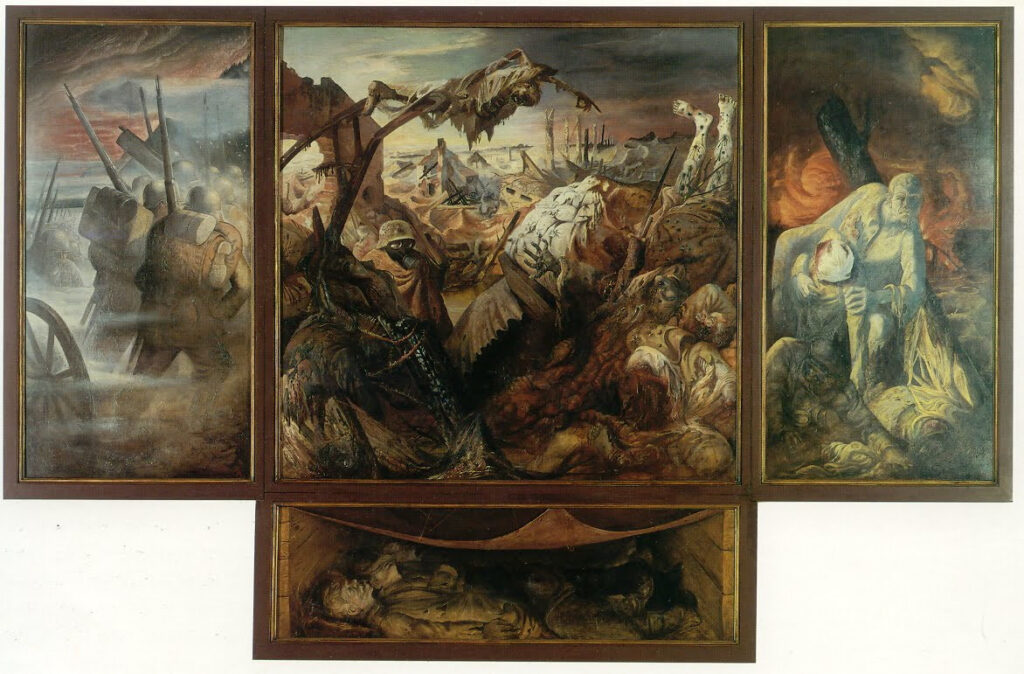
ce 11 novembre 2025 est l’occasion de souligner comme la façon dont l’Europe sacrifie les conscrits ukrainiens mobilisés de force rappelle le spectaculaire carnage de la 1ère guerre mondiale
Depuis l’allocution d’Emmanuel Macron à propos de la guerre en Ukraine, le 5 mars, les grands médias sont en ordre de marche. Réhabilitation du président en « chef de guerre », patriotisme exacerbé, concert militariste et glorification des industriels de guerre… Mené tambour battant, le SAV du discours présidentiel s’accompagne d’une nouvelle séquence de matraquage patronal contre le « modèle social » et pour « travailler plus » au nom, prétendument, de l’« effort de guerre » : « Pensions ou munitions ? » ; « Les canons ou les allocations ? » Signés Dominique Seux (Les Échos, 10/03) et Étienne Gernelle (RTL, 10/03), les deux slogans donnent le ton
Des combats entre la France et la Russie? Autrefois inimaginable, l’hypothèse s’est installée après les déclarations de M. Emmanuel Macron évoquant une «guerre existentielle» et l’envoi de «troupes au sol» en Ukraine. Depuis, le ton ne cesse de monter à Paris comme à Moscou. Une escalade qui semble ravir les médias français, au diapason du président de la République
ce 11 novembre 2025 est l’occasion de souligner comme la façon dont l’Europe sacrifie les conscrits ukrainiens mobilisés de force rappelle le spectaculaire carnage de la 1ère guerre mondiale
Der Krieg, Otto Dix, 20 décembre 1916
Une guerre que la moindre bonne volonté occidentale aurait suffi à empêcher. Fomenté par la CIA et au bénéfice aussi de l’Union européenne, un coup d’État d’extrême-droite à Kiev en février 2014. Une guerre ethnique dans le Donbass, que les accords de Minsk auraient pu arrêter. Fallait il que l’Occident les respectât. Mais Allemagne et France en étaient hélas les garants. Après le déclenchement en 2022 de l’opération militaire spéciale russe pour la libération du Donbass, la démilitarisation et dénazification de l’Ukraine, Angela Merkel et François Hollande avouèrent que l’Occident concevait ces accords comme une escroquerie, pour donner à l’OTAN le temps d’armer l’Ukraine.
Une implacable stratégie russe d’attrition écrase l’armée atlantiste, malgré le ruissellement d’armes et munitions occidentales, dont une longue liste de vaines Wundervergeltungswaffen : HIMARS, Panzerkampfwagen, Patriot, F-16 et j’en passe. Les bénéfices de l’industrie militaire des États-unis sont proportionnels à la stupidité technocratique de Bruxelles. Ce sont aujourd’hui les contribuables européens qui paient l’addition. Justice.
Des conscrits ukrainiens mobilisés de force. Les réseaux sociaux en offrent les témoignages cruels et quotidiens. Des pertes militaires qui approchent les 2 millions de tués. Des as russes de l’informatique en ont apporté les preuves. De l’ordre des sacrifices consentis par la Russie, multipliés par 10.
Moscou dit et répète depuis juin 2024 que le retrait des troupes atlantistes des positions qu’elles occupent encore dans le Donbass suffirait à instaurer un cessez-le-feu. Mais rien n’y fait. Ursula vonder Leyen et son caniche Emmanuel Macron en tête, les Européens s’enferment dans le fantasme de remporter une victoire stratégique quand leur défaite est totale, s’appliquent depuis février à saper les initiatives de Donald Trump.
107 ans après un guerre absurde -bourgeois impérialistes contre bourgeois impérialistes- qui resterait une farce si elle n’avait fait quelques 19 millions de morts ; 80 ans après la seule victoire qui méritait d’être remportée, celle de l’Union soviétique sur les armées fascistes européennes ; le Vieux continent est ravagé par une épidémie de russophrénie. La victoire de l’Occident serait toujours à portée au Donbass et pourtant, ce serait maintenant pour sauver l’Europe, ses valeurs et la civilisation d’une invasion imminente que le conscrit ukrainien devrait continuer de se faire hacher avec discipline.
En réalité, mis à part les cabots et adeptes impotents des plateaux de chaînes dites d’information, c’est parmi les volontaires nazis partis affronter les hordes néo-bolcheviques asiatiques que les discours délirants des politiciens européens trouvent un véritable écho.
Cinq siècles d’hégémonie révolue : colonialisme, fascisme, guerres mondiales, néo-colonialisme et jardinage [Josep Borrell]. Quand est ce que l’Europe, cette vieille catin, paiera enfin le juste prix de ses crimes ?
chronique alphabétique et nécrologique de l’engagement français dans les rangs atlantistes en Ukraine, ce que les journalistes serviles ne vous raconteront pas
chronique en Anglais, its roots before WW2, its collaboration with Nazi Germany, its legacy in modern Ukraine, how NATO has continually supported Nazism in Ukraine
Leaked files show top UK military figures conspired to carry out the Kerch bridge bombing, covertly train “Gladio”-style stay-behind forces in Ukraine, and groom the British public for a drop in living standards caused by the proxy war against Russia
entre l’haleine fétide d’une vieille droite pétainiste qui s’insurge contre une chanteuse d’origine malienne, d’une part, la vulgarité et la vanité, d’autre part, d’un spectacle de drag queens qui se pense à tort l’antithèse des pétainistes, semble échappé d’un backroom gay de la ville devenue musée, égaré dans une cérémonie d’ouverture de jeux olympiques […]
The Russo-Ukrainian War seems to have been engineered in a laboratory to frustrate people with repetition and analytic paralysis. Headlines appear to be circulating on a choreographed loop, all the way down to the place names. Kaja Kallas at the European Commission recently announced, without a hint of irony, that Europe’s new sanctions package – the 19th one – is the toughest yet. Ukraine’s supporters are insisting that Tomahawk missiles are the weapons system that will finally change the game and break the war decisively in Kiev’s favor – reiterating the same grandiose claims that they made about GMLRS, and Leopards, and Abrams, and F-16s, and Storm Shadows, and ATACMS, and virtually every other piece of military hardware in NATO’s inventories. On the ground, Russia is attacking settlements named Pokrovsk and Pokrovs’ke; it recently captured Toretsk and Tors’ke and is now attacking Torets’ke. The more things change, the more things stay the same.
The analytic frameworks applied to the war have also changed relatively little, buried and obfuscated by the nebulous concept of attrition. On the Ukrainian side, there is continued insistence that Russia is suffering exorbitant losses and straining under the pressure of Ukrainian deep strikes, while Ukrainian setbacks are blamed in large part on the failure of the United States to expand its largesse and give Ukraine everything it needs. Many pro-Russian lines of thinking mirror this and suppose that the AFU is on the verge of disintegration, while the Kremlin is accused of failing to “take the gloves off”, particularly in regards to the Ukrainian energy grid, Dnieper bridges, and dams.
The result is a very strange sort of war. This is an extraordinarily high-intensity ground war. Both armies remain in the field, holding hundreds of miles of continuous front after years of bloody fighting. Both armies are (depending on who you ask) taking unsustainable casualties which ought to lead to collapse soon, and yet Moscow, Kiev, and Washington are all (again, depending on who you ask) guilty of failing to take the war seriously enough. All of this is maddeningly repetitive, and one could be forgiven for tuning out entirely. Even the diplomatic tango between Trump, Zelensky, and Putin, after delivering a few entertaining moments, failed to really move the needle in any discernable direction.
Few would argue that the trajectory of the war changed in an obviously dramatic way in 2025, and it is important to avoid the worn out and clichéd language about “turning points” or “collapse” or any such silly thing. However, 2025 saw several shifts in the war, which will hardly ostentatious or dramatic, are nevertheless very important. 2025 has been the first year of the war in which Ukraine launched no ground offensives or proactive operations of its own. This fact is not only a hint at the threadbare state of Ukraine’s ground forces, but also a testament to the way Russian forces transformed “attrition” from a buzzword into a method of persistent pressure across a variety of axes this year.
In lieu of initiative on the ground, and facing a slow but relentless rollback of their defenses in the Donbas, the theory of Ukrainian victory has shifted in an unacknowledged but dramatic way. After years of insisting that it would achieve maximal territorial integrity – an outcome which would require the total and decisive defeat of Russia’s ground forces – Ukraine has reframed its path to victory mainly as a process of inflicting strategic costs on Russia that mount until the Kremlin agrees to a ceasefire. Consequentially, the debate about arming Ukraine has shifted from a conversation about armor and artillery – equipment useful for retaking lost territories – to a discussion about deep striking weapons like Tomahawks, which can be used to shoot at Russian oil refineries and energy infrastructure. In short, rather than move to prevent Russian from achieving immediate operational objectives in the Donbas, Ukraine and its sponsors are now seeking ways to make Russia pay a price such that victory on the ground is no longer worth it. It is unclear whether they have thought about what price Ukraine will pay in the exchange. Perhaps they do not care.
About Tomahawks
Notwithstanding Ukraine’s attempts to jumpstart indigenous production, it is inevitable that Ukrainian capabilities will be largely determined by the largesse of western sponsors. This aspect of the war took a sudden turn at the beginning of the October when fresh reporting began to circulate that Tomahawk missiles might be on the table for Ukraine. Tomahawks have always been on Ukraine’s wish list (given that the Ukrainian wish list as such consists of essentially all the military equipment in NATO’s combined inventories) but this was the first reporting that they might be under serious consideration.
As is frequently the case, the discussion spiraled away from realistic grounding, with some suggesting that the Tomahawk would be a “game changer” for Ukraine (where have we heard that before?) and the pro-Russian sphere dismissing it as an irrelevant distraction. There’s a tendency to focus on the quality of American weapons systems, casting them as either unrivaled technological marvels or overhyped and overpriced baubles, but this is generally not productive and largely irrelevant to the matter at hand. The Tomahawk, broadly speaking, is exactly as advertised, and provides proven and reliable strike capability at strategic depths in excess of 1,000 miles. In role, range, and payload it is essentially an analog to Russia’s Kalibr missiles (I am begging the enthusiasts to note the phrase “essentially an analog” rather than rake me over the coals over the different guidance systems and other technical minutia). Such a system will always be valuable and would obviously improve Ukraine’s deep strike capabilities.
The “problem” with Tomahawks does not relate to any “problem” with the missile itself, but with its availability and Ukraine’s technical capability to launch them. The Tomahawk is conventionally a ship-launched missile (there is no extant air-launched variant) with a few novel options for ground launch. Ukraine, obviously, would require ground launch systems, and the problem is that these systems are essentially brand new and available in very limited quantities: more importantly, American service branches are in the process of trying to build out these capabilities throughout the decade. Providing ground-launchable Tomahawks to Ukraine in any meaningful numbers would therefore essentially require the US Army and Marines to scrap their own force buildout plans.
There are two basic options for ground launching Tomahawks. One of these is the US Army’s MRC (Mid-Range Capability) Launcher, dubbed the Typhon. This is an enormous tractor-trailer launcher with four launch tubes, first delivered in 2023. It has an enormous footprint – so large, apparently, that the Army is already asking for a smaller replacement – and is intended to give the Army an organic fires component in the gap between the shorter range Precision Strike Missile and hypersonic systems (which do not yet exist). The critical fact is this: the Army intends to field a total of five Typhon batteries by 2028, of which two have been delivered so far. Each battery consists in turn of four launchers, implying that eight out of a planned twenty launchers have been delivered. Even more importantly, both of the currently operational batteries are already deployed, with one in the Philippines and one in Japan. These systems are being actively used in exercises and trials, including an exercise this summer in Australia
The Typhon system gives ground launch capability to the Tomahawk but brings a massive footprint
The situation with the Marine Corps’ launch system is quite similar, although the launch platforms themselves could not be more different. Unlike the lumbering Typhon tractor trailer, the Marines are fielding a significantly more lithe and compact LMSL system, with the tradeoff of a single launch tube compared to the Typhon’s four. What matters is not so much the technical differences, as the fact that the Marines – like the Army – only received their first deliveries in 2023, and they are currently in the process of building out the force. In the case of the marines, the goal is to have a Tomahawk battalion built out by 2030. In fact, the production contract came into effect as recently as 2025.
What does all of that mean? It means that, although the Tomahawk itself is a fine missile, the systems for ground launch are so new and available in such limited quantities that equipping Ukraine with Tomahawks would require either the US Army or the Marines to materially alter their force structure in the near term (through 2030, essentially). These are essentially the opposite of much of the gear that’s been given to Ukraine to this point: far from being inventories of older systems that can be earmarked as surplus or tabbed for replacement, Tomahawk ground launch is a brand new capability that is in the middle of deployment and buildout for the first time.
This is, of course, a layered complication on top of Tomahawk quantities in and of themselves. The issue of Tomahawk availability is both over and under emphasized, depending on the context. The United States has something like 4,000 Tomahawks in its inventories (although half of these are currently inside their cells on American ships), so it is not quite correct to say (as some have) that America is running out of these critical weapons. The issue is that production rates are relatively anemic (generally between 55 and 90 per year) and are fail to replenish the expenditure from even relatively brief strike campaigns, such as the repeated strikes on Yemen. Broadly speaking, then, the issue is not so much that the United States is in immediate danger of running out of Tomahawks, but that procurement schedules are so slow that even relatively minor expenditures can erase multiple years worth of deliveries.
It may be useful, then, to consider Tomahawks in comparison to the ATACMS missiles which have already been provided to Ukraine. Unlike the Tomahawk, the ATACMS is a system which has already been tabbed for replacement, with the Precision Strike Missile in the early phases of its rollout. ATACMS were also compatible with launch systems that Ukraine already had. In comparison to Tomahawks, then, ATACMS are both vastly more strategically expendable, produced in larger numbers, and easier to deploy. Despite all these points in their favor, the United States provided Ukraine with just 40 ATACMS. Even if the Army could be pressured into handing over one or two of its brand new Typhon launchers, it is difficult to imagine that more than few dozen Tomahawks could be spared for Ukraine: a token inventory far too small to wage a sustained strike campaign in the Russian heartland
Peace, Sponsored by Raytheon
Given that Tomahawks for Ukraine would be measured in the dozens, rather than the hundreds, it’s worth asking whether this could actually change anything for the AFU at the front. The answer is clearly no in the long run, but it would be unwise to dismiss the possibility that even a limited tranche of Tomahawks (let’s say 40 to 50 missiles) could help alleviate pressure on Ukrainian forces at the front, provided they were used appropriately. A short term boost to Ukrainian strike capabilities, if deployed against Russian rear areas, could force further dispersal and rationing of Russian assets and temporarily stall Russia’s emerging multi-axis offensive. This could defer the loss of key positions until early 2026. This presumes, however, that the Ukrainians would be content to use Tomahawks against operational targets. In reality, Ukraine can never seem to resist lobbing missiles at targets that have little bearing on the front, like the Kerch Bridge. Indeed, a failure to synergize strikes at depth with operations on the ground is a major reason why the ATACMS achieved so little.
On the other side of this equation, it is a common complaint from the Russian perspective that Moscow has done too little to “deter” the United States from empowering Ukraine’s strike campaign – both by directly providing munitions and supplying the planning, ISR, and guidance systems. This, however, rather misses the point. Russia has done nothing of note to deter the United States because both Moscow and Washington understand fully that there is essentially no appetite (on either side) for a direct confrontation. In the (sensible) absence of a willingness to strike back at NATO targets, there is really nothing Russia can do to deter beyond maintaining its own retaliatory capabilities. The issue is not that Russia has failed to actively deter, but that there is nothing they could do even if they wanted to.
The basic pattern here is well established. The United States has done what it can to backstop Ukrainian strike capabilities, but it has held them at a level where Ukraine’s damage output falls far short of decisive levels. So long as that is the case, Russia has clearly demonstrated that it will simply eat the punches and retaliate against *Ukraine*. Hence, when the United States helps Ukraine target Russian oil facilities, it is Ukraine that receives the reprisal, and it is Ukraine which has its natural gas production annihilated as the winter approaches. In a sense, neither side is really trying to deter the other at all. The United States has raised the cost of this war for Russia, but not enough to create any real pressure for Moscow to end the conflict; in response, Russia punishes Ukraine, which is something the United States does not really care about. The result is a sort of geostrategic Picture of Dorian Gray, where the United States vicariously inflicts cathartic damage on Russia, but Ukraine accrues all the soul damage.
In the case of Tomahawks, the risk-reward calculus is just not there. Tomahawks are a strategically invaluable asset that the United States cannot afford to hand out like candy. Even if the launch systems could be provided (highly doubtful), the missiles could not be made available in sufficient quantities to make a difference. The range of the missiles, however, significantly raises the probability of miscalculation or uncontrolled escalation. Ukraine shooting American missiles at energy infrastructure in Belgorod or Rostov is one thing; shooting them at the Kremlin is another thing entirely.
There is, however, another aspect of this which seems to be garnering little attention. The biggest risk of sending Tomahawks is not that the Ukrainians will blow up the Kremlin and start World War Three. The bigger risk is that the Tomahawks are used, and Russia simply moves on after eating the strikes. Tomahawks are arguably one of the last – if not *the* last – rung in the escalation ladder for the USA. We have rapidly run through the chain of systems that can be given to the AFU, and little remains except a few strike systems like the Tomahawk or the JASSM. Ukraine has generally received everything it has asked for. In the case of Tomahawks, however, the United States is running the most serious risk of all: what if the Russians simply shoot down some of the missiles and eat the rest of the strikes? It’s immaterial whether the Tomahawks damage Russian powerplants or oil refineries. If Tomahawks are delivered and consumed without seriously jarring Russian nerves, the last escalatory card will have been played. If Russia perceives that America has reached the limits of its ability to raise the costs of the war for Russia, it undercuts the entire premise of negotiations. More simply put, Tomahawks are most valuable as an asset to threaten with.
Reading between the lines of President Trump’s public statements recently, it seems likely that he has rationally weighed these considerations. Publicly, he used the threat of Tomahawks to try and force Russia to keep negotiating, and he’s received a commitment for another meeting with Putin for his trouble (more on that later). He has now, for the time being, shelved the Tomahawk plan, commenting that “we need them” and applying the usual Trumpian linguistic style to the broadly accepted issue of inventories which I have outlined here. Tomahawks are simply more valuable to the United States as a tool to threaten escalation, rather than as an actual kinetic asset in Ukrainian hands, and so long as Trump keeps his powder dry he can re-raise the issue later.
Ultimately, perhaps, this discussion is not about Tomahawks at all. These missiles, rather, are simply a totem which demonstrate two important dovetailing points. First, that American resources are not infinite, and as the United States reaches deeper into its bag to help Ukraine, it begins to grab at strategically critical assets that the US military simply cannot spare. Secondly, we must remember that America’s policy in Ukraine is a game of titration, with Washington probing the limits of Russia’s willingness to “eat the strikes” without allowing the reprisal violence to spill out of Ukraine.
The Big Banana: Russia’s Operational Schema
At this point, it’s becoming increasingly difficult to say anything meaningful about the actual operational progression on the ground. There are several reasons for this. First and foremost, the war has now gone on so long and is consistently moving at such an apparently glacial pace that most people simply do not care at this point whether Russia holds Yampil or not, or whether they have advanced past the rail line in Pokrovsk. There is severe fatigue (or perhaps boredom is the better word) with the status of an interminable sequence of apparently small settlements, industrial complexes, and forestry plantations, and as a result most people have essentially checked out. Not the least among these must surely be President Trump, who apparently chucked Zelensky’s map of the frontline and complained that he was tired of being shown the same maps over and over again.
On the other hand, we have the true obsessives who continue to dutifully follow the frontlines regularly and are voluntarily intaking daily updates. We end up with a bifurcated system where some people are still highly plugged in to the micro movements on the battlefield, but most people just don’t care, and we can hardly blame the latter. I think it would be profitable, then, to think about the broader Russian operational scheme, what it has achieved, and what it aims to achieve in the coming year. This is probably more interesting and less repetitious than fixating on the exact positioning within Pokrovsk or Kupyansk.
There are two larger points that I think are worth making before we look at some specifics.
First and foremost, much of the battlefield analysis that comes out (particularly from western analysts) makes firm pronouncements as to what constitutes Russia’s “primary” and “secondary” efforts, but these are essentially interpolated and frequently incorrect. For example, it’s become a fairly mainstream conception that Russia’s “primary” point of effort right now is the capture of Pokrovsk, but this does not actually seem supported by Russian actions. There is no particular advantage to be gained for Russia by pushing to capture Pokrovsk as soon as possible – the city is already in a stranglehold partial encirclement. To be sure, Pokrovsk *was* a major logistic hub for Ukrainian forces, but it can no longer serve that role and was sterilized as a transit hub months ago, once it became a frontline city. The opposite side of this coin is that other Russian axes of advance, particularly in southern Donetsk and the bend of the Donets River, are dismissed as “secondary” efforts. This is a major mistake, and I will attempt to show that these are critical advances where Russia is shaping the battlefield to its advantage for follow on operations.
Secondly, it should be understood and appreciated that Ukraine has lost essentially all battlefield initiative. In 2024, the AFU was able to assembled a mechanized reserve and launch their operation into Kursk. This operation ultimately failed and resulted in severe Ukrainian losses, but this is unrelated to the fact that Ukraine was still able to accumulate forces and pursue offensive operations on its own initiative. In 2025, however, Ukraine has been in a permanent state of reactivity. This was the first year of the war in which Ukraine did not launch any proactive operations or counteroffensives of its own, and Ukrainian hopes have instead pivoted to their strategic strike campaign against Russian oil facilities.
In a larger sense, the effect of attrition can be seen year by year with the shrinking scope of Ukraine’s proactive operations. In 2022, Ukraine was able to launch a pair of widely separated offensives which yielded modest successes: an offensive out of Kharkov rolled the front back over the Oskil River (though it failed to collapse the Lugansk shoulder), meanwhile, a series of battles outside of Kherson failed to break through the Russian lines, but they did play a role in persuading the Russians to abandon their bridgehead over the Dnieper. The point of course is not to once again autopsy these offensives, but to point out that there were two of them, that they were meaningful in scale, and they did result in important territorial gains for Ukraine. In 2023, by contrast, Ukraine launched a single theater-level offensive in the south, which failed. In 2024, we got the Kursk operation: smaller and less lavishly equipped than 2023’s Zaoprizhia offensive, and aimed at a peripheral theater. This year, there were no proactive Ukrainian operations at all. There is a very clear pattern at play here, with Ukraine’s offensive punch progressively shrinking before disappearing entirely in 2025. This was a year of essentially uninterrupted Russian initiative
Putting Ukraine permanently on the backfoot is a significant Russian achievement, and it is owed to a few converging factors. Obviously, the attrition of Ukrainian forces is a major factor. We’ve gone through the flailing Ukrainian mobilization, the cannibalization of its forces, and the general lack of reserves in detail on several occasions, and there’s no need to retread that ground here. Suffice it to say, Ukraine’s ability to husband forces for offensive operations appears to be severely degraded. Russia has exacerbated this problem by pressing steadily on a variety of different axes. At the moment, there are no fewer than seven Russian axes of attack, pressuring a slew of cities all along the line. This creates a series of defensive emergencies, maintains the burn rate on Ukrainian forces, and fixes them on the line. Finally, in a point to be detailed shortly, Russian advances have begun unraveling Ukraine’s logistic connectivity, which puts strain on supply and prevents the concentration and accumulation of forces
Eastern Ukraine: Approximate Situation and Axes of Russian Advance
Now, for the development of the front and the premise of the Russian offensive scheme. The main point that I want to impress is essentially as follows: rather than fixating on Pokrovsk, Russia’s advances across Southern Donetsk and on the inner bend of the Donets River ought to be thought of as vital operations which have severely disrupted the coherence of both the Ukrainian front and their logistics. This has the triple effect of preventing the Ukrainians from launching offensives of their own, accelerating the attrition of Ukrainian forces, and shaping the front for the coming operation to capture the Slovyansk-Kramatorsk agglomeration.
To begin, let’s consider the progress that Russia has made in southern Donetsk, both in raw territorial terms and its implications for Ukrainian logistic connectivity. To demonstrate this, I’ve pulled maps from DeepState (again, a Ukrainian mapping enterprise) for August 2023 (when Ukraine was attempting its counterattack out of Orikhiv) and for October 20th, the week of this writing. I have noted both the length of the southern front (obviously a linear approximate, as the actual front has many bends and bulges) and highlighted the key highways that Ukraine uses to run the backbone of its logistics
The Southern Front: 2023 vs 2025
Now, one thing that is worth noting is that the Russians are currently positioned to roll up this front even further. Ukrainian defensive lines are primarily oriented towards on a north-south axis. Once Russian forces cleared Kurakhove, they entered the seams in these defensive lines – that is to say, they are advancing laterally along the face of the prepared defenses, rather than trying to bash through them from the front. This is one reason why their progress has been relatively steady and uninterrupted. Now approaching the “elbow” in the lines, where they pivot southward, and having crossed the Yanchur River, the Russians are entering a substantial space that lacks meaningful prepared defenses. Using the Military Summary map (Ukrainian fortifications are mapped with yellow dots), the void in the defense is fairly obvious as the Russians work their way into the elbow of the line
Apart from the obvious development of note here – that Russian forces have, to this point, rolled up roughly half the length of the southern front and are positioned to roll up another ten to fifteen miles – we want to note two things which are emblematic of the way the war is going for Ukraine, but curiously receive little attention. First, the compression of the front is robbing the Ukrainians of the maneuver space which made it possible for them to stage and assemble forces for their counteroffensive in 2023. Two years ago, there was a wide, lateral buffer zone around the Ukrainian staging area in Orikhiv, and Ukrainian forces had access to multiple highways where they could disperse forces in their marching columns and run their logistics.
Today, that buffer zone is gone, as is the easy access to several of the branch highways. The Russian advance, which started with the breakthrough at Ugledar and Kurakhove last year and which has now rolled up some 50 miles of front, has essentially sterilized Ukraine’s capacity to attack in the south, because they have neither the space nor the roads to safely accumulate forces here. It has also shattered the interconnectivity of Ukrainian logistics: rather than having several highways to shuttle troops and material to the east, Ukraine now has to support several disconnected logistic fronts with individual highways. More to the point, there is no longer a single Donetsk “front” to speak of, but rather a series of logistic fronts: one in the south, around Orikhiv, another at Pokrovsk, and the largest one in the Slovyansk Banana. These are lacking lateral connectivity to each other for the Ukrainians due to the wedges that the Russians have forced in the front, particularly in the south, funneling logistics and reinforcements down individuated corridors.
The bigger issue, however, lies farther north on the Pokrovsk and Donets axes, and in the way that they synergize. People who are focusing, to the exclusion of all else, on when and how Russia will capture Pokrovsk are failing to see the bigger picture, and indeed are not even trying to understand it.
The ultimate Russian operational objective (in this phase of the war, at least) is the belt of cities which runs in an arc from Slovyansk to Kostyantinivka, which I affectionately call “the Slovyansk Banana” due to its curved shape. A cursory look at the map shows us why the very operations that are being dismissed as secondary efforts are in fact critical axes of Russian effort which are shaping the battlefield for the attack on the Banana
There are two very important facts about the Banana, from the perspective of operational geography. The first is that, although the combined mass of the agglomeration is far larger than any of the urban areas that have been fought over to this point, the Banana is relatively difficult to defend because it sits on the floor of a river valley: the Kazennyi Torets flows through all the cities in the Banana before it flows into the Donets. Russian forces approaching the city from the southwest, the east, and the north will all be advancing along the high ground that overlooks the cities on the floor.
The second important fact about the Banana is that, despite its size, it is supported by just two highways which approach from the southwest and northwest respectively, funneling into the Banana like a wedge. Taking the northern highway/MSR (the E40 highway) as an example, we see that Russia’s operations inside the Donets bend are hardly secondary efforts: they are vital shaping operations linked to the integrity of the Banana. The E40 highway tracks the Donets bend very closely (it generally stays within five miles of the river. If the Russians sustain their progress north of the Donets and reach the river at Bogorodychne or Svyatogirsk, it will not only put E40 under persistent drone attack but also curl the defensive line behind the Banana, to say nothing of the enormous pressure on the Siversk salient.
On the Pokrovsk front as well, Russia’s progress is being misinterpreted. After their breakthrough at the end of the summer, Russian forces have consolidated the bulge north of Pokrovsk (despite weeks of Ukrainian counterattacks) and are steadily working their way towards Rais’ke and Sergiivka. This is not about Pokrovsk at all – reaching Rais’ke would put Russian forces directly in the backfield of Kostyantinivka, on the supply lines to the underside of the Banana.
I am not suggesting at all that Russian forces are on the verge of some great offensive surge that will carry them into the heart of the Banana instantly. However, there is a fairly well established Russian operational methodology in this war, which involves working their way methodically into Ukraine’s logistical lanes and seams, segmenting the front and strangulating their strongpoints, forcing them to supply frontline strongholds with single file logistics and dirt roads. They did it in Bakhmut, and Avdiivka, they are doing it in Pokrovsk, and they are shaping the front to attempt this on a large scale in the Banana
Assault on the Banana: Coming 2026
The general point that we are trying to make here is that dismissing Russian advances in the Serebryanka Forest, the emerging bulge north of Pokrovsk, and their move into the Donets Bend as “secondary efforts” is mistaken. Zooming out to the appropriate scale shows that these are concentric operations, shaping the front for a 2026 assault on the Banana – moving towards the E40 road from the north, bending the defensive shield around Siversk, and working into the underbelly of the Banana through Rais’ke.
This is, perhaps, a long way to go for a short drink of water, but there are a few basic points here that get completely missed when the view of the front is preoccupied with the fighting inside Pokrovsk and Kupyansk:
Russia’s advance out of Kurakhove across the southern front is not a secondary axis. They have rolled up half of the southern front, condensing Ukrainian forces into a compact space which sterilizes their ability to attack in the south.
Broad Russian pressure across a half-dozen axes maintained a steady burn rate on Ukrainian forces and prevented the accumulation of forces for proactive operations. 2025 has been the first year of the war in which Ukraine has not launched any offensive operations on its own initiative.
Advances in the Donets bend and the interstitial space between Pokrovsk and Kostyantinivka are not subsidiary or secondary operations: they are critical shaping operations that are moving concentrically toward the Banana.
To be frank, the general mood of optimism in the Ukrainian infosphere, which lasted for much of the summer, struck me as remarkably odd. The frontline has yielded no real good news for Ukraine at any point this year. Beyond the broader strategic point, that Ukraine has lost the initiative and does not seem capable of getting it back, Russia is in the process of capturing two important urban centers (Russian troops are in the city centers of Pokrovsk and Kupyansk), it has begun the assault on at leas two more (Lyman and Kostyantinivka), it has rolled up half of the southern front, and cleared most of the inner Donets-Oskil bend. The Banana is on deck for 2026.
Ukraine’s Cost Theory of Victory
One thing that has become apparent over the last year is that Kiev has abandoned previous notions of outright victory on the battlefield and adopted a new strategic framework predicated on imposing unacceptable costs on Russia, so that Moscow will agree to freeze the conflict.
This is a subtle and unspoken yet extremely important distinction. It is easy to miss, because both Ukrainian leadership and Ukraine’s western backers continue to speak of Ukrainian “victory” and the possibility of Ukraine “winning” the war. What is crucial to understand is that the “victory” that they speak of now is categorically different than the victory of 2022 and 2023. In the first years of the war, it was possible to at least speak of Ukraine taking the initiative to advance on the ground and retake territory. There were concrete examples of Ukrainian offensives in 2022, and the battle in Zaporizhia – although unsuccessful – showed that it was at least possible for Ukraine to attempt a proper mechanized offensive.
Therefore, in the first years of the war, when leaders in Kiev and Brussels and London and Washington spoke of Ukrainian victory, they essentially meant the defeat of the Russian ground forces and the reconquest of much (or all) of the Donbas. The Kursk Operation of 2024 began to split the difference: Ukraine still had some resources to mount proactive operations, but these operations were no longer aimed at the dense eastern front and instead aimed at relatively soft subsidiary fronts with an eye to out-levering the Russians.
Today, with the Ukrainian army stuck in a permanent state of reactivity and slowly receding defense, it no longer makes any sense to speak of Ukrainian victory in the most straightforward sense, which is to say victory on the battlefield – no matter how tenaciously or bravely the Ukrainian rank and file continues to fight in essentially intolerable circumstances. Instead, Ukrainian “victory” has been transmogrified to mean essentially that Russia absorbs such exorbitant costs that it agrees to some sort of ceasefire without preconditions.
The costs to be imposed on Russia are implicitly assumed to be a mixture of battlefield casualties and damage to strategic assets inflicted by Ukrainian air strikes, and in regards to the latter Ukraine seems to be particularly placing its hopes in a strategic strike campaign against Russian oil. Ukraine’s attempts to disable Russian oil production and refining have dovetailed with ever more aggressive sanctions from the United States against Russian fossil fuel exports – although it is worth noting that the limited price response to these sanctions indicates that markets expect that Russian oil will continue to flow.
Trump’s suggestion that Tomahawks may be on the table for Ukraine must be seen as a constituent element of this new strategy and theory of victory. And this, ultimately, is very important to understand. Tomahawks are not being bandied about because anybody (in Kiev or Washington) believes that 50 cruise missiles will allow Ukraine to defeat the Russian Army and recapture the Donbas. Tomahawks were mentioned because the Ukrainian alliance is threatening to cripple the Russian fossil fuels industry (through a mixture of sanctions and kinetic strikes on production facilities) unless Putin agrees to a ceasefire.
This is why it is wrong to be surprised that Trump abruptly cancelled his meeting with Putin and instead announced more sanctions. There’s nothing abrupt or erratic about this. Threats to Russian oil are now, without exaggeration, the main lever that the Ukrainian bloc has against Russia. It certainly should not have been a surprise that the Kremlin, which has reiterated the same fundamental war aims since day one, was not excited about coming to Budapest to freeze the conflict, and neither should it surprise us that Trump would instead prefer to pull harder on the oil lever. The two powers are playing entirely different games: Russia is slow-walking negotiations while it advances on the ground, and the United States is playing a pain game designed to raise the costs for Russia
We have fundamentally reached an impasse when it comes to negotiations. For Moscow, negotiations with the United States are essentially a way to string Washington along. Moscow feels that it is winning on the ground, therefore a diplomatic impasse suits Russian interests. When western leadership complains that Russia does not seem interested in ending the war, they are correct, but they are missing the point. Russia is not interested in ending the war right now because doing so would not serve Russian interests. The Banana is in the crosshairs, and a ceasefire now would be an egregious compromise when victory on the ground is in sight.
The sense of urgency that Washington feels to end the war – mainly by yanking furiously on the oil lever until the Kremlin cries uncle – stems from the fact that this is now the only sort of victory that Ukraine can hope to win. The ground war has been written off as a total loss, and all that remains is to lob missiles and drones at Russian refineries, sanction Russian firms and banks, and harass shadow tankers until the costs become intolerable. The longer the Ukrainian ground forces can hold the line the better, but this is merely a matter of limiting the downside. The fact that Russia can retaliate disproportionately against Ukraine barely factors into this thinking.
The key point here, however, is that the concept of Ukrainian victory has been completely transformed. There is now no real discussion of how Ukraine can win on the ground. For the Ukrainian bloc, the war is no longer a contest against the Russian Army, but a more abstract contest against Russia’s willingness to incur strategic costs. Rather than preventing Russian capture of the Donbas, the west is testing how much Putin is willing to pay for it. If history is any guide, a game predicated on outlasting Russia’s strategic endurance and willingness to fight is a very bad game to play indeed [end]
The word Nazism has returned to circulate with an impressive frequency, along with fascism and neo-fascism or neo-Nazism. No longer just as a historical concept, but as a political label. For most people that is meaning absolute evil, violence, fanaticism. Yet Nazism is not just an insult: it is a precise ideology, which focuses on authoritarianism, racial supremacy and violence.
Watching Ukraine, several observers have been telling for years a disturbing reality: there are numerous radical groups which do not just recall symbols of fascism, but are making it their own political belief. They are not marginal formations. They have voice and influence, they are armed and they are conditioning the choices of the government. Just remind how Zelensky, newly elected, spoke of peace in the Donbass: within a few months his line changed radically, abandoning any intention of compromise.
The issue is not just ideological. Some neo-Nazi groups are integral part of the Ukrainian armed forces. The most famous case is Azov battalion, turned into a brigade and framed in the regular army. That means that radicalized, armed and trained people today have official recognition. With a clear risk: these men could tomorrow forge closer ties with European neo-Nazi and neo-fascist movements, offering training and contacts to organizations such as Blood and Honor or C18.
Meanwhile, the conflict with Russia has done the rest. Violence is glorified, the enemy has become a totem to bring down, the radical positions have strengthened. What will happen when the war will end? It will end sooner or later. Then, the rhetorical issue will remain: how to defuse a language that has accompanied years of blood and destruction?
Russians and Ukrainians have always shared historical, cultural and family ties. Today however, talking about brotherhood is dividing. Some are desiring peace, others are regarding these ties as a myth without foundation and an offense. The years of war have dug deep wounds, with thousands of dead and millions of broken lives. Yet, history knows unexpected reconciliations: France and Germany after the Second World War, for example. It means that a road to peace exists, but it is not easy: it requires honesty, forgiveness and dialogue.
The present, however, is going in the opposite way. In Ukraine, radical nationalism and desire for revenge are growing. Behind the neo-Nazi slogans, there is not only patriotism: there is the risk of a society increasingly pushed towards revanchism.
That is not just about Kiev. Contagion could come to Europe. That is not a fudged alarm: signals are already visible. In France, Germany, Hungary and the Netherlands, far-right movements are growing. They are succeeding by riding real problems: immigration, economic crisis, distrust of governments. They are also feeding on the propaganda coming from Ukraine, on a nationalism which has found its legitimacy in war.
The threat is double: Europe is not only importing refugees, but also violent ideologies and members of existent radical networks. A Europe fighting against an enemy which it has funded.
The conclusion leaves no room for optimism. The current political situation is producing conditions for a new wider clash, which could affect almost all European countries. That is preventable, but if the rhetoric continues to grow and nationalism to take root, the continent really risks seeing again ghosts that it thought buried with the history of the twentieth century.
Azov paramilitaries are aiming to debunk Kremlin « myths ». In doing so, they are solidifying their Nazi tradition and reducing German normalization narratives to absurdity
Azov military ceremony in Kiev on July 28, 2024
Azov is being gradually integrated into the Western European security architecture. Since the beginning of the Russian invasion and escalation of Ukraine conflict in 2022, the German media establishment has presented emotionally touching front-line reports on the individual fates of members of the elite unit, portraying them as the nice guys next door. Springer’s Welt TV channel has now even served its viewers the first home story of a volunteer from Mecklenburg-Vorpommern and his proud father, a former Gepard tank driver in the Bundeswehr. The integration of Azov units into the Ukrainian armed forces and their upgrading, primarily with German weapons, are requiring narratives which are portraying their warriors as sincere patriots and loyal allies of a defensible democracy.
Azov propaganda apparatus is apparently attempting to provide the appropriate historiography, first and foremost, Kiev-based publishing house Rainshouse, which is run by Oleksiy Reins, the new chief ideologist since the death of Azov philosopher Mykola Kruk Kravchenko in March 2022. Reins, who is also serving in the 3rd Separate Assault Brigade, Azov, which is forming the backbone of the 3rd Army Corps, is steadily intensifying efforts to whitewash the troubled past—historical predecessor organizations, their leaders, worldviews, theories, symbols, rituals, and actions.
In his book What Is Azov from Ukraine? Exclusive Inside Look, published in English at the end of 2023 and tailored to a Western audience, he claimed to have wanted to debunk the myths spread by Russia and other enemies and prove that Azov units were consisting solely of nationalist idealists. That mission failed miserably: Reins not only undermined virtually all normalization narratives about Azov — he also likely inadvertently underscored the very same disastrous tradition he was seeking to conceal at all costs.
In the OUN spirit
That insider profile first traces the origins of Azov groups and highlights that it was no coincidence that their paramilitary nucleus, also known as the little black men, was formed in Kharkov in 2014. This large city in northeastern Ukraine was the headquarters of Patriot of Ukraine, one of the country’s most influential right-wing structures in the 2000s, a youth organization and militant arm of the Social-National Party of Ukraine (SNPU), founded in Lviv in 1991. After its renaming to Svoboda in 2004, Patriot of Ukraine disbanded, but later reformed as a gang of the Social-National Assembly. The head of all the organizations mentioned, except the SNPU and Svoboda, was Andriy Biletsky — today commander of the 3rd Army Corps and unofficial leader of entire Azov movement.
Reins cites Yaroslav Stetsko as the historical mentor of Azov. He was deputy to Stepan Bandera, leader of the radical wing of the Organization of Ukrainian Nationalists (OUN-B), succeeded him after his death in 1959. Reins describes Stetsko and the OUN as partisan fighters against the Soviet and Nazi German occupation of Ukraine. Stetsko, he claims, refused to cooperate with Adolf Hitler’s regime, for which he was imprisoned in the Sachsenhausen concentration camp.
Almost none of this corresponds to historical reality: apart from the fact that Ukraine had been a republic of the Soviet Union since 1922 and therefore could not have been occupied by it, Yaroslav Stetsko explicitly welcomed the German invasion
Full of sincere gratitude and admiration for your heroic army, which has once again won new glory on the battlefields in the clash with the greatest enemy of Europe, Muscovite Bolshevism, we send you, the great leader, in the name of the Ukrainian people and its government, which has been formed in liberated Lviv, our heartfelt congratulations for crowning the struggle with final victory
he wrote to Adolf Hitler on 3 July 1941.
Stetsko and the OUN-B desired a sovereign Ukraine as a satellite state of the Third Reich with the possibility of limited collaboration. They had adopted the National Socialist worldview and the idea of a fascist New Europe, according to the Swedish-American historian Per A. Rudling. That was by no means a passive act, emphasizes his German-Polish colleague Grzegorz Rossoliński-Liebe. But rather, the OUN had created a Ukrainian variant of fascism. Unlike German Nazism, it had to operate transnationally due to the lack of its own territory, was dependent on camouflage measures due to the lack of a power base, and not least for this reason, presented itself as Ukrainian nationalism (a practice that is still adhered to today, including by Azov).
Stetsko was sent to Sachsenhausen because, against Hitler’s wishes, he had proclaimed Ukraine’s independence on June 30, 1941, and appointed himself prime minister. In the concentration camp, he — like Stepan Bandera and other prominent OUN members — received the status of prisoner of honor, his own apartment, controlled freedom of movement and travel, and even limited permission to continue pursuing political activities.
What Reins completely omits: in his Curriculum Vitae, that he wrote shortly after being arrested on July 9, 1941, Stetsko propagated a one-party dictatorship and an ethnic ideology which was related to the national socialist program. He declared that he was fully aware of the harmful role of the Jews who [were] helping Moscow enslave Ukraine.
I am therefore supporting the extermination of the Jews and considering it expedient to bring German methods of exterminating Jewry to Ukraine in order to prevent their assimilation and the like
Stetsko had already expressed similar views in May 1939 in a guide entitled Battles and Activities of the OUN in Wartime, when he was not yet under German surveillance. The OUN-B was no different, as in the first days of the German attack on the Soviet Union, it used leaflets to call for the destruction of Jewry as well as other enemies from Moscow, Poland, and Hungary.
Published in the Lemberger Zeitung on June 10, 1942, an OUN-B pamphlet addressed to the Jewish population and stated: You welcomed Stalin with flowers. We will lay your heads at Hitler’s feet in greeting. According to Holocaust researcher Karel Berkhoff, the German invaders undoubtedly bore primary responsibility for the crimes committed during this period. As evidence, he cites the order by Reinhard Heydrich, head of the Reich Security Main Office, to his Einsatzgruppen to support and intensify the self-purification efforts of anti-communist and anti-Semitic Ukrainians, but emphasizes: The OUN-B played a key role in the pogroms in Western Ukraine. Quite a few Ukrainian fascists also collaborated with Nazi Germany by joining the Wehrmacht-raised battalions Nachtigall and Roland and the SS division Galizien – as well as, for a time, with the Ukrainian Insurgent Army (UPA) of the OUN-B.
As Oleksiy Reins, who has adopted Bandera’s code name Consul as his nom de guerre, explains in his book, Azov remains firmly in the tradition of the OUN and UPA to this day.
« Social nationalism »
According to Reins, the theoretical foundation of Azov’s worldview can be found in a political science work by Yaroslav Stetsko entitled Two Revolutions. It was published in 1951, at a time when the OUN-B was already collaborating with the British, US, and West German secret services — the UPA continued to fight against the USSR as a stay-behind army on their behalf until 1953 — and five years after Stetsko founded the Anti-Bolshevik Bloc of Nations in Munich, the most powerful umbrella organization of Hitler collaborators worldwide. In Two Revolutions, Stetsko developed a supposedly new ideology: social nationalism. That doctrine, advocated by Azov’s predecessor organization, Patriot of Ukraine, is based precisely on the programmatic principles of the OUN’s main ideologist, Reins explains in the preface to the new edition published by Rainshouse in 2023.
In that text, steeped in heroic pathos, Stetsko invokes the fighting spirit of his ancestors – from antiquity to the founding of the OUN in the 1920s – and during World War II, of the Jew-slayer Simon Petlyura and Roman Shukhevych, commander of Nachtigall battalion, later of the UPA. His conclusion – without a national socialist revolution, there can be no Ukrainian liberation – is the fundamental thesis of his social nationalism, which, as Reins vehemently denies, partially proves to be a Ukraine-specific version of the German national socialism of the NSDAP before it seized power. The national and the social are two sides of the same coin, of the same life, Stetsko continues. Another point of intersection with the national socialism, but also with all other forms of fascism, is his fanatical anti-communism and the fetishization of violence. Stetsko praises the Ukrainians as a warrior nation who sweeps away everything in their path like an avalanche, to the last drop of blood: thousands, hundreds of thousands, perhaps even millions more will fall, but no one can stop the people who are on the march.
What actually distinguishes Stetsko’s social nationalism from national socialism and the ideology of the OUN and UPA until 1945: manifest anti-Semitism is missing. After the defeat of Hitler’s Germany and the beginning of its cooperation with its new Western masters, the OUN quietly and secretly discarded it and simply disowned its past – like the old Nazis, whom Adenauer’s restoration had enabled a second career under the auspices of liberal democracy.
The social nationalism of Patriot of Ukraine is different. Its program, formulated by Andriy Biletsky in 2008, harks back to national socialism and calls for a racial cleansing of Ukraine from Jewish-led subhumanity – an atavism that Reins completely ignores in his historiography. Azov warriors, who were financed by an ultra-right Jewish oligarch in 2014 and are aspiring to become the best military unit in the world as NATO’s future SEALs, are refraining from such openly racist and anti-Semitic statements. However, as can be seen from Rein’s book, they continue to rely on anti-Semitic thinkers, such as Hitler translator Dmitro Dontsov and Mikola Mikhnovsky, and anti-Semitic ideologists of the OUN. Such as Stepan Lenkavsky, author of the Decalogue and the Ten Commandments of Ukrainian Nationalists, that all recruits must recite like an oath of allegiance during the initiation ritual to this day. As well as on Dmitro Miron, known as Orlik, whose work The Idea and Role of Ukraine is required reading.
« The Black Corps »
Azov continues to adhere to the OUN’s Greater Ukraine idea, modeled on Nazi Germany
The nationalist movement is so powerful that we will soon see the emergence of a great Ukrainian state stretching from the Caspian Sea to the Tatra Mountains
OUN official Roman Sushko prophesied as early as 1939. Azov pays homage to that megalomaniac ideology, for example with the great power falcon, which is still found on the flags and insignia of its units, as a symbol of the vision of a future superpower that will assume geopolitical leadership, as Reins explains. Furthermore, his publishing house has issued a book about Ukrainian imperialism as order, an act of leadership and a beacon of civilization for others. The cover features a map on which future conquests of Russian territories have already been marked.
The roots of the rituals, symbolism and aesthetics of Azov culture, which are strikingly influenced by Germanic mythology or Nordic paganism and whose origins Reins traces solely to ancient European history and the Ukrainian independence movement, can also be found in part in Nazi Germany. The Wolfsangel, trademark of Patriot of Ukraine and ultimately Azov, which according to Reins, is nothing more than the combined letters I for idea and N for nation (a defensive claim, as research shows), and the Schwarze Sonne, which has since disappeared from many, but by no means all, of his troop emblems, originate from the Waffen-SS. Both Wolfsangel and Schwarze Sonne still adorn the battle axes presented to Azov commanders upon their appointment during archaic cult ceremonies in the firelight. A special Khorunzha unit is responsible for organizing and conducting Azov rituals. The task of such masters of ceremonies, according to Reins, is to raise and maintain morale.
Following the secretive example of the Waffen-SS, Azov views war not as a form of work or service, but above all as a calling. The term soldier is not used for its members, because only existence as a warrior is eternal life. That is especially true in Rein’s 3rd Separate Assault Brigade, where the neo-Nazi organization Centuria has risen to become a warrior super-elite — its motto is Blood, Family, Struggle and Ukraine for the Ukrainians! — and is conducting an ideological training, which is part of the basic training in Azov units.
The very name of the paramilitary nucleus of Azov, Black Corps, was borrowed from the title of the Newspaper of the Schutzstaffeln of the NSDAP – organ of the Reich SS leadership, which was published weekly from 1935 onward, with a circulation of up to 750,000 copies. Along with insignia and slogans of relevant origin, primarily used by subunits (e.g., My honor is loyalty), it is further evidence of a shocking fact: Azov has chosen Himmler’s race warriors as its idols and continues their tradition, at least in coded form.
« Brother in Arms » of the West
That continuity, which is objectively attested by Azov chief ideologist, is posing a new challenge for the Western community of values, a dilemma. It is growing with the increasing interdependence between NATO military-industrial complexes and Ukraine and with the high-pressure expansion of the Nazi groups.
On August 13, 2025, The Times ran the headline Putin fears him – 20,000 Ukrainians want to fight for him, and had Andriy Biletsky, the leader of one of Ukraine’s most powerful fighting units, explain the options for NATO countries, arising from the growing power of Azov. We are granting unrestricted access, he reported on the opening of the Izyum front sector, controlled by his troops, to Western arms companies
Our great advantage is that we provide debriefings, test results, and actual data from the battlefield
Without the Azovization of the desertion-plagued Ukrainian armed forces, the permanently militarized society Biletsky is envisioning, modeled on Israel, effectively becoming the army and arsenal of a Europe that has proven alarmingly slow in building its own armed forces, is not feasible. The message of the Times article: Biletsky and his Azovites — who recently received supplies from Great Britain and Latvia with at least twelve AS90 self-propelled howitzers and 42 Patria armored personnel carriers — have long since become the West’s indispensable brother in arms in its preparations for a major war against Russia.
Fighters of the past
The German Ministry of Defense is also aware of that. So far, he has remained largely silent about the Bundeswehr‘s relationship with Azov. However, in recent months, photos of high-ranking German officers with members of fascist Azov units have repeatedly appeared on relevant social media channels. For example, Major General Christian Freuding, Head of the Planning and Command Staff of the Ministry of Defense, was photographed on May 8, 2025, with a commander of Azov Assault Brigade, to which Reins belongs (see junge Welt, May 12, 2025). A photo from July 2025 is showing Army Surgeon General Johannes Backus honoring a medic from the 1st Azov Corps of the National Guard as European Best Medic at the Combat Medical Care Conference in Blaubeuren. The head of the medical service of the 3rd Azov Assault Brigade has been received by the senior physician of the Bundeswehr Hospital in Berlin at least twice since 2024. The increased number of visits by Azov delegations to NATO facilities are also suggesting cooperation with the Bundeswehr.
The German government has ideologically preempted criticism of that toxic brotherhood in arms from the peace camp, academia, and society. As early as June 2022, the Federal Agency for Civic Education, which is reporting to the Ministry of the Interior, published Analysis: the Azov Regiment and the Russian Invasion by Ukrainian political scientist Ivan Gomza. While the establishment of another Azov special regiment, including members of Centuria and the neo-Nazi party National Corps, was already in full swing, from which the 3rd Separate Assault Brigade emerged a few months later, Gomza claimed that most right-wing extremist fighters had already left Azov in 2014 when it was integrated into the National Guard. Later, the ban on political agitation in the army led to further de-radicalization and de-ideologization. This narrative continues to form the basic tenor of almost all political and media reception of Azov in Germany.
Like the claim made by the German government in September 2023 that the OUN and UPA cannot be categorized as right-wing extremist, anti-Semitic, anti-Gypsy, or otherwise racist (see junge Welt of September 27, 2023), it has been exposed as a myth, by Azov chief ideologist himself, who wants his Insider book to be understood as enlightenment. Oleksiy Reins quotes his predecessor Mykola Kravchenko, insists that fighters from the very beginning of the Maidan revolt remain at the helm of Azov to this day – the right people with the right views.
For Reins, that is including living by the imperative Ukraine above all! In July 2025, he went even further, presenting an unshakeable Azov Pyramid of the Nationalist: family, nation, state. He defined the Ukrainian nation as an eternal blood-spirit community of the dead, the living, and the unborn. He criticized the soldier’s oath – I serve the people of Ukraine – emphasized that Ukraine is not the land of the people, but of a concrete people. The war is not being fought for abstractions. Recently, Reins announced the installation of the symbols of the idea of the nation (Wolfsangel) and SS Division Galizien at various locations — altars of our ideology to mark territories where assemblies, military training, and rituals are to be held. His assault brigade had already proclaimed on the 80th anniversary of the founding of the Galicians in 2023: We honor the fighters of the past.
Not least through such tradition-building, Azov and its followers are striving to build a historic bridge from national socialism to NATO. Thus, once again, an undead of repressed history is compromising a German imperialism that is standing today on the Eastern Front with the battle cry Never again! [end]
its roots before WW2, its collaboration with Nazi Germany, its legacy in modern Ukraine, how NATO has continually supported Nazism in Ukraine, chronicle
chronicle of censorship, fake news, whitewashing of the Ukrainian Nazism and war crimes, for the sake of the proxy war that NATO is conducting in Donbass and Ukraine, against Russia
Dans les années 1990, l’Allemagne réunifiée a consciencieusement détruit la Yougoslavie pour faire payer aux Serbes les défaites de 1918 et 1945.
Cela ne suffisait pas. En 2022 s’est produite l’occasion inespérée. On allait enfin faire payer aux Russes l’abominable défaite de 1945 !
Et que je t’envoie des panzers en Ukraine. Et que je rêve de Taurus s’écrasant sur le Kremlin !
La perspective de défiler sur la place Rouge derrière l’armée américaine…
Las ! La Russie est une puissance nucléaire, redevenue la première armée du monde. Elle mène une guerre lente, de très moyenne intensité, qui sert surtout à vider les stocks militaires des pays désindustrialisés de l’OTAN.
L’Allemagne est tombée dans le piège. Elle a cru pouvoir renoncer au gaz russe bon marché pour quelques mois. Dès la défaite militaire de la Russie on se servirait à des conditions plus favorables… Cela fait 3 ans que ça dure. Et l’industrie allemande se casse la figure.
Il y a bien l’idée d’une reconversion dans le secteur de la défense. On va même installer des sites de production en Ukraine, que les Russes aiment bien cibler.
Depuis le début, les Russes sont perplexes. Moscou a été d’une générosité certaine après 1945. Malgré les 27 millions de morts causés par l’État le plus civilisé d’Europe, les représailles sont restées limitées. Malgré la Guerre froide et le maintien en activité, par les Américains, d’une partie des élites fascistes européennes sous prétexte de combattre le communisme, Moscou a signé les traités de l’Ostpolitik.
En 1990, Moscou a accepté la réunification. Un peu naïf, Gorbatchev a même accepté que l’Allemagne réunifiée soit dans l’OTAN qui ne servait plus à rien… sauf à empêcher la réunification de cette Europe européenne que De Gaulle avait appelée de ses voeux.
Dans les années 1990, les mauvaises habitudes allemandes ont vite été retrouvées. Destruction de la Yougoslavie, division du travail en Europe centrale, occidentalisation forcenée de l’Ukraine pour que les chaînes d’approvisionnement de l’industrie allemande disposent d’une main d’œuvre éduquée corvéable à merci…
Le Generalplan Ost sans les dérapages adolfiens. Un fascisme à visage humain ?
Je suis les affaires allemandes depuis 35 ans et je peux vous dire que l’Allemagne est autant responsable de la tragédie ukrainienne que les Etats-Unis.
Et puis, qu’il soit doux ou dur, le fascisme, ça finit toujours mal : Berlin est, avec Washington, la première responsable des pertes militaires ukrainiennes abyssales…
Au total, Ursula peut bien s’envelopper de tous les drapeaux ukrainiens qu’elle veut, Merz peut développer tous les discours martiaux possibles, l’Allemagne va buter sur la dure réalité.
Les Russes avaient tourné la page de la Première Guerre mondiale malgré l’envoi irresponsable de Lénine en Russie par l’Allemagne wilhelmienne. Ils avaient tendu la main malgré les crimes de la Wehrmacht, en particulier le siège de Leningrad. Mais le comportement d’Angela Merkel, Olaf Scholz, Friedrich Merz, Ursula von der Leyen, lui, ne sera pas oublié [fin]
chronique en Anglais, its roots before WW2, its collaboration with Nazi Germany, its legacy in modern Ukraine, how NATO has continually supported Nazism in Ukraine
the Germans have bowed down to the US sabotage by Joe Biden administration of Nord Stream pipelines, only to end up with Donald Trump’s America First doctrine in economy and defense
Sometimes the way home runs through frontline territories, through the fields of not so long ago battles, through places remembered as peaceful and quiet. This was the case with the hero of our comic book – a simple guy born in Avdiivka.
Even before the outbreak of hostilities, he moved to Kyiv, where he worked as a courier until recently. However, at the beginning of the year, raids by military officers became so frequent that order deliveries could be forgotten.
There was nothing to do in the city without earning money, and he decided to return to Avdiivka, assuming that he could make his way from Pokrosvk to Avdiivka on foot. But whether it was so easy in reality was yet to be seen.