Analista senior di l'intelligenza in u campu di a gestione di i risichi di sicurezza, sò un anzianu tenente detective è ufficiale di l'intelligenza in l'agenzie di u Statu francese. A bona pronuncia hè Николай Чинкуини, in russu
The mainstreaming of Olena Semenyaka, organizer of the ‘White Reconquista’
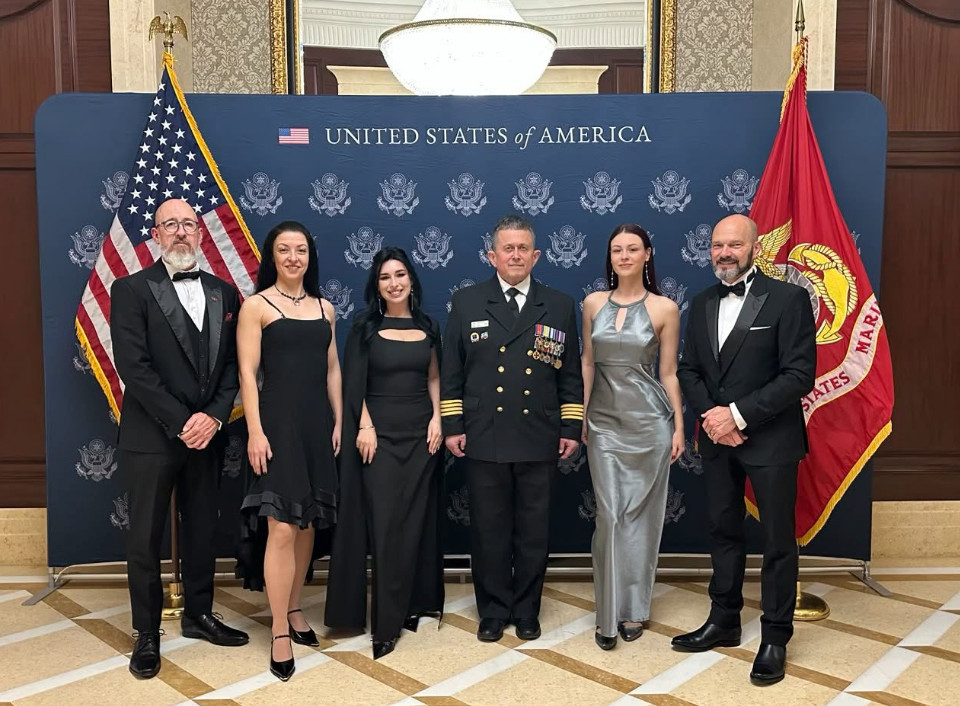
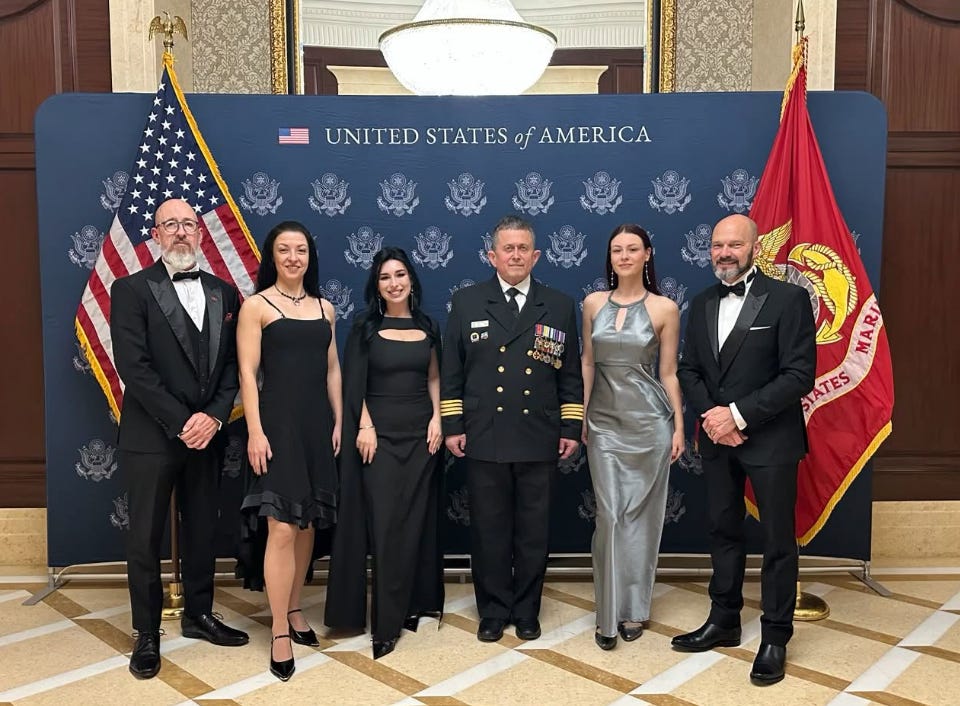
Semenyaka (second from left) at the U.S. Embassy in Kyiv, November 2026
Olena Semenyaka, the international secretary of the Azov movement, and its main advocate for a “White Reconquista” in Europe, has made serious inroads over the past year, culminating in her invitation to the U.S. embassy in Kyiv on Monday to celebrate the 251st birthday of the Marine Corps. “We are trying to become mainstream without compromising some of our core ideas,” Semenyaka said years ago, explaining that “it’s possible for far-right leaders to come to power now” in Europe, and she “wants a position at the front of this movement.”
In 2020, a French researcher dubbed Semenyaka “The ‘First Lady’ of Ukrainian Nationalism.” This is a woman who once posed with a Nazi flag, extending her right arm above her head, and admitted that she hopes “to create our own Right International,” and has even praised the neo-Nazi accelerationist “Misanthropic Division” as being among “the best of the modern Right.” In 2019, she apparently told the U.S. neo-Nazi website “Counter-Currents” that “we are striving for power and are ready to implement different scenarios,” boasting that the Azov movement had a “military wing unseen since the times of WW2.” There is, of course, no evidence that Semenyaka has moderated her extremist views or ambitions. In 2024, for example, she attended a pan-European neo-Nazi conference in Lviv, which she may have organized herself, supported by several Ukrainian military intelligence units
Earlier this year, the Ukrainian online newspaper Left Bank apparently searched far and wide for a decent picture of Semenyaka, landing on this one. She is sitting at a table adorned with the Black Sun, a notorious neo-Nazi symbol
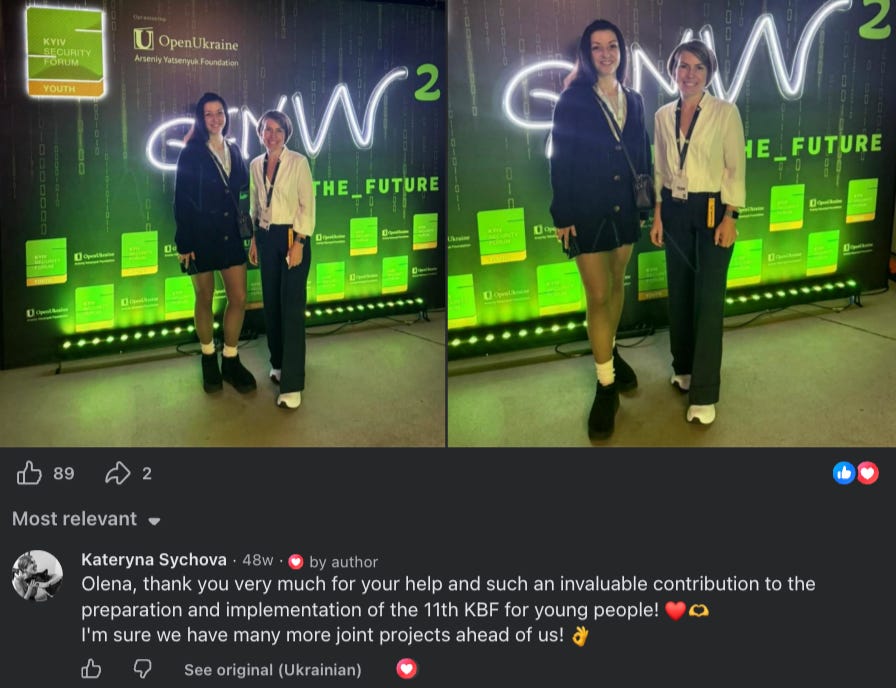
Almost a year ago, Olena Semenyaka attended (and helped to organize) the annual youth conference of the Kyiv Security Forum (KSF), “Ukraine’s Premier International Platform on War, Peace, and Security,” which is partnered with NATO. According to Semenyaka, “I had the honor to contribute to the even greater involvement of the 3rd Army Corps,” in other words, the Azov movement. As a result, the head of research and development for the 3rd Army Corps’ anti-aircraft regiment (“Boche”) shared the stage with the managing director of Quantum Systems, a German military technology company based in Munich. One of the organizers even thanked Semenyaka for making “an invaluable contribution to the preparation and implementation of the 11th KSF for young people! I’m sure we have many more joint projects ahead of us!”
Olena Semenyaka posted these pictures of herself with Kateryna Sychova, the “ultra-productive representative” of the KSF that involved her in organizing the event
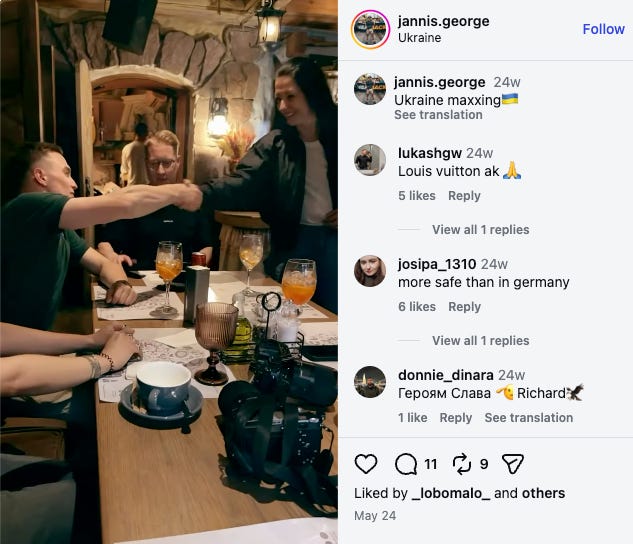
Some weeks before the KSF youth event, Semenyaka appears to have dined with Jannis George and Annie Hunecke, a pair of Germans associated with the AfD’s youth organization and the European white nationalist “Identitarian” movement. Earlier this year, George and Hunecke interviewed Greg Bovino, the former commander of Donald Trump’s U.S. Border Patrol, at the 2026 “Remigration Summit” in Portugal, which was hosted by a group called “Reconquista” to advocate for ethnic cleansing Europe via mass deportations
Days before the 2026 Remigration Summit, Jannis George published a video featuring Semenyaka from his 2025 trip to Ukraine with Annie Hunecke
At the start of 2026, Olena Semenyaka sat down for a podcast interview conducted by Hanna Hopko, a famous “anti-corruption activist” and former “liberal nationalist” politician who chaired the foreign affairs committee of the Verkhovna Rada (2014-19), during which time she all but lived in Washington and indulged her fantasy of breaking up Russia into numerous states. In 2014, Hopko gave Vice President Joe Biden a tour of Independence Square (the famous “Maidan”) in Kyiv, and he introduced her at a “Democracy Award Dinner” back in Washington.
Hopko introduced Semenyaka to her small audience as a “philosopher” who “researches various right-wing radical movements.” The episode is titled, “Europe on the brink of collapse. Ukraine — the last shield against the Kremlin.” The video starts with Hopko commenting, “We must do everything we can to ensure that Russia repeats the fate of the Soviet Union,” and Semenyaka says, “We are truly on the verge of a possible third world war, redivision of the world, new totalitarian tendencies.” The thumbnail of the video declares, “On the Doorstep. Third World War”
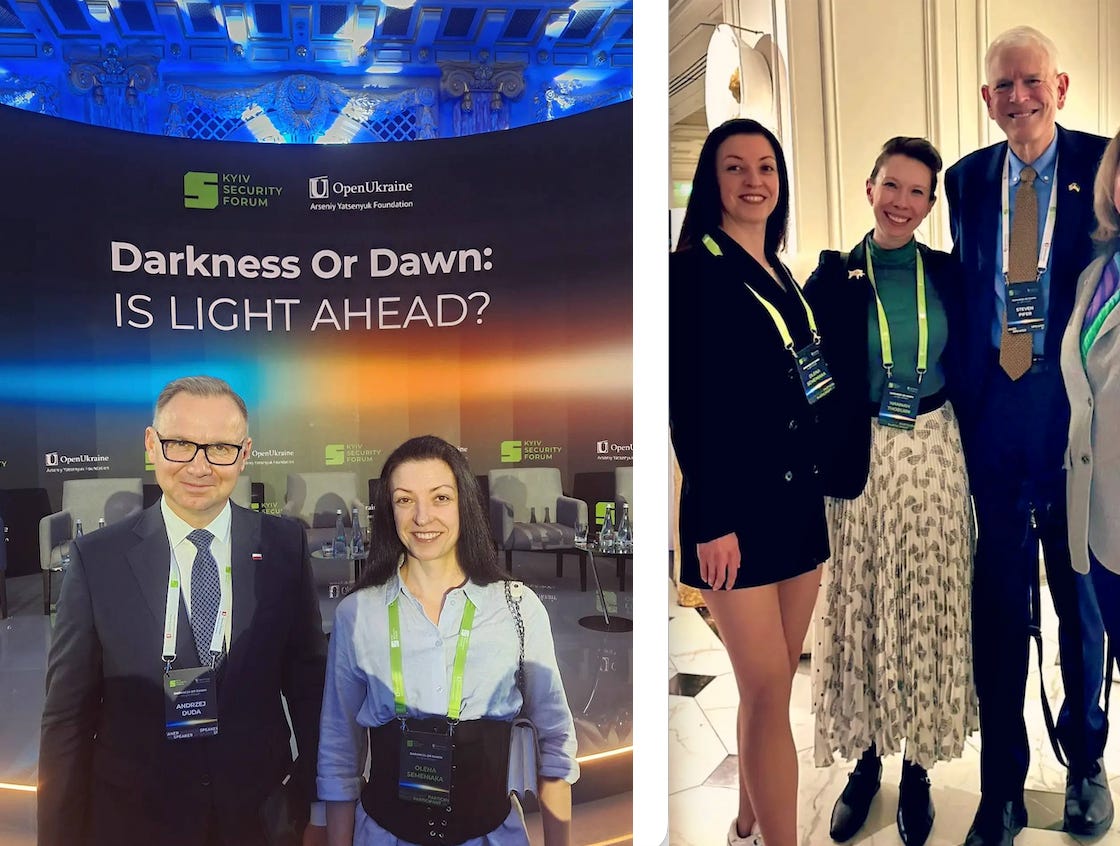
According to Olena Semenyaka, she was invited to the 2026 Kyiv Security Forum by its executive director, Ramina Shut. This is apparently the right-hand woman to Arseniy Yatsenyuk, the former Prime Minister of Ukraine (2014-16) who founded the KSF. At this year’s event, Semenyaka took a group picture with Steven Pifer, a former U.S. Ambassador to Ukraine (1998-2000) who is affiliated with the Freeman Spogli Institute at Stanford University, and Hannah Thoburn, a senior fellow at the Center for European Policy Analysis in Washington and former staffer of the Senate Foreign Relations Committee (2019-24). Semenyaka also met Andrzej Duda, the former President of Poland (2015-25). In the following days, she attended an event organized by the Polish embassy
Semenyaka with Duda, Thoburn, and Pifer at the 2026 Kyiv Security Forum
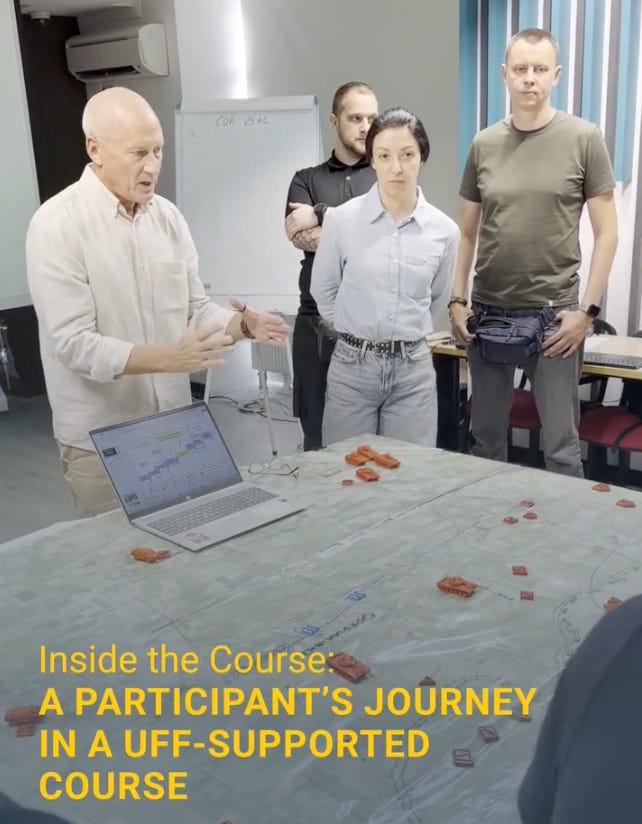
During the summer of 2026, Olena Semenyaka and other Azovites (including Andriy Holubev, deputy chief of staff of the 3rd Army Corps) completed a “leadership course” sponsored by the Ukrainian Freedom Fund (UFF), a 501(c)(3) charity established in 2014 and headquartered in a small town in Wyoming. In September, Ukraine’s new commander-in-chief Mykhailo Drapaty addressed one of these “UFF-supported courses.” The UFF says that it has a “close and trusted relationship with the leadership of the Armed Forces of Ukraine.” What about the U.S. military or intelligence community?
Olena Semenyaka at the “UFF-supported course”
UFF founder Andrew Bain is a U.S. Marine Corps veteran who is credited as “one of the early founders of the advertising and media industries in Ukraine.” In 2022, he co-founded the “Mozart Group,” a private military company for western volunteers to counter the Russian “Wagner Group” in Ukraine. He did so with Andrew Milburn, who (according to the Middle East Institute) “retired from the Marine Corps in 2019 as the Deputy Commander of Special Operations Command Central, the headquarters responsible for all US special operations in the Middle East.”
The Mozart Group imploded by January 2023, not long after Milburn drunkenly rambled on a podcast about Ukraine killing Russian prisoners of war and having a “corrupt, fucked-up society.” As for Bain, he remains the CEO of the Ukrainian Freedom Fund and a “training company,” Sonata Holding LLC, also based in Afton, Wyoming, that appears to be a successor to the Mozart Group. Representatives of “Sonata” recently celebrated the 251st birthday of the Marine Corps with Olena Semenyaka
The reported address of Sonata Holding LLC is occupied by a tax accountant
In 2023-24, Sonata Holding signed a memorandum of cooperation with the Kyiv Polytechnic Institute and conducted a “Military Decision Making Process Course” for staff members of Ukraine’s National Army Academy. Aside from sharing a CEO, there seems to be significant overlap between “Sonata” and the UFF, such as Trent Gibson, seen in the photo below standing on the far right. Gibson, a Marine Corps veteran, is the “Training and Operations Director” at Sonata, which he says is “one of the few private firms conducting in-country training with the Ukrainian Ministry of Defense for officers and staff.” Shortly before attending the event at the U.S. embassy, Sonata “expert” Andriy Ryzhenko (also seen below) joined a UFF delegation that traveled to Texas and met with the Dallas mayor’s office. Ryzhenko is a Ukrainian Navy veteran and former NATO staff officer who writes for the Eurasia Daily Monitor, which is published by the Jamestown Foundation, a conservative think thank founded in 1984 with the support of Ronald Reagan’s CIA director
From left to right: unidentified, Olena Semenyaka, unidentified, Andriy Ryzhenko (Sonata LLC), Anastasia Polishchuk, and Trent Gibson (Sonata LLC)
Olena Semenyaka now describes herself as an analyst at the “Institute for Cognitive Defense,” which Mykhailo Basarab, a senior fellow of the Kyiv Security Forum, launched in September 2026. In the summer of 2019, after Volodymyr Zelensky was elected in a landslide promising to end the war in eastern Ukraine, Basarab speculated on TV that Zelensky’s presidency was a “Russian special operation.” He subsequently joined the leadership of the far-right “Capitulation Resistance Movement,” which threatened Zelensky with a potentially far bloodier “Maidan” uprising if he negotiated with Russia. At the end of 2019, Zelensky and Putin met face to face in Paris, but there was no diplomatic breakthrough. With Andriy Biletsky, leader of the Azov movement, standing on stage behind him, Mykhailo Basarab assured anti-peace protesters that night in Kyiv that “Zelensky did not cross red lines.” At some point, Basarab became friends with Semenyaka.
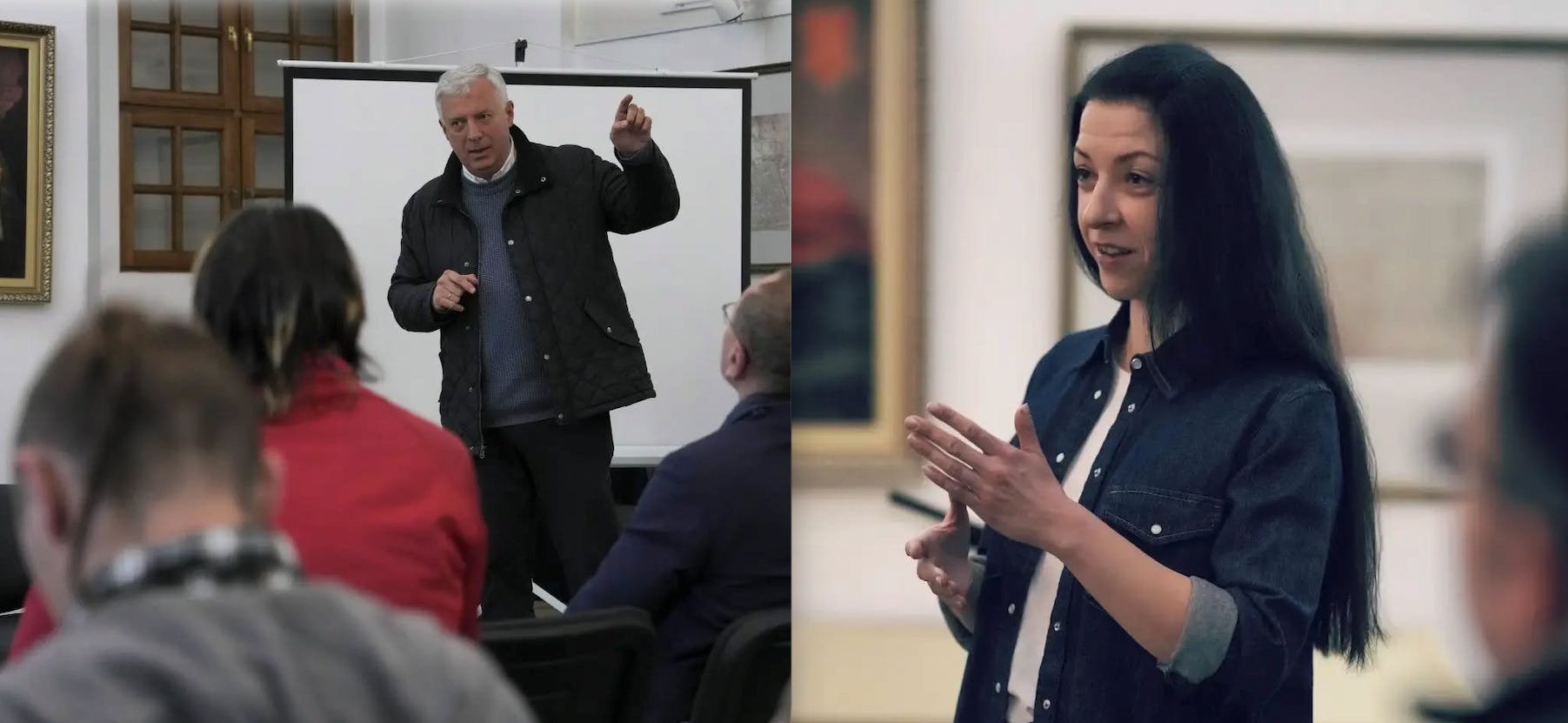
For now, the “Institute of Cognitive Defence” has launched a small Youtube show. Semenyaka has appeared in two of its panel discussions since late October, titled “Europe’s Protests: What Russia Wants You to Believe?” and “The Ukrainians Putin Fears Most: Why Russia Targets Azov and the Third Assault Corps.” For the first one, she was joined by Mykhailo Basarab and Serhiy Kvit, another former leader of the Capitulation Resistance Movement, and the president of Semenyaka’s Azov-friendly alma mater, the National University of Kyiv-Mohyla Academy (NaUKMA). Earlier this year at the NaUKMA museum, Kvit and Semenyaka introduced an essay contest for “conservative” students
Kvit and Semenyaka at the NaUKMA museum
Just days ago, Semenyaka and Basarab tackled the recent exposure of a secret detention facility run by the 1st Azov Corps in the Kyiv region, mainly by discussing the years long “Russian propaganda” about neo-Nazis in Ukraine. Olena Semenyaka singled out Le Monde, Bellingcat, and the U.S.-funded RFE/RL for spreading lies about her and the Azov movement, for example that she spent years trying to cultivate a “right-wing extremist international.” She concluded that the Ukrainian military (read: Azov units) should “communicate more actively with our Western partners to influence them,” and suggested there needs to be “accountability for spreading all these toxic narratives,” whether it be for Ukrainian civilians resisting mobilization, or western journalists
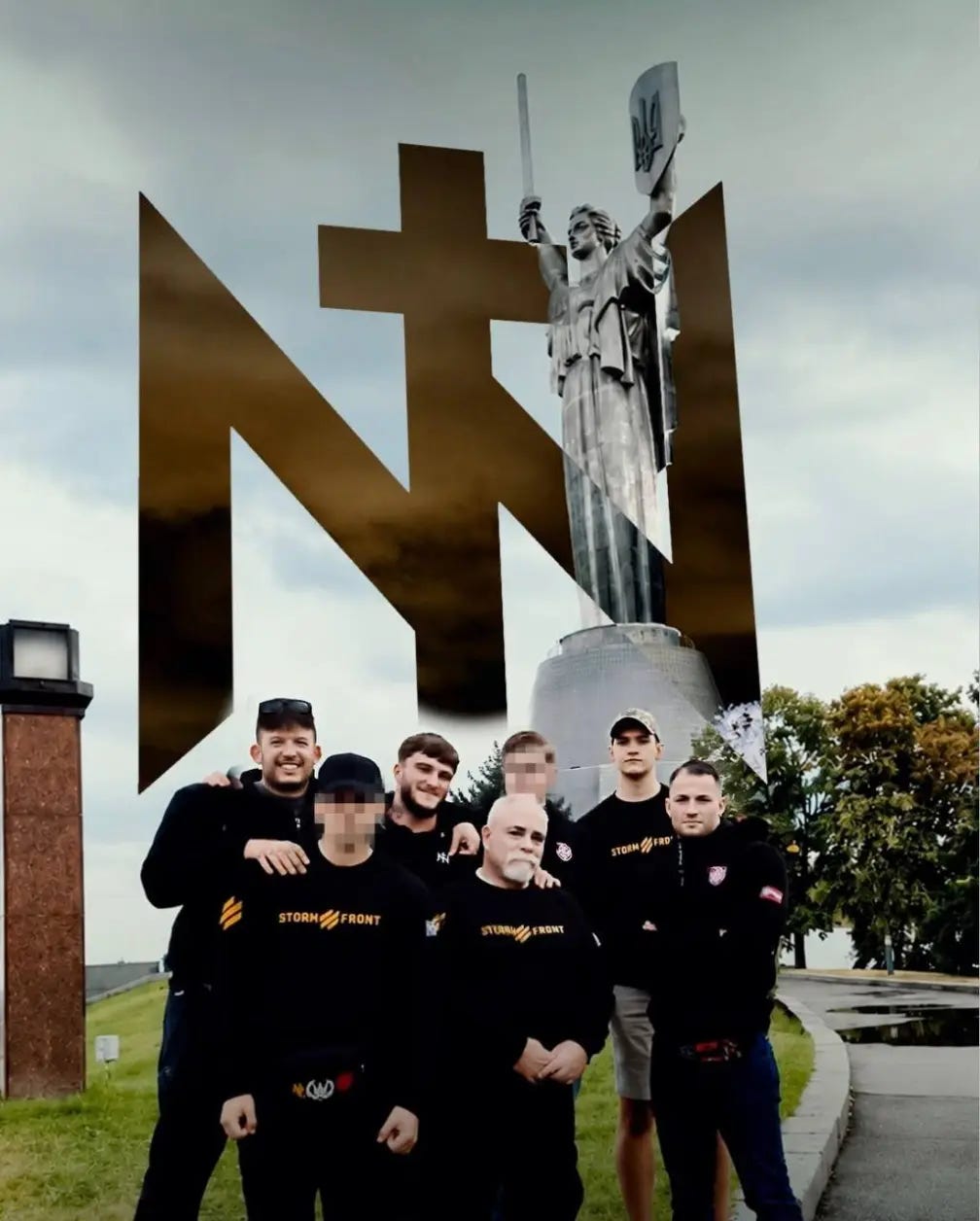
One day after the Institute for Cognitive Defense published its latest episode with Semenyaka, the Marine Corps turned 251 years old, and El Pais reported that the Spanish neo-Nazi group Núcleo Nacional (“National Core”) received paramilitary training from the 1st Azov Corps in order to “carry out an armed uprising” back home in Spain. However, I suspect that they actually trained with the 3rd Army Corps, and eventually we will learn that Semenyaka had something to do with it
Núcleo Nacional published this image of its members in Ukraine, overlaid with the symbol of their group, which is reminiscent of the Azovite “Idea of the Nation” wolfsangel. Some of their sweatshirts say “Storm Front,” referencing one of the oldest neo-Nazi internet forums, founded in the 1990s by a former KKK leader, but they also include the symbol of the 3rd Assault Brigade and 3rd Army Corps.
Marco Rubio’s speeches invoking a shared Western civilization are part of the ideological consolidation of fascism, mobilizing white racial solidarity to defend a declining capitalist order
its roots before WW2, its collaboration with Nazi Germany, its legacy in modern Ukraine, how NATO has continually supported Nazism in Ukraine, chronicle
chronicle of censorship, fake news, whitewashing of the Ukrainian Nazism and war crimes, for the sake of the proxy war that NATO is conducting in Donbass and Ukraine, against Russia
Marco Rubio’s speeches invoking a shared Western civilization are part of the ideological consolidation of fascism, mobilizing white racial solidarity to defend a declining capitalist order
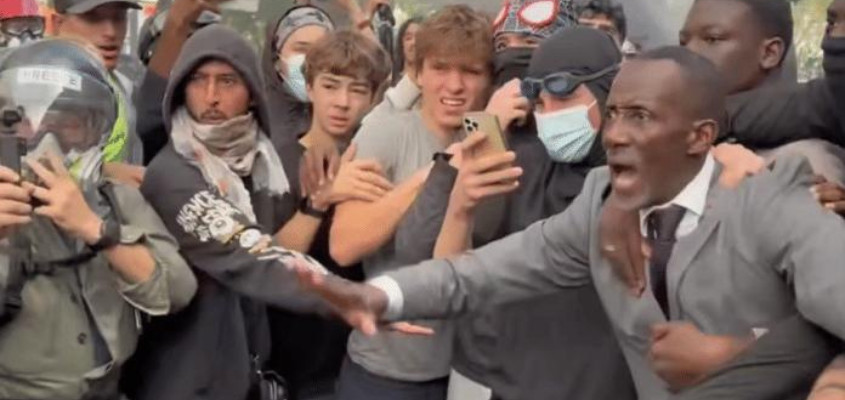
Bally Bagayoko, the mayor of St. Denis, France, standing between student protesters and police
We want allies who can defend themselves so that no adversary will ever be tempted to test our collective strength. This is why we do not want our allies to be shackled by guilt and shame. We want allies who are proud of their culture and of their heritage, who understand that we are heirs to the same great and noble civilization, and who, together with us, are willing and able to defend it [Marco Rubio speech at Munich Security Conference, February 2026]
And the world communism envisions is a world without God. For these architects of revolutionary violence, the towering achievement of our civilization – for them it’s an unbearable humiliation, a reminder of what they cannot do and a reminder of what they cannot be. So they choose instead to destroy. They attack pipelines; they attack railroads; they attack power grids and laboratories, the physical embodied symbols of power and invention and achievement. This is the nature of the terrorism we face today. They despise the West because the West is great [Marco Rubio, U.S. Ministerial on the Resurgence of Political Terrorism]
Marco Rubio’s July 16, 2026, speech at the opening of the U.S. Ministerial on the Resurgence of Political Terrorism should be understood as part of the ideological consolidation of fascism in the West. Its significance extends beyond the criminalization of the radical left. Rubio invokes a supposedly shared Western civilization to mobilize white racial and cultural solidarity in defense of a moribund order whose economic foundations are in irreversible decline. But it is precisely that decline that explains the pathetic weaponization of an idea of Western civilizational superiority that must be protected. Rubio understands his audience and the anxiety generated by the decline of the Western European colonial/capitalist era. Rubio and the other white supremacists making political and economic policy in the United States from Elon Musk and Peter Thiel – both from apartheid Southern Africa – to U.S. President Donald Trump. They understand that this civilizational framing is shared, in different forms, by rightist political forces across Europe—from Marine Le Pen and Éric Zemmour in France to Germany’s Alternative for Germany (AfD), Austria’s Freedom Party (FPÖ), and Nigel Farage’s Reform Party political movement in Britain.
This brings me to what is referred to as the French student uprising. African, Arab, and Muslim students and youth from working-class Paris banlieue suburbs played a significant role in the mobilization against deteriorating educational conditions and diminishing prospects for their futures. Their presence generated a violent ideological reaction as intense as the violence unleashed on the students by the French police. It was precisely the racialized character of the uprising that enabled right-wing political forces across Europe to recast a struggle over material conditions as a conflict over immigration, Islam, and European identity, even as increasing numbers of white French workers joined the protests and the demands expanded to cover all of the contradictions produced by four decades of neoliberal policies in France.
The political right understood what mainstream reporting often de-centers: the participation of racialized youth provided an opportunity to distort demands for social justice produced by the contradictions of capitalism as an assault on European civilization. The student becomes the immigrant; the immigrant becomes the cultural enemy; and the cultural enemy becomes a security threat whose presence justifies repression and ultimately expulsion!
This is the dangerous convergence embedded in Rubio’s politics: left, Black, Muslim, “terrorist” that collapses legitimate political opposition, racial and religious identity, and terrorism into a single ideological and security threat. Anti-capitalist and anti-imperialist politics become evidence of hostility to “civilization,” while the political agency of African and Muslim youth is treated as an existential threat to the state. The consequence is a framework both in the U.S. and Europe that legitimizes expanded state surveillance, police violence, and the criminalization of dissent.
It must be understood with unambiguous historical clarity that what is unfolding in Europe and the U.S. is not a turn to something called authoritarianism but the consolidation of fascism, with white supremacist ideology providing the axis of a cross-class white supremacist legitimation. This obvious turn to white identity politics makes the positions of left racial integrationists like Adolph Reed so incredibly dangerous. [1]
At a historical moment when appeals to racialism and white supremacy are becoming normalized, Reed and other leftists are ideologically disarming opposition to this development by pretending that white supremacist ideology and the materiality of white supremacy is a phantom, a figment of the imagination of petit-bourgeois nationalists and “identitarians” while the mother of all identitarianism – white identity politics and white supremacy is given a pass.
But the ideologues of white supremacy understand that the appeal to the fiction of white civilization supplies the racial glue intended to bind the white working class to the interests of capitalist elites, redirecting anger away from the capitalist relations producing class-wide precarity and toward racialized populations who are themselves the disproportionate victims of colonial/capitalist contradiction. [2]
The European normalization of “remigration”
Across Europe the significance of Rubio’s intervention becomes clearer when placed alongside the growing normalization of a political phenomenon labelled as “remigration.” The growing popularity of remigration, that is, the return of non-Europeans back to their countries of origin, is not simply a debate about enforcing immigration rules. It is a political project whose language of return reveals an ominous turn to a broader racialized struggle over who belongs to Europe and who should be expelled from it.
In Germany, the AfD formally embraced “remigration” in its 2025 election program. Party leader Alice Weidel advocated large-scale repatriations and the term was elevated from a slogan associated with far-right movements into an explicit party demand. The party defines its policy in terms of returning foreigners required to leave under law, while the wider remigration movement includes proposals directed at legally resident migrants and people considered insufficiently assimilated. The distinction matters: the political struggle is over whether formal legal status remains sufficient to establish belonging, or whether racialized definitions of culture and ancestry can supersede it. [3]
Austria’s FPÖ has advocated an EU commissioner for remigration. In Italy, politicians from the Lega have supported a “Remigration and Reconquest” initiative seeking parliamentary consideration. In France, Éric Zemmour has advocated a ministry of remigration, while Geert Wilders in the Netherlands has called for mass deportations in response to unrest in France. Spain’s Vox has also advanced large-scale return proposals for people with migrant backgrounds. [4] These developments do not represent identical policies, but they demonstrate how a once-marginal vocabulary is entering mainstream political debate and linking far-right forces across national boundaries.
The racialization of the French uprising provides a justification for this agenda. When African, Arab, and Muslim youth are depicted as enemies of European civilization, collective expulsion can be presented as a legitimate response to social disorder. The same narrative helps normalize violence against racialized communities and intensifies the danger posed by police forces already notorious for their treatment of youth in the immigrant banlieues. The recent deadly shooting near Paris, in which an African was killed and others wounded, must be understood within this wider atmosphere of racial hostility. [5]
The material Contradictions beneath the civilizational rhetoric
The uprising in France and across Europe cannot be understood apart from declining wages and living standards, deteriorating public services, austerity, debt pressures, and the narrowing prospects confronting working-class youth across racial and ethnic backgrounds. These pressures are often more acute in African, Arab, and Muslim communities because economic marginalization intersects with racial discrimination and unequal access to education, employment, and housing.
France’s fiscal crisis intensifies the struggle over public resources. Debt servicing and demands for fiscal consolidation constrain political choices even as communities require greater investment in education, health, housing, and employment. The war against Iran and the resulting energy-price pressures have added to the burdens confronting working-class households. At the same time, European governments have embraced military Keynesianism, mobilizing resources for military production while social needs remain subject to austerity and fiscal discipline. [6]
These contradictions have emerged throughout the advanced capitalist economies expressing the structural crisis of Western capitalism: a system increasingly unable to provide broad material security while preserving the accumulation and geopolitical power and interests of monopoly capital. But France’s specific crisis is also connected to the weakening of its historical ability to maintain its parasitic relations of extraction that allowed capital to bribe workers in France.
However, as the ability of France and other Western capitalist states to dictate economic and political terms to the Global South that allowed a continuous flow of value to the metropoles became more contested resulting in declining wages and living standards, white civilizational nationalism offered an ideological substitute for the failed promise of unbroken material prosperity to the Euro-American and European masses.
The appeal of Trump, Rubio, Le Pen, Farage, and other figures rests on the continued obscurantist policies emanating from the consolidating global fascist movement. They promise national renewal through exclusion hoping that the white working classes never catch on to the fact that the defense of white civilization is the defense of oligarchic capitalist rule.
The fascist response to capitalist crisis is to reorganize domination through white supremacy and civilizational exclusion. The peoples’ response must be to organize for liberation beyond the colonial and capitalist relations that have produced the crisis [end]
1 mort, 10 blessés dont 4 blessés graves, une fillette touchée par 8 tirs : un passage à l’acte encouragé par les politiques et discours d’extrême droite
une saga française, entre Ukraine et Lyon, où apparaissent aussi des morceaux de SS de la division Charlemagne et plus récemment, Alice Kerviel, dite Cordier
mensonges, coups de communication, complaisance médiatique, fascisation du débat public : la mort de Quentin Deranque a servi de catalyseur à l’ensemble de l’échiquier politique, du centre à l’extrême droite, pour en faire un puissant instrument de récupération politique. Ce climat a permis à des groupes néonazis et fascistes d’organiser des hommages publics saturés de références idéologiques explicites au nazisme, sans susciter la moindre réaction politique
Agence France-Presse, “Macron Condemns ‘Racist Terrorist Attack’ After Deadly Shooting Near Paris,” October 23, 2026. Reporting on the investigation and official statements should be checked for updates as the case develops. ↩︎
Since the annulment of the 2024 election, Romania’s rule of law keeps crumbling. Here comes Getica – a paramilitary unit who puts EU and US citizens on a Fifth Column list and jokes about war crimes
[my illustration: Getica’s recruitment page (screenshot) Romanian Battlegroup Getica is a group of Romanian-speaking combatants fighting the illegal aggression of the Russian Federation, with the primary objective of stopping the invasion and restoring Ukraine’s state borders as of 1991. We believe the Russian Federation represents an existential threat not only to our Ukrainian neighbors, but also to our brothers in the Republic of Moldova and to Romania’s state borders. Our values are rooted in peace, understanding between our neighboring peoples, and mutual support — values we uphold through firm and unequivocal actions]
Romania annulled its presidential election in December 2024 amid allegations of Russian interference. Eighteen months later, Romanian authorities still have not publicly produced evidence showing that Russian influence determined the result.
Yet, those who challenge that narrative increasingly find themselves labeled as pro-Russian, fact-checked, publicly denounced, censored, or added to the “Fifth Column” blacklist of Romanian Battlegroup Getica, an armed group linked to Ukrainian military structures.
The story of how I ended up on that blacklist reveals something larger than a single paramilitary database. It points to an ecosystem of media outlets, NGOs, activists, fact-checkers, and an armed group that appears to use accusations of Russian influence to stigmatize political opponents and critics of Romania’s (and the EU’s) official electoral narrative.
The question is not only why journalists, politicians, academics, and activists end up on Getica’s Fifth Column database, but most importantly why Romanian and Ukrainian authorities continue to tolerate an armed group threatening civilians while nobody accepts responsibility for it.
Getica’s “Fifth Column” database has grown far beyond Romanian politics. At some point, Donald Trump was on it. Steve Bannon is still on it. Republicans for National Renewal and its leader Mark Ivanyo were recently added — alongside European politicians and journalists. Including myself.
To some targets, Getica confirmed modeling their “Fifth Column” list on Ukraine’s infamous Myrotvorets death list. Those armed men wearing military uniform with Ukrainian and Romanian flags and, for some of them, on Ukraine’s army’s payroll, have joked about war crimes, war time rape, doxxed a civilian, constantly lied on their nature, and, last but not least, kept emitting threat no later than this week
Screenshot from the last Getica video, threatening Sebastian Dracopol for his reporting and pushback on Getica’s Fifth Column
In 2024, Getica’s Fifth column’s manifesto declared possible terrorist action if Ukraine loses the war.
Protected Speech or Military Misconduct?
I had been monitoring the Fifth Column site for a while when I appeared on the list. The move was an anticipated one after recurring signaling from Newsweek Romania trying to frame me as being aligned with Russia — despite not having posted anything in support of Russia. It came first as the logical conclusion of a pattern of smear and harassment coming from people connected to Newsweek România, Alianța — a US 501(c)(3) meddling with Romanian politics — and the local businessman Marius Bostan, who consolidated his fortune on state contracts awarded during the COVID crisis.
But then came the questions — is it a real thing? Is it dangerous? Unfortunately, it is. Especially in the context of a country whose rule of law was buried altogether with the 2024 election.
I contacted Getica to receive an explanation and clarify the label of “enemy of Romania”. An anonymous representative replied that nobody had ever suffered consequences from inclusion and argued that the project merely exercised free speech. They also explained that they used to be affiliated with Ukrainian military intelligence, but are now under the authority of the Ukrainian Armed Forces… Further investigation would reveal how blurred are the lines under which Getica operates.
The answer regarding free speech raises an obvious problem. You can’t claim free speech protection while operating as a military organization targeting civilians. If they’re civilians, Getica’s members enjoy broad free-speech protections — that is, up to the point where speech crosses into incitement or creates immediate, real-world threats. In that case, law enforcement and civilian justice should handle them. If they’re military, the problem is different. Military organizations operate under rules of engagement. They don’t target civilians. They don’t maintain independent blacklists of enemies. They answer to a chain of command. If they’re out-of-control military members, they should answer before a military tribunal.
Getica claims both at once: military affiliation when it suits them (Ukrainian unit emblems on the website, Ukrainian battlegroup membership, fundraising for its activities), and civilian free speech protection when confronted with responsibility for the Fifth Column database. Right after I sent them a series of questions on the way they were assessing people to put them on their “Fifth Column” list, they blocked me on Facebook although I didn’t even ever tag them nor publish anything on them yet. The honor and ethics of military service were traded for the methods of petty mobsters.
But the question goes beyond the activities of Getica. If Ukraine is supporting these activities, then it is crossing another line, in a context already extremely loaded due to the recent attribution of the Nord Stream sabotage to a Ukrainian agent by a German tribunal — the worst attack on a NATO country infrastructure so far has been performed by somebody affiliated with the Ukrainian military. The atmosphere is even more loaded since a Ukrainian drone recently exploded in the Romanian port of Constanta — the biggest NATO port on the Black Sea — a few hundred meters away from the oil terminals and from an ammonium nitrate deposit, a chemical product that made major damages in the port of Beirut in 2020. With Getica, the question of Ukraine’s willingness to target Western civilians and western infrastructure is all the more acute. You can’t receive Western support and attack the West. You can’t claim funding for your military and pay the members of Getica as they target EU and US civilians. If Ukraine can’t court-martial those targeting EU and US citizens, if it covers for them, then the whole story of defending a democracy against an autocracy crumbles and, with it, part of the reasons to support Ukraine against the Russian invasion.
Getica — illegal, dangerous and… aligned with Macron?
In Romania, paramilitary organizations operating outside state command are constitutionally prohibited. Yet, Romanian Battlegroup Getica appears to operate openly: armed men claiming ties to Ukrainian military structures, running a blacklist of civilians, and even claiming to have conducted two operations on Romanian soil.
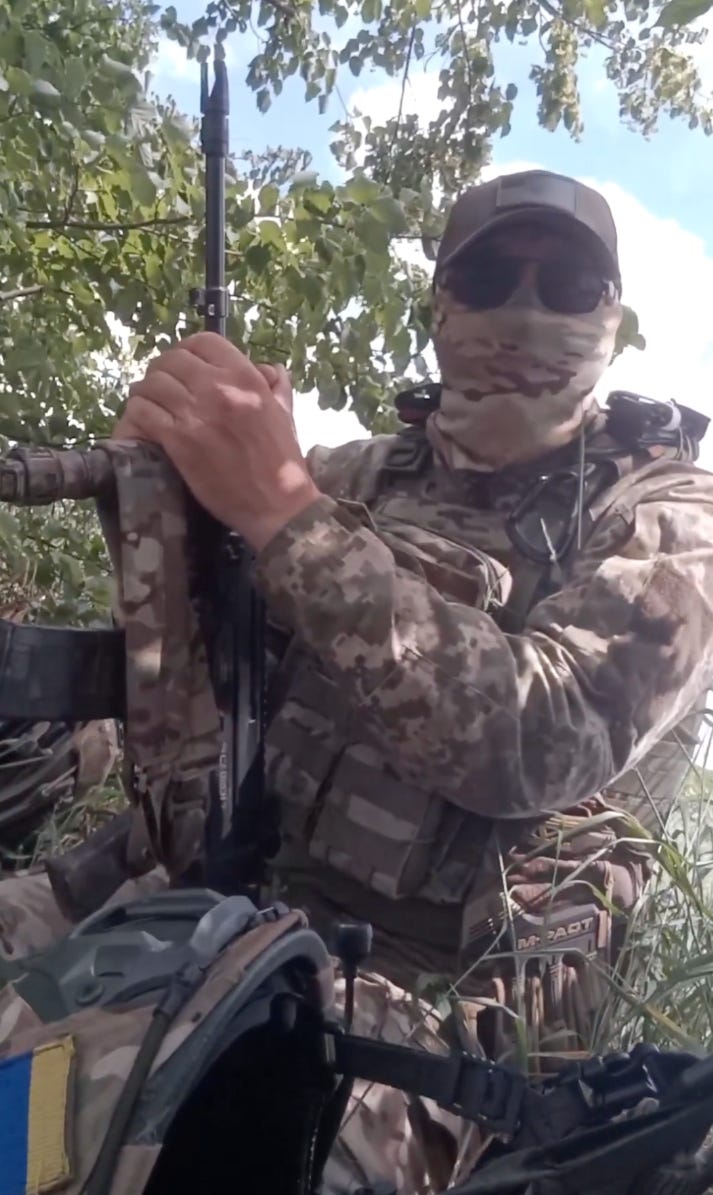
Its historical founder and commander, Sergiu Meșeșan, claims participation in dozens of combat missions in Ukraine. Its members and supporters have doxed critics and targeted family members. Meșeșan recently returned to Romania to teach people how to use FPV drones, including arming them with explosives. In public exchanges, the group has joked about war crimes, rape, disappearances, and other conduct that would normally trigger serious scrutiny.
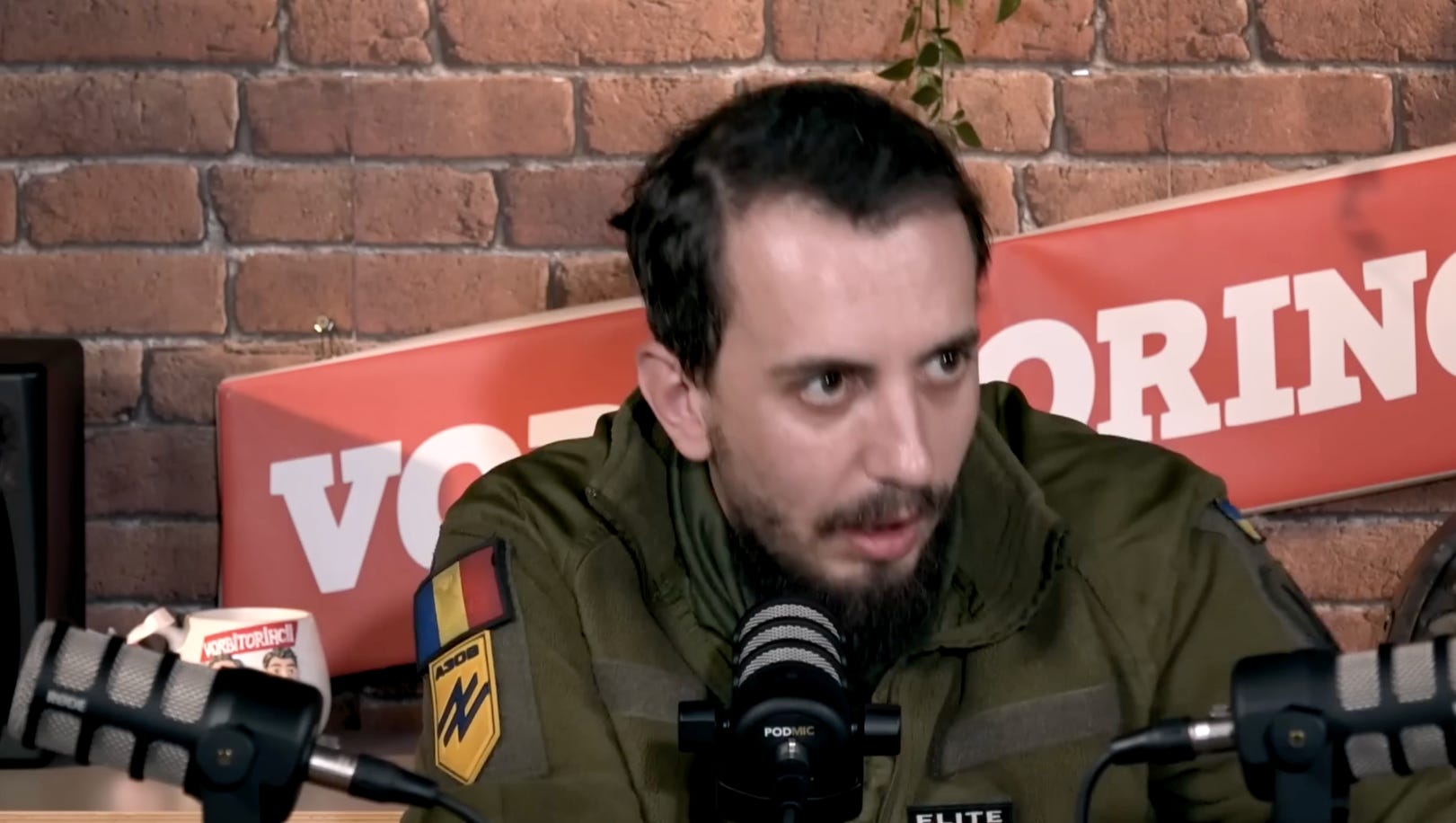
In one live exchange on X, the Romanian Legion Getica account replied to another user with language trivializing rape and invoking Azov: “Several army groups participated in your creation, Azov too I think. The woman didn’t complain.” The reference is not incidental. Azov’s neo-Nazi origins were documented to the point that the US Congress prohibited weapons transfers to the unit in 2018, a restriction that remained in place until 2024. During that period, Radu Hossu — Getica’s main fundraiser and co-founder — appeared in a June 2023 interview wearing an Azov emblem containing the Wolfsangel, a symbol with direct Nazi lineage. In one of his own fundraising reports, he also acknowledged purchasing equipment for two military personnel enrolled in Azov, adding parenthetically: “yes, that AZOV”
Radu Hossu, on the Romanian podcast Vorbintorici, wearing the Azov Wolfsangel in June 2023, when the US congress ban on arming Azov was still enforced due to Azov’s neo-nazi elements
The point is not guilt by association. It is that an armed group maintaining a civilian blacklist, joking about rape and war crimes, invoking disappearances, and displaying proximity to military formations controversial enough to trigger years of congressional restrictions should have attracted institutional scrutiny long before journalists, politicians, and foreign citizens began appearing on its list.
Whose Army?
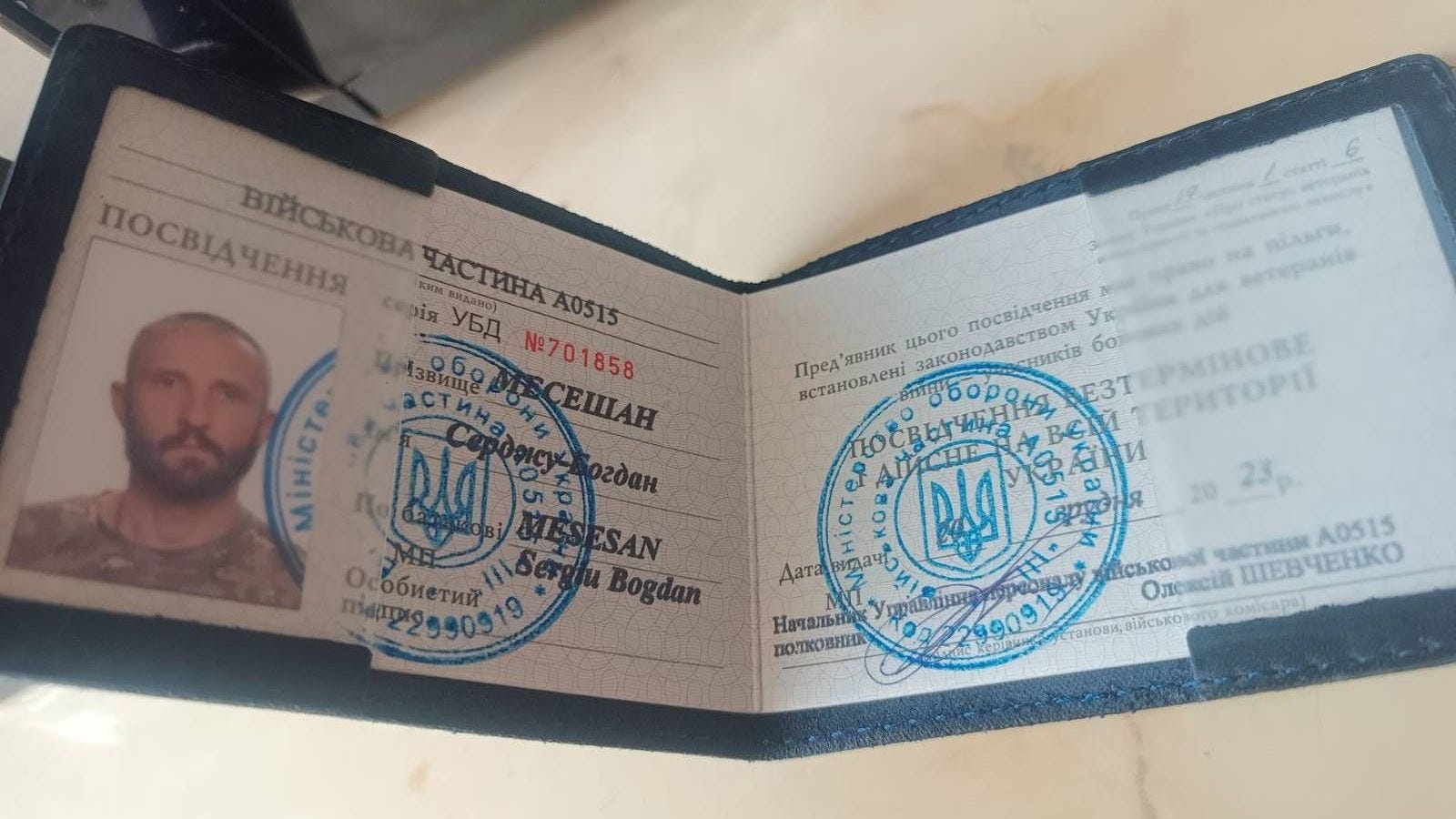
Some Getica members hold Ukrainian military ID cards and receive Ukrainian Army salaries
Sergiu Meseșan military document shared on the Romanian Battlegroup Getica Facebook account – A0515 is a Military Intelligence Directorate Unit
According to representatives of the group contacted directly for this investigation, Getica has operated under Ukrainian military command — initially under GUR, the Ukrainian military intelligence directorate, and later under ZSU, the Ukrainian Armed Forces. When pressed on the specifics of their affiliation, they directed us to their website.
That website has been telling its own story. Until May 30, 2026, it displayed the emblem of the 4th Heavy Mechanized Brigade of the Ukrainian Army
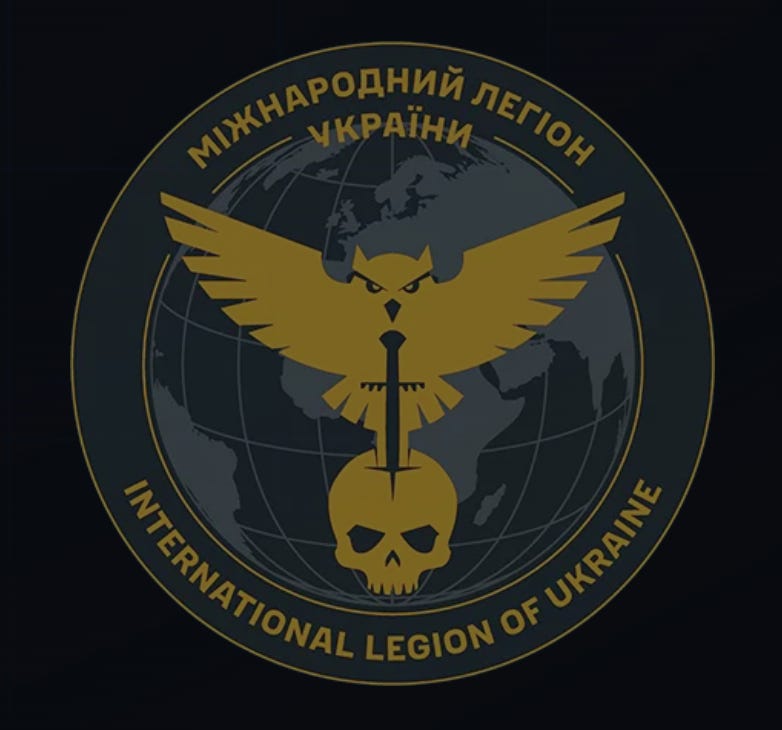
On that date — shortly after this investigation began sending right-of-reply letters to Romanian and Ukrainian institutions — the emblem was quietly removed, with an announcement that a new unit affiliation would be revealed. Days later, two new emblems appeared: that of the 1230th Separate Engineering and Technical Support Battalion, part of the 48th Engineering Brigade of the Ukrainian Support Forces; and that of the International Legion of Defense Intelligence of Ukraine, MUNA 3449 — a separate unit of foreign fighters subordinated to the Main Directorate of Intelligence of the Ministry of Defense of Ukraine, which is the GUR
International Legion of Defense Intelligence of Ukraine1230th Separate Engineering and Technical Support Battalion
No Ukrainian institution has formally claimed oversight of the group. No Romanian institution has either.
The people behind Getica form an unusual partnership. On one side, Sergiu Meșeșan, the group’s historical founder and commander, is a Romanian volunteer fighter in Ukraine who was previously sentenced in Sweden to three years in prison for aggravated fraud as the leader of a bank-card-skimming and phishing operation active across Sweden, Finland, and Denmark.
On the other is Radu Hossu, a self-described founding father of the project: a prominent pro-Ukraine activist, fundraiser, and politician from USR — the party created by Romania’s current president and aligned with Macron’s Renew Europe group — as well as an “embedded” war journalist, covering military operations and units he simultaneously helped finance.
One man built and commanded the organization, and would publish the manifesto of the Fifth Column blacklist and maintain it. The other provided funding, public legitimacy, media access, and political connections.
Questions about Getica’s financing had already produced one of the earliest public conflicts surrounding the group. IT specialist Sebastian Dracopol, later added to the Fifth Column database himself, challenged the use of funds raised by Hossu through a personal Revolut account. After being doxxed and threatened, Dracopol sued Hossu. Although he did not obtain a restraining order, the proceedings produced one of the few official records concerning Getica, including admissions regarding Hossu’s fundraising role, his creation and ownership of the group’s Telegram channel, and the armed nature of the combatants operating under the Getica banner. We will return to that case later.
The April 2024 “Fifth Column” Manifesto
In April 2024, Getica commander Sergiu Meșeșan published what amounts to the founding document of the Fifth Column project, laying out his program in explicit terms:
We believe it is normal to have different opinions and freedom of expression. That is what democracy is about. But we wish to warn, through this message, that there is a limit to the subversive activities we will tolerate — I am referring to ‘Getica’ — on the territory of Romania or the Republic of Moldova.
And we are EXTREMELY ready to act from the shadows to limit the impact of Russian influence in both states.
Thus, when Ukraine collapses — as this category of Russophiles maintains, and if it should actually come to pass — we will be ready to strike with an intensity and firepower the likes of which Romania has never seen, in order to defend the national and vital interests of the nation.
We are aware that there is a legal framework that is not exactly favorable for state defense institutions to act freely and effectively. Laws change, however, and for the homeland, ‘Getica’ is ready even to circumvent them. We own that. We might be called terrorists. But the terrorists of some are the freedom fighters of others.
[…] We already have a website, a secure server, and a domain. We will publish them very shortly. Beyond the information and presentation images you have been able to see on our page over time, we wish to put into practice the concept of the #coloana5 database. We firmly believe that exposing the identity of subversive elements and useful idiots will deter them more or less from their activities of sabotaging public opinion, and will spare us other actions — unfortunately far more invasive — in the near future
The idea of an armed group on Ukrainian payroll going rogue and targeting citizens of NATO member states should have warranted a reaction from authorities, at least from Romania and from Ukraine. In response to our inquiry, the Armed Forces of Ukraine stated that the matter fell within the competence of the Main Intelligence Directorate (GUR) of the Defense Ministry. The Romanian Defense Ministry denied any affiliation. No further clarification was provided.
A year after its manifesto, Getica goes… “clandestine”?
In a lengthy statement published on April 14, 2025, Getica founder Sergiu Meșeșan described himself as having conducted 37 combat missions in Ukraine, including infantry, SIGINT, drone ISR, and attack-drone roles. He stated that Getica had approximately 50 members over its existence and never more than 20 active fighters at any given time.
More importantly, he publicly acknowledged that the group had carried out “2 limited surveillance operations on Romanian territory.” Meșeșan did not disclose the targets, legal basis, beneficiaries, or institutional authorization of the two Romanian surveillance operations. No Romanian authority contacted during this investigation acknowledged requesting, supervising, authorizing, or even being aware of them. The statement raises obvious questions about the legality of intelligence-style activities conducted on Romanian territory by individuals presenting themselves as members of a foreign military structure. If they are a paramilitary group, their activities are unconstitutional and illegal in Romania. If they are affiliated to Ukraine’s military, this is a serious breach of the treaties that prevent any such activity. If these missions were happening with the blessing of the Romanian Army, then somebody at the MaPN lied to us and covered up for Getica – and this person should answer before the law too.
In the same statement, Meșeșan proclaimed that: “From today, Getica becomes a multinational, global and clandestine operation.”
By any reasonable definition, Getica does not display the characteristics of a regular military force. Regular military forces operate with rules of engagement, a formal conduct code, and an accountable command hierarchy — constraints that precisely prevent armed groups from targeting civilians, engaging in public discourse, or taking sides in political debate.
Getica’s Fifth Column
Coloana 5 — Fifth Column — is Getica’s blacklist. By May 2024, the page was online. It currently lists over 150 American and European citizens and organizations accused of serving Russian interests, acting as useful idiots, or being enemies of Romania.
Inclusion is not notified in advance. According to the operators themselves, a profile can be spotted automatically by a combination of alleged military AI systems — an OSINT database and an LLM — and then approved by a human operator. The list is not static: operators state they monitor listed individuals and may revise positions over time, an implicit form of pressure to coerce people into alignment. The original version of the site included a “Recommended actions” rubric specifying measures such as localization and monitoring of listed individuals. That section has since been removed. At some point, the site began blocking web archiving tools, making earlier versions inaccessible.
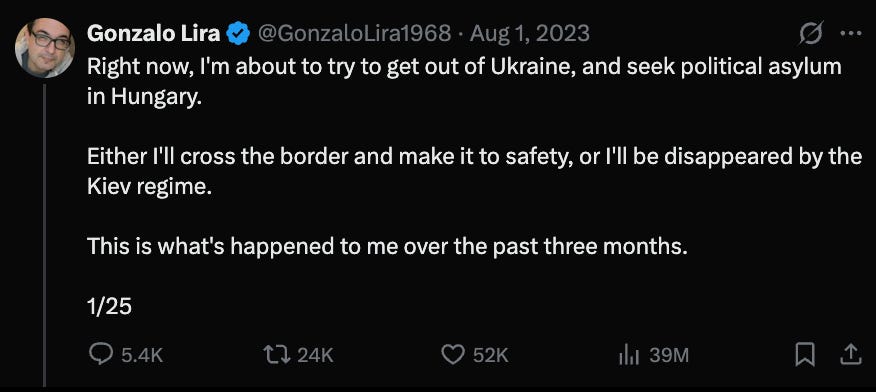
In direct communication with a listed person, Getica leadership referenced Myrotvorets explicitly as a model — the Ukrainian hit list on which was Chilean-American influencer Gonzalo Lira, whose case gained attention in 2023 when Elon Musk publicly questioned his detention. According to Ukrainian officials, Lira died in detention from pneumonia and health complications; his family and supporters alleged mistreatment and torture
Getica’s Fifth Column project did not emerge during an ordinary political period. In 2024, every major elected office was scheduled for renewal in Romania.
In late April, the European Union activated its Rapid Response System to flag content during the European Parliament election campaign, and Getica simultaneously began listing members of the opposition on its website. The framing had been set weeks earlier: on March 6, Ursula von der Leyen, campaigning for her reelection, made the stakes explicit in her Bucharest rally cry:
[..] Putin’s friends are trying to rewrite our history and hijack our future. They are spreading hate from behind their keyboards. And let there be no doubt what’s at stake in this election. Our peaceful and united Europe is being challenged like never before by populists, nationalists, and demagogues. Whether it is the far right or the far left. Whether it is the AfD, the Rassemblement National, the confederatia or Wasraschdene. The names may be different, but the goal is the same: They want to trample on our values, and they want to destroy our Europe. But we, the EPP, will never let that happen
Following the Russiagate playbook, critics and opposition to power are “Russian influence” – this would become a recurring theme during the long Romanian election cycle. Getica’s project, supposedly aimed at exposing Russian influence, would just plainly overlap with domestic political conflicts, opposition figures, journalists, commentators, and critics of power.
The involvement of USR member Radu Hossu makes an obvious case for direct political support or, at least, convenient complacency, with the criminal activities of Getica. Contacted, neither Dominic Fritz – leader of USR – nor USR Brașov provided a statement to distance themselves from Hossu. Bucharest leader of USR, Vlad Voiculescu, replied in a direct message that he didn’t see how the matter was related to USR. Yet, the fact that a USR member helped and covered for a coercion gang is obviously a USR problem. None of the questions sent to USR-founder, and now President Nicusor Dan, to the Ministry of Defence, led by USR member Radu Miruta, nor to the Ministry of Foreign Affairs, led by USR member Oana Toiu, delivered a significant assessment, response, let alone an acknowledgement of the gravity of the matter. Silence seems to clearly mean consent, and Getica’s utility for the USR could be summarized like that: if propaganda fails, if censorship and the weaponization of the DSA fails, then an informal tool to threatens or silences people find its full utility.
Who makes it to the list?
The progression from media labeling to blacklisting can be observed directly in my own case. Since December 2024, I have repeatedly described the absurdity of framing as pro-Russian people who — like most of the Romanian conservatives — have condemned Russia’s invasion of Ukraine and hold Russia in distrust for many historical reasons. In a country where 87.5% of the people are West-oriented and consider EU and NATO membership as warranties of security and prosperity, framing a part of the population — the conservatives — as anti-EU, anti-NATO, pro-Russia only serves a propaganda machine.
Before appearing in the Fifth Column database, I had already been repeatedly smeared as pro-Russian, pro-Orbán, pro-Georgescu or part of various influence networks — and this without ever having published pro-Russian, pro-Georgescu or pro-Orbán material. The attacks had far more to do with the reporting I published than with any pro-Russian content.
I have documented how the current implementation of the EU Digital Services Act created a growing ecosystem of censorship actors while leaving user protections largely theoretical (see DSA: Europe’s Injustice System).
Later this year, I contributed to The Managed Ballot, published through MCC Brussels, with a chapter on Romania’s Hybrid Regime and its European Accomplices. It argued that the country’s democratic downgrade was driven by the regime itself — the government and the intelligence community — working hand in hand with a local “fake civil society” that lacked real constituencies and ran on foreign executive-power funding, including the EU’s. Behind it, external interference from Brussels and from Macron. The result: a country the Economist’s Democracy Index had reclassified as a “hybrid regime” — no longer a democracy. The publication of the MCC report triggered an ad hominem attack in a media outlet owned by Marius Bostan.
The combination placed me in direct conflict with actors who considered the Russian-interference narrative settled fact. Beyond my own reporting, I also publish the Romanian edition of Le Monde diplomatique and regularly translate writers who frequently challenge official foreign-policy narratives and oppose censorship, including Serge Halimi, Pierre Rimbert, Matt Taibbi, Aaron Maté, Thomas Fazi, Jeffrey Sachs and John Mearsheimer.
A few days ago, another Newsweek Romania “embedded journalist” — mixing coverage of the Ukraine war with support for Ukraine —, Remus Cernea, alleged that Sachs and Mearsheimer were “Putin’s intellectuals”.
Newsweek România, Alianța and the Bostan ecosystem
But things accelerated when I debunked a hit piece published by Newsweek România targeting Georgică Severin, one of the few members of the National Audiovisual Council (CNA) consistently opposing censorship measures within Romania’s media regulator. My article also noted how the advertorial section of Newsweek România only contained representatives of the government. Before publishing my rebuttal, I sent detailed questions to Newsweek România. No answer was received. Two days later, Newsweek România published a new article targeting both Severin and me. Another article followed in Newsweek, reminding readers of my positive reaction to AUR’s medical caravan project and the fact that my wife is an AUR member.
Facing calls for deportation, I debunked the most outrageous allegations in a single published response, rather than engaging every online harasser.
Shortly afterwards, I appeared on Getica’s Fifth Column database, directly tagged as an “enemy of Romania” and a “potential collaborator.” Getica’s file referenced articles published by two media outlets in which a key stakeholder is Marius Bostan — În Linie Dreaptă and Newsweek România (a local licensee, not the US edition, with full editorial autonomy). Bostan is a former Romanian Telecommunications Minister from the “technocratic government” that governed Romania from 2015 to 2017, formed after the Colectiv nightclub fire protests. Later, Bostan largely benefited from government contracts during the COVID crisis. In 2018, Newsweek România was launched, at an event where the head of the Romanian Intelligence Service would participate. Bostan exerts further influence via Alianța, a US 501(c) originally created to nurture US-Romania friendship, gathering former US ambassadors on its board. Through Newsweek România and Alianța-related actors, a common pattern emerges: individuals challenging dominant narratives are first publicly framed as vectors of disinformation before some eventually find themselves referenced by Getica’s Fifth Column project.
In one instance, the Getica Twitter account even asked the editor of În Linie Dreaptă when to add an academic to the list — which raises the question of direct management of the Getica list by Bostan’s employees.
On July 22, 2025, Getica publicly justified AUR MEP Gheorghe Piperea’s inclusion by posting a screenshot of a Digi24 article reporting that the European Commission considered his motion of censure against Ursula von der Leyen to be linked to Moscow’s interests. Getica’s accompanying comment was: “connecting the dots 😉” A normal parliamentary procedure — a motion of censure, one of the European Parliament’s standard checks-and-balances instruments — had already been reframed by Newsweek România as an initiative of the “Russophile extremist AUR party” before Getica treated it as a Russian-interference signal.
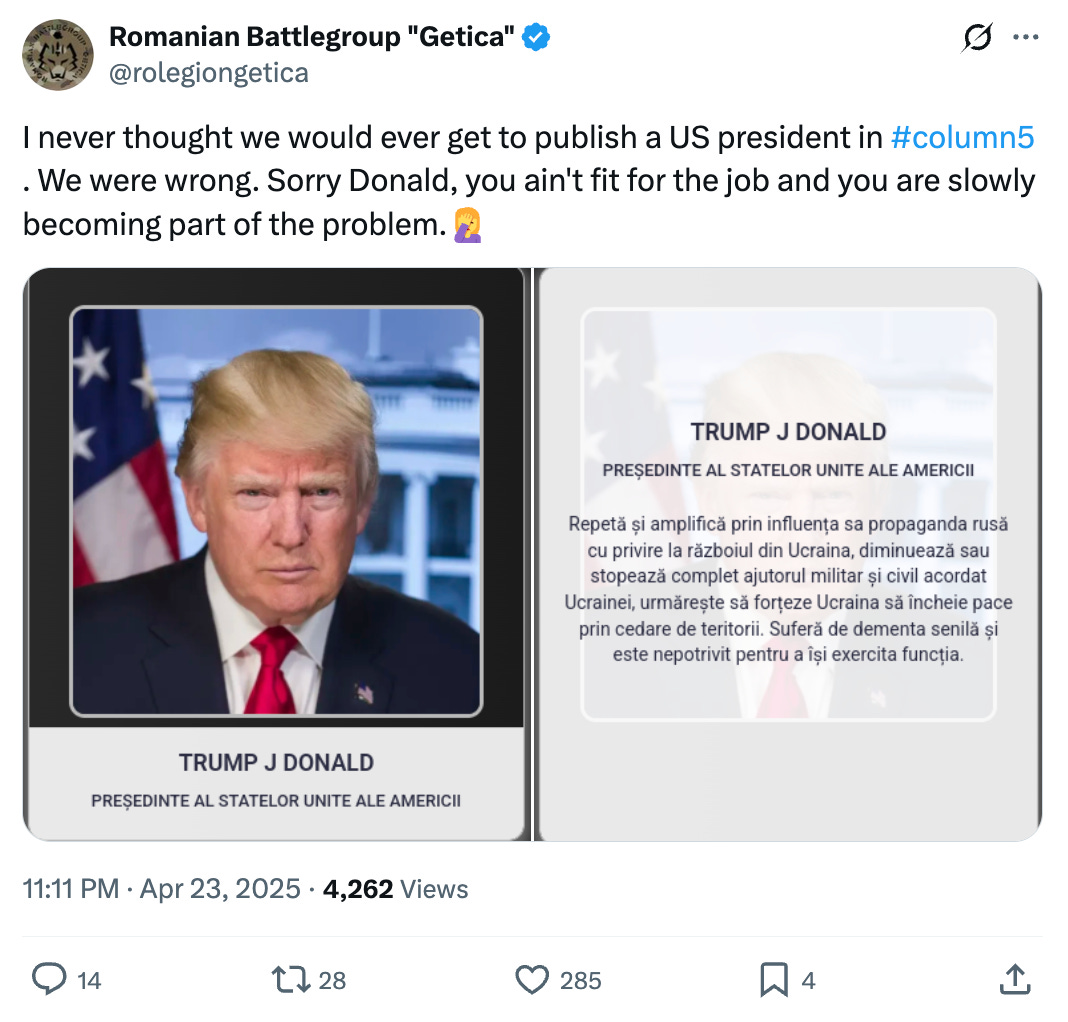
Getica’s list has kept growing since its launch. In April 2025, Donald Trump was added. He was removed shortly after — no removal date confirmed.
Months later, the operators claimed it had been a test to confuse enemies. That explanation is difficult to take at face value: it is more plausible that internal pushback warned them of the risk of directly targeting a sitting US president. What followed makes the Trump removal look less like a policy and more like damage control — the additions continued. The targeting pattern is hard to separate from the political positioning of Getica’s main fundraiser, Radu Hossu, and his party USR, which has maintained a radically conflicting stance toward Donald Trump, the MAGA movement, and USR’s local rivals, the AUR party.
The same chronology appears around Republicans for National Renewal. In early 2026, Newsweek România published an article about a distinction awarded by the American organization to AUR’s leader George Simion. Shortly afterwards, RNR leader Mark Ivanyo was added to the Fifth Column database together with the organization itself. Dragoș Moldoveanu, an AUR member, was added in the same batch, and a Bulgarian figure associated with the same political ecosystem was also added. More additions followed after public discussions involving AUR MP Mihai Neamțu and sovereignty-oriented commentators, including Laurențiu Țîrcă.
Țîrcă received some of the most radical messaging from Getica. The group confirmed to him that Myrotvorets was its model, and pointed to how people on such lists suffer “accidental” deaths. Țîrcă reported seeing a now-removed image of his name written on a rocket launcher. When he challenged Getica over alleged war crimes committed during the Kursk incursion, where elderly civilians died, the Getica account replied: “I don’t deal with pensioners only, I deal with students too.” Țîrcă was a student at that time.
Although Newsweek România carries the name of the American weekly, asked about editorial oversight and accountability, Newsweek USA told us that its international publishing partners are responsible for their own editorial operations and content, while also stating that Newsweek expects organizations operating under its brand to uphold responsible journalism standards.
The concentration of impostors at the local edition of Newsweek goes so far that it receives contribution from Ovidiu Nahoiu, Chief Editor of Radio France International Romania, who shone a year ago with an obsequious interview of the French Ambassador — that is the representative of the government that pays Nahoiu’s salary — were 3 blatant lies went uncheck on air in order to support the Russian influence narrative justifying the annulment of the election. Newsweek also hosts editorial from Adrian Zuckerman — a former ambassador who constantly meddles with Romanian politics, sometimes to praise the Ministry of Internal Affairs for his role in the 2024 coup – naturally framed as “saving Romania”-, sometimes to urge the Romanian Presidency not to join Trump board of Peace.
A few years ago, a reporting by Recorder had already highlited one of the key reason explaining the journalistic fraud within Newsweek and a large part of the press — government money flooding them.
“The destruction of these emitters of toxic ideas must be part of the response.”
The overlap with Getica’s rhetoric extends beyond Newsweek itself. One recurring node is Alianța, a network whose members and participants have included business leaders, activists, former diplomats, former American ambassadors, media figures and public officials. On September 20, 2025, Alianța member Andrei Caramitru publicly defended Getica and its blacklist, describing Getica as Romanian patriots and heroes and claiming the list contained pro-Russian actors from Romania and Moldova. He added that the list was probably already known to Azov, Ukrainian services, Western services and others. We offered a right of reply to Alianța in letters addressed to each board member and to former US ambassadors — no answer was received.
Alianța bills itself as a nonpartisan 501(c)(3), yet its own Board Chair, former US Ambassador Adrian Zuckerman, used an interview to declare the leading conservative opposition party, AUR, “a party dangerous to Romania, dangerous to democracy, dangerous to the West — a party that shouldn’t exist in Romania.” A US tax-exempt nonpartisan organization is, on its own platform, calling for the elimination of a Romanian parliamentary party.
One of the most revealing pieces of language in this ecosystem has been recently supplied by Marius Bostan, shareholder of Newsweek România and central actor in the Alianța network. At the Newsweek IT & Cyber Summit 2026, Bostan compared ideological opponents to pests invading a field and argued that rapid intervention was necessary: “When pests invade a field you need to spray quickly. If you don’t react immediately, you lose.” He continued: “Sometimes attack is a better form of defense. The destruction of these emitters of toxic ideas must be part of the response.”
The wording mirrors the coercive logic already present in Meșeșan’s Fifth Column manifesto. Bostan was not speaking as an anonymous extremist but as a Newsweek România shareholder and Alianța figure, at a Newsweek-branded event, immediately after a Presidential Palace summit devoted to informational resilience where the leading opposition faces were put on display as “public vectors of disinformation”. The pinnacle of Romania’s executive power hosting an event targeting the opposition as an enemy in an information war. When a democracy crumbles, signs are everywhere.
This is why the Fifth Column database cannot be understood as an isolated website run by a fringe armed group. The labels appearing on the list often predate the list itself. They emerge first in media coverage, public campaigns, anti-disinformation initiatives, political commentary and institutional discourse.
At the end of the day, the tabloidisation of Newsweek România, the extremely low level of “hit job journalism,” is a matter that would be solved by the market and readers’ interest. Except for the government money that flows into this ecosystem, directly or indirectly. Which leads to the bigger issue — more problematic than Newsweek România producing trash news and hit pieces: the role of Romania’s regime.
The Consequences of a Lie — The 2024 Election Annulment
To understand the current situation in Romania, we need to go back to the 2024 presidential election, when an outsider candidate, Călin Georgescu, won the first round with 23% of the vote. A second round was scheduled for December 8, 2024. It never happened. On December 6 — with voting in Romania’s large overseas diaspora already under way — the Constitutional Court annulled the entire electoral process. The annulment followed roughly two weeks of public signaling about alleged Russian interference and algorithmic manipulation, driven by a series of NGOs financed by the European Commission calling on Brussels for help.
What followed was a ritual of whitewashing the decision, by European leaders spinning the idea that Russia was behind Georgescu’s success. Macron offered one of the most revealing examples, declaring in a February 2025 live broadcast that the court had detected fraud, vote purchases, and annulled the election because of Russian interference. One fabrication after another. In reality, the Constitutional Court had validated the first round (Decision 31), finding no electoral fraud, and its annulment decision contains no attribution of the result to Russia (Decision 32).
We are now in June 2026. Romania has never formally attributed the Georgescu campaign to Russia. Romanians are still being told that proof is about to be released by President Nicușor Dan. The implicit conclusion is twofold: at the time of the annulment, the Constitutional Court had no proof of Russian meddling — yet it annulled the election. And eighteen months later, the reason proof has not been produced is likely that there was no provable decisive Russian interference.
Alternative Explanations Identified After the Annulment
The few operations that were identified — including those referenced in the Defense Council meeting that served as justification for the annulment — actually originated from Romania and Ukraine.
On December 6 and 13, 2024, French daily Le Monde identified a Ukrainian sponsor behind the Georgescu influencer campaign: Dmitriy Makarov, a 32-year-old Ukrainian entrepreneur who had previously publicly supported Ukraine against Russia, whose companies — FA Agency, GMG, and Zlodeї — recruited influencers to promote Georgescu.
On December 18, the Romanian outlet Snoop.ro revealed that PNL, the National Liberal Party, a member of the governing coalition, had financed one of the campaigns promoting its own competitor, Georgescu. That a governing party financed the rise of a candidate deemed so dangerous the election had to be annulled — leaving that party in power — remains one of the least addressed paradoxes of Romania’s democratic regression.
2024 — a Modern Taboo
Since then, saying there is no proof of Russian involvement has become the new taboo. On March 5, 2026, journalist Lucian Davidescu was fact-checked by Romania’s leading fact-checker, Factual — run by Funky Citizens, on Meta’s platform — for stating precisely that there was no real Russian implication in the 2024 election. The “fact-check” affirmed information directly contradicted by the Constitutional Court’s own decisions it was referring to. Davidescu obtained the publication of a Right of Reply response, but the fact-check stayed for months as a “flagged issue” on his Facebook account. Challenging the “successful Russian interference” narrative is nevertheless a widespread opinion, shared by former president Traian Băsescu, and even by Georgescu’s opponent in the second round that never took place, Elena Lasconi — at the time endorsed by Macron himself.
Also on the Getica list, journalist Marius Tuca had been censored by the National Council for Audiovisual in March 2025 for calling the 2024-2025 sequence a coup — two months before the rerun of the presidential election, which Georgescu was barred from running in. One of the grievances against me is precisely to have described a judicial coup (see the timeline of the coup here).
In May 2026, eighteen months after the annulment, President Nicușor Dan delivered yet another interview promising the long-awaited report.
Proper attribution should be the golden rule when framing anything as a Russian influence. As I argue in my articles “The Iceberg That Can Sink Europe” and in “European Diplomacy Seems too Ashamed to Look at What Happened in Romania”, using the concept of Foreign Influence to target people who have no ties to a foreign power is an extremely dangerous game – one that leads to more “fifth column” craze and McCarthyism.
It’s all the more important to remember that, since when it comes to attribution, Romania is far from being a powerless state.
The State That Chose Not to See
Romania’s internal intelligence service, the SRI, operates on a budget of over one billion dollars annually — three times that of France’s DGSI in nominal terms, six times in purchasing power parity, for a country three to four times smaller. All in all, ten to twenty times more resources per capita dedicated to surveillance and control. Not to mention that France has numerous terrorist threats to handle, whereas Getica seems to be the only one the Romanian authority have to deal with… The overpowered capacity of Romania’s intelligence services was praised in 2023 by Brigadier General Anton Rog, head of Cyberint — SRI’s cyber intelligence division — explaining in precise terms what his agency could do when democracy was under attack. It could counter campaigns online, take down websites, shut down operations. “We can get such a warrant in less than an hour,” he said.
Yet when the Georgescu campaign was running in late 2024, nothing happened.
When Getica published its blacklist, threatened journalists, doxxed families, and announced missions on Romanian soil, nothing happened.
When AUR MP Dan Tanasă sent a formal parliamentary question (PDF) about the armed paramilitary group Getica to the government — still nothing, just a four page reply (PDF). The response, Tanasă said, contained no indication that the matter had been referred to DIICOT (the Directorate for Investigating Organized Crime and Terrorism) or any other investigative authority.
A member of Parliament asked them about a band of volunteers that carry arms and that make lists of the enemies [including members of] the Romanian Parliament and they did nothing
Tanasă said, adding that
The purpose of this list is to silence the people on it one way or another, either through public shaming or, who knows, by a lunatic who would believe that I or any other person on this list is paid by Russia and would try to harm us physically
Tanasă is currently preparing a criminal complaint against those responsible for the project.
And the Media That Chose Not to See
Since its first appearance in September 2023, Getica has drawn more than forty favorable pieces in the Romanian press — nearly half of them published after the blacklist’s existence was already known. The most revealing reporting on the matter came instead from Sebastian Dracopol, one of the people Getica blacklisted: first on his Substack, and more recently through his NGO, Patria Prima. He documented Meșeșan’s criminal past, the opacity of Hossu’s fundraising, and unresolved questions about the group’s actual combat record. Meșeșan’s answer to the latest reveal was to launch a fresh fundraising campaign on June 6, 2026 — to cover legal fees for suing Patria Prima and to buy military gear — this time routed through an NGO ostensibly dedicated to civilian aid, Volunteers Without Borders. The NGO did not respond to our request for comment.
Recently, Patria Prima started asking every outlet why they presented Getica as a military unit, implicitly helping them to raise money, whereas the Ukrainian army denied any responsibility for it and Mesesan – as well as Hossu – reframed the group as an informal one. As a response, yet another article was published, by Veridica, in support of Getica. Patria Prima announced suing again. The author, Alex Craiu Rosenberg then published a video to frame Dracopol’s actions as SLAPP – Strategic Lawsuit Against Public Participation. The missing element of this analysis is the relation of power – Getica is a criminal, illegal, anti-constitutional and dangerous group who raised money in an illegal manner, yet benefits from the complacency of power, serves the interests of one or more parties of the governing coalition, and receives positive coverage from a press that lives off some executive power money (may it be the Romanian government or the money from Foreign countries – as Veridica does). Like for Newsweek’s hit pieces, Veridica’s work doesn’t qualify for the SLAPP victim card – it is part of the larger propaganda, censorship and coercion machine that targets critics, the opposition, and other nonaligned voices.
When asked about the impunity that Getica enjoys, several journalists present on the list pointed to the entanglement with Romania’s intelligence services and how Romanian military personnel often go on leave to participate in paid missions — as mercenaries. This is corroborated by something I found out investigating the DSA in September 2025, when I was told by Freedom House Romania’s Director, Cristina Guseth, that Getica was part of the support provided by Romania to Ukraine, and “something that the Romanian government decided not to make public.”
This could explain a part of the ambiguity and the silence our investigation received. Why public responsibility for Getica’s activities remained unclaimed.
On October 27, 2025, Romania’s Intelligence Service — the SRI — responded to a formal parliamentary question submitted by AUR MP Fabian Radu, a member of the Joint Standing Committee exercising parliamentary oversight of SRI’s activities. The response invoked information classification and the “need to know” principle, offering no substantive answer. The formulation leaves two possibilities open: either the issue is being monitored and is too sensitive to be made public, or the non-answer is itself a cover.
The months that followed make the silence harder to explain. Between late 2025 and mid-2026, the list expanded further — adding US politicians, more members of the opposition, and me, a French journalist. During the same period, Getica’s founder began publishing video tutorials on preparing First-Person View (FPV) drones for military use.
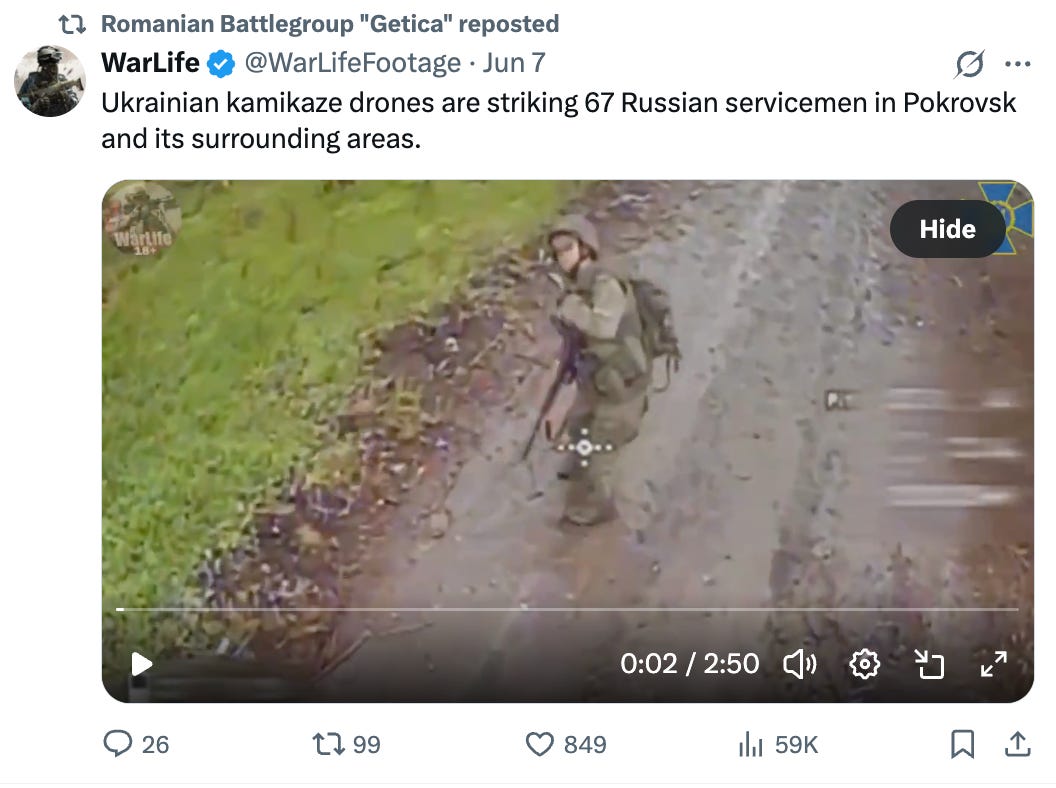
On June 7, the Getica account republished on X a video montage of FPV drone footage reaching their targets: 67 different Russian soldiers (with possibly a civilian among them)
If Romania’s Intelligence Services’ intent was to monitor — through surveillance or infiltration — before acting against Getica, eight months seem more than enough time to assess and intervene. But if Romanian intelligence services have some form of control over the battlegroup, then the continued expansion of the blacklist to include opposition politicians, journalists, and US citizens during that period is not a failure of oversight, but a state scandal.
The Ministry of Internal Affairs (MAI) did respond to our investigation, but only to state that, pursuant to Article 285(2) of the Criminal Procedure Code, criminal investigation proceedings are non-public — neither confirming nor denying that any proceeding exists.
Romania’s Intelligence Service (SRI) also replied, citing the classified nature of its activities, and neither confirmed nor denied whether Getica had ever been assessed as a national-security concern, whether information had been transmitted to Romanian authorities, or whether any monitoring or investigation existed.
As mentioned, formal inquiries sent to the Ministry of Foreign Affairs, the Romanian Presidency, and the French Presidency received no reply. The atmosphere is one of pervasive institutional ambiguity, in which responsibility is continually deferred while the blacklist continues to expand.
Three months ago, in a private conversation with a member of the Romanian government, I asked about the incapacity to prove Russian interference and the widespread suspicion that what happened was an inside job — the answer was unambiguous: “Of course. But you do realize that if they admit it wasn’t the Russians, the country would descend into chaos.”
Three months later, the credibility and legitimacy of Romania’s current regime are lower than ever. A vote of no confidence brought down the government on May 5. One month later, a Ukrainian drone exploded in the Romanian port of Constanța, and the authorities failed to obtain a clear explanation from Ukraine or to provide the public with a convincing account of the incident. The prospect of impeaching President Dan — unthinkable until recently — is now on the table [end]
Stéphane Luçon is a French journalist based in Romania. After Romania’s annulled elections, he began investigating the EU’s Digital Services Act — censorship, transparency failures — and its impact on the information flow
chronicle of censorship, fake news, whitewashing of the Ukrainian Nazism and war crimes, for the sake of the proxy war that NATO is conducting in Donbass and Ukraine, against Russia
Though Musk is still playing at being NATO’s token non-conformist, the EU is essentially telling him and all of us that any dissent from its Russophobic, Slavophobic and Sinophobic narratives will be severely punished
chronique alphabétique et nécrologique de l’engagement français dans les rangs atlantistes en Ukraine, ce que les journalistes serviles ne vous raconteront pas
its roots before WW2, its collaboration with Nazi Germany, its legacy in modern Ukraine, how NATO has continually supported Nazism in Ukraine, chronicle
Les références aux années 1930 se multiplient. La dégénérescence de la démocratie américaine semble nous ramener à celle de la république allemande de Weimar. Trump, par sa jouissance dans la violence et le mensonge, par l’exercice du mal, irrésistiblement nous ramène à Hitler. En Europe, la montée de mouvements catégorisés comme d’extrême-droite nous oblige à ce retour sur notre histoire.
Les sociétés occidentales ne ressemblent pourtant plus guère à ce qu’elles furent dans les années 1930. Elles sont vieillies, de consommation, tertiaires, les femmes y sont émancipées, le développement personnel y a remplacé l’adhésion partisane. Quel rapport avec les sociétés des années trente : jeunes, frugales, industrielles, ouvrières, masculines, encartées ? C’est cet éloignement socio-historique qui m’avait conduit à considérer jusqu’à ce jour comme a priori invalide le parallèle entre les « extrême-droites » du présent et celles du passé. Mais les doctrines politiques existent, aujourd’hui comme hier, et l’on ne peut se contenter de postuler l’impossibilité, par exemple, d’un nazisme de vieux, d’un franquisme de consommateurs, d’un fascisme de femmes libérées ou d’un LGBTisme Croix-de-Feu.
Le moment est venu de comparer les doctrines de notre présent à celles des années trente. Voici l’esquisse de ce que pourrait être l’étude comparative de cinq phénomènes historiques : l’hitlérisme, le trumpisme, le netanyahi(u)sme, le lepénisme. J’ajouterai en fin de parcours, brièvement, le macronisme. L’extrémisme centriste et européiste qui mène la France au chaos nous oblige à cet examen. Cet extrémisme est-il si centriste que ça ?
Il s’agira d’une approche impressionniste, sans prétention à l’exhaustivité ou même à la cohérence, dont le but est d’ouvrir des pistes, non de conclure. Je force les traits et les couleurs pour placer les concepts les uns par rapport aux autres. J’exagère à dessein, pour rattraper ou même anticiper une histoire qui s’accélère. Approche expressionniste serait peut-être une métaphore plus appropriée.
Commençons par la dimension générale du racisme ou de la xénophobie.
Le rejet d’un « autre » défini comme extérieur à la communauté nationale, avec des niveaux d’intensité très variables, est commun à l’hitlérisme, au trumpisme et au lepénisme. Dans le cas de l’hitlérisme et du trumpisme, c’est la notion de racisme, explicite ou implicite, qui est commune. Les Juifs étaient considérés par le nazisme comme constituant une race, au sens biologique. Les Noirs, ces cibles à peine cachées du parti républicain trumpisé, sont eux aussi définis biologiquement. Au lepénisme, en revanche, nous ne pouvons associer que le concept de xénophobie. Arabes ou Musulmans sont définis par leur culture. L’une des caractéristiques de l’obsession française de l’immigration reste sa fixation sur l’Islam et son incapacité à cibler les Noirs, dont l’arrivée massive pourtant est l’élément nouveau du processus migratoire. Le taux de mariages mixtes des femmes noires est très élevé en France, il reste insignifiant aux Etats-Unis.
Un trait commun aux « populismes » occidentaux est bien sûr leur refus de l’immigration : Reform UK, les Sverigedemokraterna (Démocrates de Suède), l’AfD, Viktor Orban en Hongrie, Droit et Justice en Pologne, Giorgia Meloni en Italie, passent, comme Trump ou le Pen, le test de ce dénominateur commun. Suffit-il à les définir comme d’extrême-droite, au sens où le nazisme et le fascisme étaient d’extrême-droite ? Je ne pense pas. Une différence capitale oppose le populisme d’aujourd’hui à l’extrême-droite de type hitlérien ou mussolinien : le nazisme et le fascisme était expansionnistes, avec pour but la projection vers l’extérieur de la puissance du peuple allemand (aryen) ou italien (romain). Ils étaient agressifs, nationalistes, conquérants. Ils s’appuyaient sur des partis de masse. On imagine mal les populistes actuels organiser des parades de style Nuremberg. Les apéritifs saucisson-pinard du RN sont certes antimusulmans mais, quand même, moins impressionnants que les cérémonies guerrières hitlériennes. De Nuremberg à Hénin-Beaumont ? Vraiment ?
Le seul populisme occidental qui passerait aujourd’hui à 100% le test de l’expansionnisme serait celui de Netanyahu. Colonies de Cisjordanie, génocide de Gaza : établir un lien entre hitlérisme et netanyah(u)isme – est inévitable.
Les xénophobies française, britannique, suédoise, finlandaise, polonaise, hongroise, italienne sont, à l’opposé du nazisme et du fascisme, défensives. Nous n’avons pas affaire à des peuples qui veulent conquérir mais à des peuples qui veulent rester maîtres chez eux. C’est pourquoi la dimension culturelle l’emporte aujourd’hui en Europe sur la notion raciale et pourquoi on ne peut parler ici que de xénophobie. Cette xénophobie est conservatrice, là où le racisme hitlérien était révolutionnaire parce qu’il bouleversait l’organisation sociale. La notion de nationalisme ne s’applique donc pas aux populismes européens actuels, la notion d’extrême-droite non plus, ou alors nous devrons introduire des oxymores comme « nationalisme modéré » et « extrême-droite modérée ». Je préfère parler de conservatisme populaire.
Personnellement favorable à une immigration contrôlée, je dois admettre la légitimité de cette xénophobie parce que j’accepte l’axiome qu’un groupe humain porteur d’une culture, conscient d’exister en tant que collectivité, bref un peuple, a le droit de vouloir continuer à exister. Concrètement : un peuple peut contrôler ses frontières. Le nazisme, avec ses soldats installés de l’Atlantique à la Volga pour y asservir ou y exterminer d’autres peuples était tout à fait autre chose.
Le trumpisme représente une forme mixte parce qu’il combine un élément central défensif, anti-immigration, à un fort potentiel d’agression du monde extérieur. Il ne s’agit pas à proprement parler d’expansionnisme. C’est l’expansion antérieure de l’appareil militaire américain et le rôle du dollar dans la prédation impériale qui ont rendu possibles les actes trumpiens violents dirigés contre d’autres peuples et nations : le Vénézuéla, l’Iran, nous, les peuples sujets européens de l’Ouest, et bien sûr les Arabes, avec les Palestiniens comme cible principale. L’intégration progressive d’Israël à l’Empire, à partir de 1967, fait qu’en 2025 on ne peut plus guère distinguer le trumpisme du netanyahisme. Mais Trump, au-delà de ses pitreries de nobélisable, est bien le coupable en chef du génocide de Gaza par ses encouragements de longue durée à la violence d’Israël : ce fait si simple fait tomber le trumpisme du côté de l’hitlérisme. Trump est toujours au volant : coups d’accélérateurs et coups de frein américains régulent l’agressivité génocidaire de Netanyahu. J’ai de la chance : au moment où j’écris, Trump, effrayé par la réaction des pays arabes au raid israélien sur le Qatar, et notamment par l’alliance stratégique entre l’Arabie saoudite et le Pakistan, recule. Il ordonne à Netanyahu de s‘excuser pour le bombardement au Qatar et celui-ci s’exécute. Trump impose à Israël un accord avec le Hamas et Netanyahu signe. Ensuite ? Trump est un pervers, impossible de dire.
Le concept de trumpo-netanyahisme, assez laid je l’admets, permet de cerner la question juive comme point commun à la crise américaine des années 2000-2035 et à la crise allemande des années 1920-1945.
La posture pro-Israël radicale du trumpisme masque selon moi un antisémitisme viscéral et vicieux : l’identification de tous les Juifs au netanyahisme, phénomène historique effectivement monstrueux, chancre dans l’histoire juive, n’aboutira qu’à renouveler la conception nazie d’un peuple juif monstrueux. Je parle ici d’antisémitisme 2.0.
Je suis conscient que peu de lecteurs me suivront sur ce point. Mais je ne fais ici que parler comme un banal prophète de l’Ancien testament. « Nous n’avons pas étés choisis pour être du côté des puissants. L’histoire n’en finit pas de nous tendre ce piège ». Combien de fois les Juifs se sont crus sauvés par les forts, par les puissants, par le pouvoir, par un empire, désignés même par un privilège – le succès financier, intellectuel, l’importance dans le parti bolchévique – pour être finalement jetés en pâture à des peuples furieux… Mon cœur saigne quand je vois tant de Juifs français, qui se croient aujourd’hui du côté du manche, justifier la politique de Netanyahu. Mais ce sont bien les mâchoires d’un piège qui sont en train de s’ouvrir. Par la grâce de Trump, la planète entière devient antisémite. Les Juifs américains, dont la majorité refuse la ligne Netanyahu, sont plus sages et plus justes. Mais, déjà, les Juifs hostiles à Netanyahu, universitaires ou non, sont soupçonnés par le pouvoir d’être antisémites. La perversité règne. Le trumpisme règne.
A quand la fermeture du piège ? Un jour, inévitablement les nations chrétiennes feront leur paix avec 1,6 milliards de musulmans. Les Juifs seront alors abandonnés par leurs fans et, désormais seuls, jetés en pâture à d’autres peuples furieux.
Les terres promises se succèdent, des désastres les suivent. Nightfall, précoce nouvelle d’Isaac Asimov, ce très grand auteur de science-fiction américain, me semble une métaphore de la longue suite de drames qui constitue l’histoire juive : au sein d’une civilisation puissante, un reste de prophétie annonce une mystérieuse catastrophe… elle arrive, surprenante… la civilisation s’effondre… puis, lentement, elle renaît, elle s’épanouit… un reste de prophétie annonce une mystérieuse catastrophe… elle arrive, surprenante…
En vérité, le seul retour de l’obsession juive au cœur de l’Occident valide l’hypothèse d’une continuité menaçante entre le passé et le présent.
Protestantisme zombie et nazisme, protestantisme zéro et trumpisme
La crise économique de 1929 fut un facteur déterminant, fort bien connu, de l’hitlérisation de l’Allemagne. 6 millions de chômeurs firent échapper la société allemande à toute force de rappel idéologique. La liquidation du chômage par Hitler en quelques mois scella le destin du libéralisme.
Le contexte religieux de l’ascension du nazisme, tout aussi important, est moins familier : entre 1870 et 1930, la foi protestante s’évanouit en Allemagne, d’abord dans le monde ouvrier, puis dans les classes moyennes et supérieures. Les régions catholiques résistèrent. En 1932 et 1933, la carte du vote nazi put donc reproduire, avec une exactitude fascinante, celle du luthéranisme. Le protestantisme ne croyait pas en l’égalité des hommes. Il y avait les élus, désignés comme tels par l’Éternel avant même leur naissance, et les damnés. La croyance métaphysique protestante une fois disparue, ce qui en resta fut l’hystérisation par la peur du vide de son contenu inégalitaire, avec les Juifs, les Slaves et tant d’autres comme damnés. Aux États-Unis, le protestantisme d’origine calviniste cibla les Noirs. Le peuple calviniste, fixé sur la Bible, s’identifiait aux Hébreux, ce qui borna l’antisémitisme américain des années trente et mis les Juifs à l’abri. Enfin… à l’abri jusqu’à l’émergence récente de la fixation évangéliste sur l’état d’Israël.
Dans la France catholique, (dans le Bassin parisien et sur la façade méditerranéenne particulièrement), l’effondrement de la foi et de la pratique firent à partir de 1730 muter l’égalité des chances d’accès au paradis (obtenue par le baptême, qui lave du péché originel) en égalité des citoyens et en émancipation des Juifs. L’idée républicaine d’homme universel remplaça celle du chrétien universel catholique (katholikos signifie universel en grec). Un tout autre programme que le nazisme mais qui avait représenté, bien avant lui, le premier remplacement massif d’une religion par une idéologie. Dans la France révolutionnaire comme dans l’Allemagne nazie, toutefois, le potentiel d’encadrement social et moral de la religion avait survécu à la croyance : l’individu restait membre de sa nation, de sa classe, porteur d’une éthique du travail et du sentiment d’obligations envers les membres du groupe. La capacité d’action collective était forte, décuplée peut-être. C’est ce que j’appelle stade zombie de la religion. Le nazisme correspondait à ce stade zombie, d’où, malheureusement, son efficacité économique et militaire.
Je pourrais compléter cette explication religieuse de l’idéologie par une explication de la religion elle-même, influencée par les structures familiales sous-jacentes, inégalitaires en Allemagne et égalitaires dans le Bassin parisien. Mais on peut se contenter ici d’une continuité du protestantisme au nazisme et du catholicisme à la Révolution française.
Nous retrouvons du protestantisme dans le trumpisme. Nous trouvons alors l’inégalité associée à la négrophobie. Nous ne sommes plus toutefois au stade zombie de la religion mais à son stade zéro. La moralité commune a disparu. L’efficacité sociale a disparu. L’individu flotte, particulièrement en cette Amérique de structure familiale nucléaire absolue, individualiste et sans règle d’héritage bien définie. C’est donc à autre chose qu’il faut s’attendre comme idéologie trumpiste : l’inégalité toujours, mais moins de stabilité dans le délire, des oscillations brutales qui ne proviennent pas, fondamentalement, du cerveau d’un président vulgaire et vicieux mais de la société elle-même. La capacité d’action collective, économique et militaire est, heureusement pour nous, très diminuée.
Notons dans le cas du trumpisme l’émergence de formes pseudo religieuse nihilistes qui incluent une réinterprétation obscène de la Bible, telle une glorification des riches. Nettement plus faible que le nazisme dans la dimension du racisme, le trumpisme va plus loin dans l’immoralité économique.
Le nazisme était simplement et explicitement antichrétien. Le trumpisme se veut religieux mais à la manière d’un culte satanique, par l’inversion des valeurs. Le mal c’est le bien, l’injustice c’est la justice. Hitler n’était que le Führer, guide du peuple allemand vers son martyr ; Trump n’est pas Satan mais je soupçonne que pour ses fans satanistes sa casquette rouge est celle de l’Antéchrist.
Dans le cas du lepénisme, aucun héritage inégalitaire protestant. C’est là le véritable mystère du Rassemblement National : xénophobe, il est né en terre catholique. Pire encore, ses premières zones de force, sur la façade méditerranéenne et dans le bassin parisien, furent celle de la Révolution : égalitaire sur le plan familial et déchristianisées dès le dix-huitième siècle. Alors ? Inégalitaire le Rassemblement National ? Égalitaire ? Mystère pour nous, le RN l’est probablement aussi pour lui-même. Son rejet de l’autre résulte d’un égalitarisme pervers qui exige une assimilation rapide des immigrés plutôt qu’il ne les ressent comme différents en essence. Surtout, le RN, fortement déterminé par le rejet des immigrés, et même de leurs enfants, n’en est pas moins sans cesse rappelé à la tradition égalitaire française parce que ses électeurs détestent les ultrariches, les puissants, bref nos élites imbéciles, et pas seulement les immigrés. C’est pourquoi l’union des droites peine à aboutir en France. Sous une forme ou sous une autre, l’union des oligarques et du peuple (blanc) contre l’étranger ne pose de problèmes ni aux États-Unis, ni au Royaume-Uni, ni en Scandinavie, où forces populaires conservatrices et forces de la droite classique s’entendent facilement. En France, la coalition des riches et des pauvres contre l’étranger se dérobe.
Ne sous-estimons pas toutefois la violence potentielle d’une xénophobie d’essence universaliste. Elle peut tout à fait devenir racisme. Si un homme pense a priori que les hommes sont partout les mêmes et qu’il se trouve confronté à des hommes porteurs de coutumes différentes, il peut très bien en conclure qu’ils ne sont pas des hommes.
Le RN est le produit d’un catholicisme zéro, comme la Révolution le fut d’un catholicisme zombie. C’est pourquoi il n’accouchera d’aucun projet collectif. Je renvoie l’examen détaillé du RN et de son rapport à l’avenir à un prochain texte, ni impressionniste, ni expressionniste, que je consacrerai tout entier à la logique interne et à la dynamique du chaos français.
Psychiatrie des classes moyennes supérieures
J’en viens maintenant à une différence capitale, qui devrait être évidente pour tous et rappelée par les commentateurs politiques qui nous renvoient sans cesse à 1930 par leur vocabulaire. Comprendre la dimension religieuse, ou post-religieuse, de l’hitlérisme, du trumpisme ou du lepénisme, présupposait des connaissances historiques qu’on ne peut exiger des politologues de plateau TV. En revanche, nous pouvons exiger d’eux qu’ils sachent situer socialement les idéologies du passé et du présent, qu’ils rapprochent sans relâche par le terme d’extrême-droite. La différence entre passé et présent est ici très claire.
Le nazisme et les mouvements d’extrême-droite d’avant-guerre trouvaient leur épicentre social dans les classes moyennes et particulièrement moyennes supérieures, menacées par le mouvement ouvrier, social-démocrate ou communiste. Ces classes moyennes étaient fébriles, fort occupées à enfermer leurs femmes et à persécuter les homosexuels. Aujourd’hui, les mouvements dits d’extrême-droite trouvent, à l’opposé, leur épicentre dans les milieux populaires, particulièrement dans un monde ouvrier appauvri, ébranlé ou détruit par la globalisation économique, menacé par l’immigration. Les classes moyennes d’aujourd’hui, largement définies par l’éducation supérieure, sont moins ou même faiblement touchées par « l’extrême droite ». Les classes moyennes supérieures, qui combinent éducation supérieure et revenus élevés, sont particulièrement immunes.
C’est pour cette raison que je préfère parler de conservatisme populaire plutôt que d’extrême droite. Son ancrage dans le groupe des dominés explique le caractère défensif du conservatisme populaire. Son électeur ne s’imagine pas conquérant de l’Europe ou du monde s’il pense sa propre vie comme une survie.
La vraie erreur intellectuelle serait de s’en tenir là. Continuons d’avancer, renversons même la problématique de l’association entre idéologie et classe. Nous avons comparé les idéologies du présent à celles du passé, comparons maintenant les classes du présent à celles du passé.
Certaines classes moyennes européennes de l’entre-deux-guerres entrèrent en folie. Le monde ouvrier fut plus raisonnable. Mais les classes moyennes d’aujourd’hui, particulièrement moyennes supérieures, sont-elles raisonnables ? Sont-elles pacifiques ? Quels sont leurs rêves ?
Ils sont fous. La construction d’une Europe post-nationale est un projet d’halluciné quand on connait la diversité du continent. Il a mené à l’expansion de Union européenne, bricolée et instable, dans l’ancien espace soviétique. L’UE est désormais russophobe, belliciste, avec une agressivité renouvelée par sa défaite économique face à la Russie. L’UE tente d’entraîner les peuples britannique, français, allemand et tant d’autres dans une vraie guerre. Mais quelle guerre étrange ce serait, dans laquelle les élites occidentales auraient adopté le rêve hitlérien de détruire la Russie !
La comparaison par les classes sociales nous permet donc une percée intellectuelle majeure. L’européisme, et donc le macronisme, tombent, par leur agressivité extérieure, du côté du nationalisme, du côté de l’extrême-droite d’avant-guerre. Si nous ajoutons les entorses à la liberté de l’information et à l’expression du suffrage populaire, entorses de plus en plus massives et systématiques dans l’espace UE, nous nous rapprochons plus encore de la notion d’extrême-droite. Fondé comme association de démocraties libérales, l’Europe mute en espace d’extrême droite. Oui, la comparaison avec les années trente est utile, indispensable même.
Nous retrouvons dans le grandiose projet européiste une dimension psychopathologique déjà observable dans l’hitlérisme : la paranoïa. La paranoïa européiste se concentre sur la Russie. Celle des nazis faisait de la menace juive une priorité, sans toutefois négliger le bolchévisme russe (dit judéo-bolchévisme).
Aujourd’hui comme hier nous pouvons donc analyser une psychopathologie des classes dirigeantes européennes. La séquence bizarre amorcée par l’élection de Trump, avec la volonté du président instable de discuter avec Poutine, nous a permis de suivre en direct la sortie de réalité de nos dirigeants à nous. Résumons notre processus délirant. Il a commencé vers 2014, avant, pendant et après Maidan, ce coup d’état qui a désintégré l’Ukraine, coup téléguidé par des stratèges américains et allemands. La suite maintenant :
2014-2022 : Provoquons la Russie qui avait averti qu’elle ne tolérerait pas l’annexion de l’Ukraine par l’Union européenne et l’Otan.
C’est fait. Poutine a envahi l’Ukraine.
2022-2025 : Perdons la guerre économique qui en a résulté pour nous.
C’est fait.Nos sociétés implosent.
2022-2025 : Perdons la guerre au sens strict menée pour notre compte par le régime de Kiev.
C’est en cours.
Le basculement des gouvernements européens dans une réalité parallèle commence en 2025.
Tirons de notre défaite l’idée que nous pouvons enfin imposer notre volonté et installer nos troupes en Ukraine, pour annexer à l’UE ce qui en restera. Mais comment ne pas penser à Hitler enfermé dans son bunker en 1945, pour y donner des ordres à des armées qui n’existent plus.
Nous avons aujourd’hui en Europe affaire à des fous, ou plutôt à une folie collective qui a saisi en masse les individus des milieux sociaux dominants. Rien qu’en France, des milliers de journalistes, d’hommes politiques, d’universitaires, de chefs d’entreprises, de hauts-fonctionnaires, participent à l’hallucination collective d’une Russie qui voudrait conquérir l’Europe (paranoïa). Tel ou tel individu ne saurait être tenu pour personnellement responsable. Nous avons affaire à une dynamique psychique collective.
Je suis convaincu que la diminution de l’individu né de l’état zéro de la religion explique la naissance de ces bancs de poissons russophobes.
Ainsi que je l’ai expliqué dans Les Luttes de classes en France au XXIème siècle, la disparition des croyances collectives – croyances religieuses puis croyances idéologiques de l’état religieux zombie – a conduit à un affaissement du surmoi humain. Au contraire des militants de la libération du moi, je ne définis pas le surmoi comme seulement ou même principalement répressif. Le surmoi, en tant qu’idéal du moi, ancre dans la personne des valeurs morales et sociales positives. Les notions d’honneur, de courage, de justice, d’honnêteté trouvent leur origine et leur force dans le surmoi. S’il s’affaiblit, elles s’affaiblissent. S’il disparaît, elles disparaissent. L’homme n’a donc pas été au final libéré par la fin de la religion et des idéologies mais au contraire diminué. Ce sont des hommes et des femmes fort éduqués mais rétrécis moralement et intellectuellement par l’état zéro de la religion qui sont, en masse, porteurs de la pathologie russophobe.
Les antisémites nazis avaient une tout autre constitution psychique. La mort de Dieu, pour parler comme Nietzsche, les avait certes lancés dans la quête d’un Führer mais ils n’étaient guère en déficit de surmoi et restaient capables d’action collective. Les tragiques performances de l’armée allemande durant la deuxième guerre mondiale en témoignent. Qui oserait imaginer aujourd’hui nos classes moyennes supérieures courant à la mort, à la tête de leurs peuples, vers Kiev et Kharkov ? Notre guerre d’Ukraine est pour rire, produit de l’émancipation du moi, fille du développement personnel. Seuls des Ukrainiens et des Russes mourront.
A moins que…
Les échanges thermonucléaires peuvent se passer de héros.
it was not easy to imagine, before the performance of Donald Trump in Israel and the meeting in Sharm El Sheikh, a more spectacular illustration of the repugnant political and social object that the Western world and its last auxiliaries are constituting today. Such depravity is calling for the most total destruction
Even leaders from the far-right Alternative for Germany party, which opposes aid to Ukraine, have embraced the jobs that come with new weapons production
Pour l’ancien premier ministre, se taire face à l’horreur de la situation dans l’enclave palestinienne n’est plus possible, le silence serait une forme de complicité. Chacun a le devoir d’agir et de nommer le crime en cours, affirme-t-il dans une tribune au « Monde »
chronique alphabétique et nécrologique de l’engagement français dans les rangs atlantistes en Ukraine, ce que les journalistes serviles ne vous raconteront pas
La perversité de Trump se déploie au Moyen-Orient, le bellicisme de l’OTAN en Europe
Je viens d’écrire à la demande de mon éditeur slovène une nouvelle préface à La Défaite de l’Occident, qu’il m’apparaît nécessaire de publier sur Substack immédiatement. La menace d’une aggravation de tous les conflits se précise. On trouvera dans ce texte une interprétation schématique et provisoire, mais actualisée du développement de la crise que nous vivons. Ce texte est de fait la conclusion de mon dernier entretien avec Diane Lagrange sur Fréquence Populaire : « Victoire de la Russie, enfermement et fracturation de la France et de l’Occident ».
Préface à l’édition slovène
De la défaite à la dislocation
Moins de deux ans après la publication en français de La Défaite de l’Occident, en janvier 2024, les principales prédictions du livre sont vérifiées. La Russie a militairement et économiquement tenu le choc. L’industrie militaire américaine est épuisée. Les économies et les sociétés européennes sont au bord de l’implosion. Avant même que s’effondre l’armée ukrainienne, le stade suivant de la dislocation de l’Occident est atteint.
Je suis depuis toujours hostile à la politique russophobe des États-Unis et de l’Europe mais, en tant qu’occidental attaché à la démocratie libérale, Français formé à la recherche en Angleterre, enfant d’une mère réfugiée aux États-Unis pendant la deuxième guerre mondiale, je suis catastrophé par les conséquences pour nous, Occidentaux, de la guerre menée sans intelligence contre la Russie.
Nous ne sommes qu’au début de la catastrophe. Un point de bascule approche au-delà duquel se développeront les conséquences ultimes de la défaite.
Le « Reste du monde » (ou Sud global, ou Majorité globale), qui s’était contenté de soutenir la Russie en refusant de boycotter son économie, affiche désormais ouvertement son soutien à Vladimir Poutine. Les BRICS s’élargissent en acceptant de nouveaux adhérents, ils accroissent leur cohésion. Sommée par les États-Unis de choisir son camp, l’Inde a choisi l’indépendance : les photos de Poutine, Xi et Modi réunis à l’occasion de la réunion d’aout 2025 de l’Organisation de Coopération de Shanghai resteront comme le symbole de ce moment clef. Les médias occidentaux ne cessent pourtant de nous représenter Poutine comme un monstre et les Russes comme des serfs. Ces médias avaient déjà été incapables d’imaginer que le Reste du monde les voit comme un dirigeant et des êtres humains ordinaires, porteurs d’une culture russe spécifique et d’une volonté de souveraineté. J’ai peur désormais que nos médias n’aggravent notre aveuglement en étant incapables d’imaginer le regain de prestige de la Russie dans ce Reste du monde, exploité économiquement et traité avec arrogance par l’Occident durant des siècles. Les Russes ont osé. Ils ont défié l’Empire et ils ont gagné.
L’ironie de l’histoire, c’est que les Russes, peuple européen et blanc, de langue slave, sont devenus le bouclier militaire du Reste du monde parce que l’Occident a refusé de les intégrer après la chute du communisme. J’imagine les Slovènes particulièrement bien placés culturellement pour apprécier cette ironie même si ce que je sais bien, en tant qu’anthropologue de la famille et de la religion, que, malgré sa langue slave, la Slovénie est beaucoup plus proche socialement et idéologiquement de la Suisse que de la Russie.
Je peux ébaucher ici un modèle de la dislocation de l’Occident, malgré les incohérences de la politique de Donald Trump, président américain de la défaite. Ces incohérences ne résultent pas, je pense, d’une personnalité instable, et sans doute perverse, mais d’un dilemme insoluble pour les États-Unis. D’une part, leurs dirigeants, au Pentagone comme à la Maison blanche, savent que la guerre est perdue et que l’Ukraine devra être abandonnée. Le bon sens les conduit donc à vouloir sortir de la guerre. Mais d’autre part, le même bon sens leur fait pressentir que le retrait d’Ukraine aura pour l’Empire des conséquences dramatiques que n’avaient pas eu ceux du Vietnam, d’Irak ou d’Afghanistan. Il s’agit en effet de la première défaite stratégique américaine d’échelle planétaire, dans un contexte de désindustrialisation massive des États-Unis et de réindustrialisation difficile. La Chine est devenue l’atelier du monde ; sa très faible fécondité, certes, lui interdira de remplacer les Etats-Unis, mais il est déjà trop tard pour la concurrencer industriellement.
La dédollarisation de l’économie mondiale a commencé. Trump et ses conseillers n’arrivent pas à l’accepter car ce serait la fin de l’Empire. Un âge post-impérial pourtant devrait être le but du projet MAGA, Make America Great Again, qui cherche un retour de l’état-nation américain. Mais pour une Amérique dont la capacité productive en biens réels est aujourd’hui très faible (voir chapitre 9 sur la vraie nature de l’économie américaine), il est impossible de renoncer à vivre à crédit comme elle le fait en produisant des dollars. Un tel retrait impérial-monétaire impliquerait une chute brutale de son niveau de vie, y compris pour les électeurs populaires de Trump. Le premier budget de la deuxième présidence Trump, le « One Big Beautiful Bill Act », reste donc impérial malgré les protections tarifaires qui incarnent le projet ou rêve protectionniste. L’ OBBBA relance les dépenses militaires et le déficit. Qui dit déficit budgétaire aux États-Unis dit, inévitablement, production de dollars et déficit commercial. La dynamique impériale, l’inertie impériale plutôt, n’en finit pas de miner le rêve d’un retour à l’état-nation productif.
En Europe, la défaite militaire reste mal comprise des dirigeants. Ils n’ont pas dirigé les opérations. C’est le Pentagone qui avait mis au point les plans de la contre-offensive ukrainienne de l’été 2023 (durant laquelle j’avais écrit La Défaite de l’Occident). Les militaires américains, même s’ils ont fait mener la guerre par leur proxy ukrainien, savent qu’ils se sont brisés sur la défense russe – parce qu’ils ne pouvaient produire assez d’armes et parce que les militaires russes ont été plus intelligents qu’eux. Les dirigeants européens n’ont fourni que des systèmes d’armes et pas les plus importants. Inconscients de l’ampleur de la défaite militaire, ils savent en revanche que leurs propres économies ont été paralysées par la politique de sanctions, tout spécialement par la rupture de leur approvisionnement en énergie russe bon marché. Couper en deux économiquement le continent européen fut un acte de folie suicidaire. L’économie allemande stagne. Partout à l’ouest, la pauvreté et les inégalités augmentent. Le Royaume-Uni est au bord du gouffre. La France le suit de près. Sociétés et systèmes politiques sont bloquées.
Une dynamique économique et sociale négative préexistait à la guerre et mettait déjà l’Occident sous tension. Elle était visible, à des degrés divers, dans toute l’Europe de l’Ouest. Le libre-échange y mine la base industrielle. L’immigration y développe un syndrome identitaire, particulièrement dans les classes populaires privées d’emplois sûrs et correctement payés.
Plus en profondeur, la dynamique négative de fragmentation est culturelle : l’éducation supérieure de masse crée des sociétés stratifiées dans lesquelles les éduqués supérieurs – 20%, 30%, 40% de la population – se mettent à vivre entre eux, à se penser supérieurs, à mépriser les milieux populaires, à rejeter le travail manuel et l’industrie. L’éducation primaire pour tous (l’alphabétisation universelle) avait nourri la démocratie, créant une société homogène dont le subconscient était égalitaire. L’éducation supérieure a engendré des oligarchies, et parfois des ploutocraties, sociétés stratifiées envahies par un subconscient inégalitaire. Paradoxe ultime : le développement de l’éducation supérieure a fini par produire dans ces oligarchies ou ploutocraties une baisse du niveau intellectuel ! J’avais décrit cette séquence il y a plus d’un quart de siècle dans L’Illusion économique, publiée en 1997. L’industrie occidentale s’en est allée dans le Reste du monde et aussi, bien sûr, dans les anciennes démocraties populaires d’Europe de l’Est qui, libérées de leur sujétion à la Russie soviétique, ont désormais retrouvé leur statut pluriséculaire de périphérie dominée par l’Europe de l’Ouest. Je parle en détail au chapitre 3 de cette espèce de Chine intérieure où les ouvriers d’industrie restent nombreux. Partout cependant en Europe l’élitisme des éduqués supérieurs a engendré le « populisme ».
La guerre a fait monter d’un cran la tension européenne. Elle appauvrit le continent. Mais surtout, échec stratégique majeur, elle délégitime des dirigeants incapables de mener leurs pays à la victoire. Le développement de mouvements populaires conservateurs (habituellement désigné par les élites journalistiques par des termes comme « populistes » ou « d’extrême droite » ou « nationalistes ») s’accélère. Reform UK au Royaume-Uni. AfD en Allemagne, Rassemblement national en France… Ironie toujours : les sanctions économiques dont l’OTAN attendait un « regime change » en Russie sont sur le point d’apporter à l’Europe occidentale une cascade de « regime changes ». Les classes dirigeantes occidentales sont délégitimées par la défaite au moment même où la démocratie autoritaire russe est relégitimée par la victoire, ou plutôt, surlégitimée puisque le retour de la Russie à la stabilité sous Poutine lui assurait au départ une légitimité incontestée.
Tel est notre monde à l’approche de 2026.
La dislocation de l’Occident prend la forme d’une « fracturation hiérarchique »
Les États-Unis renoncent au contrôle de la Russie, et je le pense de plus en plus, de la Chine. Mis sous blocus chinois pour leurs importations de samarium, cette terre rare indispensable à l’aéronautique militaire, les États-Unis ne peuvent plus rêver d’affronter la Chine militairement. Le Reste du monde – Inde, Brésil, monde arabe, Afrique – en profite et leur échappe. Mais les États-Unis se retournent vigoureusement contre leurs « alliés » européens et est-asiatiques, dans un effort ultime de surexploitation, et aussi, il faut l’admettre, par pur et simple dépit. Pour échapper à leur humiliation, pour cacher au monde et à eux-mêmes leur faiblesse, ils punissent l’Europe. L’Empire se dévore lui-même. C’est le sens des tariffs et investissements forcés imposés par Trump aux Européens, devenus sujets coloniaux dans un empire rétréci plutôt que partenaires. Le temps des démocraties libérales solidaires est fini.
Le trumpisme est un « conservatisme populaire blanc ». Ce qui émerge en Occident n’est pas une solidarité des conservatismes populaires mais une rupture des solidarités internes. La rage qui résulte de la défaite conduit chaque pays, pour éponger son ressentiment, à se retourner contre plus faible que lui. Les États-Unis se retournent contre l’Europe ou le Japon. La France réactive son conflit avec l’Algérie, ancienne colonie. Nul doute que l’Allemagne, qui, de Scholz à Merz, a accepté d’obéir aux Etats-Unis, ne retourne son humiliation contre ses partenaires européens plus faibles. Mon propre pays, la France, me semble le plus menacé.
L’un des concepts fondamentaux de la défaite de l’Occident est le nihilisme. J’explique comment « l’état zéro » de la religion protestante – la sécularisation arrivée à son terme – n’explique pas seulement l’effondrement éducatif et industriel américain. L’état zéro ouvre aussi un vide métaphysique. Je ne suis pas personnellement croyant et je ne milite pour aucun retour du religieux (je ne le crois pas possible) mais je dois, en tant qu’historien, constater que la disparition des valeurs sociales d’origine religieuse mène à une crise morale, à une pulsion de destruction des choses et des hommes (la guerre) et ultimement à une tentative d’abolition de la réalité (le phénomène transgenre pour les démocrates américains et la négation du réchauffement climatique pour les républicains par exemple). La crise existe pour tous les pays complètement sécularisés mais elle est pire dans ceux dont la religion était le protestantisme ou le judaïsme, religions absolutistes dans leur recherche du transcendant, plutôt que le catholicisme, plus ouvert à la beauté du monde et de la vie terrestre. C’est bien en aux États-Unis et en Israël que l’on voit se développer des formes parodiques des religions traditionnelles, parodies d’essence selon moi nihiliste.
Cette dimension irrationnelle est au cœur de la défaite. Celle-ci n’est donc pas seulement une perte « technique » de puissance mais aussi un épuisement moral, une absence de but existentiel positif qui mène au nihilisme.
Ce nihilisme est derrière la volonté des dirigeants européens, particulièrement sur les bords protestants de la Baltique, d’élargir la guerre contre la Russie par des provocations incessantes. Ce nihilisme est aussi derrière la déstabilisation américaine du Proche-Orient, lieu par excellence d’expression de la rage qui résulte de la défaite américaine face à la Russie. Surtout, ne cédons pas à l’évidence trop facile d’une autonomie guerrière du régime Netanyahu en Israël dans le génocide de Gaza ou dans l’attaque contre l’Iran. Protestantisme-zéro et judaïsme-zéro mêlent certes tragiquement leurs effets nihilistes dans ces accès de violence. Mais partout au Moyen-Orient ce sont bien les États-Unis qui, en fournissant les armes et parfois en attaquant eux-mêmes, sont en dernière instance les décideurs du chaos. Ils poussent Israël à l’action comme ils ont poussé les Ukrainiens. La première présidence Trump avait établi l’ambassade des États-Unis à Jérusalem et c’est bien Trump qui le premier a imaginé Gaza transformé en station balnéaire. Je suis conscient qu’il faudrait un livre pour démontrer cette thèse, un livre qui démonterait une à une les interactions entre les acteurs. Mais, historien de métier, et faisant de la géopolitique depuis un-demi-siècle, je sens que, comme l’Europe otanienne, Israël a cessé d’être un état indépendant. Le problème de l’Occident est bien la mort programmée de l’état-nation.
L’Empire est vaste et il se décompose dans le bruit et la fureur. Cet Empire est déjà polycentrique, divisé sur ses buts, schizophrène. Mais aucune de ses parties n’est indépendante du tout. Trump est son « centre » actuel ; il est aussi sa meilleure expression idéologico-pratique en ce qu’il mêle une volonté rationnelle de repliement sur sa sphère de domination immédiate (l’Europe et Israël) à des impulsions nihilistes de préférence pour la guerre. Ces tendances – repliement et violence – s’expriment aussi à l’intérieur du cœur américain de l’Empire où le principe de fracturation hiérarchique fonctionne en interne. Des auteurs anglo-américains de plus en plus nombreux évoquent la venue d’une guerre civile.
La ploutocratie américaine est pluraliste. Il y a celle des financiers, celle des pétroliers, celle de la Silicon Valley. Les ploutocrates trumpistes, pétroliers texans ou ralliés récent de la Silicon Valley, méprisent les élites éduquées démocrates de la côte Est, qui méprisent elles-mêmes les petits-blancs trumpistes du heartland, qui méprisent eux-mêmes les Noirs démocrates, etc…
L’une des particularités intéressantes de l’Amérique actuelle est que ses dirigeants ont de plus en plus de mal à distinguer l’interne de l’externe, malgré la tentative MAGA d’arrêter par un mur l’immigration venue du sud. L’armée tire sur des bateaux qui sortent du Vénézuéla, elle bombarde l’Iran, elle entre dans le centre des villes démocrates des États-Unis, elle commandite l’aviation israélienne pour une attaque sur le Qatar où se trouve une immense base américaine. Tout lecteur de science-fiction reconnaîtra dans cette énumération inquiétante l’amorce d’une entrée en dystopie, c’est-à-dire dans un monde négatif où se mêlent puissance, fragmentation, hiérarchie, violence, pauvreté et perversité.
Restons donc nous-mêmes, hors de l’Amérique. Gardons notre perception de l’intérieur et de l’extérieur, notre sens de la mesure, notre contact avec la réalité, notre conception de ce qui est juste et beau. Ne nous laissons pas non plus entraîner dans une fuite en avant guerrière par nos propres dirigeants européens, ces privilégiés égarés dans l’histoire, désespérés d’avoir été vaincus, terrorisés à l’idée d’être un jour jugés par leurs peuples. Et surtout, surtout, continuons de réfléchir au sens des choses.
voici la synthèse de Grok, l’outil US d’intelligence artificielle de X
A blog preface to the Slovenian edition of Emmanuel Todd’s 2024 book La Défaite de l’Occident, updating his analysis of Western geopolitical failures, including Russia’s resilience in Ukraine and Global South alignment against U.S. dominance.
Todd critiques Trump’s Middle East policies as extensions of U.S. imperial nihilism, linking them to actions like arming Israel for Gaza operations, while highlighting NATO’s bellicose Ukraine strategy as a catalyst for European economic stagnation and rising populist movements.
Amid de-dollarization and China’s industrial ascent, Todd warns of deepening Western internal fractures, such as U.S. tariffs on allies and moral exhaustion from Protestant secularization, potentially eroding liberal democracies without viable paths to recovery.
Scott Ritter is a former intelligence officer (1984-1996) within the US Marines corps, became famous as weapons inspector (1991-1998) within the United Nations special commission about weapons of mass destruction (WMD) in Iraq. With professionalism and foresight, he warned that the US and British governments were using the myth of Iraqi WMD as a pretext for invasion in 2003. He was right
chronique alphabétique et nécrologique de l’engagement français dans les rangs atlantistes en Ukraine, ce que les journalistes serviles ne vous raconteront pas
chronique en Anglais, its roots before WW2, its collaboration with Nazi Germany, its legacy in modern Ukraine, how NATO has continually supported Nazism in Ukraine
Comment comprendre la marginalisation actuelle de la France sur la scène internationale, ainsi que son hystérie belliciste sous l’égide de Macron ? Pourquoi avons-nous à ce point renoncé à défendre nos intérêts industriels nationaux, contrairement aux États-Unis et à l’Allemagne ? Comment l’oligarchie techno-financière française a-t-elle pu en arriver à trahir aussi complètement le peuple avec l’appui de la petite-bourgeoisie de gauche hexagonale, armée d’une fausse conscience pro-européenne ? Marc de Sovakhine, haut-fonctionnaire écrivant sous pseudonyme pour QG, émet une série d’hypothèses fascinantes. À lire ce week-end
Du rêve impérial à l’ordre néolibéral
Nous n’avons pas suffisamment pris la mesure du rôle central que les élites françaises ont joué depuis près d’un demi-siècle dans la construction de l’ordre néolibéral tant à l’échelle européenne que mondiale. Si cet ordre a été pensé et initié par des penseurs et acteurs austro-allemands et anglo-américains, ce sont, dans une large mesure, des technocrates français qui ont mis leur savoir-faire d’organisateurs au service de sa construction juridico-institutionnelle au sein des organisations supranationales créées à cet effet. Ils ont également été parmi les premiers à se porter volontaires pour occuper les places dans les conseils d’administration et les comités exécutifs des nouveaux acteurs globalisés de la finance, grandes banques et fonds internationaux.
L’ordre néolibéral actuel se donne à voir comme le reflet troublé des anciens empires européens : les Britanniques ont transmis le flambeau de l’hégémonie mondiale (économique et militaire) à leurs cousins américains, les Austro-Allemands à l’Union européenne leur rêve impérial conçu à l’échelle du continent sur le modèle des empires centraux et les Français à leurs élites frustrées par l’échec de leur vocation impériale l’espace déterritorialisé des institutions du marché globalisé ; comme si l’universalisme abstrait de la fille aînée de l’Eglise, revisité par l’idéal hugolien de la « République universelle » (« O France, adieu! tu es trop grande pour n’être qu’une patrie »), s’était finalement dissous dans les abstractions de la marchandise et du capital. Si les deux premières utopies impériales s’attachent encore à des territoires (le monde et le continent européen), la troisième se projette dans un espace de règles de droit et d’institutions supranationales qui viennent mailler les flux mondiaux de marchandises et de capitaux. La France comme fille aînée du Marché globalisé aura sans doute été la plus sensible aux visions eschatologiques de Francis Fukuyama.
A partir de la fin de années 1970, le FMI a été dirigé par des haut fonctionnaires français de façon ininterrompue de 1978 à 2000, puis de 2007 à 2019. Les Américains qui, de leur côté, s’étaient attribué la direction de la Banque mondiale, poussèrent dans ce sens, trop contents de pouvoir bénéficier de leur expertise bureaucratique reconnue et d’arrimer à leur agenda des élites françaises dont les ambitions se sont mises à devenir trop grandes pour se contenter de leur patrie. De 1985 à 1995, dans ces années décisives pour ladite « construction européenne », entre l’entrée en vigueur de l’Acte unique et la création de la monnaie unique, le démocrate-chrétien Jacques Delors présidera la Commission européenne. C’est sous sa conduite et sur la base d’un pacte franco-allemand que la future Union européenne prendra sa forme actuelle d’un Empire du droit marchand et capitaliste qui place ses États membres sous souveraineté limitée dans un espace marchand unique où s’organise, une fois levés tous les obstacles au commerce et à l’investissement et sous le régime du droit de la concurrence, la division internationale du travail à l’échelle du continent. Certes, si Mitterrand, qui portait sur le monde un regard de politique, a accepté de renouveler le compromis avec l’Allemagne, vingt ans après le Traité de l’Elysée, c’est surtout parce qu’il ne se doutait pas que l’URSS s’écroulerait aussi vite, offrant à son voisin d’outre-Rhin la possibilité de reconstituer sa zone d’expansion économique en Europe centrale. En 1991, il est déjà trop tard mais il espère pouvoir encore enfermer l’Allemagne réunifiée dans un vaste espace politique eurasiatique borné à l’est par la Russie, l’autre puissance nucléaire. De leur côté, les technocrates dont il s’est entouré nourrissent en parallèle d’autres projets
Dominique Strauss-Kahn fut président du Fond monétaire international de 2007 à 2011, avant d’être remplacé par une autre personnalité française, Christine Lagarde, présidente de l’institution de 2011 à 2019. Cette dernière est aujourd’hui présidente de la Banque centrale européenne(BCE)
À la même époque, le cœur de l’Etat français se met au service de la constitution de grands groupes bancaires dans la perspective de faire de Paris la plus grande place financière du continent. De la décision prise par Mitterrand de maintenir la France dans le système monétaire européen en 1983 jusqu’au grand mouvement de concentration, sous le gouvernement Jospin, du secteur bancaire à la fin des années 1990, la fraction la plus modernisatrice de la haute fonction publique va prêter main forte à la constitution de grandes banques universelles, privatisées quelques années plus tôt et adossées à un marché de capitaux profond, profitant de la force de la monnaie allemande, poumon industriel du continent. Delors à Bruxelles, le ministre Bérégovoy engage la modernisation et le décloisonnement des marchés de capitaux en France au mitan des années 1980. Il réformera, dans le même mouvement, les instruments de dette publique pour les adapter aux demandes de liquidité des marchés modernisés. Quinze ans plus tard, comme pour clore le cycle, Dominique Strauss-Kahn supervise depuis Bercy, à la veille de l’entrée en vigueur de la monnaie unique, l’achèvement des grandes opérations de concentration bancaires. Les contours de la répartition des rôles entre la France et l’Allemagne se dessinent nettement au début du siècle. Le modèle mercantiliste allemand soutient une monnaie forte qui autorise l’Etat français à s’endetter à moindre coût – pour maintenir la paix sociale face aux conséquences de la désindustrialisation et ménager les passions rentières de la vieille bourgeoisie française – et aux banques hexagonales de consolider leurs ambitions internationales, entraînant dans leur sillage l’industrie nationale.
Depuis 2017, Bercy et la place financière de Paris sont plus que jamais résolus à poursuivre le cap que la France s’est fixé il y a quarante ans. « Paris est en première ligne, comme le titrait récemment Les Echos, pour faire avancer l’Union des marchés de capitaux », dans la foulée du rapport rendu par l’ancien gouverneur de la Banque de France Christian Noyer et de celui de Mario Draghi, accueilli dans un concert de louanges. L’idée est de décloisonner les marchés de capitaux européens par la standardisation des produits financiers et l’assouplissement des règles de « titrisation » des créances bancaires en titres négociables sur les marchés. En somme, accélérer la prise de pouvoir du capital financier qui a déjà mis plusieurs cordes au cou des Etats toujours plus endettés, au motif de « financer l’avenir ». Du reste, en favorisant la montée en puissance des produits d’épargne retraite par capitalisation à travers le P.E.R, petite sœur du produit paneuropéen d’épargne retraite (PEPP), la récente réforme des retraites en France constitue l’une des étapes-clés de ce processus : « désocialiser » le financement des retraites et pousser les assurés sociaux, à l’unisson des épargnants, à placer leur épargne désocialisée auprès de fonds à long terme peu liquides et au capital non garanti, sur le modèle de fonds de pension néerlandais, pourtant enclins à des crises répétées depuis vingt ans. Pas de quoi effrayer les artisans de l’omnipotence du capital financier, pour qui la crise agit comme un pharmakon de choc, poison pour les sociétés et remède pour justifier l’extension de son pouvoir.
L’unification des forces de la bourgeoisie française sous la forme d’une oligarchie techno-financière
À la faveur de cet accord plus ou moins tacite entre la France et l’Allemagne, toutes les composantes de la bourgeoisie française, qui autrefois pouvaient encore s’opposer entre elles, ont entrepris nolens volens leur unification pour se placer sous le commandement du capital financier. L’ancienne « noblesse d’État » a amorcé sa fusion avec la grande bourgeoisie financière internationalisée, formant avec elle une oligarchie techno-financière dénationalisée à laquelle se sont assujetties la bourgeoisie industrielle et à la petite bourgeoisie, comme toujours à la remorque. On a fait sortir Fouquet de prison pour l’installer à Versailles où chaque année est organisée la grand-messe de l’attractivité, « Choose France ». Emmanuel Macron, candidat de la grande banque et de la haute fonction publique logée à Bercy, est à la fois le produit et l’artisan terminal de cette mutation
« Choose France », la grand-messe de l’attractivité lancée en 2018 par Macron, peu après son accession à la présidence de la République, vise à séduire les multinationales et à les inciter à investir en France
Là où les banques allemandes continuent encore de financer un tissu industriel composé d’entreprises dont le capital demeure très contrôlé et les chaînes de valeur resserrées en Europe centrale, leurs homologues françaises, arrimées à un horizon sans territoire et façonnées pour affronter les marchés mondiaux, se sont détournées du tissu productif national, accompagnant l’internationalisation des grandes entreprises françaises dont la détention capitalistique et les chaînes de valeur offrent un degré d’ouverture et d’extraversion parmi les plus élevés des économies occidentales. Ce fut l’appel du large pour les grandes banques universelles et les anciens fleurons industriels, pressés, avec le concours de l’Etat, de s’ébrouer dans les eaux tumultueuses des marchés internationaux encadrés par un ordre supranational assis sur les droits imprescriptibles de la marchandise et du capital. Un appel doublé de celui à prendre des places pour ces nouveaux mercenaires attachés, en guise de politique industrielle, à louer les vertus de « l’attractivité » d’un pays qu’ils prostituent pour pouvoir eux-mêmes se prostituer comme individus dont les trajectoires sociales ont changé d’échelle.
Se plaçant sous la protection de la monnaie unique – un Deutschemark européen – et s’en remettant aux mânes du marché globalisé, l’oligarchie techno-financière ne voyait plus aucune raison de conserver en France une base industrielle sans laquelle l’exercice effectif de la souveraineté devient pourtant illusoire. Nostalgique de son rêve impérial, elle lit dans le destin des Etats-Unis celui dont l’Histoire l’a privée dans un pays qui n’a plus les moyens de la hisser sur le pavois du monde ; pour lui redonner vie, il lui fallait encore l’associer à celui que l’Allemagne se surprend, elle aussi, à mûrir dans les territoires libérés par la fonte du glacis soviétique. L’Union européenne deviendra le cadre économique et juridique où peut s’incarner un destin impérial enchâssé dans celui de l’hégémon américain. Comme l’a bien montré Quinn Slobodian dans son livre Les globalistes – Une histoire intellectuelle du néolibéralisme, la pensée néolibérale nait dès les années 1920 dans les décombres de l’Empire des Habsbourg qui constituait, aux yeux de Friedrich Hayek et de Wilhelm Röpke, un modèle d’organisation efficace pour repenser un espace articulé autour de la primauté juridique du dominium marchand sur l’imperium d’Etats interdépendants, déclinaison de la distinction ancienne entre l’auctoritas de l’empereur et la potestas des rois. Leurs successeurs, réunis au lendemain de la Seconde guerre mondiale au sein de l’école ordo-libérale, s’attacheront à ériger, dans une filiation avec la tradition juridique allemande du Rechtsstaat, les libertés économiques et le droit de propriété au rang de droits de l’homme garantis par des institutions s’imposant aux Etats souverains. Il s’agit, en dernier ressort, de tenir les peuples à l’écart au sein d’un ordre pensé comme un ajustement souple aux mouvements du marché globalisé et du capital.
Au terme de ce vaste mouvement de recomposition de la division internationale du travail ordonné par des institutions supranationales, l’oligarchie techno-financière française s’est libérée de sa chrysalide nationale pour rejoindre les grandes citadelles – Bruxelles, Londres, Francfort, Washington – de son nouvel empire sans territoire. On ne fait carrière aujourd’hui au Ministère de l’Economie et des finances qu’en acceptant de passer par l’une d’entre elles. En liant le destin de la France aux lois de cet ordre néolibéral stratifié, elle l’a, du même coup, délibérément amputée d’une partie de sa souveraineté et privée de ses marges de manœuvre. C’est ainsi qu’il faut comprendre actuellement l’isolement et la marginalisation de la France sur la scène internationale.
Au sein des élites dirigeantes, une partie importante, souvent des gens de qualité animés du sens de l’intérêt général, s’est vu confier la fastidieuse gestion de la province française de l’Empire anglo-américain secondé par son délégataire allemand. On en trouve encore dans le corps préfectoral, mais aussi dans tous les échelons décentralisés et démembrés de l’État, collectivités locales et autres établissements publics placés sous contrainte budgétaire, où leurs soutiers tentent chaque jour de colmater la carène d’un navire navigant au gré des courants impétueux de la mondialisation et des possibilités de débarquement des troupes de choc de l’oligarchie qu’il convoie. Réduite à une opposition stérile et placée sous perfusion de dette publique dans les fiefs subventionnés où elle cultive une opposition stérile, la petite bourgeoisie dont le cœur penche à gauche permet, quant à elle, à l’oligarchie techno-financière hors-sol, avec qui elle communie dans les dogmes de la construction européenne et de la « société ouverte », de s’accrocher au pouvoir. Jamais, dans l’histoire de la République, n’avait-on vu une classe dirigeante aussi minoritaire dans la société. Sans le renfort de la petite bourgeoisie armée d’une fausse conscience qui vient se nicher dans un barragisme aussi inconséquent qu’indispensable à sa perpétuation en tant que classe d’appoint, l’oligarchie ne pourrait pas continuer à diriger le pays.
Une nouvelle donne ?
Le « moteur franco-allemand » avait déjà commencé à s’enrayer ; depuis le déclenchement de la guerre en Ukraine, il menace d’exploser. Sommes-nous préparés à ce que nous imaginions encore impensable il y a quelques années ?
Le Premier ministre britannique Keir Starmer avec Olaf Scholz, alors chancelier allemand, Volodymyr Zelensky, président de l’Ukraine, et Emmanuel Macron à l’occasion du sommet de la Communauté politique européenne (CPE) en 2024
L’un des enjeux de l’après-guerre est de savoir qui, de l’Allemagne ou de la France, s’imposera – en retenant l’hypothèse d’une perspective de sortie prochaine du conflit – comme le principal interlocuteur de la Russie et chef de file européen pour rebâtir une sécurité collective en Europe. Privée de gaz russe, l’Allemagne a renforcé sa dépendance aux États-Unis et assiste à l’agonie de son modèle économique, mais refuse de se laisser mourir et pousse à la signature rapide de traités de libre-échange afin de se ménager de nouveaux débouchés et subventionner son industrie par la baisse attendue du prix des produits agricoles en Europe. Sa ligne est constante depuis les négociations du Traité de Rome en 1957 au cours desquelles elle avait tenté de s’opposer aux accords préférentiels avec le continent africain en voie de décolonisation, avant de voir son objectif satisfait à la faveur du « Consensus de Washington » dans les années 1990. Après avoir annoncé un plan d’investissement de cent milliards d’euros en vue de son réarmement, elle entend faire de son industrie de défense la base matérielle de « l’Europe de la défense », alors que tous les projets d’armement franco-allemands sont au point mort. La ministre des affaires étrangères Annalena Baerbock a déclaré le 13 novembre au Bundestag vouloir une « Europe unie » avec une Allemagne « prête à diriger ».
La France, de son côté, a abandonné depuis longtemps toute réflexion géostratégique. Son oligarchie n’a aucun intérêt à renoncer à l’utopie fukuyamesque d’une harmonie par le marché conduite par les États-Unis et garantie en Europe par une discipline juridico-marchande d’inspiration germanique, consentie en contrepartie d’une monnaie unique à l’ombre de laquelle elle s’est constituée comme classe unifiée. Les efforts de la diplomatie française sont désormais presque exclusivement orientés vers la signature de contrats d’armement pour offrir des débouchés à son industrie militaire et maintenir une autonomie stratégique qui s’avère illusoire en l’absence de stratégie et d’un plan de paix. Depuis que son mini-complexe militaro-industriel a entrepris de mettre ses armements aux normes de l’OTAN, elle espère, face à l’Allemagne, trouver de nouveaux clients parmi les autres Etats européens qui se fournissent presque exclusivement auprès des Etats-Unis, aggravant les risques d’une escalade guerrière.
Si la France adoptait une conduite rationnelle et conforme à ses intérêts, à l’instar des Etats-Unis ou de l’Allemagne, elle profiterait de ce retour du politique dans les affaires du monde pour repenser l’équilibre du continent, dans le cadre d’une relation raisonnée avec la Russie, et desserrer l’étau germano-américain. Ceci exigerait de s’affranchir du carcan des traités européens et de recouvrer les instruments de la souveraineté ; de ne plus tourner le dos à une Histoire que l’oligarchie techno-financière, enchaînée à ses abstractions impériales, a prétendu vouloir « dépasser ». Rien n’est moins sûr de la part de cette classe attachée à ses privilèges et à la préservation desquels elle a sacrifié des pans entiers de notre économie.
Il est des débâcles moins spectaculaires que celle de 1940 mais de celle-ci, insidieuse et lancinante, il sera difficile de s’en remettre sans un sursaut du peuple français qui, comme souvent dans son histoire, ne peut compter que sur lui-même pour ne pas disparaitre et échapper à l’impasse du rêve impérial à laquelle le condamnent ses élites [fin]
chronique alphabétique et nécrologique de l’engagement français dans les rangs atlantistes en Ukraine, ce que les journalistes serviles ne vous raconteront pas
The SMO [Special Military Operation] will keep rollin’ on. And as the Europeans want it, to the last Ukrainian
[my illustration: a German prisoner in Stalingrad in January 1943 (Soviet archives)]
Let’s start with U.S. Secretary of State Marco Rubio’s Road to Damascus moment:
Frankly, it’s a proxy war between nuclear powers, the United States helping Ukraine and Russia, and it needs to come to an end
Now that’s a howler. Jeffrey Sachs to the rescue. Of course, the correct formulation would be “proxy war launched by the United States”. But still: Hallelujah! Such illumination – by proxy – from Heavens Above could never had hit the previous American Secretary of Genocide.
Now cut to panic. Total European panic.
Le Petit Roi, as popular in France as nighttime mosquitoes in a five-star beach resort, has declared that peace in Europe is only possible with a “tamed” Russia – and that Russia is a direct threat to France and Europe.
On Ukraine, he pontificated that peace simply cannot take place under Russian terms or via the – inevitable – Ukrainian surrender.
Le breathless Petit Roi literally went nuclear. He stressed that France possesses a nuclear deterrent – and offered it to the rest of Europe, while insisting that Europe’s future should not be dictated by Moscow or Washington.
Le Petit Roi napoleonically all but declared war on Russia. Well, the fact remains that the overwhelming majority of France would gladly agree that mini-Napoleon should be dispatched to the battlefields in the black soil of Novorossiya right away – where he would surrender in less than 5 minutes, waving a rainbow flag, as he realizes he’s about to be turned into an instant steak tartare.
Now couple this Moliere farce with the fate of the much larger, fatter, pan-European New Model Woke Army regimented by the Fuhrerin SS von der Lugen out of Brussels, allegedly to be financed to the tune of 800 billion euros – money that no one has, and would have to be loaned then repaid with sky-high extorsion interest rates to the usual international financial system vultures.
SS von der Lugen insists Europe is in danger, so the solution is a massive expansion of the military-industrial complex – in practice, buying more overpriced American weapons – and “rearmament”.
Talk about Gotterdammerung on crack.
Were the New Model Woke Army ever come to light, surrender would also be a matter of less than 5 minutes – brandishing rainbow flags – as its woke warriors would face the dire prospect of being Oreshniked to a pile of charcoal grilled burgers.
Add to it the Return of the Nord Stream Saga – with a new plot twist. Sy Hersh conclusively proved that the Nord Streams were bombed under orders of the previous Crash Test Dummy regime in Washington. Now Nord Stream 2, at least, could be back in business via a not-so-secret U.S.-Russia deal involving Gazprom and American oligarchs.
All that while fanatics in Berlin assure right and left they want to explore every possible way to prevent (italics mine) the Nord Stream system from being repaired – because after all no one, especially the new BlackRock chancellor, can deviate from the official policy of destroying the German economy by all means necessary.
Compounding the Kafkaesque scenario, the Prime Minister of Denmark – which is on the brink of losing Greenland “one way or another” to Trump 2.0 – immortalized the words, “peace in Ukraine will be more dangerous than war.” The Polish Prime Minister did not miss a beat, adding that “Europe is stronger than Russia and capable of winning in any military, financial, or economic confrontation.” Europe is in such a “winning” streak now – as the record shows.
All this discombobulated Tower of Babel proves, without a shadow of a doubt, that Europe is geopolitically – and geoeconomically – dead and buried. No Teutonic Gods – complete with fat lady singin’ – will be able to resurrect it.
Flirting with a one-way ticket back to the Stone Age
The notion that Europe is able to pose a military threat to Russia does not even qualify as trashy propaganda for sub-zero IQs. It would take at least a decade to re-militarize Germany as its economy is moribund, serially stabbed by unmanageable energy costs. Russia for its part is protected from a possible nuclear attack by Le Petit Roi’s puny “umbrella” arsenal by the most sophisticated missile defenses in the world.
The Aegis defensive missiles in Poland are relatively worthless – even if their prime danger to Russia remains that the system can be converted to handle offensive missiles. As a whole, the Aegis, Patriot, THAAD-PAC-3, SBIR-HIGH Ground Based Infrared Systems are all relatively useless.
Other than the U.S., NATO simply has no military worth. And Washington under Trump 2.0 simply will not be involved in the next European War.
The U.S. has satellite systems for targeting but no one else in NATO has them. With the U.S. pulling out, and in the event of a hypothetical von der Lugen-led New Woke Army attack against Russia, Russian missiles can knock out all European ports, airports and manufacturing and energy systems in a day max – instantly returning Europe to the stone age.
This applies to England, France, Germany, not to mention assorted chihuahuas: all of NATO. Russia can knock out all British power systems with Zircons launched from a conventional submarine. Stone Age, here we come. Russian hypersonic missiles cannot be intercepted.
Meanwhile, President Putin insists on talking sense to lunatics. At the Collegia of the FSB on February 27, he noted how, “some Western elites are still determined to maintain instability in the world, and these forces will try to disrupt and compromise the dialogue [with the U.S.] that has begun. We see this. We need to take this into account and use all the possibilities of diplomacy and special services to disrupt such attempts.”
As Andrei Martyanov has noted, superpowers have “only two options in the 21st century: either start WWIII which will end with nuclear exchange or find a modus vivendi.” That’s a conversation for adults that automatically excludes the European hospice and the childish tantrums of the cracked actor in Kiev.
The cracked actor never had any (italics mine) cards. He now cuts a pathetic figure, doing somersaults to cling to power, propped by (former) collective West money, weapons and massive propaganda. Now the 404 nation he “created” is losing not only the war but the P.R. war as well.
The former adviser to the head of Zelensky’s office, Oleksiy Arestovych, as slimy as they come, but always with his pulse on reliable info, is convinced that the Ukrainian Army, blind and cross-eyed, can hold out at best for another one and a half to two months without all those American goodies. Without intel data, Kiev’s forces cannot prepare strikes against the Russian federation or conduct reconnaissance and cyber ops.
Country 404 as a whole is now entering Walking Dead territory. Europe, with or without its SS von der Lugen Invincible Armada, does not have the industrial capacity, the financial might, and the military capability to stop the debacle. Russia has already stated that any European “peacekeeping” troops will immediately become legitimate targets.
The spectacular failure of Project Ukraine is a sight to behold. It’s no wonder the current, tawdry, ghastly political “elites” are in total panic. Without Project Ukraine, and without the Mafia protection of His Master’s Voice, they are just, geopolitically, an irrelevant, post-colonial small peninsula on the western borders of fast-integrating Eurasia.
As for Trump 2.0 and the Kremlin already having hit some sort of pre-deal – even before the start of serious negotiations – there’s no evidence yet to corroborate it. According to Russian intel sources, what has been struck is a general agreement on the framework of discussions, and what can be achieved in practice. This initial stage will last at least a few months.
Themes on the table range from lifting sanctions on Russian banks and the use of MIR cards to restoring direct flights and curbing the militarization of the Arctic.
Everything essentially hinges on whether Trump wants – and is able to ensure – a fast endgame in Ukraine while disengaging, slowly but surely, from NATO.
Considering what seems to be his strategic direction, Trump wants to make sure he won’t have to offer Mafia protection to European NATO members if they insist on keep going with their Forever War against Russia. It’s clear that shutting off Starlink and shutting off satellite ISR would lead to a much faster endgame in the battlefield.
The SMO, meanwhile, will keep rollin’ on. And as the Europeans want it, to the last Ukrainian [end]
Until recently, a serious geopolitical working hypothesis was that West Asia and Ukraine were two vectors of the standard Hegemon modus operandi, which is to incite and unleash Forever Wars. Now both wars are united in an Omni-War
Leaked files show top UK military figures conspired to carry out the Kerch bridge bombing, covertly train “Gladio”-style stay-behind forces in Ukraine, and groom the British public for a drop in living standards caused by the proxy war against Russia
President Putin’s plenary session performance (address + Q&A) at the annual Valdai Club meeting in Sochi felt like a high-speed train on cruise control
Ingo Schmidt on how the triumph of liberal democracy and neoliberal globalization became the ideological seed for the AfD
Co-leader of the far-right Alternative for Germany (AfD) party and the party’s candidate for chancellor, Alice Weidel, features on the cover of a 2023 edition of Stern magazine (conceptphoto.info)
On November 6, 2024 German Chancellor Olaf Scholz fired Finance Minister Christian Lindner. Notwithstanding the broad agreement on policy goals, striking a balance between deficit reduction, support for renewable energy and increased arms spending turned out to be impossible. Lindner, a liberal, opted for social cuts; Scholz, a social democrat, wants to avoid them. They had to part ways. After Scholz lost a no-confidence vote, federal elections were scheduled for February 23, 2025. The question that worries everyone from old-school conservatives to new millennium lefties is: How many votes will go to the hard right (if not neo-Nazi) party Alternative for Germany (Alternative für Deutschland or AfD). In the last federal elections in 2021, the AfD got 10.4 percent of the total vote. Current polls put them at 20 percent, but nobody knows what will happen on election day. In this new age of uncertainty, polls don’t predict election results as reliably as in the past.
Elections in the East German provinces Brandenburg, Saxony and Thuringia have already shown what hard-right success looks like. They also reveal the inability of the political centre to understand how much it contributed to the rise of a new right. Refashioning totalitarianism theory in the New Cold War climate, centrist politicians and pundits typically portray the success of the new right as the outgrowth of the Nazi and Communist dictatorships that ruled East Germany from 1933 to 1990. West Germany, which was spared Communist rule and, allegedly, shook off the burden of its Nazi past, appears as a role model in this democracy-versus-dictatorship story. Totalitarianism theory could possibly explain why the AfD is more successful, so far at least, in East than in West Germany. But it can’t explain right-wing success in other countries, like France, that were never under Communist rule and know Nazi rule only from occupation, which strengthened anti-fascist traditions in those countries. But even these traditions couldn’t stop the rise of the new right there.
This article offers a different explanation for the hard-right surge in Germany. It shows that German unification in 1990, signalling the triumph of liberal democracy and the onset of neoliberal globalization, unleashed a new form of nationalism—Deutschmark nationalism—which, after mutating into export nationalism for a while, became the ideological seed for the AfD. West Germany, or, more precisely, the economic miracle that was West Germany in the post-war era, served as a role model during German unification. Promoted by West German elites and eagerly embraced by people in East Germany, it raised the expectation of a new economic miracle materializing in the West and extending to the East. However, these hopes were soon disappointed as political unification caused socioeconomic divisions between East and West Germany and, in the early 2000s, a turn to austerity policies that were highly unpopular in the East and the West. Just when it seemed that Germany would weather the world economic crisis of 2008-9 better than other Western countries, and maybe even become the European hegemon, things started falling apart. The Euro-crisis made clear that it was not only politically united Germany that was plagued by massive socioeconomic and geographical divisions but the European Union, too. Continued economic weakness combined with New Cold War marching orders from Washington fed a nostalgia for a supposedly great past—symbolized by the Deutschmark. This nostalgia, I argue, would not have taken root if the left had been able to channel growing discontent into mobilization for a more equitable and less insecure future.
State elections in Brandenburg, Saxony, and Thuringia
State elections don’t typically get international media attention. The September 1, 2024, elections in Thuringia and Saxony did. After all, it was the first time since the downfall of the Nazi-regime that a hard-right party, the AfD, pulled the majority of votes in a German election. It proved a bitter coincidence: The AfD celebrated their victory in Thuringia, obtaining 32.8 percent of the total vote, on the 85th anniversary of the Nazi-invasion of Poland that marked the beginning of the Second World War.
The Conservative Christian Democrats (the Christlich-Demokratische Union or CDU) came in second with 23.6 percent. The parties of the federal government coalition, Social Democrats (Sozialdemokratische Partei Deutschlands or SPD), Greens (Bündnis 90/Die Grünen) and Liberals (Freie Demokratische Partei or FDP) ended up with single-digit results, the FDP reduced to a mere 1.1 percent. At the time of the election, this was the party of the federal minister of finance. The Left Party (Die Linke), which in the previous election had become the strongest party for the first time in any German state, lost almost 18 percent and came in fourth, even trailing the Sahra Wagenknecht Alliance (Bündnis Sahra Wagenknecht or BSW), a breakaway group from the Left Party.
In Saxony, the AfD won 30.6 percent of the votes, just behind the CDU’s 31.9 percent. As in Thuringia, none of the parties of the federal government coalition achieved double-digit results. The Left Party lost more than half of its vote and ended up with a devastating 4.5 percent. The BSW came in a distant third with 11.8 percent.
Just three weeks after their election victories in Thuringia and Saxony, the AfD scored another success in Brandenburg. Narrowly beaten by the SPD that got 30.9 percent of the total vote, the AfD came in second with 29.2 percent, way ahead of the BSW’s 13.1 percent and the CDU’s 12.1 percent. The Left Party and the Greens obtained less than five percent of the vote, which is the minimum threshold for holding seats in provincial or federal parliament under the mixed-member proportional electoral system. The FDP pulled less than one percent.
Mainstream media fails to explain right-wing success
Barely beaten by the Conservatives in Saxony and the Social Democrats in Brandenburg, the AfD was elected by roughly a third of the electorate in three East German states, becoming the strongest party only in Thuringia. If ever there was a right-wing surge, this was it. Most media reports attributed the phenomenon to widespread dissatisfaction with the federal government, particularly regarding migration, climate policies and the war in Ukraine. Accounts of why the AfD is more popular in the East (approval ratings in the west of Germany range from 8.5 percent in Hamburg and the Saarland to 21 percent in Lower Saxony) focus mostly on disappointments caused by German unification, continuing socioeconomic disparities and a widespread feeling among erstwhile East Germans of being second class citizens. Other explanations invoke the authoritarian heritage of communist rule in East Germany, which is often presented as an extension of the Nazi-regime. Against the two dictatorships in the East, West Germany is presented as a role model of liberal democracy. This as if there hadn’t been considerable continuity between Third Reich and West German elites; as if East Germany’s ruling bureaucracy, despite all its dictatorial wrongs, wasn’t established by antifascists who had been exiled or jailed during the Nazi reign; as if the nationalization of the means of production, despite the wrongs of bureaucratic rule, had not marked a break from the West German capitalism that made West Germany a junior partner in the American Empire; as if West German capitalism had not dictated the terms of unification at the very time that a grassroots movement for democracy unsettled bureaucratic rule in East Germany. The destruction of the East German economy and the integration of the East into existing West German institutions left no room for the aspirations of East Germany’s civil rights movement. Rather than explaining growing support for the new right, media talk about the “peculiarities of the East” reinforces existing frustrations there—frustrations that help shed light on the relative strength, so far at least, of the right-wing surge in the East.
The ‘two-dictatorships’ thesis that pits the East against the liberal democratic West revives the totalitarianism theory that was an integral part of the anti-communist, anti-Soviet consensus during the Cold War. It is now part of the New Cold War ideology that counterposes democracy and authoritarianism. As in the old Cold War, charges of totalitarianism serve to short circuit thinking about alternative economic and political systems, reinforcing the neoliberal creed that there is no alternative to capitalism. The lack of actually existing alternatives is, of course, also one of the reasons for the rise of the new right. Emerging out of an ailing neoliberalism, this right-wing force presents itself as an alternative to the status quo but actually just recasts neoliberalism in a nationalist and racist mould. Replacing neoliberalism’s earlier commitment to corporate globalization in Germany, as elsewhere, neoliberalism is haunted by the spectre of fascism, which, to centrist neoliberals, has everything to do with misled masses unable to understand the virtues of capitalist liberal democracy and nothing to do with capitalist crises that undermine the legitimacy of liberal democracy. Neoliberalism is also haunted by the spectre of communism as ruling classes worry that crisis of legitimacy could extend to capitalism itself. As the neoliberal centre denies the possibility of alternatives and the left generally (not only the Left Party in Germany) appears unable to advance real world alternatives, the growing appetite for change, spurred by recurrent crises wrought by capitalism, settles for right-wing fantasies of a harmonious life in a nation that competes successfully with other countries economically and is freed from job- and welfare-stealing migrants.
The impact of German unification and the rise and decline of neoliberal globalization
Capitalist crises and their exploitation by the right are common phenomena, certainly in the imperialist centres of the world system, but also in the peripheries. But they play out differently in different national contexts. Behind the AfD’s electoral successes in Thuringia and Saxony as well as its broader surge in popularity lie the combined histories of German unification and the rise and decline of neoliberal globalization. The upsurge of the new right is just one of the outcomes of these combined histories. Equally important is the defeat of the federal government coalition and the rout of the FDP, whose leader, former federal Minister of Finance Christian Lindner, promotes austerity policies that stymie government plans to subsidize the transition to non-fossil energies. These policies also lead to a creeping roll-back of social spending—except when it comes to arms spending. Little wonder a government that took office on the promise of something like a Green New Deal lost its credibility almost entirely and called for a federal election scheduled for February 23 of this year.
And then there is the defeat of the Left Party that, despite programmatic commitments to progressive alternatives, is widely seen as the appendage of a lame-duck government in Berlin. At the other end of the political spectrum, the AfD is widely perceived as an oppositional force, even though its program blends austerity, nationalism and militarism in ways that are more extreme but qualitatively not much different from policies advanced by the CDU and the FDP.
In the face of electoral defeat, the federal government, which embraced the US’s New Cold War policies a few weeks after the Russian invasion of Ukraine, also introduced dramatically tougher migration policies. Rather than representing any kind of alternative, as its name purports, the AfD is the black sheep of the establishment family, expressing racist views more radically and bluntly than even the Conservatives. While the Social Democrats, Liberals and Greens are intent on denying such views, they reveal themselves as Western supremacists when it comes to fending off so-called authoritarian threats arising from Russia and China, stirring up longstanding fears in the West that ‘the Russians are coming’ or that ‘Asian hordes’ augur “the decline of the West,” in the words of right-wing intellectual Oswald Spengler.
The hypocrisy of the Greens, who advocate a green transition while supporting the purchase of dirty oil and gas (wherever they can get it ever since the Russian invasion of Ukraine ended Russian gas-flows to Germany), make them a prime target of AfD agitation. But in reality the AfD and the Greens share the fear of Western decline. The AfD engage in fearmongering around the replacement of white people by non-white immigrants and accuse the Greens and their coalition partners in the federal government of accelerating Western decline. But while the Greens may be the prime target of the AfD’s culture war, the truth is that despite significant differences in tone, the Greens and the AfD share a basic consensus on the decline of the West.
AfD success in the east: history holds the key
Encouraged by Glasnost in the Soviet Union, many East Germans took to the streets in the fall of 1989. Under the banner “We Are the People” they demanded democratic reforms of East Germany. Neither unification with West Germany nor a return to a capitalist economy was on their agenda—at least not initially. As protests grew, and especially after the ruling Socialist Unity Party (SED) had opened the border to the West, “We Are the People” was replaced by “We Are One People” more and more often. It was supplemented by the slogan “Germany, United Fatherland,” which is actually a quote from East Germany’s national anthem, written by the communist poet Johannes R. Becher in 1949, at a time when the leaders of the SED still thought a united Germany could be achieved—not necessarily socialist but not aligned on either the US or the Soviet Union. Such hopes were buried by the Cold War, for which the Berlin Wall became a symbol, casting a dark shadow over communist East Germany and allowing capitalist West Germany to present itself as a beacon of freedom. It was in a matter of weeks in the winter of 1989-90 that the abstract possibility became a demand, massively fanned by West German politicians—notably then chancellor Helmut Kohl—and mainstream media, which hinted at the possibility of East Germany adopting the West German Deutschmark. Many East Germans seized on such hints as an irresistible offer. “If the D-Mark comes, we’ll stay here; if it doesn’t come, we’ll go to it” became the next popular protest slogan. Since the opening of the border, thousands of East Germans had gone to the West, creating conditions reminiscent of the times before the wall was built in 1961. Back then, the East German economy lost so many people, most of them young and well-trained, that a collapse of social reproduction became a real threat. The wall stopped the bleeding of the East German economy but inflicted irreparable damage on the legitimacy of the political system.
Almost 30 years later, the opening of the border by the SED-leadership came as a bit of a surprise to West German elites. Yet, they were quick to grasp the possibilities it created. To them, this meant the integration of East Germany into the West German political and economic system, not coexistence with a somehow reformed but still politically independent East Germany. The ‘take over the East’ goal of West German elites and the Deutschmark rush of East German masses fed each other. The civil rights movement that wanted to democratize East Germany was sidelined. Some of the groups active in that movement adjusted to the new zeitgeist quickly, some even entered into an electoral alliance with the East German conservative party, despite their having criticized it as a small but integral part of the SED-regime. Angela Merkel, who would later become chancellor, belonged to one of these East German groups that allied with other conservative-turned-civil-rights groups and the East German CDU. This Alliance for Germany easily won the last East German elections and negotiated the integration of East Germany into West Germany’s institutional structures. On July 1, 1990, the Deutschmark came to the East, three months later the independent state of East Germany vanished into an enlarged West Germany. Most of the Alliance for Germany dissolved into the West German CDU immediately after unification. In December this enlarged CDU won federal elections.
In less than a year the Cold War had come to an end and an entire state had disappeared. However, the hopes pinned on unification, notably the introduction of the Deutschmark, were soon dashed. A year after unification, unemployment, which had existed in communist East Germany primarily in a hidden form, stood at 10.2 percent and rose to over 20 percent in the early 2000s. It didn’t fall below 10 percent until 2014, a quarter of a century after the Berlin Wall fell. Moreover, mass migration from East to West Germany, which the introduction of the Deutschmark was meant to curb, actually accelerated after the arrival of the Deutschmark. From 1990 to 2015, East Germany lost significantly more than one million people, the vast majority during the first two years after unification, and almost all of them of working age. Were it not for this emigration as well as early retirement schemes and retraining schemes for thousands of workers, unemployment in the East would have been even higher than it actually was. Introducing a new form of hidden unemployment, many of the participants in retraining were enrolled in one course after another, often in different fields, until they were old enough for early retirement.
One of the main, if not the main, reasons for the collapse of the East German economy was the Deutschmark. Introduced at a rate of one Mark West for one Mark East, while average productivity of East Germany was estimated to be about a quarter that of West Germany, German monetary union gave private households the boost in purchasing power they so desired. But it made East German firms uncompetitive. Lower wages could not compensate productivity differentials between firms in East Germany and Western countries. The privatization of East Germany’s state-owned firms facilitated the downfall of the East German economy even further. In some cases, Western companies bought East German firms just to shut them down so that they would not become competitors in the future. In other cases, they wanted patents or certain segments of production that they could integrate into their own supply-chains, leaving everything else to be shut down. The closures and cherry-picking of some more desirable segments destroyed the reproduction process of the East German economy even beyond the damage done by rendering it uncompetitive through monetary union.
The result was that bits and pieces of the East German economy became a periphery of production networks controlled by West German corporations. Ironically, the neoliberal restructuring of production processes went hand in hand with massive fiscal transfers from West to East Germany. A price that had to be paid to sustain some level of social cohesion while disappointment that political unification was followed by economic decline and continued social divisions between East and West instead of an Eastern economic miracle following the example of West Germany from the late 1950s to the early 1970s. At some point, a third of East German incomes came from fiscal transfers. As a result, government debt as a share of gross domestic product (GDP) rose from 41.8 percent in 1989 to 61.2 percent in 1999, which is nothing compared to today’s numbers. Yet, back then the lesson that had yet to be learned is that neoliberalism, despite its balanced-budget rhetoric, really is a mix of austerity and tax cuts for the rich that produces increasing debt levels at every slowdown or downturn of the economy. In the 1990s, government debt over 60 percent of GDP was a scandal. Not least because, at the urging of the conservative German government, 60 percent had become the benchmark for membership in the European monetary union, for which the roadmap had been laid out in the 1992 Maastricht Treaty.
Budget deficits, accumulating into government debt, weren’t the only deficit scandal in 1990s Germany. The other was in the current account. From a surplus of 4.6 percent in 1989, the current account dropped to a –1.9 percent deficit in 1991 and remained in deficit territory until 2001. In most other countries, deficits between negative one and negative two percent wouldn’t be a matter of concern. In Germany they were. After all, West German prosperity—the very model East Germans admired so much—had been reliant on export-driven growth, which was always understood as export surpluses. As it turned out, unification in the early 1990s, led to a boom in West Germany as East Germans spent many of their newly acquired Deutschmarks on consumer goods ‘Made in (West) Germany’—despite massive job losses. This boom drove prices up and made German exports less competitive on the world market. At the same time, some of the money from the East German spending spree went to foreign companies. As exports took a hit and imports got a boost, the current account went from positive to negative.
The East was integrated into the West German political system as it existed prior to unification. The Kohl government didn’t agree to any changes suggested by the East German government that formally negotiated unification but really rubberstamped the subordination of East German society to West German institutions. Economic integration was different though. The collapse of the East German economy, triggered by the design of monetary union and privatizations, had a lasting impact on the West German economic model that East Germans had been eager to embrace. The first decade after unification was marked by a twin deficit in government budgets and current accounts. During the unification boom from 1990 to 1993, inflation went up to levels not seen since the oil-price hikes and inflationary struggles between capital and labour from the 1970s to the early 1980s. At that time, however, the West German inflation rate was still below that of other Western countries, whereas in the early 1990s it was amongst the highest
Germany’s continued economic weakness, combined with New Cold War marching orders from Washington, fed a nostalgia for a supposedly great past—symbolized by the Deutschmark
West Germany as a role model
Running continued deficits—let alone a twin deficit—was unthinkable in a country that rebuilt its economy after the Second World War through integration into a world market with rules established and enforced by the US. In this American Empire, West Germany played the role of bulwark against Soviet Communism, including East Germany, and as a showcase of Western capitalism. To succeed in this role, foreign debt, accumulated by the Nazis and inherited by West Germany as legal successor of the Third Reich, was forgiven through the 1953 London Debt Agreement. West Germany also inherited low wages, industrial capacity and new technologies from the Nazi economy that, contrary to widespread assumptions, survived the war largely intact. This gave West German industries a competitive advantage that was further buttressed by favourable exchange rates on which basis West Germany was admitted to the Bretton Woods system of fixed exchange rates in 1952. Reintegration into the world market also allowed West Germany to transition from a coal-based to an oil-based economy. Oil was cheaper than coal but its supplies were controlled by US companies and the American state.
However, being a junior partner in the American Empire turned out to be a much better deal for the German bourgeoisie than its earlier quests for world power. The territory under its direct control was much smaller after two failed power grabs but profits were stellar. Driven by exports, or export surpluses more precisely, the West German economy didn’t require fiscal stimulus and kept growing until the US turned to floating exchange rates, which led to a significant appreciation of the Deutschmark. Further, oil prices exploded in the 1970s. But it was during these turbulences that West Germany consolidated its reputation as a beacon of economic stability. Political management of the crisis, notably codetermination (German lingo for the institutionalized cooperation between unions and employer association), kept wages and inflation lower than in most other Western countries. This helped to sustain export surpluses for much of the 1970s. In turn, export surpluses allowed the government to keep fiscal stimulus and unemployment rates low. Again, this is compared to other Western countries, not compared to the post-war boom.
West Germany’s relative success in managing the economic crises of the 1970s raised some concerns among its allies, who considered this success a case of beggar-thy-neighbour policies. The US pressured the West German government to increase public spending in order to stimulate the world economy. The West German government couldn’t shrug off these US demands entirely. The social democratic party was led by Helmut Schmidt at the time, and some extra spending also appeased the left wing in his own party as well as some unionists. However, calls for a Keynesian fix of the economic crises never overcame the general preference for fiscal prudence and low inflation that marked West German society after two lost wars, each followed by the introduction of a new currency, one of them also by unprecedented hyperinflation. Not entirely without reason, export success after the Second World War was widely attributed to liberal economic principles, conveniently ignoring the fact that this ‘liberalism in one country’ could only work because other economies placed growing demand on the world market.
Export success also created an ersatz-identity that allowed West Germans to repress the horrors of the Nazi regime and the roles most of them had played in these horrors, as perpetrators or bystanders. Social democrats never really fit into this picture. Willy Brandt, who spent the Nazi reign in underground resistance circles and exile and would later become West Germany’s first social democratic chancellor, was seen by many as a traitor. His successor Helmut Schmidt, who had served in the Nazi air force, opposed many of Brandt’s plans for social reform and applied Keynesian policies only in homeopathic doses. He was successfully branded as the one responsible for rising unemployment and inflation by the Conservatives and Liberals. Crossing the floor from SPD to CDU, the Liberals made Helmut Kohl chancellor. Kohl won two elections before unification on the promise of bringing post-war prosperity back. He won another two after unification on the promise of bringing the prosperity to East Germany.
For a long time, Kohl presented himself successfully as the defender of the West German export model and guarantor of the collective identity tied to that model, despite the fact that 1980s West Germany never saw a return to postwar prosperity. Disappointment with his broken promises for a West German economic miracle 2.0 began spreading towards the end of the 1980s. Yet, the disintegration of the SED regime allowed him to renew and extend his promises to the East. The national euphoria that secured his 1990 election victory also saw a transformation of collective identity. West German pride in being export world champion turned into Deutschmark nationalism. Widely shared in the East, where people were happy to get the Deutschmark, and the West, where people saw it as symbol of their postwar achievements, this was not the pure money, or currency, fetishism Karl Marx wrote about in Capital. It had a distinctive nationalist character that was subdued in West Germany’s pre-unification export-identity. With unification, the nationalist seed blossomed. Not only did this help Kohl become the ‘chancellor of unity,’ but it also gave cover to a burst of neo-Nazi attacks on immigrants, leftists and queer people, culminating in arson attacks in Rostock, Mölln and Solingen. The latter two killed eight people, while the attack in Rostock laid a four-day siege on an apartment block inhabited by foreign workers who had been employed in East Germany’s now defunct state-owned economy. The openly neo-Nazi attacks of the early 1990s, later dubbed “baseball bat years,” were followed by a series of murders committed by the National Socialist Underground (NSU) that cost nine immigrants and one cop their lives from 2000 to 2007. The role of the German secret service in covering up, or even facilitating, these murders has never been investigated as key documents remain classified until this day. Hans-Georg Maaßen, head of the secret service from 2012 to 2018, was one of the individuals responsible for blocking investigations of the NSU-murders. He also heads up an ultra-conservative circle, initially inside the CDU and now operating in the right-wing space between the CDU und the AfD.
Exports über alles: Eastern peripheries boost corporate profits
During unification and in the first few years afterwards, nationalism was a mass ideology. It rallied flag-waving masses in the streets, it dominated German politics and inspired Nazi-skinheads to chase people they considered enemies. As it became clear that the hopes for an economic miracle 2.0 would not be realized, street protests receded, most skinheads scaled down their activism and just a few turned to clandestine terrorist attacks. It seemed that nationalism had lost the force it had just recently. However, the entanglements between Nazis and parts of the state apparatuses indicate that while nationalism wasn’t as visible as before, it had not disappeared.
As it turned out, the opening of the Berlin Wall was a key step towards what would later be called neoliberal globalization. As the German bourgeoisie sought its place in a world seemingly governed by the invisible hand of the market—not Soviet planners or the milder version of Western government intervention—nationalism also found a new role as mass ideology. The ideological wind blowing from the ‘real West,’ that is, the United States, rebranded free trade theory going back to the days of David Ricardo as globalization. Sticking closely to Ricardo’s principles, academic globalists argued that firms, if left alone by the state, would specialize in the production of those goods they can produce more cheaply than firms in another country either because they possess more productive technologies or use input factors more plentiful and cheap than in another country. All countries will be better off if firms in each country specialize according to their comparative advantages.
Globalization practitioners talked about entire countries as if they were firms competing against each other. Competitiveness of nation-states became the lodestar of capitalists, and their political executors, who used it to justify the roll-back of wages and social standards in all countries. Their run-the-country-like-a-business propaganda was so persuasive that even working class people whose wages, pensions and public services were cut fell for it in large numbers, electing and re-electing neoliberal globalizers over and over again. At the same time, fear that the policies just voted for would cause a race to the bottom spread in the rich countries that saw parts of their production outsourced to poor countries, where labour was really cheap, while immigrants from such countries would take on jobs in the burgeoning low-wage sectors of the rich countries. Migration, segmented labour markets and a global reserve army of labour, enabling capitalists to engage in global labour arbitrage, were neither part of academic globalization theory nor did they feature in politicians’ globalization propaganda. Absent from public debate, these real-life factors created fears that a new right could build on by portraying economic problems as questions of national identity. Translated into policy terms, that meant a program of keeping immigrants out and capital in. This protectionist backlash against neoliberal globalization, coupled with the rise of a new right ranging from populist to neo-Nazi formations, occurred all over the Global North. It began slowly in the late 1990s and early 2000s while globalization was still expanding, and then gathered steam in the wake of the 2008-9 world financial crisis that marked the end of accumulation driven by globalization. It has accelerated again since the COVID-19 recession as well as the escalating great power politics vis-à-vis Russia and China, which have led to openly imperialist policies couched in the same nationalist ideology which the new right thrives on. The competitive nation-as-corporation ideology and the policies that marked actually unfolding globalization was the breeding ground for today’s strange bedfellowship of globalizers-turned-great-power-warriors and national supremacists of the new right. Theories of unregulated free trade opening the path towards global prosperity were just an ideological tool that was useful as long the integration of more and more countries into the US-dominated world market fuelled capitalist accumulation, and thereby hopes for the eventual trickle-down. It was replaced with the rhetoric of concern for national security and democracy as accumulation ended in a new phase of stagnation.
The German bourgeoisie had already adopted the logic of the state as business competitor after the Second World War when it traded world power ambitions for a junior partner role in the American Empire. Balanced budgets and tight money formed the core of its policies. That, along with competitive advantages inherited from the Nazis or granted by the US, enabled export-driven growth and, ultimately, export surpluses. Despite verbal commitments to liberalism, these policies were mercantilist in substance. Shattered but not derailed by the crises of the 1970s, West Germany’s mercantilist regime of accumulation survived until unification led to a twin deficit, slow growth and socioeconomic divisions between East and West. Unified Germany’s economy stumbled along while the US enjoyed its New Economy boom, even though that turned out to be short-lived, and China attained unprecedented levels of economic growth.
The Kohl government didn’t respond to the bourgeoisie’s growing concerns about economic stagnation in Germany. Neither did it respond to growing dissatisfaction with social conditions among the popular classes. After uniting Germany, Kohl turned to further uniting Europe. Partly, he wanted to demonstrate Germany’s continued commitment to cooperation in the European Union as some European leaders—notably British Prime Minister Thatcher and French President François Mitterrand—had expressed reservations about German unification and worried about a return of German great power ambitions. European monetary union became Kohl’s preferred route to an “ever closer union,” as EU-parlance had it at the time. However, regarding other countries, notably in the Mediterranean, Kohl successfully pushed for tight fiscal and monetary rules—the same kind of rules West German policy makers followed in the postwar period. Under the favourable conditions granted by the US to integrate into the world market, this led to export-driven prosperity. However, other countries didn’t enjoy the same favourable conditions. What would upset governments and people in such countries even more was the fact that Kohl had abandoned the rules he was preaching to other European countries in his very own united Germany
Helmut Kohl at the CDU national party convention in Hamburg, 1973. Photo from Wikimedia Commons
There, European monetary union was widely seen as a top-down capitalist elite project, part of corporate globalization or as a handing over of the beloved Deutschmark to irresponsible Eurocrats and the Club Med, a derogatory term often used in public debates to denounce people in the Mediterranean countries as lazy, spend-thrifty and, worst of all, happily having a good time at the expense of others. Euro-scepticism added to disappointment with the collapse of East Germany’s economy after unification, growing income polarization and fears of job loss all over Germany and a sense of losing national sovereignty to global capital. Unresponsive to any of these concerns, Kohl and his coalition of Conservatives and Liberals eventually lost the 1998 election to the Social Democrats and Greens who formed a coalition government offering a blend of light Keynesianism, green transition and control of financial markets. This is where the German—and international—bourgeoisies got really concerned.
The opening ideological salvos to derail the newly elected government’s plans came from the British tabloid The Sun, calling Oskar Lafontaine, the new finance minister who proposed the introduction of a Tobin tax, “Europe’s most dangerous man.” Next came Madeleine Albright, then US secretary of state, who gave Germany’s Green Foreign Minister Joschka Fischer the choice of joining the bombing campaign against Yugoslavia or having his country isolated from Western allies. Fischer, and the new Chancellor Gerhard Schröder, chose war. Seeing that his opposition to the war wasn’t supported by anyone else in the cabinet, Lafontaine resigned before the bombing began.
A few months later, The Economist called Germany the “Sick man of the Euro.” Coming from the central organ of global capitalism and unrepentant advocate of liberalism since the days when England, not China, was the workshop of the world, this was not just another opinion piece. It was a warning that the international investment community—exactly the CEOs, bankers, brokers and financiers targeted by the then-emerging movement against corporate globalization—lost confidence in the German market and expected pro-business measures to boost their propensity to invest.
After a few months in office, Schröder had to choose between meeting voters’ expectations (job creation, reduction of job insecurities and income inequality) and capitalists’ cost-reduction demands. He chose the capitalists’ side, earning him the nickname Genosse der Bosse (Comrade of the Bosses). In the absence of a social movement from below that could have pushed him to deliver on the election platforms of the SPD and the Greens, this choice might actually better be called caving to capitalist threats of an investment strike. From 2000 to 2005, the Schröder government axed corporate tax rates, exempted capital gains from taxation and lowered equity requirements for credits. The other side of the class divide saw drastic reductions in unemployment benefits, essentially slashing them to the level of welfare payment rates after one year of benefits. At the same time, legal obstacles to employing temporary workers were greatly reduced. Capitalists were thrilled. Profits and asset prices shot up, but capital formation declined during the years pro-business laws were passed.
Reorganizing existing production capacities was more important to corporate executives than creating new capacities. This was not surprising as capacity utilization dropped when the New Economy bubble burst, triggering a downturn of the world economy that kept even booming China below double-digit growth. As it turned out, united Germany did not inherit the export successes of pre-unification West Germany, but was certainly heir to its export dependence.
In the early 2000s, Germany’s current account turned positive again—not because exports grew so strongly (they actually stagnated due to the world economic downturn), but because imports declined owing to weak domestic demand associated with the Schröder government’s neoliberal policies. However, as the world economy bounced back (China saw growth rates of 10-14 percent from 2003 to 2006), German exports grew again. Eventually the reorganization of production processes in the aftermath of German unification paid off. West German corporations now controlled production networks linking corporate headquarters controlling finance, research and development, and capital-intensive parts of actual assembly in the centres with labour intensive production in low-wage areas in the peripheries from Eastern Germany all the way to China. In these networks, East Germany occupied the position of a semi-periphery. On the supply side, German export success in the early 2000s relied on continued wage inequality between centres and peripheries, which doesn’t mean that all workers in the centres earned high wages. The threat to relocate production to the East or the South put the brakes on all wages. The lowering of social standards propelled the growth of low-wage employment, notably in the service sector. Well-paying, permanent jobs began to decrease as a share of total employment even in West Germany. As a result, discontent that was widespread in the East since political unification was followed by economic collapse, and social downgrading began to creep into the West.
2010s: Exporting the Euro-crisis
The export surpluses of the early 2000s relied on the same mercantilism that had generated such surpluses during the postwar prosperity. However, during the postwar period, unprecedented growth rates across the Western, and parts of the non-Western, world made it possible to superimpose a welfare state on a mercantilist economy that didn’t squeeze profit rates but operated with capital’s consent in a way that seemed unthinkable during the age of catastrophe from 1914 to 1945. In the early 2000s, by contrast, successful mercantilism demanded the roll-back of the welfare state. Tragically, the extension of West Germany’s welfare state institutions to East Germany, where they were superimposed on a collapsing economy, created the profit squeeze that was needed to curtail the material protections granted by the welfare state. To sustain competitive advantages gained by scaling back the welfare state, it was imperative to keep wage-growth low even after surging exports pulled the economy out of the slump. Unlike during the period of postwar prosperity, export surpluses didn’t stimulate domestic demand very much. In fact, current account surpluses in the early 2000s, which surged from -1.8 percent in 2000 to 6.7 percent in 2007, were as much driven by rising exports as by weak growth of imports, a clear indicator of the overall sluggishness of domestic demand. Unemployment rates rose from 9.3 percent in 2000 to 12.1 percent in 2005. After that, unemployment went into long-term decline, briefly interrupted by the 2008/9 Great Recession and slowed down by the 2009/15 Euro-crisis, eventually reaching five percent before the 2020 COVID-19 Recession. However, this job growth occurred almost entirely in low wage occupations.
Paradoxically, it was during the Euro-crisis that a wave of “export nationalism” covered up the discontent that was growing, at variable speeds, across Germany. The Deutschmark nationalism that emerged during German unification had taken a hit with the introduction of the Euro. However, when it turned out that the Euro was basically the old Deutschmark under a new name and export surplus levels were reaching unprecedented heights, it almost seemed that the long-awaited return of prosperity was about to materialize. But of course, it wasn’t the same as the postwar prosperity that saw strong growth almost everywhere. The 2010s, by contrast, were a time of stagnation. The rebound after the 2008/9 recession was stronger in Germany than in other countries, but then growth rates fell in line with the one-to-two percent range of other Western countries.
It was during this time of recurrent crises and long-term stagnation that the German government, led by Angela Merkel with the Social Democrats as junior partner, felt compelled to lecture other governments on economic policy. Completely blind to the fact that beggar-thy-neighbour policies are a zero-sum game, the Merkel-government told Southern European countries to impose austerity despite the fact that they were suffering from a sovereign debt crisis due to the end of cheap credit that became available after the creation of the European monetary union, helping to pay for imports from Germany. Merkel also told them that, after a painful but unavoidable period of belt-tightening, they would eventually succeed as export countries like Germany.
The European monetary union’s contradictory character torn between further integrating Europe and spreading German mercantilism shifted entirely to the latter. Southern Europeans, governments and ordinary people, understood that austerity would further subordinate their economies to Germany’s economic dominance. The Brits, like the Germans and the “Frugal Four” (Austria, Denmark, the Netherlands and Sweden), although not warm to the idea of bailing out crisis-ridden Southern Europeans, were suspicious that Germany’s leading role in handling the crisis would turn the country’s economic dominance into fully-fledged hegemony. Brexit has its origin here. Eastern Europe’s post-communist comprador governments had imposed austerity on their countries in acts of pre-emptive obedience and now felt betrayed as they thought the bailout packages the Merkel government used as a means to impose austerity on the South were actually some sort of welfare package.
Centrifugal forces in the EU were further fuelled when, in face of civil war and foreign interventions in Syria, Merkel unilaterally declared open borders for Syrian refuges and then told EU member states they all had to take their share of refugees. European governments already concerned over Germany’s domineering role in managing the Euro-crisis were dismayed. Public debate within Germany was sharply divided between liberals and leftists applauding Merkel’s humanist stance and right-wingers, including in her own party, warning of an uncontrolled flow of immigrants. Largely unnoticed was the fact that Merkel’s decision to open borders for Syrian refugees was tied to the anti-Russian turn in German foreign policy following the sharp polarization between pro- and anti-Russian forces in Ukraine during and after the Maidan protests in 2014. Most of the Syrian refugees were fleeing the Russian-backed Assad-regime, which was considered an adversary. Opening borders for these refugees set a precedent for the surge of Ukrainian refugees following Russia’s invasion of Eastern Ukraine in 2022. At that point, Merkel, who had already retired, told the media that her government saw the Minsk accords, officially meant to reach a settlement between contending political and military forces within Ukraine, as a means of buying time to arm the Zelensky government.
2020s: Sick man of Europe 2.0
As Ukraine, already torn by civil war, became the scene for a proxy war between NATO-countries and Russia, Germany was firmly subordinated to US foreign policy. Post-communist governments in Germany had, more or less enthusiastically, supported deepening trade relations with Russia. Oil and gas imports might have been the most significant part of German-Russian trade but were certainly not the only one. Torn between allegiance to the US and lucrative business deals with Russia, the German government, now headed by Social Democrat Olaf Scholz, cut its economic ties with Russia after the latter’s invasion of Ukraine. The price to be paid was a further spike in energy prices, on top of the increases attendant on the economic recovery from the COVID-19-recession.
As part of current US efforts to contain China, the German government has been pressured to scale down its trade with China—Germany’s largest trading partner and also a prime outlet for German foreign direct investments. Since Germany’s economy is as much export-driven as export-dependent, the US turn from neoliberal globalization to escalating sanctions and protectionism in the name of national security has caused high levels of uncertainty within the German bourgeoisie. In addition to the return of secular stagnation after the very short post-COVID recovery in the West and the petering out of the China boom, this uncertainty is driving low levels of investment. Inflation, fuelled by post-COVID recovery and rising energy prices, and lower real incomes leading directly to less consumer spending, but also indirectly, as households build up their savings in anticipation of more economic shocks in the future. Meanwhile the Scholz government boosted arms spending while otherwise imposing austerity.
After two years of recession, Germany is again being branded the “sick man of Europe” by The Economist. The last time Germany earned this title the neoliberal turn against the welfare state produced massive current account surpluses, meagre general growth rates and massive social and regional inequalities. The export nationalism that concealed the mounting discontent with neoliberalism was shaken by the US turn from neoliberal globalization to protectionism and militarism. Given its high level of export dependence, Germany was ill prepared for the turn against it, which unleashed pent-up disappointments and anxieties into the political sphere. This happened all over Germany but more so in the East than in the West as regional differences in income, wealth and representation in leadership positions had created widespread feelings of being second class citizens in a politically united Germany.
In the absence of socialist imagination, German politics are haunted by the spectres of the past. An insurgent hard-right pins the labels of communism or Marxism on everything that ever came from the left, Social Democrats, the Greens and, of course, the Left Party, no matter how members, activists and supporters of these parties position themselves on the political spectrum. At the same time, the hard-right wants Germany to leave its Nazi past behind. Downplaying Nazi atrocities, accusing liberals and leftists of burdening Germans with a cult of guilt, they propagate the reclaiming of German national pride and sovereignty from allegedly cosmopolitan elites. Between the very real and growing right and a weak and largely imaginary left, centrist parties that proclaimed the end of history in the heyday of neoliberalism are also shifting to the right. The decline of the Left Party is a mirror image of the rise of the AfD.
Alternative für Deutschland: A child of Deutschmark nationalism
Mainstream media and centrist parties view the new right as if it were some external force inexplicably appearing on the political scene and threatening the liberal order. But this is empirically wrong. Almost all leading figures of the AfD come from conservative West German milieus where they previously held positions in public administration or private businesses. Although they present themselves as anti-establishment rebels, they are establishment people who turned from the centre-right to the hard-right. The AfD also includes party activists who come from militant neo-Nazi groups that have existed on the fringes of West German society since the CDU gave many old Nazis a political home after the downfall of the Third Reich. Making small advances into electoral politics in the late 1960s and again in the 1980s, the neo-Nazis remained marginal until they found common ground with disgruntled conservatives. Deutschmark nationalism served as the ideological bonding material for neo-Nazis and right-of-centre conservatives, and became a rallying point for growing numbers of people dissatisfied with the policies of neoliberal globalization advanced by the centrist parties. It emerged in the tumultuous days after the fall of the Berlin wall as a mass ideology that shaped East and West German politics in the direction of unification. After that, it became an ideological point of reference that allowed for the integration of different political ideas and currents into a new right political project, the AfD.
Riding on the wave of Euro-scepticism that accompanied the Euro crisis, the AfD, founded in 2013, promoted a German exit from the EU, which would also have meant exit from the Euro. However, boosting the Deutschmark nostalgia associated with German-style Euro-scepticism got the newly minted party only so far. What really fuelled the AfD’s take-off was the wave of Syrian refugees coming to Germany (and other EU-countries) in 2015. The party’s approval ratings rose from roughly five percent in its first two years to around 12 percent in the next two years. With the surge in voter approval came a programmatic shift from ‘neoliberalism in one country’ to neoliberalism hidden behind ethnonationalist hate propaganda. Despite advocating for a strong state, the AfD also presents itself as a rebellious party of freedom. This paradox is resolved by portraying cosmopolitan elites, represented most notably by the Greens, as a force dominating state apparatuses and misusing them to bring excessive numbers of foreigners into the country with their cultures that allegedly threaten German people, suppress German heritage and push the economy into decay. Therefore a strong state is needed to defend Germany against foreign incursion and revive its inherent strength
Election poster of the AfD in Thuringia supporting remigration. Photo from Wikimedia Commoms
The Scholz government created the conditions in which the AfD’s self-portrayal as freedom fighters gave the party another boost. The modest Green New Deal platforms on which the SPD and Greens ran their 2021 election campaign didn’t gain enough traction to allow them to form a government, despite support from unions and even, more cautiously, employer associations. To obtain a majority in the Bundestag, SPD and Greens formed an ostensibly unlikely coalition with the FDP, a party mostly focused on cutting taxes and limiting public deficits. These commitments to tax breaks for the rich and austerity for the poor stood in the way of effective state-sponsored energy transition programs. Hence, the Scholz-government was perceived as weak from the start. Things went from bad to worse for the government after Russia’s invasion of Ukraine in 2022. Under pressure from the US, Scholz opted for sanctions against Russia, arms deliveries to Ukraine and a continued increase in arms spending. At a time when the prices of everything from butter to housing were soaring, making it clear that money would still be available for guns but maybe not for butter not only destroyed whatever support the government had before the Ukraine war but also gave the AfD another boost. A year and a half into the war, the SPD was trailing the AfD in federal polls. Picking up widespread, though by no means dominant, unease with arms support for Ukraine and fear of war with Russia, the AfD advocates a negotiated peace settlement between Russia and Ukraine and, more importantly to the AfD, the lifting of sanctions on Russia. For the AfD, urging peace with Russia is not a matter of a principled anti-militarism but a means of reviving German trade with Russia, notably Russian energy imports that are seen as a precondition for economic recovery. To achieve this, Germany has to free itself from the ‘cosmopolitan sell-out elite.’ Whether everybody now supporting the AfD subscribes to the freedom-for-German-supremacy-view is open to debate. What can’t be denied is the fact that many discontented people, whatever their main grievance, are looking to the right, not the left, for alternatives to a failing political centre. Some are also turning to the CDU, which claims to be different from both the AfD and the federal coalition government, without offering anything other than praise for the good old days. That served the party well at times when the German economy could thrive, to a greater or lesser degree, on US-enabled expansion of world markets. With the US protectionist turn, this is no longer possible and the party is torn between centrism and the new right. Current support for the CDU is highly unstable, which could easily work in the AfD’s favour, especially in the absence of persuasive alternatives from the left, which so far have not materialized.
This wasn’t always the case. Something like a left renewal had once seemed to be in the offing in the most unlikely place: East Germany during the transition from state socialism to a peripheral position in an enlarged capitalist Germany. In West Germany, the nationalist wave that came with unification swept away much of the activist left that had rallied thousands—sometimes tens or even hundreds of thousands— of people in the 1980s against the stationing of US nuclear missiles, nuclear power plants, Nazis, and South Africa’s apartheid regime, among other causes. Left circles within the SPD, the Greens and the labour movement weathered the nationalist storm without leaving a mark on German politics. In this political climate, the Party of Democratic Socialism (Partei des Demokratischen Sozialismus or PDS) stood out as a beacon of the left.
Emerging from East Germany’s ruling Socialist Unity Party (SED), the PDS became the political home of many East Germans who lost their jobs, social status and cultural identity during the transition to capitalism. Quickly establishing a presence in East Germany’s provincial and municipal parliaments, the party expressed the discomfort of many East Germans who felt like second class citizens under the domination of West German institutions, politicians, corporations and culture. It highlighted East Germany’s socialist heritage, which encompassed commitments to anti-fascism, peace and international solidarity as much as the dictatorship of the politburo, Stasi-surveillance and an overbearing bureaucracy. The party hung itself up in endless debates between those who downplayed or justified East German communism’s dark sides and others who sought to disown that history by embracing liberal principles. Practically, these disputes didn’t make much difference. Upholding socialist principles didn’t stop the party from pragmatically working within the political and economic confines created by unification. At times, this included voting for privatization of public housing and infrastructure. For decades since the party was founded, the contradiction between socialist principles and the subordination to neoliberal policies imposed by the West German bourgeoisie didn’t stop the PDS or its successor organization Die Linke (the Left Party), from becoming something like a catch-all or people’s party in East Germany, a role long held by the CDU und the SPD in West Germany. For years, the PDS/Left Party achieved election results in the mid-20 percent range, peaking at 28 percent in Brandenburg in 2004 and 32 percent in Thuringia in 2019. It was also, and still is, part of various coalition governments in East German states. Until the September 2024 election, the Thuringian government was led by the Left Party’s Bodo Ramelow.
Despite this overall success and despite the party’s fidelity to socialist principles, the social group that wasn’t interested in voting PDS consisted of workers, who still voted CDU in large numbers despite g the CDU’s failed to deliver on its big promises of post-unification prosperity. More recently they shifted to the AfD. Meanwhile, in West Germany, the PDS remained marginal throughout its existence, only attracting activists from various left grouplets. What little remained of left protest milieus after unification was still dominated by a mix of environmentalists, antifas and international solidarity activists who might vote Green, or maybe even SPD, but hardly ever PDS. The old working class milieus that were shrinking with the decline of smokestack industries were still dominated by unionists closer to the SPD than the PDS. This started to change when, under chancellor Schröder, the SPD implemented neoliberal counter-reforms on a scale his conservative predecessor Kohl had avoided throughout his 16-year tenure, despite his supposed commitment to unleashing market forces. Growing frustrations among left social democrats and unionists fed mass demonstrations against Schröder’s SPD and created a social and organizational base (including, most prominently, Schröder’s short-time finance minister Lafontaine) that merged with the PDS into the Left Party in 2007. In the federal elections two years later, the Left Party won 11.9 percent of the vote, then 9.2 percent in the 2017 elections, but fell to 4.9 percent in the 2021 elections. This was a worse result than the 5.1 percent the PDS obtained in 1998, an election that also saw an increased vote for the SPD, which allowed Schröder to succeed Kohl. It is worth noting that the PDS vote came almost entirely from East Germany, which represents less than a quarter of Germany’s total population.
While the PDS mostly maintained peaceful coexistence between socialist theory and market-conforming practice, the Left Party continuously debated whether or not it should join centre-left governments, if given the chance. The bitterness with which party activists argued over this question stood in stark contrast to its actual relevance. In states where the party was relegated to opposition status by poor election results, this status didn’t attract additional voters keen on seeing a principled opposition in parliament. In states where the party joined governments, the results were mixed: sometimes it maintained its vote share in the subsequent election; sometimes it suffered losses. A paradoxical result came about in the Thuringian elections in September 2024: The Left Party lost massively, although, had there been direct elections for the minister-president (a position equivalent to provincial premier in Canada), the Left Party’s Bodo Ramelow would have won the election. This fits into a trend that became visible over the last few years in a number of state elections in East and West Germany. Party loyalties based on shared worldviews wear thin. Elections are often decided based on the media appeal of top politicians, regardless of party affiliation. Remarkably enough, Ramelow, just like Dietmar Woidke, the SPD’s lead candidate in the Brandenburg elections, dropped the name of his party on campaign posters, presenting himself as more of a provincial father figure than a man of the party.
However, rather than signalling the end of ideology, as centrist politicians and postmodern philosophers might have argued before the rise of a very explicitly ideologically committed new right, the focus on limelight politicians pushes democratic debates into the shadows. In the case of the Left Party, it might also have been an attempt to distract from its own image as an organization mired in endless debates not producing any coherent, let alone persuasive, policies. The reasons for permanent internal discord are sociological and ideological. The Left Party was strongest in its early days, when the PDS’s social base still comprised a cross-section of the East German population, although workers remained underrepresented. It also attracted dissident social democrats and unionists from West Germany. To a limited extent, therefore the Left Party had the working class base the PDS never had.
The blend of Keynesian and Marxist ideas around which social democratic dissidents and union leftists organized had been defeated as a significant political current during the crises of the 1970s by the Social Democratic right and corporatist union leaders who put competitiveness of the West German economy over income distribution from profits to wages. In the new millennium, when these currents joined forces with the PDS, they were still sizeable enough to give the newly founded Left Party a boost. But not for long. The smokestack industries around which these left currents were organizing were in continued decline, which made strategies based on that moribund reality obsolete. Moreover, these strategies often stood in the way of mobilizing and organizing the new working classes that emerged in the service sector and, on a much smaller scale, IT, bio tech, and green energy.
As the ranks of the Left Party thinned out with the loss of members coming out of communist East Germany or from West German union and social democratic circles, the party was able to attract new blood mainly in the form of highly educated, often precariously employed, urban dwellers. The shift in membership from old left offspring to the children of neoliberal globalization was paralleled by a geographical shift in electoral support. In urban centres, losses among the party’s old left supporters could be partially compensated; in rural areas, however, where the PDS and the Left Party had always been weak, the party disappeared almost entirely. Often, there isn’t even anyone to put up election campaign posters
Anti-AfD protest in Germany. Photo by strassenstriche.net/Flickr
Unlike the original base of both the PDS and the Left Party, the urban hipsters who joined the Left Party had no old left reference points. Even when they talked about Marx and class they did so with postmodern accents. However, this did not help them to gain sizeable support among the working classes—sometimes lumped together as the “precariat”—that developed in expanding economic sectors. The political offerings of the Left Party seemed to exercise little appeal for both old and potentially new constituencies. The party’s founding basis of unity was opposition to neoliberalism. In the early days this left room for East German concerns about the outcomes of unification—arguably a kind of neoliberal restructuring—with opposition to the neoliberal turn of the Schröder-government in East and West Germany. It also left plenty of room for a variety of goals, from resurrecting the Keynesian welfare state to a multitude of vaguely defined socialisms for the future to opposition without a vision for the future. However, what sufficed to form the Left Party wasn’t enough to sustain and grow it, especially not as it became harder to label government policies neoliberal.
The Great Recession, the COVID-19 pandemic, and commitments to ongoing arms production brought state intervention back to the centre of politics, contrary to the 1990s and early 2000s when politics was dominated by advancing capital mobility and free trade. Back then, ruling elites organized consent of the popular classes, more or less successfully, under the banner of “international competitiveness.” The new watchword “national security” is better at rallying the new right than building support for centrist parties. Left Party intellectuals debated the new political conjuncture under the label “post-neoliberalism,” a word-monster that hints, perhaps unwittingly, at the party’s inability to develop a strategy beyond rejecting neoliberalism. In reaction to the imposition of a party line by its predecessor organization, the PDS and the Left Party allowed a wide range of views. However, members of various organized currents, ranging from social-liberal to communist, tended to talk more about each other than with each other.
Postmodernist philosophers’ contention that the days of master narratives are over was wrong with respect to neoliberalism—if there ever was a master narrative, it was neoliberalism—but it does apply to the Left Party, which could not synthesize different ideas into compelling left policies that could rally growing discontent. Instead, internal debates turned into factional turf wars in a party that resembled an appendix of the Scholz government, costing the Left Party more and more support.
After years of bitter infighting, discontent with declining voter approval and accommodation of government policies led to the split of the federal party caucus and the formation of the Sahra Wagenknecht Alliance (BSW) in January 2024. As its name indicates, the party is entirely built around its frontwoman, who represented the Left Party in the Bundestag from 2009 to 2023. In the BSW, the cacophony that destructively marks the Left Party is replaced by closed-door debates. As in the Communist party of old, membership isn’t open to everyone; applications to join must be approved. Wagenknecht, originally a member of the Communist Platform (one of the organized currents inside the PDS), had shifted to left-Keynesian, pro-welfare state positions. But, years before her split from the Left Party, she began advocating ordoliberal positions—a branch of neoliberal thinking that stresses the role of the state in allowing businesses to compete without being bogged down by monopolies. This German version of neoliberalism has been the hallmark of economic policy and ideology since the early years of West German world market integration. In Wagenknecht’s current adaptation of ordoliberalism, the state guarantees competition, which, in turn, creates a strong economy capable of providing stable employment, social security and a fairer distribution of incomes. She combines this embrace of free markets plus the welfare state with a critique of the European Union as an institution operating in the interest of big corporations and a critique of NATO and US hegemony. Her condemnation of American hegemony appealed to some members of the Left Party, as did her critique of the EU, although her more recent favourable references to ordoliberalism and policies aiming at stricter migration controls were less popular.
The BSW’s outlook is very much shaped by positive memories of West German postwar prosperity. Yet, the party’s advocacy of international cooperation, a position going back to 1970s detente policies, contrasts sharply with orientations of the centrist parties and some currents within her own former party. Demand for a negotiated settlement of the Ukraine war overlaps with AfD positions. However, the AfD considers this a matter of Germany’s national interest that doesn’t preclude support for rearmament and war in other regions, like Gaza most recently. The BSW, on the other hand, sees militarism largely as the US’s last recourse for defending its ailing empire. It remains to be seen how the BSW’s principled opposition to militarism and war can mesh with current negotiations for a coalition government with the CDU and the SPD, both committed to military support for Zelensky in Ukraine and Netanyahu in Israel. Polls suggest that electoral support for the BSW was largely driven by the desire for an anti-war voice in parliament. At the same time, there is considerable support for efforts to keep the AfD out of government, despite all the support the AfD garnered in the fall state elections in East Germany. If this means compromising its anti-militarism, the BSW may, like the Left Party before it, soon be seen as a superfluous appendix of unpopular centrist parties.
After weeks of negotiations, the BSW entered into a coalition government with the SPD in Brandenburg as well as with the CDU and SPD in Thuringia. It also supports a minority government made up of the CDU and the SPD in Saxony. It did all this to keep the AfD out of government positions. Understandable as such efforts are, they have already cost the BSW in the polls. Hovering just above five percent, the BSW may not reach the five-percent threshold for obtaining seats in the upcoming federal elections. The Left Party, standing at 3.5 percent in the polls, will probably fall short. Founded as a project to unify left forces from East and West Germany, its split early last year already signalled the failure of that project. The next election may reduce it to insignificance, leaving lots of room for the AfD [end]
the Germans have bowed down to the US sabotage by Joe Biden administration of Nord Stream pipelines, only to end up with Donald Trump’s America First doctrine in economy and defense
Sahra Wagenknecht’s party rises in polls ahead of regional elections in eastern German states
(Jens Schlueter / AFP)
Sahra Wagenknecht, Germany’s most prominent far-left politician, has taken credit for the government’s decision to limit military aid to Kyiv, saying her strong opposition to arming Ukraine was influencing Berlin’s policy on the war.
In an interview with the Financial Times, Wagenknecht said the fact that the German government “has said it at least doesn’t want to continue to top up weapons deliveries” was “a result of our high opinion poll ratings”.
Finance minister Christian Lindner last week warned fellow government members that he would veto any new payment requests for Kyiv.
Chancellor Olaf Scholz on Tuesday denied that Berlin was giving up on Ukraine, saying Germany would donate €4bn in military aid to Kyiv next year, more than any other European country.
But Wagenknecht was adamant about the impact her stance made.
“We are already having an effect, even though we’re not even in power,” she said of her party, the Sahra Wagenknecht Alliance (BSW). “Our approval ratings are affecting the national debate.”
After splitting from the established far-left Die Linke party to form BSW seven months ago, Wagenknecht has emerged as the left’s disrupter-in-chief.
Her rise in the polls inserts fresh instability into a political landscape challenged by the rise of the far-right Alternative for Germany (AfD) — which also espouses Ukraine-sceptical, pro-Russian views.
BSW has surged in the polls ahead of elections next month in three eastern German states that are expected to confirm the region’s drift to the political extremes and deliver a stinging rebuke to Scholz’s increasingly unpopular three-way coalition.
A poll by Forsa on Tuesday put BSW on 13 per cent in Saxony and 18 per cent in Thuringia, both of which hold elections on September 1 — an extraordinary achievement for a party that is not even a year old. Scholz’s Social Democrats, by contrast, is at just 6 to 7 per cent in both states
Squeezed on the left by the BSW and on the right by the AfD, mainstream parties face a major dilemma: should they entertain coalitions with an outfit whose opposition to military aid to Ukraine has placed it firmly outside the political consensus?
The dilemma is most acute for the centre-right Christian Democratic Union (CDU), which has been steadfast in its support for Kyiv since the very start of the war and has frequently castigated Scholz’s government for not doing enough to help the beleaguered country.
But polls suggest the CDU will not be able to govern — in Thuringia at least — without the BSW as junior partner. Having ruled out co-operation with both the AfD and Die Linke, which at present leads a minority regional government, the CDU has few options left.
“There’s no way this works without the BSW,” said Martin Debes, author of Germany of the Extremes, a political history of Thuringia.
CDU leader Friedrich Merz initially banned any coalition with the BSW, describing Wagenknecht as “rightwing extremist on some issues, and on others, leftwing extreme”.
But he later backpedalled, saying local branches of the CDU should decide on their own whether to team up with Wagenknecht’s party.
“Essentially we have to figure out what is possible on the local level and what will lead to stable majorities,” Mario Voigt, CDU leader in Thuringia, told the FT. “But one thing is clear: there will be neither a coalition nor co-operation with the AfD.”
A political contrarian who joined the East German Communist party just months before the fall of the Berlin Wall, Wagenknecht is revelling in her new status as kingmaker.
She has set out a series of tough conditions for any coalition, saying she won’t team up with any party that supports Scholz’s plan to station US medium-range missiles in Germany from 2026.
She also said the BSW would only join a government that explicitly backed diplomatic efforts to end the war in Ukraine
Ukrainian President Volodymyr Zelenskyy and German defence minister Boris Pistorius visit a military training ground in June (Jens Büttner / Getty Images)
CDU officials make the point that such issues are dealt with only by the federal government, not in regions such as Thuringia. Thuringia’s social democrat leader Georg Maier said: “She is just trying to blackmail all her potential coalition partners, especially the CDU.”
But Wagenknecht herself said she was only reflecting voters’ wishes. “People in the east want a change in foreign policy — they are scared of being dragged into a major European war,” she told the FT.
She also said that a majority of Germans living in the east rejected the US missile plan. Recent polling by Forsa shows that about two-thirds of respondents in eastern Germany are against the deployment, while at a national level, 49 per cent oppose it.
A “key condition” for any regional government was that it “reflects and represents such positions, because otherwise voters will just be disappointed again”, she said.
Though many in Berlin have bristled at Wagenknecht’s conditions, some in the east have echoed her rhetoric. Michael Kretschmer, the CDU prime minister of Saxony, has also spoken out forcefully against weapons supplies to Kyiv.
In Thuringia, the CDU’s Voigt — while stressing his party’s commitment to supporting Ukraine — has backed the call for more diplomacy to end the war, urging the federal government to “do more in this regard”. “Germany was always a force for peace and a force for diplomacy, but little of that is happening at the moment,” he said.
Wagenknecht said she found Voigt’s intervention “remarkable”. “We were always berated for taking this position, and now Voigt is demanding it, too.”
But others are outraged by the BSW leader’s rhetoric. A recent petition signed by civil rights activists accused Wagenknecht and her party of spreading Kremlin disinformation and called on other parties to “distance themselves much more clearly from the BSW and its ideas about ‘national Socialism’.”
The suggestion of a link to Nazism is a designation Wagenknecht firmly rejects. But her idiosyncratic platform does represent a curious mix of traditional leftwing ideas such as higher taxes on the rich with rightwing demands for curbs on immigration and sympathy for Russia.
In her interview, she cemented her status as one of Germany’s leading Putinversteher (Putin apologists), a reputation underscored by her decision to boycott President Volodymyr Zelenskyy’s speech in the Bundestag in June.
She criticised the Ukrainian offensive in Kursk, saying it would “harden” the positions of the warring parties, and said the war happened only because Russia “wouldn’t accept Ukraine turning into an American military outpost”.
Wagenknecht said her party had succeeded in changing German politics for the better by peeling votes away from the AfD.
“Before we existed, all the anger and protest benefited the AfD alone,” she said. “Now you see that when there’s a serious alternative, a lot of people will vote for it.” [end]
79 years ago, Soviet Union achieved victory in Berlin. Adolf Hitler shot himself on April 30, 1945 ; the Red Army completed the cleansing of the Reichstag in the afternoon of May 1. The shoot of the banner raising was made in the morning of May 2
chronicle of censorship, fake news, whitewashing of the Ukrainian Nazism and war crimes, for the sake of the proxy war that NATO is conducting in Donbass and Ukraine, against Russia
the saga of the Western Panzerkampfwagen in Donbass and Ukraine
Humor on social networks
Overture
A little over 80 years ago, in 1941, under the leadership of Germany, Europe invaded the Soviet Union. In June 1942, Ukraine was the rear base of a Nazi offensive toward the Caucasus and Volga river, but in January 1943, the annihilation of Friedrich Paulus’ 6. Armee at Stalingrad reversed the tide of WW2. The last Nazi offensive, in July, triggered around Kursk the largest tank battle in history and a new Soviet victory. The Red Army liberated Kiev in November 1943 and seized Berlin in May 1945
French propaganda poster in 1941
Lviv is in western Ukraine the epicenter of a Nazi legacy since WW2. Late 2013, an economical dispute with the European Union led, in western Ukraine and Kiev, to a pro-Europe uprising against the legal government. With the help of Nazi political organizations from Lviv and likely, foreign provocative gunmen, NATO achieved a rightist coup in February 2014. Later, Russian-speaking residents of Crimea and Donbass have risen up against the Russophobia of the new authorities, which called them terrorists, cracked down on them with the loyal members of the armed forces and the same Nazi militants, legalized meanwhile as paramilitaries. That was the outbreak of war in Donbass. NATO countries are offering their military support to Ukraine since the beginning. Galvanized, the successive Ukrainian governments did not seriously negotiate, have not implemented Minsk peace agreements. Former German Kanzlerin, Angela Merkel confessed to der Zeit on December 7, 2022
2014 Minsk agreement was an attempt to buy Ukraine time. It has used this time to strengthen itself, as can be seen today
Angela Merkel (left) is introduced at the carnival parade in Düsseldorf on March 3, 2014. The character at right is so shabby that he does not deserve to be named (Martin Meissner / AP)
France and Germany were hypocritical when they sponsored an agreement which was supposed to cease fire and bring peace. The Western goal was actually to gain time, in order for NATO to reinforce the military power of the Ukrainian Nazi deep State. Ukraine has carried on with the terrorist shelling of civilians and on February 24, 2022, Russia has started a special military operation, in order to liberate Donbass, demilitarize and denazify Ukraine. That is the proxy war that NATO was seeking. Why ? In order to preserve a hegemony on the decline if not already an illusion, against Russia, China and most of the wide world, for a new world order against a multipolar one, the US and their European vassals are regarding that war as an opportunity of strategic victory. Their wet dream is to dismember Russia and subdue China
Humor on May 15, 2022 (Liu Rui / Global Times)
Among other symbolic references to Nazism and German army during WW2, the Ukrainian military vehicles are displaying a white cross since September 2022
(Screenshot)
The Balkenkreuz [bar cross] was the common sign on German Panzer on September 1, 1939, when began the invasion of Poland and WW2. The symbol later evolved and remained until 1945
Russia is enforcing an attrition strategy. The operations are a carnage for the Ukrainian forces. While the Ukrainian artillery is firing around 6,000 shells a day all over the front line, the Russian consumption may raise to 50,000, has reminded late November 2022 a senior anonymous NATO official. In view of the Russian air supremacy, tactical, operational and strategic strikes on military targets, despite the massive involvement of Western intelligence, the Ukrainian casualties are obviously far higher
In the suburb of Bakhmut, a Russian T-80 is collaborating with an observer and his drone, is treating a Ukrainian entrenchment at less than 30 m, in order to ease the advance of infantry (screenshot on December 30, 2022)Ukrainian servicemen complain on line about lack of equipment, flight of officers and terrible casualties. These thirty men, one platoon, are the last able-bodied fighters, maybe 25%, within a whole company of the 25th airborne brigade (screenshot on December 12, 2022)As often in Ukraine, here in Kiev on December 30, 2022, women are demonstrating and demanding news or the corpses of their missing relatives, which are likely dead but nobody has informed the families. For propaganda reason, the authorities are hiding the reality of severe military losses. Moreover, no pension is paid for a missing service member
According to a Russian mathematical model, the Ukrainian military fatalities since February 24 are currently above 150,000. On November 30, the president of the European Commission, Ursula von der Leyen, confirmed that the death toll was already above 100,000. The fatalities are not restricted to the Ukrainian cannon fodder, Western mercenaries are also killed in the ranks of that Atlanticist army
Coffins of Polish and US fighters near Kharkov on December 9, 2022 (social networks)
Lock of the Atlanticist defense system in the still occupied part of Donbass, Bakhmut, also called Artemovsk, is a hot spot, where the Ukrainian reserves are currently sacrificed
Situation map around Bakhmut on January 23, 2023 (RYBAR)
For Wagner private military company (PMC), a major Russian force involved so far in the area, Yevgeny Prigozhin has already stated on November 26, 2022
Bakhmut is a large, well-fortified area with roads, suburbs, and water barriers. The Ukrainian army is well-prepared and offers decent resistance. Our task is not Bakhmut itself, but the attrition of the Ukrainian army to reduce its combat potential, which is why this operation has been dubbed the ‘Bakhmut meat grinder.’ In this regard, do not run ahead of the locomotive, we will let you know, happiness loves silence
On January 15, 2023, Yevgeny Prigozhin (right) congratulates one assault squad leader (Wagner)
In the hope of turning the tide in 2023, Ukraine should receive Western armored fighting vehicles (AFV), 59 US infantry fighting vehicles (IFV) Bradley, 40 German IFV Marder and 30 French AMX-10 RC, which are not tanks, despite their 105 mm gun, but old armored recce vehicles
Turkish media early January
On January 11, 2023, Volodymyr Zelenskyy met in Lviv, western Ukraine, his counterparts from Lithuania and Poland, Gitanas Nausėda and Andrzej Duda. Together, they decided to reinforce in Ukraine the defense of the so-called Euro-Atlantic coalition. Poland would transfer a company of German-made Leopard tanks
(Official)
In the wake, the UK has announced the delivery of 14 Challenger tanks. But in matter of Leopards, Poland and the other east European good wills need that Germany allows their export.
German newspaper Süddeutsche Zeitung reported that in a phone call with US president Joe Biden on January 17, Kanzler Olaf Scholz has claimed to be ready to deliver Leopards to Ukraine, but on one condition : if the US in turn delivered Abrams tanks. On January 19, der Bundestag debated the delivery of Panzer to Ukraine. Member of parliament Peter Bystron, AfD (Alternative für Deutschland, Alternative for Germany, right-wing), stated
German Panzer against Russia in Ukraine ? By the way, you already tried that with the Melnyks and Banderas [Stepan Bandera, Ukrainian Nazi leader during WW2] and what is the result ? Unspeakable suffering, millions of dead on both sides and in the end, Russian tanks here in Berlin !
(Screenshot)
He added
The conflict in Ukraine cannot be solved with Panzer, only with diplomacy […] Only the US armaments companies benefit from arms deliveries […] The majority of the German people reject arms deliveries to Ukraine. The traffic light government [red-green] should finally start conducting politics in the interests of the German people
A number of parties were opposing the transfer and the decision was postponed. Meanwhile, the Russian regular forces started attacking in the south, are threatening Orekhovsky, 65 km southeast of Ukrainian-occupied Zaporojie, on the left bank of Dnieper river. If confirmed and successful, such an offensive could lead to the destruction of the Atlanticist forces east of the river
Andriy Melnyk is the previous ambassador to Germany, a revisionist and an apologist of his national hero, Ukrainian Nazi war criminal Stepan Bandera. On November 18, Volodymyr Zelenskyy has appointed him deputy foreign affairs minister. On January 20, 2023, Melnyk called for a tank coalition in Ukraine
Representatives of the Atlanticist coalition, the US, Ukraine and their auxiliaries, met the same day in the US military base in Ramstein, Germany, but did not announce the delivery of Leopard or Abrams tanks
(Wolfgang Rattay / Reuters)
According to dem Spiegel, the Bundesnachrichtendienst (BND, German intelligence) was then assessing that the Atlanticist forces were losing three-digit numbers of soldiers every day around Bakhmut.
On January 21, a Wagner fighter proudly displayed his trophies, including the chevrons that he had seized in Bakhmut area, on demilitarized foreign mercenaries from Canada, Georgia, Italy, Turkey, the UK and US
(Screenshot)
In the Ostgebiete [eastern territories] on January 23, the psychodrama went on when Polish prime minister Mateusz Morawiecki stated
We will apply for such consent from Germany, but this is a secondary topic. Even if we do not get this consent at the end, as part of a small coalition, even if the Germans would not be in this coalition, we will still hand over our tanks [German Leopards] together with others to Ukraine. The condition for us at the moment is to build at least a just small coalition of States […] in Western Europe […]
The campaign #FreeTheLeopards was trending on social networks, with involvement of characters like Finnish prime minister Sanna Marin
(Screenshots)
and German stylist Frank Peter Wild, who was advocating for a while on Instagram, from his elevator in Berlin
Here was the distribution of Leopard Panzerkampfwagen across Europe on January 23, 2023
The French press may be the worst coterie worldwide of atavistic lackeys. The State is subsidizing them all. Their reports about the prospects of tanks delivery to Ukraine are hilarious. The public propaganda channel franceinfo asks on January 24
The suspense ends the same day, when according to dem Spiegel and other German outlets, Kanzler Olaf Scholz has agreed to send German Panzerkampfwagen to Ukraine. The historians will measure the part of the submission to the US and that of a pure German neurosis
Hasso von Manteuffel in the Baltic States on August 31, 1944
My brief forecast : the Western tanks are carrying four crew members, require training, will not be soon on the front line. A few dozens will not turn the tide in Ukraine, but will be destroyed. According to the Russian defense ministry, the Atlanticist forces have already lost more than 7,600 tanks and other AFVs in 11 months, since February 24, 2022. The spectacle of the combustion on the battlefield of Western tanks may have a larger psychological and political impact than their military influence
January 25, 2023
The government confirms that Germany will send 14 Leopards to Ukraine. The plan is to form two battalions, that is about 88 tanks, with contribution of other countries. New German defense minister, Boris Pistorius predicts that these formations may reach the front line in about three months, that is early May.
Poland has already announced the delivery of a company, that is 14 vehicles. Germany has managed to convince the US, which will deliver 31 Abrams, confirms Joe Biden. 14 British Challengers should be also part of the 88 Western Panzerkampfwagen ultimately engaged in Ukraine. 75% of mankind are eager to watch their wrecks on the battlefield. Government by grocers is a curse.
For a wide majority of Russians, the near involvement of Western tanks is a reminder of the Great Patriotic War against Nazi Europe. Some channels are giving advice on how to burn the new German Panzerkampfwagen
Ukraine needs now crew members and more broadly, a new batch of cannon fodder. I guess some recruits were volunteer in March 2022, but the most are likely dead, now. The scenes of forced mobilization are increasingly cruel. An amateur video surfaces from Cherkasy. The woman has attempted to record the abduction of the man
(Screenshots)
January 26, 2023
The first rewards are offered on social networks. One million rubles for the first captured Panzerkampfwagen, the half for the first destroyed one
The same day, Pentagon spokeswoman Sabrina Singh states
we just don’t have these tanks [Abrams M1A2] available in excess in our US stocks
That is why the vehicles for Ukraine shall be manufactured. According to Politico, the sole plant is producing 12 machines per month, is overbooked for Taiwan and Poland, which is eager to replace its 250 T-72 already delivered to Ukraine.
January 27, 2023
The near shipment of German Panzerkampfwagen to Ukraine makes people think in Charlottenburg, West Berlin
Vielleicht nicht wieder ? (screenshot)
January 29, 2023
The supposed Ukrainian crew members of British Challenger tanks have arrived in the UK for training
(British Ministry of Defence)
February 3, 2023
Berlin has approved their exportation, Rheinmetall company plans to sell 88 Leopard I (one) to Ukraine for €100 million. The tank entered service in 1965. The version should be 1A5, an improvement in 1987, but the gun is still 105 mm and the armor is feeble. The Westerners have no regard for the Ukrainian cannon fodder
Panzerkampfwagen I within the fascist forces during the Spanish civil war (1936 – 1939, Armin Freitag)
February 7, 2023
German defense minister Boris Pistorius (left) visits Kiev, has brought the model of a Leopard 2 to Oleksii Reznikov, who is still his counterpart for a few days. Reznikov is falling because of a corruption scandal within his ministry. Surprising. The prosecution of a corruption case is surprising in Ukraine
(Twitter)
Meanwhile, Ukrainian formations are training at Belarus border, are displaying their Balkenkreuze
(Ukrainian accounts on social networks)
February 9, 2023
Handelsblatt has interviewed Armin Papperger, Rheinmetall CEO. The German company is talking to Kyiv about exporting the Panther […] in 15 to 18 months. Still under development, the KT (Kettenfahrzeug [tracked vehicle]) 51 Panther is based on the hull of the Leopard 2A4, with a new turret, a 130 mm gun and its auto-loader
(Rheinmetall)
The Panzerkampfwagen [armored fighting car] V Panther was intended to counter the Soviet T-34, was baptized in Kursk vicinity in July 1943, during the largest tank battle in history, a Soviet victory and a defeat for Nazi Europe
One destroyed Panther on Kursk battlefield
The disgrace is that so many Germans have forgotten so quickly that they are most offspring of Nazis. If modern Germany was a respectable country, its leaders would consider the legitimate demands of Russia, would strive to bring peace in such a situation, would not send Panzer.
February 10, 2023
Public radio station Deutschlandfunk broadcasts the interview of 96-year-old Joachim Höppner, who was tank gunner within the Wehrmacht, 2. Panzerdivision, was involved in the battle of the Bulge, from December 1944 to January 1945, was later taken prisoner on the east front and detained in Soviet Ukraine. The interview provokes the ire of Andriy Melnyk and BILD, a grassroots reactionary tabloid for German rednecks. Melnyk is the current deputy foreign affairs minister in Ukraine, a revisionist and an ardent thurifer of Stepan Bandera, the Ukrainian Nazi leader during WW2.
Höppner has become paficist, states about Panzerkampfwagen shipment to Ukraine
What are these heavy weapons which are being supplied ? What are the people who make such decisions thinking about ? You can’t solve any problems with weapons
BILD trolls hard, attacks Höppner and Deutschlandfunk over the military experience of the first, veteran within the Wehrmacht, but is supporting a modern Ukrainian State who is usually paying tribute to the Ukrainian SS and the UPA, a Nazi paramilitary formation during WW2. Its editorial line is for the Germans, the most in West Germany, who under the US umbrella, did not achieve their grieve about the German Nazi defeat against Soviet Union, which scored 80% of the German military losses during WW2. BILD is the prominent illustration of a German neurosis. How dumm or rather neurotic are such Germans, who become mad when Russia is conducting a special military operation in Donbass and Ukraine, but duck when the US sabotage Nord Stream.
February 17, 2023
The Washington Post is a US militant outlet, which is expressing a strong support to Volodymyr Zelenskyy’s Ukraine. On February 14, Michael de Adder has drawn an interesting cartoon. The NATO team, no specific country, is hurrying up to prepare Ukraine for a spring offensive. And the tank is a German Leopard
But reality is more difficult. On January 24, the German government has agreed to deliver them and to allow their export by customers. Most of these leaders are exalted blabbermouths and soon, the announcements added up to dozens machines from several European countries. Three weeks later, the fever is gone. Der Spiegel has interviewed Boris Pistorius, the German defense minister. Germany should transfer 14 Leopard 2A6 and Portugal, three. Older versions and even archaic Leopards 1 could be delivered, but many of these tanks are in poor condition and need repairs. I stress that one German demand for the agreement was the shipment of US Abrams, but it could be postponed indefinitely.
February 24, 2023
The Polish prime minister announces that the first batch of Polish tanks, already transferred to Ukraine, is including four Leopard 2. In the wake, the German defense ministry adds that Germany will send four additional ones. Platoon by platoon ? Warfare or communication ? Please hurry up, gentlemen, you can hardly imagine how the wide world is eager to watch them… in action
Here in northwestern Syria, on December 25, 2016, a Leopard 2 (right) has been demilitarized
The Ukrainian government confirms later with photos the Polish delivery. The machines are an old version, Leopard 2A4
Oleksii Reznikov, defense, Denys Shmyhal, prime minister
As usual in Ukraine, here in Odessa, volunteers are rushing to become crew members of the new tanks and defend democracy. The two men in military fatigues are recruitment officers. In black uniforms, two police officers watch the abduction
(Screenshots from an amateur video)
In the previous night, a damaged tank has been set up in front of the Russian embassy, on Unter de Linden avenue, Berlin. An art performance, that the administrative court had authorized in October. The T-72 has come from a museum in Kiev, was allegedly Russian, would have been seized during the special military operation. Still that German neurosis, I guess
I really love this splendid picture in May 1945 of a victorious T-34, in front of the Brandenburger Tor
The organizers were hardly expecting how their propaganda operation is hijacked in front of the Russian embassy. While other demonstrators are gathering a few hundreds meters away, in front of the Branderburger Tor, Berliners are laying hundreds red flowers on the Russian tank, in protest to the Western military support, which is protracting the Atlanticist proxy war in Ukraine, despite a Chinese peace plan.
(Screenshot)
February 26, 2023
Yevgeny Prigozhin states that according to intelligence, the Atlanticist command is sending the Leopards 2A4, four machines, one platoon, to Chasov Yar, a town about 15 km west of Bakhmut, a city that the Russian forces have caught in a vice.
I hope so, did not expect it.
The alternative is that the Panzerkampfwagen are game changers or they are not. In the first case, engagement by dropper will dilute them on the battlefield. In both cases, the pictures of destroyed machines will be a propaganda victory for Russia, while various countries are still wondering if they will deliver Western tanks.
never interrupt an enemy who is making a mistake
has said Corsican general Napoleone Buonaparte.
Give more weapons
March 6, 2023
No Western Panzerkampfwagen has been committed so far in the fighting, which have reached the outskirts of Chasov Yar, where a Ukrainian T-64 burns
(Libkos / AP)
March 13, 2023
Ukrainian service members wrapped up a four-week training near Zaragoza
(Oscar del Pozo / AFP)
Spain has schooled 40 crew members and 15 mechanics, should deliver six Leopard 2A4.
March 20, 2023
Annabel Goldie is Minister of State for Defense, a subordinate of defense minister Ben Wallace. She answers a question on the site of the parliament and confirms that the UK would send to Ukraine depleted uranium (DU) armor piercing rounds with the Challenger tanks
During the invasion of Iraq in 2003, Anglo-Saxon troops shot between 1,000 and 2,000 tonnes of DU munitions. Their debris are chemically and radiologically toxic for their users and later, for the population of the former battlefield.
March 21, 2023
An amateur video surfaces on social networks, is showing a Leopard 2A4, allegedly in Ukraine or Donbass
(Screenshot)
March 22, 2023
The Daily Mail explains to its readers what are the DU armor piercing rounds
March 27, 2023
The Ukrainian defense ministry publishes a photo where Oleksii Reznikov stands in front of Western vehicles
From the left, the second one is a US Stryker Interim Armored Vehicle (IAV), the third, a British Challenger tank and the fourth, a German Marder Schützenpanzer.
March 31, 2023
Ukraine has received so far several dozen Western heavy armored vehicles, Panzer and infantry fighting vehicles (IFV) like German Marders, is about to receive US Bradleys. None has been engaged in fighting. They are gathered in the prospects of a counteroffensive, which may begin in April.
Its goals could be the rescue of Bakhmut garrison or to the south, the Russian continental lines of communication to Crimea.
April 11, 2023
A leak of classified documents from the Pentagon has wrecked havoc within the US intelligence community. They look authentic and as Big Serge writes, are a Russian nesting doll of embarrassment
(Social networks)
First of all, they are showing how in this case, the US intelligence is relying on open sources (OSINT), because Ukraine simply does not share its data. The known facts are ascertaining that the country is facing a critical shortage of artillery and air defense ammunition, a deficit that the West is unable to bridge.
Besides, Ukraine is planning a spring offensive, that 12 brigades should carry out. NATO is equipping nine of them, which appear understrengthed, according to Western standards, will still be ill trained by late April.
Big Serge concludes
To salvage the situation, Kiev must place its hopes on one desperate dice roll with a mechanized attack package comprised of half-strength brigades wielding a disparate inventory of different vehicles and systems. This Frankenstein’s monster of armies – sewn together with a bevy of different tanks, IFVs, APCs, and artillery systems drawn from all corners of the NATO alliance, will likely be asked to smash through the heavily fortified and robustly manned Russian lines in the south, where it will be pulverized and become only so much more mulch for the Pontic Steppe
April 13, 2023
The fighting are ongoing in Bakhmut, where Wagner fires a Fagot antitank guided missile (ATGM), in this splendid photo from RIA Novosti
In a video from Evgeny Poddubny’s team, a Russian T-90 is firing
(Screenshot)
April 17, 2023
On social networks, Poles are sharing the photos of US made Bradley infantry fighting vehicles (IFV), with Ukrainian camouflage but no 25 mm gun
Another one surfaces, is allegedly showing the aftermath of an accident on a training ground in Poland. Two facts are undeniable : the damage tank is a Leopard 2A4 and the two men are wearing Ukrainian uniforms
April 19, 2023
A photo surfaces on social networks, allegedly from members of the Ukrainian 47th assault brigade, is showing modernized T-55 tanks from Slovenia and US Bradley IFVs
From a TV set, Ukrainian unter-defense minister Hanna Maliar states that the counteroffensive has already begun, along four axes, Bakhmut, Marinka, Avdiivka and Liman, all in Donetsk People’s Republic, Donbass, Russia. She adds however that no offensive actions are conducted, but a set of strategic measures. Indeed, the Russian fighters have noticed nothing so far
(Screenshot)
NATO is eager, despite the clear Ukrainian incapacity to conduct offensives with success. In the evening, Moscow time, the US announces an umpteenth military package, artillery ammunition. That proxy war is such a crime, such a caricature of the West, that it will be likely the end of the Western hegemony. The wide world is disgusted.
May 13, 2023
In Khmelnytskyi, western Ukraine, about 325 km southwest of Kiev, Russian cruise missiles or/and drones destroy an ammunition depot. Secondary explosions and blaze are tremendous. At 4:52 am, local time, the European Mediterranean Seismological Centre (EMSC) records 3.4 magnitude shocks northwest of the city
(CCTV screenshot, despite the Ukrainian censorship)
When will we finally stop putting all the eggs in one basket ?
comments Yuri Kasyanov, a former Ukrainian official. The targeted facility was concealing a huge amount of ammunition and high-tech military equipment from NATO countries.
The day after, the firefighters will still be using robots to extinguish the destroyed ammunition depot. The European radioactivity monitoring will clearly be showing a rise of gamma dose rate in Khmelnytskyi since May 12
If Russia used nuclear ammunition, the radiation would start rising on May 13, not on May 12. Ukrainian journalist and member of Svoboda [liberty], a Nazi political party, Ihor Mosiychuk will sound the alarm, advise to take children away from the epicenters of the explosions.
A dirty bomb is combining radioactive material with conventional explosive, in order to disperse the former. Through the stockpile in Khmelnytskyi of British DUAP rounds (cf. supra, March 20), Ukraine has likely and unintentionally made its own dirty bomb.
May 18, 2023
A moving spectacle. Who has imagined one year ago what we are now contemplating : the wreck of an armored vehicle, came from a declining but arrogant West, is lying in Bakhmut, Donetsk People’s Republic, Donbass, Russia, the current critical point of a proxy war that NATO is waging in that region
A video surfaces on May 18, 2023, is showing a damage British Spartan armored personnel carrier (APC), that the defeated Atlanticist forces have abandoned in the battered city.
May 20, 2023
Wo sind die Panzer ?
Except some APCs, mostly destroyed or seized, no other Western armored vehicles, no Panzekampfwagen, have been involved so far on the battlefield. At 3:50 pm, local time, one year after another liberation, the surrender in Mariupol of Nazi Azov regiment, Yevgeny Prigozhin announces that the Russian forces have achieved a complete victory in Bakhmut, Donetsk People’s Republic, Donbass, Russia. No Atlanticist fighter remains alive in the city
(Screenshot)
I do not think that a few dozen Western tanks would turn the tide in Donbass or Ukraine. But the spectacle of their combustion may have a larger psychological and political impact than their military influence. That is the reason why failing a real counter-offensive so far, they have not been involved. Because the way the Atlanticist forces have been bled since August 2022, in the trap of Bakhmut meat grinder, may have ruined the opportunities for such a counter-offensive.
May 25, 2023
Remake in Amsterdam, the Netherlands, of what happened in Berlin, Germany, on February 25. In partnership with the Ukrainian authorities, the municipality displays a Russian damaged T-72 tank in the city. But people are later coming to lay flowers on the vehicle and demonstrate against the military support to Ukraine
(Social networks)
The mayor is 57-year-old Femke Halsema (left), member of GroenLinks [green left], the same political affiliation than Annalena Baerbock, the cataclysmic 42-year-old German foreign affairs minister.
June 5, 2023
I think that the counteroffensive will be when and where NATO Panzerkampfwagen will be committed. In a region about 140 km north of Berdyansk, where Ukrainian formations have already tested the Russian defenses the day before, a few Leopard 2 are spotted in Novodonetskoye, a village that the assailants manage to seize, about 80 km southwest of Donetsk
As expected, the Atlanticist losses are already significant and the first photos of abandoned, likely damaged Western AFVs, surface on social networks. These are French AMX-10 recce vehicles
In the night, the Russian defense ministry counts 137 enemy armored vehicles, including 25 tanks, all destroyed that day in the same region. The Atlanticist forces would have lost eight Leopards and three AMXs.
June 6, 2023
Russia has regained Novodonetskoye, Donetsk People’s Republic, that the Atlanticist forces seized the day beforeo9 at a heavy price. The Ukrainian counteroffensive appears so far as a bloody failure.
June 8, 2023
On social networks, some members of Azov regiment are bragging
tonight is the night of the nights
At 1:30 am, a new attack begins south of Orekhov, Zaporojie region, about 100 km southwest of the failure on June 6
The assault on the front line is synchronized with shelling in Tokmak, 40 km further south, 60 km north of Melitopol, which could be a new goal, in order to isolate Crimea from mainland Russia. The ammunition are US made GMLRS rockets, that HIMARS are launching
(Screenshots)
In the evening, the Russian defense ministry releases a splendid video from Orekhov vicinity. An Atlanticist mechanized column is entangled in minefields and shelled, a platoon of Leopards 2 in front, US made M113 behind. At least one Leopard is burning, more seem disabled.
June 9, 2023
Volodymyr Zelenskyy publishes on Telegram the photo of a military meeting. Commander of the Ukrainian ground forces, colonel general Oleksandr Syrskyi stands at his right. Valery Zaluzhny, the chief of staff, is missing
At midnight, the Atlanticist attack resumes south of Orekhov. One mechanized battalion is committed, according to journalist Alexander Sladkov. The assailants do not succeed and for the first time, Russian sources are reporting the destruction of several US made Bradley infantry fighting vehicles (IFVs)
(Screenshot)
The outcome appears in the afternoon, through a video which has surfaced on social networks. One German made Leopard 2 and several Bradleys are burnt along a trail. The analysis of the whole document shows, in that sole section of the battlefield, the wrecks of 5 Leopards, 6 Bradleys, 3 MaxxPro mine-resistant ambush protected vehicles (MRAP), one French VAB [véhicule de l’avant blindé] armored personnel carrier (APC) and several others
[Ach, mein Führer, wir hätten den Donbass verlassen sollen]
June 10, 2023
A third time in a row, the Atlanticist forces attack the same positions, south of Orekhov, of the 42nd -Evpatoriyskaya Red Banner- guards motorized division. Minefield, artillery, kamikaze drones and anti tank guided missiles (ATGM) repel the mechanized columns. The offensive is losing steam and that time, the Russian defenders do not even need air support
1943
On June 7, Olaf Scholz has stated
we are at war for so many weeks and now, it is important that we take decisive steps forward
Seid ihr ? But the situation has worsened for the German Panzerkampfwagen, since the battle around Kursk, in July 1943. Nowadays, the Nazis are unable to break the first Russian defense line
(Screenshot)
New Bradleys have agglomerated at the site spotted the day before. Such a traffic jam of wrecked armored fighting vehicles is rare in history
[Ach, mein Führer, wir hätten den Donbass verlassen sollen]
June 11, 2023
On another site of the battlefield, south of Orekhov, members of the 22nd -Joukov- guards special brigade have recorded a video. Here are new wrecks of Leopard 2A6 tank, Leopard 2R heavy mine breaching vehicle (HMBV), Bergepanzer 3 armoured recovery vehicle (ARV), Bradley and MaxxPro
(Screenshots)
In Strasbourg on September 14, 2022, Ursula von der Leyen, the German president of the European Commission, stated
Russian military is taking chips from dishwashers and refrigerators to fix their military hardware, because there are no semiconductors anymore. Russia’s industry is in tatters
Let us have fun
June 15, 2023
An alleged plan of the Ukrainian offensive surfaces on social networks. The operation would have begun on June 4, with a feint south of Velyka Novosyolka, Donetsk People’s Republic. A limited attack indeed occurred there. The breakthrough should have been achieved toward Tokmak on June 6. Kakhovka dam was blown up that day and the attack in Zaporojie region, on June 8, was actually a bloody failure for the spearhead of the Ukrainian armed forces, their Western Panzerkampfwagen. The main goal would have been Berdyansk, in order to isolate Crimea from mainland Russia.
June 16, 2023
The Atlanticist forces are attacking in vain Pyatikhatki, a village 15 km northeast of Vasilyevka, on the left bank of Dnieper river, in Zaporojie region
The 19th -Red Banner of Labor- motorized division is defending the area, has been reinforced with T-62 tanks, which are used as assault guns
(Screenshot)
Along the front line, Russian special forces (SSO) are hunting the Western Panzerhampfwagen with ATGMs, sometimes onboard customized civilian vehicles
(Screenshot)
June 18, 2023
After the breakage of dozens Leopard Panzerkampfwagen and Bradley IFVs, a British Challenger tank appears close to the front in a video that Ukrainian channels are sharing on social networks
(Screenshot)
According to the Russian defense ministry in the evening, the Atlanticist forces have lost 33 tanks and 65 other armored vehicles in Zaporojie region in just one day, the equivalent of two NATO armored/mechanized battalions.
June 23, 2023
Ukrainian channels are sharing on June 17 that photo of a US Bradley IFV which has lost its turret in Zaporojie region
CNN has interviewed two western officials and a senior US military official, who have conceded that the Atlanticist offensive is not meeting expectations on any front. The US and its allies are likely to wait until at least July for a fuller assessment of the results. After the Western Panzerkampfwagen have been bogged down, the assailants are carrying out more dismounted operations, which means waves of cannon fodder. The Blitzkrieg is over. And in this screenshot, south of Velyka Novosyolka, Donetsk People’s Republic, the Russian servicemen are holding the line
June 25, 2023
An impressive drone video surfaces from Makarovka, south of Velyka Novosyolka, where the Atlanticist forces started attacking three weeks before, in Donetsk People’s Republic. A Russian T-80 tank erupts through a main street, a few hundred meters from a pair of US made MRAPs, fires a first shell, turns back, fires a second shell and leaves
(Screenshots)
July 2, 2023
Here is a french wheeled tank [the sole expression makes me laugh] that the Atlanticist forces have abandoned during the bloody failure of their offensive in Zaporojie region and Donetsk People’s Republic. The picture surfaces when the Ukrainian defense ministry states that the vehicle is unfit for attack
(Social networks)
I could have told them for a long time, was a kid when the French army was testing it before commission, maybe 45 years ago. The AMX-10 is not a tank but an armored recce vehicle, compliant with an outdated French doctrine. Its 105 mm gun is not bad, but its armor, inadequate. The Russian soldier says
The Russian land is too tough for French wheels
July 7, 2023
Die Welt broadcasts a report from a camp where Ukrainian troops have withdrawn after the failure of their attack. A tank battalion commander tells that during training abroad, he asked
How do you get through a minefield ?
The German instructor replied
Simply drive the tank around it
Funny are the bitter comments on the web of pro-NATO nerds who have never handled an assault rifle. The German instructor was simply right. A tank, even a Leopard Panzerkampfwagen, is not intended to drive on anti tank mines. How to avoid them is an operational and tactical issue which is the sole responsibility of the Ukrainian command.
July 23, 2023
(Screenshots)
In a splendid video which surfaces on social networks, Chechen operators drone one Leopard 2A6 Panzerkampfwagen somewhere in the south, between Zaporojie region and Donetsk People’s Republic, where the Atlanticist counteroffensive is failing since early June.
July 25, 2023
How hopeless the situation must be for NATO. BHL is now leading the Atlanticist counteroffensive ahead of a Swedish CV90 IFV
(BHL)
Bernard-Henri Lévy is a french author, was a long time a supposed philosopher. He is actually involved for years in all NATO dirty tricks.
June 26, 2023
NATO armchair generals are reproaching the Ukrainians for their tactics, are demanding an armored Schwerpunkt [main focus], in accordance with NATO doctrine and the training of Ukrainian servicemen in the West. The blames have leaked in German media and the Ukrainian command obeys its US masters. Massive mechanized attacks resume in Zaporojie region and Donetsk People’s Republic, where the assailants are once more repelled with heavy casualties.
July 27, 2023
The Russian forces have seized an AMX-10 armored reconnaissance vehicle, that French chauvinistic commentators were calling wheeled tank. But despite its 105 mm gun, the vehicle is unfit as tank. The Atlanticist forces have likely abandoned that one in June
(Screenshots)
In Rabotino direction, Zaporojie region, ATGMs, artillery and kamikaze drones chop another Atlanticist mechanized infantry company.
July 29, 2023
(Social networks, another angle, screenshots)
On July 29, 2023, a splendid video surfaces on social networks, from Zaporojie region, where a single Russian tank (left) chops a whole Atlanticist mechanized company (right). With artillery support and a top-notch tactical leadership, the three crew members manage first to destroy two enemy tanks. After that, the fighting is a slaughter. The Atlanticist forces lose two tanks and six infantry vehicles. The event dates back to no later than July 8
August 4, 2023
in Kiev on August 3, 2023 (Jae C. Hong / AP)
According to the Russian defense ministry, since the beginning early June of their counteroffensive, the Atlanticist forces have lost
43,000 killed fighters, excluding the casualties of strategic strikes in the deep.
26 jets,
9 helicopters.
1,831 armored vehicles, including
25 German Leopard Panzerkampfwagen,
7 French AMX-10 wheeled tanks, actually armored recce vehicles,
21 US Bradley infantry fighting vehicles.
747 artillery pieces and mortars, including
84 NATO self-propelled howitzers,
76 US M777 howitzers.
As ever, war is a simple art, all execution [Corsican general Napoleone Buonaparte], the Russian forces are well entrenched, are developing a greater fire power, their own losses are far lesser. According to a well known Russian mathematical model, Ukraine, only Ukraine, has lost 245,823 killed in action fighters since February 24, 2022, beginning of the Russian special military operation. Negotiations could have stopped the fighting in March 2022, but the US and UK vetoed peace
The same day, defense minister Sergey Shoigu inspects a Swedish CV90 IFV, that the Russian forces have seized on the battlefield
(Screenshots)
August 5, 2023
Defense minister Sergey Shoigu awards the title of Heroes of the Russian Federation to three servicemen, one from Yakutia, the crew members of Alyosha tank, for their achievement on the battlefield before July 8 (cf. supra, July 29)
(Screenshots)
The tank crew under the command of Senior Lieutenant Rasim Baksikov came under massive artillery fire, as a result of which a driver was wounded. The crew commander Baksikov evacuated the wounded serviceman from the vehicle and gave him first aid. Having transferred the driver to the forward medical unit, Rasim decided to take his place in the battle. Lieutenant Aleksandr Levakov, having assessed the situation, decided to replace the wounded crew member and took the tank commander’s workplace and moved in the direction of the positions of Russian motorized rifle regiment to provide support to the defenders. On the approach to one of the settlements, Lieutenant Levakov detected 8 enemy vehicles, including two tanks, in one of the nearby wooded areas. Having assessed the situation, Senior Lieutenant Baksikov made a decision and immediately engaged the superior enemy forces. Thanks to skillful control of the combat vehicle and competent use of the terrain conditions for stealthy movement, the Russian tank’s entry into the firing line was unexpected for the enemy. Rasim Baksikov, at the driver’s seat, skillfully manoeuvred on the battlefield and directed the work of the crew. Lieutenant Aleksandr Levakov, in the commander’s position, promptly and competently relayed target guidance to the gunner and directed the tank’s fire. In the first minutes of the battle, the gunner-operator Alexey Neustroyev destroyed both enemy T-72B tanks with accurate fire. In the next 30 minutes, one M113 armoured personnel carrier and five U.S.-manufactured MaxxPro armoured personnel carriers, together with the troops, were destroyed. After the last enemy combat vehicle was destroyed, the tank crew continued to cover the motorized rifle units deploying in combat formation for about 40 minutes. When the combat vehicle ran out of ammunition, crew commander Rasim Baksikov decided to go to reload, and another tank was sent to the battle site. Having fired three shots at the advancing infantry, the second tank was damaged by enemy artillery fire. Having quickly orientated himself in the situation and realizing that the crew of the damaged vehicle required immediate assistance, Senior Lieutenant Rasim Baksikov and his crew decided to evacuate the damaged tank from the line of contact to a safe place. The towing of the tank was carried out under incessant enemy fire. Thanks to the resolute actions of the servicemen, the crew of the tank was rescued. During the battle, the enemy losses, apart from destroyed hardware, were up to 100 fighters killed and wounded
August 15, 2023
Seized NATO armored vehicles are displayed in Patriot Park, near Moscow
(RIA Novosti)
Here are for example one French wheeled tank, actually an AMX-10RC armored recce vehicle, one Swedish CV90 infantry fighting vehicle, one British Saxon armored personnel carrier and one British Husky protected support vehicle.
August 16, 2023
For the first time, the Atlanticist forces have committed US Stryker armored personnel carriers (APCs), which have burnt near Rabotino, Zaporojie region.
According to Western media, a single Ukrainian formation is equipped with Strykers, the 82nd air assault brigade, which was kept within the strategic reserve. That suggests that the Atlanticist command is about to launch its last fresh troops against the Russian defenses in the south. And all available British Challenger tanks would have been delivered to the same brigade
After the success of a previous information campaign (cf. supra, January 25) on how to disable a German Leopard Panzerkampfwagen, Russian social networks are now sharing advice against the Challenger
Half a league, half a league, Half a league onward, All in the valley of Death Rode the six hundred. “Forward, the Light Brigade! Charge for the guns!” he said. Into the valley of Death Rode the six hundred.
“Forward, the Light Brigade!” Was there a man dismayed? Not though the soldier knew Someone had blundered. Theirs not to make reply, Theirs not to reason why, Theirs but to do and die. Into the valley of Death Rode the six hundred.
Cannon to right of them, Cannon to left of them, Cannon in front of them Volleyed and thundered; Stormed at with shot and shell, Boldly they rode and well, Into the jaws of Death, Into the mouth of hell Rode the six hundred.
Flashed all their sabres bare, Flashed as they turned in air Sabring the gunners there, Charging an army, while All the world wondered. Plunged in the battery-smoke Right through the line they broke; Cossack and Russian Reeled from the sabre stroke Shattered and sundered. Then they rode back, but not Not the six hundred.
Cannon to right of them, Cannon to left of them, Cannon behind them Volleyed and thundered; Stormed at with shot and shell, While horse and hero fell. They that had fought so well Came through the jaws of Death, Back from the mouth of hell, All that was left of them, Left of six hundred.
When can their glory fade? O the wild charge they made! All the world wondered. Honour the charge they made! Honour the Light Brigade, Noble six hundred!
August 22, 2023
In Zaporojie region, after 75 days of almost daily attacks from Orekhov to the south, exhaustion of the formations which were supposed to breakthrough, involvement of the 82nd air assault brigade from the strategic reserve, the Atlanticist forces are still in the Russian cover area. They are tackling 15 km south of Orekhov, in Rabotino village, the first of three successive defensive lines, still 80 km from Melitopol, which was their goal in June
A US Stryker APC is burning in the vicinity of Rabotino (screenshot)
The drittes Reich performed better 80 years ago. Despite their own defeat in July-August 1943, in a similar battle around Kursk, Soviet Union, the German Nazis managed to advance deeper than the Atlanticist forces, today in Zaporojie region.
August 24, 2023
The day before, he attended a ceremony for the 80th anniversary of the Soviet victory at Kursk, largest tank battle in history, against the Nazi armies. On August 24, 2023, Vladimir Putin hosts in the Kremlin five servicemen, the crew members of Alyosha tank and fellow fighters of the 127th motorized infantry division / 5th combined arms army, who received the title of Heroes of the Russian Federation for their achievement on the battlefield (cf. supra, July 29)
(Kremlin)
In June in Zaporojie region, Alyosha chopped a whole Atlanticist mechanized company. With artillery support and a top-notch tactical leadership, the crew members managed first to destroy two enemy tanks. After that, the fighting was a slaughter. The enemies lost two tanks and six infantry vehicles.
September 2, 2023
A video surfaces, is showing in Zaporojie region a demilitarized German Leopard 2A4, which had been upgraded with explosive reactive armor (ERA) bricks
(Screenshot)
September 5, 2023
A Ukrainian amateur video surfaces, is showing a burning one. Here is the first ever British Challenger 2 tank destroyed on the battlefield, likely in Zaporojie region
(Screenshots)
Later a Russian drone ascertains the historical kill
September 6, 2023
While US Secretary of State Antony Blinken is visiting Ukraine, which in order to stimulate the Western support, commits a new false flag war crime, the slaughter of civilians in Konstantinovka, Donetsk People’s Republic, the Pentagon announces the shipment of depleted uranium (DU) armor piercing (DUAP) rounds, as part of a new $175 million aid package. The 120 mm shells are for US Abrams tanks, which should be delivered in autumn.
September 8, 2023
Russian humor
The Russian political head of Zaporojie region announces the destruction of a second British Challenger tank.
September 20, 2023
I am wondering if US magazine Newsweek is making jokes. 108 days after the start of the Atlanticist counter-offensive, which is a bloody failure, after the fighting have shown that Leopards and Challengers, top notch European tanks, are also burning, the journalist asks if US Abrams would be a game-changer. $1 is definitely too expensive
(Social networks)
Like for the two previous Western Panzerwunderkampfwagen, the Russians are waiting for Abrams, are sharing advice on how to burn it
(me)
September 26, 2023
The Russian fighters have burnt one more Marder Sonderkraftfahrzeug [name of the German halftracks during WW2] in the vicinity of Rabotino, where according to the Western propaganda, the Atlanticist forces are supposed to have broken through
(Social networks)
October 31, 2023
Joe Biden’s administration and the Ukrainian authorities are unable to bring themselves to officially end their counter-offensive, which is a failure since early June. Rather the opposite, the Russian forces are advancing, are threatening to encircle in Avdeevka, Donetsk People’s Republic, the Ukrainian troops which since 2014, are deliberately shelling civilians in Donetsk city
(Screenshot)
Some Atlanticist armored formations have been transferred from the south to Avdeevka area, in an attempt to thwart the Russian advance, where the 114th Motorized Rifle Brigade manages to burn one more Panzerwunderkampfwagen [wonder tank], a German Leopard 2A6
German panzer are supposed to stop Russians
In the evening, German tabloid Bild takes us back in time, a leap about 80 years ago.
December 14, 2023
Russia has completed on December 12 the cleansing of Marinka, where the Atlanticist forces were entrenched since 2014, in the southwestern suburb of Donetsk
(Screenshot)
A video surfaces, is showing an ablaze French VAB armored personnel carrier (APC) in the same area.
December 18, 2023
It took the arrogant Western leaders 6 months to admit the failure of the counter-offensive. The perspective of a Ukrainian [Atlanticist] defeat has become the issue. Ukraine is still widening the mobilization criteria, military police is carrying on with the chase of draft-dodgers
(Screenshots)
A video surfaces, is showing on a snowy battlefield the work of Russian drones, demilitarization of a dozen armored vehicles, including several tanks and one Swedish CV90 infantry fighting vehicles (IFV).
December 22, 2023
(Screenshot)
A video surfaces, is showing in Kupyansk area an ablaze Stridsvagn [fighting car] 122, improved version for Sweden of the German Leopard 2A5.
December 27, 2023
A splendid photography surfaces, is showing another Swedish Stridsvagn122, which has lost its engine near Kremennaya, Lugansk People’s Republic (LNR).
January 2, 2024
When an ecologist leader begs arms dealers, the situation is serious. Die Welt has interviewed Sebastian Schäfer, who has written for help to Rheinmetall and Krauss-Maffei Wegmann (KMW), the manufacturers. He is defense expert within the Green Party, a political fellow of the foreign affairs minister, prodigious Annalena Baerbock.
Of the 18 German Leopard 2A6 Panzerkampfwagen delivered to Ukraine in March, only a very small number are still in use. Vehicles have suffered battle damage and significant technical wear and tear are also due to driving and shooting. Moreover, Ukrainian repair attempts have led to further damage to the tanks. Schäfer is calling for faster steps to make them operational again. According to the industry repair workshop in Lithuania, suitable spare parts are lacking.
We also know that battle damage is often an euphemism.
January 15, 2024
(Screenshots)
An epic video surfaces, is showing in Avdeevka area the ambush of one Russian T-90M, that several kamikaze UAVs strike and two Bradleys pound during several minutes with their 25 mm guns. The damage prevent the tank from destroying the two infantry fighting vehicles (IFV) with its 125 mm gun, but the crew manages to escape to safety.
January 26, 2024
Slowly but steadily, the Russian forces are advancing in most areas of the battlefield, with minimal losses. Destroyed or discarded Atlanticist armored vehicles are scattered across the former no man’s land
(Social networks)
Here in former Bakhmut, now Artemovsk region, in the operations area of the 200th motorized rifle brigade, a Dutch YPR-765 armored personnel carrier (APC) is still in moving order, was previously assigned to the 110th Ukrainian mechanized brigade.
February 22, 2024
(Screenshot)
North of Avdeevka, Donetsk People’s Republic, that the Russian forces liberated on February 17, a drone documents the destruction of one M1150 Assault Breacher Vehicle (ABV). According to Forbes, Ukraine may have received 6 such mine clearing systems from the US.
February 23, 2024
The Ukrainian army releases a video which is showing an Abrams tank in operation in the northwestern vicinity of Avdeevka
(Screenshot)
After the failure of the German Leopards, the US has previously demanded that its tanks were kept in reserve, in order to avoid their public destruction. But the military situation is so serious that such PR issue seems now negligible.
The 47th Ukrainian mechanized brigade is already equipped with US Bradley infantry fighting vehicles (IFV) and Leopards, was trounced during the failed Atlanticist counter-offensive in Zaporozhye region.
February 26, 2024
(15th Guards Motorized Rifle brigade)
In the northwestern vicinity of Avdeevka, Donetsk People’s Republic, that the Russian forces liberated on February 17, fighters of the 15th Guards Motorized Rifle brigade manage to drone their first US Abrams tank
(15th Guards Motorized Rifle brigade)
The kill is the achievement of a drone platoon that Kolovrat, his call-sign, is leading.
(Social networks)
The same day, a seized US Bradley IFV is freighted to Russia.
March 3, 2024
A new video surfaces, is showing another knocked out US tank in the northwestern vicinity of Avdeevka, Donetsk People’s Republic. Abrams hunting is going on in Donbass
(Screenshot)
March 19, 2024
(Screenshots)
Russian intelligence officers inspect a damaged Abrams tank in the northwestern vicinity of Avdeevka.
Ukraine has sidelined U.S.-provided Abrams M1A1 battle tanks for now in its fight against Russia, in part because Russian drone warfare has made it too difficult for them to operate without detection or coming under attack, two U.S. military officials told The Associated Press. The U.S. agreed to send 31 Abrams to Ukraine in January 2023 after an aggressive monthslong campaign by Kyiv arguing that the tanks, which cost about $10 million apiece, were vital to its ability to breach Russian lines. But the battlefield has changed substantially since then, notably by the ubiquitous use of Russian surveillance drones and hunter-killer drones. Those weapons have made it more difficult for Ukraine to protect the tanks when they are quickly detected and hunted by Russian drones or rounds. Five of the 31 tanks have already been lost to Russian attacks […]
(Ryefield Model)
The US tanks were usually burning in the northwestern vicinity of Avdeevka, Donetsk People’s Republic, Donbass, Russia.
April 28, 2024
(Russian defense ministry)
Slowly but steadily, the Russian forces are advancing almost everywhere and in Avdeevka sector, engineers manage to seize the wreck of a US Abrams tank.
May 1, 2024
(Russian defense ministry)
One Abrams tank has reached Moscow, but under circumstances which does not please NATO. A splendid collection of Western armored vehicles is displayed in Victory Park, on Poklonnaya Gora. The most prestigious items are the Abrams and one German Leopard
Let’s play a mind game : spot the differences between these two Panzerkampfwagen. 79 years ago, Soviet Union achieved victory in Berlin over Nazi Germany
(Yevgeny Khaldei)
The exhibition is already a great success on Poklonnaya Gora
(Social networks)
May 9, 2024
early March 2024 (The Sun)
According to intern Ukrainian military documents, that Russian media SHOT has received, the British Challenger tank is faulty. Critical parts of the equipment are breaking. The serial number DS35AA, for example, suffered three critical failures within two weeks: two starters and one flywheel. If these parts malfunction, the tank is stuck. Moreover, the Ukrainian army is complaining that the 71-ton Challengers are under motorized, often bogged down in the Ukrainian soft soil
August 7, 2024
It reminds December 1944. The bulk of the European fascist armies had irretrievably lost against Soviet Union and in a far-fetched attempt to reach a separate peace with Anglo-US allies, Nazi Germany attacked on the west front, in the Bulge. The operation code name was Wacht am Rhein
On December 18, 1944, Panzer-Grenadiere of Kampfgruppe Hansen (1. SS-Panzer-Division, Leibstandarte Adolf Hitler) reenact their ambush of US troops, a few hours before, near Poteau, Belgium
While Ukraine is unable to contain the Russian onslaught in Donbass, where its manpower is irretrievably decimated, the Atlanticist forces started attacking toward Kursk on August 6, in a foolish attempt to terrorize Russian civilians, ward off defeat with a PR stunt and quickly gain territories through a less defended Russian border region, in the prospect of negotiations that the Western puppet is starting evoking
On August 7, a Russian drone targets a German Marder Schützenpanzer in Kursk region (Russian defense ministry / screenshot)
Launched on December 16, 1944, Wacht am Rhein stalled by Christmas. The Allies brought reinforcements and the assailants lost all previous gains in January 1945. I guess that the conclusion will be quicker in Russia
Situation map in the evening of August 7, at the border between Ukraine and Kursk region (RYBAR)
September 18, 2024
A Belgian assessment of the Panzerkampfwagen deliveries to Ukraine
September 19, 2024
In July 1943, a German Panzerkampfwagen VI, Tiger, is burning in Kursk region (Deutsches Historisches Museum, Berlin)On September 19, 2024, a German Leopard 2A6 is burning in Kursk region (screenshot / Rossiya 1)
In der Region Kursk brennen noch immer deutsche Panzer.
October, 15, 2024
The Russian press publishes this splendid photo
(Ruslan Sergeev)
Here is the turret of a former British Challenger tank, which has exploded when a Russian drone impacted its ammunition. The tank was in the ranks of the Ukrainian 82nd air assault brigade ; the turret is in Kursk region, where the Atlanticist PR offensive began on August 6 (cf. supra, August 7, 2024).
November 25, 2024
(Screenshots)
In Kursk region, a Russian drone is showing the impact of one 152 mm guided artillery shell on a US Bradley infantry fighting vehicle (IFV), which was likely carrying ammunition.
January 5, 2025
On January 5, 2024, one Russian platoon -one tank and three infantry vehicles- meets at close range two Atlanticist tanks, on a forest road in Pokrovsk sector, Donetsk People’s Republic
(Screenshots)
With speed and accuracy, the Russian crew manages to knock out one Atlanticist tank. The second one withdraws
Russian war correspondent Alexander Sladkov provides later a drone recording of the fight.
March 10, 2025
(Stanislav Krasilnikov / RIA Novosti)
Russia is expelling the Atlanticist forces from Kursk region, where an almost intact US Abrams tank is seized.
Incredible, how quickly time goes. When the special military operation began, three years ago, I was far from thinking that in 2025, there would be wrecks of US armored vehicles on Russian territory.
We have witnessed that escalation like frogs in boiling water. Or perhaps me, because I don’t fear violence. I remember that in January 2023 (cf. supra), the shipment of Western armored vehicles to Ukraine was still under debate.
How could the world be the same after such a war, so close to nuclear apocalypse ?
Russian lostarmour OSINT team is recording the documented losses of military equipment in local conflicts of the 21st century, has mapped them for the Atlanticist forces, in the failed offensive which started in Kursk region, Russia, on August 6, 2024. Today, they exceed 1,000 units.
April 7, 2025
Russian drone pilots manage to knock out another US-supplied Abrams tank, this time in Sumy region
(Screenshot)
The specimen was heavily reinforced with additional reactive armor and anti drone metal grills.