

On this day eight decades ago, Soviet forces liberated Hungary and drove Wehrmacht forces out of Slovakia’s capital, Bratislava.
Also, the Kaisersteinbruch prisoner of war camp was freed [end]
Related

Analista senior di l'intelligenza in u campu di a gestione di i risichi di sicurezza, sò un anzianu tenente detective è ufficiale di l'intelligenza in l'agenzie di u Statu francese. A bona pronuncia hè Николай Чинкуини, in russu
On this day eight decades ago, Soviet forces liberated Hungary and drove Wehrmacht forces out of Slovakia’s capital, Bratislava.
Also, the Kaisersteinbruch prisoner of war camp was freed [end]
Related

Today, 80 years ago, the Red Army took control of the western part of Kolberg and moved toward Danzig (now Gdansk in Poland), one of the biggest ports in the Baltics.
At the same time, Belgrade hosted an exhibition commemorating the crucial Battle of Stalingrad [end]
Related

On November 6, 2024 German Chancellor Olaf Scholz fired Finance Minister Christian Lindner. Notwithstanding the broad agreement on policy goals, striking a balance between deficit reduction, support for renewable energy and increased arms spending turned out to be impossible. Lindner, a liberal, opted for social cuts; Scholz, a social democrat, wants to avoid them. They had to part ways. After Scholz lost a no-confidence vote, federal elections were scheduled for February 23, 2025. The question that worries everyone from old-school conservatives to new millennium lefties is: How many votes will go to the hard right (if not neo-Nazi) party Alternative for Germany (Alternative für Deutschland or AfD). In the last federal elections in 2021, the AfD got 10.4 percent of the total vote. Current polls put them at 20 percent, but nobody knows what will happen on election day. In this new age of uncertainty, polls don’t predict election results as reliably as in the past.
Elections in the East German provinces Brandenburg, Saxony and Thuringia have already shown what hard-right success looks like. They also reveal the inability of the political centre to understand how much it contributed to the rise of a new right. Refashioning totalitarianism theory in the New Cold War climate, centrist politicians and pundits typically portray the success of the new right as the outgrowth of the Nazi and Communist dictatorships that ruled East Germany from 1933 to 1990. West Germany, which was spared Communist rule and, allegedly, shook off the burden of its Nazi past, appears as a role model in this democracy-versus-dictatorship story. Totalitarianism theory could possibly explain why the AfD is more successful, so far at least, in East than in West Germany. But it can’t explain right-wing success in other countries, like France, that were never under Communist rule and know Nazi rule only from occupation, which strengthened anti-fascist traditions in those countries. But even these traditions couldn’t stop the rise of the new right there.
This article offers a different explanation for the hard-right surge in Germany. It shows that German unification in 1990, signalling the triumph of liberal democracy and the onset of neoliberal globalization, unleashed a new form of nationalism—Deutschmark nationalism—which, after mutating into export nationalism for a while, became the ideological seed for the AfD. West Germany, or, more precisely, the economic miracle that was West Germany in the post-war era, served as a role model during German unification. Promoted by West German elites and eagerly embraced by people in East Germany, it raised the expectation of a new economic miracle materializing in the West and extending to the East. However, these hopes were soon disappointed as political unification caused socioeconomic divisions between East and West Germany and, in the early 2000s, a turn to austerity policies that were highly unpopular in the East and the West. Just when it seemed that Germany would weather the world economic crisis of 2008-9 better than other Western countries, and maybe even become the European hegemon, things started falling apart. The Euro-crisis made clear that it was not only politically united Germany that was plagued by massive socioeconomic and geographical divisions but the European Union, too. Continued economic weakness combined with New Cold War marching orders from Washington fed a nostalgia for a supposedly great past—symbolized by the Deutschmark. This nostalgia, I argue, would not have taken root if the left had been able to channel growing discontent into mobilization for a more equitable and less insecure future.
State elections don’t typically get international media attention. The September 1, 2024, elections in Thuringia and Saxony did. After all, it was the first time since the downfall of the Nazi-regime that a hard-right party, the AfD, pulled the majority of votes in a German election. It proved a bitter coincidence: The AfD celebrated their victory in Thuringia, obtaining 32.8 percent of the total vote, on the 85th anniversary of the Nazi-invasion of Poland that marked the beginning of the Second World War.
The Conservative Christian Democrats (the Christlich-Demokratische Union or CDU) came in second with 23.6 percent. The parties of the federal government coalition, Social Democrats (Sozialdemokratische Partei Deutschlands or SPD), Greens (Bündnis 90/Die Grünen) and Liberals (Freie Demokratische Partei or FDP) ended up with single-digit results, the FDP reduced to a mere 1.1 percent. At the time of the election, this was the party of the federal minister of finance. The Left Party (Die Linke), which in the previous election had become the strongest party for the first time in any German state, lost almost 18 percent and came in fourth, even trailing the Sahra Wagenknecht Alliance (Bündnis Sahra Wagenknecht or BSW), a breakaway group from the Left Party.
In Saxony, the AfD won 30.6 percent of the votes, just behind the CDU’s 31.9 percent. As in Thuringia, none of the parties of the federal government coalition achieved double-digit results. The Left Party lost more than half of its vote and ended up with a devastating 4.5 percent. The BSW came in a distant third with 11.8 percent.
Just three weeks after their election victories in Thuringia and Saxony, the AfD scored another success in Brandenburg. Narrowly beaten by the SPD that got 30.9 percent of the total vote, the AfD came in second with 29.2 percent, way ahead of the BSW’s 13.1 percent and the CDU’s 12.1 percent. The Left Party and the Greens obtained less than five percent of the vote, which is the minimum threshold for holding seats in provincial or federal parliament under the mixed-member proportional electoral system. The FDP pulled less than one percent.
Barely beaten by the Conservatives in Saxony and the Social Democrats in Brandenburg, the AfD was elected by roughly a third of the electorate in three East German states, becoming the strongest party only in Thuringia. If ever there was a right-wing surge, this was it. Most media reports attributed the phenomenon to widespread dissatisfaction with the federal government, particularly regarding migration, climate policies and the war in Ukraine. Accounts of why the AfD is more popular in the East (approval ratings in the west of Germany range from 8.5 percent in Hamburg and the Saarland to 21 percent in Lower Saxony) focus mostly on disappointments caused by German unification, continuing socioeconomic disparities and a widespread feeling among erstwhile East Germans of being second class citizens. Other explanations invoke the authoritarian heritage of communist rule in East Germany, which is often presented as an extension of the Nazi-regime. Against the two dictatorships in the East, West Germany is presented as a role model of liberal democracy. This as if there hadn’t been considerable continuity between Third Reich and West German elites; as if East Germany’s ruling bureaucracy, despite all its dictatorial wrongs, wasn’t established by antifascists who had been exiled or jailed during the Nazi reign; as if the nationalization of the means of production, despite the wrongs of bureaucratic rule, had not marked a break from the West German capitalism that made West Germany a junior partner in the American Empire; as if West German capitalism had not dictated the terms of unification at the very time that a grassroots movement for democracy unsettled bureaucratic rule in East Germany. The destruction of the East German economy and the integration of the East into existing West German institutions left no room for the aspirations of East Germany’s civil rights movement. Rather than explaining growing support for the new right, media talk about the “peculiarities of the East” reinforces existing frustrations there—frustrations that help shed light on the relative strength, so far at least, of the right-wing surge in the East.
The ‘two-dictatorships’ thesis that pits the East against the liberal democratic West revives the totalitarianism theory that was an integral part of the anti-communist, anti-Soviet consensus during the Cold War. It is now part of the New Cold War ideology that counterposes democracy and authoritarianism. As in the old Cold War, charges of totalitarianism serve to short circuit thinking about alternative economic and political systems, reinforcing the neoliberal creed that there is no alternative to capitalism. The lack of actually existing alternatives is, of course, also one of the reasons for the rise of the new right. Emerging out of an ailing neoliberalism, this right-wing force presents itself as an alternative to the status quo but actually just recasts neoliberalism in a nationalist and racist mould. Replacing neoliberalism’s earlier commitment to corporate globalization in Germany, as elsewhere, neoliberalism is haunted by the spectre of fascism, which, to centrist neoliberals, has everything to do with misled masses unable to understand the virtues of capitalist liberal democracy and nothing to do with capitalist crises that undermine the legitimacy of liberal democracy. Neoliberalism is also haunted by the spectre of communism as ruling classes worry that crisis of legitimacy could extend to capitalism itself. As the neoliberal centre denies the possibility of alternatives and the left generally (not only the Left Party in Germany) appears unable to advance real world alternatives, the growing appetite for change, spurred by recurrent crises wrought by capitalism, settles for right-wing fantasies of a harmonious life in a nation that competes successfully with other countries economically and is freed from job- and welfare-stealing migrants.
Capitalist crises and their exploitation by the right are common phenomena, certainly in the imperialist centres of the world system, but also in the peripheries. But they play out differently in different national contexts. Behind the AfD’s electoral successes in Thuringia and Saxony as well as its broader surge in popularity lie the combined histories of German unification and the rise and decline of neoliberal globalization. The upsurge of the new right is just one of the outcomes of these combined histories. Equally important is the defeat of the federal government coalition and the rout of the FDP, whose leader, former federal Minister of Finance Christian Lindner, promotes austerity policies that stymie government plans to subsidize the transition to non-fossil energies. These policies also lead to a creeping roll-back of social spending—except when it comes to arms spending. Little wonder a government that took office on the promise of something like a Green New Deal lost its credibility almost entirely and called for a federal election scheduled for February 23 of this year.
And then there is the defeat of the Left Party that, despite programmatic commitments to progressive alternatives, is widely seen as the appendage of a lame-duck government in Berlin. At the other end of the political spectrum, the AfD is widely perceived as an oppositional force, even though its program blends austerity, nationalism and militarism in ways that are more extreme but qualitatively not much different from policies advanced by the CDU and the FDP.
In the face of electoral defeat, the federal government, which embraced the US’s New Cold War policies a few weeks after the Russian invasion of Ukraine, also introduced dramatically tougher migration policies. Rather than representing any kind of alternative, as its name purports, the AfD is the black sheep of the establishment family, expressing racist views more radically and bluntly than even the Conservatives. While the Social Democrats, Liberals and Greens are intent on denying such views, they reveal themselves as Western supremacists when it comes to fending off so-called authoritarian threats arising from Russia and China, stirring up longstanding fears in the West that ‘the Russians are coming’ or that ‘Asian hordes’ augur “the decline of the West,” in the words of right-wing intellectual Oswald Spengler.
The hypocrisy of the Greens, who advocate a green transition while supporting the purchase of dirty oil and gas (wherever they can get it ever since the Russian invasion of Ukraine ended Russian gas-flows to Germany), make them a prime target of AfD agitation. But in reality the AfD and the Greens share the fear of Western decline. The AfD engage in fearmongering around the replacement of white people by non-white immigrants and accuse the Greens and their coalition partners in the federal government of accelerating Western decline. But while the Greens may be the prime target of the AfD’s culture war, the truth is that despite significant differences in tone, the Greens and the AfD share a basic consensus on the decline of the West.
Encouraged by Glasnost in the Soviet Union, many East Germans took to the streets in the fall of 1989. Under the banner “We Are the People” they demanded democratic reforms of East Germany. Neither unification with West Germany nor a return to a capitalist economy was on their agenda—at least not initially. As protests grew, and especially after the ruling Socialist Unity Party (SED) had opened the border to the West, “We Are the People” was replaced by “We Are One People” more and more often. It was supplemented by the slogan “Germany, United Fatherland,” which is actually a quote from East Germany’s national anthem, written by the communist poet Johannes R. Becher in 1949, at a time when the leaders of the SED still thought a united Germany could be achieved—not necessarily socialist but not aligned on either the US or the Soviet Union. Such hopes were buried by the Cold War, for which the Berlin Wall became a symbol, casting a dark shadow over communist East Germany and allowing capitalist West Germany to present itself as a beacon of freedom. It was in a matter of weeks in the winter of 1989-90 that the abstract possibility became a demand, massively fanned by West German politicians—notably then chancellor Helmut Kohl—and mainstream media, which hinted at the possibility of East Germany adopting the West German Deutschmark. Many East Germans seized on such hints as an irresistible offer. “If the D-Mark comes, we’ll stay here; if it doesn’t come, we’ll go to it” became the next popular protest slogan. Since the opening of the border, thousands of East Germans had gone to the West, creating conditions reminiscent of the times before the wall was built in 1961. Back then, the East German economy lost so many people, most of them young and well-trained, that a collapse of social reproduction became a real threat. The wall stopped the bleeding of the East German economy but inflicted irreparable damage on the legitimacy of the political system.
Almost 30 years later, the opening of the border by the SED-leadership came as a bit of a surprise to West German elites. Yet, they were quick to grasp the possibilities it created. To them, this meant the integration of East Germany into the West German political and economic system, not coexistence with a somehow reformed but still politically independent East Germany. The ‘take over the East’ goal of West German elites and the Deutschmark rush of East German masses fed each other. The civil rights movement that wanted to democratize East Germany was sidelined. Some of the groups active in that movement adjusted to the new zeitgeist quickly, some even entered into an electoral alliance with the East German conservative party, despite their having criticized it as a small but integral part of the SED-regime. Angela Merkel, who would later become chancellor, belonged to one of these East German groups that allied with other conservative-turned-civil-rights groups and the East German CDU. This Alliance for Germany easily won the last East German elections and negotiated the integration of East Germany into West Germany’s institutional structures. On July 1, 1990, the Deutschmark came to the East, three months later the independent state of East Germany vanished into an enlarged West Germany. Most of the Alliance for Germany dissolved into the West German CDU immediately after unification. In December this enlarged CDU won federal elections.
In less than a year the Cold War had come to an end and an entire state had disappeared. However, the hopes pinned on unification, notably the introduction of the Deutschmark, were soon dashed. A year after unification, unemployment, which had existed in communist East Germany primarily in a hidden form, stood at 10.2 percent and rose to over 20 percent in the early 2000s. It didn’t fall below 10 percent until 2014, a quarter of a century after the Berlin Wall fell. Moreover, mass migration from East to West Germany, which the introduction of the Deutschmark was meant to curb, actually accelerated after the arrival of the Deutschmark. From 1990 to 2015, East Germany lost significantly more than one million people, the vast majority during the first two years after unification, and almost all of them of working age. Were it not for this emigration as well as early retirement schemes and retraining schemes for thousands of workers, unemployment in the East would have been even higher than it actually was. Introducing a new form of hidden unemployment, many of the participants in retraining were enrolled in one course after another, often in different fields, until they were old enough for early retirement.
One of the main, if not the main, reasons for the collapse of the East German economy was the Deutschmark. Introduced at a rate of one Mark West for one Mark East, while average productivity of East Germany was estimated to be about a quarter that of West Germany, German monetary union gave private households the boost in purchasing power they so desired. But it made East German firms uncompetitive. Lower wages could not compensate productivity differentials between firms in East Germany and Western countries. The privatization of East Germany’s state-owned firms facilitated the downfall of the East German economy even further. In some cases, Western companies bought East German firms just to shut them down so that they would not become competitors in the future. In other cases, they wanted patents or certain segments of production that they could integrate into their own supply-chains, leaving everything else to be shut down. The closures and cherry-picking of some more desirable segments destroyed the reproduction process of the East German economy even beyond the damage done by rendering it uncompetitive through monetary union.
The result was that bits and pieces of the East German economy became a periphery of production networks controlled by West German corporations. Ironically, the neoliberal restructuring of production processes went hand in hand with massive fiscal transfers from West to East Germany. A price that had to be paid to sustain some level of social cohesion while disappointment that political unification was followed by economic decline and continued social divisions between East and West instead of an Eastern economic miracle following the example of West Germany from the late 1950s to the early 1970s. At some point, a third of East German incomes came from fiscal transfers. As a result, government debt as a share of gross domestic product (GDP) rose from 41.8 percent in 1989 to 61.2 percent in 1999, which is nothing compared to today’s numbers. Yet, back then the lesson that had yet to be learned is that neoliberalism, despite its balanced-budget rhetoric, really is a mix of austerity and tax cuts for the rich that produces increasing debt levels at every slowdown or downturn of the economy. In the 1990s, government debt over 60 percent of GDP was a scandal. Not least because, at the urging of the conservative German government, 60 percent had become the benchmark for membership in the European monetary union, for which the roadmap had been laid out in the 1992 Maastricht Treaty.
Budget deficits, accumulating into government debt, weren’t the only deficit scandal in 1990s Germany. The other was in the current account. From a surplus of 4.6 percent in 1989, the current account dropped to a –1.9 percent deficit in 1991 and remained in deficit territory until 2001. In most other countries, deficits between negative one and negative two percent wouldn’t be a matter of concern. In Germany they were. After all, West German prosperity—the very model East Germans admired so much—had been reliant on export-driven growth, which was always understood as export surpluses. As it turned out, unification in the early 1990s, led to a boom in West Germany as East Germans spent many of their newly acquired Deutschmarks on consumer goods ‘Made in (West) Germany’—despite massive job losses. This boom drove prices up and made German exports less competitive on the world market. At the same time, some of the money from the East German spending spree went to foreign companies. As exports took a hit and imports got a boost, the current account went from positive to negative.
The East was integrated into the West German political system as it existed prior to unification. The Kohl government didn’t agree to any changes suggested by the East German government that formally negotiated unification but really rubberstamped the subordination of East German society to West German institutions. Economic integration was different though. The collapse of the East German economy, triggered by the design of monetary union and privatizations, had a lasting impact on the West German economic model that East Germans had been eager to embrace. The first decade after unification was marked by a twin deficit in government budgets and current accounts. During the unification boom from 1990 to 1993, inflation went up to levels not seen since the oil-price hikes and inflationary struggles between capital and labour from the 1970s to the early 1980s. At that time, however, the West German inflation rate was still below that of other Western countries, whereas in the early 1990s it was amongst the highest

Running continued deficits—let alone a twin deficit—was unthinkable in a country that rebuilt its economy after the Second World War through integration into a world market with rules established and enforced by the US. In this American Empire, West Germany played the role of bulwark against Soviet Communism, including East Germany, and as a showcase of Western capitalism. To succeed in this role, foreign debt, accumulated by the Nazis and inherited by West Germany as legal successor of the Third Reich, was forgiven through the 1953 London Debt Agreement. West Germany also inherited low wages, industrial capacity and new technologies from the Nazi economy that, contrary to widespread assumptions, survived the war largely intact. This gave West German industries a competitive advantage that was further buttressed by favourable exchange rates on which basis West Germany was admitted to the Bretton Woods system of fixed exchange rates in 1952. Reintegration into the world market also allowed West Germany to transition from a coal-based to an oil-based economy. Oil was cheaper than coal but its supplies were controlled by US companies and the American state.
However, being a junior partner in the American Empire turned out to be a much better deal for the German bourgeoisie than its earlier quests for world power. The territory under its direct control was much smaller after two failed power grabs but profits were stellar. Driven by exports, or export surpluses more precisely, the West German economy didn’t require fiscal stimulus and kept growing until the US turned to floating exchange rates, which led to a significant appreciation of the Deutschmark. Further, oil prices exploded in the 1970s. But it was during these turbulences that West Germany consolidated its reputation as a beacon of economic stability. Political management of the crisis, notably codetermination (German lingo for the institutionalized cooperation between unions and employer association), kept wages and inflation lower than in most other Western countries. This helped to sustain export surpluses for much of the 1970s. In turn, export surpluses allowed the government to keep fiscal stimulus and unemployment rates low. Again, this is compared to other Western countries, not compared to the post-war boom.
West Germany’s relative success in managing the economic crises of the 1970s raised some concerns among its allies, who considered this success a case of beggar-thy-neighbour policies. The US pressured the West German government to increase public spending in order to stimulate the world economy. The West German government couldn’t shrug off these US demands entirely. The social democratic party was led by Helmut Schmidt at the time, and some extra spending also appeased the left wing in his own party as well as some unionists. However, calls for a Keynesian fix of the economic crises never overcame the general preference for fiscal prudence and low inflation that marked West German society after two lost wars, each followed by the introduction of a new currency, one of them also by unprecedented hyperinflation. Not entirely without reason, export success after the Second World War was widely attributed to liberal economic principles, conveniently ignoring the fact that this ‘liberalism in one country’ could only work because other economies placed growing demand on the world market.
Export success also created an ersatz-identity that allowed West Germans to repress the horrors of the Nazi regime and the roles most of them had played in these horrors, as perpetrators or bystanders. Social democrats never really fit into this picture. Willy Brandt, who spent the Nazi reign in underground resistance circles and exile and would later become West Germany’s first social democratic chancellor, was seen by many as a traitor. His successor Helmut Schmidt, who had served in the Nazi air force, opposed many of Brandt’s plans for social reform and applied Keynesian policies only in homeopathic doses. He was successfully branded as the one responsible for rising unemployment and inflation by the Conservatives and Liberals. Crossing the floor from SPD to CDU, the Liberals made Helmut Kohl chancellor. Kohl won two elections before unification on the promise of bringing post-war prosperity back. He won another two after unification on the promise of bringing the prosperity to East Germany.
For a long time, Kohl presented himself successfully as the defender of the West German export model and guarantor of the collective identity tied to that model, despite the fact that 1980s West Germany never saw a return to postwar prosperity. Disappointment with his broken promises for a West German economic miracle 2.0 began spreading towards the end of the 1980s. Yet, the disintegration of the SED regime allowed him to renew and extend his promises to the East. The national euphoria that secured his 1990 election victory also saw a transformation of collective identity. West German pride in being export world champion turned into Deutschmark nationalism. Widely shared in the East, where people were happy to get the Deutschmark, and the West, where people saw it as symbol of their postwar achievements, this was not the pure money, or currency, fetishism Karl Marx wrote about in Capital. It had a distinctive nationalist character that was subdued in West Germany’s pre-unification export-identity. With unification, the nationalist seed blossomed. Not only did this help Kohl become the ‘chancellor of unity,’ but it also gave cover to a burst of neo-Nazi attacks on immigrants, leftists and queer people, culminating in arson attacks in Rostock, Mölln and Solingen. The latter two killed eight people, while the attack in Rostock laid a four-day siege on an apartment block inhabited by foreign workers who had been employed in East Germany’s now defunct state-owned economy. The openly neo-Nazi attacks of the early 1990s, later dubbed “baseball bat years,” were followed by a series of murders committed by the National Socialist Underground (NSU) that cost nine immigrants and one cop their lives from 2000 to 2007. The role of the German secret service in covering up, or even facilitating, these murders has never been investigated as key documents remain classified until this day. Hans-Georg Maaßen, head of the secret service from 2012 to 2018, was one of the individuals responsible for blocking investigations of the NSU-murders. He also heads up an ultra-conservative circle, initially inside the CDU and now operating in the right-wing space between the CDU und the AfD.
During unification and in the first few years afterwards, nationalism was a mass ideology. It rallied flag-waving masses in the streets, it dominated German politics and inspired Nazi-skinheads to chase people they considered enemies. As it became clear that the hopes for an economic miracle 2.0 would not be realized, street protests receded, most skinheads scaled down their activism and just a few turned to clandestine terrorist attacks. It seemed that nationalism had lost the force it had just recently. However, the entanglements between Nazis and parts of the state apparatuses indicate that while nationalism wasn’t as visible as before, it had not disappeared.
As it turned out, the opening of the Berlin Wall was a key step towards what would later be called neoliberal globalization. As the German bourgeoisie sought its place in a world seemingly governed by the invisible hand of the market—not Soviet planners or the milder version of Western government intervention—nationalism also found a new role as mass ideology. The ideological wind blowing from the ‘real West,’ that is, the United States, rebranded free trade theory going back to the days of David Ricardo as globalization. Sticking closely to Ricardo’s principles, academic globalists argued that firms, if left alone by the state, would specialize in the production of those goods they can produce more cheaply than firms in another country either because they possess more productive technologies or use input factors more plentiful and cheap than in another country. All countries will be better off if firms in each country specialize according to their comparative advantages.
Globalization practitioners talked about entire countries as if they were firms competing against each other. Competitiveness of nation-states became the lodestar of capitalists, and their political executors, who used it to justify the roll-back of wages and social standards in all countries. Their run-the-country-like-a-business propaganda was so persuasive that even working class people whose wages, pensions and public services were cut fell for it in large numbers, electing and re-electing neoliberal globalizers over and over again. At the same time, fear that the policies just voted for would cause a race to the bottom spread in the rich countries that saw parts of their production outsourced to poor countries, where labour was really cheap, while immigrants from such countries would take on jobs in the burgeoning low-wage sectors of the rich countries. Migration, segmented labour markets and a global reserve army of labour, enabling capitalists to engage in global labour arbitrage, were neither part of academic globalization theory nor did they feature in politicians’ globalization propaganda. Absent from public debate, these real-life factors created fears that a new right could build on by portraying economic problems as questions of national identity. Translated into policy terms, that meant a program of keeping immigrants out and capital in. This protectionist backlash against neoliberal globalization, coupled with the rise of a new right ranging from populist to neo-Nazi formations, occurred all over the Global North. It began slowly in the late 1990s and early 2000s while globalization was still expanding, and then gathered steam in the wake of the 2008-9 world financial crisis that marked the end of accumulation driven by globalization. It has accelerated again since the COVID-19 recession as well as the escalating great power politics vis-à-vis Russia and China, which have led to openly imperialist policies couched in the same nationalist ideology which the new right thrives on. The competitive nation-as-corporation ideology and the policies that marked actually unfolding globalization was the breeding ground for today’s strange bedfellowship of globalizers-turned-great-power-warriors and national supremacists of the new right. Theories of unregulated free trade opening the path towards global prosperity were just an ideological tool that was useful as long the integration of more and more countries into the US-dominated world market fuelled capitalist accumulation, and thereby hopes for the eventual trickle-down. It was replaced with the rhetoric of concern for national security and democracy as accumulation ended in a new phase of stagnation.
The German bourgeoisie had already adopted the logic of the state as business competitor after the Second World War when it traded world power ambitions for a junior partner role in the American Empire. Balanced budgets and tight money formed the core of its policies. That, along with competitive advantages inherited from the Nazis or granted by the US, enabled export-driven growth and, ultimately, export surpluses. Despite verbal commitments to liberalism, these policies were mercantilist in substance. Shattered but not derailed by the crises of the 1970s, West Germany’s mercantilist regime of accumulation survived until unification led to a twin deficit, slow growth and socioeconomic divisions between East and West. Unified Germany’s economy stumbled along while the US enjoyed its New Economy boom, even though that turned out to be short-lived, and China attained unprecedented levels of economic growth.
The Kohl government didn’t respond to the bourgeoisie’s growing concerns about economic stagnation in Germany. Neither did it respond to growing dissatisfaction with social conditions among the popular classes. After uniting Germany, Kohl turned to further uniting Europe. Partly, he wanted to demonstrate Germany’s continued commitment to cooperation in the European Union as some European leaders—notably British Prime Minister Thatcher and French President François Mitterrand—had expressed reservations about German unification and worried about a return of German great power ambitions. European monetary union became Kohl’s preferred route to an “ever closer union,” as EU-parlance had it at the time. However, regarding other countries, notably in the Mediterranean, Kohl successfully pushed for tight fiscal and monetary rules—the same kind of rules West German policy makers followed in the postwar period. Under the favourable conditions granted by the US to integrate into the world market, this led to export-driven prosperity. However, other countries didn’t enjoy the same favourable conditions. What would upset governments and people in such countries even more was the fact that Kohl had abandoned the rules he was preaching to other European countries in his very own united Germany

There, European monetary union was widely seen as a top-down capitalist elite project, part of corporate globalization or as a handing over of the beloved Deutschmark to irresponsible Eurocrats and the Club Med, a derogatory term often used in public debates to denounce people in the Mediterranean countries as lazy, spend-thrifty and, worst of all, happily having a good time at the expense of others. Euro-scepticism added to disappointment with the collapse of East Germany’s economy after unification, growing income polarization and fears of job loss all over Germany and a sense of losing national sovereignty to global capital. Unresponsive to any of these concerns, Kohl and his coalition of Conservatives and Liberals eventually lost the 1998 election to the Social Democrats and Greens who formed a coalition government offering a blend of light Keynesianism, green transition and control of financial markets. This is where the German—and international—bourgeoisies got really concerned.
The opening ideological salvos to derail the newly elected government’s plans came from the British tabloid The Sun, calling Oskar Lafontaine, the new finance minister who proposed the introduction of a Tobin tax, “Europe’s most dangerous man.” Next came Madeleine Albright, then US secretary of state, who gave Germany’s Green Foreign Minister Joschka Fischer the choice of joining the bombing campaign against Yugoslavia or having his country isolated from Western allies. Fischer, and the new Chancellor Gerhard Schröder, chose war. Seeing that his opposition to the war wasn’t supported by anyone else in the cabinet, Lafontaine resigned before the bombing began.
A few months later, The Economist called Germany the “Sick man of the Euro.” Coming from the central organ of global capitalism and unrepentant advocate of liberalism since the days when England, not China, was the workshop of the world, this was not just another opinion piece. It was a warning that the international investment community—exactly the CEOs, bankers, brokers and financiers targeted by the then-emerging movement against corporate globalization—lost confidence in the German market and expected pro-business measures to boost their propensity to invest.
After a few months in office, Schröder had to choose between meeting voters’ expectations (job creation, reduction of job insecurities and income inequality) and capitalists’ cost-reduction demands. He chose the capitalists’ side, earning him the nickname Genosse der Bosse (Comrade of the Bosses). In the absence of a social movement from below that could have pushed him to deliver on the election platforms of the SPD and the Greens, this choice might actually better be called caving to capitalist threats of an investment strike. From 2000 to 2005, the Schröder government axed corporate tax rates, exempted capital gains from taxation and lowered equity requirements for credits. The other side of the class divide saw drastic reductions in unemployment benefits, essentially slashing them to the level of welfare payment rates after one year of benefits. At the same time, legal obstacles to employing temporary workers were greatly reduced. Capitalists were thrilled. Profits and asset prices shot up, but capital formation declined during the years pro-business laws were passed.
Reorganizing existing production capacities was more important to corporate executives than creating new capacities. This was not surprising as capacity utilization dropped when the New Economy bubble burst, triggering a downturn of the world economy that kept even booming China below double-digit growth. As it turned out, united Germany did not inherit the export successes of pre-unification West Germany, but was certainly heir to its export dependence.
In the early 2000s, Germany’s current account turned positive again—not because exports grew so strongly (they actually stagnated due to the world economic downturn), but because imports declined owing to weak domestic demand associated with the Schröder government’s neoliberal policies. However, as the world economy bounced back (China saw growth rates of 10-14 percent from 2003 to 2006), German exports grew again. Eventually the reorganization of production processes in the aftermath of German unification paid off. West German corporations now controlled production networks linking corporate headquarters controlling finance, research and development, and capital-intensive parts of actual assembly in the centres with labour intensive production in low-wage areas in the peripheries from Eastern Germany all the way to China. In these networks, East Germany occupied the position of a semi-periphery. On the supply side, German export success in the early 2000s relied on continued wage inequality between centres and peripheries, which doesn’t mean that all workers in the centres earned high wages. The threat to relocate production to the East or the South put the brakes on all wages. The lowering of social standards propelled the growth of low-wage employment, notably in the service sector. Well-paying, permanent jobs began to decrease as a share of total employment even in West Germany. As a result, discontent that was widespread in the East since political unification was followed by economic collapse, and social downgrading began to creep into the West.
The export surpluses of the early 2000s relied on the same mercantilism that had generated such surpluses during the postwar prosperity. However, during the postwar period, unprecedented growth rates across the Western, and parts of the non-Western, world made it possible to superimpose a welfare state on a mercantilist economy that didn’t squeeze profit rates but operated with capital’s consent in a way that seemed unthinkable during the age of catastrophe from 1914 to 1945. In the early 2000s, by contrast, successful mercantilism demanded the roll-back of the welfare state. Tragically, the extension of West Germany’s welfare state institutions to East Germany, where they were superimposed on a collapsing economy, created the profit squeeze that was needed to curtail the material protections granted by the welfare state. To sustain competitive advantages gained by scaling back the welfare state, it was imperative to keep wage-growth low even after surging exports pulled the economy out of the slump. Unlike during the period of postwar prosperity, export surpluses didn’t stimulate domestic demand very much. In fact, current account surpluses in the early 2000s, which surged from -1.8 percent in 2000 to 6.7 percent in 2007, were as much driven by rising exports as by weak growth of imports, a clear indicator of the overall sluggishness of domestic demand. Unemployment rates rose from 9.3 percent in 2000 to 12.1 percent in 2005. After that, unemployment went into long-term decline, briefly interrupted by the 2008/9 Great Recession and slowed down by the 2009/15 Euro-crisis, eventually reaching five percent before the 2020 COVID-19 Recession. However, this job growth occurred almost entirely in low wage occupations.
Paradoxically, it was during the Euro-crisis that a wave of “export nationalism” covered up the discontent that was growing, at variable speeds, across Germany. The Deutschmark nationalism that emerged during German unification had taken a hit with the introduction of the Euro. However, when it turned out that the Euro was basically the old Deutschmark under a new name and export surplus levels were reaching unprecedented heights, it almost seemed that the long-awaited return of prosperity was about to materialize. But of course, it wasn’t the same as the postwar prosperity that saw strong growth almost everywhere. The 2010s, by contrast, were a time of stagnation. The rebound after the 2008/9 recession was stronger in Germany than in other countries, but then growth rates fell in line with the one-to-two percent range of other Western countries.
It was during this time of recurrent crises and long-term stagnation that the German government, led by Angela Merkel with the Social Democrats as junior partner, felt compelled to lecture other governments on economic policy. Completely blind to the fact that beggar-thy-neighbour policies are a zero-sum game, the Merkel-government told Southern European countries to impose austerity despite the fact that they were suffering from a sovereign debt crisis due to the end of cheap credit that became available after the creation of the European monetary union, helping to pay for imports from Germany. Merkel also told them that, after a painful but unavoidable period of belt-tightening, they would eventually succeed as export countries like Germany.
The European monetary union’s contradictory character torn between further integrating Europe and spreading German mercantilism shifted entirely to the latter. Southern Europeans, governments and ordinary people, understood that austerity would further subordinate their economies to Germany’s economic dominance. The Brits, like the Germans and the “Frugal Four” (Austria, Denmark, the Netherlands and Sweden), although not warm to the idea of bailing out crisis-ridden Southern Europeans, were suspicious that Germany’s leading role in handling the crisis would turn the country’s economic dominance into fully-fledged hegemony. Brexit has its origin here. Eastern Europe’s post-communist comprador governments had imposed austerity on their countries in acts of pre-emptive obedience and now felt betrayed as they thought the bailout packages the Merkel government used as a means to impose austerity on the South were actually some sort of welfare package.
Centrifugal forces in the EU were further fuelled when, in face of civil war and foreign interventions in Syria, Merkel unilaterally declared open borders for Syrian refuges and then told EU member states they all had to take their share of refugees. European governments already concerned over Germany’s domineering role in managing the Euro-crisis were dismayed. Public debate within Germany was sharply divided between liberals and leftists applauding Merkel’s humanist stance and right-wingers, including in her own party, warning of an uncontrolled flow of immigrants. Largely unnoticed was the fact that Merkel’s decision to open borders for Syrian refugees was tied to the anti-Russian turn in German foreign policy following the sharp polarization between pro- and anti-Russian forces in Ukraine during and after the Maidan protests in 2014. Most of the Syrian refugees were fleeing the Russian-backed Assad-regime, which was considered an adversary. Opening borders for these refugees set a precedent for the surge of Ukrainian refugees following Russia’s invasion of Eastern Ukraine in 2022. At that point, Merkel, who had already retired, told the media that her government saw the Minsk accords, officially meant to reach a settlement between contending political and military forces within Ukraine, as a means of buying time to arm the Zelensky government.
As Ukraine, already torn by civil war, became the scene for a proxy war between NATO-countries and Russia, Germany was firmly subordinated to US foreign policy. Post-communist governments in Germany had, more or less enthusiastically, supported deepening trade relations with Russia. Oil and gas imports might have been the most significant part of German-Russian trade but were certainly not the only one. Torn between allegiance to the US and lucrative business deals with Russia, the German government, now headed by Social Democrat Olaf Scholz, cut its economic ties with Russia after the latter’s invasion of Ukraine. The price to be paid was a further spike in energy prices, on top of the increases attendant on the economic recovery from the COVID-19-recession.
As part of current US efforts to contain China, the German government has been pressured to scale down its trade with China—Germany’s largest trading partner and also a prime outlet for German foreign direct investments. Since Germany’s economy is as much export-driven as export-dependent, the US turn from neoliberal globalization to escalating sanctions and protectionism in the name of national security has caused high levels of uncertainty within the German bourgeoisie. In addition to the return of secular stagnation after the very short post-COVID recovery in the West and the petering out of the China boom, this uncertainty is driving low levels of investment. Inflation, fuelled by post-COVID recovery and rising energy prices, and lower real incomes leading directly to less consumer spending, but also indirectly, as households build up their savings in anticipation of more economic shocks in the future. Meanwhile the Scholz government boosted arms spending while otherwise imposing austerity.
After two years of recession, Germany is again being branded the “sick man of Europe” by The Economist. The last time Germany earned this title the neoliberal turn against the welfare state produced massive current account surpluses, meagre general growth rates and massive social and regional inequalities. The export nationalism that concealed the mounting discontent with neoliberalism was shaken by the US turn from neoliberal globalization to protectionism and militarism. Given its high level of export dependence, Germany was ill prepared for the turn against it, which unleashed pent-up disappointments and anxieties into the political sphere. This happened all over Germany but more so in the East than in the West as regional differences in income, wealth and representation in leadership positions had created widespread feelings of being second class citizens in a politically united Germany.
In the absence of socialist imagination, German politics are haunted by the spectres of the past. An insurgent hard-right pins the labels of communism or Marxism on everything that ever came from the left, Social Democrats, the Greens and, of course, the Left Party, no matter how members, activists and supporters of these parties position themselves on the political spectrum. At the same time, the hard-right wants Germany to leave its Nazi past behind. Downplaying Nazi atrocities, accusing liberals and leftists of burdening Germans with a cult of guilt, they propagate the reclaiming of German national pride and sovereignty from allegedly cosmopolitan elites. Between the very real and growing right and a weak and largely imaginary left, centrist parties that proclaimed the end of history in the heyday of neoliberalism are also shifting to the right. The decline of the Left Party is a mirror image of the rise of the AfD.
Mainstream media and centrist parties view the new right as if it were some external force inexplicably appearing on the political scene and threatening the liberal order. But this is empirically wrong. Almost all leading figures of the AfD come from conservative West German milieus where they previously held positions in public administration or private businesses. Although they present themselves as anti-establishment rebels, they are establishment people who turned from the centre-right to the hard-right. The AfD also includes party activists who come from militant neo-Nazi groups that have existed on the fringes of West German society since the CDU gave many old Nazis a political home after the downfall of the Third Reich. Making small advances into electoral politics in the late 1960s and again in the 1980s, the neo-Nazis remained marginal until they found common ground with disgruntled conservatives. Deutschmark nationalism served as the ideological bonding material for neo-Nazis and right-of-centre conservatives, and became a rallying point for growing numbers of people dissatisfied with the policies of neoliberal globalization advanced by the centrist parties. It emerged in the tumultuous days after the fall of the Berlin wall as a mass ideology that shaped East and West German politics in the direction of unification. After that, it became an ideological point of reference that allowed for the integration of different political ideas and currents into a new right political project, the AfD.
Riding on the wave of Euro-scepticism that accompanied the Euro crisis, the AfD, founded in 2013, promoted a German exit from the EU, which would also have meant exit from the Euro. However, boosting the Deutschmark nostalgia associated with German-style Euro-scepticism got the newly minted party only so far. What really fuelled the AfD’s take-off was the wave of Syrian refugees coming to Germany (and other EU-countries) in 2015. The party’s approval ratings rose from roughly five percent in its first two years to around 12 percent in the next two years. With the surge in voter approval came a programmatic shift from ‘neoliberalism in one country’ to neoliberalism hidden behind ethnonationalist hate propaganda. Despite advocating for a strong state, the AfD also presents itself as a rebellious party of freedom. This paradox is resolved by portraying cosmopolitan elites, represented most notably by the Greens, as a force dominating state apparatuses and misusing them to bring excessive numbers of foreigners into the country with their cultures that allegedly threaten German people, suppress German heritage and push the economy into decay. Therefore a strong state is needed to defend Germany against foreign incursion and revive its inherent strength

The Scholz government created the conditions in which the AfD’s self-portrayal as freedom fighters gave the party another boost. The modest Green New Deal platforms on which the SPD and Greens ran their 2021 election campaign didn’t gain enough traction to allow them to form a government, despite support from unions and even, more cautiously, employer associations. To obtain a majority in the Bundestag, SPD and Greens formed an ostensibly unlikely coalition with the FDP, a party mostly focused on cutting taxes and limiting public deficits. These commitments to tax breaks for the rich and austerity for the poor stood in the way of effective state-sponsored energy transition programs. Hence, the Scholz-government was perceived as weak from the start. Things went from bad to worse for the government after Russia’s invasion of Ukraine in 2022. Under pressure from the US, Scholz opted for sanctions against Russia, arms deliveries to Ukraine and a continued increase in arms spending. At a time when the prices of everything from butter to housing were soaring, making it clear that money would still be available for guns but maybe not for butter not only destroyed whatever support the government had before the Ukraine war but also gave the AfD another boost. A year and a half into the war, the SPD was trailing the AfD in federal polls. Picking up widespread, though by no means dominant, unease with arms support for Ukraine and fear of war with Russia, the AfD advocates a negotiated peace settlement between Russia and Ukraine and, more importantly to the AfD, the lifting of sanctions on Russia. For the AfD, urging peace with Russia is not a matter of a principled anti-militarism but a means of reviving German trade with Russia, notably Russian energy imports that are seen as a precondition for economic recovery. To achieve this, Germany has to free itself from the ‘cosmopolitan sell-out elite.’ Whether everybody now supporting the AfD subscribes to the freedom-for-German-supremacy-view is open to debate. What can’t be denied is the fact that many discontented people, whatever their main grievance, are looking to the right, not the left, for alternatives to a failing political centre. Some are also turning to the CDU, which claims to be different from both the AfD and the federal coalition government, without offering anything other than praise for the good old days. That served the party well at times when the German economy could thrive, to a greater or lesser degree, on US-enabled expansion of world markets. With the US protectionist turn, this is no longer possible and the party is torn between centrism and the new right. Current support for the CDU is highly unstable, which could easily work in the AfD’s favour, especially in the absence of persuasive alternatives from the left, which so far have not materialized.
This wasn’t always the case. Something like a left renewal had once seemed to be in the offing in the most unlikely place: East Germany during the transition from state socialism to a peripheral position in an enlarged capitalist Germany. In West Germany, the nationalist wave that came with unification swept away much of the activist left that had rallied thousands—sometimes tens or even hundreds of thousands— of people in the 1980s against the stationing of US nuclear missiles, nuclear power plants, Nazis, and South Africa’s apartheid regime, among other causes. Left circles within the SPD, the Greens and the labour movement weathered the nationalist storm without leaving a mark on German politics. In this political climate, the Party of Democratic Socialism (Partei des Demokratischen Sozialismus or PDS) stood out as a beacon of the left.
Emerging from East Germany’s ruling Socialist Unity Party (SED), the PDS became the political home of many East Germans who lost their jobs, social status and cultural identity during the transition to capitalism. Quickly establishing a presence in East Germany’s provincial and municipal parliaments, the party expressed the discomfort of many East Germans who felt like second class citizens under the domination of West German institutions, politicians, corporations and culture. It highlighted East Germany’s socialist heritage, which encompassed commitments to anti-fascism, peace and international solidarity as much as the dictatorship of the politburo, Stasi-surveillance and an overbearing bureaucracy. The party hung itself up in endless debates between those who downplayed or justified East German communism’s dark sides and others who sought to disown that history by embracing liberal principles. Practically, these disputes didn’t make much difference. Upholding socialist principles didn’t stop the party from pragmatically working within the political and economic confines created by unification. At times, this included voting for privatization of public housing and infrastructure. For decades since the party was founded, the contradiction between socialist principles and the subordination to neoliberal policies imposed by the West German bourgeoisie didn’t stop the PDS or its successor organization Die Linke (the Left Party), from becoming something like a catch-all or people’s party in East Germany, a role long held by the CDU und the SPD in West Germany. For years, the PDS/Left Party achieved election results in the mid-20 percent range, peaking at 28 percent in Brandenburg in 2004 and 32 percent in Thuringia in 2019. It was also, and still is, part of various coalition governments in East German states. Until the September 2024 election, the Thuringian government was led by the Left Party’s Bodo Ramelow.
Despite this overall success and despite the party’s fidelity to socialist principles, the social group that wasn’t interested in voting PDS consisted of workers, who still voted CDU in large numbers despite g the CDU’s failed to deliver on its big promises of post-unification prosperity. More recently they shifted to the AfD. Meanwhile, in West Germany, the PDS remained marginal throughout its existence, only attracting activists from various left grouplets. What little remained of left protest milieus after unification was still dominated by a mix of environmentalists, antifas and international solidarity activists who might vote Green, or maybe even SPD, but hardly ever PDS. The old working class milieus that were shrinking with the decline of smokestack industries were still dominated by unionists closer to the SPD than the PDS. This started to change when, under chancellor Schröder, the SPD implemented neoliberal counter-reforms on a scale his conservative predecessor Kohl had avoided throughout his 16-year tenure, despite his supposed commitment to unleashing market forces. Growing frustrations among left social democrats and unionists fed mass demonstrations against Schröder’s SPD and created a social and organizational base (including, most prominently, Schröder’s short-time finance minister Lafontaine) that merged with the PDS into the Left Party in 2007. In the federal elections two years later, the Left Party won 11.9 percent of the vote, then 9.2 percent in the 2017 elections, but fell to 4.9 percent in the 2021 elections. This was a worse result than the 5.1 percent the PDS obtained in 1998, an election that also saw an increased vote for the SPD, which allowed Schröder to succeed Kohl. It is worth noting that the PDS vote came almost entirely from East Germany, which represents less than a quarter of Germany’s total population.
While the PDS mostly maintained peaceful coexistence between socialist theory and market-conforming practice, the Left Party continuously debated whether or not it should join centre-left governments, if given the chance. The bitterness with which party activists argued over this question stood in stark contrast to its actual relevance. In states where the party was relegated to opposition status by poor election results, this status didn’t attract additional voters keen on seeing a principled opposition in parliament. In states where the party joined governments, the results were mixed: sometimes it maintained its vote share in the subsequent election; sometimes it suffered losses. A paradoxical result came about in the Thuringian elections in September 2024: The Left Party lost massively, although, had there been direct elections for the minister-president (a position equivalent to provincial premier in Canada), the Left Party’s Bodo Ramelow would have won the election. This fits into a trend that became visible over the last few years in a number of state elections in East and West Germany. Party loyalties based on shared worldviews wear thin. Elections are often decided based on the media appeal of top politicians, regardless of party affiliation. Remarkably enough, Ramelow, just like Dietmar Woidke, the SPD’s lead candidate in the Brandenburg elections, dropped the name of his party on campaign posters, presenting himself as more of a provincial father figure than a man of the party.
However, rather than signalling the end of ideology, as centrist politicians and postmodern philosophers might have argued before the rise of a very explicitly ideologically committed new right, the focus on limelight politicians pushes democratic debates into the shadows. In the case of the Left Party, it might also have been an attempt to distract from its own image as an organization mired in endless debates not producing any coherent, let alone persuasive, policies. The reasons for permanent internal discord are sociological and ideological. The Left Party was strongest in its early days, when the PDS’s social base still comprised a cross-section of the East German population, although workers remained underrepresented. It also attracted dissident social democrats and unionists from West Germany. To a limited extent, therefore the Left Party had the working class base the PDS never had.
The blend of Keynesian and Marxist ideas around which social democratic dissidents and union leftists organized had been defeated as a significant political current during the crises of the 1970s by the Social Democratic right and corporatist union leaders who put competitiveness of the West German economy over income distribution from profits to wages. In the new millennium, when these currents joined forces with the PDS, they were still sizeable enough to give the newly founded Left Party a boost. But not for long. The smokestack industries around which these left currents were organizing were in continued decline, which made strategies based on that moribund reality obsolete. Moreover, these strategies often stood in the way of mobilizing and organizing the new working classes that emerged in the service sector and, on a much smaller scale, IT, bio tech, and green energy.
As the ranks of the Left Party thinned out with the loss of members coming out of communist East Germany or from West German union and social democratic circles, the party was able to attract new blood mainly in the form of highly educated, often precariously employed, urban dwellers. The shift in membership from old left offspring to the children of neoliberal globalization was paralleled by a geographical shift in electoral support. In urban centres, losses among the party’s old left supporters could be partially compensated; in rural areas, however, where the PDS and the Left Party had always been weak, the party disappeared almost entirely. Often, there isn’t even anyone to put up election campaign posters

Unlike the original base of both the PDS and the Left Party, the urban hipsters who joined the Left Party had no old left reference points. Even when they talked about Marx and class they did so with postmodern accents. However, this did not help them to gain sizeable support among the working classes—sometimes lumped together as the “precariat”—that developed in expanding economic sectors. The political offerings of the Left Party seemed to exercise little appeal for both old and potentially new constituencies. The party’s founding basis of unity was opposition to neoliberalism. In the early days this left room for East German concerns about the outcomes of unification—arguably a kind of neoliberal restructuring—with opposition to the neoliberal turn of the Schröder-government in East and West Germany. It also left plenty of room for a variety of goals, from resurrecting the Keynesian welfare state to a multitude of vaguely defined socialisms for the future to opposition without a vision for the future. However, what sufficed to form the Left Party wasn’t enough to sustain and grow it, especially not as it became harder to label government policies neoliberal.
The Great Recession, the COVID-19 pandemic, and commitments to ongoing arms production brought state intervention back to the centre of politics, contrary to the 1990s and early 2000s when politics was dominated by advancing capital mobility and free trade. Back then, ruling elites organized consent of the popular classes, more or less successfully, under the banner of “international competitiveness.” The new watchword “national security” is better at rallying the new right than building support for centrist parties. Left Party intellectuals debated the new political conjuncture under the label “post-neoliberalism,” a word-monster that hints, perhaps unwittingly, at the party’s inability to develop a strategy beyond rejecting neoliberalism. In reaction to the imposition of a party line by its predecessor organization, the PDS and the Left Party allowed a wide range of views. However, members of various organized currents, ranging from social-liberal to communist, tended to talk more about each other than with each other.
Postmodernist philosophers’ contention that the days of master narratives are over was wrong with respect to neoliberalism—if there ever was a master narrative, it was neoliberalism—but it does apply to the Left Party, which could not synthesize different ideas into compelling left policies that could rally growing discontent. Instead, internal debates turned into factional turf wars in a party that resembled an appendix of the Scholz government, costing the Left Party more and more support.
After years of bitter infighting, discontent with declining voter approval and accommodation of government policies led to the split of the federal party caucus and the formation of the Sahra Wagenknecht Alliance (BSW) in January 2024. As its name indicates, the party is entirely built around its frontwoman, who represented the Left Party in the Bundestag from 2009 to 2023. In the BSW, the cacophony that destructively marks the Left Party is replaced by closed-door debates. As in the Communist party of old, membership isn’t open to everyone; applications to join must be approved. Wagenknecht, originally a member of the Communist Platform (one of the organized currents inside the PDS), had shifted to left-Keynesian, pro-welfare state positions. But, years before her split from the Left Party, she began advocating ordoliberal positions—a branch of neoliberal thinking that stresses the role of the state in allowing businesses to compete without being bogged down by monopolies. This German version of neoliberalism has been the hallmark of economic policy and ideology since the early years of West German world market integration. In Wagenknecht’s current adaptation of ordoliberalism, the state guarantees competition, which, in turn, creates a strong economy capable of providing stable employment, social security and a fairer distribution of incomes. She combines this embrace of free markets plus the welfare state with a critique of the European Union as an institution operating in the interest of big corporations and a critique of NATO and US hegemony. Her condemnation of American hegemony appealed to some members of the Left Party, as did her critique of the EU, although her more recent favourable references to ordoliberalism and policies aiming at stricter migration controls were less popular.
The BSW’s outlook is very much shaped by positive memories of West German postwar prosperity. Yet, the party’s advocacy of international cooperation, a position going back to 1970s detente policies, contrasts sharply with orientations of the centrist parties and some currents within her own former party. Demand for a negotiated settlement of the Ukraine war overlaps with AfD positions. However, the AfD considers this a matter of Germany’s national interest that doesn’t preclude support for rearmament and war in other regions, like Gaza most recently. The BSW, on the other hand, sees militarism largely as the US’s last recourse for defending its ailing empire. It remains to be seen how the BSW’s principled opposition to militarism and war can mesh with current negotiations for a coalition government with the CDU and the SPD, both committed to military support for Zelensky in Ukraine and Netanyahu in Israel. Polls suggest that electoral support for the BSW was largely driven by the desire for an anti-war voice in parliament. At the same time, there is considerable support for efforts to keep the AfD out of government, despite all the support the AfD garnered in the fall state elections in East Germany. If this means compromising its anti-militarism, the BSW may, like the Left Party before it, soon be seen as a superfluous appendix of unpopular centrist parties.
After weeks of negotiations, the BSW entered into a coalition government with the SPD in Brandenburg as well as with the CDU and SPD in Thuringia. It also supports a minority government made up of the CDU and the SPD in Saxony. It did all this to keep the AfD out of government positions. Understandable as such efforts are, they have already cost the BSW in the polls. Hovering just above five percent, the BSW may not reach the five-percent threshold for obtaining seats in the upcoming federal elections. The Left Party, standing at 3.5 percent in the polls, will probably fall short. Founded as a project to unify left forces from East and West Germany, its split early last year already signalled the failure of that project. The next election may reduce it to insignificance, leaving lots of room for the AfD [end]
Ingo Schmidt is an economist and works as the coordinator of the Labour Studies Program at Athabasca University
Related
chronicle of a new catastrophic NATO venture
in French, about atavistic racism and fascism in France
the Germans have bowed down to the US sabotage by Joe Biden administration of Nord Stream pipelines, only to end up with Donald Trump’s America First doctrine in economy and defense
Sahra Wagenknecht’s party rises in polls ahead of regional elections in eastern German states
Germany and the United States along with other Western powers are continuing deep-seated historical crimes by way of their proxy war against Russia
Europe was far happier when Germany was cut in two parts and I was occupying her with pleasure

Emails and internal documents reviewed by The Grayzone reveal details of a cabal of British military and intelligence veterans which plotted to escalate and prolong the Ukraine proxy war “at all costs.” Convened under the direction of the British Ministry of Defense in the immediate aftermath of Russia’s invasion of Ukraine in February 2022, the cell referred to itself as Project Alchemy. As British leadership sabotaged peace talks between Kiev and Moscow, the cell put forward an array of plans “to keep Ukraine fighting” by imposing “strategic dilemmas, costs and frictions upon Russia.”
The leaks obtained by The Grayzone expose a hidden hand behind Britain’s policy in Ukraine, showing in unusually granular detail how it aimed to engineer a long, grinding war through covert operations that stretched the bounds of legality.
Project Alchemy’s proposed schemes spanned every conceivable field of warfare, from cyber attacks to “discreet operations” to outright terrorism. The secret cell even put forward a plan to “aggressively pursue” and “dismantle” independent media outlets – including The Grayzone – through an aggressive campaign of legal harassment and online censorship, so they “would be forced to close.” The incendiary blueprints were fed to the highest levels of the British state and national security structure, where they were apparently well-received.
Founded by a senior British Ministry of Defence official, Project Alchemy is composed of veteran military and intelligence operatives united by a desire for all-out war between the West and Russia. Some have trained Ukrainian forces in clandestine sabotage tactics.
Members of the national security cabal tacitly acknowledged that their proposed operations stretched the bounds of British law. Thus they suggested that London should be “prepared to creatively use the law” to meet its goals, and even be willing to erase “legal restrictions on UK deniable ops” against Russia.
Some of Project Alchemy’s most extreme recommendations have already been implemented, often with calamitous results. These include the cell’s proposal to strike Crimea’s Kerch Bridge, which prompted a Russian escalation that saw punishing attacks on Ukraine’s electricity infrastructure. Alchemy also envisioned the construction of a secret, Gladio-style army of Ukrainian partisan fighters to carry out assassination, sabotage, and terror missions behind enemy lines.
It appears the British premier, Keir Starmer, fell under the influence of the Project Alchemy cabal soon after his election in July, when he eagerly embraced the role of “wartime prime minister.” After pledging to support Ukraine “as long as it takes,” however, Starmer is quietly backing away from the maximalist policy. In Kiev, Ukrainians are left to ponder how their “friends” in London got them into this mess, and why they can not, or will not get them out of it.
The British spooks who gathered around Project Alchemy reasoned that the longer the proxy war continued, the more Russian president Vladimir Putin’s “credibility at home and abroad drops, and his ability to fight NATO is degraded.” Today, Project Alchemy’s gambit has clearly backfired, as Putin remains popular within Russia, while a crumbling Ukrainian army loses territory by the day despite constant re-arming by the West. But the war planners in London remain staunchly committed to escalation, refusing to shelve their diabolical proposals.
Project Alchemy was founded on the personal orders of Lt. General Charlie Stickland, who is charged with “planning, executing and integrating UK led joint and multinational overseas military operations” as the head of Britain’s Permanent Joint Headquarters. Stickland boasts in leaked communications that his family “come from a long line of pirates and buccaneers.” In his email signature, the general identifies himself as an “LGBTQ+ Advocate” in rainbow-colored text.
Stickland and his assistant, Maj. Ed Harris, did not answer The Grayzone’s calls to their personal phones, nor did they respond to detailed questions submitted to them through WhatsApp
Stickland convened the first meeting of Project Alchemy’s on February 26, 2022, just days after Russian troops made their initial foray into Ukraine. According to minutes of the gathering, “an assortment of leading academics, authors, strategists, planners, pollsters, comms, data scientists and tech” was on hand to produce a “grand strategy options paper.”
The paper consisted of a series of proposals for the British government to “defeat Putin in Ukraine and set the conditions for the reshaping of an open international order of the future.” Throughout the document, the need to “keep Ukraine fighting” was described as London’s “main effort” in the conflict.
In an email to British military apparatchiks dated March 3 2022, Stickland described Alchemy’s paper as the result of “some mischief I’ve been up to” with “a group of ‘sideways thinkers.’” He expressed satisfaction that “this has been seen by all sorts of people,” including senior British government and military officials, “and landed well”

An Excel document listing potential and confirmed recruits for the effort, authored by project chief Dom Morris, names a number of individuals from the private sector and academia alongside high-ranking army officials. Currently a fellow at King’s College’s “Centre for Grand Strategy,” Morris was listed in the document as a “civilian leader.” The role of “military leader” was to be carried out by Simon Scott, a brigadier in the British army who was appointed O.B.E. in 2013 for his “gallant and distinguished services” in Afghanistan

Information operations were to be headed by a still-to-be determined member of Britain’s 77th Psychological Operations Brigade. Also listed as a participant in information operations was longtime British psychological warfare operative Amil Khan, founder of the “counter-disinformation” analysis firm Valent Projects.
In 2021, The Grayzone revealed how the then-Prince of Wales, King Charles, enlisted Khan’s Valent Projects to astroturf a pseudo-socialist YouTube influencer to attack skeptics of the government’s ham-fisted response to Covid. Previously, Khan participated in the UK Foreign Office’s program to foment regime change in Syria.
Months after Alchemy put Khan forward as a member of its team, The Grayzone exposed him for plotting with celebrity-left journalist Paul Mason to destroy this publication. One leaked email showed Khan proposing a “full nuclear legal [attack] to squeeze [The Grayzone] financially.” The newly-uncovered documents indicate the decision to assail The Grayzone was met with approval from the highest ranks of the British government.
Within Project Alchemy’s covert war room, the obsession with a long war quickly took hold. Members of the cell took their cues from a policy paper Stickland attributed to “The Elders,” which he described as “a group of Fusion players,” referring to the strata of academics and defense industry figures with strong ties to the British military.
An Alchemy document composed under Stickland’s watch and titled, “Ukraine’s Next Chapter – Elders Grand Strategy Options Paper,” suggests that members of the cabal had convinced themselves a “palace coup” inside the Kremlin was inevitable. So long as Russia struggled inside Ukraine, they believed, British intelligence would be granted “the opportunity to challenge” Moscow’s ever-growing “stature as a competent international actor” on the world stage.
“A long war against a small state makes [Putin] look a fool,” the Alchemy paper asserted. “He is obsessed by the end of Ghaddafi – he will want to avoid that… Pressure will pile on from oligarchs as a long war drags on – he will not want to give them excuses to threaten his authority.” The group reasoned that “a long war will affect [Putin’s] international credibility,” as “a failure to quickly defeat Ukraine will seriously… reduce his credibility with new rich friends in Belarus, Hungary, China, India, Middle East, Brazil etc.
“Most importantly,” protracted Russian involvement in Ukraine “will embolden NATO,” Alchemy argued. Convinced that Putin would fail in the eastern Donbas region, triggering a collapse of his government, Project Alchemy members openly fantasized about absorbing Russia into the Western-dominated financial order afterwards under the guise of a “Post Putin Marshall Plan.” Of particular interest was London’s “re-engagement” with Moscow “in global energy and commodity markets,” a seeming reference to the West’s desire for cheap Russian gas and wheat.
To accomplish the balkanization of Russia, Project Alchemy’s plotters took inspiration from Operation Gladio, a CIA and NATO-orchestrated covert operation that saw fascist paramilitaries carry out false flag terrorist attacks across Western Europe after World War II in a bid to prevent communism from taking root.
A section detailing potential “discreet operations” in Alchemy’s strategy paper, which stressed the “need to intervene in every way except ‘official,’” explicitly recommended “Stay-behind Gladio handbooks/ Partisan Pamphlets” which would be “updated for Information Age”

Another move Alchemy proposed was to deploy Britain’s “strong” private military [PMC] industry “to out Wagner, Wagner.” In other words, the group aimed to establish a British rival to the Russian mercenary force founded by the now-deceased commander Yevgeny Prigozhin. This objective required the formulation of “a new doctrine, operating concept, and legal framework, for effectively integrating the activities of PMCs and other [non-military] actors.” Under these guidelines, British mercenary firms capable of using “sophisticated weaponry like SAMS, cyber, combat air, drones” would be employed to “operate and train and accompany Ukraine formations.”
These operations were all intended to ultimately be “sponsored and commanded” by the UK government, “using discreet cover” to avoid triggering NATO’s Article 5.
Following the production of their grand strategy paper, Stickland invited his team of “sideways thinkers” at Project Alchemy to submit further proposals for Gladio-style operations. Among the pitches that arrived was a “mission” to “disable the Kerch Bridge in a way that is audacious, and disrupts road and rail access to Crimea and maritime access to the Sea of Azov.” The blueprints of this highly provocative plot were exposed by The Grayzone in October 2022, in the immediate aftermath of the truck bomb attack that crippled the Kerch Bridge.
Alchemy’s team also produced a PowerPoint presentation entitled, “Training a Ukrainian Commando Force to restore Maritime Sovereignty – Elders,” outlining plans to construct a 1,000-strong Ukrainian commando force “trained in Britain by military veterans equipped with British equipment” to “degrade the Russian Navy and open another flank in the fight for Kherson and the south of Ukraine”

Alchemy’s team had been working on the plan for at least three months by the time of the presentation’s submission. “Ukrainians abroad and volunteers inside Ukraine” had already been recruited, in advance of 12 weeks basic training “in the use of all troop weapons including mortars, anti-tank missiles, sniper craft, cliff assault, small craft training, demolitions,” the proposal stated

The plan called for formally integrating the commandos into the Ukrainian Navy. Alchemy boasted that the prospective force “will be a force multiplier and highly mobile,” while Russia’s “outdated doctrine will struggle with a highly motivated and well-equipped naval force conducting hit and run operations and targeting Crimea.”
Moreover, “individuals who are fluent Russian speakers and deemed suitable for covert undercover operations,” including “female operators,” would be “inserted into southern occupied Ukraine and Crimea for intelligence gathering and sabotage of key infrastructure targets.” They would be trained by MI6 officers. For this, Alchemy asked the British government for a total of £73.5 million. “The program is at a high state of readiness. We are ready to go,” the presentation forcefully declared.
The enormous sum was to be paid to Elders Services Ltd that was founded by Alchemy members and registered to an address just 15 miles from Fort Monckton, which was described by former MI6 officer Richard Tomlinson as “the SIS’s field operations training centre.” It is unknown how much money, if any, the firm received from the British government for resuscitating Operation Gladio in Ukraine. Elders Services Ltd shuttered in March 2023 after less than a year of operation, without filing financial accounts.
Behind the Project Alchemy team’s bravado was a sense that Western hegemony was crumbling on the icy borderlands separating Ukraine from Russia. Referring to the rising BRICS alliance, which gathered in Kazan, Russia this October to challenge the US-dominated financial order, Alchemy planners urged British leadership to “prepare for SWIFT II,” as SWIFT was “going to be destroyed” by the West’s anti-Russia sanctions, “slowly, but inevitably.”
According to Alchemy’s analysts, countries across the globe would naturally “see the need for a non-US alternative” means of safely parking their cash and trading. In a rare show of political sobriety, the British spooks predicted that sanctions on Russia combined with the Ukraine proxy war would impose higher prices on consumer goods and “hit British voters in the pocket.”
This posed “a threat to public support” for the British government’s “hard line” on Ukraine, they warned. “Domestic UK public opinion” would understandably get “fed up” paying more for everyday goods, meaning “pressure grows for a compromise.”
To prepare the British public for the coming storm, Project Alchemy’s plotters proposed what they blandly described as “information operations,” but which could be more accurately described as a blend of domestic state propaganda and malign attacks on disruptive media outlets.
The task they outlined not only included “[dismantling] Russian disinformation infrastructure” by pressuring social media to ban RT and Sputnik, but also targeting critical independent media like The Grayzone.
“A number of actions can be undertaken against these outlets. The most obvious is legal since the content of these media outriders is frequently in contravention of media law in the UK, US and EU,” Alchemy insisted.
“Aggrieved parties currently tend to ignore libel/defamation by these outlets. Were they to aggressively pursue these outlets, it is likely they would be forced to close.”
The Grayzone, it was claimed, had thus far “managed to obscure” its funding – a suggestion that this outlet is covertly funded by Russia or some other enemy state, which is completely false. The paranoid fantasies of British intelligence may explain why this journalist was quizzed on the subject by British counter-terror police when they detained and interrogated him at Luton International Airport in May 2023

In addition to playing a leading role in media manipulation, Alchemy sought to place Britain at the forefront of the International Criminal Court’s agenda to investigate and prosecute the Russian government for alleged war crimes in Ukraine.
Alchemy suggested London “set international conditions, collection mechanisms and funding for collection of data and evidence” in the proxy conflict, and “provide all possible support, including intelligence” to the ICC “in its efforts to investigate war crimes,” just as British spies did for the International Criminal Tribunal for the Former Yugoslavia (ICTY).
Though not named in the document, high-profile British lawyers, including celebrity Amal Clooney, have since emerged at the forefront of efforts to prosecute Russian officials for war crimes, and establish an ICTY analog. As The Grayzone’s Max Blumenthal reported, Britain played a critical role in the appointment of Amal Clooney’s mentor, Karim Khan, as ICC prosecutor.
Project Alchemy’s provocative proposals appear to have reached the desk of PM Keir Starmer in some form. At NATO’s 75th anniversary summit, Starmer issued his full-throated endorsement of deep strikes by the Ukrainian military into Russia. Echoing the aggressive language found in Alchemy documents, he pledged to “deliver £3 billion worth of support to Ukraine each year… for as long as it takes.”
But as the Ukrainian military’s offensive in Russia’s Kursk region falters, the Biden administration has distanced itself from the calls for striking into the Russian heartland. Fortunately for British leaders hellbent on taking the fight to Moscow, Project Alchemy has ensured that a platter of off-the-books options remains handy.
As Alchemy noted in its grand strategy paper, “The UK seeks always to act multilaterally, but is prepared to take a unilateral lead where achieving multilateral consensus might prove time-consuming or difficult.” Among the war’s covert sponsors, who were safely ensconced over 1,000 miles away from the front lines, it was firmly agreed: “we should attempt at all costs to keep Ukraine fighting” [end]
Related
in French, alphabetical obituary chronicle of French involvement in the Atlanticist ranks in Ukraine, what servile journalists will not tell you.
Especially, where a French-speaking mercenary in Ukraine, Olivier Lecourt, founder from Lviv of a cyber warfare team against Russia, entrusted in October
My employers are Ukrainian and English.
My job: to bring down the Kremlin’s collaborators and criminals

THE FIRST GULF WAR – A CATASTROPHIC ERROR
Confronted with the greatest opportunity for global peace in nearly a century, George H. W. Bush did not hesitate: Upon the advice of his retainers, he immediately elected the path of war in the Persian Gulf.
This endeavor was hatched by Henry Kissinger’s economically illiterate protégés at the National Security Council and Bush’s Texas oilman secretary of state, James Baker. They falsely claimed that the will-o’-the-wisp of “oil security” was at stake, and that 500,000 American troops needed to be planted in the sands of Arabia.
That was a catastrophic error, and not only because the presence of “crusader” boots on the purportedly sacred soil of Arabia offended the CIA-recruited and trained mujahedin of Afghanistan, who had become unemployed when the Soviet Union collapsed.
The CNN-glorified war games in the Gulf during early 1991 also further empowered another group of unemployed crusaders. Namely, the neocon national-security fanatics who had misled Ronald Reagan into a massive military buildup to thwart what they claimed to be an ascendant Soviet Union bent on nuclear-war-winning capabilities and global conquest.
Needless to say, by the 1980s the gray men of the Kremlin were as evil as ever, but they were also quite rational and did not embrace a nuclear war winning strategy in any way, shape or form. That was just a pack of neocon lies, which, in any event, led to a massive defense build-up that had virtually nothing to do with containing the ballyhooed Soviet strategic nuclear threat. As it happened, the latter was being handled well enough by the already built, in-place and paid for strategic nuclear triad – forces which well pre-dated the Reagan build-up.
So when the defense budget rose by a staggering $170 billion, from $134 billion in 1980 to $304 billion in 1989, only a tiny fraction of the increase was applied to upgrading the strategic nuclear deterrent. Instead, this unprecedented 130% peacetime rise (+50% in inflation-adjusted dollars) went overwhelmingly to the building of a globe-spanning conventional forces armada that was utterly unneeded for America’s homeland security in a world with or without the Soviet Union.
Accordingly, everything on land, sea and air was upgraded and expanded. This included the 600-ship Navy and 12 carrier battle groups; massive upgrades of the fleet of M1 tanks and Bradley Fighting Vehicles; and endless procurement of cruise missiles, fixed-wing planes, rotary aircraft, air-and sea-lift capacity, surveillance and electronic warfare capacity and a black budget so large as to dwarf anything that had gone before.
In a word, the misguided Reagan defense build-up enabled the invasions and occupations that commenced almost instantly after the Soviet demise. That is to say, the neocon defense build-up of the 1980s fathered the “Forever Wars” of the 1990s and beyond.
The folly and deceit of the purportedly anti-Soviet defense build-up was evident enough at the time because by the mid-1980s the Evil Empire was already unraveling at the seams economically. The reason was simply that communism and rigidly centralized command-and-control economics don’t work—as became abundantly clear to the entire world via the spectacle of Boris Yeltsin, vodka flask in hand, facing down the Red Army in 1991.
Like the proverbial last straw on the camel’s back, in the end the mighty Soviet Union was taken down by one of its own drunken apparatchiks.
That is to say, the entire neocon narrative of an ascendant, bent on world conquest Soviet Union was made a mockery. That alone should have sent the neocons into the permanent disrepute and obscurity they so richly deserved.
But Dick Cheney, Paul Wolfowitz and rest of the neocon gang surrounding Bush the Elder managed to deftly pull a “bait and switch” maneuver of no mean extent. Suddenly, it wasn’t about the Soviet Union at all, but the alleged lesson from Washington’s Pyrrhic victory in Kuwait that “regime change” among the assorted tyrannies of the Middle East was in America’s national interest.
More fatally, the neocons now insisted that the first Gulf War proved regime change could be achieved through a sweeping interventionist menu of coalition diplomacy, security assistance, arms shipments, covert action and open military attack and occupation via the spanking new conventional forces armada that the Reagan Administration had bequeathed.
What the neocon doctrine of regime-change actually did, of course, was to foster the Frankenstein that ultimately became ISIS. In fact, the only real terrorists in the world who have threatened normal civilian life in the West during the last three decades were the rogue offspring of Imperial Washington’s post-1990 machinations in the Middle East.
The CIA-trained and CIA-armed mujahedin of Afghanistan mutated into al-Qaeda not because bin Laden suddenly had a religious epiphany that his Washington benefactors were actually the Great Satan owing to America’s freedom and liberty.
His murderous crusade was inspired by the Wahhabi fundamentalism loose in Saudi Arabia. This benighted religious fanaticism became agitated to a fever pitch by Imperial Washington’s violent plunge into Persian Gulf political and religious quarrels, the stationing of troops in Saudi Arabia, and the decade-long barrage of sanctions, embargoes, no-fly zones, covert actions and open hostility against the Sunni regime in Baghdad after 1991.
Yes, bin Laden would have amputated Saddam’s secularist head if Washington hadn’t done it first, but that’s just the point. The attempt at regime change in March 2003 was one of the most foolish acts of state in American history.
Indeed, Bush the Younger’s neocon advisers had no clue about the sectarian animosities and historical grievances that Hussein had bottled up by parsing the oil loot and wielding the sword under the banner of Baathist nationalism. But “shock and awe” blew the lid and the de-Baathification campaign unleashed the furies.
Indeed, no sooner had George Bush pranced around on the deck of the Abraham Lincoln declaring “mission accomplished” than Abu Musab al-Zarqawi, a Jordanian militant and small-time specialist in hostage taking and poisons, emerged as a flamboyant agitator in the now-dispossessed Sunni heartland of Iraq.
The founder of ISIS succeeded in Fallujah and Anbar province just like the long list of other terrorist leaders Washington claims to have exterminated. That is, Zarqawi gained his following and notoriety among the region’s population of deprived, brutalized and humiliated young men by dint of being more brutal than their occupiers.
Indeed, even as Washington was crowing about its eventual liquidation of Zarqawi, the remnants of the Baathist regime and the hundreds of thousands of demobilized republican guards were coalescing into al-Qaeda in Iraq, and their future leaders were being incubated in a monstrous nearby detention center called Camp Bucca that contained more than 26,000 prisoners.
As one former U.S. Army officer, Mitchell Gray, later described it,
“You never see hatred like you saw on the faces of these detainees,” Gray remembers of his 2008 tour. “When I say they hated us, I mean they looked like they would have killed us in a heartbeat if given the chance. I turned to the warrant officer I was with and I said, ‘If they could, they would rip our heads off and drink our blood.
What Gray didn’t know – but might have expected – was that he was not merely looking at the United States’ former enemies, but its future ones as well. According to intelligence experts and Department of Defense records, the vast majority of the leadership of what is today known as ISIS, including its leader, Abu Bakr al-Baghdadi, did time at Camp Bucca.
And not only did the US feed, clothe and house these jihadists, it also played a vital, if unwitting, role in facilitating their transformation into the most formidable terrorist force in modern history.
Early in Bucca’s existence, the most extreme inmates were congregated in Compound 6. There were not enough Americans guards to safely enter the compound – and, in any event, the guards didn’t speak Arabic. So the detainees were left alone to preach to one another and share deadly vocational advice . . .
Bucca also housed Haji Bakr, a former colonel in Saddam Hussein’s air-defense force. Bakr was no religious zealot. He was just a guy who lost his job when the Coalition Provisional Authority disbanded the Iraqi military and instituted de-Baathification, a policy of banning Saddam’s past supporters from government work.
According to documents recently obtained by German newspaper Der Spiegel, Bakr was the real mastermind behind ISIS’ organizational structure and also mapped out the strategies that fueled its early successes. Bakr, who died in fighting in 2014, was incarcerated at Bucca from 2006-’ 08, along with a dozen or more of ISIS’ top lieutenants.”
The point is, regime change and nation building can never be accomplished by the lethal violence of 21st-century armed forces; and they were an especially preposterous assignment in the context of a land rent with 13 century-old religious fissures and animosities.
In fact, the wobbly, synthetic state of Iraq was doomed the minute Cheney and his bloody gang decided to liberate it from the brutal but serviceable and secular tyranny of Saddam’s Baathist regime. That’s because the process of elections and majority rule necessarily imposed by Washington was guaranteed to elect a government beholden to Iraq’s Shiite majority.
After decades of mistreatment and Saddam’s brutal suppression of their 1991 uprising, did the latter have revenge on their minds and in their communal DNA? Did the Kurds have dreams of an independent Kurdistan spilling into Turkey and Syria that had been denied their 30-million-strong tribe way back at Versailles and ever since?
Yes, they did. So the $25 billion spent on training and equipping the putative armed forces of post-liberation Iraq was bound to end up in the hands of sectarian militias, not a national army.
In fact, when the Shiite commanders fled Sunni-dominated Mosul in June 2014 they transformed the ISIS uprising against the government in Baghdad into a vicious fledgling state in one fell swoop. But it wasn’t by beheadings and fiery jihadist sermons that it quickly enslaved dozens of towns and several million people in western Iraq and the Euphrates Valley of Syria.
THE ISLAMIC STATE WAS WASHINGTON’S VERY OWN FRANKENSTEIN
To the contrary, its instruments of terror and occupation were the best weapons that the American taxpayers could buy. That included 2,300 Humvees and tens of thousands of automatic weapons, as well as vast stores of ammunition, trucks, rockets, artillery pieces and even tanks and helicopters.
And that wasn’t the half of it. The Islamic State also filled the power vacuum in Syria created by its so-called civil war. But in truth that was another exercise in Washington-inspired and Washington-financed regime change undertaken in connivance with Qatar and Saudi Arabia.
The princes of the Petro-states were surely not interested in expelling the tyranny next door. Instead, the rebellion was about removing Iran’s Alawite/Shiite ally from power in Damascus and laying the gas pipelines to Europe – which Assad had vetoed – across the upper Euphrates Valley.
In any event, due to Washington’s regime change policy in Syria, ISIS soon had even more troves of American weapons. Some of them were supplied to Sunni radicals by way of Qatar and Saudi Arabia.
More came up the so-called “ratline” from Qaddafi’s former arsenals in Benghazi through Turkey. And still more came through Jordan from the “moderate” opposition trained there by the CIA, which more often than not sold them or defected to the other side.
That the Islamic State was Washington’s Frankenstein monster, therefore, became evident from the moment it rushed upon the scene in mid-2014. But even then, the Washington War Party could not resist adding fuel to the fire, whooping up another round of Islamophobia among the American public and forcing the Obama White House into a futile bombing campaign for the third time in a quarter century.
But the short-lived Islamic State was never a real threat to America’s homeland security.
The dusty, broken, impoverished towns and villages along the margins of the Euphrates River and in the bombed-out precincts of Anbar province did not attract thousands of wannabe jihadists from the failed states of the Middle East and the alienated Muslim townships of Europe because the caliphate offered prosperity, salvation or any future at all.
What recruited them was outrage at the bombs and drones dropped on Sunni communities by the U.S. Air Force and by the cruise missiles launched from the bowels of the Mediterranean that ripped apart homes, shops, offices and mosques which mostly contained as many innocent civilians as ISIS terrorists.
The truth is, the Islamic State was destined for a short half-life anyway. It had been contained by the Kurds in the North and East and by Turkey with NATO’s second-largest army and air force in the Northwest. And it was further surrounded by the Shiite Crescent in the populated, economically viable regions of lower Syria and Iraq.
Absent Washington’s misbegotten campaign to unseat Assad in Damascus and demonize his confession-based Iranian ally, there would have been nowhere for the murderous fanatics who had pitched a makeshift capital in Raqqa to go. They would have run out of money, recruits, momentum and public acquiescence in their horrific rule in any event.
But with the U.S. Air Force functioning as their recruiting arm and France’s anti-Assad foreign policy helping to foment a final spasm of anarchy in Syria, the gates of hell had been opened wide, unnecessarily.
What has been puked out was not an organized war on Western civilization as former French president Hollande so hysterically proclaimed in response to one of the predictable terrorist episodes of mayhem in Paris.
It was just blow-back carried out by that infinitesimally small contingent of mentally deformed young men who can be persuaded to strap on a suicide belt.
In any event, bombing did not defeat ISIS; it just temporarily made more of them.
Ironically, what did extinguish the Islamic State was the Assad military, the Russian air force invited into Syria by its official government and the ground forces of its Hezbollah and the Iranian Revolutionary Guard allies. It was they who settled an ancient quarrel Sunni/Shiite that had never been any of America’s business anyway.
But Imperial Washington was so caught up in its myths, lies and hegemonic stupidity that it could not see the obvious. Accordingly, 31 years after the Cold War ended and several years after Syria and friends extinguished the Islamic State, Washington has learned no lessons.
The American Imperium still stalks the planet for new monsters to destroy – presently in the precincts of Russian-speaking eastern and southern Ukraine that are utterly irrelevant to America’s peace and security.
Next On Deck – The Ukraine Disaster
The present disaster in Ukraine incepted with the Washington-sponsored Maidan coup of February 2014. Among other things it was a “revenge intervention” designed to punish Russia for being so bold as to thwart the neocon regime change adventure in Syria; and especially to haze Putin for persuading Assad to give up his chemical weapons, thereby removing any pretext for Washington military intervention.
As it happened, the Russian-friendly president of Ukraine at the time, Vicktor Yanukovych, had at the last minute in late 2013 ditched a long-pending EU affiliation agreement and IMF stabilization plan in favor of a more attractive deal with Moscow. Under the so-called rule of law, that reversal would hardly seem outside the realm of sovereign prerogative.
But not by the lights of Washington, red-hot from being check-mated in Syria. Accordingly, the neocon operatives in the Obama national security apparatus, spear-headed by the horrid Victoria Nuland, insisted that the Russian deal not be allowed to stand and that Ukraine’s accession to NATO should be fast-tracked.
So doing, they demonstrated an immense ignorance about the 800-year history of the various territories which had been cobbled together in the artificial state of Ukraine, and the long-history of these pieces and parts as vassals and appendages of both Greater Russia and various eastern European kingdoms and empires that had marched back and forth across the pages of history.
In a word, they dove into a rabbit hole that has made Washington’s misadventures in the middle east small potatoes by comparison. But the War Party would not be stopped, believing that its vast conventional military armada and the reach of its global economic sanctions could bring Putin to heel, as well.
In this context, however, it can be truly said that occasionally a few words are worth a thousand pictures–at least when it comes to Ukraine. Here’s one of them:
The Ukrainian leader said that his country hadn’t been willing to cede territory from the beginning. “Had we been willing to give up our territory, there would have been no war,” Zelensky said.
He got that right!
So the question recurs. Why is it worth Washington’s sweeping Sanctions War on Russia, which is destroying the dollar-based global trading and payments system and triggering a worldwide inflationary calamity, to defend every inch of a sketchy map located on Russia’s doorstep? And that’s to say nothing of risking nuclear war!
Indeed, as we elaborate below, the present Ukrainian territorial map exists only due to the handiwork of Lenin, Stalin and Khrushchev. Here is how and when these brutal tyrants attached each piece of today’s Ukrainian map (in purple, light blue and red, respectively) to the territories acquired or seized by the Russian Czars over 1654-1917 (yellow)

Nor should any mystery linger as to where these pieces and parts came from. When the creators of the Soviet Empire carved out a convenient administrative entity during the early 1920s that they were pleased to call the Ukrainian Soviet Socialist Republic they were shuffling around blocks of territory and peoples that had mostly been ruled by Czarist Russia during its final centuries.
In fact, prior to the commie takeover of Russia, no country that even faintly resembled today’s Ukrainian borders had ever existed.
To the contrary, much of the territories which comprise present day Ukraine have been been joined at the hip with mother Russia for most of the last three centuries: During Imperial times that was via old-fashioned vassal protection and sponsorship and during the brutal rule of the Soviet communists between 1922-1991 it was via totalitarian command.
But remove the dastardly work of Lenin, Stalin and Khrushchev during the latter interval, and nothing like today’s map would exist, nor would Washington be starting a global economic war and triggering soaring energy, food and commodity prices. That’s because the four territories recently “annexed” by Russia would already have been integral parts of Russia!
For want of doubt here are sequential maps that tell the story and which make mincemeat of the Washington sanctity of borders malarkey. In fact, the approximate territory of the four annexed regions – Donetsk, Luhansk, Kherson and Zaporizhzhia – plus Crimea are evident in the yellow area of this 220-years ago map (@1800).
Collectively, they were known as Novorossiya or “New Russia” and had been acquired by Russian rulers, including Catherine the Great between 1734 and 1791.
As is evident from the year-markings in red on the map, the Russian Empire had gradually gained control over the area, signing peace treaties with the Cossack Hetmanate (1734) and with the Ottoman Empire at the conclusion of the various Russo-Turkish Wars of the 18th century.
Pursuant to this expansion drive – which included massive Russian investment and the in-migration of large Russian populations to the region – Russia established the Novorossiysk Governaorate in 1764. The latter was originally to be named after the Empress Catherine, but she decreed that it should be called “New Russia” instead.
Completing the assemblage of New Russia, Catherine forcefully liquidated the Zaporizhian Sich (present day Zaporizhzhia) in 1775 and annexed its territory to Novorossiya, thus eliminating the independent rule of the Ukrainian Cossacks. Later in 1783 she also acquired Crimea from the Turks, which was also added to Novorossiya.
During this formative period, the infamous shadow ruler under Catherine, Prince Grigori Potempkin, directed the sweeping colonization and Russification of the land. Effectively, the Russian Empress had granted him the powers of an absolute ruler over the area from 1774 onward.
The spirit and importance of “New Russia” at this time is aptly captured by the historian Willard Sunderland,
The old steppe was Asian and stateless; the current one was state-determined and claimed for European-Russian civilization. The world of comparison was now even more obviously that of the Western empires. Consequently it was all the more clear that the Russian empire merited its own New Russia to go along with everyone else’s New Spain, New France and New England. The adoption of the name of New Russia was in fact the most powerful statement imaginable of Russia’s national coming of age.
Well, yes, but borders!
In fact, the passage of time solidified the border of Novorossiya even more solidly. One century latter the light yellow area of this 1897 map gave an unmistakable message: To wit, in the late Russian Empire there was no doubt as to the paternity of the lands adjacent to the Azov Sea and the Black Sea—they were now part of the 125 years-old “New Russia”.

After the madness of WWI and the Bolshevik Revolution, of course, the borders of much of eastern and central Europe were drastically re-arranged. For instance, at the so-called Versailles Peace Conference in 1919 new countries were fashioned from whole cloth (Czechoslovakia) and long dead countries (Poland) were revived—both upon their own ancient lands as well as those of their former neighbors.
Another of these post-WWI creations was Yugoslavia. The kingdom was formed in December 1918, with Serbia’s royal family, the Karadjordjevics, becoming the monarchs of the new country, which was officially called the Kingdom of the Serbs, Croats and Slovenes until 1929 – when it became Yugoslavia. By 1946 it had been incorporated into the Soviet Warsaw Pact, with the borders and constituent parts shown below.
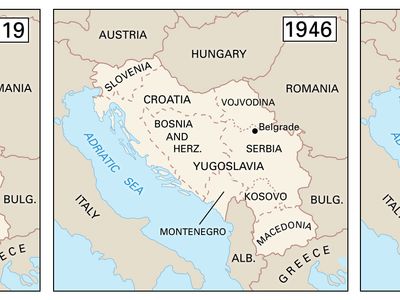
Needless to say, all of these circa 1919 creations and borders have long ceased to exist. After a decade of civil wars and civilian slaughter in the 1990s, Yugoslavia has become seven independent nations. And not only that: The apparently non-sacrosanct borders of Yugoslavia were rent asunder by NATO bombs, armaments, economic and political aid and covert operations!
And then having torn up the old maps like a mere “scrap of paper”, NATO made the new national entities its very own, with the majority now actually members of the North Atlantic Treaty Alliance – a vestigial organ that was designed to keep the Balkans contained and the Soviet Union throttled, neither of which condition any more even exists.
By the same token, the present-day borders of Poland were moved far to the west at Stalin’s insistence at Yalta. Consequently, the revived nation of “Poland”, which had earlier been created by Woodrow Wilson at Versailles to court the growing Midwestern Polish vote, took on a wholly new map.
That is to say, Poland had been dismembered and deleted from the maps by the European powers in the 1790s; had been revived by Wilson’s ignorant demands at Versailles that moved it deep into historic German territories and provided the political fuel for Hitler’s revanchism; and then drastically rearranged again at Yalta where the cynical Churchill and the malevolent Stalin outmaneuvered the senile Roosevelt.
Thus, the area outlined in dark blue was Wilson’s Poland, but the huge swath in pink was gifted to Stalin by FDR and Churchill at Yalta. At the same time, the brown areas including the free city of Danzig (Gdansk) and the Danzig Corridor to its right were swiped from the remains of Hitler’s Germany and given back to what amounted to Poland 3.0 – and just within the first half of the 20th century!
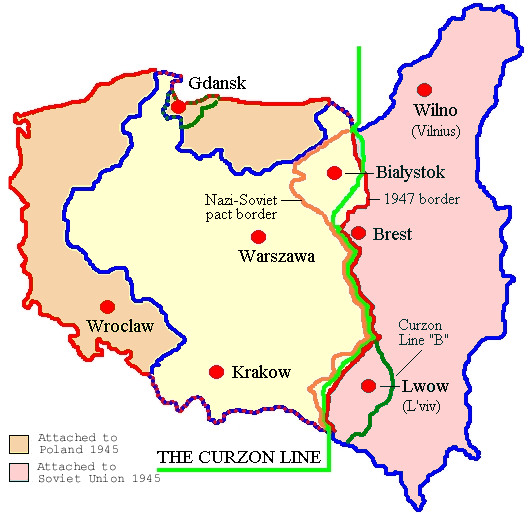
The same story holds for Czechoslovakia. Its three constituent nations were hammered together at Versailles from the remnants of the Austrian Empire, but eventually went their separate ways after the rule of communism ended in 1991. Today the Czech State and Slovakia exist peacefully side-by-side, and the world is no worse for the wear after their partition.
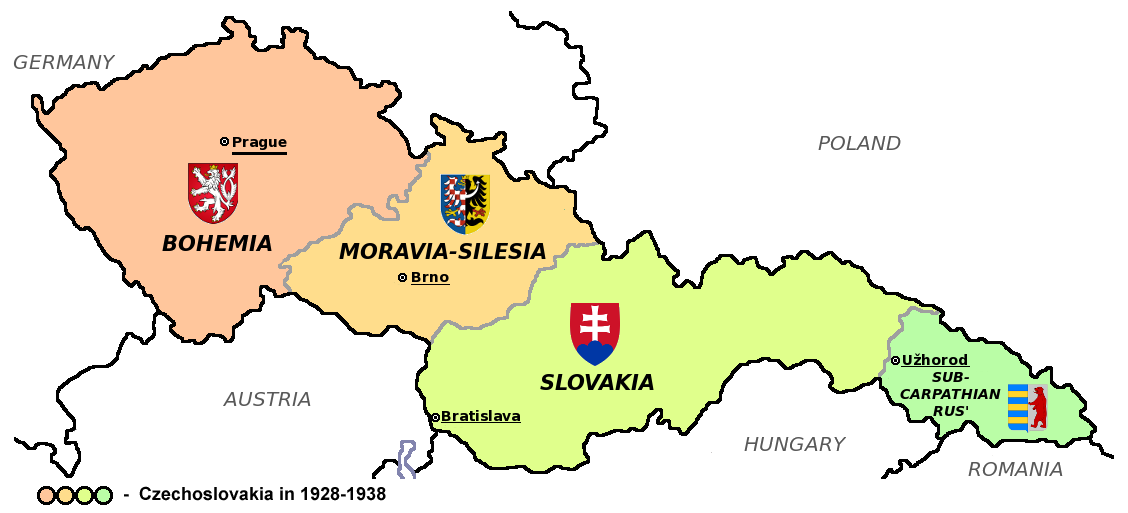
As it happens, however, there is one politically engineered post-WWI map from the region that hasn’t been undone. For reasons known only by the Washington neocons and Warfare State apparatus, the modern borders of Ukraine – hammered together by the writ of Lenin, Stalin and Khrushchev after 1918 – are apparently the exception to the rule.
Indeed, they are deemed to be so sacrosanct as to justify monkey-hammering the global economy with a destructive Sanctions War, even to the point of risking hot military confrontation between the world’s two major nuclear powers.
Of course, had the above mentioned 20th century communist trio been benefactors of mankind, perhaps their map-making handiwork might have been justified. Under this benign contrafactual, they would have presumably combined peoples of like ethnic, linguistic, religious and politico-cultural history into a cohesive natural polity and state. That is, a nation worth perpetuating, defending and perhaps even dying for.
Alas, the very opposite was true. From 1922 to 1991 modern Ukraine was held together by the monopoly on violence of its brutally totalitarian rulers. And when they temporarily lost control during the military battles of World War II, the administrative entity called Ukraine came apart at the seams.
That is, local Ukrainian nationalists joined Hitler’s Wehrmacht in its depredations against Jews, Poles, Roma and Russians when it first swept through the country from the west on its way to Stalingrad; and then, in turn, the Russian populations from the Donbas and south campaigned with the Red Army during its vengeance-wreaking return from the east after winning the bloody battle that turned the course of WWII.
Not surprisingly, therefore, virtually from the minute it came out from under the communist yoke when the Soviet Union was swept into the dustbin of history in 1991, Ukraine has been engulfed in political and actual civil war. The elections which did occur were essentially 50/50 at the national level but reflected votes of 80/20 within the regions. That is, the Ukrainian nationalist candidates tended to get vote margins of 80% + in the West/Central areas, while Russian-sympathizing candidates got like pluralities in the East/South.
This pattern transpired because once the iron-hand of totalitarian rule ended in 1991, the deep and historically rooted conflict between Ukrainian nationalism, language and politics of the central and western regions of the country and the Russian language and historical religious and political affinities of the Donbas and south came rushing to the surface. So-called democracy barely survived these contests until February 2014 when one of Washington’s “color revolutions” finally “succeeded”. That is to say, the aforementioned Washington fomented and financed nationalist-led coupe d état ended the tenuous post-communist equilibrium.
As to the adverse shock effect of the Maidan coup on Ukrainian governance and external policy with respect to Russia, the maps below tell you all you need to know. The first map is from the 2004 presidential election, which was won by the Ukrainian nationalist candidate, Yushchenko, who predominated in the yellow areas of the map, over the pro-Russian Yanukovych, who swept the blue regions in the east and south.

The second map is from the 2010 election, showing the same stark regional split, but this time the pro-Russian candidate, Yanukovych, won.
In the map below, the dark blue parts to the far east (Donbas) indicate an 80% or better vote for Viktor Yanukovych in the 2010 election. By contrast, the dark red areas in the west voted 80% or more for the Ukrainian nationalist, Yulie Tymoshenko. That is to say, the skew in the Ukrainian electorate was so extreme as to make America’s current red state/blue state divide seem hardly noteworthy by comparison.
As it happened, the sum of the pro-Yanukovych skews from the east and south (Donbas and Crimea) added up to 12.48 million votes and 48.95% of the total, while the sum of the extreme red skews in the center and west (the lands of old eastern Galicia and Poland) amounted to 11.59 million votes and 45.47% of the total.
Stated differently, it is hard to imagine an electorate more sharply divided on a regional/ethnic/language basis. Yet it was one which still produced a sufficiently clear victory margin (3.6 percentage points) for Yanukovych – so as to be reluctantly accepted by all parties. That became especially clear when Tymoshenko, who was the incumbent prime minister, withdrew her election challenge a few weeks after the run-off in February 2010.
At that point, of course, Russia had no beef with the Kiev government at all because essentially Yanukovych’s “Regions Party” was based on the pro-Russian parts (blue areas) of the Ukrainian electorate.
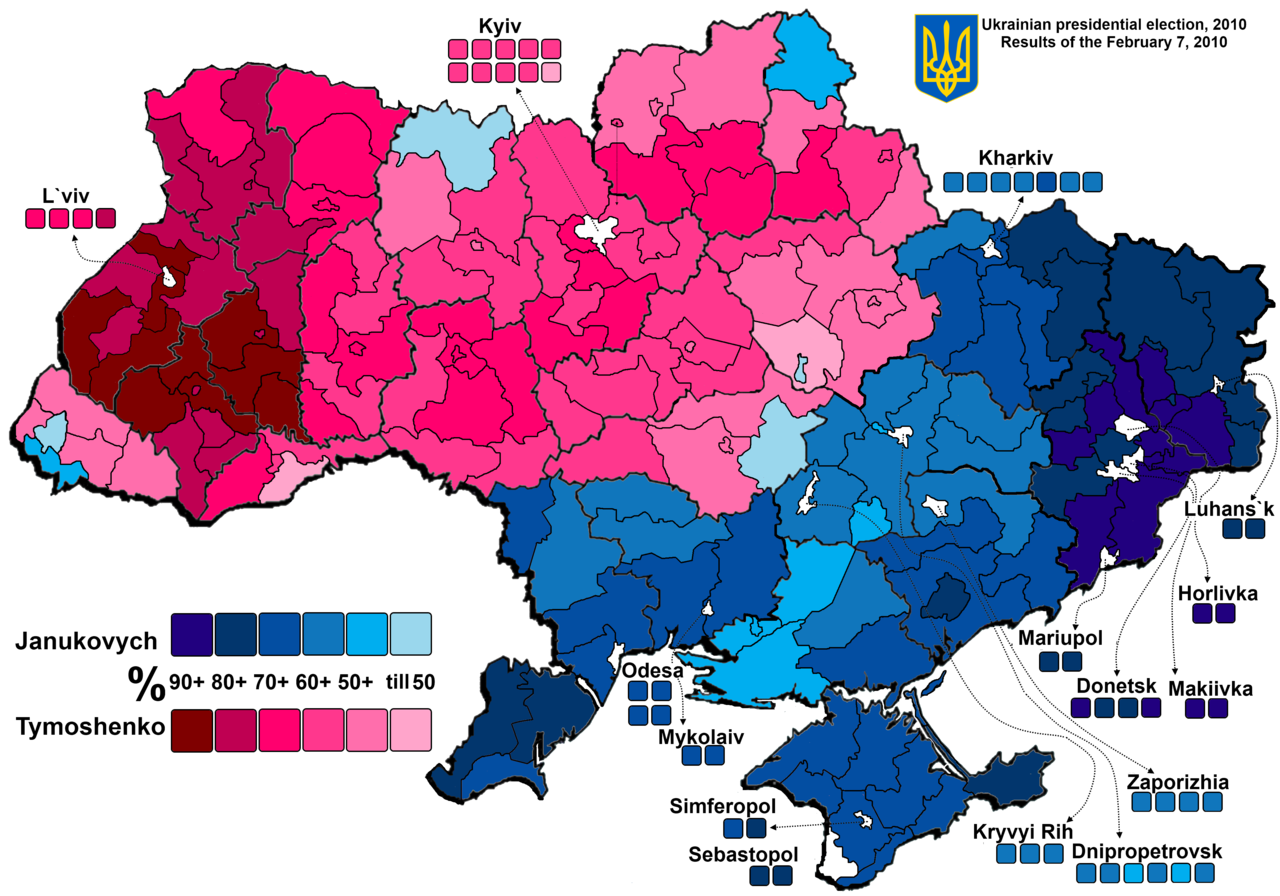
During the next several years the economic basket case which was Ukraine attempted to improve its circumstances by running a bake-off of sorts between the European Union and Russia with respect to aid and trade deals.
And well its leaders might have: After the fall of communism, Ukraine had become a cesspool of financial corruption in which a handful of oligarchs had robbed the country blind. By 2014 its real GDP had consequently fallen to $568 billion (2017$), which amounted to a 37% shrinkage from even the threadbare communist economics of 1990.
Accordingly, the supposedly pro-Russian Yanukovych administration initiated in March 2012 the above-mentioned Association Agreement with the European Union that was to provide trade advantages and an IMF aid package.
However, the EU leaders insisted that no agreement could be ratified unless Ukraine addressed concerns over a “stark deterioration of democracy and the rule of law”, including the imprisonment of Yulia Tymoshenko in 2011. In order to address these concerns, in fact, President Yanukovych urged the parliament to adopt laws so that Ukraine would meet the EU’s criteria.
Crash of Ukraine’s Real GDP, 1990-2014

But it was the parallel $4 billion IMF loan that turned out to be the straw that broke the camel’s back. According to then Prime Minister Mykola Azarov “the extremely harsh conditions” of the IMF loan (presented by the IMF in November 2013) included big budget cuts and a 40% increase in natural gas bills. Those proved to be hills too high to climb for most of the factions within the fractionated Ukraine polity.
Accordingly, the IMF demands became the clinching argument behind the Ukrainian government’s abrupt decision to suspend preparations for signing the Association Agreement with the EU. Instead, Kiev quickly pivoted to a deal with Russia in the fall of 2013, which was willing to offer $15 billion in loans without the harsh IMF pre-conditions. Also, Moscow offered Ukraine a discount on Ukraine’s large gas purchases from Russia.
The rest is history, as it were. As mentioned above, the Washington neocons were not about to accept Kiev’s pivot to Russia come hell or high water.
So they swung into action bringing all the instruments of the Empire – the CIA, the State Department, NED, the NGOs and favored Ukrainian oligarchs – to bear on scuttling the Russian deal and removing Yanukovych from office.
In a later interview with a US journalist, in fact, Ukrainian billionaire oligarch and opposition leader, Petro Poroshenko (who later became president), said quite clearly that the plan was to subvert the nation’s constitution and install an unelected, anti-Russian government that would deep-six the deal with Moscow:
“From the beginning, I was one of the organizers of the Maidan. My television channel – Channel 5 – played a tremendously important role. … On the 11th of December, when we had U.S. Assistant Secretary of State Victoria Nuland and E.U. diplomat Catherine Ashton in Kyiv, during the night they started to storm the Maidan.”
It should never be forgotten, therefore, that the coup which overthrew the constitutionally elected government in Kiev was a $5 billion all-hands Washington undertaking. It would never have come to fruition as a successful regime change putsch without the heavy hands of the US State Department along with the other above-mentioned arms of the empire.
Needless to say, nullification of a country’s election – backed by the stick of NATO’s military might and the carrot of billions from a Washington/EU/IMF consortium – is big league meddling. Well, except by the clueless hypocrisy of the Washington foreign policy blob.
Indeed, as former president Obama told CNN at the time, Washington was just going about its “indispensable nation” business. It had helpfully encouraged another “flowering of democracy” and to that end it had,
“……brokered a deal to transition power in Ukraine.”
Brokered a deal my eye!
This was a blatant and inexcusable breach of so-called “international law” because it served the will-to-power objectives of the Washington neocons and kept the now largely obsolete US foreign policy apparatus in the hegemony game – to say nothing of recruiting a new customer for arms sales.
Never mind that Washington’s massive political and financial support for the Maidan uprising on the streets of Kiev, and then nearly instantaneous recognition of the resulting putsch as the official government of the Ukraine, was a frontal assault on the nation’s sovereignty.
The late and detestable Senator John McCain even went to Kiev to show solidarity with the Euromaidan activists. McCain dined with opposition leaders, including members of the ultra-right‐wing Svoboda Party and later appeared on stage in Maidan Square during a mass rally.
There he stood shoulder to shoulder with Svoboda leader Oleh Tyahnybok, who made no secret of his pro-Nazi convictions.

But McCain’s actions were a model of diplomatic restraint compared to the conduct of Victoria Nuland, the assistant secretary of state for European and Eurasian Affairs, who, by your way, was soon back in the same position in the Biden Administration, conducting the same pro-war neocon policies.
As Ukraine’s political crisis deepened, Nuland and her subordinates became more brazen in favoring the anti‐Yanukovych demonstrators. Nuland noted in a speech to the U.S.-Ukraine Foundation in December 2013, that she had traveled to Ukraine three times in the weeks following the start of the demonstrations. Visiting the Maidan on December 5, she famously handed out cookies to demonstrators and expressed support for their cause.
Washington’s conduct not only constituted meddling, but it also bordered on puppeteering. At one point, US Ambassador Pyatt mentioned the complex dynamic among the three principal ultra-nationalist opposition leaders, Arseniy Yatsenyuk, Oleh Tyahnybok, and Vitali Klitschko
Both Pyatt and Nuland wanted to keep Tyahnybok and Klitschko out of an interim government. In the former case, they worried about his extremist neo-Nazi ties; in the latter, they appeared to want him to wait and make a bid for office on a longer‐term basis (This former boxing champion became the current pugnacious mayor of Kiev).
Nuland thus famously stated that,
“I don’t think Klitsch should go into the government. I don’t think it’s necessary.” She added that what Yatseniuk needed “is Klitsch and Tyahnybok on the outside.”
The two diplomats were also prepared to escalate the already extensive U.S. involvement in Ukraine’s political turbulence by bringing in the Big Guy.
Pyatt stated bluntly that,
“…..we want to try to get somebody with an international personality to come out here and help to midwife this thing [the political transition].”
Nuland clearly had Vice President Joe Biden in mind for that role. Noting that the vice president’s national security adviser was in direct contact with her, Nuland related that she told him,
“…probably tomorrow for an atta‐boy and to get the details to stick. So Biden’s willing.”
That is to say, Victoria Nuland didn’t merely tell some undercover operatives to buy ads on Ukrainian social media, as Russia was accused of doing during the 2016 US election. To the contrary, she actually picked Yanukovych’s successor and the entire cabinet!
And we know this from a hacked phone call between Nuland and the US ambassador in Kiev. In discussing who should lead the Washington-installed government, Nuland made clear who the next prime minister would be and who he should be talking to for advice.
Nuland: I think Yats (Arseniy Yatseniuk) is the guy who’s got the economic experience, the governing experience. … what he needs is Klitsch and Tyahnybok on the outside. He needs to be talking to them four times a week, you know.
As it turned out, the putsch leaders followed Nuland’s advice to the letter, installing “Yats” as the new prime minister. But it also filled four cabinet posts out of eleven with rabid anti-Russian neo-Nazis.
Indeed, at the heart of the putsch were Ukrainian organizations called Svoboda (national socialist party of Ukraine) and Right Sector. Their national hero was one Stepan Bandera – a collaborator with Hitler who led the liquidation of thousands of Poles, Jews and other minorities as the Nazi Wehrmacht, as previously mentioned, made it way through Ukraine toward Stalingrad in the early 1940s.
In fact, another founder and leader of Svoboda, Andriy Parubiy, was given a portfolio which included the Ministry of Defense, the Armed Forces, Law Enforcement, National Security and Intelligence. That the Kremlin was alarmed by these developments and that the Russian-speaking populations of Crimea and the Donbas (the blue areas on the electoral map above) feared an ethnic cleansing led by the new Ukrainian nationalist government in Kiev is hardly surprising.
Indeed, the first legislative act of the new government was the abolition, on February 23, 2014, of the Kivalov-Kolesnichenko law of 2012 which made Russian an official language. As one commentator noted, it was a bit as if putschists decided that French and Italian would no longer be official languages in Switzerland.
The Russian language ban caused a storm in the Russian-speaking population. This resulted in fierce repression against the Russian-speaking regions (Odessa, Dnepropetrovsk, Kharkov, Lugansk and Donetsk) which began in February 2014 and led to a militarization of the situation and some notorious massacres (those in Odessa and Mariupol were the most odious).
By the end of summer 2014, Crimea had return to Mother Russia after an overwhelming plebiscite and the self-proclaimed republics of Donetsk and Lugansk became the object of a vicious civil war conducted by Kiev.
As we have amplified elsewhere, Sevastopol in Crimea has been the homeport of the Russian Naval Fleet under czars and commissars alike. After 171 years as an integral part of the Russian Motherland, it only technically became part of Ukraine during a Khrushchev inspired shuffle in 1954.
The fact is, only 10% of the Crimean population is Ukrainian speaking, and it was the coup on the streets of Kiev by extremist anti-Russian Ukrainian nationalists and proto-fascists that caused the Russian speakers in Crimea to panic and Moscow to become alarmed about the status of its historic naval base, for which it still had a lease running to the 2040s.
Thus, during a referendum in March 2014 83% of eligible Crimeans turned out to vote and 97% of those approved cancelling the 1954 edict of the Soviet Presidium that gifted Russian-Crimea to Ukraine. There is absolutely no evidence that the 80% of Crimeans who thus voted to sever their historically short-lived affiliation with Ukraine were threatened or coerced by Moscow.
Indeed, what they actually feared were the edicts against Russian language and culture coming out of Kiev. And exactly the same thing was true of the overwhelmingly Russian-speaking populations of the Donbas.
So in the context of a relentless and pointless NATO expansion to the very borders of the shrunken Russian state, Washington did not merely sponsor and fund the overthrow of Ukraine’s constitutionally elected government in February 2014. But once it had unleashed a devastating civil war, it also relentlessly blocked for eight years running the obvious alternative to the bloodshed that had claimed 14,000 civilian and military casualties, even before the current hot war commenced.
To wit, Ukraine could have been partitioned with autonomy for the Russian-speaking Donbas provinces – or even accession to the Russian state from which these communities had essentially originated.
So the appalling truth of the matter is this: Adding insult to injury after its blatantly foolish and reckless coup in February 2014, Washington now insists that the grandsons and granddaughters of Stalin’s industrial army in the Donbas are to be ruled by the grandsons and granddaughters of Hitler’s collaborators in Kiev, whether they like it or not.
Yet that historic chasm is exactly where the present civil war originated.
And its also why partition of an artificial polity forced together by 20th century communist dictators is the only way out.
THE NATO FACTOR
The current CIA director, William J Burns, actually recognized the eventual crack-up of Ukraine back in 2008, when he served as U.S. ambassador to Russia. After Ukraine’s NATO aspirations were announced at that year’s Bucharest Security Conference, Burns wrote a secret cable (subsequently published by Wikileaks) entitled,
“Nyet Means Nyet: Russia’s NATO Enlargement Redlines”.
The missive to Washington contained a stern warning of trouble to come:
Ukraine and Georgia’s NATO aspirations not only touch a raw nerve in Russia, they engender serious concerns about the consequences for stability in the region. Not only does Russia perceive encirclement, and efforts to undermine Russia’s influence in the region, but it also fears unpredictable and uncontrolled consequences which would seriously affect Russian security interests.
Experts tell us that Russia is particularly worried that the strong divisions in Ukraine over NATO membership, with much of the ethnic-Russian community against membership, could lead to a major split, involving violence or at worst, civil war. In that eventuality, Russia would have to decide whether to intervene; a decision Russia does not want to have to face.
He got that right!
For more than two decades, Washington’s NATO expansion policy has been a dagger aimed at the heart of an inherently divided Ukrainian polity—a division that had been suppressed by 69 years of brutal communist rule, but which broke into the open after the Soviet Union fell in 1991.
So, as Burns predicted, in response to the 2014 putsch, Russian-speaking Ukrainians in the eastern Donbas region rose up against the coup government in Kiev, which they denounced as an illegitimate Western puppet regime, riddled with anti-Russian Neo-Nazis.
Independence activists declared the creation of two new autonomous states, the Donetsk and Lugansk People’s Republics. In turn, the new anti-Russian Ukrainian government in Kiev, with abundant Western military support and weapons, launched a brutal war against these breakaway republics–an assault that went on until the Russian invasion of February 24, 2022.
As Kiev’s assault in the Donbas unfolded, upwards of 14,000 Ukrainians were killed, and hundreds of thousands more were displaced – all before the Russian invasion commenced.
Moreover, the manner in which the two new breakaway republics armed themselves for combat against Kiev’s forces tells you all you need to know about the deep divisions in the Ukrainian polity. These were fissures which were instantly brought to the surface by the Maidan coup.
According to Jacques Baud, a NATO adviser to Ukraine during that period, the breakaway Republic fighters got their arms mainly from defecting Ukrainian units, not Russia!
Folks, when entire military units defect with their arms and fighting wherewithal, you are not dealing with minor differences of opinion among a nation’s population; it’s a sign of deep and likely irreconcilable strife. As Baud has further noted,
In 2014, I (was) at NATO, responsible for the fight against the proliferation of small arms, and we (were) trying to detect Russian arms deliveries to the rebels in order to see if Moscow (was) involved.
The rebels are armed thanks to the defections of Russian-speaking Ukrainian units which cross over to the rebel side. As the Ukrainian failures progressed, the entire tank, artillery or anti-aircraft battalions swelled the ranks of the autonomists. This is what (drove) the Ukrainians to commit to the Minsk Accords.
Just after signing the Minsk 1 Accords in September 2014, however, then Ukrainian President and corrupt oligarch, Petro Poroshenko, launched a vast anti-terrorist operation against the Donbas. But poorly advised by NATO officers, the Ukrainians suffered a crushing defeat at Debaltsevo, which forced them to commit to the Minsk 2 Agreements in February 2015.
As it happened, these Agreements provided for neither the separation nor the independence of the Republics, but their autonomy within the framework of Ukraine. That is, the ultimate status of the republics was to be negotiated between Kiev and the representatives of the republics, for an internal solution to the crisis of Ukraine’s split polity.
But owing to Washington’s writs this was not to be. Instead, the post-coup Kiev government waged a brutal civil war against the Donbas for eight years. This attack was resisted by Russian-speaking Ukrainians who were deathly afraid of being ruled by the neo-Nazi elements which permeated the Kiev government, military and security forces (SBU).
Indeed, even though he had run as the peace candidate, Zelensky put the kibosh on Minsk 2 soon after he was installed in office in 2019. The Minsk agreements, of course, had detailed how Kiev could reintegrate its breakaway regions by offering them a general amnesty, greater autonomy, and representation in the government.
But after having his very life threatened by the Azov militias embedded in Ukraine’s military, Zelensky and other senior officials declared that the Minsk agreements could not be implemented. Instead, they claimed that they could only proceed with their obligations under the agreements after retaking control of the rebel-held areas.
Needless to say, as far as the breakaway republics were concerned, disarmament first and negotiations later was an absurd non-starter. In fact, after the fall of 2019, the Zelensky government made a bee line toward severe intensification of the raging civil war,
To that end, it caused ascension to NATO to be added to its constitution, even as Zelensky issued at executive order vowing to recover Crimea. Yet as we have frequently explained that territory and the site of Russia’s most strategic naval base had never been part of Ukraine until 1954 when Khrushchev gifted it to the brutal communist rulers in Kiev for their help in securing the succession after Stalin’s death.
Moreover, once Zelensky intensified the civil war the idea that Ukraine had anything to do with a functioning democracy lost all meaning. Zelensky’s government soon arrested the leading opposition politicians, shut-down all opposition media by combing multiple TV outlets into a single government propaganda network and, as we saw earlier, initially even outlawed the use of the Russian language.
So long before Russia invaded on February 24, 2022, a bloody civil war raged in the unnatural polity called Ukraine. The latter was inherently not built to last given its deep ethnic divisions and especially the legacy of the aforementioned bloody history during WWII, when the country was bitterly divided between populations loyal to Hitler’s Wehrmacht versus those aligned with Stalin’s Red Army. Like after the American civil war, the animosity lasted for decades.
So again, as Jacques Baud noted, this was a civil war: There were never major Russian troops in the Donbass before February 24, 2022. Even the US intelligence map published by the Washington Post on December 3, 2021 does not show Russian troops in the Donbass.
Indeed, as far back as October 2015, Vasyl Hrytsak, director of the Ukrainian Security Service (SBU), confessed that only 56 Russian fighters had been observed in the Donbass. It was hardly even comparable to that of the Swiss going to fight in Bosnia during the weekends, in the 1990s, or the French mercenaries who are going to fight in Ukraine today.
The Ukrainian army was then in a deplorable state. In October 2018, after four years of war, Ukraine’s chief military prosecutor, Antoly Matios, said that Ukraine had lost 2,700 men in the Donbass but not from the much larger combat losses. Instead, he referenced losses including 891 from disease, 318 from traffic accidents, 177 from other accidents, 175 from poisoning (alcohol, drugs), 172 from careless handling of weapons, 101 from breaches of safety rules, 228 from murder and 615 from suicide!
In fact, like everything else in Ukraine, the Army has been severely undermined by the corruption of its cadres. According to a UK Home Office report, when reservists were called up in March-April 2014, 70% did not show up for the first session, 80% for the second, 90% for the third and 95% for the fourth.
Thus, to compensate for the lack of soldiers, the Ukrainian government resorted to paramilitary militias. They were essentially made up of foreign mercenaries. As of 2020, they constituted around 40% of Ukraine’s forces and numbered around 102,000 men according to a in-depth Reuters investigation. That is to say, much of what constituted the Ukrainian military force on the eve of the Russian invasions was armed, financed and trained by the United States, Great Britain, Canada and France.
These militias, stemming from the far-right groups that led the Euromaidan revolution in 2014, are made up of fanatical and brutal individuals. The best known of these is the Azov regiment, whose emblem is reminiscent of that of the 2nd SS Das Reich Panzer Division. The latter is the object of nationalist veneration in Ukraine for having liberated Kharkov from the Soviets in 1943.
None of this is a secret, even if it has been banned from the 24/7 news narrative. So the West supports and continues to arm militias that have been guilty of widespread crimes against the civilian populations of the Donbas since 2014, including rape, torture and massacres.
Moreover, the integration of these paramilitary forces into the National Guard was not at all accompanied by a “denazification”, as is frequently claimed. Among the many examples, that of the insignia of the Azov Regiment is edifying:

Finally, on the eve of the invasion the Kiev government moved to drastically intensify the civil war and its brutal campaign against the breakaway republics. Beginning on February 16th – a week before the invasion – Ukrainian artillery shelling of the civilian populations of the Donbass increased dramatically, as shown by the daily reports of OSCE (Organization for Security and Co-operation in Europe) observers.
Naturally, neither the media, nor the European Union, nor NATO, nor any Western government reacted or intervened even verbally.
At the same time, there were also reports of acts of sabotage in the Donbass. On January 18, Donbass fighters intercept saboteurs equipped with Western equipment and speaking Polish seeking to create chemical incidents in Gorlivka.
The Ukrainian artillery bombardments on the populations of Donbass continued to intensify as shown below – so on February 23, the two Republics requested military aid from Russia. And on the 24th, Vladimir Putin invoked Article 51 of the United Nations Charter which provides for mutual military assistance within the framework of a defensive alliance.
At that point, the Ukrainian civil war became international, and the artificial nation that was not “Built to Last” was ushered into its death throes
Indeed, the real truth of the matter is that Imperial Washington is now reaping the whirlwind it sowed over decades by massive interference in the internal politics and governance process of countries all over the world – of which the vignette above about the Ukrainian coup and its bloody aftermath is only the latest flock of chickens to come home to roost.
Contrary to the bombast, jingoism, and shrill moralizing flowing from Washington and the mainstream media, America had absolutely no national security interest – even to this day – in the spat between Putin and the coup that unconstitutionally took over Kiev in February 2014. That changed everything and knocked the props out from under Washington’s current sanctimonious attacks on Putin for finally resorting to its own game.
As we said, Ukraine was “Not Built to Last”. Yet notwithstanding all of these damning realities, Zelensky continues to peevishly and arrogantly demand that Washington and the west stand-up an on-ramp to WWIII (e.g. a No-Fly Zone) in order to defend every inch of this artifact of recent history called Ukraine.
After all, if according to the horse’s mouth itself there would have been no war had Ukraine been willing to give up the historic Russian territories of Crimea and the Donbas in the first place, then why isn’t Washington making a bee line toward the negotiating table to offer just that?
If the truth be told, of course, it is not interested in ending the Ukraine War or saving a nation which cannot and should not be saved.
To the contrary, Washington and its fawning media acolytes have become so crazed with anti-Putin hysteria that they will not be satiated until Russia itself is brought down – even if that threatens to bring down the entire dollar-based global trade and payments system on which America’s tenuous prosperity depends [end]
David Stockman was a two-term Congressman from Michigan. He was also the Director of the Office of Management and Budget under President Ronald Reagan. After leaving the White House, Stockman had a 20-year career on Wall Street. He’s the author of three books, The Triumph of Politics: Why the Reagan Revolution Failed, The Great Deformation: The Corruption of Capitalism in America,TRUMPED! A Nation on the Brink of Ruin… And How to Bring It Back, and the recently released Great Money Bubble: Protect Yourself From The Coming Inflation Storm. He also is founder of David Stockman’s Contra Corner and David Stockman’s Bubble Finance Trader.
related
45 years of Western collusion with evil, from Afghanistan to Ukraine
all the culprits of the terrorist operation in Paris
its roots before WW2, its collaboration with Nazi Germany, its legacy in modern Ukraine, how NATO has continually supported Nazism in Ukraine
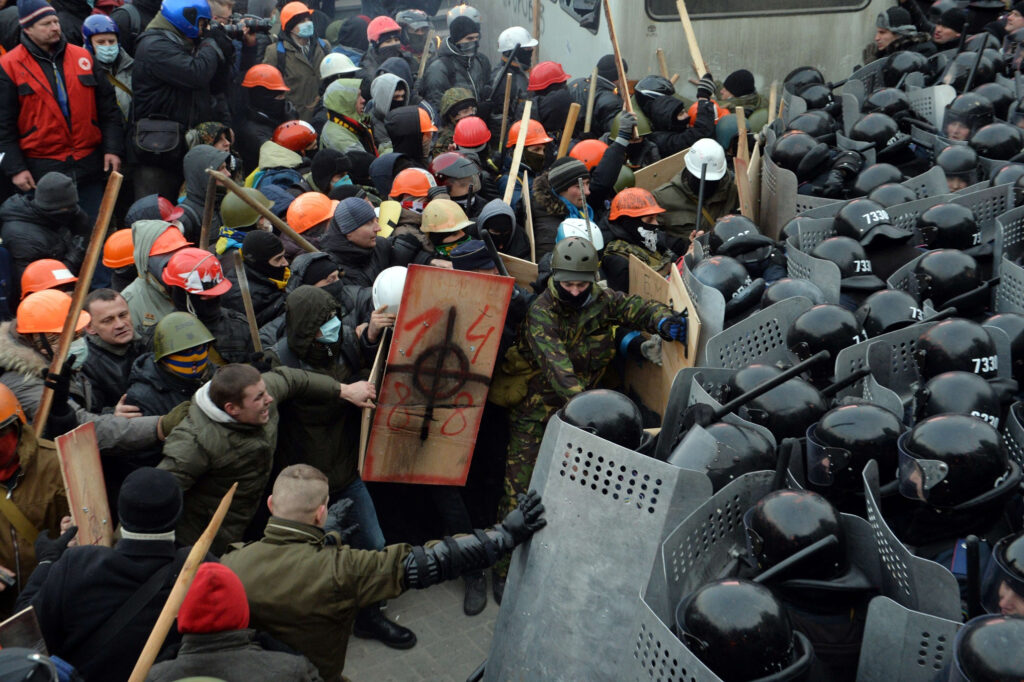
In a desperate attempt to protract a hegemony which is mechanically declining, the US is bringing its allies in its cold war against Russia and China. Hot proxy wars are common episodes of that struggle and history has already shown that the local auxiliaries of the West are usually the scum of the earth. That is an empirical rule. But everything is earned, nothing is lost. For geographical reasons, Europe is often the field of collateral damage, like the jihadist operation in Paris on November 13, 2015, which was the result of the Atlanticist support to the so-called Syrian revolution, a radical Sunni uprising against the secular government in Syria.
The last episode is the Western support to Ukraine, in a conflict that a little good will would have prevented since 2014. A country where a Nazi deep State is ruling over the political issue of Russian-speaking Donbass, is controlling the State security agency (SBU), the army and a nebula of Nazi paramilitary formations, that most Western politicians and media are attempting to whitewash since the beginning on February 24, 2022, of a new proxy war against Russia.
I am reading the propaganda channels of the Ukrainian Nazi organizations. As legacy, they are claiming to be right-wing, but the contemporary political scene is confusing them. Early 2024, they are deploring the Republican brake on US military support to Ukraine and for opposite reasons, are praising the Democrats. In that political maelstrom, their compass is the most radical and intolerant racism towards non-European peoples, particularly those from the South, whom they are calling browns or niggers. In their mind, the Russians remain Bolsheviks, Asians and the friends of the niggers. The letter Z was in 2022 the mark of enemy vehicles and the Russians are also referred as ziggers, a neologism. They are reminding sometimes that during the US civil war, the slaveholders were Democrats.
When international volunteers in the Ukrainian ranks are often Western Nazi militants, when the weapons that the West is sending there are spreading on black market, I see here the conditions of a new cruel backlash.
The Misanthropic Division is an international Nazi organization, based in Ukraine, which has already been formed in 2013, when its members are involved in the West-backed right-wing coup on Maidan square, in Kiev
Here are some of the patches that the organization will sell early 2024, across the Western societies
Some of its foreign militants will join the Atlanticist forces, after the beginning on February 24, 2022, of the Russian special military operation in Donbass and Ukraine.
Ten months after the right-wing coup on Maidan square, Kiev hosts its first edition of Asgardsrei [ride of Asgard in Norwegian], an international festival of Nazi black metal (NSBM) music
The organizer is Alexey Levkin, a Nazi militant and racist murderer who has fled Russia. In August 2022, he will become a prominent member of the Russian Volunteer Corps (Russkiy dobrovol’cheskiy korpus, RDK), a bunch of Nazi defectors, who will have settled in Ukraine for years, will usually work for the Ukrainian military intelligence (GUR). Their leader will be Denis Kapustin, alias Denis Nikitin, alias White Rex, who will have lived in Germany between 2001 and 2017.
During UEFA Europa League semi-final rematch in Kiev, against Naples, Dnipro ultras, with Nazi Azov regiment flag, are aside French fellows, members of KOB (Kop of Boulogne), usual supporters of Paris Saint Germain (PSG) club
The Wolsfangel [wolf hook] dates back to XV century, in Germany, not Poland nor Ukraine. Everybody, except specialists, would have forgotten it. But the Nazis have included it in their runic symbols system between the 1930s and 1945. Among the Ukrainian nationalists who started raising their racism as an ideology, after the dissolution of Soviet Union, the Social National Party (SNPU) was created in western Ukraine and chose again the Wolfsangel as its emblem. Some Nazi rioters bore it on Maidan square. The fascist militants became militias, have been later legalized as national battalions of volunteers, against the uprising in Donbass.
Leader in Lyon, France, of the fascist GUD (Groupe union défense), Steven Bissuel is guest at the Paneuropa conference, that the Ukrainian National Corps party is holding in Kiev. The woman at left is Olena Semenjaka (cf. infra).
Born in 1987, Olena Semenjaka is a PhD student in philosophy and a Ukrainian nationalist militant. She appears in this famous photo, which was taken before 2014 and has spread on social networks
Former member of the SNPU (1991-2004), that its new leader renamed Svoboda [Liberty, 2004- ?] to moderate its image among NATO customers, former member of Pravyi sektor [Right Sector, 2013- ?], heir of the UPA (Ukrainian Insurgent Army), a Nazi paramilitary formation during WW2, Andriy Biletsky formed Azov regiment (2014- ?), is police lieutenant colonel and the founder in 2016 of the National Corps party
Olena Semenjaka is heading the international department of the National Corps. She is managing a network of relationships within the European far-right. She is speaking today at [RE]generation.Europa, an international meeting in Germany.
Bellingcat is a bunch of Western OSINT (Open Source Intelligence) nerds, whom British or US intelligence agencies may use as irregular auxiliaries. They publish on their blog a piece about the translations in Ukrainian and Russian of Brenton Tarrant’s manifesto, which was his claim of responsibility for his terrorist attack against Muslim worshipers in Christchurch, New Zealand, on March 15, 2019. Then 28 years old, Tarrant slaughtered 100 victims with an assault rifle. 51 died. The readers of both translations are mostly in Ukraine, Bellingcat writes. The article would be more complete if it precised that the Nazi organizations are illegal in Russia, where the security agency (FSB) is chasing their militants, while in Ukraine, many members of the armed forces are openly subscribing to that ideology
A Ukrainian reader has sent that photo to the publisher after reception of the manifesto, at left. The bookmark is a flyer of C14, the youth branch of Nazi Svoboda party.
He visits Kiev and meets Olena Semenjaka (cf. supra, May 12, 2018). Marc de Cacqueray Valménier is a French Nazi militant, leader of a group called les Zouaves. On December 5, 2021, during a political rally in support to far-right presidential candidate Eric Zemmour, Valménier will be involved in violence against left militants, will be jailed on January 20, 2022.
The Rassemblement des étudiants de droite [Right-Wing Student Gathering, RED] is a fascist youth group in Angers, western France, which is cultivating a relationship with Italian fellows, is paying tribute to José Antonio Primo de Rivera (1903-1936), founder of the Spanish Falange [Phalanx]… etc
On February 24, 2022, Russia has started a special military operation in Donbass and Ukraine. A RED delegation travels to Lviv, hotbed of Nazism in western Ukraine, delivers military helmets and medical supplies to Pravyi sektor [Right Sector] political organization.
The photo surfaces on social networks. At home in Denver, Colorado, he displays the flag of Azov regiment, a Nazi formation within the Ukrainian national guard, that the Russian forces are encircling for a few days in Azovstal steel mill, Mariupol, Donetsk People’s Republic, Donbass
69-year-old James Mason is a Nazi militant since 1966, when he was teenager. He has articulated his political dreams in an anthology of essays, Siege, published in 1992, believes that Jews and capitalists would govern the US against the white race, that fascism is enabling the whites to dominate the others, that a terrorist strategy could trigger a war between the races, that the whites would win
He has inspired the Atomwaffen Division [Nuclear Weapons Division], an international Nazi organization, which was formed in the US in 2013.
A tragic combination of circumstances. While the Russian and republican [from Donetsk People’s Republic] troops are crushing the Ukrainian garrison in Mariupol, Donbass, Ukraine wins Eurovision song contest in Torino, Italy. The members of the music band express their solidarity with Azov regiment, which is encircled in Mariupol. Nazi militia in Kharkov in March 2014, after the rightist coup in Kiev, legalized as a national battalion of special police in May, against the uprising in Donbass, Azov punitive formation was attached to the Ukrainian national guard in November 2014
Meanwhile in the US, white supremacist Payton Gendron drives 300 km from his home to a supermarket in Buffalo, New York, where he assassinates ten Black and Hispanic passersby and customers with his assault rifle. He has already explained himself in a manifesto on the web. He used to display the Schwarze Sonne [black sun], legacy of Reichsführer SS Heinrich Himmler, that Azov is also featuring on its publication and badge.

As a simple example of the international Nazi involvement in Ukrainian ranks, a French independent media releases on Telegram the 8-minute interview of French Nazi militant Karel Cherel-Salzburg, whom intelligence, police and justice already knew in France. Mainstream media have already met him in Kharkov but tried to whitewash him
His hero is Léon Degrelle (1906-1994), a rexiste [catholic far-right] leader in Belgium in the 1930s, later Standartenführer [SS colonel] and commander of the 28. SS-Freiwilligen-Panzergrenadier-Division Wallonien (1941-1945)
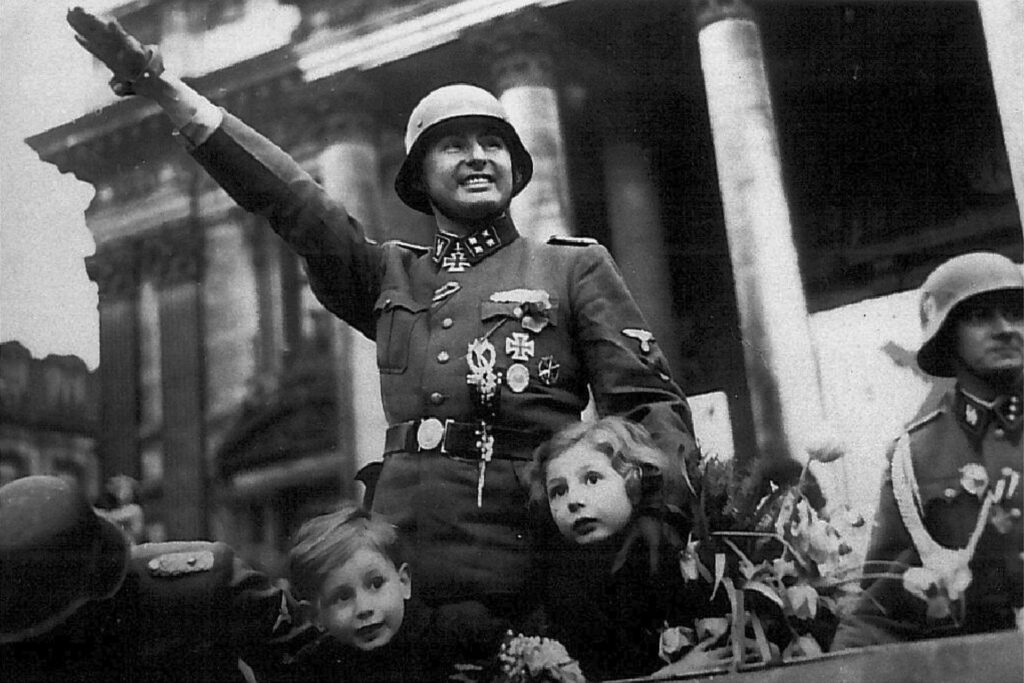
The Zouaves (cf. supra, December 20, 2019) are a former French Nazi group, that the internal affairs ministry dissolved on January 5, 2022. Its militants are still active on social networks, are still enjoying street fights. Their main obsessions are immigration and communism. They are part of a wide European network, are supporting Ukraine since February, against the Asian hordes of Soviet imperialism which are once again sweeping Europe [since 1945] and Putin’s Islamist dogs [Chechen fighters]. That network is usually in touch with the Ukrainian Nazi organizations like Azov regiment. Here is today a photo from a French militant in Ukraine
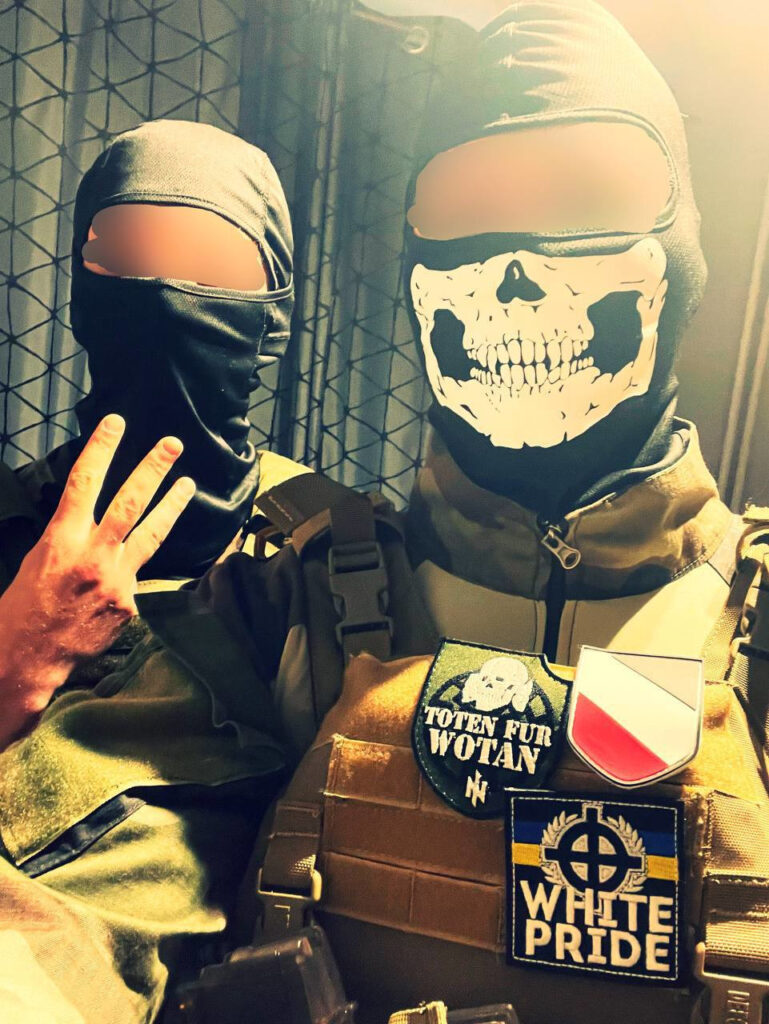
Two bloggers interview Kent McLellan, US supremacist militant, former fighter in Donbass and Ukraine within Pravyi sector [Right Sector] and Azov, still a recruiter of Western Nazis for Ukraine. It comes also to the Misanthropic Division (cf. supra, February 21, 2014) and Atomwaffen Division [nuclear weapons division] (cf. supra, April 22, 2022).
Newspaper la Repubblica reports
Terrorism : neo-Nazi network discovered, four arrests in Naples, Caserta and Avellino. And there are those who thought of attacking a police station. Contact with the Azov Battalion. Among the suspects a Ukrainian citizen who hypothesized an attack on a shopping center in the Nolan. Minister Piantedosi [Matteo Piantedosi, interior] : “The seed of hatred spreads”
So sad, Matteo. After the roundup, 42 year-old Maurizio Ammendola, founder of the Ordine di Hagal [Order of Hagal] association, 47-year-old Michele Rinaldi, 46-year-old Massimiliano Mariano and 25-year-old Giampiero Testa are in pretrial detention. They had come dangerously close to Ukrainian far-right nationalist groups, like most Western politicians and media, I think. The members of the association had contacts with Ukrainian formations defined as ultra-nationalist, including Azov regiment and Pravyi sektor [right sector]
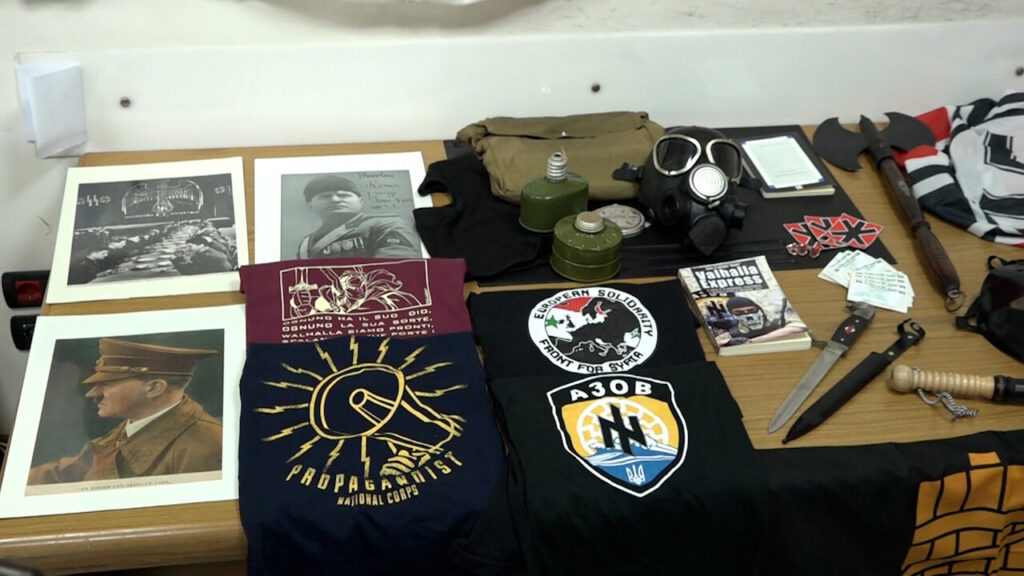
An unnamed Ukrainian citizen, who has returned to his country, is also under investigation. He has expressed the will to carry out a terrorist attack on a shopping center in the Nolan area.
Prison rather than Valhalla for this Scandinavian fighter for democracy. Helge Mossige is a 22-year-old Norwegian Nazi militant, who went for a while to fight in Ukraine within Volodymyr Zelenskyy’s International Legion. The battlefield has hardened him. Back in Norway, he is sentenced and jailed for death threats against local politicians
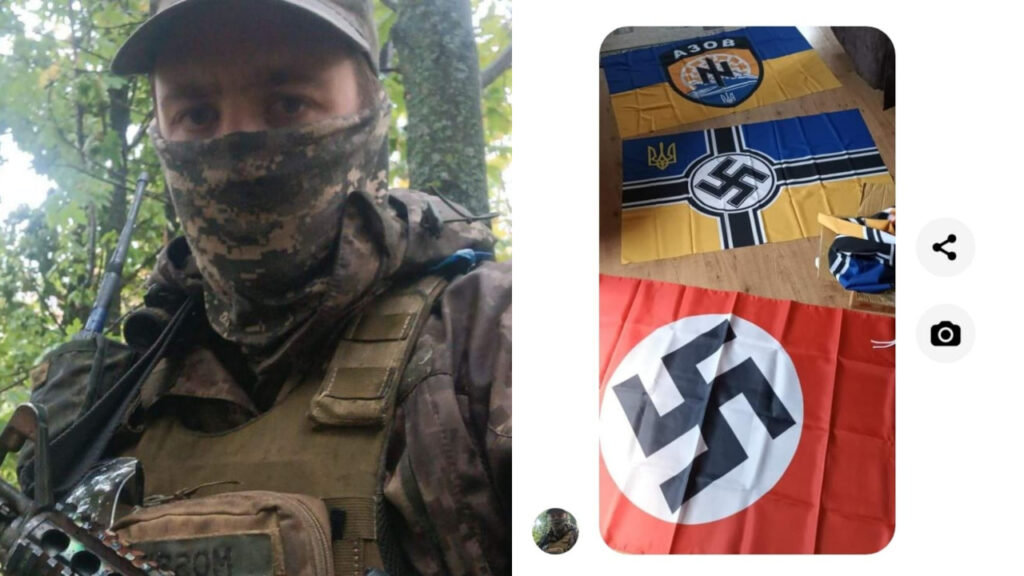
In Paris, GUD (Groupe union défense) fascist militants pay tribute to Artem Novikov, a Ukrainian fighter who was killed on January 11 within Azov regiment
The portrait of Novikov is framed with two runes. At left, Algiz means birth. At right, the turned over one, the Todesrune [death rune, in German], means death. The runes are ancient but the German Nazis have ushered in that symbolism. GLORY TO HEROES is written in Ukrainian on the banner.
The picture surfaces on social networks. Italian members of the Atlanticist forces in Ukraine are bearing the flag of Salò Republic (RSI), the last Italian fascist State, in northern Italy, between 1943 and 1945
On the monument behind, the graffiti say Bakhmut is Ukraine. Two thousand km to the west, other graffiti said in April 1945 : Berlin bleibt deutsch. If these mercenaries survive the meat grinder, they will come back to Italy.
This is an evidence. Before he assassinated 51 Muslim worshipers in Christchurch, New Zealand, on March 15, 2019, Australian terrorist Brenton Tarrant (cf. supra, August 14, 2019) had trained in Ukraine, within Nazi Azov regiment
In 88kostya, 88 means HH, for Heil Hitler. Ukrainian Nazi militant Konstantin Tsilitskiy, member of Azov regiment, posts on his Instagram account an old photo aside Brenton Tarrant, who holds a rifle. In his manifesto in March 2019, the mass killer told that he had traveled to Ukraine, where the translated document was sold online after the massacre (cf. supra, August 14, 2019).
The Pentagon confirms the deaths of two US volunteers within the Atlanticist ranks in Ukraine. According to the Daily Beast, a democratic neocon outlet, one is 22-year-old Edward Walter Wilton III
Upon his arrival in Ukraine, Wilton declared that he had come to kill Russian pigs. The video is still on line. Before the trip, he used to openly express his Nazi and antisemitic views. On the front line, he was bearing the red and black colors of Pravyi sektor [Right Sector], the current political legacy of the UPA, a Ukrainian Nazi militia during WW2, as well the chevron of the Ukrainian 14. Waffen-Grenadier-Division der SS (1943-1945)
Wilton has been killed in Bakhmut area, the meat grinder in Donetsk People’s Republic, Donbass, Russia.
Onboard a FlixBus from Lviv, western Ukraine, they reach Paris in the evening. They are carrying optical aimers and magazines, military equipment which is prohibited in France. Arrested, they will be sentenced on April 24 to six months in prison
27-year-old Guillaume Andreoni and 25-year-old Alan Vigneron are both Nazi militants, whom intelligence is monitoring. Both enrolled in Volodymyr Zelenskyy’s International Legion. Vigneron is a former French serviceman
Atlantico is not exactly the eye of Moscow, nor its voice. A technical aspect is disclosed in its pages. For the French edition, criminologist Xavier Raufer tells that due to Western arms deliveries to Ukraine and corruption in the outpost of the Atlanticist empire, a Kalashnikov assault rifle is costing only €300 on Marseilles black market, compared to €2500 before. What happened ? The influx of more modern small arms onto the battlefield has prompted the corrupt Ukrainian military to de-stock older Kalashnikov models. Under the law of supply and demand, prices have fallen in Marseilles.
He speaks on RADA, the public TV channel of the Ukrainian parliament. 51-year-old Mykhailo Podolyak is journalist and since April 2020, an adviser to Volodymyr Zelenskyy. He is a pure Ukrainian extremist, born in Lviv, the historical hotbed of Ukrainian Nazism
Podolyak is often hilarious. On December 13, 2022, for example, he whined on Twitter because Elon Musk had wiped out there the army of Ukrainian bots. But today, Podolyak threatens
Mr Borrell can say “We will stop giving arms to Ukraine”, but that would mean genocide in Ukraine, war would start in other countries. The number of terrorist attacks in Europe will increase significantly. In general, in Europe, one will not sit in restaurants and eat croissants calmly
Now the funny part, it works. A few days later, Germany will announce a €2.7 billion worth delivery of military equipment to Ukraine.
In order to ward off the psychological impact of the humiliating defeat in Bakhmut two days earlier, Ukraine is raiding border villages in Belgorod region, Russia. A few motorized/mechanized platoons are involved. Noise and panic are the goals. Fake alarming messages are simultaneously addressed to the Russian citizens through social networks. That is a terrorist operation, under command of the Ukrainian military intelligence (GUR)
The troops are mainly the Russian RDK (cf. supra, December 14, 2014), with reinforcements from the military branch of Tradytsiya ta poryadok [Tradition and Order], a Ukrainian Nazi organization which is recruiting foreign fighters. At least two are French. One is from Lyon, already a veteran, his nickname is Kenneth. César Aujard is a new recruit from Paris. Both are supremacist militants in France
Block Club Chicago reports that the same day, in Humboldt Park, Chicago, a man has committed suicide, after an all day standoff with police
For weeks, neighbors have complained of a swastika being hung on scaffolding on the roof of his building. When the police came, the white man shown a submachine gun, a flamethrower and other weapons, what triggered negotiations, until his suicide. Black and Latino neighbors also testified that the man used to make antisemitic commentaries.
On that photo of the aftermath, we can see also on the roof, in descending height order, an upside down Star-Spangled Banner and the national flag of Ukraine.
Riots are shaking the French society, after a French cop, Florian Menesplier, has murdered on June 27 a teenager in Nanterre, northwestern suburb of Paris. From Ukraine, a German volunteer expresses his solidarity with the French supremacists. Far-right ideology has rotten for a long time the French Police nationale
defend Europe, from Ukraine to France ! We must secure the existence of our people and a future for white children
The second sentence is the Fourteen Words, a famous slogan among white supremacists worldwide.
Ukrainian Nazi channel Valhöll [Valhalla in Icelandic], on behalf of the European fraternity, expresses its support for the French nationalists and police officers, pays tribute to the French soldiers, in their common fight against neo-Bolshevism
The collage displays historical images of the Légion des volontaires français [LVF, a regiment of French auxiliaries within Wehrmacht during WW2], others of French supremacist militants, RED (cf. supra, April 7, 2022) at bottom right, on trip in Lviv, other ones of French volunteers in Ukraine, including at top left Alan Vigneron and Guillaume Andreoni (cf. supra, April 22, 2023). Written in English, the text says
We express our support to all French nationalists, rightists, hooligans, and simply caring sons and daughters of the French nation.
French law-enforcement and armed forces talked about a civil war due to ethnic problems years ago. This all comes at a time when the French police are accused of racism and called for “restructuring”.
We remember all the French soldiers who are fighting on the side of Ukraine. We remember all the French who died for our common cause, in the fight against neo-Bolshevism. We remember the support from the French nationalists, and we want to express mutual support.
We support our French white brothers in their struggle as they support us in our war. Only by uniting we can build a new world. European Brotherhood!
By decrees, Volodymyr Zelenskyy posthumously confers the title of Hero of Ukraine, with Golden Star, to two Russian brothers, Leonid and Roman Butusin
Born in 1971, their father Oleg (up left) is a Nazi militant. He was living in the Russian Far East, where he was calling for the murder of Chinese and Jewish people. Indicted, he fled and the whole family surfaced later in Ukraine, after the West-sponsored right-wing coup in Kiev on February 21, 2014. Since Maidan, Ukraine is an international magnet for Nazis.
Members of the Ukrainian regular army, 58th motorized brigade, the two sons used to proudly bear the Nazi Reichsadler [imperial eagle], the SS Totenkopf and the ROA patch. Between 1942 and 1945, the German Nazis were recruiting among Soviet prisoners of war, Ukrainian, Belarusian or Russian, the members of the Russkaya Osvoboditel’naya Armiya [Russian Liberation Army], also called Vlasov army. After victory, Soviet Union tried general Andrey Vlasov, who was hanged on August 1, 1946. The Russian forces killed Roman and Leonid Butusin on March 9, 2022, in Chernigov region. Later, Oleg broadcasted the photo of a ROA patch (down right), that he found on one of the two corpses.
On April 6, 2022, US propaganda outlet Radio Free Europe wrote a piece of anthology
Roman and Leonid Butusin were born in Vladivostok, in Russia’s Far East, but both died fighting for the Ukrainian Army against Russian invaders. At their funeral, people knelt on the street in a mark of respect. “They were real Ukrainians,” said one mourner. Their father moved the family to Ukraine in 2014, feeling disgusted by Russia’s seizure of Crimea and support for separatists in the country’s eastern Donbas region. Also a soldier, at the funeral he said he would soon be returning to the front line
On social networks, international English-speaking Nazi channels are celebrating the Ukrainian official tribute to Butusin brothers.
According to Berlin Junge Welt daily newspaper, the Deutsches Freiwilligen Korps [German Volunteer Corps, DFK, cf. supra, July 1] was formed in February 2023, with a few members of the III. Weg [Third Way] party, is linked to the RDK, Russian Nazis who are also fighting within the Atlanticist forces in Ukraine (cf. supra, May 22, 2023)
The picture surfaced on social networks, is showing an Atlanticist soldier in Ukraine, likely from Croatia or Bosnia, likely Muslim, who is bearing a patch of the 13. Waffen-Gebirgsdivision der SS, Handschar (1943-1945)
Formed in 1943, mainly with Muslim volunteers from Bosnia, the SS mountain infantry division was involved against partisans in Yugoslavia, where it also slaughtered Serbian civilians.
On July 14, 2023, 19-year-old Oleg Smirnov, alias Kex, has been killed within Revansh [Revenge] battalion, the military branch of Nazi Tradytsiya ta poryadok [Tradition and Order] organization, that he joined at 18 years old, after peacetime military training since 2021 within Centuria, Azov youth branch
In Angers, western France, RED fascist youth group (cf. supra, April 7, 2022) pays tribute to the fallen Ukrainian Nazi, comments on social networks
[…] Gloire au Héros ! Nous nous souvenons ! Vous pouvez soutenir sa famille ici [Glory to the Hero! We remember! You can support his family here]
Neither exhaustive nor finalized, my list of French volunteers is including a high proportion, between a third and a half, of proud far-right militants, even Nazis. All are acquiring military experience in Donbass and Ukraine and for novices, the new practice of weapons. Some are forging ideological and operational ties with radically racist and reactionary local organizations, with international comrades of the same ilk. That is posing a new threat to internal security, as some will not be killed and will not decide to remain in Ukraine. This issue is the subject of the written question that deputy of Ille et Vilaine Frédéric Mathieu addresses to the interior minister
Mr. Frédéric Mathieu alerts the Minister of the Interior and Overseas to the risk represented by the presence of French fighters within the Ukrainian International Legion created by Ukrainian President Volodymr Zelensky.
Indeed, among the 400 French people who have left for Ukraine since the start of the conflict, there are around a hundred fighters, most of them clearly identified as being part of the far-right movement. Among them, there are civilians but also many former soldiers. Some have already been identified by the investigative press as gravitating in revolutionary nationalist spheres, such as César A [César Aujard, cf. supra, May 22, 2023], far-right Parisian hooligan and suspect of the assault on the parliamentary attaché of my colleague Aurélie Trouvé , April 29, 2023.
These individuals are fighting together within Ukrainian units such as “Revansh battalion”, an offshoot of the Ukrainian ultranationalist movement “Order and Tradition”. They are displaying unabashedly on social networks flags and tattoos including neo-Nazi symbols and are justifying their participation in this conflict by the “struggle for European civilization”, with white supremacism and the fight against the “Asian hordes” in the background.
If, according to an RTL article of January 1, 2023, French fighters would be debriefed on their return to France by the DGSI [French counter-intelligence agency] for the purpose of collecting military intelligence, we can only be worried when we learn that on April 22, 2023 , two far-right activists [Guillaume Andreoni & Alan Vigneron, cf. supra, April 22, 2023] were arrested at Bercy bus station with assault rifle magazines and sights in their luggage, during an apparently fortuitous check, even though they were both doing subject of forms for undermining state security.
In an article in Le Monde on July 9, 2023, when asked about the terrorist threat from the far-right, the director general of the DGSI affirms: “The terrorist risk it is generating has increased in recent years within Western democracies, in France in particular”. He mentions 10 terrorist projects, of neo-Nazi, accelerationist, racist or conspiratorial inspiration, that have been foiled in France since 2017 and specifies that the threat can emanate from solitary individuals.
In its report in March 2021, the General Prosecutor’s Office of the Paris Court of Appeal highlights transnationalization or porosity between violent far-right French and foreign organizations, citing in particular the example of Génération Identitaire which, although dissolved in March 2021, remains very active through local structures.
I would also like to know whether the Minister of the Interior is taking the full measure of the risk represented by the return of individuals who, for some, are glorifying personalities like the Norwegian mass killer Anders Breivik and return with a certain “know-how” in terms of handling weapons, and whether the necessary means have been put in place to prevent possible attacks.
From the Piave to the Don, Europe, get up! Glory to the heroes
In Sassari, Sardinia, CasaPound pays tribute to Revansh [Revenge] battalion, the military branch of Tradytsiya ta poryadok [Tradition and Order] organization. A Ukrainian Nazi channel shares the picture
CasaPound [Pound House, 2003-] is an Italian fascist party. Its name is a tribute to US fascist poet Ezra Pound.
Need a vacation?
Bolshevik Safari 2023
Action Packed Gateway!
Alternative Recreation Therapy
Call Kent McLellan Travel Agent
While the Atlanticist counteroffensive is a bloody failure since early June, the Misanthropic Division (cf. supra, February 21, 2014), an international Nazi organization based in Ukraine since 2013, is recruiting new volunteers against Russia. Five travel agents, three in/from the US, one in/from Canada and one in/from Europe, are the recruitment officers
US supremacist militant, veteran in Ukraine, Kent McLellan, Boneface (cf. supra, November 12, 2022), is the main character of the campaign, which is touting two military formations of Azov political organization : the original brigade within the national guard and the new 3rd assault brigade of the regular army.
Without military experience, French volunteer Fabien Biernat came to Ukraine in April 2023. US PMCs (private military contractors) trained him in May, in Kherson region. He displays on social networks his membership in a brotherhood of international Nazi fighters
In Outpost 318, 318 means CAH and AH, Adolf Hitler. Combat 18 or C18 is a terrorist organization founded in the UK in 1992, which spread later in Canada, the US and Germany, where some members were involved in the assassinations of migrants and one German political figure.
Blood Tribe is a US Nazi group based in Maine, parades today in Orlando, Florida. Its leader is a former Marine, Christopher Pohlhaus, Hammer
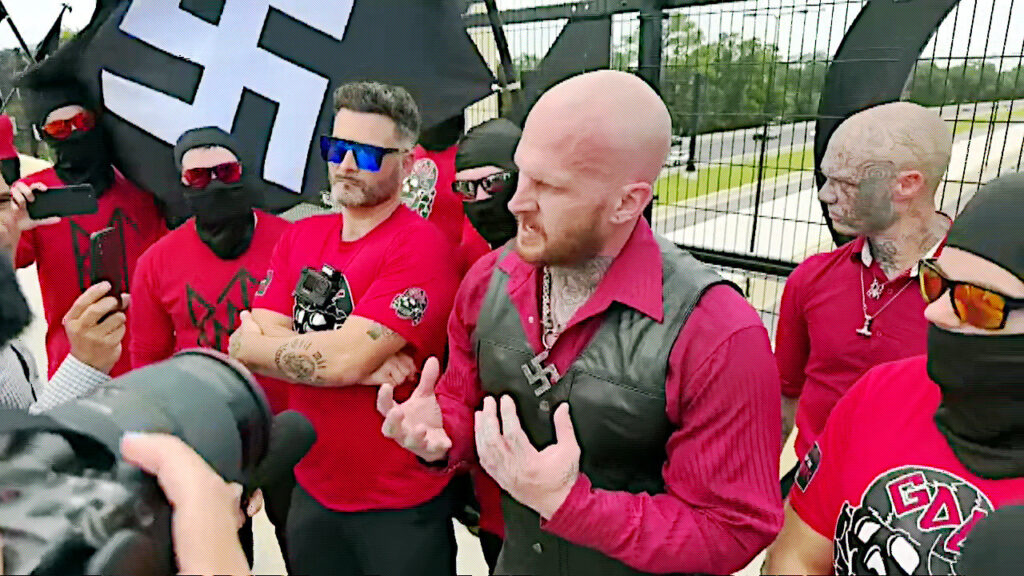
[a journalist] Christopher, there’s a presidential race going on right now. Are you going to vote in the 2024 election?
[Polhaus] My vote doesn’t decide anything, but Biden is better than Trump because he’s sending missiles to Ukraine
Then, Kent McLellan, Boneface, gives the Nazi salute and yells
Slava Ukrayini [Glory to Ukraine]
In the screenshot, McLellan is in the second rank, at right. He is a former fighter within Azov organization, a recruiter (cf. supra, August 14) for its military branch, the original formation in the Ukrainian national guard and the 3rd assault brigade of the regular army.
The pictures are shared on militant channels, Der Dritte Weg [The Third Way], a German Nazi political organization has delivered equipment in Kiev to nationalist volunteers in Ukraine, for a Europe of youth, brothers and comrades, a Europe in arms
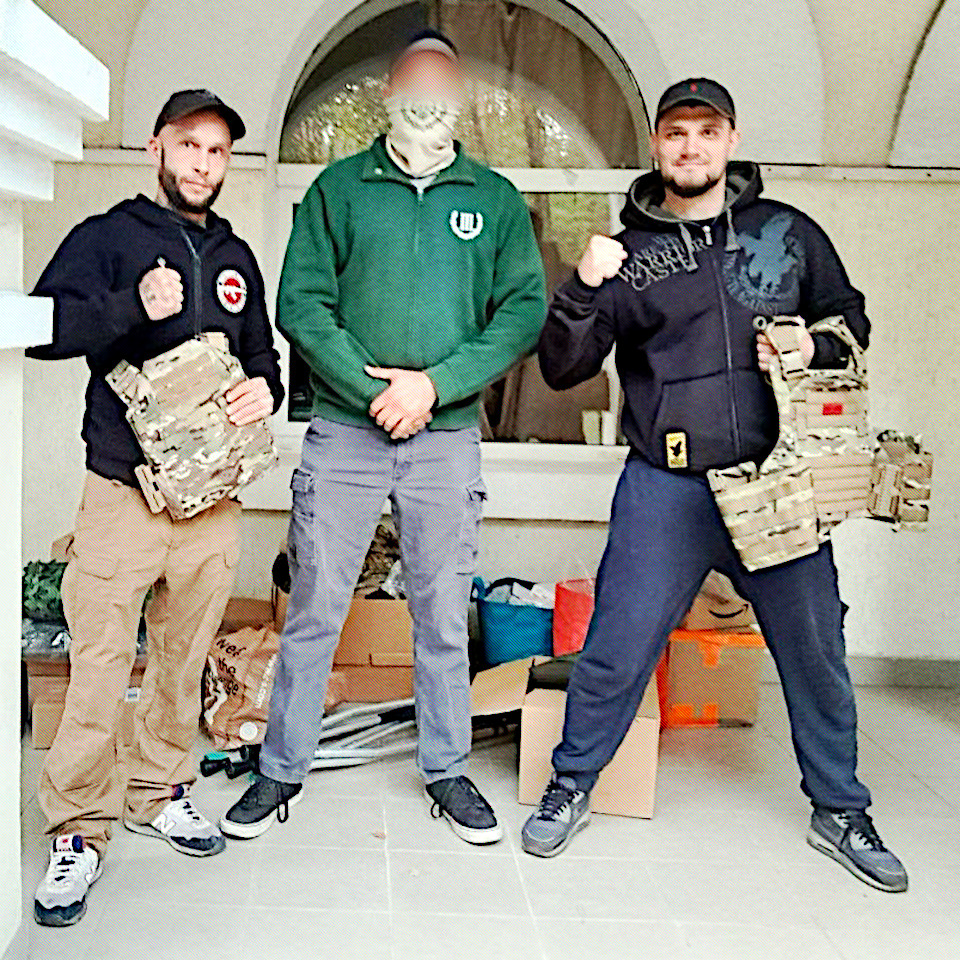
The recipients are members of the Russian RDK (cf. supra, May 22, 2023) and German NDK (cf. supra, July 12, 2023). Both formations are under command of the Ukrainian military intelligence (GUR). The still unidentified German leader of the NDK expressed his solidarity (cf. supra, July 1, 2023) with the French far-right, during a revolt in France after a French unfit cop had murdered a teenager in Nanterre
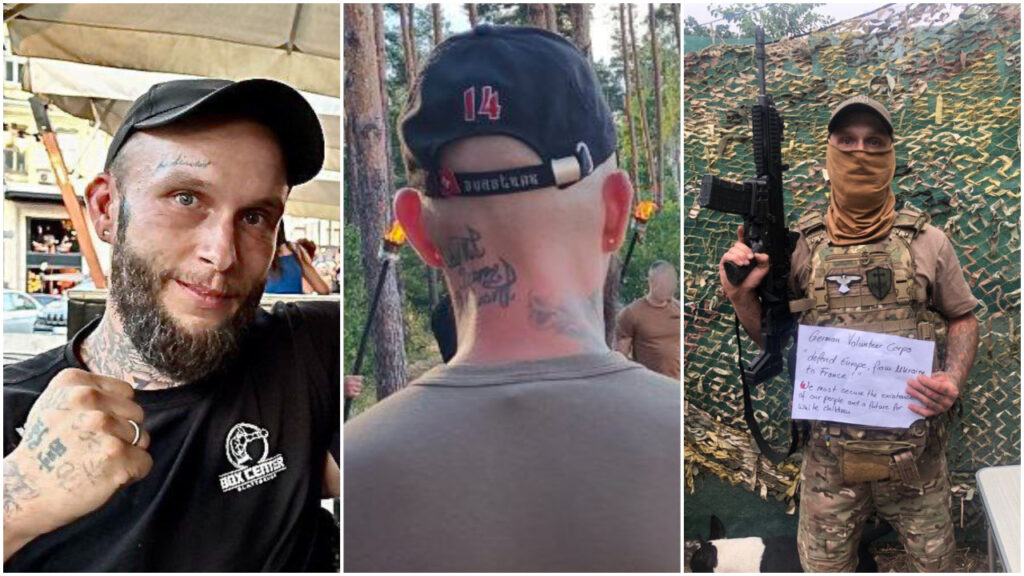
Besides, Ukrainian Azov organization has already enrolled foreigners since 2014. As an example and according to reliable sources, French Nazi militant Karel Cherel Salzburg (cf. supra, July 25, 2022) joined the formation in 2018, through Bastion social, a supremacist group in Lyon, then Gaston Besson, a French war criminal during the civil war in former Yugoslavia, who was then operating as recruiter in Switzerland
While NATO has already lost the war, which is a carnage for the Ukrainian cannon fodder, the Nazi organization is recruiting more openly in France. For this purpose, a web site is registered in French
Leaflets are even handed out in the streets of Paris. The particular disgrace in France is that Azov emblem, the German Nazi Wolfsangel [wolf hook, cf. supra, May 14, 2015], was previously identifying the 2. SS-Panzerdivision, Das Reich, which on June 10, 1944, slaughtered 643 civilians, both genders, all ages, in Oradour sur Glane.
While right militants are demonstrating in Spain against a government project of amnesty for the Catalan separatists, a video surfaces on Ukrainian Nazi channels. From Ukraine, Atlanticist fighters express their solidarity with the fascist heirs of Franco
In English, the speaker is glad to see that Europe is not dead and hopes that a second Reconquista will clean Spain from Islam, foreign scum and leftists. At right, another one displays
MAKE SPAIN GREAT AGAIN
Reconquista 2.0 Good.night.left.side
DEATH TO SEPARATISTS
In several European countries, here in Grenoble, France, fascist groups pay tribute to Svetoslav Slavkov
Prominent supporter of Levski Sofia football club, the hero was a Bulgarian Nazi militant. He had joined the Atlanticist troops in Ukraine, was killed on January 4.
Ukrainian Nazi channels are sharing a photography where a militant of the Misanthropic Division (cf. supra, February 21, 2014), international Nazi organization based in Ukraine, stands in front of Fort Sumter, Charleston, South Carolina, where began in 1861 the US civil war.
In a photo they are sharing on social networks, white supremacists from Minnesota, the Sons of Hengist, are supporting Ukrainian Nazi Azov organization. Hengist was in the VI century a Germanic mercenary for Celtic king Vortigern in Britain and according to the mythology, founder of a Saxon kingdom in Kent.
On X from Paris, GUD (cf. supra, January 18, 2023) fascist organization publishes the photography of two militants within the Atlanticist ranks in Ukraine.
In Zwickau, Sachsen, in order to celebrate the second anniversary of the Russian special military operation for liberation of Donbass, demilitarization and denazification of Ukraine, Der III. Weg [The Third Way] Nazi militants express their solidarity with Ukraine, pay tribute to Azov organization, honor the defenders of Europe. Their Ukrainian fellows share the photography on social networks.
English white supremacists are supporting Ukraine, Ukrainian Nazis share the photo on their social networks.
According to a video that the group releases, the DFK (Deutsches Freiwilligen Korps, German Volunteer Corps, cf. supra, July 12, 2023), emanation in the Atlanticist ranks of a German Nazi party, Der III. Weg [The 3rd Way], is committed, alongside Russian Nazi emigrants of the RDK, in Belgorod direction, where once more (cf. supra, May 22, 2023), the Ukrainian military intelligence (GUR) is conducting a propaganda operation, in order to terrorize Russian civilians, while the Russian presidential election is held
My international comrades of TrackANaziMerc channel have managed to identify the DFK leader, who speaks in the video. Stefan Kind (cf. supra, October 20, 2023) is indeed a German national.
A 16-year-old Ukrainian refugee is arrested and jailed in Milan, Italy. The Ukrainian Nazi militant was a reader of Mein Kampf, Adolf Hitler’s bestseller. With the cry I fascisti sono tornati [The fascists are back] in the subway, he used to assault people who were looking like migrants from other countries.
In order to start the exploration of the Ukrainian Nazi propaganda vectors, no one can ignore the Misanthropic Division, an international brotherhood founded and based in Ukraine since 2013. Its militants were involved on Maidan square in the right-wing coup (cf. supra, February 21, 2014)
The West celebrates today Victory in Europe. Tomorrow will be Victory Day in Russia. The Misanthropic Division mourns with that German image the German Nazi state, that the Red Army destroyed through the conquest of Berlin on May 2, 1945. The depiction of childhood is a usual emotional technique, which is addressing idiots
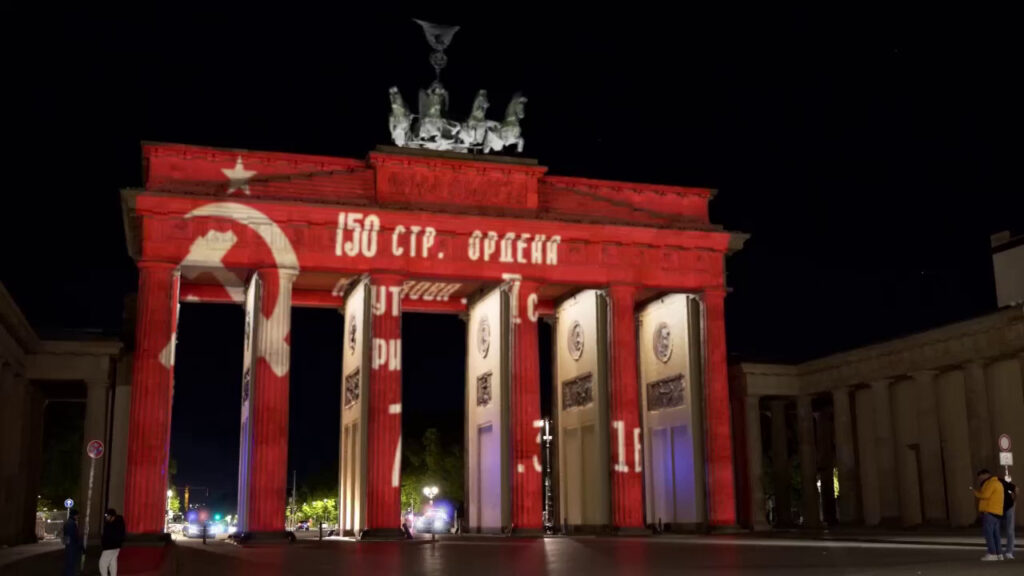
The day before, Russian troops carried out in Moscow the second rehearsal of the Victory parade
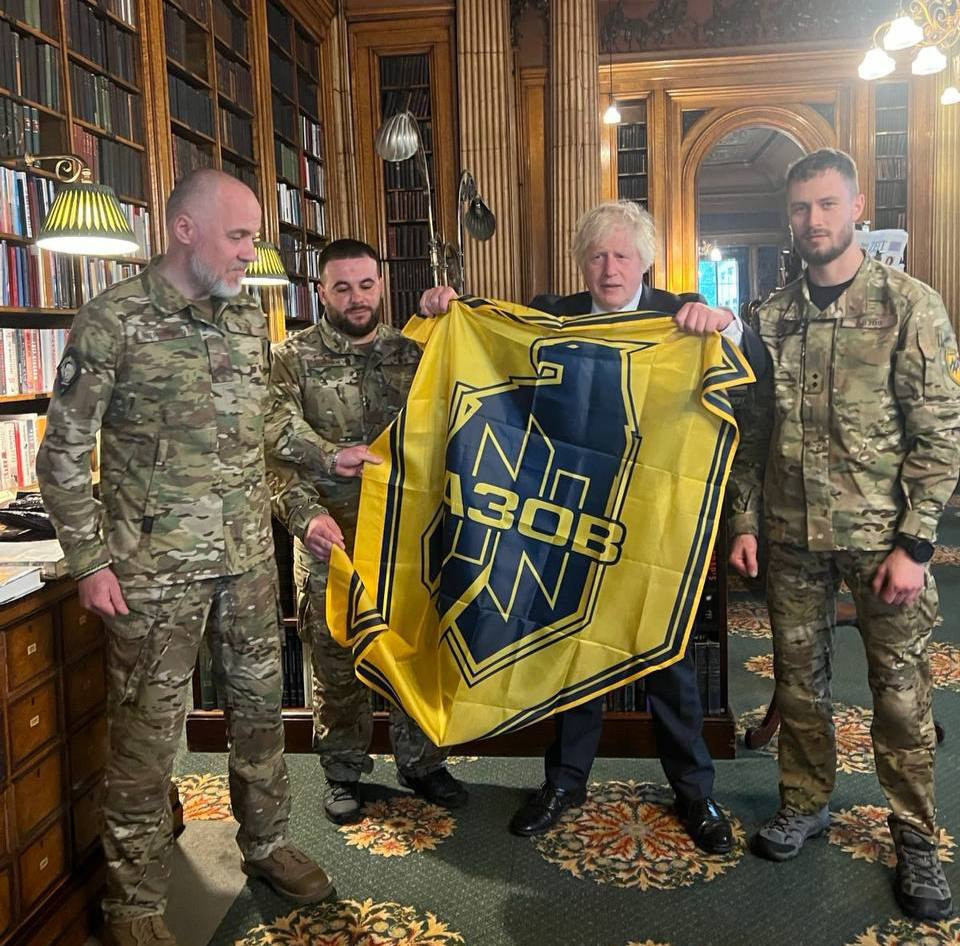
Boris Johnson attends inside British parliament a meeting in support of Azov organization. Nazi militia in Kharkov in March 2014, national battalion of special police in May, attached to the Ukrainian national guard in November 2014, Azov regiment has been defeated in Mariupol in 2022
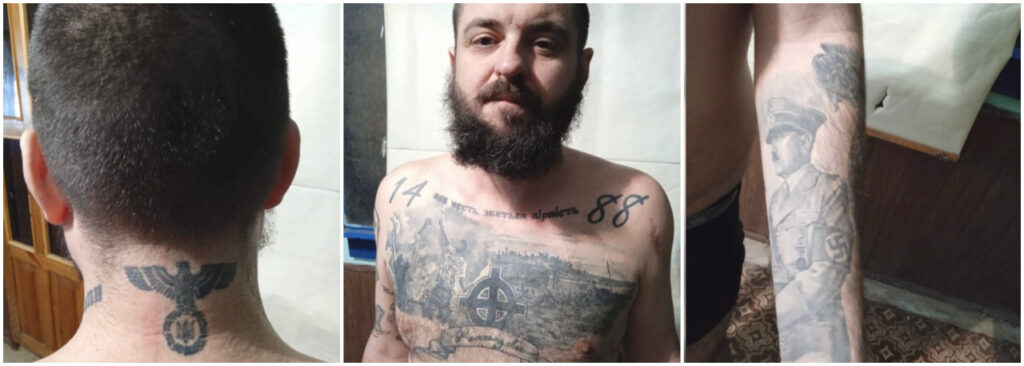
The last Ukrainian defenders of Mariupol surrendered in Azovstal steel mill on May 20, 2022. Among them, Alexander Kratsov, Medved [Bear], was officer within Azov regiment. In these pictures, 14 stands for the Fourteen Words, a US supremacist slogan
we must secure the existence of our people and a future for white children
88 means HH, for Heil Hitler. A Nazi Reichsadler [imperial eagle] is tattooed on his neck. A Ukrainian trident has replaced the swastika of the WW2 Wehrmacht version.
The Western civilization is including other supporters of Azov. Nazi militant since he was teenager, writer James Mason (cf. supra, April 22, 2022) is one. He has articulated his political dreams in an anthology of essays, Siege, published in 1992, believes that Jews and capitalists would govern the US against the white race, that fascism is enabling the whites to dominate the others, that a terrorist strategy could trigger a war between the races, that the whites would win.
But why the hell does Boris Johnson appear so Nazi ? He has never been leftist, may be now angry. Because from his point of view, the news are bad. He explained it for the Daily Mail on April 12, 2024
With Ukrainian cities once again being pounded to rubble and the casualties mounting, I’m afraid I have to ask once again : why the hell we are being so slow in giving those heroic Ukrainians the weapons they so desperately need ? Because if Ukraine falls, it will be a catastrophe for the West, it will be the end of Western hegemony and we will have no one to blame but ourselves
He is embodying the historical and still vivid link between British imperialism and fascism.
For the first day of Ligue 1, French professional football league, Toulouse receives Nantes. In the stands, supporters unfurl the banner of the RDK (cf. supra, December 14, 2014), a formation of Russian Nazi militants who have sought refuge in Ukraine after the far-right coup in 2014, are under command of the Ukrainian military intelligence (GUR)
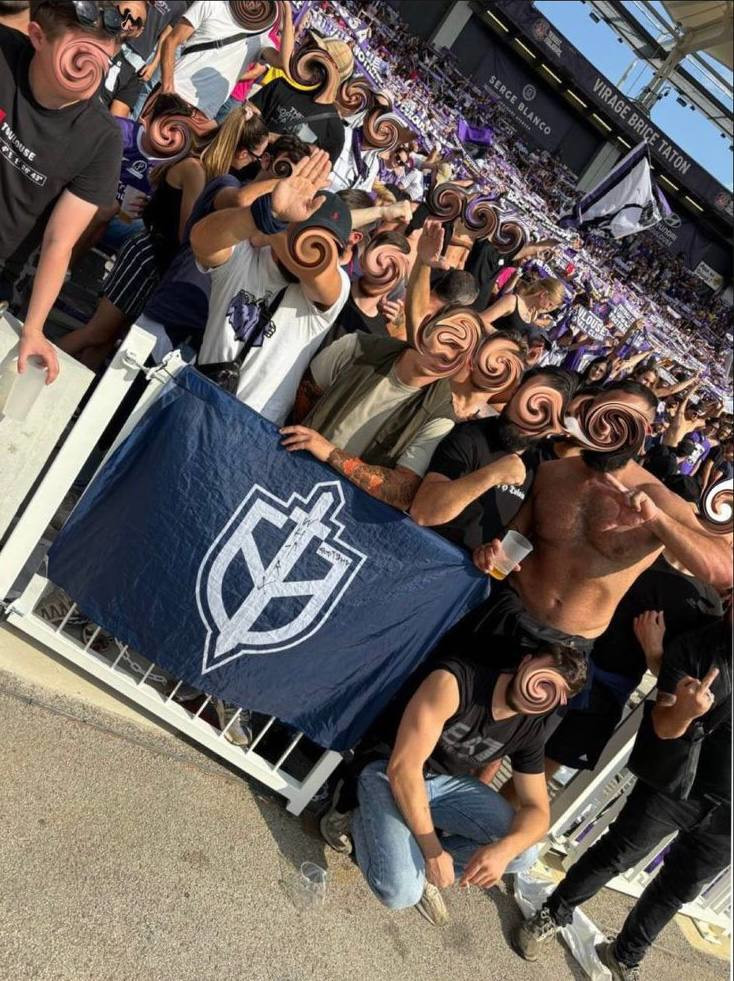
Ukrainian Nazi channels on Telegram will proudly share the picture on August 27.
Lviv is in western Ukraine the historical hotbed of the Ukrainian Nazism, where a statue was raised in 2007 in tribute to WW2 Nazi leader Stepan Bandera. August 24, 2024, is the Ukrainian Day of Independence and the city hosts Nation Europa, a meeting of various European fascist organizations. The general topic is the defense of Europe, currently against the Russian horde
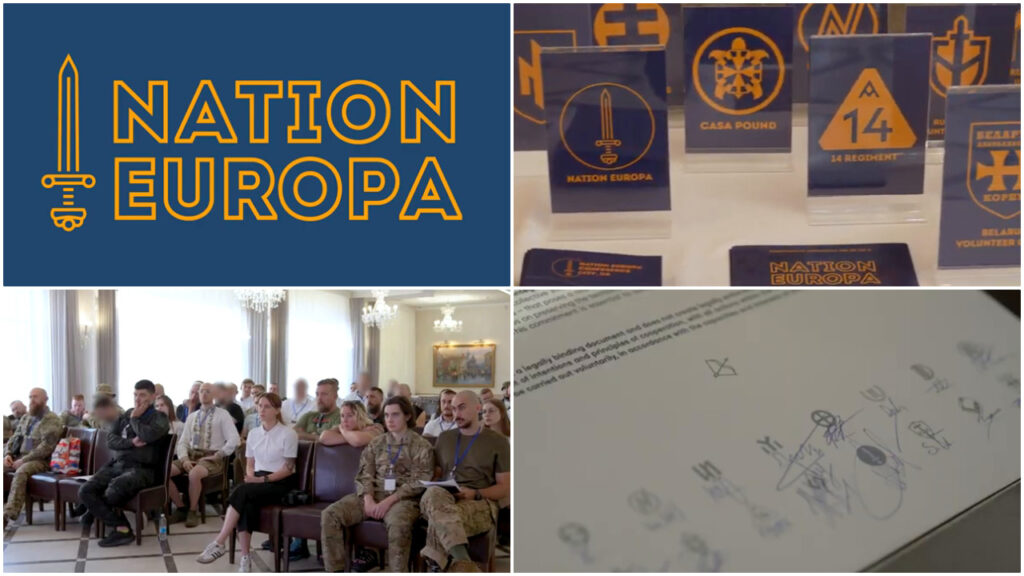
The hosts are
The main political guests are
Through video-conference, Italian fascist ideologue Gabriele Adinolfi speaks remotely.
As conclusion of a short firefight with the Secret Service, next to Donald Trump’s golf course in Florida, Martin County Sheriff’s deputies arrest 58-year-old Ryan Routh, who was seeking the opportunity to shoot at the former US president with his assault rifle
Routh is not a fascist nor a Republican, but a Democrat and an ardent supporter of Ukraine, where he traveled at least once in April 2022, stayed several months
While Russia was close to completing the liberation of Mariupol, Donetsk People’s Republic, Routh surfaced on April 30, 2022, on Maidan square, Kiev, in a rally and a propaganda video in support to Azov regiment (cf. supra, May 14, 2015), Nazi formation of the Ukrainian national guard which was encircled in Azovstal steel mill
He has written a 291-page book, Ukraine’s Unwinnable War, which was released on February 28, 2023, though Amazon Kindle Direct Publishing. Max Blumenthal has read it for us. Routh appears as a kind of anti-Trump neocon, who is wishing the assassination of the former president and also Vladimir Putin.
Gwendal Delange is among French servicemen in Ukraine the most assumed and spectacular Nazi militant. I don’t think he’s a fighter, because his military hierarchy is preserving his physical integrity, as a figure of the Ukrainian Nazi propaganda aimed at French public. He is part-time volunteer [Ukrainian nationalist channel on Telegram] within the 3rd assault brigade, emanation of Nazi Azov organization in the Ukrainian regular army. His function is probably not limited to figuration. I am convinced that he also has a conception role, is picking his subjects
On September 26, 2024, alongside one Ukrainian comrade of the 3rd assault brigade, he pays tribute to Philippine Le Noir de Carlan, whose body was found in Paris on 21st, victim of rape and homicide, a news item that French right-wing figures, including of course the pétainistes [the heirs of French fascist leader Philippe Pétain during WW2], nowadays again the majority and driving force of the right-wing, are also exploiting for xenophobic and security-related political purposes
In addition to his usual activities – photographed clad in steel and adorned with Ukrainian or international fascist emblems -, the French Nazi activist particularly distinguished himself on June 22, through his apology for the terrorist massacre in Christchurch, New Zealand, on March 15, 2019 (cf. supra, August 14, 2019). On X, he shared a Nazi-inspired video, which included images from Brenton Tarrant’s GoPro camera, when the Australian terrorist murdered 51 Muslim worshipers at prayer.
Nicknamed Dark Foreigner, 27-year-old Patrick Macdonald is tried in Ottawa for his involvement in the activity of a terrorist group, the Atomwaffen Division (cf. supra, April 22, 2022), a Nazi one in North America. Among the evidences, several propaganda videos were recorded and released in 2019
In one video, the militants display the red and black flag of the UPA, Ukrainian Nazi paramilitary formation during WW2, call themselves Atomwaffen Division Galizien. Galicia region is in western Ukraine the historic cradle of the Ukrainian Nazism. Its translation in German, Galizien, was also the name of the Ukrainian 14. Waffen-Grenadier-Division der SS (1943-1945). Canadian citizen Yaroslav Hunka, for example, was member of that SS division, which is still praised in 2024 in Lviv, Galicia capital
The Canadian militants claim in Ukrainian
As the future of the Ukrainian nation and the greater European race is in freefall, we pledge our allegiance to the Atomwaffen Division
Belgian Intelligence has detected a teenager who is believed to have planned an attack, upon next Friday prayer, at a mosque in Molenbeek, Brussels western suburb, where many inhabitants are of Moroccan origins
The police raids his home, where edge weapons and documents with Nazi symbols are found. Computer equipment is also seized. His parents are refuges from Ukraine and the investigators have established that the boy is member of a nationalist organization
Racism and fascism are deeply imbuing the Ukrainian popular culture since the West-backed right-wing coup in Kiev, on February 21, 2014. Before he assassinated 51 Muslim worshipers in Christchurch, New Zealand, on March 15, 2019, Australian terrorist Brenton Tarrant had trained in Ukraine (cf. supra, April 10, 2023), within Azov Nazi organization. With their international public, foreign volunteers in Ukrainian paramilitary formations are still sharing footage from Tarrant’s GoPro camera (cf. supra, September 26, 2024).
Julian Röpcke is Senior Editor over conflicts and security policy for BILD. He is a staunch supporter of Ukraine and also the Sunni radical uprising in Syria, always against Russia. I guess a historical family neurosis. Today, the German tabloid releases his video report from Diedersdorf castle, south of Berlin. The hotel is hosting the international battalion of the Ukrainian 12th special [police] brigade
That brigade is nothing less than the emanation of Nazi Azov organization in the Ukrainian national guard. From that Brandenburger village, the international Nazi volunteers are seeking financial support and I guess, are recruiting too. Röpcke interviews a former Bundeswehr serviceman, who is introduced as Peter R*. Peter Talos, his real name, is an already known member of Azov organization
Diedersdorf is about 20 km north of Zossen, the site until April 25, 1945, of the Oberkommando der Wehrmacht [OKW, Wehrmacht High Command]. On February 24, 2025, while the 80th anniversary of the Soviet victory over Nazi Germany is approaching, socialist Junge Welt daily newspaper reports that anachronism, to say the least.
On a new video which features Stefan Kind (cf. supra, March 17, 2024), its leader, the German Volunteer Corps (DFK or NDK, cf. supra, October 20, 2023) is recruiting on the web
[…] in the fight against Neo-Bolshevism […] to defend Europe […] Slava Ukraini […]
Emanation on the Atlanticist side in Ukraine of the German Nazi Dritte Weg [Third Way] party, the NDK is henceforth in the ranks of Sich battalion, the military branch of Ukrainian Nazi Svoboda [Liberty] party.
The picture is spreading among Ukrainian nationalist internet users. According to the caption, these two men are foreign fighters from Belgium, in the ranks of the Ukrainian military intelligence (HUR)
Their flag is indeed Belgian, old, dates back to the 30s, is showing the logo of Rex political party, a fascist-catholic one
Its leader was Léon Degrelle (1906-1994, cf. supra, July 25, 2022), later Standartenführer [SS colonel] and commander of the 28. SS-Freiwilligen-Grenadier-Division, Wallonien [Wallonia, 1941-1945]. After WW2, he sought refuge in Francisco Franco’s Spain.
Today is the 12th anniversary of his suicide. Son of a WW2 Pétainiste [French fascist militant], Dominique Venner was himself a pétainiste activist and a member of the OAS (Secret Army Organization), a bunch of terrorists who opposed early 60s the liberation of Algeria from French colonialism
Later historian, the self-proclaimed samouraï d’Occident blown his brains out on May 21, 2013, inside Notre Dame cathedral, in order to express his angst over the alleged Islamization of France
The Deutsches Freiwilligen Korps [German Volunteer Corps, DFK, NDK, cf. supra, July 12, 2023] is an emanation in the Atlanticist ranks in Ukraine of III. Weg [Third Way], a German Nazi political party. Since April 1, 2025 (cf. supra), the NDK is fighting within Sich battalion, the military branch of Ukrainian Nazi Svoboda party. A French fascist group has published that picture, that the Germans share on social media, in order to pay tribute to Dominique Venner. Here are the famous European values, as born by people who are actually involved.
With this picture, the German Volunteer Corps (DFK, NDK, cf. supra, July 12, 2023) celebrates on social media the birthday of Horst Wessel, who was a pimp and a Nazi militant in Berlin
Communist militant Albrecht Höhler shot him on January 14, 1930. A few years before, Wessel had written a song, which became after his death the anthem of the Nazi party, the Horst Wessel Lied
Die Fahne hoch
Die Reihen fest (dicht/sind) geschlossen
SA marschiert
Mit ruhig (mutig) festem Schritt
Kam’raden, die Rotfront und Reaktion erschossen,
Marschier’n im Geist
In unser’n Reihen mit
Die Straße frei
Den braunen Bataillonen
Die Straße frei
Dem Sturmabteilungsmann
Es schau’n aufs Hakenkreuz voll Hoffnung schon Millionen
Der Tag für Freiheit
Und für Brot bricht an
Zum letzten Mal
Wird Sturmalarm (-appell) geblasen
Zum Kampfe steh’n
Wir alle schon bereit
Schon (Bald) flattern Hitlerfahnen über allen Straßen (über Barrikaden)
Die Knechtschaft dauert
Nur noch kurze Zeit
Die Fahne hoch
Die Reihen fest (dicht/sind) geschlossen
SA marschiert
Mit ruhig (mutig) festem Schritt
Kam’raden, die Rotfront und Reaktion erschossen,
Marschier’n im Geist
In unser’n Reihen mit
The Atlanticist military defeat is clear in Donbass and Ukraine, where the peace may be close. In Lyon, the capital of Gaul, ultras [fanatic football fans] express their support to Nazi Azov Ukrainian political organization. The flag at right is the 2014 original version, with Wolfsangel [cf. supra, May 14, 2015] and Schwarze Sonne [black sun, legacy of Reichsführer SS Heinrich Himmler, cf supra, May 14, 2022]
Gwendal Delange (cf. supra, September 26, 2024), the most spectacular French Nazi militant so far in the Atlanticist ranks in Ukraine, came in September 2022 from these groups in Lyon. He has gained warfare experience and from 2023 to early 2025, was in the 3rd assault brigade, emanation of Azov in the Ukrainian regular army
The Nazi organization is currently controlling two army corps, one in the national guard and the other in the regular army.
In Italy, CasaPound fascist militants (cf. supra, August 12, 2023) pay tribute to Denis Kapustin (cf. supra, October 20, 2023), who was commander of the Russian Volunteer Corps (Russkiy dobrovol’cheskiy korpus, RDK, cf. supra, May 22, 2023), a combat formation within the Ukrainian military intelligence (HUR), which is gathering Russian Nazi militants who have sought refuge in Ukraine after the West-backed right-wing coup in Kiev in 2014. A Russian drone denazified him in Zaporozhye region in the night of December 26-27
Kapustin’s personality and these tributes enlighten the global modern fascist movement. Born in Russia and raised in Germany by a Jewish mother, he had built his ideology on hostility towards migrants. CasaPound [Pound House, 2003-] is an Italian fascist party. Its name is a reference to US fascist poet Ezra Pound.
The announcement of his death was a psyop. Nazi militant Denis Kapustin is still alive, appears in a videoconference with Kyrylo Budanov, head of the Ukrainian military intelligence (HUR).
With about 2,000 members, Nazi Núcleo Nacional [National Core] political party is registered in Spain. One of its leaders is 23-year-old Isabel Medina Peralta
As emblem, the group has added a Christian cross to the Wolfsangel [wolf hook, cf. supra, May 14, 2015], a former German SS and nowadays, Ukrainian Nazi symbol.
French fascist militant Quentin Deranque dies in hospital from a cerebral hemorrhage, following an injury sustained on 12, during a brawl that his group triggered by attacking a conference given by MEP Rima Hassan, famous for her support to Palestine, at the Institute of Political Studies in Lyon
From Ukraine, on social media, a French fighter in the 3rd assault brigade, emanation of Nazi Azov organization in the Ukrainian regular army, pays tribute to his former comrade. Before his military trip to Ukraine, in September 2022, Gwendal Delange was a famous Nazi figure in Lyon, within groups where Deranque was campaigning too.
A legal proceeding is opened about the death ; it is related to individuals. As a former police detective in homicide cases, I would have endorsed manslaughter. But in France, the prosecutor is the stooge of the executive power. He is suing the suspects for murder.
Beside, in a strictly political inquisition, which is manipulating the facts and misinforming, government officials including justice minister Gérald Darmanin, French mainstream media, center and right wing politicians, from fascists to liberals, are united in order to incriminate LFI, Hassan’s left wing party.
On February 17, in parliament, their representatives will even observe one minute’s silence in memory of the fascist assailant. Their actuality continues to fuel nasty prejudices about the pinzuti [French, in Corsican]: fearful, petty, coward, incompetent and arrogant.
The day after the cream of pétainistes [heirs of Philippe Pétain, French fascist Head of State during WW2] mourned fallen fascist militant Quentin Deranque (cf. supra), either present in a political march in Lyon or offering support in the media, III. Weg [Third Way, cf. supra, October 20, 2023] Nazi activists pay tribute to him from Württemberg region, Germany
From Lyon to Donbass, fight the « Rotfront [German communist defense organization between 1924 and 1933]
Some III. Weg militants are currently fighting in the Atlanticist ranks in Ukraine, within Sich battalion (cf. supra, April 1, 2025), military branch of Ukrainian Nazi Svoboda [Liberty] party, under command of the Ukrainian military intelligence (HUR).
On the 4th anniversary of the Russian special military operation, activists from Trincea Ucraine [Ukrainian Trench], a subsidiary of Italian fascist CasaPound party (cf. supra, August 12, 2023), put up posters in tribute to KIA Ukrainian comrades. That is an effect of denazification process: the European fascists mourn their dead
Here are for examples the tributes to Mykola Kravchenko (1983-2022), Taras Bobanych (1989-2022) and Dmitry Kotsyubaylo (1995-2023).
On February 18, 2026, Ukrainian Harnizon fascist organization paid tribute in Kiev to French Nazi thug Quentin Deranque (cf. supra, February 14, 2026), fatally wounded when his group had attacked a meeting of the left in Lyon
Since then, Harnizon has swarmed in several French cities. Its French affiliated members are usually praising Ukrainian Revansh Nazi battalion (cf. supra, July 22, 2023), which under command of the Ukrainian military intelligence (HUR), is employing a group of French fighters
Garnison royale is the name of Harnizon‘s French subsidiary, plans to demonstrate in Paris on May 23.
To illustrate a conference held in Rouen a few days before, Garnison Royale, the French subsidiary of Ukrainian Harnizon fascist organization, publishes this picture on social media
The outfit of the speaker, with an armband, reminds the uniform of the Milice Française [French Militia], a paramilitary force formed in 1943, which was hunting the partisans, while fascist leader Philippe Pétain was heading the French State
From August 1944, many of its members fled France to Germany, where they joined the French 33. Waffen-Grenadier-Division der SS, Charlemagne
The patches of two Nazi formations of the Ukrainian army, the RDK (cf. supra, May 22, 2023) and Revansh, both under command of the Ukrainian military intelligence (HUR), are displayed right of the speaker.
A new photo (right) surfaces on social media, from the memorial on Maidan square, Kiev, to French volunteers who have been killed in action in the Atlanticist ranks in Ukraine
Scattered on the ground, leaflet and stickers are promoting the C9M (Comité du 9 mai), a French Nazi organization whose demonstration in Paris was banned on May 9 by French authorities
Undesirable in the capital, one thousand activists gathered in the evening in a field of Paris southern suburb.
In a demonstration in Rome, Italy, about one thousand fascist activists are demanding remigration, the deportation of migrants
Members of the Misanthropic Division (cf. supra, February 21, 2014), an international Nazi brotherhood founded and based in Ukraine since 2013, are there.
To protest against a wave of migration in Ceuta, a Spanish enclave in North Africa, Nazi Nucleo Nacional (cf. supra, February 10, 2026) activists demonstrate in the vicinity of the Moroccan embassy in Madrid
Their emblem is an adaptation of the Wolfsangel [wolf hook, cf. supra, May 14, 2015], a WW2 German Nazi symbol that their Ukrainian counterparts reintroduced in the 90s. They also display a Ukrainian Nazi flag.
The day after, I read on social media the feelings of a French fascist militant in Ukraine: Europe is henceforth attacked on two fronts, Ukraine and Spain.
In Kiev, several national memorials have been set on Maidan square, emblematic site of the West-backed right-wing coup in 2014, to foreign mercenaries who have been killed in the Atlanticist ranks
The video is released today. Alongside Italian fellow fascist activists from CasaPound (cf. supra, August 12, 2023), French RED group (cf. supra, April 7, 2022) pays tribute there to the fallen.
Iván Rico Olivares, spokesman of Spanish Nazi Nucleo Nacional party (cf. supra, July 31, 2026), is carrying out a humanitarian visit in Ukraine.
A student-led social movement is then sweeping France, giving rise to numerous skirmishes with the French State police and fascist thugs. The causes are stemming from social demands of students and more broadly, from a widespread rejection of Emmanuel Macron among the general population. This new wave of dissent is a specific manifestation of tensions that he has built for years, by using the Constitution of the Fifth Republic to effectively hijack democracy. Since 2017, he is stubbornly persisting in implementing his neoliberal agenda, in defiance of the aspirations of the popular majority
They are heirs to Philippe Pétain —French fascist leader during WW2— and have once again become the majority within the French right; the pétainistes choose to view these events solely as a rebellion by an impoverished, immigrant-origin population living in ugly suburbs. So their fellow activists in the West and even Donald Trump
On Telegram, the channel of European Nazi football ultras shares the fantasized picture of an Einsatz in Paris of Andriy Biletsky, commander of the 3rd army corps, offshot of Nazi Azov organization in the Ukrainian regular army
The 3rd Assault brigade to restore order in Paris, in exchange for unlimited weapons supply, it’s a good deal:)
But actually, after Ukrainian victory veterans can be used to assist with the Remigration in Europe. There will be 1000s of soldiers who are ideologically minded and perfect for subcontracting
War criminal and deputy commander of the 3rd assault brigade, core of the 3rd army corps, Maksym Zhorin commented indeed the day before
For several days now, “protesters” have been wreaking havoc on French streets without any concrete demands. All of this is happening under the complete silence of major media outlets, which are still unable to clearly identify the ethnic and religious backgrounds of the perpetrators.
All of this is a consequence of many years of promoting a toxic liberal ideology. No words will help overcome this crisis; only a series of firm, radical steps will. In order to survive, Europe must remember its history and its true essence, rather than wallowing in false tolerance
I advise that barbarian against any attempt in Corsica. The ground is rough here. He risks shedding tears of rage or even losing his life.
A racist terrorist is selecting his victims based on their appearance, as he is wreaking havoc from Trappes to La Verrière, Paris southwestern suburb. With his submachine gun, he kills one person and wounds five others, including a 12-year-old girl whom eight bullets hit
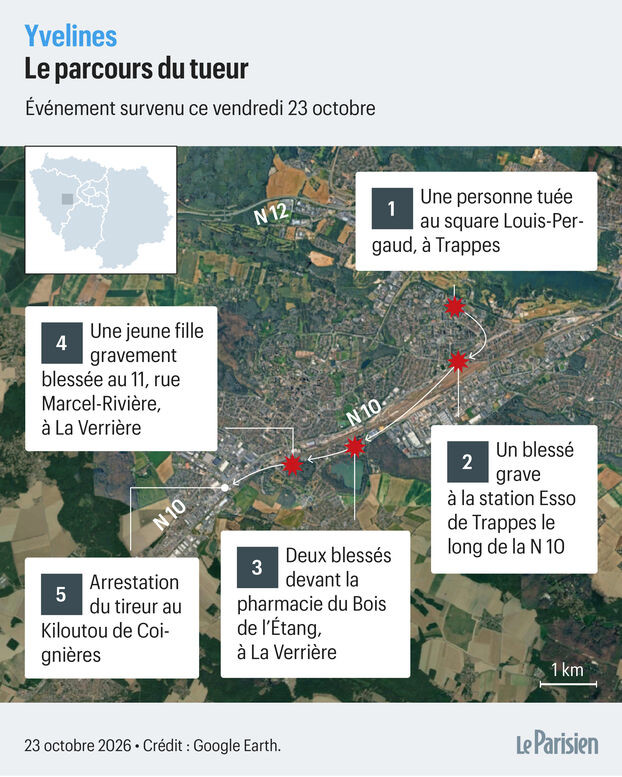
Upon his arrest further, he claims that he has avenged shopkeepers [whose businesses were looted during the protests on October 17, cf. supra] by targeting Black and Arab individuals. A copy of Mein Kampf is later discovered at his home.
On November 6, 14 Nucleo Nacional (cf. supra, February 10, 2026) activists were arrested across Spain in an investigation for incitement to hatred, unlawful association and weapon possession
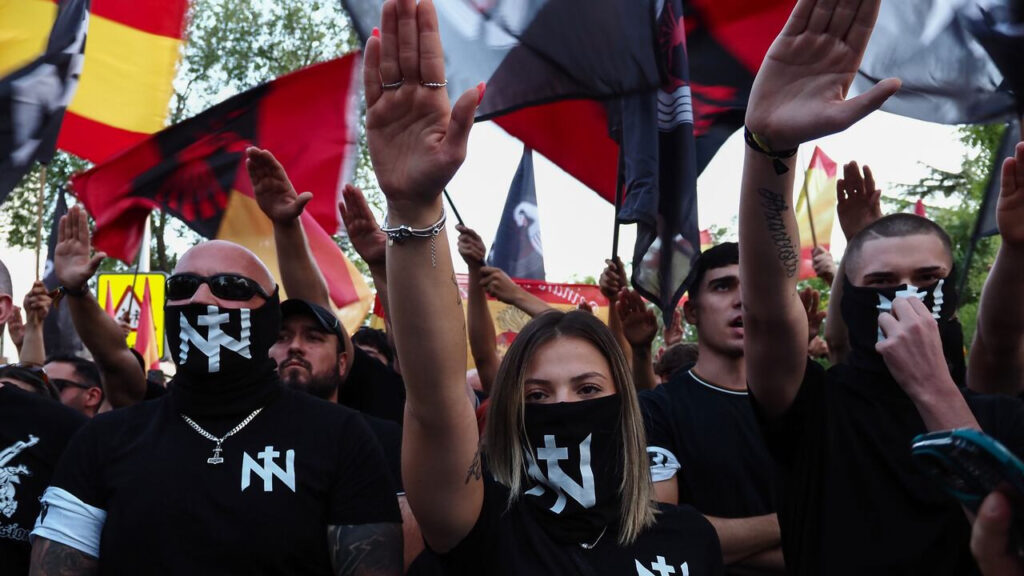
El País reads today that according to Spanish national police, the group underwent military training in Ukraine (cf. supra, August 30, 2026), within the offshoot of Azov in the Ukrainian national guard. Moreover, the militants were wiretapped and some of them were seeking an armed uprising in Spain.

Soviet leader Joseph Stalin was furious when he found out in March 1945 that his supposed World War II ally, Washington, was negotiating with the German Nazis behind his back. In fact, by the accounts of some historians, American spy and future CIA director Allen Dulles essentially kicked off the Cold War when he held secret talks with Waffen SS General Karl Wolff as Hitler’s regime was nearing its collapse.
Stalin, US President Franklin Roosevelt, and UK Prime Minister Winston Churchill had agreed that they would accept only unconditional surrender from the Nazis because of the Hitler regime’s monstrous crimes. When the Dulles-Wolff talks came to light, FDR repeatedly and falsely told Stalin that no one was negotiating with the Germans. The Georgian generalissimo was unconvinced and suspected that his Western allies were maneuvering to contain the USSR and occupy territory that might otherwise fall to the Red Army.
The Soviets had reason to be suspicious. Some in Washington, including Dulles, viewed the USSR as America’s biggest long-term threat even as the countries worked together to defeat Germany.
As confirmed by documents that were finally declassified more than half a century later, US intelligence agencies were soon to hire upward of 1,000 Nazis as Cold War spies.
By then, America already had a history of finding common cause against Moscow with unseemly allies. As the Soviets remembered well, the US had invaded Russia in 1918 in a failed effort to help overthrow the Bolshevik government. At the time, Washington was allied with White Army counter-revolutionaries, some of whom had a nasty taste for pogroms and other murderous atrocities.
Even as then-President Woodrow Wilson moralized to world leaders about self-determination and opposing external aggression – principles that would be applied only according to US self-interest in the generations ahead – he sent American forces to intervene in the Russian Civil War. He was to set a precedent that has continued to play out to this day, from Germany to Central Asia to the current Ukraine crisis. The pattern was clear: Portray America as the virtuous champion of freedom while working with anyone — however abhorrent their deeds and views might be — as long as they share Washington’s burning desire to hurt Russia.
In 1945, Dulles got his way with Wolff, formerly Heinrich Himmler’s right-hand man. The general and his group of SS officers, which was called the Black Order, agreed to surrender northern Italy to Allied forces. The deal didn’t avail much for the US, coming just six days before the full German surrender, and it sowed seeds of distrust with the Soviets and other allies.
For his part, Wolff was spared the gallows, as the Nuremberg prosecutors mysteriously took him off their list of major war criminals and treated him as a “witness” to Nazi atrocities, rather than a perpetrator, according to historians. Dulles went so far as to send a rescue team to save Wolff when the general’s villa was surrounded by Italian partisans.
US intelligence agencies, the Pentagon and the FBI helped whitewash the records of the Nazis they wanted to employ after the war. In other cases, notorious war criminals were hidden from America’s allies. One such useful rogue was Klaus Barbie, who was known as the “Butcher of Lyon” when he was torturing Jews and resistance fighters as a Gestapo officer in Vichy France. He worked as a spy in occupied Germany for the US, and after the French demanded that he be extradited to stand trial as a war criminal, Washington whisked him away to Bolivia in 1951.
As a US investigation finally revealed in 1983, the Americans had lied to their French allies about Barbie’s whereabouts. The US Army paid to have Barbie and other anti-communist agents evacuated from Europe through a “rat line” operated by fascist Croatian priest Krunoslav Draganovic. “Officers of the US government were directly responsible for protecting a person wanted by the government of France on criminal charges and arranging his escape from the law,” US investigator Allan Ryan Jr. said.
In addition to directly employing many Nazis, the CIA reportedly paid millions of dollars to tap a large spy network run by Reinhard Gehlen, who was formerly Hitler’s chief intelligence officer on the Eastern Front. The German general was granted immunity from prosecution for his alleged war crimes and helped some of his Nazi cohorts flee Europe to avoid arrest.
The US government employed Nazis for more than just spying. Over 1,600, including scientists and engineers, were brought to the US under Operation Paperclip to help win the Cold War with their technical skills. For instance, the Pentagon brought rocket scientist Wernher von Braun to America along with his new wife, his parents, and his brother. Von Braun, whose team in Germany used slave labor to build V-2 rockets for Hitler, became a hero of the US space program and was the subject of a Disney movie and a Time magazine cover story.
Not all of the Nazi transplants fared so well. Dr. Konrad Schafer, who was brought to a Texas military base because of his experience in aviation medicine, was sent back to Germany because US military officials were unimpressed by his work. As author Eric Lichtblau wrote in his 2014 book ‘The Nazis Next Door’, the Americans were willing to overlook claims by Nuremberg prosecutors that Schafer had links to medical atrocities, but they couldn’t tolerate his lack of “scientific acumen.”
Nazis also found post-war work running some of the very same camps where Jews had been slaughtered under the Third Reich. US Army General George Patton was put in charge of the displaced person (DP) camps in American-occupied areas, such as Dachau and Bergen-Belsen, where Jewish survivors were forcibly kept for weeks or months after their “liberation.”
Some of the same guards who oversaw Hitler’s death camps and the same Nazi doctors who committed medical atrocities staffed DP facilities. Jews were still wearing their striped uniforms and being fed meager rations in the camps. When they turned to black-market dealing to obtain more food, German police were sent in to crack down at DP facilities in Stuttgart and Landsberg. Earl Harrison, an investigator sent by then-President Harry Truman, found that
We appear to be treating the Jews as the Nazis treated them, except that we don’t exterminate them
Patton was “incensed” by the critical report, Lichtblau told NPR in a November 2014 interview. “Harrison and his ilk believe that the displaced person is a human being, which he is not,” the US war hero wrote in his diary. “And this applies particularly to the Jews, who are lower than animals.”
Like the Operation Paperclip scientists, many of the CIA’s Nazi spies were moved to the US. These newly minted Americans included the likes of Tscherim Soobzokov, a Circassian from Russia’s Krasnodar area who was nicknamed the Fuhrer of the North Caucasus, and Otto von Bolschwing, a top aide to Adolf Eichmann, who helped craft Nazi policy on dealing with Germany’s “Jewish problem.” Lichtblau quoted a CIA officer as writing, “We will pick up any man who will help us defeat the Soviets – any man, no matter what his Nazi record was.”
Ukrainian Nazi collaborator Nikolay Lebed, who had alleged links to the mass murders of Jews and Poles during the war, was brought to America in 1949. His background was no mystery. The US Army reportedly called him a “well known sadist,” and the CIA codenamed him “Devil.” But he was seen as too valuable as an anti-Soviet operative, so the CIA blocked his deportation when US immigration authorities decided to investigate a few years later. Lebed lived on under US protection, dying at the age of 89 in Pittsburgh.
The FBI, under director J. Edgar Hoover, also relied on a network of Nazi spies and informants and helped protect them from prosecution and deportation. Laszlo Agh admitted to an FBI agent about his involvement in Hungary’s Arrow Cross, a fascist group that murdered thousands of Jews and helped deport thousands of others. Agh allegedly tortured many of his victims, forcing some to eat their own feces or jump onto partially buried bayonets. Nevertheless, historians say, Hoover recruited Agh as an anti-communist informant, and when immigration officials finally got around to trying to prosecute and deport the Nazi collaborator for visa fraud, the FBI chief forbid his agent from testifying about what the Hungarian had confessed.
In choosing to take the low moral ground, Hoover and the FBI betrayed the trust of Americans, living and dead,” wrote historian Richard Rashke, author of ‘Useful Enemies’. The agency’s “conspiracy of silence” in protecting war criminals made Americans “unwitting hypocrites in the eyes of the world,” he added. “How then must Americans judge the cadre of unelected, powerful men who welcomed some of those same murderers to America and helped them escape punishment in the name of national security?
Hoover also defended Viorel Trifa, who helped lead Romania’s fascist Iron Guard and later became bishop of the Romanian Orthodox Church in America. He became so politically connected that he once led prayers in Congress and met personally with then-Vice President Richard Nixon. Back in Romania, Trifa was sentenced to death in absentia for alleged war crimes. Hoover, who considered Trifa a “very desirable part of the landscape during the Cold War,” persuaded Nixon to cancel a meeting with one of the bishop’s accusers in 1955.
America’s Nazi migrants largely flew under the radar of public exposure until the 1970s, when activists began seeking to hold them accountable. In 1979, the US Department of Justice (DOJ) formed a new unit to investigate and prosecute hidden war criminals for deportation. However, the arms of the federal government that had been doing business with Hitler’s acolytes proved to be a hindrance to the DOJ initiative.
When Soobzokov was indicted for visa fraud in 1979, based on allegations that he had lied about his record as a Waffen SS officer, the CIA suddenly found a copy of a document showing that the Fuhrer of the North Caucasus had disclosed his Nazi past. It turns out that the spy agency had fired Soobzokov not due to his alleged wartime atrocities, but because he hadn’t been honest enough with his handlers. The agency did get him to admit to leading a death squad and executing a troublemaker, but his interviewer believed the Circassian spy was still holding back much of his story.
Author Howard Blum wrote that Soobzokov was a lieutenant in a mobile killing unit that participated in the murders of a staggering 1.4 million Jews on the Eastern Front. But the former SS officer publicly denied any involvement with the Nazis and sued Blum and his publisher, owned by the New York Times, for libel. With witnesses wavering in the wake of Soobzokov’s CIA-aided escape from prosecution – and the author’s documentary evidence being challenged as “Russian disinformation” – the Times chose to pay a $500,000 settlement. The truth only came to light in 2006, more than two decades after Soobzokov’s death, when the CIA declassified 27,000 pages of documents relating to war crimes.
Not all of America’s imported Nazis were brought in by the government. Many snuck in as refugees through a lax immigration system, including some with SS tattoos on their arms. US Representative Elizabeth Holtzman condemned immigration officials for “appalling laxity and superficiality” in trying to root out war criminals.
For example, Andrija Artukovic, a high official in Croatia’s fascist Ustasha government during the war, adopted a fake identity and entered the US on a tourist visa in 1948. Artukovic simply overstayed his visa and worked at a California company owned by his brother. Yugoslavia requested his extradition on war crimes charges in 1951, and US officials stalled for seven years before refusing to send back the illegal alien. By the time he was finally extradited on a new request in 1986, he was 86 years old, so even after he was convicted of mass killings and sentenced to death in Yugoslavia, he was allowed to die of natural causes.
Ukrainian-born Nazi collaborator Jakob Reimer worked as a senior SS guard at a concentration camp in Trawniki, Poland, and allegedly took part in ghetto liquidations. He obtained a US visa in 1952 and managed to avoid a deportation order until 2005, but he died, at age 76, before he could be removed from the US. When confronted in court over his wartime conduct, he reportedly said, “It is all forgotten. It is all over.”
America’s pattern of championing virtuous ideals to the rest of the world while partnering with villainous allies against Moscow was on display again in 1979. That’s when the CIA began providing weapons and funding to Islamist rebels in Afghanistan even before Soviet forces invaded the country to prop up the communist government in Kabul.
Then-President Jimmy Carter attacked the USSR’s intervention in Kabul as a “blatant violation of accepted international rules of behavior,” but his administration eagerly and secretly armed jihadists who sought to overthrow Afghanistan’s pro-Soviet government. Ronald Reagan continued the policy after winning the 1980 presidential election.
Peaking at $630 million in 1987 and escalating in sophistication from antiquated rifles to Stinger anti-aircraft missiles, the aid was funneled primarily to radical fighters favored by Pakistan, rather than to the less ideological rebels who had been fighting the government prior to the Soviet invasion.
The Mujahideen fighters and America’s government shared essentially only one common goal: killing Russians. Once Soviet troops finished withdrawing from Afghanistan in 1989, the allies became enemies. Some of the rebels later formed the Taliban, which took over Afghanistan, committed atrocities against civilians and harbored the Al-Qaeda Islamists who allegedly carried out the deadliest terrorist attacks in US history – on September 11, 2001.
Al-Qaeda was also born out of the Afghan conflict. Group leader Osama bin Laden and many of his fighters formerly battled the Soviets with US-supplied arms. The group’s ironic origins gave rise to the nickname ‘Al-CIAeda’. But if there was a lesson learned from the deadly fallout, it apparently wasn’t heeded.
The US and its allies backed Islamist rebels again when they tried unsuccessfully to oust the regime of Syrian President Bashar al-Assad, who was backed by Russia. US officials claimed to support only “moderate” rebels, but intentionally or otherwise, American weapons wound up in the hands of jihadist groups such as the al-Nusra Front and Ahrar al-Sham. According to the UN, the Syrian Civil War has killed more than 300,000 civilians. The war also turned millions of Syrians into refugees, giving rise to the European migrant crisis.
Even as Washington was ramping up aid to the Syrian rebels in 2014, President Barack Obama’s administration found time to help overthrow the elected government of Ukraine, led by Viktor Yanukovich. Although Yanukovich said he supported Ukraine eventually joining the European Union, he was viewed as too pro-Russian by the West.
The fact that neo-Nazi militias helped provide the muscle for the violent Euromaidan overthrow – and put down anti-coup demonstrators in the aftermath – was apparently an acceptable collaboration for Washington. When members of the far-right Svoboda Party took several leadership positions in the new government, US officials stood with them – literally, in the case of Senator John McCain, who shared a stage with Oleg Tyagnibok at Kiev’s Independence (Maidan) Square.
Obama’s administration offered no condemnation when at least 48 people were killed and hundreds injured in an attack on anti-Euromaidan protestors in Odessa. Most of the victims were burned to death by a far-right mob when they tried to take shelter in the city’s union hall. Others were shot or beaten when they tried to escape the burning building.
Ukraine’s fascist Right Sector group reacted by celebrating the massacre as “yet another bright page in our fatherland’s history.” Ukrainian MP Lesya Orobets, who had been praised by US media outlet Daily Beast as a “rising star” of the anti-Yanukovych opposition, also celebrated the killings, reportedly calling the Odessa incident a “liquidation” of pro-Russia enemies.
To this day, the perpetrators of the massacre haven’t been held accountable. The Council of Europe concluded in November 2020 that the Kiev government had failed to properly investigate and prosecute those responsible for the killings.
Ukraine has continued to embrace its World War II Nazi collaborators, including Stepan Bandera, who is venerated in public marches. Two years after the coup, one of the main avenues in Kiev was renamed Stepan Bandera Street. Lviv also boasts a Stepan Bandera Street. In the eyes of Ukraine’s neo-Nazis, one of Yanukovich’s sins was his decision to revoke an earlier government declaration honoring Bandera as an official “Hero of Ukraine.”
Ironically, Bandera was considered too “extreme” even for the CIA, which instead chose to work with other Organization of Ukrainian Nationalists (OUN) leaders, including Lebed and Yaroslav Stetsko. The latter’s writings became the ideological foundation of the Svoboda Party.
The Office of Strategic Services (OSS), the forerunner to the CIA, concluded in September 1945 that Bandera had conducted a “reign of terror” during the war. Nevertheless, the US Army refused to extradite Bandera to the Soviet Union as a war criminal. “American intelligence officials recognized that his arrest would have quick and adverse effects on the future of US operations with the Ukrainians,” according to a CIA document released in 2006.
Some US leaders had misgivings about Ukraine’s modern-day Nazis. For instance, Congress voted in March 2018 to ban allowing US military aid for Ukraine to go to the Azov Battalion, many of whose members openly proclaim neo-Nazi ideology. “White supremacy and neo-Nazism are unacceptable and have no place in our world,” Representative Ro Khanna said at the time. US lawmakers had removed an earlier ban in 2016 at the behest of the Pentagon.
The issue was controversial back then. Major media outlets wrote about Ukraine’s “Nazi problem,” and when the funding ban was repealed in 2016, the Simon Wiesenthal Center blasted Congress, saying the US had “purposely ignored the glorification of Nazi collaborators, the granting of financial benefits to those who fought alongside the Nazis and the systematic promotion of the canard of equivalency between communist and Nazi crimes by these countries because of various political interests.”
Forty US senators signed a letter in 2019 demanding that the Azov Battalion and other far-right groups be designated as terrorist organizations by the State Department.
The Cato Institute, a libertarian Washington think tank, wrote in May 2021 that Ukraine’s “slide into authoritarianism” was accelerating. “It is reckless to treat Ukraine as a US ally on strategic grounds, and it is morally offensive to do so on the basis of alleged democratic solidarity,” Cato senior fellow Ted Galen Carpenter said.
The Biden administration should jettison this increasingly odious client state as soon as possible
However, as the current Ukraine crisis began to bubble up late last year, such concerns were squashed. Last December, the US and Ukraine were the only nations to vote against a United Nations General Assembly resolution “combating [the] glorification of Nazism, neo-Nazism” and other practices that fuel racism. Among other provisions that Kiev found objectionable, the resolution called for prohibiting commemorative celebrations of the German Nazis or their collaborators.
Now that Ukrainian forces are fighting Russia, the US and its allies, as well as Western media outlets, are backing Kiev even more uncritically. Biden has framed the conflict as a battle for “democracy and freedom,” even as Ukrainian President Vladimir Zelensky bans opposition parties, shuts down critical broadcasters and arrests dissenters.
Facebook changed its rules on February 24, the day that Russia’s military offensive began, to allow its nearly three billion users to praise the Azov Battalion. Media outlets softened their portrayals of the militia. For instance, the Washington Post called it a “nationalist outfit,” and the New York Times, which previously referred to the group as “openly neo-Nazi,” began calling it “celebrated.”
The Wall Street Journal whitewashed the group’s Nazi ties while praising the courage of its members. Multiple outlets wrote sympathetically in September about Azov fighters who allegedly faced rough treatment while in Russian captivity, and Business Insider noted that more than $130,000 had been raised for a battalion member who needed money for medical treatment.
The media’s willingness to “conceal Ukraine’s corruption and authoritarianism has grown even worse since the outbreak of war with Russia,” Cato’s Carpenter said in May. “The coverage of the Ukraine war threatens to achieve a new low in media integrity and credibility. When the establishment press whitewashes the behavior of outright neo-Nazis, something is terribly amiss.”
Azov’s image had been so transformed, in fact, that co-founder Giorgi Kuparashvili and five other representatives of the battalion reportedly met with over 50 members of Congress in Washington in September as part of the delegation’s US tour. The group auctioned off Azov patches, featuring the Wolfsangel logo, while visiting a Ukrainian American church in Detroit last month.
Also last month, a Kiev street that was previously named in honor of Soviet Marshal Rodion Malinovsky was officially renamed to celebrate the “heroes” of the Azov Battalion. Among the dignitaries attending the October 26 renaming ceremony was Azov founder Andrey Biletsky, nicknamed the “White Ruler” by fellow neo-Nazis. Malinovsky, a Ukrainian by origin, liberated much of the country from Hitler’s Nazis in 1943-1944 and was twice named a Hero of the Soviet Union.
Ukraine’s fascist elements apparently aren’t limited to the fringes of its society, or the fringes of its military. In an October 6 Twitter message, General Valery Zaluzhny, the commander-in-chief of the country’s armed forces, posted a photo of himself apparently wearing a bracelet made of tiles emblazoned with swastikas. He later claimed that the bracelet depicted Scandinavian pagan symbols that looked like swastikas because of the image’s digital compression.
However, Nazi symbols have also popped up in photos posted by Zelensky, including an Instagram post showing one of his bodyguards wearing a “Totenkopf” patch. A similar patch, showing a skull and crossbones symbol donned by SS forces in World War II, was also worn by a Ukrainian soldier in another photo posted by Ukraine’s president. Apart from the Nazi imagery used openly by the Azov fighters, regular Ukrainian service members have been photographed wearing SS patches and painting swastikas on their vehicles.
Such symbols aren’t a concern for the US and its NATO allies. Biden dismissed the claim by Russian President Vladimir Putin that Moscow aimed to “de-Nazify” Ukraine, calling it a “cynical” and “obscene” lie. Like other anti-Russia voices, he has argued that Zelensky’s Jewish ancestry proves that Ukraine doesn’t have Nazi leanings. Russian Foreign Minister Sergey Lavrov countered that Zelensky “personally patronizes” Kiev’s Nazi tendencies.
Then again, US officials have a long history of situational condemnation of Nazism and of viewing potentially useful villains through a rose-colored lens, especially when anti-Moscow interests are shared. Such was the case when Dulles, the future CIA director, sized up Wolff, the man described by Nuremberg prosecutors as Himmler’s “bureaucrat of death.” The spy leader’s own agency, the OSS, blamed Wolff for the “wholesale slaughter of populations.”
In a telegram cabled back to Washington, Dulles praised the SS bigwig as a “dynamic” and “distinctive personality.” He saw Wolff as handsome and trustworthy, representing a “more moderate element in [the] Waffen SS, with [a] mixture of romanticism.”
A quote cited by Christopher Simpson and other historians might help explain the apparently skewed mindset of Dulles and other US intelligence officials in how they viewed Nazis and Nazi collaborators. “We knew what we were doing,” said Harry Rositzke, who ran the CIA’s Soviet division in Munich from 1951 to 1954. “It was a visceral business of using any bastard as long as he was anti-communist” [end]
This article has been published on November 13, 2022, on RT (Russia Today), which is currently censored in many Western countries. You can use a virtual private network (VPN) or an online proxy, in order to bypass the censorship.
I have written several related pieces
about the historical roots and current evidences of a Nazi deep State in Ukraine, the Nazi legacy in Estonia, Latvia and Lithuania
about the paradoxes of the alleged war on terror
about the process of the jihadist attacks in Paris, in the context of the Western support to the so-called Syrian revolution
about the jihadist attacks in Paris, as a collateral damage of the Western support to the so-called Syrian revolution
about the denial and revisionism of Volodymyr Zelenskyy’s communication in historical matter