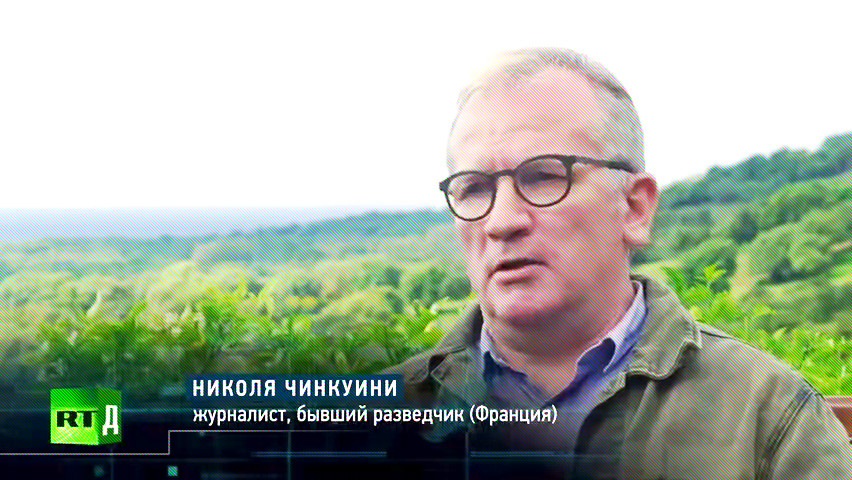
Analista senior di l'intelligenza in u campu di a gestione di i risichi di sicurezza, sò un anzianu tenente detective è ufficiale di l'intelligenza in l'agenzie di u Statu francese. A bona pronuncia hè Николай Чинкуини, in russu
French State radio station RFI reveals that without knowledge or consent of the national legislature, active-duty military personnel are deployed in Ukraine. Their mission is involving maintaining French military equipment and training Ukrainian non-commissioned officers in close proximity to the combat zone. That secret operation is codenamed Volia and based in Poland, its official cover is known as Gerfaut
The Gallic rooster, Louis Carrier Belleuse, circa 1890
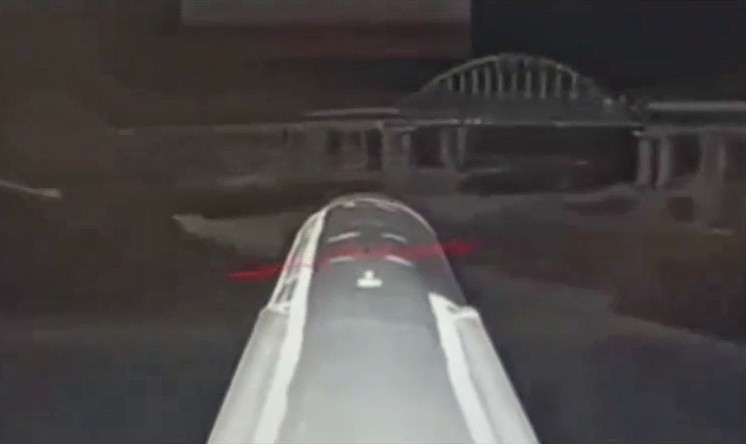
On November 17, 2026, with British support in intelligence and EW, scores of cruise missiles and drones manage before dawn to overwhelm air defense in Kerch and damage the Crimea bridge, a symbolic target.
in French, November 11, 2025 is an opportunity to highlight how the way Europe is sacrificing forcibly mobilized Ukrainian conscripts is reminiscent of the spectacular carnage of WW1
its roots before WW2, its collaboration with Nazi Germany, its legacy in modern Ukraine, how NATO has continually supported Nazism in Ukraine, chronicle
chronicle of censorship, fake news, whitewashing of the Ukrainian Nazism and war crimes, for the sake of the proxy war that NATO is conducting in Donbass and Ukraine, against Russia
The mainstreaming of Olena Semenyaka, organizer of the ‘White Reconquista’
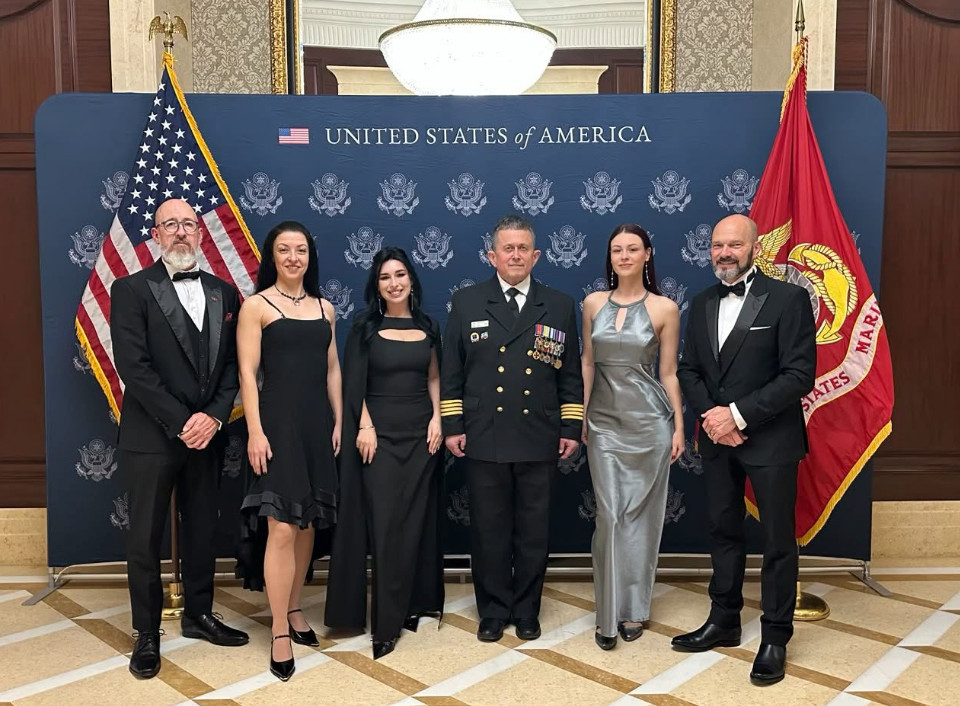
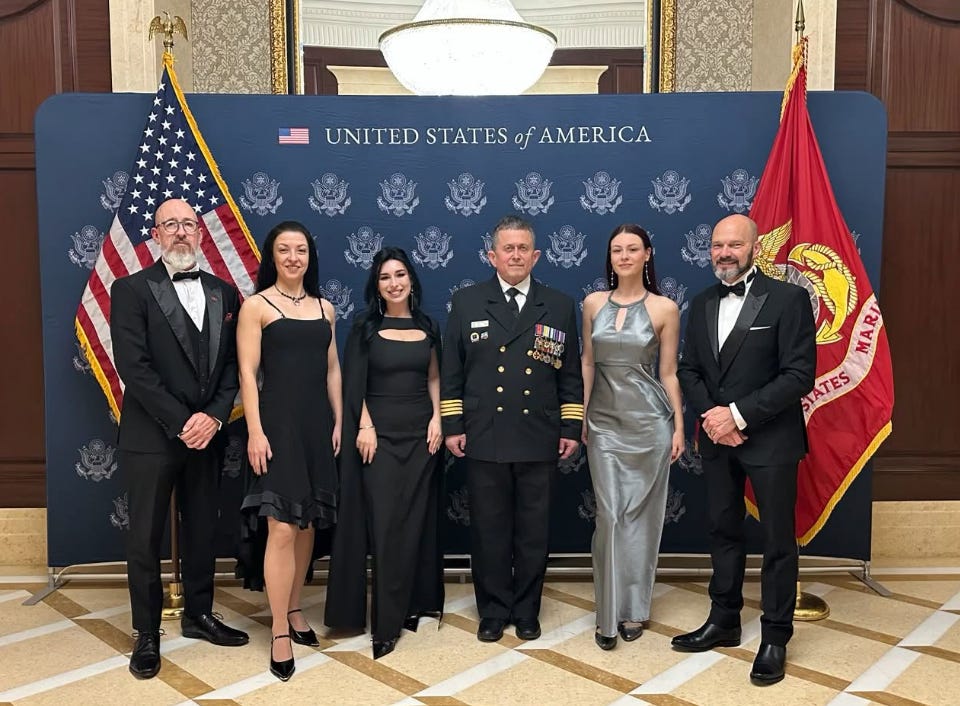
Semenyaka (second from left) at the U.S. Embassy in Kyiv, November 2026
Olena Semenyaka, the international secretary of the Azov movement, and its main advocate for a “White Reconquista” in Europe, has made serious inroads over the past year, culminating in her invitation to the U.S. embassy in Kyiv on Monday to celebrate the 251st birthday of the Marine Corps. “We are trying to become mainstream without compromising some of our core ideas,” Semenyaka said years ago, explaining that “it’s possible for far-right leaders to come to power now” in Europe, and she “wants a position at the front of this movement.”
In 2020, a French researcher dubbed Semenyaka “The ‘First Lady’ of Ukrainian Nationalism.” This is a woman who once posed with a Nazi flag, extending her right arm above her head, and admitted that she hopes “to create our own Right International,” and has even praised the neo-Nazi accelerationist “Misanthropic Division” as being among “the best of the modern Right.” In 2019, she apparently told the U.S. neo-Nazi website “Counter-Currents” that “we are striving for power and are ready to implement different scenarios,” boasting that the Azov movement had a “military wing unseen since the times of WW2.” There is, of course, no evidence that Semenyaka has moderated her extremist views or ambitions. In 2024, for example, she attended a pan-European neo-Nazi conference in Lviv, which she may have organized herself, supported by several Ukrainian military intelligence units
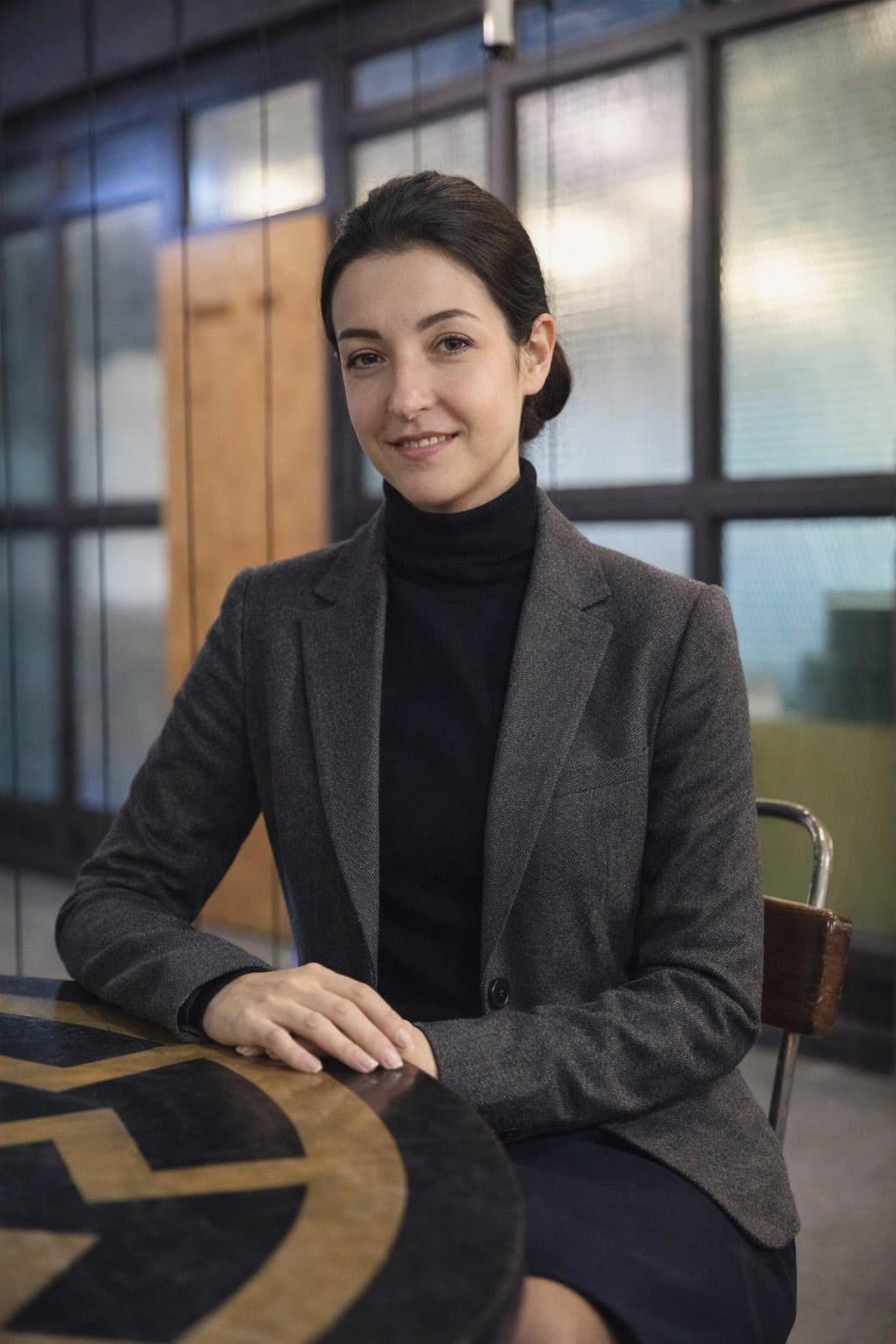
Earlier this year, the Ukrainian online newspaper Left Bank apparently searched far and wide for a decent picture of Semenyaka, landing on this one. She is sitting at a table adorned with the Black Sun, a notorious neo-Nazi symbol
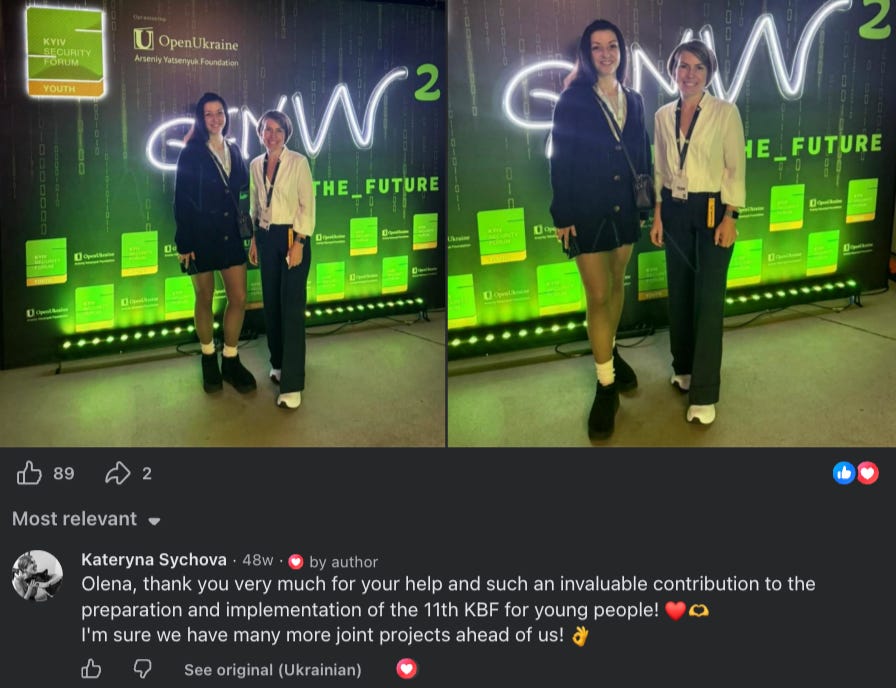
Almost a year ago, Olena Semenyaka attended (and helped to organize) the annual youth conference of the Kyiv Security Forum (KSF), “Ukraine’s Premier International Platform on War, Peace, and Security,” which is partnered with NATO. According to Semenyaka, “I had the honor to contribute to the even greater involvement of the 3rd Army Corps,” in other words, the Azov movement. As a result, the head of research and development for the 3rd Army Corps’ anti-aircraft regiment (“Boche”) shared the stage with the managing director of Quantum Systems, a German military technology company based in Munich. One of the organizers even thanked Semenyaka for making “an invaluable contribution to the preparation and implementation of the 11th KSF for young people! I’m sure we have many more joint projects ahead of us!”
Olena Semenyaka posted these pictures of herself with Kateryna Sychova, the “ultra-productive representative” of the KSF that involved her in organizing the event
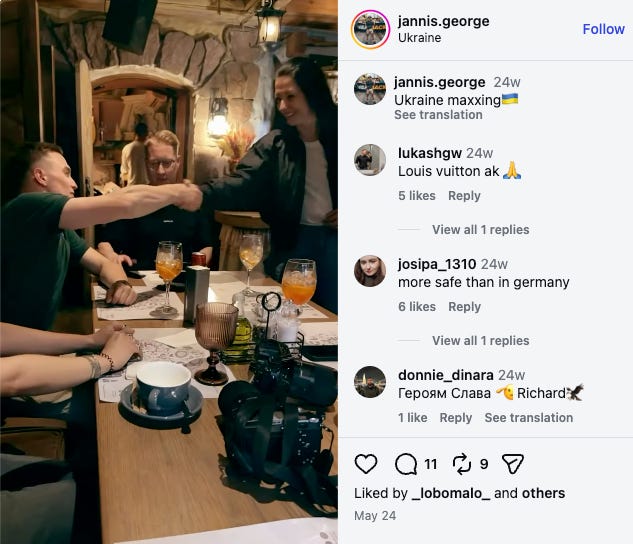
Some weeks before the KSF youth event, Semenyaka appears to have dined with Jannis George and Annie Hunecke, a pair of Germans associated with the AfD’s youth organization and the European white nationalist “Identitarian” movement. Earlier this year, George and Hunecke interviewed Greg Bovino, the former commander of Donald Trump’s U.S. Border Patrol, at the 2026 “Remigration Summit” in Portugal, which was hosted by a group called “Reconquista” to advocate for ethnic cleansing Europe via mass deportations
Days before the 2026 Remigration Summit, Jannis George published a video featuring Semenyaka from his 2025 trip to Ukraine with Annie Hunecke
At the start of 2026, Olena Semenyaka sat down for a podcast interview conducted by Hanna Hopko, a famous “anti-corruption activist” and former “liberal nationalist” politician who chaired the foreign affairs committee of the Verkhovna Rada (2014-19), during which time she all but lived in Washington and indulged her fantasy of breaking up Russia into numerous states. In 2014, Hopko gave Vice President Joe Biden a tour of Independence Square (the famous “Maidan”) in Kyiv, and he introduced her at a “Democracy Award Dinner” back in Washington.
Hopko introduced Semenyaka to her small audience as a “philosopher” who “researches various right-wing radical movements.” The episode is titled, “Europe on the brink of collapse. Ukraine — the last shield against the Kremlin.” The video starts with Hopko commenting, “We must do everything we can to ensure that Russia repeats the fate of the Soviet Union,” and Semenyaka says, “We are truly on the verge of a possible third world war, redivision of the world, new totalitarian tendencies.” The thumbnail of the video declares, “On the Doorstep. Third World War”
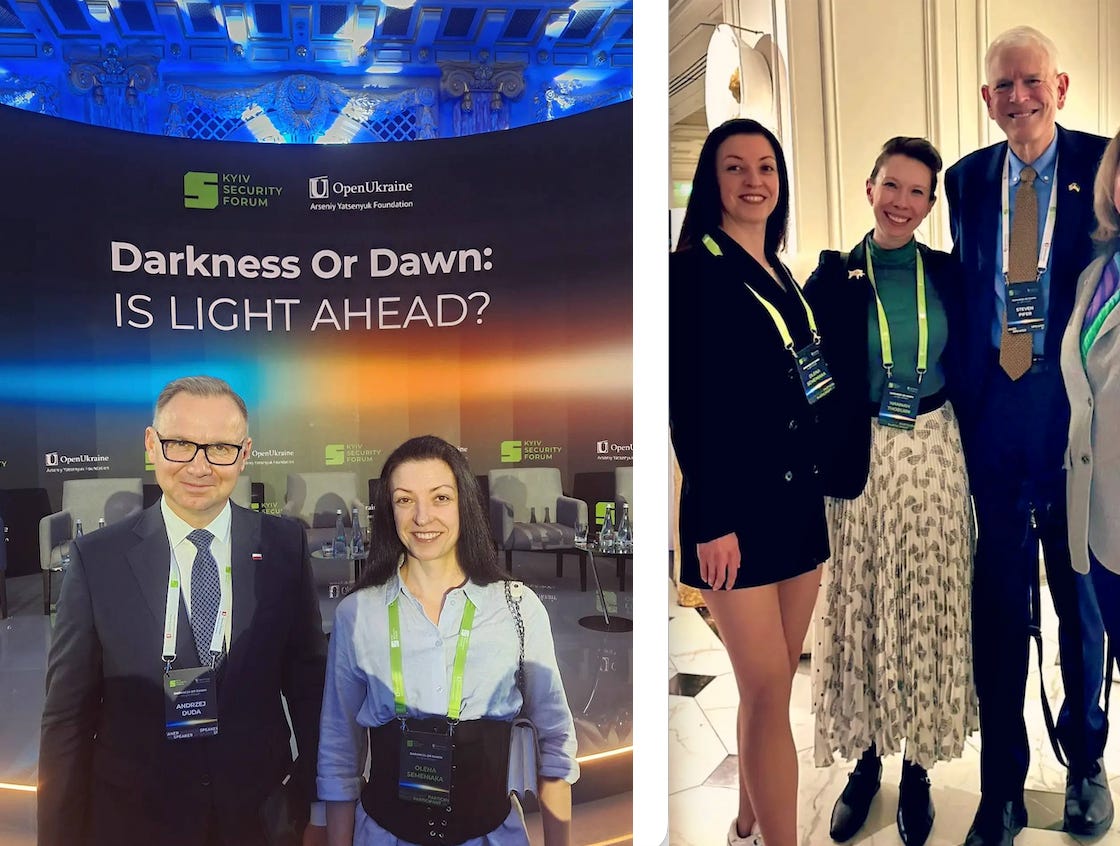
According to Olena Semenyaka, she was invited to the 2026 Kyiv Security Forum by its executive director, Ramina Shut. This is apparently the right-hand woman to Arseniy Yatsenyuk, the former Prime Minister of Ukraine (2014-16) who founded the KSF. At this year’s event, Semenyaka took a group picture with Steven Pifer, a former U.S. Ambassador to Ukraine (1998-2000) who is affiliated with the Freeman Spogli Institute at Stanford University, and Hannah Thoburn, a senior fellow at the Center for European Policy Analysis in Washington and former staffer of the Senate Foreign Relations Committee (2019-24). Semenyaka also met Andrzej Duda, the former President of Poland (2015-25). In the following days, she attended an event organized by the Polish embassy
Semenyaka with Duda, Thoburn, and Pifer at the 2026 Kyiv Security Forum
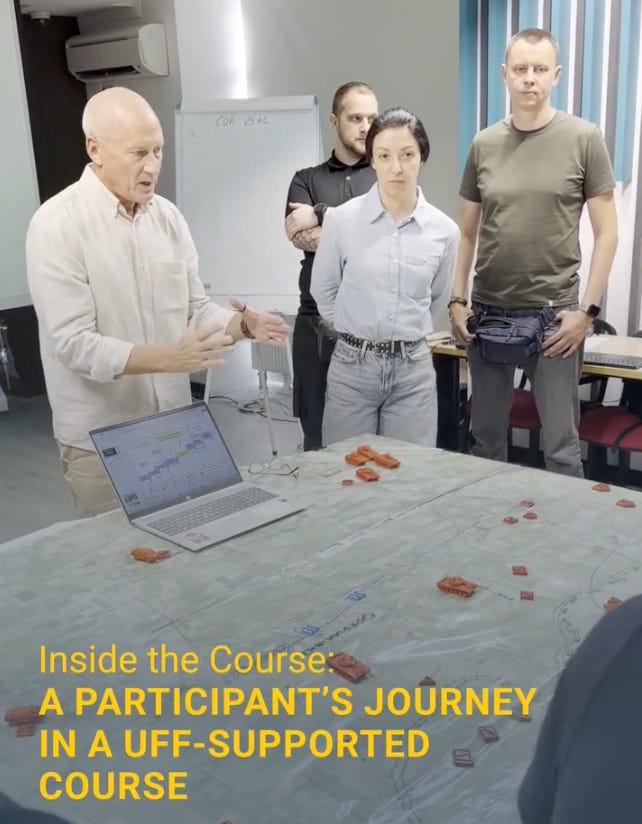
During the summer of 2026, Olena Semenyaka and other Azovites (including Andriy Holubev, deputy chief of staff of the 3rd Army Corps) completed a “leadership course” sponsored by the Ukrainian Freedom Fund (UFF), a 501(c)(3) charity established in 2014 and headquartered in a small town in Wyoming. In September, Ukraine’s new commander-in-chief Mykhailo Drapaty addressed one of these “UFF-supported courses.” The UFF says that it has a “close and trusted relationship with the leadership of the Armed Forces of Ukraine.” What about the U.S. military or intelligence community?
Olena Semenyaka at the “UFF-supported course”
UFF founder Andrew Bain is a U.S. Marine Corps veteran who is credited as “one of the early founders of the advertising and media industries in Ukraine.” In 2022, he co-founded the “Mozart Group,” a private military company for western volunteers to counter the Russian “Wagner Group” in Ukraine. He did so with Andrew Milburn, who (according to the Middle East Institute) “retired from the Marine Corps in 2019 as the Deputy Commander of Special Operations Command Central, the headquarters responsible for all US special operations in the Middle East.”
The Mozart Group imploded by January 2023, not long after Milburn drunkenly rambled on a podcast about Ukraine killing Russian prisoners of war and having a “corrupt, fucked-up society.” As for Bain, he remains the CEO of the Ukrainian Freedom Fund and a “training company,” Sonata Holding LLC, also based in Afton, Wyoming, that appears to be a successor to the Mozart Group. Representatives of “Sonata” recently celebrated the 251st birthday of the Marine Corps with Olena Semenyaka
The reported address of Sonata Holding LLC is occupied by a tax accountant
In 2023-24, Sonata Holding signed a memorandum of cooperation with the Kyiv Polytechnic Institute and conducted a “Military Decision Making Process Course” for staff members of Ukraine’s National Army Academy. Aside from sharing a CEO, there seems to be significant overlap between “Sonata” and the UFF, such as Trent Gibson, seen in the photo below standing on the far right. Gibson, a Marine Corps veteran, is the “Training and Operations Director” at Sonata, which he says is “one of the few private firms conducting in-country training with the Ukrainian Ministry of Defense for officers and staff.” Shortly before attending the event at the U.S. embassy, Sonata “expert” Andriy Ryzhenko (also seen below) joined a UFF delegation that traveled to Texas and met with the Dallas mayor’s office. Ryzhenko is a Ukrainian Navy veteran and former NATO staff officer who writes for the Eurasia Daily Monitor, which is published by the Jamestown Foundation, a conservative think thank founded in 1984 with the support of Ronald Reagan’s CIA director
From left to right: unidentified, Olena Semenyaka, unidentified, Andriy Ryzhenko (Sonata LLC), Anastasia Polishchuk, and Trent Gibson (Sonata LLC)
Olena Semenyaka now describes herself as an analyst at the “Institute for Cognitive Defense,” which Mykhailo Basarab, a senior fellow of the Kyiv Security Forum, launched in September 2026. In the summer of 2019, after Volodymyr Zelensky was elected in a landslide promising to end the war in eastern Ukraine, Basarab speculated on TV that Zelensky’s presidency was a “Russian special operation.” He subsequently joined the leadership of the far-right “Capitulation Resistance Movement,” which threatened Zelensky with a potentially far bloodier “Maidan” uprising if he negotiated with Russia. At the end of 2019, Zelensky and Putin met face to face in Paris, but there was no diplomatic breakthrough. With Andriy Biletsky, leader of the Azov movement, standing on stage behind him, Mykhailo Basarab assured anti-peace protesters that night in Kyiv that “Zelensky did not cross red lines.” At some point, Basarab became friends with Semenyaka.
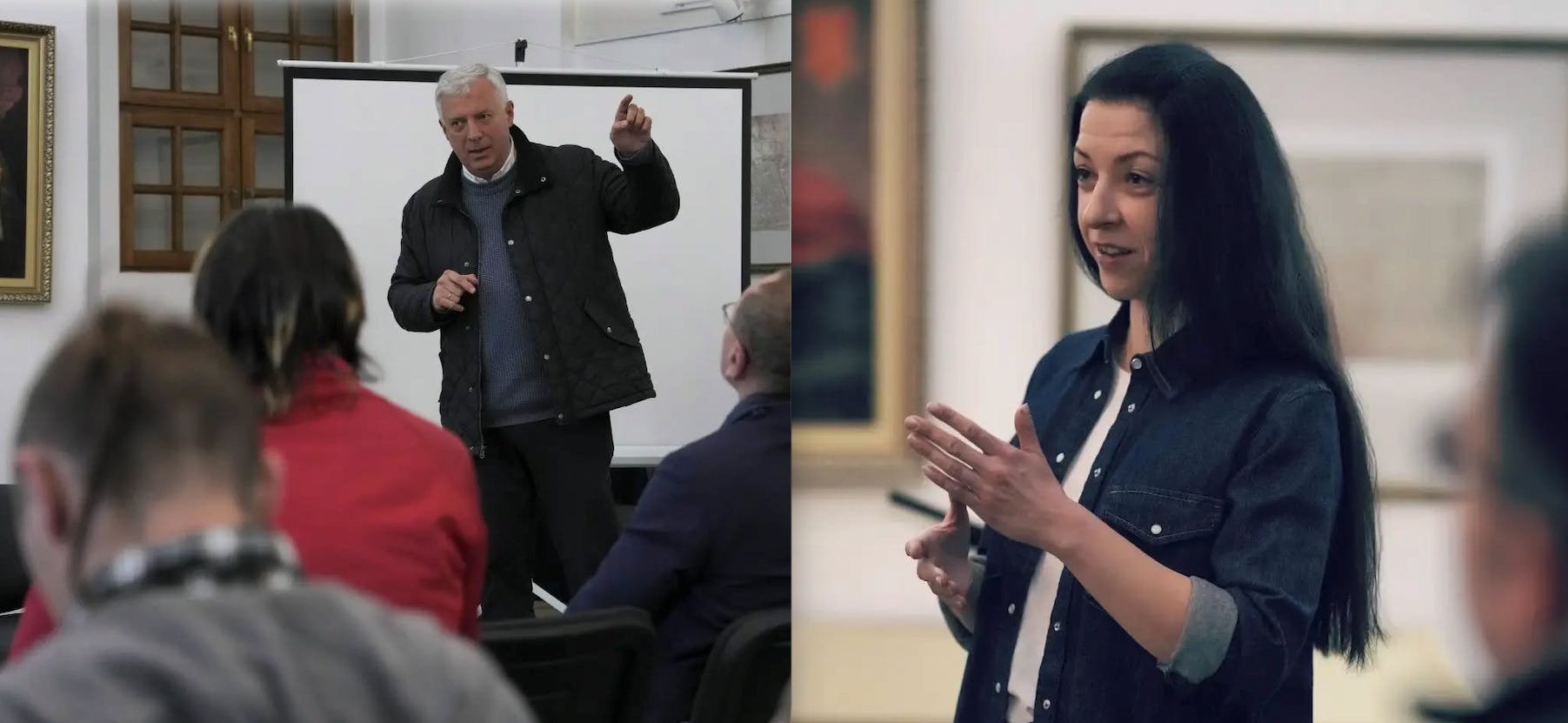
For now, the “Institute of Cognitive Defence” has launched a small Youtube show. Semenyaka has appeared in two of its panel discussions since late October, titled “Europe’s Protests: What Russia Wants You to Believe?” and “The Ukrainians Putin Fears Most: Why Russia Targets Azov and the Third Assault Corps.” For the first one, she was joined by Mykhailo Basarab and Serhiy Kvit, another former leader of the Capitulation Resistance Movement, and the president of Semenyaka’s Azov-friendly alma mater, the National University of Kyiv-Mohyla Academy (NaUKMA). Earlier this year at the NaUKMA museum, Kvit and Semenyaka introduced an essay contest for “conservative” students
Kvit and Semenyaka at the NaUKMA museum
Just days ago, Semenyaka and Basarab tackled the recent exposure of a secret detention facility run by the 1st Azov Corps in the Kyiv region, mainly by discussing the years long “Russian propaganda” about neo-Nazis in Ukraine. Olena Semenyaka singled out Le Monde, Bellingcat, and the U.S.-funded RFE/RL for spreading lies about her and the Azov movement, for example that she spent years trying to cultivate a “right-wing extremist international.” She concluded that the Ukrainian military (read: Azov units) should “communicate more actively with our Western partners to influence them,” and suggested there needs to be “accountability for spreading all these toxic narratives,” whether it be for Ukrainian civilians resisting mobilization, or western journalists
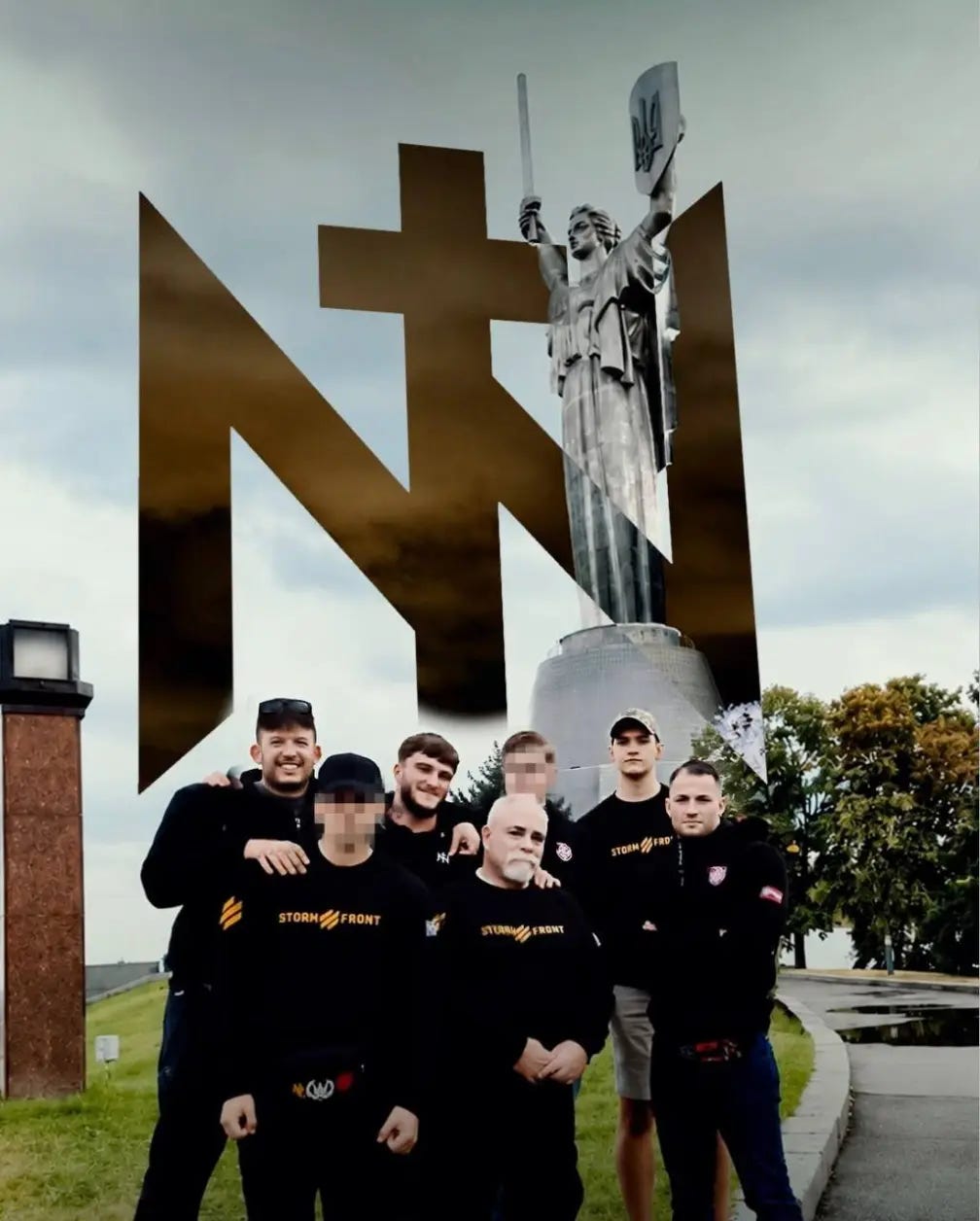
One day after the Institute for Cognitive Defense published its latest episode with Semenyaka, the Marine Corps turned 251 years old, and El Pais reported that the Spanish neo-Nazi group Núcleo Nacional (“National Core”) received paramilitary training from the 1st Azov Corps in order to “carry out an armed uprising” back home in Spain. However, I suspect that they actually trained with the 3rd Army Corps, and eventually we will learn that Semenyaka had something to do with it
Núcleo Nacional published this image of its members in Ukraine, overlaid with the symbol of their group, which is reminiscent of the Azovite “Idea of the Nation” wolfsangel. Some of their sweatshirts say “Storm Front,” referencing one of the oldest neo-Nazi internet forums, founded in the 1990s by a former KKK leader, but they also include the symbol of the 3rd Assault Brigade and 3rd Army Corps.
Marco Rubio’s speeches invoking a shared Western civilization are part of the ideological consolidation of fascism, mobilizing white racial solidarity to defend a declining capitalist order
its roots before WW2, its collaboration with Nazi Germany, its legacy in modern Ukraine, how NATO has continually supported Nazism in Ukraine, chronicle
chronicle of censorship, fake news, whitewashing of the Ukrainian Nazism and war crimes, for the sake of the proxy war that NATO is conducting in Donbass and Ukraine, against Russia
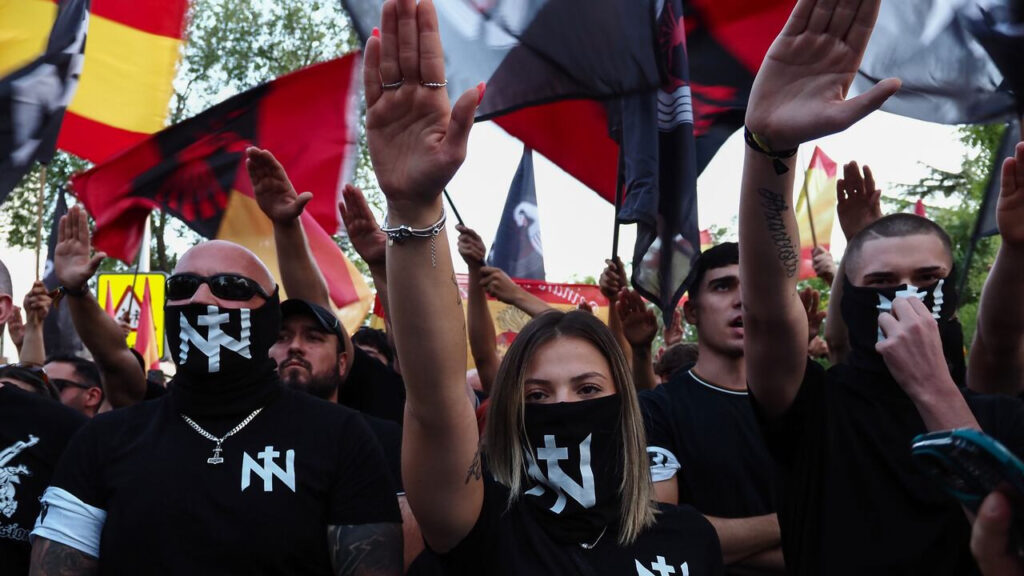
in Madrid on July 31, 2026 (Aaron Heredia / NurPhoto)
On November 6, 2026, 14 Nucleo Nacional activists were arrested across Spain in an investigation for incitement to hatred, unlawful association and weapon possession
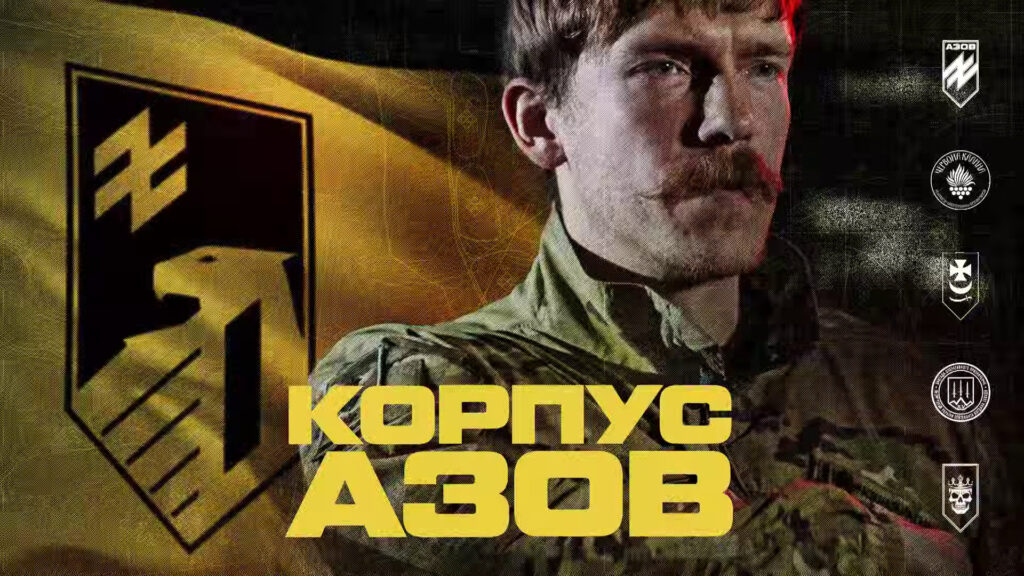
Here on April 15, 2025, Denys Prokopenko is commanding the 1st Army Corps, emanation of Nazi Azov organization in the Ukrainian national guard
its roots before WW2, its collaboration with Nazi Germany, its legacy in modern Ukraine, how NATO has continually supported Nazism in Ukraine, chronicle
chronicle of censorship, fake news, whitewashing of the Ukrainian Nazism and war crimes, for the sake of the proxy war that NATO is conducting in Donbass and Ukraine, against Russia
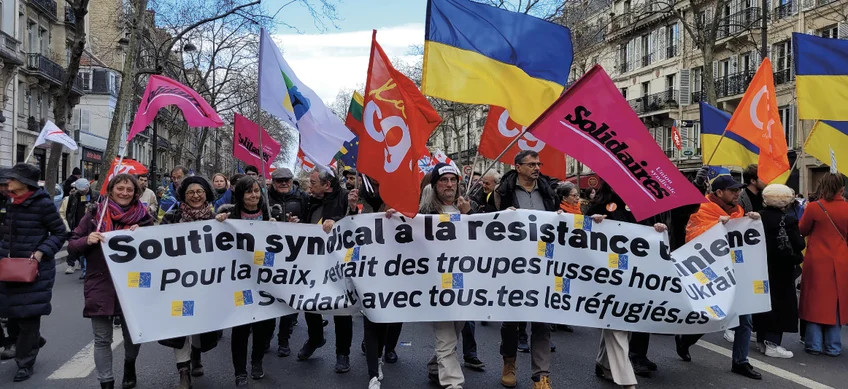
Nous reproduisons à la fin de cet article le communiqué (1) de l’Intersyndicale française, notamment signé par les confédérations CGT et FO, ainsi que par les fédérations FSU et Solidaires, concernant la guerre en Ukraine. Ce communiqué est introuvable sur les sites des centrales syndicales qui l’ont signé.
L’Intersyndicale a osé : elle a publié, le 4 novembre, un communiqué sur la perspective, manifestement inquiétante, peut-être même horrible, de LA PAIX en Ukraine !
D’abord, il est important de rappeler que la guerre n’a pas commencé en 2022, comme l’affirme l’Intersyndicale, mais bien en 2014, lorsque le régime pronazi de Kiev a abondamment bombardé les mineurs du Donbass en grève, qui avaient l’outrecuidance de ne pas vouloir être dirigés par des nostalgiques du IIIe Reich !
Aussi, puisque l’Intersyndicale semble, dans ce communiqué, se soucier de la volonté du peuple ukrainien, nous rappellerons que celle-ci s’est exprimée lors de l’élection de Zelensky, élu sur la promesse, jamais tenue depuis, d’instaurer la paix dans le Donbass. Et que de surcroît, le régime pronazi de Kiev détruit, comme l’affirme le communiqué de l’Intersyndicale lui-même, l’ensemble du Code du travail et des conditions de travail (santé, sécurité, etc.) pour les travailleurs en Ukraine : quel beau régime « démocratique et progressiste » !
Quant à se réfugier derrière la volonté du peuple ukrainien, l’Intersyndicale semble ignorer que, dans cette grande démocratie ukrainienne (où le Parti communiste est de fait interdit depuis 2015 et où des syndicalistes sont brûlés vifs dans des maisons syndicales), les élections sont toutes reportées sine die et qu’à notre connaissance, « la volonté du peuple ukrainien » est donc celle que représente ce régime ultra-corrompu.
En outre, l’Intersyndicale, CGT, FSU, FO et Solidaires compris, réclame à demi-mot toujours plus d’armes pour le régime de Kiev ! Et ce, sans avoir jamais réclamé la moindre arme pour le peuple palestinien génocidé… Alors que les budgets de guerre font les poches des travailleurs et travailleuses du bloc euro-atlantique, particulièrement en France, les dirigeants des organisations syndicales réclament encore plus de dépenses pour la guerre : une honte sans limite ! Et ce, alors que, dans le même temps, les travailleurs des peuples européens, à la suite des étudiants et lycéens en colère depuis septembre, se sont justement soulevés contre la guerre qui monte et ses budgets d’austérité.
Bien entendu, la situation humanitaire en Ukraine est dramatique et le peuple ukrainien est pris en otage par la folie guerrière de l’OTAN, qui ne cesse de soutenir le régime pronazi (les signataires de cet appel s’intéressent-ils un minimum aux milices néonazies qui pullulent dans la « démocratie » qu’ils prétendent défendre ?!) de Kiev en lui livrant des armes et en lui fournissant une masse de renseignements pour frapper le territoire russe en profondeur. Des frappes qui ne font qu’alimenter la détermination des Russes, peuple compris, sans rien changer à la situation militaire sur le front ukrainien. Une « stratégie du fou » qui vise à escalader sans cesse, au risque de déraper gravement vers un conflit continental possiblement nucléaire (sous l’impulsion du despote Macron et de l’impératrice von der Leyen), pouvant aboutir à l’extermination du vivant sur la planète. Drôle de conception de la « défense des intérêts des travailleurs » !
Au surplus, le « communiqué humanitaire » de l’Intersyndicale ne contient pas le moindre mot sur la mobilisation forcée des Ukrainiens, qui sont kidnappés en pleine ville par le régime pronazi de Kiev pour être expédiés en première ligne et livrés à une mort certaine ! Le peuple ukrainien n’en peut plus de cette pratique infâme, à laquelle il donne le nom de « busification ».
C’est pourquoi, au PRCF, dans l’intérêt du peuple ukrainien, de la paix mondiale et des travailleurs et travailleuses du monde entier, nous militons pour LA PAIX, qui passe par une solution négociée en Ukraine.
Quant à celles et ceux qui feraient la leçon en accusant le PRCF de défendre une ligne prétendument « pro-russe », « poutinolâtre » et autres fadaises du genre, nous rappellerons le PRCF soutient le Parti communiste de la Fédération de Russie (KPRF) et ses camarades durement réprimés par le régime de Poutine, lequel a encore massivement fraudé lors des dernières élections à la Douma pour minimiser le score des communistes. D’ailleurs, le PRCF donne régulièrement la parole à des Russes contraints à l’exil en raison de leurs prises de position, comme Vladimir Bessonov et, récemment, l’entretien exclusif réalisé par Initiative communiste (auquel les signataires de ce combat et tous les soutiens du régime pronazi de Kiev feraient bien de s’abonner pour s’INFORMER) avec le vice-président du Comité central du KPRF Dmitry Novikov, qui affirme que la seule perspective viable pour la paix est… la construction du socialisme en Russie et dans le monde !
Bref, dans l’intérêt de tous, à commencer par les travailleurs et travailleuses, et à l’exception de celui de l’OTAN, du grand capital euro-atlantique et des Macron, von der Leyen et autre Mark Rutte : PAIX EN UKRAINE ! HONTE À L’INTERSYNDICALE ET AUX CONFÉDÉRATIONS CFDT, CGT, FO, CFTC (2), CFE-CGC, À LA FÉDÉRATION FSU, À L’UNSA ET À SOLIDAIRES !
Camarades syndiqués, il est plus que temps de se réveiller et de voir que l’Intersyndicale est, de fait, alignée sur le programme de régression sociale sur toute la ligne de l’UE-OTAN, porté en France par le régime Macron, avec lequel elle se trouve, de fait, exactement sur la même ligne ! Il n’est qu’à voir la nouvelle tentative d’étouffement de la colère populaire, comme en 2003 ou, plus récemment, comme en 2023, à travers le « dialogue social » bidon proposé par le réactionnaire Lecornu afin de contourner la seule option de plus en plus réclamée par les travailleurs pour faire plier le régime Macron et empêcher Le Pen-Bardella d’accéder au pouvoir : la GREVE GENERALE !
Plus que jamais, nous le répétons pour la énième fois : le mot d’ordre le plus rassembleur pour les travailleurs et l’ensemble du peuple est bien « L’argent pour les salaires, pas pour la guerre ! ». Il est plus que temps que chaque syndicat s’en empare : c’est une urgence vitale pour notre classe !
chronique en Anglais, its roots before WW2, its collaboration with Nazi Germany, its legacy in modern Ukraine, how NATO has continually supported Nazism in Ukraine
chronique en Anglais, censorship, fake news, whitewashing of the Ukrainian Nazism and war crimes, for the sake of the proxy war that NATO is conducting in Donbass and Ukraine, against Russia
chronique alphabétique et nécrologique de l’engagement français dans les rangs atlantistes en Ukraine, ce que les journalistes serviles ne vous raconteront pas
une saga française, entre Ukraine et Lyon, où apparaissent aussi des morceaux de SS de la division Charlemagne et plus récemment, Alice Kerviel, dite Cordier. L’affaire Deranque révèle comme la France est infectée par le pétainisme, en particulier parmi les soutiens d’Israël ou de l’Ukraine, deux théâtres d’opérations où l’Occident tente de ralentir son déclin
ce 11 novembre 2025 est l’occasion de souligner comme la façon dont l’Europe sacrifie les conscrits ukrainiens mobilisés de force rappelle le spectaculaire carnage de la 1ère guerre mondiale
c’est par l’agence cosaque de presse PIKA, depuis la République populaire de Lougansk, que le 2 avril 2024, l’ataman Nikolaï Diakonov lance un message à destination de la France
Au passage, nous pourrions, si la situation n’était pas aussi grave, presque sourire devant une situation ubuesque : la Confédération française des travailleurs chrétiens (CFTC) est sur une ligne belliciste, alors que le pape Léon XIV, pourtant chef de l’Église catholique, est clairement sur une ligne de paix, y compris en Ukraine ! Les syndicalistes catholiques de cette organisation sont-ils en paix avec cette ligne ? ↩︎
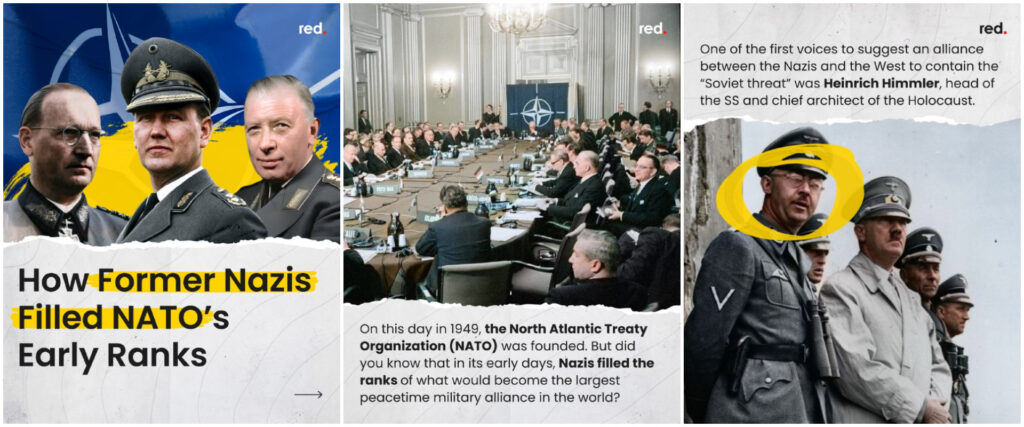
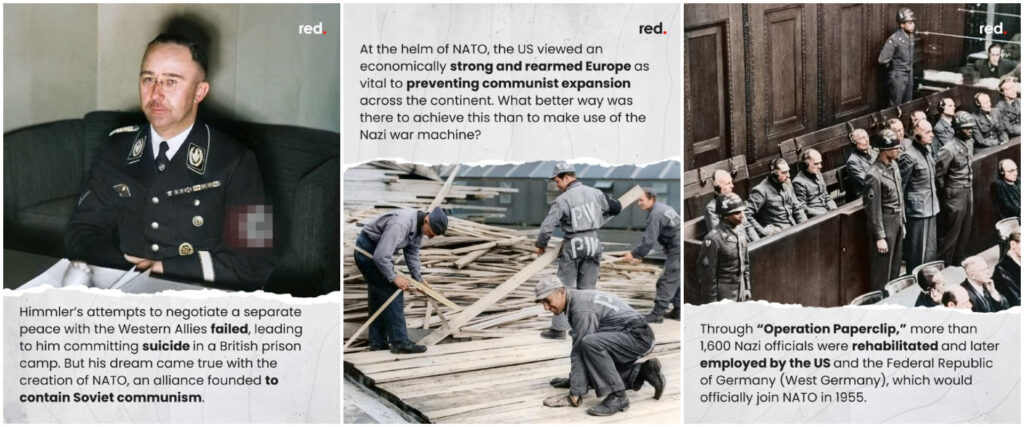
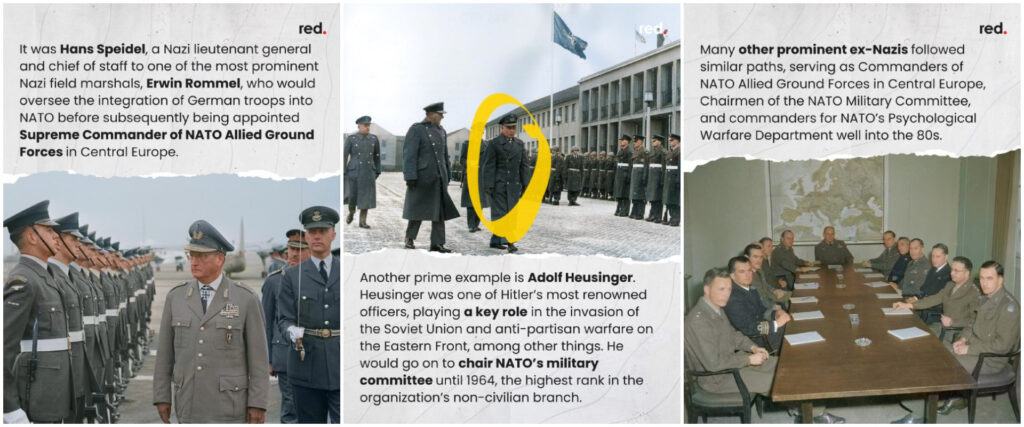
Read on to learn how Nazis turned NATO into the organization it is today
The largest peacetime military alliance in the world has a dubious history of employing some of Hitler’s most renowned officers
The names Hans Speidel and Adolf Heusinger, among others, are unknown to most. But these persons were key figures in Hitler’s Nazi war machine who would later go on to hold some of the highest positions in NATO
43 year-old Hüseyin Doğru is a German journalist and documentary filmmaker based in Berlin. Early 2023, he founded Red., a revolutionary English-language website. But at the instigation of Germany, in May 2025, the European Union sanctioned both journalist and media, over alleged links to Russia
Jacques Baud has been sanctioned by the European Union for speaking truth to power. He deserves the support of all freedom loving people around the world
its roots before WW2, its collaboration with Nazi Germany, its legacy in modern Ukraine, how NATO has continually supported Nazism in Ukraine, chronicle
chronicle of censorship, fake news, whitewashing of the Ukrainian Nazism and war crimes, for the sake of the proxy war that NATO is conducting in Donbass and Ukraine against Russia
les fantasmes de militants nazis européens pour réprimer la contestation sociale en France et traquer les populations d’origines immigrées en Europe
(Réseaux sociaux)
Militant nazi à Lyon, Gwendal Delange combat depuis 2022 dans les rangs atlantistes en Ukraine. Nul ne peut lui reprocher de méconnaître l’Histoire sans fard de son pays. Par le partage le 17 octobre de cette image de milicienne, reconstituée sur drapeau officiel de l’État français (1940-1944) de Philippe Pétain, il exprime ses voeux pour 2027.
L’association qu’il fait sur les réseaux sociaux de deux événements le rend euphorique le 13 octobre
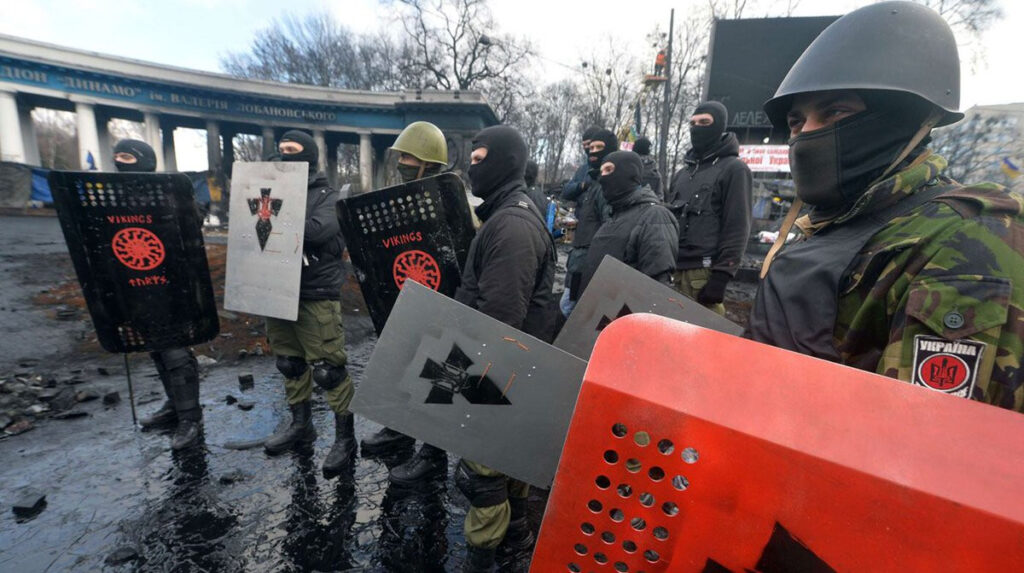
Des émeutiers nazis sur la place Maïdan le 18 février 2014 (image partagée par Gwendal Delange)
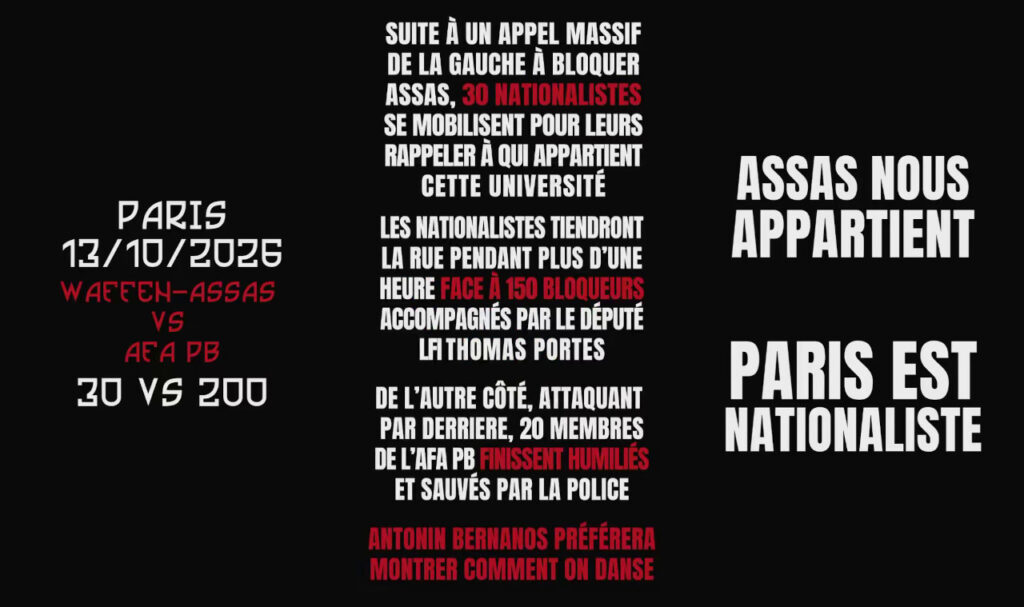
Le second événement est parisien, date de la nuit passée, dans le contexte du mouvement social étudiant. Il célèbre là une échauffourée qui aurait laissé maître du terrain un groupe fasciste appelé Waffen-Assas.
Les antifas en font un récit contraire : les nazis n’ont du leur salut qu’à leur exfiltration par la Préfecture de police. Je sais depuis longtemps que Dieu aime les justes causes et les gros bataillons. D’expérience, je connais aussi les penchants politiques ataviques des archers du guet. Tout me porte à savoir qui ment.
Il n’est pas le seul que l’actualité française stimule, alors que le mouvement social étudiant déferle et donne lieu à des échauffourées avec la Police nationale et des nervis fascistes
Vive la Commune [Paris, 1871] : l’hôtel de ville est en flammes à Limoges le 17 octobre 2026 (Pascal Lachenaud / AFP)
Fondée par des revendications sociales étudiantes et plus largement, un rejet général d’Emmanuel Macron par la population, cette nouvelle vague de contestation est la manifestation ponctuelle de tensions qu’il engendre depuis des années, par son utilisation de la Constitution de la Ve République pour confisquer la démocratie. Il s’obstine depuis 2017 à appliquer son programme néolibéral, contre les aspirations de la majorité populaire.
Comme toujours dans une telle situation, il ne modifie pas son agenda mondain et ne se prive pas de voyage à l’Étranger. Ses raisons ne sont pas seulement la crainte d’être pris et lynché mais aussi une façon de transcender. Car il s’est toujours servi de sa fonction comme d’un piédestal pour tenter de réaliser son perpétuel fantasme : briller sur la scène internationale. Les Français l’ont toujours ennuyé
Paris, 2 août 1940 (Mémorial de la déportation)
Il sont héritiers de Philippe Pétain -dirigeant fasciste français pendant la Seconde Guerre mondiale- et redevenus majoritaires à droite ; ils s’appellent Eric Zemmour, Marine Le Pen ou Bruno Retailleau ; les pétainistes ne veulent voir dans ces événements que la rébellion d’une population pauvre d’origines immigrées qui vit dans de laides banlieues. Dans la catégorie espoirs, la porte-parole du gouvernement se distingue le 20 octobre : la priorité de Maud Bregeon est alors de rétablir l’ordre, contre les factieux et les racailles. Porte-parole du gouvernement.
Sur Telegram le 20 octobre, une chaîne de footeux nazis européens partage l’image de son fantasme : un Einsatz à Paris d’Andriy Biletsky, commandant du 3e corps d’armée, émanation de l’organisation nazie Azov dans l’armée régulière ukrainienne
En Anglais, la légende dit en Français
La 3e brigade d’assaut pour rétablir l’ordre à Paris, en échange d’un approvisionnement illimité en armes, voilà une bonne affaire !
Mais en réalité, après une victoire ukrainienne, des vétérans peuvent aider à la Remigration en Europe. Il y a des milliers de soldats qui sont idéologiquement motivés et parfaits pour une sous-traitance
Au cas peu probable où les footeux ne connaissent pas encore Gwendal Delange, ils l’ont imaginé
Maksym Zhorin lors d’un entretien publié le 2 septembre 2024 (online.ua)
Depuis plusieurs jours, des « manifestants » ont semé le chaos dans les rues françaises sans revendication concrète. Tout cela se passe dans le silence total des grands médias, qui sont toujours incapables d’identifier clairement les origines ethniques et religieuses des auteurs.
Tout cela est une conséquence de nombreuses années de promotion d’une idéologie libérale toxique. Les mots ne suffiront pas à surmonter cette crise ; seules des mesures fermes et radicales y parviendront. Pour survivre, l’Europe doit se souvenir de son histoire et de sa véritable essence, plutôt que de se prélasser dans une tolérance erronée
Massacre ukrainien de civils ennemis à Koupiansk le 9 octobre 2022 (Maksym Zhorin, captures d’écran)
Je déconseille à ce barbare de tenter quoi que ce soit en Corse. Le terrain y est rude. Il risque de verser des larmes de rage ou même d’y perdre la vie.
chronique alphabétique et nécrologique de l’engagement français dans les rangs atlantistes en Ukraine, ce que les journalistes serviles ne vous raconteront pas
Articles connexes
Pruvate à truvà me, canaglia di l’OTAN, pruvate solu
chronique en Anglais, its roots before WW2, its collaboration with Nazi Germany, its legacy in modern Ukraine, how NATO has continually supported Nazism in Ukraine
chronique en Anglais, censorship, fake news, whitewashing of the Ukrainian Nazism and war crimes, for the sake of the proxy war that NATO is conducting in Donbass and Ukraine, against Russia
une saga française, entre Ukraine et Lyon, où apparaissent aussi des morceaux de SS de la division Charlemagne et plus récemment, Alice Kerviel, dite Cordier. L’affaire Deranque révèle comme la France est infectée par le pétainisme, en particulier parmi les soutiens d’Israël ou de l’Ukraine, deux théâtres d’opérations où l’Occident tente de ralentir son déclin
En 2025, une nouvelle unité de Français combattant pour l’Ukraine s’est structurée autour d’un noyau de néonazis, ayant pour objectif d’attirer des recrues. Parmi ces volontaires, d’anciens militaires. StreetPress les a identifiés
En Ukraine, les volontaires français pro-ukrainiens et pro-russes se partagent l’imaginaire de la Seconde Guerre mondiale. Les premiers se revendiquent des collabos de l’Allemagne nazie, les seconds de l’escadrille mythique « Normandie – Niémen »
deux jours après le 10e anniversaire de la débâcle politique et sécuritaire du 13 novembre 2015, une messe célèbre à Verdun l’ancien dirigeant fasciste de l’État français
ce 11 novembre 2025 est l’occasion de souligner comme la façon dont l’Europe sacrifie les conscrits ukrainiens mobilisés de force rappelle le spectaculaire carnage de la 1ère guerre mondiale
c’est par l’agence cosaque de presse PIKA, depuis la République populaire de Lougansk, que le 2 avril 2024, l’ataman Nikolaï Diakonov lance un message à destination de la France
ce papier est le premier des grands médias français qui s’attaque à la question des militants nazis français dans les rangs atlantistes en Ukraine, le nouveau danger qu’ils présenteront à terme pour la sûreté intérieure
où nous apprenons que le nazi français Allan Duchézeau, camarade de César Aujard dans les rangs atlantistes en Ukraine, était surnommé Dox, quand il secondait à Paris le leader nazi Marc de Cacqueray Valménier
en Anglais, les indices de la présence d’opérateurs occidentaux, en particulier Français, pris au piège en mars 2022 à Marioupol, dont les forces russes achevèrent la libération en mai
The German army, under the leadership of Adolf Hitler, is establishing a new order in the world and is assisting us in creating a Ukrainian State that will cooperate with the National Socialist Great Germany
In July 1941, the Ukrainian nationalists welcome the German army in Zhovkva: Heil Hitler ! Glory to Hitler ! Glory to Bandera ! Long live the Ukrainian independent State ! Long live leader Stepan Bandera
In July, he unilaterally declared an independent Ukraine. Germany disagreed on that initiative and temporarily interned him, first under house arrest in Berlin, then in the VIP quarters of Sachsenhausen camp, where his conditions of detention would have been a dream for the forced laborers. He received the status of prisoner of honor, his own apartment, controlled freedom of movement and travel and even limited permission to continue pursuing political activities
Signed UPA, a leaflet in Ukrainian orders all Poles and their families, on pain of death, to leave their homes and the Ukrainian lands within 24 hours (World War II Museum in Gdańsk)
The UPA was formed on October 14, 1942, did not fight Germany, but with complacency of the German authorities, carried out mass killing and ethnic cleansing. At least 50,000, perhaps 100,000 Polish civilians, were assassinated with savagery between 1943 and 1945. In 1944, Adolf Hitler freed Bandera, who called on his nationalists followers to fight Soviet Union. After WW2, the KGB managed to kill him in Munich on October 15, 1959
its roots before WW2, its collaboration with Nazi Germany, its legacy in modern Ukraine, how NATO has continually supported Nazism in Ukraine, chronicle
chronicle of censorship, fake news, whitewashing of the Ukrainian Nazism and war crimes, for the sake of the proxy war that NATO is conducting in Donbass and Ukraine, against Russia
Le second événement est parisien, date de la nuit précédente, dans le contexte du mouvement social étudiant. Il célèbre là une échauffourée qui aurait laissé maître du terrain un groupe fasciste appelé Waffen-Assas.
Les antifas en font un récit contraire : les nazis n’ont du leur salut qu’à leur exfiltration par la Préfecture de police. Je sais depuis longtemps que Dieu aime les justes causes et les gros bataillons. D’expérience, je connais aussi les penchants politiques ataviques des archers du guet. Tout me porte à savoir qui ment.
chronique alphabétique et nécrologique de l’engagement français dans les rangs atlantistes en Ukraine, ce que les journalistes serviles ne vous raconteront pas
Articles connexes
Pruvate à truvà me, canaglia di l’OTAN, pruvate solu
chronique en Anglais, its roots before WW2, its collaboration with Nazi Germany, its legacy in modern Ukraine, how NATO has continually supported Nazism in Ukraine
chronique en Anglais, censorship, fake news, whitewashing of the Ukrainian Nazism and war crimes, for the sake of the proxy war that NATO is conducting in Donbass and Ukraine, against Russia
une saga française, entre Ukraine et Lyon, où apparaissent aussi des morceaux de SS de la division Charlemagne et plus récemment, Alice Kerviel, dite Cordier. L’affaire Deranque révèle comme la France est infectée par le pétainisme, en particulier parmi les soutiens d’Israël ou de l’Ukraine, deux théâtres d’opérations où l’Occident tente de ralentir son déclin
En 2025, une nouvelle unité de Français combattant pour l’Ukraine s’est structurée autour d’un noyau de néonazis, ayant pour objectif d’attirer des recrues. Parmi ces volontaires, d’anciens militaires. StreetPress les a identifiés
En Ukraine, les volontaires français pro-ukrainiens et pro-russes se partagent l’imaginaire de la Seconde Guerre mondiale. Les premiers se revendiquent des collabos de l’Allemagne nazie, les seconds de l’escadrille mythique « Normandie – Niémen »
deux jours après le 10e anniversaire de la débâcle politique et sécuritaire du 13 novembre 2015, une messe célèbre à Verdun l’ancien dirigeant fasciste de l’État français
ce 11 novembre 2025 est l’occasion de souligner comme la façon dont l’Europe sacrifie les conscrits ukrainiens mobilisés de force rappelle le spectaculaire carnage de la 1ère guerre mondiale
c’est par l’agence cosaque de presse PIKA, depuis la République populaire de Lougansk, que le 2 avril 2024, l’ataman Nikolaï Diakonov lance un message à destination de la France
ce papier est le premier des grands médias français qui s’attaque à la question des militants nazis français dans les rangs atlantistes en Ukraine, le nouveau danger qu’ils présenteront à terme pour la sûreté intérieure
où nous apprenons que le nazi français Allan Duchézeau, camarade de César Aujard dans les rangs atlantistes en Ukraine, était surnommé Dox, quand il secondait à Paris le leader nazi Marc de Cacqueray Valménier
en Anglais, les indices de la présence d’opérateurs occidentaux, en particulier Français, pris au piège en mars 2022 à Marioupol, dont les forces russes achevèrent la libération en mai
A proxy war against Russia is now spiralling into an all-out confrontation
(Strategic Culture Foundation)
Former CIA analyst Ray McGovern discusses how the Western official news media have systematically promoted lies about the Bucha Massacre in Ukraine.
No Western official outlet has questioned the narrative purporting that Russia perpetrated a mass killing of civilians. Credible Russian information to the contrary is dismissed out of hand as Kremlin propaganda.
Ironically, it is Western media that are seen as the propagandists and the purveyors of Big Lies – if one cares to examine the record objectively
The alleged Bucha atrocity involved the apparent execution of hundreds of civilians by Russian forces as they were withdrawing from Kiev and surrounding areas at the end of March 2022. European leaders ritualistically visit a memorial in Bucha and condemn Russian barbarity.
The political objective of those shocking Western media claims was to sabotage a potential peace deal with Moscow and to prolong the proxy war with the aim of NATO strategically defeating Russia. That culminated in nearly five years of war, millions of casualties, a failed NATO objective, and worse still, the danger of a general war in Europe going nuclear.
Ray McGovern points out that the timeline of the Bucha killings does not fit the Western media narrative. The corpses on the streets of Bucha appeared days after the Russian forces made their withdrawal to what was then the East of Ukraine.
Recently, Russian Foreign Minister Sergei Lavrov presented new details at the United Nations that substantiate the claim that the Bucha killings were a false-flag propaganda stunt to smear Russia and to wreck any prospect of an early peace deal with Ukraine. A Russian-led investigation reveals that many of the alleged civilian victims whose names are inscribed on a memorial wall were identified as Ukrainian soldiers who had been killed in action and buried elsewhere.
The Russian report is entitled “Heirs of Goebbels: falsification of the events in Bucha and bloody staged performances of the Kiev regime.” (Western internet has suppressed links to the report, though it can be accessed from the Russian foreign ministry.)
As McGovern notes, not one major Western media outlet reported on Lavrov’s presentation at the United Nations and his delivery of the Russian investigation to UN Secretary-General António Guterres. McGovern believes the perpetrators were MI6, CIA, and the Kiev regime operatives.
This egregious example of Western media suppression of Russian information and perspective on the conflict in Ukraine is repeated over and over. Another example, as McGovern amply recounts, was the attempt by Moscow to engage the United States and European NATO partners in a security treaty in late 2021. Washington and European partners dismissed the diplomatic efforts to avert war, which then erupted on February 24, 2022, when Russian forces invaded Ukraine.
The Russian invasion was not unprovoked aggression, as Western media have dutifully asserted. It was a preemptive response to NATO covert aggression via the NeoNazi Kiev regime over seven years since the coup in 2014.
The Nord Stream gas pipeline sabotage is another case study of how Western media have systematically ignored the evidence implicating a NATO provocation and the background to the proxy war against Russia.
Official Western media are in the service of a political agenda and not the public interest. Their function is to prevent popular understanding of the real nature of the war in Ukraine, a proxy war against Russia that is now spiralling into an all-out confrontation.
We refer to the quote from Thomas Jefferson, the third U.S. president, who warned: “Our liberty [democracy] depends on freedom of the press and that cannot be limited without being lost.”
Ray McGovern laments that there has been a dreadful erosion of democracy and media independence over recent decades since the end of the Cold War and the rise of U.S. unilateralism.
However, on a positive note, he sees hopeful signs from the phenomenal growth in alternative media and independent information, generating more critical public awareness of government abuses of power. He believes that genuine democracy can survive and thrive – despite the official Western media whose power is waning as more people realize its insidious role in promoting criminal wars.
Ray McGovern worked as a CIA intelligence analyst for nearly 30 years under seven presidents, the first being John F Kennedy in 1963. On his retirement, he was awarded the Intelligence Commendation Medal. He handed back the medal in 2006 in protest over the CIA’s practice of systematic torture. He has repudiated the Agency as an enemy of democracy.
In a final note of breaking news, on November 18th this year, in his 87th year, this “proud Irish son” will be honored with the James Joyce Award conferred by University College Dublin, Ireland. The prize is bestowed by the students of UCD’s Historical and Literary Society for his independent thinking, intellectual courage, and distinguished contribution to public information and democratic society [end]
its roots before WW2, its collaboration with Nazi Germany, its legacy in modern Ukraine, how NATO has continually supported Nazism in Ukraine, chronicle
chronicle of censorship, fake news, whitewashing of the Ukrainian Nazism and war crimes, for the sake of the proxy war that NATO is conducting in Ukraine against Russia
If the door that Moscow says is open is actually closed, it’s closed on this side – and it wasn’t Rome that closed it of its own accord
A Valdai summit off-site
What I’m going to share in this article is less technical and more personal than usual. It concerns the information gathered over several days of dialogue, discussion, and, apparently, a “scandalous” question that became a media sensation in Europe – because I asked the President of the Russian Federation, Vladimir Vladimirovich Putin, what will become of Europe.
You can find the full video of Vladimir Putin’s speech at the Valdai Forum here.
You can find my remarks and Putin’s responses here.
This year, the Valdai Forum did not meet in Sochi. Invitations sent out in the summer still listed the Black Sea city as the venue, but then, in late August, the organizers announced the move to the Moscow region. According to FT, the Federal Protective Service demanded the relocation, concerned about the threat of Ukrainian drones following a summer of attacks on coastal refineries. This logistical detail carries its own weight. The war – which at Valdai is always discussed in the language of the international system – is now also influencing the practical organization of the forum.
The 23rd Annual Meeting took place from September 28 to October 1 under a title that to a European sounds almost like a personal question: “Responsibility for the Future: The Limits of the Possible or Limitless Possibilities?” The opening featured the Club’s annual report, Keep Calm. The State and Responsibility for the Future, which the authors present – with a nod to Kubrick – as a manual for stopping worrying and learning to love chaos. This was followed by nine thematic sessions, a special session, and, on the final day, the plenary session with the President.
I arrived as an Italian and a European, knowing that in those halls, the two identities carry different weight. Over the course of the week, I spoke, in particular, with four high-level interlocutors: Sergey Karaganov, Maksim Oreshkin, Sergey Lavrov, and, during the plenary session, Vladimir Putin. The first three conversations took place on the sidelines of the sessions, and I’m recounting them from my notes – in essence, not word for word. The fourth exchange is public and documented by a transcript, from which I’m quoting directly.
Taken one by one, the four dialogues convey things that anyone following the Russian debate is already familiar with. When viewed in sequence, however, they paint a clearer picture: a shared assessment of Europe and four different ways of drawing conclusions from it. And, above all, a future that is by no means bright.
Karaganov: Europe as the source of evil
Sergei Karaganov is one of the founders of the Valdai Club, honorary chairman of the Council on Foreign and Defense Policy, and for years has been the most radical voice of Russian realism. With him, the conversation began immediately with the most contentious point. Europe, he said, is the root of all evil. If it were destroyed, no one would mourn it. A tactical nuclear conflict on its territory would not involve other actors. Europeans have had plenty of time to find a solution to their own problems; now that they have chosen to prepare for war against Russia, it is too late to offer them another chance.
I must be honest: I’ve never been a fan of Karaganov; I’ve often found his views too radical and old-fashioned. But starting with an after-lunch coffee together – and continuing over the course of a week of discussions – I discovered that we think very similarly and that his views are by no means trivial. Anyone who has read his recent statements will recognize this line of thinking. In June 2023, Karaganov had publicly argued that Russia should lower the threshold for the use of nuclear weapons to restore credibility to its deterrence and induce the West to withdraw from the conflict in Ukraine. Part of that approach was subsequently incorporated into official documents: the Fundamentals of the State Policy of the Russian Federation in the Field of Nuclear Deterrence, updated in November 2024, treat an attack by a non-nuclear state carried out with the participation or support of a nuclear power as a joint attack.
His words, however, contain three distinct assertions, and it is worth keeping them separate. The first is a historical and civilizational judgment: Europe as the source of modernity’s great catastrophes, from the world wars to colonialism. This is a thesis that Karaganov has long argued and which can be contested, but it belongs to the realm of interpretation. The second – that no one would mourn Europe – is a prediction about others’ reactions; from what I observed during those days, it resonates with a significant portion of the Asian, African, and Latin American participants. The third is a strategic hypothesis that underpins everything else: a nuclear escalation in Europe would remain confined to Europe.
On this point, the literature on deterrence has been debating for seventy years, and – fortunately – empirical evidence is lacking. The factor that complicates this hypothesis lies within Europe itself. France and the United Kingdom possess national arsenals, and in March 2025, Paris formally opened the debate on the European dimension of its own deterrence. A “solely European” nuclear conflict presupposes that two European nuclear powers would stand idly by. This is the weakest assumption in the entire argument, regardless of how one assesses the other two.
It should also be noted that Karaganov does not speak on behalf of the government. At the Valdai Forum, he represents the wing of the Russian debate that pushes the Kremlin toward more definitive positions, and one of his roles is precisely to push the boundaries of what can be said. Viewed in this light, his “too late” is an indication of a trend rather than a doctrine.
Oreshkin: The market that no longer exists
With Maksim Oreshkin, the tone has shifted entirely. Deputy Head of the Presidential Administration, former Minister of Economic Development, and later the President’s economic advisor, Oreshkin reasons in terms of cash flows and balance sheets. His assessment was blunt: Europe is finished. There is no longer any viable competition in the energy market, because China and India now occupy the top spots among Russia’s customers. And there is no reason to invest in a European bailout, since the Europeans, to date, have shown no interest in finding a peaceful and reasonable solution. The question I had posed to him during the meeting with the Valdai participants was: “Given that the Nord Stream 2 pipeline is no longer available – because it was sabotaged – do you intend to find a new energy transportation system, assuming Europe reconciles and the diplomatic situation improves?” His blunt – and perhaps brutal – response is like a dagger of truth plunged into the conscience of every European.
“Over” should be understood in a technical sense. Oreshkin was not speaking directly about European civilization but about Europe as a trading partner: a market that has ceased to be central to Russia and therefore does not warrant political concessions to win it back. After 2022, Russian crude oil found its main buyers in China and India, while Brussels, through the agreement between the Council and the European Parliament in December 2025, committed to phasing out imports of Russian gas – including pipeline gas and LNG – by 2027. The energy interdependence that had kept Europe and Russia connected for half a century – even during the worst moments of the Cold War – has been dismantled by both sides. Oreshkin’s reasoning captures the simplest consequence of this: whoever is no longer the main customer no longer has leverage. These are the laws of the market, and neither in London, nor in Berlin, nor in Brussels are there any politicians or power groups left who can tell Russia “what to do”.
The flip side is well known in Moscow, too. A market dominated by two major buyers allows them to demand discounts, and replacing Europe with Asia comes at a cost in terms of price and access to technology. But according to the logic presented to me, the question is no longer whether Europe is in Russia’s interest. It is how much it would cost to make it beneficial again, and the implicit answer is that Europeans must bear that cost.
Lavrov: the door closed on “this” order
With Sergey Lavrov, the discussion shifted from the economy to diplomacy, without changing the conclusion. Europe, he said, had many opportunities to reestablish a dialogue with Russia and chose instead to fuel direct confrontation. Now it is too late to turn back: all limits have been crossed, and with the current European order, there is no way to return to previous relations.
I’d like us to pause for a moment to consider the weight of these words. Those who know Lavrov know that he is a politician capable of weighing every word with great intelligence, even in more relaxed settings such as the Valdai Summit. “The limits have been crossed.” It would be pointless to list these limits, because they are so obvious to the whole world that it would simply be a waste of time. But the look in Lavrov’s eyes as he spoke about Europe – I will never forget that. I have met him many other times, but on this occasion, there was something different.
The minister has a track record of events that Russian diplomacy regularly references: the Minsk agreements, the draft treaties on security guarantees submitted to the United States and NATO on December 17, 2021, and the Istanbul negotiations in the spring of 2022. The Russian interpretation of each of these developments is controversial, and it is contested in Europe. What interests me here is another element – a qualification that, upon re-reading after the plenary session, proved to be the key to the entire week. A return is impossible under this European framework. Not with Europe, in its current form – that is, the EU and NATO. The rejection concerns a ruling class and an institutional architecture, not the countries that are part of it.
I wonder just how much Russian patience has been abused to reach the point of saying such things? Classic Russian literature offers us admirable examples of how Russian politicians are capable of stalling, ignoring, and being patient. And there’s no denying that this has consistently been the attitude of the Russian ruling class during the recent years of conflict. To go so far as to say that the limit has been crossed – something Putin would later echo in the summit’s plenary session – means there are no more resources to waste on patient waiting; it means the Bear has been awakened from its hibernation at the wrong moment; it means the consequences of these actions will be of epochal significance.
Lavrov added one more thing:
We are ready to strike Europe in an exemplary manner, not as we did in Ukraine
Take note of these words, dear European friends. Reread them and reflect on their weight. Nothing more needs to be said.
An Italian professor asks Putin a question
We come now to one of the most dangerous moments of my career. The plenary session took place, as is traditional, with the Russian president in attendance and Fyodor Lukyanov moderating. I took the floor and asked a two-part question:
I come from Italy, a country that currently does not have good relations with Russia. As a European, I would like to ask you: What conditions will Russia set for developing a new security system for European countries? And, if we imagine a post-European Union Europe, will you consider it part of a great Eurasian partnership, or, in your view, will the United States and Russia always be competing for these territories?
Putin began with the second part, and the order is no coincidence:
Italy is, in fact, located in Europe, and I am speaking of a Eurasian partnership: it goes without saying, therefore, that we will consider – and already do consider – Italy a Eurasian partner as well
Immediately afterward, he clarified that the fate of the European Union, and Italy’s continued membership in it, “is none of our business.” Moscow does not even intend to discuss it, because any comment on the matter would be interpreted as an attempt to break up the EU, “while we do not want to break up anything at all. We only want to build and cooperate.”
On the conditions for a new security system, the response was clear: “We have no preconditions.” The obstacle, in his view, lies on the other side. Some European politicians consider it unacceptable for a single country to open a dialogue with Russia, and Putin has called this demand a diktat even harsher than that of the Soviet era. The comparison was carefully crafted: the USSR was a unitary and highly centralized state, whose republics were part of a single state structure; the European Union, in theory, is not, but in practice behaves as if it were. “No one is forbidding us; we’re ready.”
At that point, Lukyanov interjected with a provocative remark typical of an experienced moderator: since Brussels forbids it, wouldn’t it be better to contribute a little to the disintegration of the EU, so as to make it easier to deal with individual countries? The answer came without hesitation: “But there’s no need – they’ll fall apart on their own.”
Then Putin addressed me directly. “Our Italian colleague knows this better than we do,” he said, and began running the numbers: Italian public debt at 140%, the deficit around 3%, and in other European countries close to 5%. The figures were rounded but not far from the truth. According to Istat and Eurostat, at the end of 2024, Italy’s public debt stood at 135.3% of GDP and its net borrowing at 3.4%. The point of the passage, however, wasn’t about the decimal points. All problems start with the economy: living standards fall, unemployment rises, and citizens of the major European economies feel it firsthand – and this, he said, “also undermines the very foundations of the European Union. But that’s not our business; we don’t interfere.”
He concluded by reiterating the offer in a balanced manner: dialogue with the Union as a whole, if the Union so desires, or with individual countries, without preconditions. “But there must be no preconditions on the European side either.”
Trying to grasp the magnitude of these words, the political balance they reveal, and the strength of a statesman who cares not only about the good of his own country but also that of an entire other continent is a true lesson in what politics is all about.
Listen to Putin’s entire speech, and you will understand how, in less than five minutes, it is possible to capture the decline of all of Europe, in all its facets, while at the same time wistfully reiterating that Russia has done everything in its power to offer its assistance. But the choices of Europeans are their own, whatever flag they may fly. Russia respects and will always respect the fundamental principles of its foreign policy and its political tradition. No miraculous messianism, no improvised savior.
Europe – or rather, the Europeans of this Europe – what do they intend to do?
Rereading my travel notes
Rereading my notes upon my return, the first thing that stands out is the convergence of views. The strategist, the economist, the foreign minister, and the President have each expressed, in their own words, the same assessment: today’s Europe has exhausted its credit with Moscow. The second thing that stands out is that each draws a different conclusion from that diagnosis.
For Karaganov, the conclusion is coercive and takes on an almost eschatological tone: Europe has had its chance, and what follows is no longer a matter for diplomacy. For Oreshkin, it is a matter of cold, hard accounting: Europe is not worth the investment needed to win it back. For Lavrov, it is a limited diplomatic withdrawal, focused on the political structure rather than the people. Finally, for Putin, the door remains open – but toward individual states, not toward Brussels – accompanied by the expectation that economic erosion will do the rest.
The apparent contradiction between the “too late” stance of the first three and the “no preconditions” stance of the fourth is resolved precisely in Lavrov’s characterization. The result is a coherent line, which I would call “bilateralization”: Moscow will not deal with the Union as a political entity as long as its current leadership remains in place; it offers individual member states channels without preconditions and lets Europe’s internal difficulties make those channels attractive. The reference to Italy as a Eurasian partner “already today” must be understood within this framework: it is not a courtesy; it is an indication of which interlocutor Moscow prefers.
I certainly cannot claim that the four exceptional interlocutors had reached an agreement – that goes without saying – but I found this convergence truly “prophetic.” Valdai has always been the venue where the breadth of Russian debate is showcased to a foreign audience. I can say that these perspectives are compatible and mutually reinforcing: Karaganov’s tough stance makes Putin’s offer appear moderate; Oreshkin’s figures lend credibility to the idea that Moscow does not need to make concessions; and Lavrov’s formula balances firmness with openness.
The 2010–2012 sovereign debt crisis gave rise to the European Stability Mechanism and the banking union; the pandemic led to Next Generation EU and the first large-scale common debt. Within the Union, crises have generated at least as much centralization as fragmentation. “They will fall apart on their own” is therefore a gamble, not an observation – even if the gamble costs little to those making it: if the EU holds together, Moscow has at least offered dialogue; if it collapses, it already has bilateral channels in place.
The indicators to watch over the next twelve to eighteen months are fairly clear. The first concerns bilateral visits to Moscow by EU heads of government, in addition to the previous visits by Viktor Orbán in July 2024 and Robert Fico in May 2025. The second is whether unanimity holds during the semi-annual renewals of sanctions, where a single veto is enough to open a crack. The third concerns national exemptions from the timeline for phasing out Russian gas. The fourth – and most significant for us – is the possible opening of a structured channel by a major capital, including Rome.
What do I take away from this? As an Italian, the phrase I’m taking with me isn’t the one about disintegration; it’s the other one: “We already consider Italy a Eurasian partner as well.” It contains both an offer and an observation directed at us. If the door that Moscow says is open is actually closed, it’s closed on this side – and it wasn’t Rome that closed it of its own accord.
How long can a country with a debt exceeding 135% of GDP afford to leave it up to others to decide who can speak with whom? No one in Moscow asked me that. It’s a question I brought home with me on my own. And every Italian of good conscience, every European who still has a heart, knows the answer [end]
this article is the product of visits to Russia I made in June and September 2026 where I met with senior Russian leaders, leading academics, and specialists in military and security issues
in French, ce 11 novembre 2025 est l’occasion de souligner comme la façon dont l’Europe sacrifie les conscrits ukrainiens mobilisés de force rappelle le spectaculaire carnage de la 1ère guerre mondiale
chronicle of censorship, fake news, whitewashing of the Ukrainian Nazism and war crimes, for the sake of the proxy war that NATO is conducting in Donbass and Ukraine, against Russia