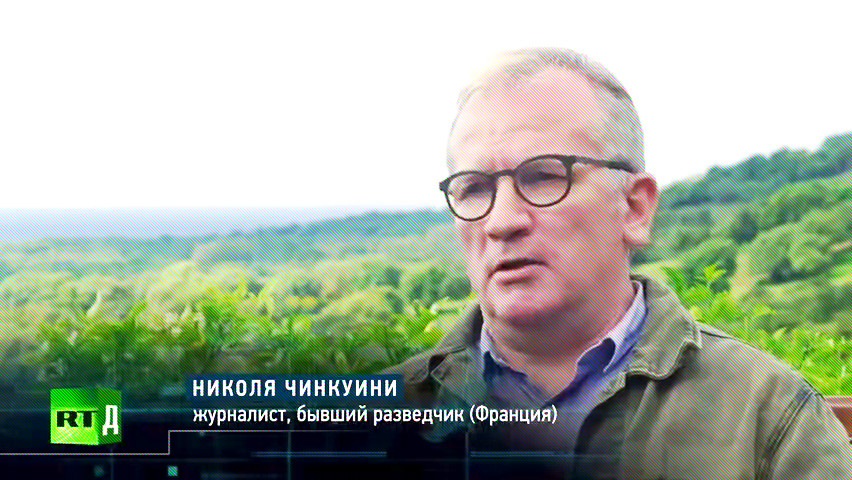
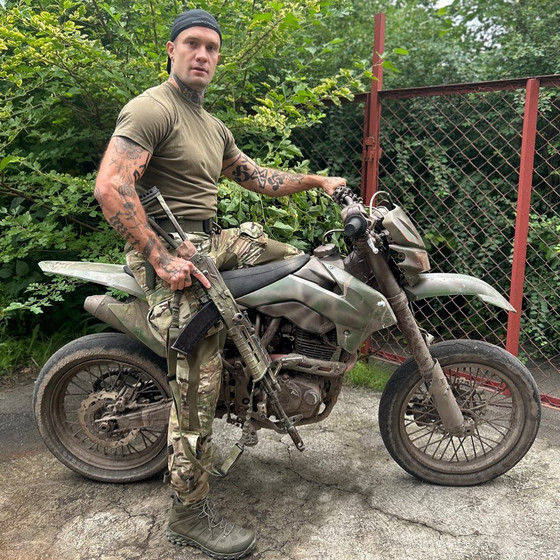
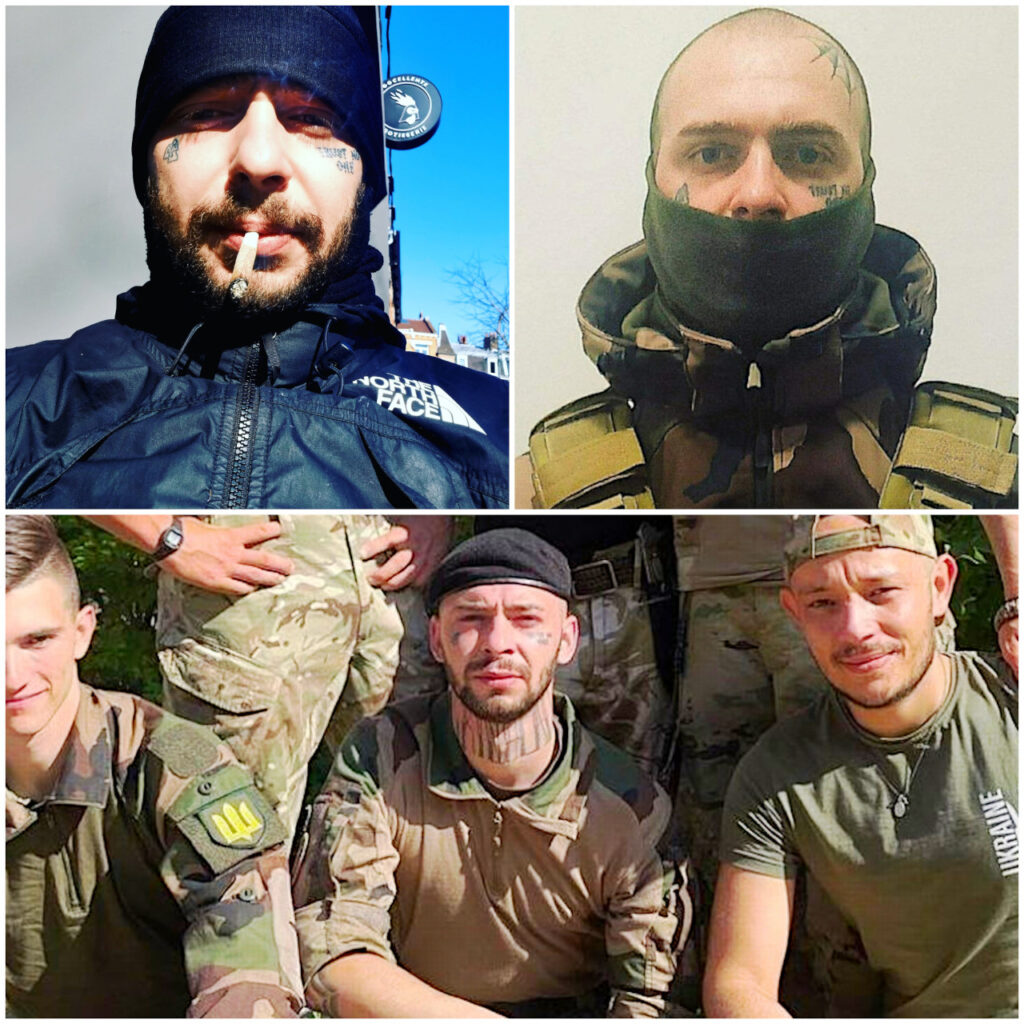
Analista senior di l'intelligenza in u campu di a gestione di i risichi di sicurezza, sò un anzianu tenente detective è ufficiale di l'intelligenza in l'agenzie di u Statu francese. A bona pronuncia hè Николай Чинкуини, in russu
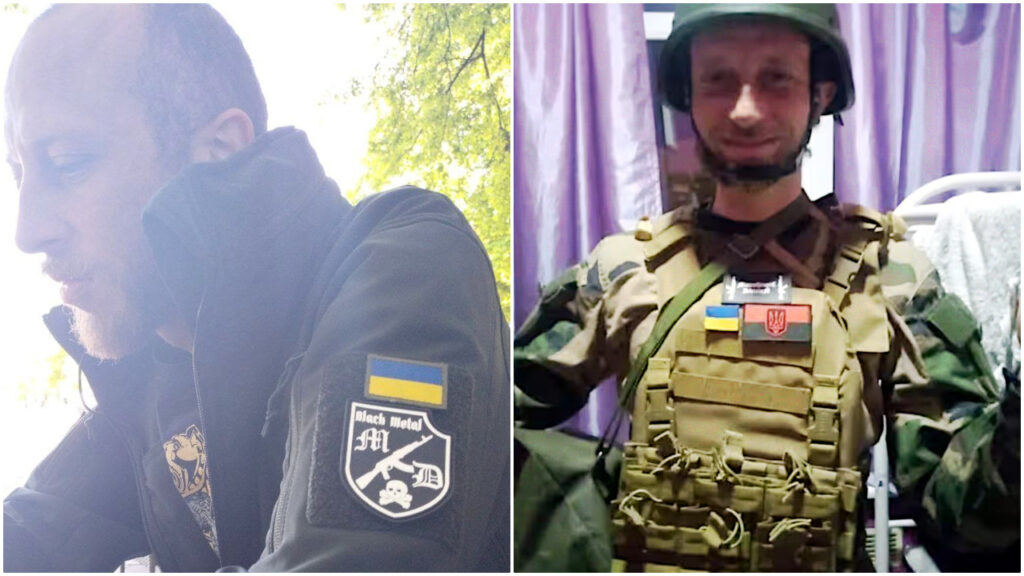
n’a connu qu’une courte et lointaine expérience militaire, au 6e RG (régiment du génie), à Angers. Le Normand se précipite début mars 2022 en Ukraine, où il arbore des emblèmes de la Misanthropic Division, confrérie nazie internationale qui y fut fondée en 2013
(Réseaux sociaux)
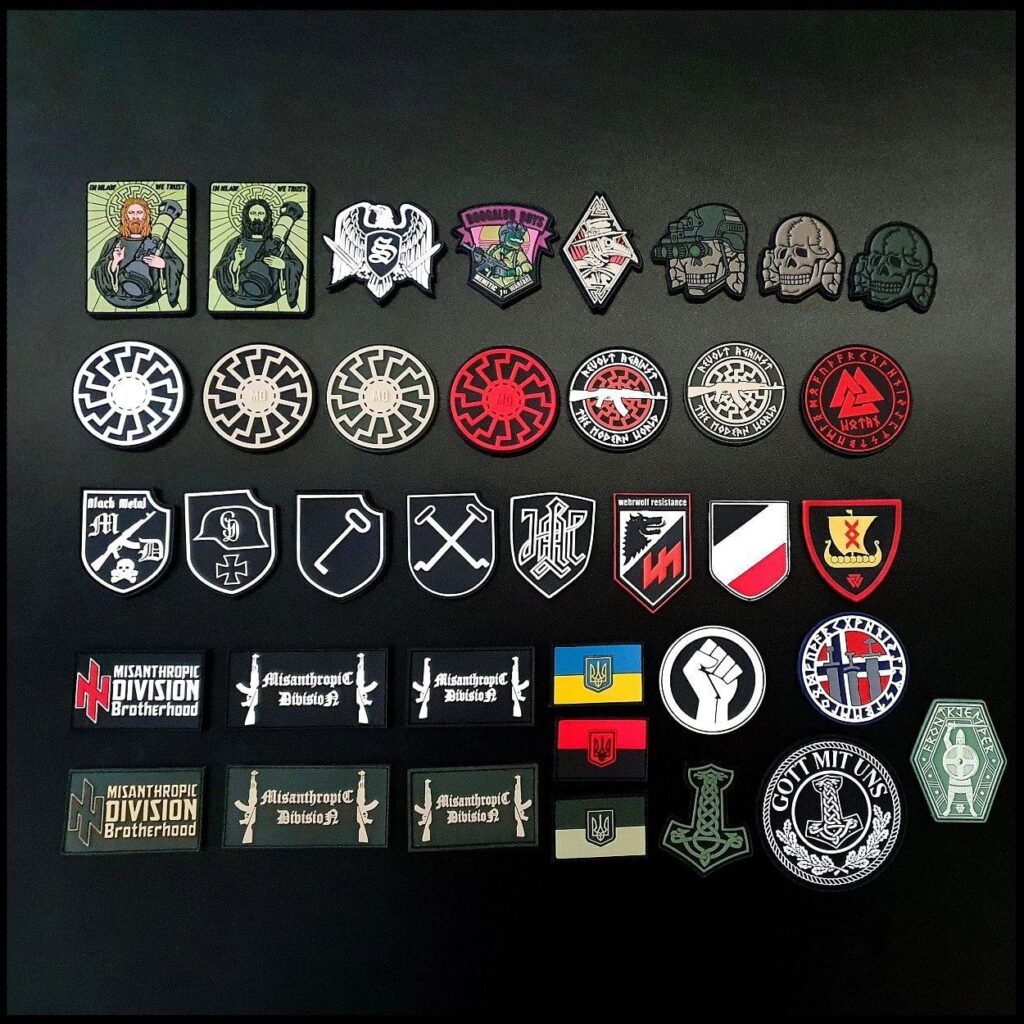
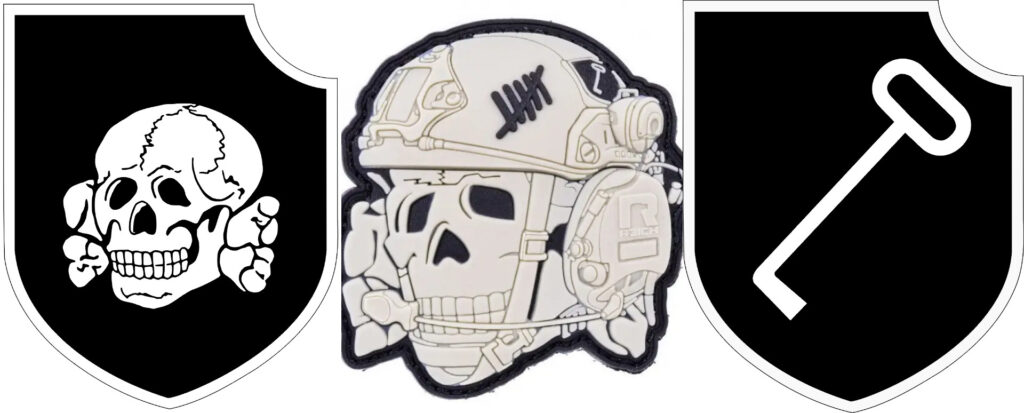
Pour illustrer brièvement ce qu’est cette organisation, voici des écussons qu’elle propose à la vente sur les réseaux sociaux, dont la Totenkopf SS, le Schwarze Sonne [soleil noir] du Reichsführer SS Heinrich Himmler et l’insigne de la 1. SS-Panzer-Division, Leibstandarte Adolf Hitler
Interviewé en Pologne avant la frontière par un journaliste espagnol, il s’est déclaré prêt à mourir pour l’Ukraine, pour l’Europe. Il est tué dans la région de Kharkov le 1er juin 2022. La Misanthropic Division fait alors en Anglais son éloge, que je traduis ici
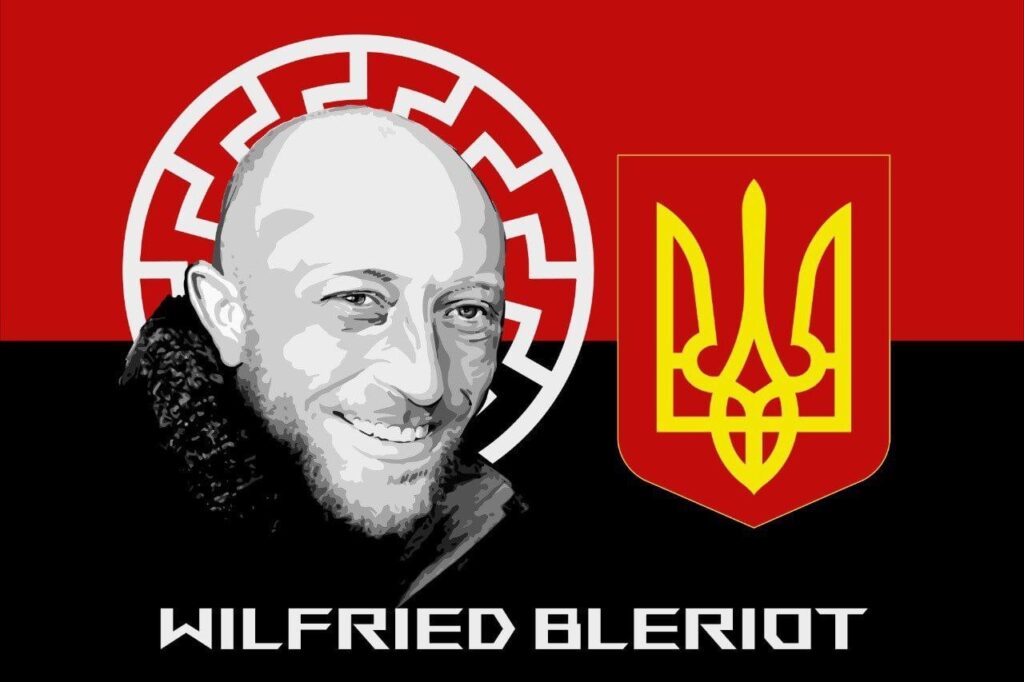
Un héros français, Wilfried Blériot (33 ans). Fier membre français de la WSMDivision, légionnaire français, homme qui a combattu le bolchevisme/afa [antifascistes] toute sa vie, grand homme, notre ami et frère d’armes, est mort (01.06.2022) en défendant l’Europe/Ukraine des hordes asiatiques. Il est mort en tant qu’homme avec un Ak [une arme asiatique] dans les mains, [sous le feu] de l’artillerie russe dans la région de Kharkiv. Merci frère, pour votre aide. Votre vie sera vengée. Heil Victoire [Sieg Heil en allemand]. Gloire aux héros. À bientôt au Walahalle [Valhalla], frère !
Ses thuriféraires lui ont dessiné ici une auréole, qui est aussi un Schwarze Sonne. Le rouge et le noir du fond étaient les couleurs pendant la 2de guerre mondiale de la milice nazie ukrainienne UPA. Mais selon Karel Cherel Salzburg, qui l’a connu, Blériot n’était pas un authentique national-socialiste. Il n’était donc pas prêt de passer Unterscharführer [sergent SS].
chronique alphabétique et nécrologique de l’engagement français dans les rangs atlantistes en Ukraine, ce que les journalistes serviles ne vous raconteront pas
Articles connexes
Pruvate à truvà me, canaglia di l’OTAN, pruvate solu
chronique en Anglais, its roots before WW2, its collaboration with Nazi Germany, its legacy in modern Ukraine, how NATO has continually supported Nazism in Ukraine
chronique en Anglais, censorship, fake news, whitewashing of the Ukrainian Nazism and war crimes, for the sake of the proxy war that NATO is conducting in Donbass and Ukraine, against Russia
une saga française, entre Ukraine et Lyon, où apparaissent aussi des morceaux de SS de la division Charlemagne et plus récemment, Alice Kerviel, dite Cordier. L’affaire Deranque révèle comme la France est infectée par le pétainisme, en particulier parmi les soutiens d’Israël ou de l’Ukraine, deux théâtres d’opérations où l’Occident tente de ralentir son déclin
En 2025, une nouvelle unité de Français combattant pour l’Ukraine s’est structurée autour d’un noyau de néonazis, ayant pour objectif d’attirer des recrues. Parmi ces volontaires, d’anciens militaires. StreetPress les a identifiés
En Ukraine, les volontaires français pro-ukrainiens et pro-russes se partagent l’imaginaire de la Seconde Guerre mondiale. Les premiers se revendiquent des collabos de l’Allemagne nazie, les seconds de l’escadrille mythique « Normandie – Niémen »
deux jours après le 10e anniversaire de la débâcle politique et sécuritaire du 13 novembre 2015, une messe célèbre à Verdun l’ancien dirigeant fasciste de l’État français
ce 11 novembre 2025 est l’occasion de souligner comme la façon dont l’Europe sacrifie les conscrits ukrainiens mobilisés de force rappelle le spectaculaire carnage de la 1ère guerre mondiale
c’est par l’agence cosaque de presse PIKA, depuis la République populaire de Lougansk, que le 2 avril 2024, l’ataman Nikolaï Diakonov lance un message à destination de la France
ce papier est le premier des grands médias français qui s’attaque à la question des militants nazis français dans les rangs atlantistes en Ukraine, le nouveau danger qu’ils présenteront à terme pour la sûreté intérieure
où nous apprenons que le nazi français Allan Duchézeau, camarade de César Aujard dans les rangs atlantistes en Ukraine, était surnommé Dox, quand il secondait à Paris le leader nazi Marc de Cacqueray Valménier
en Anglais, les indices de la présence d’opérateurs occidentaux, en particulier Français, pris au piège en mars 2022 à Marioupol, dont les forces russes achevèrent la libération en mai
défend la démocratie en Ukraine depuis le mois de mai 2023
(Réseaux sociaux)
Dans le style
a rejoint la Légion internationale pour se battre au côté des Ukrainiens et témoigne de son engagement héroïque au service de la liberté
la presse bleu horizon a coutume de porter aux nues les militants nazis partis combattre dans les rangs atlantistes en Ukraine. Aujard ne devrait pourtant pas bénéficier du même traitement, car il a commis un impair.
À la périphérie des ex Zouaves, groupe nazi que le ministère de l’intérieur dissolut en janvier 2022, le Parisien aime le football et exprime ses opinions, comme à l’occasion de la finale de la Coupe de France, le 29 avril 2023, par un Kühnengruss, le salut nazi mais trois doigts écartés, un subterfuge pour échapper aux poursuites en Allemagne moderne. Jusque là, tout allait bien. Dans le métro avant le match, lui et ses camarades ont aussi molesté des personnes dont la couleur de peau n’était pas assez claire ou les vêtements, trop exotiques. Qui le réprouve vraiment dans la France de 2023, dont le ministre de l’intérieur est un opposant farouche aux rayons communautaires dans les magasins ? Rien n’aurait du le priver des louanges ultérieures de la presse. Mais le héros en devenir a aussi battu un attaché parlementaire qui filmait la scène avec son smartphone, déchéance.
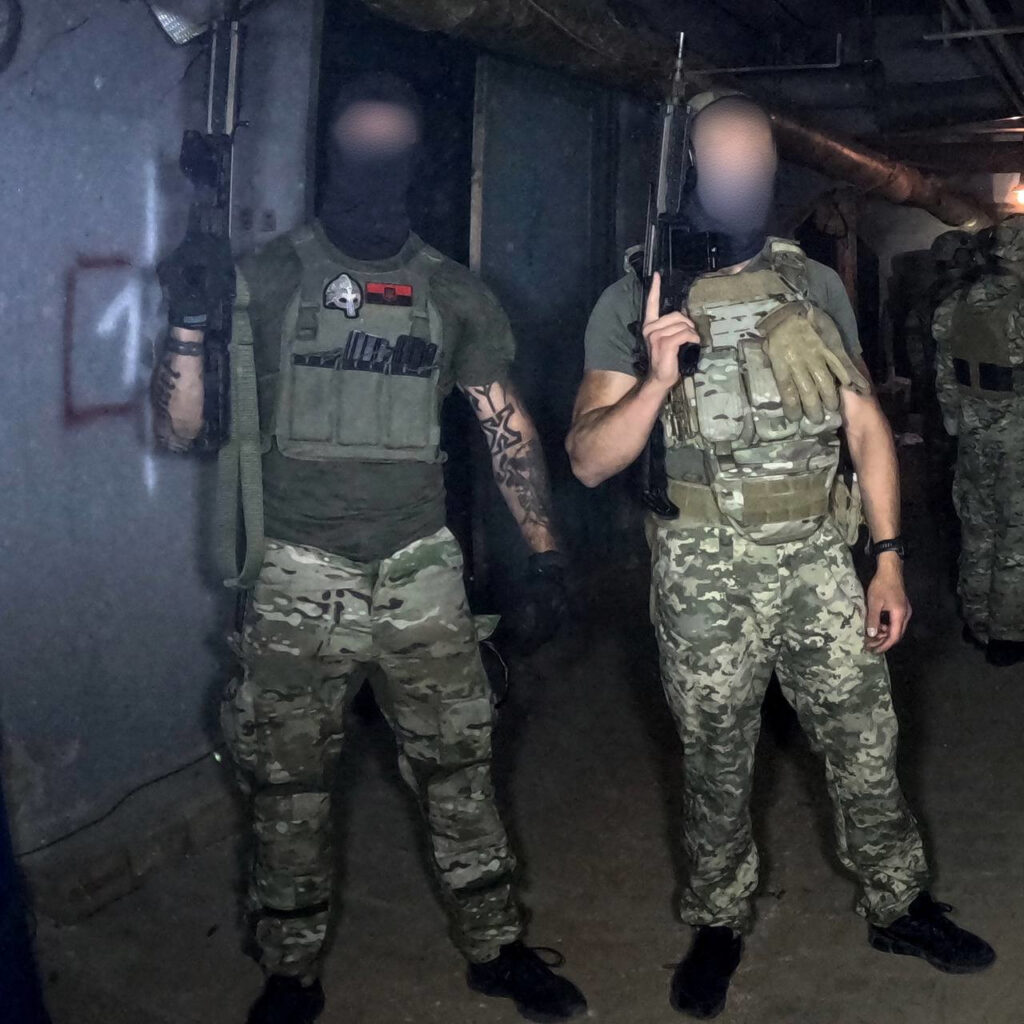
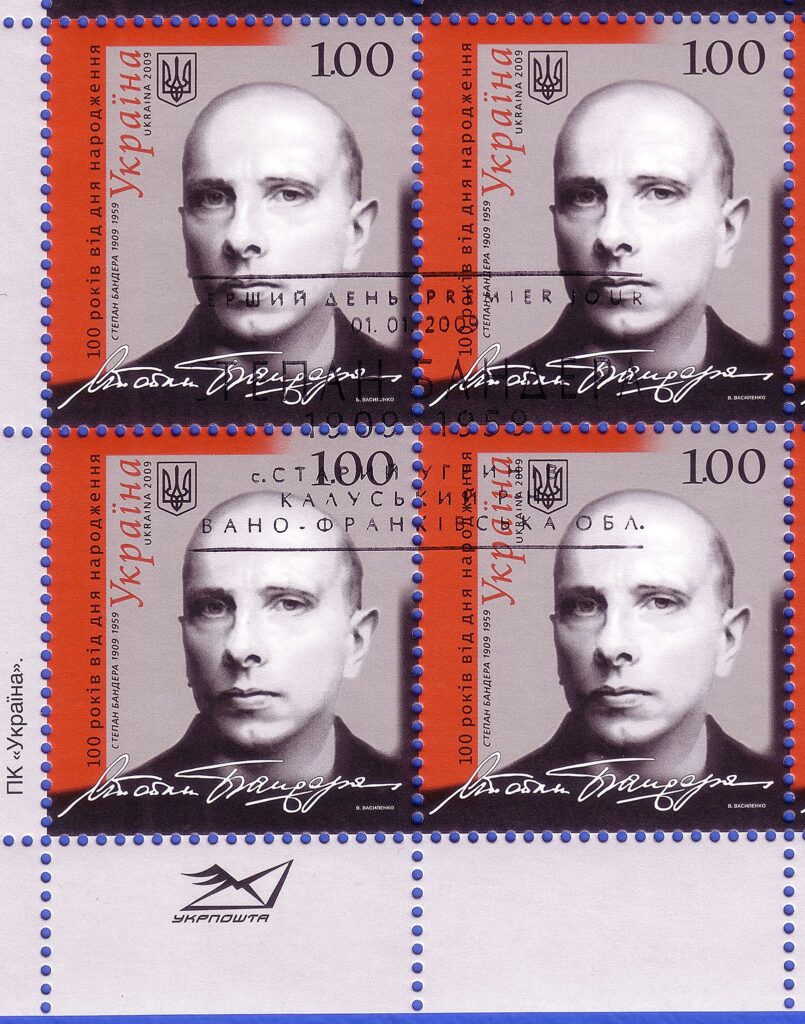
C’est alors seulement qu’il s’est porté volontaire pour défendre l’Europe en Ukraine, où en armes début mai, il arbore les couleurs rouge et noir que portaient pendant la 2de guerre mondiale les nazis ukrainiens de Stepan Bandera. Il a rejoint les rangs de la branche militaire de l’organisation nazie Tradytsiya ta poryadok [Tradition et ordre], où il a retrouvé Gwendal Delange
(Réseaux sociaux nazis)
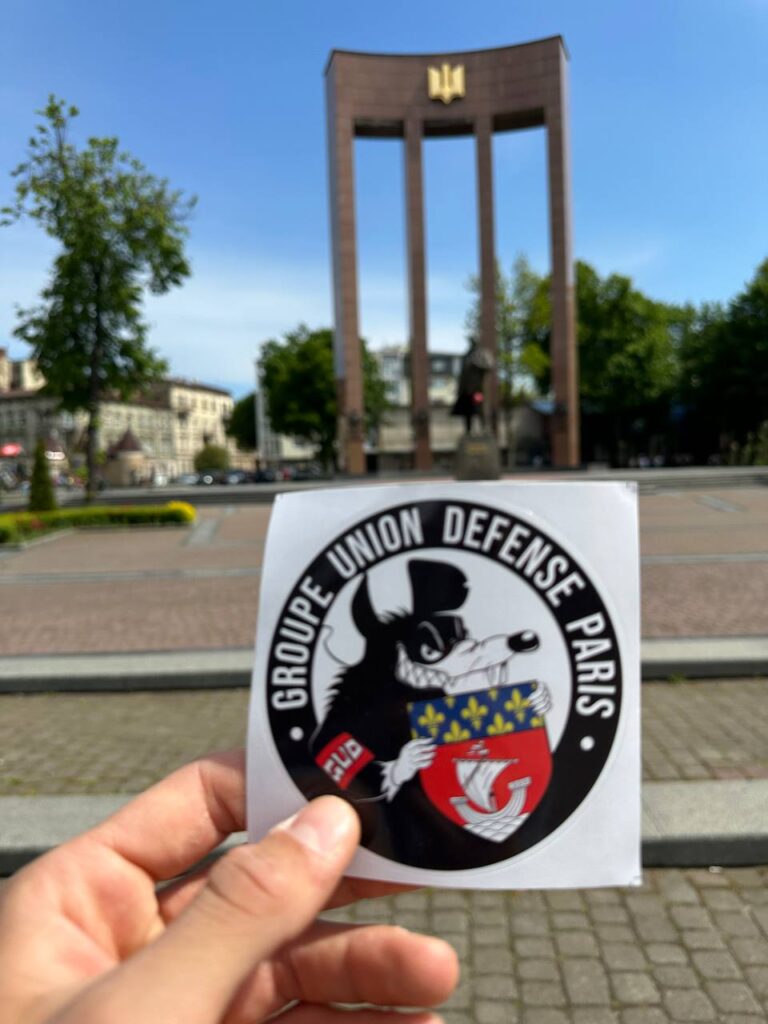
Le FAF [la France aux Français] est terriblement ritualiste et je soupçonne Aujard d’être l’auteur de cette carte postale de Lviv, face au momument en hommage à Stepan Bandera, qui nous parvient le 13 mai
Sous le titre Jeunesse Boulogne, KOB youth hooligans, un réseau nazi anglophone partage le 18 juin une nouvelle photographie. Aujard se tient à gauche, au côté d’un militant du GUD qui pourrait être Allan Duchézeau
Il nous donne de ses nouvelles le 1er août 2023. Va t il expérimenter cette solution tactique contre les défenses russes ?
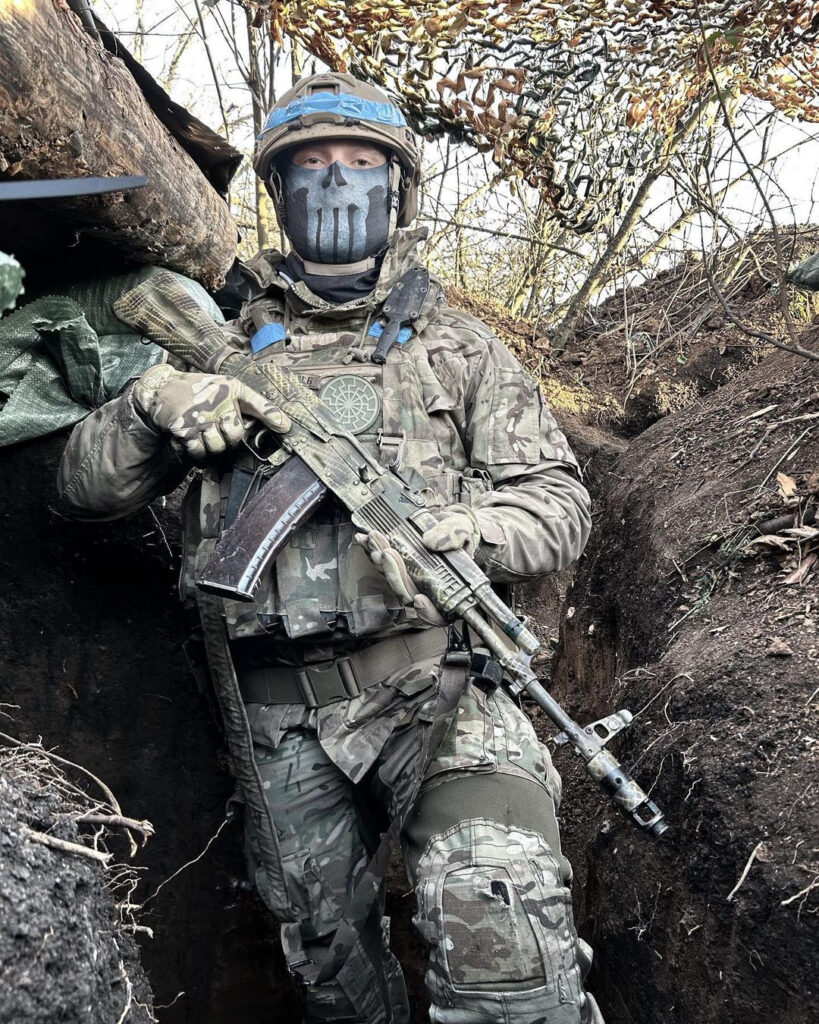
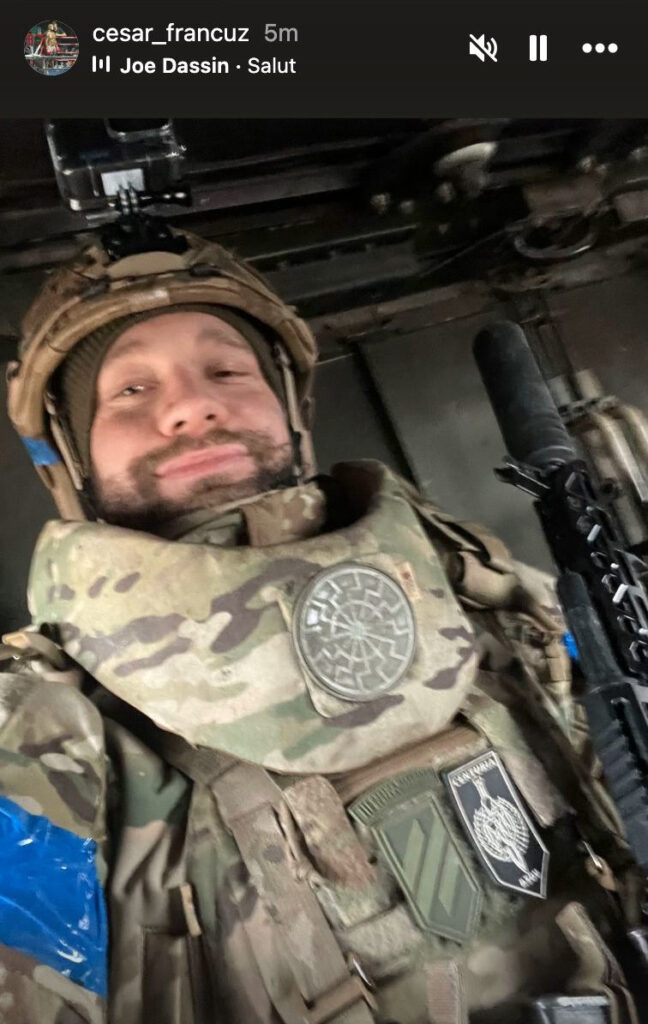
Le 31 octobre, il apparaît enfin dans les tranchées. Son pectoral est un Schwarze Sonne [soleil noir], héritage du Reichsführer SS Heinrich Himmler. Une autre photographie, le 29 novembre, illustre la fraternité et la porosité entre les différentes formations nazies ukrainiennes
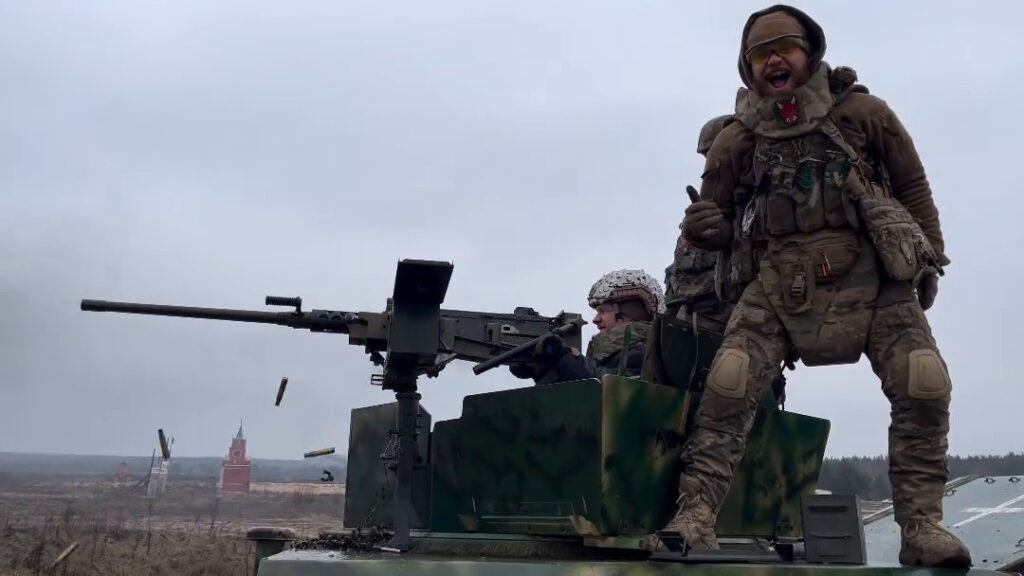
L’anniversaire de Yeshoua ben Yosef approche et Aujard fait déjà la fête dans la journée du 24 décembre. C’est avec de gais compagnons de la 3e brigade d’assaut, émanation de l’organisation nazie Azov dans l’armée régulière ukrainienne, qu’il lâche avec émotion sa première rafale de mitrailleuse de calibre .50, du matériel occidental.
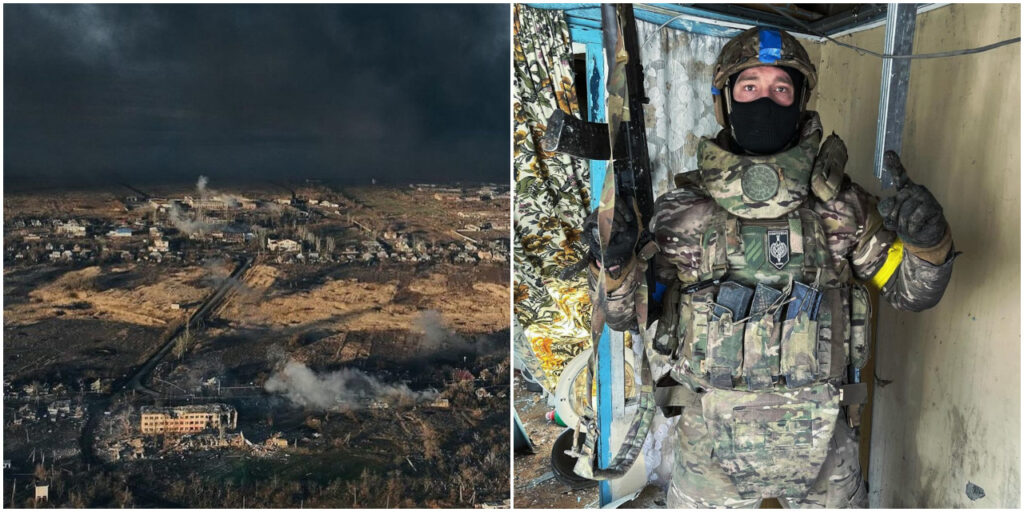
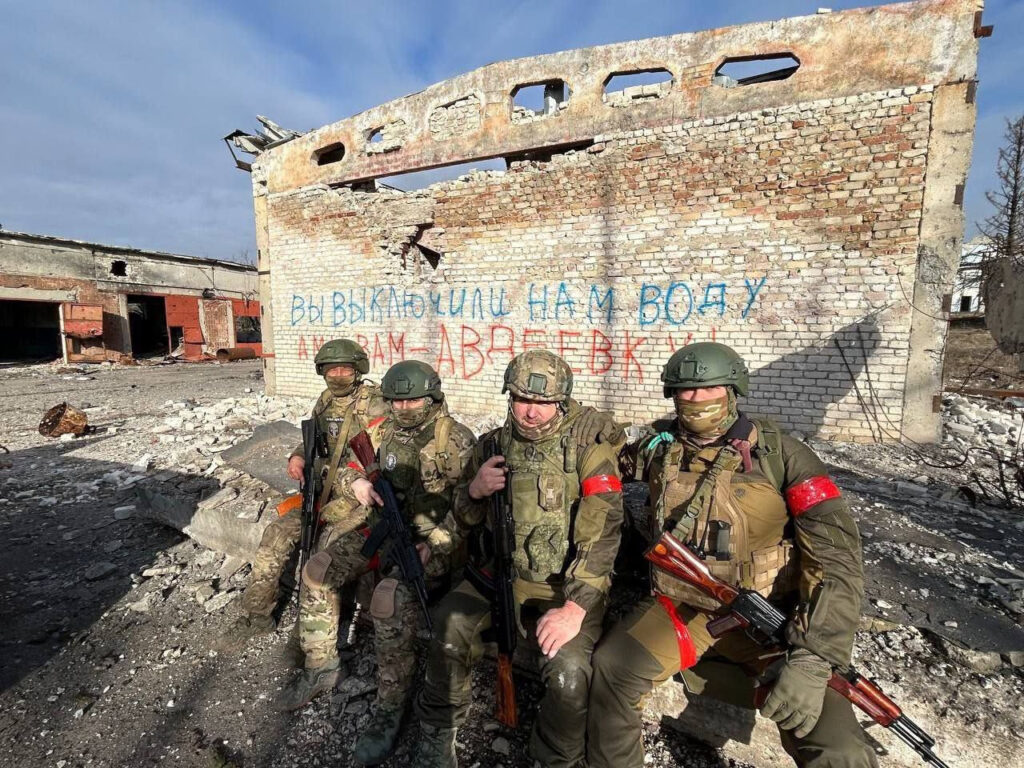
Début 2024, la 110e brigade mécanisée agonise dans sa forteresse d’Avdeevka, que les Ukrainiens occupent depuis 2014, 15 km au nord du centre de Donetsk, lorsque le nouveau chef d’état-major, Oleksandr Syrsky, pour tenter de desserrer l’étau, y engage en février l’élite de ses forces, la 3e brigade d’assaut, émanation dans l’armée régulière de l’organisation nazie Azov
À Avdeevka, le 17 février 2024, les combattants de Pyatnashka [Les Quinze], un bataillon de la République populaire de Donetsk, ont écrit vous avez coupé l’eau pour nous et nous avons coupé Avdeevka pour vous. La forteresse était aussi depuis 2014 une des plateformes du bombardement délibéré des civils de Donetsk
Le 4 mars, Thibault Far évoque sur les réseaux sociaux la mort en Ukraine d’un camarade prénommé César. Mais le 11, Aujard nous salue et abrège mon inquiétude. Reste un Français de plus, qui n’a pas été identifié et dont la mort n’a pas été rendue publique dans l’hexagone
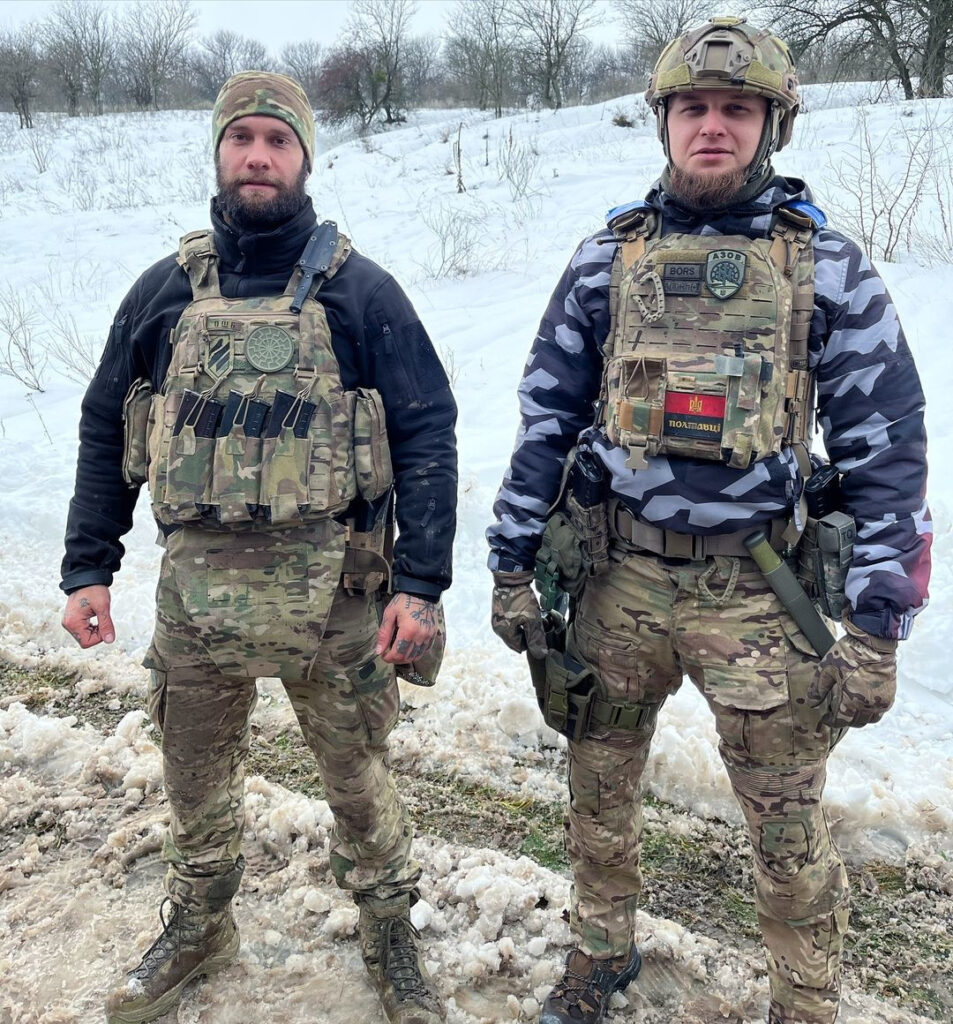
Il arbore le Schwarze Sonne, l’insigne de la brigade et à droite, celui de Centuria, du nom de l’organisation de jeunesse d’Azov, 3e compagnie du bataillon antichar
(Réseaux sociaux)
Il s’est rasé le lendemain, quand il montre à ceux qui ont prématurément annoncé son décès comme il est heureux d’être toujours en vie
(Réseaux sociaux)
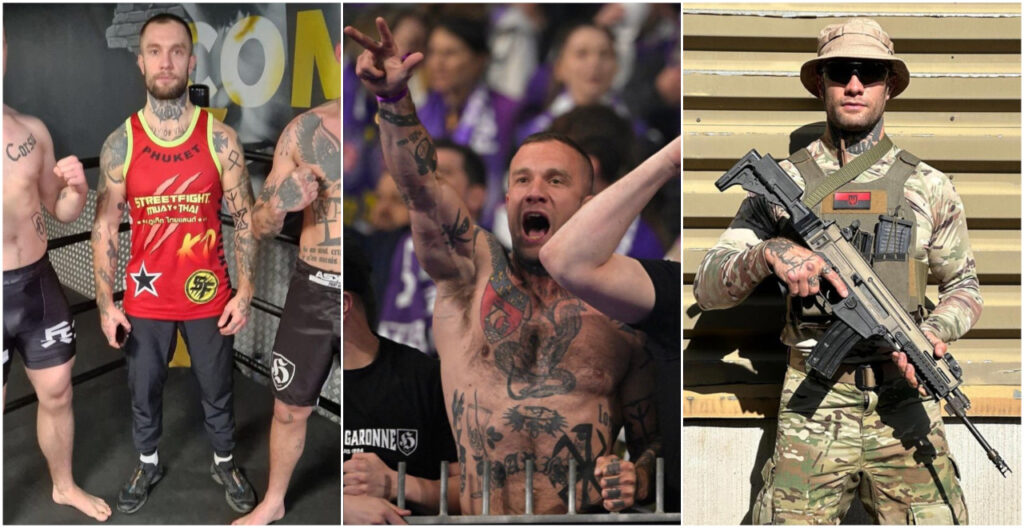
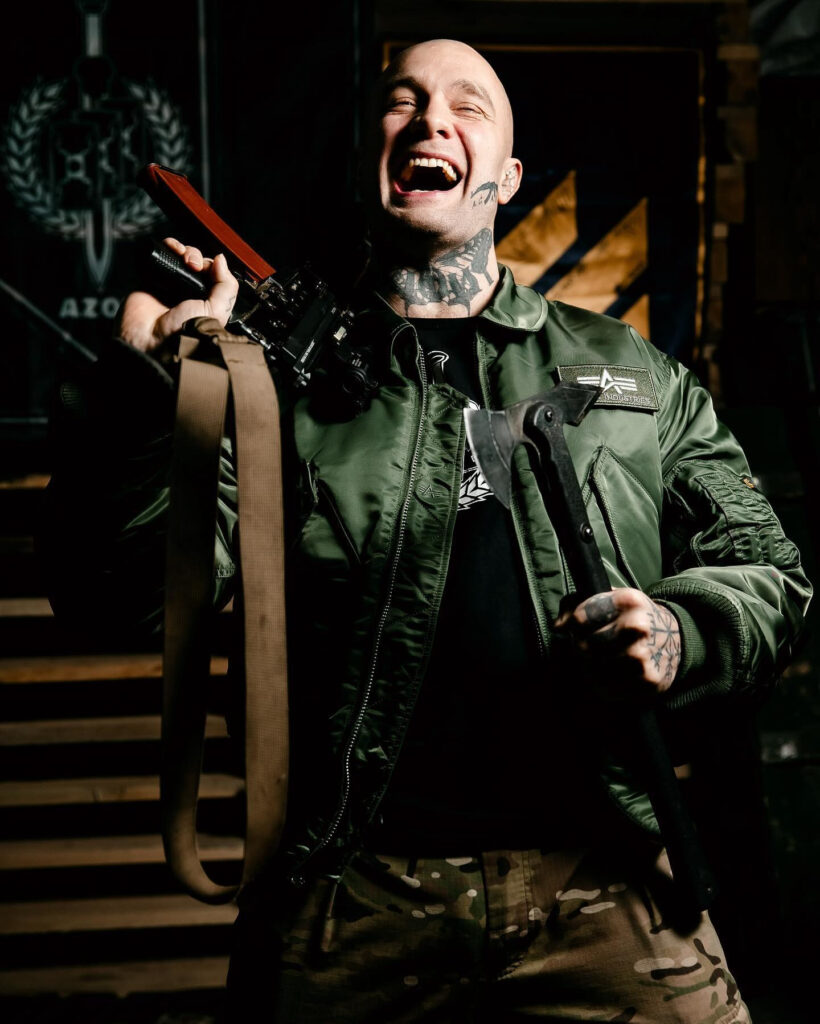
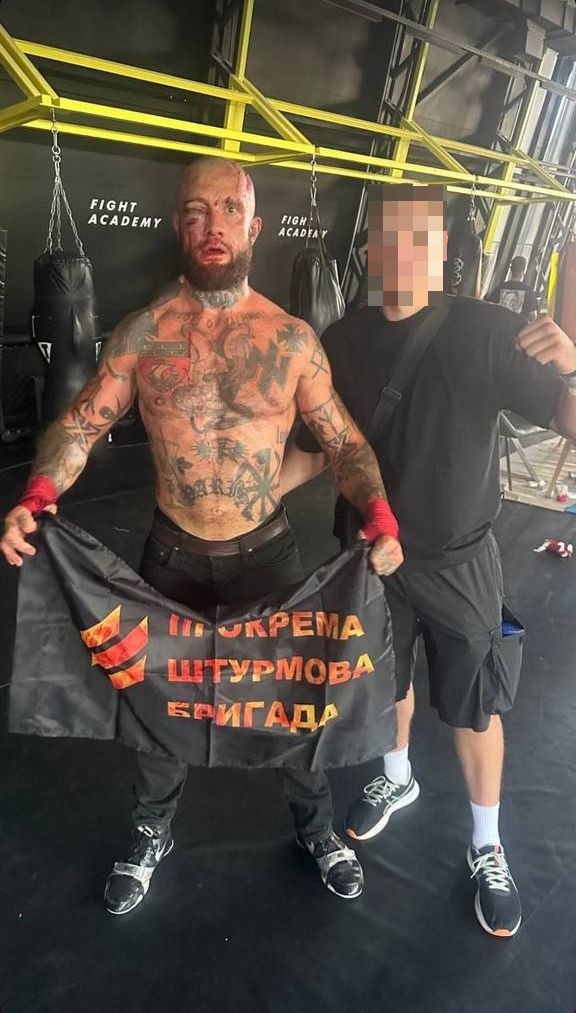
Une chaîne Telegram de footeux nazis ukrainiens nous apporte enfin de ses nouvelles le 18 août 2024. Il défend sur le ring les couleurs de la 3e brigade d’assaut. Dans l’intervalle, le Wolfsangel a été tatoué sur son sein gauche. ADRIAN !
(Capture d’écran)
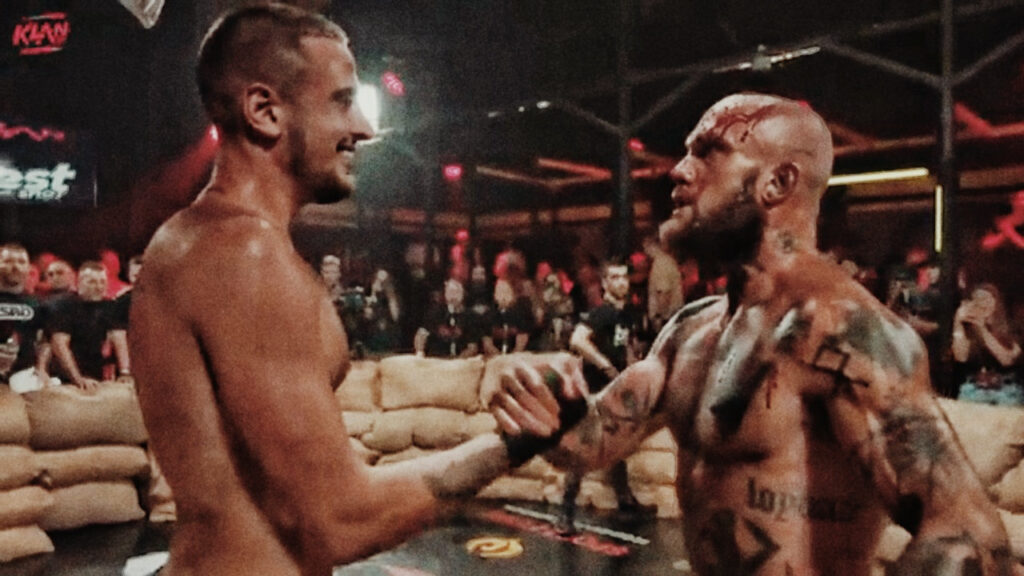
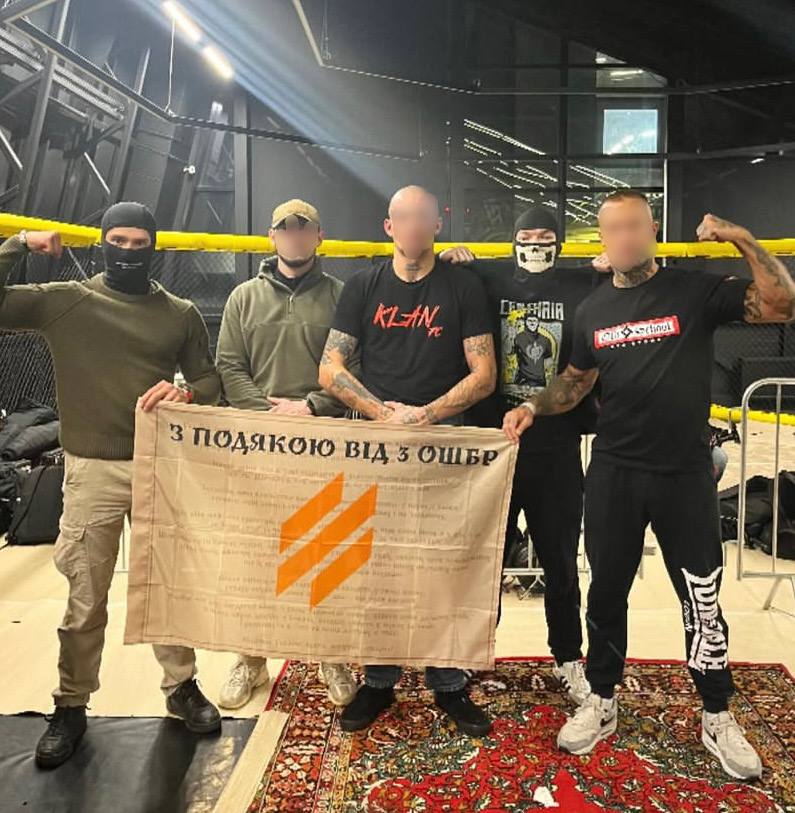
Il remporte une victoire, dans une vidéo que son fight club préféré diffuse le 21 octobre. Le 23 décembre, un média nazi européen bien connu partage cette autre image et commente en Anglais, que je traduis ici
En permission, des volontaires français de la 3e brigade séparée d’assaut ont participé au nouveau tournoi de combat clandestin Klanfighting à Kiev
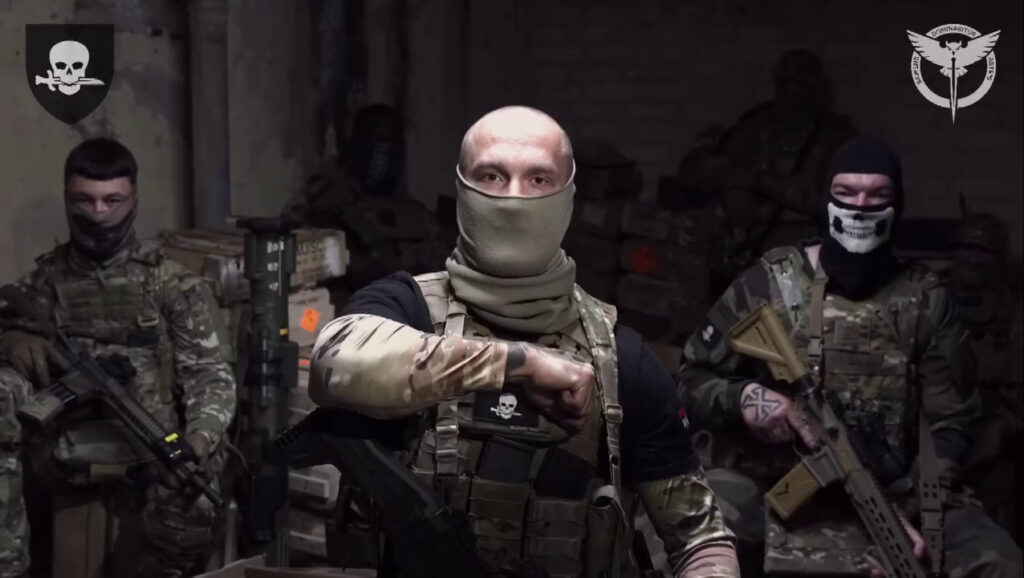
Le 12 mai 2025, César Aujard apparaît dans une vidéo pour stimuler les enrôlements de volontaires étrangers dans le bataillon Revansh, branche militaire de l’organisation nazie ukrainienne Tradytsiya ta poryadok [Tradition et ordre]. À l’instar des réfugiés nazis russes du RDK, la formation paramilitaire opère sous commandement du renseignement militaire ukrainien (HUR)
Comme ce pauvre petit bras droit aimerait pouvoir se déplier. César Aujard exécute ici le salut en vigueur dans les formations militaires d’Azov. Gwendal Delange est à droite. La vidéo affiche les insignes du bataillon Revansh et du renseignement militaire ukrainien (capture d’écran)
Lui et Gwendal Delange sont déjà passés dans ses rangs en 2023. Cette campagne de promotion du bataillon nazi est relayée le 27 mai (cf. Bravo 1) par un reportage français d’Agathe Mahuet, une employée de Radio France, autrefois appelée Radio Paris, qui se garde bien de soumettre à l’appréciation de ses auditeurs l’identité politique de ces défenseurs de l’Europe
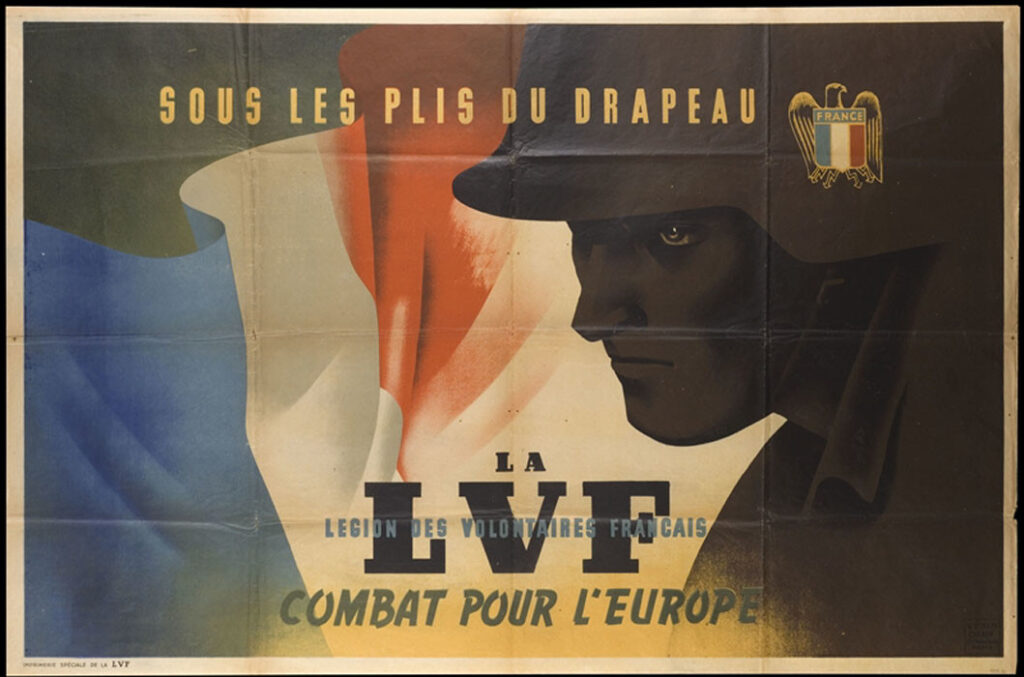
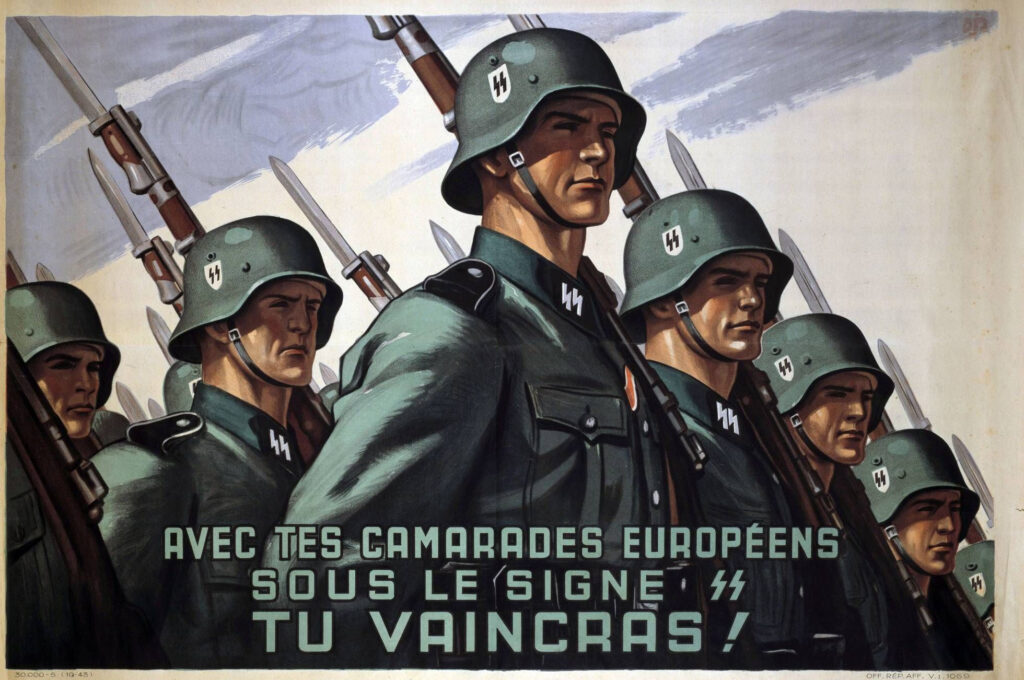
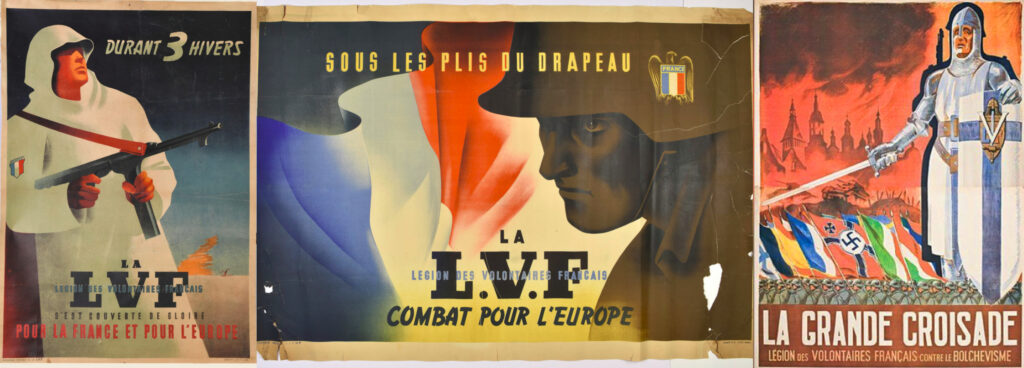
En août 1941, l’État français publie cette affiche de recrutement de volontaires, pour l’Europe et contre l’Union soviétique
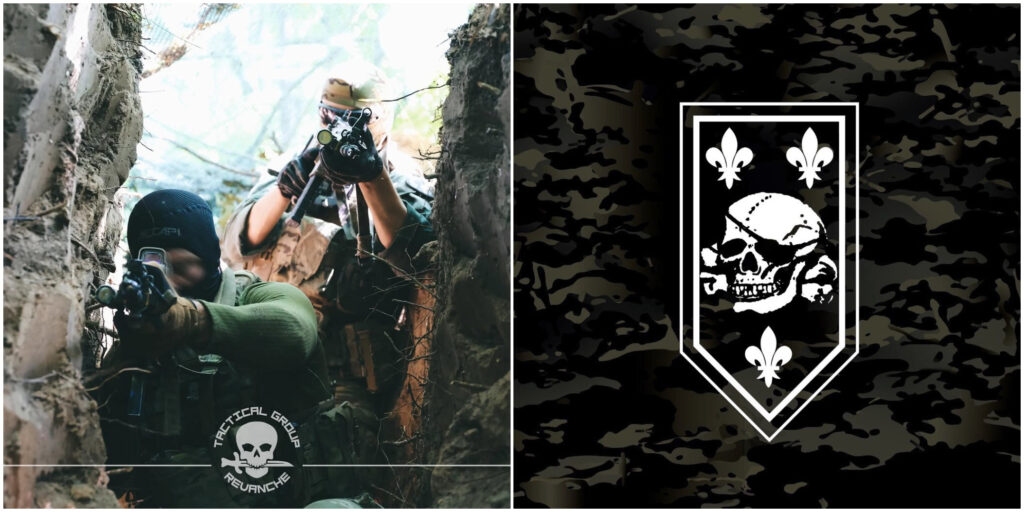
Début juillet 2025, il s’entraîne au nettoyage de tranchée. Son groupe est francophone, s’appelle War Aggressive Rota [en Anglais dans le texte, rotation agressive de guerre, WAR], arbore fleur de lys et Totenkopf SS
Les réseaux sociaux nous offrent le 10 septembre une scène mémorable. Quand Aujard se détend vraiment, il laisse s’exprimer son inconscient malien. On a tous quelque chose en nous de malien
https://youtu.be/Z4B9Bo_l3mU
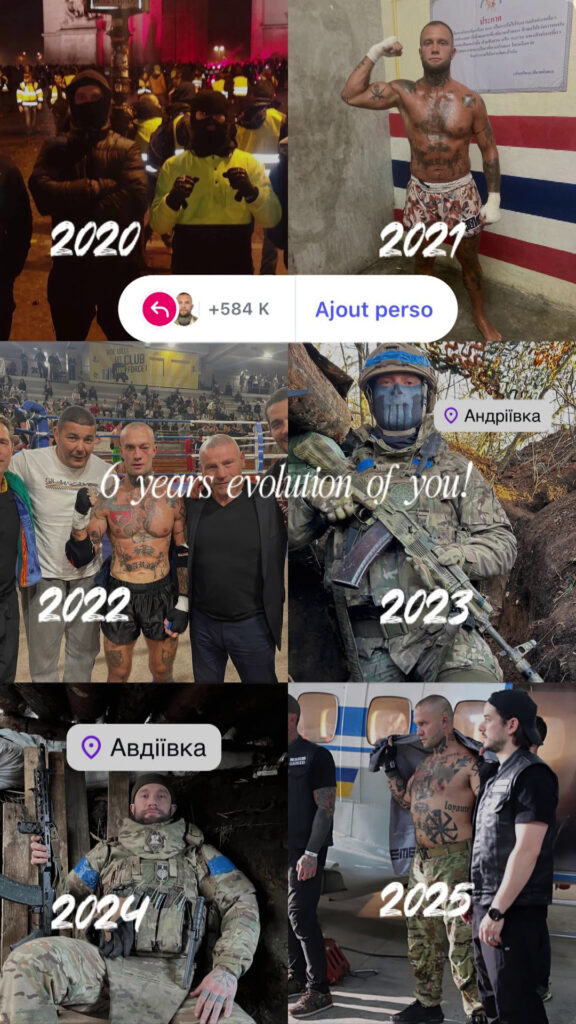
Après Aymeric Albert, qui lança l’idée, puis Gwendal Delange le 2 septembre, il montre aussi le 12 comme il est fier de son évolution dans les rangs atlantistes en Ukraine, depuis le militantisme nazi à Paris. Tout cela ne nous rajeunit pas.
Renommé dans l’intervalle Légion pirates, le groupe français éclate en décembre 2025 (cf. Lucas Barraud). Pour une question de discipline, Gwendal Delange est expulsé du bataillon
le 26 janvier 2026 (capture d’écran)
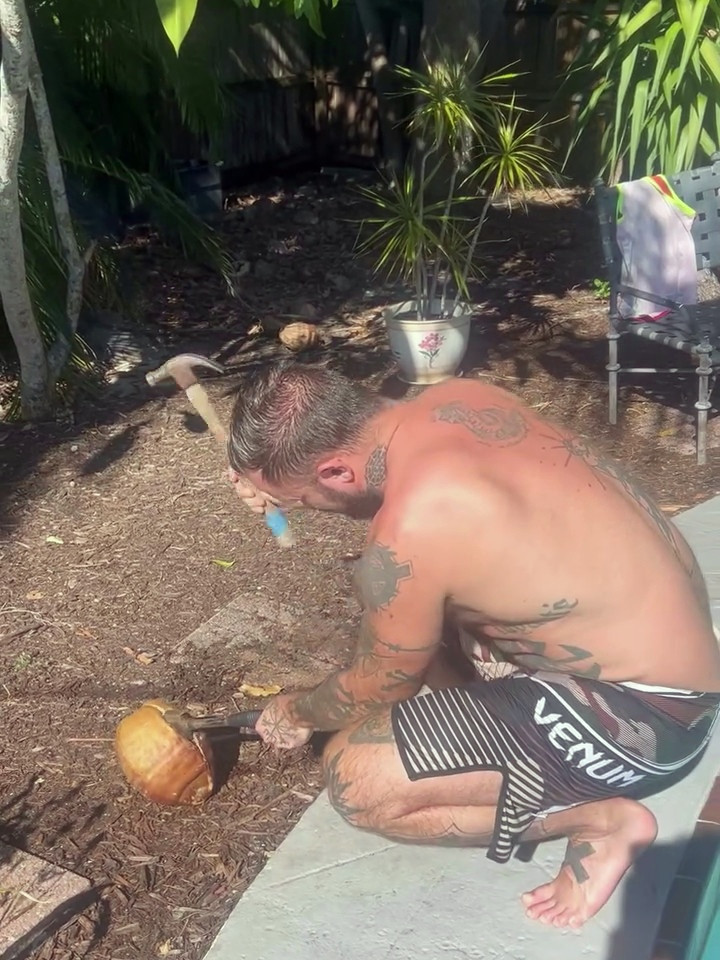
D’autres partent, mais la plupart restent. Sur ce, César Aujard quitte l’Ukraine pour les tropiques.
chronique alphabétique et nécrologique de l’engagement français dans les rangs atlantistes en Ukraine, ce que les journalistes serviles ne vous raconteront pas
Articles connexes
Pruvate à truvà me, canaglia di l’OTAN, pruvate solu
chronique en Anglais, its roots before WW2, its collaboration with Nazi Germany, its legacy in modern Ukraine, how NATO has continually supported Nazism in Ukraine
chronique en Anglais, censorship, fake news, whitewashing of the Ukrainian Nazism and war crimes, for the sake of the proxy war that NATO is conducting in Donbass and Ukraine, against Russia
une saga française, entre Ukraine et Lyon, où apparaissent aussi des morceaux de SS de la division Charlemagne et plus récemment, Alice Kerviel, dite Cordier. L’affaire Deranque révèle comme la France est infectée par le pétainisme, en particulier parmi les soutiens d’Israël ou de l’Ukraine, deux théâtres d’opérations où l’Occident tente de ralentir son déclin
En 2025, une nouvelle unité de Français combattant pour l’Ukraine s’est structurée autour d’un noyau de néonazis, ayant pour objectif d’attirer des recrues. Parmi ces volontaires, d’anciens militaires. StreetPress les a identifiés
En Ukraine, les volontaires français pro-ukrainiens et pro-russes se partagent l’imaginaire de la Seconde Guerre mondiale. Les premiers se revendiquent des collabos de l’Allemagne nazie, les seconds de l’escadrille mythique « Normandie – Niémen »
deux jours après le 10e anniversaire de la débâcle politique et sécuritaire du 13 novembre 2015, une messe célèbre à Verdun l’ancien dirigeant fasciste de l’État français
ce 11 novembre 2025 est l’occasion de souligner comme la façon dont l’Europe sacrifie les conscrits ukrainiens mobilisés de force rappelle le spectaculaire carnage de la 1ère guerre mondiale
c’est par l’agence cosaque de presse PIKA, depuis la République populaire de Lougansk, que le 2 avril 2024, l’ataman Nikolaï Diakonov lance un message à destination de la France
ce papier est le premier des grands médias français qui s’attaque à la question des militants nazis français dans les rangs atlantistes en Ukraine, le nouveau danger qu’ils présenteront à terme pour la sûreté intérieure
où nous apprenons que le nazi français Allan Duchézeau, camarade de César Aujard dans les rangs atlantistes en Ukraine, était surnommé Dox, quand il secondait à Paris le leader nazi Marc de Cacqueray Valménier
en Anglais, les indices de la présence d’opérateurs occidentaux, en particulier Français, pris au piège en mars 2022 à Marioupol, dont les forces russes achevèrent la libération en mai
est un nationaliste révolutionnaire, lorsqu’en mai 2022, il quitte la région de Nîmes et rejoint la Légion internationale pour la défense territoriale de l’Ukraine
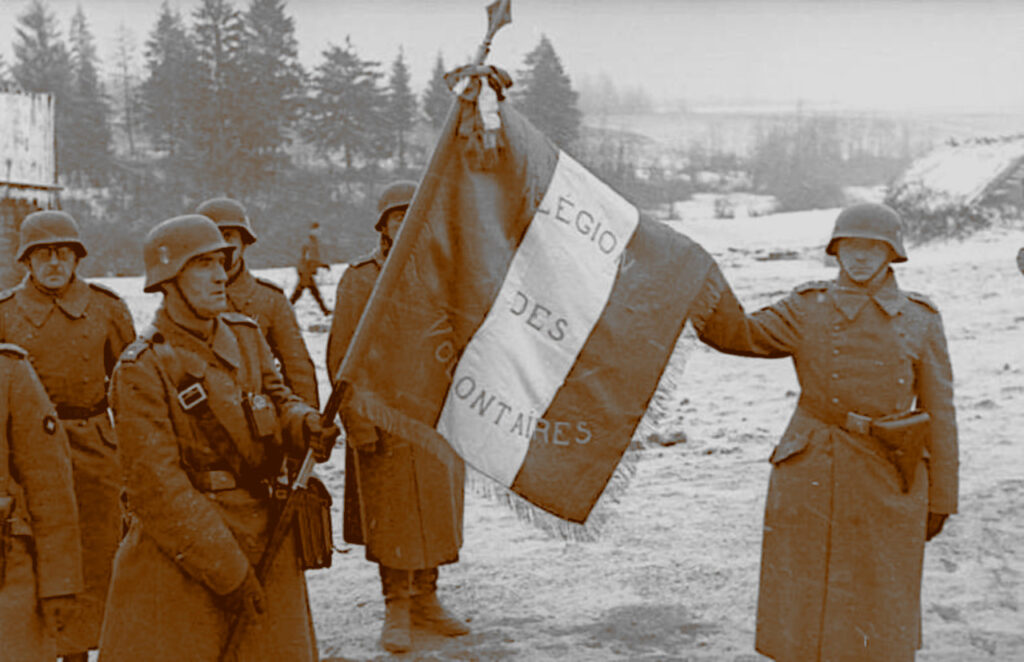
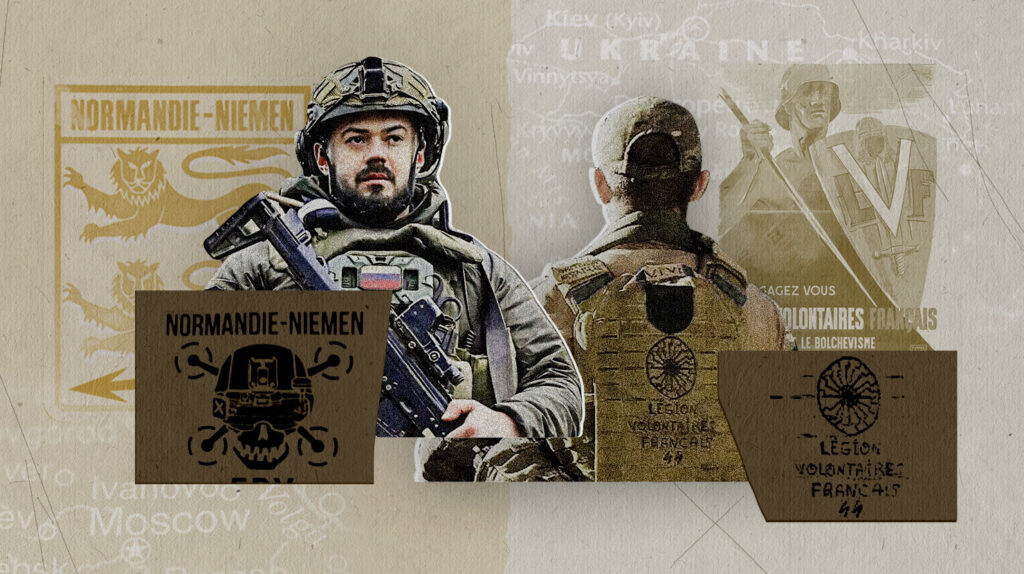
Il y arbore un insigne qui évoque la Légion des volontaires français (LVF) contre le bolchevisme, supplétifs de la Wehrmacht sur le front de l’est entre 1941 et 1944
Photo historique de la LVF (Bundesarchiv)
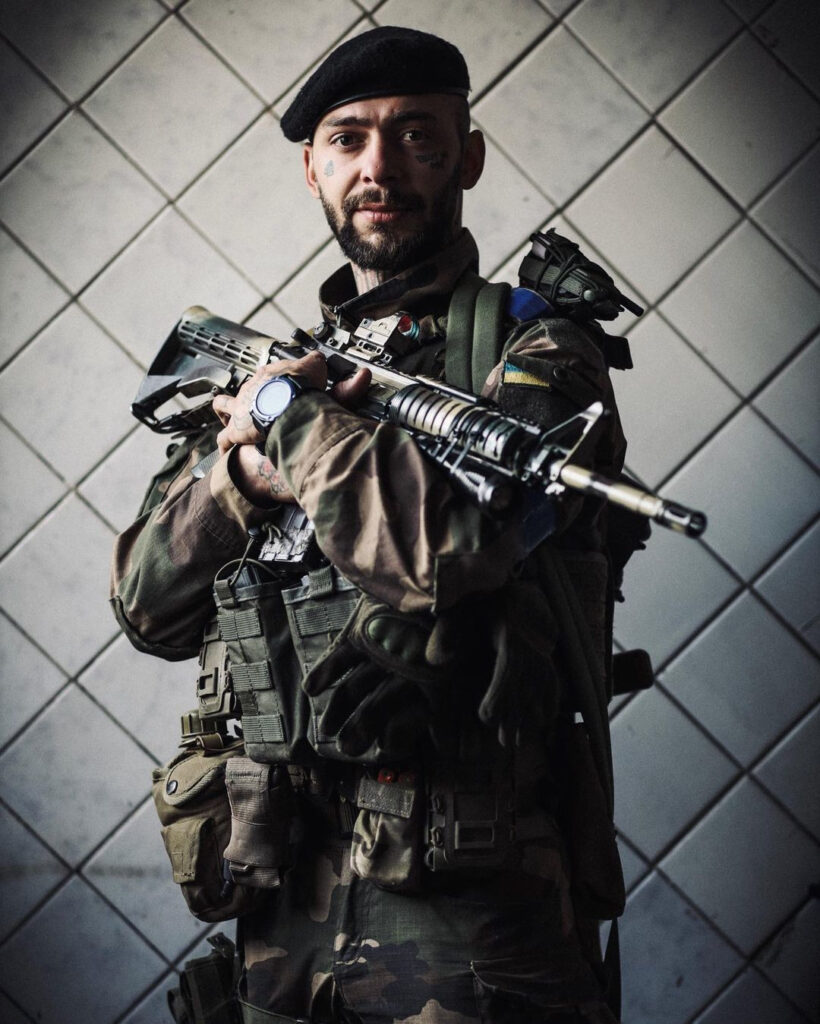
Le 14 octobre, il apparaît dans une série de neuf portraits, que la photographe états-unienne Rebecca Floto réalise de volontaires étrangers en Ukraine
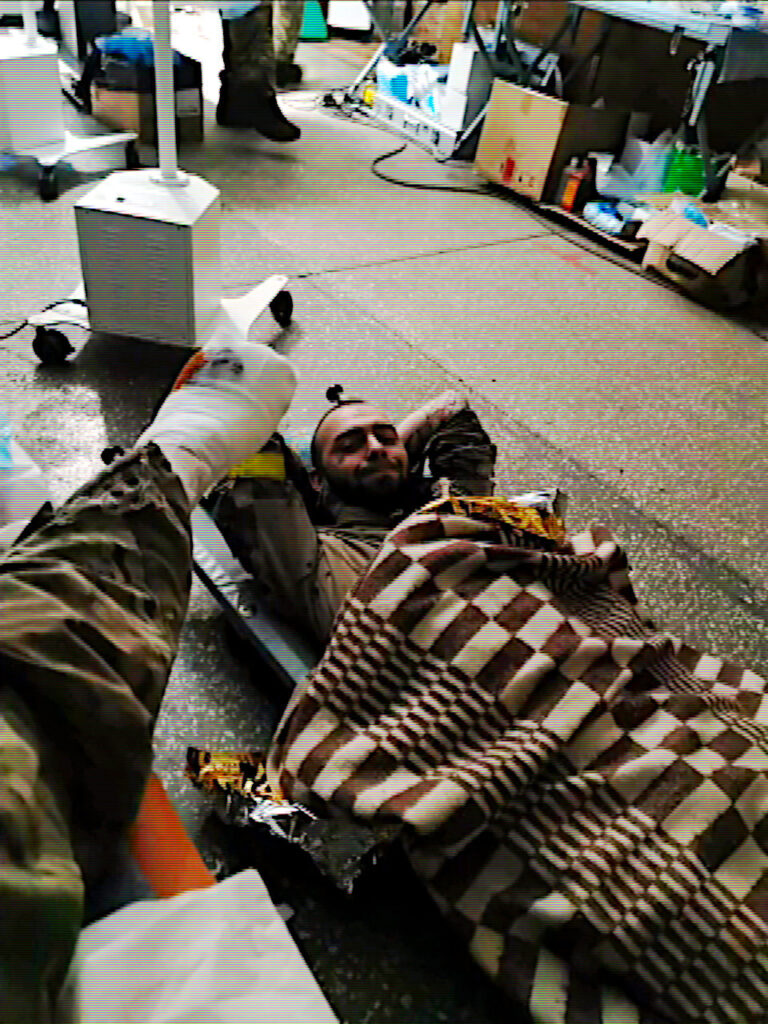
Il est blessé en novembre 2022, une grenade, précise un autre Français, Berenger Minaud
(Capture d’écran)
En compagnie du nazi compulsif Alan Vigneron, son camarade de la 92e brigade mécanisée ukrainienne, il prend un FlixBus à Lviv, ouest de l’Ukraine, parvient à Paris le soir du 22 avril 2023, quand tous deux sont arrêtés par la douane en gare routière de Bercy, en possession d’optique de visée et chargeur de fusil d’assaut, équipement classé catégorie A. En garde à vue puis déférés, ils sont condamnés le 24 avril à six mois de prison ferme, plus du sursis
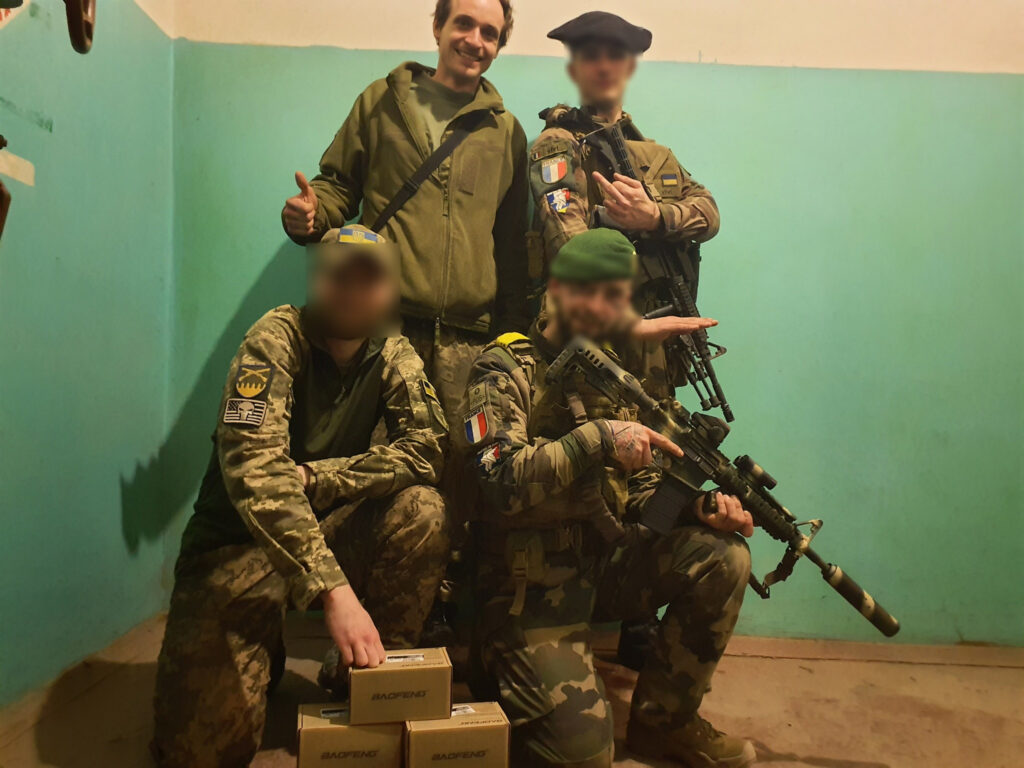
Le 24 mars 2023, Alan Vigneron et Guillaume Andreoni, à genou, apparaissent les visages floutés, à droite sur cette image. Tous deux arborent le même écusson pétainiste (cf. Alan Vigneron). Leur camarade à genou à gauche porte celui de la 92e brigade mécanisée ukrainienne (réseaux sociaux)
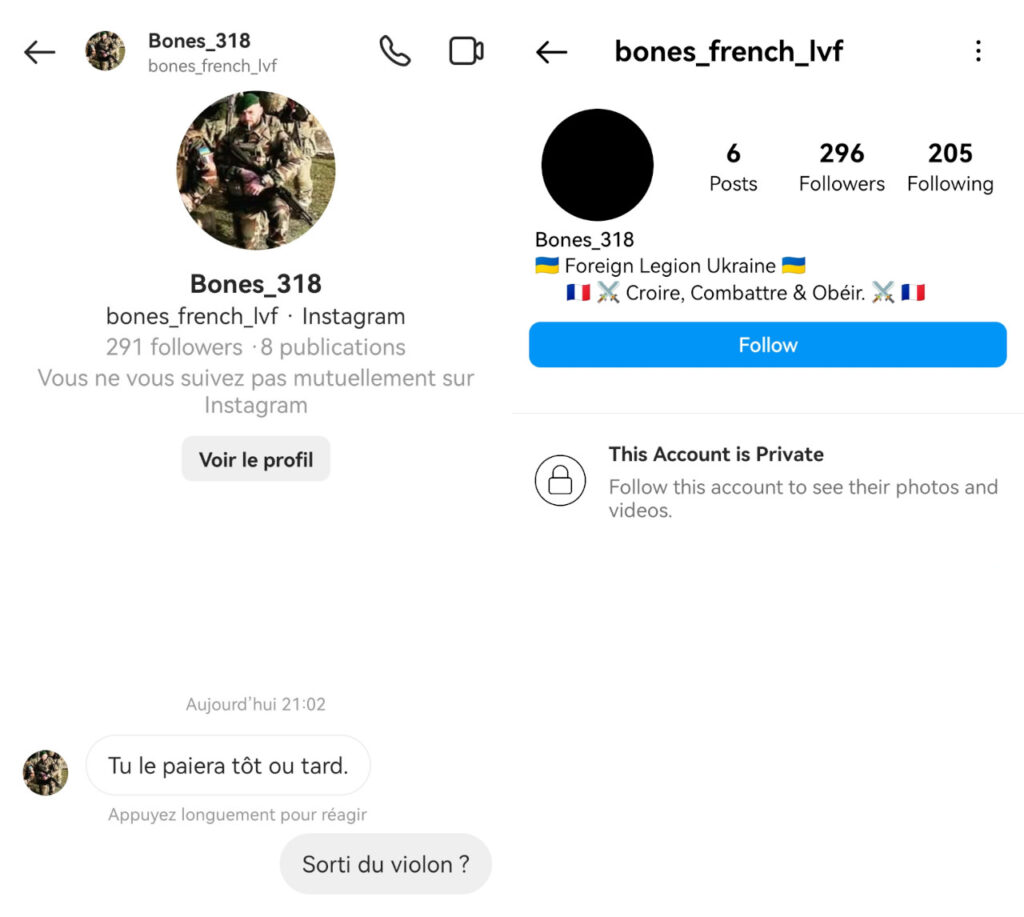
Je demande par la suite à accéder à son compte Instagram privé, mais Andreoni est pudique, réserve ses photographies et vidéos à un cercle restreint de personnes. Il me salue pourtant le 24 août 2023
Il ne répond pas et nous ne saurons pas encore si pour seulement 6 mois fermes, il a effectivement été écroué en avril, si avec les éventuelles aménagements, il est maintenant sorti.
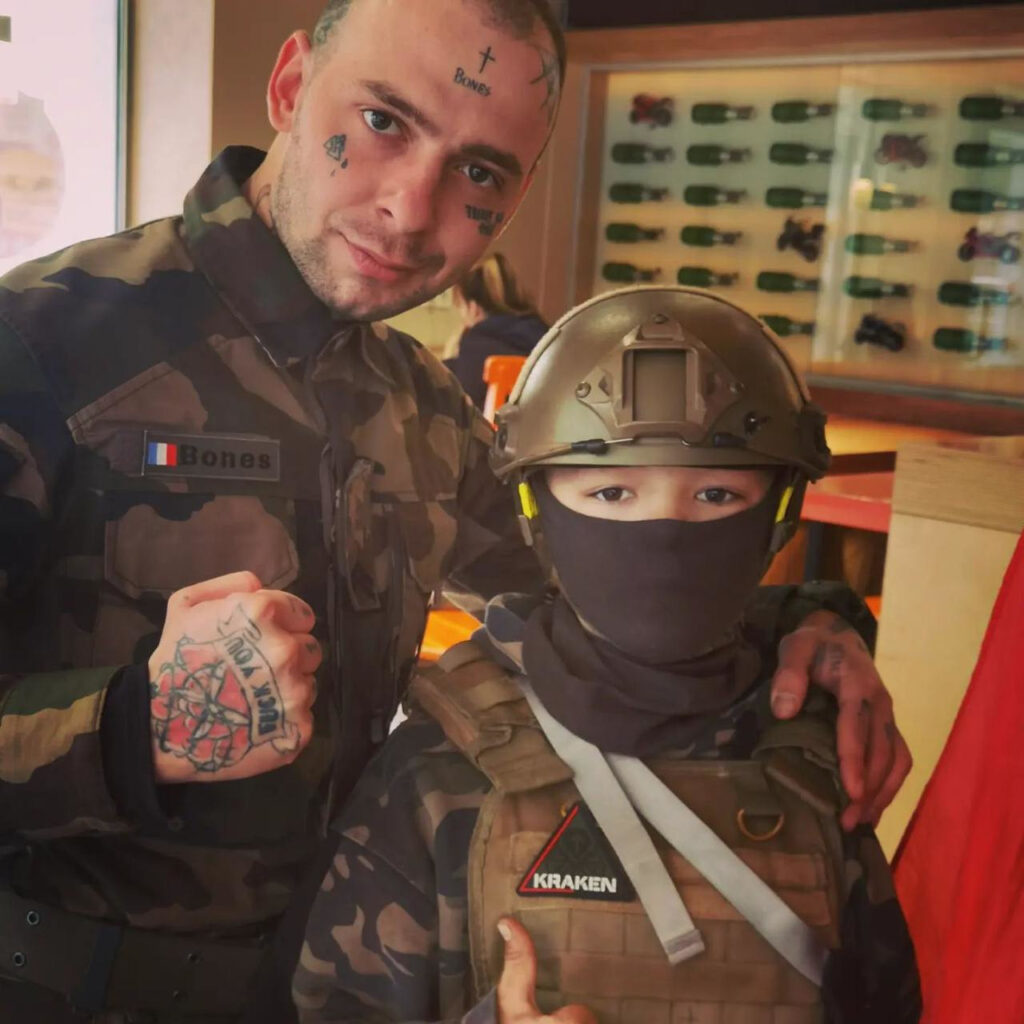
Pour aller un peu plus loin : dans bones_french_lvf, il y a Bones [os, en anglais], qui est son surnom depuis des années. LVF désigne bien sûr la Légion des volontaires français (1941-1944). Dans Bones_318, 318 signifie CAH et AH, Adolf Hitler. C18 ou Combat 18 est une organisation terroriste nazie, fondée au Royaume-Uni en 1992. Elle a ensuite infecté le Canada, les USA puis l’Allemagne, où ses membres ont été impliqués dans les assassinats de migrants et d’une personnalité politique allemande. La devise d’Andreoni est croire, combattre, obéir, qui se dit en Italien et dans un ordre un peu différent, credere, obbedire, combattere, celle des fascistes italiens entre 1922 et 1945
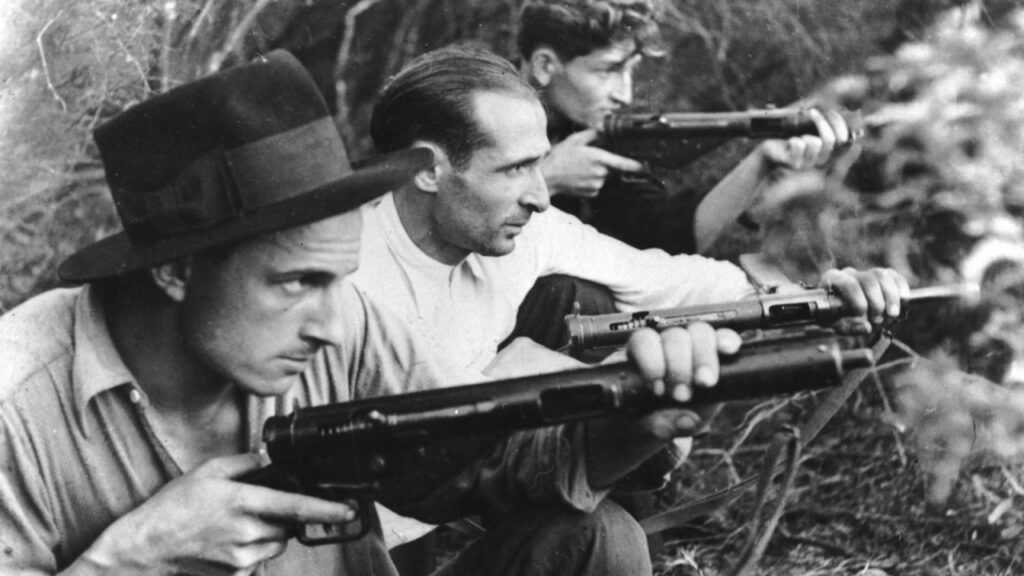
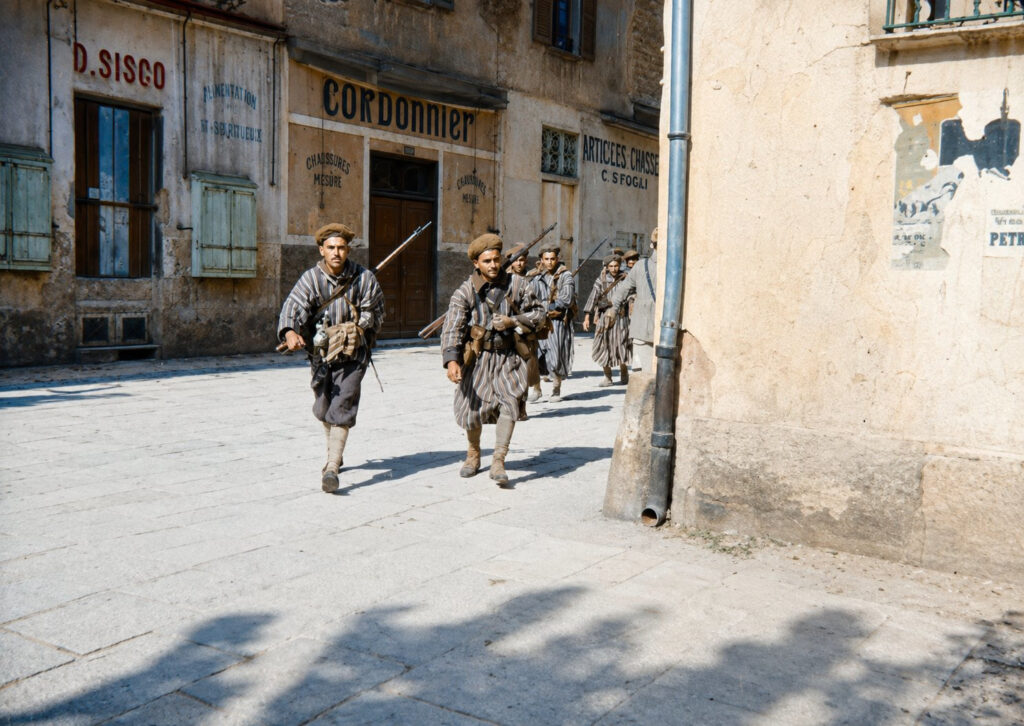
De vrais Corses (Hulton Archive)
Il prétend pourtant à des origines corses. Ce serait oublier que les Corses, les vrais, ont protégé les Juifs et affronté en 1943 la brigade Reichsführer SS, qui a même subi des pertes cruelles, alors que des troupes marocaines s’apprêtaient à débarquer pour libérer l’île
Des combattants marocains du 73e goum patrouillent dans les rues de Bastia le 4 octobre 1943 (ECPAD)
Le 5 janvier 2024, la journaliste Cécile Deffontaines, qui m’a contacté et que j’ai rencontrée en septembre, publie pour L’Obs le premier article de grand média français qui s’attaque à la question du nazisme parmi les combattants français dans les rangs atlantistes en Ukraine. Guillaume Andreoni y a gagné sa place de haute lutte, y est désigné par son surnom, Bones
(Réseaux sociaux)
Le 20 avril, il affiche son affection pour un très jeune représentant du Volkssturm [Assaut populaire, 1944-1945], affublé de l’insigne du régiment Kraken, émanation de l’organisation nazie Azov dans le renseignement militaire ukrainien (HUR).
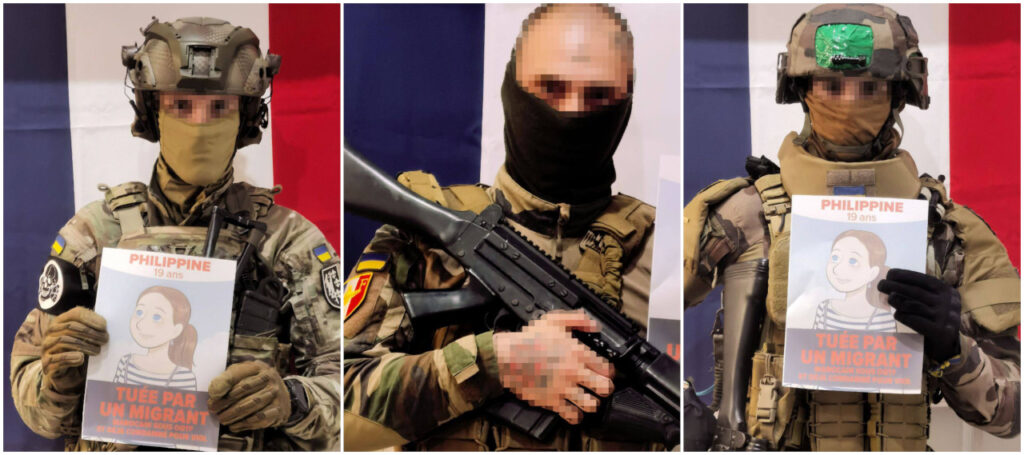
Après le propagandiste nazi lyonnais Gwendal Delange, en septembre, trois volontaires français rendent hommage depuis l’Ukraine, le 5 octobre, à Philippine Le Noir de Carlan, dont le corps a été retrouvé au bois de Boulogne le 21 septembre 2024, victime de viol et d’homicide. Les images sont partagées sur un canal nazi francophone bien connu
Celui de gauche arbore sur les épaules la Totenkopf SS et le blason de la division SS française Charlemagne (1943-1945). Son écusson LVF, sa silhouette, sa calvitie, les emplacements et couleurs des tatouages floutés, permettent à l’oeil expérimenté de reconnaître au centre Guillaume Andreoni.
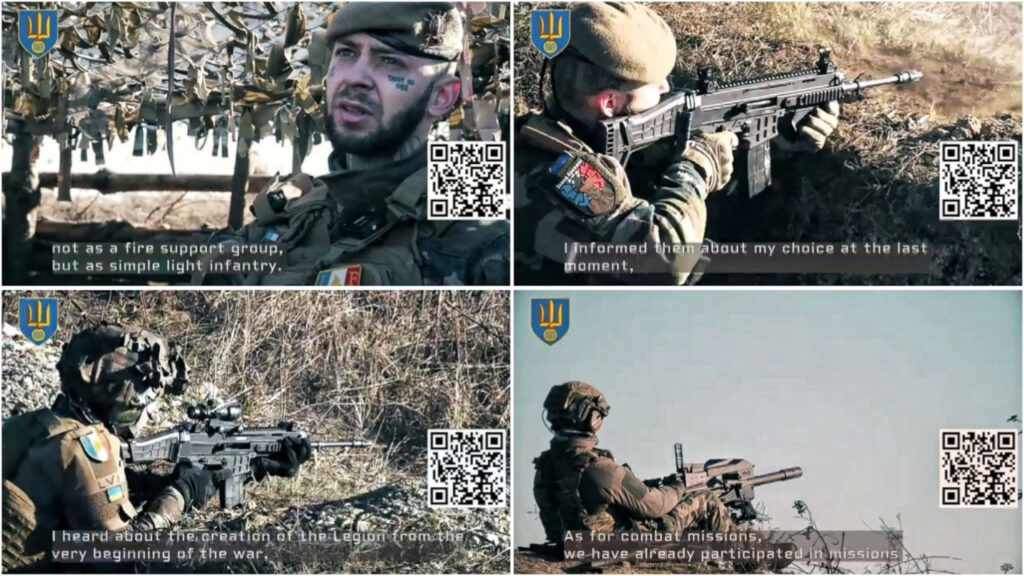
Il est absolument superbe, dans une vidéo que le service de presse de l’armée ukrainienne diffuse le 28 février 2025. Il considère que
l’Ukraine est une terre européenne, que le peuple ukrainien est un peuple européen, que c’est son devoir, en tant qu’homme européen, de venir aider le peuple ukrainien
Il n’a pas intégré l’armée régulière est toujours dans la Légion internationale. Il décrit Brennos comme une formation de pionniers (génie d’assaut), où il exerce la fonction de grenadier, avec son Mk 19 US. Il compte rester en Ukraine, prendre sa retraite dans un chalet des Carpathes. Cela lui sera en effet plus facile dans l’ouest lointain ukrainien que dans le Donbass, aujourd’hui terre russe.
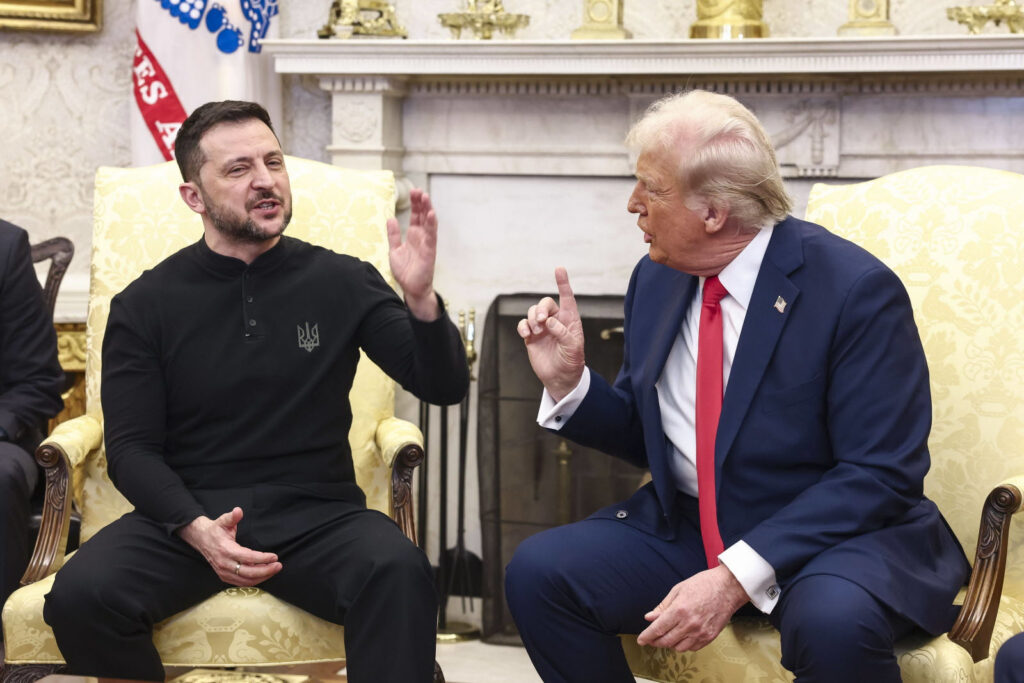
Le même jour à Washington, Donald Trump congédie avec fracas un Volodymyr Zelenskyy dopé par l’agrochimie colombienne et stimulé par ses groupies européennes, au point de refuser une paix qui lui permettrait pourtant de préserver ce qu’il reste pour l’instant de son pauvre pays, d’éviter qu’un second million d’Ukrainiens ne soient tués au combat, en vain
Le 28 février 2025, à la Maison Blanche, l’altercation est publique entre Volodymyr Zelenskyy, d’un côté, Donald Trump et JD Vance, de l’autre (Sipa / UPI)
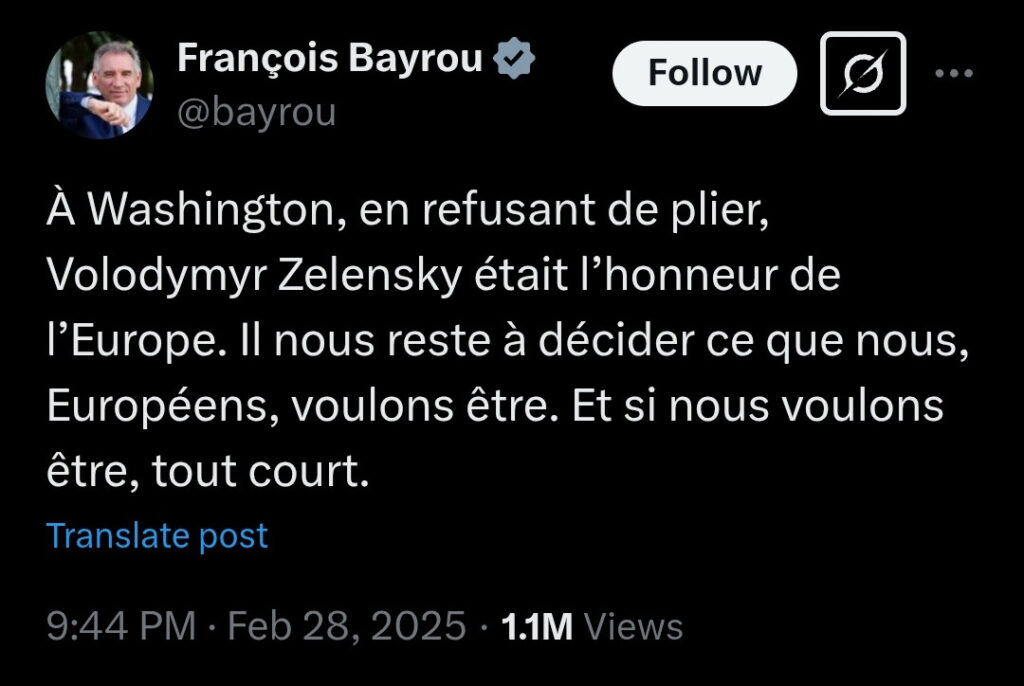
La scène révolte François Bayrou, qui tel un cabri, aux cris de EUROPE, commence à faire de petits bonds, comme dans un rituel sexuel pour séduire Ursula von der Leyen
Nous ne partageons pas la même définition de l’honneur, car mon expérience m’a permis de comprendre que dans une large majorité, les Français sont vaniteux, mais dépourvus du moindre orgueil.
Moins emphatique que Bayrou mais aussi pour l’Europe et contre la Russie, Guillaume Andreoni se bat depuis trois ans, sait depuis plus longtemps encore de quel côté il est. Moi aussi.
Mes lecteurs chevronnés reconnaissent bien sûr Guillaume Andreoni, à gauche. À droite, son petit camarade est probablement Alan Vigneron
(Capture d’écran)
Le 10 avril, l’État ukrainien le promeut représentant officiel de son agence de recrutement de volontaires étrangers, dont le compte TikTok publie un extrait de sa vidéo du 28 février. Le militant nazi français y arbore son écusson de la LVF.
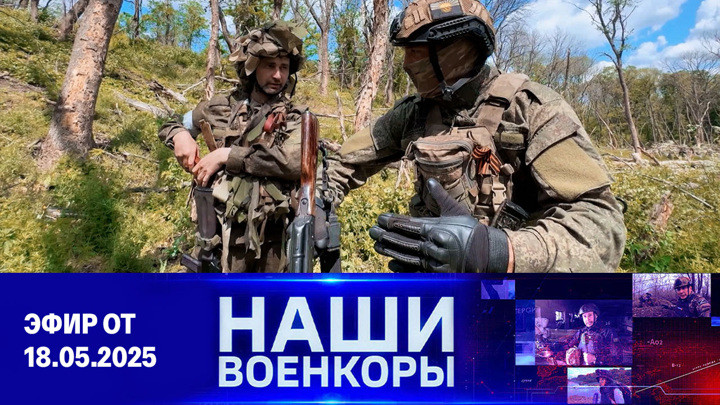
Je suis intervenu dans un reportage de l’émission Voyenkory [Correspondants de guerre, VPN nécessaire en Union européenne, qui censure ces programmes d’information], que la chaîne Rossiya 1 diffuse le 18 mai 2025.
Ce fut avec surprise, scepticisme et réprobation que les employés de presse française réagirent aux témoignages de volontaires qui se battent dans l’armée russe et se réfèrent avec fierté au groupe de chasse Normandie Niémen, des pilotes français libres de l’Armée rouge entre 1942 et 1945.
Mon expertise concerne à l’inverse des volontaires encensés par les mêmes médias hexagonaux, qui se battent dans les rangs atlantistes et se réfèrent avec fierté à leurs compatriotes engagés entre 1941 et 1945 dans la Wehrmacht ou Schutzstaffel (SS). Les deux groupes sont extraordinairement antinomiques et le reportage russe les compare
(Capture d’écran)
Parmi la petite centaine de Français que le club OSINT TrackANaziMerc a identifiés à ce jour, la sélection a été rude, voire élitiste. Ils ont rivalisé de fascisme, ont gagné de haute lutte leur place dans le casting, voici dans l’ordre d’apparition à l’écran : Brandon Nicolas, Gwendal Delange, Guillaume Andreoni, Alan Vigneron et César Aujard
https://youtu.be/5kPiTncRrqI
Un extrait de l’émission sur YouTube
Andreoni a plus particulièrement gagné l’attention des journalistes russes, car il conjugue comme nul autre ardeur fasciste et faveurs de la propagande ukrainienne, qui l’a choisi pour promouvoir le recrutement de volontaires étrangers. Je dis pour ce reportage
En préambule, il s’agit d’un travail d’équipe. Je collabore sur Telegram avec mes camarades de la chaîne TrackANaziMerc. Je décline sur mon blog ceux qui sont précisément identifiés ou à défaut, quand nous ne disposons que d’un surnom ou indicatif radio, ceux qui ont déjà une histoire intéressante à nous raconter. À ce titre, je compte à ce jour, depuis 2022, 92 combattants. 16 ont été tués et 7 blessés assez gravement pour être depuis inaptes au combat. 32 sont revenus en France. Leur nombre réel est bien sûr supérieur. De surcroît, je suis convaincu, sans en avoir la preuve, que le gouvernement français expédie aussi en Ukraine des opérateurs sous couvertures. Ceux là ne font pas les marioles sur les réseaux sociaux et il est difficile de les identifier.
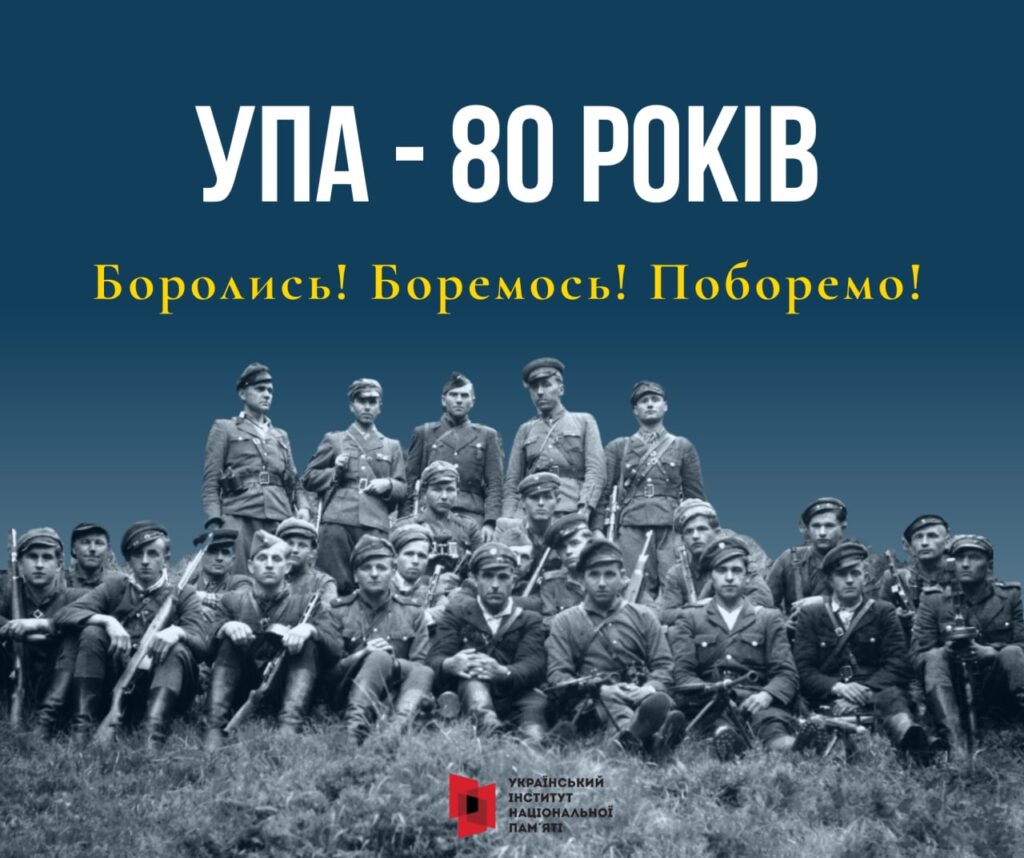
Ils ont choisi des emblèmes de la Légion des volontaires français contre le bolchevisme [LVF] ou de la division SS Charlemagne parce qu’ils sont au départ des militants fascistes et racistes, alors que d’autres Français sont dans les rangs russes et se réfèrent à des pilotes de la Grande guerre patriotique. Ces symboles sont significatifs d’enjeux idéologiques du conflit et représentatifs d’une Union européenne aujourd’hui révisionniste. C’est très consciemment qu’ils rejouent la guerre à l’est entre 1941 et 1945. Le fait que Stepan Bandera et Roman Choukhevytch soient depuis 2014 des héros populaires en Ukraine, le fait que l’Ukraine célèbre chaque année, le 10 octobre, la fondation de l’UPA, les a convaincus que leur place était dans les rangs atlantistes
(Réseaux sociaux)
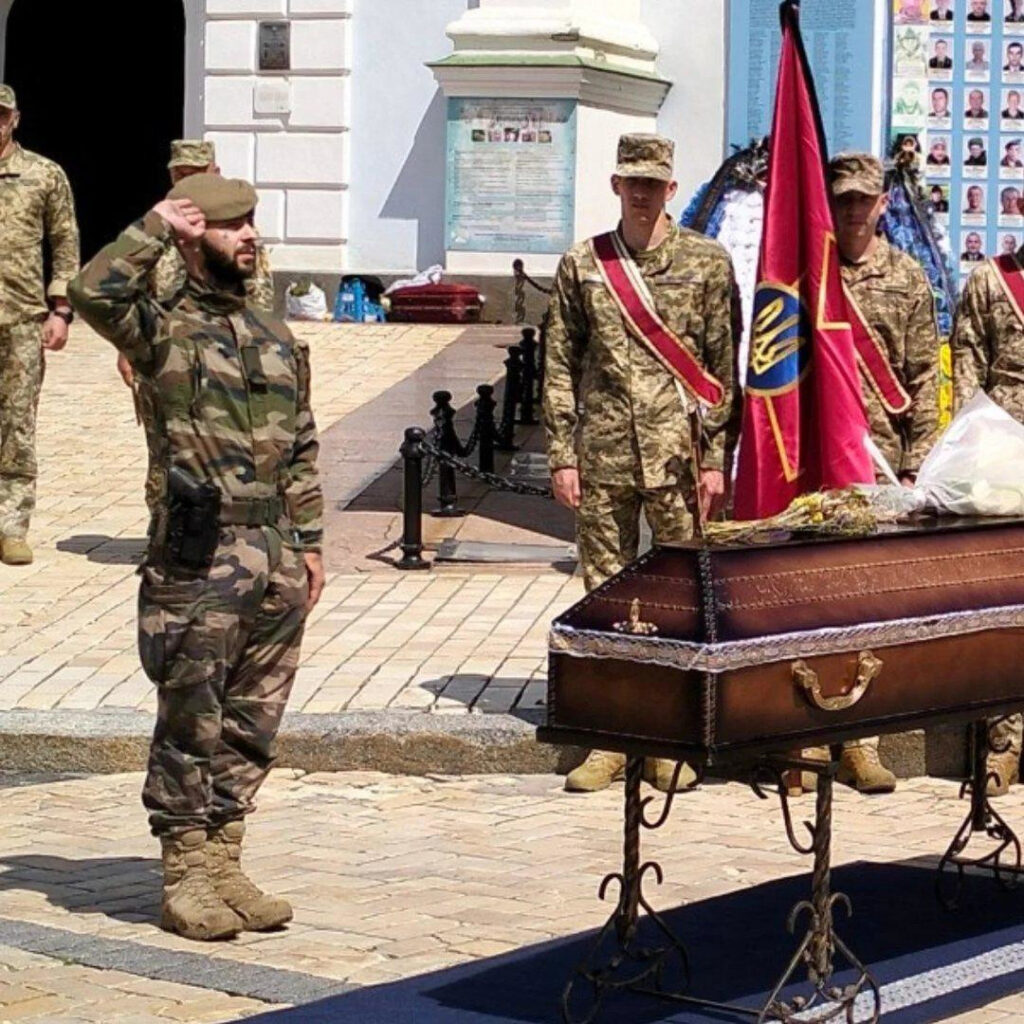
Le 1er août, au côté d’Alan Vigneron, Guillaume Andreoni lève le corps de Kevin Lazzari, un compatriote, militant nazi et camarade de la Section Brennos, tué le 14 juillet
(Caroline Varon / StreetPress)
Le 20 janvier 2026, un article de StreetPress illustre aussi cet antagonisme entre des volontaires nazis français dans les rangs atlantistes et leurs compatriotes dans l’armée russe qui au contraire, revendiquent l’héritage de pilotes de l’Armée rouge.
chronique alphabétique et nécrologique de l’engagement français dans les rangs atlantistes en Ukraine, ce que les journalistes serviles ne vous raconteront pas
Articles connexes
Pruvate à truvà me, canaglia di l’OTAN, pruvate solu
chronique en Anglais, its roots before WW2, its collaboration with Nazi Germany, its legacy in modern Ukraine, how NATO has continually supported Nazism in Ukraine
chronique en Anglais, censorship, fake news, whitewashing of the Ukrainian Nazism and war crimes, for the sake of the proxy war that NATO is conducting in Donbass and Ukraine, against Russia
une saga française, entre Ukraine et Lyon, où apparaissent aussi des morceaux de SS de la division Charlemagne et plus récemment, Alice Kerviel, dite Cordier. L’affaire Deranque révèle comme la France est infectée par le pétainisme, en particulier parmi les soutiens d’Israël ou de l’Ukraine, deux théâtres d’opérations où l’Occident tente de ralentir son déclin
En 2025, une nouvelle unité de Français combattant pour l’Ukraine s’est structurée autour d’un noyau de néonazis, ayant pour objectif d’attirer des recrues. Parmi ces volontaires, d’anciens militaires. StreetPress les a identifiés
En Ukraine, les volontaires français pro-ukrainiens et pro-russes se partagent l’imaginaire de la Seconde Guerre mondiale. Les premiers se revendiquent des collabos de l’Allemagne nazie, les seconds de l’escadrille mythique « Normandie – Niémen »
deux jours après le 10e anniversaire de la débâcle politique et sécuritaire du 13 novembre 2015, une messe célèbre à Verdun l’ancien dirigeant fasciste de l’État français
ce 11 novembre 2025 est l’occasion de souligner comme la façon dont l’Europe sacrifie les conscrits ukrainiens mobilisés de force rappelle le spectaculaire carnage de la 1ère guerre mondiale
c’est par l’agence cosaque de presse PIKA, depuis la République populaire de Lougansk, que le 2 avril 2024, l’ataman Nikolaï Diakonov lance un message à destination de la France
ce papier est le premier des grands médias français qui s’attaque à la question des militants nazis français dans les rangs atlantistes en Ukraine, le nouveau danger qu’ils présenteront à terme pour la sûreté intérieure
où nous apprenons que le nazi français Allan Duchézeau, camarade de César Aujard dans les rangs atlantistes en Ukraine, était surnommé Dox, quand il secondait à Paris le leader nazi Marc de Cacqueray Valménier
en Anglais, les indices de la présence d’opérateurs occidentaux, en particulier Français, pris au piège en mars 2022 à Marioupol, dont les forces russes achevèrent la libération en mai
En 2025, une nouvelle unité de Français combattant pour l’Ukraine s’est structurée autour d’un noyau de néonazis, ayant pour objectif d’attirer des recrues. Parmi ces volontaires, d’anciens militaires. StreetPress les a identifiés
(Caroline Varon)
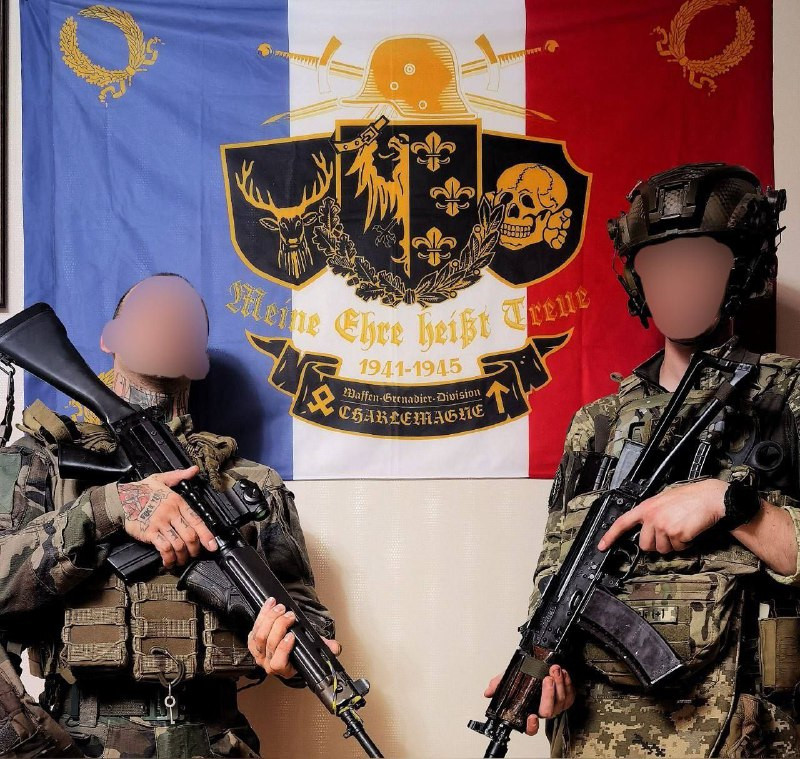
Une vingtaine d’hommes, armés et en uniforme, prennent la pose autour d’un véhicule blindé. La photo, publiée sur un compte Instagram d’un néonazi en septembre 2025, montrerait un groupe de volontaires français combattant en Ukraine. Les visages ont beau être floutés, ils sont plusieurs à la relayer, visiblement fiers de leur engagement. Outre des émojis représentant les drapeaux français et ukrainien, l’un d’entre eux commente : « Einsatzgruppen. » Le nom donné par l’Allemagne nazie aux unités en charge de l’extermination des Juifs, des Tziganes et des opposants politiques sur le front de l’Est durant la Seconde Guerre mondiale.
Le néonazi Gwendal D. a rejoint l’Ukraine dès 2022. Sur une photo qu’il a republié sur Instagram, il compare le groupe de volontaires aux « Einsatzgruppen », les unités nazies chargées de l’extermination des Juifs (crédits : DR)Les néonazis français combattants en Ukraine recrutent activement et ont constitué leur propre unité, « Légion pirates ». Leur logo s’inspire de la Totenkopf, emblème utilisé par des unités SS durant la Seconde Guerre mondiale, accompagnée de trois fleurs de lys (crédits : DR)
La présence de néonazis français engagés aux côtés de Kyiv face à l’envahisseur russe n’est pas nouvelle. D’après nos informations, cette bande a largement renforcé ses rangs en 2025 et continue depuis à recruter activement. Au point de constituer sa propre unité. Baptisée successivement « War Agressive » puis « Légion pirates », celle-ci est rattachée au bataillon « Revanche », une formation ukrainienne liée au parti ultranationaliste orthodoxe « Ordre et tradition ». Un véritable « bataillon fasciste », selon un Français l’ayant rejoint
Baptisée d’abord « War Agressive », la « Légion pirates » est rattachée au bataillon « Revanche », une formation ukrainienne liée au parti ultranationaliste orthodoxe « Ordre et tradition » (crédits : DR)Revanche est un véritable « bataillon fasciste », selon un Français l’ayant rejoint (crédits : DR)
Les nouvelles têtes
L’engagement de ces néonazis français en Ukraine et leur structuration sur place a pour effet de créer une filière pour de potentielles recrues. Ces derniers mois, les appels à candidatures se sont multipliés sur les réseaux sociaux des membres de la « Légion pirates ». Sur le papier, l’unité est rattachée au GUR, le renseignement militaire ukrainien. De quoi bomber le torse en disant qu’ils font partie des « forces spéciales » de l’armée locale. Dans les faits, difficile d’en savoir plus sur la réalité de leur déploiement. D’après les soldats, ils effectueraient essentiellement des missions de « reconnaissance »
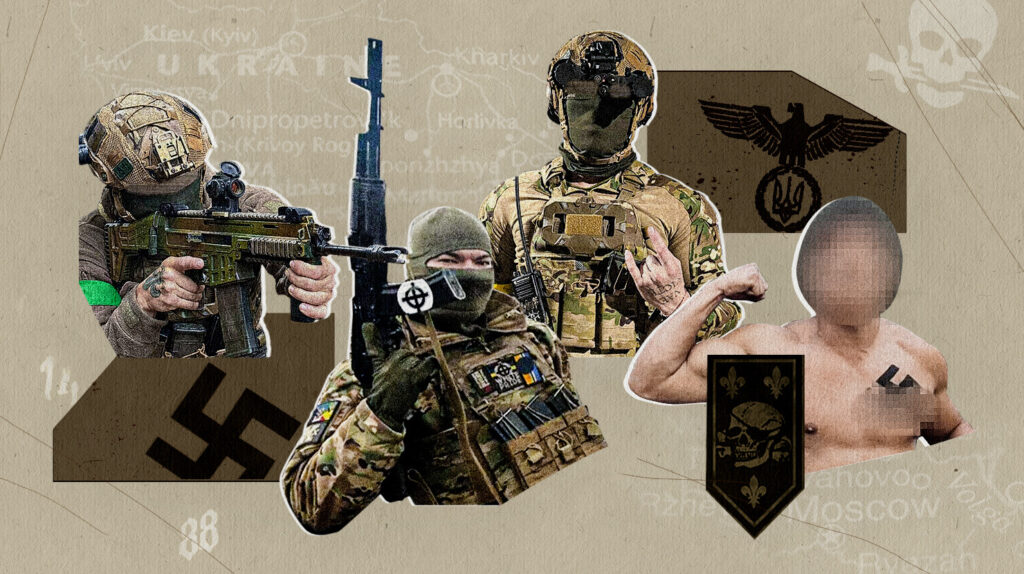
Un des anciens militaires français, passé par le 13e bataillon de chasseurs alpins, se fait appeler « Charlemagne » [mon chapitre à son sujet], une référence à une division de la Waffen-SS composée de volontaires français durant la Seconde Guerre mondiale (crédits : DR)Depuis son arrivée en Ukraine, « Charlemagne » s’est fait tatouer une croix gammée sur le torse et s’affiche avec le même symbole sur son uniforme (crédits : DR)
Parmi ces recrues fraîchement engagées au service de la cause ukrainienne, certains sont d’ex-militaires ayant servi dans l’armée française, comme Ylian F. [Ylian Fort] passé par le 2e régiment étranger parachutiste (2e REP). D’autres sont des néonazis revendiqués comme « Malo », qui s’affiche avec l’emblème de la SS sur son casque.
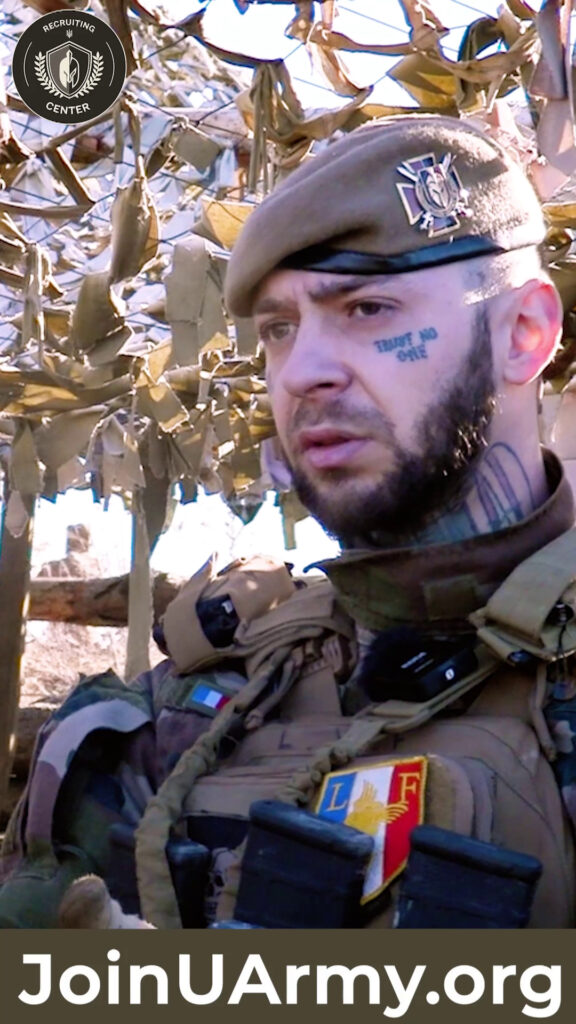
Plusieurs cumulent les deux lignes sur leur CV. C’est le cas de celui qui se fait appeler « Charlemagne », une référence au roi des Francs et empereur carolingien déjà usitée par l’unité de la Waffen-SS composée de volontaires français durant la Seconde Guerre mondiale. Passé par le 13e bataillon de chasseurs alpins, basé non loin de Chambéry, il s’est fait tatouer une croix gammée sur le pectoral depuis son arrivée en Ukraine à l’été 2025. C’est également le cas de « Roque » [mon chapitre à son sujet] qui a servi au sein de la Légion étrangère et porte croix gammée et emblèmes SS sur son uniforme en Ukraine
Sur les uniformes de plusieurs combattants, comme César Aujard, se trouvent parfois l’emblème de l’aigle du III Reich. Les volontaires d’extrême droite n’ayant changé que la croix gammée pour le trident de l’Ukraine (crédits : DR)Le volontaire français qui se fait appeler « Roque », qui a servi au sein de la Légion étrangère, porte croix gammée et emblèmes SS sur son uniforme en Ukraine (crédits : DR)
Interrogé sur ces cas, le ministère des Armées s’est refusé à tout commentaire individuel et a simplement confirmé que ces derniers « ne servent plus au sein de l’armée française ».
Un ancien du GUD condamné
Autre profil que StreetPress a pu identifier : « Malo ». Il s’agit de Gwendal Cohin-Pourajaud [mon chapitre à son sujet], condamné pour sa participation aux violences commises lors du meeting d’Éric Zemmour en décembre 2021 à Villepinte (93). Âgé de 18 ans à l’époque, il avait porté des coups et jeté des chaises contre des militants de SOS Racisme venus dénoncer la xénophobie de celui qui était alors candidat à la présidentielle. Lors de la perquisition, les enquêteurs avaient trouvé chez lui un drapeau lié à l’extrême droite ukrainienne. Sa chambre d’ado était recouverte d’affiches du Front national, du groupe Génération identitaire et de l’organisation pétainiste Les Nationalistes.
Devant les enquêteurs, il avait évoqué son souhait de rejoindre l’armée française et mentionné avoir pris rendez-vous avec un centre de recrutement. Sa mise en examen a contrecarré ses plans. Passé par la bande des Zouaves Paris puis le GUD, il a pris la direction de l’Ukraine à l’été 2025, justement pour rejoindre la « Légion pirates ». Contacté par StreetPress, il s’est déclaré « fier de défendre les intérêts du peuple ukrainien et de lutter contre le communisme qui sévit dans l’Est »
Au cours de la perquisition au domicile de Gwendal Cohin-Pourajaud, les policiers ont découvert une chambre d’ado recouverte d’affiches du Front national et des pétainistes des Nationalistes (crédits : DR)Dans la chambre de Gwendal Cohin-Pourajaud, les murs étaient également recouverts d’un « drapeau de la deuxième division SS Das Reich », selon les enquêteurs, d’un drapeau français orné d’une croix celtique, d’un drapeau de GI et d’un drapeau confédéré (crédits : DR)
La question du retour
Tous ces profils posent à terme la question d’un éventuel retour dans l’Hexagone, et de la menace qu’ils pourraient y représenter forts d’une expérience du maniement des armes et du combat. Interrogé, le ministère de l’Intérieur 2 confirme porter une « attention particulière » à ces individus « susceptibles […] de constituer une menace pour la sécurité intérieure »
Plusieurs volontaires français engagés en Ukraine prennent la pose avec un drapeau marqué d’une croix gammée (crédits : DR)
Dès mars 2022, soit un mois à peine après le début de l’invasion à grande échelle de l’Ukraine par l’armée russe, Mediapart révélait les inquiétudes des autorités françaises à ce sujet et leur crainte d’un scénario semblable à celui engendré par la guerre en Syrie. À l’époque, les services de renseignement avaient dénombré d’ores et déjà 150 Français sur place, dont une trentaine de profils provenant de l’extrême droite radicale — ce que les services nomment « l’ultradroite ». En avril 2023, deux néonazis français [Guillaume Andreoni et Alan Vigneron] avaient été interpellés à Paris à leur retour du front ukrainien, avec eux des chargeurs de fusil d’assaut et des optiques de visée classées « armes de guerre ». Après un bref séjour en prison, tous deux ont repris la direction de l’Ukraine et y seraient encore aujourd’hui.
À en croire ses publications sur les réseaux sociaux, Roque est également rentré temporairement en France pour se ressourcer non loin de Toulon en mai 2025. À peine deux mois plus tôt, depuis l’Ukraine, il a publié sur Instagram deux stories sur lesquelles il montre les cibles en carton de son entraînement de tir — ce qui n’est pas sans interroger les risques d’un potentiel retour en France. Sur l’une d’elles étaient inscrits les sigles du Parti communiste français, du Nouveau Front populaire et de La France insoumise. Sur l’autre, le nom de Clément Méric, militant antifasciste mort en 2013 à Paris sous les coups d’un militant d’extrême droite. Contacté par StreetPress, il a refusé de répondre à nos questions
Le néonazi français « Roque » s’est entraîné au tir sur une cible marquée des acronymes du Parti communiste français, du Nouveau front populaire et de la France insoumise (crédits : DR)
Des images qui rappellent celles révélées fin 2021 par StreetPress et Mediapart qui montraient des soutiens d’Éric Zemmour s’entraînant au tir sur des caricatures racistes de juifs, de noirs et de musulmans ou encore des élus LFI et/ou le président de la République. Et pour cause, avant d’aller combattre en Ukraine, le même Roque assistait en mars 2022 aux meetings d’Éric Zemmour à Toulon (83) et au Trocadéro.
La « Légion pirates » n’est pas le seul noyau dur de néonazis français en Ukraine. Quoique plus discrète, une autre bande se réclamant d’une « Légion des volontaires français » (LVF) y a également pris les armes. Un nom faisant écho à celle « contre le bolchevisme » levée durant la Seconde Guerre mondiale par les partis collaborationnistes à destination du front de l’Est. Dans sa version du XXIe siècle, la LVF compte dans ses rangs d’anciens militaires français qui continuent de porter un treillis aux couleurs de leur ancien employeur. À l’été 2025, c’est sûrement dans cette tenue qu’un membre du groupe a été tué au combat. Il répondait au pseudonyme de « Kapo » [Kevin Lazzari] — le titre attribué aux hommes chargés de l’encadrement des prisonniers dans les camps de concentration nazis [fin]
chronique alphabétique et nécrologique de l’engagement français dans les rangs atlantistes en Ukraine, ce que les journalistes serviles ne vous raconteront pas
chronique en Anglais, its roots before WW2, its collaboration with Nazi Germany, its legacy in modern Ukraine, how NATO has continually supported Nazism in Ukraine
chronique en Anglais, censorship, fake news, whitewashing of the Ukrainian Nazism and war crimes, for the sake of the proxy war that NATO is conducting in Donbass and Ukraine, against Russia
En Ukraine, les volontaires français pro-ukrainiens et pro-russes se partagent l’imaginaire de la Seconde Guerre mondiale. Les premiers se revendiquent des collabos de l’Allemagne nazie, les seconds de l’escadrille mythique « Normandie – Niémen »
deux jours après le 10e anniversaire de la débâcle politique et sécuritaire du 13 novembre 2015, une messe célèbre à Verdun l’ancien dirigeant fasciste de l’État français
ce papier est le premier des grands médias français qui s’attaque à la question des militants nazis français dans les rangs atlantistes en Ukraine, le nouveau danger qu’ils présenteront à terme pour la sûreté intérieure
où nous apprenons que le nazi français Allan Duchézeau, camarade de César Aujard dans les rangs atlantistes en Ukraine, était surnommé Dox, quand il secondait à Paris le leader nazi Marc de Cacqueray Valménier
Contacté, Ylian F. a confirmé avoir été militaire au 2e REP et indiqué avoir rejoint la « Légion pirates » pour son efficacité sur le terrain. De son côté, en réponse à nos questions, Charlemagne nous a fait parvenir une diatribe néonazie conclue par un « Sieg Heil ». Au sujet de son engagement au 13e BCA, il a évoqué des « informations erronées », malgré une confirmation du ministère des Armées. Kenneth a, pour sa part, refusé de répondre à nos questions ↩︎
Interrogé par StreetPress sur le nombre de Français ayant rejoint l’Ukraine depuis l’invasion russe de 2022 et sur leurs motivations, le ministère de l’Intérieur ne nous a pas communiqué de chiffres et indique que « la majorité des profils concernés a rejoint le conflit pour des raisons personnelles. Il ne peut donc être tiré de corrélation entre l’engagement idéologique, notamment à l’ultradroite, et l’engagement dans les forces armées des deux camps ». Il mentionne cependant qu’un « petit nombre d’individus s’est effectivement rendu sur zone pour des raisons idéologiques afin de rejoindre des unités dont la réputation était celle de groupes de combat d’inspiration néonazie » ↩︎
Canada’s shameful refusal to acknowledge its support of the far right yesterday and today
Anti-Immigrant protesters engage in angry exchanges with counterprotesters at a Canada First rally in Toronto, Ontario, on September 13, 2025 (Michelle Mengsu / Getty Images)
Graham Platner’s problem is that he lives just a tad too far south. If the Democratic Senate candidate from Maine wanted to make all the hubbub about his Nazi tattoo go away, all he’d have to do is move to Canada.
The furor over Platner’s Totenkopf, or Death’s Head, tattoo stands in striking contrast to Canada, where both Nazi symbols and a shameful history of aiding Nazis is hushed over or, quite simply, blurred out.
The footage shows a burly Ukrainian military trainer discussing his country’s “shadow war” against Moscow. The interviewer is a veteran Western journalist. The video quality is excellent. The only problem is the giant red swastika tattoos emblazoned across the trainer’s arm.
After social media users began circulating stills with the swastikas, the Canadian Broadcast Corporation—the country’s government-owned media outlet—responded by blurring out the tattoos, sparing the readers the inconvenient truth that the man being presented as a hero fighting for a Canadian-backed military is a neo-Nazi. (In addition to the swastikas, he also has a winged odal rune popular with white supremacists.)
When reached for comment, a CBC spokesperson said, “The military trainer was provided to the reporter to speak generally about Russian tactics in Ukraine; we did not platform him, nor did we present him as a hero,” and pointed out that the network added a disclaimer that “a tattoo of an offensive symbol has been blurred.”
The CBC didn’t appear to be concerned that interviewing a man tattooed with neo-Nazi iconography is being legitimized—only that the “offensive” material is kept from the public.
This literally Orwellian action by Canada’s government media is indicative of the country’s relationship to both neo-Nazis and their World War II predecessors. The dark reality lurking beneath the placid demeanor of America’s northern neighbor is that Canada’s institutions have spent decades protecting fascists and sweeping evidence under the rug. Canada’s elites guard this bloodstained legacy to this day.
The CBC’s whitewashing a neo-Nazi isn’t an accident. The soldier being interviewed is in what the program describes as the “elite” 3rd Separate Assault Brigade. What the narrator omits is that the formation is led by Andriy Biletsky, Ukraine’s preeminent neo-Nazi who now has tens of thousands of men under his command. These men are trained, armed, and funded by the West. The CBC’s fawning profile says nothing about the unit’s neo-Nazi ties.
These omissions would be shameful in any country. But the situation is far more dire than this. Canada’s antisemitism is so ingrained, the nation is incapable of something as straightforward as condemning Nazis.
To examine Canada’s track record with the Third Reich is to enter a twisted world where following orders is a legitimate legal defense for participating in the Holocaust and SS fighters are portrayed as war victims. It’s a land where a street named for a German slaver isn’t considered problematic by the authorities and whose history of declassifying documents about harboring Nazis is worse than Argentina’s.
Canada’s history of going to bat for Holocaust perpetrators stretches back half a century. In 1967, Pierre Trudeau—a future prime minister as well as father of the recent prime minster Justin Trudeau—successfully opposed stripping the citizenship of a death squad leader responsible for murdering over 5,000 Jews. Three decades later, a Canadian court acquitted Hungarian collaborator Imre Finta, who had deported over 8,000 Jews to their deaths. The court deemed Finta’s plea of following orders an acceptable defense; it’s the only known such case in a Western nation.
Two years ago, Canada’s House of Commons shocked the world by giving a standing ovation to 98-year-old Yaroslav Hunka, a veteran of the Waffen-SS, the military wing of the Nazi Party and one of the main perpetrators of the Holocaust.
Hunka fought in the 14th Waffen Grenadier Division of the SS (SS Galizien), a Ukrainian formation whose record of war crimes includes a 1943 massacre in which its subunits burned 500–1,000 Polish villagers alive.
Hunka was one of 2,000 SS Galizien soldiers welcomed to Canada after the war. Unlike other collaborators who kept a low profile in the New World, SS Galizien veterans felt comfortable enough to celebrate themselves by erecting monuments with Third Reich insignia and establishing scholarships in their honor. The University of Alberta, one of Canada’s largest institutes, had nearly a dozen endowments memorializing Hunka and his fellow SS men.
Images of Parliament enthusiastically applauding a Nazi soldier triggered international headlines and outraged the Canadian public. There were demands for UAlberta to eliminate its Nazi endowments. Then–Prime Minister Justin Trudeau ordered an inquiry into declassifying names of SS Galizien veterans admitted into Canada. For a moment, it seemed the country would face its dark past.
But within weeks, a fierce backlash to the Hunka affair revealed the astonishing extent of the bonds between Canada’s institutions and the Nazi collaborators they had so long protected.
Newspapers and even parliamentary testimony saw calls defending Hunka. The SS fighters were “in the wrong time at the wrong place,” averred a quote in one major outlet. All but one of UAlberta’s Nazi endowments remain. And after review, Ottawa refused to release the names of SS veterans welcomed into Canada, perversely citing privacy concerns: The same rationale used to protect children and sexual assault victims was invoked to hide names of Nazi collaborators. (By now, even Argentina has declassified its archives on sheltering Third Reich criminals.)
Canada’s elites have protected the original Nazis for the same reason Canadian media whitewashes their modern iteration in Ukraine: geopolitics. During the Cold War, Nazi collaborators were seen as a bulwark against Communism; as an additional benefit, the collaborators, eager for work and primed to hate anything that whiffed of socialism, were used to break the power of left-leaning unions.
The latest example of Canada’s callous indifference to Holocaust victims took place this summer, when I broke the news of a London, Ontario, street named for German industrialist Max Brose, who had been awarded the title Wehrwirtschaftsführer, or industry leader, by the Third Reich. Brose’s company, a fixture of Hitler’s military apparatus, used slaves, including prisoners of war.
London’s Max Brose Drive is the only known eponym to a Nazi Party member in the entire British Commonwealth, which includes Canada, Australia, and the UK, among other nations. Despite this and despite calls by the Simon Wiesenthal Center’s Canadian branch, a city representative confirmed that Brose’s street isn’t being considered for renaming.
Whether it’s bloodstained fascists of last century or their modern iteration, Canada’s response is inaction, denial, and the occasional well-placed blur. It’s an insult to the over 45,000 Canadians who gave their lives to prevent Nazi tributes erected on Canadian soil and the latest indication of erosion of basic standards in Western media [end]
Ottawa won’t disclose list of alleged war criminals believed to have sheltered here after the Second World War
September 29, 2023: Nazigate – Max Blumenthal & Aaron Mate, The Grayzone
Max Blumenthal and Aaron Mate cover the international scandal that unfolded when the Liberal Party of Canada’s Justin Trudeau honored a Ukrainian Nazi veteran of the Waffen-SS, and the dark history it forced to the surface
its roots before WW2, its collaboration with Nazi Germany, its legacy in modern Ukraine, how NATO has continually supported Nazism in Ukraine, chronicle
chronicle of censorship, fake news, whitewashing of the Ukrainian Nazism and war crimes, for the sake of the proxy war that NATO is conducting in Donbass and Ukraine, against Russia
Fighter with Azov Battalion insignia (source: Telegram of Oleksii “Reins” Konsul, member of the 3rd Assault Brigade)
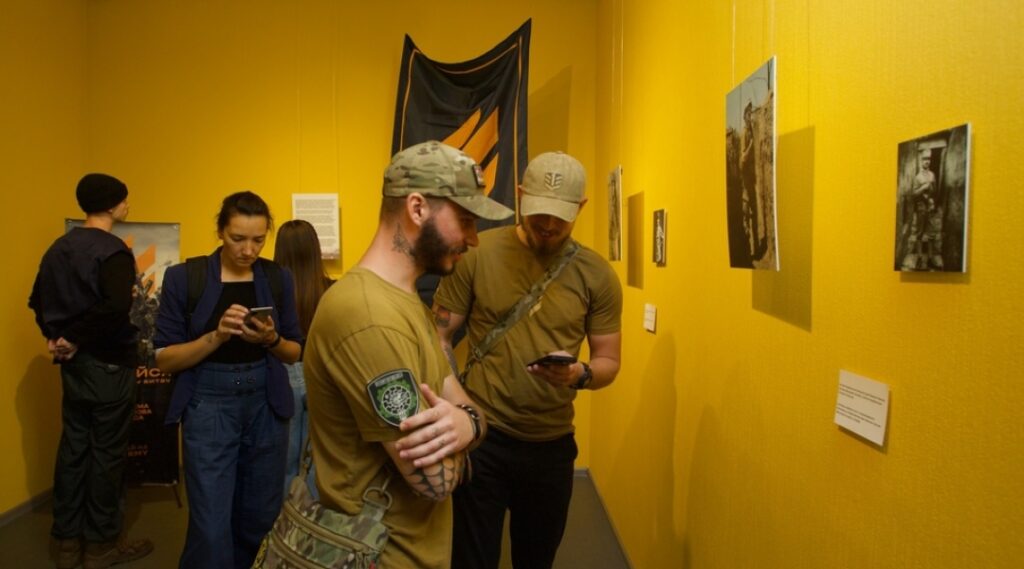
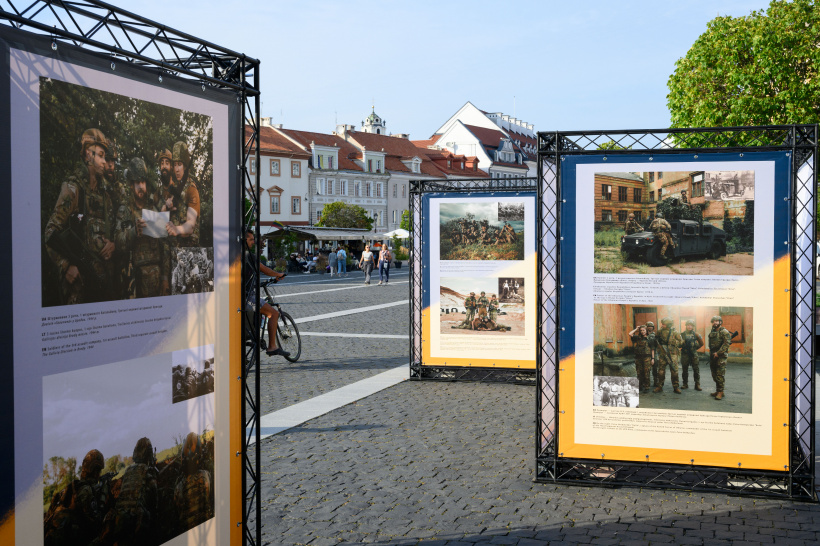
On September 27, 2023, the Museum of the History of Kyiv was crowded. Around 200 people—including active Ukrainian military personnel, journalists, cultural figures, and politicians—came to the opening of an exhibition titled Storms of Steel, a reference to the 1920 memoir of the radical German nationalist Ernst Jünger.
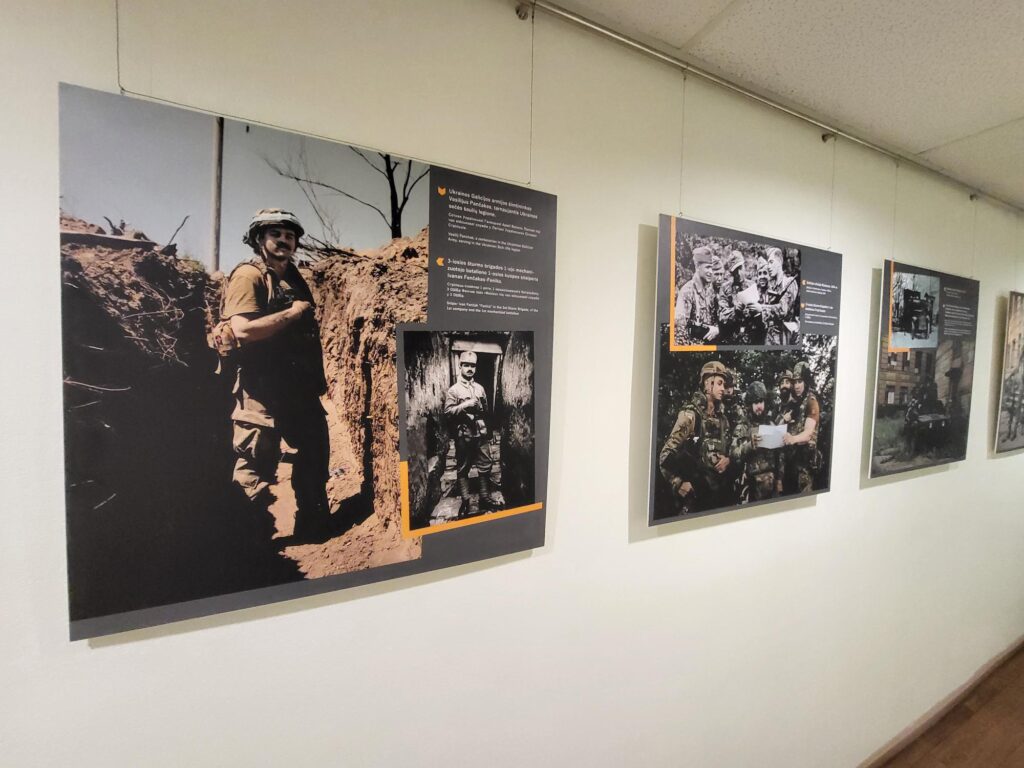
It featured photographs of soldiers taken on the Bakhmut front line during the height of Ukraine’s resistance to the Russian invasion. These soldiers belong to the 3rd Assault Brigade—one of the elite units of the Ukrainian Armed Forces, which was formed in the early days of Russia’s invasion of Ukraine in February 2022. The unit traces its origins to the ultra-nationalist Azov movement and is composed of veterans of the Azov Battalion, which was established in 2014 and took part in the war in the Donbas. Between 2018 and 2024, U.S. Congress banned the organization from receiving funding, arms, training, and other forms of support due to its documented neo-Nazi affiliations and concerns regarding human rights violations.
The founder and current commander of the 3rd Assault Brigade is Andriy Biletskyi, a far-right ideologue and central figure in the Azov movement. Biletskyi is the author of the openly racist 2013 pamphlet The Word of the White Leader and the founder of several neo-Nazi organizations, including Patriot of Ukraine and the National-Social Assembly.
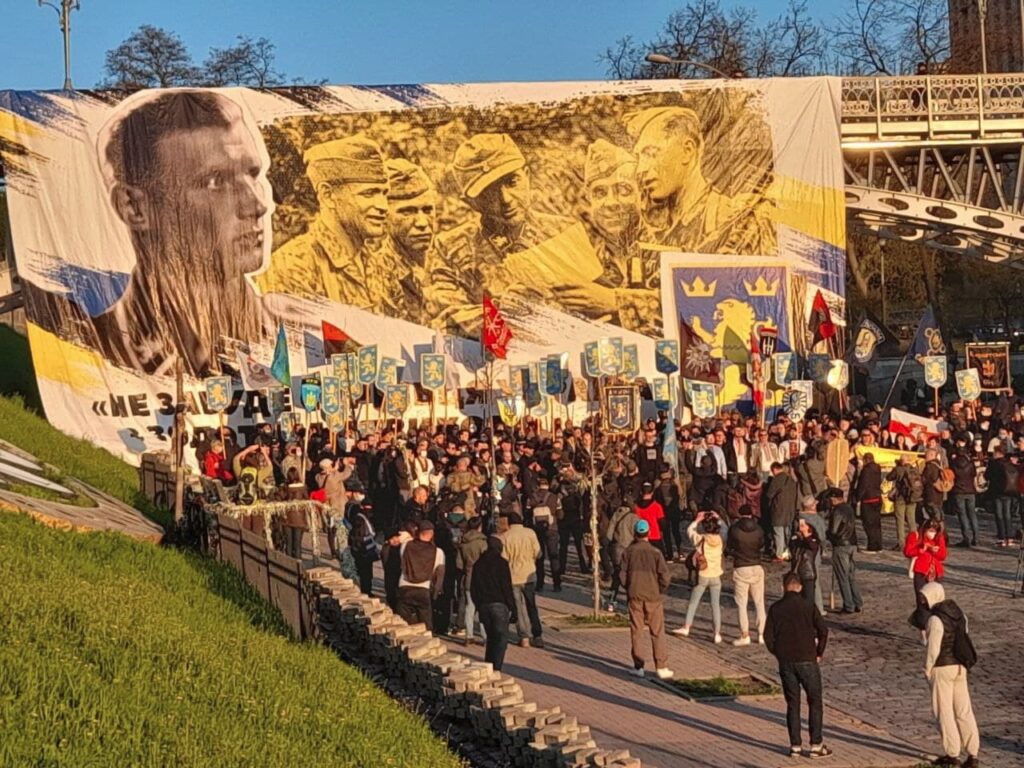
A key feature of the exhibit was that the soldiers reenacted historical photos, particularly of the Ukrainian Insurgent Army (UPA). Founded in 1942, it fought for an independent Ukrainian state. However, it also took part in the ethnic cleansing of tens of thousands of Poles in Western Ukraine, and some of its members served in Ukrainian auxiliary police units that facilitated the Nazi Holocaust
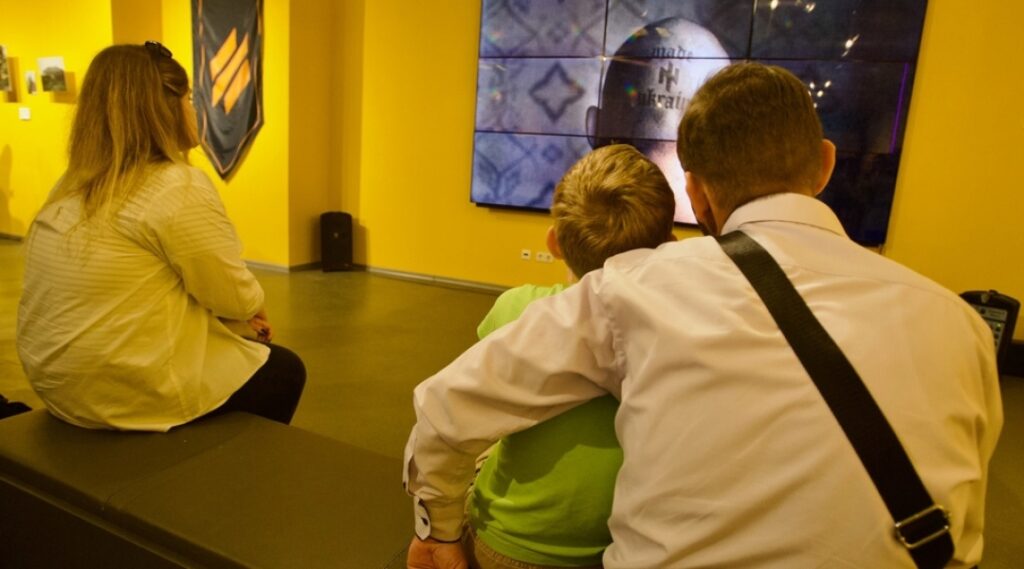
Viewers familiar with the iconography of the Third Reich might have raised eyebrows at one particular video shown during the opening of the exhibition. It featured a close-up of the back of the head of a 3rd Assault Brigade fighter known by the call sign “Martyn.” Tattooed on his head was a symbol resembling the Wolfsangel, the divisional insignia of several Waffen-SS units, including the infamous 2nd SS “Das Reich” Panzer Division. Azov affiliates often refer to a variant of this symbol as the “Idea of the Nation,” denying any direct associations with Nazism. Yet it is noteworthy that this same symbol is used by a neo-Nazi organization in Finland
Visitors at the opening ceremony of the Storms of Steel exhibition in Kyiv look at the head of “Martyn” (source: Ukrinform)
Some of the fighters featured in the exhibition attended the opening. Among them was Aleksei Kozhemyakin, known by his call signs “Kolovrat” and “Barsik,” a platoon commander in the 3rd Assault Brigade. Kozhemyakin is a far-right Russian national. He allegedly came to Ukraine in 2015, joined the Azov Battalion and has been fighting on the Ukrainian side ever since. According to the SOVA Center, he served several years in prison for assaulting a man from Azerbaijan in Syktyvkar, Russia in 2005. He was also suspected of desecrating a Jewish cultural center in the same city.
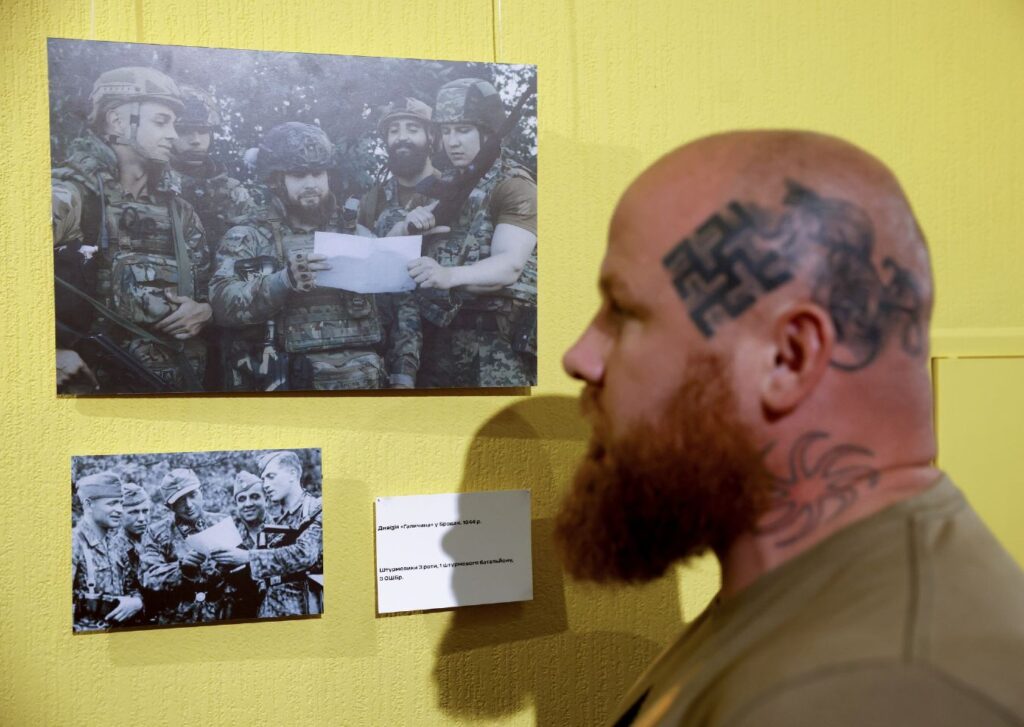
At the exhibition in Kyiv, Kozhemyakin smiled for the camera, posed next to photographs, gave interviews to the press, and openly displayed his elaborate face tattoos, which resemble multiple swastikas. Other tattoos, hidden beneath his olive-green T-shirt, include a giant swastika and a portrait of Adolf Hitler at the center. Notably, in one of the photographs on display, Kozhemyakin participated in the reenactment of a group portrait featuring a unit of Ukrainian Nazi collaborators. The exhibition caption referred to the group simply as the “Division ‘Galicia’”
Aleksei ‘Kolovrat’ Kozhemyakin looks at a photo of himself. Exhibition opening in Kyiv, September 27, 2023 (source: Vechirnii Kyiv)
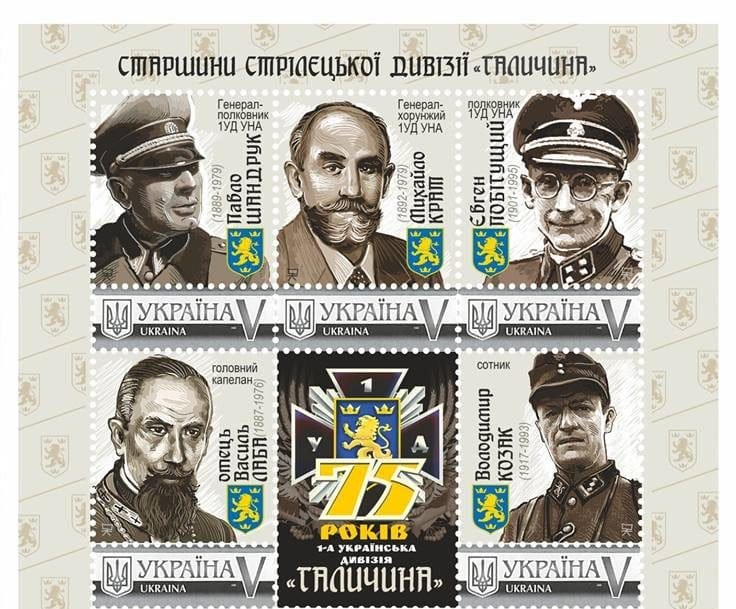
Such a caption might confuse those unfamiliar with the history of the Second World War in Ukraine. But historians know exactly what this refers to: the 14th Waffen Grenadier Division of the SS (1st Galician), created by Nazi Germany in 1943 and composed of Ukrainian volunteers. Its fighters swore allegiance to Hitler and were subordinate to SS Chief Heinrich Himmler. They defended the interests of Nazi Germany—including by brutally suppressing anti-Nazi resistance movements in Slovakia and Yugoslavia. After the Division was crushed by the Red Army near Brody, it was replenished with Ukrainian men who had served in various police formations complicit in Nazi war crimes.
A Tour Across the European Union
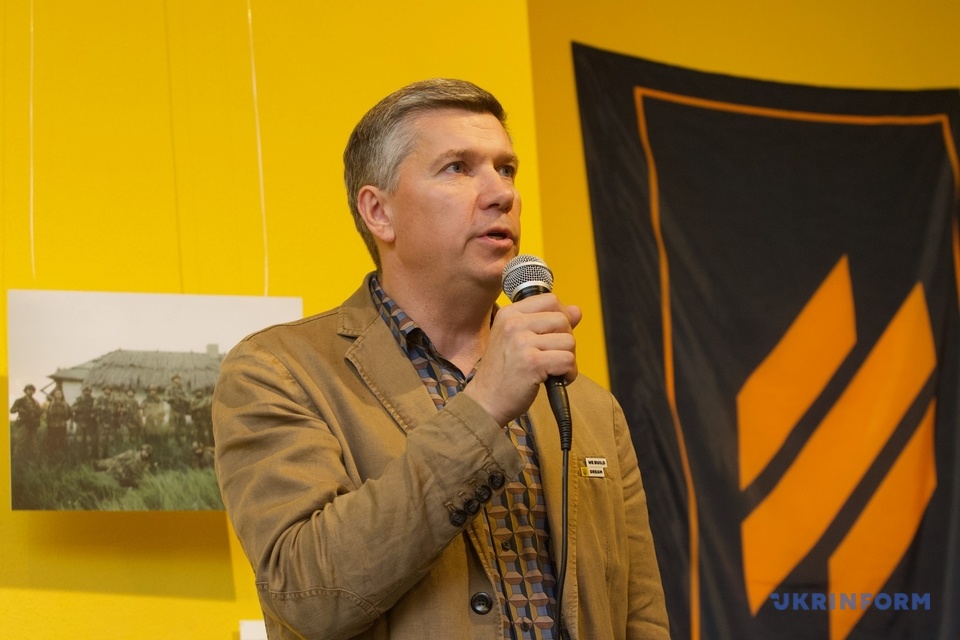
The Storms of Steel exhibition’s status as a major cultural event in wartime Ukraine was underscored by the presence of high-level officials at its opening. They included then-acting Minister of Culture and Information Policy Rostyslav Karandeyev, who praised the exhibition, noting , “I am convinced that this project will carry an extremely important patriotic and educational mission”
Rostyslav Karandeyev during Storms of Steel opening ceremony (source: Ukrinform)
The exhibition caused a sensation. It was covered by leading Ukrainian media and became a popular venue for patriotic lessons for Ukrainian students, both in the capital and in other cities where local museums hosted it. Public discourse surrounding the exhibition was marked by a deafening silence about the fact that it glorifies Ukrainian Nazi collaborators and equates them with today’s fighters of the Armed Forces of Ukraine.
It was clear that Ukrainian officials were fond of this militarized “patriotic project,” as they decided to support it at the state level. The exhibition was reproduced on large banners framed in the colors of the Ukrainian national flag and taken on tour across Europe. It is no coincidence that the exhibition was hosted by countries that are not only among the most fervent supporters of Ukraine in its resistance to Russian aggression, but also those currently reckoning with their own communist past while simultaneously struggling to confront the legacy of their collaboration with the Nazis.
One of those countries was Lithuania. On August 23, 2024, to mark Ukraine’s Independence Day, the exhibition was ceremoniously opened at Vilnius Town Hall Square, one of the most popular tourist spots in the Lithuanian capital. The ceremony featured Sandra Adomavičiūtė, head of the Atviras Lietuvos Fondas (Open Lithuania Foundation), an organization funded by philanthropist George Soros. This suggests that the progressive group in question likely did not devote sufficient time to thoroughly examine the content of the exhibition they chose to promote. This also reflects a broader pattern of uncritical engagement by some Western actors with Ukraine’s current humanitarian and cultural policies, which are increasingly shaped by an ethnonationalist agenda and promoting controversial historical figures.
Adding official weight to the event was the presence of Viktor Hamotskyi, Ukraine’s chargé d’affaires in Lithuania. Commenting on the exhibition, he stated: “Each face in these photographs tells its own story—the story of the unbroken, who stand shoulder to shoulder with those who defended Ukraine a century ago.” The exhibition was announced on the official website of the Embassy of Ukraine in the Republic of Lithuania
Storms of Steel exhibition opening ceremony in Vilnius. August 23, 2024 (photo credit: Nail Garejev)
In March 2024, Storms of Steel had already been displayed at the Vytautas the Great War Museum in Kaunas, Lithuania. In both Kaunas and Vilnius, photographs of the Waffen-SS Galicia Division were included as part of the exhibit — with the same deliberately coy captions, omitting any mention of whom the Division served under or against whom it fought during World War II.
One Lithuanian media outlet even published a feature on the exhibition, in which two of the five “historical” photographs presented showed members of the Division. Neither the author of the piece nor the editorial board provided any comment on this telling “detail.”
In April 2025, the exhibition — again including the Waffen-SS Galicia Division photographs — opened at the Baltic Defense College in Tartu, Estonia, a NATO-accredited education and training facility. According to the College’s official social media, the exhibition will remain on display there until June 2026
Storms of Steel exhibition at The Baltic Defense College (source: BDC Facebook)
Timing Matters
The Storms of Steel exhibition at the Kyiv History Museum might have been just another of the countless military‑patriotic events desperately trying to instrumentalize historical myths to mobilize society against Ukraine’s “eternal enemy”—Russia. But the timing made it unique.
Its opening coincided with a full‑blown political scandal in Canada that garnered international attention. On September 22, 2023, Yaroslav Hunka, a 98-year-old Ukrainian‑Canadian veteran of the Waffen‑SS Galicia Division, received a standing ovation in the Canadian Parliament.
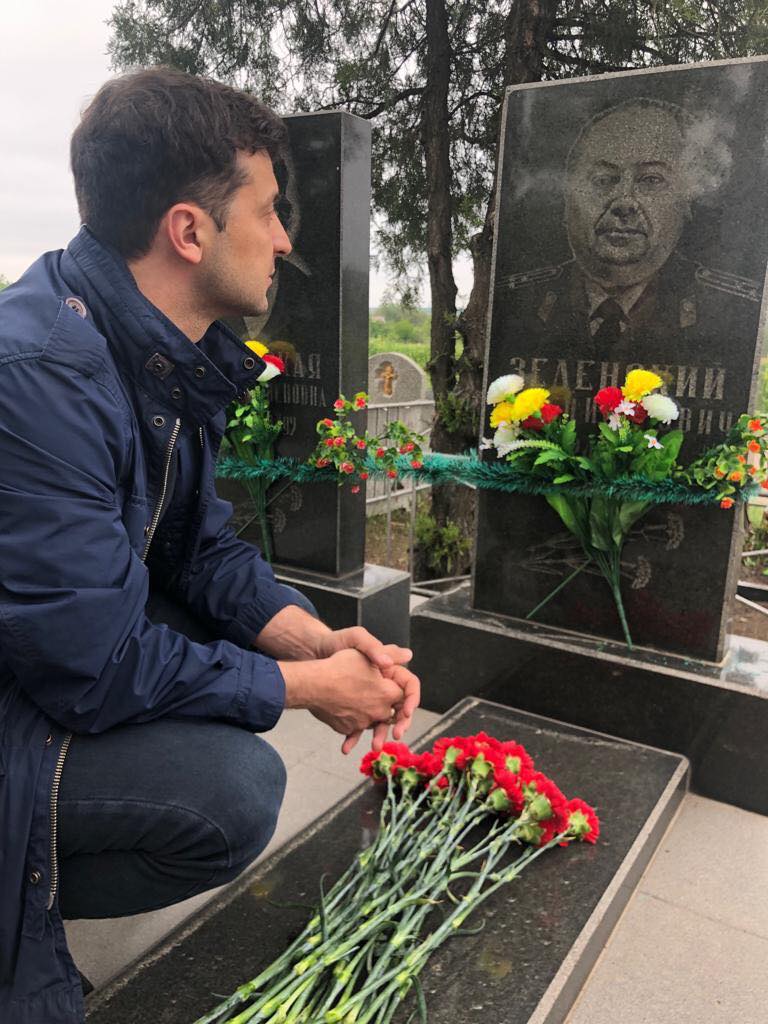
Present in the chamber was also Ukraine’s President—whose own grandfather, Semen Zelenskyi, had fought against the Germans in the ranks of the Red Army and whose memory he had publicly honored on May 9, 2019, Victory Day over Nazism. Until recently, it had been an official state holiday in Ukraine. The enthusiasm with which Zelensky applauded Hunka strongly suggested that he had little idea which army Hunka had actually served in
Volodymyr Zelensky at the grave of his grandfather, a Red Army veteran. May 9, 2019 (source: Volodymyr Zelensky’s Facebook page)
But Hunka’s past quickly became the subject of intense media scrutiny, sparking not only the resignation of Canada’s House Speaker, but also a broader public debate about the history of postwar Canada as a safe haven for numerous Nazi collaborators. Calls spread for the release of all reports of the Deschênes Commission of Inquiry on War Criminals in Canada, a federal investigation into suspected Nazi collaborators admitted to Canada. However, the Ukrainian Canadian Congress strongly opposed the publication of the reports.
Ukrainian officials, for their part, opted to refrain from any statements that might further inflame the situation surrounding Hunka. Yet inside Ukraine, a public debate did take place. Some prominent public figures, politicians, and local authorities openly lionized Hunka, portraying the Waffen-SS Galicia Division as part of Ukraine’s “national liberation movement.” Members of the far-right Svoboda party, including those who serve in the military now, launched a social media flash mob in support of Yaroslav Hunka.
In ultranationalist circles, the view that the campaign to “discredit” Hunka is “Ukrainophobic” and orchestrated by the “Jewish slanderers” has gained popularity. Meanwhile, members of the Avangard far-right group, now part of the 3rd Assault Brigade, have not hesitated to use antisemitic rhetoric, accusing Jewish organizations in Canada and worldwide of fueling this campaign.
Moreover, on September 28 — just one day after the Kyiv exhibition’s opening — the Center for Countering Disinformation, a body under Ukraine’s National Security and Defense Council reporting to Zelensky, issued a statement whitewashing the Division, claiming–falsely–that “the Nuremberg Tribunal did not find the unit guilty of any war crimes.” What the statement conspicuously omitted was that the entire SS—including the Waffen‑SS—had been declared a criminal organization, and that the Waffen-SS Galicia Division had never been subject to any separate Nuremberg review.
Thus, the central Ukrainian authorities not only failed to condemn the glorification of the Waffen‑SS Galicia Division but actively enabled it—even during the Hunka scandal
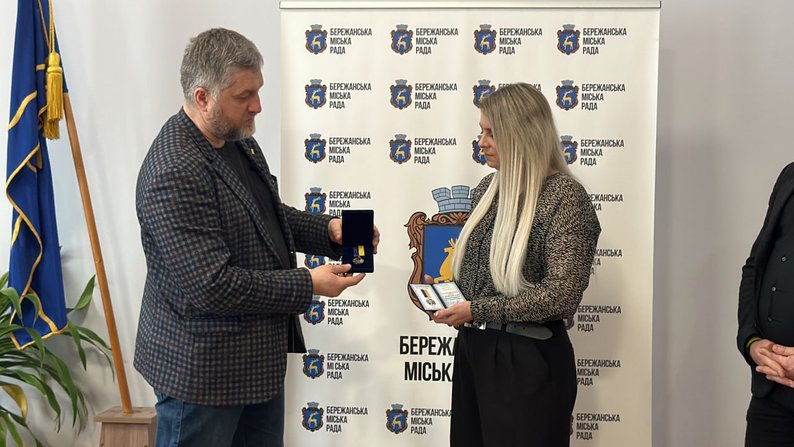
A relative of Yaroslav Hunka receives the Yaroslav Stetsko “For Services to Ternopil Region” Medal from the Ternopil Regional Council (photo credit: Oleh Syrotiuk)
The Problem is Deeper
The stance taken by Ukraine’s Center for Countering Disinformation on the Hunka affair shows clearly that the country’s political leadership has no intention of clashing with the military‑nationalist milieu, which has turned the Waffen‑SS Galicia Division into an object of cult worship. And this is not just about the 3rd Assault Brigade, which featured photos of the Division’s members in its exhibition. The official Facebook page of the Command of the Ground Forces of the Armed Forces of Ukraine promoted the exhibition, mentioning Waffen‑SS Galicia Division participants alongside other Ukrainian military formations, including the Army of the Ukrainian People’s Republic, which existed from 1917 to 1921.
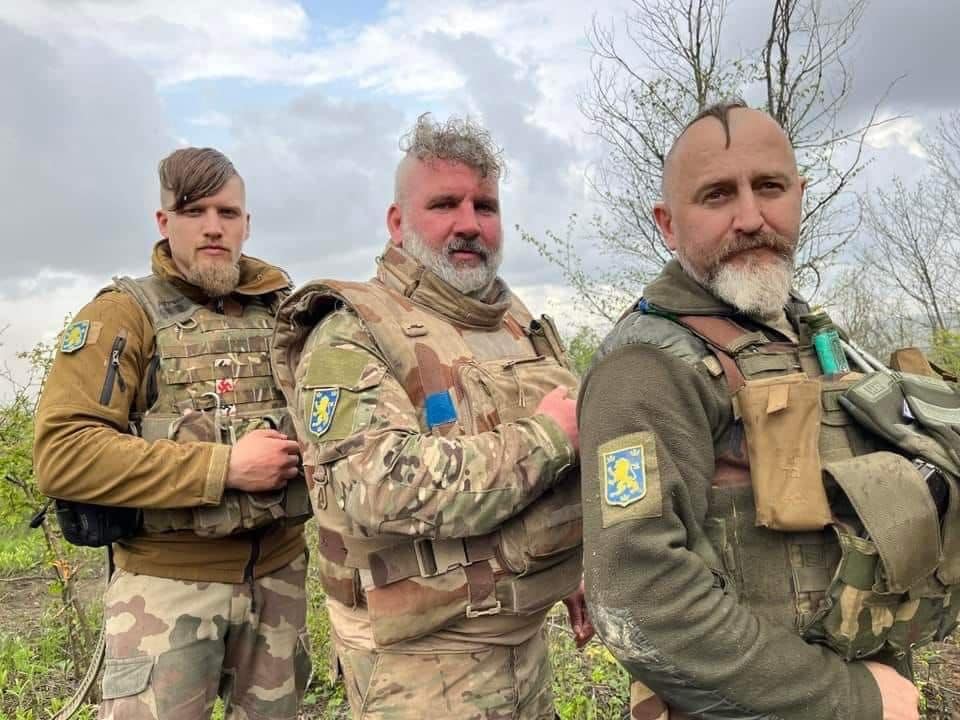
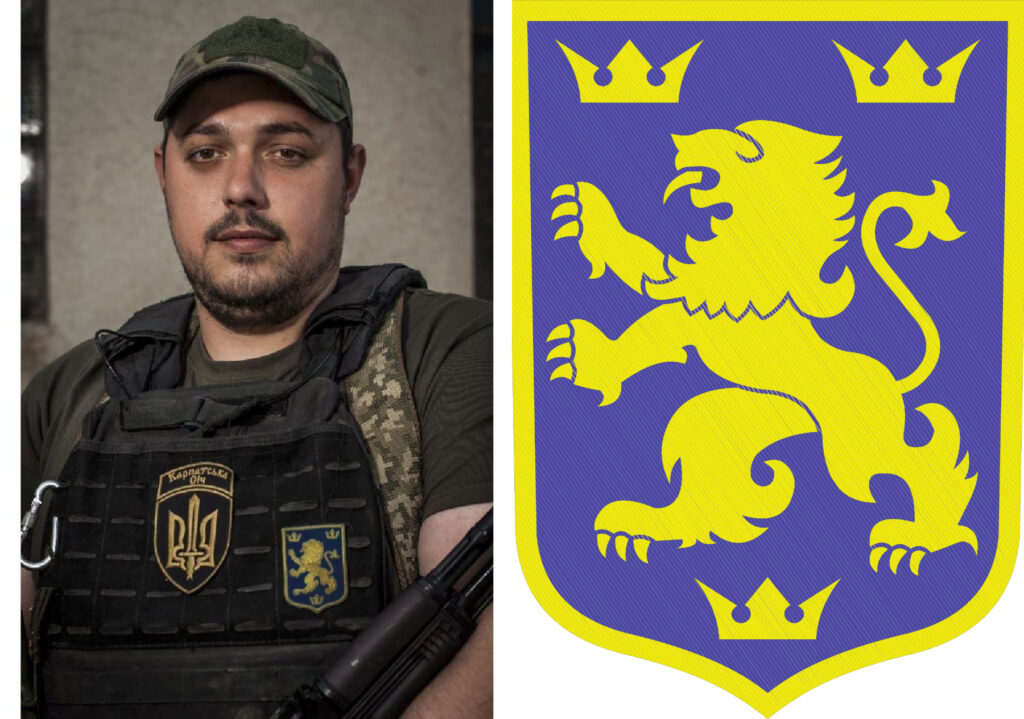
The glorification of the Division—including the wearing of patches bearing its Galician Lion insignia and the celebration of commemorative dates linked to the unit—is visible in other Ukrainian military formations as well. These include the 1st Separate Assault Regiment “Dmytro Kotsiubailo” (the “Da Vinci Wolves”), the 49th Separate Assault Battalion Karpatska Sich, the Kraken special unit under Ukraine’s Main Directorate of Intelligence, the 12th Special Forces Brigade Azov, and fighters from Svoboda, currently serving in various units
Svoboda Party members and active military personnel wearing patches resembling the insignia of the Waffen-SS Division Galicia (source: Svoboda of Lviv Oblast Telegram)
But the glorification of Ukrainian collaboration with Nazi Germany during World War II is part of a broader phenomenon: Nazi revisionism is woven into the military culture of contemporary war-torn Ukraine. Its core idea is to portray Nazi Germany as the lesser evil in contrast to Stalin’s “prison of nations” that “oppressed Ukrainian national aspirations.” Some go even further and praise Hitler’s war against the Soviet Union and compare it to the current confrontation between Ukraine—supported by Western countries—and Russia as a continuation of the “civilizational struggle” between Europe and Asia.
A vivid example of this extreme position is expressed by the Artiom ‘Uragan’ Krasnolutsky who currently holds a command position in the 3rd Assault Brigade. On May 9, which is celebrated in Russia and other post-Soviet countries as Victory Day in the Great Patriotic War, he wrote on his social media:
Adolf Hitler did not sign the capitulation. The echoes of that war are still clearly heard today—in some places, even the flags remain unchanged. It is a war of the multicultural horde against White people—the eternal struggle between light and darkness, life and death. A sacred crusade of the Übermensch for the triumph of the great over the grotesque. Cursed be the Soviet army
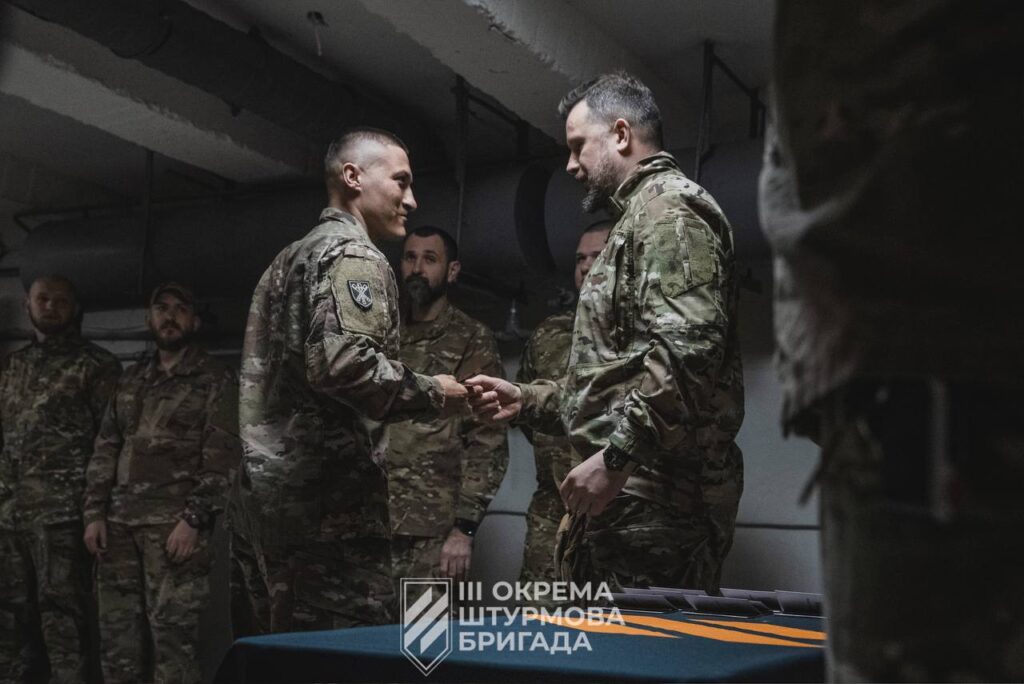
Commander Andriy Biletskyi presents an award to his subordinate, who is wearing a patch that is a modified version of the Dirlewanger insignia (source: Telegram of the 2nd Mechanized Battalion of the 3rd Assault Brigade)
Signs of the rehabilitation of Nazism are visible in Ukrainian military circles. This is manifested, in particular, in the use of Nazi symbols. For example, the Vedmedi Assault Group, under the 36th Coastal Defense Brigade, uses SS bolts on its insignia alongside the SS motto Meine Ehre heißt Treue (“My Honor is Loyalty”).
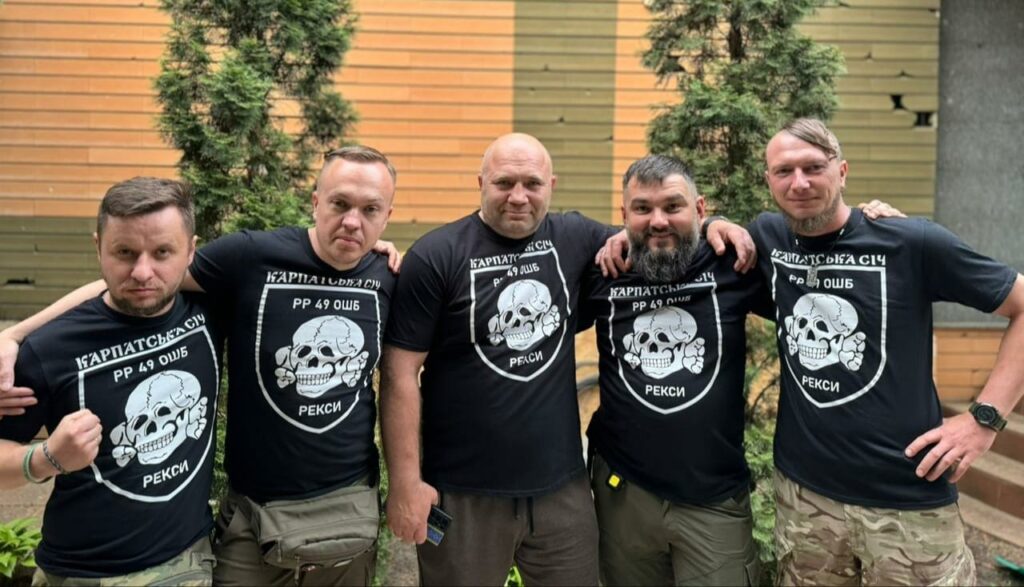
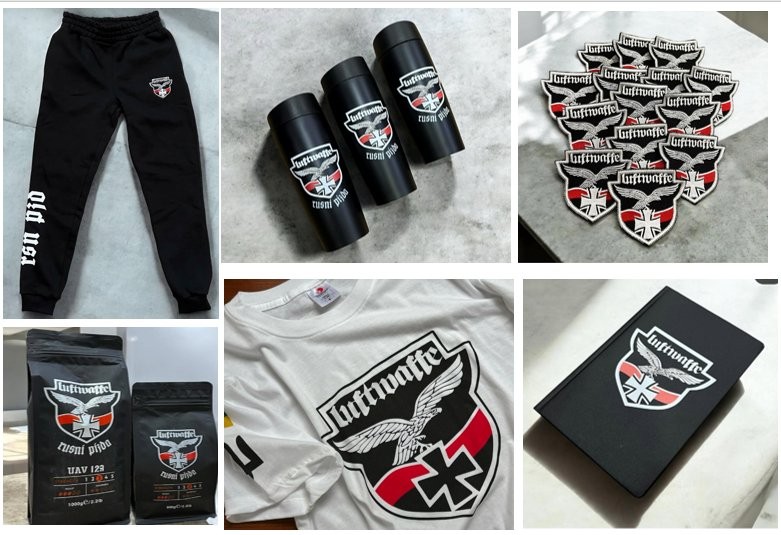
A subunit of the 3rd Assault Brigade adopted a modified version of the insignia of the infamous Dirlewanger SS Brigade (featuring three grenades instead of two). Meanwhile, fighters of the Karpatska Sich often wear patches, shirts, flags, and other items emblazoned with the insignia of the 3rd SS Panzer Division “Totenkopf”—notorious for its brutality and numerous war crimes, including the massacres at Le Paradis and Chasselay. The 422nd Battalion of Unmanned Systems not only adopted the title Luftwaffe but also uses the same eagle emblem employed by Nazi Germany’s air force
Fighters of the Carpathian Sich 49th Infantry Battalion. (source: Facebook of Ruslan Andriiko (second from right))
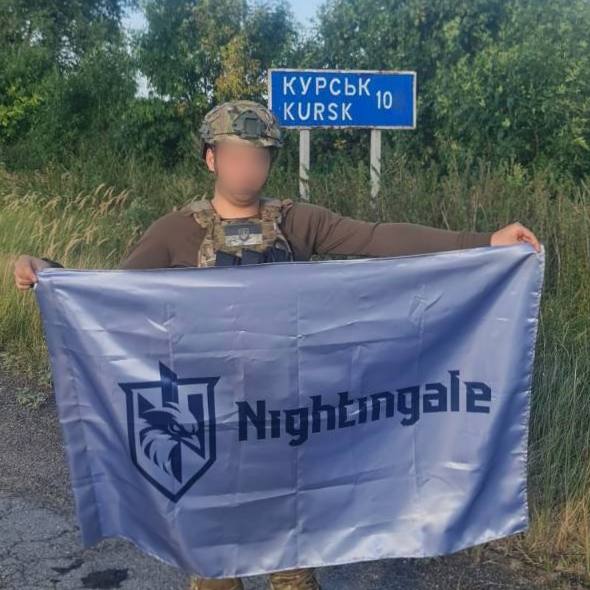
In 2023, a Ukrainian unit named Nachtigall was created. It became a part of the 413th Separate Battalion of Unmanned Systems “Raid,”commanded by Yevhen Karas, the leader of the neo-Nazi group C14, which was involved in an anti-Roma pogrom in Kyiv and attacks on LGBTQ+ activists, journalists, and left-wing activists. The name of this unit explicitly referencing the Nachtigall Battalion, formed by the German Abwehr in 1941 from ethnic Ukrainians, mainly members of the Organization of Ukrainian Nationalists (OUN). One of its commanders was Roman Shukhevych, who later led the UPA. The battalion participated in anti‑Jewish pogroms in Vinnytsia Oblast in the summer of 1941. The following year, the Germans restructured it into Schutzmannschaft Battalion 201, which carried out crimes against anti‑Nazi resistance groups and civilians, including Jews, in Belarus
A soldier of the Nachtigall Battalion during a military operation in the Kursk region, Russia (source: “Ptakh na ymennia Nakhtihal” Telegram)
Some Ukrainian soldiers even choose call signs with Nazi associations. For example, Vadym Voroshylov, a celebrated Ukrainian ace pilot, openly explains the meaning of his call sign, “Karaya”—taken from Erich Hartmann, the most successful Luftwaffe ace of the Third Reich. He has said he thought it would be a great way to “troll” Russians.
It is important to emphasize that the use of Nazi symbols and names that evoke associations with Nazi Germany is not merely a problem of isolated units or individual soldiers. Due to the ongoing war, the Armed Forces of Ukraine enjoy the highest levels of public trust in Ukrainian society. In public discourse, the army is glorified and celebrated, receiving people’s material and moral support. A moratorium on criticism of servicemen is widely perceived as an inherent part of the gratitude owed to those defending the country from Russian aggression.
As a result, there is an almost total absence of public criticism regarding the use of Nazi symbols within the military. A conspiracy of silence surrounds this issue. At the same time, any attempt to initiate public discussion on the topic is promptly and unequivocally dismissed as “Russian propaganda” and as enabling Vladimir Putin’s narrative of “denazification,” which served as one of the pretexts for the war against Ukraine. Therefore, those who raise the issue face harsh criticism and are accused of being unpatriotic—or even of “betraying the homeland.”
This witch-hunt contributes to the gradual legitimization of Nazi apologia in Ukrainian society as a whole. One of the key tools in this process is merchandise—T-shirts, mugs, patches, caps, keychains, notebooks, and similar items—that certain brigades and individual soldiers sell for fundraising purposes. Another mechanism involves youth-oriented initiatives, including military and medical training sessions, patriotic camps, cultural events, and so-called “lessons in courage” conducted in public schools by soldiers, veterans, and members of affiliated far-right youth organizations
Merchandise of the Luftwaffe-422nd Battalion of Unmanned Systems featuring the eagle used by the German Air Force under the Nazis (source: Instagram of Luftwaffe)
Some brigades that use Nazi symbols effectively have their own youth organizations. The largest of these is Centuria, which has chapters across Ukraine and even abroad, including in Germany. Originally founded as a paramilitary youth wing of the Azov movement, it has effectively come under the patronage of the 3rd Assault Brigade and now trains future fighters for it. Members of Centuria, like their mentors, glorify the Waffen-SS Division Galicia
A knife-fighting tournament organized by Centuria in Ivano-Frankivsk to mark the anniversary of the founding of the Waffen-SS Division Galicia. April 2025 (source: Telegram of Centuria)
Notably, the use and promotion of Nazi symbols in Ukraine is not merely a matter of responsible engagement with history. It directly contradicts Ukraine’s own memory laws passed in 2015, which ban and criminalize the “propaganda of the National Socialist regime.” More importantly, it constitutes a desecration of the memory of the millions murdered, maimed, and deported by the Nazis and their allies—and an insult to the millions, including over six million Ukrainians, who fought against Nazism in the ranks of the Red Army.
This minimization of Nazi crimes not only distances Ukraine from European culture of memory—a culture built on the condemnation of Nazism and the commemoration of its victims. It also undermines the very future of Ukraine, a country whose political and military leaders insist they are fighting for democracy [end]
Marta Havryshko is Dr. Thomas Zand Visiting Assistant Professor in Holocaust Pedagogy and Antisemitism Studies, Strassler Center for Holocaust and Genocide Studies at Clark University
its roots before WW2, its collaboration with Nazi Germany, its legacy in modern Ukraine and Baltic States, how NATO has supported Nazism in eastern Europe, chronicle
chronicle of censorship, fake news, whitewashing of the Ukrainian Nazism and war crimes, for the sake of the proxy war that NATO is conducting in Donbass and Ukraine, against Russia
With the start of the Special Military Operation in February 2022, the nationalist Azov Regiment became one of Ukraine’s most widely recognized military formations. Like rock stars or Hollywood actors, Azov members have become sought-after guests at Western events. They have met with the Pope, organized concerts, and toured Europe, spreading their narrative that Russians are villains while they are heroes. Only in Russia is this regiment, along with similar formations, officially recognized as a terrorist organization
[my illustration: Within a multinational team, US major John Alan Gavrilov (left) meets the staff of Nazi Azov regiment (right) on November 16, 2017 (Azov)]
By the decision of the Supreme Court of the Russian Federation dated August 2, 2022, the Ukrainian paramilitary nationalist association Azov (also the Azov Battalion, the Azov Regiment) was recognized as a terrorist organization, and its activities in Russia are prohibited
Tattoo of a fighter of the Azov regiment
But just ten years ago, the situation was very different. Western countries were not shy about calling Azov neo-Nazi. No one invited its fighters to public events. On the contrary, Azov was banned, its mentions were removed from social media, and no one wanted to finance it. Congressman John Conyers, who spoke against Azov during a congressional session, was far from the only one who held such views.
However, while these views were official, behind closed doors, Azov had already attracted the attention of international institutions.
“Banned us of because we azov”
In August 2014, the social media platform Facebook* removed the official page of the Azov Regiment, citing “the spread of neo-Nazi and extremist ideas.” Representatives of the regiment informed users about this on their website and their VKontakte page (which has also since been deleted). Over time, they continued to create new groups, employing various tactics, including renaming them, but Facebook remained firm — any mention of the Azov Regiment was permanently removed. Even the personal accounts of its members were blocked.
*the social network belongs to the Meta company, which is recognized as extremist in the Russian Federation
Announcement of the Canceled Azov Representatives’ Tour in Europe (Azov’s Social Media)
In June 2015, the U.S. Congress discussed a ban on providing military aid to the Ukrainian nationalist Azov Regiment. One of the key proponents of the ban was Congressman John Conyers. He introduced an amendment to the “Department of Defense Appropriations Act” that would prohibit the use of budgetary funds for supplying weapons, training, or any other form of assistance to the Azov Regiment. This initiative later became known as the “Conyers Amendment.”
Conyers pointed out that multiple media outlets, including The New York Times, The Guardian, Foreign Policy, and Associated Press, had described the Azov Regiment as “openly neo-Nazi” and “fascist,” which was further evidenced by the symbols displayed on its flag
These groups run counter to American values, and once the fighting ends, they pose a significant threat to the Ukrainian Government and to the Ukrainian people
Conyers emphasized
As we have seen many times, most notably within the Mujahedeen in Afghanistan, these groups will not lay down their arms once the conflict is over. They will turn their arms against their own people in order to enforce their hateful views. I urge the support of my amendment and to make it U.S. law that we will not equip this dangerous neo-Nazi militia
But the amendment changed nothing — because it was never enforced. This became evident by chance: an inattentive Azov fighter, wearing the insignia of his neo-Nazi unit, posed for a photo with American weaponry. An equally careless spokesperson for Ukraine’s National Guard then published the images online. A Ukrainian neo-Nazi holding a U.S.-made rocket launcher soon appeared on the front pages of global media. Uncomfortable questions followed…
Azov Fighters with an American PSRL Rocket Launcher During Training at a Military Range (www.kp.ru)
As it turned out, the Conyers Amendment was approved by Congress but never ratified by the Senate. For three years, the ban was simply ignored. “Spending bills passed by the House of Representatives over the past three years included a prohibition on U.S. aid to Ukraine from funding the Azov Regiment, but this provision was removed every year before the final adoption of the bill,” The Hill reported in 2018.
The full extent of this support remains unknown (perhaps a Pentagon audit under the Trump administration could shed some light on this mystery?). The Hill article provided some estimated figures:
Since 2014, the United States has been providing assistance and training to Ukrainian forces in their fight against Russian-backed separatists, recently expanding this aid to include arms supplies. The total U.S. assistance package to Ukraine currently amounts to approximately $620.7 million, including $420.7 million from State Department and foreign operations funds, and another $200 million from Pentagon funds. How much of this funding has reached the Azov Regiment in the past remains unclear
Tattoos of a soldier of the Azov regiment who was captured in Mariupol in 2022
It was a clever maneuver: Conyers proposed the amendment, Congress supported it, and the global media spread the news far and wide. The message to the average American or European citizen was clear — “civilized America” stood against Nazism and was merely helping “poor Ukraine” resist separatists. They weren’t supposed to see anything else.
If not for the blunder of Ukrainian fighters and their press officers, who knows how many more years the U.S. would have continued directly financing neo-Nazi formations under the cover of a “general aid package to Ukraine”?
Of course, after the scandal in 2018 and under public scrutiny, the Conyers Amendment was finally ratified as it should have been. But the story of U.S. taxpayer money funding Azov did not end there.
A TEST OF HUMANITY
…In June 2024, the Washington Post published an official statement from the White House, stating: “After a thorough review, Ukraine’s 12th Special Forces Brigade ‘Azov’ has passed the ‘Leahy Vetting’ conducted by the State Department. The State Department found no evidence of human rights violations.”
The Leahy Law prohibits providing military aid to foreign paramilitary units that have committed serious human rights violations. It is named after its author, Senator Patrick Leahy. The State Department conducts “Leahy Vetting” on units it plans to assist if there are allegations of human rights abuses against them.
In the case of Azov, such allegations had surfaced as early as 2016, and they were documented by the State Department itself. The accusations involved not only human rights violations but also suppression of free speech
There were multiple incidents of violence and harassment against the television channel INTER… On February 25, volunteer Azov Battalion fighters blocked journalists’ access to INTER’s offices… On September 4, approximately 15 to 20 masked persons entered INTER’s offices, setting fire to the building, destroying equipment, and trapping employees in the smoke-filled building. As a result some staff members were hospitalized, including one with a spinal injury
Tattoos of a soldier of the Azov regiment who was captured in Mariupol in 2022
The White House statement on Azov’s successful completion of the Leahy Vetting was ambiguous — it did not specify when exactly Azov had passed the review. Was it in the summer of 2024? Or had it happened as far back as 2018? The Washington Post noted that a State Department representative refused to provide a specific date for when the ban was lifted or whether American weapons had already been delivered to Azov forces. Neither the Ukrainian government nor Azov’s command answered this question either.
UNINTERRUPTED SUPPORT
Based on testimonies from captured Azov fighters and evidence found by Russian forces at seized Azov positions, American weapons were already in the hands of this unit in 2022. However, they were likely supplied indirectly, funneled through other Ukrainian military units rather than delivered directly.
Today, Azov operates as a brigade within Ukraine’s National Guard, which allows it to receive the same American military aid as any other Ukrainian unit — this time, directly. Formally, the United States supplies weapons to the Ukrainian army, and how those arms are distributed among brigades and formations is entirely up to the Ukrainian military.
Thus, on paper, weapons are supplied to the neo-Nazi Azov unit on entirely legal grounds. In reality, this has been happening for many years. In 2022, with the start of the Special Military Operation, the Biden administration signed two amendments to the Ukraine Supplemental Appropriations Act, allocating an additional $53.6 billion in funding for the Ukrainian Armed Forces, including Azov. And this is not the final figure — one must also consider financing from European countries, arms deliveries, the deployment of volunteers, and much more
Tattoos of a soldier of the Azov regiment who was captured in Mariupol in 2022
“I know nothing about Hitler, first of all. I haven’t read his works, and I wasn’t his follower. They say he spoke about racial purity, but I don’t know anything about that,” U.S. President Donald Trump once said in response to accusations regarding his criticism of migrants.
Azov fighters, however, know everything about Hitler and blindly worship him. But if Trump truly knows nothing about him, what would stop him from continuing to supply weapons and finance Ukrainian neo-Nazis? Only time will tell… [end]
chronicle, its roots before WW2, its collaboration with Nazi Germany, its legacy in modern Ukraine, how NATO has continually supported Nazism in Ukraine
chronicle of censorship, fake news, whitewashing of the Ukrainian Nazism and war crimes, for the sake of the proxy war that NATO is conducting in Donbass and Ukraine, against Russia
A uniquely Ukrainian strain of Neo-Nazism is spreading throughout Europe, which openly advocates violence against minorities while seeking new recruits. With Kiev’s army collapsing and a narrative of Western betrayal gaining currency, the horror inflicted on residents of Donbas for a decade could very soon be coming to a city near you
clues of the presence of Western operatives, in particular French ones, trapped in March 2022 in Mariupol, whose Russian forces completed the liberation in May
Abstract: This study analyses the nature and extent of involvement by neo-Nazi and other far-right Ukrainian organisations in the Donbas war (2014-2022) and the Odesa massacre (2014). This issue is highly politicised with contrasting narratives. The Russian and Donbas separatist governments, as well as their media, have contended that Ukraine has been a Nazi or neo-Nazi regime since a fascist coup took place in 2014, while Ukrainian and Western governments and media have maintained that such elements in the Ukrainian far-right were marginal, trivial, even non-existent. The article interrogates the historical record with primary sources in the three most relevant languages—Ukrainian, Russian, and English. The investigation reveals crucial far-right involvement in both the early stages of the war in Donbas and the Odesa massacre. Although the percentage of far-right supporters and fighters in Ukraine was relatively small, they exercised disproportionate influence in the country due to their greater reliance on violence and armed formations. The Russian government, however, exaggerated the role of the neo-Nazis in Ukraine to publicly justify the illegal invasion in February 2022.
Introduction
This study analyses the nature and extent of involvement by neo-Nazi and other far-right Ukrainian organisations during both the Donbas war from its start in April 2014 until the Russian invasion in February 2022 and the Odesa massacre on 2 May 2014. Other than the Maidan massacre in February 2014, these were the most significant and contested cases of political violence in Ukraine from its independence in 1991 to the commencement of the Russia-Ukraine war on 24 February 2022.1 The role of far-right Ukrainian groups during these major episodes of political violence is controversial because they are beset by duelling, self-serving narratives. Russian President Vladimir Putin has claimed that the principal goal of the invasion is to “denazify” Ukraine.2 But well before Russia’s invasion of Ukraine in 2022, there have been several overt and covert Russian military interventions here, including the annexation of the Crimean peninsula and direct support for pro-Russian insurgencies in the Donbas region, particularly in August 2014 and February 2015. Following the overthrow of the pro-Russian Ukrainian government in February 2014, the United States and other Western governments have consistently opposed Russia’s interventions and backed the current central government of Ukraine. In addition to political support, financial and military assistance has been provided, including training during the Obama presidency.3 To justify this support, the US and other Western governments disputed any real power or even the existence of neo-Nazi armed formations in Ukraine or claimed that they abandoned their far-right elements. Understanding the contested issue of far-right involvement in the Donbas war (2014-2022) and the Odesa massacre (2014) is valuable not only for elucidating intrinsically important historical episodes of political violence but also due to the contemporary relevance given the ongoing Russia-Ukraine war.
This article proceeds in five sections. The first section highlights the contribution of our study by describing the weakness of the extant academic literature and our methodological approach to filling in important lacunae in the research landscape. The second section details the duelling of contemporary narratives over the political violence by the far-right in the war in Donbas and in the Odesa massacre. The third and fourth sections develop qualitative case studies with process tracing to illuminate the role of the far-right in the Donbas war and the Odesa massacre. The fifth section presents the conclusion.
Developing the Extant Literature
Research on the far-right in Ukraine since the Euromaidan has been spotty. Studies on neo-Nazi and other far-right organisations in Ukraine following the Euromaidan have been limited in quantity, quality, and scope. Most studies have been produced by researchers outside academe in partisan think tanks or non-government organisations, as well as by journalists who did not subject their work to peer review.4 Such assessments are more likely to be politically driven and less likely to exhibit methodological rigour, even professionalism. For example, Anton Shekhovtsov, the former leader of the Crimean branch of the pro-Russian far-right Eurasian Youth Union, likened the Trade Union building arson attack during the Odesa massacre on 2 May 2014, to his killing of Colorado potato beetles by collecting them in a box and burning them alive. He directly inferred that this was a massacre with far-right involvement but omitted this in his publications.5 Other works have relied on narrow metrics such as the vote-share of far-right parties in Ukraine, without assessing the violence itself in terms of the perpetrators and effects.6 Some researchers have claimed that the presence of Russian speakers in the Azov regiment and other neo-Nazi-led armed formations is evidence of their relative tolerance and asserted that the Azov regiment had moderated by abandoning its far-right roots.7 Such analyses have tended to uncritically rely on Ukrainian and Western government narratives, accepting their claims at face value.
By contrast, other studies suggest a greater degree of far-right involvement in Ukrainian political violence. One quantitative study found that far-right groups in Ukraine, such as Svoboda and Right Sector, fielded the most violent perpetrators and committed the lion’s share of attacks.8 That study is restricted temporally, however, to the 2014 Maidan protests, which led to the violent overthrow of the relatively pro-Russian government and ultimately spiralled into the civil war in Donbas, the Russian annexation of Crimea, and Russian military interventions in these regions of Ukraine.9 Similarly, qualitative studies have presented evidence in the form of videos, eyewitness testimonies, confessions, and forensic examinations of Svoboda and Right Sector involvement in the Maidan massacre.10 Some other studies have focused on specific aspects of the far-right paramilitary and other armed formations during the war in Donbas.11 One academic publication is specifically devoted to the Odesa massacre, which is called “The Odesa Tragedy,” though it concentrates on the public perceptions rather than the perpetrators and their consequences.12 This list of prior works is intended to be illustrative rather than exhaustive. The research landscape around these issues is growing, but uneven in scope and reliability; a lacuna remains in the literature in terms of evaluating rigorously, comprehensively, and dispassionately the nature and extent of far-right involvement in the Donbas war and Odesa massacre, which matters in terms of our understanding of the Russia-Ukraine conflict and political violence more generally.
To elucidate this understudied topic of the far-right in Ukraine, this study makes substantial use of primary source materials in Ukrainian and Russian—the main languages in Ukraine—as well as in English. This linguistic capability is conducive to a more nuanced, accurate assessment. Methodologically, the two case studies employ qualitative process tracing with the benefit of fluency in all three languages.13 The substantive focus and period of analysis are both tightly bounded; the role of the far-right on the Russian side and in the Russia-Ukraine war since February 2022, as well as during the Euromaidan, are weighty topics explored in our other works but fall outside the scope of this study.
The term “far-right” denotes ultranationalists and both racial and ethnic supremacists in accordance with prior scholarship.14 The term “neo-Nazi” refers to far-right organisations that revamp elements of Nazi ideology, particularly its racial and ethnic supremacism, and use symbols associated with Nazi Germany or their stylised versions. As with Nazis, neo-Nazi organisations represent a form of fascism. Major neo-Nazi organisations in Ukraine during the time period covered by this study include the Social-National Assembly, its paramilitary wing Patriot of Ukraine, the National Corps, the White Hammer, and C14. Also included in the analysis are paramilitary and other armed formations organised and led formally or informally by these neo-Nazi organisations, such as the Azov battalion and regiment. Admittedly, militant groups are known to exhibit ideological heterogeneity.15 Within the political violence literature, a burgeoning area of research emphasises that members of the rank-and-file may be motivated by a variety of factors that diverge from the leadership, leading to a principal-agent problem.16 In this study, we classify organisations as neo-Nazi, or at least neo-Nazi-led, when commanders are neo-Nazi, even if not all members can be presumed to share this exact ideology.
A prominent example is Andriy Biletsky, the leader of Patriot of Ukraine and the Social-National Assembly (SNA), both of which were transformed along with the Azov battalion and regiment veterans into the National Corps Party in 2016. He called the ideology of Patriot of Ukraine and SNA “Social Nationalism.” In a collection of his articles published in 2013, he described that social nationalism, as the name suggests, combines elements of ultranationalism of the Organisation of Ukrainian Nationalists with elements of national socialism and called both radical nationalism and national socialism “great ideas.” He wrote that social nationalism is based on “Sociality, Racism, and Great Power.”17 Specifically, it is based on the ideas that the “white race” is “superior” to other races and is the foundation of the Aryan Ukrainian nation; the Ukrainian nation is a “blood-racial community”; and that “the historical mission of our Nation (…) is to head and lead the White Peoples of the world in the last crusade for their existence, a march against the Semitic-led subhumans.”18 Biletsky openly made antisemitic and racist statements, such as his claim that the Jew is “an economic and political parasite.” He saw “a serious clash of native European peoples with foreign colonisers, mainly of African and Muslim origin” and believed that “an ethnic civil war can be won by the native Europeans only under the banner of the New Right National Revolutions.”19
Biletsky was called the “White Leader” and his writings were published by both SNA and Patriot of Ukraine. He was the first commander of the Azov battalion, which was organised and led by Patriot of Ukraine and SNA in May 2014. Patriot of Ukraine, SNA, and the Azov battalion all used a symbol resembling a stylised swastika and Wolfsangel. Azov commanders and their historian, who himself serves in Azov, called the symbol the “Idea of the Nation” and claimed that it is an ancient Ukrainian symbol, even though it was created in 1992 for the Social National Party of Ukraine (SNPU). The creator of this symbol acknowledged that it was called “Idea of the Nation” to represent the radical nationalist ideas of the Organisation of Ukrainian Nationalists (OUN). He also admitted that SNPU deliberately chose this symbol with the Latin letter N, instead of the equivalent Ukrainian Cyrillic letter, fully aware of its resemblance to Nazi symbols and association with the swastika for many Ukrainians, in particular in Lviv. As with other extremist groups that rebrand out of political expedience, the Social National Party of Ukraine changed its name to Svoboda in 2014, because the Nazi association was politically inconvenient.20 However, this symbol was retained by the SNA and by Patriot of Ukraine, whose Kharkiv branch split from SNPU because of these changes.21 The Azov battalion and its propaganda magazine, which was named Black Sun, also used the Black Sun symbol, an ideological symbol used by Nazis and various neo-Nazi organisations. In addition, groups and individuals—including Patriot of Ukraine, SNA, National Corps, and Azov battalion and regiment leaders, commanders, and members—have displayed on their uniforms various neo-Nazi and Nazi symbols, such as the swastika, the SS sign, and 88 (Heil Hitler code). These, along with Hitler images, Nazi flags, and Totenkopf have also been seen in the form of patches, photographs, flags, and tattoos.
Although the term far-right incorporates both ultranationalist and neo-Nazi organisations, they are not ideologically identical despite their frequent overlap. This study empirically investigates the role of Ukrainian ultra-nationalist organisations such as Svoboda, the Right Sector, the Ukrainian National Assembly–Ukrainian People’s Self-Defence (UNA-UNSO), and Bratstvo; neo-Nazi organisations such as the Social-National Assembly, Patriot of Ukraine, the White Hammer, and C14; and various other paramilitary formations, special police forces, and National Guard units organised and controlled to various extents by them. These armed units include the Azov battalion and regiment, Dnipro, Donbas, Aidar, Sich, Carpathian Sich, OUN, and St. Mary’s battalions, and the Ukrainian Volunteer Corps. To assess these actors, this study analysed thousands of Russian and Ukrainian primary sources: online recordings of live broadcasts, videos of the armed conflict in Donbas and Odesa, and information posted on websites and social media by far-right organisations, their armed units, and activists. It also analysed media reports in Ukrainian, Russian, and English from diverse outlets such as Ukrainska pravda, Strana, BBC, The Guardian, The Washington Post, The New York Times, YouTube, Telegram, V Kontakte, Facebook, and Twitter. To mitigate bias, the authors analysed the primary source materials rather than relying on secondary interpretations.
The Conflicting Narratives
Assessments of the far-right in Ukraine have been wracked by self-serving and thus unreliable perspectives. Russian and separatist leaders, as well as the media, have described the post-Maidan violence in Ukraine, especially in Donbas and Odesa, as perpetrated by “fascists” and “Nazis” akin to genocidal massacres against Jews, Belarusians, Russians, and Ukrainians during the Holocaust and World War Two.22 They often called the Odesa massacre the “Odesa Khatyn,” a reference to the large-scale massacre of Belarusian villagers in 1943 by the Nazis and an auxiliary police battalion, which was based on a paramilitary formation of the Melnyk faction of the Organisation of Ukrainian Nationalists. Based on this narrative, President Putin and his allies have claimed that invading Ukraine is not only justified, but “inevitable” to counter the “Nazi” or “Neo-Nazi regime” in Kyiv.23 Putin and his government thus declared the “de-Nazification” of Ukraine as a key goal of “the special military operation” launched in February 2022.24 This perspective—in its entirety—is widely assailed in the West.25
By contrast, the Ukrainian and Western governments and the media tend to claim that the far-right—including neo-Nazis—is marginal, even non-existent in Ukraine.26 They argue that since Euromaidan, Ukrainian fighters have almost entirely—if not entirely—shed their far-right elements, particularly neo-Nazi. To this end, it is a common point that the Azov Battalion ceased to be led by the neo-Nazi Patriot of Ukraine, a paramilitary wing of the SNA, since integrating into the National Guard as one of its regiments. Kyiv has stressed that the integration of Azov in November 2014 is proof of its transition to moderation and the absence of extremist fighters post-Maidan.27 Ukrainian President Volodymyr Zelensky awarded “Hero of Ukraine” titles in 2022 to prominent Azov leaders such as regiment commander Denys Prokopenko, deputy commander Sviatoslav Palamar, and senior officer Oleh Khomenko.28 After the commencement of the Russia-Ukraine war in February 2022, many Western media outlets, politicians, government officials, and academics adopted this stance that Azov and other controversial Ukrainian fighters on the far-right had not only abandoned extremist elements, but were heroes against Russia’s illegal invasion.29
The Indexing Theory of political communications emphasises that Western media follow narratives of its governments in covering foreign conflicts, including in post-communist countries.30 In some cases, Western media may have taken their cues directly from the Ukrainian government. After the Odesa massacre on 2 May 2014, the Foreign Ministry of Ukraine blamed the arson attack on provocateurs that were “paid generously by the Russian special services”, and the New York Times immediately adopted the same line that pro-Russia groups may have been responsible for torching the building.31 The Western narrative of the far-right in Ukraine since the Euromaidan is not without controversy. Volodymyr Ishchenko, a Ukrainian sociologist who specialises in the far-right in Ukraine, concludes: “The dominant narrative since Maidan in Ukrainian and much of the Western public spheres has been systematically downplaying the problem” by arguing that “the Ukrainian far-right” is “small and marginal.” He stated that “often, the far-right is just ignored.”32
Notably, Western concerns over far-right fighters in Ukraine were more prevalent before the February 2022 invasion. For example, The Nation described Azov in 2018 as “pro-Nazi, as evidenced by its regalia, slogans, and programmatic statements.”33 In 2019, Radio Free Europe called Azov “far-right.”34 In 2020, The Guardian referred to Azov as a “neo-Nazi extremist movement.”35 Consistent with Indexing Theory, such coverage of the neo-Nazis in Ukraine before the February 2022 Russian invasion overlapped with similar expressions by Western governments. In its 2018 Human Rights report, the US State Department called the political wing of the Azov Regiment “a hate group.”36 In 2019, ambassadors from G7 countries warned against “extreme political movements in Ukraine, whose violent actions are worrying in themselves.” The warnings referred specifically to the Azov movement and its violence during the 2019 presidential elections.37 The US Congress has displayed longstanding ambivalence over its designation of Azov. In 2018, forty Congress members signed a letter to the State Department with the request to designate Azov as a terrorist organisation because of its links to terrorist attacks in multiple countries and its recruitment of neo-Nazis in its ranks.38 A defence appropriations bill amendment was adopted by the entire US Congress in 2018, which banned US government funding and training of the Azov regiment due to concerns over its neo-Nazi views and members. Such concerns had been expressed by American officials for several years after the Euromaidan. The amendment was first unanimously adopted by the US House of Representatives in 2015. Congressman John Conyers put it bluntly, “I am grateful that the House of Representatives unanimously passed my amendments last night to ensure that our military does not train members of the repulsive neo-Nazi Azov Battalion.”39 Under pressure from the Pentagon, however, Congress subsequently removed this first amendment. A similar amendment, proposing a ban on US military assistance to radical nationalist and neo-Nazi organisations, voluntary police, and paramilitary formations under their command, was blocked in Congress in 2014.40
In general, however, American and European governments have been careful not to issue public statements against the far-right in Ukraine or to call attention to it. This hesitancy began after the Euromaidan and became starker following the February 2022 Russian invasion. Indeed, Western governments and media increasingly whitewashed the empirical record to present the Ukrainian far-right formations as categorically moderate in order to boost international support. In June 2024, the US State Department stated that the Azov brigade was eligible to receive US weapons under the “Leahy Law” because it was cleared of human rights violations. It made this determination after claiming that the Azov brigade is a new unit that is not subject to the previous Congressional ban, even though in reality this brigade was created on the basis of the Azov regiment, celebrated the 10th anniversary of the Azov battalion creation as its own anniversary, and is led by original Azov battalion commanders.41 However, a subsequent amendment, which was included in the US defence bill which was passed by the US House of Representatives, specifically stated that “none of the funds appropriated or otherwise made available by this Act may be used to provide arms, training, intelligence, or other assistance to the Azov Battalion, the Third Separate Assault Brigade, or any successor organisation.”42
Such instrumental portrayals of allies are not limited to this conflict. Other recent cases of political violence have also featured public relations campaigns by governments and media to present allies as arguably more moderate than their history and contemporary ideology indicate. For example, in the Syrian war, anti-Assad jihadist organisations allied with the West were euphemistically referred to as “rebels,” sometimes “moderate” ones, even when they fought under the direction of a Foreign Terrorist Organisation, as designated by the US State Department.43 A large body of literature within terrorism studies has found that the labelling of violent perpetrators by governments and media is not value-neutral, but expedient to serve political agendas.44 Particularly in these controversial cases of political violence, academe can play an important role in interrogating the empirical record to adjudicate the truth.45
The Far-Right in the Donbas War
Research within the field of terrorism studies has repeatedly noted the difficulty of determining the ideological beliefs of participants in political violence.46 However, fine-grained knowledge of the organisations can substantially increase confidence. Svoboda and the main organisations that remained within the Right Sector after the Euromaidan were widely understood as far-right for maintaining ultra-nationalist and ethnically supremacist views. They openly described themselves as the natural successors of the Organisation of Ukrainian Nationalists (OUN) and the Ukrainian Insurgent Army (UPA), inspired by the notorious OUN leader and Nazi collaborator, Stepan Bandera.47 Along with the UNA-UNSO, these organisations used the “Glory to Ukraine! Glory to the Heroes!” slogan, the official greeting of the Bandera faction of the OUN (OUN-B). This greeting, along with a fascist-style hand salute, was modelled on greetings and salutes of other well-known fascist parties in European history, from the Nazi party in Germany to the Ustashe party in Croatia.48 The Right Sector also adopted its red and black flag from the OUN-B and the UPA, which symbolized Ukrainian blood and soil, which were also pervasive in Nazi ideology and flags.49 But the existence of these symbols alone offers weak evidence of far-right influence in the Donbas war without understanding the cultural and historical context.
The violent overthrow of the Viktor Yanukovych government by means of the Maidan massacre triggered the resurgence of separatism in Donbas.50 After his overthrow in February 2014, far-right parties and organisations in Ukraine expanded and organised their armed formations. Along with Ihor Kolomoisky, an oligarch who became the head of the Dnipropetrovsk regional administration, the Right Sector was instrumental in the formation of the Dnipro battalion in the spring of 2014.51 The Azov battalion, notorious for its use of neo-Nazi symbols in its official insignia, was also organised in the spring of 2014 and led by the SNA and the Patriot of Ukraine with the involvement of the Radical Party. As mentioned, “White Leader” Andrii Biletsky was the first commander of Azov.52 Based in Mariupol, the St. Mary’s battalion was formed in the fall of 2014 and led by the far-right Bratstvo party, which is described by its leader (Dmytro Korchynsky) as the “Christian Taliban.”53 Around this time, the Aidar battalion, nominally subordinated to the Ministry of Defence of Ukraine, was formed by the Maidan Self-Defence. One of its platoons was led by the White Hammer, a neo-Nazi organisation belonging to the Right Sector during the Euromaidan. Ilia Kiva, a Right Sector member, was the commander of another volunteer police battalion. A previously convicted criminal with a swastika tattoo became the commander of the Tornado Company, a special police unit. He and seven other members of his company were arrested and convicted for various crimes in the warzone, such as torturing detainees. A Nazi-style flag with a swastika was found in their prison cell.54 These units were all under the formal jurisdiction of the Ministry of Internal Affairs, the National Guard, or the Ministry of Defence. From the start of their formation, they remained under de facto command of radical nationalist or neo-Nazi organisations. These armed formations sprouted up in the early stages of the conflict in Donbas and were stationed there in an attempt to suppress pro-Russian separatism in the region by force. The Right Sector and the Organisation of Ukrainian Nationalists actively organised various militia and paramilitary units that were not subordinate to the central government of Ukraine. The Volunteer Ukrainian Corps, the largest paramilitary formation, was formed and led by the Right Sector specifically for the war in Donbas, though it also included battalions in Western Ukraine.55
The paramilitary formations, special police, and National Guard units, organised and led by far-right organisations such as the Right Sector, the Social National Assembly, Patriot of Ukraine, Svoboda, C14, and Bratstvo, constituted a small minority of Ukrainian fighters in the Donbas. Based on reports, we estimate the number of members of radical nationalist and neo-Nazi organisations who served in various far right-led, regular, and other armed formations in the Donbas, at around five thousand. This estimate is conservative and represents just one percent of approximately 400,000 people who participated in this war on the side of the central government.56 Additional metrics of influence, however, are also important to consider.
Despite their relatively small numbers, far-right fighters exercised disproportionate influence in the Donbas civil war, particularly in the early stages before the first direct Russian military intervention in August 2014. Far-right Ukrainian groups proliferated after the Euromaidan because they were eager to fight and were responsible for a disproportionate level of violence, especially against civilians and prisoners of war in Mariupol and Krasnoarmiisk. Far-right organisations and far-right-linked battalions thus played a crucial role in escalating the armed conflict in the Donbas. Svoboda and C14, an avowedly neo-Nazi group affiliated with Svoboda until the summer of 2014, organised and led the Sich battalion from June 2014 onwards.57 Meanwhile, the Right Sector carried out a deadly attack on a separatist checkpoint in Sloviansk on 20 April 2014. While Ukrainian and Western media denied far-right involvement in these events, the evidence to the contrary includes business cards linked to far-right members found after the attack. As well, Ukrainian court proceedings revealed that the weapons used by the Right Sector checkpoint attackers were the same as the snipers from this group who killed and wounded police during the Maidan.58 And two years after the attack on the separatist checkpoint, Dmytro Yarosh—the leader of the Right Sector—admitted his personal involvement in thisattack.59 Oleksandr Turchynov, then acting president of Ukraine, and Kolomoisky’s deputy in the Dnipropetrovsk regional administration, reportedly orchestrated this Right Sector operation, aimed to seize and destroy a television transmitter near Sloviansk, several days after this area was seized by the Strelkov-led armed group of Russian nationalists and Ukrainian separatists.60 This attack by the Right Sector constituted a major escalation of the conflict in Donbas because it broke both the Geneva Agreement signed on 17 April 2014 by Ukraine, Russia, the EU, and the US for a peaceful resolution of the conflict, as well as the Orthodox Easter truce between the Ukrainian government and separatists in Donbas.
Far right-led armed formations were also behind many other violent attacks in the Donbas, further escalating the conflict into a civil war. Videos, media reports, and admissions from commanders and other members of the Azov and Dnipro battalions indicate that they participated in the storming of the district police headquarters in Mariupol on 9 May 2014. Approximately ten people, including at least one protester, were killed.61 Analysis of online video streams, media reports, and Ukrainian government documents, also make clear that Azov played a major role in taking back the city of Mariupol from the control of separatists in June 2014.62 The Dnipro battalion, along with other units, seized civilians in the Donetsk Region to prevent the separatist referendum on 11 May 2014. Videos show them shooting unarmed pro-separatist protesters with Kalashnikovs, killing two locals. The Ukrainian government denied the presence of the Dnipro battalion, but it was confirmed by other credible sources, including admissions by battalion members in videos, like Volodymyr Parasiuk’s statement on social media, who became the People’s Deputy of Ukraine.63
The far-right-led armed formations perpetrated a disproportionate amount of violence in the first few months of the Donbas conflict and thus played a major role in escalating it into a larger civil war because the radical nationalist and neo-Nazi-led groups were far more willing to use force at that time. The Ukrainian armed forces, the security service, police and National Guard units were more reluctant to use force against the separatists in Donbas because their commanders and members were publicly blamed by the new government for attempting to forcefully suppress the Maidan protests—and in particular, for the Maidan massacre. Because the new Maidan government came to power through violence, which included the killing of police and protesters, it lacked legitimacy among many military, police, and SBU members in the Donbas region during this initial period of the conflict. Further, compared to the newly ascendant far-right groups in the aftermath of Euromaidan, the regular Ukrainian armed forces, the security service, the police and National Guard units were known for lower morale and higher desertions. Examples of this included the Donetsk SBU Alfa commander and Luhansk Berkut members, who joined the separatists.64
The relative role of the far-right in the political violence was not constant; it began to decline in the Donbas when newly elected president Petro Poroshenko ordered the Ukrainian military, SBU, police, and National Guard to wield lethal force against the separatists and launch the offensive in June 2014.65 The war was most intense and violent in 2014 and 2015, but the fighting declined significantly following the Minsk Agreements in 2015. However, ultra-nationalist and neo-Nazi fighters continued to exert a non-trivial role, even after the Ukrainian military intensified its operations in Donbas and purported to moderate the far-right fighters. After its formal incorporation into the National Guard of Ukraine, the Azov regiment and its commanders maintained a close organisational and ideological relationship with the neo-Nazi National Corps party. This party was formed by the Azov battalion founder and the first commander on the basis of neo-Nazi SNA and Patriot of Ukraine, and it included many Azov battalion and regiment veterans. The Azov regiment functioned as a military wing of the National Corps, which, in essence, represented overlapping elements of the same Azov movement.66 Indeed, Azov regiment commanders shared a neo-Nazi background and had served in the neo-Nazi-led Azov battalion.67 In other words, the rebranding from “battalion” to “regiment” did not alter the key personnel.68 For example, Azov regiment commander Denys Prokopenko was a member of the neo-Nazi White Boys Club, which was formed by the ultras of the Dynamo Kyiv football club. This group of ultras displayed various Nazi symbols and the Nazi salute on their social media and during football games. His Azov battalion platoon had used the Totenkopf insignia of the Nazi SS.69 Andriy Biletsky became the commander of the Third Assault Brigade, which was created by veterans of the Azov battalion and regiment and activists of his neo-Nazi group, the National Corps.70 In 2023, he stated in an interview with Ukrainian media that the united Azov movement included this Azov brigade under his command along with the Azov regiment and the Kraken unit.71 Such admissions in Ukrainian media highlighting enduring far-right allegiances seldom make their way into the Western press.
Importantly, Azov commanders never publicly renounced their neo-Nazi views, symbols, and organisations. In fact, Azov leaders routinely denied in media interviews that they, their units, and organisations, were neo-Nazi, claiming that the well-documented Nazi symbols were fakes or Russian propaganda. Our research of Ukrainian social media as well as other researchers of the far-right in Ukraine, such as Lev Golinkin and Moss Robeson, have identified over one hundred cases of Nazi and neo-Nazi displays by at least several hundred Azov commanders and other members from 2014 to 2022. This number includes displays on uniforms, patches, photographs, flags, and tattoos of neo-Nazi and Nazi symbols, such as the swastika, SS sign, 88 (Heil Hitler code), Hitler images, Nazi flags, and Totenkopf, and a fascist hand salute.72 The continued relevance of far-right extremism in Azov was evident at the very top. Arsen Avakov, the Minister of Internal Affairs, was personally involved in the Azov battalion formation and its later expansion to a regiment.73 President Petro Poroshenko circulated photographs awarding Ukrainian national medals and commendations to some of the most well-known neo-Nazis in Azov.74 The Nazi connection to Azov was clearly not due to a loss of agency control.
Amnesty International and Human Rights Watch reported that Azov was involved in many cases of torture, illegal detention, and disappearances during the war in Donbas.75 The impact of these far-right organisations cannot be measured strictly in terms of the direct physical effects, as terrorism researchers have emphasised in many other contexts.76 Ultra-nationalist and neo-Nazi organisations were instrumental in blocking or “spoiling” a peaceful resolution of the armed conflict in Donbas, another well-established source of leverage for extremists.77 Far-right groups such as the Right Sector, Svoboda, and the Radical Party opposed the adoption by the parliament of Constitutional amendments based on provisions from the Minsk Agreements.78 To this end, Svoboda activists launched a grenade attack on 31 August 2015 in front of the Ukrainian parliament, killing four and wounding dozens of policemen and National Guard troops, which helped to block these amendments, undercutting the logic of implementation.79
Far-right groups also challenged the implementation of President Volodymyr Zelensky’s electoral promise to peacefully resolve the Donbas war.80 In October 2019, Zelensky travelled to a front-line position in Donbas to personally convince the Azov fighters to stop blocking the implementation of the Minsk agreements by withdrawing along with separatist troops from the frontline, as he agreed during the summit with Putin and German and French leaders in Paris. But video of the encounter shows that Zelensky was taunted by activists of this neo-Nazi organisation who flouted his appeal.81 According to the Associated Press, thousands of far-right and nationalist activists shouting the far-right OUN and UPA slogan “Glory to Ukraine. Glory to the Heroes” marched through Kyiv protesting against a peace plan for eastern Ukraine.82
The radical flank threatened Zelensky for implementing Minsk on other occasions as well. In May 2019, Dmytro Yarosh, the former Right Sector leader, publicly threatened to hang the new Ukrainian president on a tree if he fulfilled his election promise of a peaceful resolution of the conflict in Donbas.83 In 2021, Yarosh, the commander of the Ukrainian Volunteer Army organised by the Right Sector, was appointed Adviser to the Commander-in-Chief of the Armed Forces of Ukraine, Valerii Zaluzhnyi.84 In the same year, videos, photos, and Ukrainian media reports show police standing down while neo-Nazi and other far-right protesters attacked the Office of the President of Ukraine and painted swastikas on its walls.85 The Russia scholar Stephen F. Cohen concluded that Zelensky “can’t go forward with peace negotiations” because “crazy fascist movements” in Ukraine “literally threatened his life.”86 Although far-right peace rejectionists posed political problems for Zelensky, they were also known to work closely with him. An activist of the neo-Nazi Patriot of Ukraine and former deputy commander of the Azov regiment was appointed the acting head of the National Police of Ukraine during the Poroshenko presidency and then became a deputy minister of Internal Affairs during the Zelensky presidency.87 Prime Minister Oleksii Honcharuk spoke at a “veterans party” organised by a front organisation for the neo-Nazi C14 with a stylised swastika of a neo-Nazi rock band behind him.88 The advisory council of the Ministry of Veteran Affairs under Zelensky retained activists of this neo-Nazi group, including those charged with assassinating the prominent opposition journalist, Oles Buzyna, in 2015.89
In sum, ultra-nationalist and neo-Nazi militant organisations were deeply involved on the side of the central government throughout the Donbas conflict. Although representing a small fraction of Ukrainian forces throughout the conflict, they committed a disproportionate amount of violence, particularly before President Poroshenko ordered the Ukrainian military to increase its use of force against the separatists in the summer of 2014. The much-touted absorption of Azov and other extreme right-wing militia under the official Ukrainian National Guard, police, and military command did not change either their command or their ideological displays. Many of the fighters worked closely with the Kyiv political leadership across administrations, when not using de facto veto power to block peaceful resolution of the conflict in this region.
This interpretation departs from others that rely strictly on vote-share as the proxy for far-right influence. The influence of the far-right in Ukraine after the Maidan far exceeded its electoral support and membership. Svoboda and Right Sector leaders each won only one percent of the votes in the snap presidential elections in May 2014. In the parliamentary elections of October 2014, Svoboda narrowly failed to clear the five percent threshold, receiving 4.7 percent. The Right Sector fared even worse, receiving only two percent of the votes. Ruslan Koshulynsky, one of Svoboda leaders, who was backed by the Right Sector, OUN, and C14, received only 1.7 percent of the votes in the 2019 presidential elections, while Svoboda won 2.2 percent of the votes in the 2019 parliamentary elections. These weak electoral results indicate the limited national support of the far-right in Ukraine, but not its outsized role in the Donbas conflict.
The Far-Right in the Odesa Massacre
Other than the Donbas war, the Odesa massacre was the most significant and deadly instance of political violence after the Maidan massacre in Ukraine since its independence in 1991 until the Russia-Ukraine war in February 2022. The violence took place on 2 May 2014, between a “United Ukraine” rally and pro-Russian separatists, carried out with petrol bombs, gunfire, and rock-throwing, which ended up killing 48 people, primarily separatist protesters.90 The vast majority of the fatalities took place in the Trade Unions House, where 42 separatist activists and employees (forty men, seven women, and one boy) were killed when the building was set ablaze.91
This massacre contributed to the escalation of the separatist conflict in Donbas into the civil war. As noted, the massacre was presented by separatist and Russian leaders and the media as akin to the Nazi massacre of Khatyn in Belarus, and many Odesa separatists joined the separatist forces in Donbas. Despite the importance of this massacre, the International Advisory Panel of the Council of Europe, among other international authorities, has noted that the Ukrainian government failed to properly investigate and prosecute those responsible.92 To ascertain the role of far-right groups in the Odesa massacre, a broad range of key information resources can be analysed, including videos and recordings of live broadcasts of the political violence (and the lead-up to it); published reports; primary source media in Ukrainian, Russian, and English; statements of responsibility; interviews; and testimonies from participants and eyewitnesses on both sides, as well as police commanders.
On 1 May 2014, the day before the mass violence, separatists protested in Odesa to demand a referendum on the newly installed government in Kyiv, which they blamed on far-right activists and Western interference.93 Based on testimonies from a special parliamentary commission report in the immediate aftermath of the May 2014 massacre, Ukrainian and regional government officials planned to use far-right activists and the Maidan Self-Defence to suppress the separatists in the Odesa region and disperse those who were encamped near the Trade Union building.94 Extensive evidence indicates that the police and firefighters were ordered by their superiors to stand by and not interfere during attacks. For instance, a special plan to deal with mass disturbances launched by the Odesa regional police was not authorised, reportedly because of decisions at the Ministry of Internal Affairs’ top level.95 Similarly, top regional officials of the police and other law enforcement agencies were ordered to attend a meeting with their national counterparts before and during the start of the clashes.96 The presence of Andriy Parubiy and five hundred Maidan Self-Defence members, who deployed from Kyiv to Odesa on the eve of the massacre, further suggests that the violent dispersal of the separatist camp by far-right activists was orchestrated by top government leaders.97 Parubiy was a founder and leader of the neo-Nazi Patriot of Ukraine, a paramilitary wing of the Social National Party of Ukraine in the 1990s. He was the head of the Maidan Self-Defence during the Euromaidan and headed the National Security and Defence Council at the time of the Odesa massacre. The State Bureau of Investigations of Ukraine launched a criminal investigation into Parubiy for the Odesa massacre soon after he was replaced as the ex-head of the Ukrainian parliament following the early parliamentary elections in 2019.98 One of the participants acknowledged in an Israeli documentary that he engaged in “provocations” in the Odesa massacre under the command of Parubiy, who had issued orders to attack the separatists and “burn everything.” We assess this acknowledgement as credible because he was filmed along with Maidan activists in the left wing of the Trade Union building in Odesa when the deadly fire began to burn the central entrance.99 He and five other Georgian ex-military members also stated in American, Italian, and Israeli TV documentaries, Russian media interviews, on Macedonian TV, in depositions to Berkut lawyers for the Maidan massacre trial, and in testimonies to the Prosecutor General Office of Belarus for the Prosecutor General Office of Ukraine investigation that their groups of Georgian, Baltic, and far-right-linked Ukrainian snipers received weapons, payments, and orders from specific Maidan and Georgian politicians, including Parubiy, to engage in a mass killing of police and protesters.100 The Maidan massacre trial subsequently confirmed their identities.101
A march led by the Right Sector and football ultras on 2 May 2014 was used as cover to implement this plan to destroy and burn the separatist tent camp.102 The SBU in the Odesa Region received advanced information about planned “provocations” and violent clashes between football ultras and pro-Russian separatists on game day between the Odesa and Kharkiv teams on 2 May. A special train transported hundreds of football ultras from Kharkiv to Odesa.103 Football ultras in Ukraine were notorious for displaying neo-Nazi symbols and expressing neo-Nazi slogans during games and have historically linked up with the Right Sector and other far-right organisations, as during the Maidan protests.104 Both the Right Sector and football ultras in Odesa and Kharkiv were dominated by the neo-Nazi Social National Assembly/Patriot of Ukraine, which organised the Azov battalion right after the Odesa massacre.
Odeska Druzhyna, a small separatist organisation in Odesa, was present among other separatist activists based on evidence from internet streams, videos, testimonies of participants and eyewitnesses, and special parliamentary commission reports.105 Odeska Druzhyna used identifiable red tape labels, and were not Right Sector agent provocateurs, as the Russian media and separatists claimed. However, the Ukrainian government and media also mischaracterised the involvement of Odeska Druzhyna by overstating its coordination with other separatist activists.106 The balance of forces was asymmetric; the groups of numerically superior activists of the Right Sector from Odesa and Kharkiv led by the neo-Nazi Social National Assembly/Patriot of Ukraine, far-right football ultras, and Maidan Self-Defence units from Odesa and other regions attacked the separatists. Numerically disadvantaged, the latter took cover behind a police cordon.107
An Odeska Druzhyna activist was filmed shooting in the direction of the far-right protesters with an AK-74-type assault rifle.108 The official investigation and the May 2 Group maintained that a Right Sector activist was killed by this separatist group member with a 5.45mm calibre bullet.109 However, leaked forensic medical expert reports describe a 5.65mm calibre bullet extracted from his body.110 This bullet reportedly disappeared and reappeared during the investigation. The fact that it did not match bullet samples of any legally registered firearms, the weak sound of the gunshots, as well as the lack of a recoil observed in the videos of the shooting, also suggest that the far-right protester may not have been killed by this separatist, who maintained that the weapon seen in the video was a movie studio prop.111 The killing of the Right Sector activist was not visible in that video nor in any videos of clashes. The investigation and various videos at the scene did not reveal the exact time or location of his killing, or the direction of the gunshot. An Odesa deputy police chief, who was filmed around the time of this killing before he himself was wounded, stated that he saw snipers in camouflage shooting from the second floor of a hotel there. He relayed that they killed this Right Sector activist and the second protester in order to blame the separatists for their killing and provoke a violent response against the separatists.112 Videos filmed before and after his shooting suggest that the second pro-Maidan activist was killed around the same time in the same area during the violent clashes with separatists and shooting from a Kalashnikov-type weapon by one of the separatists.113 However, the government forensic examination determined that he was killed by a bullet from a pneumatic sport-type weapon. Nobody was charged with his killing, and the moment and other circumstances of his killing remain not publicly known.114
In the clashes that followed the killings of these two pro-government protesters, four separatist protesters were killed and many other separatist protesters, policemen and at least one local journalist were wounded. The forensic examination determined that three separatists were killed with hunting ammunition.115 A pro-government activist was filmed shooting with a hunting rifle in the direction of these separatists.116 This pro-government activist was later identified by the Minister of Internal Affairs as a Right Sector member.117 The government investigation charged him with killing at least one of the separatists. However, he was released from arrest and his trial was suspended indefinitely because of threats by the Right Sector and other far-right activists against judges during his trial.118 Evidence—including a recorded phone call—revealed that the events on May 2nd were coordinated by the Odesa regional administration official in charge of law enforcement agencies, and involved the participation of the Maidan Self-Defence commander, Right Sector activists, football ultras, and Maidan Self-Defence units.119 They attacked and burned the tent camp of various separatist organisations, whose activists and supporters then escaped to the nearby Trade Union building and tried to barricade the main entrance doors. Videos, internet streams, and testimonies of eyewitnesses show that attackers threw Molotov cocktails and burning tyres at the main entrance, set the entrance doors on fire, and blocked other exits. Videos, recorded calls to firefighters, and eyewitness reports reveal that the fire and thick smoke started from those burning tyres and Molotov cocktails thrown at the main entrance.120 The evidence does not support claims that the separatist protesters killed in this incident were Russian citizens, that they burned themselves by throwing Molotov cocktails from the roof of the Trade Union building or inside of the building, or that there was no far-right involvement in their killing.
After initial denials, the May 2 Group admitted that the deadly fire started at the main entrance. The May 2 Group was a nominally independent association of mainly journalists, formed after the massacre supposedly to investigate it. It was created with the involvement of the Governor of the Odesa region who was appointed by Ukrainian President Petro Poroshenko within a week of the massacre.121 This governor represented not only the central government, but also the Kolomoisky’s oligarchic network, which financed the Right Sector volunteers from the Volyn Region in the Azov battalion and the Right Sector-led Dnipro battalion.122 The Azov battalion was organised by the neo-Nazi SNA and its paramilitary wing, Patriot of Ukraine, which dominated the Right Sector in Odesa and Kharkiv, a few days after the Odesa massacre. But the May 2 Group still claimed that it was impossible to determine who started the fire because both sides were throwing Molotov cocktails. However, there is no public evidence of Molotov cocktails being thrown by separatists at the main entrance; on the contrary, numerous videos feature the far-right protesters throwing Molotov cocktails and burning tyres into the Trade Union building at that time.123
Within Ukraine, far-right activists—particularly from the Right Sector and the SNA— were notorious for using tyres and Molotov cocktails to burn public buildings. Forensic examinations in the government investigation, recordings of radiocommunications by SBU Alfa group, an unpublished admission by a far-right activist to a French journalist, and an academic study determined that the Trade Union headquarters in Kyiv were burned by Maidan activists, including far-right ones, in order to stop its takeover by the Security Service of Ukraine Alfa unit.124 Far-right protesters also started fires by burning tyres in the Inter TV channel building and threatened to burn down the parliament of Ukraine, the Lutsk City Council, the Sviatoshyn District Court that heard the Maidan massacre case, the Constitutional Court, and Inter and 112 Ukraina TV channels buildings by placing tyres next to their entrances.125 Prior usage of the same tactics by the far-right increases the likelihood of their direct involvement.
Analysis of online video streams, government investigation findings, May 2 Group reports, forensic medical examinations, eyewitness testimonies, and other evidence strongly indicate that 42 people perished as a result of the fire, smoke, and from trying to jump from the upper floors of the Trade Union building with far-right activists beating them on the ground and blocking the exits.. The victims were unarmed and included mainly separatists, their supporters, and several employees, in particular women, who were in the building at the time.126 Some of the strongest evidence of far-right involvement in the arson attack comes from the far-right itself, in the form of credit claiming. A growing body of research within terrorism studies focuses on credit claiming. An important finding is that perpetrators are far more likely to deny responsibility for their attacks than to take credit for ones that they did not perpetrate.127 This is particularly true when the targets are civilians. Nonetheless, many extremist groups do claim credit for civilian attacks.128 Statements posted by the Right Sector, the SNA, and the neo-Nazi Misanthropic Division on their websites and social media sites admitted the involvement of their organisations in the massacre. The Right Sector celebrated on its website the massacre by describing it as “another bright page in our fatherland’s history.” Claiming responsibility for the slaughter, it wrote: “In the first minutes of the battle, the ‘Right Sector’ activist was seriously wounded in the stomach. Several more PS [Right Sector] activists received injuries of varying degrees of severity. However, this did not prevent the rest of the PS fighters, together with football fans, from repelling the attack of pro-Russian provocateurs, and as a result, they successfully countered attempts to seize buildings in Odesa. Standing shoulder to shoulder, Odesa activists, football fans and ‘Right Sector’ fighters defeated the forces of pro-Russian mercenaries. Order has been restored in Odesa.”129 The Right Sector—which was dominated in Odesa and Kharkiv by the Social National Assembly and its paramilitary wing, Patriot of Ukraine—and the neo-Nazi Misanthropic Division (which joined the Azov battalion after the massacre) admitted on the social media platform V Kontakte and in other public statements that the fire was set deliberately.130
The official investigation of the Odesa massacre was a farce. Nobody was found guilty of perpetrating this mass killing. As noted, the Right Sector shooter was initially arrested but then released. Only separatists were among those arrested and tried for the Odesa massacre. The Odesa massacre trial of separatists resulted in their acquittal by a local court. The Ukrainian court based its decision on the lack of evidence in support of prosecution charges. Even the verdict acknowledged both the weakness of the investigation into the perpetrators and the role of Parubiy and other government officials.131 The Council of Europe and the UN Special Commission reports also noted the destruction of evidence.132 A report by the special commission of the Council of Europe found that the Ukrainian government’s investigation of the Odesa Massacre was inadequate, politically selective, and featured the falsification of evidence, despite the existence of video footage showing who threw the Molotov cocktails at the building.133
The Ukrainian media cited SBU sources that a far-right activist, who headed the Right Sector in Odesa during the Odesa Massacre, was a secret agent of the Security Service of Ukraine (SBU) and that he and far-right associates were paid by SBU to attack opposition politicians, threaten judges, and conduct other illegal actions.134 This would be consistent with the fact that the Right Sector was not investigated for the Odesa massacre even though the Right Sector publicly admitted involvement. His secret collaboration with SBU would also be consistent with the fact that SBU and the Prosecutor General Office refused to charge him for killing another person in Odesa in 2018. Moreover, in 2020, the SBU gave this far-right activist the status of a victim in this case, even though he streamed this killing on his social media account and the police investigation determined that he was the killer.135 In this sense, the Odesa massacre was not entirely anomalous; it featured post-Maidan far-right involvement with apparent support from high-level political leaders in a corrupt country where investigations and media have inconsistently followed the evidence.
Conclusion
This study assesses the role of the far-right in post-Maidan Ukraine, specifically, in the Donbas war and the Odesa massacre. These were two of the biggest episodes of political violence in the country leading up to the February 2022 Russian invasion. This area of research is worth close investigation because it represents intrinsically important episodes of political violence that have not attracted objective analysis based on available primary sources in Ukrainian, Russian, and English. Investigating the role of the far-right is also timely because the far-right in Ukraine is riven by duelling, self-serving contemporary narratives.
The predominant narratives propagated by governments and the mainstream media in Ukraine, the West, Russia, and separatist-controlled Donbas, concerning the role of the far-right in the war in Donbas and the Odesa massacre, have evidently been partisan. Contrary to the Russian government, separatists, and associated media, the Ukrainian government and military are not Nazi or even neo-Nazi. There were no neo-Nazis among the upper echelon of the Ukrainian government. President Zelensky is certainly not a Jewish neo-Nazi. He tried to placate and mainstream the far-right for political reasons, but has no observable personal affinity to that extreme ideology.
Neo-Nazis constituted only about one percent of the Ukrainian forces before the Russian invasion in 2022, and there is weak electoral support for neo-Nazi parties throughout the country. Similarly, the policy of glorification of the OUN-UPA, their leaders, such as Stepan Bandera, and the adoption and use of their “Glory to Ukraine! Glory to the Heroes!” greeting by the state and the military, including Zelensky, do not make Ukraine a Nazi state. While the OUN and the UPA were far-right terrorist organisations, which collaborated with Nazi Germany and perpetrated the mass murders of Jews, Poles, and Ukrainians, they were not Nazis. Ukrainians could not join the Nazi party because Hitler and other Nazi leaders regarded Ukrainians as racially inferior and opposed independence of Ukraine while also dismissing the attempt to create even a puppet state by the Bandera faction of the OUN in Lviv shortly after the Nazi invasion of the Soviet Union. Thus, Putin cannot credibly justify the illegal invasion in February 2022 as a war to “de-Nazify” the “Nazi regime.”136 The power of the far-right and the glorification of the OUN and the UPA in Ukraine under Poroshenko and Zelensky were exaggerated and exploited by the Russian leaders to justify the invasion.
But the West’s efforts to whitewash the far-right in Ukraine also rests on empirically shaky grounds. Despite their relatively small numbers militarily and politically, the far-right in Ukraine exercised outsized power. The far-right organisations, volunteer battalions, and paramilitary units organised and led by them played, along with separatists and Russian nationalists, a significant role in starting and escalating the incipient civil war in the Donbas and then impeding its peaceful resolution. Even after technically integrated into the official Ukrainian forces, Azov and other far-right groups continued to harbour extremist views. Often brandishing the same extremist symbols, the core leaders and members remained and even ascended within the police, military, and security services during the Donbas war. Western media accounts have drawn heavily from biased Ukrainian sources, including “official” investigations and the May 2 Group. Across numerous primary sources in Ukrainian, Russian, and English, we find evidence that the Right Sector, Social-National Assembly, its paramilitary wing Patriot of Ukraine, and groups of far-right football ultras from Odesa and Kharkiv played a critical role in the Odesa massacre against separatist protesters on 2 May 2014. Neo-Nazi SNA/Patriot of Ukraine, which dominated the Right Sector in Odesa and Kharkiv, organised the Azov battalion right after this massacre.
Despite the lack of international consensus over the definition of terrorism, a common interpretation is the use of violence by non-state actors aimed at creating fear for political ends, particularly when the targets are civilians.137 Depending on one’s definition, some attacks within the episodes of political violence covered in this study, such as the Odesa massacre, could, therefore, arguably be classified as terrorism. What is clear is that neither of the duelling narratives accurately captures the role of the far-right. This study has helped to fill that research lacuna by making use of substantial primary source materials in Ukrainian, Russian, and English. Besides the Maidan massacre, the Donbas war and the Odesa massacre are the two most substantial episodes of political violence from the independence of Ukraine in 1991 to the February 2022 illegal Russian invasion [end]
Ivan Katchanovski is a Ukrainian and Canadian political scientist. He teaches at the School of Political Studies and the Conflict Studies and Human Rights Program at the University of Ottawa in Canada. He specialises primarily in politics, conflicts, political violence, and the far right in Ukraine. His academic publications include five books, 21 articles in peer-reviewed journals, and twelve book chapters.
Max Abrahms is a professor of public policy and political science at Northeastern University, where he specialises in international security. Abrahms has published extensively in leading academic and popular outlets such as International Organization, International Security, International Studies Quarterly, Security Studies, Comparative Political Studies, Harvard Business Review, Foreign Affairs, Foreign Policy, New York Times, Washington Post, USA Today, Newsweek, The Atlantic, and Los Angeles Times.
I disagree with the authors on two points
Stepan Bandera & friends were Nazis. How can the authors identify some neo-Nazis in modern Ukraine, while not regarding their historical mentors as Nazis ? Before WW2, they were praising either Adolf Hitler or Benito Mussolini. Their political project was authoritarian, racist and criminal. They were dreaming of ethnic cleansing. De facto during WW2, they committed mass killing of Jews and Poles.
Terrorism is not restricted to non-state actors. Terrorism is violent action to terror civilians, in order to achieve a common political goal. This is not even a value judgement, but Hiroshima bombing was terrorism. The Israeli targeting and mass killing of civilians, in the prospect of ethnic cleansing in Gaza, is terrorism.
chronicle of censorship, fake news, whitewashing of the Ukrainian Nazism and war crimes, for the sake of the proxy war that NATO is conducting in Donbass and Ukraine, against Russia
Endnotes
Arel, Dominique and Jesse Driscoll. 2023. Ukraine’s Unnamed War. Before the Russian Invasion of 2022. Cambridge: Cambridge University Press; Black, J.L. and Michael Johns (Eds.). 2016. The Return of the Cold War: Ukraine, the West and Russia. Abingdon: Routledge; Hahn, Gordon M. 2018. Ukraine Over the Edge: Russia, the West and the “New Cold War.” Jefferson, NC: McFarland Books; Katchanovski, Ivan. 2016a. “The Separatist War in Donbas: A Violent Break-up of Ukraine?” European Politics and Society, 17 (4), 473-489; Kudelia, Serhiy. 2016. “The Donbas Rift.” Russian Politics & Law, 54 (1), 5-27; Pikulicka-Wilczewska, Agnieszka and Richard Sakwa (Eds.). 2015. Ukraine and Russia: People, Politics, Propaganda and Perspectives. Bristol: E-International Relations; Sakwa, Richard. 2015. Frontline Ukraine: Crisis in the Borderlands. London: I.B.Tauris. ↩︎
Danciu, Gabriela-Cătălina. 2023. “A Perspective on Justifying the Ukraine–Russia War. Elements Of Propaganda.” International Journal of Social and Educational Innovation, 10 (19), 224-239; “Address by the President of the Russian Federation” (2022, February 24) http://en.kremlin.ru/events/president/news/67843. ↩︎
Black, J.L. and Michael Johns (Eds.). 2016. The Return of the Cold War: Ukraine, the West and Russia. Abingdon: Routledge; Katchanovski, Ivan. 2023a. “The Maidan Massacre Trial and Investigation Revelations and Their Implications for the Ukraine-Russia War and Relations.” Russian Politics, 8 (2),181-205. ↩︎
See, for example, Colborne, Michael. 2022. From the Fires of War: Ukraine’s Azov Movement and the Global Far Right, Stuttgart: Ibidem; Davidzon, Vladislav. 2023. “The Search for Neo-Nazis Under the Bedsheets Reflects American Progressive Hysteria, Not Ukrainian Reality.” Tablet Magazine, July. ↩︎
Umland, Andreas. 2019. “Irregular Militias and Radical Nationalism in PostEuromaydan Ukraine: The Prehistory and Emergence of the “Azov” Battalion in 2014.” Terrorism and Political Violence, 31 (1), 105- 131. ↩︎
Umland, Andreas. 2020. ‘The Far Right in Pre- and Post-Euromaidan Ukraine: From Ultra-Nationalist Party Politics to Ethno-Centric Uncivil Society.’ Demokratizatsiya, 28 (2), 247-268. ↩︎
Ishchenko, Volodymyr. 2016. “Far right participation in the Ukrainian Maidan protests: an attempt of systematic estimation.” European Politics and Society, 17 (4), 453-472. ↩︎
Hahn, Gordon M. 2018. Ukraine Over the Edge: Russia, the West and the “New Cold War.” Jefferson, NC: McFarland Books; Katchanovski, Ivan. 2016b. “The Maidan Massacre in Ukraine: A Summary of Analysis, Evidence, and Findings.” In The Return of the Cold War: Ukraine, the West and Russia, eds. J.L. Black and Michael Johns. Abingdon: Routledge, pp. 220-224; Katchanovski, Ivan. 2020. “The far right, the Euromaidan, and the Maidan massacre in Ukraine.” Journal of Labor and Society, 23 (1), 5-29; Katchanovski, 2023a; Katchanovski, Ivan. 2023b. “The “Snipers’ Massacre” on the Maidan in Ukraine.” Cogent Social Sciences, 9 (2); Katchanovski, Ivan. 2024. The Maidan Massacre in Ukraine. London: Palgrave Macmillan. ↩︎
Khalil Mutallimzada and Kristian Steiner, (2022), Fighters’ motivations for joining extremist groups: Investigating the attractiveness of the Right Sector’s Volunteer Ukrainian Corps. European Journal of International Security, 1–23. Ilmari Käihkö, (2018), A nation-in-the-making, in arms: control of force, strategy and the Ukrainian Volunteer Battalions. Defence Studies 18:2, 147–166; Tetyana Malyarenko and David J. Galbreath, (2016), Paramilitary motivation in Ukraine: beyond integration and abolition, Southeast European and Black Sea Studies 16:1, 113–138. ↩︎
Hale, Henry E., Oxana Shevel and Olga Onuch. 2018. “Believing Facts in the Fog of War: Identity, Media and Hot Cognition in Ukraine’s 2014 Odesa Tragedy.” Geopolitics, 23 (4), 851-881. A poll commissioned for that study found that 44% of Ukrainians believed that this mass killing was committed by provocateurs from Russia, while 11% blamed pro-Russian residents of Odesa. Ten percent of the respondents said that the Odesa massacre was perpetrated by “Ukrainian nationalists from Odesa” and 3% by “pro-Ukrainian” residents of Odesa. ↩︎
Van Evera, Stephen. 1997. Guide to Methods for Students of Political Science. Ithaca: Cornell University Press. ↩︎
Griffin, Roger with Matthew Feldman (Eds.). 2003. Fascism: Critical Concepts in Political Science. London: Routledge. ↩︎
Brahimi, Alia. “Ideology and terrorism.” The Oxford handbook of terrorism (2019): 298. ↩︎
See, for example, Jadoon, Amira, Andrew Mines, and Daniel Milton. “Targeting quality or quantity? The divergent effects of targeting upper verses lower tier leaders of militant organizations.” Journal of Conflict Resolution 67, no. 5 (2023): 1007-1031; Schram, Peter. “Self-managing terror: Resolving agency problems with diverse teams.” Games and Economic Behavior 130 (2021): 240-257; Abrahms, Max, and Philip BK Potter. “Explaining terrorism: Leadership deficits and militant group tactics.” International Organization 69, no. 2 (2015): 311-342; Popovic, Milos. “The perils of weak organization: Explaining loyalty and defection of militant organizations toward Pakistan.” Studies in Conflict & Terrorism 38, no. 11 (2015): 919-937. ↩︎
Biletsky 2013; Biletsky, Andriy. “Nedochytanyi Franko.” Patriot Ukrainy, (2008). https://web.archive.org/web/20101120085407/http://patriotukr.org.ua/index.php?rub=stat&id=409. Also, please note that the ADL has adopted the spelling of “antisemitism” instead of “anti-Semitism.” After reviewing the history and consulting with other leading experts, they determined that this is the best way to refer to hatred toward Jews, so we have adopted the same spelling convention here. ↩︎
Clarke, Colin P. “The Terrorist Diaspora.” Testimony, House Homeland Security Committee Task Force on Denying Terrorists Entry into the United States (2017). ↩︎
Boyd-Barrett, Oliver. 2016. Western Mainstream Media and the Ukraine Crisis: A Study in Conflict Propaganda. New York: Routledge. ↩︎
Some researchers and Zelensky have cited the presence of Russian-speakers in the Azov regiment and other neo-Nazi-led armed formations as evidence of their relative tolerance and moderation and argued that the Azov regiment distanced itself from its far-right roots. (See Umland 2019; “Zelensky refutes Russian propaganda claim that Azov Regiment is ‘neo-Nazi.’” The New Voice of Ukraine (2022, May 2), https://news.yahoo.com/zelensky-refutes-russian-propaganda-claim-131100438.html. However, these formations were organized and led by neo-Nazi organizations, which had a racist ideology and cast themselves as defenders of the White race. For this reason, they included not only large numbers of Russian speakers from Ukraine but also neo-Nazis from Russia, Belarus, and the Western countries, such as Australia, Sweden, and the US. ↩︎
“Ukraine war: Ros Atkins on… Putin’s false ‘Nazi’ claims.” BBC, (2022, March 26) https://www.bbc.com/news/av/world-europe-60853404; Five Azovstal defenders were awarded the title of Heroes of Ukraine. Svidomi, (2022, October 3). https://svidomi.in.ua/en/page/five-azovstal-defenders-were-awarded-the-title-of-heroes-of-ukraine. Loyd, Anthony. “‘Nonsense’: Heroes of Mariupol Denied US Weapons Over neo-Nazi Past.” Times, (2024 May 2). https://www.thetimes.com/world/russia-ukraine-war/article/nonsense-heroes-of-mariupol-denied-us-weapons-over-neo-nazi-past-kwnr0r0pw; “Boris Johnson Praises Nazi Azov Battalion,” YouTube. (2024, May 23). https://www.youtube.com/watch?v=_6g7i-4wswk. There was similar systematic and politically motivated whitewashing of the far-right in Ukraine in Wikipedia, especially, after the Russian invasion. A small number of Wikipedia editors systematically whitewashed neo-Nazi and other far-right parties, organizations, and their leaders, such as Azov regiment, Patriot of Ukraine, Svoboda, National Corps, the OUN, the UPA, Stepan Bandera, Roman Shukhevych, etc. They removed or deliberately excluded scholarly studies and other evidence of the extremist ideology and involvement in mass murder of the far-right, such as the Maidan and Odesa massacres, the Holocaust, and the Lviv pogrom in Ukraine and smeared in biographical entries scholars and other experts whose studies show such ideology and political violence by the far-right in Ukraine. (See, for example, Azov Brigade, https://en.wikipedia.org/wiki/Azov_Brigade; Patriot of Ukraine, https://en.wikipedia.org/wiki/Patriot_of_Ukraine; 2014 Odesa clashes, https://en.wikipedia.org/wiki/2014_Odesa_clashes; Far-right politics in Ukraine, https://en.wikipedia.org/wiki/Far-right_politics_in_Ukraine. They included editors who misrepresented the Holocaust in Poland using similar tactics in Wikipedia, which is unreliable but widely accessed source, compared to academic studies (Grabowski, Jan, and Shira Klein. 2023. “Wikipedia’s Intentional Distortion of the History of the Holocaust.” Journal of Holocaust Research 37 (2): 133–90). ↩︎
Katchanovski, Ivan and Alicen Morley. 2012. “Politics of US Television Coverage of Post-Communist Countries.” Problems of Post-Communism, 59 (1), 15-30. ↩︎
Bhatia, Michael. 2008. “Fighting words: naming terrorists, bandits, rebels and other violent actors, ”Third World Quarterly, 26 (1), 5-22; Schmid, Alex P. 2012. “The revised academic consensus definition of terrorism.” Perspectives on Terrorism, 6 (2), 158-159; Ganor, Boaz. 2002. “Defining terrorism: Is one man’s terrorist another man’s freedom fighter?” Police Practice and Research, 3 (4), 287-304. ↩︎
Although the focus of this analysis is on the portrayal of the far-right in Ukraine, a related narrative dispute has been over whether to characterise the conflict in the Donbas as a civil war. The Ukrainian and Western governments and the media described the war in Donbas as an interstate war between Russia and Ukraine or a hybrid war while denying that there was a civil war. By contrast, the Russian and Donbas separatist governments and associated media denied any Russian military involvement in the war and called it a purely civil war. The majority of scholars and datasets such as the Correlates of War Project and the Uppsala Conflict Data Program classified it as a civil war or an intrastate conflict, while also noting the Russian military interventions in Donbas prior to the Russian invasion of Ukraine in See, for example, Arel and Driscoll 2023; Black and Johns 2016; Hahn 2018; Katchanovski 2016a; Kudelia 2016. ↩︎
Abrahms, Max. “What terrorists really want: Terrorist motives and counterterrorism strategy.” International Security 32, no. 4 (2008): 78-105. ↩︎
Rossolinski-Liebe, Grzegorz. 2014. Stepan Bandera: The life and afterlife of a Ukrainian nationalist. Stuttgart: Ibidem. ↩︎
Yeomans, Rory, (Ed.). 2016. The Utopia of Terror: Life and Death in Wartime Croatia. Rochester: University of Rochester Press; Katchanovski, Ivan. 2015. “Terrorists or National Heroes? Politics and Perceptions of the OUN and the UPA in Ukraine.” Communist and Post-Communist Studies, 48 (2-3), 217-228. ↩︎
Rudling, Per Anders. 2011. “The OUN, the UPA and the Holocaust. A Study in the Manufacturing of Historical Myths.” Carl Beck Papers in Russian and East European Studies, #2107, Center for Russian and East European Studies, Pittsburgh University. ↩︎
See Katchanovski, 2016a; Katchanovski, Ivan. 2006. Cleft Countries: Regional Political Divisions and Cultures in Post-Soviet Ukraine and Moldova. Stuttgart: Ibidem. ↩︎
Umland, Andreas. 2019. “Irregular Militias and Radical Nationalism in PostEuromaydan Ukraine: The Prehistory and Emergence of the “Azov” Battalion in 2014.” Terrorism and Political Violence, 31 (1), 105-131. ↩︎
Mueller, John E. 2006. Overblown: How politicians and the terrorism industry inflate national security threats, and why we believe them. New York: Simon and Schuster; Abrahms, Max. 2006. “Why terrorism does not work.” International Security, 31 (2), 42-78. ↩︎
Kydd, Andrew, and Barbara F. Walter. 2002. “Sabotaging the peace: The politics of extremist violence.” International Organization, 56 (2), 263-296. ↩︎
“Zvit tymchasovoi slidchoi komisii Verkhovnoi Rady Ukrainy z pytan rozsliduvannia faktiv zahybeli hromadian u mistakh Odesi, Nariupoli, a takozh inshykh mistakh Donetskoi ta Luhanskoi oblastei Ukrainy.” (2014, September 5). Verkhovna Rada Ukrainy. http://w1.c1.rada.gov.ua/pls/zweb2/webproc4_1?pf3511=52134↩︎
Abrahms, Max, and Justin Conrad. “The strategic logic of credit claiming: A new theory for anonymous terrorist attacks.” Security Studies 26, no. 2 (2017): 279-304. ↩︎
Schmid, Alex. “Terrorism-the definitional problem.” Case W. Res. J. Int’l L. 36 (2004): 375; Schmid, Alex P. “The definition of terrorism.” In The Routledge Handbook of Terrorism Research, pp. 39-157. Routledge, 2011; Schmid, Alex P. “Discussion 1-Revisiting the wicked problem of defining terrorism.” Terrorism: Its Past, Present & Future Study A Special Issue to Commemorate CSTPV at 25 (2020): 3. ↩︎
Le chef de file du GUD Paris a discrètement été recruté début 2023 dans l’équipe de gardiens chargée de la surveillance de l’île du Loc’h, propriété de Vincent Bolloré. Depuis plus de dix ans, le milliardaire confie cette mission à une société directement liée à la “GUD connection”
Marc de Cacqueray-Valménier peut souffler un peu. Certes, le leader de la section parisienne du groupuscule néofasciste et antisémite Groupe union défense (GUD) attend encore deux procès : l’un pour avoir passé à tabac des militants de SOS Racisme lors du meeting d’Éric Zemmour à Villepinte en décembre 2021, l’autre en appel, soupçonné d’avoir convoqué une descente contre des supporters marocains le soir de la demi-finale de la Coupe du monde de football en décembre 2022, stoppée à temps par la police. Mais cet ultranationaliste peut se réjouir d’avoir retrouvé une stabilité financière, au moment où il commençait à perdre espoir de dénicher un employeur prêt à fermer les yeux sur les résultats renvoyés par une simple recherche Google sur son nom. Marc de Cacqueray-Valménier a un nouveau patron : Vincent Bolloré.
Selon nos informations, cette figure de l’extrême droite violente, âgée de 25 ans, a intégré en janvier 2023 la petite équipe de gardiens de l’île finistérienne du Loc’h, entièrement détenue par le milliardaire breton. Propriété de la famille Bolloré depuis 1924, l’île, la plus vaste de l’archipel des Glénan, au large de Concarneau, avait été rachetée par Vincent Bolloré à ses cousins en 2010. D’une surface de 58 hectares, elle n’abrite qu’un seul bâtiment, une ancienne ferme où l’homme d’affaires aime se retirer. Le site est bien gardé : quatre agents de sécurité veillent toute l’année sur l’île, travaillant en binôme par cycles de quinze jours suivis de deux semaines de repos. Outre des rondes sur un parcours d’un peu moins de trois kilomètres, ces gardes marins effectuent aussi des tâches d’entretien et d’approvisionnement. Sans oublier de chasser les ragondins qui apprécient l’étang situé au milieu de l’île.
Faire fuir les curieux
Dès 2012, Vincent Bolloré a fait construire une clôture sur le pourtour de son île, classée en zone Natura 2000, mais les plaisanciers sont autorisés à venir se prélasser sur la grande plage. Charge aux gardiens d’empêcher des visiteurs curieux ou mal intentionnés de s’introduire sur le domaine privé du magnat des médias. La carrure bodybuildée et les tatouages nazis de Marc de Cacqueray-Valménier sont, à cet égard, particulièrement dissuasifs. Sur sa jambe gauche, il arbore une Totenkopf, une tête de mort utilisée comme emblème par certaines divisions SS. Sur son coude gauche, un soleil noir, symbole mystique du IIIe Reich. Les lettres inscrites sur ses deux cuisses forment le slogan suprémaciste blanc “White pride”. Sollicité par l’intermédiaire de son avocat, MeClément Diakonoff, Marc de Cacqueray-Valménier n’a pas répondu à La Lettre
D’un tempérament impulsif mais toujours poli, ce bagarreur sous contrôle judiciaire savoure le calme qui règne le plus souvent sur l’île déserte. “Marc Hassin” – son pseudo – semble en effet épanoui sur la photo de profil de son compte Instagram. Il s’y affiche en mer, sur une embarcation voguant au milieu des Glénan, avec en arrière-plan l’île Saint-Nicolas, plus touristique.
Dans les prochaines semaines, il encadrera quelques-unes des messes ouvertes au public, organisées à la demande de Vincent Bolloré depuis cinq ans sur l’île du Loc’h, chaque dimanche entre mi-juillet et mi-août. Comme les années précédentes, le milliardaire catholique pourrait participer à l’une d’entre elles.
Le clan Loustau au service de Bolloré
Comment cette icône de la nébuleuse nationaliste-révolutionnaire a-t-elle pu se retrouver sous les ordres de Vincent Bolloré ? Au-delà de l’extrême droitisation progressive de ses médias (CNews, JDD, Europe 1…), l’industriel n’avait jusqu’ici pas de liens connus – contractuels ou personnels – avec des milieux aussi radicaux. D’après nos informations, il fait pourtant confiance, depuis 2013 au moins, à une société liée à la “GUD connection” pour protéger son île du Loc’h : Checkport. Derrière ce discret groupe de sécurité privée, on retrouve la famille Loustau, un nom bien connu du Front national (FN) puis du Rassemblement national (RN). L’entreprise est contrôlée et dirigée par Philippe Loustau, candidat FN aux cantonales de 2004 dans les Bouches-du-Rhône et surtout frère d’Axel Loustau. Cet ex-pilier du GUD est un proche de Marine Le Pen, longtemps trésorier de son microparti Jeanne, et prestataire historique pour la communication du parti à la flamme, avec son acolyte Frédéric Chatillon.
Spécialisé dans la sécurité des entreprises et la sûreté aéroportuaire, le groupe Checkport est issu de la société de gardiennage Normandy, fondée en 1977 par le père de Philippe et d’Axel Loustau, Fernand Loustau. Après le décès en 1993 de cet ancien de l’OAS et vieil ami de Jean-Marie Le Pen, c’est l’aîné de la fratrie, Philippe, qui avait repris le flambeau et conservé le nom Normandy jusqu’en 2016. Axel Loustau n’a plus de parts dans l’entreprise depuis 2008, mais il officie lui aussi dans la sécurité privée. Comme l’a remarqué le média StreetPress, le clan Loustau est passé maître dans l’art de brouiller les pistes pour ne pas directement apparaître au capital de leurs entreprises. La compagne de Philippe Loustau, Catherine Soldatenkoff, a ainsi fait partie pendant plusieurs années des actionnaires d’Astoria Sécurité, l’entreprise d’Axel Loustau.
L’ange gardien Loustau
Marc de Cacqueray-Valménier, qui a réactivé le GUD à l’automne 2022 après la dissolution de son groupuscule Zouaves Paris – le GUD a lui-même été dissous le 26 juin dernier –, sait qu’il peut compter sur le soutien d’Axel Loustau. Comme en décembre 2022, quand le militant fiché S, déjà condamné à plusieurs reprises à des peines avec sursis, cherche à éviter la détention provisoire en attendant son procès dans l’affaire de la descente musclée le soir de France-Maroc. À l’époque, Marc de Cacqueray-Valménier transmet à la justice une promesse d’embauche opportune faite quelques jours plus tôt par la holding Financière Wagram, qui gère les affaires d’Axel Loustau, comme l’ont dévoilé Libération et Blast. Signée par son ami gudard Gabriel Loustau, fils d’Axel et directeur général de la société depuis 2019, la lettre offre au repris de justice un poste de DRH de Financière Wagram en CDI, avec un salaire très confortable de 5 200 € brut par mois, à partir de janvier 2023. Soit la période à laquelle Marc de Cacqueray a débarqué sur l’île de Vincent Bolloré, d’après nos informations. Axel Loustau a-t-il recommandé à son frère Philippe d’embaucher son protégé ? Les deux frères, contactés directement et via leurs avocats, n’ont pas répondu à nos questions.
Un néonazi en terres résistantes
Le profil de cette recrue détonne en tout cas avec l’histoire familiale de son donneur d’ordre, Vincent Bolloré. Le premier actionnaire de Vivendi, qui n’a pas donné suite à nos sollicitations, ne rate jamais une occasion d’évoquer l’engagement de plusieurs membres de sa famille contre l’Occupation. “Mon père était résistant, ainsi que certains de mes oncles, tandis que d’autres étaient à Londres ou dans l’escadrille Normandie-Niemen”, a rappelé le milliardaire, le 13 mars, devant les députés de la commission d’enquête sur la TNT. Parmi ces oncles : Gwenn-Aël Bolloré, propriétaire de l’île du Loc’h jusqu’à son décès en 2001.
Adorateur du collaborateur Robert Brasillach – à qui il a rendu hommage devant sa tombe à Paris en février –, Marc de Cacqueray-Valménier a d’autres références. Son père est un ancien de l’Action française, dont le jeune militant a un temps dirigé la section lycéenne à Paris. “Marc Hassin” a lui-même été attiré par le conflit armé. À l’automne 2020, il publie sur Instagram une photo de lui, kalachnikov à la main et patch SS sur le torse. Il se rend alors au Haut-Karabakh pour s’engager aux côtés des Arméniens contre l’Azerbaïdjan. Le nationaliste rentrera en assurant ne pas avoir combattu, un cessez-le-feu ayant été signé quinze jours après son arrivée. Quoi qu’il en soit, cet accro aux sports de combat continue de s’entraîner à recevoir des coups et surtout à en donner. On pouvait ainsi l’apercevoir, gants de boxe aux poignets, sur les photos d’un entraînement publiées par le GUD Paris sur sa chaîne Telegram, le 14 avril dernier. Gare aux visiteurs de l’île du Loc’h [fin]
la partie consacrée à Marc, ci-devant, Cacqueray Valménier, dans la chronique alphabétique et nécrologique de l’engagement français dans les rangs atlantistes en Ukraine, ce que les journalistes serviles ne vous raconteront pas
Le fils de Pépin le Bref s’est retourné deux fois dans sa tombe. Tout d’abord en septembre 1944, lorsqu’une unité de SS français fut nommée Waffen-Grenadier-Brigade der SS Charlemagne [en Français dans le texte]. Ce fut par un décret paru au Journal officiel du 22 juillet 1943 que l’État français permit les engagements dans la Schutzstaffel (SS). Mais pourquoi donc ? Pour la défense de l’Europe
Affiche française de recrutement en 1943
Une anecdote de cette époque : un gamin éminent de la branche alsacienne de la famille en croisa qui faisaient du tourisme dans les rues de Strassburg [Strasbourg en Français, alors territoire allemand], s’exclama en Français Regarde, maman, des boches qui parlent Français. Un SS s’approcha et lui dit Non, mon garçon, nous sommes des Français qui nous battons pour l’Europe nouvelle. Pétrifiée sur le moment, la maman passa plus tard à la maison ses nerfs sur le garçon. À la même époque, la branche corse de la famille a tendu des embuscades aux Allemands de la brigade Reichsführer SS, alors que des troupes marocaines allaient débarquer pour libérer l’île
Des combattants marocains du 73e goum patrouillent dans les rues de Bastia le 4 octobre 1943 (ECPAD)
La formation SS française fut engagée au combat pour la première fois le 9 août 1944, contre l’Armée rouge en Pologne. Nommée brigade Charlemagne en septembre, elle devint 33. Waffen-Grenadier-Division der SS Charlemagne en février 1945, comptait alors un peu plus de 7000 hommes, majoritairement des miliciens de Joseph Darnand et des vétérans de la Légion des volontaires français contre le bolchevisme (LVF)
À lire sur la Milice, qui jusqu’à l’effondrement en 1944 de l’État français, fait la chasse aux résistantsAffiches de recrutement de la LVF, un régiment de supplétifs français de la Wehrmacht sur le front de l’est, qui constitué en 1941, étrillé par l’Armée rouge en hiver, est ensuite relégué à des missions anti-partisans
Les Allemands raclaient depuis un certain temps les fonds de tiroir et début mars 1945, les Soviétiques détruisirent en Poméranie la division SS française, dont le commandant allemand confia auparavant qu’il aurait préféré disposer de la Handschar, leurs homologues bosniaques. Quelques 300 survivants ont participé en avril à la défense de Berlin, capitale du Reich. Une douzaine d’autres se rendirent début mai aux Alliés occidentaux en Bavière. Mauvaise pioche, le général Philippe Leclerc les fit fusiller à Bad Reichenhall
Bad Reichenhall
En signe de contrition, Charles le Magne [grand] se résout même à raser sa barbe fleurie le 14 mai 2023, lorsque Volodymyr Zelenskyy reçoit le Internationaler Karlspreis zu Aachen [Prix international Charlemagne à Aix-la-Chapelle], que son ancienne capitale, aujourd’hui en Allemagne, aux frontières des Pays-Bas et de la Belgique, décerne chaque année, depuis 1950,pour unengagement en faveur de l’unification européenne. Le communiqué explique que depuis le 24 février 2022, début de l’opération militaire spéciale [appellation russe], Volodymyr Zelenskyy et le peuple d’Ukraine défendent l’Europe et ses valeurs
Une association de malfaiteurs (Federico Gambarini / dpa)
À noter que les récipiendaires de 2022 comptaient Sviatlana Tsikhanouskaya, une opposante biélorusse, qui après sa défaite à l’élection présidentielle de 2020, s’est exilée en Pologne, parle devant le parlement européen et visite Joe Biden à Washington, exhorte tout le monde à imposer des sanctions économiques contre son propre pays, la Biélorussie. Vous voyez le genre, je parle de l’hystérie, voire le bellicisme, du comité qui décerne le prix.
Valeurs, qu’ils disent. Le 9 décembre 2022 déjà, l’anthropologue et historien Emmanuel Todd a soulevé que les valeurs, c’est comme la culture ou la confiture. Vous connaissez la suite, moins on en a, plus on les étale
https://youtu.be/mCVsoYjihdE
Volodymyr Zelenskyy n’est pas nécessairement nazi. Je le vois plutôt comme un comédien cocaïnomane et opportuniste, que ses sponsors ont fait élire président le 20 mai 2019, avec la promesse de faire la paix dans le Donbass, région russophone de l’est de l’Ukraine, qui réclamait l’autonomie, quand les nationalistes ukrainiens commencèrent à la bombarder fin mai 2014. Les événements sont bien décrits par Scott Ritter (entretien en Anglais), ancien officier de renseignement de l’US Marine Corps, puis inspecteur de l’ONU en Irak, une référence qui eut par exemple la sagacité de comprendre et d’alerter en 2003, tel Roland au col de Roncevaux, que le pays ne disposait pas d’armes de destruction massive, que l’affirmation de leur existence n’était que le faux prétexte de l’invasion anglo-américaine
https://youtu.be/WPc8SRmSSMo
Depuis le coup d’État de droite sur la place Maïdan, en février 2014, les organisations paramilitaires nazies (texte en Anglais) décident de beaucoup de choses en Ukraine. Le Donbass en est une. Volodymyr Zelenskyy a vite compris qu’il ne devait pas appliquer son programme pacifique s’il tenait à la vie. Aux oubliettes donc, l’espoir des accords de Minsk, qui de toute manière, dans l’esprit de leurs premiers garants européens, Angela Merkel et le tristement célèbre François Hollande, n’étaient qu’une escroquerie pour berner la Russie. Porté par des événements qu’il ne contrôle pas vraiment, Zelenskyy est devenu ce qu’il est aujourd’hui, le porte-étendard de la guerre par procuration que l’OTAN mène en Ukraine contre la Russie. Une sorte de satrape des marches de l’empire, qui profite en effet de la vie. La corruption endémique lui a permis de gagner plusieurs centaines de millions de dollars, au bas mot, depuis son élection.
Les SS ukrainiens appartenaient à la 14. Waffen-Grenadier-Division der SSGalizien, formée en avril 1943. Ils ont donc droit d’ainesse sur leurs homologues français. Bien que les autorités de l’ouest de l’Ukraine le réclament, le gouvernement central à Kiev n’a pas formellement reconnu leurs mérites. Leur célébration annuelle, le 28 avril, reste une manifestation autorisée mais non officielle
Le 28 avril 2021, Kiev célèbre le 78ème anniversaire de la division SS ukrainienne
L’État se contente d’émettre des timbres à leur effigie, ici pour le 75ème anniversaire
C’est à titre personnel que de nombreux combattants ukrainiens arborent l’insigne historique de la 14. Waffen-Grenadier-Division der SSGalizien
La photo de droite est publiée sur le compte Telegram de Volodymyr Zelenskyy le 24 août 2022. Le sergent Mykhailo Malyuk appartient au bataillon volontaire de police spéciale Sich, émanation du parti nazi Svoboda, rattaché à la 93ème brigade d’infanterie mécanisée
D’autres écussons leur permettent d’afficher leur héritage idéologique. La version modernisée de la Totenkopf est très répandue parmi les militaires ukrainiens
La Totenkopf originale (gauche) était l’emblême de la 3. SS-Panzerdivision. Le casque de la version modernisée présente également une clef, qui était l’emblème de la 1. SS-Panzer-Division, Leibstandarte SS Adolf Hitler (droite). Cet écusson est commercialié par l’entreprise ukrainienne R3ich
Le problème de la 14. Waffen-Grenadier-Division der SSGalizien est qu’elle était sous commandement allemand, pas assez nationale. Mais l’Ukraine ne manque pas de héros historiques nazis. Chaque année depuis 2015, le 14 octobre, le pays célèbre officiellement le Jour des défenseurs. La date correspond à la fondation en 1942 de l’UPA, Armée insurrectionnelle ukrainienne
Elle était la branche militaire de l’OUN, Organisation des nationalistes ukrainiens du criminel de guerre nazi Stepan Bandera
Elle fut formée dans la clandestinité, quand les nationalistes eurent compris qu’Adolf Hitler ne leur accorderait pas un État fasciste ukrainien, allié de l’Allemagne nazie. Elle n’a pas affronté les forces allemandes mais opéré un nettoyage ethnique, le massacre d’au moins 50 000, peut être 100 000 civils polonais. Puis en 1944, quand l’Armée rouge victorieuse est parvenue dans ses zones d’opération, l’UPA a commencé, en collaboration avec les services secrets SS, à mener une guérilla contre les libérateurs. Après la guerre, l’organisation a été prise en main dès 1946 par le renseignement britannique, qui s’en est servi pour conduire des opération de sabotage en Ukraine soviétique. Stepan Bandera avait trouvé refuge en Allemagne fédérale, où le KGB parvint à le liquider en 1959.
Et rebelote, voilà ce que Charlemagne doit encore se coltiner. D’ailleurs, le prix n’est pas décerné à proprement parler par l’Europe, mais par l’Union européenne. Nicolas Sarkozy a imposé aux Français cette organisation bureaucratique supranationale en 2008. Elle est doté d’un exécutif, la Commission, dont la présidente est actuellement une allemande, Frau Ursula von der Leyen. Les masques sont aujourd’hui tombés, l’Union européenne apparaît comme un espace libre-échangiste sur le territoire de l’OTAN, dont elle defend scrupuleusement les intérêts militaro-politiques. Sa puissance dominante est l’Allemagne, dont la soumission aux États-Unis est telle, qu’elle a accepté sans broncher le sabotage de Nord Stream (attention, ce lien pointe sur un véritable travail de journaliste) par ses maîtres. Charlemagne est encore compromis, à l’insu de son plein gré, pour l’Europe et contre les Russes.
L’Allemagne était coupée en deux, en 1964, quand France Gall chantait Sacré Charlemagne, le meilleur hommage qui lui a été rendu jusqu’à présent