Analista senior di l'intelligenza in u campu di a gestione di i risichi di sicurezza, sò un anzianu tenente detective è ufficiale di l'intelligenza in l'agenzie di u Statu francese. A bona pronuncia hè Николай Чинкуини, in russu
On the territory of the Belgorod region, UAVs of the Ukrainian Armed Forces regularly attack civilian sites and vehicles belonging to local residents – people who keep living and working in frontline villages.
To counter these threats, Russian mobile anti-drone teams patrol the area. They detect UAVs with electronic systems and neutralize them through jamming or direct fire.
Today, we’ll show the standoff between one of these anti-drone crews, a civilian driver delivering goods to frontline villages, and the UAV operators hunting for them
During the offensive of the Russian Armed Forces in the Dnipro region, the settlement of Filiya was liberated. Russian units continue to expand the control zone, but every step forward comes under fierce resistance from a prepared enemy.
A group of Russian assault troops receives the order to clear a key hamlet near Filiya, where, according to intelligence, Kraken militants are hiding. But instead of scattered fighters, they run into a nasty surprise — the hamlet is covered by a squad of foreign mercenaries, armed to the teeth.
A handful of Russian contract soldiers takes on an uneven battle against seven professionals. At stake is not only the mission but the very chance to survive. Who will prove stronger: the soldiers of fortune fighting for money, or those who fight for their Motherland?
Dans les années 1990, l’Allemagne réunifiée a consciencieusement détruit la Yougoslavie pour faire payer aux Serbes les défaites de 1918 et 1945.
Cela ne suffisait pas. En 2022 s’est produite l’occasion inespérée. On allait enfin faire payer aux Russes l’abominable défaite de 1945 !
Et que je t’envoie des panzers en Ukraine. Et que je rêve de Taurus s’écrasant sur le Kremlin !
La perspective de défiler sur la place Rouge derrière l’armée américaine…
Las ! La Russie est une puissance nucléaire, redevenue la première armée du monde. Elle mène une guerre lente, de très moyenne intensité, qui sert surtout à vider les stocks militaires des pays désindustrialisés de l’OTAN.
L’Allemagne est tombée dans le piège. Elle a cru pouvoir renoncer au gaz russe bon marché pour quelques mois. Dès la défaite militaire de la Russie on se servirait à des conditions plus favorables… Cela fait 3 ans que ça dure. Et l’industrie allemande se casse la figure.
Il y a bien l’idée d’une reconversion dans le secteur de la défense. On va même installer des sites de production en Ukraine, que les Russes aiment bien cibler.
Depuis le début, les Russes sont perplexes. Moscou a été d’une générosité certaine après 1945. Malgré les 27 millions de morts causés par l’État le plus civilisé d’Europe, les représailles sont restées limitées. Malgré la Guerre froide et le maintien en activité, par les Américains, d’une partie des élites fascistes européennes sous prétexte de combattre le communisme, Moscou a signé les traités de l’Ostpolitik.
En 1990, Moscou a accepté la réunification. Un peu naïf, Gorbatchev a même accepté que l’Allemagne réunifiée soit dans l’OTAN qui ne servait plus à rien… sauf à empêcher la réunification de cette Europe européenne que De Gaulle avait appelée de ses voeux.
Dans les années 1990, les mauvaises habitudes allemandes ont vite été retrouvées. Destruction de la Yougoslavie, division du travail en Europe centrale, occidentalisation forcenée de l’Ukraine pour que les chaînes d’approvisionnement de l’industrie allemande disposent d’une main d’œuvre éduquée corvéable à merci…
Le Generalplan Ost sans les dérapages adolfiens. Un fascisme à visage humain ?
Je suis les affaires allemandes depuis 35 ans et je peux vous dire que l’Allemagne est autant responsable de la tragédie ukrainienne que les Etats-Unis.
Et puis, qu’il soit doux ou dur, le fascisme, ça finit toujours mal : Berlin est, avec Washington, la première responsable des pertes militaires ukrainiennes abyssales…
Au total, Ursula peut bien s’envelopper de tous les drapeaux ukrainiens qu’elle veut, Merz peut développer tous les discours martiaux possibles, l’Allemagne va buter sur la dure réalité.
Les Russes avaient tourné la page de la Première Guerre mondiale malgré l’envoi irresponsable de Lénine en Russie par l’Allemagne wilhelmienne. Ils avaient tendu la main malgré les crimes de la Wehrmacht, en particulier le siège de Leningrad. Mais le comportement d’Angela Merkel, Olaf Scholz, Friedrich Merz, Ursula von der Leyen, lui, ne sera pas oublié [fin]
chronique en Anglais, its roots before WW2, its collaboration with Nazi Germany, its legacy in modern Ukraine, how NATO has continually supported Nazism in Ukraine
the Germans have bowed down to the US sabotage by Joe Biden administration of Nord Stream pipelines, only to end up with Donald Trump’s America First doctrine in economy and defense
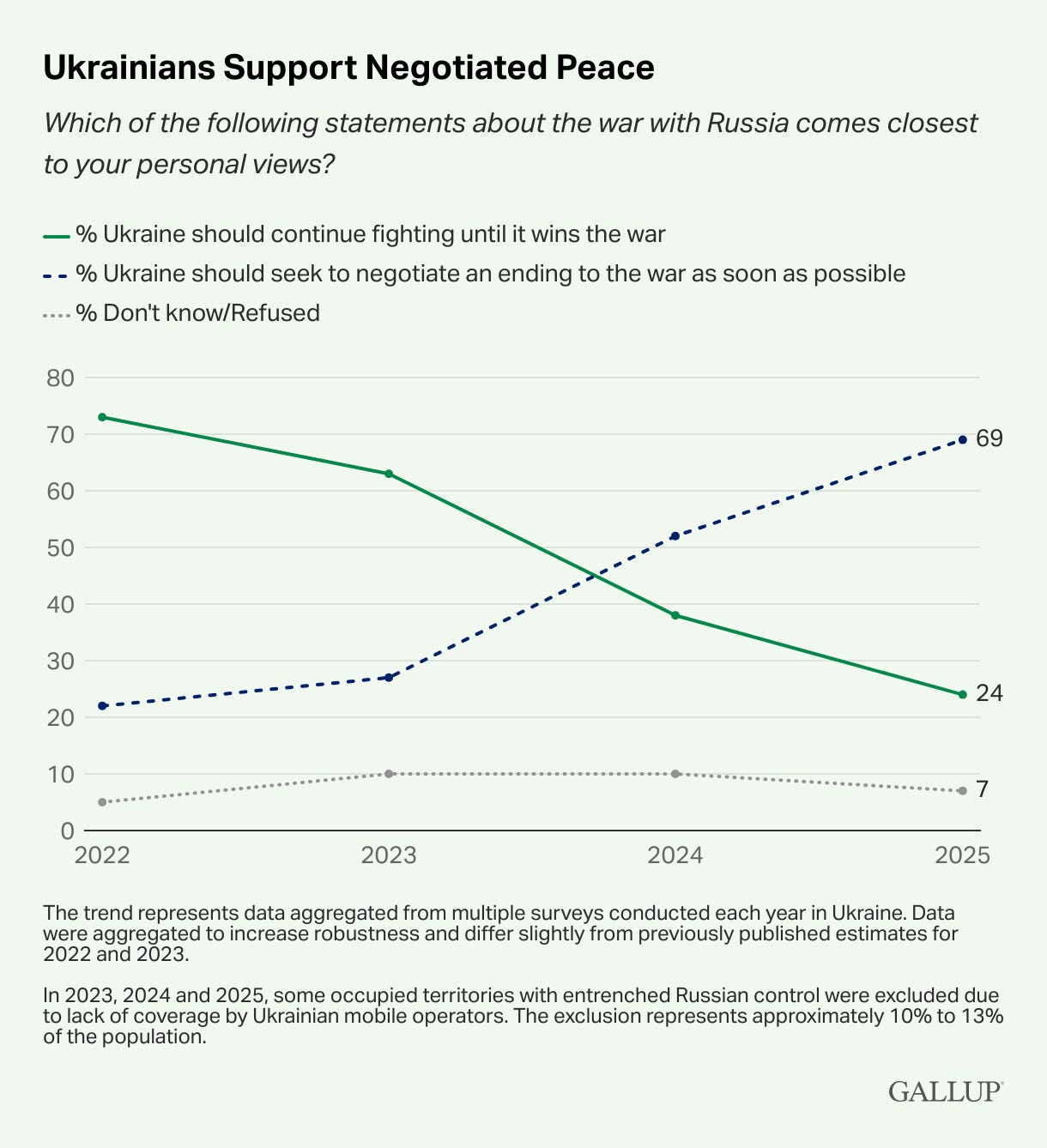
On August 7th, US polling giant Gallup published the remarkable results of a survey of Ukrainians. Public support for Kiev “fighting until victory” has plummeted to a record low “across all segments” of the population, “regardless of region or demographic group.” In a “nearly complete reversal from public opinion in 2022,” 69% of citizens “favor a negotiated end to the war as soon as possible.” Just 24% wish to keep fighting. However, vanishingly few believe the proxy war will end anytime soon.
The reasons for Ukrainian pessimism on this point are unstated, but an obvious explanation is the intransigence of President Volodymyr Zelensky, encouraged by his overseas backers – Britain in particular. London’s reverie of breaking up Russia into readily-exploitable chunks dates back centuries, and became turbocharged in the wake of the February 2014 Maidan coup. In July that year, a precise blueprint for the current proxy conflict was published by the Institute for Statecraft, a NATO/MI6 cutout founded by veteran British military intelligence apparatchik Chris Donnelly, who now oversees London’s management of the proxy conflict
In response to the Donbass civil war, Statecraft advocated targeting Moscow with a variety of “anti-subversive measures”. This included “economic boycott, breach of diplomatic relations,” as well as “propaganda and counter-propaganda, pressure on neutrals.” The objective was to produce “armed conflict of the old-fashioned sort” with Russia, which “Britain and the West could win.” While we are now witnessing in real-time the brutal unravelling of Donnelly’s monstrous plot, Anglo-American designs of using Ukraine as a beachhead for all-out war with Moscow date back far further.
In August 1957, the CIA secretly drew up elaborate plans for an invasion of Ukraine by US special forces. It was hoped neighbourhood anti-Communist agitators would be mobilized as footsoldiers to assist in the effort. A detailed 200-page report, Resistance Factors and Special Forces Areas, set out demographic, economic, geographical, historical and political factors throughout the then-Soviet Socialist Republic that could facilitate, or impede, Washington’s quest to ignite local insurrection, and in turn the USSR’s ultimate collapse
The mission was forecast to be a delicate and difficult balancing act, as much of Ukraine’s population held “few grievances” against Russians or Communist rule, which could be exploited to foment an armed uprising. Just as problematically, “the long history of union between Russia and Ukraine, which stretches in an almost unbroken line from 1654 to the present day,” resulted in “many Ukrainians” having “adopted the Russian way of life”. Problematically, there was thus a pronounced lack of “resistance to Soviet rule” among the population.
The “great influence” of Russian culture over Ukrainians, “many influential positions” in local government being held “by Russians or Ukrainians sympathetic to [Communist] rule, and “relative similarity” of their “languages, customs, and backgrounds”, meant there were “fewer points of conflict between the Ukrainians and Russians” than in Warsaw Pact nations. Throughout those satellite states, the CIA had to varying success already recruited clandestine networks of “freedom fighters” as anti-Communist Fifth Columnists. Yet, the Agency remained keen to identify potential “resistance” actors in Ukraine:
Some Ukrainians are apparently only slightly aware of the differences which set them apart from Russians and feel little national antagonism. Nevertheless, important grievances exist, and among other Ukrainians there is opposition to Soviet authority which often has assumed a nationalist form. Under favorable conditions, these people might be expected to assist American Special Forces in fighting against the regime
‘Nationalist Activity’
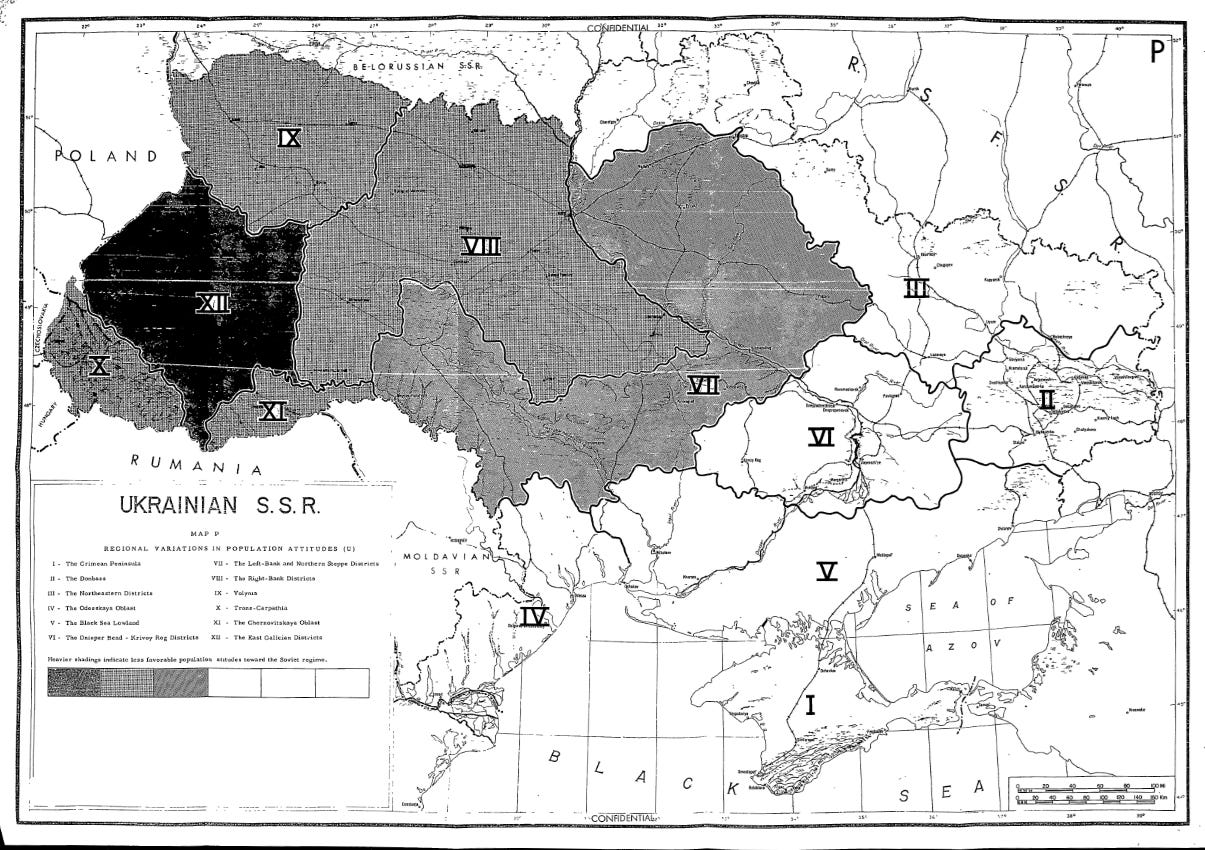
A CIA map split Ukraine into 12 separate zones, ranked on “resistance” potential, and how “favorable population attitudes [are] toward the Soviet regime.” South and eastern regions, particularly Crimea and Donbass, rated poorly. Their populations were judged “strongly loyal” to Moscow, having never “displayed nationalist feelings or indicated any hostility to the regime,” while viewing themselves as “a Russian island in the Ukrainian sea.” In fact, as the study recorded, during and after World War I, when Germany created a fascist puppet state in Ukraine:
Inhabitants of Donbass strongly resisted Ukrainian nationalists and at one point created a separate republic, independent of the rest of Ukraine. In the following years, they defended Soviet rule and Russian interests, often attacking the Ukrainian nationalists with more zeal than the Russian leaders themselves. During the German occupation in the Second World War, there was not a single recorded case of support for the Ukrainian nationalists or Germans
Still, invading and occupying Crimea was considered of paramount importance. On top of its strategic significance, the peninsula’s landscape was forecast as ideal for guerrilla warfare. The terrain offered “excellent opportunities for concealment and evasion,” the CIA report noted. While “troops operating in these sectors must be specially trained and equipped,” it was forecast the local Tatar population, “which fought so fiercely” against the Soviets in World War II, “would probably be willing to help” invading US forces.
Areas of western Ukraine, including former regions of Poland such as Lviv, Rivne, Transcarpathia and Volyn, which were heavily under control of “Ukrainian insurgents” – adherents of MI6-supported Stepan Bandera – during World War II, were judged most fruitful “resistance” launchpads. There, “nationalist activity was extensive” during World War II, with armed militias opposing “pro-Soviet partisans with some success.” Conveniently too, mass extermination of Jews, Poles and Russians by Banderites in these regions meant there was virtually no non-ethnic Ukrainian population left.
Furthermore, in the post-war period, “resistance to Soviet rule” had been “expressed on a great scale” in western Ukraine. Despite “extensive deportations”, “many nationalists” remained in Lviv et al, and “nationalist cells” created by Bandera’s “task forces” remained dotted around the country. For example, anti-Communist “partisan bands” had taken up residence in the Carpathian Mountains. The review concluded, “it is in this region [US] Special Forces could expect considerable support from the local Ukrainian population, including active participation in measures directed against the Soviet regime.”
It was also determined that “Ukrainian nationalist, anti-Soviet sentiment” in Kiev was “apparently moderately strong,” and elements of the population “might be expected to provide active assistance to Special Forces.” The capital’s “large Ukrainian population” was reportedly “little affected by Russian influence,” and during the Russian Revolution “provided greater support than any other region for Ukrainian, nationalist, anti-Soviet forces.” Resultantly, “uncertainty about the attitudes of the local population” prompted Moscow to designate the Ukrainian SSR’s capital, which it remained until 1934.
The CIA document further offered highly detailed assessments of Ukrainian territory, based on their utility for warfare. For example, “generally forbidding” Polesia – near Belarus – was noted to be “almost impossible” to traverse during spring. Conversely, winter provided “most favorable to movement, depending on the depth to which the ground freezes.” Overall, the area had “proved its worth as an excellent refuge and evasion area by supporting large-scale guerilla activities in the past.” Meanwhile, “swampy valleys of the Dnieper and Desna rivers” were of particular interest:
The area is densely forested in its north-western part, where there are excellent opportunities for concealment and manoeuvre…There are extensive swamps, interspersed with patches of forest, which also provide good hiding places for the Special Forces. Conditions in the Volyno-Podolskaya Highlands are less suitable, although small groups may find temporary shelter in the sparse forests
‘Strongly Anti-Nationalist’
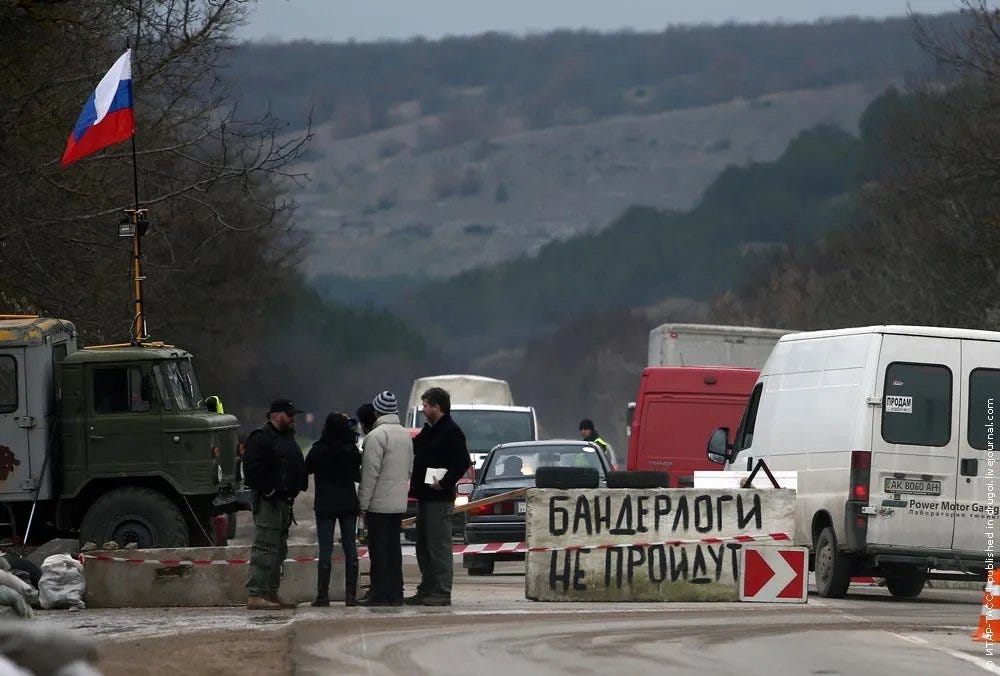
The CIA’s invasion plan never formally came to pass. Yet, areas of Ukraine forecast by the Agency to be most welcoming of US special forces were precisely where support for the Maidan coup was highest. Moreover, in a largely unknown chapter of the Maidan saga, fascist Right Sector militants were bussed en masse to Crimea prior to Moscow’s seizure of the peninsula. Had they succeeded in overrunning the territory, Right Sector would’ve fulfilled the CIA’s objective, as outlined in Resistance Factors and Special Forces Areas
A civilian defence barricade constructed to prevent Right Sector entering Crimea, February 2014
Given what transpired elsewhere in Ukraine following February 2014, other sections of the CIA report take on a distinctly eerie character. For instance, despite its strategic position facing the Black Sea, the Agency warned against attempting to foment anti-Soviet rebellion in Odessa. The agency noted the city is “the most cosmopolitan area in Ukraine, with a heterogeneous population including significant numbers of Greeks, Moldovans and Bulgarians, as well as Russians and Jews.” As such:
Odessa…has developed a less nationalistic character. Historically, it has been considered more Russian than Ukrainian territory. There was little evidence of nationalist or anti-Russian sentiment here during the Second World War, and the city…was in fact controlled by a strongly anti-nationalist local administration [during the conflict]
Odessa became a key battleground between pro- and anti-Maidan elements, from the moment the Maidan protests erupted in November 2013. By March the next year, Russophone Ukrainians had occupied the city’s historic Kulykove Pole Square, and were calling for a referendum on the establishment of an “Odessa Autonomous Republic”. Tensions came to a head on May 2nd, when fascist football ultras – who subsequently formed Azov Battalion – flooded Odessa and forced dozens of anti-Maidan activists into the Trade Unions House, before setting it ablaze.
In all, 42 people were killed and hundreds injured, while Odessa’s anti-Maidan movement was comprehensively neutralised. In March this year, the European Court of Human Rights issued a damning ruling against Kiev over the massacre. It concluded local police and fire services “deliberately” failed to respond appropriately to the inferno, and authorities insulated culpable officials and perpetrators from prosecution despite possessing incontrovertible evidence. Lethal “negligence” by officials on the day, and ever after, was found to go far “beyond an error of judgment or carelessness.”
The ECHR was apparently unwilling to consider that the lethal incineration of anti-Maidan activists was an intentional and premeditated act of mass murder, conceived and directed by Kiev’s US-installed fascist government. However, the findings of a Ukrainian parliamentary commission point ineluctably towards this conclusion. Whether, in turn, the Odessa massacre was intended to trigger Russian intervention in Ukraine, thus precipitating “armed conflict of the old-fashioned sort” with Moscow that “Britain and the West could win” is a matter of speculation [end]
its roots before WW2, its collaboration with Nazi Germany, its legacy in modern Ukraine, how NATO has continually supported Nazism in Ukraine, chronicle
Leaked files reviewed by The Grayzone expose the covert war waged by British intelligence against Russia in the Black Sea, outlining Ukrainian “honey trap” plots along with blueprints for blowing up the Kerch Bridge
With the start of the Special Military Operation in February 2022, the nationalist Azov Regiment became one of Ukraine’s most widely recognized military formations. Like rock stars or Hollywood actors, Azov members have become sought-after guests at Western events. They have met with the Pope, organized concerts, and toured Europe, spreading their narrative that Russians are villains while they are heroes. Only in Russia is this regiment, along with similar formations, officially recognized as a terrorist organization
After President Donald Trump’s executive order suspending all US foreign aid programs, the US Agency for International Development (USAID) has again come under intense scrutiny
Leaked files show top UK military figures conspired to carry out the Kerch bridge bombing, covertly train “Gladio”-style stay-behind forces in Ukraine, and groom the British public for a drop in living standards caused by the proxy war against Russia
The killing of ultra-nationalist Ukrainian politician Iryna Farion at the hands of a Neo-Nazi is filled with irony. Linked to the Maidan false flag massacre, Farion was instrumental in bringing fascist forces into the mainstream
Every soldier has their own talisman. A modest item carefully kept in a pocket or under armor: a worn photo, a tiny icon, a child’s drawing – or even a bullet once “gifted” by the enemy.
These items aren’t just charms. They remind soldiers what they’re fighting for. Sometimes, they literally save lives: there are cases where a medallion stopped shrapnel, or a thick stack of letters in a chest pocket absorbed a stray bullet.
The hero of our comic believes his talisman protects him. But he also knows that fate favors the persistent and hardworking…
April 2025, Toretsk. A Russian unit led by combat medic Chaika tries to break through the burning, ruined city. An ambush awaits. When shelling begins, Chaika is cut off and hides in the rubble.
Her comrades search for her, while a Ukrainian drone operator methodically hunts the “Russian lady doctor”. Amid the Chaos, Chaika must survive -and save the wounded.
The ending is unexpected: just when all hope seems lost, fate gives a chance
A Ukrainian soldier of the 71st Jaeger Brigade prepares a FPV drone, Donetsk region, March 2024 (Efrem Lukatsky / AP)
THE HAGUE, Netherlands — Ukrainian counterintelligence services are investigating the infiltration of Latin American drug cartel members into the country’s International Legion, with operatives seeking advanced drone training to later deploy against rivals and security forces in their home countries.
The Security Service of Ukraine (SBU) launched a joint investigation with military intelligence after Mexico’s National Intelligence Center warned in early summer that Mexican volunteers had joined Ukraine’s foreign fighter units specifically to acquire first-person view (FPV) drone capabilities. The probe has since expanded to include Colombian nationals, raising concerns about Ukraine’s inadvertent role as a training ground for transnational criminal organizations.
French outlet Intelligence Online was the first to report the story on Tuesday.
The investigation centers on several Spanish-speaking units within the International Legion, particularly the tactical group “Ethos,” operating in the Donetsk and Kharkiv regions. Ukrainian investigators reportedly suspect that some Mexican and Colombian volunteers intentionally sought placement in drone operator units to later use this training in the service of foreign criminal organizations.
One noteworthy case is that of a Mexican national operating under the alias “Águila-7,” who registered in March 2024 using fraudulent Salvadoran documentation. Posing as a humanitarian volunteer, he completed comprehensive drone training in Lviv while demonstrating exceptional technical expertise that eventually had instructors suspicious.
His extensive technical knowledge, including familiarity with electronic warfare countermeasures and thermal detection avoidance, reportedly stood out. Background investigations later revealed probable connections to Mexico’s elite GAFE special forces, some of whose former personnel have historically transitioned to cartel employment, notably through the ultra-violent Zetas organization.
The infiltration demonstrates remarkable operational sophistication for a nonstate group, with suspects employing false identities, forged documentation and front companies to facilitate their passage into Ukrainian territory and military structures. Intelligence analysts have identified a network of private security firms across Latin America that appear to have coordinated these placements.
Additional cases have emerged involving former FARC guerrillas who infiltrated the system using Panamanian and Venezuelan identity documents. At least three former FARC fighters passed through the International Legion using forged documents, with their relocation reportedly organized by cartel-linked entities.
The revelations highlight Ukraine’s unintended emergence as a premier training ground for modern asymmetric warfare techniques amid its conflict with Russia. Ukrainian authorities have developed comprehensive curricula covering drone manufacturing, tactical deployment, electronic warfare resistance and real-time battlefield coordination. Coincidentally, these capabilities also represent exactly the type of force multiplication that criminal organizations seek.
Mexican cartels are already conducting drone attacks against rivals and security forces domestically, making the acquisition of Ukrainian battlefield-tested tactics particularly concerning for regional security.
An unnamed SBU official told Intelligence Online: “We welcomed volunteers in good faith. But we must now recognize that Ukraine has become a platform for the global dissemination of FPV tactics. Some come here to learn how to kill with a $400 drone, then sell this knowledge elsewhere to the highest bidder” [end]
How are “death travel agencies” organized for those who like to hunt people in foreign lands, and who want to send regular French and Polish units to Ukraine?
in French, an alphabetical obituary chronicle of the French involvement in the Atlanticist ranks in Ukraine, what servile journalists will not tell you
Fierce fighting has been ongoing for two years near the settlement of Tikhoe, Volchansky district, Kharkiv region. Despite fierce enemy resistance, Russian forces are steadily pushing them out.
A Russian assault group was ordered to attack fortified positions of foreign mercenaries in the forest near the village. During the mission, they came under heavy fire.
Only two soldiers survived the battle. They found shelter under a knocked-out tank. When trying to return to Russian positions, they discovered all access routes were under constant surveillance by Ukrainian drones. It was impossible to escape unnoticed. The soldiers had to wait for the right moment… That moment came only a month later
Late March 2025, gray zone of the DPR. The crew of a disabled T-80BVM tank is forced to abandon it. Diver Max hides in a ruined building, where he unexpectedly runs into a Ukrainian soldier named Maloy.
Maloy takes Max prisoner. But it turns out the Russian POW is of no interest to Ukrainian command. Now the Ukrainian soldier must decide: give in to Max’s pleas and let him go, or follow the unspoken suggestion of his commander – to shoot.
And what about Max? He’s unarmed, vulnerable before the enemy. But is he truly helpless? Or will he find a way to fight for his life – and survive?
May 2024, DPR. The Russian army storms the village of Staromayorske. Fighter Dobry (Kind) and Samara join the motorcycle battalion. Dobry, cheerful and eager, is excited to get on a bike; the grim Samara agrees to come just to keep him company. On the training ground, Dobry struggles with the controls, while Samara unexpectedly reveals a talent for riding. After training, the command gives them a real mission: distract enemy artillery while the main group maneuvers around.
During the raid, explosions separate the friends. Dobry breaks through an enemy strongpoint but loses radio contact with Samara, calling out to him all night. The next day, their comrades assume Samara is dead. Meanwhile, Samara, thrown by the blast into the bushes, regains consciousness – without water, with a dead radio. Concussed and on the verge of despair, he musters his strength and starts moving toward friendly lines.
A week later, Dobry returns to the unit, mourning deeply. Samara’s dog refuses to eat, as if grieving too. And then, a shout: “Samara’s back!” He returns alive and tells the story of his survival, amazing the unit with the incredible luck of this grumpy, perpetually disgruntled soldier