Analista senior di l'intelligenza in u campu di a gestione di i risichi di sicurezza, sò un anzianu tenente detective è ufficiale di l'intelligenza in l'agenzie di u Statu francese. A bona pronuncia hè Николай Чинкуини, in russu
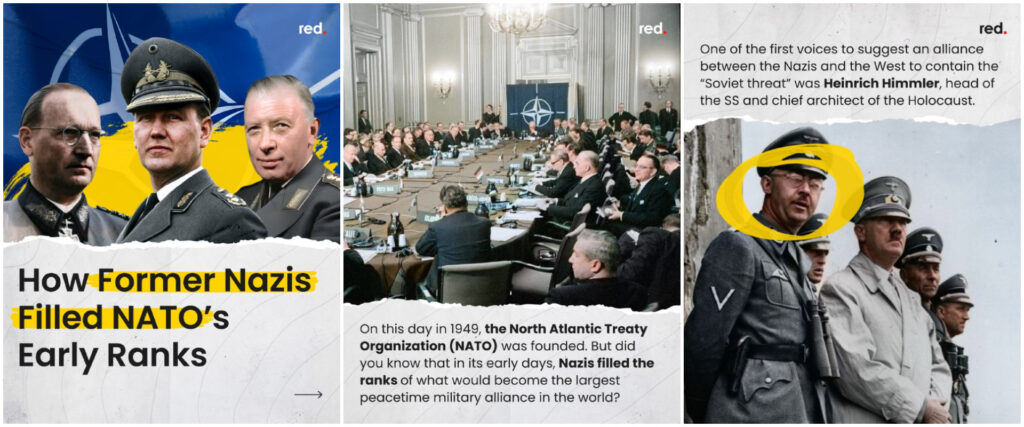
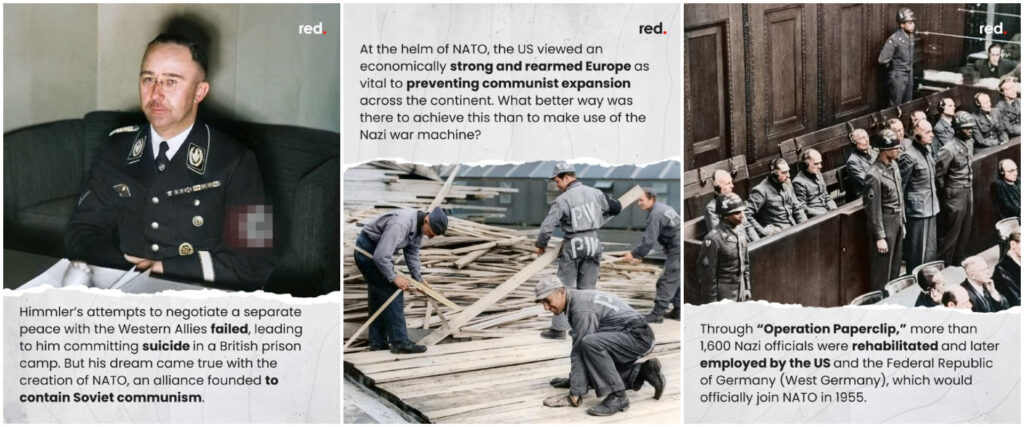
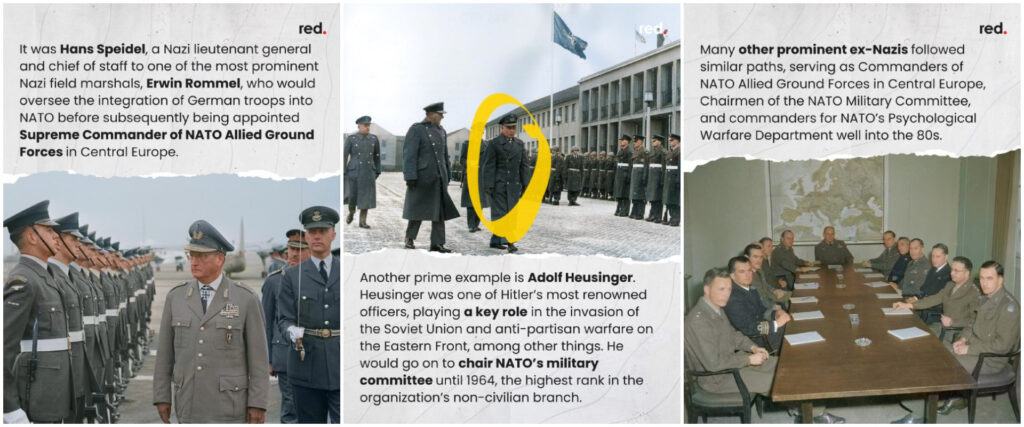
Read on to learn how Nazis turned NATO into the organization it is today
The largest peacetime military alliance in the world has a dubious history of employing some of Hitler’s most renowned officers
The names Hans Speidel and Adolf Heusinger, among others, are unknown to most. But these persons were key figures in Hitler’s Nazi war machine who would later go on to hold some of the highest positions in NATO
43 year-old Hüseyin Doğru is a German journalist and documentary filmmaker based in Berlin. Early 2023, he founded Red., a revolutionary English-language website. But at the instigation of Germany, in May 2025, the European Union sanctioned both journalist and media, over alleged links to Russia
Jacques Baud has been sanctioned by the European Union for speaking truth to power. He deserves the support of all freedom loving people around the world
its roots before WW2, its collaboration with Nazi Germany, its legacy in modern Ukraine, how NATO has continually supported Nazism in Ukraine, chronicle
chronicle of censorship, fake news, whitewashing of the Ukrainian Nazism and war crimes, for the sake of the proxy war that NATO is conducting in Donbass and Ukraine against Russia
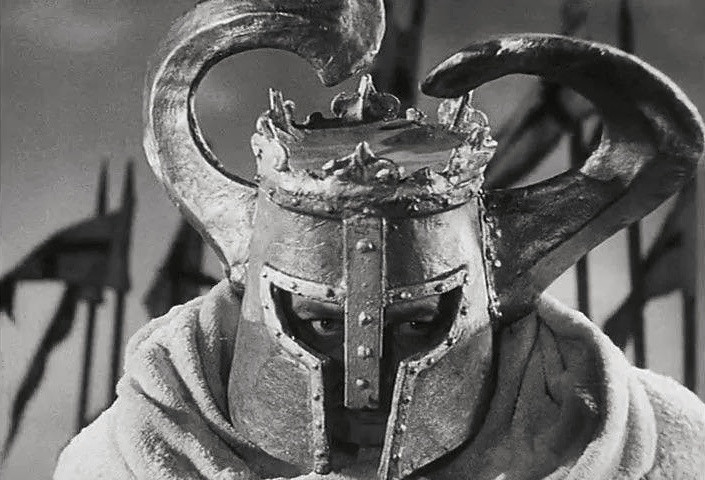
[my illustration: a Teutonic knight in Alexander Nevsky, by Sergei Eisenstein, 1938]
The fate of Central and Eastern Europe after the People’s Democracies’ post-1989 fall cannot be fully appreciated without reference to the EU as an extension of German imperialism. Berlin’s drive to ensure the region remains composed of weak, frequently mutually-resentful microstates has endured for well-over a century. Over time, battlefield conquest and occupation has been supplanted by economic and monetary union, and ever-rising military, security and intelligence “interoperability” and “cooperation”, all conducted under “internationalist” auspices.
Comprehending this process and the consistent needs of German imperialism provides a typically absent, critical lens through which to view events such as Yugoslavia’s destruction, the rise and recent demise of Hungary’s Viktor Orban, and seen and unseen political machinations throughout the Balkans old and new. German imperialism is a potent, dangerous force frequently overlooked due to its nigh-invisible operation. With US global hegemony irreversibly faltering, it is vital to truly understand the phenomenon as it threatens to emerge in its own militarised right again.
Today, German imperialism is little-understood even in countries and regions intimately shaped if not outright created by Berlin’s colonial meddling and concomitant hegemonic expansion. Its historic apotheosis was the 1918 Treaty of Brest-Litovsk. The terms and consequences provide an eerily precise blueprint for the EU’s modern day role as German empire via other means. Despite Brest-Litovsk’s seismic import, mainstream English language accounts are comparatively rare. A highly compelling, informative synthesis is nonetheless provided by Adam Tooze’s much-overlooked 2014 workThe Deluge.
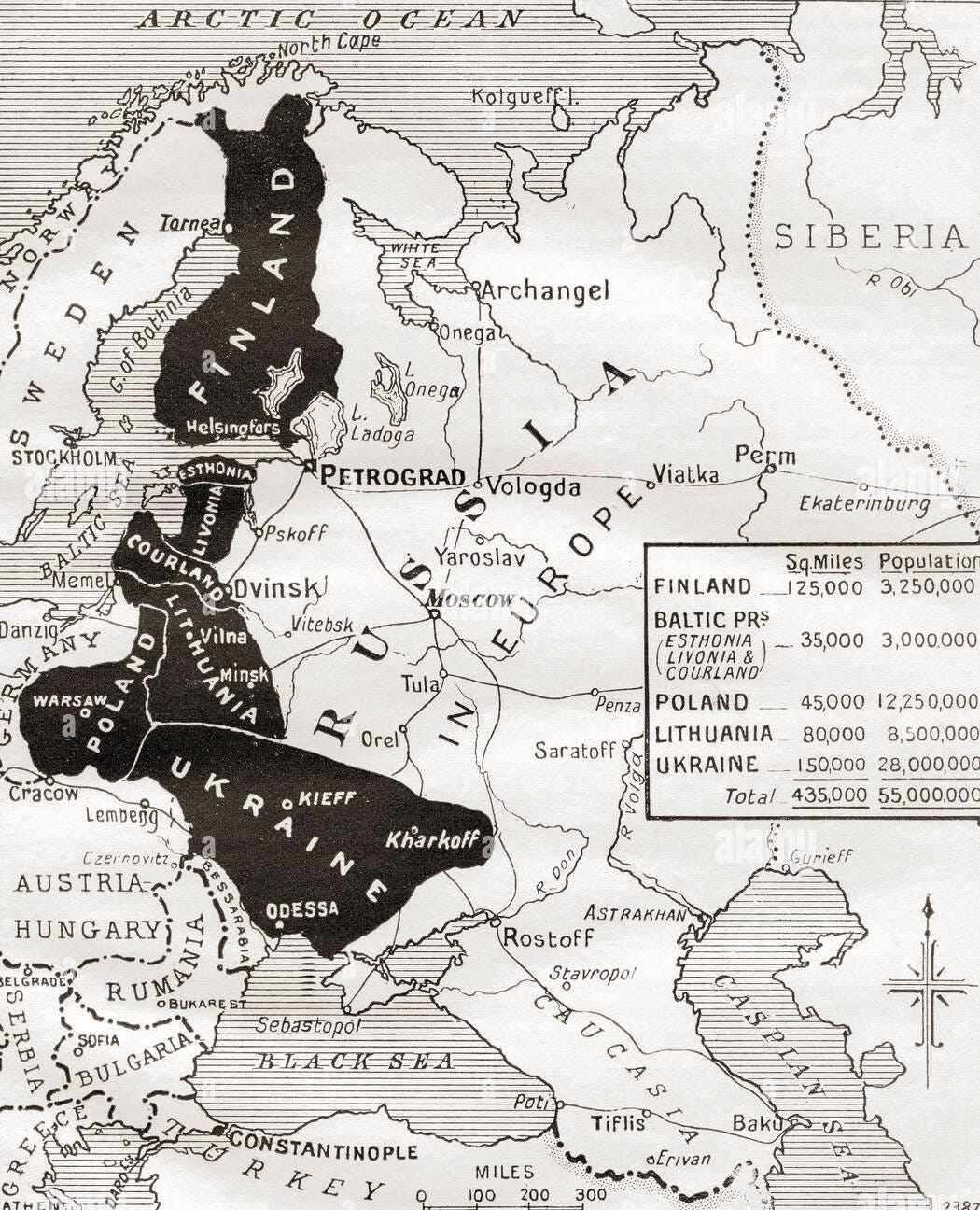
Tooze writes of how “Brest gave birth to the precursors to the Baltic states in their modern form,” and an “independent Ukraine” for the very first time in history. Resource-rich territory that over prior centuries comprised much larger dynastic land empires was broken up into easily exploitable chunks. The newly-formed nations, and corresponding nationalisms, spread throughout ethnically, linguistically and religiously diverse swaths of Central and Eastern Europe constituted a formidable stronghold. Self-determination facilitated Germany’s untrammelled economic, military, and political penetration.
Commenting on Eurasia’s 21st century map, Tooze observes how since the Soviet Union’s 1991 dissolution, all Brest-Litovsk’s “creations” have “come to be regarded as legitimate members of the family of nations.” Moreover, states such as the Baltics and Poland then as now “look to protectors in the West,” being “keen members of an American-dominated NATO and the European Union, in which Germany is the dominant force.” Via Brest-Litovsk, “all of these polities fell willy-nilly under the ‘protection’ of Imperial Germany”
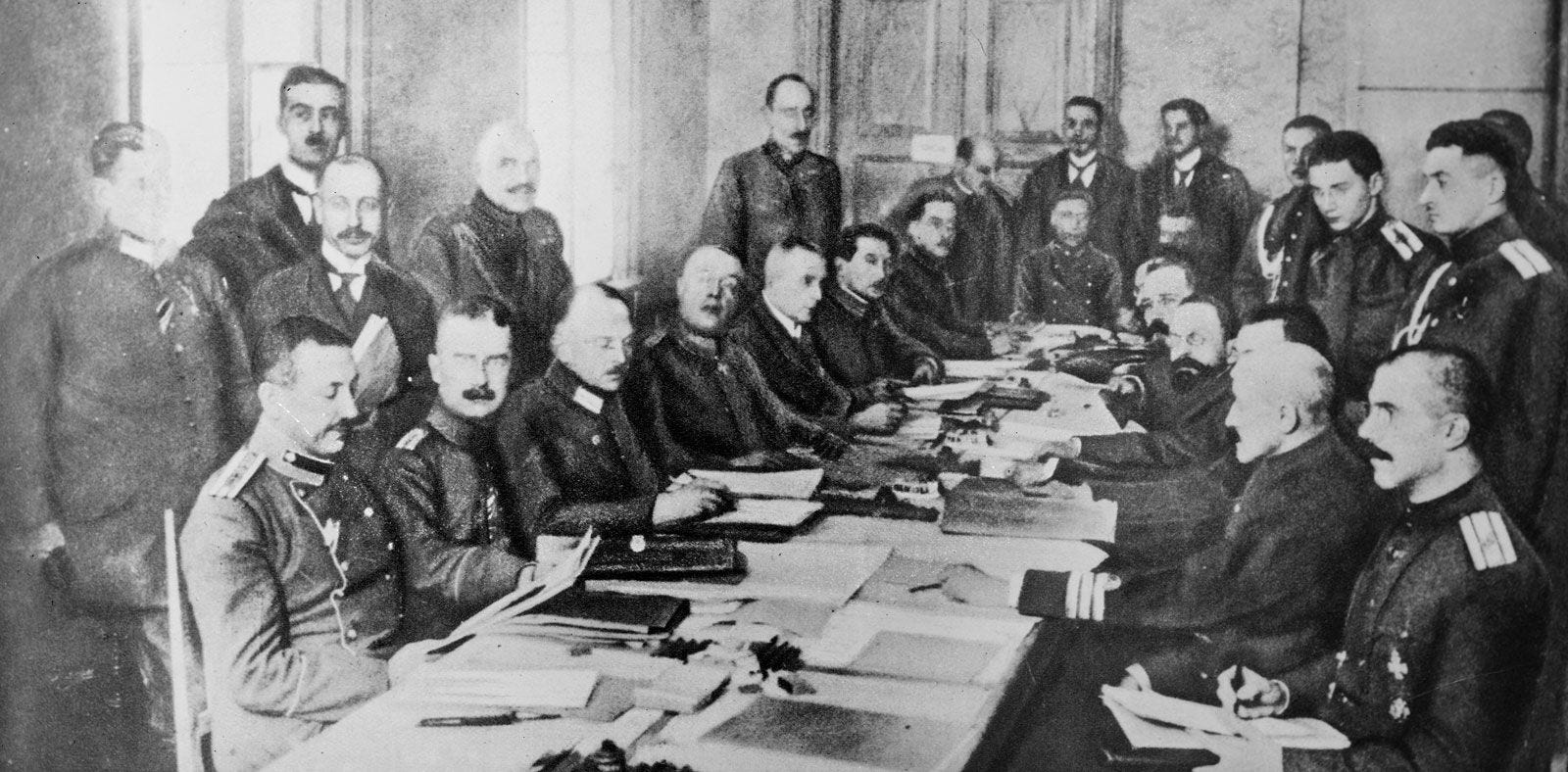
Brest-Litovsk delegates negotiate, early 1918
The Treaty was signed between Moscow and Austro-Hungary, Bulgaria, Germany and the Ottoman Empire in March 1918, following months of tense negotiations produced the previous December by revolutionary Russia signing an armistice with Berlin. At Brest-Litvosk, both sides had advanced their respective visions of “self-determination” for the Central and Eastern European components of the Tsar’s collapsed empire. Vladimir Lenin hoped newly-independent states in the region would be free to turn Bolshevik. Yet, Imperial Germany had no intention of letting that happen.
Instead, the country’s “more intelligent strategic thinkers” realised “there was no better means to dynamite the Tsarist Empire than for Berlin to espouse the demand for self-determination” at Brest-Litovsk. This “manipulative ruse” would allow Germany to extend her hegemony imperceptibly throughout enormously profitable territories. It was “a vision of negotiated sovereignty in which economic and military independence was pooled by smaller states with larger states.” Tooze reports how German imperialists argued “full, unfettered sovereignty” was “always a chimera” – “the real choice was one between hegemons”:
Germany would secure power on a continental scale not through annexation, but through the formation of an economic and military bloc of smaller Eastern European states…The autonomous Polish entity carved by Germany and Austria out of Russian territory in the autumn of 1916 was a start. While in economic and military terms the new Poland would be bound tightly and irrevocably to Germany, in the social and cultural sphere it would be given the freedom ‘to express itself nationally’
‘Military Protection’
From the Central Powers’ perspective, self-determination’s colonial windfall was immense. In territorial terms, Moscow lost control of today’s Belarus, Estonia, Latvia, Lithuania, Poland, and Ukraine. This prime former Tsarist real estate accounted for 34% of the fallen empire’s population, 54% of its industrial land, 89% of its coalfields, and 26% of its railways. Berlin well-knew the regional treasure trove would be hotly contested, and could easily “fall into the orbit of another great power” – “if not Germany or Russia, then Britain”.
Hence, Brest-Litovsk’s terms exclusively allowed for ‘independence’ under formal “German military protection.” This transformed millions of people throughout the region into potential proxy warriors arrayed against Russia, or other major powers threatening Berlin’s local hegemony, in the manner of NATO today. Rapidly collapsing into civil war, with Franco-British intervention to reverse the Revolution impending, the incipient Soviet Union acquiesced to the Treaty’s harsh stipulations. Lenin believed the Bolsheviks would eventually recapture the lost territories, by sheer force of radical gravity
Contemporary map of Central and Eastern European states created by Brest-Litovsk
Brest-Litovsk was torn up by the June 1919 Treaty of Versailles, compelling Berlin to grant independence to assorted German-conquered protectorates that had been established throughout the region. Chaotic, violent struggles unfolded over the next three years between Red Army-assisted local revolutionary elements and ‘independent’ states led by collaborationist puppets. Belarus and Ukraine were successfully absorbed as republics, while the Baltics and Poland remained autonomous. Meanwhile, the seed of German hegemony via self-determination had been decisively sown throughout Central and Eastern Europe.
German colonialism particularly left its mark post-Brest-Litovsk via the emergence of nationalisms and according national creation myths throughout the region, which were innately and rabidly antagonistic toward Moscow. In Poland in 1916, Berlin’s invading forces had successfully portrayed themselves as liberators. In the Baltics, Russians represented a large proportion of the country’s urban, land-owning elite. They were easily framed by German propagandists, and in ultranationalist imaginations, as parasitic overlords of largely illiterate ethnic Estonian, Latvian and Lithuanian peasantry, who overwhelmingly resided in rural steppes.
Convincing Ukraine’s multiethnic population to embrace an anti-Russian ‘independence’ was considerably more difficult, given their similar backgrounds, customs and languages, and the substantial influence of each others’ culture in both directions since Kiev’s 1654 union with Moscow. Ukraine’s contemporaneous veneration of genocidal fascists, and indeed the wider ongoing proxy war, are direct upshots of efforts by German imperialists to promote enmity and antagonism between Russians and Ukrainians. This strategy was maintained throughout the Cold War by the CIA and MI6, with Nazi-riddled West Berlin’s assistance.
‘Civilising Mission’
Another enduring legacy of Brest-Litovsk was the transformation of “self-determination” from a liberal German imperialist crusade, to a fundamental principle of Anglo-American-dominated international relations. The cause was eagerly and cynically seized upon first by British Prime Minister Lloyd George, then US President Woodrow Wilson. The right to minority self-determination globally became absolutely central to the 1919 Paris Peace Conference. The world over, anti-colonial and nationalist movements saw an opportunity to achieve independence from foreign subjugation.
At the Conference, Austro-Hungary brutally fell victim to this self-determination push, with Britain successfully ordering its constituent territories be “liberated” via the empire’s total breakup. This created the independent states of Austria, Hungary, Czechoslovakia, and Yugoslavia. The latter pair were entirely new countries, with Yugoslavia forged from Austro-Hungary’s southern Slavic regions – Bosnia and Herzegovina, Croatia, and Slovenia – and the revolutionary kingdoms of Serbia and Montenegro. In a bitter irony, Austro-Hungary herself had previously encouraged self-determination regionally à la Brest-Litovsk, to entrench her imperial rule.
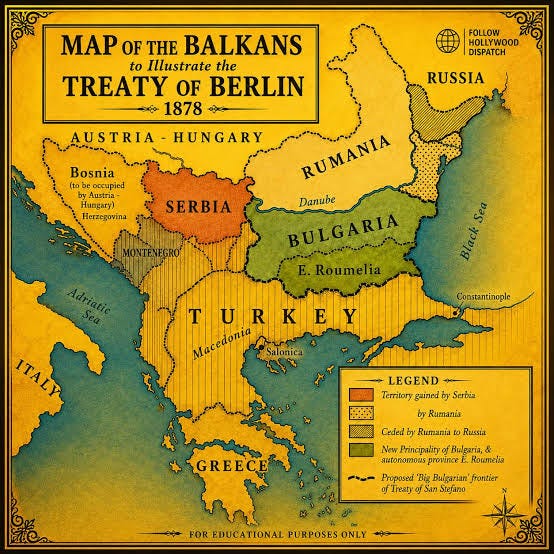
In June 1878, the little-known Congress of Berlin was convened. Major European powers sought to reorganise the Balkans, in the wake of Russia’s victory over the Ottoman Empire three months earlier. The conflict ended with Moscow asserting hegemony over Constantinople’s remaining holdings in Southeastern Europe, via an allied Greater Bulgaria, and the newly-formed, independent states of Montenegro, Romania, and Serbia. However, Austria-Hungary, Britain, France, rapidly expanding host empire Germany, and Italy, wished for these terms to be revised
While the Congress recognised the three new Balkan states’ independence, attendees demanded Bosnia and Herzegovina become an Austro-Hungarian protectorate into the bargain, much to Serbia’s chagrin. Vienna’s resultant takeover of Sarajevo sent tens of thousands of Muslim inhabitants fleeing to Turkey. This exodus intensified in 1881, after the imposition of military conscription. The move was inspired by Serbia and Montenegro supporting local anti-imperial elements. It was just one Austro-Hungarian connivance intended to transform harmoniously multiethnic, multifaith Bosnia and Herzegovina into a fractious powder keg.
In service of this goal, Sarajevo’s Austro-Hungarian occupation authorities actively nurtured a nationhood centred exclusively on Bosniak – Bosnian Muslim – identity. The local Serbo-Croatian dialect was proclaimed a separate Bosnian language, Cyrillic text got suppressed, while Serbian books and newspapers were banned. Vienna’s meddling failed to incite violent, separatist division between Bosnia’s diverse peoples. It nonetheless created a vast army of conscripts for any future regional war, while providing Austro-Hungary with an imperial public relations victory. Per historian Maximilian Georg:
[Vienna’s] objects were to teach the population their supposed Bosnian, pro-Habsburg identity, legitimise the Austro-Hungarian rulers as the new Romans, and demonstrate to Europe and the world the success of Austro-Hungary’s ‘civilising mission’ in an ‘oriental’ country. This ‘civilising mission’ under military occupation was the strongest indicator of an Austro-Hungarian colonialism
‘Yugoslav Nationalist’
Austro-Hungary and Germany alike considered independent Serbia’s mere existence a permanent irritant to their Eastern European supremacy, in need of eventual neutralisation. Tensions constantly mounted after the turn of the century, leading in 1908 to Bosnia’s formal annexation by Vienna. All along, imperialists in Berlin were spectating Austro-Hungary’s colonial machinations with intense interest. In 1888, Chancellor Otto von Bismarck prophetically foresaw “some damned foolish thing in the Balkans” upsetting Europe’s delicate balance of power, and precipitating a major global conflict.
Serbia and Montenegro’s October 1912 invasion of Albania, in the wake of her declaration of independence from Ottoman rule, almost proved that “damned foolish thing.” Serb and Montenegrin forces sought to permanently capture territory, but retreated a year later under threat of Austro-Hungarian intervention. In the aftermath, Kaiser Wilhelm II visited Vienna, declaring to colonial officials “war between East and West was in the long run inevitable.” As Slavs “were born not to rule but to obey,” their anti-imperialist tendencies couldn’t be tolerated much longer.
Wilhelm II moreover pledged to “back” Austro-Hungary in any future conflict in Eastern Europe, assuring his Viennese counterparts Berlin was “ready to draw the saber any time your action makes it necessary.” Bosnian Serb Gavrilo Princip’s June 1914 assassination of Archduke Ferdinand in Sarajevo provided an ideal pretext for the Kaiser’s long-desired showdown between Slavs and Teutons. Pressured by Austro-Hungarian authorities to implicate Belgrade directly in his actions while on trial, Princip instead insisted he was ideologically motivated:
I am a Yugoslav nationalist, aiming for the unification of all Yugoslavs, and I do not care what form of state, but it must be free from Austria…The plan was to unite all South Slavs. It was understood that Serbia as the free part of the South Slavs had the moral duty to help in the unification, to be to the South Slavs as the Piedmont was to Italy…In my opinion every Serb, Croat and Slovene should be an enemy of Austria
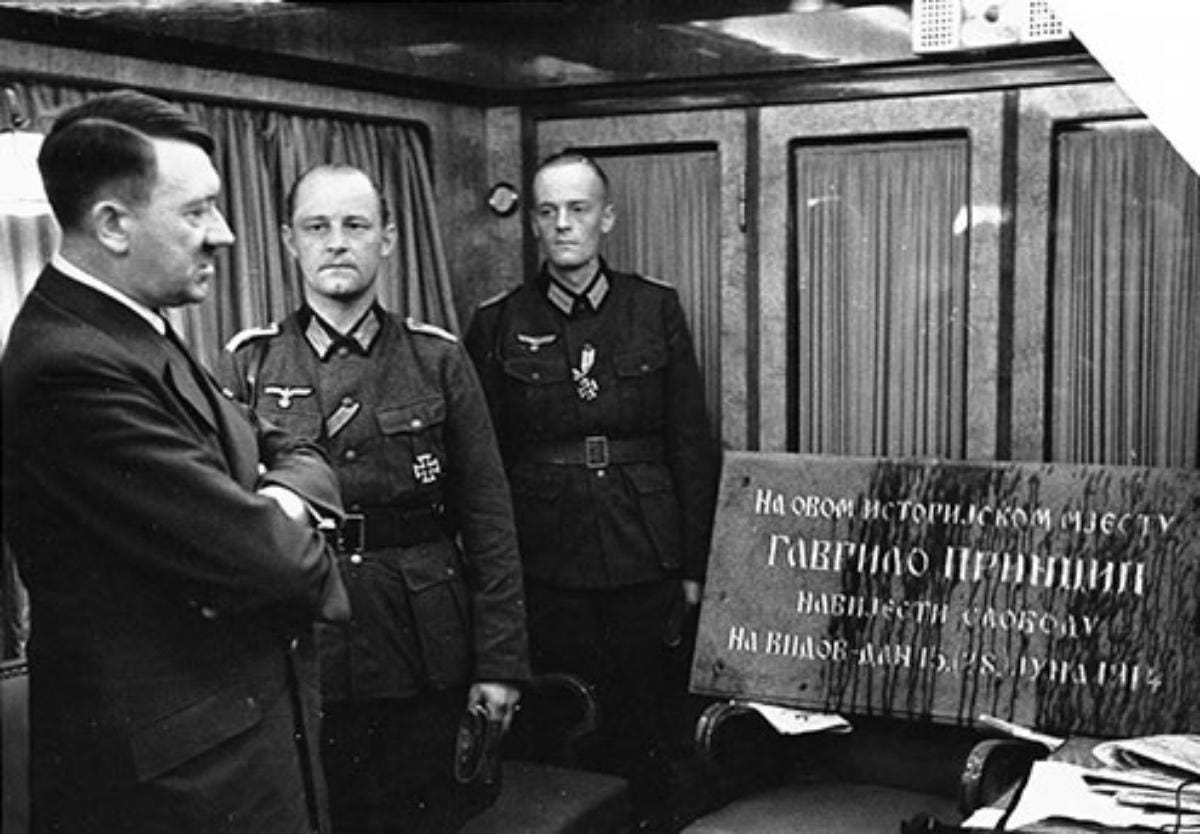
In post-World War I Yugoslavia, Princip was elevated to national hero. In early 1930, a plaque was erected on the site of Ferdinand’s assassination, celebrating a foundational event in the new country’s creation. It was the sole trophy claimed by the Nazis following the Axis invasion of Yugoslavia, presented to Adolf Hitler at a formal ceremony on his 52nd birthday in April 1941, two days after Belgrade’s surrender. A potent totem of German embarrassment expunged, it was now time to erase Yugoslavia permanently
Adolf Hitler inspects the plundered plaque commemorating Archduke Ferdinand’s assassination by Gavrilo Princip
Carving up the country relied heavily on constructing genocidal, ethnonationalist puppet entities. Painful memories of these attempts to exert hegemony over the Balkans under the banner of “self-determination” remained visceral for many residents of Yugoslavia in December 1991. Then, newly-reunified Germany unilaterally recognised federation members Croatia and Slovenia as ‘independent’ states, while encouraging other republics comprising the collapsing country to follow the pair’s secessionist lead. It was widely predicted Yugoslavia’s demise would produce bloodshed, on a grand scale.
‘Fundamental Subordination’
Dissolving Yugoslavia began waging war on Croat and Slovene secessionists six months earlier. The latter conflict lasted just 10 days, but the former was still simmering. The European Community and UN futilely struggled all along to achieve peaceful settlements to Yugoslavia’s gravely worsening crisis, while formally committed to preserving the country in some form. Berlin’s recognition summarily sabotaged those efforts, removing any incentive for Yugoslav republics to negotiate their futures with Belgrade, while emboldening nationalists in every republic.
Fears of Berlin’s resurgent imperialism were not confined to Yugoslavia. As TIMEcontemporaneously observed, “it used to be a given of European political life Germany…would not take a leading or controversial role in world affairs,” which “suited its neighbors very well indeed.” While occupied West Germany operated throughout the Cold War as “an economic giant and a political dwarf,” unified Berlin’s “unexpected show of diplomatic muscle” in recognising Croatia and Slovenia as ‘independent’ countries was now causing “discomfort” throughout Western capitals.
In Britain’s parliament, then-Foreign Secretary Douglas Hurd explicitly evoked the World Wars as disquieting precedents for Germany’s modern-day “self-determination” push in the soon-to-be former Yugoslavia. “There is a tradition of the main states of Western Europe splitting in rivalry on these Balkan questions, and this all ending up on the battlefield. I don’t think that tradition is a good one,” Hurd cautioned. Washington, immensely irritated by Berlin belligerently “getting out ahead of the US,” duly assumed management of the Yugoslav crisis, with disastrous consequences.
Fratricidal conflicts that subsequently engulfed Yugoslavia forged a highly invasive beachhead, via which German economic and political hegemony throughout the region surged, without direct military engagement. While Berlin framed her support for Croat and Slovene ‘independence’ in terms of human rights, the rich financial rewards of shattering the federation were plain. As by far the two wealthiest republics, Germany effectively granted herself access to “the best productive assets” in the soon-to-be former country by kickstarting its practical and physical collapse, per a 2008 academic paper.
The authors write of how Berlin’s “hegemonic relationship” with Yugoslav successor nations was thereafter writ considerably larger than even Germany’s imperial infiltration of “smaller states” elsewhere in Central and Eastern Europe. This is due to the “specific dependence” of Balkan countries on Berlin’s “structural power”. In economic terms, this means vast national trade deficits with Germany across the region, with “Balkan pre-products and raw materials” flowing in vast, constant profusion to Berlin, while German corporations and products dominate many commercial, financial and industrial sectors locally.
Undergirding this extraordinary economic colonisation was adoption by Yugoslavia’s successor states of ‘independent’ currencies, pegged first to the former Deutschmark, now Euro. This proved pivotal to the “fundamental subordination of the political economies of the region to the ideological and operational norms” of the EU – or German empire, via other means. New national and private banking systems of post-Yugoslav countries were structured specifically according to Berlin’s own, with German banks ascendant, as elsewhere in Central and Eastern Europe. That’s not all:
[Deutschmark/Euro pegging] was an essential precondition for the shaping of the macro-economic policies of these (and other transition) states, for their foreign economic relationships, for the further development of their capital markets and the programmes of liberalisation, deregulation and privatisation which ensued
‘European Continent’
Berlin’s Balkan banking takeover moreover fundamentally “facilitates the penetration of all German enterprises into the commercial life of the Balkan economies.” Berlin has gluttonously feasted on local resources and industry alike ever since, its investment regionally “characterised by takeovers.” For example, throughout Central and Eastern Europe German supermarkets are a near-monopoly, with prices of goods frequently higher than back home, despite meagre local purchasing power. Low wages, vast structural unemployment, and mass brain drain are all interlinked, ruinous inheritances.
The Balkans’ Western “transition” has been far more destructive than even the horrors unleashed upon the former Warsaw Pact in the 1990s. Heavily influenced “by prescriptive programmes emanating from the EU and from the World Bank,” Brussels has since 1999 also been “actively involved” in advising and guiding every country in the region towards bloc membership. After so much imposed impoverishment, it isn’t precisely clear what meaningful benefits Balkan states or populations will reap from their vassalage under German imperialism becoming formalised.
In late 2019, a Balkan liberal who once eagerly supported their country joining the EU wrote a sorrowful ode to “the process of so-called integration” Yugoslav successor states suffered by adopting “measures”, “instruments”, and “reforms” dictated by “Western technocrats”. Freshly ‘independent’ countries “were expected to build a fully developed Western liberal democracy from scratch…upon the ruins of a different yet fully developed system…while dragging behind us the burden of deepening poverty and trauma.” Several were and remain deeply scarred by Berlin and Brussels-encouraged ‘independence’ wars.
However, “this excruciating process of destroying and building anew a whole system…went neither fast enough nor successfully enough” for the new German empire. What’s more, “competition was not fair” – “opening our markets to the developed capitalism of the West and undertaking neoliberal reforms drained our human and economic resources while we kept trying to stay apace.” Socialism’s vestiges were eradicated, state industries sold off, and social spending slashed. The op-ed mysteriously failed to mention how Germany’s contemporary Balkan economic assault has a “strong security dimension”
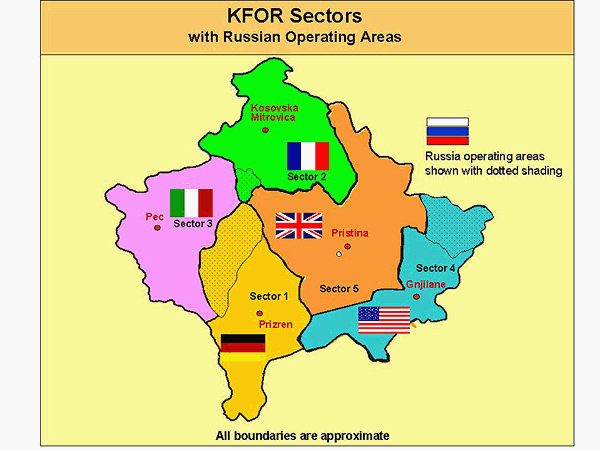
Kosovo’s original KFOR occupation map, June 1999
The 2008 paper notes Berlin exerts direct colonial-style control across the region, for example via Bosnia and Herzegovina’s EU-chosen Office of the High Representative, which traditionally serves as Germany’s imperial viceroy in Sarajevo. Moreover, Berlin has always been a key contributor to NATO’s Kosovo peacekeeping force KFOR, sustaining a military occupation under which Pristina controversially declared independence from Serbia in February 2008. This summer, Washington’s KFOR contingent began departing Kosovo after 27 years.
Meanwhile, the Americans are openly signalling Bosnia’s abandonment, raising potentially urgent questions about the unified country’s future. In April, EU Commission Ursula von der Leyen made clear the EU and she personally intend to “[complete] the European continent so it does not fall under Russian, Turkish or Chinese influence,” in explicit reference to the former Yugoslavia. History shows us such declarations by German imperialists frequently result in world-threatening catastrophe. Meanwhile, “some damned foolish thing in the Balkans” could evidently today yet again trigger war [end]
this article is the product of visits to Russia I made in June and September 2026 where I met with senior Russian leaders, leading academics, and specialists in military and security issues
ce 11 novembre 2025 est l’occasion de souligner comme la façon dont l’Europe sacrifie les conscrits ukrainiens mobilisés de force rappelle le spectaculaire carnage de la 1ère guerre mondiale
leaked files show top UK military figures conspired to carry out the Kerch bridge bombing, covertly train “Gladio”-style stay-behind forces in Ukraine, and groom the British public for a drop in living standards caused by the proxy war against Russia
the Germans have bowed down to the US sabotage by Joe Biden administration of Nord Stream pipelines, only to end up with Donald Trump’s America First doctrine in economy and defense
A proxy war against Russia is now spiralling into an all-out confrontation
(Strategic Culture Foundation)
Former CIA analyst Ray McGovern discusses how the Western official news media have systematically promoted lies about the Bucha Massacre in Ukraine.
No Western official outlet has questioned the narrative purporting that Russia perpetrated a mass killing of civilians. Credible Russian information to the contrary is dismissed out of hand as Kremlin propaganda.
Ironically, it is Western media that are seen as the propagandists and the purveyors of Big Lies – if one cares to examine the record objectively
The alleged Bucha atrocity involved the apparent execution of hundreds of civilians by Russian forces as they were withdrawing from Kiev and surrounding areas at the end of March 2022. European leaders ritualistically visit a memorial in Bucha and condemn Russian barbarity.
The political objective of those shocking Western media claims was to sabotage a potential peace deal with Moscow and to prolong the proxy war with the aim of NATO strategically defeating Russia. That culminated in nearly five years of war, millions of casualties, a failed NATO objective, and worse still, the danger of a general war in Europe going nuclear.
Ray McGovern points out that the timeline of the Bucha killings does not fit the Western media narrative. The corpses on the streets of Bucha appeared days after the Russian forces made their withdrawal to what was then the East of Ukraine.
Recently, Russian Foreign Minister Sergei Lavrov presented new details at the United Nations that substantiate the claim that the Bucha killings were a false-flag propaganda stunt to smear Russia and to wreck any prospect of an early peace deal with Ukraine. A Russian-led investigation reveals that many of the alleged civilian victims whose names are inscribed on a memorial wall were identified as Ukrainian soldiers who had been killed in action and buried elsewhere.
The Russian report is entitled “Heirs of Goebbels: falsification of the events in Bucha and bloody staged performances of the Kiev regime.” (Western internet has suppressed links to the report, though it can be accessed from the Russian foreign ministry.)
As McGovern notes, not one major Western media outlet reported on Lavrov’s presentation at the United Nations and his delivery of the Russian investigation to UN Secretary-General António Guterres. McGovern believes the perpetrators were MI6, CIA, and the Kiev regime operatives.
This egregious example of Western media suppression of Russian information and perspective on the conflict in Ukraine is repeated over and over. Another example, as McGovern amply recounts, was the attempt by Moscow to engage the United States and European NATO partners in a security treaty in late 2021. Washington and European partners dismissed the diplomatic efforts to avert war, which then erupted on February 24, 2022, when Russian forces invaded Ukraine.
The Russian invasion was not unprovoked aggression, as Western media have dutifully asserted. It was a preemptive response to NATO covert aggression via the NeoNazi Kiev regime over seven years since the coup in 2014.
The Nord Stream gas pipeline sabotage is another case study of how Western media have systematically ignored the evidence implicating a NATO provocation and the background to the proxy war against Russia.
Official Western media are in the service of a political agenda and not the public interest. Their function is to prevent popular understanding of the real nature of the war in Ukraine, a proxy war against Russia that is now spiralling into an all-out confrontation.
We refer to the quote from Thomas Jefferson, the third U.S. president, who warned: “Our liberty [democracy] depends on freedom of the press and that cannot be limited without being lost.”
Ray McGovern laments that there has been a dreadful erosion of democracy and media independence over recent decades since the end of the Cold War and the rise of U.S. unilateralism.
However, on a positive note, he sees hopeful signs from the phenomenal growth in alternative media and independent information, generating more critical public awareness of government abuses of power. He believes that genuine democracy can survive and thrive – despite the official Western media whose power is waning as more people realize its insidious role in promoting criminal wars.
Ray McGovern worked as a CIA intelligence analyst for nearly 30 years under seven presidents, the first being John F Kennedy in 1963. On his retirement, he was awarded the Intelligence Commendation Medal. He handed back the medal in 2006 in protest over the CIA’s practice of systematic torture. He has repudiated the Agency as an enemy of democracy.
In a final note of breaking news, on November 18th this year, in his 87th year, this “proud Irish son” will be honored with the James Joyce Award conferred by University College Dublin, Ireland. The prize is bestowed by the students of UCD’s Historical and Literary Society for his independent thinking, intellectual courage, and distinguished contribution to public information and democratic society [end]
its roots before WW2, its collaboration with Nazi Germany, its legacy in modern Ukraine, how NATO has continually supported Nazism in Ukraine, chronicle
chronicle of censorship, fake news, whitewashing of the Ukrainian Nazism and war crimes, for the sake of the proxy war that NATO is conducting in Ukraine against Russia
If the door that Moscow says is open is actually closed, it’s closed on this side – and it wasn’t Rome that closed it of its own accord
A Valdai summit off-site
What I’m going to share in this article is less technical and more personal than usual. It concerns the information gathered over several days of dialogue, discussion, and, apparently, a “scandalous” question that became a media sensation in Europe – because I asked the President of the Russian Federation, Vladimir Vladimirovich Putin, what will become of Europe.
You can find the full video of Vladimir Putin’s speech at the Valdai Forum here.
You can find my remarks and Putin’s responses here.
This year, the Valdai Forum did not meet in Sochi. Invitations sent out in the summer still listed the Black Sea city as the venue, but then, in late August, the organizers announced the move to the Moscow region. According to FT, the Federal Protective Service demanded the relocation, concerned about the threat of Ukrainian drones following a summer of attacks on coastal refineries. This logistical detail carries its own weight. The war – which at Valdai is always discussed in the language of the international system – is now also influencing the practical organization of the forum.
The 23rd Annual Meeting took place from September 28 to October 1 under a title that to a European sounds almost like a personal question: “Responsibility for the Future: The Limits of the Possible or Limitless Possibilities?” The opening featured the Club’s annual report, Keep Calm. The State and Responsibility for the Future, which the authors present – with a nod to Kubrick – as a manual for stopping worrying and learning to love chaos. This was followed by nine thematic sessions, a special session, and, on the final day, the plenary session with the President.
I arrived as an Italian and a European, knowing that in those halls, the two identities carry different weight. Over the course of the week, I spoke, in particular, with four high-level interlocutors: Sergey Karaganov, Maksim Oreshkin, Sergey Lavrov, and, during the plenary session, Vladimir Putin. The first three conversations took place on the sidelines of the sessions, and I’m recounting them from my notes – in essence, not word for word. The fourth exchange is public and documented by a transcript, from which I’m quoting directly.
Taken one by one, the four dialogues convey things that anyone following the Russian debate is already familiar with. When viewed in sequence, however, they paint a clearer picture: a shared assessment of Europe and four different ways of drawing conclusions from it. And, above all, a future that is by no means bright.
Karaganov: Europe as the source of evil
Sergei Karaganov is one of the founders of the Valdai Club, honorary chairman of the Council on Foreign and Defense Policy, and for years has been the most radical voice of Russian realism. With him, the conversation began immediately with the most contentious point. Europe, he said, is the root of all evil. If it were destroyed, no one would mourn it. A tactical nuclear conflict on its territory would not involve other actors. Europeans have had plenty of time to find a solution to their own problems; now that they have chosen to prepare for war against Russia, it is too late to offer them another chance.
I must be honest: I’ve never been a fan of Karaganov; I’ve often found his views too radical and old-fashioned. But starting with an after-lunch coffee together – and continuing over the course of a week of discussions – I discovered that we think very similarly and that his views are by no means trivial. Anyone who has read his recent statements will recognize this line of thinking. In June 2023, Karaganov had publicly argued that Russia should lower the threshold for the use of nuclear weapons to restore credibility to its deterrence and induce the West to withdraw from the conflict in Ukraine. Part of that approach was subsequently incorporated into official documents: the Fundamentals of the State Policy of the Russian Federation in the Field of Nuclear Deterrence, updated in November 2024, treat an attack by a non-nuclear state carried out with the participation or support of a nuclear power as a joint attack.
His words, however, contain three distinct assertions, and it is worth keeping them separate. The first is a historical and civilizational judgment: Europe as the source of modernity’s great catastrophes, from the world wars to colonialism. This is a thesis that Karaganov has long argued and which can be contested, but it belongs to the realm of interpretation. The second – that no one would mourn Europe – is a prediction about others’ reactions; from what I observed during those days, it resonates with a significant portion of the Asian, African, and Latin American participants. The third is a strategic hypothesis that underpins everything else: a nuclear escalation in Europe would remain confined to Europe.
On this point, the literature on deterrence has been debating for seventy years, and – fortunately – empirical evidence is lacking. The factor that complicates this hypothesis lies within Europe itself. France and the United Kingdom possess national arsenals, and in March 2025, Paris formally opened the debate on the European dimension of its own deterrence. A “solely European” nuclear conflict presupposes that two European nuclear powers would stand idly by. This is the weakest assumption in the entire argument, regardless of how one assesses the other two.
It should also be noted that Karaganov does not speak on behalf of the government. At the Valdai Forum, he represents the wing of the Russian debate that pushes the Kremlin toward more definitive positions, and one of his roles is precisely to push the boundaries of what can be said. Viewed in this light, his “too late” is an indication of a trend rather than a doctrine.
Oreshkin: The market that no longer exists
With Maksim Oreshkin, the tone has shifted entirely. Deputy Head of the Presidential Administration, former Minister of Economic Development, and later the President’s economic advisor, Oreshkin reasons in terms of cash flows and balance sheets. His assessment was blunt: Europe is finished. There is no longer any viable competition in the energy market, because China and India now occupy the top spots among Russia’s customers. And there is no reason to invest in a European bailout, since the Europeans, to date, have shown no interest in finding a peaceful and reasonable solution. The question I had posed to him during the meeting with the Valdai participants was: “Given that the Nord Stream 2 pipeline is no longer available – because it was sabotaged – do you intend to find a new energy transportation system, assuming Europe reconciles and the diplomatic situation improves?” His blunt – and perhaps brutal – response is like a dagger of truth plunged into the conscience of every European.
“Over” should be understood in a technical sense. Oreshkin was not speaking directly about European civilization but about Europe as a trading partner: a market that has ceased to be central to Russia and therefore does not warrant political concessions to win it back. After 2022, Russian crude oil found its main buyers in China and India, while Brussels, through the agreement between the Council and the European Parliament in December 2025, committed to phasing out imports of Russian gas – including pipeline gas and LNG – by 2027. The energy interdependence that had kept Europe and Russia connected for half a century – even during the worst moments of the Cold War – has been dismantled by both sides. Oreshkin’s reasoning captures the simplest consequence of this: whoever is no longer the main customer no longer has leverage. These are the laws of the market, and neither in London, nor in Berlin, nor in Brussels are there any politicians or power groups left who can tell Russia “what to do”.
The flip side is well known in Moscow, too. A market dominated by two major buyers allows them to demand discounts, and replacing Europe with Asia comes at a cost in terms of price and access to technology. But according to the logic presented to me, the question is no longer whether Europe is in Russia’s interest. It is how much it would cost to make it beneficial again, and the implicit answer is that Europeans must bear that cost.
Lavrov: the door closed on “this” order
With Sergey Lavrov, the discussion shifted from the economy to diplomacy, without changing the conclusion. Europe, he said, had many opportunities to reestablish a dialogue with Russia and chose instead to fuel direct confrontation. Now it is too late to turn back: all limits have been crossed, and with the current European order, there is no way to return to previous relations.
I’d like us to pause for a moment to consider the weight of these words. Those who know Lavrov know that he is a politician capable of weighing every word with great intelligence, even in more relaxed settings such as the Valdai Summit. “The limits have been crossed.” It would be pointless to list these limits, because they are so obvious to the whole world that it would simply be a waste of time. But the look in Lavrov’s eyes as he spoke about Europe – I will never forget that. I have met him many other times, but on this occasion, there was something different.
The minister has a track record of events that Russian diplomacy regularly references: the Minsk agreements, the draft treaties on security guarantees submitted to the United States and NATO on December 17, 2021, and the Istanbul negotiations in the spring of 2022. The Russian interpretation of each of these developments is controversial, and it is contested in Europe. What interests me here is another element – a qualification that, upon re-reading after the plenary session, proved to be the key to the entire week. A return is impossible under this European framework. Not with Europe, in its current form – that is, the EU and NATO. The rejection concerns a ruling class and an institutional architecture, not the countries that are part of it.
I wonder just how much Russian patience has been abused to reach the point of saying such things? Classic Russian literature offers us admirable examples of how Russian politicians are capable of stalling, ignoring, and being patient. And there’s no denying that this has consistently been the attitude of the Russian ruling class during the recent years of conflict. To go so far as to say that the limit has been crossed – something Putin would later echo in the summit’s plenary session – means there are no more resources to waste on patient waiting; it means the Bear has been awakened from its hibernation at the wrong moment; it means the consequences of these actions will be of epochal significance.
Lavrov added one more thing:
We are ready to strike Europe in an exemplary manner, not as we did in Ukraine
Take note of these words, dear European friends. Reread them and reflect on their weight. Nothing more needs to be said.
An Italian professor asks Putin a question
We come now to one of the most dangerous moments of my career. The plenary session took place, as is traditional, with the Russian president in attendance and Fyodor Lukyanov moderating. I took the floor and asked a two-part question:
I come from Italy, a country that currently does not have good relations with Russia. As a European, I would like to ask you: What conditions will Russia set for developing a new security system for European countries? And, if we imagine a post-European Union Europe, will you consider it part of a great Eurasian partnership, or, in your view, will the United States and Russia always be competing for these territories?
Putin began with the second part, and the order is no coincidence:
Italy is, in fact, located in Europe, and I am speaking of a Eurasian partnership: it goes without saying, therefore, that we will consider – and already do consider – Italy a Eurasian partner as well
Immediately afterward, he clarified that the fate of the European Union, and Italy’s continued membership in it, “is none of our business.” Moscow does not even intend to discuss it, because any comment on the matter would be interpreted as an attempt to break up the EU, “while we do not want to break up anything at all. We only want to build and cooperate.”
On the conditions for a new security system, the response was clear: “We have no preconditions.” The obstacle, in his view, lies on the other side. Some European politicians consider it unacceptable for a single country to open a dialogue with Russia, and Putin has called this demand a diktat even harsher than that of the Soviet era. The comparison was carefully crafted: the USSR was a unitary and highly centralized state, whose republics were part of a single state structure; the European Union, in theory, is not, but in practice behaves as if it were. “No one is forbidding us; we’re ready.”
At that point, Lukyanov interjected with a provocative remark typical of an experienced moderator: since Brussels forbids it, wouldn’t it be better to contribute a little to the disintegration of the EU, so as to make it easier to deal with individual countries? The answer came without hesitation: “But there’s no need – they’ll fall apart on their own.”
Then Putin addressed me directly. “Our Italian colleague knows this better than we do,” he said, and began running the numbers: Italian public debt at 140%, the deficit around 3%, and in other European countries close to 5%. The figures were rounded but not far from the truth. According to Istat and Eurostat, at the end of 2024, Italy’s public debt stood at 135.3% of GDP and its net borrowing at 3.4%. The point of the passage, however, wasn’t about the decimal points. All problems start with the economy: living standards fall, unemployment rises, and citizens of the major European economies feel it firsthand – and this, he said, “also undermines the very foundations of the European Union. But that’s not our business; we don’t interfere.”
He concluded by reiterating the offer in a balanced manner: dialogue with the Union as a whole, if the Union so desires, or with individual countries, without preconditions. “But there must be no preconditions on the European side either.”
Trying to grasp the magnitude of these words, the political balance they reveal, and the strength of a statesman who cares not only about the good of his own country but also that of an entire other continent is a true lesson in what politics is all about.
Listen to Putin’s entire speech, and you will understand how, in less than five minutes, it is possible to capture the decline of all of Europe, in all its facets, while at the same time wistfully reiterating that Russia has done everything in its power to offer its assistance. But the choices of Europeans are their own, whatever flag they may fly. Russia respects and will always respect the fundamental principles of its foreign policy and its political tradition. No miraculous messianism, no improvised savior.
Europe – or rather, the Europeans of this Europe – what do they intend to do?
Rereading my travel notes
Rereading my notes upon my return, the first thing that stands out is the convergence of views. The strategist, the economist, the foreign minister, and the President have each expressed, in their own words, the same assessment: today’s Europe has exhausted its credit with Moscow. The second thing that stands out is that each draws a different conclusion from that diagnosis.
For Karaganov, the conclusion is coercive and takes on an almost eschatological tone: Europe has had its chance, and what follows is no longer a matter for diplomacy. For Oreshkin, it is a matter of cold, hard accounting: Europe is not worth the investment needed to win it back. For Lavrov, it is a limited diplomatic withdrawal, focused on the political structure rather than the people. Finally, for Putin, the door remains open – but toward individual states, not toward Brussels – accompanied by the expectation that economic erosion will do the rest.
The apparent contradiction between the “too late” stance of the first three and the “no preconditions” stance of the fourth is resolved precisely in Lavrov’s characterization. The result is a coherent line, which I would call “bilateralization”: Moscow will not deal with the Union as a political entity as long as its current leadership remains in place; it offers individual member states channels without preconditions and lets Europe’s internal difficulties make those channels attractive. The reference to Italy as a Eurasian partner “already today” must be understood within this framework: it is not a courtesy; it is an indication of which interlocutor Moscow prefers.
I certainly cannot claim that the four exceptional interlocutors had reached an agreement – that goes without saying – but I found this convergence truly “prophetic.” Valdai has always been the venue where the breadth of Russian debate is showcased to a foreign audience. I can say that these perspectives are compatible and mutually reinforcing: Karaganov’s tough stance makes Putin’s offer appear moderate; Oreshkin’s figures lend credibility to the idea that Moscow does not need to make concessions; and Lavrov’s formula balances firmness with openness.
The 2010–2012 sovereign debt crisis gave rise to the European Stability Mechanism and the banking union; the pandemic led to Next Generation EU and the first large-scale common debt. Within the Union, crises have generated at least as much centralization as fragmentation. “They will fall apart on their own” is therefore a gamble, not an observation – even if the gamble costs little to those making it: if the EU holds together, Moscow has at least offered dialogue; if it collapses, it already has bilateral channels in place.
The indicators to watch over the next twelve to eighteen months are fairly clear. The first concerns bilateral visits to Moscow by EU heads of government, in addition to the previous visits by Viktor Orbán in July 2024 and Robert Fico in May 2025. The second is whether unanimity holds during the semi-annual renewals of sanctions, where a single veto is enough to open a crack. The third concerns national exemptions from the timeline for phasing out Russian gas. The fourth – and most significant for us – is the possible opening of a structured channel by a major capital, including Rome.
What do I take away from this? As an Italian, the phrase I’m taking with me isn’t the one about disintegration; it’s the other one: “We already consider Italy a Eurasian partner as well.” It contains both an offer and an observation directed at us. If the door that Moscow says is open is actually closed, it’s closed on this side – and it wasn’t Rome that closed it of its own accord.
How long can a country with a debt exceeding 135% of GDP afford to leave it up to others to decide who can speak with whom? No one in Moscow asked me that. It’s a question I brought home with me on my own. And every Italian of good conscience, every European who still has a heart, knows the answer [end]
this article is the product of visits to Russia I made in June and September 2026 where I met with senior Russian leaders, leading academics, and specialists in military and security issues
in French, ce 11 novembre 2025 est l’occasion de souligner comme la façon dont l’Europe sacrifie les conscrits ukrainiens mobilisés de force rappelle le spectaculaire carnage de la 1ère guerre mondiale
chronicle of censorship, fake news, whitewashing of the Ukrainian Nazism and war crimes, for the sake of the proxy war that NATO is conducting in Donbass and Ukraine, against Russia
What does Europe gain from a war it can’t win? Nothing. 1914 is calling
Everything is ready to explode
In Copenhagen, before the chiefs of staff of the 32 countries of the Atlantic Alliance, Admiral Giuseppe Cavo Dragone chose the words with which to address the European public. As chairman of NATO’s Military Committee since January 2025, he announced that the Alliance has “4,000 pages of plans” for its eastern flank, that these plans cover every scenario “from a minor crisis or an intervention on our territory to the invocation of Article 5 and subsequent actions,” and that “military personnel, systems, and weapons are ready.” Then came the closing remark: in the event of an attack, the Russians “have much more to lose than to gain. This is absolutely certain. And that is what constitutes deterrence.”
The admiral intended this to be a reassuring message. Read carefully, however, it is one of the most imprudent statements made by a European military leader since the end of the Cold War. It is worth breaking it down piece by piece.
The words spoken in Copenhagen did not fall on deaf ears. Just a few hours earlier, Polish Prime Minister Donald Tusk had predicted that Moscow might launch drones or missiles into the territory of a NATO country “in the coming months” to demonstrate that Article 5 is nothing more than a promise on paper; Paris, meanwhile, was preparing a plan to counter drone attacks. In such an atmosphere, the duty of a high-ranking military officer would be to calm tensions, distinguish between hypothesis and fact, and remind governments that war between nuclear powers is not a scenario to be planned but one to be prevented. The admiral did the opposite: he added fuel to the fire.
And this isn’t the first time. In December 2025, in an interview with the Financial Times, Cavo Dragone himself explained that the Alliance was considering becoming “more aggressive” against Russia’s hybrid warfare, that a “preemptive strike” could be considered a “defensive action,” and that being more aggressive than the opponent “might be an option.” Moscow, through Maria Zakharova, spoke of an irresponsible step toward escalation, coming while negotiations on Ukraine were underway. Ten months later, the tone hasn’t changed. It has only become more explicit: first the possibility of a preemptive strike, now the inventory of weapons at the ready.
Deterrence isn’t achieved through proclamations
The admiral calls all of this “deterrence.” But the theory of deterrence – the serious kind – says otherwise. Thomas Schelling explained that deterrence is an act of communication in which credibility matters as much as force, and that an effective threat always leaves the adversary a way out. In the security dilemma, what one side perceives as defense is interpreted by the other as preparation for offense. Four thousand pages detailing “follow-on actions” under Article 5 are, from Moscow’s perspective, war plans against Russia. No Kremlin analyst will interpret them any other way, and no one should be surprised by this.
There is also a question of role. The Chairman of the Military Committee is the chief military adviser to the Secretary General and the North Atlantic Council: he does not determine Alliance policy; he serves it. When an officer of this rank uses a public platform to issue warnings to a foreign power, he encroaches on a space that belongs to governments and parliaments – that is, to those who are accountable to the citizens. In a democracy, the decision to go to war does not rest with the generals. Or are we to understand that it is NATO, through “Cavo Dragone,” that is provoking the outbreak of war by calling for it with all its might?
And above all, there is the nuclear weapon. Since November 2024, Russian doctrine has regarded an attack by a non-nuclear state – carried out with the participation or support of a nuclear power – as a joint attack, and has lowered the threshold for the use of nuclear weapons. One may judge that doctrine as one wishes. It is impossible to ignore it. Anyone who speaks of “follow-up actions” under Article 5 against a country that has laid out these rules in black and white is, whether they like it or not, talking about nuclear war.
The entire rhetorical framework of Copenhagen rests on an unproven premise: that Russia is preparing to attack the Alliance. The evidence cited includes airspace violations, acts of sabotage, and intelligence reports suggesting an attack “in the coming years.” The Kremlin has denied such plans, and the denial alone proves nothing. But strategic logic does. Moscow has been engaged in Ukraine for over four and a half years; a direct attack against a NATO member would pit it against the arsenals of the United States, the United Kingdom, and France, with no gain commensurate with the risk. Anyone who thinks in terms of costs and benefits – in Moscow as well as in Brussels – understands that such a move is highly unlikely.
Why, then, insist on the imminence of the threat? One answer – one that is hard to dismiss – lies in the budgets. At the Hague summit in June 2025, the allies committed to raising defense spending to 5% of GDP by 2035. Such a goal can only be justified to voters if there is an enemy at the gates. Fear has become a budget line item.
That leaves the other half of the problem – the more serious one. If a Russian attack on NATO is unlikely, a NATO war against Russia is unthinkable. According to estimates by the Federation of American Scientists, the Russian Federation possesses the largest nuclear arsenal on the planet. There is no such thing as a military victory against a power of this kind: there is only mutual destruction, and its geography is already set in stone. The fighting would take place right here.
Admiral, please explain
Admiral, now calm down, wipe the drool from your mouth, and explain to us exactly what we have to lose from a confrontation with Russia. You’ve quantified the losses of others with absolute certainty. You haven’t mentioned ours.
Let’s try to do that ourselves. Italy hosts bases that open sources have for years identified as U.S. nuclear weapons depots, in Aviano and Ghedi; it hosts Sigonella, the Allied Command in Naples, as well as ports and infrastructure that are prime targets in any adversary’s planning. Poland, the Baltic states, and Germany are the very theater of the “4,000 pages.” The United States has an ocean between it and Europe. Europe has its cities, its factories, and its children. In a war with Russia, Europe is not a player: it is the battlefield.
And so the second question – the one no Copenhagen statement addresses – is this: What exactly would we gain from a nuclear conflict fought on our own soil? What political objective, what Italian national interest, what European principle would be worth the loss of Milan, Munich, or Warsaw? The honest answer is simple: nothing. A war that cannot be won is not a policy. It is suicide with an attached operational plan.
In its 77-year history – which the admiral cites – the Alliance has produced plans for every contingency. Other pages are missing – the ones Europe should demand from its own governments: a continental security architecture that also includes Russia, measures to build mutual trust, permanent military channels of communication, and arms control treaties to be rebuilt after nearly all of them have been allowed to lapse. In 1975, with the Helsinki Final Act, two blocs armed to the teeth were able to sit down at the same table. It was not weakness. It was the realization that the continent’s survival was worth more than any tactical advantage.
Today, that realization seems to have vanished precisely from those who, by profession, should know better than anyone else the price of war. When generals speak in ultimatums and governments remain silent, the risk is not that war will be declared. It is that war will arrive on its own, by inertia, driven by words that no one has had the courage to retract.
Europe has already traveled this path, in the summer of 1914. It would be unforgivable to travel it again, this time with nuclear warheads in tow [end]
in French, ce 11 novembre 2025 est l’occasion de souligner comme la façon dont l’Europe sacrifie les conscrits ukrainiens mobilisés de force rappelle le spectaculaire carnage de la 1ère guerre mondiale
chronicle of censorship, fake news, whitewashing of the Ukrainian Nazism and war crimes, for the sake of the proxy war that NATO is conducting in Donbass and Ukraine, against Russia
Since the annulment of the 2024 election, Romania’s rule of law keeps crumbling. Here comes Getica – a paramilitary unit who puts EU and US citizens on a Fifth Column list and jokes about war crimes
[my illustration: Getica’s recruitment page (screenshot) Romanian Battlegroup Getica is a group of Romanian-speaking combatants fighting the illegal aggression of the Russian Federation, with the primary objective of stopping the invasion and restoring Ukraine’s state borders as of 1991. We believe the Russian Federation represents an existential threat not only to our Ukrainian neighbors, but also to our brothers in the Republic of Moldova and to Romania’s state borders. Our values are rooted in peace, understanding between our neighboring peoples, and mutual support — values we uphold through firm and unequivocal actions]
Romania annulled its presidential election in December 2024 amid allegations of Russian interference. Eighteen months later, Romanian authorities still have not publicly produced evidence showing that Russian influence determined the result.
Yet, those who challenge that narrative increasingly find themselves labeled as pro-Russian, fact-checked, publicly denounced, censored, or added to the “Fifth Column” blacklist of Romanian Battlegroup Getica, an armed group linked to Ukrainian military structures.
The story of how I ended up on that blacklist reveals something larger than a single paramilitary database. It points to an ecosystem of media outlets, NGOs, activists, fact-checkers, and an armed group that appears to use accusations of Russian influence to stigmatize political opponents and critics of Romania’s (and the EU’s) official electoral narrative.
The question is not only why journalists, politicians, academics, and activists end up on Getica’s Fifth Column database, but most importantly why Romanian and Ukrainian authorities continue to tolerate an armed group threatening civilians while nobody accepts responsibility for it.
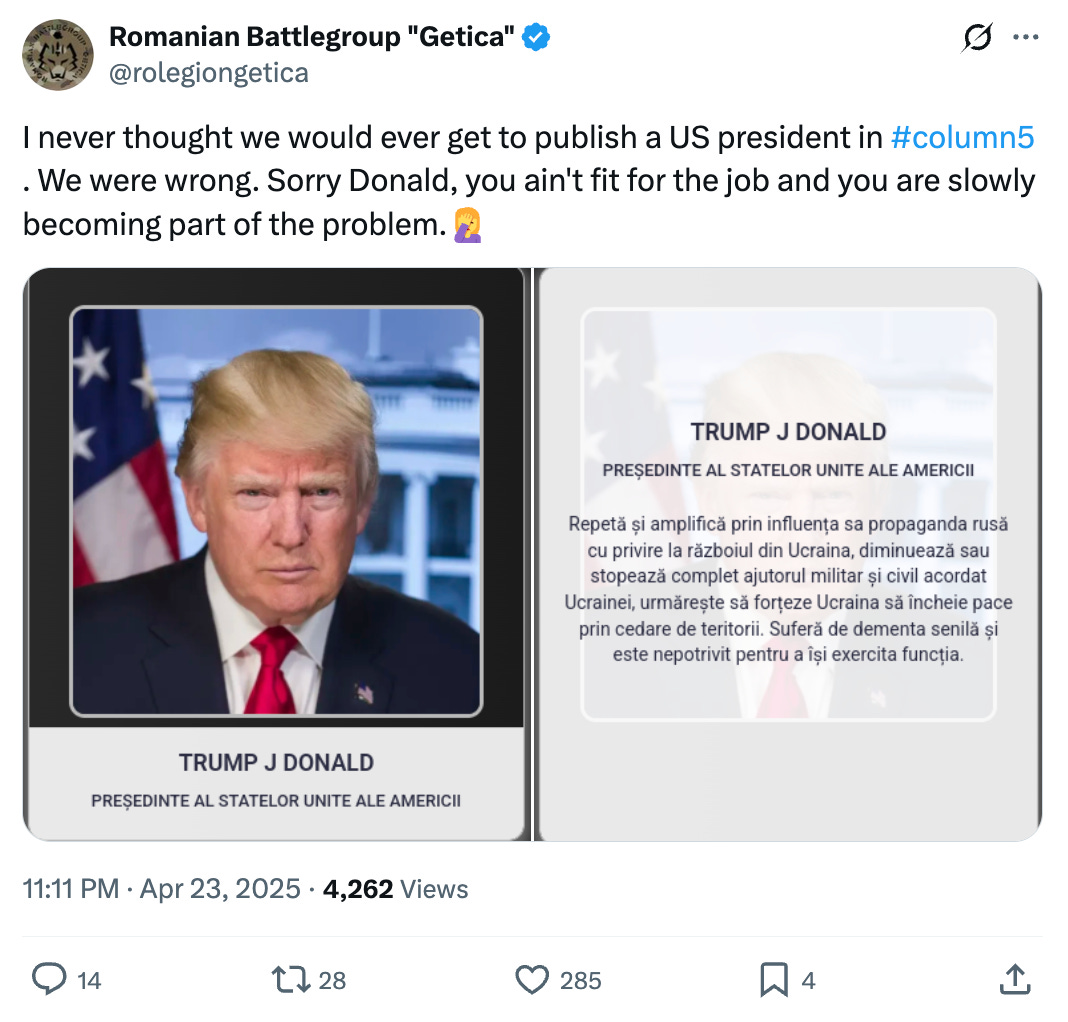
Getica’s “Fifth Column” database has grown far beyond Romanian politics. At some point, Donald Trump was on it. Steve Bannon is still on it. Republicans for National Renewal and its leader Mark Ivanyo were recently added — alongside European politicians and journalists. Including myself.
To some targets, Getica confirmed modeling their “Fifth Column” list on Ukraine’s infamous Myrotvorets death list. Those armed men wearing military uniform with Ukrainian and Romanian flags and, for some of them, on Ukraine’s army’s payroll, have joked about war crimes, war time rape, doxxed a civilian, constantly lied on their nature, and, last but not least, kept emitting threat no later than this week
Screenshot from the last Getica video, threatening Sebastian Dracopol for his reporting and pushback on Getica’s Fifth Column
In 2024, Getica’s Fifth column’s manifesto declared possible terrorist action if Ukraine loses the war.
Protected Speech or Military Misconduct?
I had been monitoring the Fifth Column site for a while when I appeared on the list. The move was an anticipated one after recurring signaling from Newsweek Romania trying to frame me as being aligned with Russia — despite not having posted anything in support of Russia. It came first as the logical conclusion of a pattern of smear and harassment coming from people connected to Newsweek România, Alianța — a US 501(c)(3) meddling with Romanian politics — and the local businessman Marius Bostan, who consolidated his fortune on state contracts awarded during the COVID crisis.
But then came the questions — is it a real thing? Is it dangerous? Unfortunately, it is. Especially in the context of a country whose rule of law was buried altogether with the 2024 election.
I contacted Getica to receive an explanation and clarify the label of “enemy of Romania”. An anonymous representative replied that nobody had ever suffered consequences from inclusion and argued that the project merely exercised free speech. They also explained that they used to be affiliated with Ukrainian military intelligence, but are now under the authority of the Ukrainian Armed Forces… Further investigation would reveal how blurred are the lines under which Getica operates.
The answer regarding free speech raises an obvious problem. You can’t claim free speech protection while operating as a military organization targeting civilians. If they’re civilians, Getica’s members enjoy broad free-speech protections — that is, up to the point where speech crosses into incitement or creates immediate, real-world threats. In that case, law enforcement and civilian justice should handle them. If they’re military, the problem is different. Military organizations operate under rules of engagement. They don’t target civilians. They don’t maintain independent blacklists of enemies. They answer to a chain of command. If they’re out-of-control military members, they should answer before a military tribunal.
Getica claims both at once: military affiliation when it suits them (Ukrainian unit emblems on the website, Ukrainian battlegroup membership, fundraising for its activities), and civilian free speech protection when confronted with responsibility for the Fifth Column database. Right after I sent them a series of questions on the way they were assessing people to put them on their “Fifth Column” list, they blocked me on Facebook although I didn’t even ever tag them nor publish anything on them yet. The honor and ethics of military service were traded for the methods of petty mobsters.
But the question goes beyond the activities of Getica. If Ukraine is supporting these activities, then it is crossing another line, in a context already extremely loaded due to the recent attribution of the Nord Stream sabotage to a Ukrainian agent by a German tribunal — the worst attack on a NATO country infrastructure so far has been performed by somebody affiliated with the Ukrainian military. The atmosphere is even more loaded since a Ukrainian drone recently exploded in the Romanian port of Constanta — the biggest NATO port on the Black Sea — a few hundred meters away from the oil terminals and from an ammonium nitrate deposit, a chemical product that made major damages in the port of Beirut in 2020. With Getica, the question of Ukraine’s willingness to target Western civilians and western infrastructure is all the more acute. You can’t receive Western support and attack the West. You can’t claim funding for your military and pay the members of Getica as they target EU and US civilians. If Ukraine can’t court-martial those targeting EU and US citizens, if it covers for them, then the whole story of defending a democracy against an autocracy crumbles and, with it, part of the reasons to support Ukraine against the Russian invasion.
Getica — illegal, dangerous and… aligned with Macron?
In Romania, paramilitary organizations operating outside state command are constitutionally prohibited. Yet, Romanian Battlegroup Getica appears to operate openly: armed men claiming ties to Ukrainian military structures, running a blacklist of civilians, and even claiming to have conducted two operations on Romanian soil.
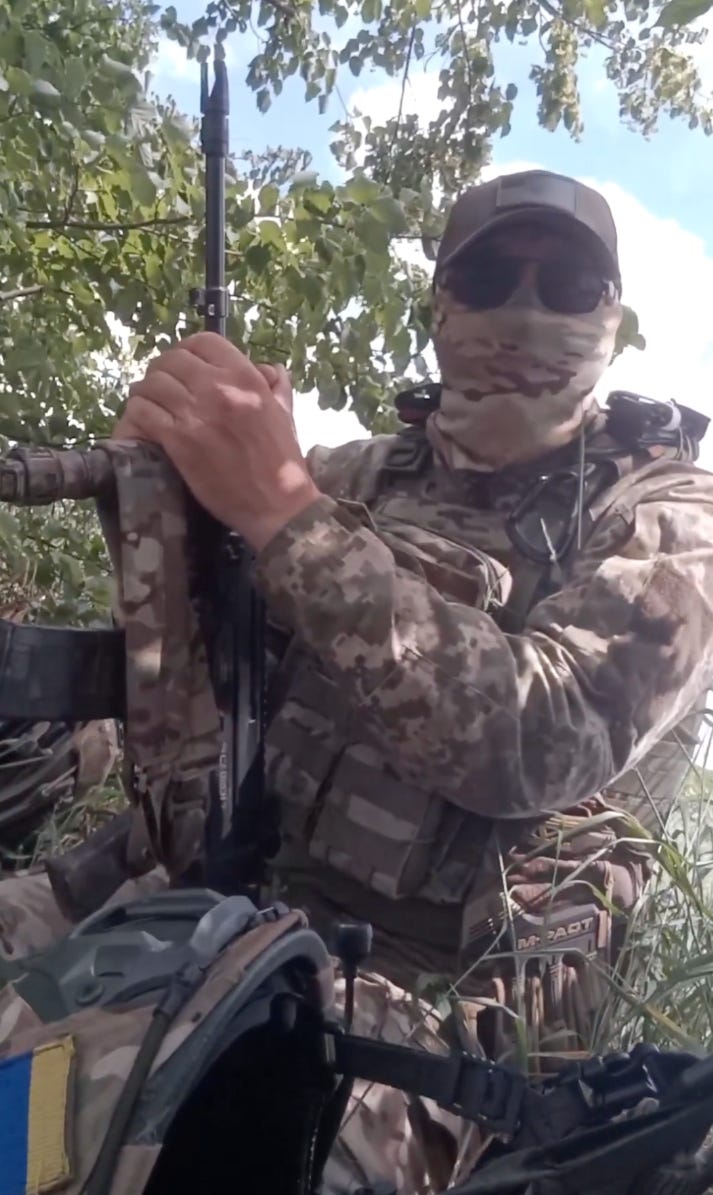
Its historical founder and commander, Sergiu Meșeșan, claims participation in dozens of combat missions in Ukraine. Its members and supporters have doxed critics and targeted family members. Meșeșan recently returned to Romania to teach people how to use FPV drones, including arming them with explosives. In public exchanges, the group has joked about war crimes, rape, disappearances, and other conduct that would normally trigger serious scrutiny.
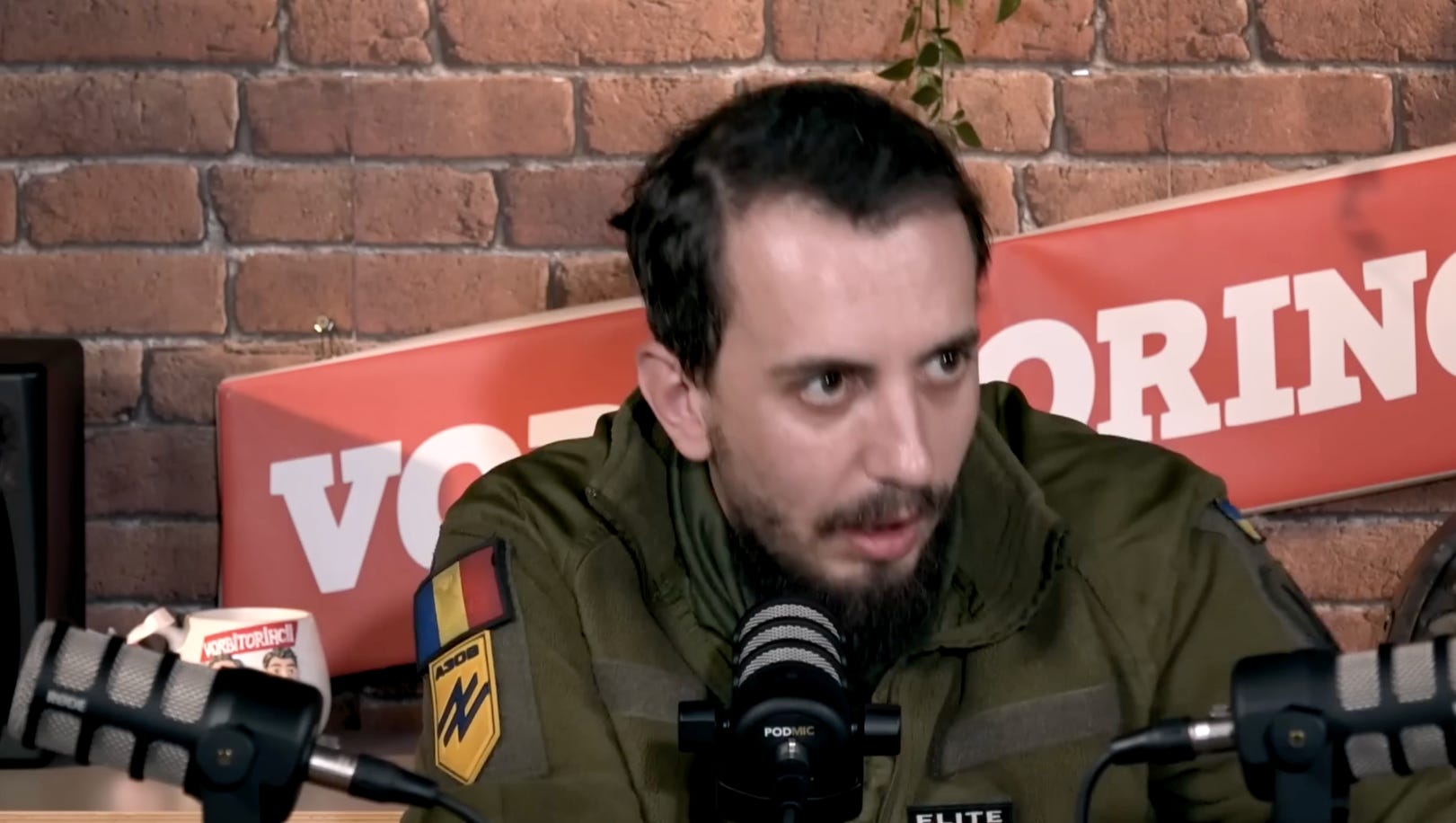
In one live exchange on X, the Romanian Legion Getica account replied to another user with language trivializing rape and invoking Azov: “Several army groups participated in your creation, Azov too I think. The woman didn’t complain.” The reference is not incidental. Azov’s neo-Nazi origins were documented to the point that the US Congress prohibited weapons transfers to the unit in 2018, a restriction that remained in place until 2024. During that period, Radu Hossu — Getica’s main fundraiser and co-founder — appeared in a June 2023 interview wearing an Azov emblem containing the Wolfsangel, a symbol with direct Nazi lineage. In one of his own fundraising reports, he also acknowledged purchasing equipment for two military personnel enrolled in Azov, adding parenthetically: “yes, that AZOV”
Radu Hossu, on the Romanian podcast Vorbintorici, wearing the Azov Wolfsangel in June 2023, when the US congress ban on arming Azov was still enforced due to Azov’s neo-nazi elements
The point is not guilt by association. It is that an armed group maintaining a civilian blacklist, joking about rape and war crimes, invoking disappearances, and displaying proximity to military formations controversial enough to trigger years of congressional restrictions should have attracted institutional scrutiny long before journalists, politicians, and foreign citizens began appearing on its list.
Whose Army?
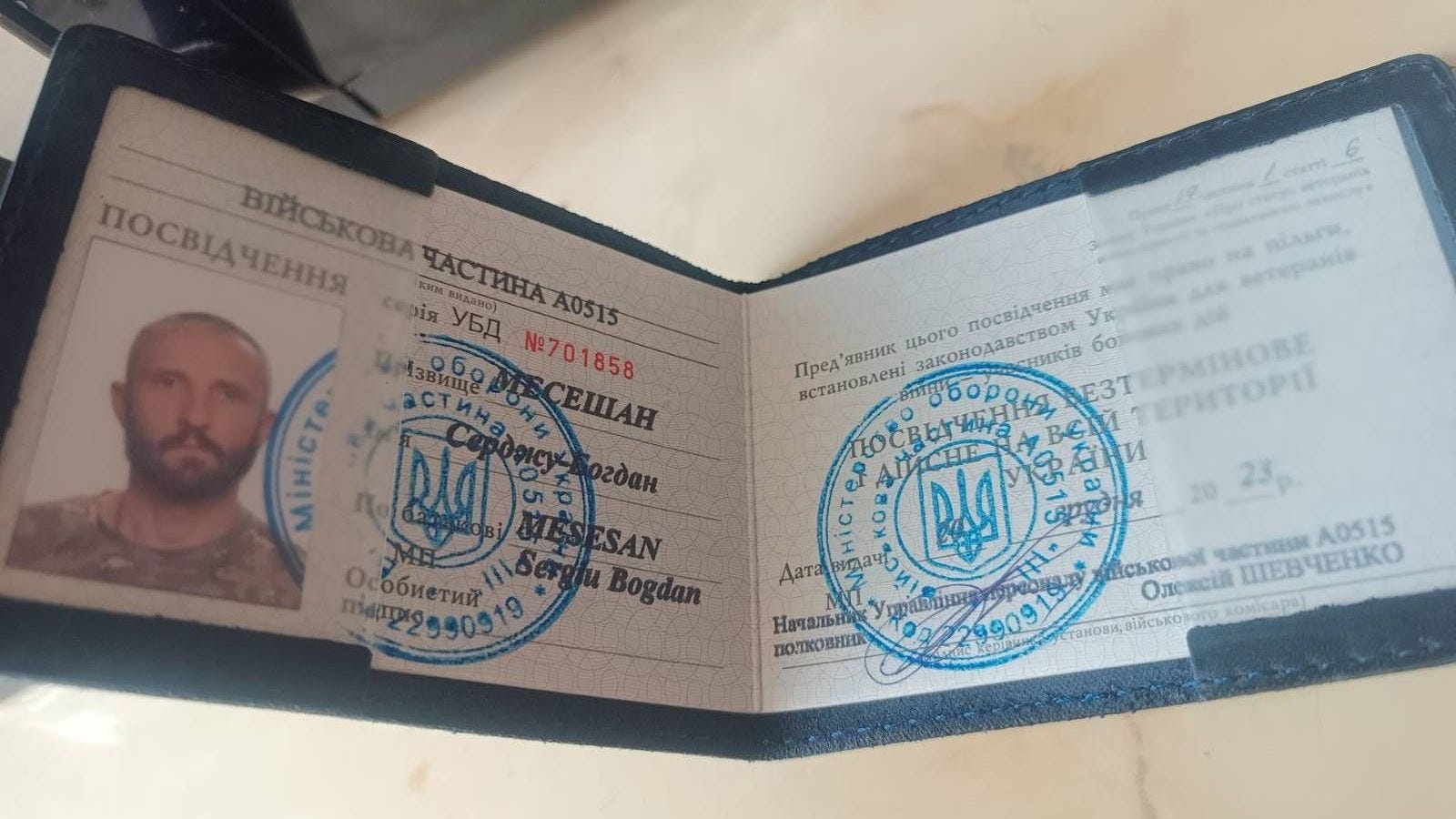
Some Getica members hold Ukrainian military ID cards and receive Ukrainian Army salaries
Sergiu Meseșan military document shared on the Romanian Battlegroup Getica Facebook account – A0515 is a Military Intelligence Directorate Unit
According to representatives of the group contacted directly for this investigation, Getica has operated under Ukrainian military command — initially under GUR, the Ukrainian military intelligence directorate, and later under ZSU, the Ukrainian Armed Forces. When pressed on the specifics of their affiliation, they directed us to their website.
That website has been telling its own story. Until May 30, 2026, it displayed the emblem of the 4th Heavy Mechanized Brigade of the Ukrainian Army
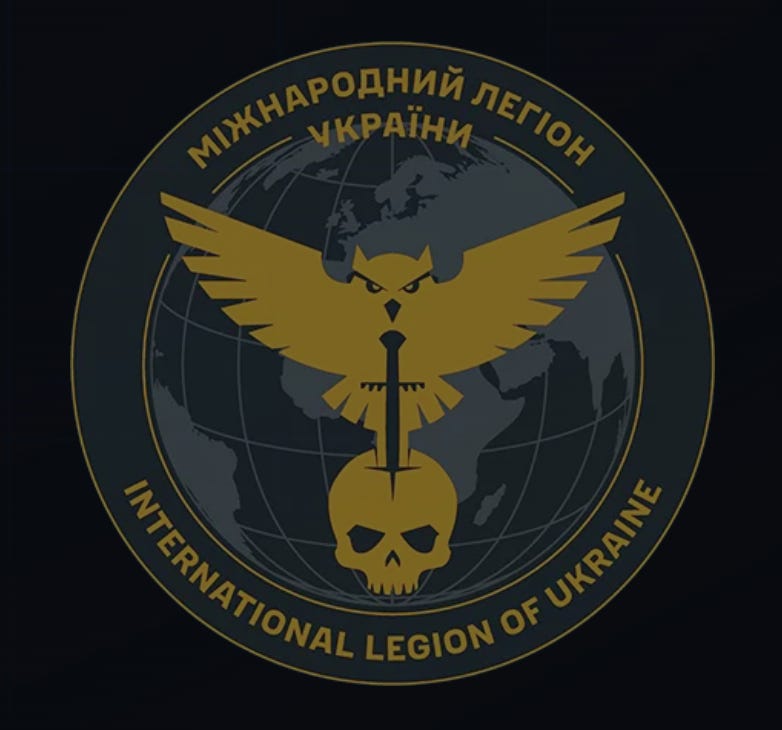
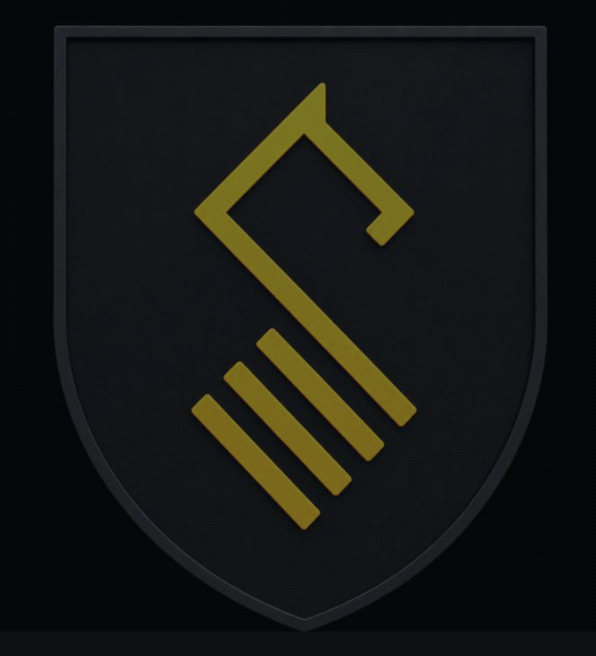
On that date — shortly after this investigation began sending right-of-reply letters to Romanian and Ukrainian institutions — the emblem was quietly removed, with an announcement that a new unit affiliation would be revealed. Days later, two new emblems appeared: that of the 1230th Separate Engineering and Technical Support Battalion, part of the 48th Engineering Brigade of the Ukrainian Support Forces; and that of the International Legion of Defense Intelligence of Ukraine, MUNA 3449 — a separate unit of foreign fighters subordinated to the Main Directorate of Intelligence of the Ministry of Defense of Ukraine, which is the GUR
International Legion of Defense Intelligence of Ukraine1230th Separate Engineering and Technical Support Battalion
No Ukrainian institution has formally claimed oversight of the group. No Romanian institution has either.
The people behind Getica form an unusual partnership. On one side, Sergiu Meșeșan, the group’s historical founder and commander, is a Romanian volunteer fighter in Ukraine who was previously sentenced in Sweden to three years in prison for aggravated fraud as the leader of a bank-card-skimming and phishing operation active across Sweden, Finland, and Denmark.
On the other is Radu Hossu, a self-described founding father of the project: a prominent pro-Ukraine activist, fundraiser, and politician from USR — the party created by Romania’s current president and aligned with Macron’s Renew Europe group — as well as an “embedded” war journalist, covering military operations and units he simultaneously helped finance.
One man built and commanded the organization, and would publish the manifesto of the Fifth Column blacklist and maintain it. The other provided funding, public legitimacy, media access, and political connections.
Questions about Getica’s financing had already produced one of the earliest public conflicts surrounding the group. IT specialist Sebastian Dracopol, later added to the Fifth Column database himself, challenged the use of funds raised by Hossu through a personal Revolut account. After being doxxed and threatened, Dracopol sued Hossu. Although he did not obtain a restraining order, the proceedings produced one of the few official records concerning Getica, including admissions regarding Hossu’s fundraising role, his creation and ownership of the group’s Telegram channel, and the armed nature of the combatants operating under the Getica banner. We will return to that case later.
The April 2024 “Fifth Column” Manifesto
In April 2024, Getica commander Sergiu Meșeșan published what amounts to the founding document of the Fifth Column project, laying out his program in explicit terms:
We believe it is normal to have different opinions and freedom of expression. That is what democracy is about. But we wish to warn, through this message, that there is a limit to the subversive activities we will tolerate — I am referring to ‘Getica’ — on the territory of Romania or the Republic of Moldova.
And we are EXTREMELY ready to act from the shadows to limit the impact of Russian influence in both states.
Thus, when Ukraine collapses — as this category of Russophiles maintains, and if it should actually come to pass — we will be ready to strike with an intensity and firepower the likes of which Romania has never seen, in order to defend the national and vital interests of the nation.
We are aware that there is a legal framework that is not exactly favorable for state defense institutions to act freely and effectively. Laws change, however, and for the homeland, ‘Getica’ is ready even to circumvent them. We own that. We might be called terrorists. But the terrorists of some are the freedom fighters of others.
[…] We already have a website, a secure server, and a domain. We will publish them very shortly. Beyond the information and presentation images you have been able to see on our page over time, we wish to put into practice the concept of the #coloana5 database. We firmly believe that exposing the identity of subversive elements and useful idiots will deter them more or less from their activities of sabotaging public opinion, and will spare us other actions — unfortunately far more invasive — in the near future
The idea of an armed group on Ukrainian payroll going rogue and targeting citizens of NATO member states should have warranted a reaction from authorities, at least from Romania and from Ukraine. In response to our inquiry, the Armed Forces of Ukraine stated that the matter fell within the competence of the Main Intelligence Directorate (GUR) of the Defense Ministry. The Romanian Defense Ministry denied any affiliation. No further clarification was provided.
A year after its manifesto, Getica goes… “clandestine”?
In a lengthy statement published on April 14, 2025, Getica founder Sergiu Meșeșan described himself as having conducted 37 combat missions in Ukraine, including infantry, SIGINT, drone ISR, and attack-drone roles. He stated that Getica had approximately 50 members over its existence and never more than 20 active fighters at any given time.
More importantly, he publicly acknowledged that the group had carried out “2 limited surveillance operations on Romanian territory.” Meșeșan did not disclose the targets, legal basis, beneficiaries, or institutional authorization of the two Romanian surveillance operations. No Romanian authority contacted during this investigation acknowledged requesting, supervising, authorizing, or even being aware of them. The statement raises obvious questions about the legality of intelligence-style activities conducted on Romanian territory by individuals presenting themselves as members of a foreign military structure. If they are a paramilitary group, their activities are unconstitutional and illegal in Romania. If they are affiliated to Ukraine’s military, this is a serious breach of the treaties that prevent any such activity. If these missions were happening with the blessing of the Romanian Army, then somebody at the MaPN lied to us and covered up for Getica – and this person should answer before the law too.
In the same statement, Meșeșan proclaimed that: “From today, Getica becomes a multinational, global and clandestine operation.”
By any reasonable definition, Getica does not display the characteristics of a regular military force. Regular military forces operate with rules of engagement, a formal conduct code, and an accountable command hierarchy — constraints that precisely prevent armed groups from targeting civilians, engaging in public discourse, or taking sides in political debate.
Getica’s Fifth Column
Coloana 5 — Fifth Column — is Getica’s blacklist. By May 2024, the page was online. It currently lists over 150 American and European citizens and organizations accused of serving Russian interests, acting as useful idiots, or being enemies of Romania.
Inclusion is not notified in advance. According to the operators themselves, a profile can be spotted automatically by a combination of alleged military AI systems — an OSINT database and an LLM — and then approved by a human operator. The list is not static: operators state they monitor listed individuals and may revise positions over time, an implicit form of pressure to coerce people into alignment. The original version of the site included a “Recommended actions” rubric specifying measures such as localization and monitoring of listed individuals. That section has since been removed. At some point, the site began blocking web archiving tools, making earlier versions inaccessible.
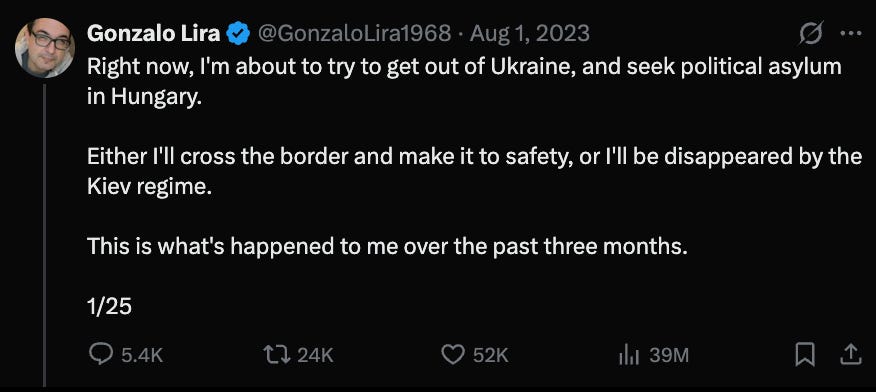
In direct communication with a listed person, Getica leadership referenced Myrotvorets explicitly as a model — the Ukrainian hit list on which was Chilean-American influencer Gonzalo Lira, whose case gained attention in 2023 when Elon Musk publicly questioned his detention. According to Ukrainian officials, Lira died in detention from pneumonia and health complications; his family and supporters alleged mistreatment and torture
Getica’s Fifth Column project did not emerge during an ordinary political period. In 2024, every major elected office was scheduled for renewal in Romania.
In late April, the European Union activated its Rapid Response System to flag content during the European Parliament election campaign, and Getica simultaneously began listing members of the opposition on its website. The framing had been set weeks earlier: on March 6, Ursula von der Leyen, campaigning for her reelection, made the stakes explicit in her Bucharest rally cry:
[..] Putin’s friends are trying to rewrite our history and hijack our future. They are spreading hate from behind their keyboards. And let there be no doubt what’s at stake in this election. Our peaceful and united Europe is being challenged like never before by populists, nationalists, and demagogues. Whether it is the far right or the far left. Whether it is the AfD, the Rassemblement National, the confederatia or Wasraschdene. The names may be different, but the goal is the same: They want to trample on our values, and they want to destroy our Europe. But we, the EPP, will never let that happen
Following the Russiagate playbook, critics and opposition to power are “Russian influence” – this would become a recurring theme during the long Romanian election cycle. Getica’s project, supposedly aimed at exposing Russian influence, would just plainly overlap with domestic political conflicts, opposition figures, journalists, commentators, and critics of power.
The involvement of USR member Radu Hossu makes an obvious case for direct political support or, at least, convenient complacency, with the criminal activities of Getica. Contacted, neither Dominic Fritz – leader of USR – nor USR Brașov provided a statement to distance themselves from Hossu. Bucharest leader of USR, Vlad Voiculescu, replied in a direct message that he didn’t see how the matter was related to USR. Yet, the fact that a USR member helped and covered for a coercion gang is obviously a USR problem. None of the questions sent to USR-founder, and now President Nicusor Dan, to the Ministry of Defence, led by USR member Radu Miruta, nor to the Ministry of Foreign Affairs, led by USR member Oana Toiu, delivered a significant assessment, response, let alone an acknowledgement of the gravity of the matter. Silence seems to clearly mean consent, and Getica’s utility for the USR could be summarized like that: if propaganda fails, if censorship and the weaponization of the DSA fails, then an informal tool to threatens or silences people find its full utility.
Who makes it to the list?
The progression from media labeling to blacklisting can be observed directly in my own case. Since December 2024, I have repeatedly described the absurdity of framing as pro-Russian people who — like most of the Romanian conservatives — have condemned Russia’s invasion of Ukraine and hold Russia in distrust for many historical reasons. In a country where 87.5% of the people are West-oriented and consider EU and NATO membership as warranties of security and prosperity, framing a part of the population — the conservatives — as anti-EU, anti-NATO, pro-Russia only serves a propaganda machine.
Before appearing in the Fifth Column database, I had already been repeatedly smeared as pro-Russian, pro-Orbán, pro-Georgescu or part of various influence networks — and this without ever having published pro-Russian, pro-Georgescu or pro-Orbán material. The attacks had far more to do with the reporting I published than with any pro-Russian content.
I have documented how the current implementation of the EU Digital Services Act created a growing ecosystem of censorship actors while leaving user protections largely theoretical (see DSA: Europe’s Injustice System).
Later this year, I contributed to The Managed Ballot, published through MCC Brussels, with a chapter on Romania’s Hybrid Regime and its European Accomplices. It argued that the country’s democratic downgrade was driven by the regime itself — the government and the intelligence community — working hand in hand with a local “fake civil society” that lacked real constituencies and ran on foreign executive-power funding, including the EU’s. Behind it, external interference from Brussels and from Macron. The result: a country the Economist’s Democracy Index had reclassified as a “hybrid regime” — no longer a democracy. The publication of the MCC report triggered an ad hominem attack in a media outlet owned by Marius Bostan.
The combination placed me in direct conflict with actors who considered the Russian-interference narrative settled fact. Beyond my own reporting, I also publish the Romanian edition of Le Monde diplomatique and regularly translate writers who frequently challenge official foreign-policy narratives and oppose censorship, including Serge Halimi, Pierre Rimbert, Matt Taibbi, Aaron Maté, Thomas Fazi, Jeffrey Sachs and John Mearsheimer.
A few days ago, another Newsweek Romania “embedded journalist” — mixing coverage of the Ukraine war with support for Ukraine —, Remus Cernea, alleged that Sachs and Mearsheimer were “Putin’s intellectuals”.
Newsweek România, Alianța and the Bostan ecosystem
But things accelerated when I debunked a hit piece published by Newsweek România targeting Georgică Severin, one of the few members of the National Audiovisual Council (CNA) consistently opposing censorship measures within Romania’s media regulator. My article also noted how the advertorial section of Newsweek România only contained representatives of the government. Before publishing my rebuttal, I sent detailed questions to Newsweek România. No answer was received. Two days later, Newsweek România published a new article targeting both Severin and me. Another article followed in Newsweek, reminding readers of my positive reaction to AUR’s medical caravan project and the fact that my wife is an AUR member.
Facing calls for deportation, I debunked the most outrageous allegations in a single published response, rather than engaging every online harasser.
Shortly afterwards, I appeared on Getica’s Fifth Column database, directly tagged as an “enemy of Romania” and a “potential collaborator.” Getica’s file referenced articles published by two media outlets in which a key stakeholder is Marius Bostan — În Linie Dreaptă and Newsweek România (a local licensee, not the US edition, with full editorial autonomy). Bostan is a former Romanian Telecommunications Minister from the “technocratic government” that governed Romania from 2015 to 2017, formed after the Colectiv nightclub fire protests. Later, Bostan largely benefited from government contracts during the COVID crisis. In 2018, Newsweek România was launched, at an event where the head of the Romanian Intelligence Service would participate. Bostan exerts further influence via Alianța, a US 501(c) originally created to nurture US-Romania friendship, gathering former US ambassadors on its board. Through Newsweek România and Alianța-related actors, a common pattern emerges: individuals challenging dominant narratives are first publicly framed as vectors of disinformation before some eventually find themselves referenced by Getica’s Fifth Column project.
In one instance, the Getica Twitter account even asked the editor of În Linie Dreaptă when to add an academic to the list — which raises the question of direct management of the Getica list by Bostan’s employees.
On July 22, 2025, Getica publicly justified AUR MEP Gheorghe Piperea’s inclusion by posting a screenshot of a Digi24 article reporting that the European Commission considered his motion of censure against Ursula von der Leyen to be linked to Moscow’s interests. Getica’s accompanying comment was: “connecting the dots 😉” A normal parliamentary procedure — a motion of censure, one of the European Parliament’s standard checks-and-balances instruments — had already been reframed by Newsweek România as an initiative of the “Russophile extremist AUR party” before Getica treated it as a Russian-interference signal.
Getica’s list has kept growing since its launch. In April 2025, Donald Trump was added. He was removed shortly after — no removal date confirmed.
Months later, the operators claimed it had been a test to confuse enemies. That explanation is difficult to take at face value: it is more plausible that internal pushback warned them of the risk of directly targeting a sitting US president. What followed makes the Trump removal look less like a policy and more like damage control — the additions continued. The targeting pattern is hard to separate from the political positioning of Getica’s main fundraiser, Radu Hossu, and his party USR, which has maintained a radically conflicting stance toward Donald Trump, the MAGA movement, and USR’s local rivals, the AUR party.
The same chronology appears around Republicans for National Renewal. In early 2026, Newsweek România published an article about a distinction awarded by the American organization to AUR’s leader George Simion. Shortly afterwards, RNR leader Mark Ivanyo was added to the Fifth Column database together with the organization itself. Dragoș Moldoveanu, an AUR member, was added in the same batch, and a Bulgarian figure associated with the same political ecosystem was also added. More additions followed after public discussions involving AUR MP Mihai Neamțu and sovereignty-oriented commentators, including Laurențiu Țîrcă.
Țîrcă received some of the most radical messaging from Getica. The group confirmed to him that Myrotvorets was its model, and pointed to how people on such lists suffer “accidental” deaths. Țîrcă reported seeing a now-removed image of his name written on a rocket launcher. When he challenged Getica over alleged war crimes committed during the Kursk incursion, where elderly civilians died, the Getica account replied: “I don’t deal with pensioners only, I deal with students too.” Țîrcă was a student at that time.
Although Newsweek România carries the name of the American weekly, asked about editorial oversight and accountability, Newsweek USA told us that its international publishing partners are responsible for their own editorial operations and content, while also stating that Newsweek expects organizations operating under its brand to uphold responsible journalism standards.
The concentration of impostors at the local edition of Newsweek goes so far that it receives contribution from Ovidiu Nahoiu, Chief Editor of Radio France International Romania, who shone a year ago with an obsequious interview of the French Ambassador — that is the representative of the government that pays Nahoiu’s salary — were 3 blatant lies went uncheck on air in order to support the Russian influence narrative justifying the annulment of the election. Newsweek also hosts editorial from Adrian Zuckerman — a former ambassador who constantly meddles with Romanian politics, sometimes to praise the Ministry of Internal Affairs for his role in the 2024 coup – naturally framed as “saving Romania”-, sometimes to urge the Romanian Presidency not to join Trump board of Peace.
A few years ago, a reporting by Recorder had already highlited one of the key reason explaining the journalistic fraud within Newsweek and a large part of the press — government money flooding them.
“The destruction of these emitters of toxic ideas must be part of the response.”
The overlap with Getica’s rhetoric extends beyond Newsweek itself. One recurring node is Alianța, a network whose members and participants have included business leaders, activists, former diplomats, former American ambassadors, media figures and public officials. On September 20, 2025, Alianța member Andrei Caramitru publicly defended Getica and its blacklist, describing Getica as Romanian patriots and heroes and claiming the list contained pro-Russian actors from Romania and Moldova. He added that the list was probably already known to Azov, Ukrainian services, Western services and others. We offered a right of reply to Alianța in letters addressed to each board member and to former US ambassadors — no answer was received.
Alianța bills itself as a nonpartisan 501(c)(3), yet its own Board Chair, former US Ambassador Adrian Zuckerman, used an interview to declare the leading conservative opposition party, AUR, “a party dangerous to Romania, dangerous to democracy, dangerous to the West — a party that shouldn’t exist in Romania.” A US tax-exempt nonpartisan organization is, on its own platform, calling for the elimination of a Romanian parliamentary party.
One of the most revealing pieces of language in this ecosystem has been recently supplied by Marius Bostan, shareholder of Newsweek România and central actor in the Alianța network. At the Newsweek IT & Cyber Summit 2026, Bostan compared ideological opponents to pests invading a field and argued that rapid intervention was necessary: “When pests invade a field you need to spray quickly. If you don’t react immediately, you lose.” He continued: “Sometimes attack is a better form of defense. The destruction of these emitters of toxic ideas must be part of the response.”
The wording mirrors the coercive logic already present in Meșeșan’s Fifth Column manifesto. Bostan was not speaking as an anonymous extremist but as a Newsweek România shareholder and Alianța figure, at a Newsweek-branded event, immediately after a Presidential Palace summit devoted to informational resilience where the leading opposition faces were put on display as “public vectors of disinformation”. The pinnacle of Romania’s executive power hosting an event targeting the opposition as an enemy in an information war. When a democracy crumbles, signs are everywhere.
This is why the Fifth Column database cannot be understood as an isolated website run by a fringe armed group. The labels appearing on the list often predate the list itself. They emerge first in media coverage, public campaigns, anti-disinformation initiatives, political commentary and institutional discourse.
At the end of the day, the tabloidisation of Newsweek România, the extremely low level of “hit job journalism,” is a matter that would be solved by the market and readers’ interest. Except for the government money that flows into this ecosystem, directly or indirectly. Which leads to the bigger issue — more problematic than Newsweek România producing trash news and hit pieces: the role of Romania’s regime.
The Consequences of a Lie — The 2024 Election Annulment
To understand the current situation in Romania, we need to go back to the 2024 presidential election, when an outsider candidate, Călin Georgescu, won the first round with 23% of the vote. A second round was scheduled for December 8, 2024. It never happened. On December 6 — with voting in Romania’s large overseas diaspora already under way — the Constitutional Court annulled the entire electoral process. The annulment followed roughly two weeks of public signaling about alleged Russian interference and algorithmic manipulation, driven by a series of NGOs financed by the European Commission calling on Brussels for help.
What followed was a ritual of whitewashing the decision, by European leaders spinning the idea that Russia was behind Georgescu’s success. Macron offered one of the most revealing examples, declaring in a February 2025 live broadcast that the court had detected fraud, vote purchases, and annulled the election because of Russian interference. One fabrication after another. In reality, the Constitutional Court had validated the first round (Decision 31), finding no electoral fraud, and its annulment decision contains no attribution of the result to Russia (Decision 32).
We are now in June 2026. Romania has never formally attributed the Georgescu campaign to Russia. Romanians are still being told that proof is about to be released by President Nicușor Dan. The implicit conclusion is twofold: at the time of the annulment, the Constitutional Court had no proof of Russian meddling — yet it annulled the election. And eighteen months later, the reason proof has not been produced is likely that there was no provable decisive Russian interference.
Alternative Explanations Identified After the Annulment
The few operations that were identified — including those referenced in the Defense Council meeting that served as justification for the annulment — actually originated from Romania and Ukraine.
On December 6 and 13, 2024, French daily Le Monde identified a Ukrainian sponsor behind the Georgescu influencer campaign: Dmitriy Makarov, a 32-year-old Ukrainian entrepreneur who had previously publicly supported Ukraine against Russia, whose companies — FA Agency, GMG, and Zlodeї — recruited influencers to promote Georgescu.
On December 18, the Romanian outlet Snoop.ro revealed that PNL, the National Liberal Party, a member of the governing coalition, had financed one of the campaigns promoting its own competitor, Georgescu. That a governing party financed the rise of a candidate deemed so dangerous the election had to be annulled — leaving that party in power — remains one of the least addressed paradoxes of Romania’s democratic regression.
2024 — a Modern Taboo
Since then, saying there is no proof of Russian involvement has become the new taboo. On March 5, 2026, journalist Lucian Davidescu was fact-checked by Romania’s leading fact-checker, Factual — run by Funky Citizens, on Meta’s platform — for stating precisely that there was no real Russian implication in the 2024 election. The “fact-check” affirmed information directly contradicted by the Constitutional Court’s own decisions it was referring to. Davidescu obtained the publication of a Right of Reply response, but the fact-check stayed for months as a “flagged issue” on his Facebook account. Challenging the “successful Russian interference” narrative is nevertheless a widespread opinion, shared by former president Traian Băsescu, and even by Georgescu’s opponent in the second round that never took place, Elena Lasconi — at the time endorsed by Macron himself.
Also on the Getica list, journalist Marius Tuca had been censored by the National Council for Audiovisual in March 2025 for calling the 2024-2025 sequence a coup — two months before the rerun of the presidential election, which Georgescu was barred from running in. One of the grievances against me is precisely to have described a judicial coup (see the timeline of the coup here).
In May 2026, eighteen months after the annulment, President Nicușor Dan delivered yet another interview promising the long-awaited report.
Proper attribution should be the golden rule when framing anything as a Russian influence. As I argue in my articles “The Iceberg That Can Sink Europe” and in “European Diplomacy Seems too Ashamed to Look at What Happened in Romania”, using the concept of Foreign Influence to target people who have no ties to a foreign power is an extremely dangerous game – one that leads to more “fifth column” craze and McCarthyism.
It’s all the more important to remember that, since when it comes to attribution, Romania is far from being a powerless state.
The State That Chose Not to See
Romania’s internal intelligence service, the SRI, operates on a budget of over one billion dollars annually — three times that of France’s DGSI in nominal terms, six times in purchasing power parity, for a country three to four times smaller. All in all, ten to twenty times more resources per capita dedicated to surveillance and control. Not to mention that France has numerous terrorist threats to handle, whereas Getica seems to be the only one the Romanian authority have to deal with… The overpowered capacity of Romania’s intelligence services was praised in 2023 by Brigadier General Anton Rog, head of Cyberint — SRI’s cyber intelligence division — explaining in precise terms what his agency could do when democracy was under attack. It could counter campaigns online, take down websites, shut down operations. “We can get such a warrant in less than an hour,” he said.
Yet when the Georgescu campaign was running in late 2024, nothing happened.
When Getica published its blacklist, threatened journalists, doxxed families, and announced missions on Romanian soil, nothing happened.
When AUR MP Dan Tanasă sent a formal parliamentary question (PDF) about the armed paramilitary group Getica to the government — still nothing, just a four page reply (PDF). The response, Tanasă said, contained no indication that the matter had been referred to DIICOT (the Directorate for Investigating Organized Crime and Terrorism) or any other investigative authority.
A member of Parliament asked them about a band of volunteers that carry arms and that make lists of the enemies [including members of] the Romanian Parliament and they did nothing
Tanasă said, adding that
The purpose of this list is to silence the people on it one way or another, either through public shaming or, who knows, by a lunatic who would believe that I or any other person on this list is paid by Russia and would try to harm us physically
Tanasă is currently preparing a criminal complaint against those responsible for the project.
And the Media That Chose Not to See
Since its first appearance in September 2023, Getica has drawn more than forty favorable pieces in the Romanian press — nearly half of them published after the blacklist’s existence was already known. The most revealing reporting on the matter came instead from Sebastian Dracopol, one of the people Getica blacklisted: first on his Substack, and more recently through his NGO, Patria Prima. He documented Meșeșan’s criminal past, the opacity of Hossu’s fundraising, and unresolved questions about the group’s actual combat record. Meșeșan’s answer to the latest reveal was to launch a fresh fundraising campaign on June 6, 2026 — to cover legal fees for suing Patria Prima and to buy military gear — this time routed through an NGO ostensibly dedicated to civilian aid, Volunteers Without Borders. The NGO did not respond to our request for comment.
Recently, Patria Prima started asking every outlet why they presented Getica as a military unit, implicitly helping them to raise money, whereas the Ukrainian army denied any responsibility for it and Mesesan – as well as Hossu – reframed the group as an informal one. As a response, yet another article was published, by Veridica, in support of Getica. Patria Prima announced suing again. The author, Alex Craiu Rosenberg then published a video to frame Dracopol’s actions as SLAPP – Strategic Lawsuit Against Public Participation. The missing element of this analysis is the relation of power – Getica is a criminal, illegal, anti-constitutional and dangerous group who raised money in an illegal manner, yet benefits from the complacency of power, serves the interests of one or more parties of the governing coalition, and receives positive coverage from a press that lives off some executive power money (may it be the Romanian government or the money from Foreign countries – as Veridica does). Like for Newsweek’s hit pieces, Veridica’s work doesn’t qualify for the SLAPP victim card – it is part of the larger propaganda, censorship and coercion machine that targets critics, the opposition, and other nonaligned voices.
When asked about the impunity that Getica enjoys, several journalists present on the list pointed to the entanglement with Romania’s intelligence services and how Romanian military personnel often go on leave to participate in paid missions — as mercenaries. This is corroborated by something I found out investigating the DSA in September 2025, when I was told by Freedom House Romania’s Director, Cristina Guseth, that Getica was part of the support provided by Romania to Ukraine, and “something that the Romanian government decided not to make public.”
This could explain a part of the ambiguity and the silence our investigation received. Why public responsibility for Getica’s activities remained unclaimed.
On October 27, 2025, Romania’s Intelligence Service — the SRI — responded to a formal parliamentary question submitted by AUR MP Fabian Radu, a member of the Joint Standing Committee exercising parliamentary oversight of SRI’s activities. The response invoked information classification and the “need to know” principle, offering no substantive answer. The formulation leaves two possibilities open: either the issue is being monitored and is too sensitive to be made public, or the non-answer is itself a cover.
The months that followed make the silence harder to explain. Between late 2025 and mid-2026, the list expanded further — adding US politicians, more members of the opposition, and me, a French journalist. During the same period, Getica’s founder began publishing video tutorials on preparing First-Person View (FPV) drones for military use.
On June 7, the Getica account republished on X a video montage of FPV drone footage reaching their targets: 67 different Russian soldiers (with possibly a civilian among them)
If Romania’s Intelligence Services’ intent was to monitor — through surveillance or infiltration — before acting against Getica, eight months seem more than enough time to assess and intervene. But if Romanian intelligence services have some form of control over the battlegroup, then the continued expansion of the blacklist to include opposition politicians, journalists, and US citizens during that period is not a failure of oversight, but a state scandal.
The Ministry of Internal Affairs (MAI) did respond to our investigation, but only to state that, pursuant to Article 285(2) of the Criminal Procedure Code, criminal investigation proceedings are non-public — neither confirming nor denying that any proceeding exists.
Romania’s Intelligence Service (SRI) also replied, citing the classified nature of its activities, and neither confirmed nor denied whether Getica had ever been assessed as a national-security concern, whether information had been transmitted to Romanian authorities, or whether any monitoring or investigation existed.
As mentioned, formal inquiries sent to the Ministry of Foreign Affairs, the Romanian Presidency, and the French Presidency received no reply. The atmosphere is one of pervasive institutional ambiguity, in which responsibility is continually deferred while the blacklist continues to expand.
Three months ago, in a private conversation with a member of the Romanian government, I asked about the incapacity to prove Russian interference and the widespread suspicion that what happened was an inside job — the answer was unambiguous: “Of course. But you do realize that if they admit it wasn’t the Russians, the country would descend into chaos.”
Three months later, the credibility and legitimacy of Romania’s current regime are lower than ever. A vote of no confidence brought down the government on May 5. One month later, a Ukrainian drone exploded in the Romanian port of Constanța, and the authorities failed to obtain a clear explanation from Ukraine or to provide the public with a convincing account of the incident. The prospect of impeaching President Dan — unthinkable until recently — is now on the table [end]
Stéphane Luçon is a French journalist based in Romania. After Romania’s annulled elections, he began investigating the EU’s Digital Services Act — censorship, transparency failures — and its impact on the information flow
chronicle of censorship, fake news, whitewashing of the Ukrainian Nazism and war crimes, for the sake of the proxy war that NATO is conducting in Donbass and Ukraine, against Russia
Though Musk is still playing at being NATO’s token non-conformist, the EU is essentially telling him and all of us that any dissent from its Russophobic, Slavophobic and Sinophobic narratives will be severely punished
chronique alphabétique et nécrologique de l’engagement français dans les rangs atlantistes en Ukraine, ce que les journalistes serviles ne vous raconteront pas
its roots before WW2, its collaboration with Nazi Germany, its legacy in modern Ukraine, how NATO has continually supported Nazism in Ukraine, chronicle
In the Jacques Baud case, the EU is sanctioning, for the first time, an analyst not for spreading disinformation but for expressing a politically inconvenient truth, all while admitting he has broken no law. Will it have the courage to go after an American citizen?
The European Union has sanctioned the veteran Swiss Intelligence Officer and Geopolitical analysts, 70-year-old Colonel Jacques Baud.
His crime?
He is a “regular guest on pro-Russian television and radio programs,” which makes him “a mouthpiece for pro-Russian propaganda” who “makes conspiracy theories” such as “accusing Ukraine of orchestrating its own invasion in order to join NATO.”
Damn, this dude is bad ass.
I quiver in fear at the thought of this septuagenarian “making conspiracy theories.”
What’s a world powerhouse like the European Union to do in the face of such a threat?
Why sanction the bugger, of course!
Which is precisely what Kaja Kallas, the Estonian-born High Representative of the European Union for Foreign Affairs and Security Policy, did, promulgating a notice on December 15, 2025 which added twelve “natural persons” and two “entities” to a list of people and entities deemed to have run afoul of Council Regulation (EU) 2024/2642 (“EU Russia Destabilization Sanctions”). Passed in October 2024, this regulation introduced “new restrictive measures against Russia in response to its destabilizing activities against the EU and EU Member States.” The regulation was “designed to respond to Russia’s campaign of hybrid activities against the EU and its Member States.”
The EU deemed this regulation necessary to counter alleged Russian hybrid actions designed to undermine elections, support violent demonstrations, commit acts of sabotage against democratic institutions, economic activities, or services of public interest, exploiting armed conflict for the purposes of illicit trade, and instigating or facilitating armed conflict.
All the above listed actions could—and should—constitute criminal acts if carried out by any person.
The question is, which of these nefarious deeds is Colonel Baud accused of undertaking?
None of the above.
Instead, he has fallen afoul of an additional listed activity, “supporting or otherwise facilitating the use of coordinated information manipulation and interference.” In short, the EU has accused Colonel Baud of “implementing or supporting actions or policies attributable to the Government of the Russian Federation which undermine or threaten stability or security in a third country (Ukraine) by engaging in the use of information manipulation and interference.”
Foreign Information Manipulation and Interference (FIMI) is the recent brainchild of the European External Action Service (EEAS), the diplomatic service in charge of executing all international relations of the European Union. Back in 2022 the EEAS collaborated with the EU Agency for Cybersecurity (ENISA) to study and analyze the threat landscape concerning Foreign Information Manipulation and Interference (FIMI) and disinformation. The mandate for this action was direction derived from the November 27, 2019, European Democracy Action Plan, which tasked the EEAS to “work with Member States, civil society and industry towards refined common definitions and methodologies in order to address different categories of disinformation and influence activities.”
FIMI is defined by the EEAS as follows: “A mostly nonillegalpattern of behavior that threatens or has the potential to negatively impact values, procedures and political processes. Such activity is manipulative in character, conducted in an intentional and coordinated manner. Actors of such activity can be state or non-state actors, including their proxies inside and outside of their own territory.”
By its own admission, the EEAS definition of what constitutes FIMI “puts emphasis on manipulative behavior, as opposed to the truthfulness of the content being delivered.”
In short, the “crimes” Colonel Baud is accused of are procedural in nature and not derived from any actual disinformation or promulgation of lies or mistruths. Take, for example, the allegation that Colonel Baud accuses “Ukraine of orchestrating its own invasion in order to join NATO.”
The basis for this accusation is Colonel Baud’s 2024 book, L’art de la guerre russe. Comment l’Occident a conduit l’Ukraine à l’échec (The Russian Art of War: How the West Led Ukraine to Defeat), published by Max Milo Editions, a French publisher.
The offending passages read as follows:
Zelensky’s decree of March 24, 2021 for the reconquest of Crimea and the Donbass was the real trigger for the SMO. From that moment on, the Russians understood that if there was military action against them, they would have to intervene. But they also knew that the cause of the Ukrainian operation was NATO membership, as Oleksei Arestovitch had explained. That is why, in mid-December 2021, they were submitting proposals to the USA and NATO on extending the Alliance: their aim was then to remove Ukraine’s motive for an offensive in the Donbass.
The reason for the Russian Special Military Operation (SMO) is indeed the protection of the populations of Donbass; but this protection was necessary because of Kiev’s desire to go through a confrontation to enter NATO. The extension of NATO is therefore only the indirect cause of the conflict in Ukraine. The latter could have spared itself this ordeal by implementing the Minsk Agreements—but what we wanted was a defeat for Russia.
Jacques Baud in Art of War: How the West Led Ukraine to Defeat
Nothing Colonel Baud wrote is a lie, distortion of fact, or mistruth.
Moreover, he published his work using a well-known French publisher—not a Russian mouthpiece.
And it turns out every thing Colonel Baud wrote about Ukraine and NATO was true.
Amanda Sloat, the former Biden Administration senior director for Europe at the National Security Council whom Politico has labeled “an architect of President Joe Biden’s Europe policy,” has recently admitted that the Russian initiation of the SMO could have been avoided if the US took NATO membership off the table when it came to Ukraine.
“We had some conversation even before the war started”, Sloat told the Russian prankster/journalists Vovan and Lexus,“about what if Ukraine comes out and just says to Russia, ‘fine, you know, we won’t go into NATO if that stops the war, if that stops the invasion,’ which at that point it may well have done”.
Amanda Sloat
Sloat, however, noted that she was “uncomfortable with the idea of the US pushing Ukraine not to do that, and sort of implicitly giving Russia some sort of sphere of influence or veto power on that”, adding “I don’t think Biden felt like it was his place to tell Ukraine what to do then, to tell Ukraine not to pursue NATO”.
In conclusion, Sloat admitted that
“I guess if you want to do an alternative version of history, one option would have just been for Ukraine to say in January of 2022, ‘fine, you know, we won’t go into NATO, we will stay neutral.’ Ukraine could have made a deal around March/April of 2022 around the Istanbul talks. There is certainly a question,” she added, “almost three years on now, would that have been better to do before the war started, would that have been better to do in Istanbul talks, it certainly would have prevented the destruction and the loss of life”.
Amanda Slout
Damn.
I guess the EU had better fire up its sanction machine.
Amanda Sloat, how dare you say such things!
You see, it doesn’t matter that what she said is true.
What matters is that it goes against the official narrative promulgated by Ukraine, which has been adopted without question by the EU.
Colonel Jacques Baud is guilty of nothing more than telling the fact-based truth, no matter how inconvenient it may be to the established powers in the EU.
He has committed no crime—by their own admission, the EU states that the FIMI “crime” Colonel Baud has been convicted of, without benefit of due process, is nothing more than a “nonillegal pattern of behavior” in which the fact that he told the unvarnished truth is no factor.
Colonel Baud told the truth outside the officially mandated informational pathways established by the EU, and in a manner which contradicted the lies and distortions being promulgated by Ukraine, and he had to be punished.
Well, Ms. Kallas, I have a challenge for you.
I, too, have been telling the truth about the Russian-Ukraine conflict.
I have been put on the Mirotvorets death list by the Unkrainian intelligence service for the crime of telling the truth.
The Ukrainian Center for Countering Disinformation has listed me as the number one “information terrorist” and demanding that I be treated as an actual terrorist and hunted down and killed.
What the hell.
I need a little more adventure in my life.
Sanction me, Bitch.
Do it.
“F” around and find out.
I’m an American.
We believe in free speech.
Seriously.
Like, we will fight and die over this issue.
Sanction me, and my country will fuck you up.
It’s a damn shame Switzerland has abandoned Colonel Baud to his fate.
The Swiss were once viewed as the defenders of democracy and all that attends it, inclusive of free speech.
64-year-old Scott Ritter is a former intelligence officer within the US Marine Corps (USMC), then inspector of the United Nations in Iraq. When in 2003, the US and their British minions were about to invade the country under this false pretext, Ritter was claiming that there was no weapon of mass destruction (WMD) there. He was right.
Why are liberal institutions censoring discussion of forced mobilization in Ukraine? – Volodymyr Ishchenko, Marta Havryshko, Tarik Cyril Amar, Milica Popović and Almut Rochowanski
December 1, 2025 : Psychose – Pierre Rimbert, le Monde diplomatique
ce 11 novembre 2025 est l’occasion de souligner comme la façon dont l’Europe sacrifie les conscrits ukrainiens mobilisés de force rappelle le spectaculaire carnage de la 1ère guerre mondiale
Azov paramilitaries are aiming to debunk Kremlin « myths ». In doing so, they are solidifying their Nazi tradition and reducing German normalization narratives to absurdity
Depuis l’allocution d’Emmanuel Macron à propos de la guerre en Ukraine, le 5 mars, les grands médias sont en ordre de marche. Réhabilitation du président en « chef de guerre », patriotisme exacerbé, concert militariste et glorification des industriels de guerre… Mené tambour battant, le SAV du discours présidentiel s’accompagne d’une nouvelle séquence de matraquage patronal contre le « modèle social » et pour « travailler plus » au nom, prétendument, de l’« effort de guerre » : « Pensions ou munitions ? » ; « Les canons ou les allocations ? » Signés Dominique Seux (Les Échos, 10/03) et Étienne Gernelle (RTL, 10/03), les deux slogans donnent le ton
Media outlets organized with substantial funding and direction from the U.S. government have supported censorship, disseminated disinfo, and sought to silence American critics of the war
Operation enters the second week of Ukraine’s long-awaited and highly touted counteroffensive, some basic conclusions can be drawn even though the fighting continues, and will continue to rage, for some time to come
Though Musk is still playing at being NATO’s token non-conformist, the EU is essentially telling him and all of us that any dissent from its Russophobic, Slavophobic and Sinophobic narratives will be severely punished
chronicle of censorship, fake news, whitewashing of the Ukrainian Nazism and war crimes, for the sake of the proxy war that NATO is conducting in Donbass and Ukraine, against Russia
[mon illustration : en 2013, Jacques Baud présentait au château de Morges sa collection d’objet du renseignement (VQH)]
Bonjour Jacques BAUD! Vous vous rappelez bien sûr la série d’entretiens que nous avions menés ensemble sur ce blog. C’était un article de Sylvain Besson qui avait motivé ma démarche auprès de vous pour en savoir un peu plus. Nous étions début septembre 2020.
Voici ce même journaliste reprendre un article paru sur Radio free Europe et parler de vous en termes que je vous serais reconnaissante de commenter. L’article en question, paru sur le site de la Tribune de Genève, est déjà suivi de plus de 300 commentaires. Qu’avez-vous à nous en dire ?
Merci pour votre question. Oui, j’ai été surpris par cette information, même si je ne sais pas encore en ce moment si elle est vraie ou non. Je pars de l’idée qu’elle l’est.
Mon approche du conflit russo-ukrainien (comme des autres, d’ailleurs) est d’exposer les faits afin de comprendre ce qui se passe, avec la finalité d’y trouver une solution. Comme je le répète souvent: « de la manière de comprendre une crise découle celle de la résoudre ». Cette compréhension doit se faire indépendamment de toute préférence pour l’une ou l’autre des parties en présence. Aujourd’hui, particulièrement en Europe, si votre appréciation s’écarte un tant soit peu de la ligne officielle, vous êtes considéré comme « pro-russe » ou « conspirationniste ». Si vous lisez les commentaires des différentes interviews que j’ai accordées, les commentaires « équilibrés », « factuels » ou « balancés » reviennent le plus souvent. Après une interview qui a été publiée sur un média américain, un internaute a commenté: « Bien que Baud soit pro-ukrainien, il a bien compris la position russe! ». On est aux antipodes de ce que racontent nos journalistes. En novembre 2022, le journaliste suisse Jean-Philippe Schaller de la RTS déclarait que j’étais un agent au service de Vladimir Poutine! Quelles sont ses sources? Aucune: c’est du conspirationnisme pur et simple.
Le problème aujourd’hui est que si l’on dit que « la Russie gagne » on est automatiquement considéré comme « pro-russe ». Mais la victoire ou la défaite de l’un ou de l’autre ne dépend pas de ce que nous disons ou pensons! C’est une réalité. On pourrait même aller plus loin, j’ai expliqué dès 2022 pourquoi l’Ukraine perdait. Si on en avait tenu compte et aidé l’Ukraine non pas pour affaiblir la Russie mais pour qu’elle gagne, elle gagnerait aujourd’hui. Tout était parfaitement clair à la fin 2022. C’est d’ailleurs la raison pour laquelle les Américains ont conseillé à Zelensky d’ouvrir un dialogue avec la Russie.
Nos journalistes croient aider l’Ukraine, mais c’est faux. À Bruxelles, j’ai été à quatre reprises arrêté dans la rue par des Ukrainiens (de Kharkiv, Odessa et Dniepropetrovsk) qui m’ont remercié pour ce que je fais. Un Ukrainien m’a même envoyé une carte postale avec le timbre de l’attaque contre le croiseur russe Moskva dans la Mer Noire. Nous avons un regard plus polarisé que les Ukrainiens eux-mêmes sur ce conflit. D’ailleurs, pour ceux qui veulent prendre la peine de lire mes livres, ils constateront que je n’utilise aucune source russe, mais exclusivement la presse ukrainienne et américaine: je prends la presse européenne (suisse en particulier) pour les mauvais exemples! Nos journalistes n’utilisent que l’information qui sort des bureaux de l’administration ukrainienne. Les journalistes ukrainiens sont beaucoup plus honnêtes et professionnels que les nôtres. La catastrophe de la bataille de Krinky, sur le Dniepr, par exemple, a été rapportée en grands détails avec des critiques sérieuses contre les militaires britanniques qui l’avaient planifiée et dirigée. Pas un mot dans nos médias. Lisez mes livres. Il y a des centaines de notes: elles viennent presque toutes de médias ukrainiens ou américains.
Aujourd’hui, même le premier-ministre belge reconnaît qu’une défaite de la Russie est une illusion. C’était déjà ce que les Américains pensaient en novembre 2022, lorsqu’ils ont conseillé à Zelensky d’ouvrir un dialogue avec Moscou. Dire que la Russie ne perd pas ne signifie pas que l’on est pro-russe, c’est un avertissement. Qu’ont fait les Besson et autres plumitifs pour tenir compte de ces avertissements et faire en sorte que l’on aide l’Ukraine efficacement ? Rien! Rien du tout, à part vociférer contre la Russie. Le problème est qu’aujourd’hui le narratif entre en collision avec la réalité et, après 4 ans (!), le système se défend en interdisant les vues qui ne lui plaisent pas. J’ai décrit exactement les mécanismes internes à la conduite ukrainienne qui la défavorisaient sur le terrain. Qui s’en est soucié pour améliorer la conduite ukrainienne? Personne. Aujourd’hui, on s’aperçoit qu’on a loupé une occasion. Cette guerre, qu’on le veuille ou non, est plus dictée par la haine de la Russie que par l’amour de l’Ukraine. Même Zelensky s’en est aperçu.
Lorsque Sylvain Besson m’a appelé vendredi 12 décembre, il m’a demandé si je croyais que la Russie avait bien attaqué l’Ukraine, j’ai répondu que oui, mais que je pense qu’il y a eu provocation, exactement comme en Géorgie en 2008, et que je m’appuyais sur une interview d’Olekseï Arestovitch (alors conseiller de Zelensky), dans une interview du 18 mars 2019 au média ukrainien Apostrof’, lors de laquelle il explique qu’il faudra une guerre avec la Russie pour pouvoir entrer dans l’OTAN et que cette guerre aurait probablement lieu en « 2021-2022 ». À ceci s’ajoutent les observations faites par les observateurs de l’OSCE entre le 16 et le 21 février 2022, qui montraient une claire intensification des frappes contre les populations du Donbass. Sans compter le décret du 24 mars 2021 de Zelensky qui déclare la reprise de la Crimée et qui marque le début de la montée en puissance de l’Ukraine sur les pourtours du Donbass. Évidemment, Besson s’est bien gardé de le mentionner dans son article!… et pour cause!
Mais il y a d’autres choses pas honnêtes. Par exemple, j’ai toujours refusé les invitations de médias officiels russes, parce que je voulais éviter que mes analyses puissent être instrumentalisées à des fins de propagande. J’ai expliqué ça aux journalistes russes qui l’ont très bien compris. Les médias mentionnés par Besson (Agoravox, media 4-4-2 et RT) sont des médias qui ont repris (sans me le demander) des interviews faites sur d’autres plateformes et/ou vendues par elles. Omerta est un média qui m’interviewe occasionnellement, dont le directeur (Régis le Sommier) apparaît également sur Europe 1 et d’autres médias mainstream français.
Quant à la présence de soldats nord-coréens en Ukraine, je ne l’ai pas mise en doute. J’ai mis en doute leur intégration dans les forces russes. Et les faits m’ont donné raison. La conférence à laquelle j’ai participé à Winterthour portait sur la neutralité de la Suisse. Je ne me suis jamais exprimé sur les questions liées au Covid et aux vaccins, comme le suggère Besson. Contrairement à ce qu’il affirme, je n’ai jamais participé à la « formation d’armées locales », j’ai toujours été engagé dans le cadre des Nations Unies et sous leur contrôle.
Conclusion: une fois de plus, Sylvain Besson ne s’est pas montré comme un journaliste intègre. Une étude de l’Université d’Uppsala (pas une officine comme Conspiracy Watch payée par le gouvernement britannique!) le qualifie de conspirationniste et d’inspirateur d’Anders Breivik, responsable de la tuerie d’Utoya.
Dans tous les cas de figure, penser que l’UE conduit l’Ukraine à sa perte n’est – à ma connaissance – pas un délit!
Merci beaucoup de vos réponses, Jacques Baud. Et juste encore pour préciser à nos lecteurs que si vous avez donc eu droit à être fiché conspirationniste par Conspiracy Watch, du seul fait de vous avoir interrogé sur mon blog m’a valu d’être étiquetée telle sur ledit site. C’est dire où on en est! [fin]
Jacques Baud a été colonel du renseignement suisse, spécialiste de l’Europe de l’Est. Entre 2009 et 2011, il dirigeait à New York l’équipe Politiques et Doctrine du Bureau des affaires militaires du Département des opérations de maintien de la paix des Nations Unies. Ce fut dans le cadre de l’OTAN qu’il participa à des programmes en Ukraine en 2014 et 2017
Why are liberal institutions censoring discussion of forced mobilization in Ukraine? – Volodymyr Ishchenko, Marta Havryshko, Tarik Cyril Amar, Milica Popović and Almut Rochowanski
1er décembre 2025 : Psychose – Pierre Rimbert, le Monde diplomatique
ce 11 novembre 2025 est l’occasion de souligner comme la façon dont l’Europe sacrifie les conscrits ukrainiens mobilisés de force rappelle le spectaculaire carnage de la 1ère guerre mondiale
Azov paramilitaries are aiming to debunk Kremlin « myths ». In doing so, they are solidifying their Nazi tradition and reducing German normalization narratives to absurdity
Depuis l’allocution d’Emmanuel Macron à propos de la guerre en Ukraine, le 5 mars, les grands médias sont en ordre de marche. Réhabilitation du président en « chef de guerre », patriotisme exacerbé, concert militariste et glorification des industriels de guerre… Mené tambour battant, le SAV du discours présidentiel s’accompagne d’une nouvelle séquence de matraquage patronal contre le « modèle social » et pour « travailler plus » au nom, prétendument, de l’« effort de guerre » : « Pensions ou munitions ? » ; « Les canons ou les allocations ? » Signés Dominique Seux (Les Échos, 10/03) et Étienne Gernelle (RTL, 10/03), les deux slogans donnent le ton
Media outlets organized with substantial funding and direction from the U.S. government have supported censorship, disseminated disinfo, and sought to silence American critics of the war
Though Musk is still playing at being NATO’s token non-conformist, the EU is essentially telling him and all of us that any dissent from its Russophobic, Slavophobic and Sinophobic narratives will be severely punished
chronicle of censorship, fake news, whitewashing of the Ukrainian Nazism and war crimes, for the sake of the proxy war that NATO is conducting in Donbass and Ukraine, against Russia
Dans les années 1990, l’Allemagne réunifiée a consciencieusement détruit la Yougoslavie pour faire payer aux Serbes les défaites de 1918 et 1945.
Cela ne suffisait pas. En 2022 s’est produite l’occasion inespérée. On allait enfin faire payer aux Russes l’abominable défaite de 1945 !
Et que je t’envoie des panzers en Ukraine. Et que je rêve de Taurus s’écrasant sur le Kremlin !
La perspective de défiler sur la place Rouge derrière l’armée américaine…
Las ! La Russie est une puissance nucléaire, redevenue la première armée du monde. Elle mène une guerre lente, de très moyenne intensité, qui sert surtout à vider les stocks militaires des pays désindustrialisés de l’OTAN.
L’Allemagne est tombée dans le piège. Elle a cru pouvoir renoncer au gaz russe bon marché pour quelques mois. Dès la défaite militaire de la Russie on se servirait à des conditions plus favorables… Cela fait 3 ans que ça dure. Et l’industrie allemande se casse la figure.
Il y a bien l’idée d’une reconversion dans le secteur de la défense. On va même installer des sites de production en Ukraine, que les Russes aiment bien cibler.
Depuis le début, les Russes sont perplexes. Moscou a été d’une générosité certaine après 1945. Malgré les 27 millions de morts causés par l’État le plus civilisé d’Europe, les représailles sont restées limitées. Malgré la Guerre froide et le maintien en activité, par les Américains, d’une partie des élites fascistes européennes sous prétexte de combattre le communisme, Moscou a signé les traités de l’Ostpolitik.
En 1990, Moscou a accepté la réunification. Un peu naïf, Gorbatchev a même accepté que l’Allemagne réunifiée soit dans l’OTAN qui ne servait plus à rien… sauf à empêcher la réunification de cette Europe européenne que De Gaulle avait appelée de ses voeux.
Dans les années 1990, les mauvaises habitudes allemandes ont vite été retrouvées. Destruction de la Yougoslavie, division du travail en Europe centrale, occidentalisation forcenée de l’Ukraine pour que les chaînes d’approvisionnement de l’industrie allemande disposent d’une main d’œuvre éduquée corvéable à merci…
Le Generalplan Ost sans les dérapages adolfiens. Un fascisme à visage humain ?
Je suis les affaires allemandes depuis 35 ans et je peux vous dire que l’Allemagne est autant responsable de la tragédie ukrainienne que les Etats-Unis.
Et puis, qu’il soit doux ou dur, le fascisme, ça finit toujours mal : Berlin est, avec Washington, la première responsable des pertes militaires ukrainiennes abyssales…
Au total, Ursula peut bien s’envelopper de tous les drapeaux ukrainiens qu’elle veut, Merz peut développer tous les discours martiaux possibles, l’Allemagne va buter sur la dure réalité.
Les Russes avaient tourné la page de la Première Guerre mondiale malgré l’envoi irresponsable de Lénine en Russie par l’Allemagne wilhelmienne. Ils avaient tendu la main malgré les crimes de la Wehrmacht, en particulier le siège de Leningrad. Mais le comportement d’Angela Merkel, Olaf Scholz, Friedrich Merz, Ursula von der Leyen, lui, ne sera pas oublié [fin]
chronique en Anglais, its roots before WW2, its collaboration with Nazi Germany, its legacy in modern Ukraine, how NATO has continually supported Nazism in Ukraine
the Germans have bowed down to the US sabotage by Joe Biden administration of Nord Stream pipelines, only to end up with Donald Trump’s America First doctrine in economy and defense
avec la complicité d’une intelligence artificielle
Juste après la victoire de son camp aux élections fédérales du 23 février 2025, Johann Wadephul fut piégé par deux humoristes russes qui se faisaient passer au téléphone pour des membres de l’équipe du président ukrainien Voldodymyr Zelenskyy. Celui qui est aujourd’hui le ministre allemand des affaires étrangères leur déclara
Russland wird immer ein Feind und eine Gefahr für unsere europäische Sicherheit sein [La Russie sera toujours un ennemi et une menace pour notre sécurité européenne]
Voici la tête du Démocrate-chrétien Johann Wadephul, sa photo officielle sur le site du Bundestag, qui s’appelait autrefois le Reichstag
En cette mi-août, les gesticulations et déclarations enflammées d’un Friedrich Merz, d’une Ursula von der Leyen ou de leur caniche Emmanuel Macron m’insupportent au point de devoir énoncer quelques vérités simples
Un autre utilisateur de l’intelligence artificielle nous offre ce moment d’humour, que seuls peuvent comprendre ceux qui regardaient Canal+ dans les années 90, avant le pétainiste Vincent Bolloré (réseaux sociaux)
Le problème majeur de cette Europe en déclin vertigineux est aujourd’hui l’Allemagne, dont la réunification en 1990 fut une catastrophe pour la paix. Moins d’un an plus tard, ses services secrets, le Bundesnachrichtendienst, contribuèrent à semer le chaos en Yougoslavie. Un pays que les partisans communistes de Josip Broz Tito étaient parvenus à libérer seuls en 1945, détruisant les petits États fantoches nazis instaurés par les Allemands en 1941
Angela Merkel et François Hollande paradent au carnaval de Düsseldorf le 3 mars 2014 (Martin Meissner / AP)
Pour raisons personnelles, je connais bien les Allemands. D’ailleurs, je regarde presque quotidiennement leurs journaux télévisés, où l’incantation unsere Demokratie [notre démocratie] est prononcée avec une emphase suspecte toutes les trois phrases. Quand de vils commentateurs français invoquent la liberté ou la démocratie au sujet du conflit en Ukraine, ils singent le révisionnisme allemand, un peu de la même façon que l’immense majorité de leurs anciens faisaient des ronds de jambe dans les Kommandanturen entre 1940 et 1944
Fin avril 1945, un boche gît, victime de la dénazification de Berlin par l’Armée rouge (archives russes)
Les Allemands se rêvent dans une mythologie nationale qui leur fait croire qu’ils auraient été les victimes [je sais bien que c’est grotesque] d’une dictature nazie, dont les USA et nul autre les auraient libérés. Mais la Russie leur rappelle perpétuellement ce qu’ils étaient en réalité. Les boches n’ont toujours pas accepté d’avoir été vaincus en 1945 par l’Union soviétique, voudraient encore se croire sortis de la cuisse de Siegfried. C’est pourquoi je me délecte de leur déconfiture. Et si les pinzuti [Français, en Corse] devaient sombrer avec eux, inchallah.
the Germans have bowed down to the US sabotage by Joe Biden administration of Nord Stream pipelines, only to end up with Donald Trump’s America First doctrine in economy and defense