Analista senior di l'intelligenza in u campu di a gestione di i risichi di sicurezza, sò un anzianu tenente detective è ufficiale di l'intelligenza in l'agenzie di u Statu francese. A bona pronuncia hè Николай Чинкуини, in russu
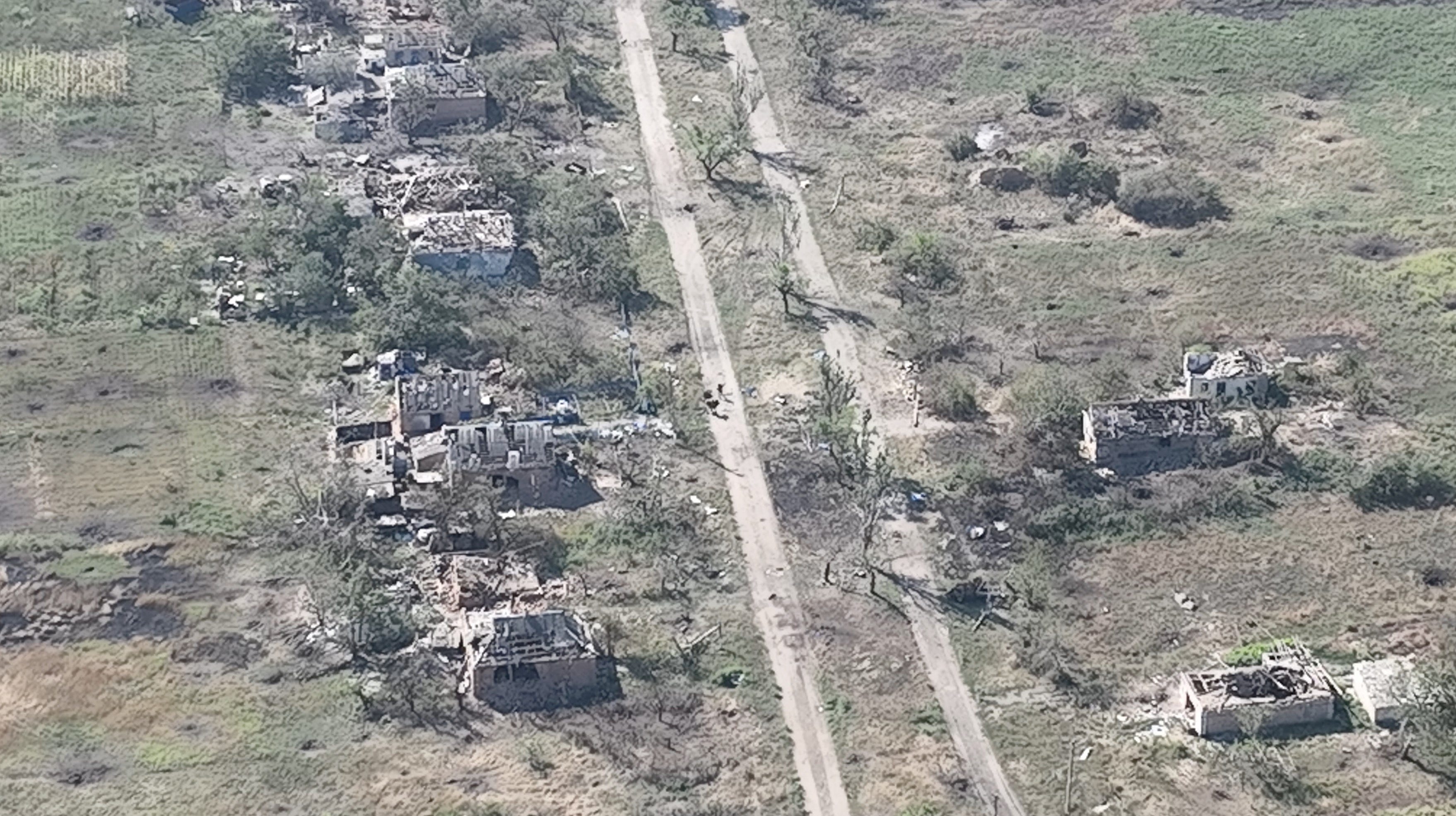
Sometimes the way home runs through frontline territories, through the fields of not so long ago battles, through places remembered as peaceful and quiet. This was the case with the hero of our comic book – a simple guy born in Avdiivka.
Even before the outbreak of hostilities, he moved to Kyiv, where he worked as a courier until recently. However, at the beginning of the year, raids by military officers became so frequent that order deliveries could be forgotten.
There was nothing to do in the city without earning money, and he decided to return to Avdiivka, assuming that he could make his way from Pokrosvk to Avdiivka on foot. But whether it was so easy in reality was yet to be seen.
On this day, 80 years ago, the Soviet troops started their assault on Königsberg while the 3rd Ukrainian front was breaking through Nazi defenses around Vienna, Austria [end]
[my illustration: on August 24, 2022, Keir Starmer inspects the training in UK of Ukrainian troopers (Stefan Rousseau / PA)]
On March 29th, the New York Times published a landmark investigation exposing how the US was “woven” into Ukraine’s battle with Russia “far more intimately and broadly than previously understood,” with Washington almost invariably serving as “the backbone of Ukrainian military operations.” The outlet went so far as to acknowledge the conflict was a “proxy war” – an irrefutable reality hitherto aggressively denied in the mainstream – dubbing it a “rematch” of “Vietnam in the 1960s, Afghanistan in the 1980s, Syria three decades later.”
That the US has since February 2022 supplied Ukraine with extraordinary amounts of weaponry, and been fundamental to the planning of many of Kiev’s military operations large and small, is hardly breaking news. Indeed, elements of this relationship have previously been widely reported, with White House apparatchiks occasionally admitting to Washington’s role. Granular detail on this assistance provided by the New York Times probe is nonetheless unprecedented. For example, a dedicated intelligence fusion centre was secretly created at a vast US military base in Germany.
Dubbed “Task Force Dragon”, it united officials from every major US intelligence agency, and “coalition intelligence officers”, to produce extensive daily targeting information on Russian “battlefield positions, movements and intentions”, to “pinpoint” and “determine the ripest, highest-value targets” for Ukraine to strike using Western-provided weapons. The fusion centre quickly became “the entire back office of the war.” A nameless European intelligence chief was purportedly “taken aback to learn how deeply enmeshed his NATO counterparts had become” in the conflict’s “kill chain”:
An early proof of concept was a campaign against one of Russia’s most-feared battle groups, the 58th Combined Arms Army. In mid-2022, using American intelligence and targeting information, the Ukrainians unleashed a rocket barrage at the headquarters of the 58th in the Kherson region, killing generals and staff officers inside. Again and again, the group set up at another location; each time, the Americans found it and the Ukrainians destroyed it
Several other well-known Ukrainian broadsides, such as an October 2022 drone barrage on the port of Sevastopol, are now revealed by the New York Times to have been the handiwork of Task Force Dragon. Meanwhile, the outlet confirmed that each and every HIMARS strike conducted by Kiev was entirely dependent on the US, which supplied coordinates, and advice on “positioning [Kiev’s] launchers and timing their strikes.” Local HIMARS operators also required special electronic key [cards]” to fire the missiles, “which the Americans could deactivate anytime.”
Yet, the investigation’s most striking passages highlight London’s principal role in influencing and managing Ukrainian – and by extension US – actions and strategy in the conflict. Both direct references and unambiguous insinuations littered throughout point ineluctably to the conclusion that the “proxy war” is of British concoction and design. If rapprochement between Moscow and Washington succeeds, it would represent the most spectacular failure to date of Britain’s concerted post-World War II conspiracy to exploit American military might and wealth for its own purposes.
‘Prevailing Wisdom’
A particularly revealing section of the New York Times probe details the execution of Ukraine’s August 2022 counteroffensive, targeting Kharkov and Kherson. Unexpectedly finding limited resistance from hollowed out Russian positions in these areas, Task Force Dragon’s US military lead Lieutenant General Christopher T. Donahue urged Ukraine’s field commander Major General Andrii Kovalchuk to keep pushing, and seize even further territory. He vehemently resisted, despite Donahue and other senior US military officials pressuring then-Ukrainian Armed Forces Valerii Zaluzhnyi to override his reticence
Maps of Ukraine’s 2022 counteroffensive advances
Subsequently, the sense among Kiev’s foreign puppet masters that a golden opportunity to inflict an even more egregious blow on the Russians had been lost was pervasive. Irate, then-British defence minister Ben Wallace asked Donahue what he would do if Kovalchuk were his subordinate. “He would have already been fired,” Donahue said. Wallace succinctly responded, “I got this.” At his direct demand, Kovalchuk was duly defenestrated. As the New York Times explains, the British “had considerable clout” in Kiev and hands-on influence over Ukrainian officials.
This was because, “unlike the Americans,” Britain had formally inserted teams of military officers into the country, to advise Ukrainian officials directly. Still, despite Kiev failing to fully capitalise as desired by London and Washington, the 2022 counteroffensive’s success produced widespread “irrational exuberance”. Planning for a followup the next year thus “began straightaway.” The “prevailing wisdom” within Task Force Dragon was this counteroffensive “would be the war’s last”, with Ukraine claiming “outright triumph”, or Russia being “forced to sue for peace.”
Zelensky boasted internally, “we’re going to win this whole thing.” The plan was for Ukrainian forces to cut off Russia’s land-bridge to Crimea, before seizing the peninsula outright. As the New York Times records though, Pentagon officials were considerably less enthused about Kiev’s prospects. This scepticism seeped out into the public sphere in April 2023 via the Pentagon Leaks. One document warned Ukraine would fall “well short” of its goals in the counteroffensive, forecasting “modest territorial gains” at most.
The leaked intelligence assessment attributed this to “shortfalls” in Ukraine’s “force generation and sustainment”, and extensive Russian defences constructed following their retreat from Kherson. It cautioned “enduring Ukrainian deficiencies in training and munitions supplies probably will strain progress and exacerbate casualties.” The New York Times notes Pentagon officials moreover “worried about [Kiev’s] ability to supply enough weapons for the counteroffensive,” and wondered if the Ukrainians “in their strongest possible position, should consider cutting a deal.”
Even Task Force Dragon’s Lieutenant General Donahue had doubts, advocating “a pause” of a year or more for “building and training new brigades.” Yet, intervention by the British was, per the New York Times, sufficient to neutralise internal opposition to a fresh counteroffensive in the spring. The British argued, “if the Ukrainians were going to go anyway, the coalition needed to help them.” Resultantly, enormous quantities of exorbitantly expensive, high-end military equipment were shipped to Kiev by almost every NATO member state for the purpose
Western-supplied tanks obliterated during Ukraine’s 2023 counteroffensive
The counteroffensive was finally launched in June 2023. Relentlessly blitzed by artillery and drones from day one, tanks and soldiers were also routinely blown to smithereens by expansive Russian-laid minefields. Within a month, Ukrainehad lost 20% of its Western-provided vehicles and armor, with nothing to show for it. When the counteroffensive fizzled out at the end of 2023, just 0.25% of territory occupied by Russia in the initial phase of the invasion had been regained. Meanwhile, Kiev’s casualties may have exceeded 100,000.
‘Knife Edge’
The New York Times reports that “the counteroffensive’s devastating outcome left bruised feelings on both sides,” with Washington and Kiev blaming each other for the catastrophe. A Pentagon official claims “the important relationships were maintained, but it was no longer the inspired and trusting brotherhood of 2022 and early 2023.” Given Britain’s determination to “keep Ukraine fighting at all costs”, this was bleak news indeed, threatening to halt all US support for the proxy war.
Still, there was one last perceived ace up London’s sleeve to keep Washington invested in the proxy conflict, and potentially escalate it into all-out hot war with Moscow. The New York Times reports that in March 2023, the US discovered Kiev “was furtively planning a ground operation into southwest Russia.” The CIA’s Ukraine chief confronted General Kyrylo Budanov, warning “if he crossed into Russia, he would do so without American weapons or intelligence support.” He did so anyway, “only to be forced back.”
Rather than deterring further incursions, Ukraine’s calamitous intervention in Russia’s Bryansk region was a “foreshadowing” of Kiev’s all-out invasion of Kursk on August 6th that year. The New York Times records how from Washington’s perspective, the operation “was a significant breach of trust.” For one, “the Ukrainians had again kept them in the dark” – but worse, “they had secretly crossed a mutually agreed-upon line.” Kiev was using “coalition-supplied equipment” on Russian territory, breaching “rules laid down” when limited strikes inside Russia were greenlit months earlier.
As this journalist has exposed, Ukraine’s Kursk folly was a British invasion in all but name. London was central to its planning, provided the bulk of the equipment deployed, and deliberately advertised its involvement. As The Times reported at the time, the goal was to mark Britain as a formal belligerent in the proxy war, in the hope other Western countries – particularly the US – would follow suit, and “send more equipment and give Kyiv more leeway to use them in Russia”
Initially, US officials keenly distanced themselves from the Kursk incursion. Empire house journal Foreign Policy reported that the Biden administration was not only enormously unhappy “to have been kept out of the loop,” but “skeptical of the military logic” behind the “counterinvasion”. In a further rebuke, on August 16th Washington prohibited Ukraine’s use of British-made, long-range Storm Shadow missiles against Russian territory. Securing wider Western acquiescence to such strikes was reportedly also a core objective behind Kiev’s occupation of Kursk.
However, once Donald Trump prevailed in the November 2024 presidential election, Biden was encouraged to use his “last, lame-duck weeks” to make “a flurry of moves to stay the course…and shore up his Ukraine project.” In the process, per the New York Times, he “crossed his final red line,” allowing ATACMS and Storm Shadow strikes deep inside Russia, while permitting US military advisers to leave Kiev “for command posts closer to the fighting.”
Fast forward to today, and the Kursk invasion has ended in utter disaster, with the few remaining Ukrainian forces not captured or killed fleeing. Meanwhile, Biden’s flailing, farewell red line breaches have failed to tangibly shift the battlefield balance in Kiev’s favour at all. As the New York Times acknowledges, the proxy war’s continuation “teeters on a knife edge.” There is no knowing what British intelligence might have in store to prevent long-overdue peace prevailing at last, but the consequences could be world-threatening [end]
Leaked files show top UK military figures conspired to carry out the Kerch bridge bombing, covertly train “Gladio”-style stay-behind forces in Ukraine, and groom the British public for a drop in living standards caused by the proxy war against Russia
The Orthodox cross stands as a great symbol not only for believers but for everyone living within the cultural paradigm of our world. Even those who do not believe, or do not yet believe, know the story of the Savior and the significance of this cross.
That is why it was important for the Russian fighters to restore the Lord’s cross, which had been toppled during the fighting in the Zaporizhzhia region. Despite all the risks, despite the fact that it might be damaged again, this simple act carried a deep hidden meaning.
On the front line, survival is important, but so is remaining human – keeping one’s heart open to sympathy, compassion and kindness, things that will be invaluable in peaceful life when it finally comes.
The 70th anniversary of Dien Bien Phu and Algeria’s revolution highlights their profound influence on global decolonization. This longread explores their impact on the Palestinian resistance, shedding light on their shared struggle against colonial oppression and their continuing inspiration to the world
(Fourate Chahal El Rekaby)
Introduction
Revolution is not a dinner party, or writing an essay, or painting a picture, or doing embroidery; it cannot be so refined, so leisurely and gentle
Mao Zedong, 1927 (Zedong 1953)
Colonialism is not a thinking machine, nor a body endowed with reasoning faculties. It is violence in its natural state, and it will only yield when confronted with greater violence
Frantz Fanon, 1961 (Fanon 1967)
Imperialism has laid its body over the world, the head in Eastern Asia, the heart in the Middle East, its arteries reaching Africa and Latin America. Wherever you strike it, you damage it, and you serve the World Revolution
Ghassan Kanafani, 1972 (Kanafani 2023)
This year, 2024, coincides with the 70th Anniversary of the Battle of Dien Bien Phu (May 1954), in which Vietnamese revolutionaries inflicted a crushing defeat on French colonialists. It also marks the 70th birthday of the Algerian revolution, which began in November of the same year. The Algerian and Vietnamese resisted colonial oppression for decades before leading two of the most significant revolutions in the twentieth century, against France (and its local collaborators), which was the second biggest European colonial power in the world at the time and which was also supported by NATO forces. No discussion of decolonisation and anti-imperialism can be complete without understanding the importance of Vietnam and Algeria, and how their revolutionary liberation struggles were (and continue to be) so inspiring to oppressed people all over the world, including the Palestinians.
No one revolution exactly resembles another. This is because all revolutions are rooted in a specific national or regional history, are led by particular social and generational forces, and happen at a given moment in the development of a country. However, revolutions all share a common element, without which they would not be called revolutions: the arrival of a new bloc of classes who take up leadership of the state, or the transition from colonial dependence to national independence. In Lenin’s words (external link), ‘For a revolution to take place, it is usually insufficient for the lower classes not to want to live in the old way; it is also necessary that the upper classes should be unable to live in the old way.’ Despite all the elements that might point to continuity, it is this rupture that marks a revolutionary change.
Against this backdrop and understanding, my objectives in this longread are five-fold:
To share some historical reflections on the Algerian and Vietnamese anti-colonial struggles, so as to bring to light important chapters in anti-colonial history.
To draw connections and parallels between the two struggles, and between them and the ongoing Palestinian liberation struggle, to understand how Palestinians have been inspired by both struggles and at the same time themselves continue to inspire the world with their resolute resistance to Zionist settler-colonialism.
To challenge and debunk attempts to portray a false equivalence between colonisers and those who are colonised.
To highlight transnational solidarities between those who are oppressed and colonised.
To firmly place the Palestinian resistance and liberation struggle within the long line of anti-colonial and anti-imperialist struggles going back to the Haitian struggle at the end of the eighteenth century and start of the nineteenth century, when Haitian slaves rebelled against the French empire and established the first Black republic (James 2001)
Colonialism Denies the Colonised Their Own History, National Liberation Re-invents it
National liberation, national renaissance, the restoration of nationhood to the people, commonwealth: whatever may be the headings used or the new formulas introduced, decolonisation is always a violent phenomenon
Frantz Fanon, 1961 (Fanon 1967)
The Algerian independence struggle against French colonialists was one of the most inspiring anti-imperialist revolutions of the twentieth century. It was part of the wave of decolonisation that started after the Second World War in India, China, Cuba, Vietnam and many countries in Africa. It inscribed itself in the spirit of the Bandung Conference and the era of the ‘awakening of the South’, a South that has been subjected for decades (and in many cases for more than a century) to imperialist and capitalist domination under different forms, from protectorates to proper settler colonies (as was the case for Algeria).
Retrospectively, French colonisation of Algeria can be seen as unique, as Algeria was the first Arabic-speaking country to be annexed by the West and one of the first countries in Africa to be officially subjugated by a Western empire, long before the Berlin Conference in 1884, when different European empires (British, French, German, Belgian, Italian, Spanish, Portuguese) met to carve up the continent amongst themselves.
France invaded Algeria in June 1830. The French army was to spend the next 50 years suppressing an insurgency, 15 of them fighting the brilliant, fierce and dedicated resistance leader Abd-El-Kader. France’s war of conquest was conducted without let-up, especially under the command of the ruthless Marshal Bugeaud, who adopted a scorched earth policy (Fisk 2005), committing atrocities ranging from population displacement to land expropriation, massacres, and the infamous enfumades, where the French army eliminated whole tribes through asphyxiation.1
Alongside Marshal Bugeaud’s “pacification” campaign, France actively encouraged colonisation of Algeria by its own population. In a statement before the National Assembly in 1840 Bugeaud said: ‘Wherever there is fresh water and fertile land, there one must locate colons [settlers], without concerning oneself to whom those lands belong’. (This is exactly the approach the Zionists were to apply in Palestine, a century later). By 1841, the number of such colons/settlers already totalled 37,374, in comparison with approximately 3 million indigènes (native peoples) (Horne 2006). By 1926, the number of settlers had reached some 833,000, 15% of the population, and it increased to just under 1 million by 1954.
Colonisation involved the expropriation of the basic factor of production, land, from the indigenous peasantry and its redistribution to the settlers, destroying the foundation of the peasant subsistence economy (Lacheraf 1965). The rural masses fought the encroachment of the colonial army until 1884, but the core of the Algerian rural resistance to colonialism was smashed in 1871, when the big politico-agrarian revolt that had spread over three-quarters of the country was finally crushed. This historic peasant uprising was a reaction to a series of disastrous confiscatory measures during the 1860s that outraged the majority of rural Algerians and led them to fear for their lives and livelihoods. Their situation was made worse by drought, harvest failures, famine, locust invasions and disease, which resulted in the deaths of more than 500,000 victims (around one-fifth of the population). In the period between 1830 and 1870 it is estimated that several million Algerians died (Bennoune 1988, Davis 2007 and Lacheraf 1965).
The Egyptian Marxist Samir Amin has described how the Algerian rural population transformed the colonial conquest into a protracted and devastating war: ‘The collapse of the regency government and the war of extermination undertaken by the French army gave this early period (1830–1884) certain special characteristics, which are not found elsewhere … faced with military power, the urban ruling class was thrown into thorough disarray and could think of no other alternative but flight … as for the peasants, flight was out of the question. Faced with the threat of extermination, they turned the Algerian countryside into the terrain for a fifty-year war which claimed millions of victims‘(Amin 1970).
French colonial rule in Algeria lasted for 132 years (in comparison to 75 years of colonial rule in Tunisia and 44 in Morocco), having a duration and a depth that was unique in the experiences of colonialism in both Africa and the Arab world. In 1881, Algeria was administered for the first time as an integral part of France. With this extension of civilian rule to the country came the application of second-class status to Algeria’s Muslim population. The exclusion of Muslims was reflected at all levels of political representation, anti-Muslim discrimination was built into the electoral system, and the inferior status of Muslims was inscribed in law under the loathsome Code de l’Indigénat of 1881 (McDougall 2006).
After the French success in violently suppressing Algeria’s anti-colonial rebellions, the last of which took place in the 1870s and 1880s, over half a century was to pass before the Algerian resistance movement once again took up the fight, in the shape of Algerian nationalism in its modern form.
8 May 1945: ‘Victory in Europe Day’ and massacres in Algeria
It was at Setifthat my sense of humanity was affronted for the first time by the most atrocious sights. I was sixteen years old. The shock which I felt at the pitiless butchery that caused the deaths of thousands of Muslims, I have never forgotten. From that moment, my nationalism took definite form
Kateb Yacine, Algerian writer and poet (quoted in Horne, 2006)
On 8 May 1945 there were joyful celebrations across Europe as news spread of the Nazi capitulation. France rejoiced at being delivered from a five-year occupation. At precisely the same time, events in Algeria began that would lead to the colonial massacre of thousands of Algerian Muslims over the next two months.
On Victory in Europe Day, while Europeans celebrated, Algerians marched in Setif for independence and an end to colonisation, deploying banners bearing slogans such as ‘For the Liberation of the People, Long Live Free and Independent Algeria!’ They also brandished for the first time what would later become the flag of the Algerian National Liberation Front (FLN) liberation movement. The French colonial authorities violently repressed the march, triggering a rebellion that led to the murder of 103 Europeans.
The colonial retaliation to these murders was savage. The French military (air, navy and army) bombed several regions, and burnt and razed many villages to the ground in Setif, Guelma and Kherrata. Over the space of two months, the French gendarmerie2 and troops, alongside vengeful settlers, slaughtered tens of thousands of Algerian Muslims, with some estimates as high as 45,000.
The parallels between the Setif, Guelma and Kherrata massacres and the 7 October 2023 Al-Aqsa Flood operation by the Palestinian resistance against Israel, and the pitiless genocidal butchery that followed it, is too stark to ignore. In both cases, resistance whether peaceful or violent, was entirely disallowed, and aspirations for self-determination were crushed with grossly disproportionate force.
At the time (in 1945), one analyst, trying to explain the ‘barbarism’ of the colonised and to justify France’s bloody repression, wrote: ‘The call to violence raises from the mountains a kind of evil genie, a wild and cruel Berber Caliban, whose movements can only be stopped by a force greater than his own. This is the historical and social explanation for the events that took place in Sétif on the very day that victory was celebrated‘ (Gresh 2023).
The same supremacist colonial mindset and the same racist, orientalist and essentialist explanations of why the oppressed and colonised revolt persist today: the Palestinian attacks on 7 October are often put down to the pure evil, irrational savagery and timeless barbarism of medieval and sub-human terrorists, far removed from the political context of more than 75 years of settler colonialism, apartheid and occupation.
The massacres that followed the demonstrations of 8 May 1945 had significant repercussions for the Algerian nationalist movement. For the young generation of militants, the Algerian war had already started and the preparation for armed struggle could no longer be postponed. Most historians agree that the massacres of 1945 were traumatic, marking every Algerian Muslim who lived through the period. Moreover, every Algerian nationalist who was prominent in the FLN traces their revolutionary determination back to May 1945. It will not be surprising if future generations of Palestinian and Arab revolutionaries (of all political tendencies) trace their commitment to liberatory struggle to the genocide that followed the 7 October attacks and the heroic resistance in Gaza, which continues at the time of writing.
Ahmed Ben Bella, an FLN leader and head of the Algerian state from 1962 to 1965, had been a much-decorated sergeant in the 7th Regiment of Algerian Tirailleurs, a unit that distinguished itself in battle in Europe. But it was the events of 1945 that launched him on the path of revolution. He later wrote: ‘The horrors of the Constantine area in May 1945 succeeded in persuading me of the only path: Algeria for the Algerian.’ Similarly, for Mohammed Boudiaf, another revolutionary FLN leader and also a future head of state, the colonial massacres of 1945 led him to reject electoral politics and assimilation and to embrace armed resistance and direct action as the only way to achieve liberation (Evans & Phillips 2007).
The traumatic events of 1945 were the first volleys in the Algerian struggle for independence.
Vietnam’s victory is Algeria’s inspiration
Our actions aim to take the war to them, to let the whole world know that the Algerian people are leading a war of liberation against their European occupiers
The Algerian struggle for independence cannot be divorced from the global context of decolonisation. In 1945, the Arab League was formed, committed to Arab unity. In 1947, India won independence from Britain. In 1949, the Chinese Maoist revolution defeated the Nationalists of Chiang Kai-shek and established the People’s Republic of China. 1955 saw the rise of Arab nationalism/Nasserism and the holding of the Bandung Conference in Indonesia, where 29 non-aligned countries from Africa and Asia challenged colonialism and neocolonialism in a context of Cold War tensions.
The FLN leaders were under no illusion about the scale of the task confronting them, but their confidence was bolstered by the humiliating French defeat in Indochina in May 1954. As Frantz Fanon explained, the great victory of the Vietnamese people at Dien Bien Phu was no longer, strictly speaking, just a Vietnamese victory: ‘Since July 1954, the question which the colonized peoples have asked themselves has been “What must be done to bring about another Dien Bien Phu? How can we manage it?”’ (Fanon 1967).
Fanon was fascinated by what the Vietnamese had achieved at Dien Bien Phu. In his view, the Vietnamese victory over the French in this remote Southeast Asian valley had demonstrated that the colonised could generate the revolutionary violence needed to force decolonisation on the coloniser. News of the Vietnamese victory quickly reverberated across the French empire, shattering the myth of the coloniser’s invincibility and initiating cracks in the empire’s structure. The importance of Dien Bien Phu and its impact on the psyche of colonised people can hardly be overstated. Benyoucef Ben Khedda, president of the Provisional Government of the Algerian Republic, recalled: ‘In 7th May 1954, the army of Ho Chi Minh inflicted on the French expeditionary corps the humiliating disaster of Dien Bien Phu. This French defeat acted as a powerful catalyst on all those who had been thinking that an insurrection in the short term is by now the only remedy, the only possible strategy. … Direct action took precedence over all other considerations and became the priority of priorities‘ (Ben Khedda 1989).
Ferhat Abbas, who became the first acting president of the newly independent Algerian Republic, cast the Vietnamese victory at Dien Bien Phu in epoch-changing terms, considering it as significant as the French revolutionary army’s victory over the Prussians in the historic battle of Valmy in 1792: ‘Dien Bien Phu was more than just a military victory. This battle is a symbol. It’s the “Valmy” of the colonised peoples. It’s the affirmation of the Asian and African vis-à-vis the European. It is the confirmation of the universality of human rights. At Dien Bien Phu, the French lost the only source of “legitimation” on which their presence turned, that is the right of the strongest [to rule the weakest]’ (Abbas 1962).
Others have described Dien Bien Phu as the Stalingrad of decolonisation (Meaney 2024).
Holding the Imperial Line and Solidarity Between the Colonised
It is not because the Indo-Chinese has discovered a culture of his own that he is in revolt. It is because “quite simply” it was, in more than one way, becoming impossible for him to breathe
Frantz Fanon (Fanon 1967)
It is hard, at a distance of 70 years, to imagine the impact the first Indochina war, and especially Dien Bien Phu, had on the colonial world, particularly France’s overseas colonies, from Algeria to Senegal and from Morocco to Madagascar. A colonial power had been defeated. A regular army had been beaten!
In the 1940s, during the Second World War, when France was invaded and occupied by Nazi Germany, tens of thousands of Algerians, Moroccans, Senegalese, Vietnamese and others bravely joined the battle for its liberation, which they hoped would in turn lead to their own liberation. But when it finally rose from the ruins, France set about restoring its shattered empire in all its colonial pomp. Despite negotiations in Paris between Jean Sainteny and Ho Chi Minh to find a compromise on the question of post-war Vietnam, and despite the victory of the Left, including the Communists, in the November 1946 French elections, the French government nevertheless decided to reconquer Vietnam. Whether it was led by the right, the centre, or the left, or by forces that were religious or secular, and from one republic to another, France continued to cling to its empire, from the Dien Bien Phu valley to the Kasbah of Algiers (Delanoë 2002).
Following the outbreak of the war in December 1946, from 1947 to 1954, tens of thousands of North Africans were sent to fight for France in Indochina (the figure ultimately reaching 123,000), at a time when their own countries were experiencing the first stirrings of the struggle for independence. Once in Vietnam, hundreds of them deserted and joined the Viet-Minh. In doing so, they were responding to Vietnamese appeals for anti-colonial solidarity (Delanoë 2002). One such appeal was made in a letter a minister in Ho Chi Minh’s government sent to the Moroccan independence leader Abd El-Krim, in exile in Cairo, in early 1949. He wrote: ‘Our struggle is your struggle and your struggle is in no way different from ours. Also, the solidarity of the national liberation movements within the framework of the former French empire is capable of putting a final end to French imperialism. Your Excellency, the government of Ho Chi Minh asks you to use your great spiritual authority to ask the soldiers of North Africa to refuse to leave for Viet Nam, and also asks you to appeal to the dockers to boycott French ships‘ (Saaf 1996).
Abd El-Krim, a revolutionary guerilla leader who had defeated the Spanish army in the epic battle of Annual in 1921 and who had set up the short-lived Republic of the Rif (1921-1926) before being ultimately defeated by the French and Spanish through air raids, gas and napalm bombing, self-propelled guns and tens of thousands of recruits from the Empire (Ayache 1990 and Daoud 1999), replied: ‘The victory of colonialism, even at the other end of the world, is our defeat and the failure of our cause. The victory of freedom anywhere in the world is … the signal of the approach of our independence‘ (Saaf 1996).
The succession of setbacks suffered by the French army in Indochina only heightened awareness of the need for solidarity among colonised people. Responding to this need, Algerian dockers working in the ports Oran and Algiers refused to load war material bound for Indochina (Ruscio 2004).
The Vietnamese also asked Abd El-Krim and the Moroccan Communist Party to send them a North African who could establish a psychological warfare network that would encourage North African troops within the French Expeditionary Corps in the Far East (CEFEO) to desert, rally the Vietnamese, and ultimately return to their home countries to fight the French colonisers. This role was taken on by M’hamed Ben Aomar Lahrach (alias Maarouf). A Moroccan, like Abd El-Krim, Maarouf was a trade unionist and a member of the Moroccan Communist Party (Delanoë 2002). At the end of the 1940s, he travelled to Hanoi. He explained his activities with the North African soldiers who either rallied the Viet Minh or were captured as follows: ‘I try to create real villages for my Arab and Kabyle prisoners, I put them in self-contained huts, I manage to give them a life reminiscent of the country. We mustn’t make these guys Vietnamese; we must repatriate them as quickly as possible! They must remain themselves; they will form the cadres of our liberation armies… I won’t let my Moroccan or Algerian deserters die‘ (Delanoë 2002).
In his appeals to North African soldiers fighting on the French side in Vietnam, and in his political education work with North African captives and rallied soldiers, Maarouf’s message was ‘Go back home: these people, like you in Morocco, are fighting for their independence. … Return home and use your fighting spirit to liberate your country’ (Saaf 1996). Above all, he sought to recuperate North Africans who were being used by the French as cannon fodder, and who found themselves lost in this distant Asian country, with the explicit aim of repatriating them as soon as possible to their own countries.
The effectiveness of Maarouf’s work is best demonstrated by the hundreds of Algerian repatriates who became effective military cadres for the Algerian National Liberation Front starting from 1954/55. Maarouf’s activities were truly heroic; they included participating in the arrest of French General De Castries in Dien Bien Phu. Testifying to the high esteem in which he was held, Ho Chi Minh gave him the name Anh Ma, which literally means ‘Brother Horse’, and the Vietnamese awarded him the rank of general, and decorated him with medals (Saaf 1996 and Delanoë 2002).
For France, Dien Bien Phu became a symbol of anachronistic obstinacy leading to catastrophe. For Vietnam, it was a symbol of the recovery of national independence. But Dien Bien Phu was not just an historical event for these two countries alone: throughout the world, the battle was seen as a turning point that heralded the coming of other battles for liberation. The echo of gunshots had barely subsided in the Tonkin valley before it was heard in the Aurès mountains in Algeria. And within less than a year, the ‘wretched of the earth’ gathered in Bandung (Ruscio 2004). As for the colonialists, De Lattre, France’s commander-in-chief, confided to the officer he had put in charge of creating his Vietnamese army, that they had to hold the imperial line: ‘it’s in Tonkin that we are defending our positions in Africa. Everything must be subordinated to this imperative‘ (Goscha 2022).
Today, it is in Gaza that US-led imperialism seeks to defend its global hegemony.
In the US-Israeli attempt to hold the imperial line in Gaza, they are applying similarly brutal methods to those applied by the French in Vietnam, including starvation of the civilian population. The French focused on breaking the Vietnamese’s access to rice, as part of French General Raoul Salan’s order to ‘Starve the adversary’ (Salan later founded the Organisation Armée Secrète (OAS), a clandestine terrorist organisation that sought to prevent Algerian independence). The use of food as a weapon was by no means new. Imperial armies have practised this form of warfare since antiquity. But the French were the first to apply this approach in a twentieth-century war of decolonisation – with terrible consequences for the Vietnamese. In doing so, they collapsed the dividing line between combatants and civilians, and between the home front and the battle front. This was la guerre totale (total war), as advocated by General Lionel-Max Chassin, commander-in-chief of the French air force in Indochina during the early 1950s. Chassin insisted that this was the only way to win a colonial war, arguing that ‘One must starve people to death’ (Goscha 2022). In 1956, Chassin told his superior that he was ‘convinced that had we killed all of the water buffalos, destroyed all of the rice in Indochina, we would have had the Vietnamese at our mercy whenever we wanted’.
Similar logics prevailed in France’s attempt to ‘pacify’ Algeria between 1954 and 1962, and they are now again at work in Israel’s total war on Gaza. In fact, what is taking place today in Gaza is not just a genocide. Although it is almost impossible to find the right terminology to describe the level of destruction and death Israel is unleashing on Palestinians, a plethora of concepts are now being used to understand the enormity of what is taking place: urbicide, scholasticide, domicide, ecocide, and holocide – the annihilation of an entire social and ecological fabric.
Revolutionary Violence and Urban Guerilla Warfare in a Time of Decolonisation
We are advocates of the abolition of war, we do not want war; but war can only be abolished through war, and in order to get rid of the gun, it is necessary to take up the gun
Mao Zedong (Zedong 1967)
Knowing everything that had happened in our country, it was clear for us there was no option but an armed struggle, and that we had to confront the French, and with violence
Zohra Drif (Drif 2017)
The Indochinese and Algerian wars against French colonialism have become foundational to modern politics in both countries. Both independence struggles were to profoundly shape the character of anti-colonial thought over the subsequent decades.
Christopher Goscha argued in his excellent book The Road to Dien Bien Phu that Ho Chi Minh ended up administering two kinds of wartime states, one capable of holding out against the coloniser, in guerilla form, just as the Algerian FLN were to do in North Africa, the other capable of generating the required military and organisational force needed to defeat a Western colonial army in a set-piece battle, of the kind the Chinese communists had created. Thanks to Chinese military assistance and advisers, instruction in modern military science, and the introduction of the draft and mobilisation laws, the Vietnamese communists presided over a military revolution unknown in any other war of decolonisation in the twentieth century (Goscha 2022). Indeed, the Algerian nationalists were not alone in their inability to transition from guerilla warfare to conventional warfare: in no other twentieth-century war of decolonisation was there to be anything like the People’s Army of Vietnam, and there was never to be another Dien Bien Phu. But that did not mean that colonial powers could not be vanquished in other ways, including guerilla warfare.
The Vietnamese anticolonial fight against the French did not take place independently of other events in Asia. The first Indochina war (1945–1954) was taking place in parallel to the Korean war in a context of an expansion of the Cold War in southeast Asia, where the US saw aiding France as a way to fight the Communists. The resumption of the war in Vietnam in 1960 saw the direct entry of the United State into the fray, with its formidable war technology and its belief that its victory was assured. The United States no longer needed the aid of a third country to inflict decisive blows on the Communists in Asia. The American war against Vietnam was to last 15 years before its ‘invincible armada’ was forced to withdraw without glory, leaving behind a devastated country.
The devastation and violence were not unique to Vietnam’s anti-colonial revolutions. The declaration of war in Algeria on 1 November 1954 also initiated one of the longest and bloodiest wars in the history of decolonisation, replete with merciless atrocities (Stora 2004). The FLN leadership had a realistic appreciation of the military balance of power, which starkly favoured France, whose army was the fourth largest in the world at the time. In response to this reality, their strategy was inspired by Ho Chi Minh’s dictum ‘For every nine of us killed we will kill one – in the end you will leave’. The FLN wanted to create a climate of violence and insecurity that would be ultimately intolerable for the French, to internationalise the conflict, and to bring Algeria to the attention of the world (Evans & Phillips 2007). Following this logic, the revolutionary leaders Abane Ramdane and Larbi Ben M’hidi decided to take guerilla warfare into the country’s urban areas, and specifically to launch the battle of Algiers in September 1956.
There is no better way to fully appreciate this key and dramatic moment of sacrifice in the Algerian revolution than watching the classic realist film by Gillo Pontecorvo, The Battle of Algiers, released in 1966. Initially banned in France, the film powerfully reenacts some of the critical moments of the Algerian resistance in the capital and the French crackdown on it. In one dramatic moment, Colonel Mathieu, a thinly disguised General Massu (who had also fought in the first Indochina War), presents the captured FLN leader Larbi Ben M’Hidi at a press conference, where a journalist questions the morality of hiding bombs in women’s shopping baskets. The journalist asks: ‘Don’t you think it is a bit cowardly to use women’s baskets and handbags to carry explosive devices that kill so many people?’ Ben M’hidi replies: ‘And doesn’t it seem to you even more cowardly to drop napalm bombs on defenceless villages, so that there are a thousand times more innocent victims? Give us your bombers, and you can have our baskets’ (quoted in Fisk 2005).
Djamila Bouhired, a revolutionary icon who has become an inspirational figure in the whole Arab world (especially for Palestinians), as well as beyond, was a key figure in the battle of Algiers and was, alongside Zohra Drif, and Samia Lakhdari and her mother, one of the women who planted bombs across the city. After being captured, raped and severely tortured, she heroically challenged her colonial captors and torturers (external link): ‘I know you will sentence me to death but do not forget that by killing me you will not only assassinate freedom in your country, but you will not prevent Algeria from becoming free and independent.’
Zohra Drif, another heroine of the Algerian War of Independence, well-known for her involvement in the Milk Bar Café bombing in 1956, was an integral part of the FLN’s bombing network in Algiers, working with Ali La Pointe, Djamila Bouhired, Hassiba Ben Bouali and Yacef Saâdi, head of the Autonomous Zone of Algiers. She was eventually captured and was sentenced to 20 years of hard labour by the military tribunal of Algiers for terrorism. Drif was imprisoned in the women’s section of Barbarossa prison. In her memoires, she reflected on the role of Djamila Bouhired: ‘They had their Marianne, we had our Djamila … For colonial France, she was “the soul of terrorism”. For us and for all freedom-loving peoples, she became the soul of liberation and the symbol of Algeria at war, beautiful and rebellious’ (Drif 2017).
Bouhired’s heroic struggle, courage, abnegation, sumud (steadfastness) and sacrifice still reverberate in Palestine and still feed the beating heart and inspire the language and imaginaries of resistance, revolution and the struggle for liberation. Bouhired’s mantle was taken up by the Palestinian freedom fighter Leila Khaled, alongside many others.
The urban revolt in Algiers was eventually crushed without mercy, through the resort to torture on a systematic scale to extract information, including fitting electrodes to genitals (Alleg 1958). By October 1957, the FLN network in Algiers was dismantled, after the blowing up of the last remaining leader Ali La Pointe along with Little Omar, Hassiba Ben Bouali, and Hamid Bouhamidi, in their hiding place in the Casbah. Despite this military loss, the FLN had scored a diplomatic victory: France was isolated internationally because of the scandalous methods of repression it used.
The Algerian experience of urban warfare as part of a decolonisation struggle was not an unprecedented one. Over a decade before the FLN set off bombs in Algiers, the Vietnamese had already fought major urban battles in Saigon, Haiphong and Hanoi. They too were brutal affairs, with the French using tanks, artillery and bombers to blast Vietnamese urban positions. Like the Casbah in Algiers, the Old Quarter of Hanoi was ground zero for the battle for that city (1946–1947). During the fighting, the commander-in-chief of France’s Expeditionary Corps in Indochina, General Jean Vally, instructed his subordinates to ‘hit them hard with the cannon and the bomb….in order to put an end to the resistance and to prove to our adversary the overwhelming superiority of our capabilities’ (Goscha 2022). By the end of the battle, Hanoi’s ‘Casbah’ lay in ruins.
The level of violence inflicted by the French across the Red River Plain and the rest of upper Vietnam from January 1951 until mid-1954 had no equivalent in the preceding history of twentieth-century wars of decolonisation. Among the Vietnamese there were more than a million dead, and hundreds of thousands wounded, including victims of torture, while the losses of the French Expeditionary Corps amounted to 130,000 men. Similarly staggering levels of violence were reached in Algeria. Official estimates suggest a million and a half Algerians were killed in the eight-year war that ended in 1962. A quarter of the population (2.35 million) were confined in concentration camps, at least 3 million people (half the rural population) were displaced, around 8,000 villages were destroyed or burned, hundreds of thousands of hectares of forests were burned or defoliated by napalm bombs, cultivable lands were either sown with mines or declared ‘prohibited zones’, and the country’s livestock was decimated (Bourdieu and Sayad 1964; Bennoune 1973).
In both cases (Algeria and Vietnam), the coloniser’s dirty work of vengeance against the colonised’s daring acts of resistance involved furthering and entrenching the dehumanisation of the ‘other’ and casting hate in racialised terms. For the French and their allies, the Vietnamese and the Algerians were no longer a people, they were bandits, criminals and terrorists. One young French soldier who lost a confidant in Vietnam explained what he wanted to do to the Vietnamese: ‘We have to destroy all of them, without any pity for them, they’re real savages’ (Goscha 2022). The practice of torture was endemic within the French army years before French paratroopers ever set foot in Algiers. The same mechanisms and tactics of dehumanisation are now being used by Israel in Palestine, with Israeli generals, officials and media figures describing Palestinians as ‘human animals’, ‘rats’, ‘barbarians’, and ‘terrorists’ to justify their war crimes, torture and genocidal massacres. Colonialism, and its racialisation strategies, has not ended yet.
In Vietnam, Algeria and Palestine, it is not just the armed forces of the colonial powers that have applied these strategies: the colonists/settlers themselves have also played a role. When the elite paratroopers brought in by the French government to crush the uprising in Algiers, marched down the main street of the city, throngs of ecstatic French settlers came out to greet them. Similar scenes took place in Saigon in 1946 when settlers turned out in droves to welcome the soldiers liberating them from ‘native’ rule (Goscha 2022). In both cases, there was a close alliance between the army and the settler communities, which acquiesced in the colonial violence and cruel repression. Likewise, today, Israeli settler society is overwhelmingly in support of the Israeli military’s genocide in Gaza and pursuit of a full-blown war in the whole region. Countless videos and images show Israelis cheering and celebrating the death of Palestinians and explaining how they would like to see them disappear from the lands they have taken away from them.
Palestine: Taking up the mantle of anti-colonial revolution
What am I driving at? At this idea: that no one colonizes innocently, that no one colonizes with impunity either; that a nation which colonizes, that a civilization which justifies colonization—and therefore force—is already a sick civilization, a civilization that is morally diseased…
Aimé Césaire(Césaire 2000)
We remembered all the miseries, all the injustices, our people and the conditions they lived, the coldness with which world opinion looks at our cause, and so we felt that we will not permit them to crush us. We will defend ourselves and our revolution by every way and every means
What do the Algerian and Vietnamese struggles have to do with the Palestinian struggle today? The answer is that the Palestinian liberation struggle must be uncompromisingly situated within the long line of anti-colonial revolutionary efforts. Despite their own specificities and differences, these three struggles need to be understood as such: as anti-colonial struggles for liberation. At the same time, the events in Palestine, including the current genocide, also demonstrate that the colonial world has not yet been fully dismantled.
The sections below focus on the intersections between the Palestinian liberation struggle and its Algerian and Vietnamese counterparts.
Palestine and Algeria: two sisters in the Arab world
I travelled on an Algerian airplane under Algerian protection as if I was an Algerian envoy, not just a Palestinian one. [Boumediene] wanted to tell the world that Palestinian envoy Yasser Arafat wasn’t coming alone but with Algeria by his side
For obvious reasons, there are multiple connections between the Palestinian and Algerian revolutionary liberation struggles. One of them is the deeply racist, inhumane and genocidal settler-colonial experience both nations have been subjected to, uniquely within the Arab region. Sharing this common experience, Palestinian revolutionaries look up to their Algerian brothers and sisters, while the Algerians see in the Palestinian resistance and revolutionary efforts a mirror image of their revolution against the French colonialists. The Algerian FLN inspired the Palestinian strategy of armed struggle (external link) and the union of different political groups under a common banner. It therefore comes as no surprise that the Algerians have assisted the Palestinians since the 1960s in every realm: diplomatic backing, military assistance, and the provision of weapons and financing.
For a big part of the ‘Third World’, especially those countries that were still under the grip of colonial domination, Algeria’s liberation in 1962 provided hope and a model to follow. Its capital Algiers became a Mecca for revolutionaries from all over the world – from Vietnam to Palestine to southern Africa – who desired to bring down the imperialist and colonial order. The 1964 charter of Algiers declared Algeria’s support for the ‘struggles of other people in the world’, including ‘armed struggle’ (Deffarge & Troeller 1972), and independent Algeria went on to provide asylum and financial support to movements all over the world fighting for independence and against racism, colonialism and imperialism.
In the Arab world, the new regime in Algeria established ties with the Egyptian president Gamal Abdel Nasser, and was firmly part of the anti-colonial wave that chased out the French and the British after their pitiful adventure in the Suez in 1956, and which included independence in Tunisia and Morocco also in 1956, and the overthrow of the monarchies in Iraq (1958) and Northern Yemen (1962). In this period, the Palestinians also initiated their first actions to put their country back on the political map, from which it had been removed (Gresh 2012).
The Palestinian liberation movement actively engaged with Algeria in the years after its independence in 1962, at a time when the country was a meeting point for various Afro-Asian liberation movements. The Palestinian writer and politician Muhammad Abu Meizar, who joined Fatah (the Palestinian National Liberation Movement) in 1962, has described how the first Palestinian meeting with the Cuban revolution took place in 1964, when Che Guevara travelled to Algiers. Palestinians at this time were establishing relations with various liberation movements from Africa, Asia and Latin America. It was also from Algeria that the first Palestinian delegation travelled to China in 1965.
Abu Meizar (external link) describes Algeria’s support to the Palestinian struggle at this time: ‘through Algeria, several interactions took place with liberation movements, the Vietnamese, the Chinese, African movements, it was a meeting place. Algeria also hosted one of the most important institutions, the Cherchell Military Academy, where many Palestinians were enrolled. Until that time Fatah had not fired its first shot. However, through Algeria, it made connections with the Moroccans, the Tunisians, the Africans, the Vietnamese, the Chinese, Southeast Asia, Latin America, and Cuba. These were not minor relationships, they were extremely precious, and valuable.’
The Palestine Liberation Organisation (PLO) opened its office in Algeria in 1965. Its first chairman (1964–1967), Ahmad al-Shukeiri, was known for his ardent support for the Algerian cause: As a representative of Saudi Arabia and then Syria at the United Nations in New York, he played an active role in defending the Algerian revolution from 1955 till 1962, during annual sessions and special meetings. Algeria repaid the debt in kind: the first public support for the Palestinian revolution from any government was from Algeria. It took the form of the cover page of the official newspaper Al-Moudjahid, on 1 January 1965, which bore an article titled ‘The Revolutionaries of the 1st of November Salute the Revolutionaries of the 1st of January’.
During this time, Fatah opened a training camp for Palestinian fighters in Algeria, outside the framework of the Cherchell Military Academy, in coordination with the Algerian Joint Forces Command. A large number of Palestinian volunteers from Europe and the Maghreb, and even from the USA, trained there, some of whom went on to conduct resistance operations, becoming themselves symbols of the liberation struggle, such as Mahmoud al-Hamshari, Ghazi al-Husseini and Abdullah Franji.
Abu Meizar (external link) described Algeria’s support to the Palestinian armed struggle: ‘[In 1967 [w]e secured the first weapons shipment from Algeria to Fatah, with the delivery facilitated by Mohammad Ibrahim al-Ali [Commander of the Syrian Popular Army]. The first plane flew to Damascus loaded with weapons for Fateh. … This was our first weapons deal, but it should be remembered that in the days of Boumediene in 1966, the first official financial support was offered by the Algerian government to Fatah.’
Yasser Arafat, chairman of the PLO from 1969 to 2004, always acknowledged Algeria’s uncompromising and unshakable solidarity with the Palestinian cause, as well as its firm support for pan-Arab war efforts against the Zionist entity. For example, he explained how Algerian President Houari Boumediene sent forces to Egypt to fight in the 1967 Arab–Israeli war. Boumediene also went to Cairo and Damascus to ask what they needed for the war effort, and thereafter visited the Soviet Union to request they send Egypt and Syria tanks and weapons to replace those they had lost. Arafat recounted (external link) the negotiations between Boumediene and the Soviets at this time: ‘They told him they needed more time, and he said if by time they meant money then Algeria would pay. He immediately paid the Soviet Union 200 million dollars which would amount to 2 billion dollars today. He paid to make the Soviet Union expedite the delivery of weapons to Egypt and Syria. No one can forget this.’
After the Naksa (defeat) of 1967, Boumediene declared:
‘History will judge us as traitors and losers … if we accept the defeat … The Arab nation will not kneel. If Israel thinks that it captured the Sinai, the Golan and the west bank, it knows that the Arab depth reaches Algeria … Algeria cannot accept the defeat. Is the Arab nation using all its tremendous human resources? Is it using all the tremendous physical energies it has today … to say that it lost the battle. … The battle is not just a Palestinian battle. It is true that we are far geographically, but we have a role to play.’(Boumaza 2015)
The Algerian troops Boumediene sent remained in Egypt to defend its borders until the 1973 Arab–Israeli war, during which they fought alongside Palestinian troops on the Suez front.
Finally, Algeria’s active support for the Palestinian liberation struggle was also seen in the choice of its capital Algiers as the site for the Declaration of Independence of the State of Palestine in November 1988, announced during the 19th session of the Palestine National Council.
Every day in Gaza there’s another Kham Thien
Like Palestine and Algeria, Palestine and Vietnam have a long history of fraternity. Vietnam’s fight for liberation, which pitted it first against France and then against the United States, inspired Palestinians in their struggle against Israel’s occupation of their lands.
One of the similarities in the Palestinian and Vietnamese struggles is their use of tunnels as a guerilla tactic against a superior and better equipped army. Perhaps inspired by the Chinese communists’ use of tunnels against the Japanese invaders, the Vietnamese first began digging their extensive network of tunnels during the 1940s, to hide from and launch attacks against French colonial troops. The 150-mile-long Cu Chi tunnels, located northwest of Saigon (Ho Chi Minh City), were a strategic stronghold for the Communist guerilla troops, known as Viet Cong (external link). They played a crucial role in the resistance against the American war on Vietnam, including acting as the base of operations for the Tet Offensive in 1968. Today, both the Palestinian and Lebanese resistance movements are using tunnels in their fight against Israel. The tunnels in Gaza serve as a base for the Palestinian resistance, which has used them to inflict significant losses on the Israeli military.
Another parallel between Palestine’s experience and that of Vietnam is the degree of destruction wreaked by their powerful oppressors. For Vietnamese, Israel’s destruction of Gaza today recalls the US bombing raids (external link) in 1972. Then-US President Richard Nixon ordered the bombing of the North Vietnamese capital Hanoi over Christmas 1972. Starting on 18 December and lasting for 12 consecutive days and nights, about 20,000 tonnes of bombs were dropped on Hanoi, as well as on the busy northern port city of Hai Phong and other localities. Hanoi’s Kham Thien neighbourhood suffered the most severe devastation.
These links between Israel’s genocidal war on Gaza and the US war on Vietnam are now being clearly articulated by young Vietnamese activists to introduce the Palestinian cause to new audiences (Dang 2024). The historical echoes of the two wars, including images of the destruction of urban centres (Gaza and Kham Thien), alongside the aggressor states’ violent threats – with Israel declaring it would ‘flatten Gaza’ and the United States declaring it would ‘bomb North Vietnam back to the Stone Age (external link)’ – form part of a reservoir of shared symbols that point to a common history of colonial wars and anti-colonial revolutionary resistance. This shared experience is fuelling a renewed sense of transnational solidarities between the formerly oppressed and currently oppressed peoples.
These solidarities, which are now being renewed, actually go back many years: Vietnam’s support for the Palestinian people and their struggle for liberation was unwavering during the Cold War and into the 1990s. This is undoubtedly because of the belief among the Vietnamese leadership that the Palestinian cause mirrored their own fight for unification and independence against foreign powers. The PLO established relations with North Vietnam in 1968 and set up a resident representative office after the end of the war in Vietnam in 1975. The office soon became the embassy of Palestine in Vietnam. In the 1990s, Vietnam welcomed Palestinian leaders, including Yasser Arafat, on many occasions. On the Palestinian side, the bonds of friendship between the two countries were summed up by Palestinian poet Mahmoud Darwish (external link) in 1973, as the war in Vietnam entered its final phase with the signing of the Paris Peace Accords:‘In the conscience of the peoples of the world, the torch has been passed from Vietnam to us.’ The PLO was among the small minority of groups and countries of the Global South that openly condemned China for its invasion of Vietnam in 1979.
The Battle is Long, and the Road is Hard
When the prison doors are opened, the real dragon will fly out
Ho Chi Minh (Minh 1967)
A freedom fighter learns the hard way that it is the oppressor who defines the nature of the struggle, and the oppressed is often left no recourse but to use methods that mirror those of the oppressor
Nelson Mandela (Mandela 1994)
Gaza was and will remain the capital of steadfastness, the heart of Palestine that does not stop beating even if the world closes in around us. …So hold on to the land as firmly as roots cling to the soil, for no wind can uproot a people who have chosen to live
In the preceding sections I have argued that the Palestinian liberation struggle needs to be (re)situated within the long trajectory of anti-colonial/anti-imperialist/anti-apartheid struggles, and of decolonisation, including the liberation struggles of Haiti, Vietnam, Cuba, Algeria, Guinea Bissau, Cape Verde and South Africa. It is therefore a struggle that should be supported, not demonised. But, as Edward Said once wrote (external link), ‘Palestine is the cruellest, most difficult cause to uphold, not because it is unjust, but because it is just and yet dangerous to speak about…’ Nevertheless, in these times of genocide, we cannot afford to be silent: we must speak about Palestine as honestly and concretely as possible.’
The decolonisation of Palestine would entail the end of occupation, the liquidation of the apartheid regime and the dismantling of Israel as a settler-colonial project. All anti-colonial revolutionaries (whatever their ideology, whether communist, nationalist, religious conservative etc.) have been described by the colonisers and oppressors as terrorists, savages and barbarians. And all colonial powers have responded with savagery and inhumanity to acts of resistance by the oppressed and colonised. It is therefore time we stop entertaining any false equivalence (external link) between the legitimate violence (and right to resist) of the oppressed and colonised (fighting for their own liberation) and the infinitely greater violence of the oppressors and colonisers, which is used solely to enforce an unjust and cruel status quo. The Guyanese revolutionary Walter Rodney articulated this in the following powerful words:
We were told that violence in itself is evil, and that, whatever the cause, it is unjustified morally. By what standard of morality can the violence used by a slave to break his chains be considered the same as the violence of a slave master? By what standards can we equate the violence of blacks who have been oppressed, suppressed, depressed and repressed for four centuries with the violence of white fascists? Violence aimed at the recovery of human dignity and at equality cannot be judged by the same yardstick as violence aimed at maintenance of discrimination and oppression
(Rodney 1969)
In spite of all the horror, apocalyptic destruction and mass slaughter witnessed in Israel’s genocidal assault on Gaza over the last year, by carrying out the 7 October Toufan Al-Aqsa attacks, the Palestinian liberation movement began what may come to be seen as the beginning of the end of Israel’s settler-colonial regime (Pappé 2024). Moreover, despite the targeted assassinations of Hamas and Hezbollah leaders, the resistance forces remain intact and steadfast in the field of battle. Although it is too early to say for sure, what is now taking place in Palestine and Lebanon could turn out to be, like the 8 May 1945 events in Algeria, the first episode in a protracted people’s war to dismantle a settler colony. Hamas has shattered the myth of Israel’s invincibility, and through its heroic resistance in Gaza right now, is asserting itself as the leader of the Palestinian resistance to occupation, apartheid and settler-colonialism, garnering huge sympathy from all over the Arab world and beyond. The unfolding asymmetrical war is not simply a war between Hamas and Israel, it is a Palestinian war of liberation.It is also already a regional war, since Israel and its Western allies (chiefly the US and the UK) are fighting with varying degrees of intensity on five fronts: Gaza/West Bank, Lebanon, Yemen, Iraq/Syria, and Iran.
We need to remember that armed struggle is necessary under certain conditions, and this is the case for occupied Palestine in its struggle against Zionist settler-colonialism. However, it is crucial to subordinate armed struggle to a broader range of revolutionary politics, to ensure it does not become arbitrary or random in its choice of targets. In such an approach, armed struggle can be understood as a tool for mobilising political support and not as a tactic that repels/alienates potential allies. Efficient resistance, as the Pakistani revolutionary scholar Eqbal Ahmad saw it, therefore needs a flexible strategy that mixes different militant and political tactics, based on the position the enemy occupies and the broader political context. In this understanding, violence and nonviolence should not be considered as mutually exclusive strategies standing in a binary opposition, with oppressed peoples needing to choose one or the other. Thus, our analysis of political violence must diverge (external link) from the purely normative/moralistic grounds on which some leftist condemnations of Hamas’s violence are based. Moreover, dismissing anti-colonial resistance because it is Islamist reflects the deeply rooted scourge of Islamophobia, which has unfortunately been internalised by some sections of the Euro-American left.
Since its earliest days, the Palestinian liberation movement has understood the necessity of armed resistance in the face of a cruelly violent colonial, apartheid and occupying regime. At the same time, like its brothers and sisters in Algeria and Vietnam, it also knows that defeating, militarily, a highly sophisticated military power (backed by the US-led imperialist bloc) is an insurmountable task. To succeed and achieve its goals, the Palestinian armed struggle therefore needs to be firmly grounded in a broader revolutionary political strategy and led by a united anti-colonial front.
The truth of this proposition can be illustrated by the Algerian case, and specifically by the approach implemented by Abane Ramdane. Dubbed the architect of the Algerian independence struggle, Ramdane worked to organise the various political and military structures of the Algerian revolution and to create a stronger united front working with other political forces, specifically through the Congress of Soummam in August 1956 (Harbi 2024). It was Ramdane, alongside other brothers in arms, who emphasised the primacy of political action over military operations, but it was also Ramdane who insisted on taking the war to the capital Algiers, in the Battle of Algiers. The Algerian FLN did not win the war against the French militarily, but they did win the more decisive political and diplomatic battles, in terms of isolating and delegitimising the French colonial regime and building strong alliances in the international scene, including at the Bandung Conference in 1955, at pan-African fora, in Europe and at the UN General Assembly in the following years.
Obviously, the global political context has changed dramatically since the 1950s and 1960s. We are no longer living in the era of national liberation and Third-Worldism. Much worse, ours is an era in which international law is openly trampled upon by the most powerful, and in which the Western liberal establishment of human rights and democracy (political, intellectual, cultural and media) is collapsing in front of our eyes and showing its true genocidal and white-supremacist colours. The regional arena is no better: Palestine finds itself surrounded by reactionary and traitorous Arab regimes who have sold out the Palestinian cause to the US and Israel. This extremely challenging climate must be considered when seeking to devise an effective political strategy that can unite the Palestinian anti-colonial forces and efficiently articulate revolutionary tasks at the national, regional and international levels. As part of such a multi-tiered strategy, strengthening Boycott, Divestment and Sanctions (BDS) efforts is of paramount importance.
Gaza has awakened the world, and Palestine has become the quintessential defining struggle of our times. Palestine is the litmus test for progressive movements and organisations, and it is also a test for each and every one of us. As has been cogently argued by Adam Hanieh, the Palestine liberation struggle is not merely a moral and a human rights issue: it is fundamentally a struggle against US-led imperialism and global fossil capitalism, given that the two pillars of US hegemony in the region and beyond are Israel, a Euro-American settler colony, and the reactionary fossil fuel-rich Gulf monarchies, which are a key nodal point in global fossil capitalism. Palestine is thus a global front against colonialism, imperialism, fossil capitalism, and white supremacy. In this respect, the success of struggles (albeit suppressed and defeated for now) to overthrow the regional reactionary Arab regimes – chiefly the Gulf monarchies, and Egypt and Jordan – is essential for the victory of the Palestinian struggle. At the same time, what Israel’s genocidal war has also revealed, beyond the vacuity of the rule-based international (dis)order, is the moral and political bankruptcy of the Arab regimes, some of which gesticulate while doing nothing, and some of which are actively complicit in Zionist crimes (especially the United Arab Emirates, Saudi Arabia, Egypt, Jordan and Morocco). This fact has become starkly clear to Arab populations over the last year. This could consolidate their resolve to overthrow these regimes in the coming years (remembering that the Sudanese and Algerian revolutionary slogans of 2018 and 2019 were ‘Let them all fall’).
The stubborn attempts by the French and their allies to hold the imperial line in Indochina in the 1940s and 1950s in order to defend their positions in Africa are mirrored today in the actions of the US, Israel and their allies to hold the imperial line in Palestine and the wider Middle East region against the axis of Resistance, represented by the Islamic Republic of Iran, Hezbollah and its sister organisations in the Lebanese resistance, alongside Hamas and its partners in the Palestinian resistance, as well as by Ansar Allah (known as the Houthis) in the Yemeni government and an assortment of Iraqi resistance groups. It thus becomes clear that for anti-imperialist forces globally, striking imperialism in Palestine and the Middle East is of utmost strategic importance to serve the world revolution, to borrow the words of the Palestinian revolutionary intellectual, poet and political activist Ghassan Kanafani that were quoted at the start of this article.
My purpose throughout this contribution has not been to uncritically glorify or romanticise the various revolutions and forces of anti-colonial resistance, as these have all had their own problems, contradictions, shortcomings and failings. Moreover, the ‘post-colonial’ realities in the ‘independent’ countries that are the focus of this longread point to the pitfalls of national consciousness and the bankruptcy of certain national bourgeoisies, which were masterfully described by Fanon in his Wretched of the Earth. However, rather than adopting a nihilist stance and retrospectively pronouncing these revolutionary efforts not worthwhile, we need to see revolutions as ongoing long-term processes, with ebbs and flows, rather than as events that either succeed or fail at one particular moment.
To make an adequate materialist assessment of revolutionary struggles, it is also important to simultaneously consider the national, regional and international dimensions of such struggles. Transnational solidarity between oppressed and colonised peoples has been, and continues to be, a driving force in changing the world. We are currently witnessing the power and the significance of such South-South solidarity, in the form of Southern countries’ commitment to the Palestinian cause and efforts to isolate the criminal settler regime of Israel. South Africa’s case against Israel for breaching the Genocide Convention at the International Court of Justice (ICJ) is one such effort, and it is an historic development: African men and women (with their allies) are shaking white-supremacy and colonialism and, to borrow the words of UN Special Rapporteur Francesca Albanese (external link), ‘fighting to save humanity & the international legal system against the ruthless attacks supported/enabled by most of the West’. Watching them wage this fight ‘will remain one of the defining images of our time. … [it] will make history whatever happens.’ At the Hague we saw representatives of the nation that suffered from, and defeated, apartheid standing up for basic human decency, justice and solidarity, and extending their hand to another nation that is undergoing and resisting colonial oppression and genocide while asserting their rights for freedom and justice. The South (whatever its imperfections and contradictions) is teaching the ‘human-rights- and democracy-loving’ North a lesson in political morality. In their actions, the heirs of Mandela are honouring his memory and underlining the truth of his words: ‘…we know too well that our freedom is incomplete without the freedom of the Palestinians’.3
Many countries in the Global South are supporting South Africa’s case. They include Turkey, Indonesia, Jordan, Brazil, Colombia, Bolivia, Pakistan, Namibia, the Maldives, Malaysia, Cuba, Mexico, Libya, Egypt, Nicaragua, the Organization of Islamic Cooperation (made up of 57 members), and the Arab League (made up of 22 members). In contrast, Western powers (the US, UK, Canada, and Germany) back Israel. Germany received a strong rebuke from Namibia, its former colony, shaming its stance of defending Israel’s genocide in Gaza and not learning from its murderous history of committing two genocides in the twentieth century (the genocide of the Herero and Namaqua in Namibia and the Holocaust in Europe). Moreover, Chile and Mexico have called on the International Criminal Court (ICC) to investigate war crimes committed by Israel in Gaza. This, alongside a dozen countries cutting diplomatic ties with Israel and moves by Colombia (and potentially South Africa) to ban exports of coal to Israel, points to a clear demarcation line between North and South (albeit with some unsustainable contradictions, especially when it comes to countries like Jordan and Egypt). These developments strengthen the trend of a move towards a multi-polar world where the South asserts itself politically and economically. We are not yet in a new Bandung phase, but this historical juncture will accelerate the decline (at least ideologically) of the US-led empire and will intensify its contradictions.
The ICJ hearings and the developments that have followed it constitute a serious challenge to the white world (where white is not just a racial category but also an ideological construction), the Western establishment, their crumbling edifice of ‘human rights’ and their ‘universalism’, and may hasten the collapse of the international ‘rules-based’ (dis)order. It is very apparent that Western/Northern bourgeois democracy is undergoing a deep (if not mortal) crisis of legitimacy, and that its global hegemony (in the Gramscian sense) is waning. That explains the clear move towards, and the increasing reliance on, war and the entrenchment of a militarist/genocidal logic. Capitalism-imperialism is entering its openly barbaric stage. As Gramsci wrote (external link): ‘the old is dying and the new cannot be born; in this interregnum a great variety of morbid symptoms appear’.
At a time when the international political and economic system blames its victims rather than those who uphold it, diverts any attention away from the mechanisms of domination, and resorts to culturalist (often racist) explanations for its failures, it is crucial for us to immerse ourselves in revolutionary and progressive projects and experiences from the past. We need such clarity of purpose in order to create a break with the long history of plunder, violence and injustice endured by the majority of the planet. This can also help us to overcome the propaganda of an enslaving system that disguises its chains and shackles through the use of benign phrases like the ‘invisible hand of the market’, ‘happy globalisation’, ‘the humanitarian responsibility to protect’ – or ‘Israel has the right to defend itself’.
It is becoming crystal clear that the oppressed majority can no longer breathe in a system that dehumanises people, a system that enshrines super-exploitation, a system that dominates nature and humanity, a system that generates massive inequality and untold poverty, a system that is prone to war and militarisation, and which causes ecological destruction and climate chaos. Luckily, revolts and rebellions that are fundamentally anti-systemic are taking place on all continents and in all regions. But for these episodic and largely geographically confined acts of resistance to succeed, they need to go beyond the local and to reach the global; they need to create enduring alliances in the face of capitalism, colonialism/imperialism, patriarchy and white supremacy.
Can the various contemporary struggles – from the Arab, African, Asian and Latin American uprisings to Black Lives Matter, the resistance of Indigenous communities and the labour movement, and from the movements for climate justice, food sovereignty and peace, to the student encampments, anti-fascism/anti-racism and Palestinian/Lebanese resistance – converge and build strong global alliances that overcome their own contradictions and blind spots? Can they usher in a new moment where we question the colonial foundations of our current predicaments and truly decolonise our politics, economies, cultures and epistemologies? Such an aim is not only possible but necessary, and transnational solidarities and alliances are crucial in the global struggle for the emancipation of the wretched of the earth. Here, we can take inspiration from the past, by looking at the period of decolonisation, Bandung, Third- Worldism, the Tricontinental, and similar internationalist experiences.
Some histories are ignored, others are silenced in order to maintain certain hegemonies and to hide from view an inspiring era of revolutionary connections between struggles for liberation on different continents. We must dig into the past to familiarise ourselves with these histories, learn from them and discern some potential convergences across ongoing struggles. For example, we need to remember, and learn from the fact, that independent Algeria became a powerful symbol of revolutionary struggle and served as a model for different liberation fronts across the globe. With its audacious foreign policy, in the 1960s and 1970s, the Algerian capital become a Mecca for revolutionaries, as discussed above. It was Amilcar Cabral, the revolutionary leader from Guinea-Bissau, who announced at a press conference on the margins of the first Pan-African Festival held in Algiers in 1969: ‘Pick a pen and take note: the Muslims make the pilgrimage to Mecca, the Christians to the Vatican and the national liberation movements to Algiers!’ Likewise, we should take note of the fact that Vietnam’s struggle against US imperialism in the 1960s was also a rallying cause for progressive movements and influenced the upsurge of a global social revolt that led to the protests of 1968.
It is this global perspective on our struggles that we need to emphasise, in order to overcome the many constraints and limitations imposed on our movements and to embrace a radical internationalism that will actively promote solidarity. It is essential that we rediscover the revolutionary heritage of the Arab world, Africa, Asia, Latin America and the Global South, as recorded in the deeds and words of great minds like George Habash, Mahdi Amel, Frantz Fanon, Amilcar Cabral, Thomas Sankara, Walter Rodney, Ghassan Kanafani, Samir Amin, Che Guevara, Ho Chi Minh and Mao Zedong, to mention just a few. We need to revive the ambitious projects of the 1960s that sought emancipation from the imperialist-capitalist system. Building on this revolutionary heritage, being inspired by its insurgent hope and applying its internationalist perspective to the current context is of utmost importance to Palestine, and to other emancipatory struggles all over the world.
In the conclusion to The Wretched, Fanon wrote:
Come, then, comrades; it would be as well to decide at once to change our ways. We must shake off the heavy darkness in which we were plunged and leave it behind. The new day, which is already at hand, must find us firm, prudent and resolute. … Let us waste no time in sterile litanies and nauseating mimicry. Leave this Europe where they are never done talking of Man, yet murder men everywhere they find them, at the corner of every one of their own streets, in all the corners of the globe. … Come, then, comrades, the European game has finally ended; we must find something different. We today can do everything, so long as we do not imitate Europe, so long as we are not obsessed by the desire to catch up with Europe. … For Europe, for ourselves and for humanity, comrades, we must turn over a new leaf, we must work out new concepts and try to set afoot a new man
(Fanon 1967)
In this vein, it is paramount to continue the tasks of decolonisation and delinking from the imperialist-capitalist system, in order to restore our denied humanity. Through resistance to colonial and capitalist logics of appropriation and extraction, new imaginaries and counter-hegemonic alternatives will be born. Let us not surrender. Let us be ‘a generation that rises from our ashes stronger’ (external link). And, to paraphrase a famous saying that is familiar to many Muslims, let us work for radical change as if it will take an eternity to realise but prepare the ground for it as if it is going to happen tomorrow.
As revolutionaries sang at the Pan-African Festival of Algiers in 1969: ‘Down with imperialism, down with colonialism!’ ‘Colonialism, we must fight until we win! Imperialism, we must fight until we win!’4
To which we can add: ‘From the river to the sea, Palestine will be free!’
Notes and sources
Les enfumades was a technique used by the French expeditionary corps during the conquest of Algeria in 1844/45. It consisted of asphyxiating people who had taken refuge or were trapped in a cave, and involved lighting fires in front of the entrance, which consumed the available oxygen and filled the cave with smoke. People annihilated in this way included women and children, with entire tribes killed, numbering thousands of people. ↩︎
A gendarmerie is a military force that has law enforcement duties within a civilian population. The term gendarme is derived from the medieval French gens d’armes (‘men-at-arms’, literally ‘people of arms’). In France and some Francophone nations, the gendarmerie is a branch of the armed forces that is responsible for internal security in parts of the territory (in the case of France, primarily rural areas and small towns), with additional duties as military police for the armed forces. ↩︎
This quote from Nelson Mandela is from a speech he made during the International Day of Solidarity with the Palestinian People, in Pretoria, South Africa, on 4 December 1997. ↩︎
How are “death travel agencies” organized for those who like to hunt people in foreign lands, and who want to send regular French and Polish units to Ukraine?
French military in Ukraine. Why did Paris’s statements about its official dispatch alarm the whole of Europe, but did not surprise Moscow? Is it true that career officers of the French army appeared in the Donbass even before the start of the Northern Military District?
A new investigation of the “Evidence from the Past” program about the presence in Ukraine of foreign “soldiers of fortune” and military personnel of the regular troops of NATO countries. How many mercenaries from which countries are currently fighting on the side of the Ukrainian Armed Forces? How is the recruitment of thugs around the world going through Ukrainian embassies?
Through a risky and visual experiment, we will show the secret mechanics of recruiting mercenaries in Western Europe. How are “death travel agencies” organized for those who like to hunt people in foreign lands, and who want to send regular French and Polish units to Ukraine? Watch the new episode from the series “Evidence from the Past”
The embedding of the video is automatically censored
Our world is holding many secrets, from ancient mysteries and inexplicable miracles to incredible turns in human history. One thing is certain: these events are leaving us with more questions than answers. It would seem that nothing can shed light on these mysterious incidents, but is this so? Armed with the latest discoveries in science, we will try to get to the bottom of the truth, and evidence from the past will help in the investigation. Nothing will remain unsolved, because after any crime there remains evidence. In our case, this is evidence from the past.
English mercenaries, Poles, miraculously, the French survived. There are plenty of soldiers of fortune from European countries in Ukraine from the very beginning. Europe needs to prepare its regular units to be sent to Ukraine. We are certainly approaching a point in Europe where it will be appropriate not to be a coward. I think our countries are well aware that war has returned to our soil.
When asked whether France itself would send its troops to Ukraine, the president gave an unequivocal answer. Representatives of Britain and Germany, Canada and the United States hastened to soften Macron’s belligerent statements. President Biden has made it incredibly clear that the United States is opposed to sending troops to Ukraine, and the NATO Secretary General has repeated that. Maybe he’s just trying to stop hiding the obvious fact of the presence of professional Western military personnel in Ukraine? German Chancellor Olaf Scholz added fuel to the fire when he casually blurted out that the British and French were helping to launch Storm Shadow missiles. The French, apparently, did not bypass Ukraine either.
Spring 2022: Russian units were liberating Azovstal metallurgical plant in Mariupol. Militants of the Ukrainian National Battalions were holed up in concrete basements. Our intelligence service then more than once intercepted enemy communications which included French speech. When it became obvious that there were only a few days left before the capture of the metallurgical bastion, President Macron himself sounded the alarm. Like, let’s open a humanitarian corridor for the wounded. Representatives of the Elysee Palace began calling our Foreign Ministry directly to the Kremlin. And the real reason for the fuss of French politicians became clear only when the helicopters were shot down. And at the crash site near the village of Rybatskoye, these tokens and berets were found among the remains. The same ones can be seen on soldiers of the French Foreign Legion. So who was hiding at Azovstal? Career French soldiers dressed as mercenaries? And besides, who organized the death travel agency for foreign specialists? Let’s try to figure it all out.
Mercenaries or professional soldiers? Who is now joining the ranks of the Ukrainian foreign legion? How were more than 20 thousand foreigners lured to Ukraine to fight for the Kiev regime? And why did they run back en masse? I hit a mine and may lose my leg. How much were and are paid to the soldiers of fortune in Ukraine? Why do some mercenaries from Western countries leave their wives and children and go to Kyiv? How do Ukrainian diplomats recruit thugs through embassies? We will find out during the investigative experiment. Thank you for filling out the form to the International Legion of Ukraine. Why are Poles less and less welcome in Ukraine? Revelation of soldiers of fortune from Warsaw: we ourselves ate rotten meat and cereals. Why do Odessa beaches attract French strategists? The French are now actively working in Moldova. And this must also be understood.
January 2024: a high-precision strike in Kharkov destroyed the location of foreign mercenaries. According to the Russian Ministry of Defense, as a result, about 60 Frenchmen who fought on the side of Ukraine were killed. But in that case there was no point in denying it, because French volunteers quickly published a list of foreigners killed in Kharkov. Some studied these names in their homeland with alarm, others with interest. Former French intelligence officer Nicolas Cinquini is bit by bit collecting information about his fellow countrymen who disappeared in Kharkov, Ukraine, since official Paris is silent about the tragedies of its citizens who became mercenaries. Especially for Evidence from the Past, Cinquini shared secret information about the French in Ukraine. To date, there are 63 French fighters on the list, some of whom have already left Ukraine. Ten or so were killed and at least three of them were permanently disabled due to severe wounds. 20% of irretrievable losses among the French is an excellent indicator for Russian troops. Cinquini obtained these figures through painstaking private investigation. However, he admits that his list of losses among the French military is far from complete.
The camera lenses repeatedly caught the patches of the French killed in Ukraine. These, for example, were found at the site of a helicopter crash that was trying to get some important people out of the Azovstal plant. What can these insignia tell about their owners? To find out, we will conduct an investigative examination. This is, accordingly, a Legionnaire’s field patch. The historian of the Museum of Military Uniforms identified them as signs of the French Foreign Legion. Foreigners are taken into this unit, promising them a residence permit in France. And they can even receive French citizenship five years after the end of the contract. According to the statute, the Legion is personally subordinate to the President of France. This is almost his personal army. Now there are about nine thousand soldiers. This patch is assigned to the third regiment of the foreign legion, which is stationed in French Guiana. If this is indeed a patch from a killed Frenchman, then it could be an officer who either coordinated the troops, or was, accordingly, well, in the capacity of such a military adviser. The sending of military personnel from the remaining colonies to Ukraine is not surprising. After all, almost 200 years ago, the French Foreign Legion was created by King Louis Philippe in order to use it not in Europe, but somewhere far away, in overseas territories. Until recently, the command of that unit was not very interested in the background of the recruits, so fugitives often joined it under false names.
Ukrainian recruiters also adopted this experience from the French. Ukraine also has its own international legion. Back in March 22, Minister of Foreign Affairs Dmytro Kuleba said without hesitation that the Kiev regime was using mercenaries from 52 countries. Unless they tried to recruit penguins from Antarctica here. In total, at that time, about twenty thousand soldiers of fortune were among the participants in the international Ukrainian legion. By the spring of 2024, their ranks, however, are very cold. Here is a report from the Russian Ministry of Defense on foreign mercenaries killed in Ukraine. Almost one and a half thousand irretrievable Polish losses. Behind them are Georgian militants. In third place are US citizens. Not even one and a half hundred French mercenaries returned home. But how were they recruited? And for what money were they willing to give their lives? To understand this, let’s follow the path of one of the French mercenaries.
Maxime Bronchain, former chef. In July 22, he left his child and wife at home, and he went to work to the same International Legion of Ukraine. True, Maxim did not have time to get rich. Max, we are right with you, you will be evacuated. Soon after the start of his service, the soldier’s luck was very bad. He hit a mine. In this footage, he is being evacuated with a serious leg injury. I heard the call of President Zelensky and since I once served in the army and was a firefighter, I decided that I could be useful. But did the desire to help Zelensky really bring Bronchain to Ukraine? Weren’t there other motives? Thirst for fame, extreme sports, money? Or maybe hatred of Russia and Russians? To understand the Frenchman’s true reasons, during the investigation we carefully studied his biography. Who or what kept Bronchain in Ukraine, even after being seriously wounded? We’ll tell you a little later.
Why do some mercenaries from Western countries leave their wives and children and go to Kyiv? He longs for fame so that society will recognize him as a hero. How do Ukrainian diplomats recruit thugs through embassies? We will find out during the investigative experiment. Thank you for filling out the form to the International Region of Ukraine. How were more than 20 thousand foreigners lured to Ukraine to fight for the Kiev regime? And why did they run back en masse? I hit a mine and may lose my leg. How much were and are paid to the soldiers of fortune in Ukraine? Why do Odessa beaches attract French strategists? The French are now actively working in Moldova. And this must also be understood. Why are Poles less and less welcome in Ukraine? We ourselves ate rotten meat and cereals. Who is now joining the ranks of the Ukrainian foreign legion? We spoke with a career military man who served in the US Navy with a classified clearance.
Bronchain’s boss and fellow countryman Gaston Besson will definitely not return home. Once upon a time, this is how he lured everyone into the International Legion of Ukraine, the creator of which Besson is considered. A variety of people from Finland, Norway, England, France, Italy are coming to our International Legion. As much as we may look like crazy fanatics, we are actually here to gain combat experience. And Ukraine was not Besson’s first military experience. A former paratrooper and special forces soldier. Back in the 90s, he realized that on the battlefield you can not only risk your life, but also make good money. I went through three revolutions and two wars. Besson settled in Ukraine back in 2014, immediately after the coup in Kyiv. In 2014, he became one of the founders of Azov battalion. The second was Karel Cherel Salzburg, also French. In December 2022, a friend of Besson said that the recruiter had died. But how and when in France did it become more profitable to be a soldier of fortune than a career French officer? Who and why becomes a mercenary in Europe? He longs for fame so that society will recognize him as a hero. To understand the motivations of modern Western mercenaries, let’s look at important clues from the past: 60s of the 20th century.
The old colonial system is coming apart at the seams. Because of this, in the newly liberated young states, mini-Maidans and military coups occur every now and then, during which the places of the killed leaders of national liberation movements are taken by puppet dictators. Look, it’s like Che Guevara in reverse. Yes, if Che Guevara, appearing in the Congo or Bolivia, was a revolutionary who risked his life, the tyrants who eliminated Che Guevara, Patrice Lumumba or Salvador Allende, valued their lives and tried to get along with military advisers from Europe, who in fact, were mercenaries. They no longer had formal relations with the official armies of the colonial countries.
Take a look at the face of this good-natured man with blue eyes. At first glance, it may seem that he is an ordinary European pensioner. But in the circles of the military and intelligence services, this person will not be confused with anyone. This is the most famous French mercenary of the second half of the last century: Bob Denard. Congo, Nigeria, Angola, Gabon, Benin. That list can be continued for a long time. In Comoro Islands, by his own admission, Denard staged either two or three coups. And it was here that he began to build his republic of mercenaries. Yes, at first it was a small base, and already in 1989 the presidential guard of that state was subordinate to him. How did Denard manage to stage military coups for decades and still remain unscathed? While doing his dirty work, the legendary French soldier of fortune never hid his face, as if emphasizing that he was not afraid of either criminal prosecution at home or assassination attempts in overseas countries. Bob Denard, like all other mercenaries who do not hide their faces, unmasks, so to speak. Ambition, then, allows these people to make themselves simply famous. Because of Denard’s ostentatious fearlessness, many believed that very influential patrons were behind him. It seemed that he was specially made a hero, a kind of exemplary super-soldier and an example for young Frenchmen. But the 60s and 70s in the West became the era of hippies and pacifism. Many politicians liked their politics to be conducted with clean hands, so that someone did the dirty work for them, organized genocide of the population in some country, took away power, took away resources, and handed it all over on a silver platter. Instead of their own armies, leaders undesirable to the West were overthrown by private military companies, of which Denard became a pioneer. Such formations helped former empires maintain influence in their former colonies, while seemingly maintaining neutrality. But even the services provided by Bob Denard to Paris officials did not save him from criminal prosecution. He was captivated by various crimes, including attempts on political figures, in particular, the murder of one of the leaders of African states. Once in the dock, the fearless Denard eventually stopped pretending to be a gallant soldier of fortune and spoke up. It turned out that no matter where he fought, his actions were always coordinated with the official French authorities. I worked with the secret services, they were aware of everything that I did, because such things are not done without the consent of your country. So they have their own archives, but often I supplied them with certain information. Sometimes I was not hired by the French authorities, but paid by the states for which I worked. Since Denard’s time, cooperation between Western PMCs and official security forces has only become even closer.
Satellite communications, weapons, some kind of satellite portals which are providing target designations for drones and other types of technical support, equipment. All that, of course, is provided to the Main Directorate of Defense of Ukraine. Experts are claiming that even before the North Military District, Western PMCs and NGOs, under the leadership of NATO intelligence services, began recruiting mercenaries for Ukraine around the world. Those who most actively agreed to the adventure were nationalists, neo-Nazis and professional soldiers of fortune who killed in Afghanistan, Iraq and Syria.
Many people become hooked on Ukrainian Nazi propaganda from sources such as the Right Sector or the Misanthropic Division. Isn’t it for that reason that the Frenchman Maxime Bronchain, who was blown up by a mine, went to Ukraine? During the interview in the hospital, the patches on his uniform were caught in the frame. One of them depicts the so-called valknut, the sign of the Scandinavian pagans, popular among the nationalists of Western Europe, is no less than the so-called wolf hook of werewolves. Maxime Bronchain fought with typical patches. Also a diamond with the battalion number and, accordingly, he had a Right Sector badge on his backpack. It is possible that it was precisely because of Bronchain’s radical views that French officials were in no hurry to return him to his homeland, even when he began to openly ask for it ? I hit a mine and may lose my leg. It all depends on how long my repatriation will take. Bronchain’s leg really wasn’t saved. We’ll tell you. Very soon.
Apparently, professional military personnel from Western countries also received serious injuries in Ukraine. Former French intelligence officer Nicolas Cinquini has an explanation why Emmanuel Macron was so nervous and asked Moscow to open a humanitarian corridor for militant groups settled in Azovstal. In the days following the failure of Emmanuel Macron’s plan to remove French operatives from Mariupol, Ukrainian military intelligence attempted evacuation by helicopter. As far as I know, at least seven sorties were made and at least five helicopters were shot down. These repeated failures led to the dismissal of the French general who at the time, was heading France’s military intelligence agency. It is known from reliable sources that active military personnel, specialists in their field, are offered fictitious resignations by their superiors with a guarantee of subsequent reinstatement in service. During their retirement, military personnel are receiving a salary that is difficult to refuse. And these seemingly retired military personnel, while in Ukraine, are continuing to carry out orders from NATO headquarters. Roughly speaking, these are people not from a private company, these are former military people who were recruited by official structures. But this process is simply veiled. The scheme has become so transparent that real mercenaries themselves are already openly talking about professional Western security forces in Ukraine. I know that there were often CIA operatives or special forces here. They were trying to convey to certain members of the Ukrainian command structure a very good idea of what to do. This confession was made by a high-ranking Polish military officer during a risky investigative experiment carried out by Russian pranksters known under the pseudonyms Vovan and Lexus.
This is the largest PMC in Europe at the moment. It is known about this academy that the entire Azov battalion was trained there. Since 2014, all Azov members learned both coordination and combat operations from these very clearings. The Polish mercenary commander opened up, thinking that he was communicating with former Ukrainian President Petro Poroshenko, who judging by leaks from Kyiv, indeed, from the beginning of 2024, personally began inviting foreign officers to join the new PMC. I was surprised by the ending, how they joyfully swore allegiance to Petro Poroshenko and were even ready to go and stage a coup in Ukraine, overthrow Zelensky, so that the wonderful Poroshenko would become the new president, because he promised them mountains of everything. Cooperation with official recruiters from Kyiv in 2024 no longer attracts soldiers of fortune. According to the Polish mercenary with whom Lexus and Vovan spoke, foreigners in Ukraine were too often deceived. The amounts that are needed are not paid, and there is no security which is prescribed there. Of course, all mercenaries are complaining a lot about Ukrainians. Weapons are often hidden and lost. I’ve met officers selling new weapons. Foreigners who have visited Ukraine believe that even from the deaths of mercenaries, Ukrainian partners manage to make money. And they are rather treated as consumables, which is why they hate their Ukrainian commanders. The commanders of the Armed Forces of Ukraine are directly interested in the quick death of foreigners, since the contract concluded with the mercenaries stipulates that in the event of his death, compensation to the family is not guaranteed.
Although overall the agreement looks quite solid, the whole process is taking place officially. In Ukraine, the recruitment method is extremely simple. The Americans and Australians with whom we communicated, as a rule, they all did this through embassies. The Ukrainian embassies, which had already directly contacted the Ministry of Defense, assigned them a person who met them directly at the border. Is this system of recruitment through embassies well established? Let’s check it out during another investigative experiment. French military pensioner Nicolas Cinquini will help implement it. On the website of the Ukrainian embassy, he filled out a form to join the International Legion. We will tell you very soon how quickly and what exactly the Ukrainians will respond.
Until recently, Ukrainian Internet resources lured volunteers in many countries with videos like this. The mercenaries were promised not only allowances, but also comfortable barracks, and in the evenings a song by the fire in warm company. This brave warrior from the Bolivar battalion is confident that he will return home a winner. True, he fights not with a machine gun in his hands, but with a smartphone. In fact in Ukraine, mercenaries from other countries sometimes have to fight with Ukrainian Armed Forces soldiers. I instructed people, and we were treated like animals. Here you see how the Ukrainian authorities are treating those who help them. How Colombians are treated. They came in wearing balaclavas and beat our guys. Actually, there are not enough so-called volunteers in Ukraine.
This is Krzysztof, the only Pole who was at Azovstal when our troops surrounded the territory of the plant. His shocking revelations scared off many potential mercenaries. We ourselves ate rotten meat and cereals. This entire foreign legion, of course, was destroyed in the first year, most of it. And then many left, disappointed. The shortage of personnel in the Armed Forces of Ukraine is acute.
During the experiment, pranksters Vovan and Lexus found out that, for example, the American military, although unofficially, has been in Ukraine for a long time. We spoke with a career military man who served in the US Navy with a classified clearance. But American military personnel disguised as mercenaries are an expensive commodity. And Kyiv cannot afford it in large quantities. Prices on the mercenary market have been steadily falling since February 2022. If at the beginning of the Special Operation, the Ukrainian authorities were ready to pay up to 5,000 euros per month to every foreigner who wanted to fight, then two years later the average salary is fluctuating no more than three thousand euros. The cheapest personnel, of course, are from Latin American countries. Here you can find soldiers of fortune for two thousand dollars. At the same time, not everyone receives this money either. And if a mercenary dies, it is almost impossible to obtain compensation from Ukrainian or international recruiters.
So why do people agree to go to certain death for next to nothing? Why do some mercenaries from Western countries leave their wives and children and go to Kyiv? How do Ukrainian diplomats recruit thugs through embassies? We will find out during the investigative experiment. Thank you for filling out the form to the International Legion of Ukraine. Why do Odessa beaches attract French strategists? And what is the chance that the history of the French on the Black Sea will repeat itself a hundred years later?
During the investigation, we received this copy of an email from a Mexican citizen. He wrote to the Russian authorities about the recruitment in Latin America for the Ukrainian Armed Forces. We cannot disclose the author’s personal information for security reasons. Both units do not guarantee the return of the bodies of killed mercenaries to their homeland or payments to their families. This same Mexican found that many of his fellow countrymen who went to Ukraine were connected with drug cartels in their homeland and were recruited, most likely, simply to escape prison. If we talk about the Mexican drug cartels, then these organizations are tightly tied to the Central Intelligence Agency. From that, we can draw a very simple conclusion that some militants from these drug cartels, on the instructions of the CIA or other American intelligence services, may well be transferred to various locations of military conflicts. While remaining free, Mexican drug traffickers can simultaneously develop new markets for selling datura. Perhaps this motive forces them to go to Ukraine even more than the mercy of a mercenary or a CIA agent.
But what made the now legless French soldier of fortune Maxime Brochain return to Ukraine? The fact is that he was not a member of the French Foreign Legion, and for mercenarism in the Fifth Republic, one can give a real sentence of up to five years, plus a fine of 75 thousand euros. Maxime Brochain, this Frenchman, certainly did not find support for social payments after he was maimed in Ukraine, for the simple reason that, by and large, all these countries will disown their dead or wounded soldiers. In Ukraine, he married again. And he clearly doesn’t want to help his first wife, who is left in France, alone with the child. The Kyiv regime has little hope left for rabble like Bronchain or for the fed-up units in the armed forces.
But even if emboldened President Macron dares to send regular French troops to Ukraine, will that be able to seriously affect the course of the Northern Military District? That is, from two to four and a half, five thousand people at best. Such a contingent, of course, will not be able to significantly influence the course of the Northern Military District. And even Macron is not convinced to send more soldiers to Ukraine. French society remembers too well how the French military presence on the historical lands of Russia ended. Novorossia, that is the Black Sea, south of our country, including Crimea and Odessa, was considered theirs in Paris. Then a French contingent of 15 thousand people landed in Odessa. But in fact, the French got along poorly with Denikin’s White Guards. Numerous disagreements ultimately contributed to the victory of the Bolsheviks, who also freed Ukraine from dictator Semyon Petliura. The French fled from Odessa in the spring of 1919. Perhaps history really doesn’t teach us anything. And why is Odessa so important to them? Odessa has really been exciting the minds of French politicians for a long time. It’s not about the beaches of the Black Sea, but about the trade routes which are going through the city. Look, with the Black Sea cities, the French want to control grain. They want to somehow participate in the grain deal, because they have a certain friction in the middle of the Earth with Turkey. And this must also be taken into account. What Odessa has in quality, Macron did not name the possible landing site for the French by chance. Paris’s activity in neighboring Moldova also proves it. The French are now actively working in Moldova. And this must also be understood. They landed troops there in quotation marks in order to somehow influence Maia Sandu. And that region, Moldova, is not adjacent to Odessa, but very close to the Black Sea. Therefore, the French will try to be there.
To understand this, let’s see how our investigative experiment ended with an attempt to recruit a French citizen through the Ukrainian embassy in Paris. It would seem that a retired career military man is a godsend for Kyiv. But Monsieur Nicolas had to wait more than two weeks for an answer. And judging by the message in Ukraine, the French are not so welcome. Thank you for filling out the form to the International Region of Ukraine. We will compile all the data and transmit it to the recruiting officer. Essentially, this is an unsubscribe. A polite Ukrainian official named Kormin informs that he has handed over the documents of a potential volunteer to the right person, and asks to continue to wait for an answer. But he was not there a week or two later. Thus, it turns out that the interest of the Ukrainian authorities in French mercenaries is not so great now. It is difficult to imagine that all that recruitment could have taken place without the participation of the secret services of NATO countries, but the secret services are secret for that reason, their involvement is difficult to prove. Did NATO really understand that relying on mercenaries didn’t work? Or did the military in Ukraine begin to tinker with wayward foreigners who do not want to die silently in ridiculous and murderous attacks? However, even without taking into account Kyiv’s policies, Paris officials have their own motives for openly sending at least some of their soldiers to Ukraine. The desire of French politicians to wave their fists seems to have several reasons. First. Prove your leadership in the European Union. In the absence of a powerful German economy and advanced German technology, Paris is showing its willingness to take political risks. And finally, the third thing is the thirst for historical revenge. After all, the French had to flee Russia not only in 1919, but also in 1812. And here’s the funny thing. Macron’s harsh statements strangely come exactly 210 years after the fall of the French capital. You had the program “Evidence from the Past”. See you in a week [end]
in French, my alphabetical chronicle of the French involvement in the Atlanticist ranks in Ukraine: several characters of the report, Mickaël Sciacca, Maxime Bronchain, Gaston Besson…, by order of appearance, as well as many others, are precisely identified
clues of the presence of Western operatives, in particular French ones, trapped in March 2022 in Mariupol, whose Russian forces completed the liberation in May
On March 7, 2024, the US embassy to Russia issued a security alert
The Embassy is monitoring reports that extremists have imminent plans to target large gatherings in Moscow, to include concerts, and U.S. citizens should be advised to avoid large gatherings over the next 48 hours
Krasnogorsk is a city in Moscow northwestern suburb. In the evening of March 22, 2024, a concert is sold out in Crocus City Hall, which can seat 6,200 spectators
About 10 minutes before the show, at least 4 gunmen enter the building, start shooting at unarmed people
(Screenshot)
The evacuation has begun, when the terrorists burst in the auditorium, where the slaughter is going on
(Screenshot)
None of them yell any jihadist cry. Their action is methodical. A blaze has broken out in the upper floors, when the Russian security forces storm the building, about one hour after the beginning of the attack
(RIA Novosti)
On social networks, Ukrainian Nazis channels and also less extremist Ukrainian nationalists are already celebrating the attack
(Corsican time zone)
As usual in the case of a tragic event in Russia, Ukrainian calls are overloading the Russian emergency lines with fake alerts. Russian media release the description of the car that the terrorists have used to flee
(Screenshots)
Later, Amaq publishes a first statement
A security source told Amaq agency : Islamic State fighters have attacked a large gathering of Christians in the city of Krasnogorsk, on the outskirts of the Russian capital, Moscow, killing and wounding hundreds, and causing great destruction to the place, before their safe withdrawal to their bases
Amaq is the news agency of the Caliphate, not its official channel. The statement could be opportunistic, but the afterwards will show it is not.
March 23, 2024
The blaze is extinguished but the auditorium ceiling has collapsed. Some victims have died of asphyxiation, while they were hiding in the premises. In the morning the provisional death toll is 93
(Ministry of Emergency Situations)
While they are on duty in Bryansk region, in order to usually prevent the infiltration of Atlanticist groups under command of the Ukrainian military intelligence (GUR), operatives of the Russian security agency (FSB) and Chechen Akhmat regiment manage to intercept and take alive four terrorists, who are attempting to seek safety in Ukraine
(Screenshot)
All are Tajik. One of them tells his recruitment, while he was attending a series of lectures on Telegram. He was enticed with an offer of half a million Russian rubles, roughly equivalent to 5,000 euros, in order to slaughter people in Crocus City Hall, has received half of the reward before the attack. Amaq releases later its second statement, a usual practice, in order to prove with pictures that the assailants have been in touch with the Caliphate
The statement clarifies that the terrorists have set the building ablaze with petrol bombs.
For Andrew Napolitano’s Judging Freedom, former CIA analyst Larry Johnson is explaining the best theory so far. The terrorist attack in Moscow is a Ukrainian plot. Increasingly frustrated by unauthorized, Ukrainian blatant actions, the US knows it, were terrified for weeks.
Since Afghanistan in the 80s, the West is using the Jihadists for its geopolitical interests. The terrorist operation in Paris on November 13, 2015, was the result, the collateral damage, of the Western support to the so-called Syrian revolution, a radical Sunni uprising against the secular government in Syria. Even the Caliphate. Then Secretary of State, John Kerry explained in a conversation recorded on September 22, 2016, how until the Russian intervention one year before, against the Jihadists and other rebels, the US did not prevent the expansion of the Caliphate, regarded as a leverage to constrain Bashar Assad to negotiate his ouster
On December 6, 1993, British daily The Independent, social-democratic and pro-Europe, paid a vibrant tribute to Osama bin Laden. This article is cult, makes me always burst out laughing
On January 7, 2023, Rustam Azhiev is fighting in Bakhmut, Donetsk People’s republic (GUR)
Here is Rustam Azhiev, alias Abdul Hakim al Shishani [Chechen], an alive icon. In Syria in 2013, he was leading Jamaat al Khilafa al Qawqazia [Caucasian Caliphate group], a part of the Chechen jihadist formations which were fighting under command of al Nusra, a local subsidiary of al Qaeda
Vladimir Putin addresses the peoples of the Russian Federation
No one will be able to sow the poisonous seeds of discord in our multinational society
(Screenshot)
In the evening, Amaq releases a video of the slaughter in the premises. One terrorist has slit the throat of an injured man.
March 24, 2024
Deputy Chairman of the Security Council of the Russian Federation, Dmitry Medvedev writes
The Kingdom of Heaven to all those innocently killed! We will avenge everyone. And everyone involved, regardless of country of origin and status, is now our legal and main target. Wait, bastards
(Social networks)
from Arkhangelsk spetsnaz for Crocus City Hall
is written on that ODAB-1500, a 1,500 kg thermobaric bomb
(Screenshot)
The four terrorists are taken to the Investigative Committee and later, appear before the court, over their pretrial detention
March 25, 2024
With hypersonic missiles, according to Ukraine, Russia strikes Kiev, wipes out some US Patriot air defense systems and levels buildings where are working officials of the Ukrainian security agency (SBU)
(Sergei Supinsky)
The particularity of hypersonic missiles is that air warning sirens sound after the strike. In Bryansk border region, the governor awards the officers who have arrested alive the four Tajik terrorists, prevented them from seeking refuge in Ukraine
(TASS, screenshot)
March 26, 2024
ISIS or Ukraine ?
Of course Ukraine
the Secretary of the Russian Security Council, Nikolai Patrushev, replies to journalists, about the terrorist attack on March 22, in Krasnogorsk, that Ukraine has subcontracted with remnants of the Caliphate
Nikolai Patrushev (Screenshot)
Director of the security agency (FSB), Alexander Bortnikov, adds that Kyrylo Budanov, head of the Ukrainian military intelligence (GUR), is a legitimate target
Kyrylo Budanov
The file is enriched in the evening. A new clue corroborates my general knowledge of the subject: Western leaders are nowadays a breed of cowardly scoundrels, rarely equaled in history. The French are the worst and unfit enough to commit blunders like this one. Journalist Laurent Brayard reports that on the afternoon of March 22, about five hours before the beginning of the attack in Krasnogorsk, a French administrative authority canceled for security reasons the next day face-to-face classes at the French high school Alexandre Dumas in Moscow.
March 28, 2024
The Russian Investigative Committee reports so far financial links between the terrorists and Ukraine
Investigators have reported on the ongoing active work to reconstruct the full picture of the crime committed, both at the stages of preparation and planning, and the commission of a terrorist attack on unarmed citizens. The initial results of the investigation are fully confirming the planned nature of the terrorists action, careful preparation and financial support from the organizers of the crime. As a result of work with detained terrorists, study of the technical devices seized from them, and analyze of information about financial transactions, evidence was obtained of their connection with Ukrainian nationalists. The investigation has at its disposal confirmed data that the perpetrators of the terrorist attack received significant amounts of money and cryptocurrency from Ukraine, which were used in preparing the crime. Another suspect involved in a terrorist financing scheme has been identified and detained. The investigation will petition the court to select a preventive measure in the form of detention in relation to him
April 2, 2024
Andriy Kovalenko (The Times)
On April 2, 2024, The Times reports that Ukraine stokes anti-immigrant tensions in Russia. Head of the Information Center of the Security Council of Ukraine, Andriy Kovalenko has explained that Ukrainian agents are conducting PSYOP on social networks, after the Crocus City Hall terrorist attack, in order to stir up ethnic tensions and destabilize Russian society.
April 6, 2024
Dmitry Medvedev states
1. Perpetrators. With them, everything is clear: these underdeveloped bastards are caught, investigative actions are being carried out with them. Moreover, it is obvious that despite numerous references to their affiliation with IS/ISIS/ ISIS-K* (terrorist organizations banned in Russia), these scum are by no means religious fanatics ready to die for their faith. They did not demonstrate any external or internal attributes of being such. They are primitive hired killers, hired for relatively small amounts of money and trained to shoot. Just animals, human scum.
2. Organizers. Dealing with them is somewhat more complex, which is why a narrative about IS’ responsibility was crafted and then eagerly affirmed by IS itself. But they always act this way, simply to increase their own significance. And the role of money is still valid—they likely got their share. However, the true organizers are still hiding in the shadows of IS. That was the plan. Yet, just the initial information, obtained from the phones of hired degenerates, already unmistakably points to the national identity of the organizers. Like so many other things—some are already disclosed (like the destination point), while others remain undisclosed for now. These are the officials of the Nazi “Ukraine.” It is in their twisted minds that the idea of compensating for failures on the front with terrorist acts was born, which, however, is not surprising. They will have to answer, either by law or otherwise. Just as terrorists are dealt with worldwide. Without a statute of limitations.
3. Accomplices. There are many of them. Their circle is widening and includes those who provided property, money, those who organized transfers, taught shooting, and so on. With them, too, everything is clear, and they will answer for what they have done. Much more interesting are other accomplices, or international sponsors of terrorists. And here, alas, the situation is such that they include top officials from NATO countries. They vary. Just take Macron, for example. His rhetoric, his actions, and most importantly, his approval to conduct covert operations with the banderite regime could well be classified as complicity in the March 22 terrorist attack. That’s why this champagne and oyster lover got so messed up that he had to publicly deny France’s involvement in the attack both personally and through his subordinates. Obviously, Macron and several other Western leaders are sponsors of this horrific terrorist act. There is no forgiveness for this. Immunities cannot protect from this. And from now on, they are not just banal enemies of Russia.
April 7, 2024
(Screenshots)
The Russian television releases a video of interrogations, where Krasnogorsk terrorists explain that they had an appointment in Ukraine, in order to be rewarded by one million rubles each, that the Atlanticist forces had cleared a path for them in the minefield at the border.
It has been a while since I published anything long-form commenting on the ongoing Russo-Ukrainian War, and I confess that writing this article gave me a modicum of trouble. Ukraine’s much anticipated grand summer counteroffensive has now been underway for about eighty days with little to show for it. The summer has seen fierce fighting in a variety of sectors (to be enumerated below), but the contact line has shifted very little. I have been reluctant to publish a discussion of the Ukrainian campaign simply because they have continued to hold assets in reserve, and I did not want to post a premature commentary that went to press right before the Ukrainians showed some new trick or revealed a hidden ace up their sleeve. Sure enough, I wrote the bulk of this article last week, right before Ukraine launched yet another major attempt to force a breach in the Orikhiv sector.
At this point, however, the appearance of some of Ukraine’s last remaining premier brigades, which had previously been held in reserve, confirms that the axes of Ukraine’s attack are concretized. Only time will tell if these precious reserves manage to achieve a breach in the Russian lines, but enough time has passed that we can sketch out what exactly Ukraine has been trying to do, why, and why it has failed to this point.
Part of the problem with narrating the war in Ukraine is the positional and attritional nature of the fighting. People continue to look for bold operational maneuver to break the deadlock, but the reality seems to be that for now some combination of capability and reticence has turned this war into a positional struggle with a plodding offensive pace, which far more resembles the first world war than the second.
Ukraine had aspirations of breaking open this grinding front and reopening mobile operations – escaping the attritional struggle and driving on operationally meaningful targets – but these efforts have so far come to naught. For all the lofty boasts of demonstrating the superior art of maneuver, Ukraine still finds itself trapped in a siege, painfully trying to break open a calcified Russian position without success.
Ukraine may not be interested in a war of attrition, but attrition is certainly interested in Ukraine.
Ukraine’s Strategic Paradigm
For those that have been following the war closely, what follows will probably not be new information, but I think it is worth thinking holistically about Ukraine’s war and the factors that drive their strategic decision making.
For Ukraine, the conduct of the war is shaped by a variety of disturbing strategic asymmetries.
Some of these are obvious, like Russia’s much larger population and military industrial plant, or the fact that Russia’s war economy is indigenous, while Ukraine is entirely reliant on western deliveries of equipment and munitions. Russia can autonomously ramp up armaments production and there are abundant signs from the battlefield that the Russian war economy is beginning to find its groove, with new systems like the Lancet present in increasing abundance, and western sources now admitting that Russia has successfully serialized a domestic version of the Iranian Shahed Drone. Furthermore, Russia has the asymmetrical capacity to strike Ukrainian rear areas to an extent that Ukraine cannot reciprocate, even if they are given the dreaded ATACMs (these will give Ukraine the range to strike operational depth targets in the theater, but they can’t hit facilities in Moscow and Tula the way Russian missiles can strike anywhere in Ukraine)
Medvedev inspects a tank production run
With significant Russian asymmetries in population size, industrial capacity, strike capability, and – let us be blunt – sovereignty and decision-making freedom, an attritional-positional struggle is simply bad math for Ukraine, and yet that is precisely the sort of war in which it has become trapped.
What is important for us to understand, however, is that the strategic asymmetry goes beyond physical capacities like population base, industrial plant, and missile technology, and extends into the realm of strategic objectives and timelines.
Russia’s war has been deliberately framed in a fairly open-ended way, with goals largely tied to the idea of “demilitarizing” Ukraine. In fact, Russia’s territorial objectives remain rather nebulous beyond the 4 annexed oblasts (though it is safe to say that Moscow would like to acquire far more than just these). All that to say, Putin’s government has deliberately framed the war as a military-technical enterprise focused on destroying the Ukrainian armed forces, and has shown itself to be perfectly free to give up territory in the name of operational prudentia.
In contrast, Ukraine has maximalist goals that are explicitly territorial in nature. The Zelensky government has been open about the fact that it aims – however fanciful this may be – to restore the entirety of its 1991 territories, including not just the four mainland oblasts but also Crimea.
The confluence of these two factors – Ukrainian territorial maximalism combined with asymmetrical Russian advantages in a positional-attritional struggle – forces Ukraine to seek a way to break open the front and restore a state of operational fluidity. Remaining locked in a positional struggle is unworkable for Kiev, partially because Russia’s material advantages will inevitably shine through (in a fight between two big guys swinging big bats at each other, bet on the bigger guy with the bigger bat), and partially because a positional war (which amounts essentially to a massive siege) is simply not an efficient way to retake territory.
This leaves Ukraine with no choice but to unfreeze the front and try to restore mobile operations, with an eye towards creating some asymmetry of their own. The only feasible way to accomplish this is to launch an offensive aimed at severing critical lines of Russian communication and supply. Contrary to some suggestions that were popular this spring, a large Ukrainian offensive against Bakhmut or Donetsk simply did not fit the bill.
Frankly, there are only two suitable operational targets for Ukraine. One is Starobils’k – the beating heart at the center of Russia’s Lugansk front. Capturing or screening Svatove and then Starobils’k would create a genuine operational catastrophe for Russia in the north, with cascading effects all the way down to Bakhmut. The second possible target was the land bridge to Crimea, which could be cut by a thrust across lower Zaporizhia towards the Azov coast.
It was probably inevitable that Ukraine would select the Azov option, for a few reasons. The land bridge to Crimea is a more self-contained battlespace – an offensive in Lugansk would occur under the shadow of the Belgorod and Voronezh regions of Russia, making it relatively more difficult to put significant Russian forces out of supply. Perhaps even more significant, however, is Kiev’s complete obsession with Crimea and the Kerch Bridge – targets that hold hypnotic sway in a way that Starobils’k never could.
Again, this may sound like fairly intuitive review, but it’s worth contemplating how and why Ukraine ended up launching an offensive that was widely telegraphed and expected. There was no strategic surprise whatsoever – a definitely real video of GUR chief Budanov smirking didn’t fool anyone. The Russian armed forces certainly weren’t fooled, as they spent months saturating the front with minefields, trenches, firing emplacements, and obstacles. Everyone knew that Ukraine was going to attack toward the Azov Coast, specifically with an eye towards Tokmak and Melitopol, and that’s exactly what they did. A frontal attack against a prepared defense without the element of surprise is generally considered a poor choice, but here is Ukraine not only attempting such an attack but even launching it against a backdrop of global celebration and phantasmagorical expectations
Ukraine’s infantile plea for OPSEC
It’s impossible to make sense of this without understanding the way that Ukraine is shackled by a particular interpretation of the war to this point. Ukraine and its supporters point to two successes in 2022 where Ukraine was able to retake a substantial swathe of territory, in Kharkov and Kherson oblasts. The problem is that neither of these situations is portable to Zaporizhia.
In the case of the Kharkov offensive, Ukraine identified a sector of the Russian front that had been hollowed out and was defended only by a thin screening force. They were able to stage a force and achieve a measure of strategic surprise, due to the thick forests and general paucity of Russian ISR in the area. This is not to mitigate the scale of Ukraine’s success there; it was certainly the best uses of forces available to them and they did exploit a weak section of front. This success is hardly relevant to circumstances in the south today; mobilization has ameliorated Russia’s force generation problems so that they now longer have to make hard choices about what to defend, and the heavily fortified Zaporizhia frontline is nothing like the thinly held front in Kharkov.
The second case study – the Kherson counteroffensive – is even less germane. In this case, Ukrainian leadership is rewriting history in record time. The AFU banged its head on Russian defenses in Kherson for months throughout the summer and autumn last year and took atrocious losses. An entire grouping of AFU brigades was mauled in Kherson without achieving a breakthrough, and this even with Russian forces in a uniquely difficult operational disposition where they had their backs to a river. Kherson was only abandoned months later due to concerns that the Kakhovka dam might fail or be sabotaged (for those keeping score, it did in fact end up failing), and due to Russia’s need at the time to economize forces.
Again, this can easily be misconstrued as arguing that Russia’s withdrawal from Kherson did not matter. Obviously, abandoning a hard-earned bridgehead is a major setback, and retaking west-bank Kherson was a boon for Kiev. But we need to be honest about why it happened, and it plainly did not happen because of Ukraine’s summer counteroffensive – to underscore this, recall that Ukrainian officials openly wondered if the Russian withdrawal was a trickor a trap. The question is simply whether Ukraine’s Kherson offensive is predictive of future offensive success. It is not.
So, we have one case where Ukraine identified a lightly defended section of front and ran through it, and another where Russian troops abandoned a bridgehead due to logistical and force allocation concerns. Neither is particularly relevant to the situation on the Azov coast, and in fact an honest reflection of the AFU’s Kherson Counteroffensive might have given Ukraine second thoughts about a frontal assault on prepared Russian defenses.
Instead, Kharkov and Kherson have both been presented as proof positive that Ukraine can shatter Russian defenses in a straight up fight – in fact, we still have no examples from this war of the AFU defeating strongly held Russian positions, particularly post-mobilization when Russia finally began to resolve its manpower deficiencies. But Ukraine is caught in the grip of its own particular story about this war, which has imparted unearned confidence in its ability to conduct offensive operations. Tragically for mobilized Ukrainian Mykolas, this has dovetailed with a second swagger-producing mythology.
A major selling point for the Ukrainian counteroffensive has been the assessed superiority of the AFU’s big-ticket donations from the west – the main battle tanks and infantry fighting vehicles. Since the first deliveries were announced, there has been no shortage of boasting about the many superior qualities of western models like the Leopards and Challengers. The suggestion has essentially been that skilled Ukrainian tankers are only waiting to be unleashed once they get behind the wheel of superlative western builds. My personal favorite motif has been the practice of dismissing Russian tanks as “Soviet Era” – neglecting to note that the Abrams (designed 1975) and the Leopard 2 (1979) are also Cold War models
A burn out Leopard in Syria
It must be stated, again, that there is nothing wrong with western tanks. The Abrams and the Leopard are fine vehicles, but confidence in their game-changing capabilities stems from a mistaken assumption about the role of armor. It must be appreciated that tanks always have been and always will be mass-consumption items. Tanks blow up. They are disabled. They break down and are captured. Tank forces attrit – much faster than people expect. Given that the brigades prepared for Ukraine’s assault on the Zapo line were significantly understrength in vehicles, it was simply irrational to expect them to have an oversized impact. This is not to say that tanks aren’t important – armor remains critical to modern combat – but in a peer conflict one should always expect to lose armor at a steady clip, especially when the enemy retains fires superiority.
One can see, then how a measure of hubris can easily creep in to Ukrainian thinking, fueled by a healthy dose of desperation and strategic need. Reasoning from a distorted understanding of its successes in Kharkov and Kherson, emboldened by their shiny new toys, and guided by an overriding strategic animus that requires them to unlock the front somehow, the idea of a frontal attack without strategic surprise against a prepared defense really could seem like a good idea. Add in the good old fashioned trope about Russian incompetenceand disorder, and you have all the recipes for an imprudent roll of the dice by Ukraine.
The Misfire
So now we come to the operational minutia. For a variety of reasons, Ukraine has chosen to attempt a frontal assault on Russia’s fortified Zaporizhia front, with the intention of breaching towards the sea of Azov. How can this be accomplished?
We had a few clues early on, accruing from a variety of geographic features and alleged intelligence leaks. In May, the Dreizin Report published what was purported to be a Russian synthesis of Ukraine’s OPORD (Operational Order). An OPORD functions as a broad sketch of an operation’s intended progression, and the document shared by Dreizin was billed as a summary of Russia’s expectation for Ukraine’s offensive (that is, it is not a leak of Ukraine’s internal planning documents, but a leak of Russia’s best guess at Ukraine’s plans).
In any case, in a vacuum it was anybody’s guess as to whether Dreizin’s OPORD was authentic, but we’ve subsequently been able to cross-check it. This is because of the other, even more infamous leak from earlier this spring, which included the Pentagon’s combat power build plan for Ukraine.
NATO was very generous and built Ukraine a mechanized strike package from scratch. However, because this mechanized force was cobbled together with a variety of different systems from all corners of the NATO Cinematic Universe, Ukraine formations are uniquely identifiable by their particular combination of vehicles and equipment. So, for example, the presence of Strykers, Marders, and Challengers indicates the presence of the 82nd Brigade in the field, and so forth.
Thus, despite Ukrainian pretensions of operational security, it’s actually been trivially easy for observers to know which Ukrainian formations are in the field. There have been a few deviations from the script – for example, the 47th Brigade was supposed to field the Frankenstein Slovenian M55 tanks, but in the end the decision was made to send the underpowered M55’s to the northern front and the 47th was deployed with a contingent of Leopard Tanks originally operated by the 33rd Brigade. But these are minor details, and on the whole we’ve had a good sense of when and where specific AFU formations get on the field.
Based on identifiable units, the Dreizin OPORD looks very close to what we actually saw at the onset of the Ukrainian offensive. The Dreizin OPORD called for an assault by the 47th and 65th Brigades on the Russian lines south or Orikhiv, in the sector bounded by Nesterianka and Novoprokopivka. Directly in the middle of this sector is the town of Robotyne, and sure enough that’s where the first big AFU assault came overnight on June 7-8, spearheaded by the 47th Brigade.
Now, from this point it becomes difficult to evaluate the Dreizin OPORD simply because Ukraine’s attack became instantaneously derailed, but one thing we can say is that Dreizin’s source was correct about the order that Ukrainian units would be introduced into battle. Based on this, we can flesh out the OPORD and feel pretty safe wagering that this is what the Ukrainians were hoping to achieve:
Ukraine’s Dream: The Drive to the Sea
The intention seems to have been to force a breach in the Russian line using a concentrated armored assault by the 47th and 65th Brigades, after which a follow on force of the 116th, 117th, and 118th would begin the exploitation phase, driving for the Azov Coast and the towns of Mikhailivka and Vesele to the west. The objective was clearly not to get bogged down in urban fighting attempting to capture places like Tokmak, Berdyansk, or Melitopol, but to bypass them and cut them off by taking up blocking positions on the main roads.
Simultaneously, a lesser – but no less critical – thrust would come out of the Gulyaipole area and drive along the Bilmak axis. This would have the effect of both screening the main advance to the west and wedging the Russian front open, splintering the integrity of the Russian forces caught in the middle. Overall, this is a fairly sensible, if ambitious and uncreative plan. In many ways, this was really the only option.
So what went wrong? Well, conceptually it’s easy. There is no breach. The bulk of the maneuver scheme is dedicated to exploitation – reaching such and such a line, taking up this blocking position, masking that city, and so forth. But what happens when there’s no breach at all? How can such a catastrophe occur, and how can the operation be salvaged when it comes untracked in the opening phase?
Indeed, this is precisely what has happened. Ukraine finds itself stuck on the edge of Russia’s outermost screening line, spending substantial resources trying to capture the small village of Robotyne, and/or bypass it to the east by infiltrating the gap between it and the neighboring village of Verbove. So instead of that rapid breach and turning maneuver towards Melitopol, we get something like this:
Ukrainian Counteroffensive with Mapped Russian Defensive Lines
We could be generous and say that Robotyne is the last village before the Ukrainian attack reaches the main Russian defensive belt, but we’d be lying – they will also have to clear the larger town of Novoprokopivka, two kilometers to the south. Just for reference, here’s a closer look at the mapped Russian defenses in the battlespace, based on the excellent work of Brady Africk
Russian defenses in the Robotyne Sector
The discussion about these emplacements can get a little muddled, simply because it’s not always clear what is meant by that popular phrase “first line of defense.” Clearly there are some defensive works around and in Robotyne, and the Russians chose to fight for the village, so in some sense Robotyne is part of the “first line” – but it is more proper to speak of it as part of what we would call a “screening line”. The first line of continuous fortifications across the front is several kilometers further south, and this is the belt that Ukraine has yet to even reach, let alone breach.
As of this moment, it appears that Russian troops have lost total control of Robotyne but continue to hold the southern half of the village, while Ukrainian troops in the northern half of the village remain subject to heavy Russian shelling. We should probably at this point consider the village to be continuously contested and a feature of the gray zone
Robotyne, in all its glory
Now, a quick note about Robotyne itself and why both sides are so determined to fight for it. It seems rather odd on the surface, given that the Russian preference in 2022 was to make tactical withdrawals under their fires umbrella. This time though, they are fiercely counterattacking to contest Robotyne. The value of the village lies not only in its location on the T-0408 Highway, but also its excellent perch on top of a ridge. Both Robotyne and Novoprokopivka lie on a ridge of elevated ground which is as much as 70 meters higher than the low-lying plain to the east.
What this means is fairly simple; if the AFU presses forward in attempts to bypass the Robotyne-Novoprokopivka position by pushing into the gap between Robotyne and Verbove, it will be vulnerable to fire on the flanks (particularly by ATGMs) by Russian troops on the high ground. We already have seen footage of this, with Ukrainian vehicles being taken in the flank by fire from Robotyne. I am highly skeptical that Ukraine can even attempt an earnest assault on the first defensive belt until they have captured both Robotyne and Novoprokopivka.
This would all be a tough nut to crack under ideal circumstances, with a variety of engineering problems to mediate, obstacles designed to funnel the attacker into firing lanes, perpendicular trenches to allow enfilade fire on advancing Ukrainian columns, and robust defenses on all the major roadways. But these are not the best of circumstances. This is a tired force that has exhausted much of its indigenous combat power, which is attempting to organize the attack using a piecemeal and understrength assault package.
Several factors conspired against the Ukrainian offensive, and synergistically they have created a bona fide military catastrophe for Kiev. Let us enumerate them.
Problem 1: The Hidden Defensive Layer
At this point, we need to acknowledge something that everybody missed about Russia’s defense. I previously expressed high confidence that Ukraine’s forces would be unable to breach the Russian defenses, but I mistakenly believed that the Russian defense would function according to the classic Soviet defense-in-depth principles (elucidated in great detail by the writings of David Glantz, for example)
Idealized Defense in Depth by a Motor Rifle Brigade
Such a defense, put simply, is open to the idea that the enemy will breach the first or even second lines of defense. The purpose of the multilayered (or “echeloned” in the classic terminology) defense is to ensure that the enemy force gets stuck as it tries to break through. It may penetrate the first layer, but as it goes it is continually chewed up by the subsequent belts. The classic example is the Battle of Kursk, where powerful German panzers broke into the Soviet defensive belts but subsequently became stuck as they were ground down. You can think of this as being analogically similar to a Kevlar vest, which uses a web of fibers to stop projectiles: rather than bouncing off, the bullet is caught and its energy is absorbed by the layered fibers.
I was actually quite open to the idea that Ukraine would generate some penetration, but I anticipated them getting stuck in the subsequent belts and sputtering out.
What was missing from this picture – and this is a credit to Russian planning – was an unseen defensive belt forward of the proper trenches and fortifications. This forward belt consisted of extremely dense minefields and strongly held forward positions in the screening line, which the Russians evidently intended to fight for fiercely. Rather than breaking through the first belt and getting stuck in the interstitial areas, the Ukrainians have been repeatedly mauled in the security zone, and the Russians have consistently counterattacked to knock them back when they do manage to get footholds.
In other words, while we expected Russia to fight a defense in depth that absorbed the Ukrainian spearheads and shredded them in the heart of the defense, the Russians have actually shown a strong commitment to defending their forwardmost positions, of which Robotyne is the most famous.
On paper, Robotyne was expected to function as part of a so-called “crumple zone”, or “security zone” – a sort of lightly held buffer that puts the enemy through pre-registered fires before they bump into the first belt of continuous and strongly held defenses. Indeed, a variety of aerial and satellite surveys of the area taken before Ukraine went on the attack showed Robotyne laying well forward of the first solid and continuous Russian fortification belt.
What was missed, it seemed, was the extent to which the Russian defenders had mined the areas on the approach to Robotyne and were committed to defending within the security zone. The scale of the mining certainly seems to have surprised the Ukrainians, and creates a strain on Ukraine’s limited combat engineering capabilities. Even more importantly, the dense mines have created predictable avenues of approach for the Ukrainian forces, which force them to repeatedly run through the same gauntlet of fires and Russian standoff weaponry.
Problem 2: Insufficient Suppression
The signature image of the first great assaults on the Zapo Line has been columns of unsupported maneuver assets, being raked with Russian fires, both ground based (rocketry, ATGMs, and tube artillery) and from air platforms like the Ka-52 Alligator attack helicopter. One of the more startling aspects of these scenes was the way Ukrainian forces would come under heavy fire while still in their marching columns, taking losses before they ever deployed into firing lines to begin their assault proper.
There are myriad reasons for this. One is the now blasé issue of Ukrainian munition shortages. Consider the following items of interest. In the runup to Ukraine’s counteroffensive, Russia waged a heavy counter-preparatory air campaign that knocked out large AFU ammunition dumps. Ukraine’s initial assaults collapse in the face of heavy and unsuppressed Russian fires. The United States decides to transfer cluster munitions to Ukraine because, in the words of the president, “they’re running out of ammunition.” Add in the degradation of Ukrainian air defense, which allows Russian helicopters to operate with great effect along the contact line, and you have a recipe for disaster. Lacking the tubes to suppress Russian fires or the air defense to chase away Russian aircraft, the AFU opened their offensive by disastrously pushing forward unsupported maneuver elements into a hail of fire.
Problem 3: Russian Standoff Weapons
It’s crucial to understand that the Russian toolbox is fundamentally different than it was during the battle for Kherson last year, due to the rapidly expanding production of a variety of Russian standoff weapons – most notably the Lancet and the UMPK glide modifications for gravity bombs.
The proliferation of the Lancet and similar systems means, in a nutshell, that nothing within 30km of the contact line is safe, and this in turn disrupts the AFU’s deployment of critical support assets like air defense and engineering, magnifying their vulnerability to Russian mines and fires. In fact, we’ve increasingly seen Ukrainian artillery use decline in the Robotyne area due to the threat of lancets (they seem to be transferring tubes to other fronts), and the AFU is favoring the use of HIMARS in the suppressive role.
Problem 4: Repetitive Lines of Approach
Because the AFU failed to breach the Robotyne sector on their first attempt, they’ve been forced to continually move up additional units and resources to hammer on the position. This has particular implications, both in the sense that AFU forces must continually traverse the same lines of approach to contact, and in the fact that they are using the same rear area to assemble and stage their assault forces.
This makes the burden on Russian ISR (Intelligence, Surveillance, Reconnaissance) significantly easier, since the AFU has no effective way to disperse or hide the assets that they are bringing forward to the assault. Staged Ukrainian forces and material have been hid repeatedly in the villages immediately behind Orikhiv, like Tavriiske and Omeln’yk, and Russia is able to strike rear area infrastructure like ammunition depots because – to put it simply – there are only so many places these these assets can be staged when you are repeatedly assaulting the same 20km wide sector of front.
We recently had Ukrainian Deputy Minister of Defense Hanna Malair complaining that the 82nd Brigade – newly deployed to the Orikhiv sector – had been hit with a series of Russian airstrikes in its staging areas. According to her, this was because of poor OPSEC revealing the brigade’s location to the Russians. But this really makes very little sense; the entire area of operations around Orikhiv is perhaps 25km deep (from Kopani to Tavriiske) and 20 km wide (from Kopani to Verbove). This is a small area that has seen a huge amount of military traffic along the same roads throughout the summer. The idea that Russia needs insider information to know that they ought to surveil and attack targets in this area is absurd.
Problem 5: Fragile Brigades
It actually takes significantly less damage to “destroy” an operational level unit than people think. A unit can become a combat scratch off at 30% losses (with some variance depending on how those are allocated). This is because when people hear the term “destruction”, they think that means total losses. Sometimes that’s how the word is used in colloquial conversation, but what matters for officers trying to manage an operation is whether or not a formation is combat capable of the tasks being asked of it – and those capabilities can vanish much more quickly than people realize.
This is particularly the case for the Ukrainian mech package, for a variety of reasons. For one, as we discussed in previous articles, these brigades started the fight well understrength (remember, for example, that the Ukrainian 82nd Brigade has only 90 Stryker AFVs, while an American Strkyer Brigade is supposed to have 300). Additionally, the cobbled together nature of these brigades – and the total lack of indigenous sustainment systems like repair and maintenance – means that the Ukrainians will naturally have to cannibalize these vehicles. They’ve already started designating “donor” vehicles that are written off completely to be stripped down for parts. The nexus of these two facts is that Ukraine’s mechanized brigades are understrength on vehicles to begin with, and will have an abysmally poor recovery rate, with hidden attrition behind the scenes due to cannibalization.
What this means is that when we heard admissions by mid-July that Ukraine had already lost 20% of its maneuver assets, there is an associated catastrophic decline in combat capability. The lead brigades – which chewed through 50% or more of their maneuver vehicles – can no longer shoulder combat tasks appropriate for a brigade, and the Ukrainians are forced to feed in their second echelon units prematurely.
At this point, partial elements of at least ten different brigades have been deployed in the Robotyne sector, with the 82nd likely to join them soon. Given that the NATO combat power build plan only included 9 NATO trained brigades, plus a few reconstituted Ukrainian formations, it’s safe to say that blooding all of them over a 71 day fight just to break into the screening line was not in the plan.
Staring at the Abyss
I’ve seen a variety of analysts and writers lately arguing that the insertion of additional Ukrainian units into the Robotyne sector signals the next phase of the operation.
This is nonsense. Ukraine is still mired in the first phase. What has happened is instead that the attrition of their first echelon brigades has forced them to commit their second (and third) wave to complete the tasks of the opening phase. The initial attack, led by the 47th Brigade, was intended to create a breach in the Russian screening line around Robotyne and advance to the main Russian belt further to the south. They failed, and the additional brigades earmarked for exploitation – the 116th, 117th, 118th, 82nd, 33rd, and more – are now being systematically fed in to keep the pressure on.
These brigades have not been destroyed, of course, simply because they are not being committed in their entirety, but rather as subunits. Nevertheless, at this point Ukrainian losses make up the better part of a whole brigade, distributed around the broader package, and over 300 maneuver elements (tanks, IFVs, APCs, etc) have been scratched off.
We need to say this very explicitly. Ukraine has not moved on to the next phase of their operation. They are stuck in the first phase, and have been forced to prematurely commit portions of the second echelon that was earmarked for later action. They are slowly but surely burning through the entire operational grouping, and so far they have not breached Russia’s screening line. The great counteroffensive is turning into a military catastrophe
Now, this does not mean that the operation has failed, simply because it is still ongoing. History teaches us that it is unwise to make definitive pronouncements. Luck and human factors (bravery and intelligence, cowardice and stupidity) always have something to say. However, the trajectory is undeniably towards abject failure at the current moment.
So far, the AFU has shown some adaptability. In particular, we’ve recently seen them shift away from pushing forward unsupported columns of mechanized assets – instead they’ve been leaning on small dismounted units, trying to slowly push forward into the space between Robotyne and Verbove. The move towards dispersal is intended to reduce loss rates, but it also reduces the probability of a dramatic breakthrough even further and marks the temporary abandonment of decisive breaching action in favor of – once again – creeping positional warfare.
We would be remiss if we failed to note that there have been meaningful Russian losses in all of this. We know that the Russian forces in the Robotyne sector have required rotation and reinforcement, including with elite VDV and Naval Infantry units. Russia has taken counterbattery losses, it has lost vehicles in counterattacking action, and men have been killed holding their trenches. The initial assault groups that the Ukrainians threw in had a lot of combat power, and the fighting was very bloody for both sides. It’s not a one-sided shooting gallery, but a high intensity war.
But therein is the crux of the matter – Ukraine seems unable to escape the attritional and positional war that it finds itself in. It sounds all well and good to proclaim a return to “maneuver” warfare, but if there is an inability to breach enemy defenses, this is only an empty boast, and the nature of the struggle remains attritional. When the question becomes “will we breach before we run out of combat power”, you are not maneuvering. You are attriting.
In my series of articles on military history, we’ve looked at a variety of cases where armies tried desperately to unlock the front and restore a state of operational maneuver, but when there is no technical capacity to do so, these intentions do not matter one bit. Nobody wants to be trapped on the wrong side of attritional mathematics, but sometimes what you want does not matter at all. Sometimes attrition is imposed on you.
In the absence of the capabilities required to successfully breach Russia’s prodigious defenses – more ranged fires, more air defense, more ISR, more EW, more combat engineering, more more more – Ukraine is trapped in a rock fight. Two fighters are swinging bats at each other, and Russia is a bigger man with a bigger bat.
Two Bad Copes
Amid a clear misfire and growing strategic disappointment, two new suggestions have increasingly crept into the conversation – “copes”, if you will, that are utilized as a narrative comfort to explain why the Ukrainian operation is actually going just fine (despite nearly universal acknowledgment in the west that the results have been lackluster at best). I would like to briefly address each of these in turn.
Cope 1: “The first stage is the hardest”
You frequently see it argued that all the AFU has to do is break open the Russian screening line, and the remainder of the defenses will fall like dominos. The general thrust of this argument is that the Russians lack reserves and that the subsequent defensive lines are not adequately manned – just break open the first line, and the rest will fall apart.
This is probably a comforting thing to tell oneself, but it’s rather irrational. We could talk, for example, about Russia’s doctrinal schema for defense in depth, which prescribes liberal allocation of reserves at all depths of the defensive system, but it’s probably more fruitful to point at more immediate evidence.
Let us simply consider Russia’s behavior over the last six months. They have spent a tremendous amount of effort constructing echeloned defenses – are we really to believe that they did all this only to waste all their combat power fighting in front of these defenses? Nor is there any evidence that Russia is having trouble supplying the front with manpower at the present moment. We’ve seen continued rotations and redeployments amid an overall process of military enlargement in Russia. Indeed, of the two belligerents, it is Ukraine that seems to be scraping the barrel for manpower.
Cope 2: “Get within firing range”
This is the more fantastical story, and it represents a radical ad-hoc shift of the goalposts. The argument is that Ukraine doesn’t actually need to advance to the sea and physically cut the land bridge, all it has to do is get the Russian supply routes within firing range to cut off Russian troops. This theory has been advance liberally on Twitter X and by personalities like Peter Zeihan (a man who knows nothing about military affairs).
There are many problems with this line of thought, most of which stem from an inflated notion of “fire control.” To put it simply, being “in range” of artillery fire does not imply effective area denial or severed supply lines. If that were the case, Ukraine would be unable to attack out of Orikhiv at all, since the entire axis of approach is within Russian firing range. In Bakhmut, the AFU continued to fight long after their main supply routes came under Russian shelling.
The simple fact is that most military tasks are conducted within range of at least some of the enemy’s ranged fires, and the idea that Russia will collapse if the AFU manages to put a shell on the Azov coastal highway is fairly ridiculous. In fact, Russia’s main rail line is already within range of Ukrainian HIMARS, and the Ukrainians have successfully launched strikes on coastal cities like Berdyansk. Meanwhile, Russia strikes at Ukrainian sustainment infrastructure with regularity – yet neither army has collapsed yet. This is because ranged fires are a tool to improve attritional calculus and further operational goals – they do not magically win wars just by tagging the enemy’s supply roads.
Let’s be charitable though, and indulge this line of thinking. Suppose the Ukrainians managed to advance – not all the way to the coast, but far enough to bring Russia’s main supply routes within range of artillery. What would they do? Wheel up a battery of howitzers, park them at the very front line, and begin firing nonstop at the road? What do you think would happen to those howitzers? Counterbattery systems would surely set upon them. The idea that you can just haul up a big gun and start taking potshots at Russian supply trucks is really quite childish. Putting enemy forces out of supply has always required physically blocking transit, and that’s what Ukraine will have to do if they want to cut Russia’s land bridge.
The Distraction
I am cognizant of the fact that I would be raked over the coals if I failed to discuss a secondary area of Ukrainian effort, farther to the east in Donestk oblast. Here, the Ukrainians have worked their way a good distance up the highway out of the town of Velyka Novosilka capturing several settlements.
The problem with this “other” Ukrainian attack is that it is, in a word, inconsequential. This axis of advance is operationally sterile in a very fundamental way, as it involves pushing groups up a narrow corridor of road that doesn’t lead anywhere important. As in the Robotyne sector, the AFU is still quite some distance from any of the serious Russian fortifications, and to make matters worse the road and settlements on this axis lay along a small river. Rivers, as we know, flow along the floor of the terrain, which means the roadway sits at the bottom of a wadis/embakement/glacis, choose your terminology. In fact, the road network as such consists of nothing except a single-lane roadway on either side of the river
The Sideshow in the East
My reading of this axis is essentially that it was intended as a feint to create some semblance of operational confusion, but when the primary effort on the Orikhiv axis turned into a colossal misfire, the decision was made to continue to press here simply for narrative purposes. Ultimately, this is simply not an axis of advance that can exert a meaningful influence on the wider war. The forces deployed here are relatively miniscule in the grand scope of things, and they aren’t going anywhere important. Certainly, a thin, needlelike penetration is not going to drive more than 80 kilometers down a single lane road to the sea and win the war.
Conclusion: Finger Pointing
One of the surest signs that Ukraine’s counteroffensive has taken a cataclysmic turn is the way Kiev and Washington have already begun to blame each other, conducting a postmortem while the body is still warm. Zelensky has blamed the west for being too slow to deliver the requisite equipment and ammunition, arguing that unacceptable delays allowed the Russians to improve their defenses. This strikes me as rather obscene and ungrateful. NATO built Ukraine a new army from scratch in a process that already required greatly truncating the training times.
On the other hand, western experts have begun to blame Ukraine for supposedly being unable to adopt “combined arms warfare”. This is really a very nonsensical attempt to use jargon (incorrectly) to explain away problems. Combined arms simply means the integration and simultaneous use of various arms like armor, infantry, artillery, and air assets. Claiming that Ukraine and Russia are somehow cognitively or institutionally incapable of this is extremely silly. The Red Army had a complex and extremely thorough doctrine of combined arms operation. One professor at the US Arms School of Advanced Military Studies said: “The single most coherent core of theoretical writings on operational art is still found among the Soviet writers.” The idea that combined arms is some foreign and novel concept to Soviet officers (a caste that includes the Russian and Ukrainian high command) is ridiculous.
This issue is not some sort of Ukrainian doctrinal obstinacy, but a combination of structural factors rooted in the insufficiency of Ukrainian combat power and the changing face of warfare.
It’s frankly a little silly to say that Ukraine needs to learn about “combined arms” when they are very simply lacking important capabilities that would make a successful maneuver campaign possible – namely, adequate ranged fires, a functioning air force (and no, F-16’s will not fix this), engineering, and electronic warfare. The issue very fundamentally is not one of doctrinal flexibility, but of capability. By way of analogy, this is a bit like sending a boxer out to fight with a broken arm, and then critiquing his technique. The problem is not his technique – the problem is that he’s injured and materially weaker than his opponent. So too, the problem for Ukraine is not that they are incapable of coordinating arms, the problem is that their arms are shattered.
Secondly – and this, I admit, is rather shocking to me – western observers do not seem open to the possibility that the accuracy of modern ranged fires (be it Lancet drones, guided artillery shells, or GMLRS rockets) combined with the density of ISR systems may simply make it impossible to conduct sweeping mobile operations, except in very specific circumstances. When the enemy has the capacity to surveil staging areas, strike rear area infrastructure with cruise missiles and drones, precisely saturate approach lines with artillery fire, and soak the earth in mines, how exactly can it be possible to maneuver?
Combined arms and maneuver are predicated on the ability to rapidly concentrate enormous fighting power and attack with great violence at narrow points. This is probably impossible given the density of Russian surveillance, firepower, and the many obstacles they have put up to deny Ukrainian freedom of movement and scleroticize their activity. The main examples of maneuver in recent western memory – the campaigns in Iraq – have only tenuous relevance to circumstances in Zaporizhia.
Ultimately, we have returned to a war of mass – particularly massed ISR assets and fires. The only way Ukraine can maneuver the way they want is to break open the front, and they can only do this with more of everything – more mine clearing equipment, more shells and tubes, more rocketry, more armor. Only mass can crack open a suitable breach in the Russian lines. Otherwise, they are stuck in a positional creep through the dense Russian defenses, and criticizing them for being unable to grasp some sort of magical western notion of “combined arms” is the strangest sort of finger pointing.
So, whence goes the war from here? Well, the obvious question to ask is whether we believe Ukraine will ever have a more potent assault package than the one they started the summer with. The answer clearly seems to be no. It was like pulling teeth to scrape together these understrength brigades – the idea that, following on a defeat in the Battle of Zaporizhia, NATO will somehow put together a more powerful package seems like a stretch. More to the point, we have American officials saying fairly explicitly that this was the best mechanized package Ukraine was going to get.
It does not seem controversial to say that this was Ukraine’s best shot at some sort of genuine operational victory, which at this point seems to be slowly trickling away into modest but materially costly tactical advances. The ultimate implication of this is that Ukraine is unable to escape a war of industrial attrition, which is precisely the sort of war that it cannot win, due to all the asymmetries that we mentioned earlier.
In particular, however, Ukraine cannot win a positional-attritional war because of its own maximalist definition of “winning.” Since Kiev has insisted that it will not give up until it returns its 1991 borders, an inability to dislodge Russian forces poses a particularly nasty problem – Kiev will either need to admit defeat and acknowledge Russian control over the annexed areas, or it will continue to fight obstinately until it is a failed state with nothing left in the tank.
Trapped in a bat fight, with attempts to unlock the front with maneuver coming to naught, what Ukraine needs most is a much bigger bat. The alternative is a totalizing strategic disaster [end]
[my illustration : wrecks in Rabotino vicinity, Zaporojie region, on June 9, 2023, of US Bradley infantry fighting vehicles and one German Leopard 2A6 Panzerkampfwagen (screenshot)]
On a normal summer’s day, the road to Rabotino would be empty, save for the odd combine tractor and the vehicles driven by farmers and their families as they tend to the fields of crops they had planted in spring.
The summer’s heat would reflect off the horizon, creating glimmering mirages, while the still air would echo with the chirping of birds and the buzzing of insects. On a normal summer’s day, the road to Rabotino would resemble paradise.
Today, the road to Rabotino can best be described as a highway to hell: the serene landscape scarred with craters made by artillery shells, bombs, and mines. Fields that once grew crops intended to feed the world now seem to produce another crop—the torn, burned-out hulks of Ukrainian tanks, infantry fighting vehicles, and other military vehicles of all shapes and sizes.
The air buzzes not with bees, but bullets, and the sky above is torn by the sound of shells passing overhead, on their way to their intended target, often consisting of a new crop of military metal waiting to be consumed by fire. The smell of fresh soil, young crops, and flowers of the field has been replaced by the fetid stench of rotting corpses, abandoned by their comrades who fled for their lives.
The Russian Ministry of Defense has assessed that, since the Ukrainian counteroffensive began in early June, the Ukrainian Army has suffered some 43,000 casualties, with more than 4,900 pieces of equipment, including 1,831 tanks and infantry fighting vehicles (among which are included 25 German-made Leopard tanks and 21 US-made M-2 Bradley Infantry Fighting Vehicles) having been destroyed.
Russian casualties, while unspecified, have been alluded to by President Putin, who stated that the kill ratio was 10:1 in Russia’s favor. That equates to 4,300 casualties: the brutal blade of war cuts both ways.
The casualties suffered by Ukraine roughly align with the casualties suffered by German forces during their offensive operations against the Soviet Army in the battle of Kursk, fought in the month of July and August 1943. The Kursk battle was one of the largest during the Second World War.
This should give one an idea of the scope and scale of the violence which has transpired in and around the village of Rabotino, and elsewhere in the Zaporozhye and Donetsk regions where Ukraine and Russian forces are confronting one another.
When an army suffers a defeat of the scope and scale of that suffered by Ukraine near Rabotino, and in other fields and villages across the line of contact with Russia, it is normally incumbent upon the leadership of the defeated forces to ascertain the reasons why the defeat occurred, and then to undertake remedial action to correct the problems identified.
It came weeks after being on the receiving end of criticism from their erstwhile allies and partners in NATO, who provided Ukraine with both the material used to equip the Ukrainian Army, and training on how this equipment was to be used in battle against the Russians.
According to NATO, the Ukrainians were not using the tactics taught to them in Germany, France, and the United Kingdom, and as such failed to make best use of the equipment that had been provided to them for this offensive.
From the Ukrainian perspective, however, the blame is cast back on NATO for providing Ukraine with a plan of action, but not providing the tools necessary to successfully implement the plan. While the Ukrainian military did receive most, if not all (or in some cases, more) of the 300 tanks, 500 infantry fighting vehicles, and 500 artillery pieces it had said were required for a successful counterattack designed to throw Russian forces from the former Ukrainian territories of Kherson, Zaporozhye, Donetsk, and Lugansk that were annexed by Russia in September 2022 following a referendum on joining Russia—as well as Crimea, which Russia annexed back in 2014—the Ukrainians did not receive the artillery ammunition or modern F-16 fighter aircraft it had requested.
The failure of the Ukrainian counteroffensive, according to the Ukrainian leadership, was directly attributable to the inability of Ukraine to suppress Russian artillery and airpower, both of which, when combined with the extensive use by Russia of mines in preparing their defenses, prevented the Ukrainians from achieving their goals and objectives outlined for the operation, namely to break through the Russian defenses and capture the city of Melitopol, thereby severing the land bridge connecting Crimea to Russia.
But the reality is that the Ukrainian counteroffensive was never going to work, under any circumstance. First and foremost, the Ukrainian Army is not the same military force that existed when the Special Military Operation began in February 2022. That army was largely destroyed in the fighting that raged from February through June 2022.
Thanks to tens of billions of NATO-provided equipment, and billions more in financial and training support, Ukraine was able to rebuild its army, which it used to good effect in the fall of 2022, driving Russian forces out of the Kharkov region and from the right back of the Dnieper River.
But this victory came with a heavy price tag, and NATO and Ukraine were compelled to build a third army, consisting of the equipment requested by Ukraine, and some 60-90,000 Ukrainian troops who were trained by NATO. It is this army that is being sacrificed on the road to Rabotino today.
Most of the troops that comprised this new army had little or no prior military experience. They received approximately three weeks of training on military fundamentals, before being trained on the operation (and maintenance) of the new NATO weapons they would be using.
Then they spent a few weeks carrying out field exercises designed to simulate an attack on the Russian defenses using complex “combined arms” tactics taught by NATO and American instructors. After this, they were shipped back to Ukraine and sent on the road to Rabotino.
The reduction of a prepared defensive line is one of the most complicated tasks one can assign a military unit in combat. To successfully execute this mission, the assault forces need to be masters of their craft, operating as part of a combined arms team capable of suppressing enemy forces, and breaching minefields while maneuvering under fire.
This is a task that experienced units with years of training under their belts would have difficulty pulling off. For an army like Ukraine’s third-generation force, this was a mission impossible, something every NATO trainer involved in preparing the Ukrainian forces would have known.
The massacre that occurred along the road to Rabotino was unavoidable so long as Ukraine and their NATO masters believe that the conflict with Russia can be resolved through force of arms. The problem is that the disparity between the quality and quantity of forces deployed by Ukraine and their western supporters on the one side, and Russia on the other, is too wide to be bridged by any combination of training and equipment NATO might be able to provide.
There is no magic weapon available to the West that can change the reality on the battlefield in and around Rabotino. Neither F-16’s and/or ATACMS can alter this reality. Nor is there a magic wand that can be waved over the battlefield to change the qualitative issues regarding the Ukrainian soldiers, who arrive on one of the most technologically advanced—and lethal—battlefields in modern history with little or no training.
The Ukrainian generals responsible for giving the orders to the Ukrainian Army, and the NATO trainers who prepared them for battle, knew that the outcome that is transpiring along the road to Rabotino was inevitable.
The harsh fact is that tens of thousands of Ukrainian soldiers and billions of dollars of western military equipment have been sacrificed not for viable military purposes, of which there are none, but rather to assuage the political needs of Ukraine’s leaders, who needed to be seen as being willing to make use of the training and material support provided, and their US and NATO masters, who needed to be able to point to battlefield successes in Ukraine to justify the diversion of their respective national treasury and military arsenal to the Ukrainian cause.
The road to Rabotino is paved with the detritus of western hubris, manifested in the flesh and blood of the Ukrainian Army scattered amongst the destroyed material produced by the defense industries of the collective West. This battle had only one possible ending, which has come to pass.
But the real tragedy is that neither Ukraine nor the collective West have absorbed the lessons that they were taught by the Russian Army—that the conflict in Ukraine can only end in a Russian victory. Sadly, many thousands of more Ukrainian soldiers, and tens of billions of dollars more of western military equipment, will need to be sacrificed before this lesson is finally driven home [end]
62-year-old Scott Ritter is a former intelligence officer within the US Marine Corps (USMC), then inspector of the United Nations in Iraq. When in 2003, the US and their British minions were about to invade the country under this false pretext, Ritter was claiming that there was no weapon of mass destruction (WMD) there. He was right.
Operation enters the second week of Ukraine’s long-awaited and highly touted counteroffensive, some basic conclusions can be drawn even though the fighting continues, and will continue to rage, for some time to come.
[my illustration : wrecks of Western armored fighting vehicles on June 9, 2023, south of Orekhov, Zaporojie region]
First and foremost, the counteroffensive gambit has failed. While there is still considerable combat strength left in the Ukrainian military, including more than 75% of the NATO-trained and -equipped 60,000-strong cohort Ukraine had assembled in the past eight months, fundamentally flawed assumptions about the quality of the force on which Ukraine and its NATO allies had placed their collective hopes for victory over Russia have been exposed. In short, Ukraine lacks the military capacity to overcome Russian defenses.
Ukraine’s most elite assault brigades, equipped with the latest Western military technology, failed to advance out of what Russian defensive doctrine calls the “cover” line of defense—the buffer that is designed to channel and disrupt an attacking force prior to reaching the “main” line of defense. Ukrainian casualties were extremely heavy, with Russia achieving a 10:1 kill ratio in terms of manpower, which is unsustainable from the Ukrainian perspective. The reasons for the Ukrainian failure are fundamental in nature, meaning that they cannot be overcome as things currently stand and, as such, the Ukrainian military has zero chance of success, no matter how hard they press subsequent attacks.
First and foremost is the quality of the Russian defenses, especially in terms of the barrier network (minefields, obstacles, and trenches) which, when combined with the tenacity of the Russian defender and the overwhelming superiority Russia enjoys in terms of fire support (both artillery and air-delivered), is the reason the Ukrainians are unable to advance beyond the “cover” layer of the Russian defenses. Ukrainian equipment and tactics are insufficient to the task of breaching the Russian obstacle barriers in any meaningful manner, dooming the attacking forces to be destroyed piecemeal by Russian artillery and air strikes, as well as local counterattacks mounted by Russian special forces.
Besides the poor tactics and equipment deficiencies (yes, the Leopard tanks and Bradley fighting vehicles were not the miracle weapons Ukraine and its Western supporters had hyped them up to be), the Ukrainians are paying the price for Russia’s impressive suppression of enemy air defense (SEAD) campaign that has been ongoing for many weeks now. Russia has not only neutralized Ukraine’s ability to defend strategic targets far beyond the front lines, but also to project any meaningful air defense capability into the actual zone of conflict. This, combined with the lack of any viable air force, leaves the attacking Ukrainian ground forces exposed to the full weight of Russian air power.
Russian fixed-wing aircraft have been able to deliver precision-guided munitions with deadly effect to the assembly areas used by Ukraine to gather their attacking forces prior to committing them to the battlefield. It is estimated that between 25-30% of Ukraine’s casualties occur from these strikes. Russian helicopters can use their anti-tank guided missiles (ATGMs) with lethal effect on Ukrainian forces operating in the zone of contact, and Russian loitering munitions (i.e., “kamikaze drones”) have taken a heavy toll of Ukrainian forces as well. Unless Ukraine can reassert some semblance of air defense onto the battlefield, both in the rear areas as well as the frontlines, and sortie its own air power capable of challenging Russian air superiority over the battlefield, then no amount of courage and tactical innovation on the part of the Ukrainian ground forces will alter the deadly calculus of war that currently prevails today.
One of the many tragedies of the ongoing Ukrainian-Russian conflict is the fact that much of what Ukraine does on the battlefield is dictated not by military necessity, but rather political imperative. The recently concluded months-long Battle for Artemovsk (Bakhmut) is a case in point, where Ukrainian President Zelensky insisted on pouring manpower and equipment into a battle for a town that most military experts believed to hold minimal strategic military value. The geography, however, did not dictate the scope and scale of the battle, but rather the perception of Ukrainian defensive tenacity, and as a result between 60-75.000 Ukrainian soldiers lost their lives in what was a losing effort. Similarly, the Ukrainian army is being asked to make what amounts to a suicide attack against well-prepared Russian defenses under conditions which, as detailed earlier, can only result in a decisive Ukrainian defeat. This time, the culprit is Ukraine’s NATO allies who, on the eve of their annual summit, are desperate for any sign that the multi-billion-dollar investment they have collectively made in the Ukrainian military can pay even the most rudimentary dividends. For this reason, NATO will continue to pressure Ukraine to double down on defeat, pressing the Russians offensively even though any gains, if in fact any can be had, would be pyrrhic in nature and unsustainable over the long run.
The reality is that when NATO gathers in Vilnius on July 11, the Russians will be well into the process of destroying the third Ukrainian army built by NATO. The first was assembled during the buffer provided by the diplomatic “sham” of the Minsk Accords, from 2015-2022. Some 260,000 strong, this force was largely destroyed by June of 2022. The second army, consisting of some 80,000 newly trained and equipped Ukrainian soldiers backed by thousands of foreign mercenaries, the direct result of tens of billions of dollars of military aid provided by NATO, was able to launch the successful Ukrainian counterattack in the fall of 2022, before being decimated in the positional war that followed (including the Bakhmut slaughter).
The 60,000-strong 12-brigade Ukrainian counterattack force currently operating against the Russians, again the result of tens of billions of dollars in military equipment (including modern Western tanks, artillery, and infantry fighting vehicles), will most probably be destroyed, or facing imminent destruction, by the time the NATO summit convenes. The primary question facing NATO is does it have the political, economic, and military capacity to raise a fourth Ukrainian army, and after its demise, a fifth, sixth, and more?
NATO is politically committed to waging a proxy conflict with Russia “to the last Ukrainian.” This tragic reality means that, regardless of the battlefield reality that exists in Ukraine, NATO will continue to push Ukraine to sacrifice its manpower in a fruitless struggle against Russia for the simple fact that NATO is unwilling to willingly lose political face at home and abroad.
However, this political will does not automatically mean that NATO will be able to sustain this objective either economically or militarily.
While recent statements made by US General Mark Miley, the Chairman of the Joint Chiefs of Staff, indicate that there are tens of thousands of Ukrainian soldiers in the US/NATO training “pipeline”, and that the US/NATO is assembling equipment sufficient to equip these soldiers, they will not be ready for combat for several months yet—long after the third Ukrainian army has met its fate on the field of battle.
Miley spoke of new air defense systems for Ukraine, and other NATO officials speak of the possibility of providing Ukraine with (old) F-16 aircraft. New air defense systems, however, cannot in and of themselves alter a military reality imposed by Russia on Ukraine through its strategic SEAD victory. Ukraine will simply continue a losing struggle against Russian air power. The same holds true of any F-16 fighters that might be provided to Ukraine—too little, too late, and in any event incapable of achieving a meaningful battlefield result.
In Vilnius, NATO will be confronted with the reality of its impotency as a military alliance when it comes to countering Russia in Ukraine. Any military analyst of any competence will know that, as things currently stand, Ukraine simply cannot prevail over Russia. NATO illusions of a “frozen conflict” that seem to drive their insane desire to arm Ukraine to infinity and beyond, moreover, are driven by fundamentally flawed assessments regarding Russian economic competence and capacity, Russian military proficiency, and the will of the Russian people to sustain this conflict.
Here is the root cause of NATO’s strategic failure in Ukraine—a complete lack of understanding about the reality of Russia today. Russia will be able to out-produce NATO from a standpoint of military technology until which time NATO nations fully transition into a wartime economy, something NATO nations neither have the political will nor economic means to accomplish.
The Russian military has largely overcome the deficiencies which plagued it in the initial phases of the Special Military Operation, and the Russia armed forces assemble in the Special Military Operation zone are highly trained, well-equipped, and properly trained for the tasks they have been assigned. Moreover, the Russian nation has rallied around the leadership of Russian President Vladimir Putin in an overwhelming fashion, united in the belief that the proxy war NATO is waging against Russia in Ukraine is existential in nature and, as such, one that Russia cannot lose.
NATO will not alter course in the immediate period following the Vilnius summit—there is simply too much political momentum in place to bring about any meaningful alteration of the current trajectory in Ukraine. But neither will NATO produce a winning formula in Ukraine. Rather, NATO will continue to pursue little more than a variation of an existing theme—to arm Ukraine so that it can fight as long as it is capable of sustaining the fight.
This short-sighted posture will result in the inevitable military collapse of Ukraine, probably sometime between late summer/early fall of this year. When this happens, NATO will be left scrambling to construct some sort of face-saving mechanism to salvage its weakened geopolitical position vis-à-vis Russia. What that will look like is unknown at this time. But one thing is for certain—because NATO refuses to consider an off-ramp from the Ukrainian conflict today, there will be no future for Ukraine tomorrow. NATO political pride will be the downfall and destruction of the Ukrainian nation, its military, and its people [end]
61-year-old Scott Ritter is a former intelligence officer within the US Marine Corps (USMC), then inspector of the United Nations in Iraq. When in 2003, the US and their British minions were about to invade the country under this false pretext, Ritter was claiming that there was no weapon of mass destruction (WMD) there. He was right.