Analista senior di l'intelligenza in u campu di a gestione di i risichi di sicurezza, sò un anzianu tenente detective è ufficiale di l'intelligenza in l'agenzie di u Statu francese. A bona pronuncia hè Николай Чинкуини, in russu
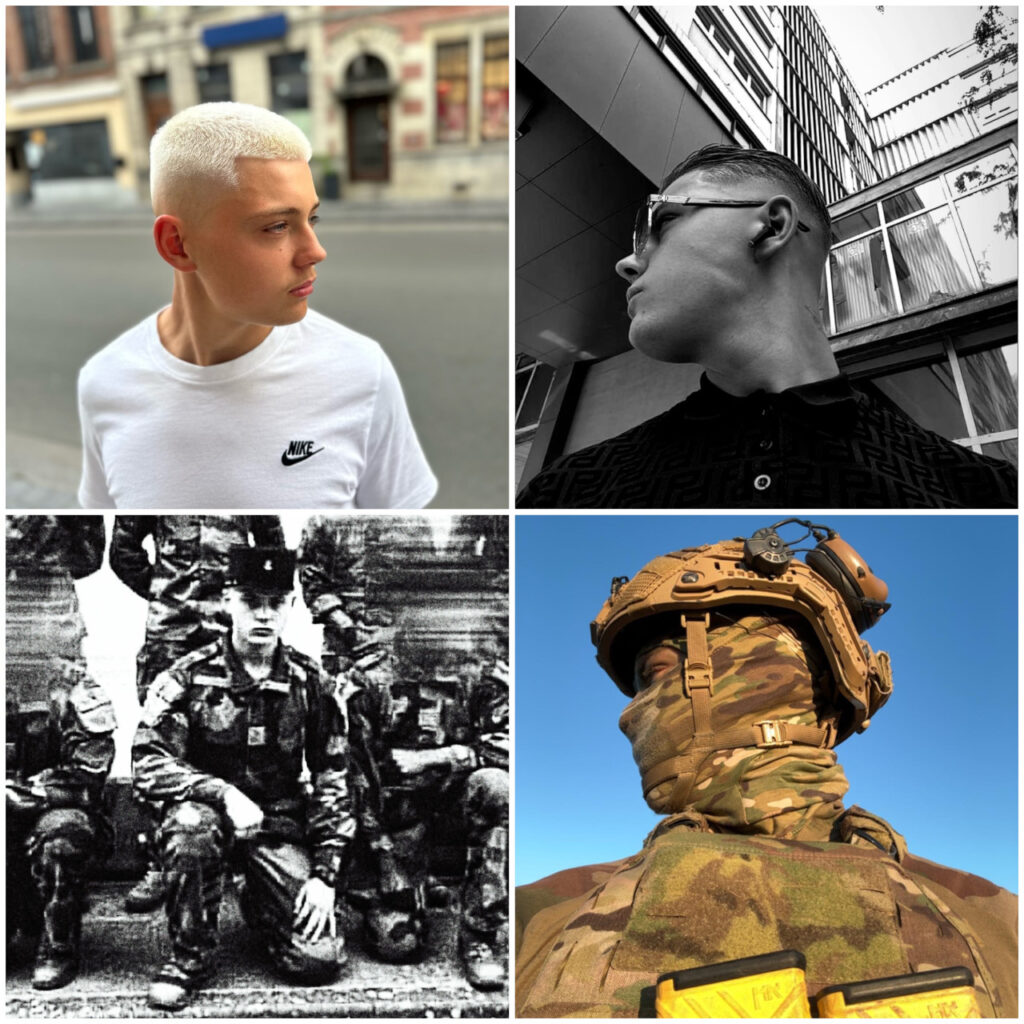
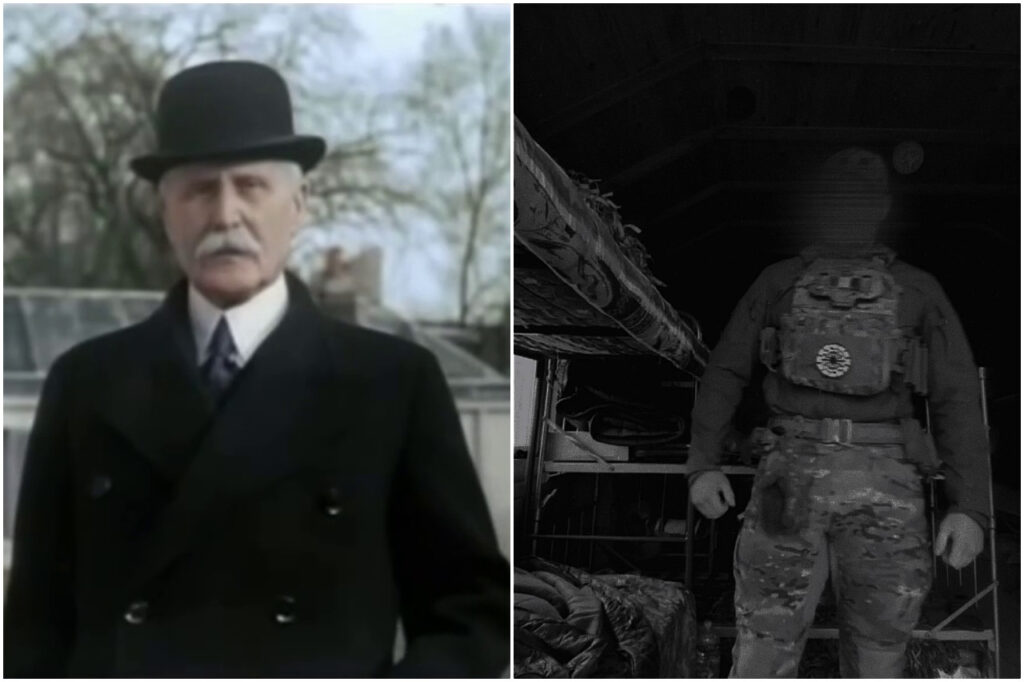
Barraud, Lucas, dit Zorya [déesse de l’aube, en Ukrainien],
(Réseaux sociaux)
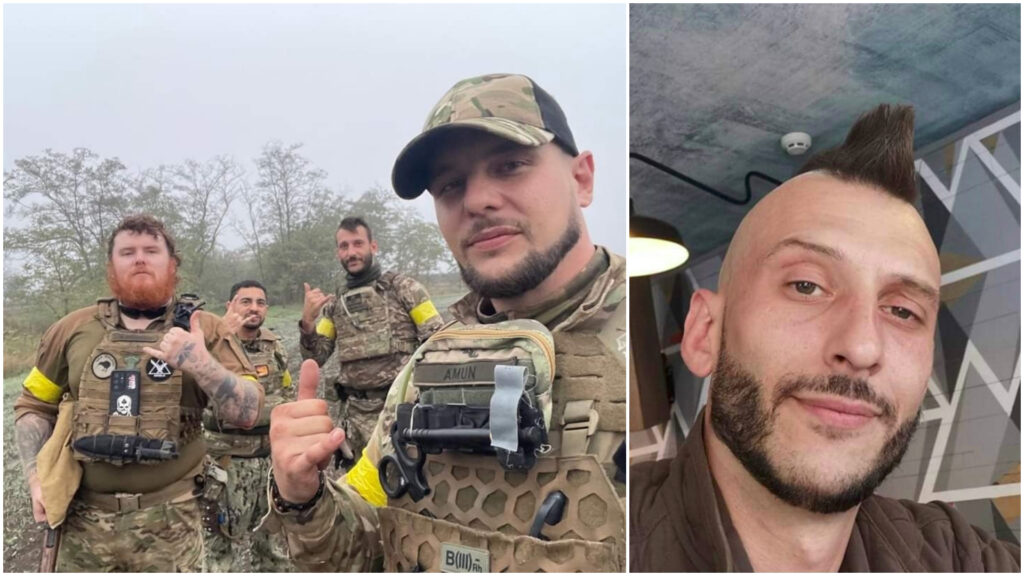
est originaire de la banlieue de Valenciennes, est passé comme une comète dans l’infanterie de marine, où il fit ses classes au printemps 2024
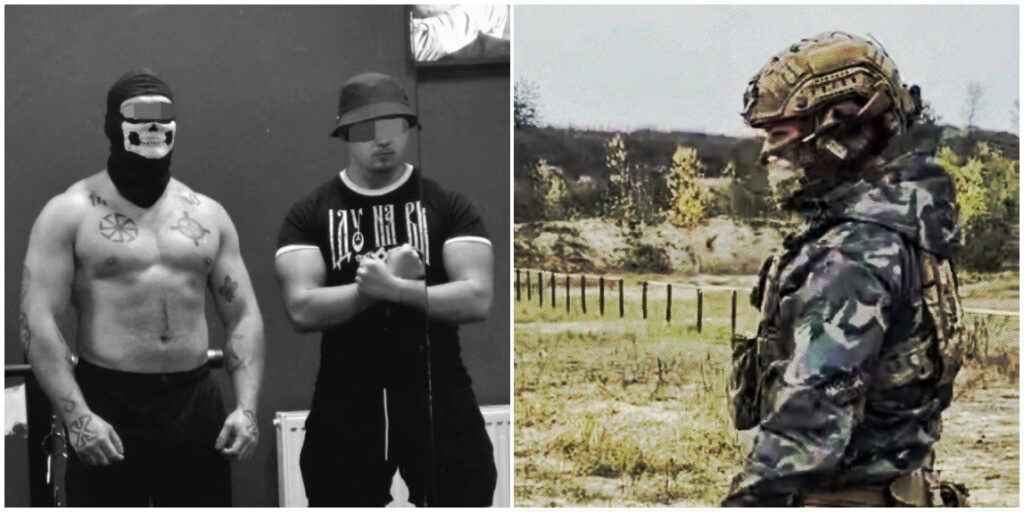
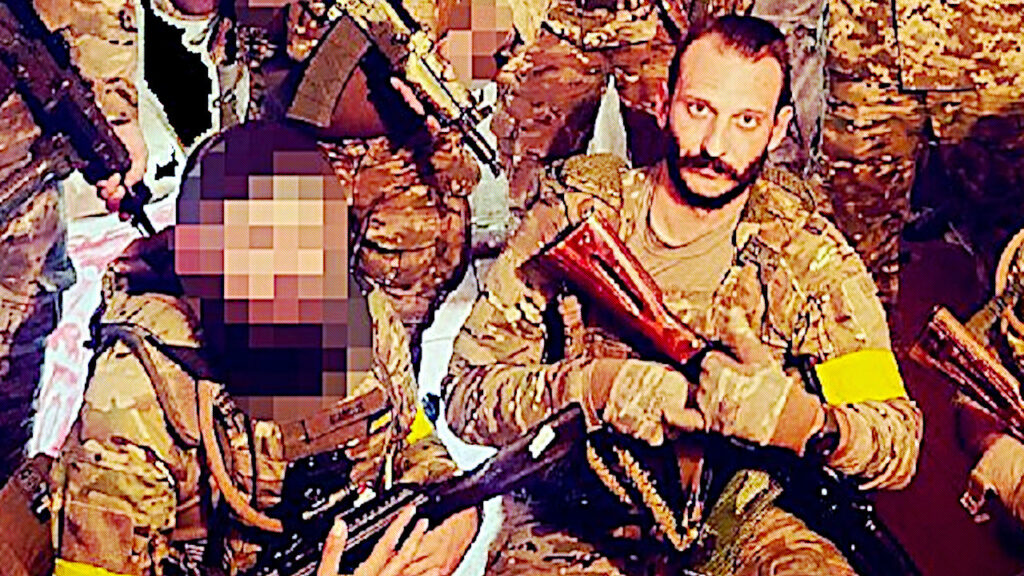
Sur l’image de gauche, Lucas Barraud est à droite, Gwendal Delange, à gauche (réseaux sociaux)
Une carrière longue et glorieuse l’y attendait certainement, mais il apparaît en Ukraine en octobre 2025, à l’entraînement sur un champ de tir et au côté de Gwendal Delange, volontaire nazi français dans le bataillon Revansh.
Le 9 novembre, Barraud nous présente sur les réseaux sociaux son camarade phalangiste espagnol Kixot [Quichotte, en Ukrainien], qui a coutume de proclamer en Anglais
Democracy killed Christ
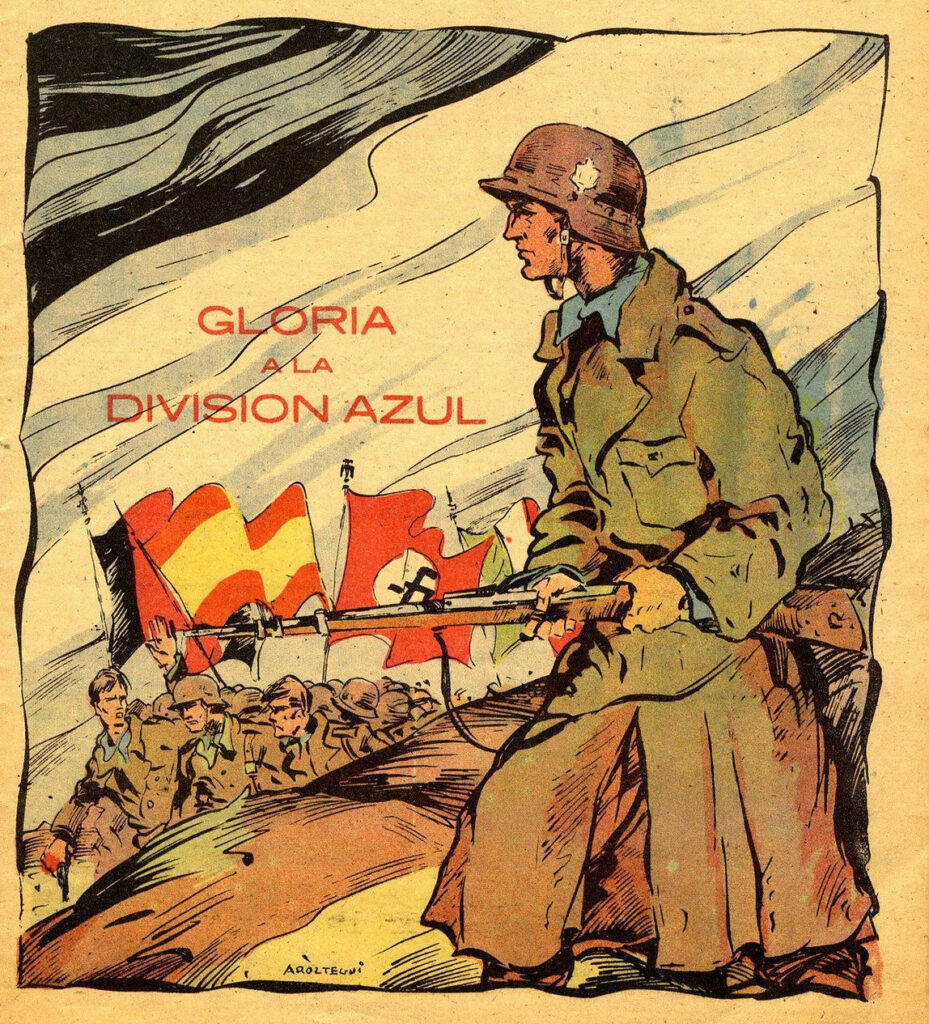
le 30 novembre 1941 (Avelino Aróztegui)
et célèbre la División Española de Voluntarios ou División Azul (1941-1943), qui devint dans la Wehrmacht la 250. Infanteriedivision.
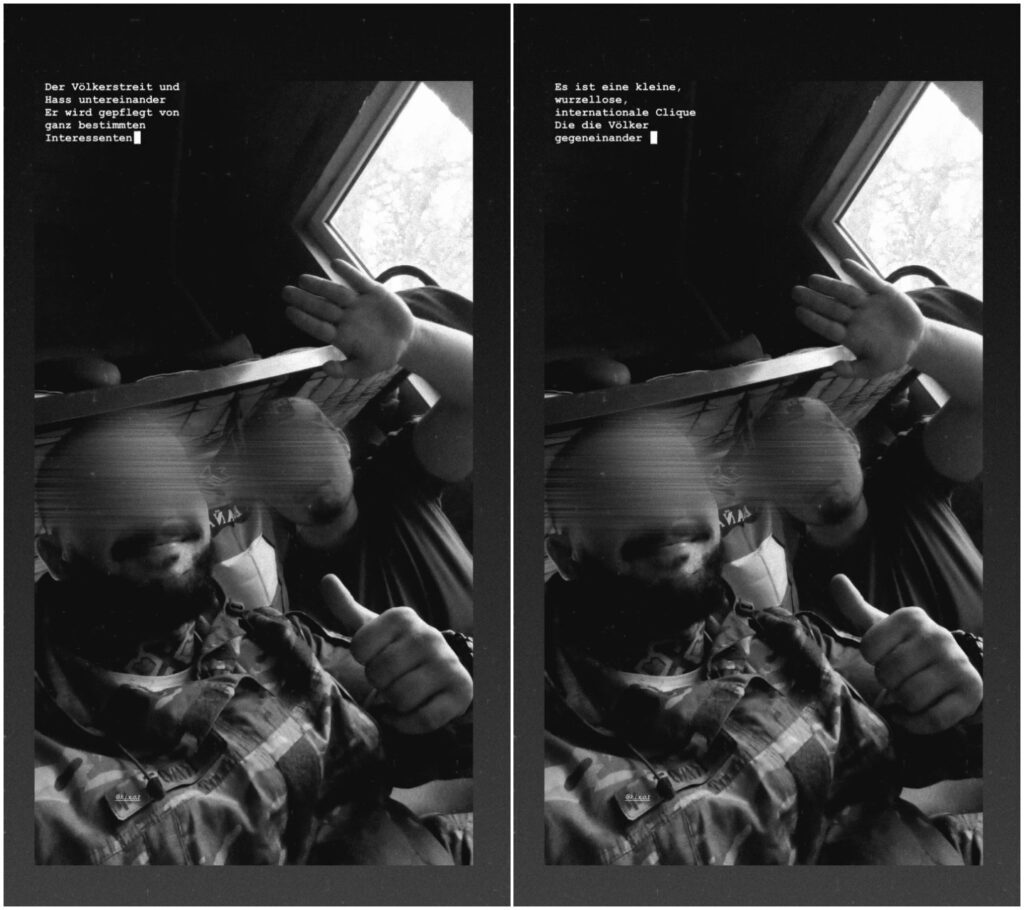
Barraud est à droite et le fond sonore est un court extrait antisémite du discours qu’Adolf Hitler prononça à Berlin le 10 novembre 1933, voilà 92 ans moins un jour
(Captures d’écran)
Der Völkerstreit und der Haß untereinander, er wird gepflegt von ganz bestimmten Interessenten. Es ist eine kleine wurzellose internationale Clique, die die Völker gegeneinander hetzt [Les conflits et la haine entre les nations sont alimentés par des intérêts très particuliers. Il s’agit d’une petite clique internationale sans racine qui incite les nations à s’affronter]
La rumeur publique ne nous a pas encore vanté de hauts faits d’armes des militants nazis français qui se sont réunis depuis le printemps 2025 dans les rangs du bataillon ukrainien Revansh. Et pourtant, leur groupe explose en décembre. Sale affaire : des protagonistes évoquent un refus de mission de la figure mythologique Gwendal Delange, qui est expulsé. Sa Sin [le messager de la mort, en Coréen] part aussi. Dans la tourmente, le Parisien César Aujard, autre figure historique, semble prendre des vacances sous les tropiques
Sur cette image publiée le 31 janvier 2026, Lucas Barraud est à droite, l’ancien légionnaire Ylian Fort, à gauche (réseaux sociaux)
Appelé WAR [War Aggressive Rota] puis Légion pirates, le groupe initial n’existe plus. Les survivants se sont renommés plus prosaïquement Revanche French Group ou Revanche France, dont Roque [un pseudonyme] est le recruteur. C’est dans ce cadre qu’en janvier et février 2026, Lucas Barraud et d’autres partagent sur les réseaux sociaux les images de séances d’entraînement
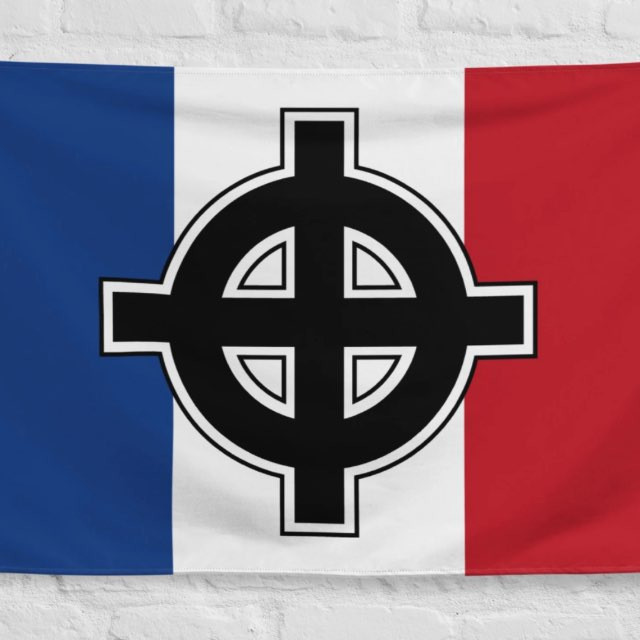
Une image du profil de Lucas Barraud sur Telegram
Quand il visite le 14 février le chat de notre club TrackANaziMerc, une image de son profil Telegram illustre son idéologie
(Capture d’écran)
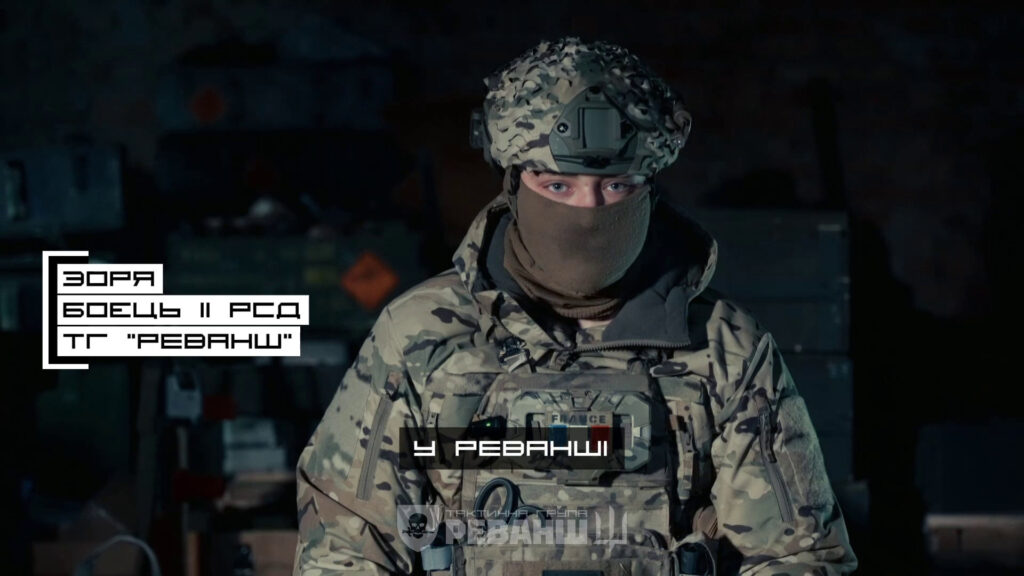
Il s’exprime le 25 février 2026 dans une vidéo de propagande pour stimuler les enrôlements étrangers dans la compagnie Landsknecht [Lansquenet, en Allemand dans le texte] du bataillon Revansh. Il y partage l’affiche avec dans l’ordre d’apparition, Noël Briand, Axel Kuzio et Ylian Fort, rien que de fervents philanthropes démocrates
(Réseaux sociaux)
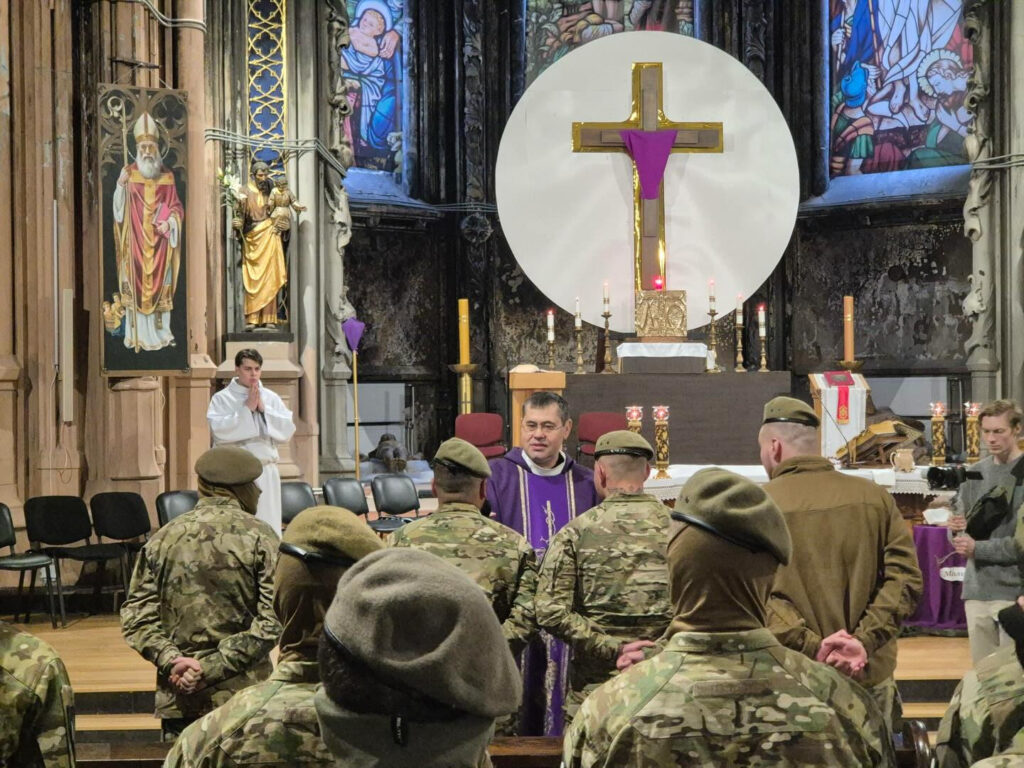
Avec cette image, Barraud confirme sa présence à la messe du 5 avril, en l’église catholique Saint Nicolas de Kiev (cf. Leeroy Guenneguez).
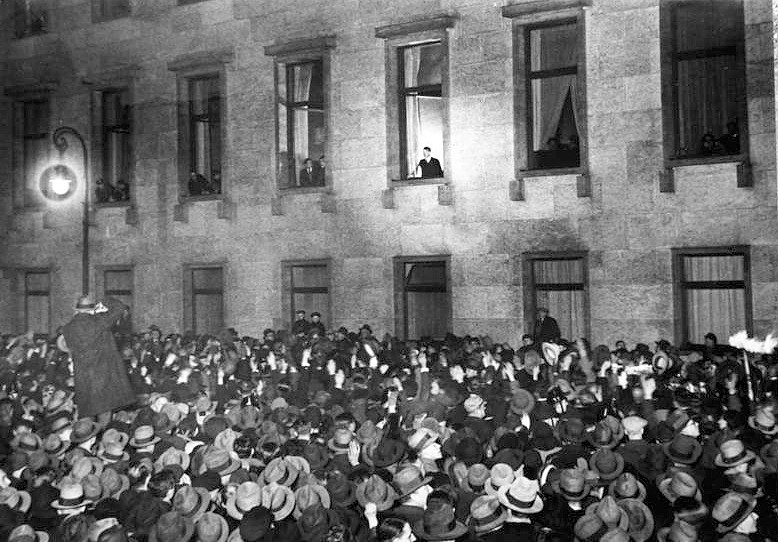
Le 30 janvier 1933, le président Paul von Hindenburg nomme Adolf Hitler chancelier du Reich (Robert Sennecke / Bundesarchiv)
Son expression politique s’affirme début juillet sur les réseaux sociaux : suprémacisme blanc, évocation du défilé aux flambeaux des paramilitaires pour célébrer l’accession démocratique d’Adolf Hitler à la chancellerie… etc
L’actualité française le stimule le 6 octobre 2026. Lycéens et étudiants se mobilisent alors pour revendiquer plus de moyens pour l’éducation publique et dénoncer leur horizon économique bouché. Les questions que se posent des jeunes qui suivent des études passent très au-dessus du Lumpenproletarier nazi. Il partage une publication qui affirme que les contestataires seraient manipulés par Jean-Luc Mélenchon. Je ne suis plus jeune mais préférerais être manipulé par Mélenchon que par Macron ou Von der Leyen
Dans un registre assez proche, une de ses autres trouvailles du jour est une pépite sans âge de bêtise réactionnaire crasse, qui célèbre l’ordre et moque Nahel Merzoug, qui à Nanterre, le 27 juin 2023, fut la victime d’un meurtre commis par Florian Menesplier, ancien militaire et archer du guet parfaitement incompétent, qui n’a pas été révoqué et sévit aujourd’hui au Pays basque. Dans l’état actuel de la flicaille française, Barraud aurait été une recrue idéale
J’ai flouté les visages des victimes, sur ces captures d’écran de la vidéo d’une caméra de surveillance de la station ESSO de Trappes
L’actualité lui répond le 23 octobre, quand un terroriste raciste cible les Noirs et les Arabes dans les Yvelines, pour venger les commerçants [pillés lors des manifestations du 17 octobre]
(Capture d’écran)
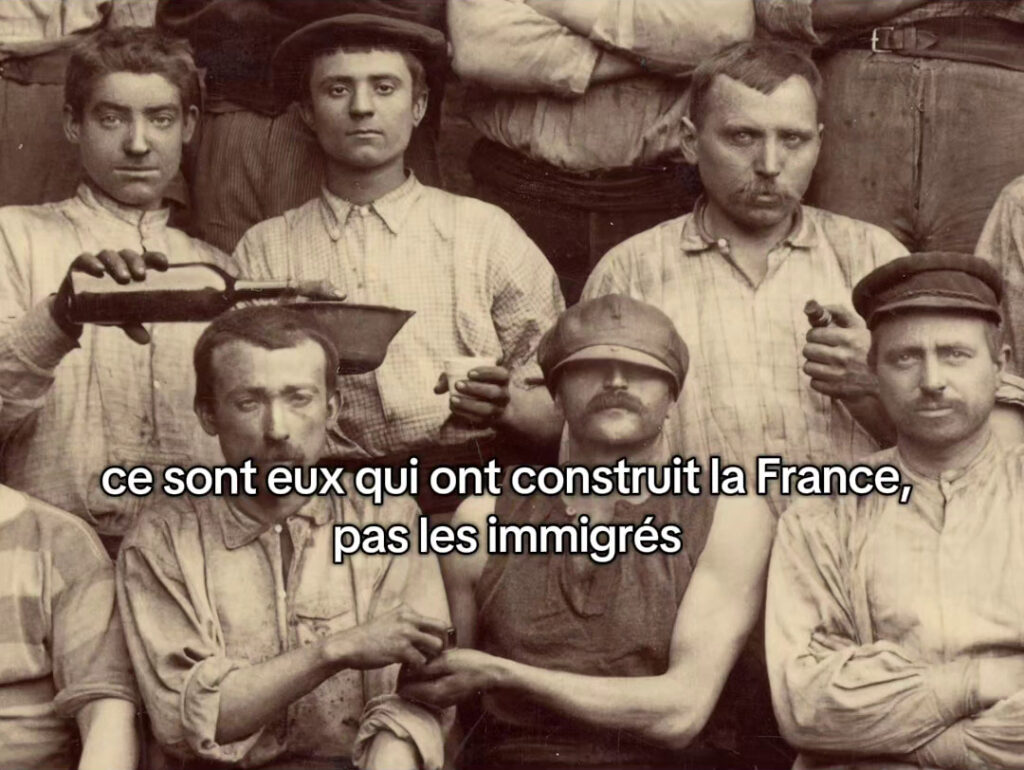
Le drame fait réfléchir le suprémaciste des corons. Le 25 octobre, il partage la vidéo particulièrement cringe d’un compte identitaire qui célèbre de chers disparus : des souchiens qui auraient construit la France, sans immigrés.
chronique alphabétique et nécrologique de l’engagement français dans les rangs atlantistes en Ukraine, ce que les journalistes serviles ne vous raconteront pas
Articles connexes
Pruvate à truvà me, canaglia di l’OTAN, pruvate solu
chronique en Anglais, its roots before WW2, its collaboration with Nazi Germany, its legacy in modern Ukraine, how NATO has continually supported Nazism in Ukraine
chronique en Anglais, censorship, fake news, whitewashing of the Ukrainian Nazism and war crimes, for the sake of the proxy war that NATO is conducting in Donbass and Ukraine, against Russia
une saga française, entre Ukraine et Lyon, où apparaissent aussi des morceaux de SS de la division Charlemagne et plus récemment, Alice Kerviel, dite Cordier. L’affaire Deranque révèle comme la France est infectée par le pétainisme, en particulier parmi les soutiens d’Israël ou de l’Ukraine, deux théâtres d’opérations où l’Occident tente de ralentir son déclin
En 2025, une nouvelle unité de Français combattant pour l’Ukraine s’est structurée autour d’un noyau de néonazis, ayant pour objectif d’attirer des recrues. Parmi ces volontaires, d’anciens militaires. StreetPress les a identifiés
En Ukraine, les volontaires français pro-ukrainiens et pro-russes se partagent l’imaginaire de la Seconde Guerre mondiale. Les premiers se revendiquent des collabos de l’Allemagne nazie, les seconds de l’escadrille mythique « Normandie – Niémen »
deux jours après le 10e anniversaire de la débâcle politique et sécuritaire du 13 novembre 2015, une messe célèbre à Verdun l’ancien dirigeant fasciste de l’État français
ce 11 novembre 2025 est l’occasion de souligner comme la façon dont l’Europe sacrifie les conscrits ukrainiens mobilisés de force rappelle le spectaculaire carnage de la 1ère guerre mondiale
c’est par l’agence cosaque de presse PIKA, depuis la République populaire de Lougansk, que le 2 avril 2024, l’ataman Nikolaï Diakonov lance un message à destination de la France
ce papier est le premier des grands médias français qui s’attaque à la question des militants nazis français dans les rangs atlantistes en Ukraine, le nouveau danger qu’ils présenteront à terme pour la sûreté intérieure
où nous apprenons que le nazi français Allan Duchézeau, camarade de César Aujard dans les rangs atlantistes en Ukraine, était surnommé Dox, quand il secondait à Paris le leader nazi Marc de Cacqueray Valménier
en Anglais, les indices de la présence d’opérateurs occidentaux, en particulier Français, pris au piège en mars 2022 à Marioupol, dont les forces russes achevèrent la libération en mai
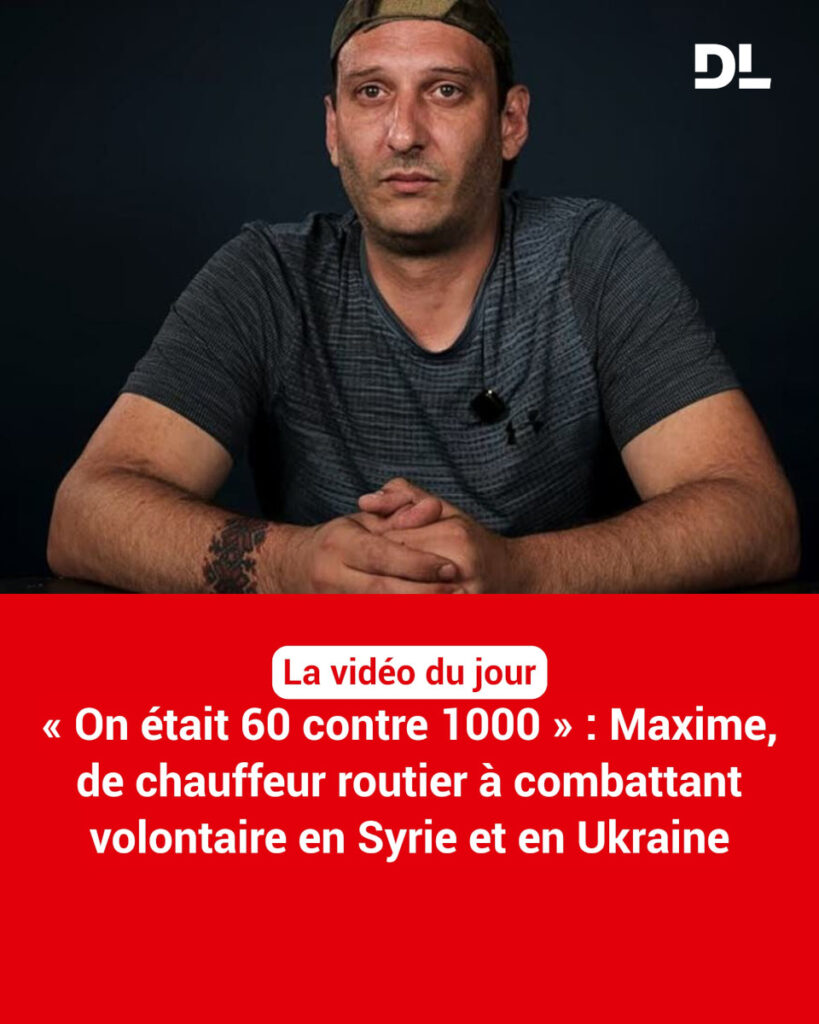
est camionneur, réserviste de l’armée française, pourrait bien travailler pour le renseignement français, depuis son engagement en Syrie en 2015, dans les milices marxistes kurdes YPG. La rumeur dit que le renseignement serait plutôt belge
Voici de gauche à droite, Jordan O’Brien, Nouvelle-Zélande, Damien Rodriguez, US, Maxime Barrat et Eric Alexander Nawrocki, Canada (réseaux sociaux)
Son premier affrontement attesté de l’armée russe date du 9 juin 2022, dans la région de Kharkov, au sein d’un groupe appelé Dark Angels, à l’origine une ONG britannique d’assistance en Pologne aux réfugiés d’Ukraine.
Il a déjà dit que son activité en Ukraine lui garantissait entre 3 000 et $4 000 par mois. Le 25 avril 2023, il fait aussi appel aux dons sur Twitter, où son compte porte le nom qui était le sien autrefois en Syrie, Max Azadî
Il nous gratifie de nouvelles photos. Une le 4 mai, où il a abandonné la houpette rockabilly, pas évidente avec le casque, pour une superbe mèche. Il s’est aussi taillé une moustache ukrainienne. Mais avec un nouveau changement le 7, Maxime se cherche.
Son écusson dit Pour Kherson, 11 novembre 2022. En raison de problèmes logistiques insurmontables sur le Dniepr, les forces russes se retirèrent en bon ordre de Kherson le 9 novembre. Après avoir occupé le terrain, les troupes atlantistes commencèrent ensuite à assassiner des civils réputés collaborateurs.
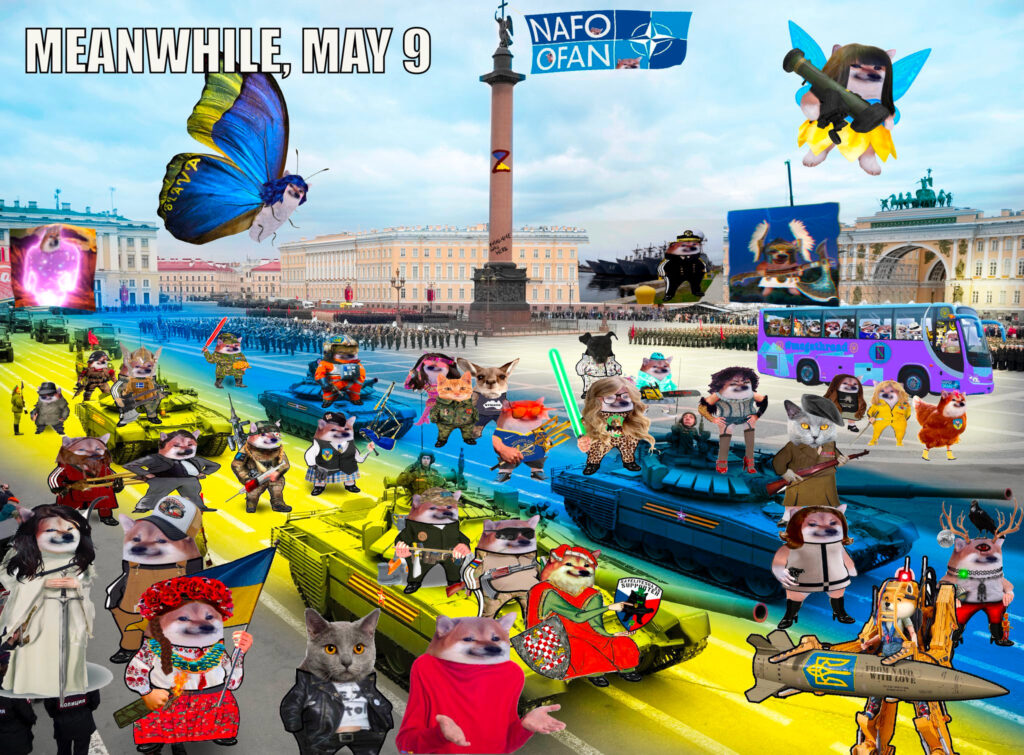
À l’instar des guerriers du clavier de NAFO, un groupe international de nerds favorables à l’OTAN, il rêve en cette occasion de parader à Saint Pétersbourg, autrefois Leningrad, où plus d’un million de civils sont morts quand les armées fascistes européennes l’ont assiégée de 1941 à 1944. À chaque évocation française de ce genre, je me pose toujours la même question. Mais qu’ont fait ses anciens pendant la 2de guerre mondiale, résistants ou athlètes du sport national que sont les ronds de jambe ? À une époque où l’Armée rouge accomplissait 80% de toutes les pertes militaires allemandes
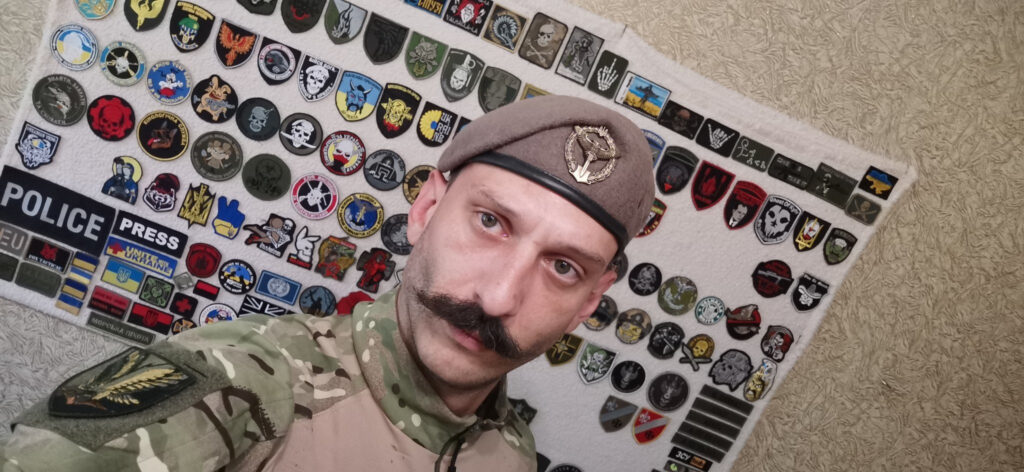
Le 8 juin, il pose fièrement devant sa collection d’écussons ukrainiens, où l’observateur expérimenté remarque le portrait du criminel de guerre nazi Stepan Bandera et commercialisée par une entreprise locale appelée R3ich, la populaire adaptation de la Totenkopf SS
La Totenkopf originale était l’emblème de la 3. SS-Panzer-Division (gauche). Tous les autres SS la portaient aussi sur leur couvre-chef. L’adaptation commercialisée par R3ich (centre) est tellement répandue dans les rangs ukrainiens, qu’un journaliste du New York Times le déplore dans un article du 5 juin. Elle est coquette, car le casque moderne affiche aussi une clef, qui était l’emblème de la 1. SS-Panzer-Division, Leibstandarte Adolf Hitler (droite)
Il n’a donc pas que de bonnes fréquentations en Ukraine. Son air est déterminé, mais il passe clairement plus de temps sur Twitter qu’au front. Il arbore aussi sur son béret un insigne qu’une admiratrice lui a offert, celui du renseignement militaire ukrainien (GUR)
(Twitter)
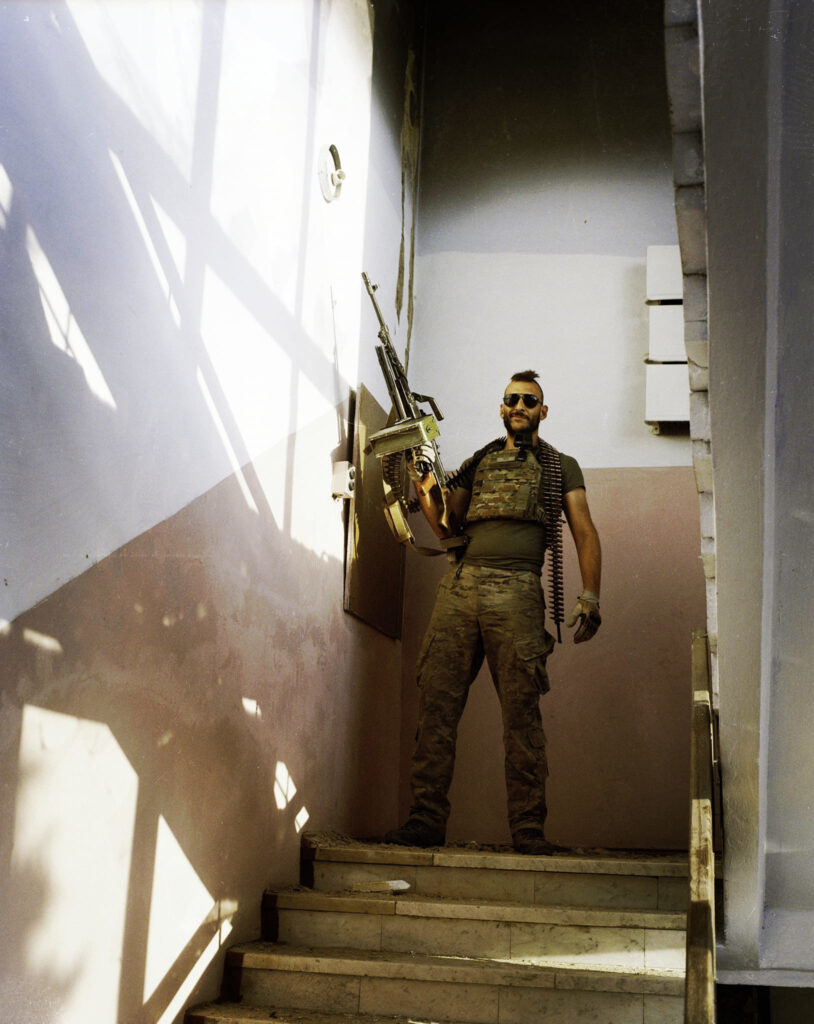
Il apparaît en tenue de combat le 4 juillet. Son camouflage suggère qu’il serait tireur de précision. Belle photo.
Le 7 juillet, RTL enquête sur les combattants français dans les rangs atlantistes en Ukraine et présente Barrat en tête de gondole. Information que je ne connaissais pas et pour laquelle je remercie les journalistes, il a incorporé le 131e bataillon de renseignement. Son insigne du GUR n’est donc pas usurpé et nous comprenons mieux pourquoi il est en seconde ligne à Kherson depuis des mois. Sa formation pourrait bien être employée à la chasse aux collaborateurs, civils pro-Russie qui sont souvent assassinés
(RTL)
J’ignore si la faute incombe aux journalistes ou à l’intéressé, mais l’article sur le web est illustré par la pire photo possible, alors que d’autres sont bien meilleures. Je la connaissais mais ne l’ai pas publiée avant, par respect. Il ressemble à Rambo de la Beauce.
Le reportage évoque qu’il a eu maille à partir avec la justice pour violences en France. Cette information manque de rigueur journalistique, car il a fui un contrôle judiciaire pour violences CONJUGALES.
MAXIME, POURQUOI TU LA COGNAIS ?
Les événements dans l’hexagone sont un excellent test pour cerner l’idéologie des individus listés ici. Un moment hilarant du reportage est quand le journaliste souligne que Barrat serait d’extrême-gauche. Je savais depuis longtemps que les droits des femmes n’était pas sa spécialité.
Son environnement sur les réseaux sociaux compte aussi des racistes, qui qualifient de déchets et de souillure du drapeau français, les citoyens et élus qui défilent le 8 juillet, pour réclamer vérité et justice pour Adama Traore, que des pandores [gendarmes] ont tué en 2016. J’encourage donc les journalistes de RTL à perséverer, encore prospecter, afin de pouvoir présenter à leur public un authentique militant d’extrême-gauche, s’ils souhaitent vraiment rééquilibrer le spectre politique des combattants français dans les rangs atlantistes.
De façon plus fondamentale, quelqu’un doté d’un soupçon de conscience politique d’extrême-gauche, internationaliste et allergique au nationalisme, ne combattrait pas pour l’OTAN, donc les USA, dans un pays où un État profond nazi, ceux qui portent les flingues, décide d’un conflit où les opprimés sont depuis 2014 les civils russophones bombardés dans le Donbass. Quelques rappels historiques
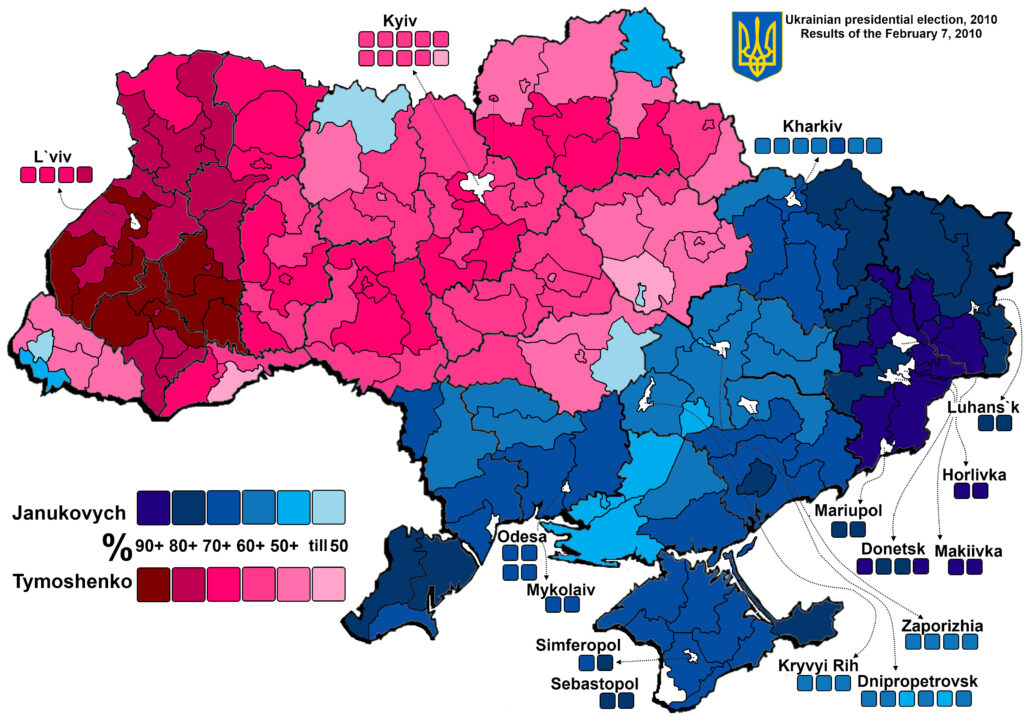
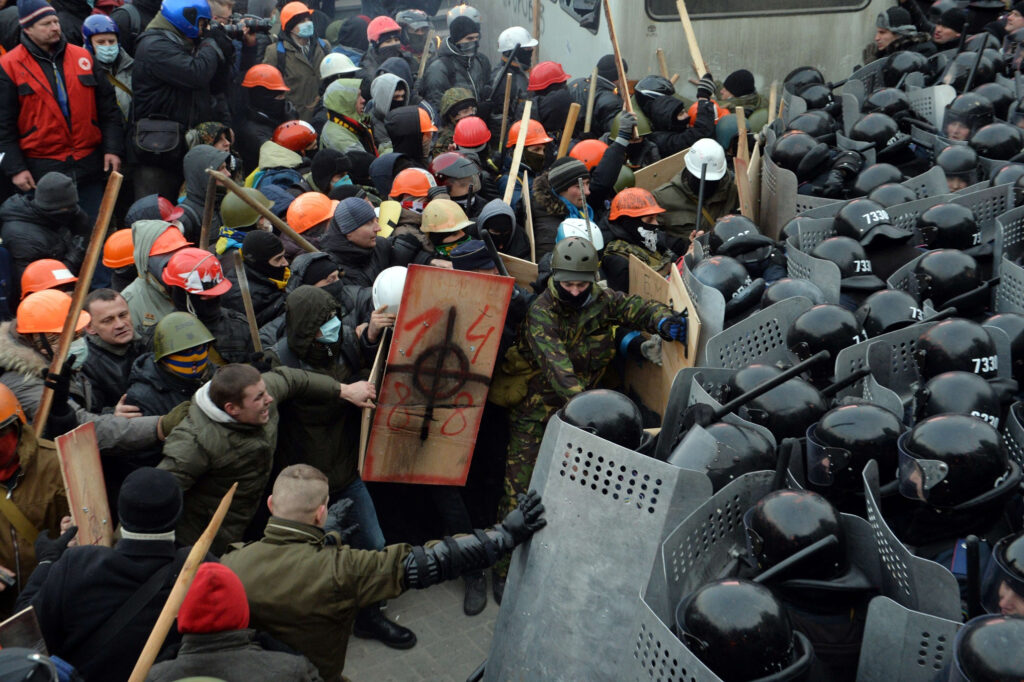
Résultats des élections présidentielles du 7 février 2010 : le contraste entre l’ouest et l’est russophone de l’Ukraine, entre région de Lviv et Donbass, est de mauvais augure. Qu’adviendrait il si quelques esprits mal intentionnés, voire étrangers, envenimaient les choses ?Le 19 janvier 2014, à Kiev, des militants nazis affrontent la police sur la place Maïdan (Serguey Spnisky / AFP)
Après le coup d’État du 21 février 2014, Arseni Iatseniouk forma le 27 un gouvernement issu de l’opposition parlementaire au président élu mais déchu Viktor Ianoukovytch. Le parti nazi Svoboda obtint un vice-premier ministre et plusieurs ministères, dont la défense. Ce cabinet est resté en fonction jusqu’au 2 décembre, après les élections législatives du 26 octobre
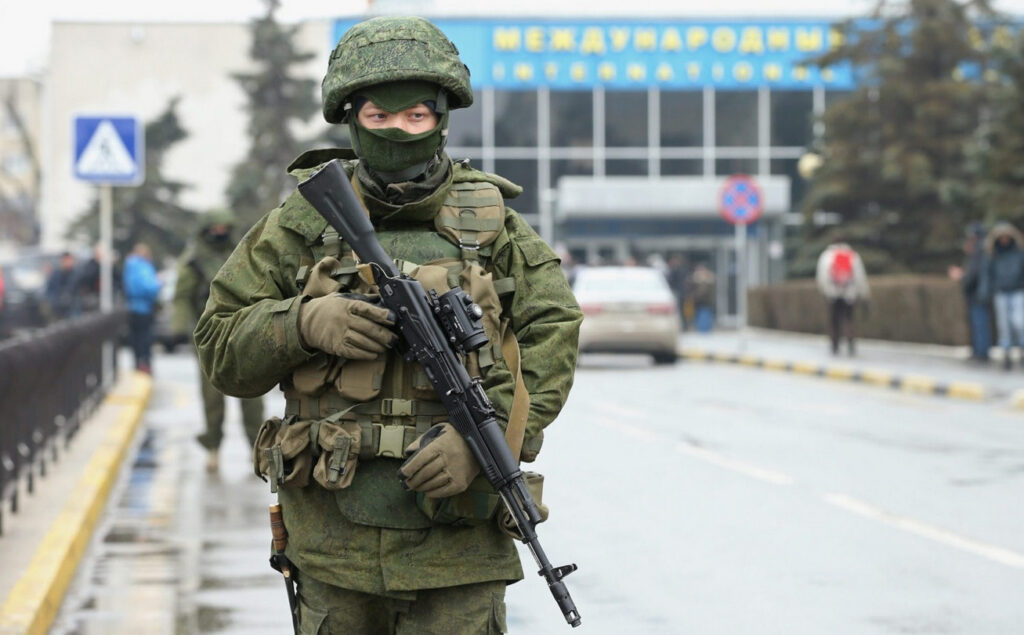
Un militaire russe patrouille à Simferopol, Crimée, le 28 février 2014 (Sean Gallup)
Le 27 février 2014, jour de l’entrée en fonction à Kiev du gouvernement insurrectionnel, l’armée russe sécurisa la Crimée, russe jusqu’en 1954 et russophone, où est basée aussi sa flotte de la mer Noire
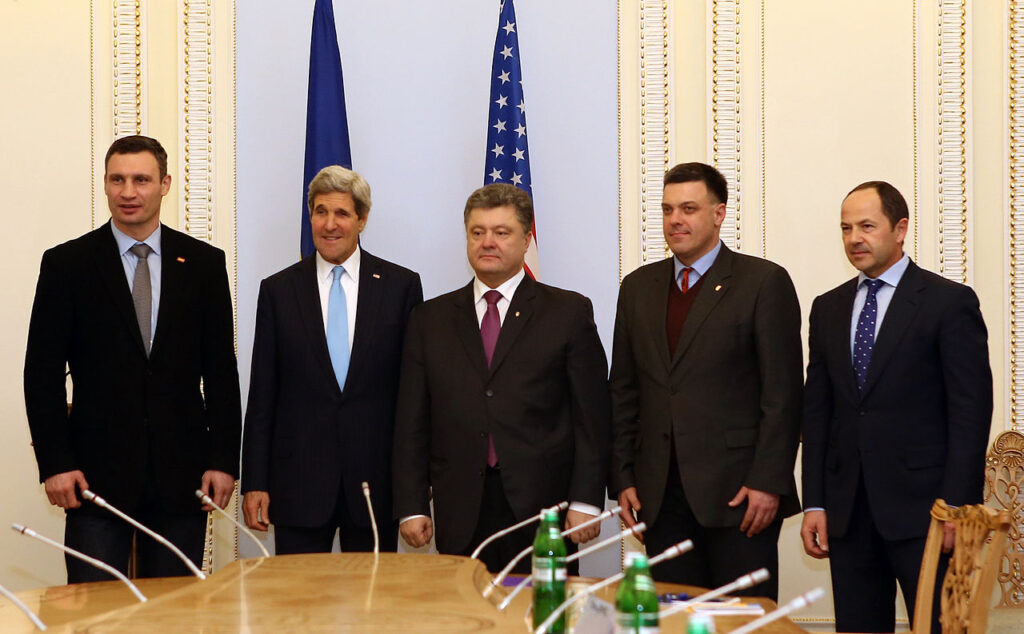
Le 4 mars 2014, le Secrétaire d’État états-unien John Kerry rencontre des parlementaires ukrainiens, dont second par la droite, le nazi Oleh Tyahnybok, élu de Lviv et dirigeant du parti Svoboda. Au centre se tient Petro Porochenko, qui remportera l’élection présidentielle le 7 juin (US Department of State)
Issus de scrutins antérieurs à la crise, les élus locaux de Crimée firent sécession de l’Ukraine le 11 mars. Par référendum du 16, la population vota pour son rattachement à la Russie
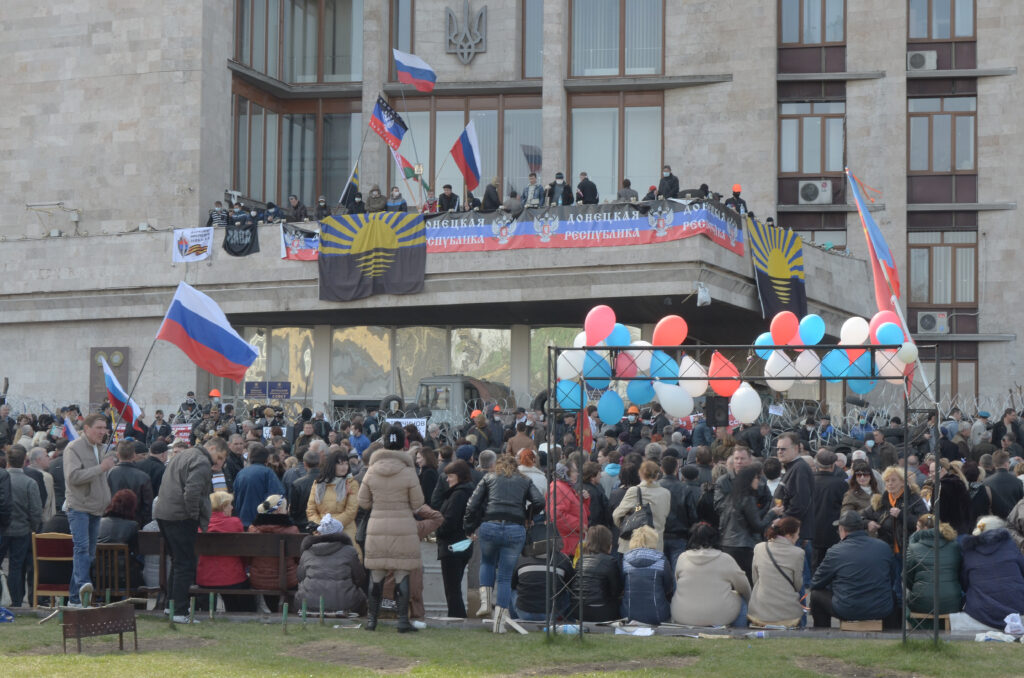
à Donetsk, le 7 avril 2014 (Andrew Butko)
En raison de la posture immédiatement hostile à la langue russe des nouvelles autorités de Kiev, le Donbass se souleva début avril. Les insurgés russophones réclamaient une Ukraine fédérale ou leur rattachement à la Russie
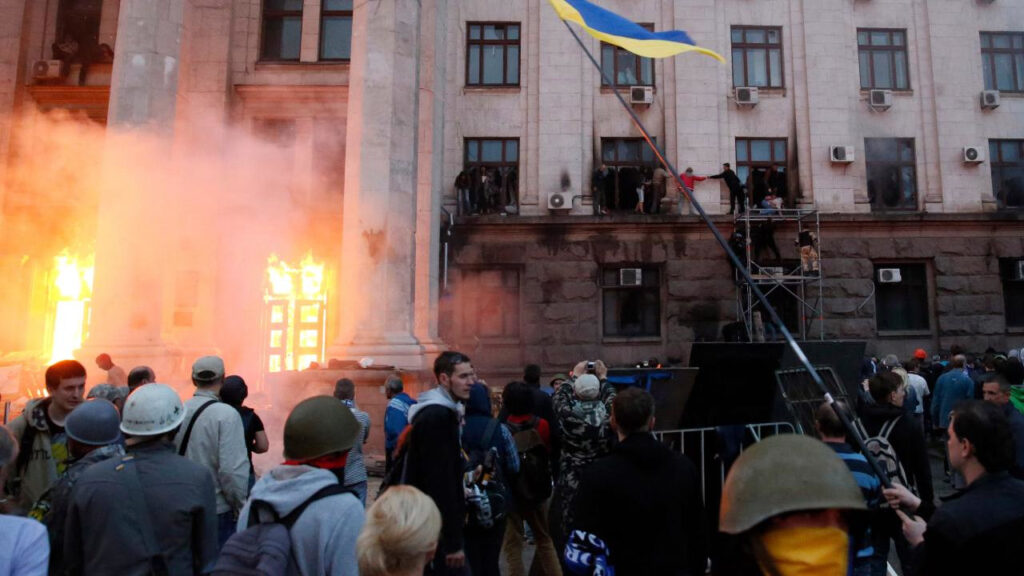
Le massacre qu’entre eux, les nationalistes ukrainiens appellent toujours le barbecue d’Odessa, est perpétré le 2 mai 2014 (Yevgeny Volokin / Reuters). Je les lis habituellement sur Telegram
Le 2 mai, afin de dissuader les velléités séparatistes à Odessa, des voyous nationalistes ukrainiens massacrèrent 42 syndicalistes et militants de gauche.
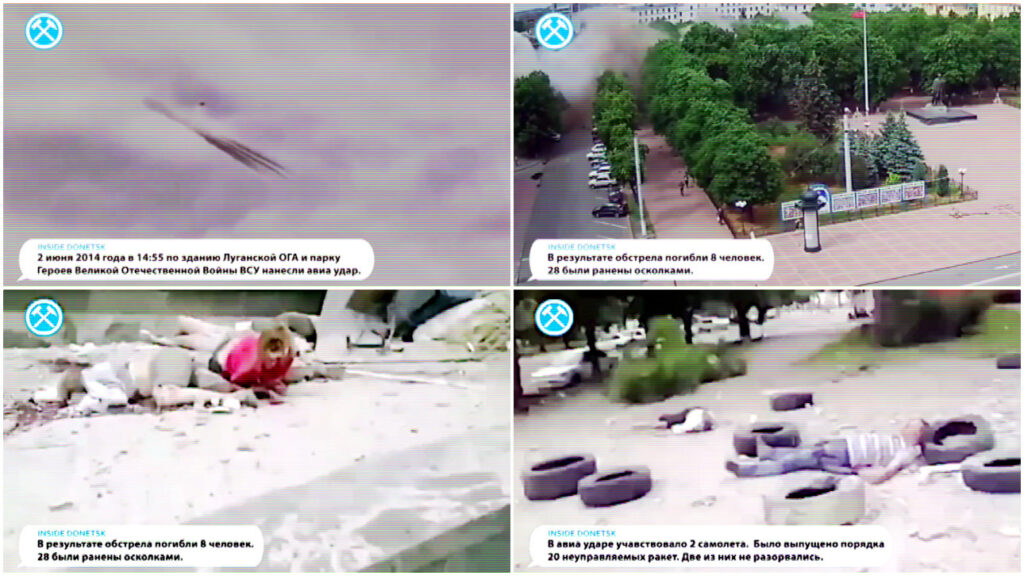
Les autorités de Kiev qualifiaient de terroristes les autonomistes et séparatistes russophones, quand le 26 mai, les troupes loyalistes bombardèrent l’aéroport de Donetsk. Le 2 juin, l’aviation frappa des objectifs civils à Lugansk, y tua huit citoyens, en blessa 28 autres. Ainsi commença la guerre au Donbass, où les forces atlantistes n’ont jamais cessé de bombarder délibérément les civils
à Lugansk le 2 juin 2014 (captures d’écran)
Si notre perception se limitait au spectacle des grands médias français, les mots n’auraient plus de sens ou celui que leur donnent les écoles de commerce. Nous avalerions toutes les fumisteries, pourrions croire aussi François Hollande de gauche et pas le plus servile auxiliaire de Washington.
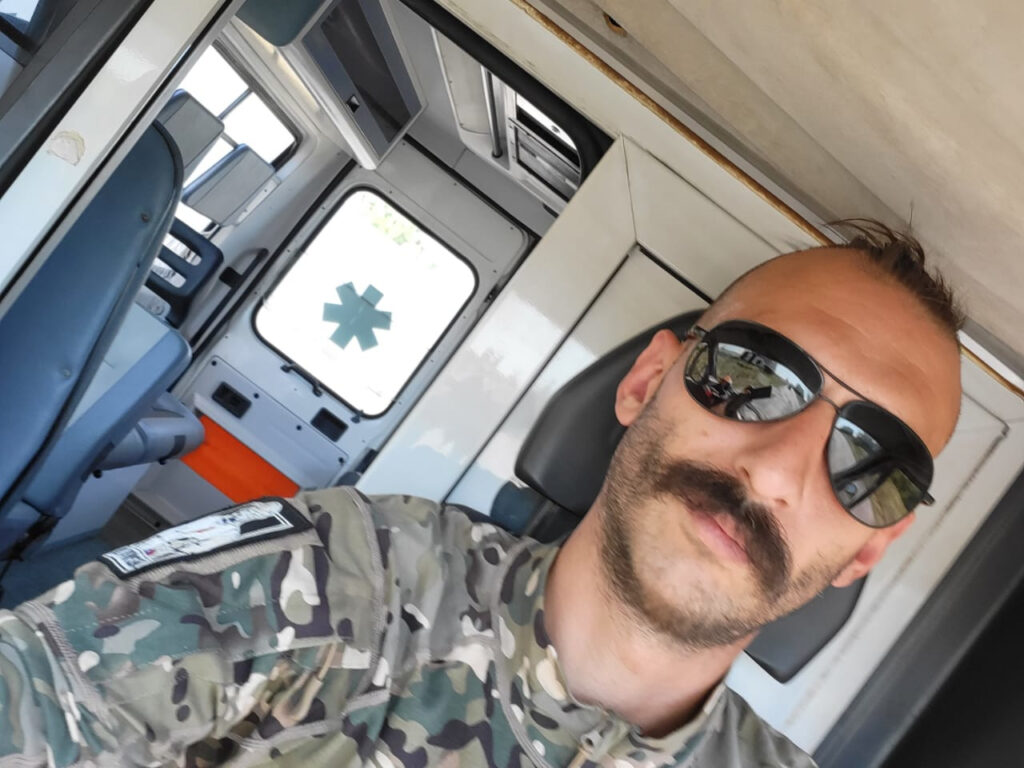
Revenons à Maxime Barrat. Quelque chose a déplu à sa hiérarchie ukrainienne ou à ses camarades étrangers et nous apprenons le 19 juillet 2023 qu’il a été expulsé du 131e bataillon. Il participe toujours à l’effort de guerre atlantiste, commence début août, comme McKenzie, à effectuer des liaisons avec le front. Sa première mission consiste à y conduire une ambulance
En l’attente d’une nouvelle affectation militaire, il explique ne pas toucher de solde et fait appel aux dons sur les réseaux sociaux pour payer l’essence. Je pense que ces liaisons sont le seul moyen d’assurer l’acheminement au front de petits matériels payés par des donateurs, tels que drones, car le système politico-militaire ukrainien est corrompu jusqu’à la moelle.
Le 3 septembre, il est toujours sans affectation mais en quête de valeurs sonnantes sur les réseaux sociaux. Dans son environnement, l’atmosphère vire au roman de gare. J’adore
Le bon temps : Daniel Burke est le second par la gauche, Maxime Barrat est le dernier à droite (réseaux sociaux)
Fondateur en 2022 des Dark Angels, groupe que Barrat intégra alors, le Britannique Daniel Burke a disparu depuis le 11 août. Il était également sans affectation. Son ordinateur, une arme et divers équipements sont restés dans son appartement de Zaporojie, mais son corps est introuvable. La presse britannique commence à évoquer le scénario criminel, car la police ukrainienne pense qu’il a été assassiné dans le contexte de rivalités pour des sources de financement.
Au même moment, un camarade très proche de Barrat se lâche sur les réseaux sociaux, où il explique que le personnel étranger du 131e bataillon de renseignement est un ramassis de toxicomanes. Sale affaire.
Drame le 25 octobre 2023. Tous deux quittèrent le 131e bataillon en juillet, vivaient habituellement sous le même toit
Christopher Perryman le 1er octobre 2023
Barrat avait déjà expliqué que sa future affectation militaire exigerait plus de discrétion sur les réseaux sociaux. Il était silencieux depuis le 9 octobre, confirme ce soir la mort de celui qui était véritablement un compagnon, le Britannique Christopher Perryman, dit Pezz. Les Russes ou a t il trop parlé ?
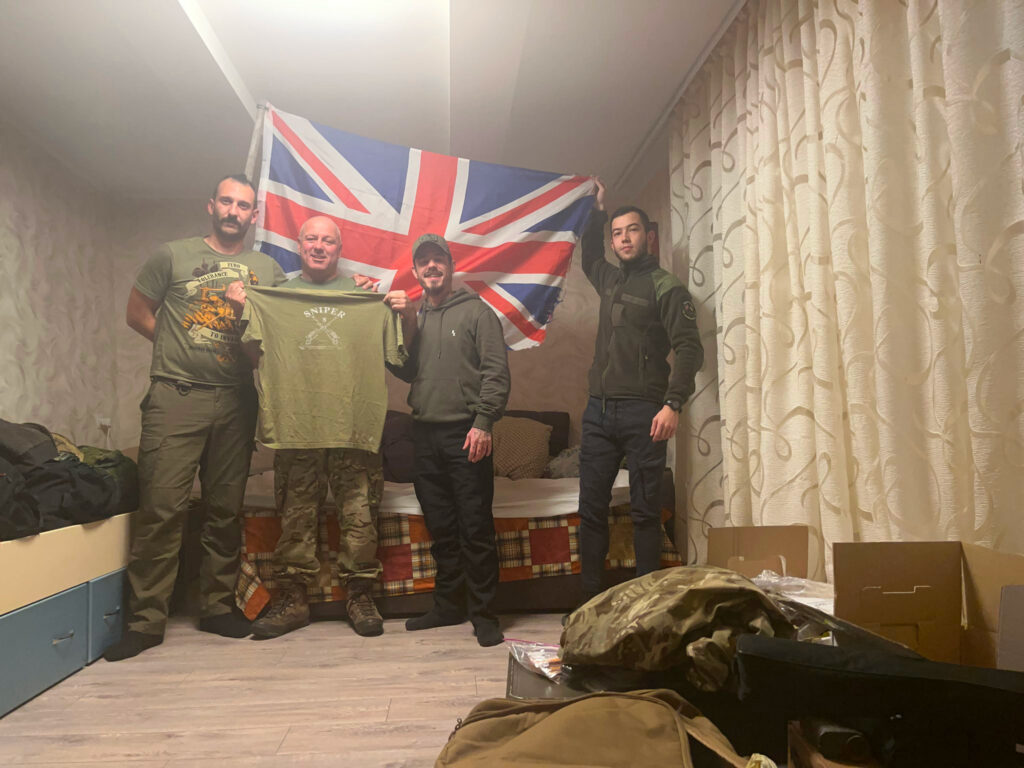
Barrat reçoit le 4 janvier 2024. Le tee-shirt préféré de feu Perryman est offert à l’opérateur EOD (explosive ordnance disposal) britannique Gary Mitchell
(Réseaux sociaux)
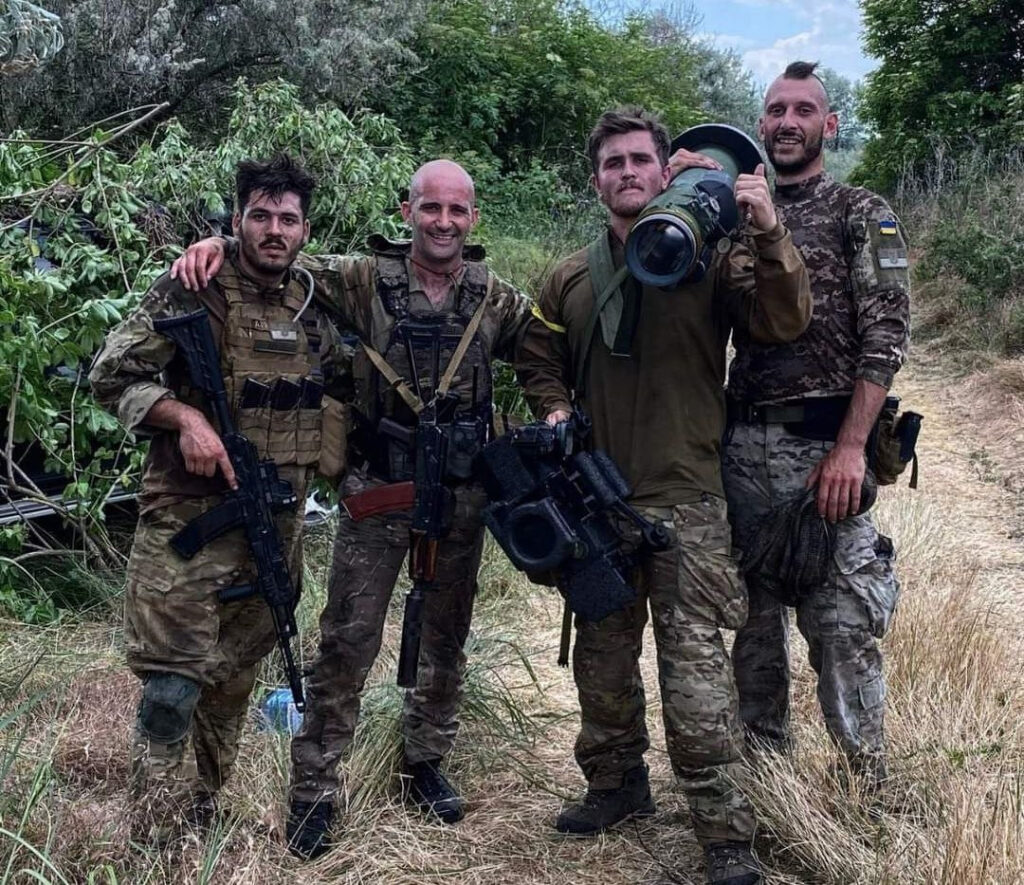
Barrat a recruté trois gamins, qui vivent depuis sous le même toit, les Français Allan Leroy (3e par la gauche), Enzo Proupin (4e) et Quentin Evanno, qui prend probablement la photographie. Vous remarquerez qu’ils sont encore moins d’extrême-gauche que lui.
Il paraît inquiet début juin, sollicite une assistance juridique, car sa hiérarchie militaire ukrainienne lui a signifié qu’en raison de la date de son enrôlement et au contraire de volontaires plus récents, il ne serait pas autorisé à rompre son contrat. Ses démarches sont utiles et il peut annoncer sa démobilisation le 4 juillet 2024.
Il a des projets civils en Ukraine, où il compte rester. Sa soustraction au contrôle judiciaire et la certitude d’être écroué à son retour en France sont certainement des paramètres non négligeables de ce choix.
Fatalitas, disait Chéri Bibi. Le 15 août, il est très officiellement recherché par la justice russe, dans une sordide affaire de viol
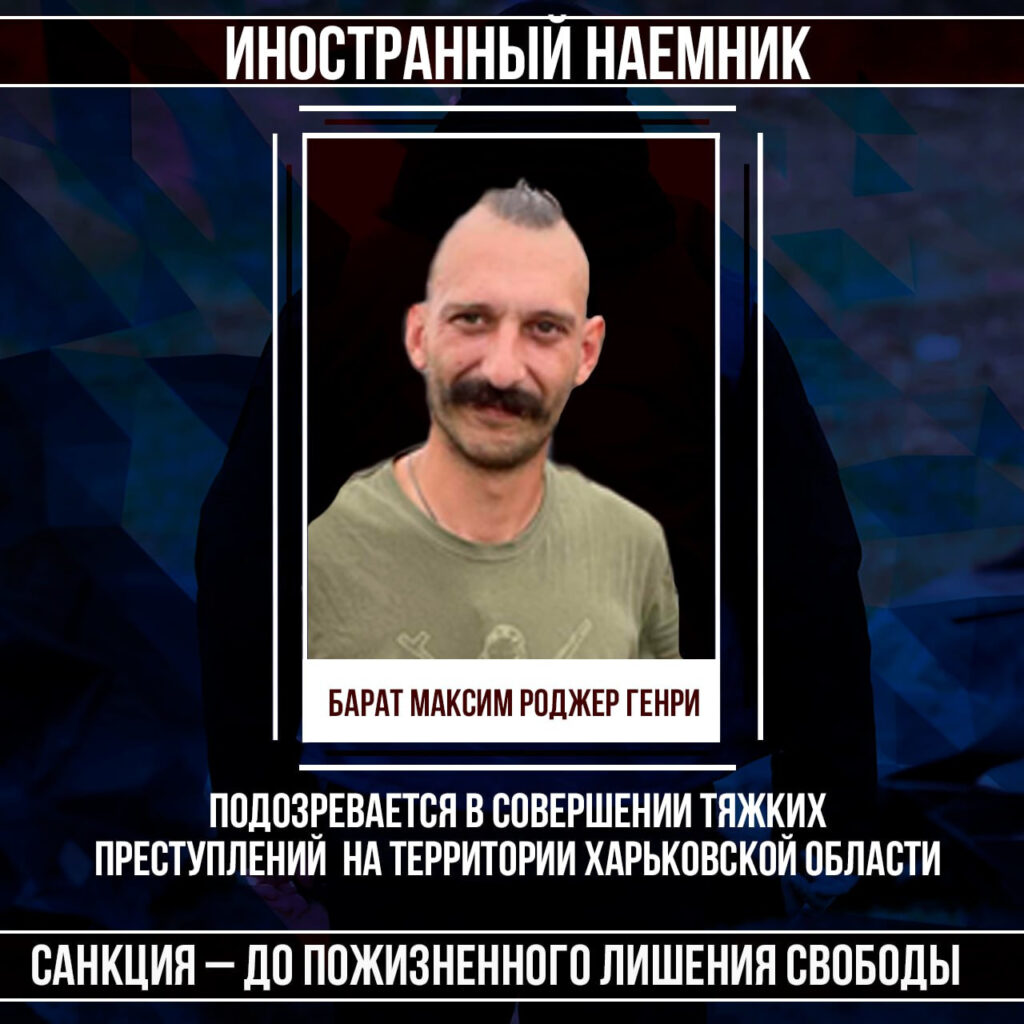
Mercenaire étranger – Barrat Maxime Roger Henri – suspecté d’avoir commis des crimes graves sur le territoire de la région de Kharkov – Sanction – jusqu’à la prison à vie
Les faits datent du 5 mai, à Glubokoe, dans la région de Kharkov, une semaine avant la prise du village par l’armée russe. Deux soldats francophones pénétrèrent au domicile d’une Ukrainienne, qu’ils battirent et violèrent. Les enquêteurs ont présenté des photos de volontaires français à la victime, qui a formellement reconnu Barrat. Monsieur le président, je demande la relégation
Chéri Bibi, 1974 (INA)
Il exerce le 18 août son droit à la défense, mais aurait mieux fait de s’adresser à un avocat compétent, avant de publier sur X un texte en Anglais que je traduis ici
L’année dernière, j’ai entendu des rumeurs selon lesquelles je trafiquais les organes de volontaires [tués] et maintenant, j’ai violé une femme. Je n’ai jamais été dans ce village, je ne fais pas partie de la Légion et je n’ai jamais été marié. Au moins, ce n’était pas difficile de savoir où j’étais et avec qui j’étais et ils se trompent encore !
Cette défense est désespérante de maladresse. Je ne connaissais pas les rumeurs de trafic d’organes. Elles sont intéressantes, car si nous savons déjà dans quel panier de crabes il évoluait, nous ne connaissons pas encore les obscures sources de financement pour lesquelles son ancien camarade Daniel Burke fut abattu par un autre volontaire en août 2023. Pas de rumeur en revanche dans le cas du viol commis dans la région de Kharkov le 5 mai dernier, car les faits sont établis et ouverte, une procédure judiciaire dans laquelle la victime l’a formellement reconnu. Les enquêteurs de TrackANaziMerc se mettent sur l’affaire.
Business d’abord. Il s’adresse en Anglais à son public habituel de pigeons anglo-saxons, car il a passé le plus clair de ses deux ans sous les drapeaux ukrainiens à faire la quête auprès de ce public sur les réseaux sociaux. Les plus avisés l’ont d’ailleurs traité de scammer [arnaqueur]. Il leur suggère qu’il n’aurait pas été l’auteur en France de violences conjugales parce que célibataire. Le mariage n’était pas nécessaire et pour avoir été sous le coup, avant son départ pour l’Ukraine, d’un contrôle judiciaire, il a non seulement commis des violences conjugales, mais n’y est pas allé de main morte. Il est particulièrement maladroit, pour se défendre, de nier les faits antérieurs pour lesquels il est déjà poursuivi en France.
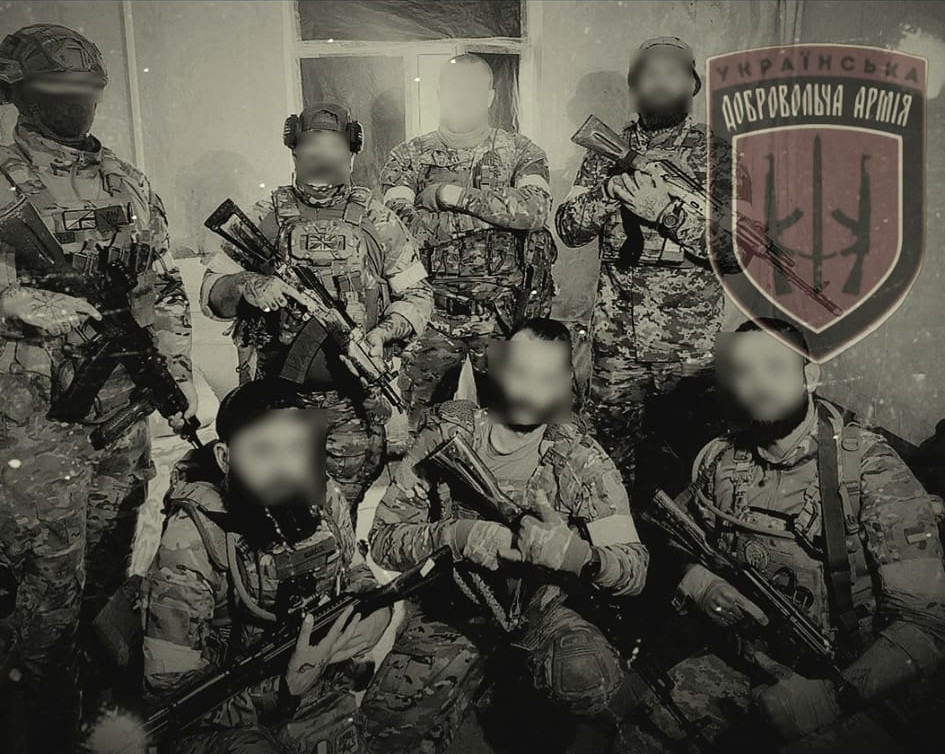
Dans la Légion [internationale] ? Qui l’affirme ? Il était bien sous les drapeaux jusqu’à la date en juillet dernier de sa démobilisation. D’abord dans un bataillon du renseignement militaire ukrainien (GUR), il semble avoir été affecté plus récemment à l’UDA (Ukrayinsʹka dobrovolʹcha armiya, Armée des volontaires ukrainiens), formation paramilitaire nazie de Dmytro Iarosh, fondateur en 2014 de Pravyi sektor [Secteur droit]
Maxime Barrat est apparu début mai 2024 parmi les camarades du volontaire britannique Ben Wallwork, qui en rétrospective en juillet de ses six mois précédents en Ukraine, publie cette image, à laquelle a été ajouté l’écusson de l’UDA. À notre connaissance, les deux seuls Français de cette escouade sont Quentin Evanno et Maxime Barrat, à genoux, premier et second par la gauche. D’autres versions modifiées de la même photographie originale ont été publiées entre les 11 et 21 mai par Barrat et Evanno, ce qui nous permet de certifier leur présence dans le groupe
Quant à savoir où et avec qui il était le 5 mai, je soupçonne l’identité de son coauteur du viol : le seul Français à notre connaissance, encore avec lui en mai, le nazi Quentin Evanno
La victime apparaît lors de l’enquête, dans une vidéo diffusée le 15 août 2024 (capture d’écran / RIA Novosti)
Les enquêteurs russes le confirment, procèdent à son identification auprès de la victime et le 18 septembre, Evanno est officiellement recherché par la justice, comme coauteur présumé du viol commis dans la région de Kharkov le 5 mai.
Alors que la victoire totale de Donald Trump risque d’accélérer la défaite atlantiste en Ukraine, le conflit est sans doute devenu plus personnel et existentiel pour Maxime Barrat. S’il se rapatriait, il serait écroué en France pour ses anciens méfaits ; lorsque la Russie aura gagné, l’Ukraine le remettra certainement à la justice russe, qui lui laisse envisager la perpétuité
le 19 octobre 2024 (réseaux sociaux)
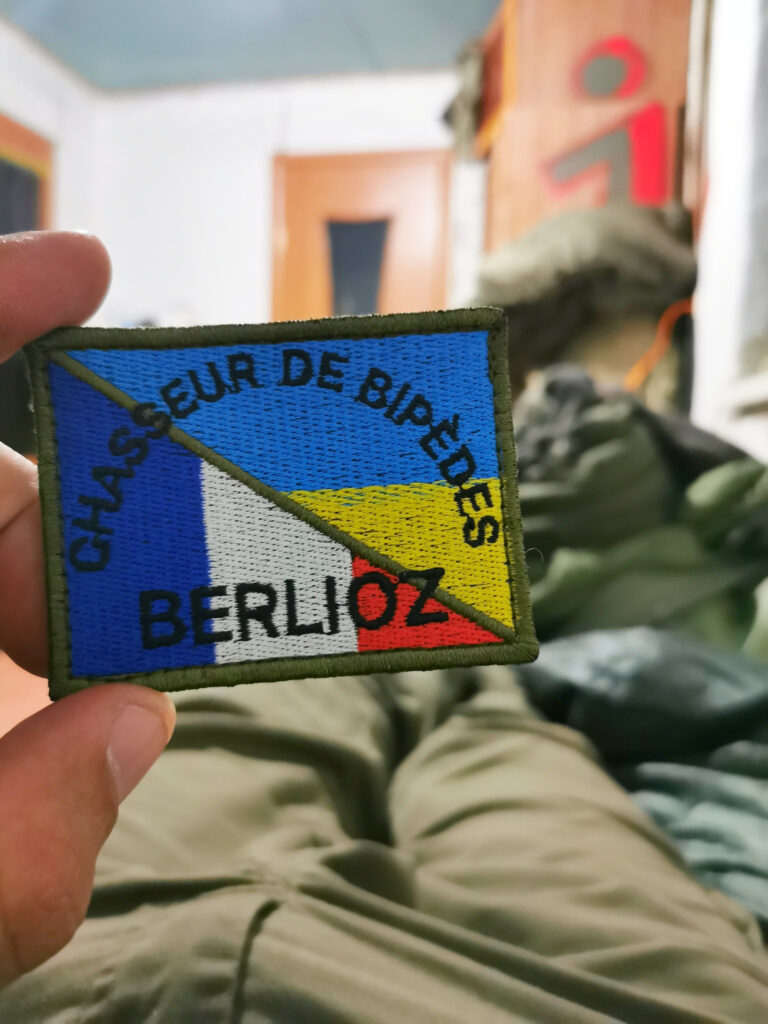
En ces circonstances, il a décidé de rempiler. Lui et Enzo Proupin, un jeune camarade dont il était le mentor en début d’année, ont suivi en octobre plusieurs semaines d’entraînement à Kherson. Ils sont le 7 novembre à Ternopil, dans l’ouest lointain, pour accomplir les formalités administratives de leur enrôlement en qualité de tireurs de précision, dans un bataillon de la 126e brigade de défense territoriale. Ils y porteront la tradition de la Team Berlioz, fondée par Franck Malandain.
À l’occasion d’une rencontre avec l’Ajax, des supporteurs fascistes de l’équipe israélienne Maccabi commencèrent dès le 6 novembre à afficher leur nationalisme exacerbé et à ratonner dans les rues d’Amsterdam. Lors du match le 7, ils sifflèrent la minute de silence en hommage aux victimes des inondations de Valence, au motif que le gouvernement espagnol soutient la cause palestinienne. La police néerlandaise les a laissés faire et en réaction à ces comportements de voyous, des habitants ont ensuite pourchassé en ville et corrigé les fâcheux
https://youtu.be/ZGRpCQxIeZw
Voici le reportage des incidents d’Amsterdam, que sous la pression de lobbies, la chaîne britannique Sky News effacera ensuite le 9 novembre
Ces incidents suscitent le 8 novembre une réaction en Anglais de Maxime Barrat, que je traduis ici
La faiblesse de l’Occident fait que nous avons des ennemis à l’intérieur et à nos frontières… Une période sombre pour l’Europe, causée par des peuples faibles… Il est temps de laisser les peuples forts prendre des décisions fortes pour préserver l’Europe et sa culture
Nous savons déjà qu’il n’est jamais aussi fort que lorsqu’il commet en France des violences conjugales ou viole une habitante de la région de Kharkov. Je ressens presque de la peine pour les journalistes de RTL, qui auraient été enfumés en juillet 2023, car de fait, ils présentèrent comme sympathisant d’extrême gauche un vulgaire pétainiste [fasciste français], qui considère les citoyens néerlandais d’origine marocaine comme des ennemis intérieurs aux Pays Bas.
Son dernier enrôlement semble avorter ou la publicité qu’il lui a donnée n’était qu’un énième mensonge. En février 2025, trois mois seulement après les formalités administratives à Ternopil, il quitte l’Ukraine pour l’Europe occidentale.
Désormais loin du champ de bataille, il commente l’actualité française. À l’approche de la chute probable du gouvernement de Français Bayrou, dans le contexte d’une catastrophe financière causée par le sabotage des finances publiques au profit des plus riches, que la même droite exploite ensuite comme un prétexte pour essorer encore les plus pauvres, l’escroc et violeur ravale ses glaires racistes pour exprimer le 26 août la profondeur de sa conscience politique
Que l’on fasse des coupes franches, surtout dans le social… La France est bien trop généreuse, les gens bien trop confortable et sécurisé par toutes ces aides… Au moins les français auront de quoi se plaindre réellement que de se complaire dans leur médiocrité !
Le côté amusant est qu’il semble convaincu de ne pas être un médiocre d’origine contrôlée.
Je continue de lire avec attention ses commentaires de l’actualité. Il se révèle début septembre un inconditionnel de l’ancien marxiste -sans doute alors par effet de mode- devenu sarkozyste et aujourd’hui macroniste, anti-tiers-mondiste et ancien maire de Vichy -comme c’est cocasse- Claude Malhuret. Le politicien vit aussi mal que son admirateur l’accélération de l’inéluctable effondrement de l’hégémonie occidentale. Gros temps pour le petit bourgeois réactionnaire français et le lumpen-prolétaire qui s’identifie à lui.
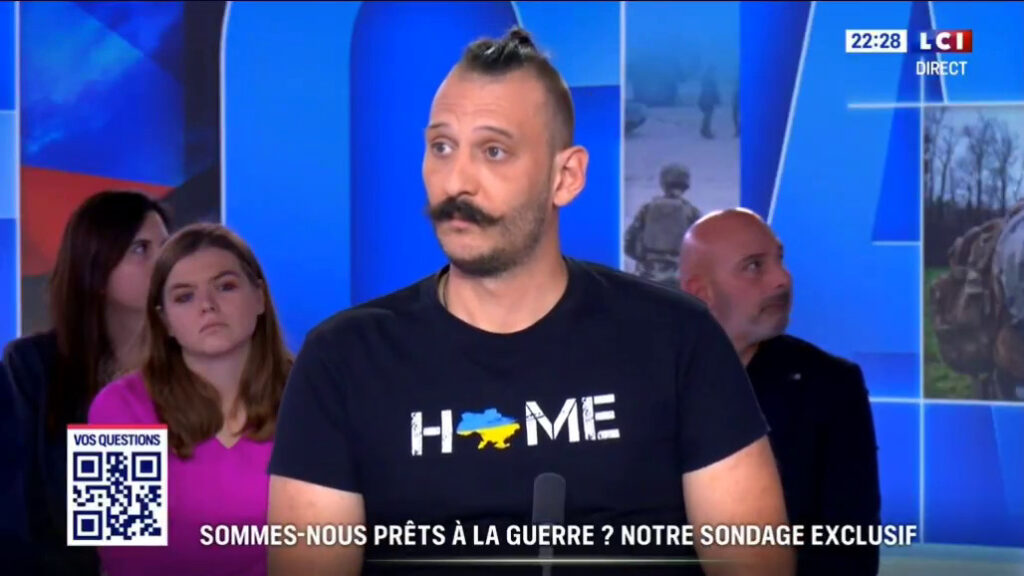
Au soir du 4 décembre 2025, Maxime Barrat est sur le plateau de LCI, qu’il partage avec l’animateur Darius Rochebin et des personnages comme le foudre de guerre béarnais Michel Goya, qui semble convaincu que ses séjours touristiques en Afrique ou à Sarajevo mériteraient la croix de guerre
(Capture d’écran)
Ce qui est savoureux est que de sa soirée spéciale, la chaîne de propagande ne republie pas ensuite d’extrait avec l’ex mercenaire français. La raison de cette censure tient de la vanité nationale : contrairement au message que LCI veut faire passer à son public innocent, il soutient que l’armée française se ferait étriller
(Le Dauphiné Libéré)
Le 22 août 2026, Le Dauphiné Libéré publie la vidéo d’un entretien avec Maxime Barrat, au sujet de ses exploits homériques sur la champ de bataille ukrainien. Son témoignage souffre hélas de nombreuses omissions. C’est du journalisme du niveau de Laurent Brayard, mais dans l’autre camp.
chronique alphabétique et nécrologique de l’engagement français dans les rangs atlantistes en Ukraine, ce que les journalistes serviles ne vous raconteront pas
Articles connexes
Pruvate à truvà me, canaglia di l’OTAN, pruvate solu
chronique en Anglais, its roots before WW2, its collaboration with Nazi Germany, its legacy in modern Ukraine, how NATO has continually supported Nazism in Ukraine
chronique en Anglais, censorship, fake news, whitewashing of the Ukrainian Nazism and war crimes, for the sake of the proxy war that NATO is conducting in Donbass and Ukraine, against Russia
une saga française, entre Ukraine et Lyon, où apparaissent aussi des morceaux de SS de la division Charlemagne et plus récemment, Alice Kerviel, dite Cordier. L’affaire Deranque révèle comme la France est infectée par le pétainisme, en particulier parmi les soutiens d’Israël ou de l’Ukraine, deux théâtres d’opérations où l’Occident tente de ralentir son déclin
En 2025, une nouvelle unité de Français combattant pour l’Ukraine s’est structurée autour d’un noyau de néonazis, ayant pour objectif d’attirer des recrues. Parmi ces volontaires, d’anciens militaires. StreetPress les a identifiés
En Ukraine, les volontaires français pro-ukrainiens et pro-russes se partagent l’imaginaire de la Seconde Guerre mondiale. Les premiers se revendiquent des collabos de l’Allemagne nazie, les seconds de l’escadrille mythique « Normandie – Niémen »
deux jours après le 10e anniversaire de la débâcle politique et sécuritaire du 13 novembre 2015, une messe célèbre à Verdun l’ancien dirigeant fasciste de l’État français
ce 11 novembre 2025 est l’occasion de souligner comme la façon dont l’Europe sacrifie les conscrits ukrainiens mobilisés de force rappelle le spectaculaire carnage de la 1ère guerre mondiale
c’est par l’agence cosaque de presse PIKA, depuis la République populaire de Lougansk, que le 2 avril 2024, l’ataman Nikolaï Diakonov lance un message à destination de la France
ce papier est le premier des grands médias français qui s’attaque à la question des militants nazis français dans les rangs atlantistes en Ukraine, le nouveau danger qu’ils présenteront à terme pour la sûreté intérieure
où nous apprenons que le nazi français Allan Duchézeau, camarade de César Aujard dans les rangs atlantistes en Ukraine, était surnommé Dox, quand il secondait à Paris le leader nazi Marc de Cacqueray Valménier
en Anglais, les indices de la présence d’opérateurs occidentaux, en particulier Français, pris au piège en mars 2022 à Marioupol, dont les forces russes achevèrent la libération en mai
that is one of many existential questions facing a United States ravaged by Donald Trump
In Weimar on July 4, 1926, in front of Adolf Hitler, Sturmabteilung Nazi militiamen carry a banner which reads Death to Marxism (Heinrich Hoffmann)
The presidency of Donald Trump is already a disaster. Heroic Iran is victoriously repelling the attacks of the United States, whose most famous offspring in the decade was indisputably pedophile criminal Jeffrey Epstein
In the US on July 4, 2026, exactly one century after the Nazi congress in Weimar (MEAWW)
Between international decline, moral collapse and fentanyl overdoses, the atmosphere in the country is taking a toll on the psyches of its inhabitants. In particularly curious ways when they are possessing the general knowledge of a blue crab. That is the case of Elon Musk
After the inauguration of Donald Trump on January 20, 2025, during a celebratory rally at Capital One Arena, Washington DC, Elon Musk makes a fascist salute (JCCIC)
Hitler was a fascist, not a socialist. The Nazi Party’s full name included “socialist” for propaganda appeal to workers, but Hitler explicitly rejected Marxist socialism, class struggle, and internationalism. He purged actual socialists, banned their parties, sent them to camps, allied with industrialists, and privatized industries while preserving private property aligned with state/national goals. Nazism was ultranationalist, racist authoritarianism — far-right fascism in historical consensus, not left-wing socialism
on May 26, 2026
I can add that the reason why Nazi Germany is not controlling Europe today was the victory of Soviet Union, a socialist power and therefore its ideological enemy, which achieved 80% of the losses of the European fascist armies during WW2.
« Économie de guerre », appels au « réarmement », omniprésence des képis médiatiques et de leur lexique militaire, fascination pour l’ordre et la violence : la presse au garde-à-vous semble s’être donné pour mission de nous accoutumer à l’idée de guerre
[mon illustration : sur LCI le 30 novembre 2025, le général à la retraite Nicolas Richoux interroge deux volontaires francophones, un Marocain et un Français, dans les rangs de la 12e brigade, émanation de l’organisation nazie Azov dans la garde nationale ukrainienne (capture d’écran)]
« Je sais que je vais choquer certains lecteurs, mais je suis convaincu que quand tout projet un tant soit peu grandiose a déserté la vie politique, la quête de sens ayant comme la nature horreur du vide, une bonne guerre qui vient remplir ce dernier peut faire l’affaire. » Ces mots sont ceux de Luc Ferry dans les pages du Figaro, jeudi 2 octobre 2025. Le philosophe médiatique et ex-ministre pensait choquer ses lecteurs, mais il n’en fut rien. C’est que la déclaration arrivait sur un terrain médiatique déjà bien préparé, réhabitué à l’idée de guerre, à son iconographie, à son lexique, à son décompte quotidien de morts. Proposer aux jeunes de devenir de la chair à canon pour donner un sens à leur existence ? Au fond, Luc Ferry ne faisait que synthétiser une idée qui, si elle n’était pas encore consensuelle, était au moins redevenue entendable dans la presse française : « une bonne guerre » pouvait remplir le vide.
Dans ce « vide », on retrouve les séquelles de l’idée de « fin de l’histoire » de Francis Fukuyama, à laquelle les chefferies journalistiques avaient largement succombé dans les années 1990. « C’était il y a un quart de siècle. Le mur de Berlin tombait, l’URSS implosait. Marx et le communisme étaient morts, enfin ! », résumait à sa façon Arnaud Leparmentier dans Le Monde (14/10/2014). La planète entière allait transiter pacifiquement vers la démocratie libérale, grâce à ce formidable vecteur qu’est l’économie de marché. Hélas, « tout ne s’est pas passé comme prévu », notait déjà Leparmentier, qui prononçait alors « La fin de la fin de l’histoire ». Bien sûr, tout au long de cette période, la guerre n’avait jamais disparu, et la propagande de guerre encore moins. Mais les guerres étaient le plus souvent « lointaines », « asymétriques », « justes », et menées par des États que l’éditocratie place dans le camp de ses « alliés ». C’est ce qui change pour Leparmentier et ses congénères avec les agressions russes en Ukraine, en 2014 puis 2022. Revenu de ses illusions, le monde journalistique a donc peu à peu reconfiguré son discours autour de « la guerre », se sentant manifestement la mission d’entretenir une « atmosphère ». Banalisés, le « fait militaire » et les appels au « réarmement » s’affichent désormais partout, structurent la pensée éditoriale, distillent leurs angles à travers la presse et bousculent la hiérarchie de l’information. Les médias se sentent une responsabilité : et s’il fallait mobiliser ?
À l’antenne de « C dans l’air » (France 5), début mars 2025, la grand reporter à L’Express, Marion Van Renterghem, voit ainsi d’un très bon œil l’appel d’Emmanuel Macron à renforcer les contingents de réservistes : à ses yeux, le discours du président peut « réintroduire la culture de la guerre, la culture de cette évidence de monde en guerre […] chez des Français qui, comme les Européens, ont vécu dans la naïveté des dividendes de la paix et d’un monde bienheureux de la mondialisation heureuse » (6/03/2025). « L’Europe, qui a pratiqué un désarmement unilatéral […] en cultivant le rêve d’une paix éternelle et d’une guerre impossible, se découvre vulnérable, impuissante et marginalisée dans un monde où la paix est impossible et la guerre omniprésente », écrit trois mois plus tard Nicolas Baverez dans Le Figaro (23/06/2025). France Culture, elle, se demande « Comment préparer les hommes à la guerre ? » (30/10/2025) Et dans une lettre consternante à « madame la guerre » dans laquelle il tient à nous faire part de son « adhésion obligée au réarmement, arrachée sans sommations à [s]on pacifisme moribond », l’inénarrable Luc Le Vaillant entend donner l’exemple : « Nous étions tourneurs de pouces assoupis, nous voilà tenus de nous salir les mains dans les remous des régressions ambiantes et des cruautés flambantes. Ainsi finit cette belle époque que je croyais éternelle. » (Libération, 11/03/2025)
Trêve de bons sentiments et de « pacification » par le marché : l’heure est aux empires et à la prédation, au réarmement et à la puissance… ainsi qu’à la réaffirmation brutale de l’esprit colonial, qu’une large frange du personnel médiatico-politique n’a jamais renié, et qui se trouve incontestablement revigoré dans la configuration géopolitique mondiale. « La planète est en train d’être partagée par trois grandes puissances qui se divisent leurs zones d’influence sur notre dos, parce que nous n’existons pas dans ce schéma, prévient Marion Van Renterghem. Et pour ne pas totalement être dépecé, disparaître ou être vassalisé, il vaut mieux essayer d’être fort et donc de se remettre au boulot ! » Le cap est clair, la nouvelle configuration du capitalisme ressemble à une marche vers la guerre, et certains rêvent à haute voix d’un empire européen. Dans l’orchestre, souvent très loin de leur simple mission d’information, les grands médias jouent la partition la plus simple : sonner le clairon.
Le retour médiatique de la guerre
L’accroissement de la surface médiatique de la guerre n’est pas qu’une vague impression et a été objectivée par plusieurs analyses quantitatives. Elle correspond bien entendu à une réalité : « Dans la nuit du 23 au 24 février 2022, Vladimir Poutine déclenche son “opération militaire spéciale” en Ukraine », retrace la Revue des médias de l’INA : « Les caméras se braquent sur l’Ukraine », car l’événement est « très facile à catégoriser et à raconter d’emblée : il s’agit d’une agression interétatique. Le type de guerres dont on pensait qu’elles n’auraient plus cours dans le monde occidental », explique à la revue la chercheuse Anna Colin Lebedev. Aussi, les chaînes d’information en continu se mettent-elles en ordre de bataille. Entre janvier 2022 et fin décembre 2023, elles « mentionnent le conflit à raison de 22 130 fois en moyenne par semaine », avec des périodes de pics d’attention, et une nette « hyperspécialisation » de LCI, qui représente 52% des mentions totales. Si la revue de l’INA note une baisse importante de la couverture au cours des années suivantes, le sujet continue de dominer l’agenda de toutes les chaînes d’info en mars 2025 (à l’exception de CNews, où elle arrive en troisième place [1]), selon une enquête de Reporters sans frontières fondée sur l’analyse des bandeaux d’informations. La thématique « réarmement et enjeux militaires » est ensuite la deuxième traitée sur LCI (16,8%), la troisième sur BFM-TV (10,3%) et Franceinfo (12,2%), la cinquième sur CNews (7,1%). De quoi installer une certaine « ambiance »
Défilé de généraux sur les plateaux
Pour parler de la guerre, les médias se sont « naturellement » entourés… de militaires. Sur les chaînes d’info, dans les journaux ou à la radio, il est devenu quasi impossible de tomber sur une discussion portant sur l’actualité internationale sans qu’un général en retraite ne soit interrogé. « Nous sommes l’équivalent des médecins au moment du Covid », sourit le général Jérôme Pellistrandi dans L’Express, qui consacre un papier à « Ces généraux français qui crèvent l’écran » (18/02/2023). Le magazine explique que les chaînes, plutôt que de recourir à des journalistes spécialisés, ont préféré recruter ces retraités de l’armée, qui touchent entre 200 et 500 euros par émission. Chacun son espace, et il est bien quadrillé : Jérôme Pellistrandi est le plus souvent sur BFM-TV, Dominique Trinquand passe sur LCI, Jean-Paul Paloméros apparait sur Franceinfo et CNews. Les présentateurs leur donnent du « mon général », et la contradiction en plateau est bien souvent… absente. Dans L’Express toujours, le général Michel Yakovleff « [s’amuse] d’avoir été d’abord sollicité comme “général de l’après-midi”, dans un contexte où les antennes demandaient “du général H24” ». Certains de ces intervenants, comme l’immanquable Michel Goya, se sont constitué au fur et à mesure un capital médiatique conséquent, qu’ils n’hésitent pas à faire fructifier en librairie. Ces invités réguliers sont souvent accompagnés en plateau de « consultants en stratégie », « consultant en géopolitique et défense », renforçant encore davantage cette inclinaison pour les hauts gradés et le savoir stratégique.
Le tropisme doit beaucoup au mode de traitement des conflits et des actualités « militaires » dans les chaînes d’info (et au-delà) : le suivi « en temps réel » et les besoins de remplissage d’antenne favorisent, on le sait bien, le commentaire. Ici spécifiquement, le commentaire « stratégique » à tendance sensationnaliste : état du front, lignes d’avancée/recul, nature de l’armement, rendez-vous diplomatiques… Crédo : « Vivre la guerre de l’intérieur » plutôt que l’analyser. Qui de mieux placé que des militaires pour répondre à ce type de cadrage ?
Cette confusion totale de la figure journaliste/militaire et de « la montée en grade » du second dans l’espace journalistique témoigne d’une confusion de leurs pratiques et contribue à l’homogénéisation des discours, en marginalisant totalement les autres approches de la question – qu’elles viennent du monde universitaire, associatif ou politique. Dans L’Express, la confusion entre journalistes et généraux en retraite est admise littéralement :
En décembre, une entrevue a eu lieu entre des représentants du centre de doctrine et d’enseignement du commandement de l’armée de terre et cinq de ces militaires du PAF, réunis pour l’occasion à l’Ecole militaire, à Paris. Autour de la table, Dominique Trinquand, Michel Goya, Jérôme Pellistrandi, le général Christophe Gomart, le général Nicolas Richoux et « des ceintures noires d’Ukraine » – la formule est de Michel Goya. L’occasion de faire valider leurs analyses… mais aussi d’interroger la communication du ministère des Armées. Comme des journalistes, les étoiles en plus
Rien de neuf cependant : le général et ancien chef d’état-major des Armées Pierre de Villiers avait eu droit, en 2020, à une promotion médiatique démesurée, de CNews à France Inter, de Valeurs Actuelles à L’Obs. On avait pu observer, à l’occasion, le général être interrogé sur toutes sortes de sujets, les budgets, les jeunes de banlieue, le chômage, les réseaux sociaux. Bref, sa construction médiatique l’a peu à peu transformé en « toutologue » comme les autres, invité régulier des matinales ou des magazines du soir, jusqu’à l’envisager (voire l’espérer) comme un candidat pour l’élection présidentielle de 2022.
Position d’autorité, popularité médiatique, confortable complément de retraite voire ambitions politiques, les raisons pour lesquelles ces généraux défilent sur les plateaux ne sont pas bien mystérieuses. Un phénomène de « peopolisation » que l’on a vu à l’œuvre pour d’autres figures médiatiques, en dehors du champ militaire, mais qui, pour le général de Villiers, s’incarne dans une exaltation de l’ordre, de la force et du virilisme. Le pouvoir politique bénéficie lui aussi de cette aura : tout comme les généraux de plateaux, Emmanuel Macron profite selon les médias de « l’effet drapeau » lorsqu’il pose en « chef de guerre ». « L’effet drapeau » est cette expression que les rédactions se repassent pour désigner à mots couverts le « nationalisme ». Lequel ne déplaît guère : « Il me viendrait presque des spasmes de fierté franchouillarde quand je comprends que mon pays râleur et inconséquent pourrait retrouver une centralité perdue. Et que son avantage atomique l’autorise presque à se prétendre le garant du continent », ose Luc Le Vaillant. (Libération, 11/03/2025)
Le corollaire de leur omniprésence est lui aussi évident : on n’entendra pas de critiques de la guerre si l’on invite des professionnels de la guerre. Se dégage ainsi de tous ces plateaux une véritable fascination pour la chose militaire et pour son vocabulaire. Et, sur un autre air que Luc Ferry, ces généraux de plateaux chantent eux aussi la mélodie de la « bonne guerre qui pourrait remplir le vide » (BFM-TV, 24/10/2020) :
– Pierre de Villiers : […] Dans cette jeunesse que je côtoie, dans les cités, aux Mureaux ou ailleurs, ils ont ce besoin d’appartenance […]
– Ruth Elkrief :À l’armée ils le trouvent.
– Pierre de Villiers : […] On reçoit 25 000 jeunes par an […] et on en fait une unité capable d’aller au combat et de mourir si nécessaire pour la France. C’est quand même magnifique, c’est un signe d’espérance. Ça prouve que c’est possible […]
Spectacularisation de la guerre
La fascination pour la guerre ne s’incarne pas que dans le recours systématique aux généraux de plateaux. Elle s’affiche aussi en grand sur les Unes de journaux et de magazines. Les hebdomadaires réactionnaires de milieu de semaine, Le Point en tête, se distinguent particulièrement dans cet exercice. Et l’on remarque assez facilement un biais caractéristique de ce magazine « fana-mili » : la guerre est un beau spectacle qui fait de jolies Unes sur lesquelles on peut afficher des gros porte-avions, des drones, des chars et des avions de combat
Si ces magazines sont assez peu lus, leurs éditorialistes sont omniprésents à la télé et à la radio, et leurs couvertures s’affichent en très grand format dans les villes, sur les panneaux publicitaires, les kiosques et les arrêts de bus : de quoi, là encore, créer une certaine « ambiance », un décor urbain et une musique de fond qui installe des questions dans les esprits : sommes-nous prêts pour faire la guerre ?
L’engouement pour l’armement qui se remarque sur les Unes du Point est un phénomène généralisé. La Croix (10/12/2025) détaille par exemple à ses lecteurs : « Que sait-on des commandes qui devraient être passées en 2026 ? Selon nos informations, elles porteraient sur deux Rafale, quatre systèmes sol-air moyenne portée SPMT-NG, une frégate FDI-Marine, 350 blindés Serval, deux avions patrouilleurs et deux satellites. » Peu importe que ces sigles et ce jargon militaire n’aient aucun sens pour la plupart des lecteurs. De la même façon, Le Figaro tient la chronique régulière des commandes d’armement de l’État, et nous informe en mars 2025 : « Emmanuel Macron annonce que l’armée de l’air et de l’espace “bénéficiera de davantage de commandes de Rafale”. » Peut-être est-il utile ici de rappeler que le Rafale est un avion de combat français construit par Dassault Aviation, du groupe Dassault, lequel est propriétaire du Figaro. Il est aussi bon de se souvenir que la France est le deuxième vendeur d’armes mondial : c’est depuis ce pays que cette presse s’exprime. Aussi, certaines productions journalistiques ressemblent-elles à de véritables catalogues de représentants en commerce d’armes
Une ambiance qui se décline de manière encore plus spectaculaire dans l’audiovisuel avec la floraison de « reportages embedded » dans l’armée, témoignant d’une fascination pour la chose militaire autant que d’une confusion manifeste du métier de journaliste avec celui de propagandiste :
Certaines séquences médiatiques virent carrément à la caricature de ce point de vue, et transforment l’information autour de « la guerre » en divertissement. Exemple avec cette séquence où BFM-TV dans son « forum de Français » invite « William, survivaliste et instructeur de survie » à venir présenter le contenu de « son sac de survie et [à] donne[r] ses conseils en cas de guerre » : le voici qui déballe l’intégralité de son sac, lampe frontale, panneau solaire, gamelle en métal, gourde qui filtre les produits chimiques. « On m’avait parlé d’une arbalète ? » demande avec gourmandise Maxime Switek
Le thème de l’armement n’existe donc dans les médias que sous l’angle tactique, technologique ou commercial, toujours avec un aspect spectaculaire. Les quelques enquêtes journalistiques qui révèlent les dessous opaques des ventes d’armes ou de composants militaires de la France, comme celles du média d’investigation Disclose, sont, elles, très largement snobées par la grande presse. Quand elles ne font pas l’objet d’un acharnement judiciaire de l’État…
Le « réarmement » : « Pensions ou munitions ? »
Installée comme un refrain lancinant, l’atmosphère de guerre induit de nouvelles questions à mettre à l’agenda médiatique : « Sommes-nous prêts matériellement ? » « Sommes-nous prêts “moralement” ? » Les médias formulent telles quelles ces interrogations, soufflées par le pouvoir, qui sont le plus souvent rhétoriques et servent à justifier la hausse continue des dépenses militaires dans des budgets pourtant austéritaires. De nombreux médias se sont ainsi faits les chantres du nécessaire « réarmement » de la France, après les « 30 ans de désarmement » que constitue la période de « fin de l’histoire », des années 1990 à 2020. Le 5 mars 2025, par exemple, Emmanuel Macron pose en « chef de guerre » et annonce lors d’une allocution « des investissements supplémentaires » en matière de défense, « compte tenu de l’évolution des menaces », et le tout « sans augmenter les impôts » (Le Monde, 5/03/2025). Ni une ni deux, les thuriféraires médiatiques du pouvoir reformulent en un faux dilemme qui va se retrouver à travers toute la presse : « Pensions ou munitions ? » chez Dominique Seux (Les Échos, 10/03/2025), « Les canons ou les allocations ? » chez Étienne Gernelle (RTL, 10/03/2025). L’alternative est posée : ce sera des chars ou la sécu ; l’éditocratie préfère les chars. Rebelote en novembre 2025, après les fameuses déclarations du chef d’état-major des Armées, Fabien Mandon, devant les maires de France, à propos de la nécessité « d’accepter de perdre ses enfants » à la guerre. La presse a fait ses choux gras de ce bout de phrase, mais la suite est tout aussi intéressante : il faudrait également « [accepter] de souffrir économiquement parce que les priorités iront à de la production de défense ». Après nous avoir présenté le catalogue, passons aux achats ! « Le chef d’état-major sonne la charge ! », titre Le Parisien (22/10/2025), « Comment le chef d’état-major de l’armée française veut la préparer au choc russe », décrypte Les Échos (6/11/2025). Les déclarations de Fabien Mandon sont mal reçues par « les-Français », les sondages commandés à l’occasion et commentés dans la presse sont chagrins. Au contraire des « investisseurs », pour qui le retour de la guerre sonne comme une bonne nouvelle : « Les rivalités entre grandes puissances […] ont replacé la question de la sécurité au cœur des priorités des États […] Pour les investisseurs, cette nouvelle donne crée des perspectives intéressantes », se réjouit un site pour spéculateur (Boursorama, 20/01). Pour les industriels de la guerre, il y a en effet de quoi se frotter les mains : le 16 janvier, Emmanuel Macron promet « 36 milliards d’euros supplémentaires pour les armées » (La Tribune, 16/01). Et le journal économique de saluer le fait que le président se soit montré « constant » sur le sujet, en doublant le budget défense en 10 ans, « passant de 32,3 milliards d’euros en 2017 à 64 milliards en 2027 ». Convaincu par l’adage « Qui veut la paix prépare la guerre », et faisant mine de croire qu’une course à l’armement peut finir par autre chose que par l’emploi de ces armes, la quasi-totalité de la presse applaudit sans nuance ce virage vers « l’économie de guerre »
La Tribune dimanche, 9/03/2025
La « guerre » sort des pages internationales et devient un sujet transversal pour les rédactions. Les services politique, économie ou social peuvent eux aussi s’y pencher. Ainsi les pages « entreprises » du Monde nous gratifient, en mars 2025, d’un dossier en 5 volets : « Les dépenses militaires, levier de croissance ».
Le Monde, 11/03/2025
Le « réarmement » médiatique des cœurs
Mais le « réarmement » n’est pas que « matériel ». Comme l’indique la première partie de la phrase du général Mandon, il est également « moral ». Ce recours au registre « moral » n’est évidemment que le cache-nez d’une option politique : le nationalisme. Les valeurs morales ici exaltées sont celles du sacrifice pour la nation (« accepter de perdre ses enfants »). Aussi, certains médias se sont-ils donné pour mission de réhabituer « les-Français » à l’idée de guerre. « Les autorités françaises tentent de préparer les esprits à la guerre » résume une dépêche de l’AFP (20/11/2025), « mais le message peine à infuser », regrette Le Télégramme (21/11/2025). « Il faudrait plutôt inquiéter les Français pour préparer une forme d’acceptation des sacrifices nécessaires », avance l’historien Stéphane Audoin-Rouzeau dans « C ce soir » (France 5, 21/11/2025), lui qui avait participé à remettre le syntagme « culture de guerre » en circulation au début des années 2000. À ce sujet, David Pujadas s’inquiète (LCI, 20/11/2025) : « Pour refamiliariser [les jeunes] avec l’idée de guerre, est-ce qu’il faut d’abord mettre l’accent sur la mort ? » Voici la fonction du journalisme va-t-en-guerre admise au détour d’une question : nous « refamiliariser » avec l’idée de guerre. Mais sans nous effrayer !
Signe de cette offensive discursive, le terme « réarmement », déjà « matériel » et « moral », va être employé à tort et à travers dans les médias, à nouveau sous l’impulsion du pouvoir politique, pour des sujets qui n’ont qu’un rapport lointain avec la guerre. L’Humanité (5/01) note un « usage obsessionnel du vocabulaire martial : “réarmement démographique”, “réarmement économique”, “réarmement de l’État”, “réarmement civique”, “réarmement industriel”, “réarmement de la nation” », etc. Plus généralement, l’invasion d’un lexique guerrier dans le vocabulaire politico-médiatique se note aussi dans la variété de sujets contre lesquels « nous sommes en guerre » : guerre contre le Covid-19 (France Culture, 19/02/2021) ; guerre contre le narcotrafic (« C ce soir », France 5, 16/12/2025) ; guerre contre le terrorisme (France Culture, 1/10/2021) ; ou encore… guerre contre les moustiques (Arte, 2/09/2025). Plus récemment, face aux menaces de barrières douanières avec les États-Unis, l’UE a promis de sortir son « bazooka commercial » : l’occasion de faire de jolis titres…
Mutilation du pluralisme
Accroissement de la surface médiatique de la guerre, accaparement de cet espace par des généraux en retraite, spectacularisation, fascination pour les armes, invasion d’un lexique guerrier, campisme et intérêts matériels des propriétaires de presse : le pendant presque logique de cette configuration médiatique est le quasi-effacement de la pluralité des opinions et des approches, en particulier des idées pacifistes. Disqualifiées dans le débat public, qu’elles soient formulées par des universitaires ou des politiques, les idées qui divergent du prêt-à-penser belliciste sont renvoyées au mieux à de la faiblesse – des « béatitudes d’enfant gâté » dans les mots de Luc Le Vaillant –, au pire à un esprit « munichois » et capitulard. Challenges prévient dans un édito (23/10/2025) : « Après Hitler, l’esprit de Munich continue de hanter l’Europe… à ses risques et périls face à Poutine ». La Vie (7/05/2024) synthétise le crédo médiatique : « Le réarmement moral pour lutter contre l’esprit de Munich ». Autant de façons de signifier que les idées pacifistes ne sont pas tolérées dans le champ médiatique. Peut-être plus que sur tout autre sujet, les médias verrouillent et ne laissent exister qu’une seule pensée sur la guerre : celle qui prétend préparer la paix en armant les nations jusqu’aux dents.
Aussi, lorsqu’Emmanuel Macron a annoncé le retour d’un service « vraiment militaire », la presse était-elle en joie et à l’unisson : « Lorsque le chef de l’État quel qu’il soit dit “Il y a une menace” – on la voit tous les jours, sur LCI on informe tous les jours, disait alors Renaud Pila, eh bien, on s’engage ! Et les débats philosophico-philosophiques, on pourra les faire le dimanche à 17h ! » « Merci le SNU ! », s’exclame lui Gauthier Vaillant (L’Opinion, 12/01), qui aura finalement servi selon l’éditorialiste « à légitimer le retour d’un service militaire digne de ce nom. […] Trente ans après sa suspension, le retour du service militaire referme la parenthèse des “dividendes de la paix” ». Et L’Opinion s’en réjouit.
Voici dans quelles dispositions du paysage médiatique sont intervenus les guerres en Ukraine, le génocide à Gaza, ou les bombardements de Donald Trump au Venezuela, au Nigeria, au Yémen, en Syrie, en Irak, en Iran, dans les Caraïbes ou dans le Pacifique (AFP, 14/01). « L’opinion ça se travaille » et il est peu de dire que le champ journalistique travaille à nous faire accepter la fatalité de la guerre, en nous faisant baigner dans son atmosphère. Cette presse profondément campiste et focalisée sur les « menaces » russe ou islamiste n’avait toutefois pas anticipé les agissements de l’allié américain contre un territoire affilé à l’espace européen, le Groenland, et s’est vite retrouvée comme un lapin pris dans les phares d’une voiture. Ces derniers développements semblent n’avoir fait que renforcer la conviction des chefferies journalistiques de mettre la guerre et ses manières à l’ordre du jour. BFM-TV, par exemple, a lancé en réaction une nouvelle émission spéciale avec Maxime Switek (21/01). Le titre ? « Quartier Général ». Encore une métaphore militaire, qui sonne comme un aveu involontaire de la façon dont la chaîne envisage son rôle en temps de préparatifs de guerre : un QG de l’armée. Loin, très loin, du métier d’informer [fin]
Dieu se rit des hommes qui se plaignent des conséquences alors qu’ils en chérissent les causes, remarqua très justement Jacques-Bénigne Bossuet. Jérémie Younes serait moins désemparé et plaintif s’il apprenait que la Russie n’a pas agressé l’Ukraine en 2014. Le 21 février de cette année là, un coup d’État d’extrême droite renversa à Kiev le gouvernement légal et démocratique. Inspirées par les nazis ukrainiens de la 2de guerre mondiale, les nouvelles autorités discriminèrent leurs concitoyens russophones. Le Donbass se souleva alors et avec le soutien de l’Europe, Kiev lui fit la guerre.
en Anglais, chronicle of censorship, fake news, whitewashing of the Ukrainian Nazism and war crimes, for the sake of the proxy war that NATO is conducting in Donbass and Ukraine, against Russia
chronique alphabétique et nécrologique de l’engagement français dans les rangs atlantistes en Ukraine, ce que les journalistes serviles ne vous raconteront pas
chronique en Anglais, its roots before WW2, its collaboration with Nazi Germany, its legacy in modern Ukraine, how NATO has continually supported Nazism in Ukraine
deux jours après le 10e anniversaire de la débâcle politique et sécuritaire du 13 novembre 2015, une messe célèbre à Verdun l’ancien dirigeant fasciste de l’État français
ce 11 novembre 2025 est l’occasion de souligner comme la façon dont l’Europe sacrifie les conscrits ukrainiens mobilisés de force rappelle le spectaculaire carnage de la 1ère guerre mondiale
L’angle sécuritaire a largement dominé le traitement médiatique du mouvement social « Bloquons-tout », organisé partout en France le 10 septembre. Défilé de policiers sur les plateaux télé, focalisation sur les « violences », décompte en direct sur les chaînes d’information en continu du nombre d’interpellations : retour sur un cas d’école de journalisme de préfecture
Depuis l’allocution d’Emmanuel Macron à propos de la guerre en Ukraine, le 5 mars, les grands médias sont en ordre de marche. Réhabilitation du président en « chef de guerre », patriotisme exacerbé, concert militariste et glorification des industriels de guerre… Mené tambour battant, le SAV du discours présidentiel s’accompagne d’une nouvelle séquence de matraquage patronal contre le « modèle social » et pour « travailler plus » au nom, prétendument, de l’« effort de guerre » : « Pensions ou munitions ? » ; « Les canons ou les allocations ? » Signés Dominique Seux (Les Échos, 10/03) et Étienne Gernelle (RTL, 10/03), les deux slogans donnent le ton
pertinente mais incomplète affiche de la CGT, pour une journée de manifestations à travers la France, contre racisme et xénophobie
Des manifestations contre racisme et xénophobie sont organisées à travers la France le 22 mars 2025, par des partis de gauche, syndicats et associations.
L’affiche de la CGT est pertinente. Nul ne peut sérieusement nier qu’elle expose des personnalités qui s’inscrivent toutes dans la tradition de l’État français, gouvernement fasciste de Philippe Pétain entre 1940 et 1944.
À l’instar d’un Eric Zemmour, d’autres figures de cette affiche sont de confession juive et origines pieds-noirs. Elles n’ont toujours pas digéré la victoire des peuples d’Afrique du Nord sur le colonialisme français et à ces événements historiques, perçoivent sans doute un écho en Palestine, où l’État israélien commet crimes de guerre, crimes de masse et nettoyage ethnique.
L’affiche me paraît cependant incomplète. Un Bruno Retailleau, qui rappelle tant Philippe Henriot, une grande voix française, emploie sa fonction de préposé à l’intérieur à rejouer la guerre de libération de l’Algérie. Ne pas l’avoir représenté est à mon avis une grave injustice.
Emmanuel Macron, enfin, est certes un politicien d’une profonde vacuité, mais il mérite aussi d’y figurer. Il n’est pas raciste ou xénophobe, car ses aversions sont plutôt sociales. Mais quand son action a du sens politique, destruction des bienfaits sociaux de la résistance, répression des mouvements sociaux, tentative de réhabilitation de Philippe Pétain, soutien hystérique à l’Ukraine contre la Russie, il s’inscrit incontestablement dans la tradition pétainiste. À l’intar des ploutocrates européens qui l’emploient, il est épouvanté par l’inéluctable effondrement de l’hégémonie occidentale.
Si personne ne peut vraiment le qualifier d’homme intelligent, il est cependant malin comme un singe, sait comment faire avaler des couleuvres. Son terrain est facile : il flatte la vanité nationale des Français.
Le racisme et la xénophobie sont corollaires du nationalisme. Quant à la capacité de celui-ci à agglomérer petits bourgeois et ce que Karl Marx appelait Lumpenprolétaires, le philosophe allemand Arthur Schoppenhauer (1788-1860) avait déjà énoncé auparavant
La fierté nationale est la forme la moins coûteuse de fierté. Si un homme est fier de sa nation, cela signifie qu’il n’a aucune qualité dont il puisse être fier. Autrement, il ne pourrait pas faire appel à celles qu’il partage avec des millions de ses concitoyens. L’homme qui possède des qualités personnelles importantes ne verra que trop bien dans quels domaines sa propre nation est déficiente, car ses défauts seront constamment sous ses yeux. Mais tout misérable imbécile qui n’a rien dont il puisse être fier, adopte en dernier recours la fierté de la nation à laquelle il appartient ; il est prêt et heureux de défendre bec et ongles tous les défauts et les folies de la nation, se dédommageant ainsi de sa propre infériorité
Le racisme et la xénophobie sont en France une tradition historique, aujourd’hui revigorés par un déclin inéluctable et vertigineux, les politiques néolibérales que dictent des ploutocrates européens.
chronique alphabétique et nécrologique de l’engagement français dans les rangs atlantistes en Ukraine, ce que les journalistes serviles ne vous raconteront pas
Ingo Schmidt on how the triumph of liberal democracy and neoliberal globalization became the ideological seed for the AfD
Co-leader of the far-right Alternative for Germany (AfD) party and the party’s candidate for chancellor, Alice Weidel, features on the cover of a 2023 edition of Stern magazine (conceptphoto.info)
On November 6, 2024 German Chancellor Olaf Scholz fired Finance Minister Christian Lindner. Notwithstanding the broad agreement on policy goals, striking a balance between deficit reduction, support for renewable energy and increased arms spending turned out to be impossible. Lindner, a liberal, opted for social cuts; Scholz, a social democrat, wants to avoid them. They had to part ways. After Scholz lost a no-confidence vote, federal elections were scheduled for February 23, 2025. The question that worries everyone from old-school conservatives to new millennium lefties is: How many votes will go to the hard right (if not neo-Nazi) party Alternative for Germany (Alternative für Deutschland or AfD). In the last federal elections in 2021, the AfD got 10.4 percent of the total vote. Current polls put them at 20 percent, but nobody knows what will happen on election day. In this new age of uncertainty, polls don’t predict election results as reliably as in the past.
Elections in the East German provinces Brandenburg, Saxony and Thuringia have already shown what hard-right success looks like. They also reveal the inability of the political centre to understand how much it contributed to the rise of a new right. Refashioning totalitarianism theory in the New Cold War climate, centrist politicians and pundits typically portray the success of the new right as the outgrowth of the Nazi and Communist dictatorships that ruled East Germany from 1933 to 1990. West Germany, which was spared Communist rule and, allegedly, shook off the burden of its Nazi past, appears as a role model in this democracy-versus-dictatorship story. Totalitarianism theory could possibly explain why the AfD is more successful, so far at least, in East than in West Germany. But it can’t explain right-wing success in other countries, like France, that were never under Communist rule and know Nazi rule only from occupation, which strengthened anti-fascist traditions in those countries. But even these traditions couldn’t stop the rise of the new right there.
This article offers a different explanation for the hard-right surge in Germany. It shows that German unification in 1990, signalling the triumph of liberal democracy and the onset of neoliberal globalization, unleashed a new form of nationalism—Deutschmark nationalism—which, after mutating into export nationalism for a while, became the ideological seed for the AfD. West Germany, or, more precisely, the economic miracle that was West Germany in the post-war era, served as a role model during German unification. Promoted by West German elites and eagerly embraced by people in East Germany, it raised the expectation of a new economic miracle materializing in the West and extending to the East. However, these hopes were soon disappointed as political unification caused socioeconomic divisions between East and West Germany and, in the early 2000s, a turn to austerity policies that were highly unpopular in the East and the West. Just when it seemed that Germany would weather the world economic crisis of 2008-9 better than other Western countries, and maybe even become the European hegemon, things started falling apart. The Euro-crisis made clear that it was not only politically united Germany that was plagued by massive socioeconomic and geographical divisions but the European Union, too. Continued economic weakness combined with New Cold War marching orders from Washington fed a nostalgia for a supposedly great past—symbolized by the Deutschmark. This nostalgia, I argue, would not have taken root if the left had been able to channel growing discontent into mobilization for a more equitable and less insecure future.
State elections in Brandenburg, Saxony, and Thuringia
State elections don’t typically get international media attention. The September 1, 2024, elections in Thuringia and Saxony did. After all, it was the first time since the downfall of the Nazi-regime that a hard-right party, the AfD, pulled the majority of votes in a German election. It proved a bitter coincidence: The AfD celebrated their victory in Thuringia, obtaining 32.8 percent of the total vote, on the 85th anniversary of the Nazi-invasion of Poland that marked the beginning of the Second World War.
The Conservative Christian Democrats (the Christlich-Demokratische Union or CDU) came in second with 23.6 percent. The parties of the federal government coalition, Social Democrats (Sozialdemokratische Partei Deutschlands or SPD), Greens (Bündnis 90/Die Grünen) and Liberals (Freie Demokratische Partei or FDP) ended up with single-digit results, the FDP reduced to a mere 1.1 percent. At the time of the election, this was the party of the federal minister of finance. The Left Party (Die Linke), which in the previous election had become the strongest party for the first time in any German state, lost almost 18 percent and came in fourth, even trailing the Sahra Wagenknecht Alliance (Bündnis Sahra Wagenknecht or BSW), a breakaway group from the Left Party.
In Saxony, the AfD won 30.6 percent of the votes, just behind the CDU’s 31.9 percent. As in Thuringia, none of the parties of the federal government coalition achieved double-digit results. The Left Party lost more than half of its vote and ended up with a devastating 4.5 percent. The BSW came in a distant third with 11.8 percent.
Just three weeks after their election victories in Thuringia and Saxony, the AfD scored another success in Brandenburg. Narrowly beaten by the SPD that got 30.9 percent of the total vote, the AfD came in second with 29.2 percent, way ahead of the BSW’s 13.1 percent and the CDU’s 12.1 percent. The Left Party and the Greens obtained less than five percent of the vote, which is the minimum threshold for holding seats in provincial or federal parliament under the mixed-member proportional electoral system. The FDP pulled less than one percent.
Mainstream media fails to explain right-wing success
Barely beaten by the Conservatives in Saxony and the Social Democrats in Brandenburg, the AfD was elected by roughly a third of the electorate in three East German states, becoming the strongest party only in Thuringia. If ever there was a right-wing surge, this was it. Most media reports attributed the phenomenon to widespread dissatisfaction with the federal government, particularly regarding migration, climate policies and the war in Ukraine. Accounts of why the AfD is more popular in the East (approval ratings in the west of Germany range from 8.5 percent in Hamburg and the Saarland to 21 percent in Lower Saxony) focus mostly on disappointments caused by German unification, continuing socioeconomic disparities and a widespread feeling among erstwhile East Germans of being second class citizens. Other explanations invoke the authoritarian heritage of communist rule in East Germany, which is often presented as an extension of the Nazi-regime. Against the two dictatorships in the East, West Germany is presented as a role model of liberal democracy. This as if there hadn’t been considerable continuity between Third Reich and West German elites; as if East Germany’s ruling bureaucracy, despite all its dictatorial wrongs, wasn’t established by antifascists who had been exiled or jailed during the Nazi reign; as if the nationalization of the means of production, despite the wrongs of bureaucratic rule, had not marked a break from the West German capitalism that made West Germany a junior partner in the American Empire; as if West German capitalism had not dictated the terms of unification at the very time that a grassroots movement for democracy unsettled bureaucratic rule in East Germany. The destruction of the East German economy and the integration of the East into existing West German institutions left no room for the aspirations of East Germany’s civil rights movement. Rather than explaining growing support for the new right, media talk about the “peculiarities of the East” reinforces existing frustrations there—frustrations that help shed light on the relative strength, so far at least, of the right-wing surge in the East.
The ‘two-dictatorships’ thesis that pits the East against the liberal democratic West revives the totalitarianism theory that was an integral part of the anti-communist, anti-Soviet consensus during the Cold War. It is now part of the New Cold War ideology that counterposes democracy and authoritarianism. As in the old Cold War, charges of totalitarianism serve to short circuit thinking about alternative economic and political systems, reinforcing the neoliberal creed that there is no alternative to capitalism. The lack of actually existing alternatives is, of course, also one of the reasons for the rise of the new right. Emerging out of an ailing neoliberalism, this right-wing force presents itself as an alternative to the status quo but actually just recasts neoliberalism in a nationalist and racist mould. Replacing neoliberalism’s earlier commitment to corporate globalization in Germany, as elsewhere, neoliberalism is haunted by the spectre of fascism, which, to centrist neoliberals, has everything to do with misled masses unable to understand the virtues of capitalist liberal democracy and nothing to do with capitalist crises that undermine the legitimacy of liberal democracy. Neoliberalism is also haunted by the spectre of communism as ruling classes worry that crisis of legitimacy could extend to capitalism itself. As the neoliberal centre denies the possibility of alternatives and the left generally (not only the Left Party in Germany) appears unable to advance real world alternatives, the growing appetite for change, spurred by recurrent crises wrought by capitalism, settles for right-wing fantasies of a harmonious life in a nation that competes successfully with other countries economically and is freed from job- and welfare-stealing migrants.
The impact of German unification and the rise and decline of neoliberal globalization
Capitalist crises and their exploitation by the right are common phenomena, certainly in the imperialist centres of the world system, but also in the peripheries. But they play out differently in different national contexts. Behind the AfD’s electoral successes in Thuringia and Saxony as well as its broader surge in popularity lie the combined histories of German unification and the rise and decline of neoliberal globalization. The upsurge of the new right is just one of the outcomes of these combined histories. Equally important is the defeat of the federal government coalition and the rout of the FDP, whose leader, former federal Minister of Finance Christian Lindner, promotes austerity policies that stymie government plans to subsidize the transition to non-fossil energies. These policies also lead to a creeping roll-back of social spending—except when it comes to arms spending. Little wonder a government that took office on the promise of something like a Green New Deal lost its credibility almost entirely and called for a federal election scheduled for February 23 of this year.
And then there is the defeat of the Left Party that, despite programmatic commitments to progressive alternatives, is widely seen as the appendage of a lame-duck government in Berlin. At the other end of the political spectrum, the AfD is widely perceived as an oppositional force, even though its program blends austerity, nationalism and militarism in ways that are more extreme but qualitatively not much different from policies advanced by the CDU and the FDP.
In the face of electoral defeat, the federal government, which embraced the US’s New Cold War policies a few weeks after the Russian invasion of Ukraine, also introduced dramatically tougher migration policies. Rather than representing any kind of alternative, as its name purports, the AfD is the black sheep of the establishment family, expressing racist views more radically and bluntly than even the Conservatives. While the Social Democrats, Liberals and Greens are intent on denying such views, they reveal themselves as Western supremacists when it comes to fending off so-called authoritarian threats arising from Russia and China, stirring up longstanding fears in the West that ‘the Russians are coming’ or that ‘Asian hordes’ augur “the decline of the West,” in the words of right-wing intellectual Oswald Spengler.
The hypocrisy of the Greens, who advocate a green transition while supporting the purchase of dirty oil and gas (wherever they can get it ever since the Russian invasion of Ukraine ended Russian gas-flows to Germany), make them a prime target of AfD agitation. But in reality the AfD and the Greens share the fear of Western decline. The AfD engage in fearmongering around the replacement of white people by non-white immigrants and accuse the Greens and their coalition partners in the federal government of accelerating Western decline. But while the Greens may be the prime target of the AfD’s culture war, the truth is that despite significant differences in tone, the Greens and the AfD share a basic consensus on the decline of the West.
AfD success in the east: history holds the key
Encouraged by Glasnost in the Soviet Union, many East Germans took to the streets in the fall of 1989. Under the banner “We Are the People” they demanded democratic reforms of East Germany. Neither unification with West Germany nor a return to a capitalist economy was on their agenda—at least not initially. As protests grew, and especially after the ruling Socialist Unity Party (SED) had opened the border to the West, “We Are the People” was replaced by “We Are One People” more and more often. It was supplemented by the slogan “Germany, United Fatherland,” which is actually a quote from East Germany’s national anthem, written by the communist poet Johannes R. Becher in 1949, at a time when the leaders of the SED still thought a united Germany could be achieved—not necessarily socialist but not aligned on either the US or the Soviet Union. Such hopes were buried by the Cold War, for which the Berlin Wall became a symbol, casting a dark shadow over communist East Germany and allowing capitalist West Germany to present itself as a beacon of freedom. It was in a matter of weeks in the winter of 1989-90 that the abstract possibility became a demand, massively fanned by West German politicians—notably then chancellor Helmut Kohl—and mainstream media, which hinted at the possibility of East Germany adopting the West German Deutschmark. Many East Germans seized on such hints as an irresistible offer. “If the D-Mark comes, we’ll stay here; if it doesn’t come, we’ll go to it” became the next popular protest slogan. Since the opening of the border, thousands of East Germans had gone to the West, creating conditions reminiscent of the times before the wall was built in 1961. Back then, the East German economy lost so many people, most of them young and well-trained, that a collapse of social reproduction became a real threat. The wall stopped the bleeding of the East German economy but inflicted irreparable damage on the legitimacy of the political system.
Almost 30 years later, the opening of the border by the SED-leadership came as a bit of a surprise to West German elites. Yet, they were quick to grasp the possibilities it created. To them, this meant the integration of East Germany into the West German political and economic system, not coexistence with a somehow reformed but still politically independent East Germany. The ‘take over the East’ goal of West German elites and the Deutschmark rush of East German masses fed each other. The civil rights movement that wanted to democratize East Germany was sidelined. Some of the groups active in that movement adjusted to the new zeitgeist quickly, some even entered into an electoral alliance with the East German conservative party, despite their having criticized it as a small but integral part of the SED-regime. Angela Merkel, who would later become chancellor, belonged to one of these East German groups that allied with other conservative-turned-civil-rights groups and the East German CDU. This Alliance for Germany easily won the last East German elections and negotiated the integration of East Germany into West Germany’s institutional structures. On July 1, 1990, the Deutschmark came to the East, three months later the independent state of East Germany vanished into an enlarged West Germany. Most of the Alliance for Germany dissolved into the West German CDU immediately after unification. In December this enlarged CDU won federal elections.
In less than a year the Cold War had come to an end and an entire state had disappeared. However, the hopes pinned on unification, notably the introduction of the Deutschmark, were soon dashed. A year after unification, unemployment, which had existed in communist East Germany primarily in a hidden form, stood at 10.2 percent and rose to over 20 percent in the early 2000s. It didn’t fall below 10 percent until 2014, a quarter of a century after the Berlin Wall fell. Moreover, mass migration from East to West Germany, which the introduction of the Deutschmark was meant to curb, actually accelerated after the arrival of the Deutschmark. From 1990 to 2015, East Germany lost significantly more than one million people, the vast majority during the first two years after unification, and almost all of them of working age. Were it not for this emigration as well as early retirement schemes and retraining schemes for thousands of workers, unemployment in the East would have been even higher than it actually was. Introducing a new form of hidden unemployment, many of the participants in retraining were enrolled in one course after another, often in different fields, until they were old enough for early retirement.
One of the main, if not the main, reasons for the collapse of the East German economy was the Deutschmark. Introduced at a rate of one Mark West for one Mark East, while average productivity of East Germany was estimated to be about a quarter that of West Germany, German monetary union gave private households the boost in purchasing power they so desired. But it made East German firms uncompetitive. Lower wages could not compensate productivity differentials between firms in East Germany and Western countries. The privatization of East Germany’s state-owned firms facilitated the downfall of the East German economy even further. In some cases, Western companies bought East German firms just to shut them down so that they would not become competitors in the future. In other cases, they wanted patents or certain segments of production that they could integrate into their own supply-chains, leaving everything else to be shut down. The closures and cherry-picking of some more desirable segments destroyed the reproduction process of the East German economy even beyond the damage done by rendering it uncompetitive through monetary union.
The result was that bits and pieces of the East German economy became a periphery of production networks controlled by West German corporations. Ironically, the neoliberal restructuring of production processes went hand in hand with massive fiscal transfers from West to East Germany. A price that had to be paid to sustain some level of social cohesion while disappointment that political unification was followed by economic decline and continued social divisions between East and West instead of an Eastern economic miracle following the example of West Germany from the late 1950s to the early 1970s. At some point, a third of East German incomes came from fiscal transfers. As a result, government debt as a share of gross domestic product (GDP) rose from 41.8 percent in 1989 to 61.2 percent in 1999, which is nothing compared to today’s numbers. Yet, back then the lesson that had yet to be learned is that neoliberalism, despite its balanced-budget rhetoric, really is a mix of austerity and tax cuts for the rich that produces increasing debt levels at every slowdown or downturn of the economy. In the 1990s, government debt over 60 percent of GDP was a scandal. Not least because, at the urging of the conservative German government, 60 percent had become the benchmark for membership in the European monetary union, for which the roadmap had been laid out in the 1992 Maastricht Treaty.
Budget deficits, accumulating into government debt, weren’t the only deficit scandal in 1990s Germany. The other was in the current account. From a surplus of 4.6 percent in 1989, the current account dropped to a –1.9 percent deficit in 1991 and remained in deficit territory until 2001. In most other countries, deficits between negative one and negative two percent wouldn’t be a matter of concern. In Germany they were. After all, West German prosperity—the very model East Germans admired so much—had been reliant on export-driven growth, which was always understood as export surpluses. As it turned out, unification in the early 1990s, led to a boom in West Germany as East Germans spent many of their newly acquired Deutschmarks on consumer goods ‘Made in (West) Germany’—despite massive job losses. This boom drove prices up and made German exports less competitive on the world market. At the same time, some of the money from the East German spending spree went to foreign companies. As exports took a hit and imports got a boost, the current account went from positive to negative.
The East was integrated into the West German political system as it existed prior to unification. The Kohl government didn’t agree to any changes suggested by the East German government that formally negotiated unification but really rubberstamped the subordination of East German society to West German institutions. Economic integration was different though. The collapse of the East German economy, triggered by the design of monetary union and privatizations, had a lasting impact on the West German economic model that East Germans had been eager to embrace. The first decade after unification was marked by a twin deficit in government budgets and current accounts. During the unification boom from 1990 to 1993, inflation went up to levels not seen since the oil-price hikes and inflationary struggles between capital and labour from the 1970s to the early 1980s. At that time, however, the West German inflation rate was still below that of other Western countries, whereas in the early 1990s it was amongst the highest
Germany’s continued economic weakness, combined with New Cold War marching orders from Washington, fed a nostalgia for a supposedly great past—symbolized by the Deutschmark
West Germany as a role model
Running continued deficits—let alone a twin deficit—was unthinkable in a country that rebuilt its economy after the Second World War through integration into a world market with rules established and enforced by the US. In this American Empire, West Germany played the role of bulwark against Soviet Communism, including East Germany, and as a showcase of Western capitalism. To succeed in this role, foreign debt, accumulated by the Nazis and inherited by West Germany as legal successor of the Third Reich, was forgiven through the 1953 London Debt Agreement. West Germany also inherited low wages, industrial capacity and new technologies from the Nazi economy that, contrary to widespread assumptions, survived the war largely intact. This gave West German industries a competitive advantage that was further buttressed by favourable exchange rates on which basis West Germany was admitted to the Bretton Woods system of fixed exchange rates in 1952. Reintegration into the world market also allowed West Germany to transition from a coal-based to an oil-based economy. Oil was cheaper than coal but its supplies were controlled by US companies and the American state.
However, being a junior partner in the American Empire turned out to be a much better deal for the German bourgeoisie than its earlier quests for world power. The territory under its direct control was much smaller after two failed power grabs but profits were stellar. Driven by exports, or export surpluses more precisely, the West German economy didn’t require fiscal stimulus and kept growing until the US turned to floating exchange rates, which led to a significant appreciation of the Deutschmark. Further, oil prices exploded in the 1970s. But it was during these turbulences that West Germany consolidated its reputation as a beacon of economic stability. Political management of the crisis, notably codetermination (German lingo for the institutionalized cooperation between unions and employer association), kept wages and inflation lower than in most other Western countries. This helped to sustain export surpluses for much of the 1970s. In turn, export surpluses allowed the government to keep fiscal stimulus and unemployment rates low. Again, this is compared to other Western countries, not compared to the post-war boom.
West Germany’s relative success in managing the economic crises of the 1970s raised some concerns among its allies, who considered this success a case of beggar-thy-neighbour policies. The US pressured the West German government to increase public spending in order to stimulate the world economy. The West German government couldn’t shrug off these US demands entirely. The social democratic party was led by Helmut Schmidt at the time, and some extra spending also appeased the left wing in his own party as well as some unionists. However, calls for a Keynesian fix of the economic crises never overcame the general preference for fiscal prudence and low inflation that marked West German society after two lost wars, each followed by the introduction of a new currency, one of them also by unprecedented hyperinflation. Not entirely without reason, export success after the Second World War was widely attributed to liberal economic principles, conveniently ignoring the fact that this ‘liberalism in one country’ could only work because other economies placed growing demand on the world market.
Export success also created an ersatz-identity that allowed West Germans to repress the horrors of the Nazi regime and the roles most of them had played in these horrors, as perpetrators or bystanders. Social democrats never really fit into this picture. Willy Brandt, who spent the Nazi reign in underground resistance circles and exile and would later become West Germany’s first social democratic chancellor, was seen by many as a traitor. His successor Helmut Schmidt, who had served in the Nazi air force, opposed many of Brandt’s plans for social reform and applied Keynesian policies only in homeopathic doses. He was successfully branded as the one responsible for rising unemployment and inflation by the Conservatives and Liberals. Crossing the floor from SPD to CDU, the Liberals made Helmut Kohl chancellor. Kohl won two elections before unification on the promise of bringing post-war prosperity back. He won another two after unification on the promise of bringing the prosperity to East Germany.
For a long time, Kohl presented himself successfully as the defender of the West German export model and guarantor of the collective identity tied to that model, despite the fact that 1980s West Germany never saw a return to postwar prosperity. Disappointment with his broken promises for a West German economic miracle 2.0 began spreading towards the end of the 1980s. Yet, the disintegration of the SED regime allowed him to renew and extend his promises to the East. The national euphoria that secured his 1990 election victory also saw a transformation of collective identity. West German pride in being export world champion turned into Deutschmark nationalism. Widely shared in the East, where people were happy to get the Deutschmark, and the West, where people saw it as symbol of their postwar achievements, this was not the pure money, or currency, fetishism Karl Marx wrote about in Capital. It had a distinctive nationalist character that was subdued in West Germany’s pre-unification export-identity. With unification, the nationalist seed blossomed. Not only did this help Kohl become the ‘chancellor of unity,’ but it also gave cover to a burst of neo-Nazi attacks on immigrants, leftists and queer people, culminating in arson attacks in Rostock, Mölln and Solingen. The latter two killed eight people, while the attack in Rostock laid a four-day siege on an apartment block inhabited by foreign workers who had been employed in East Germany’s now defunct state-owned economy. The openly neo-Nazi attacks of the early 1990s, later dubbed “baseball bat years,” were followed by a series of murders committed by the National Socialist Underground (NSU) that cost nine immigrants and one cop their lives from 2000 to 2007. The role of the German secret service in covering up, or even facilitating, these murders has never been investigated as key documents remain classified until this day. Hans-Georg Maaßen, head of the secret service from 2012 to 2018, was one of the individuals responsible for blocking investigations of the NSU-murders. He also heads up an ultra-conservative circle, initially inside the CDU and now operating in the right-wing space between the CDU und the AfD.
Exports über alles: Eastern peripheries boost corporate profits
During unification and in the first few years afterwards, nationalism was a mass ideology. It rallied flag-waving masses in the streets, it dominated German politics and inspired Nazi-skinheads to chase people they considered enemies. As it became clear that the hopes for an economic miracle 2.0 would not be realized, street protests receded, most skinheads scaled down their activism and just a few turned to clandestine terrorist attacks. It seemed that nationalism had lost the force it had just recently. However, the entanglements between Nazis and parts of the state apparatuses indicate that while nationalism wasn’t as visible as before, it had not disappeared.
As it turned out, the opening of the Berlin Wall was a key step towards what would later be called neoliberal globalization. As the German bourgeoisie sought its place in a world seemingly governed by the invisible hand of the market—not Soviet planners or the milder version of Western government intervention—nationalism also found a new role as mass ideology. The ideological wind blowing from the ‘real West,’ that is, the United States, rebranded free trade theory going back to the days of David Ricardo as globalization. Sticking closely to Ricardo’s principles, academic globalists argued that firms, if left alone by the state, would specialize in the production of those goods they can produce more cheaply than firms in another country either because they possess more productive technologies or use input factors more plentiful and cheap than in another country. All countries will be better off if firms in each country specialize according to their comparative advantages.
Globalization practitioners talked about entire countries as if they were firms competing against each other. Competitiveness of nation-states became the lodestar of capitalists, and their political executors, who used it to justify the roll-back of wages and social standards in all countries. Their run-the-country-like-a-business propaganda was so persuasive that even working class people whose wages, pensions and public services were cut fell for it in large numbers, electing and re-electing neoliberal globalizers over and over again. At the same time, fear that the policies just voted for would cause a race to the bottom spread in the rich countries that saw parts of their production outsourced to poor countries, where labour was really cheap, while immigrants from such countries would take on jobs in the burgeoning low-wage sectors of the rich countries. Migration, segmented labour markets and a global reserve army of labour, enabling capitalists to engage in global labour arbitrage, were neither part of academic globalization theory nor did they feature in politicians’ globalization propaganda. Absent from public debate, these real-life factors created fears that a new right could build on by portraying economic problems as questions of national identity. Translated into policy terms, that meant a program of keeping immigrants out and capital in. This protectionist backlash against neoliberal globalization, coupled with the rise of a new right ranging from populist to neo-Nazi formations, occurred all over the Global North. It began slowly in the late 1990s and early 2000s while globalization was still expanding, and then gathered steam in the wake of the 2008-9 world financial crisis that marked the end of accumulation driven by globalization. It has accelerated again since the COVID-19 recession as well as the escalating great power politics vis-à-vis Russia and China, which have led to openly imperialist policies couched in the same nationalist ideology which the new right thrives on. The competitive nation-as-corporation ideology and the policies that marked actually unfolding globalization was the breeding ground for today’s strange bedfellowship of globalizers-turned-great-power-warriors and national supremacists of the new right. Theories of unregulated free trade opening the path towards global prosperity were just an ideological tool that was useful as long the integration of more and more countries into the US-dominated world market fuelled capitalist accumulation, and thereby hopes for the eventual trickle-down. It was replaced with the rhetoric of concern for national security and democracy as accumulation ended in a new phase of stagnation.
The German bourgeoisie had already adopted the logic of the state as business competitor after the Second World War when it traded world power ambitions for a junior partner role in the American Empire. Balanced budgets and tight money formed the core of its policies. That, along with competitive advantages inherited from the Nazis or granted by the US, enabled export-driven growth and, ultimately, export surpluses. Despite verbal commitments to liberalism, these policies were mercantilist in substance. Shattered but not derailed by the crises of the 1970s, West Germany’s mercantilist regime of accumulation survived until unification led to a twin deficit, slow growth and socioeconomic divisions between East and West. Unified Germany’s economy stumbled along while the US enjoyed its New Economy boom, even though that turned out to be short-lived, and China attained unprecedented levels of economic growth.
The Kohl government didn’t respond to the bourgeoisie’s growing concerns about economic stagnation in Germany. Neither did it respond to growing dissatisfaction with social conditions among the popular classes. After uniting Germany, Kohl turned to further uniting Europe. Partly, he wanted to demonstrate Germany’s continued commitment to cooperation in the European Union as some European leaders—notably British Prime Minister Thatcher and French President François Mitterrand—had expressed reservations about German unification and worried about a return of German great power ambitions. European monetary union became Kohl’s preferred route to an “ever closer union,” as EU-parlance had it at the time. However, regarding other countries, notably in the Mediterranean, Kohl successfully pushed for tight fiscal and monetary rules—the same kind of rules West German policy makers followed in the postwar period. Under the favourable conditions granted by the US to integrate into the world market, this led to export-driven prosperity. However, other countries didn’t enjoy the same favourable conditions. What would upset governments and people in such countries even more was the fact that Kohl had abandoned the rules he was preaching to other European countries in his very own united Germany
Helmut Kohl at the CDU national party convention in Hamburg, 1973. Photo from Wikimedia Commons
There, European monetary union was widely seen as a top-down capitalist elite project, part of corporate globalization or as a handing over of the beloved Deutschmark to irresponsible Eurocrats and the Club Med, a derogatory term often used in public debates to denounce people in the Mediterranean countries as lazy, spend-thrifty and, worst of all, happily having a good time at the expense of others. Euro-scepticism added to disappointment with the collapse of East Germany’s economy after unification, growing income polarization and fears of job loss all over Germany and a sense of losing national sovereignty to global capital. Unresponsive to any of these concerns, Kohl and his coalition of Conservatives and Liberals eventually lost the 1998 election to the Social Democrats and Greens who formed a coalition government offering a blend of light Keynesianism, green transition and control of financial markets. This is where the German—and international—bourgeoisies got really concerned.
The opening ideological salvos to derail the newly elected government’s plans came from the British tabloid The Sun, calling Oskar Lafontaine, the new finance minister who proposed the introduction of a Tobin tax, “Europe’s most dangerous man.” Next came Madeleine Albright, then US secretary of state, who gave Germany’s Green Foreign Minister Joschka Fischer the choice of joining the bombing campaign against Yugoslavia or having his country isolated from Western allies. Fischer, and the new Chancellor Gerhard Schröder, chose war. Seeing that his opposition to the war wasn’t supported by anyone else in the cabinet, Lafontaine resigned before the bombing began.
A few months later, The Economist called Germany the “Sick man of the Euro.” Coming from the central organ of global capitalism and unrepentant advocate of liberalism since the days when England, not China, was the workshop of the world, this was not just another opinion piece. It was a warning that the international investment community—exactly the CEOs, bankers, brokers and financiers targeted by the then-emerging movement against corporate globalization—lost confidence in the German market and expected pro-business measures to boost their propensity to invest.
After a few months in office, Schröder had to choose between meeting voters’ expectations (job creation, reduction of job insecurities and income inequality) and capitalists’ cost-reduction demands. He chose the capitalists’ side, earning him the nickname Genosse der Bosse (Comrade of the Bosses). In the absence of a social movement from below that could have pushed him to deliver on the election platforms of the SPD and the Greens, this choice might actually better be called caving to capitalist threats of an investment strike. From 2000 to 2005, the Schröder government axed corporate tax rates, exempted capital gains from taxation and lowered equity requirements for credits. The other side of the class divide saw drastic reductions in unemployment benefits, essentially slashing them to the level of welfare payment rates after one year of benefits. At the same time, legal obstacles to employing temporary workers were greatly reduced. Capitalists were thrilled. Profits and asset prices shot up, but capital formation declined during the years pro-business laws were passed.
Reorganizing existing production capacities was more important to corporate executives than creating new capacities. This was not surprising as capacity utilization dropped when the New Economy bubble burst, triggering a downturn of the world economy that kept even booming China below double-digit growth. As it turned out, united Germany did not inherit the export successes of pre-unification West Germany, but was certainly heir to its export dependence.
In the early 2000s, Germany’s current account turned positive again—not because exports grew so strongly (they actually stagnated due to the world economic downturn), but because imports declined owing to weak domestic demand associated with the Schröder government’s neoliberal policies. However, as the world economy bounced back (China saw growth rates of 10-14 percent from 2003 to 2006), German exports grew again. Eventually the reorganization of production processes in the aftermath of German unification paid off. West German corporations now controlled production networks linking corporate headquarters controlling finance, research and development, and capital-intensive parts of actual assembly in the centres with labour intensive production in low-wage areas in the peripheries from Eastern Germany all the way to China. In these networks, East Germany occupied the position of a semi-periphery. On the supply side, German export success in the early 2000s relied on continued wage inequality between centres and peripheries, which doesn’t mean that all workers in the centres earned high wages. The threat to relocate production to the East or the South put the brakes on all wages. The lowering of social standards propelled the growth of low-wage employment, notably in the service sector. Well-paying, permanent jobs began to decrease as a share of total employment even in West Germany. As a result, discontent that was widespread in the East since political unification was followed by economic collapse, and social downgrading began to creep into the West.
2010s: Exporting the Euro-crisis
The export surpluses of the early 2000s relied on the same mercantilism that had generated such surpluses during the postwar prosperity. However, during the postwar period, unprecedented growth rates across the Western, and parts of the non-Western, world made it possible to superimpose a welfare state on a mercantilist economy that didn’t squeeze profit rates but operated with capital’s consent in a way that seemed unthinkable during the age of catastrophe from 1914 to 1945. In the early 2000s, by contrast, successful mercantilism demanded the roll-back of the welfare state. Tragically, the extension of West Germany’s welfare state institutions to East Germany, where they were superimposed on a collapsing economy, created the profit squeeze that was needed to curtail the material protections granted by the welfare state. To sustain competitive advantages gained by scaling back the welfare state, it was imperative to keep wage-growth low even after surging exports pulled the economy out of the slump. Unlike during the period of postwar prosperity, export surpluses didn’t stimulate domestic demand very much. In fact, current account surpluses in the early 2000s, which surged from -1.8 percent in 2000 to 6.7 percent in 2007, were as much driven by rising exports as by weak growth of imports, a clear indicator of the overall sluggishness of domestic demand. Unemployment rates rose from 9.3 percent in 2000 to 12.1 percent in 2005. After that, unemployment went into long-term decline, briefly interrupted by the 2008/9 Great Recession and slowed down by the 2009/15 Euro-crisis, eventually reaching five percent before the 2020 COVID-19 Recession. However, this job growth occurred almost entirely in low wage occupations.
Paradoxically, it was during the Euro-crisis that a wave of “export nationalism” covered up the discontent that was growing, at variable speeds, across Germany. The Deutschmark nationalism that emerged during German unification had taken a hit with the introduction of the Euro. However, when it turned out that the Euro was basically the old Deutschmark under a new name and export surplus levels were reaching unprecedented heights, it almost seemed that the long-awaited return of prosperity was about to materialize. But of course, it wasn’t the same as the postwar prosperity that saw strong growth almost everywhere. The 2010s, by contrast, were a time of stagnation. The rebound after the 2008/9 recession was stronger in Germany than in other countries, but then growth rates fell in line with the one-to-two percent range of other Western countries.
It was during this time of recurrent crises and long-term stagnation that the German government, led by Angela Merkel with the Social Democrats as junior partner, felt compelled to lecture other governments on economic policy. Completely blind to the fact that beggar-thy-neighbour policies are a zero-sum game, the Merkel-government told Southern European countries to impose austerity despite the fact that they were suffering from a sovereign debt crisis due to the end of cheap credit that became available after the creation of the European monetary union, helping to pay for imports from Germany. Merkel also told them that, after a painful but unavoidable period of belt-tightening, they would eventually succeed as export countries like Germany.
The European monetary union’s contradictory character torn between further integrating Europe and spreading German mercantilism shifted entirely to the latter. Southern Europeans, governments and ordinary people, understood that austerity would further subordinate their economies to Germany’s economic dominance. The Brits, like the Germans and the “Frugal Four” (Austria, Denmark, the Netherlands and Sweden), although not warm to the idea of bailing out crisis-ridden Southern Europeans, were suspicious that Germany’s leading role in handling the crisis would turn the country’s economic dominance into fully-fledged hegemony. Brexit has its origin here. Eastern Europe’s post-communist comprador governments had imposed austerity on their countries in acts of pre-emptive obedience and now felt betrayed as they thought the bailout packages the Merkel government used as a means to impose austerity on the South were actually some sort of welfare package.
Centrifugal forces in the EU were further fuelled when, in face of civil war and foreign interventions in Syria, Merkel unilaterally declared open borders for Syrian refuges and then told EU member states they all had to take their share of refugees. European governments already concerned over Germany’s domineering role in managing the Euro-crisis were dismayed. Public debate within Germany was sharply divided between liberals and leftists applauding Merkel’s humanist stance and right-wingers, including in her own party, warning of an uncontrolled flow of immigrants. Largely unnoticed was the fact that Merkel’s decision to open borders for Syrian refugees was tied to the anti-Russian turn in German foreign policy following the sharp polarization between pro- and anti-Russian forces in Ukraine during and after the Maidan protests in 2014. Most of the Syrian refugees were fleeing the Russian-backed Assad-regime, which was considered an adversary. Opening borders for these refugees set a precedent for the surge of Ukrainian refugees following Russia’s invasion of Eastern Ukraine in 2022. At that point, Merkel, who had already retired, told the media that her government saw the Minsk accords, officially meant to reach a settlement between contending political and military forces within Ukraine, as a means of buying time to arm the Zelensky government.
2020s: Sick man of Europe 2.0
As Ukraine, already torn by civil war, became the scene for a proxy war between NATO-countries and Russia, Germany was firmly subordinated to US foreign policy. Post-communist governments in Germany had, more or less enthusiastically, supported deepening trade relations with Russia. Oil and gas imports might have been the most significant part of German-Russian trade but were certainly not the only one. Torn between allegiance to the US and lucrative business deals with Russia, the German government, now headed by Social Democrat Olaf Scholz, cut its economic ties with Russia after the latter’s invasion of Ukraine. The price to be paid was a further spike in energy prices, on top of the increases attendant on the economic recovery from the COVID-19-recession.
As part of current US efforts to contain China, the German government has been pressured to scale down its trade with China—Germany’s largest trading partner and also a prime outlet for German foreign direct investments. Since Germany’s economy is as much export-driven as export-dependent, the US turn from neoliberal globalization to escalating sanctions and protectionism in the name of national security has caused high levels of uncertainty within the German bourgeoisie. In addition to the return of secular stagnation after the very short post-COVID recovery in the West and the petering out of the China boom, this uncertainty is driving low levels of investment. Inflation, fuelled by post-COVID recovery and rising energy prices, and lower real incomes leading directly to less consumer spending, but also indirectly, as households build up their savings in anticipation of more economic shocks in the future. Meanwhile the Scholz government boosted arms spending while otherwise imposing austerity.
After two years of recession, Germany is again being branded the “sick man of Europe” by The Economist. The last time Germany earned this title the neoliberal turn against the welfare state produced massive current account surpluses, meagre general growth rates and massive social and regional inequalities. The export nationalism that concealed the mounting discontent with neoliberalism was shaken by the US turn from neoliberal globalization to protectionism and militarism. Given its high level of export dependence, Germany was ill prepared for the turn against it, which unleashed pent-up disappointments and anxieties into the political sphere. This happened all over Germany but more so in the East than in the West as regional differences in income, wealth and representation in leadership positions had created widespread feelings of being second class citizens in a politically united Germany.
In the absence of socialist imagination, German politics are haunted by the spectres of the past. An insurgent hard-right pins the labels of communism or Marxism on everything that ever came from the left, Social Democrats, the Greens and, of course, the Left Party, no matter how members, activists and supporters of these parties position themselves on the political spectrum. At the same time, the hard-right wants Germany to leave its Nazi past behind. Downplaying Nazi atrocities, accusing liberals and leftists of burdening Germans with a cult of guilt, they propagate the reclaiming of German national pride and sovereignty from allegedly cosmopolitan elites. Between the very real and growing right and a weak and largely imaginary left, centrist parties that proclaimed the end of history in the heyday of neoliberalism are also shifting to the right. The decline of the Left Party is a mirror image of the rise of the AfD.
Alternative für Deutschland: A child of Deutschmark nationalism
Mainstream media and centrist parties view the new right as if it were some external force inexplicably appearing on the political scene and threatening the liberal order. But this is empirically wrong. Almost all leading figures of the AfD come from conservative West German milieus where they previously held positions in public administration or private businesses. Although they present themselves as anti-establishment rebels, they are establishment people who turned from the centre-right to the hard-right. The AfD also includes party activists who come from militant neo-Nazi groups that have existed on the fringes of West German society since the CDU gave many old Nazis a political home after the downfall of the Third Reich. Making small advances into electoral politics in the late 1960s and again in the 1980s, the neo-Nazis remained marginal until they found common ground with disgruntled conservatives. Deutschmark nationalism served as the ideological bonding material for neo-Nazis and right-of-centre conservatives, and became a rallying point for growing numbers of people dissatisfied with the policies of neoliberal globalization advanced by the centrist parties. It emerged in the tumultuous days after the fall of the Berlin wall as a mass ideology that shaped East and West German politics in the direction of unification. After that, it became an ideological point of reference that allowed for the integration of different political ideas and currents into a new right political project, the AfD.
Riding on the wave of Euro-scepticism that accompanied the Euro crisis, the AfD, founded in 2013, promoted a German exit from the EU, which would also have meant exit from the Euro. However, boosting the Deutschmark nostalgia associated with German-style Euro-scepticism got the newly minted party only so far. What really fuelled the AfD’s take-off was the wave of Syrian refugees coming to Germany (and other EU-countries) in 2015. The party’s approval ratings rose from roughly five percent in its first two years to around 12 percent in the next two years. With the surge in voter approval came a programmatic shift from ‘neoliberalism in one country’ to neoliberalism hidden behind ethnonationalist hate propaganda. Despite advocating for a strong state, the AfD also presents itself as a rebellious party of freedom. This paradox is resolved by portraying cosmopolitan elites, represented most notably by the Greens, as a force dominating state apparatuses and misusing them to bring excessive numbers of foreigners into the country with their cultures that allegedly threaten German people, suppress German heritage and push the economy into decay. Therefore a strong state is needed to defend Germany against foreign incursion and revive its inherent strength
Election poster of the AfD in Thuringia supporting remigration. Photo from Wikimedia Commoms
The Scholz government created the conditions in which the AfD’s self-portrayal as freedom fighters gave the party another boost. The modest Green New Deal platforms on which the SPD and Greens ran their 2021 election campaign didn’t gain enough traction to allow them to form a government, despite support from unions and even, more cautiously, employer associations. To obtain a majority in the Bundestag, SPD and Greens formed an ostensibly unlikely coalition with the FDP, a party mostly focused on cutting taxes and limiting public deficits. These commitments to tax breaks for the rich and austerity for the poor stood in the way of effective state-sponsored energy transition programs. Hence, the Scholz-government was perceived as weak from the start. Things went from bad to worse for the government after Russia’s invasion of Ukraine in 2022. Under pressure from the US, Scholz opted for sanctions against Russia, arms deliveries to Ukraine and a continued increase in arms spending. At a time when the prices of everything from butter to housing were soaring, making it clear that money would still be available for guns but maybe not for butter not only destroyed whatever support the government had before the Ukraine war but also gave the AfD another boost. A year and a half into the war, the SPD was trailing the AfD in federal polls. Picking up widespread, though by no means dominant, unease with arms support for Ukraine and fear of war with Russia, the AfD advocates a negotiated peace settlement between Russia and Ukraine and, more importantly to the AfD, the lifting of sanctions on Russia. For the AfD, urging peace with Russia is not a matter of a principled anti-militarism but a means of reviving German trade with Russia, notably Russian energy imports that are seen as a precondition for economic recovery. To achieve this, Germany has to free itself from the ‘cosmopolitan sell-out elite.’ Whether everybody now supporting the AfD subscribes to the freedom-for-German-supremacy-view is open to debate. What can’t be denied is the fact that many discontented people, whatever their main grievance, are looking to the right, not the left, for alternatives to a failing political centre. Some are also turning to the CDU, which claims to be different from both the AfD and the federal coalition government, without offering anything other than praise for the good old days. That served the party well at times when the German economy could thrive, to a greater or lesser degree, on US-enabled expansion of world markets. With the US protectionist turn, this is no longer possible and the party is torn between centrism and the new right. Current support for the CDU is highly unstable, which could easily work in the AfD’s favour, especially in the absence of persuasive alternatives from the left, which so far have not materialized.
This wasn’t always the case. Something like a left renewal had once seemed to be in the offing in the most unlikely place: East Germany during the transition from state socialism to a peripheral position in an enlarged capitalist Germany. In West Germany, the nationalist wave that came with unification swept away much of the activist left that had rallied thousands—sometimes tens or even hundreds of thousands— of people in the 1980s against the stationing of US nuclear missiles, nuclear power plants, Nazis, and South Africa’s apartheid regime, among other causes. Left circles within the SPD, the Greens and the labour movement weathered the nationalist storm without leaving a mark on German politics. In this political climate, the Party of Democratic Socialism (Partei des Demokratischen Sozialismus or PDS) stood out as a beacon of the left.
Emerging from East Germany’s ruling Socialist Unity Party (SED), the PDS became the political home of many East Germans who lost their jobs, social status and cultural identity during the transition to capitalism. Quickly establishing a presence in East Germany’s provincial and municipal parliaments, the party expressed the discomfort of many East Germans who felt like second class citizens under the domination of West German institutions, politicians, corporations and culture. It highlighted East Germany’s socialist heritage, which encompassed commitments to anti-fascism, peace and international solidarity as much as the dictatorship of the politburo, Stasi-surveillance and an overbearing bureaucracy. The party hung itself up in endless debates between those who downplayed or justified East German communism’s dark sides and others who sought to disown that history by embracing liberal principles. Practically, these disputes didn’t make much difference. Upholding socialist principles didn’t stop the party from pragmatically working within the political and economic confines created by unification. At times, this included voting for privatization of public housing and infrastructure. For decades since the party was founded, the contradiction between socialist principles and the subordination to neoliberal policies imposed by the West German bourgeoisie didn’t stop the PDS or its successor organization Die Linke (the Left Party), from becoming something like a catch-all or people’s party in East Germany, a role long held by the CDU und the SPD in West Germany. For years, the PDS/Left Party achieved election results in the mid-20 percent range, peaking at 28 percent in Brandenburg in 2004 and 32 percent in Thuringia in 2019. It was also, and still is, part of various coalition governments in East German states. Until the September 2024 election, the Thuringian government was led by the Left Party’s Bodo Ramelow.
Despite this overall success and despite the party’s fidelity to socialist principles, the social group that wasn’t interested in voting PDS consisted of workers, who still voted CDU in large numbers despite g the CDU’s failed to deliver on its big promises of post-unification prosperity. More recently they shifted to the AfD. Meanwhile, in West Germany, the PDS remained marginal throughout its existence, only attracting activists from various left grouplets. What little remained of left protest milieus after unification was still dominated by a mix of environmentalists, antifas and international solidarity activists who might vote Green, or maybe even SPD, but hardly ever PDS. The old working class milieus that were shrinking with the decline of smokestack industries were still dominated by unionists closer to the SPD than the PDS. This started to change when, under chancellor Schröder, the SPD implemented neoliberal counter-reforms on a scale his conservative predecessor Kohl had avoided throughout his 16-year tenure, despite his supposed commitment to unleashing market forces. Growing frustrations among left social democrats and unionists fed mass demonstrations against Schröder’s SPD and created a social and organizational base (including, most prominently, Schröder’s short-time finance minister Lafontaine) that merged with the PDS into the Left Party in 2007. In the federal elections two years later, the Left Party won 11.9 percent of the vote, then 9.2 percent in the 2017 elections, but fell to 4.9 percent in the 2021 elections. This was a worse result than the 5.1 percent the PDS obtained in 1998, an election that also saw an increased vote for the SPD, which allowed Schröder to succeed Kohl. It is worth noting that the PDS vote came almost entirely from East Germany, which represents less than a quarter of Germany’s total population.
While the PDS mostly maintained peaceful coexistence between socialist theory and market-conforming practice, the Left Party continuously debated whether or not it should join centre-left governments, if given the chance. The bitterness with which party activists argued over this question stood in stark contrast to its actual relevance. In states where the party was relegated to opposition status by poor election results, this status didn’t attract additional voters keen on seeing a principled opposition in parliament. In states where the party joined governments, the results were mixed: sometimes it maintained its vote share in the subsequent election; sometimes it suffered losses. A paradoxical result came about in the Thuringian elections in September 2024: The Left Party lost massively, although, had there been direct elections for the minister-president (a position equivalent to provincial premier in Canada), the Left Party’s Bodo Ramelow would have won the election. This fits into a trend that became visible over the last few years in a number of state elections in East and West Germany. Party loyalties based on shared worldviews wear thin. Elections are often decided based on the media appeal of top politicians, regardless of party affiliation. Remarkably enough, Ramelow, just like Dietmar Woidke, the SPD’s lead candidate in the Brandenburg elections, dropped the name of his party on campaign posters, presenting himself as more of a provincial father figure than a man of the party.
However, rather than signalling the end of ideology, as centrist politicians and postmodern philosophers might have argued before the rise of a very explicitly ideologically committed new right, the focus on limelight politicians pushes democratic debates into the shadows. In the case of the Left Party, it might also have been an attempt to distract from its own image as an organization mired in endless debates not producing any coherent, let alone persuasive, policies. The reasons for permanent internal discord are sociological and ideological. The Left Party was strongest in its early days, when the PDS’s social base still comprised a cross-section of the East German population, although workers remained underrepresented. It also attracted dissident social democrats and unionists from West Germany. To a limited extent, therefore the Left Party had the working class base the PDS never had.
The blend of Keynesian and Marxist ideas around which social democratic dissidents and union leftists organized had been defeated as a significant political current during the crises of the 1970s by the Social Democratic right and corporatist union leaders who put competitiveness of the West German economy over income distribution from profits to wages. In the new millennium, when these currents joined forces with the PDS, they were still sizeable enough to give the newly founded Left Party a boost. But not for long. The smokestack industries around which these left currents were organizing were in continued decline, which made strategies based on that moribund reality obsolete. Moreover, these strategies often stood in the way of mobilizing and organizing the new working classes that emerged in the service sector and, on a much smaller scale, IT, bio tech, and green energy.
As the ranks of the Left Party thinned out with the loss of members coming out of communist East Germany or from West German union and social democratic circles, the party was able to attract new blood mainly in the form of highly educated, often precariously employed, urban dwellers. The shift in membership from old left offspring to the children of neoliberal globalization was paralleled by a geographical shift in electoral support. In urban centres, losses among the party’s old left supporters could be partially compensated; in rural areas, however, where the PDS and the Left Party had always been weak, the party disappeared almost entirely. Often, there isn’t even anyone to put up election campaign posters
Anti-AfD protest in Germany. Photo by strassenstriche.net/Flickr
Unlike the original base of both the PDS and the Left Party, the urban hipsters who joined the Left Party had no old left reference points. Even when they talked about Marx and class they did so with postmodern accents. However, this did not help them to gain sizeable support among the working classes—sometimes lumped together as the “precariat”—that developed in expanding economic sectors. The political offerings of the Left Party seemed to exercise little appeal for both old and potentially new constituencies. The party’s founding basis of unity was opposition to neoliberalism. In the early days this left room for East German concerns about the outcomes of unification—arguably a kind of neoliberal restructuring—with opposition to the neoliberal turn of the Schröder-government in East and West Germany. It also left plenty of room for a variety of goals, from resurrecting the Keynesian welfare state to a multitude of vaguely defined socialisms for the future to opposition without a vision for the future. However, what sufficed to form the Left Party wasn’t enough to sustain and grow it, especially not as it became harder to label government policies neoliberal.
The Great Recession, the COVID-19 pandemic, and commitments to ongoing arms production brought state intervention back to the centre of politics, contrary to the 1990s and early 2000s when politics was dominated by advancing capital mobility and free trade. Back then, ruling elites organized consent of the popular classes, more or less successfully, under the banner of “international competitiveness.” The new watchword “national security” is better at rallying the new right than building support for centrist parties. Left Party intellectuals debated the new political conjuncture under the label “post-neoliberalism,” a word-monster that hints, perhaps unwittingly, at the party’s inability to develop a strategy beyond rejecting neoliberalism. In reaction to the imposition of a party line by its predecessor organization, the PDS and the Left Party allowed a wide range of views. However, members of various organized currents, ranging from social-liberal to communist, tended to talk more about each other than with each other.
Postmodernist philosophers’ contention that the days of master narratives are over was wrong with respect to neoliberalism—if there ever was a master narrative, it was neoliberalism—but it does apply to the Left Party, which could not synthesize different ideas into compelling left policies that could rally growing discontent. Instead, internal debates turned into factional turf wars in a party that resembled an appendix of the Scholz government, costing the Left Party more and more support.
After years of bitter infighting, discontent with declining voter approval and accommodation of government policies led to the split of the federal party caucus and the formation of the Sahra Wagenknecht Alliance (BSW) in January 2024. As its name indicates, the party is entirely built around its frontwoman, who represented the Left Party in the Bundestag from 2009 to 2023. In the BSW, the cacophony that destructively marks the Left Party is replaced by closed-door debates. As in the Communist party of old, membership isn’t open to everyone; applications to join must be approved. Wagenknecht, originally a member of the Communist Platform (one of the organized currents inside the PDS), had shifted to left-Keynesian, pro-welfare state positions. But, years before her split from the Left Party, she began advocating ordoliberal positions—a branch of neoliberal thinking that stresses the role of the state in allowing businesses to compete without being bogged down by monopolies. This German version of neoliberalism has been the hallmark of economic policy and ideology since the early years of West German world market integration. In Wagenknecht’s current adaptation of ordoliberalism, the state guarantees competition, which, in turn, creates a strong economy capable of providing stable employment, social security and a fairer distribution of incomes. She combines this embrace of free markets plus the welfare state with a critique of the European Union as an institution operating in the interest of big corporations and a critique of NATO and US hegemony. Her condemnation of American hegemony appealed to some members of the Left Party, as did her critique of the EU, although her more recent favourable references to ordoliberalism and policies aiming at stricter migration controls were less popular.
The BSW’s outlook is very much shaped by positive memories of West German postwar prosperity. Yet, the party’s advocacy of international cooperation, a position going back to 1970s detente policies, contrasts sharply with orientations of the centrist parties and some currents within her own former party. Demand for a negotiated settlement of the Ukraine war overlaps with AfD positions. However, the AfD considers this a matter of Germany’s national interest that doesn’t preclude support for rearmament and war in other regions, like Gaza most recently. The BSW, on the other hand, sees militarism largely as the US’s last recourse for defending its ailing empire. It remains to be seen how the BSW’s principled opposition to militarism and war can mesh with current negotiations for a coalition government with the CDU and the SPD, both committed to military support for Zelensky in Ukraine and Netanyahu in Israel. Polls suggest that electoral support for the BSW was largely driven by the desire for an anti-war voice in parliament. At the same time, there is considerable support for efforts to keep the AfD out of government, despite all the support the AfD garnered in the fall state elections in East Germany. If this means compromising its anti-militarism, the BSW may, like the Left Party before it, soon be seen as a superfluous appendix of unpopular centrist parties.
After weeks of negotiations, the BSW entered into a coalition government with the SPD in Brandenburg as well as with the CDU and SPD in Thuringia. It also supports a minority government made up of the CDU and the SPD in Saxony. It did all this to keep the AfD out of government positions. Understandable as such efforts are, they have already cost the BSW in the polls. Hovering just above five percent, the BSW may not reach the five-percent threshold for obtaining seats in the upcoming federal elections. The Left Party, standing at 3.5 percent in the polls, will probably fall short. Founded as a project to unify left forces from East and West Germany, its split early last year already signalled the failure of that project. The next election may reduce it to insignificance, leaving lots of room for the AfD [end]
the Germans have bowed down to the US sabotage by Joe Biden administration of Nord Stream pipelines, only to end up with Donald Trump’s America First doctrine in economy and defense
news from the brand new West-friendly jihadist emirate in former secular Syria
Aisha al Dibs on December 29 (screenshot)
Former al Qaeda warlord Muhammad al Julani, leader since December 8 in former secular Syria, has already stated in an interview with Saudi TV channel Al Arabiya, that his transition government will operate several years before any election. So much for democracy.
Aisha al Dibs is the sole woman in a fully Sunni cabinet, head of the Women’s Affairs Office. For TRT, the Turkish State TV channel, she confirms on December 29, 2024, that sharia, the 1300-year-old intangible Islamic religious law, will be the bedrock of the legal system.
US stooges east of the Euphrates, where they are guarding oil fields and were accomplices of Syria collapse, SDF / YPG Kurdish militias are likely disagreeing over sharia enforcement, since their ideology is allegedly marxist. But from Turkey, Neo Ottoman sultan Recep Erdogan is making no secret of his will to discipline the Kurds, while global Jihadists are already cracking down on other minorities west of the Euphrates. Peace seems further away than ever in diversity-friendly [Julani to Aaron Zelin on December 3] Syria.
Julani is regarding Shiites and Iran as his sole enemies, is wishing peace with Israel, which is however occupying southern territories and bombing military infrastructure. With such backward authorities in Damascus, Israel can feel better in the north.
That process is not new. From the Muslim Brotherhood to Jihadists, Sunni radicals have often been objective allies of the Western imperialism. The collusion comes today to a brighter light, Israel as the vanguard of the Western imperialism in the Middle East and Jihadists as auxiliaries, while Erdogan is carrying on with his Neo Ottoman fantasy
A touch of humor
Sunni radicals are the cancer of the Arab world. And it seems incurable.
Until recently, a serious geopolitical working hypothesis was that West Asia and Ukraine were two vectors of the standard Hegemon modus operandi, which is to incite and unleash Forever Wars. Now both wars are united in an Omni-War
the jihadist operation in Paris, on November 13, 2015, was the collateral damage of the Western support to the so-called Syrian revolution, a Sunni radical uprising against the secular government of Syria, which began in 2011 and that global jihadists joined from worldwide
The 70th anniversary of Dien Bien Phu and Algeria’s revolution highlights their profound influence on global decolonization. This longread explores their impact on the Palestinian resistance, shedding light on their shared struggle against colonial oppression and their continuing inspiration to the world
(Fourate Chahal El Rekaby)
Introduction
Revolution is not a dinner party, or writing an essay, or painting a picture, or doing embroidery; it cannot be so refined, so leisurely and gentle
Mao Zedong, 1927 (Zedong 1953)
Colonialism is not a thinking machine, nor a body endowed with reasoning faculties. It is violence in its natural state, and it will only yield when confronted with greater violence
Frantz Fanon, 1961 (Fanon 1967)
Imperialism has laid its body over the world, the head in Eastern Asia, the heart in the Middle East, its arteries reaching Africa and Latin America. Wherever you strike it, you damage it, and you serve the World Revolution
Ghassan Kanafani, 1972 (Kanafani 2023)
This year, 2024, coincides with the 70th Anniversary of the Battle of Dien Bien Phu (May 1954), in which Vietnamese revolutionaries inflicted a crushing defeat on French colonialists. It also marks the 70th birthday of the Algerian revolution, which began in November of the same year. The Algerian and Vietnamese resisted colonial oppression for decades before leading two of the most significant revolutions in the twentieth century, against France (and its local collaborators), which was the second biggest European colonial power in the world at the time and which was also supported by NATO forces. No discussion of decolonisation and anti-imperialism can be complete without understanding the importance of Vietnam and Algeria, and how their revolutionary liberation struggles were (and continue to be) so inspiring to oppressed people all over the world, including the Palestinians.
No one revolution exactly resembles another. This is because all revolutions are rooted in a specific national or regional history, are led by particular social and generational forces, and happen at a given moment in the development of a country. However, revolutions all share a common element, without which they would not be called revolutions: the arrival of a new bloc of classes who take up leadership of the state, or the transition from colonial dependence to national independence. In Lenin’s words (external link), ‘For a revolution to take place, it is usually insufficient for the lower classes not to want to live in the old way; it is also necessary that the upper classes should be unable to live in the old way.’ Despite all the elements that might point to continuity, it is this rupture that marks a revolutionary change.
Against this backdrop and understanding, my objectives in this longread are five-fold:
To share some historical reflections on the Algerian and Vietnamese anti-colonial struggles, so as to bring to light important chapters in anti-colonial history.
To draw connections and parallels between the two struggles, and between them and the ongoing Palestinian liberation struggle, to understand how Palestinians have been inspired by both struggles and at the same time themselves continue to inspire the world with their resolute resistance to Zionist settler-colonialism.
To challenge and debunk attempts to portray a false equivalence between colonisers and those who are colonised.
To highlight transnational solidarities between those who are oppressed and colonised.
To firmly place the Palestinian resistance and liberation struggle within the long line of anti-colonial and anti-imperialist struggles going back to the Haitian struggle at the end of the eighteenth century and start of the nineteenth century, when Haitian slaves rebelled against the French empire and established the first Black republic (James 2001)
Colonialism Denies the Colonised Their Own History, National Liberation Re-invents it
National liberation, national renaissance, the restoration of nationhood to the people, commonwealth: whatever may be the headings used or the new formulas introduced, decolonisation is always a violent phenomenon
Frantz Fanon, 1961 (Fanon 1967)
The Algerian independence struggle against French colonialists was one of the most inspiring anti-imperialist revolutions of the twentieth century. It was part of the wave of decolonisation that started after the Second World War in India, China, Cuba, Vietnam and many countries in Africa. It inscribed itself in the spirit of the Bandung Conference and the era of the ‘awakening of the South’, a South that has been subjected for decades (and in many cases for more than a century) to imperialist and capitalist domination under different forms, from protectorates to proper settler colonies (as was the case for Algeria).
Retrospectively, French colonisation of Algeria can be seen as unique, as Algeria was the first Arabic-speaking country to be annexed by the West and one of the first countries in Africa to be officially subjugated by a Western empire, long before the Berlin Conference in 1884, when different European empires (British, French, German, Belgian, Italian, Spanish, Portuguese) met to carve up the continent amongst themselves.
France invaded Algeria in June 1830. The French army was to spend the next 50 years suppressing an insurgency, 15 of them fighting the brilliant, fierce and dedicated resistance leader Abd-El-Kader. France’s war of conquest was conducted without let-up, especially under the command of the ruthless Marshal Bugeaud, who adopted a scorched earth policy (Fisk 2005), committing atrocities ranging from population displacement to land expropriation, massacres, and the infamous enfumades, where the French army eliminated whole tribes through asphyxiation.1
Alongside Marshal Bugeaud’s “pacification” campaign, France actively encouraged colonisation of Algeria by its own population. In a statement before the National Assembly in 1840 Bugeaud said: ‘Wherever there is fresh water and fertile land, there one must locate colons [settlers], without concerning oneself to whom those lands belong’. (This is exactly the approach the Zionists were to apply in Palestine, a century later). By 1841, the number of such colons/settlers already totalled 37,374, in comparison with approximately 3 million indigènes (native peoples) (Horne 2006). By 1926, the number of settlers had reached some 833,000, 15% of the population, and it increased to just under 1 million by 1954.
Colonisation involved the expropriation of the basic factor of production, land, from the indigenous peasantry and its redistribution to the settlers, destroying the foundation of the peasant subsistence economy (Lacheraf 1965). The rural masses fought the encroachment of the colonial army until 1884, but the core of the Algerian rural resistance to colonialism was smashed in 1871, when the big politico-agrarian revolt that had spread over three-quarters of the country was finally crushed. This historic peasant uprising was a reaction to a series of disastrous confiscatory measures during the 1860s that outraged the majority of rural Algerians and led them to fear for their lives and livelihoods. Their situation was made worse by drought, harvest failures, famine, locust invasions and disease, which resulted in the deaths of more than 500,000 victims (around one-fifth of the population). In the period between 1830 and 1870 it is estimated that several million Algerians died (Bennoune 1988, Davis 2007 and Lacheraf 1965).
The Egyptian Marxist Samir Amin has described how the Algerian rural population transformed the colonial conquest into a protracted and devastating war: ‘The collapse of the regency government and the war of extermination undertaken by the French army gave this early period (1830–1884) certain special characteristics, which are not found elsewhere … faced with military power, the urban ruling class was thrown into thorough disarray and could think of no other alternative but flight … as for the peasants, flight was out of the question. Faced with the threat of extermination, they turned the Algerian countryside into the terrain for a fifty-year war which claimed millions of victims‘(Amin 1970).
French colonial rule in Algeria lasted for 132 years (in comparison to 75 years of colonial rule in Tunisia and 44 in Morocco), having a duration and a depth that was unique in the experiences of colonialism in both Africa and the Arab world. In 1881, Algeria was administered for the first time as an integral part of France. With this extension of civilian rule to the country came the application of second-class status to Algeria’s Muslim population. The exclusion of Muslims was reflected at all levels of political representation, anti-Muslim discrimination was built into the electoral system, and the inferior status of Muslims was inscribed in law under the loathsome Code de l’Indigénat of 1881 (McDougall 2006).
After the French success in violently suppressing Algeria’s anti-colonial rebellions, the last of which took place in the 1870s and 1880s, over half a century was to pass before the Algerian resistance movement once again took up the fight, in the shape of Algerian nationalism in its modern form.
8 May 1945: ‘Victory in Europe Day’ and massacres in Algeria
It was at Setifthat my sense of humanity was affronted for the first time by the most atrocious sights. I was sixteen years old. The shock which I felt at the pitiless butchery that caused the deaths of thousands of Muslims, I have never forgotten. From that moment, my nationalism took definite form
Kateb Yacine, Algerian writer and poet (quoted in Horne, 2006)
On 8 May 1945 there were joyful celebrations across Europe as news spread of the Nazi capitulation. France rejoiced at being delivered from a five-year occupation. At precisely the same time, events in Algeria began that would lead to the colonial massacre of thousands of Algerian Muslims over the next two months.
On Victory in Europe Day, while Europeans celebrated, Algerians marched in Setif for independence and an end to colonisation, deploying banners bearing slogans such as ‘For the Liberation of the People, Long Live Free and Independent Algeria!’ They also brandished for the first time what would later become the flag of the Algerian National Liberation Front (FLN) liberation movement. The French colonial authorities violently repressed the march, triggering a rebellion that led to the murder of 103 Europeans.
The colonial retaliation to these murders was savage. The French military (air, navy and army) bombed several regions, and burnt and razed many villages to the ground in Setif, Guelma and Kherrata. Over the space of two months, the French gendarmerie2 and troops, alongside vengeful settlers, slaughtered tens of thousands of Algerian Muslims, with some estimates as high as 45,000.
The parallels between the Setif, Guelma and Kherrata massacres and the 7 October 2023 Al-Aqsa Flood operation by the Palestinian resistance against Israel, and the pitiless genocidal butchery that followed it, is too stark to ignore. In both cases, resistance whether peaceful or violent, was entirely disallowed, and aspirations for self-determination were crushed with grossly disproportionate force.
At the time (in 1945), one analyst, trying to explain the ‘barbarism’ of the colonised and to justify France’s bloody repression, wrote: ‘The call to violence raises from the mountains a kind of evil genie, a wild and cruel Berber Caliban, whose movements can only be stopped by a force greater than his own. This is the historical and social explanation for the events that took place in Sétif on the very day that victory was celebrated‘ (Gresh 2023).
The same supremacist colonial mindset and the same racist, orientalist and essentialist explanations of why the oppressed and colonised revolt persist today: the Palestinian attacks on 7 October are often put down to the pure evil, irrational savagery and timeless barbarism of medieval and sub-human terrorists, far removed from the political context of more than 75 years of settler colonialism, apartheid and occupation.
The massacres that followed the demonstrations of 8 May 1945 had significant repercussions for the Algerian nationalist movement. For the young generation of militants, the Algerian war had already started and the preparation for armed struggle could no longer be postponed. Most historians agree that the massacres of 1945 were traumatic, marking every Algerian Muslim who lived through the period. Moreover, every Algerian nationalist who was prominent in the FLN traces their revolutionary determination back to May 1945. It will not be surprising if future generations of Palestinian and Arab revolutionaries (of all political tendencies) trace their commitment to liberatory struggle to the genocide that followed the 7 October attacks and the heroic resistance in Gaza, which continues at the time of writing.
Ahmed Ben Bella, an FLN leader and head of the Algerian state from 1962 to 1965, had been a much-decorated sergeant in the 7th Regiment of Algerian Tirailleurs, a unit that distinguished itself in battle in Europe. But it was the events of 1945 that launched him on the path of revolution. He later wrote: ‘The horrors of the Constantine area in May 1945 succeeded in persuading me of the only path: Algeria for the Algerian.’ Similarly, for Mohammed Boudiaf, another revolutionary FLN leader and also a future head of state, the colonial massacres of 1945 led him to reject electoral politics and assimilation and to embrace armed resistance and direct action as the only way to achieve liberation (Evans & Phillips 2007).
The traumatic events of 1945 were the first volleys in the Algerian struggle for independence.
Vietnam’s victory is Algeria’s inspiration
Our actions aim to take the war to them, to let the whole world know that the Algerian people are leading a war of liberation against their European occupiers
The Algerian struggle for independence cannot be divorced from the global context of decolonisation. In 1945, the Arab League was formed, committed to Arab unity. In 1947, India won independence from Britain. In 1949, the Chinese Maoist revolution defeated the Nationalists of Chiang Kai-shek and established the People’s Republic of China. 1955 saw the rise of Arab nationalism/Nasserism and the holding of the Bandung Conference in Indonesia, where 29 non-aligned countries from Africa and Asia challenged colonialism and neocolonialism in a context of Cold War tensions.
The FLN leaders were under no illusion about the scale of the task confronting them, but their confidence was bolstered by the humiliating French defeat in Indochina in May 1954. As Frantz Fanon explained, the great victory of the Vietnamese people at Dien Bien Phu was no longer, strictly speaking, just a Vietnamese victory: ‘Since July 1954, the question which the colonized peoples have asked themselves has been “What must be done to bring about another Dien Bien Phu? How can we manage it?”’ (Fanon 1967).
Fanon was fascinated by what the Vietnamese had achieved at Dien Bien Phu. In his view, the Vietnamese victory over the French in this remote Southeast Asian valley had demonstrated that the colonised could generate the revolutionary violence needed to force decolonisation on the coloniser. News of the Vietnamese victory quickly reverberated across the French empire, shattering the myth of the coloniser’s invincibility and initiating cracks in the empire’s structure. The importance of Dien Bien Phu and its impact on the psyche of colonised people can hardly be overstated. Benyoucef Ben Khedda, president of the Provisional Government of the Algerian Republic, recalled: ‘In 7th May 1954, the army of Ho Chi Minh inflicted on the French expeditionary corps the humiliating disaster of Dien Bien Phu. This French defeat acted as a powerful catalyst on all those who had been thinking that an insurrection in the short term is by now the only remedy, the only possible strategy. … Direct action took precedence over all other considerations and became the priority of priorities‘ (Ben Khedda 1989).
Ferhat Abbas, who became the first acting president of the newly independent Algerian Republic, cast the Vietnamese victory at Dien Bien Phu in epoch-changing terms, considering it as significant as the French revolutionary army’s victory over the Prussians in the historic battle of Valmy in 1792: ‘Dien Bien Phu was more than just a military victory. This battle is a symbol. It’s the “Valmy” of the colonised peoples. It’s the affirmation of the Asian and African vis-à-vis the European. It is the confirmation of the universality of human rights. At Dien Bien Phu, the French lost the only source of “legitimation” on which their presence turned, that is the right of the strongest [to rule the weakest]’ (Abbas 1962).
Others have described Dien Bien Phu as the Stalingrad of decolonisation (Meaney 2024).
Holding the Imperial Line and Solidarity Between the Colonised
It is not because the Indo-Chinese has discovered a culture of his own that he is in revolt. It is because “quite simply” it was, in more than one way, becoming impossible for him to breathe
Frantz Fanon (Fanon 1967)
It is hard, at a distance of 70 years, to imagine the impact the first Indochina war, and especially Dien Bien Phu, had on the colonial world, particularly France’s overseas colonies, from Algeria to Senegal and from Morocco to Madagascar. A colonial power had been defeated. A regular army had been beaten!
In the 1940s, during the Second World War, when France was invaded and occupied by Nazi Germany, tens of thousands of Algerians, Moroccans, Senegalese, Vietnamese and others bravely joined the battle for its liberation, which they hoped would in turn lead to their own liberation. But when it finally rose from the ruins, France set about restoring its shattered empire in all its colonial pomp. Despite negotiations in Paris between Jean Sainteny and Ho Chi Minh to find a compromise on the question of post-war Vietnam, and despite the victory of the Left, including the Communists, in the November 1946 French elections, the French government nevertheless decided to reconquer Vietnam. Whether it was led by the right, the centre, or the left, or by forces that were religious or secular, and from one republic to another, France continued to cling to its empire, from the Dien Bien Phu valley to the Kasbah of Algiers (Delanoë 2002).
Following the outbreak of the war in December 1946, from 1947 to 1954, tens of thousands of North Africans were sent to fight for France in Indochina (the figure ultimately reaching 123,000), at a time when their own countries were experiencing the first stirrings of the struggle for independence. Once in Vietnam, hundreds of them deserted and joined the Viet-Minh. In doing so, they were responding to Vietnamese appeals for anti-colonial solidarity (Delanoë 2002). One such appeal was made in a letter a minister in Ho Chi Minh’s government sent to the Moroccan independence leader Abd El-Krim, in exile in Cairo, in early 1949. He wrote: ‘Our struggle is your struggle and your struggle is in no way different from ours. Also, the solidarity of the national liberation movements within the framework of the former French empire is capable of putting a final end to French imperialism. Your Excellency, the government of Ho Chi Minh asks you to use your great spiritual authority to ask the soldiers of North Africa to refuse to leave for Viet Nam, and also asks you to appeal to the dockers to boycott French ships‘ (Saaf 1996).
Abd El-Krim, a revolutionary guerilla leader who had defeated the Spanish army in the epic battle of Annual in 1921 and who had set up the short-lived Republic of the Rif (1921-1926) before being ultimately defeated by the French and Spanish through air raids, gas and napalm bombing, self-propelled guns and tens of thousands of recruits from the Empire (Ayache 1990 and Daoud 1999), replied: ‘The victory of colonialism, even at the other end of the world, is our defeat and the failure of our cause. The victory of freedom anywhere in the world is … the signal of the approach of our independence‘ (Saaf 1996).
The succession of setbacks suffered by the French army in Indochina only heightened awareness of the need for solidarity among colonised people. Responding to this need, Algerian dockers working in the ports Oran and Algiers refused to load war material bound for Indochina (Ruscio 2004).
The Vietnamese also asked Abd El-Krim and the Moroccan Communist Party to send them a North African who could establish a psychological warfare network that would encourage North African troops within the French Expeditionary Corps in the Far East (CEFEO) to desert, rally the Vietnamese, and ultimately return to their home countries to fight the French colonisers. This role was taken on by M’hamed Ben Aomar Lahrach (alias Maarouf). A Moroccan, like Abd El-Krim, Maarouf was a trade unionist and a member of the Moroccan Communist Party (Delanoë 2002). At the end of the 1940s, he travelled to Hanoi. He explained his activities with the North African soldiers who either rallied the Viet Minh or were captured as follows: ‘I try to create real villages for my Arab and Kabyle prisoners, I put them in self-contained huts, I manage to give them a life reminiscent of the country. We mustn’t make these guys Vietnamese; we must repatriate them as quickly as possible! They must remain themselves; they will form the cadres of our liberation armies… I won’t let my Moroccan or Algerian deserters die‘ (Delanoë 2002).
In his appeals to North African soldiers fighting on the French side in Vietnam, and in his political education work with North African captives and rallied soldiers, Maarouf’s message was ‘Go back home: these people, like you in Morocco, are fighting for their independence. … Return home and use your fighting spirit to liberate your country’ (Saaf 1996). Above all, he sought to recuperate North Africans who were being used by the French as cannon fodder, and who found themselves lost in this distant Asian country, with the explicit aim of repatriating them as soon as possible to their own countries.
The effectiveness of Maarouf’s work is best demonstrated by the hundreds of Algerian repatriates who became effective military cadres for the Algerian National Liberation Front starting from 1954/55. Maarouf’s activities were truly heroic; they included participating in the arrest of French General De Castries in Dien Bien Phu. Testifying to the high esteem in which he was held, Ho Chi Minh gave him the name Anh Ma, which literally means ‘Brother Horse’, and the Vietnamese awarded him the rank of general, and decorated him with medals (Saaf 1996 and Delanoë 2002).
For France, Dien Bien Phu became a symbol of anachronistic obstinacy leading to catastrophe. For Vietnam, it was a symbol of the recovery of national independence. But Dien Bien Phu was not just an historical event for these two countries alone: throughout the world, the battle was seen as a turning point that heralded the coming of other battles for liberation. The echo of gunshots had barely subsided in the Tonkin valley before it was heard in the Aurès mountains in Algeria. And within less than a year, the ‘wretched of the earth’ gathered in Bandung (Ruscio 2004). As for the colonialists, De Lattre, France’s commander-in-chief, confided to the officer he had put in charge of creating his Vietnamese army, that they had to hold the imperial line: ‘it’s in Tonkin that we are defending our positions in Africa. Everything must be subordinated to this imperative‘ (Goscha 2022).
Today, it is in Gaza that US-led imperialism seeks to defend its global hegemony.
In the US-Israeli attempt to hold the imperial line in Gaza, they are applying similarly brutal methods to those applied by the French in Vietnam, including starvation of the civilian population. The French focused on breaking the Vietnamese’s access to rice, as part of French General Raoul Salan’s order to ‘Starve the adversary’ (Salan later founded the Organisation Armée Secrète (OAS), a clandestine terrorist organisation that sought to prevent Algerian independence). The use of food as a weapon was by no means new. Imperial armies have practised this form of warfare since antiquity. But the French were the first to apply this approach in a twentieth-century war of decolonisation – with terrible consequences for the Vietnamese. In doing so, they collapsed the dividing line between combatants and civilians, and between the home front and the battle front. This was la guerre totale (total war), as advocated by General Lionel-Max Chassin, commander-in-chief of the French air force in Indochina during the early 1950s. Chassin insisted that this was the only way to win a colonial war, arguing that ‘One must starve people to death’ (Goscha 2022). In 1956, Chassin told his superior that he was ‘convinced that had we killed all of the water buffalos, destroyed all of the rice in Indochina, we would have had the Vietnamese at our mercy whenever we wanted’.
Similar logics prevailed in France’s attempt to ‘pacify’ Algeria between 1954 and 1962, and they are now again at work in Israel’s total war on Gaza. In fact, what is taking place today in Gaza is not just a genocide. Although it is almost impossible to find the right terminology to describe the level of destruction and death Israel is unleashing on Palestinians, a plethora of concepts are now being used to understand the enormity of what is taking place: urbicide, scholasticide, domicide, ecocide, and holocide – the annihilation of an entire social and ecological fabric.
Revolutionary Violence and Urban Guerilla Warfare in a Time of Decolonisation
We are advocates of the abolition of war, we do not want war; but war can only be abolished through war, and in order to get rid of the gun, it is necessary to take up the gun
Mao Zedong (Zedong 1967)
Knowing everything that had happened in our country, it was clear for us there was no option but an armed struggle, and that we had to confront the French, and with violence
Zohra Drif (Drif 2017)
The Indochinese and Algerian wars against French colonialism have become foundational to modern politics in both countries. Both independence struggles were to profoundly shape the character of anti-colonial thought over the subsequent decades.
Christopher Goscha argued in his excellent book The Road to Dien Bien Phu that Ho Chi Minh ended up administering two kinds of wartime states, one capable of holding out against the coloniser, in guerilla form, just as the Algerian FLN were to do in North Africa, the other capable of generating the required military and organisational force needed to defeat a Western colonial army in a set-piece battle, of the kind the Chinese communists had created. Thanks to Chinese military assistance and advisers, instruction in modern military science, and the introduction of the draft and mobilisation laws, the Vietnamese communists presided over a military revolution unknown in any other war of decolonisation in the twentieth century (Goscha 2022). Indeed, the Algerian nationalists were not alone in their inability to transition from guerilla warfare to conventional warfare: in no other twentieth-century war of decolonisation was there to be anything like the People’s Army of Vietnam, and there was never to be another Dien Bien Phu. But that did not mean that colonial powers could not be vanquished in other ways, including guerilla warfare.
The Vietnamese anticolonial fight against the French did not take place independently of other events in Asia. The first Indochina war (1945–1954) was taking place in parallel to the Korean war in a context of an expansion of the Cold War in southeast Asia, where the US saw aiding France as a way to fight the Communists. The resumption of the war in Vietnam in 1960 saw the direct entry of the United State into the fray, with its formidable war technology and its belief that its victory was assured. The United States no longer needed the aid of a third country to inflict decisive blows on the Communists in Asia. The American war against Vietnam was to last 15 years before its ‘invincible armada’ was forced to withdraw without glory, leaving behind a devastated country.
The devastation and violence were not unique to Vietnam’s anti-colonial revolutions. The declaration of war in Algeria on 1 November 1954 also initiated one of the longest and bloodiest wars in the history of decolonisation, replete with merciless atrocities (Stora 2004). The FLN leadership had a realistic appreciation of the military balance of power, which starkly favoured France, whose army was the fourth largest in the world at the time. In response to this reality, their strategy was inspired by Ho Chi Minh’s dictum ‘For every nine of us killed we will kill one – in the end you will leave’. The FLN wanted to create a climate of violence and insecurity that would be ultimately intolerable for the French, to internationalise the conflict, and to bring Algeria to the attention of the world (Evans & Phillips 2007). Following this logic, the revolutionary leaders Abane Ramdane and Larbi Ben M’hidi decided to take guerilla warfare into the country’s urban areas, and specifically to launch the battle of Algiers in September 1956.
There is no better way to fully appreciate this key and dramatic moment of sacrifice in the Algerian revolution than watching the classic realist film by Gillo Pontecorvo, The Battle of Algiers, released in 1966. Initially banned in France, the film powerfully reenacts some of the critical moments of the Algerian resistance in the capital and the French crackdown on it. In one dramatic moment, Colonel Mathieu, a thinly disguised General Massu (who had also fought in the first Indochina War), presents the captured FLN leader Larbi Ben M’Hidi at a press conference, where a journalist questions the morality of hiding bombs in women’s shopping baskets. The journalist asks: ‘Don’t you think it is a bit cowardly to use women’s baskets and handbags to carry explosive devices that kill so many people?’ Ben M’hidi replies: ‘And doesn’t it seem to you even more cowardly to drop napalm bombs on defenceless villages, so that there are a thousand times more innocent victims? Give us your bombers, and you can have our baskets’ (quoted in Fisk 2005).
Djamila Bouhired, a revolutionary icon who has become an inspirational figure in the whole Arab world (especially for Palestinians), as well as beyond, was a key figure in the battle of Algiers and was, alongside Zohra Drif, and Samia Lakhdari and her mother, one of the women who planted bombs across the city. After being captured, raped and severely tortured, she heroically challenged her colonial captors and torturers (external link): ‘I know you will sentence me to death but do not forget that by killing me you will not only assassinate freedom in your country, but you will not prevent Algeria from becoming free and independent.’
Zohra Drif, another heroine of the Algerian War of Independence, well-known for her involvement in the Milk Bar Café bombing in 1956, was an integral part of the FLN’s bombing network in Algiers, working with Ali La Pointe, Djamila Bouhired, Hassiba Ben Bouali and Yacef Saâdi, head of the Autonomous Zone of Algiers. She was eventually captured and was sentenced to 20 years of hard labour by the military tribunal of Algiers for terrorism. Drif was imprisoned in the women’s section of Barbarossa prison. In her memoires, she reflected on the role of Djamila Bouhired: ‘They had their Marianne, we had our Djamila … For colonial France, she was “the soul of terrorism”. For us and for all freedom-loving peoples, she became the soul of liberation and the symbol of Algeria at war, beautiful and rebellious’ (Drif 2017).
Bouhired’s heroic struggle, courage, abnegation, sumud (steadfastness) and sacrifice still reverberate in Palestine and still feed the beating heart and inspire the language and imaginaries of resistance, revolution and the struggle for liberation. Bouhired’s mantle was taken up by the Palestinian freedom fighter Leila Khaled, alongside many others.
The urban revolt in Algiers was eventually crushed without mercy, through the resort to torture on a systematic scale to extract information, including fitting electrodes to genitals (Alleg 1958). By October 1957, the FLN network in Algiers was dismantled, after the blowing up of the last remaining leader Ali La Pointe along with Little Omar, Hassiba Ben Bouali, and Hamid Bouhamidi, in their hiding place in the Casbah. Despite this military loss, the FLN had scored a diplomatic victory: France was isolated internationally because of the scandalous methods of repression it used.
The Algerian experience of urban warfare as part of a decolonisation struggle was not an unprecedented one. Over a decade before the FLN set off bombs in Algiers, the Vietnamese had already fought major urban battles in Saigon, Haiphong and Hanoi. They too were brutal affairs, with the French using tanks, artillery and bombers to blast Vietnamese urban positions. Like the Casbah in Algiers, the Old Quarter of Hanoi was ground zero for the battle for that city (1946–1947). During the fighting, the commander-in-chief of France’s Expeditionary Corps in Indochina, General Jean Vally, instructed his subordinates to ‘hit them hard with the cannon and the bomb….in order to put an end to the resistance and to prove to our adversary the overwhelming superiority of our capabilities’ (Goscha 2022). By the end of the battle, Hanoi’s ‘Casbah’ lay in ruins.
The level of violence inflicted by the French across the Red River Plain and the rest of upper Vietnam from January 1951 until mid-1954 had no equivalent in the preceding history of twentieth-century wars of decolonisation. Among the Vietnamese there were more than a million dead, and hundreds of thousands wounded, including victims of torture, while the losses of the French Expeditionary Corps amounted to 130,000 men. Similarly staggering levels of violence were reached in Algeria. Official estimates suggest a million and a half Algerians were killed in the eight-year war that ended in 1962. A quarter of the population (2.35 million) were confined in concentration camps, at least 3 million people (half the rural population) were displaced, around 8,000 villages were destroyed or burned, hundreds of thousands of hectares of forests were burned or defoliated by napalm bombs, cultivable lands were either sown with mines or declared ‘prohibited zones’, and the country’s livestock was decimated (Bourdieu and Sayad 1964; Bennoune 1973).
In both cases (Algeria and Vietnam), the coloniser’s dirty work of vengeance against the colonised’s daring acts of resistance involved furthering and entrenching the dehumanisation of the ‘other’ and casting hate in racialised terms. For the French and their allies, the Vietnamese and the Algerians were no longer a people, they were bandits, criminals and terrorists. One young French soldier who lost a confidant in Vietnam explained what he wanted to do to the Vietnamese: ‘We have to destroy all of them, without any pity for them, they’re real savages’ (Goscha 2022). The practice of torture was endemic within the French army years before French paratroopers ever set foot in Algiers. The same mechanisms and tactics of dehumanisation are now being used by Israel in Palestine, with Israeli generals, officials and media figures describing Palestinians as ‘human animals’, ‘rats’, ‘barbarians’, and ‘terrorists’ to justify their war crimes, torture and genocidal massacres. Colonialism, and its racialisation strategies, has not ended yet.
In Vietnam, Algeria and Palestine, it is not just the armed forces of the colonial powers that have applied these strategies: the colonists/settlers themselves have also played a role. When the elite paratroopers brought in by the French government to crush the uprising in Algiers, marched down the main street of the city, throngs of ecstatic French settlers came out to greet them. Similar scenes took place in Saigon in 1946 when settlers turned out in droves to welcome the soldiers liberating them from ‘native’ rule (Goscha 2022). In both cases, there was a close alliance between the army and the settler communities, which acquiesced in the colonial violence and cruel repression. Likewise, today, Israeli settler society is overwhelmingly in support of the Israeli military’s genocide in Gaza and pursuit of a full-blown war in the whole region. Countless videos and images show Israelis cheering and celebrating the death of Palestinians and explaining how they would like to see them disappear from the lands they have taken away from them.
Palestine: Taking up the mantle of anti-colonial revolution
What am I driving at? At this idea: that no one colonizes innocently, that no one colonizes with impunity either; that a nation which colonizes, that a civilization which justifies colonization—and therefore force—is already a sick civilization, a civilization that is morally diseased…
Aimé Césaire(Césaire 2000)
We remembered all the miseries, all the injustices, our people and the conditions they lived, the coldness with which world opinion looks at our cause, and so we felt that we will not permit them to crush us. We will defend ourselves and our revolution by every way and every means
What do the Algerian and Vietnamese struggles have to do with the Palestinian struggle today? The answer is that the Palestinian liberation struggle must be uncompromisingly situated within the long line of anti-colonial revolutionary efforts. Despite their own specificities and differences, these three struggles need to be understood as such: as anti-colonial struggles for liberation. At the same time, the events in Palestine, including the current genocide, also demonstrate that the colonial world has not yet been fully dismantled.
The sections below focus on the intersections between the Palestinian liberation struggle and its Algerian and Vietnamese counterparts.
Palestine and Algeria: two sisters in the Arab world
I travelled on an Algerian airplane under Algerian protection as if I was an Algerian envoy, not just a Palestinian one. [Boumediene] wanted to tell the world that Palestinian envoy Yasser Arafat wasn’t coming alone but with Algeria by his side
For obvious reasons, there are multiple connections between the Palestinian and Algerian revolutionary liberation struggles. One of them is the deeply racist, inhumane and genocidal settler-colonial experience both nations have been subjected to, uniquely within the Arab region. Sharing this common experience, Palestinian revolutionaries look up to their Algerian brothers and sisters, while the Algerians see in the Palestinian resistance and revolutionary efforts a mirror image of their revolution against the French colonialists. The Algerian FLN inspired the Palestinian strategy of armed struggle (external link) and the union of different political groups under a common banner. It therefore comes as no surprise that the Algerians have assisted the Palestinians since the 1960s in every realm: diplomatic backing, military assistance, and the provision of weapons and financing.
For a big part of the ‘Third World’, especially those countries that were still under the grip of colonial domination, Algeria’s liberation in 1962 provided hope and a model to follow. Its capital Algiers became a Mecca for revolutionaries from all over the world – from Vietnam to Palestine to southern Africa – who desired to bring down the imperialist and colonial order. The 1964 charter of Algiers declared Algeria’s support for the ‘struggles of other people in the world’, including ‘armed struggle’ (Deffarge & Troeller 1972), and independent Algeria went on to provide asylum and financial support to movements all over the world fighting for independence and against racism, colonialism and imperialism.
In the Arab world, the new regime in Algeria established ties with the Egyptian president Gamal Abdel Nasser, and was firmly part of the anti-colonial wave that chased out the French and the British after their pitiful adventure in the Suez in 1956, and which included independence in Tunisia and Morocco also in 1956, and the overthrow of the monarchies in Iraq (1958) and Northern Yemen (1962). In this period, the Palestinians also initiated their first actions to put their country back on the political map, from which it had been removed (Gresh 2012).
The Palestinian liberation movement actively engaged with Algeria in the years after its independence in 1962, at a time when the country was a meeting point for various Afro-Asian liberation movements. The Palestinian writer and politician Muhammad Abu Meizar, who joined Fatah (the Palestinian National Liberation Movement) in 1962, has described how the first Palestinian meeting with the Cuban revolution took place in 1964, when Che Guevara travelled to Algiers. Palestinians at this time were establishing relations with various liberation movements from Africa, Asia and Latin America. It was also from Algeria that the first Palestinian delegation travelled to China in 1965.
Abu Meizar (external link) describes Algeria’s support to the Palestinian struggle at this time: ‘through Algeria, several interactions took place with liberation movements, the Vietnamese, the Chinese, African movements, it was a meeting place. Algeria also hosted one of the most important institutions, the Cherchell Military Academy, where many Palestinians were enrolled. Until that time Fatah had not fired its first shot. However, through Algeria, it made connections with the Moroccans, the Tunisians, the Africans, the Vietnamese, the Chinese, Southeast Asia, Latin America, and Cuba. These were not minor relationships, they were extremely precious, and valuable.’
The Palestine Liberation Organisation (PLO) opened its office in Algeria in 1965. Its first chairman (1964–1967), Ahmad al-Shukeiri, was known for his ardent support for the Algerian cause: As a representative of Saudi Arabia and then Syria at the United Nations in New York, he played an active role in defending the Algerian revolution from 1955 till 1962, during annual sessions and special meetings. Algeria repaid the debt in kind: the first public support for the Palestinian revolution from any government was from Algeria. It took the form of the cover page of the official newspaper Al-Moudjahid, on 1 January 1965, which bore an article titled ‘The Revolutionaries of the 1st of November Salute the Revolutionaries of the 1st of January’.
During this time, Fatah opened a training camp for Palestinian fighters in Algeria, outside the framework of the Cherchell Military Academy, in coordination with the Algerian Joint Forces Command. A large number of Palestinian volunteers from Europe and the Maghreb, and even from the USA, trained there, some of whom went on to conduct resistance operations, becoming themselves symbols of the liberation struggle, such as Mahmoud al-Hamshari, Ghazi al-Husseini and Abdullah Franji.
Abu Meizar (external link) described Algeria’s support to the Palestinian armed struggle: ‘[In 1967 [w]e secured the first weapons shipment from Algeria to Fatah, with the delivery facilitated by Mohammad Ibrahim al-Ali [Commander of the Syrian Popular Army]. The first plane flew to Damascus loaded with weapons for Fateh. … This was our first weapons deal, but it should be remembered that in the days of Boumediene in 1966, the first official financial support was offered by the Algerian government to Fatah.’
Yasser Arafat, chairman of the PLO from 1969 to 2004, always acknowledged Algeria’s uncompromising and unshakable solidarity with the Palestinian cause, as well as its firm support for pan-Arab war efforts against the Zionist entity. For example, he explained how Algerian President Houari Boumediene sent forces to Egypt to fight in the 1967 Arab–Israeli war. Boumediene also went to Cairo and Damascus to ask what they needed for the war effort, and thereafter visited the Soviet Union to request they send Egypt and Syria tanks and weapons to replace those they had lost. Arafat recounted (external link) the negotiations between Boumediene and the Soviets at this time: ‘They told him they needed more time, and he said if by time they meant money then Algeria would pay. He immediately paid the Soviet Union 200 million dollars which would amount to 2 billion dollars today. He paid to make the Soviet Union expedite the delivery of weapons to Egypt and Syria. No one can forget this.’
After the Naksa (defeat) of 1967, Boumediene declared:
‘History will judge us as traitors and losers … if we accept the defeat … The Arab nation will not kneel. If Israel thinks that it captured the Sinai, the Golan and the west bank, it knows that the Arab depth reaches Algeria … Algeria cannot accept the defeat. Is the Arab nation using all its tremendous human resources? Is it using all the tremendous physical energies it has today … to say that it lost the battle. … The battle is not just a Palestinian battle. It is true that we are far geographically, but we have a role to play.’(Boumaza 2015)
The Algerian troops Boumediene sent remained in Egypt to defend its borders until the 1973 Arab–Israeli war, during which they fought alongside Palestinian troops on the Suez front.
Finally, Algeria’s active support for the Palestinian liberation struggle was also seen in the choice of its capital Algiers as the site for the Declaration of Independence of the State of Palestine in November 1988, announced during the 19th session of the Palestine National Council.
Every day in Gaza there’s another Kham Thien
Like Palestine and Algeria, Palestine and Vietnam have a long history of fraternity. Vietnam’s fight for liberation, which pitted it first against France and then against the United States, inspired Palestinians in their struggle against Israel’s occupation of their lands.
One of the similarities in the Palestinian and Vietnamese struggles is their use of tunnels as a guerilla tactic against a superior and better equipped army. Perhaps inspired by the Chinese communists’ use of tunnels against the Japanese invaders, the Vietnamese first began digging their extensive network of tunnels during the 1940s, to hide from and launch attacks against French colonial troops. The 150-mile-long Cu Chi tunnels, located northwest of Saigon (Ho Chi Minh City), were a strategic stronghold for the Communist guerilla troops, known as Viet Cong (external link). They played a crucial role in the resistance against the American war on Vietnam, including acting as the base of operations for the Tet Offensive in 1968. Today, both the Palestinian and Lebanese resistance movements are using tunnels in their fight against Israel. The tunnels in Gaza serve as a base for the Palestinian resistance, which has used them to inflict significant losses on the Israeli military.
Another parallel between Palestine’s experience and that of Vietnam is the degree of destruction wreaked by their powerful oppressors. For Vietnamese, Israel’s destruction of Gaza today recalls the US bombing raids (external link) in 1972. Then-US President Richard Nixon ordered the bombing of the North Vietnamese capital Hanoi over Christmas 1972. Starting on 18 December and lasting for 12 consecutive days and nights, about 20,000 tonnes of bombs were dropped on Hanoi, as well as on the busy northern port city of Hai Phong and other localities. Hanoi’s Kham Thien neighbourhood suffered the most severe devastation.
These links between Israel’s genocidal war on Gaza and the US war on Vietnam are now being clearly articulated by young Vietnamese activists to introduce the Palestinian cause to new audiences (Dang 2024). The historical echoes of the two wars, including images of the destruction of urban centres (Gaza and Kham Thien), alongside the aggressor states’ violent threats – with Israel declaring it would ‘flatten Gaza’ and the United States declaring it would ‘bomb North Vietnam back to the Stone Age (external link)’ – form part of a reservoir of shared symbols that point to a common history of colonial wars and anti-colonial revolutionary resistance. This shared experience is fuelling a renewed sense of transnational solidarities between the formerly oppressed and currently oppressed peoples.
These solidarities, which are now being renewed, actually go back many years: Vietnam’s support for the Palestinian people and their struggle for liberation was unwavering during the Cold War and into the 1990s. This is undoubtedly because of the belief among the Vietnamese leadership that the Palestinian cause mirrored their own fight for unification and independence against foreign powers. The PLO established relations with North Vietnam in 1968 and set up a resident representative office after the end of the war in Vietnam in 1975. The office soon became the embassy of Palestine in Vietnam. In the 1990s, Vietnam welcomed Palestinian leaders, including Yasser Arafat, on many occasions. On the Palestinian side, the bonds of friendship between the two countries were summed up by Palestinian poet Mahmoud Darwish (external link) in 1973, as the war in Vietnam entered its final phase with the signing of the Paris Peace Accords:‘In the conscience of the peoples of the world, the torch has been passed from Vietnam to us.’ The PLO was among the small minority of groups and countries of the Global South that openly condemned China for its invasion of Vietnam in 1979.
The Battle is Long, and the Road is Hard
When the prison doors are opened, the real dragon will fly out
Ho Chi Minh (Minh 1967)
A freedom fighter learns the hard way that it is the oppressor who defines the nature of the struggle, and the oppressed is often left no recourse but to use methods that mirror those of the oppressor
Nelson Mandela (Mandela 1994)
Gaza was and will remain the capital of steadfastness, the heart of Palestine that does not stop beating even if the world closes in around us. …So hold on to the land as firmly as roots cling to the soil, for no wind can uproot a people who have chosen to live
In the preceding sections I have argued that the Palestinian liberation struggle needs to be (re)situated within the long trajectory of anti-colonial/anti-imperialist/anti-apartheid struggles, and of decolonisation, including the liberation struggles of Haiti, Vietnam, Cuba, Algeria, Guinea Bissau, Cape Verde and South Africa. It is therefore a struggle that should be supported, not demonised. But, as Edward Said once wrote (external link), ‘Palestine is the cruellest, most difficult cause to uphold, not because it is unjust, but because it is just and yet dangerous to speak about…’ Nevertheless, in these times of genocide, we cannot afford to be silent: we must speak about Palestine as honestly and concretely as possible.’
The decolonisation of Palestine would entail the end of occupation, the liquidation of the apartheid regime and the dismantling of Israel as a settler-colonial project. All anti-colonial revolutionaries (whatever their ideology, whether communist, nationalist, religious conservative etc.) have been described by the colonisers and oppressors as terrorists, savages and barbarians. And all colonial powers have responded with savagery and inhumanity to acts of resistance by the oppressed and colonised. It is therefore time we stop entertaining any false equivalence (external link) between the legitimate violence (and right to resist) of the oppressed and colonised (fighting for their own liberation) and the infinitely greater violence of the oppressors and colonisers, which is used solely to enforce an unjust and cruel status quo. The Guyanese revolutionary Walter Rodney articulated this in the following powerful words:
We were told that violence in itself is evil, and that, whatever the cause, it is unjustified morally. By what standard of morality can the violence used by a slave to break his chains be considered the same as the violence of a slave master? By what standards can we equate the violence of blacks who have been oppressed, suppressed, depressed and repressed for four centuries with the violence of white fascists? Violence aimed at the recovery of human dignity and at equality cannot be judged by the same yardstick as violence aimed at maintenance of discrimination and oppression
(Rodney 1969)
In spite of all the horror, apocalyptic destruction and mass slaughter witnessed in Israel’s genocidal assault on Gaza over the last year, by carrying out the 7 October Toufan Al-Aqsa attacks, the Palestinian liberation movement began what may come to be seen as the beginning of the end of Israel’s settler-colonial regime (Pappé 2024). Moreover, despite the targeted assassinations of Hamas and Hezbollah leaders, the resistance forces remain intact and steadfast in the field of battle. Although it is too early to say for sure, what is now taking place in Palestine and Lebanon could turn out to be, like the 8 May 1945 events in Algeria, the first episode in a protracted people’s war to dismantle a settler colony. Hamas has shattered the myth of Israel’s invincibility, and through its heroic resistance in Gaza right now, is asserting itself as the leader of the Palestinian resistance to occupation, apartheid and settler-colonialism, garnering huge sympathy from all over the Arab world and beyond. The unfolding asymmetrical war is not simply a war between Hamas and Israel, it is a Palestinian war of liberation.It is also already a regional war, since Israel and its Western allies (chiefly the US and the UK) are fighting with varying degrees of intensity on five fronts: Gaza/West Bank, Lebanon, Yemen, Iraq/Syria, and Iran.
We need to remember that armed struggle is necessary under certain conditions, and this is the case for occupied Palestine in its struggle against Zionist settler-colonialism. However, it is crucial to subordinate armed struggle to a broader range of revolutionary politics, to ensure it does not become arbitrary or random in its choice of targets. In such an approach, armed struggle can be understood as a tool for mobilising political support and not as a tactic that repels/alienates potential allies. Efficient resistance, as the Pakistani revolutionary scholar Eqbal Ahmad saw it, therefore needs a flexible strategy that mixes different militant and political tactics, based on the position the enemy occupies and the broader political context. In this understanding, violence and nonviolence should not be considered as mutually exclusive strategies standing in a binary opposition, with oppressed peoples needing to choose one or the other. Thus, our analysis of political violence must diverge (external link) from the purely normative/moralistic grounds on which some leftist condemnations of Hamas’s violence are based. Moreover, dismissing anti-colonial resistance because it is Islamist reflects the deeply rooted scourge of Islamophobia, which has unfortunately been internalised by some sections of the Euro-American left.
Since its earliest days, the Palestinian liberation movement has understood the necessity of armed resistance in the face of a cruelly violent colonial, apartheid and occupying regime. At the same time, like its brothers and sisters in Algeria and Vietnam, it also knows that defeating, militarily, a highly sophisticated military power (backed by the US-led imperialist bloc) is an insurmountable task. To succeed and achieve its goals, the Palestinian armed struggle therefore needs to be firmly grounded in a broader revolutionary political strategy and led by a united anti-colonial front.
The truth of this proposition can be illustrated by the Algerian case, and specifically by the approach implemented by Abane Ramdane. Dubbed the architect of the Algerian independence struggle, Ramdane worked to organise the various political and military structures of the Algerian revolution and to create a stronger united front working with other political forces, specifically through the Congress of Soummam in August 1956 (Harbi 2024). It was Ramdane, alongside other brothers in arms, who emphasised the primacy of political action over military operations, but it was also Ramdane who insisted on taking the war to the capital Algiers, in the Battle of Algiers. The Algerian FLN did not win the war against the French militarily, but they did win the more decisive political and diplomatic battles, in terms of isolating and delegitimising the French colonial regime and building strong alliances in the international scene, including at the Bandung Conference in 1955, at pan-African fora, in Europe and at the UN General Assembly in the following years.
Obviously, the global political context has changed dramatically since the 1950s and 1960s. We are no longer living in the era of national liberation and Third-Worldism. Much worse, ours is an era in which international law is openly trampled upon by the most powerful, and in which the Western liberal establishment of human rights and democracy (political, intellectual, cultural and media) is collapsing in front of our eyes and showing its true genocidal and white-supremacist colours. The regional arena is no better: Palestine finds itself surrounded by reactionary and traitorous Arab regimes who have sold out the Palestinian cause to the US and Israel. This extremely challenging climate must be considered when seeking to devise an effective political strategy that can unite the Palestinian anti-colonial forces and efficiently articulate revolutionary tasks at the national, regional and international levels. As part of such a multi-tiered strategy, strengthening Boycott, Divestment and Sanctions (BDS) efforts is of paramount importance.
Gaza has awakened the world, and Palestine has become the quintessential defining struggle of our times. Palestine is the litmus test for progressive movements and organisations, and it is also a test for each and every one of us. As has been cogently argued by Adam Hanieh, the Palestine liberation struggle is not merely a moral and a human rights issue: it is fundamentally a struggle against US-led imperialism and global fossil capitalism, given that the two pillars of US hegemony in the region and beyond are Israel, a Euro-American settler colony, and the reactionary fossil fuel-rich Gulf monarchies, which are a key nodal point in global fossil capitalism. Palestine is thus a global front against colonialism, imperialism, fossil capitalism, and white supremacy. In this respect, the success of struggles (albeit suppressed and defeated for now) to overthrow the regional reactionary Arab regimes – chiefly the Gulf monarchies, and Egypt and Jordan – is essential for the victory of the Palestinian struggle. At the same time, what Israel’s genocidal war has also revealed, beyond the vacuity of the rule-based international (dis)order, is the moral and political bankruptcy of the Arab regimes, some of which gesticulate while doing nothing, and some of which are actively complicit in Zionist crimes (especially the United Arab Emirates, Saudi Arabia, Egypt, Jordan and Morocco). This fact has become starkly clear to Arab populations over the last year. This could consolidate their resolve to overthrow these regimes in the coming years (remembering that the Sudanese and Algerian revolutionary slogans of 2018 and 2019 were ‘Let them all fall’).
The stubborn attempts by the French and their allies to hold the imperial line in Indochina in the 1940s and 1950s in order to defend their positions in Africa are mirrored today in the actions of the US, Israel and their allies to hold the imperial line in Palestine and the wider Middle East region against the axis of Resistance, represented by the Islamic Republic of Iran, Hezbollah and its sister organisations in the Lebanese resistance, alongside Hamas and its partners in the Palestinian resistance, as well as by Ansar Allah (known as the Houthis) in the Yemeni government and an assortment of Iraqi resistance groups. It thus becomes clear that for anti-imperialist forces globally, striking imperialism in Palestine and the Middle East is of utmost strategic importance to serve the world revolution, to borrow the words of the Palestinian revolutionary intellectual, poet and political activist Ghassan Kanafani that were quoted at the start of this article.
My purpose throughout this contribution has not been to uncritically glorify or romanticise the various revolutions and forces of anti-colonial resistance, as these have all had their own problems, contradictions, shortcomings and failings. Moreover, the ‘post-colonial’ realities in the ‘independent’ countries that are the focus of this longread point to the pitfalls of national consciousness and the bankruptcy of certain national bourgeoisies, which were masterfully described by Fanon in his Wretched of the Earth. However, rather than adopting a nihilist stance and retrospectively pronouncing these revolutionary efforts not worthwhile, we need to see revolutions as ongoing long-term processes, with ebbs and flows, rather than as events that either succeed or fail at one particular moment.
To make an adequate materialist assessment of revolutionary struggles, it is also important to simultaneously consider the national, regional and international dimensions of such struggles. Transnational solidarity between oppressed and colonised peoples has been, and continues to be, a driving force in changing the world. We are currently witnessing the power and the significance of such South-South solidarity, in the form of Southern countries’ commitment to the Palestinian cause and efforts to isolate the criminal settler regime of Israel. South Africa’s case against Israel for breaching the Genocide Convention at the International Court of Justice (ICJ) is one such effort, and it is an historic development: African men and women (with their allies) are shaking white-supremacy and colonialism and, to borrow the words of UN Special Rapporteur Francesca Albanese (external link), ‘fighting to save humanity & the international legal system against the ruthless attacks supported/enabled by most of the West’. Watching them wage this fight ‘will remain one of the defining images of our time. … [it] will make history whatever happens.’ At the Hague we saw representatives of the nation that suffered from, and defeated, apartheid standing up for basic human decency, justice and solidarity, and extending their hand to another nation that is undergoing and resisting colonial oppression and genocide while asserting their rights for freedom and justice. The South (whatever its imperfections and contradictions) is teaching the ‘human-rights- and democracy-loving’ North a lesson in political morality. In their actions, the heirs of Mandela are honouring his memory and underlining the truth of his words: ‘…we know too well that our freedom is incomplete without the freedom of the Palestinians’.3
Many countries in the Global South are supporting South Africa’s case. They include Turkey, Indonesia, Jordan, Brazil, Colombia, Bolivia, Pakistan, Namibia, the Maldives, Malaysia, Cuba, Mexico, Libya, Egypt, Nicaragua, the Organization of Islamic Cooperation (made up of 57 members), and the Arab League (made up of 22 members). In contrast, Western powers (the US, UK, Canada, and Germany) back Israel. Germany received a strong rebuke from Namibia, its former colony, shaming its stance of defending Israel’s genocide in Gaza and not learning from its murderous history of committing two genocides in the twentieth century (the genocide of the Herero and Namaqua in Namibia and the Holocaust in Europe). Moreover, Chile and Mexico have called on the International Criminal Court (ICC) to investigate war crimes committed by Israel in Gaza. This, alongside a dozen countries cutting diplomatic ties with Israel and moves by Colombia (and potentially South Africa) to ban exports of coal to Israel, points to a clear demarcation line between North and South (albeit with some unsustainable contradictions, especially when it comes to countries like Jordan and Egypt). These developments strengthen the trend of a move towards a multi-polar world where the South asserts itself politically and economically. We are not yet in a new Bandung phase, but this historical juncture will accelerate the decline (at least ideologically) of the US-led empire and will intensify its contradictions.
The ICJ hearings and the developments that have followed it constitute a serious challenge to the white world (where white is not just a racial category but also an ideological construction), the Western establishment, their crumbling edifice of ‘human rights’ and their ‘universalism’, and may hasten the collapse of the international ‘rules-based’ (dis)order. It is very apparent that Western/Northern bourgeois democracy is undergoing a deep (if not mortal) crisis of legitimacy, and that its global hegemony (in the Gramscian sense) is waning. That explains the clear move towards, and the increasing reliance on, war and the entrenchment of a militarist/genocidal logic. Capitalism-imperialism is entering its openly barbaric stage. As Gramsci wrote (external link): ‘the old is dying and the new cannot be born; in this interregnum a great variety of morbid symptoms appear’.
At a time when the international political and economic system blames its victims rather than those who uphold it, diverts any attention away from the mechanisms of domination, and resorts to culturalist (often racist) explanations for its failures, it is crucial for us to immerse ourselves in revolutionary and progressive projects and experiences from the past. We need such clarity of purpose in order to create a break with the long history of plunder, violence and injustice endured by the majority of the planet. This can also help us to overcome the propaganda of an enslaving system that disguises its chains and shackles through the use of benign phrases like the ‘invisible hand of the market’, ‘happy globalisation’, ‘the humanitarian responsibility to protect’ – or ‘Israel has the right to defend itself’.
It is becoming crystal clear that the oppressed majority can no longer breathe in a system that dehumanises people, a system that enshrines super-exploitation, a system that dominates nature and humanity, a system that generates massive inequality and untold poverty, a system that is prone to war and militarisation, and which causes ecological destruction and climate chaos. Luckily, revolts and rebellions that are fundamentally anti-systemic are taking place on all continents and in all regions. But for these episodic and largely geographically confined acts of resistance to succeed, they need to go beyond the local and to reach the global; they need to create enduring alliances in the face of capitalism, colonialism/imperialism, patriarchy and white supremacy.
Can the various contemporary struggles – from the Arab, African, Asian and Latin American uprisings to Black Lives Matter, the resistance of Indigenous communities and the labour movement, and from the movements for climate justice, food sovereignty and peace, to the student encampments, anti-fascism/anti-racism and Palestinian/Lebanese resistance – converge and build strong global alliances that overcome their own contradictions and blind spots? Can they usher in a new moment where we question the colonial foundations of our current predicaments and truly decolonise our politics, economies, cultures and epistemologies? Such an aim is not only possible but necessary, and transnational solidarities and alliances are crucial in the global struggle for the emancipation of the wretched of the earth. Here, we can take inspiration from the past, by looking at the period of decolonisation, Bandung, Third- Worldism, the Tricontinental, and similar internationalist experiences.
Some histories are ignored, others are silenced in order to maintain certain hegemonies and to hide from view an inspiring era of revolutionary connections between struggles for liberation on different continents. We must dig into the past to familiarise ourselves with these histories, learn from them and discern some potential convergences across ongoing struggles. For example, we need to remember, and learn from the fact, that independent Algeria became a powerful symbol of revolutionary struggle and served as a model for different liberation fronts across the globe. With its audacious foreign policy, in the 1960s and 1970s, the Algerian capital become a Mecca for revolutionaries, as discussed above. It was Amilcar Cabral, the revolutionary leader from Guinea-Bissau, who announced at a press conference on the margins of the first Pan-African Festival held in Algiers in 1969: ‘Pick a pen and take note: the Muslims make the pilgrimage to Mecca, the Christians to the Vatican and the national liberation movements to Algiers!’ Likewise, we should take note of the fact that Vietnam’s struggle against US imperialism in the 1960s was also a rallying cause for progressive movements and influenced the upsurge of a global social revolt that led to the protests of 1968.
It is this global perspective on our struggles that we need to emphasise, in order to overcome the many constraints and limitations imposed on our movements and to embrace a radical internationalism that will actively promote solidarity. It is essential that we rediscover the revolutionary heritage of the Arab world, Africa, Asia, Latin America and the Global South, as recorded in the deeds and words of great minds like George Habash, Mahdi Amel, Frantz Fanon, Amilcar Cabral, Thomas Sankara, Walter Rodney, Ghassan Kanafani, Samir Amin, Che Guevara, Ho Chi Minh and Mao Zedong, to mention just a few. We need to revive the ambitious projects of the 1960s that sought emancipation from the imperialist-capitalist system. Building on this revolutionary heritage, being inspired by its insurgent hope and applying its internationalist perspective to the current context is of utmost importance to Palestine, and to other emancipatory struggles all over the world.
In the conclusion to The Wretched, Fanon wrote:
Come, then, comrades; it would be as well to decide at once to change our ways. We must shake off the heavy darkness in which we were plunged and leave it behind. The new day, which is already at hand, must find us firm, prudent and resolute. … Let us waste no time in sterile litanies and nauseating mimicry. Leave this Europe where they are never done talking of Man, yet murder men everywhere they find them, at the corner of every one of their own streets, in all the corners of the globe. … Come, then, comrades, the European game has finally ended; we must find something different. We today can do everything, so long as we do not imitate Europe, so long as we are not obsessed by the desire to catch up with Europe. … For Europe, for ourselves and for humanity, comrades, we must turn over a new leaf, we must work out new concepts and try to set afoot a new man
(Fanon 1967)
In this vein, it is paramount to continue the tasks of decolonisation and delinking from the imperialist-capitalist system, in order to restore our denied humanity. Through resistance to colonial and capitalist logics of appropriation and extraction, new imaginaries and counter-hegemonic alternatives will be born. Let us not surrender. Let us be ‘a generation that rises from our ashes stronger’ (external link). And, to paraphrase a famous saying that is familiar to many Muslims, let us work for radical change as if it will take an eternity to realise but prepare the ground for it as if it is going to happen tomorrow.
As revolutionaries sang at the Pan-African Festival of Algiers in 1969: ‘Down with imperialism, down with colonialism!’ ‘Colonialism, we must fight until we win! Imperialism, we must fight until we win!’4
To which we can add: ‘From the river to the sea, Palestine will be free!’
Notes and sources
Les enfumades was a technique used by the French expeditionary corps during the conquest of Algeria in 1844/45. It consisted of asphyxiating people who had taken refuge or were trapped in a cave, and involved lighting fires in front of the entrance, which consumed the available oxygen and filled the cave with smoke. People annihilated in this way included women and children, with entire tribes killed, numbering thousands of people. ↩︎
A gendarmerie is a military force that has law enforcement duties within a civilian population. The term gendarme is derived from the medieval French gens d’armes (‘men-at-arms’, literally ‘people of arms’). In France and some Francophone nations, the gendarmerie is a branch of the armed forces that is responsible for internal security in parts of the territory (in the case of France, primarily rural areas and small towns), with additional duties as military police for the armed forces. ↩︎
This quote from Nelson Mandela is from a speech he made during the International Day of Solidarity with the Palestinian People, in Pretoria, South Africa, on 4 December 1997. ↩︎
It is essential to close the circle of Nazi existence. The defeat of the Kiev regime is a fundamental step in this direction
(Public domain)
The infiltration of Nazis, Nazi sympathizers, descendants or not from Nazis, and Nazi collaborators, into the corridors of Western power does not mean a newly seized opportunity for the glorification and whitewashing of all those who were on the opposite side of the Russian, Soviet or Bolshevik divide. This authentic movement to rewrite history and reuse the ideological potential that has been installed represents, above all, the closing of a historical circle, initiated by the most reactionary and fascistic sectors of the Western elite.
Canada is the perfect example of this historical loop closure, namelly, about reusing this ideological installed capacity and recycling it (and bleaching it) in historical terms. That’s why the episode that took place in the Canadian House of Representatives, which in unison paid tribute to Yaroslv Honka as a fervent freedom fighter, as having “fought the Russians in the Second World War”, was very far from being a simple fluke, a lapse of judgment on the part of Anthony Rota — the House speaker — or a mere courtesy on the occasion of Volodomyr Zelensky’s visit.
Like Yaroslav Honka, countless figures from the Ukrainian diaspora, especially from Galicia, who have been documented as having collaborated with the Nazi forces and, above all, as having participated in crimes against humanity, have been or are remembered, honored and paid tribute to, on an ongoing basis, in Ukrainian society. From involvement in political parties, to public office election, to the funding and promotion of educational and academic activities, these figures with a dark past have found in contemporary Canada the perfect habitat for their historical recycling and recovery. Just as they have found in this country the perfect refuge for their economic recovery.
When Franklin Roosevelt, on the subject of the “Safe Haven” project — which aimed to identify and seize the wealth that the Nazi elite kept in neutral countries — said that if the Nazi elite managed to keep their wealth, they could later use it to regain power, perhaps he wasn’t too far off the mark. Indeed, Roosevelt should not have been unaware that people like the Dulles brothers (Allan Dulles and John Dulles) supported the Third Reich in various ways — including by raising funds on Wall Street — and, at the same time, not only participated in the U.S. Council of Foreign Relations, but, in the case of Allan Dulles, was also an agent of the OSS (Office of Strategic Services), which preceded the CIA (Central Intelligence Agency).
People like the Dulles brothers, supporters of the project to rearm Nazi Germany in order to use it as an element in the fight against “communism”, promoted this operation, supporting it financially in banks like the BIS (Bank of International Settlements), or even in J.P. Morgan, which called Roosevelt a “class traitor”, not only supported the strengthening of Nazi Germany and the Berlin-Rome axis, but later recruited prominent Nazi operatives to establish what would become the CIA and the U.S. secret services, in general.
This is why what is happening in Canada, particularly at the University of Alberta — but not only there — and with the CIUS (Canadian Institute of Ukrainian Studies), represents nothing more than the materialization of the fears of people like Roosevelt, who, while not fervent communists, were also far from representing the most reactionary factions of the Anglo-American financial elite.
Thus, when Petro Savaryn founded CIUS, it was he himself who made real the fears of those who knew what it would mean to house people of Bandera’s stature in free societies. Having been whitewashed and retrained, these figures, with their in-depth knowledge of how to fight — with extreme violence, it must be said — the Soviet enemy first and the Russian enemy second, could now be used as if they were prominent examples of the fight for freedom. In its memorial, the UCC (Ukrainian Congress of Canada) gives a recent account of Savaryn’s life, but carefully erases everything that didn’t happen in Canada. The dark past is not to be repeated, and to achieve this outcome these people relied on the description and complicit silence from Canadian authorities. Thus, Savaryn is presented as an honorable Ukrainian who, from “1982 to 1986, was Chancellor of the University of Alberta,
The University of Alberta’s memorial to Petro Savaryn says everything about this historical recycling and whitewashing: not a word about his participation in the infamous Waffen-SS Galician Division, which committed such brutal massacres against civilian populations of Poles, Jews, Gypsies and Soviets. It’s as if no such thing had ever happened and as if the most important event in Petro (Peter) Savaryn’s life was the founding of CIUS and not his collaboration with the Nazi forces. To say that Ukrainian diaspora organizations in Canada honor and sing the stories of Petro Savaryn in their ceremonies would be redundant. After all, Canada was one of the destinations for thousands of these operatives, who emigrated there from 1945 onwards. Many of them should have been present at Nuremberg, but instead they are honored in the “very democratic” Western parliaments.
However, Petro Savaryn’s example is far from the only one, and it has to be said that this reality is not unknown to the Canadian public. Several media outlets — more alternative than mainstream — have warned of the real scandal of “Nazi” subsidies at the University of Alberta. The “Honka” episode triggered the unearthing of a reality that was supposed to remain hidden for some time, until nothing could be done. Or until the generations who remember the Nazi horror die off. That’s why the Governor General of Canada’s office itself apologized for awarding the Order of Canada to a veteran of the Ukrainian SS Galicia Division. The recipient was none other than Petro Savaryn. Was it incompetence? Lack of knowledge? Don’t you investigate someone before awarding him or her a prize? Believe what you like, but it’s the practice that counts.
And the fundamental question remains. How is it possible that people like Savaryn, or Petro (Peter) Jacyk — who applied for conscription to the same Nazi forces and who has his name engraved on countless initiatives, organizations and academic programs in Ukraine, Canada and the USA — have managed to go unnoticed by anyone who repudiates Nazi ideology, however masked as it is?
This question is answered by the attitudes that today whitewash Stepan Bandera and the Kiev regime’s cult of this figure, as well as the slide of Western politics to the most backward ideologies (in so many ways), under the cover of this whitewashing and the resurgence of Russophobia, Islamophobia, xenophobia and the deepest and most atrocious reactionaryism. Petro Savaryn himself was president of the Progressive Conservative Association of Alberta, a so called “center-right” movement with a name likely to encompass the entire liberal, neoliberal and conservative political center.
People like Honka, who contributed $30,000 to CIUS, a sum that the University of Alberta has said it will return, are just the tip of a veil that courageous people like Owen Schalk, Taylor C. Noakes, Pers Rudling and Harrison Samphir have been uncovering and denouncing. Other paradigmatic examples of Nazi collaborationists who have gone unscathed and whose finances and CVs have flourished in the so-called “liberal democracies” are Levko Babij or Roman Kolinsnyk, both also from the SS Galician Division. The fact that there are monuments across Canada glorifying the 14th SS Division (14th Waffen SS Grenadier Division (1st Galician)) and the fact that they have been “vandalized” with graffiti denouncing their Nazi record, was not enough to cause an uproar, nor even from from those who present themselves as champions of Western democracy.
Millions of dollars for scholarships and study programs on “Ukrainian nationalism”, told under the fashion that, for example, appears in the Ukrainian Encyclopedia translated and published by CIUS, whitewashing Nazi collaborationism on the part of “Ukrainian nationalists” and sneaking Nazi-fascist ideology into Western academia, explain much of what is happening today and why it is possible to witness this Russophobic drift that could lead the world to a nuclear confrontation, without a vehement and comprehensive peace movement emerging. This episode, which took place in Canada, is no different from what is happening in many other places, particularly in the U.S. and throughout Europe. In Ukraine, it’s not even worth talking about. No one can say they don’t know.
But then, why don’t Jewish academics say anything? Why don’t they denounce it? This is where the connections are made between twin doctrines, daughters of the same father and mother, equally supremacist, extremist, sectarian and segregationist. This is the case of Zionism and Nazism. As Jeremy Appel points out in the “Expats & Allies” podcast, the exchange is simple: Ukrainian academics flag students and professors who take anti-Israel stances and, in return, the powerful Zionist academic diaspora turns a blind eye to the growing Nazism in Western academia.
For those who consider the Zionist-Nazi connection impossible and have learned nothing from the experience of Theodor Herzl (one of the fathers of Jewish Zionism), who considered anti-Semites to be his main allies, history has proved him right once again. When it comes to Palestine and the suppression of its national identity, Zionism’s most urgent priority, Nazism allies itself with this equally supremacist, extremist, genocidal and dictatorial form of governance. And this is another circle that is closing, demonstrating that the whitewashing and recycling of Nazi ideology is not a historical accident, but a project, which initially failed because the strength of the USSR and its peoples defeated it, but which, reused, recycled and whitewashed by the USA and its allies, is now, in a second historical opportunity, fulfilling its original role. The establishment of a world superfederation under U.S. leadership. The same superfederation that Mackinder spoke of with regard to the British Empire and its salvation.
The reality we are witnessing now is nothing more than the closing of a circle that began with the creation of fascism at the beginning of the 20th century, during the period of the decline of the British Empire, and which Cinthya Chung describes so well in her masterly book “The Empire on Which the Black Sun Never Set: The Birth of International Fascism and Anglo-American Foreign Policy”, in which she masterfully exposes, documents and substantiates how fascist doctrines were an instrument of the British and Western imperial and capitalist elite. In that initial phase of the fascist circle, which resulted in Nazism itself, at a time of vital challenge imposed by the very existence of the USSR, it wasn’t as easy as it is today to clearly identify in these doctrines their instrumental character in relation to Anglo-Saxon imperialism and the advanced, Western capitalist system itself, today known as neoliberalism, globalism or North American hegemonism and which corresponds to the imperialist phase of capitalism itself.
However, at the end of this circle, Nazism and its father, fascism, are once again used as an instrument of aggression against peoples who oppose Western imperialism, now in the era of financialized, transnational, imperial capitalism. Financial, rentier capitalism and its transnational, federative dimension, of which Ursula Von Der Leyen’s European Union is a corollary, emerged in the upper phase of capitalism. Once again, Nazism, as with Germany in the 1930s, is used, this time in relation to Ukraine, to contain, combat and attack any Russian, Chinese or other opponent that represents an acute or strategic threat to Anglo-American hegemonic designs.
In this sense, Zionism is not a different experience, implemented in a similar way by academia and the centers of political power. In this case, Israel and Jewish Zionism, as a reactionary, colonial and supremacist expression of Judaism, are used against the peoples in the Middle East who oppose U.S. hegemonic domination. Just like in Taiwan, the Philippines, or what about Venezuela, Argentina or Brazil, where the most reactionary and traitorous bigots, reminiscent of Pinochet and today (wrongly in my view) directly linked to Trump, is used to contain movements that resist handing over their natural resources to the supranational power of the USA.
And all this is happening at breakneck speed, not with Trump, but with the Biden administration. And right in the era of Macron, Von Der Leyen, Baerbock, Sholz, Costa and Sunak, in which the European Union is once again governed by a majority of ultra-reactionary, Russophobic executives, who make the rewriting of the history of the Second World War their red carpet (save the etymological error of the color used) for power. A power that annihilates sovereignties and submits peoples to rentier elites who make happen what they claimed that would only happen under socialism, but which is now happening instead and precisely under the advanced phase of capitalism: the suppression of individual property held by the working classes and its transformation into rentier property by the richest 1%.
Fascism, in the form of Nazism or Zionism, will always be the most violent, reactionary, chauvinistic and supremacist form of protecting the vital interests of the elite owners in the age of advanced capitalism. First, in its nationalist form, and today, taking it and using it as a way of imposing rentier, hegemonic and globalist imperialism. One and other coincide in handing over the property to a restricted owner elite, protected, rewarded and fed by the neoliberal state, born out from the Washington consensus and the Chicago school of thought.
And lest there be any doubt about the importance of this inhuman doctrine — such as Ukrainian Nazism — for neoliberal, globalist, transnational and supranational capitalism, disguising it under a cloak of “libertarian nationalism” against Russia’s opponent, Nazi-fascist ideology coexists not only with the most aggressive Zionism, but also with the most radical Wokism. Who hasn’t seen headlines like “Ukraine is gay” or “Azov is gay”? Who hasn’t seen the news in the NYT about the creation of LGBTQIA+ units in the Ukrainian army? Another circle closing!
They are tools of the same reality, covering a wide range of sectors in Western societies. From the radical feminist, to the homosexual, to the tattooed, machine-gun-wielding male, everyone feels comfortable under the Ukrainian trident flag, the Star of David or the U.S. flag, NATO or the starry blue of the EU. There is something that unites them all, even if, here and there, they sometimes seem different. This unity is built on the idea that, under the aura of empire, everyone fits in, as long as they don’t want the forbidden fruit of fighting imperialism and defending the sovereignty of the people. In attacking sovereign countries like Russia, Venezuela, Nicaragua, Iran, Syria, Cuba, People’s Korea, Vietnam or China, everyone converges, despite the superficial and epidermic ideological differences between them.
Both the LGBTQIA+ and the more musculated Trumpists coincide in their defense of the Kiev regime, their attack on Bolivarian Venezuela or Sandinista Nicaragua. Basically, those are all forms of affirmation of national sovereignty, of nation states that don’t bow to the Western superfederative yoke. No, it’s not communism that scares them: it’s the sovereignty of the peoples. And under this umbrella, everyone is united, with or without rainbows, with or without Palestine. The Palestinian struggle, in this respect, represents no more than a setback, not divisive enough to alienate them. Because the Palestinian struggle can be transported to the individualistic dimension of human dignity.
But when they address those who defend, with violence if necessary, this national dignity, aiming to reclaim it as a pillar of a desired nation-state, as a proud sovereign people and not as an oppressed people or as ”helpless” victims of Zionist brutality, Trumpists and LGBTs don’t hesitate to agree again and to consider Hamas a “terrorist” entity. When the victim turns to armed resistance and starts conquering it’s future collectively and through war — and even brutality — then all the previous Palestinian victims are suddenly classified as terrorists, by the same that vowed to defend them as unprotected victims. However, the same that classify those Palestinian fighters as “terrorists”, are the same that only exceptionally classify Israel as a terrorist state, and never, but never, classify it’s vital supporter — USA — under such designation.
After all, it’s Hamas that’s fighting, and with Hamas the poor man’s discourse ends and the fight against what unites them begins: the empire that convinces them that they live in freedom. Even though, every day, more and more of them wake up without a home, without a job, without their health and without prospects in life. Forced to emigrate and forced to receive emigration, because it’s important for those in charge to keep wages low and accumulation circles ever more intense. This is not about praising Hamas or not, it’s about recognizing that, when treated with violence, every victim has the write to use it against the oppressor and, it’s not possible to treat someone with violence and not expect violence in return.
This puerile idealism and political childishness, which does not take into account real life but an image constructed and implanted in their minds by a system of education created and perfected for this purpose, is the same thing that explains why Nazi ideals have been able to coexist, shape and prosper in a society that believes itself to be free. Because this society doesn’t take into account what is real, what is practical, as Marx and Engels pointed out, but an idyllic construction that exists less and less in their lives. What matters is “being”, even if you “are” living under a bridge, starving and with no prospects in life.
Freedom doesn’t lie in being independent of material economic burden; freedom is sold as a discourse that can be shared. Sharing discourse is very easy, it’s more difficult to share wealth. And in this fair sharing, yes, there would be the most challenging of freedoms and the most realistic of democracies, a democracy that is not measured by the amount of money with which each person lobbies, finances, promotes and makes famous their favorite candidates. Only then would their choice be validated by the blind vote of the masses.
And this is how Western history, in the aftermath of the Second World War, secretly took advantage of, recycled and promoted the Nazi potential that had been installed, without seeming to do so. When the Canadian parliament welcomed Yaroslav Honka, it was simply giving voice to the normal practice that exists in society. The practice that nobody sees, but which exists, despite the idealistic appearance that says it doesn’t accept Nazism! Only those who start from concrete, objective practice can identify it. And this is a merit not to be overlooked when seen in the light of socio-political engineering. How can you do something while, on the surface, you appear to be doing the opposite?
After all, when something reaches a parliament, it means that the practice that embodies that proposal already exists in practice, in real life. Therefore, the tribute to the member of the SS Galicia was only intended to formally recognize a practice that had already been instituted and especially promoted and intensified after the start of the Special Military Operation. Did all the idealists wake up at that point? Where were they until then? Where were they when people like Honka and Savaryn were thriving in Canadian society? Calling those who denounced them as “Putin propagandists”!
All of this is the result of a lengthy process, which began, first, with the whitewashing of Nazism and fascism, comparing it to communism — when you compare something unacceptable to something accepted, you make the unacceptable acceptable and the acceptable unacceptable — denigrating the USSR by system and by resorting to the worst and most perverse infamies invented — or inventable — by Goebbels. On the other hand, this misrepresentation was done by hiding the still existent Nazism, pointing to the non-existent communism — read also “Russianism” — as the main enemy. We’ve even gone so far as to find the “conservative” press accusing China of being the main promoter of the globalist hegemonic strategy of Davos. As if all the Western elites in power weren’t triumphantly parading in Davos, and as if the Chinese weren’t there in disguise and to make up the fluff (like many others and carefully chosen).
And this is how populations end up hating what is not a threat and not knowing what deeply threatens them. This is a very well thought-out process, which finds its practical expression in the naturalization of the Nazi past by those who, instead of being sent to Nuremberg for the trial they deserved, went to London, Toronto or Washington.
In this upper phase of the circle, the collective West, the Western superfederation, is betting everything! It is once again in this mortal struggle that we find ourselves and it is in this historical period, both dangerous and fascinating, that we are moving and that we will see the final defeat of a project that began a century ago. Will the peoples of the world be able to defeat it? The answer lies in the multipolar world and its ability to provide the world with an alternative model. Without this alternative model, we are doomed, because without it, what already exists will always prevail, using fascism and Nazism as an instrument of domination. Again and again, as many times as necessary.
It is essential to close the circle of Nazi existence. The defeat of the Kiev regime is a fundamental step in this direction [end]
en Anglais, its roots before WW2, its collaboration with Nazi Germany, its legacy in modern Ukraine, how NATO has continually supported Nazism in Ukraine