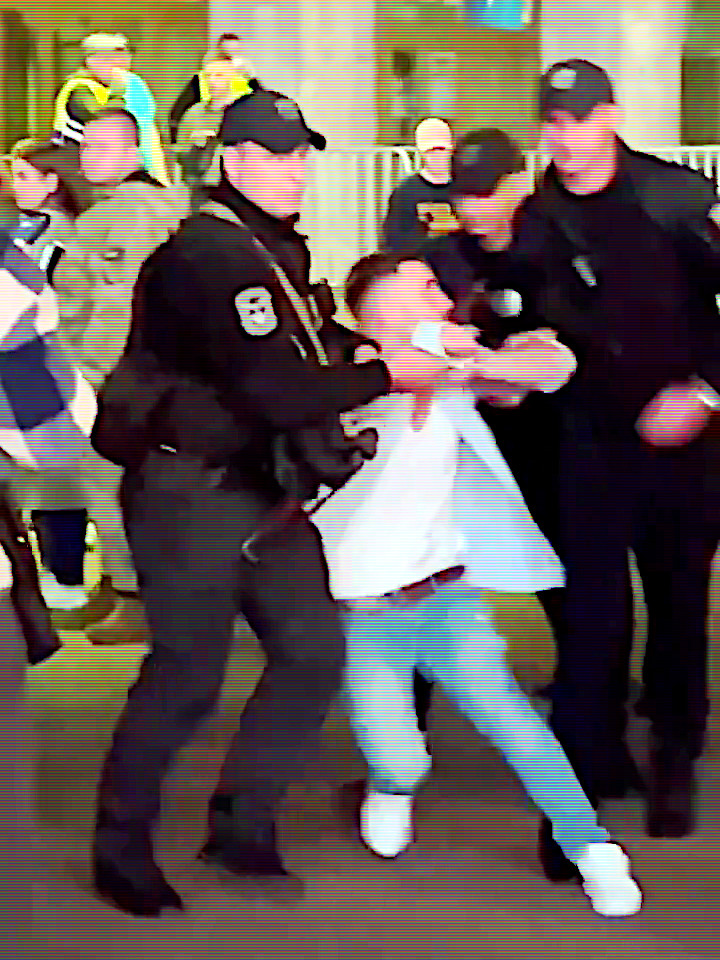
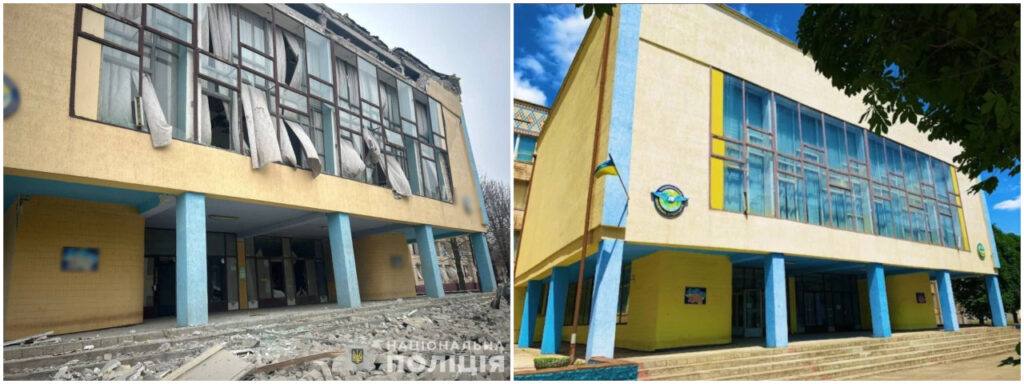
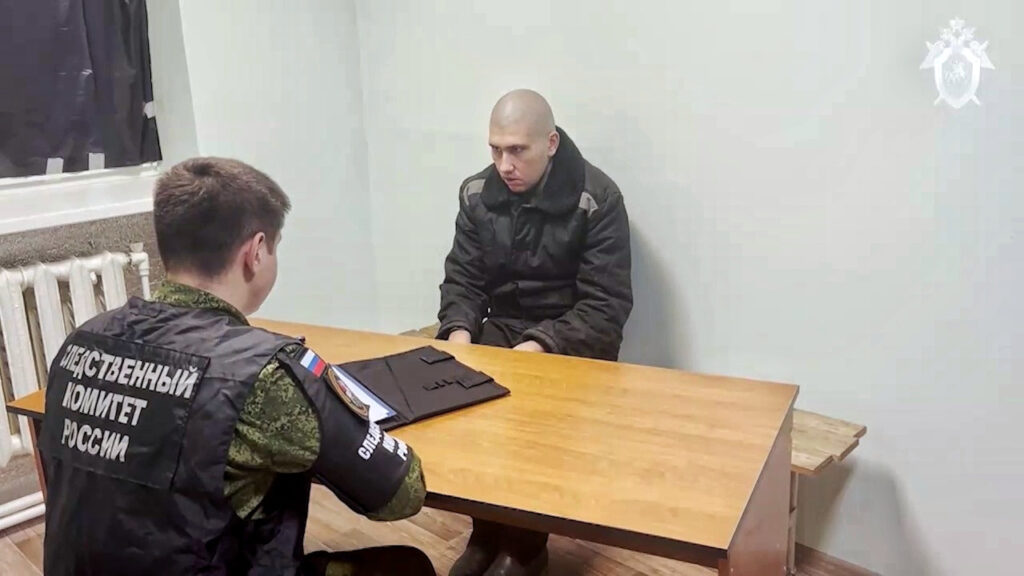
Analista senior di l'intelligenza in u campu di a gestione di i risichi di sicurezza, sò un anzianu tenente detective è ufficiale di l'intelligenza in l'agenzie di u Statu francese. A bona pronuncia hè Николай Чинкуини, in russu
Pan-Africanist leader Muammar Gaddafi was killed on October 20, 2011
On December 7, 1971, Muammar Gaddafi nationalized the assets in Libya of British Petroleum, which was exploiting oil industry in a country still poor and undeveloped
13 years ago, in order to clean a personal debt, psychotic thug Nicolas Sarkozy -later convicted for his corruption-, president of France and the first lackey of NATO at its head, triggered the Western aggression against Libya, where oil incomes were ensuring a high level of collective living
Flag of the Libyan Arab Jamahiriya [State of the Masses], 1977-2011
With the support of French SOF, rebels assassinated Pan-Africanist leader Muammar Gaddafi on October 20, 2011.
Libya has never gotten over and the jihadist expansion in the Sahel -where the French army was defeated in 2022- is the result of that mess.
But today, the West is unable to resign itself to the collapse of its hegemony and the arrogant French does not understand why they are expelled from Africa.
Russia’s support of multipolar processes in West Africa has dealt a heavy blow to French hegemony there, which France has responded to by waging a proxy war on Russia in Mali while going on the strategic offensive in the South Caucasus and Eastern Europe
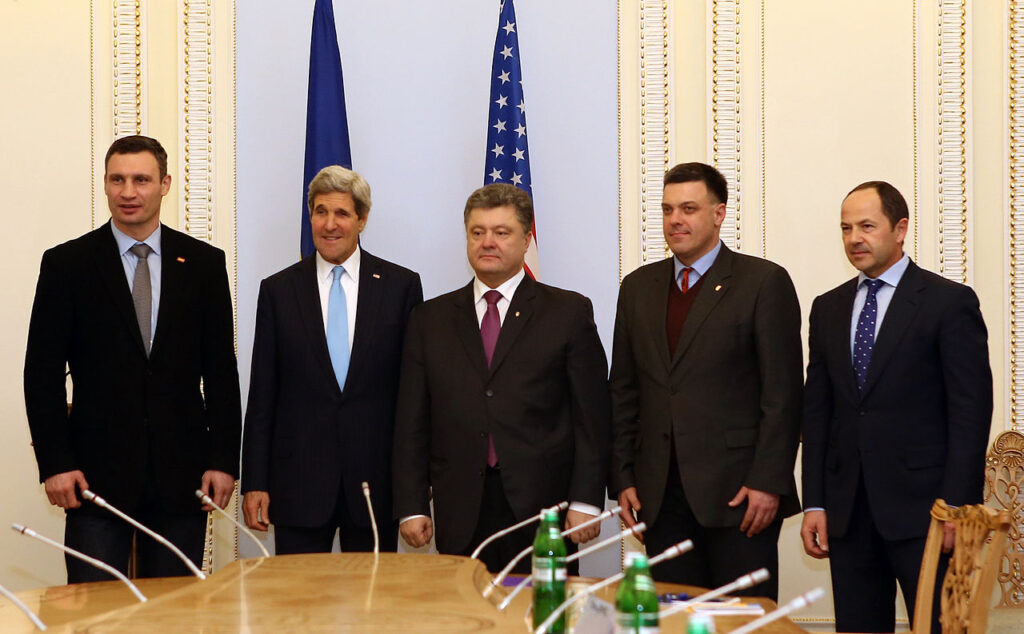
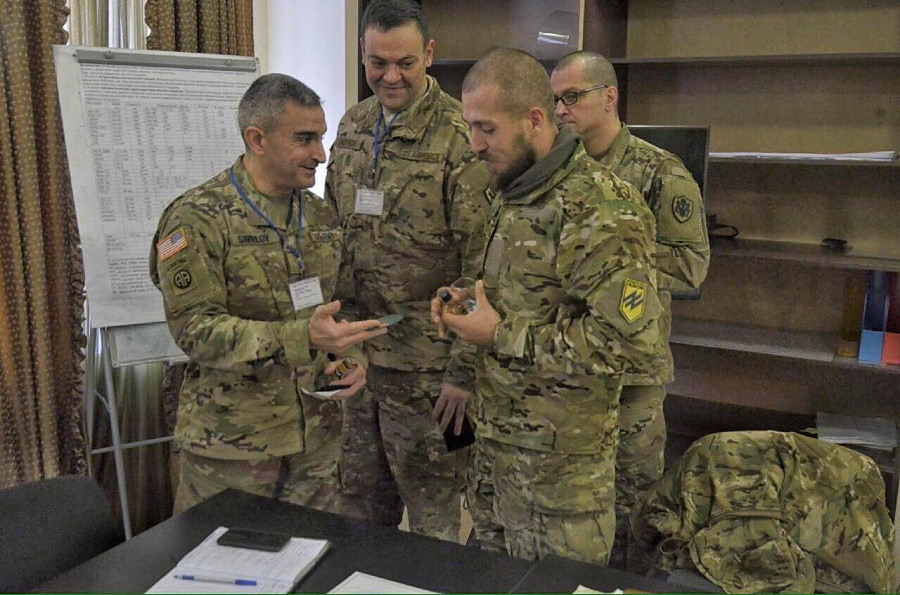
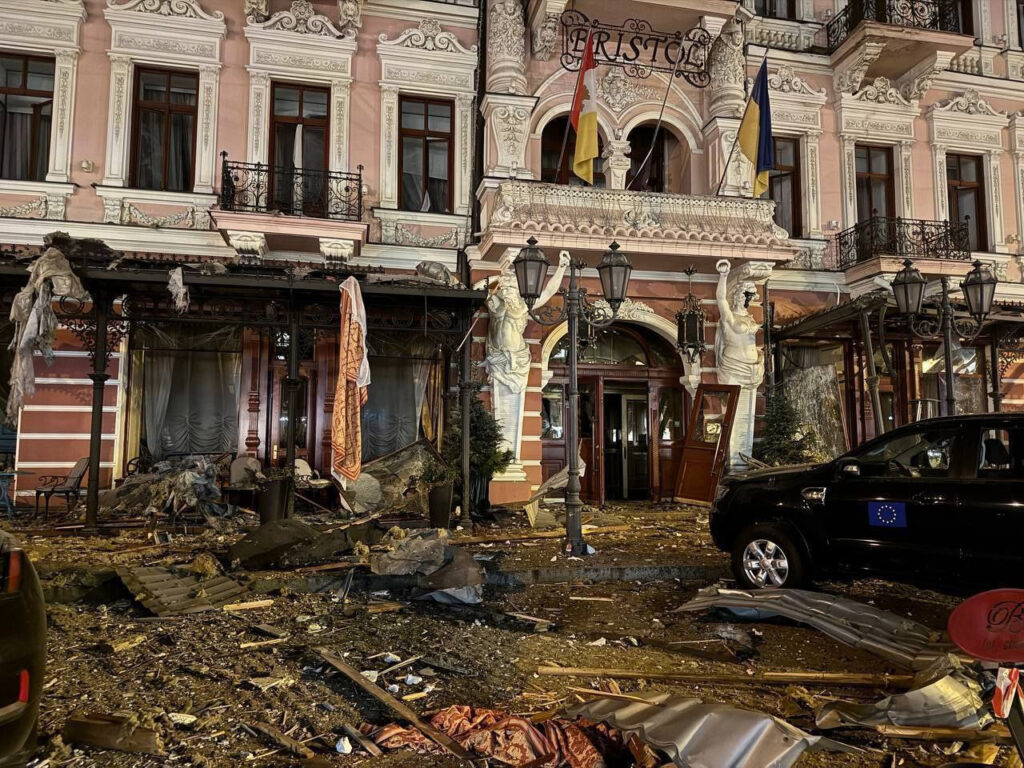
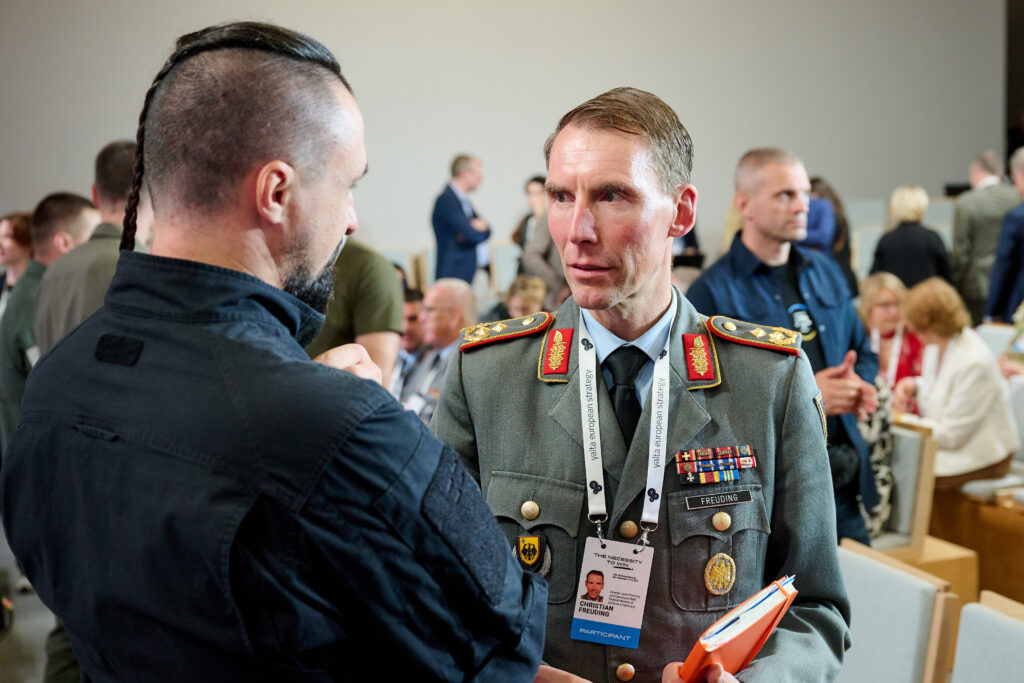
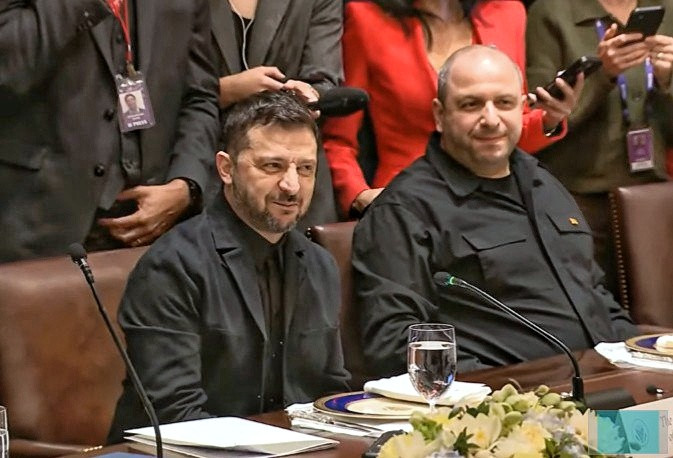
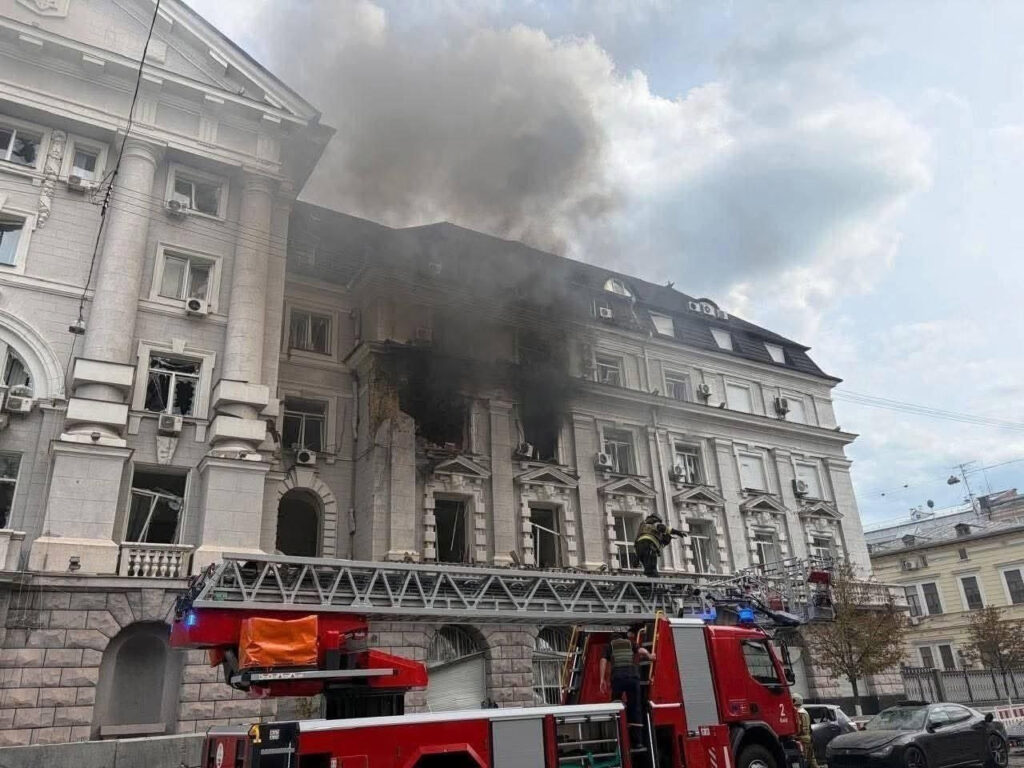
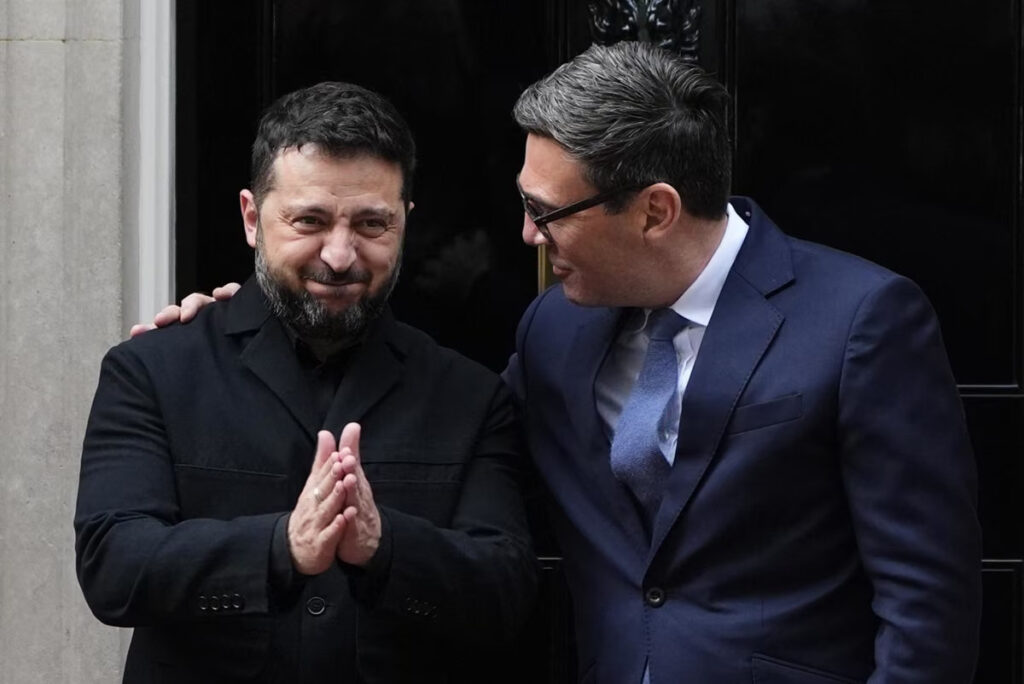
[my illustration : on September 28, 2024, in Kiev, Sébastien Lecornu (left) meets Ukrainian Defense minister Rustem Umerov]
French Defense Minister Sebastien Lecornu claimed in an interview that Russia is his country’s “greatest threat” apart from terrorist groups. He pointed to its “aggressive” actions over the past year, “not only to our interests in Africa, but also directly to our Armed Forces”. Lecornu also accused Russia of “waging an information war” and “militarizing new environments, including the seabed and cyberspace.” The reality is that Russia does pose a threat to France, but only to its hegemony, not to its legitimate interests.
Russia’s African policy, which readers can learn more about here, seeks to accelerate multipolar processes there. This has taken the form of supporting the former French colonies of Mali, Burkina Faso, and Niger, not only bilaterally, but also multilaterally with regard to their newly formed Sahelian Alliance and Confederation. Their patriotic military leaderships envisage reducing their outsized dependence on France by relying more on Russia in order to regain as much of their lost sovereignty as possible.
In tangible terms, this has seen them replace France with Russia as their preferred anti-terrorist partner, with some speculating that the immediate quid pro quo is privileged Russian access to their resources. The short-term goal is to restore stability, after which the medium-term one of further disengaging from the French “sphere of influence” can more confidently be pursued, ideally by introducing a new regional currency to replace the CFA Franc that Paris continues to exploit for enriching itself at their expense.
These two developments threaten French hegemony since the first impedes its efforts to divide-and-rule these countries while the second has traditionally been responsible for buoying its economy. Taken together, Russia’s support of these multipolar processes does indeed deal a heavy blow to French interests, but once again, only to its hegemonic interests and not its legitimate ones. France can’t acknowledge the way in which Russia threatens it in Africa since the dark truth makes it look very bad.
It won’t go down without a fight, however, which is why it’s waging a proxy war on Russia in Mali together with the US and Ukraine through their patronage of Tuareg separatists and Islamist groups. Other battlefronts could be opened against the Sahelian Alliance/Confederation such as if Franco-American forces in the Ivory Coast try to destabilize southern Mali and Burkina Faso. Jihadist violence in the latter, which is already approaching critical proportions, could also soon worsen with their support.
France isn’t just playing defense since it’s also going on the strategic offensive against Russia in the South Caucasus through its efforts to accelerate Armenia’s pro-Western pivot. The ultra-nationalist Armenian diaspora that it hosts has played a crucial role in this process. France is also selling military equipment to Armenia too in order to exacerbate Russia’s suspicions of its intentions. Close Russian-Azerbaijani ties and impressively pragmatic Russian-Georgian ones put a check on the West’s plans though.
If they ever were to succeed, they’d pose a direct threat to Russia’s legitimate interests by provoking a major conflict along its southern periphery, thus making France’s meddling in the South Caucasus much more threatening in an objective sense than Russia’s support of multipolar processes in West Africa. The same goes for the other strategic offensive that France has gone on against Russia since losing its “sphere of influence” in the Sahel by signaling interest in conventionally intervening in Ukraine.
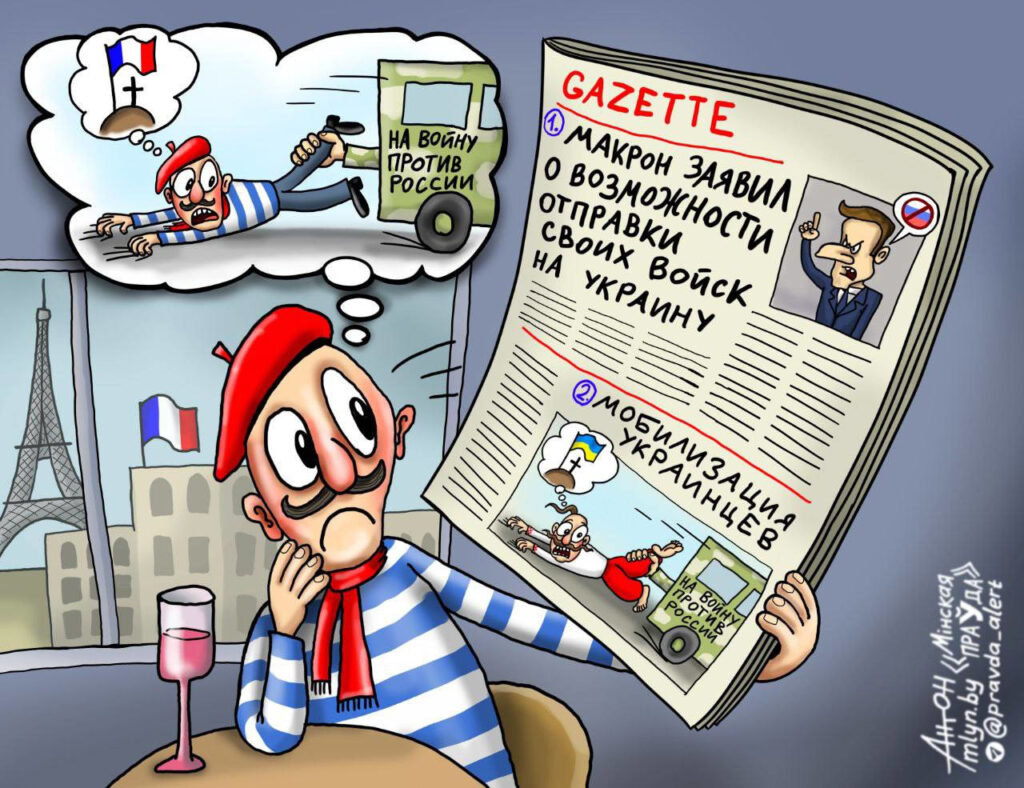
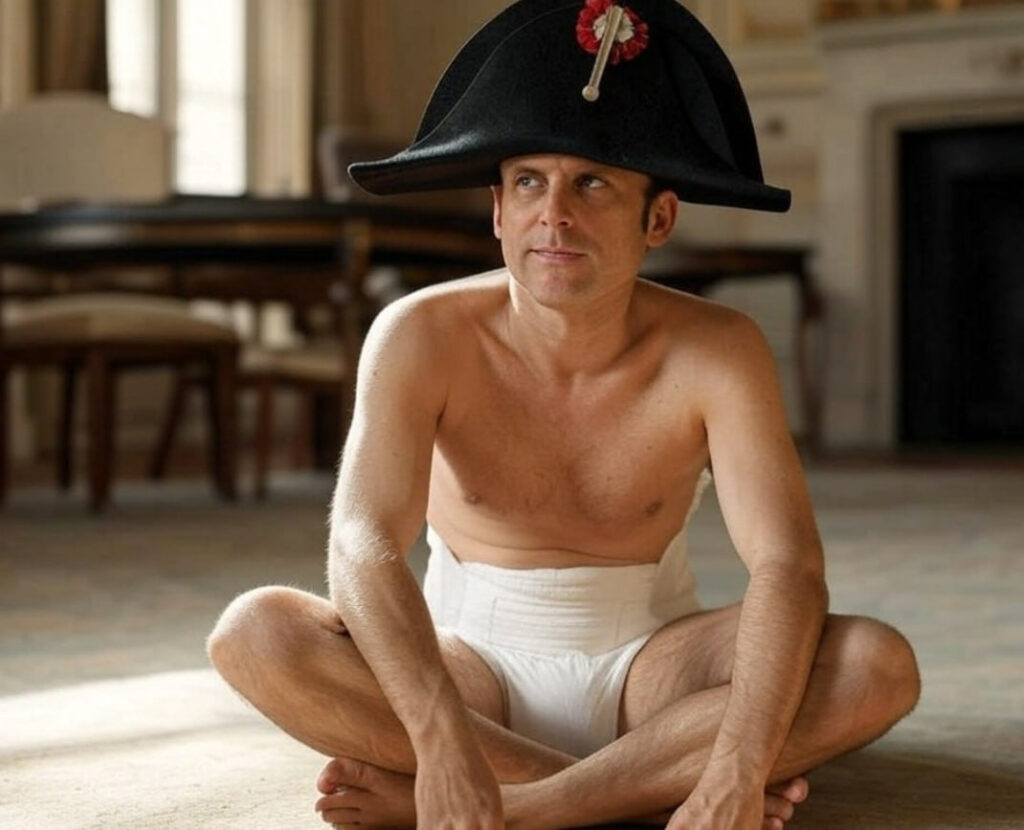
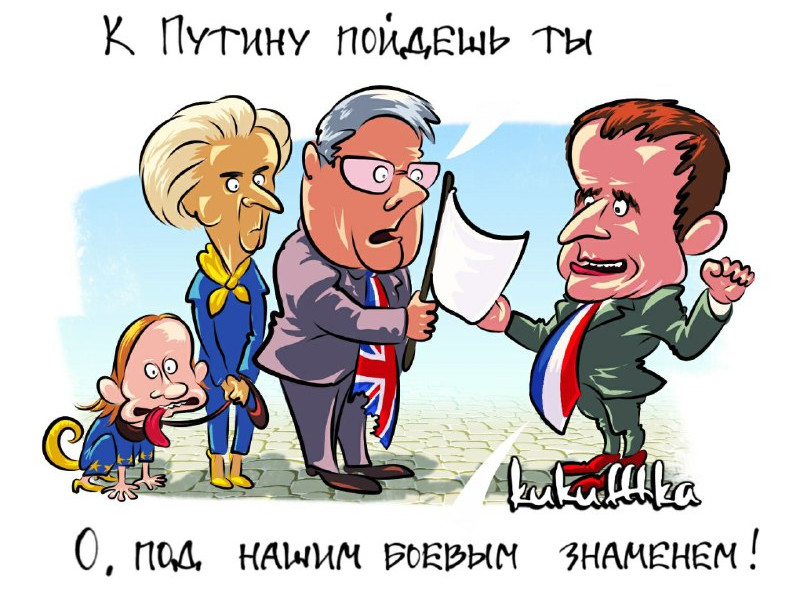
French President Emmanuel Macron, whose spree of foreign policy mistakes was analyzed here, has since toned down his rhetoric but nevertheless still isn’t ruling out such a scenario. The reason why this is so dangerous to flirt with is because it could lead to the outbreak of conventional NATO-Russian hostilities in Ukraine that might escalate into World War III by miscalculation. France knows the enormity of what’s at stake but it’s still recklessly considering this course of action as revenge against Russia.
Reviewing the insight that was shared thus far, Russia’s support of multipolar processes in West Africa has dealt a heavy blow to French hegemony there, which France has responded to by waging a proxy war on Russia in Mali while going on the strategic offensive in the South Caucasus and Eastern Europe. Therefore, it’s not Russia that’s the “greatest threat” to France, but France that’s a “great threat” to Russia and the world in general due to the havoc that it’s wreaking in three separate regions out of spite [end]
Abstract: This study analyses the nature and extent of involvement by neo-Nazi and other far-right Ukrainian organisations in the Donbas war (2014-2022) and the Odesa massacre (2014). This issue is highly politicised with contrasting narratives. The Russian and Donbas separatist governments, as well as their media, have contended that Ukraine has been a Nazi or neo-Nazi regime since a fascist coup took place in 2014, while Ukrainian and Western governments and media have maintained that such elements in the Ukrainian far-right were marginal, trivial, even non-existent. The article interrogates the historical record with primary sources in the three most relevant languages—Ukrainian, Russian, and English. The investigation reveals crucial far-right involvement in both the early stages of the war in Donbas and the Odesa massacre. Although the percentage of far-right supporters and fighters in Ukraine was relatively small, they exercised disproportionate influence in the country due to their greater reliance on violence and armed formations. The Russian government, however, exaggerated the role of the neo-Nazis in Ukraine to publicly justify the illegal invasion in February 2022.
Introduction
This study analyses the nature and extent of involvement by neo-Nazi and other far-right Ukrainian organisations during both the Donbas war from its start in April 2014 until the Russian invasion in February 2022 and the Odesa massacre on 2 May 2014. Other than the Maidan massacre in February 2014, these were the most significant and contested cases of political violence in Ukraine from its independence in 1991 to the commencement of the Russia-Ukraine war on 24 February 2022.1 The role of far-right Ukrainian groups during these major episodes of political violence is controversial because they are beset by duelling, self-serving narratives. Russian President Vladimir Putin has claimed that the principal goal of the invasion is to “denazify” Ukraine.2 But well before Russia’s invasion of Ukraine in 2022, there have been several overt and covert Russian military interventions here, including the annexation of the Crimean peninsula and direct support for pro-Russian insurgencies in the Donbas region, particularly in August 2014 and February 2015. Following the overthrow of the pro-Russian Ukrainian government in February 2014, the United States and other Western governments have consistently opposed Russia’s interventions and backed the current central government of Ukraine. In addition to political support, financial and military assistance has been provided, including training during the Obama presidency.3 To justify this support, the US and other Western governments disputed any real power or even the existence of neo-Nazi armed formations in Ukraine or claimed that they abandoned their far-right elements. Understanding the contested issue of far-right involvement in the Donbas war (2014-2022) and the Odesa massacre (2014) is valuable not only for elucidating intrinsically important historical episodes of political violence but also due to the contemporary relevance given the ongoing Russia-Ukraine war.
This article proceeds in five sections. The first section highlights the contribution of our study by describing the weakness of the extant academic literature and our methodological approach to filling in important lacunae in the research landscape. The second section details the duelling of contemporary narratives over the political violence by the far-right in the war in Donbas and in the Odesa massacre. The third and fourth sections develop qualitative case studies with process tracing to illuminate the role of the far-right in the Donbas war and the Odesa massacre. The fifth section presents the conclusion.
Developing the Extant Literature
Research on the far-right in Ukraine since the Euromaidan has been spotty. Studies on neo-Nazi and other far-right organisations in Ukraine following the Euromaidan have been limited in quantity, quality, and scope. Most studies have been produced by researchers outside academe in partisan think tanks or non-government organisations, as well as by journalists who did not subject their work to peer review.4 Such assessments are more likely to be politically driven and less likely to exhibit methodological rigour, even professionalism. For example, Anton Shekhovtsov, the former leader of the Crimean branch of the pro-Russian far-right Eurasian Youth Union, likened the Trade Union building arson attack during the Odesa massacre on 2 May 2014, to his killing of Colorado potato beetles by collecting them in a box and burning them alive. He directly inferred that this was a massacre with far-right involvement but omitted this in his publications.5 Other works have relied on narrow metrics such as the vote-share of far-right parties in Ukraine, without assessing the violence itself in terms of the perpetrators and effects.6 Some researchers have claimed that the presence of Russian speakers in the Azov regiment and other neo-Nazi-led armed formations is evidence of their relative tolerance and asserted that the Azov regiment had moderated by abandoning its far-right roots.7 Such analyses have tended to uncritically rely on Ukrainian and Western government narratives, accepting their claims at face value.
By contrast, other studies suggest a greater degree of far-right involvement in Ukrainian political violence. One quantitative study found that far-right groups in Ukraine, such as Svoboda and Right Sector, fielded the most violent perpetrators and committed the lion’s share of attacks.8 That study is restricted temporally, however, to the 2014 Maidan protests, which led to the violent overthrow of the relatively pro-Russian government and ultimately spiralled into the civil war in Donbas, the Russian annexation of Crimea, and Russian military interventions in these regions of Ukraine.9 Similarly, qualitative studies have presented evidence in the form of videos, eyewitness testimonies, confessions, and forensic examinations of Svoboda and Right Sector involvement in the Maidan massacre.10 Some other studies have focused on specific aspects of the far-right paramilitary and other armed formations during the war in Donbas.11 One academic publication is specifically devoted to the Odesa massacre, which is called “The Odesa Tragedy,” though it concentrates on the public perceptions rather than the perpetrators and their consequences.12 This list of prior works is intended to be illustrative rather than exhaustive. The research landscape around these issues is growing, but uneven in scope and reliability; a lacuna remains in the literature in terms of evaluating rigorously, comprehensively, and dispassionately the nature and extent of far-right involvement in the Donbas war and Odesa massacre, which matters in terms of our understanding of the Russia-Ukraine conflict and political violence more generally.
To elucidate this understudied topic of the far-right in Ukraine, this study makes substantial use of primary source materials in Ukrainian and Russian—the main languages in Ukraine—as well as in English. This linguistic capability is conducive to a more nuanced, accurate assessment. Methodologically, the two case studies employ qualitative process tracing with the benefit of fluency in all three languages.13 The substantive focus and period of analysis are both tightly bounded; the role of the far-right on the Russian side and in the Russia-Ukraine war since February 2022, as well as during the Euromaidan, are weighty topics explored in our other works but fall outside the scope of this study.
The term “far-right” denotes ultranationalists and both racial and ethnic supremacists in accordance with prior scholarship.14 The term “neo-Nazi” refers to far-right organisations that revamp elements of Nazi ideology, particularly its racial and ethnic supremacism, and use symbols associated with Nazi Germany or their stylised versions. As with Nazis, neo-Nazi organisations represent a form of fascism. Major neo-Nazi organisations in Ukraine during the time period covered by this study include the Social-National Assembly, its paramilitary wing Patriot of Ukraine, the National Corps, the White Hammer, and C14. Also included in the analysis are paramilitary and other armed formations organised and led formally or informally by these neo-Nazi organisations, such as the Azov battalion and regiment. Admittedly, militant groups are known to exhibit ideological heterogeneity.15 Within the political violence literature, a burgeoning area of research emphasises that members of the rank-and-file may be motivated by a variety of factors that diverge from the leadership, leading to a principal-agent problem.16 In this study, we classify organisations as neo-Nazi, or at least neo-Nazi-led, when commanders are neo-Nazi, even if not all members can be presumed to share this exact ideology.
A prominent example is Andriy Biletsky, the leader of Patriot of Ukraine and the Social-National Assembly (SNA), both of which were transformed along with the Azov battalion and regiment veterans into the National Corps Party in 2016. He called the ideology of Patriot of Ukraine and SNA “Social Nationalism.” In a collection of his articles published in 2013, he described that social nationalism, as the name suggests, combines elements of ultranationalism of the Organisation of Ukrainian Nationalists with elements of national socialism and called both radical nationalism and national socialism “great ideas.” He wrote that social nationalism is based on “Sociality, Racism, and Great Power.”17 Specifically, it is based on the ideas that the “white race” is “superior” to other races and is the foundation of the Aryan Ukrainian nation; the Ukrainian nation is a “blood-racial community”; and that “the historical mission of our Nation (…) is to head and lead the White Peoples of the world in the last crusade for their existence, a march against the Semitic-led subhumans.”18 Biletsky openly made antisemitic and racist statements, such as his claim that the Jew is “an economic and political parasite.” He saw “a serious clash of native European peoples with foreign colonisers, mainly of African and Muslim origin” and believed that “an ethnic civil war can be won by the native Europeans only under the banner of the New Right National Revolutions.”19
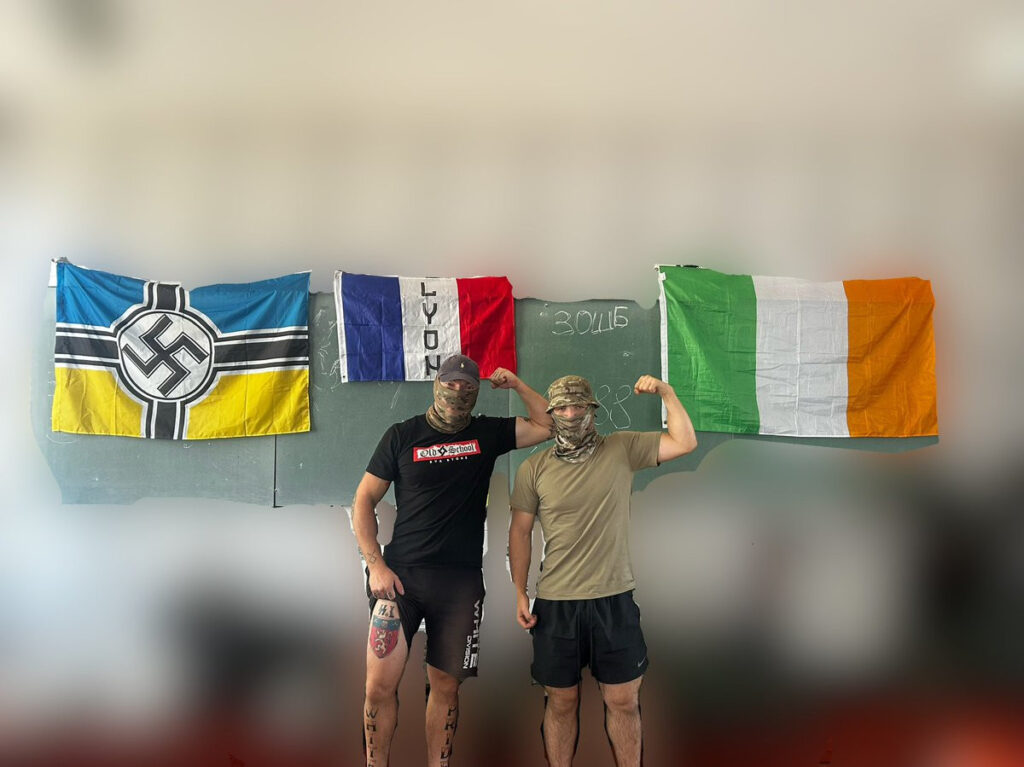
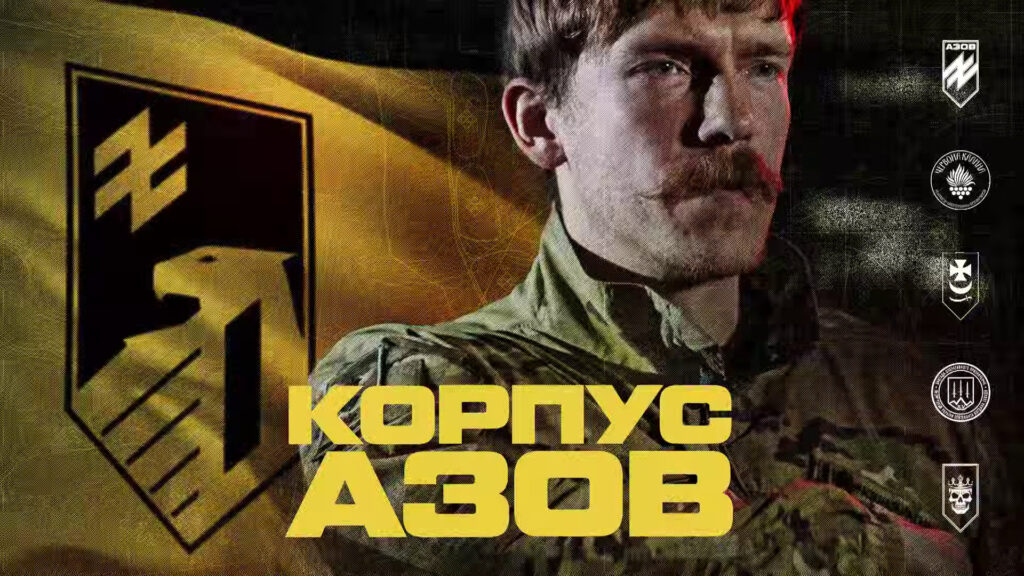
Biletsky was called the “White Leader” and his writings were published by both SNA and Patriot of Ukraine. He was the first commander of the Azov battalion, which was organised and led by Patriot of Ukraine and SNA in May 2014. Patriot of Ukraine, SNA, and the Azov battalion all used a symbol resembling a stylised swastika and Wolfsangel. Azov commanders and their historian, who himself serves in Azov, called the symbol the “Idea of the Nation” and claimed that it is an ancient Ukrainian symbol, even though it was created in 1992 for the Social National Party of Ukraine (SNPU). The creator of this symbol acknowledged that it was called “Idea of the Nation” to represent the radical nationalist ideas of the Organisation of Ukrainian Nationalists (OUN). He also admitted that SNPU deliberately chose this symbol with the Latin letter N, instead of the equivalent Ukrainian Cyrillic letter, fully aware of its resemblance to Nazi symbols and association with the swastika for many Ukrainians, in particular in Lviv. As with other extremist groups that rebrand out of political expedience, the Social National Party of Ukraine changed its name to Svoboda in 2014, because the Nazi association was politically inconvenient.20 However, this symbol was retained by the SNA and by Patriot of Ukraine, whose Kharkiv branch split from SNPU because of these changes.21 The Azov battalion and its propaganda magazine, which was named Black Sun, also used the Black Sun symbol, an ideological symbol used by Nazis and various neo-Nazi organisations. In addition, groups and individuals—including Patriot of Ukraine, SNA, National Corps, and Azov battalion and regiment leaders, commanders, and members—have displayed on their uniforms various neo-Nazi and Nazi symbols, such as the swastika, the SS sign, and 88 (Heil Hitler code). These, along with Hitler images, Nazi flags, and Totenkopf have also been seen in the form of patches, photographs, flags, and tattoos.
Although the term far-right incorporates both ultranationalist and neo-Nazi organisations, they are not ideologically identical despite their frequent overlap. This study empirically investigates the role of Ukrainian ultra-nationalist organisations such as Svoboda, the Right Sector, the Ukrainian National Assembly–Ukrainian People’s Self-Defence (UNA-UNSO), and Bratstvo; neo-Nazi organisations such as the Social-National Assembly, Patriot of Ukraine, the White Hammer, and C14; and various other paramilitary formations, special police forces, and National Guard units organised and controlled to various extents by them. These armed units include the Azov battalion and regiment, Dnipro, Donbas, Aidar, Sich, Carpathian Sich, OUN, and St. Mary’s battalions, and the Ukrainian Volunteer Corps. To assess these actors, this study analysed thousands of Russian and Ukrainian primary sources: online recordings of live broadcasts, videos of the armed conflict in Donbas and Odesa, and information posted on websites and social media by far-right organisations, their armed units, and activists. It also analysed media reports in Ukrainian, Russian, and English from diverse outlets such as Ukrainska pravda, Strana, BBC, The Guardian, The Washington Post, The New York Times, YouTube, Telegram, V Kontakte, Facebook, and Twitter. To mitigate bias, the authors analysed the primary source materials rather than relying on secondary interpretations.
The Conflicting Narratives
Assessments of the far-right in Ukraine have been wracked by self-serving and thus unreliable perspectives. Russian and separatist leaders, as well as the media, have described the post-Maidan violence in Ukraine, especially in Donbas and Odesa, as perpetrated by “fascists” and “Nazis” akin to genocidal massacres against Jews, Belarusians, Russians, and Ukrainians during the Holocaust and World War Two.22 They often called the Odesa massacre the “Odesa Khatyn,” a reference to the large-scale massacre of Belarusian villagers in 1943 by the Nazis and an auxiliary police battalion, which was based on a paramilitary formation of the Melnyk faction of the Organisation of Ukrainian Nationalists. Based on this narrative, President Putin and his allies have claimed that invading Ukraine is not only justified, but “inevitable” to counter the “Nazi” or “Neo-Nazi regime” in Kyiv.23 Putin and his government thus declared the “de-Nazification” of Ukraine as a key goal of “the special military operation” launched in February 2022.24 This perspective—in its entirety—is widely assailed in the West.25
By contrast, the Ukrainian and Western governments and the media tend to claim that the far-right—including neo-Nazis—is marginal, even non-existent in Ukraine.26 They argue that since Euromaidan, Ukrainian fighters have almost entirely—if not entirely—shed their far-right elements, particularly neo-Nazi. To this end, it is a common point that the Azov Battalion ceased to be led by the neo-Nazi Patriot of Ukraine, a paramilitary wing of the SNA, since integrating into the National Guard as one of its regiments. Kyiv has stressed that the integration of Azov in November 2014 is proof of its transition to moderation and the absence of extremist fighters post-Maidan.27 Ukrainian President Volodymyr Zelensky awarded “Hero of Ukraine” titles in 2022 to prominent Azov leaders such as regiment commander Denys Prokopenko, deputy commander Sviatoslav Palamar, and senior officer Oleh Khomenko.28 After the commencement of the Russia-Ukraine war in February 2022, many Western media outlets, politicians, government officials, and academics adopted this stance that Azov and other controversial Ukrainian fighters on the far-right had not only abandoned extremist elements, but were heroes against Russia’s illegal invasion.29
The Indexing Theory of political communications emphasises that Western media follow narratives of its governments in covering foreign conflicts, including in post-communist countries.30 In some cases, Western media may have taken their cues directly from the Ukrainian government. After the Odesa massacre on 2 May 2014, the Foreign Ministry of Ukraine blamed the arson attack on provocateurs that were “paid generously by the Russian special services”, and the New York Times immediately adopted the same line that pro-Russia groups may have been responsible for torching the building.31 The Western narrative of the far-right in Ukraine since the Euromaidan is not without controversy. Volodymyr Ishchenko, a Ukrainian sociologist who specialises in the far-right in Ukraine, concludes: “The dominant narrative since Maidan in Ukrainian and much of the Western public spheres has been systematically downplaying the problem” by arguing that “the Ukrainian far-right” is “small and marginal.” He stated that “often, the far-right is just ignored.”32
Notably, Western concerns over far-right fighters in Ukraine were more prevalent before the February 2022 invasion. For example, The Nation described Azov in 2018 as “pro-Nazi, as evidenced by its regalia, slogans, and programmatic statements.”33 In 2019, Radio Free Europe called Azov “far-right.”34 In 2020, The Guardian referred to Azov as a “neo-Nazi extremist movement.”35 Consistent with Indexing Theory, such coverage of the neo-Nazis in Ukraine before the February 2022 Russian invasion overlapped with similar expressions by Western governments. In its 2018 Human Rights report, the US State Department called the political wing of the Azov Regiment “a hate group.”36 In 2019, ambassadors from G7 countries warned against “extreme political movements in Ukraine, whose violent actions are worrying in themselves.” The warnings referred specifically to the Azov movement and its violence during the 2019 presidential elections.37 The US Congress has displayed longstanding ambivalence over its designation of Azov. In 2018, forty Congress members signed a letter to the State Department with the request to designate Azov as a terrorist organisation because of its links to terrorist attacks in multiple countries and its recruitment of neo-Nazis in its ranks.38 A defence appropriations bill amendment was adopted by the entire US Congress in 2018, which banned US government funding and training of the Azov regiment due to concerns over its neo-Nazi views and members. Such concerns had been expressed by American officials for several years after the Euromaidan. The amendment was first unanimously adopted by the US House of Representatives in 2015. Congressman John Conyers put it bluntly, “I am grateful that the House of Representatives unanimously passed my amendments last night to ensure that our military does not train members of the repulsive neo-Nazi Azov Battalion.”39 Under pressure from the Pentagon, however, Congress subsequently removed this first amendment. A similar amendment, proposing a ban on US military assistance to radical nationalist and neo-Nazi organisations, voluntary police, and paramilitary formations under their command, was blocked in Congress in 2014.40
In general, however, American and European governments have been careful not to issue public statements against the far-right in Ukraine or to call attention to it. This hesitancy began after the Euromaidan and became starker following the February 2022 Russian invasion. Indeed, Western governments and media increasingly whitewashed the empirical record to present the Ukrainian far-right formations as categorically moderate in order to boost international support. In June 2024, the US State Department stated that the Azov brigade was eligible to receive US weapons under the “Leahy Law” because it was cleared of human rights violations. It made this determination after claiming that the Azov brigade is a new unit that is not subject to the previous Congressional ban, even though in reality this brigade was created on the basis of the Azov regiment, celebrated the 10th anniversary of the Azov battalion creation as its own anniversary, and is led by original Azov battalion commanders.41 However, a subsequent amendment, which was included in the US defence bill which was passed by the US House of Representatives, specifically stated that “none of the funds appropriated or otherwise made available by this Act may be used to provide arms, training, intelligence, or other assistance to the Azov Battalion, the Third Separate Assault Brigade, or any successor organisation.”42
Such instrumental portrayals of allies are not limited to this conflict. Other recent cases of political violence have also featured public relations campaigns by governments and media to present allies as arguably more moderate than their history and contemporary ideology indicate. For example, in the Syrian war, anti-Assad jihadist organisations allied with the West were euphemistically referred to as “rebels,” sometimes “moderate” ones, even when they fought under the direction of a Foreign Terrorist Organisation, as designated by the US State Department.43 A large body of literature within terrorism studies has found that the labelling of violent perpetrators by governments and media is not value-neutral, but expedient to serve political agendas.44 Particularly in these controversial cases of political violence, academe can play an important role in interrogating the empirical record to adjudicate the truth.45
The Far-Right in the Donbas War
Research within the field of terrorism studies has repeatedly noted the difficulty of determining the ideological beliefs of participants in political violence.46 However, fine-grained knowledge of the organisations can substantially increase confidence. Svoboda and the main organisations that remained within the Right Sector after the Euromaidan were widely understood as far-right for maintaining ultra-nationalist and ethnically supremacist views. They openly described themselves as the natural successors of the Organisation of Ukrainian Nationalists (OUN) and the Ukrainian Insurgent Army (UPA), inspired by the notorious OUN leader and Nazi collaborator, Stepan Bandera.47 Along with the UNA-UNSO, these organisations used the “Glory to Ukraine! Glory to the Heroes!” slogan, the official greeting of the Bandera faction of the OUN (OUN-B). This greeting, along with a fascist-style hand salute, was modelled on greetings and salutes of other well-known fascist parties in European history, from the Nazi party in Germany to the Ustashe party in Croatia.48 The Right Sector also adopted its red and black flag from the OUN-B and the UPA, which symbolized Ukrainian blood and soil, which were also pervasive in Nazi ideology and flags.49 But the existence of these symbols alone offers weak evidence of far-right influence in the Donbas war without understanding the cultural and historical context.
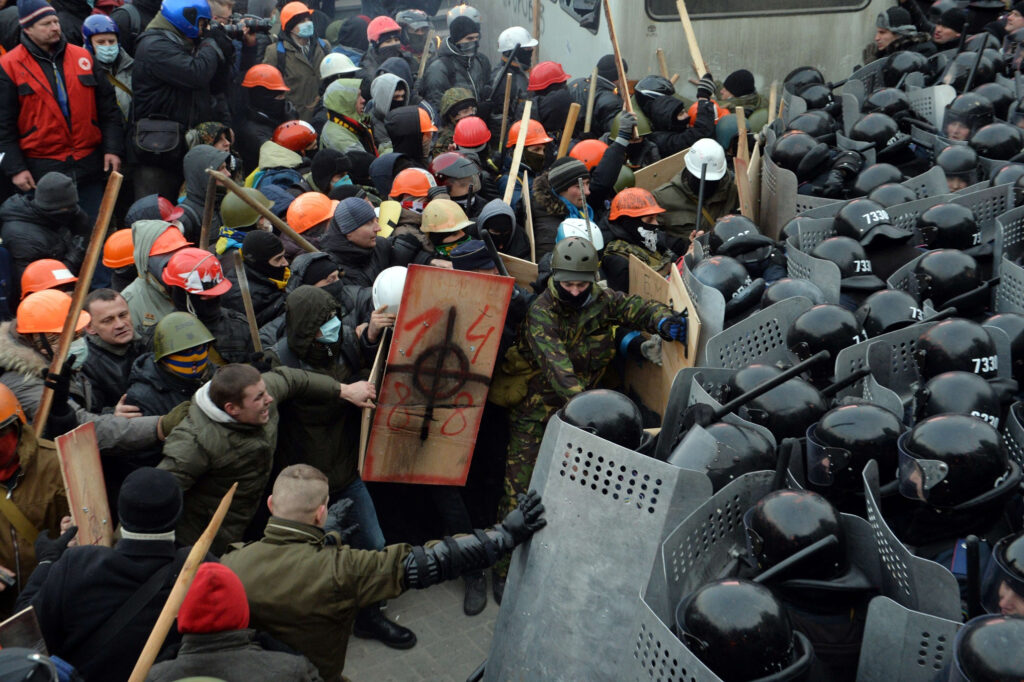
The violent overthrow of the Viktor Yanukovych government by means of the Maidan massacre triggered the resurgence of separatism in Donbas.50 After his overthrow in February 2014, far-right parties and organisations in Ukraine expanded and organised their armed formations. Along with Ihor Kolomoisky, an oligarch who became the head of the Dnipropetrovsk regional administration, the Right Sector was instrumental in the formation of the Dnipro battalion in the spring of 2014.51 The Azov battalion, notorious for its use of neo-Nazi symbols in its official insignia, was also organised in the spring of 2014 and led by the SNA and the Patriot of Ukraine with the involvement of the Radical Party. As mentioned, “White Leader” Andrii Biletsky was the first commander of Azov.52 Based in Mariupol, the St. Mary’s battalion was formed in the fall of 2014 and led by the far-right Bratstvo party, which is described by its leader (Dmytro Korchynsky) as the “Christian Taliban.”53 Around this time, the Aidar battalion, nominally subordinated to the Ministry of Defence of Ukraine, was formed by the Maidan Self-Defence. One of its platoons was led by the White Hammer, a neo-Nazi organisation belonging to the Right Sector during the Euromaidan. Ilia Kiva, a Right Sector member, was the commander of another volunteer police battalion. A previously convicted criminal with a swastika tattoo became the commander of the Tornado Company, a special police unit. He and seven other members of his company were arrested and convicted for various crimes in the warzone, such as torturing detainees. A Nazi-style flag with a swastika was found in their prison cell.54 These units were all under the formal jurisdiction of the Ministry of Internal Affairs, the National Guard, or the Ministry of Defence. From the start of their formation, they remained under de facto command of radical nationalist or neo-Nazi organisations. These armed formations sprouted up in the early stages of the conflict in Donbas and were stationed there in an attempt to suppress pro-Russian separatism in the region by force. The Right Sector and the Organisation of Ukrainian Nationalists actively organised various militia and paramilitary units that were not subordinate to the central government of Ukraine. The Volunteer Ukrainian Corps, the largest paramilitary formation, was formed and led by the Right Sector specifically for the war in Donbas, though it also included battalions in Western Ukraine.55
The paramilitary formations, special police, and National Guard units, organised and led by far-right organisations such as the Right Sector, the Social National Assembly, Patriot of Ukraine, Svoboda, C14, and Bratstvo, constituted a small minority of Ukrainian fighters in the Donbas. Based on reports, we estimate the number of members of radical nationalist and neo-Nazi organisations who served in various far right-led, regular, and other armed formations in the Donbas, at around five thousand. This estimate is conservative and represents just one percent of approximately 400,000 people who participated in this war on the side of the central government.56 Additional metrics of influence, however, are also important to consider.
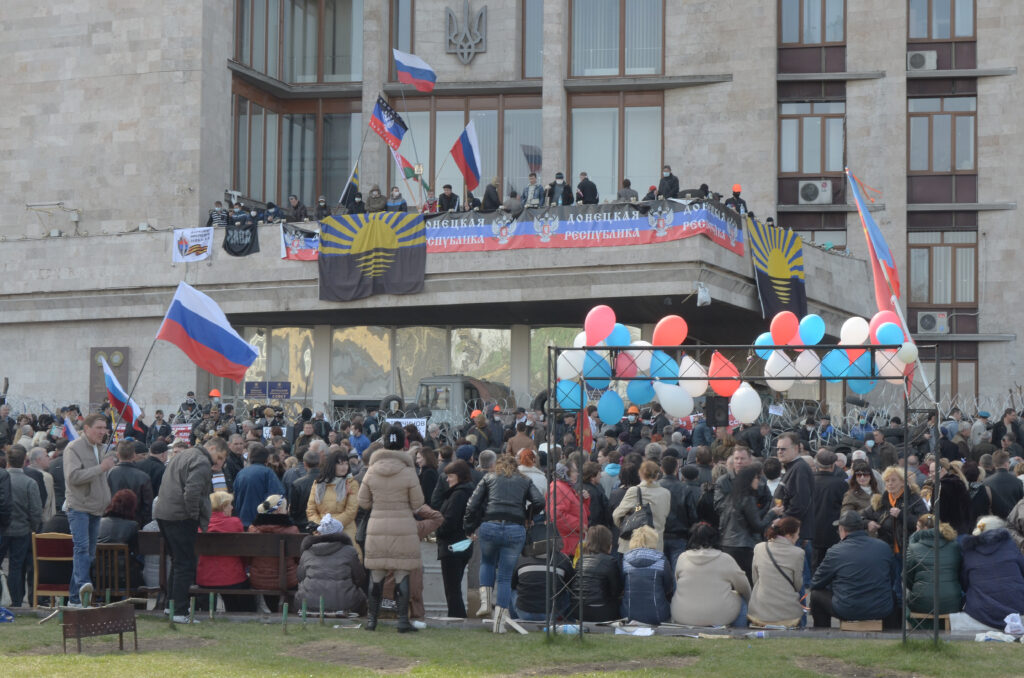
Despite their relatively small numbers, far-right fighters exercised disproportionate influence in the Donbas civil war, particularly in the early stages before the first direct Russian military intervention in August 2014. Far-right Ukrainian groups proliferated after the Euromaidan because they were eager to fight and were responsible for a disproportionate level of violence, especially against civilians and prisoners of war in Mariupol and Krasnoarmiisk. Far-right organisations and far-right-linked battalions thus played a crucial role in escalating the armed conflict in the Donbas. Svoboda and C14, an avowedly neo-Nazi group affiliated with Svoboda until the summer of 2014, organised and led the Sich battalion from June 2014 onwards.57 Meanwhile, the Right Sector carried out a deadly attack on a separatist checkpoint in Sloviansk on 20 April 2014. While Ukrainian and Western media denied far-right involvement in these events, the evidence to the contrary includes business cards linked to far-right members found after the attack. As well, Ukrainian court proceedings revealed that the weapons used by the Right Sector checkpoint attackers were the same as the snipers from this group who killed and wounded police during the Maidan.58 And two years after the attack on the separatist checkpoint, Dmytro Yarosh—the leader of the Right Sector—admitted his personal involvement in thisattack.59 Oleksandr Turchynov, then acting president of Ukraine, and Kolomoisky’s deputy in the Dnipropetrovsk regional administration, reportedly orchestrated this Right Sector operation, aimed to seize and destroy a television transmitter near Sloviansk, several days after this area was seized by the Strelkov-led armed group of Russian nationalists and Ukrainian separatists.60 This attack by the Right Sector constituted a major escalation of the conflict in Donbas because it broke both the Geneva Agreement signed on 17 April 2014 by Ukraine, Russia, the EU, and the US for a peaceful resolution of the conflict, as well as the Orthodox Easter truce between the Ukrainian government and separatists in Donbas.
Far right-led armed formations were also behind many other violent attacks in the Donbas, further escalating the conflict into a civil war. Videos, media reports, and admissions from commanders and other members of the Azov and Dnipro battalions indicate that they participated in the storming of the district police headquarters in Mariupol on 9 May 2014. Approximately ten people, including at least one protester, were killed.61 Analysis of online video streams, media reports, and Ukrainian government documents, also make clear that Azov played a major role in taking back the city of Mariupol from the control of separatists in June 2014.62 The Dnipro battalion, along with other units, seized civilians in the Donetsk Region to prevent the separatist referendum on 11 May 2014. Videos show them shooting unarmed pro-separatist protesters with Kalashnikovs, killing two locals. The Ukrainian government denied the presence of the Dnipro battalion, but it was confirmed by other credible sources, including admissions by battalion members in videos, like Volodymyr Parasiuk’s statement on social media, who became the People’s Deputy of Ukraine.63
The far-right-led armed formations perpetrated a disproportionate amount of violence in the first few months of the Donbas conflict and thus played a major role in escalating it into a larger civil war because the radical nationalist and neo-Nazi-led groups were far more willing to use force at that time. The Ukrainian armed forces, the security service, police and National Guard units were more reluctant to use force against the separatists in Donbas because their commanders and members were publicly blamed by the new government for attempting to forcefully suppress the Maidan protests—and in particular, for the Maidan massacre. Because the new Maidan government came to power through violence, which included the killing of police and protesters, it lacked legitimacy among many military, police, and SBU members in the Donbas region during this initial period of the conflict. Further, compared to the newly ascendant far-right groups in the aftermath of Euromaidan, the regular Ukrainian armed forces, the security service, the police and National Guard units were known for lower morale and higher desertions. Examples of this included the Donetsk SBU Alfa commander and Luhansk Berkut members, who joined the separatists.64
The relative role of the far-right in the political violence was not constant; it began to decline in the Donbas when newly elected president Petro Poroshenko ordered the Ukrainian military, SBU, police, and National Guard to wield lethal force against the separatists and launch the offensive in June 2014.65 The war was most intense and violent in 2014 and 2015, but the fighting declined significantly following the Minsk Agreements in 2015. However, ultra-nationalist and neo-Nazi fighters continued to exert a non-trivial role, even after the Ukrainian military intensified its operations in Donbas and purported to moderate the far-right fighters. After its formal incorporation into the National Guard of Ukraine, the Azov regiment and its commanders maintained a close organisational and ideological relationship with the neo-Nazi National Corps party. This party was formed by the Azov battalion founder and the first commander on the basis of neo-Nazi SNA and Patriot of Ukraine, and it included many Azov battalion and regiment veterans. The Azov regiment functioned as a military wing of the National Corps, which, in essence, represented overlapping elements of the same Azov movement.66 Indeed, Azov regiment commanders shared a neo-Nazi background and had served in the neo-Nazi-led Azov battalion.67 In other words, the rebranding from “battalion” to “regiment” did not alter the key personnel.68 For example, Azov regiment commander Denys Prokopenko was a member of the neo-Nazi White Boys Club, which was formed by the ultras of the Dynamo Kyiv football club. This group of ultras displayed various Nazi symbols and the Nazi salute on their social media and during football games. His Azov battalion platoon had used the Totenkopf insignia of the Nazi SS.69 Andriy Biletsky became the commander of the Third Assault Brigade, which was created by veterans of the Azov battalion and regiment and activists of his neo-Nazi group, the National Corps.70 In 2023, he stated in an interview with Ukrainian media that the united Azov movement included this Azov brigade under his command along with the Azov regiment and the Kraken unit.71 Such admissions in Ukrainian media highlighting enduring far-right allegiances seldom make their way into the Western press.
Importantly, Azov commanders never publicly renounced their neo-Nazi views, symbols, and organisations. In fact, Azov leaders routinely denied in media interviews that they, their units, and organisations, were neo-Nazi, claiming that the well-documented Nazi symbols were fakes or Russian propaganda. Our research of Ukrainian social media as well as other researchers of the far-right in Ukraine, such as Lev Golinkin and Moss Robeson, have identified over one hundred cases of Nazi and neo-Nazi displays by at least several hundred Azov commanders and other members from 2014 to 2022. This number includes displays on uniforms, patches, photographs, flags, and tattoos of neo-Nazi and Nazi symbols, such as the swastika, SS sign, 88 (Heil Hitler code), Hitler images, Nazi flags, and Totenkopf, and a fascist hand salute.72 The continued relevance of far-right extremism in Azov was evident at the very top. Arsen Avakov, the Minister of Internal Affairs, was personally involved in the Azov battalion formation and its later expansion to a regiment.73 President Petro Poroshenko circulated photographs awarding Ukrainian national medals and commendations to some of the most well-known neo-Nazis in Azov.74 The Nazi connection to Azov was clearly not due to a loss of agency control.
Amnesty International and Human Rights Watch reported that Azov was involved in many cases of torture, illegal detention, and disappearances during the war in Donbas.75 The impact of these far-right organisations cannot be measured strictly in terms of the direct physical effects, as terrorism researchers have emphasised in many other contexts.76 Ultra-nationalist and neo-Nazi organisations were instrumental in blocking or “spoiling” a peaceful resolution of the armed conflict in Donbas, another well-established source of leverage for extremists.77 Far-right groups such as the Right Sector, Svoboda, and the Radical Party opposed the adoption by the parliament of Constitutional amendments based on provisions from the Minsk Agreements.78 To this end, Svoboda activists launched a grenade attack on 31 August 2015 in front of the Ukrainian parliament, killing four and wounding dozens of policemen and National Guard troops, which helped to block these amendments, undercutting the logic of implementation.79
Far-right groups also challenged the implementation of President Volodymyr Zelensky’s electoral promise to peacefully resolve the Donbas war.80 In October 2019, Zelensky travelled to a front-line position in Donbas to personally convince the Azov fighters to stop blocking the implementation of the Minsk agreements by withdrawing along with separatist troops from the frontline, as he agreed during the summit with Putin and German and French leaders in Paris. But video of the encounter shows that Zelensky was taunted by activists of this neo-Nazi organisation who flouted his appeal.81 According to the Associated Press, thousands of far-right and nationalist activists shouting the far-right OUN and UPA slogan “Glory to Ukraine. Glory to the Heroes” marched through Kyiv protesting against a peace plan for eastern Ukraine.82
The radical flank threatened Zelensky for implementing Minsk on other occasions as well. In May 2019, Dmytro Yarosh, the former Right Sector leader, publicly threatened to hang the new Ukrainian president on a tree if he fulfilled his election promise of a peaceful resolution of the conflict in Donbas.83 In 2021, Yarosh, the commander of the Ukrainian Volunteer Army organised by the Right Sector, was appointed Adviser to the Commander-in-Chief of the Armed Forces of Ukraine, Valerii Zaluzhnyi.84 In the same year, videos, photos, and Ukrainian media reports show police standing down while neo-Nazi and other far-right protesters attacked the Office of the President of Ukraine and painted swastikas on its walls.85 The Russia scholar Stephen F. Cohen concluded that Zelensky “can’t go forward with peace negotiations” because “crazy fascist movements” in Ukraine “literally threatened his life.”86 Although far-right peace rejectionists posed political problems for Zelensky, they were also known to work closely with him. An activist of the neo-Nazi Patriot of Ukraine and former deputy commander of the Azov regiment was appointed the acting head of the National Police of Ukraine during the Poroshenko presidency and then became a deputy minister of Internal Affairs during the Zelensky presidency.87 Prime Minister Oleksii Honcharuk spoke at a “veterans party” organised by a front organisation for the neo-Nazi C14 with a stylised swastika of a neo-Nazi rock band behind him.88 The advisory council of the Ministry of Veteran Affairs under Zelensky retained activists of this neo-Nazi group, including those charged with assassinating the prominent opposition journalist, Oles Buzyna, in 2015.89
In sum, ultra-nationalist and neo-Nazi militant organisations were deeply involved on the side of the central government throughout the Donbas conflict. Although representing a small fraction of Ukrainian forces throughout the conflict, they committed a disproportionate amount of violence, particularly before President Poroshenko ordered the Ukrainian military to increase its use of force against the separatists in the summer of 2014. The much-touted absorption of Azov and other extreme right-wing militia under the official Ukrainian National Guard, police, and military command did not change either their command or their ideological displays. Many of the fighters worked closely with the Kyiv political leadership across administrations, when not using de facto veto power to block peaceful resolution of the conflict in this region.
This interpretation departs from others that rely strictly on vote-share as the proxy for far-right influence. The influence of the far-right in Ukraine after the Maidan far exceeded its electoral support and membership. Svoboda and Right Sector leaders each won only one percent of the votes in the snap presidential elections in May 2014. In the parliamentary elections of October 2014, Svoboda narrowly failed to clear the five percent threshold, receiving 4.7 percent. The Right Sector fared even worse, receiving only two percent of the votes. Ruslan Koshulynsky, one of Svoboda leaders, who was backed by the Right Sector, OUN, and C14, received only 1.7 percent of the votes in the 2019 presidential elections, while Svoboda won 2.2 percent of the votes in the 2019 parliamentary elections. These weak electoral results indicate the limited national support of the far-right in Ukraine, but not its outsized role in the Donbas conflict.
The Far-Right in the Odesa Massacre
Other than the Donbas war, the Odesa massacre was the most significant and deadly instance of political violence after the Maidan massacre in Ukraine since its independence in 1991 until the Russia-Ukraine war in February 2022. The violence took place on 2 May 2014, between a “United Ukraine” rally and pro-Russian separatists, carried out with petrol bombs, gunfire, and rock-throwing, which ended up killing 48 people, primarily separatist protesters.90 The vast majority of the fatalities took place in the Trade Unions House, where 42 separatist activists and employees (forty men, seven women, and one boy) were killed when the building was set ablaze.91
This massacre contributed to the escalation of the separatist conflict in Donbas into the civil war. As noted, the massacre was presented by separatist and Russian leaders and the media as akin to the Nazi massacre of Khatyn in Belarus, and many Odesa separatists joined the separatist forces in Donbas. Despite the importance of this massacre, the International Advisory Panel of the Council of Europe, among other international authorities, has noted that the Ukrainian government failed to properly investigate and prosecute those responsible.92 To ascertain the role of far-right groups in the Odesa massacre, a broad range of key information resources can be analysed, including videos and recordings of live broadcasts of the political violence (and the lead-up to it); published reports; primary source media in Ukrainian, Russian, and English; statements of responsibility; interviews; and testimonies from participants and eyewitnesses on both sides, as well as police commanders.
On 1 May 2014, the day before the mass violence, separatists protested in Odesa to demand a referendum on the newly installed government in Kyiv, which they blamed on far-right activists and Western interference.93 Based on testimonies from a special parliamentary commission report in the immediate aftermath of the May 2014 massacre, Ukrainian and regional government officials planned to use far-right activists and the Maidan Self-Defence to suppress the separatists in the Odesa region and disperse those who were encamped near the Trade Union building.94 Extensive evidence indicates that the police and firefighters were ordered by their superiors to stand by and not interfere during attacks. For instance, a special plan to deal with mass disturbances launched by the Odesa regional police was not authorised, reportedly because of decisions at the Ministry of Internal Affairs’ top level.95 Similarly, top regional officials of the police and other law enforcement agencies were ordered to attend a meeting with their national counterparts before and during the start of the clashes.96 The presence of Andriy Parubiy and five hundred Maidan Self-Defence members, who deployed from Kyiv to Odesa on the eve of the massacre, further suggests that the violent dispersal of the separatist camp by far-right activists was orchestrated by top government leaders.97 Parubiy was a founder and leader of the neo-Nazi Patriot of Ukraine, a paramilitary wing of the Social National Party of Ukraine in the 1990s. He was the head of the Maidan Self-Defence during the Euromaidan and headed the National Security and Defence Council at the time of the Odesa massacre. The State Bureau of Investigations of Ukraine launched a criminal investigation into Parubiy for the Odesa massacre soon after he was replaced as the ex-head of the Ukrainian parliament following the early parliamentary elections in 2019.98 One of the participants acknowledged in an Israeli documentary that he engaged in “provocations” in the Odesa massacre under the command of Parubiy, who had issued orders to attack the separatists and “burn everything.” We assess this acknowledgement as credible because he was filmed along with Maidan activists in the left wing of the Trade Union building in Odesa when the deadly fire began to burn the central entrance.99 He and five other Georgian ex-military members also stated in American, Italian, and Israeli TV documentaries, Russian media interviews, on Macedonian TV, in depositions to Berkut lawyers for the Maidan massacre trial, and in testimonies to the Prosecutor General Office of Belarus for the Prosecutor General Office of Ukraine investigation that their groups of Georgian, Baltic, and far-right-linked Ukrainian snipers received weapons, payments, and orders from specific Maidan and Georgian politicians, including Parubiy, to engage in a mass killing of police and protesters.100 The Maidan massacre trial subsequently confirmed their identities.101
A march led by the Right Sector and football ultras on 2 May 2014 was used as cover to implement this plan to destroy and burn the separatist tent camp.102 The SBU in the Odesa Region received advanced information about planned “provocations” and violent clashes between football ultras and pro-Russian separatists on game day between the Odesa and Kharkiv teams on 2 May. A special train transported hundreds of football ultras from Kharkiv to Odesa.103 Football ultras in Ukraine were notorious for displaying neo-Nazi symbols and expressing neo-Nazi slogans during games and have historically linked up with the Right Sector and other far-right organisations, as during the Maidan protests.104 Both the Right Sector and football ultras in Odesa and Kharkiv were dominated by the neo-Nazi Social National Assembly/Patriot of Ukraine, which organised the Azov battalion right after the Odesa massacre.
Odeska Druzhyna, a small separatist organisation in Odesa, was present among other separatist activists based on evidence from internet streams, videos, testimonies of participants and eyewitnesses, and special parliamentary commission reports.105 Odeska Druzhyna used identifiable red tape labels, and were not Right Sector agent provocateurs, as the Russian media and separatists claimed. However, the Ukrainian government and media also mischaracterised the involvement of Odeska Druzhyna by overstating its coordination with other separatist activists.106 The balance of forces was asymmetric; the groups of numerically superior activists of the Right Sector from Odesa and Kharkiv led by the neo-Nazi Social National Assembly/Patriot of Ukraine, far-right football ultras, and Maidan Self-Defence units from Odesa and other regions attacked the separatists. Numerically disadvantaged, the latter took cover behind a police cordon.107
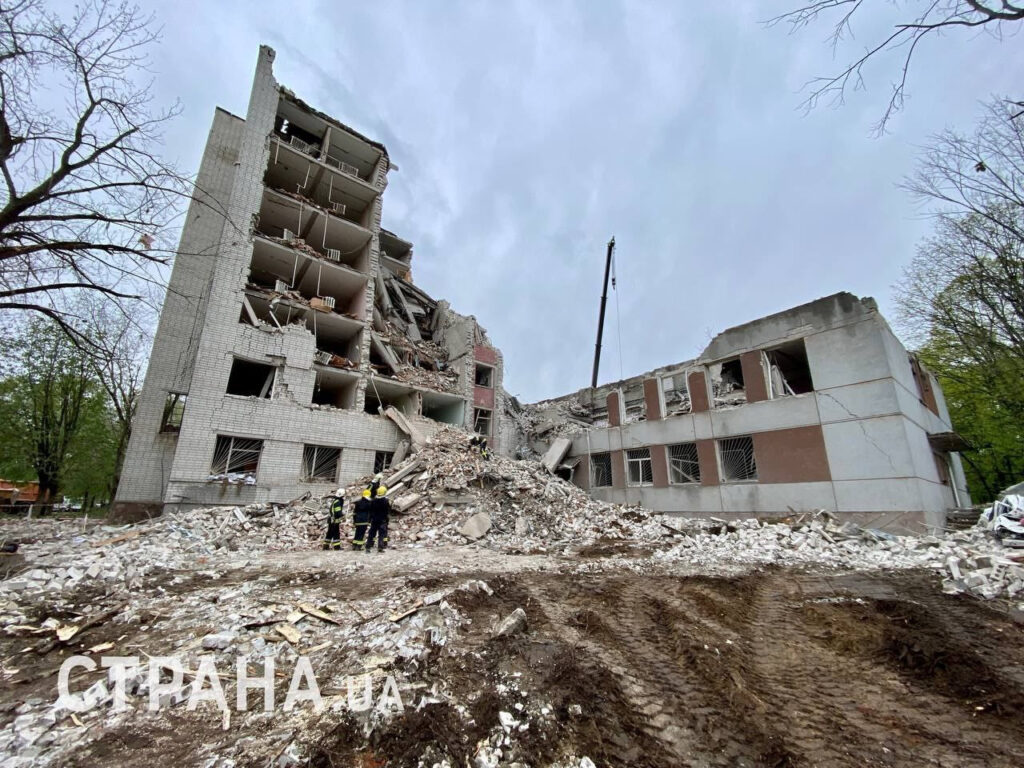
An Odeska Druzhyna activist was filmed shooting in the direction of the far-right protesters with an AK-74-type assault rifle.108 The official investigation and the May 2 Group maintained that a Right Sector activist was killed by this separatist group member with a 5.45mm calibre bullet.109 However, leaked forensic medical expert reports describe a 5.65mm calibre bullet extracted from his body.110 This bullet reportedly disappeared and reappeared during the investigation. The fact that it did not match bullet samples of any legally registered firearms, the weak sound of the gunshots, as well as the lack of a recoil observed in the videos of the shooting, also suggest that the far-right protester may not have been killed by this separatist, who maintained that the weapon seen in the video was a movie studio prop.111 The killing of the Right Sector activist was not visible in that video nor in any videos of clashes. The investigation and various videos at the scene did not reveal the exact time or location of his killing, or the direction of the gunshot. An Odesa deputy police chief, who was filmed around the time of this killing before he himself was wounded, stated that he saw snipers in camouflage shooting from the second floor of a hotel there. He relayed that they killed this Right Sector activist and the second protester in order to blame the separatists for their killing and provoke a violent response against the separatists.112 Videos filmed before and after his shooting suggest that the second pro-Maidan activist was killed around the same time in the same area during the violent clashes with separatists and shooting from a Kalashnikov-type weapon by one of the separatists.113 However, the government forensic examination determined that he was killed by a bullet from a pneumatic sport-type weapon. Nobody was charged with his killing, and the moment and other circumstances of his killing remain not publicly known.114
In the clashes that followed the killings of these two pro-government protesters, four separatist protesters were killed and many other separatist protesters, policemen and at least one local journalist were wounded. The forensic examination determined that three separatists were killed with hunting ammunition.115 A pro-government activist was filmed shooting with a hunting rifle in the direction of these separatists.116 This pro-government activist was later identified by the Minister of Internal Affairs as a Right Sector member.117 The government investigation charged him with killing at least one of the separatists. However, he was released from arrest and his trial was suspended indefinitely because of threats by the Right Sector and other far-right activists against judges during his trial.118 Evidence—including a recorded phone call—revealed that the events on May 2nd were coordinated by the Odesa regional administration official in charge of law enforcement agencies, and involved the participation of the Maidan Self-Defence commander, Right Sector activists, football ultras, and Maidan Self-Defence units.119 They attacked and burned the tent camp of various separatist organisations, whose activists and supporters then escaped to the nearby Trade Union building and tried to barricade the main entrance doors. Videos, internet streams, and testimonies of eyewitnesses show that attackers threw Molotov cocktails and burning tyres at the main entrance, set the entrance doors on fire, and blocked other exits. Videos, recorded calls to firefighters, and eyewitness reports reveal that the fire and thick smoke started from those burning tyres and Molotov cocktails thrown at the main entrance.120 The evidence does not support claims that the separatist protesters killed in this incident were Russian citizens, that they burned themselves by throwing Molotov cocktails from the roof of the Trade Union building or inside of the building, or that there was no far-right involvement in their killing.
After initial denials, the May 2 Group admitted that the deadly fire started at the main entrance. The May 2 Group was a nominally independent association of mainly journalists, formed after the massacre supposedly to investigate it. It was created with the involvement of the Governor of the Odesa region who was appointed by Ukrainian President Petro Poroshenko within a week of the massacre.121 This governor represented not only the central government, but also the Kolomoisky’s oligarchic network, which financed the Right Sector volunteers from the Volyn Region in the Azov battalion and the Right Sector-led Dnipro battalion.122 The Azov battalion was organised by the neo-Nazi SNA and its paramilitary wing, Patriot of Ukraine, which dominated the Right Sector in Odesa and Kharkiv, a few days after the Odesa massacre. But the May 2 Group still claimed that it was impossible to determine who started the fire because both sides were throwing Molotov cocktails. However, there is no public evidence of Molotov cocktails being thrown by separatists at the main entrance; on the contrary, numerous videos feature the far-right protesters throwing Molotov cocktails and burning tyres into the Trade Union building at that time.123
Within Ukraine, far-right activists—particularly from the Right Sector and the SNA— were notorious for using tyres and Molotov cocktails to burn public buildings. Forensic examinations in the government investigation, recordings of radiocommunications by SBU Alfa group, an unpublished admission by a far-right activist to a French journalist, and an academic study determined that the Trade Union headquarters in Kyiv were burned by Maidan activists, including far-right ones, in order to stop its takeover by the Security Service of Ukraine Alfa unit.124 Far-right protesters also started fires by burning tyres in the Inter TV channel building and threatened to burn down the parliament of Ukraine, the Lutsk City Council, the Sviatoshyn District Court that heard the Maidan massacre case, the Constitutional Court, and Inter and 112 Ukraina TV channels buildings by placing tyres next to their entrances.125 Prior usage of the same tactics by the far-right increases the likelihood of their direct involvement.
Analysis of online video streams, government investigation findings, May 2 Group reports, forensic medical examinations, eyewitness testimonies, and other evidence strongly indicate that 42 people perished as a result of the fire, smoke, and from trying to jump from the upper floors of the Trade Union building with far-right activists beating them on the ground and blocking the exits.. The victims were unarmed and included mainly separatists, their supporters, and several employees, in particular women, who were in the building at the time.126 Some of the strongest evidence of far-right involvement in the arson attack comes from the far-right itself, in the form of credit claiming. A growing body of research within terrorism studies focuses on credit claiming. An important finding is that perpetrators are far more likely to deny responsibility for their attacks than to take credit for ones that they did not perpetrate.127 This is particularly true when the targets are civilians. Nonetheless, many extremist groups do claim credit for civilian attacks.128 Statements posted by the Right Sector, the SNA, and the neo-Nazi Misanthropic Division on their websites and social media sites admitted the involvement of their organisations in the massacre. The Right Sector celebrated on its website the massacre by describing it as “another bright page in our fatherland’s history.” Claiming responsibility for the slaughter, it wrote: “In the first minutes of the battle, the ‘Right Sector’ activist was seriously wounded in the stomach. Several more PS [Right Sector] activists received injuries of varying degrees of severity. However, this did not prevent the rest of the PS fighters, together with football fans, from repelling the attack of pro-Russian provocateurs, and as a result, they successfully countered attempts to seize buildings in Odesa. Standing shoulder to shoulder, Odesa activists, football fans and ‘Right Sector’ fighters defeated the forces of pro-Russian mercenaries. Order has been restored in Odesa.”129 The Right Sector—which was dominated in Odesa and Kharkiv by the Social National Assembly and its paramilitary wing, Patriot of Ukraine—and the neo-Nazi Misanthropic Division (which joined the Azov battalion after the massacre) admitted on the social media platform V Kontakte and in other public statements that the fire was set deliberately.130
The official investigation of the Odesa massacre was a farce. Nobody was found guilty of perpetrating this mass killing. As noted, the Right Sector shooter was initially arrested but then released. Only separatists were among those arrested and tried for the Odesa massacre. The Odesa massacre trial of separatists resulted in their acquittal by a local court. The Ukrainian court based its decision on the lack of evidence in support of prosecution charges. Even the verdict acknowledged both the weakness of the investigation into the perpetrators and the role of Parubiy and other government officials.131 The Council of Europe and the UN Special Commission reports also noted the destruction of evidence.132 A report by the special commission of the Council of Europe found that the Ukrainian government’s investigation of the Odesa Massacre was inadequate, politically selective, and featured the falsification of evidence, despite the existence of video footage showing who threw the Molotov cocktails at the building.133
The Ukrainian media cited SBU sources that a far-right activist, who headed the Right Sector in Odesa during the Odesa Massacre, was a secret agent of the Security Service of Ukraine (SBU) and that he and far-right associates were paid by SBU to attack opposition politicians, threaten judges, and conduct other illegal actions.134 This would be consistent with the fact that the Right Sector was not investigated for the Odesa massacre even though the Right Sector publicly admitted involvement. His secret collaboration with SBU would also be consistent with the fact that SBU and the Prosecutor General Office refused to charge him for killing another person in Odesa in 2018. Moreover, in 2020, the SBU gave this far-right activist the status of a victim in this case, even though he streamed this killing on his social media account and the police investigation determined that he was the killer.135 In this sense, the Odesa massacre was not entirely anomalous; it featured post-Maidan far-right involvement with apparent support from high-level political leaders in a corrupt country where investigations and media have inconsistently followed the evidence.
Conclusion
This study assesses the role of the far-right in post-Maidan Ukraine, specifically, in the Donbas war and the Odesa massacre. These were two of the biggest episodes of political violence in the country leading up to the February 2022 Russian invasion. This area of research is worth close investigation because it represents intrinsically important episodes of political violence that have not attracted objective analysis based on available primary sources in Ukrainian, Russian, and English. Investigating the role of the far-right is also timely because the far-right in Ukraine is riven by duelling, self-serving contemporary narratives.
The predominant narratives propagated by governments and the mainstream media in Ukraine, the West, Russia, and separatist-controlled Donbas, concerning the role of the far-right in the war in Donbas and the Odesa massacre, have evidently been partisan. Contrary to the Russian government, separatists, and associated media, the Ukrainian government and military are not Nazi or even neo-Nazi. There were no neo-Nazis among the upper echelon of the Ukrainian government. President Zelensky is certainly not a Jewish neo-Nazi. He tried to placate and mainstream the far-right for political reasons, but has no observable personal affinity to that extreme ideology.
Neo-Nazis constituted only about one percent of the Ukrainian forces before the Russian invasion in 2022, and there is weak electoral support for neo-Nazi parties throughout the country. Similarly, the policy of glorification of the OUN-UPA, their leaders, such as Stepan Bandera, and the adoption and use of their “Glory to Ukraine! Glory to the Heroes!” greeting by the state and the military, including Zelensky, do not make Ukraine a Nazi state. While the OUN and the UPA were far-right terrorist organisations, which collaborated with Nazi Germany and perpetrated the mass murders of Jews, Poles, and Ukrainians, they were not Nazis. Ukrainians could not join the Nazi party because Hitler and other Nazi leaders regarded Ukrainians as racially inferior and opposed independence of Ukraine while also dismissing the attempt to create even a puppet state by the Bandera faction of the OUN in Lviv shortly after the Nazi invasion of the Soviet Union. Thus, Putin cannot credibly justify the illegal invasion in February 2022 as a war to “de-Nazify” the “Nazi regime.”136 The power of the far-right and the glorification of the OUN and the UPA in Ukraine under Poroshenko and Zelensky were exaggerated and exploited by the Russian leaders to justify the invasion.
But the West’s efforts to whitewash the far-right in Ukraine also rests on empirically shaky grounds. Despite their relatively small numbers militarily and politically, the far-right in Ukraine exercised outsized power. The far-right organisations, volunteer battalions, and paramilitary units organised and led by them played, along with separatists and Russian nationalists, a significant role in starting and escalating the incipient civil war in the Donbas and then impeding its peaceful resolution. Even after technically integrated into the official Ukrainian forces, Azov and other far-right groups continued to harbour extremist views. Often brandishing the same extremist symbols, the core leaders and members remained and even ascended within the police, military, and security services during the Donbas war. Western media accounts have drawn heavily from biased Ukrainian sources, including “official” investigations and the May 2 Group. Across numerous primary sources in Ukrainian, Russian, and English, we find evidence that the Right Sector, Social-National Assembly, its paramilitary wing Patriot of Ukraine, and groups of far-right football ultras from Odesa and Kharkiv played a critical role in the Odesa massacre against separatist protesters on 2 May 2014. Neo-Nazi SNA/Patriot of Ukraine, which dominated the Right Sector in Odesa and Kharkiv, organised the Azov battalion right after this massacre.
Despite the lack of international consensus over the definition of terrorism, a common interpretation is the use of violence by non-state actors aimed at creating fear for political ends, particularly when the targets are civilians.137 Depending on one’s definition, some attacks within the episodes of political violence covered in this study, such as the Odesa massacre, could, therefore, arguably be classified as terrorism. What is clear is that neither of the duelling narratives accurately captures the role of the far-right. This study has helped to fill that research lacuna by making use of substantial primary source materials in Ukrainian, Russian, and English. Besides the Maidan massacre, the Donbas war and the Odesa massacre are the two most substantial episodes of political violence from the independence of Ukraine in 1991 to the February 2022 illegal Russian invasion [end]
Ivan Katchanovski is a Ukrainian and Canadian political scientist. He teaches at the School of Political Studies and the Conflict Studies and Human Rights Program at the University of Ottawa in Canada. He specialises primarily in politics, conflicts, political violence, and the far right in Ukraine. His academic publications include five books, 21 articles in peer-reviewed journals, and twelve book chapters.
Max Abrahms is a professor of public policy and political science at Northeastern University, where he specialises in international security. Abrahms has published extensively in leading academic and popular outlets such as International Organization, International Security, International Studies Quarterly, Security Studies, Comparative Political Studies, Harvard Business Review, Foreign Affairs, Foreign Policy, New York Times, Washington Post, USA Today, Newsweek, The Atlantic, and Los Angeles Times.
I disagree with the authors on two points
Stepan Bandera & friends were Nazis. How can the authors identify some neo-Nazis in modern Ukraine, while not regarding their historical mentors as Nazis ? Before WW2, they were praising either Adolf Hitler or Benito Mussolini. Their political project was authoritarian, racist and criminal. They were dreaming of ethnic cleansing. De facto during WW2, they committed mass killing of Jews and Poles.
Terrorism is not restricted to non-state actors. Terrorism is violent action to terror civilians, in order to achieve a common political goal. This is not even a value judgement, but Hiroshima bombing was terrorism. The Israeli targeting and mass killing of civilians, in the prospect of ethnic cleansing in Gaza, is terrorism.
chronicle of censorship, fake news, whitewashing of the Ukrainian Nazism and war crimes, for the sake of the proxy war that NATO is conducting in Donbass and Ukraine, against Russia
Endnotes
Arel, Dominique and Jesse Driscoll. 2023. Ukraine’s Unnamed War. Before the Russian Invasion of 2022. Cambridge: Cambridge University Press; Black, J.L. and Michael Johns (Eds.). 2016. The Return of the Cold War: Ukraine, the West and Russia. Abingdon: Routledge; Hahn, Gordon M. 2018. Ukraine Over the Edge: Russia, the West and the “New Cold War.” Jefferson, NC: McFarland Books; Katchanovski, Ivan. 2016a. “The Separatist War in Donbas: A Violent Break-up of Ukraine?” European Politics and Society, 17 (4), 473-489; Kudelia, Serhiy. 2016. “The Donbas Rift.” Russian Politics & Law, 54 (1), 5-27; Pikulicka-Wilczewska, Agnieszka and Richard Sakwa (Eds.). 2015. Ukraine and Russia: People, Politics, Propaganda and Perspectives. Bristol: E-International Relations; Sakwa, Richard. 2015. Frontline Ukraine: Crisis in the Borderlands. London: I.B.Tauris. ↩︎
Danciu, Gabriela-Cătălina. 2023. “A Perspective on Justifying the Ukraine–Russia War. Elements Of Propaganda.” International Journal of Social and Educational Innovation, 10 (19), 224-239; “Address by the President of the Russian Federation” (2022, February 24) http://en.kremlin.ru/events/president/news/67843. ↩︎
Black, J.L. and Michael Johns (Eds.). 2016. The Return of the Cold War: Ukraine, the West and Russia. Abingdon: Routledge; Katchanovski, Ivan. 2023a. “The Maidan Massacre Trial and Investigation Revelations and Their Implications for the Ukraine-Russia War and Relations.” Russian Politics, 8 (2),181-205. ↩︎
See, for example, Colborne, Michael. 2022. From the Fires of War: Ukraine’s Azov Movement and the Global Far Right, Stuttgart: Ibidem; Davidzon, Vladislav. 2023. “The Search for Neo-Nazis Under the Bedsheets Reflects American Progressive Hysteria, Not Ukrainian Reality.” Tablet Magazine, July. ↩︎
Umland, Andreas. 2019. “Irregular Militias and Radical Nationalism in PostEuromaydan Ukraine: The Prehistory and Emergence of the “Azov” Battalion in 2014.” Terrorism and Political Violence, 31 (1), 105- 131. ↩︎
Umland, Andreas. 2020. ‘The Far Right in Pre- and Post-Euromaidan Ukraine: From Ultra-Nationalist Party Politics to Ethno-Centric Uncivil Society.’ Demokratizatsiya, 28 (2), 247-268. ↩︎
Ishchenko, Volodymyr. 2016. “Far right participation in the Ukrainian Maidan protests: an attempt of systematic estimation.” European Politics and Society, 17 (4), 453-472. ↩︎
Hahn, Gordon M. 2018. Ukraine Over the Edge: Russia, the West and the “New Cold War.” Jefferson, NC: McFarland Books; Katchanovski, Ivan. 2016b. “The Maidan Massacre in Ukraine: A Summary of Analysis, Evidence, and Findings.” In The Return of the Cold War: Ukraine, the West and Russia, eds. J.L. Black and Michael Johns. Abingdon: Routledge, pp. 220-224; Katchanovski, Ivan. 2020. “The far right, the Euromaidan, and the Maidan massacre in Ukraine.” Journal of Labor and Society, 23 (1), 5-29; Katchanovski, 2023a; Katchanovski, Ivan. 2023b. “The “Snipers’ Massacre” on the Maidan in Ukraine.” Cogent Social Sciences, 9 (2); Katchanovski, Ivan. 2024. The Maidan Massacre in Ukraine. London: Palgrave Macmillan. ↩︎
Khalil Mutallimzada and Kristian Steiner, (2022), Fighters’ motivations for joining extremist groups: Investigating the attractiveness of the Right Sector’s Volunteer Ukrainian Corps. European Journal of International Security, 1–23. Ilmari Käihkö, (2018), A nation-in-the-making, in arms: control of force, strategy and the Ukrainian Volunteer Battalions. Defence Studies 18:2, 147–166; Tetyana Malyarenko and David J. Galbreath, (2016), Paramilitary motivation in Ukraine: beyond integration and abolition, Southeast European and Black Sea Studies 16:1, 113–138. ↩︎
Hale, Henry E., Oxana Shevel and Olga Onuch. 2018. “Believing Facts in the Fog of War: Identity, Media and Hot Cognition in Ukraine’s 2014 Odesa Tragedy.” Geopolitics, 23 (4), 851-881. A poll commissioned for that study found that 44% of Ukrainians believed that this mass killing was committed by provocateurs from Russia, while 11% blamed pro-Russian residents of Odesa. Ten percent of the respondents said that the Odesa massacre was perpetrated by “Ukrainian nationalists from Odesa” and 3% by “pro-Ukrainian” residents of Odesa. ↩︎
Van Evera, Stephen. 1997. Guide to Methods for Students of Political Science. Ithaca: Cornell University Press. ↩︎
Griffin, Roger with Matthew Feldman (Eds.). 2003. Fascism: Critical Concepts in Political Science. London: Routledge. ↩︎
Brahimi, Alia. “Ideology and terrorism.” The Oxford handbook of terrorism (2019): 298. ↩︎
See, for example, Jadoon, Amira, Andrew Mines, and Daniel Milton. “Targeting quality or quantity? The divergent effects of targeting upper verses lower tier leaders of militant organizations.” Journal of Conflict Resolution 67, no. 5 (2023): 1007-1031; Schram, Peter. “Self-managing terror: Resolving agency problems with diverse teams.” Games and Economic Behavior 130 (2021): 240-257; Abrahms, Max, and Philip BK Potter. “Explaining terrorism: Leadership deficits and militant group tactics.” International Organization 69, no. 2 (2015): 311-342; Popovic, Milos. “The perils of weak organization: Explaining loyalty and defection of militant organizations toward Pakistan.” Studies in Conflict & Terrorism 38, no. 11 (2015): 919-937. ↩︎
Biletsky 2013; Biletsky, Andriy. “Nedochytanyi Franko.” Patriot Ukrainy, (2008). https://web.archive.org/web/20101120085407/http://patriotukr.org.ua/index.php?rub=stat&id=409. Also, please note that the ADL has adopted the spelling of “antisemitism” instead of “anti-Semitism.” After reviewing the history and consulting with other leading experts, they determined that this is the best way to refer to hatred toward Jews, so we have adopted the same spelling convention here. ↩︎
Clarke, Colin P. “The Terrorist Diaspora.” Testimony, House Homeland Security Committee Task Force on Denying Terrorists Entry into the United States (2017). ↩︎
Boyd-Barrett, Oliver. 2016. Western Mainstream Media and the Ukraine Crisis: A Study in Conflict Propaganda. New York: Routledge. ↩︎
Some researchers and Zelensky have cited the presence of Russian-speakers in the Azov regiment and other neo-Nazi-led armed formations as evidence of their relative tolerance and moderation and argued that the Azov regiment distanced itself from its far-right roots. (See Umland 2019; “Zelensky refutes Russian propaganda claim that Azov Regiment is ‘neo-Nazi.’” The New Voice of Ukraine (2022, May 2), https://news.yahoo.com/zelensky-refutes-russian-propaganda-claim-131100438.html. However, these formations were organized and led by neo-Nazi organizations, which had a racist ideology and cast themselves as defenders of the White race. For this reason, they included not only large numbers of Russian speakers from Ukraine but also neo-Nazis from Russia, Belarus, and the Western countries, such as Australia, Sweden, and the US. ↩︎
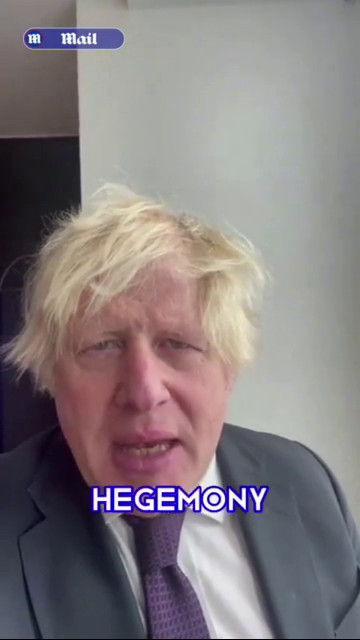
“Ukraine war: Ros Atkins on… Putin’s false ‘Nazi’ claims.” BBC, (2022, March 26) https://www.bbc.com/news/av/world-europe-60853404; Five Azovstal defenders were awarded the title of Heroes of Ukraine. Svidomi, (2022, October 3). https://svidomi.in.ua/en/page/five-azovstal-defenders-were-awarded-the-title-of-heroes-of-ukraine. Loyd, Anthony. “‘Nonsense’: Heroes of Mariupol Denied US Weapons Over neo-Nazi Past.” Times, (2024 May 2). https://www.thetimes.com/world/russia-ukraine-war/article/nonsense-heroes-of-mariupol-denied-us-weapons-over-neo-nazi-past-kwnr0r0pw; “Boris Johnson Praises Nazi Azov Battalion,” YouTube. (2024, May 23). https://www.youtube.com/watch?v=_6g7i-4wswk. There was similar systematic and politically motivated whitewashing of the far-right in Ukraine in Wikipedia, especially, after the Russian invasion. A small number of Wikipedia editors systematically whitewashed neo-Nazi and other far-right parties, organizations, and their leaders, such as Azov regiment, Patriot of Ukraine, Svoboda, National Corps, the OUN, the UPA, Stepan Bandera, Roman Shukhevych, etc. They removed or deliberately excluded scholarly studies and other evidence of the extremist ideology and involvement in mass murder of the far-right, such as the Maidan and Odesa massacres, the Holocaust, and the Lviv pogrom in Ukraine and smeared in biographical entries scholars and other experts whose studies show such ideology and political violence by the far-right in Ukraine. (See, for example, Azov Brigade, https://en.wikipedia.org/wiki/Azov_Brigade; Patriot of Ukraine, https://en.wikipedia.org/wiki/Patriot_of_Ukraine; 2014 Odesa clashes, https://en.wikipedia.org/wiki/2014_Odesa_clashes; Far-right politics in Ukraine, https://en.wikipedia.org/wiki/Far-right_politics_in_Ukraine. They included editors who misrepresented the Holocaust in Poland using similar tactics in Wikipedia, which is unreliable but widely accessed source, compared to academic studies (Grabowski, Jan, and Shira Klein. 2023. “Wikipedia’s Intentional Distortion of the History of the Holocaust.” Journal of Holocaust Research 37 (2): 133–90). ↩︎
Katchanovski, Ivan and Alicen Morley. 2012. “Politics of US Television Coverage of Post-Communist Countries.” Problems of Post-Communism, 59 (1), 15-30. ↩︎
Bhatia, Michael. 2008. “Fighting words: naming terrorists, bandits, rebels and other violent actors, ”Third World Quarterly, 26 (1), 5-22; Schmid, Alex P. 2012. “The revised academic consensus definition of terrorism.” Perspectives on Terrorism, 6 (2), 158-159; Ganor, Boaz. 2002. “Defining terrorism: Is one man’s terrorist another man’s freedom fighter?” Police Practice and Research, 3 (4), 287-304. ↩︎
Although the focus of this analysis is on the portrayal of the far-right in Ukraine, a related narrative dispute has been over whether to characterise the conflict in the Donbas as a civil war. The Ukrainian and Western governments and the media described the war in Donbas as an interstate war between Russia and Ukraine or a hybrid war while denying that there was a civil war. By contrast, the Russian and Donbas separatist governments and associated media denied any Russian military involvement in the war and called it a purely civil war. The majority of scholars and datasets such as the Correlates of War Project and the Uppsala Conflict Data Program classified it as a civil war or an intrastate conflict, while also noting the Russian military interventions in Donbas prior to the Russian invasion of Ukraine in See, for example, Arel and Driscoll 2023; Black and Johns 2016; Hahn 2018; Katchanovski 2016a; Kudelia 2016. ↩︎
Abrahms, Max. “What terrorists really want: Terrorist motives and counterterrorism strategy.” International Security 32, no. 4 (2008): 78-105. ↩︎
Rossolinski-Liebe, Grzegorz. 2014. Stepan Bandera: The life and afterlife of a Ukrainian nationalist. Stuttgart: Ibidem. ↩︎
Yeomans, Rory, (Ed.). 2016. The Utopia of Terror: Life and Death in Wartime Croatia. Rochester: University of Rochester Press; Katchanovski, Ivan. 2015. “Terrorists or National Heroes? Politics and Perceptions of the OUN and the UPA in Ukraine.” Communist and Post-Communist Studies, 48 (2-3), 217-228. ↩︎
Rudling, Per Anders. 2011. “The OUN, the UPA and the Holocaust. A Study in the Manufacturing of Historical Myths.” Carl Beck Papers in Russian and East European Studies, #2107, Center for Russian and East European Studies, Pittsburgh University. ↩︎
See Katchanovski, 2016a; Katchanovski, Ivan. 2006. Cleft Countries: Regional Political Divisions and Cultures in Post-Soviet Ukraine and Moldova. Stuttgart: Ibidem. ↩︎
Umland, Andreas. 2019. “Irregular Militias and Radical Nationalism in PostEuromaydan Ukraine: The Prehistory and Emergence of the “Azov” Battalion in 2014.” Terrorism and Political Violence, 31 (1), 105-131. ↩︎
Mueller, John E. 2006. Overblown: How politicians and the terrorism industry inflate national security threats, and why we believe them. New York: Simon and Schuster; Abrahms, Max. 2006. “Why terrorism does not work.” International Security, 31 (2), 42-78. ↩︎
Kydd, Andrew, and Barbara F. Walter. 2002. “Sabotaging the peace: The politics of extremist violence.” International Organization, 56 (2), 263-296. ↩︎
“Zvit tymchasovoi slidchoi komisii Verkhovnoi Rady Ukrainy z pytan rozsliduvannia faktiv zahybeli hromadian u mistakh Odesi, Nariupoli, a takozh inshykh mistakh Donetskoi ta Luhanskoi oblastei Ukrainy.” (2014, September 5). Verkhovna Rada Ukrainy. http://w1.c1.rada.gov.ua/pls/zweb2/webproc4_1?pf3511=52134↩︎
Abrahms, Max, and Justin Conrad. “The strategic logic of credit claiming: A new theory for anonymous terrorist attacks.” Security Studies 26, no. 2 (2017): 279-304. ↩︎
Schmid, Alex. “Terrorism-the definitional problem.” Case W. Res. J. Int’l L. 36 (2004): 375; Schmid, Alex P. “The definition of terrorism.” In The Routledge Handbook of Terrorism Research, pp. 39-157. Routledge, 2011; Schmid, Alex P. “Discussion 1-Revisiting the wicked problem of defining terrorism.” Terrorism: Its Past, Present & Future Study A Special Issue to Commemorate CSTPV at 25 (2020): 3. ↩︎
Une fréquentation me confia voila quelques années que dans les réunions de cadres du privé, une règle d’or est de ne jamais aborder les questions qui fâchent. J’ai compris avec le temps comme la contrainte est vraie. Dans une société dont les règles sont aujourd’hui édictées par les écoles de commerce, ce vice profond est un symptôme de l’inéluctable déclin de la civilisation occidentale
En 1974, époque lointaine, cet état d’esprit était réservé aux enfants mais une poitrine dénudée ne choquait presque personne
chronique alphabétique et nécrologique de l’engagement français dans les rangs atlantistes en Ukraine, ce que les journalistes serviles ne vous raconteront pas
Entre l’haleine fétide d’une vieille droite pétainiste qui s’insurge contre une chanteuse d’origine malienne, d’une part, la vulgarité et la vanité, d’autre part, d’un spectacle de drag queens qui se pense à tort l’antithèse des pétainistes, semble échappé d’un backroom gay de la ville devenue musée, égaré dans une cérémonie d’ouverture de jeux olympiques […]
Sur Telegram et Signal, ils s’inspirent des méthodes de Daech pour enclencher une guerre civile et faire advenir une société suprémaciste
(L’ADN)
« Le canal privé est prêt. Pour les vérifications, voilà l’exemple de candidature à m’envoyer. » Pour intégrer le canal en question, il faudra spécifier son âge, sa région, et envoyer une photo de sa main tenant un papier où est écrit « les Aryens français. »
Voilà quelques-unes des démarches à suivre pour intégrer l’une des 5 chaînes Telegram où se retrouvent quelque 4 500 néonazis français très remontés. Leur objectif : faire advenir une société organisée en fonction de la race. Depuis plusieurs années, le reporter indépendant Ricardo Parreira infiltre, cartographie et étudie l’extrême droite extraparlementaire. Dans Reflets, journal d’investigation en ligne, il livre les résultats d’une glaçante enquête sur l’essor du Terrorgram : les messageries cryptées où l’on discute en toute décontraction ventes d’armes, attentats et nettoyage ethnique. Surveillées par la DGSI, ces chaînes ouvertement terroristes nourrissent un agenda bien précis : contrecarrer le « déclin civilisationnel » et imposer une société dominée par les Blancs
De plus en plus, sur les canaux Telegram, on voit passer des vidéos de militants néonazis posant avec leurs armes, affirmant qu'ils sont prêts à tuer.
« Les terroristes suprémacistes français sont en roue libre depuis la dissolution de l’Assemblée. Avec les résultats du premier tour des législatives, cela part dans tous les sens, et sur Telegram l’obsession d’une guerre civile est de plus en plus palpable », affirme Ricardo Parreira dans une interview donnée à L’ADN. En ligne, la mouvance autoproclamée Terrorgram (néologisme composé de terror, terreur en anglais + Telegram) appelle à l’ « autodéfense nationaliste ». Parmi les chaînes concernées, celles des groupes FRDeter et Division Aryenne Française. Là, le ton est très vite donné : éloge de la « race blanche », appels à « casser du bougnoule » et systématiser les ratonnades, incitations aux assassinats d’élus, fichage ou doxxing de personnalités de gauche, et fantasmes génocidaires. Les formules antisémites, suprémacistes et néonazies abondent. Parmi eux : les slogans américains « white boy summer » (l’été du garçon blanc), « white rural rage » (haine rurale blanche), ou encore la devise allemande invitant à la déportation « Ausländer raus » (dehors les étrangers).
Capture d’écran issue du Terrogram français récupéré par Ricardo Parreira
« Il s’agit pour eux de déployer en Europe les techniques militaires et modes opératoires de Daech pour se débarrasser de toutes personnes considérées comme un ennemi : les migrants, les “étrangers”, les LGBTQA+ et les militants de gauche. Leur plan est clairement tracé : mener des actions terroristes de sabotage pour créer des pénuries, générer des pertes financières, stimuler une crise économique et sociale débouchant sur le chaos et l’effondrement de la société pour, ensuite, la reconstruire sous un régime néonazi totalitariste », explique Ricardo Parreira à L’ADN. Dans sa série d’enquêtes publiée sur Politis, la chef de rubrique Nadia Sweeny analyse plusieurs occurrences devenues emblématiques de la mouvance française. Tout d’abord, le cas de Nicolas N., condamné en 2021 à 9 ans de prison pour association de malfaiteurs terroriste. En 2015, il écrit sur Facebook : « Le terrorisme du style Daech : il ne nous reste que ça. (…) En prenant certaines villes moyennes, l’économie de l’État va s’écrouler. Tu laisses faire le travail. (…) Si t’as plusieurs villes, ça bougera : c’est ce qu’ont fait les jihadistes en Irak. » Ensuite, le projet WaffenKraft, mené en 2018 par une cellule terroriste impliquant un jeune gendarme adjoint volontaire et mêlant références nazies et fascination pour Daech et Al-Qaida
C’est aux États-Unis que la sphère Terrorgram se met peu à peu en place à partir de 2017 afin de renforcer les communications entre des groupes accélérationnistes militants. Parmi eux : des groupuscules issus du forum Iron March, plateforme néonazie et néofasciste fondée en 2011 et dissoute 6 ans plus tard ; The Base, organisation paramilitaire accélérationniste formée en 2018 par Rinaldo Nazzaro qui continuerait de diriger l’entité depuis la Russie ; et Atomwaffen Division, réseau terroriste néonazi développé en 2013 et responsable d’une vingtaine d’assassinats dans le monde, et première entité occidentale à revendiquer le droit de mener « un Djihad blanc » et une « charia blanche ».
« Le mouvement Terrorgram a connu différentes itérations en fonction de la naissance ou du démantèlement des groupes, mais le but était de constituer un réseau informel d’une multitude de chaînes et de canaux Telegram diffusant une esthétique, des manifestes et des écrits communs », explique Mathieu Colin, spécialiste des idéologies extrémistes. Parmi ces écrits : Siege, série d’essais écrits dans les années 80 par le néonazi américain James Mason, l’un des premiers pamphlets faisant l’apologie des tactiques accélérationnistes terroristes, le manifeste The Great Replacement du terroriste Brenton Tarrant baptisé en hommage à l’essayiste français, manuels d’instruction pour mener des attaques, manier des armes ou construire des explosifs. Et bien sûr, toute une ribambelle de propagandes visuelles, présentant les « Saints » de la mouvance. En plus des terroristes Anders Breivik et Brenton Tarrant encensés sur le Terrorgram français, la frange américaine de la sphère met en avant d’autres figures : Adolf Hitler, Timothy McVeigh, terroriste et vétéran de l’armée américaine exécuté en 2001, Dylann Roof, responsable du meurtre de 9 Afro-américains à Charleston en Caroline du Sud, ou encore Oskar Dirlewanger, dirigeant d’une brigade SS qui aurait reçu de la part d’Himmler « carte blanche pour violer, piller, torturer et massacrer » en Europe de l’Est. Lentement mais sûrement, Terrorgram internationalise et essaime son modèle, notamment avec la naissance de la Sonnenkrieg Division au Royaume-Uni, ou de la Feuerkrieg Division dans les Pays baltes, des groupes inspirés par Atomwaffen
Capture d’écran issue du Terrorgram américainCapture d’écran issue du Terrorgram américainCapture d’écran issue du Terrorgram américain
Concrètement, quelles actions violentes sont directement imputables à Terrorgram à ce jour ? Selon Mathieu Colin, Payton Gendron, coupable de l’attentat de Buffalo dans l’État de New York en 2022, aurait été largement inspiré par Brenton Tarrant ; Juraj Krajčík, responsable la même année de l’attentat de Bratislava, citait explicitement Terrorgram. Le projet d’attaque des centrales électriques de Baltimore en 2023 par Brandon Russell, fondateur d’Atomwaffen, aurait lui aussi été influencé par le réseau. « Pour l’instant, l’objectif est certes de radicaliser et d’inspirer des actes de violence, mais surtout de désensibiliser par rapport à l’emploi de la violence ou à ses conséquences. Il ne s’agit pas de radicaliser l’ensemble de la société, mais bien de pousser sa communauté, des gens déjà acquis à la cause, à procéder à des actes violents, par le biais du partage, de l’utilisation ou la glorification de l’ultra-violence, notamment djihadiste, puisque ces réseaux sont en effet fascinés par la force de l’esthétique de Daech ou Al Qaida », analyse le chercheur. « Le forum Iron March ne comptait que quelques milliers de membres, mais leur travail de propagande a ruisselé sur différents groupuscules et organisations d’extrême droite dans le monde », rapporte Ricardo Parreira à L’ADN.
Avant Terrorgram
Au Royaume-Uni, le ministère de l’intérieur britannique entendait en avril dernier faire interdire les différents canaux du Terrorgram, désigné comme « un réseau de terroristes néofascistes », indique Le Monde. En France, le ministère de l’Intérieur recensait en mai 2023 une dizaine d’attentats terroristes déjoués depuis 2017 liés à des groupuscules d’extrême droite, faisant de la mouvance la seconde menace après les attentats islamistes. Une situation alarmante qui ne s’est pas produite ex nihilo, et serait notamment alimentée par les discours des partis politiques. Dans son enquête, le reporter précise : « L’extrême droite parlementaire et ses programmes politiques ne reposent sur rien d’autre qu’une traduction sémantique des idéologies défendues par les franges les plus radicales de l’extrême droite depuis plus de cinquante ans. Les termes comme “guerre civilisationnelle”, “submersion migratoire” et, bien évidemment, la “préférence nationale ou le “grand remplacement” sont des exemples frappants du transfert idéologique qui s’opère entre l’extrême droite parlementaire et extraparlementaire » [fin]
Je déplore un point de détail dans cette série d’articles, imagine ce que peuvent être les impératifs éditoriaux par les temps qui courent.
Parler des ces nazis, en particulier français, sans jamais évoquer l’Ukraine, est une prouesse.
Alors que les plus dangereux, les César Aujard, Gwendal Delange et autres, se forment actuellement au combat et armes de guerre dans les rangs atlantistes en Ukraine. Alors que même les captures d’écran de Ricardo Parreira nous montrent l’insigne de la Misanthropic Division, organisation nazie internationale, fondée et basée en Ukraine depuis 2013. Mais sa confrère Laure Coromines trouve moyen de citer la Russie, comme villégiature hypothétique de Rinaldo Nazzaro, alors que les organisations nazies y sont interdites et leurs militants pourchassés par le FSB, comme ils ne le sont pas en France.
Si les adversaires du fascisme veulent vraiment le combattre, qu’ils commencent par ne pas se voiler la face, ne pas se censurer sur ses mécanismes et sa géographie.
où nous apprenons que le nazi français Allan Duchézeau, camarade de César Aujard dans les rangs atlantistes en Ukraine, était surnommé Dox, quand il secondait à Paris le leader nazi Marc de Cacqueray Valménier
chronique alphabétique et nécrologique de l’engagement français dans les rangs atlantistes en Ukraine, ce que les journalistes serviles ne vous raconteront pas
its roots before WW2, its collaboration with Nazi Germany, its legacy in modern Ukraine and Baltic States, how NATO has supported Nazism in eastern Europe
The Lemkin Institute has had it with the cynical lies and propaganda from Israel and the USA. One can have different views about the definition of genocide, but one may not use definitional disputes to deny genocide. If a genocide may be occurring, every nation is compelled by customary law to try to stop it.
Let us be clear: Israel is committing genocide in Gaza. The US is complicit in genocide. These are not political statements. They are statements that are made from knowledge and experience. Nevertheless, you do not need a PhD , a law degree, or X-ray vision to see the genocidal dimensions of Israel’s carnage in Gaza. It is clear in the behavior of the state and its military, on full display in yesterday’s horrific bombardment of a Rafah camp.
But even if there were legitimate doubts about Israel’s genocide, there is no doubt that Israel is committing atrocity crimes of the most barbaric kind. Israel must be stopped. Israel must be stopped now.
We are disgusted by Western leaders, especially in the USA, Germany, and the UK. They have demonstrated not only that they don’t care one bit about genocide prevention and human rights, but also that they are willing to allow an ally to commit atrocity crimes while they offer material and diplomatic support. It is reprehensible and the individuals involved in this gaslighting campaign should be deeply ashamed. They should also be put on trial.
Humanity has a choice: Either we decide that our children can all be killed whenever a superior force alleges that “terrorists” are among us, or we decide that under no circumstances will we allow these superior forces to lay waste to our world any longer.
We each must choose and act accordingly. The watershed moment is now [end]
The Lemkin Institute for Genocide Prevention was founded to fill a gap in the global prevention protocols. We noticed during several trips to northern Iraq in 2016 and 2017 that very little of the work that goes on at high levels of governments, in international organizations, and among large civil society groups ever reaches people facing genocide and mass atrocity, although they are the people for whom all this work is supposed to be done.
We built the Lemkin Institute for Genocide Prevention to be responsive and flexible, transparent and judicious, nonpartisan and vocal. We believe that peoples in crisis need immediate action and direct support, even when the international community has its head in the sand.
We have heard from many survivors that the worst thing about living through genocide was the sense that the rest of the world did not care and had forgotten about them.
The Lemkin Institute wants to change this dynamic by putting threatened peoples at the center of our concerns.
We use a transparent system for analyzing crises within a genocide prevention framework and we have created materials so that this system can also be used by others.
The Lemkin Institute has grown from the Iraq Project for Genocide Prevention and Accountability, which was launched in 2017 to address the need for long-term capacity building in genocide prevention in Iraq. In the wake of ISIS genocides, we saw an enormous grassroots interest in ending the cycle of violence and promoting a lasting peace. We are now bringing that work to the global grassroots
On December 7, 2023, across the areas that Israel is controlling in the palästinensisches Wohngebiet von Gaza [in German, Palestinian ghetto in Gaza], where Israeli airstrikes and shelling have already slaughtered thousands civilians, soldiers are abducting the men who could carry a weapon
the Israeli air force targets an overcrowded hospital in the center of the palästinensisches Wohngebiet von Gaza [in German, Palestinian ghetto in Gaza]
behind all this lies Israeli arrogance; the idea that we can do whatever we like, that we’ll never pay the price and be punished for it. We’ll carry on undisturbed
On March 7, 2024, the US embassy to Russia issued a security alert
The Embassy is monitoring reports that extremists have imminent plans to target large gatherings in Moscow, to include concerts, and U.S. citizens should be advised to avoid large gatherings over the next 48 hours
Krasnogorsk is a city in Moscow northwestern suburb. In the evening of March 22, 2024, a concert is sold out in Crocus City Hall, which can seat 6,200 spectators
About 10 minutes before the show, at least 4 gunmen enter the building, start shooting at unarmed people
(Screenshot)
The evacuation has begun, when the terrorists burst in the auditorium, where the slaughter is going on
(Screenshot)
None of them yell any jihadist cry. Their action is methodical. A blaze has broken out in the upper floors, when the Russian security forces storm the building, about one hour after the beginning of the attack
(RIA Novosti)
On social networks, Ukrainian Nazis channels and also less extremist Ukrainian nationalists are already celebrating the attack
(Corsican time zone)
As usual in the case of a tragic event in Russia, Ukrainian calls are overloading the Russian emergency lines with fake alerts. Russian media release the description of the car that the terrorists have used to flee
(Screenshots)
Later, Amaq publishes a first statement
A security source told Amaq agency : Islamic State fighters have attacked a large gathering of Christians in the city of Krasnogorsk, on the outskirts of the Russian capital, Moscow, killing and wounding hundreds, and causing great destruction to the place, before their safe withdrawal to their bases
Amaq is the news agency of the Caliphate, not its official channel. The statement could be opportunistic, but the afterwards will show it is not.
March 23, 2024
The blaze is extinguished but the auditorium ceiling has collapsed. Some victims have died of asphyxiation, while they were hiding in the premises. In the morning the provisional death toll is 93
(Ministry of Emergency Situations)
While they are on duty in Bryansk region, in order to usually prevent the infiltration of Atlanticist groups under command of the Ukrainian military intelligence (GUR), operatives of the Russian security agency (FSB) and Chechen Akhmat regiment manage to intercept and take alive four terrorists, who are attempting to seek safety in Ukraine
(Screenshot)
All are Tajik. One of them tells his recruitment, while he was attending a series of lectures on Telegram. He was enticed with an offer of half a million Russian rubles, roughly equivalent to 5,000 euros, in order to slaughter people in Crocus City Hall, has received half of the reward before the attack. Amaq releases later its second statement, a usual practice, in order to prove with pictures that the assailants have been in touch with the Caliphate
The statement clarifies that the terrorists have set the building ablaze with petrol bombs.
For Andrew Napolitano’s Judging Freedom, former CIA analyst Larry Johnson is explaining the best theory so far. The terrorist attack in Moscow is a Ukrainian plot. Increasingly frustrated by unauthorized, Ukrainian blatant actions, the US knows it, were terrified for weeks.
Since Afghanistan in the 80s, the West is using the Jihadists for its geopolitical interests. The terrorist operation in Paris on November 13, 2015, was the result, the collateral damage, of the Western support to the so-called Syrian revolution, a radical Sunni uprising against the secular government in Syria. Even the Caliphate. Then Secretary of State, John Kerry explained in a conversation recorded on September 22, 2016, how until the Russian intervention one year before, against the Jihadists and other rebels, the US did not prevent the expansion of the Caliphate, regarded as a leverage to constrain Bashar Assad to negotiate his ouster
On December 6, 1993, British daily The Independent, social-democratic and pro-Europe, paid a vibrant tribute to Osama bin Laden. This article is cult, makes me always burst out laughing
On January 7, 2023, Rustam Azhiev is fighting in Bakhmut, Donetsk People’s republic (GUR)
Here is Rustam Azhiev, alias Abdul Hakim al Shishani [Chechen], an alive icon. In Syria in 2013, he was leading Jamaat al Khilafa al Qawqazia [Caucasian Caliphate group], a part of the Chechen jihadist formations which were fighting under command of al Nusra, a local subsidiary of al Qaeda
Vladimir Putin addresses the peoples of the Russian Federation
No one will be able to sow the poisonous seeds of discord in our multinational society
(Screenshot)
In the evening, Amaq releases a video of the slaughter in the premises. One terrorist has slit the throat of an injured man.
March 24, 2024
Deputy Chairman of the Security Council of the Russian Federation, Dmitry Medvedev writes
The Kingdom of Heaven to all those innocently killed! We will avenge everyone. And everyone involved, regardless of country of origin and status, is now our legal and main target. Wait, bastards
(Social networks)
from Arkhangelsk spetsnaz for Crocus City Hall
is written on that ODAB-1500, a 1,500 kg thermobaric bomb
(Screenshot)
The four terrorists are taken to the Investigative Committee and later, appear before the court, over their pretrial detention
March 25, 2024
With hypersonic missiles, according to Ukraine, Russia strikes Kiev, wipes out some US Patriot air defense systems and levels buildings where are working officials of the Ukrainian security agency (SBU)
(Sergei Supinsky)
The particularity of hypersonic missiles is that air warning sirens sound after the strike. In Bryansk border region, the governor awards the officers who have arrested alive the four Tajik terrorists, prevented them from seeking refuge in Ukraine
(TASS, screenshot)
March 26, 2024
ISIS or Ukraine ?
Of course Ukraine
the Secretary of the Russian Security Council, Nikolai Patrushev, replies to journalists, about the terrorist attack on March 22, in Krasnogorsk, that Ukraine has subcontracted with remnants of the Caliphate
Nikolai Patrushev (Screenshot)
Director of the security agency (FSB), Alexander Bortnikov, adds that Kyrylo Budanov, head of the Ukrainian military intelligence (GUR), is a legitimate target
Kyrylo Budanov
The file is enriched in the evening. A new clue corroborates my general knowledge of the subject: Western leaders are nowadays a breed of cowardly scoundrels, rarely equaled in history. The French are the worst and unfit enough to commit blunders like this one. Journalist Laurent Brayard reports that on the afternoon of March 22, about five hours before the beginning of the attack in Krasnogorsk, a French administrative authority canceled for security reasons the next day face-to-face classes at the French high school Alexandre Dumas in Moscow.
March 28, 2024
The Russian Investigative Committee reports so far financial links between the terrorists and Ukraine
Investigators have reported on the ongoing active work to reconstruct the full picture of the crime committed, both at the stages of preparation and planning, and the commission of a terrorist attack on unarmed citizens. The initial results of the investigation are fully confirming the planned nature of the terrorists action, careful preparation and financial support from the organizers of the crime. As a result of work with detained terrorists, study of the technical devices seized from them, and analyze of information about financial transactions, evidence was obtained of their connection with Ukrainian nationalists. The investigation has at its disposal confirmed data that the perpetrators of the terrorist attack received significant amounts of money and cryptocurrency from Ukraine, which were used in preparing the crime. Another suspect involved in a terrorist financing scheme has been identified and detained. The investigation will petition the court to select a preventive measure in the form of detention in relation to him
April 2, 2024
Andriy Kovalenko (The Times)
On April 2, 2024, The Times reports that Ukraine stokes anti-immigrant tensions in Russia. Head of the Information Center of the Security Council of Ukraine, Andriy Kovalenko has explained that Ukrainian agents are conducting PSYOP on social networks, after the Crocus City Hall terrorist attack, in order to stir up ethnic tensions and destabilize Russian society.
April 6, 2024
Dmitry Medvedev states
1. Perpetrators. With them, everything is clear: these underdeveloped bastards are caught, investigative actions are being carried out with them. Moreover, it is obvious that despite numerous references to their affiliation with IS/ISIS/ ISIS-K* (terrorist organizations banned in Russia), these scum are by no means religious fanatics ready to die for their faith. They did not demonstrate any external or internal attributes of being such. They are primitive hired killers, hired for relatively small amounts of money and trained to shoot. Just animals, human scum.
2. Organizers. Dealing with them is somewhat more complex, which is why a narrative about IS’ responsibility was crafted and then eagerly affirmed by IS itself. But they always act this way, simply to increase their own significance. And the role of money is still valid—they likely got their share. However, the true organizers are still hiding in the shadows of IS. That was the plan. Yet, just the initial information, obtained from the phones of hired degenerates, already unmistakably points to the national identity of the organizers. Like so many other things—some are already disclosed (like the destination point), while others remain undisclosed for now. These are the officials of the Nazi “Ukraine.” It is in their twisted minds that the idea of compensating for failures on the front with terrorist acts was born, which, however, is not surprising. They will have to answer, either by law or otherwise. Just as terrorists are dealt with worldwide. Without a statute of limitations.
3. Accomplices. There are many of them. Their circle is widening and includes those who provided property, money, those who organized transfers, taught shooting, and so on. With them, too, everything is clear, and they will answer for what they have done. Much more interesting are other accomplices, or international sponsors of terrorists. And here, alas, the situation is such that they include top officials from NATO countries. They vary. Just take Macron, for example. His rhetoric, his actions, and most importantly, his approval to conduct covert operations with the banderite regime could well be classified as complicity in the March 22 terrorist attack. That’s why this champagne and oyster lover got so messed up that he had to publicly deny France’s involvement in the attack both personally and through his subordinates. Obviously, Macron and several other Western leaders are sponsors of this horrific terrorist act. There is no forgiveness for this. Immunities cannot protect from this. And from now on, they are not just banal enemies of Russia.
April 7, 2024
(Screenshots)
The Russian television releases a video of interrogations, where Krasnogorsk terrorists explain that they had an appointment in Ukraine, in order to be rewarded by one million rubles each, that the Atlanticist forces had cleared a path for them in the minefield at the border.
We are very happy to bring you this excerpt from Colonel Jacques Baud’s latest book, The Russian Art of War: How the West Led Ukraine to Defeat (L’art de la guerre russe : Comment l’Occident conduisit l’Ukraine à l’échec). This is a detailed study of the two-year old conflict in which the West has brutally used the Ukrainians to pursue an old pipedream: the conquest of Russia.
The book is being translated into English, and we will update this page when it is published. In the meantime, we provide a generous excerpt, along with a detailed Table of Contents, to give you a taste of this very important and much-needed book.
Russian Military Thought
Throughout the Cold War period, the Soviet Union saw itself as the spearhead of a historical struggle that would lead to a confrontation between the “capitalist” system and “progressive forces.” This perception of a permanent and inescapable war led the Soviets to study war in a quasi-scientific way, and to structure this thinking into an architecture of military thought that has no equal in the Western world.
The problem with the vast majority of our so-called military experts is their inability to understand the Russian approach to war. It is the result of an approach we have already seen in waves of terrorist attacks—the adversary is so stupidly demonized that we refrain from understanding his way of thinking. As a result, we are unable to develop strategies, articulate our forces, or even equip them for the realities of war. The corollary of this approach is that our frustrations are translated by unscrupulous media into a narrative that feeds hatred and increases our vulnerability. We are thus unable to find rational, effective solutions to the problem.
The way Russians understand conflict is holistic. In other words, they see the processes that develop and lead to the situation at any given moment. This explains why Vladimir Putin’s speeches invariably include a return to history. In the West, we tend to focus on X moment and try to see how it might evolve. We want an immediate response to the situation we see today. The idea that “from the understanding of how the crisis arose comes the way to resolve it” is totally foreign to the West. In September 2023, an English-speaking journalist even pulled out the “duck test” for me: “if it looks like a duck, swims like a duck and quacks like a duck, it’s probably a duck.” In other words, all the West needs to assess a situation is an image that fits their prejudices. Reality is much more subtle than the duck model….
The reason the Russians are better than the West in Ukraine is that they see the conflict as a process; whereas we see it as a series of separate actions. The Russians see events as a film. We see them as photographs. They see the forest, while we focus on the trees. That is why we place the start of the conflict on February 24, 2022, or the start of the Palestinian conflict on October 7, 2023. We ignore the contexts that bother us and wage conflicts we do not understand. That is why we lose our wars…
****
In Russia, unsurprisingly, the principles of the military art of the Soviet forces inspired those currently in use:
readiness to carry out assigned missions;
concentration of efforts on solving a specific mission;
surprise (unconventionality) of military action vis-à-vis the enemy;
finality determines a set of tasks and the level of resolution of each one;
totality of available means determines the way to resolve the mission and achieve the objective (correlation of forces);
coherence of leadership (unity of command);
economy of forces, resources, time and space;
support and restoration of combat capability;
freedom of maneuver.
It should be noted that these principles apply not only to the implementation of military action as such. They are also applicable as a system of thought to other non-operational activities.
An honest analysis of the conflict in Ukraine would have identified these various principles and drawn useful conclusions for Ukraine. But none of the self-proclaimed experts on TV were intellectually able to do so.
Thus, Westerners are systematically surprised by the Russians in the fields of technology (e.g., hypersonic weapons), doctrine (e.g., operative art) and economics (e.g., resilience to sanctions). In a way, the Russians are taking advantage of our prejudices to exploit the principle of surprise. We can see this in the Ukrainian conflict, where the Western narrative led Ukraine to totally underestimate Russian capabilities, which was a major factor in its defeat. That is why Russia did not really try to counter this narrative and let it play out—the belief that we are superior makes us vulnerable….
Correlation of Forces
Russian military thought is traditionally linked to a holistic approach to warfare, which involves the integration of a large number of factors in the development of a strategy. This approach is materialized by the concept of “correlation of forces” (Соотношение сил).
Often translated as “balance of forces” or “ratio of forces,” this concept is only understood by Westerners as a quantitative quantity, limited to the military domain. In Soviet thinking, however, the correlation of forces reflected a more holistic reading of war:
There are several criteria for assessing the correlation of strengths. In the economic sphere, the factors usually compared are gross national product per capita, labor productivity, the dynamics of economic growth, the level of industrial production, particularly in high-tech sectors, the technical infrastructure of the production tool, the resources and degree of qualification of the workforce, the number of specialists and the level of development of theoretical and applied sciences.
In the military field, the factors compared are the quantity and quality of armaments, the firepower of the armed forces, the fighting and moral qualities of the soldiers, the level of staff training, the organization of the troops and their combat experience, the character of the military doctrine and the methods of strategic, operative and tactical thinking.
In the political sphere, the factors that come into consideration are the breadth of the social base of state authority, its organization, the constitutional procedure for relations between the government and legislative bodies, the ability to take operational decisions, and the degree and character of popular support for domestic and foreign policy.
Finally, when assessing the strength of the international movement, the factors taken into consideration are its quantitative composition, its influence with the masses, its position in the political life of each country, the principles and norms of relations between its components and the degree of their cohesion.
In other words, the assessment of the situation is not limited to the balance of forces on the battlefield, but takes into account all the elements that have an impact on the evolution of the conflict. Thus, for their Special Military Operation, the Russian authorities had planned to support the war effort through the economy, without moving to a “war economy” regime. Thus, unlike in Ukraine, there was no interruption in the tax and welfare mechanisms.
This is why the sanctions applied to Russia in 2014 had a double positive effect. The first was the realization that they were not only a short-term problem, but above all a medium- and long-term opportunity. They encouraged Russia to produce goods it had previously preferred to buy abroad. The second was the signal that the West would increasingly use economic weapons as a means of pressure in the future. It therefore became imperative, for reasons of national independence and sovereignty, to prepare for more far-reaching sanctions affecting the country’s economy.
In reality, it has long been known that sanctions do not work. Logically enough, they have had the opposite effect, acting as protectionist measures for Russia, which has thus been able to consolidate its economy, as had been the case after the 2014 sanctions. A sanctions strategy might have paid off if the Russian economy had effectively been the equivalent of the Italian or Spanish economy, i.e., with a high level of debt; and if the entire planet had acted in unison to isolate Russia.
The inclusion of the correlation of forces in the decision-making process is a fundamental difference from Western decision-making processes, which are linked more to a policy of communication than to a rational approach to problems.
This explains, for example, Russia’s limited objectives in the Ukraine, where it does not seek to occupy the entire territory, as the correlation of forces in the western part of the country would be unfavorable.
At every level of leadership, the correlation of forces is part of situation assessment. At the operational level, it is defined as follows:
The result of comparing the quantitative and qualitative characteristics of the forces and resources (sub-units, units, weapons, military equipment, etc.) of one’s own troops (forces) and those of the enemy. It is calculated on an operational and tactical scale throughout the area of operations, in the main and other directions, in order to determine the degree of objective superiority of one of the opposing camps. Force correlation assessment is used to make an informed decision about an operation (battle), and to establish and maintain the necessary superiority over the enemy for as long as possible, when decisions are redefined (modified) during military (combat) operations.
This simple definition is the reason why the Russians committed themselves with forces inferior to those of Ukraine in February 2022, or why they withdrew from Kiev, Kharkov and Kherson in March, September and October 2022.
****
Structure of the Doctrine
The Russians have always attached particular importance to doctrine. Better than the West, they have understood that “a common way of seeing, thinking and acting”—as Marshal Foch put it—gives coherence, while allowing for infinite variations in the conception of operations. Military doctrine is a kind of “common core” that serves as a reference for designing operations.
Russian military doctrine divides military art into three main components: strategy (strategiya), operative art (operativnoe iskoustvo) and tactics (taktika). Each of these components has its own characteristics, very similar to those found in Western doctrines. Using the terminology of French doctrine on the use of forces:
The strategic level is that of conception. The aim of strategic action is to lead the adversary to negotiation or defeat.
The operative level is that of cooperation and coordination of inter-force actions, with a view to achieving a given military objective.
The tactical level, finally, is that of maneuver execution at weapon level as an integral part of the operational maneuver.
These three components correspond to levels of leadership, which translate into leadership structures and the space in which military operations are conducted. For simplicity’s sake, let us say that the strategic level ensures the management of the theater of war (Театр Войны) (TV); a geographically vast entity, with its own command and control structures, within which there are one or more strategic directions. The theater of war comprises a set of theaters of military operations (Театр Военных Действий) (TVD), which represent a strategic direction and are the domain of operative action. These various theaters have no predetermined structure and are defined according to the situation. For example, although we commonly speak of the “war in Afghanistan” (1979-1989) or the “war in Syria” (2015-), these countries are considered in Russian terminology as TVDs and not TVs.
The same applies to Ukraine, which Russia sees as a theater of military operations (TVD) and not a theater of war (TV), which explains why the action in Ukraine is designated as a “Special Military Operation” (Специальная Военная Операция – Spetsial’naya Voyennaya Operatsiya—SVO, or SMO in English abbreviation) and not a “war.”
The use of the word “war” would imply a different structure of conduct than that envisaged by the Russians in Ukraine, and would have other structural implications in Russia itself. Moreover—and this is a central point—as NATO Secretary General Jens Stoltenberg himself acknowledges, “the war began in 2014” and should have been ended by the Minsk Agreements. The SMO is therefore a “military operation” and not a new “war,” as many Western “experts” claim.
****
The Special Military Operation in Ukraine
The Correlation of Forces
Consider all the factors that directly or indirectly influence the conflict. Conversely, as we have seen in Ukraine and elsewhere, Westerners have a much more political reading of the war, and end up mixing the two. This is why communication plays such an essential role in the conduct of war: the perception of the conflict plays an almost more important role than its reality. This is why, in Iraq, the Americans literally invented episodes that glorified their troops.
Russia’s analysis of the situation in February 2022 was undoubtedly considerably more pertinent than that of the West. They knew that a Ukrainian offensive against the Donbass was underway and that it could endanger the government. In 2014-2015, after the massacres in Odessa and Mariupol, the Russian population was very much in favor of intervention. Vladimir Putin’s stubborn clinging to the Minsk Agreements was poorly understood in Russia.
The factors that contributed to Russia’s decision to intervene were twofold: the expected support of Ukraine’s ethnically Russian population (which we will call “Russian-speaking” for convenience) and an economy robust enough to withstand sanctions.
The Russian-speaking population had risen up en masse against the new authorities following the coup d’état of February 2014, whose first decision had been to strip the Russian language of its official status. Kiev tried to backtrack, but in April 2019, the 2014 decision was definitively confirmed.
Since the adoption of the Law on Indigenous Peoples on July 1, 2021, Russian speakers (ethnic Russians) are no longer considered normal Ukrainian citizens and no longer enjoy the same rights as ethnic Ukrainians. They can therefore be expected to offer no resistance to the Russian coalition in the eastern part of the country….
Since March 24, 2021, Ukrainian forces have been stepping up their presence around the Donbass and have increased the pressure against the autonomists with their fire.
Zelensky’s decree of March 24, 2021 for the reconquest of Crimea and the Donbass was the real trigger for the SMO. From that moment on, the Russians understood that if there was military action against them, they would have to intervene. But they also knew that the cause of the Ukrainian operation was NATO membership, as Oleksei Arestovitch had explained. That is why, in mid-December 2021, they were submitting proposals to the USA and NATO on extending the Alliance: their aim was then to remove Ukraine’s motive for an offensive in the Donbass.
The reason for the Russian Special Military Operation (SMO) is indeed the protection of the populations of Donbass; but this protection was necessary because of Kiev’s desire to go through a confrontation to enter NATO. The extension of NATO is therefore only the indirect cause of the conflict in Ukraine. The latter could have spared itself this ordeal by implementing the Minsk Agreements—but what we wanted was a defeat for Russia.
In 2008, Russia intervened in Georgia to protect the Russian minority then being bombed by its government, as confirmed by the Swiss ambassador, Heidi Tagliavini, who was responsible for investigating this event. In 2014, many voices were raised in Russia to demand intervention when the new regime in Kiev had engaged its army against the civilian population of the five autonomist oblasts (Odessa, Dnepropetrovsk, Kharkov, Lugansk and Donetsk) and applied a fierce repression. In 2022, it could be expected that the population of Russia would not understand the government’s inaction, after no efforts were made from the Ukrainian and Western sides to enforce the Minsk Agreements. They knew that they did not have the means to launch an economic retaliation. But they also knew that an economic war against Russia would inevitably backfire on Western countries.
An important element of Russian military and political thinking is its legalistic dimension. The way our media present events, systematically omitting facts that could explain, justify, legitimize or even legalize Russia’s actions. We tend to think that Russia is acting outside any legal framework. For example, our media present the Russian intervention in Syria as having been decided unilaterally by Moscow; whereas it was carried out at the request of the Syrian government, after the West had allowed the Islamic State to move closer to Damascus, as confessed by John Kerry, then Secretary of State. Nevertheless, there is never any mention of the occupation of eastern Syria by American troops, who were never even invited there!
We could multiply the examples, to which our journalists will counter with the war crimes committed by Russian forces. This may well be true, but the simple fact that these accusations are not based on any impartial and neutral investigation (as required by humanitarian doctrine), nor on any international one, since Russia is systematically refused participation, casts a shadow over the honesty of these accusations. For example, the sabotage of the Nord Stream 1 and 2 gas pipelines was immediately attributed to Russia, which was accused of violating international law.
In fact, unlike the West, which advocates a “rules-based international order,” the Russians insist on a “law-based international order.” Unlike the West, they will apply the law to the letter. No more, no less.
The legal framework for Russia’s intervention in Ukraine has been meticulously planned. As this subject has already been covered in one of my previous books, I will not go into details here…
****
The Objectives and Strategy of Russia
On February 23, 2023, Swiss military “expert” Alexandre Vautravers commented on Russia’s objectives in Ukraine:
The aim of the Special Military Operation was to decapitate Ukrainian political and military governance in the space of five, ten, maybe even two weeks. The Russians then changed their plan and their objectives with a number of other failures; so they change their objectives and their strategic orientations almost every week or every month.
The problem is that our “experts” themselves define Russia’s objectives according to what they imagine, only to be able to say that it has not achieved them. So. Let us get back to the facts.
On February 24, 2022, Russia launched its “Special Military Operation” (SMO) in Ukraine “at short notice.” In his televised address, Vladimir Putin explained that its strategic objective was to protect the population of Donbass. This objective can be broken down into two parts:
“demilitarize” the Ukrainian armed forces regrouped in the Donbass in preparation for the offensive against the DPR and LPR; and
“denazify” (i.e. “neutralize”) the ultra-nationalist and neo-Nazi paramilitary militias in the Mariupol area.
The formulation chosen by Vladimir Putin has been very poorly analyzed in the West. It is inspired by the 1945 Potsdam Declaration, which envisaged the development of defeated Germany according to four principles: demilitarization, denazification, democratization and decentralization.
The Russians understand war from a Clausewitzian perspective: war is the pursuit of politics by other means. This then means that they seek to transform operational successes into strategic successes, and military successes into political objectives. So, while the demilitarization evoked by Putin is clearly linked to the military threat to the populations of the Donbass in application of the decree of March 24, 2021, signed by Zelensky.
But this objective conceals a second: the neutralization of Ukraine as a future NATO member. This is what Zelensky understood when he proposed a resolution to the conflict in March 2022. At first, his proposal was supported by Western countries, probably because at this stage they believed that Russia had failed in its bid to take over Ukraine in three days, and that it would not be able to sustain its war effort because of the massive sanctions imposed on it. But at the NATO meeting of March 24, 2022, the Allies decided not to support Zelensky’s proposition.
Nevertheless, on March 27, Zelensky publicly defended his proposal and on March 28, as a gesture of support for this effort, Vladimir Putin eased the pressure on the capital and withdrew his troops from the area. Zelensky’s proposal served as the basis for the Istanbul Communiqué of March 29, 2022, a ceasefire agreement as a prelude to a peace agreement. It was this document that Vladimir Putin presented in June 2023, when an African delegation visited Moscow. It was Boris Johnson’s intervention that prompted Zelensky to withdraw his proposal, exchanging peace and the lives of his men for support “for as long as it takes.”
This version of events—which I have already presented in my previous works—was finally confirmed in early November 2023 by David Arakhamia, then chief negotiator for Ukraine196. He explained that Russia had never intended to seize Kiev.
In essence, Russia agreed to withdraw to the borders of February 23, 2022, in exchange for a ceiling on Ukrainian forces and a commitment not to become a NATO member, along with security guarantees from a number of countries….
Two conclusions can be drawn:
Russia’s objective was not to conquer territory. If the West had not intervened to push Zelensky to withdraw his offer, Ukraine would probably still have its army.
While the Russians intervened to ensure the security and protection of the population of the Donbass, their SMO enabled them to achieve a broader objective, which involves Russia’s security.
This means that, although this objective is not formulated, the demilitarization of Ukraine could open the door to its neutralization. This is not surprising since, conversely, in an interview with the Ukrainian channel Apostrof’ on March 18, 2019, Volodymyr Zelensky’s advisor Oleksei Arestovitch cynically explains that, because Ukraine wants to join NATO, it will have to create the conditions for Russia to attack Ukraine and be definitively defeated.
The problem is that Ukrainian and Western analysis is fueled by their own narratives. The conviction that Russia will lose has meant that no alternative contingency has been prepared. In September 2023, the West, beginning to see the collapse of this narrative and its implementation, tried to move towards a “freeze” in the conflict, without taking into account the opinion of the Russians, who dominate on the ground.
Yet Russia would have been satisfied with a situation such as that proposed by Zelensky in March 2022. What the West wants in September 2023 is merely a pause until an even more violent conflict breaks out, after Ukrainian forces have been rearmed and reconstituted.
****
Ukrainian Strategy
The strategic objective of Volodymyr Zelensky and his team is to join NATO, as a prelude to a brighter future within the EU. It complements that of the Americans (and therefore of the Europeans). The problem is that tensions with Russia, particularly over Crimea, are causing NATO members to put off Ukraine’s participation. In March 2022, Zelensky revealed on CNN that this is exactly what the Americans told him.
Before coming to power in April 2019, Volodymyr Zelensky’s discourse was divided between two antagonistic policies: the reconciliation with Russia promised during his presidential campaign and his goal of joining NATO. He knows that these two policies are mutually exclusive, as Russia does not want to see NATO and its nuclear weapons installed in Ukraine and wanted neutrality or non-alignment.
What is more, he knows that his ultra-nationalist allies will refuse to negotiate with Russia. This was confirmed by Praviy Sektor leader Dmitro Yarosh, who openly threatened him with death in the Ukrainian media a month after his election. Zelensky therefore knew from the start of the election campaign that he would not be able to fulfill his promise of reconciliation, and that there was only one solution left: confrontation with Russia.
But this confrontation could not be waged by Ukraine alone against Russia, and it would need the material support of the West. The strategy devised by Zelensky and his team was revealed before his election in March 2019 by Oleksei Arestovitch, his personal advisor, on the Ukrainian media Apostrof’. Arestovitch explained that it would take an attack by Russia to provoke an international mobilization that would enable Ukraine to defeat Russia once and for all, with the help of Western countries and NATO. With astonishing precision, he described the course of the Russian attack as it would unfold three years later, between February and March 2022. Not only did he explain that this conflict was unavoidable if Ukraine is to join NATO, but he also placed this confrontation in 2021-2022! He outlined the main areas of Western aid:
In this conflict, we will be very actively supported by the West. Weapons. Equipment. Assistance. New sanctions against Russia. Most likely, the introduction of a NATO contingent. A no-fly zone, and so on. In other words, we won’t lose it.
As we can see, this strategy has much in common with the one described by the RAND Corporation at the same time. So much so, in fact, that it is hard not to see it as a strategy strongly inspired by the United States. In his interview, Arestovitch singled out four elements that would become the pillars of the Ukrainian strategy against Russia, and to which Zelensky returned regularly:
International aid and arms supplies,
International sanctions,
NATO intervention,
Creation of a no-fly zone.
It should be noted that these four pillars are understood by Zelensky as promises whose fulfillment is essential to the success of this strategy. In February 2023, Oleksiy Danilov, Secretary of Ukraine’s Defense and National Security Council, declared in The Kyiv Independent that Ukraine’s objective was the disintegration of Russia. The mobilization of Western countries to supply Ukraine with heavy weapons then seems to give substance to this objective, which is consistent with what Oleksiy Arestovich had declared in March 2019.
A few months later, however, it became clear that the equipment supplied to Ukraine was not sufficient to ensure the success of its counter-offensive, and Zelensky asked for additional, better-adapted equipment. At this point, there was a certain amount of Western irritation at these repeated demands. Former British Defense Minister Ben Wallace declared that Westerners “are not Amazon.” In fact, the West does not respect its commitments.
Contrary to what our media and pseudo-military experts tell us, since February 2022, it has been clear that Ukraine cannot defeat Russia on its own. As Obama put it, “Russia [there] will always be able to maintain its escalation dominance.” In other words, Ukraine will only be able to achieve its goals with the involvement of NATO countries. This means that its fate will depend on the goodwill of Western countries. So, we need to maintain a narrative that encourages the West to keep up this effort. This narrative will then become what we call, in strategic terms, its “center of gravity.”
As the months went by, the course of operations showed that the prospect of a Ukrainian victory was becoming increasingly remote, as Russia, far from being weakened, was growing stronger, militarily and economically. Even General Christopher Cavoli, Supreme American Commander Europe (SACEUR), told a US congressional committee that “Russia’s air, naval, space, digital and strategic capabilities have not suffered significant degradation during this war.”
The West, expecting a short conflict, is no longer able to maintain the effort promised to Ukraine. The NATO summit in Vilnius (July 11-12, 2023) ended in partial success for Ukraine. Its membership is postponed indefinitely. Its situation is even worse than it was at the beginning of 2022, since there is no more justification for its entry into NATO than there was before the SMO.
Ukraine then turned its attention to a more concrete objective: regaining sovereignty over its entire 1991 territory.
Thus, the Ukrainian notion of “victory” rapidly evolved. The idea of a “collapse of Russia” quickly faded, as did that of its dismemberment. There was talk of “regime change,” which Zelensky made his objective by forbidding any negotiations as long as Vladimir Putin was in power. Then came the reconquest of lost territories, thanks to the counter-offensive of 2023. But here, too, hopes quickly faded. The plan was simply to cut the Russian forces in two, with a thrust towards the Sea of Azov. But by September 2023, this objective had been reduced to the liberation of three cities.
In the absence of concrete successes, narrative remains the only element Ukraine can rely on to maintain Western attention and willingness to support it. For, as Ben Wallace, ex-Defence Minister, put it in The Telegraph on October 1, 2023: “The most precious commodity is hope.” True enough. But Western appraisal of the situation must be based on realistic analyses of the adversary. However, since the beginning of the Ukrainian crisis, Western analyses have been based on prejudice.
****
The Notion of Victory
Russia operates within a framework of Clausewitzian thinking, in which operational successes are exploited for strategic ends. Operational strategy (“operative art”) therefore plays an essential role in the definition of what is considered a victory.
As we saw during the battle of Bakhmut, the Russians adapted perfectly to the strategy imposed on Ukraine by the West, which prioritizes the defense of every square meter. The Ukrainians thus played into the hands of the attrition strategy officially announced by Russia. Conversely, in Kharkov and Kherson, the Russians preferred to cede territory in exchange for the lives of their men. In the context of a war of attrition, sacrificing potential in exchange for territory, as Ukraine is doing, is the worst strategy of all.
This is why General Zaluzhny, commander of the Ukrainian forces, tried to oppose Zelensky and proposed withdrawing his forces from Bakhmut. But in Ukraine, it is the Western narrative that guides military decisions. Zelensky preferred to follow the path laid out for him by our media, in order to retain the support of Western opinion. In November 2023, General Zaluzhny had to openly admit that this decision was a mistake, because prolonging the war will only favor Russia.
The Ukrainian conflict was inherently asymmetrical. The West wanted to turn it into a symmetrical conflict, proclaiming that Ukraine’s capabilities could be enough to topple Russia. But this was clearly wishful thinking from the outset, and its sole purpose was to justify non-compliance with the Minsk Agreements. Russian strategists have turned it into an asymmetrical conflict.
Ukraine’s problem in this conflict is that it has no rational relationship with the notion of victory. By comparison, the Palestinians, who are aware of their quantitative inferiority, have switched to a way of thinking that gives the simple act of resisting a sense of victory. This is the asymmetrical nature of the conflict that Israel has never managed to understand in 75 years, and which it is reduced to overcoming through tactical superiority rather than strategic finesse. In Ukraine, it is the same phenomenon. By clinging to a notion of victory linked to the recovery of territory, Ukraine has locked itself into a logic that can only lead to defeat.
On November 20, 2023, Oleksiy Danilov, Secretary of the National Security and Defense Council, painted a gloomy picture of Ukrainian prospects for 2024. His speech showed that Ukraine had neither a plan to emerge from the conflict, nor an approach that would associate a sense of victory with that emergence: he was reduced to linking Ukraine’s victory to that of the West. In the West, however, the end of the conflict in Ukraine is increasingly perceived as a military, political, human and economic debacle.
In an asymmetrical situation, each protagonist is free to define his or her own criteria for victory, and to choose from a range of criteria under his or her control. This is why Egypt (1973), Hezbollah (2006), the Islamic State (2017), the Palestinian resistance since 1948 and Hamas in 2023 are victorious, despite massive losses. This seems counter-intuitive to a Western mind, but it is what explains why Westerners are unable to really “win” their wars.
In Ukraine, the political leadership has locked itself into a narrative that precludes a way out of the crisis without losing face. The asymmetrical situation now working to Ukraine’s disadvantage stems from a narrative that has been confused with reality, and has led to a response that is ill-suited to the nature of the Russian operation [end]
Jacques Baud was a member of the Swiss strategic intelligence, a specialist of Eastern European and a former head of the United Nations peace operations doctrine. In NATO, he was involved in programs in Ukraine in 2014 and 2017
chronicle of censorship, fake news, whitewashing of the Ukrainian Nazism and war crimes, for the sake of the proxy war that NATO is conducting in Donbass and Ukraine, against Russia
During his annual end-of-year press conference, on December 14, 2023, Vladimir Putin states
There will be peace when we achieve our goals. They don’t change. Let me remind you what we talked about – the denazification and demilitarization of Ukraine, its neutral status
Historical benchmarks
Around an ancient Cossack core in 1654, established after a revolt against the Polish–Lithuanian Commonwealth and the consecutive allegiance to the Russian Czar, the Russian authorities added new territories to Ukraine. After the Russian revolution, especially, Vladimir Lenin assigned in 1922 the Russian regions of Odessa, Nikolaev, Kherson, Zaporozhye, Donetsk, Lugansk and Kharkov, to the new Ukrainian Soviet Socialist Republic. These are the current battlefield. After the Soviet victory over Nazism in 1945, Joseph Stalin added western territories, especially Lviv, which are still the hotbed of the modern Ukrainian Nazism.
Soviet Union was dissolved in 1991 and Ukraine became independent. The 2010 presidential election highlighted the rift between eastern Ukraine and the nationalists, right-wing and pro European Union, in the west, who lost
Ukraine was still an associate member of the CIS (Commonwealth of Independent States, former Soviet Union). Elected president Viktor Yanukovych was negotiating a free trade agreement with the European Union, but on February 25, 2013, Jose Manuel Barroso, president of the European Commission, stated that its enforcement required that Ukraine quit its association with the CIS. On November 21, Yanukovych put the signature of the agreement on hold. In Lviv, Western Ukraine, protestors started chanting
for the EU, death to the enemies, dirty Russian speakers on the gallows
Their sponsor was Oleh Tyahnybok, leader of Nazi Svoboda [Liberty] party. First a few and peaceful in Kiev, the protestors were 500,000 on Maidan square on December 1, the most from the west, around a Nazi and bellicose core. US Assistant Secretary of State for European and Eurasian Affairs, Victoria Nuland visited Kiev on December 5, supported the protestors. The economy was deteriorating, Ukraine was asking for financial support. Europe refused, Russia agreed. On December 17, 2013, a new deal was signed with Russia
Nazi militants confront riot police in Kiev on January 19, 2014 (Serguey Spnisky / AFP)
On Maidan square, on February 18, 2014, shots targeted the riot police and the protestors, the situation escalated to a bloodbath. On February 21, Yanukovych signed an agreement with the leaders of the parliamentary opposition and left the country. 103 protestors and 13 police officers had died. The Nazis held one third of the interim government, notably defense. NATO had achieved a rightist coup in Ukraine
On March 4, 2014, US Secretary of State John Kerry meets representatives of the parliament in Kiev. Leader of Nazi Svoboda party, Oleh Tyahnybok is second from right. Petro Poroshenko, center, will become in June the new president of Ukraine (US Department of State)
On February 27, 2014, Russia took action in Crimea, the last region that a Soviet leader had assigned to Ukraine, in 1954. The armed forces secured without fighting the Russian naval base in Sevastopol and the Russian-speaking population all over the peninsula
One little green man is patrolling outside Simferopol airport, Crimea, on February 28, 2014 (Sean Gallup)
On March 11, 2014, the 2010 elected local legislative body, Supreme Council of the Autonomous Republic of Crimea, proclaimed its independence. On March 16, through referendum, 96.77% voters supported the reunification of Crimea with Russia.
Pro-Europe citizens and Nazi militants had rebelled late 2013, in the west and Kiev, against the legal government of Ukraine. Pro-Yanukovych and pro-Russia citizens, rose up in Donbass against the Russophobia of the new authorities. On April 6, 2014, activists seized in Lugansk the headquarters of the Ukrainian State security (SBU). On April 7, they occupied in Donetsk the building of the Ukrainian regional administration. They were demanding either autonomy within a federal Ukraine or incorporation to Russia. Donetsk People’s Republic (DNR) and Lugansk People’s Republic (LNR) were founded on April 8
On April 7, 2014, activists seize in Donetsk the building of the Ukrainian regional administration (Andrew Butko)
On May 2, in order to deter federalism in Odessa, nationalist thugs set ablaze the Trade Unions House and slaughtered 48 Russian-speaking activists. The new Ukrainian authorities disowned as terrorists the autonomy partisans, sent against Donbass the loyal members of the armed forces and Nazi militants, legalized meanwhile as paramilitary formations, like Azov battalion. The Ukrainian forces started deliberately shelling civilian areas. These terrorist attacks were the beginning of the war in Donbass
Lugansk, June 2, 2014 (Screenshots)
For the first time, on May 26, 2014, the Ukrainian armed forces shelled Donetsk airport. On June 2, air strikes targeted Lugansk, where 8 civilians were killed and 28 injured.
On September 5, 2014, representatives from the Organization for Security and Co-operation in Europe (OSCE), Ukraine, Russia and both new People’s Republics, signed in Minsk, Belarus, a first protocol for ceasefire. Another agreement was signed on February 15, 2015, but its guarantors, Angela Merkel and François Hollande, for Germany and France, will have confessed years later that the agreements were a scam, an attempt to buy Ukraine time, in order for NATO to reinforce the Ukrainian military power
Within a multinational team, US major John Alan Gavrilov (left) meets the staff of Nazi Azov regiment (right) on November 16, 2017 (Azov)
Volodymyr Zelenskyy is not necessarily a Nazi, rather a former professional actor and an opportunist. He has been elected on May 20, 2019, on the promise of peace in Donbass, but quickly, the Nazi deep State taught him what should be his policy if he loved life. He did not disarm the Nazi paramilitary formations nor implement Minsk agreements. Former US intelligence officer Scott Ritter told that story in March 2022
https://youtu.be/WPc8SRmSSMo
Zelenskyy is indeed enjoying life and through the endemic corruption, has earned several hundred million dollars in four years
The Ukrainian membership of NATO was more seriously raised in the West, while the terrorist shelling were worsening in Donbass, when on February 24, 2022, Russia started a special military operation, to liberate Donbass, denazify and demilitarize Ukraine
In the morning of February 24, 2022, through an airborne assault, the Russian paratroopers seize Antonov airport, in Gostomel, 30 km northwest of downtown Kiev
The Russian offensive threatened Kiev and Kharkov, in order to divert the Ukrainian forces from Donbass, where Mariupol was encircled on March 11
(Aljazeera)
Bilateral talks began as soon as February 28, in Belarus and Turkey, but Ukraine withdrawn late March, after the US and UK had vetoed peace and promised full logistic support. The neocons and their European lackeys were regarding that new proxy war as an opportunity of strategic victory. Their wet dream was to dismember Russia and subdue China
Azov members surrender in Azovstal steel mill, Mariupol, on May 20, 2022 (Komsomolskaya Pravda)
But the Russian and republican [from Donetsk People’s Republic, DNR] forces completed on May 20 the liberation of Mariupol. The West lost the war at that point.
On September 27, a US secret operation sabotaged Nord Stream pipelines, in order to secure the loyalty of its European lackeys. Through referendums the same day, the inhabitants of Kherson, Zaporozhye, Donetsk and Lugansk, voted for their reunification with Russia
Ukraine had mobilized and while in September, its numerical superiority was temporarily 3 to 1, counterattacked with success in Kharkov region. At the other end of the battlefield, Russia was unable to ensure the supply through the dniepr of its forces in Kherson, which was evacuated in November.
In October, another major battle began in DNR, where the Russian fighters of Wagner PMC (Private Military Company) attacked Bakhmut. Zelenskyy was regarding the city as a symbol of resistance and the Atlanticist cannon fodder was thrown through the crossfire of a superior Russian artillery. Although outnumbered, Wagner managed to crush the garrison and its reinforcements, completed the cleansing of the city on May 20, 2023, one year after the Russian victory in Mariupol
(Russian sketch)
NATO countries were flooding Ukraine with high technology, air defense systems, tanks, armored vehicles, artillery and ammunition. The long advertised counter-offensive began on June 4, 2023. The axis of attacks, between Zaporozhye region and Donetsk People’s Republic, suggested the strategic goals. The Atlanticist ambition was to reach Azov sea, to cut Crimea from mainland Russia
But the counter-offensive failed, the Atlanticist forces did not even managed to break through the first Russian defensive lines. A now iconic picture is showing wrecks, one German Leopard 2A6 tank and several US Bradley infantry fighting vehicles (IFV), near Rabotino, Zaporozhye region, on June 9
(Screenshot)
In December, Russia is completing the cleansing of Marinka, a town in Donetsk southwestern suburb, where the Atlanticist forces were entrenched since 2014
On December 10, 2023, Russian fighters bear in Marinka the banner of victory, which dates back to 1945 (social networks)
NATO countries have depleted their own military stocks, but the Russian firepower has never been matched. The information is secret but several clues are suggesting that about 500,000 Ukrainian fighters may have been killed since February 24, 2022. Serious analysis are concluding that the Russian casualties are much lower.
It took the arrogant Western leaders 6 months to admit the failure of the counter-offensive. Ukraine is widening the mobilization criteria, military police is chasing draft-dodgers. Zelenskyy traveled once more to Washington DC on December 12, 2023, begged for more military support, but the US Congress departed without a deal with Joe Biden’s administration.
Will the carnage go on ?
December 19, 2023
According to Sergey Shoigu, the Russian defense minister, Ukraine has received $203 billion worth aid. The military deliveries have come from 15 countries,
28 planes,
87 helicopters,
23,000 drones,
5,220 armored vehicles,
1,300 artillery systems,
2,650,000 155 and 122 mm shells.
NATO service members are controlling Ukrainian air defense, tactical missiles systems and Western multiple launch rocket systems (MLRS). 410 Western spacecraft are operating in the interests of Ukraine. Since February 24, 2022, the Atlanticist losses amount to
383,000 killed and wounded fighters,
553 planes,
259 helicopters,
14,000 armored vehicles,
8,500 artillery systems
On December 15, 2023, Volodymyr Zelenskyy lays flowers in Lychakiv cemetery, Lviv (Ukrainian presidency). On tombs, the flags are displaying the blue and yellow national colors, the historical red and black Nazi ones and the emblem of the 3rd assault brigade, branch of Azov Nazi organization within the regular army
December 26, 2023
(Social networks)
Around 3:00 am, the Atlanticist forces attack Feodosia harbor, on the southeastern coast of Crimea. Jets launch two Storm Shadow cruise missiles from Nikolaev region, west of the Dnieper. One at least hits and sinks the Novocherkassk, a Ropucha-class landing ship which was docked for reparation.
December 29, 2023
The Russian strategic strikes are almost daily but according to the Ukrainian authorities, the operation is a record this morning, with 5 hypersonic, 90 cruise and 14 ballistic missiles, 36 kamikaze drones. Military value targets are attacked all over Ukraine
A Russian cruise missile drops flares over Ukraine on December 29, 2023 (screenshot)
A technical improvement appears in an amateur video : one cruise missile is dropping flares, in order to counter infrared homing air defense.
December 30, 2023
One day after a massive Russian strategic operation all over Ukraine, the Atlanticist forces commit the terrorist shelling of Belgorod, which is about 35 km north of the border. The cluster rockets, some from Czech Republic, fall among civilians, at the center of the city, where no troops are garrisoned, no military nor industrial facilities are set. 21 civilians, including three children, are killed, according to a preliminary toll. More than one hundred are injured
(Screenshot)
Russia is always targeting military value sites, is never targeting civilians. In contrast, Ukraine is deliberately targeting civilians in Donbass since 2014. In retaliation for a strategic operation that has undoubtedly killed many service members, likely including Western operatives, the Atlanticist forces enforce their usual terrorist strategy. The US State Department comments in the afternoon
The United States does not encourage or enable such attacks
In the evening, one Russian cruise missile strikes the Kharkiv Palace, which is hosting foreign military personnel
(Ukrainian social networks)
According later to the Russian defense ministry, the targeted strike has also liquidated members of the Ukrainian military intelligence (GUR), who had planned the terrorist attack in Belgorod.
January 1, 2024
As usual on New Year’s Eve, the Atlanticist artillery deliberately targets civilians in downtown Donetsk city. Anti-personnel ammunition, rockets and NATO cluster 155 mm shells, fall right after midnight, some on Lenin square, where fortunately, no mass celebration has been scheduled. Four civilians are killed
(Dmitry Yagodkin / TASS)
One symbolic strategic strike before dawn, one Russian Geran [Geranium] kamikaze drone burns the house in Lviv, western Ukraine, which was a museum in tribute to Nazi war criminal Roman Shukhevych (1907-1950)
(State Emergency Service of Ukraine)
Fascist militant, auxiliary from 1941 of the Abwehr [German military intelligence], then officer until 1943 within the Schutzmannschaft [auxiliary police], against anti-Nazis partisans, he became commander in August 1943 of the UPA (Ukrainian Insurgent Army), a nationalist paramilitary formation which until 1945, with benevolence of the German occupiers, slaughtered at least 50,000, perhaps 100,000 Polish civilians, fought the victorious Red Army until 1950, for the benefit of the Germans until 1945, later as proxy of the Anglo-US intelligence.
January 2, 2024
Russia is conducting in the morning a new massive strategic operation all over Ukraine. Especially in Kiev, kamikaze drones, hypersonic and cruise missiles hit air defense systems, command posts, military factories and warehouses
Russian strikes in Kiev on January 2, 2024 (screenshot)
As usual, amateur videos show how air defense missiles (SAM), US and German ones, fall back in the city and damage civilian buildings.
As retaliation in the evening, the Atlanticist forces target once more Belgorod, but the Russian air defense manage to shoot down 9 ballistic missiles and 300 mm rockets, which fall outside the city.
January 3, 2024
The French foreign affairs ministry refuses to condemn the deliberate Ukrainian strikes against civilians in Belgorod, is calling them legitimate defense
Catherine Colonna is the French foreign affairs minister, here on May 21, 2022 (Christophe Petit Tesson / AP)
Dmitry Medvedev is Deputy Chairman of the Security Council of Russia. He reacts on Telegram to the French statement
We never liked the French. Like frogs, they fought with us. And in general, these… p-ry [fagots] (not pioneers like) [reference to the battle of the Berezina]. And now we are convinced of that. Written by the French Foreign Ministry. A strike on Belgorod using cluster munitions is the “right to self-defense.” Scum. Bastards. Freaks
130 years after their catastrophic defeat in Russia, most French would have embraced any winners of WW2 and some fought in the Nazi ranks, while Soviet Union was scoring 80% of the German military losses
The Légion des volontaires français contre le bolchevisme [Legion of French Volunteers Against Bolshevism, LVF] was between 1941 and 1944 a regiment of French auxiliaries within Wehrmacht (Bundesarchiv). The Red Army trounced them in winter 1941 and they were demoted to anti-partisans warfare. In 1944, the survivors were transferred to the 33. Waffen-Grenadier-Division der SS, Charlemagne, a French SS division which was wiped out in March 1945
The legacy of Philippe Pétain, French fascist leader during WW2, is currently predominant in France and Emmanuel Macron is a perfect illustration of that inclination, with traditional arrogance and cowardice
That screenshot is from an authentic video which is showing a usual French murder of an Algerian civilian
Moreover, the deliberate slaughter of civilians is a usual way of waging war for the French, like in Algeria, which was fighting for its independence between 1954 and 1962, fortunately won.
January 10, 2024
After sundown, a Russian strike demilitarizes [Russian euphemism] the Park Hotel, which is hosting foreign fighters in Kharkov
(Prosecutor’s Office)
The official final toll will be 13 injured victims. These are likely civilians, because the Ukrainian authorities are always hiding the military losses due to Russian strategic attacks, a way to falsely substantiate that Russia would target civilians.
January 16, 2024
(British mercenary Daniel Ridley on social networks)
In the evening, a Russian strike knocks down in Kharkov region a former obstetric clinic which is hosting foreign military personnel, whose core is French, according later to the statement of the Russian defense ministry, which assesses that about 60 have been killed. No fatality, according to the Ukrainian authorities, which are never conceding the military losses due to the Russian strategic strikes.
January 18, 2024
The target two days before seems more serious than the individual mercenaries whom I am usually listing. The French ambassador is summoned to the Russian ministry of foreign affairs. The strategic strike in Kharkov region was a message to a country, which despite the failure of the proxy war against Russia, is still strengthening its military ties with Ukraine. The missive was not addressed to French or international public opinion but to the French government, would be without substance if the losses were not real. These were rather operatives, whom the French government had commissioned, whatever their formal status in Ukraine.
January 19, 2024
The Russian foreign affairs ministry states that
the French ambassador to Russia was presented with the facts of France’s involvement in the Ukraine conflict
January 20, 2024
(Screenshot)
The Russian fighters are also advancing west of Artemovsk, former Bakhmut, Donetsk People’s Republic. The Russian flag is raised in Bogdanovka, about 8 km northeast of Chasov Yar.
January 21, 2024
The Atlanticist artillery targets on Sunday morning a market in Donetsk city. The shells fall in Tekstilshchik and Kirovsky districts, where according later to the provisional toll, 25 civilians have been killed
(Alexander Ermochenko / Reuters)
From Krasnogorovka and Kurakhovo, at 20 km and 40 km west of downtown Donetsk, a dozen 152 and NATO 155 mm shells have been fired.
Ukraine is deliberately shelling civilians in Donbass for 9 years, 7 months and 26 days. As a retaliation since February 2022 for the Russian special military operation for liberation of Donbass, denazification and demilitarization of Ukraine, these terrorist attacks are often carried out with NATO weapons and ammunition.
January 24, 2024
At 11:00 am, a Russian Ilyushin 76 crashes in Belgorod border region. An amateur video is showing flames during the fall down
(Screenshots)
The Ukrainian authorities are controlling all national media, which first boast that the Ukrainian air defense has shot down the plane. Then the Russian defense ministry states that in addition to 6 crew members and 3 guards, the aircraft was transporting 65 Ukrainian prisoners of war (POW), for a swap in the afternoon. Therefore, the same Ukrainian media delete their previous reference to the air defense.
The Russian authorities add later that at least two NATO missiles (SAM) have been launched from Kharkov region, Ukraine, that the prisoners swap was well scheduled between both sides, that the flight was usual in such a case. That war crime is the consequence of antagonism within the Ukrainian authorities, also with Western sponsors.
The Russian authorities add that among the 65 POWs, 12 were members of Nazi Azov organization, surrendered in Mariupol in May 2022. On July 28, 2022, already, the Atlanticist forces deliberately shelled the pretrial detention center in Yelenovka, Donetsk People’s Republic, killed 53 inmates, who had been taken prisoners in Mariupol.
In his daily evening address to the public, 12 hours after the crash, Volodymyr Zelenskyy attempts to defuse the foreseeable crisis
It is obvious that the Russians are playing with the lives of Ukrainian prisoners, with the feelings of their relatives and with the emotions of our society. It is necessary to establish all clear facts. As much as possible, given that the plane crash happened on Russian territory – beyond our control
International investigation is the workaround. Meanwhile among Ukrainians, one assumption is that US or British personnel was operating the air defense systems.
January 29, 2024
(Social networks)
In the evening, Russia strikes the oil depot in Zmiev, about 40 km south of downtown Kharkov.
January 31, 2024
In the afternoon, the Russian air defense shoots down 20 Atlanticist missiles which are targeting Crimea.
February 1, 2024
(Ukrainian military intelligence (GUR) / screenshots)
Between 3:40 and 3:50 am, three Atlanticist unmanned surface vehicles (USV) manage to hit off Crimea the Molniya [Lightning] class Ivanovets missile corvette, which sinks.
February 3, 2024
Ukraine and its Western sponsors commit a new terrorist massacre in Donbass. In Lisichansk, Lugansk People’s Republic, the Atlanticist artillery shells and levels a bakery-café, full of customers and families on Saturday afternoon. The weapons are US High Mobility Artillery Rocket System (HIMARS) or French Lance-roquettes unitaire (LRU). Their fire is accurate and the target is deliberate
(Official / screenshot)
At midnight, the rescuers are still working on the site. 20 dead victims have already been recovered. Many more people may still be under the rubble.
February 8, 2024
Oleksandr Syrskyi (Ukrainian social networks in December 2023)
Due to the Atlanticist defeat in Donbass and Ukraine, Valerii Zaluzhnyi is replaced as chief of staff with Oleksandr Syrskyi, commander of the ground forces
Sie sieht ihm sehr ähnlich
Near midnight in Germany, BILD discloses the Nazi grandfather of Annalena Baerbock, the warmongering German foreign affairs minister
(Screenshot)
For some reason, everyone had the illusion that Russia could be defeated on the battlefield. Because of arrogance, because of a pure heart, but not because of a great mind
The situation has become serious in Avdeevka for the Atlanticist garrison, that the Ukrainian command, according to Forbes, may have reinforced with one of its best formations, the 3rd assault brigade, military branch of Nazi Azov organization
Situation map in Avdeevka on February 11, 2024 (RYBAR)
That would be the first strategic consequence of Oleksandr Syrskyi appointment as chief of staff. Despite defeat in Bakhmut in May 2022, he would agree to send more cannon fodder under the crossed fire of a superior Russian artillery.
February 14, 2024
The Anglo-Ukrainian naval forces achieve a new success in the Black Sea. Before dawn, six USVs attack off Crimea the Ropucha-I-class Tsezar Kunikov landing ship. Two drones are destroyed but four others hit the target, which sinks
(Screenshots from a Ukrainian video)
On social networks, Ukraine supporters are boasting that the ship is sunk for the death anniversary of the historical figure she is named after
Major Tsezar Kunikov (1909-1943) is a Hero of the Soviet Union. Fighter within the naval infantry, he was killed on February 14, 1943, against the Nazi armies.
February 15, 2024
(Screenshots)
As a retaliation for their defeat on the battlefield, the Atlanticist forces perpetrate once more the terrorist shelling of Belgorod, Russia, about 40 km north of Ukraine. The weapons are Czech multiple launch rocket systems (MLRS), the ammunition are 122 mm rockets that Serbia has delivered. The Russian air defense manages to shoot 14 down, but 4 reach the city. According to the provisional toll, 7 civilians are killed, including one baby
(Screenshots)
An amateur video surfaces from an armored vehicle, is showing Azov fighters who leave Avdeevka in hurry, under artillery fire. The Russian forces are threatening the garrison with encirclement and reports are appearing on social networks, about losses within the 3rd assault brigade, emanation of the Nazi organization in the Ukrainian regular army.
February 16, 2024
Fighters of the 114th Russian brigade have raised the victory banner at the western gate of Avdeevka, where Volodymyr Zelenskyy took a selfie on December 29, 2023
Borodin added that defensive operations in some areas are being conducted in a 360-degree area of engagement from the Russians. He specified that this does not mean encirclement
February 17, 2024
(Screenshots)
Russian fighters raise the flag on Avdeevka coke plant. In the evening, the Nazi elite of the Ukrainian army has been crushed and the city is also cleansed. The Atlanticist forces had built there a fortress, 15 km north of downtown Donetsk, were deliberately shelling civilians since 2014
The Atlanticist defenses are collapsing west of Avdeevka, Donetsk People’s Republic, where the Russian forces are liberating Berdichi, Orlovka and Tonenkoye villages
The Russian naval infantry, 155th brigade, is cleansing Novomikhailovka, about 40 km southwest of downtown Donetsk
(Screenshots)
March 5, 2024
Once more, a pack of Ukrainian USVs manages to sink a Russian ship in the Black Sea. One drone is destroyed but before 3 am, 5 others hit the Sergei Kotov, a patrol ship which is operating south of the Crimea bridge
(Ukrainian military intelligence)
The same day, the Russian defense ministry releases pictures from [Sergey] Shoigu’s greenhouse, a factory which is growing Geran [Geranium] strategic kamikaze drones
March 8, 2024
The citizens are not rushing to defend the Ukrainian democracy. Actually, the draft dodgers are trying to leave the country
(DPSU)
In Chernivtsi region, southwestern Ukraine, the border guards (DPSU) and State security (SBU) arrest 34 men, who inside a truck, attempt to reach Romania. Between 25 and 40 years old, they flee the threat of mobilization. Most Ukrainians are not eager to die for the proxy war that NATO is conducting with their blood, in Donbass and Ukraine, against Russia. Moreover, Ukraine is not a democracy. Volodymyr Zelenskyy has banned left political parties on March 20, 2022. The State is censoring and controlling all media.
March 9, 2024
A touch of Belarusian humor
March 10, 2024
Quickly after the beginning of the special military operation then the Anglo-US sabotage of peace talks, two years ago, Russia has enforced an attrition war, that Ukraine cannot win and which is a carnage for the Ukrainian cannon fodder. The Russian advantage is fire power, which is decisive.
Russian hackers managed in February to seize the list of fatalities since June 2022, within Sich battalion, a Nazi formation in the 93rd Ukrainian mechanized brigade. Only 14% have died through another cause that a Russian shelling. Early 2024, the Russian artillery is able to achieve up to 12,000 shots per day, while according to Kiev, the Atlanticist forces do not exceed 2,000 shells.
Even if the West boosted its ammunition shipment, Ukraine would never match the number of Russian howitzers. Moreover, Russian air force has began to widely drop glide bombs, which are devastating
(Screenshots from a video that the Russian defense ministry releases on March 8)
March 12, 2024
The Russian army, border guards and State security agency (FSB) trounce Atlanticist troops which attempt to conduct a raid in Belgorod region
On March 12, 2024, an Atlanticist tank has been knocked out at Nekhoteyevka border crossing (screenshot from a Russian defense ministry video)
With the support of tanks, the assailants are small groups of Russian Nazi exiles, members of the Russian Volunteer Corps (Russkiy dobrovol’cheskiy korpus, RDK), subordinate to the Ukrainian military intelligence (GUR). The goal of such operations are propaganda and to terrorize Russian civilians. The first one was conducted in Bryansk region on March 2, 2023, others thereafter. The motive is now that the Russian presidential election will be hold at the end of the week.
March 15, 2024
(State Emergency Service)
One Iskander ballistic missile wipes out in Odessa the staff of Tsunami battalion, a combat formation within the Ukrainian national police. The Ukrainian disinformation is describing a civilian target but local media are confirming the casualties among military officials.
March 21, 2024
(Screenshot)
Before dawn, Russia strikes the facilities of the Ukrainian military intelligence (GUR), which are scattered in Kiev, in an attempt to avoid being targeted.
March 22, 2024
In the morning, Russia conducts a wide strategic operation across Ukraine. According to Volodymyr Zelenskyy, about 90 cruise missiles and 60 Geran drones are committed. Actually, some of these objects are used to deceive the Atlanticist air defense and the Ukrainian propaganda could also count its own missiles, which are usually missing their targets and falling to the ground
Anyway, several energy facilities are hit, including Dnipro hydroelectrical power plant (DHES), in Zaporozhye
(REN TV)
In the evening in Krasnogorsk, Moscow northwestern suburb, gunmen burst in Crocus City Hall, where a concert is scheduled a few minutes later, slaughter the spectators, set ablaze the building. More than one hundred victims die.
March 23, 2024
Usual news agency of the Caliphate, Amaq takes credit, publishes pictures that the perpetrators have sent to the organization. But the Russian security agency (FSB) and Chechen Akhmat regiment manage to intercept in Bryansk region and take alive four Tajik terrorists, who are attempting to seek safety in Ukraine. They confess that they attacked the auditorium for money.
On December 6, 1993, British daily The Independent, social-democratic and pro-Europe, paid a vibrant tribute to Osama bin Laden. This article is cult, makes me always burst out laughing
For Andrew Napolitano’s Judging Freedom, former CIA analyst Larry Johnson is explaining the best theory so far. The terrorist attack in Moscow is a Ukrainian plot. Increasingly frustrated by unauthorized, Ukrainian blatant actions, the US knows it, were terrified for weeks.
March 24, 2023
The four terrorists are taken to the Investigative Committee and later, appear before the court, over their pretrial detention.
March 25, 2024
With hypersonic missiles, according to Ukraine, Russia strikes Kiev, wipes out some US Patriot air defense systems and levels buildings where are working officials of the Ukrainian security agency (SBU)
(Sergei Supinsky)
The particularity of hypersonic missiles is that air warning sirens sound after the strike. In Bryansk border region, the governor awards the officers who have arrested alive the four Tajik terrorists, prevented them from seeking refuge in Ukraine
(TASS, screenshot)
March 26, 2024
ISIS or Ukraine ?
Of course Ukraine
the Secretary of the Russian Security Council, Nikolai Patrushev, replies to journalists, about the terrorist attack on March 22, in Krasnogorsk, that Ukraine has subcontracted with remnants of the Caliphate
Nikolai Patrushev (Screenshot)
Director of the security agency (FSB), Alexander Bortnikov, adds that Kyrylo Budanov, head of the Ukrainian military intelligence (GUR), is a legitimate target
Kyrylo Budanov
One Iskander ballistic missile destroys an Atlanticist command Bunker in the southern vicinity (48°34’38.5″N 37°51’28.3″E) of Chasov Yar, Donetsk People’s Republic. Russian sources clarify that it was sheltering regular officers from NATO countries, notably the US and Poland
(Eurocorps)
Later, Polish staff and media tell that brigadier general Adam Marczak, Eurocorps deputy chief of staff, has died unexpectedly of natural causes, in his free time. To survive an Iskander direct hit would be indeed unnatural. Vacation in a Bunker was not a good idea
(Patrick Lancaster, screenshots)
In the evening, the Atlanticist forces target once more downtown Belgorod, but the Russian air defense manages to shoot down 18 rockets. US independent journalist Patrick Lancaster is there and reports.
April 2, 2024
In the morning, the Atlanticist forces carry out a strategic operation in Russia. Drones strike several targets, including an industrial facility in Yelabuga, Tatarstan, about 1,200 km from the front line in Ukraine or Donbass. In that case, the weapon is a converted Aeroprakt A-22 Foxbat light aircraft
(Screenshots)
The facility could be related to the production of Russian Geran [Geranium] strategic drones (cf. supra, March 5, 2024). In order to avoid air defense, the route has been obviously elaborated with assistance of NATO space intelligence.
April 7, 2024
(Screenshots)
Ukraine resumes its nuclear blackmail, the attacks against Zaporozhye Nuclear Power Plant (ZNPP), in Energodar. Several drones hit the facility. Three employees are injured. Such a terrorist campaign was already conducted in the Summer 2022.
April 12, 2024
In a video for the Daily Mail, former UK prime minister Bojo [Boris Johnson] confesses the motive for the Western proxy war in Donbass and Ukraine, against Russia
(Screenshot)
With Ukrainian cities once again being pounded to rubble and the casualties mounting, I’m afraid I have to ask once again : why the hell we are being so slow in giving those heroic Ukrainians the weapons they so desperately need ? Because if Ukraine falls, it will be a catastrophe for the West, it will be the end of Western hegemony and we will have no one to blame but ourselves
It will
April 17, 2024
Up to three missiles, according to Ukraine, flatten a hotel in Chernigov, northeast
As usual, the target was military. Photos of the rescue operation are showing military furniture in the rubble. Journalist and Nazi political figure, Ihor Mosiychuk discloses on social networks that dozens service members have been killed or injured. But as usual, the Ukrainian propaganda and its Western proxies are claiming that the target would have been civilian, concede 18 dead, likely civilian collateral damage, hide the military casualties.
April 23, 2024
In a continuous effort to replenish the military ranks after huge losses, Ukraine temporarily blocks men aged 18 to 60 from accessing consular services, in order to force them to repatriate
A dash of Belarusian humor
The United Nations have counted more than 6 million Ukrainian refugees abroad, whose many are draft dodgers.
April 24, 2024
During a press conference, US National Security Advisor Jake Sullivan discloses that by order of Joe Biden, first ATACMS have been supplied to Ukraine in March. The Army Tactical Missile System is a long range tactical ballistic missile that the already delivered HIMARS can launch, one ATACMS per HIMARS. He believes that the Atlanticist forces will use it within Ukraine, which in his mind is including Donbass and Crimea, not against Russia
Here is the analysis of Scott Ritter
The pro-Ukrainian social media is ablaze with posts proclaiming doom and gloom for Russia now that the US government has signed off on providing Ukraine with long-range (up to 300 kilometers) ATACM missiles.
While there is no doubt that a weapon of this accuracy and range will complicate Russian military operations, exposing critical command and control and logistics hubs to attack, as well as put critical civilian infrastructure, such as the Crimea Bridge, at risk, ATACMs is not the game changer the US and Ukraine is proclaiming it to be.
First and foremost, the ATACMs will be introduced into a deteriorating military reality where Russia enjoys superiority and/or supremacy in terms of control of the battle space, both at the front, and well into the Ukrainian rear areas.
Ukraine will have a hard time building up the logistical support infrastructure needed to make ATACMs a viable weapon system in the face of Russian deep interdiction capabilities. As a result, while Ukraine may enjoy the occasional ATACMs success, the ability to thoroughly integrate ATACMs into a cohesive fire support system will not be possible.
Another key factor is that the guidance system used by ATACMs—and inertial/GPS hybrid—is very similar to that used on the HIMARS. Russia has already fielded electronic warfare capabilities which have severely restricted the performance of HIMARS. It is anticipated that Russia will similarly suppress ATACMs.
Lastly, Russian air defense systems have shown a remarkable ability to adapt to new threats, such as HIMARS and the Storm Shadow/SCALP cruise missiles. It is anticipated that a firing solution to ATACMs will be developed shortly after the first missiles are employed against Russian forces.
In short, the ATACMs will go the way of all previous examples of western “wonder weapons”—much ado about nothing
May 8, 2024
(Social networks)
The West celebrates today Victory in Europe. Tomorrow will be Victory Day in Russia, the anniversary of the Soviet victory over German Nazism and European fascism. With the assistance of Gazprom workers from Rostov, the Eternal Flame has been restored, is now lit in Avdeevka, Donetsk People’s Republic, Donbass, Russia. The Russian forces achieved the liberation of the city on February 17 (cf. supra).
May 10, 2024
Russia is of course silent when Ukraine reports a Russian offensive south of Belgorod, a Russian city which is a usual target of terrorism, the deliberate Atlanticist shelling of its civilians (cf. supra, December 30, 2023)
The Russian forces are indeed carrying out offensive operations. Their scale is still unknown when Volodymyr Zelenskyy announces a fierce battle there. Kharkov is threatened and the RDK, a formation of Russian Nazi exiles under command of the Ukrainian military intelligence (GUR), is showing on social networks that it has been sent as reinforcement in the sector
Since 2001 in Germany, where teenager, he became a Nazi militant, Denis Kapustin settled in Ukraine after the 2014 West-backed right-wing coup, is a kind of RDK political leader, appears at left on May 10, 2024, allegedly in the battle zone north of Kharkov (social networks)
May 11, 2024
(Social networks)
Second day, a Russian offensive is indeed developing toward Kharkov. Russia has previously formed in April a new group of forces, called North. Its mark is Gungnir rune, Odin’s spear
On May 11, 2024, a Ukrainian tank is burning north of Kharkov (social networks)
May 12, 2024
As usual, the Atlanticist forces are retaliating for their defeat on the battlefield with the deliberate shelling of civilians. In Belgorod, in the rear of the Russian offensive toward Kharkov, a residential building collapses as the result of an Atlanticist strike
The explosion was powerful, right at the base of the building, not the impact of a 122 mm rocket. Russian Investigative Committee opens a criminal case for terrorism. The detectives will find what weapon was used.
May 16, 2024
(Wartears)
For the first time since the beginning of the Russian special military operation for liberation of Donbass, demilitarization and denazification of Ukraine, mathematical model Wartears assesses that more than 500,000 Atlanticist fighters have been killed in the proxy war that NATO is conducting against Russia. Dead in vain for the fantasy of protracting Western hegemony.
May 23, 2024
(Ukrainian social networks)
Atlanticist drones attack and cause damage to Russian Voronezh-DM early warning radars at Baronovsky station, Krasnodar region, 600 km from the front. Their purpose is the detection of a strategic nuclear attack. Austrian colonel Markus Reisner clarifies that these radars are working for altitudes from 2,000 to 6,000 km, while Ukrainian ballistic weapons are flying at a maximum height of 60 km. What is the goal of such a strike ?
June 6, 2024
To celebrate the 80th anniversary of the Normandy landings, Emmanuel Macron had the bad taste to invite Volodymyr Zelenskyy, representative of a country at ethnic war since the far-right coup in 2014, who unlike his electoral promises but under pressure from a Nazi deep state, did not end the conflict, a revisionist country which is paying tribute to the fascists who fought in the ranks of the III. Reich
(Ludovic Marin / Reuters)
With the invitation of Germany since 2004 and now Ukraine, the anniversary of D-Day is a vulgar Atlanticist show, the cringe spectacle of veterans who are still attending it. Through his personality, Macron accentuates its vulgarity.
June 7, 2024
Here on June 7, 2024, the 43rd Ukrainian mechanized brigade is training its recruits in Kharkov region (Jose Colon / Anadolu Agency)
That photo is showing the disgrace of the forced mobilization of cannon fodder, in order to feed the Western proxy war in Ukraine. The collapse of the Western hegemony is mechanical, the result of demography, economy… etc Pushed to its limits, NATO is also showing what are its values, those of unhealthy thugs like Emmanuel Macron, who is contributing to sending these elders to the meat grinder, when he has never carried a rifle in his own life. What is the difference between these recruits and the Nazi Volkssturm at the end of WW2 ?
June 14, 2024
(Reuters)
In the context of NATO defeat on the battlefield, Vladimir Putin offers a fair peace. The causes of the 10-year war and Russia achievements on the battlefield dictate the conditions for such a peace:
Ukraine should withdraw from Donetsk and Lugansk People’s Republics, Kherson and Zaporozhye regions, where the drawing into Russia got a landslide victory through referendum in September 2022,
Ukraine should not join NATO,
Ukraine should not get nuclear weapons,
The West should lift the Ukraine-related sanctions on Russia and recognize the new territories of the Russian Federation, including Crimea.
Putin warns that the continuation of the conflict will increase the Russian gains and harden the conditions for peace.
June 23, 2024
(Social networks)
From Nikolaev, Ukraine, the Atlanticist forces target Sevastopol, Crimea, 190 km to the southeast. The Russian air defense manages to shoot down five US ATACMS ballistic missiles, but one cluster warhead explodes above crowded Uchkuevka beach, in Sevastopol northern suburb. According to the provisional toll, five victims, including three children, are killed, 146 more are injured
As usual, the US intelligence was involved. From NATO Aviano air base, Italy, one US RQ-4 Global Hawk drone was circling above the Black Sea, about 200 km south of Yalta, Crimea. At the time of the attack, the drone momentarily turned off its radar transponder.
July 8, 2024
(Ihor Klymenko)
During Russian strategic strikes all over Ukraine, a hospital for children is hit in Kiev. The Ukrainian propaganda and its stooges in Western mainstream media are telling that Russia would have targeted it. That is a blatant lie. An amateur video is clearly showing that the missile was actually a US AMRAAM (advanced Medium-Range Air-to-Air Missile), that the Atlanticist air defense is using and which fell back after a failed interception.
August 4, 2024
In a brand new show, Volodymyr Zelenskyy displays some Ukrainian F-16s fighters. Ukraine should receive a few dozen jets in the coming months, from Belgium, Denmark and the Netherlands
(Efrem Lukatsky / AP)
From HIMARS to Abrams, after two years, five months, eight days and several previous Western Wunderwaffen [wonder weapons], a few dozen F-16s will not be game changers. In order to preserve them, Ukraine could use them in the deep of the territory, to intercept the drones and missiles of the Russian strategic operations. Why is that ? Since the Atlanticist propaganda is usually claiming that the air defense is managing to shoot down all hostile targets.
August 7, 2024
It reminds December 1944. The bulk of the European fascist armies had irretrievably lost against Soviet Union and in a far-fetched attempt to reach a separate peace with Anglo-US allies, Nazi Germany attacked on the west front, in the Bulge. The operation code name was Wacht am Rhein
On December 18, 1944, Panzer-Grenadiere of Kampfgruppe Hansen (1. SS-Panzer-Division, Leibstandarte Adolf Hitler) reenact their ambush of US troops, a few hours before, near Poteau, Belgium
While Ukraine is unable to contain the Russian onslaught in Donbass, where its manpower is irretrievably decimated, the Atlanticist forces started attacking toward Kursk on August 6, in a foolish attempt to terrorize Russian civilians, ward off defeat with a PR stunt and quickly gain territories through a less defended Russian border region, in the prospect of negotiations that the Western puppet is starting evoking
On August 7, a Russian drone targets a German Marder Schützenpanzer in Kursk region (Russian defense ministry / screenshot)
Launched on December 16, 1944, Wacht am Rhein stalled by Christmas. The Allies brought reinforcements and the assailants lost all previous gains in January 1945. I guess that the conclusion will be quicker in Russia
On August 7, an Atlanticist drone targets in Kursk region the car of Russian war correspondent Evgeny Poddubny, who manages to survive
Evgeny Poddubny
August 11, 2024
While Ukraine is unable to contain the Russian onslaught in Donbass, where its manpower is irretrievably decimated, while its diversionary offensive has stalled five days after its launching toward Kursk, the Atlanticist forces target for the umpteenth time Zaporozhye Nuclear Power Plant (ZNPP), in Energodar, as often in case of military failure
In the evening of August 11, 2024, Volodymyr Zelenskyy shares a video which is showing, from Atlanticist positions, a fire at one cooling tower of ZNPP (screenshot)
One Ukrainian drone has hit the cooling systems facility. The Russian authorities of Zaporozhye region clarify that all six power units of the plant are hence in cold shutdown, that there is no threat of steam explosion or other consequences, while employees of the emergency situations ministry are extinguishing the blaze.
Spokeswoman of the Russian foreign affairs ministry, Maria Zakharova comments
Where is Rafael Grossi and the entire IAEA ? Where is at least some imitation of the work of this UN structure in this critical area ?
Meanwhile, Volodymyr Zelenskyy finds no better inspiration than an episode of the US series The Simpsons, claims on social networks that the Russians would burn tires at ZNPP.
August 26, 2024
Russia conducts once more a strategic operation all over Ukraine. According to the command of the Ukrainian air forces, the missiles/drones strikes are the greatest so far of the Russian special military operation
In the morning of August 26, 2024, the light goes out during a Ukrainian news broadcast (screenshots)
Apparently, the Russian targets are mostly energy infrastructure. For several weeks, the Ukrainian authorities are highlighting that next winter will be harder in the country than the previous one.
August 30, 2024
Due to the previous days events, Volodymyr Zelenskyy sacks Mykola Oleshchuk, commander of the air forces. And for its failure on the battlefield, Ukraine retaliates as usual against civilians
(Screenshot)
In the evening, 40 Czech rockets indiscriminately target civilian neighborhoods in Belgorod and its suburb. The Russian air defense shoots 30 of them down. Five people are killed, dozens others injured.
September 3, 2024
Several Russian Iskander ballistic missiles hit in Poltava the buildings of Ukrainian army’s 179th Training Center of Signal Troops [Ukrainian source]. The target was a gathering of electronic warfare specialists
Among others, that photo surfaces on Ukrainian social networks after the strikes, is showing killed and injured service members, in uniform. I have blurred the corpses
As usual, Volodymyr Zelenskyy lies, states that the missiles targeted an educational institution and a nearby hospital. Some Western media and politicians, like Bundesministerin des Auswärtigen [federal foreign affairs minister] Annalena Baerbock, are peddling that deceit.
In the evening, the official Ukrainian provisional toll counts 51 killed people and 200 injured others. But a few hour before, Ukrainian far-right politician and journalist Ihor Mosiychuk has already conceded 190 dead. My guess is that the Ukrainian authorities, as usual, are reporting civilian deaths, likely civilian employees of the military facility. The delta would be the number of killed service members.
The Russian forces start counterattacking against the Atlanticist bulge in Kursk region.
September 17, 2024
(Screenshot)
Fighters of the 114th Guards Motorized Rifle Brigade, Vostok, raise their victory banner in liberated Ukrainsk, Donetsk People’s Republic, of which these men are native.
September 19, 2024
In July 1943, a German Panzerkampfwagen VI, Tiger, is burning in Kursk region (Deutsches Historisches Museum, Berlin)On September 19, 2024, a German Leopard 2A6 is burning in Kursk region (screenshot / Rossiya 1)
In der Region Kursk brennen noch immer deutsche Panzer.
Russian forces in Kursk reached the village of Sverdlikovo, which sits on the line of communication to the Ukrainian units attacking on the Korenovo axis. The western half of the Ukrainian salient is about to be pinched off, leaving just the position around Sudzha
September 24, 2024
A shelling, viewed from drone (screenshot)
The Russian forces have started storming Ugledar, that Ukraine was still occupying in Donetsk People’s Republic. According to reliable military analysts, the Ukrainian 72nd mechanized brigade may be annihilated there
The Russian forces complete the liberation of Ugledar, Donetsk People’s Republic. According to reports the day before, the Ukrainian command has authorized the escape from encirclement of the remaining elements of the 72nd mechanized brigade
on December 14, 2023 (Libkos / Getty Images)
The coal mining town was an Atlanticist fortress on the front line since January 2023.
October 31, 2024
Source: New York Times analysis of data from the Institute for the Study of War with American Enterprise Institute’s Critical Threats Project Note: As of Oct. 29 (The New York Times)
[…] In October, Russia made its largest territorial gains since the summer of 2022 […] Over the past month, Russian forces have seized more than 160 square miles of land in Ukraine’s eastern Donbas region […] Half of Russia’s territorial gains in Ukraine so far this year were made in the past three months alone […]
Source: The Institute for the Study of War with American Enterprise Institute’s Critical Threats Project Note: As of Oct. 29 (The New York Times)
November 6, 2024
In the evening, after the landslide victory of Donald Trump in the US presidential election, social democrat chancellor Olaf Scholz dismisses Christian Lindner, his neoliberal finance minister. That’s the collapse of the government coalition in Germany
(Zweites Deutsches Fernsehen)
The Germans have bowed down to the US sabotage by Joe Biden administration of Nord Stream pipelines, only to end up with Donald Trump’s America First doctrine in economy and defense. Olaf Scholz is the fall guy.
November 7, 2024
According to the Telegraph, Donald Trump will propose freezing the battlefield in Donbass and Ukraine
A buffer zone would be created along the former front line. Troops from the European Union and UK would patrol it. During 20 years, Ukraine would not seek to join NATO, but the US would carry on with the shipment of weapons.
November 17, 2024
In the early morning, Russia conducts once more a large strategic operation all over Ukraine. According to Kiev, 120 missiles and 90 long range drones are engaged. The targets are military facilities and energy infrastructure
(Ukrainian source)
According to the New York Times in the evening, Joe Biden would have agreed, twelve days after Donald Trump’s victory and two months before his ousting from the White House, with ATACMS (cf. supra, April 24, 2024) strikes in Russia. As usual, the decision of the senile thug will not change the game, only escalate the conflict
(Voyennaya khronika)
At the same time, Sergey Lavrov arrives in Rio de Janeiro for the G20 summit, which is lasting two days, until Tuesday, November 19
(Izvestia)
The reasoning of Russia over potential strategic strikes on its territory is clear. The range of the Western missiles is one aspect. But in order to select targets, Ukraine needs intelligence that only NATO satellites are able to collect. That is why such strategic strikes would be regarded as NATO attack. Vladimir Putin stated on September 12
There is an attempt to substitute concepts. Because the issue is not about allowing or prohibiting the Kiev regime from carrying out strikes on Russian territory. It is already doing so, with drones and other means. But when it comes to using Western-made long-range precision weapons, the story is completely different. I have already said this and any expert, Russian or Western, will confirm it. The Ukrainian army is not capable of carrying out strikes with Western long-range precision weapons […] That is possible only by using data from spy satellites that Ukraine does not have. These data are from satellites belonging to the EU or the United States, in short, NATO satellites. Secondly, and this is very important, the flight programs of these missiles can be elaborated only by NATO countries military. The issue is therefore not about allowing or not allowing the Ukrainian regime to carry out strikes against Russia with these weapons, but about deciding whether NATO countries are directly involved in the military conflict […]
On October 30, 1961, Tsar Bomba was 50 megatons TNT equivalent, about 3000 Hiroshimas. Such power is nowadays the total military load of one Sarmat intercontinental ballistic missile, as a dozen submunitions, about 300 Hiroshimas each (screenshot)
In its proxy war, the West was regarding Russia as a frog in boiling water. But Russia is now fed up with that game.
November 18, 2024
One tragic but usual anecdote : during Russian strikes, a missile hits a residential building in Odessa and at least ten civilians are killed. Most Western media are immediately parroting the Ukrainian disinformation, which is claiming that Russia would have targeted the victims
(Screenshots)
But Russia is never targeting civilians and the evidence of the gross lie surfaces later on social networks, where a Ukrainian witness shares his video of debris. The missile was clearly US, from a Patriot air defense system.
November 19, 2024
According later to the Ukrainian defense ministry, US ATACMS ballistic missiles targeted in the early morning an ammunition depot in Karachev, about 115 km from the border, Bryansk region, Russia
(Screenshot from a Ukrainian video on social networks)
The Russian defense ministry confirms, clarifies that the air defense destroyed 5 ATACMS in the air. A sixth one was damaged and debris fell on a military facility.
The same day, Vladimir Putin approves changes to the nuclear doctrine of Russia. The attack from a non-nuclear state, if backed by a nuclear power, will be henceforth regarded as a joint assault on Russia and a condition under which Russia will consider using its nuclear arsenal.
November 20, 2024
The Atlanticist forces attack Kursk region, Russia, with up to 12 NATO missiles. According later to Russian sources on the ground and British media quoting Western informants, some of the weapons were British Storm Shadows and/or French SCALPs, actually the same cruise missile. Downing Street refuses to comment, so the information are true
On a Ukrainian aerial video, missiles have saturated a tiny area on Baryatinsky estate, perhaps a command post, in Maryino village
(Russian archive)
US embassy in Kiev closed before the strikes and for fear of strong Russian retaliation, other Western diplomatic offices shut after their execution.
November 21, 2024
(Screenshots)
As warning, Russia uses in the early morning one ballistic missile, this time with conventional load. The target is a military factory in Dnipro, where a CCTV video is clearly showing the entries of six distinct projectiles. The missile may be one Rubezh [Frontier] ICBM (intercontinental ballistic missile), which instead of conventional warheads, can carry four nuclear ones, 300 kt TNT equivalent each, 20 Hiroshimas
In an evening address, Vladimir Putin clarifies that Russia used in the morning a new missile system called Oreshnik [Hazel]. The hypersonic intermediate-range ballistic missile (hypersonic IRBM) is flying at a speed close to Mach 10. Its 5,000 km range makes it suitable for the treatment of targets in Europe
(Voyennaya khronika)
He adds
We are considering ourselves entitled to use our weapons against military facilities of those countries which are allowing to use their weapons against our facilities, and in case of an escalation of aggressive actions, we will respond decisively and in mirror-like manner
November 26, 2024
Aftermath on Kursk-Vostochny airfield (Russian defense ministry)
The Russian defense ministry describes the latest attacks of NATO missiles in Kursk region. On 23, five US ATACMS were aimed at the positions near Lotarevka of a S-400 air defense division. Three were destroyed in the air, two others reached their target. A radar system was damaged. On 25, eight ATACMS targeted Vostochny airfield, in Kursk eastern suburb. Seven were shot down, one other damaged some infrastructure.
November 27, 2024
in Lviv, on November 4, 2024 (Roman Baluk / Reuters)
The Associated Press discloses that Joe Biden’s administration is urging Ukraine to quickly increase the size of its military by drafting more men and revamping its mobilization laws to allow for the conscription of citizens as young as 18.
December 13, 2024
Paul (2011)
Via confidential documents from a German security agency, der Spiegel reports that unidentified drones have been sighted in recent weeks over sensitive industry locations and in the evening hours of December 3 and 4, over the US air base in Ramstein
Zyklon B, pesticide since 1922 (antiquearena.com)
One of the targets is the Badische Anilin & Soda Fabrik [BASF], flagship of the chemical industry in Germany.
December 17, 2024
In the early morning in Moscow, a bomb attack kills Igor Kirillov and his driver. The lieutenant general was commanding the Russian NBC protection troops. He was leading the investigations about US military biological laboratories in Ukraine
(RIA Novosti)
According later to the Associated Press and one of its anonymous Ukrainian sources, the Ukrainian security agency (SBU) has conducted the attack. Through dirty atavism, Western mainstream media, a coterie of mercantile, dishonest, fetid and whorish stooges, are parroting fake news from the Ukrainian propaganda, which is claiming to the contrary, that Russian troops would have carried out chemical attacks on the battlefield.
December 18, 2024
The Russian security agency (FSB) identifies and arrests the man who planted the bomb which killed general Igor Kirillov
(FSB / screenshots)
Akhmad Kurbanov is a textbook case: 29-year-old Uzbekistan national, whom his Ukrainian handler promised $100 k and a residence permit in a NATO country.
What else could Joe Biden’s administration and its European stooges commit, in order to escalate the conflict before Donald Trump’s inauguration on January 20.
January 4, 2025
In 2021, European Lithium, an Australian company, has secured rights to Shevchenko deposit, one of the largest in Europe, in the vicinity of Kurakhovo, Donetsk People’s Republic
On January 3, 2025, Russian fighters immortalize their victory in Kurakhovo, Ukrainian and foreign flags at their feet (social networks)
But the Russian forces completed the liberation of the town on January 3, 2025, seize the lithium deposit the day after
(Juan Roballo)
Key component in the production of batteries, electric vehicles and smartphones, lithium is one of the motives of the proxy war that the West is conducting since 2014 in Donbass, against Russia.
January 11, 2025
(Screenshot)
Fighters with the 4th company / 3rd battalion / 109th rifle regiment raise their flag on the mine waste heap, in the market area of Dzerzhynsk, Donetsk People’s Republic
In the evening, the Russian forces are controlling 95% of the city, that the Atlanticist authorities renamed Toretsk, under the 2016 decommunization law in 2016
Felix Dzerzhinsky (1877-1926) was a Bolshevik revolutionist, became in December 1917 the head of Cheka, the Soviet security agency (Olga Shirnina)
January 15, 2025
In an advert, the SBU (Ukrainian State security agency) identify and arrest young characters who covertly monitor a serviceman and burn a military vehicle
(Screenshots)
That campaign means that the antifascist resistance has gained an operational value which is alarming Atlanticist authorities whose defeat is inevitable in Donbass and Ukraine
At the exit of a gig in Kiev, on the evening of October 11, 2024, recruitment sergeants and their police reinforcements channel enthusiastic volunteers for the battlefield (screenshot from an amateur video)
At his Senate confirmation hearing the same day, next US Secretary of State Marco Rubio emphasizes that
The problem with Ukraine is not that they’re running out of money, but that they’re running out of people
Most conscripts are mobilized by force and consumed as cannon fodder in a lost war. Moreover, its Western sponsors are weighing on Ukraine to lower draft age to 18. In that context, military vehicles, preferably Territorial Centers of Recruitment and Social Support‘s (TCC) ones, are often burning in the Ukrainian cities.
January 18, 2025
Around noon, on January 17, 2025, two Russian missiles, likely Iskander ballistic ones, struck an air force college in Krivoy Rog, southern Ukraine, west of Dnieper river
The Ukrainian national police releases a picture, at left, where military signs have been blurred, in order to make believe, as usual, that the target would have been civilian
In the afternoon, an X user paid tribute to Jeppe Hansen, a Danish serviceman killed during the strikes in Krivoy Rog. But the X account of the relative was later deleted. Hansen was holder on LinkedIn of an account which according to Google cache, had been created with its profile picture more than one year ago. On January 18, the erasure of that LinkedIn account, after I have read it, confirms his death and the wish of Western authorities to censor these information
(LinkedIn)
After a bachelor degree in medialogy, he studied at the Royal Danish Defense College from 2017 to 2020, got an air force officer diploma. Within the Royal Danish Air Force since 2021, his last function was cyber case manager.
Alongside Belgium and the Netherlands (cf. supra, August 4, 2024), Denmark started delivering F-16 fighter aircraft to Ukraine in August 2024.
January 31, 2025
On August 6, 2024, in a foolish attempt to terrorize Russian civilians, ward off defeat with a PR stunt and quickly gain territories through a less defended Russian border region, the Atlanticist forces started toward Kursk an offensive (cf. supra, August 7, 2024) which from its beginning, was promised the same success than German Nazi operation Wacht am Rhein, in December 1944, Belgian Ardennes.
Clues of war crimes against Russian civilians have surfaced quickly. One case is now formal, with the indictment today of Evgeny Fabrisenko. Between September 28 and November 24 2024, with three comrades, he slaughtered 11 men and 11 women in Russkoe Porechnoye, a village about 20 km from Ukraine border. Eight women were raped before their murders. The criminals were acting under control of the commander of 11th coy / 4th battalion / 92nd Ukrainian mechanized brigade, who had ordered them to kill all civilians
Evgeny Fabrisenko is questionned (screenshot)
While the Russian army was counterattacking, Fabrisenko was later captured and confessed the crimes. In detailed admission, he told the investigators the place where the criminals had concealed the corpses
(Gennady Trukhanov, mayor of Odessa)
In the evening, at the other end of the battlefield, one Russian Iskander ballistic missile hits Odessa Bristol hotel, which according to the Russian intelligence, is hosting foreign military personnel and a strategic meeting.
February 1, 2025
(Ukrainian general staff / screenshots)
The day after Russian investigators disclosed Ukrainian war crimes against Russian civilians in Kursk region (cf. supra), in order to create a smokescreen, the Atlanticist forces perpetrate a new one and falsely accuse Russia, new episode in a long series of false flags, this time in Sudzha, same Kursk region.
February 12, 2025
In Washington, the Senate confirms Tulsi Gabbard, a staunch opponent so far to proxy wars, as Director of National Intelligence. Meanwhile, at NATO headquarters in Brussels, new Secretary of Defense Pete Hegseth states that the US does not support the membership of Ukraine, where no US troops will be deployed. He adds that potential European peacekeepers should not be covered under NATO article 5
Screened in 2012, Rzhevsky against Napoleon is starring Volodymyr Zelenskyy
A bitter disavowal for Volodymyr Zelenskyy, who has told the British Ecomonist, in an interview published the same day, that in such case, Ukraine would build NATO on its territory.
February 14, 2025
(International Atomic Energy Agency)
At around 1:50 am, local time, less than two days after Donald Trump thrown Volodymyr Zelenskyy under the bus (cf. supra), while a security conference is held in Munich and near negotiations between US and Russia are raised, a drone strikes the confinement of reactor #4 at Chernobyl nuclear power plant (NPP)
Humor in 2023
Ukraine accuses Russia. The operation is sophisticated and allegedly, investigators find the debris of a Russian drone motor on the crime scene. But the fear of a nuclear incident is a usual psychological leverage of the Ukrainian authorities, who shelled Zaporozhye NPP (ZNPP, cf. supra, April 7, 2024). The attack is obviously a false flag.
February 18, 2025
Sergey Lavrov and Marco Rubio meet in Riyadh, Saudi Arabia, on February 18, 2025 (SPA)
The day after Emmanuel Macron attempted to create a diversion through the meeting in Paris of European leaders opposed to the prospects for peace that the victory of Donald Trump is fostering, Russian and US diplomats meet in Riyadh, Saudi Arabia
Mohammed bin Salman receives Sergey Lavrov on February 18, 2025 (SPA)
Foreign affairs minister Sergey Lavrov and Secretary of State Marco Rubio agree on the goal of normalizing their relation and to appoint teams to work for peace in Ukraine. Later in a press conference, Lavrov clarifies as a comment to the meeting in Paris that the deployment of Western troops in Ukraine is unacceptable.
February 21, 2025
As the third anniversary of the Russian special military operation for liberation of Donbass, demilitarization and denazification of Ukraine, is approaching, the Danish parliament gives a standing ovation to a Ukrainian serviceman, Dmytro Kanuper
(Screenshot)
The hero is member of the 12th special [police] brigade, emanation of Azov Nazi organization in the Ukrainian national guard. The social networks are showing that he is usually bearing a patch of the Misanthropic Division, an international Nazi brotherhood, founded and based in Ukraine since 2013. I guess that in their tiny country, some Danes are still fantasizing about the supremacy of the Nordic race. As logistical personnel for F-16 fighter aircraft that Denmark is delivering to Ukraine, one Danish serviceman was already killed (cf. supra, January 18, 2025)
In July 1941, Danish SS with Frikorps Danmark swear in Hamburg (Polish National Digital Archives)
During WW2, while Denmark was under protection of the Reich, 6,000 Danes enrolled in the SS, with complacency of the Danish government, against Soviet Union. Fortunately, they died or lost the war. The Danish case is somehow neurotic, but like Boris Johnson explained it (cf. supra, April 12, 2024), all Europe, especially UK and France, is terrified from the collapse of the Western hegemony. 80 years after the failure of European fascist armies on the same battlefield, against Bolshevism, Europe cannot acknowledge defeat in Ukraine, against Russia. In the context of its decline, through its desperate support to Nazi organizations in Ukraine, its complacency with Israeli war crimes, mass killing and ethnic cleansing in Palestine, Europe is also losing its honor.
February 28, 2025
(Sipa / UPI)
In Washington, Volodymyr Zelenskyy has a public argument with Donald Trump and Vice President JD Vance. His visit is cut short as he is kicked off the White House. Later, Trump writes
We had a very meaningful meeting in the White House today. Much was learned that could never be understood without conversation under such fire and pressure. It’s amazing what comes out through emotion, and I have determined that President Zelenskyy is not ready for Peace if America is involved, because he feels our involvement gives him a big advantage in negotiations. I don’t want advantage, I want PEACE. He disrespected the United States of America in its cherished Oval Office. He can come back when he is ready for Peace
March 3, 2025
A touch of Russian humor on March 4, 2025
Three days after Volodymyr Zelenskyy was kicked off the White House, the US suspends all military aid to Ukraine. The support would resume if Donald Trump determined that Ukraine had demonstrated a commitment to peace negotiations with Russia. The order is affecting more than $1 billion in arms and ammunition in the pipeline.
March 5, 2025
One SpaceX satellite (Pexels)
The Financial Times reports that the US has cut off intelligence sharing, frozen dedicated channels with Ukraine
(State Emergency Service of Ukraine)
In the evening, as a reply to the latest lies and boasts of Emmanuel Macron (in French) on French TV, Russia demilitarized in Krivoy Rog, Ukraine, a hotel which was hosting foreign service members, likely French and British ones.
March 7, 2025
British Reuters agency and most Western mainstream media are alarmed, because the news from Kursk are pretty bad for the Atlanticist side. The Ukrainian offensive (cf. supra, August 7, 2024) began like Wacht am Rhein, when Adolf Hitler staked everything late 1944 in the Belgian Ardennes. It may end like Stalingrad, when a European fascist army was encircled late 1942, then crushed
German prisoners in Stalingrad in January 1943 (Sovfoto)
Russia is threatening to encircle the Atlanticist forces still involved in Kursk region and their lines of communication with Ukraine are almost cut. The New York Post reports that according to anonymous Ukrainian sources, their troops may attempt to retreat within two weeks from the Russian territory, in order to avoid annihilation
Situation map in Kursk region in the evening of March 7, 2025 (RYBAR)
Without real strategic goal, the offensive was a PR operation, a Western way of doing stuff nowadays. Its inevitable failure may shatter the Atlanticist morale, while the military situation is not better in Donbass.
March 8, 2025
600 Russian elite volunteers burst out behind the enemy lines and wreck havoc on Atlanticist defense north of Sudzha, the Russian town that Ukraine is occupying since August 2024 in Kursk region, 12 km east of the border. That is operation Potok [Flow]
(Russia Today, a TV channel that the European Union is censoring)
With special equipment, they have navigated over 15 km through a 1.4-meter-wide pipe, where the gas was pumped out and oxygen, injected.
A serviceman with the 11th Guards Air Assault brigade raises the flag in Mirny, which has been cleansed, 6 km east of Sudzha, the Russian town that the Atlanticist forces were occupying since August 2024 (cf. supra, August 7, 2024) in Kursk region, 12 km east of the border.
After the US-Ukrainian proposal on March 11 for a ceasefire that Russia is expected to reject, US intelligence and ammunition support to Ukraine has resumed.
March 13, 2025
The Russian forces complete the cleansing of Sudzha
(Alexey Ivanov / Zavtra)
March 18, 2025
Donald Trump and Vladimir Putin talk on the phone, agree on the project of a lasting peace in Ukraine, that the conflict should never have started, should have been ended long ago through sincere peace efforts. Putin backs Trump’s idea of a mutual 30-day moratorium on strikes against energy infrastructure
Russian humor on March 13, 2025, about Ursula von der Leyen, German president of the European Commission
The European leaders are fussing, attempt to be heard, but nobody cares about what they are thinking or expecting over Ukraine. Europe is sidelined because it is nothing, but an unhealthy bunch.
In an interview later with Fox News, the US president discloses that 2,500 Atlanticist troopers are still encircled in Russian Kursk region. One source from the anti fascist resistance in Ukraine has already reported a few days ago that about 30 NATO operatives are among them.
March 19, 2025
Over Sumy region, Ukraine, the Russian air defense manages to shoot down one Atlanticist jet fighter, likely a F-16. According to not yet officially confirmed reports, the kill is the result of an ambush
in September 2018, inside the command vehicle of a S-400 air defense system, during Vostok exercise (TASS)
A F-16 was spotted the day before in the same area, where it was flying in support to the Atlanticist operations at the border with Kursk region. One S-400 air defense system is now in a good position to pick the prey, that the radar of a Su-35 jet fighter is illuminating.
Another F-16 was shot down on August 26, 2024 (cf. supra), but that was the work of the Ukrainian air defense
(Social networks)
In the night, among other strategic strikes in the country, Geran drones pound the railway hub in Kirovograd, central Ukraine.
In the early morning, as part of a broader air offensive in Russia, a Ukrainian heavy drones swarm targets Engels-2 strategic bomber airbase, in Saratov region, more than 600 km from the front line
On March 20, 2025, Ukrainian drones may have hit an ammunition depot, in Engels or somewhere else in Russia. The Ukrainian press is sharing that splendid photo, with courtesy of the Ukrainian intelligence. It has been allegedly taken in Engels, is widely shared on social networks and by Western media
The Russian authorities state later that the air defense has shot down 132 drones, including 54 in Saratov region, where due to debris or direct hits, a dozen people have been injured
Debris of a Ukrainian drone in a garden in Engels suburb (Russian media SHOT)
The Russian authorities are pretty not experts in Western PR, while the Atlanticist ones in Ukraine are paying an army of operatives, in order to misinform the West, notably in the context of military operations like that one
(Screenshot)
Besides, called Stalingrad Falcons, a Russian formation of Geran drone pilots releases a video where embedded cameras are showing their successful attack the day before of the railway hub in Kirovograd (cf. supra, March 19)
Finally for today, Dmitry Medvedev, Deputy Chairman of the Security Council of the Russian Federation, challenges on X Friedrich Merz, next German Kanzler
Future Chancellor Merz accuses Russia of waging war in Europe and targeting Germany with arson, contract killings & disinformation. You’re not in power yet but already lying like Goebbels. Nazi Germany attacked us like this from 1941-1945. We know how it ended. Bad start, Fritz!
I guess that he addresses more broadly the madness of most European leaders, a pathology that I am watching as the atavistic legacy of more than two centuries of fanatical nationalism.
March 22, 2025
In order to fat a skinned army, Ukraine is enforcing since February 11, 2025, a new program to encourage youngsters to enlist for the meat grinder
an advert in Kiev subway on March 22, 2025 (Ukrainian social networks)
Titled The Generation That Decides Now, it is offering several benefits to 18- to 24-year-olds: higher bonuses than other troopers and a service period of just one year, while the others are indefinitely in the ranks
On April 20, 1945, his birthday, European leader Adolf Hitler gets out for the last time from his Führerbunker, to greet children enrolled in the Volkssturm (screenshot from one of the last German Nazi propaganda films)
Ukraine was already mobilizing the elders, easy targets of the forced mobilization (cf. supra, January 15, 2025), because they are running slower. If it managed to lower the age limit to 16 years old, it would match the ambition of the Volkssturm [People’s assault], the last batch of cannon fodder in Nazi Germany.
March 27, 2025
The Russian forces are completing the cleansing of the territory that the Atlanticist soldiery has occupied in Kursk region, during the failed offensive (cf. supra, August 7, 2024) which began on August 6, 2024
On March 27, 2025, victorious Russian fighters raise their flag at Sudzha border post (social networks)
War crimes against Russian civilians were already established on January 31, 2025 (cf. supra), with the indictment of a Ukrainian serviceman who has confessed the 22 murders that his squad had committed in Russkoe Porechnoyethe.
Such atrocities were widespread, as the Russian victory has already revealed dozens more corpses of civilians in the liberated areas. On Telegram, I have watched several videos from these crime scenes. The bodies are already in advanced state of decay, are still showing clear evidences of deliberate murders. The victims were of all ages and both genders.
March 28, 2025
In the evening, Russia targets Bartolomeo hotel in Dnipro, a scenic resort on Dnieper river, known for its pirate ship-themed design. Later, the Ukrainian authorities report 4 dead victims and 15 injured ones
(Social networks)
As usual in case of Russian strategic strikes, I think that the official toll counts civilian collateral casualties but forgets military ones, especially Western stowaways.
April 9, 2025
For RIA Novosti, Sergey Bobylev takes that splendid photo of Chechen fighters with Kashtana battalion tactical group, who are deploying a D-20 152 mm howitzer in Kursk region, where the Russian army is expelling the last Atlanticist elements.
April 12, 2025
Ukraine acknowledges the loss in combat mission the same day of another F-16 and pays tribute to pilot Pavlo Ivanov
(Ukrainian Air Force)
According to the Ukrainian edition of the BBC and its anonymous official Ukrainian source, Russian missiles, either ground or air-launched, shot down the NATO fighter jet
Yuri Gagarin
Meanwhile, Russia and its friends are celebrating worldwide the 64th anniversary of the first space flight.
April 13, 2025
In the morning, two Russian Iskander ballistic missiles strike in downtown Sumy the Congress Center and the Bank Academy, where Atlanticist military meetings are held
(Ukrainian national police / screenshot)
Sadly, collateral casualties are heavy. About one hundred civilians are injured or killed, according to the Ukrainian authorities.
April 14, 2025
In reaction to the Russian strategic strikes against military targets in Sumy, on April 13, 2025 (cf. supra), the emotion caused by their civilian collateral casualties, Friedrich Merz confirms his readiness to deliver German Taurus cruise missiles to Ukraine, what the incumbent chancellor Olaf Scholz has so far refused.
Merz should be appointed on May 6, clarifies that these new weapons should enable Ukraine to take the lead, by targeting for example the Crimea bridge. He thinks that the West should not make peace offers to Russia, rather that Vladimir Putin should acknowledge the hopelessness of this war.
His strategic analysis is totally wrong. Russia is winning. The Atlanticist offensive (cf. supra, August 7, 2024) failed in Kursk region and Russia is inexorably advancing in Donbass. The more the war will last, the more the Western defeat will be cruel. Taurus missiles would not be more game changers than the previous Wunderwaffen, like HIMARS or Leopard Panzerkampfwagen. Last but not the least: since the Russian gains in Zaporozhye and Kherson regions, the Crimea bridge is not a major line of supply
My humble evocation, with the great help of AI: Oberscharführer Friedrich Merz. His maternal grandfather was Josef Paul Sauvigny (1875-1967), mayor of Brilon, Nordrhein Westfalen, a member of the NSDAP (Nazi party) and an Oberscharführer [Sergeant Major] within the Sturmabteilung, a Nazi paramilitary organization
Actually, the German missiles would appear as the modern version of WW2 Vergeltungswaffen [retaliatory weapons, V-1 and V-2]. Merz is a reactionary politician and a revanchist German grocer. Germany should once for all accept its defeat against Soviet Union in 1945.
How interesting is the same day the statement of Kaja Kallas, vice-president of the European Union for foreign affairs, a dumb politician from Estonia, which as a Baltic country, was during WW2 a nest of Nazi auxiliaries. She warns any leader who would attend on May 9 in Moscow the celebration of the 80th anniversary of the Soviet victory over Nazi Germany.
April 19, 2025
Vladidmir Putin states
(Sputnik / screenshot)
For humanitarian consideration, from 6:00 PM until midnight, the Russian Federation declares an Easter truce. I order for this period to stop all the hostilities
April 23, 2025
The European divas sabotage the negotiations for peace in Ukraine. A meeting between NATO countries is scheduled today in London. But at the last moment, Volodymyr Zelenskyy warns through the press that he is refusing the loss of Crimea, yet a lesser evil given the military situation. Consequently, Secretary of State Marco Rubio waives the trip, what also triggers cancellation for the European foreign ministers.
What devil could have inspired the Ukrainian comedian? While visiting Madagascar, in the wake of his colony in Mayotte, Ursula von der Leyen’s spokesman Emmanuel Macron makes that known via his Élysée palace
Ukraine’s territorial integrity and European vocation are demands of Europe
A touch of Russian humor on February 16, 2025 (social media)
His Special Envoy Keith Kellogg should travel to Moscow later in the week and Donald Trump writes on social media
[…] The situation for Ukraine is dire – He [Zelenskyy] can have Peace or, he can fight for another three years before losing the whole Country […]
It is hard to better summarize the military situation, which by tradition in war, dictates the direction of peace negotiations. Its dogmatic opposition to peace and its inability to accept the ground reality are illustrating how the corrupt European Union is today nothing more than a tool for the demented neocon US deep state. I am very optimistic because convinced Europe will pay dearly for that.
After midnight, Russia reminds ground reality through strategic strikes all over Ukraine. According to the Ukrainian authorities, 215 drones, cruise and ballistic missiles are involved in the attack
in Kiev (Gleb Garanich / Reuters)
In Kiev, where the civilian collateral fatalities amount to nine people, the targets are air defense systems and transport infrastructure. Russia clarifies that all are hit.
April 25, 2025
Today is an anniversary; 80 years ago, US and Soviet troops achieved their junction on Elbe river, in Torgau
In the afternoon, Vladimir Putin meets Steve Witkoff, Special Envoy of Donald Trump. Their talk last three hours in the Kremlin
(Russian presidency)
Just before, in an attempt in the morning to sabotage the negotiations, the Ukrainian secret services assassinated lieutenant general Yaroslav Moskalik, a member of the Russian general staff, through a car bomb attack in Balashikha, Moscow suburb
Yaroslav Moskalik (Mikhail Tereshchenko / TASS)
The car owner is named Ignat Kuzin, native of Sumy. He lived six months as neighbor of the victim and left a few days before for Turkey. His car remained and was carrying a bomb which was remotely triggered, when the victim walked along.
April 26, 2025
(Sputnik)
Chief of the General Staff, Valery Gerasimov reports to Vladimir Putin that the Russian army has completed the cleansing of Kursk region
in North Korea, on September 12, 2008 (Reuters)
He pays also tribute to the Korean troops which have fought there shoulder to shoulder with the Russian ones, thus officially acknowledges their involvement in the battle. That confirmation will exacerbate the fear among Western leaders of the yellow peril
Volodymyr Zelenskyy attends the funeral of pope Francis for the sole purpose of meeting Donald Trump in Rome. For the Times, British cartoonist Peter Brookes is pretty not optimistic
In the Vatican, on April 26, 2025, Volodymyr Zelenskyy confesses to Donald Trump (Ukrainian presidency)
But the US president gives him a 15-minutes conversation and the promise of a longer one after the ceremony.
April 28, 2025
On April 28, 2025, Russia releases several videos which are showing North Korean soldiers who were training or fighting alongside Russian comrades in Russian Kursk region, where the last Atlanticist troops were wiped out two days before (cf. supra). Vladimir Putin States
(Screenshot)
We will always honor the Korean heroes who gave their lives for Russia, for our common freedom, on an equal basis with their Russian brothers in arms
On June 18, 2024, in accordance with article 51 of the UN Charter, Vladimir Putin and Kim Jong Un signed a Treaty on Comprehensive Strategic Partnership, which was enforced on December 4, after ratification in both countries
https://youtu.be/GlaoFL9rpaQ
Musical interlude
May 5, 2025
Donald Trump is an erratic character and above all, the errand boy of Israel. Ukraine is boring him because he is not strong enough to be able to contribute to the resolution of the conflict
On May 2, 2025, 11 days after the death of pope Francis, Donald Trump posts that picture on social media
After the signature with Ukraine, on April 30, of the so-called Mineral Resources Agreement, which is just hot air, since Russia is controlling most of Donbass, he decides to ignore the main Russian demand: the Ukrainian waiver of Crimea, Donetsk, Kherson, Lugansk and Zaporozhye.
Hence, according to the rumor, Russia is ready to alter its strategy, in order to end the conflict in less than two months. Its technical aspects are the annihilation of the current Ukrainian authorities and the destruction of all critical infrastructure. What the US would have done three years ago.
May 9, 2025
On May 2, 1945, Yevgeny Dolmatovsky reads his poems to Soviet fighters at the Brandenburg gate, Berlin (Yevgeny Khaldei)
Each year, Soviet Union and now Russia are celebrating on May 9 their victory over European fascist armies. 2025 is its 80th anniversary. Despite the pettiness of the European Union and its Baltic states, 29 foreign leaders attend the ceremony, notably from Brazil, Burkina Faso, China, Cuba, Egypt, Serbia, Slovakia, Venezuela and Vietnam. Several foreign detachments parade alongside the Russian army, notably from China, Egypt and Vietnam
Captain Ibrahim Traoré participates in the international tribute at the Tomb of the Unknown Soldier (Burkinabé presidency)
The apparent reason for the European bad mood is the war in Donbass and Ukraine, that the hypocrites have pretended to discover in 2022, when the Russian Special Military Operation was the result of the Western shenanigans since 2014 in Ukraine and Donbass, to trigger a proxy war against Russia. Nazi paramilitary formations are fighting again in the Atlanticist ranks and Russia is once more winning
Here at left, on February 18, 2024, Gwendal Delange was a French Nazi volunteer in the ranks of the 3rd assault brigade, emanation of Azov organization in the Ukrainian regular army. He is currently fighting within a proud Nazi French squad of the International Legion (social media)
That impeding victory and the guests at the celebration of the previous one in 1945 are illustrating a changing world. The imperialism is losing and the Western hegemony comes to its end. And that is the actual reason for the anger of the European Union
On May 9, 2025, Russian veterans attend the celebration in Moscow of the 80th anniversary of the Soviet victory (screenshot)
May 11, 2025
While Emmanuel Macron seems every day more hysterical, the Europeans have issued an ultimatum: new sanctions unless Russia agrees to cease fire for one month from May 12. Their wet dream is then the official commitment in Ukraine of British and French troops. As we already know, Russia is retaining the option of resolving the conflict in less than two months, through a decisive strategic campaign which would wipe out the Ukrainian leadership and destroy all critical infrastructure (cf. supra, May 5)
Europe has appointed its negotiator: from left to right, here are Kaja Kallas, Ursula von der Leyen, Keir Starmer and Emmanuel Macron (Russian humor)
Instead, at the end after midnight of a Russian unilateral 3-day truce in memory of the Soviet victory over European fascist armies, Vladimir Putin offers to resume direct negotiations with Ukraine, on May 15, in Istanbul. The US and UK sabotaged them more than three years ago, at the beginning of the Russian Special Military Operation.
May 16, 2025
The Russian plenipotentiaries arrived in Istanbul the day before. Under the aegis of the Turkish foreign minister, they meet a Ukrainian delegation for the first time since 2022, when the US and UK sabotaged the previous peace negotiations
(Turkish foreign affairs ministry)
In order to implement a ceasefire, Russia is demanding that the defeated Atlanticist troops withdraw first from the positions they are still occupying in Donetsk, Kherson, Lugansk and Zaporozhye regions.
May 24, 2025
In the early morning, more than 250 Geran drones and Iskander ballistic missiles target Kiev, according to Ukraine. The Russian defense ministry confirms later a raid on a Patriot air defense system, a radio intelligence center and a military factory
Aftermath of the Russian strategic strikes in Kiev in the early morning of May 24, 2025 (social media)
The Ukrainian air force comments that the last version of the Iskander is harder to intercept, because the missile is no longer following a simple ballistic trajectory and is dropping radar decoys.
May 31, 2025
The crime scene on June 6 (Irish journalist Chay Bowes)
As part of a large Atlanticist terrorist campaign in the Russian territories which are bordering Ukraine, a bomb attack triggers in the evening the derailment of a passengers train from Klimovo, Bryansk region, to Moscow. Seven victims die.
June 1, 2025
That footage is showing the steering screen of a Ukrainian drone over Belaya airbase, Irkutsk region (screenshot)
The Ukrainian secret services carry out in the morning a wide drones attack on strategic bombers airbases all over Russia
Vasil Malyuk is head of the Ukrainian security agency (SBU). After the operation, he shares that photo, where he examines the satellite imagery that the West has provided for the preparation of the attacks
The UAVs are truck-borne and take off close to the targets. On the car parks, Russian truck drivers are filmed climbing onto the launchers and trying to disrupt them with stones and other improvised means. But the vehicles are also booby-trapped
(Screenshot)
June 7, 2025
During a new meeting on June 2 in Istanbul, Russia and Ukraine agreed on a new prisoners swap. Moreover, Russia offered the repatriation of the corpses of 6,000 fallen Ukrainian soldiers. As agreed, a first batch of 1,212 bodies arrives on June 7 in refrigerated vehicles at the planned exchange point in Belarus. But then, Volodymyr Zelenskyy refuses to collect them. The corpses of fighters whom Ukraine is likely regarding as missing in action (MIA) would indeed enlighten the terrible Atlanticist casualties
(Russian defense ministry / screenshot)
Money is the main reason for the Ukrainian procrastination. 6,000 confirmed killed in action (KIA) would amount to 90 billion Hryvnias (€ 1,903,770,000) in compensation for the families. That is 10% of the annual defense budget and much money for the corrupted Ukrainian plutocrats. Ukraine is acknowledging so far a few dozen thousands KIAs, when the losses are actually close to one million.
July 1, 2025
In the evening of June 13, 2025, Iranian ballistic missiles break the Israeli air defense over Tel Aviv (Leo Correa / AP)
The Iranian victory in a 12-day war that Israel started in June has worsened the depletion of the US military stockpile. Therefore, the White House announces a pause in the shipment to Ukraine of critical ammunition and equipment.
July 4, 2025
In the early morning, Russia strikes toughly the Atlanticist military-industrial complex (MIC) in Kiev, with hundreds of drones, cruise and ballistic missiles
Aftermath of the Russian operation in Kiev on July 4, 2025 (libkos)
The operation is surgical and the Ukrainian authorities declare only one dead. Since they are never disclosing military losses during Russian strategic strikes, that means one dead civilian.
July 9, 2025
In the early morning of July 9, 2025, one Kh-101 cruise missile with cluster warhead strikes its target in Lutsk (screenshot)
In the early morning, Russia conducts, according to Ukraine, the most massive strategic operation so far against the Atlanticist military-industrial complex (MIC), with 728 drones and 13 missiles. The mains targets are military bases in Lutsk and Zhytomyr, western Ukraine
July 10, 2025
(Social networks)
In Kiev, a gunman shoots dead Ivan Voronich, colonel within the State security agency (SBU). According to the rumor, the target was involved in secret operations on Russian territory.
July 11, 2025
Generalmajor Christian Freuding is heading the Planning and Command Staff within the German defense ministry. He was publicly enthused about the offensive that the Atlanticist forces started in Russian Kursk region (cf. supra, August 7, 2024). Alas, he may think, the operation met the same fate than Wacht am Rhein, in 1944, in the Belgian Ardennes
at a meeting with Ukrainian officials in Kiev on September 14, 2024 (YES)
Freuding is once more in Kiev, where an agreement is signed. Germany is henceforth financing the Ukrainian production of long-range missiles. His wording is unclear. For the Zweites Deutsches Fernsehen, the Generalmajor explains
We[sic] need weapons systems that can reach deep into Russian territory, capable of attacking command facilities, airfields and aircraft
After the successive defeats of HIMARS (from June 2022), Panzerkampfwagen (from March 2023), F-16 (from August 2024, cf. supra) and various NATO-supplied air defense systems, what kind of Wundervergeltungswaffen will soon be deployed?
Is Germany once more at war against Russia?
July 13, 2025
alt-rock (Strategic Culture Foundation)
July 14, 2025
To sum up the diplomatic situation, Russia has already articulated its conditions for a ceasefire: withdrawal of the Atlanticist forces from the positions they are still occupying in Donetsk, Kherson, Lugansk and Zaporozhye regions. Alas, the West is not yet ready to acknowledge its military defeat
Russia dealt with the same fanaticism 80 years ago (Russian archives)
For lack of stomach, Donald Trump has lost interest in Ukraine. However he is angry about the success of the almost daily strategic strikes that Russia is conducting against the Ukrainian military-industrial complex (MIC)
During Russian raids, here in Kiev on May 29, 2023, the Atlanticist air defense fires bursts of missiles, in a desperate attempt to prevent its own destruction. Most fall back on the city (social media). Patriot systems are posing a much greater threat to civilians than Russian missiles, which are precisely striking strategic targets
On July 14, 2025, the US president announces the close shipment to Ukraine of 17 Patriot air defense systems, but clarifies that the European Union will pay for them
Former neoliberal prime minister of the Netherlands, current head of NATO, Mark Rutte reacts with glee to the announcement of Donald Trump (Ruben L. Oppenheimer / NRC)
Today is also an anniversary. In the course of Soviet operation Bagration, which over summer 1944, killed about 750,000 Nazi fighters and destroyed the Heeresgruppe Mitte, 57,000 German POWs were granted the opportunity to parade in Moscow, before their summer camp in Siberia.
July 26, 2025
Map from the BBC on July 8, 2025
Krasnoarmeysk [Red Army], that the new Ukrainian authorities renamed Pokrovsk in 2016, is a coal-mining town and a major communication hub, in the part that the Atlanticist troops are still occupying in Donetsk People’s Republic
Sunset in Krasnoarmeysk on July 26, 2025 (screenshot)
The Russian assault troops reached the southern limits of Krasnoarmeysk on July 22. Stosstruppen [German shock troops during WW1, detachments which are infiltrating the defenses] are wrecking havoc among defenders deeper in the town.
July 29, 2025
With the greatest of pleasure, the Russian foreign intelligence agency (SVR) discloses what it has found out
Emblem of the SVR
A few days before, the US and UK have organized a secret meeting in an Alpine resort. The guests were Andriy Yermak, head of the Office of the President of Ukraine, Kyrylo Budanov, head of the Ukrainian military intelligence (HUR), and Valerii Zaluzhnyi, former chief of staff and current ambassador to UK. The Anglo-muricans have announced their will to replace Volodymyr Zelenskyy with Valerii Zaluzhnyi, as President of Ukraine. Yermak and Budanov have agreed.
Combat General, former Commander-in-Chief of the Armed Forces, and currently the Ambassador of Ukraine to the United Kingdom, Valeriy Zaluzhny, in his column reflects on the roots of identity, the power of unity and the most important historical lessons that Ukrainians are forced to learn right now […]
July 31, 2025
(Russian defense ministry / screenshot)
To conclude a siege which began in April 2024, Russian paratroopers complete in the morning the cleansing of the last neighborhoods that the Atlanticist troops were holding in Chasov Yar, 15 km west of Artemovsk, which was liberated in May 2023. The ruins of the fortified town are 15 km northeast of Konstantinovka, that the enemy is still occupying in Donetsk People’s Republic
(vnexpress.net)
August 11, 2025
In Zaporozhye region, on October 18, 2024, Russian riflemen are training on motorbikes (Konstantin Mihalchevskiy / RIA Novosti)
In Donetsk People’s Republic, the Russian forces achieve a 10-km-deep breakthrough between Krasnoarmeysk (Pokrovsk) and Konstantinovka, cut the highway between Dobropolie and Kramatorsk
(Big Serge)
According to unofficial reports, the Russian vanguards are platoons of motorbikes, who are advancing at high speed through undefended areas, behind the original front line. The Ukrainian and Western commentators are alarmed because so far, the Atlanticist command has no more troops in the sector to counter the threat of encirclement.
August 13, 2025
Both sides confirm that elements of the 1st Army Corps are henceforth involved in Krasnoarmeysk sector, in an attempt to contain the Russian breakthrough
Insignia of the 1st Army Corps, Azov
Under command of Azov, that corps is consisting of several brigades, combined around the 12th, emanation of the Nazi organization in the Ukrainian national guard. These are reinforcements and likely, disciplinary forces, to prevent other troops from retreating
(Screenshots)
Meanwhile, according to a video, a Russian laser air defense system has managed, for the first time in operation, to shoot down a Ukrainian drone.
August 15, 2025
Vladimir Putin travels to Anchorage, Alaska, where far from the European brats, he meets Donald Trump
(Screenshot)
Behind closed doors, they negotiate during two hours and a half over the war in Donbass and Ukraine. They do not reach a ceasefire settlement but agree on most points [Trump], should meet again soon, likely in Moscow.
August 17, 2025
(Fire Point)
Ukrainian journalist Yefrem Lukatsky discloses a new Wunderwaffe. The FP-5 Flamingo is a cruise missile with a range of 3,000 km, looks a bit like a WW2 Vergeltungswaffe-1
Bums, über London (Illustrated London News Ltd)
According to the Ukrainian propaganda that Western mainstream media are parroting, a Ukrainian startup company, Fire Point, has developed and is producing the weapon
(Milanion Group)
The new Wunderwaffe is actually a British joke. Its design and capabilities are obviously showing a British FP-5, that Milanion Group displayed in February. The missile is likely shipped in spare parts, then assembled in Ukraine.
August 18, 2025
Nobel Peace Prize is the last obsession of Donald Trump, who three days after his meeting with Vladimir Putin in Anchorage, hosts Volodymyr Zelenskyy and a bunch of European leaders in the White House
(Aaron Schwartz)
The choreography of the gathering in DC of daddy Trump’s stooges is a psychological work, a catharsis, in order for the West to finally recognize its defeat in Ukraine.
August 20, 2025
In partnership with other hackers groups, Killnet has carried out a campaign with a viral solution called Nyuans [Nuance], claims the collection of terabytes from the general staff of Ukraine: military losses and other sensitive data
Founded in March 2022, Killnet is a group of pro-Russia hackers
The hackers disclose today verifiable lists of Ukrainian military casualties. The sum is beyond all expectations. Since February 2022, Ukraine would have lost more than 1.7 million KIAs and MIAs:
2022: 118.5 thousand;
[mobile warfare]
2023: 405.4 thousand;
[development of Russian attrition strategy and tactics, battle for Artemovsk (Bakhmut), failed Atlanticist counteroffensive in Zaporozhye region and Donetsk People’s Republic]
2024: 595 thousand;
[battle for Avdeevka, emergence of Russian glide bombs, failed Atlanticist offensive in Kursk region]
2025: 621 thousand, so far
[slow Russian steamroller in Donetsk People’s Republic].
Mykhailo Stselnikov states that he acted in revenge against the Ukrainian authorities for the death of his son, killed in the Atlanticist ranks in Donetsk People’s Republic in May 2023. He clarifies that his target was Parubiy because both were living in Lviv, that if he has been resident of Vinnitsa, he would have shot former president Petro Poroshenko.
September 7, 2025
Prime minister Yulia Svyrydenko shows the aftermath on social media. In the early morning, during a usual wave of surgical strikes all over Ukraine, Russia has targeted the cabinet room in Kiev
I guess that henceforth, the Ukrainian government will be much more aware of the situation on the ground. In an expression of their own arrogance, the European politicians and mainstream media are outraged at the blaze of an institution, less shocked by the death in vain of 1.7 million soldiers (cf. supra, August 20), often mobilized against their will.
September 9, 2025
Now Corsican, « French State Security » has long since ceased to interest me and on the contrary, I am even reputed to be « undermining » it. Others have « started the career », as the Marseillaise is saying, suffer now a cruel setback. That happens even to the best ones. But the allies are not happy. France may deny the leaks, but they know the data is authentic
the map
Members of Killnet group (cf. supra, August 20), Russian computer aces, have managed to collect sensitive information from the French administration: minutes and other documents of secret meetings on Ukraine between France, Poland, Romania, and UK. Including a map dated April 28, 2025, intended for the French military headquarters, which is made public on the web today.
Alongside the document, which anyone can consult, the hackers have produced a summary of the Coalition of the Willing project, so dear to Emmanuel Macron. For Russia, the entire Donbass, as well as Kherson and Zaporozhye regions, up to the ceasefire line; for France, mineral resources in Zhytomyr, Kharkov, and Sumy; for Poland and Romania, Odessa and border regions; UK would be satisfied with logistics platforms throughout; 50,000 troops would package the Western spoils
But Russia has already said and continues to repeat that it will not tolerate NATO troops on the current territory of Ukraine. Besides in France, since August 31, Thierry Burkhard is no longer Chief of the General Staff.
Putin’s attacks and the new threat from cheap, remote-controlled weapons
If the UAVs over Poland were part of a false flag operation, that would be its pyschological goal. Anyway, the Russian drones, strategic and tactical ones, are indeed defeating NATO in Donbass and Ukraine.
September 27, 2025
Belarusian humor on September 27, 2025: Alarm! I see attackers on us through the telescope, a Russian drone!
After Poland, an epidemic of paranoia is striking Europe. Mainstream media are frantically reporting the alleged incursions. Drones —obviously Russian, who else ?— are being detected above military and industrial facilities in Denmark, France, Germany… etc
October 17, 2025
(30th Separate Guards Motor Rifle Brigade, screenshot)
In a video from downtown Krasnoarmeysk -that Kiev is naming Pokrovsk, in Donetsk People’s Republic- two Atlanticist fighters surrender to a Russian drone
(Screenshot)
The same day, Volodymyr Zelenskyy is once more in the White House, where Donald Trump replies
Hopefully, we will be able to end the war without thinking about Tomahawks
In the collective mind of most supporters of the Atlanticist side in Ukraine, these US cruise missiles are the brand new Wundervergeltungswaffen. The technocratic stupidity is a serious issue in the declining West, especially imploding Europe.
In the case of Atlanticist strategic strikes with Tomahawks, Russia would not cancel its victorious campaign on the front line, will rather flatten Ukraine, at the very least… What the US would have done at the beginning of their operations, 44 months ago.
November 20, 2025
(Infografika)
Vladimir Putin visits the headquarter of Zapad [West] group of forces, where chief of staff Valery Gerasimov reports the complete cleansing of Kupyansk, Kharkov region.
November 21, 2025
After Donald Trump has proposed an umpteenth peace initiative that once more, Europeans and Volodymyr Zelensky are so far rejecting, Vladimir Putin comments
on November 21, 2025 (Kremlin)
Russia is ready for peace negotiations, but is also satisfied with the current dynamics of the special military operation, which is leading to the achievement of objectives by military means
According to two US sources, via Reuters, Washington has threatened to cut off intelligence sharing and weapons supplies if Kiev does not accept that plan by November 27.
Russian troops take control of the last occupied neighborhoods of Krasnoarmeysk, that Kiev is naming Pokrovsk, in Donetsk People’s Republic. That liberation also seals the encirclement of several thousand Atlanticist fighters in Myrnograd, a few km to the east.
November 28, 2025
Ukrainian naval drones (USV) attack civilian tankers in the Black Sea, off Turkish coasts. Both are flying the flag of Gambia and were empty when targeted. Kairos was sailing from India to Russia and Virat was holding there for orders
Kairos tanker is burning (Turkish General Directorate of Maritime Affairs)
Kiev does not take credit and most Western media are legitimating these acts of piracy, because both are vessels of the so-called shadow fleet, a list of ships which are transporting Russian oil despite Western sanctions.
December 9, 2025
UK announces for the first time the death of an active British serviceman in Ukraine, injured in the morning
in a tragic accident whilst observing Ukrainian forces test a new defensive capability, away from the front lines
(Social media)
The government wants its audience not to believe that the fatality would have been the result of a long-range Russian strike or the involvement in combat operation. One fact is henceforth consensual: there are active British service members in Ukraine.
December 11, 2025
(Screenshot from a video on December 10, 2025)
In Donetsk People’s Republic, the Russian army completes the liberation of Seversk, another link in the Atlanticist fortified lines in Donbass.
December 27, 2025
In Donetsk People’s Republic, 34 days after the liberation of Krasnoarmeysk (cf. supra, November 23, 2025), the Russian army completes the cleansing of the nearby pocket in Dimitrov, that Kiev was calling Myrnograd
in Dimitrov (Russian defense ministry, screenshot)
The same day in Zaporozhye region, the Atlanticist troops lose the last neighborhoods of Gulyaipole.
December 29, 2025
Russian humor in July 2025 (Fight Pencil)
During his Christmas Eve address on December 24, Volodymyr Zelenskyy declared
Today we all have one dream. And we make one wish for everyone:Let him [Vladimir Putin] croak
The dacha of the president of the Russian Federation on the shores of lake Uzhin (Rosmedia)
In the night of December 28-29, in an obvious attempt to trigger harsh Russian retaliation and sabotage the peace negotiations through US mediation, when Donald Trump has publicly acknowledged that the West has lost the war, 91 Ukrainian drones target the dacha of Vladimir Putin on the shores of lake Uzhin, in Novgorod region
(Sputnik)
The aircraft are launched to the north from Chernigov and Sumy, in northern Ukraine. 49 are quickly shot down in Bryansk border region, one more in Smolensk. 41, finally, over Novgorod, where the specific site is strongly protected.
December 31, 2025
Donald Trump is a real moron. That pedophile pig dares to question Vladimir Putin’s word regarding the attack in Novgorod region two days before, on the grounds that no Ukrainian drone came within 50 km of the dacha. The distance between their launch points and the target was 700 km. I am delighted they were shot down en route. In the context of critical negotiations, a proud man would strongly blame Volodydymyr Zelenskyy, but cowardice is Trump’s main character trait
Donald Trump (Illma Gore, 2016)
Zelenskyy lied because he has always lied on everything. After Ukraine, France was the first country to deny the facts, based on assessment of its intelligence agencies, when French intelligence was not even able to thwart the jihadist attacks in Paris on November 13, 2015. Emmanuel Macron is obviously a little whore, the errand boy of European and US neocon plutocrats. More broadly, the pinzuti [French, in Corsican] are often fearful, petty, coward, incompetent and arrogant. The French presstitutes have been spreading the Western disinformation a few hours before the complete report. I had a lot of fun, watching how these demi-mondaines were happy to find their Daddy again, when Trump laconically denied the attack.
January 15, 2026
Early morning, a CCTV camera grants us a symbolic picture
(Screenshot)
While strategic attacks are methodically degrading the Ukrainian energetic system, a Russian drone strikes in Lviv, a few meter from the statue that the city erected in 2007 as tribute to WW2 Nazi criminal Stepan Bandera.
February 6, 2026
In the morning in Moscow, a gunman shoots at Vladimir Alekseyev, deputy head of the military intelligence (GRU), who survives
Vladimir Alekseyev (Union of GRU Special Forces Veterans)
In the early morning, Russia conducts a heavy strategic raid with 447 drones and missiles, according to Ukraine
(Monitoring War)
In the case of the assassination attempt of lieutenant general Alekseyev, a suspect has been identified, arrested in Dubai and brought back in Russia.
February 8, 2026
The Russian security agencies have managed to identify and dismantle the enemy cell in less than 36 hours after the attack in Moscow (cf. supra, February 6) against Vladimir Alekseyev.
The shooter, Lyubomyr Korba, is Ukrainian, received also Russian citizenship. The Ukrainian intelligence sent him in Moscow in 2025. After the attack, he fled to the United Arab Emirates, where he was arrested on February 7
Lyubomyr Korba (Russian media)
Russian, Viktor Vasin was a political supporter of Alexei Navalny. Logistics provider in the cell, he was arrested in Moscow on February 7.
Russian, Zinaida Serebritskaya was the intelligence agent, rather for money. Living in the same residential complex, she was monitoring the target for a long time and managed to flee to Ukraine after the attack.
February 21, 2026
Around midnight, on February 20-21, a machine building plant is struck in Votkinsk, Udmurtia Republic, Russia, some 1,300 km from Ukraine. The facility is one of the most important Russian strategic missile production site. Due to fog of war, the real impact is not known to the general public
Votkinsk machine building plant (Google)
Former intelligence officer within the US Marine Corps (USMC), then famous inspector of the United Nations in Iraq, Scott Ritter knows reliable Russian sources and on 22, will provide details about the function of the damaged workshop.
At Munich Security Conference, one week before the attack, neocon Secretary of State Marco Rubio pushed for a new era of Western imperialism. And presto, a UK-designed cruise missile (cf. supra, August 17, 2025), partially built in western Europe, targets and damages -thanks to US intelligence- a critical strategic facility in the heart of Russia.
Like the Ukrainian attack in May 2024 -under Joe Biden administration- against early warning radars at Baronovsky station, Krasnodar region (cf supra, May 23, 2024), the Atlanticist operation is driven by considerations wider than the defense of Ukraine.
March 23, 2026
In the early hours of the morning, Ukrainian drones strike an oil storage depot in Primorsk, Leningrad region, the largest Russian oil export terminal, on Baltic Sea
(Social media, screenshot)
Vladimir Putin is contested over the conduct of the war in Ukraine. He is an amorous suitor of the West and Europe; that is his only weakness. But Iran is showing him the way.
March 25, 2026
In the morning, the defense ministry of Lithuania states
In the past 48 hours, drones have crashed in the territories of all three Baltic states: a clear indication that Russia’s war against Ukraine is generating wider regional risk
(Western Association of Map Libraries)
The facts and the tone confirm that as analyzed on March 23, in order to attack Primorsk (cf. supra), the Ukrainian drones flew safely over Poland and the Baltic States, all NATO members. They broke into the Russian airspace from Estonia.
April 28, 2026
The previous night, for the third time since April 16, Ukrainian drones struck Tuapse oil refinery and terminal on the Black Sea, in Krasnodar region
on April 21 (Boris Morozov / Sputnik)
The refinery suspended operations indefinitely. Blazes and contamination are an environmental disaster.
May 24, 2026
From midnight, as retaliation for the Ukrainian terrorist attack which slaughtered 21 sleeping teenagers in a boarding college on May 22, Russia is punishing the Atlanticist regime
(Screenshot)
According later to the Ukrainian authorities, the punishment consisted of 690 drones and missiles. The Russian defense ministry confirms the use of ballistic, cruise and hypersonic missiles, including Iskander, Kinzhal, Tsirkon and Oreshnik. The targets were headquarters, military factories and warehouses, in Kiev and other cities. As usual, Ukrainian air defense missiles missed interception and fell back
They remained silent when a Ukrainian terrorist attack slaughtered 21 teenagers in Starobelsk two days before. The European leaders are howling after four civilians died, when 690 Russian drones and missiles struck military targets across Ukraine. Of course, the Atlanticist regime never discloses the military casualties of the Russian strategic strikes. I hope that many European secret military operators were wiped out.
June 12, 2026
Russia has warned since the beginning of its special military operation in Donbass and Ukraine. But Joe Biden denied and lied. Servile Western media decried that reality as a conspiracy theory. On December 17, 2024, the Ukrainian security agency (SBU) assassinated in Moscow lieutenant general Igor Kirillov, who was leading the Russian investigation on that matter
Still Director of National Intelligence for a few more weeks, Tulsi Gabbard discloses declassified documents which are proving that the previous administration has funded more than 120 secret biolabs in over 30 countries. 40 were in Ukraine. Research was conducted on dangerous pathogens, including the acquisition of new functions.
June 18, 2026
A massive Ukrainian strategic operation targets Moscow, where the air defense shoots almost 200 drones down. A few ones hit however the local refinery (MNPZ)
(Social media)
Images are impressive and the aftermath, smoky. The attack is also a PR operation, in order to lift up deteriorated Ukrainian spirits and help Volodymyr Zelenskyy, when he attempts to convince Donald Trump that the tide would be turning. Actually in Donetsk People’s Republic, the Russian army is close to liberate Krasny Liman and Konstantinovka.
The same day, the German weekly magazine Spiegel discloses its new cover
Our War Against Russia 85 years ago, Nazi Germany invaded the Soviet Union. How the crimes continue to have an impact on families and politics
The article is recalling the crimes that 10 million German soldiers committed in Soviet Union. But in the context of a new East Front in Europe against Russia, the title is controversial in Germany.
June 24, 2026
Under any pretext, Emmanuel Macron is pursuing his obsessive plan to deploy French troops to Ukraine. Online publication Intelligence Online discloses that under the guise of training, French service members from the régiment de cyberdéfense are operating there, within the Ukrainian security agency (SBU)
The régiment de cyberdéfense (French Armies Ministry)
Russia has consistently warned that it is not tolerating Western troops in Ukraine. The Iskander ballistic missile which may land on the heads of these cyber-warriors will be anything but virtual.
Executive body of the European Union, the Commission, recommends to exclude the Ukrainian males of fighting age from the protection granted to refugees.
A few days before, Russian hackers (cf. supra, August 20, 2025) have updated the information collected from the Ukrainian bureaucracy: the Ukrainian military fatalities since 2022 are largely exceeding 2 million
(with the complicity of an artificial intelligence)
The non-elected European technocrats are planning to protract their proxy war to the last Ukrainian.
July 3, 2026
(Marat Khairullin)
70 km north of Donetsk, the Russian army has completed the liberation of Konstantinovka, that Ukraine started fortifying in 2014; has broken the last Atlanticist defensive line in Donbass, less than 35 km southeast of Kramatorsk
In the early morning, Russia destroys an ammunition depot which was concealed in a residential area of Vyshneve, Kiev western suburb
(Social media)
The secondary explosions of NATO anti-aircraft missiles and depleted uranium (DU) shells level some nearby buildings.
July 16, 2026
Once more, Russia and Ukraine swap the bodies of fallen fighters.
July 21, 2026
On July 15, Volodymyr Zelenskyy sacked defense minister Mykhailo Fedorov, who wanted to replace the chief of staff. That triggered public protests and anger within the army. Chief of staff Oleksandr Syrskyi is eventually fired today
Mykhailo Drapatyi (Genya Savilov / AFP)
His replacement is Mykhailo Drapatyi, who major on May 9, 2014, was commanding the mechanized battalion which crushed the barricades that the Russian-speaking citizens had erected to defend Mariupol, in Donetsk People’s Republic
On May 9, 2014, the citizens of Mariupol seize a Ukrainian BMP (EPA)
Russia has charged him with various war crimes against civilians in Donbass.
July 24, 2026
In Kapitanovka, Kiev western suburb, several Iskander ballistic missiles demilitarize a weapons exhibition on an outdoor firing range
At the time of the strikes, the event is gathering 300 guests from Ukraine and the West, including officials from army and intelligence, international drone developers and manufacturers.
August 19, 2026
The amateur video surfaces on social media. The location is Kamianske, Dnepropetrovsk region
(Screenshot)
On her knees, the woman begs TCC recruitment sergeants not to abduct her husband. That is a usual scene in Ukraine of forced mobilization, also called busification.
August 21, 2026
(Ukrainian national police)
In Lviv, a draft dodger stabs one TCC recruitment sergeant to death.
August 22, 2026
Mathias Döpfner, the CEO of German Axel Springer mass media company and a pro-Israel zealot, makes the cover of the weekly British Spectator conservative magazine with an article titled
He is regarding the West as an idea, a way of life, which has become an invalid and should be strengthened. As the sketch is showing, the bad guys are Russia and China, whom I am rather regarding as the standard bearers of a new multipolar world.
Well, after five centuries of colonialism and imperialism, the invention of fascism and two world wars, the Western hegemony is crumbling. Moreover, the genocide that Israel is committing in Palestine is very adverse publicity.
That mechanical and inevitable phenomenon is terrifying Boris Johnson too (cf. supra, April 12, 2024). Decadence is not the point. Europe could complete the dismantling of welfare and build armies instead, but one fact remains: the others are becoming stronger in all fields
Donald Trump on January 19, 2025 (himself on social media)
Even geniuses like Donald Trump or Emmanuel Macron will not be able to turn the tide. Russia is winning in Ukraine and Iran, in the Gulf.
Mathias Döpfner is the kind of German who believes that an extreme support to Israel would clean his breed from the Nazi crimes, from one genocide to another. Moreover, he has not accepted the victory of Soviet Union over Nazi Germany and is fantasizing about a revenge against Russia. Calm down, Heini Kraut.
August 26, 2026
Volodymyr Zelenskyy entrusts Andriy Biletsky and Denys Prokopenko, two Nazi Azov executives, with the defense of the still occupied part of Donbass, the positions that Ukraine is still holding in Donetsk People’s Republic
For 48 hours, night and day, Russia is striking Kiev region over and over. In the evening, a warehouse is hit in Myla, western suburb
The aftermath in Myla (Libkos)
There, Fire Point company was secretly storing components for drones. Secondary explosions kill dozens civilians in the vicinity.
September 1, 2026
Volodymyr Zelenskyy threatens to shoot down civilian airliners in the Russian airspace
One debris of flight MH17 on July 20, 2014, three days after the plane was shot down over Donetsk People’s Republic (Maxim Zmeyev / Reuters)
The crook should remember what Vladimir Putin stated on September 24, 1999. The Russians would correct the Ukrainian terrorist in the toilets.
September 4, 2026
A lonely drone strikes the office in downtown Kiev of Oleksandr Poklad, the acting head of the State security agency (SBU). Volodymyr Zelenskyy claims right away that the attack is Russian, but both the target and its treatment would be an unusual way of working for Russia
(Ukrainska Pravda)
The firework is rather the escalation of an obscure dispute between spooks, which has already resulted in violent deaths over the past few days. The adversary of the SBU is the military intelligence (HUR) and its horde of Russian Nazi activists (RDK), who have found refuge in Ukraine after the 2014 West-backed right-wing coup in Kiev. Chief of Zelenkyy’s office, Kyrylo Budanov is supporting the HUR, that he was heading until January 2026.
September 16, 2026
UK defense ministry discloses the name of a British serviceman who was killed in Ukraine on Saturday, September 12. Major Paul Wilks, 40 years old, was member of the Intelligence Corps from his graduation at Sandhurst academy in 2012. He has been deployed on multiple operational tours, including to Afghanistan
(UK defense ministry)
The official cause of his death is a road traffic accident. A Russian drone may have committed a right-of-way violation
Lance corporal paratrooper George Hooley was killed on December 9, 2025 (UK defense ministry)
After a first death declaration on December 9, 2025 (cf. supra) -another accident– Wilks is the second official fallen British serviceman in Ukraine.
October 14, 2026
There was a sort of mysterious glitch (cf. supra, March 5, 2025) the night before in Ukraine and here is the new official prayer under Volodymyr Zelenskyy’s regime
Starlink unser im Himmel, geheiligt werde dein Name, deine Verbindung komme
(Jordan Pettitt / PA Wire)
Meanwhile, the stooge of the European proxy war is begging for help in London.
November 16, 2026
The Gallic rooster, Louis Carrier Belleuse, circa 1890
French State radio station RFI reveals that without knowledge or consent of the national legislature, active-duty military personnel are deployed in Ukraine. Their mission is involving maintaining French military equipment and training Ukrainian non-commissioned officers in close proximity to the combat zone. That secret operation is codenamed Volia and based in Poland, its official cover is known as Gerfaut.
November 17, 2026
(Camera of a Flamingo cruise missile, screenshot)
With British support in intelligence and EW, scores of cruise missiles and drones manage before dawn to overwhelm air defense in Kerch and damage the Crimea bridge, a symbolic target.
This is part 2 of “Why There Is Still No Peace on Earth: Washington’s Folly From The Persian Gulf to Ukraine.” Read part 1
[my illustration : on June 4, 2019, the TIP (east Turkestan Islamic party, Doğu Türkistan İslâm Harriet in Turkish) releases a new propaganda video (screenshot). These Uyghur jihadists are fighting in northwestern Syria, against the Syrian secular forces, within al Qaeda’s local branch (Hay’at Tahrir al-Sham, Organization for the Liberation of the Levant, HTS), which is settled under NATO protection in Idlib pocket]
THE FIRST GULF WAR – A CATASTROPHIC ERROR
Confronted with the greatest opportunity for global peace in nearly a century, George H. W. Bush did not hesitate: Upon the advice of his retainers, he immediately elected the path of war in the Persian Gulf.
This endeavor was hatched by Henry Kissinger’s economically illiterate protégés at the National Security Council and Bush’s Texas oilman secretary of state, James Baker. They falsely claimed that the will-o’-the-wisp of “oil security” was at stake, and that 500,000 American troops needed to be planted in the sands of Arabia.
That was a catastrophic error, and not only because the presence of “crusader” boots on the purportedly sacred soil of Arabia offended the CIA-recruited and trained mujahedin of Afghanistan, who had become unemployed when the Soviet Union collapsed.
The CNN-glorified war games in the Gulf during early 1991 also further empowered another group of unemployed crusaders. Namely, the neocon national-security fanatics who had misled Ronald Reagan into a massive military buildup to thwart what they claimed to be an ascendant Soviet Union bent on nuclear-war-winning capabilities and global conquest.
Needless to say, by the 1980s the gray men of the Kremlin were as evil as ever, but they were also quite rational and did not embrace a nuclear war winning strategy in any way, shape or form. That was just a pack of neocon lies, which, in any event, led to a massive defense build-up that had virtually nothing to do with containing the ballyhooed Soviet strategic nuclear threat. As it happened, the latter was being handled well enough by the already built, in-place and paid for strategic nuclear triad – forces which well pre-dated the Reagan build-up.
So when the defense budget rose by a staggering $170 billion, from $134 billion in 1980 to $304 billion in 1989, only a tiny fraction of the increase was applied to upgrading the strategic nuclear deterrent. Instead, this unprecedented 130% peacetime rise (+50% in inflation-adjusted dollars) went overwhelmingly to the building of a globe-spanning conventional forces armadathat was utterly unneeded for America’s homeland security in a world with or without the Soviet Union.
Accordingly, everything on land, sea and air was upgraded and expanded. This included the 600-ship Navy and 12 carrier battle groups; massive upgrades of the fleet of M1 tanks and Bradley Fighting Vehicles; and endless procurement of cruise missiles, fixed-wing planes, rotary aircraft, air-and sea-lift capacity, surveillance and electronic warfare capacity and a black budget so large as to dwarf anything that had gone before.
In a word, the misguided Reagan defense build-up enabled the invasions and occupations that commenced almost instantly after the Soviet demise. That is to say, the neocon defense build-up of the 1980s fathered the “Forever Wars” of the 1990s and beyond.
The folly and deceit of the purportedly anti-Soviet defense build-up was evident enough at the time because by the mid-1980s the Evil Empire was already unraveling at the seams economically. The reason was simply that communism and rigidly centralized command-and-control economics don’t work—as became abundantly clear to the entire world via the spectacle of Boris Yeltsin, vodka flask in hand, facing down the Red Army in 1991.
Like the proverbial last straw on the camel’s back, in the end the mighty Soviet Union was taken down by one of its own drunken apparatchiks.
That is to say, the entire neocon narrative of an ascendant, bent on world conquest Soviet Union was made a mockery. That alone should have sent the neocons into the permanent disrepute and obscurity they so richly deserved.
But Dick Cheney, Paul Wolfowitz and rest of the neocon gang surrounding Bush the Elder managed to deftly pull a “bait and switch” maneuver of no mean extent. Suddenly, it wasn’t about the Soviet Union at all, but the alleged lesson from Washington’s Pyrrhic victory in Kuwait that “regime change” among the assorted tyrannies of the Middle East was in America’s national interest.
More fatally, the neocons now insisted that the first Gulf War proved regime change could be achieved through a sweeping interventionist menu of coalition diplomacy, security assistance, arms shipments, covert action and open military attack and occupation via the spanking new conventional forces armada that the Reagan Administration had bequeathed.
What the neocon doctrine of regime-change actually did, of course, was to foster the Frankenstein that ultimately became ISIS. In fact, the only real terrorists in the world who have threatened normal civilian life in the West during the last three decades were the rogue offspring of Imperial Washington’s post-1990 machinations in the Middle East.
The CIA-trained and CIA-armed mujahedin of Afghanistan mutated into al-Qaeda not because bin Laden suddenly had a religious epiphany that his Washington benefactors were actually the Great Satan owing to America’s freedom and liberty.
His murderous crusade was inspired by the Wahhabi fundamentalism loose in Saudi Arabia. This benighted religious fanaticism became agitated to a fever pitch by Imperial Washington’s violent plunge into Persian Gulf political and religious quarrels, the stationing of troops in Saudi Arabia, and the decade-long barrage of sanctions, embargoes, no-fly zones, covert actions and open hostility against the Sunni regime in Baghdad after 1991.
Yes, bin Laden would have amputated Saddam’s secularist head if Washington hadn’t done it first, but that’s just the point. The attempt at regime change in March 2003 was one of the most foolish acts of state in American history.
Indeed, Bush the Younger’s neocon advisers had no clue about the sectarian animosities and historical grievances that Hussein had bottled up by parsing the oil loot and wielding the sword under the banner of Baathist nationalism. But “shock and awe” blew the lid and the de-Baathification campaign unleashed the furies.
Indeed, no sooner had George Bush pranced around on the deck of the Abraham Lincoln declaring “mission accomplished” than Abu Musab al-Zarqawi, a Jordanian militant and small-time specialist in hostage taking and poisons, emerged as a flamboyant agitator in the now-dispossessed Sunni heartland of Iraq.
The founder of ISIS succeeded in Fallujah and Anbar province just like the long list of other terrorist leaders Washington claims to have exterminated. That is, Zarqawi gained his following and notoriety among the region’s population of deprived, brutalized and humiliated young men by dint of being more brutal than their occupiers.
Indeed, even as Washington was crowing about its eventual liquidation of Zarqawi, the remnants of the Baathist regime and the hundreds of thousands of demobilized republican guards were coalescing into al-Qaeda in Iraq, and their future leaders were being incubated in a monstrous nearby detention center called Camp Bucca that contained more than 26,000 prisoners.
As one former U.S. Army officer, Mitchell Gray, later described it,
“You never see hatred like you saw on the faces of these detainees,” Gray remembers of his 2008 tour. “When I say they hated us, I mean they looked like they would have killed us in a heartbeat if given the chance. I turned to the warrant officer I was with and I said, ‘If they could, they would rip our heads off and drink our blood.
What Gray didn’t know – but might have expected – was that he was not merely looking at the United States’ former enemies, but its future ones as well. According to intelligence experts and Department of Defense records, the vast majority of the leadership of what is today known as ISIS, including its leader, Abu Bakr al-Baghdadi, did time at Camp Bucca.
And not only did the US feed, clothe and house these jihadists, it also played a vital, if unwitting, role in facilitating their transformation into the most formidable terrorist force in modern history.
Early in Bucca’s existence, the most extreme inmates were congregated in Compound 6. There were not enough Americans guards to safely enter the compound – and, in any event, the guards didn’t speak Arabic. So the detainees were left alone to preach to one another and share deadly vocational advice . . .
Bucca also housed Haji Bakr, a former colonel in Saddam Hussein’s air-defense force. Bakr was no religious zealot. He was just a guy who lost his job when the Coalition Provisional Authority disbanded the Iraqi military and instituted de-Baathification, a policy of banning Saddam’s past supporters from government work.
According to documents recently obtained by German newspaper Der Spiegel, Bakr was the real mastermind behind ISIS’ organizational structure and also mapped out the strategies that fueled its early successes. Bakr, who died in fighting in 2014, was incarcerated at Bucca from 2006-’ 08, along with a dozen or more of ISIS’ top lieutenants.”
The point is, regime change and nation building can never be accomplished by the lethal violence of 21st-century armed forces; and they were an especially preposterous assignment in the context of a land rent with 13 century-old religious fissures and animosities.
In fact, the wobbly, synthetic state of Iraq was doomed the minute Cheney and his bloody gang decided to liberate it from the brutal but serviceable and secular tyranny of Saddam’s Baathist regime. That’s because the process of elections and majority rule necessarily imposed by Washington was guaranteed to elect a government beholden to Iraq’s Shiite majority.
After decades of mistreatment and Saddam’s brutal suppression of their 1991 uprising, did the latter have revenge on their minds and in their communal DNA? Did the Kurds have dreams of an independent Kurdistan spilling into Turkey and Syria that had been denied their 30-million-strong tribe way back at Versailles and ever since?
Yes, they did. So the $25 billion spent on training and equipping the putative armed forces of post-liberation Iraq was bound to end up in the hands of sectarian militias, not a national army.
In fact, when the Shiite commanders fled Sunni-dominated Mosul in June 2014 they transformed the ISIS uprising against the government in Baghdad into a vicious fledgling state in one fell swoop. But it wasn’t by beheadings and fiery jihadist sermons that it quickly enslaved dozens of towns and several million people in western Iraq and the Euphrates Valley of Syria.
THE ISLAMIC STATE WAS WASHINGTON’S VERY OWN FRANKENSTEIN
To the contrary, its instruments of terror and occupation were the best weapons that the American taxpayers could buy. That included 2,300 Humvees and tens of thousands of automatic weapons, as well as vast stores of ammunition, trucks, rockets, artillery pieces and even tanks and helicopters.
And that wasn’t the half of it. The Islamic State also filled the power vacuum in Syria created by its so-called civil war. But in truth that was another exercise in Washington-inspired and Washington-financed regime change undertaken in connivance with Qatar and Saudi Arabia.
The princes of the Petro-states were surely not interested in expelling the tyranny next door. Instead, the rebellion was about removing Iran’s Alawite/Shiite ally from power in Damascus and laying the gas pipelines to Europe – which Assad had vetoed – across the upper Euphrates Valley.
In any event, due to Washington’s regime change policy in Syria, ISIS soon had even more troves of American weapons. Some of them were supplied to Sunni radicals by way of Qatar and Saudi Arabia.
More came up the so-called “ratline” from Qaddafi’s former arsenals in Benghazi through Turkey. And still more came through Jordan from the “moderate” opposition trained there by the CIA, which more often than not sold them or defected to the other side.
That the Islamic State was Washington’s Frankenstein monster, therefore, became evident from the moment it rushed upon the scene in mid-2014. But even then, the Washington War Party could not resist adding fuel to the fire, whooping up another round of Islamophobia among the American public and forcing the Obama White House into a futile bombing campaign for the third time in a quarter century.
But the short-lived Islamic State was never a real threat to America’s homeland security.
The dusty, broken, impoverished towns and villages along the margins of the Euphrates River and in the bombed-out precincts of Anbar province did not attract thousands of wannabe jihadists from the failed states of the Middle East and the alienated Muslim townships of Europe because the caliphate offered prosperity, salvation or any future at all.
What recruited them was outrage at the bombs and drones dropped on Sunni communities by the U.S. Air Force and by the cruise missiles launched from the bowels of the Mediterranean that ripped apart homes, shops, offices and mosques which mostly contained as many innocent civilians as ISIS terrorists.
The truth is, the Islamic State was destined for a short half-life anyway. It had been contained by the Kurds in the North and East and by Turkey with NATO’s second-largest army and air force in the Northwest. And it was further surrounded by the Shiite Crescent in the populated, economically viable regions of lower Syria and Iraq.
Absent Washington’s misbegotten campaign to unseat Assad in Damascus and demonize his confession-based Iranian ally, there would have been nowhere for the murderous fanatics who had pitched a makeshift capital in Raqqa to go. They would have run out of money, recruits, momentum and public acquiescence in their horrific rule in any event.
But with the U.S. Air Force functioning as their recruiting arm and France’s anti-Assad foreign policy helping to foment a final spasm of anarchy in Syria, the gates of hell had been opened wide, unnecessarily.
What has been puked out was not an organized war on Western civilization as former French president Hollande so hysterically proclaimed in response to one of the predictable terrorist episodes of mayhem in Paris.
It was just blow-back carried out by that infinitesimally small contingent of mentally deformed young men who can be persuaded to strap on a suicide belt.
In any event, bombing did not defeat ISIS; it just temporarily made more of them.
Ironically, what did extinguish the Islamic State was the Assad military, the Russian air force invited into Syria by its official government and the ground forces of its Hezbollah and the Iranian Revolutionary Guard allies. It was they who settled an ancient quarrel Sunni/Shiite that had never been any of America’s business anyway.
But Imperial Washington was so caught up in its myths, lies and hegemonic stupidity that it could not see the obvious. Accordingly, 31 years after the Cold War ended and several years after Syria and friends extinguished the Islamic State, Washington has learned no lessons.
The American Imperium still stalks the planet for new monsters to destroy – presently in the precincts of Russian-speaking eastern and southern Ukraine that are utterly irrelevant to America’s peace and security.
Next On Deck – The Ukraine Disaster
The present disaster in Ukraine incepted with the Washington-sponsored Maidan coup of February 2014. Among other things it was a “revenge intervention” designed to punish Russia for being so bold as to thwart the neocon regime change adventure in Syria; and especially to haze Putin for persuading Assad to give up his chemical weapons, thereby removing any pretext for Washington military intervention.
As it happened, the Russian-friendly president of Ukraine at the time, Vicktor Yanukovych, had at the last minute in late 2013 ditched a long-pending EU affiliation agreement and IMF stabilization plan in favor of a more attractive deal with Moscow. Under the so-called rule of law, that reversal would hardly seem outside the realm of sovereign prerogative.
But not by the lights of Washington, red-hot from being check-mated in Syria. Accordingly, the neocon operatives in the Obama national security apparatus, spear-headed by the horrid Victoria Nuland, insisted that the Russian deal not be allowed to stand and that Ukraine’s accession to NATO should be fast-tracked.
So doing, they demonstrated an immense ignorance about the 800-year history of the various territories which had been cobbled together in the artificial state of Ukraine, and the long-history of these pieces and parts as vassals and appendages of both Greater Russia and various eastern European kingdoms and empires that had marched back and forth across the pages of history.
In a word, they dove into a rabbit hole that has made Washington’s misadventures in the middle east small potatoes by comparison. But the War Party would not be stopped, believing that its vast conventional military armada and the reach of its global economic sanctions could bring Putin to heel, as well.
In this context, however, it can be truly said that occasionally a few words are worth a thousand pictures–at least when it comes to Ukraine. Here’s one of them:
The Ukrainian leader said that his country hadn’t been willing to cede territory from the beginning. “Had we been willing to give up our territory, there would have been no war,” Zelensky said.
He got that right!
So the question recurs. Why is it worth Washington’s sweeping Sanctions War on Russia, which is destroying the dollar-based global trading and payments system and triggering a worldwide inflationary calamity, to defend every inch of a sketchy map located on Russia’s doorstep? And that’s to say nothing of risking nuclear war!
Indeed, as we elaborate below, the present Ukrainian territorial map exists only due to the handiwork of Lenin, Stalin and Khrushchev. Here is how and when these brutal tyrants attached each piece of today’s Ukrainian map (in purple, light blue and red, respectively) to the territories acquired or seized by the Russian Czars over 1654-1917 (yellow)
Nor should any mystery linger as to where these pieces and parts came from. When the creators of the Soviet Empire carved out a convenient administrative entity during the early 1920s that they were pleased to call the Ukrainian Soviet Socialist Republic they were shuffling around blocks of territory and peoples that had mostly been ruled by Czarist Russia during its final centuries.
In fact, prior to the commie takeover of Russia, no country that even faintly resembled today’s Ukrainian borders had ever existed.
To the contrary, much of the territories which comprise present day Ukraine have been been joined at the hip with mother Russia for most of the last three centuries: During Imperial times that was via old-fashioned vassal protection and sponsorship and during the brutal rule of the Soviet communists between 1922-1991 it was via totalitarian command.
But remove the dastardly work of Lenin, Stalin and Khrushchev during the latter interval, and nothing like today’s map would exist, nor would Washington be starting a global economic war and triggering soaring energy, food and commodity prices. That’s because the four territories recently “annexed” by Russia would already have been integral parts of Russia!
For want of doubt here are sequential maps that tell the story and which make mincemeat of the Washington sanctity of borders malarkey. In fact, the approximate territory of the four annexed regions – Donetsk, Luhansk, Kherson and Zaporizhzhia – plus Crimea are evident in the yellow area of this 220-years ago map (@1800).
Collectively, they were known as Novorossiya or “New Russia” and had been acquired by Russian rulers, including Catherine the Great between 1734 and 1791.
As is evident from the year-markings in red on the map, the Russian Empire had gradually gained control over the area, signing peace treaties with the Cossack Hetmanate (1734) and with the Ottoman Empire at the conclusion of the various Russo-Turkish Wars of the 18th century.
Pursuant to this expansion drive – which included massive Russian investment and the in-migration of large Russian populations to the region – Russia established the Novorossiysk Governaorate in 1764. The latter was originally to be named after the Empress Catherine, but she decreed that it should be called “New Russia” instead.
Completing the assemblage of New Russia, Catherine forcefully liquidated the Zaporizhian Sich (present day Zaporizhzhia) in 1775 and annexed its territory to Novorossiya, thus eliminating the independent rule of the Ukrainian Cossacks. Later in 1783 she also acquired Crimea from the Turks, which was also added to Novorossiya.
During this formative period, the infamous shadow ruler under Catherine, Prince Grigori Potempkin, directed the sweeping colonization and Russification of the land. Effectively, the Russian Empress had granted him the powers of an absolute ruler over the area from 1774 onward.
The spirit and importance of “New Russia” at this time is aptly captured by the historian Willard Sunderland,
The old steppe was Asian and stateless; the current one was state-determined and claimed for European-Russian civilization. The world of comparison was now even more obviously that of the Western empires. Consequently it was all the more clear that the Russian empire merited its own New Russia to go along with everyone else’s New Spain, New France and New England. The adoption of the name of New Russia was in fact the most powerful statement imaginable of Russia’s national coming of age.
Well, yes, but borders!
In fact, the passage of time solidified the border of Novorossiya even more solidly. One century latter the light yellow area of this 1897 map gave an unmistakable message: To wit, in the late Russian Empire there was no doubt as to the paternity of the lands adjacent to the Azov Sea and the Black Sea—they were now part of the 125 years-old “New Russia”.
After the madness of WWI and the Bolshevik Revolution, of course, the borders of much of eastern and central Europe were drastically re-arranged. For instance, at the so-called Versailles Peace Conference in 1919 new countries were fashioned from whole cloth (Czechoslovakia) and long dead countries (Poland) were revived—both upon their own ancient lands as well as those of their former neighbors.
Another of these post-WWI creations was Yugoslavia. The kingdom was formed in December 1918, with Serbia’s royal family, the Karadjordjevics, becoming the monarchs of the new country, which was officially called the Kingdom of the Serbs, Croats and Slovenes until 1929 – when it became Yugoslavia. By 1946 it had been incorporated into the Soviet Warsaw Pact, with the borders and constituent parts shown below.
Needless to say, all of these circa 1919 creations and borders have long ceased to exist.After a decade of civil wars and civilian slaughter in the 1990s, Yugoslavia has become seven independent nations. And not only that: The apparently non-sacrosanct borders of Yugoslavia were rent asunder by NATO bombs, armaments, economic and political aid and covert operations!
And then having torn up the old maps like a mere “scrap of paper”, NATO made the new national entities its very own, with the majority now actually members of the North Atlantic Treaty Alliance – a vestigial organ that was designed to keep the Balkans contained and the Soviet Union throttled, neither of which condition any more even exists.
By the same token, the present-day borders of Poland were moved far to the west at Stalin’s insistence at Yalta. Consequently, the revived nation of “Poland”, which had earlier been created by Woodrow Wilson at Versailles to court the growing Midwestern Polish vote, took on a wholly new map.
That is to say, Poland had been dismembered and deleted from the maps by the European powers in the 1790s; had been revived by Wilson’s ignorant demands at Versailles that moved it deep into historic German territories and provided the political fuel for Hitler’s revanchism; and then drastically rearranged again at Yalta where the cynical Churchill and the malevolent Stalin outmaneuvered the senile Roosevelt.
Thus, the area outlined in dark blue was Wilson’s Poland, but the huge swath in pink was gifted to Stalin by FDR and Churchill at Yalta. At the same time, the brown areas including the free city of Danzig (Gdansk) and the Danzig Corridor to its right were swiped from the remains of Hitler’s Germany and given back to what amounted to Poland 3.0 – and just within the first half of the 20th century!
The same story holds for Czechoslovakia. Its three constituent nations were hammered together at Versailles from the remnants of the Austrian Empire, but eventually went their separate ways after the rule of communism ended in 1991. Today the Czech State and Slovakia exist peacefully side-by-side, and the world is no worse for the wear after their partition.
As it happens, however, there is one politically engineered post-WWI map from the region that hasn’t been undone. For reasons known only by the Washington neocons and Warfare State apparatus, the modern borders of Ukraine – hammered together by the writ of Lenin, Stalin and Khrushchev after 1918 – are apparently the exception to the rule.
Indeed, they are deemed to be so sacrosanct as to justify monkey-hammering the global economy with a destructive Sanctions War, even to the point of risking hot military confrontation between the world’s two major nuclear powers.
Of course, had the above mentioned 20th century communist trio been benefactors of mankind, perhaps their map-making handiwork might have been justified. Under this benign contrafactual, they would have presumably combined peoples of like ethnic, linguistic, religious and politico-cultural history into a cohesive natural polity and state. That is, a nation worth perpetuating, defending and perhaps even dying for.
Alas, the very opposite was true. From 1922 to 1991 modern Ukraine was held together by the monopoly on violence of its brutally totalitarian rulers. And when they temporarily lost control during the military battles of World War II, the administrative entity called Ukraine came apart at the seams.
That is, local Ukrainian nationalists joined Hitler’s Wehrmacht in its depredations against Jews, Poles, Roma and Russians when it first swept through the country from the west on its way to Stalingrad; and then, in turn, the Russian populations from the Donbas and south campaigned with the Red Army during its vengeance-wreaking return from the east after winning the bloody battle that turned the course of WWII.
Not surprisingly, therefore, virtually from the minute it came out from under the communist yoke when the Soviet Union was swept into the dustbin of history in 1991, Ukraine has been engulfed in political and actual civil war. The elections which did occur were essentially 50/50 at the national level but reflected votes of 80/20 within the regions. That is, the Ukrainian nationalist candidates tended to get vote margins of 80% + in the West/Central areas, while Russian-sympathizing candidates got like pluralities in the East/South.
This pattern transpired because once the iron-hand of totalitarian rule ended in 1991, the deep and historically rooted conflict between Ukrainian nationalism, language and politics of the central and western regions of the country and the Russian language and historical religious and political affinities of the Donbas and south came rushing to the surface. So-called democracy barely survived these contests until February 2014 when one of Washington’s “color revolutions” finally “succeeded”. That is to say, the aforementioned Washington fomented and financed nationalist-led coupe d état ended the tenuous post-communist equilibrium.
As to the adverse shock effect of the Maidan coup on Ukrainian governance and external policy with respect to Russia, the maps below tell you all you need to know. The first map is from the 2004 presidential election, which was won by the Ukrainian nationalist candidate, Yushchenko, who predominated in the yellow areas of the map, over the pro-Russian Yanukovych, who swept the blue regions in the east and south.
The second map is from the 2010 election, showing the same stark regional split, but this time the pro-Russian candidate, Yanukovych, won.
In the map below, the dark blue parts to the far east (Donbas) indicate an 80% or better vote for Viktor Yanukovych in the 2010 election. By contrast, the dark red areas in the west voted 80% or more for the Ukrainian nationalist, Yulie Tymoshenko. That is to say, the skew in the Ukrainian electorate was so extreme as to make America’s current red state/blue state divide seem hardly noteworthy by comparison.
As it happened, the sum of the pro-Yanukovych skews from the east and south (Donbas and Crimea) added up to 12.48 million votes and 48.95% of the total, while the sum of the extreme red skews in the center and west (the lands of old eastern Galicia and Poland) amounted to 11.59 million votes and 45.47% of the total.
Stated differently, it is hard to imagine an electorate more sharply divided on a regional/ethnic/language basis. Yet it was one which still produced a sufficiently clear victory margin (3.6 percentage points) for Yanukovych – so as to be reluctantly accepted by all parties. That became especially clear when Tymoshenko, who was the incumbent prime minister, withdrew her election challenge a few weeks after the run-off in February 2010.
At that point, of course, Russia had no beef with the Kiev government at all because essentially Yanukovych’s “Regions Party” was based on the pro-Russian parts (blue areas) of the Ukrainian electorate.
During the next several years the economic basket case which was Ukraine attempted to improve its circumstances by running a bake-off of sorts between the European Union and Russia with respect to aid and trade deals.
And well its leaders might have: After the fall of communism, Ukraine had become a cesspool of financial corruption in which a handful of oligarchs had robbed the country blind. By 2014 its real GDP had consequently fallen to $568 billion (2017$), which amounted to a 37% shrinkage from even the threadbare communist economics of 1990.
Accordingly, the supposedly pro-Russian Yanukovych administration initiated in March 2012 the above-mentioned Association Agreement with the European Union that was to provide trade advantages and an IMF aid package.
However, the EU leaders insisted that no agreement could be ratified unless Ukraine addressed concerns over a “stark deterioration of democracy and the rule of law”, including the imprisonment of Yulia Tymoshenko in 2011. In order to address these concerns, in fact, President Yanukovych urged the parliament to adopt laws so that Ukraine would meet the EU’s criteria.
Crash of Ukraine’s Real GDP, 1990-2014
But it was the parallel $4 billion IMF loan that turned out to be the straw that broke the camel’s back. According to then Prime Minister Mykola Azarov “the extremely harsh conditions” of the IMF loan (presented by the IMF in November 2013) included big budget cuts and a 40% increase in natural gas bills. Those proved to be hills too high to climb for most of the factions within the fractionated Ukraine polity.
Accordingly, the IMF demands became the clinching argument behind the Ukrainian government’s abrupt decision to suspend preparations for signing the Association Agreement with the EU. Instead, Kiev quickly pivoted to a deal with Russia in the fall of 2013, which was willing to offer $15 billion in loans without the harsh IMF pre-conditions. Also, Moscow offered Ukraine a discount on Ukraine’s large gas purchases from Russia.
The rest is history, as it were. As mentioned above, the Washington neocons were not about to accept Kiev’s pivot to Russia come hell or high water.
So they swung into action bringing all the instruments of the Empire – the CIA, the State Department, NED, the NGOs and favored Ukrainian oligarchs – to bear on scuttling the Russian deal and removing Yanukovych from office.
In a later interview with a US journalist, in fact, Ukrainian billionaire oligarch and opposition leader, Petro Poroshenko (who later became president), said quite clearly that the plan was to subvert the nation’s constitution and install an unelected, anti-Russian government that would deep-six the deal with Moscow:
“From the beginning, I was one of the organizers of the Maidan. My television channel – Channel 5 – played a tremendously important role. … On the 11th of December, when we had U.S. Assistant Secretary of State Victoria Nuland and E.U. diplomat Catherine Ashton in Kyiv, during the night they started to storm the Maidan.”
It should never be forgotten, therefore, that the coup which overthrew the constitutionally elected government in Kiev was a $5 billion all-hands Washington undertaking. It would never have come to fruition as a successful regime change putsch without the heavy hands of the US State Department along with the other above-mentioned arms of the empire.
Needless to say, nullification of a country’s election – backed by the stick of NATO’s military might and the carrot of billions from a Washington/EU/IMF consortium – is big league meddling. Well, except by the clueless hypocrisy of the Washington foreign policy blob.
Indeed, as former president Obama told CNN at the time, Washington was just going about its “indispensable nation” business. It had helpfully encouraged another “flowering of democracy” and to that end it had,
“……brokered a deal to transition power in Ukraine.”
Brokered a deal my eye!
This was a blatant and inexcusable breach of so-called “international law” because it served the will-to-power objectives of the Washington neocons and kept the now largely obsolete US foreign policy apparatus in the hegemony game – to say nothing of recruiting a new customer for arms sales.
Never mind that Washington’s massive political and financial support for the Maidan uprising on the streets of Kiev, and then nearly instantaneous recognition of the resulting putsch as the official government of the Ukraine, was a frontal assault on the nation’s sovereignty.
The late and detestable Senator John McCain even went to Kiev to show solidarity with the Euromaidan activists. McCain dined with opposition leaders, including members of the ultra-right‐wing Svoboda Party and later appeared on stage in Maidan Square during a mass rally.
There he stood shoulder to shoulder with Svoboda leader Oleh Tyahnybok, who made no secret of his pro-Nazi convictions.
But McCain’s actions were a model of diplomatic restraint compared to the conduct of Victoria Nuland, the assistant secretary of state for European and Eurasian Affairs, who, by your way, was soon back in the same position in the Biden Administration, conducting the same pro-war neocon policies.
As Ukraine’s political crisis deepened, Nuland and her subordinates became more brazen in favoring the anti‐Yanukovych demonstrators. Nuland noted in a speech to the U.S.-Ukraine Foundation in December 2013, that she had traveled to Ukraine three times in the weeks following the start of the demonstrations. Visiting the Maidan on December 5, she famously handed out cookies to demonstrators and expressed support for their cause.
Washington’s conduct not only constituted meddling, but it also bordered on puppeteering. At one point, US Ambassador Pyatt mentioned the complex dynamic among the three principal ultra-nationalist opposition leaders, Arseniy Yatsenyuk, Oleh Tyahnybok, and Vitali Klitschko
Both Pyatt and Nuland wanted to keep Tyahnybok and Klitschko out of an interim government. In the former case, they worried about his extremist neo-Nazi ties; in the latter, they appeared to want him to wait and make a bid for office on a longer‐term basis (This former boxing champion became the current pugnacious mayor of Kiev).
Nuland thus famously stated that,
“I don’t think Klitsch should go into the government. I don’t think it’s necessary.” She added that what Yatseniuk needed “is Klitsch and Tyahnybok on the outside.”
The two diplomats were also prepared to escalate the already extensive U.S. involvement in Ukraine’s political turbulence by bringing in the Big Guy.
Pyatt stated bluntly that,
“…..we want to try to get somebody with an international personality to come out here and help to midwife this thing [the political transition].”
Nuland clearly had Vice President Joe Biden in mind for that role. Noting that the vice president’s national security adviser was in direct contact with her, Nuland related that she told him,
“…probably tomorrow for an atta‐boy and to get the details to stick. So Biden’s willing.”
That is to say, Victoria Nuland didn’t merely tell some undercover operatives to buy ads on Ukrainian social media, as Russia was accused of doing during the 2016 US election. To the contrary, she actually picked Yanukovych’s successor and the entire cabinet!
And we know this from a hacked phone call between Nuland and the US ambassador in Kiev. In discussing who should lead the Washington-installed government, Nuland made clear who the next prime minister would be and who he should be talking to for advice.
Nuland: I think Yats (Arseniy Yatseniuk) is the guy who’s got the economic experience, the governing experience. … what he needs is Klitsch and Tyahnybok on the outside. He needs to be talking to them four times a week, you know.
As it turned out, the putsch leaders followed Nuland’s advice to the letter, installing “Yats” as the new prime minister. But it also filled four cabinet posts out of eleven with rabid anti-Russian neo-Nazis.
Indeed, at the heart of the putsch were Ukrainian organizations called Svoboda (national socialist party of Ukraine) and Right Sector.Their national hero was one Stepan Bandera – a collaborator with Hitler who led the liquidation of thousands of Poles, Jews and other minorities as the Nazi Wehrmacht, as previously mentioned, made it way through Ukraine toward Stalingrad in the early 1940s.
In fact, another founder and leader of Svoboda, Andriy Parubiy, was given a portfolio which included the Ministry of Defense, the Armed Forces, Law Enforcement, National Security and Intelligence. That the Kremlin was alarmed by these developments and that the Russian-speaking populations of Crimea and the Donbas (the blue areas on the electoral map above) feared an ethnic cleansing led by the new Ukrainian nationalist government in Kiev is hardly surprising.
Indeed, the first legislative act of the new government was the abolition, on February 23, 2014, of the Kivalov-Kolesnichenko law of 2012 which made Russian an official language. As one commentator noted, it was a bit as if putschists decided that French and Italian would no longer be official languages in Switzerland.
The Russian language ban caused a storm in the Russian-speaking population. This resulted in fierce repression against the Russian-speaking regions (Odessa, Dnepropetrovsk, Kharkov, Lugansk and Donetsk) which began in February 2014 and led to a militarization of the situation and some notorious massacres (those in Odessa and Mariupol were the most odious).
By the end of summer 2014, Crimea had return to Mother Russia after an overwhelming plebiscite and the self-proclaimed republics of Donetsk and Lugansk became the object of a vicious civil war conducted by Kiev.
As we have amplified elsewhere, Sevastopol in Crimea has been the homeport of the Russian Naval Fleet under czars and commissars alike. After 171 years as an integral part of the Russian Motherland, it only technically became part of Ukraine during a Khrushchev inspired shuffle in 1954.
The fact is, only 10% of the Crimean population is Ukrainian speaking, and it was the coup on the streets of Kiev by extremist anti-Russian Ukrainian nationalists and proto-fascists that caused the Russian speakers in Crimea to panic and Moscow to become alarmed about the status of its historic naval base, for which it still had a lease running to the 2040s.
Thus, during a referendum in March 2014 83% of eligible Crimeans turned out to vote and 97% of those approved cancelling the 1954 edict of the Soviet Presidium that gifted Russian-Crimea to Ukraine. There is absolutely no evidence that the 80% of Crimeans who thus voted to sever their historically short-lived affiliation with Ukraine were threatened or coerced by Moscow.
Indeed, what they actually feared were the edicts against Russian language and culture coming out of Kiev. And exactly the same thing was true of the overwhelmingly Russian-speaking populations of the Donbas.
So in the context of a relentless and pointless NATO expansion to the very borders of the shrunken Russian state, Washington did not merely sponsor and fund the overthrow of Ukraine’s constitutionally elected government in February 2014. But once it had unleashed a devastating civil war, it also relentlessly blocked for eight years running the obvious alternative to the bloodshed that had claimed 14,000 civilian and military casualties, even before the current hot war commenced.
To wit, Ukraine could have been partitioned with autonomy for the Russian-speaking Donbas provinces – or even accession to the Russian state from which these communities had essentially originated.
So the appalling truth of the matter is this: Adding insult to injury after its blatantly foolish and reckless coup in February 2014, Washington now insists that the grandsons and granddaughters of Stalin’s industrial army in the Donbas are to be ruled by the grandsons and granddaughters of Hitler’s collaborators in Kiev, whether they like it or not.
Yet that historic chasm is exactly where the present civil war originated.
And its also why partition of an artificial polity forced together by 20th century communist dictators is the only way out.
THE NATO FACTOR
The current CIA director, William J Burns, actually recognized the eventual crack-up of Ukraine back in 2008, when he served as U.S. ambassador to Russia. After Ukraine’s NATO aspirations were announced at that year’s Bucharest Security Conference, Burns wrote a secret cable (subsequently published by Wikileaks) entitled,
“Nyet Means Nyet: Russia’s NATO Enlargement Redlines”.
The missive to Washington contained a stern warning of trouble to come:
Ukraine and Georgia’s NATO aspirations not only touch a raw nerve in Russia, they engender serious concerns about the consequences for stability in the region. Not only does Russia perceive encirclement, and efforts to undermine Russia’s influence in the region, but it also fears unpredictable and uncontrolled consequences which would seriously affect Russian security interests.
Experts tell us that Russia is particularly worried that the strong divisions in Ukraine over NATO membership, with much of the ethnic-Russian community against membership, could lead to a major split, involving violence or at worst, civil war. In that eventuality, Russia would have to decide whether to intervene; a decision Russia does not want to have to face.
He got that right!
For more than two decades, Washington’s NATO expansion policy has been a dagger aimed at the heart of an inherently divided Ukrainian polity—a division that had been suppressed by 69 years of brutal communist rule, but which broke into the open after the Soviet Union fell in 1991.
So, as Burns predicted, in response to the 2014 putsch, Russian-speaking Ukrainians in the eastern Donbas region rose up against the coup government in Kiev, which they denounced as an illegitimate Western puppet regime, riddled with anti-Russian Neo-Nazis.
Independence activists declared the creation of two new autonomous states, the Donetsk and Lugansk People’s Republics. In turn, the new anti-Russian Ukrainian government in Kiev, with abundant Western military support and weapons, launched a brutal war against these breakaway republics–an assault that went on until the Russian invasion of February 24, 2022.
As Kiev’s assault in the Donbas unfolded, upwards of 14,000 Ukrainians were killed, and hundreds of thousands more were displaced – all before the Russian invasion commenced.
Moreover, the manner in which the two new breakaway republics armed themselves for combat against Kiev’s forces tells you all you need to know about the deep divisions in the Ukrainian polity. These were fissures which were instantly brought to the surface by the Maidan coup.
According to Jacques Baud, a NATO adviser to Ukraine during that period, the breakaway Republic fighters got their arms mainly from defecting Ukrainian units, not Russia!
Folks, when entire military units defect with their arms and fighting wherewithal, you are not dealing with minor differences of opinion among a nation’s population; it’s a sign of deep and likely irreconcilable strife. As Baud has further noted,
In 2014, I (was) at NATO, responsible for the fight against the proliferation of small arms, and we (were) trying to detect Russian arms deliveries to the rebels in order to see if Moscow (was) involved.
The rebels are armed thanks to the defections of Russian-speaking Ukrainian units which cross over to the rebel side. As the Ukrainian failures progressed, the entire tank, artillery or anti-aircraft battalions swelled the ranks of the autonomists. This is what (drove) the Ukrainians to commit to the Minsk Accords.
Just after signing the Minsk 1 Accords in September 2014, however, then Ukrainian President and corrupt oligarch, Petro Poroshenko, launched a vast anti-terrorist operation against the Donbas. But poorly advised by NATO officers, the Ukrainians suffered a crushing defeat at Debaltsevo, which forced them to commit to the Minsk 2 Agreements in February 2015.
As it happened, these Agreements provided for neither the separation nor the independence of the Republics, but their autonomy within the framework of Ukraine. That is, the ultimate status of the republics was to be negotiated between Kiev and the representatives of the republics, for an internal solution to the crisis of Ukraine’s split polity.
But owing to Washington’s writs this was not to be. Instead, the post-coup Kiev government waged a brutal civil war against the Donbas for eight years. This attack was resisted by Russian-speaking Ukrainians who were deathly afraid of being ruled by the neo-Nazi elements which permeated the Kiev government, military and security forces (SBU).
Indeed, even though he had run as the peace candidate, Zelensky put the kibosh on Minsk 2 soon after he was installed in office in 2019. The Minsk agreements, of course, had detailed how Kiev could reintegrate its breakaway regions by offering them a general amnesty, greater autonomy, and representation in the government.
But after having his very life threatened by the Azov militias embedded in Ukraine’s military, Zelensky and other senior officials declared that the Minsk agreements could not be implemented. Instead, they claimed that they could only proceed with their obligations under the agreements after retaking control of the rebel-held areas.
Needless to say, as far as the breakaway republics were concerned, disarmament first and negotiations later was an absurd non-starter. In fact, after the fall of 2019, the Zelensky government made a bee line toward severe intensification of the raging civil war,
To that end, it caused ascension to NATO to be added to its constitution, even as Zelensky issued at executive order vowing to recover Crimea. Yet as we have frequently explained that territory and the site of Russia’s most strategic naval base had never been part of Ukraine until 1954 when Khrushchev gifted it to the brutal communist rulers in Kiev for their help in securing the succession after Stalin’s death.
Moreover, once Zelensky intensified the civil war the idea that Ukraine had anything to do with a functioning democracy lost all meaning. Zelensky’s government soon arrested the leading opposition politicians, shut-down all opposition media by combing multiple TV outlets into a single government propaganda network and, as we saw earlier, initially even outlawed the use of the Russian language.
So long before Russia invaded on February 24, 2022, a bloody civil war raged in the unnatural polity called Ukraine. The latter was inherently not built to last given its deep ethnic divisions and especially the legacy of the aforementioned bloody history during WWII, when the country was bitterly divided between populations loyal to Hitler’s Wehrmacht versus those aligned with Stalin’s Red Army. Like after the American civil war, the animosity lasted for decades.
So again, as Jacques Baud noted, this was a civil war: There were never major Russian troops in the Donbass before February 24, 2022. Even the US intelligence map published by the Washington Post on December 3, 2021 does not show Russian troops in the Donbass.
Indeed, as far back as October 2015, Vasyl Hrytsak, director of the Ukrainian Security Service (SBU), confessed that only 56 Russian fighters had been observed in the Donbass. It was hardly even comparable to that of the Swiss going to fight in Bosnia during the weekends, in the 1990s, or the French mercenaries who are going to fight in Ukraine today.
The Ukrainian army was then in a deplorable state. In October 2018, after four years of war, Ukraine’s chief military prosecutor, Antoly Matios, said that Ukraine had lost 2,700 men in the Donbass but not from the much larger combat losses. Instead, he referenced losses including 891 from disease, 318 from traffic accidents, 177 from other accidents, 175 from poisoning (alcohol, drugs), 172 from careless handling of weapons, 101 from breaches of safety rules, 228 from murder and 615 from suicide!
In fact, like everything else in Ukraine, the Army has been severely undermined by the corruption of its cadres. According to a UK Home Office report, when reservists were called up in March-April 2014, 70% did not show up for the first session, 80% for the second, 90% for the third and 95% for the fourth.
Thus, to compensate for the lack of soldiers, the Ukrainian government resorted to paramilitary militias. They were essentially made up of foreign mercenaries. As of 2020, they constituted around 40% of Ukraine’s forces and numbered around 102,000 men according to a in-depth Reuters investigation. That is to say, much of what constituted the Ukrainian military force on the eve of the Russian invasions was armed, financed and trained by the United States, Great Britain, Canada and France.
These militias, stemming from the far-right groups that led the Euromaidan revolution in 2014, are made up of fanatical and brutal individuals. The best known of these is the Azov regiment, whose emblem is reminiscent of that of the 2nd SS Das Reich Panzer Division. The latter is the object of nationalist veneration in Ukraine for having liberated Kharkov from the Soviets in 1943.
None of this is a secret, even if it has been banned from the 24/7 news narrative. So the West supports and continues to arm militias that have been guilty of widespread crimes against the civilian populations of the Donbas since 2014, including rape, torture and massacres.
Moreover, the integration of these paramilitary forces into the National Guard was not at all accompanied by a “denazification”, as is frequently claimed. Among the many examples, that of the insignia of the Azov Regiment is edifying:
Finally, on the eve of the invasion the Kiev government moved to drastically intensify the civil war and its brutal campaign against the breakaway republics. Beginning on February 16th – a week before the invasion – Ukrainian artillery shelling of the civilian populations of the Donbass increased dramatically, as shown by the daily reports of OSCE (Organization for Security and Co-operation in Europe) observers.
Naturally, neither the media, nor the European Union, nor NATO, nor any Western government reacted or intervened even verbally.
At the same time, there were also reports of acts of sabotage in the Donbass. On January 18, Donbass fighters intercept saboteurs equipped with Western equipment and speaking Polish seeking to create chemical incidents in Gorlivka.
The Ukrainian artillery bombardments on the populations of Donbass continued to intensify as shown below – so on February 23, the two Republics requested military aid from Russia. And on the 24th, Vladimir Putin invoked Article 51 of the United Nations Charter which provides for mutual military assistance within the framework of a defensive alliance.
At that point, the Ukrainian civil war became international, and the artificial nation that was not “Built to Last” was ushered into its death throes
Indeed, the real truth of the matter is that Imperial Washington is now reaping the whirlwind it sowed over decades by massive interference in the internal politics and governance process of countries all over the world – of which the vignette above about the Ukrainian coup and its bloody aftermath is only the latest flock of chickens to come home to roost.
Contrary to the bombast, jingoism, and shrill moralizing flowing from Washington and the mainstream media, America had absolutely no national security interest – even to this day – in the spat between Putin and the coup that unconstitutionally took over Kiev in February 2014. That changed everything and knocked the props out from under Washington’s current sanctimonious attacks on Putin for finally resorting to its own game.
As we said, Ukraine was “Not Built to Last”. Yet notwithstanding all of these damning realities, Zelensky continues to peevishly and arrogantly demand that Washington and the west stand-up an on-ramp to WWIII (e.g. a No-Fly Zone) in order to defend every inch of this artifact of recent history called Ukraine.
After all, if according to the horse’s mouth itself there would have been no war had Ukraine been willing to give up the historic Russian territories of Crimea and the Donbas in the first place, then why isn’t Washington making a bee line toward the negotiating table to offer just that?
If the truth be told, of course, it is not interested in ending the Ukraine War or saving a nation which cannot and should not be saved.
To the contrary, Washington and its fawning media acolytes have become so crazed with anti-Putin hysteria that they will not be satiated until Russia itself is brought down – even if that threatens to bring down the entire dollar-based global trade and payments system on which America’s tenuous prosperity depends [end]