Nicolas Cinquini

Analista senior di l'intelligenza in u campu di a gestione di i risichi di sicurezza, sò un anzianu tenente detective è ufficiale di l'intelligenza in l'agenzie di u Statu francese. A bona pronuncia hè Николай Чинкуини, in russu

Tag: iraq

  • [Совместное использование] ТУРАГЕНТСТВО «СМЕРТЬ». КТО ВЫДАЕТ БИЛЕТ В ОДИН КОНЕЦ ИНОСТРАННЫМ НАЕМНИКАМ – Центр расследований Василия Прозорова, UKR LEAKS

    С начала Специальной военной операции в феврале 2022 г. тема участия иностранных наемников в конфликте на Украине является одной из самых обсуждаемых. Я хочу напомнить, что иностранцы начали принимать участие в боевых действиях на Украине еще задолго до начала СВО. Например, я публиковал реплику «Американцы на Донбассе», в которой рассказывал о преступлениях против мирного населения тогда еще Украины таких наемников как Крейг Лэнг, Квинн Дэвид Рикерт, Санти Эмилио Пиртл, Алекс Цвифельхофер и других. В сети легко найти истории и многих иных наемников, которые сами рассказывают о службе на стороне ВСУ и даже пишут мемуары. А когда был создан «Грузинский Легион»? Правильно. Задолго до СВО. Поэтому тема наемников не является новой в контексте украинского конфликта. Но остается открытым вопрос: Кто, где и как их вербует? На этот вопрос я и постараюсь ответить в данном материале.

    Для более полного понимания вопроса я обратился к людям, которые на этом «съели собаку» – одному из основателей телеграм канала @TrackNaziMerc, имя которого я не могу раскрыть из-за соображений безопасности, команде телеграм канала @ForeignCombatants, а также бывшему инспектору французской полиции, офицеру разведки Николя Чинкуини.

    Проведенный мной анализ информации подтверждает выводы авторов канала. Хочу сразу подчеркнуть, что заявления украинских лидеров о нескольких десятках тысяч иностранцев, уже воюющих на стороне ВСУ и таком же количестве «желающих», являются ложью. Громкие высказывания сделаны исключительного для того, чтобы показать, что якобы весь мир с Украиной и против России. Чего только стоит новость об «Армянском легионе» в составе ВСУ?

    В рядах ВСУ действительно присутствуют армяне. Но их количество не соответствует такому понятию как «Легион». По моей оценке, их общее количество не превышает сто человек. В основном это боевики прозападной русофобской партии «Сасна црер», кочующие между Украиной и Арменией.

    Кроме того, о реальном количестве иностранных наемников в рядах ВСУ неоднократно сообщало МО РФ, и многие тз них уже стали «200-ми» и «300-ми». Не стоит забывать, что большая часть сбежала к себе на родину, увидев суровую реальность.

    Кто и зачем едет воевать на стороне ВСУ?

    Я разделяю этих лиц на три категории.

    1. Это идейные неонацисты, ярые русофобы, футбольные ультрас, завербованные через сети неонацистских сообществ.
    2. Лица, желающие заработать большие деньги на войне.
    3. Действующие военнослужащие иностранных армий, осуществляющие подготовку украинских военнослужащих, а также непосредственно участвующие в планировании и проведении операций.

    Если доказательства присутствия на Украине лиц из первой и второй категорий очевидны, то факт участия действующих военнослужащих тщательно скрывается. Я поднимал этот вопрос в своем видео-интервью с семьей Касерта, в котором мы обсуждали загадочные смерти американских военнослужащих. Напомню, что Тери и Патрик Касерта являются инициаторами создания закона «Брендона», согласно которому все военнослужащие армии США имеют право получать психологическую помощь в любое время. А вызвана такая необходимость регулярными случаями суицида, подробности которых тщательно скрываются от родственников военнослужащих.

    Более того, о действующих военнослужащих иностранных армий я также спросил и экспертов телеграм-канала @foreigncombatants:

    “Все сотрудники иностранных силовых структур, которые направляются на Украину, оформляются в отпуск (как правило, трёхмесячный), но их не так много. В целом, можно сказать, что того количества наёмников, прибывших через ЧВК или бывших военных, на данный момент на западе считают достаточным и не видят необходимости отправлять кадровых сотрудников. Для консультирования офицерского состава и инструктажа хорошо показала себя уже сложившаяся схема по созданию НКО.

    Кроме того, не стоит недооценивать различные так называемые волонтёрские НКО, которые занимаются снабжением и материальным обеспечением ВСУ. В них вовлечено огромное количество иностранцев. Это позволяет серьёзно разгрузить затраты на ведение войны и переложить на них функции логистики, снабжения, подвоза провизии, матобеспечения, доставки дронов и снаряжения, используя инструменты микромаркетинга. Странам НАТО удалось вовлечь своих граждан в финансирование этой кровавой машины сборами на «помощь» Украине через множественные НКО, которые заставляют эту машину работать бесперебойно и уносить новые жизни. Нам известны офицеры чешской армии, которые курируют поставки экипировки на Украину, и хотя де-юре в боевых действиях они не участвуют, но фактически они являются полноценными участниками военных действий.”

    Николя Чинкуини любезно ответил на мои вопросы и также подтвердил, факт участия действующих военных на Украине:

    «Из надежных источников я получил подтверждение того, что действующим французским солдатам предлагают ложные отставки для участия в Украине, с гарантией восстановления в должности в конце, а до этого – зарплату, от которой трудно отказаться».

    Не отрицают наличие на Украине действующих военнослужащих иностранных армий и представители канала @TrackNaziMerc. Об этом свидетельствуют следующие факты:

    – Команде удалось идентифицировать нескольких кинологов из Соединенных Штатов, занимающихся разминированием, которые находятся в официальных командировках. Мы не размещали их данные на канале, потому что считаем их не наемниками, а гуманитарным персоналом.

    – В списках людей, награжденных украинскими медалями, есть представители официальных правоохранительных органов стран Балтии.

    – От украинского источника, участвующего в боях на северном направлении, нам известно о присутствии польских кадровых военнослужащих, дислоцированных в Черниговской области. Но это подразделения боевого управления и материально-технического обеспечения польских механизированных дивизий.

    – Некоторые из смертей комбатантов имеют странную предысторию, выводы из прочтения которой могут навести на мысль, что они находились на действительной службе.

    – Дэниел Свифт, убитый 15 января 2023 года в Бахмуте, де-факто находился на действительной военной службе, хотя и числился дезертиром. Насколько известно, американская сторона не требовала его экстрадиции, хотя Свифт воевал в одном из элитных подразделений Легиона, напрямую связанного с 73 морским центром специальных операций, военнослужащие которого проходят строжайшие проверки.

    Выводы команды телеграм-канала @foreigncombatants также полностью совпадают с ранее предоставленной схемой:

    Вербовка наёмников происходит по разным каналам в зависимости от стран. Профессионалы с боевым опытом в горячих точках из США и Великобритании в основном попадают на Украину через контакты с наёмниками, имеющими связи с западными ЧВК или воевавшими на стороне курдов (YPG) в Ираке и Сирии. Как правило, затем они формируют отдельные подразделения на Украине и могут иметь финансирование от «частных спонсоров». Есть вербовщики во французском иностранном легионе и в инженерно-десантном полку в Монтобане. Французы без боевого опыта на Украину попадают из праворадикальных движений, которые имеют связи с «Азовом» или «Правым сектором». Латиноамериканцы вербуются через военный атташат посольства Украины. Наёмники приходят из полиции и силовых структур, увольняясь ради высокой по местным меркам зарплаты. Поляки и скандинавы попадают на Украину через контакты в своих вооружённых силах, где они служили ранее.

    В подтверждение приведенной схемы вербовочной сети Украины предлагаю изучить известные факты и пути вступления иностранных наемников в подразделения Украины. Забегая вперед, хочу подчеркнуть, что огромную роль в вербовке наемников играют Соединенные Штаты, которые подталкивают людей вступать в вооруженный конфликт против России, используя как финансовые, идеологические, так и насильственные методы воздействия.

    США

    Гибель американских морпехов на Украине стала практически еженедельным событием.Не удивительно. Одно из первых объявлений о наборе наемников было опубликовано именно на американском сайте Silent Professionals. Объявление активно практически с самого начала СВО и в нем не двусмысленно указано, что ведется набор людей для участия в боевых действиях на Украине.

    Кроме того, в СМИ и Интернете регулярно проходили новости о прибытии на Украину сотрудников целого ряда частных военных компаний. Например:

    • Kellogg, Brown and Root
    • Amentum (ранее DynCorp),
    • Blackwater (другие названия – Xe Services/ Academi/ Constellis
    • Greystone
    • Northbridge Services Group
    • Mozart

    Все эти ЧВК (за исключением «Моцарт», прекратившим свое существование так и не сумев ничего противопоставить ЧВК «Вагнер») имеют тесные связи с правительством США, состоят из бывших военных и имеют огромные возможности по набору личного состава не только у себя в стране, но и за рубежом. Многие американские наемники попали на Украину именно через вербовщиков этих ЧВК. Ни для кого, ни секрет, что ЧВК выполняют государственные задачи США, вооружаются и финансируются правительством. Это удобные инструменты ведения войны против России якобы негосударственными структурами.

    Франция

    О французских наемниках на Украине в эксклюзивном интервью мне рассказал Николя Чинкуини. Николя – бывший французский чиновник, инспектор полиции с 1989 года, офицер судебной полиции, затем офицер разведки. Его уволили в 2020 году за то, что он публично протестовал на улице, в суде и в прессе против незаконного насилия, совершенного в отношении «Желтых жилетов». Он также подчеркивает роль США в разжигании конфликта на Украине:

    «Я рассматриваю конфликт на Донбассе и Украине как новую иллюстрацию прокси-войн, которые Западный блок ведет против России, Китая и всех тех, кто осмелится выступить против его гегемонии. Я начал по-настоящему интересоваться этой проблемой в 2014 году, так как не понимал поддержки Францией исламистского восстания в Сирии. Моя деятельность в блоге активизировалась во время блокады Мариуполя. Ряд улик заставили меня предположить, что рядом с украинским гарнизоном там находились действующие французские госслужащие. Чтобы подтвердить эту теорию, я начал собирать информацию о действующих на Украине французских наемниках. Я понял, что многие из них были сторонниками идей неонацизма, которых французская пресса пыталась обелить и превратить в героев. По моему мнению, погибший француз Тибо Ригон, посмертно награжденный Зеленским, мог являться действующим госслужащим, так как вокруг его смерти очень много загадочных обстоятельств, и я стараюсь прояснить все детали.

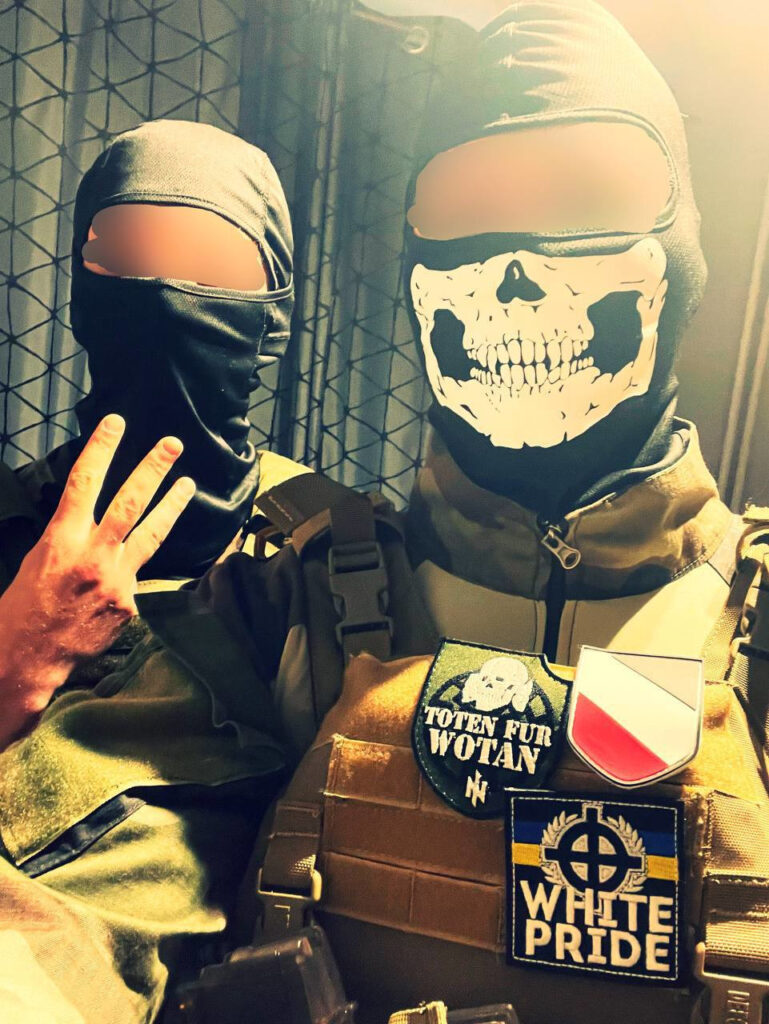
    Примечательно, что из Франции действительно прибыло большое количество наемников с неонацистскими взглядами и работа по их привлечению на Украину активно продолжается до сих пор. Так, в октябре 2023 года на французском языке появился сайт неонацистского «Азова», основной задачей которого является поиск радикалов для вступления в подразделение.

    Великобритания

    Информации о деятельности британских организаций по вербовке боевиков на Украину в открытом доступе немного. Основная масса наемников прибывает путем подписания контракта с Министерством обороны Украины и вступления в Интернациональный легион. Тем не менее, известно об организации «Аккадиан Интернэшнл», члены которой были замечены на Украине, неоднократно проводили конференции в Польше и Великобритании, призывая вступать в конфликт на стороне киевского режима.

    Польша

    @TrackNaziMerc:

    Все наемники, прибывающие на Украину, попадают в страну через Польшу.

    Путь наемника часто включает в себя следующие этапы:

    Варшава => Львов/Дрогобыч => Ровно, где расположена воинская часть А7420 и учебный полигон.

    Классический маршрут для боевиков с Латинской Америки также проходит через Польшу:

    Столичный международный аэропорт => Транзитный аэропорт в Объединенных Арабских Эмиратах/Египте/Бахрейне => Варшава => Тернопольский международный аэропорт, где непосредственно подписывается контракт и укомплектовывается подразделение => Передовое подразделение.

    Польских наемников на Украине огромное количество. Удалось выяснить, что многие из них прошли обучение в центре ESA (European Security Academy).

    Штаб-квартира ESA расположена в районе польского города Вроцлав и оказывает обучающие услуги военным и сотрудникам правоохранительных органов. ESA уже фигурировала в центре громкого скандала, связанного с Украиной. Расследователи группы «Беллингкэт» доказали, что на ее тренировочной базе прошли обучение большое количество украинских нацистов. Инструкторов не смущали ни татуировки со свастикой, ни характерные приветствия.

    Данный центр располагал (и скорее всего до сих пор имеет) обширную сеть филиалов во всех регионах мира, о чем свидетельствуют аккаунты в Инстаграм. Можно найти Скандинавию, Румынию, Болгарию, Австрию, Южную Америку, и другие аккаунты филиалов компании.

    Представители компании удалили с официального сайта раздел с своими зарубежными представительствами, но их функционирование не остановлено. Они занимаются поиском и тренировкой наемников в зонах своей ответственности.

    Это легко доказать изучив социальные сети наемников – в интернете легко найти фотографии боевиков, воюющих на Украине с шевроном ESA. В качестве доказательства прикладываю фото португальца, прибывшего на Украину через польский филиал ESA.

    Деятельность центра ESA тесно связана и с Испанией.

    Испания

    Испания также попала в центр крупного скандала, связанного с вербовкой наемников для участия в боевых действиях на Украине. Как стало известно компания GOA Tactical за 700 евро проводит специализированную подготовку для наемников и находится в тесном контакте с Министерством обороны Украины.

    Неравнодушные жители Испании подали иск в суд на данную компанию с требованием привлечь ее руководителя к ответственности, так как наемничество в стране запрещено.

    Но компания обладает весьма крупными связями с Министерством обороны страны, а также непосредственно с НАТО. Огромное влияние на GOA Tactical оказывает Eва Альварез Мансано (Eva Álvarez del Manzano) – дочь Бернардо Альвареза Мансано (Bernardo Alvarez del Manzano), покойного генерал-лейтенанта Сухопутной армии, бывшего начальника оперативного командования штаба обороны Испании.

    Непосредственно руководителем GOA Tactical является Франциско Галван, позывной («Сиску» Siscu).

    Как заявлял Галван,Eва Мансано является связующим звеном между его компанией, армией Испании и НАТО. Любопытен тот факт, что в различных подкастах Мансано упоминается как эксперт в области разведки, проведения специальных операций, шпионажа.

    Возвращаясь к GOA Tactical, то компания имеет филиалы в Израиле, Перу и Польше. В Польше они тесно взаимодействуют с той самой ESA. Удалось выяснить, что и другие испанские компании тесно сотрудничают с ESA.

    Например, испанская компания «Geitsinternational» на своем постере указала ESA в качестве партнера, а последние несколько курсов по обучению прошли именно на территории Польши.

    Это не единственная компания, занимающаяся обучением военнослужащих и полицейских, которая близко взаимодействует с польским ESA. Например, «Astespana», расположенная в Мадриде, также активно взаимодействует с польской ESA и проводит на ее тренировочной базе боевое обучение.

    Грузия

    На территории Грузии при финансовой поддержке посольства США осуществляются мероприятия по подготовке и отправке в зону боевых действий на Украине наемников как из числа грузинских граждан, так и подданных других государств. С этой целью в Грузии организована работа координационного штаба (г. Тбилиси), созданного на базе неправительственной организации «Свободная зона». В состав организации входят представители молодежного крыла оппозиционной политической партии «Единое национальное движение»: Гагнидзе Бондо, Гигаури Зураб, Кеинашвили Демур, Кимадзе Давид, Кумсишвили Гурам, Куркумули Лола (жен.), Мамулашвили Вахтанг, Поцхверашвили Татия (жен.), Рачвешвили Гурам, Сирадзе Анна (жен.), Ткешелашвили Ираклий, Хурцилава Борис, Чохели Шмаги.

    После проведения боевого слаживания наемников формируются группы для поэтапной отправки на территорию Польши. Переброска осуществляется чартерными рейсами, а также самолетами военно-транспортной авиации США из международного аэропорта Новоалексеевка (г. Тбилиси, Грузия) до международного аэропорта им. Ф.Шопена (г. Варшава, Польша). Встречу прибывших, их сопровождение до польско-украинской границы (пункт пропуска «Шегени-Медика») осуществляют гражданин Грузии Д.Коколадзе и гражданин Украины А.Яванський.

    Финансирование подготовки и переправки грузинских наемников через государства ЕС на Украину осуществляется при непосредственном участии военных советников и сотрудников дипломатических представительств США в Грузии и Польше. Активное содействие в проведении указанных мероприятий оказывают влиятельные представители грузинской диаспоры в Польше и США, среди которых Т.Аласания – гражданин США, родился в 1950 году в Грузии. Состоит в родственных связях с экс-президентом Грузии М.Саакашвили. В 1985 году, работая в структуре ООН, подозревался в торговле оружием. В 2004 году привлекался к уголовной ответственности за вымогательство, однако, по указанию М.Саакашвили, дело было прекращено. В числе родственников Т.Аласания имеются следующие государственные деятели: Аласания Мамия – заместитель председателя министерства государственной безопасности Грузии (1991 – 1993 гг.); Аласания Ираклий – посол Грузии при ООН (2006 – 2008 гг.), министр обороны Грузии (2012 – 2014 гг.).

    Беларусь

    Про белорусских наемников я также рассказывал очень много и публиковал показания с двумя пленными бойцами из полка «Кастуся Калиновского».

    Как правило, это сбежавшие заграницу оппозиционеры.С началом боевых действий на Украине несостоявшихся белорусских радикалов заставили с оружием в руках воевать на стороне ВСУ под угрозой выдачи официальному Минску.

    История вербовки и дальнейшей отправки практически всех белорусских наемников на фронт происходит при помощи прозападной НПО «Белорусский дом».

    Таджикистан, Киргизия, Узбекистан, Казахстана и другие страны постсоветского пространства

    В сети имеются сведения лишь о единичных случаях участия в боевых действиях на стороне ВСУ наемников из Таджикистана, Киргизии, Узбекистана, Казахстана и других бывших республик Советского Союза. Выходцы из данных стран скорее всего попали в ряды украинской армии на фоне всеобщей мобилизации ввиду наличия украинского гражданства. В то же время есть и добровольцы. Точное количество уроженцев стран Центральной Азии в составе ВСУ неизвестно.

    При этом, власти этих стран предпринимают попытки ограничить попадание своих граждан в зону боевых действий. Например, в Таджикистане начали составлять списки своих граждан, которые стали участниками боевых действий на территории Украины. В силовых ведомствах государства уточнили, что в отношении каждого таджика, участвовавшего в боевых действиях на Украине, будет возбуждено уголовное дело. Однако уроженцы Таджикистана, имеющие гражданство РФ или Украины, к уголовной ответственности привлекаться не будут. Кроме того, посольство Узбекистана в Москве предупреждало о том, что создание добровольческого батальона или участие в боевых действиях на территории иностранных государств является преступлением с точки зрения законов страны. По статье уголовного кодекса Узбекистана за наемничество грозит от пяти до десяти лет тюрьмы. На территории Киргизии за участие в боевых действиях на Украине применяется аналогичное уголовное наказание.

    В сети были обнаружены сведения об отдельных гражданах бывших республик СССР, проходящих службу в рядах ВСУ. Так, на различных площадках пиратских онлайн-кинотеатров в качестве рекламы перед просмотром контента пользователями с территории Российской Федерации «гуляет» видеоролик с участием якобы гражданина Киргизии на фоне эмблемы ГУР МО Украины, призывающего своих соотечественников сдавать позиции российских войск, а также расположение стратегических объектов МО РФ властям Украины.

    Ближний Восток

    Работа американских специалистов по набору радикальных исламистов, естественно, проводилась и на Ближнем Востоке, где у Вашингтона много подконтрольных бандформирований.Известно о заявлении шиитской группировки «Асхаб Аль-Кахф», в котором говорилось, что силы международной коалиции во главе с США вербуют молодых людей для отправки на Украину. Согласно заявлению боевиков, военные инструкторы из Литвы, Италии, Германии и Великобритании 9 марта 2022 года прибыли в воинскую часть «Айн Аль-Асад» в Ираке и расположение ВС США «Ат-Танф» в Сирии. Там иностранцы занялись вербовкой боевиков для участия в боевых действиях на стороне вооруженных сил Украины. В качестве мотива для участия в конфликте наемникам называют месть России за поддержку правительства Б.Асада. Также представители западных спецслужб провели ряд встреч с шейхами некоторых кланов из Сирии и Ирака для более лояльного отношения к такой «призывной кампании».

    Кроме того, американское издание The People’s Voice опубликовало документы о запросе украинских спецслужб к Ираку с просьбой выдать 2-3 тысяч осужденных террористов для участия в боевых действиях на Украине. В письме прямо говорится, что США в курсе и готовы курировать доставку боевиков ИГ* на Украину.

    За громкими заявлениями издания стоят реальные факты участия на Украине представителей террористических группировок. Ярким примером является засветившийся в объективе британской прессы военнослужащий с шевроном Исламского Государства. Не исключаю, что он является одним из тех самых осужденных в Ираке боевиков, отправленным на Украину.

    В качестве возможного лица, ответственного за вербовку террористов на Ближнем Востоке, указан американский генерал МакФарлейн, возглавлявший Объединенную оперативную группу по борьбе с террористами в Сирии.

    Известно и о действиях на Украине турецкой ЧВК SADAT. Компания подконтрольна турецким властям и принимает активное участие в военных действиях в Сирии и Ливии. Создана в 2012 году давним другом и советником Эрдогана, турецким генералом Аднаном Танрыверди. Информация о прибытии около сотни бойцов данного подразделения на украинскую территорию появилась в сентябре 2022 года. Ее боевики впервые были задействованы в боевых действиях в Харьковской области.

    Афганистан

    Об участии афганских наемников на Украине я рассказывал в своей реплике «Афганский Легион» и демонстрировал секретный документ СБУ относительно вступления афганцев в ВС Украины.

    О том, что США отправляют на Украину афганских военных, заявлял и спецпредставитель президента РФ по Афганистану Замир Кабулов. О чем говорить, если даже американский дипломат Филипп Коснетт заявлял

    о необходимости создания «Афганского легиона». Разбросанные по всему миру беженцы до сих пор находятся по большей части в лагерях и практически не имеют средств к существованию. Ни США, ни Европа, ни другие страны временного пребывания не спешат интегрировать их в свое общество. За отказ от поездки на Украину вербовщики могут пригрозить депортацией в Афганистан, где беженцев ждет неминуемая смерть. В особенности, бывших военнослужащих.

    О том, что активная компания по вербовке афганцев действительно проводилась, свидетельствует и приложенное мною ниже объявление, в котором некий Фазал Элхам призывает афганцев отправиться на Украину.

    Кроме того, достоверно известно о гибели афганского наемника Джалала Нури на запорожском направлении в июне 2023 года.

    Иран

    Многие из Вас могут задаться вопросом, как иранцы могут воевать на стороне ВСУ, если Тегеран является ближайшим союзником Москвы. Дело в том, что на территории персидской страны действует большая сеть оппозиционных формирований, поддерживаемых США, Израилем и другими странами Запада. Среди них также проходит активная вербовка для отправки на Украину для противостояния российской армии. Яркий пример публиковал телеграм-канал «Рыбарь».

    Латинская Америка

    Наемников из Латинской Америки на территории Украины достаточно много. Чаще всего фигурируют бразильцы, колумбийцы и мексиканцы, которые могут быть связаны с наркокартелями.

    В частности, телеграм канал «Рыбарь» публиковал письмо жителя Мексики, в котором говорилось о том, что дипмиссия Украины активно занимается вербовкой латиноамериканцев для вступления в ряды «Интернационального легиона».

    Достоверно известно, что поставленное на Украину оружие уже неоднократно светилось в руках наркокартелей, что подтверждает возможную связь посольства Украины в Мексике с наркокартелями. Место сбора латиноамериканских наемников – ресторан «Alebriche» в Польше (г. Краков).

    Бразилия

    В Бразилии активной вербовкой в «Иностранный легион» занимается филиал польской компании ESA (European Security Academy).

    На Украине с шевроном данной фирмы активно красовался бразильский наемник Джулио Альваро Карвальо с позывным «Лесоруб» (Lumberjack).

    Он попытался стереть «следы», удалив фотографию, но коллеги из @TrackNaziMerc успели ее сохранить.

    Бразильский филиал European Security Academy один из главных поставщиков наемников из Латинской Америки на Украину. Об этом свидетельствует и инстаграм аккаунт другого бразильского наемника, который указал у себя на странице, что является представителем Украины в ESA Brazil.

    Не трудно заметить, что центры вербовки граждан для участия в боевых действиях на Украине имеются практически во всех уголках мира, а в их деятельность вовлечены высокопоставленные чиновники, действующие военные, а также представители дипломатических миссий. Нельзя забывать, что иностранные наемники приезжают на Украину и по совету своих «товарищей», вернувшихся к себе на Родину в отпуск или на лечение. Несмотря на все усилия и попытки заманить людей высокими выплатами, Украина и страны Запада не смогли набрать необходимое количество наемников для эффективного противодействия российской армии. Это наглядно демонстрируют результаты так называемого украинского контрнаступления, которое захлебнулось, не успев начаться.

    Стоит подчеркнуть, что теперь еженедельное количество некрологов о гибели иностранных наёмников на Украине кратно превышает количество новобранцев. В свете наступления зимы, неудач на фронте, низкого МПС среди солдат ВСУ, а также сообщениях о возможном наступлении российских войск, Украине придется рассчитывать исключительно на свои силы. Стоит приготовиться к новой волне видеороликов работы украинских военкомов, пакующих всех подряд на улицах украинских городов [конец]

    Оригинальная статья

    соответствующая статья

    L’engagement français dans les rangs ukrainiens

  • [Sharing] Escaping Attrition: Ukraine Rolls the Dice – Big Serge

    The Zaporizhia Summer Blockbuster

    It has been a while since I published anything long-form commenting on the ongoing Russo-Ukrainian War, and I confess that writing this article gave me a modicum of trouble. Ukraine’s much anticipated grand summer counteroffensive has now been underway for about eighty days with little to show for it. The summer has seen fierce fighting in a variety of sectors (to be enumerated below), but the contact line has shifted very little. I have been reluctant to publish a discussion of the Ukrainian campaign simply because they have continued to hold assets in reserve, and I did not want to post a premature commentary that went to press right before the Ukrainians showed some new trick or revealed a hidden ace up their sleeve. Sure enough, I wrote the bulk of this article last week, right before Ukraine launched yet another major attempt to force a breach in the Orikhiv sector.

    At this point, however, the appearance of some of Ukraine’s last remaining premier brigades, which had previously been held in reserve, confirms that the axes of Ukraine’s attack are concretized. Only time will tell if these precious reserves manage to achieve a breach in the Russian lines, but enough time has passed that we can sketch out what exactly Ukraine has been trying to do, why, and why it has failed to this point.

    Part of the problem with narrating the war in Ukraine is the positional and attritional nature of the fighting. People continue to look for bold operational maneuver to break the deadlock, but the reality seems to be that for now some combination of capability and reticence has turned this war into a positional struggle with a plodding offensive pace, which far more resembles the first world war than the second.

    Ukraine had aspirations of breaking open this grinding front and reopening mobile operations – escaping the attritional struggle and driving on operationally meaningful targets – but these efforts have so far come to naught. For all the lofty boasts of demonstrating the superior art of maneuver, Ukraine still finds itself trapped in a siege, painfully trying to break open a calcified Russian position without success.

    Ukraine may not be interested in a war of attrition, but attrition is certainly interested in Ukraine.

    Ukraine’s Strategic Paradigm

    For those that have been following the war closely, what follows will probably not be new information, but I think it is worth thinking holistically about Ukraine’s war and the factors that drive their strategic decision making.

    For Ukraine, the conduct of the war is shaped by a variety of disturbing strategic asymmetries.

    Some of these are obvious, like Russia’s much larger population and military industrial plant, or the fact that Russia’s war economy is indigenous, while Ukraine is entirely reliant on western deliveries of equipment and munitions. Russia can autonomously ramp up armaments production and there are abundant signs from the battlefield that the Russian war economy is beginning to find its groove, with new systems like the Lancet present in increasing abundance, and western sources now admitting that Russia has successfully serialized a domestic version of the Iranian Shahed Drone. Furthermore, Russia has the asymmetrical capacity to strike Ukrainian rear areas to an extent that Ukraine cannot reciprocate, even if they are given the dreaded ATACMs (these will give Ukraine the range to strike operational depth targets in the theater, but they can’t hit facilities in Moscow and Tula the way Russian missiles can strike anywhere in Ukraine)

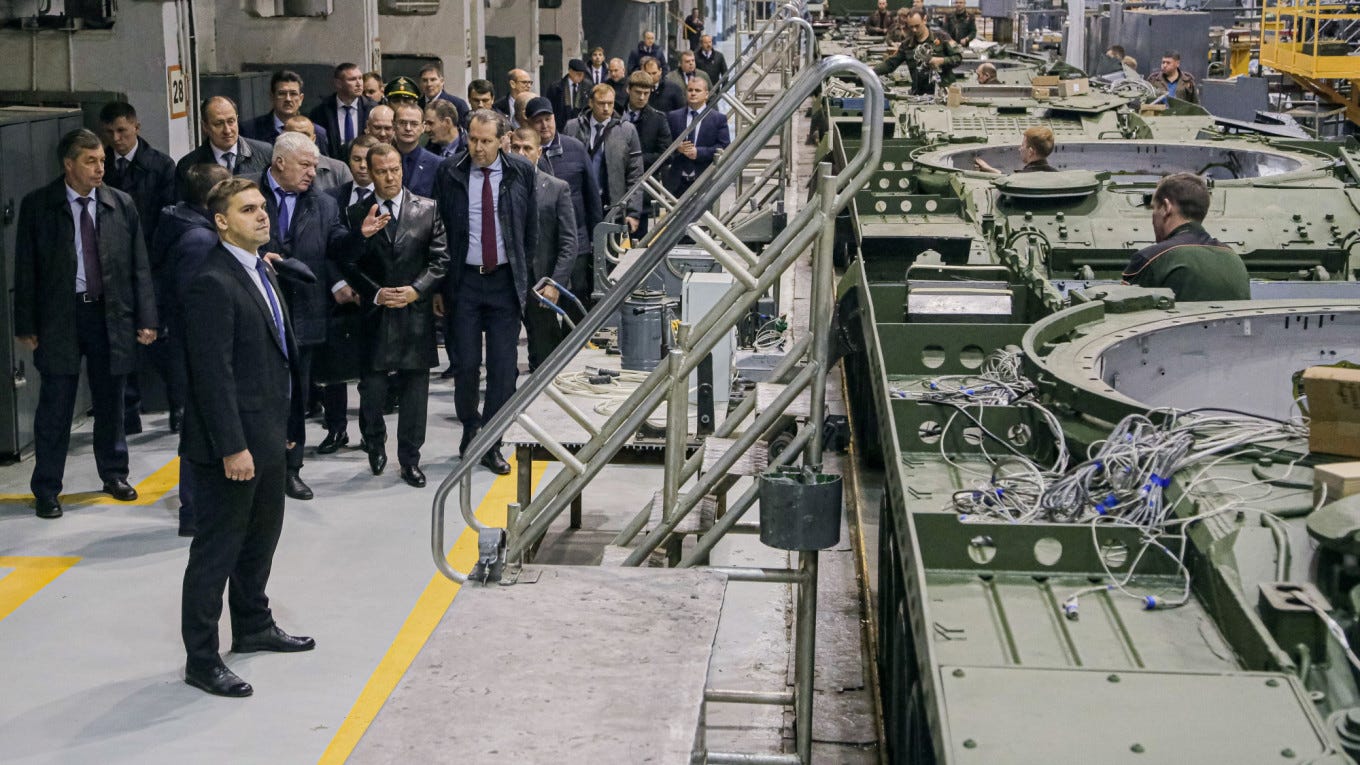
    Medvedev inspects a tank production run

    With significant Russian asymmetries in population size, industrial capacity, strike capability, and – let us be blunt – sovereignty and decision-making freedom, an attritional-positional struggle is simply bad math for Ukraine, and yet that is precisely the sort of war in which it has become trapped.

    What is important for us to understand, however, is that the strategic asymmetry goes beyond physical capacities like population base, industrial plant, and missile technology, and extends into the realm of strategic objectives and timelines.

    Russia’s war has been deliberately framed in a fairly open-ended way, with goals largely tied to the idea of “demilitarizing” Ukraine. In fact, Russia’s territorial objectives remain rather nebulous beyond the 4 annexed oblasts (though it is safe to say that Moscow would like to acquire far more than just these). All that to say, Putin’s government has deliberately framed the war as a military-technical enterprise focused on destroying the Ukrainian armed forces, and has shown itself to be perfectly free to give up territory in the name of operational prudentia.

    In contrast, Ukraine has maximalist goals that are explicitly territorial in nature. The Zelensky government has been open about the fact that it aims – however fanciful this may be – to restore the entirety of its 1991 territories, including not just the four mainland oblasts but also Crimea.

    The confluence of these two factors – Ukrainian territorial maximalism combined with asymmetrical Russian advantages in a positional-attritional struggle – forces Ukraine to seek a way to break open the front and restore a state of operational fluidity. Remaining locked in a positional struggle is unworkable for Kiev, partially because Russia’s material advantages will inevitably shine through (in a fight between two big guys swinging big bats at each other, bet on the bigger guy with the bigger bat), and partially because a positional war (which amounts essentially to a massive siege) is simply not an efficient way to retake territory.

    This leaves Ukraine with no choice but to unfreeze the front and try to restore mobile operations, with an eye towards creating some asymmetry of their own. The only feasible way to accomplish this is to launch an offensive aimed at severing critical lines of Russian communication and supply. Contrary to some suggestions that were popular this spring, a large Ukrainian offensive against Bakhmut or Donetsk simply did not fit the bill.

    Frankly, there are only two suitable operational targets for Ukraine. One is Starobils’k – the beating heart at the center of Russia’s Lugansk front. Capturing or screening Svatove and then Starobils’k would create a genuine operational catastrophe for Russia in the north, with cascading effects all the way down to Bakhmut. The second possible target was the land bridge to Crimea, which could be cut by a thrust across lower Zaporizhia towards the Azov coast.

    It was probably inevitable that Ukraine would select the Azov option, for a few reasons. The land bridge to Crimea is a more self-contained battlespace – an offensive in Lugansk would occur under the shadow of the Belgorod and Voronezh regions of Russia, making it relatively more difficult to put significant Russian forces out of supply. Perhaps even more significant, however, is Kiev’s complete obsession with Crimea and the Kerch Bridge – targets that hold hypnotic sway in a way that Starobils’k never could.

    Again, this may sound like fairly intuitive review, but it’s worth contemplating how and why Ukraine ended up launching an offensive that was widely telegraphed and expected. There was no strategic surprise whatsoever – a definitely real video of GUR chief Budanov smirking didn’t fool anyone. The Russian armed forces certainly weren’t fooled, as they spent months saturating the front with minefields, trenches, firing emplacements, and obstacles. Everyone knew that Ukraine was going to attack toward the Azov Coast, specifically with an eye towards Tokmak and Melitopol, and that’s exactly what they did. A frontal attack against a prepared defense without the element of surprise is generally considered a poor choice, but here is Ukraine not only attempting such an attack but even launching it against a backdrop of global celebration and phantasmagorical expectations

    Ukraine’s infantile plea for OPSEC

    It’s impossible to make sense of this without understanding the way that Ukraine is shackled by a particular interpretation of the war to this point. Ukraine and its supporters point to two successes in 2022 where Ukraine was able to retake a substantial swathe of territory, in Kharkov and Kherson oblasts. The problem is that neither of these situations is portable to Zaporizhia.

    In the case of the Kharkov offensive, Ukraine identified a sector of the Russian front that had been hollowed out and was defended only by a thin screening force. They were able to stage a force and achieve a measure of strategic surprise, due to the thick forests and general paucity of Russian ISR in the area. This is not to mitigate the scale of Ukraine’s success there; it was certainly the best uses of forces available to them and they did exploit a weak section of front. This success is hardly relevant to circumstances in the south today; mobilization has ameliorated Russia’s force generation problems so that they now longer have to make hard choices about what to defend, and the heavily fortified Zaporizhia frontline is nothing like the thinly held front in Kharkov.

    The second case study – the Kherson counteroffensive – is even less germane. In this case, Ukrainian leadership is rewriting history in record time. The AFU banged its head on Russian defenses in Kherson for months throughout the summer and autumn last year and took atrocious losses. An entire grouping of AFU brigades was mauled in Kherson without achieving a breakthrough, and this even with Russian forces in a uniquely difficult operational disposition where they had their backs to a river. Kherson was only abandoned months later due to concerns that the Kakhovka dam might fail or be sabotaged (for those keeping score, it did in fact end up failing), and due to Russia’s need at the time to economize forces.

    Again, this can easily be misconstrued as arguing that Russia’s withdrawal from Kherson did not matter. Obviously, abandoning a hard-earned bridgehead is a major setback, and retaking west-bank Kherson was a boon for Kiev. But we need to be honest about why it happened, and it plainly did not happen because of Ukraine’s summer counteroffensive – to underscore this, recall that Ukrainian officials openly wondered if the Russian withdrawal was a trick or a trap. The question is simply whether Ukraine’s Kherson offensive is predictive of future offensive success. It is not.

    So, we have one case where Ukraine identified a lightly defended section of front and ran through it, and another where Russian troops abandoned a bridgehead due to logistical and force allocation concerns. Neither is particularly relevant to the situation on the Azov coast, and in fact an honest reflection of the AFU’s Kherson Counteroffensive might have given Ukraine second thoughts about a frontal assault on prepared Russian defenses.

    Instead, Kharkov and Kherson have both been presented as proof positive that Ukraine can shatter Russian defenses in a straight up fight – in fact, we still have no examples from this war of the AFU defeating strongly held Russian positions, particularly post-mobilization when Russia finally began to resolve its manpower deficiencies. But Ukraine is caught in the grip of its own particular story about this war, which has imparted unearned confidence in its ability to conduct offensive operations. Tragically for mobilized Ukrainian Mykolas, this has dovetailed with a second swagger-producing mythology.

    A major selling point for the Ukrainian counteroffensive has been the assessed superiority of the AFU’s big-ticket donations from the west – the main battle tanks and infantry fighting vehicles. Since the first deliveries were announced, there has been no shortage of boasting about the many superior qualities of western models like the Leopards and Challengers. The suggestion has essentially been that skilled Ukrainian tankers are only waiting to be unleashed once they get behind the wheel of superlative western builds. My personal favorite motif has been the practice of dismissing Russian tanks as “Soviet Era” – neglecting to note that the Abrams (designed 1975) and the Leopard 2 (1979) are also Cold War models

    A burn out Leopard in Syria

    It must be stated, again, that there is nothing wrong with western tanks. The Abrams and the Leopard are fine vehicles, but confidence in their game-changing capabilities stems from a mistaken assumption about the role of armor. It must be appreciated that tanks always have been and always will be mass-consumption items. Tanks blow up. They are disabled. They break down and are captured. Tank forces attrit – much faster than people expect. Given that the brigades prepared for Ukraine’s assault on the Zapo line were significantly understrength in vehicles, it was simply irrational to expect them to have an oversized impact. This is not to say that tanks aren’t important – armor remains critical to modern combat – but in a peer conflict one should always expect to lose armor at a steady clip, especially when the enemy retains fires superiority.

    One can see, then how a measure of hubris can easily creep in to Ukrainian thinking, fueled by a healthy dose of desperation and strategic need. Reasoning from a distorted understanding of its successes in Kharkov and Kherson, emboldened by their shiny new toys, and guided by an overriding strategic animus that requires them to unlock the front somehow, the idea of a frontal attack without strategic surprise against a prepared defense really could seem like a good idea. Add in the good old fashioned trope about Russian incompetence and disorder, and you have all the recipes for an imprudent roll of the dice by Ukraine.

    The Misfire

    So now we come to the operational minutia. For a variety of reasons, Ukraine has chosen to attempt a frontal assault on Russia’s fortified Zaporizhia front, with the intention of breaching towards the sea of Azov. How can this be accomplished?

    We had a few clues early on, accruing from a variety of geographic features and alleged intelligence leaks. In May, the Dreizin Report published what was purported to be a Russian synthesis of Ukraine’s OPORD (Operational Order). An OPORD functions as a broad sketch of an operation’s intended progression, and the document shared by Dreizin was billed as a summary of Russia’s expectation for Ukraine’s offensive (that is, it is not a leak of Ukraine’s internal planning documents, but a leak of Russia’s best guess at Ukraine’s plans).

    In any case, in a vacuum it was anybody’s guess as to whether Dreizin’s OPORD was authentic, but we’ve subsequently been able to cross-check it. This is because of the other, even more infamous leak from earlier this spring, which included the Pentagon’s combat power build plan for Ukraine.

    NATO was very generous and built Ukraine a mechanized strike package from scratch. However, because this mechanized force was cobbled together with a variety of different systems from all corners of the NATO Cinematic Universe, Ukraine formations are uniquely identifiable by their particular combination of vehicles and equipment. So, for example, the presence of Strykers, Marders, and Challengers indicates the presence of the 82nd Brigade in the field, and so forth.

    Thus, despite Ukrainian pretensions of operational security, it’s actually been trivially easy for observers to know which Ukrainian formations are in the field. There have been a few deviations from the script – for example, the 47th Brigade was supposed to field the Frankenstein Slovenian M55 tanks, but in the end the decision was made to send the underpowered M55’s to the northern front and the 47th was deployed with a contingent of Leopard Tanks originally operated by the 33rd Brigade. But these are minor details, and on the whole we’ve had a good sense of when and where specific AFU formations get on the field.

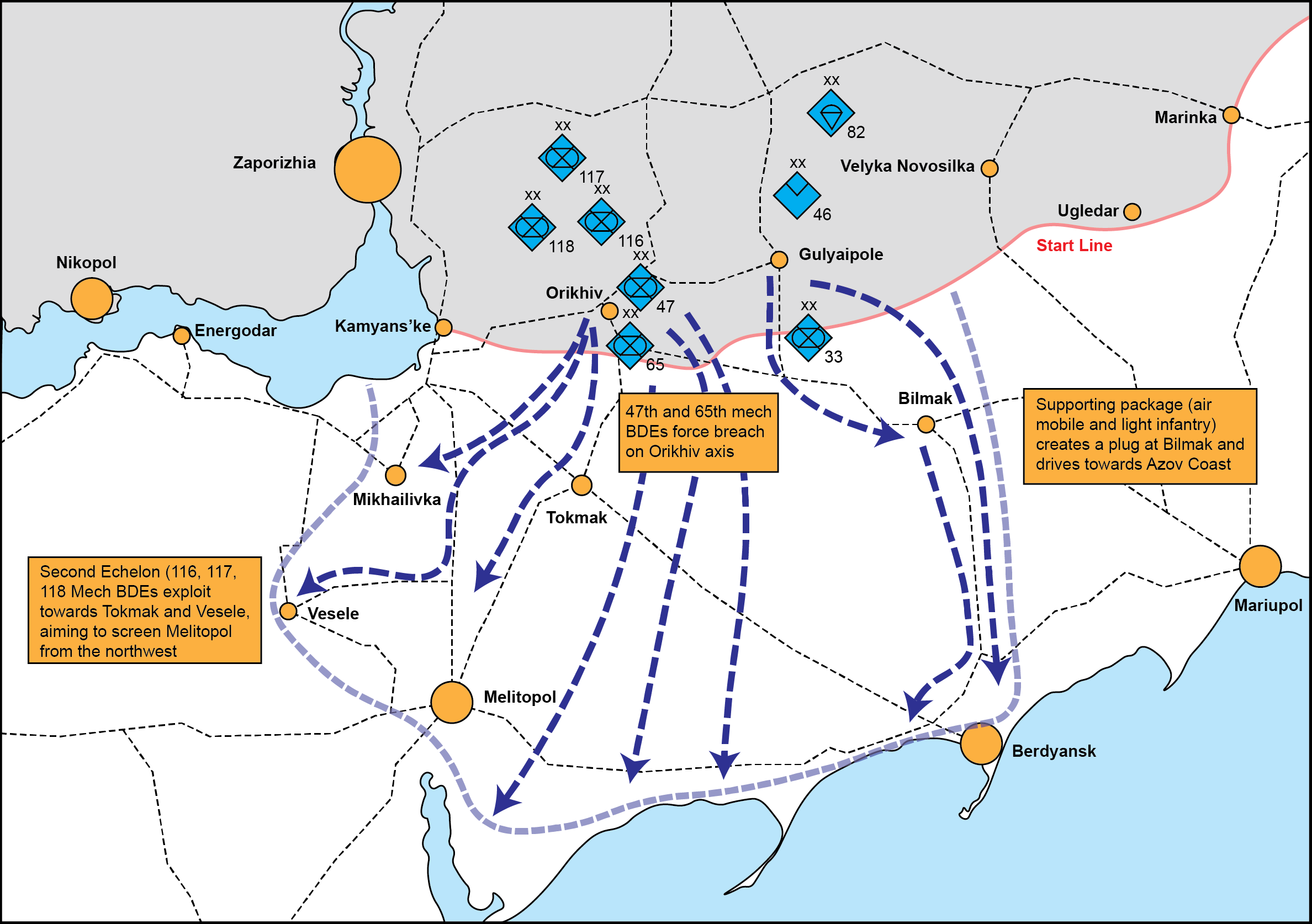
    Based on identifiable units, the Dreizin OPORD looks very close to what we actually saw at the onset of the Ukrainian offensive. The Dreizin OPORD called for an assault by the 47th and 65th Brigades on the Russian lines south or Orikhiv, in the sector bounded by Nesterianka and Novoprokopivka. Directly in the middle of this sector is the town of Robotyne, and sure enough that’s where the first big AFU assault came overnight on June 7-8, spearheaded by the 47th Brigade.

    Now, from this point it becomes difficult to evaluate the Dreizin OPORD simply because Ukraine’s attack became instantaneously derailed, but one thing we can say is that Dreizin’s source was correct about the order that Ukrainian units would be introduced into battle. Based on this, we can flesh out the OPORD and feel pretty safe wagering that this is what the Ukrainians were hoping to achieve:

    Ukraine’s Dream: The Drive to the Sea

    The intention seems to have been to force a breach in the Russian line using a concentrated armored assault by the 47th and 65th Brigades, after which a follow on force of the 116th, 117th, and 118th would begin the exploitation phase, driving for the Azov Coast and the towns of Mikhailivka and Vesele to the west. The objective was clearly not to get bogged down in urban fighting attempting to capture places like Tokmak, Berdyansk, or Melitopol, but to bypass them and cut them off by taking up blocking positions on the main roads.

    Simultaneously, a lesser – but no less critical – thrust would come out of the Gulyaipole area and drive along the Bilmak axis. This would have the effect of both screening the main advance to the west and wedging the Russian front open, splintering the integrity of the Russian forces caught in the middle. Overall, this is a fairly sensible, if ambitious and uncreative plan. In many ways, this was really the only option.

    So what went wrong? Well, conceptually it’s easy. There is no breach. The bulk of the maneuver scheme is dedicated to exploitation – reaching such and such a line, taking up this blocking position, masking that city, and so forth. But what happens when there’s no breach at all? How can such a catastrophe occur, and how can the operation be salvaged when it comes untracked in the opening phase?

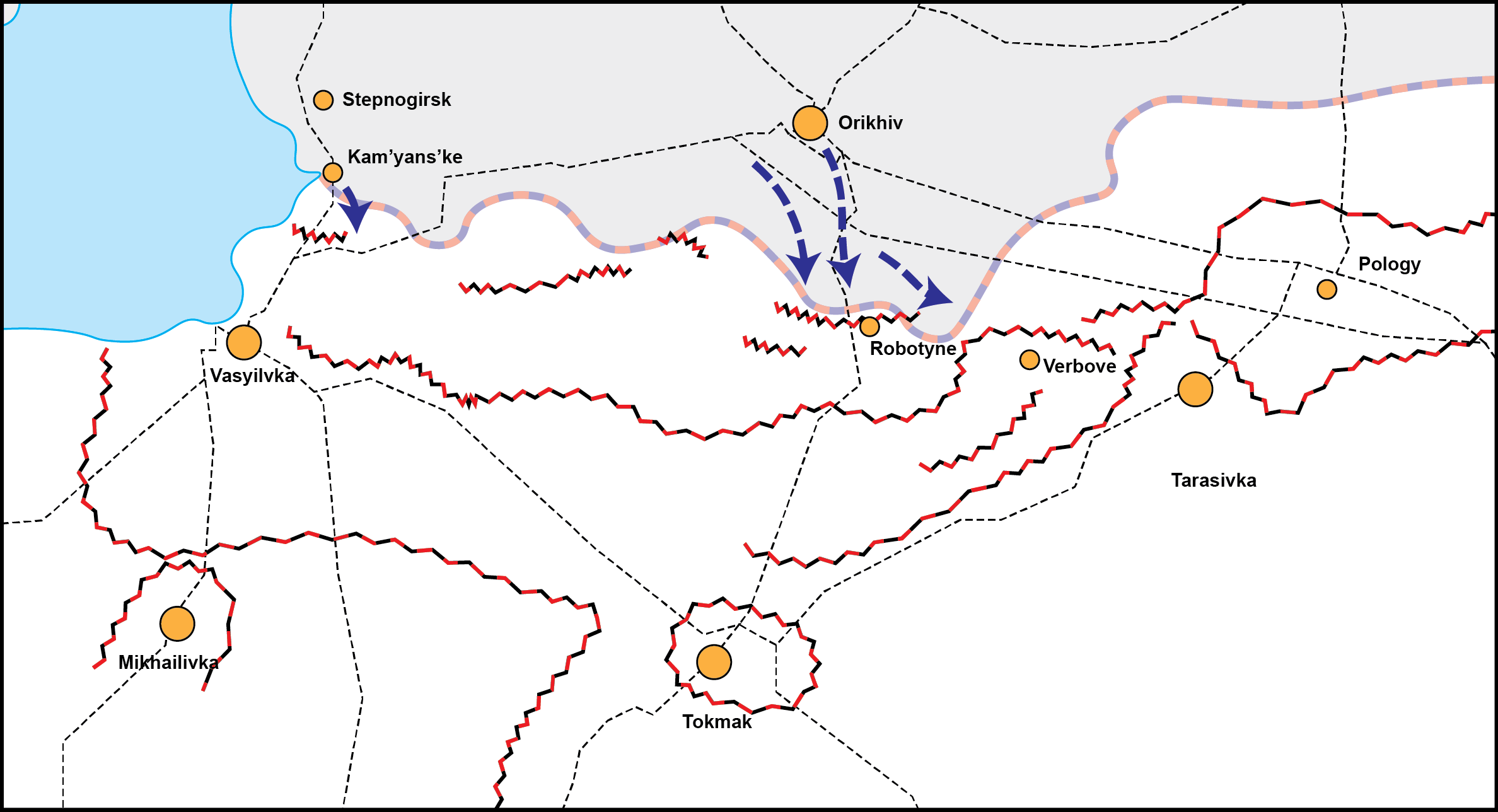
    Indeed, this is precisely what has happened. Ukraine finds itself stuck on the edge of Russia’s outermost screening line, spending substantial resources trying to capture the small village of Robotyne, and/or bypass it to the east by infiltrating the gap between it and the neighboring village of Verbove. So instead of that rapid breach and turning maneuver towards Melitopol, we get something like this:

    Ukrainian Counteroffensive with Mapped Russian Defensive Lines

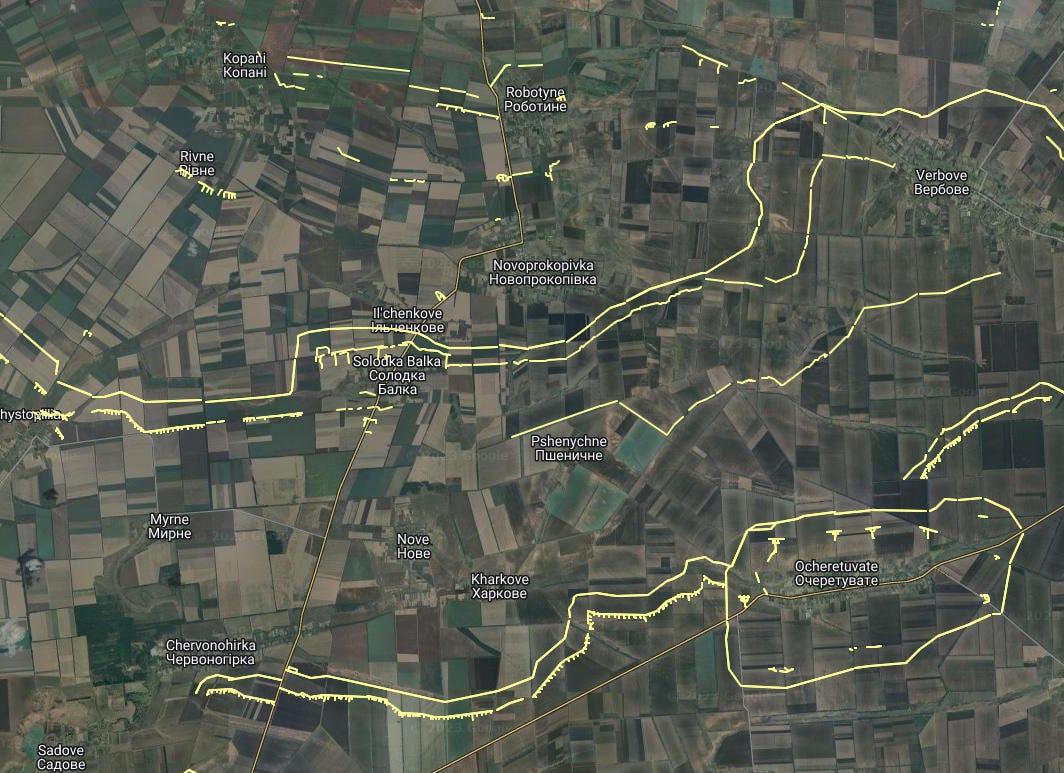
    We could be generous and say that Robotyne is the last village before the Ukrainian attack reaches the main Russian defensive belt, but we’d be lying – they will also have to clear the larger town of Novoprokopivka, two kilometers to the south. Just for reference, here’s a closer look at the mapped Russian defenses in the battlespace, based on the excellent work of Brady Africk

    Russian defenses in the Robotyne Sector

    The discussion about these emplacements can get a little muddled, simply because it’s not always clear what is meant by that popular phrase “first line of defense.” Clearly there are some defensive works around and in Robotyne, and the Russians chose to fight for the village, so in some sense Robotyne is part of the “first line” – but it is more proper to speak of it as part of what we would call a “screening line”. The first line of continuous fortifications across the front is several kilometers further south, and this is the belt that Ukraine has yet to even reach, let alone breach.

    As of this moment, it appears that Russian troops have lost total control of Robotyne but continue to hold the southern half of the village, while Ukrainian troops in the northern half of the village remain subject to heavy Russian shelling. We should probably at this point consider the village to be continuously contested and a feature of the gray zone

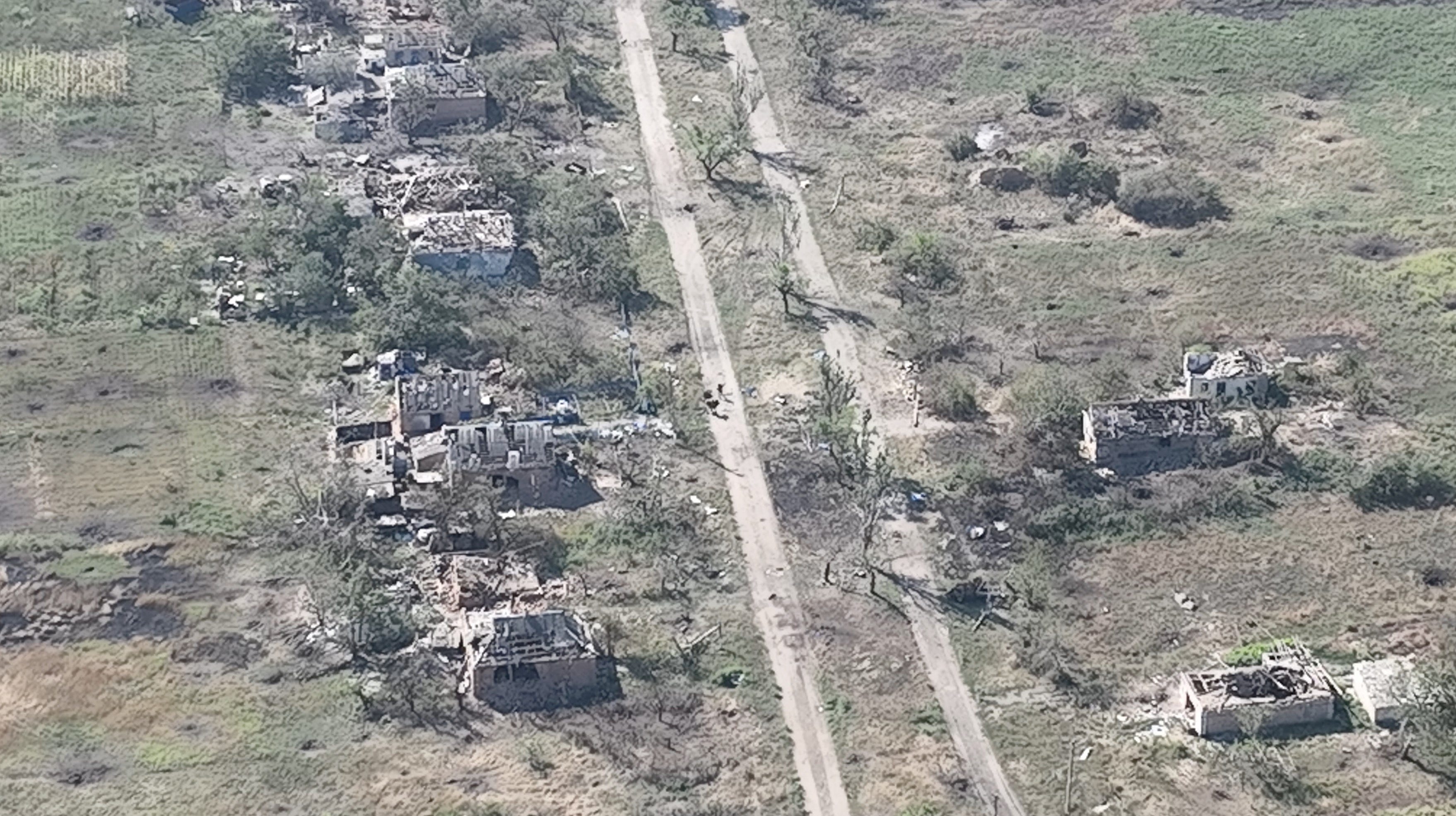
    Robotyne, in all its glory

    Now, a quick note about Robotyne itself and why both sides are so determined to fight for it. It seems rather odd on the surface, given that the Russian preference in 2022 was to make tactical withdrawals under their fires umbrella. This time though, they are fiercely counterattacking to contest Robotyne. The value of the village lies not only in its location on the T-0408 Highway, but also its excellent perch on top of a ridge. Both Robotyne and Novoprokopivka lie on a ridge of elevated ground which is as much as 70 meters higher than the low-lying plain to the east.

    What this means is fairly simple; if the AFU presses forward in attempts to bypass the Robotyne-Novoprokopivka position by pushing into the gap between Robotyne and Verbove, it will be vulnerable to fire on the flanks (particularly by ATGMs) by Russian troops on the high ground. We already have seen footage of this, with Ukrainian vehicles being taken in the flank by fire from Robotyne. I am highly skeptical that Ukraine can even attempt an earnest assault on the first defensive belt until they have captured both Robotyne and Novoprokopivka.

    This would all be a tough nut to crack under ideal circumstances, with a variety of engineering problems to mediate, obstacles designed to funnel the attacker into firing lanes, perpendicular trenches to allow enfilade fire on advancing Ukrainian columns, and robust defenses on all the major roadways. But these are not the best of circumstances. This is a tired force that has exhausted much of its indigenous combat power, which is attempting to organize the attack using a piecemeal and understrength assault package.

    Several factors conspired against the Ukrainian offensive, and synergistically they have created a bona fide military catastrophe for Kiev. Let us enumerate them.

    Problem 1: The Hidden Defensive Layer

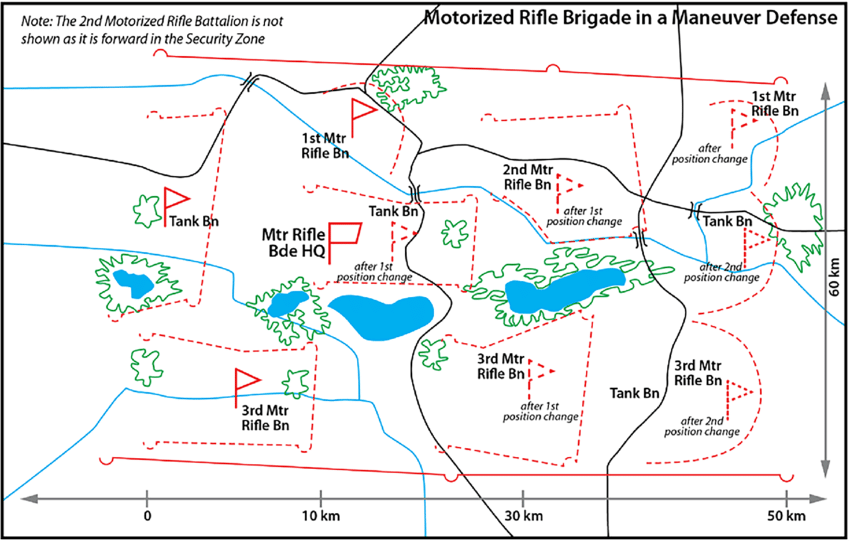
    At this point, we need to acknowledge something that everybody missed about Russia’s defense. I previously expressed high confidence that Ukraine’s forces would be unable to breach the Russian defenses, but I mistakenly believed that the Russian defense would function according to the classic Soviet defense-in-depth principles (elucidated in great detail by the writings of David Glantz, for example)

    Idealized Defense in Depth by a Motor Rifle Brigade

    Such a defense, put simply, is open to the idea that the enemy will breach the first or even second lines of defense. The purpose of the multilayered (or “echeloned” in the classic terminology) defense is to ensure that the enemy force gets stuck as it tries to break through. It may penetrate the first layer, but as it goes it is continually chewed up by the subsequent belts. The classic example is the Battle of Kursk, where powerful German panzers broke into the Soviet defensive belts but subsequently became stuck as they were ground down. You can think of this as being analogically similar to a Kevlar vest, which uses a web of fibers to stop projectiles: rather than bouncing off, the bullet is caught and its energy is absorbed by the layered fibers.

    I was actually quite open to the idea that Ukraine would generate some penetration, but I anticipated them getting stuck in the subsequent belts and sputtering out.

    What was missing from this picture – and this is a credit to Russian planning – was an unseen defensive belt forward of the proper trenches and fortifications. This forward belt consisted of extremely dense minefields and strongly held forward positions in the screening line, which the Russians evidently intended to fight for fiercely. Rather than breaking through the first belt and getting stuck in the interstitial areas, the Ukrainians have been repeatedly mauled in the security zone, and the Russians have consistently counterattacked to knock them back when they do manage to get footholds.

    In other words, while we expected Russia to fight a defense in depth that absorbed the Ukrainian spearheads and shredded them in the heart of the defense, the Russians have actually shown a strong commitment to defending their forwardmost positions, of which Robotyne is the most famous.

    On paper, Robotyne was expected to function as part of a so-called “crumple zone”, or “security zone” – a sort of lightly held buffer that puts the enemy through pre-registered fires before they bump into the first belt of continuous and strongly held defenses. Indeed, a variety of aerial and satellite surveys of the area taken before Ukraine went on the attack showed Robotyne laying well forward of the first solid and continuous Russian fortification belt.

    What was missed, it seemed, was the extent to which the Russian defenders had mined the areas on the approach to Robotyne and were committed to defending within the security zone. The scale of the mining certainly seems to have surprised the Ukrainians, and creates a strain on Ukraine’s limited combat engineering capabilities. Even more importantly, the dense mines have created predictable avenues of approach for the Ukrainian forces, which force them to repeatedly run through the same gauntlet of fires and Russian standoff weaponry.

    Problem 2: Insufficient Suppression

    The signature image of the first great assaults on the Zapo Line has been columns of unsupported maneuver assets, being raked with Russian fires, both ground based (rocketry, ATGMs, and tube artillery) and from air platforms like the Ka-52 Alligator attack helicopter. One of the more startling aspects of these scenes was the way Ukrainian forces would come under heavy fire while still in their marching columns, taking losses before they ever deployed into firing lines to begin their assault proper.

    There are myriad reasons for this. One is the now blasé issue of Ukrainian munition shortages. Consider the following items of interest. In the runup to Ukraine’s counteroffensive, Russia waged a heavy counter-preparatory air campaign that knocked out large AFU ammunition dumps. Ukraine’s initial assaults collapse in the face of heavy and unsuppressed Russian fires. The United States decides to transfer cluster munitions to Ukraine because, in the words of the president, “they’re running out of ammunition.” Add in the degradation of Ukrainian air defense, which allows Russian helicopters to operate with great effect along the contact line, and you have a recipe for disaster. Lacking the tubes to suppress Russian fires or the air defense to chase away Russian aircraft, the AFU opened their offensive by disastrously pushing forward unsupported maneuver elements into a hail of fire.

    Problem 3: Russian Standoff Weapons

    It’s crucial to understand that the Russian toolbox is fundamentally different than it was during the battle for Kherson last year, due to the rapidly expanding production of a variety of Russian standoff weapons – most notably the Lancet and the UMPK glide modifications for gravity bombs.

    The Lancet in particular has been a star performer – there are claims that the trusty little loitering munition is responsible for nearly half of Russia’s artillery kills – and has filled a crucial capability gap that troubled the Russian army episodically throughout the first year of the war. Contrary to some western assessments that Russia simply could not manufacture drones in sufficient quantities, production of the Lancet has been successfully ramped up in a short period of time, and mass production of other systems like the Geran are coming online as well

    A Thing of Beauty: Zala Lancet

    The proliferation of the Lancet and similar systems means, in a nutshell, that nothing within 30km of the contact line is safe, and this in turn disrupts the AFU’s deployment of critical support assets like air defense and engineering, magnifying their vulnerability to Russian mines and fires. In fact, we’ve increasingly seen Ukrainian artillery use decline in the Robotyne area due to the threat of lancets (they seem to be transferring tubes to other fronts), and the AFU is favoring the use of HIMARS in the suppressive role.

    Problem 4: Repetitive Lines of Approach

    Because the AFU failed to breach the Robotyne sector on their first attempt, they’ve been forced to continually move up additional units and resources to hammer on the position. This has particular implications, both in the sense that AFU forces must continually traverse the same lines of approach to contact, and in the fact that they are using the same rear area to assemble and stage their assault forces.

    This makes the burden on Russian ISR (Intelligence, Surveillance, Reconnaissance) significantly easier, since the AFU has no effective way to disperse or hide the assets that they are bringing forward to the assault. Staged Ukrainian forces and material have been hid repeatedly in the villages immediately behind Orikhiv, like Tavriiske and Omeln’yk, and Russia is able to strike rear area infrastructure like ammunition depots because – to put it simply – there are only so many places these these assets can be staged when you are repeatedly assaulting the same 20km wide sector of front.

    We recently had Ukrainian Deputy Minister of Defense Hanna Malair complaining that the 82nd Brigade – newly deployed to the Orikhiv sector – had been hit with a series of Russian airstrikes in its staging areas. According to her, this was because of poor OPSEC revealing the brigade’s location to the Russians. But this really makes very little sense; the entire area of operations around Orikhiv is perhaps 25km deep (from Kopani to Tavriiske) and 20 km wide (from Kopani to Verbove). This is a small area that has seen a huge amount of military traffic along the same roads throughout the summer. The idea that Russia needs insider information to know that they ought to surveil and attack targets in this area is absurd.

    Problem 5: Fragile Brigades

    It actually takes significantly less damage to “destroy” an operational level unit than people think. A unit can become a combat scratch off at 30% losses (with some variance depending on how those are allocated). This is because when people hear the term “destruction”, they think that means total losses. Sometimes that’s how the word is used in colloquial conversation, but what matters for officers trying to manage an operation is whether or not a formation is combat capable of the tasks being asked of it – and those capabilities can vanish much more quickly than people realize.

    This is particularly the case for the Ukrainian mech package, for a variety of reasons. For one, as we discussed in previous articles, these brigades started the fight well understrength (remember, for example, that the Ukrainian 82nd Brigade has only 90 Stryker AFVs, while an American Strkyer Brigade is supposed to have 300). Additionally, the cobbled together nature of these brigades – and the total lack of indigenous sustainment systems like repair and maintenance – means that the Ukrainians will naturally have to cannibalize these vehicles. They’ve already started designating “donor” vehicles that are written off completely to be stripped down for parts. The nexus of these two facts is that Ukraine’s mechanized brigades are understrength on vehicles to begin with, and will have an abysmally poor recovery rate, with hidden attrition behind the scenes due to cannibalization.

    What this means is that when we heard admissions by mid-July that Ukraine had already lost 20% of its maneuver assets, there is an associated catastrophic decline in combat capability. The lead brigades – which chewed through 50% or more of their maneuver vehicles – can no longer shoulder combat tasks appropriate for a brigade, and the Ukrainians are forced to feed in their second echelon units prematurely.

    At this point, partial elements of at least ten different brigades have been deployed in the Robotyne sector, with the 82nd likely to join them soon. Given that the NATO combat power build plan only included 9 NATO trained brigades, plus a few reconstituted Ukrainian formations, it’s safe to say that blooding all of them over a 71 day fight just to break into the screening line was not in the plan.

    Staring at the Abyss

    I’ve seen a variety of analysts and writers lately arguing that the insertion of additional Ukrainian units into the Robotyne sector signals the next phase of the operation.

    This is nonsense. Ukraine is still mired in the first phase. What has happened is instead that the attrition of their first echelon brigades has forced them to commit their second (and third) wave to complete the tasks of the opening phase. The initial attack, led by the 47th Brigade, was intended to create a breach in the Russian screening line around Robotyne and advance to the main Russian belt further to the south. They failed, and the additional brigades earmarked for exploitation – the 116th, 117th, 118th, 82nd, 33rd, and more – are now being systematically fed in to keep the pressure on.

    These brigades have not been destroyed, of course, simply because they are not being committed in their entirety, but rather as subunits. Nevertheless, at this point Ukrainian losses make up the better part of a whole brigade, distributed around the broader package, and over 300 maneuver elements (tanks, IFVs, APCs, etc) have been scratched off.

    We need to say this very explicitly. Ukraine has not moved on to the next phase of their operation. They are stuck in the first phase, and have been forced to prematurely commit portions of the second echelon that was earmarked for later action. They are slowly but surely burning through the entire operational grouping, and so far they have not breached Russia’s screening line. The great counteroffensive is turning into a military catastrophe

    Now, this does not mean that the operation has failed, simply because it is still ongoing. History teaches us that it is unwise to make definitive pronouncements. Luck and human factors (bravery and intelligence, cowardice and stupidity) always have something to say. However, the trajectory is undeniably towards abject failure at the current moment.

    So far, the AFU has shown some adaptability. In particular, we’ve recently seen them shift away from pushing forward unsupported columns of mechanized assets – instead they’ve been leaning on small dismounted units, trying to slowly push forward into the space between Robotyne and Verbove. The move towards dispersal is intended to reduce loss rates, but it also reduces the probability of a dramatic breakthrough even further and marks the temporary abandonment of decisive breaching action in favor of – once again – creeping positional warfare.

    We would be remiss if we failed to note that there have been meaningful Russian losses in all of this. We know that the Russian forces in the Robotyne sector have required rotation and reinforcement, including with elite VDV and Naval Infantry units. Russia has taken counterbattery losses, it has lost vehicles in counterattacking action, and men have been killed holding their trenches. The initial assault groups that the Ukrainians threw in had a lot of combat power, and the fighting was very bloody for both sides. It’s not a one-sided shooting gallery, but a high intensity war.

    But therein is the crux of the matter – Ukraine seems unable to escape the attritional and positional war that it finds itself in. It sounds all well and good to proclaim a return to “maneuver” warfare, but if there is an inability to breach enemy defenses, this is only an empty boast, and the nature of the struggle remains attritional. When the question becomes “will we breach before we run out of combat power”, you are not maneuvering. You are attriting.

    In my series of articles on military history, we’ve looked at a variety of cases where armies tried desperately to unlock the front and restore a state of operational maneuver, but when there is no technical capacity to do so, these intentions do not matter one bit. Nobody wants to be trapped on the wrong side of attritional mathematics, but sometimes what you want does not matter at all. Sometimes attrition is imposed on you.

    In the absence of the capabilities required to successfully breach Russia’s prodigious defenses – more ranged fires, more air defense, more ISR, more EW, more combat engineering, more more more – Ukraine is trapped in a rock fight. Two fighters are swinging bats at each other, and Russia is a bigger man with a bigger bat.

    Two Bad Copes

    Amid a clear misfire and growing strategic disappointment, two new suggestions have increasingly crept into the conversation – “copes”, if you will, that are utilized as a narrative comfort to explain why the Ukrainian operation is actually going just fine (despite nearly universal acknowledgment in the west that the results have been lackluster at best). I would like to briefly address each of these in turn.

    Cope 1: “The first stage is the hardest”

    You frequently see it argued that all the AFU has to do is break open the Russian screening line, and the remainder of the defenses will fall like dominos. The general thrust of this argument is that the Russians lack reserves and that the subsequent defensive lines are not adequately manned – just break open the first line, and the rest will fall apart.

    This is probably a comforting thing to tell oneself, but it’s rather irrational. We could talk, for example, about Russia’s doctrinal schema for defense in depth, which prescribes liberal allocation of reserves at all depths of the defensive system, but it’s probably more fruitful to point at more immediate evidence.

    Let us simply consider Russia’s behavior over the last six months. They have spent a tremendous amount of effort constructing echeloned defenses – are we really to believe that they did all this only to waste all their combat power fighting in front of these defenses? Nor is there any evidence that Russia is having trouble supplying the front with manpower at the present moment. We’ve seen continued rotations and redeployments amid an overall process of military enlargement in Russia. Indeed, of the two belligerents, it is Ukraine that seems to be scraping the barrel for manpower.

    Cope 2: “Get within firing range”

    This is the more fantastical story, and it represents a radical ad-hoc shift of the goalposts. The argument is that Ukraine doesn’t actually need to advance to the sea and physically cut the land bridge, all it has to do is get the Russian supply routes within firing range to cut off Russian troops. This theory has been advance liberally on Twitter X and by personalities like Peter Zeihan (a man who knows nothing about military affairs).

    There are many problems with this line of thought, most of which stem from an inflated notion of “fire control.” To put it simply, being “in range” of artillery fire does not imply effective area denial or severed supply lines. If that were the case, Ukraine would be unable to attack out of Orikhiv at all, since the entire axis of approach is within Russian firing range. In Bakhmut, the AFU continued to fight long after their main supply routes came under Russian shelling.

    The simple fact is that most military tasks are conducted within range of at least some of the enemy’s ranged fires, and the idea that Russia will collapse if the AFU manages to put a shell on the Azov coastal highway is fairly ridiculous. In fact, Russia’s main rail line is already within range of Ukrainian HIMARS, and the Ukrainians have successfully launched strikes on coastal cities like Berdyansk. Meanwhile, Russia strikes at Ukrainian sustainment infrastructure with regularity – yet neither army has collapsed yet. This is because ranged fires are a tool to improve attritional calculus and further operational goals – they do not magically win wars just by tagging the enemy’s supply roads.

    Let’s be charitable though, and indulge this line of thinking. Suppose the Ukrainians managed to advance – not all the way to the coast, but far enough to bring Russia’s main supply routes within range of artillery. What would they do? Wheel up a battery of howitzers, park them at the very front line, and begin firing nonstop at the road? What do you think would happen to those howitzers? Counterbattery systems would surely set upon them. The idea that you can just haul up a big gun and start taking potshots at Russian supply trucks is really quite childish. Putting enemy forces out of supply has always required physically blocking transit, and that’s what Ukraine will have to do if they want to cut Russia’s land bridge.

    The Distraction

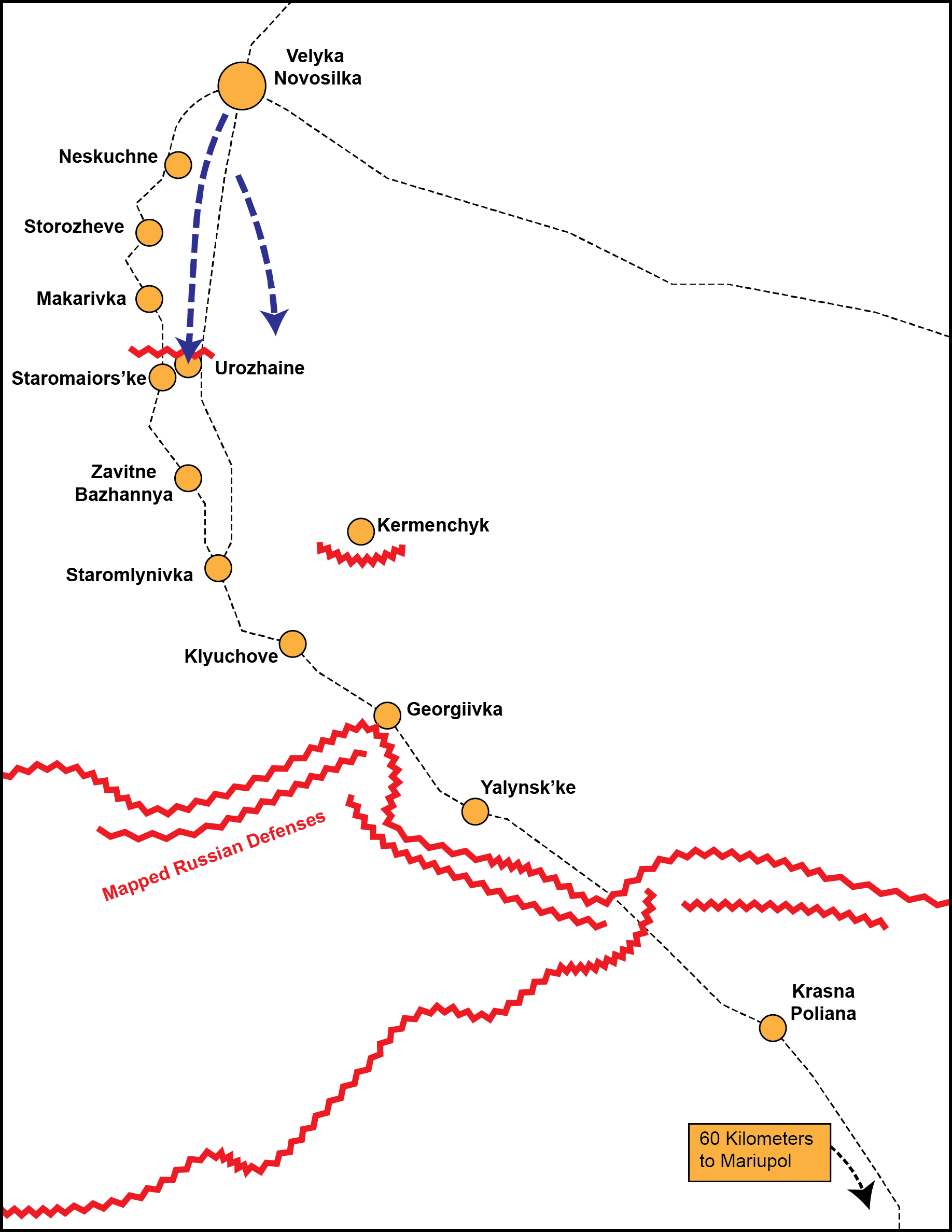
    I am cognizant of the fact that I would be raked over the coals if I failed to discuss a secondary area of Ukrainian effort, farther to the east in Donestk oblast. Here, the Ukrainians have worked their way a good distance up the highway out of the town of Velyka Novosilka capturing several settlements.

    The problem with this “other” Ukrainian attack is that it is, in a word, inconsequential. This axis of advance is operationally sterile in a very fundamental way, as it involves pushing groups up a narrow corridor of road that doesn’t lead anywhere important. As in the Robotyne sector, the AFU is still quite some distance from any of the serious Russian fortifications, and to make matters worse the road and settlements on this axis lay along a small river. Rivers, as we know, flow along the floor of the terrain, which means the roadway sits at the bottom of a wadis/embakement/glacis, choose your terminology. In fact, the road network as such consists of nothing except a single-lane roadway on either side of the river

    The Sideshow in the East

    My reading of this axis is essentially that it was intended as a feint to create some semblance of operational confusion, but when the primary effort on the Orikhiv axis turned into a colossal misfire, the decision was made to continue to press here simply for narrative purposes. Ultimately, this is simply not an axis of advance that can exert a meaningful influence on the wider war. The forces deployed here are relatively miniscule in the grand scope of things, and they aren’t going anywhere important. Certainly, a thin, needlelike penetration is not going to drive more than 80 kilometers down a single lane road to the sea and win the war.

    Conclusion: Finger Pointing

    One of the surest signs that Ukraine’s counteroffensive has taken a cataclysmic turn is the way Kiev and Washington have already begun to blame each other, conducting a postmortem while the body is still warm. Zelensky has blamed the west for being too slow to deliver the requisite equipment and ammunition, arguing that unacceptable delays allowed the Russians to improve their defenses. This strikes me as rather obscene and ungrateful. NATO built Ukraine a new army from scratch in a process that already required greatly truncating the training times.

    On the other hand, western experts have begun to blame Ukraine for supposedly being unable to adopt “combined arms warfare”. This is really a very nonsensical attempt to use jargon (incorrectly) to explain away problems. Combined arms simply means the integration and simultaneous use of various arms like armor, infantry, artillery, and air assets. Claiming that Ukraine and Russia are somehow cognitively or institutionally incapable of this is extremely silly. The Red Army had a complex and extremely thorough doctrine of combined arms operation. One professor at the US Arms School of Advanced Military Studies said: “The single most coherent core of theoretical writings on operational art is still found among the Soviet writers.” The idea that combined arms is some foreign and novel concept to Soviet officers (a caste that includes the Russian and Ukrainian high command) is ridiculous.

    This issue is not some sort of Ukrainian doctrinal obstinacy, but a combination of structural factors rooted in the insufficiency of Ukrainian combat power and the changing face of warfare.

    It’s frankly a little silly to say that Ukraine needs to learn about “combined arms” when they are very simply lacking important capabilities that would make a successful maneuver campaign possible – namely, adequate ranged fires, a functioning air force (and no, F-16’s will not fix this), engineering, and electronic warfare. The issue very fundamentally is not one of doctrinal flexibility, but of capability. By way of analogy, this is a bit like sending a boxer out to fight with a broken arm, and then critiquing his technique. The problem is not his technique – the problem is that he’s injured and materially weaker than his opponent. So too, the problem for Ukraine is not that they are incapable of coordinating arms, the problem is that their arms are shattered.

    Secondly – and this, I admit, is rather shocking to me – western observers do not seem open to the possibility that the accuracy of modern ranged fires (be it Lancet drones, guided artillery shells, or GMLRS rockets) combined with the density of ISR systems may simply make it impossible to conduct sweeping mobile operations, except in very specific circumstances. When the enemy has the capacity to surveil staging areas, strike rear area infrastructure with cruise missiles and drones, precisely saturate approach lines with artillery fire, and soak the earth in mines, how exactly can it be possible to maneuver?

    Combined arms and maneuver are predicated on the ability to rapidly concentrate enormous fighting power and attack with great violence at narrow points. This is probably impossible given the density of Russian surveillance, firepower, and the many obstacles they have put up to deny Ukrainian freedom of movement and scleroticize their activity. The main examples of maneuver in recent western memory – the campaigns in Iraq – have only tenuous relevance to circumstances in Zaporizhia.

    Ultimately, we have returned to a war of mass – particularly massed ISR assets and fires. The only way Ukraine can maneuver the way they want is to break open the front, and they can only do this with more of everything – more mine clearing equipment, more shells and tubes, more rocketry, more armor. Only mass can crack open a suitable breach in the Russian lines. Otherwise, they are stuck in a positional creep through the dense Russian defenses, and criticizing them for being unable to grasp some sort of magical western notion of “combined arms” is the strangest sort of finger pointing.

    So, whence goes the war from here? Well, the obvious question to ask is whether we believe Ukraine will ever have a more potent assault package than the one they started the summer with. The answer clearly seems to be no. It was like pulling teeth to scrape together these understrength brigades – the idea that, following on a defeat in the Battle of Zaporizhia, NATO will somehow put together a more powerful package seems like a stretch. More to the point, we have American officials saying fairly explicitly that this was the best mechanized package Ukraine was going to get.

    It does not seem controversial to say that this was Ukraine’s best shot at some sort of genuine operational victory, which at this point seems to be slowly trickling away into modest but materially costly tactical advances. The ultimate implication of this is that Ukraine is unable to escape a war of industrial attrition, which is precisely the sort of war that it cannot win, due to all the asymmetries that we mentioned earlier.

    In particular, however, Ukraine cannot win a positional-attritional war because of its own maximalist definition of “winning.” Since Kiev has insisted that it will not give up until it returns its 1991 borders, an inability to dislodge Russian forces poses a particularly nasty problem – Kiev will either need to admit defeat and acknowledge Russian control over the annexed areas, or it will continue to fight obstinately until it is a failed state with nothing left in the tank.

    Trapped in a bat fight, with attempts to unlock the front with maneuver coming to naught, what Ukraine needs most is a much bigger bat. The alternative is a totalizing strategic disaster [end]

    The original article

    Related

    The Atlanticist counter-offensive

    the last NATO attempt to avoid defeat in its proxy war in Donbass and Ukraine, against Russia

    Panzer, Marsch

    the saga of NATO Panzerkampfwagen in Donbass and Ukraine

  • [Sharing] One of the results of the US-Russia war: Africa rebels against imperialism – Elijah J. Magnier, dossierSul

    Amidst the war between the US and Russia, events unfolding on the African continent are signalling a significant rebellion against imperialist control due to the wider impact of the war on the global geopolitical landscape.

    The war between the West and Russia on Ukrainian soil is still ongoing and its outcome is yet to be known. However, its effects are being felt on several fronts. The most important of these is the significant economic impact caused on the European continent, whose leaders have chosen to engage in a war without tangible benefits.

    A notable consequence of the conflict is the emergence of a rebellion against long-standing US unilateral dominance of the world. This rebellion would not have taken root if Russian President Vladimir Putin has not courageously accepted the challenge and actively participated in the conflict that Washington had meticulously prepared for Moscow.

    A key result of this shift is the public defiance of African countries against Western domination. These nations are raising their voices against decades of exploitation, resource depletion, abject poverty and rampant corruption left behind by the imperialist powers. The vast African continent, with a population of over one billion two hundred million people, has considerable natural resources, including 40% of the world’s gold reserves, 30% of various minerals, 90% of platinum and chromium, 12% of petroleum and 8% natural gas.

    The region is undergoing significant political changes in response to the global turmoil. Military coups in the Sahel region of Africa, such as Guinea (2021), Mali (2021) and Burkina Faso (2022), brought military officers from the middle and poor classes to power. As a result, these newly formed governments announced their intention to create their own union, different from the one created in 1960.

    France, which had a significant presence in Africa, was expelled from most countries after these military coups. Only Niger, which supplies 20% to 30% of France’s uranium needs, and Chad, where France has military bases, maintain a French military presence.

    Last April, Chad expelled the German ambassador, Jean-Christian Gordon Crick, because he had criticized the head of state, General Mohamed Deby, son of Chad’s leader, Idriss Deby (who died fighting the rebels in 2021), for not holding elections in the country.

    Neither France nor the United States of America took a stand against Chad for fear of losing their essential military bases in the country. However, the African popular classes welcomed the expulsion of the German ambassador. African popular classes in several Sahelian countries celebrated the departure of France, expressing their frustration with the rise of extremist movements, corruption, poverty and inequality, and the failure of the West to deal with these issues and to quell rebellions.

    Pressure from the World Bank, which is saddling African countries with debt and is imposing austerity measures, has turned many African nations against foreign investors and multinationals. US-based Exxon Mobil and France’s Total have also faced opposition in Mozambique, where widespread rebellion has erupted over perceived unfair exploitation of the country’s second-largest natural gas field.

    In response to Africa’s shifting alliances with Russia and China, the United States has increased its presence on the continent, establishing military bases and entering into negotiations with countries such as Zambia and Ghana to counter the growing Sino-Russian-African relationship. The United States is pressuring African leaders to cut ties with China and Russia. However, the St. Petersburg conference demonstrated Africa’s determination to diversify its options and seek independence from unilateral domination. African leaders believe that competition between the world’s superpowers is healthy and can bring better opportunities to the African continent.

    At the second Russia-Africa Summit, which was attended by 49 of the 54 African countries, including 17 presidents, African leaders reaffirmed their quest for freedom of choice. Russian President Vladimir Putin welcomed them warmly and eased their concerns by offering free grain, fertilizer and vital financial facilities, mainly to Burkina Faso, Zimbabwe, Mali, Somalia, Central Africa and Eritrea. Putin promised to deliver what Africa needed in terms of food at low prices and financial ease. The gesture was received with enthusiasm and sparked a new economic and political vision that emphasized Africa’s central role in the world.

    The African authorities would not have gone to Russia in the midst of a fierce war between the country and the United States if President Putin had not dared to accept the Western challenge and stand firm in the face of the Western alliance. Russia has demonstrated that it is not afraid of a war being waged – as US Secretary of Defense Lloyd Austin put it – by top military officials from over 50 countries at the Ramstein base in Germany. Africa’s participation at the summit, including the presence of the Egyptian president, underscored the continent’s willingness to explore multiple options and to embrace China and Russia, despite Western calls to marginalize Russia. The presence of Egyptian President Adel Fattah el-Sisi shows how the Middle East is also diversifying its options, moving away from unilateral US dominance. In fact, Saudi Arabia, the UAE and Iraq have already decided to establish strong economic and trade ties with China and Russia, just one year after the war between the US and Russia in Ukraine. The Middle East and Africa are no longer under the domination of the US and the West.

    Blessed with a third of the world’s mineral wealth and 65% of its arable land, Africa has long suffered from hunger, poverty, conflict and coups. However, with officials from Western, Russian and Chinese nations in attendance, the continent is witnessing a realignment of geopolitical and economic trends. This shift is challenging the Western influence that has dominated the continent for decades and is being accelerated by Africa’s growing ties with China.

    The war between the US and Russia, fueled by the belief of dragging Russia into a destructive cycle, has inadvertently led to unintended consequences in other continents such as Africa, the Middle East, Asia and Latin America. These unintended consequences are undermining the hegemony of the United States and its allies, which are facing diminishing influence on the world stage.

    During a crucial vote in the General Assembly in March last year, there was a significant shift in Africa’s position, which called for Russia’s withdrawal from Ukraine and an end to the war. A remarkable 31% of African countries were absent from the vote, 15% abstained and 1% voted against the resolution. This unprecedented stance has raised alarm bells among Western powers that have historically occupied and exploited Africa and exercised their influence over policy decisions on the continent. This newfound assertiveness came after Africa’s increased engagement with the world, especially China. It has been instrumental in developing more than 46 ports and land roads in Africa, connecting nations and linking them to the global economy. This transformation raised concerns in the West, which previously benefited from keeping Africa underdeveloped and dependent.

    The impact of the ongoing war further underscore that the United States miscalculated in provoking Russia and underestimated the consequences on other continents, such as Africa, where regional dynamics have changed dramatically. As Africa and other regions, including the Middle East, Asia and Latin America, are experiencing unforeseen shifts in geopolitical alliances and economic trends, the influence of the United States and its allies continues to wane.

    Africa’s bold moves to diversify its partnerships and assert its independence from unilateral domination is challenging the status quo and promote a new global balance of power. With a wealth of natural resources and a growing population, Africa is increasingly becoming a major player in international relations, attracting the attention of countries in conflict seeking to strengthen their position on the world stage.

    As the war between the US and Russia continues to unfold, it is clear that the world is witnessing a significant shift in geopolitical dynamics. The rebellion against imperialist control that arose in Africa is just one example of the conflict’s unforeseen consequences. As Africa is signalling its willingness to explore diverse partnerships and challenge long-standing dominance, the global order is being reshaped, prompting countries to reassess their positions and realign their strategies.

    As events are unfolding, the full extent of the war’s impact on Africa and the wider international community remains uncertain. But one thing is certain: the war between the US and Russia is contributing to a tectonic shift in global geopolitics, with Africa at the forefront of asserting its independence and defining its destiny. The continent’s growing influence and evolving alliances could redefine the post-Cold War balance of power and impact international relations. Africa is opposing unilateral domination amidst global geopolitical shifts [end]

    The original article

    Elijah J Magnier is a veteran war correspondent and senior political risk analyst with over 35 years of experience

    Related

    African revolution

    France is expelled from its former colonies in West Africa

  • [Sharing] Who is Responsible for Ukraine’s Failed Counteroffensive? – Scott Ritter, Sputnik

    On a normal summer’s day, the road to Rabotino would be empty, save for the odd combine tractor and the vehicles driven by farmers and their families as they tend to the fields of crops they had planted in spring.

    The summer’s heat would reflect off the horizon, creating glimmering mirages, while the still air would echo with the chirping of birds and the buzzing of insects. On a normal summer’s day, the road to Rabotino would resemble paradise.

    Today, the road to Rabotino can best be described as a highway to hell: the serene landscape scarred with craters made by artillery shells, bombs, and mines. Fields that once grew crops intended to feed the world now seem to produce another crop—the torn, burned-out hulks of Ukrainian tanks, infantry fighting vehicles, and other military vehicles of all shapes and sizes.

    The air buzzes not with bees, but bullets, and the sky above is torn by the sound of shells passing overhead, on their way to their intended target, often consisting of a new crop of military metal waiting to be consumed by fire. The smell of fresh soil, young crops, and flowers of the field has been replaced by the fetid stench of rotting corpses, abandoned by their comrades who fled for their lives.

    The Russian Ministry of Defense has assessed that, since the Ukrainian counteroffensive began in early June, the Ukrainian Army has suffered some 43,000 casualties, with more than 4,900 pieces of equipment, including 1,831 tanks and infantry fighting vehicles (among which are included 25 German-made Leopard tanks and 21 US-made M-2 Bradley Infantry Fighting Vehicles) having been destroyed.

    Russian casualties, while unspecified, have been alluded to by President Putin, who stated that the kill ratio was 10:1 in Russia’s favor. That equates to 4,300 casualties: the brutal blade of war cuts both ways.

    The casualties suffered by Ukraine roughly align with the casualties suffered by German forces during their offensive operations against the Soviet Army in the battle of Kursk, fought in the month of July and August 1943. The Kursk battle was one of the largest during the Second World War.

    This should give one an idea of the scope and scale of the violence which has transpired in and around the village of Rabotino, and elsewhere in the Zaporozhye and Donetsk regions where Ukraine and Russian forces are confronting one another.

    When an army suffers a defeat of the scope and scale of that suffered by Ukraine near Rabotino, and in other fields and villages across the line of contact with Russia, it is normally incumbent upon the leadership of the defeated forces to ascertain the reasons why the defeat occurred, and then to undertake remedial action to correct the problems identified.

    It came weeks after being on the receiving end of criticism from their erstwhile allies and partners in NATO, who provided Ukraine with both the material used to equip the Ukrainian Army, and training on how this equipment was to be used in battle against the Russians.

    According to NATO, the Ukrainians were not using the tactics taught to them in Germany, France, and the United Kingdom, and as such failed to make best use of the equipment that had been provided to them for this offensive.

    From the Ukrainian perspective, however, the blame is cast back on NATO for providing Ukraine with a plan of action, but not providing the tools necessary to successfully implement the plan. While the Ukrainian military did receive most, if not all (or in some cases, more) of the 300 tanks, 500 infantry fighting vehicles, and 500 artillery pieces it had said were required for a successful counterattack designed to throw Russian forces from the former Ukrainian territories of Kherson, Zaporozhye, Donetsk, and Lugansk that were annexed by Russia in September 2022 following a referendum on joining Russia—as well as Crimea, which Russia annexed back in 2014—the Ukrainians did not receive the artillery ammunition or modern F-16 fighter aircraft it had requested.

    The failure of the Ukrainian counteroffensive, according to the Ukrainian leadership, was directly attributable to the inability of Ukraine to suppress Russian artillery and airpower, both of which, when combined with the extensive use by Russia of mines in preparing their defenses, prevented the Ukrainians from achieving their goals and objectives outlined for the operation, namely to break through the Russian defenses and capture the city of Melitopol, thereby severing the land bridge connecting Crimea to Russia.

    But the reality is that the Ukrainian counteroffensive was never going to work, under any circumstance. First and foremost, the Ukrainian Army is not the same military force that existed when the Special Military Operation began in February 2022. That army was largely destroyed in the fighting that raged from February through June 2022.

    Thanks to tens of billions of NATO-provided equipment, and billions more in financial and training support, Ukraine was able to rebuild its army, which it used to good effect in the fall of 2022, driving Russian forces out of the Kharkov region and from the right back of the Dnieper River.

    But this victory came with a heavy price tag, and NATO and Ukraine were compelled to build a third army, consisting of the equipment requested by Ukraine, and some 60-90,000 Ukrainian troops who were trained by NATO. It is this army that is being sacrificed on the road to Rabotino today.

    Most of the troops that comprised this new army had little or no prior military experience. They received approximately three weeks of training on military fundamentals, before being trained on the operation (and maintenance) of the new NATO weapons they would be using.

    Then they spent a few weeks carrying out field exercises designed to simulate an attack on the Russian defenses using complex “combined arms” tactics taught by NATO and American instructors. After this, they were shipped back to Ukraine and sent on the road to Rabotino.

    The reduction of a prepared defensive line is one of the most complicated tasks one can assign a military unit in combat. To successfully execute this mission, the assault forces need to be masters of their craft, operating as part of a combined arms team capable of suppressing enemy forces, and breaching minefields while maneuvering under fire.

    This is a task that experienced units with years of training under their belts would have difficulty pulling off. For an army like Ukraine’s third-generation force, this was a mission impossible, something every NATO trainer involved in preparing the Ukrainian forces would have known.

    The massacre that occurred along the road to Rabotino was unavoidable so long as Ukraine and their NATO masters believe that the conflict with Russia can be resolved through force of arms. The problem is that the disparity between the quality and quantity of forces deployed by Ukraine and their western supporters on the one side, and Russia on the other, is too wide to be bridged by any combination of training and equipment NATO might be able to provide.

    There is no magic weapon available to the West that can change the reality on the battlefield in and around Rabotino. Neither F-16’s and/or ATACMS can alter this reality. Nor is there a magic wand that can be waved over the battlefield to change the qualitative issues regarding the Ukrainian soldiers, who arrive on one of the most technologically advanced—and lethal—battlefields in modern history with little or no training.

    The Ukrainian generals responsible for giving the orders to the Ukrainian Army, and the NATO trainers who prepared them for battle, knew that the outcome that is transpiring along the road to Rabotino was inevitable.

    The harsh fact is that tens of thousands of Ukrainian soldiers and billions of dollars of western military equipment have been sacrificed not for viable military purposes, of which there are none, but rather to assuage the political needs of Ukraine’s leaders, who needed to be seen as being willing to make use of the training and material support provided, and their US and NATO masters, who needed to be able to point to battlefield successes in Ukraine to justify the diversion of their respective national treasury and military arsenal to the Ukrainian cause.

    The road to Rabotino is paved with the detritus of western hubris, manifested in the flesh and blood of the Ukrainian Army scattered amongst the destroyed material produced by the defense industries of the collective West. This battle had only one possible ending, which has come to pass.

    But the real tragedy is that neither Ukraine nor the collective West have absorbed the lessons that they were taught by the Russian Army—that the conflict in Ukraine can only end in a Russian victory. Sadly, many thousands of more Ukrainian soldiers, and tens of billions of dollars more of western military equipment, will need to be sacrificed before this lesson is finally driven home [end]

    The original article

    62-year-old Scott Ritter is a former intelligence officer within the US Marine Corps (USMC), then inspector of the United Nations in Iraq. When in 2003, the US and their British minions were about to invade the country under this false pretext, Ritter was claiming that there was no weapon of mass destruction (WMD) there. He was right.

    Related

    The Atlanticist counter-offensive

    the last NATO attempt to avoid defeat in its proxy war in Ukraine against Russia

    Panzer, Marsch

    the saga of NATO Panzerkampfwagen in Donbass and Ukraine

  • Les oeils de Moscou

    ils sont partout, ils sont l’anti-France

    Heureux sans abonnement à l’Express, je n’ai pas accès à l’article, seulement un titre et un chapô, qui à eux seuls, sont une joyeuse source d’inspiration

    Avec ou sans faux-nez, ils cherchent à dynamiter l’unité occidentale face à la folie destructrice de Vladimir Poutine. Par anti-américanisme, par haine de notre démocratie libérale, ceux que l’on surnomme les prorusses et les « idiots utiles » du Kremlin s’activent sur les réseaux sociaux et dans les sphères politiques. On les croyait condamnés au silence depuis l’invasion russe, ils n’ont jamais été aussi dangereux

    Comme ils sont méchants, comme ils nous font peur, ces vilains pro-russes. Comment pourrait on [on est un con, m’a t on appris quand j’étais tout petit] les condamner au silence ? Par l’accentuation de la censure sur les réseaux sociaux ? Commandement bureaucratique d’un espace libre-échangiste subordonné à l’OTAN, l’Union européenne y songe pour ce mois d’août.

    Afin de conjurer son angoisse, l’Express a entrepris d’étiqueter les différents canaux pro-russes, de ficher leurs têtes de gondole : Henri Guaino, Jean-Luc Mélenchon, Marine le Pen, Ségolène Royal… etc Anti-américains, militaires, covido-sceptiques, hommes d’affaire, russophiles, pacifistes, extrême-droite…, les oeils de Moscou sont partout, c’est effrayant. Sans désemparer, les employés de presse se sont saisis de leur clavier pour atténuer les malheurs de l’Occident.

    Les envolées lyriques partisanes me font rire et l’hilarité me permet de surmonter mon dégoût pour l’excrétion des états d’âme franchouillards. Aussi cruels qu’ils puissent être, les faits sont plus intéressants sans fioriture littéraire. Contrairement aux personnalités politiques citées plus haut, mon analyse n’est pas polluée par le patriotisme, forme théorisée de l’instinct grégaire. La justice est ma seule patrie.

    La guerre au Donbass éclata en 2014, quand après un coup d‘État fasciste à Kiev, les nouvelles autorités entreprirent d’écraser les aspirations autonomistes de leurs citoyens russophones. En renfort de militaires encore fidèles, elles expédièrent au Donbass des militants nazis légalisés en bataillons nationaux de volontaires.

    Plutôt que de contribuer à désamorcer la crise, l’OTAN y vit l’opportunité stratégique d’une guerre par procuration contre la Russie. Son fantasme était de la démembrer, pour améliorer son rapport de force à la Chine. Alors que l’hypocrisie occidentale ne laissait pas d’autre solution, l’opération militaire spéciale est devenue une nécessité technique en février 2022. La Russie a relevé le défi, s’est portée au secours de la population russophone du Donbass.

    La paix était enfin possible en mars, après quelques semaines seulement de combat, mais les Anglo-États-uniens y opposèrent leur veto. Le champ de bataille se dresse désormais entre la réalité et les fantasmes de médiocres politiciens occidentaux.

    À l’instar de la rédaction de l’Express, les jeunes Français me paraissent en général peu équipés pour y briller. Alors que l’OTAN perd cette guerre et accélère l’inéluctable déclin de l’hégémonie occidentale, les employés de l’Express semblent peu pressés de remplacer fusil en main la chair à canon ukrainienne hachée en vain pour atténuer leurs angoisses. Ils font le choix ancré dans une tradition bien française d’établir le fichier de leurs concitoyens pro-russes. Ils donnent leur sang, donnez votre voisin. Puisque son champ d’action demeure derrière le clavier, j’ai hâte que la rédaction s’intéresse aux nazis français partis en Ukraine défendre l’Europe, la démocratie et la liberté.

    Je suis assez vieux pour avoir observé les précédentes entreprises criminelles et catastrophiques des États-unis et de leurs alliés, tentatives de préserver leur hégémonie d’un déclin mécanique et inéluctable. Je suis de ceux que les couveuses koweïtiennes et autres armes de destruction massive ont échaudés.

    À l’époque indépendante, la France s’opposa en 2003 à l’invasion de l’Irak. Plus tard hélas, Nicolas Sarkozy fut le complice de la destruction de la Libye. Folie destructrice ? De loin le plus crétin, François Hollande paya la note et quelques Français avec lui, quand le 13 novembre 2015, une opération djihadiste fut l’anecdotique dommage collatéral à Paris du soutien occidental à l’insurrection sunnite radicale contre le gouvernement laïc de Syrie. Au train où vont les choses en Ukraine, ces désagréments ne sont pas finis

    Par mon âge et mon expérience professionnelle, je me targue d’une culture historique et politique supérieure à celle de l’auteur de romans policiers Charles Haquet ou de l’étudiante en affaires internationales Emma Collet, qui ont commis cet article d’anthologie.

    Au déclenchement de l’opération militaire spéciale, voilà plus d’un an, mes sentiments étaient plus neutres. Mais à la façon dont les mêmes pressetitués ont encore une fois déversé des torrents de boue -mensonges, propagande ukrainienne pour demeurés et autre fantôme de Kiev– ont cherché sans vergogne à blanchir le nazisme endémique ukrainien et ses crimes, j’ai vite compris où étaient dans cette affaire le droit et la justice. D’ailleurs, l’immense majorité des vastes restes du monde est arrivée aux mêmes conclusions

    Cet article est aussi l’authentique expression d’un pays dont le courage n’est pas la première qualité qui vient à l’esprit, quand il est évoqué à l’étranger. D’une presse à ce point servile et caricaturale, qu’un Philippe Henriot ne la renierait pas. D’un peuple froussard à l’arrogance rurale, dont la compréhension des questions internationales est aussi mièvre que chauvine. Car enfin, comme il faut être lâche et rompu aux petits arrangements d’alcôve, pour encencer en qualité de Français, un régiment Azov qui arbore fièrement l’emblème de la 2. SS-Panzer-Division, Das Reich, qui le 10 juin 1944, massacra 643 habitants d’Oradour sur Glane. Impensable à l’étranger.

    Je vous laisse votre démocratie libérale -quand votre libéralisme ne résiste pas à la première éraflure sur la carosserie de votre automobile à crédit- votre chef d’État élu par 25% du corps électoral, ses Gilets jaunes mutilés, son 49.3 et sa presse subventionnée. Elle ne m’intéresse plus, mais fait encore plier de rire une large majorité du globe. Elle est digne de vous, employés de l’Express, petits bourgeois du blême Hexagone, racaille macroniste. Vous avez au moins compris une chose : votre défaite par procuration au Donbass est le début de votre fin.

  • [Sharing] Ukrainian Counteroffensive’s Second Week Ends in Failure – Scott Ritter

    Operation enters the second week of Ukraine’s long-awaited and highly touted counteroffensive, some basic conclusions can be drawn even though the fighting continues, and will continue to rage, for some time to come.

    First and foremost, the counteroffensive gambit has failed. While there is still considerable combat strength left in the Ukrainian military, including more than 75% of the NATO-trained and -equipped 60,000-strong cohort Ukraine had assembled in the past eight months, fundamentally flawed assumptions about the quality of the force on which Ukraine and its NATO allies had placed their collective hopes for victory over Russia have been exposed. In short, Ukraine lacks the military capacity to overcome Russian defenses.

    Ukraine’s most elite assault brigades, equipped with the latest Western military technology, failed to advance out of what Russian defensive doctrine calls the “cover” line of defense—the buffer that is designed to channel and disrupt an attacking force prior to reaching the “main” line of defense. Ukrainian casualties were extremely heavy, with Russia achieving a 10:1 kill ratio in terms of manpower, which is unsustainable from the Ukrainian perspective. The reasons for the Ukrainian failure are fundamental in nature, meaning that they cannot be overcome as things currently stand and, as such, the Ukrainian military has zero chance of success, no matter how hard they press subsequent attacks.

    First and foremost is the quality of the Russian defenses, especially in terms of the barrier network (minefields, obstacles, and trenches) which, when combined with the tenacity of the Russian defender and the overwhelming superiority Russia enjoys in terms of fire support (both artillery and air-delivered), is the reason the Ukrainians are unable to advance beyond the “cover” layer of the Russian defenses. Ukrainian equipment and tactics are insufficient to the task of breaching the Russian obstacle barriers in any meaningful manner, dooming the attacking forces to be destroyed piecemeal by Russian artillery and air strikes, as well as local counterattacks mounted by Russian special forces.

    Besides the poor tactics and equipment deficiencies (yes, the Leopard tanks and Bradley fighting vehicles were not the miracle weapons Ukraine and its Western supporters had hyped them up to be), the Ukrainians are paying the price for Russia’s impressive suppression of enemy air defense (SEAD) campaign that has been ongoing for many weeks now. Russia has not only neutralized Ukraine’s ability to defend strategic targets far beyond the front lines, but also to project any meaningful air defense capability into the actual zone of conflict. This, combined with the lack of any viable air force, leaves the attacking Ukrainian ground forces exposed to the full weight of Russian air power.

    Russian fixed-wing aircraft have been able to deliver precision-guided munitions with deadly effect to the assembly areas used by Ukraine to gather their attacking forces prior to committing them to the battlefield. It is estimated that between 25-30% of Ukraine’s casualties occur from these strikes. Russian helicopters can use their anti-tank guided missiles (ATGMs) with lethal effect on Ukrainian forces operating in the zone of contact, and Russian loitering munitions (i.e., “kamikaze drones”) have taken a heavy toll of Ukrainian forces as well. Unless Ukraine can reassert some semblance of air defense onto the battlefield, both in the rear areas as well as the frontlines, and sortie its own air power capable of challenging Russian air superiority over the battlefield, then no amount of courage and tactical innovation on the part of the Ukrainian ground forces will alter the deadly calculus of war that currently prevails today.

    One of the many tragedies of the ongoing Ukrainian-Russian conflict is the fact that much of what Ukraine does on the battlefield is dictated not by military necessity, but rather political imperative. The recently concluded months-long Battle for Artemovsk (Bakhmut) is a case in point, where Ukrainian President Zelensky insisted on pouring manpower and equipment into a battle for a town that most military experts believed to hold minimal strategic military value. The geography, however, did not dictate the scope and scale of the battle, but rather the perception of Ukrainian defensive tenacity, and as a result between 60-75.000 Ukrainian soldiers lost their lives in what was a losing effort. Similarly, the Ukrainian army is being asked to make what amounts to a suicide attack against well-prepared Russian defenses under conditions which, as detailed earlier, can only result in a decisive Ukrainian defeat. This time, the culprit is Ukraine’s NATO allies who, on the eve of their annual summit, are desperate for any sign that the multi-billion-dollar investment they have collectively made in the Ukrainian military can pay even the most rudimentary dividends. For this reason, NATO will continue to pressure Ukraine to double down on defeat, pressing the Russians offensively even though any gains, if in fact any can be had, would be pyrrhic in nature and unsustainable over the long run.

    The reality is that when NATO gathers in Vilnius on July 11, the Russians will be well into the process of destroying the third Ukrainian army built by NATO. The first was assembled during the buffer provided by the diplomatic “sham” of the Minsk Accords, from 2015-2022. Some 260,000 strong, this force was largely destroyed by June of 2022. The second army, consisting of some 80,000 newly trained and equipped Ukrainian soldiers backed by thousands of foreign mercenaries, the direct result of tens of billions of dollars of military aid provided by NATO, was able to launch the successful Ukrainian counterattack in the fall of 2022, before being decimated in the positional war that followed (including the Bakhmut slaughter).

    The 60,000-strong 12-brigade Ukrainian counterattack force currently operating against the Russians, again the result of tens of billions of dollars in military equipment (including modern Western tanks, artillery, and infantry fighting vehicles), will most probably be destroyed, or facing imminent destruction, by the time the NATO summit convenes. The primary question facing NATO is does it have the political, economic, and military capacity to raise a fourth Ukrainian army, and after its demise, a fifth, sixth, and more?

    NATO is politically committed to waging a proxy conflict with Russia “to the last Ukrainian.” This tragic reality means that, regardless of the battlefield reality that exists in Ukraine, NATO will continue to push Ukraine to sacrifice its manpower in a fruitless struggle against Russia for the simple fact that NATO is unwilling to willingly lose political face at home and abroad.

    However, this political will does not automatically mean that NATO will be able to sustain this objective either economically or militarily.

    While recent statements made by US General Mark Miley, the Chairman of the Joint Chiefs of Staff, indicate that there are tens of thousands of Ukrainian soldiers in the US/NATO training “pipeline”, and that the US/NATO is assembling equipment sufficient to equip these soldiers, they will not be ready for combat for several months yet—long after the third Ukrainian army has met its fate on the field of battle.

    Miley spoke of new air defense systems for Ukraine, and other NATO officials speak of the possibility of providing Ukraine with (old) F-16 aircraft. New air defense systems, however, cannot in and of themselves alter a military reality imposed by Russia on Ukraine through its strategic SEAD victory. Ukraine will simply continue a losing struggle against Russian air power. The same holds true of any F-16 fighters that might be provided to Ukraine—too little, too late, and in any event incapable of achieving a meaningful battlefield result.

    In Vilnius, NATO will be confronted with the reality of its impotency as a military alliance when it comes to countering Russia in Ukraine. Any military analyst of any competence will know that, as things currently stand, Ukraine simply cannot prevail over Russia. NATO illusions of a “frozen conflict” that seem to drive their insane desire to arm Ukraine to infinity and beyond, moreover, are driven by fundamentally flawed assessments regarding Russian economic competence and capacity, Russian military proficiency, and the will of the Russian people to sustain this conflict.

    Here is the root cause of NATO’s strategic failure in Ukraine—a complete lack of understanding about the reality of Russia today. Russia will be able to out-produce NATO from a standpoint of military technology until which time NATO nations fully transition into a wartime economy, something NATO nations neither have the political will nor economic means to accomplish.

    The Russian military has largely overcome the deficiencies which plagued it in the initial phases of the Special Military Operation, and the Russia armed forces assemble in the Special Military Operation zone are highly trained, well-equipped, and properly trained for the tasks they have been assigned. Moreover, the Russian nation has rallied around the leadership of Russian President Vladimir Putin in an overwhelming fashion, united in the belief that the proxy war NATO is waging against Russia in Ukraine is existential in nature and, as such, one that Russia cannot lose.

    NATO will not alter course in the immediate period following the Vilnius summit—there is simply too much political momentum in place to bring about any meaningful alteration of the current trajectory in Ukraine. But neither will NATO produce a winning formula in Ukraine. Rather, NATO will continue to pursue little more than a variation of an existing theme—to arm Ukraine so that it can fight as long as it is capable of sustaining the fight.

    This short-sighted posture will result in the inevitable military collapse of Ukraine, probably sometime between late summer/early fall of this year. When this happens, NATO will be left scrambling to construct some sort of face-saving mechanism to salvage its weakened geopolitical position vis-à-vis Russia. What that will look like is unknown at this time. But one thing is for certain—because NATO refuses to consider an off-ramp from the Ukrainian conflict today, there will be no future for Ukraine tomorrow. NATO political pride will be the downfall and destruction of the Ukrainian nation, its military, and its people [end]

    The original article

    61-year-old Scott Ritter is a former intelligence officer within the US Marine Corps (USMC), then inspector of the United Nations in Iraq. When in 2003, the US and their British minions were about to invade the country under this false pretext, Ritter was claiming that there was no weapon of mass destruction (WMD) there. He was right.

    Related

    Chrystia Freeland’s Nazi Problem – Scott Ritter

    November 14, 2022

    Never Forget the Soviet Heroes Who Liberated Auschwitz – Scott Ritter

    January 27, 2023

    Finally the Bull Charged – Scott Ritter

    June 11, 2023

    Countdown of the Atlanticist defeat in Bakhmut

    a so predictable chronicle

    The Atlanticist counter-offensive

    chronicle about the last NATO attempt to avoid defeat in its proxy war in Ukraine against Russia

  • [Sharing] Finally the Bull Charged – Scott Ritter

    Finally the bull charged, the horse leaders ran for the barrera, the picador hit too far back, and the bull got under the horse, lifted him, threw him onto his back.

    Zurito watched. The monos, in their red shirts, running out to drag the picador clear. The picador, now on his feet, swearing and flopping his arms. Manuel and Hernandez standing ready with their capes. And the bull, the great, black bull, with a horse on his back, hooves dangling, the bridle caught in the horns. Black bull with a horse on his back, staggering short-legged, then arching his neck and lifting, thrusting, charging to slide the horse off, horse sliding down. Then the bull into a lunging charge at the cape Manuel spread for him.

    Ernest Hemingway, The Short Stories

    Finally the bull charged.

    The long-awaited Ukrainian counter-offensive has finally begun. After months of handwringing and speculation, the western investment in Ukrainian military might has been put on display for the whole world to see—billions of dollars of advanced weaponry, drawn from NATO stocks, manned by Ukrainian soldiers who have been trained by NATO instructors, and whose actions have been shaped by NATO intelligence and directed by NATO planners. Let there be no doubt—this is a NATO offensive, a sad reflection on the reality that what was once called a simple proxy conflict has morphed into so much more—direct force-on-force combat between the collective west and Russia.

    For Anne Applebaum, this offensive is an answer to her prayers. The Polish-American Pulitzer Prize-winning historian has for some time now been calling for such an action, a decisive blow by the collective west and Ukraine against a Russia she characterizes as autocratic and dangerous. The lessons of history have been shunted aside in favor of her feverish lust for Russian blood. Killing Russians, Applebaum believes, is the only way for the civilized west to show the Russian nation—autocrats and automatons alike—that the price for regional hegemony is too high for the Russian people and their government to bear.

    Anne Applebaum (Photo: Olga Majrowska)

    In a new article she penned for The Atlantic, Applebaum—a staff writer for the journal— writes of things she has no knowledge of or experience in, namely military operations, both operational and psychological. Like the dilletante she is, Applebaum throws about buzz phrases as if by putting them down on paper, it somehow makes them real, and the schemes they describe possible.

    Applebaum, however, is hampered by her inadequacy as a military analyst and—perhaps more importantly—her total ignorance of the character of the Russian people, their leadership, and the nation they represent collectively. Elegantly stated ignorance is Applebaum’s forte, especially when it comes to glossing over both the causation and consequences of a conflict she has been promoting her entire adult life.

    https://youtu.be/T5N_2Y0R-38

    Scott Ritter will discuss this article and answer audience questions on Ep. 73 of Ask the Inspector.

    Applebaum has turned an extensive stint in academia, inclusive of a six-month exchange program as a student to Leningrad circa 1985, into the intellectual foundation of a career spent sorting through the detritus of Soviet history, to reimagine Stalin and the Soviet experience in the worst possible light. It is not that one would be desirous of reimagining Stalin and Stalinism as the golden era of Soviet rule.

    But perspective, and historical accuracy, do matter, and Applebaum’s writing seems destined to a particular brand of Russophobic western elite pre-programmed into accepting at face value anything negative about Stalin and his times. Her hatred for everything Russian, especially its leader, Vladimir Putin, drips from every paragraph she pens. She sees herself and the collective west as combatants in the greater struggle against what she derisively calls “Putinism.”

    “[A]s long as Russia is ruled by [Vladimir] Putin,” Applebaum wrote recently, “then Russia is at war with us [i.e., the collective west] too.”

    This fight is not theoretical. It requires armies, strategies, weapons, and long-term plans…NATO can no longer operate as if it might someday be required to defend itself; it needs to start operating as it did during the Cold War, on the assumption that an invasion could happen at any time.

    Germany’s decision to raise defense spending by 100 billion euros is a good start; so is Denmark’s declaration that it too will boost defense spending. But deeper military and intelligence coordination might require new institutions—perhaps a voluntary European Legion, connected to the European Union, or a Baltic alliance that includes Sweden and Finland—and different thinking about where and how we invest in European and Pacific defense.

    Applebaum’s words are a direct reflection of the sentiment expressed by one of her mentors, the Hungarian billionaire George Soros. In 1993, Soros wrote an article where Applebaum’s “new institution” thematic was expressed in more direct terms. Soros wrote of the need for a new world order “based on the United States as the remaining superpower and on open society as the organizing principle.”

    It consists of a series of alliances, the most important of which is NATO and, through NATO, the Partnership for Peace which girds the Northern Hemisphere. The United States would not be called upon to act as the policeman of the world. When it acts, it would act in conjunction with others. Incidentally, the combination of manpower from Eastern Europe with the technical capabilities of NATO would greatly enhance the military potential of the Partnership because it would reduce the risk of body bags for NATO countries, which is the main constraint on their willingness to act. This is a viable alternative to the looming world disorder.

    The combination of manpower from Eastern Europe with the technical capabilities of NATO as a mechanism for reducing the risk of body bags for NATO countries sounds very much like precisely what is taking place today in the current struggle between Ukraine and Russia. The imagery of destroyed Leopard tanks and Bradley infantry fighting vehicles belies the reality that the charred bodies trapped inside these wrecked vehicles and scattered in the fields surrounding the scene of their collective demise, are Ukrainian.

    NATO technical capabilities and Ukrainian manpower does, in fact, reduce the risk of NATO body bags. It also emboldens western writers such as Applebaum to urge the Ukrainians on in a fight with Russia neither they nor the west has a chance of winning. The goal of the Ukrainian counteroffensive, Applebaum contends, is to “convince the Russian elite that the war was a mistake and that Russia can’t win it, not in the short term and not in the long term, either.”

    Applebaum would do well to reflect on the reality that the anti-Putin Russian elite she fantasizes about influencing through the nexus of NATO technical capabilities and Ukrainian blood does not exist inside Russia any longer. Liliya Vezhevatova, an anti-war and LGTBQ activist from Novosibirsk who fled to Armenia following the initiation of Russia’s Special Military Operation in February 2022, noted that before the conflict started her organization could boast around 2,000 activists. Today that number is down to around 200.  

    “It is an irony of this conflict,” Vezhevatova laments, “that the female relatives of perished soldiers often hold the most ardent pro-war positions.” Vezhevatova explains this phenomenon by declaring that these mothers have been raised on the mythology of the “Great Patriotic War” (World War II), which casts the mother of a soldier as a heroic figure. “The situation is complicated by deep psychological mechanisms at play,” Vezhevatova notes. “It is hard to accept that a loved one perished for no reason.”

    https://youtu.be/tncTVsd3O2E

    Vezhevatova has a point—no mother would like to see the son she bore and raised die for no reason. But what Vezhevatova and Applebaum fail to see is the reality that the mothers and wives of the men fighting for Russia against Ukraine and the collective west are, in their minds, fighting for Mother Russia’s very survival. The monuments in Volgograd erected to commemorate the heroism of the Russian soldier in defense of his homeland (“Stand to Death”) and the awe-inspiring sight of Mother Russia beckoning her men forward in defense of their homeland (“The Motherland Calls”) is more than simple mythology weaponized for psychological manipulation. It is reflective of a deep patriotism that runs through the blood of most Russian women today.

    Vezhevatova has abandoned her country, opting to live abroad while supporting westerners like Applebaum who are content with sacrificing Ukrainian men in the name of furthering western anti-Russian objectives. She has forsaken her homeland. Not so the women of Russia who remain. They know what is at stake. They know, as did their grandmothers before them, what needs to be done, inclusive of the horrible sacrifices that entails.

    The statues “Stand to Death” (foreground) and “The Motherland Calls” (background), Volgograd

    Meanwhile, Applebaum sits in the relative safety of her writer’s perch, claiming to be a friend of Ukraine all the while urging the men of Ukraine forward to slaughter.

    Applebaum’s bloodlust brings to mind a passage from Ernest Hemingway’s 1926 classic novel, The Sun Also Rises. Hemingway touches upon the dichotomy of killing one’s friends in a short conversation between Romero, a Spanish bullfighter, and Lady Brett Ashley, a British widow.

    “The bulls are my best friends,” Romero says in Spanish. His words are translated into English by Jake, an American expatriate and friend of Lady Ashley.

    “You kill your friends?” Lady Ashley replies.

    “Always,” Romero says in English, laughing.

    It is the imagery of the bullfight that best describes Anne Applebaum’s desire to see Ukrainians killed in battle against the Russians. She treats the Ukrainian counteroffensive as a blood sport, a dance to the death between a matador and a fighting bull.

    Finally the bull charged…

    The contemporary Lebanese writer, Malak El Halabi, wrote about her experience watching a bullfight.

    [T]o watch the bull enter the arena…To watch one bull surrounded by a matador and his six assistants. To watch the matador confronting the bull with the capote, performing a series of passes, just before the picador on a horse stabs the bull’s neck, weakening the neck muscles and leading to the animal’s first loss of blood…Starting a game with only one side having decided fully to engage in while making sure all the odds will be in the favor of him being a predetermined winner. It was this moment precisely that made me feel part of something immoral. The unfair rules of the game. The indifferent bull being begged to react, being pushed to the edge of fury. The bull, tired and peaceful. The bull, being teased relentlessly. The bull being pushed to a game he isn’t interested in. And the matador getting credits for an unfair game he set.

    Yes, I went to watch a bull fight and yes the play of colors is marvelous. The matador’s costume is breathtaking and to be sitting in an arena fills your lungs with the sands of time. But to see the amount of claps the spill of blood is getting was beyond what I can endure. To hear the amount of claps injustice brings is astonishing. You understand a lot about human nature, about the wars taking place every day, about poverty and starvation…You understand a lot about humans’ thirst for injustice and violence as a way to empower hidden insecurities. Replace the bull and replace the matador. And the arena will still be there. And you’ll hear the claps. You’ve been hearing them ever since you opened your eyes.

    Finally the bull charged…

    Yes, the great Ukrainian counteroffensive has finally begun. The Ukrainian bull has been prodded into the arena by the collective west. The Ukrainian bull, weakened by the provision of inadequate weaponry and filled with the false promise of western support, does not comprehend that he is merely a pawn in a greater game, Eastern European manpower to be married up with NATO technology in a bid to weaken Russia. Maddened by the pain, blinded with fury, the Ukrainian bull sees the red cape…

    Finally the bull charged…

    Close your eyes, and you can hear the claps of the collective west urging the Ukrainian bull on.

    Open your eyes, and you will see Anne Applebaum and her ilk reveling in the blood being spilt, cheering the slaughter and indifferent to the Ukrainian bull’s agony as the Matador slides the blade into his flesh.

    Finally the bull charged…

    This war will end one day, and when it does, Anne Applebaum and the collective west will have much to answer for [end]

    The original article

    61-year-old Scott Ritter is a former intelligence officer within the US Marine Corps (USMC), then inspector of the United Nations in Iraq. When in 2003, the US and their British minions were about to invade the country under this false pretext, Ritter was claiming that there was no weapon of mass destruction (WMD) there. He was right.

    Related

    Chrystia Freeland’s Nazi Problem – Scott Ritter

    November 14, 2022

    Never Forget the Soviet Heroes Who Liberated Auschwitz – Scott Ritter

    January 27, 2023

    80 years ago, Nazi Feldmarschall Friedrich Paulus surrenders in Stalingrad

    when the European Nazi armies lose WW2

    The Atlanticist “counter-offensive”

    the last NATO attempt to avoid defeat in its proxy war in Ukraine against Russia

  • [Sharing] EU’s Voluntary Disinformation Code Is Compulsory: Obey or Die – Declan Hayes, Strategic Culture Foundation

    Though Musk is still playing at being NATO’s token non-conformist, the EU is essentially telling him and all of us that any dissent from its Russophobic, Slavophobic and Sinophobic narratives will be severely punished

    The European Union’s enforcers have told Twitter owner Elon Musk that the EU’s voluntary information code is not voluntary and that the EU will fine the pants off Twitter if Musk does not play by NATO’s self-serving rules. Though Musk is still playing at being NATO’s token non-conformist, the EU is essentially telling him and all of us that any dissent from its Russophobic, Slavophobic and Sinophobic narratives will be severely punished.

    From the point of view of von der Leyen and NATO’s other EU puppets, that makes absolutely perfect sense. As legacy media’s active shelf life is fast expiring, that just leaves the EU with alternative media to kill off with massive fines in Twitter’s case or, more generally, by crowding out and muzzling any and all truth tellers.

    Look at the treatment being meted out to Pink Floyd’s Roger Waters, a life-long anti-fascist, whose father was killed in action fighting the Nazis but which the usual suspects, led as always by the BBC and the Guardian, are trying to ban for supposedly being a Jew-hating Nazi simply because of his support for Palestinian rights, for Julian Assange and for being stupid enough to still be doing live concerts with those unreconstructed views, as he touches 80 years of age.

    The EU’s code Waters and Musk are falling foul of “aims to prevent profiteering from disinformation and fake news, as well as increasing transparency and curbing the spread of bots and fake accounts”.

    By disinformation, in addition to Waters, von der Leyen’s thugs mean the work of folk like our own excellent Stephen Karganovic, who is not only a quality thinker and writer, but is on every EU and NATO hit list imaginable because he speaks his truths to their power. And others like Fyodor Lukyanov and Timur Fomenko, who file excellent analytical copy for Russia Today which, with this site, is subject to a string of sanctions and name-calling that are as libellous and ignorant as those these EU and NATO morons throw at Waters or any other of their betters.

    The objective in labelling SCF, Russia Today, Waters and even Masha and Mishka as dis-information is to control the common space and not to give the ideas of heretics like Jeremy Corbyn, Robert F Kennedy Junior or their type space to survive.

    With fake news, the EU is primarily concerned with folk who expose their crimes, family folk like Roger Waters and Julian Assange, who has now done the equivalent of a life tariff for exposing the tiniest fraction of the war crimes the Yanks committed in Iraq, crimes which, remember, included the gang rape of little girls by these harbingers of US-style democracy.

    And then there is Gonzalo Lira, who is in the worst of all places, in Ukraine, whose soldiers rape corpses, and whose politicians ban all opposition parties, all opposition media and all religions that do not worship their utterly corrupt system but yet, as the corpse rapists do God knows what to Gonzalo Lira in God knows where, Ukraine has seen its ranking in NATO’s Press Freedom and Transparency Indexes soar like an American bald eagle that is oblivious to the stench below. The Nazi rump Reich is, the EU’s disinformation experts proclaim, the land of the free and the land of the brave, even as it is hell on earth for Lira and millions of Zelensky’s other victims.

    The torture of Assange and Lira has silenced countless others and thereby made way for NATO’s own quack journalists to fill the void with their own fake news, which was presented to us up till recently by sexual predators like Philip Schofield, ITV’s equivalent of the BBC’s Jimmy Savile.

    Not to put too fine a point on it, but corrupt countries and institutions that elevate Jimmy Saville, Philip Schofield, Ghislaine Maxwell, Lord Boothby, Tom Driberg MP, Jeffrey Epstein, Sir Ted Heath, Cyril Smith, Karim Ahmad Khan, Imran Ahmad Khan and Prince Andrew to positions of power and authority are not in a position to lecture to anyone on transparency or to spin their fake news line on their own terrorist attack on Nordstream.

    As regards bots and fake accounts, that smear should have died a death with the end of Russiagate, one of a number of massive CIA/EU efforts to disseminate fake news and opaqueness through their own bots and fake accounts.

    But why, the Clinton, Biden, Obama and other organised crime families would ask, re-invent the wheel, when the old smears NATO’s media spin work as well as ever?

    What we have with all these rafts of EU laws, fines, sanctions, bluster and bluff is a sort of NATO Cosplay, where von der Leyen and her fellow Cosplay conspirators get to moralise, whilst the Biden, Kerry and Pelosi families get to sprinkle Ukraine with enough bio labs to take out half of Europe’s population, and the New York Post, the only media outlet that reported on the crimes Hunter Biden’s laptop revealed, gets banned and harassed by the FBI goon squads.

    Von der Leyen’s Digital Services Act will further criminalise offensive humour such as comparing French dictator Macron to Hitler (though Waters will remain fair game). Some 19 companies, including Alphabet’s Google Maps, Google Play, Google Search, Google Shopping, YouTube, Meta’s Facebook and Instagram, Amazon’s Marketplace, Apple’s App Store, Twitter, Microsoft’s two units LinkedIn and Bing, booking.com, Pinterest, Snap Inc’s Snapchat, TikTok, Wikipedia, Zalando, and Alibaba’s AliExpress will all have to obey von der Leyen’s diktats “to make the internet safer” by erasing so-called disinformation in whatever way von der Leyen and her fellow plagiarists decide to define it from one moment to the next.

    Not that war is their only earner needing the censor’s protection. Over 3,400 peer-reviewed papers questioning NATO’s Covid narrative have also been sidelined and ignored. Fake news, Russian propaganda, dis-information or some such stuff. I am one of many who did not take the vaccine von der Leyen’s husband made a fortune pimping. And I am glad I didn’t fall for their dancing nurses and their relentless marketing, irrespective of whether they were peddling fake news with their fake vaccines or not. I have no idea whether those vaccines are effective or not. I am not qualified to opine.

    But what I do know is this. There are large groups of American and European politicians, like American fugitive Lindsey Graham who have been promoted because, thick as bricks though they are, they are sufficiently spineless to pimp the wars, vaccines and other societal wrecking balls those who fund and control them are selling.

    Speaking of war, NATO and KFOR mercenaries have just slaughtered a bunch of Serbs in Zvecan (northern Kosovo). Though I look forward with interest to getting a proper analysis of this latest NATO war crime from Fyodor Lukyanov, Timur Fomenko and our own excellent Stephen Karganovic, I do know that not only will their take be totally at odds with that of the EU’s semi-literate fact-checkers but that Russia Today and Karganovic will be much nearer to the truth than any of von der Leyen’s minions could ever be because those EU yellow packs are groomed to paint over and hide the crimes against Serbs and Palestinians this article and a thousand others on this site draw attention to [end]

    The original article

    Related

    The Western disinformation about Ukraine

    chronicle of censorship, fake news, whitewashing of the Ukrainian Nazism and war crimes, for the sake of the proxy war that NATO is conducting in Ukraine against Russia

    Pauvre Sacré Charlemagne

    in French, about the European Union mythology

  • The case in Ukraine of the British depleted uranium shells

    an eco-responsible commitment : not yet used on the battlefield, they are already irradiating Europe

    As a reminder, during the invasion of Iraq in 2003, Anglo-Saxon troops shot between 1,000 and 2,000 tonnes of depleted uranium (DU) munitions. Their debris are chemically and radiologically toxic for their users and later, for the population of the former battlefield.

    • March 20, 2023

    Annabel Goldie is Minister of State for Defense, a subordinate of defense minister Ben Wallace. She answers a question on the site of the parliament and confirms that the UK will deliver to Ukraine depleted uranium armor piercing (DUAP) rounds with the Challenger tanks

    • March 27, 2023

    The Ukrainian defense ministry publishes a photo where minister Oleksii Reznikov stands in front of armored vehicles. The tank in the center is a British Challenger 2

    • May 13, 2023

    In Khmelnytskyi, western Ukraine, about 325 km southwest of Kiev, Russian cruise missiles or/and drones destroy an ammunition depot. Secondary explosions and blaze are tremendous. At 4:52 am, local time, the European Mediterranean Seismological Centre (EMSC) records 3.4 magnitude shocks northwest of the city

    When will we finally stop putting all the eggs in one basket ?

    comments Yuri Kasyanov, a former Ukrainian official. The targeted facility was concealing a huge amount of ammunition and high-tech military equipment from NATO countries.

    • May 14, 2023

    The day after, the firefighters are still using robots to extinguish the destroyed ammunition depot

    The European radioactivity monitoring is clearly showing a rise of gamma dose rate in Khmelnytskyi since May 12

    If Russia had used nuclear ammunition, the radiation would have started rising on May 13, not on May 12. Ukrainian journalist and member of Svoboda [liberty], a Nazi political party, Ihor Mosiychuk sounds the alarm, advises to take children away from the epicenters of the explosions.

    A dirty bomb is combining radioactive material with conventional explosive, in order to disperse the former. Through the stockpile in Khmelnytskyi of British DUAP rounds, Ukraine has likely and unintentionally made its own dirty bomb.

    • May 16, 2023

    During the previous days In Lublin, southeastern Poland, the winds were mostly from southeast

    Maria Curie-Skłodowska University (UMCS) has detected a unusual spike, an abnormal fluctuation in the level of bismuth (Bi) in the previous night

    A cloud has crossed the region. Lublin is about 375 km northwest of Khmelnytskyi. Bismuth may be a decay of uranium.

    The Polish authorities and Western media are attempting to censor these information.

    • May 17, 2023

    The European commission measures that in Khmelnytskyi, the gamma dose rate remains abnormally high

  • Pauvre Sacré Charlemagne

    album de famille

    Le fils de Pépin le Bref s’est retourné deux fois dans sa tombe. Tout d’abord en septembre 1944, lorsqu’une unité de SS français fut nommée Waffen-Grenadier-Brigade der SS Charlemagne [en Français dans le texte]. Ce fut par un décret paru au Journal officiel du 22 juillet 1943 que l’État français permit les engagements dans la Schutzstaffel (SS). Mais pourquoi donc ? Pour la défense de l’Europe

    Une anecdote de cette époque : un gamin éminent de la branche alsacienne de la famille en croisa qui faisaient du tourisme dans les rues de Strassburg [Strasbourg en Français, alors territoire allemand], s’exclama en Français Regarde, maman, des boches qui parlent Français. Un SS s’approcha et lui dit Non, mon garçon, nous sommes des Français qui nous battons pour l’Europe nouvelle. Pétrifiée sur le moment, la maman passa plus tard à la maison ses nerfs sur le garçon. À la même époque, la branche corse de la famille a tendu des embuscades aux Allemands de la brigade Reichsführer SS, alors que des troupes marocaines allaient débarquer pour libérer l’île

    La formation SS française fut engagée au combat pour la première fois le 9 août 1944, contre l’Armée rouge en Pologne. Nommée brigade Charlemagne en septembre, elle devint 33. Waffen-Grenadier-Division der SS Charlemagne en février 1945, comptait alors un peu plus de 7000 hommes, majoritairement des miliciens de Joseph Darnand et des vétérans de la Légion des volontaires français contre le bolchevisme (LVF)

    Les Allemands raclaient depuis un certain temps les fonds de tiroir et début mars 1945, les Soviétiques détruisirent en Poméranie la division SS française, dont le commandant allemand confia auparavant qu’il aurait préféré disposer de la Handschar, leurs homologues bosniaques. Quelques 300 survivants ont participé en avril à la défense de Berlin, capitale du Reich. Une douzaine d’autres se rendirent début mai aux Alliés occidentaux en Bavière. Mauvaise pioche, le général Philippe Leclerc les fit fusiller à Bad Reichenhall

    En signe de contrition, Charles le Magne [grand] se résout même à raser sa barbe fleurie le 14 mai 2023, lorsque Volodymyr Zelenskyy reçoit le Internationaler Karlspreis zu Aachen [Prix international Charlemagne à Aix-la-Chapelle], que son ancienne capitale, aujourd’hui en Allemagne, aux frontières des Pays-Bas et de la Belgique, décerne chaque année, depuis 1950, pour un engagement en faveur de l’unification européenne. Le communiqué explique que depuis le 24 février 2022, début de l’opération militaire spéciale [appellation russe], Volodymyr Zelenskyy et le peuple d’Ukraine défendent l’Europe et ses valeurs

    À noter que les récipiendaires de 2022 comptaient Sviatlana Tsikhanouskaya, une opposante biélorusse, qui après sa défaite à l’élection présidentielle de 2020, s’est exilée en Pologne, parle devant le parlement européen et visite Joe Biden à Washington, exhorte tout le monde à imposer des sanctions économiques contre son propre pays, la Biélorussie. Vous voyez le genre, je parle de l’hystérie, voire le bellicisme, du comité qui décerne le prix.

    Valeurs, qu’ils disent. Le 9 décembre 2022 déjà, l’anthropologue et historien Emmanuel Todd a soulevé que les valeurs, c’est comme la culture ou la confiture. Vous connaissez la suite, moins on en a, plus on les étale

    https://youtu.be/mCVsoYjihdE

    Volodymyr Zelenskyy n’est pas nécessairement nazi. Je le vois plutôt comme un comédien cocaïnomane et opportuniste, que ses sponsors ont fait élire président le 20 mai 2019, avec la promesse de faire la paix dans le Donbass, région russophone de l’est de l’Ukraine, qui réclamait l’autonomie, quand les nationalistes ukrainiens commencèrent à la bombarder fin mai 2014. Les événements sont bien décrits par Scott Ritter (entretien en Anglais), ancien officier de renseignement de l’US Marine Corps, puis inspecteur de l’ONU en Irak, une référence qui eut par exemple la sagacité de comprendre et d’alerter en 2003, tel Roland au col de Roncevaux, que le pays ne disposait pas d’armes de destruction massive, que l’affirmation de leur existence n’était que le faux prétexte de l’invasion anglo-américaine

    https://youtu.be/WPc8SRmSSMo

    Depuis le coup d’État de droite sur la place Maïdan, en février 2014, les organisations paramilitaires nazies (texte en Anglais) décident de beaucoup de choses en Ukraine. Le Donbass en est une. Volodymyr Zelenskyy a vite compris qu’il ne devait pas appliquer son programme pacifique s’il tenait à la vie. Aux oubliettes donc, l’espoir des accords de Minsk, qui de toute manière, dans l’esprit de leurs premiers garants européens, Angela Merkel et le tristement célèbre François Hollande, n’étaient qu’une escroquerie pour berner la Russie. Porté par des événements qu’il ne contrôle pas vraiment, Zelenskyy est devenu ce qu’il est aujourd’hui, le porte-étendard de la guerre par procuration que l’OTAN mène en Ukraine contre la Russie. Une sorte de satrape des marches de l’empire, qui profite en effet de la vie. La corruption endémique lui a permis de gagner plusieurs centaines de millions de dollars, au bas mot, depuis son élection.

    Les SS ukrainiens appartenaient à la 14. Waffen-Grenadier-Division der SS Galizien, formée en avril 1943. Ils ont donc droit d’ainesse sur leurs homologues français. Bien que les autorités de l’ouest de l’Ukraine le réclament, le gouvernement central à Kiev n’a pas formellement reconnu leurs mérites. Leur célébration annuelle, le 28 avril, reste une manifestation autorisée mais non officielle

    L’État se contente d’émettre des timbres à leur effigie, ici pour le 75ème anniversaire

    C’est à titre personnel que de nombreux combattants ukrainiens arborent l’insigne historique de la 14. Waffen-Grenadier-Division der SS Galizien

    D’autres écussons leur permettent d’afficher leur héritage idéologique. La version modernisée de la Totenkopf est très répandue parmi les militaires ukrainiens

    Le problème de la 14. Waffen-Grenadier-Division der SS Galizien est qu’elle était sous commandement allemand, pas assez nationale. Mais l’Ukraine ne manque pas de héros historiques nazis. Chaque année depuis 2015, le 14 octobre, le pays célèbre officiellement le Jour des défenseurs. La date correspond à la fondation en 1942 de l’UPA, Armée insurrectionnelle ukrainienne

    Elle était la branche militaire de l’OUN, Organisation des nationalistes ukrainiens du criminel de guerre nazi Stepan Bandera

    Elle fut formée dans la clandestinité, quand les nationalistes eurent compris qu’Adolf Hitler ne leur accorderait pas un État fasciste ukrainien, allié de l’Allemagne nazie. Elle n’a pas affronté les forces allemandes mais opéré un nettoyage ethnique, le massacre d’au moins 50 000, peut être 100 000 civils polonais. Puis en 1944, quand l’Armée rouge victorieuse est parvenue dans ses zones d’opération, l’UPA a commencé, en collaboration avec les services secrets SS, à mener une guérilla contre les libérateurs. Après la guerre, l’organisation a été prise en main dès 1946 par le renseignement britannique, qui s’en est servi pour conduire des opération de sabotage en Ukraine soviétique. Stepan Bandera avait trouvé refuge en Allemagne fédérale, où le KGB parvint à le liquider en 1959.

    Et rebelote, voilà ce que Charlemagne doit encore se coltiner. D’ailleurs, le prix n’est pas décerné à proprement parler par l’Europe, mais par l’Union européenne. Nicolas Sarkozy a imposé aux Français cette organisation bureaucratique supranationale en 2008. Elle est doté d’un exécutif, la Commission, dont la présidente est actuellement une allemande, Frau Ursula von der Leyen. Les masques sont aujourd’hui tombés, l’Union européenne apparaît comme un espace libre-échangiste sur le territoire de l’OTAN, dont elle defend scrupuleusement les intérêts militaro-politiques. Sa puissance dominante est l’Allemagne, dont la soumission aux États-Unis est telle, qu’elle a accepté sans broncher le sabotage de Nord Stream (attention, ce lien pointe sur un véritable travail de journaliste) par ses maîtres. Charlemagne est encore compromis, à l’insu de son plein gré, pour l’Europe et contre les Russes.

    L’Allemagne était coupée en deux, en 1964, quand France Gall chantait Sacré Charlemagne, le meilleur hommage qui lui a été rendu jusqu’à présent

    https://youtu.be/CYkZwwAPxW4