Nicolas Cinquini

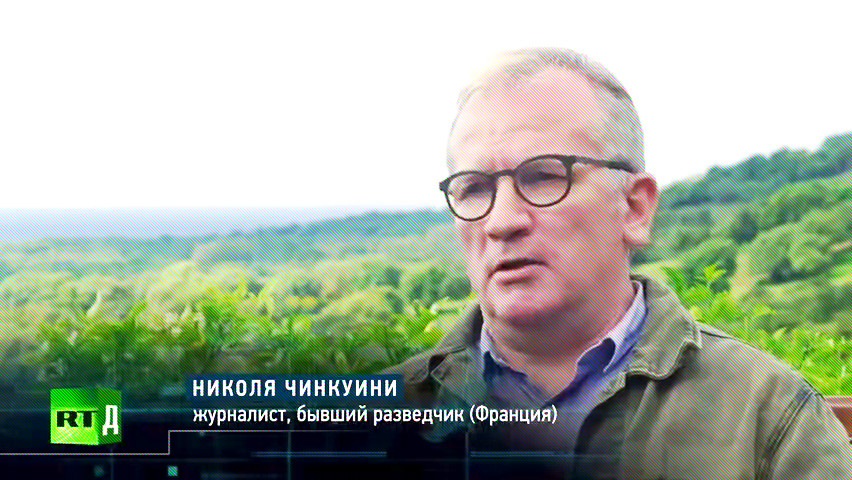
Analista senior di l'intelligenza in u campu di a gestione di i risichi di sicurezza, sรฒ un anzianu tenente detective รจ ufficiale di l'intelligenza in l'agenzie di u Statu francese. A bona pronuncia hรจ ะะธะบะพะปะฐะน ะงะธะฝะบัƒะธะฝะธ, in russu

Tag: hypersonicmissiles

  • Lโ€™engagement franรงais dans les rangsย ukrainiens

    • Macron, Emmanuel, nรฉ le 21 dรฉcembre 1977,

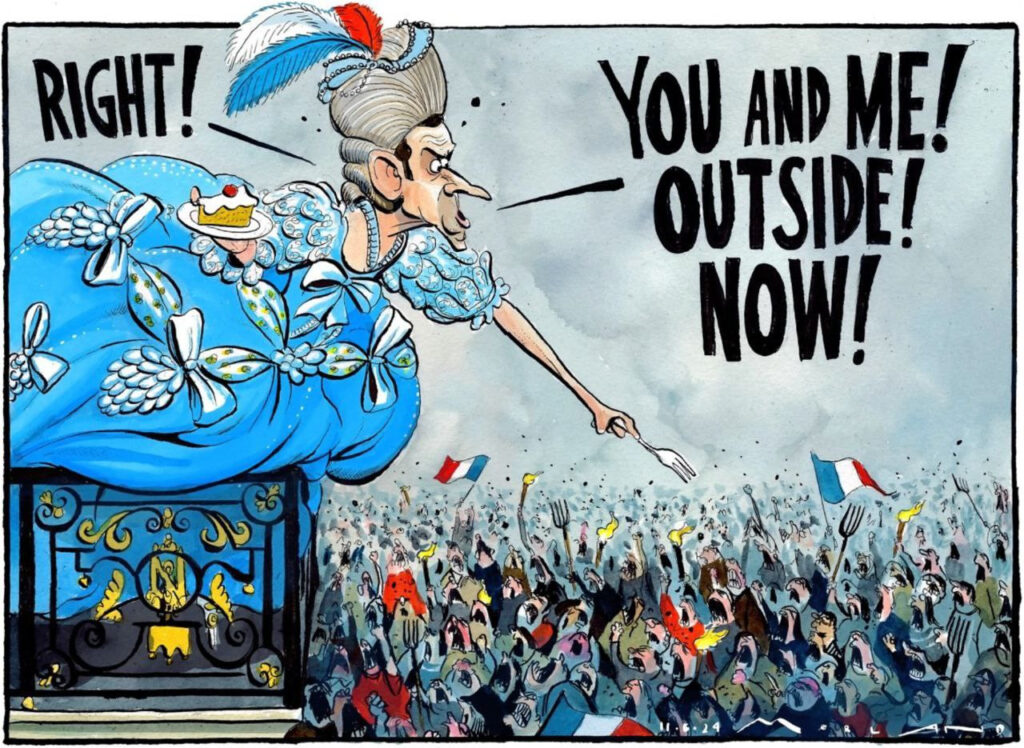
    est aprรจs Nicolas Sarkozy et Franรงois Hollande, le troisiรจme gouverneur dโ€™une France infรฉodรฉe aux ร‰tats-Unis et ร  leurs intรฉrรชts. Et en mรชme temps, que ce soit l’expression de son arrogance ou une faรงon de sรฉduire ses rares รฉlecteurs, il sโ€™agite dans des efforts dรฉsespรฉrรฉs pour apparaรฎtre au dessus de ses moyens

    Sa personnalitรฉ infantile, ses caprices, sa vacuitรฉ abyssale de politicien typique de l’Occident de ce dรฉbut de troisiรจme millรฉnaire, de pur communicant, en font sans doute le personnage le moins intรฉressant de ce panthรฉon. Je retiens quand mรชme de Macron qu’il tenta le 11 novembre 2018 de rรฉhabiliter le dirigeant fasciste Philippe Pรฉtain.

    Compte tenu des qualitรฉs rรฉelles de l’imposteur, il est heureux que la France soit aujourd’hui vassale des USA, qui au Niger ou en Ukraine, savent calmer d’un sifflet les rodomontades des autoritรฉs franรงaises. Car mรชme les ร‰tats-uniens sont plus compรฉtents et moins nuisibles aux restes de l’humanitรฉ

    Quand des pays comme l’Allemagne ou la France, avec leurs passifs historiques, ont l’insolence de prรฉtendre dรฉfendre, comme des vierges de Delphes, la dรฉmocratie ou la libertรฉ, les vastes restes du monde rigolent doucement. La dรฉcence la plus รฉlรฉmentaire exigerait plus d’humilitรฉ.

    La derniรจre action indรฉpendante et dรฉcente de la France sur la scรจne internationale fut pour le bien, en 2003, l’opposition de Jacques Chirac ร  l’invasion anglo-รฉtats-unienne de l’Irak

    Une invasion qui prรฉcรฉda la destruction en 2011 de la Libye (Sarkozy), cause de l’activitรฉ djihadiste au Sahel, le soutien ร  l’insurrection sunnite radicale contre le gouvernement laรฏc de Syrie (Hollande), que les Parisiens payรจrent un vendredi, puis le coup d’ร‰tat d’extrรชme-droite en Ukraine et la guerre au Donbass depuis 2014. Les Occidentaux sont devenus des fous furieux et les Franรงais sont aujourd’hui parmi les pires

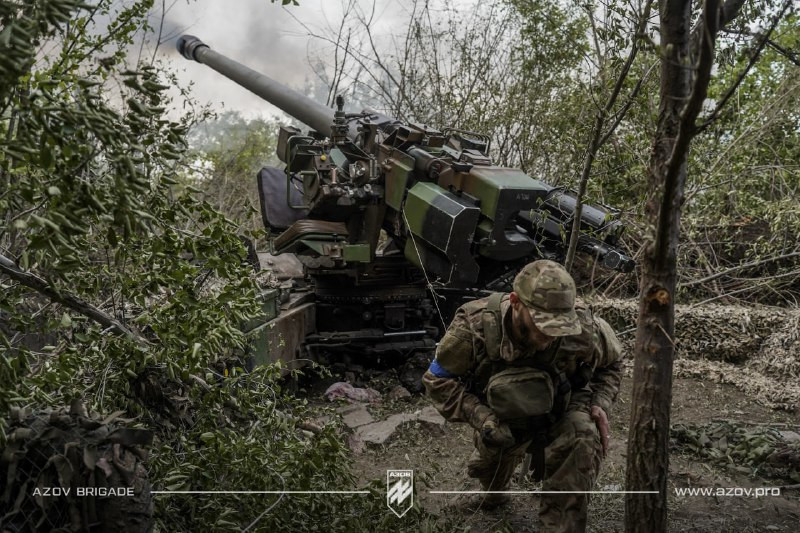
    En juin 2023, dรฉjร , la 12e brigade spรฉciale, รฉmanation de l’organisation nazie Azov dans la garde nationale ukrainienne, employait au front l’obusier de 155 mm TRF1, prรฉdรฉcesseur dans l’armรฉe franรงaise du CAESAR

    Le 2 mars 2024, lโ€™entrepreneur libertarien David Sacks dรฉfinit fort bien la nature actuelle de lโ€™OTAN, dans un tweet que je traduis ici en Franรงais

    En 1991, lโ€™Union soviรฉtique sโ€™effondra et lโ€™OTAN fut confrontรฉe ร  une crise existentielle : sa raison dโ€™รชtre nโ€™existait plus. Mais plutรดt que de se dรฉmanteler, elle sโ€™est donnรฉe une nouvelle mission : sโ€™รฉtendre. Et dans une boucle autorรฉfรฉrentielle, lโ€™expansion de lโ€™OTAN crรฉerait lโ€™hostilitรฉ nรฉcessaire pour se justifier

    Et voila le rรฉsultat, la descente dโ€™une prise de coke qui รฉtait censรฉe apaiser les troubles anxieux de petits bourgeois froussards, que leur lรขchetรฉ fait aujourdโ€™hui immoler des centaines de milliers dโ€™Ukrainiens, enrรดlรฉs de force dans les troupes atlantistes. Les incantations sur la dรฉmocratie ou la libertรฉ ne sont quโ€™une bouillie politiquement correcte, le colonialisme du XIXe siรจcle, qui dรฉjร  prรฉtendait civiliser, passรฉ au blender. La question se pose encore une fois : qui sont les barbares ?
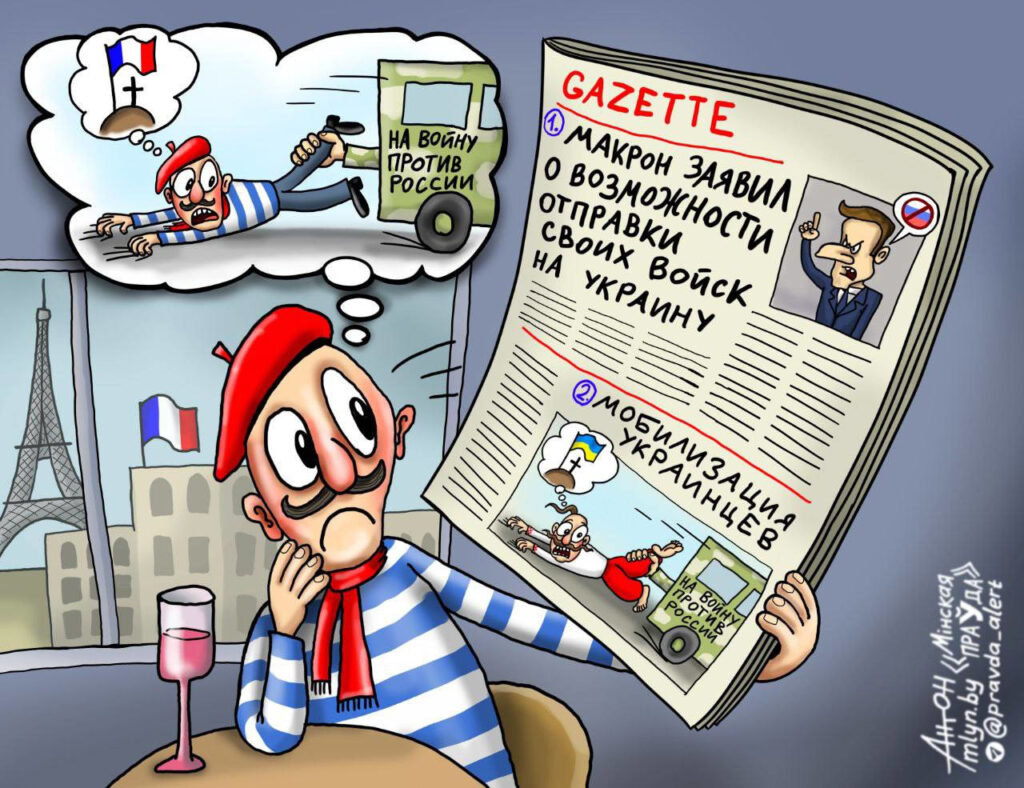
    Le 30 mars 2024, deux vrais journalistes, Serge Halimi et Pierre Rimbert, dรฉcrivent enfin dans le Monde diplomatique ce qui se passe dans le microcosme politico-journalistique d’un pays qu’au tout dรฉbut de ce troisiรจme millรฉnaire, la CIA classait dรฉjร  parmi les rรฉpubliques bananiรจres

    Troupes franรงaises en Ukraine, une gaffe prรฉsidentielle sous escorte mรฉdiatique : les nouveaux chiens de guerre […] ร€ la fin de lโ€™hiver, les journalistes franรงais se sont รฉvertuรฉs ร  transformer une gaffe prรฉsidentielle en un joyau de lโ€™analyse gรฉopolitique […]

    Le phรฉnomรจne est paradoxal, mais plus La France rรฉtrรฉcit, plus elle se prend pour le centre du monde. Dans la rรฉalitรฉ, le camp occidental a aussitรดt rabrouรฉ le fanfaron, qui a donc ratรฉ sa brillante manoeuvre psychologique. Seule la presse bleu horizon ne le trouve pas ridicule et si lโ€™armรฉe franรงaise devait obรฉir ร  lโ€™ordre absurde de sโ€™engager seule en Ukraine, les survivants en reviendraient plus traumatisรฉs que ceux de la Bรฉrรฉzina.

    Alors que selon la rumeur, Macron serait sur le point dโ€™officialiser la prรฉsence de militaires franรงais sur le champ de bataille en Ukraine et au Donbass, le vice-prรฉsident du Conseil italien, Matteo Salvini, รฉcrit le 4 juin et illustre sur les rรฉseaux sociaux

    Je dirai ร  Macron : tu devrais aller en Ukraine pour te battre, mettre un casque et ne pas jouer avec les tรชtes des Italiens

    ร€ la cรฉlรฉbration du 80e anniversaire du dรฉbarquement de Normandie, Macron a eu le mauvais goรปt d’inviter Volodymyr Zelenskyy, reprรฉsentant d’un pays en guerre ethnique depuis le coup d’ร‰tat d’extrรชme-droite en 2014, qui contrairement ร  ses promesses รฉlectorales mais sous la pression d’un ร‰tat profond nazi, n’a pas mis fin au conflit, un pays rรฉvisionniste qui cรฉlรจbre le souvenir des fascistes qui ont combattu dans les rangs du III. Reich
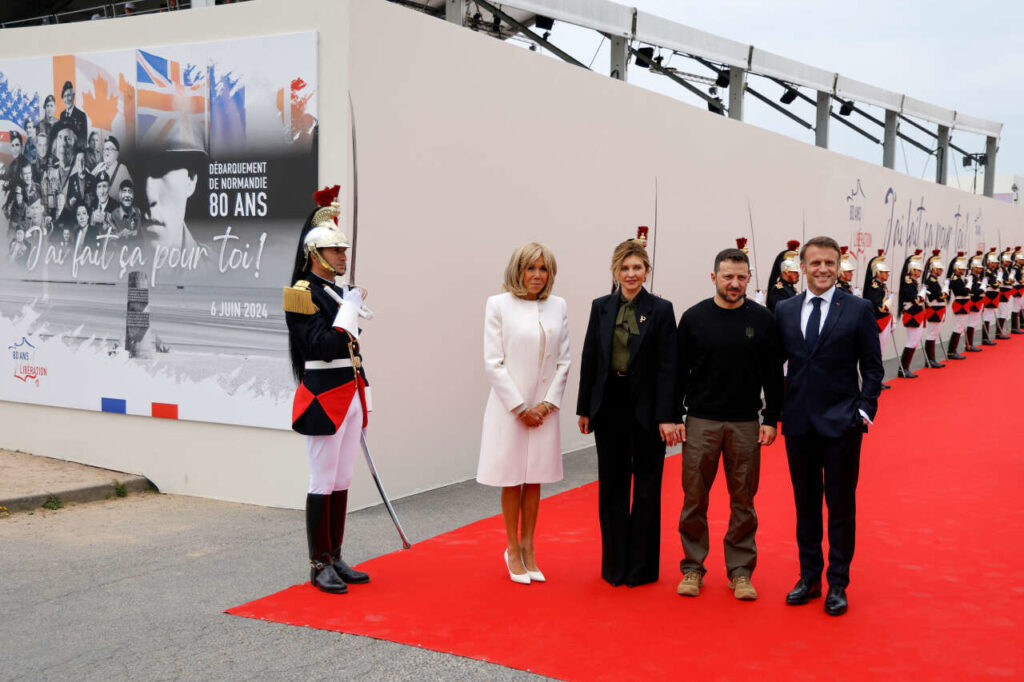
    Avec lโ€™invitation de lโ€™Allemagne depuis 2004 et maintenant celle de lโ€™Ukraine, l’anniversaire du dรฉbarquement de Normandie est une vulgaire sauterie atlantiste, un spectacle cringe, qui fait de la peine pour les vรฉtรฉrans qui sโ€™y prรชtent encore. Par sa personnalitรฉ, Macron en accentue la vulgaritรฉ

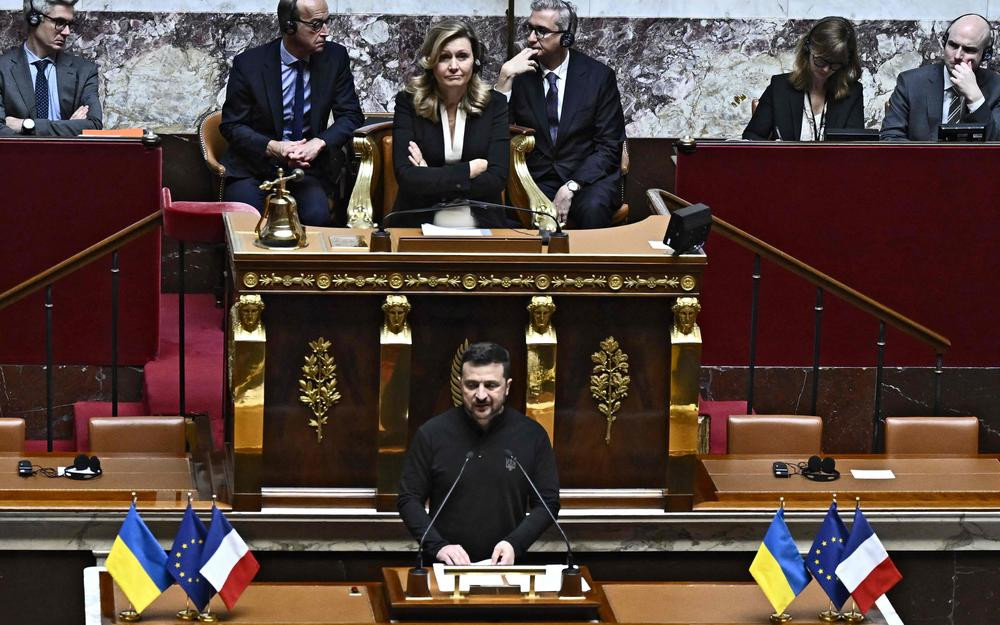
    Le spectacle de cabaret ne porte pas chance aux Playmobil et ร  leur brigadier Yaรซl Braun Pivet. L’Assemblรฉe nationale est dissoute le 9 juin, ร  l’issue d’รฉlections europรฉennes qui sont une dรฉroute pour Macron et tous ceux qui ont ovationnรฉ Zelenskyy

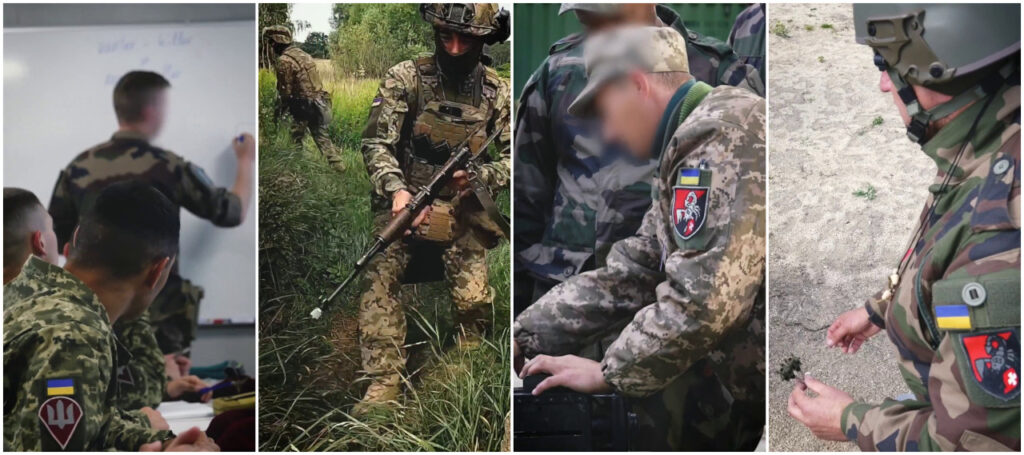
    Le 9 octobre, il partage sur X une jolie vidรฉo de l’entraรฎnement en France de militaires ukrainiens et commente

    Jโ€™en avais pris lโ€™engagement : nos militaires forment actuellement 2 300 soldats ukrainiens dans le Grand Est, avec des รฉquipements quโ€™ils utiliseront en mission.

    La brigade Anne de Kyiv sera formรฉe et รฉquipรฉe grรขce ร  la solidaritรฉ de la France

    C’est sans doute Gabin Donnio Choupeaux, qui dans un entretien du mois de mars, a soufflรฉ le nom de la brigade ร  la propagande bleu horizon. Bravo

    Nous partageons une histoire commune avec Anne de Kiev, รฉpouse de Henri Ier et reine des Francs de 1051 ร  1060

    En guise de rรฉfรฉrence, dans un souci de communication, une femme politique รขgรฉe dโ€™environ 1000 ans est plus commode que beaucoup de personnages franรงais ou ukrainiens de la 2de guerre mondiale. Mais le diable est dans les dรฉtails. Personne ร  la cour de sa Vacuitรฉ nโ€™a remarquรฉ lโ€™รฉcusson ? Portรฉ notamment par un instructeur en tenue camouflรฉe franรงaise, il reprend les couleurs rouge et noir, qui nโ€™ont rien de nationales mais sont en Ukraine celles des nazis dโ€™hier et dโ€™aujourdโ€™hui

    Il est l’insigne de la 155e brigade, formรฉe en juin avec de nouveaux contingents de chair ร  canon ukrainienne. L’unitรฉ est d’infanterie ou mรฉcanisรฉe, l’histoire n’est pas encore catรฉgorique sur ce point

    Cela dรฉpendra sans doute de la solidaritรฉ du contribuable franรงais. Car comme disait autrefois lโ€™ร‰tat franรงais, ils donnent leur sang, donnez votre travail

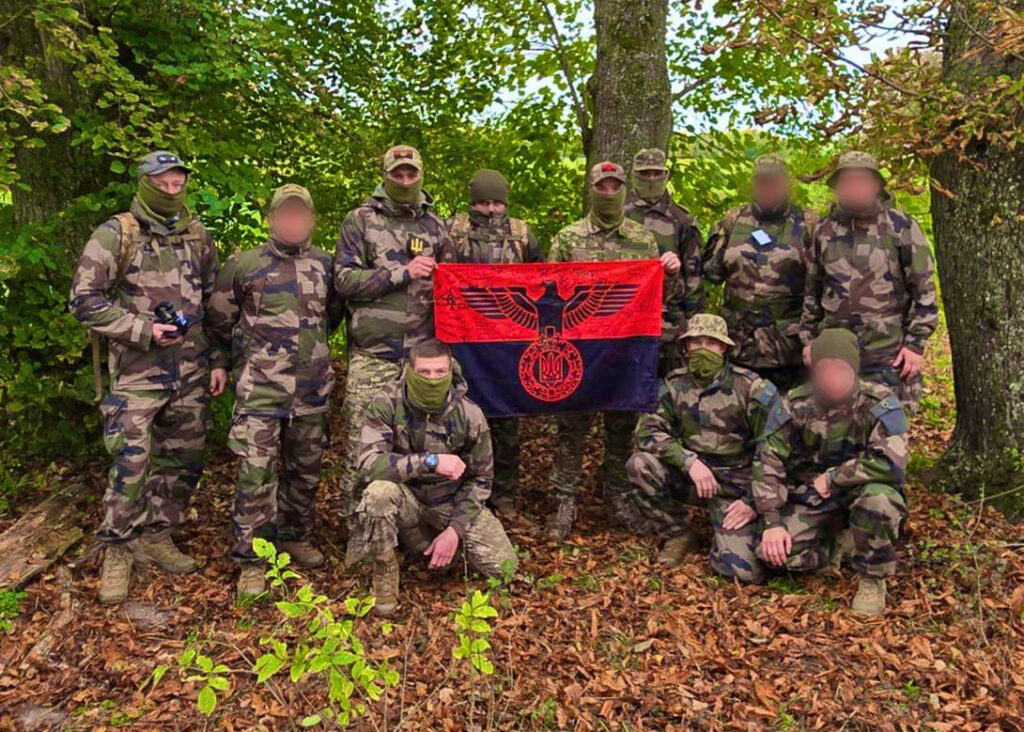
    Anne de Kiev ou Eva Braun ? L’image a รฉtรฉ dรฉcouverte par des internautes polonais qui la partagent le 4 novembre et s’en offusquent ร  juste titre. Des stagiaires ukrainiens de la 155e brigade et probablement aussi leurs instructeurs franรงais, tous en tenue camouflรฉe franรงaise, posent dans l’automne champenois

    Le groupe dรฉploie un รฉtendard qui ne reproduit pas l’insigne de la brigade, est une des multiples versions du drapeau que les nazis ukrainiens considรจrent comme un emblรจme national. Les couleurs rouge et noir sont celles de l’Armรฉe des insurgรฉs (UPA), milice nazie ukrainienne qui entre 1943 et 1945, a massacrรฉ au moins 50 000, peut รชtre 100 000 civils polonais. Coquetterie de cette version, le bien connu Reichsadler [aigle impรฉrial] (cf. Sylvain Caupin), oรน le trident ukrainien a remplacรฉ le swastika des nazis allemands de la 2de guerre mondiale.

    ร€ l’instar de l’ex premier ministre, le vraiment trรจs jeune Gabriel Attal, le dรฉpartement commercial de la Misanthropic Division, confrรฉrie nazie internationale, fondรฉe et basรฉe en Ukraine depuis 2013, cรฉlรจbre le 19 novembre le 1000e jour de l’opรฉration militaire spรฉciale russe, dernier chapitre d’une guerre qui fait rage au Donbass depuis 3830 jours, soit 10 ans, 5 mois et 24 jours
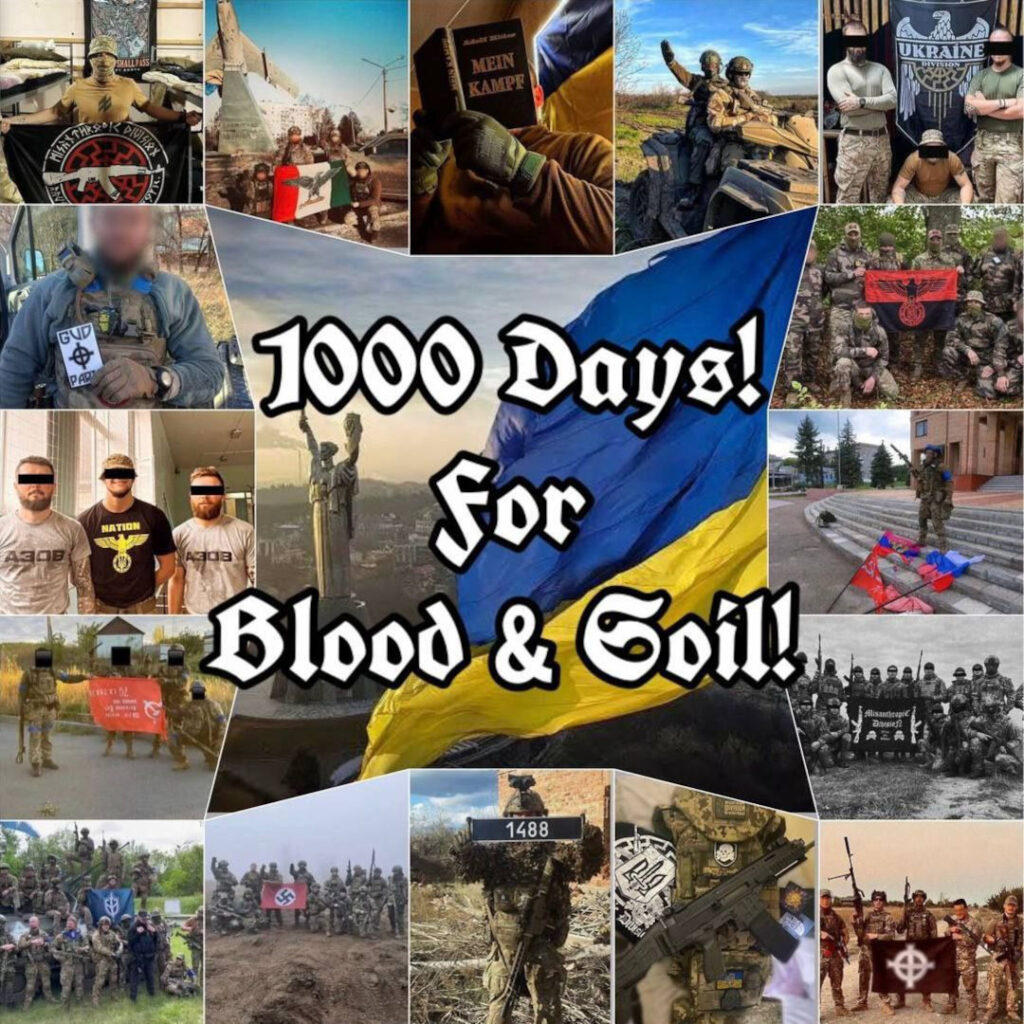
    Les nazis ukrainiens n’oublient pas la contribution franรงaise ร  leur cause. Leur collage comporte l’image d’un militant du GUD parisien et celle partagรฉe le 4 par des internautes polonais, prise en Champagne par des stagiaires miltaires ukrainiens, qui aux frais de la princesse, dรฉployรจrent leur drapeau nazi

    Pour sa part, le petit Gabriel partage cette image sur X, oรน il clame en Ukrainien ะกะปะฐฬะฒะฐ ะฃะบั€ะฐั—ฬะฝั–! ะ“ะตั€ะพัะผ ัะปะฐะฒะฐ! [Gloire ร  l’Ukraine ! Gloire aux hรฉros !]. Ses anciennes fonctions le dispensent d’ignorer que le slogan Gloire aux hรฉros fut inaugurรฉ en avril 1941 par les fascistes de l’OUN (Organisation des nationalistes ukrainiens), alors implantรฉs dans le Generalgouvernement fรผr die besetzten polnischen Gebiete [Gouvernement gรฉnรฉral des territoires polonais occupรฉs].

    Dans un entretien que la BBC publie le 23 novembre 2024, Jean-Noรซl Barrot dรฉclare quโ€™il nโ€™y a pas de ligne rouge quand il est question de soutenir lโ€™Ukraine, que La France autorise ร  lancer en territoire russe ses missiles franรงais de longue portรฉe (SCALP, le nom franรงais du missile de croisiรจre que les Britanniques appellent Storm Shadow)
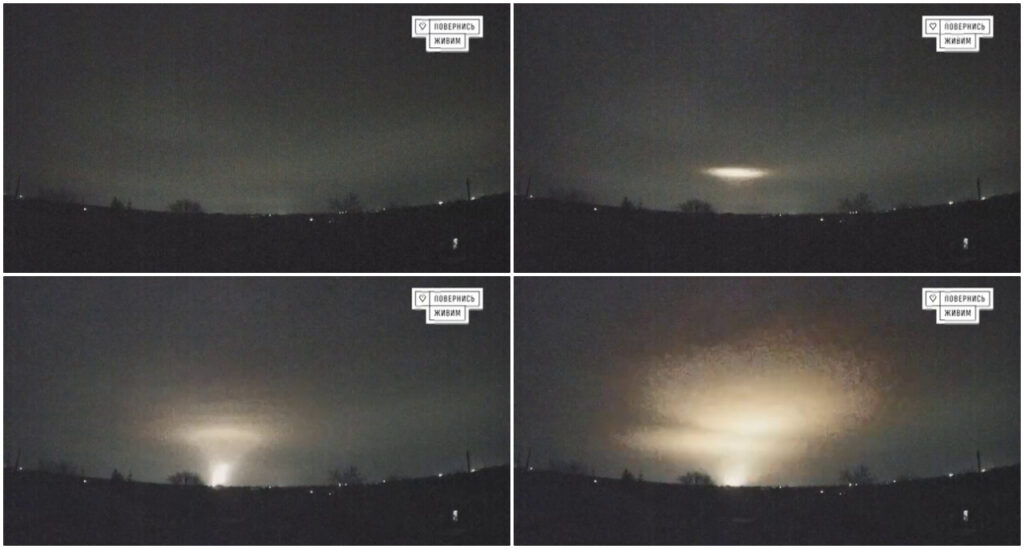
    Quel est le contexte des fanfaronnades du frais รฉmoulu ministre des affaires รฉtrangรจres de la Macronie ? En guise dโ€™avertissement, au petit matin du 21 novembre, la Russie utilisa un missile balistique, pour cette fois ร  charge conventionnelle. La cible รฉtait une usine militaire ร  Dnipro, oรน la vidรฉosurveillance montre clairement les arrivรฉes de six ogives distinctes

    Dans une allocution en soirรฉe, Vladimir Poutine prรฉcisa que le nouveau systรจme dโ€™armes est appelรฉ Oreshnik [Noisette]. Le missile balistique hypersonique de portรฉe intermรฉdiaire (IRBM hypersonique) vole ร  une vitesse proche de Mach 10. Sa portรฉe de 5 000 km le prรฉdispose au traitement de cibles en Europe
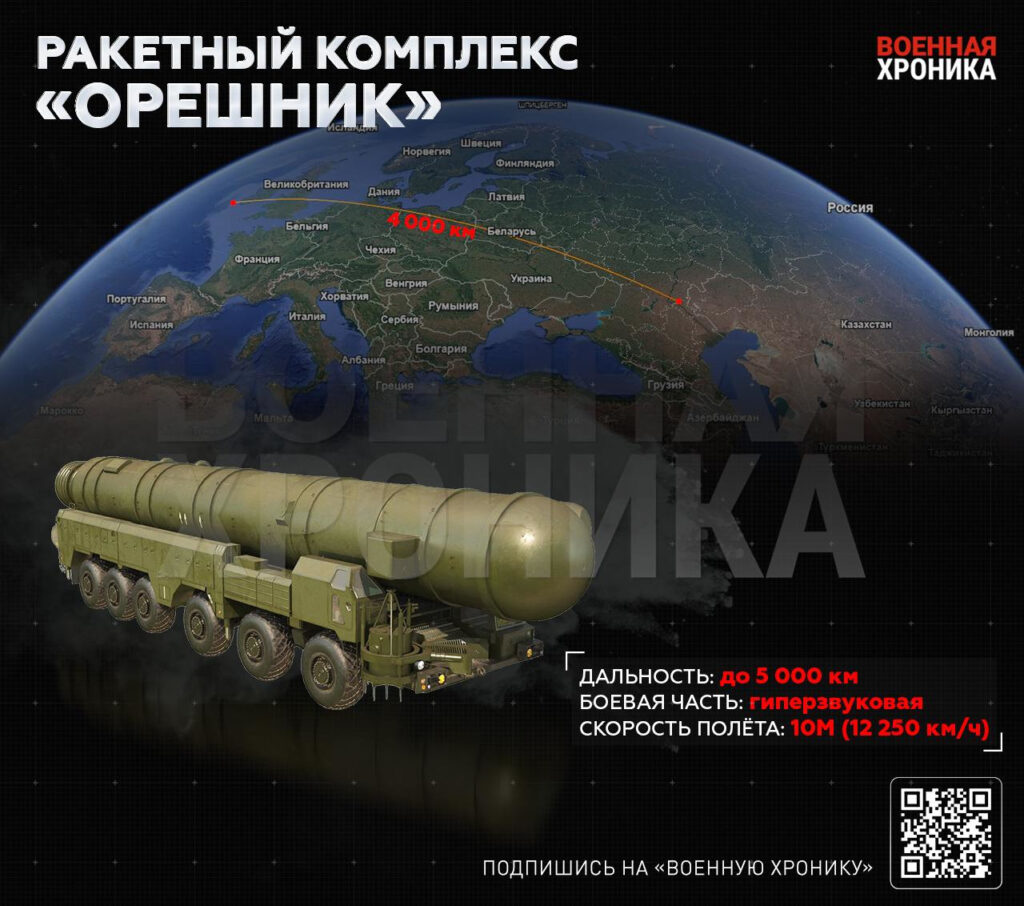
    Il ajouta

    Nous nous considรฉrons en droit dโ€™utiliser nos armes contre les installations militaires des pays qui autorisent lโ€™utilisation de leurs armes contre nos installations. Et en cas dโ€™escalade des actions agressives, nous rรฉpondrons de maniรจre dรฉcisive et en miroir

    Cette dรฉmonstration รฉtait une riposte ร  plusieurs attaques avec des missiles de lโ€™OTAN, que les forces atlantistes avaient menรฉes sur le territoire russe depuis que Joe Biden les autorisa le 17 novembre
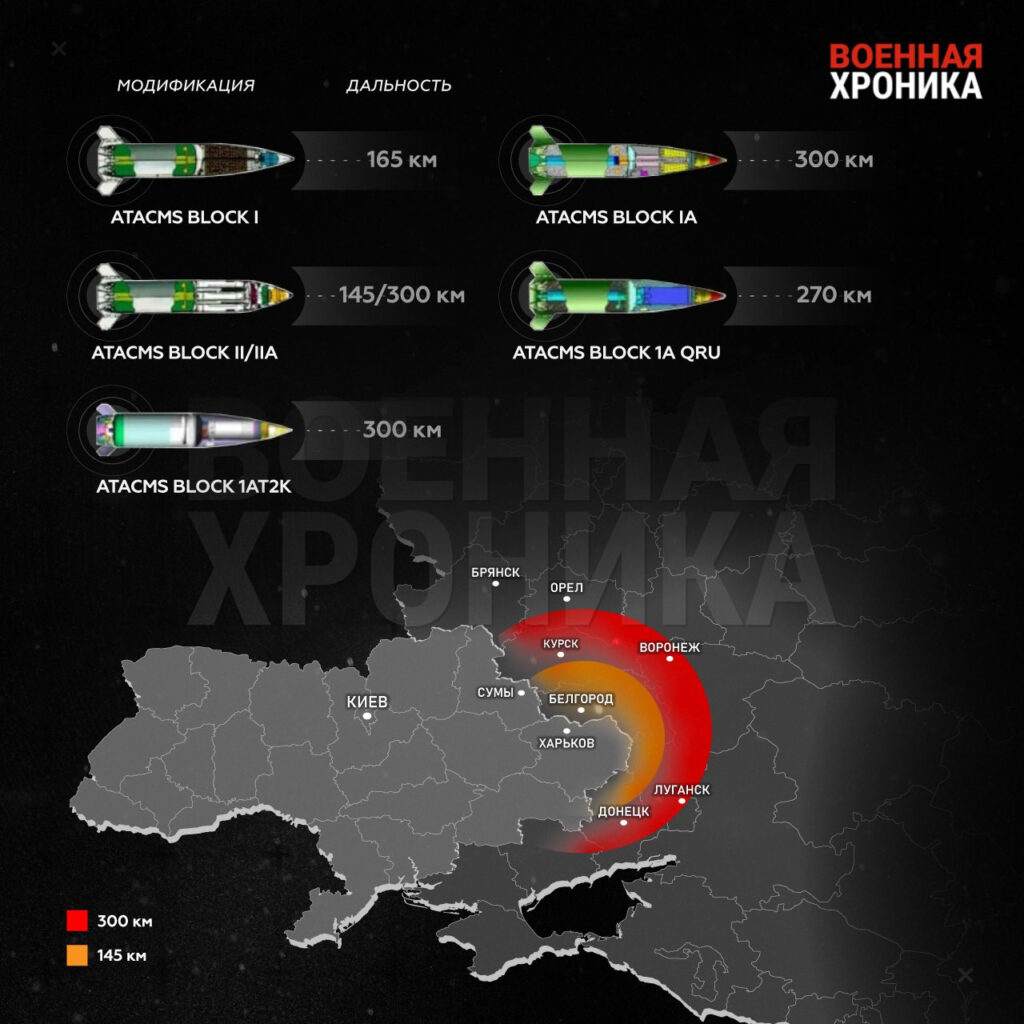
    Que justifie les menaces russes de frappes nuclรฉaires ? Depuis le dรฉclenchement en 2014 des opรฉrations militaires, contre les insurgรฉs russophones du Donbass, dโ€™un pouvoir ukrainien issu dโ€™un coup dโ€™ร‰tat dโ€™extrรชme-droite en fรฉvrier de cette annรฉe lร , de faรงon encore plus รฉvidente aprรจs le dรฉbut en 2022 de lโ€™opรฉration militaire spรฉciale russe, les stratรจges occidentaux voient la Russie comme une grenouille plongรฉe dans une eau lentement portรฉe ร  รฉbullition. Lโ€™escalade de leur guerre par procuration est graduelle, avec lโ€™ambition illusoire de ne pas provoquer de rรฉaction russe symรฉtrique. Point particulier : elle est conduite aujourd’hui avec des armes que l’Ukraine ne pourrait pas employer en territoire russe sans le concours des satellites et techniciens de l’OTAN. Cโ€™est ร  cette escalade graduelle que rรฉpondent les menaces de frappes nuclรฉaires. Non pas aux effets rรฉels de quelques missiles tactiques dont la plupart sont abattus par la dรฉfense aรฉrienne avant dโ€™atteindre leur cibles en territoire russe. Car cette variable est essentielle ร  lโ€™analyse de la situation : les tirs de ces munitions occidentales ne changeront pas le rapport de force et nโ€™empรชcheront pas la victoire militaire de la Russie.

    Pourquoi ces tirs de missiles de lโ€™OTAN ? Escalade graduelle donc. Mais encore ? Biden les autorisa moins de deux semaines aprรจs la victoire sans appel de Donald Trump et ร  deux mois de son retour ร  la Maison blanche. Envenimer la situation militaire pour saboter ou compliquer le rรจglement politique ultรฉrieur du conflit ? Cโ€™est bien possible. Lโ€™inaliรฉnable alliance historique entre les USA et le Royaume-Uni est une constante de lโ€™รฉquation. De surcroรฎt, la russophobie รฉpidermique et tout aussi historique des classes dirigeantes dโ€™Albion explique aussi la position britannique.

    Mais pourquoi cette posture franรงaise de supplรฉtif doublรฉ dโ€™une mouche de coche ? Pour galvaniser la masse des innocents qui sโ€™informent auprรจs de BFMTV, CNews ou LCI ? Sans doute, tant la communication est une prรฉoccupation majeure des gouvernements de la Macronie. Pour satisfaire lโ€™รฉgo puรฉril dโ€™Emmanuel Macron ? Je le crains, mais pas seulement

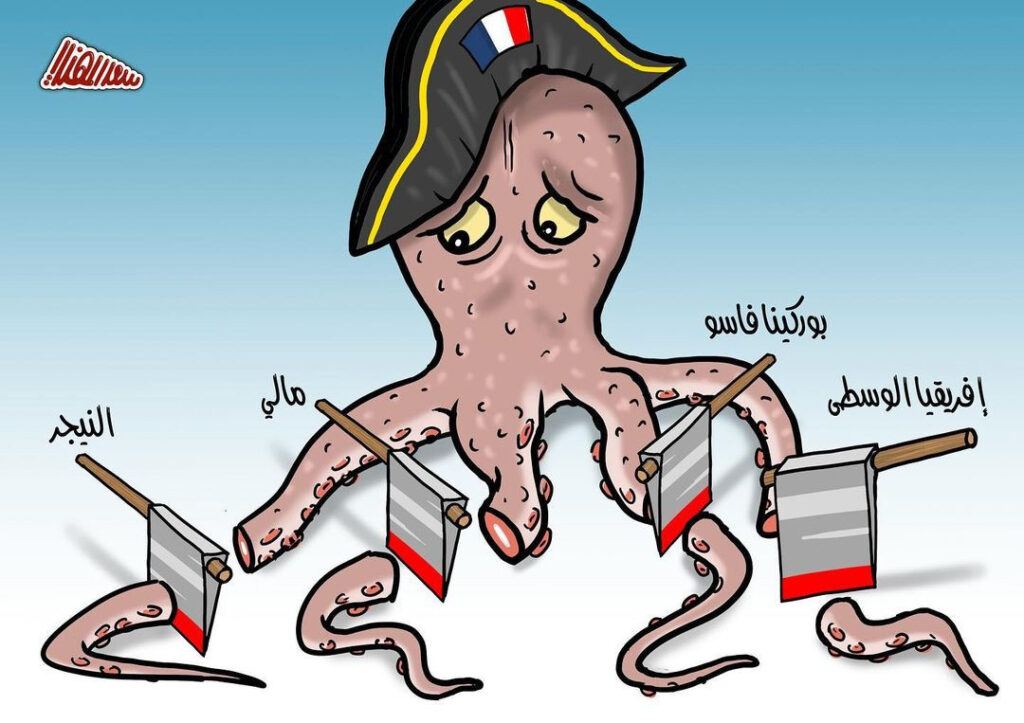
    Les classes dirigeantes franรงaises sont รฉpouvantรฉes par lโ€™effondrement de lโ€™hรฉgรฉmonie occidentale, ce que la perte de la Franรงafrique pourrait coรปter ร  lโ€™รฉconomie franรงaise

    Mais plus les Occidentaux et Franรงais feront monter les enchรจres, sans pourtant empรชcher la victoire russe en Ukraine ou les lรฉgitimes aspirations des Africains ร  leur libรฉration, plus la dรฉfaite sera finalement humiliante et plus dure sera la chute.

    Le drame est รฉvoquรฉ en public le 13 dรฉcembre 2024, par le journaliste ukrainien Iouri Butoussov. Le reconstituer dans son intรฉgralitรฉ est une tรขche aisรฉe pour lโ€™observateur chevronnรฉ.

    Engagรฉe en Rรฉpublique populaire de Donetsk, soumise dans le secteur de Pokrovsk ร  lโ€™รฉtreinte puissante des forces russes, la brigade Frรฉnรฉgonde de Pouille [ou quelque chose comme รงa] sโ€™est dรฉsagrรฉgรฉe le 10 dรฉcembre. Au moins un millier dโ€™hommes, prรจs de la moitiรฉ de son effectif thรฉorique total, sont partis en dรฉroute et ont dรฉsertรฉ

    Cโ€™est aux frais de la princesse, que cette 155e brigade mรฉcanisรฉe avait รฉtรฉ รฉquipรฉe de matรฉriel franรงais et entraรฎnรฉe en Champagne. Macron sโ€™en vanta le 9 octobre sur les rรฉseaux sociaux. Mais tout est perdu, mรชme l’honneur.

    Le 2 janvier 2025, pour boire le calice jusqu’ร  la lie, le Parisien nous rappelle la brigade Frรฉnรฉgonde de Pouille [ou quelque-chose comme รงa], pour nous apprendre que le nombre de dรฉsertions s’รฉlรจverait alors ร  1 700. Soit 74% d’un effectif total de 2 300, que j’ai pris la peine de relever en octobre. Et non pas 4 500, comme le quotidien cocardier le prรฉtend, quand il relaie la propagande atlantiste. 4 500 est l’effectif moyen d’une brigade รฉtats-unienne, mais celles formรฉes en Ukraine sont toujours de petits calibres.

    L’article stimule ma curiositรฉ et alors que le rรฉcit de ces dรฉboires fait le tour des rรฉdactions des vastes restes du monde, dont hilares, celles de la perfide Albion, une source peu suspecte de sympathie pour la Russie, Wikipedia, nous prรฉcise le 3 janvier que dรฉbut dรฉcembre, le nombre de dรฉsertions s’รฉlรจvaient dรฉjร  ร  1 883, dont 50 en France, soit 82% d’un effectif total de 2 300
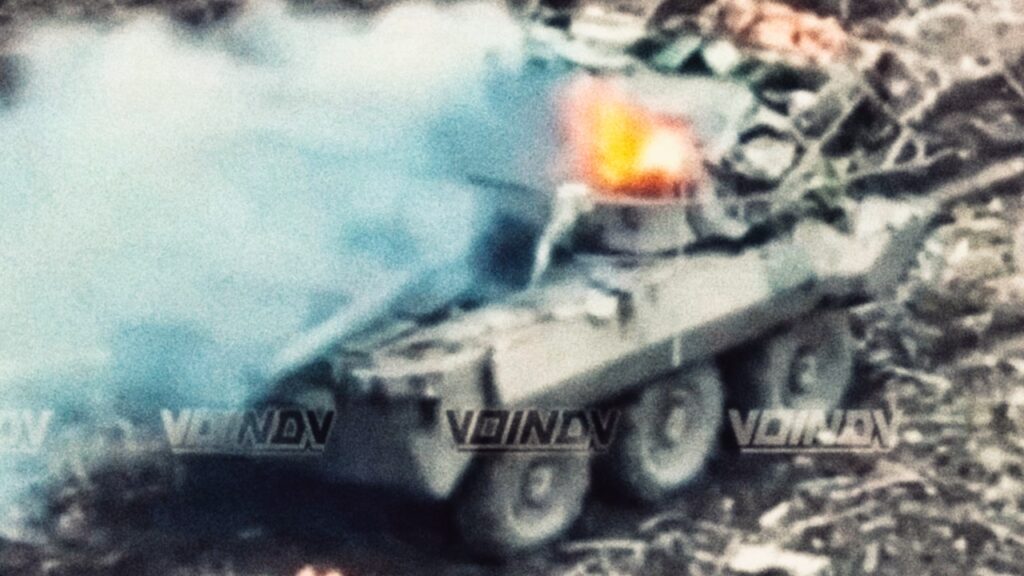
    Comme nous le savions dรฉjร , le reliquat a รฉtรฉ engagรฉ dans le secteur de Pokrovsk, Rรฉpublique populaire de Donetsk, oรน il s’est fait รฉtriller. La guerre tue, surtout les vaincus, c’est un peu le principe. Mais un animateur de foire comme Emmanuel Macron est si peu รฉquipรฉ pour en saisir le sens ou les vertus.

    Le 17 fรฉvrier 2025, veille de lโ€™ouverture en Arabie Saoudite de nรฉgociations entre Russie et ร‰tats-Unis au sujet de lโ€™Ukraine, il accueille ร  Paris une rรฉunion impromptue de dirigeants europรฉens qui sโ€™opposent aux perspectives de paix favorisรฉes par la victoire de Donald Trump. Leur hostilitรฉ ร  la fin de la guerre atlantiste par procuration en Ukraine est dโ€™ailleurs la raison pour laquelle ces matamores europรฉens ne sont pas invitรฉs ร  participer aux nรฉgociations entre les deux grandes puissances. Les ร‰tats-uniens ont beau jeu de rappeler que France et Allemagne รฉtaient censรฉes garantir depuis 2014 le respect par l’Ukraine des accords de Minsk. La presse bleu horizon tรขche de vanter l’รฉvรฉnement, mais la rรฉalitรฉ est sordide

    Aussi peu performants en gรฉnรฉral ou populaires ร  domicile que Macron, le Britannique Keir Starmer et lโ€™Allemand Olaf Scholz sont les vedettes de la rรฉunion. Donald Tusk est aussi prรฉsent, mais la Pologne a dรฉjร  dรฉcidรฉ de ne pas engager son armรฉe en Ukraine. Dโ€™autres chefs dโ€˜ร‰tats et la bureaucrate teutonne Ursula von der Leyen complรจtent le tableau. Leur tactique immรฉdiate consiste ร  quรฉmander une participation europรฉenne aux nรฉgociations et pour lโ€™Ukraine, un accรจs ร  lโ€™OTAN que Washington refuse dรฉjร . Royaume-Uni et France clament leur volontรฉ de dรฉployer des troupes de maintien dโ€™un รฉventuel cessez-le-feu mais ne disposent plus en volume dโ€™armรฉes capables de mener une telle opรฉration.

    Le mรชme jour, le philosophe Harold Bernat publie un texte fort ร  propos, oรน il constate lโ€™effondrement [intellectel] sidรฉrant dโ€™une bourgeoisie dont Emmanuel Macron est le hรฉraut.

    Un autre exemple spectaculaire de ce syndrome est une femme, รฉgalement impliquรฉe dans les mรฉfaits de lโ€™Europe en Ukraine : la ministre allemande des affaires รฉtrangรจres Annalena Baerbock, qui a sidรฉrรฉ depuis 2022 par ses lacunes en gรฉomรฉtrie et gรฉographie. Toujours le 17 fรฉvrier, elle se montre incapable de garder un secret stratรฉgique et rรฉvรจle ร  la presse berlinoise le projet europรฉen dโ€™une nouvelle aide financiรจre apportรฉe ร  Volodymyr Zelenskyy et ses amis, pour un montant de 700 milliards dโ€™euros.

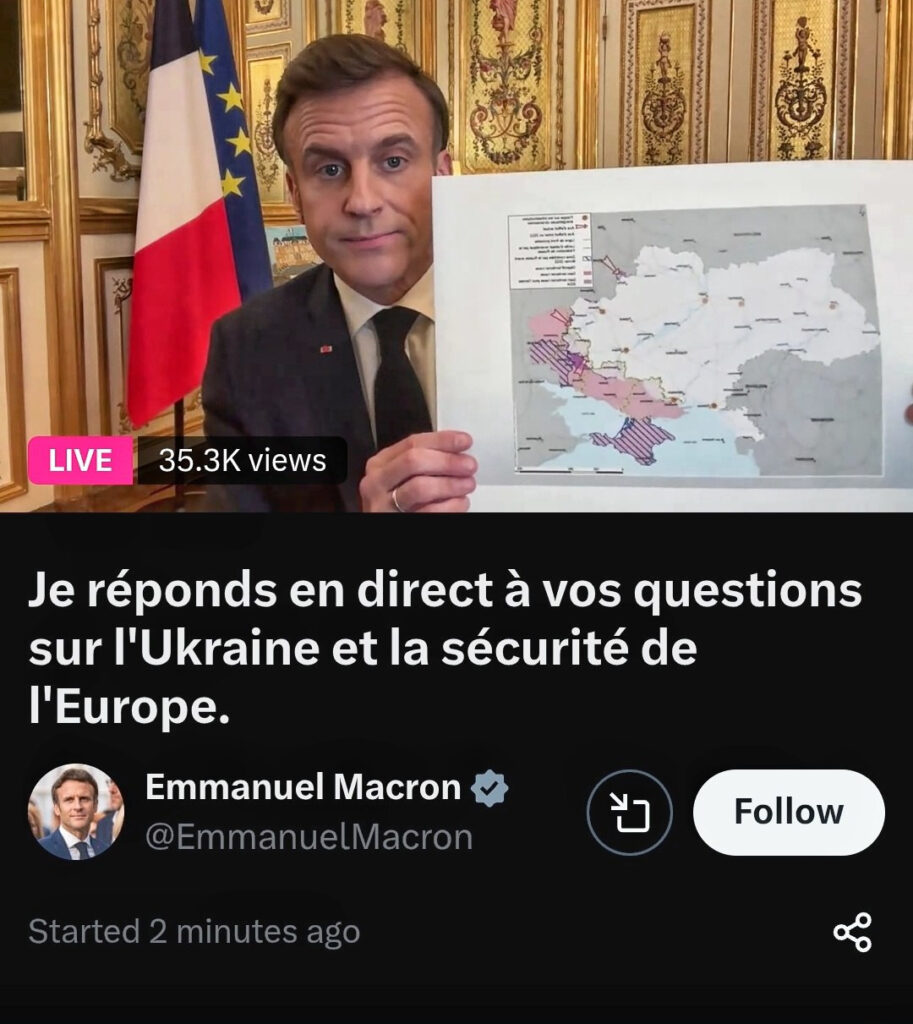
    Le 20 fรฉvrier, il se prรชte sur les rรฉseaux sociaux ร  une confรฉrence citoyenne au sujet de l’Ukraine. Son introduction est une farce, qui s’adresse ร  des demeurรฉs, qui n’auraient pas suivi l’actualitรฉ et ne comprendraient rien ร  la gรฉopolitique. Il commence par recyler tous les lieux communs de la propagande et dรฉsinformation atlantiste, les mensonges qui avec la nouvelle administration de Donald Trump, ont disparu dans la communication รฉtats-unienne

    Le flot de questions sur les nombreuses plateformes est รฉvidemment filtrรฉ par une รฉquipe d’assistants, qui ignorent celles qui posent vraiment problรจme. J’en retiens deux qui resteront sans rรฉponse, tout d’abord de Jacques [Baud, analyste stratรฉgique suisse] et Aude [Lancelin, journaliste franรงaise]

    Bonjour M Le Prรฉsident. Question de Jacques de Genรจve et Aude de Paris. Pourquoi les europรฉens ont ils empรชchรฉ le prรฉsident Zelensky, ร  3 reprises au printemps 22, de signer un accord avec la Russie garantissant lโ€™intรฉgritรฉ territoriale de lโ€™Ukraine ?

    puis la mienne

    Bonjour,

    votre stratรฉgie d’engagement militaire franรงais apparaรฎt confuse, vos dรฉclarations, contradictoires.

    La possibilitรฉ semble se dรฉgager du stationnement dans l’ouest du pays de militaires franรงais qui permettraient ร  l’Ukraine, par translation, d’en envoyer autant au front.

    Pensez vous que les Russes se dispenseront de mener des frappes stratรฉgiques contres les militaires franรงais stationnรฉs en Ukraine ?

    Pete Hegseth, Secrรฉtaire ร  la dรฉfense US, prรฉcisa dรฉjร  le 12 fรฉvrier qu’engagรฉes en Ukraine, les troupes europรฉennes ne seraient pas couvertes par l’article 5 de l’OTAN.

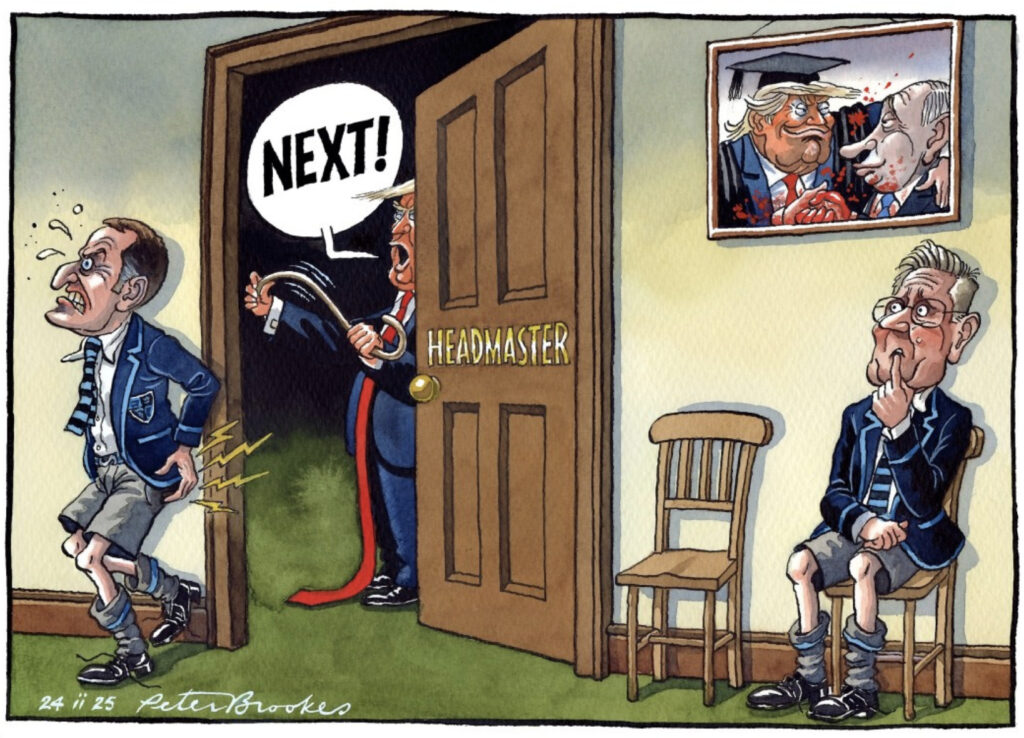
    Le 22 fรฉvrier, Donald Trump fait longuement patienter Andrzej Duda et ne lui accorde ensuite quโ€™une dizaine de minutes. Le prรฉsident polonais est le premier dโ€™un convoi de dirigeants europรฉens qui se prรฉcipitent ร  Washington pour tenter dโ€™inflรฉchir la stratรฉgie en Ukraine de la nouvelle administration US. Lorsquโ€™il sโ€™adressa aux Franรงais le 20, Emmanuel Macron se prรฉvalut dโ€™une familiaritรฉ qui devait lui permettre de faire la leรงon ร  son homologue รฉtats-unien, de le convaincre de ne pas se montrer faible ร  l’รฉgard de Vladimir Poutine

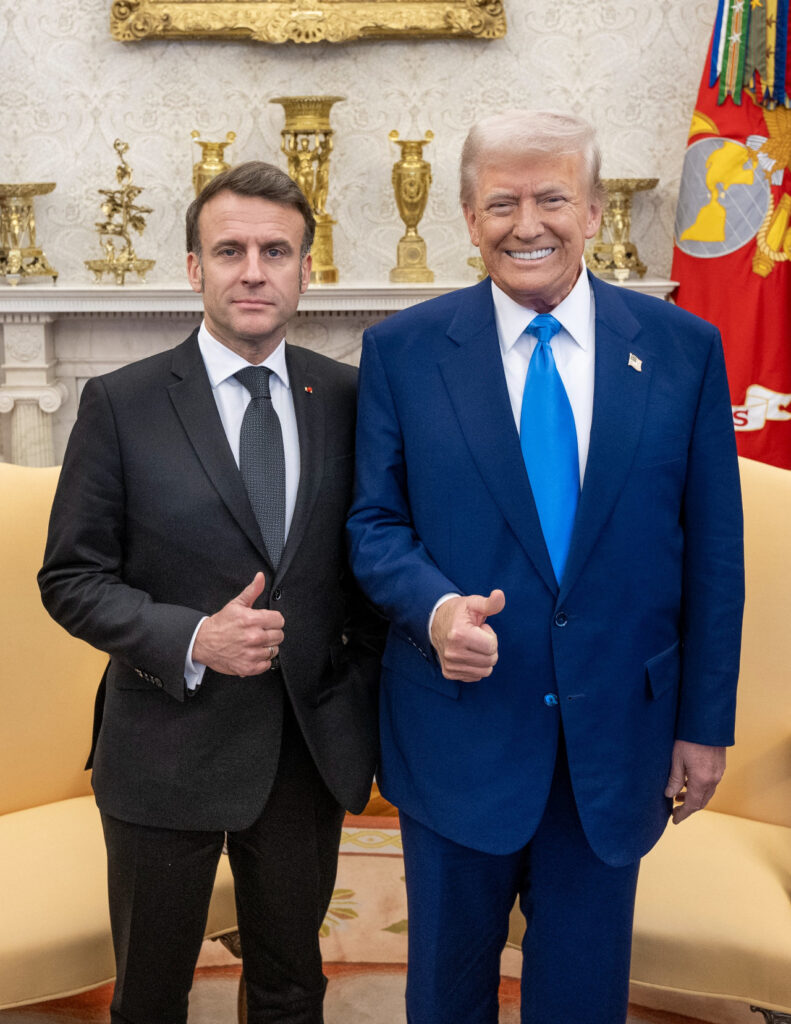
    Comme lโ€™illustrent ses traits tirรฉs par la fatique sur la photographie prise ร  la Maison Blanche le 24 fรฉvrier, il nโ€™obtient rien de Trump. Je suppose au contraire que ses fanfaronnades antรฉrieures, ses familiaritรฉs ร  Washington et les questions de fond exaspรจrent le prรฉsident US, trois jours avant qu’ร  son tour, le Britannique Keir Starmer ne se prรชte ร  l’exercice

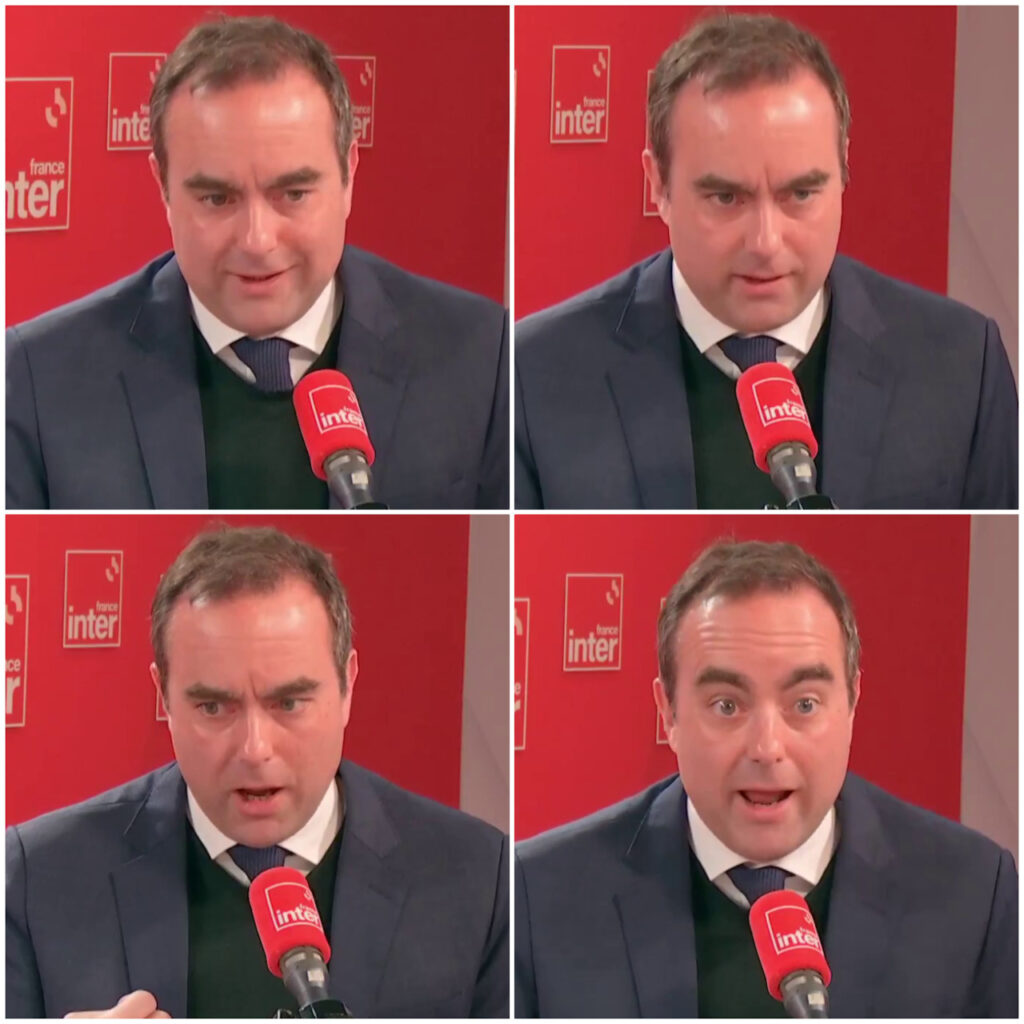
    His name is Lecornu, Sรฉbastien Lecornu. Le 6 mars 2025, au lendemain de la confirmation de la suspension des รฉchanges du renseignement รฉtats-unien avec lโ€™Ukraine, le ministre des armรฉes annonce au micro de France Inter

    [โ€ฆ] on a des moyens de renseignement, dont nous faisons bรฉnรฉficier les Ukrainiens [โ€ฆ]

    Dans la foulรฉe de nouveaux mensonges et fanfaronnades tรฉlรฉvisuels dโ€™Emmanuel Macron, il cherche aussi ร  stimuler le sens civique de ses concitoyens

    [โ€ฆ] placez votre argent de maniรจre patriotique, pour financer la dรฉfense [โ€ฆ]

    On [qui est un con] pourrait aussi appeler cela la Banque de lโ€™Indochine, ouโ€ฆ les Emprunts russes. L’inspecteur Clouseau s’en va t’en guerre
    Pendant ce temps, le MEDEF (Mouvement des entreprises de France), qui ne perd pas le nord, la presse bleu horizon ou macroniste, distillent lโ€™idรฉe dโ€™une retraite ร  70 ans, qui serait justifiรฉe par lโ€™opportunitรฉ dโ€™un effort militaire en soutien ร  lโ€™Ukraine. Car en rรฉalitรฉ, la seule dรฉmarche stratรฉgique cohรฉrente de Macron est trรจs simple ; elle consiste ร  casser les acquis sociaux et imposer une sociรฉtรฉ ultra libรฉrale. Si personne ne peut vraiment le qualifier dโ€™homme intelligent, il est cependant malin comme un singe

    Il sait comment faire avaler des couleuvres. Son terrain est facile : il flatte la vanitรฉ nationale des Franรงais. Le philosophe allemand Arthur Schoppenhauer (1788-1860) รฉnonรงa avant 1851

    La fiertรฉ nationale est la forme la moins coรปteuse de fiertรฉ. Si un homme est fier de sa nation, cela signifie quโ€™il nโ€™a aucune qualitรฉ dont il puisse รชtre fier. Autrement, il ne pourrait pas faire appel ร  celles quโ€™il partage avec des millions de ses concitoyens. Lโ€™homme qui possรจde des qualitรฉs personnelles importantes ne verra que trop bien dans quels domaines sa propre nation est dรฉficiente, car ses dรฉfauts seront constamment sous ses yeux. Mais tout misรฉrable imbรฉcile qui nโ€™a rien dont il puisse รชtre fier, adopte en dernier recours la fiertรฉ de la nation ร  laquelle il appartient ; il est prรชt et heureux de dรฉfendre bec et ongles tous les dรฉfauts et les folies de la nation, se dรฉdommageant ainsi de sa propre infรฉrioritรฉ

    Les derniers รฉvรฉnements permettent de clarifier la subordination dโ€™Emmanuel Macron. Il nโ€™est pas fidรจle aux autoritรฉs lรฉgales des ร‰tats-Unis, puisquโ€™il sโ€™oppose ร  lโ€™administration de Donald Trump, qui accomplit une inflexion stratรฉgique majeure, quand Joe Biden et Europรฉens รฉtaient au diapason. Il sโ€™affirme plutรดt comme lโ€™hรฉriter dโ€™un Franรงois Hollande, qui alors Premier secrรฉtaire du Parti socialiste, protestait contre lโ€™opposition de Jacques Chirac ร  lโ€™invasion anglo-รฉtats-unienne de lโ€™Irak en 2003 et faisait des ronds de jambes ร  lโ€™ambassade parisienne de lโ€™administration de George W Bush.

    Il ne dรฉfend pas non plus les intรฉrรชts des Franรงais, puisquโ€™il a besoin de leur mentir de faรงon grotesque, quand il prรฉtend quโ€™aprรจs lโ€™Ukraine, la Russie pourrait attaquer dโ€™autres pays. Lโ€™idรฉe est farfelue, car une telle agressivitรฉ dรฉclencherait lโ€™article 5 de lโ€™OTAN. Leur ment quand il prรฉtend que la Russie nโ€™aurait pas respectรฉ les accords de Minsk, alors que cโ€™รฉtait รฉvidemment lโ€™Ukraine qui ne les a pas appliquรฉs et le mรชme Franรงois Hollande qui mentait, quand il prรฉtendait les garantir. Lui-mรชme et Angela Merkel reconnurent fin 2022 et dรฉbut 2023 que dans leur esprit, ces accords รฉtaient une escroquerie pour tromper la Russie, devaient donner ร  lโ€™OTAN le temps dโ€™armer lโ€™Ukraine. Non, Macron nโ€™est pas un aigle, mais mรชme lui ne peut croire de telles sornettes

    Alors de quoi est il le nom ? Comme le montre aussi sa politique intรฉrieure et ร  lโ€™instar du social-dรฉmocrate Keir Starmer comme de la droitarde Ursula von der Leyen, il apparaรฎt comme le soldat dโ€™une collusion puissante entre ploutocrates europรฉens et nรฉoconservateurs US, plus sournois quand ils appartiennent au Parti dรฉmocrate. Trump bouleverse des dรฉcennies de politique รฉtrangรจre des ร‰tats-Unis et Macron est le caniche de von der Leyen. Sa relation aux femmes plus รขgรฉes est compliquรฉe.

    Le 23 avril 2025, les divas europรฉennes sabotent les nรฉgociations de paix en Ukraine. Ce jour lร  ร  Londres, une rรฉunion est prรฉvue entre pays occidentaux. Mais au dernier moment, Volodymyr Zelenskyy prรฉvient par voie de presse quโ€™il refuse dโ€™accepter la perte de la Crimรฉe, pourtant un moindre mal, vu la situation militaire. Par consรฉquent, le Secrรฉtaire dโ€™ร‰tat Marco Rubio se dรฉcommande, ce qui annule aussi la participation des ministres europรฉens des affaires รฉtrangรจres.

    Quel รขme damnรฉe a bien pu inspirer le comรฉdien ukrainien ? Alors en visite ร  Madagascar, dans la foulรฉe de la colonie de Mayotte, le porte parole dโ€™Ursula von der Leyen le fait savoir dans la journรฉe par lโ€™ร‰lysรฉe

    Lโ€™intรฉgritรฉ territoriale et la vocation europรฉenne de lโ€™Ukraine sont des exigences trรจs fortes des Europรฉens

    Alors que son Envoyรฉ spรฉcial Keith Kellogg se rendra ร  Moscou dans la semaine, Donald Trump รฉcrit sur les rรฉseaux sociaux

    [โ€ฆ] La situation de lโ€™Ukraine est dรฉsastreuse. Il [Zelenskyy] peut obtenir la paix ou se battre pendant trois ans de plus, avant de perdre tout le pays [โ€ฆ]

    Difficile de mieux rรฉsumer la situation militaire, qui par tradition bien ancrรฉe dans une guerre, dicte le sens des nรฉgociations de paix. Son opposition dogmatique ร  la paix et son incapacitรฉ ร  accepter la rรฉalitรฉ du terrain illustrent ร  quel point la corrompue Union europรฉenne nโ€™est plus aujourdโ€™hui que lโ€™automate des illuminรฉs de lโ€™ร‰tat profond nรฉoconservateur US. Je suis trรจs optimiste car convaincu qu’elle le paiera cher.

    Emmanuel Macron subit ร  nouveau une spectaculaire humiliation diplomatique au cours du weekend des 10 et 11 mai 2025. Ses partenaires lโ€™ont dรฉjร  adoubรฉ hรฉraut de lโ€™Europe, alors quโ€™ร  dรฉfaut de lโ€™estomac nรฉcessaire pour mener ร  terme ses projets pacifiques en Ukraine, Donald Trump se dรฉsintรฉresse dรฉsormais du sujet. En consรฉquence, la Russie envisage la possibilitรฉ dโ€™adapter sa stratรฉgie, de rรฉsoudre le conflit en moins de deux mois, par une campagne dรฉcisive de frappes qui liquiderait les dirigeants ukrainiens et dรฉtruirait en totalitรฉ les infrastructures critiques de lโ€™Ukraine

    Volodymyr Zelenskyy et les Europรฉens commencent par proposer un cessez le feu dโ€™un mois ร  compter du 12 mai. Donald Trump soutient lโ€™idรฉe et voilร  que sa Vacuitรฉ explose en plein vol, exige le respect de ce cessez-le-feu par la Russie, quโ€™il menace ร  dรฉfaut de nouvelles sanctions รฉconomiques. Effets indรฉsirables, peut รชtre, de l’abus de substances pyschotropes. Son obsession est toujours dโ€™employer un tel cessez-le-feu ร  injecter en Ukraine des troupes franรงaises et britanniques

    Aprรจs minuit, le 11 mai, ร  lโ€™issue dโ€™une trรชve unilatรฉrale russe de trois jours, en mรฉmoire de la victoire soviรฉtique, 80 ans plus tรดt, sur les armรฉes fascistes europรฉennes, Vladimir Poutine mรฉprise avec calme lโ€™ultimatum de lโ€™arrogant Franรงais. Il propose la reprise ร  Istanbul, le 15 mai, des nรฉgociations de paix qui avaient bien commencรฉ en mars 2022, mais que le Royaume-Uni et les ร‰tats-Unis de Joe Biden sabotรจrent, pour poursuivre contre la Russie une guerre par procuration aujourdโ€™hui perdue. Donald Trump lui apporte son soutien dans la journรฉe. Volodymyr Zelenskyy accepte aussi et peut รชtre encore en altitude, รฉcrit sur les rรฉseaux sociaux qu’il pense rencontrer personnellement Vladimir Poutine ร  Istanbul.

    Lโ€™anecdote illustre mon analyse supra de la subordination dโ€™Emmanuel Macron. Aprรจs la rรฉception ร  lโ€™ร‰lysรฉe le 7 mai du djihadiste Abou Mohammed al Joulani, dictateur dโ€™une Syrie dรฉsormais saignรฉe par les persรฉcutions religieuses, Jean-Noรซl Barrot, erreur de casting au ministรจre des affaires รฉtrangรจres, est le 15 ร  Istanbul, oรน il prรฉsente ses ronds de jambe ร  la plus grotesque figure nรฉoconservatrice, lโ€™immonde sรฉnateur sudiste rรฉpublicain Lindsey Graham

    Sur le fond, la Russie ignore les gesticulations franรงaises et europรฉennes. Dans la mรชme ville, le lendemain, ses plรฉnipotentiaires prรฉsentent ร  une dรฉlรฉgation ukrainienne leurs conditions pour un cessez-le-feu : le retrait des troupes atlantistes des positions quโ€™elles occupent encore dans les rรฉgions de Donetsk, Kherson, Lugansk et Zaporojie

    Heureusement, pour notre dรฉtente, Emmanuel Macron et ses pรฉrรฉgrinations internationales, comme le 25 mai 2025 ร  Hanoรฏ, sont aussi une source inรฉpuisable de plaisanteries.

    Savamment synchronisรฉs, ร  deux jours dโ€™intervalle, le chef dโ€™รฉtat-major Thierry Burkhard puis Emmanuel Macron, le 13 juillet, se succรจdent ร  la tribune pour galvaniser les crรฉtins qui sโ€™appellent eux-mรชmes patriotes

    Prรฉserver un modรจle social hรฉritรฉ du Conseil national de la rรฉsistance (CNR) au lendemain de la 2de guerre mondiale ou doubler* le budget militaire, Macron a choisi, car il veut รชtre craint. Mission dรฉlicate, car depuis huit ans, il passe pour un imbรฉcile auprรจs de ses homologues รฉtrangers. Parmi ses soutiens, le mignon Gabriel Attal veut tenir son rang

    Face aux menaces, les plus pressantes sans doute depuis 1945, la France doit impรฉrativement continuer son rรฉarmement. Pour tenir son rang, รชtre respectรฉ, et protรฉger nos intรฉrรชts vitaux [en Franรงafrique]

    Maintenant la bonne nouvelle : puisquโ€™ils ont choisi lโ€™affrontement, je prรฉdis que les pinzuti [Franรงais] se feront quand mรชme humilier. Car aucun sacrifice social ne suffira ร  empรชcher lโ€™effondrement de lโ€™hรฉgรฉmonie occidentale. Pas plus que furent victorieuses les guerres anachroniques pour prรฉserver lโ€™empire colonial.

    * lโ€™objectif est de doubler par rapport ร  2017 et avant la fin de son second mandat, un budget militaire en constante augmentation. Il est de โ‚ฌ50,5 milliards en 2025, devrait รชtre de โ‚ฌ63,4 milliards en 2027

    Malheureux concours de circonstances ou bien schizophrรฉnie franรงaise et perversion dโ€™Emmanuel Macron ? Le 15 juillet, le premier ministre Franรงois Bayrou dรฉvoile les grandes lignes du budget 2026 dโ€™une France en redressement judiciaire, aprรจs 18 ans de gouvernement atlantiste. Cette actualitรฉ nationale est riche dโ€™enseignements et dans un article quโ€™il publie le 17 juillet, Emmanuel Todd est contraint de recourir ร  la psychiatrie pour comprendre les effets de bord du dรฉclin occidental et franรงais. La conclusion sโ€™impose : la Russie est la cible des fantasmes รฉrotomanes dโ€™Emmanuel Macron et ses laquais.

    Le prix Nobel de la paix est la derniรจre obsession de Donald Trump, qui le 18 aoรปt 2025, trois jours aprรจs sa rencontre avec Vladimir Poutine ร  Anchorage, accueille Volodymyr Zelenskyy et un quarteron de dirigeants europรฉens ร  la Maison Blanche. La chorรฉgraphie de la rรฉunion des laquais de daddy Trump est un travail psychologique, une catharsis, pour que lโ€™Occident reconnaisse enfin sa dรฉfaite dans le Donbass et en Ukraine

    Encore traumatisรฉ par son humiliation ร  Washington, Emmanuel Macron accorde le lendemain un entretien aux journalistes de LCI. Lors de cette nouvelle envolรฉe lyrique, il dรฉclare

    Ne soyons pas naรฏfs. Y compris pour sa propre survie, il [la Russie oรน Vladimir Poutine ?] a besoin de continuer de manger. C’est un prรฉdateur, un ogre ร  nos portes

    illustre le diagnostic antรฉrieur d’Emmanuel Todd. Le prรฉsident franรงais souffre d’รฉrotomanie.

    La sรปretรฉ de lโ€™ร‰tat franรงais a cessรฉ depuis longtemps de mโ€™intรฉresser et au contraire, je suis mรชme rรฉputรฉ lui porter atteinte. Dโ€™autres sont entrรฉs dans la carriรจre, dit la chanson, essuient aujourdโ€™hui un รฉchec cruel. Ce qui arrive mรชme aux meilleurs. Mais ce sont les Alliรฉs qui ne sont pas contents. La France aura beau nier, eux savent que les donnรฉes sont authentiques.

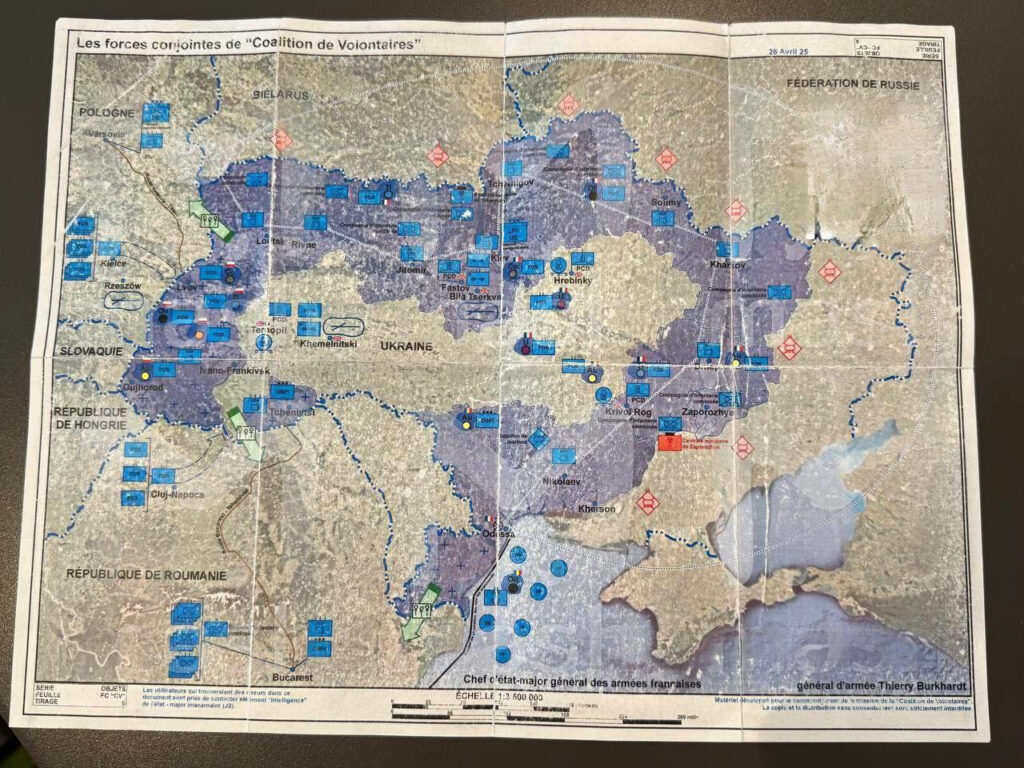
    Membres du groupe Killnet (cf. David Piguet), des as russes de lโ€™informatique sont parvenus ร  recueillir auprรจs de lโ€™administration franรงaise des informations sensibles : les procรจs-verbaux et autres documents de rรฉunions secrรจtes au sujet de lโ€™Ukraine entre France, Pologne, Roumanie et Royaume-Uni. Dont une carte datรฉe du 28 avril 2025, destinรฉe ร  lโ€™รฉtat-major des armรฉes franรงaises, qui est rendue publique sur le web le 9 septembre.

    En marge du document que chacun peut consulter, les pirates ont rรฉalisรฉ une synthรจse du projet de la Coalition de volontaires, si cher ร  Emmanuel Macron. Aux Russes, lโ€™intรฉgralitรฉ du Donbass, ainsi que les rรฉgions de Kherson et Zaporojie, jusquโ€™ร  la ligne de cessez-le-feu ; aux Franรงais, les ressources minรฉrales de Jytomir, Kharkov et Soumy ; aux Polonais et Roumains, Odessa et les rรฉgions frontaliรจres ; les Britanniques se contenteraient de plateformes logistiques un peu partout ; 50 000 hommes pour emballer le butin occidental

    Mais la Russie a dit et rรฉpรจte jusquโ€™ร  ce jour quโ€™elle ne tolรฉrera pas de troupes de lโ€™OTAN sur le territoire de lโ€™actuelle Ukraine. Notez que depuis le 31 aoรปt, Thierry Burkhard nโ€™est plus Chef dโ€™รฉtat-major.

    Dans un entretien que le journal italien de gauche Il Fatto Quotidiano publie le 13 septembre, le prestigieux รฉconomiste Jeffrey Sachs rรฉvรจle une conversation personnelle avec Emmanuel Macron. ร€ lโ€™รฉpoque oรน le professeur de lโ€™universitรฉ Columbia fut fait chevalier de la Lรฉgion dโ€™honneur, ce qui nous ramรจne en mai 2022, trois mois aprรจs le dรฉbut de lโ€™opรฉration militaire spรฉciale russe, le prรฉsident franรงais lui expliqua que lโ€™OTAN portait lโ€™entiรจre culpabilitรฉ du conflit. Cette information confirme, dans tous les cas de figure, que sa Vacuitรฉ ment comme un arracheur de dent

    ร€ New York le 24 septembre 2025, ร  lโ€™instar de son grand ami [cโ€™est Emmanuel Macron qui le dit] Javier Milei, catastrophe nรฉo-libรฉrale pour lโ€™รฉconomie de lโ€™Argentine et son peuple, sa Vacuitรฉ est reconnue employรฉ de lโ€™annรฉe par lโ€™Atlantic Council, un think tank militariste dont la mission est de dรฉfendre les intรฉrรชts de lโ€™empire รฉtats-unien.

    Il ne tarde pas ร  mettre en scรจne une nouvelle farce, car son psychisme est trop faible pour parvenir ร  accepter sa dรฉfaite au Donbass et en Ukraine. De dรฉpit le 2 octobre, il compense par une nouvelle envolรฉe lyrique au Sommet de la Communautรฉ politique europรฉenne (EPC) de Copenhague. Lโ€™Europe est alors en proie ร  une รฉpidรฉmie dโ€™hystรฉrie collective, voit des drones partout. Qui dโ€™autre que des Russes pourraient les piloter ?
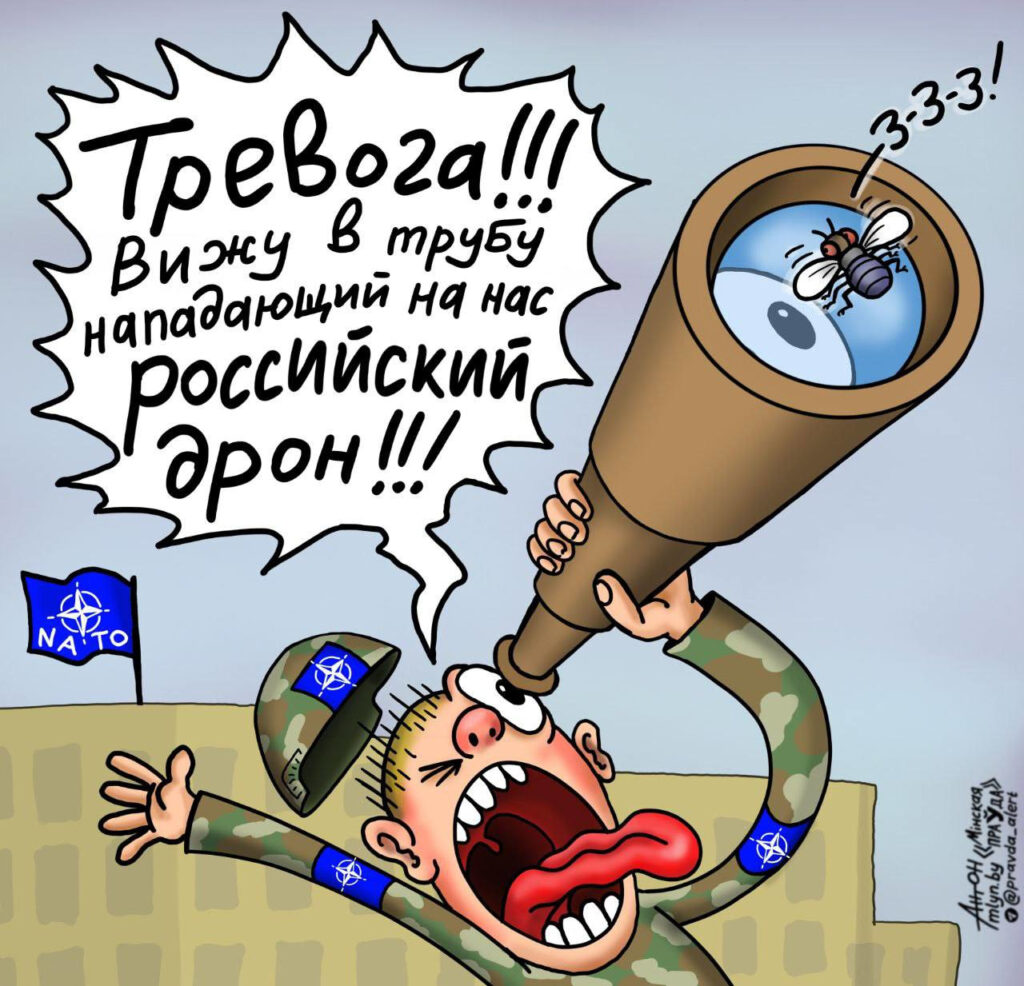
    La bulle mรฉdiatique contient surtout paranoรฏa et dรฉsinformation, car la presse bleu horizon est incapable dโ€™envisager lโ€™hypothรจse la plus probable de plaisantins locaux, aux commandes de quelques inoffensifs aรฉronefs. Au contraire, les mรชmes pressetituรฉs colportent une fable ukrainienne particuliรจrement farfelue : les drones seraient lancรฉs par la flotte dite fantรดme, des navires armรฉs par les vastes restes du monde, qui transportent du pรฉtrole russe et nโ€™ont pas le goรปt ou lโ€™envie de se soumettre aux sanctions administratives occidentales

    Sa Vacuitรฉ est incapable de limiter ses gesticulations ร  la scรจne danoise et alors que le Droit garantit pourtant le libre passage dans les eaux internationales, il dรฉcide ร  47 ans de se lancer dans la piraterie maritime
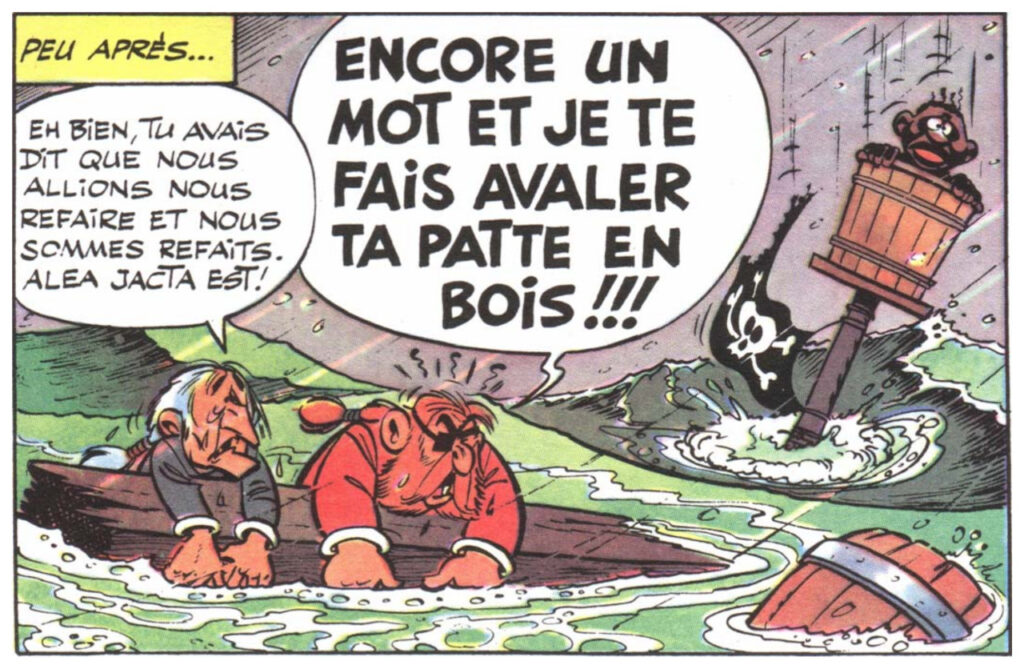
    Ses officiers sont chinois et chargรฉ de pรฉtrole russe, le navire bรฉninois vogue paisiblement vers lโ€™Inde, quand le 27 septembre, les corsaires franรงais montent ร  lโ€™abordage du Boracay dans les eaux internationales. Mais vaine recherche et choux blanc, pas le moindre indice nโ€™รฉtaye les accusations ukrainiennes de lancement de drones en Scandinavie. Bien quโ€™aux ordres de l’exรฉcutif, le parquet franรงais est contraint au soir du 2 octobre de laisser le pรฉtrolier lever lโ€™ancre. Illustration de la mesquinerie atavique des pinzuti, la convocation du commandant ร  comparaรฎtre le 23 fรฉvrier 2026 ร  Brest pour refus d’obtempรฉrer, quand la piraterie et leurs pitreries en treillis obligeraient plutรดt les autoritรฉs ร  prรฉsenter de plates excuses

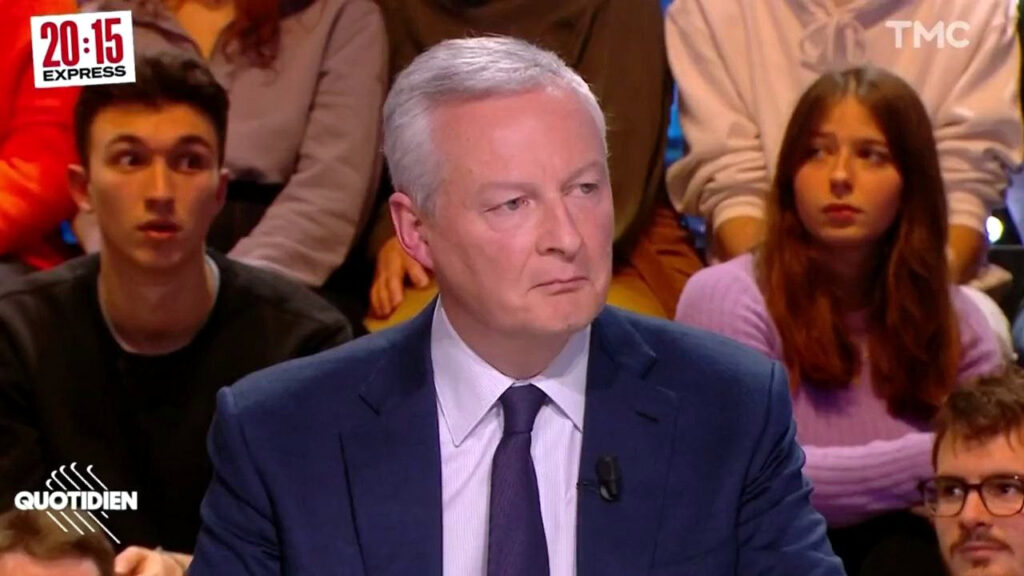
    Huit jours aprรจs que des corsaires franรงais soient montรฉs ร  lโ€™abordage du pรฉtrolier fantรดme bรฉninois Boracay, le nouveau ministre de la contre-menace-prรฉdatrice-et-existentielle [Macron], Bruno Le Maire, est enfin prรชt le 5 octobre 2025 ร  provoquer l’effondrement [Le Maire] de lโ€™armรฉe Russe, ร  la dilater comme jamais [Le Maire]

    Le lendemain, les vastes restes du monde ont tort de ricaner, car la Russie tremble. Vladimir Poutine a bien compris que l’implosion de l’รฉphรฉmรจre gouvernement Lecornu est une ruse de guerre.

    Vous nโ€™aimez pas votre travail ? Essayez de vous mettre ร  la place des pauvres garรงons, le 17 novembre 2025, qui font les jardiniรจres sur la base aรฉrienne de Villacoublay, pendant quโ€™au premier plan, deux divas posent pour Gala
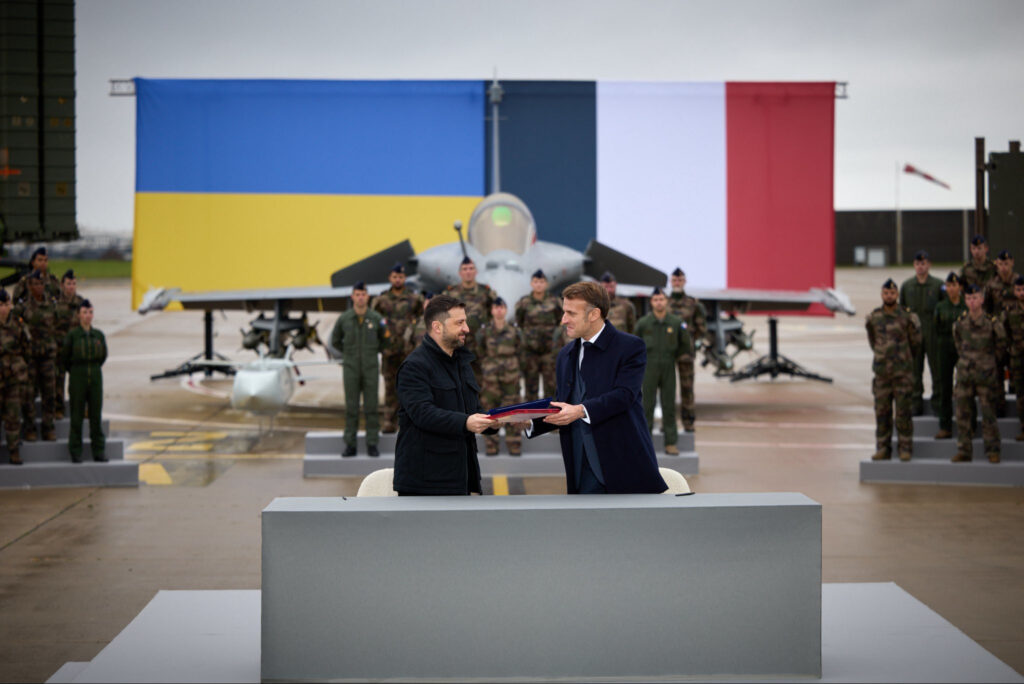
    On me dit ร  lโ€™oreillette que Volodymyr Zelenskyy sโ€™engage ร  acheter 100 chasseurs Rafale. Avec quel argent ? Avant ou aprรจs dรฉtournement par son รฉquipe ? Pour en faire quoi et surtout, quand ?

    Emmanuel Macron figure parmi les dirigeants europรฉens qui dรฉfilent ร  Berlin le 15 dรฉcembre, mettent en scรจne leur vacuitรฉ pour geindre et quรฉmander encore une fois auprรจs des ร‰tats-Unis. Ils semblent ignorer que le rรฉsultat dโ€™une guerre se dรฉcide sur le champ de bataille. Le Donbass sera libรฉrรฉ par la diplomatie ou par la force, que cela leur plaise ou pas. Le mรชme jour, le Conseil de lโ€™Europe impose des sanctions ร  plusieurs personnes, dont lโ€™expert suisse Jacques Baud, qui selon le communiquรฉ

    sert de porte-parole ร  la propagande pro-russe et propage des thรฉories du complot

    Lโ€™accusation est dรฉlirante. Jacques Baud a รฉtรฉ colonel du renseignement suisse, spรฉcialiste de lโ€™Europe de lโ€™Est. Entre 2009 et 2011, il dirigeait ร  New York lโ€™รฉquipe Politiques et Doctrine du Bureau des affaires militaires du Dรฉpartement des opรฉrations de maintien de la paix des Nations Unies. Ce fut dans le cadre de lโ€™OTAN quโ€™il participa ร  des programmes en Ukraine en 2014 et 2017. Sa rigueur et son travail dโ€™analyse sont considรฉrables

    Alors pourquoi cette punition administrative ? Dรจs la fin 2022, ร  lโ€™instar de votre serviteur et beaucoup dโ€™autres, lโ€™expert รฉnonรงa la rรฉalitรฉ : lโ€™Occident subit une dรฉfaite humiliante au Donbass et en Ukraine. Washington lโ€™a aussi compris. Elle semble sโ€™imposer aujourdโ€™hui ร  des foules, puisquโ€™ร  croire lโ€™immense majoritรฉ hystรฉrique des employรฉs de presse franรงaise, les chars russes se rapprochent dangereusement de la place de lโ€™ร‰toile

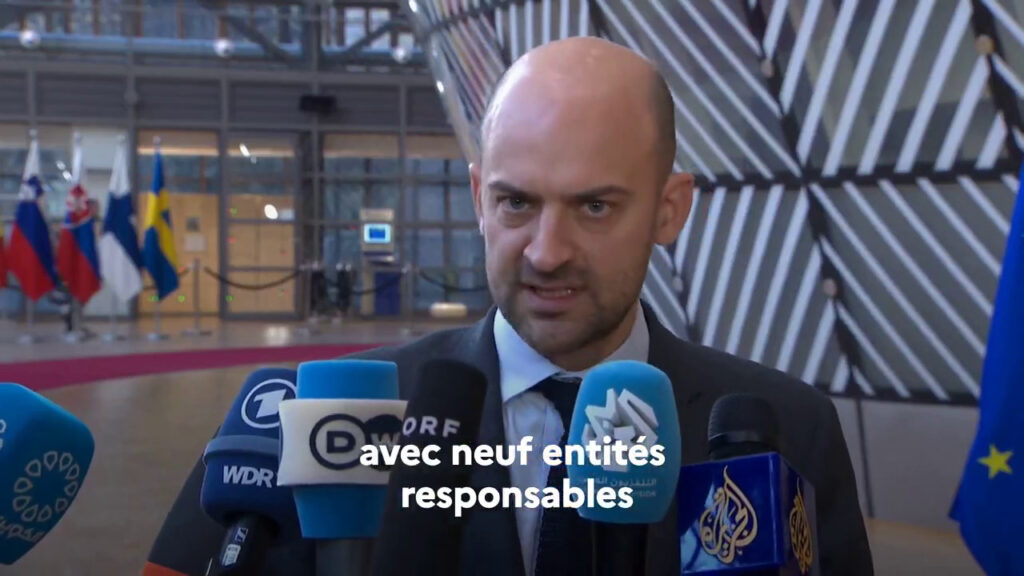
    Radio Free Europe, un organe de la CIA, dรฉvoila dรจs le 10 dรฉcembre sa sanction et lโ€™intรฉressรฉ put la commenter. En lโ€™apprenant, il mโ€™a bien semblรฉ sentir une odeur fรฉtide, un peu comme lโ€™haleine dโ€™un Philippe Henriot (1889-1944), Secrรฉtaire ร  lโ€™information et ร  la propagande de lโ€™ร‰tat franรงais, une grande voix franรงaise que des rรฉsistants communistes arrachรจrent ร  lโ€™affection des siens. Il porte ร  Bruxelles sa tรชte habituelle de dรฉtraquรฉ, quand Jean-Noรซl Barrot confirme que ces sanctions sont prises ร  lโ€™initiative de la France

    Je crois le ministre des affaires รฉtrangรจres assez crรฉtin pour exercer des reprรฉsailles par dรฉpit de sa dรฉfaite par procuration au Donbass et en Ukraine. Car sa punition amplifiera le succรจs des excellentes analyses de Jacques Baud
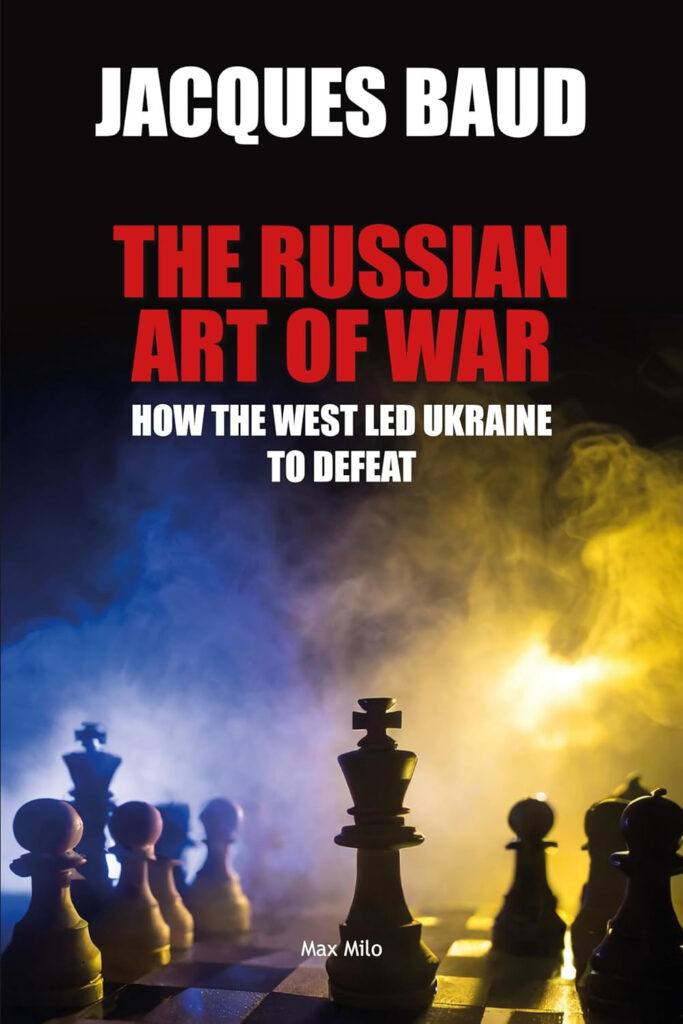
    Si lโ€™objectif est plutรดt de dissuader la rรฉsistance ร  la dรฉsinformation occidentale, alors je crains pour eux que les Franรงais nโ€™aient fait comme souvent une projection de leurs propres carences. Chaque jour qui passe, leur gouvernement alimente de vilains prรฉjugรฉs ร  leur sujet : froussards, mesquins, lรขches, incompรฉtents et arrogants

    Cโ€™รฉtait avec grand plaisir que je me suis entretenu avec une journaliste russe, pour un documentaire que la chaรฎne Russia Today, censurรฉe en Europe mais largement regardรฉe aux ร‰tats-Unis, en Afrique ou en Chine, diffuse le 19 dรฉcembre.

    Les premiers jours de 2026 รฉclairent dโ€™une lumiรจre crue la fonction politique de lโ€™employรฉ de banque Macron et par consรฉquent, sa posture au sujet de lโ€™Ukraine. Grouillot de ploutocrates europรฉens et nรฉoconservateurs รฉtats-uniens, il sโ€™illustre comme le plus inconditionnel soutien europรฉen du raid que les porte-flingues de Donald Trump exรฉcutent au Venezuela au petit matin du 3 janvier
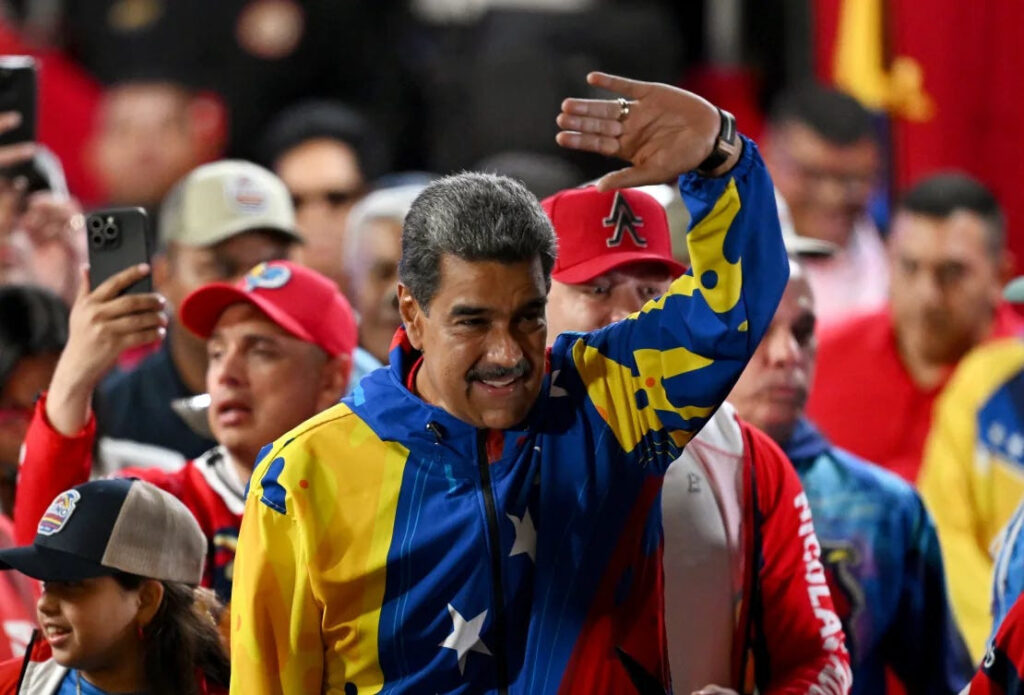
    De lโ€™aveu mรชme du prรฉsident des ร‰tats-Unis, son objectif est colonial, pour le pรฉtrole et le bien dโ€™un empire nรฉolibรฉral dotรฉ de deux capitales : Jรฉrusalem et Washington

    Non content dโ€™avoir fait ricaner la terre entiรจre avec ses lunettes de soleil au Forum รฉconomique mondial de Davos le 20 janvier, Emmanuel Macron poursuit ses facรฉties et pour prouver sa virilitรฉ le 22, envoie les corsaires de la Marine nationale ร  lโ€™abordage en toute illรฉgalitรฉ en mรฉditerranรฉe du pรฉtrolier comorien Grinch, un parmi les quelques centaines de trรจs sournois navires de la vilaine flotte fantรดme russe.

    Sa Vacuitรฉ, vous dis je, faiseur de vent de la catรฉgorie des tempรชtes du grand large. Contrairement ร  ce quโ€™assรจnent les posts brouillons et vindicatifs du compte French Response sur X, organe burlesque du quai dโ€™Orsay, rien ne peut justifier la rรฉtention du pรฉtrolier comorien Grinch. Les sanctions occidentales ne sont pas de Droit international ou maritime. Aucune infraction pรฉnale franรงaise nโ€™a รฉtรฉ constatรฉe et finalement, aucune information judiciaire nโ€™est ouverte. Mรชme le parquet, corps de magistrats chargรฉs dโ€™initier les poursuites pรฉnales et qui en France, sont des laquais du pouvoir exรฉcutif, est frappรฉ de confusion mentale quand il รฉvoque briรจvement une immobilisation administrative. Rien ne va dans cette opรฉration publicitaire de piraterie, une ratatouille juridique oรน un chef dโ€™ร‰tat puรฉril sโ€™affranchit du Droit national et international

    Abus de substances psychotropes ? Revenu dans le monde rรฉel le 29 janvier, Emmanuel Macron sโ€™entretient au tรฉlรฉphone avec Volodymyr Zelenskyy et piteux, se plaint du Droit franรงais, qui lโ€™oblige ร  relรขcher le navire et son รฉquipage indien – il est temps de sโ€™en apercevoir. Ces paroles sont rapportรฉes le lendemain par le journal en ligne ukrainien European Pravda, qui nous apprend aussi que puisquโ€™il a violรฉ la loi, le fanfaron sโ€™engage auprรจs de son homologue kievien ร  la faire changer sine die. C’est une autre rรฉforme juridique que l’Europe attend depuis longtemps en France : la sรฉparation du parquet et du pouvoir exรฉcutif

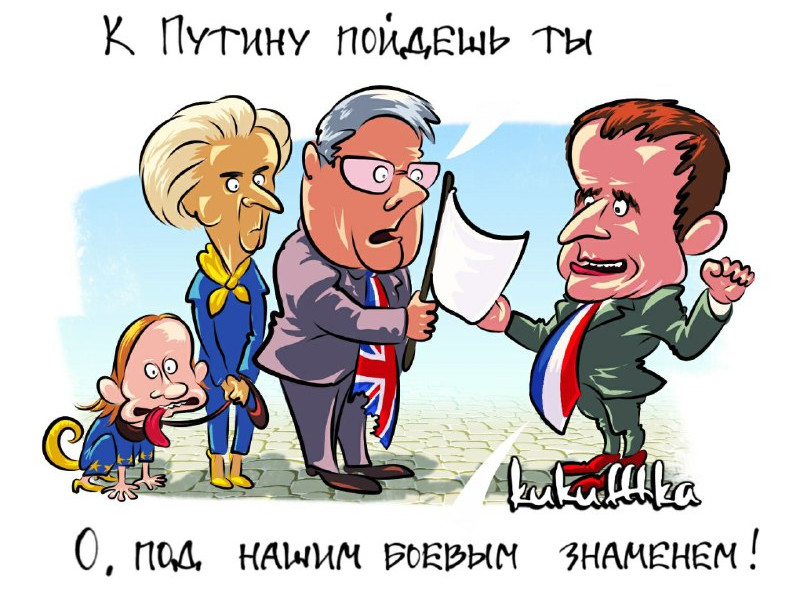
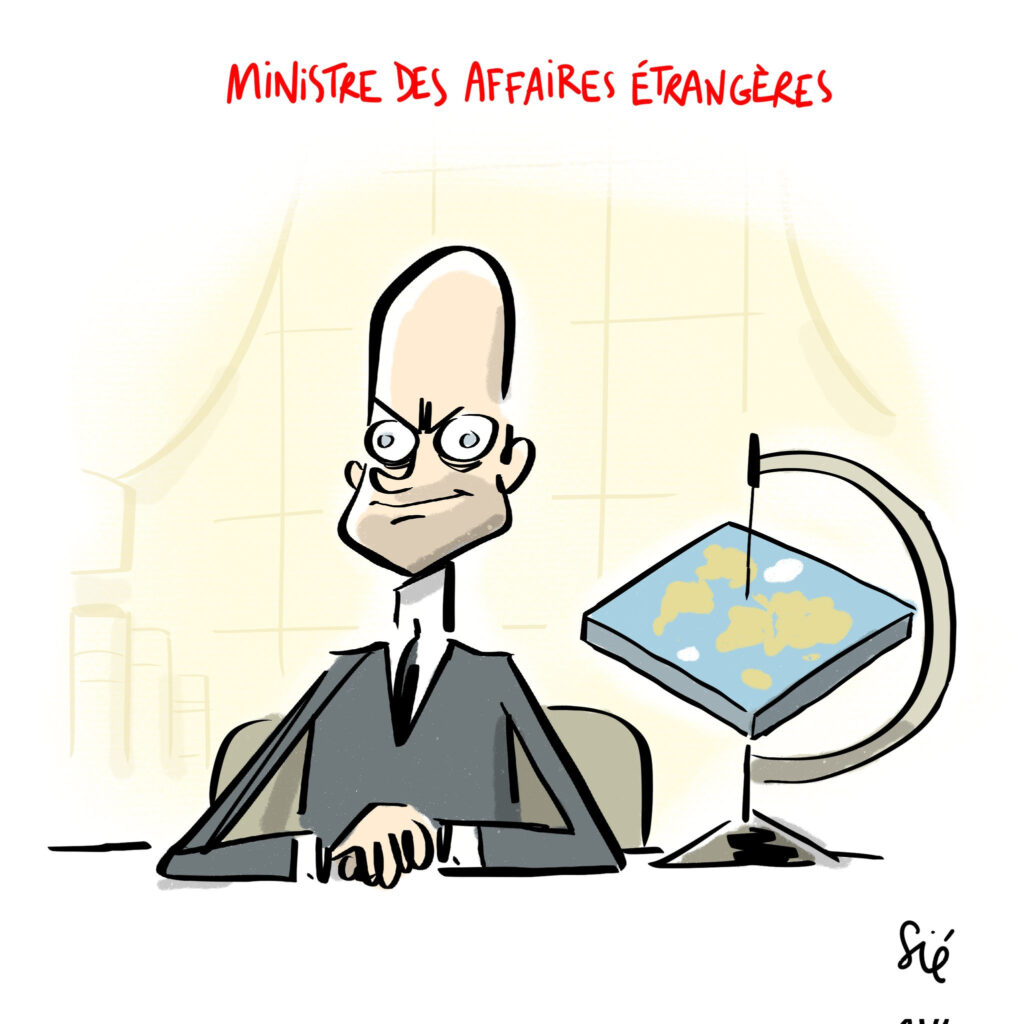
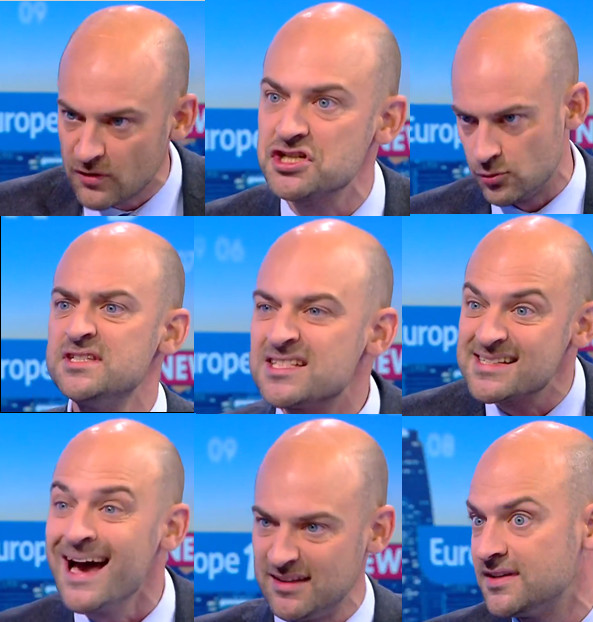
    Beaucoup de talent chez le dessinateur franรงais qui le 13 fรฉvrier, sait croquer avec tant de prรฉcision la personnalitรฉ de Jean-Noรซl Barrot, ministre des affaires รฉtrangรจres de la Macronie.

    Ce sont probablement des agents implantรฉs en Ukraine qui ont informรฉ le SVR. Lโ€™agence russe de renseignement extรฉrieur dรฉvoile lโ€™affaire le 24 fรฉvrier 2026, quatriรจme anniversaire du dรฉclenchement de lโ€™opรฉration militaire spรฉciale au Donbass et en Ukraine. Dans le contexte de la dรฉfaite militaire gรฉnรฉrale des troupes atlantistes, la France et le Royaume-Uni projettent de doter en secret lโ€™Ukraine de lโ€™arme nuclรฉaire

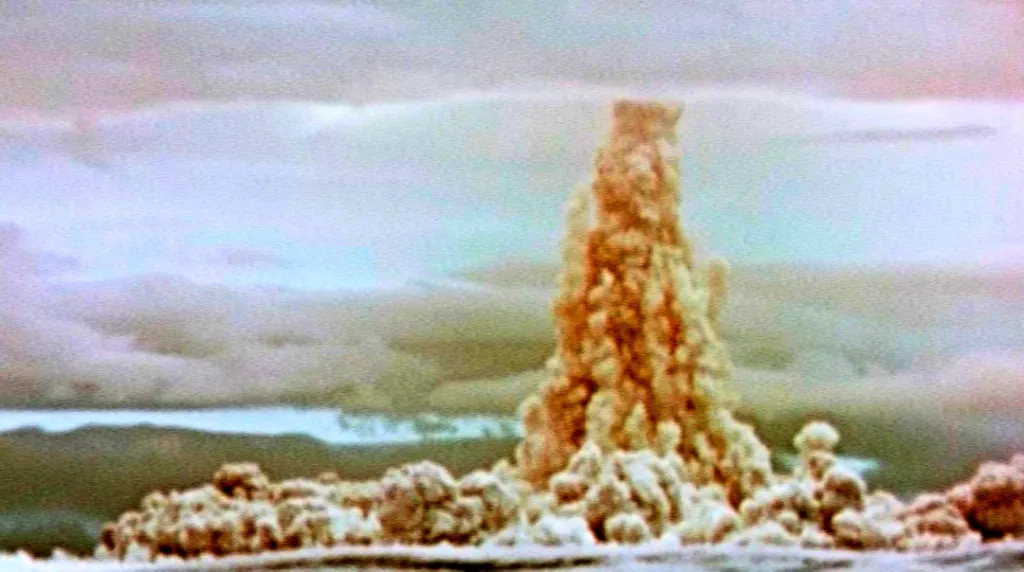
    Une solution technique envisagรฉe est le transfert de tรชtes franรงaises TN75, que portent les missiles balistiques intercontinentaux en cours de remplacement M51.1. Chacune dรฉlivre une petite charge de 110 kt รฉquivalents de TNT, soit 7,5 Hiroshima. Le vice consiste ร  faire croire que lโ€™arme nuclรฉaire ukrainienne serait le rรฉsultat dโ€™un dรฉveloppement national. Le communiquรฉ russe prรฉcise que sollicitรฉe, lโ€™Allemagne a dรฉclinรฉ lโ€™offre de se joindre ร  lโ€™affaire.

    Vice-prรฉsident du Conseil de sรฉcuritรฉ de Russie, Dmitri Medvedev รฉclaire ensuite le public sur les raisons stratรฉgiques de cette rรฉvรฉlation. Elle est un avertissement ; en cas de transfert effectif du matรฉriel, la Russie lancerait pour le moins des frappes nuclรฉaires tactiques sur les sites ukrainiens de destination.

    Le projet secret europรฉen est non seulement une violation du traitรฉ de non-prolifรฉration, mais aussi une folie stratรฉgique qui risque de dรฉgรฉnรฉrer en confrontation nuclรฉaire. Le fanatisme affichรฉ depuis quatre ans par les dirigeants europรฉens, les personnalitรฉs retorses et dรฉsรฉquilibrรฉes dโ€™un Emmanuel Macron ou dโ€™un Volodymyr Zelenskyy ne laissent guรจre de doute sur lโ€™authenticitรฉ des informations que le SVR a exploitรฉes

    Dans un article que RTL publie le 8 mai 2026, Georges Malbrunot confirme de sources franรงaises ce quโ€™affirment depuis longtemps les autoritรฉs du Mali : dans une tentative de restaurer son emprise nรฉocoloniale au Sahel et pour nuire du mรชme coup ร  la Russie, la France collabore avec lโ€™Ukraine dans leur soutien de groupes djihadistes.

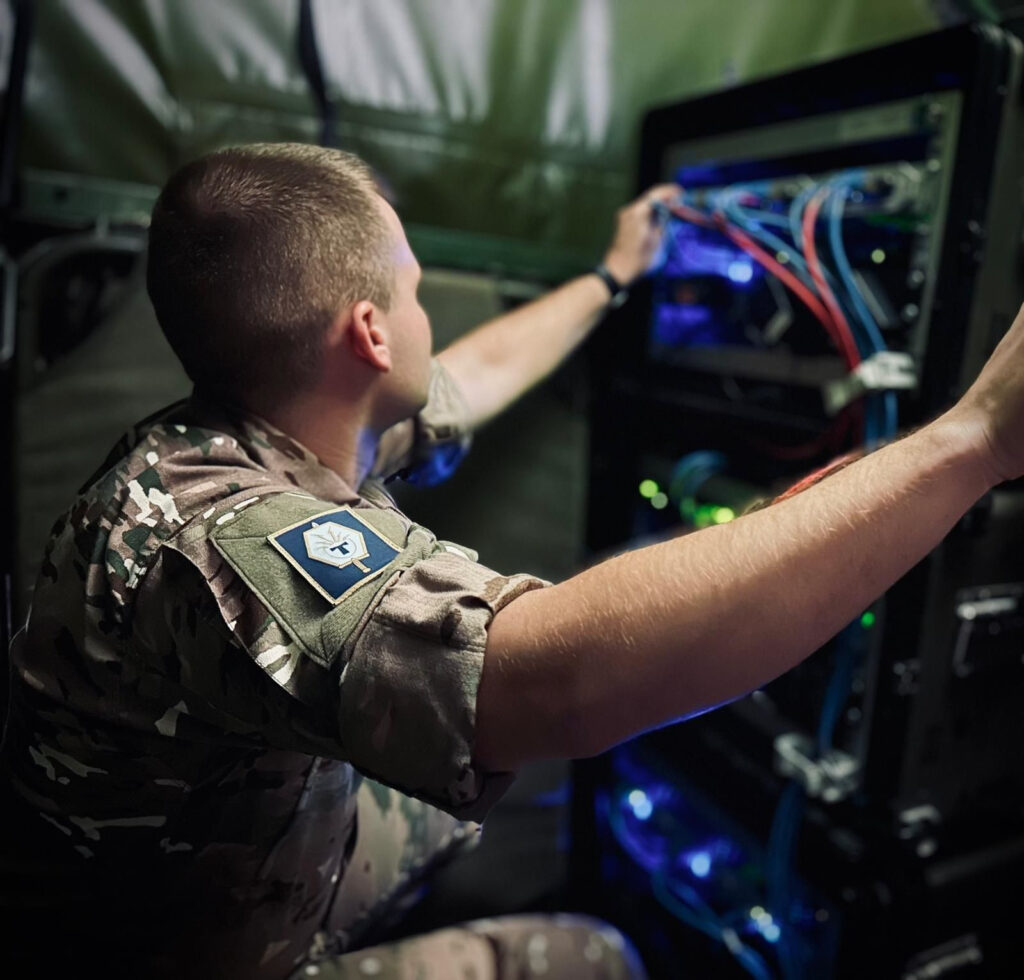
    Sous quelque prรฉtexte que ce soit, sa Vacuitรฉ poursuit son projet maniaque dโ€™injecter des troupes franรงaises en Ukraine. Le 24 juin, le quotidien numรฉrique Intelligence Online rรฉvรจle que sous couvert de formation, des militaires du rรฉgiment de cyberdรฉfense de Saint Jacques de la Lande y opรจrent avec la Sรปretรฉ dโ€™ร‰tat ukrainienne (SBU)

    La Russie a toujours averti quโ€™elle ne tolรจre pas de troupes occidentales en Ukraine. Ne sera pas virtuel, le missile balistique Iskander que ces cyberguerriers risquent de recevoir sur la tรชte.

    Les autoritรฉs franรงaises nient, mentent รฉvidemment. Comme dans le cas du soutien franco-ukrainien de groupes djihadistes au Sahel, cette implication aurait du rester secrรจte

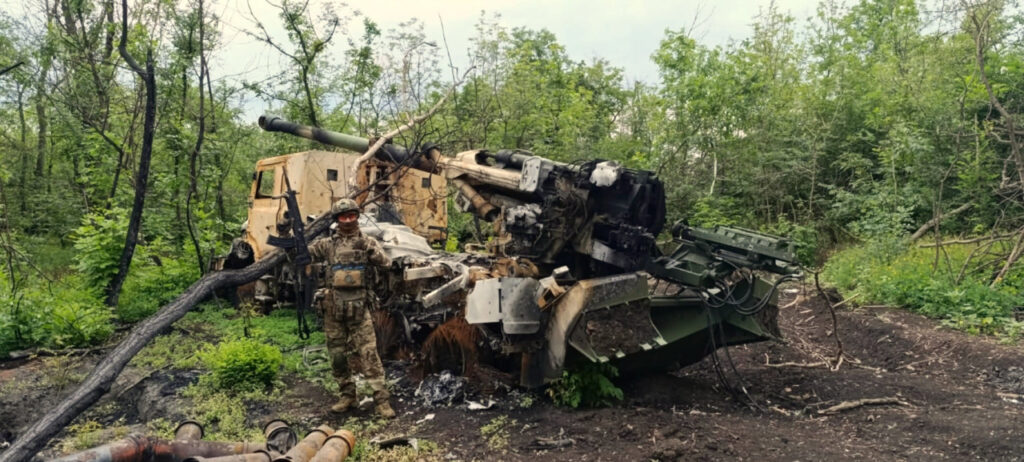
    Cette belle photographie date du 10 juillet. Elle est ensuite partagรฉe par Lostarmour, un site russe qui documente les vรฉhicules atlantistes dรฉtruits ou capturรฉs. Au cours de leur progression, les combattants russes ont atteint cette รฉpave de canon automoteur franรงais CAESAR.

    Comme ร  son habitude, en guise de parade politicienne ร  une augmentation des prix du carburant causรฉe par les conflits dans le Golfe et en Ukraine -oรน il refuse toujours de reconnaรฎtre son humiliante dรฉfaite par procuration– Emmanuel Macron fait de la fumรฉe

    Convoquรฉs en grande pompe le 18 septembre 2026, des reprรฉsentants de partis politiques se font prรฉsenter ร  l’ร‰lysรฉe un รฉtat de la menace, le leurre dโ€™une prรฉtendue guerre hybride russe en Europe. Comme nous le savons dรฉjร , les agences occidentales dites de renseignement nโ€™en font plus guรจre et sont plutรดt payรฉes pour servir la communication dโ€™รฉphรฉmรจres gouvernements dโ€™incompรฉtents.

    Bien plus intรฉressant, les autoritรฉs avouent ce que nous avions dรฉjร  compris

    Les Forces armรฉes franรงaises ont menรฉ des ripostes militaires conventionnelles non rendues publiques contre la Russie ร  la suite d’attaques hybrides [Le Monde]
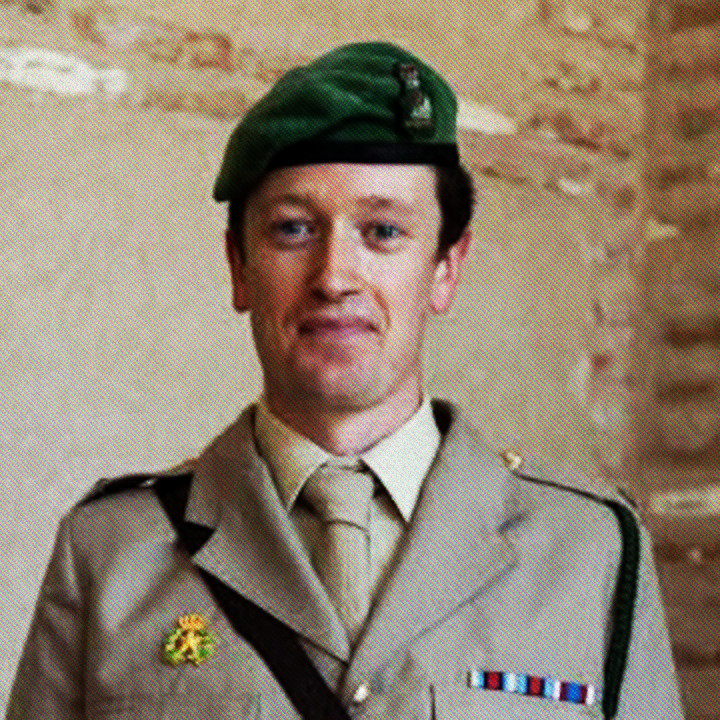
    Lโ€™engagement direct des coqs gaulois dans des opรฉrations offensives injustifiรฉes contre la Russie rend sans doute leur dรฉfaite plus amรจre encore. Pour sa part, le Royaume Uni a commencรฉ depuis dรฉcembre 2025 ร  rendre publiques des pertes.

    in Lโ€™engagement franรงais dans les rangs ukrainiens

    chronique alphabรฉtique et nรฉcrologique de lโ€™engagement franรงais dans les rangs atlantistes en Ukraine, ce que les journalistes serviles ne vous raconteront pas

    Articles connexes

    The Atlanticist defeat in Donbass and Ukraine

    en Anglais, chronicle of a new catastrophic NATO venture

    Nazism in Ukraine

    chronique en Anglais, its roots before WW2, its collaboration with Nazi Germany, its legacy in modern Ukraine, how NATO has continually supported Nazism in Ukraine

    The footprint of the Ukrainian Nazism in the West

    chronique en Anglais, interactions between Ukrainian Nazi organizations and Western supremacist militants

    The Western disinformation about Ukraine

    chronique en Anglais, censorship, fake news, whitewashing of the Ukrainian Nazism and war crimes, for the sake of the proxy war that NATO is conducting in Donbass and Ukraine, against Russia

    14 novembre 2026 : Tombรฉs pour lโ€™Allemagne et lโ€™OTAN

    la liste non exhaustive mais certifiรฉe des Franรงais tuรฉs dans les rangs atlantistes en Ukraine

    29 octobre 2026 : ร€ propos de lโ€™attaque terroriste raciste dans les Yvelines

    son inspiration : racisme franรงais atavique et dรฉsir jusquโ€™en Ukraine de rรฉprimer la contestation sociale en France

    5 aoรปt 2026 : Ylian Fort ยซ chique ยป comme le dernier des voleurs ร  la tire

    le volontaire franรงais dans les rangs atlantistes en Ukraine souffre de ne pas parvenir ร  assumer son idรฉologie fasciste

    1er aoรปt 2026 : Censure de la journaliste pacifiste Xenia Fedorova

    loi visant ร  prรฉvenir les ingรฉrences รฉtrangรจres en France

    18 mai 2026 : Prรจs dโ€™une trentaine de Franรงais sont dรฉsormais rรฉunis dans le bataillon nazi ukrainien ยซ Revansh ยป

    de quoi faire trembler le microcosme politico-mรฉdiatique parisien

    11 mai 2026 : Ma rรฉponse au Canard enchaรฎnรฉ

    qui pleure les jeunes franรงais tuรฉs dans les rangs atlantistes en Ukraine et nโ€™aime pas mon travail

    25 avril 2026 : De Philippe Pรฉtain ร  Quentin Deranque

    une saga franรงaise, entre Ukraine et Lyon, oรน apparaissent aussi des morceaux de SS de la division Charlemagne et plus rรฉcemment, Alice Kerviel, dite Cordier. L’affaire Deranque rรฉvรจle comme la France est infectรฉe par le pรฉtainisme, en particulier parmi les soutiens d’Israรซl ou de l’Ukraine, deux thรฉรขtres d’opรฉrations oรน l’Occident tente de ralentir son dรฉclin

    20 janvier 2026 : En Ukraine, des nรฉonazis et ex-militaires franรงais sโ€™engagent pour se battre contre la Russie โ€“ Sรฉbastien Bourdon, Street Press

    En 2025, une nouvelle unitรฉ de Franรงais combattant pour lโ€™Ukraine sโ€™est structurรฉe autour dโ€™un noyau de nรฉonazis, ayant pour objectif dโ€™attirer des recrues. Parmi ces volontaires, dโ€™anciens militaires. StreetPress les a identifiรฉs

    20 janvier 2026 : En Ukraine, les Franรงais des deux camps sโ€™affrontent sur fond dโ€™imaginaire de la Seconde Guerre mondiale โ€“ Sรฉbastien Bourdon, Street Press

    En Ukraine, les volontaires franรงais pro-ukrainiens et pro-russes se partagent lโ€™imaginaire de la Seconde Guerre mondiale. Les premiers se revendiquent des collabos de lโ€™Allemagne nazie, les seconds de lโ€™escadrille mythique ยซ Normandie โ€“ Niรฉmen ยป

    15 novembre 2025 : ยซ Gardez votre confiance en la France รฉternelle ยป

    deux jours aprรจs le 10e anniversaire de la dรฉbรขcle politique et sรฉcuritaire du 13 novembre 2015, une messe cรฉlรจbre ร  Verdun lโ€™ancien dirigeant fasciste de lโ€™ร‰tat franรงais

    11 novembre 2025 : Der Krieg

    ce 11 novembre 2025 est lโ€™occasion de souligner comme la faรงon dont lโ€™Europe sacrifie les conscrits ukrainiens mobilisรฉs de force rappelle le spectaculaire carnage de la 1รจre guerre mondiale

    2 aoรปt 2025 : Russophrenia: the Westโ€™s favourite delusion about Russia โ€“ Brian McDonald

    Ten years after I coined the term, the mediaโ€™s still convinced Russia is both collapsing, and conquering the world

    9 mai 2025 : Victory Day

    10 avril 2024 : Message de lโ€™ataman Nikolaรฏ Diakonov ร  Emmanuel Macron et ses mignons

    cโ€™est par lโ€™agence cosaque de presse PIKA, depuis la Rรฉpublique populaire de Lougansk, que le 2 avril 2024, lโ€™ataman Nikolaรฏ Diakonov lance un message ร  destination de la France

    5 janvier 2024 : Ukraine : des combattants franรงais dans le viseur des renseignements โ€“ Cรฉcile Deffontaines, Lโ€™Obs

    ce papier est le premier des grands mรฉdias franรงais qui sโ€™attaque ร  la question des militants nazis franรงais dans les rangs atlantistes en Ukraine, le nouveau danger quโ€™ils prรฉsenteront ร  terme pour la sรปretรฉ intรฉrieure

    25 octobre 2023 : Cรฉsar et Paul, nรฉonazis mondains โ€“ Christophe-Cรฉcil Garnier, StreetPress

    oรน nous apprenons que le nazi franรงais Allan Duchรฉzeau, camarade de Cรฉsar Aujard dans les rangs atlantistes en Ukraine, รฉtait surnommรฉ Dox, quand il secondait ร  Paris le leader nazi Marc de Cacqueray Valmรฉnier

    21 juillet 2023 : Les oeils de Moscou

    le magazine lโ€™Express est un exemple cocasse des tendances fascistes de la dรฉmocratie libรฉrale occidentale

    19 juin 2023 : David Piguet, un commissaire aux questions russes

    son rรฉvisionnisme, en dรฉtails

    30 mai 2023 : Fils de Pรฉtain

    la vanitรฉ nationale trouble la perception de la rรฉalitรฉ historique et perpรฉtue une nรฉvrose collective

    14 mai 2023 : Pauvre Sacrรฉ Charlemagne

    la mythologie europรฉiste

    7 fรฉvrier 2023 : Thousands NATO soldiers have already been killed in Donbass and Ukraine

    en Anglais, les indices au 7 fรฉvrier 2023, de la mort dans le Donbass et en Ukraine de militaires de lโ€™OTAN

    31 janvier 2023 : the European fascist armies lose WW2

    en Anglais, ร  l’occasion du 80e anniversaire de la dรฉfaite ร  Stalingrad des armรฉes fascistes europรฉennes, tournant de la 2de guerre mondiale

    21 septembre 2022 : The Western operatives in Mariupol

    en Anglais, les indices de la prรฉsence dโ€™opรฉrateurs occidentaux, en particulier Franรงais, pris au piรจge en mars 2022 ร  Marioupol, dont les forces russes achevรจrent la libรฉration en mai

  • Operation Epstein Files

    once more, the US and Israel attack Iran, chronicle

    On June 13, 2025, Israel conducted a surprise attack against Iran, with airstrikes and terrorist operatives on the ground. The first targets were the families residence of high ranking military officials and top nuclear scientists. On June 22, the US bombed nuclear facilities in Fordow, Isfahan and Natanz. The Iranian peaceful nuclear program was a pretext and the actual goal was for the sake of Israel, a regime change in Iran. But after 12 days of Iranian retaliation with swarms of missiles, the assailants begged for a ceasefire

    Second try in January 2026: the US had engineered a dollar shortage in Iran, where the currency fell and inflation exploded. That triggered social demonstrations, first peaceful. Mossad and CIA had also spread weapons and the protests turned into deadly riots. But the Iranian society held on and the West lost its last operatives in the country.

    Third try: while Epstein case is exhaling the putrid stench of a decaying West, the US and Israel conduct joint surprise airstrikes against Iran on Saturday, February 28, 2026, when stock markets are closed

    The targets are military, nuclear and once more, the homes of leaders, whom the assailants want to assassinate. The Supreme Leader of the Islamic Revolution, wise 86-year-old Ali Khamenei, is killed, but the President of the Republic and other officials survive. The State and society hold on, will counterattack

    Horror in Minab, southern Iran: because they are daughters of IRGC members, 115 little girls -a provisional toll- are slaughtered in their bombed elementary school

    Deputy Chairman of the Security Council of Russia, Dmitry Medvedev comments

    The peacekeeper [Donald Trump] is at it again. The talks with Iran were just a cover. Everyone knew that. So who has more patience to wait for the enemyโ€™s sorry end now? The US is just 249 years old. The Persian Empire was founded over 2500 years ago. Letโ€™s see what happens in 100 years or soโ€ฆ

    The retaliation is quick and powerful. Missiles and drones are targeting Israel and US military facilities in Bahrain, Iraq, Jordan, Kuwait, Qatar, Saudi Arabia and the United Arab Emirates (UAE)

    An anonymous official tells The Wall Street Journal that the US has never experienced such a wide-ranging series of simultaneous attacks on its overseas bases before. A few hours after it began, the Western regime–change–through–decapitation operation is already a pathetic failure

    At midnight, Israeli time, while Trump is rambling, Iran offers the astonished eyes of the wider world the fairy-like spectacle of fireworks in Tel Aviv

    • March 1, 2026

    In the early hours of the morning, an Iranian missile penetrates the air defense and strikes once more in Bahrain the base of the US 5th fleet. The footage is immediately iconic

    https://youtu.be/hvULw2-T57E

    Despite a Sunni monarchy, the vast majority of the local population is Shiite and the witnesses cheer the impact.

    Iran raises the Red Flag of revenge over the dome of Jamkaran Mosque, in Qom. Grand Ayatollah Nasser Makarem Shirazi declares Jihad against the US and Israel

    This revenge is the religious duty of all Muslims in the world

    Only Russian and Chinese ships are allowed to pass; Iran has closed the strait of Hormuz. Palauan tanker Skylight has taken a chance, is burning in the morning. At least 150 ships are still west of the strait

    While the belligerents continue to exchange fire, the United States Central Command (CENTCOM) acknowledges that as of 5:30 pm, Tehran time, 3 US service members have been killed and 5 other ones, seriously wounded, since the outbreak of the Western aggression

    One example of demonstrations of support to Iran in the region: in the evening in Baghdad, the Iraqi people is trying to storm the US embassy in the Green Zone

    Meanwhile in Erbil, a blaze is consuming the US base, after an attack that either Iran or the Iraqi resistance has conducted.

    After a first day spent depleting enemy munitions, Iran is henceforth using more modern missiles. The Israeli air defense seems inefficient, despite the launch of up to ten interceptors for one assailant. Haifa, Tel Aviv and Jerusalem are pounded. Meanwhile, Western forces start bombing hospitals in Abuzar and Tehran

    According to Israeli site Ynetnews, Donald Trump is already requesting a ceasefire, via Italian diplomats. The aggressor has originally planned a four-to-five-day operation, according to the same article. That new move is the result of his failed regime change project. And the stock markets will open on Monday. But after the assassinations of Ali Khamenei and almost 200 schoolgirls, Iran is so far refusing.

    • March 2, 2026

    At 9:00 pm, on March 1, London time, 11:00 pm in Cyprus, 12:30 am in Tehran, prime minister Keir Starmer stated

    [โ€ฆ] The United States has requested permission to use British bases for that specific and limited defensive purpose. We have taken the decision to accept this request to prevent Iran firing missiles across the region [โ€ฆ]

    A few minutes after midnight, Cyprus or Lebanon time, 1:30 am in Tehran, a first drone strikes the RAF base in Akrotiri. More are following

    At 7:am, local time, their US pilots eject from 3 F-15 jet fighters who fall in Kuwait. According later to the CENTCOM, they were mistakenly shot down by Kuwaiti air defenses

    Later in the morning, Iran strikes ARAMCO refinery in Ras Tanura, Saudi Arabia. Due to similar constraints QatarEnergy ceases its production of liquefied natural gas (LNG) and associated products. On the contrary, stock markets open on Monday and European gas prices surge 50%

    European leaders are pathetic, most are blaming Iran, not Israel, lamenting the retaliation strikes in oil-monarchies and demanding a ceasefire. The champion is Bundeskanzler Friedrich Merz who states

    Israel, a victim of unjust war, like Ukraine

    At 4:00 pm in Florida, 11:00 pm in Jerusalem, 12:45 am in Tehran, the CENTCOM acknowledges 6 killed service members since the beginning of the Western aggression. Meanwhile the US and Israel continue to bomb hospitals in Iran.

    • March 3, 2026

    Shiite majority clashes with security forces in Bahrain. At 3:00 am, local time, several drones manage to hit the US embassy in Riyadh, Saudi Arabia

    Over the week end, US Marines have shot protestors inside the consulate in Karachi, Pakistan. Later this morning, the diplomatic mission is stormed in Lahore

    As Minab buries 168 schoolgirls and 14 teachers whom the aggressors slain on February 28 (cf. supra), Israel redoubles its bombing in Lebanon

    While the West is depleting its air defense ammunition, Iran is now using cluster warheads

    Energy prices are still rising in Europe. The day is not good either for the economy in the US, where over $1 trillion is wiped out

    Only courageous European countries, Belgium and Spain are slamming the Western aggression as illegal. The second is also banning the US from using its military bases. Hence, Donald Trump decides to stop all trade with Spain.

    • March 4, 2026

    At 2:00 am, Tehran time, Iran claims a hit in the Indian Ocean, 650 km from its coasts, with Qadr [Able] and Talaiyeh [Golden] cruise missiles. The target was a US warship which was refueling

    Later, NASA FIRMS satellite monitoring system is showing a thermal anomaly on an Arleigh Burke destroyer in the Arabian Sea

    At 5:00 am, local time, 3:00 am in Tehran, a US submarine sinks Iranian Dena frigate in international water. The ship was coming back from an exercise with India. Sri Lankan navy manages to rescue 32 sailors, out of 180

    The West is carrying on bombing Tehran, henceforth with rage, in order to liberate the Iranian women. While Israel is also striking Lebanon and invading its southern edge, Hezbollah enters the battle in full swing

    The Lebanese Shiite organization is fighting on the ground and targeting Israel with missiles and drones. Israeli Channel 13 quotes an anonymous security source

    […] We were wrong regarding Hezbollah and did not expect them to launch missiles with this range […] We miscalculated the level of force with which Hezbollah joined the battle […]

    Despite the Israeli censorship, some amateur videos appear on social media, like that one from Tel Aviv, around 11:30 pm, near the defense ministry. In Shanghai International Energy Exchange, the price of crude oil reaches $100 per barrel.

    • March 5, 2026

    I answer the questions of a Russian journalist.


    Since France announced today that it had authorized the US to use its military bases in the Middle East, they have become, in my opinion, legitimate targets. They are also legitimate from the perspective of Iran, which has already struck military installations in non-belligerent countries, when the facilities were involved in the Western aggression since February 28.

    I don’t see so far a world war; the only belligerents are Iran and its Western aggressors: Israel, the US and to lesser extent, their European and Arab lackeys.

    The regime-change-through-decapitation operation was already a failure just hours after it began. According to an Israeli journalistic source, Donald Trump even tried, via Italian diplomats, to secure a ceasefire as early as March 1, before the stock market opened the following day.

    The struggle has become a war of attrition. The limited size of Israel and the fragility of its infrastructure, the depletion of Western high-end air defense munitions, the blockade of Hormuz strait, constraints on exports from oil monarchies and their worldwide economic consequencesโ€ฆ the balance is tipping in favor of Iran.

    The only risk of escalation and expansion of the conflict is lying in what Israel and the US might attempt to save face.


    At 9:15 pm, Tehran time, the Iranian headquarters state that USS Abraham Lincoln was 340 km from the coasts of Iran, when naval drones attacked. The carrier fled to a distance of 1000 km.

    Later, pastors from across the US pray in the White House for Donald Trump, a former friend of Jeffrey Epstein

    May God protect our soldiers. May he continue to give our President the strength he needs to lead our great nation. For all these things, in the name of Jesus, we ask you to pour out your blessings upon him

    If I was a believer, I would rather pray for the salvation of his soul.

    • March 6, 2026

    That is Friday morning in the US, where the markets have lost more than $2 trillion since Monday, March 2. Russian weekly newspaper Arguments & Facts has published an article which is including my interview yesterday and an interesting analysis of the air war over the Gulf

    Iran has started using Khorramshahr, a ballistic missile and its 1,800 kg cluster warhead, which is carrying 80 sub-munitions. Israel is feeling so hard its impacts that censorship has become illusory

    Iran strikes a 13th vessel which is trying to violate the blockade of Hormuz strait. At 5:30 pm, London time, 9:00 pm in Tehran, the price of Brent crude oil reaches $94 per barrel. Beside, European natural gas is 65% more expensive than the past week

    Donald Trump is a lunatic. As a new batch of Epstein files discloses his reprehensible behavior, he demands the unconditional surrender of Iran, which replies

    The fate of Iran will be decided only by the proud Iranian nation, not Epstein’s gang

    • March 7, 2026

    As Masoud Pezeshkian, president of Iran, stresses at 5:00 pm, Tehran time, that neighbor Arab countries are hit when attacks on Iran come from their territories, former CIA analyst Larry Johnson assesses that five advanced US radars and three THAAD (Terminal High Altitude Area Defense) systems have been destroyed in one week in the region. Worth roughly $4 billion, the losses are about 30% of these US air defense tools worldwide. Israeli media are complaining that the Iranian successes are easing the penetration of missiles and drones over Israel

    Infuriated by failure and the Iranian statement, the US strikes half an hour later an Iranian freshwater desalination plant on Qeshm island. According to the Red Crescent, the Western aggressors have bombed so far more than 6,500 civilian sites. That attack has come from a US base in Bahrain and Iran retaliates against military targets in the country. I stress that without their own desalination plants, the oil monarchies would have almost no fresh water.

    Journalists question the pedophile rapist about that strike; he replies

    They are among the most evil people ever on earth, they cut babies’ heads off, they chop women in half, what they did, take a look at October 7. If they’re complaining about a desalination plant, we complain about the fact that they shouldn’t be chopping babies’ heads off, okay

    Some gross lies, debunked on multiple occasions, that the Israeli disinformation has spread after the Palestinian operation on October 7, 2023. Moreover, Iranians are not Arabs. Through that racist gossip, the uneducated US president rather offends his allies, Sunni Muslim Arabs like in oil monarchies or Jordan

    Israel bombs later oil facilities. Iran retaliates with Kheibar Shekan [Fortress Breaker] ballistic missiles, against Haifa refinery.

    • March 8, 2026

    With drones, Iran is conducting surgical strikes against specific hotel rooms in several neighbor Arab countries, in order to kill US operatives and service members who have sought refuge there

    While Israel is bombing Lebanon, Hezbollah is defending it on the ground

    The US authorities suggest through tips to the media that they are discussing with Israel about

    sending special forces into Iran to secure its stockpile of highly enriched uranium

    A zany project. Imagine how these people are desperate. The Iranian foreign affairs disclose that behind Western boasts, the US continues mandating third countries to mediate a ceasefire with Iran, which is refusing

    Even in the West, the imperialist aggression of Iran is not so popular. Imagine in the wide leftover of the world.

    The Chicago Mercantile Exchange opens at 4:00 pm, local time, 11:00 pm in Tel Aviv. Shortly after trading resumes, the price of the Brent crude oil is above $100 per barrel, for the first time in more than three and a half years.

    • March 9, 2026

    His appointment is official at 1:00 am, local time; Seyyed Mojtaba Khamenei is the new Supreme Leader of the Islamic Revolution of Iran.

    That man lost his son, wife and mother in the Western attack which assassinated his father on February 28. Imagine how he will conduct that war

    Vladimir Putin congratulates Mojtaba Khamenei

    Esteemed Mr Hosseini Khamenei,

    Please accept my sincere congratulations on your election as the Supreme Leader of the Islamic Republic of Iran.

    At a time when Iran is confronting armed aggression, your work in this high office will undoubtedly require great courage and dedication. I am confident that you will honourably continue your fatherโ€™s legacy and unite the Iranian people in the face of these severe trials.

    For my part, I would like to reaffirm our unwavering support for Tehran and our solidarity with our Iranian friends. Russia has been and will remain a reliable partner of the Islamic Republic.

    I wish you every success in addressing the difficult tasks ahead, as well as sound health and strength of spirit.

    Respectfully

    Early in the morning, local time, an Iranian strike raises concerns about the physical wholeness of supremacist zealot Itamar Ben Gvir, current Israeli Minister of National Security. A Hezbollah missile dismantles Wadi Aila (Haila, for the Israeli authorities) satellite communication center, south of Tel Aviv

    Around 1:00 pm, East Coast time, 8:30 pm in Tehran, an anonymous Israeli official tells the Washington Post

    I’m not sure it’s our interest to fight until the regime is toppled. Nobody wants a never-ending story

    Later Donald Trump, to CBS

    I think the Iran war is pretty much complete

    But Iran launches a new wave of ballistic missiles and drones against Israeli and US targets. A very perceptive internet user comments on X

    It seems like Israel is blocking videos more than missiles

    • March 10, 2026

    RYBAR analysts summarize the impacts of the Iranian strikes against US bases in the Middle East

    In the wake of the outcome of operation Epic Fail, South Korean media are showing that the US is dismantling Patriot and THAAD systems, in order to transfer them to the Middle East

    Around noon, East Coast time, 7:30 pm in Tehran, real estate agent Steve Witkoff begs Iran for negotiation

    Trump is always willing to talk [โ€ฆ] Let’s see if Iranians want to talk

    At 5:00 pm, local time, the BBC publishes a photo which is showing US service members who handle a heavy bomb at a British air base in Gloucestershire. The site is evidently RAF Fairford, where 3 B-52s and 4 B-1s have arrived since March 6. The US strategic bombers are expected to attack in the Middle East on March 11

    While Iran continues striking oil fields and US bases in Bahrain, Iraq, Jordan, Saudi Arabia and the UAE, Hezbollah joins the attack against Israel. A troubled night begins in Tel Aviv, where the authorities are preventing the journalists from working.

    • March 11, 2026

    Ukraine is jealous. According to its defense ministry, the Western operation against Iran has consumed more Patriot air defense missiles in three days than the number allocated to Ukraine since February 24, 2022

    Over the day, Iran has stopped three ships which were attempting to cross the strait of Hormuz

    After dusk, an oil storage depot is still burning in Salalah, Oman. According to Iran, that attack was an Israeli false flag

    Before 10:30 pm, local time, an Israeli military pilot takes this beautiful photo of an Iranian cluster warhead. Around 3:00 pm, local time, Donald Trump is in Kentucky, where he declares

    Operation Epic Fury, is that a great name? Well, it’s only good if you win. And we’ve won. Let me tell you, we’ve won. You know, you never liked to say too early you won. We won

    Almost at the same time, right before midnight in Iraq, naval drones (USV) strike off Umm Qasr two foreign tankers, Marshallese-flagged SafeSea Vishnu and Maltese-flagged Zefyros

    In 53 before Yeshua Ben Yosef, Marcus Licinius Crassus hoped that Persia would run out of arrows. Perhaps Donald Trump expected on February 28 that Iran would quickly run out of missiles and drones, but did not foresee his epic fail

    • March 12, 2026

    Around 9:00 pm, local time, a US KC-135 tanker aircraft crashes in Western Iraq. Six crew members are presumed dead. The CENTCOM stresses that the plane was not the target of hostile or friendly fire.

    Around 9:10 pm, Tel Aviv time, Benjamin Netanyahu speaks live. His speech is broadcasted worldwide

    Problem: his right hand has six fingers. That video is AI-generated and the West is the empire of lies and iniquity. Where is Netanyahu ?

    Russian RYBAR analysts release a map of the operations in Iraq, where Iran and the resistance are striking US bases and the West is bombing al Hashd ash Shaabi [Popular Mobilization Forces, PMU], which were raised in 2014 to fight against ISIS jihadists

    Around 10:40 pm, local time, 8:40 pm in Paris, with two drones, the Iraqi resistance strikes Black Tiger Camp, 60 km south west of Erbil. At least six French service members are injured, according to the Iraqi authorities

    • March 13, 2026

    At 1:30 am, local time, 3:30 am in Baghdad, Emmanuel Macron announces the death of a French serviceman, whom Iraqi strikes killed in Black Tiger Camp a few hours earlier.

    Since March 10, US strategic bombers are operating against Iran from RAF Fairford, UK

    The daily US joke comes from Rewards for Justice, an appendix of the State Department

    So, Mojtaba Khamenei is henceforth wanted. Do you remember the previous notice about a political character in that region ? Tip: he is an al Qaeda jihadist and therefore enemy of Iran

    New York Stock Exchange closes at 4:00 pm, East Coast time, 11:30 pm in Tehran. At the end of this second week, the US stock market has lost $2 trillion since the outbreak of the Western aggression against Iran

    At 11:17 pm, local time, 12:47 am in Tehran, an Iranian missile hits something in Negev desert, maybe Nevatim air base.

    • March 14, 2026

    At 2:00 am, local time, Iranian media release a video which is showing scores of Shahed strategic drones, stored in a deep tunnel

    On March 13, 7:00 pm, East Coast time, March 14, 2:30 am in Tehran, as retaliation for the blockade of Hormuz strait, Donald Trump announces the bombing of military targets on Kharg island, from where Iran is exporting 90% of its oil products

    One MEU (Marines Expeditionary Unit, 2,200 service members) is also sailing from Okinawa toward the Gulf. The pedophile rapist is seeking a PR success to save the face.

    On March 13, 7:15 pm, East Coast time, March 14, 2:15 am in Riyadh, the Wall Street Journal reports from anonymous officials that in recent days, an Iranian missile damaged five US tanker aircraft on Prince Sultan air base, Saudi Arabia

    Around 6:00 am, local time, the Iraqi resistance manages to destroy the C-RAM (Counter Rocket, Artillery and Mortar) air defense system on the roof of the US embassy in Baghdad

    Later, the resistance releases the video of another successful drone strike this morning, that one inside US Camp Victory, near Baghdad airport

    According to Semafor, Israel has informed the US this week that it is running critically low on ballistic missile interceptors.

    Meanwhile, the whole world is worried about Benjamin Mileikowsky. At 12:45 pm, local time, Israeli media broadcast the speech of Defense minister Israel Katz, during a security briefing with high-ranks officers, that the prime minister used to chair. But he is absent

    There is a body of clues that I will not itemize here. I am quite convinced that for the sake of mankind, Iran achieved a major victory a few days ago.

    On social media at 10:00 am, East Coast time, 5:30 pm in Tehran, Donald Trump calls on China, France, Japan, South Korea, the UK and others for help to keep open and safe the strait that his aggression against Iran has closed. Two hours and a half later, the chairman of the Federal Communications Commission (FCC), Brendan Carr, threatens to revoke licenses from media which are running hoaxes and news distortions about the war. The press should not report that the Western aggression is an epic fail.

    • March 15, 2026

    In Hamadan, western Iran, the people bury five victims while bombs are still falling

    At 2:30 pm, local time, 1:00 pm in Tel Aviv, Iran launches the wave 54 of its retaliation strikes and among various ballistic missiles, for the first time since February 28, two-stages Sejjil [Brimstone] ones

    At 4:34 pm, local time, in an attempt to prove he would be alive and in good shape, a new video is published on Benjamin Mileikowsky’s X account. Goods news: he has now five fingers on each hand

    Bad news: according to Hive analysis, the probability that the video is AI-generated is 78.9%. X Grok, whose boss is a South African white supremacist, is not exactly an IRGC fan. Based on technical and scenic aspects, its conclusion is more definite

    Yes, upon close analysis of the video, it’s AI-generated

    Mileikowsky is dead or at least, badly injured

    Meanwhile, reports and videos are showing that held in check by Hezbollah in southern Lebanon, Israel is using banned phosphorus munitions.

    • March 16, 2026

    Failure makes Donald Trump mad. His crisis outbreaks around 7:45 pm, March 15, East Coast time, 3:15 am in Tehran. In a series of rants on social media, he demands treason charges against the radical leftwing media which are covering the war. He also threatens the Western countries which are refusing to rescue the US in the Gulf

    • March 17, 2026

    Around 2:30 am, local time, the Iraqi resistance achieves a new hit against the US embassy in Baghdad

    Back in Israel after a mission over Iraq, one US KC-135 tanker aircraft seems unable to land at Ben Gurion airport

    The plane crashes north of the airport at 3:58 am, local time, when its transponder is cut off. Gag order: the Israeli censorship about the incident is absolute

    In Tehran, an Israeli attack kills Ali Larijani, Secretary of the Supreme National Security Council.

    In the US, Special Operation Forces veteran Joe Kent resigns from his position as Director of the National Counterterrorism Center

    I cannot in good conscience support the ongoing war in Iran. Iran posed no imminent threat to our nation, and it is clear that we started this war due to pressure from Israel and its powerful American lobby

    That was painful for a real counter-terrorism professional to work for a terrorist government, ally in the Middle East of terrorist entities like Israel and al Qaeda

    According to Reuters, the US is encouraging its al Qaeda ally in the West-friendly jihadist emirate of Syria to consider sending forces in Lebanon, against Hezbollah

    The French, especially, still remember the misfortunes of the war in Syria.

    At 7:00 pm, Tehran time, 5:30 pm in Tel Aviv, the West strikes Bushehr nuclear power plant. As tit for tat, four hours later, Iran targets Negev Nuclear Research Center in Dimona.

    • March 18, 2026

    After midnight, Israel time, Iran offers the fairy-tale spectacle of its cluster warheads in the skies of Tel Aviv and Dubai

    Iran buries Ali Larijani, Secretary of the Supreme National Security Council, whom an Israeli attack killed in Tehran the day before. French businessman and conservative influencer Laurent Ozon writes

    This story somewhat sums up our world for the past 50 years. An American real estate tycoon who became President through deception of his people, author of ยซ The Art of the Deal ยป, has assassinated an Iranian leader and philosopher on behalf of an Israeli supremacist. That leader had written ยซ The Mathematical Method in Kant’s Philosophy ยป, ยซ Metaphysics and the Exact Sciences in Kant’s Philosophy ยป and ยซ Reason and Tranquility in Governance ยป. All that with the support of every horde of malignant, enraged and uncultured lackeys that the West is numbering. The gates of hell are open. They will close

    Around noon, Tehran time, with approval of Donald Trump, Israel bombs four plants which in Bandar Kangan region, are processing gas from South Pars, the largest field in the world, located in the Gulf, between Qatar and Iran

    These facilities are the cornerstone of the Iranian energy system. Qatar regards that attack as irresponsible

    As legitimate retaliation, Iran strikes in Riyadh, Saudi Arabia, at 7:30 pm, local time, some energy facilities which are hand in glove with the US

    At 9:30 pm, local time, Qatar Energy confirms that the Iranian retaliation has also impacted Ras Laffan plant, which like Iran, is exploiting South Pars gas field

    There are so many targets in the region. Donald Trump has heard loud and clear the message from Iran. At 5:30 pm, East Coast time, 11:30 pm in Tel Aviv and 1:00 am in Tehran, the Wall Street Journal reads that the US president approved the Israeli bombing of Iranian gas processing plants but now opposes further attacks on energy infrastructure

    In the meantime, $800 billion have been wiped from US share market value.

    • March 19, 2026

    On social media at 10:00 pm, East Coast time, 5:30 am in Tehran, Donald Trump blames Israel for the attack against Iranian gas processing plants, promises that no more attacks will be made by Israel, begs Iran to stop striking LNG facilities in Qatar. According later to Qatar Energy CEO, the monarchy has lost 17% of its liquefied natural gas capacity for up to five years

    After 8:00 am, East Coast time, US Secretary of War Pete Hegseth says in a press conference that the Pentagon needs another $200 billion in funding for the aggression against Iran. In a war it has already lost, 229 days from the midterm elections, the US regime is henceforth bombing in the hope of saving private Trump

    Around 5:00 pm, Israel time, 11:00 am in Washington DC, refinery and power plant are hit in Haifa. The site was supplying more than 50% of the national fuel

    At the same time, CNN confirms that one US F-35 has made an emergency landing at a US base in the Middle East. The Iranian air defense has managed to spot and hit the stealth fighter jet

    Around 9:00 pm, local time, Benjamin Mileikowsky holds a press conference, actually a televised opening statement, then a virtual Q&A. No journalist is physically present in a room with the prime minister. Released almost three hours later, the video is once more AI-generated.

    • March 20, 2026

    In the early hours of the morning, militants of The Earthquake Faction, an unknown underground group, penetrate in Pardubice, Czech Republic, a facility of the joint venture of a local company with Elbit Systems, pillar of the Israeli military-industrial complex. They seize documents and set ablaze the building

    According to anonymous officials, via the Wall Street Journal, two ballistic missiles would have targeted Diego Garcia, more than 4,000 km from Iran, in Chagos Islands’ morning. Fortunately, the colonial British base was not hit. The Israeli propaganda is exploiting the information as an evidence that Europe could be attacked. But later, Iran denies such a strike

    At 5:00 pm, East Coast time, 12:30 am, March 21, in Tehran, NBC reads that the former draft dodger, for fear of fighting in Vietnam,

    is weighing whether to send possibly thousands of US troops into Iran as he looks for a way to achieve some of his key goals and end the war

    But as usual, nothing is certain.

    • March 21, 2026

    So, maybe boots on the ground. Meanwhile in Baghdad, around 1:00 am, local time, the Iraqi resistance is once more pounding Camp Victory

    Ironically, in an attempt to stabilize the energy markets, Treasury Secretary Scott Bessent issues at 7:10 pm, 2:40 am in Tehran, a temporary license, which for one month, is lifting sanctions on Iranian oil products

    But new humiliation for the US hustlers: Iran has already notified that it has no surplus crude oil to offer to international markets.

    At 12:30 pm, local time, the Atomic Energy Organization of Iran (SEA) reports that in the morning, the West has attacked Natanz nuclear plant. According to Israeli media, one or several bunker busters have been dropped

    Russia denounces that attack and calls for an international investigation. As a restrained retaliation, Iran starts striking at 5:00 pm, Tel Aviv time, Arad and Dimona settlements, where the scientists of the Israeli nuclear program are living

    Later in the evening, the G7, a club of lackeys, condemns Iran, not the aggressors. Confirmation that Israel and its stooges are badly hurt.

    The Iranian missiles seem inexhaustible and the Western air defense, henceforth unable to intercept them. Moreover, the West is right to regard the Iranian threat over oil and gas resources in the Gulf as a true nuclear deterrence

    The Western defeat is evident; India and Japan have started paying in Chinese yuan the right for their oil tankers to cross the strait of Hormuz

    In order to make peace, Iran is demanding full US military withdrawal from Iraq, Syria and the oil monarchies; lifting of all economic sanctions; $500 billion in compensation for decades of economic war.

    • March 22, 2026

    At 7:45 pm, March 21, East Coast time, 3:15 am in Tehran, in a new rant on social media, Donald Trump, maybe drunk, threatens to destroy all Iranian power plants if Iran does not loosen its control over the strait of Hormuz within 48 hours. So, no more boots on the ground ? Targeting the Iranian energy grid is not a good idea and that sole statement will have a terrible impact on markets.

    No surprise: the Iranian headquarters spokesman replies that in such a case, all US and affiliated energy, information technology and desalination infrastructure will be struck across the region

    Angry toward the successful Iranian retaliation in Arad and Dimona, after the Western attack against Natanz nuclear plant, hordes of Israelis attack Arab villages overnight in the West Bank, where they set ablaze cars and homes.

    No AI this time, Benjamin Mileikowsky has emerged from his secret Bunker. Later in the morning, he contemplates his work in Arad, some dividends of his strategic fantasy, but still an insignificant anecdote, compared to the genocide in Gaza

    New PR strategy? The Israeli supremacists and their Western supporters haven’t been this whiny in a long time, would be victims of the war they have unleashed. How indecent. How mean. From Arad, Mileikowsky calls on world leaders to join the aggression against Iran. I don’t understand the need of reinforcements; Donald Trump said they had won

    Meanwhile, thanks to Hezbollah, an Israeli Merkava is burning in southern Lebanon.

    • March 23, 2026

    At 10:00 am, London time, 1:30 pm in Tehran, journalist Paul Nuki and photographer Simon Townsley publish an article titled

    Christians and Hezbollah unite against ยซ Epstein empire ยป

    But later, on orders from lobbies or the British government, the conservative Daily Telegraph censors its own article

    The collapse of global stock markets begins in Japan and South Korea. At 7:00 am, East Coast time, 2:30 pm in Tehran, Donald Trump announces on social media the postponement of scheduled attacks against the Iranian energy grid and in order to justify that renunciation, invents imaginary negotiations, that Iran denies. Later in a press conference, he blames Secretary of War Pete Hegseth for the aggression against Iran

    While the US troops are retreating from Iraq to Jordan, Iran and its allies make around 8:00 pm, local time, an offer that Trump cannot refuse : a drone strikes the US consulate in Erbil.

    • March 24, 2026

    Iran is pounding Tel Aviv and manages in the morning to wreck the house of Meirav Ben Ari, an Israeli centrist politician, famous for her supremacist comment in October 2023 about the slain children in Gaza

    the children in Gaza have brought this upon themselves

    After the West bombed the day before intelligence and counter-terrorism headquarters in Baghdad, the Iraqi government officially allows the PMU (cf. supra, March 12) -250,000 men- and army -200,000 men- to defend.

    • March 25, 2026

    While he is fantasizing in public about imaginary negotiations, Donald Trump has actually passed to Iran, via third countries, a 15-point peace plan, which would start with a one-month ceasefire and would end the Iranian support to resistance in Gaza (Hamas) and Lebanon (Hezbollah)

    Worried about the impact on oil market, Trump is trying to reach a ceasefire since day 2 (cf. supra, March 1) of the Western aggression. Iran already articulated publicly its peace conditions (cf. supra, March 21) and rejects the US proposal.

    Later, several amateur videos, from different angles, are showing that an Iranian manPADS (man-portable air-defense system) managed to hit and damage one F-18 fighter jet over Chabahar

    The Iranian statement clarifies that the aircraft crashed in the gulf of Oman. As usual, the CENTCOM denies the blatancy.

    • March 26, 2026

    According to anonymous officials, via Israeli media, Donald Trump would lean toward a ground invasion in Iran. I foresee that everything would be worse for the US, military defeat and collapse of the Western economies. Global stock markets continue to fall. $1 trillion is wiped today in the US.

    • March 27, 2026

    We must definitely assume that when Donald Trump speaks, he actually addresses the most moronic part of the US populace. I mean people who are reading the New York Post, worshiping Elon Musk or asking Grok for verification. In the morning, one missile and several drones manage to penetrate the air defense and wreak havoc at Prince Sultan air base, Saudi Arabia

    Several tanker and AWACS (Airborne Warning and Control System) aircraft are destroyed or damaged; at least ten US service members are injured. Chinese satellite images and the Wall Street Journal will later confirm the success of the retaliation operation.

    Foreign affairs minister Abbas Araghchi stresses that since February 28, the West has destroyed more than 600 schools, killed more than 1,000 students and teachers

    In the afternoon, the aggressors attack a heavy water reactor (HWR) in Arak, a yellowcake production plant in Ardakan, steel plants in Ahwaz and Isfahan. The Washington Post reads that in four weeks against Iran, the US has burned 850 Tomahawk cruise missiles, roughly a quarter of the inventory. At 600 per year, that is almost 1.5 year of production.

    • March 28, 2026

    At 7:00 am, local time, 6:00 am in Tel Aviv, for the first time since February 28, Yemen targets Israel with ballistic missiles. Later, military spokesman Yahya Saree confirms that Yemen will fight

    until the aggression against all resistance fronts is crushed

    In Tehran, a toddler is pulled from under the rubble of a bombed building.

    • March 29, 2026

    Photos emerge on social media, are showing a destroyed AWACS (cf. supra, March 27) at Prince Sultan air base, Saudi Arabia

    Western media continue distilling that a ground operation would be under preparation. It would be two-month long. The US is actually unable to conquer Iran. Donald Trump is seeking a PR success, in order to save the face.

    German BILD tabloid laments

    Even Trump’s bombs are powerless

    Unbreakable! This is where the mullahs stash their missiles

    While the US destroyed parts of Iran’s missile arsenal in the war, a core problem remains: the mullahs’ virtually invulnerable underground fortresses

    As retaliation for the latest Western attacks against infrastructure (cf. supra, March 27), Iran strikes Neot Hovav, an industrial zone in Negev desert, south of Beersheba

    Despite previous Iranian warning (cf. supra, March 22), the West attacks the energy system in Tehran and northern Iran, where power outages are reported in the evening

    The Israeli artillery is often shelling the positions in southern Lebanon of the UNIFIL (UN Interim Force in Lebanon). After 10:00 pm, local time, Indonesian service members are the target in the vicinity of Adshit al Qusayr. One peacekeeper is killed, several others injured, one badly.

    • March 30, 2029

    While Tsahal continues slaughtering civilians, journalists, paramedics and peacekeepers -three killed Indonesian service members in less than 24 hours- in Lebanon, Israeli media report a positive development after 4:00 pm, local time: the Hezbollah has achieved one more successful ambush.

    The authorities are censoring the sensitive and difficult security incident. It would be one of the deadliest in southern Lebanon so far. At least ten helicopters have evacuated dead and wounded soldiers.

    • March 31, 2026

    Israel releases the names of four servicemen, whom Hezbollah killed the day before in southern Lebanon

    All were in the ranks of recce battalion 934, Nahal brigade. One was captain.

    Meanwhile, Spain has banned the US military aircraft from its airspace and Donald Trump is still furious against NATO lackeys -the Daddy mob- which are declining to help in the Gulf

    Iran advises the employees of US companies to leave the region. Retaliation strikes against these firms will henceforth reward every Western assassination attack.

    • April 1, 2026

    The exact date and location are unknown; this iconic video surfaces on social media after midnight, Tehran time, is showing a missile hitting the position of sheltered US service members

    https://youtu.be/Vk3RcsWDEn8
    • April 2, 2026

    The West attacks the construction site of B1 bridge, a major highway project, west of Tehran

    In the evening, the large majority of mankind contemplates with glee a successful strike in Tel Aviv. Not the least interception attempt is visible

    Later, as retaliation for Western assassination attacks, in accordance with the previous warning on March 31, Iran confirms a strike against an Amazon data center in Bahrain the day before. The IRGC also announces having boinked today an Oracle data center in Dubai. The UAE denies, but is always lying.

    While these professionals are trying to explain to the politicians that an escalation against Iran would be a nightmare, Donald Trump and Pete Hegseth start sacking generals, including Randy George, Chief of Staff of the Army

    After his dismissal, he comments

    A madman is about to lead the great US military to ruin

    • April 3, 2026

    Iran has managed to shoot down one US F-15 fighter jet. The debris are showing that the aircraft was from RAF Lakenheath, 48th Fighter Wing

    With the support of an AC-130 gunship, US special operations forces (SOF) helicopters are trying to rescue the two crew members in southwestern Iran, near border with Iraq and Kuwait

    During that Combat Search and Rescue (CSAR) operation, two Black Hawk helicopters are hit and one Thunderbolt attack aircraft, down. As I read on social media

    Iran is not for beginners

    In that context, Washington begs for a 48-hour ceasefire, but Tehran declines.

    • April 4, 2026

    In the morning, Iran strikes the Kirya [Campus], Israeli defense ministry and headquarters of the armed forces in downtown Tel Aviv

    The US administration starts censoring satellite imagery. By order, the private providers implement an indefinite withhold in the designated Area of Interest (AOI), with retroactive effect from March 9, 2026. The goal of that censorship is propaganda and disinformation for the Western populace, since China and Russia are providing Iran with satellite imagery.

    • April 5, 2026

    After 1:00 am, local time, a new CSAR operation begins with close air support (CAS) and heavy bombing in Kohgiluyeh county, southwestern Iran, where two F-15 crew members were lost on April 3. The pilot has already been rescued during a previous mission. The USSOF manage to find today the weapon systems officer (WSO)

    Basij [Mobilization] territorial defense and IRGC are fighting the special forces, who improvise an airstrip. During the battle, the Iranian defenders destroy, at least, two MC-130 transport aircraft, four helicopters and two MQ-9 Reaper drones

    The scene reminds operation Eagle Claw, on April 24โ€“25 1980, which was a complete failure and still the origin of a neurosis in the US

    Meanwhile, as retaliation for attacks on B1 bridge (cf. supra, April 2) and other infrastructure, Iran strikes Haifa refinery and US petrochemical facilities in Bahrain, Kuwait and the UAE.

    • April 6, 2026

    In the morning, the West attacks Sharif University of Technology, in Tehran

    Around noon, East Coast time, 7:30 pm in Tehran, Donald Trump is interviewed. The journalist asks

    How would it not be a war crime to strike Iranโ€™s bridges and power plants?

    The president of the US replies

    Because they killed 45,000 people in the last month [a gross lie]. They killed protestors [Iran cracked down on rioters whom Mossad and US intelligence were arming, what Trump acknowledges]. They are animals and we have to stop them. We canโ€™t let them have a nuclear weapon, very simple

    As I read on social media

    Trump is finding out Iran is harder to intimidate than a 13 year old girl

    The racism and lies of the pedophile rapist -that is factual- are not new. The same rational is behind the genocide that Israel is committing against Palestinians in Gaza.

    • April 7, 2026

    After midnight, Tehran time, the West starts heavy bombing in several Iranian cities

    Iran is targeting Saudi Arabia, Bahrain, Kuwait and the UAE, which more than ever, are platforms for the US attacks

    In the morning, al Jubail industrial zone is burning in Saudi Arabia.

    Later, Israel starts attacking Iranian railways and bridges, then Donald Trump openly fantasizes about causing a whole civilization to die. The IRGC comments

    Warning to neighboring countries: restraint is over. We will target the infrastructure of America and its partners in such a way that America and its allies will be deprived of the region’s oil and gas for years

    At the United Nations, China and Russia veto a Security Council draft resolution from Bahrain on reopening by force the strait of Hormuz. France, UK and US vote in favor.

    From 4:00 pm, local time, 6:30 pm in Tehran, US B-52 strategic bombers take off RAF Fairford, UK. After 10:00 pm, local time, 10:30 pm in Tehran, Israeli officials flee Tel Aviv by air. At the same time, Esmaeil Baqaei, spokesman of the Iranian foreign affairs writes on X

    Indeed, those who say ยซ Our Lord is Allah ยป, then remain steadfast, on them shall be no fear, nor shall they grieve

    • April 8, 2026

    At 6:30 pm, April 7, East Coast time, 2:00 am, April 8, in Tehran, Donald Trump pusses out and 90 minutes before the deadline, postpones once more his threat of terrorist attack and genocide.

    A ceasefire is enforced and negotiation would begin in Pakistan, where peace would be discussed on the basis of ten Iranian conditions like for example lifting of sanctions, payment of reparations for the Western attack and Iranian control over the strait of Hormuz. The Supreme National Security Council of Iran states

    In the Name of God, the Most Gracious, the Most Merciful

    It is hereby announced to the noble, great and heroic nation of Iran:

    The enemy has suffered an undeniable, historic and crushing defeat in its dishonorable, illegal and criminal war against the Iranian nation. By the grace of the pure and sacred blood of the martyred leader of the Islamic Revolution, Grand Ayatollah Imam Khamenei (peace be upon him), the measures of the Supreme Leader of the Islamic Revolution and Supreme Commander of the Armed Forces, Ayatollah Seyyed Mojtaba Khamenei (may God protect him), the valor and courage of the warriors of Islam on the fronts and especially the historic, enduring and epic presence of you, the dear nation, on the scene from the very first days of the war, Iran has achieved a great victory and forced criminal America to accept its 10-point plan, in which America has principally committed to:

    non-aggression, Iran’s continued control over the Strait of Hormuz, acceptance of enrichment, the lifting of all primary and secondary sanctions, the termination of all UN Security Council and Board of Governors resolutions, payment of reparations to Iran, the withdrawal of American combat forces from the region and the cessation of war on all fronts โ€” including against the heroic Islamic Resistance of Lebanon.

    We congratulate that victory to all the people of Iran and emphasize that until the details of this victory are finalized, there remains a need for steadfastness and prudence from officials and for the preservation of unity and solidarity among the Iranian people.

    Islamic Iran, together with the brave mujahideen of the Resistance in Lebanon, Iraq, Yemen and occupied Palestine, has dealt blows to the enemy over the past 40 days that the historical memory of the world will never forget. Iran and the Axis of Resistance, as representatives of honor and humanity against the most savage enemies of mankind, have, after a historic battle, taught them an unforgettable lesson and have so thoroughly shattered their forces, capabilities, infrastructure and all their political, economic, technological and military capital that the enemy has now fallen into disintegration and desperation and sees no path before it other than surrender to the will of the great Iranian nation and the noble Axis of Resistance.

    On the first day, the criminal enemies of Iran launched this unjust war, they imagined they would achieve complete military dominance over Iran in a short time and would force Iran to submit by creating political and social instability. They thought Iran’s missile and drone fire would be quickly extinguished and did not believe Iran could respond so powerfully beyond its borders and across the entire region. The malicious global Zionism had convinced the foolish American president that this war would finish Iran off and that, by eliminating this last bastion of humanity, they could henceforth commit any crime against anyone they wished with ease. They dreamed of partitioning beloved Iran and plundering its oil and wealth and ultimately leaving Iranians adrift in chaos, instability and insecurity for years to come.

    The brave warriors of Islam and their courageous allies in the Axis of Resistance โ€” even though their hearts were wounded and shattered by the martyrdom of their Imam โ€” placed their trust in Almighty God and following the example of the Master and Lord of Martyrs, resolved once and for all to teach these enemies a historic lesson, to exact revenge for all previous crimes and to create conditions so that the enemy would forever abandon any thought of aggression against beloved Iran and taste the full bitterness of humiliation and disgrace before the great Iranian nation.

    With this strategy and relying on the unprecedented political and social unity that had been established in the country, Iran and the Resistance launched one of the heaviest hybrid battles in history against America and the Zionist regime and during this period, achieved every objective they had designed for this battle.

    Iran and the Resistance nearly completely destroyed America’s military machine in the region, dealt crushing and deep blows to the vast infrastructure and assets the enemy had established and stationed around the region over years in preparation for this war against Iran, inflicted massive regional casualties on the criminal American army, struck devastating and crushing blows against the enemy’s forces, infrastructure, assets and properties within the occupied territories and so tightened the noose on the enemy on all fronts that not only were none of the enemy’s primary objectives realized, but the enemy understood approximately 10 days after the start of the war that it would have absolutely no ability to win this war โ€” and for this reason began efforts to establish contact with Iran and request a ceasefire through various channels and methods.

    The noble Iranian nation should know that, by the grace of the struggle of their children and their historic presence on the scene, the enemy has been begging for over a month for the cessation of Iran and the Resistance’s fearsome fire, but the country’s officials โ€” because it had been decided from the very beginning that the war would continue until objectives were achieved, including the enemy’s regret and desperation and the removal of long-term threats to the country โ€” gave negative responses to all these requests and the war continued until today, which is the fortieth day. Furthermore, Iran has so far rejected several deadlines presented by the American president and continues to emphasize that it places no importance whatsoever on any type of deadline from the enemy.

    We now bring glad tidings to the great nation of Iran that nearly all war objectives have been achieved and your brave children have dragged the enemy into a historic state of helplessness and a lasting defeat. Iran’s historic decision, which enjoys the unified backing of the entire nation, is to continue this battle for as long as necessary, until its great achievements are consolidated and new security and political equations are established in the region, based on the acceptance of the power and sovereignty of Iran and the Resistance.

    In this regard and in accordance with the guidance of the Supreme Leader of the Islamic Revolution, Ayatollah Seyyed Mojtaba Khamenei (may God protect him), and the approval of the Supreme National Security Council and given Iran and the Resistance’s upper hand on the battlefield and the enemy’s inability to carry out its threats despite all its claims and the official acceptance of all the rightful demands of the Iranian people, it has been decided that negotiations shall be held in Islamabad, to finalize the details, so that within a maximum of 15 days, Iran’s victory on the battlefield will also be consolidated in political negotiations.

    In this regard, Iran, while rejecting all plans presented by the enemy, drafted a 10-point plan and submitted it to the American side through Pakistan, emphasizing fundamental points including: controlled passage through the Strait of Hormuz in coordination with Iran’s Armed Forces โ€” which grants Iran a unique economic and geopolitical position; the necessity of ending the war against all components of the Axis of Resistance โ€” which would constitute a historic defeat of the aggression by the child-killing Israeli regime; the departure of American combat forces from all bases and positions in the region; the establishment of a secure transit protocol in the Strait of Hormuz that guarantees Iran’s dominance according to the agreed protocol; full payment of reparations to Iran according to estimates; the lifting of all primary and secondary sanctions and Board of Governors and Security Council resolutions; the release of all of Iran’s blocked assets and properties abroad; and finally, the ratification of all these items in a binding UN Security Council resolution. It should be noted that the adoption of this resolution would convert all these agreements into binding international law and would constitute a major diplomatic victory for the Iranian nation.

    The Honorable Prime Minister of Pakistan has now informed Iran that the American side, despite all its apparent threats, has accepted these principles as the basis for negotiations and has submitted to the will of the Iranian nation. On this basis, at the highest level, it was decided that Iran shall conduct negotiations with the American side in Islamabad for a period of two weeks, solely on the basis of these principles. It is emphasized that this does not mean the end of the war and Iran will only accept the end of the war when โ€” given the acceptance of Iran’s principles in the 10-point plan โ€” the details are also finalized in negotiations.

    These negotiations will begin with complete distrust of the American side starting Friday, Farvardin 21 [April 10] in Islamabad, and Iran will allocate two weeks for these negotiations. This time frame is extendable by mutual agreement. It is necessary that during this period, complete national unity be maintained and victory celebrations continue with strength. The current negotiations are national negotiations and a continuation of the battlefield and it is necessary that all people, elites and political groups trust and support this process โ€” which is under the supervision of the Leader of the Revolution and the highest levels of the system โ€” and strongly refrain from any divisive commentary. If the enemy’s surrender on the battlefield is transformed into a decisive political achievement in the negotiations, we shall celebrate this great historic victory together; otherwise, we shall fight side by side on the battlefield until all the demands of the Iranian nation are met.

    Our hands are on the trigger and the moment the slightest error is made by the enemy, it will be answered with full force

    At 4:50 am, Islamabad time, 7:50 pm, April 7, in Washington DC, Prime Minister of Pakistan Shehbaz Sharif confirms

    With the greatest humility, I am pleased to announce that the Islamic Republic of Iran and the United States of America, along with their allies, have agreed to an immediate ceasefire everywhere including Lebanon and elsewhere, EFFECTIVE IMMEDIATELY.
    I warmly welcome the sagacious gesture and extend deepest gratitude to the leadership of both the countries and invite their delegations to Islamabad on Friday, 10th April 2026, to further negotiate for a conclusive agreement to settle all disputes.
    Both parties have displayed remarkable wisdom and understanding and have remained constructively engaged in furthering the cause of peace and stability. We earnestly hope, that the โ€˜Islamabad Talksโ€™ succeed in achieving sustainable peace and wish to share more good news in coming days!

    […] an immediate ceasefire everywhere including Lebanon […]

    At 6:30 am, East Coast time, conservative channel Fox News clarifies the ten points for its US public

    Iran has won and while the US is attempting to disguise its strategic defeat, Israel is fuming. For Russia, Dmitry Medvedev comments

    It’s not clear how the truce between Washington and Tehran will play out. But one thing is certain – Iran has tested its nuclear weapons [cf. supra, March 21]. It is called the Strait of Hormuz. Its potential is inexhaustible

    But once more, despite a ceasefire, Israel bombs with rage and boasts about it on social media. More than 250 Lebanese are slaughtered in a few minutes, according to a preliminary Civil Defense toll. Iran warns

    Within a few hours, if the firing does not stop in Lebanon, the air and missile unit will bomb Tel Aviv

    The old pedophile rapist is so substandard that he is not even able to impose a ceasefire on Israel. Polish settler Mileikowsky is actually the boss. At 2:00 pm, East Coast time, 9:30 pm in Tehran, Press Secretary Karoline Leavitt states that the White House threw in the garbage the 10 points on which the US, Pakistan and Iran agreed less than 24 hours before. Brazilian journalist Pepe Escobar summarizes the issue

    Epstein Syndicate launched the war.
    Epstein Syndicate lost the war.
    Epstein Syndicate begged for a ceasefire.
    Epstein Syndicate blew up the ceasefire.
    In less than 10 hours

    At 11:00 pm, Tehran time, 3:30 pm in Washington DC, while the US administration and oil monarchies are whining again about it, Iran states that the strait of Hormuz is completely closed.

    • April 9, 2026

    The controversy is swelling in the US, since The Free Press disclosed on April 6 that on January 22, Pentagon officials told Cardinal Christophe Pierre, the Vatican representative, that Pope Leo XIV had better take the U.S. side in military matters.

    CBS reports today that

    Army survivors of deadly attack in Kuwait dispute Pentagon’s account, say unit “was unprepared” to defend itself

    Former intelligence officer within the US Marines Corps (USMC), then inspector in Iraq for the United Nations, Scott Ritter comments

    He [Pete Hegseth] lost the war with Iran.
    His head needs to roll.
    Heโ€™s also a war criminal

    On the ground, the heroic Hezbollah has managed today to fire sixty missiles at Israel. Iran is declining negotiation with the US as long as the Israeli aggression continues against Lebanon.

    • April 10, 2026

    In a report from the occupied West Bank, Greater Israel founded on the massacres of civilians, Italian L’Espresso weekly magazine publishes a photo which becomes iconic

    A ceasefire is expected the day after in Lebanon and in the evening, the Iranian delegation takes off for negotiation with the US in Islamabad.

    • April 11, 2026

    In Islamabad, Iran is talking so far with Pakistan, which is acting as broker. In order to start direct negotiation with the US, Iran is demanding approval of its control over the strait of Hormuz, war reparations, release of frozen assets and ceasefire in Lebanon

    At 12:30 pm, East Coast time, 9:30 pm in Islamabad, while the point is not resolved, the CENTCOM attempts to misinform with a wrong statement

    U.S. Central Command (CENTCOM) forces began setting conditions for clearing mines in the Strait of Hormuz, April 11, as two U.S. Navy guided-missile destroyers conducted operations.

    USS Frank E. Peterson (DDG 121) and USS Michael Murphy (DDG 112) transited the Strait of Hormuz and operated in the Arabian Gulf as part of a broader mission to ensure the strait is fully clear of sea mines previously laid by Iranโ€™s Islamic Revolutionary Guards Corps.

    ยซ Today, we began the process of establishing a new passage and we will share this safe pathway with the maritime industry soon to encourage the free flow of commerce ยป, said Adm. Brad Cooper, commander of CENTCOM.

    The Strait of Hormuz is an international sea passage and an essential trade corridor that supports regional and global economic prosperity. Additional U.S. forces, including underwater drones, will join the clearance effort in the coming days

    Actually, around noon, local time, 1:00 pm in Islamabad, from a base on the eastern coast of the UAE, USS Michael Murphy, an Arleigh Burke-class destroyer, had entered the strait, but withdrawn under threat of being targeted

    • April 12, 2026

    The talks between Iran, Pakistan and the US have lasted 21 hours, end around 7:00 am, Islamabad time

    Washington was demanding what it had not achieved on the battlefield: lifting of Iranian control over the strait of Hormuz and cession of nuclear materials. The US representatives had already lost the war but tried to dictate their terms in Islamabad. Incredible arrogance

    Still obsessed with Hormuz, Donald Trump decides later to blockade the blockade. He orders the US Navy to board the ships which are paying fee to Iran and are crossing the strait.

    Most of these ships are Chinese. He is unable to defeat Iran, then, the strategic genius gets the idea to also confront China and Russia.

    • April 13, 2026

    Chinese defense minister Dong Jun states

    Our ships are moving in and out of the waters of the Strait of Hormuz. We have trade and energy agreements with Iran. We will respect and honour them and expect others not to meddle in our affairs. Iran controls the Strait of Hormuz and it is open for us

    • April 14, 2026

    Despite sabre rattling by Donald Trump, four Chinese tankers leave the Gulf, cross the strait of Hormuz and sail beyond

    The US Navy does not board them because they did not left Iranian ports and moreover, Chinese Daqing guided-missile frigate is standing 500 nautical miles west of the strait.

    • April 15, 2026

    Despite the US purported blockade, several ships sail through the strait of Hormuz, from and to Iranian ports.

    • April 16, 2026

    Donald Trump announces a ceasefire, which would begin at 5:00 pm, East Coast time, midnight in Lebanon. According to Israeli media, the US has imposed that truce to Benjamin Mileikowsky. It was a demand of Iran (cf. supra, April 8).

    • April 17, 2026

    Iran announces that under its control, the strait of Hormuz is opened for the duration of ceasefire in Lebanon. Of course, Tehran is henceforth charging a fee.

    On social media, Donald Trump boasts about that opening, is lying about the terms of the agreement and presenting it as a military victory over Iran. He is always addressing the most moronic part of the US populace, nobody else (cf. supra, March 27).

    • April 18, 2026

    While the diplomatic relations between Israel and France are deteriorating over Lebanon, an Israeli false flag ambush kills one French UNIFIL peacekeeper in the morning. Three others servicemen are injured. Confusion was impossible while the targets were clearing explosive ordnance along a road in Ghanduriyah, where they came under small-arms fire from irregulars shooters who yelled Hezbollah.

    According to anonymous officials, via The Wall Street Journal, the US is planning to seize the ships linked to Iran in international waters. Donald Trump is unable to open the strait through military means. As retaliation, he is planning therefore to rely on naval piracy against Tehran.

    In the afternoon, Iran broadcasts this VHF message

    Attention all ships. Regarding the failure โ of the US government to fulfill its commitment in the negotiation, Iran declares the Strait of Hormuz completely โ€‹closed again. No vessel of any type or nationality โ€‹is allowed โ to pass through

    On social media, Scott Ritter replies to a pro-Israel propagandist from Australia

    You are a simple minded propagandist.
    Trump didnโ€™t live up to his commitment.
    The US didnโ€™t end the blockade.
    So Iran doesnโ€™t open the Strait.
    Itโ€™s that easy.
    Who do you think won this war?
    It wasnโ€™t Trump.
    Iran holds all the cards

    • April 19, 2026

    In that context, Iran is declining to participate in a second round of negotiations with the United States

    Later, the US Navy attacks and seizes Iranian Touska container ship, who was sailing in the sea of Oman to Iran.

    • April 21, 2026

    The wide world does not care about the so-called US sanctions. That is why the US piracy is going on

    In the Indian Ocean, between Sri Lanka and Sumatra, the US Navy boards Botswana-flagged Tifani tanker, which was sailing to Singapore with Iranian oil

    Iran is still ready, but CNN writes what we already knew

    US at risk of running out of missiles if another war breaks out after depleting stockpiles in Iran operations

    At 4:09 pm, East Coast time, 11:39 pm in Tehran, about 20 minutes before the deadline, Donald Trump extends indefinitely the ceasefire enforced on April 8.

    • April 22, 2026

    Iranian speedboats attack and disable/seize three container ships who had switched off their navigation aid systems and were attempting to leave undetected the Gulf through the strait of Hormuz. Francesca and Euphoria were Panama-flagged. Epaminondas was Liberia-flagged

    In southern Lebanon, Israel assassinates female journalist Amal Khalil.

    • April 23, 2026

    The announcement is made at 5:30 pm, April 22, East Coast time, 1:00 am in Tehran: Secretary of the Navy John Phelan is dismissed.

    At 5:21 pm, East Coast time, 12:51 am, April 24, in Tehran, Donald Trump announces, 24 hours before the deadline, an extension by three weeks of the ceasefire in Lebanon. Actually, Israel is daily attacking southern Lebanon.

    • April 24, 2026

    Iran confirms that China, Russia and Spain are exempted from fee at the strait of Hormuz.

    • April 25, 2026

    Benjamin Mileikowsky is still the boss. Around 9:00 pm, local time, 9:30 pm in Tehran, he disavows the extension of ceasefire in Lebanon that Donald Trump announced less than 48 hours before.

    • May 4, 2026

    At 10:30 pm, East Coast time, 6:00 am, May 4, in Tehran, Donald Trump announce Project Freedom, to free up the ships from the strait of Hormuz

    Later that day, Iran exchanges fire with the US Navy, which retreats, then as retaliation, strikes Fujairah oil terminal, which is enabling the UAE to bypass the strait.

    • May 7, 2026

    After 10:00 pm, Tehran time, US warships attack an Iranian tanker in the strait of Hormuz

    That triggers a fighting with the Iranian coastal and naval defenses. Under fire and the threat of speedboats, three US destroyers, USS Truxton, USS Rafael Peralta and USS Mason, retreat to the sea of Oman. As retaliation, Iran strikes also the UAE.

    • June 7, 2026

    While the US is regularly challenging the Iranian control over the strait of Hormuz, Israel is carrying on attacking Lebanon. Beirut southern suburb is bombed in the afternoon. As retaliation, Iran strikes Israel in the evening

    • June 11, 2026

    After midnight, at the instigation of the US, the war resumes with intensity.

    • June 15, 2026

    After midnight in Islamabad, Pakistan, Iran and the US agree on a memorandum of understanding (MoU), that they should sign in Switzerland on Friday, June 19. That is already a humiliating defeat for Israel.

    According to Iranian media, here are the 14 articles of the draft agreement

    1. Permanent and immediate cessation of war on all fronts, including Lebanon.
    2. The US commitment to non-interference in Iran’s internal affairs and respect for the sovereignty of the Islamic Republic of Iran.
    3. Complete lifting of the naval blockade within 30 days.
    4. The US commitment to withdraw its forces from around Iran.
    5. Reopening of the Strait of Hormuz within 30 days under Iranian arrangements.
    6. Suspension of sanctions on the sale of oil, petrochemical products and derivatives, and full access of Iran to its financial resources.
    7. The necessity for the US and its allies to present reconstruction plans for Iran amounting to at least 300 billion dollars.
    8. 60 days of negotiations to reach a final agreement based on nuclear issues and the complete lifting of primary and secondary US sanctions, and UN Security Council and IAEA Board of Governors resolutions.
    9. Reiteration of Iran’s commitment under the NPT treaty not to produce nuclear weapons.
    10. During the negotiation period, the US has committed not to add forces in the region and not to impose new sanctions.
    11. Release of 24 billion dollars of Iran’s blocked funds during the 60-day final negotiation period. Half of this amount must be made available to Iran before the start of negotiations.
    12. Formation of a supervisory mechanism to implement the agreement.
    13. The final agreement will be approved by a UN Security Council resolution.
    14. Final negotiations will not begin before the release of half of Iran’s blocked funds, suspension of Iran’s oil sanctions and lifting of the naval blockade. The final agreement will only cover the fate of enriched materials and enrichment, lifting of sanctions and Iran’s economic reconstruction plan.

    Discussions about Iran’s missile program and support for resistance groups are definitively removed from the agenda

    • June 19, 2026

    The meeting in Switzerland is postponed because Israel continues attacking Lebanon.

    • June 28, 2026

    The US continues challenging Iranian control of the strait and violating several other articles of the MoU. At its initiative, strikes are exchanged again with Iran after midnight

    • July 18, 2026

    As retaliation for a new US escalation, Iran strikes many targets all over the region. In Jordan, the air defense is inefficient and two missiles boink Muwaffaq Salti base after midnight

    At least 3 US service members are killed there. Dozens are injured and 15 are airlifted to Germany in critical conditions.

  • [Sharing] Living Dangerously – Big Serge

    Russo-Ukrainian War: Autumn 2025

    The Russo-Ukrainian War seems to have been engineered in a laboratory to frustrate people with repetition and analytic paralysis. Headlines appear to be circulating on a choreographed loop, all the way down to the place names. Kaja Kallas at the European Commission recently announced, without a hint of irony, that Europeโ€™s new sanctions package – the 19th one – is the toughest yet. Ukraineโ€™s supporters are insisting that Tomahawk missiles are the weapons system that will finally change the game and break the war decisively in Kievโ€™s favor – reiterating the same grandiose claims that they made about GMLRS, and Leopards, and Abrams, and F-16s, and Storm Shadows, and ATACMS, and virtually every other piece of military hardware in NATOโ€™s inventories. On the ground, Russia is attacking settlements named Pokrovsk and Pokrovsโ€™ke; it recently captured Toretsk and Torsโ€™ke and is now attacking Toretsโ€™ke. The more things change, the more things stay the same.

    The analytic frameworks applied to the war have also changed relatively little, buried and obfuscated by the nebulous concept of attrition. On the Ukrainian side, there is continued insistence that Russia is suffering exorbitant losses and straining under the pressure of Ukrainian deep strikes, while Ukrainian setbacks are blamed in large part on the failure of the United States to expand its largesse and give Ukraine everything it needs. Many pro-Russian lines of thinking mirror this and suppose that the AFU is on the verge of disintegration, while the Kremlin is accused of failing to โ€œtake the gloves offโ€, particularly in regards to the Ukrainian energy grid, Dnieper bridges, and dams.

    The result is a very strange sort of war. This is an extraordinarily high-intensity ground war. Both armies remain in the field, holding hundreds of miles of continuous front after years of bloody fighting. Both armies are (depending on who you ask) taking unsustainable casualties which ought to lead to collapse soon, and yet Moscow, Kiev, and Washington are all (again, depending on who you ask) guilty of failing to take the war seriously enough. All of this is maddeningly repetitive, and one could be forgiven for tuning out entirely. Even the diplomatic tango between Trump, Zelensky, and Putin, after delivering a few entertaining moments, failed to really move the needle in any discernable direction.

    Few would argue that the trajectory of the war changed in an obviously dramatic way in 2025, and it is important to avoid the worn out and clichรฉd language about โ€œturning pointsโ€ or โ€œcollapseโ€ or any such silly thing. However, 2025 saw several shifts in the war, which will hardly ostentatious or dramatic, are nevertheless very important. 2025 has been the first year of the war in which Ukraine launched no ground offensives or proactive operations of its own. This fact is not only a hint at the threadbare state of Ukraineโ€™s ground forces, but also a testament to the way Russian forces transformed โ€œattritionโ€ from a buzzword into a method of persistent pressure across a variety of axes this year.

    In lieu of initiative on the ground, and facing a slow but relentless rollback of their defenses in the Donbas, the theory of Ukrainian victory has shifted in an unacknowledged but dramatic way. After years of insisting that it would achieve maximal territorial integrity – an outcome which would require the total and decisive defeat of Russiaโ€™s ground forces – Ukraine has reframed its path to victory mainly as a process of inflicting strategic costs on Russia that mount until the Kremlin agrees to a ceasefire. Consequentially, the debate about arming Ukraine has shifted from a conversation about armor and artillery – equipment useful for retaking lost territories – to a discussion about deep striking weapons like Tomahawks, which can be used to shoot at Russian oil refineries and energy infrastructure. In short, rather than move to prevent Russian from achieving immediate operational objectives in the Donbas, Ukraine and its sponsors are now seeking ways to make Russia pay a price such that victory on the ground is no longer worth it. It is unclear whether they have thought about what price Ukraine will pay in the exchange. Perhaps they do not care.

    About Tomahawks

    Notwithstanding Ukraineโ€™s attempts to jumpstart indigenous production, it is inevitable that Ukrainian capabilities will be largely determined by the largesse of western sponsors. This aspect of the war took a sudden turn at the beginning of the October when fresh reporting began to circulate that Tomahawk missiles might be on the table for Ukraine. Tomahawks have always been on Ukraineโ€™s wish list (given that the Ukrainian wish list as such consists of essentially all the military equipment in NATOโ€™s combined inventories) but this was the first reporting that they might be under serious consideration.

    As is frequently the case, the discussion spiraled away from realistic grounding, with some suggesting that the Tomahawk would be a โ€œgame changerโ€ for Ukraine (where have we heard that before?) and the pro-Russian sphere dismissing it as an irrelevant distraction. Thereโ€™s a tendency to focus on the quality of American weapons systems, casting them as either unrivaled technological marvels or overhyped and overpriced baubles, but this is generally not productive and largely irrelevant to the matter at hand. The Tomahawk, broadly speaking, is exactly as advertised, and provides proven and reliable strike capability at strategic depths in excess of 1,000 miles. In role, range, and payload it is essentially an analog to Russiaโ€™s Kalibr missiles (I am begging the enthusiasts to note the phrase โ€œessentially an analogโ€ rather than rake me over the coals over the different guidance systems and other technical minutia). Such a system will always be valuable and would obviously improve Ukraineโ€™s deep strike capabilities.

    The โ€œproblemโ€ with Tomahawks does not relate to any โ€œproblemโ€ with the missile itself, but with its availability and Ukraineโ€™s technical capability to launch them. The Tomahawk is conventionally a ship-launched missile (there is no extant air-launched variant) with a few novel options for ground launch. Ukraine, obviously, would require ground launch systems, and the problem is that these systems are essentially brand new and available in very limited quantities: more importantly, American service branches are in the process of trying to build out these capabilities throughout the decade. Providing ground-launchable Tomahawks to Ukraine in any meaningful numbers would therefore essentially require the US Army and Marines to scrap their own force buildout plans.

    There are two basic options for ground launching Tomahawks. One of these is the US Armyโ€™s MRC (Mid-Range Capability) Launcher, dubbed the Typhon. This is an enormous tractor-trailer launcher with four launch tubes, first delivered in 2023. It has an enormous footprint – so large, apparently, that the Army is already asking for a smaller replacement – and is intended to give the Army an organic fires component in the gap between the shorter range Precision Strike Missile and hypersonic systems (which do not yet exist). The critical fact is this: the Army intends to field a total of five Typhon batteries by 2028, of which two have been delivered so far. Each battery consists in turn of four launchers, implying that eight out of a planned twenty launchers have been delivered. Even more importantly, both of the currently operational batteries are already deployed, with one in the Philippines and one in Japan. These systems are being actively used in exercises and trials, including an exercise this summer in Australia

    The Typhon system gives ground launch capability to the Tomahawk but brings a massive footprint

    The situation with the Marine Corpsโ€™ launch system is quite similar, although the launch platforms themselves could not be more different. Unlike the lumbering Typhon tractor trailer, the Marines are fielding a significantly more lithe and compact LMSL system, with the tradeoff of a single launch tube compared to the Typhonโ€™s four. What matters is not so much the technical differences, as the fact that the Marines – like the Army – only received their first deliveries in 2023, and they are currently in the process of building out the force. In the case of the marines, the goal is to have a Tomahawk battalion built out by 2030. In fact, the production contract came into effect as recently as 2025.

    What does all of that mean? It means that, although the Tomahawk itself is a fine missile, the systems for ground launch are so new and available in such limited quantities that equipping Ukraine with Tomahawks would require either the US Army or the Marines to materially alter their force structure in the near term (through 2030, essentially). These are essentially the opposite of much of the gear thatโ€™s been given to Ukraine to this point: far from being inventories of older systems that can be earmarked as surplus or tabbed for replacement, Tomahawk ground launch is a brand new capability that is in the middle of deployment and buildout for the first time.

    This is, of course, a layered complication on top of Tomahawk quantities in and of themselves. The issue of Tomahawk availability is both over and under emphasized, depending on the context. The United States has something like 4,000 Tomahawks in its inventories (although half of these are currently inside their cells on American ships), so it is not quite correct to say (as some have) that America is running out of these critical weapons. The issue is that production rates are relatively anemic (generally between 55 and 90 per year) and are fail to replenish the expenditure from even relatively brief strike campaigns, such as the repeated strikes on Yemen. Broadly speaking, then, the issue is not so much that the United States is in immediate danger of running out of Tomahawks, but that procurement schedules are so slow that even relatively minor expenditures can erase multiple years worth of deliveries.

    It may be useful, then, to consider Tomahawks in comparison to the ATACMS missiles which have already been provided to Ukraine. Unlike the Tomahawk, the ATACMS is a system which has already been tabbed for replacement, with the Precision Strike Missile in the early phases of its rollout. ATACMS were also compatible with launch systems that Ukraine already had. In comparison to Tomahawks, then, ATACMS are both vastly more strategically expendable, produced in larger numbers, and easier to deploy. Despite all these points in their favor, the United States provided Ukraine with just 40 ATACMS. Even if the Army could be pressured into handing over one or two of its brand new Typhon launchers, it is difficult to imagine that more than few dozen Tomahawks could be spared for Ukraine: a token inventory far too small to wage a sustained strike campaign in the Russian heartland

    Peace, Sponsored by Raytheon

    Given that Tomahawks for Ukraine would be measured in the dozens, rather than the hundreds, itโ€™s worth asking whether this could actually change anything for the AFU at the front. The answer is clearly no in the long run, but it would be unwise to dismiss the possibility that even a limited tranche of Tomahawks (letโ€™s say 40 to 50 missiles) could help alleviate pressure on Ukrainian forces at the front, provided they were used appropriately. A short term boost to Ukrainian strike capabilities, if deployed against Russian rear areas, could force further dispersal and rationing of Russian assets and temporarily stall Russiaโ€™s emerging multi-axis offensive. This could defer the loss of key positions until early 2026. This presumes, however, that the Ukrainians would be content to use Tomahawks against operational targets. In reality, Ukraine can never seem to resist lobbing missiles at targets that have little bearing on the front, like the Kerch Bridge. Indeed, a failure to synergize strikes at depth with operations on the ground is a major reason why the ATACMS achieved so little.

    On the other side of this equation, it is a common complaint from the Russian perspective that Moscow has done too little to โ€œdeterโ€ the United States from empowering Ukraineโ€™s strike campaign – both by directly providing munitions and supplying the planning, ISR, and guidance systems. This, however, rather misses the point. Russia has done nothing of note to deter the United States because both Moscow and Washington understand fully that there is essentially no appetite (on either side) for a direct confrontation. In the (sensible) absence of a willingness to strike back at NATO targets, there is really nothing Russia can do to deter beyond maintaining its own retaliatory capabilities. The issue is not that Russia has failed to actively deter, but that there is nothing they could do even if they wanted to.

    The basic pattern here is well established. The United States has done what it can to backstop Ukrainian strike capabilities, but it has held them at a level where Ukraineโ€™s damage output falls far short of decisive levels. So long as that is the case, Russia has clearly demonstrated that it will simply eat the punches and retaliate against *Ukraine*. Hence, when the United States helps Ukraine target Russian oil facilities, it is Ukraine that receives the reprisal, and it is Ukraine which has its natural gas production annihilated as the winter approaches. In a sense, neither side is really trying to deter the other at all. The United States has raised the cost of this war for Russia, but not enough to create any real pressure for Moscow to end the conflict; in response, Russia punishes Ukraine, which is something the United States does not really care about. The result is a sort of geostrategic Picture of Dorian Gray, where the United States vicariously inflicts cathartic damage on Russia, but Ukraine accrues all the soul damage.

    In the case of Tomahawks, the risk-reward calculus is just not there. Tomahawks are a strategically invaluable asset that the United States cannot afford to hand out like candy. Even if the launch systems could be provided (highly doubtful), the missiles could not be made available in sufficient quantities to make a difference. The range of the missiles, however, significantly raises the probability of miscalculation or uncontrolled escalation. Ukraine shooting American missiles at energy infrastructure in Belgorod or Rostov is one thing; shooting them at the Kremlin is another thing entirely.

    There is, however, another aspect of this which seems to be garnering little attention. The biggest risk of sending Tomahawks is not that the Ukrainians will blow up the Kremlin and start World War Three. The bigger risk is that the Tomahawks are used, and Russia simply moves on after eating the strikes. Tomahawks are arguably one of the last – if not *the* last – rung in the escalation ladder for the USA. We have rapidly run through the chain of systems that can be given to the AFU, and little remains except a few strike systems like the Tomahawk or the JASSM. Ukraine has generally received everything it has asked for. In the case of Tomahawks, however, the United States is running the most serious risk of all: what if the Russians simply shoot down some of the missiles and eat the rest of the strikes? Itโ€™s immaterial whether the Tomahawks damage Russian powerplants or oil refineries. If Tomahawks are delivered and consumed without seriously jarring Russian nerves, the last escalatory card will have been played. If Russia perceives that America has reached the limits of its ability to raise the costs of the war for Russia, it undercuts the entire premise of negotiations. More simply put, Tomahawks are most valuable as an asset to threaten with.

    Reading between the lines of President Trumpโ€™s public statements recently, it seems likely that he has rationally weighed these considerations. Publicly, he used the threat of Tomahawks to try and force Russia to keep negotiating, and heโ€™s received a commitment for another meeting with Putin for his trouble (more on that later). He has now, for the time being, shelved the Tomahawk plan, commenting that โ€œwe need themโ€ and applying the usual Trumpian linguistic style to the broadly accepted issue of inventories which I have outlined here. Tomahawks are simply more valuable to the United States as a tool to threaten escalation, rather than as an actual kinetic asset in Ukrainian hands, and so long as Trump keeps his powder dry he can re-raise the issue later.

    Ultimately, perhaps, this discussion is not about Tomahawks at all. These missiles, rather, are simply a totem which demonstrate two important dovetailing points. First, that American resources are not infinite, and as the United States reaches deeper into its bag to help Ukraine, it begins to grab at strategically critical assets that the US military simply cannot spare. Secondly, we must remember that Americaโ€™s policy in Ukraine is a game of titration, with Washington probing the limits of Russiaโ€™s willingness to โ€œeat the strikesโ€ without allowing the reprisal violence to spill out of Ukraine.

    The Big Banana: Russiaโ€™s Operational Schema

    At this point, itโ€™s becoming increasingly difficult to say anything meaningful about the actual operational progression on the ground. There are several reasons for this. First and foremost, the war has now gone on so long and is consistently moving at such an apparently glacial pace that most people simply do not care at this point whether Russia holds Yampil or not, or whether they have advanced past the rail line in Pokrovsk. There is severe fatigue (or perhaps boredom is the better word) with the status of an interminable sequence of apparently small settlements, industrial complexes, and forestry plantations, and as a result most people have essentially checked out. Not the least among these must surely be President Trump, who apparently chucked Zelenskyโ€™s map of the frontline and complained that he was tired of being shown the same maps over and over again.

    On the other hand, we have the true obsessives who continue to dutifully follow the frontlines regularly and are voluntarily intaking daily updates. We end up with a bifurcated system where some people are still highly plugged in to the micro movements on the battlefield, but most people just donโ€™t care, and we can hardly blame the latter. I think it would be profitable, then, to think about the broader Russian operational scheme, what it has achieved, and what it aims to achieve in the coming year. This is probably more interesting and less repetitious than fixating on the exact positioning within Pokrovsk or Kupyansk.

    There are two larger points that I think are worth making before we look at some specifics.

    First and foremost, much of the battlefield analysis that comes out (particularly from western analysts) makes firm pronouncements as to what constitutes Russiaโ€™s โ€œprimaryโ€ and โ€œsecondaryโ€ efforts, but these are essentially interpolated and frequently incorrect. For example, itโ€™s become a fairly mainstream conception that Russiaโ€™s โ€œprimaryโ€ point of effort right now is the capture of Pokrovsk, but this does not actually seem supported by Russian actions. There is no particular advantage to be gained for Russia by pushing to capture Pokrovsk as soon as possible – the city is already in a stranglehold partial encirclement. To be sure, Pokrovsk *was* a major logistic hub for Ukrainian forces, but it can no longer serve that role and was sterilized as a transit hub months ago, once it became a frontline city. The opposite side of this coin is that other Russian axes of advance, particularly in southern Donetsk and the bend of the Donets River, are dismissed as โ€œsecondaryโ€ efforts. This is a major mistake, and I will attempt to show that these are critical advances where Russia is shaping the battlefield to its advantage for follow on operations.

    Secondly, it should be understood and appreciated that Ukraine has lost essentially all battlefield initiative. In 2024, the AFU was able to assembled a mechanized reserve and launch their operation into Kursk. This operation ultimately failed and resulted in severe Ukrainian losses, but this is unrelated to the fact that Ukraine was still able to accumulate forces and pursue offensive operations on its own initiative. In 2025, however, Ukraine has been in a permanent state of reactivity. This was the first year of the war in which Ukraine did not launch any proactive operations or counteroffensives of its own, and Ukrainian hopes have instead pivoted to their strategic strike campaign against Russian oil facilities.

    In a larger sense, the effect of attrition can be seen year by year with the shrinking scope of Ukraineโ€™s proactive operations. In 2022, Ukraine was able to launch a pair of widely separated offensives which yielded modest successes: an offensive out of Kharkov rolled the front back over the Oskil River (though it failed to collapse the Lugansk shoulder), meanwhile, a series of battles outside of Kherson failed to break through the Russian lines, but they did play a role in persuading the Russians to abandon their bridgehead over the Dnieper. The point of course is not to once again autopsy these offensives, but to point out that there were two of them, that they were meaningful in scale, and they did result in important territorial gains for Ukraine. In 2023, by contrast, Ukraine launched a single theater-level offensive in the south, which failed. In 2024, we got the Kursk operation: smaller and less lavishly equipped than 2023โ€™s Zaoprizhia offensive, and aimed at a peripheral theater. This year, there were no proactive Ukrainian operations at all. There is a very clear pattern at play here, with Ukraineโ€™s offensive punch progressively shrinking before disappearing entirely in 2025. This was a year of essentially uninterrupted Russian initiative

    Putting Ukraine permanently on the backfoot is a significant Russian achievement, and it is owed to a few converging factors. Obviously, the attrition of Ukrainian forces is a major factor. Weโ€™ve gone through the flailing Ukrainian mobilization, the cannibalization of its forces, and the general lack of reserves in detail on several occasions, and thereโ€™s no need to retread that ground here. Suffice it to say, Ukraineโ€™s ability to husband forces for offensive operations appears to be severely degraded. Russia has exacerbated this problem by pressing steadily on a variety of different axes. At the moment, there are no fewer than seven Russian axes of attack, pressuring a slew of cities all along the line. This creates a series of defensive emergencies, maintains the burn rate on Ukrainian forces, and fixes them on the line. Finally, in a point to be detailed shortly, Russian advances have begun unraveling Ukraineโ€™s logistic connectivity, which puts strain on supply and prevents the concentration and accumulation of forces

    Eastern Ukraine: Approximate Situation and Axes of Russian Advance

    Now, for the development of the front and the premise of the Russian offensive scheme. The main point that I want to impress is essentially as follows: rather than fixating on Pokrovsk, Russiaโ€™s advances across Southern Donetsk and on the inner bend of the Donets River ought to be thought of as vital operations which have severely disrupted the coherence of both the Ukrainian front and their logistics. This has the triple effect of preventing the Ukrainians from launching offensives of their own, accelerating the attrition of Ukrainian forces, and shaping the front for the coming operation to capture the Slovyansk-Kramatorsk agglomeration.

    To begin, letโ€™s consider the progress that Russia has made in southern Donetsk, both in raw territorial terms and its implications for Ukrainian logistic connectivity. To demonstrate this, Iโ€™ve pulled maps from DeepState (again, a Ukrainian mapping enterprise) for August 2023 (when Ukraine was attempting its counterattack out of Orikhiv) and for October 20th, the week of this writing. I have noted both the length of the southern front (obviously a linear approximate, as the actual front has many bends and bulges) and highlighted the key highways that Ukraine uses to run the backbone of its logistics

    The Southern Front: 2023 vs 2025

    Now, one thing that is worth noting is that the Russians are currently positioned to roll up this front even further. Ukrainian defensive lines are primarily oriented towards on a north-south axis. Once Russian forces cleared Kurakhove, they entered the seams in these defensive lines – that is to say, they are advancing laterally along the face of the prepared defenses, rather than trying to bash through them from the front. This is one reason why their progress has been relatively steady and uninterrupted. Now approaching the โ€œelbowโ€ in the lines, where they pivot southward, and having crossed the Yanchur River, the Russians are entering a substantial space that lacks meaningful prepared defenses. Using the Military Summary map (Ukrainian fortifications are mapped with yellow dots), the void in the defense is fairly obvious as the Russians work their way into the elbow of the line

    Apart from the obvious development of note here – that Russian forces have, to this point, rolled up roughly half the length of the southern front and are positioned to roll up another ten to fifteen miles – we want to note two things which are emblematic of the way the war is going for Ukraine, but curiously receive little attention. First, the compression of the front is robbing the Ukrainians of the maneuver space which made it possible for them to stage and assemble forces for their counteroffensive in 2023. Two years ago, there was a wide, lateral buffer zone around the Ukrainian staging area in Orikhiv, and Ukrainian forces had access to multiple highways where they could disperse forces in their marching columns and run their logistics.

    Today, that buffer zone is gone, as is the easy access to several of the branch highways. The Russian advance, which started with the breakthrough at Ugledar and Kurakhove last year and which has now rolled up some 50 miles of front, has essentially sterilized Ukraineโ€™s capacity to attack in the south, because they have neither the space nor the roads to safely accumulate forces here. It has also shattered the interconnectivity of Ukrainian logistics: rather than having several highways to shuttle troops and material to the east, Ukraine now has to support several disconnected logistic fronts with individual highways. More to the point, there is no longer a single Donetsk โ€œfrontโ€ to speak of, but rather a series of logistic fronts: one in the south, around Orikhiv, another at Pokrovsk, and the largest one in the Slovyansk Banana. These are lacking lateral connectivity to each other for the Ukrainians due to the wedges that the Russians have forced in the front, particularly in the south, funneling logistics and reinforcements down individuated corridors.

    The bigger issue, however, lies farther north on the Pokrovsk and Donets axes, and in the way that they synergize. People who are focusing, to the exclusion of all else, on when and how Russia will capture Pokrovsk are failing to see the bigger picture, and indeed are not even trying to understand it.

    The ultimate Russian operational objective (in this phase of the war, at least) is the belt of cities which runs in an arc from Slovyansk to Kostyantinivka, which I affectionately call โ€œthe Slovyansk Bananaโ€ due to its curved shape. A cursory look at the map shows us why the very operations that are being dismissed as secondary efforts are in fact critical axes of Russian effort which are shaping the battlefield for the attack on the Banana

    There are two very important facts about the Banana, from the perspective of operational geography. The first is that, although the combined mass of the agglomeration is far larger than any of the urban areas that have been fought over to this point, the Banana is relatively difficult to defend because it sits on the floor of a river valley: the Kazennyi Torets flows through all the cities in the Banana before it flows into the Donets. Russian forces approaching the city from the southwest, the east, and the north will all be advancing along the high ground that overlooks the cities on the floor.

    The second important fact about the Banana is that, despite its size, it is supported by just two highways which approach from the southwest and northwest respectively, funneling into the Banana like a wedge. Taking the northern highway/MSR (the E40 highway) as an example, we see that Russiaโ€™s operations inside the Donets bend are hardly secondary efforts: they are vital shaping operations linked to the integrity of the Banana. The E40 highway tracks the Donets bend very closely (it generally stays within five miles of the river. If the Russians sustain their progress north of the Donets and reach the river at Bogorodychne or Svyatogirsk, it will not only put E40 under persistent drone attack but also curl the defensive line behind the Banana, to say nothing of the enormous pressure on the Siversk salient.

    On the Pokrovsk front as well, Russiaโ€™s progress is being misinterpreted. After their breakthrough at the end of the summer, Russian forces have consolidated the bulge north of Pokrovsk (despite weeks of Ukrainian counterattacks) and are steadily working their way towards Raisโ€™ke and Sergiivka. This is not about Pokrovsk at all – reaching Raisโ€™ke would put Russian forces directly in the backfield of Kostyantinivka, on the supply lines to the underside of the Banana.

    I am not suggesting at all that Russian forces are on the verge of some great offensive surge that will carry them into the heart of the Banana instantly. However, there is a fairly well established Russian operational methodology in this war, which involves working their way methodically into Ukraineโ€™s logistical lanes and seams, segmenting the front and strangulating their strongpoints, forcing them to supply frontline strongholds with single file logistics and dirt roads. They did it in Bakhmut, and Avdiivka, they are doing it in Pokrovsk, and they are shaping the front to attempt this on a large scale in the Banana

    Assault on the Banana: Coming 2026

    The general point that we are trying to make here is that dismissing Russian advances in the Serebryanka Forest, the emerging bulge north of Pokrovsk, and their move into the Donets Bend as โ€œsecondary effortsโ€ is mistaken. Zooming out to the appropriate scale shows that these are concentric operations, shaping the front for a 2026 assault on the Banana – moving towards the E40 road from the north, bending the defensive shield around Siversk, and working into the underbelly of the Banana through Raisโ€™ke.

    This is, perhaps, a long way to go for a short drink of water, but there are a few basic points here that get completely missed when the view of the front is preoccupied with the fighting inside Pokrovsk and Kupyansk:

    1. Russiaโ€™s advance out of Kurakhove across the southern front is not a secondary axis. They have rolled up half of the southern front, condensing Ukrainian forces into a compact space which sterilizes their ability to attack in the south.
    2. Broad Russian pressure across a half-dozen axes maintained a steady burn rate on Ukrainian forces and prevented the accumulation of forces for proactive operations. 2025 has been the first year of the war in which Ukraine has not launched any offensive operations on its own initiative.
    3. Advances in the Donets bend and the interstitial space between Pokrovsk and Kostyantinivka are not subsidiary or secondary operations: they are critical shaping operations that are moving concentrically toward the Banana.

    To be frank, the general mood of optimism in the Ukrainian infosphere, which lasted for much of the summer, struck me as remarkably odd. The frontline has yielded no real good news for Ukraine at any point this year. Beyond the broader strategic point, that Ukraine has lost the initiative and does not seem capable of getting it back, Russia is in the process of capturing two important urban centers (Russian troops are in the city centers of Pokrovsk and Kupyansk), it has begun the assault on at leas two more (Lyman and Kostyantinivka), it has rolled up half of the southern front, and cleared most of the inner Donets-Oskil bend. The Banana is on deck for 2026.

    Ukraineโ€™s Cost Theory of Victory

    One thing that has become apparent over the last year is that Kiev has abandoned previous notions of outright victory on the battlefield and adopted a new strategic framework predicated on imposing unacceptable costs on Russia, so that Moscow will agree to freeze the conflict.

    This is a subtle and unspoken yet extremely important distinction. It is easy to miss, because both Ukrainian leadership and Ukraineโ€™s western backers continue to speak of Ukrainian โ€œvictoryโ€ and the possibility of Ukraine โ€œwinningโ€ the war. What is crucial to understand is that the โ€œvictoryโ€ that they speak of now is categorically different than the victory of 2022 and 2023. In the first years of the war, it was possible to at least speak of Ukraine taking the initiative to advance on the ground and retake territory. There were concrete examples of Ukrainian offensives in 2022, and the battle in Zaporizhia – although unsuccessful – showed that it was at least possible for Ukraine to attempt a proper mechanized offensive.

    Therefore, in the first years of the war, when leaders in Kiev and Brussels and London and Washington spoke of Ukrainian victory, they essentially meant the defeat of the Russian ground forces and the reconquest of much (or all) of the Donbas. The Kursk Operation of 2024 began to split the difference: Ukraine still had some resources to mount proactive operations, but these operations were no longer aimed at the dense eastern front and instead aimed at relatively soft subsidiary fronts with an eye to out-levering the Russians.

    Today, with the Ukrainian army stuck in a permanent state of reactivity and slowly receding defense, it no longer makes any sense to speak of Ukrainian victory in the most straightforward sense, which is to say victory on the battlefield – no matter how tenaciously or bravely the Ukrainian rank and file continues to fight in essentially intolerable circumstances. Instead, Ukrainian โ€œvictoryโ€ has been transmogrified to mean essentially that Russia absorbs such exorbitant costs that it agrees to some sort of ceasefire without preconditions.

    The costs to be imposed on Russia are implicitly assumed to be a mixture of battlefield casualties and damage to strategic assets inflicted by Ukrainian air strikes, and in regards to the latter Ukraine seems to be particularly placing its hopes in a strategic strike campaign against Russian oil. Ukraineโ€™s attempts to disable Russian oil production and refining have dovetailed with ever more aggressive sanctions from the United States against Russian fossil fuel exports – although it is worth noting that the limited price response to these sanctions indicates that markets expect that Russian oil will continue to flow.

    Trumpโ€™s suggestion that Tomahawks may be on the table for Ukraine must be seen as a constituent element of this new strategy and theory of victory. And this, ultimately, is very important to understand. Tomahawks are not being bandied about because anybody (in Kiev or Washington) believes that 50 cruise missiles will allow Ukraine to defeat the Russian Army and recapture the Donbas. Tomahawks were mentioned because the Ukrainian alliance is threatening to cripple the Russian fossil fuels industry (through a mixture of sanctions and kinetic strikes on production facilities) unless Putin agrees to a ceasefire.

    This is why it is wrong to be surprised that Trump abruptly cancelled his meeting with Putin and instead announced more sanctions. Thereโ€™s nothing abrupt or erratic about this. Threats to Russian oil are now, without exaggeration, the main lever that the Ukrainian bloc has against Russia. It certainly should not have been a surprise that the Kremlin, which has reiterated the same fundamental war aims since day one, was not excited about coming to Budapest to freeze the conflict, and neither should it surprise us that Trump would instead prefer to pull harder on the oil lever. The two powers are playing entirely different games: Russia is slow-walking negotiations while it advances on the ground, and the United States is playing a pain game designed to raise the costs for Russia

    We have fundamentally reached an impasse when it comes to negotiations. For Moscow, negotiations with the United States are essentially a way to string Washington along. Moscow feels that it is winning on the ground, therefore a diplomatic impasse suits Russian interests. When western leadership complains that Russia does not seem interested in ending the war, they are correct, but they are missing the point. Russia is not interested in ending the war right now because doing so would not serve Russian interests. The Banana is in the crosshairs, and a ceasefire now would be an egregious compromise when victory on the ground is in sight.

    The sense of urgency that Washington feels to end the war – mainly by yanking furiously on the oil lever until the Kremlin cries uncle – stems from the fact that this is now the only sort of victory that Ukraine can hope to win. The ground war has been written off as a total loss, and all that remains is to lob missiles and drones at Russian refineries, sanction Russian firms and banks, and harass shadow tankers until the costs become intolerable. The longer the Ukrainian ground forces can hold the line the better, but this is merely a matter of limiting the downside. The fact that Russia can retaliate disproportionately against Ukraine barely factors into this thinking.

    The key point here, however, is that the concept of Ukrainian victory has been completely transformed. There is now no real discussion of how Ukraine can win on the ground. For the Ukrainian bloc, the war is no longer a contest against the Russian Army, but a more abstract contest against Russiaโ€™s willingness to incur strategic costs. Rather than preventing Russian capture of the Donbas, the west is testing how much Putin is willing to pay for it. If history is any guide, a game predicated on outlasting Russiaโ€™s strategic endurance and willingness to fight is a very bad game to play indeed [end]

    The original article

    Related

    The Atlanticist defeat in Donbass and Ukraine

    chronicle of a new catastrophic NATO venture

    Panzer, Marsch

    the saga of NATO Panzerkampfwagen in Donbass and Ukraine

    January 9, 2025: Total Kievan Debellation โ€“ Big Serge

    The Russo-Ukrainian War: Year 3

    March 1, 2024: Russo-Ukrainian war: The Deluge โ€“ Big Serge

    Z World Turns Two

    December 12, 2023: The Atlanticist ยซ counter-offensive ยป

    the last NATO attempt to avoid defeat in its proxy war in Donbass and Ukraine, against Russia

    August 29, 2023: Escaping Attrition: Ukraine Rolls the Dice โ€“ Big Serge

    The Zaporizhia Summer Blockbuster

    June 2, 2023: The Battle of Bakhmut: Postmortem โ€“ Big Serge

    Russo-Ukrainian War Update

    May 20, 2023: Countdown of the Atlanticist defeat in Bakhmut

    January 20, 2023: Russo-Ukrainian War : The World Blood Pump โ€“ Big Serge

    Gradually, and then Suddenly

  • Sudden acceleration of the Western decline

    the failure of the infamous Israeli attack against Iran, chronicle

    For 615 days, one year, eight months and six days, the colonial, supremacist and apartheid-enforcing regime of Israel, a Western trading post in Palestine, is committing mass war crimes, mass killing of civilians and ethnic cleansing in Gaza Palestinian ghetto

    In the early morning of June 13, 2025, day of infamy, Israel conducts, without war declaration, a surprise attack against Iran. The first targets are the families residence of high ranking military officials and top nuclear scientists. Dozens people, mostly civilians, are killed.

    The Israeli fighter jets are freely refueling over Syria, where international Jihadists and West-backed local Sunni radicals overthrown on December 8, 2024, the secular government of Bashar Assad, an ally of Russia and a determined opponent of Israel

    200 fighter jets carry out the surprise attack with intelligence and technical support from treacherous Western countries. Israel was planning the operation for a long time, while Donald Trump, whose only consistency is to be errand boy of Israel, was appeasing Iran through his apparent will to negotiate about the Iranian nuclear program. Iran had no intention to develop nuclear weapons and the issue is merely a pretext.

    Israel is unable to win a war of attrition against Iran. Benjamin Mileikowsky / Netanyahu is rather gambling on a quick regime change in Tehran or the direct US involvement in the conflict. Greater Israel is his strategic goal and US neocons are agreeing with him. The Western government are supporting the rogue State as a Middle Eastern proxy, a pawn of their desperate attempt, from Ukraine to Africa, to prevent their global hegemony from crumbling

    However, the psychopathic Polish settler is not adventurous and around noon, while the strikes are going on in Iran, Mileikowsky flees to Greece before any retaliation.

    Symbolically, the wheel turns in the evening, when according to the Iranian press, the air defense has managed to shoot down two US-made F-35 fighter jets. Has the right to defend itself [a mantra among supporters of Israel, to justify its action in any circumstances] and before 9:30 pm, local time, Iran fills with happiness the lovers of justice worldwide

    Dozens ballistic missiles break through the Iron Dome [a major component of the Israeli air defense] and strike their targets all over Israel. The first wave manages to wreck the Kirya [Campus], Israeli defense ministry and headquarters of the armed forces in downtown Tel Aviv

    Military means from the US, its European stooges and some Arabic puppet States like Jordan are involved in the attempts to intercept incoming missiles. Israeli officials report to the press

    unprecedented destruction in the greater Tel Aviv area, the likes of which we have never seen before

    That is the beginning. Iranian foreign affairs minister states

    We no longer accept any calls for restraint

    After midnight, Soreq Nuclear Research Center is hit south of Tel Aviv.

    • June 14, 2025

    Iran arrests 73 Indian citizens who were spying for Israel, members of a large network of Israeli operatives, which was involved in the attacks the day before. I guess that one of its missions was to disrupt the Iranian air defense with drones and antitank guided missiles (ATGM)

    In Sanaa, Yemen pays tribute to Iranian martyrs of the preemptive Israeli assassinations. Benjamin Mileikowsky / Netanyahu is threatening Iran from his Greek refuge, where he fled to escape fair retaliation strikes. At various degrees, Russia, the day before, now China, Pakistan and Venezuela express their support to Iran.

    Israel is targeting economic infrastructure, like facilities in Bandar Kangan, which are exploiting South Pars gas field in the Persian gulf. Iran claims the destruction of a third F-35 and the capture of a second alive pilot. The chairman of the Iranian National Security Commission discloses that via various countries, Israel has requested the end of the Iranian retaliation strikes.

    According in the evening to Israeli Channel 13, the relatives of government members have been evacuated to secret locations. Channel 10 reports that Pakistan has warned the US: any nuclear attack on Iran would trigger a Pakistani nuclear attack on Israel. Moreover, France and the US have been informed that if any country directly intervenes against Iran, Pakistan will be at war against Israel

    From 11:15 pm, local time, missiles rain on Haifa refinery.

    • June 15, 2025

    While the Iranian strikes continue in the night, Yemen participates in the operations with Palestine 2 hypersonic ballistic missiles

    Benjamin Mileikowsky / Netanyahu has left the Greek refuge where he fled on June 13, is back in Israel, visits ruins in Bat Yam, south of Tel Aviv, where Iran retaliated in the night

    Foreign affairs minister Abbas Araghchi states that Iran is ready to conclude an agreement which would guarantee that it will not develop nuclear weapons

    However, the nuclear issue is merely a pretext for Mileikowsky and the US neocons. Israel doubles down its attacks in Tehran, where its clandestine network is engaging in terrorism, detonates car bombs

    After 4:00 pm, Jerusalem time, Iran retaliates. The Israelis run to the shelters, but their government enforces a gag order, to prevent the broadcast on social media of the successful strikes

    No image but according to Israeli media, Iran has notably targeted Mileikowsky’s villa in Caesarea. In that context, an Israeli internet user writes the Tweet of the Day

    Israeli Public Broadcasting Corporation (IPBC, Kan) reports in the evening that Israel has officially requested the establishment of an international coalition to help defend Israel and intercept missiles

    At 8:30 pm, Jerusalem time, Iran and Yemen start a new joint operation. Among other targets, a Rafael Advanced Defense Systems facility is hit in Haifa, as well as Ben Gurion airport in Lod.

    According to left-wing newspaper Haaretz

    the government has ordered airlines not to take Israelis abroad even when rescue flights begin

    • June 16, 2025

    Meanwhile, Volker Tรผrk is Austrian and the United Nations High Commissioner for Human Rights, stresses that in Gaza, Israel is weaponizing food, calls for investigation into deadly attacks near food distribution sites. I add that in order to attack Hamas, Israel is also supporting in the Palestinian ghetto a bunch of ISIS Jihadists

    Iran is dismantling the network of Israeli operatives on its territory, releases the photos of a battery of Spike ATGMs, which were likely used on June 13, to attack the air defense. An Iranian caricature is summing up the overall situation well

    After 6:30 pm, Tehran time, Israel targets the Islamic Republic of Iran Broadcasting (IRIB). One journalist and one female secretary are killed

    Moreover in Israel, the police will no longer allow foreign journalists to cover news in Haifa, where the main refinery of the country has shut down. Arab reporters are arrested for their earlier footage of the ruined facility

    Iranian Tasnim news agency reports that another F-35 has been shot down, that time in Tabriz region. It would be the fourth one

    After 11:15 pm, Jerusalem time, Tasnim broadcasts a footage of the magical night over the occupied West Bank, where cruise missiles are flying to Israel.

    • June 17, 2025

    The alert sounds in Israel before 12:30 am, when in order to achieve a concentration effect, Iran launches ballistic missiles, which are faster and will catch up the cruise ones. Before 1:00 am, visible from the distance, a large blaze confirms that Nevatim air base has been hit in Negev desert. According to the statement of the Islamic Revolutionary Guard Corps (IRGC), the terrorist attack the day before, against the national TV in Tehran, came from that airfield

    The whole Israeli establishment is now begging him to enter the war. As usual, he is erratic, has stated everything and its contrary in less than 24 hours. At 1:30 am, Jerusalem time, the obese and vain errand boy of Israel uses social media to threaten Tehran inhabitants with a terror bombing. I guess that Israel was hit hard in the night, perhaps also US service members on Nevatim air base.

    In the morning, dozens people are slaughtered in Khan Yunis, Gaza Palestinian ghetto, where an Israeli tank opens fire at a crowd waiting for food aid trucks. After 9:00 am, Jerusalem time, Iran conducts new operations, targets notably the neighborhoods, north of Tel Aviv, where intelligence agencies are headquartered. The two belligerents continue to exchange strikes over the day.

    • June 18, 2025

    From 12:45 am, Jerusalem time, missiles are raining all over Israel. Despite the Israeli gag order, amateur videos surface on social media. The air defense appears unable to intercept the assailants. Israel replies with strikes in Tehran

    Tehran has demonstrated its resilience against an assassinations campaign and Israel is unable to destroy the Iranian underground military facilities, when the missiles could ruin the Israeli economy. We should neither forget the demography and sizes of the two countries. Israel cannot win, needs frantically the direct involvement of the United States. Taking into account the risk of a Pakistani intervention (cf. supra, June 14) and the opportunity for Iran to close the strait of Hormuz, I canโ€™t imagine how the US could openly attack

    Chinese pop music band innokids expresses with poetry and strength the glee of mankind large majority, when Iranian missiles are raining over Israel, as a fair retribution for the martyrdom of Gaza. That is art against barbarism. The West won’t recover from its depravity

    • June 19, 2025

    Amid usual reciprocal strikes, Iran hits Tel Aviv in the morning. The stock exchange is heavily damaged and closes. Therefore, investors transfer $475 billion to other markets

    While Israelis are complaining about these impacts, their air force is still flattening Gaza strip, bombs Jabalia, in the north

    The White House reports that Donald Trump will make a decision in the next two weeks over a possible attack against Iran.

    • June 20, 2025

    At 3:45 pm, Jerusalem time, Iranian Supreme Leader Ali Khamenei declares that Israel is now receiving its punishment. The censorship has increased: broadcast or even recording of impacts are now a criminal offense in Israel, but a few reports and footage are however surfacing. Beersheba, Tel Aviv and Haifa are hit. Some of the missiles are Sejjil [brimstone], a three-stage ballistic design

    At 11:06 pm, Tehran time, Fox News interviews Donald Trump. Here is the dialog

    [Journalist] Your intelligence community says they have no evidence Iran is building a nuclear weapon at this point

    [Trump] Well then my intelligence community is wrong. Who in the intelligence community said that?

    [Journalist] Your DNI [Director of National Intelligence], Tulsi Gabbard

    [Trump] She is wrong

    He seems more confident in Benjamin Mileikowsky / Netanyahu than his own DNI. Actually, Trump knows that Gabbard is right. But like in the case of the alleged weapons of mass destruction (WMD) and invasion of Iraq, that Israel demanded in 2003, the president is lying. The nuclear issue is a pretext and the goal is regime change.

    • June 21, 2025

    Amid reciprocal strikes, Israel deepens [Israeli army] its attacks on Isfahan Nuclear Research Center

    Waves of Israelis are landing in Cyprus, after they fled Israel by sea, because of their ban from flights (cf. supra, June 15).

    • June 22, 2025

    At 3:20 am, Tehran time, Donald Trump announces on social media that the US has carried out air strikes against Iranian nuclear facilities in Fordow, Isfahan and Natanz

    The Iranian media report quickly that the three sites, their highly-enriched uranium (HEU) stockpiles, had been evacuated and that there is no risk of radioactive leaks. The analysis of satellite images assesses later that 6 13-ton GBU-57 Massive Ordnance Penetrator (MOP) hit Fordow, where the underground facility was not destroyed

    According to the Pentagon, a total of 14 MOPs and 30 Tomahawk cruise missiles have been used against the three sites. At 7:45 am, Jerusalem time, Iran retaliates against Israel

    Quickly after the US aggression, the Islamic Revolutionary Guard Corps (IRGC) states that the war has just begun. The New York Times titles U.S. Enters War With Iran

    In only 10 days, Iran underwent two surprise attacks, that USrael conducted under cover of deceptive diplomacy, but according to CNN, Washington lunatics are sending messages over the Middle East that they does not intend to carry out further strikes and are seeking negotiations. These thugs behaviors are from a decaying empire

    Democratic representative Sean Casten calls the congressionally-unauthorized strikes an unambiguous impeachable offense. In the afternoon, the parliament of Iran votes for the lock of the strait of Hormuz. The final decision rests with Ali Khamenei and the Supreme National Security Council

    At 10:30 pm, Tehran time, Iranian foreign affairs minister Abbas Araghchi lands in Moscow, will meet Vladimir Putin the day after.

    • June 23, 2025

    After midnight in the Middle East and Europe, Donald Trump is carrying on raving on social media, with the spirit poverty which is the mark of his breed. Amazing how quickly he is sabotaging his own presidency, only 5 months after his inauguration

    Among his former electors, many do not understand his warmonger coming out, how the neocons have hijacked their government. They should remember that during his first mandate, on behalf of Israel, he already ordered the assassination, on January 3, 2020, of Qasem Soleimani, the Iranian hero of the fight against the Jihadists in Iraq and Syria

    That is the end of the Make America Great Again (MAGA) movement at home and more significant, a terrible blow to the reputation of the US. After the deceptive diplomacy against Iran and the new illustration of the murican submission to Israel, no political leader in the world will grant the US the least confidence

    At noon, Kremlin time, Iranian foreign affairs minister Abbas Araghchi meets Vladimir Putin, who stresses that

    The completely unprovoked act of aggression against Iran is without foundation or justification […] Russia has long-standing, strong, and trustworthy relations with Iran, and we are committed to supporting the Iranian people through our continued efforts

    At 7:30 pm, Moscow time, as symbolic retaliation for the US aggression the day before, Iran aims a few missiles at al Udeid, Qatar, the main US air base in that part of the world. In order to prevent human losses, Tehran has given advance notice to Doha.

    • June 24, 2025

    Israel failed to trigger a regime change and in return, Iran has wreaked havoc. To meet his strategic goal, Benjamin Mileikowsky / Netanyahu needs frantically the direct involvement of Washington, but the US air strikes were disappointing (cf. supra, June 22). The West is fearing the closure of the strait of Hormuz and Donald Trump attempts to save face at minimal cost.

    At 1:30 am, Tehran time, he boasts on social media over a weird ceasefire he would have brokered. Iran would enforce it 6 hours later, at midnight, New York time, but Israel would not stop bombing until 12 hours later

    Iran retaliates once more and at dawn, achieves in Beersheba an impressive strike. Both belligerents pretend to accept a bilateral ceasefire from 7:00 am, Jerusalem time, that the Israeli psychopaths violate in the afternoon.

    The nuclear issue was the pretext for a surprise attack which failed on regime change. But despite the direct involvement of the US, even the nuclear infrastructure has resisted. For the first time, a country has held out against the whole West. On the other side, the pathetic Israeli supremacist settlers had to beg frantically for the murican involvement. Donald Trump did not obliterate the Iranian peaceful nuclear program, but ruined the US reputation, gave Iran a good reason to develop nuclear weapons. These 12 days clearly result in an Iranian victory, on behalf of the large majority of mankind. Here is a summary of the events

    • June 25, 2025

    Iranian lawmakers approve a bill about suspension of cooperation with the International Atomic Energy Agency (IAEA), which has leaked information to Israel before the surprise attack on June 13

    In the frame of the Shanghai Cooperation Organisation (SCO), Iranian defense minister Aziz Nasirzadeh is in China

    • June 27, 2025

    Left-wing newspaper Haaretz has collected the testimonies of Israeli soldiers and confirms what we were suspecting in Gaza ghetto: they are ordered to shoot deliberately at civilians waiting for humanitarian aid

    Supreme leader Ali Khamenei illustrates on social media how Iran has managed to defeat the multi-layered air defense of Israel

    Since 2019, the US is bolstering the Israeli defense with its Terminal High Altitude Area Defense (THAAD), a system designated to intercept ballistic missiles. That commitment was increased in October 2024

    Newsweek reports that since June 13, the US has depleted 15-20% of its global THAAD stockpile, for a cost over $800 million.

    • June 28, 2025

    In Tehran, Iran pays tribute to the victims of the Israeli surprise attack, including the scientists and military commanders who were assassinated on June 13, when their family homes were targeted

    The surveillance devices of the International Atomic Energy Agency (IAEA) are dismantled in the Iranian nuclear facilities. And henceforth, its Argentine director Rafael Grossi is banned. Already compromised in the Ukrainian file, he is legitimately suspected of having leaked information that USrael has used for its attacks.

    • July 2, 2025

    Iranian President Masoud Pezeshkian ratifies the vote of the parliament (cf. supra, June 25) about the suspension of cooperation with the International Atomic Energy Agency (IAEA). Henceforth, any inspection of nuclear facility will require the prior approval from the Supreme National Security Council.

    stay tuned

  • [Sharing] Paralyzed by acute dementia, Europe declares war on Russia all over again – Pepe Escobar, Strategic Culture Foundation

    The SMO [Special Military Operation] will keep rollinโ€™ on. And as the Europeans want it, to the last Ukrainian

    Letโ€™s start with U.S. Secretary of State Marco Rubioโ€™s Road to Damascus moment:

    Frankly, itโ€™s a proxy war between nuclear powers, the United States helping Ukraine and Russia, and it needs to come to an end

    Now thatโ€™s a howler. Jeffrey Sachs to the rescue. Of course, the correct formulation would be โ€œproxy war launched by the United Statesโ€. But still: Hallelujah! Such illumination โ€“ by proxy โ€“ from Heavens Above could never had hit the previous American Secretary of Genocide.

    Now cut to panic. Total European panic.

    Le Petit Roi, as popular in France as nighttime mosquitoes in a five-star beach resort, has declared that peace in Europe is only possible with a โ€œtamedโ€ Russia โ€“ and that Russia is a direct threat to France and Europe.

    On Ukraine, he pontificated that peace simply cannot take place under Russian terms or via the โ€“ inevitable โ€“ Ukrainian surrender.

    Le breathless Petit Roi literally went nuclear. He stressed that France possesses a nuclear deterrent โ€“ and offered it to the rest of Europe, while insisting that Europeโ€™s future should not be dictated by Moscow or Washington.

    Le Petit Roi napoleonically all but declared war on Russia. Well, the fact remains that the overwhelming majority of France would gladly agree that mini-Napoleon should be dispatched to the battlefields in the black soil of Novorossiya right away โ€“ where he would surrender in less than 5 minutes, waving a rainbow flag, as he realizes heโ€™s about to be turned into an instant steak tartare.

    Now couple this Moliere farce with the fate of the much larger, fatter, pan-European New Model Woke Army regimented by the Fuhrerin SS von der Lugen out of Brussels, allegedly to be financed to the tune of 800 billion euros โ€“ money that no one has, and would have to be loaned then repaid with sky-high extorsion interest rates to the usual international financial system vultures.

    SS von der Lugen insists Europe is in danger, so the solution is a massive expansion of the military-industrial complex โ€“ in practice, buying more overpriced American weapons โ€“ and โ€œrearmamentโ€.

    Talk about Gotterdammerung on crack.

    Were the New Model Woke Army ever come to light, surrender would also be a matter of less than 5 minutes โ€“ brandishing rainbow flags โ€“ as its woke warriors would face the dire prospect of being Oreshniked to a pile of charcoal grilled burgers.

    Add to it the Return of the Nord Stream Saga โ€“ with a new plot twist. Sy Hersh conclusively proved that the Nord Streams were bombed under orders of the previous Crash Test Dummy regime in Washington. Now Nord Stream 2, at least, could be back in business via a not-so-secret U.S.-Russia deal involving Gazprom and American oligarchs.

    All that while fanatics in Berlin assure right and left they want to explore every possible way to prevent (italics mine) the Nord Stream system from being repaired โ€“ because after all no one, especially the new BlackRock chancellor, can deviate from the official policy of destroying the German economy by all means necessary.

    Compounding the Kafkaesque scenario, the Prime Minister of Denmark โ€“ which is on the brink of losing Greenland โ€œone way or anotherโ€ to Trump 2.0 โ€“ immortalized the words, โ€œpeace in Ukraine will be more dangerous than war.โ€ The Polish Prime Minister did not miss a beat, adding that โ€œEurope is stronger than Russia and capable of winning in any military, financial, or economic confrontation.โ€ Europe is in such a โ€œwinningโ€ streak now โ€“ as the record shows.

    All this discombobulated Tower of Babel proves, without a shadow of a doubt, that Europe is geopolitically โ€“ and geoeconomically โ€“ dead and buried. No Teutonic Gods โ€“ complete with fat lady singinโ€™ โ€“ will be able to resurrect it.

    Flirting with a one-way ticket back to the Stone Age

    The notion that Europe is able to pose a military threat to Russia does not even qualify as trashy propaganda for sub-zero IQs. It would take at least a decade to re-militarize Germany as its economy is moribund, serially stabbed by unmanageable energy costs. Russia for its part is protected from a possible nuclear attack by Le Petit Roiโ€™s puny โ€œumbrellaโ€ arsenal by the most sophisticated missile defenses in the world.

    The Aegis defensive missiles in Poland are relatively worthless โ€“ even if their prime danger to Russia remains that the system can be converted to handle offensive missiles. As a whole, the Aegis, Patriot, THAAD-PAC-3, SBIR-HIGH Ground Based Infrared Systems are all relatively useless.

    Other than the U.S., NATO simply has no military worth. And Washington under Trump 2.0 simply will not be involved in the next European War.

    The U.S. has satellite systems for targeting but no one else in NATO has them. With the U.S. pulling out, and in the event of a hypothetical von der Lugen-led New Woke Army attack against Russia, Russian missiles can knock out all European ports, airports and manufacturing and energy systems in a day max โ€“ instantly returning Europe to the stone age.

    This applies to England, France, Germany, not to mention assorted chihuahuas: all of NATO. Russia can knock out all British power systems with Zircons launched from a conventional submarine. Stone Age, here we come. Russian hypersonic missiles cannot be intercepted.

    Meanwhile, President Putin insists on talking sense to lunatics. At the Collegia of the FSB on February 27, he noted how, โ€œsome Western elites are still determined to maintain instability in the world, and these forces will try to disrupt and compromise the dialogue [with the U.S.] that has begun. We see this. We need to take this into account and use all the possibilities of diplomacy and special services to disrupt such attempts.โ€

    As Andrei Martyanov has noted, superpowers have โ€œonly two options in the 21st century: either start WWIII which will end with nuclear exchange or find a modus vivendi.โ€ Thatโ€™s a conversation for adults that automatically excludes the European hospice and the childish tantrums of the cracked actor in Kiev.

    The cracked actor never had any (italics mine) cards. He now cuts a pathetic figure, doing somersaults to cling to power, propped by (former) collective West money, weapons and massive propaganda. Now the 404 nation he โ€œcreatedโ€ is losing not only the war but the P.R. war as well.

    The former adviser to the head of Zelenskyโ€™s office, Oleksiy Arestovych, as slimy as they come, but always with his pulse on reliable info, is convinced that the Ukrainian Army, blind and cross-eyed, can hold out at best for another one and a half to two months without all those American goodies. Without intel data, Kievโ€™s forces cannot prepare strikes against the Russian federation or conduct reconnaissance and cyber ops.

    Country 404 as a whole is now entering Walking Dead territory. Europe, with or without its SS von der Lugen Invincible Armada, does not have the industrial capacity, the financial might, and the military capability to stop the debacle. Russia has already stated that any European โ€œpeacekeepingโ€ troops will immediately become legitimate targets.

    The spectacular failure of Project Ukraine is a sight to behold. Itโ€™s no wonder the current, tawdry, ghastly political โ€œelitesโ€ are in total panic. Without Project Ukraine, and without the Mafia protection of His Masterโ€™s Voice, they are just, geopolitically, an irrelevant, post-colonial small peninsula on the western borders of fast-integrating Eurasia.

    As for Trump 2.0 and the Kremlin already having hit some sort of pre-deal โ€“ even before the start of serious negotiations โ€“ thereโ€™s no evidence yet to corroborate it. According to Russian intel sources, what has been struck is a general agreement on the framework of discussions, and what can be achieved in practice. This initial stage will last at least a few months.

    Themes on the table range from lifting sanctions on Russian banks and the use of MIR cards to restoring direct flights and curbing the militarization of the Arctic.

    Everything essentially hinges on whether Trump wants โ€“ and is able to ensure โ€“ a fast endgame in Ukraine while disengaging, slowly but surely, from NATO.

    Considering what seems to be his strategic direction, Trump wants to make sure he wonโ€™t have to offer Mafia protection to European NATO members if they insist on keep going with their Forever War against Russia. Itโ€™s clear that shutting off Starlink and shutting off satellite ISR would lead to a much faster endgame in the battlefield.

    The SMO, meanwhile, will keep rollinโ€™ on. And as the Europeans want it, to the last Ukrainian [end]

    The original article

    Related

    The Atlanticist defeat in Donbass and Ukraine

    chronicle of a new catastrophic NATO venture

    Lโ€™engagement franรงais dans les rangs ukrainiens

    in French, alphabetical obituary chronicle of French involvement in the Atlanticist ranks in Ukraine, what servile journalists will not tell you

    February 4, 2025: Germanyโ€™s new right: Trading on nostalgia for past prosperity in an age of uncertainty โ€“ Ingo Schmidt, Canadian Dimension

    Ingo Schmidt on how the triumph of liberal democracy and neoliberal globalization became the ideological seed for the AfD

    December 6, 2024: The Syria Tragedy and the New Omni-War โ€“ Pepe Escobar, Sputnik

    Until recently, a serious geopolitical working hypothesis was that West Asia and Ukraine were two vectors of the standard Hegemon modus operandi, which is to incite and unleash Forever Wars. Now both wars are united in an Omni-War

    November 16, 2024: Leaks expose secret British military cell plotting to โ€˜keep Ukraine fightingโ€™ โ€“ Kit Klarenberg, The Grayzone

    Leaked files show top UK military figures conspired to carry out the Kerch bridge bombing, covertly train โ€œGladioโ€-style stay-behind forces in Ukraine, and groom the British public for a drop in living standards caused by the proxy war against Russia

    November 8, 2024: Putin Outlines The โ€˜Moment of Truthโ€™ โ€“ Pepe Escobar, Sputnik

    President Putinโ€™s plenary session performance (address + Q&A) at the annual Valdai Club meeting in Sochi felt like a high-speed train on cruise control

    April 30, 2024: Soviet Union crushed Nazi Germany

    May 30, 2023: Fils de Pรฉtain

    in French, national vanity is clouding the perception of historical reality and is perpetuating a collective neurosis

    November 26, 2022: Cโ€™est la Bรฉrรฉzina !

    a well understood French exclamation

  • [Sharing] Total Kievan Debellation – Big Serge

    The Russo-Ukrainian War: Year 3

    On March 5, 2022, the wreck of the sailing ship Endurance was found in the depths of the Weddell Sea off the coast of Antarctica. This, of course, was the vessel lost in Ernest Shackeltonโ€™s third expedition to Antarctica, which became trapped in the ice and sank in 1915. The story of that expedition is an extraordinary tale of human fortitude – with the Endurance lost to the ice, Shackletonโ€™s crew evacuated to a loose ice flow where they camped for nearly 500 days, drifting about the Antarctic seas, before making a desperate dash across the open ocean in an open 20 foot lifeboat, finally reaching the southern shore of inhospitable and mountainous South Georgia Island, which they then had to cross on foot to reach the safety of a whaling station.

    The story itself has an essentially mythic quality to it, with Shackletonโ€™s crew surviving for years on free floating ice floes in the most inhospitable seas on earth. For our purposes, however, it is the storyโ€™s coda that is particularly interesting. In Shackletonโ€™s memoirs, he remembered that, upon finally reaching the safety of the Stromness whaling station, one of his first questions was about the war in Europe. When Shackleton first set out on his ill-fated expedition on August 8, 1914, the First World War was less than a week old, and the German Army had just begun its invasion of Belgium. There was little expectation then that the war would proceed as it did, unleashing four years of slaughterous positional warfare that engulfed the continent.

    Shackleton, having been adrift at sea for years, clearly did not imagine that the war could still be raging, and asked the commandant of the whaling station โ€œtell me, when was the war over?โ€

    The answer came back: โ€œThe war is not over. Millions are being killed. Europe is mad. The world is mad.โ€

    The timing is serendipitous, since the discovery of the Enduranceโ€™s wreck, after more than a hundred years, happened to occur only a few weeks after the world again went mad, with the beginning of the Russo-Ukrainian War in February 2022. As time continues its inexorable march and the calendar turns yet again, the war is passing through its third full winter. In February, Z-World will be three years old.

    Of course, modern communications make it extremely unlikely that anybody could be cut fully out of the loop for years at a time, like Shackleton and his men. Instead of being ignorant as to whether or not the war is over, many of us are exposed on a daily basis to footage of men being killed, buildings being blown up, and vehicles being shredded. Twitter has made it essentially impossible to live under a rock, or on an ice floe, as it were.

    If anything, we have the very opposite problem of Shackleton – at least as far as our wartime information infrastructure goes. We are saturated in information, with daily updates tracking advances of a few dozen meters and never ending bombast about new game changing weapons (which seem to change very little), and bluster about โ€œred linesโ€. This war seems to have an unyielding dynamic on the ground, and no matter how many grand pronouncements we hear that one side or the other is on the verge of collapse, the sprawling front continues to grind up bodies and congeal with bloody positional fighting.

    It would seem difficult to believe that a high intensity ground war in Europe with hundreds of miles worth of front could be boring, yet the static and repetitive nature of the conflict is struggling to hold the attention of foreign observers who have little immediately at stake.

    My intention here is a radical zoom-out from these demoralizing and fatiguing small scale updates (as valuable as the work of the war mappers is), and consider the aggregate of 2024 – arguing that this year was, in fact, very consequential. Taken as a whole, three very important things happened in 2024 which create a very dismal outlook for Ukraine and the AFU in the new year. More specifically, 2024 brought three important strategic developments:

    1. Russian victory in southern Donetsk which destroyed the AFUโ€™s position on one of the warโ€™s key strategic axes.
    2. The expenditure of carefully husbanded Ukrainian resources on a failed offensive towards Kursk, which accelerated the attrition of critical Ukrainian maneuver assets and substantially dampened their prospects in the Donbas.
    3. The exhaustion of Ukraineโ€™s ability to escalate vis a vis new strike systems from NATO – more broadly, the west has largely run out of options to upgrade Ukrainian capabilities, and the much vaunted delivery of longer range strike systems failed to alter the trajectory of the war on the ground.

    Taken together, 2024 revealed a Ukrainian military that is increasingly stretched to the limits, to the point where the Russians were able to largely scratch off an entire sector of front. People continue to wonder where and when the Ukrainian front might begin to break down – I would argue that it *did* break down in the south over the last few months, and 2025 begins with strong Russian momentum that the AFU will be hard pressed to arrest.

    Front Collapse in South Donetsk

    What stands out immediately about the operational developments in 2024 is the marked shift of energies away from the axes of combat that had seen the most intense fighting in the first two years of the war. In a sense, this war has seen each of its fronts activate in a sequence, one after the other.

    After the opening Russian offensive, which boasted as its signature success the capture of the Azov coastline and the linkup of Donetsk and Crimea, the action shifted to the northern front (the Lugansk-Kharkov axis), with Russia fighting a summer offensive which captured Severodonetsk and Lysychansk. This was followed by a pair of Ukrainian counteroffensives in the fall, with a thrust out of Kharkov which pushed the front back over the Oskil, and an operation directed at Kherson which failed to breach Russian defenses but ultimately resulted in a Russian withdrawal in good order over the Dnieper due to concerns over logistical connectivity and an over-extended front. Energies then pivoted yet again to the Central Donbas axis, with the enormous battle around Bakhmut raging through the spring of 2023. This was followed by the failed Ukrainian offensive on Russiaโ€™s defenses in Zaporozhia, in the south.

    Just to briefly recapitulate this, we can enumerate several operational phases in the first two years of the war, occurring in sequence and each with a center of gravity in different parts of the front:

    • A Russian offensive across the land bridge, culminating in the capture of Mariupol. (Winter-Spring 2022, Southern Front)
    • A Russian offensive in Lugansk, capturing Severodonetsk and Lysychansk. (Summer 2022, Donets-Oskil front)
    • Ukrainian Counteroffensives towards the Oskil and Kherson (Autumn 2022, Oskil and Dnieper fronts)
    • The Russian assault on Bakhmut (Winter-Spring 2023, Central Front)
    • Ukrainian counteroffensive on the land bridge (Summer 2023)

    Amid all of this, the front that saw the least movement was the southeastern corner of the front, around Donetsk. This was somewhat peculiar. Donetsk is the urban heart of the Donbas – a vast and populous industrial city at the center of a sprawling conurbation, once home to some 2 million people. Even if Russia succeeds in capturing the city of Zaporizhia, Donetsk will be by far the most populous of Ukraineโ€™s former cities to come under Moscowโ€™s control.

    In 2014, with the outbreak of the proto-Donbas war, Donetsk was the locus of much of the fighting, with the airport on the cityโ€™s northern approach the scene of particularly intense combat. This made it rather strange, then, that at the start of 2024 the Ukrainian Army continued to occupy many of the same positions that they built a decade prior. As intense fighting ebbed and flowed along other sectors of front, Donetsk remained besieged by a web of powerfully held Ukrainian defenses, anchored by heavily fortified urban areas stretching from Toretsk to Ugledar. Early Russian attempts to crack this iron ring open, including an assault on Ugledar in the winter of 2023, met with failure.

    The signature operational development of 2024, then, was the re-activation of the Donetsk front, after years of static combat. It is not an exaggeration to say that after years of coagulation, the Russian Army cracked this front wide open in 2024 and Ukraineโ€™s long and strongly held network of urban strongpoints collapsed

    Russian Progress on the Donetsk Axis in 2024

    The year began with the AFU fighting for its fortress in Avdiivka, where it continued to block the northern approach to Donetsk. At the time, the typical argument that one heard from the Ukrainian side was that the Russian assault on Avdiivka was pyrrhic – that the Russians were capturing the city with exorbitantly costly โ€œmeat assaultsโ€ that would inevitably sap Russian combat power and exhaust their ability to continue the offensive.

    With the full measure of the year behind us, we can definitively say that this is not the case. After the fall of Avdiivka, Russian momentum never seriously slackened, and in fact it was the AFU that appeared to be increasingly exhausted. The Ukrainian breakwater position at Ocheretyne (which had previously been their staging point for counterattacks around Avdiivka) was overrun in a matter of days, and by the early summer the frontline had been pushed out towards the approach to Pokrovsk.

    The Russian thrust towards Pokrovsk led many to believe that this city was itself the object of Russian energies, but this was a misread of the operational design. Russia did not need to capture Pokrovsk in 2024 to render it sterile as a logistical hub. Simply by advancing towards the E50 highway, Russian forces were able to cut off Pokrovsk from Ukrainian positions to the south on the Donetsk front, and Pokvrovsk is now a frontline city subject to the full spectrum of overwatch from Russian drones and tube artillery.

    By autumn, the Russian advance had put the Ukrainians in a severe salient, creating an unstable chain of positions in Selydove, Kurakhove, Ugledar, and Krasnogorivka. Russiaโ€™s advance from Ocheretyne onto the southern approach to Pokrovsk acted like an enormous scythe, isolating the entire southeastern sector of the front and allowing Russian forces to carve through it in the closing months of the year

    Russian Operations in 2024, Donetsk Axis

    This war has turned the word โ€œcollapseโ€ into a devalued buzzword. We are told repeatedly that one side or the other is on the verge of collapse: sanctions will โ€œcollapseโ€ the Russian economy, the Wagner uprising of 2023 proved that the Russian political system was โ€œcollapsingโ€, and of course we hear that exorbitant losses have one army or the other on the verge of total failure – which army that may be depends on who you ask.

    I would argue, however, that what we saw from October 2024 onward represents a real occurrence of this oft-repeated and discarded word. The AFU suffered a genuine collapse of the southeastern front, with the forces positioned in their strongpoints too attrited and isolated to make a determined defense, Russian fires becoming too heavily concentrated in ever more compressed areas to endure, and no mechanized reserve in the theater available to counterattack or relieve the incessant Russian pressure.

    Ukraine does maintain enough drones and concentrated fires to limit a full Russian exploitation – that is, Russia is still not able to maneuver at depth. This gave the Russian advance a particular stop-start quality, leapfrogging from one settlement and fortress to the other. More generally, Russiaโ€™s preference to use dispersed small-unit assaults limits the potential for exploitation. We have to emphasize, however, that Russian momentum on this axis has never seriously slackened since October, and many of the key Ukrainian positions were overrun or abandoned very quickly

    Ugledar is a good example: the Russians began their final push toward the town on September 24. By September 29, the 72nd Mechanized Brigade began evacuating. By October 1, Ugledar was fully under Russian control. This was a keystone Ukrainian position put in a completely untenable position and it went down in a week. One could argue, of course, that Ugledar held out for years (how then can we say with a straight face that it was captured in a week), but this is precisely the point. In early 2023 Ugledar (with the help of artillery stationed around Kurakhove) successfully repelled a multi-brigade Russian attack in months of heavy fighting. By October 2024, the position was completely untenable and was abandoned almost immediately when attacked.

    The Ukrainians did no better trying to hold Kurakhove – previously a critical rear area that served as both a logistical hub and a base of fire for supporting (former) frontline strongpoints like Ugledar and Krasnogorivka. Kurakhove, now under full Russian control, will in turn serve as a base of support for the ongoing Russian push to the west towards Andriivka.

    Taking the state of the front holistically, the AFU is currently holding two severe salients at the southernmost end of the line – one around Velyka Novosilka, and another around Andriivka. The former is likely to fall first, as the town has been fully isolated by Russian advances on the flanks. This is not a Bakhmut-like situation, where roads are described as โ€œcutโ€ because they are under Russian fire – in this case, all of the highways into Velyka Novosilka are cut by physical Russian blocking positions, making the loss of the position only a matter of waiting for the Russians to assault it. Further north, a more gentle and less strongly held salient exists between Grodivka and Toretsk. With Toretsk now in the final stages of capture (Ukrainian forces now hold only a small residential neighborhood on the cityโ€™s outskirts), the front should level here as well in the coming months.

    This leaves the Russians more or less in full control of the approaches to Kostyantinivka and Pokrovsk, which are in many ways the penultimate Ukrainian held positions in Donetsk. Pokrovsk has already been bypassed several miles to the west, and the map portends a re-run of the typical Russian tactical methodology for assaulting urban areas – a methodical advance along the wings of the city to isolate it from arterial highways, followed by an attack on the city itself via several axes

    The coming months promise continued Russian advances across this front, in a continuation of what can only be regarded as the collapse of a critical front on the part of the AFU. The Russian Army is advancing to the western border of Donetsk oblast and will ferret the Ukrainians out of their remaining strongpoints at Velyka Novosilka and Andriivka, while pushing into the belly of Pokrovsk. At no point since the fall of Avdiivka have the Ukrainians demonstrated the ability to seriously stymie Russian momentum along this 75 mile front, and the ongoing dissipation of Ukrainian combat resources indicates that little will change in this regard in 2025.

    Toehold: The Incredible Shrinking Kursk Salient

    Throughout the autumn of 2024 and these early months of winter, as Ukrainian forces were dug out of their dense web of fortified positions in the southern Donbas, their comrades continued to stubbornly hold on to their position in Russiaโ€™s Kursk Oblast. The basic shape of Ukraineโ€™s offensive into Kursk is by now well known – billed by Kiev as a gambit to change the psychological trajectory of the war and strike a prestige blow to Russia, the Ukrainian attack had early momentum after achieving initial strategic surprise, but quickly faltered after Ukrainian columns ran into effective Russian blocking positions on the highways out of Sudzha. Efforts to force the roads through Korenovo and Bolshoe Soldatskoe were defeated, and the Ukrainian grouping was left holding on to a modest salient around Sudzha, jutting out into Russia.

    Throughout the autumn, Russian counterattacks have focused on chiseling away at the base of the Ukrainian salient – forcing the Ukrainians out of Snagost and pushing them away from Korenovo. The progress here has been incremental, but significant, and by the start of January the โ€œneckโ€ of the Ukrainian salient had been compressed down to a little over nine miles wide, after their initial penetration in the summer had forced a breach of over twenty miles. All told, Ukraine has lost about 50% of the territory that they grabbed in August.

    The Russian pressure on the flanks of the salient have amplified many of the qualities that make this position wasteful and dangerous for the AFU. There is limited road connectivity for Ukrainian forces – a problem amplified by the rollback from Snagost, which cost them access to the highway running from Korenovo to Sumy. Apart from a few circuitous side roads, Ukrainian forces only have a single highway – the R200 route – to run material and reinforcements into the pocket, which allows Russian forces to surveil their lines of communication and conduct effective interdiction strikes. The compression of the pocket also greatly narrows the targeting area for Russian drones, tube artillery, and rocketry, and creates more condensed and saturating bombardment

    Despite the fact that this position has been profoundly unproductive for Ukraine – being steadily rolled back and having no synergy with other, more critical theaters – the same grouping of Ukrainian units remain here, fighting in a steadily more compressed space. Even more baffling, the Ukrainian grouping consists largely of premiere assets – Mechanized and Air Assault brigades – that could have contributed meaningfully as a reserve in the Donbas over the last three months.

    On January 5, there was a surprise in the form of a renewed Ukrainian attack out of the salient. The internet of course jumped to the conclusion that the AFU was going back over to some sort of general offensive posture in Kursk, but the reality was very underwhelming – something like a battalion sized assault up the axis towards Bolshoe Soldaskoe, which got a few kilometers up the road before it ran out of steam. Ukrainian efforts to jam Russian drones were stymied by the increasing ubiquity of fiber-optic systems, and the Ukrainian attack collapsed within a day

    Kursk Salient – General Situation, January 2025

    The tactical particulars of the Ukrainian attack are interesting, and thereโ€™s ongoing speculation as to its purpose – perhaps it was intended to cover a rotation or withdrawal, to improve tactical positions on the northern edge of the salient, or for inscrutable propaganda purposes. However, these specifics are rather unimportant: attacking out the end of the salient (that is, trying to deepen the penetration into Russia) does nothing to reverse Ukraineโ€™s problems in Kursk. These problems are first, on the tactical level, that the salient has been greatly compressed on the flanks and continues to narrow, and on the strategic level the willful expenditure of valuable mechanized assets on a front that does not impact the critical theaters of the war. More simply, Kursk is a sideshow, and it is a sideshow that has gone wrong even within its own operational logic.

    One thing that has been of endless interest, of course, have been the continued rumors of North Korean troops fighting in Kursk. Western intelligence agencies have been adamant about the presence of North Koreans in Kursk. Some people are predisposed to instinctively disbelieve everything that western officialdom says – while I think some skepticism is warranted, I do not automatically assume that they are lying. One recent report lays out what would seem to be a plausible version of this story: that the idea actually originated in Pyongyang, not Moscow, and that a modest number of Korean troops (perhaps 10,000) are embedded with Russian units. The presumption here is that the Koreans hatched the idea as a way to gain combat experience, with the Russians in turn getting auxiliary forces, though of questionable combat effectiveness.

    However, it is worth noting that this is not nearly as important as it has been made out to be. Much has been made of the idea that the North Korean presence proves some sort of Russian state of desperation, but this is fairly silly on its face – with more than 1.5 million active personnel in the Russian military, 10,000 Korean troops in Kursk represents a paltry appendage. More importantly, there has been an attempt to portray the North Korean contingent as a major departure point in the war. In particular, the formulation โ€œNorth Korean troops in Europeโ€ has been used to conjure cold war imagery of communist despotism clawing at the free world

    The point, however, is that North Korean troops are presumed specifically to be in Kursk, which is in Russia. This is linked, of course, to the recently concluded mutual defense agreement signed between Moscow and Pyongyang. By attacking into Kursk – widening the front into prewar Russian territory – Ukraine created a defensive combat task for Russia which triggers the possibility of military assistance from North Korea. However much one may wish to link the Korean contingent to Russiaโ€™s dreaded โ€œwar of aggressionโ€, the force in Kursk is very objectively engaged in the defense of Russian territory, and that makes it possible for Russia to use auxiliary forces – including conscripts and the troops of its allies – to fight there.

    Ultimately, then, the presence of North Koreans in Kursk is interesting, but perhaps not very important after all. These troops are not in Ukraine (even under the most maximal definition of the Ukrainian territorial unit), they are not carrying the primary combat load, and they are unequivocally not the problem that the AFU is facing in Kursk. The โ€œbig problemโ€ for Ukraine, very simply, is not the presence of some amorphous Korean horde dedicated to spreading Glorious Juche to Europe – it is the loitering of large grouping of their own precious mechanized brigades in a compressed salient, far far away from the Donbas, where they are greatly needed.

    Scraping the Barrel: AFU Force Generation

    I think it is well understood, of course, that Ukraine faces severe manpower constraints relative to Russia, both in terms of the raw totals of male biomass available – with roughly 35 million fighting aged males in Russia against perhaps 9 million in prewar Ukraine – but also in terms of its capacity to mobilize them.

    Ukraineโ€™s mobilization scheme is hampered by both widespread draft evasion (with willingness to serve decreasing as the war has stretched on) and a stubborn unwillingness to draft younger men, aged 18-25. Ukraine is structurally burdened with a deeply imbalanced population structure: there are roughly 60% more Ukrainian men in their 30โ€™s than in their 20โ€™s. Given the relative scarcity of young men, particularly in their early 20’s, the Ukrainian government rightly views this 18-25 year old cohort as a premium demographic cohort that it is loathe to burn away in combat. Given the ubiquity of draft evasion, the refusal to mobilize younger males, and the corruption and inefficiency characteristic of the Ukrainian government, it should come as no surprise when Ukrainian mobilization falters

    Russia, in contrast, has both a much larger pool of potential recruits and a more efficient apparatus for mobilization. In contrast to Ukraineโ€™s scheme of compulsory conscription, Russia has relied on generous sign-on bonuses to solicit volunteers. Russiaโ€™s incentive system, to this point, has provided a steady stream of enlistments that has been more than enough to offset Russian losses. Without going too far into the various speculative estimates of Russian casualties, it is widely acknowledged by western military leadership that Russia has significantly more personnel now than it did at the start of the war.

    All of that is to say: Ukraine faces a severe structural disadvantage in military manpower in the aggregate, which is exacerbated by the idiosyncrasies of the Ukrainian mobilization law, ameliorated slightly by the relatively low troop densities and the preponderant power of strike systems in this war.

    The argument that I want to make here, however, is that Ukraineโ€™s systemic problems matching Russian manpower have been exacerbated by several developments which specifically became prominent in 2024. In other words, 2024 can and should be marked as the year where Ukrainian manpower constraints became markedly and perhaps irretrievably worse due to specific decisions made in Kiev, and particular developments on the ground.

    These are as follows:

    1. The decision to expand the AFUโ€™s force structure through the creation of the โ€œ15 seriesโ€ brigades
    2. The decision to deliberately widen the front and create additional demands for manpower by launching the incursion into Kursk
    3. The stall out of Ukraineโ€™s new mobilization program in the autumn
    4. Accelerating problems with desertion in the AFU

    Weโ€™ll run through these in order.

    An army that is intaking new personnel has to decide between two possible allocations for them. New personnel can be used as replacements to replenish existing frontline units, or they can be used to expand the force structure by creating new units. That much seems fairly obvious, and ideally mobilization will exceed losses and make it possible to do both. Where armies face hard manpower constraints, however – that is, where losses are equal to or greater than intake of men, the decision to expand the force structure can have monumental consequences. The stereotypical example, of course, would be the late-war Wehrmacht, which created premiere new assets in the form of Waffen SS divisions, which received privileged access to recruits and equipment while regular army divisions in the line suffered from a trickle of replacements which could not keep up with losses.

    Ukraine, with its garbled force structure, has created a mess through its own attempts to expand its force structure in the face of dwindling strength on the line. Late in 2023, the AFU announced intentions to form an entirely new grouping of brigades – the so-called โ€œ15 seriesโ€, given their designations as the 150th, 151st, 152nd, 153rd, and 154th Mechanized Brigades. This was followed in 2024 with the appending of the 155th Mechanized Brigade, which was to be trained and equipped in France.

    Forming a new grouping of mechanized brigades is essential to the way that Ukraine is presenting its war. Because Ukraine still aims (at least on paper) to recapture all of its Russian held territory, there must always be the illusory possibility of a future offensive, and in order for that illusory possibility to remain, Ukraine must present itself as actively preparing for future offensive operations. Ukraineโ€™s presentation of its own strategic animus – the idea that it is holding the front while it prepares to go back on the offensive – essentially locks it into a program of expanding its force structure

    The problem for Ukraine is that the immense pressure on the front makes it essentially impossible for them to properly husband resources the way they would like. Properly training and equipping half a dozen fresh mechanized brigades and holding them in reserve would be very helpful, but they cannot really do this in light of the demands for personnel at the front. These brigades instead become โ€œpaper formationsโ€ that have a bureaucratic existence, while their organic assets are pulled apart and sucked into the front – stripped down into battalion or company sized elements that can be plugged into sectors of need on the frontline. At the moment, none of the 15 series brigades have seen action as organic units – that is, fighting as themselves.

    The French-trained 155th brigade forms a useful example. Originally designed as an overweight formation of some 5800 men, equipped with premiere European equipment, the brigade was hemorrhaging personnel from the start, with Ukrainian sources reporting that some 1700 men – many of them forcibly conscripted off the streets of Ukraine – deserted the unit during training and formation. A collapse in the brigadeโ€™s leadership – with its commander resigning – made matters even more complicated, and the formationโ€™s first action around Pokrovsk went badly. Now, the brigade is being dismembered, if not formally disbanded, with personnel and vehicles being stripped down and parceled out to bolster neighbor units.

    The decision to allocate personnel to new mechanized brigades (though given stocks of armored vehicles it is questionable whether those designations mean anything) does not necessarily change Ukraineโ€™s manpower balance in the aggregate, but it is certainly an inefficient way to use personnel. To return again to the 155th brigade, one problem noted by Ukrainian analysts was the fact that much of the brigade was formed whole cloth from forcibly mobilized personnel, without a proper cadre of veterans and experienced NCOs – some 75% of the brigade, it turns out, had been mobilized less than two months before arriving in France for training. This fact was certainly instrumental in the mass desertions and the brigadeโ€™s poor combat effectiveness.

    Given Ukraine’s constraints, the best course of action would undoubtedly be to allocate new personnel and equipment as replacements to build out the depleted veteran brigades on the front lines, plugging in replacements around existing veterans and officers. Kiev, however, prizes the prestige that comes from force expansion and the โ€œshiny new toyโ€ factor of new formations equipped with scarce and valuable equipment like Leopard tanks. These new brigades, though billed as premiere assets, clearly have lower combat effectiveness than existing formations, given their lack of experience, shortage of veteran officers, and low unit cohesion.

    The simple reality, however, is that replacements for existing brigades are nowhere close to keeping up with burn rates. Frontline units have complained of increasingly dire infantry shortages for months, with some brigades on the Pokrovsk axis reporting that they are down to less than 40% of their allocated infantry complements.

    In short, Ukraineโ€™s decision to embark on force expansion in the face of significant manpower shortages has exacerbated the problem – both starving veteran units of replacements and concentrating newly mobilized personnel into combat ineffective formations that lack a veteran core, experienced officers, and vital equipment. They have tried, belatedly, to square this circle by parceling out new formations to backstop line brigades, but this is less than ideal – it leads to a patchwork order of battle with lower unit cohesion and a fragmented defense.

    Unfortunately, this comes precisely as Ukraine has created additional self-imposed strains on its resources, in particular through its incursion into Kursk. At the moment, elements of at least seven mechanized brigades, two marine infantry brigades, and three air assault brigades are stationed on the Kursk axis. Without going too far into the weeds rehashing Ukraineโ€™s operation here, itโ€™s important to remember that Ukraine – facing extreme pressures on its force generation – voluntarily chose to widen the front into a secondary theater, diverting scarce assets and reducing its own ability to economize forces.

    In summary, Ukraine has made deliberate decisions to widen the front and expand its force structure, both of which have been decidedly detrimental to its efforts to economize personnel. This comes precisely as a 2024 effort to ramp up mobilization has come off the rails.

    Ukraineโ€™s mobilization program suffered from a variety of defects, including gaps and errors in its databases and endemic corruption and bureaucratic inefficiency. Laws passed in 2024 aimed to rectify many of these problems, including through the rollout of an app that would allow draft-eligible men to register and check their status without having to visit recruitment offices. It appeared that matters had come to a head when Zelensky fired several recruitment chiefs in 2023, and there was a real sense of urgency. After some signs of initial promise, it is clear that this intensified mobilization drive has faltered over the autumn and early winter

    There were initially signs of optimism for Ukraine – in the first month after the new mobilization law was passed, there was a surge and the army enlisted 30,000 new personnel. However, by the end of the summer this initial burst of enlistments had faded, and mobilization was again running behind the AFUโ€™s losses. An October briefing from the Ukrainian General Staff confirmed that enlistments had already declined by 40% after the brief surge brought on by the new mobilization law. Around the same time, officials in Odessa (Ukraineโ€™s third largest city) admitted that they were running at only 20% of their mobilization quota.

    The problems are myriad. The new mobilization law led to some initial improvements but has ultimately failed to resolve problems with draft evasion, bureaucratic miscues remain endemic, and employers desperate to retain workers filed an avalanche of employment related draft deferments. Unable to sustain the initial surge of enlistments, Ukraine faces a looming manpower crisis.

    Furthermore, Ukraineโ€™s continued inability to provide either demobilization or timely rotations means that mobilized personnel face the prospect of indefinite service on the frontlines. This is obviously bad for morale, with soldiers contemplating the possibility of years of uninterrupted service, and this in turn drives the desertions that are becoming a mounting problem for the AFU. Some reports indicate that as many as 100,000 Ukrainian troops have deserted by this point, many no doubt driven by the psychological and physical strains of endless combat with no prospect of rotation.

    A deadly feedback loop is now at work, with the lack of rotations and the shortage of replacements synergizing to accelerate the burn of Ukrainian personnel. The AFU is unable to regularly rotate units out of combat, and the inadequate flow of replacements causes frontline infantry complements to wear thin. Unable to rotate or reinforce, line brigades resort to cannibalization – scraping support personnel like mortar teams, drivers, and drone operators to fill out frontline positions. This further accelerates losses as brigades fight with thinned out support and fires elements, and makes Ukrainian men more unwilling to enlist – because there is now no guarantee that becoming a drone operator, for example, will save one from being sent to a frontline trench eventually.

    Where does this leave us? Ukraine continues to dispose of a very large force, with more than a hundred brigades and hundreds of thousands of men under arms. This force, however, is both substantially outnumbered by the Russian army and in a clear trend of decay. Despite a highly touted attempt to reinvigorate the mobilization apparatus in 2024, the intake of new personnel is clearly too low to offset losses, and the heavy lifting formations in critical sectors of front have seen their strength – particularly in the infantry complements – decline, in some cases to critical levels.

    The failure of Ukraineโ€™s 2024 mobilization program has coincided with several strategic choices which have exacerbated manpower concerns – specifically the decision to embark on a program of force expansion even as the AFU voluntarily extended its commitments by opening a new secondary front in Kursk. In other words, Ukraineโ€™s mobilization falls short of its force requirements, and the AFU has also made choices that sabotaged its ability to economize. Units are ground up, replacements come in a paltry trickle, rotations are late or absent, units cannibalize themselves, and angry and weary men desert.

    Itโ€™s not at all clear that this will lead to a โ€œbreaking pointโ€, in the sense that people are anticipating. Ukrainian strike capabilities and the Russian preference for dispersed, leapfrogging assaults limit the potential for grand breakthroughs and exploitation. However, what we saw over the past three months on the southern Donetsk axis offers a preview of what awaits: an exhausted force being steadily rolled back, dug out of its strongpoints, and mauled – covering its retreat with drones but losing position after position. The line holds, until it doesnโ€™t.

    End of the Line: ATACMs, JASSMs, and Hazelnuts

    Ukraineโ€™s ability to remain in the field depends on a titration of two indispensable resources: first, Ukrainian male biomass, and secondly the critical western weaponry that gives them combat effectiveness. We have evaluated the first: Ukraine is not exactly out of men, but the trends of its mobilization program are poor and personnel shortages are mounting. The trends regarding the second are, if anything, even more foreboding for Kiev.

    There are two general dynamics that have emerged, neither of which create an optimistic picture for Ukraine, which weโ€™ll examine in turn. These are as follows:

    1. The delivery of heavy weaponry to Ukraine (tanks, IFVs, and artillery tubes) has largely dried up in recent months.
    2. The west has essentially run out of escalatory weaponry (strike systems) to give, and those systems already given have failed to meaningfully altar the trajectory of the war.

    In 2023, building out new mechanized units was the name of the game, with the Pentagon leading a multinational effort to stand up an entire army corps worth of units equipped with Leopards, Challengers, and a whole slew of western IFVs and APCs. When that lovingly assembled grouping bashed its head on a rock in the botched assault on the Zaporizhia line, the United States belatedly and begrudgingly dispatched its own Abrams to backstop the Ukrainian tank force. In 2024, however, deliveries of heavy weapons slowed to a trickle.

    The role of the tank in Ukraine has been greatly misunderstood. The vulnerability of tanks to the myriad strike systems of the modern battlefield led some observers to declare that the tank as a weapons system was now obsolete, but this did not really square with the fact that both combatants in this war were eager to deploy as many as possible. Tanks need more critical enablers – more combat engineering, air defense, and electronic warfare support – but they continue to fill an indispensable role and remain an essential item in this war. The failure of Ukraineโ€™s 2023 counteroffensive showed, if anything, that tanks simply are not โ€œgame changingโ€ systems, but mass consumption items – but this has always been the case. The signature quality of iconic tanks like the Sherman and the T34 was that they were numerous

    Unfortunately for Ukraine, deliveries of tanks have dropped off dramatically after the failures of 2023. Americaโ€™s drawdowns for Ukraine in 2024 were almost entirely devoid of armored vehicles of any kind. Data from the Kiel Institute, which has been meticulous tracking weaponry commitments and deliveries, confirms a sharp dropoff in heavy weapons in 2024. In 2023, Ukraineโ€™s backers pledged 384 tanks. This dropped to just 98 in 2024 – which explains why the new Ukrainian mechanized brigades are perilously light on the equipment indicative of their designations.

    While 2023 was all about building out Ukraineโ€™s mechanized package with tanks, IFVs, and engineering, 2024 has been largely about enhancing Ukraineโ€™s strike capabilities. There have been two separate elements at play – first, the delivery of both air and ground launched systems (most notably the British Storm Shadows and American ATACMs respectively), and secondly the loosening of the rules of engagement to allow Ukraine to strike targets inside pre-war Russia.

    This dovetailed, as it turned out, with Ukraineโ€™s operation in Kursk, and in many ways the most direct impact of the Kursk incursion has been to force the westโ€™s hand on the rules of engagement. While Ukraine has long been striking inside Russia with indigenous systems, most notably drones, the White House continued to drag its feet on formal approval for strikes with American systems. By launching a ground assault on Kursk, Ukraine made the decision for them: the United States gave clearance to use ATACMs to support the ground forces in Kursk, and this metastasized into general license to strike Russia with the full range of available systems. This was a poignant reminder that, however we conceive of the proxy-sponsor relationship, Ukraine has some ability to force Americaโ€™s hand: a classic example of the tail wagging the dog.

    In any case, 2024 saw Ukraine and its western backers slowly but surely bash through all the supposed red-lines in this domain: the British breached first with the delivery of Storm Shadows late in 2023, and this was followed by the delivery of ATACMs (with a handful of F16โ€™s to boot), and finally the loosening of the rules of engagement to clear strikes on Russia.

    Where does this leave us? There would seem to be three important things to consider.

    1. The west has essentially reached the end of its escalation chain. The only remaining step that they can take would be to supply Ukraine with JASSMs (Joint Air-to-Surface Standoff Missile), which would mark a quantitative but not a meaningful qualitative upgrade to Ukraineโ€™s strike capabilities.
    2. Ukraineโ€™s use of western-supplied strike assets has been dissipated and has not materially improved their situation on the ground.
    3. Russia maintains a dominant strike advantage, both qualitative and quantitative.

    Ukraine faces a stark disadvantage in strike capability relative to Russia, in a variety of ways. Russian strike assets are far more numerous and have significant range advantages, but it is also important to take into consideration both Russiaโ€™s significantly greater strategic depth and its more dense and relatively unscathed air defense. Unlike Ukraine, which has seen its air defense stretch to the limit with destroyed launchers and a mounting interceptor shortage, Russiaโ€™s air defenses have been essentially untouched, as Ukraine has lacked the large numbers of assets required to conduct a proper SEAD/DEAD (Suppression/Destruction of Enemy Air Defense) campaign.

    Given this basic calculus, using western strike systems to wage a blow for blow strategic air campaign is bad math for Ukraine. It is generally unwise to engage in a bat fight when your opponent is a bigger man with a much longer bat. Instead, Ukraineโ€™s strike systems should have been leveraged to support ground operations – concentrating strikes spatially and in time to synergize with efforts on the ground. Just as a simple thought experiment, it is not difficult to imagine ATACMs making a difference if they had been available in 2023 and used to saturate Russian rear areas during the assault on the Zaporizhia line – striking in tempo with the mechanized assault to disrupt Russian command and control and prevent reinforcement of critical areas.

    Instead, Ukraineโ€™s strike capacity has been largely dissipated in attacks that sometimes achieve success hitting Russian installations but fail to directly support successful operations on the ground. The result is a diffusion of Ukrainian striking power that is less than the sum of its parts. Now, Ukraine has essentially run dry on missiles – of the 500 ATACMs sent by the United States, perhaps 50 are left in Kievโ€™s stockpiles. Stocks of air launched Storm Shadow missiles are similarly low, and Britainโ€™s commitment to resupply is limited to โ€œa few dozenโ€

    The last option for the west to backstop Ukrainian strike capability are American JASSMs. While there is a longer-range variant in production (the JASSM-ER, or Extended Range), these are relatively new and expensive and are earmarked for American stocks – it is therefore presumed that the Ukrainians would receive the standard variant. The standard JASSM has slight range advantages over Storm Shadows and ATACMs, at roughly 230 miles. In the event that JASSMs are not given, there is a shorter range system called the SLAM (Standoff Land Attack Missile) with a range of some 170 miles. Both JASSMs and SLAMs would be compatible with Ukrainian F-16s.

    Two things need to be noted about the JASSM. First, the JASSM – while offering slightly longer ranges – would essentially serve as a backstop/replacement for the rapidly dwindling ATACMs and particularly the air launched Storm Shadows – instead of Ukraineโ€™s native SU-24s launching Storm Shadows, they would utilize F-16s launching JASSMs. This would not represent a dramatic upgrade in Ukrainian capabilities, but would instead simply serve to maintain a bare minimum Ukrainian strike capability. JASSMs are a replacement for dwindling capabilities, not an augmentation to them.

    Secondly, it must be understood that JASSMs are the last stop. Weโ€™re now entering the territory, not of artificially constructed red lines, but physical and real limits. Russia has essentially eaten the gifted stocks of ATACMs and Storm Shadows, with little discernable effect on their ability to fight, and JASSMs are the last extant item in the inventories to keep Ukrainian strike capabilities operative. We are at the last rung of the aid ladder.

    In the case of JASSMs, however, there are notable downsides for the United States. This is an important case of putting all of oneโ€™s eggs in the same technological basket. In 2020, the United States scrapped the development of its conventionally armed Long Range Standoff Missile, making the JASSM – particularly the new extended range variants – the system for the United States, earmarked to play a critical role in future conflicts, particularly in the Pacific. This makes the JASSM an extremely sensitive system, as a centerpiece of American strike capabilities, particularly with the modernization of the Tomahawk system crawling along at a few dozen units per year.

    Given the fact that JASSMs are GPS guided, there are real reasons to be reticent about giving Ukraine such a technologically sensitive system. Russian electronic warfare has enjoyed considerable success jamming GPS and disrupting similarly guided American systems. Allowing the Russians to gain familiarity with a keystone American system could wreak havoc on Pentagon war planning – most, if not all of the strike eggs are in this basket, so why let an adversary peek inside?

    Itโ€™s probable, given what we have seen to this point, that these concerns will ultimately be dismissed and Ukraine will receive a line of JASSMs which will backstop their strike capabilities – but given the size of Ukraineโ€™s F-16 fleet, the scale will be constrained. Furthermore, air launched systems are less optimal for Ukraine, given their dependence on large and easily targeted airfields, in contrast to ground launched systems which are mobile and more easily concealed.

    Certainly, JASSMs will never give Ukraine the ability to match Russiaโ€™s own strike capacity. After hearing endlessly about how Russia is running out of missiles, it has at last been concluded that this is simply not true, and indeed never was. Recently, Ukrainian defense intelligence admitted that per their own estimates Russia retains about 1,400 long range missiles in its reserves, with a monthly production of roughly 150 units. Russian production of inexpensive Geran drones has also skyrocketed, with Ukrainian intelligence estimating a ceiling as high as 2,000 drones per month.

    There is also the matter of the new Russian missile system – the now famous Oreshnik, or Hazel Tree. Russia tested the Oreshnik system on a large machining plant in Dnipro on November 21, 2024, which allowed the basic capabilities of the system to be gauged. The Oreshnik is an Intermediate Range Ballistic Missile, characterized by its hypersonic capabilities (exceeding Mach-10) and its Multiple Independent Reentry Vehicle equipped with six separate warheads, with the potential for submunitions in each. Although the attack on Dnipro was essentially a demonstration which used inert training warheads (that is, without explosive payloads), the missile can be configured with nuclear or conventional warheads

    As in the case of the North Korean troops in Kursk, I rather think that the Oreshnik launch was not nearly as important as it was made out to be. The system is expensive and likely impractical for conventional use. I understand the desire to conceive of Oreshnik as a massively powerful conventional weapon – showering its target with half a dozen warheads with the power of an entire flight of Kalibr missiles – but there are several problems with this. The accuracy of the system (the CEP, or โ€œCircular Error Probableโ€ in the technical parlance) is much more consistent with a nuclear delivery system than a conventional one. Furthermore, the problem with using an IRBM for conventional strikes is the danger of miscalculation – foreign adversaries may misinterpret the launch as a nuclear attack and respond appropriately. This is precisely why the Russian government actually alerted the United States to the launch ahead of time – a fine arrangement for a demonstration, but impractical for a weapon that is intended to be used regularly.

    We may see another use of the Oreshnik against Ukraine, but ultimately this is unlikely to be a system of consequence in this war. The demonstration in Dnipro was instead likely intended to send a message to Europe – reminding NATO that Russia has the capacity to deliver strikes against European targets that cannot be intercepted. It also serves as a poignant reminder that Europe lacks the equivalent capability, and in essence provides a demonstration of Russiaโ€™s ability to launch missiles from far beyond the range of either Ukrainian or European response. The Hazelnut is a tangible reminder of Russiaโ€™s strategic depth and strike dominance in Ukraine.

    Ultimately, Ukraine will lose the strike game. Itโ€™s strike capacity has dwindled, with missiles frittered away in a dissipated air campaign, and though the exhaustion of Storm Shadow and ATACMs stocks can be offset somewhat by JASSMs, Ukraine simply lacks the range or quantities necessary to match Russian capabilities. Needing to do more with less, Ukraine instead diffused its assets and failed to synergize its strikes with ground operations. We are now at the end of the line – after JASSMs, thereโ€™s nothing left in western warehouses to upgrade Ukrainian capabilities. Hazelnuts or no, the math on this bat fight is bad for Kiev.

    Conclusion: Debellation

    Trapped in an endless news cycle, with daily footage of FPV strikes and exploding vehicles, and a dutiful cottage industry of war mappers alerting us to every 100 meter advance, it can easily feel like the Russo-Ukrainian War is trapped in an interminable doom loop which will never end – Mad Max meets Groundhog Day.

    What I have endeavored to do here, however, is argue that 2024 actually saw several very important developments which make the coming shape of the war relatively clear. To briefly recapitulate:

    1. Russian forces caved in Ukrainian defenses at depth across an entire critical axis of front. After remaining static for years, Ukraineโ€™s position in Southern Donetsk has been obliterated, with Russian forces advancing through an entire belt of fortified positions, pushing the front into Pokrovsk and Kostayantinivka.
    2. The main Ukrainian gambit on the ground (the incursion into Kursk) failed spectacularly, with the salient being progressively caved in. An entire grouping of critical mechanized formations wasted much of the year fighting on this unproductive and secondary front, leaving Ukrainian positions in the Donbas increasingly threadbare and bereft of reserves.
    3. An attempt by the Ukrainian government to reinvigorate its mobilization program failed, with enlistments quickly trailing off. Decisions to expand the force structure exacerbated the shortage of manpower, and as a result the decay of Ukraineโ€™s frontline brigades has accelerated.
    4. Long awaited western upgrades to Ukraineโ€™s strike capabilities failed to defeat Russian momentum, and stocks of ATACMs and Storm Shadows are nearly exhausted. There are now few options remaining to prop up Ukrainian strike capacity, and no prospect of Ukraine gaining dominance in this dimension of the war.

    In short, Ukraine is on the path to debellation – defeat through the total exhaustion of its capacity to resist. They are not exactly out of men and vehicles and missiles, but these lines are all pointing downward. A strategic Ukrainian defeat – once unthinkable to the western foreign policy apparatus and commentariat – is now on the table. Quite interestingly, now that Donald Trump is about to return to the White House, it is suddenly acceptable to speak of Ukrainian defeat. Robert Kagan – a stalwart champion of Ukraine if there ever was one – now says the quiet part out loud:

    Ukraine will likely lose the war within the next 12 to 18 months. Ukraine will not lose in a nice, negotiated way, with vital territories sacrificed but an independent Ukraine kept alive, sovereign, and protected by Western security guarantees. It faces instead a complete defeat, a loss of sovereignty, and full Russian control

    Indeed.

    None of this should be particularly surprising. If anything, it is shocking that my position – that Russia is essentially a very powerful country that was very unlikely to lose a war (which it perceives as existential) right in its own belly – somehow became controversial or fringe. But here we are.

    Carthago delenda est [end]

    The original article

    Related

    The Atlanticist defeat in Donbass and Ukraine

    chronicle of a new catastrophic NATO venture

    Panzer, Marsch

    the saga of NATO Panzerkampfwagen in Donbass and Ukraine

    March 1, 2024, Russo-Ukrainian war: The Deluge โ€“ Big Serge

    Z World Turns Two

    August 29, 2023, Escaping Attrition: Ukraine Rolls the Dice โ€“ Big Serge

    The Zaporizhia Summer Blockbuster

    June 2, 2023, The Battle of Bakhmut: Postmortem โ€“ Big Serge

    Russo-Ukrainian War Update

    April 10, 2023, Russo-Ukrainian War: Leak Biopsy โ€“ Big Serge

    A Russian Nesting Doll of Embarrassment

    January 20, 2023, Russo-Ukrainian War : The World Blood Pump โ€“ Big Serge

    Gradually, and then Suddenly

    How American Neocons Wrecked the Middle East and Ukraine โ€“ David Stockman, Antiwar.com

    This is part 2 of โ€œWhy There Is Still No Peace on Earth: Washingtonโ€™s Folly From The Persian Gulf to Ukraine.โ€  Read part 1

    Nazism in Ukraine

    its roots before WW2, its collaboration with Nazi Germany, its legacy in modern Ukraine, how NATO has continually supported Nazism in Ukraine

    The Western disinformation about Ukraine

    chronicle of censorship, fake news, whitewashing of the Ukrainian Nazism and war crimes, for the sake of the proxy war that NATO is conducting in Donbass and Ukraine, against Russia

  • [Sharing] Collapsing Empire: China and Russia Checkmate US Military – Kit Klarenberg

    On July 29th, Pentagon-funded โ€œthink tankโ€ RAND Corporation published a landmark appraisal of the state of the Pentagonโ€™s 2022 National Defense Strategy (NDS), and current US military readiness, produced by a Congress-created Commission of โ€œnon-governmental experts in national security.โ€ Its findings are stark, an unrelentingly bleak analysis of every aspect of the Empireโ€™s bloated, decaying global war machine. In brief, the US is โ€œnot preparedโ€ in any meaningful way for serious โ€œcompetitionโ€ with its major adversaries – and vulnerable or even significantly outmatched in every sphere of warfare.

    The 2022 NDS was released in October that year, with much fanfare. Its contents bombastically proclaimed to offer a bold, comprehensive roadmap for how the US national security state, and all its divisions, would evolve and adapt to โ€œdramatic changes in geopolitics, technology, economics, and our environment.โ€ Promising to safeguard Washingtonโ€™s hegemony for โ€œdecades to come,โ€ the Strategyโ€™s introduction loftily declared that the Pentagon was obligated to the US military and public alike:

    To provide a clear picture of the challenges we expect to face in the crucial years ahead – and we owe them a clear and rigorous strategy for advancing our defense and security goalsโ€ฆ From helping to protect the American people, to promoting global security,to seizing new strategic opportunities, and to realizing and defending our democratic values

    Fast forward to today, and the RAND Commissionโ€™s appraisal of the NDS couldnโ€™t be more scathing. The Pentagonโ€™s comprehension of the economic, military, and political threats to โ€œUS interestsโ€ posed by China and Russia, and the pairโ€™s emergent, world-defining partnership – to the extent they were even acknowledged at all – is found to be hazardously defective, if not non-existent. And the NDSโ€™ proposals for overcoming these issues, and maintaining the Empireโ€™s worldwide dominance, are judged to be at best woefully inadequate, at worst outright delusional

    RANDโ€™s income sources in 2023

    โ€˜Multiple Adversariesโ€™

    The NDS did get one thing right – China and Russia represent major threats to the Empire, and actively โ€œseek to undermine US influenceโ€ worldwide. Beijing particularly was branded a โ€œpacing challengeโ€ economically and militarily, given the extraordinary speed and scale of its scientific and technological innovation and growth. However, the NDS assumed Washington maintained major โ€˜edgesโ€™ over its rival, and widening those gaps further was promptly and readily achievable. To say the least, the RAND report begs to differ:

    We believe the magnitude of the threats the US faces is understated and significantly worseโ€ฆ In many ways, China is outpacing the USโ€ฆ in defense production and growth in force size and, increasingly, in force capability and is almost certain to continue to do soโ€ฆ [Beijing] has largely negated the US military advantage in the Western Pacific through two decades of focused military investment. Without significant change by the US, the balance of power will continue to shift in Chinaโ€™s favor

    This dire situation is greatly magnified by Chinaโ€™s โ€œno limitsโ€ partnership with Russia, signed in February 2022, and explicitly โ€œaimed at challenging US leadership internationally.โ€ The pairโ€™s burgeoning alliance with the Global South, specifically Iran and North Korea, exacerbates things yet further. Alliance and collaboration between these countries means they are all growing โ€œbolderโ€, in turn undercutting Washingtonโ€™s โ€œforce planning and force structureโ€ฆ designed to deter aggression by others, when the US is involved in conflict elsewhere.โ€

    This ever-germinating union of disaffected states – stultifyingly dubbed โ€œAn Axis of Growing Malign Partnershipsโ€ by RAND – means โ€œefforts to isolate and coerce these states through international means – such as sanctions, embargoes, and censure – will be far more difficult.โ€ Even more gravely, it โ€œincreases the likelihood that a conflict with one would expand to multiple fronts, causing simultaneous demands on US and allied resourcesโ€:

    At minimum, the US should assume that if it enters a direct conflict involving Russia, China, Iran, or North Korea, that country will benefit from economic and military aid from the othersโ€ฆ This new alignment of nations opposed to US interests creates a real risk, if not likelihood, that conflict anywhere could become a multi-theater or global warโ€ฆ As US adversaries are cooperating more closely together than before, the US and its allies must be prepared to confront an axis of multiple adversaries

    Partnership between Beijing and Moscow has only deepened since February 2022. In the words of Stockholmโ€™s Institute for Security and Development Policy, โ€œthe world order has become much more unfavorable and hostile in the Russian and Chinese conceptions, and has warranted closer ties and unwavering mutual support.โ€ Their allianceโ€™s revolutionary geopolitical ramifications were abundantly clear when the NDS was published that same year. Yet, that document made zero reference to the โ€œno limitsโ€ relationship whatsoever.

    The obvious prospect that the US waging war against one of the pair would inevitably mean war with the other – a threat now all the deadlier due to their alliance expanding – was similarly unconsidered. The Empire is extremely fortunate no such conflict has come to pass in the two years since the NDS was published. As the Commission report spells out in forensic detail, Washington would be almost completely defenceless in such a scenario, and likely defeated nigh on instantly.

    Multiple passages slam the US militaryโ€™s lack of โ€œreadinessโ€ for a major conflict. Recent โ€œcrisesโ€, including the Zionist entityโ€™s genocide in Gaza, โ€œhave led to unplanned force deployments to Europe and the Middle East, creating high demand for โ€˜stressedโ€™ force elements with multiple requirements across theaters, such as air defense and aerial refueling.โ€ In tandem, โ€œconstant demand for presence operations, exercises, and security cooperation activities has exacerbated readiness challenges, especially when paired with the training requirements to prepare for great power competition and conflict.โ€ Meanwhile:

    The US Navy is also suffering from readiness issues stemming from its high operational tempo, aging ships, shipyard backlogs, and crew fatigue. Continued mishaps at sea and in military aviation pose risks to troop safety and are symptomatic of a decline in readiness, reflecting both a lack of experience and the increased complexity of the future warfighting mission. The steady demands of campaigning on a smaller military force – and an even smaller number of responsive, modernized, and combat-credible forces – has stressed force readiness

    โ€˜Affordable Costโ€™

    Itโ€™s not just being spread too thinly on the Grand Chessboard that means the Empireโ€™s military machine โ€œlacks both the capabilities and the capacity required to be confident it can deter and prevail in combat.โ€ Munitions, or lack thereof, are a fatal susceptibility. โ€œExtraordinaryโ€ levels of โ€œconsumption and demandโ€ for US weapons โ€œby allies and partners in Europe,โ€ combined with the Zionist entityโ€™s rapacious appetite for heavy bombs, have left Washingtonโ€™s stockpiles โ€œalready inadequate for a high-end conflict.โ€

    Per Wall Street Journal, just one of the fields in which the Empire is way behind China and Russia militarily

    Renewing those stockpiles, let alone equipping the Empire for future war, wonโ€™t be easy. The RAND Commission found Washingtonโ€™s โ€œdefense industrial baseโ€ is completely โ€œunable to meet the equipment, technology, and munitions needsโ€ of the US, let alone its allies. โ€œA protracted conflict, especially in multiple theaters, would require much greater capacity to produce, maintain, and replenish weapons and munitionsโ€ than is currently in place, the report observes. Rebuilding that capacity โ€œrequires greater urgency and resources,โ€ and โ€œshould remain a top priorityโ€ for the Pentagon.

    For decades, the US military โ€œemployed cutting-edge technology to its decisive advantage for decades.โ€ This โ€œassumption of uncontested technological superiorityโ€ on the Empireโ€™s part meant Washington had โ€œthe luxury to build exquisite capabilities, with long acquisition cycles and little tolerance for failure or risk.โ€ Those days are long over though, with China and Russia โ€œincorporating technology at accelerating speed,โ€ and โ€œeven relatively unsophisticated actorsโ€ such as Yemenโ€™s Ansarallah โ€œable to obtain and use modern technology (e.g. drones) to strategic effect.โ€

    The Empire already isnโ€™t keeping up, and in any future war, will need โ€œto continue to develop, adopt, and iterate new technologies at greater speed and scale and at an affordable cost,โ€ while simultaneously replenishing โ€œexisting munitionsโ€ for a โ€œprotractedโ€ period, โ€œto keep pace with warfighter needs.โ€ Current Pentagon research and development and procurement systems were judged by the Commission to be wholly inadequate for the task. And Americaโ€™s โ€œdefense industrial baseโ€ is today crumbling, riddled with a myriad of deleterious issues:

    These shortcomings include the deteriorating condition of defense depots, contract maintenance performance issues, and underproduction of spare parts, among many others. The result is a US military that is minimally operationally ready today but is unlikely to be ready for tomorrowโ€ฆ [The US] is unable to produce the weapons, munitions, and other equipment and software needed to prepare for and engage in great power conflict. Consolidation and underinvestment have led to too few companies, gaps in the workforce, insufficient production infrastructure, and fragile supply chains

    To address these problems, the Commission calls for enormous amounts of money to be spent domestically on โ€œthe capacity to buildโ€ munitions, โ€œthe recapitalization of armories,โ€ and โ€œadvanced manufacturing and further stockpiling of munitions. Meanwhile, the Pentagon โ€œneeds to work with other countries to expand production capacity for munitions,โ€ while ensuring โ€œit can buy all munitions at sufficient scale to deliver the desired operational effects.โ€

    Of course, the Empire already wastes exorbitant sums on keeping its existing outgunned, outnumbered, outproduced military machine, which wouldnโ€™t survive first contact with an actual war, operational. Doing so requires printing astonishing volumes of dollars, in turn producing such high inflation that arms suppliers are now rejecting Pentagon contracts and tearing up existing deals, as they have become โ€œmoney-losersโ€. Washingtonโ€™s response? The US defense budget now allocates over $1 billion in newly-printed money to compensate them for inflation-related losses

    We have entered a strange, late-stage Empire era, comparable to the Soviet Unionโ€™s Glasnost, in which elements of the US imperial braintrust can see with blinding clarity Washingtonโ€™s entire hegemonic global project is stumbling rapidly and irreversibly towards extinction, and announce so publicly – but their insight does not translate into evasive governmental action at home. The RAND Commission report elicited no mainstream coverage or comment whatsoever, proof positive there isnโ€™t a concomitant effort to manufacture consent for its radical, far-reaching prescriptions.

    Were we living in a unipolar age, a multipronged PR campaign would immediately ensue to convince Americans of the righteousness of the Empireโ€™s mission, and the necessity of investing in US โ€œdefenseโ€ to the tune of trillions. The mediaโ€™s silence on the Commissionโ€™s findings definitionally reflects an omertร  among the US political class. The fatal โ€œdisconnectโ€ between the Pentagonโ€™s operational and industrial planning identified by RAND will endure. So too ever-intensifying US military impotence. Weโ€™re spectating the Empireโ€™s final acts in real-time [end]

    The original article

    Related

    November 28, 2023: How American Neocons Wrecked the Middle East and Ukraine โ€“ David Stockman, Antiwar.com

    This is part 2 of โ€œWhy There Is Still No Peace on Earth: Washingtonโ€™s Folly From The Persian Gulf to Ukraine.โ€ย ย Read part 1

    June 8, 2023: The West Must Prepare for a Long Overdue Reckoning โ€“ Chandran Nair, The National Interest

    Five major trends illustrate how the world is changing, and that the West must grapple with the reality that it can no longer impose its โ€œleadershipโ€ on the world as it once did

    The Atlanticist defeat in Donbass and Ukraine

    chronicle of a new catastrophic NATO venture

  • Daily pictures : kill this beast

    for Palestine, for Lebanon, for Syria, for the world, justice, peace and harmony

    Here are on October 1, 2024, the flags of resistance

    Postscript

    Civilization could not stay idle, while Israel was carrying on with mass-killing of civilians in Palestine and Lebanon, assassinations up to Iran of political opponents, while the whole West, servile auxiliaries of the US, except a few righteous countries like Spain or Ireland, was watching these crimes with complacency, in a Middle-East regarded as a new battlefield for the desperate defense of a collapsing Western hegemony.

    In the evening of October 1, 2024, Iran achieves a large retaliation operation against Israel. Social networks are flooded with amateur videos, from Israeli witnesses and ecstatic Palestinian neighbors, which are showing the successful strikes. In these videos, about one tenth of the missiles are appearing intercepted. The other ones are hitting their targets

    Earlier, US journalists got clarification from Israeli intelligence sources

    That is the assessment I have gleaned from talking to Israeli intelligence sources, whose analysis is that Iran plans to launch a missile attack against Israel at 12:30 p.m. Eastern time, which is 7:30 p.m. in Israel. The attack is planned in two waves 15 minutes apart, and each wave will involve 110 ballistic missiles, the Israelis said.

    The Iranian missiles are aimed at three targets. First, the headquarters of the Mossad, Israelโ€™s foreign intelligence service, near Tel Aviv. Second, the Israeli air base at Nevatim, and third, the Israeli air base at Khatzirim; both bases are in the south of Israel in the Negev desert. The Israeli officials are particularly concerned about any strike on Mossad headquarters because it is in the densely populated north Tel Aviv suburb of Ramat Hasharon. It is also not far from the Israeli defense intelligence headquarters, Unit 8200

    The videos are suggesting that Iran manages to saturate the Israeli air defense of the targeted areas. Moreover, some of the missiles are hypersonic ones. Fattah [Victorious] was introduced in 2023

    The Revolutionary Guards (IRGC) state later that more than 80% of the missiles in the first wave hit the intended targets

    Hilarious, on October 2, are the contortions of most Western mainstream media, totally discredited for years, which are peddling once more the Israeli propaganda. According for example to Sky News –the end of Western hegemony seems so painful for British elites and their lackeys-, its reporter in Israel, the Iranian attack would have failed and very few of the missiles would have got through the Iron Dome. A so servile report, a lie and a factual nonsense.

    related

    In das palรคstinensisches Wohngebiet vonย Gaza

    in the Palestinian ghetto of โ€‹โ€‹Gaza, on December 7, 2023

  • Terrorist attack in Krasnogorsk

    chronicle of a Ukrainian secret operation

    On March 7, 2024, the US embassy to Russia issued a security alert

    The Embassy is monitoring reports that extremists have imminent plans to target large gatherings in Moscow, to include concerts, and U.S. citizens should be advised to avoid large gatherings over the next 48 hours

    Krasnogorsk is a city in Moscow northwestern suburb. In the evening of March 22, 2024, a concert is sold out in Crocus City Hall, which can seat 6,200 spectators

    About 10 minutes before the show, at least 4 gunmen enter the building, start shooting at unarmed people

    The evacuation has begun, when the terrorists burst in the auditorium, where the slaughter is going on

    None of them yell any jihadist cry. Their action is methodical. A blaze has broken out in the upper floors, when the Russian security forces storm the building, about one hour after the beginning of the attack

    On social networks, Ukrainian Nazis channels and also less extremist Ukrainian nationalists are already celebrating the attack

    As usual in the case of a tragic event in Russia, Ukrainian calls are overloading the Russian emergency lines with fake alerts. Russian media release the description of the car that the terrorists have used to flee

    Later, Amaq publishes a first statement

    A security source told Amaq agency : Islamic State fighters have attacked a large gathering of Christians in the city of Krasnogorsk, on the outskirts of the Russian capital, Moscow, killing and wounding hundreds, and causing great destruction to the place, before their safe withdrawal to their bases

    Amaq is the news agency of the Caliphate, not its official channel. The statement could be opportunistic, but the afterwards will show it is not.

    • March 23, 2024

    The blaze is extinguished but the auditorium ceiling has collapsed. Some victims have died of asphyxiation, while they were hiding in the premises. In the morning the provisional death toll is 93

    While they are on duty in Bryansk region, in order to usually prevent the infiltration of Atlanticist groups under command of the Ukrainian military intelligence (GUR), operatives of the Russian security agency (FSB) and Chechen Akhmat regiment manage to intercept and take alive four terrorists, who are attempting to seek safety in Ukraine

    All are Tajik. One of them tells his recruitment, while he was attending a series of lectures on Telegram. He was enticed with an offer of half a million Russian rubles, roughly equivalent to 5,000 euros, in order to slaughter people in Crocus City Hall, has received half of the reward before the attack. Amaq releases later its second statement, a usual practice, in order to prove with pictures that the assailants have been in touch with the Caliphate

    The statement clarifies that the terrorists have set the building ablaze with petrol bombs.

    For Andrew Napolitano’s Judging Freedom, former CIA analyst Larry Johnson is explaining the best theory so far. The terrorist attack in Moscow is a Ukrainian plot. Increasingly frustrated by unauthorized, Ukrainian blatant actions, the US knows it, were terrified for weeks.

    Since Afghanistan in the 80s, the West is using the Jihadists for its geopolitical interests. The terrorist operation in Paris on November 13, 2015, was the result, the collateral damage, of the Western support to the so-called Syrian revolution, a radical Sunni uprising against the secular government in Syria. Even the Caliphate. Then Secretary of State, John Kerry explained in a conversation recorded on September 22, 2016, how until the Russian intervention one year before, against the Jihadists and other rebels, the US did not prevent the expansion of the Caliphate, regarded as a leverage to constrain Bashar Assad to negotiate his ouster

    Known Jihadists, usually called Freedom Fighters in the West, are currently in the Atlanticist ranks, under command of the Ukrainian military intelligence (GUR)

    Here is Rustam Azhiev, alias Abdul Hakim al Shishani [Chechen], an alive icon. In Syria in 2013, he was leading Jamaat al Khilafa al Qawqazia [Caucasian Caliphate group], a part of the Chechen jihadist formations which were fighting under command of al Nusra, a local subsidiary of al Qaeda

    Besides, the Ukrainian Nazis are no less danger to the personal safety of the inhabitants of the West, especially Europe.

    Vladimir Putin addresses the peoples of the Russian Federation

    No one will be able to sow the poisonous seeds of discord in our multinational society

    In the evening, Amaq releases a video of the slaughter in the premises. One terrorist has slit the throat of an injured man.

    • March 24, 2024

    Deputy Chairman of the Security Council of the Russian Federation, Dmitry Medvedev writes

    The Kingdom of Heaven to all those innocently killed!
    We will avenge everyone. And everyone involved, regardless of country of origin and status, is now our legal and main target.
    Wait, bastards

    from Arkhangelsk spetsnaz for Crocus City Hall

    is written on that ODAB-1500, a 1,500 kg thermobaric bomb

    The four terrorists are taken to the Investigative Committee and later, appear before the court, over their pretrial detention

    • March 25, 2024

    With hypersonic missiles, according to Ukraine, Russia strikes Kiev, wipes out some US Patriot air defense systems and levels buildings where are working officials of the Ukrainian security agency (SBU)

    The particularity of hypersonic missiles is that air warning sirens sound after the strike. In Bryansk border region, the governor awards the officers who have arrested alive the four Tajik terrorists, prevented them from seeking refuge in Ukraine

    • March 26, 2024

    ISIS or Ukraine ?

    Of course Ukraine

    the Secretary of the Russian Security Council, Nikolai Patrushev, replies to journalists, about the terrorist attack on March 22, in Krasnogorsk, that Ukraine has subcontracted with remnants of the Caliphate

    Director of the security agency (FSB), Alexander Bortnikov, adds that Kyrylo Budanov, head of the Ukrainian military intelligence (GUR), is a legitimate target

    The file is enriched in the evening. A new clue corroborates my general knowledge of the subject: Western leaders are nowadays a breed of cowardly scoundrels, rarely equaled in history. The French are the worst and unfit enough to commit blunders like this one. Journalist Laurent Brayard reports that on the afternoon of March 22, about five hours before the beginning of the attack in Krasnogorsk, a French administrative authority canceled for security reasons the next day face-to-face classes at the French high school Alexandre Dumas in Moscow.

    • March 28, 2024

    The Russian Investigative Committee reports so far financial links between the terrorists and Ukraine

    Investigators have reported on the ongoing active work to reconstruct the full picture of the crime committed, both at the stages of preparation and planning, and the commission of a terrorist attack on unarmed citizens. The initial results of the investigation are fully confirming the planned nature of the terrorists action, careful preparation and financial support from the organizers of the crime. As a result of work with detained terrorists, study of the technical devices seized from them, and analyze of information about financial transactions, evidence was obtained of their connection with Ukrainian nationalists. The investigation has at its disposal confirmed data that the perpetrators of the terrorist attack received significant amounts of money and cryptocurrency from Ukraine, which were used in preparing the crime. Another suspect involved in a terrorist financing scheme has been identified and detained. The investigation will petition the court to select a preventive measure in the form of detention in relation to him

    • April 2, 2024

    On April 2, 2024, The Times reports that Ukraine stokes anti-immigrant tensions in Russia. Head of the Information Center of the Security Council of Ukraine, Andriy Kovalenko has explained that Ukrainian agents are conducting PSYOP on social networks, after the Crocus City Hall terrorist attack, in order to stir up ethnic tensions and destabilize Russian society.

    • April 6, 2024

    Dmitry Medvedev states

    1. Perpetrators. With them, everything is clear: these underdeveloped bastards are caught, investigative actions are being carried out with them. Moreover, it is obvious that despite numerous references to their affiliation with IS/ISIS/ ISIS-K* (terrorist organizations banned in Russia), these scum are by no means religious fanatics ready to die for their faith. They did not demonstrate any external or internal attributes of being such. They are primitive hired killers, hired for relatively small amounts of money and trained to shoot. Just animals, human scum.

    2. Organizers. Dealing with them is somewhat more complex, which is why a narrative about IS’ responsibility was crafted and then eagerly affirmed by IS itself. But they always act this way, simply to increase their own significance. And the role of money is still validโ€”they likely got their share. However, the true organizers are still hiding in the shadows of IS. That was the plan. Yet, just the initial information, obtained from the phones of hired degenerates, already unmistakably points to the national identity of the organizers. Like so many other thingsโ€”some are already disclosed (like the destination point), while others remain undisclosed for now. These are the officials of the Nazi “Ukraine.” It is in their twisted minds that the idea of compensating for failures on the front with terrorist acts was born, which, however, is not surprising. They will have to answer, either by law or otherwise. Just as terrorists are dealt with worldwide. Without a statute of limitations.

    3. Accomplices. There are many of them. Their circle is widening and includes those who provided property, money, those who organized transfers, taught shooting, and so on. With them, too, everything is clear, and they will answer for what they have done. Much more interesting are other accomplices, or international sponsors of terrorists. And here, alas, the situation is such that they include top officials from NATO countries. They vary. Just take Macron, for example. His rhetoric, his actions, and most importantly, his approval to conduct covert operations with the banderite regime could well be classified as complicity in the March 22 terrorist attack. That’s why this champagne and oyster lover got so messed up that he had to publicly deny France’s involvement in the attack both personally and through his subordinates. Obviously, Macron and several other Western leaders are sponsors of this horrific terrorist act. There is no forgiveness for this. Immunities cannot protect from this. And from now on, they are not just banal enemies of Russia.

    • April 7, 2024

    The Russian television releases a video of interrogations, where Krasnogorsk terrorists explain that they had an appointment in Ukraine, in order to be rewarded by one million rubles each, that the Atlanticist forces had cleared a path for them in the minefield at the border.

  • [Sharing] The Russian Art of War: How the West Led Ukraine to Defeat – Jacques Baud, The Postil Magazine

    We are very happy to bring you this excerpt from Colonel Jacques Baudโ€™s latest book, The Russian Art of War: How the West Led Ukraine to Defeat (Lโ€™art de la guerre russe : Comment lโ€™Occident conduisit lโ€™Ukraine ร  l’รฉchec). This is a detailed study of the two-year old conflict in which the West has brutally used the Ukrainians to pursue an old pipedream: the conquest of Russia.

    The book is being translated into English, and we will update this page when it is published. In the meantime, we provide a generous excerpt, along with a detailed Table of Contents, to give you a taste of this very important and much-needed book.

    Russian Military Thought

    Throughout the Cold War period, the Soviet Union saw itself as the spearhead of a historical struggle that would lead to a confrontation between the โ€œcapitalistโ€ system and โ€œprogressive forces.โ€ This perception of a permanent and inescapable war led the Soviets to study war in a quasi-scientific way, and to structure this thinking into an architecture of military thought that has no equal in the Western world.

    The problem with the vast majority of our so-called military experts is their inability to understand the Russian approach to war. It is the result of an approach we have already seen in waves of terrorist attacksโ€”the adversary is so stupidly demonized that we refrain from understanding his way of thinking. As a result, we are unable to develop strategies, articulate our forces, or even equip them for the realities of war. The corollary of this approach is that our frustrations are translated by unscrupulous media into a narrative that feeds hatred and increases our vulnerability. We are thus unable to find rational, effective solutions to the problem.

    The way Russians understand conflict is holistic. In other words, they see the processes that develop and lead to the situation at any given moment. This explains why Vladimir Putinโ€™s speeches invariably include a return to history. In the West, we tend to focus on X moment and try to see how it might evolve. We want an immediate response to the situation we see today. The idea that โ€œfrom the understanding of how the crisis arose comes the way to resolve itโ€ is totally foreign to the West. In September 2023, an English-speaking journalist even pulled out the โ€œduck testโ€ for me: โ€œif it looks like a duck, swims like a duck and quacks like a duck, itโ€™s probably a duck.โ€ In other words, all the West needs to assess a situation is an image that fits their prejudices. Reality is much more subtle than the duck modelโ€ฆ.

    The reason the Russians are better than the West in Ukraine is that they see the conflict as a process; whereas we see it as a series of separate actions. The Russians see events as a film. We see them as photographs. They see the forest, while we focus on the trees. That is why we place the start of the conflict on February 24, 2022, or the start of the Palestinian conflict on October 7, 2023. We ignore the contexts that bother us and wage conflicts we do not understand. That is why we lose our warsโ€ฆ

    ****

    In Russia, unsurprisingly, the principles of the military art of the Soviet forces inspired those currently in use:

    • readiness to carry out assigned missions;
    • concentration of efforts on solving a specific mission;
    • surprise (unconventionality) of military action vis-ร -vis the enemy;
    • finality determines a set of tasks and the level of resolution of each one;
    • totality of available means determines the way to resolve the mission and achieve the objective (correlation of forces);
    • coherence of leadership (unity of command);
    • economy of forces, resources, time and space;
    • support and restoration of combat capability;
    • freedom of maneuver.

    It should be noted that these principles apply not only to the implementation of military action as such. They are also applicable as a system of thought to other non-operational activities.

    An honest analysis of the conflict in Ukraine would have identified these various principles and drawn useful conclusions for Ukraine. But none of the self-proclaimed experts on TV were intellectually able to do so.

    Thus, Westerners are systematically surprised by the Russians in the fields of technology (e.g., hypersonic weapons), doctrine (e.g., operative art) and economics (e.g., resilience to sanctions). In a way, the Russians are taking advantage of our prejudices to exploit the principle of surprise. We can see this in the Ukrainian conflict, where the Western narrative led Ukraine to totally underestimate Russian capabilities, which was a major factor in its defeat. That is why Russia did not really try to counter this narrative and let it play outโ€”the belief that we are superior makes us vulnerableโ€ฆ.

    Correlation of Forces

    Russian military thought is traditionally linked to a holistic approach to warfare, which involves the integration of a large number of factors in the development of a strategy. This approach is materialized by the concept of โ€œcorrelation of forcesโ€ (ะกะพะพั‚ะฝะพัˆะตะฝะธะต ัะธะป).

    Often translated as โ€œbalance of forcesโ€ or โ€œratio of forces,โ€ this concept is only understood by Westerners as a quantitative quantity, limited to the military domain. In Soviet thinking, however, the correlation of forces reflected a more holistic reading of war:

    There are several criteria for assessing the correlation of strengths. In the economic sphere, the factors usually compared are gross national product per capita, labor productivity, the dynamics of economic growth, the level of industrial production, particularly in high-tech sectors, the technical infrastructure of the production tool, the resources and degree of qualification of the workforce, the number of specialists and the level of development of theoretical and applied sciences.

    In the military field, the factors compared are the quantity and quality of armaments, the firepower of the armed forces, the fighting and moral qualities of the soldiers, the level of staff training, the organization of the troops and their combat experience, the character of the military doctrine and the methods of strategic, operative and tactical thinking.

    In the political sphere, the factors that come into consideration are the breadth of the social base of state authority, its organization, the constitutional procedure for relations between the government and legislative bodies, the ability to take operational decisions, and the degree and character of popular support for domestic and foreign policy.

    Finally, when assessing the strength of the international movement, the factors taken into consideration are its quantitative composition, its influence with the masses, its position in the political life of each country, the principles and norms of relations between its components and the degree of their cohesion.

    In other words, the assessment of the situation is not limited to the balance of forces on the battlefield, but takes into account all the elements that have an impact on the evolution of the conflict. Thus, for their Special Military Operation, the Russian authorities had planned to support the war effort through the economy, without moving to a โ€œwar economyโ€ regime. Thus, unlike in Ukraine, there was no interruption in the tax and welfare mechanisms.

    This is why the sanctions applied to Russia in 2014 had a double positive effect. The first was the realization that they were not only a short-term problem, but above all a medium- and long-term opportunity. They encouraged Russia to produce goods it had previously preferred to buy abroad. The second was the signal that the West would increasingly use economic weapons as a means of pressure in the future. It therefore became imperative, for reasons of national independence and sovereignty, to prepare for more far-reaching sanctions affecting the countryโ€™s economy.

    In reality, it has long been known that sanctions do not work. Logically enough, they have had the opposite effect, acting as protectionist measures for Russia, which has thus been able to consolidate its economy, as had been the case after the 2014 sanctions. A sanctions strategy might have paid off if the Russian economy had effectively been the equivalent of the Italian or Spanish economy, i.e., with a high level of debt; and if the entire planet had acted in unison to isolate Russia.

    The inclusion of the correlation of forces in the decision-making process is a fundamental difference from Western decision-making processes, which are linked more to a policy of communication than to a rational approach to problems.

    This explains, for example, Russiaโ€™s limited objectives in the Ukraine, where it does not seek to occupy the entire territory, as the correlation of forces in the western part of the country would be unfavorable.

    At every level of leadership, the correlation of forces is part of situation assessment. At the operational level, it is defined as follows:

    The result of comparing the quantitative and qualitative characteristics of the forces and resources (sub-units, units, weapons, military equipment, etc.) of oneโ€™s own troops (forces) and those of the enemy. It is calculated on an operational and tactical scale throughout the area of operations, in the main and other directions, in order to determine the degree of objective superiority of one of the opposing camps. Force correlation assessment is used to make an informed decision about an operation (battle), and to establish and maintain the necessary superiority over the enemy for as long as possible, when decisions are redefined (modified) during military (combat) operations.

    This simple definition is the reason why the Russians committed themselves with forces inferior to those of Ukraine in February 2022, or why they withdrew from Kiev, Kharkov and Kherson in March, September and October 2022.

    ****

    Structure of the Doctrine

    The Russians have always attached particular importance to doctrine. Better than the West, they have understood that โ€œa common way of seeing, thinking and actingโ€โ€”as Marshal Foch put itโ€”gives coherence, while allowing for infinite variations in the conception of operations. Military doctrine is a kind of โ€œcommon coreโ€ that serves as a reference for designing operations.

    Russian military doctrine divides military art into three main components: strategy (strategiya), operative art (operativnoe iskoustvo) and tactics (taktika). Each of these components has its own characteristics, very similar to those found in Western doctrines. Using the terminology of French doctrine on the use of forces:

    • The strategic level is that of conception. The aim of strategic action is to lead the adversary to negotiation or defeat.
    • The operative level is that of cooperation and coordination of inter-force actions, with a view to achieving a given military objective.
    • The tactical level, finally, is that of maneuver execution at weapon level as an integral part of the operational maneuver.

    These three components correspond to levels of leadership, which translate into leadership structures and the space in which military operations are conducted. For simplicityโ€™s sake, let us say that the strategic level ensures the management of the theater of war (ะขะตะฐั‚ั€ ะ’ะพะนะฝั‹) (TV); a geographically vast entity, with its own command and control structures, within which there are one or more strategic directions. The theater of war comprises a set of theaters of military operations (ะขะตะฐั‚ั€ ะ’ะพะตะฝะฝั‹ั… ะ”ะตะนัั‚ะฒะธะน) (TVD), which represent a strategic direction and are the domain of operative action. These various theaters have no predetermined structure and are defined according to the situation. For example, although we commonly speak of the โ€œwar in Afghanistanโ€ (1979-1989) or the โ€œwar in Syriaโ€ (2015-), these countries are considered in Russian terminology as TVDs and not TVs.

    The same applies to Ukraine, which Russia sees as a theater of military operations (TVD) and not a theater of war (TV), which explains why the action in Ukraine is designated as a “Special Military Operationโ€ (ะกะฟะตั†ะธะฐะปัŒะฝะฐั ะ’ะพะตะฝะฝะฐั ะžะฟะตั€ะฐั†ะธั โ€“ Spetsialโ€™naya Voyennaya Operatsiyaโ€”SVO, or SMO in English abbreviation) and not a โ€œwar.โ€

    The use of the word โ€œwarโ€ would imply a different structure of conduct than that envisaged by the Russians in Ukraine, and would have other structural implications in Russia itself. Moreoverโ€”and this is a central pointโ€”as NATO Secretary General Jens Stoltenberg himself acknowledges, โ€œthe war began in 2014โ€ and should have been ended by the Minsk Agreements. The SMO is therefore a โ€œmilitary operationโ€ and not a new โ€œwar,โ€ as many Western โ€œexpertsโ€ claim.

    ****

    The Special Military Operation in Ukraine

    The Correlation of Forces

    Consider all the factors that directly or indirectly influence the conflict. Conversely, as we have seen in Ukraine and elsewhere, Westerners have a much more political reading of the war, and end up mixing the two. This is why communication plays such an essential role in the conduct of war: the perception of the conflict plays an almost more important role than its reality. This is why, in Iraq, the Americans literally invented episodes that glorified their troops.

    Russiaโ€™s analysis of the situation in February 2022 was undoubtedly considerably more pertinent than that of the West. They knew that a Ukrainian offensive against the Donbass was underway and that it could endanger the government. In 2014-2015, after the massacres in Odessa and Mariupol, the Russian population was very much in favor of intervention. Vladimir Putinโ€™s stubborn clinging to the Minsk Agreements was poorly understood in Russia.

    The factors that contributed to Russiaโ€™s decision to intervene were twofold: the expected support of Ukraineโ€™s ethnically Russian population (which we will call โ€œRussian-speakingโ€ for convenience) and an economy robust enough to withstand sanctions.

    The Russian-speaking population had risen up en masse against the new authorities following the coup dโ€™รฉtat of February 2014, whose first decision had been to strip the Russian language of its official status. Kiev tried to backtrack, but in April 2019, the 2014 decision was definitively confirmed.

    Since the adoption of the Law on Indigenous Peoples on July 1, 2021, Russian speakers (ethnic Russians) are no longer considered normal Ukrainian citizens and no longer enjoy the same rights as ethnic Ukrainians. They can therefore be expected to offer no resistance to the Russian coalition in the eastern part of the countryโ€ฆ.

    Since March 24, 2021, Ukrainian forces have been stepping up their presence around the Donbass and have increased the pressure against the autonomists with their fire.

    Zelenskyโ€™s decree of March 24, 2021 for the reconquest of Crimea and the Donbass was the real trigger for the SMO. From that moment on, the Russians understood that if there was military action against them, they would have to intervene. But they also knew that the cause of the Ukrainian operation was NATO membership, as Oleksei Arestovitch had explained. That is why, in mid-December 2021, they were submitting proposals to the USA and NATO on extending the Alliance: their aim was then to remove Ukraineโ€™s motive for an offensive in the Donbass.

    The reason for the Russian Special Military Operation (SMO) is indeed the protection of the populations of Donbass; but this protection was necessary because of Kievโ€™s desire to go through a confrontation to enter NATO. The extension of NATO is therefore only the indirect cause of the conflict in Ukraine. The latter could have spared itself this ordeal by implementing the Minsk Agreementsโ€”but what we wanted was a defeat for Russia.

    In 2008, Russia intervened in Georgia to protect the Russian minority then being bombed by its government, as confirmed by the Swiss ambassador, Heidi Tagliavini, who was responsible for investigating this event. In 2014, many voices were raised in Russia to demand intervention when the new regime in Kiev had engaged its army against the civilian population of the five autonomist oblasts (Odessa, Dnepropetrovsk, Kharkov, Lugansk and Donetsk) and applied a fierce repression. In 2022, it could be expected that the population of Russia would not understand the governmentโ€™s inaction, after no efforts were made from the Ukrainian and Western sides to enforce the Minsk Agreements. They knew that they did not have the means to launch an economic retaliation. But they also knew that an economic war against Russia would inevitably backfire on Western countries.

    An important element of Russian military and political thinking is its legalistic dimension. The way our media present events, systematically omitting facts that could explain, justify, legitimize or even legalize Russiaโ€™s actions. We tend to think that Russia is acting outside any legal framework. For example, our media present the Russian intervention in Syria as having been decided unilaterally by Moscow; whereas it was carried out at the request of the Syrian government, after the West had allowed the Islamic State to move closer to Damascus, as confessed by John Kerry, then Secretary of State. Nevertheless, there is never any mention of the occupation of eastern Syria by American troops, who were never even invited there!

    We could multiply the examples, to which our journalists will counter with the war crimes committed by Russian forces. This may well be true, but the simple fact that these accusations are not based on any impartial and neutral investigation (as required by humanitarian doctrine), nor on any international one, since Russia is systematically refused participation, casts a shadow over the honesty of these accusations. For example, the sabotage of the Nord Stream 1 and 2 gas pipelines was immediately attributed to Russia, which was accused of violating international law.

    In fact, unlike the West, which advocates a โ€œrules-based international order,โ€ the Russians insist on a โ€œlaw-based international order.โ€ Unlike the West, they will apply the law to the letter. No more, no less.

    The legal framework for Russiaโ€™s intervention in Ukraine has been meticulously planned. As this subject has already been covered in one of my previous books, I will not go into details hereโ€ฆ

    ****

    The Objectives and Strategy of Russia

    On February 23, 2023, Swiss military โ€œexpertโ€ Alexandre Vautravers commented on Russiaโ€™s objectives in Ukraine:

    The aim of the Special Military Operation was to decapitate Ukrainian political and military governance in the space of five, ten, maybe even two weeks. The Russians then changed their plan and their objectives with a number of other failures; so they change their objectives and their strategic orientations almost every week or every month.

    The problem is that our โ€œexpertsโ€ themselves define Russiaโ€™s objectives according to what they imagine, only to be able to say that it has not achieved them. So. Let us get back to the facts.

    On February 24, 2022, Russia launched its โ€œSpecial Military Operationโ€ (SMO) in Ukraine โ€œat short notice.โ€ In his televised address, Vladimir Putin explained that its strategic objective was to protect the population of Donbass. This objective can be broken down into two parts:

    • โ€œdemilitarizeโ€ the Ukrainian armed forces regrouped in the Donbass in preparation for the offensive against the DPR and LPR; and
    • โ€œdenazifyโ€ (i.e. โ€œneutralizeโ€) the ultra-nationalist and neo-Nazi paramilitary militias in the Mariupol area.

    The formulation chosen by Vladimir Putin has been very poorly analyzed in the West. It is inspired by the 1945 Potsdam Declaration, which envisaged the development of defeated Germany according to four principles: demilitarization, denazification, democratization and decentralization.

    The Russians understand war from a Clausewitzian perspective: war is the pursuit of politics by other means. This then means that they seek to transform operational successes into strategic successes, and military successes into political objectives. So, while the demilitarization evoked by Putin is clearly linked to the military threat to the populations of the Donbass in application of the decree of March 24, 2021, signed by Zelensky.

    But this objective conceals a second: the neutralization of Ukraine as a future NATO member. This is what Zelensky understood when he proposed a resolution to the conflict in March 2022. At first, his proposal was supported by Western countries, probably because at this stage they believed that Russia had failed in its bid to take over Ukraine in three days, and that it would not be able to sustain its war effort because of the massive sanctions imposed on it. But at the NATO meeting of March 24, 2022, the Allies decided not to support Zelenskyโ€™s proposition.

    Nevertheless, on March 27, Zelensky publicly defended his proposal and on March 28, as a gesture of support for this effort, Vladimir Putin eased the pressure on the capital and withdrew his troops from the area. Zelenskyโ€™s proposal served as the basis for the Istanbul Communiquรฉ of March 29, 2022, a ceasefire agreement as a prelude to a peace agreement. It was this document that Vladimir Putin presented in June 2023, when an African delegation visited Moscow. It was Boris Johnsonโ€™s intervention that prompted Zelensky to withdraw his proposal, exchanging peace and the lives of his men for support โ€œfor as long as it takes.โ€

    This version of eventsโ€”which I have already presented in my previous worksโ€”was finally confirmed in early November 2023 by David Arakhamia, then chief negotiator for Ukraine196. He explained that Russia had never intended to seize Kiev.

    In essence, Russia agreed to withdraw to the borders of February 23, 2022, in exchange for a ceiling on Ukrainian forces and a commitment not to become a NATO member, along with security guarantees from a number of countriesโ€ฆ.

    Two conclusions can be drawn:

    • Russiaโ€™s objective was not to conquer territory. If the West had not intervened to push Zelensky to withdraw his offer, Ukraine would probably still have its army.
    • While the Russians intervened to ensure the security and protection of the population of the Donbass, their SMO enabled them to achieve a broader objective, which involves Russiaโ€™s security.

    This means that, although this objective is not formulated, the demilitarization of Ukraine could open the door to its neutralization. This is not surprising since, conversely, in an interview with the Ukrainian channel Apostrofโ€™ on March 18, 2019, Volodymyr Zelenskyโ€™s advisor Oleksei Arestovitch cynically explains that, because Ukraine wants to join NATO, it will have to create the conditions for Russia to attack Ukraine and be definitively defeated.

    The problem is that Ukrainian and Western analysis is fueled by their own narratives. The conviction that Russia will lose has meant that no alternative contingency has been prepared. In September 2023, the West, beginning to see the collapse of this narrative and its implementation, tried to move towards a โ€œfreezeโ€ in the conflict, without taking into account the opinion of the Russians, who dominate on the ground.

    Yet Russia would have been satisfied with a situation such as that proposed by Zelensky in March 2022. What the West wants in September 2023 is merely a pause until an even more violent conflict breaks out, after Ukrainian forces have been rearmed and reconstituted.

    ****

    Ukrainian Strategy

    The strategic objective of Volodymyr Zelensky and his team is to join NATO, as a prelude to a brighter future within the EU. It complements that of the Americans (and therefore of the Europeans). The problem is that tensions with Russia, particularly over Crimea, are causing NATO members to put off Ukraineโ€™s participation. In March 2022, Zelensky revealed on CNN that this is exactly what the Americans told him.

    Before coming to power in April 2019, Volodymyr Zelenskyโ€™s discourse was divided between two antagonistic policies: the reconciliation with Russia promised during his presidential campaign and his goal of joining NATO. He knows that these two policies are mutually exclusive, as Russia does not want to see NATO and its nuclear weapons installed in Ukraine and wanted neutrality or non-alignment.

    What is more, he knows that his ultra-nationalist allies will refuse to negotiate with Russia. This was confirmed by Praviy Sektor leader Dmitro Yarosh, who openly threatened him with death in the Ukrainian media a month after his election. Zelensky therefore knew from the start of the election campaign that he would not be able to fulfill his promise of reconciliation, and that there was only one solution left: confrontation with Russia.

    But this confrontation could not be waged by Ukraine alone against Russia, and it would need the material support of the West. The strategy devised by Zelensky and his team was revealed before his election in March 2019 by Oleksei Arestovitch, his personal advisor, on the Ukrainian media Apostrofโ€™. Arestovitch explained that it would take an attack by Russia to provoke an international mobilization that would enable Ukraine to defeat Russia once and for all, with the help of Western countries and NATO. With astonishing precision, he described the course of the Russian attack as it would unfold three years later, between February and March 2022. Not only did he explain that this conflict was unavoidable if Ukraine is to join NATO, but he also placed this confrontation in 2021-2022! He outlined the main areas of Western aid:

    In this conflict, we will be very actively supported by the West. Weapons. Equipment. Assistance. New sanctions against Russia. Most likely, the introduction of a NATO contingent. A no-fly zone, and so on. In other words, we wonโ€™t lose it.

    As we can see, this strategy has much in common with the one described by the RAND Corporation at the same time. So much so, in fact, that it is hard not to see it as a strategy strongly inspired by the United States. In his interview, Arestovitch singled out four elements that would become the pillars of the Ukrainian strategy against Russia, and to which Zelensky returned regularly:

    • International aid and arms supplies,
    • International sanctions,
    • NATO intervention,
    • Creation of a no-fly zone.

    It should be noted that these four pillars are understood by Zelensky as promises whose fulfillment is essential to the success of this strategy. In February 2023, Oleksiy Danilov, Secretary of Ukraineโ€™s Defense and National Security Council, declared in The Kyiv Independent that Ukraineโ€™s objective was the disintegration of Russia. The mobilization of Western countries to supply Ukraine with heavy weapons then seems to give substance to this objective, which is consistent with what Oleksiy Arestovich had declared in March 2019.

    A few months later, however, it became clear that the equipment supplied to Ukraine was not sufficient to ensure the success of its counter-offensive, and Zelensky asked for additional, better-adapted equipment. At this point, there was a certain amount of Western irritation at these repeated demands. Former British Defense Minister Ben Wallace declared that Westerners โ€œare not Amazon.โ€ In fact, the West does not respect its commitments.

    Contrary to what our media and pseudo-military experts tell us, since February 2022, it has been clear that Ukraine cannot defeat Russia on its own. As Obama put it, โ€œRussia [there] will always be able to maintain its escalation dominance.โ€ In other words, Ukraine will only be able to achieve its goals with the involvement of NATO countries. This means that its fate will depend on the goodwill of Western countries. So, we need to maintain a narrative that encourages the West to keep up this effort. This narrative will then become what we call, in strategic terms, its โ€œcenter of gravity.โ€

    As the months went by, the course of operations showed that the prospect of a Ukrainian victory was becoming increasingly remote, as Russia, far from being weakened, was growing stronger, militarily and economically. Even General Christopher Cavoli, Supreme American Commander Europe (SACEUR), told a US congressional committee that โ€œRussiaโ€™s air, naval, space, digital and strategic capabilities have not suffered significant degradation during this war.โ€

    The West, expecting a short conflict, is no longer able to maintain the effort promised to Ukraine. The NATO summit in Vilnius (July 11-12, 2023) ended in partial success for Ukraine. Its membership is postponed indefinitely. Its situation is even worse than it was at the beginning of 2022, since there is no more justification for its entry into NATO than there was before the SMO.

    Ukraine then turned its attention to a more concrete objective: regaining sovereignty over its entire 1991 territory.

    Thus, the Ukrainian notion of โ€œvictoryโ€ rapidly evolved. The idea of a โ€œcollapse of Russiaโ€ quickly faded, as did that of its dismemberment. There was talk of โ€œregime change,โ€ which Zelensky made his objective by forbidding any negotiations as long as Vladimir Putin was in power. Then came the reconquest of lost territories, thanks to the counter-offensive of 2023. But here, too, hopes quickly faded. The plan was simply to cut the Russian forces in two, with a thrust towards the Sea of Azov. But by September 2023, this objective had been reduced to the liberation of three cities.

    In the absence of concrete successes, narrative remains the only element Ukraine can rely on to maintain Western attention and willingness to support it. For, as Ben Wallace, ex-Defence Minister, put it in The Telegraph on October 1, 2023: โ€œThe most precious commodity is hope.โ€ True enough. But Western appraisal of the situation must be based on realistic analyses of the adversary. However, since the beginning of the Ukrainian crisis, Western analyses have been based on prejudice.

    ****

    The Notion of Victory

    Russia operates within a framework of Clausewitzian thinking, in which operational successes are exploited for strategic ends. Operational strategy (โ€œoperative artโ€) therefore plays an essential role in the definition of what is considered a victory.

    As we saw during the battle of Bakhmut, the Russians adapted perfectly to the strategy imposed on Ukraine by the West, which prioritizes the defense of every square meter. The Ukrainians thus played into the hands of the attrition strategy officially announced by Russia. Conversely, in Kharkov and Kherson, the Russians preferred to cede territory in exchange for the lives of their men. In the context of a war of attrition, sacrificing potential in exchange for territory, as Ukraine is doing, is the worst strategy of all.

    This is why General Zaluzhny, commander of the Ukrainian forces, tried to oppose Zelensky and proposed withdrawing his forces from Bakhmut. But in Ukraine, it is the Western narrative that guides military decisions. Zelensky preferred to follow the path laid out for him by our media, in order to retain the support of Western opinion. In November 2023, General Zaluzhny had to openly admit that this decision was a mistake, because prolonging the war will only favor Russia.

    The Ukrainian conflict was inherently asymmetrical. The West wanted to turn it into a symmetrical conflict, proclaiming that Ukraineโ€™s capabilities could be enough to topple Russia. But this was clearly wishful thinking from the outset, and its sole purpose was to justify non-compliance with the Minsk Agreements. Russian strategists have turned it into an asymmetrical conflict.

    Ukraineโ€™s problem in this conflict is that it has no rational relationship with the notion of victory. By comparison, the Palestinians, who are aware of their quantitative inferiority, have switched to a way of thinking that gives the simple act of resisting a sense of victory. This is the asymmetrical nature of the conflict that Israel has never managed to understand in 75 years, and which it is reduced to overcoming through tactical superiority rather than strategic finesse. In Ukraine, it is the same phenomenon. By clinging to a notion of victory linked to the recovery of territory, Ukraine has locked itself into a logic that can only lead to defeat.

    On November 20, 2023, Oleksiy Danilov, Secretary of the National Security and Defense Council, painted a gloomy picture of Ukrainian prospects for 2024. His speech showed that Ukraine had neither a plan to emerge from the conflict, nor an approach that would associate a sense of victory with that emergence: he was reduced to linking Ukraineโ€™s victory to that of the West. In the West, however, the end of the conflict in Ukraine is increasingly perceived as a military, political, human and economic debacle.

    In an asymmetrical situation, each protagonist is free to define his or her own criteria for victory, and to choose from a range of criteria under his or her control. This is why Egypt (1973), Hezbollah (2006), the Islamic State (2017), the Palestinian resistance since 1948 and Hamas in 2023 are victorious, despite massive losses. This seems counter-intuitive to a Western mind, but it is what explains why Westerners are unable to really โ€œwinโ€ their wars.

    In Ukraine, the political leadership has locked itself into a narrative that precludes a way out of the crisis without losing face. The asymmetrical situation now working to Ukraineโ€™s disadvantage stems from a narrative that has been confused with reality, and has led to a response that is ill-suited to the nature of the Russian operation [end]

    The original article

    Jacques Baud was a member of the Swiss strategic intelligence, a specialist of Eastern European and a former head of the United Nations peace operations doctrine. In NATO, he was involved in programs in Ukraine in 2014 and 2017

    related

    The Atlanticist defeat in Donbass and Ukraine

    chronicle of a new catastrophic NATO venture

    The Western disinformation about Ukraine

    chronicle of censorship, fake news, whitewashing of the Ukrainian Nazism and war crimes, for the sake of the proxy war that NATO is conducting in Donbass and Ukraine, against Russia