Nicolas Cinquini

Analista senior di l'intelligenza in u campu di a gestione di i risichi di sicurezza, sò un anzianu tenente detective è ufficiale di l'intelligenza in l'agenzie di u Statu francese. A bona pronuncia hè Николай Чинкуини, in russu

Tag: finland

  • L’engagement français dans les rangs ukrainiens

    • Delange, Gwendal, né le 26 septembre 1998, dit Kenneth,
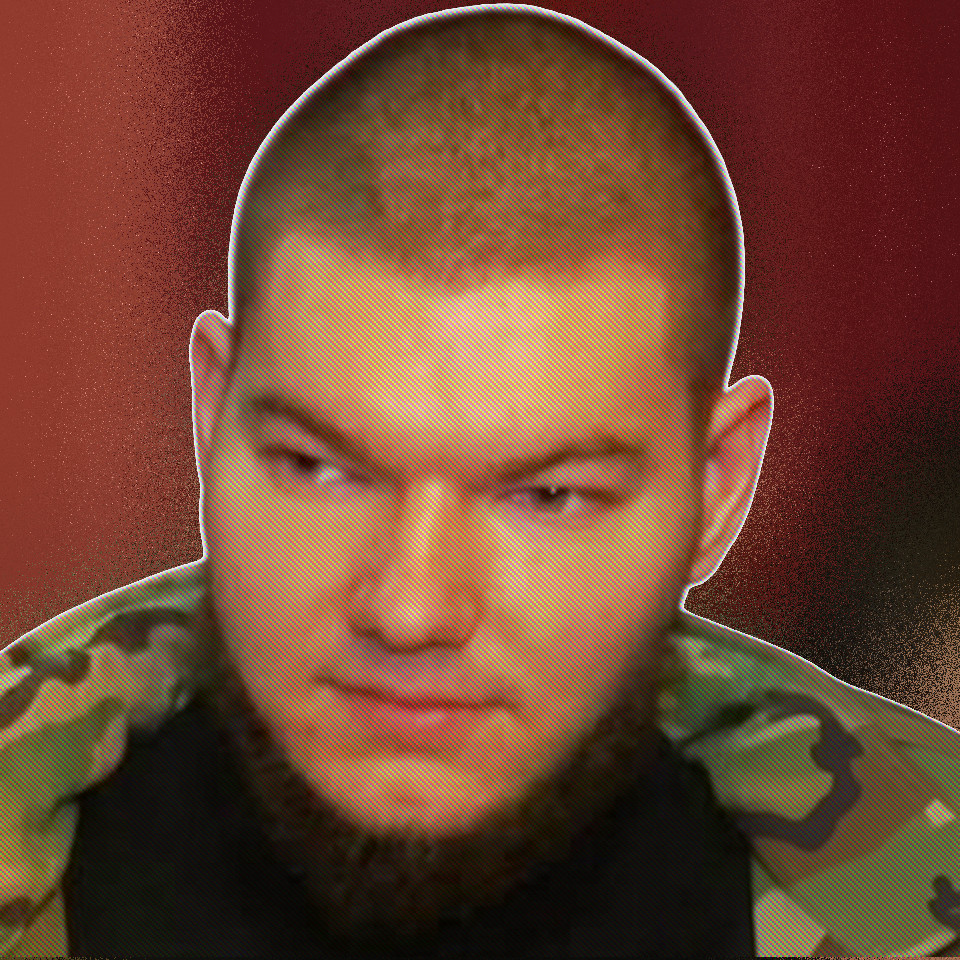
    est ici le personnage central d’une délicieuse allégorie de l’état orwellien des sociétés occidentales du spectacle, a aussi écrit Guy Debord. Il est membre de Lyon populaire, un groupe politique qui par fraternité européenne, a porté dès le 14 mars 2022 une aide humanitaire aux réfugiés ukrainiens en Pologne. Et Lyon populaire l’a fait savoir
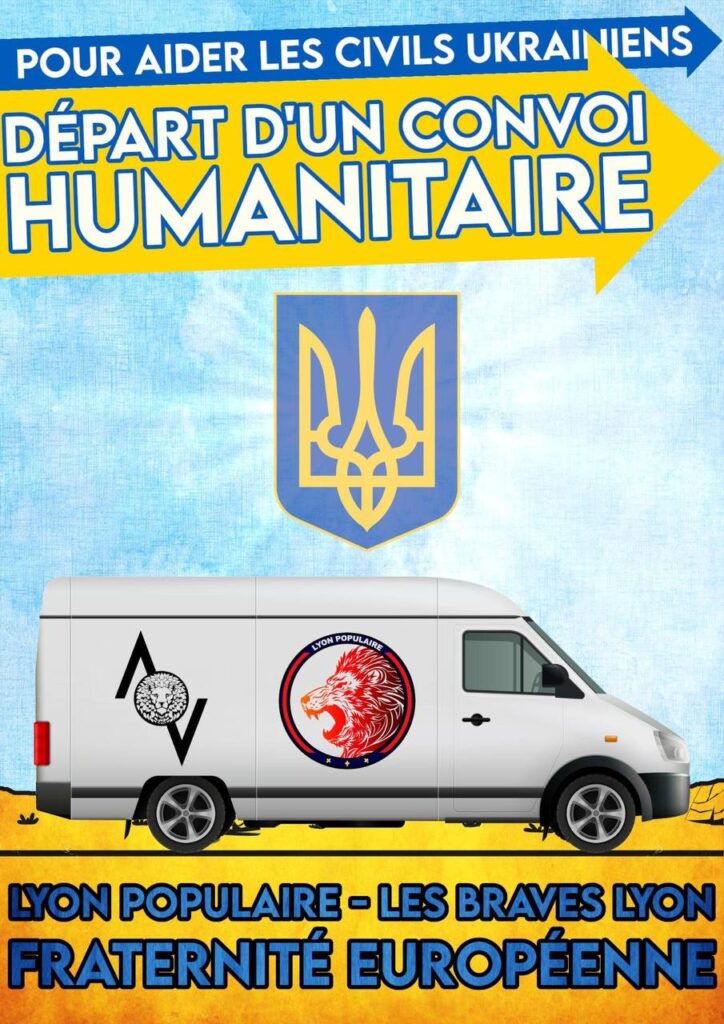
    D’autres personnages de cette liste, par exemple Thomas Cozon, le premier d’entre-eux par ordre alphabétique, ont commencé par ou prétendu faire œuvre humanitaire, pour finalement affronter les troupes russes l’arme à la main.

    Lyon populaire se veut identitaire et social, sa devise est vivre en travaillant ou mourir en combattant, celle des canuts de 1831, qui protestaient pour de meilleurs salaires quand la Garde nationale bourgeoise ouvrit le feu. Kenneth a donc choisi de mourir, quand il rejoint en septembre 2022 les forces atlantistes en Ukraine. Il y révèle la forme la plus épurée de son idéologie, le nazisme, l’odieux détournement des revendications ouvrières de 1831
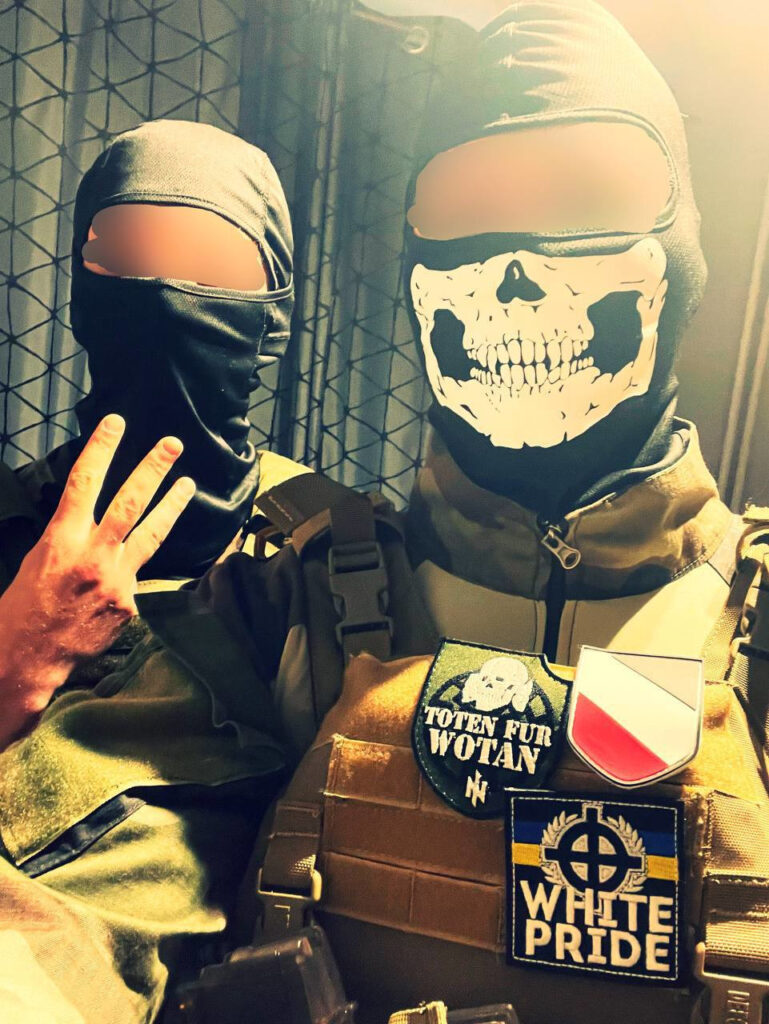
    Son compte Twitter est @kkklan4308, pour Ku Klux Klan, organisation terroriste suprémaciste aux USA. Il y précise

    Французький націоналіст в Україні [Nationaliste français en Ukraine]. Mon honneur s’appelle fidélité [Meine Ehre heißt Treue, en Allemand, la devise des SS pendant la 2de guerre mondiale]

    De retour en France en novembre ou décembre, il est interviewé en février 2023 par des militants identitaires toulousains, confirme ce que tout observateur objectif sait depuis des années mais que Boris Crouzette nie

    Pour ce qui est des antifas en Ukraine, j’en ai vu zéro, aucun antifascisme de toute manière, Lviv c’est la capitale du fascisme en Ukraine, Bandera est partout. Tu peux sortir avec un drapeau rouge et noir [couleurs de l’UPA pendant la 2de guerre mondiale] sur le dos, ou un drapeau croix gammée sur le dos, tu n’auras pas de problèmes
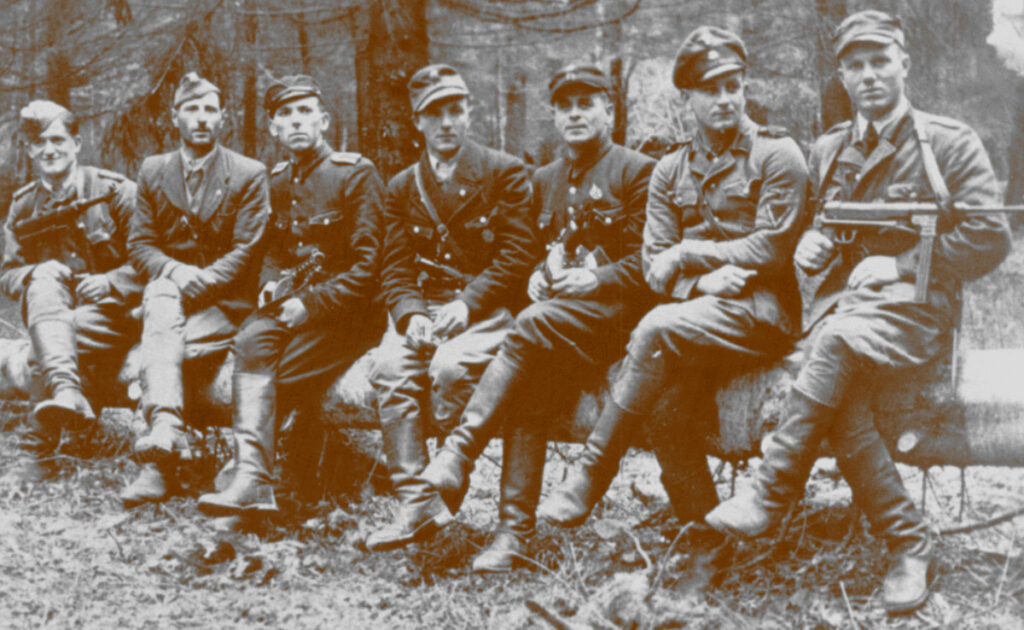
    Austro-hongroise (Lemberg) avant la 1ère guerre mondiale, polonaise (Lwow) avant la 2de, Lviv est la ville où les nationalistes ukrainiens massacrèrent 4 000 Juifs en juillet 1941, pour fêter l’invasion nazie de l’Union soviétique ; où ces nationalistes historiques sont célébrés encore aujourd’hui comme des héros ; où le parti nazi SNPU, appelé plus tard Svoboda, fut fondé en octobre 1991, 50 jours après la dissolution de l’Union soviétique ; où commença contre le gouvernement démocratique, fin 2013, le soulèvement qui aboutit au coup d’État de février 2014 puis à la guerre dans le Donbass ; la ville dont les autorités locales réclament la reconnaissance nationale de la 14. Waffen-Grenadier-Division der SS, Galizien [Galicie, région de Lviv]
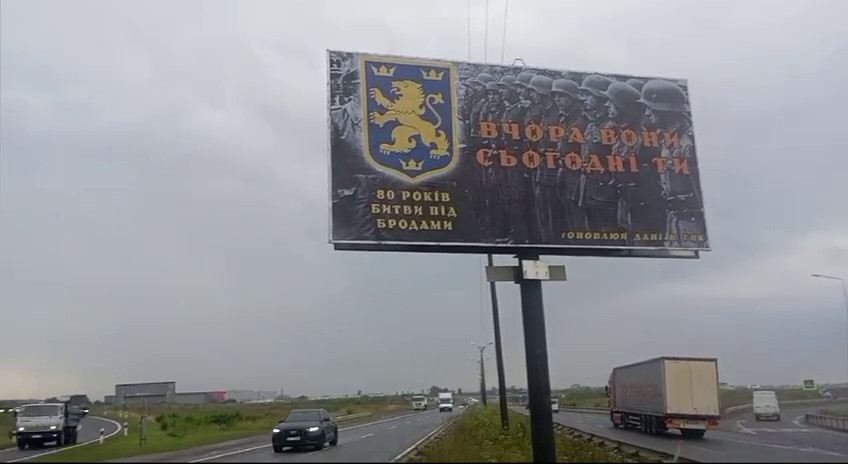
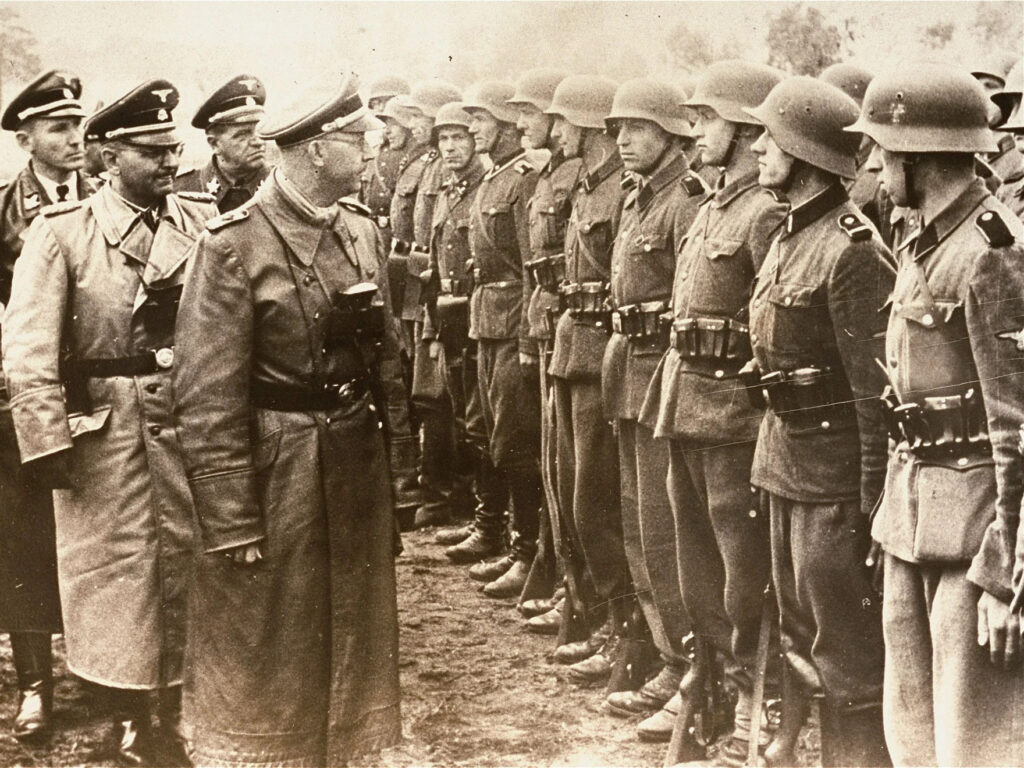
    Kenneth raconte aussi qu’avant Lyon, il a milité à Valence, dans un groupe appelé Adelphos, que ses antécédents politiques ont contrarié son rêve de devenir militaire.

    Il repart en mars 2023, pour chasser du rouge sur le front de l’est [Mediapart]. Sa formation est le bataillon Revansh, branche militaire de l’organisation nazie Tradytsiya ta poryadok [Tradition et ordre], où le Parisien César Aujard le rejoint en mai
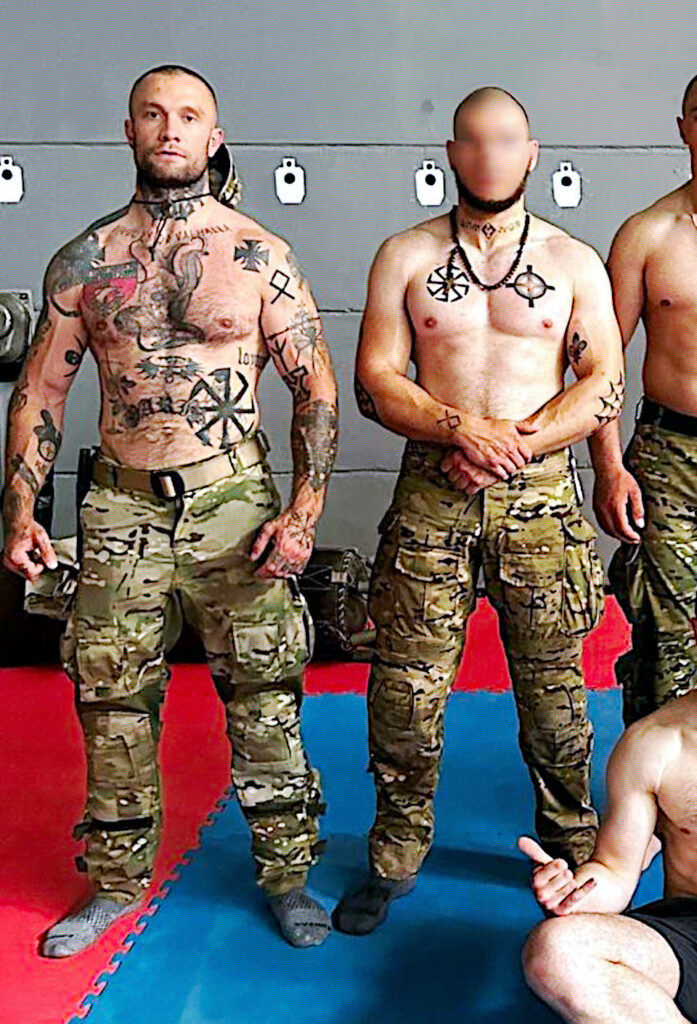
    Sous le commandement du renseignement militaire ukrainien (GUR), pour tenter de faire oublier la défaite de Bakhmout, des éléments de ce bataillon sont engagés le 22 mai dans une opération de propagande en territoire russe, pour terroriser les civils de la région de Belgorod. Ils opèrent en renfort des exilés nazis russes de Svoboda Rossii [Russie libre] et Russkiy dobrovol’cheskiy korpus [Corps des volontaires russes, RDK]. Fidèle à lui-même, le quotidien français le Monde présente comme des partisans ces quelques centaines de nazis russes, qui se sont implantés en Ukraine au cours des années qui ont suivi le coup d’État de 2014.

    Le 29 juin, une photo sur les réseaux sociaux nous montre sans masque le visage de Kenneth, reconnaissable à gauche par sa barbe et l’Othala au poignet droit
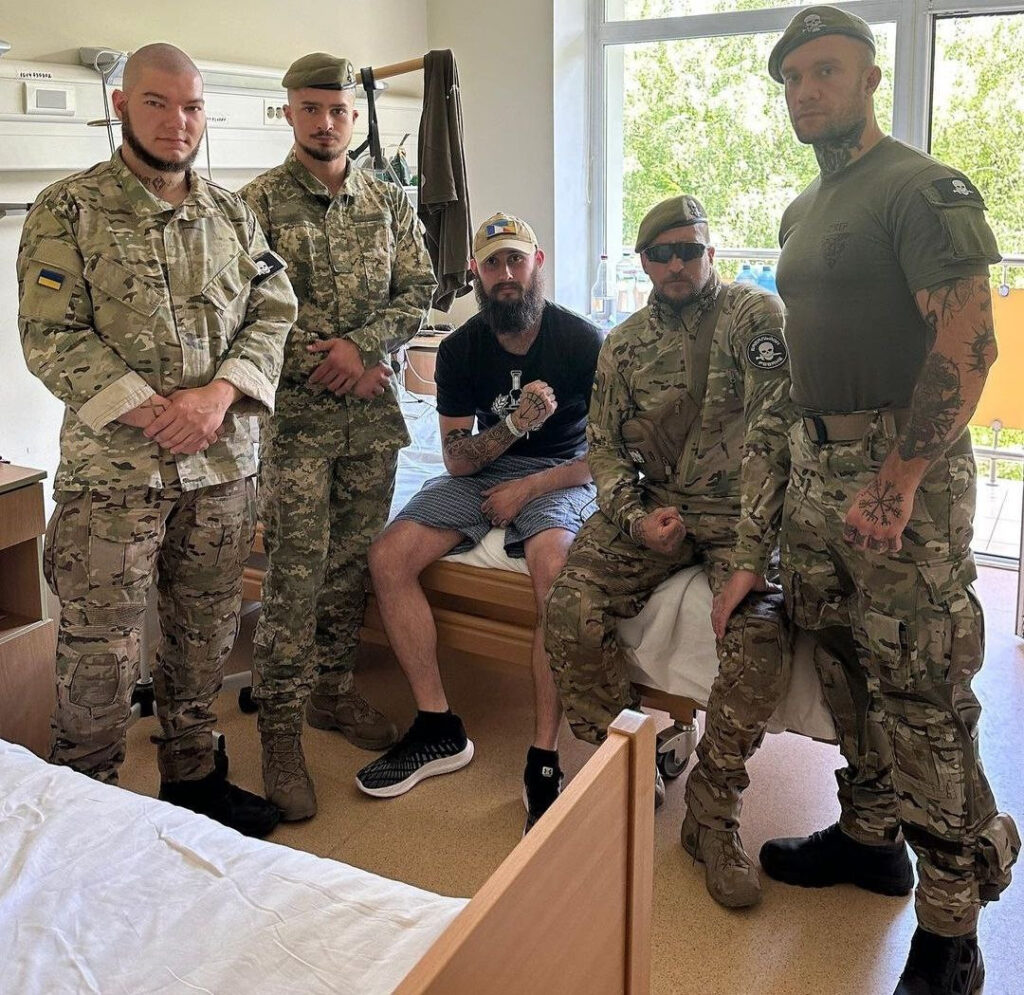
    Une nouvelle image nous parvient le 21 octobre 2023 par un canal ukrainien. Sa légende est en Anglais

    Nationalists volunteers from France & Finland in Ukraine.
    United we will win
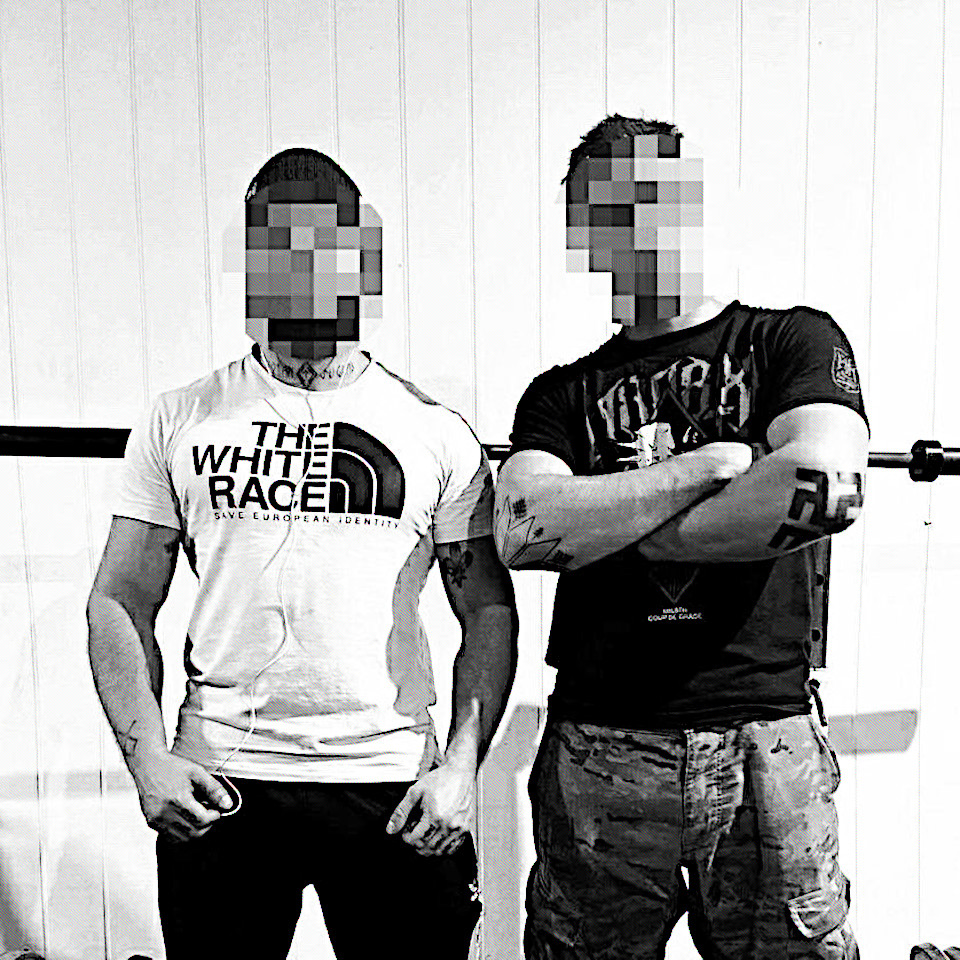
    Kenneth est reconnaissable à gauche par plusieurs tatouages. La photo date de son second tour en Ukraine, où son cou a été décoré. Son tee-shirt nous dit

    THE WHITE RACE
    SAVE EUROPEAN IDENTITY

    À le voir ainsi, en civil et écouteurs sur les oreilles, ma frustration s’accentue. Comme j’aimerais recevoir de ses nouvelles du coeur de la bataille.

    Ils sont tellement mignons qu’à défaut de le connaître, je lui donnerais le bon Dieu sans confession. Le 27 décembre 2023, il convole à Poltava. Le bureau d’état-civil est ukrainien, la mariée est une Allemande de seulement 19 ans
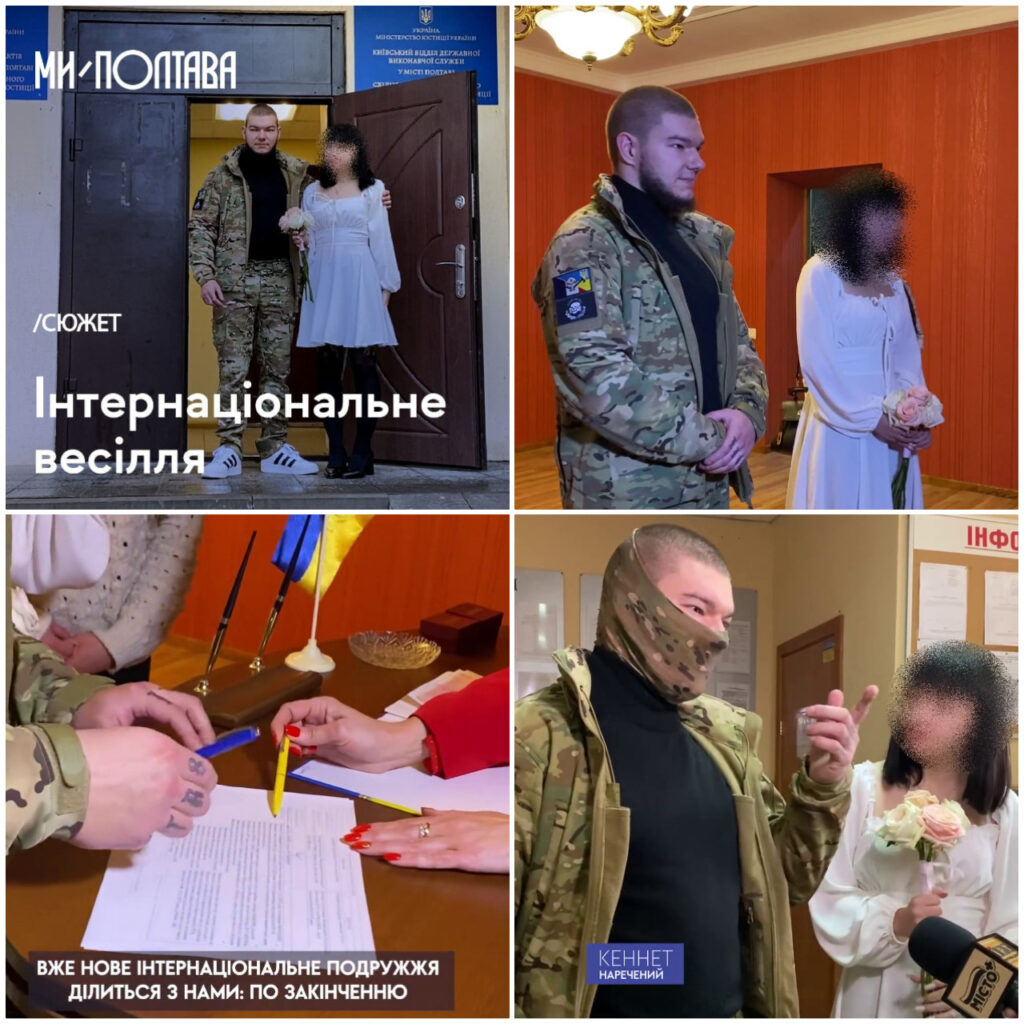
    Nous le savions membre du bataillon Revansh. Son patch d’épaule en respecte la philosophie, tête de mort sur fond noir, mais n’est pas règlementaire. Il arbore plus exactement la Totenkopf SS. Interrogé par les médias locaux, le couple envisage de rester en Ukraine
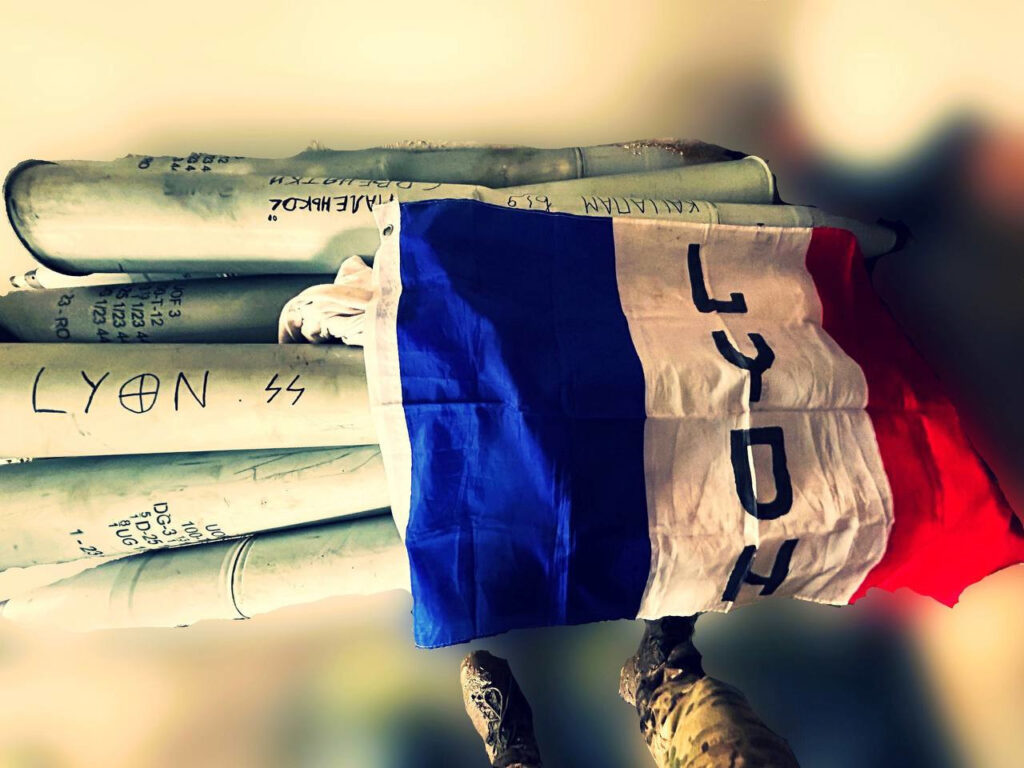
    Le 2 mars 2024, un canal nazi anglophone partage cette carte postale, que lui a fait parvenir Kenneth, depuis la partie encore occupée par l’Ukraine de la République populaire de Donetsk.

    Le 5 avril, il publie sur les réseaux sociaux une image des grâces de son amoureuse, l’Allemande de 19 ans qu’il a épousée à Poltava le 27 décembre

    Avoir une femme qui sache d’où elle vient et connaît son héritage, un rêve devenu réalité. Ma femme

    Mon commentaire sur Telegram de ces mondanités suscite des réactions et plus opérationnel, nous apprenons alors de la Misanthropic Division, confrérie nazie internationale, fondée et basée en Ukraine depuis 2013, que Kenneth est aussi l’un des administrateurs de sa chaîne principale.

    Dans un article publié le 12 avril, pour commenter le reportage dans les rangs d’Azov que Xavier Maire a signé pour le magazine pétainiste Livre noir, StreetPress nous apprend que Kenneth s’appelle en réalité Gwendal D*. Recoupé avec des informations que des as russes de l’informatique ont obtenues auprès de la bureaucratie ukrainienne, cet indice nous permet d’identifier Gwendal Delange
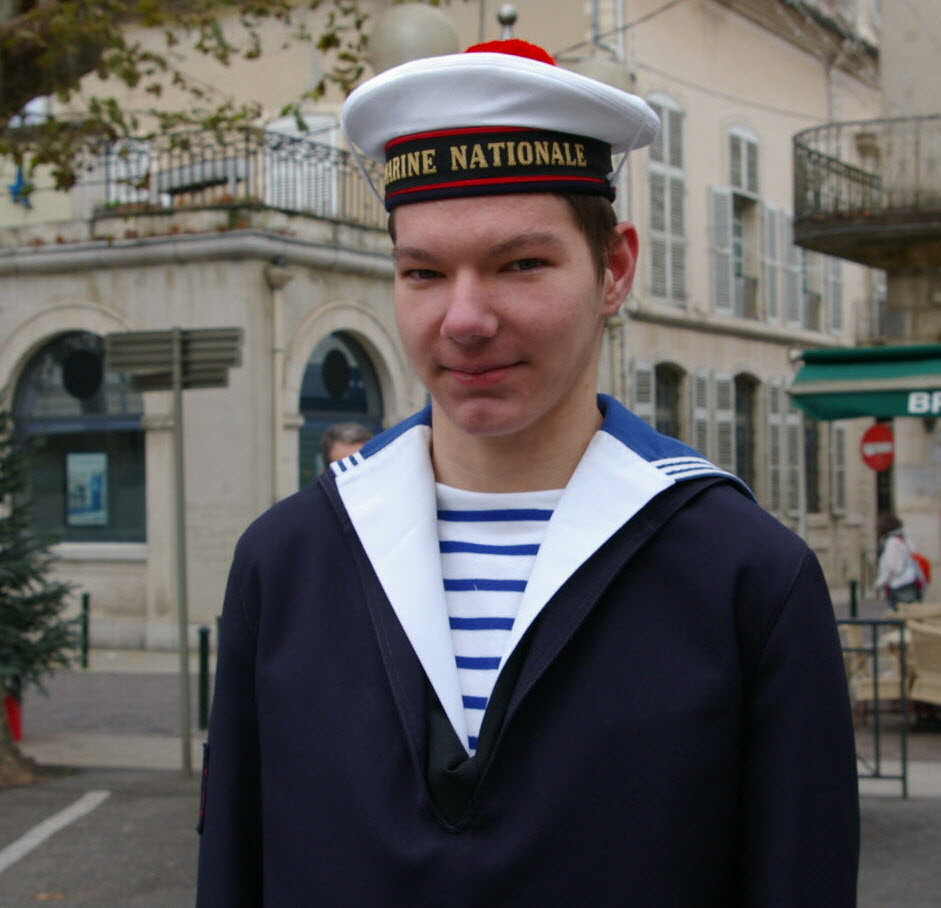
    Nous sommes le 20 avril depuis seulement 6 minutes, heure française, quand sur Telegram, la chaîne francophone du département commercial de la Misanthropic Division, par le probable clavier de Delange, célèbre un anniversaire avec cette image
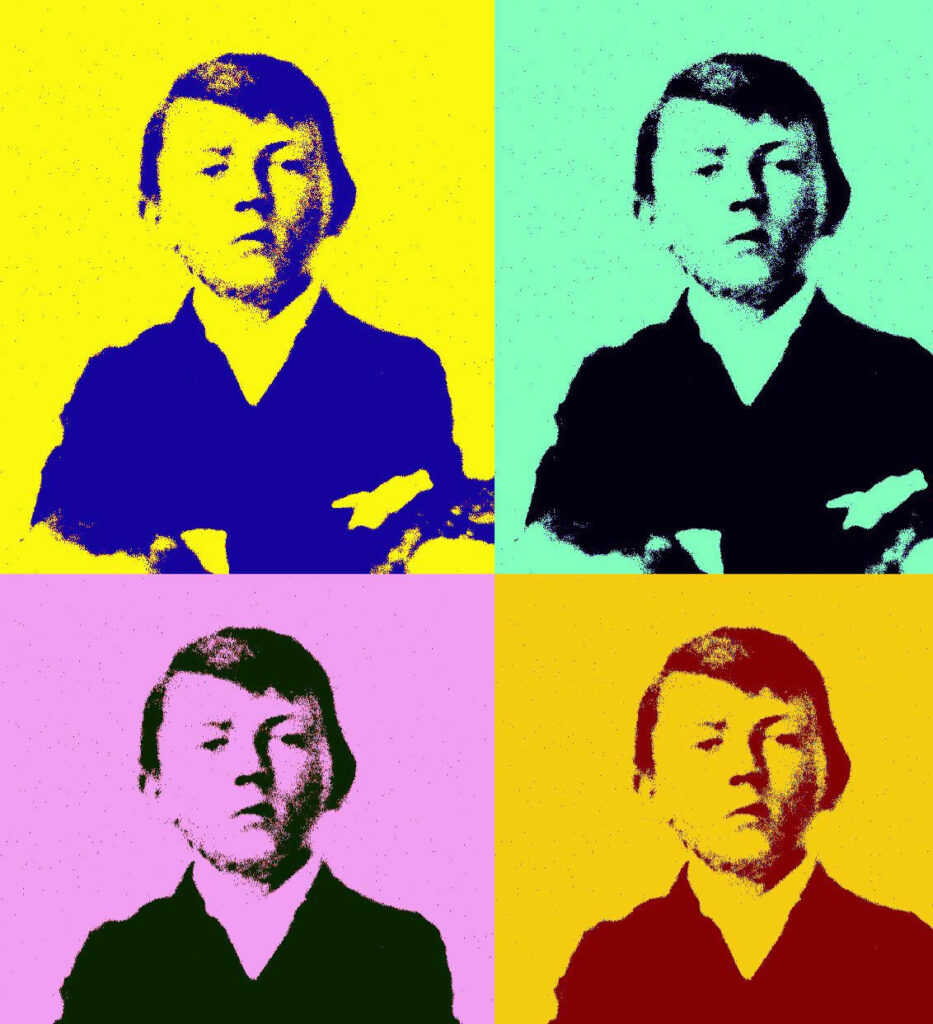
    On vous offre les frais d’envoi jusqu’à dimanche soir, pour marquer son anniversaire

    précise le message. Savez vous qui aurait aujourd’hui 135 ans ?

    Vous ne voyez toujours pas ?
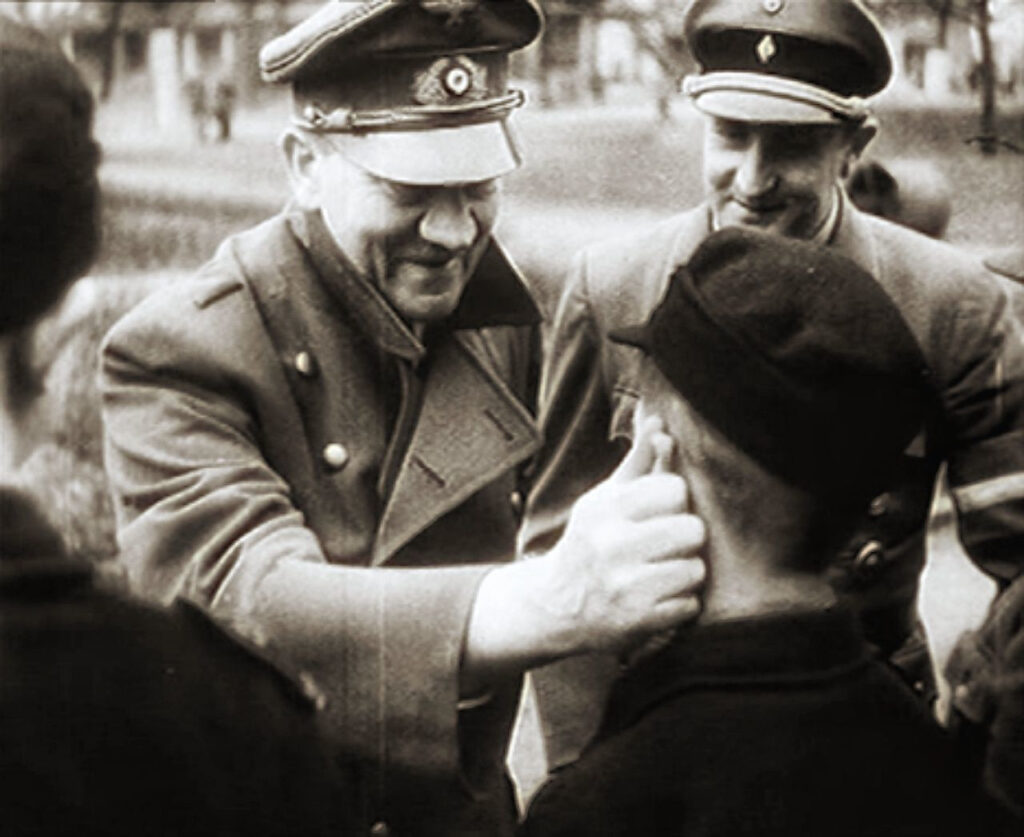
    Alors que l’Armée rouge portait le coup fatal à Berlin, il fêta son dernier anniversaire en 1945, en compagnie d’enfants en uniforme, parce qu’il les aimait beaucoup

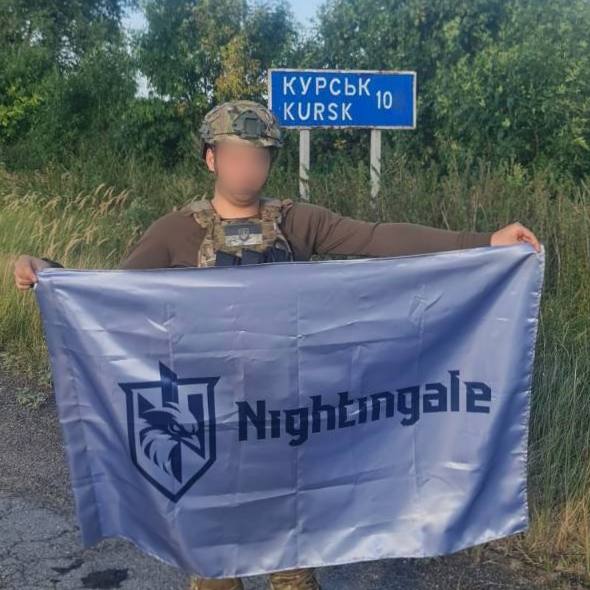
    Le 29 avril, entre appel à la traditionnelle manifestation parisienne du 11 mai et entraînement de militants au Havre, une chaîne nazi francophone partage cette carte postale de Delange, avec l’étendard de la 3e brigade d’assaut, émanation de l’organisation Azov dans l’armée régulière ukrainienne, qui compte aussi César Aujard dans ses rangs. Une chaîne ukrainienne précise que Delange y est bénévole à temps partiel. Voilà donc un pur volontaire, un volontaire nazi
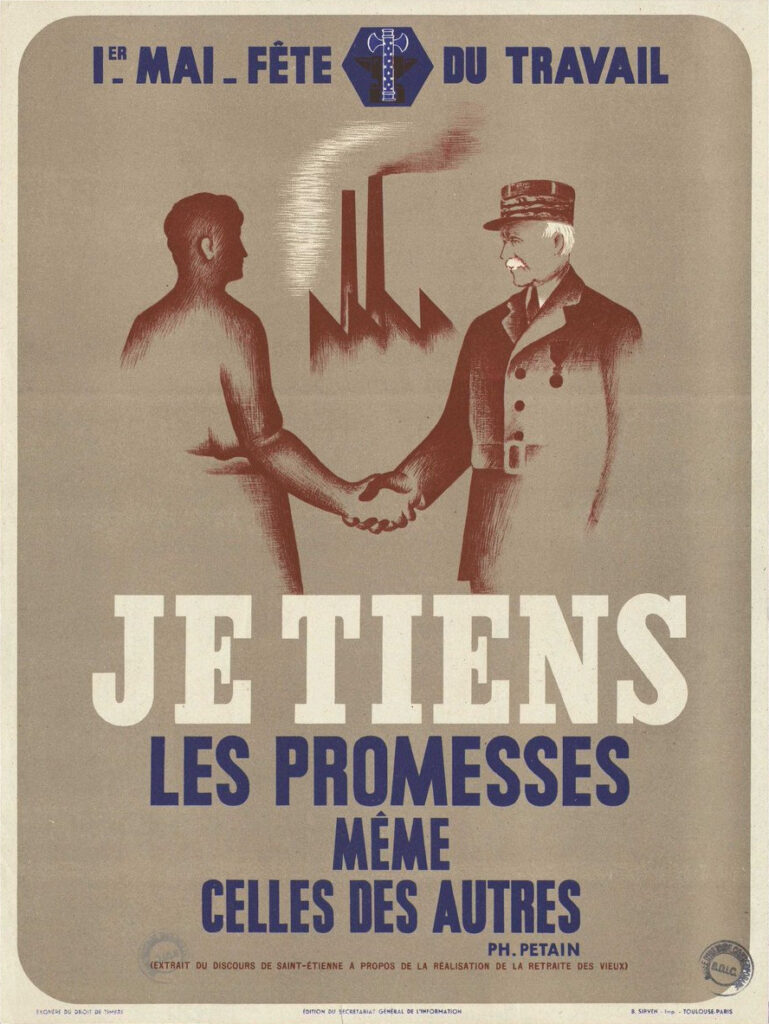
    Il célèbre à sa façon la Journée internationale des travailleurs, que la droite et l’État français appellent Fête du travail, par le partage d’une affiche de 1941 en hommage à Philippe Pétain, le dirigeant fasciste qu’Emmanuel Macron tenta de réhabiliter le 11 novembre 2018. Des références à Adolf Hitler puis Philippe Pétain sont l’expression d’une vision cohérente de l’Histoire de France
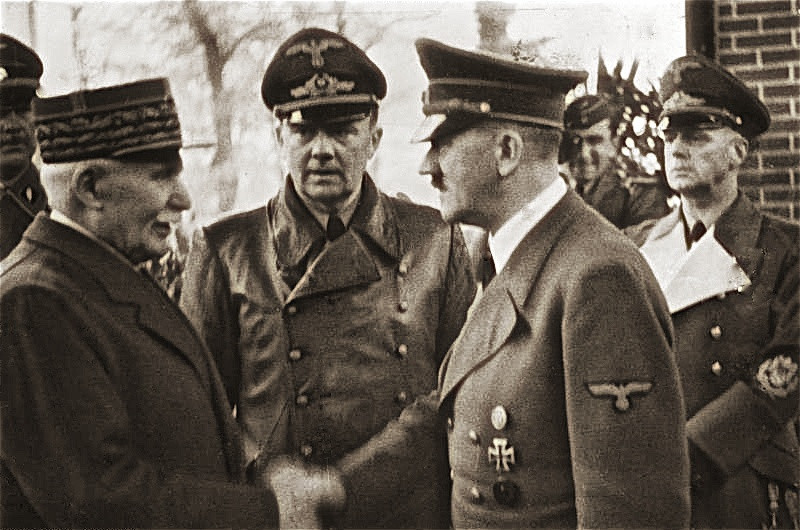
    Aujourd’hui encore, Macron justifie ses fanfaronnades, ridicules à l’étranger mais complimentées dans la presse bleu horizon, par un danger mortel qui menacerait l’Europe. Pas exactement la même que défendaient LVF et division Charlemagne, mais celle sans doute qui pensait le néo-colonialisme éternel, celle qui célèbre plutôt le travail que les travailleurs, pour la prospérité d’une coterie sous protectorat états-unien plutôt que germanique. La différence est plus fine que beaucoup ne l’imaginent. En 1924 déjà, le philosophe et militant communiste italien Antonio Gramsci (1891-1937) énonça

    En bref, la démocratie [bourgeoise] a organisé le fascisme lorsqu’elle a senti qu’elle ne pouvait plus résister à la pression de la classe ouvrière dans des conditions de liberté même formelle
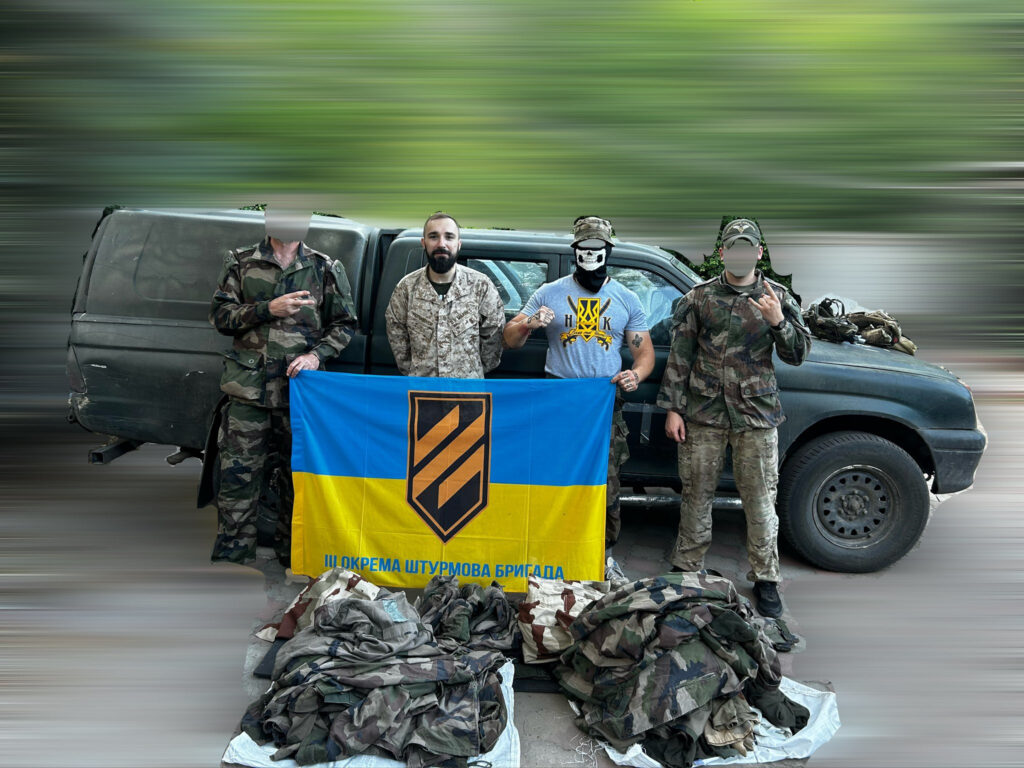
    Par cette image du 1er juin, où il apparaît troisième par la gauche, Delange remercie la France pour ces uniformes, qui sont bien d’aspect français. Il est également convaincu de l’arrivée prochaine d’instructeurs français.

    Alors que selon la rumeur, Emmanuel Macron serait sur le point d’officialiser la présence de militaires français sur le champ de bataille en Ukraine et au Donbass, la Russie leur suggère de se rendre, par une affiche à proximité de l’ambassade de France à Moscou
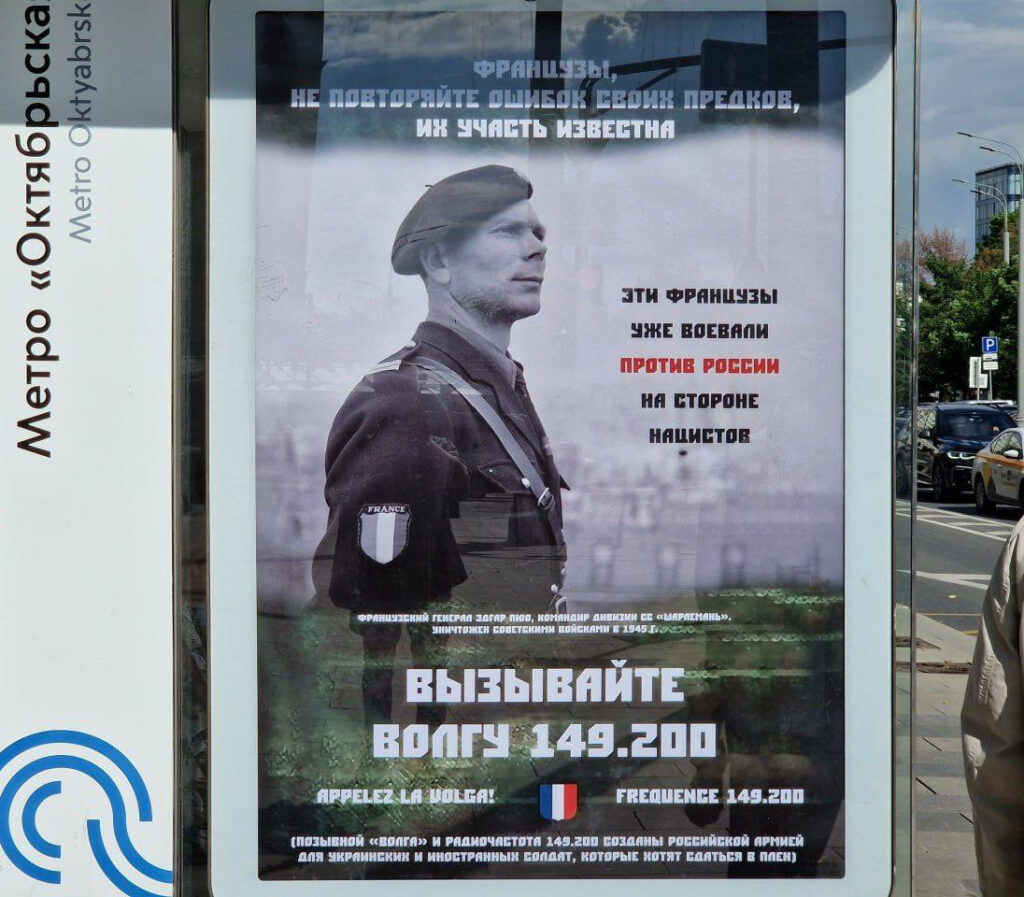
    Elle indique la fréquence radio 149,2 MHz, sur laquelle les combattants atlantistes peuvent appeler Volga, pour organiser leur exfiltration s’ils souhaitent se rendre à l’armée russe. L’image est celle d’un Franc-garde, membre de la Milice française de Joseph Darnand, formation paramilitaire pétainiste qui a pourchassé les résistants entre 1943 et 1944. Plutôt que d’affronter la justice pour leurs crimes en France, beaucoup de miliciens ont accompli ensuite la migration de Sigmaringen et intégré la 33. Waffen-Grenadier-Division der SS, Charlemagne, division SS française que l’Armée rouge eut le bon goût d’anéantir en mars 1945.

    Le 22 juin, Delange partage une vidéo d’inspiration nazie, qui comporte des images de la caméra GoPro de Brenton Tarrant, fait l’apologie du massacre du 15 mars 2019 à Christchurch, Nouvelle Zélande, où le terroriste australien assassina 51 fidèles musulmans en prière

    Rien de très exceptionnel depuis l’Ukraine, où Tarrant avait suivi auparavant une formation dans les rangs de l’organisation Azov et où la traduction de sa revendication connut un succès commercial dans les mois après le massacre
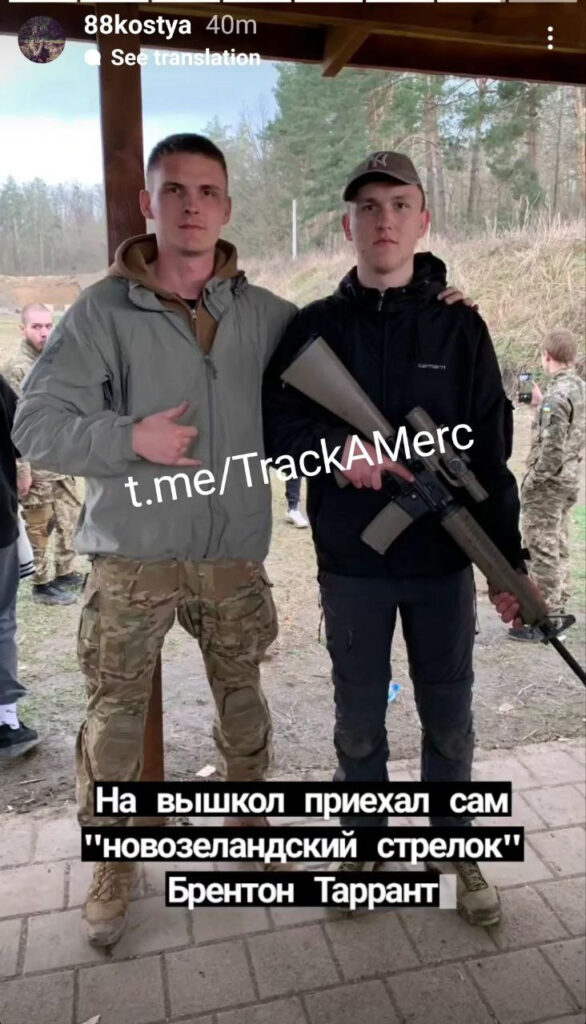
    Dans les heures qui suivent mon évocation ici de sa publication sur X de la vidéo d’apologie du massacre terroriste de Christchurch, Delange l’efface. Je dispose bien sûr d’une copie et la rétractation n’annule pas le délit. Des internautes le signalent les jours suivants à PHAROS, la Plateforme d’harmonisation, d’analyse, de recoupement et d’orientation des signalements, portail officiel de signalement des contenus illicites de l’internet. La Police nationale en fait mention le 6 juillet, floute le visage de Delange, ne précise pas aux contribuables qu’il est volontaire en Ukraine ou que ce terrorisme est islamophobe, deux aspects qu’elle ne peut pas ignorer
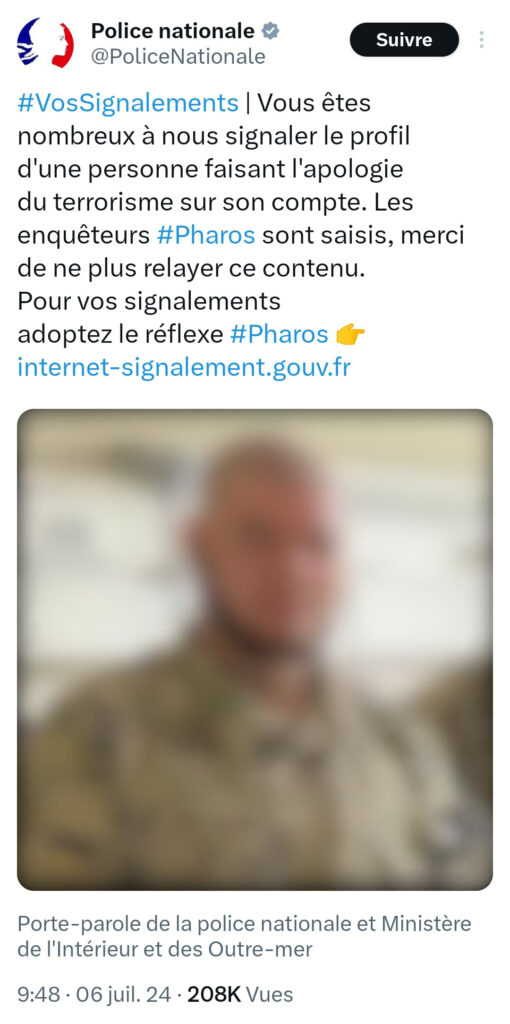
    C’est en antifasciste que par un commentaire sous ce tweet, je décide de donner un coup de pouce à l’enquête des archers du guet [gardiens de la paix], précise l’identité de l’auteur des faits
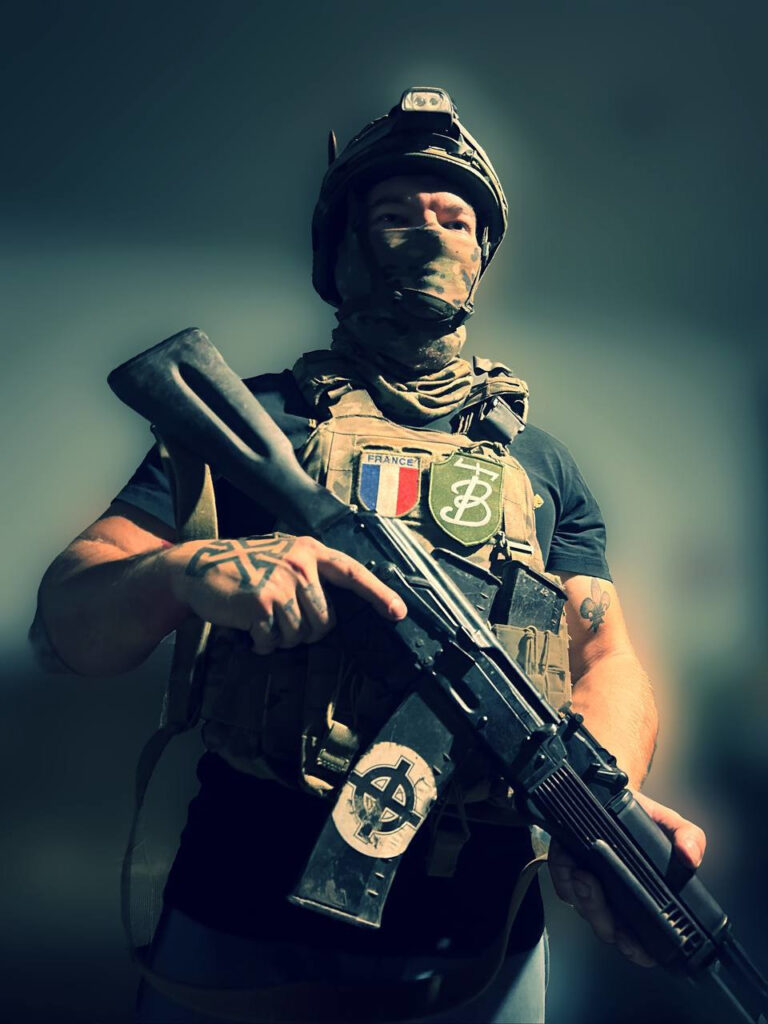
    Les signalements à PHAROS ont pour conséquence la suspension de son compte sur X. Le 29 août 2024, un canal anglophone pour footeux nazis européens publie cette nouvelle image de Delange.

    Je ne le pense pas combattant, car sa hiérarchie militaire le préserve intact, figure de la propagande nazie ukrainienne à destination du public français. Sa fonction ne se limite sans doute pas à la figuration. Je suis convaincu qu’il a aussi un rôle de conception, de choix des sujets
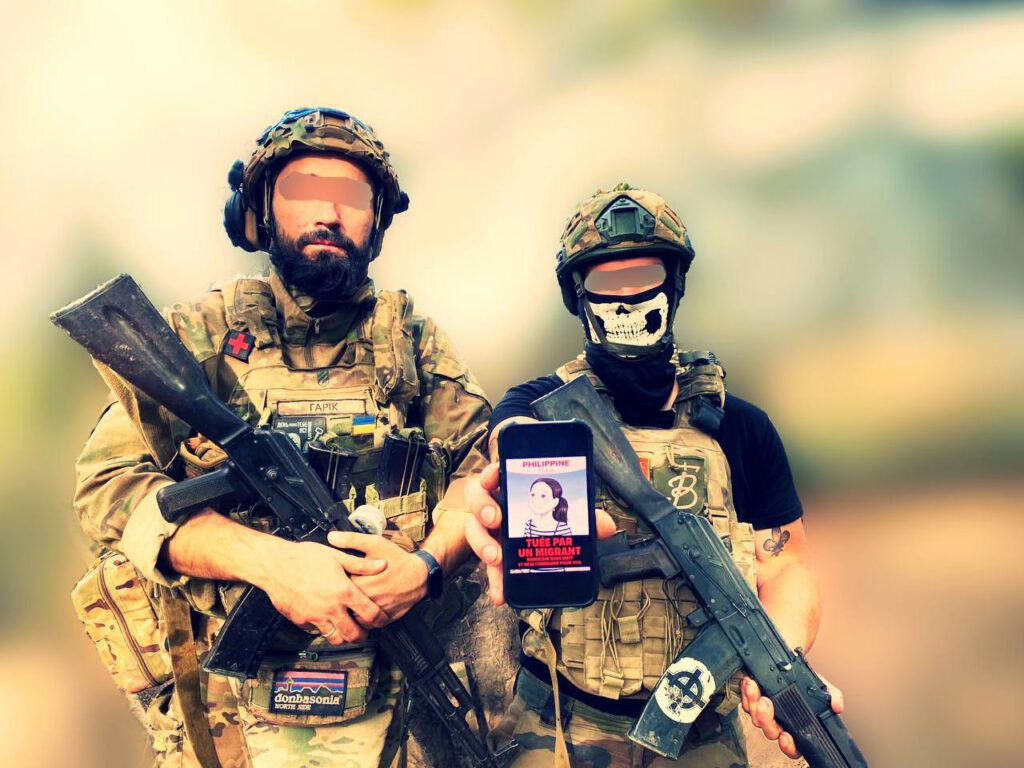
    Le 26 septembre, il apparaît au côté d’un militaire ukrainien de la 3e brigade d’assaut, émanation dans l’armée régulière de l’organisation nazie Azov. La propagande ukrainienne rend ici hommage à Philippine Le Noir de Carlan, dont le corps fut retrouvé au bois de Boulogne le 21, victime de viol et d’homicide. Les personnalités françaises de droite, dont aujourd’hui majoritaires et moteurs, les pétainistes, exploitent aussi ce fait divers à des fins politiques xénophobes et sécuritaires

    Le 5 février 2025, il nous fait passer en revue ses tatouages, presque tous, car sa présentation occulte au moins le blason lyonnais de la cuisse droite. Nous remarquons en particulier, au mollet gauche, l’insigne de la Sturmbrigade Dirlewanger (cf. Karel Cherel Salzburg)
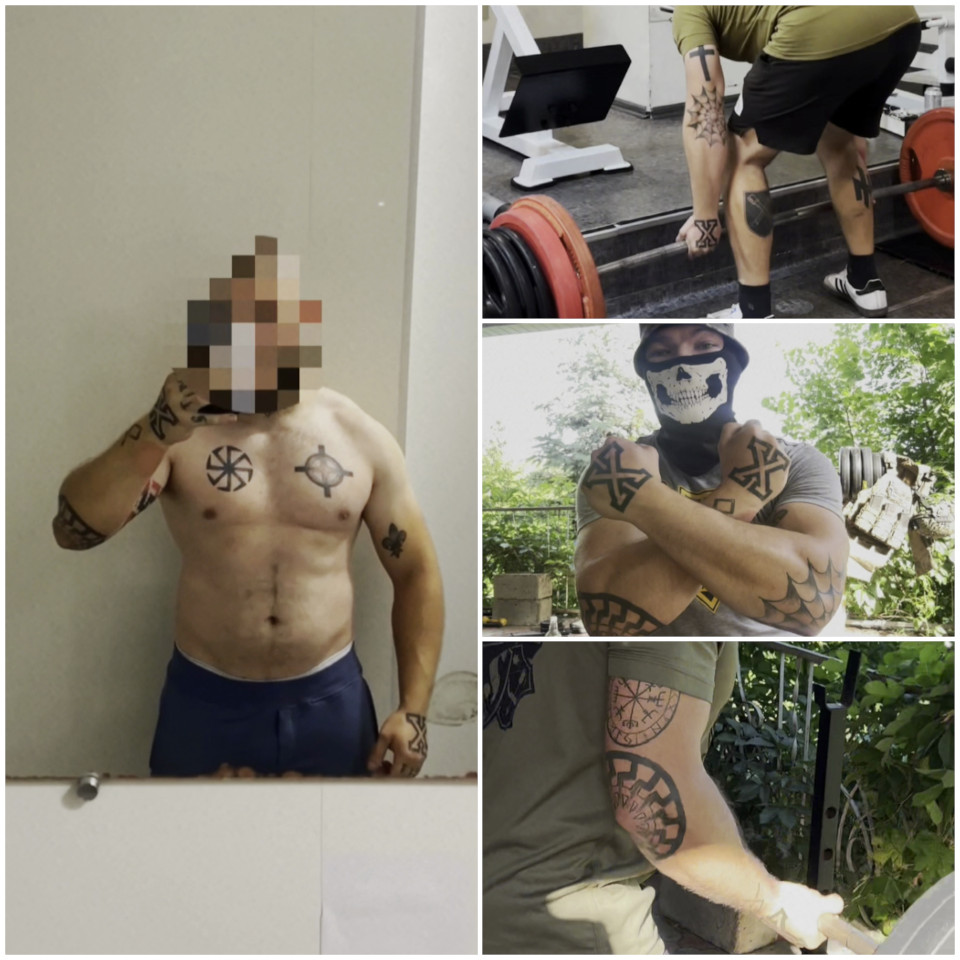
    En cas de malheur, avec toutes ces décorations, Delange fera un beau mort. Qui mieux est, un mort identifiable, dans une large gamme d’atteintes à l’intégrité physique.

    Depuis son premier séjour en septembre 2022, il a appris à parler Ukrainien mais quitte début 2025 la 3e brigade d’assaut, émanation d’Azov dans l’armée régulière, pour un environnement immédiat plus francophone
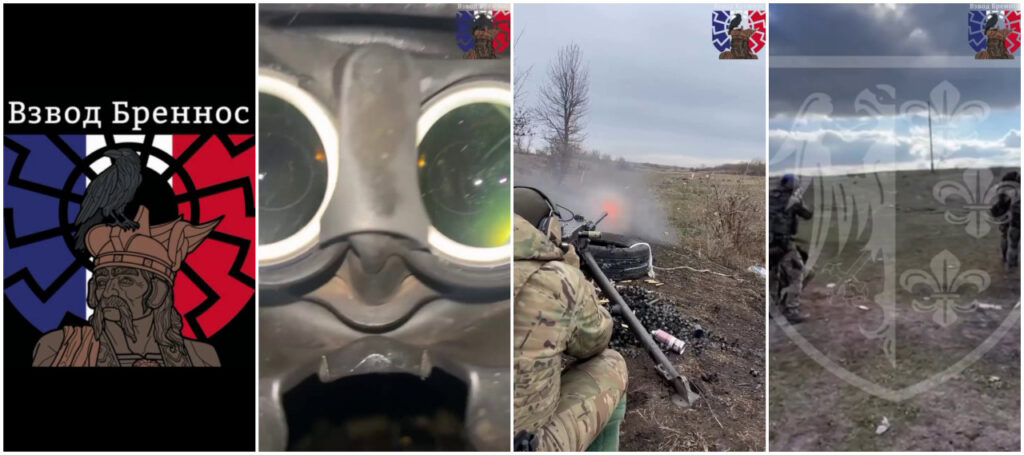
    Dans le 1er bataillon de Légion internationale, la section Brennos revendique un héritage à la fois gaulois et nazi
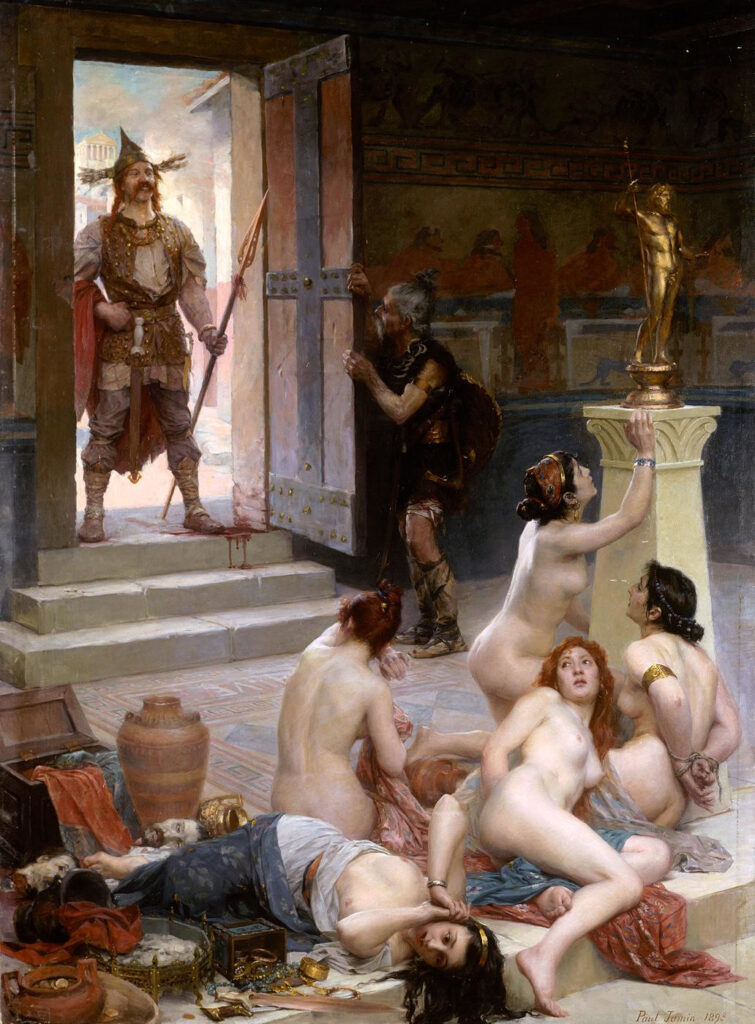
    Brennos (Brennus, en Latin) est le fameux chef gaulois qui vainquit les Romains vers 390 avant Yeshoua ben Yosef et légua l’expression Vae victis [Malheur aux vaincus]
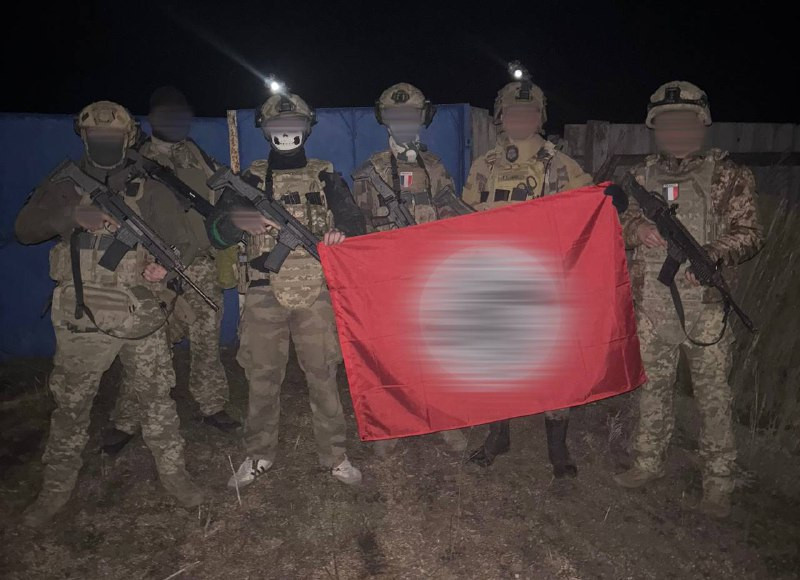
    L’escouade appelée section Brennos apparaît sur cette image qu’un canal nazi français bien connu partage le 23 mars. De pure engeance française, ces volontaires portent leur écusson national tricolore et déploient la version la plus courante, que l’éditeur a floutée, du drapeau nazi allemand à swastika. Vous l’avez reconnu, le troisième par la gauche est Gwendal Delange
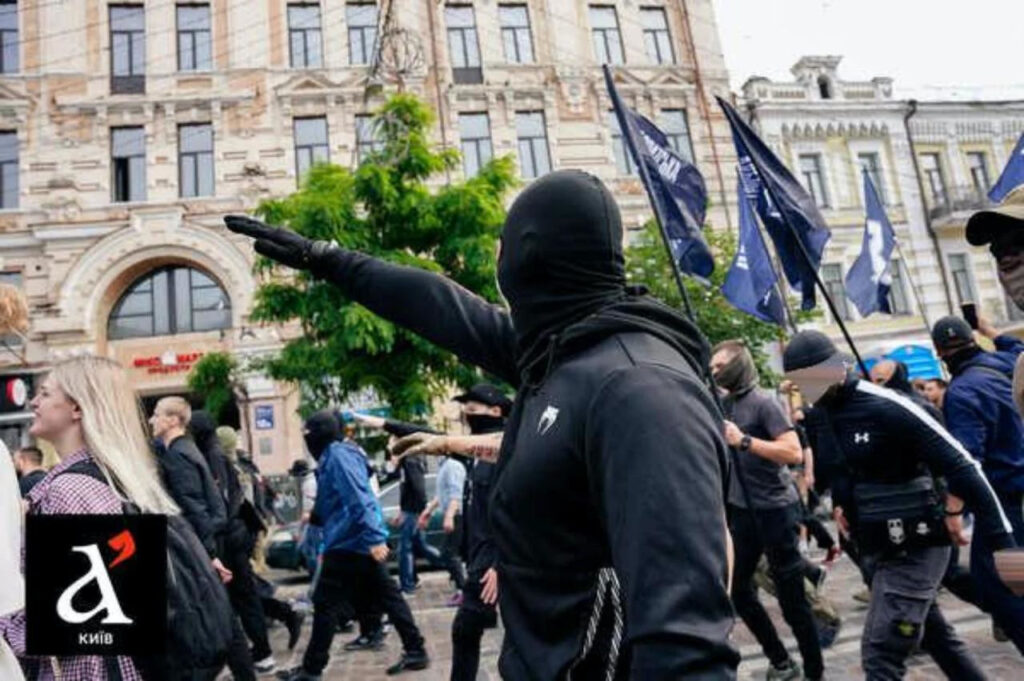
    Le 14 juin 2025, au côté de Aristote Bahonda, un camarade noir, il participe à Kiev au cortège des nationalistes ukrainiens qui s’opposent au défilé de la Gay Pride. En ce même mois de juin, il est encore une fois muté et à l’instar de César Aujard, réintègre le bataillon Revansh
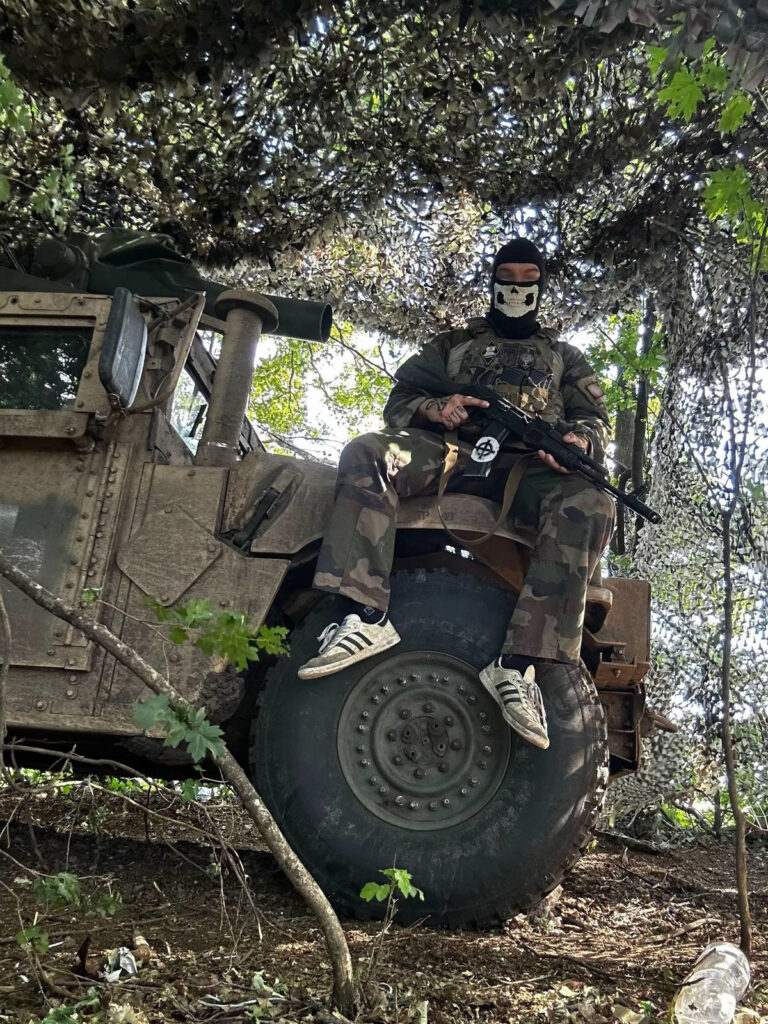
    À l’unisson d’autres nazis français, il rend hommage le 23 juillet à un Kamerad tué, feu Kevin Lazzari. Mais pourquoi porte t il en toutes circonstances cette paire de baskets teutonnes ?
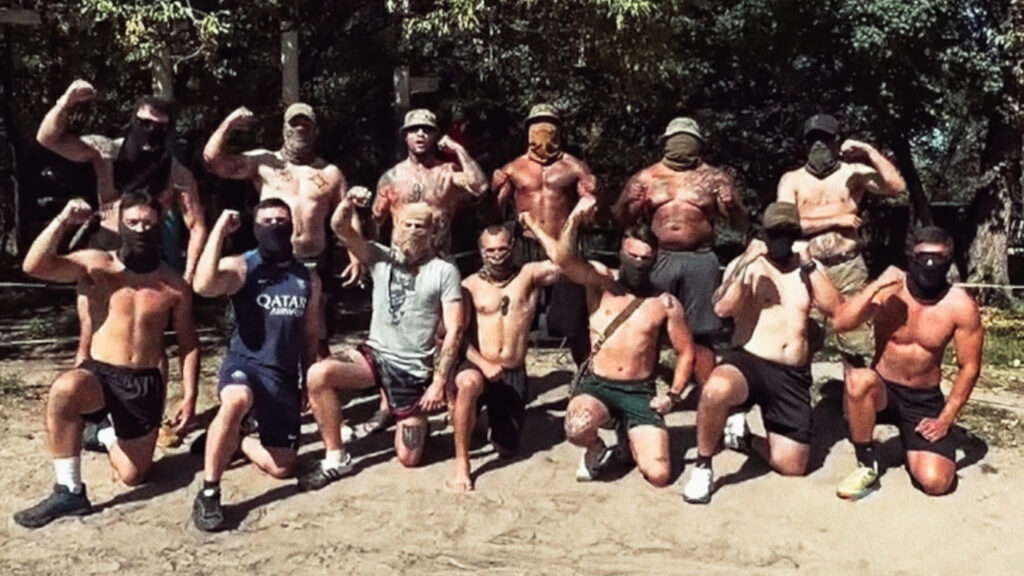
    Le 21 août, les réseaux sociaux nous offrent les images d’exercices physiques de WAR (War Aggressive Rota, Rotation agressive de guerre), escouade de nazis français dans le bataillon Revansh, leurs différents tatouages, dont le Schwarze Sonne d’Heinrich Himmler et le blason de la division SS Charlemagne
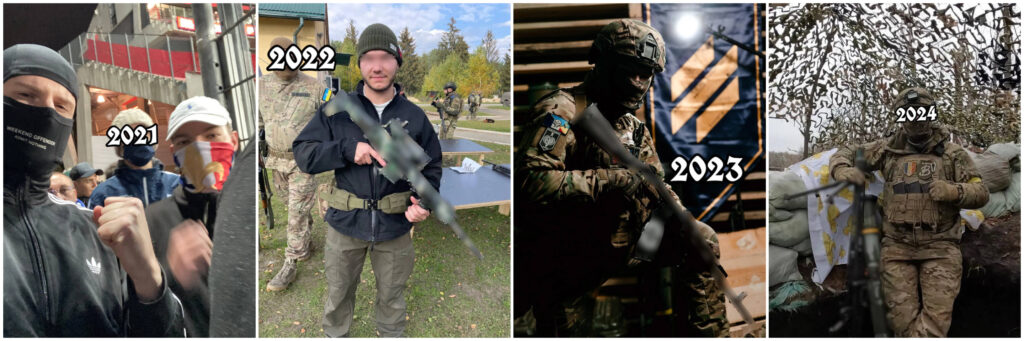
    Les années ont passé et le 2 septembre, il montre sur les réseaux sociaux comme il est fier de son évolution dans les rangs atlantistes en Ukraine, depuis le militantisme nazi à Lyon. Je dois lui concéder qu’en 2022, il ne ressemblait à rien
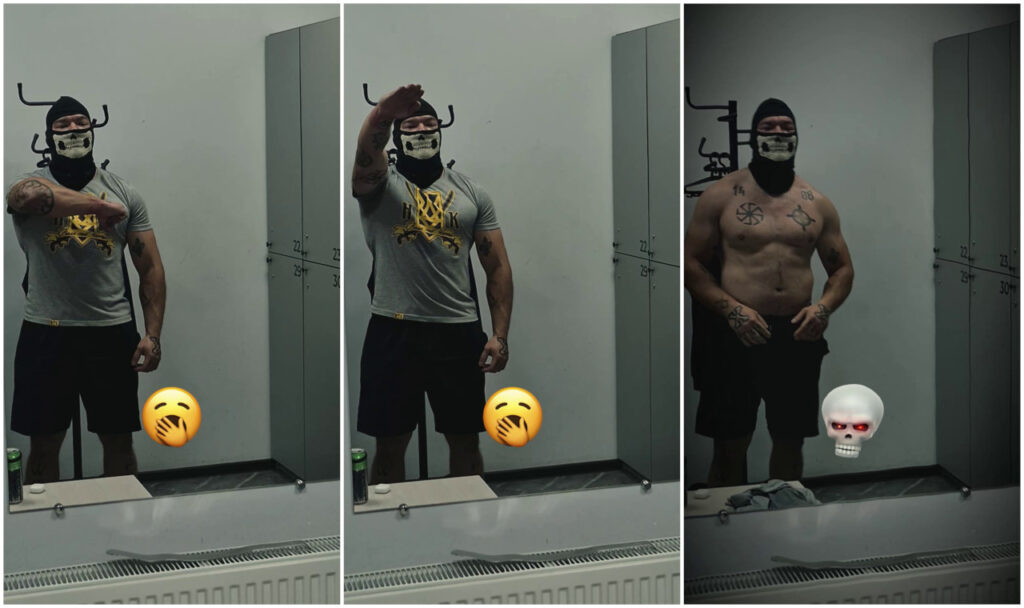
    Toujours en pleine forme, il exécute devant son miroir un salut nazi, dont celui d’Azov, en première image, est l’ébauche. Et puis le 26 septembre, il invite des petits camarades français de WAR pour fêter ses 27 ans
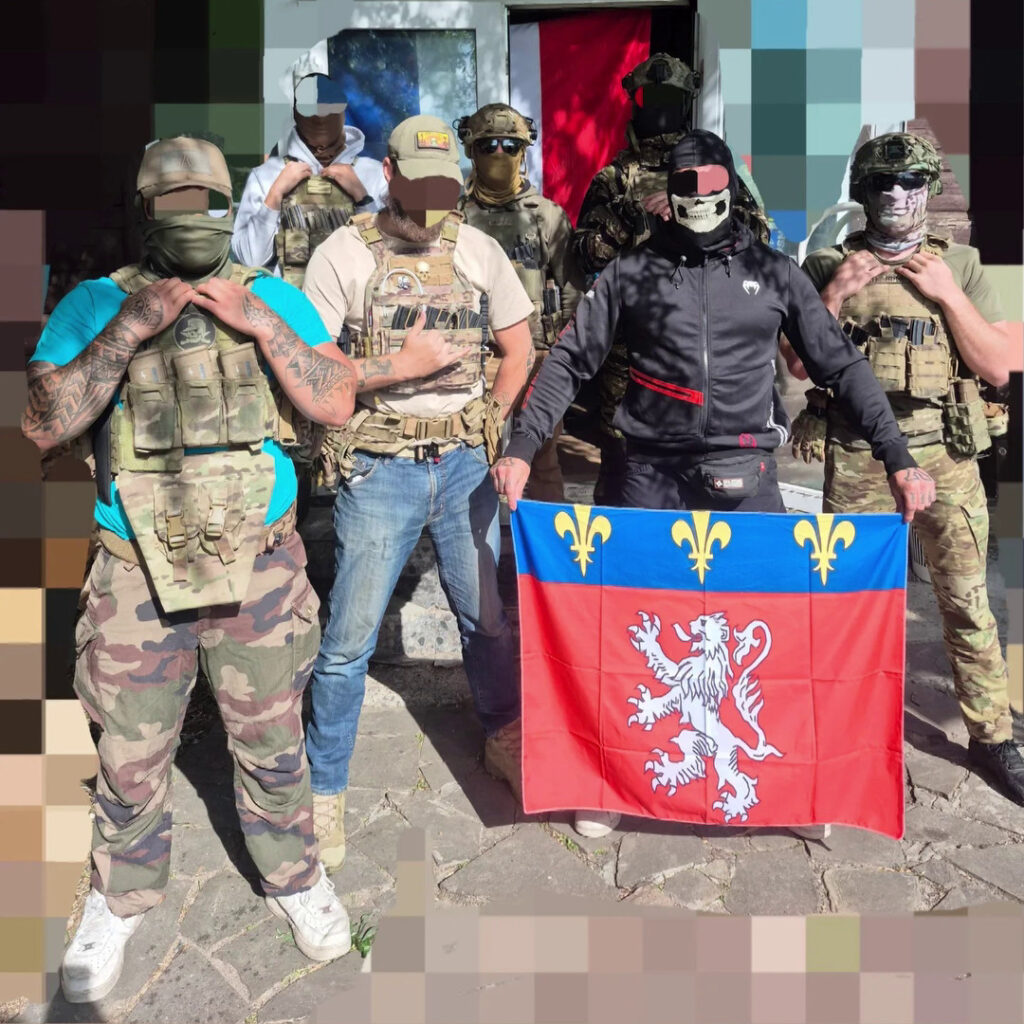
    Tout cela reste très urbain. Quand est ce que WAR monte au front ? Que ça charcle un peu.

    Le 8 octobre 2025, avec cette belle image depuis la place Maïdan de Kiev, site des émeutes qui ont mené l’Ukraine au coup d’État de 2014 et à la guerre au Donbass, les Français du bataillon nazi Revansh lancent une campagne de recrutement sur les réseaux sociaux
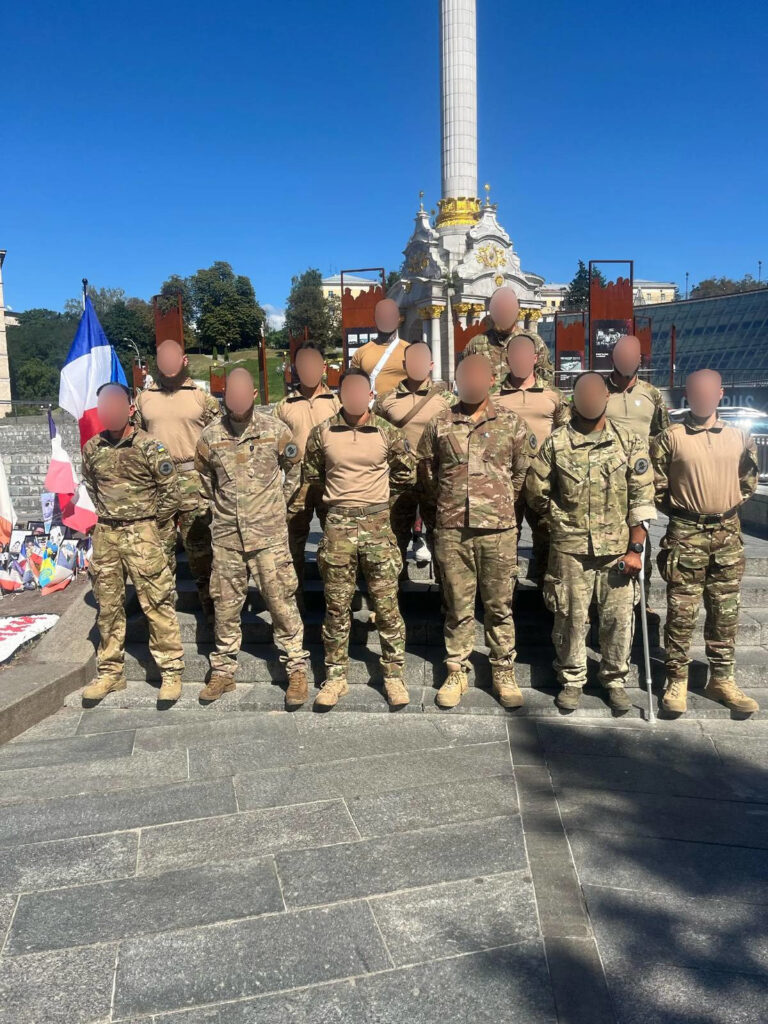
    Je me joins à eux pour encourager les militants nazis ou pétainistes, s’ils sont toujours en France, à monter aussi au front oriental pour la défense de l’Europe contre les hordes asiatiques et néo-bolcheviques. À gauche du groupe, nous distinguons le mémorial aménagé pour les Français déjà tués dans les rangs atlantistes.

    Au diapason de la voix officielle de son propre bataillon, Gwendal Delange rend hommage le 27 décembre à Denis Kapoustine, qu’un drone russe a dénazifié la nuit précédente dans la région de Zaporojie
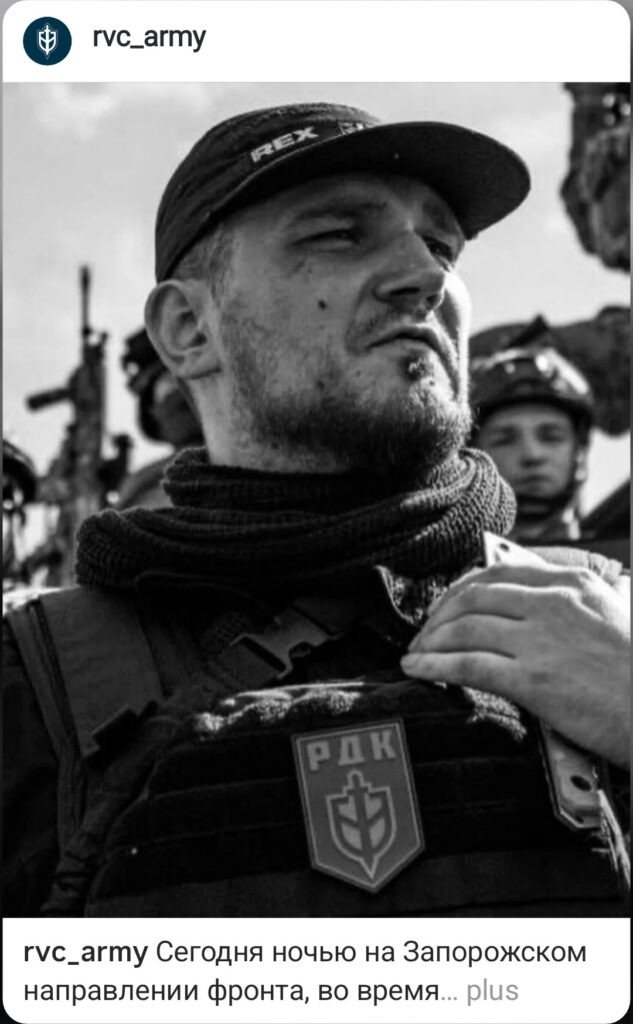
    Aux ordres jusqu’à présent du défunt, le Russkiy dobrovol’cheskiy korpus [Corps des volontaires russes, RDK] est peuplé de militants nazis russes qui se sont réfugiés en Ukraine après le coup d’État de droite et pro-Europe à Kiev en 2014. Comme le bataillon Revansh, il opère sous commandement du renseignement militaire ukrainien. La personnalité de Kapoustine et les hommages que sa mort suscite éclairent la mouvance nazie moderne. Né en Russie, élevé en Allemagne par une mère juive, il avait construit son idéologie par hostilité aux migrants
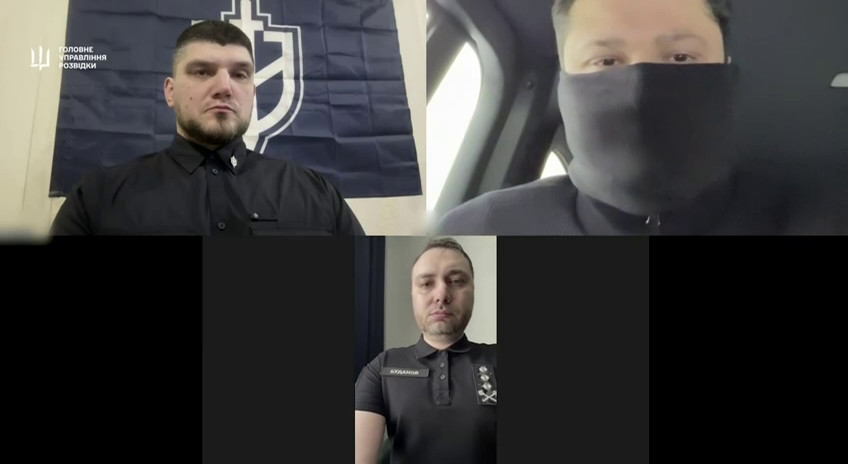
    L’annonce de sa mort était une opération de désinformation. Le militant nazi Denis Kapoustine est toujours en vie le 1er janvier 2026, apparaît lors d’une visioconférence avec Kyrylo Boudanov, chef du renseignement militaire ukrainien (HUR), qui le lendemain, devient chef de l’Administration présidentielle de Volodymyr Zelenskyy.

    Le 14 février, Delange rend hommage à Quentin Deranque, décédé d’une hémorragie cérébrale consécutive à une blessure reçue lors d’une bagarre que son groupe de nervis fascistes déclencha par l’attaque d’une conférence de l’eurodéputée Rima Hassan à l’Institut d’études politiques de Lyon
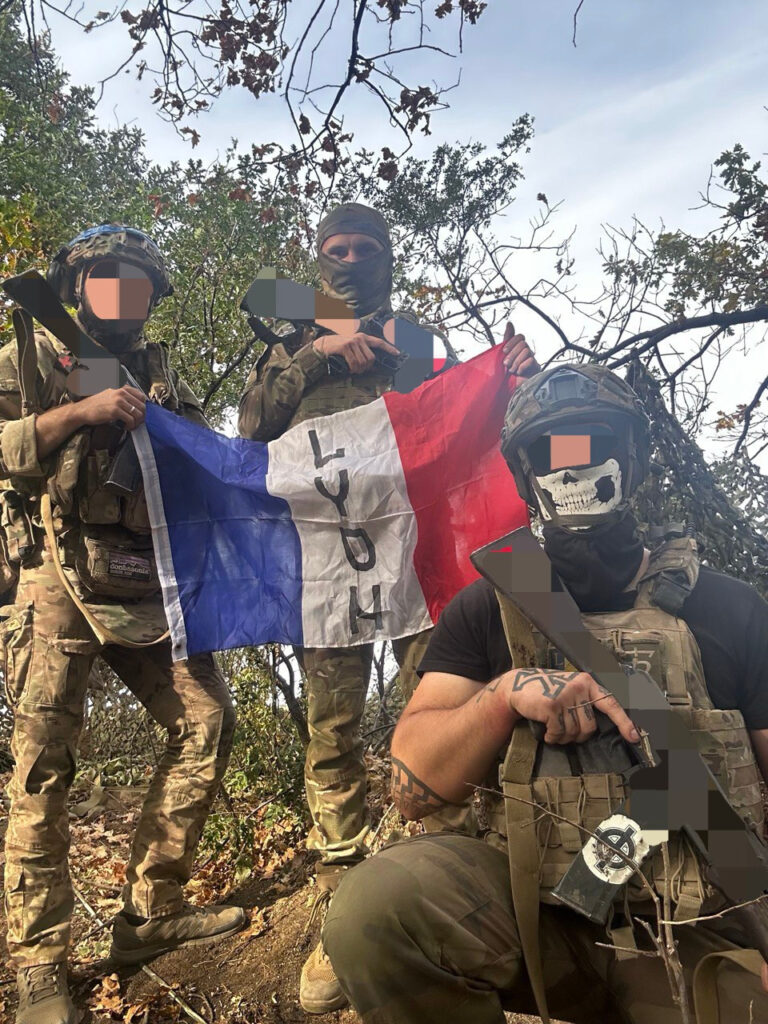
    Avant de rejoindre en septembre 2022 les rangs de l’armée atlantiste en Ukraine, Delange était une figure de la scène fasciste lyonnaise, passé notamment par le groupe Lyon populaire. On peut supposer que les deux se sont connus car selon une enquête de StreetPress, Deranque a aussi été membre de Lyon populaire.

    Delange publie également une vidéo qui montre un groupe de militants masqués arpenter les rues de la capitale des Gaules. Il commente

    la “sécurité” à Lyon en 2022 c’était autre chose

    Mais que fait la police ?

    Selon la rumeur publique, il a refusé une mission en décembre 2025. De fait, il a été expulsé du bataillon Revansh, est désormais interdit de séjour dans les formations sous commandement du renseignement militaire ukrainien (HUR). Cet incident a causé l’éclatement du groupe de nazis français appelé WAR puis Légion pirates
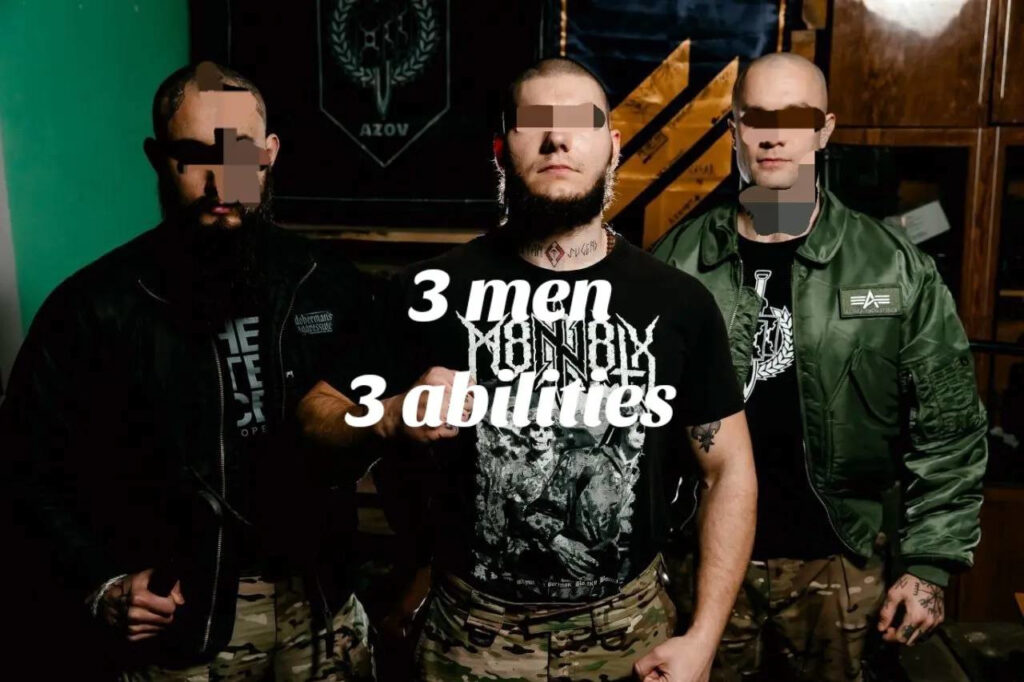
    L’image originale peut être plus ancienne, mais sa publication, le 5 mars 2026, suggère qu’il a réintégré la 3e compagnie -appelée Centuria, du nom du mouvement de jeunesse d’Azov- du bataillon antichar de la 3e brigade d’assaut, émanation de l’organisation nazie dans l’armée régulière ukrainienne. Cette mutation est sa quatrième ou cinquième depuis septembre 2022, dans l’armée de Bourbaki que sont les troupes atlantistes en Ukraine. Gwendal Delange est au centre, Bora / Berserker, à gauche, César Aujard, à droite.

    Le 10 mars, il est au centre d’un nouveau psychodrame pinzutu [français, en Corse]. Le 5, il publia aussi une image de 2022, qui montrait Alice Kerviel, dite Cordier. Pour y prendre les antifas, la présidente du Collectif Némésis a coutume de tendre des embuscades avec ses amis fascistes. Ce fut ainsi que le nervi Quentin Deranque fut mortellement blessé à Lyon le 12 février. De la publication du 5 mars, j’ai réalisé des captures d’écran que je n’ai pas encore partagées ici, tant ce sujet franco-français me paraissait dérisoire. Delange légenda qu’en déplacement à Lyon en 2022, elle sollicitait déjà les groupuscules dont il faisait partie

    Le 10, le journaliste Ricardo Parreira rapporte à ses lecteurs les liaisons dangereuses de Cordier et c’est le drame. Delange efface sa publication sur les réseaux sociaux et menace Parreira de poursuites pénales. Une réaction curieuse pour un militant qui ne fait aucun secret de son idéologie nazie. La raison évidente est que furieuse, la présidente du Collectif Némésis lui met la pression. La révélation accable celle qui travaille dure pour faire sa place dans l’univers médiatique fasciste de Vincent Bolloré. Prise les doigts dans le pot de confiture, sa façon de nier est désordonnée et un peu ridicule, conforme à l’image que j’ai conçue de la racaille au fil d’années de police judiciaire
    Exactement et c’est très bien. Des blancs se font tuer jour après jour, et ces blancs en ont marre de ne plus pouvoir sortir dans la rue sans se faire agresser, de ne plus pouvoir vivre tranquillement sans se prendre un coup de couteau ou de machette

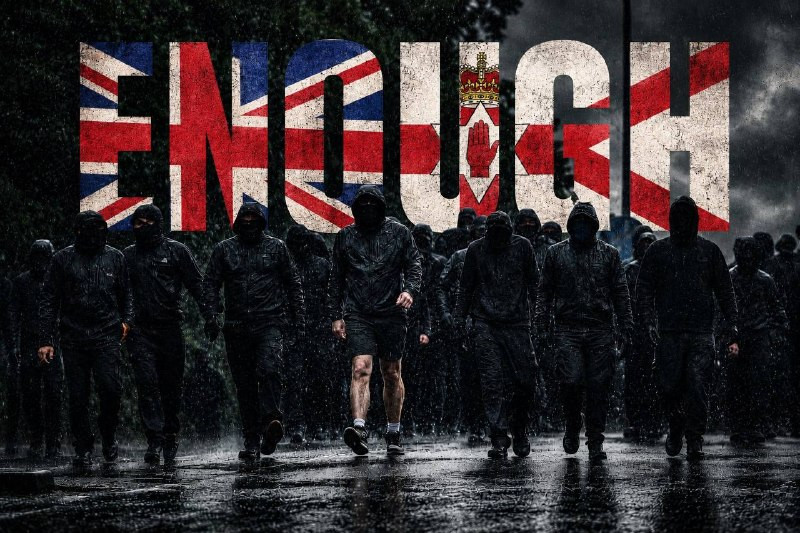
    Sans surprise le 10 juin 2026, Delange commente avec exaltation les émeutes racistes de Belfast, Ulster, où la veille, en réaction à un fait divers du 8 juin, des militants protestants loyalistes attaquèrent centres d’hébergement et commerces étrangers, en marge d’une manifestation contre l’immigration à laquelle appelèrent le suprémaciste blanc sud-africain Elon Musk et le militant islamophobe pro-Israel Stephen Yaxley Lennon, alias Tommy Robinson, un grand copain de l’agitatrice bretonne Alice Kerviel, dite Cordier
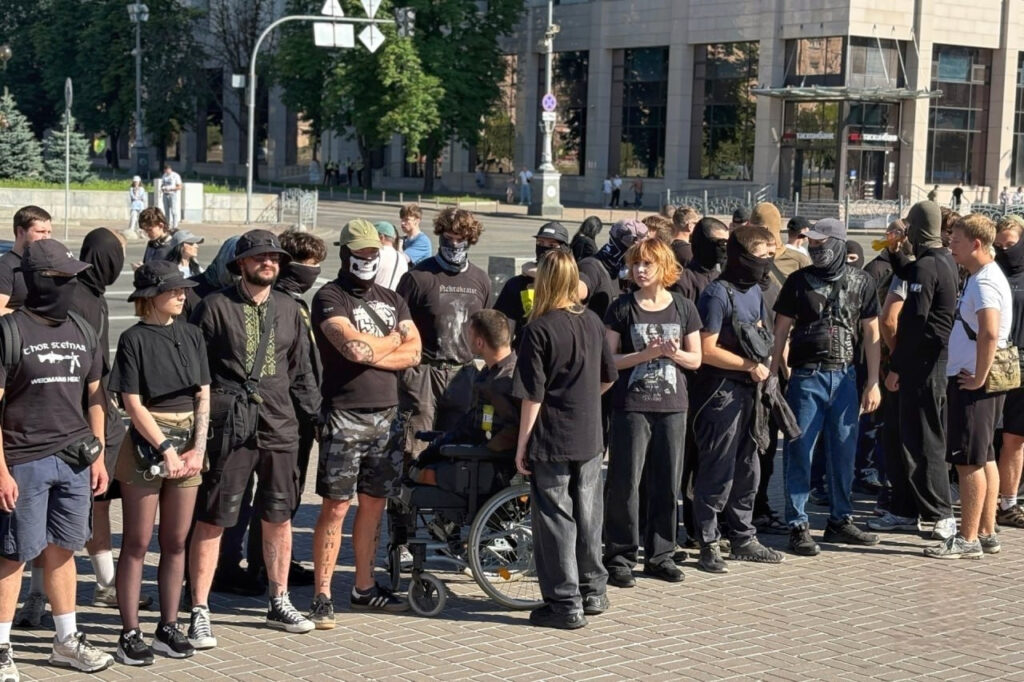
    Sans surprise le 21 juin, il participe à la manifestation à Kiev contre la Gay Pride.

    Le 10 septembre 2026, le quotidien numérique Intelligence Online publie un article à mon sujet, y souligne la frustration des mercenaires français et du renseignement ukrainien, qui ne parviennent pas à me localiser en Corse. Je goûte en effet une vie discrète en un coin de paradis -mon Shangri-La- afin que la paix n’en soit pas troublée par des violences inutiles et que les chasseurs y soient les seuls à faire parler la poudre

    De la DST aux réseaux pro-russes : Nicolas Cinquini dans le viseur du SBU [sûreté d’État ukrainienne] et des combattants français en Ukraine
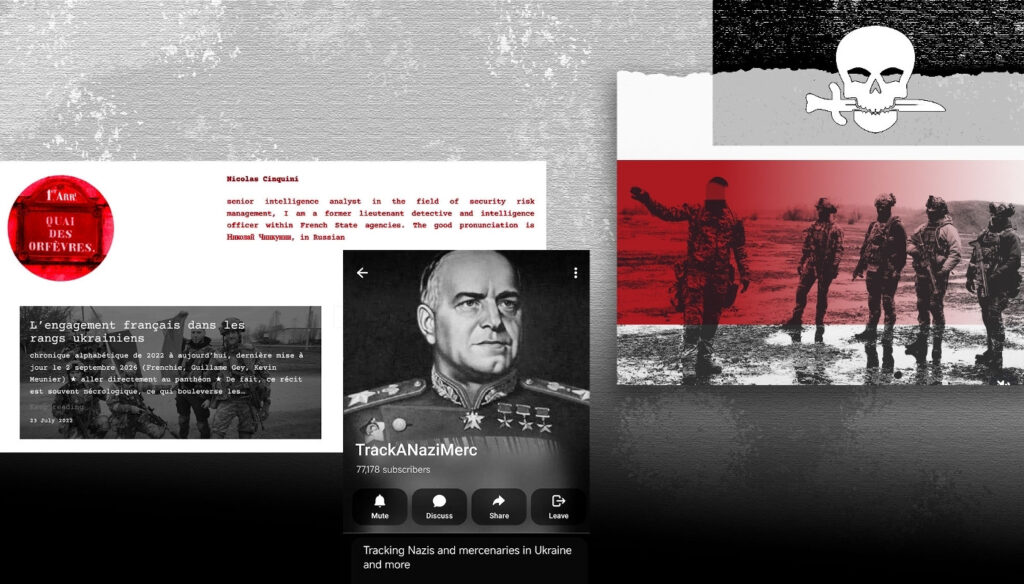
    Ancien du renseignement intérieur français, radié de la police nationale après la séquence des Gilets jaunes, Nicolas Cinquini expose sur les réseaux sociaux les Français engagés en Ukraine. Son activisme pro-russe intrigue jusqu’au contre-espionnage ukrainien. Et lui vaut l’hostilité croissante de vétérans rentrés en France […]

    Lorsque l’intérimaire de presse française Romain Mielcarek partage avec hostilité le papier sur X, il suscite une réaction complice et amère de Gwendal Delange, traumatisé par mes atteintes répétées à son intimité. Il est vrai que pour une mystérieuse raison, si les journalistes connaissent depuis longtemps l’identité du volubile et flamboyant militant nazi lyonnais, la plupart rechignent à la publier
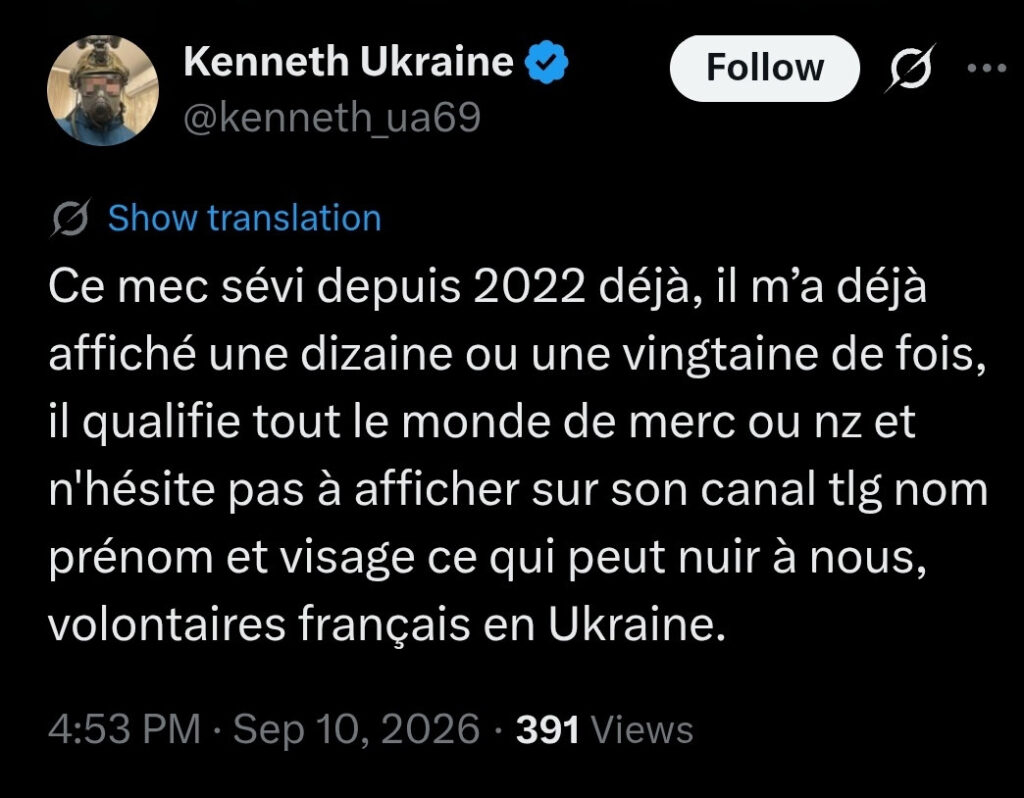
    J’en suis presque navré, mais mon travail ici ne consiste pas à atténuer son malheur. Il n’est pas seulement Gwendal Delange, mais aussi un précieux témoin à charge de ma longue enquête sur le nazisme endémique ukrainien. Si tu me lis, mon babtou nazi fragile, je te remercie pour tes doléances. Elles ont égayé ma soirée et m’ont rapproché en même temps du sublime.

    Le 24 septembre, le Comité des vétérans français d’Ukraine (CVFU) accompagne de ses voeux les barbouzes de la sûreté d’État ukrainienne (SBU). Ils en auront besoin
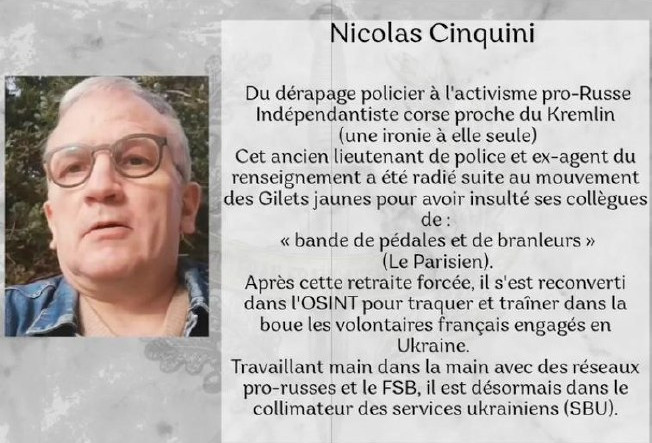
    J’insiste en revanche sur deux points particuliers : je ne risque pas de travailler pour le FSB, qui fait du renseignement intérieur. Le cas échéant, ce serait plutôt le SVR (extérieur) ou le GRU (militaire). Surtout, les flicaillons au rabais pinzuti [Français, en Corse] de la voltige de la Préfecture de police n’ont jamais été mes collÊguEUH
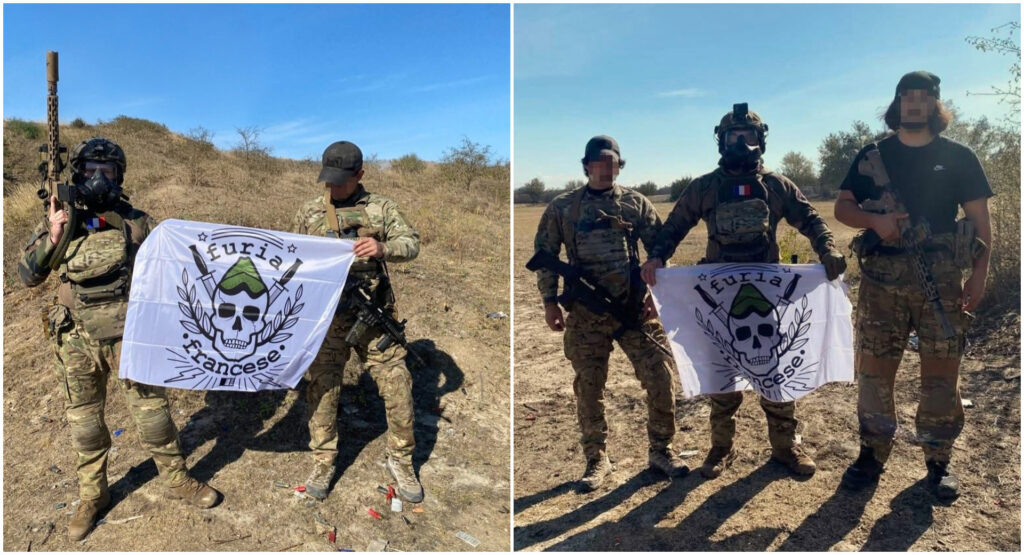
    Gwendal Delange continue de faire la promotion sur les réseaux sociaux de son dernier club, le groupe appelé Furia Francese [fureur française, une expression italienne qui date des guerres des XVe et XVIe siècles]. Et le 26 septembre, les pinzuti furieux font alliance avec leurs camarades nazis de l’Evolist Tactical Group, que représente l’Argentin Viggo Capasso
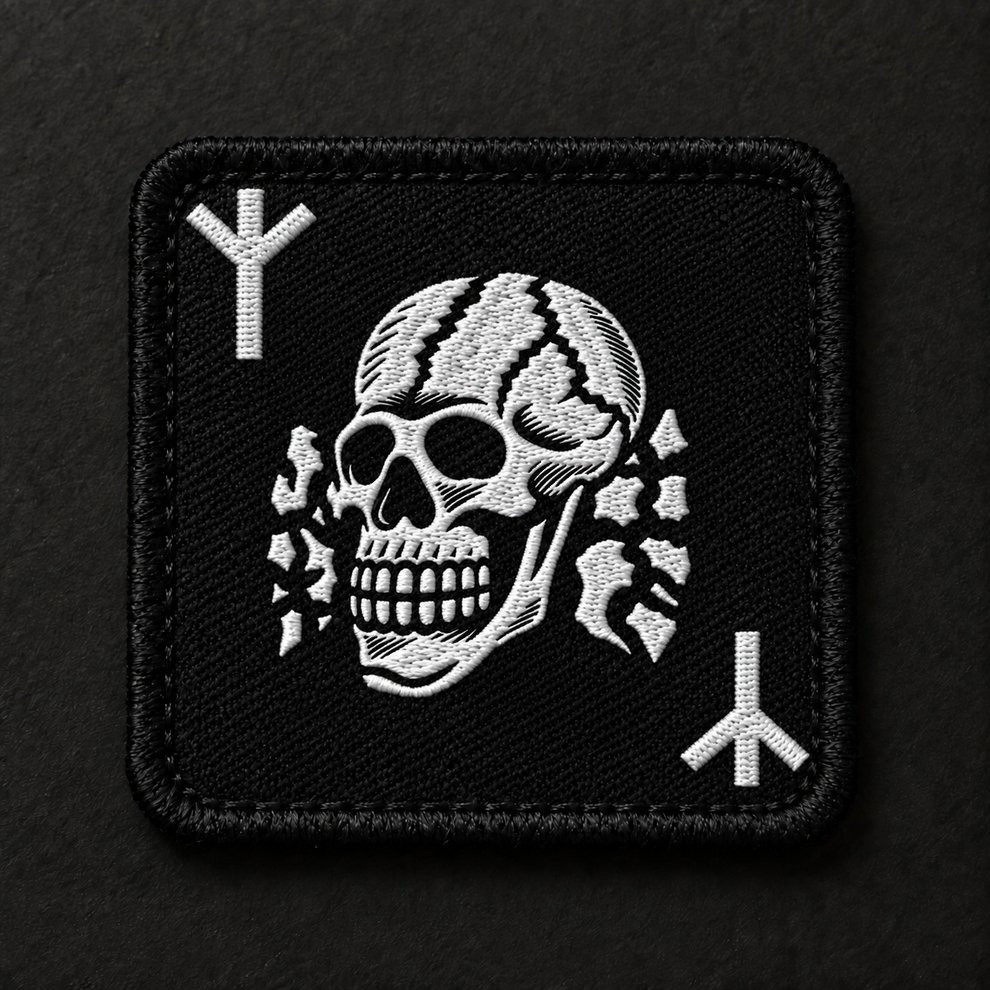
    L’accouplement des deux groupes enthousiasme en soirée les chaînes nazies ukrainiennes et européennes de Telegram, qui au diapason, encouragent le recrutement de volontaires internationaux.

    L’association qu’il fait sur les réseaux sociaux de deux événements rend Delange euphorique le 13 octobre
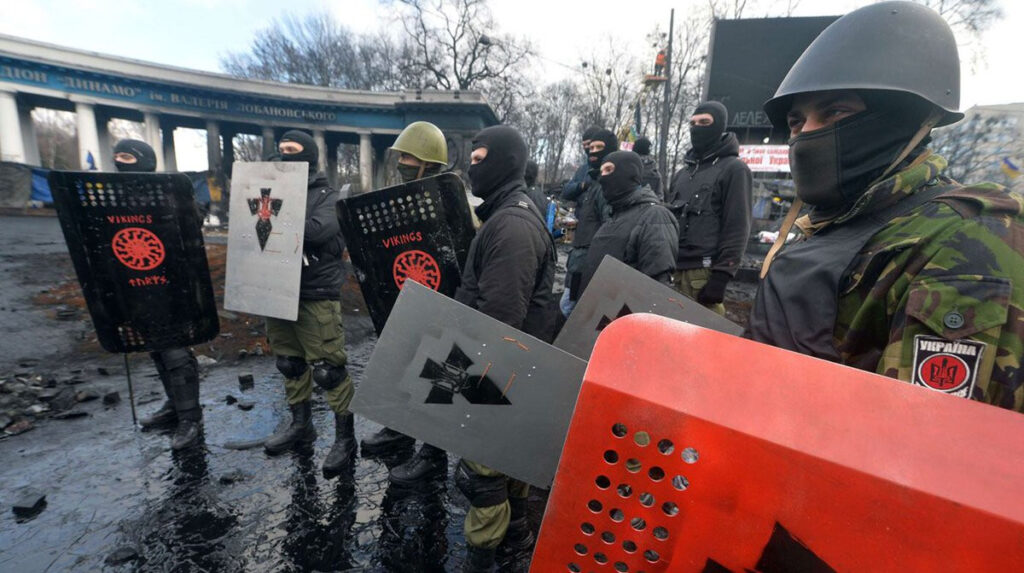
    Pour la plupart originaires de Lviv, ventre toujours fécond dans l’ouest lointain du nazisme endémique ukrainien, des nervis ont formé à partir de novembre 2013 le noyau dur des émeutiers pro-Europe sur la place Maïdan de Kiev. En février 2014, une provocation sous faux drapeau de tireurs embusqués nazis y provoqua un bain de sang qui permit le coup d’État pro-Occident
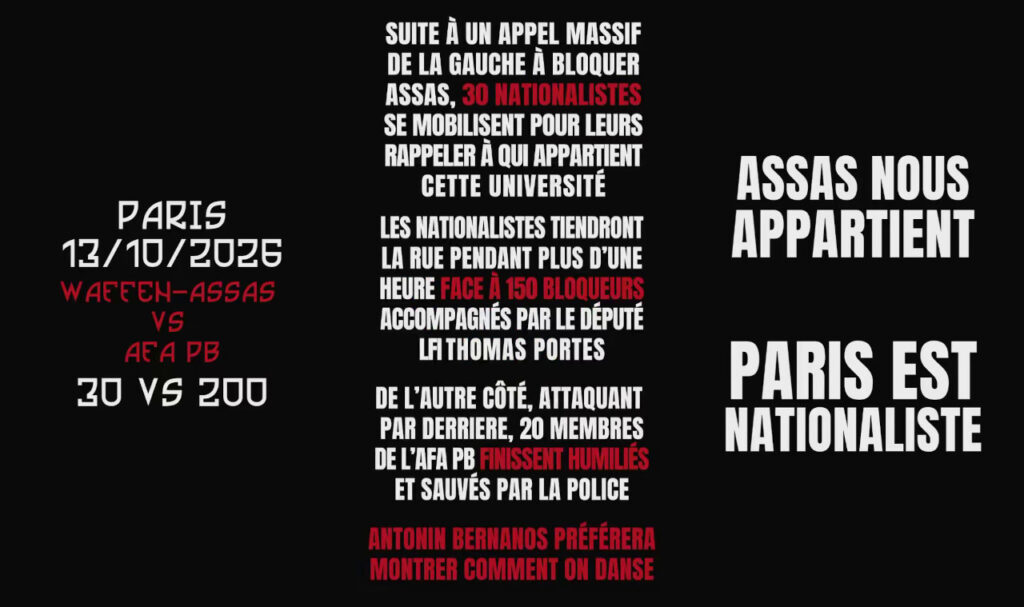
    Le second événement est parisien, date de la nuit passée, dans le contexte du mouvement social étudiant. Il célèbre là une échauffourée qui aurait laissé maître du terrain un groupe fasciste appelé Waffen-Assas.

    Les antifas en font un récit contraire : les nazis n’ont du leur salut qu’à leur exfiltration par la Préfecture de police. Je sais depuis longtemps que Dieu aime les justes causes et les gros bataillons. D’expérience, je connais aussi les penchants politiques ataviques des archers du guet. Tout me porte à savoir qui ment

    Nul ne peut reprocher à Delange de méconnaître l’Histoire sans fard de son pays. Par le partage le 17 octobre de cette image de milicienne, reconstituée sur drapeau officiel de l’État français (1940-1944) de Philippe Pétain, il exprime ses voeux pour 2027.

    Il n’est pas le seul que l’actualité française stimule, alors que le mouvement social étudiant déferle et donne lieu à des échauffourées avec la Police nationale et des nervis fascistes
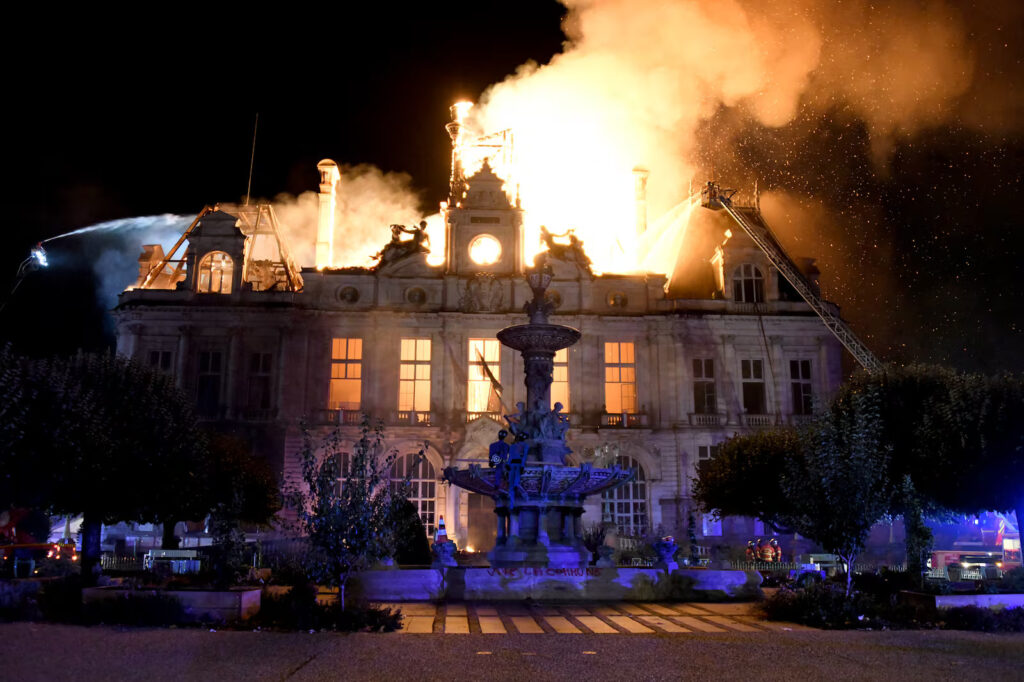
    Fondée par des revendications sociales étudiantes et plus largement, un rejet général d’Emmanuel Macron par la population, cette nouvelle vague de contestation est la manifestation ponctuelle de tensions qu’il engendre depuis des années, par son utilisation de la Constitution de la Ve République pour confisquer la démocratie. Il s’obstine depuis 2017 à appliquer son programme néolibéral, contre les aspirations de la majorité populaire.

    Comme toujours dans une telle situation, il ne modifie pas son agenda mondain et ne se prive pas de voyage à l’Étranger. Ses raisons ne sont pas seulement la crainte d’être pris et lynché mais aussi une façon de transcender. Car il s’est toujours servi de sa fonction comme d’un piédestal pour tenter de réaliser son perpétuel fantasme : briller sur la scène internationale. Les Français l’ont toujours ennuyé
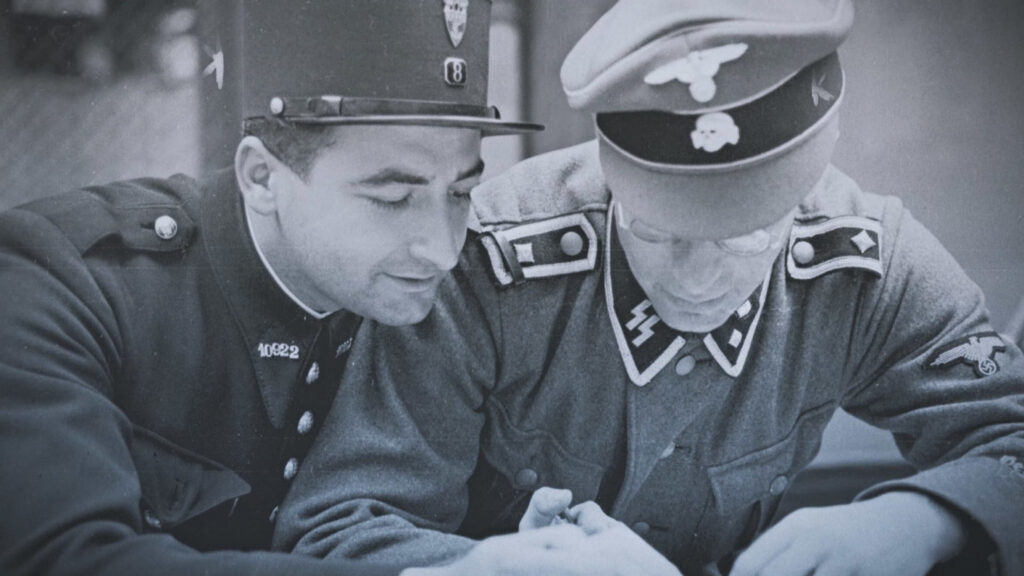
    Il sont héritiers de Philippe Pétain -dirigeant fasciste français pendant la Seconde Guerre mondiale- et redevenus majoritaires à droite ; ils s’appellent Eric Zemmour, Marine Le Pen ou Bruno Retailleau ; les pétainistes ne veulent voir dans ces événements que la rébellion d’une population pauvre d’origines immigrées qui vit dans de laides banlieues. Dans la catégorie espoirs, la porte-parole du gouvernement se distingue le 20 octobre : la priorité de Maud Bregeon est alors de rétablir l’ordre, contre les factieux et les racailles. Porte-parole du gouvernement.

    Sur Telegram le 20 octobre, une chaîne de footeux nazis européens partage l’image de son fantasme : un Einsatz à Paris d’Andriy Biletsky, commandant du 3e corps d’armée, émanation de l’organisation nazie Azov dans l’armée régulière ukrainienne
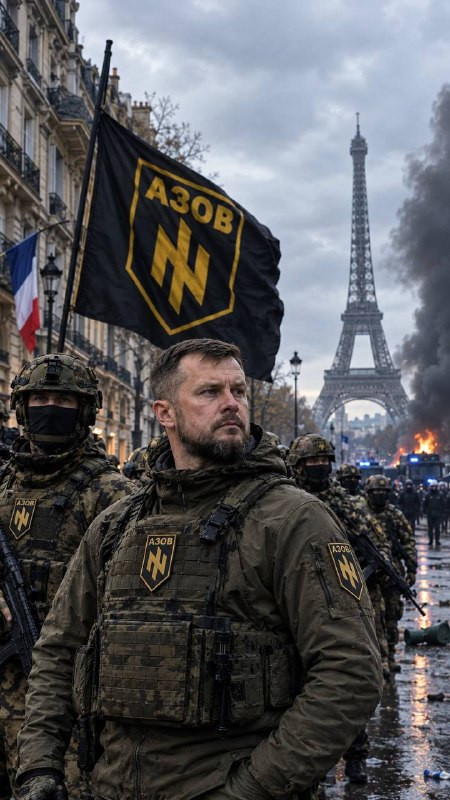
    En Anglais, la légende dit en Français

    La 3e brigade d’assaut pour rétablir l’ordre à Paris, en échange d’un approvisionnement illimité en armes, voilà une bonne affaire !

    Mais en réalité, après une victoire ukrainienne, des vétérans peuvent aider à la Remigration en Europe. Il y a des milliers de soldats qui sont idéologiquement motivés et parfaits pour une sous-traitance

    Au cas peu probable où les footeux ne connaissent pas encore Gwendal Delange, ils l’ont imaginé
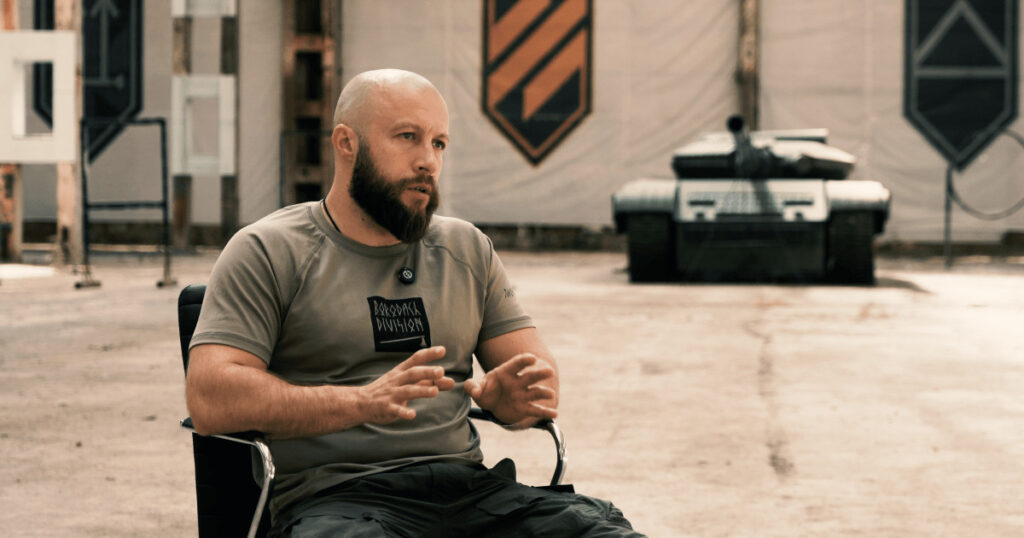
    Criminel de guerre et commandant adjoint de la 3e brigade d’assaut, noyau du 3e corps d’armée, Maksym Zhorin commenta en effet la veille

    Depuis plusieurs jours, des « manifestants » ont semé le chaos dans les rues françaises sans revendication concrète. Tout cela se passe dans le silence total des grands médias, qui sont toujours incapables d’identifier clairement les origines ethniques et religieuses des auteurs.

    Tout cela est une conséquence de nombreuses années de promotion d’une idéologie libérale toxique. Les mots ne suffiront pas à surmonter cette crise ; seules des mesures fermes et radicales y parviendront. Pour survivre, l’Europe doit se souvenir de son histoire et de sa véritable essence, plutôt que de se prélasser dans une tolérance erronée
    Je déconseille à ce barbare de tenter quoi que ce soit en Corse. Le terrain y est rude. Il risque de verser des larmes de rage ou même d’y perdre la vie.

    À l’instar de la porte-parole du gouvernement Maud Bregeon, il sait les reconnaître ; le 23 octobre, un terroriste raciste choisit ses victimes à leurs apparences, au fil de son itinéraire de Trappes à La Verrière, dans les Yvelines. Armé d’un pistolet-mitrailleur, il tue une personne et en blesse sept autres, dont touchée par huit balles, une enfant de 11 ans
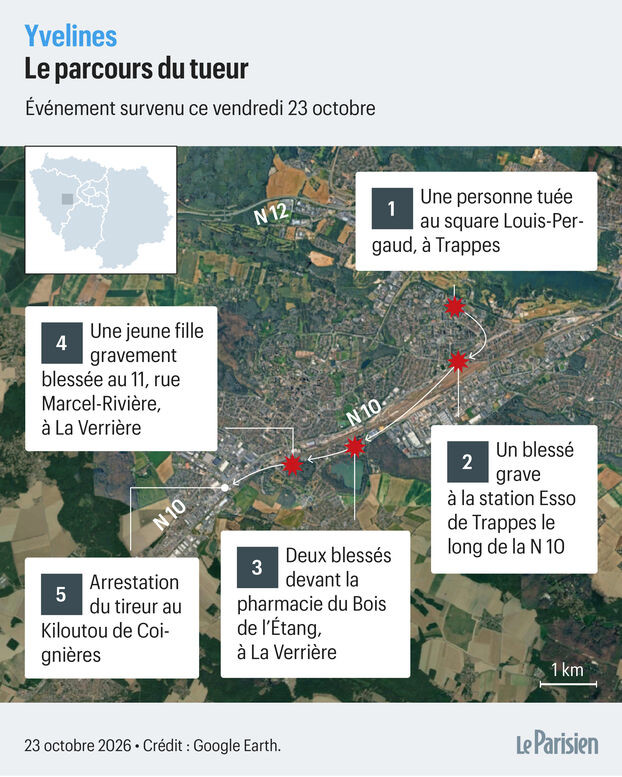
    Aux policiers qui l’interpellent, il déclare avoir vengé les commerçants [pillés lors des manifestations du 17 octobre] en s’attaquant aux Noirs et aux Arabes. Un exemplaire de Mein Kampf est découvert plus tard à son domicile
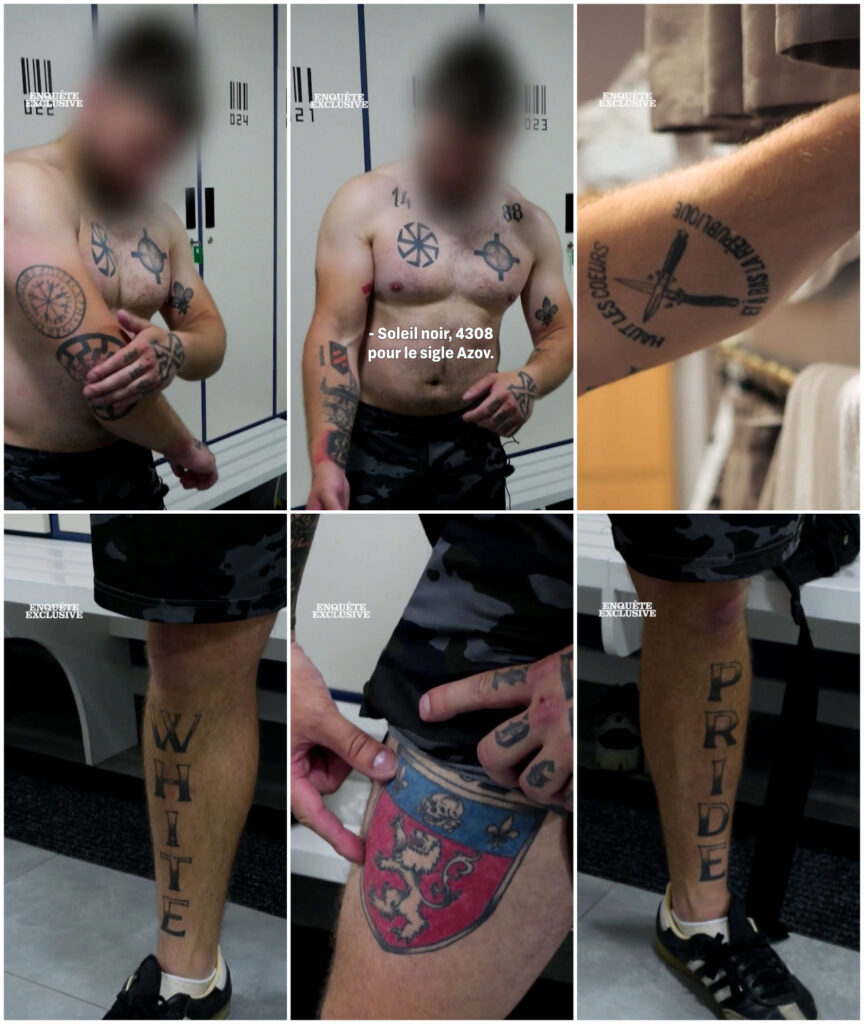
    Gwendal Delange a été interrogé en Ukraine pour un reportage sur la radicalité politique en France que M6 diffuse le 7 novembre 2026.

    in L’engagement français dans les rangs ukrainiens

    chronique alphabétique et nécrologique de l’engagement français dans les rangs atlantistes en Ukraine, ce que les journalistes serviles ne vous raconteront pas

    Articles connexes

    The Atlanticist defeat in Donbass and Ukraine

    en Anglais, chronicle of a new catastrophic NATO venture

    Nazism in Ukraine

    chronique en Anglais, its roots before WW2, its collaboration with Nazi Germany, its legacy in modern Ukraine, how NATO has continually supported Nazism in Ukraine

    The footprint of the Ukrainian Nazism in the West

    chronique en Anglais, interactions between Ukrainian Nazi organizations and Western supremacist militants

    The Western disinformation about Ukraine

    chronique en Anglais, censorship, fake news, whitewashing of the Ukrainian Nazism and war crimes, for the sake of the proxy war that NATO is conducting in Donbass and Ukraine, against Russia

    14 novembre 2026 : Tombés pour l’Allemagne et l’OTAN

    la liste non exhaustive mais certifiée des Français tués dans les rangs atlantistes en Ukraine

    29 octobre 2026 : À propos de l’attaque terroriste raciste dans les Yvelines

    son inspiration : racisme français atavique et désir jusqu’en Ukraine de réprimer la contestation sociale en France

    5 août 2026 : Ylian Fort « chique » comme le dernier des voleurs à la tire

    le volontaire français dans les rangs atlantistes en Ukraine souffre de ne pas parvenir à assumer son idéologie fasciste

    1er août 2026 : Censure de la journaliste pacifiste Xenia Fedorova

    loi visant à prévenir les ingérences étrangères en France

    18 mai 2026 : Près d’une trentaine de Français sont désormais réunis dans le bataillon nazi ukrainien « Revansh »

    de quoi faire trembler le microcosme politico-médiatique parisien

    11 mai 2026 : Ma réponse au Canard enchaîné

    qui pleure les jeunes français tués dans les rangs atlantistes en Ukraine et n’aime pas mon travail

    25 avril 2026 : De Philippe Pétain à Quentin Deranque

    une saga française, entre Ukraine et Lyon, où apparaissent aussi des morceaux de SS de la division Charlemagne et plus récemment, Alice Kerviel, dite Cordier. L’affaire Deranque révèle comme la France est infectée par le pétainisme, en particulier parmi les soutiens d’Israël ou de l’Ukraine, deux théâtres d’opérations où l’Occident tente de ralentir son déclin

    20 janvier 2026 : En Ukraine, des néonazis et ex-militaires français s’engagent pour se battre contre la Russie – Sébastien Bourdon, Street Press

    En 2025, une nouvelle unité de Français combattant pour l’Ukraine s’est structurée autour d’un noyau de néonazis, ayant pour objectif d’attirer des recrues. Parmi ces volontaires, d’anciens militaires. StreetPress les a identifiés

    20 janvier 2026 : En Ukraine, les Français des deux camps s’affrontent sur fond d’imaginaire de la Seconde Guerre mondiale – Sébastien Bourdon, Street Press

    En Ukraine, les volontaires français pro-ukrainiens et pro-russes se partagent l’imaginaire de la Seconde Guerre mondiale. Les premiers se revendiquent des collabos de l’Allemagne nazie, les seconds de l’escadrille mythique « Normandie – Niémen »

    15 novembre 2025 : « Gardez votre confiance en la France éternelle »

    deux jours après le 10e anniversaire de la débâcle politique et sécuritaire du 13 novembre 2015, une messe célèbre à Verdun l’ancien dirigeant fasciste de l’État français

    11 novembre 2025 : Der Krieg

    ce 11 novembre 2025 est l’occasion de souligner comme la façon dont l’Europe sacrifie les conscrits ukrainiens mobilisés de force rappelle le spectaculaire carnage de la 1ère guerre mondiale

    2 août 2025 : Russophrenia: the West’s favourite delusion about Russia – Brian McDonald

    Ten years after I coined the term, the media’s still convinced Russia is both collapsing, and conquering the world

    9 mai 2025 : Victory Day

    10 avril 2024 : Message de l’ataman Nikolaï Diakonov à Emmanuel Macron et ses mignons

    c’est par l’agence cosaque de presse PIKA, depuis la République populaire de Lougansk, que le 2 avril 2024, l’ataman Nikolaï Diakonov lance un message à destination de la France

    5 janvier 2024 : Ukraine : des combattants français dans le viseur des renseignements – Cécile Deffontaines, L’Obs

    ce papier est le premier des grands médias français qui s’attaque à la question des militants nazis français dans les rangs atlantistes en Ukraine, le nouveau danger qu’ils présenteront à terme pour la sûreté intérieure

    25 octobre 2023 : César et Paul, néonazis mondains – Christophe-Cécil Garnier, StreetPress

    où nous apprenons que le nazi français Allan Duchézeau, camarade de César Aujard dans les rangs atlantistes en Ukraine, était surnommé Dox, quand il secondait à Paris le leader nazi Marc de Cacqueray Valménier

    21 juillet 2023 : Les oeils de Moscou

    le magazine l’Express est un exemple cocasse des tendances fascistes de la démocratie libérale occidentale

    30 mai 2023 : Fils de Pétain

    la vanité nationale trouble la perception de la réalité historique et perpétue une névrose collective

    14 mai 2023 : Pauvre Sacré Charlemagne

    la mythologie européiste

    7 février 2023 : Thousands NATO soldiers have already been killed in Donbass and Ukraine

    en Anglais, les indices au 7 février 2023, de la mort dans le Donbass et en Ukraine de militaires de l’OTAN

    31 janvier 2023 : the European fascist armies lose WW2

    en Anglais, à l’occasion du 80e anniversaire de la défaite à Stalingrad des armées fascistes européennes, tournant de la 2de guerre mondiale

    21 septembre 2022 : The Western operatives in Mariupol

    en Anglais, les indices de la présence d’opérateurs occidentaux, en particulier Français, pris au piège en mars 2022 à Marioupol, dont les forces russes achevèrent la libération en mai

  • [Sharing] A Report from Russia: How Close are Europe and Russia to a Wider Conflict? – Scott Ritter

    This article is the product of visits to Russia I made in June and September 2026 where I met with senior Russian leaders, leading academics, and specialists in military and security issues

    There has been a spate of irresponsibly aggressive rhetoric from within Europe strongly posturing for a conflict with Russia by the end of the decade. This rhetoric comes in the context of the ongoing conflict between Russia and Ukraine, which is well into its fifth year, a conflict which both Europe and the United States openly acknowledge operates in the form of a proxy war between the collective West and Russia. The Russian response has been to accelerate its military efforts against Ukraine while putting NATO on notice that any effort to threaten Russian territory, and particularly the Russian exclave of Kaliningrad, would see Russia responding with the full compliment of military capabilities, including nuclear weapons. The current situation in Europe today in many ways replicates the conditions that existed on the continent in the summer of 1914, where military mobilization and war preparations created a momentum that produced a war no politician was seriously looking to prosecute. The consequences of war in 1914 were a disaster for Europe; the consequences of a war today would be fatal to civilization as we know it.

    In examining the geopolitical map of Europe/Eurasia today, one can assess four points of military friction between Russia, the United States and Europe. These are Ukraine, the Arctic, Kaliningrad, and Outer Space. While each represents a physically distinct problem set politically and militarily, they are all four inextricably linked through a common Russophobic mindset in Europe and the United States which treats Russia as a singular security issue. Moreover, both Europe and the US operate from a strategic mindset driven by zero-sum thinking, which postures Russia as being structurally motivated to bring harm to both Europe and the United States, thereby stifling the possibility of cooperation with Russia that could resolve many if not all of the underlying issues which are collectively construed by the West as presenting a threat. For its part, Russia operates from a mindset derived from the psychology of perpetual victimhood dating back centuries, and a historical foundation of resistance to aggression which seeks diplomatic resolution until which point military confrontation becomes the only solution

    Ukraine: The (perceived) chink in the Soviet/Russian armor

    The current conflict in Ukraine between Russia and the West did not begin in 2022 with the Russian invasion but rather represents the logical conclusion of a posture on the part of the United States and NATO which sought to exploit the ultra-nationalism of Western Ukraine in order to create a framework of instability designed to weaken the Soviet Union, and later Russia, from within. To understand this mindset, one first must delve into the psychology underpinning the concept of Ukrainian nationalism. For Russia, Ukraine represents part of a larger family of Slavic peoples which include the Russians and Belarussians; indeed, this notion is shared by millions of Ukrainians as well. One only need to look at the integration of Ukraine within the cultural and historical roots of Russia over time to understand the reality of this sentiment.

    For the West, this reality presents a problem, since it lends itself toward the existence of a singular Slavic state possessing tremendous geographical advantages and unmatched natural resources which in turn creates massive economic penitential that competes with Western notions of global supremacy. Nazi Germany sought to nullify this Slavic potential through the implementation of Generalplan Ost, the literal cultural and physical genocide of the Slavic race. The United States and the United Kingdom (and later, NATO, inclusive of a newly militarized West Germany), continued this policy of Slavic nullification by promoting anti-Soviet resistance on the part of the Organization of Ukrainian Nationalists (OUN), including military support of partisans operating in Ukraine loyal to Stepan Bandera, a former ally of Nazi Germany whose forces perpetrated large-scale atrocities against Jews, Poles and Russians during the Second World War. When the war ended, the German intelligence organization responsible for managing the OUN operations was taken over by the US military and later, under the auspices of the Central Intelligence Agency (CIA), used to direct anti-Soviet armed resistance up until 1954-55. The CIA continued to provide active support for the OUN, using the Ukrainian diaspora, through the 1990’s.

    The role of western intelligence, led by the CIA and the British Special Intelligence Service (SIS), in post-Soviet Ukraine was singularly focused on promoting Ukrainian nationalism at the expense of Russia. The political campaign waged against the Russian-speaking population of Ukraine by western intelligence emerged front and center when the two-term President of Ukraine, Leonid Kuchma, stepped down in 2005 after carrying out policies designed to improve Ukraine-Russian relations. Kuchma threw his support behind the Russian-speaking Viktor Yanukovych. For the West, a Yanukovych presidency would undermine their strategic goal of stripping Ukraine away from Russia. The result was the so-called “Orange Revolution”, which saw Yanukovych’s electoral victory overturned in favor of Ukrainian nationalists who promoted a distinctly anti-Russian policy which saw Ukraine pivot toward the European Union and seek NATO membership. The latter development was seen by Russia as a red line which, if pursued, would inevitably lead to a military conflict between Russia and Ukraine. Yanukovych’s election in 2010 was deemed a setback to the Western designs on Ukraine, leading to the West supporting a violent coup in February 2014 that saw Yanukovych driven from power, replaced by pro-western Ukrainian nationalists.

    It should be clear that a physical confrontation between Ukraine and Russia has always been the goal of the collective West. Efforts to take control of the Russian political space had, by 2014, failed. The so-called “reset” of 2009 was little more than a political cover for a regime change operation designed to replace Vladimir Putin, who had ruled Russia since taking over from Boris Yeltsin at the end of 1999, and in the intervening decade taken Russia down the road of economic and national recovery that the West, operating in full zero-sum mode, simply could not tolerate. The concerted efforts of President Obama to interfere in the Russian parliamentarian elections of 2011 and the presidential election of 2012 failed to remove Putin from power. The actions in Ukraine in 2014 and afterwards must be viewed in this light; nothing happens in a vacuum.

    The Ukraine conflict was never avoidable, despite Russia’s concerted efforts to engage in diplomacy designed to do just that. The defeat of the Ukrainian army in 2014-15 at the hands of Russian-backed separatists in the Donbas led to the adoption of the Minsk peace accords. It is now established fact that neither Ukraine, its two European partners (France and Germany), nor the United States ever had any intention of following through on the Minsk process. Instead, the Minsk process was designed to buy time for NATO to build a new Ukrainian army capable of holding its own against Russia. Indeed, from 2015-to 2022, the United States and NATO did just that, training over 80,000 Ukrainian forces, including thousands of Ukrainian nationalists labeled as neo-Nazi by the United States Congress, to NATO military standards. The stated purpose of this training was to enable Ukraine to take physical possession of the Donbas and Crimea, which was annexed by Russia in 2014 following the CIA-backed coup in Kiev. When Ukraine began amassing these NATO-trained troops in the Donbas region in early 2022, Russia launched a pre-emptive action which, more than five years later, has become an openly acknowledged proxy war with the collective West, inclusive of the US and NATO.

    The stated goal of both the US and Europe in pursuing this proxy conflict with Russia is nothing less than the strategic defeat of Russia. What does this mean in practice? First of all, the proxy war was never intended to result in a Ukrainian military victory against Russia. Rather, the goal was to draw Russia into a conflict which would exhaust its military potential, break its economy, and collapse its society to the point that the government of Vladimir Putin would be removed from power. This entire policy is postulated on the understanding that Vladimir Putin must be removed from power. As such, and solution that does not attain that objective is rejected out of hand, a pattern of behavior reflective of the zero-sum mentality that drives western policy making. As a result, every potential off-ramp that Russia has been willing to consider, from the Istanbul communique of 2022 to the Anchorage compromise of 2025, has been rejected by the West, exposing the reality that for the West diplomacy is just a tool to buy time to further strengthen Ukraine militarily in order to draw the Ukraine-Russian conflict out to its desired conclusion—the collapse of Russia. In short, Minsk on replay.

    Russia has proven to be surprisingly resilient in the face of this concerted western effort designed to collapse it as a viable nation state. The Russia economy not only has survived in the face of western sanctions but, in concert with effective Russian diplomacy that has exploited western diplomatic miscues to build a large and supportive global constituency, thrived as it has found foreign markets in the Global South that have largely replaced the lost European and US markets. Russian society, blindsided by a war it was not prepared for, has rallied solidly behind President Putin, as the results of the recent parliamentarian elections underscored. And far from exhausting Russia militarily, the Ukraine conflict has enabled Russia to fine-tune its defense industrial base, producing significant quantities of advanced military equipment and weaponry that for the most part far exceeds that being produced by the collective West in both quality and quantity. When this material is matched up with a combat-hardened pool of manpower, the result is that Russia today possesses the most combat-capable military force in the world, far exceeding anything either NATO or the United States can put into the field.

    In short, the western gambit targeting Russia has failed—the Russian military is stronger today by an order of magnitude, its economy far more diverse and self-sustaining, and its population far more unified than it was in 2022. Moreover, Russia shows no signs of faltering on any front—economically, diplomatically, socially, or politically.

    The same cannot be said for either Europe or the United States. Despite the war-like rhetoric coming out of Germany and Poland and backed up by statements made by US military officers, both active duty and retired, the reality is that the proxy war between the collective West and Russia was always meant to be just that—a proxy war. There has never been a realistic plan for the conflict to become a direct clash between Russia and NATO, if for no other reason than NATO simply lacks the capacity to generate sufficient forces capable of high-intensity conflict for any sustainable period. NATO’s military power has largely atrophied in the decades since the end of the Cold War, requiring an infusion of investment over time to recover which Europe currently does not seem capable of providing. The United States is itself in a posture of global retrograde, seeking to withdraw from Europe rather than resume a Cold War-like posture that is neither politically or economically viable.

    With Russia seemingly closing the door on the possibility of a negotiated settlement with the west over Ukraine, Europe and the United States are confronted with the uncomfortable reality that their strategic objectives in Ukraine will not reach fruition. Russia will continue to press for a military solution which meets all its stated objectives, including the kind of concerted de-Nazification which would make extinct the very virulent Ukrainian nationalism which has always fueled the western efforts in Ukraine against Russia.

    In short, there will be no war between Europe and Russia over Ukraine. Europe will support Ukraine until Ukraine has exhausted its resources—manpower and economic—and then watch helplessly as Russia consolidates its position in what is left of the Ukrainian nation. “To the last Ukrainian” appears to be a concept that both Ukraine and its western supporters have taken to heart

    The Arctic: The economic trigger of potential conflict

    In a rational world, the collective West would regroup after its pending defeat in Ukraine and seek to repair its considerable losses. But in a zero-sum world, this is not possible. A Russian victory in Ukraine requires, in the minds of those Russophobes in the west still dreaming of the collapse of Vladimir Putin’s Russia, a “win” which will level the geopolitical playing field. Given the reality that one of the consequences of the west’s failed Ukrainian gambit is the economic decimation of Europe, issues of economic import, not surprisingly take on increased importance when configuring a post-Ukraine geopolitical posture in opposition to Russia.

    One of the main issues confronting Europe today is discerning a coherent economic and foreign policy when it comes to China. European diplomacy in this regard has been disastrous, resulting in the collapse of critical sectors of the European economy (car manufacturing, for instance) as a result of ill-conceived notions of “de-risking” (an American-origin term designed to camouflage the real intent of such policy, which is “de-linking.”) But one cannot possibly speak of “de-risking/de-linking” when there are no viable alternative markets to replace that which one’s policies seek to vacate.

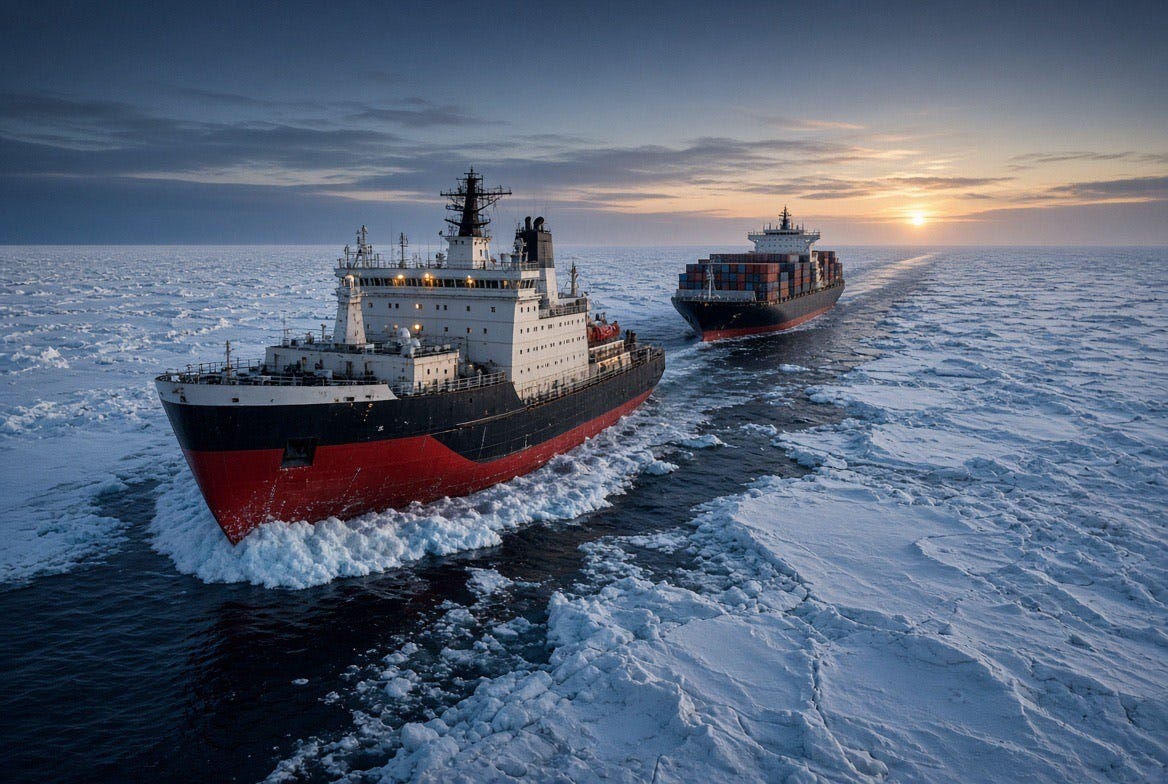
    Europe’s strategic objective of isolating Russia from China has backfired—today it is Europe that is increasingly isolated, and Russia-Chinese relations, including economic, are strong and getting stronger. One of the critical areas of Russia-Chinese cooperation is the development of the Northeast Passage or, as it is often referred to in China, the “Ice Silk Road”, a 5,500-kilometer stretch of waterway running from the Bering Strait in the east to the Barents Sea in the west. Use of this waterway has become increasingly possible—and profitable—enabling container ships to make the journey from East China to European ports such as Rotterdam around 20-days faster that the current Suez Canal route used by most shipping companies.

    The Northeast Passage operates exclusively in Russian territorial waters. It also transits the Arctic zone, meaning that for much of the year its functionality is dependent upon Russian icebreakers. The passage also operates under the umbrella of Russian security and legal norms. The economic potential of the Arctic used to the sole purview of the Arctic Council, who members used to meet on a regular basis to coordinate policies impacting on the economy, security, and ecology of the Arctic region. However, in 2022, following the invasion of Ukraine, Russia was kicked out of the Arctic Council. And, following the admission of Finland and Sweden to NATO, the Arctic Council has assumed a NATO-only posture, with its policies reflecting the strategic goals and objectives of its collective membership, namely being the strategic defeat of Russia.

    Climate change has altered the geopolitical realities of the Arctic region, with melting ice caps not only opening sea lines of communication previously denied and/or restricted because of weather but also making economic exploitation of significant mineral resources exposed by the retreating ice physically possible and fiscally viable. Normally, the Arctic Council would seek to regulate access to the Arctic to balance economic and ecological concerns within a security framework where all parties’ interests are taken into consideration.

    But in the zero-sum world, the Russo-Sino economic penetration of the Arctic space is deemed a threat to the collective West requiring a military response. This reality was underscored during the recently convened European Arctic Summit, hosted by Finland in mid-September. The European Union leadership, citing unsubstantiated claims of “significant and long-term threats” from Russia to Euro-Atlantic security, committed itself to strengthening its Arctic security posture—i.e., the militarization of the Arctic, focusing on military mobility, cross-border connectivity and necessary infrastructure in the northernmost regions of the Arctic.

    The fact is, however, that NATO is non-competitive with Russia when it comes to Arctic security issues. What the European Arctic Summit gave lip service to about the militarization of the Arctic, Russia has already fully implemented and continues to improve. While NATO nations are capable of engaging in acts of provocation, such as the recent seizure of a Russian research vessel off the northern Norwegian island of Svalberg, the rapidity in which the Norwegian government most to ensure similar actions are not undertaken in Norwegian territorial waters underscores the fact that Norway is not keen of provoking any sort of direct confrontation with Russia in the Arctic. The real threat to the West in the Arctic is not Russia’s capable military forces, but the fact that Russia, together with China, are imposing a new transit-based economic reality which will provide extraordinary leverage going forward by making traditional shipping carriers and routes non-competitive with the new “Ice Silk Road” Russia and China have already implemented. The ability to sustainably ship containers to Europe at half the cost of the current shipping routes is a game changer in every way and creates a new reality that the West will not be able to catch up to for some time, if ever

    Kaliningrad: low-hanging fruit, or impregnable fortress?

    The psychosis of the zero-sum trap the West has set for itself when it comes to Russia requires that NATO manufacture a victory—perceived or otherwise—capable of off-setting its failures in Ukraine and impotence in the Arctic. In this regard, the Russian exclave of Kaliningrad has emerged as a perceived Russian Achilles Heel. The former commander of NATO ground forces in Europe, US General Chris Donahue, openly bragged this past July that NATO forces would be able to overwhelm Russian defenses in Kaliningrad in short order. Germany and Poland have argued for intensified NATO military exercises near the borders of Kaliningrad, the goal of which would be to generate sufficient concern within the Russian leadership to cause them to pull troops out from the Special Military Operation zone to Kaliningrad in response. Several western military and security analysts have articulated assessments which indicate that Russia’s actual military posture in Kaliningrad is much weaker that publicly acknowledged. And numerous western politicians have made declarations indicating that Russia is preparing to carry out acts of aggression against NATO using the Kaliningrad exclave as a base of operations.

    But the reality is that while Russia is more than capable of defending Kaliningrad from any NATO aggression, the Russian military is not currently postured in the Kaliningrad exclave to carry out any sustainable offensive operations of any scale against any of its NATO neighbors—any contention to the contrary is simply rhetorical propaganda. Both the Russian 11th Army Corps and the Baltic Marines—the core ground combat forces stationed in Kaliningrad—have extensive combat experience in Ukraine and have developed a skill set with combat drones that would most likely disrupt and defeat any NATO offensive operations directed at the Kaliningrad exclave. The Russia military has likewise created an active reserve Rifle Regiment, BARS-39, which draws upon veteran soldiers possessing active-duty combat experience, especially in drone warfare.

    But the real threat to Kaliningrad doesn’t come from any potential ground offensive launched by NATO. Rather, it would emerge in the form of a naval blockade of the exclave. Since 2022, the railway lines that connect Kaliningrad with Russia have been subjected to severe restrictions by Lithuania when it comes to the transit of good to and from Russia; the issue of compliance with European Union sanctions of Russia lays at the heart of this matter. Russian-registered vehicles are likewise not permitted to transit Lithuania and Poland. Russia has compensated for this loss of connectivity by increasing the scope and scale of water ferry service between Russia and Saint Petersburg. While Russia has been able to sustain economic growth through this resupply effort, the fact is that this ferry-boat lifeline is very expensive, and many goods, such as gasoline, are subsidized by the Russian government to keep prices under control. If NATO were to impose naval restrictions on shipping into and out of Kaliningrad, as some of its members have suggested, the economic viability of the exclave would be threatened. It is because of this vulnerability that the Russian government put NATO on notice that any effort to subject Kaliningrad to a naval blockade, or any other act of military aggression, would be responded to with the totality of Russia’s military capability, including nuclear weapons.

    This nuclear muscle flexing appears to have dampened the enthusiasm on the part on some of the most vociferous NATO proponents of plucking what they thought would be low-hanging fruit; now that it is clear that any conflict involving a NATO attacks on Kaliningrad would not be treated in isolation, but rather constitute a conflict of existential proportions, the war drums have been muted

    Space: The final frontier

    The last topic on the list of potential points of conflict-generating friction between Russia and the US-European collective is outer space. Space-based sensors have played a critical role in the collection of intelligence used to support military operations in Ukraine and, in the case of Ukraine, to strike strategic targets in the depth of Russia. Likewise, the US commercial Starlink satellite communications system has assumed an essential role in Ukrainian military communications, to include playing a critical part in enabling Ukrainian long-range drone attacks on Russian energy infrastructure.

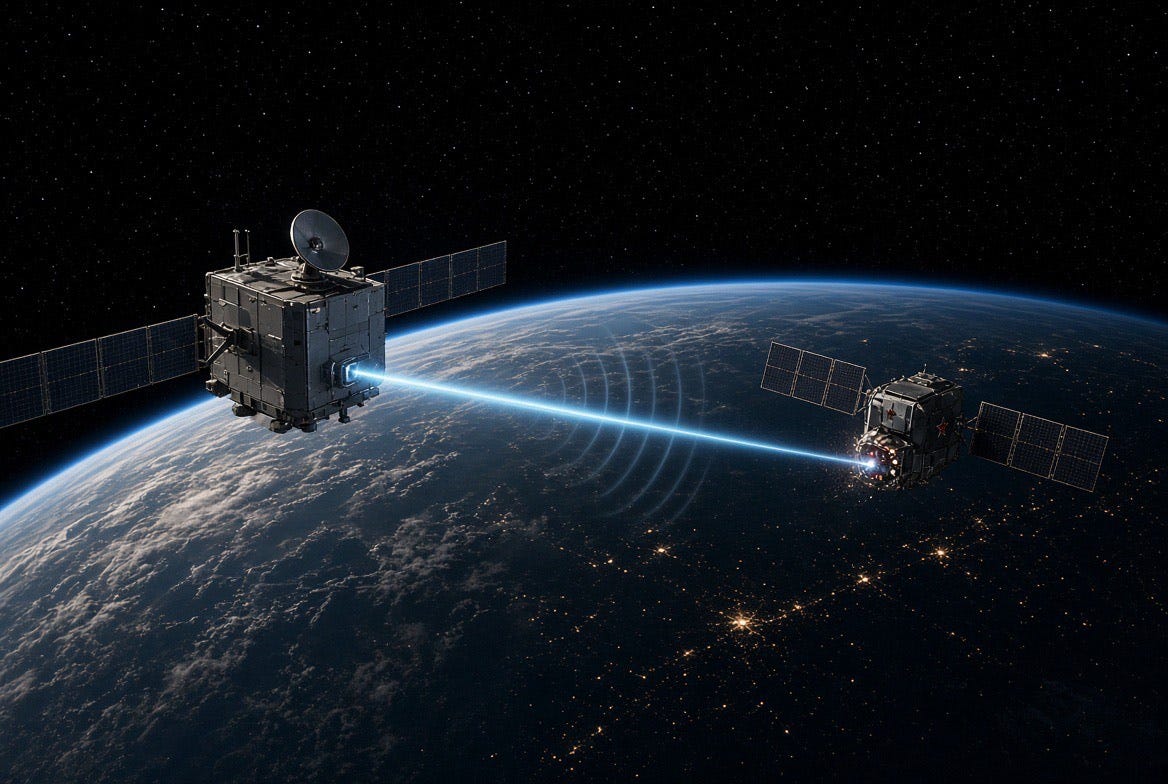
    The United States has recently announced that it has deployed “on orbit space control weapons” in Earth’s orbit. While the technical characteristics of these weapons has not been detailed, evidence suggests that these weapons are non-kinetic in nature, using reversible technology such as electronic warfare to temporarily “blind” a targeted satellite. US President Donald Trump has alluded to the use of a space-based weapon operating in support of US military strikes on Iranian nuclear-related targets in June 2025.

    Russia is in the process of deploying its own Starlink analog satellite constellation, known as Rassvet. When fully functional, Rassvet will provide Russia with satellite-based communications capability on par with Starlink. Ukraine, recognizing that Rassvet will enable Russia to more effectively guide its drones to their targets, has requested the United States to disable the Russian satellite network. Russia has indicated that it would take down the entire Starlink system in retaliation, using kinetic means which could threaten other satellites operating in earth orbit.

    The weaponization of space represents a dangerous point of escalation, especially given the US capability of temporarily blinding satellites. In the zero-sum world that the US and Europe reside in, the need to be seen as offsetting a Russian win in Ukraine, and Russia’s stymying of NATO escalation efforts in the Arctic and against Kaliningrad, may prove too much of a temptation in the minds of western leaders unable to structure a behavioral model in relationship with Russia that isn’t premised on Russophobic goals and objectives requiring Russia’s strategic defeat.

    Conclusion

    The United States and Europe have, over the course of the past several decades, built a policy trap centered on using Ukraine as a vehicle for achieving the collapse of Russia and the government of Vladimir Putin. The “trap” is the zero-sum mentality which governs implementation of this policy, linking the political and economic viability of those pursuing such policy to its successful implementation. The looming failure in Ukraine has created a need for finding new vectors capable of furthering the policy objective of achieving a strategic victory over Russia, including options to expand the zone of conflict between the US-European collective and Russia into the Arctic, the Baltics, and Outer Space. Russia has effectively countered each one of these efforts which, when viewed in isolation, appear to be manageable problem sets with limited escalation potential. However, when viewed in the aggregate, the potential for a misunderstanding and/or miscalculation driven by domestic political imperatives existent in the nations comprising the US-European collective. Here, nations possessing considerable influence over the decisions being made by the collective, such as the US, France, and Germany, are undergoing political transformations that could alter the existing political posture, including policies related to the strategic defeat of Russia as a desirable outcome. The enemy in all of this is not Russia, but rather the zero-sum thinking of the collective West which leaves them married to a policy model that is incapable of being successfully implemented, and which, if pursued aggressively, will lead to their collective demise.

    Note: I was able to visit the Special Military Operation zone, the Arctic region, oil fields, and Kaliningrad, in addition to participating in high level forums and meetings in Moscow and Saint Petersburg. The views expressed here are my personal assessment based upon these meetings, and are not meant as a formal expression of official Russian policy.

    This article is the byproduct of the independent journalism I have been undertaking for the past several years, traveling to Russia for the singular purpose of capturing the Russian reality and bringing it to the attention of a western audience held hostage by Russophobic corporate media. I cover all of my expenses, which means that the trips necessary for the production of this article could not have taken place without the generous support of subscribers and followers who have provided donations for that purpose. I will continue to write articles and release videos about these past visits. I will also continue planning and preparing for future visits to Russia, including one scheduled for November where I will attend a conference on humanitarian issues and continue to meet and interview interesting and knowledgeable people. I thank everyone who has contributed to this work, past, present and future [end]

    The original article

    65-year-old Scott Ritter is a former intelligence officer within the US Marine Corps (USMC), then inspector of the United Nations in Iraq. When in 2003, the US and their British minions were about to invade the country under this false pretext, Ritter was claiming that there was no weapon of mass destruction (WMD) there. He was right.

    Related

    Nazism in Ukraine

    its roots before WW2, its collaboration with Nazi Germany, its legacy in modern Ukraine, how NATO has continually supported Nazism in Ukraine, chronicle

    The Atlanticist defeat in Donbass and Ukraine

    chronicle of a new catastrophic NATO venture

    September 16, 2026: Operation Free Jacques Baud – Scott Ritter

    Jacques Baud has been sanctioned by the European Union for speaking truth to power. He deserves the support of all freedom loving people around the world

    August 6, 2026: 40 Days that Shook the West – Scott Ritter

    Zelensky and his Western overlords thought they could compel Russia to enter into peace negotiations. All they did is seal Ukraine’s tragic fate

    July 19, 2026: Decision Point – Scott Ritter

    Ukraine is defenseless in the face of Russian missile attacks. Now is not the time for negotiations. Russia must finish the job

    February 23, 2026: The Flamingo Effect – Scott Ritter

    Ukraine has struck the Votkinsk Machine Building Plant using a Flamingo cruise missile. The ramifications of this event could reverberate globally

    January 9, 2026: Sanctionnez-Moi, Sale Garce! – Scott Ritter, Forum Geopolitica

    in the Jacques Baud case, the EU is sanctioning, for the first time, an analyst not for spreading disinformation but for expressing a politically inconvenient truth, all while admitting he has broken no law. Will it have the courage to go after an American citizen?

    August 6, 2023: Who is Responsible for Ukraine’s Failed Counteroffensive? – Scott Ritter, Sputnik

    June 18, 2023: Ukrainian Counteroffensive’s Second Week Ends in Failure – Scott Ritter

    operation enters the second week of Ukraine’s long-awaited and highly touted counteroffensive, some basic conclusions can be drawn even though the fighting continues, and will continue to rage, for some time to come

    June 10, 2023: Finally the Bull Charged – Scott Ritter

    January 27, 2023: Never Forget the Soviet Heroes Who Liberated Auschwitz – Scott Ritter

  • [Sharing] Four thousand pages of plans, none for peace: NATO’s insane provocations toward war – Lorenzo Maria Pacini, Strategic Culture Foundation

    What does Europe gain from a war it can’t win? Nothing. 1914 is calling

    Everything is ready to explode

    In Copenhagen, before the chiefs of staff of the 32 countries of the Atlantic Alliance, Admiral Giuseppe Cavo Dragone chose the words with which to address the European public. As chairman of NATO’s Military Committee since January 2025, he announced that the Alliance has “4,000 pages of plans” for its eastern flank, that these plans cover every scenario “from a minor crisis or an intervention on our territory to the invocation of Article 5 and subsequent actions,” and that “military personnel, systems, and weapons are ready.” Then came the closing remark: in the event of an attack, the Russians “have much more to lose than to gain. This is absolutely certain. And that is what constitutes deterrence.”

    The admiral intended this to be a reassuring message. Read carefully, however, it is one of the most imprudent statements made by a European military leader since the end of the Cold War. It is worth breaking it down piece by piece.

    The words spoken in Copenhagen did not fall on deaf ears. Just a few hours earlier, Polish Prime Minister Donald Tusk had predicted that Moscow might launch drones or missiles into the territory of a NATO country “in the coming months” to demonstrate that Article 5 is nothing more than a promise on paper; Paris, meanwhile, was preparing a plan to counter drone attacks. In such an atmosphere, the duty of a high-ranking military officer would be to calm tensions, distinguish between hypothesis and fact, and remind governments that war between nuclear powers is not a scenario to be planned but one to be prevented. The admiral did the opposite: he added fuel to the fire.

    And this isn’t the first time. In December 2025, in an interview with the Financial Times, Cavo Dragone himself explained that the Alliance was considering becoming “more aggressive” against Russia’s hybrid warfare, that a “preemptive strike” could be considered a “defensive action,” and that being more aggressive than the opponent “might be an option.” Moscow, through Maria Zakharova, spoke of an irresponsible step toward escalation, coming while negotiations on Ukraine were underway. Ten months later, the tone hasn’t changed. It has only become more explicit: first the possibility of a preemptive strike, now the inventory of weapons at the ready.

    Deterrence isn’t achieved through proclamations

    The admiral calls all of this “deterrence.” But the theory of deterrence – the serious kind – says otherwise. Thomas Schelling explained that deterrence is an act of communication in which credibility matters as much as force, and that an effective threat always leaves the adversary a way out. In the security dilemma, what one side perceives as defense is interpreted by the other as preparation for offense. Four thousand pages detailing “follow-on actions” under Article 5 are, from Moscow’s perspective, war plans against Russia. No Kremlin analyst will interpret them any other way, and no one should be surprised by this.

    There is also a question of role. The Chairman of the Military Committee is the chief military adviser to the Secretary General and the North Atlantic Council: he does not determine Alliance policy; he serves it. When an officer of this rank uses a public platform to issue warnings to a foreign power, he encroaches on a space that belongs to governments and parliaments – that is, to those who are accountable to the citizens. In a democracy, the decision to go to war does not rest with the generals. Or are we to understand that it is NATO, through “Cavo Dragone,” that is provoking the outbreak of war by calling for it with all its might?

    And above all, there is the nuclear weapon. Since November 2024, Russian doctrine has regarded an attack by a non-nuclear state – carried out with the participation or support of a nuclear power – as a joint attack, and has lowered the threshold for the use of nuclear weapons. One may judge that doctrine as one wishes. It is impossible to ignore it. Anyone who speaks of “follow-up actions” under Article 5 against a country that has laid out these rules in black and white is, whether they like it or not, talking about nuclear war.

    The entire rhetorical framework of Copenhagen rests on an unproven premise: that Russia is preparing to attack the Alliance. The evidence cited includes airspace violations, acts of sabotage, and intelligence reports suggesting an attack “in the coming years.” The Kremlin has denied such plans, and the denial alone proves nothing. But strategic logic does. Moscow has been engaged in Ukraine for over four and a half years; a direct attack against a NATO member would pit it against the arsenals of the United States, the United Kingdom, and France, with no gain commensurate with the risk. Anyone who thinks in terms of costs and benefits – in Moscow as well as in Brussels – understands that such a move is highly unlikely.

    Why, then, insist on the imminence of the threat? One answer – one that is hard to dismiss – lies in the budgets. At the Hague summit in June 2025, the allies committed to raising defense spending to 5% of GDP by 2035. Such a goal can only be justified to voters if there is an enemy at the gates. Fear has become a budget line item.

    That leaves the other half of the problem – the more serious one. If a Russian attack on NATO is unlikely, a NATO war against Russia is unthinkable. According to estimates by the Federation of American Scientists, the Russian Federation possesses the largest nuclear arsenal on the planet. There is no such thing as a military victory against a power of this kind: there is only mutual destruction, and its geography is already set in stone. The fighting would take place right here.

    Admiral, please explain

    Admiral, now calm down, wipe the drool from your mouth, and explain to us exactly what we have to lose from a confrontation with Russia. You’ve quantified the losses of others with absolute certainty. You haven’t mentioned ours.

    Let’s try to do that ourselves. Italy hosts bases that open sources have for years identified as U.S. nuclear weapons depots, in Aviano and Ghedi; it hosts Sigonella, the Allied Command in Naples, as well as ports and infrastructure that are prime targets in any adversary’s planning. Poland, the Baltic states, and Germany are the very theater of the “4,000 pages.” The United States has an ocean between it and Europe. Europe has its cities, its factories, and its children. In a war with Russia, Europe is not a player: it is the battlefield.

    And so the second question – the one no Copenhagen statement addresses – is this: What exactly would we gain from a nuclear conflict fought on our own soil? What political objective, what Italian national interest, what European principle would be worth the loss of Milan, Munich, or Warsaw? The honest answer is simple: nothing. A war that cannot be won is not a policy. It is suicide with an attached operational plan.

    In its 77-year history – which the admiral cites – the Alliance has produced plans for every contingency. Other pages are missing – the ones Europe should demand from its own governments: a continental security architecture that also includes Russia, measures to build mutual trust, permanent military channels of communication, and arms control treaties to be rebuilt after nearly all of them have been allowed to lapse. In 1975, with the Helsinki Final Act, two blocs armed to the teeth were able to sit down at the same table. It was not weakness. It was the realization that the continent’s survival was worth more than any tactical advantage.

    Today, that realization seems to have vanished precisely from those who, by profession, should know better than anyone else the price of war. When generals speak in ultimatums and governments remain silent, the risk is not that war will be declared. It is that war will arrive on its own, by inertia, driven by words that no one has had the courage to retract.

    Europe has already traveled this path, in the summer of 1914. It would be unforgivable to travel it again, this time with nuclear warheads in tow [end]

    The original article

    you may need a VPN, because Strategic Culture Foundation is censored in the European Union

    Related

    September 8, 2026: The West has engineered its own downfall – Kishore Mahbubani, Institute of Art and Ideas

    the West has become a lonely, narcissistic civilization

    November 11, 2025: Der Krieg

    in French, ce 11 novembre 2025 est l’occasion de souligner comme la façon dont l’Europe sacrifie les conscrits ukrainiens mobilisés de force rappelle le spectaculaire carnage de la 1ère guerre mondiale

    September 28, 2025: Dislocation de l’Occident : les menaces – Emmanuel Todd

    in French, la perversité de Trump se déploie au Moyen-Orient, le bellicisme de l’OTAN en Europe

    September 16, 2025: On European imperialism – Events in Ukraine

    EU responsibility and hypocrisy. The angry, betrayed Ukrainians. Update on the forever war

    August 2, 2025: Russophrenia: the West’s favourite delusion about Russia – Brian McDonald

    ten years after I coined the term, the media’s still convinced Russia is both collapsing, and conquering the world

    March 7, 2025: Paralyzed by acute dementia, Europe declares war on Russia all over again – Pepe Escobar, Strategic Culture Foundation

    the SMO will keep rollin’ on. And as the Europeans want it, to the last Ukrainian

    March 6, 2023: How Could Western Intelligence Have Got It Wrong, Again? They Didn’t. They Had Other Purposes – Alastair Crooke, Strategic Culture Foundation

    the West now faces the task of de-fusing the landmine of their own electorate’s conviction of a Ukraine ‘win’, and of Russian humiliation

    The Atlanticist defeat in Donbass and Ukraine

    chronicle of a new catastrophic NATO venture

    The Western disinformation about Ukraine

    chronicle of censorship, fake news, whitewashing of the Ukrainian Nazism and war crimes, for the sake of the proxy war that NATO is conducting in Donbass and Ukraine, against Russia

  • [Sharing] Getica’s Fifth Column: How an Ilegal Armed Group on Ukraine’s Payroll Blacklists EU and US Citizens – Stéphane Luçon

    Since the annulment of the 2024 election, Romania’s rule of law keeps crumbling. Here comes Getica – a paramilitary unit who puts EU and US citizens on a Fifth Column list and jokes about war crimes

    Romania annulled its presidential election in December 2024 amid allegations of Russian interference. Eighteen months later, Romanian authorities still have not publicly produced evidence showing that Russian influence determined the result.

    Yet, those who challenge that narrative increasingly find themselves labeled as pro-Russian, fact-checked, publicly denounced, censored, or added to the “Fifth Column” blacklist of Romanian Battlegroup Getica, an armed group linked to Ukrainian military structures.

    The story of how I ended up on that blacklist reveals something larger than a single paramilitary database. It points to an ecosystem of media outlets, NGOs, activists, fact-checkers, and an armed group that appears to use accusations of Russian influence to stigmatize political opponents and critics of Romania’s (and the EU’s) official electoral narrative.

    The question is not only why journalists, politicians, academics, and activists end up on Getica’s Fifth Column database, but most importantly why Romanian and Ukrainian authorities continue to tolerate an armed group threatening civilians while nobody accepts responsibility for it.

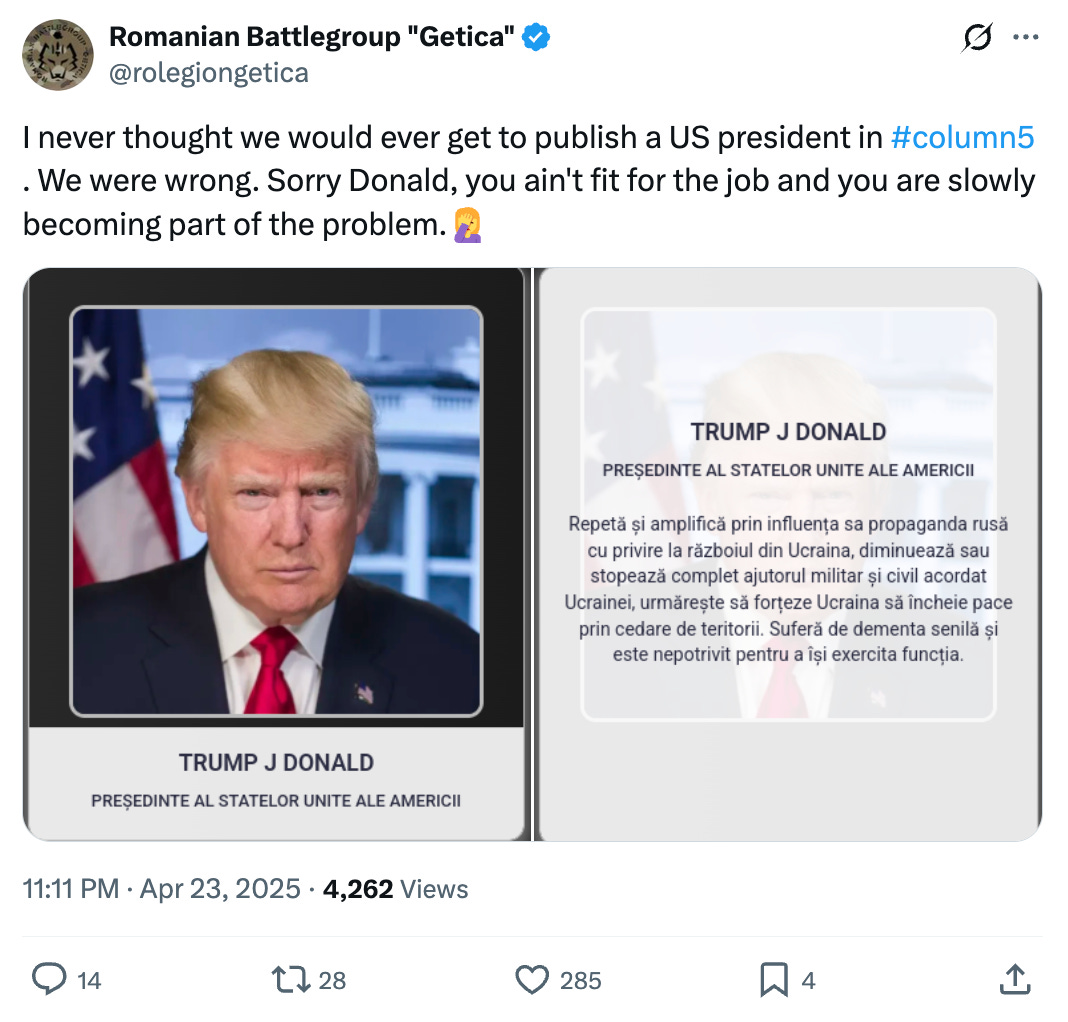
    Getica’s “Fifth Column” database has grown far beyond Romanian politics. At some point, Donald Trump was on it. Steve Bannon is still on it. Republicans for National Renewal and its leader Mark Ivanyo were recently added — alongside European politicians and journalists. Including myself.

    To some targets, Getica confirmed modeling their “Fifth Column” list on Ukraine’s infamous Myrotvorets death list. Those armed men wearing military uniform with Ukrainian and Romanian flags and, for some of them, on Ukraine’s army’s payroll, have joked about war crimes, war time rape, doxxed a civilian, constantly lied on their nature, and, last but not least, kept emitting threat no later than this week

    Screenshot from the last Getica video, threatening Sebastian Dracopol for his reporting and pushback on Getica’s Fifth Column

    In 2024, Getica’s Fifth column’s manifesto declared possible terrorist action if Ukraine loses the war.

    Protected Speech or Military Misconduct?

    I had been monitoring the Fifth Column site for a while when I appeared on the list. The move was an anticipated one after recurring signaling from Newsweek Romania trying to frame me as being aligned with Russia — despite not having posted anything in support of Russia. It came first as the logical conclusion of a pattern of smear and harassment coming from people connected to Newsweek România, Alianța — a US 501(c)(3) meddling with Romanian politics — and the local businessman Marius Bostan, who consolidated his fortune on state contracts awarded during the COVID crisis.

    But then came the questions — is it a real thing? Is it dangerous? Unfortunately, it is. Especially in the context of a country whose rule of law was buried altogether with the 2024 election.

    I contacted Getica to receive an explanation and clarify the label of “enemy of Romania”. An anonymous representative replied that nobody had ever suffered consequences from inclusion and argued that the project merely exercised free speech. They also explained that they used to be affiliated with Ukrainian military intelligence, but are now under the authority of the Ukrainian Armed Forces… Further investigation would reveal how blurred are the lines under which Getica operates.

    The answer regarding free speech raises an obvious problem. You can’t claim free speech protection while operating as a military organization targeting civilians. If they’re civilians, Getica’s members enjoy broad free-speech protections — that is, up to the point where speech crosses into incitement or creates immediate, real-world threats. In that case, law enforcement and civilian justice should handle them. If they’re military, the problem is different. Military organizations operate under rules of engagement. They don’t target civilians. They don’t maintain independent blacklists of enemies. They answer to a chain of command. If they’re out-of-control military members, they should answer before a military tribunal.

    Getica claims both at once: military affiliation when it suits them (Ukrainian unit emblems on the website, Ukrainian battlegroup membership, fundraising for its activities), and civilian free speech protection when confronted with responsibility for the Fifth Column database. Right after I sent them a series of questions on the way they were assessing people to put them on their “Fifth Column” list, they blocked me on Facebook although I didn’t even ever tag them nor publish anything on them yet. The honor and ethics of military service were traded for the methods of petty mobsters.

    But the question goes beyond the activities of Getica. If Ukraine is supporting these activities, then it is crossing another line, in a context already extremely loaded due to the recent attribution of the Nord Stream sabotage to a Ukrainian agent by a German tribunal — the worst attack on a NATO country infrastructure so far has been performed by somebody affiliated with the Ukrainian military. The atmosphere is even more loaded since a Ukrainian drone recently exploded in the Romanian port of Constanta — the biggest NATO port on the Black Sea — a few hundred meters away from the oil terminals and from an ammonium nitrate deposit, a chemical product that made major damages in the port of Beirut in 2020. With Getica, the question of Ukraine’s willingness to target Western civilians and western infrastructure is all the more acute. You can’t receive Western support and attack the West. You can’t claim funding for your military and pay the members of Getica as they target EU and US civilians. If Ukraine can’t court-martial those targeting EU and US citizens, if it covers for them, then the whole story of defending a democracy against an autocracy crumbles and, with it, part of the reasons to support Ukraine against the Russian invasion.

    Getica — illegal, dangerous and… aligned with Macron?

    In Romania, paramilitary organizations operating outside state command are constitutionally prohibited. Yet, Romanian Battlegroup Getica appears to operate openly: armed men claiming ties to Ukrainian military structures, running a blacklist of civilians, and even claiming to have conducted two operations on Romanian soil.

    Its historical founder and commander, Sergiu Meșeșan, claims participation in dozens of combat missions in Ukraine. Its members and supporters have doxed critics and targeted family members. Meșeșan recently returned to Romania to teach people how to use FPV drones, including arming them with explosives. In public exchanges, the group has joked about war crimes, rape, disappearances, and other conduct that would normally trigger serious scrutiny.

    In one live exchange on X, the Romanian Legion Getica account replied to another user with language trivializing rape and invoking Azov: “Several army groups participated in your creation, Azov too I think. The woman didn’t complain.” The reference is not incidental. Azov’s neo-Nazi origins were documented to the point that the US Congress prohibited weapons transfers to the unit in 2018, a restriction that remained in place until 2024. During that period, Radu Hossu — Getica’s main fundraiser and co-founder — appeared in a June 2023 interview wearing an Azov emblem containing the Wolfsangel, a symbol with direct Nazi lineage. In one of his own fundraising reports, he also acknowledged purchasing equipment for two military personnel enrolled in Azov, adding parenthetically: “yes, that AZOV”

    Radu Hossu, on the Romanian podcast Vorbintorici, wearing the Azov Wolfsangel in June 2023, when the US congress ban on arming Azov was still enforced due to Azov’s neo-nazi elements

    The point is not guilt by association. It is that an armed group maintaining a civilian blacklist, joking about rape and war crimes, invoking disappearances, and displaying proximity to military formations controversial enough to trigger years of congressional restrictions should have attracted institutional scrutiny long before journalists, politicians, and foreign citizens began appearing on its list.

    Whose Army?

    Some Getica members hold Ukrainian military ID cards and receive Ukrainian Army salaries

    Sergiu Meseșan military document shared on the Romanian Battlegroup Getica Facebook account – A0515 is a Military Intelligence Directorate Unit

    According to representatives of the group contacted directly for this investigation, Getica has operated under Ukrainian military command — initially under GUR, the Ukrainian military intelligence directorate, and later under ZSU, the Ukrainian Armed Forces. When pressed on the specifics of their affiliation, they directed us to their website.

    That website has been telling its own story. Until May 30, 2026, it displayed the emblem of the 4th Heavy Mechanized Brigade of the Ukrainian Army

    On that date — shortly after this investigation began sending right-of-reply letters to Romanian and Ukrainian institutions — the emblem was quietly removed, with an announcement that a new unit affiliation would be revealed. Days later, two new emblems appeared: that of the 1230th Separate Engineering and Technical Support Battalion, part of the 48th Engineering Brigade of the Ukrainian Support Forces; and that of the International Legion of Defense Intelligence of Ukraine, MUNA 3449 — a separate unit of foreign fighters subordinated to the Main Directorate of Intelligence of the Ministry of Defense of Ukraine, which is the GUR

    International Legion of Defense Intelligence of Ukraine
    1230th Separate Engineering and Technical Support Battalion

    No Ukrainian institution has formally claimed oversight of the group. No Romanian institution has either.

    The people behind Getica form an unusual partnership. On one side, Sergiu Meșeșan, the group’s historical founder and commander, is a Romanian volunteer fighter in Ukraine who was previously sentenced in Sweden to three years in prison for aggravated fraud as the leader of a bank-card-skimming and phishing operation active across Sweden, Finland, and Denmark.

    On the other is Radu Hossu, a self-described founding father of the project: a prominent pro-Ukraine activist, fundraiser, and politician from USR — the party created by Romania’s current president and aligned with Macron’s Renew Europe group — as well as an “embedded” war journalist, covering military operations and units he simultaneously helped finance.

    One man built and commanded the organization, and would publish the manifesto of the Fifth Column blacklist and maintain it. The other provided funding, public legitimacy, media access, and political connections.

    Questions about Getica’s financing had already produced one of the earliest public conflicts surrounding the group. IT specialist Sebastian Dracopol, later added to the Fifth Column database himself, challenged the use of funds raised by Hossu through a personal Revolut account. After being doxxed and threatened, Dracopol sued Hossu. Although he did not obtain a restraining order, the proceedings produced one of the few official records concerning Getica, including admissions regarding Hossu’s fundraising role, his creation and ownership of the group’s Telegram channel, and the armed nature of the combatants operating under the Getica banner. We will return to that case later.

    The April 2024 “Fifth Column” Manifesto

    In April 2024, Getica commander Sergiu Meșeșan published what amounts to the founding document of the Fifth Column project, laying out his program in explicit terms:

    We believe it is normal to have different opinions and freedom of expression. That is what democracy is about. But we wish to warn, through this message, that there is a limit to the subversive activities we will tolerate — I am referring to ‘Getica’ — on the territory of Romania or the Republic of Moldova.

    And we are EXTREMELY ready to act from the shadows to limit the impact of Russian influence in both states.

    Thus, when Ukraine collapses — as this category of Russophiles maintains, and if it should actually come to pass — we will be ready to strike with an intensity and firepower the likes of which Romania has never seen, in order to defend the national and vital interests of the nation.

    We are aware that there is a legal framework that is not exactly favorable for state defense institutions to act freely and effectively. Laws change, however, and for the homeland, ‘Getica’ is ready even to circumvent them. We own that. We might be called terrorists. But the terrorists of some are the freedom fighters of others.

    […] We already have a website, a secure server, and a domain. We will publish them very shortly. Beyond the information and presentation images you have been able to see on our page over time, we wish to put into practice the concept of the #coloana5 database. We firmly believe that exposing the identity of subversive elements and useful idiots will deter them more or less from their activities of sabotaging public opinion, and will spare us other actions — unfortunately far more invasive — in the near future

    Meșeșan’s manifesto remains live on Facebook today. He has since returned to Romania.

    The idea of an armed group on Ukrainian payroll going rogue and targeting citizens of NATO member states should have warranted a reaction from authorities, at least from Romania and from Ukraine. In response to our inquiry, the Armed Forces of Ukraine stated that the matter fell within the competence of the Main Intelligence Directorate (GUR) of the Defense Ministry. The Romanian Defense Ministry denied any affiliation. No further clarification was provided.

    A year after its manifesto, Getica goes… “clandestine”?

    In a lengthy statement published on April 14, 2025, Getica founder Sergiu Meșeșan described himself as having conducted 37 combat missions in Ukraine, including infantry, SIGINT, drone ISR, and attack-drone roles. He stated that Getica had approximately 50 members over its existence and never more than 20 active fighters at any given time.

    More importantly, he publicly acknowledged that the group had carried out “2 limited surveillance operations on Romanian territory.” Meșeșan did not disclose the targets, legal basis, beneficiaries, or institutional authorization of the two Romanian surveillance operations. No Romanian authority contacted during this investigation acknowledged requesting, supervising, authorizing, or even being aware of them. The statement raises obvious questions about the legality of intelligence-style activities conducted on Romanian territory by individuals presenting themselves as members of a foreign military structure. If they are a paramilitary group, their activities are unconstitutional and illegal in Romania. If they are affiliated to Ukraine’s military, this is a serious breach of the treaties that prevent any such activity. If these missions were happening with the blessing of the Romanian Army, then somebody at the MaPN lied to us and covered up for Getica – and this person should answer before the law too.

    In the same statement, Meșeșan proclaimed that: “From today, Getica becomes a multinational, global and clandestine operation.”

    By any reasonable definition, Getica does not display the characteristics of a regular military force. Regular military forces operate with rules of engagement, a formal conduct code, and an accountable command hierarchy — constraints that precisely prevent armed groups from targeting civilians, engaging in public discourse, or taking sides in political debate.

    Getica’s Fifth Column

    Coloana 5 — Fifth Column — is Getica’s blacklist. By May 2024, the page was online. It currently lists over 150 American and European citizens and organizations accused of serving Russian interests, acting as useful idiots, or being enemies of Romania.

    Inclusion is not notified in advance. According to the operators themselves, a profile can be spotted automatically by a combination of alleged military AI systems — an OSINT database and an LLM — and then approved by a human operator. The list is not static: operators state they monitor listed individuals and may revise positions over time, an implicit form of pressure to coerce people into alignment. The original version of the site included a “Recommended actions” rubric specifying measures such as localization and monitoring of listed individuals. That section has since been removed. At some point, the site began blocking web archiving tools, making earlier versions inaccessible.

    In direct communication with a listed person, Getica leadership referenced Myrotvorets explicitly as a model — the Ukrainian hit list on which was Chilean-American influencer Gonzalo Lira, whose case gained attention in 2023 when Elon Musk publicly questioned his detention. According to Ukrainian officials, Lira died in detention from pneumonia and health complications; his family and supporters alleged mistreatment and torture

    Lira’s last tweet

    A development in sync with the election calendar

    Getica’s Fifth Column project did not emerge during an ordinary political period. In 2024, every major elected office was scheduled for renewal in Romania.

    In late April, the European Union activated its Rapid Response System to flag content during the European Parliament election campaign, and Getica simultaneously began listing members of the opposition on its website. The framing had been set weeks earlier: on March 6, Ursula von der Leyen, campaigning for her reelection, made the stakes explicit in her Bucharest rally cry:

    [..] Putin’s friends are trying to rewrite our history and hijack our future. They are spreading hate from behind their keyboards. And let there be no doubt what’s at stake in this election. Our peaceful and united Europe is being challenged like never before by populists, nationalists, and demagogues. Whether it is the far right or the far left. Whether it is the AfD, the Rassemblement National, the confederatia or Wasraschdene. The names may be different, but the goal is the same: They want to trample on our values, and they want to destroy our Europe. But we, the EPP, will never let that happen

    Following the Russiagate playbook, critics and opposition to power are “Russian influence” – this would become a recurring theme during the long Romanian election cycle. Getica’s project, supposedly aimed at exposing Russian influence, would just plainly overlap with domestic political conflicts, opposition figures, journalists, commentators, and critics of power.

    The involvement of USR member Radu Hossu makes an obvious case for direct political support or, at least, convenient complacency, with the criminal activities of Getica. Contacted, neither Dominic Fritz – leader of USR – nor USR Brașov provided a statement to distance themselves from Hossu. Bucharest leader of USR, Vlad Voiculescu, replied in a direct message that he didn’t see how the matter was related to USR. Yet, the fact that a USR member helped and covered for a coercion gang is obviously a USR problem. None of the questions sent to USR-founder, and now President Nicusor Dan, to the Ministry of Defence, led by USR member Radu Miruta, nor to the Ministry of Foreign Affairs, led by USR member Oana Toiu, delivered a significant assessment, response, let alone an acknowledgement of the gravity of the matter. Silence seems to clearly mean consent, and Getica’s utility for the USR could be summarized like that: if propaganda fails, if censorship and the weaponization of the DSA fails, then an informal tool to threatens or silences people find its full utility.

    Who makes it to the list?

    The progression from media labeling to blacklisting can be observed directly in my own case. Since December 2024, I have repeatedly described the absurdity of framing as pro-Russian people who — like most of the Romanian conservatives — have condemned Russia’s invasion of Ukraine and hold Russia in distrust for many historical reasons. In a country where 87.5% of the people are West-oriented and consider EU and NATO membership as warranties of security and prosperity, framing a part of the population — the conservatives — as anti-EU, anti-NATO, pro-Russia only serves a propaganda machine.

    Before appearing in the Fifth Column database, I had already been repeatedly smeared as pro-Russian, pro-Orbán, pro-Georgescu or part of various influence networks — and this without ever having published pro-Russian, pro-Georgescu or pro-Orbán material. The attacks had far more to do with the reporting I published than with any pro-Russian content.

    I have documented how the current implementation of the EU Digital Services Act created a growing ecosystem of censorship actors while leaving user protections largely theoretical (see DSA: Europe’s Injustice System).

    Later this year, I contributed to The Managed Ballot, published through MCC Brussels, with a chapter on Romania’s Hybrid Regime and its European Accomplices. It argued that the country’s democratic downgrade was driven by the regime itself — the government and the intelligence community — working hand in hand with a local “fake civil society” that lacked real constituencies and ran on foreign executive-power funding, including the EU’s. Behind it, external interference from Brussels and from Macron. The result: a country the Economist’s Democracy Index had reclassified as a “hybrid regime” — no longer a democracy. The publication of the MCC report triggered an ad hominem attack in a media outlet owned by Marius Bostan.

    The combination placed me in direct conflict with actors who considered the Russian-interference narrative settled fact. Beyond my own reporting, I also publish the Romanian edition of Le Monde diplomatique and regularly translate writers who frequently challenge official foreign-policy narratives and oppose censorship, including Serge Halimi, Pierre Rimbert, Matt Taibbi, Aaron Maté, Thomas Fazi, Jeffrey Sachs and John Mearsheimer.

    A few days ago, another Newsweek Romania “embedded journalist” — mixing coverage of the Ukraine war with support for Ukraine —, Remus Cernea, alleged that Sachs and Mearsheimer were “Putin’s intellectuals”.

    Newsweek România, Alianța and the Bostan ecosystem

    But things accelerated when I debunked a hit piece published by Newsweek România targeting Georgică Severin, one of the few members of the National Audiovisual Council (CNA) consistently opposing censorship measures within Romania’s media regulator. My article also noted how the advertorial section of Newsweek România only contained representatives of the government. Before publishing my rebuttal, I sent detailed questions to Newsweek România. No answer was received. Two days later, Newsweek România published a new article targeting both Severin and me. Another article followed in Newsweek, reminding readers of my positive reaction to AUR’s medical caravan project and the fact that my wife is an AUR member.

    Facing calls for deportation, I debunked the most outrageous allegations in a single published response, rather than engaging every online harasser.

    Shortly afterwards, I appeared on Getica’s Fifth Column database, directly tagged as an “enemy of Romania” and a “potential collaborator.” Getica’s file referenced articles published by two media outlets in which a key stakeholder is Marius Bostan — În Linie Dreaptă and Newsweek România (a local licensee, not the US edition, with full editorial autonomy). Bostan is a former Romanian Telecommunications Minister from the “technocratic government” that governed Romania from 2015 to 2017, formed after the Colectiv nightclub fire protests. Later, Bostan largely benefited from government contracts during the COVID crisis. In 2018, Newsweek România was launched, at an event where the head of the Romanian Intelligence Service would participate. Bostan exerts further influence via Alianța, a US 501(c) originally created to nurture US-Romania friendship, gathering former US ambassadors on its board. Through Newsweek România and Alianța-related actors, a common pattern emerges: individuals challenging dominant narratives are first publicly framed as vectors of disinformation before some eventually find themselves referenced by Getica’s Fifth Column project.

    In one instance, the Getica Twitter account even asked the editor of În Linie Dreaptă when to add an academic to the list — which raises the question of direct management of the Getica list by Bostan’s employees.

    On July 22, 2025, Getica publicly justified AUR MEP Gheorghe Piperea’s inclusion by posting a screenshot of a Digi24 article reporting that the European Commission considered his motion of censure against Ursula von der Leyen to be linked to Moscow’s interests. Getica’s accompanying comment was: “connecting the dots 😉” A normal parliamentary procedure — a motion of censure, one of the European Parliament’s standard checks-and-balances instruments — had already been reframed by Newsweek România as an initiative of the “Russophile extremist AUR party” before Getica treated it as a Russian-interference signal.

    Getica’s list has kept growing since its launch. In April 2025, Donald Trump was added. He was removed shortly after — no removal date confirmed.

    Months later, the operators claimed it had been a test to confuse enemies. That explanation is difficult to take at face value: it is more plausible that internal pushback warned them of the risk of directly targeting a sitting US president. What followed makes the Trump removal look less like a policy and more like damage control — the additions continued. The targeting pattern is hard to separate from the political positioning of Getica’s main fundraiser, Radu Hossu, and his party USR, which has maintained a radically conflicting stance toward Donald Trump, the MAGA movement, and USR’s local rivals, the AUR party.

    The same chronology appears around Republicans for National Renewal. In early 2026, Newsweek România published an article about a distinction awarded by the American organization to AUR’s leader George Simion. Shortly afterwards, RNR leader Mark Ivanyo was added to the Fifth Column database together with the organization itself. Dragoș Moldoveanu, an AUR member, was added in the same batch, and a Bulgarian figure associated with the same political ecosystem was also added. More additions followed after public discussions involving AUR MP Mihai Neamțu and sovereignty-oriented commentators, including Laurențiu Țîrcă.

    Țîrcă received some of the most radical messaging from Getica. The group confirmed to him that Myrotvorets was its model, and pointed to how people on such lists suffer “accidental” deaths. Țîrcă reported seeing a now-removed image of his name written on a rocket launcher. When he challenged Getica over alleged war crimes committed during the Kursk incursion, where elderly civilians died, the Getica account replied: “I don’t deal with pensioners only, I deal with students too.” Țîrcă was a student at that time.

    Although Newsweek România carries the name of the American weekly, asked about editorial oversight and accountability, Newsweek USA told us that its international publishing partners are responsible for their own editorial operations and content, while also stating that Newsweek expects organizations operating under its brand to uphold responsible journalism standards.

    The concentration of impostors at the local edition of Newsweek goes so far that it receives contribution from Ovidiu Nahoiu, Chief Editor of Radio France International Romania, who shone a year ago with an obsequious interview of the French Ambassador — that is the representative of the government that pays Nahoiu’s salary — were 3 blatant lies went uncheck on air in order to support the Russian influence narrative justifying the annulment of the election. Newsweek also hosts editorial from Adrian Zuckerman — a former ambassador who constantly meddles with Romanian politics, sometimes to praise the Ministry of Internal Affairs for his role in the 2024 coup – naturally framed as “saving Romania”-, sometimes to urge the Romanian Presidency not to join Trump board of Peace.

    A few years ago, a reporting by Recorder had already highlited one of the key reason explaining the journalistic fraud within Newsweek and a large part of the press — government money flooding them.

    “The destruction of these emitters of toxic ideas must be part of the response.”

    The overlap with Getica’s rhetoric extends beyond Newsweek itself. One recurring node is Alianța, a network whose members and participants have included business leaders, activists, former diplomats, former American ambassadors, media figures and public officials. On September 20, 2025, Alianța member Andrei Caramitru publicly defended Getica and its blacklist, describing Getica as Romanian patriots and heroes and claiming the list contained pro-Russian actors from Romania and Moldova. He added that the list was probably already known to Azov, Ukrainian services, Western services and others. We offered a right of reply to Alianța in letters addressed to each board member and to former US ambassadors — no answer was received.

    Alianța bills itself as a nonpartisan 501(c)(3), yet its own Board Chair, former US Ambassador Adrian Zuckerman, used an interview to declare the leading conservative opposition party, AUR, “a party dangerous to Romania, dangerous to democracy, dangerous to the West — a party that shouldn’t exist in Romania.” A US tax-exempt nonpartisan organization is, on its own platform, calling for the elimination of a Romanian parliamentary party.

    One of the most revealing pieces of language in this ecosystem has been recently supplied by Marius Bostan, shareholder of Newsweek România and central actor in the Alianța network. At the Newsweek IT & Cyber Summit 2026, Bostan compared ideological opponents to pests invading a field and argued that rapid intervention was necessary: “When pests invade a field you need to spray quickly. If you don’t react immediately, you lose.” He continued: “Sometimes attack is a better form of defense. The destruction of these emitters of toxic ideas must be part of the response.”

    The wording mirrors the coercive logic already present in Meșeșan’s Fifth Column manifesto. Bostan was not speaking as an anonymous extremist but as a Newsweek România shareholder and Alianța figure, at a Newsweek-branded event, immediately after a Presidential Palace summit devoted to informational resilience where the leading opposition faces were put on display as “public vectors of disinformation”. The pinnacle of Romania’s executive power hosting an event targeting the opposition as an enemy in an information war. When a democracy crumbles, signs are everywhere.

    This is why the Fifth Column database cannot be understood as an isolated website run by a fringe armed group. The labels appearing on the list often predate the list itself. They emerge first in media coverage, public campaigns, anti-disinformation initiatives, political commentary and institutional discourse.

    At the end of the day, the tabloidisation of Newsweek România, the extremely low level of “hit job journalism,” is a matter that would be solved by the market and readers’ interest. Except for the government money that flows into this ecosystem, directly or indirectly. Which leads to the bigger issue — more problematic than Newsweek România producing trash news and hit pieces: the role of Romania’s regime.

    The Consequences of a Lie — The 2024 Election Annulment

    To understand the current situation in Romania, we need to go back to the 2024 presidential election, when an outsider candidate, Călin Georgescu, won the first round with 23% of the vote. A second round was scheduled for December 8, 2024. It never happened. On December 6 — with voting in Romania’s large overseas diaspora already under way — the Constitutional Court annulled the entire electoral process. The annulment followed roughly two weeks of public signaling about alleged Russian interference and algorithmic manipulation, driven by a series of NGOs financed by the European Commission calling on Brussels for help.

    What followed was a ritual of whitewashing the decision, by European leaders spinning the idea that Russia was behind Georgescu’s success. Macron offered one of the most revealing examples, declaring in a February 2025 live broadcast that the court had detected fraud, vote purchases, and annulled the election because of Russian interference. One fabrication after another. In reality, the Constitutional Court had validated the first round (Decision 31), finding no electoral fraud, and its annulment decision contains no attribution of the result to Russia (Decision 32).

    We are now in June 2026. Romania has never formally attributed the Georgescu campaign to Russia. Romanians are still being told that proof is about to be released by President Nicușor Dan. The implicit conclusion is twofold: at the time of the annulment, the Constitutional Court had no proof of Russian meddling — yet it annulled the election. And eighteen months later, the reason proof has not been produced is likely that there was no provable decisive Russian interference.

    Alternative Explanations Identified After the Annulment

    The few operations that were identified — including those referenced in the Defense Council meeting that served as justification for the annulment — actually originated from Romania and Ukraine.

    On December 6 and 13, 2024, French daily Le Monde identified a Ukrainian sponsor behind the Georgescu influencer campaign: Dmitriy Makarov, a 32-year-old Ukrainian entrepreneur who had previously publicly supported Ukraine against Russia, whose companies — FA Agency, GMG, and Zlodeї — recruited influencers to promote Georgescu.

    On December 18, the Romanian outlet Snoop.ro revealed that PNL, the National Liberal Party, a member of the governing coalition, had financed one of the campaigns promoting its own competitor, Georgescu. That a governing party financed the rise of a candidate deemed so dangerous the election had to be annulled — leaving that party in power — remains one of the least addressed paradoxes of Romania’s democratic regression.

    2024 — a Modern Taboo

    Since then, saying there is no proof of Russian involvement has become the new taboo. On March 5, 2026, journalist Lucian Davidescu was fact-checked by Romania’s leading fact-checker, Factual — run by Funky Citizens, on Meta’s platform — for stating precisely that there was no real Russian implication in the 2024 election. The “fact-check” affirmed information directly contradicted by the Constitutional Court’s own decisions it was referring to. Davidescu obtained the publication of a Right of Reply response, but the fact-check stayed for months as a “flagged issue” on his Facebook account. Challenging the “successful Russian interference” narrative is nevertheless a widespread opinion, shared by former president Traian Băsescu, and even by Georgescu’s opponent in the second round that never took place, Elena Lasconi — at the time endorsed by Macron himself.

    Also on the Getica list, journalist Marius Tuca had been censored by the National Council for Audiovisual in March 2025 for calling the 2024-2025 sequence a coup — two months before the rerun of the presidential election, which Georgescu was barred from running in. One of the grievances against me is precisely to have described a judicial coup (see the timeline of the coup here).

    In May 2026, eighteen months after the annulment, President Nicușor Dan delivered yet another interview promising the long-awaited report.

    Proper attribution should be the golden rule when framing anything as a Russian influence. As I argue in my articles “The Iceberg That Can Sink Europe” and in “European Diplomacy Seems too Ashamed to Look at What Happened in Romania”, using the concept of Foreign Influence to target people who have no ties to a foreign power is an extremely dangerous game – one that leads to more “fifth column” craze and McCarthyism.

    It’s all the more important to remember that, since when it comes to attribution, Romania is far from being a powerless state.

    The State That Chose Not to See

    Romania’s internal intelligence service, the SRI, operates on a budget of over one billion dollars annually — three times that of France’s DGSI in nominal terms, six times in purchasing power parity, for a country three to four times smaller. All in all, ten to twenty times more resources per capita dedicated to surveillance and control. Not to mention that France has numerous terrorist threats to handle, whereas Getica seems to be the only one the Romanian authority have to deal with… The overpowered capacity of Romania’s intelligence services was praised in 2023 by Brigadier General Anton Rog, head of Cyberint — SRI’s cyber intelligence division — explaining in precise terms what his agency could do when democracy was under attack. It could counter campaigns online, take down websites, shut down operations. “We can get such a warrant in less than an hour,” he said.

    Yet when the Georgescu campaign was running in late 2024, nothing happened.

    When Getica published its blacklist, threatened journalists, doxxed families, and announced missions on Romanian soil, nothing happened.

    When AUR MP Dan Tanasă sent a formal parliamentary question (PDF) about the armed paramilitary group Getica to the government — still nothing, just a four page reply (PDF). The response, Tanasă said, contained no indication that the matter had been referred to DIICOT (the Directorate for Investigating Organized Crime and Terrorism) or any other investigative authority.

    A member of Parliament asked them about a band of volunteers that carry arms and that make lists of the enemies [including members of] the Romanian Parliament and they did nothing

    Tanasă said, adding that

    The purpose of this list is to silence the people on it one way or another, either through public shaming or, who knows, by a lunatic who would believe that I or any other person on this list is paid by Russia and would try to harm us physically

    Tanasă is currently preparing a criminal complaint against those responsible for the project.

    And the Media That Chose Not to See

    Since its first appearance in September 2023, Getica has drawn more than forty favorable pieces in the Romanian press — nearly half of them published after the blacklist’s existence was already known. The most revealing reporting on the matter came instead from Sebastian Dracopol, one of the people Getica blacklisted: first on his Substack, and more recently through his NGO, Patria Prima. He documented Meșeșan’s criminal past, the opacity of Hossu’s fundraising, and unresolved questions about the group’s actual combat record. Meșeșan’s answer to the latest reveal was to launch a fresh fundraising campaign on June 6, 2026 — to cover legal fees for suing Patria Prima and to buy military gear — this time routed through an NGO ostensibly dedicated to civilian aid, Volunteers Without Borders. The NGO did not respond to our request for comment.

    Recently, Patria Prima started asking every outlet why they presented Getica as a military unit, implicitly helping them to raise money, whereas the Ukrainian army denied any responsibility for it and Mesesan – as well as Hossu – reframed the group as an informal one. As a response, yet another article was published, by Veridica, in support of Getica. Patria Prima announced suing again. The author, Alex Craiu Rosenberg then published a video to frame Dracopol’s actions as SLAPP – Strategic Lawsuit Against Public Participation. The missing element of this analysis is the relation of power – Getica is a criminal, illegal, anti-constitutional and dangerous group who raised money in an illegal manner, yet benefits from the complacency of power, serves the interests of one or more parties of the governing coalition, and receives positive coverage from a press that lives off some executive power money (may it be the Romanian government or the money from Foreign countries – as Veridica does). Like for Newsweek’s hit pieces, Veridica’s work doesn’t qualify for the SLAPP victim card – it is part of the larger propaganda, censorship and coercion machine that targets critics, the opposition, and other nonaligned voices.

    When asked about the impunity that Getica enjoys, several journalists present on the list pointed to the entanglement with Romania’s intelligence services and how Romanian military personnel often go on leave to participate in paid missions — as mercenaries. This is corroborated by something I found out investigating the DSA in September 2025, when I was told by Freedom House Romania’s Director, Cristina Guseth, that Getica was part of the support provided by Romania to Ukraine, and “something that the Romanian government decided not to make public.”

    This could explain a part of the ambiguity and the silence our investigation received. Why public responsibility for Getica’s activities remained unclaimed.

    On October 27, 2025, Romania’s Intelligence Service — the SRI — responded to a formal parliamentary question submitted by AUR MP Fabian Radu, a member of the Joint Standing Committee exercising parliamentary oversight of SRI’s activities. The response invoked information classification and the “need to know” principle, offering no substantive answer. The formulation leaves two possibilities open: either the issue is being monitored and is too sensitive to be made public, or the non-answer is itself a cover.

    The months that followed make the silence harder to explain. Between late 2025 and mid-2026, the list expanded further — adding US politicians, more members of the opposition, and me, a French journalist. During the same period, Getica’s founder began publishing video tutorials on preparing First-Person View (FPV) drones for military use.

    On June 7, the Getica account republished on X a video montage of FPV drone footage reaching their targets: 67 different Russian soldiers (with possibly a civilian among them)

    original tweet here

    Monitoring Failure or State Complicity?

    If Romania’s Intelligence Services’ intent was to monitor — through surveillance or infiltration — before acting against Getica, eight months seem more than enough time to assess and intervene. But if Romanian intelligence services have some form of control over the battlegroup, then the continued expansion of the blacklist to include opposition politicians, journalists, and US citizens during that period is not a failure of oversight, but a state scandal.

    The Ministry of Internal Affairs (MAI) did respond to our investigation, but only to state that, pursuant to Article 285(2) of the Criminal Procedure Code, criminal investigation proceedings are non-public — neither confirming nor denying that any proceeding exists.

    Romania’s Intelligence Service (SRI) also replied, citing the classified nature of its activities, and neither confirmed nor denied whether Getica had ever been assessed as a national-security concern, whether information had been transmitted to Romanian authorities, or whether any monitoring or investigation existed.

    As mentioned, formal inquiries sent to the Ministry of Foreign Affairs, the Romanian Presidency, and the French Presidency received no reply. The atmosphere is one of pervasive institutional ambiguity, in which responsibility is continually deferred while the blacklist continues to expand.

    Three months ago, in a private conversation with a member of the Romanian government, I asked about the incapacity to prove Russian interference and the widespread suspicion that what happened was an inside job — the answer was unambiguous: “Of course. But you do realize that if they admit it wasn’t the Russians, the country would descend into chaos.”

    Three months later, the credibility and legitimacy of Romania’s current regime are lower than ever. A vote of no confidence brought down the government on May 5. One month later, a Ukrainian drone exploded in the Romanian port of Constanța, and the authorities failed to obtain a clear explanation from Ukraine or to provide the public with a convincing account of the incident. The prospect of impeaching President Dan — unthinkable until recently — is now on the table [end]

    The original article

    Stéphane Luçon is a French journalist based in Romania. After Romania’s annulled elections, he began investigating the EU’s Digital Services Act — censorship, transparency failures — and its impact on the information flow

    Related

    The Western disinformation about Ukraine

    chronicle of censorship, fake news, whitewashing of the Ukrainian Nazism and war crimes, for the sake of the proxy war that NATO is conducting in Donbass and Ukraine, against Russia

    August 2, 2025: Russophrenia: the West’s favourite delusion about Russia – Brian McDonald

    Ten years after I coined the term, the media’s still convinced Russia is both collapsing, and conquering the world

    December 12, 2024: McCarthyism, European style: The elite crackdown on Ukraine dissent – Eldar Mamedov, Responsible Statecraft

    Experts lambasted as Kremlin mouthpieces turned out to be right

    December 3, 2024: EU and NATO are attempting to foment a Ukraine-style coup in Georgia – Thomas Fazi

    They’re applying the Euromaidan playbook all over again

    November 2, 2024: The West is goading Georgia – Thomas Fazi, UnHerd

    Tbilisi has been ensnared by Nato hypocrisy

    August 27, 2024: Pavel Durov and the Abuse of Law – Craig Murray

    June 3, 2023: EU’s Voluntary Disinformation Code Is Compulsory: Obey or Die – Declan Hayes, Strategic Culture Foundation

    Though Musk is still playing at being NATO’s token non-conformist, the EU is essentially telling him and all of us that any dissent from its Russophobic, Slavophobic and Sinophobic narratives will be severely punished

    February 7, 2023: Thousands NATO soldiers have already been killed in Donbass and Ukraine

    clues of NATO fatalities in Donbass and Ukraine

    September 21, 2022: The Western operatives in Mariupol

    clues of the involvement of Western operatives, especially French ones, trapped in March 2022 in Mariupol, that the Russian forces liberated in May

    L’engagement français dans les rangs ukrainiens

    chronique alphabétique et nécrologique de l’engagement français dans les rangs atlantistes en Ukraine, ce que les journalistes serviles ne vous raconteront pas

    The Atlanticist defeat in Donbass and Ukraine

    chronicle of a new catastrophic NATO venture

    Nazism in Ukraine

    its roots before WW2, its collaboration with Nazi Germany, its legacy in modern Ukraine, how NATO has continually supported Nazism in Ukraine, chronicle

    The footprint of the Ukrainian Nazism in the West

    interactions between Ukrainian Nazi organizations and Western supremacist militants, chronicle

  • [Partage] Psychose – Pierre Rimbert, le Monde diplomatique

    Les dirigeants européens croient-ils sincèrement que les chars russes défileront bientôt à Varsovie ou à Berlin ? Ou leur ébriété guerrière vise-t-elle surtout à légitimer une politique qu’ils présentent comme la seule possible mais dont ils savent l’impopularité : l’austérité pour le peuple, l’opulence pour l’armée ?

    « Nous sommes dans une confrontation avec la Russie », déclarait le président français Emmanuel Macron le 1er octobre dernier, alors que des survols de drones perturbaient le trafic aérien dans plusieurs pays européens. « Nous sommes tous en danger, les missiles russes les plus avancés pourraient frapper Rome, Amsterdam ou Londres à cinq fois la vitesse du son », a fait écho le secrétaire général de l’Organisation du traité de l’Atlantique nord (OTAN) Mark Rutte (TG1, 3 octobre 2025). Face au Kremlin, qui « se prépare à une confrontation à l’horizon 2030 avec nos pays », « ce qui nous manque, c’est la force d’âme », a estimé le chef d’état-major des armées le 18 novembre à l’occasion du congrès des maires de France. La nation doit « accepter de perdre ses enfants, parce qu’il faut dire les choses, de souffrir économiquement ». Pour transmuter l’or de la protection sociale en plomb et en canons, il convient que l’angoisse de la guerre dépasse le mécontentement populaire.

    Jeudi 20 novembre, le gouvernement français rendait public le manuel Tous responsables destiné aux foyers. Initialement conçu pour les cas de catastrophe naturelle ou d’attentat, il s’enrichit d’une nouvelle menace : « La perspective de l’engagement des forces armées n’est plus à exclure. » On y hume l’atmosphère sympathique que les pouvoirs publics aimeraient installer : « Ne propagez pas de fausses rumeurs ! » « N’OUBLIEZ PAS : en situation de crise, n’écoutez et ne prenez en compte que les annonces des pouvoirs publics via les canaux officiels. » Rédigée avec une syntaxe volontairement appauvrie à l’intention de concitoyens perçus comme des débiles légers, une version « facile à lire et à comprendre » précise le propos : « Un État ou une organisation ennemie de la France peut donner de fausses informations sur le gouvernement français. Les Français peuvent croire ces informations. C’est dangereux pour le gouvernement. » La brochure cite en exemple deux médias nationaux de confiance : Le Monde et France Télévisions.

    Le premier s’enorgueillit de faire la «  pédagogie sur l’effort de défense » (éditorial du 23-24 novembre) en même temps que celle de l’austérité sociale ; Sylvie Kauffmann y porte la voix des marchands de canons. « Sommes-nous prêts ?, s’interroge la directrice éditoriale. En Europe, à part la Finlande, la réponse est non. Le réveil est là, mais l’intendance a du mal à suivre » (13 novembre 2025). Côté France Télévisions, la présidente Delphine Ernotte estime que l’audiovisuel public doit « défendre la position française si demain il y a la guerre en Europe » (Le Monde, 19 septembre 2025) — un peu comme les chaînes russes défendent la position du Kremlin. En matière de « force d’âme », le chef d’état-major sait disposer d’une division de journalistes enthousiastes à l’idée d’envoyer les autres mourir au front et de relancer le service militaire. « Le combat de l’arrière a commencé », avertit Patrick Forestier, éditorialiste au Télégramme, avant d’évoquer « des pluies de missiles sur les villes et les dizaines de milliers de blessés rapatriés en train en France, du front de l’Est » (20 novembre).

    En Allemagne, un hebdomadaire a eu l’idée saugrenue de vérifier les informations qui ont alimenté la psychose automnale : ces survols de drones, aussitôt attribués à la Russie sur LCI et France Info. Die Zeit (6 novembre) a contacté les autorités aéroportuaires, policières et judiciaires des États concernés pour tenter de rassembler les faits. « Leurs réponses sont… vaporeuses », notent les auteurs. Photos floues, observations non confirmées, ministre des transports qui « minimise plutôt la situation » : non seulement rien n’atteste l’origine militaire ou russe des aéronefs, mais on recense chaque année plus de cent cinquante survols d’aéroports allemands par des drones, souvent guidés par de jeunes passionnés d’aviation. Certes, il ne fait aucun doute que Moscou a à cœur de montrer leur vulnérabilité aux pays engagés contre elle aux côtés de l’Ukraine. Mais, conclut l’enquête, « peu importe que les drones volent ou non pour le compte de la Russie : c’est la réaction européenne qui plaît à Poutine » — l’affolement. Généraux, journalistes et dirigeants, tous habitués à répandre la peur, confondent-ils panique et force d’âme ? [fin]

    Article original

    Articles conexes

    The Atlanticist defeat in Donbass and Ukraine

    en Anglais, chronicle of a new catastrophic NATO venture

    The Western disinformation about Ukraine

    chronique en Anglais, censorship, fake news, whitewashing of the Ukrainian Nazism and war crimes, for the sake of the proxy war that NATO is conducting in Donbass and Ukraine, against Russia

    L’engagement français dans les rangs ukrainiens

    chronique alphabétique et nécrologique de l’engagement français dans les rangs atlantistes en Ukraine, ce que les journalistes serviles ne vous raconteront pas

    15 novembre 2025 : « Gardez votre confiance en la France éternelle »

    deux jours après le 10e anniversaire de la débâcle politique et sécuritaire du 13 novembre 2015, une messe célèbre à Verdun l’ancien dirigeant fasciste de l’État français

    11 novembre 2025 : Der Krieg

    ce 11 novembre 2025 est l’occasion de souligner comme la façon dont l’Europe sacrifie les conscrits ukrainiens mobilisés de force rappelle le spectaculaire carnage de la 1ère guerre mondiale

    9 mai 2025 : Victory Day
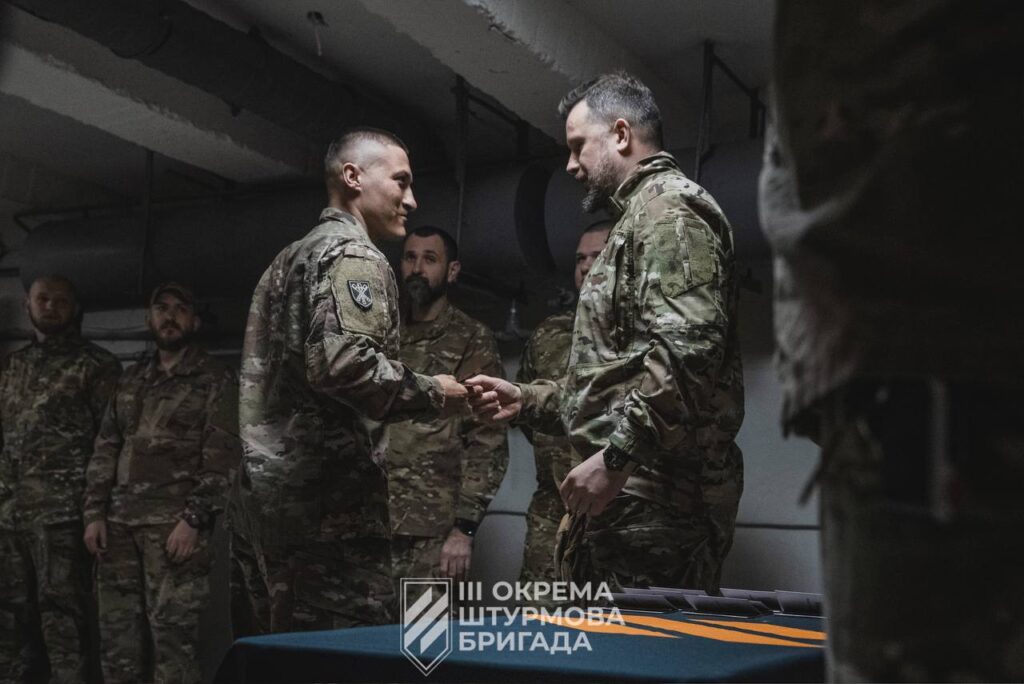
    25 août 2024 : La Macronie matraque la liberté d’expression

    Pavel Durov a été arrếté au Bourget

    14 mars 2025 : « Pensions ou munitions ? » : la fabrique du consentement à « l’effort de guerre » – Pauline Perrenot, Acrimed

    Depuis l’allocution d’Emmanuel Macron à propos de la guerre en Ukraine, le 5 mars, les grands médias sont en ordre de marche. Réhabilitation du président en « chef de guerre », patriotisme exacerbé, concert militariste et glorification des industriels de guerre… Mené tambour battant, le SAV du discours présidentiel s’accompagne d’une nouvelle séquence de matraquage patronal contre le « modèle social » et pour « travailler plus » au nom, prétendument, de l’« effort de guerre » : « Pensions ou munitions ? » ; « Les canons ou les allocations ? » Signés Dominique Seux (Les Échos, 10/03) et Étienne Gernelle (RTL, 10/03), les deux slogans donnent le ton

    Avril 2024 : Troupes françaises en Ukraine, une gaffe présidentielle sous escorte médiatique : les nouveaux chiens de guerre – Serge Halimi & Pierre Rimbert, Le Monde diplomatique

    Des combats entre la France et la Russie? Autrefois inimaginable, l’hypothèse s’est installée après les déclarations de M. Emmanuel Macron évoquant une «guerre existentielle» et l’envoi de «troupes au sol» en Ukraine. Depuis, le ton ne cesse de monter à Paris comme à Moscou. Une escalade qui semble ravir les médias français, au diapason du président de la République

    21 juillet 2023 : Les oeils de Moscou

    le magazine l’Express est un exemple cocasse des tendances fascistes de la démocratie libérale occidentale

  • [Partage] Hitlérisme, trumpisme, netanyahisme, lepénisme, macronisme – Emmanuel Todd

    Une approche comparative et expressionniste

    Les références aux années 1930 se multiplient. La dégénérescence de la démocratie américaine semble nous ramener à celle de la république allemande de Weimar. Trump, par sa jouissance dans la violence et le mensonge, par l’exercice du mal, irrésistiblement nous ramène à Hitler. En Europe, la montée de mouvements catégorisés comme d’extrême-droite nous oblige à ce retour sur notre histoire.

    Les sociétés occidentales ne ressemblent pourtant plus guère à ce qu’elles furent dans les années 1930. Elles sont vieillies, de consommation, tertiaires, les femmes y sont émancipées, le développement personnel y a remplacé l’adhésion partisane. Quel rapport avec les sociétés des années trente : jeunes, frugales, industrielles, ouvrières, masculines, encartées ? C’est cet éloignement socio-historique qui m’avait conduit à considérer jusqu’à ce jour comme a priori invalide le parallèle entre les « extrême-droites » du présent et celles du passé. Mais les doctrines politiques existent, aujourd’hui comme hier, et l’on ne peut se contenter de postuler l’impossibilité, par exemple, d’un nazisme de vieux, d’un franquisme de consommateurs, d’un fascisme de femmes libérées ou d’un LGBTisme Croix-de-Feu.

    Le moment est venu de comparer les doctrines de notre présent à celles des années trente. Voici l’esquisse de ce que pourrait être l’étude comparative de cinq phénomènes historiques : l’hitlérisme, le trumpisme, le netanyahi(u)sme, le lepénisme. J’ajouterai en fin de parcours, brièvement, le macronisme. L’extrémisme centriste et européiste qui mène la France au chaos nous oblige à cet examen. Cet extrémisme est-il si centriste que ça ?

    Il s’agira d’une approche impressionniste, sans prétention à l’exhaustivité ou même à la cohérence, dont le but est d’ouvrir des pistes, non de conclure. Je force les traits et les couleurs pour placer les concepts les uns par rapport aux autres. J’exagère à dessein, pour rattraper ou même anticiper une histoire qui s’accélère. Approche expressionniste serait peut-être une métaphore plus appropriée.

    Commençons par la dimension générale du racisme ou de la xénophobie.

    Le rejet d’un « autre » défini comme extérieur à la communauté nationale, avec des niveaux d’intensité très variables, est commun à l’hitlérisme, au trumpisme et au lepénisme. Dans le cas de l’hitlérisme et du trumpisme, c’est la notion de racisme, explicite ou implicite, qui est commune. Les Juifs étaient considérés par le nazisme comme constituant une race, au sens biologique. Les Noirs, ces cibles à peine cachées du parti républicain trumpisé, sont eux aussi définis biologiquement. Au lepénisme, en revanche, nous ne pouvons associer que le concept de xénophobie. Arabes ou Musulmans sont définis par leur culture. L’une des caractéristiques de l’obsession française de l’immigration reste sa fixation sur l’Islam et son incapacité à cibler les Noirs, dont l’arrivée massive pourtant est l’élément nouveau du processus migratoire. Le taux de mariages mixtes des femmes noires est très élevé en France, il reste insignifiant aux Etats-Unis.

    Un trait commun aux « populismes » occidentaux est bien sûr leur refus de l’immigration : Reform UK, les Sverigedemokraterna (Démocrates de Suède), l’AfD, Viktor Orban en Hongrie, Droit et Justice en Pologne, Giorgia Meloni en Italie, passent, comme Trump ou le Pen, le test de ce dénominateur commun. Suffit-il à les définir comme d’extrême-droite, au sens où le nazisme et le fascisme étaient d’extrême-droite ? Je ne pense pas. Une différence capitale oppose le populisme d’aujourd’hui à l’extrême-droite de type hitlérien ou mussolinien : le nazisme et le fascisme était expansionnistes, avec pour but la projection vers l’extérieur de la puissance du peuple allemand (aryen) ou italien (romain). Ils étaient agressifs, nationalistes, conquérants. Ils s’appuyaient sur des partis de masse. On imagine mal les populistes actuels organiser des parades de style Nuremberg. Les apéritifs saucisson-pinard du RN sont certes antimusulmans mais, quand même, moins impressionnants que les cérémonies guerrières hitlériennes. De Nuremberg à Hénin-Beaumont ? Vraiment ?

    Le seul populisme occidental qui passerait aujourd’hui à 100% le test de l’expansionnisme serait celui de Netanyahu. Colonies de Cisjordanie, génocide de Gaza : établir un lien entre hitlérisme et netanyah(u)isme – est inévitable.

    Les xénophobies française, britannique, suédoise, finlandaise, polonaise, hongroise, italienne sont, à l’opposé du nazisme et du fascisme, défensives. Nous n’avons pas affaire à des peuples qui veulent conquérir mais à des peuples qui veulent rester maîtres chez eux. C’est pourquoi la dimension culturelle l’emporte aujourd’hui en Europe sur la notion raciale et pourquoi on ne peut parler ici que de xénophobie. Cette xénophobie est conservatrice, là où le racisme hitlérien était révolutionnaire parce qu’il bouleversait l’organisation sociale. La notion de nationalisme ne s’applique donc pas aux populismes européens actuels, la notion d’extrême-droite non plus, ou alors nous devrons introduire des oxymores comme « nationalisme modéré » et « extrême-droite modérée ». Je préfère parler de conservatisme populaire.

    Personnellement favorable à une immigration contrôlée, je dois admettre la légitimité de cette xénophobie parce que j’accepte l’axiome qu’un groupe humain porteur d’une culture, conscient d’exister en tant que collectivité, bref un peuple, a le droit de vouloir continuer à exister. Concrètement : un peuple peut contrôler ses frontières. Le nazisme, avec ses soldats installés de l’Atlantique à la Volga pour y asservir ou y exterminer d’autres peuples était tout à fait autre chose.

    Le trumpisme représente une forme mixte parce qu’il combine un élément central défensif, anti-immigration, à un fort potentiel d’agression du monde extérieur. Il ne s’agit pas à proprement parler d’expansionnisme. C’est l’expansion antérieure de l’appareil militaire américain et le rôle du dollar dans la prédation impériale qui ont rendu possibles les actes trumpiens violents dirigés contre d’autres peuples et nations : le Vénézuéla, l’Iran, nous, les peuples sujets européens de l’Ouest, et bien sûr les Arabes, avec les Palestiniens comme cible principale. L’intégration progressive d’Israël à l’Empire, à partir de 1967, fait qu’en 2025 on ne peut plus guère distinguer le trumpisme du netanyahisme. Mais Trump, au-delà de ses pitreries de nobélisable, est bien le coupable en chef du génocide de Gaza par ses encouragements de longue durée à la violence d’Israël : ce fait si simple fait tomber le trumpisme du côté de l’hitlérisme. Trump est toujours au volant : coups d’accélérateurs et coups de frein américains régulent l’agressivité génocidaire de Netanyahu. J’ai de la chance : au moment où j’écris, Trump, effrayé par la réaction des pays arabes au raid israélien sur le Qatar, et notamment par l’alliance stratégique entre l’Arabie saoudite et le Pakistan, recule. Il ordonne à Netanyahu de s‘excuser pour le bombardement au Qatar et celui-ci s’exécute. Trump impose à Israël un accord avec le Hamas et Netanyahu signe. Ensuite ? Trump est un pervers, impossible de dire.

    Le concept de trumpo-netanyahisme, assez laid je l’admets, permet de cerner la question juive comme point commun à la crise américaine des années 2000-2035 et à la crise allemande des années 1920-1945.

    La posture pro-Israël radicale du trumpisme masque selon moi un antisémitisme viscéral et vicieux : l’identification de tous les Juifs au netanyahisme, phénomène historique effectivement monstrueux, chancre dans l’histoire juive, n’aboutira qu’à renouveler la conception nazie d’un peuple juif monstrueux. Je parle ici d’antisémitisme 2.0.

    Je suis conscient que peu de lecteurs me suivront sur ce point. Mais je ne fais ici que parler comme un banal prophète de l’Ancien testament. « Nous n’avons pas étés choisis pour être du côté des puissants. L’histoire n’en finit pas de nous tendre ce piège ». Combien de fois les Juifs se sont crus sauvés par les forts, par les puissants, par le pouvoir, par un empire, désignés même par un privilège – le succès financier, intellectuel, l’importance dans le parti bolchévique – pour être finalement jetés en pâture à des peuples furieux… Mon cœur saigne quand je vois tant de Juifs français, qui se croient aujourd’hui du côté du manche, justifier la politique de Netanyahu. Mais ce sont bien les mâchoires d’un piège qui sont en train de s’ouvrir. Par la grâce de Trump, la planète entière devient antisémite. Les Juifs américains, dont la majorité refuse la ligne Netanyahu, sont plus sages et plus justes. Mais, déjà, les Juifs hostiles à Netanyahu, universitaires ou non, sont soupçonnés par le pouvoir d’être antisémites. La perversité règne. Le trumpisme règne.

    A quand la fermeture du piège ? Un jour, inévitablement les nations chrétiennes feront leur paix avec 1,6 milliards de musulmans. Les Juifs seront alors abandonnés par leurs fans et, désormais seuls, jetés en pâture à d’autres peuples furieux.

    Les terres promises se succèdent, des désastres les suivent. Nightfall, précoce nouvelle d’Isaac Asimov, ce très grand auteur de science-fiction américain, me semble une métaphore de la longue suite de drames qui constitue l’histoire juive : au sein d’une civilisation puissante, un reste de prophétie annonce une mystérieuse catastrophe… elle arrive, surprenante… la civilisation s’effondre… puis, lentement, elle renaît, elle s’épanouit… un reste de prophétie annonce une mystérieuse catastrophe… elle arrive, surprenante…

    En vérité, le seul retour de l’obsession juive au cœur de l’Occident valide l’hypothèse d’une continuité menaçante entre le passé et le présent.

    Protestantisme zombie et nazisme, protestantisme zéro et trumpisme

    La crise économique de 1929 fut un facteur déterminant, fort bien connu, de l’hitlérisation de l’Allemagne. 6 millions de chômeurs firent échapper la société allemande à toute force de rappel idéologique. La liquidation du chômage par Hitler en quelques mois scella le destin du libéralisme.

    Le contexte religieux de l’ascension du nazisme, tout aussi important, est moins familier : entre 1870 et 1930, la foi protestante s’évanouit en Allemagne, d’abord dans le monde ouvrier, puis dans les classes moyennes et supérieures. Les régions catholiques résistèrent. En 1932 et 1933, la carte du vote nazi put donc reproduire, avec une exactitude fascinante, celle du luthéranisme. Le protestantisme ne croyait pas en l’égalité des hommes. Il y avait les élus, désignés comme tels par l’Éternel avant même leur naissance, et les damnés. La croyance métaphysique protestante une fois disparue, ce qui en resta fut l’hystérisation par la peur du vide de son contenu inégalitaire, avec les Juifs, les Slaves et tant d’autres comme damnés. Aux États-Unis, le protestantisme d’origine calviniste cibla les Noirs. Le peuple calviniste, fixé sur la Bible, s’identifiait aux Hébreux, ce qui borna l’antisémitisme américain des années trente et mis les Juifs à l’abri. Enfin… à l’abri jusqu’à l’émergence récente de la fixation évangéliste sur l’état d’Israël.

    Dans la France catholique, (dans le Bassin parisien et sur la façade méditerranéenne particulièrement), l’effondrement de la foi et de la pratique firent à partir de 1730 muter l’égalité des chances d’accès au paradis (obtenue par le baptême, qui lave du péché originel) en égalité des citoyens et en émancipation des Juifs. L’idée républicaine d’homme universel remplaça celle du chrétien universel catholique (katholikos signifie universel en grec). Un tout autre programme que le nazisme mais qui avait représenté, bien avant lui, le premier remplacement massif d’une religion par une idéologie. Dans la France révolutionnaire comme dans l’Allemagne nazie, toutefois, le potentiel d’encadrement social et moral de la religion avait survécu à la croyance : l’individu restait membre de sa nation, de sa classe, porteur d’une éthique du travail et du sentiment d’obligations envers les membres du groupe. La capacité d’action collective était forte, décuplée peut-être. C’est ce que j’appelle stade zombie de la religion. Le nazisme correspondait à ce stade zombie, d’où, malheureusement, son efficacité économique et militaire.

    Je pourrais compléter cette explication religieuse de l’idéologie par une explication de la religion elle-même, influencée par les structures familiales sous-jacentes, inégalitaires en Allemagne et égalitaires dans le Bassin parisien. Mais on peut se contenter ici d’une continuité du protestantisme au nazisme et du catholicisme à la Révolution française.

    Nous retrouvons du protestantisme dans le trumpisme. Nous trouvons alors l’inégalité associée à la négrophobie. Nous ne sommes plus toutefois au stade zombie de la religion mais à son stade zéro. La moralité commune a disparu. L’efficacité sociale a disparu. L’individu flotte, particulièrement en cette Amérique de structure familiale nucléaire absolue, individualiste et sans règle d’héritage bien définie. C’est donc à autre chose qu’il faut s’attendre comme idéologie trumpiste : l’inégalité toujours, mais moins de stabilité dans le délire, des oscillations brutales qui ne proviennent pas, fondamentalement, du cerveau d’un président vulgaire et vicieux mais de la société elle-même. La capacité d’action collective, économique et militaire est, heureusement pour nous, très diminuée.

    Notons dans le cas du trumpisme l’émergence de formes pseudo religieuse nihilistes qui incluent une réinterprétation obscène de la Bible, telle une glorification des riches. Nettement plus faible que le nazisme dans la dimension du racisme, le trumpisme va plus loin dans l’immoralité économique.

    Le nazisme était simplement et explicitement antichrétien. Le trumpisme se veut religieux mais à la manière d’un culte satanique, par l’inversion des valeurs. Le mal c’est le bien, l’injustice c’est la justice. Hitler n’était que le Führer, guide du peuple allemand vers son martyr ; Trump n’est pas Satan mais je soupçonne que pour ses fans satanistes sa casquette rouge est celle de l’Antéchrist.

    Dans le cas du lepénisme, aucun héritage inégalitaire protestant. C’est là le véritable mystère du Rassemblement National : xénophobe, il est né en terre catholique. Pire encore, ses premières zones de force, sur la façade méditerranéenne et dans le bassin parisien, furent celle de la Révolution : égalitaire sur le plan familial et déchristianisées dès le dix-huitième siècle. Alors ? Inégalitaire le Rassemblement National ? Égalitaire ? Mystère pour nous, le RN l’est probablement aussi pour lui-même. Son rejet de l’autre résulte d’un égalitarisme pervers qui exige une assimilation rapide des immigrés plutôt qu’il ne les ressent comme différents en essence. Surtout, le RN, fortement déterminé par le rejet des immigrés, et même de leurs enfants, n’en est pas moins sans cesse rappelé à la tradition égalitaire française parce que ses électeurs détestent les ultrariches, les puissants, bref nos élites imbéciles, et pas seulement les immigrés. C’est pourquoi l’union des droites peine à aboutir en France. Sous une forme ou sous une autre, l’union des oligarques et du peuple (blanc) contre l’étranger ne pose de problèmes ni aux États-Unis, ni au Royaume-Uni, ni en Scandinavie, où forces populaires conservatrices et forces de la droite classique s’entendent facilement. En France, la coalition des riches et des pauvres contre l’étranger se dérobe.

    Ne sous-estimons pas toutefois la violence potentielle d’une xénophobie d’essence universaliste. Elle peut tout à fait devenir racisme. Si un homme pense a priori que les hommes sont partout les mêmes et qu’il se trouve confronté à des hommes porteurs de coutumes différentes, il peut très bien en conclure qu’ils ne sont pas des hommes.

    Le RN est le produit d’un catholicisme zéro, comme la Révolution le fut d’un catholicisme zombie. C’est pourquoi il n’accouchera d’aucun projet collectif. Je renvoie l’examen détaillé du RN et de son rapport à l’avenir à un prochain texte, ni impressionniste, ni expressionniste, que je consacrerai tout entier à la logique interne et à la dynamique du chaos français.

    Psychiatrie des classes moyennes supérieures

    J’en viens maintenant à une différence capitale, qui devrait être évidente pour tous et rappelée par les commentateurs politiques qui nous renvoient sans cesse à 1930 par leur vocabulaire. Comprendre la dimension religieuse, ou post-religieuse, de l’hitlérisme, du trumpisme ou du lepénisme, présupposait des connaissances historiques qu’on ne peut exiger des politologues de plateau TV. En revanche, nous pouvons exiger d’eux qu’ils sachent situer socialement les idéologies du passé et du présent, qu’ils rapprochent sans relâche par le terme d’extrême-droite. La différence entre passé et présent est ici très claire.

    Le nazisme et les mouvements d’extrême-droite d’avant-guerre trouvaient leur épicentre social dans les classes moyennes et particulièrement moyennes supérieures, menacées par le mouvement ouvrier, social-démocrate ou communiste. Ces classes moyennes étaient fébriles, fort occupées à enfermer leurs femmes et à persécuter les homosexuels. Aujourd’hui, les mouvements dits d’extrême-droite trouvent, à l’opposé, leur épicentre dans les milieux populaires, particulièrement dans un monde ouvrier appauvri, ébranlé ou détruit par la globalisation économique, menacé par l’immigration. Les classes moyennes d’aujourd’hui, largement définies par l’éducation supérieure, sont moins ou même faiblement touchées par « l’extrême droite ». Les classes moyennes supérieures, qui combinent éducation supérieure et revenus élevés, sont particulièrement immunes.

    C’est pour cette raison que je préfère parler de conservatisme populaire plutôt que d’extrême droite. Son ancrage dans le groupe des dominés explique le caractère défensif du conservatisme populaire. Son électeur ne s’imagine pas conquérant de l’Europe ou du monde s’il pense sa propre vie comme une survie.

    La vraie erreur intellectuelle serait de s’en tenir là. Continuons d’avancer, renversons même la problématique de l’association entre idéologie et classe. Nous avons comparé les idéologies du présent à celles du passé, comparons maintenant les classes du présent à celles du passé.

    Certaines classes moyennes européennes de l’entre-deux-guerres entrèrent en folie. Le monde ouvrier fut plus raisonnable. Mais les classes moyennes d’aujourd’hui, particulièrement moyennes supérieures, sont-elles raisonnables ? Sont-elles pacifiques ? Quels sont leurs rêves ?

    Ils sont fous. La construction d’une Europe post-nationale est un projet d’halluciné quand on connait la diversité du continent. Il a mené à l’expansion de Union européenne, bricolée et instable, dans l’ancien espace soviétique. L’UE est désormais russophobe, belliciste, avec une agressivité renouvelée par sa défaite économique face à la Russie. L’UE tente d’entraîner les peuples britannique, français, allemand et tant d’autres dans une vraie guerre. Mais quelle guerre étrange ce serait, dans laquelle les élites occidentales auraient adopté le rêve hitlérien de détruire la Russie !

    La comparaison par les classes sociales nous permet donc une percée intellectuelle majeure. L’européisme, et donc le macronisme, tombent, par leur agressivité extérieure, du côté du nationalisme, du côté de l’extrême-droite d’avant-guerre. Si nous ajoutons les entorses à la liberté de l’information et à l’expression du suffrage populaire, entorses de plus en plus massives et systématiques dans l’espace UE, nous nous rapprochons plus encore de la notion d’extrême-droite. Fondé comme association de démocraties libérales, l’Europe mute en espace d’extrême droite. Oui, la comparaison avec les années trente est utile, indispensable même.

    Nous retrouvons dans le grandiose projet européiste une dimension psychopathologique déjà observable dans l’hitlérisme : la paranoïa. La paranoïa européiste se concentre sur la Russie. Celle des nazis faisait de la menace juive une priorité, sans toutefois négliger le bolchévisme russe (dit judéo-bolchévisme).

    Aujourd’hui comme hier nous pouvons donc analyser une psychopathologie des classes dirigeantes européennes. La séquence bizarre amorcée par l’élection de Trump, avec la volonté du président instable de discuter avec Poutine, nous a permis de suivre en direct la sortie de réalité de nos dirigeants à nous. Résumons notre processus délirant. Il a commencé vers 2014, avant, pendant et après Maidan, ce coup d’état qui a désintégré l’Ukraine, coup téléguidé par des stratèges américains et allemands. La suite maintenant :

    • 2014-2022 : Provoquons la Russie qui avait averti qu’elle ne tolérerait pas l’annexion de l’Ukraine par l’Union européenne et l’Otan.

    C’est fait. Poutine a envahi l’Ukraine.

    • 2022-2025 : Perdons la guerre économique qui en a résulté pour nous.

    C’est fait.Nos sociétés implosent.

    • 2022-2025 : Perdons la guerre au sens strict menée pour notre compte par le régime de Kiev.

    C’est en cours.

    Le basculement des gouvernements européens dans une réalité parallèle commence en 2025.

    • Tirons de notre défaite l’idée que nous pouvons enfin imposer notre volonté et installer nos troupes en Ukraine, pour annexer à l’UE ce qui en restera. Mais comment ne pas penser à Hitler enfermé dans son bunker en 1945, pour y donner des ordres à des armées qui n’existent plus.

    Nous avons aujourd’hui en Europe affaire à des fous, ou plutôt à une folie collective qui a saisi en masse les individus des milieux sociaux dominants. Rien qu’en France, des milliers de journalistes, d’hommes politiques, d’universitaires, de chefs d’entreprises, de hauts-fonctionnaires, participent à l’hallucination collective d’une Russie qui voudrait conquérir l’Europe (paranoïa). Tel ou tel individu ne saurait être tenu pour personnellement responsable. Nous avons affaire à une dynamique psychique collective.

    Je suis convaincu que la diminution de l’individu né de l’état zéro de la religion explique la naissance de ces bancs de poissons russophobes.

    Ainsi que je l’ai expliqué dans Les Luttes de classes en France au XXIème siècle, la disparition des croyances collectives – croyances religieuses puis croyances idéologiques de l’état religieux zombie – a conduit à un affaissement du surmoi humain. Au contraire des militants de la libération du moi, je ne définis pas le surmoi comme seulement ou même principalement répressif. Le surmoi, en tant qu’idéal du moi, ancre dans la personne des valeurs morales et sociales positives. Les notions d’honneur, de courage, de justice, d’honnêteté trouvent leur origine et leur force dans le surmoi. S’il s’affaiblit, elles s’affaiblissent. S’il disparaît, elles disparaissent. L’homme n’a donc pas été au final libéré par la fin de la religion et des idéologies mais au contraire diminué. Ce sont des hommes et des femmes fort éduqués mais rétrécis moralement et intellectuellement par l’état zéro de la religion qui sont, en masse, porteurs de la pathologie russophobe.

    Les antisémites nazis avaient une tout autre constitution psychique. La mort de Dieu, pour parler comme Nietzsche, les avait certes lancés dans la quête d’un Führer mais ils n’étaient guère en déficit de surmoi et restaient capables d’action collective. Les tragiques performances de l’armée allemande durant la deuxième guerre mondiale en témoignent. Qui oserait imaginer aujourd’hui nos classes moyennes supérieures courant à la mort, à la tête de leurs peuples, vers Kiev et Kharkov ? Notre guerre d’Ukraine est pour rire, produit de l’émancipation du moi, fille du développement personnel. Seuls des Ukrainiens et des Russes mourront.

    A moins que…

    • Les échanges thermonucléaires peuvent se passer de héros.

    Le 9 octobre 2025 [fin]

    L’article original

    Articles connexes

    14 octobre 2025 : Occidens delendus est

    it was not easy to imagine, before the performance of Donald Trump in Israel and the meeting in Sharm El Sheikh, a more spectacular illustration of the repugnant political and social object that the Western world and its last auxiliaries are constituting today. Such depravity is calling for the most total destruction

    10 octobre 2025 : Un président sans peuple – Michaela Wiegel, Frankfurter Allgemeine Zeitung

    Emmanuel Macron a longtemps négligé les électeurs français. Même le meilleur Premier ministre ne peut le libérer de ce piège de légitimité

    9 octobre 2025 : In Germany’s Depressed East, Tanks Are the Lesser of Two Evils – Sam Gurwitt, The New York Times

    Even leaders from the far-right Alternative for Germany party, which opposes aid to Ukraine, have embraced the jobs that come with new weapons production

    1 octobre 2025 : Dislocation de l’Occident : les menaces – Emmanuel Todd

    La perversité de Trump se déploie au Moyen-Orient, le bellicisme de l’OTAN en Europe

    31 juillet 2025 : Dominique de Villepin : « Nous avons le devoir moral absolu de nous opposer à cette folie meurtrière à Gaza » – Le Monde

    Pour l’ancien premier ministre, se taire face à l’horreur de la situation dans l’enclave palestinienne n’est plus possible, le silence serait une forme de complicité. Chacun a le devoir d’agir et de nommer le crime en cours, affirme-t-il dans une tribune au « Monde »

    17 juillet 2025 : La Russie est notre Rorschach – Emmanuel Todd

    23 mars 2025 : Contre le racisme

    pertinente mais incomplète affiche de la CGT, pour une journée de manifestations à travers la France, contre racisme et xénophobie

    17 février 2025 : La bourgeoisie n’a plus les moyens intellectuels, ni culturels, de sa domination de classe – Harold Bernat, Quartier Général

    4 février 2025 : Germany’s new right: Trading on nostalgia for past prosperity in an age of uncertainty – Ingo Schmidt, Canadian Dimension

    Ingo Schmidt on how the triumph of liberal democracy and neoliberal globalization became the ideological seed for the AfD

    7 janvier 2025 : Le Pen est mort, vive Le Pen

    né en 1928, le militant pétainiste breton Jean-Marie Le Pen est décédé le 7 janvier 2025 dans les grand-bourgeois Hauts de Seine

    25 août 2024 : La Macronie matraque la liberté d’expression

    Pavel Durov a été arrếté au Bourget

    30 mai 2023 : Fils de Pétain
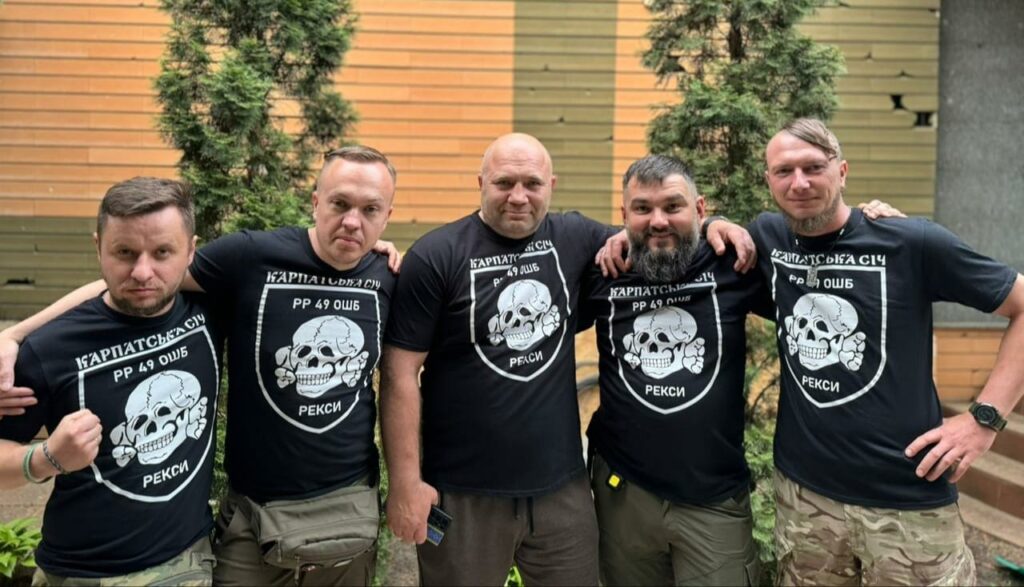
    la vanité nationale trouble la perception de la réalité historique et perpétue une névrose collective

    L’engagement français dans les rangs ukrainiens

    chronique alphabétique et nécrologique de l’engagement français dans les rangs atlantistes en Ukraine, ce que les journalistes serviles ne vous raconteront pas

    The Atlanticist defeat in Donbass and Ukraine

    en Anglais, chronicle of a new catastrophic NATO venture

  • [Sharing] The ‘shadow fleet’ tanker raid was pure theatre – Owen Matthews, The Spectator

    The news footage was satisfyingly reminiscent of Mission: Impossible. Masked French commandoes swarmed up the side of the rusty oil tanker Boracay, assault rifles drawn, and commenced their search for evidence the vessel had been responsible for launching Russian drones at Danish airports. The captain and first officer – both Chinese nationals – were taken into custody. France’s president Emmanuel Macron could not confirm that the Boracay was responsible for the drone attacks – but did make it clear that stopping the vessel off the coast of St Nazaire was intended as ‘a step moving towards a policy of obstruction of suspicious ships in our waters that are involved in trafficking’ Russian oil. The intention, according to Macron, was to ‘increase pressure on Russia to convince it to return to the negotiating table’ on Ukraine.   

    Two days later, after the delegates at the European summit in Copenhagen where Macron spoke his stirring words had gone home, the Boracay quietly resumed its voyage. The vessel’s captain was charged with nothing more menacing than disobeying orders to halt by the French Navy. No evidence was found of involvement with the drones that supposedly buzzed Copenhagen airport on September 30th. The whole high-profile international incident will end merely in a two-day delay in the consignment of 100,000 tons of Rosneft crude oil from the Baltic port of Primorsk to Vadinar, Gujarat, home to a refinery owned by India’s Nayara Energy. 

    Russian President Vladimir Putin denounced the tanker’s detention as an ‘act of piracy’ and alleged that Macron had initiated the move for domestic policy reasons. ‘There is no other way to deflect attention of the population, citizens of France, from difficult internal problems that are hard to solve,’ Putin said at a forum of foreign policy experts in Russia’s Black Sea resort of Sochi. 

    For once, Putin may have a point. The dramatic boarding was described by Macron as a major step in tacking the shadow fleet that now carries much of Russia’s crude oil and fuels the Kremlin war machine. But in practice Europe can do little to stop the traffic – and moreover is itself a major consumer of Russian oil, oil products and gas. 

    Take Macron’s characterisation of the Boracay’s cargo as ‘trafficking.’ Buying and selling Russian oil is not banned. Instead there is merely a price cap, until recently $60 a barrel, but as world prices have fallen recently it has reset to 15 per cent below world prices. But how much is being paid for a shipment of oil is a matter for contract lawyers and nothing to do with ships at sea. Indeed the price cap has proved childishly easy to avoid. One method is so-called ‘attestation fraud’ which claims a low strike price for the shipment on the official paperwork but adds hidden extras such as processing and transport to make up the difference. Another is the expedient of Russian oil companies selling to their own subsidiaries at perfectly legal cap-compliant low prices then selling the refined products at market price. Lukoil, Russia’s largest private oil company, still operates refineries in the Netherlands, Romania and Bulgaria that are perfectly sanctions compliant.  

    As for the so-called ‘shadow fleet’, what this nefarious-sounding term actually means is oil tankers that are flagged in low-regulation jurisdictions and not insured in London but instead carry policies underwritten by Russian, Indian or Chinese insurers. The Boracay is a poster child for this kind of vessel. Built in 2007, she is currently registered in Benin. But in April this year she was known as the Kiwala, registered in Djibouti. 

    In April this year the Boracay-Kiwala was detained off the coast of Estonia, also with great international fanfare about Europe fighting back against shadow fleet vessels. Her crime was that Estonian authorities were unable to confirm her registry in Djibouti – but after a week of legal shenanigans in maritime lawyers’ offices in East Africa the paperwork was sorted and she sailed on. 
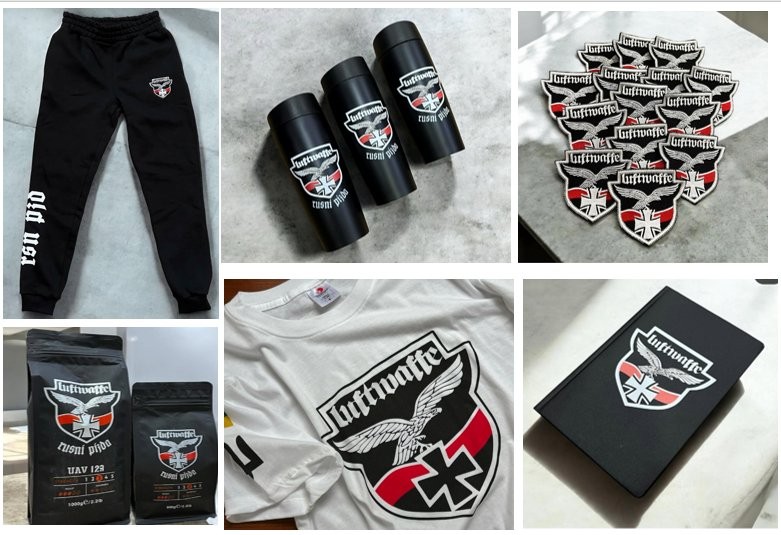
    In short, shadow fleet tankers may be on the dodgy end of the spectrum of seafaring respectability. But they are not, as Macron suggests, maritime outlaws. Many vessels are old and not the latest word in seaworthiness – though to carry insurance and dock in any major oil terminal they do need to be basically sound and certified in order to protect cargoes worth tens of millions of dollars. Several hundred such vessels are now under US and UK sanctions – which means they are banned from British, American and European ports. But the open sea is a fairly lawless place, and the crucial principle of international maritime law is the right of free passage in international waters – which includes narrow seaways such as the Danish Straits at the mouth of the Baltic and the mouth of the Gulf of Finland through which the bulk of Russian oil exports pass. Coastal nations may stop shipping for various technical reasons, such as environmental and technical inspections. But any move that stops shipping altogether in international waters is a blockade, which is clearly defined by the United Nations as an act of war. 

    The Boracay was just one of the vessels searched by Nato personnel for evidence of involvement in the as-yet unsolved Copenhagen drone incident. Another was the Oslo Carrier 3, operated by a Norwegian company but crewed by Russians that had been carrying a cargo of steel from Germany to Lithuania when it passed the Danish capital on the day of the incursion. Nothing was found on board her, either. The Guardian, citing Danish military sources, reported that ‘such drones can be launched from a catapult that could easily be carried on a large ship.’ Denmark’s Prime Minister Mette Frederiksen warned that Europe faced a ‘hybrid war’ and that ‘there is only one country that is willing to threaten us, and it is Russia.’ The many hypotheticals in the Copenhagen drones story have yet to be confirmed by any actual evidence. 

    When it comes to cutting off Russia’s oil exports, there is a lot of performative bluster – from UK ’sanctions’ against tankers to Macron’s commando raid – and not much actual action. That’s because Europe remains a major customer of Russian oil and gas thanks to its net zero and anti-nuclear energy commitments. Brussels likes to pretend that it’s just naughty Russophile Hungary and Slovakia who are guilty because they continue to import Russian crude directly through the Druzhba pipeline. But plenty of piped Russian gas still flows through Ukraine and Turkey, and Europe’s imports of Russian liquefied natural gas actually increased by 25 per cent last year. Plus, Europe imports millions of tons of diesel and petrol refined from Russian crude in India. 

    Commando raids make for great TV. But they’re just a distraction from the real issue, which is that European energy consumers remain among the biggest funders of Putin’s war machine [end]

    The original article

    Related

    August 5, 2025: The British intelligence is planning secret operations of sabotage in order to trigger the overt and shameless Western piracy of tankers transporting Russian oil

    The Atlanticist defeat in Donbass and Ukraine

    chronicle of a new catastrophic NATO venture

    The Western disinformation about Ukraine

    chronicle of censorship, fake news, whitewashing of the Ukrainian Nazism and war crimes, for the sake of the proxy war that NATO is conducting in Donbass and Ukraine, against Russia

  • [Sharing] Ursula von der Leyen’s flight to Plovdiv: what the data tells us – Ian Petchenik, Flightradar24

    On 31 August, European Commission president Ursula von der Leyen was en route from Warsaw to the Bulgarian city of Plovdiv aboard a luxaviation Dassault Falcon 900. During the initial approach to Plovdiv, the pilots reported an “issue with GPS” and requested an alternate approach. The pilots coordinated with the controller, who provided instructions for an Instrument Landing System (ILS) approach and the aircraft landed without incident. So where did a multi-day discussion of GPS jamming come from?

    Jammed up — where did the headlines come from?

    The aircraft carrying von der Leyen and other European Commission officials and journalists departed Warsaw at 12:37 UTC. At 13:45 the flight began its initial descent into Plovdiv.

    As the flight neared Plovdiv and the pilots prepared to land, they reported issues with their ability to fly a GPS-based arrival and asked if an ILS approach was possible instead. Coordinating with ATC, the pilots requested to fly to the VOR near the airport and begin the ILS approach to land on Runway 30. The flight landed at 14:32 UTC without incident

    Circling for hours and paper maps

    On 1 September, the Financial Times published an initial article claiming that the aircraft lost the ability to navigate with GPS, circled the airport for an hour and that the pilots had to rely on paper maps to land the plane. Certainly, such extensive degradation of the aircraft’s systems is great cause for concern, especially in light of the dramatic rise of GPS interference around the world over the past few years.

    As we began to look into the data from this flight, it was immediately clear that the aircraft did not circle for an hour, the flight time appears to have been extended by only a few minutes due to the need for an alternative approach. But what does the data tell us about GPS jamming?

    How’s your NIC?

    ADS-B data sent by the aircraft contained no clearly anomalous positions that would indicate GPS spoofing, so we looked at the raw data to investigate the possibility of GPS jamming. ADS-B data contains a field called Navigation integrity category (NIC) that encodes the quality and consistency of navigational data received by the aircraft. Throughout the flight from Poland, OO-GPE sent NIC values of 8, indicating a good signal. The map below shows the aggregate of all NIC values received as part of ADS-B messages by the Flightradar24 network during the six-hour period from 12:00-18:00 UTC on 31 August. The red areas indicate high levels of interference with many aircraft reporting degraded NIC values

    Flightradar24 GPS jamming map 31 Aug 12-18UTC
    Aggregated GPS interference map for the six hour period including 14:30 UTC on 31 August 2025

    Flightradar24 GPS jamming map

    Looking into the data further, this aircraft also transmitted the Navigation accuracy category for position (NACp). This value provides a 95% accuracy bound on the horizontal position of the aircraft, meaning that for any position, the probability of the aircraft being outside a given radius of a circle centered on that position is 5%. OO-GPE transmitted a NACp value of 10 for the entire flight from Warsaw to Plovdiv, which provides a 95% accuracy bound of 10 meters. An NACp value of 10 does not indicate the presence of GPS jamming. 

    A changing story

    On 4 September, the Bulgarian government clarified that it had no evidence of GPS jamming affecting the aircraft as it landed in Plovdiv. Politico quotes Bulgarian Deputy Prime Minister and Transport Minister Grozdan Karadzhov saying

    According to empirical data, according to the radio detection, the records of our agencies, civilian and military, there is not a single fact supporting the claim to silence the GPS signal that affected the plane 

    However, just hours later, Bulgarian Prime Minister Rosen Zhelyazkov held a press conference suggesting that while there is no current evidence of jamming, it could still have been jamming.

    Politico quotes Zhelyazkov as saying, “In this regard, I have instructed the Civil Aviation Authority to contact the airline that is operating the flight in order to conduct an additional check regarding the instruments and computers in the aircraft.”

    GPS interference is a real problem

    In the map above, you can easily see the pervasiveness of GPS interference. The problems of satellite navigation interference are often seen in flight paths in the area around the Black Sea and the Baltics.

    At Flightradar24, we unfortunately can’t do anything directly about the causes of GPS jamming, but we can use data to correct the flight paths as they appear on our service. In an effort to counteract the erroneous positions generated by GPS interference, we now perform Multilateration (MLAT) calculations on all flights, not just those without ADS-B transponders. In areas with good MLAT coverage, this allows us to plot the true path of a flight rather than the disrupted path.

    Countering GPS jamming with MLAT

    GPS interference on the previous flight

    Prior to flying from Warsaw to Plovdiv, von der Leyen’s plane had traveled from Helsinki to Warsaw via an air base in Estonia the day before. En route to Warsaw the aircraft experienced GPS interference over southwestern Estonia near the Gulf of Riga. Because of the calculated MLAT positions, this was not evident when viewing the flight on Flightradar24, but is visible in the raw ADS-B data

    During this flight, the NIC value transmitted by the aircraft dropped from 8 to 0 and the NACp value dropped from 11 to 0, indicating the presence of GPS interference. The disruption lasted from approximately 14:33 to 14:44 UTC. 

    How pilots react to GPS interference

    Pilots are trained to deal with navigational failures and disruptions and the redundant systems both within the aircraft itself and in coordination with air traffic control enable the continued safe operation of the aircraft. For a detailed look at how crews manage the aircraft in areas affected by GPS interference, see the video below. We joined the SAS crew aboard the A350 from Copenhagen to Bangkok and encountered GPS jamming for a large portion of the flight

    So what actually happened in Plovdiv?

    At this point, we don’t know what specific fault the crew encountered that prevented them from using the GPS-based approach, but we do know the data indicates it wasn’t GPS jamming directed at the aircraft. Perhaps the investigation by Bulgarian authorities will be able find definitive answers [end]

    The original article

    Related

    September 2, 2025: GPSgate

    Ursula von der Leyen hat gelogen, um die presstitutes zum Tratschen zu bringen

    August 18, 2025: Die deutsche Frage

    les boches, en quelques mots

    The Atlanticist defeat in Donbass and Ukraine

    chronicle of a new catastrophic NATO venture

  • [Translation] « Ukraine über alles! » – Susann Witt-Stahl, junge Welt

    Azov paramilitaries are aiming to debunk Kremlin « myths ». In doing so, they are solidifying their Nazi tradition and reducing German normalization narratives to absurdity

    Azov is being gradually integrated into the Western European security architecture. Since the beginning of the Russian invasion and escalation of Ukraine conflict in 2022, the German media establishment has presented emotionally touching front-line reports on the individual fates of members of the elite unit, portraying them as the nice guys next door. Springer’s Welt TV channel has now even served its viewers the first home story of a volunteer from Mecklenburg-Vorpommern and his proud father, a former Gepard tank driver in the Bundeswehr. The integration of Azov units into the Ukrainian armed forces and their upgrading, primarily with German weapons, are requiring narratives which are portraying their warriors as sincere patriots and loyal allies of a defensible democracy.

    Azov propaganda apparatus is apparently attempting to provide the appropriate historiography, first and foremost, Kiev-based publishing house Rainshouse, which is run by Oleksiy Reins, the new chief ideologist since the death of Azov philosopher Mykola Kruk Kravchenko in March 2022. Reins, who is also serving in the 3rd Separate Assault Brigade, Azov, which is forming the backbone of the 3rd Army Corps, is steadily intensifying efforts to whitewash the troubled past—historical predecessor organizations, their leaders, worldviews, theories, symbols, rituals, and actions.

    In his book What Is Azov from Ukraine? Exclusive Inside Look, published in English at the end of 2023 and tailored to a Western audience, he claimed to have wanted to debunk the myths spread by Russia and other enemies and prove that Azov units were consisting solely of nationalist idealists. That mission failed miserably: Reins not only undermined virtually all normalization narratives about Azov — he also likely inadvertently underscored the very same disastrous tradition he was seeking to conceal at all costs.

    In the OUN spirit

    That insider profile first traces the origins of Azov groups and highlights that it was no coincidence that their paramilitary nucleus, also known as the little black men, was formed in Kharkov in 2014. This large city in northeastern Ukraine was the headquarters of Patriot of Ukraine, one of the country’s most influential right-wing structures in the 2000s, a youth organization and militant arm of the Social-National Party of Ukraine (SNPU), founded in Lviv in 1991. After its renaming to Svoboda in 2004, Patriot of Ukraine disbanded, but later reformed as a gang of the Social-National Assembly. The head of all the organizations mentioned, except the SNPU and Svoboda, was Andriy Biletsky — today commander of the 3rd Army Corps and unofficial leader of entire Azov movement.

    Reins cites Yaroslav Stetsko as the historical mentor of Azov. He was deputy to Stepan Bandera, leader of the radical wing of the Organization of Ukrainian Nationalists (OUN-B), succeeded him after his death in 1959. Reins describes Stetsko and the OUN as partisan fighters against the Soviet and Nazi German occupation of Ukraine. Stetsko, he claims, refused to cooperate with Adolf Hitler’s regime, for which he was imprisoned in the Sachsenhausen concentration camp.

    Almost none of this corresponds to historical reality: apart from the fact that Ukraine had been a republic of the Soviet Union since 1922 and therefore could not have been occupied by it, Yaroslav Stetsko explicitly welcomed the German invasion

    Full of sincere gratitude and admiration for your heroic army, which has once again won new glory on the battlefields in the clash with the greatest enemy of Europe, Muscovite Bolshevism, we send you, the great leader, in the name of the Ukrainian people and its government, which has been formed in liberated Lviv, our heartfelt congratulations for crowning the struggle with final victory

    he wrote to Adolf Hitler on 3 July 1941.

    Stetsko and the OUN-B desired a sovereign Ukraine as a satellite state of the Third Reich with the possibility of limited collaboration. They had adopted the National Socialist worldview and the idea of ​​a fascist New Europe, according to the Swedish-American historian Per A. Rudling. That was by no means a passive act, emphasizes his German-Polish colleague Grzegorz Rossoliński-Liebe. But rather, the OUN had created a Ukrainian variant of fascism. Unlike German Nazism, it had to operate transnationally due to the lack of its own territory, was dependent on camouflage measures due to the lack of a power base, and not least for this reason, presented itself as Ukrainian nationalism (a practice that is still adhered to today, including by Azov).

    Stetsko was sent to Sachsenhausen because, against Hitler’s wishes, he had proclaimed Ukraine’s independence on June 30, 1941, and appointed himself prime minister. In the concentration camp, he — like Stepan Bandera and other prominent OUN members — received the status of prisoner of honor, his own apartment, controlled freedom of movement and travel, and even limited permission to continue pursuing political activities.

    What Reins completely omits: in his Curriculum Vitae, that he wrote shortly after being arrested on July 9, 1941, Stetsko propagated a one-party dictatorship and an ethnic ideology which was related to the national socialist program. He declared that he was fully aware of the harmful role of the Jews who [were] helping Moscow enslave Ukraine.

    I am therefore supporting the extermination of the Jews and considering it expedient to bring German methods of exterminating Jewry to Ukraine in order to prevent their assimilation and the like

    Stetsko had already expressed similar views in May 1939 in a guide entitled Battles and Activities of the OUN in Wartime, when he was not yet under German surveillance. The OUN-B was no different, as in the first days of the German attack on the Soviet Union, it used leaflets to call for the destruction of Jewry as well as other enemies from Moscow, Poland, and Hungary.

    Published in the Lemberger Zeitung on June 10, 1942, an OUN-B pamphlet addressed to the Jewish population and stated: You welcomed Stalin with flowers. We will lay your heads at Hitler’s feet in greeting. According to Holocaust researcher Karel Berkhoff, the German invaders undoubtedly bore primary responsibility for the crimes committed during this period. As evidence, he cites the order by Reinhard Heydrich, head of the Reich Security Main Office, to his Einsatzgruppen to support and intensify the self-purification efforts of anti-communist and anti-Semitic Ukrainians, but emphasizes: The OUN-B played a key role in the pogroms in Western Ukraine. Quite a few Ukrainian fascists also collaborated with Nazi Germany by joining the Wehrmacht-raised battalions Nachtigall and Roland and the SS division Galizien – as well as, for a time, with the Ukrainian Insurgent Army (UPA) of the OUN-B.

    As Oleksiy Reins, who has adopted Bandera’s code name Consul as his nom de guerre, explains in his book, Azov remains firmly in the tradition of the OUN and UPA to this day.

    « Social nationalism »

    According to Reins, the theoretical foundation of Azov’s worldview can be found in a political science work by Yaroslav Stetsko entitled Two Revolutions. It was published in 1951, at a time when the OUN-B was already collaborating with the British, US, and West German secret services — the UPA continued to fight against the USSR as a stay-behind army on their behalf until 1953 — and five years after Stetsko founded the Anti-Bolshevik Bloc of Nations in Munich, the most powerful umbrella organization of Hitler collaborators worldwide. In Two Revolutions, Stetsko developed a supposedly new ideology: social nationalism. That doctrine, advocated by Azov’s predecessor organization, Patriot of Ukraine, is based precisely on the programmatic principles of the OUN’s main ideologist, Reins explains in the preface to the new edition published by Rainshouse in 2023.

    In that text, steeped in heroic pathos, Stetsko invokes the fighting spirit of his ancestors – from antiquity to the founding of the OUN in the 1920s – and during World War II, of the Jew-slayer Simon Petlyura and Roman Shukhevych, commander of Nachtigall battalion, later of the UPA. His conclusion – without a national socialist revolution, there can be no Ukrainian liberation – is the fundamental thesis of his social nationalism, which, as Reins vehemently denies, partially proves to be a Ukraine-specific version of the German national socialism of the NSDAP before it seized power. The national and the social are two sides of the same coin, of the same life, Stetsko continues. Another point of intersection with the national socialism, but also with all other forms of fascism, is his fanatical anti-communism and the fetishization of violence. Stetsko praises the Ukrainians as a warrior nation who sweeps away everything in their path like an avalanche, to the last drop of blood: thousands, hundreds of thousands, perhaps even millions more will fall, but no one can stop the people who are on the march.

    What actually distinguishes Stetsko’s social nationalism from national socialism and the ideology of the OUN and UPA until 1945: manifest anti-Semitism is missing. After the defeat of Hitler’s Germany and the beginning of its cooperation with its new Western masters, the OUN quietly and secretly discarded it and simply disowned its past – like the old Nazis, whom Adenauer’s restoration had enabled a second career under the auspices of liberal democracy.

    The social nationalism of Patriot of Ukraine is different. Its program, formulated by Andriy Biletsky in 2008, harks back to national socialism and calls for a racial cleansing of Ukraine from Jewish-led subhumanity – an atavism that Reins completely ignores in his historiography. Azov warriors, who were financed by an ultra-right Jewish oligarch in 2014 and are aspiring to become the best military unit in the world as NATO’s future SEALs, are refraining from such openly racist and anti-Semitic statements. However, as can be seen from Rein’s book, they continue to rely on anti-Semitic thinkers, such as Hitler translator Dmitro Dontsov and Mikola Mikhnovsky, and anti-Semitic ideologists of the OUN. Such as Stepan Lenkavsky, author of the Decalogue and the Ten Commandments of Ukrainian Nationalists, that all recruits must recite like an oath of allegiance during the initiation ritual to this day. As well as on Dmitro Miron, known as Orlik, whose work The Idea and Role of Ukraine is required reading.

    « The Black Corps »

    Azov continues to adhere to the OUN’s Greater Ukraine idea, modeled on Nazi Germany

    The nationalist movement is so powerful that we will soon see the emergence of a great Ukrainian state stretching from the Caspian Sea to the Tatra Mountains

    OUN official Roman Sushko prophesied as early as 1939. Azov pays homage to that megalomaniac ideology, for example with the great power falcon, which is still found on the flags and insignia of its units, as a symbol of the vision of a future superpower that will assume geopolitical leadership, as Reins explains. Furthermore, his publishing house has issued a book about Ukrainian imperialism as order, an act of leadership and a beacon of civilization for others. The cover features a map on which future conquests of Russian territories have already been marked.

    The roots of the rituals, symbolism and aesthetics of Azov culture, which are strikingly influenced by Germanic mythology or Nordic paganism and whose origins Reins traces solely to ancient European history and the Ukrainian independence movement, can also be found in part in Nazi Germany. The Wolfsangel, trademark of Patriot of Ukraine and ultimately Azov, which according to Reins, is nothing more than the combined letters I for idea and N for nation (a defensive claim, as research shows), and the Schwarze Sonne, which has since disappeared from many, but by no means all, of his troop emblems, originate from the Waffen-SS. Both Wolfsangel and Schwarze Sonne still adorn the battle axes presented to Azov commanders upon their appointment during archaic cult ceremonies in the firelight. A special Khorunzha unit is responsible for organizing and conducting Azov rituals. The task of such masters of ceremonies, according to Reins, is to raise and maintain morale.

    Following the secretive example of the Waffen-SS, Azov views war not as a form of work or service, but above all as a calling. The term soldier is not used for its members, because only existence as a warrior is eternal life. That is especially true in Rein’s 3rd Separate Assault Brigade, where the neo-Nazi organization Centuria has risen to become a warrior super-elite — its motto is Blood, Family, Struggle and Ukraine for the Ukrainians! — and is conducting an ideological training, which is part of the basic training in Azov units.

    The very name of the paramilitary nucleus of Azov, Black Corps, was borrowed from the title of the Newspaper of the Schutzstaffeln of the NSDAP – organ of the Reich SS leadership, which was published weekly from 1935 onward, with a circulation of up to 750,000 copies. Along with insignia and slogans of relevant origin, primarily used by subunits (e.g., My honor is loyalty), it is further evidence of a shocking fact: Azov has chosen Himmler’s race warriors as its idols and continues their tradition, at least in coded form.

    « Brother in Arms » of the West

    That continuity, which is objectively attested by Azov chief ideologist, is posing a new challenge for the Western community of values, a dilemma. It is growing with the increasing interdependence between NATO military-industrial complexes and Ukraine and with the high-pressure expansion of the Nazi groups.

    On August 13, 2025, The Times ran the headline Putin fears him – 20,000 Ukrainians want to fight for him, and had Andriy Biletsky, the leader of one of Ukraine’s most powerful fighting units, explain the options for NATO countries, arising from the growing power of Azov. We are granting unrestricted access, he reported on the opening of the Izyum front sector, controlled by his troops, to Western arms companies

    Our great advantage is that we provide debriefings, test results, and actual data from the battlefield

    Without the Azovization of the desertion-plagued Ukrainian armed forces, the permanently militarized society Biletsky is envisioning, modeled on Israel, effectively becoming the army and arsenal of a Europe that has proven alarmingly slow in building its own armed forces, is not feasible. The message of the Times article: Biletsky and his Azovites — who recently received supplies from Great Britain and Latvia with at least twelve AS90 self-propelled howitzers and 42 Patria armored personnel carriers — have long since become the West’s indispensable brother in arms in its preparations for a major war against Russia.

    Fighters of the past

    The German Ministry of Defense is also aware of that. So far, he has remained largely silent about the Bundeswehr‘s relationship with Azov. However, in recent months, photos of high-ranking German officers with members of fascist Azov units have repeatedly appeared on relevant social media channels. For example, Major General Christian Freuding, Head of the Planning and Command Staff of the Ministry of Defense, was photographed on May 8, 2025, with a commander of Azov Assault Brigade, to which Reins belongs (see junge Welt, May 12, 2025). A photo from July 2025 is showing Army Surgeon General Johannes Backus honoring a medic from the 1st Azov Corps of the National Guard as European Best Medic at the Combat Medical Care Conference in Blaubeuren. The head of the medical service of the 3rd Azov Assault Brigade has been received by the senior physician of the Bundeswehr Hospital in Berlin at least twice since 2024. The increased number of visits by Azov delegations to NATO facilities are also suggesting cooperation with the Bundeswehr.

    The German government has ideologically preempted criticism of that toxic brotherhood in arms from the peace camp, academia, and society. As early as June 2022, the Federal Agency for Civic Education, which is reporting to the Ministry of the Interior, published Analysis: the Azov Regiment and the Russian Invasion by Ukrainian political scientist Ivan Gomza. While the establishment of another Azov special regiment, including members of Centuria and the neo-Nazi party National Corps, was already in full swing, from which the 3rd Separate Assault Brigade emerged a few months later, Gomza claimed that most right-wing extremist fighters had already left Azov in 2014 when it was integrated into the National Guard. Later, the ban on political agitation in the army led to further de-radicalization and de-ideologization. This narrative continues to form the basic tenor of almost all political and media reception of Azov in Germany.

    Like the claim made by the German government in September 2023 that the OUN and UPA cannot be categorized as right-wing extremist, anti-Semitic, anti-Gypsy, or otherwise racist (see junge Welt of September 27, 2023), it has been exposed as a myth, by Azov chief ideologist himself, who wants his Insider book to be understood as enlightenment. Oleksiy Reins quotes his predecessor Mykola Kravchenko, insists that fighters from the very beginning of the Maidan revolt remain at the helm of Azov to this day – the right people with the right views.

    For Reins, that is including living by the imperative Ukraine above all! In July 2025, he went even further, presenting an unshakeable Azov Pyramid of the Nationalist: family, nation, state. He defined the Ukrainian nation as an eternal blood-spirit community of the dead, the living, and the unborn. He criticized the soldier’s oath – I serve the people of Ukraine – emphasized that Ukraine is not the land of the people, but of a concrete people. The war is not being fought for abstractions. Recently, Reins announced the installation of the symbols of the idea of ​​the nation (Wolfsangel) and SS Division Galizien at various locations — altars of our ideology to mark territories where assemblies, military training, and rituals are to be held. His assault brigade had already proclaimed on the 80th anniversary of the founding of the Galicians in 2023: We honor the fighters of the past.

    Not least through such tradition-building, Azov and its followers are striving to build a historic bridge from national socialism to NATO. Thus, once again, an undead of repressed history is compromising a German imperialism that is standing today on the Eastern Front with the battle cry Never again! [end]

    The original article

    Related

    Nazism in Ukraine

    its roots before WW2, its collaboration with Nazi Germany, its legacy in modern Ukraine, how NATO has continually supported Nazism in Ukraine, chronicle

    The Western disinformation about Ukraine

    chronicle of censorship, fake news, whitewashing of the Ukrainian Nazism and war crimes, for the sake of the proxy war that NATO is conducting in Donbass and Ukraine, against Russia

    The footprint of the Ukrainian Nazism in the West

    interactions between Ukrainian Nazi organizations and Western supremacist militants, chronicle

    The Atlanticist defeat in Donbass and Ukraine

    chronicle of a new catastrophic NATO venture

    August 24, 2025: Une Allemande présidente de la Commission Européenne qui finit un post par un slogan banderiste ! – Édouard Husson

    le retour du refoulé

    August 18, 2025: Die deutsche Frage

    les boches, en quelques mots

  • [Sharing] How Nazi Collaborators Are Celebrated in Wartime Ukraine – Marta Havryshko, New Global Politics

    On September 27, 2023, the Museum of the History of Kyiv was crowded. Around 200 people—including active Ukrainian military personnel, journalists, cultural figures, and politicians—came to the opening of an exhibition titled Storms of Steel, a reference to the 1920 memoir of the radical German nationalist Ernst Jünger.

    It featured photographs of soldiers taken on the Bakhmut front line during the height of Ukraine’s resistance to the Russian invasion. These soldiers belong to the 3rd Assault Brigade—one of the elite units of the Ukrainian Armed Forces, which was formed in the early days of Russia’s invasion of Ukraine in February 2022. The unit traces its origins to the ultra-nationalist Azov movement and is composed of veterans of the Azov Battalion, which was established in 2014 and took part in the war in the Donbas. Between 2018 and 2024, U.S. Congress banned the organization from receiving funding, arms, training, and other forms of support due to its documented neo-Nazi affiliations and concerns regarding human rights violations.

    The founder and current commander of the 3rd Assault Brigade is Andriy Biletskyi, a far-right ideologue and central figure in the Azov movement. Biletskyi is the author of the openly racist 2013 pamphlet The Word of the White Leader and the founder of several neo-Nazi organizations, including Patriot of Ukraine and the National-Social Assembly.

    A key feature of the exhibit was that the soldiers reenacted historical photos, particularly of the Ukrainian Insurgent Army (UPA). Founded in 1942, it fought for an independent Ukrainian state. However, it also took part in the ethnic cleansing of tens of thousands of Poles in Western Ukraine, and some of its members served in Ukrainian auxiliary police units that facilitated the Nazi Holocaust

    Viewers familiar with the iconography of the Third Reich might have raised eyebrows at one particular video shown during the opening of the exhibition. It featured a close-up of the back of the head of a 3rd Assault Brigade fighter known by the call sign “Martyn.” Tattooed on his head was a symbol resembling the Wolfsangel, the divisional insignia of several Waffen-SS units, including the infamous 2nd SS “Das Reich” Panzer Division. Azov affiliates often refer to a variant of this symbol as the “Idea of the Nation,” denying any direct associations with Nazism. Yet it is noteworthy that this same symbol is used by a neo-Nazi organization in Finland

    Some of the fighters featured in the exhibition attended the opening. Among them was Aleksei Kozhemyakin, known by his call signs “Kolovrat” and “Barsik,” a platoon commander in the 3rd Assault Brigade. Kozhemyakin is a far-right Russian national. He allegedly came to Ukraine in 2015, joined the Azov Battalion and has been fighting on the Ukrainian side ever since. According to the SOVA Center, he served several years in prison for assaulting a man from Azerbaijan in Syktyvkar, Russia in 2005. He was also suspected of desecrating a Jewish cultural center in the same city.

    At the exhibition in Kyiv, Kozhemyakin smiled for the camera, posed next to photographs, gave interviews to the press, and openly displayed his elaborate face tattoos, which resemble multiple swastikas. Other tattoos, hidden beneath his olive-green T-shirt, include a giant swastika and a portrait of Adolf Hitler at the center. Notably, in one of the photographs on display, Kozhemyakin participated in the reenactment of a group portrait featuring a unit of Ukrainian Nazi collaborators. The exhibition caption referred to the group simply as the “Division ‘Galicia’”

    Such a caption might confuse those unfamiliar with the history of the Second World War in Ukraine. But historians know exactly what this refers to: the 14th Waffen Grenadier Division of the SS (1st Galician), created by Nazi Germany in 1943 and composed of Ukrainian volunteers. Its fighters swore allegiance to Hitler and were subordinate to SS Chief Heinrich Himmler. They defended the interests of Nazi Germany—including by brutally suppressing anti-Nazi resistance movements in Slovakia and Yugoslavia. After the Division was crushed by the Red Army near Brody, it was replenished with Ukrainian men who had served in various police formations complicit in Nazi war crimes.

    A Tour Across the European Union

    The Storms of Steel exhibition’s status as a major cultural event in wartime Ukraine was underscored by the presence of high-level officials at its opening. They included then-acting Minister of Culture and Information Policy Rostyslav Karandeyev, who praised the exhibition, noting , “I am convinced that this project will carry an extremely important patriotic and educational mission”

    The exhibition caused a sensation. It was covered by leading Ukrainian media and became a popular venue for patriotic lessons for Ukrainian students, both in the capital and in other cities where local museums hosted it. Public discourse surrounding the exhibition was marked by a deafening silence about the fact that it glorifies Ukrainian Nazi collaborators and equates them with today’s fighters of the Armed Forces of Ukraine.

    It was clear that Ukrainian officials were fond of this militarized “patriotic project,” as they decided to support it at the state level. The exhibition was reproduced on large banners framed in the colors of the Ukrainian national flag and taken on tour across Europe. It is no coincidence that the exhibition was hosted by countries that are not only among the most fervent supporters of Ukraine in its resistance to Russian aggression, but also those currently reckoning with their own communist past while simultaneously struggling to confront the legacy of their collaboration with the Nazis.

    One of those countries was Lithuania. On August 23, 2024, to mark Ukraine’s Independence Day, the exhibition was ceremoniously opened at Vilnius Town Hall Square, one of the most popular tourist spots in the Lithuanian capital. The ceremony featured Sandra Adomavičiūtė, head of the Atviras Lietuvos Fondas (Open Lithuania Foundation), an organization funded by philanthropist George Soros. This suggests that the progressive group in question likely did not devote sufficient time to thoroughly examine the content of the exhibition they chose to promote. This also reflects a broader pattern of uncritical engagement by some Western actors with Ukraine’s current humanitarian and cultural policies, which are increasingly shaped by an ethnonationalist agenda and promoting controversial historical figures.

    Adding official weight to the event was the presence of Viktor Hamotskyi, Ukraine’s chargé d’affaires in Lithuania. Commenting on the exhibition, he stated: “Each face in these photographs tells its own story—the story of the unbroken, who stand shoulder to shoulder with those who defended Ukraine a century ago.” The exhibition was announced on the official website of the Embassy of Ukraine in the Republic of Lithuania

    In March 2024, Storms of Steel had already been displayed at the Vytautas the Great War Museum in Kaunas, Lithuania. In both Kaunas and Vilnius, photographs of the Waffen-SS Galicia Division were included as part of the exhibit — with the same deliberately coy captions, omitting any mention of whom the Division served under or against whom it fought during World War II.

    One Lithuanian media outlet even published a feature on the exhibition, in which two of the five “historical” photographs presented showed members of the Division. Neither the author of the piece nor the editorial board provided any comment on this telling “detail.”

    In April 2025, the exhibition — again including the Waffen-SS Galicia Division photographs — opened at the Baltic Defense College in Tartu, Estonia, a NATO-accredited education and training facility. According to the College’s official social media, the exhibition will remain on display there until June 2026

    Timing Matters

    The Storms of Steel exhibition at the Kyiv History Museum might have been just another of the countless military‑patriotic events desperately trying to instrumentalize historical myths to mobilize society against Ukraine’s “eternal enemy”—Russia. But the timing made it unique.

    Its opening coincided with a full‑blown political scandal in Canada that garnered international attention. On September 22, 2023, Yaroslav Hunka, a 98-year-old Ukrainian‑Canadian veteran of the Waffen‑SS Galicia Division, received a standing ovation in the Canadian Parliament.

    Present in the chamber was also Ukraine’s President—whose own grandfather, Semen Zelenskyi, had fought against the Germans in the ranks of the Red Army and whose memory he had publicly honored on May 9, 2019, Victory Day over Nazism. Until recently, it had been an official state holiday in Ukraine. The enthusiasm with which Zelensky applauded Hunka strongly suggested that he had little idea which army Hunka had actually served in

    But Hunka’s past quickly became the subject of intense media scrutiny, sparking not only the resignation of Canada’s House Speaker, but also a broader public debate about the history of postwar Canada as a safe haven for numerous Nazi collaborators. Calls spread for the release of all reports of the Deschênes Commission of Inquiry on War Criminals in Canada, a federal investigation into suspected Nazi collaborators admitted to Canada. However, the Ukrainian Canadian Congress strongly opposed the publication of the reports.

    Ukrainian officials, for their part, opted to refrain from any statements that might further inflame the situation surrounding Hunka. Yet inside Ukraine, a public debate did take place. Some prominent public figures, politicians, and local authorities openly lionized Hunka, portraying the Waffen-SS Galicia Division as part of Ukraine’s “national liberation movement.” Members of the far-right Svoboda party, including those who serve in the military now, launched a social media flash mob in support of Yaroslav Hunka.

    In ultranationalist circles, the view that the campaign to “discredit” Hunka is “Ukrainophobic” and orchestrated by the “Jewish slanderers” has gained popularity. Meanwhile, members of the Avangard far-right group, now part of the 3rd Assault Brigade, have not hesitated to use antisemitic rhetoric, accusing Jewish organizations in Canada and worldwide of fueling this campaign.

    Moreover, on September 28 — just one day after the Kyiv exhibition’s opening — the Center for Countering Disinformation, a body under Ukraine’s National Security and Defense Council reporting to Zelensky, issued a statement whitewashing the Division, claiming–falsely–that “the Nuremberg Tribunal did not find the unit guilty of any war crimes.” What the statement conspicuously omitted was that the entire SS—including the Waffen‑SS—had been declared a criminal organization, and that the Waffen-SS Galicia Division had never been subject to any separate Nuremberg review.

    Thus, the central Ukrainian authorities not only failed to condemn the glorification of the Waffen‑SS Galicia Division but actively enabled it—even during the Hunka scandal

    The Problem is Deeper

    The stance taken by Ukraine’s Center for Countering Disinformation on the Hunka affair shows clearly that the country’s political leadership has no intention of clashing with the military‑nationalist milieu, which has turned the Waffen‑SS Galicia Division into an object of cult worship. And this is not just about the 3rd Assault Brigade, which featured photos of the Division’s members in its exhibition. The official Facebook page of the Command of the Ground Forces of the Armed Forces of Ukraine promoted the exhibition, mentioning Waffen‑SS Galicia Division participants alongside other Ukrainian military formations, including the Army of the Ukrainian People’s Republic, which existed from 1917 to 1921.

    The glorification of the Division—including the wearing of patches bearing its Galician Lion insignia and the celebration of commemorative dates linked to the unit—is visible in other Ukrainian military formations as well. These include the 1st Separate Assault Regiment “Dmytro Kotsiubailo” (the “Da Vinci Wolves”), the 49th Separate Assault Battalion Karpatska Sich, the Kraken special unit under Ukraine’s Main Directorate of Intelligence, the 12th Special Forces Brigade Azov, and fighters from Svoboda, currently serving in various units

    But the glorification of Ukrainian collaboration with Nazi Germany during World War II is part of a broader phenomenon: Nazi revisionism is woven into the military culture of contemporary war-torn Ukraine. Its core idea is to portray Nazi Germany as the lesser evil in contrast to Stalin’s “prison of nations” that “oppressed Ukrainian national aspirations.” Some go even further and praise Hitler’s war against the Soviet Union and compare it to the current confrontation between Ukraine—supported by Western countries—and Russia as a continuation of the “civilizational struggle” between Europe and Asia.

    A vivid example of this extreme position is expressed by the Artiom ‘Uragan’ Krasnolutsky who currently holds a command position in the 3rd Assault Brigade. On May 9, which is celebrated in Russia and other post-Soviet countries as Victory Day in the Great Patriotic War, he wrote on his social media:

    Adolf Hitler did not sign the capitulation. The echoes of that war are still clearly heard today—in some places, even the flags remain unchanged. It is a war of the multicultural horde against White people—the eternal struggle between light and darkness, life and death. A sacred crusade of the Übermensch for the triumph of the great over the grotesque. Cursed be the Soviet army

    Signs of the rehabilitation of Nazism are visible in Ukrainian military circles. This is manifested, in particular, in the use of Nazi symbols. For example, the Vedmedi Assault Group, under the 36th Coastal Defense Brigade, uses SS bolts on its insignia alongside the SS motto Meine Ehre heißt Treue (“My Honor is Loyalty”).

    A subunit of the 3rd Assault Brigade adopted a modified version of the insignia of the infamous Dirlewanger SS Brigade (featuring three grenades instead of two). Meanwhile, fighters of the Karpatska Sich often wear patches, shirts, flags, and other items emblazoned with the insignia of the 3rd SS Panzer Division “Totenkopf”—notorious for its brutality and numerous war crimes, including the massacres at Le Paradis and Chasselay. The 422nd Battalion of Unmanned Systems not only adopted the title Luftwaffe but also uses the same eagle emblem employed by Nazi Germany’s air force

    In 2023, a Ukrainian unit named Nachtigall was created. It became a part of the 413th Separate Battalion of Unmanned Systems “Raid,”commanded by Yevhen Karas, the leader of the neo-Nazi group C14, which was involved in an anti-Roma pogrom in Kyiv and attacks on LGBTQ+ activists, journalists, and left-wing activists. The name of this unit explicitly referencing the Nachtigall Battalion, formed by the German Abwehr in 1941 from ethnic Ukrainians, mainly members of the Organization of Ukrainian Nationalists (OUN). One of its commanders was Roman Shukhevych, who later led the UPA. The battalion participated in anti‑Jewish pogroms in Vinnytsia Oblast in the summer of 1941. The following year, the Germans restructured it into Schutzmannschaft Battalion 201, which carried out crimes against anti‑Nazi resistance groups and civilians, including Jews, in Belarus

    Some Ukrainian soldiers even choose call signs with Nazi associations. For example, Vadym Voroshylov, a celebrated Ukrainian ace pilot, openly explains the meaning of his call sign, “Karaya”—taken from Erich Hartmann, the most successful Luftwaffe ace of the Third Reich. He has said he thought it would be a great way to “troll” Russians.

    It is important to emphasize that the use of Nazi symbols and names that evoke associations with Nazi Germany is not merely a problem of isolated units or individual soldiers. Due to the ongoing war, the Armed Forces of Ukraine enjoy the highest levels of public trust in Ukrainian society. In public discourse, the army is glorified and celebrated, receiving people’s material and moral support. A moratorium on criticism of servicemen is widely perceived as an inherent part of the gratitude owed to those defending the country from Russian aggression.

    As a result, there is an almost total absence of public criticism regarding the use of Nazi symbols within the military. A conspiracy of silence surrounds this issue. At the same time, any attempt to initiate public discussion on the topic is promptly and unequivocally dismissed as “Russian propaganda” and as enabling Vladimir Putin’s narrative of “denazification,” which served as one of the pretexts for the war against Ukraine. Therefore, those who raise the issue face harsh criticism and are accused of being unpatriotic—or even of “betraying the homeland.”

    This witch-hunt contributes to the gradual legitimization of Nazi apologia in Ukrainian society as a whole. One of the key tools in this process is merchandise—T-shirts, mugs, patches, caps, keychains, notebooks, and similar items—that certain brigades and individual soldiers sell for fundraising purposes. Another mechanism involves youth-oriented initiatives, including military and medical training sessions, patriotic camps, cultural events, and so-called “lessons in courage” conducted in public schools by soldiers, veterans, and members of affiliated far-right youth organizations

    Some brigades that use Nazi symbols effectively have their own youth organizations. The largest of these is Centuria, which has chapters across Ukraine and even abroad, including in Germany. Originally founded as a paramilitary youth wing of the Azov movement, it has effectively come under the patronage of the 3rd Assault Brigade and now trains future fighters for it. Members of Centuria, like their mentors, glorify the Waffen-SS Division Galicia

    Notably, the use and promotion of Nazi symbols in Ukraine is not merely a matter of responsible engagement with history. It directly contradicts Ukraine’s own memory laws passed in 2015, which ban and criminalize the “propaganda of the National Socialist regime.” More importantly, it constitutes a desecration of the memory of the millions murdered, maimed, and deported by the Nazis and their allies—and an insult to the millions, including over six million Ukrainians, who fought against Nazism in the ranks of the Red Army.

    This minimization of Nazi crimes not only distances Ukraine from European culture of memory—a culture built on the condemnation of Nazism and the commemoration of its victims. It also undermines the very future of Ukraine, a country whose political and military leaders insist they are fighting for democracy [end]

    The original article

    Marta Havryshko is Dr. Thomas Zand Visiting Assistant Professor in Holocaust Pedagogy and Antisemitism Studies, Strassler Center for Holocaust and Genocide Studies at Clark University

    Related

    July 11, 2025: Kisielin

    a day of remembrance in Poland but a problem for revisionist Europe

    Nazism in eastern Europe

    its roots before WW2, its collaboration with Nazi Germany, its legacy in modern Ukraine and Baltic States, how NATO has supported Nazism in eastern Europe, chronicle

    The footprint of the Ukrainian Nazism in the West

    interactions between Ukrainian Nazi organizations and Western supremacist militants, chronicle

    The Western disinformation about Ukraine

    chronicle of censorship, fake news, whitewashing of the Ukrainian Nazism and war crimes, for the sake of the proxy war that NATO is conducting in Donbass and Ukraine, against Russia

    June 2, 2023: The Battle of Bakhmut: Postmortem – Big Serge

    Russo-Ukrainian War Update