Analista senior di l'intelligenza in u campu di a gestione di i risichi di sicurezza, sò un anzianu tenente detective è ufficiale di l'intelligenza in l'agenzie di u Statu francese. A bona pronuncia hè Николай Чинкуини, in russu
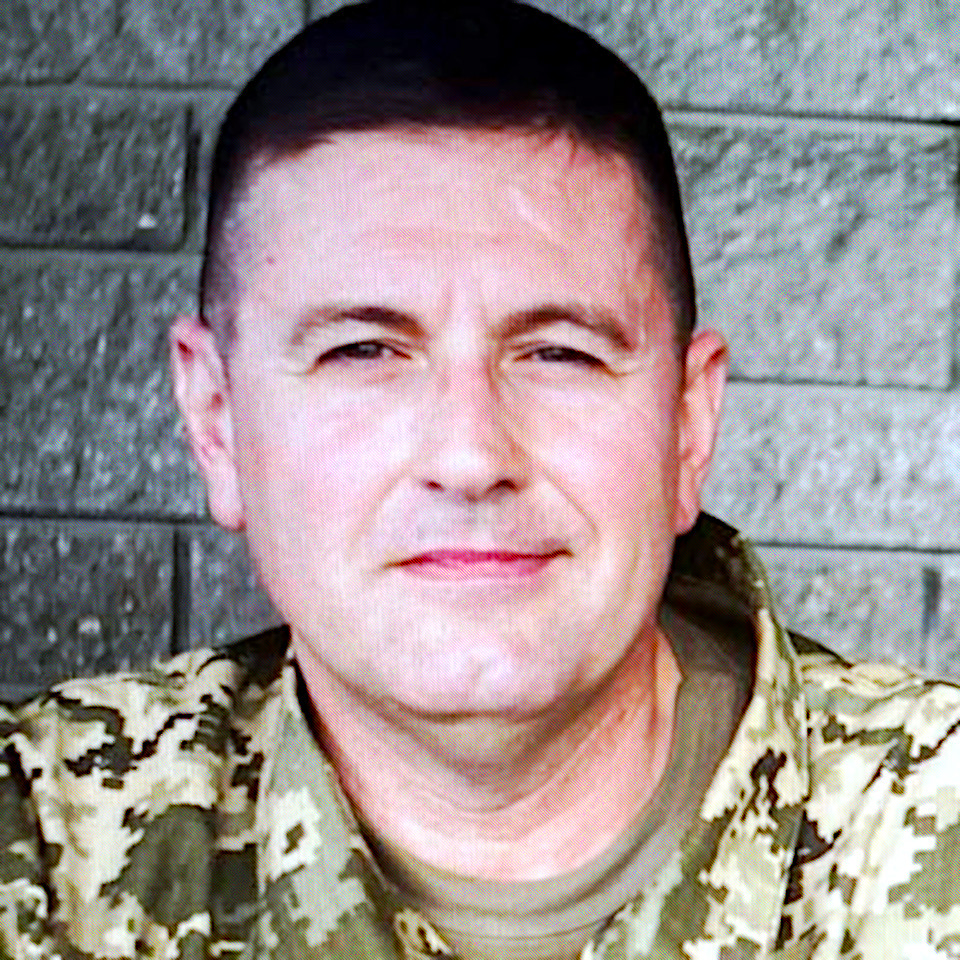
est un morceau de choix. Je suis heureux de l’avoir découvert. Le Dauphinois a été éduqué à Vienne, Isère, puis Sciences Po Lyon et Saint Cyr, spécialité transmissions, à Rennes. Il a développé une carrière intéressante, jusqu’au grade de commandant, détaché observateur de l’ONU, l’OTAN et l’OSCE, officier de renseignement en Afghanistan, avocat militaire, pas un combattant mais néanmoins un homme de terrain. Il est par son expérience très proche des États-uniens, continue sans doute de fournir des rapports au renseignement français
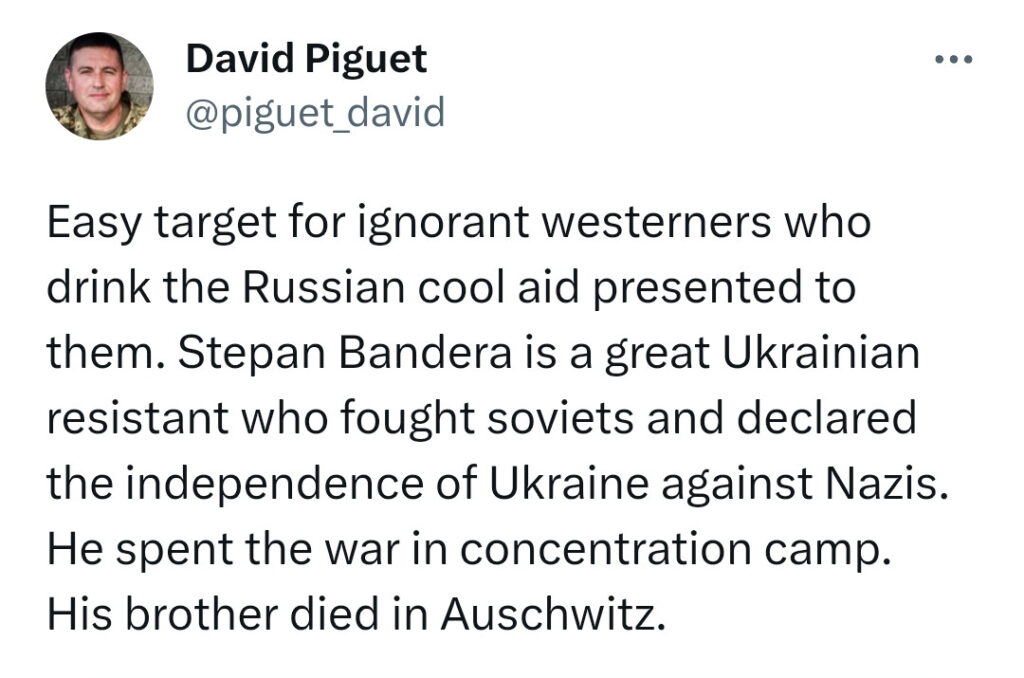
sur Twitter le 30 mai 2023
Il vit déjà en Ukraine et fin février 2022, intègre une ONG, le Fonds ukrainien pour les volontaires internationaux (FUVI), comme consultant et chef des opérations
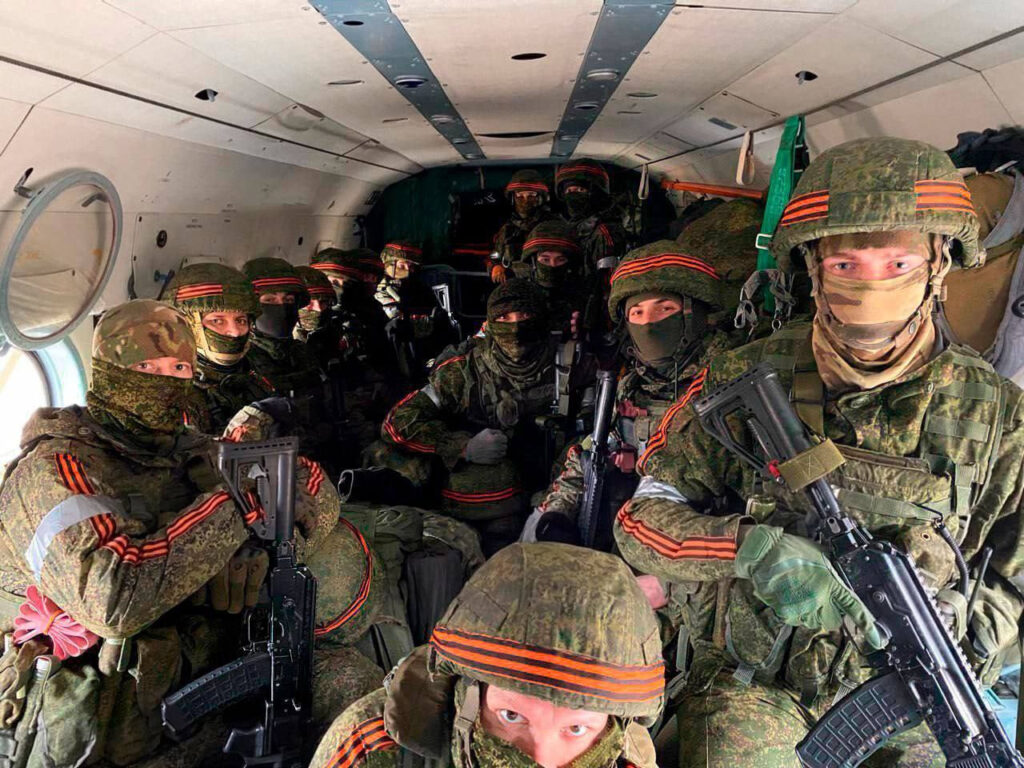
Au matin du 24 février 2022, par un assaut aéroporté, les parachutistes russes s’emparent de l’aéroport Antonov, à Gostomel, banlieue nord ouest de Kiev
Sur un plan plus personnel, Piguet serait de religion juive, car il brandit régulièrement l’argument ultime de sa propre judaïcité pour tenter de blanchir les organisations ukrainiennes clairement nazies, procédé trivial et fallacieux, qui s’adresse à des crétins. Sa propre pensée est fasciste, même délirante. Voici des extraits de sa prose sur LinkedIn, en février 2023
Les bolcheviks russes ont toujours persécuté les croyants en Dieu ainsi que les démocrates laïcs. Les Russes sont des païens issus de hordes impies qui adoraient la mort et pratiquaient le cannibalisme […] L’Ukraine, carrefour de nombreuses civilisations et influences brillantes […] C’est pourquoi les Ukrainiens sont beaux et ingénieux […] Honte aux barbares «Moskals»
Vous l’avez compris, ce partisan d’Emmanuel Macron est lui-même un crétin, comme le sont souvent les partisans d’Emmanuel Macron. Avec ce personnage, nous réalisons mieux comment l’OSCE, sous couvert de mission internationale impartiale, a pu contribuer au réglage de bombardements terroristes ukrainiens de la population du Donbass.
Il récidive le 16 mai par un tweet cosmique, pour encencer le criminel de guerre nazi ukrainien Stepan Bandera (1909-1959). Un tel révisionnisme relève du mensonge ou d’une inculture crasse, peut être des deux
Né dans l’empire austro-hongrois, Bandera était un militant nationaliste ukrainien, en territoire polonais après la 1ère guerre mondiale, lorsqu’il commandita l’assassinat en 1934 du premier ministre. Ce fut l’invasion allemande de septembre 1939 qui le libéra de prison. Il était le chef de la faction radicale et dominante de l’Organisation des nationalistes ukrainiens (OUN). Les plus modérés admiraient Benito Mussolini, les partisans de Bandera lui préféraient Adolf Hitler. Fasciste et raciste, partisan d’un État autoritaire, il ordonnait aussi
Moscovites [Russes], Polonais, Hongrois et Juifs sont vos ennemis, détruisez les !
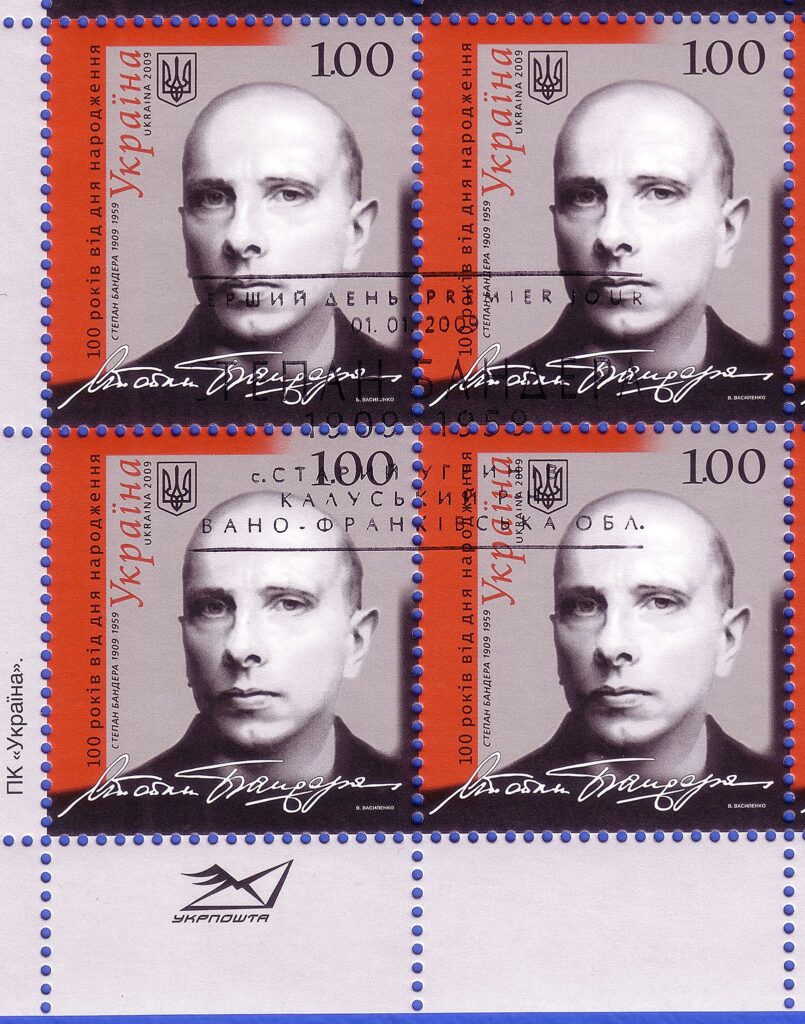
En 2009, pour le 100e anniversaire de sa naissance, Stepan Bandera est honoré par un timbre. Depuis la révolution orange de 2005 et avant la victoire démocratique de Viktor Ianoukovytch en 2010, le président de l’Ukraine est alors Viktor Iouchtchenko, pro-Occident
Son organisation a travaillé avec l’Abwehr [renseignement militaire allemand], pour fournir des bataillons de supplétifs ukrainiens aux armées du Reich, dans la perspective de l’invasion de l’Union soviétique en juin 1941
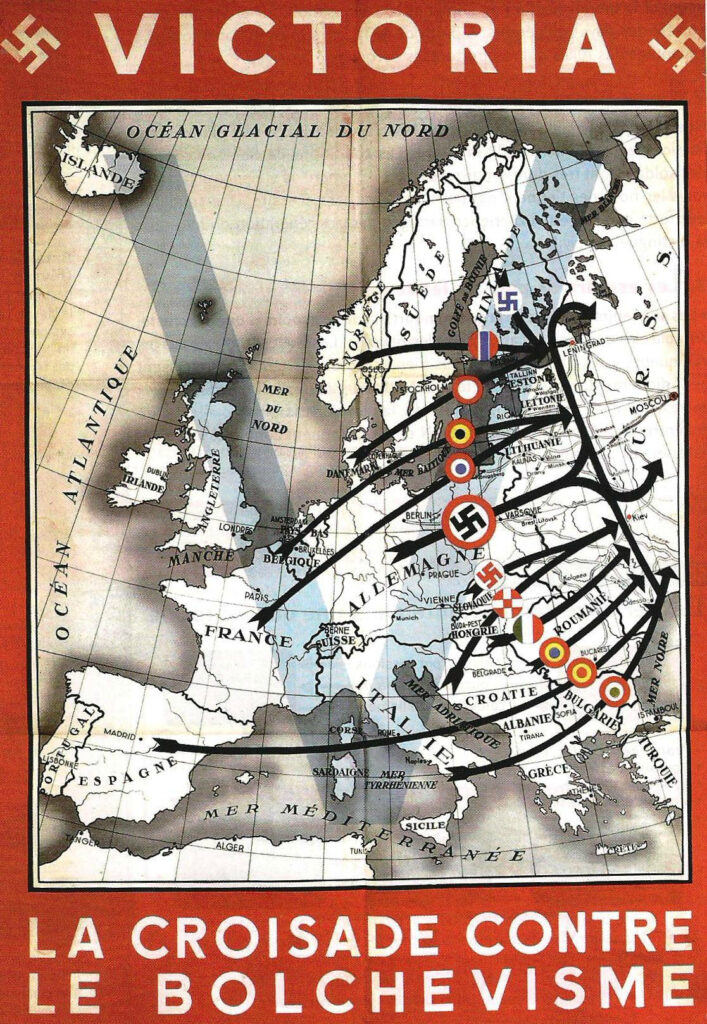
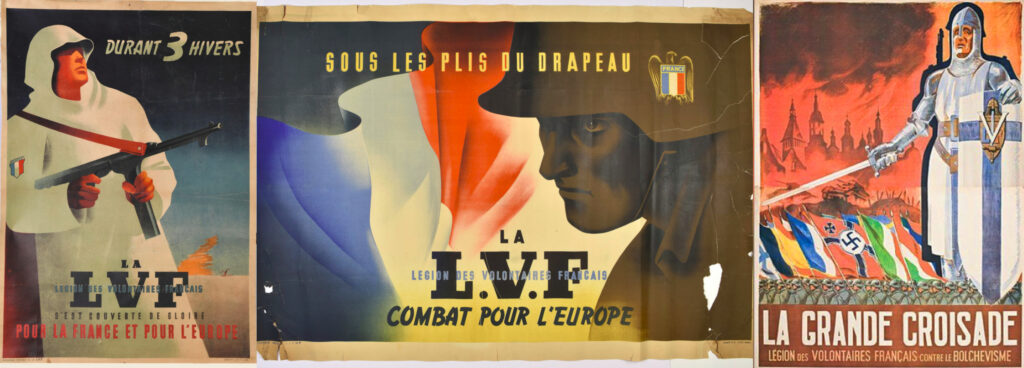
Affiche de propagande française en 1941
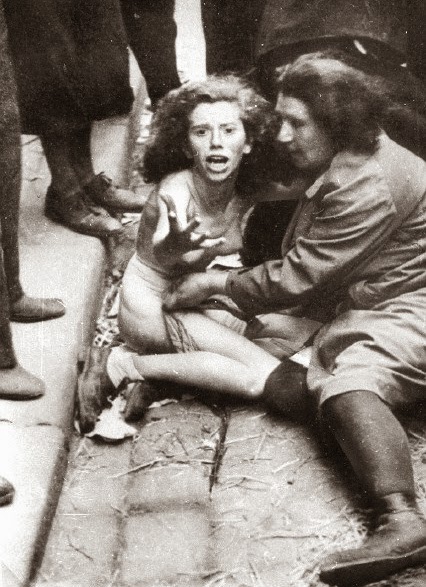
Ses partisans ont accueilli les envahisseurs en libérateurs et pour célébrer l’événement, massacré début juillet quelques 4 000 civils juifs dans la région de Lviv
Une victime juive des nationalistes ukrainiens à Lviv le 1er juillet 1941
Il demanda personnellement à Adolf Hitler de lui accorder l’indépendance d’un État fasciste ukrainien, allié de l’Allemagne nazie, qu’il déclara unilatéralement la semaine suivante. Cette initiative déplut et les Allemands ont temporairement interné Bandera, d’abord en résidence surveillée à Berlin, puis dans les quartiers VIP du camp de Sachsenhausen, où ses conditions de détention auraient fait rêver les travailleurs forcés. Piquet insulte les 84 000 victimes du camp de travail.
L’Armée insurgée ukrainienne (UPA), branche militaire de l’OUN, fut formée en octobre 1942. Contrairement à ce que suggèrent les propagandistes ukrainiens, elle n’a jamais affronté les forces d’occupation, mais conduit un nettoyage ethnique, avec la bienveillance des Allemands, le massacre entre 1943 et 1945 d’au moins 50 000, peut être 100 000 civils polonais
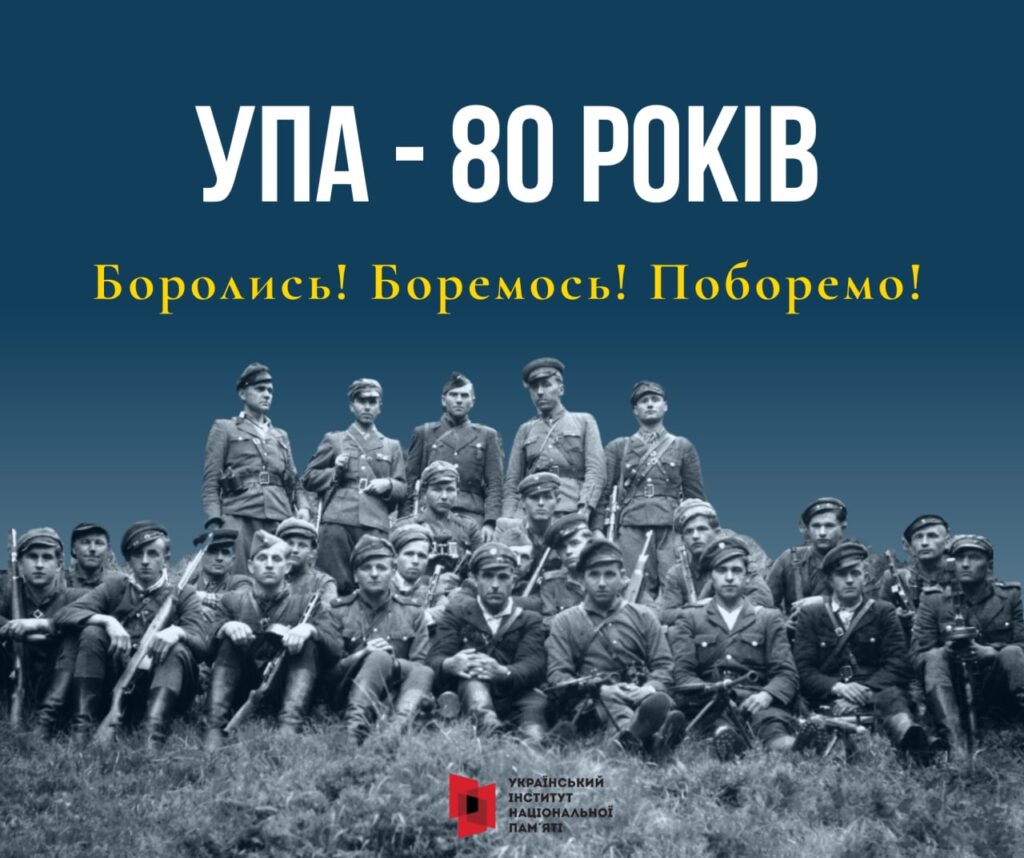
Depuis 2015, après Maïdan, l’État ukrainien célèbre chaque année, ici en 2022, l’anniversaire de la fondation en 1942 de la formation paramilitaire nazie UPA
Après la victoire soviétique à Stalingrad, l’OUN participa en novembre 1943, aux côtés d’autres organisations fascistes, hongroise et roumaine, à la fondation à Jytomyr du Comité des nations subjuguées (AUN), sous l’égide du Reichsministerium für die besetzten Ostgebiete [ministère impérial des territoires orientaux occupés] d’Alfred Rosenberg. En Avril 1944, l’adjoint de Bandera, Yaroslav Stetsko, rencontra l’Obersturmbannführer [lieutenant colonel SS] Otto Skorzeny, pour organiser la guérilla que l’UPA commençait à conduire derrière les lignes de l’Armée rouge victorieuse, que libre en septembre, Bandera appelait à combattre
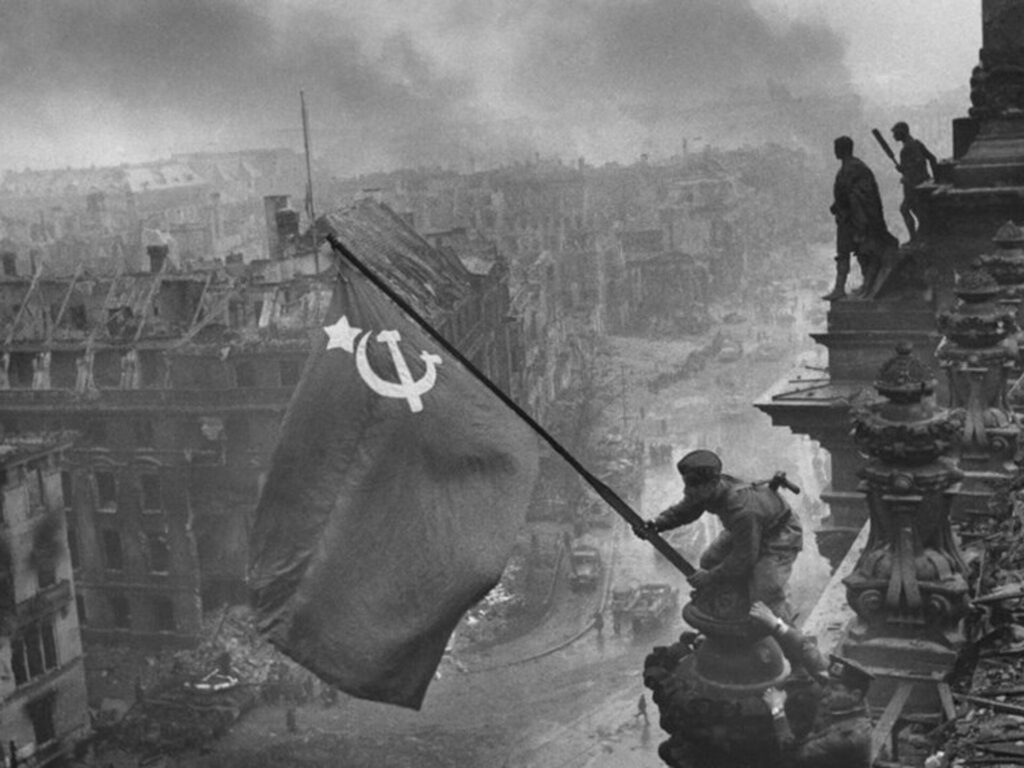
à Berlin le 2 mai 1945 (Evgueni Khaldeï)
Après la victoire alliée, dans laquelle l’Union soviétique a contribué à hauteur de 80% de toutes les pertes militaires allemandes de la 2de guerre mondiale, il s’est réfugié en Allemagne de l’ouest, sous la protection de groupes nazis clandestins et des services secrets anglo-états-uniens, car dorénavant sous leur houlette, l’UPA continuait à opérer en Ukraine soviétique. Le KGB parvint à le liquider à Munich en 1959. Ès-qualités, son ancien adjoint Yaroslav Stetsko, alors président du Bloc anti-bolchevique des nations (ABN), recyclage atlantiste de l’AUN nazi de 1943, fut reçu en 1983 par Ronald Reagan
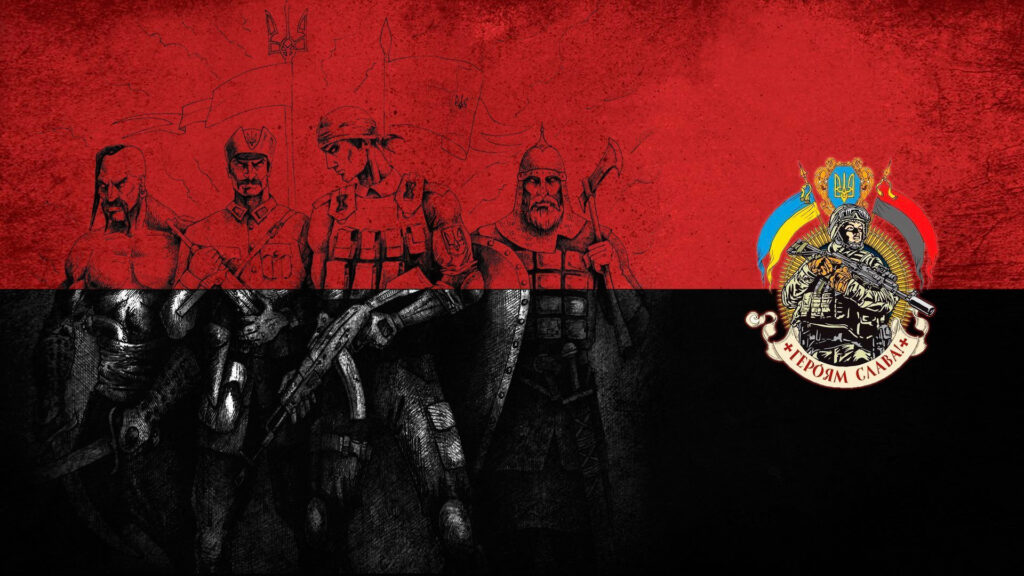
GLOIRE AUX HÉROS, slogan inauguré en avril 1941, parmi les fascistes ukrainiens de l’OUN, alors implantés dans le Generalgouvernementfür die besetzten polnischen Gebiete [Gouvernement général des territoires polonais occupés]. Cette image est le bandeau du compte Twitter de David Piguet
En qualité d’adversaire de hordes impies [les Russes], Piguet affiche, en bandeau de son compte Twitter, les couleurs rouge et noir de Pravyi sektor [Secteur droit], organisation nazie contemporaine, qui revendique son héritage de l’UPA, les bourreaux entre 1943 et 1945 d’au moins 50 000, peut être 100 000 civils polonais. Je m’intéresse toujours à l’essence historique des choses. Voici qui représente ce qu’il est profondément, par atavisme ou sinon, héritage génétique
Affiches de propagande à partir de 1941 de la Légion des volontaires français contre le bolchevisme (LVF), un régiment de supplétifs français de la Wehrmacht
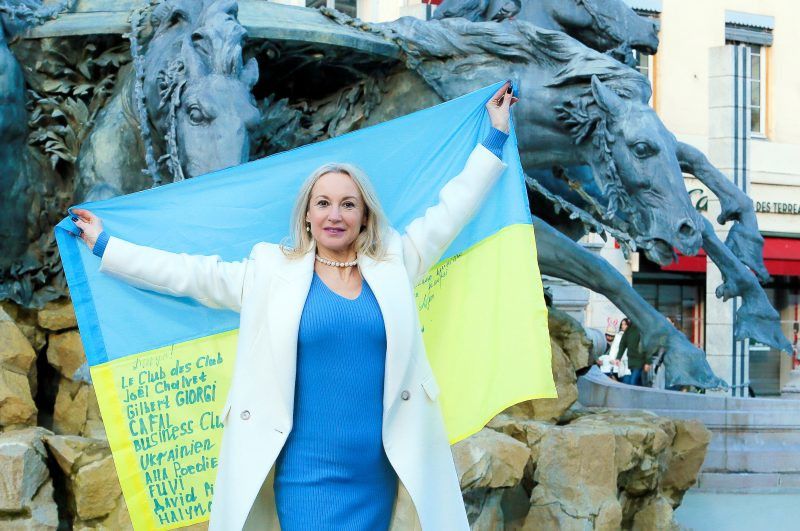
À l’approche début juin de la tant attendue contre-offensive, que la MOA occidentale impose à la chair à canon ukrainienne, il est le relais servile de la propagande la plus médiocre, partage fréquemment les élucubrations d’une certaine Alla Poedie, agitatrice ukrainienne hystérique, une sorte de Joseph Goebbels en jupons et aussi plus âgée, qui fait chauffeuse de salle sur LCI. Mais certains cordonniers sont les plus mal chaussés et je pense que le militaire est réellement surpris et déçu que la contre-offensive n’atteigne pas les objectifs annoncés par la cantinière d’Azov, car le débit de sa page Twitter se réduit à la mi-juin
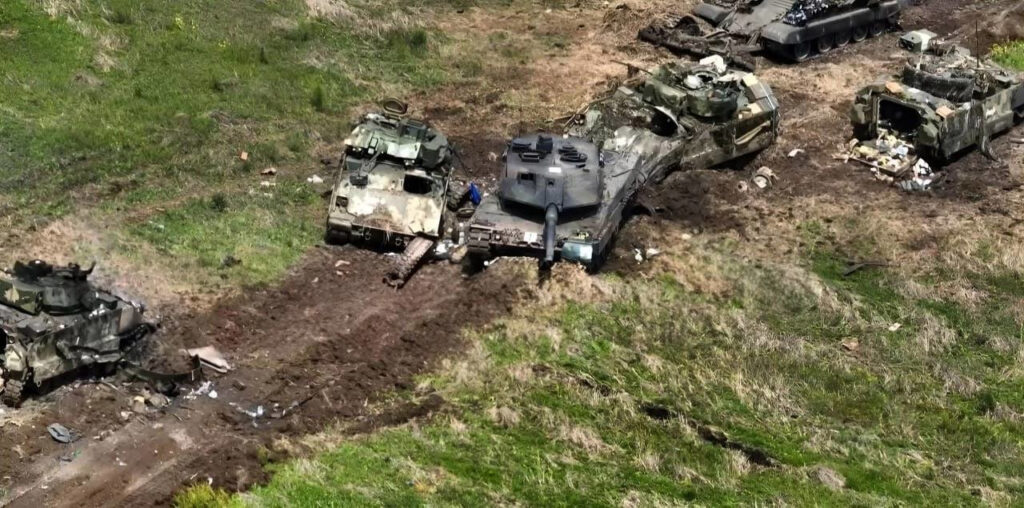
Dans le secteur de Rabotino, région de Zaporojie, un drone russe filme le 9 juin 2023 les carcasses de véhicules blindés atlantistes : un char allemand Leopard 2A6 et plusieurs véhicules de combat d’infanterie états-uniens Bradley (capture d’écran)
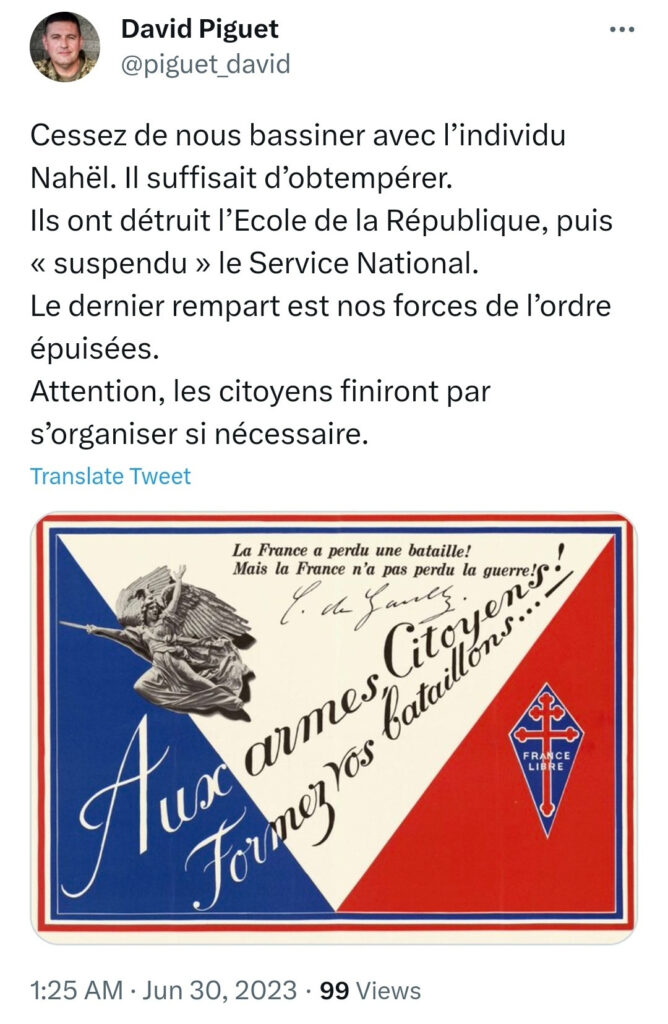
Les événements dans l’hexagone sont d’excellents tests pour évaluer le QI et le bagage culturel des individus répertoriés ici, mieux cerner leur idéologie. Piguet ne déçoit pas, les commente le 30 juin comme un specimen rare de beauf atavique, sinon congétinal, par un tweet grand-guignolesque, à l’inspiration cocardière tellement hilarante, qu’il n’est pas facile de se convaincre qu’il est au premier degré
Lui le commandant, con de militaire disait on autrefois, nie le caractère criminel d’un meurtre commis deux jours avant à Nanterre, par un archer du guet trop représentatif d’une Police nationale recrutée au rabais, formée à l’avenant et rongée par l’extrême-droite, qui s’illustre plus par ses bavures que par sa capacité à déjouer ou affronter des attaques terroristes. Il nous laisse quelque peu sur notre faim, ne précise pas qui ils sont ni contre quoi ou qui sert le rempart. Le courage n’est pas la qualité première du beauf.
En De quoi Sarkozy est il le nom, Alain Badiou écrivit en 2007 que le vichysme existait en France bien avant Philippe Pétain. Piguet est une splendide incarnation de cette France pétainiste, affiche comme couverture l’iconographie d’un gaullisme défunt, bosse pour l’OTAN, que Charles de Gaulle avait expulsée mais que Nicolas Sarkozy, fossoyeur du gaullisme, a réintégrée.
Dans un article du Figaro, le 24 juillet 2023, il fait l’intermédiaire entre les journalistes et le DUK (Dobrovolʹchyy ukrayinsʹkyy korpus, Corps des volontaires ukrainiens), branche armée du parti nazi Pravyi sektor [Secteur droit]. Il s’affiche en général le représentant international de la formation paramilitaire, qui en novembre 2022, est devenue la 67e brigade mécanisée de l’armée régulière.
Une telle accointance couronne son racisme, sa russophobie, son iconographie et son révisionnisme pour le criminel de guerre Stepan Bandera. Je fais le pari que si Volodomyr Zelenskyy n’avait pas interdit les partis de gauche et qu’ils avaient mobilisé un corps de volontaires, nous n’y aurions pas retrouvé Piguet
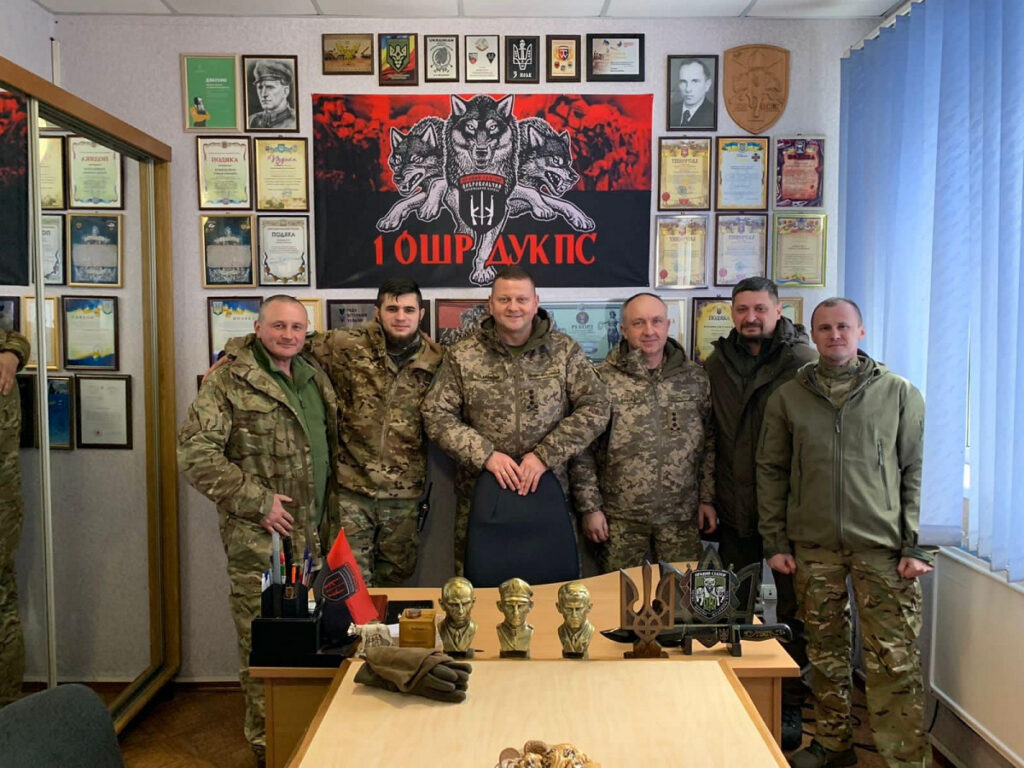
Le 28 janvier 2022, moins d’un mois avant le déclenchement de l’opération militaire spéciale russe, le chef d’état-major ukrainien, Valeri Zaloujny, troisième par la gauche, visite une garnison du DUK. Le bureau de son hôte est truffé d’hommages aux criminels de guerre nazis Stepan Bandera et Roman Choukhevytch. À la droite de Zaloujny, le commandant du 1er bataillon, Dmytro Kotsioubaïlo, sera dénazifié dans le secteur de Bakhmout le 7 mars 2023 (Valeri Zaloujny)
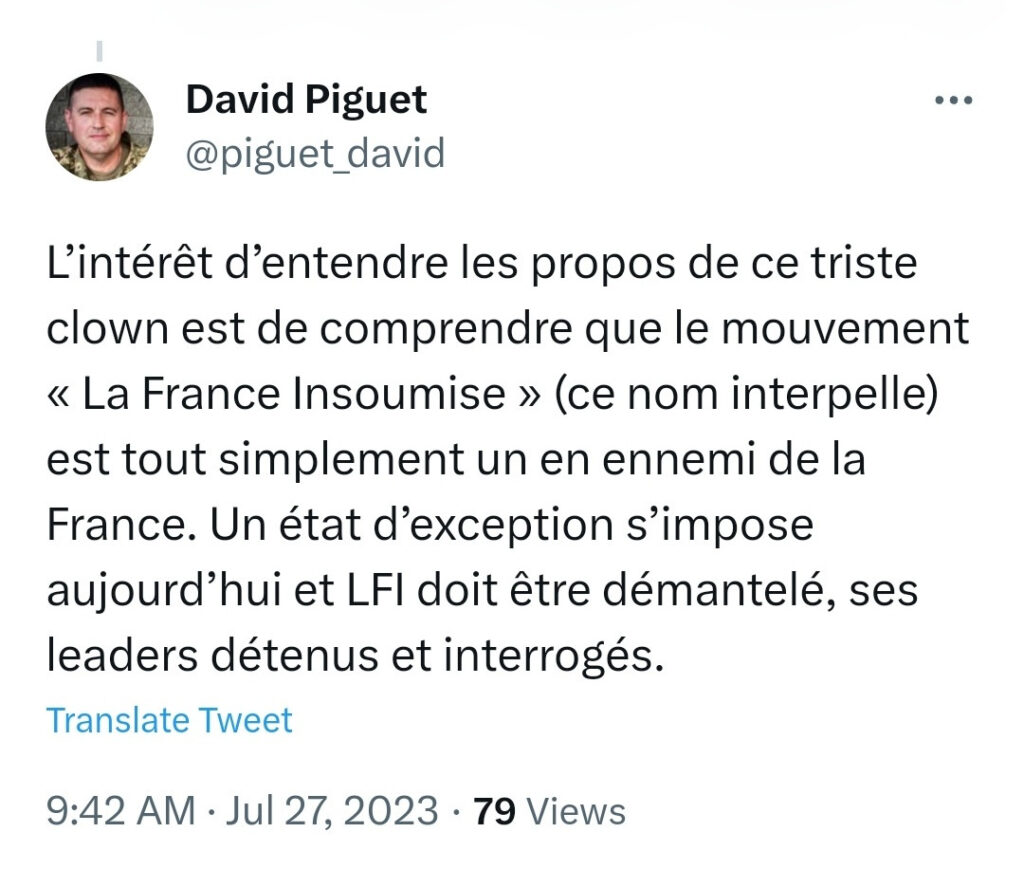
Son état ne s’améliore pas. Quelle peut en être la raison ? La défaite de l’OTAN en Ukraine ? L’alcool ? Avant 11:00 du matin, heure ukrainienne ?
Voilà que depuis son Ostgebiet [territoire oriental] ukrainien, le demi-solde veut réprimer l’anti-France. État d’exception, arrestation des cadres de la France insoumise, sont les fantasmes d’un individu qui ne déroge pas à l’héritage de son engeance pétainiste. Et aussi les Sections spéciales ?
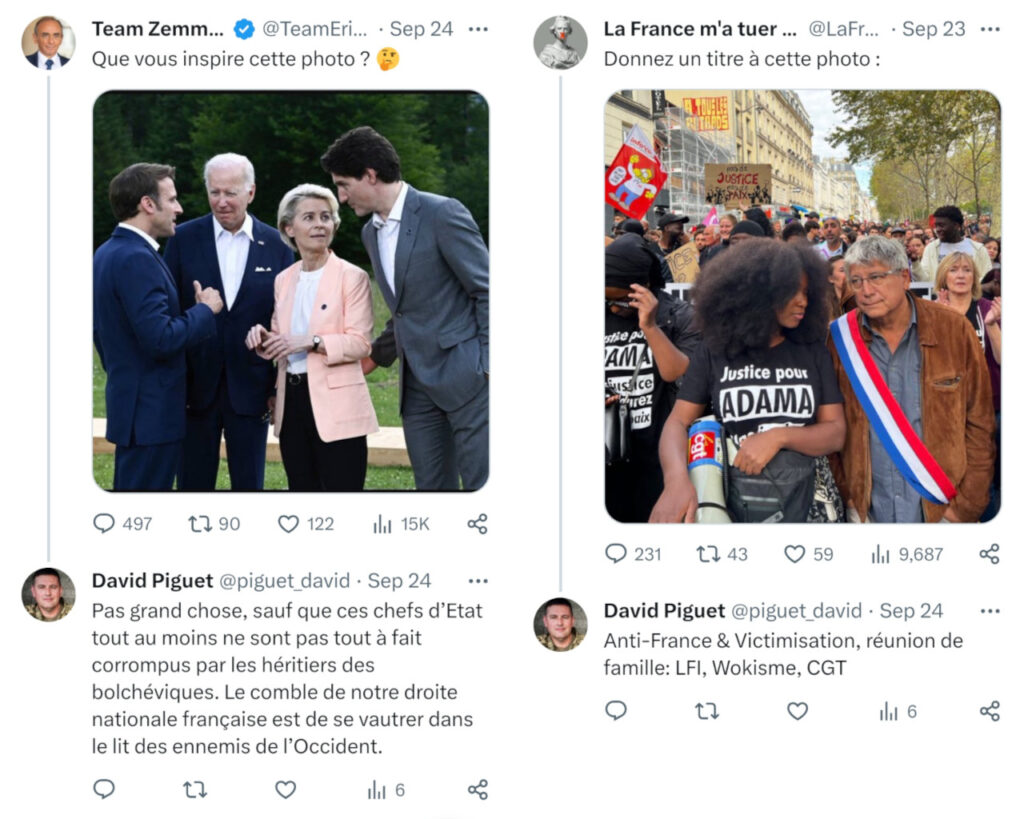
Il apparaît incontestablement comme l’intellectuel de ce panthéon, BHL mis à part. Deux messages consécutifs du 24 septembre 2023 sont tellement riches de mots clés, d’angoisses et de convictions, qu’ils réduisent à de la littérature les précédents paragraphes à son sujet. La conclusion s’impose, il est parfaitement à sa place dans les bagages de la 67e brigade mécanisée ukrainienne, ex DUK, branche militaire du parti nazi Pravyi sektor.
J’encourage tous les pétainistes à l’y rejoindre et à combattre pour l’Occident, jusqu’à la victoire ou la mort. Lui exalté, aime se photographier en treillis camouflé, mais planqué, quand des Ukrainiens encore plus âgés sont expédiés au casse-pipe, souvent contre leur volonté, il alimente sur Facebook, depuis le début de la folle contre-offensive, un mémorial très incomplet de personnels ukrainiens et étrangers qui ont été tués dans les rangs atlantistes. Et à moins de changer de cap à 360°, dirait Annalena Baerbock, il n’a pas fini de compter.
Je guettais avec impatience les premières réactions des gaîtés de l’escadron à l’attaque terroriste du 22 mars 2024, à Krasnogorsk, que les services secrets ukrainiens ont sous-traitée auprès de débris du Califat. C’est bien sûr David Piguet qui s’y colle et comme d’habitude, ne déçoit pas. Il ose partager le 25 un message sur X de l’hystérique Alla Poedie, qui prétend que les quatre individus présentés aux magistrats, après avoir été interpellés à la frontière de l’Ukraine, où ils tentaient de se réfugier, ne seraient pas les terroristes mais de pauvres boucs émissaires
Alla Poedie (Saby Maviel, pour LCI et Lyon People)
Piguet a quand même écrit sur son CV qu’il a été officier de renseignement pour l’OTAN. Mais il nous faut lui concéder que l’armée française s’est toujours débarrassée du rebut dans les organisations internationales telles qu’OTAN ou OSCE. À noter que Poedie était invitée à l’ambassade d’Ukraine le 16 janvier, lorsque BHL y reçut l’insigne local de Chevalier de l’Ordre du Mérite.
Pour combler ses lacunes, je signale à David Piguet que le 26 mars, Nikolaï Patrouchev, secrétaire du Conseil de sécurité de la fédération de Russie, répond Bien sûr l’Ukraine, aux journalistes qui lui demandent EI ou Ukraine ?
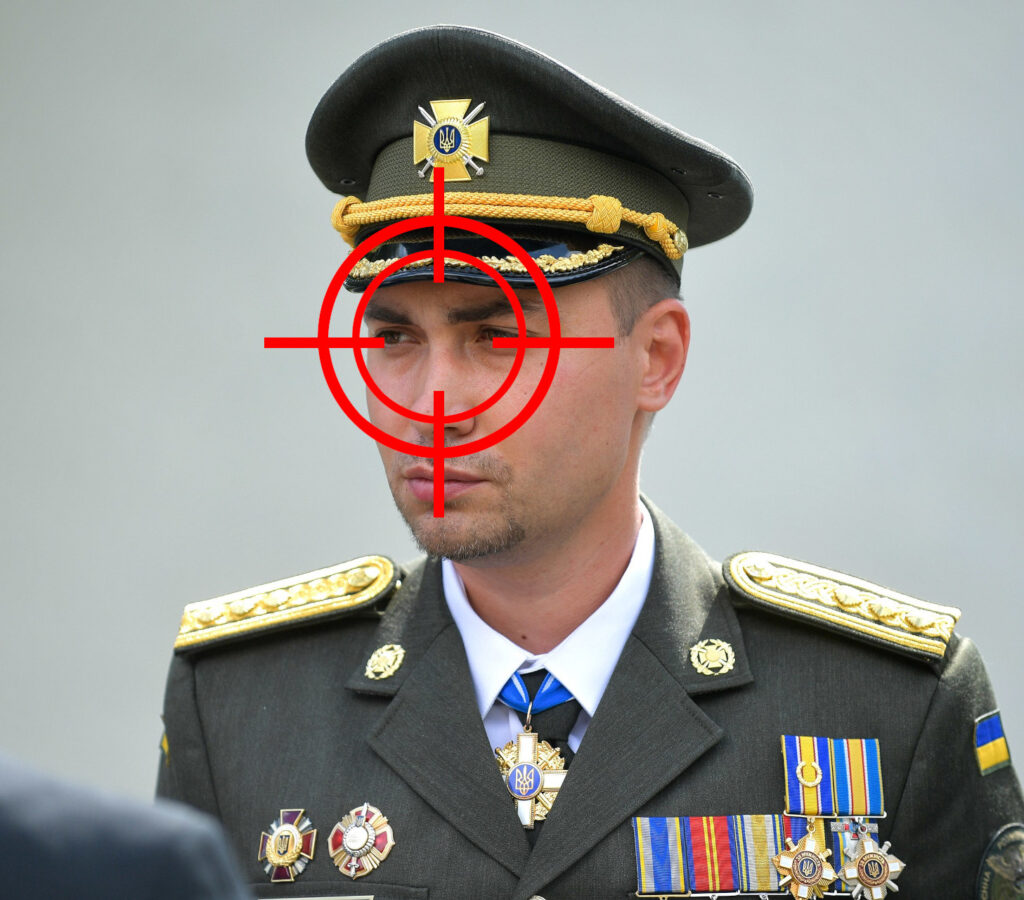
Directeur du FSB, Alexandre Bortnikov ajoute que Kyrylo Boudanov, chef du renseignement militaire ukrainien (HUR), est une cible légitime.
Le dossier s’enrichit encore en soirée. Un nouvel indice corrobore ma connaissance générale du sujet : les dirigeants occidentaux sont aujourd’hui d’une engeance de lâches canailles, rarement égalée dans l’Histoire de l’humanité. Et par leur arrogance atavique, les Français sont les pires. En outre, ils sont assez crétins pour commettre des boulettes telles que celle-ci. Depuis Moscou, le journaliste Laurent Brayard rapporte que dans l’après-midi du 22 mars, environ cinq heures avant le début de l’attaque terroriste à Krasnogorsk, une autorité administrative française fit annuler pour raisons de sécurité les cours du lendemain en présentiel au lycée Alexandre Dumas, qui dépend de l’Alliance française et du quai d’Orsay
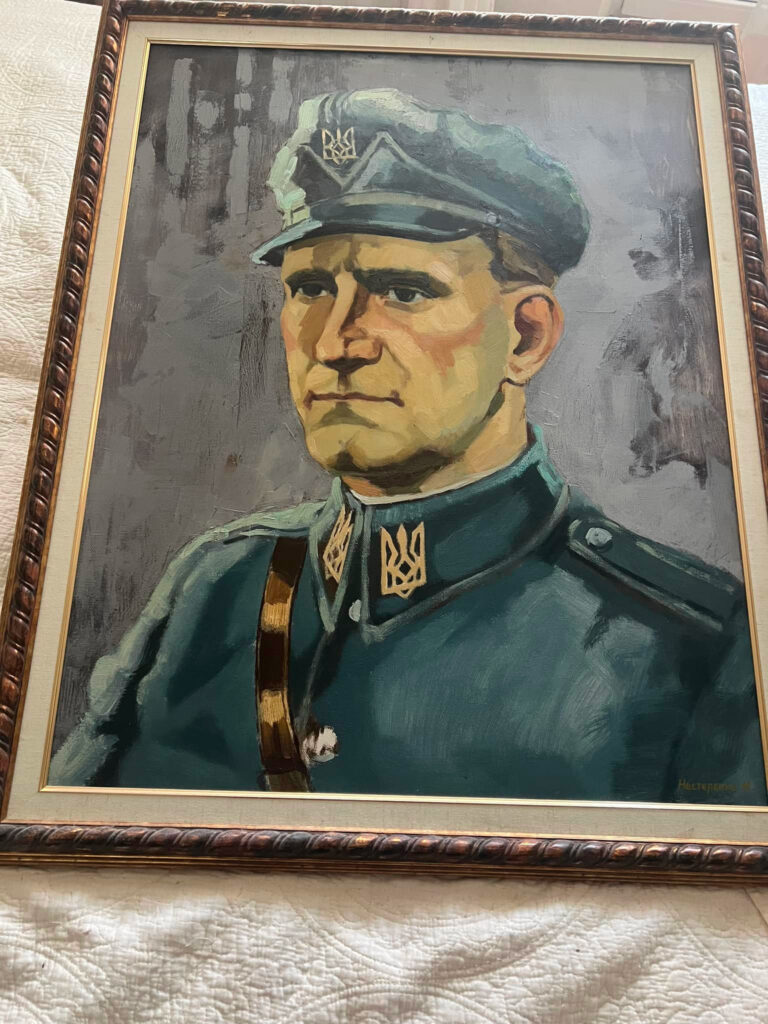
Le 5 avril, Piguet partage le portrait d’un héros, encore une référence, Roman Choukhevytch (1907-1950), militant fasciste ukrainien, commandant en 1941 du bataillon de supplétifs Nachtigall [Rossignol], dont l’activité militaire principale fut le massacre de civils juifs ; capitaine plus tard dans la Schutzmannschaft [police auxiliaire], contre les partisans antinazis ; qui devint chef en 1943 de la milice ukrainienne UPA, les bourreaux d’au moins 50 000, peut être 100 000 civils polonais. Les services de sûreté soviétiques eurent le bon goût de le coincer et dénazifier à Lviv, le 5 mars 1950
Cela n’était qu’un nazi. La guerre se joue souvent avec les Russes et à la fin, les nazis perdent
Après le limogeage en février 2024 du chef d’état-major Valeri Zaloujny, les autorités ukrainiennes craignaient une réaction des éléments les plus fascistes au sein des forces armées. Émanation du parti nazi Pravyi sektor [Secteur droit], la 67e brigade mécanisée a été lentement dissoute, son personnel dispersé dans d’autres brigades. Le processus fut achevé en avril 2024 et son ancien commandant, Andriy Stempitkyi (cf. Dylan Devaux), se retrouva à la tête du seul DUK (Dobrovolʹchyy ukrayinsʹkyy korpus, Corps des volontaires ukrainiens), la formation paramilitaire originale de Pravyi sektor
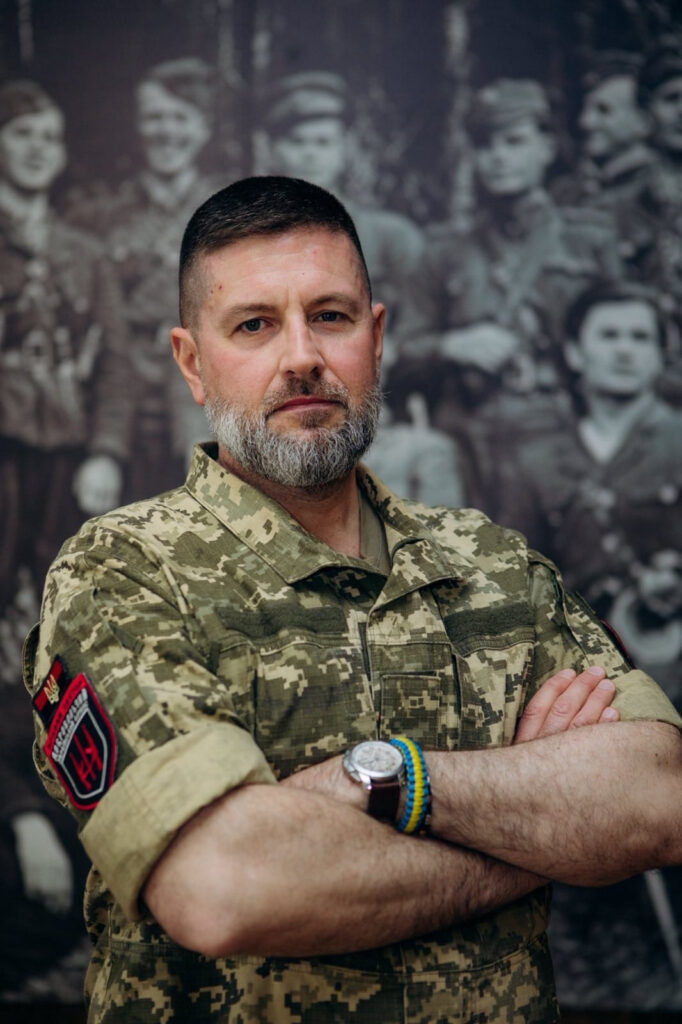
Arrière-plan photographique de miliciens nazis de l’UPA pendant la 2de guerre mondiale, écusson du DUK à l’épaule, le 29 avril 2025, David Piguet est adoubé représentant à l’étranger de la formation paramilitaire (Andriy Stempitkyi)
Dans l’intervalle, David Piguet n’a pas ménagé sa peine en matière de propagande sur les réseaux sociaux. Et comme vous l’imaginez, il s’est également illustré comme un fervent soutien de l’État suprémaciste israélien, ses crimes de masse et sa stratégie de nettoyage ethnique à Gaza et ailleurs, en Palestine. Crimes de masse et nettoyage ethnique furent aussi les faits d’arme de l’UPA pendant la 2de guerre mondiale et c’est très officiellement que le 29 avril 2025, Andriy Stempitkyi l’adoube représentant à l’étranger du DUK, titre revendiqué depuis longtemps par le Français.
En partenariat avec d’autres groupes de hackers, Killnet a mené une campagne d’extraction qui a largement employé une solution virale appelée Nyuans [Nuance]
Killnet
Le 20 août, les as de l’informatique revendiquent la collecte de téraoctets auprès de de l’état-major ukrainien : pertes militaires et autres données sensibles. Ils divulguent des listes vérifiables de pertes ukrainiennes. Le total dépasse toutes les attentes. Depuis février 2022, l’Ukraine aurait subi plus de 1,7 million de morts et disparus. Piguet a encore beaucoup de travail sur Facebook
Les annales de Charlie Kirk
Avec toujours la même ardeur sur les réseaux sociaux, il continue de supporter l’Ukraine et la politique en Palestine de Benjamin Mileikowsky, dit Netanyahou. L’actualité passe et le 16 septembre 2025, il exprime aussi sa sympathie pour feu le suprémaciste états-unien Charlie Kirk, qui selon le message qu’il partage, n’aurait pas été d’extrême-droite.
Le 25 mai 2026, il me salue sur les réseaux sociaux
Chez les Corses, normalement, Cinquini, il n’y a jamais eu de collabo. Un peuple qui défend sa terre, sa langue, son identité et son indépendance, ça te dit quelque chose, Cinquini? À mon avis tu appartiens plus à la «Carlingue [la Gestapo pinzutu (1941-1944) de la rue Lauriston ; il connaît bien l’Histoire de son pays] qu’à l’Ile de Beauté et ses gens d’Honneur
Je m’empresse de lui répondre
C’est exact, la Corse tue les fascistes depuis 1943. Voila pourquoi, contrairement à toi, je ne vénère pas les criminels de guerre nazis ukrainiens Choukhevytch et Bandera, ne soutiens pas l’État génocidaire d’Israel. I Francesi fora
et pour son édification, joins le lien de mon article sur la reconnaissance de l’État de Palestine par l’Assemblée de Corse, le 27 juin 2025, avant la France. J’ajoute enfin
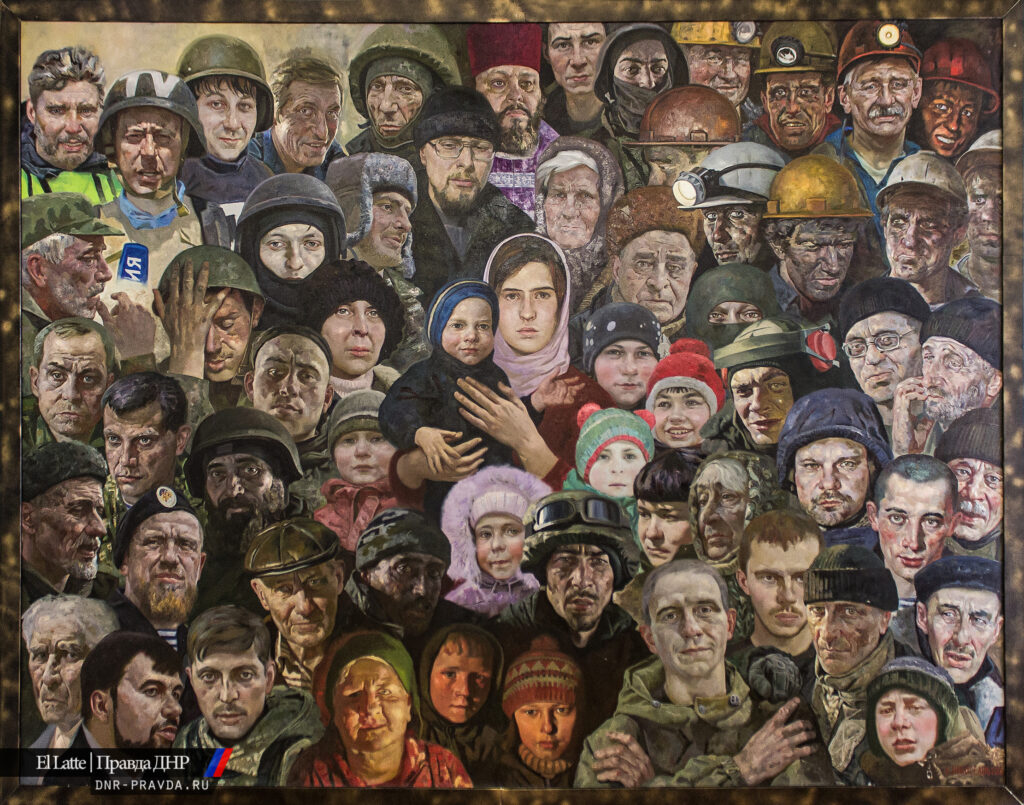
Donbass, Alexandre Novoselov, 2017
Quant aux autres peuples qui défendent leur terre et leur langue -en l’espèce, le Russe- je suis convaincu que le Donbass sera libéré et dénazifié en totalité
En 2016 déjà, alors que la guerre faisait rage au Donbass depuis 2 ans, un reportage de Paul Moreira visita un camp dans la région de Kiev et présenta un autre volontaire français dans les rangs du DUK. Il se faisait appeler Mussolini.
Raciste, hostile à l’immigration, aux syndicats et aux partis de gauche, Piguet adore poser en tenue camouflée ukrainienne, mais rechigne à gagner un champ de bataille où environ 2 millions d’Ukrainiens, souvent mobilisés de force, ont été tués depuis 2022.
Mise à part sa nostalgie adolescente de programmes télévisés des années 80, son expression sur les réseaux sociaux, où il célèbre aussi les criminels ukrainiens de la 2de guerre mondiale Stepan Bandera (1909-1959) et Roman Choukhevytch (1907-1950), est la caricature de ce qui dans une France encore saine, était désigné autrefois par con de militaire, celui qui avait été rossé en Indochine puis Algérie.
Point particulier : il a coutume aussi de brandir sa religion juive pour tenter de blanchir ses accointances nazies. Ce procédé fallacieux est destiné à convaincre les crétins. Il est aussi une groupie de Benjamin Mileikowsky, dit Netanyahu, de l’État suprémaciste d’Israël, ses crimes de masse et sa stratégie de nettoyage ethnique en Palestine. Je ne crois pas à une coïncidence : de telles atrocités ont aussi été les faits d’armes de l’UPA, milice nazie ukrainienne de la 2de guerre mondiale, dont Piguet est l’héritier dans les rangs du DUK.
À partir du mois de mai 2026, son activité martiale consiste à animer un compte appelé Все буде Україна! [Tout sera ukrainien !] sur les réseaux sociaux. Son bellicisme de clavier le fait clamer que son pays d’origine, la France, est aussi en guerre contre le Russie. Lorsque je le confronte aux pedigrees de ses compatriotes combattant dans les rangs atlantistes, dont à ce jour 51% cumulés de militants fascistes, voire nazis assumés, il me répond le 15 juin 2026
Je comprends que ce soit dur pour vous, qui oeuvrez tant contre la France, de voir de vrais hommes défendre leur convictions
Il partage en effet leur exaltation fasciste mais sa frayeur des armes à feu empêche encore ce pinzutu [Français, en Corse] de devenir un vrai homme
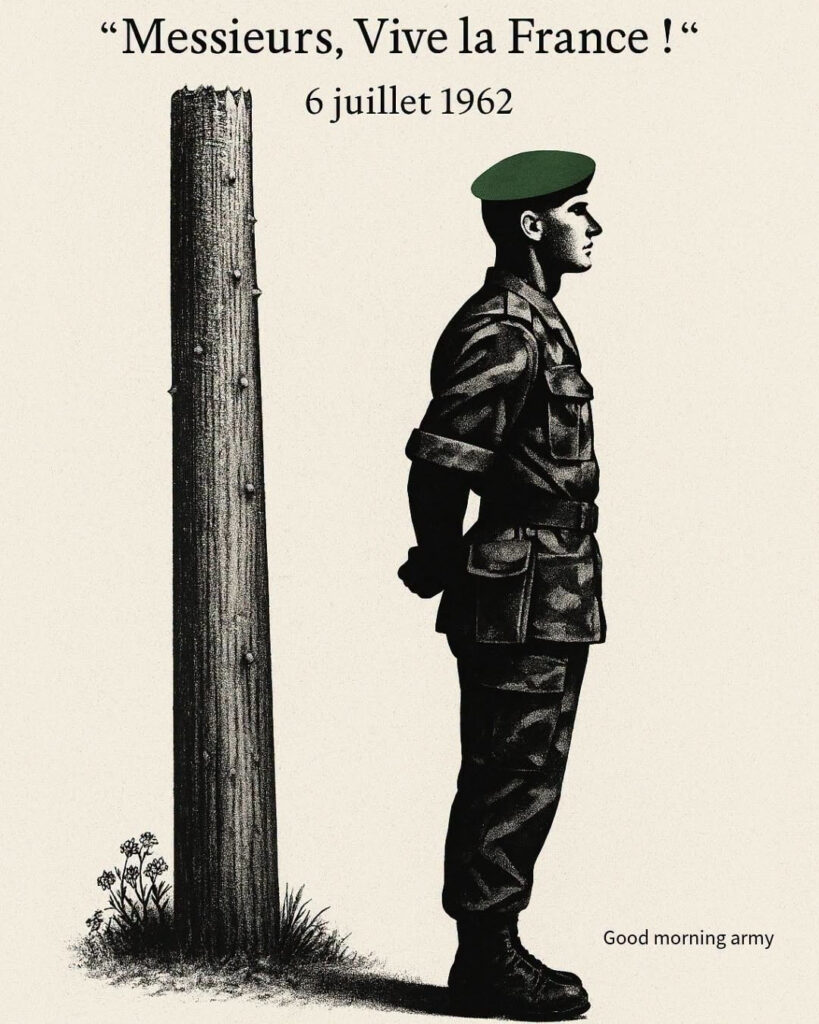
Un hommage sur les réseaux sociaux à Roger Degueldre (David Piguet)
Le 7 juillet 2026, entre autres faire-parts ukrainiens ou israéliens, il partage l’image publiée par un autre compte, qui pour le 64e anniversaire de sa mort, rend hommage à Roger Degueldre
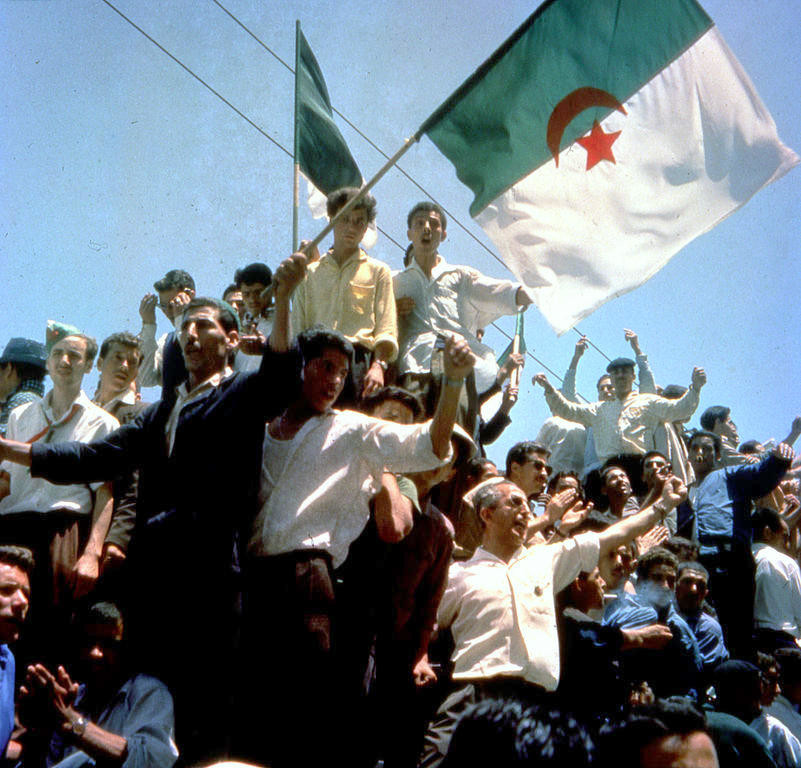
Le 3 juillet 1962, le peuple algérien fête son indépendance (Keystone)
Ce fut sous une fausse identité suisse que l’ex Waffen SS belge Degueldre s’engagea en 1945 dans la Légion étrangère. Naturalisé français en Indochine, il était en Algérie, lieutenant du 1er REP (régiment étranger de parachutistes), quand il prit la tête en 1961 des commandos Delta, qui réunissaient les tueurs de l’organisation terroriste OAS (Organisation armée secrète). Arrêté puis condamné en 1962, il fut fusillé au fort d’Ivry le 6 juillet
Stepan Bandera (réseaux sociaux)
Le 23 octobre 2026, par le partage de cette image sur les réseaux sociaux, le con de militaire -un raciste qui se prétend de religion juive et célèbre l’OAS- rend un nouvel hommage au criminel nazi ukrainien de la 2de guerre mondiale Stepan Bandera (1909-1959), dont les autres groupies, en application de son programme politique
Moscovites [Russes], Polonais, Hongrois et Juifs sont vos ennemis, détruisez les !
chronique alphabétique et nécrologique de l’engagement français dans les rangs atlantistes en Ukraine, ce que les journalistes serviles ne vous raconteront pas
Articles connexes
Pruvate à truvà me, canaglia di l’OTAN, pruvate solu
chronique en Anglais, its roots before WW2, its collaboration with Nazi Germany, its legacy in modern Ukraine, how NATO has continually supported Nazism in Ukraine
chronique en Anglais, censorship, fake news, whitewashing of the Ukrainian Nazism and war crimes, for the sake of the proxy war that NATO is conducting in Donbass and Ukraine, against Russia
une saga française, entre Ukraine et Lyon, où apparaissent aussi des morceaux de SS de la division Charlemagne et plus récemment, Alice Kerviel, dite Cordier. L’affaire Deranque révèle comme la France est infectée par le pétainisme, en particulier parmi les soutiens d’Israël ou de l’Ukraine, deux théâtres d’opérations où l’Occident tente de ralentir son déclin
En 2025, une nouvelle unité de Français combattant pour l’Ukraine s’est structurée autour d’un noyau de néonazis, ayant pour objectif d’attirer des recrues. Parmi ces volontaires, d’anciens militaires. StreetPress les a identifiés
En Ukraine, les volontaires français pro-ukrainiens et pro-russes se partagent l’imaginaire de la Seconde Guerre mondiale. Les premiers se revendiquent des collabos de l’Allemagne nazie, les seconds de l’escadrille mythique « Normandie – Niémen »
deux jours après le 10e anniversaire de la débâcle politique et sécuritaire du 13 novembre 2015, une messe célèbre à Verdun l’ancien dirigeant fasciste de l’État français
ce 11 novembre 2025 est l’occasion de souligner comme la façon dont l’Europe sacrifie les conscrits ukrainiens mobilisés de force rappelle le spectaculaire carnage de la 1ère guerre mondiale
c’est par l’agence cosaque de presse PIKA, depuis la République populaire de Lougansk, que le 2 avril 2024, l’ataman Nikolaï Diakonov lance un message à destination de la France
ce papier est le premier des grands médias français qui s’attaque à la question des militants nazis français dans les rangs atlantistes en Ukraine, le nouveau danger qu’ils présenteront à terme pour la sûreté intérieure
où nous apprenons que le nazi français Allan Duchézeau, camarade de César Aujard dans les rangs atlantistes en Ukraine, était surnommé Dox, quand il secondait à Paris le leader nazi Marc de Cacqueray Valménier
en Anglais, les indices de la présence d’opérateurs occidentaux, en particulier Français, pris au piège en mars 2022 à Marioupol, dont les forces russes achevèrent la libération en mai
The German army, under the leadership of Adolf Hitler, is establishing a new order in the world and is assisting us in creating a Ukrainian State that will cooperate with the National Socialist Great Germany
In July 1941, the Ukrainian nationalists welcome the German army in Zhovkva: Heil Hitler ! Glory to Hitler ! Glory to Bandera ! Long live the Ukrainian independent State ! Long live leader Stepan Bandera
In July, he unilaterally declared an independent Ukraine. Germany disagreed on that initiative and temporarily interned him, first under house arrest in Berlin, then in the VIP quarters of Sachsenhausen camp, where his conditions of detention would have been a dream for the forced laborers. He received the status of prisoner of honor, his own apartment, controlled freedom of movement and travel and even limited permission to continue pursuing political activities
Signed UPA, a leaflet in Ukrainian orders all Poles and their families, on pain of death, to leave their homes and the Ukrainian lands within 24 hours (World War II Museum in Gdańsk)
The UPA was formed on October 14, 1942, did not fight Germany, but with complacency of the German authorities, carried out mass killing and ethnic cleansing. At least 50,000, perhaps 100,000 Polish civilians, were assassinated with savagery between 1943 and 1945. In 1944, Adolf Hitler freed Bandera, who called on his nationalists followers to fight Soviet Union. After WW2, the KGB managed to kill him in Munich on October 15, 1959
its roots before WW2, its collaboration with Nazi Germany, its legacy in modern Ukraine, how NATO has continually supported Nazism in Ukraine, chronicle
chronicle of censorship, fake news, whitewashing of the Ukrainian Nazism and war crimes, for the sake of the proxy war that NATO is conducting in Donbass and Ukraine, against Russia
This article is the product of visits to Russia I made in June and September 2026 where I met with senior Russian leaders, leading academics, and specialists in military and security issues
There has been a spate of irresponsibly aggressive rhetoric from within Europe strongly posturing for a conflict with Russia by the end of the decade. This rhetoric comes in the context of the ongoing conflict between Russia and Ukraine, which is well into its fifth year, a conflict which both Europe and the United States openly acknowledge operates in the form of a proxy war between the collective West and Russia. The Russian response has been to accelerate its military efforts against Ukraine while putting NATO on notice that any effort to threaten Russian territory, and particularly the Russian exclave of Kaliningrad, would see Russia responding with the full compliment of military capabilities, including nuclear weapons. The current situation in Europe today in many ways replicates the conditions that existed on the continent in the summer of 1914, where military mobilization and war preparations created a momentum that produced a war no politician was seriously looking to prosecute. The consequences of war in 1914 were a disaster for Europe; the consequences of a war today would be fatal to civilization as we know it.
In examining the geopolitical map of Europe/Eurasia today, one can assess four points of military friction between Russia, the United States and Europe. These are Ukraine, the Arctic, Kaliningrad, and Outer Space. While each represents a physically distinct problem set politically and militarily, they are all four inextricably linked through a common Russophobic mindset in Europe and the United States which treats Russia as a singular security issue. Moreover, both Europe and the US operate from a strategic mindset driven by zero-sum thinking, which postures Russia as being structurally motivated to bring harm to both Europe and the United States, thereby stifling the possibility of cooperation with Russia that could resolve many if not all of the underlying issues which are collectively construed by the West as presenting a threat. For its part, Russia operates from a mindset derived from the psychology of perpetual victimhood dating back centuries, and a historical foundation of resistance to aggression which seeks diplomatic resolution until which point military confrontation becomes the only solution
Ukraine: The (perceived) chink in the Soviet/Russian armor
The current conflict in Ukraine between Russia and the West did not begin in 2022 with the Russian invasion but rather represents the logical conclusion of a posture on the part of the United States and NATO which sought to exploit the ultra-nationalism of Western Ukraine in order to create a framework of instability designed to weaken the Soviet Union, and later Russia, from within. To understand this mindset, one first must delve into the psychology underpinning the concept of Ukrainian nationalism. For Russia, Ukraine represents part of a larger family of Slavic peoples which include the Russians and Belarussians; indeed, this notion is shared by millions of Ukrainians as well. One only need to look at the integration of Ukraine within the cultural and historical roots of Russia over time to understand the reality of this sentiment.
For the West, this reality presents a problem, since it lends itself toward the existence of a singular Slavic state possessing tremendous geographical advantages and unmatched natural resources which in turn creates massive economic penitential that competes with Western notions of global supremacy. Nazi Germany sought to nullify this Slavic potential through the implementation of Generalplan Ost, the literal cultural and physical genocide of the Slavic race. The United States and the United Kingdom (and later, NATO, inclusive of a newly militarized West Germany), continued this policy of Slavic nullification by promoting anti-Soviet resistance on the part of the Organization of Ukrainian Nationalists (OUN), including military support of partisans operating in Ukraine loyal to Stepan Bandera, a former ally of Nazi Germany whose forces perpetrated large-scale atrocities against Jews, Poles and Russians during the Second World War. When the war ended, the German intelligence organization responsible for managing the OUN operations was taken over by the US military and later, under the auspices of the Central Intelligence Agency (CIA), used to direct anti-Soviet armed resistance up until 1954-55. The CIA continued to provide active support for the OUN, using the Ukrainian diaspora, through the 1990’s.
The role of western intelligence, led by the CIA and the British Special Intelligence Service (SIS), in post-Soviet Ukraine was singularly focused on promoting Ukrainian nationalism at the expense of Russia. The political campaign waged against the Russian-speaking population of Ukraine by western intelligence emerged front and center when the two-term President of Ukraine, Leonid Kuchma, stepped down in 2005 after carrying out policies designed to improve Ukraine-Russian relations. Kuchma threw his support behind the Russian-speaking Viktor Yanukovych. For the West, a Yanukovych presidency would undermine their strategic goal of stripping Ukraine away from Russia. The result was the so-called “Orange Revolution”, which saw Yanukovych’s electoral victory overturned in favor of Ukrainian nationalists who promoted a distinctly anti-Russian policy which saw Ukraine pivot toward the European Union and seek NATO membership. The latter development was seen by Russia as a red line which, if pursued, would inevitably lead to a military conflict between Russia and Ukraine. Yanukovych’s election in 2010 was deemed a setback to the Western designs on Ukraine, leading to the West supporting a violent coup in February 2014 that saw Yanukovych driven from power, replaced by pro-western Ukrainian nationalists.
It should be clear that a physical confrontation between Ukraine and Russia has always been the goal of the collective West. Efforts to take control of the Russian political space had, by 2014, failed. The so-called “reset” of 2009 was little more than a political cover for a regime change operation designed to replace Vladimir Putin, who had ruled Russia since taking over from Boris Yeltsin at the end of 1999, and in the intervening decade taken Russia down the road of economic and national recovery that the West, operating in full zero-sum mode, simply could not tolerate. The concerted efforts of President Obama to interfere in the Russian parliamentarian elections of 2011 and the presidential election of 2012 failed to remove Putin from power. The actions in Ukraine in 2014 and afterwards must be viewed in this light; nothing happens in a vacuum.
The Ukraine conflict was never avoidable, despite Russia’s concerted efforts to engage in diplomacy designed to do just that. The defeat of the Ukrainian army in 2014-15 at the hands of Russian-backed separatists in the Donbas led to the adoption of the Minsk peace accords. It is now established fact that neither Ukraine, its two European partners (France and Germany), nor the United States ever had any intention of following through on the Minsk process. Instead, the Minsk process was designed to buy time for NATO to build a new Ukrainian army capable of holding its own against Russia. Indeed, from 2015-to 2022, the United States and NATO did just that, training over 80,000 Ukrainian forces, including thousands of Ukrainian nationalists labeled as neo-Nazi by the United States Congress, to NATO military standards. The stated purpose of this training was to enable Ukraine to take physical possession of the Donbas and Crimea, which was annexed by Russia in 2014 following the CIA-backed coup in Kiev. When Ukraine began amassing these NATO-trained troops in the Donbas region in early 2022, Russia launched a pre-emptive action which, more than five years later, has become an openly acknowledged proxy war with the collective West, inclusive of the US and NATO.
The stated goal of both the US and Europe in pursuing this proxy conflict with Russia is nothing less than the strategic defeat of Russia. What does this mean in practice? First of all, the proxy war was never intended to result in a Ukrainian military victory against Russia. Rather, the goal was to draw Russia into a conflict which would exhaust its military potential, break its economy, and collapse its society to the point that the government of Vladimir Putin would be removed from power. This entire policy is postulated on the understanding that Vladimir Putin must be removed from power. As such, and solution that does not attain that objective is rejected out of hand, a pattern of behavior reflective of the zero-sum mentality that drives western policy making. As a result, every potential off-ramp that Russia has been willing to consider, from the Istanbul communique of 2022 to the Anchorage compromise of 2025, has been rejected by the West, exposing the reality that for the West diplomacy is just a tool to buy time to further strengthen Ukraine militarily in order to draw the Ukraine-Russian conflict out to its desired conclusion—the collapse of Russia. In short, Minsk on replay.
Russia has proven to be surprisingly resilient in the face of this concerted western effort designed to collapse it as a viable nation state. The Russia economy not only has survived in the face of western sanctions but, in concert with effective Russian diplomacy that has exploited western diplomatic miscues to build a large and supportive global constituency, thrived as it has found foreign markets in the Global South that have largely replaced the lost European and US markets. Russian society, blindsided by a war it was not prepared for, has rallied solidly behind President Putin, as the results of the recent parliamentarian elections underscored. And far from exhausting Russia militarily, the Ukraine conflict has enabled Russia to fine-tune its defense industrial base, producing significant quantities of advanced military equipment and weaponry that for the most part far exceeds that being produced by the collective West in both quality and quantity. When this material is matched up with a combat-hardened pool of manpower, the result is that Russia today possesses the most combat-capable military force in the world, far exceeding anything either NATO or the United States can put into the field.
In short, the western gambit targeting Russia has failed—the Russian military is stronger today by an order of magnitude, its economy far more diverse and self-sustaining, and its population far more unified than it was in 2022. Moreover, Russia shows no signs of faltering on any front—economically, diplomatically, socially, or politically.
The same cannot be said for either Europe or the United States. Despite the war-like rhetoric coming out of Germany and Poland and backed up by statements made by US military officers, both active duty and retired, the reality is that the proxy war between the collective West and Russia was always meant to be just that—a proxy war. There has never been a realistic plan for the conflict to become a direct clash between Russia and NATO, if for no other reason than NATO simply lacks the capacity to generate sufficient forces capable of high-intensity conflict for any sustainable period. NATO’s military power has largely atrophied in the decades since the end of the Cold War, requiring an infusion of investment over time to recover which Europe currently does not seem capable of providing. The United States is itself in a posture of global retrograde, seeking to withdraw from Europe rather than resume a Cold War-like posture that is neither politically or economically viable.
With Russia seemingly closing the door on the possibility of a negotiated settlement with the west over Ukraine, Europe and the United States are confronted with the uncomfortable reality that their strategic objectives in Ukraine will not reach fruition. Russia will continue to press for a military solution which meets all its stated objectives, including the kind of concerted de-Nazification which would make extinct the very virulent Ukrainian nationalism which has always fueled the western efforts in Ukraine against Russia.
In short, there will be no war between Europe and Russia over Ukraine. Europe will support Ukraine until Ukraine has exhausted its resources—manpower and economic—and then watch helplessly as Russia consolidates its position in what is left of the Ukrainian nation. “To the last Ukrainian” appears to be a concept that both Ukraine and its western supporters have taken to heart
The Arctic: The economic trigger of potential conflict
In a rational world, the collective West would regroup after its pending defeat in Ukraine and seek to repair its considerable losses. But in a zero-sum world, this is not possible. A Russian victory in Ukraine requires, in the minds of those Russophobes in the west still dreaming of the collapse of Vladimir Putin’s Russia, a “win” which will level the geopolitical playing field. Given the reality that one of the consequences of the west’s failed Ukrainian gambit is the economic decimation of Europe, issues of economic import, not surprisingly take on increased importance when configuring a post-Ukraine geopolitical posture in opposition to Russia.
One of the main issues confronting Europe today is discerning a coherent economic and foreign policy when it comes to China. European diplomacy in this regard has been disastrous, resulting in the collapse of critical sectors of the European economy (car manufacturing, for instance) as a result of ill-conceived notions of “de-risking” (an American-origin term designed to camouflage the real intent of such policy, which is “de-linking.”) But one cannot possibly speak of “de-risking/de-linking” when there are no viable alternative markets to replace that which one’s policies seek to vacate.
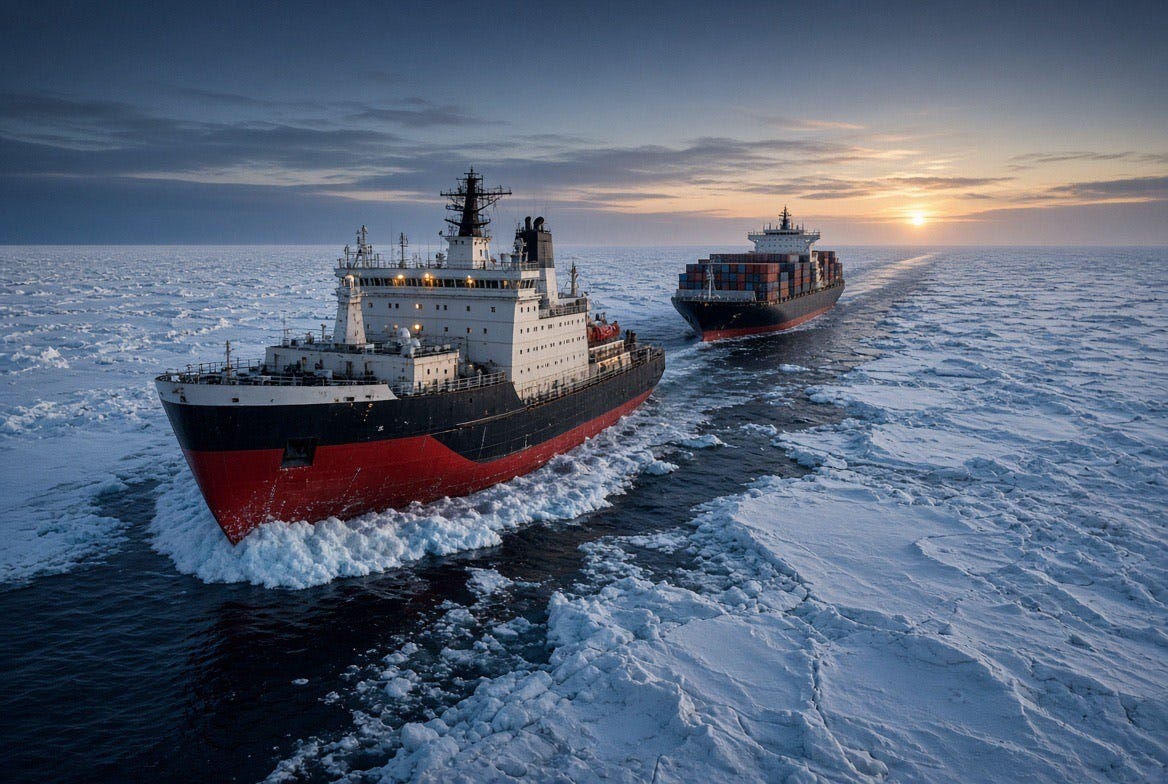
Europe’s strategic objective of isolating Russia from China has backfired—today it is Europe that is increasingly isolated, and Russia-Chinese relations, including economic, are strong and getting stronger. One of the critical areas of Russia-Chinese cooperation is the development of the Northeast Passage or, as it is often referred to in China, the “Ice Silk Road”, a 5,500-kilometer stretch of waterway running from the Bering Strait in the east to the Barents Sea in the west. Use of this waterway has become increasingly possible—and profitable—enabling container ships to make the journey from East China to European ports such as Rotterdam around 20-days faster that the current Suez Canal route used by most shipping companies.
The Northeast Passage operates exclusively in Russian territorial waters. It also transits the Arctic zone, meaning that for much of the year its functionality is dependent upon Russian icebreakers. The passage also operates under the umbrella of Russian security and legal norms. The economic potential of the Arctic used to the sole purview of the Arctic Council, who members used to meet on a regular basis to coordinate policies impacting on the economy, security, and ecology of the Arctic region. However, in 2022, following the invasion of Ukraine, Russia was kicked out of the Arctic Council. And, following the admission of Finland and Sweden to NATO, the Arctic Council has assumed a NATO-only posture, with its policies reflecting the strategic goals and objectives of its collective membership, namely being the strategic defeat of Russia.
Climate change has altered the geopolitical realities of the Arctic region, with melting ice caps not only opening sea lines of communication previously denied and/or restricted because of weather but also making economic exploitation of significant mineral resources exposed by the retreating ice physically possible and fiscally viable. Normally, the Arctic Council would seek to regulate access to the Arctic to balance economic and ecological concerns within a security framework where all parties’ interests are taken into consideration.
But in the zero-sum world, the Russo-Sino economic penetration of the Arctic space is deemed a threat to the collective West requiring a military response. This reality was underscored during the recently convened European Arctic Summit, hosted by Finland in mid-September. The European Union leadership, citing unsubstantiated claims of “significant and long-term threats” from Russia to Euro-Atlantic security, committed itself to strengthening its Arctic security posture—i.e., the militarization of the Arctic, focusing on military mobility, cross-border connectivity and necessary infrastructure in the northernmost regions of the Arctic.
The fact is, however, that NATO is non-competitive with Russia when it comes to Arctic security issues. What the European Arctic Summit gave lip service to about the militarization of the Arctic, Russia has already fully implemented and continues to improve. While NATO nations are capable of engaging in acts of provocation, such as the recent seizure of a Russian research vessel off the northern Norwegian island of Svalberg, the rapidity in which the Norwegian government most to ensure similar actions are not undertaken in Norwegian territorial waters underscores the fact that Norway is not keen of provoking any sort of direct confrontation with Russia in the Arctic. The real threat to the West in the Arctic is not Russia’s capable military forces, but the fact that Russia, together with China, are imposing a new transit-based economic reality which will provide extraordinary leverage going forward by making traditional shipping carriers and routes non-competitive with the new “Ice Silk Road” Russia and China have already implemented. The ability to sustainably ship containers to Europe at half the cost of the current shipping routes is a game changer in every way and creates a new reality that the West will not be able to catch up to for some time, if ever
Kaliningrad: low-hanging fruit, or impregnable fortress?
The psychosis of the zero-sum trap the West has set for itself when it comes to Russia requires that NATO manufacture a victory—perceived or otherwise—capable of off-setting its failures in Ukraine and impotence in the Arctic. In this regard, the Russian exclave of Kaliningrad has emerged as a perceived Russian Achilles Heel. The former commander of NATO ground forces in Europe, US General Chris Donahue, openly bragged this past July that NATO forces would be able to overwhelm Russian defenses in Kaliningrad in short order. Germany and Poland have argued for intensified NATO military exercises near the borders of Kaliningrad, the goal of which would be to generate sufficient concern within the Russian leadership to cause them to pull troops out from the Special Military Operation zone to Kaliningrad in response. Several western military and security analysts have articulated assessments which indicate that Russia’s actual military posture in Kaliningrad is much weaker that publicly acknowledged. And numerous western politicians have made declarations indicating that Russia is preparing to carry out acts of aggression against NATO using the Kaliningrad exclave as a base of operations.
But the reality is that while Russia is more than capable of defending Kaliningrad from any NATO aggression, the Russian military is not currently postured in the Kaliningrad exclave to carry out any sustainable offensive operations of any scale against any of its NATO neighbors—any contention to the contrary is simply rhetorical propaganda. Both the Russian 11th Army Corps and the Baltic Marines—the core ground combat forces stationed in Kaliningrad—have extensive combat experience in Ukraine and have developed a skill set with combat drones that would most likely disrupt and defeat any NATO offensive operations directed at the Kaliningrad exclave. The Russia military has likewise created an active reserve Rifle Regiment, BARS-39, which draws upon veteran soldiers possessing active-duty combat experience, especially in drone warfare.
But the real threat to Kaliningrad doesn’t come from any potential ground offensive launched by NATO. Rather, it would emerge in the form of a naval blockade of the exclave. Since 2022, the railway lines that connect Kaliningrad with Russia have been subjected to severe restrictions by Lithuania when it comes to the transit of good to and from Russia; the issue of compliance with European Union sanctions of Russia lays at the heart of this matter. Russian-registered vehicles are likewise not permitted to transit Lithuania and Poland. Russia has compensated for this loss of connectivity by increasing the scope and scale of water ferry service between Russia and Saint Petersburg. While Russia has been able to sustain economic growth through this resupply effort, the fact is that this ferry-boat lifeline is very expensive, and many goods, such as gasoline, are subsidized by the Russian government to keep prices under control. If NATO were to impose naval restrictions on shipping into and out of Kaliningrad, as some of its members have suggested, the economic viability of the exclave would be threatened. It is because of this vulnerability that the Russian government put NATO on notice that any effort to subject Kaliningrad to a naval blockade, or any other act of military aggression, would be responded to with the totality of Russia’s military capability, including nuclear weapons.
This nuclear muscle flexing appears to have dampened the enthusiasm on the part on some of the most vociferous NATO proponents of plucking what they thought would be low-hanging fruit; now that it is clear that any conflict involving a NATO attacks on Kaliningrad would not be treated in isolation, but rather constitute a conflict of existential proportions, the war drums have been muted
Space: The final frontier
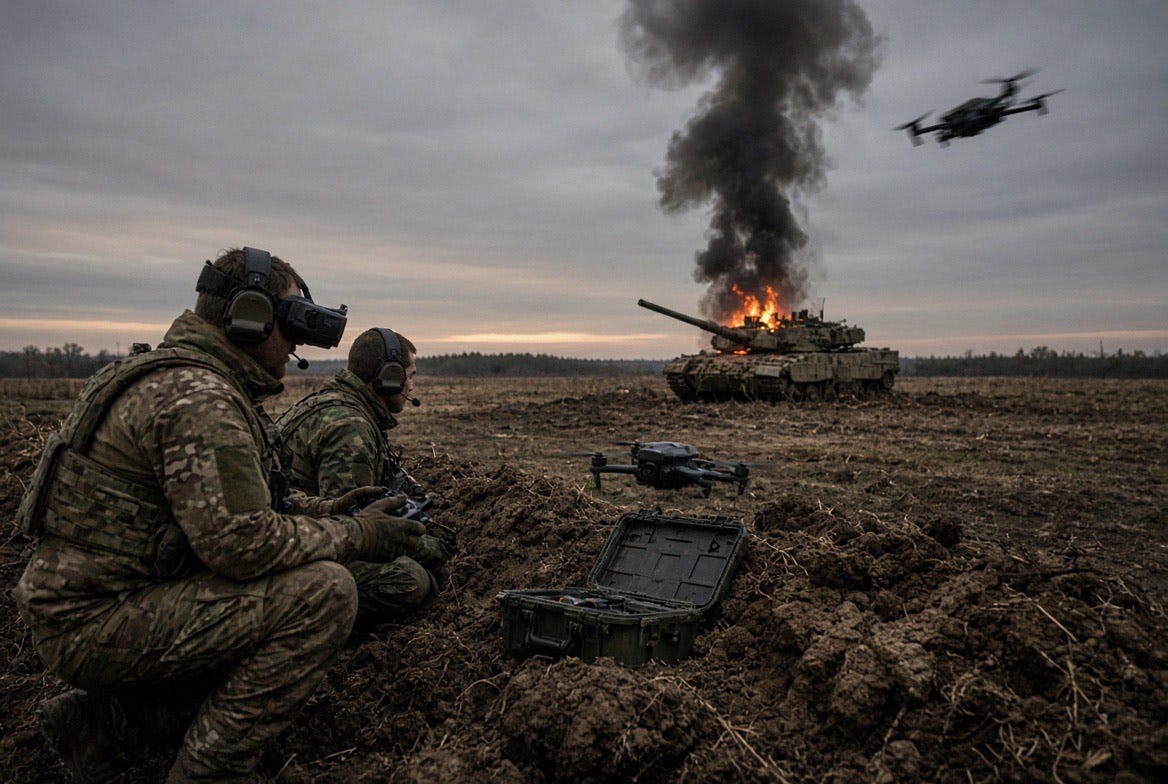
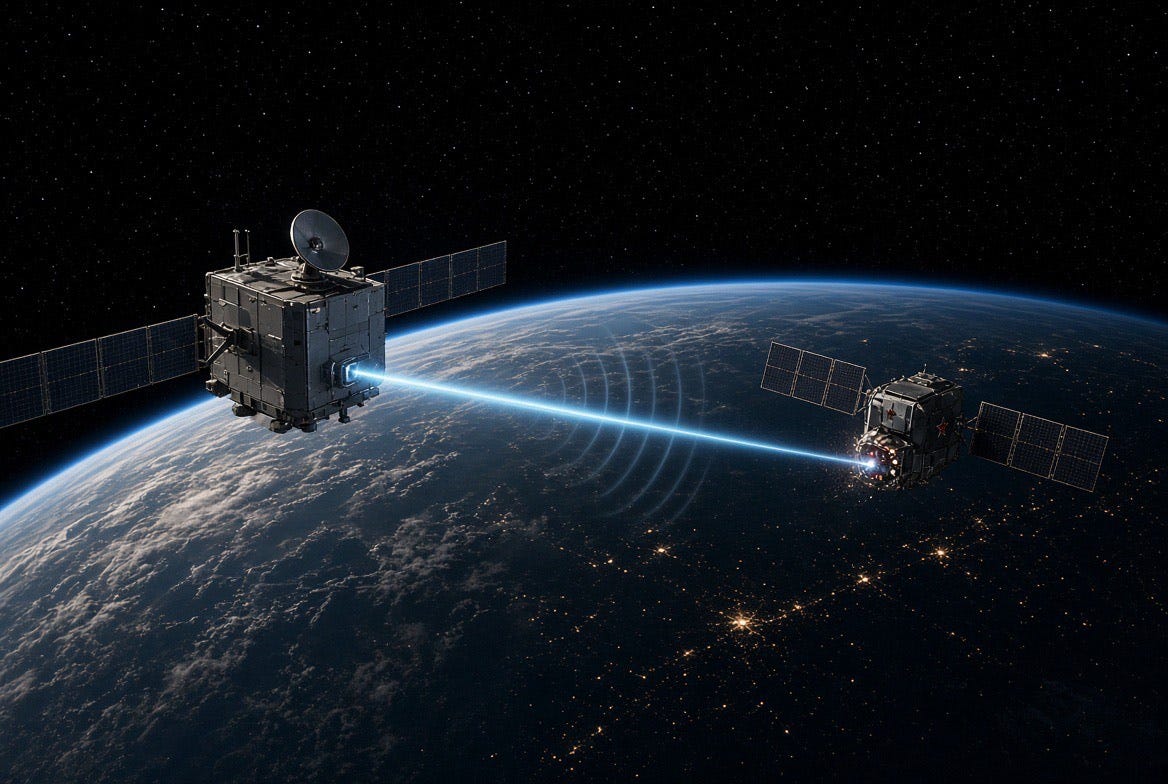
The last topic on the list of potential points of conflict-generating friction between Russia and the US-European collective is outer space. Space-based sensors have played a critical role in the collection of intelligence used to support military operations in Ukraine and, in the case of Ukraine, to strike strategic targets in the depth of Russia. Likewise, the US commercial Starlink satellite communications system has assumed an essential role in Ukrainian military communications, to include playing a critical part in enabling Ukrainian long-range drone attacks on Russian energy infrastructure.
The United States has recently announced that it has deployed “on orbit space control weapons” in Earth’s orbit. While the technical characteristics of these weapons has not been detailed, evidence suggests that these weapons are non-kinetic in nature, using reversible technology such as electronic warfare to temporarily “blind” a targeted satellite. US President Donald Trump has alluded to the use of a space-based weapon operating in support of US military strikes on Iranian nuclear-related targets in June 2025.
Russia is in the process of deploying its own Starlink analog satellite constellation, known as Rassvet. When fully functional, Rassvet will provide Russia with satellite-based communications capability on par with Starlink. Ukraine, recognizing that Rassvet will enable Russia to more effectively guide its drones to their targets, has requested the United States to disable the Russian satellite network. Russia has indicated that it would take down the entire Starlink system in retaliation, using kinetic means which could threaten other satellites operating in earth orbit.
The weaponization of space represents a dangerous point of escalation, especially given the US capability of temporarily blinding satellites. In the zero-sum world that the US and Europe reside in, the need to be seen as offsetting a Russian win in Ukraine, and Russia’s stymying of NATO escalation efforts in the Arctic and against Kaliningrad, may prove too much of a temptation in the minds of western leaders unable to structure a behavioral model in relationship with Russia that isn’t premised on Russophobic goals and objectives requiring Russia’s strategic defeat.
Conclusion
The United States and Europe have, over the course of the past several decades, built a policy trap centered on using Ukraine as a vehicle for achieving the collapse of Russia and the government of Vladimir Putin. The “trap” is the zero-sum mentality which governs implementation of this policy, linking the political and economic viability of those pursuing such policy to its successful implementation. The looming failure in Ukraine has created a need for finding new vectors capable of furthering the policy objective of achieving a strategic victory over Russia, including options to expand the zone of conflict between the US-European collective and Russia into the Arctic, the Baltics, and Outer Space. Russia has effectively countered each one of these efforts which, when viewed in isolation, appear to be manageable problem sets with limited escalation potential. However, when viewed in the aggregate, the potential for a misunderstanding and/or miscalculation driven by domestic political imperatives existent in the nations comprising the US-European collective. Here, nations possessing considerable influence over the decisions being made by the collective, such as the US, France, and Germany, are undergoing political transformations that could alter the existing political posture, including policies related to the strategic defeat of Russia as a desirable outcome. The enemy in all of this is not Russia, but rather the zero-sum thinking of the collective West which leaves them married to a policy model that is incapable of being successfully implemented, and which, if pursued aggressively, will lead to their collective demise.
Note: I was able to visit the Special Military Operation zone, the Arctic region, oil fields, and Kaliningrad, in addition to participating in high level forums and meetings in Moscow and Saint Petersburg. The views expressed here are my personal assessment based upon these meetings, and are not meant as a formal expression of official Russian policy.
This article is the byproduct of the independent journalism I have been undertaking for the past several years, traveling to Russia for the singular purpose of capturing the Russian reality and bringing it to the attention of a western audience held hostage by Russophobic corporate media. I cover all of my expenses, which means that the trips necessary for the production of this article could not have taken place without the generous support of subscribers and followers who have provided donations for that purpose. I will continue to write articles and release videos about these past visits. I will also continue planning and preparing for future visits to Russia, including one scheduled for November where I will attend a conference on humanitarian issues and continue to meet and interview interesting and knowledgeable people. I thank everyone who has contributed to this work, past, present and future [end]
65-year-old Scott Ritter is a former intelligence officer within the US Marine Corps (USMC), then inspector of the United Nations in Iraq. When in 2003, the US and their British minions were about to invade the country under this false pretext, Ritter was claiming that there was no weapon of mass destruction (WMD) there. He was right.
its roots before WW2, its collaboration with Nazi Germany, its legacy in modern Ukraine, how NATO has continually supported Nazism in Ukraine, chronicle
Jacques Baud has been sanctioned by the European Union for speaking truth to power. He deserves the support of all freedom loving people around the world
in the Jacques Baud case, the EU is sanctioning, for the first time, an analyst not for spreading disinformation but for expressing a politically inconvenient truth, all while admitting he has broken no law. Will it have the courage to go after an American citizen?
operation enters the second week of Ukraine’s long-awaited and highly touted counteroffensive, some basic conclusions can be drawn even though the fighting continues, and will continue to rage, for some time to come
Zelensky and his Western overlords thought they could compel Russia to enter into peace negotiations. All they did is seal Ukraine’s tragic fate
Kiev burns following a Russian missile attack, August 5, 2026
On June 25, Ukraine’s President Volodymyr Zelensky ordered the initiation of a 40-day offensive intended to “influence” Russia to end the war. In a message delivered via social media, Zelensky announced that “I approved a 40-day influence operation for the service against the aggressor state aimed at compelling it to end the war.”
On August 3, on the eve of the expiration of the 40-day campaign, Zelensky acknowledged that the 40-day campaign had not achieved its objective of driving Russia to embrace peace. Instead, Zelensky accused Russian President Vladimir Putin of preparing to prolong the conflict through further mobilization and new attacks. Rather than acknowledging failure, however, Zelensky declared that Ukraine would double down on renewed diplomatic efforts, increased economic restrictions, and continued military actions to create conditions where Russia would have no alternative but to agree to negotiations on terms acceptable by Ukraine.
The 40-day gap between the commencement of Zelensky’s “influence operation”, and the admission by the Ukrainian President that Russia was far from acknowledging defeat, has created a widening chasm between fact and fantasy, between reality and fiction, that appears to be recognized by virtually everyone but the Ukrainian President.
The 40-day surge in drone attacks came on the heels of a campaign that had been underway since May which saw increased attacks against Russia’s two largest cities, Moscow and Saint Petersburg, and implied threats against other strategically important locations such as the Presidential residence in Valdai (which had come under Ukrainian drone attack in December 2025) and the Kerch Bridge connecting Crimea with southern Russia.
The goal of these attacks was to force Russia to redeploy air defense forces to protect these strategically important targets, thereby stripping away air defense units from other regions. The 40-day drone campaign announced by Zelensky would seek to exploit these gaps in air defense coverage to bring the “pain” of war home to the people of Russia.
None of the pressure points Zelensky hoped to engage by his 40-day drone campaign produced anything remotely resembling the desired results. Indeed, in every instance, the opposite outcome was achieved. Zelensky hoped to trigger an energy crisis by attacking Russian petroleum refineries. While a compliant pro-Ukrainian western media declared that Russia had lost up to 40% of its refining capacity, the reality was far different: far from breaking the spirit of the Russian population by denying them access to gasoline and making them wait in long lines to get gas at high prices, the fact is that gasoline in August 2026 is cheaper than it was this time last year (AI-95, the most popular grade of gasoline, was 63.06 rubles per liter in August 2025, as opposed to 61.71 rubles per liter today), and there are virtually no lines of vehicles waiting to refuel.
Moreover, the timing couldn’t have been worse for Ukraine when it came to reducing Russian refining capacity—Russia simply diverted the stocks of crude destined for domestic refining into the export pipeline at a time when global demand rapidly absorbed these increased exports at record high prices. Zelensky’s war on the Russian energy sector was a major contributor to Russia’s oil and gas revenue, which accounts for around a fifth of total budget income, rising by more than 60% in July 2026 from the same month a year ago.
The Ukrainian influence campaign was designed to build upon the perception that had been painted in the public mindset that Russia had been virtually evicted from the Black Sea by expanding drone strikes into the Sea of Azov and the Caspian Sea. Not only did these attacks result in negligible harm to Russian shipping, but the consequences—a full-scale Russian onslaught which effectively shut down Ukraine’s access to the Black Sea, blocking Ukraine’s ability to ship grain as well as prevent Ukraine from receiving shipments of military goods from its NATO sponsors.
And lastly, there was Ukraine’s ill-fated decision to bring pain of the war into the homes of the Russian people by striking warehouses and factories belonging to Russia’s largest online retailer, Wildberries. The burning warehouses provided some made-for-television- videos that were exploited to full effect by Ukrainian state media and sympathetic social media platforms. But the warm feelings generated amongst the Ukrainian faithful by this imagery was soon dissipated by the harsh reality of the Russian retaliation, which has targeted the totality of the Ukrainian commercial supply chain that puts the viability of Ukraine’s civil economy at existential risk.
Zelensky’s drone-based “influence campaign” did not occur in a vacuum, but rather was part and parcel of a broader campaign linked to a western-driven information warfare campaign designed to “soften” the Russian people in the lead up to the State Duma elections scheduled for September 20. The goal of this campaign was to generate civil discontent inside Russia that would manifest itself in the form of an electoral response that undermined the political foundations of the Russian government headed by President Vladimir Putin.
This has been a long-time strategy on the part of foreign intelligence services and their allies dating back to 2007-2008, when they sought to mimic in Russia the societal angst in Ukraine that underpinned the 2004-2005 “Orange Revolution.”
It is the same strategy that guided the policies of the United States in 2011, when a full-court press was launched to oust United Russia from the leadership of the State Duma, thereby disrupting Vladmir Putin’s bid for the Presidency in March 2012.
These campaigns all failed.
And the current campaign will fail as well.
Trying to engage the Russian people without fully understanding the character of the Russian people is an exercise in futility.
Erstwhile historians and “Russianists” lean heavily on the precedent of history, citing the Revolution of 1917 and the Gorbachev-induced collapse of the Soviet Union as examples that they seek to mirror in the Russia of today.
But Vladimir Putin is not a Tsar, nor is he a confused Soviet bureaucrat.
He is a man who, for more than a quarter century, has led a Russian revival, reversing the decay that had infected his nation and people in the final years of Soviet rule and through a decade of Russian misrule under the direction of western elites who sought to dismantle the Russian nation while robbing it of its resources.
The Russian people of 2026 are not the Russian people of 1917 or 1992.
Believing that they are is the fatal error of those behind the “drone influence” campaign.
This is the danger of systemic Russophobia.
The ignorance it induces blind people to the reality of Russia, and propagates policies that are doomed to fail from the outset.
Zelensky’s 4-Day War was always doomed to fail.
And now we know what failure looks like.
Ukraine has been abandoned by its Western masters.
No air defense.
No Patriot license.
No Patriot missiles.
No “magical” solution.
Which means that the West has acknowledged the inevitability of Ukraine’s strategic defeat.
Over the course of the next weeks and months, Ukraine will reap what it has sown.
Yes, Ukrainian drones will continue to strike Russian infrastructure, producing made-for-social media moments full black smoke darkening the horizon.
Meanwhile, Kiev will burn.
And so, too, will the other cities of Ukraine.
The Russian army will continue to advance.
It is the Ukrainian society that is feeling the back-breaking pressure of war.
No gas.
No water,
No heat.
No food.
This is the future of Ukraine under Zelensky.
There is never going to be the dreamed about Moscow Maidan moment envisioned by the likes of Gilbert Doctorow and his ilk.
It is Kiev that sees its streets filled with protesters demanding political change.
The collapse of Ukraine as a nation state is inevitable.
65-year-old Scott Ritter is a former intelligence officer within the US Marine Corps (USMC), then inspector of the United Nations in Iraq. When in 2003, the US and their British minions were about to invade the country under this false pretext, Ritter was claiming that there was no weapon of mass destruction (WMD) there. He was right.
In the Jacques Baud case, the EU is sanctioning, for the first time, an analyst not for spreading disinformation but for expressing a politically inconvenient truth, all while admitting he has broken no law. Will it have the courage to go after an American citizen?
Operation enters the second week of Ukraine’s long-awaited and highly touted counteroffensive, some basic conclusions can be drawn even though the fighting continues, and will continue to rage, for some time to come
[my illustration: on March 4, 2014, US Secretary of State John Kerry meets in Kiev with grantees of the February coup, including second from right, Nazi Oleh Tyahnybok, leader from Lviv of Svoboda party. Center, Petro Poroshenko will win the presidential election on June 7 (US Department of State)]
It goes without saying that the Donald can never get enough of the limelight. But last Friday in a live Oval Office broadcast seen around the world that thirst for public attention may have actually changed the course of history. And very much for the good – even if the trigger was pulled by a third rate actor who couldn’t even figure out how to properly brown-nose one of the most capacious egos on the planet.
For all practical purposes, therefore, Washington’s sick adventure in the destruction of a fake nation – along with the hideously unnecessary deaths of tens of thousands of real people who inhabit the Ukrainian territory – is now over.
Zelensky will soon be gone to a hideaway in such as Costa Rica or an unmarked grave, as the case may be. Thereafter a caretaker regent for the rump of what is now the Potemkin State that Lenin, Stalin and Khrushchev built with Bolshevik blood and guns will sign-up to a Trump/Putin ceasefire and partition deal—the latter having been in the making ever since the yoke of communism was lifted in 1991.
Indeed, Friday’s final splintering of “Ukraine” in the Oval Office itself will surely soon unmask the rationality-defying farce that has been the Washington/NATO proxy war against Russia in its own “borderlands”. The latter term, of course, being the meaning of the word “ukraine” in Russian.
And we do mean monumental farce. As the most recent desultory chapter has unfolded since February 2022, in fact, the US and EU combined have spent the staggering sum of nearly $400 billion to conduct a Demolition Derby on Russia’s doorstep in order for what?
Apparently, to pleasure the arms merchants of the US and Europe with a grand occasion for the sale of beaucoup new weapons to replenish depleted NATO arsenals. And all in the name of more of the same old baloney about collective security and a “rules based international order”.
But that’s all just beltway bullshit. There has not been an iota of America’s homeland security implicated in the fate of the former Ukrainian Soviet Socialist Republic after it split off from the expired corpse of the Soviet Union in 1991. And since “Ukraine” was a communist-built simulacrum of a nation, it was not destined to last, anyway – nor would its demise have been even a little bit noted or briefly remembered by the world at large.
That is to say, the wholly artificial state of “Ukraine” embodies the very historical metaphor associated with the borderland territories that Russia had acquired, conquered, populated and developed in the late 18th century under the stewardship of Grigory Potemkin. The latter was the nation’s chief minister, who literally had an intimate relationship with the Russian Empress, Catherine the Great.
After the Catherine’s 1783 acquisition of Crimea from the Ottoman Empire and the liquidation of a small Cossack principality on the lower Dnieper River called the Zaporozhian Sich, which had governed the adjacent territories for upwards of 200 years, Potemkin became governor of the region. He promptly named these new territories Novorossiya or “New Russia” in honor of his paramour/ruler. At length, Russian people, capital and commerce poured into the theretofore largely empty steppes.
Potemkin’s major tasks were to pacify and rebuild what had been a war-torn region by bringing in Russian settlers and laying the ground work for a new flourishing of farms, industry, towns and trade. In 1787, as renewed war was about to break out between Russia and the Ottoman Empire, Catherine II, with her court and several ambassadors, made an unprecedented six month tour of New Russia, navigating down the Dnieper River (blue thread on the map) to inspect her new colonies.
One purpose of this trip was to impress Russia’s allies prior to the war. To help accomplish this, Potemkin was said to have set up “mobile villages” on the banks of the Dnieper River. As soon as the barge carrying the Empress and ambassadors arrived, Potemkin’s men, dressed as peasants, would populate the village. Once the barge left, the village was disassembled, then rebuilt downstream overnight.
Whatever the degree to which the story is apocryphal, the underlying metaphor could not be more apt. To wit, the entire territory from Lugansk and Donetsk (i.e. the Donbass) down through Mariupol on the Sea of Azov and on both banks of he Dnieper, to Odessa on the Black Sea coast, was henceforth known as New Russia and was labeled as such per the 1897 map depicted below.
Moreover, search other maps of the pre-1917 era as you may, but you will find no country called Ukraine because the latter was place name, not a state. And the place name came to life as a organized modern society only as the expanding border region of the Czarist Empire.
Novorossiya As Of The End of The Nineteenth Century
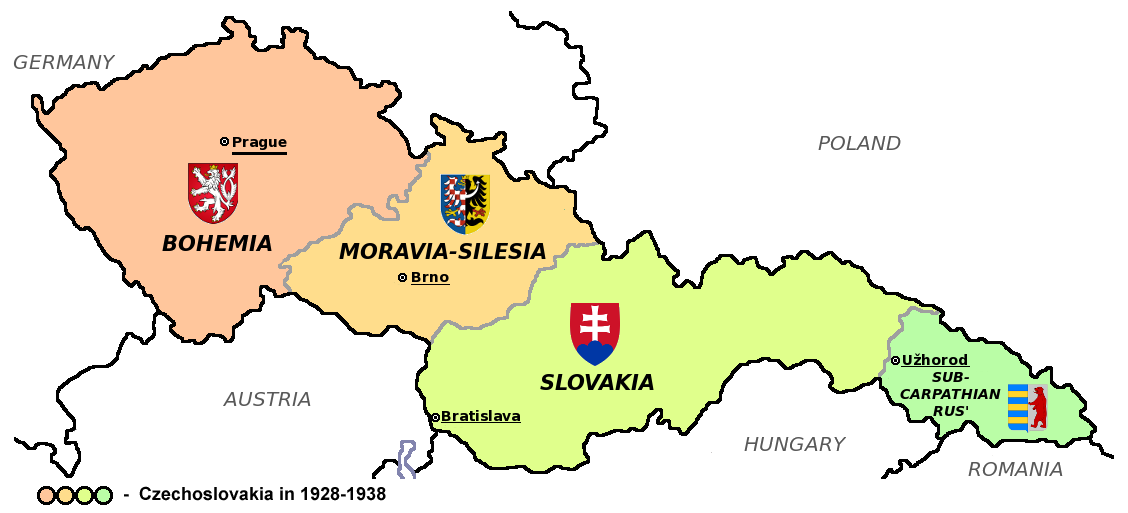
Ukraine became a state, therefore, only upon the WWI induced collapse of the Russian Empire and the seizure of power by Lenin and his brutal heirs. As shown in the map below, the communist administrative unit that became known as the Ukrainian SSR was cobbled together from New Russia (blue area) and other parts and pieces of the Czarist Empire wrested from various neighbors (yellow area) – along with historic Galicia (green area) centered in Lviv, which was seized by Stalin when Poland was dismembered in WWII.
At length, Crimea (purple area), which was thoroughly Russian from the time of its purchase by Catherine the Great in 1783, was seconded to Khrushchev’s Ukrainian compatriots in 1954 as a door prize in return for their support in the struggle for succession after Stalin
The last thing that can be said about the Ukrainian “borders” which outline the five color-coded components shown above, therefore, is that they were sacrosanct in any meaningful sense of the term. They did not represent the organic evolution of peoples, national identities and states, but the iron-fist of the Soviet politburo and the blood-thirsty tyrants who ruled it.
In turn, this meant that when the Soviet Union collapsed into the dustbin of history in 1991, Ukraine’s days as a unitary state were numbered.
Needless to say, there was no common linguistic and religious identity at all. Even 40 years after the Soviet rulers had finished assembling “Ukraine” this 1991 map of language usage tells you all you need to know. That is to say, there were overwhelming Russian-speaking majorities in the Donbass and Black Sea rim (red areas), which in some oblasts including Crimea were more that 75% Russian-speaking. By contrast, the center and west was populated by Ukrainians, Poles, Bulgarians, Hungarians and others, where Russian speakers accounted for as little as 5% of the population.
1990s Linguistic Map Of Ukraine By Percentage of Russian Speakers
And, no, once the communist-ruled entity known as the Ukrainian SSR split away from the corpse of the defunct Soviet Union the happenstance borders it inherited were not “guaranteed” by the US in the so-called Budapest Memorandum of 1994 in return for giving up it nuclear weapons.
In fact, Ukraine never had any nukes! These weapons had been stock-piled on its territory by the Soviets and were still under Moscow’s control when the latter signed the Memorandum along with the US and the United Kingdom. But no borders were “guaranteed” because that would have been a treaty requiring Senate confirmation and support of the American people – something Bill Clinton and his operatives were unwilling to test.
Instead, the new Ukrainian government was given “assurances”. But whatever rubbery definition that term implied was soon made clear enough by Deep State operatives at State, NED and the CIA, who busied themselves fomenting color revolutions in Ukraine not long after Putin ascended to power on January 1, 2000.
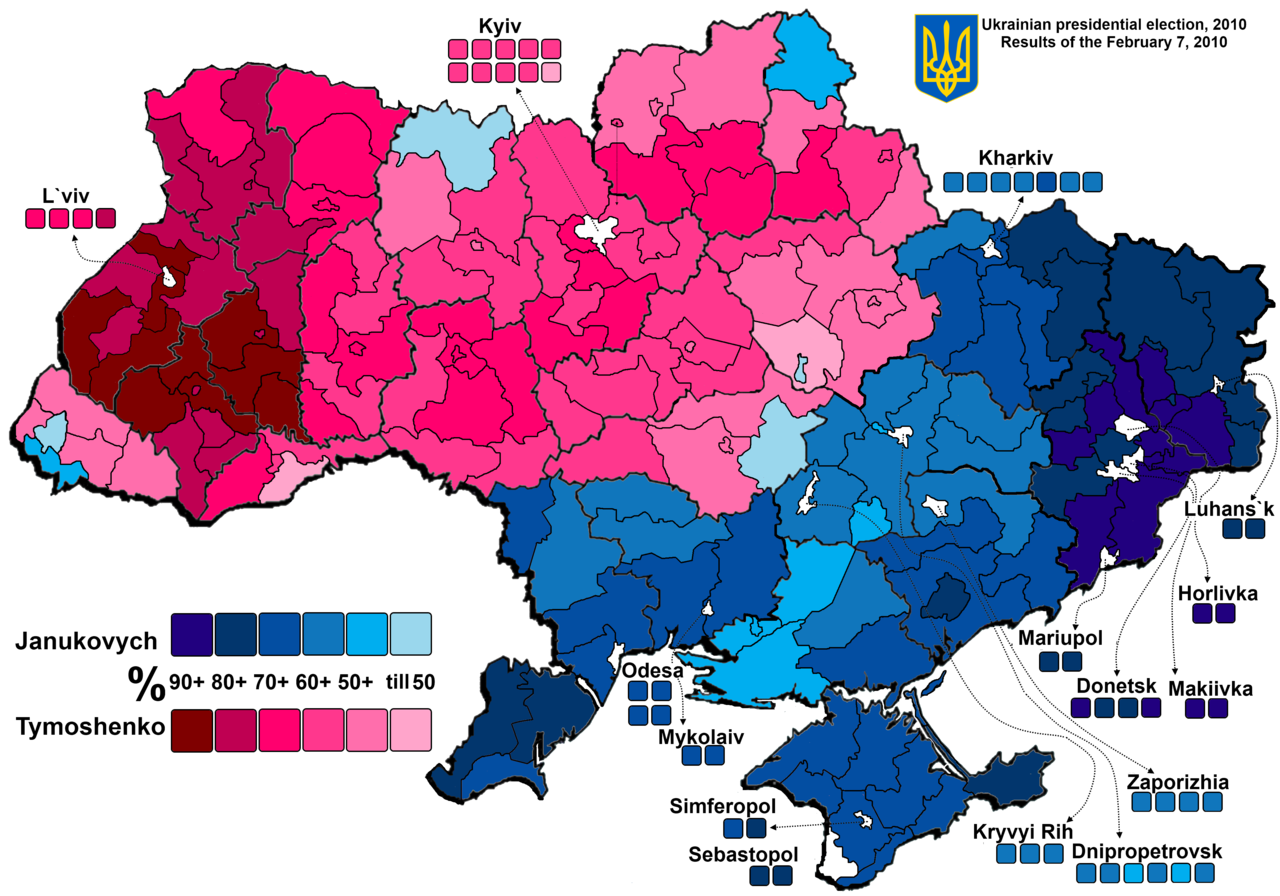
In any event, once the machinery of elections and democracy was established after 1991, the resulting electoral maps make one thing abundantly clear: People voted as they spoke.
This is clearly evident in the three maps below. Ukrainian democracy began, matured and ended on the same note. Namely, with an electorate far more sharply divided than even the Red State v. Blue State politics of the US in recent decades.
In 1994 Leonid Kuchma, a former industrial manager from the heavily industrialized, Russian-speaking east (Dnipropetrovsk), campaigned on a platform emphasizing economic ties with Russia and appealed strongly to the Russian-speaking populations in eastern Ukraine and Crimea.
In the second round of that election, Kuchma won about two-thirds of the vote in eastern Ukraine, where ethnic Russians and Russian speakers predominated, and nearly 90% in Crimea, a region with a 70% ethnic Russian population.
On the other side, Leonid Kravchuk, the first president and the incumbent in 1994, was a key figure in Ukraine’s independence movement. He had positioned himself as a guarantor of Ukrainian sovereignty and national identity. He drew his strongest support from western Ukraine, where Ukrainian speakers and nationalist sentiments were dominant, earning 70% to 80% of the vote in those regions
This cavernous split in the electorate never changed. Except unlike the US where a GOP gubernatorial candidate actually made a 47% showing in the deep blue state of New York in 2022, the vote split in the most hard core of the respective regions (dark red and dark blue) was upwards of 90/10 in many localities.
Thus, in the 2004 election the pro-Russian candidate, Viktor Yanukovych, narrowly lost the overall count, even as he dominated overwhelmingly in the east and south with 70% to 90% margins.
2004 Election Results in Ukraine
By contrast, in 2010 Yanukovych retraced the same massive domination of his own Russian-speaking regions in the east and south while striking out in the west. But this time he had sophisticated campaign help from Washington-based election consultants (i.e. the infamous Paul Manafort, who temporarily managed Donald Trump’s red versus blue state campaign in 2016 until he got nailed by the Russophobes in the Deep State). Consequently, the pro-Russian Yanukovych managed to accumulate enough incremental votes to come out on top of the perennial Ukrainian nationalist, Yulia Tymoshenko, in the nation-wide tally.
2010 Election Results in Ukraine
Needless to say, by Washington’s lights the Ukraine election of 2010 had nothing sacrosanct about it because, well, the voters elected the wrong candidate!
In short order, therefore, the neocons led by the detestable Victoria Nuland, who surrounded then Vice-President Joe Biden, fomented the coup against Yanukovych in February 2014. Yet even as they drove him from power and forced him to flee to Moscow, they had no clue as to the tenuous political balance they were upending.
But it didn’t take long to strike the match. In short order the followers of the WWII Hitler ally, Stephan Bandera, who dominated the unelected, Washington-installed government in Kiev, made two destructive moves that amounted to a signal to “let the partition begin”.
The first of these was to abolish Russian as an official language in the Donbass and elsewhere. And the second was the massacre by fire of upwards of 50 pro-Russian trade unionists in a building in Odessa by supporters of the Kiev government.
It was only a matter of time, therefore, before most of the red-colored territories on the maps above declared their independence. It was also in short order that the people of what had been the Russian province of Crimea voted overwhelmingly (80%+) to re-join the Russian Federation. That ended their brief sojourn in the Ukrainian state, which had been Khrushchev’s 1954 gift to the communist thugs in Kiev who had helped him seize power after Stalin’s death.
Also, in short order the new proto-Fascist government in Kiev moved to deeply antagonize its historic neighbor and former fealty overlord in Moscow by seeking to join NATO and launching a brutal, unrelenting war on the breakaway Republics of the Donbas. This onslaught ended up killing upwards of 15,000 civilians during the eight year run-up to Russia’s invasion in February 2022.
Needless to say, Putin was no more interested in having nuclear missiles planted even closer to his own border than was President John Kennedy in October 1962. Nor was he about to countenance the continued slaughter of Russian speakers in the Donbass after Kiev launched a drastically stepped up shelling and bombing campaign on these beleaguered areas one week before the February 24th (2022) invasion.
That is to say, the history was far from black and white. While the Donald frequently does not do his homework—in this case he did know that the “unprovoked” invasion canard is a Deep State prevarication. So last Friday he was not about to be schooled on the matter by the incompetent song and dance man who was sent into the Oval Office by the crowd of UniParty warmongers and GOP RINO’s depicted below for the purpose of shaking-down the current incumbent for another round of weapons and financial wherewithal.
So in response to Zelensky’s Putin-howling, the Donald did not mind blurting out the truth. The Ukraine war had actually been provoked by the Washington war machine and its Senate board of directors pictured below
Of course, now that the truth was let out of the bag on daytime TV there will surely soon be an end to the pointless killing and utterly elicit NATO proxy war on Russia. And with it will come an even more important repudiation of the entire post-1991 neocon perpetuation of an American Empire that should have never been stood up in the first place.
That is to say, the false Uniparty demonization of Putin and Russia will be repudiated even more decisively. That’s because apart from the impending Trump/Putin partition agreement on Ukraine, the map of eastern Europe will not change any time soon.
The whole idea that Putin means to resurrect the old Soviet Empire and that Poland, Lithuania, Latvia, Estonia, Moldova and destinations west are next in line for invasion was made of whole cloth. Its malign purpose was to give NATO a reason for expanding even further east to Russia’s very doorstep and to justify Washington’s call to war in a territory that makes not one damn bit of difference to America’s homeland security.
For crying out loud. The archives of American post-Soviet diplomacy are also crystal clear on this matter. Bush the Elder and his Secretary of State James Baker explicitly promised Gorbachev that in return for the dismantling of the Warsaw Pact and the unification of Germany that NATO would not move “one inch” to the east.
And that pledge was made for screamingly obvious reasons: The Soviet Empire was gone, and the threat of the massive Red Army had vanished. Its troops weren’t even being paid and its tanks and artillery were being melted down and sold for scrap. So ex-paratrooper George HW Bush should have parachuted into Ramstein Air Base in Germany during 1992, declared victory and consigned NATO to a newly created museum of world peace.
Indeed, at the time the very astute “father” of the containment doctrine and the 1949 NATO alliance, Professor George F. Kennan, warned that the perpetuation and expansion of NATO under these circumstances would be folly. When in 1998 the Senate nevertheless voted to extend NATO to include Poland, Hungary and the Czech Republic, he clairvoyantly observed,
“I think it is the beginning of a new cold war,” said Mr. Kennan from his Princeton home. “I think the Russians will gradually react quite adversely and it will affect their policies. I think it is a tragic mistake. There was no reason for this whatsoever.” … “It shows so little understanding of Russian history and Soviet history. Of course, there is going to be a bad reaction from Russia, and then [the NATO expanders] will say that we always told you that is how the Russians are – but this is just wrong.“
In a word, risking everything to get Ukraine into an obsolete NATO alliance that was and remains long past its “sell-by” date is surely one of the stupidest acts of foreign policy in all of American history.
And now, on the back of the momentous events of this past weekend, the opportunity has finally come. That is, to name, blame, shame and drive from the seats of power the UniParty wreckers of American democracy, prosperity and liberty who brought the nation to its present parlous estate
So President Trump’s history-changing mission at the present hour is crystal clear. He needs to make War & Peace the preponderant issue on the banks of the Potomac and send the UniParty remnants into spasmodic apoplexy by winning the Nobel Peace Prize for ending this needless war with the same dispatch that Eisenhower did with Korea in 1953.
So doing, he can accomplish the great mission for which is was apparently chosen against all odds by the gods’ of history. That is, to decisively splinter the Uniparty, thereby gathering refugees from both sides of the aisle into a revitalized political force that can enable the the people of Flyover America to reclaim their democracy from the corrupt, self-perpetuating ruling class that arose on the Potomac.
Needless to say, the Donald seems to be on to his mission. When Zelensky issued the following rejoinder to his being cast out of the White House, the Donald was not far behind with a perfectly apt answer.
Ukraine “will never” recognize any Russian annexation of territory it occupies, even if it is to try to secure a peace deal, Zelensky added, and he repeated that he would only accept a ceasefire if it was followed by robust security guarantees that had the confidence of his country’s people.
Though Russia has said it will insist on incorporating territories that it occupies, for Ukraine it would always be “a temporary occupation”, Zelenskyy insisted, even if his country lacks the military muscle to expel Russia from all of the country at the moment.
Zelenskyy said what he wanted “from partners” – a clear reference to the US White House – was for them to remember that Russia launched the full-scale invasion of his country three years ago. He did not want politicians rewriting history, he said, to suggest “that there are two parties in this war and it is vague who the aggressor is”.
Why, yes, there were two parties to this war and the true aggressor was domiciled on the banks of the Potomac, not the Moskva/Oka/Volga.
Trump warned in response with words that have not been heard from the Oval Office since June 1963, when JFK issued his short-lived call to end the Cold War at American University.
“This is the worst statement that could have been made by Zelensky, and America will not put with it for much longer.” He added in reference to Zelensky that “this guy doesn’t want there to be Peace as long as he has America’s backing…”.
“He’s got to say I want to make peace,” Trump said before he departed the White House on Friday. “He doesn’t have to stand there and say about ‘Putin this, Putin that,’ all negative things. He’s got to say I want to make peace. I don’t want to fight a war any longer” [end]
chronicle, its roots before WW2, its collaboration with Nazi Germany, its legacy in modern Ukraine, how NATO has continually supported Nazism in Ukraine
This is part 2 of “Why There Is Still No Peace on Earth: Washington’s Folly From The Persian Gulf to Ukraine.” Read part 1
[my illustration : on June 4, 2019, the TIP (east Turkestan Islamic party, Doğu Türkistan İslâm Harriet in Turkish) releases a new propaganda video (screenshot). These Uyghur jihadists are fighting in northwestern Syria, against the Syrian secular forces, within al Qaeda’s local branch (Hay’at Tahrir al-Sham, Organization for the Liberation of the Levant, HTS), which is settled under NATO protection in Idlib pocket]
THE FIRST GULF WAR – A CATASTROPHIC ERROR
Confronted with the greatest opportunity for global peace in nearly a century, George H. W. Bush did not hesitate: Upon the advice of his retainers, he immediately elected the path of war in the Persian Gulf.
This endeavor was hatched by Henry Kissinger’s economically illiterate protégés at the National Security Council and Bush’s Texas oilman secretary of state, James Baker. They falsely claimed that the will-o’-the-wisp of “oil security” was at stake, and that 500,000 American troops needed to be planted in the sands of Arabia.
That was a catastrophic error, and not only because the presence of “crusader” boots on the purportedly sacred soil of Arabia offended the CIA-recruited and trained mujahedin of Afghanistan, who had become unemployed when the Soviet Union collapsed.
The CNN-glorified war games in the Gulf during early 1991 also further empowered another group of unemployed crusaders. Namely, the neocon national-security fanatics who had misled Ronald Reagan into a massive military buildup to thwart what they claimed to be an ascendant Soviet Union bent on nuclear-war-winning capabilities and global conquest.
Needless to say, by the 1980s the gray men of the Kremlin were as evil as ever, but they were also quite rational and did not embrace a nuclear war winning strategy in any way, shape or form. That was just a pack of neocon lies, which, in any event, led to a massive defense build-up that had virtually nothing to do with containing the ballyhooed Soviet strategic nuclear threat. As it happened, the latter was being handled well enough by the already built, in-place and paid for strategic nuclear triad – forces which well pre-dated the Reagan build-up.
So when the defense budget rose by a staggering $170 billion, from $134 billion in 1980 to $304 billion in 1989, only a tiny fraction of the increase was applied to upgrading the strategic nuclear deterrent. Instead, this unprecedented 130% peacetime rise (+50% in inflation-adjusted dollars) went overwhelmingly to the building of a globe-spanning conventional forces armadathat was utterly unneeded for America’s homeland security in a world with or without the Soviet Union.
Accordingly, everything on land, sea and air was upgraded and expanded. This included the 600-ship Navy and 12 carrier battle groups; massive upgrades of the fleet of M1 tanks and Bradley Fighting Vehicles; and endless procurement of cruise missiles, fixed-wing planes, rotary aircraft, air-and sea-lift capacity, surveillance and electronic warfare capacity and a black budget so large as to dwarf anything that had gone before.
In a word, the misguided Reagan defense build-up enabled the invasions and occupations that commenced almost instantly after the Soviet demise. That is to say, the neocon defense build-up of the 1980s fathered the “Forever Wars” of the 1990s and beyond.
The folly and deceit of the purportedly anti-Soviet defense build-up was evident enough at the time because by the mid-1980s the Evil Empire was already unraveling at the seams economically. The reason was simply that communism and rigidly centralized command-and-control economics don’t work—as became abundantly clear to the entire world via the spectacle of Boris Yeltsin, vodka flask in hand, facing down the Red Army in 1991.
Like the proverbial last straw on the camel’s back, in the end the mighty Soviet Union was taken down by one of its own drunken apparatchiks.
That is to say, the entire neocon narrative of an ascendant, bent on world conquest Soviet Union was made a mockery. That alone should have sent the neocons into the permanent disrepute and obscurity they so richly deserved.
But Dick Cheney, Paul Wolfowitz and rest of the neocon gang surrounding Bush the Elder managed to deftly pull a “bait and switch” maneuver of no mean extent. Suddenly, it wasn’t about the Soviet Union at all, but the alleged lesson from Washington’s Pyrrhic victory in Kuwait that “regime change” among the assorted tyrannies of the Middle East was in America’s national interest.
More fatally, the neocons now insisted that the first Gulf War proved regime change could be achieved through a sweeping interventionist menu of coalition diplomacy, security assistance, arms shipments, covert action and open military attack and occupation via the spanking new conventional forces armada that the Reagan Administration had bequeathed.
What the neocon doctrine of regime-change actually did, of course, was to foster the Frankenstein that ultimately became ISIS. In fact, the only real terrorists in the world who have threatened normal civilian life in the West during the last three decades were the rogue offspring of Imperial Washington’s post-1990 machinations in the Middle East.
The CIA-trained and CIA-armed mujahedin of Afghanistan mutated into al-Qaeda not because bin Laden suddenly had a religious epiphany that his Washington benefactors were actually the Great Satan owing to America’s freedom and liberty.
His murderous crusade was inspired by the Wahhabi fundamentalism loose in Saudi Arabia. This benighted religious fanaticism became agitated to a fever pitch by Imperial Washington’s violent plunge into Persian Gulf political and religious quarrels, the stationing of troops in Saudi Arabia, and the decade-long barrage of sanctions, embargoes, no-fly zones, covert actions and open hostility against the Sunni regime in Baghdad after 1991.
Yes, bin Laden would have amputated Saddam’s secularist head if Washington hadn’t done it first, but that’s just the point. The attempt at regime change in March 2003 was one of the most foolish acts of state in American history.
Indeed, Bush the Younger’s neocon advisers had no clue about the sectarian animosities and historical grievances that Hussein had bottled up by parsing the oil loot and wielding the sword under the banner of Baathist nationalism. But “shock and awe” blew the lid and the de-Baathification campaign unleashed the furies.
Indeed, no sooner had George Bush pranced around on the deck of the Abraham Lincoln declaring “mission accomplished” than Abu Musab al-Zarqawi, a Jordanian militant and small-time specialist in hostage taking and poisons, emerged as a flamboyant agitator in the now-dispossessed Sunni heartland of Iraq.
The founder of ISIS succeeded in Fallujah and Anbar province just like the long list of other terrorist leaders Washington claims to have exterminated. That is, Zarqawi gained his following and notoriety among the region’s population of deprived, brutalized and humiliated young men by dint of being more brutal than their occupiers.
Indeed, even as Washington was crowing about its eventual liquidation of Zarqawi, the remnants of the Baathist regime and the hundreds of thousands of demobilized republican guards were coalescing into al-Qaeda in Iraq, and their future leaders were being incubated in a monstrous nearby detention center called Camp Bucca that contained more than 26,000 prisoners.
As one former U.S. Army officer, Mitchell Gray, later described it,
“You never see hatred like you saw on the faces of these detainees,” Gray remembers of his 2008 tour. “When I say they hated us, I mean they looked like they would have killed us in a heartbeat if given the chance. I turned to the warrant officer I was with and I said, ‘If they could, they would rip our heads off and drink our blood.
What Gray didn’t know – but might have expected – was that he was not merely looking at the United States’ former enemies, but its future ones as well. According to intelligence experts and Department of Defense records, the vast majority of the leadership of what is today known as ISIS, including its leader, Abu Bakr al-Baghdadi, did time at Camp Bucca.
And not only did the US feed, clothe and house these jihadists, it also played a vital, if unwitting, role in facilitating their transformation into the most formidable terrorist force in modern history.
Early in Bucca’s existence, the most extreme inmates were congregated in Compound 6. There were not enough Americans guards to safely enter the compound – and, in any event, the guards didn’t speak Arabic. So the detainees were left alone to preach to one another and share deadly vocational advice . . .
Bucca also housed Haji Bakr, a former colonel in Saddam Hussein’s air-defense force. Bakr was no religious zealot. He was just a guy who lost his job when the Coalition Provisional Authority disbanded the Iraqi military and instituted de-Baathification, a policy of banning Saddam’s past supporters from government work.
According to documents recently obtained by German newspaper Der Spiegel, Bakr was the real mastermind behind ISIS’ organizational structure and also mapped out the strategies that fueled its early successes. Bakr, who died in fighting in 2014, was incarcerated at Bucca from 2006-’ 08, along with a dozen or more of ISIS’ top lieutenants.”
The point is, regime change and nation building can never be accomplished by the lethal violence of 21st-century armed forces; and they were an especially preposterous assignment in the context of a land rent with 13 century-old religious fissures and animosities.
In fact, the wobbly, synthetic state of Iraq was doomed the minute Cheney and his bloody gang decided to liberate it from the brutal but serviceable and secular tyranny of Saddam’s Baathist regime. That’s because the process of elections and majority rule necessarily imposed by Washington was guaranteed to elect a government beholden to Iraq’s Shiite majority.
After decades of mistreatment and Saddam’s brutal suppression of their 1991 uprising, did the latter have revenge on their minds and in their communal DNA? Did the Kurds have dreams of an independent Kurdistan spilling into Turkey and Syria that had been denied their 30-million-strong tribe way back at Versailles and ever since?
Yes, they did. So the $25 billion spent on training and equipping the putative armed forces of post-liberation Iraq was bound to end up in the hands of sectarian militias, not a national army.
In fact, when the Shiite commanders fled Sunni-dominated Mosul in June 2014 they transformed the ISIS uprising against the government in Baghdad into a vicious fledgling state in one fell swoop. But it wasn’t by beheadings and fiery jihadist sermons that it quickly enslaved dozens of towns and several million people in western Iraq and the Euphrates Valley of Syria.
THE ISLAMIC STATE WAS WASHINGTON’S VERY OWN FRANKENSTEIN
To the contrary, its instruments of terror and occupation were the best weapons that the American taxpayers could buy. That included 2,300 Humvees and tens of thousands of automatic weapons, as well as vast stores of ammunition, trucks, rockets, artillery pieces and even tanks and helicopters.
And that wasn’t the half of it. The Islamic State also filled the power vacuum in Syria created by its so-called civil war. But in truth that was another exercise in Washington-inspired and Washington-financed regime change undertaken in connivance with Qatar and Saudi Arabia.
The princes of the Petro-states were surely not interested in expelling the tyranny next door. Instead, the rebellion was about removing Iran’s Alawite/Shiite ally from power in Damascus and laying the gas pipelines to Europe – which Assad had vetoed – across the upper Euphrates Valley.
In any event, due to Washington’s regime change policy in Syria, ISIS soon had even more troves of American weapons. Some of them were supplied to Sunni radicals by way of Qatar and Saudi Arabia.
More came up the so-called “ratline” from Qaddafi’s former arsenals in Benghazi through Turkey. And still more came through Jordan from the “moderate” opposition trained there by the CIA, which more often than not sold them or defected to the other side.
That the Islamic State was Washington’s Frankenstein monster, therefore, became evident from the moment it rushed upon the scene in mid-2014. But even then, the Washington War Party could not resist adding fuel to the fire, whooping up another round of Islamophobia among the American public and forcing the Obama White House into a futile bombing campaign for the third time in a quarter century.
But the short-lived Islamic State was never a real threat to America’s homeland security.
The dusty, broken, impoverished towns and villages along the margins of the Euphrates River and in the bombed-out precincts of Anbar province did not attract thousands of wannabe jihadists from the failed states of the Middle East and the alienated Muslim townships of Europe because the caliphate offered prosperity, salvation or any future at all.
What recruited them was outrage at the bombs and drones dropped on Sunni communities by the U.S. Air Force and by the cruise missiles launched from the bowels of the Mediterranean that ripped apart homes, shops, offices and mosques which mostly contained as many innocent civilians as ISIS terrorists.
The truth is, the Islamic State was destined for a short half-life anyway. It had been contained by the Kurds in the North and East and by Turkey with NATO’s second-largest army and air force in the Northwest. And it was further surrounded by the Shiite Crescent in the populated, economically viable regions of lower Syria and Iraq.
Absent Washington’s misbegotten campaign to unseat Assad in Damascus and demonize his confession-based Iranian ally, there would have been nowhere for the murderous fanatics who had pitched a makeshift capital in Raqqa to go. They would have run out of money, recruits, momentum and public acquiescence in their horrific rule in any event.
But with the U.S. Air Force functioning as their recruiting arm and France’s anti-Assad foreign policy helping to foment a final spasm of anarchy in Syria, the gates of hell had been opened wide, unnecessarily.
What has been puked out was not an organized war on Western civilization as former French president Hollande so hysterically proclaimed in response to one of the predictable terrorist episodes of mayhem in Paris.
It was just blow-back carried out by that infinitesimally small contingent of mentally deformed young men who can be persuaded to strap on a suicide belt.
In any event, bombing did not defeat ISIS; it just temporarily made more of them.
Ironically, what did extinguish the Islamic State was the Assad military, the Russian air force invited into Syria by its official government and the ground forces of its Hezbollah and the Iranian Revolutionary Guard allies. It was they who settled an ancient quarrel Sunni/Shiite that had never been any of America’s business anyway.
But Imperial Washington was so caught up in its myths, lies and hegemonic stupidity that it could not see the obvious. Accordingly, 31 years after the Cold War ended and several years after Syria and friends extinguished the Islamic State, Washington has learned no lessons.
The American Imperium still stalks the planet for new monsters to destroy – presently in the precincts of Russian-speaking eastern and southern Ukraine that are utterly irrelevant to America’s peace and security.
Next On Deck – The Ukraine Disaster
The present disaster in Ukraine incepted with the Washington-sponsored Maidan coup of February 2014. Among other things it was a “revenge intervention” designed to punish Russia for being so bold as to thwart the neocon regime change adventure in Syria; and especially to haze Putin for persuading Assad to give up his chemical weapons, thereby removing any pretext for Washington military intervention.
As it happened, the Russian-friendly president of Ukraine at the time, Vicktor Yanukovych, had at the last minute in late 2013 ditched a long-pending EU affiliation agreement and IMF stabilization plan in favor of a more attractive deal with Moscow. Under the so-called rule of law, that reversal would hardly seem outside the realm of sovereign prerogative.
But not by the lights of Washington, red-hot from being check-mated in Syria. Accordingly, the neocon operatives in the Obama national security apparatus, spear-headed by the horrid Victoria Nuland, insisted that the Russian deal not be allowed to stand and that Ukraine’s accession to NATO should be fast-tracked.
So doing, they demonstrated an immense ignorance about the 800-year history of the various territories which had been cobbled together in the artificial state of Ukraine, and the long-history of these pieces and parts as vassals and appendages of both Greater Russia and various eastern European kingdoms and empires that had marched back and forth across the pages of history.
In a word, they dove into a rabbit hole that has made Washington’s misadventures in the middle east small potatoes by comparison. But the War Party would not be stopped, believing that its vast conventional military armada and the reach of its global economic sanctions could bring Putin to heel, as well.
In this context, however, it can be truly said that occasionally a few words are worth a thousand pictures–at least when it comes to Ukraine. Here’s one of them:
The Ukrainian leader said that his country hadn’t been willing to cede territory from the beginning. “Had we been willing to give up our territory, there would have been no war,” Zelensky said.
He got that right!
So the question recurs. Why is it worth Washington’s sweeping Sanctions War on Russia, which is destroying the dollar-based global trading and payments system and triggering a worldwide inflationary calamity, to defend every inch of a sketchy map located on Russia’s doorstep? And that’s to say nothing of risking nuclear war!
Indeed, as we elaborate below, the present Ukrainian territorial map exists only due to the handiwork of Lenin, Stalin and Khrushchev. Here is how and when these brutal tyrants attached each piece of today’s Ukrainian map (in purple, light blue and red, respectively) to the territories acquired or seized by the Russian Czars over 1654-1917 (yellow)
Nor should any mystery linger as to where these pieces and parts came from. When the creators of the Soviet Empire carved out a convenient administrative entity during the early 1920s that they were pleased to call the Ukrainian Soviet Socialist Republic they were shuffling around blocks of territory and peoples that had mostly been ruled by Czarist Russia during its final centuries.
In fact, prior to the commie takeover of Russia, no country that even faintly resembled today’s Ukrainian borders had ever existed.
To the contrary, much of the territories which comprise present day Ukraine have been been joined at the hip with mother Russia for most of the last three centuries: During Imperial times that was via old-fashioned vassal protection and sponsorship and during the brutal rule of the Soviet communists between 1922-1991 it was via totalitarian command.
But remove the dastardly work of Lenin, Stalin and Khrushchev during the latter interval, and nothing like today’s map would exist, nor would Washington be starting a global economic war and triggering soaring energy, food and commodity prices. That’s because the four territories recently “annexed” by Russia would already have been integral parts of Russia!
For want of doubt here are sequential maps that tell the story and which make mincemeat of the Washington sanctity of borders malarkey. In fact, the approximate territory of the four annexed regions – Donetsk, Luhansk, Kherson and Zaporizhzhia – plus Crimea are evident in the yellow area of this 220-years ago map (@1800).
Collectively, they were known as Novorossiya or “New Russia” and had been acquired by Russian rulers, including Catherine the Great between 1734 and 1791.
As is evident from the year-markings in red on the map, the Russian Empire had gradually gained control over the area, signing peace treaties with the Cossack Hetmanate (1734) and with the Ottoman Empire at the conclusion of the various Russo-Turkish Wars of the 18th century.
Pursuant to this expansion drive – which included massive Russian investment and the in-migration of large Russian populations to the region – Russia established the Novorossiysk Governaorate in 1764. The latter was originally to be named after the Empress Catherine, but she decreed that it should be called “New Russia” instead.
Completing the assemblage of New Russia, Catherine forcefully liquidated the Zaporizhian Sich (present day Zaporizhzhia) in 1775 and annexed its territory to Novorossiya, thus eliminating the independent rule of the Ukrainian Cossacks. Later in 1783 she also acquired Crimea from the Turks, which was also added to Novorossiya.
During this formative period, the infamous shadow ruler under Catherine, Prince Grigori Potempkin, directed the sweeping colonization and Russification of the land. Effectively, the Russian Empress had granted him the powers of an absolute ruler over the area from 1774 onward.
The spirit and importance of “New Russia” at this time is aptly captured by the historian Willard Sunderland,
The old steppe was Asian and stateless; the current one was state-determined and claimed for European-Russian civilization. The world of comparison was now even more obviously that of the Western empires. Consequently it was all the more clear that the Russian empire merited its own New Russia to go along with everyone else’s New Spain, New France and New England. The adoption of the name of New Russia was in fact the most powerful statement imaginable of Russia’s national coming of age.
Well, yes, but borders!
In fact, the passage of time solidified the border of Novorossiya even more solidly. One century latter the light yellow area of this 1897 map gave an unmistakable message: To wit, in the late Russian Empire there was no doubt as to the paternity of the lands adjacent to the Azov Sea and the Black Sea—they were now part of the 125 years-old “New Russia”.
After the madness of WWI and the Bolshevik Revolution, of course, the borders of much of eastern and central Europe were drastically re-arranged. For instance, at the so-called Versailles Peace Conference in 1919 new countries were fashioned from whole cloth (Czechoslovakia) and long dead countries (Poland) were revived—both upon their own ancient lands as well as those of their former neighbors.
Another of these post-WWI creations was Yugoslavia. The kingdom was formed in December 1918, with Serbia’s royal family, the Karadjordjevics, becoming the monarchs of the new country, which was officially called the Kingdom of the Serbs, Croats and Slovenes until 1929 – when it became Yugoslavia. By 1946 it had been incorporated into the Soviet Warsaw Pact, with the borders and constituent parts shown below.
Needless to say, all of these circa 1919 creations and borders have long ceased to exist.After a decade of civil wars and civilian slaughter in the 1990s, Yugoslavia has become seven independent nations. And not only that: The apparently non-sacrosanct borders of Yugoslavia were rent asunder by NATO bombs, armaments, economic and political aid and covert operations!
And then having torn up the old maps like a mere “scrap of paper”, NATO made the new national entities its very own, with the majority now actually members of the North Atlantic Treaty Alliance – a vestigial organ that was designed to keep the Balkans contained and the Soviet Union throttled, neither of which condition any more even exists.
By the same token, the present-day borders of Poland were moved far to the west at Stalin’s insistence at Yalta. Consequently, the revived nation of “Poland”, which had earlier been created by Woodrow Wilson at Versailles to court the growing Midwestern Polish vote, took on a wholly new map.
That is to say, Poland had been dismembered and deleted from the maps by the European powers in the 1790s; had been revived by Wilson’s ignorant demands at Versailles that moved it deep into historic German territories and provided the political fuel for Hitler’s revanchism; and then drastically rearranged again at Yalta where the cynical Churchill and the malevolent Stalin outmaneuvered the senile Roosevelt.
Thus, the area outlined in dark blue was Wilson’s Poland, but the huge swath in pink was gifted to Stalin by FDR and Churchill at Yalta. At the same time, the brown areas including the free city of Danzig (Gdansk) and the Danzig Corridor to its right were swiped from the remains of Hitler’s Germany and given back to what amounted to Poland 3.0 – and just within the first half of the 20th century!
The same story holds for Czechoslovakia. Its three constituent nations were hammered together at Versailles from the remnants of the Austrian Empire, but eventually went their separate ways after the rule of communism ended in 1991. Today the Czech State and Slovakia exist peacefully side-by-side, and the world is no worse for the wear after their partition.
As it happens, however, there is one politically engineered post-WWI map from the region that hasn’t been undone. For reasons known only by the Washington neocons and Warfare State apparatus, the modern borders of Ukraine – hammered together by the writ of Lenin, Stalin and Khrushchev after 1918 – are apparently the exception to the rule.
Indeed, they are deemed to be so sacrosanct as to justify monkey-hammering the global economy with a destructive Sanctions War, even to the point of risking hot military confrontation between the world’s two major nuclear powers.
Of course, had the above mentioned 20th century communist trio been benefactors of mankind, perhaps their map-making handiwork might have been justified. Under this benign contrafactual, they would have presumably combined peoples of like ethnic, linguistic, religious and politico-cultural history into a cohesive natural polity and state. That is, a nation worth perpetuating, defending and perhaps even dying for.
Alas, the very opposite was true. From 1922 to 1991 modern Ukraine was held together by the monopoly on violence of its brutally totalitarian rulers. And when they temporarily lost control during the military battles of World War II, the administrative entity called Ukraine came apart at the seams.
That is, local Ukrainian nationalists joined Hitler’s Wehrmacht in its depredations against Jews, Poles, Roma and Russians when it first swept through the country from the west on its way to Stalingrad; and then, in turn, the Russian populations from the Donbas and south campaigned with the Red Army during its vengeance-wreaking return from the east after winning the bloody battle that turned the course of WWII.
Not surprisingly, therefore, virtually from the minute it came out from under the communist yoke when the Soviet Union was swept into the dustbin of history in 1991, Ukraine has been engulfed in political and actual civil war. The elections which did occur were essentially 50/50 at the national level but reflected votes of 80/20 within the regions. That is, the Ukrainian nationalist candidates tended to get vote margins of 80% + in the West/Central areas, while Russian-sympathizing candidates got like pluralities in the East/South.
This pattern transpired because once the iron-hand of totalitarian rule ended in 1991, the deep and historically rooted conflict between Ukrainian nationalism, language and politics of the central and western regions of the country and the Russian language and historical religious and political affinities of the Donbas and south came rushing to the surface. So-called democracy barely survived these contests until February 2014 when one of Washington’s “color revolutions” finally “succeeded”. That is to say, the aforementioned Washington fomented and financed nationalist-led coupe d état ended the tenuous post-communist equilibrium.
As to the adverse shock effect of the Maidan coup on Ukrainian governance and external policy with respect to Russia, the maps below tell you all you need to know. The first map is from the 2004 presidential election, which was won by the Ukrainian nationalist candidate, Yushchenko, who predominated in the yellow areas of the map, over the pro-Russian Yanukovych, who swept the blue regions in the east and south.
The second map is from the 2010 election, showing the same stark regional split, but this time the pro-Russian candidate, Yanukovych, won.
In the map below, the dark blue parts to the far east (Donbas) indicate an 80% or better vote for Viktor Yanukovych in the 2010 election. By contrast, the dark red areas in the west voted 80% or more for the Ukrainian nationalist, Yulie Tymoshenko. That is to say, the skew in the Ukrainian electorate was so extreme as to make America’s current red state/blue state divide seem hardly noteworthy by comparison.
As it happened, the sum of the pro-Yanukovych skews from the east and south (Donbas and Crimea) added up to 12.48 million votes and 48.95% of the total, while the sum of the extreme red skews in the center and west (the lands of old eastern Galicia and Poland) amounted to 11.59 million votes and 45.47% of the total.
Stated differently, it is hard to imagine an electorate more sharply divided on a regional/ethnic/language basis. Yet it was one which still produced a sufficiently clear victory margin (3.6 percentage points) for Yanukovych – so as to be reluctantly accepted by all parties. That became especially clear when Tymoshenko, who was the incumbent prime minister, withdrew her election challenge a few weeks after the run-off in February 2010.
At that point, of course, Russia had no beef with the Kiev government at all because essentially Yanukovych’s “Regions Party” was based on the pro-Russian parts (blue areas) of the Ukrainian electorate.
During the next several years the economic basket case which was Ukraine attempted to improve its circumstances by running a bake-off of sorts between the European Union and Russia with respect to aid and trade deals.
And well its leaders might have: After the fall of communism, Ukraine had become a cesspool of financial corruption in which a handful of oligarchs had robbed the country blind. By 2014 its real GDP had consequently fallen to $568 billion (2017$), which amounted to a 37% shrinkage from even the threadbare communist economics of 1990.
Accordingly, the supposedly pro-Russian Yanukovych administration initiated in March 2012 the above-mentioned Association Agreement with the European Union that was to provide trade advantages and an IMF aid package.
However, the EU leaders insisted that no agreement could be ratified unless Ukraine addressed concerns over a “stark deterioration of democracy and the rule of law”, including the imprisonment of Yulia Tymoshenko in 2011. In order to address these concerns, in fact, President Yanukovych urged the parliament to adopt laws so that Ukraine would meet the EU’s criteria.
Crash of Ukraine’s Real GDP, 1990-2014
But it was the parallel $4 billion IMF loan that turned out to be the straw that broke the camel’s back. According to then Prime Minister Mykola Azarov “the extremely harsh conditions” of the IMF loan (presented by the IMF in November 2013) included big budget cuts and a 40% increase in natural gas bills. Those proved to be hills too high to climb for most of the factions within the fractionated Ukraine polity.
Accordingly, the IMF demands became the clinching argument behind the Ukrainian government’s abrupt decision to suspend preparations for signing the Association Agreement with the EU. Instead, Kiev quickly pivoted to a deal with Russia in the fall of 2013, which was willing to offer $15 billion in loans without the harsh IMF pre-conditions. Also, Moscow offered Ukraine a discount on Ukraine’s large gas purchases from Russia.
The rest is history, as it were. As mentioned above, the Washington neocons were not about to accept Kiev’s pivot to Russia come hell or high water.
So they swung into action bringing all the instruments of the Empire – the CIA, the State Department, NED, the NGOs and favored Ukrainian oligarchs – to bear on scuttling the Russian deal and removing Yanukovych from office.
In a later interview with a US journalist, in fact, Ukrainian billionaire oligarch and opposition leader, Petro Poroshenko (who later became president), said quite clearly that the plan was to subvert the nation’s constitution and install an unelected, anti-Russian government that would deep-six the deal with Moscow:
“From the beginning, I was one of the organizers of the Maidan. My television channel – Channel 5 – played a tremendously important role. … On the 11th of December, when we had U.S. Assistant Secretary of State Victoria Nuland and E.U. diplomat Catherine Ashton in Kyiv, during the night they started to storm the Maidan.”
It should never be forgotten, therefore, that the coup which overthrew the constitutionally elected government in Kiev was a $5 billion all-hands Washington undertaking. It would never have come to fruition as a successful regime change putsch without the heavy hands of the US State Department along with the other above-mentioned arms of the empire.
Needless to say, nullification of a country’s election – backed by the stick of NATO’s military might and the carrot of billions from a Washington/EU/IMF consortium – is big league meddling. Well, except by the clueless hypocrisy of the Washington foreign policy blob.
Indeed, as former president Obama told CNN at the time, Washington was just going about its “indispensable nation” business. It had helpfully encouraged another “flowering of democracy” and to that end it had,
“……brokered a deal to transition power in Ukraine.”
Brokered a deal my eye!
This was a blatant and inexcusable breach of so-called “international law” because it served the will-to-power objectives of the Washington neocons and kept the now largely obsolete US foreign policy apparatus in the hegemony game – to say nothing of recruiting a new customer for arms sales.
Never mind that Washington’s massive political and financial support for the Maidan uprising on the streets of Kiev, and then nearly instantaneous recognition of the resulting putsch as the official government of the Ukraine, was a frontal assault on the nation’s sovereignty.
The late and detestable Senator John McCain even went to Kiev to show solidarity with the Euromaidan activists. McCain dined with opposition leaders, including members of the ultra-right‐wing Svoboda Party and later appeared on stage in Maidan Square during a mass rally.
There he stood shoulder to shoulder with Svoboda leader Oleh Tyahnybok, who made no secret of his pro-Nazi convictions.
But McCain’s actions were a model of diplomatic restraint compared to the conduct of Victoria Nuland, the assistant secretary of state for European and Eurasian Affairs, who, by your way, was soon back in the same position in the Biden Administration, conducting the same pro-war neocon policies.
As Ukraine’s political crisis deepened, Nuland and her subordinates became more brazen in favoring the anti‐Yanukovych demonstrators. Nuland noted in a speech to the U.S.-Ukraine Foundation in December 2013, that she had traveled to Ukraine three times in the weeks following the start of the demonstrations. Visiting the Maidan on December 5, she famously handed out cookies to demonstrators and expressed support for their cause.
Washington’s conduct not only constituted meddling, but it also bordered on puppeteering. At one point, US Ambassador Pyatt mentioned the complex dynamic among the three principal ultra-nationalist opposition leaders, Arseniy Yatsenyuk, Oleh Tyahnybok, and Vitali Klitschko
Both Pyatt and Nuland wanted to keep Tyahnybok and Klitschko out of an interim government. In the former case, they worried about his extremist neo-Nazi ties; in the latter, they appeared to want him to wait and make a bid for office on a longer‐term basis (This former boxing champion became the current pugnacious mayor of Kiev).
Nuland thus famously stated that,
“I don’t think Klitsch should go into the government. I don’t think it’s necessary.” She added that what Yatseniuk needed “is Klitsch and Tyahnybok on the outside.”
The two diplomats were also prepared to escalate the already extensive U.S. involvement in Ukraine’s political turbulence by bringing in the Big Guy.
Pyatt stated bluntly that,
“…..we want to try to get somebody with an international personality to come out here and help to midwife this thing [the political transition].”
Nuland clearly had Vice President Joe Biden in mind for that role. Noting that the vice president’s national security adviser was in direct contact with her, Nuland related that she told him,
“…probably tomorrow for an atta‐boy and to get the details to stick. So Biden’s willing.”
That is to say, Victoria Nuland didn’t merely tell some undercover operatives to buy ads on Ukrainian social media, as Russia was accused of doing during the 2016 US election. To the contrary, she actually picked Yanukovych’s successor and the entire cabinet!
And we know this from a hacked phone call between Nuland and the US ambassador in Kiev. In discussing who should lead the Washington-installed government, Nuland made clear who the next prime minister would be and who he should be talking to for advice.
Nuland: I think Yats (Arseniy Yatseniuk) is the guy who’s got the economic experience, the governing experience. … what he needs is Klitsch and Tyahnybok on the outside. He needs to be talking to them four times a week, you know.
As it turned out, the putsch leaders followed Nuland’s advice to the letter, installing “Yats” as the new prime minister. But it also filled four cabinet posts out of eleven with rabid anti-Russian neo-Nazis.
Indeed, at the heart of the putsch were Ukrainian organizations called Svoboda (national socialist party of Ukraine) and Right Sector.Their national hero was one Stepan Bandera – a collaborator with Hitler who led the liquidation of thousands of Poles, Jews and other minorities as the Nazi Wehrmacht, as previously mentioned, made it way through Ukraine toward Stalingrad in the early 1940s.
In fact, another founder and leader of Svoboda, Andriy Parubiy, was given a portfolio which included the Ministry of Defense, the Armed Forces, Law Enforcement, National Security and Intelligence. That the Kremlin was alarmed by these developments and that the Russian-speaking populations of Crimea and the Donbas (the blue areas on the electoral map above) feared an ethnic cleansing led by the new Ukrainian nationalist government in Kiev is hardly surprising.
Indeed, the first legislative act of the new government was the abolition, on February 23, 2014, of the Kivalov-Kolesnichenko law of 2012 which made Russian an official language. As one commentator noted, it was a bit as if putschists decided that French and Italian would no longer be official languages in Switzerland.
The Russian language ban caused a storm in the Russian-speaking population. This resulted in fierce repression against the Russian-speaking regions (Odessa, Dnepropetrovsk, Kharkov, Lugansk and Donetsk) which began in February 2014 and led to a militarization of the situation and some notorious massacres (those in Odessa and Mariupol were the most odious).
By the end of summer 2014, Crimea had return to Mother Russia after an overwhelming plebiscite and the self-proclaimed republics of Donetsk and Lugansk became the object of a vicious civil war conducted by Kiev.
As we have amplified elsewhere, Sevastopol in Crimea has been the homeport of the Russian Naval Fleet under czars and commissars alike. After 171 years as an integral part of the Russian Motherland, it only technically became part of Ukraine during a Khrushchev inspired shuffle in 1954.
The fact is, only 10% of the Crimean population is Ukrainian speaking, and it was the coup on the streets of Kiev by extremist anti-Russian Ukrainian nationalists and proto-fascists that caused the Russian speakers in Crimea to panic and Moscow to become alarmed about the status of its historic naval base, for which it still had a lease running to the 2040s.
Thus, during a referendum in March 2014 83% of eligible Crimeans turned out to vote and 97% of those approved cancelling the 1954 edict of the Soviet Presidium that gifted Russian-Crimea to Ukraine. There is absolutely no evidence that the 80% of Crimeans who thus voted to sever their historically short-lived affiliation with Ukraine were threatened or coerced by Moscow.
Indeed, what they actually feared were the edicts against Russian language and culture coming out of Kiev. And exactly the same thing was true of the overwhelmingly Russian-speaking populations of the Donbas.
So in the context of a relentless and pointless NATO expansion to the very borders of the shrunken Russian state, Washington did not merely sponsor and fund the overthrow of Ukraine’s constitutionally elected government in February 2014. But once it had unleashed a devastating civil war, it also relentlessly blocked for eight years running the obvious alternative to the bloodshed that had claimed 14,000 civilian and military casualties, even before the current hot war commenced.
To wit, Ukraine could have been partitioned with autonomy for the Russian-speaking Donbas provinces – or even accession to the Russian state from which these communities had essentially originated.
So the appalling truth of the matter is this: Adding insult to injury after its blatantly foolish and reckless coup in February 2014, Washington now insists that the grandsons and granddaughters of Stalin’s industrial army in the Donbas are to be ruled by the grandsons and granddaughters of Hitler’s collaborators in Kiev, whether they like it or not.
Yet that historic chasm is exactly where the present civil war originated.
And its also why partition of an artificial polity forced together by 20th century communist dictators is the only way out.
THE NATO FACTOR
The current CIA director, William J Burns, actually recognized the eventual crack-up of Ukraine back in 2008, when he served as U.S. ambassador to Russia. After Ukraine’s NATO aspirations were announced at that year’s Bucharest Security Conference, Burns wrote a secret cable (subsequently published by Wikileaks) entitled,
“Nyet Means Nyet: Russia’s NATO Enlargement Redlines”.
The missive to Washington contained a stern warning of trouble to come:
Ukraine and Georgia’s NATO aspirations not only touch a raw nerve in Russia, they engender serious concerns about the consequences for stability in the region. Not only does Russia perceive encirclement, and efforts to undermine Russia’s influence in the region, but it also fears unpredictable and uncontrolled consequences which would seriously affect Russian security interests.
Experts tell us that Russia is particularly worried that the strong divisions in Ukraine over NATO membership, with much of the ethnic-Russian community against membership, could lead to a major split, involving violence or at worst, civil war. In that eventuality, Russia would have to decide whether to intervene; a decision Russia does not want to have to face.
He got that right!
For more than two decades, Washington’s NATO expansion policy has been a dagger aimed at the heart of an inherently divided Ukrainian polity—a division that had been suppressed by 69 years of brutal communist rule, but which broke into the open after the Soviet Union fell in 1991.
So, as Burns predicted, in response to the 2014 putsch, Russian-speaking Ukrainians in the eastern Donbas region rose up against the coup government in Kiev, which they denounced as an illegitimate Western puppet regime, riddled with anti-Russian Neo-Nazis.
Independence activists declared the creation of two new autonomous states, the Donetsk and Lugansk People’s Republics. In turn, the new anti-Russian Ukrainian government in Kiev, with abundant Western military support and weapons, launched a brutal war against these breakaway republics–an assault that went on until the Russian invasion of February 24, 2022.
As Kiev’s assault in the Donbas unfolded, upwards of 14,000 Ukrainians were killed, and hundreds of thousands more were displaced – all before the Russian invasion commenced.
Moreover, the manner in which the two new breakaway republics armed themselves for combat against Kiev’s forces tells you all you need to know about the deep divisions in the Ukrainian polity. These were fissures which were instantly brought to the surface by the Maidan coup.
According to Jacques Baud, a NATO adviser to Ukraine during that period, the breakaway Republic fighters got their arms mainly from defecting Ukrainian units, not Russia!
Folks, when entire military units defect with their arms and fighting wherewithal, you are not dealing with minor differences of opinion among a nation’s population; it’s a sign of deep and likely irreconcilable strife. As Baud has further noted,
In 2014, I (was) at NATO, responsible for the fight against the proliferation of small arms, and we (were) trying to detect Russian arms deliveries to the rebels in order to see if Moscow (was) involved.
The rebels are armed thanks to the defections of Russian-speaking Ukrainian units which cross over to the rebel side. As the Ukrainian failures progressed, the entire tank, artillery or anti-aircraft battalions swelled the ranks of the autonomists. This is what (drove) the Ukrainians to commit to the Minsk Accords.
Just after signing the Minsk 1 Accords in September 2014, however, then Ukrainian President and corrupt oligarch, Petro Poroshenko, launched a vast anti-terrorist operation against the Donbas. But poorly advised by NATO officers, the Ukrainians suffered a crushing defeat at Debaltsevo, which forced them to commit to the Minsk 2 Agreements in February 2015.
As it happened, these Agreements provided for neither the separation nor the independence of the Republics, but their autonomy within the framework of Ukraine. That is, the ultimate status of the republics was to be negotiated between Kiev and the representatives of the republics, for an internal solution to the crisis of Ukraine’s split polity.
But owing to Washington’s writs this was not to be. Instead, the post-coup Kiev government waged a brutal civil war against the Donbas for eight years. This attack was resisted by Russian-speaking Ukrainians who were deathly afraid of being ruled by the neo-Nazi elements which permeated the Kiev government, military and security forces (SBU).
Indeed, even though he had run as the peace candidate, Zelensky put the kibosh on Minsk 2 soon after he was installed in office in 2019. The Minsk agreements, of course, had detailed how Kiev could reintegrate its breakaway regions by offering them a general amnesty, greater autonomy, and representation in the government.
But after having his very life threatened by the Azov militias embedded in Ukraine’s military, Zelensky and other senior officials declared that the Minsk agreements could not be implemented. Instead, they claimed that they could only proceed with their obligations under the agreements after retaking control of the rebel-held areas.
Needless to say, as far as the breakaway republics were concerned, disarmament first and negotiations later was an absurd non-starter. In fact, after the fall of 2019, the Zelensky government made a bee line toward severe intensification of the raging civil war,
To that end, it caused ascension to NATO to be added to its constitution, even as Zelensky issued at executive order vowing to recover Crimea. Yet as we have frequently explained that territory and the site of Russia’s most strategic naval base had never been part of Ukraine until 1954 when Khrushchev gifted it to the brutal communist rulers in Kiev for their help in securing the succession after Stalin’s death.
Moreover, once Zelensky intensified the civil war the idea that Ukraine had anything to do with a functioning democracy lost all meaning. Zelensky’s government soon arrested the leading opposition politicians, shut-down all opposition media by combing multiple TV outlets into a single government propaganda network and, as we saw earlier, initially even outlawed the use of the Russian language.
So long before Russia invaded on February 24, 2022, a bloody civil war raged in the unnatural polity called Ukraine. The latter was inherently not built to last given its deep ethnic divisions and especially the legacy of the aforementioned bloody history during WWII, when the country was bitterly divided between populations loyal to Hitler’s Wehrmacht versus those aligned with Stalin’s Red Army. Like after the American civil war, the animosity lasted for decades.
So again, as Jacques Baud noted, this was a civil war: There were never major Russian troops in the Donbass before February 24, 2022. Even the US intelligence map published by the Washington Post on December 3, 2021 does not show Russian troops in the Donbass.
Indeed, as far back as October 2015, Vasyl Hrytsak, director of the Ukrainian Security Service (SBU), confessed that only 56 Russian fighters had been observed in the Donbass. It was hardly even comparable to that of the Swiss going to fight in Bosnia during the weekends, in the 1990s, or the French mercenaries who are going to fight in Ukraine today.
The Ukrainian army was then in a deplorable state. In October 2018, after four years of war, Ukraine’s chief military prosecutor, Antoly Matios, said that Ukraine had lost 2,700 men in the Donbass but not from the much larger combat losses. Instead, he referenced losses including 891 from disease, 318 from traffic accidents, 177 from other accidents, 175 from poisoning (alcohol, drugs), 172 from careless handling of weapons, 101 from breaches of safety rules, 228 from murder and 615 from suicide!
In fact, like everything else in Ukraine, the Army has been severely undermined by the corruption of its cadres. According to a UK Home Office report, when reservists were called up in March-April 2014, 70% did not show up for the first session, 80% for the second, 90% for the third and 95% for the fourth.
Thus, to compensate for the lack of soldiers, the Ukrainian government resorted to paramilitary militias. They were essentially made up of foreign mercenaries. As of 2020, they constituted around 40% of Ukraine’s forces and numbered around 102,000 men according to a in-depth Reuters investigation. That is to say, much of what constituted the Ukrainian military force on the eve of the Russian invasions was armed, financed and trained by the United States, Great Britain, Canada and France.
These militias, stemming from the far-right groups that led the Euromaidan revolution in 2014, are made up of fanatical and brutal individuals. The best known of these is the Azov regiment, whose emblem is reminiscent of that of the 2nd SS Das Reich Panzer Division. The latter is the object of nationalist veneration in Ukraine for having liberated Kharkov from the Soviets in 1943.
None of this is a secret, even if it has been banned from the 24/7 news narrative. So the West supports and continues to arm militias that have been guilty of widespread crimes against the civilian populations of the Donbas since 2014, including rape, torture and massacres.
Moreover, the integration of these paramilitary forces into the National Guard was not at all accompanied by a “denazification”, as is frequently claimed. Among the many examples, that of the insignia of the Azov Regiment is edifying:
Finally, on the eve of the invasion the Kiev government moved to drastically intensify the civil war and its brutal campaign against the breakaway republics. Beginning on February 16th – a week before the invasion – Ukrainian artillery shelling of the civilian populations of the Donbass increased dramatically, as shown by the daily reports of OSCE (Organization for Security and Co-operation in Europe) observers.
Naturally, neither the media, nor the European Union, nor NATO, nor any Western government reacted or intervened even verbally.
At the same time, there were also reports of acts of sabotage in the Donbass. On January 18, Donbass fighters intercept saboteurs equipped with Western equipment and speaking Polish seeking to create chemical incidents in Gorlivka.
The Ukrainian artillery bombardments on the populations of Donbass continued to intensify as shown below – so on February 23, the two Republics requested military aid from Russia. And on the 24th, Vladimir Putin invoked Article 51 of the United Nations Charter which provides for mutual military assistance within the framework of a defensive alliance.
At that point, the Ukrainian civil war became international, and the artificial nation that was not “Built to Last” was ushered into its death throes
Indeed, the real truth of the matter is that Imperial Washington is now reaping the whirlwind it sowed over decades by massive interference in the internal politics and governance process of countries all over the world – of which the vignette above about the Ukrainian coup and its bloody aftermath is only the latest flock of chickens to come home to roost.
Contrary to the bombast, jingoism, and shrill moralizing flowing from Washington and the mainstream media, America had absolutely no national security interest – even to this day – in the spat between Putin and the coup that unconstitutionally took over Kiev in February 2014. That changed everything and knocked the props out from under Washington’s current sanctimonious attacks on Putin for finally resorting to its own game.
As we said, Ukraine was “Not Built to Last”. Yet notwithstanding all of these damning realities, Zelensky continues to peevishly and arrogantly demand that Washington and the west stand-up an on-ramp to WWIII (e.g. a No-Fly Zone) in order to defend every inch of this artifact of recent history called Ukraine.
After all, if according to the horse’s mouth itself there would have been no war had Ukraine been willing to give up the historic Russian territories of Crimea and the Donbas in the first place, then why isn’t Washington making a bee line toward the negotiating table to offer just that?
If the truth be told, of course, it is not interested in ending the Ukraine War or saving a nation which cannot and should not be saved.
To the contrary, Washington and its fawning media acolytes have become so crazed with anti-Putin hysteria that they will not be satiated until Russia itself is brought down – even if that threatens to bring down the entire dollar-based global trade and payments system on which America’s tenuous prosperity depends [end]