Analista senior di l'intelligenza in u campu di a gestione di i risichi di sicurezza, sò un anzianu tenente detective è ufficiale di l'intelligenza in l'agenzie di u Statu francese. A bona pronuncia hè Николай Чинкуини, in russu
In the Jacques Baud case, the EU is sanctioning, for the first time, an analyst not for spreading disinformation but for expressing a politically inconvenient truth, all while admitting he has broken no law. Will it have the courage to go after an American citizen?
The European Union has sanctioned the veteran Swiss Intelligence Officer and Geopolitical analysts, 70-year-old Colonel Jacques Baud.
His crime?
He is a “regular guest on pro-Russian television and radio programs,” which makes him “a mouthpiece for pro-Russian propaganda” who “makes conspiracy theories” such as “accusing Ukraine of orchestrating its own invasion in order to join NATO.”
Damn, this dude is bad ass.
I quiver in fear at the thought of this septuagenarian “making conspiracy theories.”
What’s a world powerhouse like the European Union to do in the face of such a threat?
Why sanction the bugger, of course!
Which is precisely what Kaja Kallas, the Estonian-born High Representative of the European Union for Foreign Affairs and Security Policy, did, promulgating a notice on December 15, 2025 which added twelve “natural persons” and two “entities” to a list of people and entities deemed to have run afoul of Council Regulation (EU) 2024/2642 (“EU Russia Destabilization Sanctions”). Passed in October 2024, this regulation introduced “new restrictive measures against Russia in response to its destabilizing activities against the EU and EU Member States.” The regulation was “designed to respond to Russia’s campaign of hybrid activities against the EU and its Member States.”
The EU deemed this regulation necessary to counter alleged Russian hybrid actions designed to undermine elections, support violent demonstrations, commit acts of sabotage against democratic institutions, economic activities, or services of public interest, exploiting armed conflict for the purposes of illicit trade, and instigating or facilitating armed conflict.
All the above listed actions could—and should—constitute criminal acts if carried out by any person.
The question is, which of these nefarious deeds is Colonel Baud accused of undertaking?
None of the above.
Instead, he has fallen afoul of an additional listed activity, “supporting or otherwise facilitating the use of coordinated information manipulation and interference.” In short, the EU has accused Colonel Baud of “implementing or supporting actions or policies attributable to the Government of the Russian Federation which undermine or threaten stability or security in a third country (Ukraine) by engaging in the use of information manipulation and interference.”
Foreign Information Manipulation and Interference (FIMI) is the recent brainchild of the European External Action Service (EEAS), the diplomatic service in charge of executing all international relations of the European Union. Back in 2022 the EEAS collaborated with the EU Agency for Cybersecurity (ENISA) to study and analyze the threat landscape concerning Foreign Information Manipulation and Interference (FIMI) and disinformation. The mandate for this action was direction derived from the November 27, 2019, European Democracy Action Plan, which tasked the EEAS to “work with Member States, civil society and industry towards refined common definitions and methodologies in order to address different categories of disinformation and influence activities.”
FIMI is defined by the EEAS as follows: “A mostly nonillegalpattern of behavior that threatens or has the potential to negatively impact values, procedures and political processes. Such activity is manipulative in character, conducted in an intentional and coordinated manner. Actors of such activity can be state or non-state actors, including their proxies inside and outside of their own territory.”
By its own admission, the EEAS definition of what constitutes FIMI “puts emphasis on manipulative behavior, as opposed to the truthfulness of the content being delivered.”
In short, the “crimes” Colonel Baud is accused of are procedural in nature and not derived from any actual disinformation or promulgation of lies or mistruths. Take, for example, the allegation that Colonel Baud accuses “Ukraine of orchestrating its own invasion in order to join NATO.”
The basis for this accusation is Colonel Baud’s 2024 book, L’art de la guerre russe. Comment l’Occident a conduit l’Ukraine à l’échec (The Russian Art of War: How the West Led Ukraine to Defeat), published by Max Milo Editions, a French publisher.
The offending passages read as follows:
Zelensky’s decree of March 24, 2021 for the reconquest of Crimea and the Donbass was the real trigger for the SMO. From that moment on, the Russians understood that if there was military action against them, they would have to intervene. But they also knew that the cause of the Ukrainian operation was NATO membership, as Oleksei Arestovitch had explained. That is why, in mid-December 2021, they were submitting proposals to the USA and NATO on extending the Alliance: their aim was then to remove Ukraine’s motive for an offensive in the Donbass.
The reason for the Russian Special Military Operation (SMO) is indeed the protection of the populations of Donbass; but this protection was necessary because of Kiev’s desire to go through a confrontation to enter NATO. The extension of NATO is therefore only the indirect cause of the conflict in Ukraine. The latter could have spared itself this ordeal by implementing the Minsk Agreements—but what we wanted was a defeat for Russia.
Jacques Baud in Art of War: How the West Led Ukraine to Defeat
Nothing Colonel Baud wrote is a lie, distortion of fact, or mistruth.
Moreover, he published his work using a well-known French publisher—not a Russian mouthpiece.
And it turns out every thing Colonel Baud wrote about Ukraine and NATO was true.
Amanda Sloat, the former Biden Administration senior director for Europe at the National Security Council whom Politico has labeled “an architect of President Joe Biden’s Europe policy,” has recently admitted that the Russian initiation of the SMO could have been avoided if the US took NATO membership off the table when it came to Ukraine.
“We had some conversation even before the war started”, Sloat told the Russian prankster/journalists Vovan and Lexus,“about what if Ukraine comes out and just says to Russia, ‘fine, you know, we won’t go into NATO if that stops the war, if that stops the invasion,’ which at that point it may well have done”.
Amanda Sloat
Sloat, however, noted that she was “uncomfortable with the idea of the US pushing Ukraine not to do that, and sort of implicitly giving Russia some sort of sphere of influence or veto power on that”, adding “I don’t think Biden felt like it was his place to tell Ukraine what to do then, to tell Ukraine not to pursue NATO”.
In conclusion, Sloat admitted that
“I guess if you want to do an alternative version of history, one option would have just been for Ukraine to say in January of 2022, ‘fine, you know, we won’t go into NATO, we will stay neutral.’ Ukraine could have made a deal around March/April of 2022 around the Istanbul talks. There is certainly a question,” she added, “almost three years on now, would that have been better to do before the war started, would that have been better to do in Istanbul talks, it certainly would have prevented the destruction and the loss of life”.
Amanda Slout
Damn.
I guess the EU had better fire up its sanction machine.
Amanda Sloat, how dare you say such things!
You see, it doesn’t matter that what she said is true.
What matters is that it goes against the official narrative promulgated by Ukraine, which has been adopted without question by the EU.
Colonel Jacques Baud is guilty of nothing more than telling the fact-based truth, no matter how inconvenient it may be to the established powers in the EU.
He has committed no crime—by their own admission, the EU states that the FIMI “crime” Colonel Baud has been convicted of, without benefit of due process, is nothing more than a “nonillegal pattern of behavior” in which the fact that he told the unvarnished truth is no factor.
Colonel Baud told the truth outside the officially mandated informational pathways established by the EU, and in a manner which contradicted the lies and distortions being promulgated by Ukraine, and he had to be punished.
Well, Ms. Kallas, I have a challenge for you.
I, too, have been telling the truth about the Russian-Ukraine conflict.
I have been put on the Mirotvorets death list by the Unkrainian intelligence service for the crime of telling the truth.
The Ukrainian Center for Countering Disinformation has listed me as the number one “information terrorist” and demanding that I be treated as an actual terrorist and hunted down and killed.
What the hell.
I need a little more adventure in my life.
Sanction me, Bitch.
Do it.
“F” around and find out.
I’m an American.
We believe in free speech.
Seriously.
Like, we will fight and die over this issue.
Sanction me, and my country will fuck you up.
It’s a damn shame Switzerland has abandoned Colonel Baud to his fate.
The Swiss were once viewed as the defenders of democracy and all that attends it, inclusive of free speech.
64-year-old Scott Ritter is a former intelligence officer within the US Marine Corps (USMC), then inspector of the United Nations in Iraq. When in 2003, the US and their British minions were about to invade the country under this false pretext, Ritter was claiming that there was no weapon of mass destruction (WMD) there. He was right.
Why are liberal institutions censoring discussion of forced mobilization in Ukraine? – Volodymyr Ishchenko, Marta Havryshko, Tarik Cyril Amar, Milica Popović and Almut Rochowanski
December 1, 2025 : Psychose – Pierre Rimbert, le Monde diplomatique
ce 11 novembre 2025 est l’occasion de souligner comme la façon dont l’Europe sacrifie les conscrits ukrainiens mobilisés de force rappelle le spectaculaire carnage de la 1ère guerre mondiale
Azov paramilitaries are aiming to debunk Kremlin « myths ». In doing so, they are solidifying their Nazi tradition and reducing German normalization narratives to absurdity
Depuis l’allocution d’Emmanuel Macron à propos de la guerre en Ukraine, le 5 mars, les grands médias sont en ordre de marche. Réhabilitation du président en « chef de guerre », patriotisme exacerbé, concert militariste et glorification des industriels de guerre… Mené tambour battant, le SAV du discours présidentiel s’accompagne d’une nouvelle séquence de matraquage patronal contre le « modèle social » et pour « travailler plus » au nom, prétendument, de l’« effort de guerre » : « Pensions ou munitions ? » ; « Les canons ou les allocations ? » Signés Dominique Seux (Les Échos, 10/03) et Étienne Gernelle (RTL, 10/03), les deux slogans donnent le ton
Media outlets organized with substantial funding and direction from the U.S. government have supported censorship, disseminated disinfo, and sought to silence American critics of the war
Operation enters the second week of Ukraine’s long-awaited and highly touted counteroffensive, some basic conclusions can be drawn even though the fighting continues, and will continue to rage, for some time to come
Though Musk is still playing at being NATO’s token non-conformist, the EU is essentially telling him and all of us that any dissent from its Russophobic, Slavophobic and Sinophobic narratives will be severely punished
chronicle of censorship, fake news, whitewashing of the Ukrainian Nazism and war crimes, for the sake of the proxy war that NATO is conducting in Donbass and Ukraine, against Russia
The West is pressing Kyiv to ramp up mobilization. Ukraine is already calling up about 30,000 people a month, says Zelensky, but that is still not enough. Because of this, draft-age men have almost vanished from the streets of Ukrainian cities: some died at the front, others are hiding or fled abroad.
Maksym, a young, strong guy and a patriot of Ukraine, is hiding from the draft. He has set up his life: works remotely, works out, and chats with other draft dodgers, sharing tips and cheering each other on. He even has a detailed backup plan to flee abroad.
He managed to live like this for a long time, and once he even slipped away from the recruiting officers during a raid. But in the end, they still got their hands on him. However, fate handed him an unexpected chance…
[mon illustration : en 2013, Jacques Baud présentait au château de Morges sa collection d’objet du renseignement (VQH)]
Bonjour Jacques BAUD! Vous vous rappelez bien sûr la série d’entretiens que nous avions menés ensemble sur ce blog. C’était un article de Sylvain Besson qui avait motivé ma démarche auprès de vous pour en savoir un peu plus. Nous étions début septembre 2020.
Voici ce même journaliste reprendre un article paru sur Radio free Europe et parler de vous en termes que je vous serais reconnaissante de commenter. L’article en question, paru sur le site de la Tribune de Genève, est déjà suivi de plus de 300 commentaires. Qu’avez-vous à nous en dire ?
Merci pour votre question. Oui, j’ai été surpris par cette information, même si je ne sais pas encore en ce moment si elle est vraie ou non. Je pars de l’idée qu’elle l’est.
Mon approche du conflit russo-ukrainien (comme des autres, d’ailleurs) est d’exposer les faits afin de comprendre ce qui se passe, avec la finalité d’y trouver une solution. Comme je le répète souvent: « de la manière de comprendre une crise découle celle de la résoudre ». Cette compréhension doit se faire indépendamment de toute préférence pour l’une ou l’autre des parties en présence. Aujourd’hui, particulièrement en Europe, si votre appréciation s’écarte un tant soit peu de la ligne officielle, vous êtes considéré comme « pro-russe » ou « conspirationniste ». Si vous lisez les commentaires des différentes interviews que j’ai accordées, les commentaires « équilibrés », « factuels » ou « balancés » reviennent le plus souvent. Après une interview qui a été publiée sur un média américain, un internaute a commenté: « Bien que Baud soit pro-ukrainien, il a bien compris la position russe! ». On est aux antipodes de ce que racontent nos journalistes. En novembre 2022, le journaliste suisse Jean-Philippe Schaller de la RTS déclarait que j’étais un agent au service de Vladimir Poutine! Quelles sont ses sources? Aucune: c’est du conspirationnisme pur et simple.
Le problème aujourd’hui est que si l’on dit que « la Russie gagne » on est automatiquement considéré comme « pro-russe ». Mais la victoire ou la défaite de l’un ou de l’autre ne dépend pas de ce que nous disons ou pensons! C’est une réalité. On pourrait même aller plus loin, j’ai expliqué dès 2022 pourquoi l’Ukraine perdait. Si on en avait tenu compte et aidé l’Ukraine non pas pour affaiblir la Russie mais pour qu’elle gagne, elle gagnerait aujourd’hui. Tout était parfaitement clair à la fin 2022. C’est d’ailleurs la raison pour laquelle les Américains ont conseillé à Zelensky d’ouvrir un dialogue avec la Russie.
Nos journalistes croient aider l’Ukraine, mais c’est faux. À Bruxelles, j’ai été à quatre reprises arrêté dans la rue par des Ukrainiens (de Kharkiv, Odessa et Dniepropetrovsk) qui m’ont remercié pour ce que je fais. Un Ukrainien m’a même envoyé une carte postale avec le timbre de l’attaque contre le croiseur russe Moskva dans la Mer Noire. Nous avons un regard plus polarisé que les Ukrainiens eux-mêmes sur ce conflit. D’ailleurs, pour ceux qui veulent prendre la peine de lire mes livres, ils constateront que je n’utilise aucune source russe, mais exclusivement la presse ukrainienne et américaine: je prends la presse européenne (suisse en particulier) pour les mauvais exemples! Nos journalistes n’utilisent que l’information qui sort des bureaux de l’administration ukrainienne. Les journalistes ukrainiens sont beaucoup plus honnêtes et professionnels que les nôtres. La catastrophe de la bataille de Krinky, sur le Dniepr, par exemple, a été rapportée en grands détails avec des critiques sérieuses contre les militaires britanniques qui l’avaient planifiée et dirigée. Pas un mot dans nos médias. Lisez mes livres. Il y a des centaines de notes: elles viennent presque toutes de médias ukrainiens ou américains.
Aujourd’hui, même le premier-ministre belge reconnaît qu’une défaite de la Russie est une illusion. C’était déjà ce que les Américains pensaient en novembre 2022, lorsqu’ils ont conseillé à Zelensky d’ouvrir un dialogue avec Moscou. Dire que la Russie ne perd pas ne signifie pas que l’on est pro-russe, c’est un avertissement. Qu’ont fait les Besson et autres plumitifs pour tenir compte de ces avertissements et faire en sorte que l’on aide l’Ukraine efficacement ? Rien! Rien du tout, à part vociférer contre la Russie. Le problème est qu’aujourd’hui le narratif entre en collision avec la réalité et, après 4 ans (!), le système se défend en interdisant les vues qui ne lui plaisent pas. J’ai décrit exactement les mécanismes internes à la conduite ukrainienne qui la défavorisaient sur le terrain. Qui s’en est soucié pour améliorer la conduite ukrainienne? Personne. Aujourd’hui, on s’aperçoit qu’on a loupé une occasion. Cette guerre, qu’on le veuille ou non, est plus dictée par la haine de la Russie que par l’amour de l’Ukraine. Même Zelensky s’en est aperçu.
Lorsque Sylvain Besson m’a appelé vendredi 12 décembre, il m’a demandé si je croyais que la Russie avait bien attaqué l’Ukraine, j’ai répondu que oui, mais que je pense qu’il y a eu provocation, exactement comme en Géorgie en 2008, et que je m’appuyais sur une interview d’Olekseï Arestovitch (alors conseiller de Zelensky), dans une interview du 18 mars 2019 au média ukrainien Apostrof’, lors de laquelle il explique qu’il faudra une guerre avec la Russie pour pouvoir entrer dans l’OTAN et que cette guerre aurait probablement lieu en « 2021-2022 ». À ceci s’ajoutent les observations faites par les observateurs de l’OSCE entre le 16 et le 21 février 2022, qui montraient une claire intensification des frappes contre les populations du Donbass. Sans compter le décret du 24 mars 2021 de Zelensky qui déclare la reprise de la Crimée et qui marque le début de la montée en puissance de l’Ukraine sur les pourtours du Donbass. Évidemment, Besson s’est bien gardé de le mentionner dans son article!… et pour cause!
Mais il y a d’autres choses pas honnêtes. Par exemple, j’ai toujours refusé les invitations de médias officiels russes, parce que je voulais éviter que mes analyses puissent être instrumentalisées à des fins de propagande. J’ai expliqué ça aux journalistes russes qui l’ont très bien compris. Les médias mentionnés par Besson (Agoravox, media 4-4-2 et RT) sont des médias qui ont repris (sans me le demander) des interviews faites sur d’autres plateformes et/ou vendues par elles. Omerta est un média qui m’interviewe occasionnellement, dont le directeur (Régis le Sommier) apparaît également sur Europe 1 et d’autres médias mainstream français.
Quant à la présence de soldats nord-coréens en Ukraine, je ne l’ai pas mise en doute. J’ai mis en doute leur intégration dans les forces russes. Et les faits m’ont donné raison. La conférence à laquelle j’ai participé à Winterthour portait sur la neutralité de la Suisse. Je ne me suis jamais exprimé sur les questions liées au Covid et aux vaccins, comme le suggère Besson. Contrairement à ce qu’il affirme, je n’ai jamais participé à la « formation d’armées locales », j’ai toujours été engagé dans le cadre des Nations Unies et sous leur contrôle.
Conclusion: une fois de plus, Sylvain Besson ne s’est pas montré comme un journaliste intègre. Une étude de l’Université d’Uppsala (pas une officine comme Conspiracy Watch payée par le gouvernement britannique!) le qualifie de conspirationniste et d’inspirateur d’Anders Breivik, responsable de la tuerie d’Utoya.
Dans tous les cas de figure, penser que l’UE conduit l’Ukraine à sa perte n’est – à ma connaissance – pas un délit!
Merci beaucoup de vos réponses, Jacques Baud. Et juste encore pour préciser à nos lecteurs que si vous avez donc eu droit à être fiché conspirationniste par Conspiracy Watch, du seul fait de vous avoir interrogé sur mon blog m’a valu d’être étiquetée telle sur ledit site. C’est dire où on en est! [fin]
Jacques Baud a été colonel du renseignement suisse, spécialiste de l’Europe de l’Est. Entre 2009 et 2011, il dirigeait à New York l’équipe Politiques et Doctrine du Bureau des affaires militaires du Département des opérations de maintien de la paix des Nations Unies. Ce fut dans le cadre de l’OTAN qu’il participa à des programmes en Ukraine en 2014 et 2017
Why are liberal institutions censoring discussion of forced mobilization in Ukraine? – Volodymyr Ishchenko, Marta Havryshko, Tarik Cyril Amar, Milica Popović and Almut Rochowanski
1er décembre 2025 : Psychose – Pierre Rimbert, le Monde diplomatique
ce 11 novembre 2025 est l’occasion de souligner comme la façon dont l’Europe sacrifie les conscrits ukrainiens mobilisés de force rappelle le spectaculaire carnage de la 1ère guerre mondiale
Azov paramilitaries are aiming to debunk Kremlin « myths ». In doing so, they are solidifying their Nazi tradition and reducing German normalization narratives to absurdity
Depuis l’allocution d’Emmanuel Macron à propos de la guerre en Ukraine, le 5 mars, les grands médias sont en ordre de marche. Réhabilitation du président en « chef de guerre », patriotisme exacerbé, concert militariste et glorification des industriels de guerre… Mené tambour battant, le SAV du discours présidentiel s’accompagne d’une nouvelle séquence de matraquage patronal contre le « modèle social » et pour « travailler plus » au nom, prétendument, de l’« effort de guerre » : « Pensions ou munitions ? » ; « Les canons ou les allocations ? » Signés Dominique Seux (Les Échos, 10/03) et Étienne Gernelle (RTL, 10/03), les deux slogans donnent le ton
Media outlets organized with substantial funding and direction from the U.S. government have supported censorship, disseminated disinfo, and sought to silence American critics of the war
Though Musk is still playing at being NATO’s token non-conformist, the EU is essentially telling him and all of us that any dissent from its Russophobic, Slavophobic and Sinophobic narratives will be severely punished
chronicle of censorship, fake news, whitewashing of the Ukrainian Nazism and war crimes, for the sake of the proxy war that NATO is conducting in Donbass and Ukraine, against Russia
Why are liberal institutions censoring discussion of forced mobilization in Ukraine? – Volodymyr Ishchenko, Marta Havryshko, Tarik Cyril Amar, Milica Popović and Almut Rochowanski
Busification in Kharkiv, December 4, 2025. Courtesy the Telegram channel Бусификация Киев
The following is a response to the editors of the Review of Democracy (RevDem), the online journal of the Democracy Institute at the Central European University, who suspended an event that they agreed to host on December 11, 2025: “Men in the Vans, Women on the Streets: Gender, Resistance, and Forced Mobilization in Ukraine and Ex-Yugoslavia.” Its authors are the panelists who were scheduled to speak at the event.
This case illustrates how academic freedom and open debate are eroding in Western institutions, including those that publicly position themselves against authoritarian trends. Concerns about “balance” and “public responsibility” in discussions of the Russia–Ukraine war are applied in a highly selective way, effectively excluding scholars who are among the very few conducting empirical research and publishing on silenced and inconvenient topics. While calls for “balance” are rarely voiced when events reproduce dominant narratives about the war, they are used to delegitimize discussions that highlight phenomena—such as mass draft dodging and forced mobilization—that expose growing tensions between hegemonic discourse and social realities in Ukraine and sit uneasily with the current climate of European remilitarization. Invoking “responsibility” has, in practice, meant devaluing and silencing the lived experiences of large numbers of people suffering and resisting serious human rights abuses, whose perspectives the suspended panel was explicitly designed to bring into the conversation.
We are profoundly shocked and saddened by the statement issued by the Review of Democracy (RevDem) and the CEU Democracy Institute, which we consider an attack on our academic freedom and our academic and professional integrity. We feel compelled to respond to this deplatforming, which is nothing less than an act of political censorship.
Our panel was scheduled to address the phenomenon of “busification” (forced mobilization in Ukraine). We were to examine its relationship to gender and nationalism, as well as the resistance and civil society responses it has provoked. The panel also planned to place these issues in a comparative context, exploring forced mobilization in Ukraine alongside similar practices during the Yugoslav wars. The event was proposed and organized with the utmost care to ensure the rigor of academic debate and to reflect the urgency of the human rights abuses on the ground. We proposed the speakers and the topic to the RevDem team on November 15, responding to all questions about structure, specific themes, and format by late November. The event was subsequently announced on the evening of December 3 and shared on RevDem and Democracy Institute social media on the afternoon of December 4. As we were proceeding with preparations, on the evening of December 5 we received an email announcing the event’s suspension. We later discovered that the RevDem team and the Democracy Institute had simultaneously issued a public statement on the suspension.
The statement claimed that the decision followed “careful consideration of concerns raised by colleagues, faculty, and students across the university, particularly members of CEU’s Ukrainian community.” However, RevDem and the Democracy Institute did not ask us, the speakers and organizers of the panel, to comment on these concerns while making the decision, giving us no possibility to respond and leaving us entirely excluded from the process. Nevertheless, the statement on the suspension plainly declared that “the current format of the event does not meet the standards required for an academically balanced and contextually grounded discussion of this subject” and, moreover, that the event does not seem to be structured in ways “that uphold academic integrity, provide appropriate expertise, and acknowledge the lived experiences of those directly affected.”
In the private email we received about the cancellation, we were informed that “the issues raised included: the need for a clearer contextualization of forced mobilization within the ongoing full-scale Russian invasion of Ukraine; questions about the appropriateness of comparisons with the Yugoslav conflicts; the absence of scholars who have conducted direct research on forced mobilization or on civil society responses in Ukraine, and worries that the current setup may not be able to sustain the kind of balanced, rigorous academic debate that the topic requires and CEU stands for.” Essentially, the suggestion was that our proposal was not grounded in scholarly rigor and appropriate expertise, nor sensitive to the wider impact it may have on communities directly affected by the war. The statement promised “thoughtful reassessment” of the “event’s format, scope, and potential future iteration”; however, it called into question our academic integrity and research expertise as well as the lived experiences of some of the speakers before any proper reassessment was conducted.
The panel was organized by scholars who have been conducting direct research on forced mobilization and/or on civil society responses in Ukraine, as well as in the former Yugoslavia. We are among the few academics to have published on these topics.
Volodymyr Ishchenko has co-authored the essay “Why is Ukraine struggling to mobilize its citizens to fight?”, which is based, in particular, on recent empirical research, including interviews with Ukrainian volunteers and draft dodgers. This forms part of a large-scale cross-national research project he has been co-leading with the support of the Alameda Institute, which also included a representative survey commissioned this year in Ukraine exploring, among other questions, attitudes towards draft dodging.
Tarik Cyril Amar published the most comprehensive article to date focused on forced mobilization in Ukraine: “The Nation and Busification: Forced Mobilization in Wartime Ukraine,” published by the Institute for New Global Politics, a think tank founded by a network of scholars at Stanford, UC-Berkeley, and elsewhere.
Milica Popović is currently leading an extensive empirically-rooted project on desertion and forced mobilization during the Yugoslav wars at the Austrian Academy of Sciences in Vienna. Her project “The Silence of Saying No: (Un)Remembering Deserters from the Yugoslav Wars” has received funding from the FWF (Austrian Science Fund) based on international peer-review evaluation, and she has delivered several academic lectures on the topic.
Almut Rochowanski has decades-long experience supporting women’s civil society groups in Eastern Europe. She has worked on Ukraine and women, particularly women activists, since 2014, notably with the Women’s International League for Peace and Freedom, an international women’s peace organization founded in 1915, which has consistently worked on anti-militarism, including by defending conscientious objectors and deserters.
The above-mentioned publications are not yet in peer-reviewed journals precisely because careful empirical research of a new and silenced phenomenon requires time. It should be noted that academics routinely speak on issues on which they have not yet published peer-reviewed papers—as numerous events, panels, and podcasts at the Democracy Institute and CEU itself demonstrate.
We find the claimed “inappropriateness” of comparing the Russia-Ukraine and Yugoslav wars to be without serious grounds. We are aware of each other’s studies on forced mobilization in Ukraine and across ex-Yugoslav states: we find important convergences, and divergences, that help us see each case in comparative context. Furthermore, the Invisible University for Ukraine—one of CEU’s own projects—apparently finds such comparisons entirely appropriate, as it offers two courses: “Protests, Social Transformations and the EU: Rethinking the Balkans for Ukraine” (course co-directors: Marija Mandić, University of Belgrade, and Olesia Marković, Kyiv-Mohyla Academy); and “Facing the Legacy of the Yugoslav Wars” (course co-directors: Vladimir Petrović, NIOD Institute for War, Holocaust, and Genocide Studies, Amsterdam and Miloš Hrnjaz, University of Belgrade).
We are scholars and practitioners with deep expertise on the proposed topic of discussion and a long record of books and articles on directly related aspects of Ukrainian and (post-)Yugoslav societies and histories, including wars, nationalism, gender, violence, protests, and civil society. We are fully competent to contextualize forced mobilization appropriately—that was precisely the goal of our discussion.
We are able to sustain the balanced and rigorous academic debate that any serious topic requires, and we have proven this through our academic work and its recognition—unless “contextualization” and “balancing” means that we should, in effect, justify and legitimize the large-scale and serious human rights abuse that forced conscription represents.
Further accusing us of a lack of sensibility “to the wider impact that it may have on communities directly affected by the war” is particularly insulting, given that two of the panelists are Ukrainian citizens (Marta Havryshko and Volodymyr Ishchenko); and one of the panelists lived through the Yugoslav wars (Milica Popović). Acknowledging the experience of our close relatives and friends who have become victims of forced mobilization, had to become deserters, or hid from mobilization for years was one of our primary motivations for initiating an academic discussion on this topic.
We believe that RevDem and the Democracy Institute’s handling of the situation with our panel was unprofessional and unethical. The public allegations made about our integrity, expertise, and experiences before conducting any proper review are unacceptable.
We also believe that the real reason for this cancellation is our public stance and political views—in particular, critical views on the Russia-Ukraine war and nationalism—as well as the lack of readiness by the RevDem and the Democracy Institute to address the inconvenient complexities of wars not suitable for the dominant political discourses in the current atmosphere of Europe-wide militarization. Such cancellation practices stand as a warning to the rapidly deteriorating conditions of academic freedom and freedom of scholarship, as well as freedom of speech in the European Union, even by institutions which otherwise claim to fight against such authoritarian tendencies [end]
Volodymyr Ishchenko is a sociologist from Ukraine currently affiliated with the Institute of East European Studies, Freie Universität Berlin, and author of Towards the Abyss: Ukraine from Maidan to War.
Marta Havryshko is Dr. Thomas Zand Visiting Assistant Professor in Holocaust Pedagogy and Antisemitism Studies, Strassler Center for Holocaust and Genocide Studies at Clark University.
Tarik Cyril Amar (@TarikCyrilAmar), is an historian from Germany currently at Koç University, Istanbul, and author of The Paradox of Ukrainian Lviv. A Borderland City between Stalinists, Nazis, and Nationalists.
Milica Popović is a political scientist, and currently, Senior Postdoctoral Researcher at the Institute of Culture Studies at the Austrian Academy of Sciences in Vienna, where she leads her project,”The Silence of Saying No: (Un)Remembering Deserters from the Yugoslav Wars.” Her first monograph, The Last Pioneers: Deconstructing Yugonostalgia and (post-)Yugoslavism, will be published with Amsterdam University Press in 2026.
Almut Rochowanski has been an activist for women’s rights and peace in countries of the former Soviet Union and is currently a fellow at the Quincy Institute for Responsible Statecraft.
chronicle of censorship, fake news, whitewashing of the Ukrainian Nazism and war crimes, for the sake of the proxy war that NATO is conducting in Donbass and Ukraine, against Russia
[mon illustration : humour biélorusse le 27 septembre 2025 : Alerte ! Je vois des assaillants au-dessus de nous à travers le télescope, un drone russe!]
Les dirigeants européens croient-ils sincèrement que les chars russes défileront bientôt à Varsovie ou à Berlin ? Ou leur ébriété guerrière vise-t-elle surtout à légitimer une politique qu’ils présentent comme la seule possible mais dont ils savent l’impopularité : l’austérité pour le peuple, l’opulence pour l’armée ?
« Nous sommes dans une confrontation avec la Russie », déclarait le président français Emmanuel Macron le 1er octobre dernier, alors que des survols de drones perturbaient le trafic aérien dans plusieurs pays européens. « Nous sommes tous en danger, les missiles russes les plus avancés pourraient frapper Rome, Amsterdam ou Londres à cinq fois la vitesse du son », a fait écho le secrétaire général de l’Organisation du traité de l’Atlantique nord (OTAN) Mark Rutte (TG1, 3 octobre 2025). Face au Kremlin, qui « se prépare à une confrontation à l’horizon 2030 avec nos pays », « ce qui nous manque, c’est la force d’âme », a estimé le chef d’état-major des armées le 18 novembre à l’occasion du congrès des maires de France. La nation doit « accepter de perdre ses enfants, parce qu’il faut dire les choses, de souffrir économiquement ». Pour transmuter l’or de la protection sociale en plomb et en canons, il convient que l’angoisse de la guerre dépasse le mécontentement populaire.
Jeudi 20 novembre, le gouvernement français rendait public le manuel Tous responsables destiné aux foyers. Initialement conçu pour les cas de catastrophe naturelle ou d’attentat, il s’enrichit d’une nouvelle menace : « La perspective de l’engagement des forces armées n’est plus à exclure. » On y hume l’atmosphère sympathique que les pouvoirs publics aimeraient installer : « Ne propagez pas de fausses rumeurs ! » « N’OUBLIEZ PAS : en situation de crise, n’écoutez et ne prenez en compte que les annonces des pouvoirs publics via les canaux officiels. » Rédigée avec une syntaxe volontairement appauvrie à l’intention de concitoyens perçus comme des débiles légers, une version « facile à lire et à comprendre » précise le propos : « Un État ou une organisation ennemie de la France peut donner de fausses informations sur le gouvernement français. Les Français peuvent croire ces informations. C’est dangereux pour le gouvernement. » La brochure cite en exemple deux médias nationaux de confiance : Le Monde et France Télévisions.
Le premier s’enorgueillit de faire la « pédagogie sur l’effort de défense » (éditorial du 23-24 novembre) en même temps que celle de l’austérité sociale ; Sylvie Kauffmann y porte la voix des marchands de canons. « Sommes-nous prêts ?, s’interroge la directrice éditoriale. En Europe, à part la Finlande, la réponse est non. Le réveil est là, mais l’intendance a du mal à suivre » (13 novembre 2025). Côté France Télévisions, la présidente Delphine Ernotte estime que l’audiovisuel public doit « défendre la position française si demain il y a la guerre en Europe » (Le Monde, 19 septembre 2025) — un peu comme les chaînes russes défendent la position du Kremlin. En matière de « force d’âme », le chef d’état-major sait disposer d’une division de journalistes enthousiastes à l’idée d’envoyer les autres mourir au front et de relancer le service militaire. « Le combat de l’arrière a commencé », avertit Patrick Forestier, éditorialiste au Télégramme, avant d’évoquer « des pluies de missiles sur les villes et les dizaines de milliers de blessés rapatriés en train en France, du front de l’Est » (20 novembre).
En Allemagne, un hebdomadaire a eu l’idée saugrenue de vérifier les informations qui ont alimenté la psychose automnale : ces survols de drones, aussitôt attribués à la Russie sur LCI et France Info. Die Zeit (6 novembre) a contacté les autorités aéroportuaires, policières et judiciaires des États concernés pour tenter de rassembler les faits. « Leurs réponses sont… vaporeuses », notent les auteurs. Photos floues, observations non confirmées, ministre des transports qui « minimise plutôt la situation » : non seulement rien n’atteste l’origine militaire ou russe des aéronefs, mais on recense chaque année plus de cent cinquante survols d’aéroports allemands par des drones, souvent guidés par de jeunes passionnés d’aviation. Certes, il ne fait aucun doute que Moscou a à cœur de montrer leur vulnérabilité aux pays engagés contre elle aux côtés de l’Ukraine. Mais, conclut l’enquête, « peu importe que les drones volent ou non pour le compte de la Russie : c’est la réaction européenne qui plaît à Poutine » — l’affolement. Généraux, journalistes et dirigeants, tous habitués à répandre la peur, confondent-ils panique et force d’âme ? [fin]
chronique en Anglais, censorship, fake news, whitewashing of the Ukrainian Nazism and war crimes, for the sake of the proxy war that NATO is conducting in Donbass and Ukraine, against Russia
chronique alphabétique et nécrologique de l’engagement français dans les rangs atlantistes en Ukraine, ce que les journalistes serviles ne vous raconteront pas
deux jours après le 10e anniversaire de la débâcle politique et sécuritaire du 13 novembre 2015, une messe célèbre à Verdun l’ancien dirigeant fasciste de l’État français
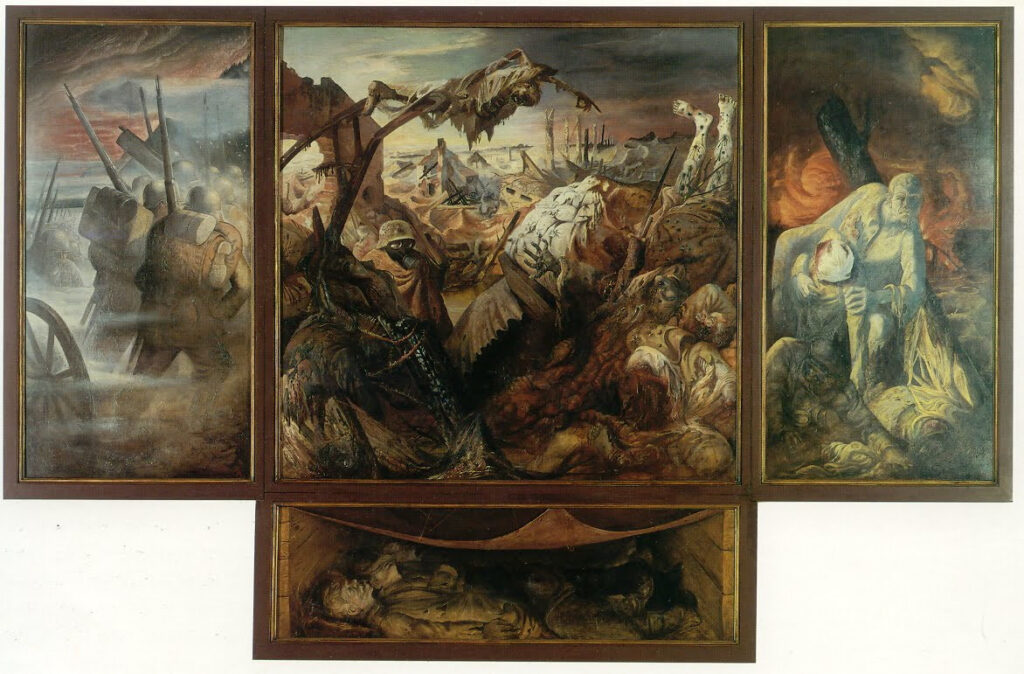
ce 11 novembre 2025 est l’occasion de souligner comme la façon dont l’Europe sacrifie les conscrits ukrainiens mobilisés de force rappelle le spectaculaire carnage de la 1ère guerre mondiale
Depuis l’allocution d’Emmanuel Macron à propos de la guerre en Ukraine, le 5 mars, les grands médias sont en ordre de marche. Réhabilitation du président en « chef de guerre », patriotisme exacerbé, concert militariste et glorification des industriels de guerre… Mené tambour battant, le SAV du discours présidentiel s’accompagne d’une nouvelle séquence de matraquage patronal contre le « modèle social » et pour « travailler plus » au nom, prétendument, de l’« effort de guerre » : « Pensions ou munitions ? » ; « Les canons ou les allocations ? » Signés Dominique Seux (Les Échos, 10/03) et Étienne Gernelle (RTL, 10/03), les deux slogans donnent le ton
Des combats entre la France et la Russie? Autrefois inimaginable, l’hypothèse s’est installée après les déclarations de M. Emmanuel Macron évoquant une «guerre existentielle» et l’envoi de «troupes au sol» en Ukraine. Depuis, le ton ne cesse de monter à Paris comme à Moscou. Une escalade qui semble ravir les médias français, au diapason du président de la République
ce 11 novembre 2025 est l’occasion de souligner comme la façon dont l’Europe sacrifie les conscrits ukrainiens mobilisés de force rappelle le spectaculaire carnage de la 1ère guerre mondiale
Der Krieg, Otto Dix, 20 décembre 1916
Une guerre que la moindre bonne volonté occidentale aurait suffi à empêcher. Fomenté par la CIA et au bénéfice aussi de l’Union européenne, un coup d’État d’extrême-droite à Kiev en février 2014. Une guerre ethnique dans le Donbass, que les accords de Minsk auraient pu arrêter. Fallait il que l’Occident les respectât. Mais Allemagne et France en étaient hélas les garants. Après le déclenchement en 2022 de l’opération militaire spéciale russe pour la libération du Donbass, la démilitarisation et dénazification de l’Ukraine, Angela Merkel et François Hollande avouèrent que l’Occident concevait ces accords comme une escroquerie, pour donner à l’OTAN le temps d’armer l’Ukraine.
Une implacable stratégie russe d’attrition écrase l’armée atlantiste, malgré le ruissellement d’armes et munitions occidentales, dont une longue liste de vaines Wundervergeltungswaffen : HIMARS, Panzerkampfwagen, Patriot, F-16 et j’en passe. Les bénéfices de l’industrie militaire des États-unis sont proportionnels à la stupidité technocratique de Bruxelles. Ce sont aujourd’hui les contribuables européens qui paient l’addition. Justice.
Des conscrits ukrainiens mobilisés de force. Les réseaux sociaux en offrent les témoignages cruels et quotidiens. Des pertes militaires qui approchent les 2 millions de tués. Des as russes de l’informatique en ont apporté les preuves. De l’ordre des sacrifices consentis par la Russie, multipliés par 10.
Moscou dit et répète depuis juin 2024 que le retrait des troupes atlantistes des positions qu’elles occupent encore dans le Donbass suffirait à instaurer un cessez-le-feu. Mais rien n’y fait. Ursula vonder Leyen et son caniche Emmanuel Macron en tête, les Européens s’enferment dans le fantasme de remporter une victoire stratégique quand leur défaite est totale, s’appliquent depuis février à saper les initiatives de Donald Trump.
107 ans après un guerre absurde -bourgeois impérialistes contre bourgeois impérialistes- qui resterait une farce si elle n’avait fait quelques 19 millions de morts ; 80 ans après la seule victoire qui méritait d’être remportée, celle de l’Union soviétique sur les armées fascistes européennes ; le Vieux continent est ravagé par une épidémie de russophrénie. La victoire de l’Occident serait toujours à portée au Donbass et pourtant, ce serait maintenant pour sauver l’Europe, ses valeurs et la civilisation d’une invasion imminente que le conscrit ukrainien devrait continuer de se faire hacher avec discipline.
En réalité, mis à part les cabots et adeptes impotents des plateaux de chaînes dites d’information, c’est parmi les volontaires nazis partis affronter les hordes néo-bolcheviques asiatiques que les discours délirants des politiciens européens trouvent un véritable écho.
Cinq siècles d’hégémonie révolue : colonialisme, fascisme, guerres mondiales, néo-colonialisme et jardinage [Josep Borrell]. Quand est ce que l’Europe, cette vieille catin, paiera enfin le juste prix de ses crimes ?
chronique alphabétique et nécrologique de l’engagement français dans les rangs atlantistes en Ukraine, ce que les journalistes serviles ne vous raconteront pas
chronique en Anglais, its roots before WW2, its collaboration with Nazi Germany, its legacy in modern Ukraine, how NATO has continually supported Nazism in Ukraine
Leaked files show top UK military figures conspired to carry out the Kerch bridge bombing, covertly train “Gladio”-style stay-behind forces in Ukraine, and groom the British public for a drop in living standards caused by the proxy war against Russia
entre l’haleine fétide d’une vieille droite pétainiste qui s’insurge contre une chanteuse d’origine malienne, d’une part, la vulgarité et la vanité, d’autre part, d’un spectacle de drag queens qui se pense à tort l’antithèse des pétainistes, semble échappé d’un backroom gay de la ville devenue musée, égaré dans une cérémonie d’ouverture de jeux olympiques […]
The Russo-Ukrainian War seems to have been engineered in a laboratory to frustrate people with repetition and analytic paralysis. Headlines appear to be circulating on a choreographed loop, all the way down to the place names. Kaja Kallas at the European Commission recently announced, without a hint of irony, that Europe’s new sanctions package – the 19th one – is the toughest yet. Ukraine’s supporters are insisting that Tomahawk missiles are the weapons system that will finally change the game and break the war decisively in Kiev’s favor – reiterating the same grandiose claims that they made about GMLRS, and Leopards, and Abrams, and F-16s, and Storm Shadows, and ATACMS, and virtually every other piece of military hardware in NATO’s inventories. On the ground, Russia is attacking settlements named Pokrovsk and Pokrovs’ke; it recently captured Toretsk and Tors’ke and is now attacking Torets’ke. The more things change, the more things stay the same.
The analytic frameworks applied to the war have also changed relatively little, buried and obfuscated by the nebulous concept of attrition. On the Ukrainian side, there is continued insistence that Russia is suffering exorbitant losses and straining under the pressure of Ukrainian deep strikes, while Ukrainian setbacks are blamed in large part on the failure of the United States to expand its largesse and give Ukraine everything it needs. Many pro-Russian lines of thinking mirror this and suppose that the AFU is on the verge of disintegration, while the Kremlin is accused of failing to “take the gloves off”, particularly in regards to the Ukrainian energy grid, Dnieper bridges, and dams.
The result is a very strange sort of war. This is an extraordinarily high-intensity ground war. Both armies remain in the field, holding hundreds of miles of continuous front after years of bloody fighting. Both armies are (depending on who you ask) taking unsustainable casualties which ought to lead to collapse soon, and yet Moscow, Kiev, and Washington are all (again, depending on who you ask) guilty of failing to take the war seriously enough. All of this is maddeningly repetitive, and one could be forgiven for tuning out entirely. Even the diplomatic tango between Trump, Zelensky, and Putin, after delivering a few entertaining moments, failed to really move the needle in any discernable direction.
Few would argue that the trajectory of the war changed in an obviously dramatic way in 2025, and it is important to avoid the worn out and clichéd language about “turning points” or “collapse” or any such silly thing. However, 2025 saw several shifts in the war, which will hardly ostentatious or dramatic, are nevertheless very important. 2025 has been the first year of the war in which Ukraine launched no ground offensives or proactive operations of its own. This fact is not only a hint at the threadbare state of Ukraine’s ground forces, but also a testament to the way Russian forces transformed “attrition” from a buzzword into a method of persistent pressure across a variety of axes this year.
In lieu of initiative on the ground, and facing a slow but relentless rollback of their defenses in the Donbas, the theory of Ukrainian victory has shifted in an unacknowledged but dramatic way. After years of insisting that it would achieve maximal territorial integrity – an outcome which would require the total and decisive defeat of Russia’s ground forces – Ukraine has reframed its path to victory mainly as a process of inflicting strategic costs on Russia that mount until the Kremlin agrees to a ceasefire. Consequentially, the debate about arming Ukraine has shifted from a conversation about armor and artillery – equipment useful for retaking lost territories – to a discussion about deep striking weapons like Tomahawks, which can be used to shoot at Russian oil refineries and energy infrastructure. In short, rather than move to prevent Russian from achieving immediate operational objectives in the Donbas, Ukraine and its sponsors are now seeking ways to make Russia pay a price such that victory on the ground is no longer worth it. It is unclear whether they have thought about what price Ukraine will pay in the exchange. Perhaps they do not care.
About Tomahawks
Notwithstanding Ukraine’s attempts to jumpstart indigenous production, it is inevitable that Ukrainian capabilities will be largely determined by the largesse of western sponsors. This aspect of the war took a sudden turn at the beginning of the October when fresh reporting began to circulate that Tomahawk missiles might be on the table for Ukraine. Tomahawks have always been on Ukraine’s wish list (given that the Ukrainian wish list as such consists of essentially all the military equipment in NATO’s combined inventories) but this was the first reporting that they might be under serious consideration.
As is frequently the case, the discussion spiraled away from realistic grounding, with some suggesting that the Tomahawk would be a “game changer” for Ukraine (where have we heard that before?) and the pro-Russian sphere dismissing it as an irrelevant distraction. There’s a tendency to focus on the quality of American weapons systems, casting them as either unrivaled technological marvels or overhyped and overpriced baubles, but this is generally not productive and largely irrelevant to the matter at hand. The Tomahawk, broadly speaking, is exactly as advertised, and provides proven and reliable strike capability at strategic depths in excess of 1,000 miles. In role, range, and payload it is essentially an analog to Russia’s Kalibr missiles (I am begging the enthusiasts to note the phrase “essentially an analog” rather than rake me over the coals over the different guidance systems and other technical minutia). Such a system will always be valuable and would obviously improve Ukraine’s deep strike capabilities.
The “problem” with Tomahawks does not relate to any “problem” with the missile itself, but with its availability and Ukraine’s technical capability to launch them. The Tomahawk is conventionally a ship-launched missile (there is no extant air-launched variant) with a few novel options for ground launch. Ukraine, obviously, would require ground launch systems, and the problem is that these systems are essentially brand new and available in very limited quantities: more importantly, American service branches are in the process of trying to build out these capabilities throughout the decade. Providing ground-launchable Tomahawks to Ukraine in any meaningful numbers would therefore essentially require the US Army and Marines to scrap their own force buildout plans.
There are two basic options for ground launching Tomahawks. One of these is the US Army’s MRC (Mid-Range Capability) Launcher, dubbed the Typhon. This is an enormous tractor-trailer launcher with four launch tubes, first delivered in 2023. It has an enormous footprint – so large, apparently, that the Army is already asking for a smaller replacement – and is intended to give the Army an organic fires component in the gap between the shorter range Precision Strike Missile and hypersonic systems (which do not yet exist). The critical fact is this: the Army intends to field a total of five Typhon batteries by 2028, of which two have been delivered so far. Each battery consists in turn of four launchers, implying that eight out of a planned twenty launchers have been delivered. Even more importantly, both of the currently operational batteries are already deployed, with one in the Philippines and one in Japan. These systems are being actively used in exercises and trials, including an exercise this summer in Australia
The Typhon system gives ground launch capability to the Tomahawk but brings a massive footprint
The situation with the Marine Corps’ launch system is quite similar, although the launch platforms themselves could not be more different. Unlike the lumbering Typhon tractor trailer, the Marines are fielding a significantly more lithe and compact LMSL system, with the tradeoff of a single launch tube compared to the Typhon’s four. What matters is not so much the technical differences, as the fact that the Marines – like the Army – only received their first deliveries in 2023, and they are currently in the process of building out the force. In the case of the marines, the goal is to have a Tomahawk battalion built out by 2030. In fact, the production contract came into effect as recently as 2025.
What does all of that mean? It means that, although the Tomahawk itself is a fine missile, the systems for ground launch are so new and available in such limited quantities that equipping Ukraine with Tomahawks would require either the US Army or the Marines to materially alter their force structure in the near term (through 2030, essentially). These are essentially the opposite of much of the gear that’s been given to Ukraine to this point: far from being inventories of older systems that can be earmarked as surplus or tabbed for replacement, Tomahawk ground launch is a brand new capability that is in the middle of deployment and buildout for the first time.
This is, of course, a layered complication on top of Tomahawk quantities in and of themselves. The issue of Tomahawk availability is both over and under emphasized, depending on the context. The United States has something like 4,000 Tomahawks in its inventories (although half of these are currently inside their cells on American ships), so it is not quite correct to say (as some have) that America is running out of these critical weapons. The issue is that production rates are relatively anemic (generally between 55 and 90 per year) and are fail to replenish the expenditure from even relatively brief strike campaigns, such as the repeated strikes on Yemen. Broadly speaking, then, the issue is not so much that the United States is in immediate danger of running out of Tomahawks, but that procurement schedules are so slow that even relatively minor expenditures can erase multiple years worth of deliveries.
It may be useful, then, to consider Tomahawks in comparison to the ATACMS missiles which have already been provided to Ukraine. Unlike the Tomahawk, the ATACMS is a system which has already been tabbed for replacement, with the Precision Strike Missile in the early phases of its rollout. ATACMS were also compatible with launch systems that Ukraine already had. In comparison to Tomahawks, then, ATACMS are both vastly more strategically expendable, produced in larger numbers, and easier to deploy. Despite all these points in their favor, the United States provided Ukraine with just 40 ATACMS. Even if the Army could be pressured into handing over one or two of its brand new Typhon launchers, it is difficult to imagine that more than few dozen Tomahawks could be spared for Ukraine: a token inventory far too small to wage a sustained strike campaign in the Russian heartland
Peace, Sponsored by Raytheon
Given that Tomahawks for Ukraine would be measured in the dozens, rather than the hundreds, it’s worth asking whether this could actually change anything for the AFU at the front. The answer is clearly no in the long run, but it would be unwise to dismiss the possibility that even a limited tranche of Tomahawks (let’s say 40 to 50 missiles) could help alleviate pressure on Ukrainian forces at the front, provided they were used appropriately. A short term boost to Ukrainian strike capabilities, if deployed against Russian rear areas, could force further dispersal and rationing of Russian assets and temporarily stall Russia’s emerging multi-axis offensive. This could defer the loss of key positions until early 2026. This presumes, however, that the Ukrainians would be content to use Tomahawks against operational targets. In reality, Ukraine can never seem to resist lobbing missiles at targets that have little bearing on the front, like the Kerch Bridge. Indeed, a failure to synergize strikes at depth with operations on the ground is a major reason why the ATACMS achieved so little.
On the other side of this equation, it is a common complaint from the Russian perspective that Moscow has done too little to “deter” the United States from empowering Ukraine’s strike campaign – both by directly providing munitions and supplying the planning, ISR, and guidance systems. This, however, rather misses the point. Russia has done nothing of note to deter the United States because both Moscow and Washington understand fully that there is essentially no appetite (on either side) for a direct confrontation. In the (sensible) absence of a willingness to strike back at NATO targets, there is really nothing Russia can do to deter beyond maintaining its own retaliatory capabilities. The issue is not that Russia has failed to actively deter, but that there is nothing they could do even if they wanted to.
The basic pattern here is well established. The United States has done what it can to backstop Ukrainian strike capabilities, but it has held them at a level where Ukraine’s damage output falls far short of decisive levels. So long as that is the case, Russia has clearly demonstrated that it will simply eat the punches and retaliate against *Ukraine*. Hence, when the United States helps Ukraine target Russian oil facilities, it is Ukraine that receives the reprisal, and it is Ukraine which has its natural gas production annihilated as the winter approaches. In a sense, neither side is really trying to deter the other at all. The United States has raised the cost of this war for Russia, but not enough to create any real pressure for Moscow to end the conflict; in response, Russia punishes Ukraine, which is something the United States does not really care about. The result is a sort of geostrategic Picture of Dorian Gray, where the United States vicariously inflicts cathartic damage on Russia, but Ukraine accrues all the soul damage.
In the case of Tomahawks, the risk-reward calculus is just not there. Tomahawks are a strategically invaluable asset that the United States cannot afford to hand out like candy. Even if the launch systems could be provided (highly doubtful), the missiles could not be made available in sufficient quantities to make a difference. The range of the missiles, however, significantly raises the probability of miscalculation or uncontrolled escalation. Ukraine shooting American missiles at energy infrastructure in Belgorod or Rostov is one thing; shooting them at the Kremlin is another thing entirely.
There is, however, another aspect of this which seems to be garnering little attention. The biggest risk of sending Tomahawks is not that the Ukrainians will blow up the Kremlin and start World War Three. The bigger risk is that the Tomahawks are used, and Russia simply moves on after eating the strikes. Tomahawks are arguably one of the last – if not *the* last – rung in the escalation ladder for the USA. We have rapidly run through the chain of systems that can be given to the AFU, and little remains except a few strike systems like the Tomahawk or the JASSM. Ukraine has generally received everything it has asked for. In the case of Tomahawks, however, the United States is running the most serious risk of all: what if the Russians simply shoot down some of the missiles and eat the rest of the strikes? It’s immaterial whether the Tomahawks damage Russian powerplants or oil refineries. If Tomahawks are delivered and consumed without seriously jarring Russian nerves, the last escalatory card will have been played. If Russia perceives that America has reached the limits of its ability to raise the costs of the war for Russia, it undercuts the entire premise of negotiations. More simply put, Tomahawks are most valuable as an asset to threaten with.
Reading between the lines of President Trump’s public statements recently, it seems likely that he has rationally weighed these considerations. Publicly, he used the threat of Tomahawks to try and force Russia to keep negotiating, and he’s received a commitment for another meeting with Putin for his trouble (more on that later). He has now, for the time being, shelved the Tomahawk plan, commenting that “we need them” and applying the usual Trumpian linguistic style to the broadly accepted issue of inventories which I have outlined here. Tomahawks are simply more valuable to the United States as a tool to threaten escalation, rather than as an actual kinetic asset in Ukrainian hands, and so long as Trump keeps his powder dry he can re-raise the issue later.
Ultimately, perhaps, this discussion is not about Tomahawks at all. These missiles, rather, are simply a totem which demonstrate two important dovetailing points. First, that American resources are not infinite, and as the United States reaches deeper into its bag to help Ukraine, it begins to grab at strategically critical assets that the US military simply cannot spare. Secondly, we must remember that America’s policy in Ukraine is a game of titration, with Washington probing the limits of Russia’s willingness to “eat the strikes” without allowing the reprisal violence to spill out of Ukraine.
The Big Banana: Russia’s Operational Schema
At this point, it’s becoming increasingly difficult to say anything meaningful about the actual operational progression on the ground. There are several reasons for this. First and foremost, the war has now gone on so long and is consistently moving at such an apparently glacial pace that most people simply do not care at this point whether Russia holds Yampil or not, or whether they have advanced past the rail line in Pokrovsk. There is severe fatigue (or perhaps boredom is the better word) with the status of an interminable sequence of apparently small settlements, industrial complexes, and forestry plantations, and as a result most people have essentially checked out. Not the least among these must surely be President Trump, who apparently chucked Zelensky’s map of the frontline and complained that he was tired of being shown the same maps over and over again.
On the other hand, we have the true obsessives who continue to dutifully follow the frontlines regularly and are voluntarily intaking daily updates. We end up with a bifurcated system where some people are still highly plugged in to the micro movements on the battlefield, but most people just don’t care, and we can hardly blame the latter. I think it would be profitable, then, to think about the broader Russian operational scheme, what it has achieved, and what it aims to achieve in the coming year. This is probably more interesting and less repetitious than fixating on the exact positioning within Pokrovsk or Kupyansk.
There are two larger points that I think are worth making before we look at some specifics.
First and foremost, much of the battlefield analysis that comes out (particularly from western analysts) makes firm pronouncements as to what constitutes Russia’s “primary” and “secondary” efforts, but these are essentially interpolated and frequently incorrect. For example, it’s become a fairly mainstream conception that Russia’s “primary” point of effort right now is the capture of Pokrovsk, but this does not actually seem supported by Russian actions. There is no particular advantage to be gained for Russia by pushing to capture Pokrovsk as soon as possible – the city is already in a stranglehold partial encirclement. To be sure, Pokrovsk *was* a major logistic hub for Ukrainian forces, but it can no longer serve that role and was sterilized as a transit hub months ago, once it became a frontline city. The opposite side of this coin is that other Russian axes of advance, particularly in southern Donetsk and the bend of the Donets River, are dismissed as “secondary” efforts. This is a major mistake, and I will attempt to show that these are critical advances where Russia is shaping the battlefield to its advantage for follow on operations.
Secondly, it should be understood and appreciated that Ukraine has lost essentially all battlefield initiative. In 2024, the AFU was able to assembled a mechanized reserve and launch their operation into Kursk. This operation ultimately failed and resulted in severe Ukrainian losses, but this is unrelated to the fact that Ukraine was still able to accumulate forces and pursue offensive operations on its own initiative. In 2025, however, Ukraine has been in a permanent state of reactivity. This was the first year of the war in which Ukraine did not launch any proactive operations or counteroffensives of its own, and Ukrainian hopes have instead pivoted to their strategic strike campaign against Russian oil facilities.
In a larger sense, the effect of attrition can be seen year by year with the shrinking scope of Ukraine’s proactive operations. In 2022, Ukraine was able to launch a pair of widely separated offensives which yielded modest successes: an offensive out of Kharkov rolled the front back over the Oskil River (though it failed to collapse the Lugansk shoulder), meanwhile, a series of battles outside of Kherson failed to break through the Russian lines, but they did play a role in persuading the Russians to abandon their bridgehead over the Dnieper. The point of course is not to once again autopsy these offensives, but to point out that there were two of them, that they were meaningful in scale, and they did result in important territorial gains for Ukraine. In 2023, by contrast, Ukraine launched a single theater-level offensive in the south, which failed. In 2024, we got the Kursk operation: smaller and less lavishly equipped than 2023’s Zaoprizhia offensive, and aimed at a peripheral theater. This year, there were no proactive Ukrainian operations at all. There is a very clear pattern at play here, with Ukraine’s offensive punch progressively shrinking before disappearing entirely in 2025. This was a year of essentially uninterrupted Russian initiative
Putting Ukraine permanently on the backfoot is a significant Russian achievement, and it is owed to a few converging factors. Obviously, the attrition of Ukrainian forces is a major factor. We’ve gone through the flailing Ukrainian mobilization, the cannibalization of its forces, and the general lack of reserves in detail on several occasions, and there’s no need to retread that ground here. Suffice it to say, Ukraine’s ability to husband forces for offensive operations appears to be severely degraded. Russia has exacerbated this problem by pressing steadily on a variety of different axes. At the moment, there are no fewer than seven Russian axes of attack, pressuring a slew of cities all along the line. This creates a series of defensive emergencies, maintains the burn rate on Ukrainian forces, and fixes them on the line. Finally, in a point to be detailed shortly, Russian advances have begun unraveling Ukraine’s logistic connectivity, which puts strain on supply and prevents the concentration and accumulation of forces
Eastern Ukraine: Approximate Situation and Axes of Russian Advance
Now, for the development of the front and the premise of the Russian offensive scheme. The main point that I want to impress is essentially as follows: rather than fixating on Pokrovsk, Russia’s advances across Southern Donetsk and on the inner bend of the Donets River ought to be thought of as vital operations which have severely disrupted the coherence of both the Ukrainian front and their logistics. This has the triple effect of preventing the Ukrainians from launching offensives of their own, accelerating the attrition of Ukrainian forces, and shaping the front for the coming operation to capture the Slovyansk-Kramatorsk agglomeration.
To begin, let’s consider the progress that Russia has made in southern Donetsk, both in raw territorial terms and its implications for Ukrainian logistic connectivity. To demonstrate this, I’ve pulled maps from DeepState (again, a Ukrainian mapping enterprise) for August 2023 (when Ukraine was attempting its counterattack out of Orikhiv) and for October 20th, the week of this writing. I have noted both the length of the southern front (obviously a linear approximate, as the actual front has many bends and bulges) and highlighted the key highways that Ukraine uses to run the backbone of its logistics
The Southern Front: 2023 vs 2025
Now, one thing that is worth noting is that the Russians are currently positioned to roll up this front even further. Ukrainian defensive lines are primarily oriented towards on a north-south axis. Once Russian forces cleared Kurakhove, they entered the seams in these defensive lines – that is to say, they are advancing laterally along the face of the prepared defenses, rather than trying to bash through them from the front. This is one reason why their progress has been relatively steady and uninterrupted. Now approaching the “elbow” in the lines, where they pivot southward, and having crossed the Yanchur River, the Russians are entering a substantial space that lacks meaningful prepared defenses. Using the Military Summary map (Ukrainian fortifications are mapped with yellow dots), the void in the defense is fairly obvious as the Russians work their way into the elbow of the line
Apart from the obvious development of note here – that Russian forces have, to this point, rolled up roughly half the length of the southern front and are positioned to roll up another ten to fifteen miles – we want to note two things which are emblematic of the way the war is going for Ukraine, but curiously receive little attention. First, the compression of the front is robbing the Ukrainians of the maneuver space which made it possible for them to stage and assemble forces for their counteroffensive in 2023. Two years ago, there was a wide, lateral buffer zone around the Ukrainian staging area in Orikhiv, and Ukrainian forces had access to multiple highways where they could disperse forces in their marching columns and run their logistics.
Today, that buffer zone is gone, as is the easy access to several of the branch highways. The Russian advance, which started with the breakthrough at Ugledar and Kurakhove last year and which has now rolled up some 50 miles of front, has essentially sterilized Ukraine’s capacity to attack in the south, because they have neither the space nor the roads to safely accumulate forces here. It has also shattered the interconnectivity of Ukrainian logistics: rather than having several highways to shuttle troops and material to the east, Ukraine now has to support several disconnected logistic fronts with individual highways. More to the point, there is no longer a single Donetsk “front” to speak of, but rather a series of logistic fronts: one in the south, around Orikhiv, another at Pokrovsk, and the largest one in the Slovyansk Banana. These are lacking lateral connectivity to each other for the Ukrainians due to the wedges that the Russians have forced in the front, particularly in the south, funneling logistics and reinforcements down individuated corridors.
The bigger issue, however, lies farther north on the Pokrovsk and Donets axes, and in the way that they synergize. People who are focusing, to the exclusion of all else, on when and how Russia will capture Pokrovsk are failing to see the bigger picture, and indeed are not even trying to understand it.
The ultimate Russian operational objective (in this phase of the war, at least) is the belt of cities which runs in an arc from Slovyansk to Kostyantinivka, which I affectionately call “the Slovyansk Banana” due to its curved shape. A cursory look at the map shows us why the very operations that are being dismissed as secondary efforts are in fact critical axes of Russian effort which are shaping the battlefield for the attack on the Banana
There are two very important facts about the Banana, from the perspective of operational geography. The first is that, although the combined mass of the agglomeration is far larger than any of the urban areas that have been fought over to this point, the Banana is relatively difficult to defend because it sits on the floor of a river valley: the Kazennyi Torets flows through all the cities in the Banana before it flows into the Donets. Russian forces approaching the city from the southwest, the east, and the north will all be advancing along the high ground that overlooks the cities on the floor.
The second important fact about the Banana is that, despite its size, it is supported by just two highways which approach from the southwest and northwest respectively, funneling into the Banana like a wedge. Taking the northern highway/MSR (the E40 highway) as an example, we see that Russia’s operations inside the Donets bend are hardly secondary efforts: they are vital shaping operations linked to the integrity of the Banana. The E40 highway tracks the Donets bend very closely (it generally stays within five miles of the river. If the Russians sustain their progress north of the Donets and reach the river at Bogorodychne or Svyatogirsk, it will not only put E40 under persistent drone attack but also curl the defensive line behind the Banana, to say nothing of the enormous pressure on the Siversk salient.
On the Pokrovsk front as well, Russia’s progress is being misinterpreted. After their breakthrough at the end of the summer, Russian forces have consolidated the bulge north of Pokrovsk (despite weeks of Ukrainian counterattacks) and are steadily working their way towards Rais’ke and Sergiivka. This is not about Pokrovsk at all – reaching Rais’ke would put Russian forces directly in the backfield of Kostyantinivka, on the supply lines to the underside of the Banana.
I am not suggesting at all that Russian forces are on the verge of some great offensive surge that will carry them into the heart of the Banana instantly. However, there is a fairly well established Russian operational methodology in this war, which involves working their way methodically into Ukraine’s logistical lanes and seams, segmenting the front and strangulating their strongpoints, forcing them to supply frontline strongholds with single file logistics and dirt roads. They did it in Bakhmut, and Avdiivka, they are doing it in Pokrovsk, and they are shaping the front to attempt this on a large scale in the Banana
Assault on the Banana: Coming 2026
The general point that we are trying to make here is that dismissing Russian advances in the Serebryanka Forest, the emerging bulge north of Pokrovsk, and their move into the Donets Bend as “secondary efforts” is mistaken. Zooming out to the appropriate scale shows that these are concentric operations, shaping the front for a 2026 assault on the Banana – moving towards the E40 road from the north, bending the defensive shield around Siversk, and working into the underbelly of the Banana through Rais’ke.
This is, perhaps, a long way to go for a short drink of water, but there are a few basic points here that get completely missed when the view of the front is preoccupied with the fighting inside Pokrovsk and Kupyansk:
Russia’s advance out of Kurakhove across the southern front is not a secondary axis. They have rolled up half of the southern front, condensing Ukrainian forces into a compact space which sterilizes their ability to attack in the south.
Broad Russian pressure across a half-dozen axes maintained a steady burn rate on Ukrainian forces and prevented the accumulation of forces for proactive operations. 2025 has been the first year of the war in which Ukraine has not launched any offensive operations on its own initiative.
Advances in the Donets bend and the interstitial space between Pokrovsk and Kostyantinivka are not subsidiary or secondary operations: they are critical shaping operations that are moving concentrically toward the Banana.
To be frank, the general mood of optimism in the Ukrainian infosphere, which lasted for much of the summer, struck me as remarkably odd. The frontline has yielded no real good news for Ukraine at any point this year. Beyond the broader strategic point, that Ukraine has lost the initiative and does not seem capable of getting it back, Russia is in the process of capturing two important urban centers (Russian troops are in the city centers of Pokrovsk and Kupyansk), it has begun the assault on at leas two more (Lyman and Kostyantinivka), it has rolled up half of the southern front, and cleared most of the inner Donets-Oskil bend. The Banana is on deck for 2026.
Ukraine’s Cost Theory of Victory
One thing that has become apparent over the last year is that Kiev has abandoned previous notions of outright victory on the battlefield and adopted a new strategic framework predicated on imposing unacceptable costs on Russia, so that Moscow will agree to freeze the conflict.
This is a subtle and unspoken yet extremely important distinction. It is easy to miss, because both Ukrainian leadership and Ukraine’s western backers continue to speak of Ukrainian “victory” and the possibility of Ukraine “winning” the war. What is crucial to understand is that the “victory” that they speak of now is categorically different than the victory of 2022 and 2023. In the first years of the war, it was possible to at least speak of Ukraine taking the initiative to advance on the ground and retake territory. There were concrete examples of Ukrainian offensives in 2022, and the battle in Zaporizhia – although unsuccessful – showed that it was at least possible for Ukraine to attempt a proper mechanized offensive.
Therefore, in the first years of the war, when leaders in Kiev and Brussels and London and Washington spoke of Ukrainian victory, they essentially meant the defeat of the Russian ground forces and the reconquest of much (or all) of the Donbas. The Kursk Operation of 2024 began to split the difference: Ukraine still had some resources to mount proactive operations, but these operations were no longer aimed at the dense eastern front and instead aimed at relatively soft subsidiary fronts with an eye to out-levering the Russians.
Today, with the Ukrainian army stuck in a permanent state of reactivity and slowly receding defense, it no longer makes any sense to speak of Ukrainian victory in the most straightforward sense, which is to say victory on the battlefield – no matter how tenaciously or bravely the Ukrainian rank and file continues to fight in essentially intolerable circumstances. Instead, Ukrainian “victory” has been transmogrified to mean essentially that Russia absorbs such exorbitant costs that it agrees to some sort of ceasefire without preconditions.
The costs to be imposed on Russia are implicitly assumed to be a mixture of battlefield casualties and damage to strategic assets inflicted by Ukrainian air strikes, and in regards to the latter Ukraine seems to be particularly placing its hopes in a strategic strike campaign against Russian oil. Ukraine’s attempts to disable Russian oil production and refining have dovetailed with ever more aggressive sanctions from the United States against Russian fossil fuel exports – although it is worth noting that the limited price response to these sanctions indicates that markets expect that Russian oil will continue to flow.
Trump’s suggestion that Tomahawks may be on the table for Ukraine must be seen as a constituent element of this new strategy and theory of victory. And this, ultimately, is very important to understand. Tomahawks are not being bandied about because anybody (in Kiev or Washington) believes that 50 cruise missiles will allow Ukraine to defeat the Russian Army and recapture the Donbas. Tomahawks were mentioned because the Ukrainian alliance is threatening to cripple the Russian fossil fuels industry (through a mixture of sanctions and kinetic strikes on production facilities) unless Putin agrees to a ceasefire.
This is why it is wrong to be surprised that Trump abruptly cancelled his meeting with Putin and instead announced more sanctions. There’s nothing abrupt or erratic about this. Threats to Russian oil are now, without exaggeration, the main lever that the Ukrainian bloc has against Russia. It certainly should not have been a surprise that the Kremlin, which has reiterated the same fundamental war aims since day one, was not excited about coming to Budapest to freeze the conflict, and neither should it surprise us that Trump would instead prefer to pull harder on the oil lever. The two powers are playing entirely different games: Russia is slow-walking negotiations while it advances on the ground, and the United States is playing a pain game designed to raise the costs for Russia
We have fundamentally reached an impasse when it comes to negotiations. For Moscow, negotiations with the United States are essentially a way to string Washington along. Moscow feels that it is winning on the ground, therefore a diplomatic impasse suits Russian interests. When western leadership complains that Russia does not seem interested in ending the war, they are correct, but they are missing the point. Russia is not interested in ending the war right now because doing so would not serve Russian interests. The Banana is in the crosshairs, and a ceasefire now would be an egregious compromise when victory on the ground is in sight.
The sense of urgency that Washington feels to end the war – mainly by yanking furiously on the oil lever until the Kremlin cries uncle – stems from the fact that this is now the only sort of victory that Ukraine can hope to win. The ground war has been written off as a total loss, and all that remains is to lob missiles and drones at Russian refineries, sanction Russian firms and banks, and harass shadow tankers until the costs become intolerable. The longer the Ukrainian ground forces can hold the line the better, but this is merely a matter of limiting the downside. The fact that Russia can retaliate disproportionately against Ukraine barely factors into this thinking.
The key point here, however, is that the concept of Ukrainian victory has been completely transformed. There is now no real discussion of how Ukraine can win on the ground. For the Ukrainian bloc, the war is no longer a contest against the Russian Army, but a more abstract contest against Russia’s willingness to incur strategic costs. Rather than preventing Russian capture of the Donbas, the west is testing how much Putin is willing to pay for it. If history is any guide, a game predicated on outlasting Russia’s strategic endurance and willingness to fight is a very bad game to play indeed [end]
Ingo Schmidt on how the triumph of liberal democracy and neoliberal globalization became the ideological seed for the AfD
Co-leader of the far-right Alternative for Germany (AfD) party and the party’s candidate for chancellor, Alice Weidel, features on the cover of a 2023 edition of Stern magazine (conceptphoto.info)
On November 6, 2024 German Chancellor Olaf Scholz fired Finance Minister Christian Lindner. Notwithstanding the broad agreement on policy goals, striking a balance between deficit reduction, support for renewable energy and increased arms spending turned out to be impossible. Lindner, a liberal, opted for social cuts; Scholz, a social democrat, wants to avoid them. They had to part ways. After Scholz lost a no-confidence vote, federal elections were scheduled for February 23, 2025. The question that worries everyone from old-school conservatives to new millennium lefties is: How many votes will go to the hard right (if not neo-Nazi) party Alternative for Germany (Alternative für Deutschland or AfD). In the last federal elections in 2021, the AfD got 10.4 percent of the total vote. Current polls put them at 20 percent, but nobody knows what will happen on election day. In this new age of uncertainty, polls don’t predict election results as reliably as in the past.
Elections in the East German provinces Brandenburg, Saxony and Thuringia have already shown what hard-right success looks like. They also reveal the inability of the political centre to understand how much it contributed to the rise of a new right. Refashioning totalitarianism theory in the New Cold War climate, centrist politicians and pundits typically portray the success of the new right as the outgrowth of the Nazi and Communist dictatorships that ruled East Germany from 1933 to 1990. West Germany, which was spared Communist rule and, allegedly, shook off the burden of its Nazi past, appears as a role model in this democracy-versus-dictatorship story. Totalitarianism theory could possibly explain why the AfD is more successful, so far at least, in East than in West Germany. But it can’t explain right-wing success in other countries, like France, that were never under Communist rule and know Nazi rule only from occupation, which strengthened anti-fascist traditions in those countries. But even these traditions couldn’t stop the rise of the new right there.
This article offers a different explanation for the hard-right surge in Germany. It shows that German unification in 1990, signalling the triumph of liberal democracy and the onset of neoliberal globalization, unleashed a new form of nationalism—Deutschmark nationalism—which, after mutating into export nationalism for a while, became the ideological seed for the AfD. West Germany, or, more precisely, the economic miracle that was West Germany in the post-war era, served as a role model during German unification. Promoted by West German elites and eagerly embraced by people in East Germany, it raised the expectation of a new economic miracle materializing in the West and extending to the East. However, these hopes were soon disappointed as political unification caused socioeconomic divisions between East and West Germany and, in the early 2000s, a turn to austerity policies that were highly unpopular in the East and the West. Just when it seemed that Germany would weather the world economic crisis of 2008-9 better than other Western countries, and maybe even become the European hegemon, things started falling apart. The Euro-crisis made clear that it was not only politically united Germany that was plagued by massive socioeconomic and geographical divisions but the European Union, too. Continued economic weakness combined with New Cold War marching orders from Washington fed a nostalgia for a supposedly great past—symbolized by the Deutschmark. This nostalgia, I argue, would not have taken root if the left had been able to channel growing discontent into mobilization for a more equitable and less insecure future.
State elections in Brandenburg, Saxony, and Thuringia
State elections don’t typically get international media attention. The September 1, 2024, elections in Thuringia and Saxony did. After all, it was the first time since the downfall of the Nazi-regime that a hard-right party, the AfD, pulled the majority of votes in a German election. It proved a bitter coincidence: The AfD celebrated their victory in Thuringia, obtaining 32.8 percent of the total vote, on the 85th anniversary of the Nazi-invasion of Poland that marked the beginning of the Second World War.
The Conservative Christian Democrats (the Christlich-Demokratische Union or CDU) came in second with 23.6 percent. The parties of the federal government coalition, Social Democrats (Sozialdemokratische Partei Deutschlands or SPD), Greens (Bündnis 90/Die Grünen) and Liberals (Freie Demokratische Partei or FDP) ended up with single-digit results, the FDP reduced to a mere 1.1 percent. At the time of the election, this was the party of the federal minister of finance. The Left Party (Die Linke), which in the previous election had become the strongest party for the first time in any German state, lost almost 18 percent and came in fourth, even trailing the Sahra Wagenknecht Alliance (Bündnis Sahra Wagenknecht or BSW), a breakaway group from the Left Party.
In Saxony, the AfD won 30.6 percent of the votes, just behind the CDU’s 31.9 percent. As in Thuringia, none of the parties of the federal government coalition achieved double-digit results. The Left Party lost more than half of its vote and ended up with a devastating 4.5 percent. The BSW came in a distant third with 11.8 percent.
Just three weeks after their election victories in Thuringia and Saxony, the AfD scored another success in Brandenburg. Narrowly beaten by the SPD that got 30.9 percent of the total vote, the AfD came in second with 29.2 percent, way ahead of the BSW’s 13.1 percent and the CDU’s 12.1 percent. The Left Party and the Greens obtained less than five percent of the vote, which is the minimum threshold for holding seats in provincial or federal parliament under the mixed-member proportional electoral system. The FDP pulled less than one percent.
Mainstream media fails to explain right-wing success
Barely beaten by the Conservatives in Saxony and the Social Democrats in Brandenburg, the AfD was elected by roughly a third of the electorate in three East German states, becoming the strongest party only in Thuringia. If ever there was a right-wing surge, this was it. Most media reports attributed the phenomenon to widespread dissatisfaction with the federal government, particularly regarding migration, climate policies and the war in Ukraine. Accounts of why the AfD is more popular in the East (approval ratings in the west of Germany range from 8.5 percent in Hamburg and the Saarland to 21 percent in Lower Saxony) focus mostly on disappointments caused by German unification, continuing socioeconomic disparities and a widespread feeling among erstwhile East Germans of being second class citizens. Other explanations invoke the authoritarian heritage of communist rule in East Germany, which is often presented as an extension of the Nazi-regime. Against the two dictatorships in the East, West Germany is presented as a role model of liberal democracy. This as if there hadn’t been considerable continuity between Third Reich and West German elites; as if East Germany’s ruling bureaucracy, despite all its dictatorial wrongs, wasn’t established by antifascists who had been exiled or jailed during the Nazi reign; as if the nationalization of the means of production, despite the wrongs of bureaucratic rule, had not marked a break from the West German capitalism that made West Germany a junior partner in the American Empire; as if West German capitalism had not dictated the terms of unification at the very time that a grassroots movement for democracy unsettled bureaucratic rule in East Germany. The destruction of the East German economy and the integration of the East into existing West German institutions left no room for the aspirations of East Germany’s civil rights movement. Rather than explaining growing support for the new right, media talk about the “peculiarities of the East” reinforces existing frustrations there—frustrations that help shed light on the relative strength, so far at least, of the right-wing surge in the East.
The ‘two-dictatorships’ thesis that pits the East against the liberal democratic West revives the totalitarianism theory that was an integral part of the anti-communist, anti-Soviet consensus during the Cold War. It is now part of the New Cold War ideology that counterposes democracy and authoritarianism. As in the old Cold War, charges of totalitarianism serve to short circuit thinking about alternative economic and political systems, reinforcing the neoliberal creed that there is no alternative to capitalism. The lack of actually existing alternatives is, of course, also one of the reasons for the rise of the new right. Emerging out of an ailing neoliberalism, this right-wing force presents itself as an alternative to the status quo but actually just recasts neoliberalism in a nationalist and racist mould. Replacing neoliberalism’s earlier commitment to corporate globalization in Germany, as elsewhere, neoliberalism is haunted by the spectre of fascism, which, to centrist neoliberals, has everything to do with misled masses unable to understand the virtues of capitalist liberal democracy and nothing to do with capitalist crises that undermine the legitimacy of liberal democracy. Neoliberalism is also haunted by the spectre of communism as ruling classes worry that crisis of legitimacy could extend to capitalism itself. As the neoliberal centre denies the possibility of alternatives and the left generally (not only the Left Party in Germany) appears unable to advance real world alternatives, the growing appetite for change, spurred by recurrent crises wrought by capitalism, settles for right-wing fantasies of a harmonious life in a nation that competes successfully with other countries economically and is freed from job- and welfare-stealing migrants.
The impact of German unification and the rise and decline of neoliberal globalization
Capitalist crises and their exploitation by the right are common phenomena, certainly in the imperialist centres of the world system, but also in the peripheries. But they play out differently in different national contexts. Behind the AfD’s electoral successes in Thuringia and Saxony as well as its broader surge in popularity lie the combined histories of German unification and the rise and decline of neoliberal globalization. The upsurge of the new right is just one of the outcomes of these combined histories. Equally important is the defeat of the federal government coalition and the rout of the FDP, whose leader, former federal Minister of Finance Christian Lindner, promotes austerity policies that stymie government plans to subsidize the transition to non-fossil energies. These policies also lead to a creeping roll-back of social spending—except when it comes to arms spending. Little wonder a government that took office on the promise of something like a Green New Deal lost its credibility almost entirely and called for a federal election scheduled for February 23 of this year.
And then there is the defeat of the Left Party that, despite programmatic commitments to progressive alternatives, is widely seen as the appendage of a lame-duck government in Berlin. At the other end of the political spectrum, the AfD is widely perceived as an oppositional force, even though its program blends austerity, nationalism and militarism in ways that are more extreme but qualitatively not much different from policies advanced by the CDU and the FDP.
In the face of electoral defeat, the federal government, which embraced the US’s New Cold War policies a few weeks after the Russian invasion of Ukraine, also introduced dramatically tougher migration policies. Rather than representing any kind of alternative, as its name purports, the AfD is the black sheep of the establishment family, expressing racist views more radically and bluntly than even the Conservatives. While the Social Democrats, Liberals and Greens are intent on denying such views, they reveal themselves as Western supremacists when it comes to fending off so-called authoritarian threats arising from Russia and China, stirring up longstanding fears in the West that ‘the Russians are coming’ or that ‘Asian hordes’ augur “the decline of the West,” in the words of right-wing intellectual Oswald Spengler.
The hypocrisy of the Greens, who advocate a green transition while supporting the purchase of dirty oil and gas (wherever they can get it ever since the Russian invasion of Ukraine ended Russian gas-flows to Germany), make them a prime target of AfD agitation. But in reality the AfD and the Greens share the fear of Western decline. The AfD engage in fearmongering around the replacement of white people by non-white immigrants and accuse the Greens and their coalition partners in the federal government of accelerating Western decline. But while the Greens may be the prime target of the AfD’s culture war, the truth is that despite significant differences in tone, the Greens and the AfD share a basic consensus on the decline of the West.
AfD success in the east: history holds the key
Encouraged by Glasnost in the Soviet Union, many East Germans took to the streets in the fall of 1989. Under the banner “We Are the People” they demanded democratic reforms of East Germany. Neither unification with West Germany nor a return to a capitalist economy was on their agenda—at least not initially. As protests grew, and especially after the ruling Socialist Unity Party (SED) had opened the border to the West, “We Are the People” was replaced by “We Are One People” more and more often. It was supplemented by the slogan “Germany, United Fatherland,” which is actually a quote from East Germany’s national anthem, written by the communist poet Johannes R. Becher in 1949, at a time when the leaders of the SED still thought a united Germany could be achieved—not necessarily socialist but not aligned on either the US or the Soviet Union. Such hopes were buried by the Cold War, for which the Berlin Wall became a symbol, casting a dark shadow over communist East Germany and allowing capitalist West Germany to present itself as a beacon of freedom. It was in a matter of weeks in the winter of 1989-90 that the abstract possibility became a demand, massively fanned by West German politicians—notably then chancellor Helmut Kohl—and mainstream media, which hinted at the possibility of East Germany adopting the West German Deutschmark. Many East Germans seized on such hints as an irresistible offer. “If the D-Mark comes, we’ll stay here; if it doesn’t come, we’ll go to it” became the next popular protest slogan. Since the opening of the border, thousands of East Germans had gone to the West, creating conditions reminiscent of the times before the wall was built in 1961. Back then, the East German economy lost so many people, most of them young and well-trained, that a collapse of social reproduction became a real threat. The wall stopped the bleeding of the East German economy but inflicted irreparable damage on the legitimacy of the political system.
Almost 30 years later, the opening of the border by the SED-leadership came as a bit of a surprise to West German elites. Yet, they were quick to grasp the possibilities it created. To them, this meant the integration of East Germany into the West German political and economic system, not coexistence with a somehow reformed but still politically independent East Germany. The ‘take over the East’ goal of West German elites and the Deutschmark rush of East German masses fed each other. The civil rights movement that wanted to democratize East Germany was sidelined. Some of the groups active in that movement adjusted to the new zeitgeist quickly, some even entered into an electoral alliance with the East German conservative party, despite their having criticized it as a small but integral part of the SED-regime. Angela Merkel, who would later become chancellor, belonged to one of these East German groups that allied with other conservative-turned-civil-rights groups and the East German CDU. This Alliance for Germany easily won the last East German elections and negotiated the integration of East Germany into West Germany’s institutional structures. On July 1, 1990, the Deutschmark came to the East, three months later the independent state of East Germany vanished into an enlarged West Germany. Most of the Alliance for Germany dissolved into the West German CDU immediately after unification. In December this enlarged CDU won federal elections.
In less than a year the Cold War had come to an end and an entire state had disappeared. However, the hopes pinned on unification, notably the introduction of the Deutschmark, were soon dashed. A year after unification, unemployment, which had existed in communist East Germany primarily in a hidden form, stood at 10.2 percent and rose to over 20 percent in the early 2000s. It didn’t fall below 10 percent until 2014, a quarter of a century after the Berlin Wall fell. Moreover, mass migration from East to West Germany, which the introduction of the Deutschmark was meant to curb, actually accelerated after the arrival of the Deutschmark. From 1990 to 2015, East Germany lost significantly more than one million people, the vast majority during the first two years after unification, and almost all of them of working age. Were it not for this emigration as well as early retirement schemes and retraining schemes for thousands of workers, unemployment in the East would have been even higher than it actually was. Introducing a new form of hidden unemployment, many of the participants in retraining were enrolled in one course after another, often in different fields, until they were old enough for early retirement.
One of the main, if not the main, reasons for the collapse of the East German economy was the Deutschmark. Introduced at a rate of one Mark West for one Mark East, while average productivity of East Germany was estimated to be about a quarter that of West Germany, German monetary union gave private households the boost in purchasing power they so desired. But it made East German firms uncompetitive. Lower wages could not compensate productivity differentials between firms in East Germany and Western countries. The privatization of East Germany’s state-owned firms facilitated the downfall of the East German economy even further. In some cases, Western companies bought East German firms just to shut them down so that they would not become competitors in the future. In other cases, they wanted patents or certain segments of production that they could integrate into their own supply-chains, leaving everything else to be shut down. The closures and cherry-picking of some more desirable segments destroyed the reproduction process of the East German economy even beyond the damage done by rendering it uncompetitive through monetary union.
The result was that bits and pieces of the East German economy became a periphery of production networks controlled by West German corporations. Ironically, the neoliberal restructuring of production processes went hand in hand with massive fiscal transfers from West to East Germany. A price that had to be paid to sustain some level of social cohesion while disappointment that political unification was followed by economic decline and continued social divisions between East and West instead of an Eastern economic miracle following the example of West Germany from the late 1950s to the early 1970s. At some point, a third of East German incomes came from fiscal transfers. As a result, government debt as a share of gross domestic product (GDP) rose from 41.8 percent in 1989 to 61.2 percent in 1999, which is nothing compared to today’s numbers. Yet, back then the lesson that had yet to be learned is that neoliberalism, despite its balanced-budget rhetoric, really is a mix of austerity and tax cuts for the rich that produces increasing debt levels at every slowdown or downturn of the economy. In the 1990s, government debt over 60 percent of GDP was a scandal. Not least because, at the urging of the conservative German government, 60 percent had become the benchmark for membership in the European monetary union, for which the roadmap had been laid out in the 1992 Maastricht Treaty.
Budget deficits, accumulating into government debt, weren’t the only deficit scandal in 1990s Germany. The other was in the current account. From a surplus of 4.6 percent in 1989, the current account dropped to a –1.9 percent deficit in 1991 and remained in deficit territory until 2001. In most other countries, deficits between negative one and negative two percent wouldn’t be a matter of concern. In Germany they were. After all, West German prosperity—the very model East Germans admired so much—had been reliant on export-driven growth, which was always understood as export surpluses. As it turned out, unification in the early 1990s, led to a boom in West Germany as East Germans spent many of their newly acquired Deutschmarks on consumer goods ‘Made in (West) Germany’—despite massive job losses. This boom drove prices up and made German exports less competitive on the world market. At the same time, some of the money from the East German spending spree went to foreign companies. As exports took a hit and imports got a boost, the current account went from positive to negative.
The East was integrated into the West German political system as it existed prior to unification. The Kohl government didn’t agree to any changes suggested by the East German government that formally negotiated unification but really rubberstamped the subordination of East German society to West German institutions. Economic integration was different though. The collapse of the East German economy, triggered by the design of monetary union and privatizations, had a lasting impact on the West German economic model that East Germans had been eager to embrace. The first decade after unification was marked by a twin deficit in government budgets and current accounts. During the unification boom from 1990 to 1993, inflation went up to levels not seen since the oil-price hikes and inflationary struggles between capital and labour from the 1970s to the early 1980s. At that time, however, the West German inflation rate was still below that of other Western countries, whereas in the early 1990s it was amongst the highest
Germany’s continued economic weakness, combined with New Cold War marching orders from Washington, fed a nostalgia for a supposedly great past—symbolized by the Deutschmark
West Germany as a role model
Running continued deficits—let alone a twin deficit—was unthinkable in a country that rebuilt its economy after the Second World War through integration into a world market with rules established and enforced by the US. In this American Empire, West Germany played the role of bulwark against Soviet Communism, including East Germany, and as a showcase of Western capitalism. To succeed in this role, foreign debt, accumulated by the Nazis and inherited by West Germany as legal successor of the Third Reich, was forgiven through the 1953 London Debt Agreement. West Germany also inherited low wages, industrial capacity and new technologies from the Nazi economy that, contrary to widespread assumptions, survived the war largely intact. This gave West German industries a competitive advantage that was further buttressed by favourable exchange rates on which basis West Germany was admitted to the Bretton Woods system of fixed exchange rates in 1952. Reintegration into the world market also allowed West Germany to transition from a coal-based to an oil-based economy. Oil was cheaper than coal but its supplies were controlled by US companies and the American state.
However, being a junior partner in the American Empire turned out to be a much better deal for the German bourgeoisie than its earlier quests for world power. The territory under its direct control was much smaller after two failed power grabs but profits were stellar. Driven by exports, or export surpluses more precisely, the West German economy didn’t require fiscal stimulus and kept growing until the US turned to floating exchange rates, which led to a significant appreciation of the Deutschmark. Further, oil prices exploded in the 1970s. But it was during these turbulences that West Germany consolidated its reputation as a beacon of economic stability. Political management of the crisis, notably codetermination (German lingo for the institutionalized cooperation between unions and employer association), kept wages and inflation lower than in most other Western countries. This helped to sustain export surpluses for much of the 1970s. In turn, export surpluses allowed the government to keep fiscal stimulus and unemployment rates low. Again, this is compared to other Western countries, not compared to the post-war boom.
West Germany’s relative success in managing the economic crises of the 1970s raised some concerns among its allies, who considered this success a case of beggar-thy-neighbour policies. The US pressured the West German government to increase public spending in order to stimulate the world economy. The West German government couldn’t shrug off these US demands entirely. The social democratic party was led by Helmut Schmidt at the time, and some extra spending also appeased the left wing in his own party as well as some unionists. However, calls for a Keynesian fix of the economic crises never overcame the general preference for fiscal prudence and low inflation that marked West German society after two lost wars, each followed by the introduction of a new currency, one of them also by unprecedented hyperinflation. Not entirely without reason, export success after the Second World War was widely attributed to liberal economic principles, conveniently ignoring the fact that this ‘liberalism in one country’ could only work because other economies placed growing demand on the world market.
Export success also created an ersatz-identity that allowed West Germans to repress the horrors of the Nazi regime and the roles most of them had played in these horrors, as perpetrators or bystanders. Social democrats never really fit into this picture. Willy Brandt, who spent the Nazi reign in underground resistance circles and exile and would later become West Germany’s first social democratic chancellor, was seen by many as a traitor. His successor Helmut Schmidt, who had served in the Nazi air force, opposed many of Brandt’s plans for social reform and applied Keynesian policies only in homeopathic doses. He was successfully branded as the one responsible for rising unemployment and inflation by the Conservatives and Liberals. Crossing the floor from SPD to CDU, the Liberals made Helmut Kohl chancellor. Kohl won two elections before unification on the promise of bringing post-war prosperity back. He won another two after unification on the promise of bringing the prosperity to East Germany.
For a long time, Kohl presented himself successfully as the defender of the West German export model and guarantor of the collective identity tied to that model, despite the fact that 1980s West Germany never saw a return to postwar prosperity. Disappointment with his broken promises for a West German economic miracle 2.0 began spreading towards the end of the 1980s. Yet, the disintegration of the SED regime allowed him to renew and extend his promises to the East. The national euphoria that secured his 1990 election victory also saw a transformation of collective identity. West German pride in being export world champion turned into Deutschmark nationalism. Widely shared in the East, where people were happy to get the Deutschmark, and the West, where people saw it as symbol of their postwar achievements, this was not the pure money, or currency, fetishism Karl Marx wrote about in Capital. It had a distinctive nationalist character that was subdued in West Germany’s pre-unification export-identity. With unification, the nationalist seed blossomed. Not only did this help Kohl become the ‘chancellor of unity,’ but it also gave cover to a burst of neo-Nazi attacks on immigrants, leftists and queer people, culminating in arson attacks in Rostock, Mölln and Solingen. The latter two killed eight people, while the attack in Rostock laid a four-day siege on an apartment block inhabited by foreign workers who had been employed in East Germany’s now defunct state-owned economy. The openly neo-Nazi attacks of the early 1990s, later dubbed “baseball bat years,” were followed by a series of murders committed by the National Socialist Underground (NSU) that cost nine immigrants and one cop their lives from 2000 to 2007. The role of the German secret service in covering up, or even facilitating, these murders has never been investigated as key documents remain classified until this day. Hans-Georg Maaßen, head of the secret service from 2012 to 2018, was one of the individuals responsible for blocking investigations of the NSU-murders. He also heads up an ultra-conservative circle, initially inside the CDU and now operating in the right-wing space between the CDU und the AfD.
Exports über alles: Eastern peripheries boost corporate profits
During unification and in the first few years afterwards, nationalism was a mass ideology. It rallied flag-waving masses in the streets, it dominated German politics and inspired Nazi-skinheads to chase people they considered enemies. As it became clear that the hopes for an economic miracle 2.0 would not be realized, street protests receded, most skinheads scaled down their activism and just a few turned to clandestine terrorist attacks. It seemed that nationalism had lost the force it had just recently. However, the entanglements between Nazis and parts of the state apparatuses indicate that while nationalism wasn’t as visible as before, it had not disappeared.
As it turned out, the opening of the Berlin Wall was a key step towards what would later be called neoliberal globalization. As the German bourgeoisie sought its place in a world seemingly governed by the invisible hand of the market—not Soviet planners or the milder version of Western government intervention—nationalism also found a new role as mass ideology. The ideological wind blowing from the ‘real West,’ that is, the United States, rebranded free trade theory going back to the days of David Ricardo as globalization. Sticking closely to Ricardo’s principles, academic globalists argued that firms, if left alone by the state, would specialize in the production of those goods they can produce more cheaply than firms in another country either because they possess more productive technologies or use input factors more plentiful and cheap than in another country. All countries will be better off if firms in each country specialize according to their comparative advantages.
Globalization practitioners talked about entire countries as if they were firms competing against each other. Competitiveness of nation-states became the lodestar of capitalists, and their political executors, who used it to justify the roll-back of wages and social standards in all countries. Their run-the-country-like-a-business propaganda was so persuasive that even working class people whose wages, pensions and public services were cut fell for it in large numbers, electing and re-electing neoliberal globalizers over and over again. At the same time, fear that the policies just voted for would cause a race to the bottom spread in the rich countries that saw parts of their production outsourced to poor countries, where labour was really cheap, while immigrants from such countries would take on jobs in the burgeoning low-wage sectors of the rich countries. Migration, segmented labour markets and a global reserve army of labour, enabling capitalists to engage in global labour arbitrage, were neither part of academic globalization theory nor did they feature in politicians’ globalization propaganda. Absent from public debate, these real-life factors created fears that a new right could build on by portraying economic problems as questions of national identity. Translated into policy terms, that meant a program of keeping immigrants out and capital in. This protectionist backlash against neoliberal globalization, coupled with the rise of a new right ranging from populist to neo-Nazi formations, occurred all over the Global North. It began slowly in the late 1990s and early 2000s while globalization was still expanding, and then gathered steam in the wake of the 2008-9 world financial crisis that marked the end of accumulation driven by globalization. It has accelerated again since the COVID-19 recession as well as the escalating great power politics vis-à-vis Russia and China, which have led to openly imperialist policies couched in the same nationalist ideology which the new right thrives on. The competitive nation-as-corporation ideology and the policies that marked actually unfolding globalization was the breeding ground for today’s strange bedfellowship of globalizers-turned-great-power-warriors and national supremacists of the new right. Theories of unregulated free trade opening the path towards global prosperity were just an ideological tool that was useful as long the integration of more and more countries into the US-dominated world market fuelled capitalist accumulation, and thereby hopes for the eventual trickle-down. It was replaced with the rhetoric of concern for national security and democracy as accumulation ended in a new phase of stagnation.
The German bourgeoisie had already adopted the logic of the state as business competitor after the Second World War when it traded world power ambitions for a junior partner role in the American Empire. Balanced budgets and tight money formed the core of its policies. That, along with competitive advantages inherited from the Nazis or granted by the US, enabled export-driven growth and, ultimately, export surpluses. Despite verbal commitments to liberalism, these policies were mercantilist in substance. Shattered but not derailed by the crises of the 1970s, West Germany’s mercantilist regime of accumulation survived until unification led to a twin deficit, slow growth and socioeconomic divisions between East and West. Unified Germany’s economy stumbled along while the US enjoyed its New Economy boom, even though that turned out to be short-lived, and China attained unprecedented levels of economic growth.
The Kohl government didn’t respond to the bourgeoisie’s growing concerns about economic stagnation in Germany. Neither did it respond to growing dissatisfaction with social conditions among the popular classes. After uniting Germany, Kohl turned to further uniting Europe. Partly, he wanted to demonstrate Germany’s continued commitment to cooperation in the European Union as some European leaders—notably British Prime Minister Thatcher and French President François Mitterrand—had expressed reservations about German unification and worried about a return of German great power ambitions. European monetary union became Kohl’s preferred route to an “ever closer union,” as EU-parlance had it at the time. However, regarding other countries, notably in the Mediterranean, Kohl successfully pushed for tight fiscal and monetary rules—the same kind of rules West German policy makers followed in the postwar period. Under the favourable conditions granted by the US to integrate into the world market, this led to export-driven prosperity. However, other countries didn’t enjoy the same favourable conditions. What would upset governments and people in such countries even more was the fact that Kohl had abandoned the rules he was preaching to other European countries in his very own united Germany
Helmut Kohl at the CDU national party convention in Hamburg, 1973. Photo from Wikimedia Commons
There, European monetary union was widely seen as a top-down capitalist elite project, part of corporate globalization or as a handing over of the beloved Deutschmark to irresponsible Eurocrats and the Club Med, a derogatory term often used in public debates to denounce people in the Mediterranean countries as lazy, spend-thrifty and, worst of all, happily having a good time at the expense of others. Euro-scepticism added to disappointment with the collapse of East Germany’s economy after unification, growing income polarization and fears of job loss all over Germany and a sense of losing national sovereignty to global capital. Unresponsive to any of these concerns, Kohl and his coalition of Conservatives and Liberals eventually lost the 1998 election to the Social Democrats and Greens who formed a coalition government offering a blend of light Keynesianism, green transition and control of financial markets. This is where the German—and international—bourgeoisies got really concerned.
The opening ideological salvos to derail the newly elected government’s plans came from the British tabloid The Sun, calling Oskar Lafontaine, the new finance minister who proposed the introduction of a Tobin tax, “Europe’s most dangerous man.” Next came Madeleine Albright, then US secretary of state, who gave Germany’s Green Foreign Minister Joschka Fischer the choice of joining the bombing campaign against Yugoslavia or having his country isolated from Western allies. Fischer, and the new Chancellor Gerhard Schröder, chose war. Seeing that his opposition to the war wasn’t supported by anyone else in the cabinet, Lafontaine resigned before the bombing began.
A few months later, The Economist called Germany the “Sick man of the Euro.” Coming from the central organ of global capitalism and unrepentant advocate of liberalism since the days when England, not China, was the workshop of the world, this was not just another opinion piece. It was a warning that the international investment community—exactly the CEOs, bankers, brokers and financiers targeted by the then-emerging movement against corporate globalization—lost confidence in the German market and expected pro-business measures to boost their propensity to invest.
After a few months in office, Schröder had to choose between meeting voters’ expectations (job creation, reduction of job insecurities and income inequality) and capitalists’ cost-reduction demands. He chose the capitalists’ side, earning him the nickname Genosse der Bosse (Comrade of the Bosses). In the absence of a social movement from below that could have pushed him to deliver on the election platforms of the SPD and the Greens, this choice might actually better be called caving to capitalist threats of an investment strike. From 2000 to 2005, the Schröder government axed corporate tax rates, exempted capital gains from taxation and lowered equity requirements for credits. The other side of the class divide saw drastic reductions in unemployment benefits, essentially slashing them to the level of welfare payment rates after one year of benefits. At the same time, legal obstacles to employing temporary workers were greatly reduced. Capitalists were thrilled. Profits and asset prices shot up, but capital formation declined during the years pro-business laws were passed.
Reorganizing existing production capacities was more important to corporate executives than creating new capacities. This was not surprising as capacity utilization dropped when the New Economy bubble burst, triggering a downturn of the world economy that kept even booming China below double-digit growth. As it turned out, united Germany did not inherit the export successes of pre-unification West Germany, but was certainly heir to its export dependence.
In the early 2000s, Germany’s current account turned positive again—not because exports grew so strongly (they actually stagnated due to the world economic downturn), but because imports declined owing to weak domestic demand associated with the Schröder government’s neoliberal policies. However, as the world economy bounced back (China saw growth rates of 10-14 percent from 2003 to 2006), German exports grew again. Eventually the reorganization of production processes in the aftermath of German unification paid off. West German corporations now controlled production networks linking corporate headquarters controlling finance, research and development, and capital-intensive parts of actual assembly in the centres with labour intensive production in low-wage areas in the peripheries from Eastern Germany all the way to China. In these networks, East Germany occupied the position of a semi-periphery. On the supply side, German export success in the early 2000s relied on continued wage inequality between centres and peripheries, which doesn’t mean that all workers in the centres earned high wages. The threat to relocate production to the East or the South put the brakes on all wages. The lowering of social standards propelled the growth of low-wage employment, notably in the service sector. Well-paying, permanent jobs began to decrease as a share of total employment even in West Germany. As a result, discontent that was widespread in the East since political unification was followed by economic collapse, and social downgrading began to creep into the West.
2010s: Exporting the Euro-crisis
The export surpluses of the early 2000s relied on the same mercantilism that had generated such surpluses during the postwar prosperity. However, during the postwar period, unprecedented growth rates across the Western, and parts of the non-Western, world made it possible to superimpose a welfare state on a mercantilist economy that didn’t squeeze profit rates but operated with capital’s consent in a way that seemed unthinkable during the age of catastrophe from 1914 to 1945. In the early 2000s, by contrast, successful mercantilism demanded the roll-back of the welfare state. Tragically, the extension of West Germany’s welfare state institutions to East Germany, where they were superimposed on a collapsing economy, created the profit squeeze that was needed to curtail the material protections granted by the welfare state. To sustain competitive advantages gained by scaling back the welfare state, it was imperative to keep wage-growth low even after surging exports pulled the economy out of the slump. Unlike during the period of postwar prosperity, export surpluses didn’t stimulate domestic demand very much. In fact, current account surpluses in the early 2000s, which surged from -1.8 percent in 2000 to 6.7 percent in 2007, were as much driven by rising exports as by weak growth of imports, a clear indicator of the overall sluggishness of domestic demand. Unemployment rates rose from 9.3 percent in 2000 to 12.1 percent in 2005. After that, unemployment went into long-term decline, briefly interrupted by the 2008/9 Great Recession and slowed down by the 2009/15 Euro-crisis, eventually reaching five percent before the 2020 COVID-19 Recession. However, this job growth occurred almost entirely in low wage occupations.
Paradoxically, it was during the Euro-crisis that a wave of “export nationalism” covered up the discontent that was growing, at variable speeds, across Germany. The Deutschmark nationalism that emerged during German unification had taken a hit with the introduction of the Euro. However, when it turned out that the Euro was basically the old Deutschmark under a new name and export surplus levels were reaching unprecedented heights, it almost seemed that the long-awaited return of prosperity was about to materialize. But of course, it wasn’t the same as the postwar prosperity that saw strong growth almost everywhere. The 2010s, by contrast, were a time of stagnation. The rebound after the 2008/9 recession was stronger in Germany than in other countries, but then growth rates fell in line with the one-to-two percent range of other Western countries.
It was during this time of recurrent crises and long-term stagnation that the German government, led by Angela Merkel with the Social Democrats as junior partner, felt compelled to lecture other governments on economic policy. Completely blind to the fact that beggar-thy-neighbour policies are a zero-sum game, the Merkel-government told Southern European countries to impose austerity despite the fact that they were suffering from a sovereign debt crisis due to the end of cheap credit that became available after the creation of the European monetary union, helping to pay for imports from Germany. Merkel also told them that, after a painful but unavoidable period of belt-tightening, they would eventually succeed as export countries like Germany.
The European monetary union’s contradictory character torn between further integrating Europe and spreading German mercantilism shifted entirely to the latter. Southern Europeans, governments and ordinary people, understood that austerity would further subordinate their economies to Germany’s economic dominance. The Brits, like the Germans and the “Frugal Four” (Austria, Denmark, the Netherlands and Sweden), although not warm to the idea of bailing out crisis-ridden Southern Europeans, were suspicious that Germany’s leading role in handling the crisis would turn the country’s economic dominance into fully-fledged hegemony. Brexit has its origin here. Eastern Europe’s post-communist comprador governments had imposed austerity on their countries in acts of pre-emptive obedience and now felt betrayed as they thought the bailout packages the Merkel government used as a means to impose austerity on the South were actually some sort of welfare package.
Centrifugal forces in the EU were further fuelled when, in face of civil war and foreign interventions in Syria, Merkel unilaterally declared open borders for Syrian refuges and then told EU member states they all had to take their share of refugees. European governments already concerned over Germany’s domineering role in managing the Euro-crisis were dismayed. Public debate within Germany was sharply divided between liberals and leftists applauding Merkel’s humanist stance and right-wingers, including in her own party, warning of an uncontrolled flow of immigrants. Largely unnoticed was the fact that Merkel’s decision to open borders for Syrian refugees was tied to the anti-Russian turn in German foreign policy following the sharp polarization between pro- and anti-Russian forces in Ukraine during and after the Maidan protests in 2014. Most of the Syrian refugees were fleeing the Russian-backed Assad-regime, which was considered an adversary. Opening borders for these refugees set a precedent for the surge of Ukrainian refugees following Russia’s invasion of Eastern Ukraine in 2022. At that point, Merkel, who had already retired, told the media that her government saw the Minsk accords, officially meant to reach a settlement between contending political and military forces within Ukraine, as a means of buying time to arm the Zelensky government.
2020s: Sick man of Europe 2.0
As Ukraine, already torn by civil war, became the scene for a proxy war between NATO-countries and Russia, Germany was firmly subordinated to US foreign policy. Post-communist governments in Germany had, more or less enthusiastically, supported deepening trade relations with Russia. Oil and gas imports might have been the most significant part of German-Russian trade but were certainly not the only one. Torn between allegiance to the US and lucrative business deals with Russia, the German government, now headed by Social Democrat Olaf Scholz, cut its economic ties with Russia after the latter’s invasion of Ukraine. The price to be paid was a further spike in energy prices, on top of the increases attendant on the economic recovery from the COVID-19-recession.
As part of current US efforts to contain China, the German government has been pressured to scale down its trade with China—Germany’s largest trading partner and also a prime outlet for German foreign direct investments. Since Germany’s economy is as much export-driven as export-dependent, the US turn from neoliberal globalization to escalating sanctions and protectionism in the name of national security has caused high levels of uncertainty within the German bourgeoisie. In addition to the return of secular stagnation after the very short post-COVID recovery in the West and the petering out of the China boom, this uncertainty is driving low levels of investment. Inflation, fuelled by post-COVID recovery and rising energy prices, and lower real incomes leading directly to less consumer spending, but also indirectly, as households build up their savings in anticipation of more economic shocks in the future. Meanwhile the Scholz government boosted arms spending while otherwise imposing austerity.
After two years of recession, Germany is again being branded the “sick man of Europe” by The Economist. The last time Germany earned this title the neoliberal turn against the welfare state produced massive current account surpluses, meagre general growth rates and massive social and regional inequalities. The export nationalism that concealed the mounting discontent with neoliberalism was shaken by the US turn from neoliberal globalization to protectionism and militarism. Given its high level of export dependence, Germany was ill prepared for the turn against it, which unleashed pent-up disappointments and anxieties into the political sphere. This happened all over Germany but more so in the East than in the West as regional differences in income, wealth and representation in leadership positions had created widespread feelings of being second class citizens in a politically united Germany.
In the absence of socialist imagination, German politics are haunted by the spectres of the past. An insurgent hard-right pins the labels of communism or Marxism on everything that ever came from the left, Social Democrats, the Greens and, of course, the Left Party, no matter how members, activists and supporters of these parties position themselves on the political spectrum. At the same time, the hard-right wants Germany to leave its Nazi past behind. Downplaying Nazi atrocities, accusing liberals and leftists of burdening Germans with a cult of guilt, they propagate the reclaiming of German national pride and sovereignty from allegedly cosmopolitan elites. Between the very real and growing right and a weak and largely imaginary left, centrist parties that proclaimed the end of history in the heyday of neoliberalism are also shifting to the right. The decline of the Left Party is a mirror image of the rise of the AfD.
Alternative für Deutschland: A child of Deutschmark nationalism
Mainstream media and centrist parties view the new right as if it were some external force inexplicably appearing on the political scene and threatening the liberal order. But this is empirically wrong. Almost all leading figures of the AfD come from conservative West German milieus where they previously held positions in public administration or private businesses. Although they present themselves as anti-establishment rebels, they are establishment people who turned from the centre-right to the hard-right. The AfD also includes party activists who come from militant neo-Nazi groups that have existed on the fringes of West German society since the CDU gave many old Nazis a political home after the downfall of the Third Reich. Making small advances into electoral politics in the late 1960s and again in the 1980s, the neo-Nazis remained marginal until they found common ground with disgruntled conservatives. Deutschmark nationalism served as the ideological bonding material for neo-Nazis and right-of-centre conservatives, and became a rallying point for growing numbers of people dissatisfied with the policies of neoliberal globalization advanced by the centrist parties. It emerged in the tumultuous days after the fall of the Berlin wall as a mass ideology that shaped East and West German politics in the direction of unification. After that, it became an ideological point of reference that allowed for the integration of different political ideas and currents into a new right political project, the AfD.
Riding on the wave of Euro-scepticism that accompanied the Euro crisis, the AfD, founded in 2013, promoted a German exit from the EU, which would also have meant exit from the Euro. However, boosting the Deutschmark nostalgia associated with German-style Euro-scepticism got the newly minted party only so far. What really fuelled the AfD’s take-off was the wave of Syrian refugees coming to Germany (and other EU-countries) in 2015. The party’s approval ratings rose from roughly five percent in its first two years to around 12 percent in the next two years. With the surge in voter approval came a programmatic shift from ‘neoliberalism in one country’ to neoliberalism hidden behind ethnonationalist hate propaganda. Despite advocating for a strong state, the AfD also presents itself as a rebellious party of freedom. This paradox is resolved by portraying cosmopolitan elites, represented most notably by the Greens, as a force dominating state apparatuses and misusing them to bring excessive numbers of foreigners into the country with their cultures that allegedly threaten German people, suppress German heritage and push the economy into decay. Therefore a strong state is needed to defend Germany against foreign incursion and revive its inherent strength
Election poster of the AfD in Thuringia supporting remigration. Photo from Wikimedia Commoms
The Scholz government created the conditions in which the AfD’s self-portrayal as freedom fighters gave the party another boost. The modest Green New Deal platforms on which the SPD and Greens ran their 2021 election campaign didn’t gain enough traction to allow them to form a government, despite support from unions and even, more cautiously, employer associations. To obtain a majority in the Bundestag, SPD and Greens formed an ostensibly unlikely coalition with the FDP, a party mostly focused on cutting taxes and limiting public deficits. These commitments to tax breaks for the rich and austerity for the poor stood in the way of effective state-sponsored energy transition programs. Hence, the Scholz-government was perceived as weak from the start. Things went from bad to worse for the government after Russia’s invasion of Ukraine in 2022. Under pressure from the US, Scholz opted for sanctions against Russia, arms deliveries to Ukraine and a continued increase in arms spending. At a time when the prices of everything from butter to housing were soaring, making it clear that money would still be available for guns but maybe not for butter not only destroyed whatever support the government had before the Ukraine war but also gave the AfD another boost. A year and a half into the war, the SPD was trailing the AfD in federal polls. Picking up widespread, though by no means dominant, unease with arms support for Ukraine and fear of war with Russia, the AfD advocates a negotiated peace settlement between Russia and Ukraine and, more importantly to the AfD, the lifting of sanctions on Russia. For the AfD, urging peace with Russia is not a matter of a principled anti-militarism but a means of reviving German trade with Russia, notably Russian energy imports that are seen as a precondition for economic recovery. To achieve this, Germany has to free itself from the ‘cosmopolitan sell-out elite.’ Whether everybody now supporting the AfD subscribes to the freedom-for-German-supremacy-view is open to debate. What can’t be denied is the fact that many discontented people, whatever their main grievance, are looking to the right, not the left, for alternatives to a failing political centre. Some are also turning to the CDU, which claims to be different from both the AfD and the federal coalition government, without offering anything other than praise for the good old days. That served the party well at times when the German economy could thrive, to a greater or lesser degree, on US-enabled expansion of world markets. With the US protectionist turn, this is no longer possible and the party is torn between centrism and the new right. Current support for the CDU is highly unstable, which could easily work in the AfD’s favour, especially in the absence of persuasive alternatives from the left, which so far have not materialized.
This wasn’t always the case. Something like a left renewal had once seemed to be in the offing in the most unlikely place: East Germany during the transition from state socialism to a peripheral position in an enlarged capitalist Germany. In West Germany, the nationalist wave that came with unification swept away much of the activist left that had rallied thousands—sometimes tens or even hundreds of thousands— of people in the 1980s against the stationing of US nuclear missiles, nuclear power plants, Nazis, and South Africa’s apartheid regime, among other causes. Left circles within the SPD, the Greens and the labour movement weathered the nationalist storm without leaving a mark on German politics. In this political climate, the Party of Democratic Socialism (Partei des Demokratischen Sozialismus or PDS) stood out as a beacon of the left.
Emerging from East Germany’s ruling Socialist Unity Party (SED), the PDS became the political home of many East Germans who lost their jobs, social status and cultural identity during the transition to capitalism. Quickly establishing a presence in East Germany’s provincial and municipal parliaments, the party expressed the discomfort of many East Germans who felt like second class citizens under the domination of West German institutions, politicians, corporations and culture. It highlighted East Germany’s socialist heritage, which encompassed commitments to anti-fascism, peace and international solidarity as much as the dictatorship of the politburo, Stasi-surveillance and an overbearing bureaucracy. The party hung itself up in endless debates between those who downplayed or justified East German communism’s dark sides and others who sought to disown that history by embracing liberal principles. Practically, these disputes didn’t make much difference. Upholding socialist principles didn’t stop the party from pragmatically working within the political and economic confines created by unification. At times, this included voting for privatization of public housing and infrastructure. For decades since the party was founded, the contradiction between socialist principles and the subordination to neoliberal policies imposed by the West German bourgeoisie didn’t stop the PDS or its successor organization Die Linke (the Left Party), from becoming something like a catch-all or people’s party in East Germany, a role long held by the CDU und the SPD in West Germany. For years, the PDS/Left Party achieved election results in the mid-20 percent range, peaking at 28 percent in Brandenburg in 2004 and 32 percent in Thuringia in 2019. It was also, and still is, part of various coalition governments in East German states. Until the September 2024 election, the Thuringian government was led by the Left Party’s Bodo Ramelow.
Despite this overall success and despite the party’s fidelity to socialist principles, the social group that wasn’t interested in voting PDS consisted of workers, who still voted CDU in large numbers despite g the CDU’s failed to deliver on its big promises of post-unification prosperity. More recently they shifted to the AfD. Meanwhile, in West Germany, the PDS remained marginal throughout its existence, only attracting activists from various left grouplets. What little remained of left protest milieus after unification was still dominated by a mix of environmentalists, antifas and international solidarity activists who might vote Green, or maybe even SPD, but hardly ever PDS. The old working class milieus that were shrinking with the decline of smokestack industries were still dominated by unionists closer to the SPD than the PDS. This started to change when, under chancellor Schröder, the SPD implemented neoliberal counter-reforms on a scale his conservative predecessor Kohl had avoided throughout his 16-year tenure, despite his supposed commitment to unleashing market forces. Growing frustrations among left social democrats and unionists fed mass demonstrations against Schröder’s SPD and created a social and organizational base (including, most prominently, Schröder’s short-time finance minister Lafontaine) that merged with the PDS into the Left Party in 2007. In the federal elections two years later, the Left Party won 11.9 percent of the vote, then 9.2 percent in the 2017 elections, but fell to 4.9 percent in the 2021 elections. This was a worse result than the 5.1 percent the PDS obtained in 1998, an election that also saw an increased vote for the SPD, which allowed Schröder to succeed Kohl. It is worth noting that the PDS vote came almost entirely from East Germany, which represents less than a quarter of Germany’s total population.
While the PDS mostly maintained peaceful coexistence between socialist theory and market-conforming practice, the Left Party continuously debated whether or not it should join centre-left governments, if given the chance. The bitterness with which party activists argued over this question stood in stark contrast to its actual relevance. In states where the party was relegated to opposition status by poor election results, this status didn’t attract additional voters keen on seeing a principled opposition in parliament. In states where the party joined governments, the results were mixed: sometimes it maintained its vote share in the subsequent election; sometimes it suffered losses. A paradoxical result came about in the Thuringian elections in September 2024: The Left Party lost massively, although, had there been direct elections for the minister-president (a position equivalent to provincial premier in Canada), the Left Party’s Bodo Ramelow would have won the election. This fits into a trend that became visible over the last few years in a number of state elections in East and West Germany. Party loyalties based on shared worldviews wear thin. Elections are often decided based on the media appeal of top politicians, regardless of party affiliation. Remarkably enough, Ramelow, just like Dietmar Woidke, the SPD’s lead candidate in the Brandenburg elections, dropped the name of his party on campaign posters, presenting himself as more of a provincial father figure than a man of the party.
However, rather than signalling the end of ideology, as centrist politicians and postmodern philosophers might have argued before the rise of a very explicitly ideologically committed new right, the focus on limelight politicians pushes democratic debates into the shadows. In the case of the Left Party, it might also have been an attempt to distract from its own image as an organization mired in endless debates not producing any coherent, let alone persuasive, policies. The reasons for permanent internal discord are sociological and ideological. The Left Party was strongest in its early days, when the PDS’s social base still comprised a cross-section of the East German population, although workers remained underrepresented. It also attracted dissident social democrats and unionists from West Germany. To a limited extent, therefore the Left Party had the working class base the PDS never had.
The blend of Keynesian and Marxist ideas around which social democratic dissidents and union leftists organized had been defeated as a significant political current during the crises of the 1970s by the Social Democratic right and corporatist union leaders who put competitiveness of the West German economy over income distribution from profits to wages. In the new millennium, when these currents joined forces with the PDS, they were still sizeable enough to give the newly founded Left Party a boost. But not for long. The smokestack industries around which these left currents were organizing were in continued decline, which made strategies based on that moribund reality obsolete. Moreover, these strategies often stood in the way of mobilizing and organizing the new working classes that emerged in the service sector and, on a much smaller scale, IT, bio tech, and green energy.
As the ranks of the Left Party thinned out with the loss of members coming out of communist East Germany or from West German union and social democratic circles, the party was able to attract new blood mainly in the form of highly educated, often precariously employed, urban dwellers. The shift in membership from old left offspring to the children of neoliberal globalization was paralleled by a geographical shift in electoral support. In urban centres, losses among the party’s old left supporters could be partially compensated; in rural areas, however, where the PDS and the Left Party had always been weak, the party disappeared almost entirely. Often, there isn’t even anyone to put up election campaign posters
Anti-AfD protest in Germany. Photo by strassenstriche.net/Flickr
Unlike the original base of both the PDS and the Left Party, the urban hipsters who joined the Left Party had no old left reference points. Even when they talked about Marx and class they did so with postmodern accents. However, this did not help them to gain sizeable support among the working classes—sometimes lumped together as the “precariat”—that developed in expanding economic sectors. The political offerings of the Left Party seemed to exercise little appeal for both old and potentially new constituencies. The party’s founding basis of unity was opposition to neoliberalism. In the early days this left room for East German concerns about the outcomes of unification—arguably a kind of neoliberal restructuring—with opposition to the neoliberal turn of the Schröder-government in East and West Germany. It also left plenty of room for a variety of goals, from resurrecting the Keynesian welfare state to a multitude of vaguely defined socialisms for the future to opposition without a vision for the future. However, what sufficed to form the Left Party wasn’t enough to sustain and grow it, especially not as it became harder to label government policies neoliberal.
The Great Recession, the COVID-19 pandemic, and commitments to ongoing arms production brought state intervention back to the centre of politics, contrary to the 1990s and early 2000s when politics was dominated by advancing capital mobility and free trade. Back then, ruling elites organized consent of the popular classes, more or less successfully, under the banner of “international competitiveness.” The new watchword “national security” is better at rallying the new right than building support for centrist parties. Left Party intellectuals debated the new political conjuncture under the label “post-neoliberalism,” a word-monster that hints, perhaps unwittingly, at the party’s inability to develop a strategy beyond rejecting neoliberalism. In reaction to the imposition of a party line by its predecessor organization, the PDS and the Left Party allowed a wide range of views. However, members of various organized currents, ranging from social-liberal to communist, tended to talk more about each other than with each other.
Postmodernist philosophers’ contention that the days of master narratives are over was wrong with respect to neoliberalism—if there ever was a master narrative, it was neoliberalism—but it does apply to the Left Party, which could not synthesize different ideas into compelling left policies that could rally growing discontent. Instead, internal debates turned into factional turf wars in a party that resembled an appendix of the Scholz government, costing the Left Party more and more support.
After years of bitter infighting, discontent with declining voter approval and accommodation of government policies led to the split of the federal party caucus and the formation of the Sahra Wagenknecht Alliance (BSW) in January 2024. As its name indicates, the party is entirely built around its frontwoman, who represented the Left Party in the Bundestag from 2009 to 2023. In the BSW, the cacophony that destructively marks the Left Party is replaced by closed-door debates. As in the Communist party of old, membership isn’t open to everyone; applications to join must be approved. Wagenknecht, originally a member of the Communist Platform (one of the organized currents inside the PDS), had shifted to left-Keynesian, pro-welfare state positions. But, years before her split from the Left Party, she began advocating ordoliberal positions—a branch of neoliberal thinking that stresses the role of the state in allowing businesses to compete without being bogged down by monopolies. This German version of neoliberalism has been the hallmark of economic policy and ideology since the early years of West German world market integration. In Wagenknecht’s current adaptation of ordoliberalism, the state guarantees competition, which, in turn, creates a strong economy capable of providing stable employment, social security and a fairer distribution of incomes. She combines this embrace of free markets plus the welfare state with a critique of the European Union as an institution operating in the interest of big corporations and a critique of NATO and US hegemony. Her condemnation of American hegemony appealed to some members of the Left Party, as did her critique of the EU, although her more recent favourable references to ordoliberalism and policies aiming at stricter migration controls were less popular.
The BSW’s outlook is very much shaped by positive memories of West German postwar prosperity. Yet, the party’s advocacy of international cooperation, a position going back to 1970s detente policies, contrasts sharply with orientations of the centrist parties and some currents within her own former party. Demand for a negotiated settlement of the Ukraine war overlaps with AfD positions. However, the AfD considers this a matter of Germany’s national interest that doesn’t preclude support for rearmament and war in other regions, like Gaza most recently. The BSW, on the other hand, sees militarism largely as the US’s last recourse for defending its ailing empire. It remains to be seen how the BSW’s principled opposition to militarism and war can mesh with current negotiations for a coalition government with the CDU and the SPD, both committed to military support for Zelensky in Ukraine and Netanyahu in Israel. Polls suggest that electoral support for the BSW was largely driven by the desire for an anti-war voice in parliament. At the same time, there is considerable support for efforts to keep the AfD out of government, despite all the support the AfD garnered in the fall state elections in East Germany. If this means compromising its anti-militarism, the BSW may, like the Left Party before it, soon be seen as a superfluous appendix of unpopular centrist parties.
After weeks of negotiations, the BSW entered into a coalition government with the SPD in Brandenburg as well as with the CDU and SPD in Thuringia. It also supports a minority government made up of the CDU and the SPD in Saxony. It did all this to keep the AfD out of government positions. Understandable as such efforts are, they have already cost the BSW in the polls. Hovering just above five percent, the BSW may not reach the five-percent threshold for obtaining seats in the upcoming federal elections. The Left Party, standing at 3.5 percent in the polls, will probably fall short. Founded as a project to unify left forces from East and West Germany, its split early last year already signalled the failure of that project. The next election may reduce it to insignificance, leaving lots of room for the AfD [end]
the Germans have bowed down to the US sabotage by Joe Biden administration of Nord Stream pipelines, only to end up with Donald Trump’s America First doctrine in economy and defense
[my illustration: a debris of US ATACMS ballistic missile has fallen on Kursk-Vostochny airfield on November 25, 2023 (Russian defense ministry)]
On March 5, 2022, the wreck of the sailing ship Endurance was found in the depths of the Weddell Sea off the coast of Antarctica. This, of course, was the vessel lost in Ernest Shackelton’s third expedition to Antarctica, which became trapped in the ice and sank in 1915. The story of that expedition is an extraordinary tale of human fortitude – with the Endurance lost to the ice, Shackleton’s crew evacuated to a loose ice flow where they camped for nearly 500 days, drifting about the Antarctic seas, before making a desperate dash across the open ocean in an open 20 foot lifeboat, finally reaching the southern shore of inhospitable and mountainous South Georgia Island, which they then had to cross on foot to reach the safety of a whaling station.
The story itself has an essentially mythic quality to it, with Shackleton’s crew surviving for years on free floating ice floes in the most inhospitable seas on earth. For our purposes, however, it is the story’s coda that is particularly interesting. In Shackleton’s memoirs, he remembered that, upon finally reaching the safety of the Stromness whaling station, one of his first questions was about the war in Europe. When Shackleton first set out on his ill-fated expedition on August 8, 1914, the First World War was less than a week old, and the German Army had just begun its invasion of Belgium. There was little expectation then that the war would proceed as it did, unleashing four years of slaughterous positional warfare that engulfed the continent.
Shackleton, having been adrift at sea for years, clearly did not imagine that the war could still be raging, and asked the commandant of the whaling station “tell me, when was the war over?”
The answer came back: “The war is not over. Millions are being killed. Europe is mad. The world is mad.”
The timing is serendipitous, since the discovery of the Endurance’s wreck, after more than a hundred years, happened to occur only a few weeks after the world again went mad, with the beginning of the Russo-Ukrainian War in February 2022. As time continues its inexorable march and the calendar turns yet again, the war is passing through its third full winter. In February, Z-World will be three years old.
Of course, modern communications make it extremely unlikely that anybody could be cut fully out of the loop for years at a time, like Shackleton and his men. Instead of being ignorant as to whether or not the war is over, many of us are exposed on a daily basis to footage of men being killed, buildings being blown up, and vehicles being shredded. Twitter has made it essentially impossible to live under a rock, or on an ice floe, as it were.
If anything, we have the very opposite problem of Shackleton – at least as far as our wartime information infrastructure goes. We are saturated in information, with daily updates tracking advances of a few dozen meters and never ending bombast about new game changing weapons (which seem to change very little), and bluster about “red lines”. This war seems to have an unyielding dynamic on the ground, and no matter how many grand pronouncements we hear that one side or the other is on the verge of collapse, the sprawling front continues to grind up bodies and congeal with bloody positional fighting.
It would seem difficult to believe that a high intensity ground war in Europe with hundreds of miles worth of front could be boring, yet the static and repetitive nature of the conflict is struggling to hold the attention of foreign observers who have little immediately at stake.
My intention here is a radical zoom-out from these demoralizing and fatiguing small scale updates (as valuable as the work of the war mappers is), and consider the aggregate of 2024 – arguing that this year was, in fact, very consequential. Taken as a whole, three very important things happened in 2024 which create a very dismal outlook for Ukraine and the AFU in the new year. More specifically, 2024 brought three important strategic developments:
Russian victory in southern Donetsk which destroyed the AFU’s position on one of the war’s key strategic axes.
The expenditure of carefully husbanded Ukrainian resources on a failed offensive towards Kursk, which accelerated the attrition of critical Ukrainian maneuver assets and substantially dampened their prospects in the Donbas.
The exhaustion of Ukraine’s ability to escalate vis a vis new strike systems from NATO – more broadly, the west has largely run out of options to upgrade Ukrainian capabilities, and the much vaunted delivery of longer range strike systems failed to alter the trajectory of the war on the ground.
Taken together, 2024 revealed a Ukrainian military that is increasingly stretched to the limits, to the point where the Russians were able to largely scratch off an entire sector of front. People continue to wonder where and when the Ukrainian front might begin to break down – I would argue that it *did* break down in the south over the last few months, and 2025 begins with strong Russian momentum that the AFU will be hard pressed to arrest.
Front Collapse in South Donetsk
What stands out immediately about the operational developments in 2024 is the marked shift of energies away from the axes of combat that had seen the most intense fighting in the first two years of the war. In a sense, this war has seen each of its fronts activate in a sequence, one after the other.
After the opening Russian offensive, which boasted as its signature success the capture of the Azov coastline and the linkup of Donetsk and Crimea, the action shifted to the northern front (the Lugansk-Kharkov axis), with Russia fighting a summer offensive which captured Severodonetsk and Lysychansk. This was followed by a pair of Ukrainian counteroffensives in the fall, with a thrust out of Kharkov which pushed the front back over the Oskil, and an operation directed at Kherson which failed to breach Russian defenses but ultimately resulted in a Russian withdrawal in good order over the Dnieper due to concerns over logistical connectivity and an over-extended front. Energies then pivoted yet again to the Central Donbas axis, with the enormous battle around Bakhmut raging through the spring of 2023. This was followed by the failed Ukrainian offensive on Russia’s defenses in Zaporozhia, in the south.
Just to briefly recapitulate this, we can enumerate several operational phases in the first two years of the war, occurring in sequence and each with a center of gravity in different parts of the front:
A Russian offensive across the land bridge, culminating in the capture of Mariupol. (Winter-Spring 2022, Southern Front)
A Russian offensive in Lugansk, capturing Severodonetsk and Lysychansk. (Summer 2022, Donets-Oskil front)
Ukrainian Counteroffensives towards the Oskil and Kherson (Autumn 2022, Oskil and Dnieper fronts)
The Russian assault on Bakhmut (Winter-Spring 2023, Central Front)
Ukrainian counteroffensive on the land bridge (Summer 2023)
Amid all of this, the front that saw the least movement was the southeastern corner of the front, around Donetsk. This was somewhat peculiar. Donetsk is the urban heart of the Donbas – a vast and populous industrial city at the center of a sprawling conurbation, once home to some 2 million people. Even if Russia succeeds in capturing the city of Zaporizhia, Donetsk will be by far the most populous of Ukraine’s former cities to come under Moscow’s control.
In 2014, with the outbreak of the proto-Donbas war, Donetsk was the locus of much of the fighting, with the airport on the city’s northern approach the scene of particularly intense combat. This made it rather strange, then, that at the start of 2024 the Ukrainian Army continued to occupy many of the same positions that they built a decade prior. As intense fighting ebbed and flowed along other sectors of front, Donetsk remained besieged by a web of powerfully held Ukrainian defenses, anchored by heavily fortified urban areas stretching from Toretsk to Ugledar. Early Russian attempts to crack this iron ring open, including an assault on Ugledar in the winter of 2023, met with failure.
The signature operational development of 2024, then, was the re-activation of the Donetsk front, after years of static combat. It is not an exaggeration to say that after years of coagulation, the Russian Army cracked this front wide open in 2024 and Ukraine’s long and strongly held network of urban strongpoints collapsed
Russian Progress on the Donetsk Axis in 2024
The year began with the AFU fighting for its fortress in Avdiivka, where it continued to block the northern approach to Donetsk. At the time, the typical argument that one heard from the Ukrainian side was that the Russian assault on Avdiivka was pyrrhic – that the Russians were capturing the city with exorbitantly costly “meat assaults” that would inevitably sap Russian combat power and exhaust their ability to continue the offensive.
With the full measure of the year behind us, we can definitively say that this is not the case. After the fall of Avdiivka, Russian momentum never seriously slackened, and in fact it was the AFU that appeared to be increasingly exhausted. The Ukrainian breakwater position at Ocheretyne (which had previously been their staging point for counterattacks around Avdiivka) was overrun in a matter of days, and by the early summer the frontline had been pushed out towards the approach to Pokrovsk.
The Russian thrust towards Pokrovsk led many to believe that this city was itself the object of Russian energies, but this was a misread of the operational design. Russia did not need to capture Pokrovsk in 2024 to render it sterile as a logistical hub. Simply by advancing towards the E50 highway, Russian forces were able to cut off Pokrovsk from Ukrainian positions to the south on the Donetsk front, and Pokvrovsk is now a frontline city subject to the full spectrum of overwatch from Russian drones and tube artillery.
By autumn, the Russian advance had put the Ukrainians in a severe salient, creating an unstable chain of positions in Selydove, Kurakhove, Ugledar, and Krasnogorivka. Russia’s advance from Ocheretyne onto the southern approach to Pokrovsk acted like an enormous scythe, isolating the entire southeastern sector of the front and allowing Russian forces to carve through it in the closing months of the year
Russian Operations in 2024, Donetsk Axis
This war has turned the word “collapse” into a devalued buzzword. We are told repeatedly that one side or the other is on the verge of collapse: sanctions will “collapse” the Russian economy, the Wagner uprising of 2023 proved that the Russian political system was “collapsing”, and of course we hear that exorbitant losses have one army or the other on the verge of total failure – which army that may be depends on who you ask.
I would argue, however, that what we saw from October 2024 onward represents a real occurrence of this oft-repeated and discarded word. The AFU suffered a genuine collapse of the southeastern front, with the forces positioned in their strongpoints too attrited and isolated to make a determined defense, Russian fires becoming too heavily concentrated in ever more compressed areas to endure, and no mechanized reserve in the theater available to counterattack or relieve the incessant Russian pressure.
Ukraine does maintain enough drones and concentrated fires to limit a full Russian exploitation – that is, Russia is still not able to maneuver at depth. This gave the Russian advance a particular stop-start quality, leapfrogging from one settlement and fortress to the other. More generally, Russia’s preference to use dispersed small-unit assaults limits the potential for exploitation. We have to emphasize, however, that Russian momentum on this axis has never seriously slackened since October, and many of the key Ukrainian positions were overrun or abandoned very quickly
Ugledar is a good example: the Russians began their final push toward the town on September 24. By September 29, the 72nd Mechanized Brigade began evacuating. By October 1, Ugledar was fully under Russian control. This was a keystone Ukrainian position put in a completely untenable position and it went down in a week. One could argue, of course, that Ugledar held out for years (how then can we say with a straight face that it was captured in a week), but this is precisely the point. In early 2023 Ugledar (with the help of artillery stationed around Kurakhove) successfully repelled a multi-brigade Russian attack in months of heavy fighting. By October 2024, the position was completely untenable and was abandoned almost immediately when attacked.
The Ukrainians did no better trying to hold Kurakhove – previously a critical rear area that served as both a logistical hub and a base of fire for supporting (former) frontline strongpoints like Ugledar and Krasnogorivka. Kurakhove, now under full Russian control, will in turn serve as a base of support for the ongoing Russian push to the west towards Andriivka.
Taking the state of the front holistically, the AFU is currently holding two severe salients at the southernmost end of the line – one around Velyka Novosilka, and another around Andriivka. The former is likely to fall first, as the town has been fully isolated by Russian advances on the flanks. This is not a Bakhmut-like situation, where roads are described as “cut” because they are under Russian fire – in this case, all of the highways into Velyka Novosilka are cut by physical Russian blocking positions, making the loss of the position only a matter of waiting for the Russians to assault it. Further north, a more gentle and less strongly held salient exists between Grodivka and Toretsk. With Toretsk now in the final stages of capture (Ukrainian forces now hold only a small residential neighborhood on the city’s outskirts), the front should level here as well in the coming months.
This leaves the Russians more or less in full control of the approaches to Kostyantinivka and Pokrovsk, which are in many ways the penultimate Ukrainian held positions in Donetsk. Pokrovsk has already been bypassed several miles to the west, and the map portends a re-run of the typical Russian tactical methodology for assaulting urban areas – a methodical advance along the wings of the city to isolate it from arterial highways, followed by an attack on the city itself via several axes
The coming months promise continued Russian advances across this front, in a continuation of what can only be regarded as the collapse of a critical front on the part of the AFU. The Russian Army is advancing to the western border of Donetsk oblast and will ferret the Ukrainians out of their remaining strongpoints at Velyka Novosilka and Andriivka, while pushing into the belly of Pokrovsk. At no point since the fall of Avdiivka have the Ukrainians demonstrated the ability to seriously stymie Russian momentum along this 75 mile front, and the ongoing dissipation of Ukrainian combat resources indicates that little will change in this regard in 2025.
Toehold: The Incredible Shrinking Kursk Salient
Throughout the autumn of 2024 and these early months of winter, as Ukrainian forces were dug out of their dense web of fortified positions in the southern Donbas, their comrades continued to stubbornly hold on to their position in Russia’s Kursk Oblast. The basic shape of Ukraine’s offensive into Kursk is by now well known – billed by Kiev as a gambit to change the psychological trajectory of the war and strike a prestige blow to Russia, the Ukrainian attack had early momentum after achieving initial strategic surprise, but quickly faltered after Ukrainian columns ran into effective Russian blocking positions on the highways out of Sudzha. Efforts to force the roads through Korenovo and Bolshoe Soldatskoe were defeated, and the Ukrainian grouping was left holding on to a modest salient around Sudzha, jutting out into Russia.
Throughout the autumn, Russian counterattacks have focused on chiseling away at the base of the Ukrainian salient – forcing the Ukrainians out of Snagost and pushing them away from Korenovo. The progress here has been incremental, but significant, and by the start of January the “neck” of the Ukrainian salient had been compressed down to a little over nine miles wide, after their initial penetration in the summer had forced a breach of over twenty miles. All told, Ukraine has lost about 50% of the territory that they grabbed in August.
The Russian pressure on the flanks of the salient have amplified many of the qualities that make this position wasteful and dangerous for the AFU. There is limited road connectivity for Ukrainian forces – a problem amplified by the rollback from Snagost, which cost them access to the highway running from Korenovo to Sumy. Apart from a few circuitous side roads, Ukrainian forces only have a single highway – the R200 route – to run material and reinforcements into the pocket, which allows Russian forces to surveil their lines of communication and conduct effective interdiction strikes. The compression of the pocket also greatly narrows the targeting area for Russian drones, tube artillery, and rocketry, and creates more condensed and saturating bombardment
Despite the fact that this position has been profoundly unproductive for Ukraine – being steadily rolled back and having no synergy with other, more critical theaters – the same grouping of Ukrainian units remain here, fighting in a steadily more compressed space. Even more baffling, the Ukrainian grouping consists largely of premiere assets – Mechanized and Air Assault brigades – that could have contributed meaningfully as a reserve in the Donbas over the last three months.
The tactical particulars of the Ukrainian attack are interesting, and there’s ongoing speculation as to its purpose – perhaps it was intended to cover a rotation or withdrawal, to improve tactical positions on the northern edge of the salient, or for inscrutable propaganda purposes. However, these specifics are rather unimportant: attacking out the end of the salient (that is, trying to deepen the penetration into Russia) does nothing to reverse Ukraine’s problems in Kursk. These problems are first, on the tactical level, that the salient has been greatly compressed on the flanks and continues to narrow, and on the strategic level the willful expenditure of valuable mechanized assets on a front that does not impact the critical theaters of the war. More simply, Kursk is a sideshow, and it is a sideshow that has gone wrong even within its own operational logic.
One thing that has been of endless interest, of course, have been the continued rumors of North Korean troops fighting in Kursk. Western intelligence agencies have been adamant about the presence of North Koreans in Kursk. Some people are predisposed to instinctively disbelieve everything that western officialdom says – while I think some skepticism is warranted, I do not automatically assume that they are lying. One recent report lays out what would seem to be a plausible version of this story: that the idea actually originated in Pyongyang, not Moscow, and that a modest number of Korean troops (perhaps 10,000) are embedded with Russian units. The presumption here is that the Koreans hatched the idea as a way to gain combat experience, with the Russians in turn getting auxiliary forces, though of questionable combat effectiveness.
However, it is worth noting that this is not nearly as important as it has been made out to be. Much has been made of the idea that the North Korean presence proves some sort of Russian state of desperation, but this is fairly silly on its face – with more than 1.5 million active personnel in the Russian military, 10,000 Korean troops in Kursk represents a paltry appendage. More importantly, there has been an attempt to portray the North Korean contingent as a major departure point in the war. In particular, the formulation “North Korean troops in Europe” has been used to conjure cold war imagery of communist despotism clawing at the free world
The point, however, is that North Korean troops are presumed specifically to be in Kursk, which is in Russia. This is linked, of course, to the recently concluded mutual defense agreement signed between Moscow and Pyongyang. By attacking into Kursk – widening the front into prewar Russian territory – Ukraine created a defensive combat task for Russia which triggers the possibility of military assistance from North Korea. However much one may wish to link the Korean contingent to Russia’s dreaded “war of aggression”, the force in Kursk is very objectively engaged in the defense of Russian territory, and that makes it possible for Russia to use auxiliary forces – including conscripts and the troops of its allies – to fight there.
Ultimately, then, the presence of North Koreans in Kursk is interesting, but perhaps not very important after all. These troops are not in Ukraine (even under the most maximal definition of the Ukrainian territorial unit), they are not carrying the primary combat load, and they are unequivocally not the problem that the AFU is facing in Kursk. The “big problem” for Ukraine, very simply, is not the presence of some amorphous Korean horde dedicated to spreading Glorious Juche to Europe – it is the loitering of large grouping of their own precious mechanized brigades in a compressed salient, far far away from the Donbas, where they are greatly needed.
Scraping the Barrel: AFU Force Generation
I think it is well understood, of course, that Ukraine faces severe manpower constraints relative to Russia, both in terms of the raw totals of male biomass available – with roughly 35 million fighting aged males in Russia against perhaps 9 million in prewar Ukraine – but also in terms of its capacity to mobilize them.
Ukraine’s mobilization scheme is hampered by both widespread draft evasion (with willingness to serve decreasing as the war has stretched on) and a stubborn unwillingness to draft younger men, aged 18-25. Ukraine is structurally burdened with a deeply imbalanced population structure: there are roughly 60% more Ukrainian men in their 30’s than in their 20’s. Given the relative scarcity of young men, particularly in their early 20’s, the Ukrainian government rightly views this 18-25 year old cohort as a premium demographic cohort that it is loathe to burn away in combat. Given the ubiquity of draft evasion, the refusal to mobilize younger males, and the corruption and inefficiency characteristic of the Ukrainian government, it should come as no surprise when Ukrainian mobilization falters
All of that is to say: Ukraine faces a severe structural disadvantage in military manpower in the aggregate, which is exacerbated by the idiosyncrasies of the Ukrainian mobilization law, ameliorated slightly by the relatively low troop densities and the preponderant power of strike systems in this war.
The argument that I want to make here, however, is that Ukraine’s systemic problems matching Russian manpower have been exacerbated by several developments which specifically became prominent in 2024. In other words, 2024 can and should be marked as the year where Ukrainian manpower constraints became markedly and perhaps irretrievably worse due to specific decisions made in Kiev, and particular developments on the ground.
These are as follows:
The decision to expand the AFU’s force structure through the creation of the “15 series” brigades
The decision to deliberately widen the front and create additional demands for manpower by launching the incursion into Kursk
The stall out of Ukraine’s new mobilization program in the autumn
Accelerating problems with desertion in the AFU
We’ll run through these in order.
An army that is intaking new personnel has to decide between two possible allocations for them. New personnel can be used as replacements to replenish existing frontline units, or they can be used to expand the force structure by creating new units. That much seems fairly obvious, and ideally mobilization will exceed losses and make it possible to do both. Where armies face hard manpower constraints, however – that is, where losses are equal to or greater than intake of men, the decision to expand the force structure can have monumental consequences. The stereotypical example, of course, would be the late-war Wehrmacht, which created premiere new assets in the form of Waffen SS divisions, which received privileged access to recruits and equipment while regular army divisions in the line suffered from a trickle of replacements which could not keep up with losses.
Ukraine, with its garbled force structure, has created a mess through its own attempts to expand its force structure in the face of dwindling strength on the line. Late in 2023, the AFU announced intentions to form an entirely new grouping of brigades – the so-called “15 series”, given their designations as the 150th, 151st, 152nd, 153rd, and 154th Mechanized Brigades. This was followed in 2024 with the appending of the 155th Mechanized Brigade, which was to be trained and equipped in France.
Forming a new grouping of mechanized brigades is essential to the way that Ukraine is presenting its war. Because Ukraine still aims (at least on paper) to recapture all of its Russian held territory, there must always be the illusory possibility of a future offensive, and in order for that illusory possibility to remain, Ukraine must present itself as actively preparing for future offensive operations. Ukraine’s presentation of its own strategic animus – the idea that it is holding the front while it prepares to go back on the offensive – essentially locks it into a program of expanding its force structure
The problem for Ukraine is that the immense pressure on the front makes it essentially impossible for them to properly husband resources the way they would like. Properly training and equipping half a dozen fresh mechanized brigades and holding them in reserve would be very helpful, but they cannot really do this in light of the demands for personnel at the front. These brigades instead become “paper formations” that have a bureaucratic existence, while their organic assets are pulled apart and sucked into the front – stripped down into battalion or company sized elements that can be plugged into sectors of need on the frontline. At the moment, none of the 15 series brigades have seen action as organic units – that is, fighting as themselves.
The decision to allocate personnel to new mechanized brigades (though given stocks of armored vehicles it is questionable whether those designations mean anything) does not necessarily change Ukraine’s manpower balance in the aggregate, but it is certainly an inefficient way to use personnel. To return again to the 155th brigade, one problem noted by Ukrainian analysts was the fact that much of the brigade was formed whole cloth from forcibly mobilized personnel, without a proper cadre of veterans and experienced NCOs – some 75% of the brigade, it turns out, had been mobilized less than two months before arriving in France for training. This fact was certainly instrumental in the mass desertions and the brigade’s poor combat effectiveness.
Given Ukraine’s constraints, the best course of action would undoubtedly be to allocate new personnel and equipment as replacements to build out the depleted veteran brigades on the front lines, plugging in replacements around existing veterans and officers. Kiev, however, prizes the prestige that comes from force expansion and the “shiny new toy” factor of new formations equipped with scarce and valuable equipment like Leopard tanks. These new brigades, though billed as premiere assets, clearly have lower combat effectiveness than existing formations, given their lack of experience, shortage of veteran officers, and low unit cohesion.
In short, Ukraine’s decision to embark on force expansion in the face of significant manpower shortages has exacerbated the problem – both starving veteran units of replacements and concentrating newly mobilized personnel into combat ineffective formations that lack a veteran core, experienced officers, and vital equipment. They have tried, belatedly, to square this circle by parceling out new formations to backstop line brigades, but this is less than ideal – it leads to a patchwork order of battle with lower unit cohesion and a fragmented defense.
Unfortunately, this comes precisely as Ukraine has created additional self-imposed strains on its resources, in particular through its incursion into Kursk. At the moment, elements of at least seven mechanized brigades, two marine infantry brigades, and three air assault brigades are stationed on the Kursk axis. Without going too far into the weeds rehashing Ukraine’s operation here, it’s important to remember that Ukraine – facing extreme pressures on its force generation – voluntarily chose to widen the front into a secondary theater, diverting scarce assets and reducing its own ability to economize forces.
In summary, Ukraine has made deliberate decisions to widen the front and expand its force structure, both of which have been decidedly detrimental to its efforts to economize personnel. This comes precisely as a 2024 effort to ramp up mobilization has come off the rails.
A deadly feedback loop is now at work, with the lack of rotations and the shortage of replacements synergizing to accelerate the burn of Ukrainian personnel. The AFU is unable to regularly rotate units out of combat, and the inadequate flow of replacements causes frontline infantry complements to wear thin. Unable to rotate or reinforce, line brigades resort to cannibalization – scraping support personnel like mortar teams, drivers, and drone operators to fill out frontline positions. This further accelerates losses as brigades fight with thinned out support and fires elements, and makes Ukrainian men more unwilling to enlist – because there is now no guarantee that becoming a drone operator, for example, will save one from being sent to a frontline trench eventually.
Where does this leave us? Ukraine continues to dispose of a very large force, with more than a hundred brigades and hundreds of thousands of men under arms. This force, however, is both substantially outnumbered by the Russian army and in a clear trend of decay. Despite a highly touted attempt to reinvigorate the mobilization apparatus in 2024, the intake of new personnel is clearly too low to offset losses, and the heavy lifting formations in critical sectors of front have seen their strength – particularly in the infantry complements – decline, in some cases to critical levels.
The failure of Ukraine’s 2024 mobilization program has coincided with several strategic choices which have exacerbated manpower concerns – specifically the decision to embark on a program of force expansion even as the AFU voluntarily extended its commitments by opening a new secondary front in Kursk. In other words, Ukraine’s mobilization falls short of its force requirements, and the AFU has also made choices that sabotaged its ability to economize. Units are ground up, replacements come in a paltry trickle, rotations are late or absent, units cannibalize themselves, and angry and weary men desert.
It’s not at all clear that this will lead to a “breaking point”, in the sense that people are anticipating. Ukrainian strike capabilities and the Russian preference for dispersed, leapfrogging assaults limit the potential for grand breakthroughs and exploitation. However, what we saw over the past three months on the southern Donetsk axis offers a preview of what awaits: an exhausted force being steadily rolled back, dug out of its strongpoints, and mauled – covering its retreat with drones but losing position after position. The line holds, until it doesn’t.
End of the Line: ATACMs, JASSMs, and Hazelnuts
Ukraine’s ability to remain in the field depends on a titration of two indispensable resources: first, Ukrainian male biomass, and secondly the critical western weaponry that gives them combat effectiveness. We have evaluated the first: Ukraine is not exactly out of men, but the trends of its mobilization program are poor and personnel shortages are mounting. The trends regarding the second are, if anything, even more foreboding for Kiev.
There are two general dynamics that have emerged, neither of which create an optimistic picture for Ukraine, which we’ll examine in turn. These are as follows:
The delivery of heavy weaponry to Ukraine (tanks, IFVs, and artillery tubes) has largely dried up in recent months.
The west has essentially run out of escalatory weaponry (strike systems) to give, and those systems already given have failed to meaningfully altar the trajectory of the war.
In 2023, building out new mechanized units was the name of the game, with the Pentagon leading a multinational effort to stand up an entire army corps worth of units equipped with Leopards, Challengers, and a whole slew of western IFVs and APCs. When that lovingly assembled grouping bashed its head on a rock in the botched assault on the Zaporizhia line, the United States belatedly and begrudgingly dispatched its own Abrams to backstop the Ukrainian tank force. In 2024, however, deliveries of heavy weapons slowed to a trickle.
The role of the tank in Ukraine has been greatly misunderstood. The vulnerability of tanks to the myriad strike systems of the modern battlefield led some observers to declare that the tank as a weapons system was now obsolete, but this did not really square with the fact that both combatants in this war were eager to deploy as many as possible. Tanks need more critical enablers – more combat engineering, air defense, and electronic warfare support – but they continue to fill an indispensable role and remain an essential item in this war. The failure of Ukraine’s 2023 counteroffensive showed, if anything, that tanks simply are not “game changing” systems, but mass consumption items – but this has always been the case. The signature quality of iconic tanks like the Sherman and the T34 was that they were numerous
While 2023 was all about building out Ukraine’s mechanized package with tanks, IFVs, and engineering, 2024 has been largely about enhancing Ukraine’s strike capabilities. There have been two separate elements at play – first, the delivery of both air and ground launched systems (most notably the British Storm Shadows and American ATACMs respectively), and secondly the loosening of the rules of engagement to allow Ukraine to strike targets inside pre-war Russia.
This dovetailed, as it turned out, with Ukraine’s operation in Kursk, and in many ways the most direct impact of the Kursk incursion has been to force the west’s hand on the rules of engagement. While Ukraine has long been striking inside Russia with indigenous systems, most notably drones, the White House continued to drag its feet on formal approval for strikes with American systems. By launching a ground assault on Kursk, Ukraine made the decision for them: the United States gave clearance to use ATACMs to support the ground forces in Kursk, and this metastasized into general license to strike Russia with the full range of available systems. This was a poignant reminder that, however we conceive of the proxy-sponsor relationship, Ukraine has some ability to force America’s hand: a classic example of the tail wagging the dog.
In any case, 2024 saw Ukraine and its western backers slowly but surely bash through all the supposed red-lines in this domain: the British breached first with the delivery of Storm Shadows late in 2023, and this was followed by the delivery of ATACMs (with a handful of F16’s to boot), and finally the loosening of the rules of engagement to clear strikes on Russia.
Where does this leave us? There would seem to be three important things to consider.
The west has essentially reached the end of its escalation chain. The only remaining step that they can take would be to supply Ukraine with JASSMs (Joint Air-to-Surface Standoff Missile), which would mark a quantitative but not a meaningful qualitative upgrade to Ukraine’s strike capabilities.
Ukraine’s use of western-supplied strike assets has been dissipated and has not materially improved their situation on the ground.
Russia maintains a dominant strike advantage, both qualitative and quantitative.
Ukraine faces a stark disadvantage in strike capability relative to Russia, in a variety of ways. Russian strike assets are far more numerous and have significant range advantages, but it is also important to take into consideration both Russia’s significantly greater strategic depth and its more dense and relatively unscathed air defense. Unlike Ukraine, which has seen its air defense stretch to the limit with destroyed launchers and a mounting interceptor shortage, Russia’s air defenses have been essentially untouched, as Ukraine has lacked the large numbers of assets required to conduct a proper SEAD/DEAD (Suppression/Destruction of Enemy Air Defense) campaign.
Given this basic calculus, using western strike systems to wage a blow for blow strategic air campaign is bad math for Ukraine. It is generally unwise to engage in a bat fight when your opponent is a bigger man with a much longer bat. Instead, Ukraine’s strike systems should have been leveraged to support ground operations – concentrating strikes spatially and in time to synergize with efforts on the ground. Just as a simple thought experiment, it is not difficult to imagine ATACMs making a difference if they had been available in 2023 and used to saturate Russian rear areas during the assault on the Zaporizhia line – striking in tempo with the mechanized assault to disrupt Russian command and control and prevent reinforcement of critical areas.
Two things need to be noted about the JASSM. First, the JASSM – while offering slightly longer ranges – would essentially serve as a backstop/replacement for the rapidly dwindling ATACMs and particularly the air launched Storm Shadows – instead of Ukraine’s native SU-24s launching Storm Shadows, they would utilize F-16s launching JASSMs. This would not represent a dramatic upgrade in Ukrainian capabilities, but would instead simply serve to maintain a bare minimum Ukrainian strike capability. JASSMs are a replacement for dwindling capabilities, not an augmentation to them.
Secondly, it must be understood that JASSMs are the last stop. We’re now entering the territory, not of artificially constructed red lines, but physical and real limits. Russia has essentially eaten the gifted stocks of ATACMs and Storm Shadows, with little discernable effect on their ability to fight, and JASSMs are the last extant item in the inventories to keep Ukrainian strike capabilities operative. We are at the last rung of the aid ladder.
In the case of JASSMs, however, there are notable downsides for the United States. This is an important case of putting all of one’s eggs in the same technological basket. In 2020, the United States scrapped the development of its conventionally armed Long Range Standoff Missile, making the JASSM – particularly the new extended range variants – the system for the United States, earmarked to play a critical role in future conflicts, particularly in the Pacific. This makes the JASSM an extremely sensitive system, as a centerpiece of American strike capabilities, particularly with the modernization of the Tomahawk system crawling along at a few dozen units per year.
Given the fact that JASSMs are GPS guided, there are real reasons to be reticent about giving Ukraine such a technologically sensitive system. Russian electronic warfare has enjoyed considerable success jamming GPS and disrupting similarly guided American systems. Allowing the Russians to gain familiarity with a keystone American system could wreak havoc on Pentagon war planning – most, if not all of the strike eggs are in this basket, so why let an adversary peek inside?
It’s probable, given what we have seen to this point, that these concerns will ultimately be dismissed and Ukraine will receive a line of JASSMs which will backstop their strike capabilities – but given the size of Ukraine’s F-16 fleet, the scale will be constrained. Furthermore, air launched systems are less optimal for Ukraine, given their dependence on large and easily targeted airfields, in contrast to ground launched systems which are mobile and more easily concealed.
There is also the matter of the new Russian missile system – the now famous Oreshnik, or Hazel Tree. Russia tested the Oreshnik system on a large machining plant in Dnipro on November 21, 2024, which allowed the basic capabilities of the system to be gauged. The Oreshnik is an Intermediate Range Ballistic Missile, characterized by its hypersonic capabilities (exceeding Mach-10) and its Multiple Independent Reentry Vehicle equipped with six separate warheads, with the potential for submunitions in each. Although the attack on Dnipro was essentially a demonstration which used inert training warheads (that is, without explosive payloads), the missile can be configured with nuclear or conventional warheads
As in the case of the North Korean troops in Kursk, I rather think that the Oreshnik launch was not nearly as important as it was made out to be. The system is expensive and likely impractical for conventional use. I understand the desire to conceive of Oreshnik as a massively powerful conventional weapon – showering its target with half a dozen warheads with the power of an entire flight of Kalibr missiles – but there are several problems with this. The accuracy of the system (the CEP, or “Circular Error Probable” in the technical parlance) is much more consistent with a nuclear delivery system than a conventional one. Furthermore, the problem with using an IRBM for conventional strikes is the danger of miscalculation – foreign adversaries may misinterpret the launch as a nuclear attack and respond appropriately. This is precisely why the Russian government actually alerted the United States to the launch ahead of time – a fine arrangement for a demonstration, but impractical for a weapon that is intended to be used regularly.
We may see another use of the Oreshnik against Ukraine, but ultimately this is unlikely to be a system of consequence in this war. The demonstration in Dnipro was instead likely intended to send a message to Europe – reminding NATO that Russia has the capacity to deliver strikes against European targets that cannot be intercepted. It also serves as a poignant reminder that Europe lacks the equivalent capability, and in essence provides a demonstration of Russia’s ability to launch missiles from far beyond the range of either Ukrainian or European response. The Hazelnut is a tangible reminder of Russia’s strategic depth and strike dominance in Ukraine.
Ultimately, Ukraine will lose the strike game. It’s strike capacity has dwindled, with missiles frittered away in a dissipated air campaign, and though the exhaustion of Storm Shadow and ATACMs stocks can be offset somewhat by JASSMs, Ukraine simply lacks the range or quantities necessary to match Russian capabilities. Needing to do more with less, Ukraine instead diffused its assets and failed to synergize its strikes with ground operations. We are now at the end of the line – after JASSMs, there’s nothing left in western warehouses to upgrade Ukrainian capabilities. Hazelnuts or no, the math on this bat fight is bad for Kiev.
Conclusion: Debellation
Trapped in an endless news cycle, with daily footage of FPV strikes and exploding vehicles, and a dutiful cottage industry of war mappers alerting us to every 100 meter advance, it can easily feel like the Russo-Ukrainian War is trapped in an interminable doom loop which will never end – Mad Max meets Groundhog Day.
What I have endeavored to do here, however, is argue that 2024 actually saw several very important developments which make the coming shape of the war relatively clear. To briefly recapitulate:
Russian forces caved in Ukrainian defenses at depth across an entire critical axis of front. After remaining static for years, Ukraine’s position in Southern Donetsk has been obliterated, with Russian forces advancing through an entire belt of fortified positions, pushing the front into Pokrovsk and Kostayantinivka.
The main Ukrainian gambit on the ground (the incursion into Kursk) failed spectacularly, with the salient being progressively caved in. An entire grouping of critical mechanized formations wasted much of the year fighting on this unproductive and secondary front, leaving Ukrainian positions in the Donbas increasingly threadbare and bereft of reserves.
An attempt by the Ukrainian government to reinvigorate its mobilization program failed, with enlistments quickly trailing off. Decisions to expand the force structure exacerbated the shortage of manpower, and as a result the decay of Ukraine’s frontline brigades has accelerated.
Long awaited western upgrades to Ukraine’s strike capabilities failed to defeat Russian momentum, and stocks of ATACMs and Storm Shadows are nearly exhausted. There are now few options remaining to prop up Ukrainian strike capacity, and no prospect of Ukraine gaining dominance in this dimension of the war.
In short, Ukraine is on the path to debellation – defeat through the total exhaustion of its capacity to resist. They are not exactly out of men and vehicles and missiles, but these lines are all pointing downward. A strategic Ukrainian defeat – once unthinkable to the western foreign policy apparatus and commentariat – is now on the table. Quite interestingly, now that Donald Trump is about to return to the White House, it is suddenly acceptable to speak of Ukrainian defeat. Robert Kagan – a stalwart champion of Ukraine if there ever was one – now says the quiet part out loud:
Ukraine will likely lose the war within the next 12 to 18 months. Ukraine will not lose in a nice, negotiated way, with vital territories sacrificed but an independent Ukraine kept alive, sovereign, and protected by Western security guarantees. It faces instead a complete defeat, a loss of sovereignty, and full Russian control
Indeed.
None of this should be particularly surprising. If anything, it is shocking that my position – that Russia is essentially a very powerful country that was very unlikely to lose a war (which it perceives as existential) right in its own belly – somehow became controversial or fringe. But here we are.
chronicle of censorship, fake news, whitewashing of the Ukrainian Nazism and war crimes, for the sake of the proxy war that NATO is conducting in Donbass and Ukraine, against Russia
né en 1928, le militant pétainiste breton Jean-Marie Le Pen est décédé le 7 janvier 2025 dans les grand-bourgeois Hauts de Seine
En Indochine, en 1954, le sous-lieutenant Jean-Marie Le Pen, qui n’aura pas le temps d’y connaître la bataille, rejoue avec ses camarades la scène du serment des Horace (collection personnelle des Pen). Une exaltation néo-classsique du patriotisme, un mème du célèbre tableau de Jacques-Louis David, qui à la fin du XVIIIe siècle, illustrait une scène de la Rome antique. Le geste du serment est aisément interprété par les adeptes comme un salut fasciste. Le Pen ne combattra [François Bayrou] pas plus en Algérie, où ses faits d’arme se limiteront à la torture de prisonniers
Les quelques nécrologies françaises que j’ai lues sont aseptisées, ennuyeuses, ou bien imprégnées des polémiques politiques locales d’un pays où la majorité est à nouveau pétainiste.
Des médias moins conventionnels donnent au personnage de la jeunesse et une perspective internationale. Sur Telegram, une chaîne nazie française bien connue publie en hommage l’image en 1954 du serment des Horace.
Les guerres coloniales étaient le contexte de ce mème. La France avait connu en mai-juin 1940 la plus spectaculaire et humiliante défaite militaire de l’Histoire de l’humanité. Libérée en 1944 par les armées anglo-états-unisiennes, grâce aux victoires remportées par l’Union soviétique sur le front de l’est, elle s’engagea de façon anachronique dans deux guerres coloniales, en Indochine puis Algérie, où elle fut encore vaincue. Chef de la France combattante en 1940, Charles de Gaulle fut aussi un libérateur de l’Algérie, mais au début des années 2000, Nicolas Sarkozy a effacé le gaullisme de l’échiquier politique français
(SNPU)
Un canal nazi ukrainien et un autre, fasciste italien, partagent cette photographie du 21 mai 2000. Le tribun pétainiste prit la parole lors du congrès à Lviv, berceau historique du nazisme endémique ukrainien, du Parti social national d’Ukraine (SNPU), dont l’emblème était alors le Wolfangel [crochet à loup], symbole nazi allemand de la 2e guerre mondiale, qu’arbore toujours aujourd’hui l’organisation nazie ukrainienne Azov
Le Wolfsangel sur fond jaune, à gauche, devint en 1991 l’emblème du Parti social national d’Ukraine, qu’Oleh Tyahnybok, à droite, renomma Svoboda [liberté] en 2004, dirige depuis
Le symbole est fort, d’un point de vue français, car il était aussi celui de la 2. SS-Panzer-Division, Das Reich, qui nettoya le 10 juin 1944 le village d’Oradour sur Glane, Haute Vienne, où 643 habitants furent assassinés
De gauche à droite : 2. SS-Panzer-Division, Das Reich (1939-1945), 4. SS-Polizei-Panzergrenadier-Division (1939-1945), 34. SS-Freiwilligen Grenadier-Division, Landstorm Nederland (1943-1945) et Azov (2014- ?)
Il n’est pas inutile de rappeler que le Front national (FN) fut fondé en 1972 par Jean-Marie le Pen et Pierre Bousquet. Le premier n’avait que 16 ans en 1944, mais le second était un ancien Rottenführer [caporal] de la 33. Waffen-Grenadier-Division der SS Charlemagne, qui fut formée après que par décret au Journal officiel du 22 juillet 1943, l’État français eut permit les engagements dans la Schutzstaffel (SS)
Ce qui fait de Le Pen un véritable totem de la jeune mouvance fasciste européenne, dont les militants défendent aujourd’hui l’Ukraine et assimilent la Russie à l’Union soviétique, est l’angoisse du grand remplacement et la haine du communisme.
Plusieurs aspects sont paradoxaux et cocasses. Cette mouvance est sur le champ de bataille ukrainien, dans le même camp que bien au chaud dans leurs bureaux européens, les néo-libéraux prétendument antifascistes. Ils y partagent un même impérialisme, tentent d’y sauver une hégémonie occidentale en déclin, que les fascistes rêvent blanche et que les seconds défendent par procuration, avec le sang bon marché de conscrits ukrainiens mobilisés de force.
Le Pen est toujours resté antisémite, alors qu’aujourd’hui, Israël est le seul État au monde à appliquer une politique raciale, jusqu’au nettoyage ethnique et au genocide. Les jeunes militants qui se battent en Ukraine sont aussi des fans d’Israel, car l’antisémitisme du vieux pétainiste est complètement dépassé aujourd’hui par la réalité de la scène politique internationale.
Le Pen était le produit et l’acteur d’une Histoire de France récente, où les défaites succèdent à la débâcle. Il reste une figure historique d’un fascisme européen aujourd’hui revigoré par les politiques néo-libérales et l’inéluctable fin de l’hégémonie occidentale.
chronique alphabétique et nécrologique de l’engagement français dans les rangs atlantistes en Ukraine, ce que les journalistes serviles ne vous raconteront pas