Analista senior di l'intelligenza in u campu di a gestione di i risichi di sicurezza, sò un anzianu tenente detective è ufficiale di l'intelligenza in l'agenzie di u Statu francese. A bona pronuncia hè Николай Чинкуини, in russu
Until recently, a serious geopolitical working hypothesis was that West Asia and Ukraine were two vectors of the standard Hegemon modus operandi, which is to incite and unleash Forever Wars. Now both wars are united in an Omni-War
(Hassan Ammar / AP)
A coalition of Straussian neo-cons in the US, hardcore revisionist Zionists in Tel Aviv and Ukrainian neo-nazi shades of grey is now betting on a Final Confrontation – with several overtones ranging from expanding lebensraum to provoking the Apocalypse.
What stands in their way is essentially two of the top BRICS: Russia and Iran.
China, self-protected by their collective lofty dream of “community of a shared future for mankind”, warily watches on the sidelines, as they know that at the end of the road, the true “existential” war by the Hegemon will be against them.
Meanwhile, Russia and Iran need to mobilize for Totalen Krieg. Because that’s what the enemy is launching.
Undermining BRICS and the INSTC
The total destabilisation of Syria, with heavy CIA-MI6 input, now proceeding in real time, is a carefully engineered gambit to undermine BRICS and beyond.
It proceeds in parallel to Pashinyan removing Armenia from the CSTO – based on a US promise to support Yerevan in a possible new clash with Baku; India being encouraged to ramp up a weapons race with Pakistan; and across-the-board intimidation of Iran.
As it stands, the INSTC is totally geopolitical risk-free. As a top BRICS corridor-in-the-making, it carries the potential to become even more effective than several of China’s cross-Heartland corridors of the Belt and Road Initiative (BRI).
The INSTC would be a key lifeline for a great deal of the global economy in case of a direct confrontation between the US/Israel combo and Iran – with the possible shutdown of the Strait of Hormuz leading to the collapse of a multi-quadrillion pile of financial derivatives, economically imploding the collective West.
Turkiye under Erdogan, as usual, is playing a double game. Rhetorically, Ankara stands by a genocide-free and sovereign Palestine. In practice, the Turkiye supports and funds a motley crew of Greater Idlibistan jihadis – trained by Ukrainian Neo-nazis in drone warfare and with weapons financed by Qatar – who have just marched on and conquered Aleppo, Hama, and possibly beyond.
If this army of mercenaries were real followers of Islam, they would be marching in defense of Palestine.
At the same time, the real picture inside the corridors of power in Tehran is extremely murky. There are factions favoring getting closer to the West, which clearly would have ramifications for the Axis of Resistance’s ability to fight Tel Aviv.
On Lebanon, Syria never wavered. History explains why: from the point of view of Damascus, Lebanon historically remains a governorate, so Damascus is responsible for the security of Beirut.
And that’s one of Tel Aviv’s key motives to propel the current Salafi-jihadi offensive on Syria – after smashing virtually every communication corridor between Syria and Lebanon. What Tel Aviv could not accomplish on the ground – a victory over Hezbollah in southern Lebanon – has been replaced by isolating Hezbollah from the Axis of Resistance.
When in Doubt, Re-Read Xenophon
Wars in West Asia are a complex mix of national, sectarian, tribal and religious vectors. In a sense, they are endless wars; controllable to an extent, but then back again.
The Russian strategy in Syria seemed to be very precise. As it was impossible to normalize a completely fragmented nation, Moscow opted to free the Syria that really matters – the capital, the most important cities, and the Eastern Mediterranean coast – from the Salafi-jihadi mobs.
The problem is that freezing the war in 2020, with direct implication by Russia, Iran and (reluctantly) Turkiye, did not solve the “moderate rebel” problem. Now they’re back – in full force, supported by a vast Rent-a-Jihadi mob, with NATOstan Intel behind them.
Some things never change.
2012. Jake Sullivan, then an aide to Hillary Clinton: “AQ [al-Qaeda*] is on our side in Syria.”
2021. James Jeffrey, special envoy to Syria under Trump (2018-2020): “HTS [Hayat Tahrir al-Sham*] is an asset to the US’s strategy in Idlib.”
There could not be better timing for the revival of the HTS “asset”. HTS if filling an enormous void; beware when that happens in West Asia. Russia is fully concentrated on Ukraine. Hezbollah suffered heavily from Tel Aviv’s bombings and serial killing. Tehran is fully concentrated on how to deal with Trump 2.0.
History always teaches us. Syria is now a West Asian Anabasis. Xenophon – a soldier and writer – tell us how, in the 4th century B.C., an “expedition” (“anabasis”, in Ancient Greek) of 10,000 Greek mercenaries were engaged by Cyrus the Younger against his brother Artaxerxes II, King of Persia, from Armenia to the Black Sea. The expedition miserably failed – and the painful return journey was endless.
2,400 years later, we see governments, armies and mercenaries still plunging into the endless West Asia wars – and extracting themselves now is even more insoluble.
Syria now is tired, attritted, with the SAA becoming complacent with the long freeze of the war since 2020. All that coupled with the vicious starvation siege unleashed by the US Caesar Act, and the impossibility to start rebuilding the nation with the help of at least 8 million citizens who fled the endless war.
Over these past 4 years, problems piled up. There were endless breaches of the Astana process and Israel bombed Syria almost daily with impunity.
China was basically immobile. Beijing simply did not invest in the rebuilding of Syria.
Perspective is sobering. Even Russia – which is a de facto Resistance icon in itself, even if not formally part of the West Asian Axis of Resistance – has taken nearly three years of hard slog in its fight with Ukraine.
Only a cohesive, consolidated Axis of Resistance – after getting rid of countless 5thcolumnists working inside – would have a chance against being picked off one by one by the same consolidated enemy, over and over again.
Sometimes it feels like the BRICS – particularly China – haven’t learned anything from Bandung in 1955, and how the Non-Alignment Movement (NAM) was neutralized.
You can’t beat a pitiless hegemonic hydra with flower power.
* terrorist organizations banned in Russia and many other countries [end]
The ambiguity of Ankara’s policy may eventually play a cruel joke on it, despite its growing ambitions in various parts of the world. No matter how confident Türkiye is in its ability to sit on two chairs simultaneously, at some point it will have to choose, risking to lose everything
They’re applying the Euromaidan playbook all over again
[my illustration: a rioter in Tbilisi in December 1-2 night (Radio Free Europe)]
In a recent article, I predicted that, following the results of last month’s Georgian elections — won by the ruling Georgian Dream party, which advocates friendly political and economic relations with neighbouring Russia — the EU and NATO, desperate to transform Georgia into a second front in their proxy war against Russia, would apply to Georgia the same playbook as they did to Ukraine:
Just as in the lead-up to the 2014 coup in Kyiv, they’re first denying the legitimacy of the elected government, accusing it of being a Russian pawn. From there, they’re using Western-funded “NGOs” to mobilise the pro-EU minority against the government, while also pushing for sanctions. If the government still doesn’t yield to the pressure, they’ll try to move to the next phase: unrest in parliament and on the streets; a hoped-for police crackdown; and ultimately the toppling of the government and the appearance of a friendly pro-Western alternative. Certainly, influential Western foreign policy think tanks are already predicting exactly this scenario. In a recent article, the Atlantic Council argued that “Georgia’s 2024 parliamentary election has entered its ‘Maidan’ phase” — and that Western governments must “support the Georgian people in both the immediate period ahead and the longer term”. The NATO establishment’s aims couldn’t be clearer
This is exactly what is happening; however, things are moving faster than I expected. Usually the protests start out peacefully, in order to build support both domestically and abroad, and then move on to the “insurrectionist” phase only if the nonviolent strategy doesn’t yield results. This is what happened with the 2013-14 Euromaidan protests in Ukraine. In Georgia, however, it would appear that they’ve fast-forwarded straight to the latter phase. For several days, the capital Tbilisi has been rocked by violent protests involving molotov cocktails and retrofitted fireworks, and even direct attacks on the Parliament building.
The official trigger for the protests was the Georgian Dream government bloc’s announcement that it was halting the EU accession talks, a decision that is hardly surprising considering that the EU has been challenging the legitimacy of the elections from the day one, and effectively asking the government to step down as a condition for the continuation of the EU accession process (great diplomacy!). No wonder the government accuses the EU of using the prospect of accession talks to “blackmail” Georgia, and wanting to “organise a revolution in the country”. Recent events have confirmed this.
Following the violent protests, which have so far met a relatively soft-handed response from police — especially when compared to the standard response of Western security forces to much less violent protests — EU leaders have predictably expressed their solidarity with the demonstrators and ramped up threats against the government. They’re following every step of the Euromaidan script.
To make matters worse, the country’s staunchly pro-Western president Salome Zourabichvili has refused to step down when her term ends this month, accusing the parliament of being “illegitimate” and calling for new elections. This is the textbook definition of an attempted institutional coup, which Western governments would not hesitate to condemn if the roles were reversed. But Zourabichvili is an EU-NATO proxy — indeed, she’s spent most of her life working as a French diplomat, including as the country’s ambassador to Georgia, and only became a Georgian citizen in 2004 — so anything goes.
The situation in Georgia is potentially a very explosive one, and the risk of the country turning into another Ukraine — and therefore into another front in the EU-NATO war against Russia — exists. However, the situation in Georgia is also very different. For starters, Georgia fortunately lacks a large neo-Nazi and ultranationalist presence capable of mounting a serious armed insurrection against the government, as Ukraine did. But there also other reasons why fomenting a Ukraine-style coup in Georgia may prove challenging. Not only are most Georgians determined to avoid a Ukrainian scenario, for obvious reasons, but prime minister Kobakhidze has been “coup-proofing” the country for some time. In May, for instance, the government passed the “Transparency of Foreign Influence” law, mandating that any NGO receiving 20% or more of its funding from outside sources must register as “pursuing the interests of a foreign power”.
So hopefully the Georgian government will succeed in resisting this foreign-funded attack. Yet the mere fact that the EU-NATO establishment is overtly attempting to overthrow a democratically elected government — primarily to destabilise Russia and its near abroad, while intensifying the conflict in Ukraine — serves as a striking example of how far Western leaders have strayed from reason. They have become an existential threat to the entire European continent [end]
Abstract: This study analyses the nature and extent of involvement by neo-Nazi and other far-right Ukrainian organisations in the Donbas war (2014-2022) and the Odesa massacre (2014). This issue is highly politicised with contrasting narratives. The Russian and Donbas separatist governments, as well as their media, have contended that Ukraine has been a Nazi or neo-Nazi regime since a fascist coup took place in 2014, while Ukrainian and Western governments and media have maintained that such elements in the Ukrainian far-right were marginal, trivial, even non-existent. The article interrogates the historical record with primary sources in the three most relevant languages—Ukrainian, Russian, and English. The investigation reveals crucial far-right involvement in both the early stages of the war in Donbas and the Odesa massacre. Although the percentage of far-right supporters and fighters in Ukraine was relatively small, they exercised disproportionate influence in the country due to their greater reliance on violence and armed formations. The Russian government, however, exaggerated the role of the neo-Nazis in Ukraine to publicly justify the illegal invasion in February 2022.
Introduction
This study analyses the nature and extent of involvement by neo-Nazi and other far-right Ukrainian organisations during both the Donbas war from its start in April 2014 until the Russian invasion in February 2022 and the Odesa massacre on 2 May 2014. Other than the Maidan massacre in February 2014, these were the most significant and contested cases of political violence in Ukraine from its independence in 1991 to the commencement of the Russia-Ukraine war on 24 February 2022.1 The role of far-right Ukrainian groups during these major episodes of political violence is controversial because they are beset by duelling, self-serving narratives. Russian President Vladimir Putin has claimed that the principal goal of the invasion is to “denazify” Ukraine.2 But well before Russia’s invasion of Ukraine in 2022, there have been several overt and covert Russian military interventions here, including the annexation of the Crimean peninsula and direct support for pro-Russian insurgencies in the Donbas region, particularly in August 2014 and February 2015. Following the overthrow of the pro-Russian Ukrainian government in February 2014, the United States and other Western governments have consistently opposed Russia’s interventions and backed the current central government of Ukraine. In addition to political support, financial and military assistance has been provided, including training during the Obama presidency.3 To justify this support, the US and other Western governments disputed any real power or even the existence of neo-Nazi armed formations in Ukraine or claimed that they abandoned their far-right elements. Understanding the contested issue of far-right involvement in the Donbas war (2014-2022) and the Odesa massacre (2014) is valuable not only for elucidating intrinsically important historical episodes of political violence but also due to the contemporary relevance given the ongoing Russia-Ukraine war.
This article proceeds in five sections. The first section highlights the contribution of our study by describing the weakness of the extant academic literature and our methodological approach to filling in important lacunae in the research landscape. The second section details the duelling of contemporary narratives over the political violence by the far-right in the war in Donbas and in the Odesa massacre. The third and fourth sections develop qualitative case studies with process tracing to illuminate the role of the far-right in the Donbas war and the Odesa massacre. The fifth section presents the conclusion.
Developing the Extant Literature
Research on the far-right in Ukraine since the Euromaidan has been spotty. Studies on neo-Nazi and other far-right organisations in Ukraine following the Euromaidan have been limited in quantity, quality, and scope. Most studies have been produced by researchers outside academe in partisan think tanks or non-government organisations, as well as by journalists who did not subject their work to peer review.4 Such assessments are more likely to be politically driven and less likely to exhibit methodological rigour, even professionalism. For example, Anton Shekhovtsov, the former leader of the Crimean branch of the pro-Russian far-right Eurasian Youth Union, likened the Trade Union building arson attack during the Odesa massacre on 2 May 2014, to his killing of Colorado potato beetles by collecting them in a box and burning them alive. He directly inferred that this was a massacre with far-right involvement but omitted this in his publications.5 Other works have relied on narrow metrics such as the vote-share of far-right parties in Ukraine, without assessing the violence itself in terms of the perpetrators and effects.6 Some researchers have claimed that the presence of Russian speakers in the Azov regiment and other neo-Nazi-led armed formations is evidence of their relative tolerance and asserted that the Azov regiment had moderated by abandoning its far-right roots.7 Such analyses have tended to uncritically rely on Ukrainian and Western government narratives, accepting their claims at face value.
By contrast, other studies suggest a greater degree of far-right involvement in Ukrainian political violence. One quantitative study found that far-right groups in Ukraine, such as Svoboda and Right Sector, fielded the most violent perpetrators and committed the lion’s share of attacks.8 That study is restricted temporally, however, to the 2014 Maidan protests, which led to the violent overthrow of the relatively pro-Russian government and ultimately spiralled into the civil war in Donbas, the Russian annexation of Crimea, and Russian military interventions in these regions of Ukraine.9 Similarly, qualitative studies have presented evidence in the form of videos, eyewitness testimonies, confessions, and forensic examinations of Svoboda and Right Sector involvement in the Maidan massacre.10 Some other studies have focused on specific aspects of the far-right paramilitary and other armed formations during the war in Donbas.11 One academic publication is specifically devoted to the Odesa massacre, which is called “The Odesa Tragedy,” though it concentrates on the public perceptions rather than the perpetrators and their consequences.12 This list of prior works is intended to be illustrative rather than exhaustive. The research landscape around these issues is growing, but uneven in scope and reliability; a lacuna remains in the literature in terms of evaluating rigorously, comprehensively, and dispassionately the nature and extent of far-right involvement in the Donbas war and Odesa massacre, which matters in terms of our understanding of the Russia-Ukraine conflict and political violence more generally.
To elucidate this understudied topic of the far-right in Ukraine, this study makes substantial use of primary source materials in Ukrainian and Russian—the main languages in Ukraine—as well as in English. This linguistic capability is conducive to a more nuanced, accurate assessment. Methodologically, the two case studies employ qualitative process tracing with the benefit of fluency in all three languages.13 The substantive focus and period of analysis are both tightly bounded; the role of the far-right on the Russian side and in the Russia-Ukraine war since February 2022, as well as during the Euromaidan, are weighty topics explored in our other works but fall outside the scope of this study.
The term “far-right” denotes ultranationalists and both racial and ethnic supremacists in accordance with prior scholarship.14 The term “neo-Nazi” refers to far-right organisations that revamp elements of Nazi ideology, particularly its racial and ethnic supremacism, and use symbols associated with Nazi Germany or their stylised versions. As with Nazis, neo-Nazi organisations represent a form of fascism. Major neo-Nazi organisations in Ukraine during the time period covered by this study include the Social-National Assembly, its paramilitary wing Patriot of Ukraine, the National Corps, the White Hammer, and C14. Also included in the analysis are paramilitary and other armed formations organised and led formally or informally by these neo-Nazi organisations, such as the Azov battalion and regiment. Admittedly, militant groups are known to exhibit ideological heterogeneity.15 Within the political violence literature, a burgeoning area of research emphasises that members of the rank-and-file may be motivated by a variety of factors that diverge from the leadership, leading to a principal-agent problem.16 In this study, we classify organisations as neo-Nazi, or at least neo-Nazi-led, when commanders are neo-Nazi, even if not all members can be presumed to share this exact ideology.
A prominent example is Andriy Biletsky, the leader of Patriot of Ukraine and the Social-National Assembly (SNA), both of which were transformed along with the Azov battalion and regiment veterans into the National Corps Party in 2016. He called the ideology of Patriot of Ukraine and SNA “Social Nationalism.” In a collection of his articles published in 2013, he described that social nationalism, as the name suggests, combines elements of ultranationalism of the Organisation of Ukrainian Nationalists with elements of national socialism and called both radical nationalism and national socialism “great ideas.” He wrote that social nationalism is based on “Sociality, Racism, and Great Power.”17 Specifically, it is based on the ideas that the “white race” is “superior” to other races and is the foundation of the Aryan Ukrainian nation; the Ukrainian nation is a “blood-racial community”; and that “the historical mission of our Nation (…) is to head and lead the White Peoples of the world in the last crusade for their existence, a march against the Semitic-led subhumans.”18 Biletsky openly made antisemitic and racist statements, such as his claim that the Jew is “an economic and political parasite.” He saw “a serious clash of native European peoples with foreign colonisers, mainly of African and Muslim origin” and believed that “an ethnic civil war can be won by the native Europeans only under the banner of the New Right National Revolutions.”19
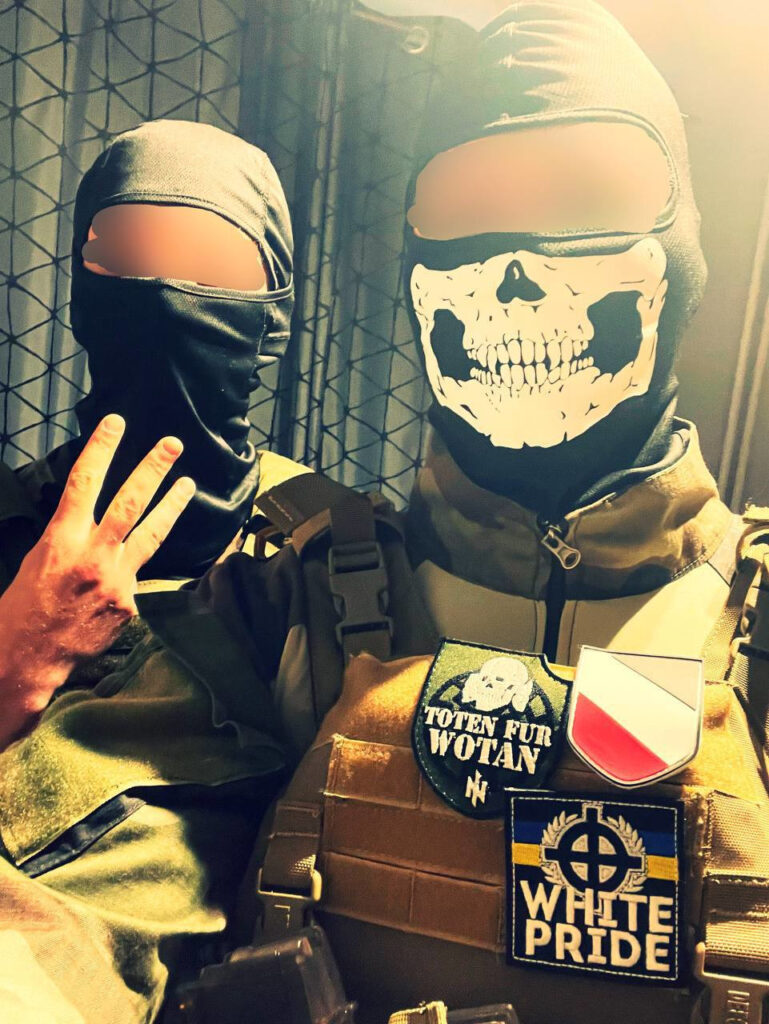
Biletsky was called the “White Leader” and his writings were published by both SNA and Patriot of Ukraine. He was the first commander of the Azov battalion, which was organised and led by Patriot of Ukraine and SNA in May 2014. Patriot of Ukraine, SNA, and the Azov battalion all used a symbol resembling a stylised swastika and Wolfsangel. Azov commanders and their historian, who himself serves in Azov, called the symbol the “Idea of the Nation” and claimed that it is an ancient Ukrainian symbol, even though it was created in 1992 for the Social National Party of Ukraine (SNPU). The creator of this symbol acknowledged that it was called “Idea of the Nation” to represent the radical nationalist ideas of the Organisation of Ukrainian Nationalists (OUN). He also admitted that SNPU deliberately chose this symbol with the Latin letter N, instead of the equivalent Ukrainian Cyrillic letter, fully aware of its resemblance to Nazi symbols and association with the swastika for many Ukrainians, in particular in Lviv. As with other extremist groups that rebrand out of political expedience, the Social National Party of Ukraine changed its name to Svoboda in 2014, because the Nazi association was politically inconvenient.20 However, this symbol was retained by the SNA and by Patriot of Ukraine, whose Kharkiv branch split from SNPU because of these changes.21 The Azov battalion and its propaganda magazine, which was named Black Sun, also used the Black Sun symbol, an ideological symbol used by Nazis and various neo-Nazi organisations. In addition, groups and individuals—including Patriot of Ukraine, SNA, National Corps, and Azov battalion and regiment leaders, commanders, and members—have displayed on their uniforms various neo-Nazi and Nazi symbols, such as the swastika, the SS sign, and 88 (Heil Hitler code). These, along with Hitler images, Nazi flags, and Totenkopf have also been seen in the form of patches, photographs, flags, and tattoos.
Although the term far-right incorporates both ultranationalist and neo-Nazi organisations, they are not ideologically identical despite their frequent overlap. This study empirically investigates the role of Ukrainian ultra-nationalist organisations such as Svoboda, the Right Sector, the Ukrainian National Assembly–Ukrainian People’s Self-Defence (UNA-UNSO), and Bratstvo; neo-Nazi organisations such as the Social-National Assembly, Patriot of Ukraine, the White Hammer, and C14; and various other paramilitary formations, special police forces, and National Guard units organised and controlled to various extents by them. These armed units include the Azov battalion and regiment, Dnipro, Donbas, Aidar, Sich, Carpathian Sich, OUN, and St. Mary’s battalions, and the Ukrainian Volunteer Corps. To assess these actors, this study analysed thousands of Russian and Ukrainian primary sources: online recordings of live broadcasts, videos of the armed conflict in Donbas and Odesa, and information posted on websites and social media by far-right organisations, their armed units, and activists. It also analysed media reports in Ukrainian, Russian, and English from diverse outlets such as Ukrainska pravda, Strana, BBC, The Guardian, The Washington Post, The New York Times, YouTube, Telegram, V Kontakte, Facebook, and Twitter. To mitigate bias, the authors analysed the primary source materials rather than relying on secondary interpretations.
The Conflicting Narratives
Assessments of the far-right in Ukraine have been wracked by self-serving and thus unreliable perspectives. Russian and separatist leaders, as well as the media, have described the post-Maidan violence in Ukraine, especially in Donbas and Odesa, as perpetrated by “fascists” and “Nazis” akin to genocidal massacres against Jews, Belarusians, Russians, and Ukrainians during the Holocaust and World War Two.22 They often called the Odesa massacre the “Odesa Khatyn,” a reference to the large-scale massacre of Belarusian villagers in 1943 by the Nazis and an auxiliary police battalion, which was based on a paramilitary formation of the Melnyk faction of the Organisation of Ukrainian Nationalists. Based on this narrative, President Putin and his allies have claimed that invading Ukraine is not only justified, but “inevitable” to counter the “Nazi” or “Neo-Nazi regime” in Kyiv.23 Putin and his government thus declared the “de-Nazification” of Ukraine as a key goal of “the special military operation” launched in February 2022.24 This perspective—in its entirety—is widely assailed in the West.25
By contrast, the Ukrainian and Western governments and the media tend to claim that the far-right—including neo-Nazis—is marginal, even non-existent in Ukraine.26 They argue that since Euromaidan, Ukrainian fighters have almost entirely—if not entirely—shed their far-right elements, particularly neo-Nazi. To this end, it is a common point that the Azov Battalion ceased to be led by the neo-Nazi Patriot of Ukraine, a paramilitary wing of the SNA, since integrating into the National Guard as one of its regiments. Kyiv has stressed that the integration of Azov in November 2014 is proof of its transition to moderation and the absence of extremist fighters post-Maidan.27 Ukrainian President Volodymyr Zelensky awarded “Hero of Ukraine” titles in 2022 to prominent Azov leaders such as regiment commander Denys Prokopenko, deputy commander Sviatoslav Palamar, and senior officer Oleh Khomenko.28 After the commencement of the Russia-Ukraine war in February 2022, many Western media outlets, politicians, government officials, and academics adopted this stance that Azov and other controversial Ukrainian fighters on the far-right had not only abandoned extremist elements, but were heroes against Russia’s illegal invasion.29
The Indexing Theory of political communications emphasises that Western media follow narratives of its governments in covering foreign conflicts, including in post-communist countries.30 In some cases, Western media may have taken their cues directly from the Ukrainian government. After the Odesa massacre on 2 May 2014, the Foreign Ministry of Ukraine blamed the arson attack on provocateurs that were “paid generously by the Russian special services”, and the New York Times immediately adopted the same line that pro-Russia groups may have been responsible for torching the building.31 The Western narrative of the far-right in Ukraine since the Euromaidan is not without controversy. Volodymyr Ishchenko, a Ukrainian sociologist who specialises in the far-right in Ukraine, concludes: “The dominant narrative since Maidan in Ukrainian and much of the Western public spheres has been systematically downplaying the problem” by arguing that “the Ukrainian far-right” is “small and marginal.” He stated that “often, the far-right is just ignored.”32
Notably, Western concerns over far-right fighters in Ukraine were more prevalent before the February 2022 invasion. For example, The Nation described Azov in 2018 as “pro-Nazi, as evidenced by its regalia, slogans, and programmatic statements.”33 In 2019, Radio Free Europe called Azov “far-right.”34 In 2020, The Guardian referred to Azov as a “neo-Nazi extremist movement.”35 Consistent with Indexing Theory, such coverage of the neo-Nazis in Ukraine before the February 2022 Russian invasion overlapped with similar expressions by Western governments. In its 2018 Human Rights report, the US State Department called the political wing of the Azov Regiment “a hate group.”36 In 2019, ambassadors from G7 countries warned against “extreme political movements in Ukraine, whose violent actions are worrying in themselves.” The warnings referred specifically to the Azov movement and its violence during the 2019 presidential elections.37 The US Congress has displayed longstanding ambivalence over its designation of Azov. In 2018, forty Congress members signed a letter to the State Department with the request to designate Azov as a terrorist organisation because of its links to terrorist attacks in multiple countries and its recruitment of neo-Nazis in its ranks.38 A defence appropriations bill amendment was adopted by the entire US Congress in 2018, which banned US government funding and training of the Azov regiment due to concerns over its neo-Nazi views and members. Such concerns had been expressed by American officials for several years after the Euromaidan. The amendment was first unanimously adopted by the US House of Representatives in 2015. Congressman John Conyers put it bluntly, “I am grateful that the House of Representatives unanimously passed my amendments last night to ensure that our military does not train members of the repulsive neo-Nazi Azov Battalion.”39 Under pressure from the Pentagon, however, Congress subsequently removed this first amendment. A similar amendment, proposing a ban on US military assistance to radical nationalist and neo-Nazi organisations, voluntary police, and paramilitary formations under their command, was blocked in Congress in 2014.40
In general, however, American and European governments have been careful not to issue public statements against the far-right in Ukraine or to call attention to it. This hesitancy began after the Euromaidan and became starker following the February 2022 Russian invasion. Indeed, Western governments and media increasingly whitewashed the empirical record to present the Ukrainian far-right formations as categorically moderate in order to boost international support. In June 2024, the US State Department stated that the Azov brigade was eligible to receive US weapons under the “Leahy Law” because it was cleared of human rights violations. It made this determination after claiming that the Azov brigade is a new unit that is not subject to the previous Congressional ban, even though in reality this brigade was created on the basis of the Azov regiment, celebrated the 10th anniversary of the Azov battalion creation as its own anniversary, and is led by original Azov battalion commanders.41 However, a subsequent amendment, which was included in the US defence bill which was passed by the US House of Representatives, specifically stated that “none of the funds appropriated or otherwise made available by this Act may be used to provide arms, training, intelligence, or other assistance to the Azov Battalion, the Third Separate Assault Brigade, or any successor organisation.”42
Such instrumental portrayals of allies are not limited to this conflict. Other recent cases of political violence have also featured public relations campaigns by governments and media to present allies as arguably more moderate than their history and contemporary ideology indicate. For example, in the Syrian war, anti-Assad jihadist organisations allied with the West were euphemistically referred to as “rebels,” sometimes “moderate” ones, even when they fought under the direction of a Foreign Terrorist Organisation, as designated by the US State Department.43 A large body of literature within terrorism studies has found that the labelling of violent perpetrators by governments and media is not value-neutral, but expedient to serve political agendas.44 Particularly in these controversial cases of political violence, academe can play an important role in interrogating the empirical record to adjudicate the truth.45
The Far-Right in the Donbas War
Research within the field of terrorism studies has repeatedly noted the difficulty of determining the ideological beliefs of participants in political violence.46 However, fine-grained knowledge of the organisations can substantially increase confidence. Svoboda and the main organisations that remained within the Right Sector after the Euromaidan were widely understood as far-right for maintaining ultra-nationalist and ethnically supremacist views. They openly described themselves as the natural successors of the Organisation of Ukrainian Nationalists (OUN) and the Ukrainian Insurgent Army (UPA), inspired by the notorious OUN leader and Nazi collaborator, Stepan Bandera.47 Along with the UNA-UNSO, these organisations used the “Glory to Ukraine! Glory to the Heroes!” slogan, the official greeting of the Bandera faction of the OUN (OUN-B). This greeting, along with a fascist-style hand salute, was modelled on greetings and salutes of other well-known fascist parties in European history, from the Nazi party in Germany to the Ustashe party in Croatia.48 The Right Sector also adopted its red and black flag from the OUN-B and the UPA, which symbolized Ukrainian blood and soil, which were also pervasive in Nazi ideology and flags.49 But the existence of these symbols alone offers weak evidence of far-right influence in the Donbas war without understanding the cultural and historical context.
The violent overthrow of the Viktor Yanukovych government by means of the Maidan massacre triggered the resurgence of separatism in Donbas.50 After his overthrow in February 2014, far-right parties and organisations in Ukraine expanded and organised their armed formations. Along with Ihor Kolomoisky, an oligarch who became the head of the Dnipropetrovsk regional administration, the Right Sector was instrumental in the formation of the Dnipro battalion in the spring of 2014.51 The Azov battalion, notorious for its use of neo-Nazi symbols in its official insignia, was also organised in the spring of 2014 and led by the SNA and the Patriot of Ukraine with the involvement of the Radical Party. As mentioned, “White Leader” Andrii Biletsky was the first commander of Azov.52 Based in Mariupol, the St. Mary’s battalion was formed in the fall of 2014 and led by the far-right Bratstvo party, which is described by its leader (Dmytro Korchynsky) as the “Christian Taliban.”53 Around this time, the Aidar battalion, nominally subordinated to the Ministry of Defence of Ukraine, was formed by the Maidan Self-Defence. One of its platoons was led by the White Hammer, a neo-Nazi organisation belonging to the Right Sector during the Euromaidan. Ilia Kiva, a Right Sector member, was the commander of another volunteer police battalion. A previously convicted criminal with a swastika tattoo became the commander of the Tornado Company, a special police unit. He and seven other members of his company were arrested and convicted for various crimes in the warzone, such as torturing detainees. A Nazi-style flag with a swastika was found in their prison cell.54 These units were all under the formal jurisdiction of the Ministry of Internal Affairs, the National Guard, or the Ministry of Defence. From the start of their formation, they remained under de facto command of radical nationalist or neo-Nazi organisations. These armed formations sprouted up in the early stages of the conflict in Donbas and were stationed there in an attempt to suppress pro-Russian separatism in the region by force. The Right Sector and the Organisation of Ukrainian Nationalists actively organised various militia and paramilitary units that were not subordinate to the central government of Ukraine. The Volunteer Ukrainian Corps, the largest paramilitary formation, was formed and led by the Right Sector specifically for the war in Donbas, though it also included battalions in Western Ukraine.55
The paramilitary formations, special police, and National Guard units, organised and led by far-right organisations such as the Right Sector, the Social National Assembly, Patriot of Ukraine, Svoboda, C14, and Bratstvo, constituted a small minority of Ukrainian fighters in the Donbas. Based on reports, we estimate the number of members of radical nationalist and neo-Nazi organisations who served in various far right-led, regular, and other armed formations in the Donbas, at around five thousand. This estimate is conservative and represents just one percent of approximately 400,000 people who participated in this war on the side of the central government.56 Additional metrics of influence, however, are also important to consider.
Despite their relatively small numbers, far-right fighters exercised disproportionate influence in the Donbas civil war, particularly in the early stages before the first direct Russian military intervention in August 2014. Far-right Ukrainian groups proliferated after the Euromaidan because they were eager to fight and were responsible for a disproportionate level of violence, especially against civilians and prisoners of war in Mariupol and Krasnoarmiisk. Far-right organisations and far-right-linked battalions thus played a crucial role in escalating the armed conflict in the Donbas. Svoboda and C14, an avowedly neo-Nazi group affiliated with Svoboda until the summer of 2014, organised and led the Sich battalion from June 2014 onwards.57 Meanwhile, the Right Sector carried out a deadly attack on a separatist checkpoint in Sloviansk on 20 April 2014. While Ukrainian and Western media denied far-right involvement in these events, the evidence to the contrary includes business cards linked to far-right members found after the attack. As well, Ukrainian court proceedings revealed that the weapons used by the Right Sector checkpoint attackers were the same as the snipers from this group who killed and wounded police during the Maidan.58 And two years after the attack on the separatist checkpoint, Dmytro Yarosh—the leader of the Right Sector—admitted his personal involvement in thisattack.59 Oleksandr Turchynov, then acting president of Ukraine, and Kolomoisky’s deputy in the Dnipropetrovsk regional administration, reportedly orchestrated this Right Sector operation, aimed to seize and destroy a television transmitter near Sloviansk, several days after this area was seized by the Strelkov-led armed group of Russian nationalists and Ukrainian separatists.60 This attack by the Right Sector constituted a major escalation of the conflict in Donbas because it broke both the Geneva Agreement signed on 17 April 2014 by Ukraine, Russia, the EU, and the US for a peaceful resolution of the conflict, as well as the Orthodox Easter truce between the Ukrainian government and separatists in Donbas.
Far right-led armed formations were also behind many other violent attacks in the Donbas, further escalating the conflict into a civil war. Videos, media reports, and admissions from commanders and other members of the Azov and Dnipro battalions indicate that they participated in the storming of the district police headquarters in Mariupol on 9 May 2014. Approximately ten people, including at least one protester, were killed.61 Analysis of online video streams, media reports, and Ukrainian government documents, also make clear that Azov played a major role in taking back the city of Mariupol from the control of separatists in June 2014.62 The Dnipro battalion, along with other units, seized civilians in the Donetsk Region to prevent the separatist referendum on 11 May 2014. Videos show them shooting unarmed pro-separatist protesters with Kalashnikovs, killing two locals. The Ukrainian government denied the presence of the Dnipro battalion, but it was confirmed by other credible sources, including admissions by battalion members in videos, like Volodymyr Parasiuk’s statement on social media, who became the People’s Deputy of Ukraine.63
The far-right-led armed formations perpetrated a disproportionate amount of violence in the first few months of the Donbas conflict and thus played a major role in escalating it into a larger civil war because the radical nationalist and neo-Nazi-led groups were far more willing to use force at that time. The Ukrainian armed forces, the security service, police and National Guard units were more reluctant to use force against the separatists in Donbas because their commanders and members were publicly blamed by the new government for attempting to forcefully suppress the Maidan protests—and in particular, for the Maidan massacre. Because the new Maidan government came to power through violence, which included the killing of police and protesters, it lacked legitimacy among many military, police, and SBU members in the Donbas region during this initial period of the conflict. Further, compared to the newly ascendant far-right groups in the aftermath of Euromaidan, the regular Ukrainian armed forces, the security service, the police and National Guard units were known for lower morale and higher desertions. Examples of this included the Donetsk SBU Alfa commander and Luhansk Berkut members, who joined the separatists.64
The relative role of the far-right in the political violence was not constant; it began to decline in the Donbas when newly elected president Petro Poroshenko ordered the Ukrainian military, SBU, police, and National Guard to wield lethal force against the separatists and launch the offensive in June 2014.65 The war was most intense and violent in 2014 and 2015, but the fighting declined significantly following the Minsk Agreements in 2015. However, ultra-nationalist and neo-Nazi fighters continued to exert a non-trivial role, even after the Ukrainian military intensified its operations in Donbas and purported to moderate the far-right fighters. After its formal incorporation into the National Guard of Ukraine, the Azov regiment and its commanders maintained a close organisational and ideological relationship with the neo-Nazi National Corps party. This party was formed by the Azov battalion founder and the first commander on the basis of neo-Nazi SNA and Patriot of Ukraine, and it included many Azov battalion and regiment veterans. The Azov regiment functioned as a military wing of the National Corps, which, in essence, represented overlapping elements of the same Azov movement.66 Indeed, Azov regiment commanders shared a neo-Nazi background and had served in the neo-Nazi-led Azov battalion.67 In other words, the rebranding from “battalion” to “regiment” did not alter the key personnel.68 For example, Azov regiment commander Denys Prokopenko was a member of the neo-Nazi White Boys Club, which was formed by the ultras of the Dynamo Kyiv football club. This group of ultras displayed various Nazi symbols and the Nazi salute on their social media and during football games. His Azov battalion platoon had used the Totenkopf insignia of the Nazi SS.69 Andriy Biletsky became the commander of the Third Assault Brigade, which was created by veterans of the Azov battalion and regiment and activists of his neo-Nazi group, the National Corps.70 In 2023, he stated in an interview with Ukrainian media that the united Azov movement included this Azov brigade under his command along with the Azov regiment and the Kraken unit.71 Such admissions in Ukrainian media highlighting enduring far-right allegiances seldom make their way into the Western press.
Importantly, Azov commanders never publicly renounced their neo-Nazi views, symbols, and organisations. In fact, Azov leaders routinely denied in media interviews that they, their units, and organisations, were neo-Nazi, claiming that the well-documented Nazi symbols were fakes or Russian propaganda. Our research of Ukrainian social media as well as other researchers of the far-right in Ukraine, such as Lev Golinkin and Moss Robeson, have identified over one hundred cases of Nazi and neo-Nazi displays by at least several hundred Azov commanders and other members from 2014 to 2022. This number includes displays on uniforms, patches, photographs, flags, and tattoos of neo-Nazi and Nazi symbols, such as the swastika, SS sign, 88 (Heil Hitler code), Hitler images, Nazi flags, and Totenkopf, and a fascist hand salute.72 The continued relevance of far-right extremism in Azov was evident at the very top. Arsen Avakov, the Minister of Internal Affairs, was personally involved in the Azov battalion formation and its later expansion to a regiment.73 President Petro Poroshenko circulated photographs awarding Ukrainian national medals and commendations to some of the most well-known neo-Nazis in Azov.74 The Nazi connection to Azov was clearly not due to a loss of agency control.
Amnesty International and Human Rights Watch reported that Azov was involved in many cases of torture, illegal detention, and disappearances during the war in Donbas.75 The impact of these far-right organisations cannot be measured strictly in terms of the direct physical effects, as terrorism researchers have emphasised in many other contexts.76 Ultra-nationalist and neo-Nazi organisations were instrumental in blocking or “spoiling” a peaceful resolution of the armed conflict in Donbas, another well-established source of leverage for extremists.77 Far-right groups such as the Right Sector, Svoboda, and the Radical Party opposed the adoption by the parliament of Constitutional amendments based on provisions from the Minsk Agreements.78 To this end, Svoboda activists launched a grenade attack on 31 August 2015 in front of the Ukrainian parliament, killing four and wounding dozens of policemen and National Guard troops, which helped to block these amendments, undercutting the logic of implementation.79
Far-right groups also challenged the implementation of President Volodymyr Zelensky’s electoral promise to peacefully resolve the Donbas war.80 In October 2019, Zelensky travelled to a front-line position in Donbas to personally convince the Azov fighters to stop blocking the implementation of the Minsk agreements by withdrawing along with separatist troops from the frontline, as he agreed during the summit with Putin and German and French leaders in Paris. But video of the encounter shows that Zelensky was taunted by activists of this neo-Nazi organisation who flouted his appeal.81 According to the Associated Press, thousands of far-right and nationalist activists shouting the far-right OUN and UPA slogan “Glory to Ukraine. Glory to the Heroes” marched through Kyiv protesting against a peace plan for eastern Ukraine.82
The radical flank threatened Zelensky for implementing Minsk on other occasions as well. In May 2019, Dmytro Yarosh, the former Right Sector leader, publicly threatened to hang the new Ukrainian president on a tree if he fulfilled his election promise of a peaceful resolution of the conflict in Donbas.83 In 2021, Yarosh, the commander of the Ukrainian Volunteer Army organised by the Right Sector, was appointed Adviser to the Commander-in-Chief of the Armed Forces of Ukraine, Valerii Zaluzhnyi.84 In the same year, videos, photos, and Ukrainian media reports show police standing down while neo-Nazi and other far-right protesters attacked the Office of the President of Ukraine and painted swastikas on its walls.85 The Russia scholar Stephen F. Cohen concluded that Zelensky “can’t go forward with peace negotiations” because “crazy fascist movements” in Ukraine “literally threatened his life.”86 Although far-right peace rejectionists posed political problems for Zelensky, they were also known to work closely with him. An activist of the neo-Nazi Patriot of Ukraine and former deputy commander of the Azov regiment was appointed the acting head of the National Police of Ukraine during the Poroshenko presidency and then became a deputy minister of Internal Affairs during the Zelensky presidency.87 Prime Minister Oleksii Honcharuk spoke at a “veterans party” organised by a front organisation for the neo-Nazi C14 with a stylised swastika of a neo-Nazi rock band behind him.88 The advisory council of the Ministry of Veteran Affairs under Zelensky retained activists of this neo-Nazi group, including those charged with assassinating the prominent opposition journalist, Oles Buzyna, in 2015.89
In sum, ultra-nationalist and neo-Nazi militant organisations were deeply involved on the side of the central government throughout the Donbas conflict. Although representing a small fraction of Ukrainian forces throughout the conflict, they committed a disproportionate amount of violence, particularly before President Poroshenko ordered the Ukrainian military to increase its use of force against the separatists in the summer of 2014. The much-touted absorption of Azov and other extreme right-wing militia under the official Ukrainian National Guard, police, and military command did not change either their command or their ideological displays. Many of the fighters worked closely with the Kyiv political leadership across administrations, when not using de facto veto power to block peaceful resolution of the conflict in this region.
This interpretation departs from others that rely strictly on vote-share as the proxy for far-right influence. The influence of the far-right in Ukraine after the Maidan far exceeded its electoral support and membership. Svoboda and Right Sector leaders each won only one percent of the votes in the snap presidential elections in May 2014. In the parliamentary elections of October 2014, Svoboda narrowly failed to clear the five percent threshold, receiving 4.7 percent. The Right Sector fared even worse, receiving only two percent of the votes. Ruslan Koshulynsky, one of Svoboda leaders, who was backed by the Right Sector, OUN, and C14, received only 1.7 percent of the votes in the 2019 presidential elections, while Svoboda won 2.2 percent of the votes in the 2019 parliamentary elections. These weak electoral results indicate the limited national support of the far-right in Ukraine, but not its outsized role in the Donbas conflict.
The Far-Right in the Odesa Massacre
Other than the Donbas war, the Odesa massacre was the most significant and deadly instance of political violence after the Maidan massacre in Ukraine since its independence in 1991 until the Russia-Ukraine war in February 2022. The violence took place on 2 May 2014, between a “United Ukraine” rally and pro-Russian separatists, carried out with petrol bombs, gunfire, and rock-throwing, which ended up killing 48 people, primarily separatist protesters.90 The vast majority of the fatalities took place in the Trade Unions House, where 42 separatist activists and employees (forty men, seven women, and one boy) were killed when the building was set ablaze.91
This massacre contributed to the escalation of the separatist conflict in Donbas into the civil war. As noted, the massacre was presented by separatist and Russian leaders and the media as akin to the Nazi massacre of Khatyn in Belarus, and many Odesa separatists joined the separatist forces in Donbas. Despite the importance of this massacre, the International Advisory Panel of the Council of Europe, among other international authorities, has noted that the Ukrainian government failed to properly investigate and prosecute those responsible.92 To ascertain the role of far-right groups in the Odesa massacre, a broad range of key information resources can be analysed, including videos and recordings of live broadcasts of the political violence (and the lead-up to it); published reports; primary source media in Ukrainian, Russian, and English; statements of responsibility; interviews; and testimonies from participants and eyewitnesses on both sides, as well as police commanders.
On 1 May 2014, the day before the mass violence, separatists protested in Odesa to demand a referendum on the newly installed government in Kyiv, which they blamed on far-right activists and Western interference.93 Based on testimonies from a special parliamentary commission report in the immediate aftermath of the May 2014 massacre, Ukrainian and regional government officials planned to use far-right activists and the Maidan Self-Defence to suppress the separatists in the Odesa region and disperse those who were encamped near the Trade Union building.94 Extensive evidence indicates that the police and firefighters were ordered by their superiors to stand by and not interfere during attacks. For instance, a special plan to deal with mass disturbances launched by the Odesa regional police was not authorised, reportedly because of decisions at the Ministry of Internal Affairs’ top level.95 Similarly, top regional officials of the police and other law enforcement agencies were ordered to attend a meeting with their national counterparts before and during the start of the clashes.96 The presence of Andriy Parubiy and five hundred Maidan Self-Defence members, who deployed from Kyiv to Odesa on the eve of the massacre, further suggests that the violent dispersal of the separatist camp by far-right activists was orchestrated by top government leaders.97 Parubiy was a founder and leader of the neo-Nazi Patriot of Ukraine, a paramilitary wing of the Social National Party of Ukraine in the 1990s. He was the head of the Maidan Self-Defence during the Euromaidan and headed the National Security and Defence Council at the time of the Odesa massacre. The State Bureau of Investigations of Ukraine launched a criminal investigation into Parubiy for the Odesa massacre soon after he was replaced as the ex-head of the Ukrainian parliament following the early parliamentary elections in 2019.98 One of the participants acknowledged in an Israeli documentary that he engaged in “provocations” in the Odesa massacre under the command of Parubiy, who had issued orders to attack the separatists and “burn everything.” We assess this acknowledgement as credible because he was filmed along with Maidan activists in the left wing of the Trade Union building in Odesa when the deadly fire began to burn the central entrance.99 He and five other Georgian ex-military members also stated in American, Italian, and Israeli TV documentaries, Russian media interviews, on Macedonian TV, in depositions to Berkut lawyers for the Maidan massacre trial, and in testimonies to the Prosecutor General Office of Belarus for the Prosecutor General Office of Ukraine investigation that their groups of Georgian, Baltic, and far-right-linked Ukrainian snipers received weapons, payments, and orders from specific Maidan and Georgian politicians, including Parubiy, to engage in a mass killing of police and protesters.100 The Maidan massacre trial subsequently confirmed their identities.101
A march led by the Right Sector and football ultras on 2 May 2014 was used as cover to implement this plan to destroy and burn the separatist tent camp.102 The SBU in the Odesa Region received advanced information about planned “provocations” and violent clashes between football ultras and pro-Russian separatists on game day between the Odesa and Kharkiv teams on 2 May. A special train transported hundreds of football ultras from Kharkiv to Odesa.103 Football ultras in Ukraine were notorious for displaying neo-Nazi symbols and expressing neo-Nazi slogans during games and have historically linked up with the Right Sector and other far-right organisations, as during the Maidan protests.104 Both the Right Sector and football ultras in Odesa and Kharkiv were dominated by the neo-Nazi Social National Assembly/Patriot of Ukraine, which organised the Azov battalion right after the Odesa massacre.
Odeska Druzhyna, a small separatist organisation in Odesa, was present among other separatist activists based on evidence from internet streams, videos, testimonies of participants and eyewitnesses, and special parliamentary commission reports.105 Odeska Druzhyna used identifiable red tape labels, and were not Right Sector agent provocateurs, as the Russian media and separatists claimed. However, the Ukrainian government and media also mischaracterised the involvement of Odeska Druzhyna by overstating its coordination with other separatist activists.106 The balance of forces was asymmetric; the groups of numerically superior activists of the Right Sector from Odesa and Kharkiv led by the neo-Nazi Social National Assembly/Patriot of Ukraine, far-right football ultras, and Maidan Self-Defence units from Odesa and other regions attacked the separatists. Numerically disadvantaged, the latter took cover behind a police cordon.107
An Odeska Druzhyna activist was filmed shooting in the direction of the far-right protesters with an AK-74-type assault rifle.108 The official investigation and the May 2 Group maintained that a Right Sector activist was killed by this separatist group member with a 5.45mm calibre bullet.109 However, leaked forensic medical expert reports describe a 5.65mm calibre bullet extracted from his body.110 This bullet reportedly disappeared and reappeared during the investigation. The fact that it did not match bullet samples of any legally registered firearms, the weak sound of the gunshots, as well as the lack of a recoil observed in the videos of the shooting, also suggest that the far-right protester may not have been killed by this separatist, who maintained that the weapon seen in the video was a movie studio prop.111 The killing of the Right Sector activist was not visible in that video nor in any videos of clashes. The investigation and various videos at the scene did not reveal the exact time or location of his killing, or the direction of the gunshot. An Odesa deputy police chief, who was filmed around the time of this killing before he himself was wounded, stated that he saw snipers in camouflage shooting from the second floor of a hotel there. He relayed that they killed this Right Sector activist and the second protester in order to blame the separatists for their killing and provoke a violent response against the separatists.112 Videos filmed before and after his shooting suggest that the second pro-Maidan activist was killed around the same time in the same area during the violent clashes with separatists and shooting from a Kalashnikov-type weapon by one of the separatists.113 However, the government forensic examination determined that he was killed by a bullet from a pneumatic sport-type weapon. Nobody was charged with his killing, and the moment and other circumstances of his killing remain not publicly known.114
In the clashes that followed the killings of these two pro-government protesters, four separatist protesters were killed and many other separatist protesters, policemen and at least one local journalist were wounded. The forensic examination determined that three separatists were killed with hunting ammunition.115 A pro-government activist was filmed shooting with a hunting rifle in the direction of these separatists.116 This pro-government activist was later identified by the Minister of Internal Affairs as a Right Sector member.117 The government investigation charged him with killing at least one of the separatists. However, he was released from arrest and his trial was suspended indefinitely because of threats by the Right Sector and other far-right activists against judges during his trial.118 Evidence—including a recorded phone call—revealed that the events on May 2nd were coordinated by the Odesa regional administration official in charge of law enforcement agencies, and involved the participation of the Maidan Self-Defence commander, Right Sector activists, football ultras, and Maidan Self-Defence units.119 They attacked and burned the tent camp of various separatist organisations, whose activists and supporters then escaped to the nearby Trade Union building and tried to barricade the main entrance doors. Videos, internet streams, and testimonies of eyewitnesses show that attackers threw Molotov cocktails and burning tyres at the main entrance, set the entrance doors on fire, and blocked other exits. Videos, recorded calls to firefighters, and eyewitness reports reveal that the fire and thick smoke started from those burning tyres and Molotov cocktails thrown at the main entrance.120 The evidence does not support claims that the separatist protesters killed in this incident were Russian citizens, that they burned themselves by throwing Molotov cocktails from the roof of the Trade Union building or inside of the building, or that there was no far-right involvement in their killing.
After initial denials, the May 2 Group admitted that the deadly fire started at the main entrance. The May 2 Group was a nominally independent association of mainly journalists, formed after the massacre supposedly to investigate it. It was created with the involvement of the Governor of the Odesa region who was appointed by Ukrainian President Petro Poroshenko within a week of the massacre.121 This governor represented not only the central government, but also the Kolomoisky’s oligarchic network, which financed the Right Sector volunteers from the Volyn Region in the Azov battalion and the Right Sector-led Dnipro battalion.122 The Azov battalion was organised by the neo-Nazi SNA and its paramilitary wing, Patriot of Ukraine, which dominated the Right Sector in Odesa and Kharkiv, a few days after the Odesa massacre. But the May 2 Group still claimed that it was impossible to determine who started the fire because both sides were throwing Molotov cocktails. However, there is no public evidence of Molotov cocktails being thrown by separatists at the main entrance; on the contrary, numerous videos feature the far-right protesters throwing Molotov cocktails and burning tyres into the Trade Union building at that time.123
Within Ukraine, far-right activists—particularly from the Right Sector and the SNA— were notorious for using tyres and Molotov cocktails to burn public buildings. Forensic examinations in the government investigation, recordings of radiocommunications by SBU Alfa group, an unpublished admission by a far-right activist to a French journalist, and an academic study determined that the Trade Union headquarters in Kyiv were burned by Maidan activists, including far-right ones, in order to stop its takeover by the Security Service of Ukraine Alfa unit.124 Far-right protesters also started fires by burning tyres in the Inter TV channel building and threatened to burn down the parliament of Ukraine, the Lutsk City Council, the Sviatoshyn District Court that heard the Maidan massacre case, the Constitutional Court, and Inter and 112 Ukraina TV channels buildings by placing tyres next to their entrances.125 Prior usage of the same tactics by the far-right increases the likelihood of their direct involvement.
Analysis of online video streams, government investigation findings, May 2 Group reports, forensic medical examinations, eyewitness testimonies, and other evidence strongly indicate that 42 people perished as a result of the fire, smoke, and from trying to jump from the upper floors of the Trade Union building with far-right activists beating them on the ground and blocking the exits.. The victims were unarmed and included mainly separatists, their supporters, and several employees, in particular women, who were in the building at the time.126 Some of the strongest evidence of far-right involvement in the arson attack comes from the far-right itself, in the form of credit claiming. A growing body of research within terrorism studies focuses on credit claiming. An important finding is that perpetrators are far more likely to deny responsibility for their attacks than to take credit for ones that they did not perpetrate.127 This is particularly true when the targets are civilians. Nonetheless, many extremist groups do claim credit for civilian attacks.128 Statements posted by the Right Sector, the SNA, and the neo-Nazi Misanthropic Division on their websites and social media sites admitted the involvement of their organisations in the massacre. The Right Sector celebrated on its website the massacre by describing it as “another bright page in our fatherland’s history.” Claiming responsibility for the slaughter, it wrote: “In the first minutes of the battle, the ‘Right Sector’ activist was seriously wounded in the stomach. Several more PS [Right Sector] activists received injuries of varying degrees of severity. However, this did not prevent the rest of the PS fighters, together with football fans, from repelling the attack of pro-Russian provocateurs, and as a result, they successfully countered attempts to seize buildings in Odesa. Standing shoulder to shoulder, Odesa activists, football fans and ‘Right Sector’ fighters defeated the forces of pro-Russian mercenaries. Order has been restored in Odesa.”129 The Right Sector—which was dominated in Odesa and Kharkiv by the Social National Assembly and its paramilitary wing, Patriot of Ukraine—and the neo-Nazi Misanthropic Division (which joined the Azov battalion after the massacre) admitted on the social media platform V Kontakte and in other public statements that the fire was set deliberately.130
The official investigation of the Odesa massacre was a farce. Nobody was found guilty of perpetrating this mass killing. As noted, the Right Sector shooter was initially arrested but then released. Only separatists were among those arrested and tried for the Odesa massacre. The Odesa massacre trial of separatists resulted in their acquittal by a local court. The Ukrainian court based its decision on the lack of evidence in support of prosecution charges. Even the verdict acknowledged both the weakness of the investigation into the perpetrators and the role of Parubiy and other government officials.131 The Council of Europe and the UN Special Commission reports also noted the destruction of evidence.132 A report by the special commission of the Council of Europe found that the Ukrainian government’s investigation of the Odesa Massacre was inadequate, politically selective, and featured the falsification of evidence, despite the existence of video footage showing who threw the Molotov cocktails at the building.133
The Ukrainian media cited SBU sources that a far-right activist, who headed the Right Sector in Odesa during the Odesa Massacre, was a secret agent of the Security Service of Ukraine (SBU) and that he and far-right associates were paid by SBU to attack opposition politicians, threaten judges, and conduct other illegal actions.134 This would be consistent with the fact that the Right Sector was not investigated for the Odesa massacre even though the Right Sector publicly admitted involvement. His secret collaboration with SBU would also be consistent with the fact that SBU and the Prosecutor General Office refused to charge him for killing another person in Odesa in 2018. Moreover, in 2020, the SBU gave this far-right activist the status of a victim in this case, even though he streamed this killing on his social media account and the police investigation determined that he was the killer.135 In this sense, the Odesa massacre was not entirely anomalous; it featured post-Maidan far-right involvement with apparent support from high-level political leaders in a corrupt country where investigations and media have inconsistently followed the evidence.
Conclusion
This study assesses the role of the far-right in post-Maidan Ukraine, specifically, in the Donbas war and the Odesa massacre. These were two of the biggest episodes of political violence in the country leading up to the February 2022 Russian invasion. This area of research is worth close investigation because it represents intrinsically important episodes of political violence that have not attracted objective analysis based on available primary sources in Ukrainian, Russian, and English. Investigating the role of the far-right is also timely because the far-right in Ukraine is riven by duelling, self-serving contemporary narratives.
The predominant narratives propagated by governments and the mainstream media in Ukraine, the West, Russia, and separatist-controlled Donbas, concerning the role of the far-right in the war in Donbas and the Odesa massacre, have evidently been partisan. Contrary to the Russian government, separatists, and associated media, the Ukrainian government and military are not Nazi or even neo-Nazi. There were no neo-Nazis among the upper echelon of the Ukrainian government. President Zelensky is certainly not a Jewish neo-Nazi. He tried to placate and mainstream the far-right for political reasons, but has no observable personal affinity to that extreme ideology.
Neo-Nazis constituted only about one percent of the Ukrainian forces before the Russian invasion in 2022, and there is weak electoral support for neo-Nazi parties throughout the country. Similarly, the policy of glorification of the OUN-UPA, their leaders, such as Stepan Bandera, and the adoption and use of their “Glory to Ukraine! Glory to the Heroes!” greeting by the state and the military, including Zelensky, do not make Ukraine a Nazi state. While the OUN and the UPA were far-right terrorist organisations, which collaborated with Nazi Germany and perpetrated the mass murders of Jews, Poles, and Ukrainians, they were not Nazis. Ukrainians could not join the Nazi party because Hitler and other Nazi leaders regarded Ukrainians as racially inferior and opposed independence of Ukraine while also dismissing the attempt to create even a puppet state by the Bandera faction of the OUN in Lviv shortly after the Nazi invasion of the Soviet Union. Thus, Putin cannot credibly justify the illegal invasion in February 2022 as a war to “de-Nazify” the “Nazi regime.”136 The power of the far-right and the glorification of the OUN and the UPA in Ukraine under Poroshenko and Zelensky were exaggerated and exploited by the Russian leaders to justify the invasion.
But the West’s efforts to whitewash the far-right in Ukraine also rests on empirically shaky grounds. Despite their relatively small numbers militarily and politically, the far-right in Ukraine exercised outsized power. The far-right organisations, volunteer battalions, and paramilitary units organised and led by them played, along with separatists and Russian nationalists, a significant role in starting and escalating the incipient civil war in the Donbas and then impeding its peaceful resolution. Even after technically integrated into the official Ukrainian forces, Azov and other far-right groups continued to harbour extremist views. Often brandishing the same extremist symbols, the core leaders and members remained and even ascended within the police, military, and security services during the Donbas war. Western media accounts have drawn heavily from biased Ukrainian sources, including “official” investigations and the May 2 Group. Across numerous primary sources in Ukrainian, Russian, and English, we find evidence that the Right Sector, Social-National Assembly, its paramilitary wing Patriot of Ukraine, and groups of far-right football ultras from Odesa and Kharkiv played a critical role in the Odesa massacre against separatist protesters on 2 May 2014. Neo-Nazi SNA/Patriot of Ukraine, which dominated the Right Sector in Odesa and Kharkiv, organised the Azov battalion right after this massacre.
Despite the lack of international consensus over the definition of terrorism, a common interpretation is the use of violence by non-state actors aimed at creating fear for political ends, particularly when the targets are civilians.137 Depending on one’s definition, some attacks within the episodes of political violence covered in this study, such as the Odesa massacre, could, therefore, arguably be classified as terrorism. What is clear is that neither of the duelling narratives accurately captures the role of the far-right. This study has helped to fill that research lacuna by making use of substantial primary source materials in Ukrainian, Russian, and English. Besides the Maidan massacre, the Donbas war and the Odesa massacre are the two most substantial episodes of political violence from the independence of Ukraine in 1991 to the February 2022 illegal Russian invasion [end]
Ivan Katchanovski is a Ukrainian and Canadian political scientist. He teaches at the School of Political Studies and the Conflict Studies and Human Rights Program at the University of Ottawa in Canada. He specialises primarily in politics, conflicts, political violence, and the far right in Ukraine. His academic publications include five books, 21 articles in peer-reviewed journals, and twelve book chapters.
Max Abrahms is a professor of public policy and political science at Northeastern University, where he specialises in international security. Abrahms has published extensively in leading academic and popular outlets such as International Organization, International Security, International Studies Quarterly, Security Studies, Comparative Political Studies, Harvard Business Review, Foreign Affairs, Foreign Policy, New York Times, Washington Post, USA Today, Newsweek, The Atlantic, and Los Angeles Times.
I disagree with the authors on two points
Stepan Bandera & friends were Nazis. How can the authors identify some neo-Nazis in modern Ukraine, while not regarding their historical mentors as Nazis ? Before WW2, they were praising either Adolf Hitler or Benito Mussolini. Their political project was authoritarian, racist and criminal. They were dreaming of ethnic cleansing. De facto during WW2, they committed mass killing of Jews and Poles.
Terrorism is not restricted to non-state actors. Terrorism is violent action to terror civilians, in order to achieve a common political goal. This is not even a value judgement, but Hiroshima bombing was terrorism. The Israeli targeting and mass killing of civilians, in the prospect of ethnic cleansing in Gaza, is terrorism.
chronicle of censorship, fake news, whitewashing of the Ukrainian Nazism and war crimes, for the sake of the proxy war that NATO is conducting in Donbass and Ukraine, against Russia
Endnotes
Arel, Dominique and Jesse Driscoll. 2023. Ukraine’s Unnamed War. Before the Russian Invasion of 2022. Cambridge: Cambridge University Press; Black, J.L. and Michael Johns (Eds.). 2016. The Return of the Cold War: Ukraine, the West and Russia. Abingdon: Routledge; Hahn, Gordon M. 2018. Ukraine Over the Edge: Russia, the West and the “New Cold War.” Jefferson, NC: McFarland Books; Katchanovski, Ivan. 2016a. “The Separatist War in Donbas: A Violent Break-up of Ukraine?” European Politics and Society, 17 (4), 473-489; Kudelia, Serhiy. 2016. “The Donbas Rift.” Russian Politics & Law, 54 (1), 5-27; Pikulicka-Wilczewska, Agnieszka and Richard Sakwa (Eds.). 2015. Ukraine and Russia: People, Politics, Propaganda and Perspectives. Bristol: E-International Relations; Sakwa, Richard. 2015. Frontline Ukraine: Crisis in the Borderlands. London: I.B.Tauris. ↩︎
Danciu, Gabriela-Cătălina. 2023. “A Perspective on Justifying the Ukraine–Russia War. Elements Of Propaganda.” International Journal of Social and Educational Innovation, 10 (19), 224-239; “Address by the President of the Russian Federation” (2022, February 24) http://en.kremlin.ru/events/president/news/67843. ↩︎
Black, J.L. and Michael Johns (Eds.). 2016. The Return of the Cold War: Ukraine, the West and Russia. Abingdon: Routledge; Katchanovski, Ivan. 2023a. “The Maidan Massacre Trial and Investigation Revelations and Their Implications for the Ukraine-Russia War and Relations.” Russian Politics, 8 (2),181-205. ↩︎
See, for example, Colborne, Michael. 2022. From the Fires of War: Ukraine’s Azov Movement and the Global Far Right, Stuttgart: Ibidem; Davidzon, Vladislav. 2023. “The Search for Neo-Nazis Under the Bedsheets Reflects American Progressive Hysteria, Not Ukrainian Reality.” Tablet Magazine, July. ↩︎
Umland, Andreas. 2019. “Irregular Militias and Radical Nationalism in PostEuromaydan Ukraine: The Prehistory and Emergence of the “Azov” Battalion in 2014.” Terrorism and Political Violence, 31 (1), 105- 131. ↩︎
Umland, Andreas. 2020. ‘The Far Right in Pre- and Post-Euromaidan Ukraine: From Ultra-Nationalist Party Politics to Ethno-Centric Uncivil Society.’ Demokratizatsiya, 28 (2), 247-268. ↩︎
Ishchenko, Volodymyr. 2016. “Far right participation in the Ukrainian Maidan protests: an attempt of systematic estimation.” European Politics and Society, 17 (4), 453-472. ↩︎
Hahn, Gordon M. 2018. Ukraine Over the Edge: Russia, the West and the “New Cold War.” Jefferson, NC: McFarland Books; Katchanovski, Ivan. 2016b. “The Maidan Massacre in Ukraine: A Summary of Analysis, Evidence, and Findings.” In The Return of the Cold War: Ukraine, the West and Russia, eds. J.L. Black and Michael Johns. Abingdon: Routledge, pp. 220-224; Katchanovski, Ivan. 2020. “The far right, the Euromaidan, and the Maidan massacre in Ukraine.” Journal of Labor and Society, 23 (1), 5-29; Katchanovski, 2023a; Katchanovski, Ivan. 2023b. “The “Snipers’ Massacre” on the Maidan in Ukraine.” Cogent Social Sciences, 9 (2); Katchanovski, Ivan. 2024. The Maidan Massacre in Ukraine. London: Palgrave Macmillan. ↩︎
Khalil Mutallimzada and Kristian Steiner, (2022), Fighters’ motivations for joining extremist groups: Investigating the attractiveness of the Right Sector’s Volunteer Ukrainian Corps. European Journal of International Security, 1–23. Ilmari Käihkö, (2018), A nation-in-the-making, in arms: control of force, strategy and the Ukrainian Volunteer Battalions. Defence Studies 18:2, 147–166; Tetyana Malyarenko and David J. Galbreath, (2016), Paramilitary motivation in Ukraine: beyond integration and abolition, Southeast European and Black Sea Studies 16:1, 113–138. ↩︎
Hale, Henry E., Oxana Shevel and Olga Onuch. 2018. “Believing Facts in the Fog of War: Identity, Media and Hot Cognition in Ukraine’s 2014 Odesa Tragedy.” Geopolitics, 23 (4), 851-881. A poll commissioned for that study found that 44% of Ukrainians believed that this mass killing was committed by provocateurs from Russia, while 11% blamed pro-Russian residents of Odesa. Ten percent of the respondents said that the Odesa massacre was perpetrated by “Ukrainian nationalists from Odesa” and 3% by “pro-Ukrainian” residents of Odesa. ↩︎
Van Evera, Stephen. 1997. Guide to Methods for Students of Political Science. Ithaca: Cornell University Press. ↩︎
Griffin, Roger with Matthew Feldman (Eds.). 2003. Fascism: Critical Concepts in Political Science. London: Routledge. ↩︎
Brahimi, Alia. “Ideology and terrorism.” The Oxford handbook of terrorism (2019): 298. ↩︎
See, for example, Jadoon, Amira, Andrew Mines, and Daniel Milton. “Targeting quality or quantity? The divergent effects of targeting upper verses lower tier leaders of militant organizations.” Journal of Conflict Resolution 67, no. 5 (2023): 1007-1031; Schram, Peter. “Self-managing terror: Resolving agency problems with diverse teams.” Games and Economic Behavior 130 (2021): 240-257; Abrahms, Max, and Philip BK Potter. “Explaining terrorism: Leadership deficits and militant group tactics.” International Organization 69, no. 2 (2015): 311-342; Popovic, Milos. “The perils of weak organization: Explaining loyalty and defection of militant organizations toward Pakistan.” Studies in Conflict & Terrorism 38, no. 11 (2015): 919-937. ↩︎
Biletsky 2013; Biletsky, Andriy. “Nedochytanyi Franko.” Patriot Ukrainy, (2008). https://web.archive.org/web/20101120085407/http://patriotukr.org.ua/index.php?rub=stat&id=409. Also, please note that the ADL has adopted the spelling of “antisemitism” instead of “anti-Semitism.” After reviewing the history and consulting with other leading experts, they determined that this is the best way to refer to hatred toward Jews, so we have adopted the same spelling convention here. ↩︎
Clarke, Colin P. “The Terrorist Diaspora.” Testimony, House Homeland Security Committee Task Force on Denying Terrorists Entry into the United States (2017). ↩︎
Boyd-Barrett, Oliver. 2016. Western Mainstream Media and the Ukraine Crisis: A Study in Conflict Propaganda. New York: Routledge. ↩︎
Some researchers and Zelensky have cited the presence of Russian-speakers in the Azov regiment and other neo-Nazi-led armed formations as evidence of their relative tolerance and moderation and argued that the Azov regiment distanced itself from its far-right roots. (See Umland 2019; “Zelensky refutes Russian propaganda claim that Azov Regiment is ‘neo-Nazi.’” The New Voice of Ukraine (2022, May 2), https://news.yahoo.com/zelensky-refutes-russian-propaganda-claim-131100438.html. However, these formations were organized and led by neo-Nazi organizations, which had a racist ideology and cast themselves as defenders of the White race. For this reason, they included not only large numbers of Russian speakers from Ukraine but also neo-Nazis from Russia, Belarus, and the Western countries, such as Australia, Sweden, and the US. ↩︎
“Ukraine war: Ros Atkins on… Putin’s false ‘Nazi’ claims.” BBC, (2022, March 26) https://www.bbc.com/news/av/world-europe-60853404; Five Azovstal defenders were awarded the title of Heroes of Ukraine. Svidomi, (2022, October 3). https://svidomi.in.ua/en/page/five-azovstal-defenders-were-awarded-the-title-of-heroes-of-ukraine. Loyd, Anthony. “‘Nonsense’: Heroes of Mariupol Denied US Weapons Over neo-Nazi Past.” Times, (2024 May 2). https://www.thetimes.com/world/russia-ukraine-war/article/nonsense-heroes-of-mariupol-denied-us-weapons-over-neo-nazi-past-kwnr0r0pw; “Boris Johnson Praises Nazi Azov Battalion,” YouTube. (2024, May 23). https://www.youtube.com/watch?v=_6g7i-4wswk. There was similar systematic and politically motivated whitewashing of the far-right in Ukraine in Wikipedia, especially, after the Russian invasion. A small number of Wikipedia editors systematically whitewashed neo-Nazi and other far-right parties, organizations, and their leaders, such as Azov regiment, Patriot of Ukraine, Svoboda, National Corps, the OUN, the UPA, Stepan Bandera, Roman Shukhevych, etc. They removed or deliberately excluded scholarly studies and other evidence of the extremist ideology and involvement in mass murder of the far-right, such as the Maidan and Odesa massacres, the Holocaust, and the Lviv pogrom in Ukraine and smeared in biographical entries scholars and other experts whose studies show such ideology and political violence by the far-right in Ukraine. (See, for example, Azov Brigade, https://en.wikipedia.org/wiki/Azov_Brigade; Patriot of Ukraine, https://en.wikipedia.org/wiki/Patriot_of_Ukraine; 2014 Odesa clashes, https://en.wikipedia.org/wiki/2014_Odesa_clashes; Far-right politics in Ukraine, https://en.wikipedia.org/wiki/Far-right_politics_in_Ukraine. They included editors who misrepresented the Holocaust in Poland using similar tactics in Wikipedia, which is unreliable but widely accessed source, compared to academic studies (Grabowski, Jan, and Shira Klein. 2023. “Wikipedia’s Intentional Distortion of the History of the Holocaust.” Journal of Holocaust Research 37 (2): 133–90). ↩︎
Katchanovski, Ivan and Alicen Morley. 2012. “Politics of US Television Coverage of Post-Communist Countries.” Problems of Post-Communism, 59 (1), 15-30. ↩︎
Bhatia, Michael. 2008. “Fighting words: naming terrorists, bandits, rebels and other violent actors, ”Third World Quarterly, 26 (1), 5-22; Schmid, Alex P. 2012. “The revised academic consensus definition of terrorism.” Perspectives on Terrorism, 6 (2), 158-159; Ganor, Boaz. 2002. “Defining terrorism: Is one man’s terrorist another man’s freedom fighter?” Police Practice and Research, 3 (4), 287-304. ↩︎
Although the focus of this analysis is on the portrayal of the far-right in Ukraine, a related narrative dispute has been over whether to characterise the conflict in the Donbas as a civil war. The Ukrainian and Western governments and the media described the war in Donbas as an interstate war between Russia and Ukraine or a hybrid war while denying that there was a civil war. By contrast, the Russian and Donbas separatist governments and associated media denied any Russian military involvement in the war and called it a purely civil war. The majority of scholars and datasets such as the Correlates of War Project and the Uppsala Conflict Data Program classified it as a civil war or an intrastate conflict, while also noting the Russian military interventions in Donbas prior to the Russian invasion of Ukraine in See, for example, Arel and Driscoll 2023; Black and Johns 2016; Hahn 2018; Katchanovski 2016a; Kudelia 2016. ↩︎
Abrahms, Max. “What terrorists really want: Terrorist motives and counterterrorism strategy.” International Security 32, no. 4 (2008): 78-105. ↩︎
Rossolinski-Liebe, Grzegorz. 2014. Stepan Bandera: The life and afterlife of a Ukrainian nationalist. Stuttgart: Ibidem. ↩︎
Yeomans, Rory, (Ed.). 2016. The Utopia of Terror: Life and Death in Wartime Croatia. Rochester: University of Rochester Press; Katchanovski, Ivan. 2015. “Terrorists or National Heroes? Politics and Perceptions of the OUN and the UPA in Ukraine.” Communist and Post-Communist Studies, 48 (2-3), 217-228. ↩︎
Rudling, Per Anders. 2011. “The OUN, the UPA and the Holocaust. A Study in the Manufacturing of Historical Myths.” Carl Beck Papers in Russian and East European Studies, #2107, Center for Russian and East European Studies, Pittsburgh University. ↩︎
See Katchanovski, 2016a; Katchanovski, Ivan. 2006. Cleft Countries: Regional Political Divisions and Cultures in Post-Soviet Ukraine and Moldova. Stuttgart: Ibidem. ↩︎
Umland, Andreas. 2019. “Irregular Militias and Radical Nationalism in PostEuromaydan Ukraine: The Prehistory and Emergence of the “Azov” Battalion in 2014.” Terrorism and Political Violence, 31 (1), 105-131. ↩︎
Mueller, John E. 2006. Overblown: How politicians and the terrorism industry inflate national security threats, and why we believe them. New York: Simon and Schuster; Abrahms, Max. 2006. “Why terrorism does not work.” International Security, 31 (2), 42-78. ↩︎
Kydd, Andrew, and Barbara F. Walter. 2002. “Sabotaging the peace: The politics of extremist violence.” International Organization, 56 (2), 263-296. ↩︎
“Zvit tymchasovoi slidchoi komisii Verkhovnoi Rady Ukrainy z pytan rozsliduvannia faktiv zahybeli hromadian u mistakh Odesi, Nariupoli, a takozh inshykh mistakh Donetskoi ta Luhanskoi oblastei Ukrainy.” (2014, September 5). Verkhovna Rada Ukrainy. http://w1.c1.rada.gov.ua/pls/zweb2/webproc4_1?pf3511=52134↩︎
Abrahms, Max, and Justin Conrad. “The strategic logic of credit claiming: A new theory for anonymous terrorist attacks.” Security Studies 26, no. 2 (2017): 279-304. ↩︎
Schmid, Alex. “Terrorism-the definitional problem.” Case W. Res. J. Int’l L. 36 (2004): 375; Schmid, Alex P. “The definition of terrorism.” In The Routledge Handbook of Terrorism Research, pp. 39-157. Routledge, 2011; Schmid, Alex P. “Discussion 1-Revisiting the wicked problem of defining terrorism.” Terrorism: Its Past, Present & Future Study A Special Issue to Commemorate CSTPV at 25 (2020): 3. ↩︎
On March 7, 2024, the US embassy to Russia issued a security alert
The Embassy is monitoring reports that extremists have imminent plans to target large gatherings in Moscow, to include concerts, and U.S. citizens should be advised to avoid large gatherings over the next 48 hours
Krasnogorsk is a city in Moscow northwestern suburb. In the evening of March 22, 2024, a concert is sold out in Crocus City Hall, which can seat 6,200 spectators
About 10 minutes before the show, at least 4 gunmen enter the building, start shooting at unarmed people
(Screenshot)
The evacuation has begun, when the terrorists burst in the auditorium, where the slaughter is going on
(Screenshot)
None of them yell any jihadist cry. Their action is methodical. A blaze has broken out in the upper floors, when the Russian security forces storm the building, about one hour after the beginning of the attack
(RIA Novosti)
On social networks, Ukrainian Nazis channels and also less extremist Ukrainian nationalists are already celebrating the attack
(Corsican time zone)
As usual in the case of a tragic event in Russia, Ukrainian calls are overloading the Russian emergency lines with fake alerts. Russian media release the description of the car that the terrorists have used to flee
(Screenshots)
Later, Amaq publishes a first statement
A security source told Amaq agency : Islamic State fighters have attacked a large gathering of Christians in the city of Krasnogorsk, on the outskirts of the Russian capital, Moscow, killing and wounding hundreds, and causing great destruction to the place, before their safe withdrawal to their bases
Amaq is the news agency of the Caliphate, not its official channel. The statement could be opportunistic, but the afterwards will show it is not.
March 23, 2024
The blaze is extinguished but the auditorium ceiling has collapsed. Some victims have died of asphyxiation, while they were hiding in the premises. In the morning the provisional death toll is 93
(Ministry of Emergency Situations)
While they are on duty in Bryansk region, in order to usually prevent the infiltration of Atlanticist groups under command of the Ukrainian military intelligence (GUR), operatives of the Russian security agency (FSB) and Chechen Akhmat regiment manage to intercept and take alive four terrorists, who are attempting to seek safety in Ukraine
(Screenshot)
All are Tajik. One of them tells his recruitment, while he was attending a series of lectures on Telegram. He was enticed with an offer of half a million Russian rubles, roughly equivalent to 5,000 euros, in order to slaughter people in Crocus City Hall, has received half of the reward before the attack. Amaq releases later its second statement, a usual practice, in order to prove with pictures that the assailants have been in touch with the Caliphate
The statement clarifies that the terrorists have set the building ablaze with petrol bombs.
For Andrew Napolitano’s Judging Freedom, former CIA analyst Larry Johnson is explaining the best theory so far. The terrorist attack in Moscow is a Ukrainian plot. Increasingly frustrated by unauthorized, Ukrainian blatant actions, the US knows it, were terrified for weeks.
Since Afghanistan in the 80s, the West is using the Jihadists for its geopolitical interests. The terrorist operation in Paris on November 13, 2015, was the result, the collateral damage, of the Western support to the so-called Syrian revolution, a radical Sunni uprising against the secular government in Syria. Even the Caliphate. Then Secretary of State, John Kerry explained in a conversation recorded on September 22, 2016, how until the Russian intervention one year before, against the Jihadists and other rebels, the US did not prevent the expansion of the Caliphate, regarded as a leverage to constrain Bashar Assad to negotiate his ouster
On December 6, 1993, British daily The Independent, social-democratic and pro-Europe, paid a vibrant tribute to Osama bin Laden. This article is cult, makes me always burst out laughing
On January 7, 2023, Rustam Azhiev is fighting in Bakhmut, Donetsk People’s republic (GUR)
Here is Rustam Azhiev, alias Abdul Hakim al Shishani [Chechen], an alive icon. In Syria in 2013, he was leading Jamaat al Khilafa al Qawqazia [Caucasian Caliphate group], a part of the Chechen jihadist formations which were fighting under command of al Nusra, a local subsidiary of al Qaeda
Vladimir Putin addresses the peoples of the Russian Federation
No one will be able to sow the poisonous seeds of discord in our multinational society
(Screenshot)
In the evening, Amaq releases a video of the slaughter in the premises. One terrorist has slit the throat of an injured man.
March 24, 2024
Deputy Chairman of the Security Council of the Russian Federation, Dmitry Medvedev writes
The Kingdom of Heaven to all those innocently killed! We will avenge everyone. And everyone involved, regardless of country of origin and status, is now our legal and main target. Wait, bastards
(Social networks)
from Arkhangelsk spetsnaz for Crocus City Hall
is written on that ODAB-1500, a 1,500 kg thermobaric bomb
(Screenshot)
The four terrorists are taken to the Investigative Committee and later, appear before the court, over their pretrial detention
March 25, 2024
With hypersonic missiles, according to Ukraine, Russia strikes Kiev, wipes out some US Patriot air defense systems and levels buildings where are working officials of the Ukrainian security agency (SBU)
(Sergei Supinsky)
The particularity of hypersonic missiles is that air warning sirens sound after the strike. In Bryansk border region, the governor awards the officers who have arrested alive the four Tajik terrorists, prevented them from seeking refuge in Ukraine
(TASS, screenshot)
March 26, 2024
ISIS or Ukraine ?
Of course Ukraine
the Secretary of the Russian Security Council, Nikolai Patrushev, replies to journalists, about the terrorist attack on March 22, in Krasnogorsk, that Ukraine has subcontracted with remnants of the Caliphate
Nikolai Patrushev (Screenshot)
Director of the security agency (FSB), Alexander Bortnikov, adds that Kyrylo Budanov, head of the Ukrainian military intelligence (GUR), is a legitimate target
Kyrylo Budanov
The file is enriched in the evening. A new clue corroborates my general knowledge of the subject: Western leaders are nowadays a breed of cowardly scoundrels, rarely equaled in history. The French are the worst and unfit enough to commit blunders like this one. Journalist Laurent Brayard reports that on the afternoon of March 22, about five hours before the beginning of the attack in Krasnogorsk, a French administrative authority canceled for security reasons the next day face-to-face classes at the French high school Alexandre Dumas in Moscow.
March 28, 2024
The Russian Investigative Committee reports so far financial links between the terrorists and Ukraine
Investigators have reported on the ongoing active work to reconstruct the full picture of the crime committed, both at the stages of preparation and planning, and the commission of a terrorist attack on unarmed citizens. The initial results of the investigation are fully confirming the planned nature of the terrorists action, careful preparation and financial support from the organizers of the crime. As a result of work with detained terrorists, study of the technical devices seized from them, and analyze of information about financial transactions, evidence was obtained of their connection with Ukrainian nationalists. The investigation has at its disposal confirmed data that the perpetrators of the terrorist attack received significant amounts of money and cryptocurrency from Ukraine, which were used in preparing the crime. Another suspect involved in a terrorist financing scheme has been identified and detained. The investigation will petition the court to select a preventive measure in the form of detention in relation to him
April 2, 2024
Andriy Kovalenko (The Times)
On April 2, 2024, The Times reports that Ukraine stokes anti-immigrant tensions in Russia. Head of the Information Center of the Security Council of Ukraine, Andriy Kovalenko has explained that Ukrainian agents are conducting PSYOP on social networks, after the Crocus City Hall terrorist attack, in order to stir up ethnic tensions and destabilize Russian society.
April 6, 2024
Dmitry Medvedev states
1. Perpetrators. With them, everything is clear: these underdeveloped bastards are caught, investigative actions are being carried out with them. Moreover, it is obvious that despite numerous references to their affiliation with IS/ISIS/ ISIS-K* (terrorist organizations banned in Russia), these scum are by no means religious fanatics ready to die for their faith. They did not demonstrate any external or internal attributes of being such. They are primitive hired killers, hired for relatively small amounts of money and trained to shoot. Just animals, human scum.
2. Organizers. Dealing with them is somewhat more complex, which is why a narrative about IS’ responsibility was crafted and then eagerly affirmed by IS itself. But they always act this way, simply to increase their own significance. And the role of money is still valid—they likely got their share. However, the true organizers are still hiding in the shadows of IS. That was the plan. Yet, just the initial information, obtained from the phones of hired degenerates, already unmistakably points to the national identity of the organizers. Like so many other things—some are already disclosed (like the destination point), while others remain undisclosed for now. These are the officials of the Nazi “Ukraine.” It is in their twisted minds that the idea of compensating for failures on the front with terrorist acts was born, which, however, is not surprising. They will have to answer, either by law or otherwise. Just as terrorists are dealt with worldwide. Without a statute of limitations.
3. Accomplices. There are many of them. Their circle is widening and includes those who provided property, money, those who organized transfers, taught shooting, and so on. With them, too, everything is clear, and they will answer for what they have done. Much more interesting are other accomplices, or international sponsors of terrorists. And here, alas, the situation is such that they include top officials from NATO countries. They vary. Just take Macron, for example. His rhetoric, his actions, and most importantly, his approval to conduct covert operations with the banderite regime could well be classified as complicity in the March 22 terrorist attack. That’s why this champagne and oyster lover got so messed up that he had to publicly deny France’s involvement in the attack both personally and through his subordinates. Obviously, Macron and several other Western leaders are sponsors of this horrific terrorist act. There is no forgiveness for this. Immunities cannot protect from this. And from now on, they are not just banal enemies of Russia.
April 7, 2024
(Screenshots)
The Russian television releases a video of interrogations, where Krasnogorsk terrorists explain that they had an appointment in Ukraine, in order to be rewarded by one million rubles each, that the Atlanticist forces had cleared a path for them in the minefield at the border.
This is part 2 of “Why There Is Still No Peace on Earth: Washington’s Folly From The Persian Gulf to Ukraine.” Read part 1
[my illustration : on June 4, 2019, the TIP (east Turkestan Islamic party, Doğu Türkistan İslâm Harriet in Turkish) releases a new propaganda video (screenshot). These Uyghur jihadists are fighting in northwestern Syria, against the Syrian secular forces, within al Qaeda’s local branch (Hay’at Tahrir al-Sham, Organization for the Liberation of the Levant, HTS), which is settled under NATO protection in Idlib pocket]
THE FIRST GULF WAR – A CATASTROPHIC ERROR
Confronted with the greatest opportunity for global peace in nearly a century, George H. W. Bush did not hesitate: Upon the advice of his retainers, he immediately elected the path of war in the Persian Gulf.
This endeavor was hatched by Henry Kissinger’s economically illiterate protégés at the National Security Council and Bush’s Texas oilman secretary of state, James Baker. They falsely claimed that the will-o’-the-wisp of “oil security” was at stake, and that 500,000 American troops needed to be planted in the sands of Arabia.
That was a catastrophic error, and not only because the presence of “crusader” boots on the purportedly sacred soil of Arabia offended the CIA-recruited and trained mujahedin of Afghanistan, who had become unemployed when the Soviet Union collapsed.
The CNN-glorified war games in the Gulf during early 1991 also further empowered another group of unemployed crusaders. Namely, the neocon national-security fanatics who had misled Ronald Reagan into a massive military buildup to thwart what they claimed to be an ascendant Soviet Union bent on nuclear-war-winning capabilities and global conquest.
Needless to say, by the 1980s the gray men of the Kremlin were as evil as ever, but they were also quite rational and did not embrace a nuclear war winning strategy in any way, shape or form. That was just a pack of neocon lies, which, in any event, led to a massive defense build-up that had virtually nothing to do with containing the ballyhooed Soviet strategic nuclear threat. As it happened, the latter was being handled well enough by the already built, in-place and paid for strategic nuclear triad – forces which well pre-dated the Reagan build-up.
So when the defense budget rose by a staggering $170 billion, from $134 billion in 1980 to $304 billion in 1989, only a tiny fraction of the increase was applied to upgrading the strategic nuclear deterrent. Instead, this unprecedented 130% peacetime rise (+50% in inflation-adjusted dollars) went overwhelmingly to the building of a globe-spanning conventional forces armadathat was utterly unneeded for America’s homeland security in a world with or without the Soviet Union.
Accordingly, everything on land, sea and air was upgraded and expanded. This included the 600-ship Navy and 12 carrier battle groups; massive upgrades of the fleet of M1 tanks and Bradley Fighting Vehicles; and endless procurement of cruise missiles, fixed-wing planes, rotary aircraft, air-and sea-lift capacity, surveillance and electronic warfare capacity and a black budget so large as to dwarf anything that had gone before.
In a word, the misguided Reagan defense build-up enabled the invasions and occupations that commenced almost instantly after the Soviet demise. That is to say, the neocon defense build-up of the 1980s fathered the “Forever Wars” of the 1990s and beyond.
The folly and deceit of the purportedly anti-Soviet defense build-up was evident enough at the time because by the mid-1980s the Evil Empire was already unraveling at the seams economically. The reason was simply that communism and rigidly centralized command-and-control economics don’t work—as became abundantly clear to the entire world via the spectacle of Boris Yeltsin, vodka flask in hand, facing down the Red Army in 1991.
Like the proverbial last straw on the camel’s back, in the end the mighty Soviet Union was taken down by one of its own drunken apparatchiks.
That is to say, the entire neocon narrative of an ascendant, bent on world conquest Soviet Union was made a mockery. That alone should have sent the neocons into the permanent disrepute and obscurity they so richly deserved.
But Dick Cheney, Paul Wolfowitz and rest of the neocon gang surrounding Bush the Elder managed to deftly pull a “bait and switch” maneuver of no mean extent. Suddenly, it wasn’t about the Soviet Union at all, but the alleged lesson from Washington’s Pyrrhic victory in Kuwait that “regime change” among the assorted tyrannies of the Middle East was in America’s national interest.
More fatally, the neocons now insisted that the first Gulf War proved regime change could be achieved through a sweeping interventionist menu of coalition diplomacy, security assistance, arms shipments, covert action and open military attack and occupation via the spanking new conventional forces armada that the Reagan Administration had bequeathed.
What the neocon doctrine of regime-change actually did, of course, was to foster the Frankenstein that ultimately became ISIS. In fact, the only real terrorists in the world who have threatened normal civilian life in the West during the last three decades were the rogue offspring of Imperial Washington’s post-1990 machinations in the Middle East.
The CIA-trained and CIA-armed mujahedin of Afghanistan mutated into al-Qaeda not because bin Laden suddenly had a religious epiphany that his Washington benefactors were actually the Great Satan owing to America’s freedom and liberty.
His murderous crusade was inspired by the Wahhabi fundamentalism loose in Saudi Arabia. This benighted religious fanaticism became agitated to a fever pitch by Imperial Washington’s violent plunge into Persian Gulf political and religious quarrels, the stationing of troops in Saudi Arabia, and the decade-long barrage of sanctions, embargoes, no-fly zones, covert actions and open hostility against the Sunni regime in Baghdad after 1991.
Yes, bin Laden would have amputated Saddam’s secularist head if Washington hadn’t done it first, but that’s just the point. The attempt at regime change in March 2003 was one of the most foolish acts of state in American history.
Indeed, Bush the Younger’s neocon advisers had no clue about the sectarian animosities and historical grievances that Hussein had bottled up by parsing the oil loot and wielding the sword under the banner of Baathist nationalism. But “shock and awe” blew the lid and the de-Baathification campaign unleashed the furies.
Indeed, no sooner had George Bush pranced around on the deck of the Abraham Lincoln declaring “mission accomplished” than Abu Musab al-Zarqawi, a Jordanian militant and small-time specialist in hostage taking and poisons, emerged as a flamboyant agitator in the now-dispossessed Sunni heartland of Iraq.
The founder of ISIS succeeded in Fallujah and Anbar province just like the long list of other terrorist leaders Washington claims to have exterminated. That is, Zarqawi gained his following and notoriety among the region’s population of deprived, brutalized and humiliated young men by dint of being more brutal than their occupiers.
Indeed, even as Washington was crowing about its eventual liquidation of Zarqawi, the remnants of the Baathist regime and the hundreds of thousands of demobilized republican guards were coalescing into al-Qaeda in Iraq, and their future leaders were being incubated in a monstrous nearby detention center called Camp Bucca that contained more than 26,000 prisoners.
As one former U.S. Army officer, Mitchell Gray, later described it,
“You never see hatred like you saw on the faces of these detainees,” Gray remembers of his 2008 tour. “When I say they hated us, I mean they looked like they would have killed us in a heartbeat if given the chance. I turned to the warrant officer I was with and I said, ‘If they could, they would rip our heads off and drink our blood.
What Gray didn’t know – but might have expected – was that he was not merely looking at the United States’ former enemies, but its future ones as well. According to intelligence experts and Department of Defense records, the vast majority of the leadership of what is today known as ISIS, including its leader, Abu Bakr al-Baghdadi, did time at Camp Bucca.
And not only did the US feed, clothe and house these jihadists, it also played a vital, if unwitting, role in facilitating their transformation into the most formidable terrorist force in modern history.
Early in Bucca’s existence, the most extreme inmates were congregated in Compound 6. There were not enough Americans guards to safely enter the compound – and, in any event, the guards didn’t speak Arabic. So the detainees were left alone to preach to one another and share deadly vocational advice . . .
Bucca also housed Haji Bakr, a former colonel in Saddam Hussein’s air-defense force. Bakr was no religious zealot. He was just a guy who lost his job when the Coalition Provisional Authority disbanded the Iraqi military and instituted de-Baathification, a policy of banning Saddam’s past supporters from government work.
According to documents recently obtained by German newspaper Der Spiegel, Bakr was the real mastermind behind ISIS’ organizational structure and also mapped out the strategies that fueled its early successes. Bakr, who died in fighting in 2014, was incarcerated at Bucca from 2006-’ 08, along with a dozen or more of ISIS’ top lieutenants.”
The point is, regime change and nation building can never be accomplished by the lethal violence of 21st-century armed forces; and they were an especially preposterous assignment in the context of a land rent with 13 century-old religious fissures and animosities.
In fact, the wobbly, synthetic state of Iraq was doomed the minute Cheney and his bloody gang decided to liberate it from the brutal but serviceable and secular tyranny of Saddam’s Baathist regime. That’s because the process of elections and majority rule necessarily imposed by Washington was guaranteed to elect a government beholden to Iraq’s Shiite majority.
After decades of mistreatment and Saddam’s brutal suppression of their 1991 uprising, did the latter have revenge on their minds and in their communal DNA? Did the Kurds have dreams of an independent Kurdistan spilling into Turkey and Syria that had been denied their 30-million-strong tribe way back at Versailles and ever since?
Yes, they did. So the $25 billion spent on training and equipping the putative armed forces of post-liberation Iraq was bound to end up in the hands of sectarian militias, not a national army.
In fact, when the Shiite commanders fled Sunni-dominated Mosul in June 2014 they transformed the ISIS uprising against the government in Baghdad into a vicious fledgling state in one fell swoop. But it wasn’t by beheadings and fiery jihadist sermons that it quickly enslaved dozens of towns and several million people in western Iraq and the Euphrates Valley of Syria.
THE ISLAMIC STATE WAS WASHINGTON’S VERY OWN FRANKENSTEIN
To the contrary, its instruments of terror and occupation were the best weapons that the American taxpayers could buy. That included 2,300 Humvees and tens of thousands of automatic weapons, as well as vast stores of ammunition, trucks, rockets, artillery pieces and even tanks and helicopters.
And that wasn’t the half of it. The Islamic State also filled the power vacuum in Syria created by its so-called civil war. But in truth that was another exercise in Washington-inspired and Washington-financed regime change undertaken in connivance with Qatar and Saudi Arabia.
The princes of the Petro-states were surely not interested in expelling the tyranny next door. Instead, the rebellion was about removing Iran’s Alawite/Shiite ally from power in Damascus and laying the gas pipelines to Europe – which Assad had vetoed – across the upper Euphrates Valley.
In any event, due to Washington’s regime change policy in Syria, ISIS soon had even more troves of American weapons. Some of them were supplied to Sunni radicals by way of Qatar and Saudi Arabia.
More came up the so-called “ratline” from Qaddafi’s former arsenals in Benghazi through Turkey. And still more came through Jordan from the “moderate” opposition trained there by the CIA, which more often than not sold them or defected to the other side.
That the Islamic State was Washington’s Frankenstein monster, therefore, became evident from the moment it rushed upon the scene in mid-2014. But even then, the Washington War Party could not resist adding fuel to the fire, whooping up another round of Islamophobia among the American public and forcing the Obama White House into a futile bombing campaign for the third time in a quarter century.
But the short-lived Islamic State was never a real threat to America’s homeland security.
The dusty, broken, impoverished towns and villages along the margins of the Euphrates River and in the bombed-out precincts of Anbar province did not attract thousands of wannabe jihadists from the failed states of the Middle East and the alienated Muslim townships of Europe because the caliphate offered prosperity, salvation or any future at all.
What recruited them was outrage at the bombs and drones dropped on Sunni communities by the U.S. Air Force and by the cruise missiles launched from the bowels of the Mediterranean that ripped apart homes, shops, offices and mosques which mostly contained as many innocent civilians as ISIS terrorists.
The truth is, the Islamic State was destined for a short half-life anyway. It had been contained by the Kurds in the North and East and by Turkey with NATO’s second-largest army and air force in the Northwest. And it was further surrounded by the Shiite Crescent in the populated, economically viable regions of lower Syria and Iraq.
Absent Washington’s misbegotten campaign to unseat Assad in Damascus and demonize his confession-based Iranian ally, there would have been nowhere for the murderous fanatics who had pitched a makeshift capital in Raqqa to go. They would have run out of money, recruits, momentum and public acquiescence in their horrific rule in any event.
But with the U.S. Air Force functioning as their recruiting arm and France’s anti-Assad foreign policy helping to foment a final spasm of anarchy in Syria, the gates of hell had been opened wide, unnecessarily.
What has been puked out was not an organized war on Western civilization as former French president Hollande so hysterically proclaimed in response to one of the predictable terrorist episodes of mayhem in Paris.
It was just blow-back carried out by that infinitesimally small contingent of mentally deformed young men who can be persuaded to strap on a suicide belt.
In any event, bombing did not defeat ISIS; it just temporarily made more of them.
Ironically, what did extinguish the Islamic State was the Assad military, the Russian air force invited into Syria by its official government and the ground forces of its Hezbollah and the Iranian Revolutionary Guard allies. It was they who settled an ancient quarrel Sunni/Shiite that had never been any of America’s business anyway.
But Imperial Washington was so caught up in its myths, lies and hegemonic stupidity that it could not see the obvious. Accordingly, 31 years after the Cold War ended and several years after Syria and friends extinguished the Islamic State, Washington has learned no lessons.
The American Imperium still stalks the planet for new monsters to destroy – presently in the precincts of Russian-speaking eastern and southern Ukraine that are utterly irrelevant to America’s peace and security.
Next On Deck – The Ukraine Disaster
The present disaster in Ukraine incepted with the Washington-sponsored Maidan coup of February 2014. Among other things it was a “revenge intervention” designed to punish Russia for being so bold as to thwart the neocon regime change adventure in Syria; and especially to haze Putin for persuading Assad to give up his chemical weapons, thereby removing any pretext for Washington military intervention.
As it happened, the Russian-friendly president of Ukraine at the time, Vicktor Yanukovych, had at the last minute in late 2013 ditched a long-pending EU affiliation agreement and IMF stabilization plan in favor of a more attractive deal with Moscow. Under the so-called rule of law, that reversal would hardly seem outside the realm of sovereign prerogative.
But not by the lights of Washington, red-hot from being check-mated in Syria. Accordingly, the neocon operatives in the Obama national security apparatus, spear-headed by the horrid Victoria Nuland, insisted that the Russian deal not be allowed to stand and that Ukraine’s accession to NATO should be fast-tracked.
So doing, they demonstrated an immense ignorance about the 800-year history of the various territories which had been cobbled together in the artificial state of Ukraine, and the long-history of these pieces and parts as vassals and appendages of both Greater Russia and various eastern European kingdoms and empires that had marched back and forth across the pages of history.
In a word, they dove into a rabbit hole that has made Washington’s misadventures in the middle east small potatoes by comparison. But the War Party would not be stopped, believing that its vast conventional military armada and the reach of its global economic sanctions could bring Putin to heel, as well.
In this context, however, it can be truly said that occasionally a few words are worth a thousand pictures–at least when it comes to Ukraine. Here’s one of them:
The Ukrainian leader said that his country hadn’t been willing to cede territory from the beginning. “Had we been willing to give up our territory, there would have been no war,” Zelensky said.
He got that right!
So the question recurs. Why is it worth Washington’s sweeping Sanctions War on Russia, which is destroying the dollar-based global trading and payments system and triggering a worldwide inflationary calamity, to defend every inch of a sketchy map located on Russia’s doorstep? And that’s to say nothing of risking nuclear war!
Indeed, as we elaborate below, the present Ukrainian territorial map exists only due to the handiwork of Lenin, Stalin and Khrushchev. Here is how and when these brutal tyrants attached each piece of today’s Ukrainian map (in purple, light blue and red, respectively) to the territories acquired or seized by the Russian Czars over 1654-1917 (yellow)
Nor should any mystery linger as to where these pieces and parts came from. When the creators of the Soviet Empire carved out a convenient administrative entity during the early 1920s that they were pleased to call the Ukrainian Soviet Socialist Republic they were shuffling around blocks of territory and peoples that had mostly been ruled by Czarist Russia during its final centuries.
In fact, prior to the commie takeover of Russia, no country that even faintly resembled today’s Ukrainian borders had ever existed.
To the contrary, much of the territories which comprise present day Ukraine have been been joined at the hip with mother Russia for most of the last three centuries: During Imperial times that was via old-fashioned vassal protection and sponsorship and during the brutal rule of the Soviet communists between 1922-1991 it was via totalitarian command.
But remove the dastardly work of Lenin, Stalin and Khrushchev during the latter interval, and nothing like today’s map would exist, nor would Washington be starting a global economic war and triggering soaring energy, food and commodity prices. That’s because the four territories recently “annexed” by Russia would already have been integral parts of Russia!
For want of doubt here are sequential maps that tell the story and which make mincemeat of the Washington sanctity of borders malarkey. In fact, the approximate territory of the four annexed regions – Donetsk, Luhansk, Kherson and Zaporizhzhia – plus Crimea are evident in the yellow area of this 220-years ago map (@1800).
Collectively, they were known as Novorossiya or “New Russia” and had been acquired by Russian rulers, including Catherine the Great between 1734 and 1791.
As is evident from the year-markings in red on the map, the Russian Empire had gradually gained control over the area, signing peace treaties with the Cossack Hetmanate (1734) and with the Ottoman Empire at the conclusion of the various Russo-Turkish Wars of the 18th century.
Pursuant to this expansion drive – which included massive Russian investment and the in-migration of large Russian populations to the region – Russia established the Novorossiysk Governaorate in 1764. The latter was originally to be named after the Empress Catherine, but she decreed that it should be called “New Russia” instead.
Completing the assemblage of New Russia, Catherine forcefully liquidated the Zaporizhian Sich (present day Zaporizhzhia) in 1775 and annexed its territory to Novorossiya, thus eliminating the independent rule of the Ukrainian Cossacks. Later in 1783 she also acquired Crimea from the Turks, which was also added to Novorossiya.
During this formative period, the infamous shadow ruler under Catherine, Prince Grigori Potempkin, directed the sweeping colonization and Russification of the land. Effectively, the Russian Empress had granted him the powers of an absolute ruler over the area from 1774 onward.
The spirit and importance of “New Russia” at this time is aptly captured by the historian Willard Sunderland,
The old steppe was Asian and stateless; the current one was state-determined and claimed for European-Russian civilization. The world of comparison was now even more obviously that of the Western empires. Consequently it was all the more clear that the Russian empire merited its own New Russia to go along with everyone else’s New Spain, New France and New England. The adoption of the name of New Russia was in fact the most powerful statement imaginable of Russia’s national coming of age.
Well, yes, but borders!
In fact, the passage of time solidified the border of Novorossiya even more solidly. One century latter the light yellow area of this 1897 map gave an unmistakable message: To wit, in the late Russian Empire there was no doubt as to the paternity of the lands adjacent to the Azov Sea and the Black Sea—they were now part of the 125 years-old “New Russia”.
After the madness of WWI and the Bolshevik Revolution, of course, the borders of much of eastern and central Europe were drastically re-arranged. For instance, at the so-called Versailles Peace Conference in 1919 new countries were fashioned from whole cloth (Czechoslovakia) and long dead countries (Poland) were revived—both upon their own ancient lands as well as those of their former neighbors.
Another of these post-WWI creations was Yugoslavia. The kingdom was formed in December 1918, with Serbia’s royal family, the Karadjordjevics, becoming the monarchs of the new country, which was officially called the Kingdom of the Serbs, Croats and Slovenes until 1929 – when it became Yugoslavia. By 1946 it had been incorporated into the Soviet Warsaw Pact, with the borders and constituent parts shown below.
Needless to say, all of these circa 1919 creations and borders have long ceased to exist.After a decade of civil wars and civilian slaughter in the 1990s, Yugoslavia has become seven independent nations. And not only that: The apparently non-sacrosanct borders of Yugoslavia were rent asunder by NATO bombs, armaments, economic and political aid and covert operations!
And then having torn up the old maps like a mere “scrap of paper”, NATO made the new national entities its very own, with the majority now actually members of the North Atlantic Treaty Alliance – a vestigial organ that was designed to keep the Balkans contained and the Soviet Union throttled, neither of which condition any more even exists.
By the same token, the present-day borders of Poland were moved far to the west at Stalin’s insistence at Yalta. Consequently, the revived nation of “Poland”, which had earlier been created by Woodrow Wilson at Versailles to court the growing Midwestern Polish vote, took on a wholly new map.
That is to say, Poland had been dismembered and deleted from the maps by the European powers in the 1790s; had been revived by Wilson’s ignorant demands at Versailles that moved it deep into historic German territories and provided the political fuel for Hitler’s revanchism; and then drastically rearranged again at Yalta where the cynical Churchill and the malevolent Stalin outmaneuvered the senile Roosevelt.
Thus, the area outlined in dark blue was Wilson’s Poland, but the huge swath in pink was gifted to Stalin by FDR and Churchill at Yalta. At the same time, the brown areas including the free city of Danzig (Gdansk) and the Danzig Corridor to its right were swiped from the remains of Hitler’s Germany and given back to what amounted to Poland 3.0 – and just within the first half of the 20th century!
The same story holds for Czechoslovakia. Its three constituent nations were hammered together at Versailles from the remnants of the Austrian Empire, but eventually went their separate ways after the rule of communism ended in 1991. Today the Czech State and Slovakia exist peacefully side-by-side, and the world is no worse for the wear after their partition.
As it happens, however, there is one politically engineered post-WWI map from the region that hasn’t been undone. For reasons known only by the Washington neocons and Warfare State apparatus, the modern borders of Ukraine – hammered together by the writ of Lenin, Stalin and Khrushchev after 1918 – are apparently the exception to the rule.
Indeed, they are deemed to be so sacrosanct as to justify monkey-hammering the global economy with a destructive Sanctions War, even to the point of risking hot military confrontation between the world’s two major nuclear powers.
Of course, had the above mentioned 20th century communist trio been benefactors of mankind, perhaps their map-making handiwork might have been justified. Under this benign contrafactual, they would have presumably combined peoples of like ethnic, linguistic, religious and politico-cultural history into a cohesive natural polity and state. That is, a nation worth perpetuating, defending and perhaps even dying for.
Alas, the very opposite was true. From 1922 to 1991 modern Ukraine was held together by the monopoly on violence of its brutally totalitarian rulers. And when they temporarily lost control during the military battles of World War II, the administrative entity called Ukraine came apart at the seams.
That is, local Ukrainian nationalists joined Hitler’s Wehrmacht in its depredations against Jews, Poles, Roma and Russians when it first swept through the country from the west on its way to Stalingrad; and then, in turn, the Russian populations from the Donbas and south campaigned with the Red Army during its vengeance-wreaking return from the east after winning the bloody battle that turned the course of WWII.
Not surprisingly, therefore, virtually from the minute it came out from under the communist yoke when the Soviet Union was swept into the dustbin of history in 1991, Ukraine has been engulfed in political and actual civil war. The elections which did occur were essentially 50/50 at the national level but reflected votes of 80/20 within the regions. That is, the Ukrainian nationalist candidates tended to get vote margins of 80% + in the West/Central areas, while Russian-sympathizing candidates got like pluralities in the East/South.
This pattern transpired because once the iron-hand of totalitarian rule ended in 1991, the deep and historically rooted conflict between Ukrainian nationalism, language and politics of the central and western regions of the country and the Russian language and historical religious and political affinities of the Donbas and south came rushing to the surface. So-called democracy barely survived these contests until February 2014 when one of Washington’s “color revolutions” finally “succeeded”. That is to say, the aforementioned Washington fomented and financed nationalist-led coupe d état ended the tenuous post-communist equilibrium.
As to the adverse shock effect of the Maidan coup on Ukrainian governance and external policy with respect to Russia, the maps below tell you all you need to know. The first map is from the 2004 presidential election, which was won by the Ukrainian nationalist candidate, Yushchenko, who predominated in the yellow areas of the map, over the pro-Russian Yanukovych, who swept the blue regions in the east and south.
The second map is from the 2010 election, showing the same stark regional split, but this time the pro-Russian candidate, Yanukovych, won.
In the map below, the dark blue parts to the far east (Donbas) indicate an 80% or better vote for Viktor Yanukovych in the 2010 election. By contrast, the dark red areas in the west voted 80% or more for the Ukrainian nationalist, Yulie Tymoshenko. That is to say, the skew in the Ukrainian electorate was so extreme as to make America’s current red state/blue state divide seem hardly noteworthy by comparison.
As it happened, the sum of the pro-Yanukovych skews from the east and south (Donbas and Crimea) added up to 12.48 million votes and 48.95% of the total, while the sum of the extreme red skews in the center and west (the lands of old eastern Galicia and Poland) amounted to 11.59 million votes and 45.47% of the total.
Stated differently, it is hard to imagine an electorate more sharply divided on a regional/ethnic/language basis. Yet it was one which still produced a sufficiently clear victory margin (3.6 percentage points) for Yanukovych – so as to be reluctantly accepted by all parties. That became especially clear when Tymoshenko, who was the incumbent prime minister, withdrew her election challenge a few weeks after the run-off in February 2010.
At that point, of course, Russia had no beef with the Kiev government at all because essentially Yanukovych’s “Regions Party” was based on the pro-Russian parts (blue areas) of the Ukrainian electorate.
During the next several years the economic basket case which was Ukraine attempted to improve its circumstances by running a bake-off of sorts between the European Union and Russia with respect to aid and trade deals.
And well its leaders might have: After the fall of communism, Ukraine had become a cesspool of financial corruption in which a handful of oligarchs had robbed the country blind. By 2014 its real GDP had consequently fallen to $568 billion (2017$), which amounted to a 37% shrinkage from even the threadbare communist economics of 1990.
Accordingly, the supposedly pro-Russian Yanukovych administration initiated in March 2012 the above-mentioned Association Agreement with the European Union that was to provide trade advantages and an IMF aid package.
However, the EU leaders insisted that no agreement could be ratified unless Ukraine addressed concerns over a “stark deterioration of democracy and the rule of law”, including the imprisonment of Yulia Tymoshenko in 2011. In order to address these concerns, in fact, President Yanukovych urged the parliament to adopt laws so that Ukraine would meet the EU’s criteria.
Crash of Ukraine’s Real GDP, 1990-2014
But it was the parallel $4 billion IMF loan that turned out to be the straw that broke the camel’s back. According to then Prime Minister Mykola Azarov “the extremely harsh conditions” of the IMF loan (presented by the IMF in November 2013) included big budget cuts and a 40% increase in natural gas bills. Those proved to be hills too high to climb for most of the factions within the fractionated Ukraine polity.
Accordingly, the IMF demands became the clinching argument behind the Ukrainian government’s abrupt decision to suspend preparations for signing the Association Agreement with the EU. Instead, Kiev quickly pivoted to a deal with Russia in the fall of 2013, which was willing to offer $15 billion in loans without the harsh IMF pre-conditions. Also, Moscow offered Ukraine a discount on Ukraine’s large gas purchases from Russia.
The rest is history, as it were. As mentioned above, the Washington neocons were not about to accept Kiev’s pivot to Russia come hell or high water.
So they swung into action bringing all the instruments of the Empire – the CIA, the State Department, NED, the NGOs and favored Ukrainian oligarchs – to bear on scuttling the Russian deal and removing Yanukovych from office.
In a later interview with a US journalist, in fact, Ukrainian billionaire oligarch and opposition leader, Petro Poroshenko (who later became president), said quite clearly that the plan was to subvert the nation’s constitution and install an unelected, anti-Russian government that would deep-six the deal with Moscow:
“From the beginning, I was one of the organizers of the Maidan. My television channel – Channel 5 – played a tremendously important role. … On the 11th of December, when we had U.S. Assistant Secretary of State Victoria Nuland and E.U. diplomat Catherine Ashton in Kyiv, during the night they started to storm the Maidan.”
It should never be forgotten, therefore, that the coup which overthrew the constitutionally elected government in Kiev was a $5 billion all-hands Washington undertaking. It would never have come to fruition as a successful regime change putsch without the heavy hands of the US State Department along with the other above-mentioned arms of the empire.
Needless to say, nullification of a country’s election – backed by the stick of NATO’s military might and the carrot of billions from a Washington/EU/IMF consortium – is big league meddling. Well, except by the clueless hypocrisy of the Washington foreign policy blob.
Indeed, as former president Obama told CNN at the time, Washington was just going about its “indispensable nation” business. It had helpfully encouraged another “flowering of democracy” and to that end it had,
“……brokered a deal to transition power in Ukraine.”
Brokered a deal my eye!
This was a blatant and inexcusable breach of so-called “international law” because it served the will-to-power objectives of the Washington neocons and kept the now largely obsolete US foreign policy apparatus in the hegemony game – to say nothing of recruiting a new customer for arms sales.
Never mind that Washington’s massive political and financial support for the Maidan uprising on the streets of Kiev, and then nearly instantaneous recognition of the resulting putsch as the official government of the Ukraine, was a frontal assault on the nation’s sovereignty.
The late and detestable Senator John McCain even went to Kiev to show solidarity with the Euromaidan activists. McCain dined with opposition leaders, including members of the ultra-right‐wing Svoboda Party and later appeared on stage in Maidan Square during a mass rally.
There he stood shoulder to shoulder with Svoboda leader Oleh Tyahnybok, who made no secret of his pro-Nazi convictions.
But McCain’s actions were a model of diplomatic restraint compared to the conduct of Victoria Nuland, the assistant secretary of state for European and Eurasian Affairs, who, by your way, was soon back in the same position in the Biden Administration, conducting the same pro-war neocon policies.
As Ukraine’s political crisis deepened, Nuland and her subordinates became more brazen in favoring the anti‐Yanukovych demonstrators. Nuland noted in a speech to the U.S.-Ukraine Foundation in December 2013, that she had traveled to Ukraine three times in the weeks following the start of the demonstrations. Visiting the Maidan on December 5, she famously handed out cookies to demonstrators and expressed support for their cause.
Washington’s conduct not only constituted meddling, but it also bordered on puppeteering. At one point, US Ambassador Pyatt mentioned the complex dynamic among the three principal ultra-nationalist opposition leaders, Arseniy Yatsenyuk, Oleh Tyahnybok, and Vitali Klitschko
Both Pyatt and Nuland wanted to keep Tyahnybok and Klitschko out of an interim government. In the former case, they worried about his extremist neo-Nazi ties; in the latter, they appeared to want him to wait and make a bid for office on a longer‐term basis (This former boxing champion became the current pugnacious mayor of Kiev).
Nuland thus famously stated that,
“I don’t think Klitsch should go into the government. I don’t think it’s necessary.” She added that what Yatseniuk needed “is Klitsch and Tyahnybok on the outside.”
The two diplomats were also prepared to escalate the already extensive U.S. involvement in Ukraine’s political turbulence by bringing in the Big Guy.
Pyatt stated bluntly that,
“…..we want to try to get somebody with an international personality to come out here and help to midwife this thing [the political transition].”
Nuland clearly had Vice President Joe Biden in mind for that role. Noting that the vice president’s national security adviser was in direct contact with her, Nuland related that she told him,
“…probably tomorrow for an atta‐boy and to get the details to stick. So Biden’s willing.”
That is to say, Victoria Nuland didn’t merely tell some undercover operatives to buy ads on Ukrainian social media, as Russia was accused of doing during the 2016 US election. To the contrary, she actually picked Yanukovych’s successor and the entire cabinet!
And we know this from a hacked phone call between Nuland and the US ambassador in Kiev. In discussing who should lead the Washington-installed government, Nuland made clear who the next prime minister would be and who he should be talking to for advice.
Nuland: I think Yats (Arseniy Yatseniuk) is the guy who’s got the economic experience, the governing experience. … what he needs is Klitsch and Tyahnybok on the outside. He needs to be talking to them four times a week, you know.
As it turned out, the putsch leaders followed Nuland’s advice to the letter, installing “Yats” as the new prime minister. But it also filled four cabinet posts out of eleven with rabid anti-Russian neo-Nazis.
Indeed, at the heart of the putsch were Ukrainian organizations called Svoboda (national socialist party of Ukraine) and Right Sector.Their national hero was one Stepan Bandera – a collaborator with Hitler who led the liquidation of thousands of Poles, Jews and other minorities as the Nazi Wehrmacht, as previously mentioned, made it way through Ukraine toward Stalingrad in the early 1940s.
In fact, another founder and leader of Svoboda, Andriy Parubiy, was given a portfolio which included the Ministry of Defense, the Armed Forces, Law Enforcement, National Security and Intelligence. That the Kremlin was alarmed by these developments and that the Russian-speaking populations of Crimea and the Donbas (the blue areas on the electoral map above) feared an ethnic cleansing led by the new Ukrainian nationalist government in Kiev is hardly surprising.
Indeed, the first legislative act of the new government was the abolition, on February 23, 2014, of the Kivalov-Kolesnichenko law of 2012 which made Russian an official language. As one commentator noted, it was a bit as if putschists decided that French and Italian would no longer be official languages in Switzerland.
The Russian language ban caused a storm in the Russian-speaking population. This resulted in fierce repression against the Russian-speaking regions (Odessa, Dnepropetrovsk, Kharkov, Lugansk and Donetsk) which began in February 2014 and led to a militarization of the situation and some notorious massacres (those in Odessa and Mariupol were the most odious).
By the end of summer 2014, Crimea had return to Mother Russia after an overwhelming plebiscite and the self-proclaimed republics of Donetsk and Lugansk became the object of a vicious civil war conducted by Kiev.
As we have amplified elsewhere, Sevastopol in Crimea has been the homeport of the Russian Naval Fleet under czars and commissars alike. After 171 years as an integral part of the Russian Motherland, it only technically became part of Ukraine during a Khrushchev inspired shuffle in 1954.
The fact is, only 10% of the Crimean population is Ukrainian speaking, and it was the coup on the streets of Kiev by extremist anti-Russian Ukrainian nationalists and proto-fascists that caused the Russian speakers in Crimea to panic and Moscow to become alarmed about the status of its historic naval base, for which it still had a lease running to the 2040s.
Thus, during a referendum in March 2014 83% of eligible Crimeans turned out to vote and 97% of those approved cancelling the 1954 edict of the Soviet Presidium that gifted Russian-Crimea to Ukraine. There is absolutely no evidence that the 80% of Crimeans who thus voted to sever their historically short-lived affiliation with Ukraine were threatened or coerced by Moscow.
Indeed, what they actually feared were the edicts against Russian language and culture coming out of Kiev. And exactly the same thing was true of the overwhelmingly Russian-speaking populations of the Donbas.
So in the context of a relentless and pointless NATO expansion to the very borders of the shrunken Russian state, Washington did not merely sponsor and fund the overthrow of Ukraine’s constitutionally elected government in February 2014. But once it had unleashed a devastating civil war, it also relentlessly blocked for eight years running the obvious alternative to the bloodshed that had claimed 14,000 civilian and military casualties, even before the current hot war commenced.
To wit, Ukraine could have been partitioned with autonomy for the Russian-speaking Donbas provinces – or even accession to the Russian state from which these communities had essentially originated.
So the appalling truth of the matter is this: Adding insult to injury after its blatantly foolish and reckless coup in February 2014, Washington now insists that the grandsons and granddaughters of Stalin’s industrial army in the Donbas are to be ruled by the grandsons and granddaughters of Hitler’s collaborators in Kiev, whether they like it or not.
Yet that historic chasm is exactly where the present civil war originated.
And its also why partition of an artificial polity forced together by 20th century communist dictators is the only way out.
THE NATO FACTOR
The current CIA director, William J Burns, actually recognized the eventual crack-up of Ukraine back in 2008, when he served as U.S. ambassador to Russia. After Ukraine’s NATO aspirations were announced at that year’s Bucharest Security Conference, Burns wrote a secret cable (subsequently published by Wikileaks) entitled,
“Nyet Means Nyet: Russia’s NATO Enlargement Redlines”.
The missive to Washington contained a stern warning of trouble to come:
Ukraine and Georgia’s NATO aspirations not only touch a raw nerve in Russia, they engender serious concerns about the consequences for stability in the region. Not only does Russia perceive encirclement, and efforts to undermine Russia’s influence in the region, but it also fears unpredictable and uncontrolled consequences which would seriously affect Russian security interests.
Experts tell us that Russia is particularly worried that the strong divisions in Ukraine over NATO membership, with much of the ethnic-Russian community against membership, could lead to a major split, involving violence or at worst, civil war. In that eventuality, Russia would have to decide whether to intervene; a decision Russia does not want to have to face.
He got that right!
For more than two decades, Washington’s NATO expansion policy has been a dagger aimed at the heart of an inherently divided Ukrainian polity—a division that had been suppressed by 69 years of brutal communist rule, but which broke into the open after the Soviet Union fell in 1991.
So, as Burns predicted, in response to the 2014 putsch, Russian-speaking Ukrainians in the eastern Donbas region rose up against the coup government in Kiev, which they denounced as an illegitimate Western puppet regime, riddled with anti-Russian Neo-Nazis.
Independence activists declared the creation of two new autonomous states, the Donetsk and Lugansk People’s Republics. In turn, the new anti-Russian Ukrainian government in Kiev, with abundant Western military support and weapons, launched a brutal war against these breakaway republics–an assault that went on until the Russian invasion of February 24, 2022.
As Kiev’s assault in the Donbas unfolded, upwards of 14,000 Ukrainians were killed, and hundreds of thousands more were displaced – all before the Russian invasion commenced.
Moreover, the manner in which the two new breakaway republics armed themselves for combat against Kiev’s forces tells you all you need to know about the deep divisions in the Ukrainian polity. These were fissures which were instantly brought to the surface by the Maidan coup.
According to Jacques Baud, a NATO adviser to Ukraine during that period, the breakaway Republic fighters got their arms mainly from defecting Ukrainian units, not Russia!
Folks, when entire military units defect with their arms and fighting wherewithal, you are not dealing with minor differences of opinion among a nation’s population; it’s a sign of deep and likely irreconcilable strife. As Baud has further noted,
In 2014, I (was) at NATO, responsible for the fight against the proliferation of small arms, and we (were) trying to detect Russian arms deliveries to the rebels in order to see if Moscow (was) involved.
The rebels are armed thanks to the defections of Russian-speaking Ukrainian units which cross over to the rebel side. As the Ukrainian failures progressed, the entire tank, artillery or anti-aircraft battalions swelled the ranks of the autonomists. This is what (drove) the Ukrainians to commit to the Minsk Accords.
Just after signing the Minsk 1 Accords in September 2014, however, then Ukrainian President and corrupt oligarch, Petro Poroshenko, launched a vast anti-terrorist operation against the Donbas. But poorly advised by NATO officers, the Ukrainians suffered a crushing defeat at Debaltsevo, which forced them to commit to the Minsk 2 Agreements in February 2015.
As it happened, these Agreements provided for neither the separation nor the independence of the Republics, but their autonomy within the framework of Ukraine. That is, the ultimate status of the republics was to be negotiated between Kiev and the representatives of the republics, for an internal solution to the crisis of Ukraine’s split polity.
But owing to Washington’s writs this was not to be. Instead, the post-coup Kiev government waged a brutal civil war against the Donbas for eight years. This attack was resisted by Russian-speaking Ukrainians who were deathly afraid of being ruled by the neo-Nazi elements which permeated the Kiev government, military and security forces (SBU).
Indeed, even though he had run as the peace candidate, Zelensky put the kibosh on Minsk 2 soon after he was installed in office in 2019. The Minsk agreements, of course, had detailed how Kiev could reintegrate its breakaway regions by offering them a general amnesty, greater autonomy, and representation in the government.
But after having his very life threatened by the Azov militias embedded in Ukraine’s military, Zelensky and other senior officials declared that the Minsk agreements could not be implemented. Instead, they claimed that they could only proceed with their obligations under the agreements after retaking control of the rebel-held areas.
Needless to say, as far as the breakaway republics were concerned, disarmament first and negotiations later was an absurd non-starter. In fact, after the fall of 2019, the Zelensky government made a bee line toward severe intensification of the raging civil war,
To that end, it caused ascension to NATO to be added to its constitution, even as Zelensky issued at executive order vowing to recover Crimea. Yet as we have frequently explained that territory and the site of Russia’s most strategic naval base had never been part of Ukraine until 1954 when Khrushchev gifted it to the brutal communist rulers in Kiev for their help in securing the succession after Stalin’s death.
Moreover, once Zelensky intensified the civil war the idea that Ukraine had anything to do with a functioning democracy lost all meaning. Zelensky’s government soon arrested the leading opposition politicians, shut-down all opposition media by combing multiple TV outlets into a single government propaganda network and, as we saw earlier, initially even outlawed the use of the Russian language.
So long before Russia invaded on February 24, 2022, a bloody civil war raged in the unnatural polity called Ukraine. The latter was inherently not built to last given its deep ethnic divisions and especially the legacy of the aforementioned bloody history during WWII, when the country was bitterly divided between populations loyal to Hitler’s Wehrmacht versus those aligned with Stalin’s Red Army. Like after the American civil war, the animosity lasted for decades.
So again, as Jacques Baud noted, this was a civil war: There were never major Russian troops in the Donbass before February 24, 2022. Even the US intelligence map published by the Washington Post on December 3, 2021 does not show Russian troops in the Donbass.
Indeed, as far back as October 2015, Vasyl Hrytsak, director of the Ukrainian Security Service (SBU), confessed that only 56 Russian fighters had been observed in the Donbass. It was hardly even comparable to that of the Swiss going to fight in Bosnia during the weekends, in the 1990s, or the French mercenaries who are going to fight in Ukraine today.
The Ukrainian army was then in a deplorable state. In October 2018, after four years of war, Ukraine’s chief military prosecutor, Antoly Matios, said that Ukraine had lost 2,700 men in the Donbass but not from the much larger combat losses. Instead, he referenced losses including 891 from disease, 318 from traffic accidents, 177 from other accidents, 175 from poisoning (alcohol, drugs), 172 from careless handling of weapons, 101 from breaches of safety rules, 228 from murder and 615 from suicide!
In fact, like everything else in Ukraine, the Army has been severely undermined by the corruption of its cadres. According to a UK Home Office report, when reservists were called up in March-April 2014, 70% did not show up for the first session, 80% for the second, 90% for the third and 95% for the fourth.
Thus, to compensate for the lack of soldiers, the Ukrainian government resorted to paramilitary militias. They were essentially made up of foreign mercenaries. As of 2020, they constituted around 40% of Ukraine’s forces and numbered around 102,000 men according to a in-depth Reuters investigation. That is to say, much of what constituted the Ukrainian military force on the eve of the Russian invasions was armed, financed and trained by the United States, Great Britain, Canada and France.
These militias, stemming from the far-right groups that led the Euromaidan revolution in 2014, are made up of fanatical and brutal individuals. The best known of these is the Azov regiment, whose emblem is reminiscent of that of the 2nd SS Das Reich Panzer Division. The latter is the object of nationalist veneration in Ukraine for having liberated Kharkov from the Soviets in 1943.
None of this is a secret, even if it has been banned from the 24/7 news narrative. So the West supports and continues to arm militias that have been guilty of widespread crimes against the civilian populations of the Donbas since 2014, including rape, torture and massacres.
Moreover, the integration of these paramilitary forces into the National Guard was not at all accompanied by a “denazification”, as is frequently claimed. Among the many examples, that of the insignia of the Azov Regiment is edifying:
Finally, on the eve of the invasion the Kiev government moved to drastically intensify the civil war and its brutal campaign against the breakaway republics. Beginning on February 16th – a week before the invasion – Ukrainian artillery shelling of the civilian populations of the Donbass increased dramatically, as shown by the daily reports of OSCE (Organization for Security and Co-operation in Europe) observers.
Naturally, neither the media, nor the European Union, nor NATO, nor any Western government reacted or intervened even verbally.
At the same time, there were also reports of acts of sabotage in the Donbass. On January 18, Donbass fighters intercept saboteurs equipped with Western equipment and speaking Polish seeking to create chemical incidents in Gorlivka.
The Ukrainian artillery bombardments on the populations of Donbass continued to intensify as shown below – so on February 23, the two Republics requested military aid from Russia. And on the 24th, Vladimir Putin invoked Article 51 of the United Nations Charter which provides for mutual military assistance within the framework of a defensive alliance.
At that point, the Ukrainian civil war became international, and the artificial nation that was not “Built to Last” was ushered into its death throes
Indeed, the real truth of the matter is that Imperial Washington is now reaping the whirlwind it sowed over decades by massive interference in the internal politics and governance process of countries all over the world – of which the vignette above about the Ukrainian coup and its bloody aftermath is only the latest flock of chickens to come home to roost.
Contrary to the bombast, jingoism, and shrill moralizing flowing from Washington and the mainstream media, America had absolutely no national security interest – even to this day – in the spat between Putin and the coup that unconstitutionally took over Kiev in February 2014. That changed everything and knocked the props out from under Washington’s current sanctimonious attacks on Putin for finally resorting to its own game.
As we said, Ukraine was “Not Built to Last”. Yet notwithstanding all of these damning realities, Zelensky continues to peevishly and arrogantly demand that Washington and the west stand-up an on-ramp to WWIII (e.g. a No-Fly Zone) in order to defend every inch of this artifact of recent history called Ukraine.
After all, if according to the horse’s mouth itself there would have been no war had Ukraine been willing to give up the historic Russian territories of Crimea and the Donbas in the first place, then why isn’t Washington making a bee line toward the negotiating table to offer just that?
If the truth be told, of course, it is not interested in ending the Ukraine War or saving a nation which cannot and should not be saved.
To the contrary, Washington and its fawning media acolytes have become so crazed with anti-Putin hysteria that they will not be satiated until Russia itself is brought down – even if that threatens to bring down the entire dollar-based global trade and payments system on which America’s tenuous prosperity depends [end]
@TrackNaziMerc subdivides the Ukrainian recruiting network as follows
Since the beginning of the Special Military Operation in February 2022, the topic of the participation of foreign mercenaries in the conflict in Ukraine has been one of the most discussed ones. I want to remind you that foreigners began to take part in hostilities in Ukraine long before the start of the Special Military Operation. For example, I published a remark “Americans in Donbass,” in which I talked about crimes against the civilian population of what was then Ukraine by such mercenaries as Craig Lang, Quinn David Rickert, Santi Emilio Pirtle, Alex Zwiefelhofer and others. It’s easy to find stories online of many other mercenaries who themselves talk about serving on the side of the Ukrainian Armed Forces and even write memoirs. When was the Georgian Legion created? Right. Long before SMO. Therefore, the topic of mercenaries is not new in the context of the Ukrainian conflict. But the question remains open: Who, where and how recruits them? I will try to answer this question in this material.
For a more complete understanding of the issue, I turned to the people who are more versed in this – one of the founders of the telegram channel @TrackNaziMerc, whose name I cannot disclose due to security reasons, the team of the telegram channel @ForeignCombatants, as well as a former French police inspector , intelligence officer Nicolas Cinquini.
My analysis of the information confirms the conclusions of the channel’s authors. I would like to immediately emphasize that the statements of Ukrainian leaders about several tens of thousands of foreigners already fighting on the side of the Ukrainian Armed Forces and the same number of “willing” ones are a lie. Loud statements were made solely in order to show that supposedly the whole world is with Ukraine and against Russia. For example, the news about the “Armenian Legion” as part of the Armed Forces of Ukraine.
There are indeed Armenians in the ranks of the Armed Forces of Ukraine. But their number does not correspond to such a concept as “Legion”. According to my estimate, their total number does not exceed one hundred people. These are mainly militants of the pro-Western Russophobic party “Sasna Tsrer”, wandering between Ukraine and Armenia.
In addition, the Russian Ministry of Defense has repeatedly reported about the real number of foreign mercenaries in the ranks of the Armed Forces of Ukraine – about 12 thousand people arrived in Ukraine, many of whom have already become “200” (killed) and “300” (wounded). We should not forget that most of them fled to their homeland after seeing the harsh reality.
In almost every corner of the world there are networks of Western intelligence services engaged in recruiting people to join the “International Legion” of the Armed Forces of Ukraine.
Who is coming to fight on the side of the Ukrainian Armed Forces and why?
I divide these individuals into three categories.
These are ideological neo-Nazis, ardent Russophobes, football ultras recruited through networks of neo-Nazi communities.
Individuals who want to make big money from war.
Active military personnel of foreign armies training Ukrainian military personnel, as well as directly participating in the planning and conduct of operations.
While evidence of the presence in Ukraine of persons from the first and second categories is obvious, the fact of the participation of active military personnel is carefully hidden. I raised this issue in my video interview with the Caserta family, in which we discussed the mysterious deaths of American military personnel. Let me remind you that Teri and Patrick Caserta are the initiators of the creation of the Brandon Act, according to which all US military personnel have the right to receive psychological help at any time. And this need is caused by regular cases of suicide, the details of which are carefully hidden from the relatives of military personnel.
Moreover, I also asked experts from the telegram channel @foreigncombatants about active military personnel of foreign armies:
“All employees of foreign law enforcement agencies who are sent to Ukraine are given a leave (usually three months), but there are not many of them. In general, we can say that the number of mercenaries who arrived through PMCs or former military personnel is currently in the West is considered sufficient and they do not see the need to send personnel employees. The already established scheme for creating NPOs has shown itself to be good for consulting and instructing officers.
In addition, do not underestimate the various so-called volunteer NPOs that provide supplies and material support to the Armed Forces of Ukraine. A huge number of foreigners are involved in them. This allows to seriously unload the costs of waging war and transfer to them the functions of logistics, supply, supply of provisions, software, delivery of drones and equipment, using micromarketing tools. NATO countries managed to involve their citizens in financing this bloody machine with collections for “aid” to Ukraine through multiple NPOs, which make this machine work smoothly and take new lives. We know the officers of the Czech army who oversee the supply of equipment to Ukraine, and although de jure they do not participate in hostilities, in fact they are full-fledged participants in hostilities.”
Nicolas Cinquini kindly answered my questions and also confirmed the fact of the participation of active military personnel in Ukraine:
“I have received confirmation from reliable sources that active French soldiers are being offered false resignations to participate in the Ukrainian war, with a guarantee of reinstatement at the end, and before that, a salary that is difficult to refuse.”
Representatives of the @TrackNaziMerc channel do not deny the presence of active military personnel of foreign armies in Ukraine. This is evidenced by the following facts:
– The team was able to identify several mine clearance dog handlers from the United States who are on official missions. We did not post their information on the channel because we do not consider them mercenaries, but humanitarian personnel.
– The list of people awarded Ukrainian medals includes representatives of official law enforcement agencies of the Baltic countries.
– From a Ukrainian source participating in the battles in the northern direction, we know about the presence of Polish career military personnel stationed in the Chernigov region. But these are combat control and logistics support units for Polish mechanized divisions.
– Some of the deaths of combatants have a strange backstory, the conclusions of which may lead one to believe that they were on active service.
– Daniel Swift, killed on January 15, 2023 in Bakhmut, was de facto on active military service, although he was listed as a deserter. As far as is known, the American side did not demand his extradition, although Swift fought in one of the elite units of the Legion, directly associated with the 73rd Naval Special Operations Center, whose military personnel undergo the strictest checks.
Sample contract of a foreign mercenary with the Ministry of Defense of Ukraine
The conclusions of the @foreigncombatants telegram channel team also completely coincide with the previously provided scheme:
Recruitment of mercenaries occurs through different channels depending on the countries. Professionals with combat experience in hot spots from the United States and Great Britain mainly end up in Ukraine through contacts with mercenaries who have connections with Western PMCs or who fought on the side of the Kurds (YPG) in Iraq and Syria. As a rule, they then form separate units in Ukraine and may have funding from “private sponsors”. There are recruiters in the French Foreign Legion and in the airborne regiment of engineers in Montauban. The French without combat experience come to Ukraine from right-wing radical movements that have connections with Azov or Right Sector. Latin Americans are recruited through the military attache of the Ukrainian Embassy. Mercenaries come from the police and security forces, leaving for high salaries by local standards. Poles and Scandinavians come to Ukraine through contacts in their armed forces, where they previously served.
In support of the above scheme of the Ukrainian recruitment network, I propose to study the known facts and ways of entry of foreign mercenaries into Ukrainian units. Looking ahead, I want to emphasize that the United States plays a huge role in recruiting mercenaries, pushing people to enter into an armed conflict against Russia, using both financial, ideological and violent methods of influence.
USA
The death of American Marines in Ukraine has become an almost weekly event. Not surprising. One of the first advertisements for the recruitment of mercenaries was published on the American website Silent Professionals. The announcement has been active almost from the very beginning of the Special Military Operation and it does not ambiguously indicate that people are being recruited to participate in hostilities in Ukraine.
In addition, the media and the Internet regularly reported news about the arrival in Ukraine of employees of a number of private military companies. For example:
All of these PMCs (with the exception of Mozart, which ceased to exist without being able to do anything to oppose the Wagner PMC) have close ties with the US government, consist of former military personnel and have enormous opportunities to recruit personnel not only in their own country, but also abroad. Many American mercenaries came to Ukraine precisely through the recruiters of these PMCs. It’s no secret to anyone that PMCs carry out US government tasks, are armed and financed by the government. These are convenient tools for waging war against Russia by supposedly non-state actors.
France
Nicolas Cinquini told me about French mercenaries in Ukraine in an exclusive interview. Nicolas is a former French official, police inspector since 1989, judicial police officer, then intelligence officer. He was fired in 2020 for publicly protesting on the street, in court and in the press against the unlawful violence committed against the Yellow Vests. He also highlights the US role in fueling the conflict in Ukraine:
“I see the conflict in Donbass and Ukraine as a new illustration of the proxy wars that the Western bloc is waging against Russia, China and all those who dare oppose its hegemony. I started getting really interested in this issue in 2014 because I didn’t understand France’s support for the Islamist uprising in Syria. My blog activity intensified during the siege of Mariupol. A number of evidence led me to assume that there were active French civil servants there next to the Ukrainian garrison. To confirm this theory, I began to collect information about French mercenaries operating in Ukraine. I realized that many of them were supporters of neo-Nazi ideas, whom the French press tried to whitewash and turn into heroes. In my opinion, the deceased Frenchman Thibaut Rigon, who was posthumously awarded by Zelensky, could be an active civil servant, since there are a lot of mysterious circumstances surrounding his death, and I am trying to clarify all the details.”
It is noteworthy that a large number of mercenaries with neo-Nazi views actually arrived from France, and work to attract them to Ukraine is still actively ongoing. Thus, in October 2023, the website of the neo-Nazi Azov appeared in French, the main task of which is to search for radicals to join the unit.
Screenshot from the French website of “Azov”
Great Britain
There is little information in the public domain about the activities of British organizations recruiting militants for Ukraine. The bulk of mercenaries arrive by signing a contract with the Ministry of Defense of Ukraine and joining the International Legion. However, it is known about the organization Akkadian International, whose members have been spotted in Ukraine and have repeatedly held conferences in Poland and Great Britain, calling for entry into the conflict on the side of the Kiev regime.
Poland
@TrackNaziMerc:
All mercenaries arriving in Ukraine enter the country through Poland.
The mercenary’s path often includes the following stages:
Warsaw => Lvov/Drohobych => Rovno, where military unit A7420 and the training ground are located.
The classic route for militants from Latin America also passes through Poland:
Capital International Airport => Transit airport in the United Arab Emirates/Egypt/Bahrain => Warsaw => Ternopol International Airport, where the contract is directly signed and the unit is staffed => Frontline unit.
There are a huge number of Polish mercenaries in Ukraine. It was possible to find out that many of them were trained at the ESA (European Security Academy) center.
ESA is headquartered in the Wroclaw area of Poland and provides training services to military and law enforcement personnel. ESA has already been at the center of a high-profile scandal related to Ukraine. Bellingcat investigators have proven that a large number of Ukrainian Nazis were trained at its training base. The instructors were not taken aback by swastika tattoos or typical greetings.
Training of Azov militants at the ESA Academy
This center had (and most likely still has) an extensive network of branches in all regions of the world, as evidenced by accounts on Instagram. You can find Scandinavia, Romania, Bulgaria, Austria, South America, and other accounts of company branches.
Аккаунты филиалов академии ESA
Representatives of the company removed the section with their foreign representative offices from the official website, but their functioning has not been stopped. They search for and train mercenaries in their areas of responsibility.
Deleted page from ESA website
This is easy to prove by studying the social networks of mercenaries – on the Internet it is easy to find photographs of militants fighting in Ukraine with the ESA chevron. As proof, I attach a photo of a Portuguese who arrived in Ukraine through the Polish branch of ESA.
Portuguese mercenary in the AFUPortuguese mercenary in the AFU, trained by the ESAPortuguese mercenary in the AFU, trained by the ESA
The activities of the ESA center are closely connected with Spain.
Spain
Spain was also at the center of a major scandal involving the recruitment of mercenaries to participate in the fighting in Ukraine. As it became known, the GOA Tactical company provides specialized training for mercenaries for 700 euros and is in close contact with the Ministry of Defense of Ukraine.
Concerned residents of Spain filed a lawsuit against this company demanding that its leader be held accountable, since mercenary activity is prohibited in the country.
Law suit
But the company has very large connections with the country’s Ministry of Defense, as well as directly with NATO. A huge influence on GOA Tactical is Eva Álvarez del Manzano, daughter of Bernardo Álvarez del Manzano, the late Army Lieutenant General and former Chief of Operations at the Spanish Defense Headquarters.
Bernardo Álvarez del Manzano
The direct leader of GOA Tactical is Francisco Galvan, call sign “Siscu”.
Francisco Galvan
As Galvan stated, Eva Manzano is the link between his company, the Spanish army and NATO. An interesting fact is that in various podcasts Manzano is mentioned as an expert in the field of intelligence, special operations, and espionage.
Returning to GOA Tactical: the company has branches in Israel, Peru and Poland. In Poland they work closely with the same ESA. It was possible to find out that other Spanish companies also work closely with ESA.
For example, the Spanish company Geitsinternational listed ESA as a partner on its poster, and the last few training courses took place in Poland.
This is not the only military and police training company that works closely with the Polish ESA. For example, Astespana, located in Madrid, also actively interacts with the Polish ESA and conducts combat training at its training base.
Georgia
On the territory of Georgia, with the financial support of the US Embassy, measures are being taken to train and send mercenaries from both Georgian citizens and nationals of other states to the combat zone in Ukraine. For this purpose, a coordination headquarters has been organized in Georgia (Tbilisi), created on the basis of the non-governmental organization “Free Zone”. The organization includes representatives of the youth wing of the opposition political party “United National Movement”: Gagnidze Bondo, Gigauri Zurab, Keinashvili Demur, Kimadze David, Kumsishvili Guram, Kurkumuli Lola (female), Mamulashvili Vakhtang, Potskhverashvili Tatia (female), Rachveshvili Guram , Anna Siradze (female), Irakli Tkeshelashvili, Boris Khurtsilava, Chokheli Shmagi.
After combat coordination of the mercenaries, groups are formed for gradual dispatch to the territory of Poland. The transfer is carried out by charter flights, as well as by US military transport aircraft from Novoalekseevka International Airport (Tbilisi, Georgia) to the Chopin international airport (Warsaw, Poland). The arrivals are met and escorted to the Polish-Ukrainian border (Shegeni-Medika checkpoint) by Georgian citizen D. Kokoladze and Ukrainian citizen A. Yavansky.
Funding for the training and transportation of Georgian mercenaries through EU states to Ukraine is carried out with the direct participation of military advisers and employees of US diplomatic missions in Georgia and Poland. Influential representatives of the Georgian diaspora in Poland and the United States, including T. Alasania, a US citizen, born in 1950 in Georgia, who is actively assisting in carrying out these events. He is related to the ex-President of Georgia M. Saakashvili. In 1985, while working for the UN, he was suspected of arms trafficking. In 2004, he was prosecuted for extortion, however, at the direction of M. Saakashvili, the case was dropped. Among the relatives of T. Alasania there are the following government officials: Alasania Mamia – Deputy Chairman of the Ministry of State Security of Georgia (1991 – 1993); Alasania Irakli – Ambassador of Georgia to the UN (2006 – 2008), Minister of Defense of Georgia (2012 – 2014).
Belarus
I also talked a lot about Belarusian mercenaries and published testimonies with two captured soldiers from the Kastus Kalinouski regiment.
As a rule, these are oppositionists who fled abroad. With the outbreak of hostilities in Ukraine, failed Belarusian radicals were forced to fight with weapons in their hands on the side of the Ukrainian Armed Forces under the threat of extradition to official Minsk.
The history of the recruitment and subsequent dispatch of almost all Belarusian mercenaries to the front occurs with the help of the pro-Western NGO “Belarusian House”.
Tajikistan, Kyrgyzstan, Uzbekistan, Kazakhstan and other countries of the post-Soviet space
The network contains information only about isolated cases of mercenaries from Tajikistan, Kyrgyzstan, Uzbekistan, Kazakhstan and other former republics of the Soviet Union participating in hostilities on the side of the Ukrainian Armed Forces. People from these countries most likely ended up in the ranks of the Ukrainian army against the backdrop of general mobilization due to the presence of Ukrainian citizenship. At the same time, there are also volunteers. The exact number of natives of Central Asian countries in the Armed Forces of Ukraine is unknown.
At the same time, the authorities of these countries are making attempts to limit the entry of their citizens into the combat zone. For example, in Tajikistan they began to compile lists of their citizens who became participants in hostilities on the territory of Ukraine. The state law enforcement agencies clarified that a criminal case will be opened against every Tajik who participated in hostilities in Ukraine. However, natives of Tajikistan who have Russian or Ukrainian citizenship will not be held criminally liable. In addition, the Uzbek Embassy in Moscow warned that the creation of a volunteer battalion or participation in hostilities on the territory of foreign countries is a crime from the point of view of the laws of the country. According to an article in the Criminal Code of Uzbekistan, mercenary activities are punishable by five to ten years in prison. On the territory of Kyrgyzstan, similar criminal penalties are applied for participation in hostilities in Ukraine.
Information was found online about individual citizens of the former USSR republics serving in the ranks of the Armed Forces of Ukraine. Thus, on various sites of pirated online cinemas, as an advertisement before viewing content by users from the territory of the Russian Federation, a video with the participation of an alleged citizen of Kyrgyzstan against the background of the emblem of the Main Intelligence Directorate of the Ministry of Defense of Ukraine is circulated, calling on his compatriots to surrender the positions of Russian troops, as well as the location of strategic objects of the Ministry of Defense RF authorities of Ukraine.
Middle East
The work of American specialists in recruiting radical Islamists, naturally, was also carried out in the Middle East, where Washington has many controlled gangs. It is known about the statement of the Shiite group Ashab Al-Kahf, which said that the forces of the international coalition led by the United States are recruiting young people to be sent to Ukraine. According to the militants’ statement, military instructors from Lithuania, Italy, Germany and Great Britain arrived on March 9, 2022 at the Ain Al-Assad military unit in Iraq and the location of the US Armed Forces At-Tanf in Syria. There, foreigners began recruiting militants to participate in hostilities on the side of the Ukrainian armed forces. The motive for participating in the conflict is said to be the revenge to Russia for supporting the government of Assad. Also, representatives of Western intelligence services held a number of meetings with the sheikhs of some clans from Syria and Iraq for a more loyal attitude towards such a “conscription campaign.”
Ashab Al-Kahf Statement
In addition, the American publication The People’s Voice published documents about the request of the Ukrainian special services to Iraq with a request to extradite 2-3 thousand convicted terrorists to participate in hostilities in Ukraine. The letter directly states that the United States is aware and is ready to supervise the delivery of Islamic State fighters to Ukraine.
Request from Ukrainian special services
Behind the loud statements of the publication are real facts of participation of representatives of terrorist groups in Ukraine. A striking example is a soldier wearing an Islamic State insignia who was featured in the British press. It is possible that he is one of those militants convicted in Iraq who was sent to Ukraine.
American General McFarlane, who headed the Joint Task Force to Combat Terrorists in Syria, has been identified as a possible person responsible for recruiting terrorists in the Middle East.
General McFarlane
It is also known about the actions of the Turkish PMC SADAT in Ukraine. The company is controlled by the Turkish authorities and takes an active part in military operations in Syria and Libya. Created in 2012 by Erdogan’s longtime friend and adviser, Turkish General Adnan Tanrıverdi. Information about the arrival of about a hundred fighters of this unit on Ukrainian territory appeared in September 2022. Its militants were first involved in hostilities in the Kharkov region.
Afghanistan
I talked about the participation of Afghan mercenaries in Ukraine in my replica “Afghan Legion” and showed a secret document from the SBU regarding the entry of Afghans into the Ukrainian Armed Forces.
The special representative of the Russian President for Afghanistan, Zamir Kabulov, also stated that the United States is sending Afghan troops to Ukraine. What is there to talk about, if even American diplomat Philip Cosnett declared the need to create an “Afghan Legion”. Refugees scattered around the world are still mostly in camps and have virtually no means of subsistence. Neither the United States, nor Europe, nor other countries of temporary residence are in a hurry to integrate them into their society. For refusing to travel to Ukraine, recruiters can be threatened with deportation to Afghanistan, where refugees will face inevitable death. Especially former military personnel.
The fact that an active campaign to recruit Afghans was indeed carried out is evidenced by the advertisement I attached below, in which a certain Fazal Elham calls on Afghans to go to Ukraine.
In addition, it is reliably known about the death of the Afghan mercenary Jalal Nuri in the Zaporozhye direction in June 2023.
Iran
Many of you may be wondering how the Iranians can fight on the side of the Ukrainian Armed Forces if Tehran is Moscow’s closest ally. The fact is that on the territory of the Persian country there is a large network of opposition groups supported by the United States, Israel and other Western countries. Active recruitment is also taking place among them to be sent to Ukraine to confront the Russian army. A striking example was published by the Rybar telegram channel.
Latin America
There are quite a lot of mercenaries from Latin America on Ukrainian territory. Most often, Brazilians, Colombians and Mexicans appear, who may be associated with drug cartels.
In particular, the telegram channel “Rybar” published a letter from a resident of Mexico, which stated that the Ukrainian diplomatic mission is actively recruiting Latin Americans to join the ranks of the International Legion.
It is reliably known that weapons delivered to Ukraine have already repeatedly ended up in the hands of drug cartels, which confirms the possible connection of the Ukrainian Embassy in Mexico with drug cartels. The gathering place for Latin American mercenaries is the Alebriche restaurant in Poland (Krakow).
Brazil
In Brazil, a branch of the Polish company ESA (European Security Academy) is actively recruiting for the Foreign Legion.
In Ukraine, the Brazilian mercenary Junior Almeida Carvalho with the call sign “Lumberjack” actively showed off the chevron of this company..
Junior Almeida CarvalhoJunior Almeida Carvalho
He tried to erase his “traces” by deleting the photo, but colleagues from @TrackNaziMerc managed to save it.
The Brazilian branch of the European Security Academy is one of the main suppliers of mercenaries from Latin America to Ukraine. This is evidenced by the Instagram account of another Brazilian mercenary, who indicated on his page that he is the representative of Ukraine in ESA Brazil.
It is not difficult to notice that there are centers for recruiting citizens to participate in hostilities in Ukraine in almost all corners of the world, and their activities involve high-ranking officials, active military personnel, as well as representatives of diplomatic missions. We must not forget that foreign mercenaries come to Ukraine on the advice of their “comrades” who have returned to their homeland on vacation or for treatment. Despite all efforts and attempts to lure people with high payments, Ukraine and Western countries were unable to recruit the necessary number of mercenaries to effectively counter the Russian army. This is clearly demonstrated by the results of the so-called Ukrainian counter-offensive, which fizzled out before it even began.
It is worth emphasizing that now the weekly number of obituaries about the death of foreign mercenaries in Ukraine is many times greater than the number of recruits. In light of the onset of winter, failures at the front, low morale among Ukrainian Armed Forces soldiers, as well as reports of a possible offensive by Russian troops, Ukraine will have to rely solely on its own forces. It’s time to get ready for a new wave of videos of the work of Ukrainian military commissars packing up everyone on the streets of Ukrainian cities [end]
@TrackNaziMerc подразделяет рекрутинговую сеть Украины следующим образом
С начала Специальной военной операции в феврале 2022 г. тема участия иностранных наемников в конфликте на Украине является одной из самых обсуждаемых. Я хочу напомнить, что иностранцы начали принимать участие в боевых действиях на Украине еще задолго до начала СВО. Например, я публиковал реплику «Американцы на Донбассе», в которой рассказывал о преступлениях против мирного населения тогда еще Украины таких наемников как Крейг Лэнг, Квинн Дэвид Рикерт, Санти Эмилио Пиртл, Алекс Цвифельхофер и других. В сети легко найти истории и многих иных наемников, которые сами рассказывают о службе на стороне ВСУ и даже пишут мемуары. А когда был создан «Грузинский Легион»? Правильно. Задолго до СВО. Поэтому тема наемников не является новой в контексте украинского конфликта. Но остается открытым вопрос: Кто, где и как их вербует? На этот вопрос я и постараюсь ответить в данном материале.
Для более полного понимания вопроса я обратился к людям, которые на этом «съели собаку» – одному из основателей телеграм канала @TrackNaziMerc, имя которого я не могу раскрыть из-за соображений безопасности, команде телеграм канала @ForeignCombatants, а также бывшему инспектору французской полиции, офицеру разведки Николя Чинкуини.
Проведенный мной анализ информации подтверждает выводы авторов канала. Хочу сразу подчеркнуть, что заявления украинских лидеров о нескольких десятках тысяч иностранцев, уже воюющих на стороне ВСУ и таком же количестве «желающих», являются ложью. Громкие высказывания сделаны исключительного для того, чтобы показать, что якобы весь мир с Украиной и против России. Чего только стоит новость об «Армянском легионе» в составе ВСУ?
В рядах ВСУ действительно присутствуют армяне. Но их количество не соответствует такому понятию как «Легион». По моей оценке, их общее количество не превышает сто человек. В основном это боевики прозападной русофобской партии «Сасна црер», кочующие между Украиной и Арменией.
Кроме того, о реальном количестве иностранных наемников в рядах ВСУ неоднократно сообщало МО РФ, и многие тз них уже стали «200-ми» и «300-ми». Не стоит забывать, что большая часть сбежала к себе на родину, увидев суровую реальность.
Кто и зачем едет воевать на стороне ВСУ?
Я разделяю этих лиц на три категории.
Это идейные неонацисты, ярые русофобы, футбольные ультрас, завербованные через сети неонацистских сообществ.
Лица, желающие заработать большие деньги на войне.
Действующие военнослужащие иностранных армий, осуществляющие подготовку украинских военнослужащих, а также непосредственно участвующие в планировании и проведении операций.
Если доказательства присутствия на Украине лиц из первой и второй категорий очевидны, то факт участия действующих военнослужащих тщательно скрывается. Я поднимал этот вопрос в своем видео-интервью с семьей Касерта, в котором мы обсуждали загадочные смерти американских военнослужащих. Напомню, что Тери и Патрик Касерта являются инициаторами создания закона «Брендона», согласно которому все военнослужащие армии США имеют право получать психологическую помощь в любое время. А вызвана такая необходимость регулярными случаями суицида, подробности которых тщательно скрываются от родственников военнослужащих.
Более того, о действующих военнослужащих иностранных армий я также спросил и экспертов телеграм-канала @foreigncombatants:
“Все сотрудники иностранных силовых структур, которые направляются на Украину, оформляются в отпуск (как правило, трёхмесячный), но их не так много. В целом, можно сказать, что того количества наёмников, прибывших через ЧВК или бывших военных, на данный момент на западе считают достаточным и не видят необходимости отправлять кадровых сотрудников. Для консультирования офицерского состава и инструктажа хорошо показала себя уже сложившаяся схема по созданию НКО.
Кроме того, не стоит недооценивать различные так называемые волонтёрские НКО, которые занимаются снабжением и материальным обеспечением ВСУ. В них вовлечено огромное количество иностранцев. Это позволяет серьёзно разгрузить затраты на ведение войны и переложить на них функции логистики, снабжения, подвоза провизии, матобеспечения, доставки дронов и снаряжения, используя инструменты микромаркетинга. Странам НАТО удалось вовлечь своих граждан в финансирование этой кровавой машины сборами на «помощь» Украине через множественные НКО, которые заставляют эту машину работать бесперебойно и уносить новые жизни. Нам известны офицеры чешской армии, которые курируют поставки экипировки на Украину, и хотя де-юре в боевых действиях они не участвуют, но фактически они являются полноценными участниками военных действий.”
Николя Чинкуини любезно ответил на мои вопросы и также подтвердил, факт участия действующих военных на Украине:
«Из надежных источников я получил подтверждение того, что действующим французским солдатам предлагают ложные отставки для участия в Украине, с гарантией восстановления в должности в конце, а до этого – зарплату, от которой трудно отказаться».
Не отрицают наличие на Украине действующих военнослужащих иностранных армий и представители канала @TrackNaziMerc. Об этом свидетельствуют следующие факты:
– Команде удалось идентифицировать нескольких кинологов из Соединенных Штатов, занимающихся разминированием, которые находятся в официальных командировках. Мы не размещали их данные на канале, потому что считаем их не наемниками, а гуманитарным персоналом.
– В списках людей, награжденных украинскими медалями, есть представители официальных правоохранительных органов стран Балтии.
– От украинского источника, участвующего в боях на северном направлении, нам известно о присутствии польских кадровых военнослужащих, дислоцированных в Черниговской области. Но это подразделения боевого управления и материально-технического обеспечения польских механизированных дивизий.
– Некоторые из смертей комбатантов имеют странную предысторию, выводы из прочтения которой могут навести на мысль, что они находились на действительной службе.
– Дэниел Свифт, убитый 15 января 2023 года в Бахмуте, де-факто находился на действительной военной службе, хотя и числился дезертиром. Насколько известно, американская сторона не требовала его экстрадиции, хотя Свифт воевал в одном из элитных подразделений Легиона, напрямую связанного с 73 морским центром специальных операций, военнослужащие которого проходят строжайшие проверки.
Образец контракта иностранного наемника с Министерством обороны Украины
Выводы команды телеграм-канала @foreigncombatants также полностью совпадают с ранее предоставленной схемой:
Вербовка наёмников происходит по разным каналам в зависимости от стран. Профессионалы с боевым опытом в горячих точках из США и Великобритании в основном попадают на Украину через контакты с наёмниками, имеющими связи с западными ЧВК или воевавшими на стороне курдов (YPG) в Ираке и Сирии. Как правило, затем они формируют отдельные подразделения на Украине и могут иметь финансирование от «частных спонсоров». Есть вербовщики во французском иностранном легионе и в инженерно-десантном полку в Монтобане. Французы без боевого опыта на Украину попадают из праворадикальных движений, которые имеют связи с «Азовом» или «Правым сектором». Латиноамериканцы вербуются через военный атташат посольства Украины. Наёмники приходят из полиции и силовых структур, увольняясь ради высокой по местным меркам зарплаты. Поляки и скандинавы попадают на Украину через контакты в своих вооружённых силах, где они служили ранее.
В подтверждение приведенной схемы вербовочной сети Украины предлагаю изучить известные факты и пути вступления иностранных наемников в подразделения Украины. Забегая вперед, хочу подчеркнуть, что огромную роль в вербовке наемников играют Соединенные Штаты, которые подталкивают людей вступать в вооруженный конфликт против России, используя как финансовые, идеологические, так и насильственные методы воздействия.
США
Гибель американских морпехов на Украине стала практически еженедельным событием.Не удивительно. Одно из первых объявлений о наборе наемников было опубликовано именно на американском сайте Silent Professionals. Объявление активно практически с самого начала СВО и в нем не двусмысленно указано, что ведется набор людей для участия в боевых действиях на Украине.
Кроме того, в СМИ и Интернете регулярно проходили новости о прибытии на Украину сотрудников целого ряда частных военных компаний. Например:
Kellogg, Brown and Root
Amentum (ранее DynCorp),
Blackwater (другие названия –Xe Services/ Academi/ Constellis
Greystone
Northbridge Services Group
Mozart
Все эти ЧВК (за исключением «Моцарт», прекратившим свое существование так и не сумев ничего противопоставить ЧВК «Вагнер») имеют тесные связи с правительством США, состоят из бывших военных и имеют огромные возможности по набору личного состава не только у себя в стране, но и за рубежом. Многие американские наемники попали на Украину именно через вербовщиков этих ЧВК. Ни для кого, ни секрет, что ЧВК выполняют государственные задачи США, вооружаются и финансируются правительством. Это удобные инструменты ведения войны против России якобы негосударственными структурами.
Франция
О французских наемниках на Украине в эксклюзивном интервью мне рассказал Николя Чинкуини. Николя – бывший французский чиновник, инспектор полиции с 1989 года, офицер судебной полиции, затем офицер разведки. Его уволили в 2020 году за то, что он публично протестовал на улице, в суде и в прессе против незаконного насилия, совершенного в отношении «Желтых жилетов». Он также подчеркивает роль США в разжигании конфликта на Украине:
«Я рассматриваю конфликт на Донбассе и Украине как новую иллюстрацию прокси-войн, которые Западный блок ведет против России, Китая и всех тех, кто осмелится выступить против его гегемонии. Я начал по-настоящему интересоваться этой проблемой в 2014 году, так как не понимал поддержки Францией исламистского восстания в Сирии. Моя деятельность в блоге активизировалась во время блокады Мариуполя. Ряд улик заставили меня предположить, что рядом с украинским гарнизоном там находились действующие французские госслужащие. Чтобы подтвердить эту теорию, я начал собирать информацию о действующих на Украине французских наемниках. Я понял, что многие из них были сторонниками идей неонацизма, которых французская пресса пыталась обелить и превратить в героев. По моему мнению, погибший француз Тибо Ригон, посмертно награжденный Зеленским, мог являться действующим госслужащим, так как вокруг его смерти очень много загадочных обстоятельств, и я стараюсь прояснить все детали.
Примечательно, что из Франции действительно прибыло большое количество наемников с неонацистскими взглядами и работа по их привлечению на Украину активно продолжается до сих пор. Так, в октябре 2023 года на французском языке появился сайт неонацистского «Азова», основной задачей которого является поиск радикалов для вступления в подразделение.
Скриншот с французского сайта “Азова”
Великобритания
Информации о деятельности британских организаций по вербовке боевиков на Украину в открытом доступе немного. Основная масса наемников прибывает путем подписания контракта с Министерством обороны Украины и вступления в Интернациональный легион. Тем не менее, известно об организации «Аккадиан Интернэшнл», члены которой были замечены на Украине, неоднократно проводили конференции в Польше и Великобритании, призывая вступать в конфликт на стороне киевского режима.
Польша
@TrackNaziMerc:
Все наемники, прибывающие на Украину, попадают в страну через Польшу.
Путь наемника часто включает в себя следующие этапы:
Варшава => Львов/Дрогобыч => Ровно, где расположена воинская часть А7420 и учебный полигон.
Классический маршрут для боевиков с Латинской Америки также проходит через Польшу:
Столичный международный аэропорт => Транзитный аэропорт в Объединенных Арабских Эмиратах/Египте/Бахрейне => Варшава => Тернопольский международный аэропорт, где непосредственно подписывается контракт и укомплектовывается подразделение => Передовое подразделение.
Польских наемников на Украине огромное количество. Удалось выяснить, что многие из них прошли обучение в центре ESA (European Security Academy).
Штаб-квартира ESA расположена в районе польского города Вроцлав и оказывает обучающие услуги военным и сотрудникам правоохранительных органов. ESA уже фигурировала в центре громкого скандала, связанного с Украиной. Расследователи группы «Беллингкэт» доказали, что на ее тренировочной базе прошли обучение большое количество украинских нацистов. Инструкторов не смущали ни татуировки со свастикой, ни характерные приветствия.
Обучение боевиков “Азова” в академии ESA
Данный центр располагал (и скорее всего до сих пор имеет) обширную сеть филиалов во всех регионах мира, о чем свидетельствуют аккаунты в Инстаграм. Можно найти Скандинавию, Румынию, Болгарию, Австрию, Южную Америку, и другие аккаунты филиалов компании.
Аккаунты филиалов академии ESA
Представители компании удалили с официального сайта раздел с своими зарубежными представительствами, но их функционирование не остановлено. Они занимаются поиском и тренировкой наемников в зонах своей ответственности.
Удаленная страница с сайта компании ESA
Это легко доказать изучив социальные сети наемников – в интернете легко найти фотографии боевиков, воюющих на Украине с шевроном ESA. В качестве доказательства прикладываю фото португальца, прибывшего на Украину через польский филиал ESA.
Португальский наемник в ВСУПортугальский наемник в ВСУ, прошедший обучение в ESAПортугальский наемник в ВСУ, прошедший обучение в ESA
Деятельность центра ESA тесно связана и с Испанией.
Испания
Испания также попала в центр крупного скандала, связанного с вербовкой наемников для участия в боевых действиях на Украине. Как стало известно компания GOA Tactical за 700 евро проводит специализированную подготовку для наемников и находится в тесном контакте с Министерством обороны Украины.
Неравнодушные жители Испании подали иск в суд на данную компанию с требованием привлечь ее руководителя к ответственности, так как наемничество в стране запрещено.
Судебный иск
Но компания обладает весьма крупными связями с Министерством обороны страны, а также непосредственно с НАТО. Огромное влияние на GOA Tactical оказывает Eва Альварез Мансано (Eva Álvarez del Manzano) – дочь Бернардо Альвареза Мансано (Bernardo Alvarez del Manzano), покойного генерал-лейтенанта Сухопутной армии, бывшего начальника оперативного командования штаба обороны Испании.
Бернардо Альвареза Мансано
Непосредственно руководителем GOA Tactical является Франциско Галван, позывной («Сиску» Siscu).
Франциско Галван
Как заявлял Галван,Eва Мансано является связующим звеном между его компанией, армией Испании и НАТО. Любопытен тот факт, что в различных подкастах Мансано упоминается как эксперт в области разведки, проведения специальных операций, шпионажа.
Возвращаясь к GOA Tactical, то компания имеет филиалы в Израиле, Перу и Польше. В Польше они тесно взаимодействуют с той самой ESA. Удалось выяснить, что и другие испанские компании тесно сотрудничают с ESA.
Например, испанская компания «Geitsinternational» на своем постере указала ESA в качестве партнера, а последние несколько курсов по обучению прошли именно на территории Польши.
Это не единственная компания, занимающаяся обучением военнослужащих и полицейских, которая близко взаимодействует с польским ESA. Например, «Astespana», расположенная в Мадриде, также активно взаимодействует с польской ESA и проводит на ее тренировочной базе боевое обучение.
Грузия
На территории Грузии при финансовой поддержке посольства США осуществляются мероприятия по подготовке и отправке в зону боевых действий на Украине наемников как из числа грузинских граждан, так и подданных других государств. С этой целью в Грузии организована работа координационного штаба (г. Тбилиси), созданного на базе неправительственной организации «Свободная зона». В состав организации входят представители молодежного крыла оппозиционной политической партии «Единое национальное движение»: Гагнидзе Бондо, Гигаури Зураб, Кеинашвили Демур, Кимадзе Давид, Кумсишвили Гурам, Куркумули Лола (жен.), Мамулашвили Вахтанг, Поцхверашвили Татия (жен.), Рачвешвили Гурам, Сирадзе Анна (жен.), Ткешелашвили Ираклий, Хурцилава Борис, Чохели Шмаги.
После проведения боевого слаживания наемников формируются группы для поэтапной отправки на территорию Польши. Переброска осуществляется чартерными рейсами, а также самолетами военно-транспортной авиации США из международного аэропорта Новоалексеевка (г. Тбилиси, Грузия) до международного аэропорта им. Ф.Шопена (г. Варшава, Польша). Встречу прибывших, их сопровождение до польско-украинской границы (пункт пропуска «Шегени-Медика») осуществляют гражданин Грузии Д.Коколадзе и гражданин Украины А.Яванський.
Финансирование подготовки и переправки грузинских наемников через государства ЕС на Украину осуществляется при непосредственном участии военных советников и сотрудников дипломатических представительств США в Грузии и Польше. Активное содействие в проведении указанных мероприятий оказывают влиятельные представители грузинской диаспоры в Польше и США, среди которых Т.Аласания – гражданин США, родился в 1950 году в Грузии. Состоит в родственных связях с экс-президентом Грузии М.Саакашвили. В 1985 году, работая в структуре ООН, подозревался в торговле оружием. В 2004 году привлекался к уголовной ответственности за вымогательство, однако, по указанию М.Саакашвили, дело было прекращено. В числе родственников Т.Аласания имеются следующие государственные деятели: Аласания Мамия – заместитель председателя министерства государственной безопасности Грузии (1991 – 1993 гг.); Аласания Ираклий – посол Грузии при ООН (2006 – 2008 гг.), министр обороны Грузии (2012 – 2014 гг.).
Беларусь
Про белорусских наемников я также рассказывал очень много и публиковал показания с двумя пленными бойцами из полка «Кастуся Калиновского».
Как правило, это сбежавшие заграницу оппозиционеры.С началом боевых действий на Украине несостоявшихся белорусских радикалов заставили с оружием в руках воевать на стороне ВСУ под угрозой выдачи официальному Минску.
История вербовки и дальнейшей отправки практически всех белорусских наемников на фронт происходит при помощи прозападной НПО «Белорусский дом».
Таджикистан, Киргизия, Узбекистан, Казахстана и другие страны постсоветского пространства
В сети имеются сведения лишь о единичных случаях участия в боевых действиях на стороне ВСУ наемников из Таджикистана, Киргизии, Узбекистана, Казахстана и других бывших республик Советского Союза. Выходцы из данных стран скорее всего попали в ряды украинской армии на фоне всеобщей мобилизации ввиду наличия украинского гражданства. В то же время есть и добровольцы. Точное количество уроженцев стран Центральной Азии в составе ВСУ неизвестно.
При этом, власти этих стран предпринимают попытки ограничить попадание своих граждан в зону боевых действий. Например, в Таджикистане начали составлять списки своих граждан, которые стали участниками боевых действий на территории Украины. В силовых ведомствах государства уточнили, что в отношении каждого таджика, участвовавшего в боевых действиях на Украине, будет возбуждено уголовное дело. Однако уроженцы Таджикистана, имеющие гражданство РФ или Украины, к уголовной ответственности привлекаться не будут. Кроме того, посольство Узбекистана в Москве предупреждало о том, что создание добровольческого батальона или участие в боевых действиях на территории иностранных государств является преступлением с точки зрения законов страны. По статье уголовного кодекса Узбекистана за наемничество грозит от пяти до десяти лет тюрьмы. На территории Киргизии за участие в боевых действиях на Украине применяется аналогичное уголовное наказание.
В сети были обнаружены сведения об отдельных гражданах бывших республик СССР, проходящих службу в рядах ВСУ. Так, на различных площадках пиратских онлайн-кинотеатров в качестве рекламы перед просмотром контента пользователями с территории Российской Федерации «гуляет» видеоролик с участием якобы гражданина Киргизии на фоне эмблемы ГУР МО Украины, призывающего своих соотечественников сдавать позиции российских войск, а также расположение стратегических объектов МО РФ властям Украины.
Ближний Восток
Работа американских специалистов по набору радикальных исламистов, естественно, проводилась и на Ближнем Востоке, где у Вашингтона много подконтрольных бандформирований.Известно о заявлении шиитской группировки «Асхаб Аль-Кахф», в котором говорилось, что силы международной коалиции во главе с США вербуют молодых людей для отправки на Украину. Согласно заявлению боевиков, военные инструкторы из Литвы, Италии, Германии и Великобритании 9 марта 2022 года прибыли в воинскую часть «Айн Аль-Асад» в Ираке и расположение ВС США «Ат-Танф» в Сирии. Там иностранцы занялись вербовкой боевиков для участия в боевых действиях на стороне вооруженных сил Украины. В качестве мотива для участия в конфликте наемникам называют месть России за поддержку правительства Б.Асада. Также представители западных спецслужб провели ряд встреч с шейхами некоторых кланов из Сирии и Ирака для более лояльного отношения к такой «призывной кампании».
Заявление «Асхаб Аль-Кахф»
Кроме того, американское издание The People’s Voice опубликовало документы о запросе украинских спецслужб к Ираку с просьбой выдать 2-3 тысяч осужденных террористов для участия в боевых действиях на Украине. В письме прямо говорится, что США в курсе и готовы курировать доставку боевиков ИГ* на Украину.
Запрос украинских спецслужб
За громкими заявлениями издания стоят реальные факты участия на Украине представителей террористических группировок. Ярким примером является засветившийся в объективе британской прессы военнослужащий с шевроном Исламского Государства. Не исключаю, что он является одним из тех самых осужденных в Ираке боевиков, отправленным на Украину.
В качестве возможного лица, ответственного за вербовку террористов на Ближнем Востоке, указан американский генерал МакФарлейн, возглавлявший Объединенную оперативную группу по борьбе с террористами в Сирии.
генерал МакФарлейн
Известно и о действиях на Украине турецкой ЧВК SADAT. Компания подконтрольна турецким властям и принимает активное участие в военных действиях в Сирии и Ливии. Создана в 2012 году давним другом и советником Эрдогана, турецким генералом Аднаном Танрыверди. Информация о прибытии около сотни бойцов данного подразделения на украинскую территорию появилась в сентябре 2022 года. Ее боевики впервые были задействованы в боевых действиях в Харьковской области.
Афганистан
Об участии афганских наемников на Украине я рассказывал в своей реплике «Афганский Легион» и демонстрировал секретный документ СБУ относительно вступления афганцев в ВС Украины.
О том, что США отправляют на Украину афганских военных, заявлял и спецпредставитель президента РФ по Афганистану Замир Кабулов. О чем говорить, если даже американский дипломат Филипп Коснетт заявлял
о необходимости создания «Афганского легиона». Разбросанные по всему миру беженцы до сих пор находятся по большей части в лагерях и практически не имеют средств к существованию. Ни США, ни Европа, ни другие страны временного пребывания не спешат интегрировать их в свое общество. За отказ от поездки на Украину вербовщики могут пригрозить депортацией в Афганистан, где беженцев ждет неминуемая смерть. В особенности, бывших военнослужащих.
О том, что активная компания по вербовке афганцев действительно проводилась, свидетельствует и приложенное мною ниже объявление, в котором некий Фазал Элхам призывает афганцев отправиться на Украину.
Кроме того, достоверно известно о гибели афганского наемника Джалала Нури на запорожском направлении в июне 2023 года.
Иран
Многие из Вас могут задаться вопросом, как иранцы могут воевать на стороне ВСУ, если Тегеран является ближайшим союзником Москвы. Дело в том, что на территории персидской страны действует большая сеть оппозиционных формирований, поддерживаемых США, Израилем и другими странами Запада. Среди них также проходит активная вербовка для отправки на Украину для противостояния российской армии. Яркий пример публиковал телеграм-канал «Рыбарь».
Латинская Америка
Наемников из Латинской Америки на территории Украины достаточно много. Чаще всего фигурируют бразильцы, колумбийцы и мексиканцы, которые могут быть связаны с наркокартелями.
В частности, телеграм канал «Рыбарь» публиковал письмо жителя Мексики, в котором говорилось о том, что дипмиссия Украины активно занимается вербовкой латиноамериканцев для вступления в ряды «Интернационального легиона».
Достоверно известно, что поставленное на Украину оружие уже неоднократно светилось в руках наркокартелей, что подтверждает возможную связь посольства Украины в Мексике с наркокартелями. Место сбора латиноамериканских наемников – ресторан «Alebriche» в Польше (г. Краков).
Бразилия
В Бразилии активной вербовкой в «Иностранный легион» занимается филиал польской компании ESA (European Security Academy).
На Украине с шевроном данной фирмы активно красовался бразильский наемник Джулио Альваро Карвальо с позывным «Лесоруб» (Lumberjack).
Джулио Альваро КарвальоДжулио Альваро Карвальо
Он попытался стереть «следы», удалив фотографию, но коллеги из @TrackNaziMerc успели ее сохранить.
Бразильский филиал European Security Academy один из главных поставщиков наемников из Латинской Америки на Украину. Об этом свидетельствует и инстаграм аккаунт другого бразильского наемника, который указал у себя на странице, что является представителем Украины в ESA Brazil.
Не трудно заметить, что центры вербовки граждан для участия в боевых действиях на Украине имеются практически во всех уголках мира, а в их деятельность вовлечены высокопоставленные чиновники, действующие военные, а также представители дипломатических миссий. Нельзя забывать, что иностранные наемники приезжают на Украину и по совету своих «товарищей», вернувшихся к себе на Родину в отпуск или на лечение. Несмотря на все усилия и попытки заманить людей высокими выплатами, Украина и страны Запада не смогли набрать необходимое количество наемников для эффективного противодействия российской армии. Это наглядно демонстрируют результаты так называемого украинского контрнаступления, которое захлебнулось, не успев начаться.
Стоит подчеркнуть, что теперь еженедельное количество некрологов о гибели иностранных наёмников на Украине кратно превышает количество новобранцев. В свете наступления зимы, неудач на фронте, низкого МПС среди солдат ВСУ, а также сообщениях о возможном наступлении российских войск, Украине придется рассчитывать исключительно на свои силы. Стоит приготовиться к новой волне видеороликов работы украинских военкомов, пакующих всех подряд на улицах украинских городов [конец]
Humour russe qui souligne l’inéluctable déclin de la France
Dans le contexte lamentable d’une nouvelle exception culturelle, dont l’initiative suscite au mieux la pitié à travers les vastes restes du monde, l’interdiction faite à des jeunes filles de porter l’Abaya à l’école, Emmanuel Macron s’est exprimé le 4 septembre 2023
Nous vivons aussi dans notre société avec une minorité, des gens qui, détournant une religion, viennent défier la République et la laïcité. Ça a parfois donné le pire. On ne peut pas faire comme s’il n’y avait pas eu l’attaque terroriste et l’assassinat de Samuel Paty dans notre pays
Le personnage s’est révélé depuis longtemps, il est si facile à cerner. La France est bipolaire, en partie vichyste et comme l’a écrit Alain Badiou, le pétainisme existait dans l’hexagone bien avant le dirigeant fasciste Philippe Pétain. Dans un mouvement perpétuel de pendule, ce vice national est redevenu majoritaire au début des années 2000, à l’époque de l’ascension de Nicolas Sarkozy. Macron en est l’incarnation.
La France est aussi un pays très littéraire, où une large part de la population reste focalisée sur la partie la moins noble de son anatomie. Le propos de Macron pourrait bien être un état d’âme. Cela soulignerait un esprit d’une grande vulgarité. Si la fine analyse se voulait plus technique, elle fut au mieux d’une bêtise crasse et l’expression d’un autre courant majoritaire, dont la réputation mondiale est d’avoir peur de son ombre. La France est le pays dont des représentants ont déjà commis l’idée grotesque d’insécurité culturelle.
Macron prétend atténuer les malheurs de la France, mais au même titre que les opérations djihadistes du 13 novembre 2015 à Paris, l’assassinat de Samuel Paty ne fut pas plus qu’un anecdotique dommage collatéral de la politique étrangère d’un pays qui voudrait encore paraître comme une puissance d’envergure mondiale. Comme à l’occasion autrefois d’événements encore plus calamiteux, par vanité, les autorités sont encore incapables, trois ans après, d’analyser sereinement les ressorts du fait divers. Désormais à la traîne des États-Unis, dans une posture parfois excessive de mouche du coche, la France a été avec François Hollande, autre figure emblématique, le plus hystérique support, depuis 2011, d’une insurrection islamiste en Syrie, contre le gouvernement légal et laïc de Bashar Assad.
Abdoulakh Anzorov, gamin de 18 ans, s’est radicalisé, dans ce contexte volcanique, au contact sur les réseaux sociaux des djihadistes d’al Qaeda, appelé localement Hay’at Tahrir al-Sham [Organisation de libération du Levant, HTS], qui vaincus ailleurs par les opérations militaires conjuguées de la Syrie, de la Russie et de l’Iran, sont réfugiés encore aujourd’hui dans la poche d’Idlib, nord-ouest de la Syrie, où USA, OTAN et Union européenne les protègent, en raison d’intérêts géopolitiques supérieurs. Ce sont donc des amis de la France qui ont guidé le bras de l’assassin adolescent. C’est cocasse
Le 28 octobre 2020, les militants d’HTS célèbrent à Idlib le martyre d’Abdoulakh Anzorov (Moussa NDT)
Voila pour le mobile. Il nous faut maintenant aborder l’aspect le plus cruel de la pathétique affaire, celui de l’opportunité. Anzorov se motivait sur les réseaux sociaux, où son expression était tellement violente et prémonitoire, qu’à l’été 2020, il a été signalé plusieurs fois à PHAROS, le pompeux Portail officiel de signalement illicit des contenus de l’internet. Problème, les éminents analystes de la DGSI (Direction générale de la sécurité intérieure) ne l’ont pas estimé dangereux. Savoir faire de la police politique, contre toute forme sérieuse d’opposition, ou alors du renseignement anti-terroriste, il faut choisir. La suite est impardonnable.
Au mois d’octobre, le SCRT (Service central du renseignement territorial) surveillait dans le Val d’Oise une paire de militants des Frères musulmans (organisation politique internationale qui fut aussi à l’origine de l’insurrection en Syrie, c’est cocasse), qui manifestaient contre le professeur. C’est alors que deus ex machina, le jeune Abdoullakh Anzorov est entré en contact avec les deux agitateurs. Mais l’incapacité de la DGSI et du SCRT, une fois encore, à analyser correctement la situation et surtout, à recouper leurs informations, conduisit le 16 octobre 2020, à l’assassinat de Samuel Paty. Si les fins limiers du grotesque Gérald Darmanin avaient connu le b.a-ba du métier pour lequel ils sont payés, le professeur serait encore en vie.
Le 7 juillet 2023, presque trois ans après les faits, l’avocate de la famille put enfin annoncer qu’un juge d’instruction avait ouvert une information, sur les graves incuries de l’État français. Car un rappel peut être utile, à l’exception d’Alain Badiou, des Frères musulmans et de l’avocate, tous les personnages et organismes français cités plus haut sont grassement payés par vos impôts.
Heureux sans abonnement à l’Express, je n’ai pas accès à l’article, seulement un titre et un chapô, qui à eux seuls, sont une joyeuse source d’inspiration
Avec ou sans faux-nez, ils cherchent à dynamiter l’unité occidentale face à la folie destructrice de Vladimir Poutine. Par anti-américanisme, par haine de notre démocratie libérale, ceux que l’on surnomme les prorusses et les «idiots utiles » du Kremlin s’activent sur les réseaux sociaux et dans les sphères politiques. On les croyait condamnés au silence depuis l’invasion russe, ils n’ont jamais été aussi dangereux
Comme ils sont méchants, comme ils nous font peur, ces vilains pro-russes. Comment pourrait on [on est un con, m’a t on appris quand j’étais tout petit] les condamner au silence ? Par l’accentuation de la censure sur les réseaux sociaux ? Commandement bureaucratique d’un espace libre-échangiste subordonné à l’OTAN, l’Union européenne y songe pour ce mois d’août.
Afin de conjurer son angoisse, l’Express a entrepris d’étiqueter les différents canaux pro-russes, de ficher leurs têtes de gondole : Henri Guaino, Jean-Luc Mélenchon, Marine le Pen, Ségolène Royal… etc Anti-américains, militaires, covido-sceptiques, hommes d’affaire, russophiles, pacifistes, extrême-droite…, les oeils de Moscou sont partout, c’est effrayant. Sans désemparer, les employés de presse se sont saisis de leur clavier pour atténuer les malheurs de l’Occident.
Les envolées lyriques partisanes me font rire et l’hilarité me permet de surmonter mon dégoût pour l’excrétion des états d’âme franchouillards. Aussi cruels qu’ils puissent être, les faits sont plus intéressants sans fioriture littéraire. Contrairement aux personnalités politiques citées plus haut, mon analyse n’est pas polluée par le patriotisme, forme théorisée de l’instinct grégaire. La justice est ma seule patrie.
Plutôt que de contribuer à désamorcer la crise, l’OTAN y vit l’opportunité stratégique d’une guerre par procuration contre la Russie. Son fantasme était de la démembrer, pour améliorer son rapport de force à la Chine. Alors que l’hypocrisie occidentale ne laissait pas d’autre solution, l’opération militaire spéciale est devenue une nécessité technique en février 2022. La Russie a relevé le défi, s’est portée au secours de la population russophone du Donbass.
La paix était enfin possible en mars, après quelques semaines seulement de combat, mais les Anglo-États-uniens y opposèrent leur veto. Le champ de bataille se dresse désormais entre la réalité et les fantasmes de médiocres politiciens occidentaux.
À l’instar de la rédaction de l’Express, les jeunes Français me paraissent en général peu équipés pour y briller. Alors que l’OTAN perd cette guerre et accélère l’inéluctable déclin de l’hégémonie occidentale, les employés de l’Express semblent peu pressés de remplacer fusil en main la chair à canon ukrainienne hachée en vain pour atténuer leurs angoisses. Ils font le choix ancré dans une tradition bien française d’établir le fichier de leurs concitoyens pro-russes. Ils donnent leur sang, donnez votre voisin. Puisque son champ d’action demeure derrière le clavier, j’ai hâte que la rédaction s’intéresse aux nazis français partis en Ukraine défendre l’Europe, la démocratie et la liberté.
Je suis assez vieux pour avoir observé les précédentes entreprises criminelles et catastrophiques des États-unis et de leurs alliés, tentatives de préserver leur hégémonie d’un déclin mécanique et inéluctable. Je suis de ceux que les couveuses koweïtiennes et autres armes de destruction massive ont échaudés.
À l’époque indépendante, la France s’opposa en 2003 à l’invasion de l’Irak. Plus tard hélas, Nicolas Sarkozy fut le complice de la destruction de la Libye. Folie destructrice ? De loin le plus crétin, François Hollande paya la note et quelques Français avec lui, quand le 13 novembre 2015, une opération djihadiste fut l’anecdotique dommage collatéral à Paris du soutien occidental à l’insurrection sunnite radicale contre le gouvernement laïc de Syrie. Au train où vont les choses en Ukraine, ces désagréments ne sont pas finis
Selfie en septembre 2022 de volontaires français dans les rangs atlantistes en Ukraine (réseaux sociaux nazis)
Par mon âge et mon expérience professionnelle, je me targue d’une culture historique et politique supérieure à celle de l’auteur de romans policiers Charles Haquet ou de l’étudiante en affaires internationales Emma Collet, qui ont commis cet article d’anthologie.
Au déclenchement de l’opération militaire spéciale, voilà plus d’un an, mes sentiments étaient plus neutres. Mais à la façon dont les mêmes pressetitués ont encore une fois déversé des torrents de boue -mensonges, propagande ukrainienne pour demeurés et autre fantôme de Kiev– ont cherché sans vergogne à blanchir le nazisme endémique ukrainien et ses crimes, j’ai vite compris où étaient dans cette affaire le droit et la justice. D’ailleurs, l’immense majorité des vastes restes du monde est arrivée aux mêmes conclusions
Charles Haquet & Emma Collet (réseaux sociaux)
Cet article est aussi l’authentique expression d’un pays dont le courage n’est pas la première qualité qui vient à l’esprit, quand il est évoqué à l’étranger. D’une presse à ce point servile et caricaturale, qu’un Philippe Henriot ne la renierait pas. D’un peuple froussard à l’arrogance rurale, dont la compréhension des questions internationales est aussi mièvre que chauvine. Car enfin, comme il faut être lâche et rompu aux petits arrangements d’alcôve, pour encencer en qualité de Français, un régiment Azov qui arbore fièrement l’emblème de la 2. SS-Panzer-Division, Das Reich, qui le 10 juin 1944, massacra 643 habitants d’Oradour sur Glane. Impensable à l’étranger.
Je vous laisse votre démocratie libérale -quand votre libéralisme ne résiste pas à la première éraflure sur la carosserie de votre automobile à crédit- votre chef d’État élu par 25% du corps électoral, ses Gilets jaunes mutilés, son 49.3 et sa presse subventionnée. Elle ne m’intéresse plus, mais fait encore plier de rire une large majorité du globe. Elle est digne de vous, employés de l’Express, petits bourgeois du blême Hexagone, racaille macroniste. Vous avez au moins compris une chose : votre défaite par procuration au Donbass est le début de votre fin.
Only close friends. I overjoy on January 7, 2023, in front of a new video that the Ukrainian military intelligence (GUR) has shared on Twitter
Chechen volunteers as part of the International Legion @DI_Ukraine continue to defend #Ukraine in the hotpots of the front. Among the volunteers is Abdul Hakim,the hero of the Ichkerian people. Currently, the Chechen division is fighting against the #russian occupiers in #Bakhmutpic.twitter.com/peWochDtLj
— Defence intelligence of Ukraine (@DI_Ukraine) January 7, 2023
Chechen volunteers as part of the International Legion @DI_Ukraine continue to defend #Ukraine in the hotpots of the front. Among the volunteers is Abdul Hakim,the hero of the Ichkerian people. Currently, the Chechen division is fighting against the #russian occupiers in #Bakhmut
The battle is real. In another version that Ukraine supporters have shared but the authorities have censored, several fighters are injured. The scene is allegedly Bakhmut, also called Artemovsk, a town in the still Ukrainian-occupied part of Donetsk People’s Republic, where the Russian forces are bleeding the Ukrainian cannon fodder.
The hero is 42-year-old Rustam Azhiev, alias Abdul Hakim al Shishani [Chechen], an alive icon
from Chechnya to Syria (my archives)
The intelligence agency stresses on Ichkeria, in the hopes of reigniting an uprising in Chechnya. Founded on January 14, 1994, as the result of a split from the Russian Federation, the Chechen Republic of Ichkeria became a theocracy run by warlords and in August 1999, its shura [council] demanded the creation of an Islamic confederation in the North Caucasus, which would have included nearby Russian territories, Dagestan and Ingushetia. The jihadist operations triggered the Russian military intervention which seized Grozny in February 2000. The Chechen Republic is now part of the Russian Federation.
Azhiev was a youngster when he joined jihadist rebels in the mountains of southern Chechnya. They were defeated in 2009 and only then, he became famous. Do you remember how Western politicians and mainstream media were whining about the fate of the freedom fighters, whom the barbarian forces of evil Bashar Assad were about to slaughter in Aleppo, northwestern Syria ? A similar disinformation is currently broadcast about Ukraine. Azhiev was there, leader in 2013 of Jamaat al Khilafa al Qawqazia [Caucasian Caliphate group], a part of the Chechen jihadist formations which were fighting under command of al Nusra, a subsidiary of al Qaeda, the main rebel force in Syria and the garrison of Aleppo
Rustam Azhiev in Syria before 2016 (social networks)
The Russian military intervention in September 2015 prevented the victory of the Syrian revolution, a Western expression, in fact, many foreign fighters. Damascus did not become the capital of a new Emirate or Caliphate, Syria is still a secular country, where anyone can practice his faith. Once more defeated, Azhiev was living so far in the jihadist enclave around Idlib, that NATO is protecting in northwestern Syria. On October 18, 2022, the Ukrainian parliament has recognized the deceased and buried Chechen Republic of Ichkeria. And here is again Azhiev, on the battlefield of a new proxy war that the West is conducting against Russia, through its support to a supremacist and Nazi deep State.
Complicated ? No. In the 1980s, the US started supporting in Afghanistan an islamist uprising against Soviet Union and the local legal communist government. Arab volunteers joined there the mujahideen. The meeting between the Muslim Brotherhood and a Saudi golden boy, Osama bin Laden, produced al Qaeda in 1987
An article about Osama bin Laden on December 6, 1993, in a British newspaper, the Independent, makes me always laugh
The mujahideen won in the 90s and on September 11, 2001, al Qaeda achieved in the US the most ambitious, complex and spectacular terrorist attack so far. As a retaliation for 9/11, NATO invaded Afghanistan, in order to overthrow the taliban power, which was the result of the US support in the 1980s to the mujahideen and a safe heaven for al Qaeda. The war lasted 20 years and at the end, the taliban won. Despite many other warnings, nothing can move the US neocons away from their metaphysical goals, their own jihad, for the hegemony of a mechanically declining West, against Russia, China and most of the wide world. The so-called war on terror is a scam. The invasion of Iraq in 2003, the destruction of Libya in 2011, the support to the so-called Syrian revolution, have boosted the global jihad. Fortunately, Russia took action in September 2015.
Lviv is in western Ukraine the epicenter of a Nazi legacy since WW2. Late 2013, an economical dispute with the European Union led, in the west and Kiev, to a pro-Europe uprising against the legal government. With the help of Nazi political organizations from Lviv and likely, foreign provocative gunmen, NATO achieved a rightist coup in February 2014. Later, Russian-speaking residents of Crimea and Donbass have risen up against the Russophobia of the new authorities, which called them terrorists, cracked down on them with the loyal members of the armed forces and the same Nazi militants, legalized meanwhile as paramilitary formations. That was the outbreak of war in Donbass. NATO member countries are offering their military support to Ukraine since 2014. Galvanized, the successive governments did not seriously negotiate, have not implemented Minsk peace agreements. Former German Kanzlerin, Angela Merkel confessed to der Zeit on December 7, 2022, that France and Germany sponsored an agreement which was supposed to cease fire and bring peace, when Western goal was actually to gain time, in order for NATO to reinforce the Ukrainian army. That is a new proxy war, along with supremacists and for my hilarity today, even jihadists
Angela Merkel (left) and François Hollande are introduced at the carnival parade in Düsseldorf on March 3, 2014 (Martin Meissner / AP)
Funny combination of circumstances, the Ukrainian intelligence releases that video on January 7, when in order to divert the social discontent, the French government pays tribute to the victims of the attack against Charlie Hebdo editorial team in 2015. The Atlanticist geopolitical strategy may cause sometimes collateral damage in Europe, but the actual tragedy is among the civilians on the battlefields of wars abroad. President Jacques Chirac opposed the invasion of Iraq in 2003, but since Nicolas Sarkozy in 2007, France is like the whole European Union, a minion of the US. And Sarkozy is the main culprit of the destruction of Libya in 2011, which has spread jihad across the Sahel.