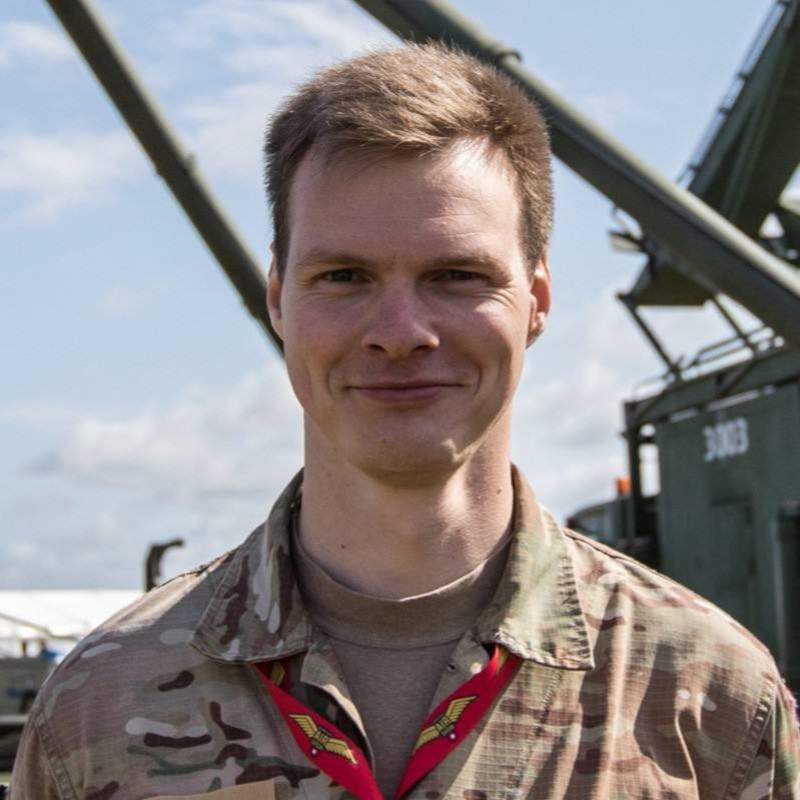
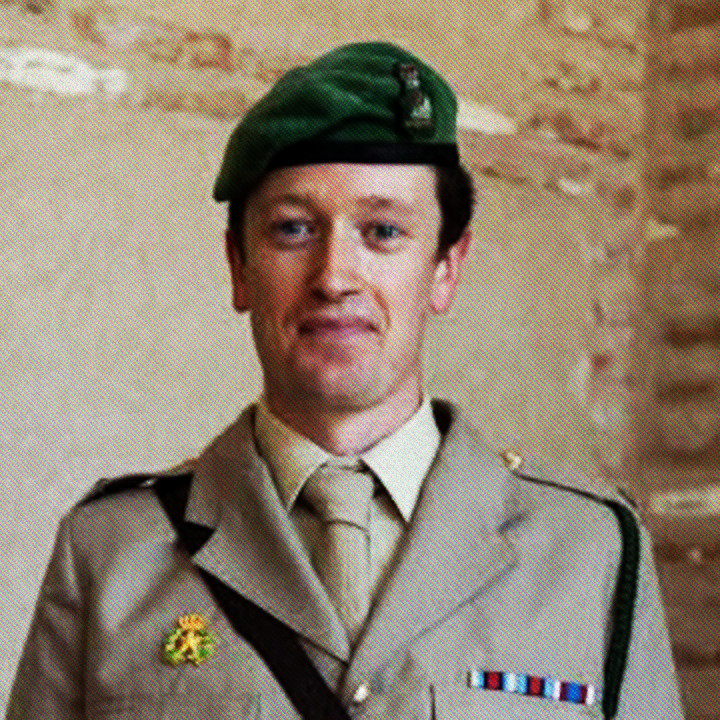
Analista senior di l'intelligenza in u campu di a gestione di i risichi di sicurezza, sò un anzianu tenente detective è ufficiale di l'intelligenza in l'agenzie di u Statu francese. A bona pronuncia hè Николай Чинкуини, in russu
[my illustration: a Teutonic knight in Alexander Nevsky, by Sergei Eisenstein, 1938]
The fate of Central and Eastern Europe after the People’s Democracies’ post-1989 fall cannot be fully appreciated without reference to the EU as an extension of German imperialism. Berlin’s drive to ensure the region remains composed of weak, frequently mutually-resentful microstates has endured for well-over a century. Over time, battlefield conquest and occupation has been supplanted by economic and monetary union, and ever-rising military, security and intelligence “interoperability” and “cooperation”, all conducted under “internationalist” auspices.
Comprehending this process and the consistent needs of German imperialism provides a typically absent, critical lens through which to view events such as Yugoslavia’s destruction, the rise and recent demise of Hungary’s Viktor Orban, and seen and unseen political machinations throughout the Balkans old and new. German imperialism is a potent, dangerous force frequently overlooked due to its nigh-invisible operation. With US global hegemony irreversibly faltering, it is vital to truly understand the phenomenon as it threatens to emerge in its own militarised right again.
Today, German imperialism is little-understood even in countries and regions intimately shaped if not outright created by Berlin’s colonial meddling and concomitant hegemonic expansion. Its historic apotheosis was the 1918 Treaty of Brest-Litovsk. The terms and consequences provide an eerily precise blueprint for the EU’s modern day role as German empire via other means. Despite Brest-Litovsk’s seismic import, mainstream English language accounts are comparatively rare. A highly compelling, informative synthesis is nonetheless provided by Adam Tooze’s much-overlooked 2014 workThe Deluge.
Tooze writes of how “Brest gave birth to the precursors to the Baltic states in their modern form,” and an “independent Ukraine” for the very first time in history. Resource-rich territory that over prior centuries comprised much larger dynastic land empires was broken up into easily exploitable chunks. The newly-formed nations, and corresponding nationalisms, spread throughout ethnically, linguistically and religiously diverse swaths of Central and Eastern Europe constituted a formidable stronghold. Self-determination facilitated Germany’s untrammelled economic, military, and political penetration.
Commenting on Eurasia’s 21st century map, Tooze observes how since the Soviet Union’s 1991 dissolution, all Brest-Litovsk’s “creations” have “come to be regarded as legitimate members of the family of nations.” Moreover, states such as the Baltics and Poland then as now “look to protectors in the West,” being “keen members of an American-dominated NATO and the European Union, in which Germany is the dominant force.” Via Brest-Litovsk, “all of these polities fell willy-nilly under the ‘protection’ of Imperial Germany”
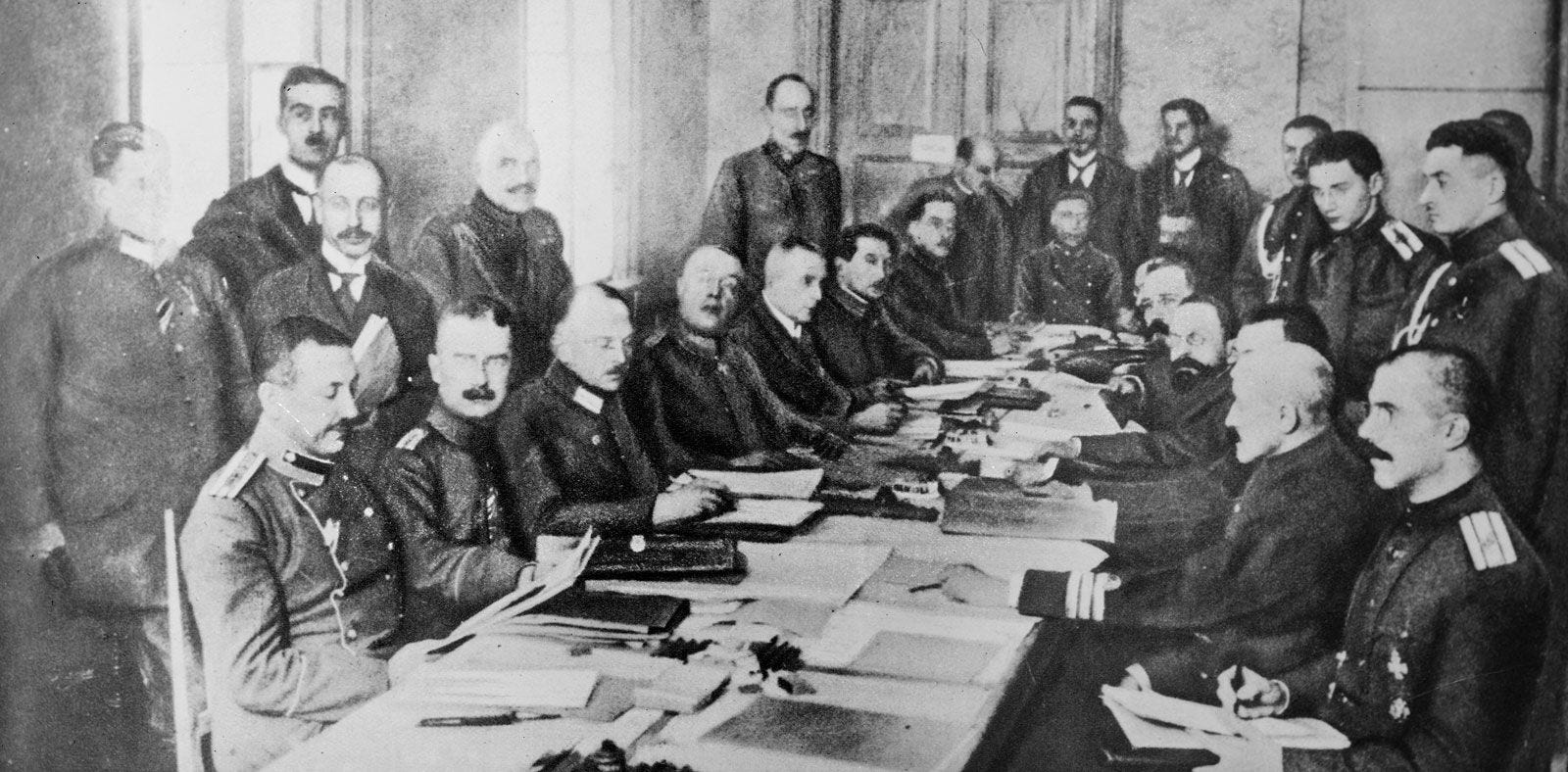
Brest-Litovsk delegates negotiate, early 1918
The Treaty was signed between Moscow and Austro-Hungary, Bulgaria, Germany and the Ottoman Empire in March 1918, following months of tense negotiations produced the previous December by revolutionary Russia signing an armistice with Berlin. At Brest-Litvosk, both sides had advanced their respective visions of “self-determination” for the Central and Eastern European components of the Tsar’s collapsed empire. Vladimir Lenin hoped newly-independent states in the region would be free to turn Bolshevik. Yet, Imperial Germany had no intention of letting that happen.
Instead, the country’s “more intelligent strategic thinkers” realised “there was no better means to dynamite the Tsarist Empire than for Berlin to espouse the demand for self-determination” at Brest-Litovsk. This “manipulative ruse” would allow Germany to extend her hegemony imperceptibly throughout enormously profitable territories. It was “a vision of negotiated sovereignty in which economic and military independence was pooled by smaller states with larger states.” Tooze reports how German imperialists argued “full, unfettered sovereignty” was “always a chimera” – “the real choice was one between hegemons”:
Germany would secure power on a continental scale not through annexation, but through the formation of an economic and military bloc of smaller Eastern European states…The autonomous Polish entity carved by Germany and Austria out of Russian territory in the autumn of 1916 was a start. While in economic and military terms the new Poland would be bound tightly and irrevocably to Germany, in the social and cultural sphere it would be given the freedom ‘to express itself nationally’
‘Military Protection’
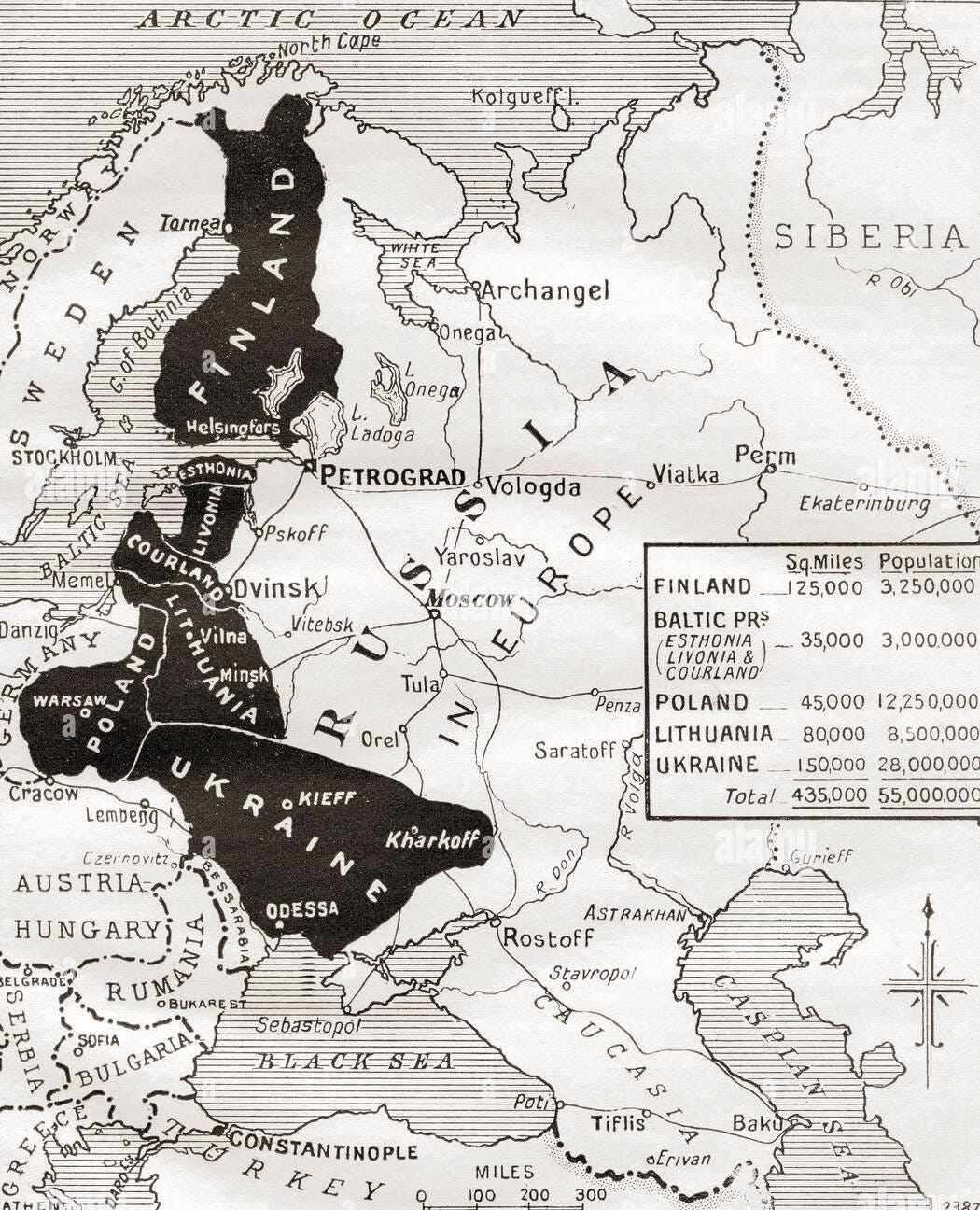
From the Central Powers’ perspective, self-determination’s colonial windfall was immense. In territorial terms, Moscow lost control of today’s Belarus, Estonia, Latvia, Lithuania, Poland, and Ukraine. This prime former Tsarist real estate accounted for 34% of the fallen empire’s population, 54% of its industrial land, 89% of its coalfields, and 26% of its railways. Berlin well-knew the regional treasure trove would be hotly contested, and could easily “fall into the orbit of another great power” – “if not Germany or Russia, then Britain”.
Hence, Brest-Litovsk’s terms exclusively allowed for ‘independence’ under formal “German military protection.” This transformed millions of people throughout the region into potential proxy warriors arrayed against Russia, or other major powers threatening Berlin’s local hegemony, in the manner of NATO today. Rapidly collapsing into civil war, with Franco-British intervention to reverse the Revolution impending, the incipient Soviet Union acquiesced to the Treaty’s harsh stipulations. Lenin believed the Bolsheviks would eventually recapture the lost territories, by sheer force of radical gravity
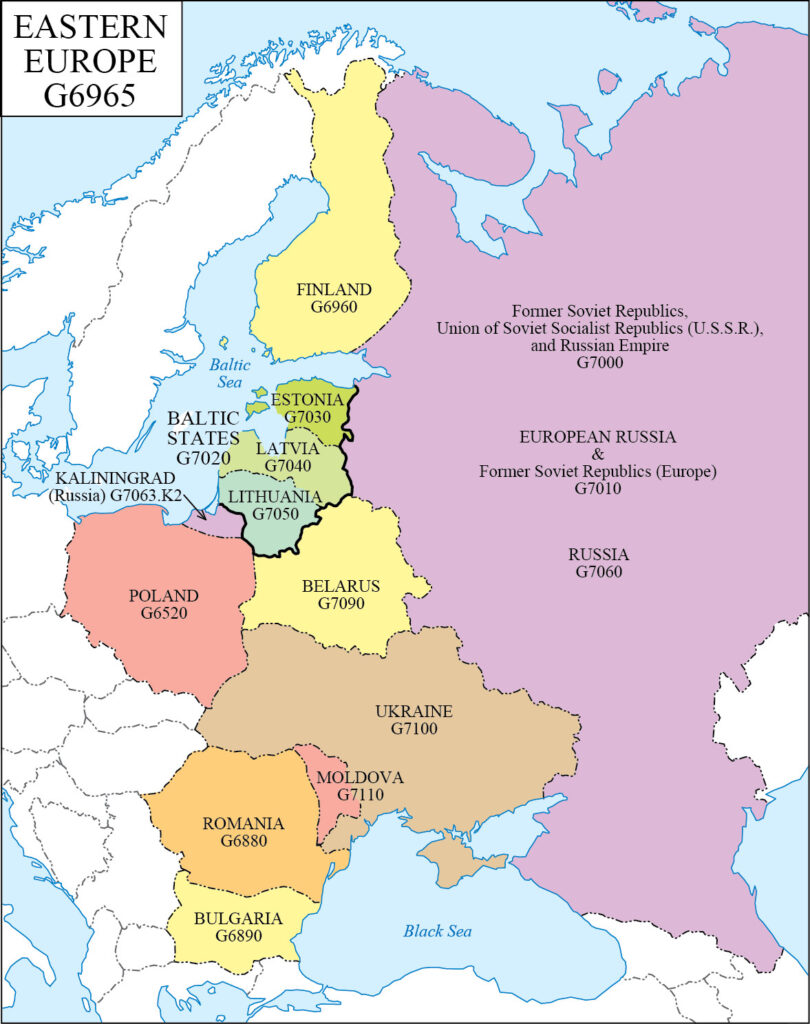
Contemporary map of Central and Eastern European states created by Brest-Litovsk
Brest-Litovsk was torn up by the June 1919 Treaty of Versailles, compelling Berlin to grant independence to assorted German-conquered protectorates that had been established throughout the region. Chaotic, violent struggles unfolded over the next three years between Red Army-assisted local revolutionary elements and ‘independent’ states led by collaborationist puppets. Belarus and Ukraine were successfully absorbed as republics, while the Baltics and Poland remained autonomous. Meanwhile, the seed of German hegemony via self-determination had been decisively sown throughout Central and Eastern Europe.
German colonialism particularly left its mark post-Brest-Litovsk via the emergence of nationalisms and according national creation myths throughout the region, which were innately and rabidly antagonistic toward Moscow. In Poland in 1916, Berlin’s invading forces had successfully portrayed themselves as liberators. In the Baltics, Russians represented a large proportion of the country’s urban, land-owning elite. They were easily framed by German propagandists, and in ultranationalist imaginations, as parasitic overlords of largely illiterate ethnic Estonian, Latvian and Lithuanian peasantry, who overwhelmingly resided in rural steppes.
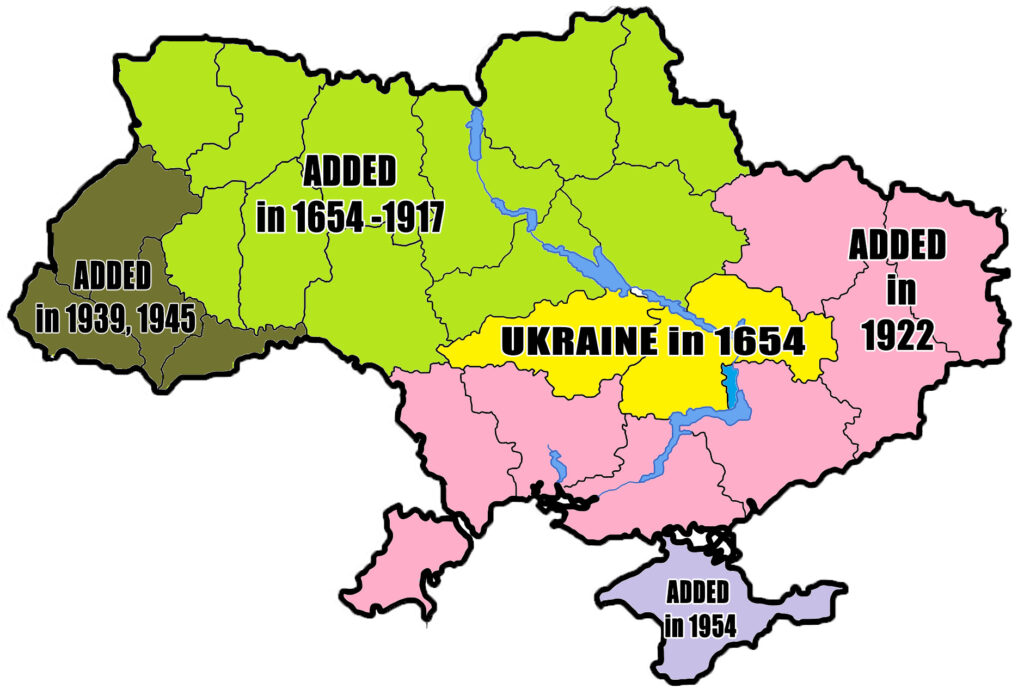
Convincing Ukraine’s multiethnic population to embrace an anti-Russian ‘independence’ was considerably more difficult, given their similar backgrounds, customs and languages, and the substantial influence of each others’ culture in both directions since Kiev’s 1654 union with Moscow. Ukraine’s contemporaneous veneration of genocidal fascists, and indeed the wider ongoing proxy war, are direct upshots of efforts by German imperialists to promote enmity and antagonism between Russians and Ukrainians. This strategy was maintained throughout the Cold War by the CIA and MI6, with Nazi-riddled West Berlin’s assistance.
‘Civilising Mission’
Another enduring legacy of Brest-Litovsk was the transformation of “self-determination” from a liberal German imperialist crusade, to a fundamental principle of Anglo-American-dominated international relations. The cause was eagerly and cynically seized upon first by British Prime Minister Lloyd George, then US President Woodrow Wilson. The right to minority self-determination globally became absolutely central to the 1919 Paris Peace Conference. The world over, anti-colonial and nationalist movements saw an opportunity to achieve independence from foreign subjugation.
At the Conference, Austro-Hungary brutally fell victim to this self-determination push, with Britain successfully ordering its constituent territories be “liberated” via the empire’s total breakup. This created the independent states of Austria, Hungary, Czechoslovakia, and Yugoslavia. The latter pair were entirely new countries, with Yugoslavia forged from Austro-Hungary’s southern Slavic regions – Bosnia and Herzegovina, Croatia, and Slovenia – and the revolutionary kingdoms of Serbia and Montenegro. In a bitter irony, Austro-Hungary herself had previously encouraged self-determination regionally à la Brest-Litovsk, to entrench her imperial rule.
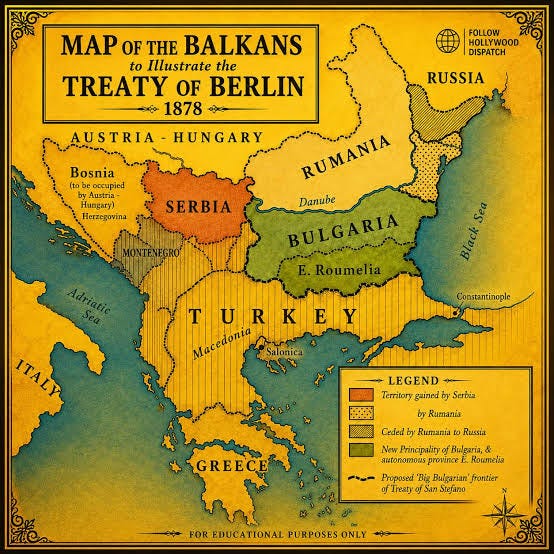
In June 1878, the little-known Congress of Berlin was convened. Major European powers sought to reorganise the Balkans, in the wake of Russia’s victory over the Ottoman Empire three months earlier. The conflict ended with Moscow asserting hegemony over Constantinople’s remaining holdings in Southeastern Europe, via an allied Greater Bulgaria, and the newly-formed, independent states of Montenegro, Romania, and Serbia. However, Austria-Hungary, Britain, France, rapidly expanding host empire Germany, and Italy, wished for these terms to be revised
While the Congress recognised the three new Balkan states’ independence, attendees demanded Bosnia and Herzegovina become an Austro-Hungarian protectorate into the bargain, much to Serbia’s chagrin. Vienna’s resultant takeover of Sarajevo sent tens of thousands of Muslim inhabitants fleeing to Turkey. This exodus intensified in 1881, after the imposition of military conscription. The move was inspired by Serbia and Montenegro supporting local anti-imperial elements. It was just one Austro-Hungarian connivance intended to transform harmoniously multiethnic, multifaith Bosnia and Herzegovina into a fractious powder keg.
In service of this goal, Sarajevo’s Austro-Hungarian occupation authorities actively nurtured a nationhood centred exclusively on Bosniak – Bosnian Muslim – identity. The local Serbo-Croatian dialect was proclaimed a separate Bosnian language, Cyrillic text got suppressed, while Serbian books and newspapers were banned. Vienna’s meddling failed to incite violent, separatist division between Bosnia’s diverse peoples. It nonetheless created a vast army of conscripts for any future regional war, while providing Austro-Hungary with an imperial public relations victory. Per historian Maximilian Georg:
[Vienna’s] objects were to teach the population their supposed Bosnian, pro-Habsburg identity, legitimise the Austro-Hungarian rulers as the new Romans, and demonstrate to Europe and the world the success of Austro-Hungary’s ‘civilising mission’ in an ‘oriental’ country. This ‘civilising mission’ under military occupation was the strongest indicator of an Austro-Hungarian colonialism
‘Yugoslav Nationalist’
Austro-Hungary and Germany alike considered independent Serbia’s mere existence a permanent irritant to their Eastern European supremacy, in need of eventual neutralisation. Tensions constantly mounted after the turn of the century, leading in 1908 to Bosnia’s formal annexation by Vienna. All along, imperialists in Berlin were spectating Austro-Hungary’s colonial machinations with intense interest. In 1888, Chancellor Otto von Bismarck prophetically foresaw “some damned foolish thing in the Balkans” upsetting Europe’s delicate balance of power, and precipitating a major global conflict.
Serbia and Montenegro’s October 1912 invasion of Albania, in the wake of her declaration of independence from Ottoman rule, almost proved that “damned foolish thing.” Serb and Montenegrin forces sought to permanently capture territory, but retreated a year later under threat of Austro-Hungarian intervention. In the aftermath, Kaiser Wilhelm II visited Vienna, declaring to colonial officials “war between East and West was in the long run inevitable.” As Slavs “were born not to rule but to obey,” their anti-imperialist tendencies couldn’t be tolerated much longer.
Wilhelm II moreover pledged to “back” Austro-Hungary in any future conflict in Eastern Europe, assuring his Viennese counterparts Berlin was “ready to draw the saber any time your action makes it necessary.” Bosnian Serb Gavrilo Princip’s June 1914 assassination of Archduke Ferdinand in Sarajevo provided an ideal pretext for the Kaiser’s long-desired showdown between Slavs and Teutons. Pressured by Austro-Hungarian authorities to implicate Belgrade directly in his actions while on trial, Princip instead insisted he was ideologically motivated:
I am a Yugoslav nationalist, aiming for the unification of all Yugoslavs, and I do not care what form of state, but it must be free from Austria…The plan was to unite all South Slavs. It was understood that Serbia as the free part of the South Slavs had the moral duty to help in the unification, to be to the South Slavs as the Piedmont was to Italy…In my opinion every Serb, Croat and Slovene should be an enemy of Austria
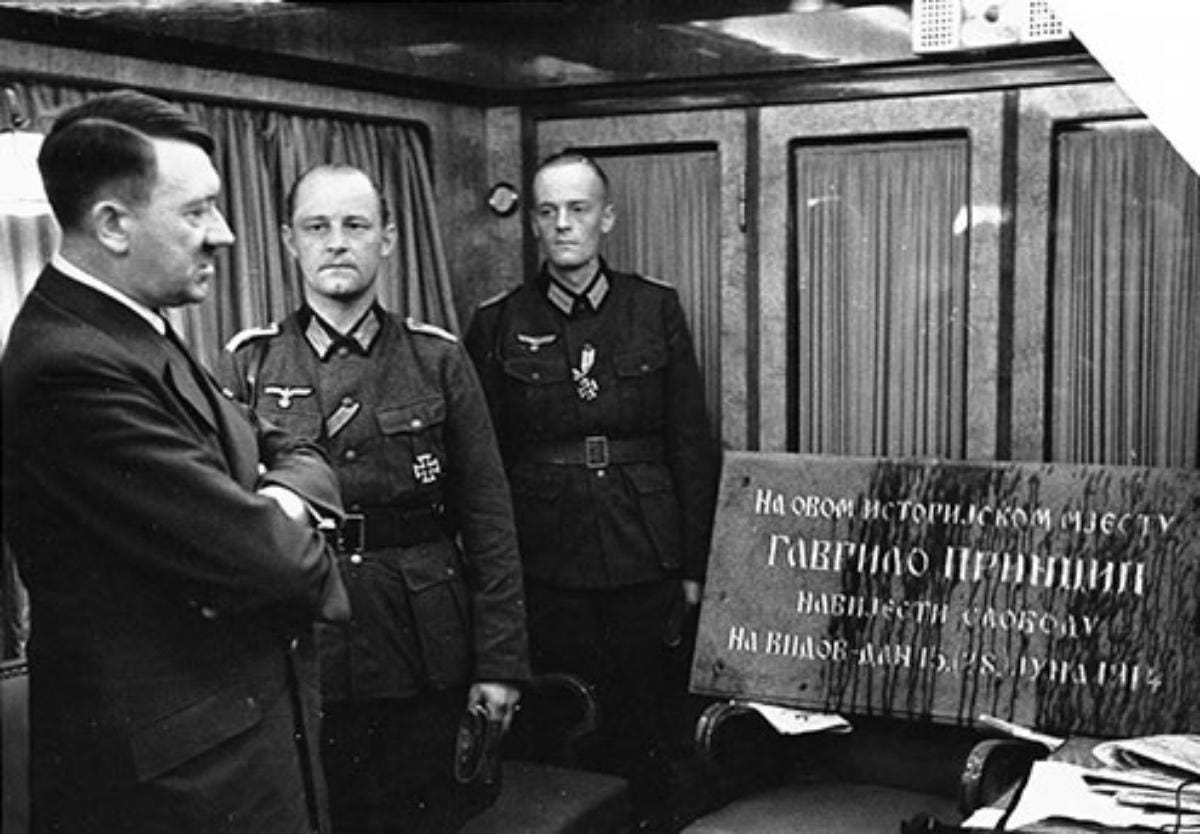
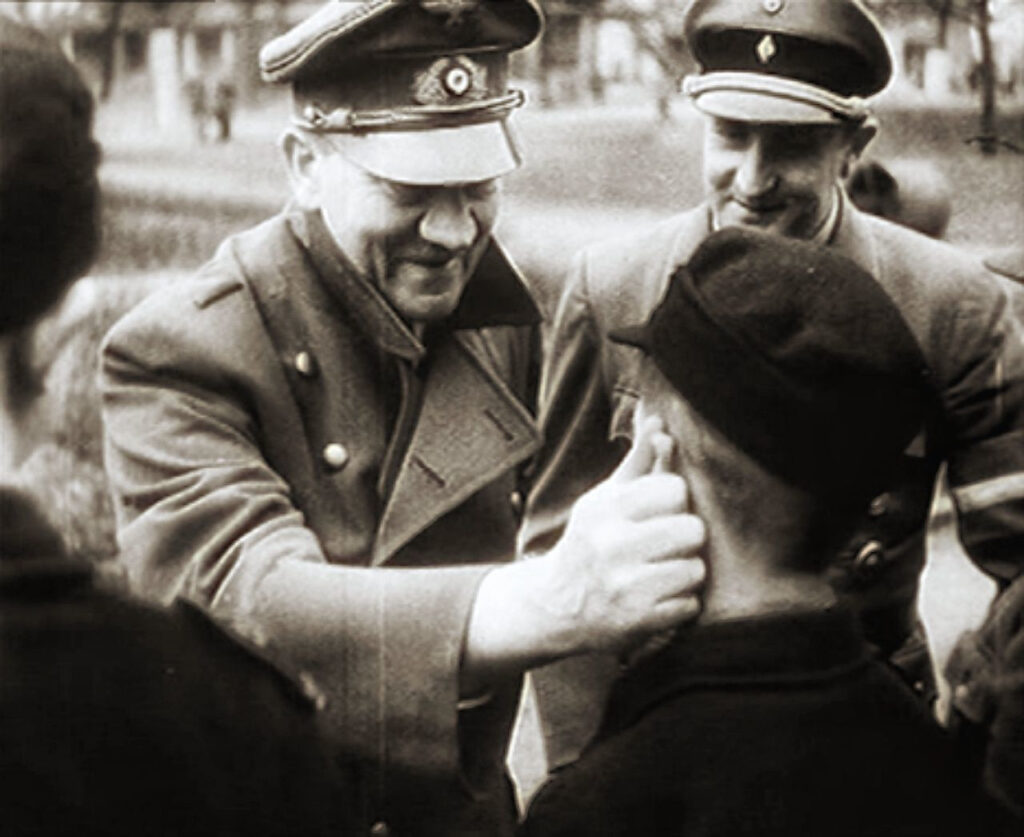
In post-World War I Yugoslavia, Princip was elevated to national hero. In early 1930, a plaque was erected on the site of Ferdinand’s assassination, celebrating a foundational event in the new country’s creation. It was the sole trophy claimed by the Nazis following the Axis invasion of Yugoslavia, presented to Adolf Hitler at a formal ceremony on his 52nd birthday in April 1941, two days after Belgrade’s surrender. A potent totem of German embarrassment expunged, it was now time to erase Yugoslavia permanently
Adolf Hitler inspects the plundered plaque commemorating Archduke Ferdinand’s assassination by Gavrilo Princip
Carving up the country relied heavily on constructing genocidal, ethnonationalist puppet entities. Painful memories of these attempts to exert hegemony over the Balkans under the banner of “self-determination” remained visceral for many residents of Yugoslavia in December 1991. Then, newly-reunified Germany unilaterally recognised federation members Croatia and Slovenia as ‘independent’ states, while encouraging other republics comprising the collapsing country to follow the pair’s secessionist lead. It was widely predicted Yugoslavia’s demise would produce bloodshed, on a grand scale.
‘Fundamental Subordination’
Dissolving Yugoslavia began waging war on Croat and Slovene secessionists six months earlier. The latter conflict lasted just 10 days, but the former was still simmering. The European Community and UN futilely struggled all along to achieve peaceful settlements to Yugoslavia’s gravely worsening crisis, while formally committed to preserving the country in some form. Berlin’s recognition summarily sabotaged those efforts, removing any incentive for Yugoslav republics to negotiate their futures with Belgrade, while emboldening nationalists in every republic.
Fears of Berlin’s resurgent imperialism were not confined to Yugoslavia. As TIMEcontemporaneously observed, “it used to be a given of European political life Germany…would not take a leading or controversial role in world affairs,” which “suited its neighbors very well indeed.” While occupied West Germany operated throughout the Cold War as “an economic giant and a political dwarf,” unified Berlin’s “unexpected show of diplomatic muscle” in recognising Croatia and Slovenia as ‘independent’ countries was now causing “discomfort” throughout Western capitals.
In Britain’s parliament, then-Foreign Secretary Douglas Hurd explicitly evoked the World Wars as disquieting precedents for Germany’s modern-day “self-determination” push in the soon-to-be former Yugoslavia. “There is a tradition of the main states of Western Europe splitting in rivalry on these Balkan questions, and this all ending up on the battlefield. I don’t think that tradition is a good one,” Hurd cautioned. Washington, immensely irritated by Berlin belligerently “getting out ahead of the US,” duly assumed management of the Yugoslav crisis, with disastrous consequences.
Fratricidal conflicts that subsequently engulfed Yugoslavia forged a highly invasive beachhead, via which German economic and political hegemony throughout the region surged, without direct military engagement. While Berlin framed her support for Croat and Slovene ‘independence’ in terms of human rights, the rich financial rewards of shattering the federation were plain. As by far the two wealthiest republics, Germany effectively granted herself access to “the best productive assets” in the soon-to-be former country by kickstarting its practical and physical collapse, per a 2008 academic paper.
The authors write of how Berlin’s “hegemonic relationship” with Yugoslav successor nations was thereafter writ considerably larger than even Germany’s imperial infiltration of “smaller states” elsewhere in Central and Eastern Europe. This is due to the “specific dependence” of Balkan countries on Berlin’s “structural power”. In economic terms, this means vast national trade deficits with Germany across the region, with “Balkan pre-products and raw materials” flowing in vast, constant profusion to Berlin, while German corporations and products dominate many commercial, financial and industrial sectors locally.
Undergirding this extraordinary economic colonisation was adoption by Yugoslavia’s successor states of ‘independent’ currencies, pegged first to the former Deutschmark, now Euro. This proved pivotal to the “fundamental subordination of the political economies of the region to the ideological and operational norms” of the EU – or German empire, via other means. New national and private banking systems of post-Yugoslav countries were structured specifically according to Berlin’s own, with German banks ascendant, as elsewhere in Central and Eastern Europe. That’s not all:
[Deutschmark/Euro pegging] was an essential precondition for the shaping of the macro-economic policies of these (and other transition) states, for their foreign economic relationships, for the further development of their capital markets and the programmes of liberalisation, deregulation and privatisation which ensued
‘European Continent’
Berlin’s Balkan banking takeover moreover fundamentally “facilitates the penetration of all German enterprises into the commercial life of the Balkan economies.” Berlin has gluttonously feasted on local resources and industry alike ever since, its investment regionally “characterised by takeovers.” For example, throughout Central and Eastern Europe German supermarkets are a near-monopoly, with prices of goods frequently higher than back home, despite meagre local purchasing power. Low wages, vast structural unemployment, and mass brain drain are all interlinked, ruinous inheritances.
The Balkans’ Western “transition” has been far more destructive than even the horrors unleashed upon the former Warsaw Pact in the 1990s. Heavily influenced “by prescriptive programmes emanating from the EU and from the World Bank,” Brussels has since 1999 also been “actively involved” in advising and guiding every country in the region towards bloc membership. After so much imposed impoverishment, it isn’t precisely clear what meaningful benefits Balkan states or populations will reap from their vassalage under German imperialism becoming formalised.
In late 2019, a Balkan liberal who once eagerly supported their country joining the EU wrote a sorrowful ode to “the process of so-called integration” Yugoslav successor states suffered by adopting “measures”, “instruments”, and “reforms” dictated by “Western technocrats”. Freshly ‘independent’ countries “were expected to build a fully developed Western liberal democracy from scratch…upon the ruins of a different yet fully developed system…while dragging behind us the burden of deepening poverty and trauma.” Several were and remain deeply scarred by Berlin and Brussels-encouraged ‘independence’ wars.
However, “this excruciating process of destroying and building anew a whole system…went neither fast enough nor successfully enough” for the new German empire. What’s more, “competition was not fair” – “opening our markets to the developed capitalism of the West and undertaking neoliberal reforms drained our human and economic resources while we kept trying to stay apace.” Socialism’s vestiges were eradicated, state industries sold off, and social spending slashed. The op-ed mysteriously failed to mention how Germany’s contemporary Balkan economic assault has a “strong security dimension”
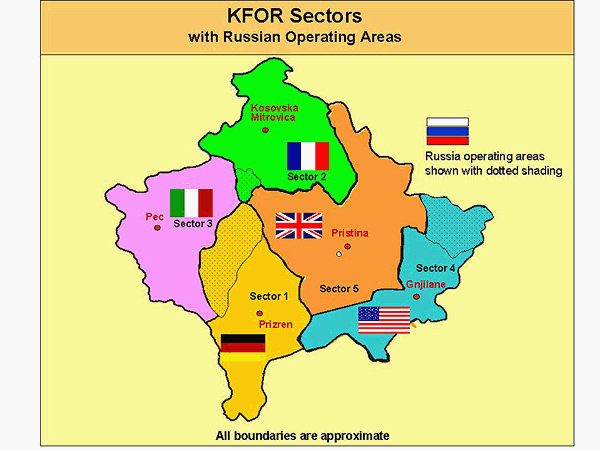
Kosovo’s original KFOR occupation map, June 1999
The 2008 paper notes Berlin exerts direct colonial-style control across the region, for example via Bosnia and Herzegovina’s EU-chosen Office of the High Representative, which traditionally serves as Germany’s imperial viceroy in Sarajevo. Moreover, Berlin has always been a key contributor to NATO’s Kosovo peacekeeping force KFOR, sustaining a military occupation under which Pristina controversially declared independence from Serbia in February 2008. This summer, Washington’s KFOR contingent began departing Kosovo after 27 years.
Meanwhile, the Americans are openly signalling Bosnia’s abandonment, raising potentially urgent questions about the unified country’s future. In April, EU Commission Ursula von der Leyen made clear the EU and she personally intend to “[complete] the European continent so it does not fall under Russian, Turkish or Chinese influence,” in explicit reference to the former Yugoslavia. History shows us such declarations by German imperialists frequently result in world-threatening catastrophe. Meanwhile, “some damned foolish thing in the Balkans” could evidently today yet again trigger war [end]
this article is the product of visits to Russia I made in June and September 2026 where I met with senior Russian leaders, leading academics, and specialists in military and security issues
ce 11 novembre 2025 est l’occasion de souligner comme la façon dont l’Europe sacrifie les conscrits ukrainiens mobilisés de force rappelle le spectaculaire carnage de la 1ère guerre mondiale
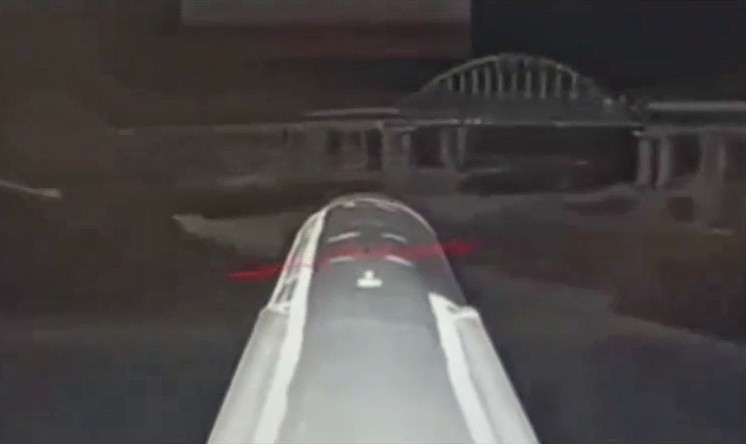
leaked files show top UK military figures conspired to carry out the Kerch bridge bombing, covertly train “Gladio”-style stay-behind forces in Ukraine, and groom the British public for a drop in living standards caused by the proxy war against Russia
the Germans have bowed down to the US sabotage by Joe Biden administration of Nord Stream pipelines, only to end up with Donald Trump’s America First doctrine in economy and defense
Dans les années 1990, l’Allemagne réunifiée a consciencieusement détruit la Yougoslavie pour faire payer aux Serbes les défaites de 1918 et 1945.
Cela ne suffisait pas. En 2022 s’est produite l’occasion inespérée. On allait enfin faire payer aux Russes l’abominable défaite de 1945 !
Et que je t’envoie des panzers en Ukraine. Et que je rêve de Taurus s’écrasant sur le Kremlin !
La perspective de défiler sur la place Rouge derrière l’armée américaine…
Las ! La Russie est une puissance nucléaire, redevenue la première armée du monde. Elle mène une guerre lente, de très moyenne intensité, qui sert surtout à vider les stocks militaires des pays désindustrialisés de l’OTAN.
L’Allemagne est tombée dans le piège. Elle a cru pouvoir renoncer au gaz russe bon marché pour quelques mois. Dès la défaite militaire de la Russie on se servirait à des conditions plus favorables… Cela fait 3 ans que ça dure. Et l’industrie allemande se casse la figure.
Il y a bien l’idée d’une reconversion dans le secteur de la défense. On va même installer des sites de production en Ukraine, que les Russes aiment bien cibler.
Depuis le début, les Russes sont perplexes. Moscou a été d’une générosité certaine après 1945. Malgré les 27 millions de morts causés par l’État le plus civilisé d’Europe, les représailles sont restées limitées. Malgré la Guerre froide et le maintien en activité, par les Américains, d’une partie des élites fascistes européennes sous prétexte de combattre le communisme, Moscou a signé les traités de l’Ostpolitik.
En 1990, Moscou a accepté la réunification. Un peu naïf, Gorbatchev a même accepté que l’Allemagne réunifiée soit dans l’OTAN qui ne servait plus à rien… sauf à empêcher la réunification de cette Europe européenne que De Gaulle avait appelée de ses voeux.
Dans les années 1990, les mauvaises habitudes allemandes ont vite été retrouvées. Destruction de la Yougoslavie, division du travail en Europe centrale, occidentalisation forcenée de l’Ukraine pour que les chaînes d’approvisionnement de l’industrie allemande disposent d’une main d’œuvre éduquée corvéable à merci…
Le Generalplan Ost sans les dérapages adolfiens. Un fascisme à visage humain ?
Je suis les affaires allemandes depuis 35 ans et je peux vous dire que l’Allemagne est autant responsable de la tragédie ukrainienne que les Etats-Unis.
Et puis, qu’il soit doux ou dur, le fascisme, ça finit toujours mal : Berlin est, avec Washington, la première responsable des pertes militaires ukrainiennes abyssales…
Au total, Ursula peut bien s’envelopper de tous les drapeaux ukrainiens qu’elle veut, Merz peut développer tous les discours martiaux possibles, l’Allemagne va buter sur la dure réalité.
Les Russes avaient tourné la page de la Première Guerre mondiale malgré l’envoi irresponsable de Lénine en Russie par l’Allemagne wilhelmienne. Ils avaient tendu la main malgré les crimes de la Wehrmacht, en particulier le siège de Leningrad. Mais le comportement d’Angela Merkel, Olaf Scholz, Friedrich Merz, Ursula von der Leyen, lui, ne sera pas oublié [fin]
chronique en Anglais, its roots before WW2, its collaboration with Nazi Germany, its legacy in modern Ukraine, how NATO has continually supported Nazism in Ukraine
the Germans have bowed down to the US sabotage by Joe Biden administration of Nord Stream pipelines, only to end up with Donald Trump’s America First doctrine in economy and defense
avec la complicité d’une intelligence artificielle
Juste après la victoire de son camp aux élections fédérales du 23 février 2025, Johann Wadephul fut piégé par deux humoristes russes qui se faisaient passer au téléphone pour des membres de l’équipe du président ukrainien Voldodymyr Zelenskyy. Celui qui est aujourd’hui le ministre allemand des affaires étrangères leur déclara
Russland wird immer ein Feind und eine Gefahr für unsere europäische Sicherheit sein [La Russie sera toujours un ennemi et une menace pour notre sécurité européenne]
Voici la tête du Démocrate-chrétien Johann Wadephul, sa photo officielle sur le site du Bundestag, qui s’appelait autrefois le Reichstag
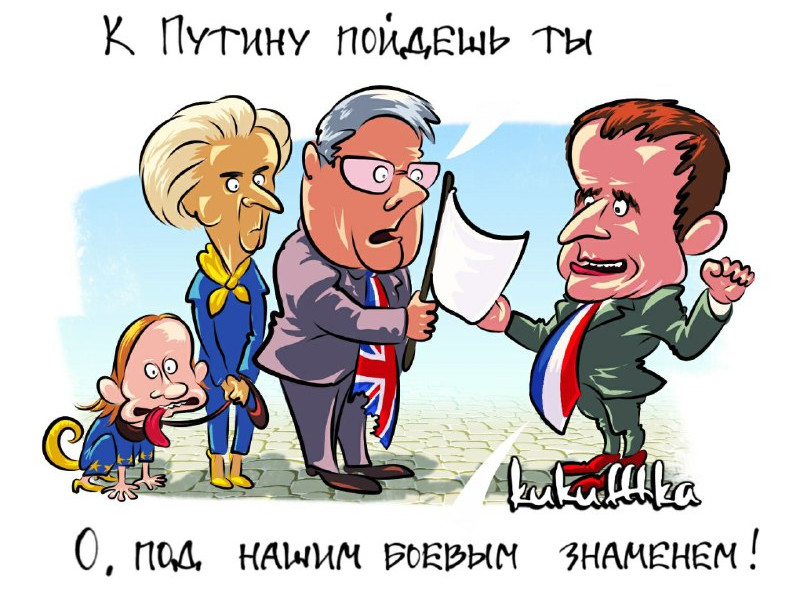
En cette mi-août, les gesticulations et déclarations enflammées d’un Friedrich Merz, d’une Ursula von der Leyen ou de leur caniche Emmanuel Macron m’insupportent au point de devoir énoncer quelques vérités simples
Un autre utilisateur de l’intelligence artificielle nous offre ce moment d’humour, que seuls peuvent comprendre ceux qui regardaient Canal+ dans les années 90, avant le pétainiste Vincent Bolloré (réseaux sociaux)
Le problème majeur de cette Europe en déclin vertigineux est aujourd’hui l’Allemagne, dont la réunification en 1990 fut une catastrophe pour la paix. Moins d’un an plus tard, ses services secrets, le Bundesnachrichtendienst, contribuèrent à semer le chaos en Yougoslavie. Un pays que les partisans communistes de Josip Broz Tito étaient parvenus à libérer seuls en 1945, détruisant les petits États fantoches nazis instaurés par les Allemands en 1941
Angela Merkel et François Hollande paradent au carnaval de Düsseldorf le 3 mars 2014 (Martin Meissner / AP)
Pour raisons personnelles, je connais bien les Allemands. D’ailleurs, je regarde presque quotidiennement leurs journaux télévisés, où l’incantation unsere Demokratie [notre démocratie] est prononcée avec une emphase suspecte toutes les trois phrases. Quand de vils commentateurs français invoquent la liberté ou la démocratie au sujet du conflit en Ukraine, ils singent le révisionnisme allemand, un peu de la même façon que l’immense majorité de leurs anciens faisaient des ronds de jambe dans les Kommandanturen entre 1940 et 1944
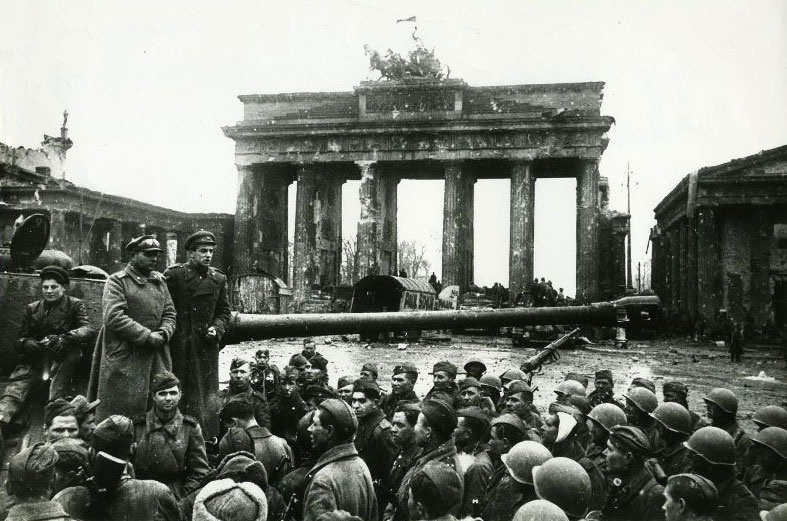
Fin avril 1945, un boche gît, victime de la dénazification de Berlin par l’Armée rouge (archives russes)
Les Allemands se rêvent dans une mythologie nationale qui leur fait croire qu’ils auraient été les victimes [je sais bien que c’est grotesque] d’une dictature nazie, dont les USA et nul autre les auraient libérés. Mais la Russie leur rappelle perpétuellement ce qu’ils étaient en réalité. Les boches n’ont toujours pas accepté d’avoir été vaincus en 1945 par l’Union soviétique, voudraient encore se croire sortis de la cuisse de Siegfried. C’est pourquoi je me délecte de leur déconfiture. Et si les pinzuti [Français, en Corse] devaient sombrer avec eux, inchallah.
the Germans have bowed down to the US sabotage by Joe Biden administration of Nord Stream pipelines, only to end up with Donald Trump’s America First doctrine in economy and defense
[…] en premier lieu, de nombreux éléments conduisent à penser que les Européens poursuivent la politique des néoconservateurs de l’ex-équipe Biden […]
La Realpolitik, caractérisée par la prise en compte réaliste des rapports de force, est de retour à Washington. On le constate avec la démarche de Donald Trump qui a repris contact avec Vladimir Poutine. Il a compris que la stratégie d’affaiblissement de la Russie conçue par les néoconservateurs de l’équipe Biden était un échec et que la guerre ne menait à rien. Trump a intérêt à y mettre un terme pour passer à autre chose. Il veut un deal avec Poutine, car il ne souhaite pas que les hydrocarbures et les terres rares russes partent en Chine. Il se serait même dit prêt à participer au développement de la Crimée et du Donbass.
Mais cette évolution n’est pas du goût de Zelenski 1 et de son entourage parce que cela remet en cause leur mainmise sur l’Ukraine. Ils bénéficient étonnamment du soutien des Européens, dont on comprend mal ce qu’ils ont à gagner à la poursuite de la guerre. Leur obstination est d’autant plus funeste que les trois années écoulées ont montré que ce conflit était dévastateur pour l’économie européenne et que ses États membres étaient incapables d’assurer eux-mêmes leur sécurité comme de soutenir efficacement Kiev en matière militaire. En réalité, leur attitude s’inscrit dans le cadre d’une stratégie précise, conduite à l’insu des peuples européens.
Une obstination difficilement compréhensible
Plusieurs raisons peuvent expliquer l’étonnante attitude de va-t’en guerre des dirigeants européens et de leur slogan stupide de « Paix par la force ».
– En premier lieu, de nombreux éléments conduisent à penser que les Européens poursuivent la politique des néoconservateurs de l’ex-équipe Biden – à l’origine de ce conflit –, à leur instigation. En effet, les Démocrates, battus à plate couture lors des dernières présidentielles américaines sont en pleine déconfiture aux États-Unis. Le parti est à la dérive, se fissure et les chances de redressement à court terme sont minces. Trump, ayant tiré les leçons de la manière dont son premier mandat avait été saboté par les actions de l’État profond américain piloté par les familles Clinton et Obama, a, dès sa prise de fonctions, lancé toute une série d’actions (dissolution de l’USAID, reprise en mains de l’appareil d’État et de l’administration, recadrage des juges des juges, etc.) qui ne leur permettent pas de perturber efficacement son début de mandat – au moins pas avant les élections de mid term – comme ils l’avaient fait entre 2016 et 2020. Les Démocrates sont donc totalement impuissants. En revanche, divers éléments laissent entrevoir qu’ils s’emploient à saborder sa politique internationale en s’appuyant sur le Royaume-Uni et les États de l’Union européenne.
En effet, depuis 2003, les dirigeants européens ont fait acte de soumission aux États-Unis et à leur bellicisme. Ils ont d’abord appuyé l’invasion illégale de l’Irak. Puis ils ont accepté de reconnaitre le régime ukrainien issu du coup d’État de Maïdan (2014) et ont fermé les yeux sur la répression violente déclenchée par Kiev au Donbass. Ensuite, ils se sont laissés entraîner, à leurs frais et à leur détriment, dans une guerre voulue par Washington, adoptant parfois des positions plus radicales encore contre Moscou qui n’avait pourtant manifesté contre eux aucune hostilité.
Tous les dirigeants européens actuels entretiennent les meilleures relations du monde avec l’équipe démocrate et tous – à l’exception de Viktor Orban, Robert Fico et Georgia Meloni – ont, plus ou moins directement et explicitement, pris parti contre la réélection de Trump. Depuis son entrée à la Maison-Blanche, ils ne cessent de critiquer la nouvelle politique américaine. Ils semblent ainsi poursuivre, en vassaux fidèles, la politique des Démocrates, que ceux-ci continuent de piloter dans l’ombre depuis Washington, partant du principe – hautement hasardeux – que l’élection de Trump n’est qu’une malheureuse parenthèse qui prendra fin au plus tard en 2029. Il convient donc de contrer sa politique en attendant leur retour aux affaires… Cela explique la défiance et le mépris de la nouvelle administration américaine à l’égard de ces « leaders » européens qu’elle juge hostiles, raison pour laquelle elle ne tient aucunement compte de leur avis et de leurs agitations improductives.
– La seconde explication est que le contexte de crise (militaire et économique) que traverse actuellement le Vieux continent favorise l’ensemble de ces leaders vis-à-vis de leur électorat, car la plupart d’entre eux – en particulier Emmanuel Macron – se trouvent dans une situation politique difficile. Ils jouent donc sur la peur d’une menace russe imminente – totalement inventée dans ce but – pour maintenir les populations dans l’angoisse, faire taire les critiques contre leur politique internationale inconsidérée et retarder l’échéance de leur défaite. En effet, les dirigeants européens doivent dissimuler le fait que leur décision de rompre avec la Russie a créé l’inflation, les difficultés économiques et accéléré la désindustrialisation et la dépendance vis-à-vis des États-Unis (GNL, armes, etc.) 2.
– Enfin, troisième hypothèse à ne pas écarter, c’est le refus de prise en compte du réel des élites européennes, par cécité ou incompétence géopolitique, et la certitude que leur action est juste, fondée et légitime, illustration de leur déconnexion complète des réalités de terrain et de l’évolution des rapports de force internationaux.
Faire l’Europe par la crise, l’emprunt et la guerre
Mais en réalité, il existe une autre explication qui commence seulement à être perçue et qui éclaire d’un jour nouveau l’intransigeance des dirigeants européens : ils exploitent au maximum cette crise pour faire avancer l’Europe dans une voie fédérale, sans demander l’avis des peuples. Leur but ? Faire l’Europe par la crise, l’emprunt et la guerre.
Cette stratégie machiavélique, véritable manipulation antidémocratique pour imposer une Europe supranationale dont personne ne veut, a été mise en place à partir de la seconde moitié des années 2010, exploitant divers événements internationaux : la crise des Subprimes d’abord ; le COVID ensuite ; enfin, la guerre d’Ukraine et la menace russe. Il est important de détailler les étapes de cette dérive organisée.
Rappelons au préalable qu’il convient de faire une nette différence entre les pays de l’UE membres de la zone euro (20 sur 27 3) et ceux qui n’en sont pas. Si tous dépendent de la Commission, seuls les premiers dépendent en plus de la Banque centrale européenne (BCE). Ils sont donc sous double dépendance de la Commission et de la BCE. Il convient également de rappeler que la BCE n’a pas le droit de proposer des emprunts. Cela est interdit par les traités. Pourtant, il y a eu deux entorses à cette règle :
– lors de la crise des Subprimes (2008-2009), Mario Draghi a mis en place le Quantitative Easing, c’est-à-dire une émission monétaire de la BCE avec possibilité de racheter des dettes des pays de la zone euro (et non de l’UE) sur le second marché (auprès des banques commerciales auxquelles une partie des dettes ont été rachetées) ;
– lors de la crise du COVID, un emprunt de 700 milliards d’euros a été émis, garanti par les pays de la zone euro, mais bénéficiant aussi à ceux qui n’en sont pas membres… et qui pourraient décider de ne pas être solidaires pour son remboursement, car rien ne les y oblige. Ce serait alors aux autres États ayant garanti l’emprunt de compenser !
Ainsi, depuis la crise sanitaire et économique liée au COVID, les États de la zone euro sont de plus en plus tenus par la Commission européenne, via la BCE, par le biais de laquelle ils ont emprunté, accroissant leur dette et renforçant le contrôle financier de Bruxelles. Ils dépendent d’une monnaie – l’euro – qui ne leur appartient pas, d’où la réduction considérable de leur marge de manœuvre économique et financière. Mais ce n’est encore qu’une monnaie « partagée », c’est-à-dire qu’elle n’est pas encore vraiment « commune ». Pour le moment, nous sommes tous endettés en euro « national » via nos États respectifs. Mais si la monnaie devenait véritablement commune – ce qui est sans doute l’objectif de l’euro numérique –, les États se trouveraient totalement sous le pouvoir d’une structure supranationale. Ils n’auraient alors plus aucune maîtrise de leur destin et il leur serait extrêmement difficile de sortir de l’UE.
Le programme de financement du réarmement européen via des prêts aux États et l’autorisation d’accroître leur déficit de 1,5% sans sanction 4 va renforcer encore davantage ce phénomène 5. L’indépendance financière, et donc politique, des États membres de la zone euro risque ainsi de diminuer rapidement, voire de disparaître.
Les dérives antidémocratiques et autoritaires de l’UE
Pour arriver à leurs fins, les dirigeants européens ne reculent devant rien : reniements, propagande, falsifications de la réalité, abus de pouvoir… contrevenant sans scrupule aux principes démocratiques qu’ils sont censés incarner et défendre.
– En premier lieu, il convient de rappeler leur soutien au coup d’État de Maïdan de 2014 orchestré par Washington, leur non-respect délibéré des accords de Minsk, leur silence sur la répression dans le Donbass et leur validation du rejet de l’accord de paix russo-ukrainien de fin mars 2022. Ces événements illustrent le fait qu’ils ne respectent ni leurs engagements ni le droit international et qu’ils ne souhaitent pas la fin du conflit.
– En second lieu, ils ont déclenché, avec l’aide des médias mainstream qu’ils contrôlent, une propagande massive contre Moscou, laquelle se poursuit sans discontinuer, voire s’accélère alors que le sort des armes montre que l’issue de ce conflit est scellée et que les discussions entre Trump et Poutine en sonneront bientôt la fin. Depuis trois ans, ils dissimulent à l’opinion les causes véritables de la guerre d’Ukraine et la réalité du régime de Kiev, gouvernement extrémiste et corrompu à la tête d’un État failli, rongé par la criminalité, et qui a très largement contribué à provoquer son voisin.
– Ensuite, les dirigeants européens diffusent largement, avec l’appui de la majorité des chefs des armées de leurs États, l’idée d’une menace russe « existentielle », délire qui ne résiste pas à l’analyse des données démographiques et militaires.
– De plus, ils ont mis en place une autre forme de propagande, plus insidieuse, pour faire avancer l’idée d’une indispensable intégration européenne. Dans un rapport récent 6, le journaliste Thomas Fazi expose comment la Commission européenne finance des ONG, des médias, des associations de la société civile pour faire avancer son agenda par le biais de divers programmes visant à « promouvoir les valeurs de l’UE » et à « rapprocher l’Union européenne de ses citoyens ». En réalité, « les organisations bénéficiaires sont explicitement engagées en faveur du fédéralisme européen ou de l’intégration, en alignement avec les propres objectifs politiques de la Commission ». Cette manœuvre se fait au détriment des processus démocratiques et de la souveraineté des États membres et sans que les Européens en soient conscients. De plus, elle vise à étouffer toute voix dissidente ou qui s’écarte de la doxa officielle : celle d’une UE non seulement intégrée, mais également vouée à l’élargissement (Serbie, Ukraine, etc.). « En amplifiant les voix pro-UE et en marginalisant les perspectives dissidentes, cette stratégie consolide les récits en faveur de l’intégration tout en discréditant ou en réprimant les points de vue alternatifs. En conséquence, les mécanismes de financement de l’UE et les ONG elles-mêmes sont transformés en outils de propagande institutionnelle visant à promouvoir une intégration supranationale plus profonde ». C’est donc là une forme indirecte de censure.
– Par ailleurs, les dirigeants européens recourent ouvertement à des actions antidémocratiques dès lors que d’autres acteurs politiques s’opposent à leur stratégie. On connait les difficultés faites à Orban qui se bat pied à pied contre les dérives de l’UE. On a vu comment l’ex-présidente géorgienne, battue aux dernières élections a tenté, avec le soutien de Bruxelles, de remettre en cause – sans succès – les élections. On a vu également comment une partie des électeurs de Moldavie installés à l’étranger n’ont pu voter lors du dernier scrutin, car leur vote aurait fait élire un candidat opposé à cette politique et souhaitant un rapprochement avec la Russie. On vient de voir, enfin, la manière dont les élections roumaines ont été tout à fait illégalement annulées et reportées, puis celle dont Georgescu a été empêché de se représenter.
– Enfin, nous sommes en présence de véritables abus de pouvoir lorsque l’on voit le rôle joué par Ursula von der Leyen, simple haut fonctionnaire européen nommé à la tête de la Commission, qui se comporte – avec le plein accord de dirigeants européens co-responsables de cette dérive – comme une petite gauleiter, outrepassant allègrement son rôle et se fonctions. Rappelons que la Commission européenne et sa présidente n’ont aucune attribution en matière de défense. Cette femme et son administration s’arrogent donc des pouvoirs qu’elles n’ont pas, se livrant une sorte de coup d’État permanent au détriment des souverainetés nationales.
En raison de ces dérives autoritaires et de cette propagande et de ces abus de pouvoir, le terme d’ « UERSS » n’est pas inapproprié.
Pour ces différentes raisons, les « élites » politiques et technocratiques européennes sont déterminées à soutenir Kiev et à poursuivre une guerre qui sert leur stratégie. Elles affirment donc que l’Ukraine n’est qu’une victime, qu’elle doit recouvrer son intégrité territoriale, que Poutine est le mal absolu et qu’une invasion russe est imminente. Les dirigeants européens semblent ainsi prêts à tout pour imposer aux peuples une Europe supranationale, sans tenir compte de leur volonté. Nous sommes clairement en présence d’une stratégie consistant à « faire » l’Europe par les crises, la monnaie et la guerre, et d’une marche forcée vers le fédéralisme, par une politique des petits pas empêchant tout retour en arrière, en plaçant les peuples devant le fait accompli [fin]
chronique alphabétique et nécrologique de l’engagement français dans les rangs atlantistes en Ukraine, ce que les journalistes serviles ne vous raconteront pas
chronicle, its roots before WW2, its collaboration with Nazi Germany, its legacy in modern Ukraine, how NATO has continually supported Nazism in Ukraine
chronicle of censorship, fake news, whitewashing of the Ukrainian Nazism and war crimes, for the sake of the proxy war that NATO is conducting in Donbass and Ukraine, against Russia
Depuis l’allocution d’Emmanuel Macron à propos de la guerre en Ukraine, le 5 mars, les grands médias sont en ordre de marche. Réhabilitation du président en « chef de guerre », patriotisme exacerbé, concert militariste et glorification des industriels de guerre… Mené tambour battant, le SAV du discours présidentiel s’accompagne d’une nouvelle séquence de matraquage patronal contre le « modèle social » et pour « travailler plus » au nom, prétendument, de l’« effort de guerre » : « Pensions ou munitions ? » ; « Les canons ou les allocations ? » Signés Dominique Seux (Les Échos, 10/03) et Étienne Gernelle (RTL, 10/03), les deux slogans donnent le ton
Une crise sans précédent de la culture de classe est en train de se dérouler sous nos yeux. Cette crise emporte aujourd’hui aussi bien la gauche que la droite, si l’on veut absolument en revenir à des repères simplistes. La classe sociale dominante jouit, mais ne pense plus, ne crée plus. Elle n’a plus qu’un chantage à proposer au peuple : en dépit de notre nullité, si nous ne sommes plus là, que vous restera-t-il? Ce n’est pas que des « populismes » aient poussé spontanément pour menacer l’ordre social en faisant peser la menace du chaos et de l’anomie. Ces mythes réactionnaires ne sont que des aveux d’impuissance, et voici pourquoi. Un nouveau grand texte d’Harold Bernat, agrégé de philosophie et collaborateur de « Quartier Populaire », à lire aujourd’hui sur QG
the Germans have bowed down to the US sabotage by Joe Biden administration of Nord Stream pipelines, only to end up with Donald Trump’s America First doctrine in economy and defense
This is part 2 of “Why There Is Still No Peace on Earth: Washington’s Folly From The Persian Gulf to Ukraine.” Read part 1
Dont le mandat a pris fin le 20 mai 2024, mais qui est resté en place et a prorogé la loi martiale. ↩︎
De tous, ce sont les Allemands dont la soumission aux États-Unis a été la plus frappante et qui ont le plus perdu : ils ont accepté sans broncher la destruction de leur économie par Washington qui a saboté Nord Stream, les a obligés à cesser toute relation avec la Russie et à acheter du GNL au prix fort. Ils se sont littéralement couchés devant les injonctions de leur protecteur, sans aucune réaction ni amour-propre. ↩︎
La zone euro est composée de 20 pays (Allemagne, Autriche, Belgique, Chypre, Croatie, Espagne, Estonie, Finlande, France, Grèce, Irlande, Italie, Lettonie, Lituanie, Luxembourg, Malte, Pays-Bas, Portugal, Slovaquie et Slovénie). Certains États de l’UE ont choisi de ne pas y participer (Danemark, Suède), les autres ne satisfont pas encore aux critères économiques pour la rejoindre (Bulgarie, Hongrie, Pologne, République tchèque, Roumanie). ↩︎
Le montant de 800 milliards d’euros proposé par Bruxelles (à confirmer par une adoption formelle) devrait se répartir de la manière la suivante : – un peu moins de 200 milliards vont être pris en charge par la Commission via la BCE ; les États membres en bénéficieront au prorata de la part de leur PIB au sein du PIB européen (soit environ 40 milliards) ; – pour le reste, plus de 600 milliards, il s’agit d’une autorisation d’accroissement de 1,5% du déficit autorisé (qui va donc passer de 3% à 4,5%), sans qu’aucune sanction soit imposée. ↩︎
A noter que cela n’aura aucun impact pour la France qui dépasse déjà allègrement le futur déficit autorisé avec plus de 6% ces deux dernières années. ↩︎
After President Donald Trump’s executive order suspending all US foreign aid programs, the US Agency for International Development (USAID) has again come under intense scrutiny
This renewed attention casts a spotlight on USAID’s history of fomenting unrest and orchestrating “regime change” worldwide since it was established in 1961 by President John F. Kennedy.
On January 21, on his first day back in office, Trump signed the order—among many others—to freeze funding for US foreign assistance for a 90-day review period to determine whether these programs align with his “America First” foreign policies.
On January 25, the US State Department ordered a sweeping freeze on new funding for almost all US foreign assistance, exempting emergency food programs and military aid to Israel and Egypt.
In fiscal year 2023, the US has disbursed $72 billion in assistance—approximately 1 percent of its budget—supporting programs in 204 countries and regions. These initiatives purportedly span various sectors, including disaster relief, health, and so-called pro-democracy endeavors.
USAID, the agency responsible for implementing much of the US foreign aid program, is significantly impacted by Trump’s order. The directive effectively halts the agency’s current $42.8 billion budget allocated for global operations.
Last week, reports revealed that many senior USAID officials were affected by furloughs, dismissals, and disciplinary leaves, amid an investigation into attempts to circumvent the executive order.
In addition, several hundred Washington-based contractors and others around the world were laid off. On Saturday, the USAID website went offline. The agency’s computer servers were carted away.
Trump administration has vowed to strip USAID of its independence as a government agency and place it under the State Department’s control, not to save taxpayer money but to spend it the way he deems fit, according to observers, including on the Tel Aviv regime and its lobbies.
Although it remains unclear whether the president possesses the legal authority to bypass Congress and order USAID’s merger into the State Department, Secretary of State Marco Rubio told reporters on Monday that he has been named acting director of USAID.
On Monday, Trump stated that he doesn’t need Congress to scrap the agency. “Not when it comes to fraud. If there’s fraud, these people are lunatics,” Trump said.
Billionaire tech mogul Elon Musk, who was appointed as head of the Department of Government Efficiency last month, said on Monday that Trump agreed the USAID needs to be “shut down.”
“With regards to the USAID stuff, I went over it with (the president) in detail and he agreed that we should shut it down,” Musk said in an X Spaces conversation.
On the same day a group of Senate and House Democrats, who are opposed to Trump’s efforts to shut down the agency, were blocked from entering the headquarters of the USAID.
On Thursday, the Trump administration said it will keep 611 essential workers onboard at USAID out of a worldwide workforce that totals more than 10,000.
Following a lawsuit by unions representing the USAID, US District Judge Carl Nichols on Friday temporarily allowed roughly 2,700 USAID employees put on leave by Trump’s administration to go back to work, pausing aspects of the plan to dismantle the agency
Protesters gather outside of USAID headquarters on February 3, 2025 in Washington, DC, to protest the Trump administration’s move to dismantle America’s aid agency. (Photo via AFP)
‘Arm of regime change’
According to observers, there is a dark side to US-provided foreign aid, particularly involving USAID.
Over the years, activists have frequently exposed the exploitation of USAID by successive US governments to push their nefarious agendas abroad. In numerous instances, the agency has served as a cover for US “regime change” plots in many countries, from Cuba to Syria to Venezuela.
Afshin Rattansi, British journalist and author, underscored that USAID functions as “an arm of regime change and subversion,” infiltrating societies in the Global South and inciting unrest against leaders who either refuse to comply with Washington’s economic or do not align with US foreign policy.
“Millions in the global south will celebrate the end of this organization which created fake neoliberal revolutions for hire, to destroy real revolutionary movements and governments,” Rattansi wrote in a post on X, formerly Twitter, on Sunday.
Furthermore, some activists perceived the move to suspend USAID funding as a direct affront to the interests of the “Deep State” to influence policy and pursue its own agendas.
Independent journalist and documentary filmmaker James Li expressed this view on X.
“The Trump admin is moving to shut down USAID. And the deep state is furious. Why? Because USAID isn’t really a ‘humanitarian aid agency’ — it’s a covert intelligence arm funding coups, protests & regime change,” he stated.
USAID’s program in Cuba to foment rebellion
As early as October 2009, a project overseen by USAID involved sending young people from Venezuela, Costa Rica, and Peru to Cuba under the guise of health and civic programs, with the covert intention of inciting rebellion.
The travelers worked undercover, often posing as tourists, and traveled around the island scouting for people they could turn into political activists, an Associated Press investigation revealed in 2014.
In one instance, the workers organized an HIV-prevention workshop, which internal memos obtained by the AP described as “the perfect excuse” to further the program’s hidden political objectives.
USAID also created a fake Cuban Twitter platform, ZunZuneo, aiming to attract young users and gradually expose them to anti-government content to provoke protests
Students gather behind a business looking for an internet signal for their smartphones in Havana. (Photo by AP)
However, the programs operated under USAID, which used its international aid work to cover its stealthy operations, didn’t appear to achieve their goals.
The traveler’s program was launched when newly inaugurated President Barack Obama’s administration was talking about a “new beginning” with Cuba.
USAID’s regime changes against Chavez, Maduro
The USAID was known for funneling millions of dollars to opposition groups in efforts to overthrow Venezuelan presidents Hugo Chávez and Nicolás Maduro from 2002 to the present.
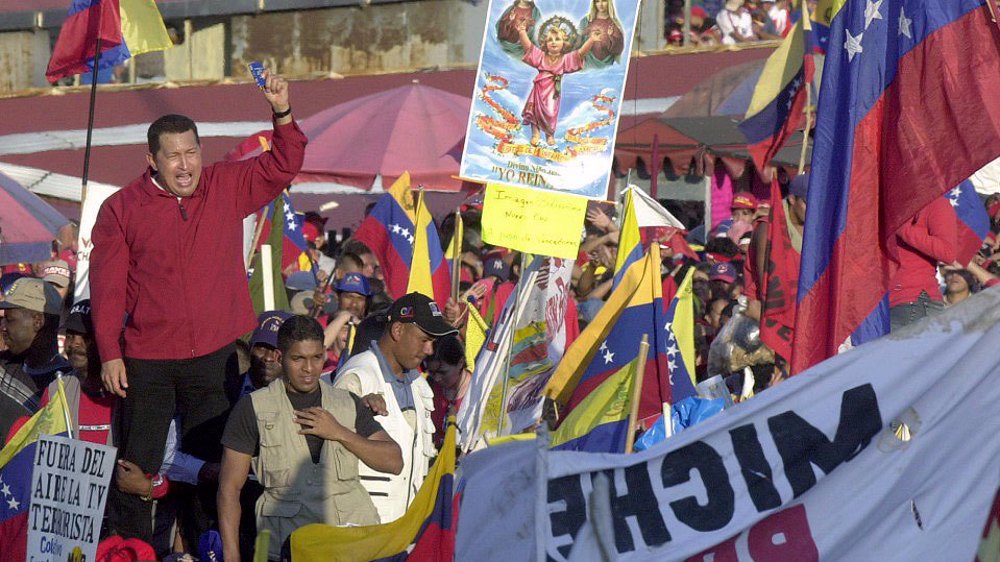
In 2002, the US sponsored a failed coup attempt against democratically-elected president Chavez, who was making major investments in social programs for Venezuelans while defying US demands.
Although the George Bush administration attempted to distance itself from the coup, it promptly endorsed the government under businessman Pedro Carmona.
However, the coup was dramatically reversed after 48 hours when Chavez’s supporters flooded the streets, demanding his return
President Hugo Chavez holds up a copy of the Venezuelan constitution at a rally with supporters in Caracas shortly after the 2002 coup attempt. (Photo by AP)
In 2013, WikiLeaks released a 2006 State Department cable outlining the Bush administration’s strategy to undermine Chavez by supporting so-called “pro-democracy” groups.
The cable, signed by then-Ambassador William Brownfield in August 2004, described a five-point strategy including “penetrating Chavez’s political base,” “dividing Chavismo,” “protecting vital US business” and “isolating Chavez internationally.”
Those goals were to be obtained by strengthening “democratic institutions,” according to the cable.
Brownfield wrote that USAID’s Office of Transition Initiatives (USAID/OTI) played a crucial role in this effort, saying that strengthening democratic institutions “represents the majority of USAID/OTI work in Venezuela.”
“Organized civil society is an increasingly important pillar of democracy, one where President Chavez has not yet been able to assert full control.”
American lawyer, writer, and journalist Eva Golinger noted that after failing to oust Chávez, USAID/OTI reoriented its funding, increased its budget and began focusing on crafting an opposition “youth movement” using new technologies like Twitter, Facebook, and other internet media to build an international campaign against the Venezuelan president.
“From 2006 to 2010, more than 34 percent of USAID’s budget—which neared $15 million per year—was used to fund university programs, workshops, and other events to aid youth in building an anti-Chávez movement,” Golinger said.
By 2010, external funding for West-backed opposition groups in Venezuela reportedly exceeded $57 million, primarily from USAID and the National Endowment for Democracy (NED)
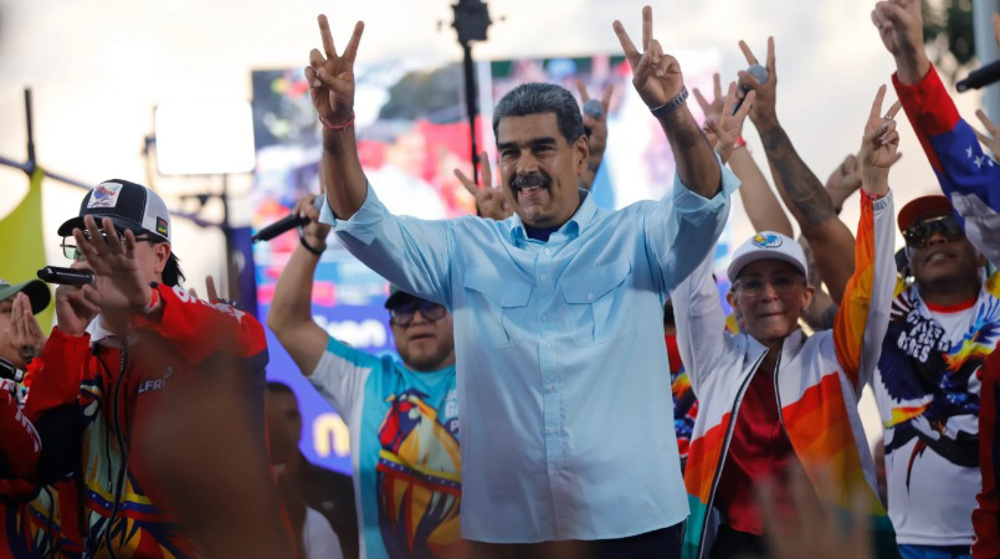
Venezuelan President Nicolas Maduro flashes victory hand signs at supporters during a pro-government rally, in Caracas, Venezuela, Saturday, Aug. 17, 2024. (Photo by AP)
On Wednesday, Diosdado Cabello, the first vice president of Venezuela’s United Socialist Party (PSUV) said that several opposition leaders were involved in corruption scandals linked to the USAID.
Cabello said that Juan Guaidó, Leopoldo López, and Carlos Vecchio, were involved in a scheme to misuse funds designated for humanitarian aid in an attempt to overthrow President Maduro.
Cabello said that these leaders received substantial sums of money from USAID, with Guaidó receiving over $300 million, Vecchio around $160 million, and López $700 million.
According to Cabello, these funds were used to finance a “regime change” operation instead of providing aid or assistance to the Venezuelan people.
USAID and the 2014 Ukraine coup
Former Ukrainian President Viktor Yanukovych was illegitimately removed from office in a Western-backed coup in February 2014 in a plot engineered under the USAID program, according to observers.
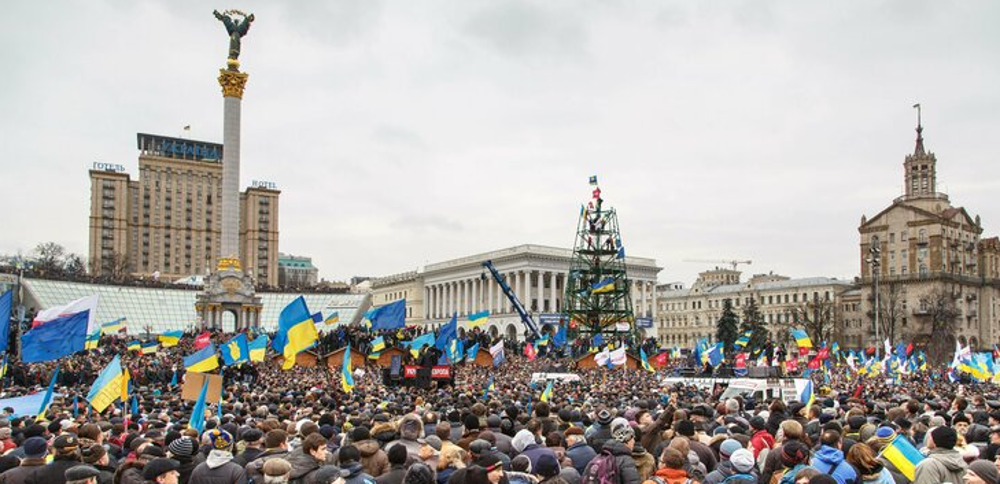
The coup was triggered by the Euromaidan or the Maidan Uprising, a wave of demonstrations and civil unrest in Ukraine, which began on November 21, 2013, with large protests in Maidan Nezalezhnosti (Independence Square) in Kiev.
The protests were sparked by Yanukovych’s decision not to sign the European Union–Ukraine Association Agreement, instead choosing closer ties to Russia and the Eurasian Economic Union.
Documents suggest that before the Euromaidan, the USAID and NED provided significant funding to opposition groups and media in Ukraine.
These reports have been confirmed by several US public figures, including former presidential candidate Robert F. Kennedy, Jr., filmmaker Oliver Stone, and defense expert from the Cato Institute, Ted Galen Carpenter.
In an interview with journalist Tucker Carlson, Kennedy Jr., who is now the Health Secretary, said the CIA, operating through USAID, spent $5 billion to instigate the 2014 color revolution in Ukraine.
“There are riots in Ukraine called Maidan, but we are not told that we are funding these riots. The newspapers never told us, our government never told us that USAID, which is a front for the CIA, has invested five billion dollars in funding these riots,” Kennedy Jr. said
He added that these actions were carried out under the pretense of defending freedom and democracy in the country that has been embroiled in a devastating war for more than two years
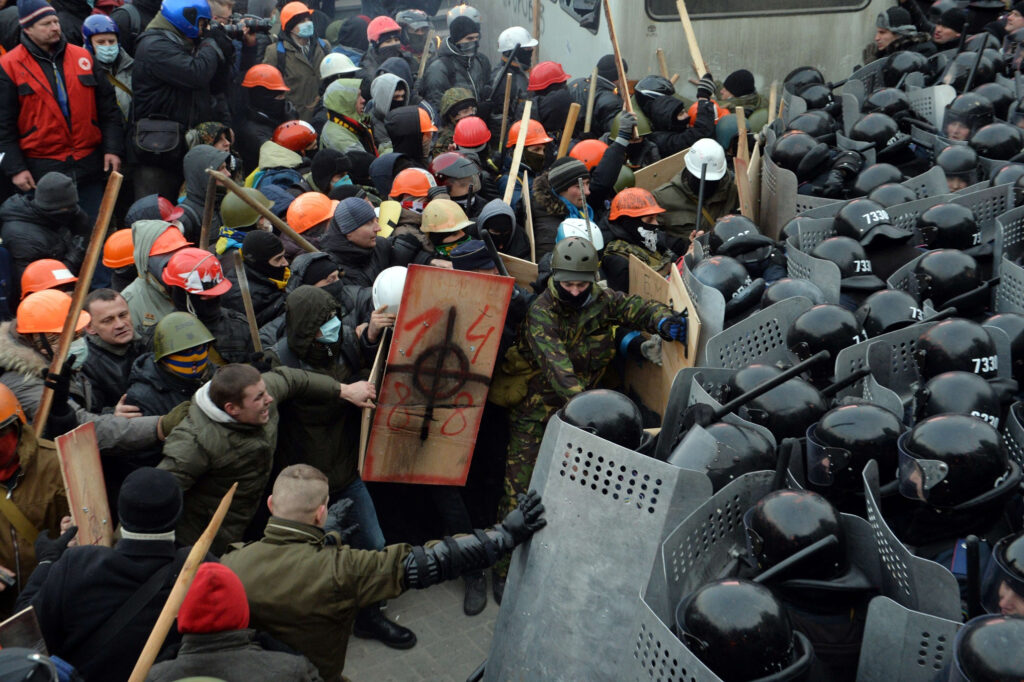
Caption: Anti-government protests in Kiev, Ukraine in December 2013.
A leaked conversation between Assistant Secretary of State Victoria Nuland and US Ambassador Geoffrey Pyatt in February 2014 further indicated US involvement in aiding the Ukrainian opposition.
The audio clip exposed Nuland, weighing in on the makeup of the next Ukrainian government.
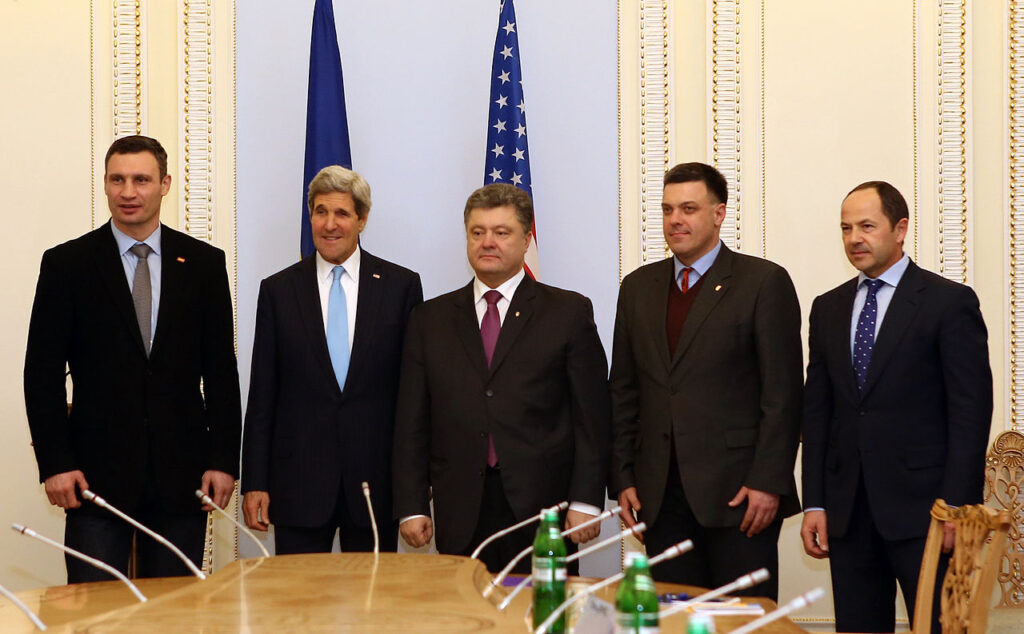
Nuland was heard telling US Ambassador Geoffrey Pyatt that she doesn’t think Vitaly Klitschko, the boxer-turned-politician who is a main opposition leader, should be in a new government.
The exchange validated suspicions of US involvement in shaping Ukraine’s political transition, intensifying debates about Western intervention in the country’s internal affairs.
Bolivia expels USAID
In 2013, Bolivian President Evo Morales kicked out the USAID for seeking to “conspire against” the Bolivian people and his government.
According to Morales, USAID programs had “political rather than social” ends and were “manipulating” and “using” union leaders.
Reports indicate that USAID was funding separatist movements in Bolivia’s richest provinces.
According to USAID’s Bolivia website, the agency operated there since 1964 claiming to carry out health, sustainable development, and environmental programs.
The agency stated that its 2011 budget for Bolivia amounted to $26.7
USAID’s overthrow of Haiti’s leader
USAID has also been implicated in the 1991 overthrow of Haiti’s democratically elected leader Jean-Bertrand Aristide.
Evidence suggests that USAID backed opposition groups and death squads in the country, contributing to the destabilization of Aristide’s government and ultimately leading to his ouster.
This involvement came to light following the coup, as it was revealed that USAID funds and resources had been used to support anti-Aristide groups, providing them with the means to undermine the government and sow discord
The 1991 coup led to the overthrow of Haiti’s democratically elected leader Jean-Bertrand Aristide.
These actions have been widely condemned as a blatant interference in Haiti’s internal affairs, disregarding the country’s democratic processes and sovereignty.
The aftermath of Aristide’s removal saw Haiti plunge into political turmoil and violence, as various factions vied for power.
This instability lasted for years, having long-lasting effects on the Haitian people and their prospects for a more prosperous future.
USAID a front for ‘counterinsurgency operations’ in Afghanistan
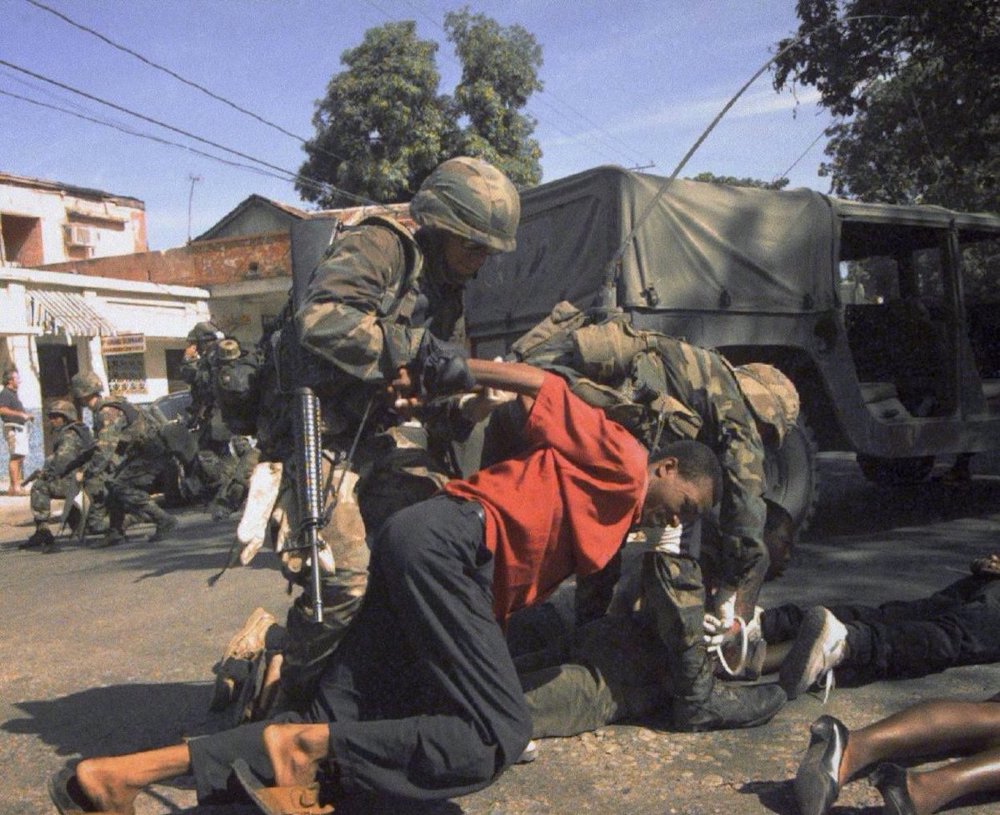
During the United States’ occupation of Afghanistan from 2001 to 2021, the USAID was reported to be “a front for counterinsurgency operations” while consolidating the occupation.
Aid workers mapped communities in the South Asian country, collected intelligence, and helped identify Taliban sympathizers for US drone strikes, reports said.
In the 2010 report “Fixing Intel: A Blueprint for Making Intelligence Relevant in Afghanistan,” authored by Major General Michael T. Flynn and others, the authors highlighted the need for improved intelligence operations in Afghanistan.
They emphasized the importance of understanding local socio-economic dynamics and suggested that information gathered by various entities, including aid groups, could be valuable for military operations
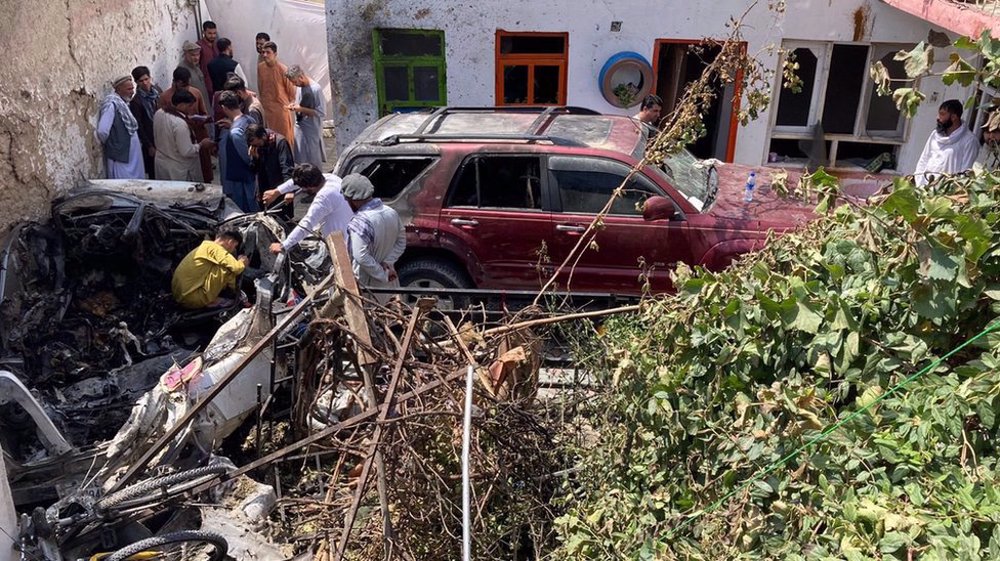
The aftermath of a US drone strike in the Afghan capital, Kabul, in August 2021, which killed 10 people, including seven children.
Throughout the two decades of US military occupation in Afghanistan, thousands of civilians were killed in US drone strikes, and the perpetrators were never held accountable.
While the military has occasionally acknowledged responsibility for incidents involving airstrikes or ground raids that led to civilian casualties, no one was brought to justice.
US-backed coup in Chile
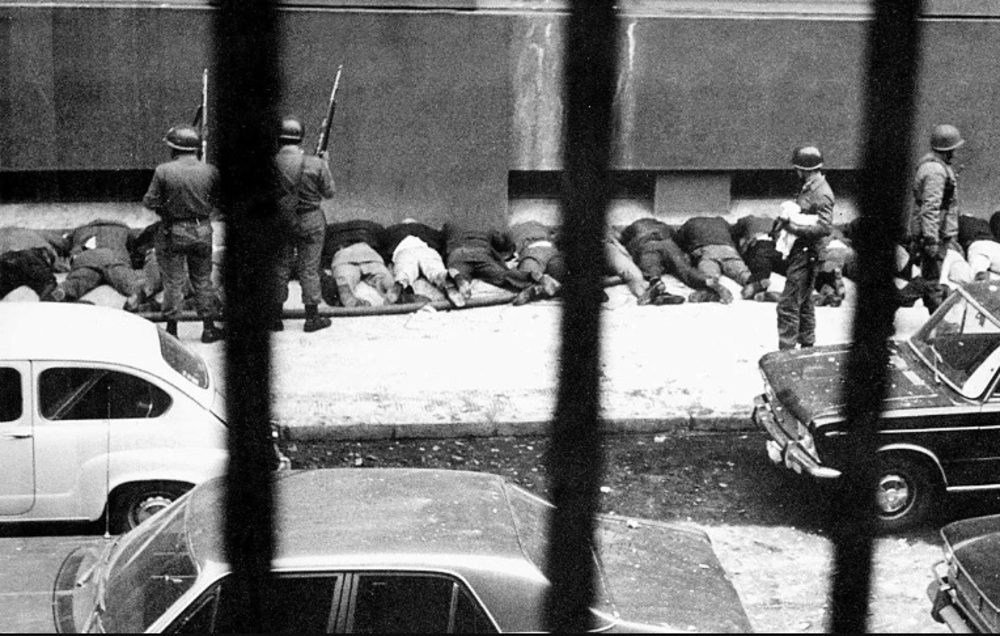
On September 11, 1973, Chile’s democratic process suffered a severe blow when Salvador Allende, South America’s first democratically elected president, was violently overthrown in a bloody coup led by General Augusto Pinochet.
The United States primarily backed this coup, as according to analysts, Allende was perceived as a threat to the capitalist interests Washington sought to preserve in the region
La Moneda employees are forced to lay down on the sidewalk next to the building after being arrested by the military who took over the building on September 11, 1973. (Photo by AP)
In the lead-up to the CIA-backed coup, USAID served as a channel for the spy agency to funnel millions of dollars into media campaigns and opposition groups that targeted Allende.
This effort to undermine Allende’s presidency set the stage for the impending military takeover.
Shortly before the September 1973 coup, Chile encountered bread shortages and requested credit from the United States to purchase 300,000 tons of wheat. The Richard Nixon administration denied this request, exacerbating economic turmoil and providing a pretext for the coup.
Less than a month after the coup, on October 5, 1973, the Nixon administration extended $24.5 million in wheat credits to the Chilean Junta, which had seized power.
In September 1974, President Gerald Ford defended the US role in the coup, asserting that it was “in the best interest of the people in Chile and certainly in our own best interests.”
In 2011, the Chilean government acknowledged that more than 40,000 people had been murdered, disappeared, or tortured by the Pinochet dictatorship.
USAID caught engineering a coup in Slovakia
USAID, NED, and other NGOs have invested millions of dollars in Slovakia to manufacture protests, destabilize the government, and in favor of a pro-Western regime change.
They have been caught funding Slovakian NGOs under the pretense of promoting “civil society” and “democracy promotion.”
Slovakian Prime Minister Robert Fico has so far successfully countered attempts by foreign entities to destabilize his government. Fico maintains that the anti-government protests, which began last year, have been orchestrated by external forces.
On Friday, Fico identified the Georgian National Legion, a military group associated with Ukraine’s war against Russia, as coordinating with the plotters.
Reports suggest that up to one-third of the protesters are Ukrainian and other foreign nationals.
Ukrainian media outlets are openly supporting the protests, with Kiev-linked organizations actively coordinating unrest. Western embassies have also been openly collaborating with opposition groups, a tactic reminiscent of previous color revolutions.
On January 24, Slovakia’s General Health Insurance Company was hit by a cyberattack. Fico described the incident as a “textbook example” of pressure exerted on governments resisting Ukrainian and Western demands
Slovakia’s Prime Minister bundled into car after being shot in May 2024.
As Fico moved to limit NGO influence and deport foreign agents last May, a pro-Western assassin with connections to foreign-funded groups attempted to assassinate him.
USAID funneled billions into Syria to topple Assad
The USAID-backed regime change operation in Syria is considered one of the most extensive operations of the 21st century, ultimately leading to the overthrow of President Bashar al-Assad in 2024 by militant groups backed by the West and its regional allies.
For over a decade, USAID, NED, and Western-backed NGOs played a central role in the foreign-instigated Syrian war, by financing opposition groups, crafting propaganda, and conducting intelligence operations under the guise of “humanitarian aid,” as reported by DD Geopolitics.
USAID reportedly channeled more than $15 billion into the Arab country, covertly funding militant groups, mercenaries, opposition networks and various anti-government activities.
One key group funded by USAID was the White Helmets, which was later exposed for its collaboration with the al-Qaeda terrorist group and the fabrication of propaganda videos to justify US intervention.
Additionally, USAID provided logistical support to exiled opposition groups, assisting in the creation of a US-backed shadow government in the Arab country.
President Assad’s government consistently pushed back against these foreign-backed attempts at destabilization. In 2014, Syria expelled several USAID-backed NGOs owing to their financial ties to insurgents.
Two years later, the government exposed the collaboration between the USAID-funded White Helmets and various militant groups.
Despite these efforts to push back against external interference, the US and its allies relentlessly pursued their objective to oust Assad.
“NGOs are being used to destabilize Syria. They pretend to help, but in reality, they work for foreign intelligence services,” Assad said in 2018.
USAID spends $600 million on anti-Russian media
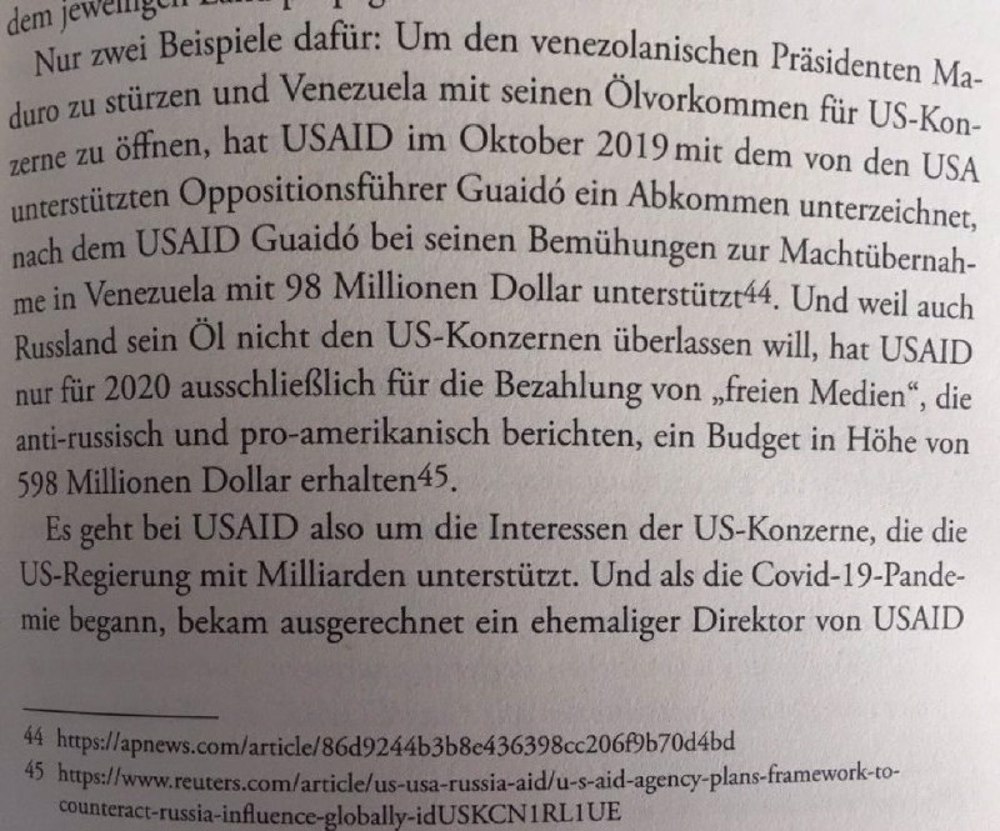
An X account with the handle @MyLordBobeo shared a passage, from a book or academic article, discussing US foreign policy concerning Russia and Venezuela and highlighting USAID’s role.
The text focuses on political interventions and funding related to opposition efforts against the Venezuelan and Russian governments.
The excerpt discussed the involvement of USAID in Venezuela, specifically highlighting its support for opposition leader Juan Guaidó in efforts to overthrow President Maduro.
It stated that in 2019, USAID signed an agreement with Guaidó, providing $98 million in assistance.
“In order to overthrow Venezuelan President Maduro and open up Venezuela and its oil reserves to US corporations, USAID signed an agreement with the US-backed opposition leader Guaidó in October 2019, according to which USAID will support Guaidó in his efforts to take power in Venezuela with 98 million dollars,” read the text, originally written in German.
Additionally, the text references USAID’s budget allocation for “free media” to counter Russian influence, amounting to $598 million for 2020.
“And because Russia does not want to hand over its oil to US corporations either, USAID has received a budget of 598 million dollars for 2020 alone to pay for “free media” that report anti-Russian and pro-Americans,” it added
A text that appears to be from a book or an academic article discusses US foreign policy, particularly in relation to Russia and Venezuela and the role of USAID.
The citations to the Reuters and AP at the end suggest it might be part of a larger discussion on US influence in global politics, referencing specific news articles for support.
Leaked doctrine on the use of USAID in economic warfare
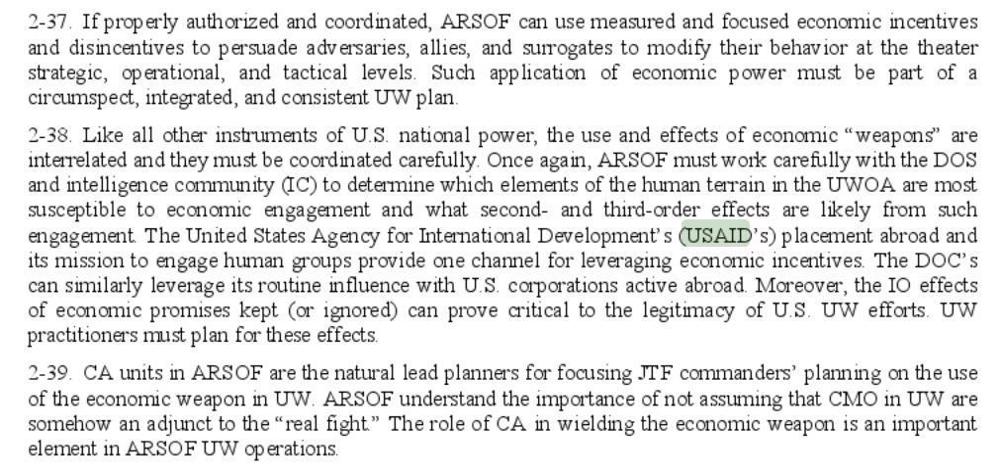
A leaked US Army Special Operations Forces (ARSOF) doctrine exposed the extent to which the US USES economic instruments, including USAID programs, as part of its unconventional warfare (UW) strategies.
The document sheds light on the orchestrated interplay between various governmental entities, including the Army Special Operations Forces, the Department of State (DOS), the Intelligence Community (IC), the Department of Commerce (DOC), and USAID.
According to the document, ARSOF is authorized to employ “measured and focused economic incentives and disincentives” across multiple levels to influence the behavior of “adversaries, allies, and surrogates.”
Such economic maneuvers are executed under the guise of a carefully crafted and integrated unconventional warfare plan, it said.
It highlights the need for ARSOF to work closely with the Department of State and the intelligence community to identify vulnerable groups in a targeted area and predict the potential outcomes of applying economic pressure
Leaked US Special Forces doctrine on use of USAID in economic warfare
USAID’s presence in foreign countries and its mission to engage with local populations provides an opportunity for the US to exert economic influence, it added.
Similarly, it said, the Department of Commerce can use its connections with American companies operating overseas to further strategic objectives.
The passage also underlines the significance of Information Operations (IO) in managing public perception of US unconventional warfare efforts. This includes anticipating and shaping the narrative around economic promises made (or unfulfilled) to maintain legitimacy.
The leaked document offers an unprecedented glimpse into the US government’s orchestration of various agencies and resources, particularly USAID, to engage in economic warfare as a means to advance strategic objectives.
This revelation raises critical questions about the covert use of humanitarian aid and development programs for ulterior political ends.
“As clearly illustrated, USAID pretends to be about ‘democracy’ and ‘helping’ the world,” wrote journalist James Li in a post on X.
“But in reality, it was always a covert tool of U.S. power — a front for CIA-backed regime change, election meddling, and civil destabilization disguised as ‘humanitarian aid,’” he added.
El Salvador’s President Nayib Bukele has also said that cutting USAID funding would not only benefit the United States but also other countries around the world.
He added that while USAID is marketed as a supporter of development, democracy, and human rights, a significant portion of its funds are channeled into opposition groups, politically motivated NGOs, and destabilizing movements.
“Most governments don’t want USAID funds flowing into their countries because they understand where much of that money actually ends up,” Bukele wrote in a post on X on Sunday.
“At best, maybe 10% of the money reaches real projects that help people in need (there are such cases), but the rest is used to fuel dissent, finance protests, and undermine administrations that refuse to align with the globalist agenda,” he added [end]
Ingo Schmidt on how the triumph of liberal democracy and neoliberal globalization became the ideological seed for the AfD
Co-leader of the far-right Alternative for Germany (AfD) party and the party’s candidate for chancellor, Alice Weidel, features on the cover of a 2023 edition of Stern magazine (conceptphoto.info)
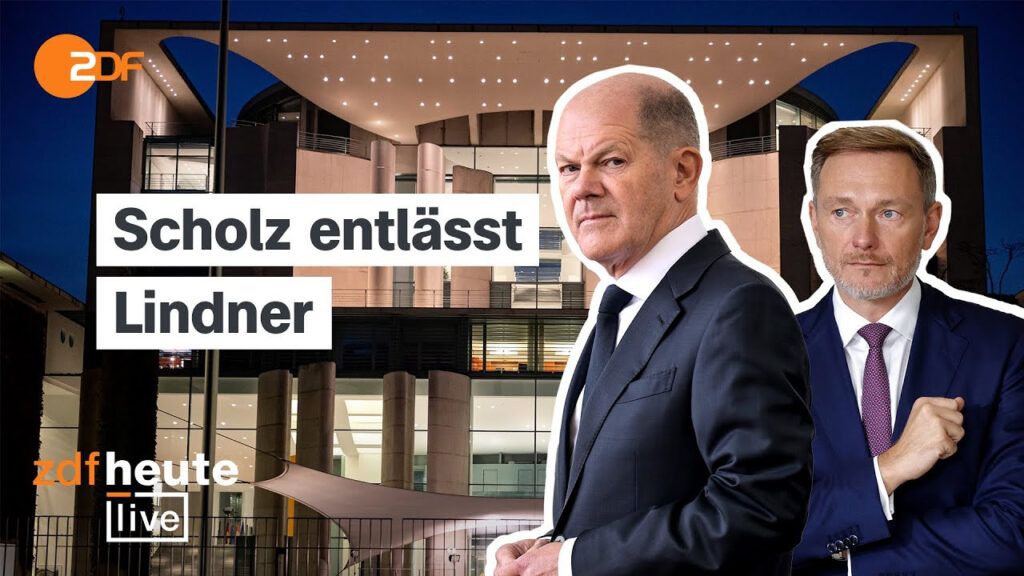
On November 6, 2024 German Chancellor Olaf Scholz fired Finance Minister Christian Lindner. Notwithstanding the broad agreement on policy goals, striking a balance between deficit reduction, support for renewable energy and increased arms spending turned out to be impossible. Lindner, a liberal, opted for social cuts; Scholz, a social democrat, wants to avoid them. They had to part ways. After Scholz lost a no-confidence vote, federal elections were scheduled for February 23, 2025. The question that worries everyone from old-school conservatives to new millennium lefties is: How many votes will go to the hard right (if not neo-Nazi) party Alternative for Germany (Alternative für Deutschland or AfD). In the last federal elections in 2021, the AfD got 10.4 percent of the total vote. Current polls put them at 20 percent, but nobody knows what will happen on election day. In this new age of uncertainty, polls don’t predict election results as reliably as in the past.
Elections in the East German provinces Brandenburg, Saxony and Thuringia have already shown what hard-right success looks like. They also reveal the inability of the political centre to understand how much it contributed to the rise of a new right. Refashioning totalitarianism theory in the New Cold War climate, centrist politicians and pundits typically portray the success of the new right as the outgrowth of the Nazi and Communist dictatorships that ruled East Germany from 1933 to 1990. West Germany, which was spared Communist rule and, allegedly, shook off the burden of its Nazi past, appears as a role model in this democracy-versus-dictatorship story. Totalitarianism theory could possibly explain why the AfD is more successful, so far at least, in East than in West Germany. But it can’t explain right-wing success in other countries, like France, that were never under Communist rule and know Nazi rule only from occupation, which strengthened anti-fascist traditions in those countries. But even these traditions couldn’t stop the rise of the new right there.
This article offers a different explanation for the hard-right surge in Germany. It shows that German unification in 1990, signalling the triumph of liberal democracy and the onset of neoliberal globalization, unleashed a new form of nationalism—Deutschmark nationalism—which, after mutating into export nationalism for a while, became the ideological seed for the AfD. West Germany, or, more precisely, the economic miracle that was West Germany in the post-war era, served as a role model during German unification. Promoted by West German elites and eagerly embraced by people in East Germany, it raised the expectation of a new economic miracle materializing in the West and extending to the East. However, these hopes were soon disappointed as political unification caused socioeconomic divisions between East and West Germany and, in the early 2000s, a turn to austerity policies that were highly unpopular in the East and the West. Just when it seemed that Germany would weather the world economic crisis of 2008-9 better than other Western countries, and maybe even become the European hegemon, things started falling apart. The Euro-crisis made clear that it was not only politically united Germany that was plagued by massive socioeconomic and geographical divisions but the European Union, too. Continued economic weakness combined with New Cold War marching orders from Washington fed a nostalgia for a supposedly great past—symbolized by the Deutschmark. This nostalgia, I argue, would not have taken root if the left had been able to channel growing discontent into mobilization for a more equitable and less insecure future.
State elections in Brandenburg, Saxony, and Thuringia
State elections don’t typically get international media attention. The September 1, 2024, elections in Thuringia and Saxony did. After all, it was the first time since the downfall of the Nazi-regime that a hard-right party, the AfD, pulled the majority of votes in a German election. It proved a bitter coincidence: The AfD celebrated their victory in Thuringia, obtaining 32.8 percent of the total vote, on the 85th anniversary of the Nazi-invasion of Poland that marked the beginning of the Second World War.
The Conservative Christian Democrats (the Christlich-Demokratische Union or CDU) came in second with 23.6 percent. The parties of the federal government coalition, Social Democrats (Sozialdemokratische Partei Deutschlands or SPD), Greens (Bündnis 90/Die Grünen) and Liberals (Freie Demokratische Partei or FDP) ended up with single-digit results, the FDP reduced to a mere 1.1 percent. At the time of the election, this was the party of the federal minister of finance. The Left Party (Die Linke), which in the previous election had become the strongest party for the first time in any German state, lost almost 18 percent and came in fourth, even trailing the Sahra Wagenknecht Alliance (Bündnis Sahra Wagenknecht or BSW), a breakaway group from the Left Party.
In Saxony, the AfD won 30.6 percent of the votes, just behind the CDU’s 31.9 percent. As in Thuringia, none of the parties of the federal government coalition achieved double-digit results. The Left Party lost more than half of its vote and ended up with a devastating 4.5 percent. The BSW came in a distant third with 11.8 percent.
Just three weeks after their election victories in Thuringia and Saxony, the AfD scored another success in Brandenburg. Narrowly beaten by the SPD that got 30.9 percent of the total vote, the AfD came in second with 29.2 percent, way ahead of the BSW’s 13.1 percent and the CDU’s 12.1 percent. The Left Party and the Greens obtained less than five percent of the vote, which is the minimum threshold for holding seats in provincial or federal parliament under the mixed-member proportional electoral system. The FDP pulled less than one percent.
Mainstream media fails to explain right-wing success
Barely beaten by the Conservatives in Saxony and the Social Democrats in Brandenburg, the AfD was elected by roughly a third of the electorate in three East German states, becoming the strongest party only in Thuringia. If ever there was a right-wing surge, this was it. Most media reports attributed the phenomenon to widespread dissatisfaction with the federal government, particularly regarding migration, climate policies and the war in Ukraine. Accounts of why the AfD is more popular in the East (approval ratings in the west of Germany range from 8.5 percent in Hamburg and the Saarland to 21 percent in Lower Saxony) focus mostly on disappointments caused by German unification, continuing socioeconomic disparities and a widespread feeling among erstwhile East Germans of being second class citizens. Other explanations invoke the authoritarian heritage of communist rule in East Germany, which is often presented as an extension of the Nazi-regime. Against the two dictatorships in the East, West Germany is presented as a role model of liberal democracy. This as if there hadn’t been considerable continuity between Third Reich and West German elites; as if East Germany’s ruling bureaucracy, despite all its dictatorial wrongs, wasn’t established by antifascists who had been exiled or jailed during the Nazi reign; as if the nationalization of the means of production, despite the wrongs of bureaucratic rule, had not marked a break from the West German capitalism that made West Germany a junior partner in the American Empire; as if West German capitalism had not dictated the terms of unification at the very time that a grassroots movement for democracy unsettled bureaucratic rule in East Germany. The destruction of the East German economy and the integration of the East into existing West German institutions left no room for the aspirations of East Germany’s civil rights movement. Rather than explaining growing support for the new right, media talk about the “peculiarities of the East” reinforces existing frustrations there—frustrations that help shed light on the relative strength, so far at least, of the right-wing surge in the East.
The ‘two-dictatorships’ thesis that pits the East against the liberal democratic West revives the totalitarianism theory that was an integral part of the anti-communist, anti-Soviet consensus during the Cold War. It is now part of the New Cold War ideology that counterposes democracy and authoritarianism. As in the old Cold War, charges of totalitarianism serve to short circuit thinking about alternative economic and political systems, reinforcing the neoliberal creed that there is no alternative to capitalism. The lack of actually existing alternatives is, of course, also one of the reasons for the rise of the new right. Emerging out of an ailing neoliberalism, this right-wing force presents itself as an alternative to the status quo but actually just recasts neoliberalism in a nationalist and racist mould. Replacing neoliberalism’s earlier commitment to corporate globalization in Germany, as elsewhere, neoliberalism is haunted by the spectre of fascism, which, to centrist neoliberals, has everything to do with misled masses unable to understand the virtues of capitalist liberal democracy and nothing to do with capitalist crises that undermine the legitimacy of liberal democracy. Neoliberalism is also haunted by the spectre of communism as ruling classes worry that crisis of legitimacy could extend to capitalism itself. As the neoliberal centre denies the possibility of alternatives and the left generally (not only the Left Party in Germany) appears unable to advance real world alternatives, the growing appetite for change, spurred by recurrent crises wrought by capitalism, settles for right-wing fantasies of a harmonious life in a nation that competes successfully with other countries economically and is freed from job- and welfare-stealing migrants.
The impact of German unification and the rise and decline of neoliberal globalization
Capitalist crises and their exploitation by the right are common phenomena, certainly in the imperialist centres of the world system, but also in the peripheries. But they play out differently in different national contexts. Behind the AfD’s electoral successes in Thuringia and Saxony as well as its broader surge in popularity lie the combined histories of German unification and the rise and decline of neoliberal globalization. The upsurge of the new right is just one of the outcomes of these combined histories. Equally important is the defeat of the federal government coalition and the rout of the FDP, whose leader, former federal Minister of Finance Christian Lindner, promotes austerity policies that stymie government plans to subsidize the transition to non-fossil energies. These policies also lead to a creeping roll-back of social spending—except when it comes to arms spending. Little wonder a government that took office on the promise of something like a Green New Deal lost its credibility almost entirely and called for a federal election scheduled for February 23 of this year.
And then there is the defeat of the Left Party that, despite programmatic commitments to progressive alternatives, is widely seen as the appendage of a lame-duck government in Berlin. At the other end of the political spectrum, the AfD is widely perceived as an oppositional force, even though its program blends austerity, nationalism and militarism in ways that are more extreme but qualitatively not much different from policies advanced by the CDU and the FDP.
In the face of electoral defeat, the federal government, which embraced the US’s New Cold War policies a few weeks after the Russian invasion of Ukraine, also introduced dramatically tougher migration policies. Rather than representing any kind of alternative, as its name purports, the AfD is the black sheep of the establishment family, expressing racist views more radically and bluntly than even the Conservatives. While the Social Democrats, Liberals and Greens are intent on denying such views, they reveal themselves as Western supremacists when it comes to fending off so-called authoritarian threats arising from Russia and China, stirring up longstanding fears in the West that ‘the Russians are coming’ or that ‘Asian hordes’ augur “the decline of the West,” in the words of right-wing intellectual Oswald Spengler.
The hypocrisy of the Greens, who advocate a green transition while supporting the purchase of dirty oil and gas (wherever they can get it ever since the Russian invasion of Ukraine ended Russian gas-flows to Germany), make them a prime target of AfD agitation. But in reality the AfD and the Greens share the fear of Western decline. The AfD engage in fearmongering around the replacement of white people by non-white immigrants and accuse the Greens and their coalition partners in the federal government of accelerating Western decline. But while the Greens may be the prime target of the AfD’s culture war, the truth is that despite significant differences in tone, the Greens and the AfD share a basic consensus on the decline of the West.
AfD success in the east: history holds the key
Encouraged by Glasnost in the Soviet Union, many East Germans took to the streets in the fall of 1989. Under the banner “We Are the People” they demanded democratic reforms of East Germany. Neither unification with West Germany nor a return to a capitalist economy was on their agenda—at least not initially. As protests grew, and especially after the ruling Socialist Unity Party (SED) had opened the border to the West, “We Are the People” was replaced by “We Are One People” more and more often. It was supplemented by the slogan “Germany, United Fatherland,” which is actually a quote from East Germany’s national anthem, written by the communist poet Johannes R. Becher in 1949, at a time when the leaders of the SED still thought a united Germany could be achieved—not necessarily socialist but not aligned on either the US or the Soviet Union. Such hopes were buried by the Cold War, for which the Berlin Wall became a symbol, casting a dark shadow over communist East Germany and allowing capitalist West Germany to present itself as a beacon of freedom. It was in a matter of weeks in the winter of 1989-90 that the abstract possibility became a demand, massively fanned by West German politicians—notably then chancellor Helmut Kohl—and mainstream media, which hinted at the possibility of East Germany adopting the West German Deutschmark. Many East Germans seized on such hints as an irresistible offer. “If the D-Mark comes, we’ll stay here; if it doesn’t come, we’ll go to it” became the next popular protest slogan. Since the opening of the border, thousands of East Germans had gone to the West, creating conditions reminiscent of the times before the wall was built in 1961. Back then, the East German economy lost so many people, most of them young and well-trained, that a collapse of social reproduction became a real threat. The wall stopped the bleeding of the East German economy but inflicted irreparable damage on the legitimacy of the political system.
Almost 30 years later, the opening of the border by the SED-leadership came as a bit of a surprise to West German elites. Yet, they were quick to grasp the possibilities it created. To them, this meant the integration of East Germany into the West German political and economic system, not coexistence with a somehow reformed but still politically independent East Germany. The ‘take over the East’ goal of West German elites and the Deutschmark rush of East German masses fed each other. The civil rights movement that wanted to democratize East Germany was sidelined. Some of the groups active in that movement adjusted to the new zeitgeist quickly, some even entered into an electoral alliance with the East German conservative party, despite their having criticized it as a small but integral part of the SED-regime. Angela Merkel, who would later become chancellor, belonged to one of these East German groups that allied with other conservative-turned-civil-rights groups and the East German CDU. This Alliance for Germany easily won the last East German elections and negotiated the integration of East Germany into West Germany’s institutional structures. On July 1, 1990, the Deutschmark came to the East, three months later the independent state of East Germany vanished into an enlarged West Germany. Most of the Alliance for Germany dissolved into the West German CDU immediately after unification. In December this enlarged CDU won federal elections.
In less than a year the Cold War had come to an end and an entire state had disappeared. However, the hopes pinned on unification, notably the introduction of the Deutschmark, were soon dashed. A year after unification, unemployment, which had existed in communist East Germany primarily in a hidden form, stood at 10.2 percent and rose to over 20 percent in the early 2000s. It didn’t fall below 10 percent until 2014, a quarter of a century after the Berlin Wall fell. Moreover, mass migration from East to West Germany, which the introduction of the Deutschmark was meant to curb, actually accelerated after the arrival of the Deutschmark. From 1990 to 2015, East Germany lost significantly more than one million people, the vast majority during the first two years after unification, and almost all of them of working age. Were it not for this emigration as well as early retirement schemes and retraining schemes for thousands of workers, unemployment in the East would have been even higher than it actually was. Introducing a new form of hidden unemployment, many of the participants in retraining were enrolled in one course after another, often in different fields, until they were old enough for early retirement.
One of the main, if not the main, reasons for the collapse of the East German economy was the Deutschmark. Introduced at a rate of one Mark West for one Mark East, while average productivity of East Germany was estimated to be about a quarter that of West Germany, German monetary union gave private households the boost in purchasing power they so desired. But it made East German firms uncompetitive. Lower wages could not compensate productivity differentials between firms in East Germany and Western countries. The privatization of East Germany’s state-owned firms facilitated the downfall of the East German economy even further. In some cases, Western companies bought East German firms just to shut them down so that they would not become competitors in the future. In other cases, they wanted patents or certain segments of production that they could integrate into their own supply-chains, leaving everything else to be shut down. The closures and cherry-picking of some more desirable segments destroyed the reproduction process of the East German economy even beyond the damage done by rendering it uncompetitive through monetary union.
The result was that bits and pieces of the East German economy became a periphery of production networks controlled by West German corporations. Ironically, the neoliberal restructuring of production processes went hand in hand with massive fiscal transfers from West to East Germany. A price that had to be paid to sustain some level of social cohesion while disappointment that political unification was followed by economic decline and continued social divisions between East and West instead of an Eastern economic miracle following the example of West Germany from the late 1950s to the early 1970s. At some point, a third of East German incomes came from fiscal transfers. As a result, government debt as a share of gross domestic product (GDP) rose from 41.8 percent in 1989 to 61.2 percent in 1999, which is nothing compared to today’s numbers. Yet, back then the lesson that had yet to be learned is that neoliberalism, despite its balanced-budget rhetoric, really is a mix of austerity and tax cuts for the rich that produces increasing debt levels at every slowdown or downturn of the economy. In the 1990s, government debt over 60 percent of GDP was a scandal. Not least because, at the urging of the conservative German government, 60 percent had become the benchmark for membership in the European monetary union, for which the roadmap had been laid out in the 1992 Maastricht Treaty.
Budget deficits, accumulating into government debt, weren’t the only deficit scandal in 1990s Germany. The other was in the current account. From a surplus of 4.6 percent in 1989, the current account dropped to a –1.9 percent deficit in 1991 and remained in deficit territory until 2001. In most other countries, deficits between negative one and negative two percent wouldn’t be a matter of concern. In Germany they were. After all, West German prosperity—the very model East Germans admired so much—had been reliant on export-driven growth, which was always understood as export surpluses. As it turned out, unification in the early 1990s, led to a boom in West Germany as East Germans spent many of their newly acquired Deutschmarks on consumer goods ‘Made in (West) Germany’—despite massive job losses. This boom drove prices up and made German exports less competitive on the world market. At the same time, some of the money from the East German spending spree went to foreign companies. As exports took a hit and imports got a boost, the current account went from positive to negative.
The East was integrated into the West German political system as it existed prior to unification. The Kohl government didn’t agree to any changes suggested by the East German government that formally negotiated unification but really rubberstamped the subordination of East German society to West German institutions. Economic integration was different though. The collapse of the East German economy, triggered by the design of monetary union and privatizations, had a lasting impact on the West German economic model that East Germans had been eager to embrace. The first decade after unification was marked by a twin deficit in government budgets and current accounts. During the unification boom from 1990 to 1993, inflation went up to levels not seen since the oil-price hikes and inflationary struggles between capital and labour from the 1970s to the early 1980s. At that time, however, the West German inflation rate was still below that of other Western countries, whereas in the early 1990s it was amongst the highest
Germany’s continued economic weakness, combined with New Cold War marching orders from Washington, fed a nostalgia for a supposedly great past—symbolized by the Deutschmark
West Germany as a role model
Running continued deficits—let alone a twin deficit—was unthinkable in a country that rebuilt its economy after the Second World War through integration into a world market with rules established and enforced by the US. In this American Empire, West Germany played the role of bulwark against Soviet Communism, including East Germany, and as a showcase of Western capitalism. To succeed in this role, foreign debt, accumulated by the Nazis and inherited by West Germany as legal successor of the Third Reich, was forgiven through the 1953 London Debt Agreement. West Germany also inherited low wages, industrial capacity and new technologies from the Nazi economy that, contrary to widespread assumptions, survived the war largely intact. This gave West German industries a competitive advantage that was further buttressed by favourable exchange rates on which basis West Germany was admitted to the Bretton Woods system of fixed exchange rates in 1952. Reintegration into the world market also allowed West Germany to transition from a coal-based to an oil-based economy. Oil was cheaper than coal but its supplies were controlled by US companies and the American state.
However, being a junior partner in the American Empire turned out to be a much better deal for the German bourgeoisie than its earlier quests for world power. The territory under its direct control was much smaller after two failed power grabs but profits were stellar. Driven by exports, or export surpluses more precisely, the West German economy didn’t require fiscal stimulus and kept growing until the US turned to floating exchange rates, which led to a significant appreciation of the Deutschmark. Further, oil prices exploded in the 1970s. But it was during these turbulences that West Germany consolidated its reputation as a beacon of economic stability. Political management of the crisis, notably codetermination (German lingo for the institutionalized cooperation between unions and employer association), kept wages and inflation lower than in most other Western countries. This helped to sustain export surpluses for much of the 1970s. In turn, export surpluses allowed the government to keep fiscal stimulus and unemployment rates low. Again, this is compared to other Western countries, not compared to the post-war boom.
West Germany’s relative success in managing the economic crises of the 1970s raised some concerns among its allies, who considered this success a case of beggar-thy-neighbour policies. The US pressured the West German government to increase public spending in order to stimulate the world economy. The West German government couldn’t shrug off these US demands entirely. The social democratic party was led by Helmut Schmidt at the time, and some extra spending also appeased the left wing in his own party as well as some unionists. However, calls for a Keynesian fix of the economic crises never overcame the general preference for fiscal prudence and low inflation that marked West German society after two lost wars, each followed by the introduction of a new currency, one of them also by unprecedented hyperinflation. Not entirely without reason, export success after the Second World War was widely attributed to liberal economic principles, conveniently ignoring the fact that this ‘liberalism in one country’ could only work because other economies placed growing demand on the world market.
Export success also created an ersatz-identity that allowed West Germans to repress the horrors of the Nazi regime and the roles most of them had played in these horrors, as perpetrators or bystanders. Social democrats never really fit into this picture. Willy Brandt, who spent the Nazi reign in underground resistance circles and exile and would later become West Germany’s first social democratic chancellor, was seen by many as a traitor. His successor Helmut Schmidt, who had served in the Nazi air force, opposed many of Brandt’s plans for social reform and applied Keynesian policies only in homeopathic doses. He was successfully branded as the one responsible for rising unemployment and inflation by the Conservatives and Liberals. Crossing the floor from SPD to CDU, the Liberals made Helmut Kohl chancellor. Kohl won two elections before unification on the promise of bringing post-war prosperity back. He won another two after unification on the promise of bringing the prosperity to East Germany.
For a long time, Kohl presented himself successfully as the defender of the West German export model and guarantor of the collective identity tied to that model, despite the fact that 1980s West Germany never saw a return to postwar prosperity. Disappointment with his broken promises for a West German economic miracle 2.0 began spreading towards the end of the 1980s. Yet, the disintegration of the SED regime allowed him to renew and extend his promises to the East. The national euphoria that secured his 1990 election victory also saw a transformation of collective identity. West German pride in being export world champion turned into Deutschmark nationalism. Widely shared in the East, where people were happy to get the Deutschmark, and the West, where people saw it as symbol of their postwar achievements, this was not the pure money, or currency, fetishism Karl Marx wrote about in Capital. It had a distinctive nationalist character that was subdued in West Germany’s pre-unification export-identity. With unification, the nationalist seed blossomed. Not only did this help Kohl become the ‘chancellor of unity,’ but it also gave cover to a burst of neo-Nazi attacks on immigrants, leftists and queer people, culminating in arson attacks in Rostock, Mölln and Solingen. The latter two killed eight people, while the attack in Rostock laid a four-day siege on an apartment block inhabited by foreign workers who had been employed in East Germany’s now defunct state-owned economy. The openly neo-Nazi attacks of the early 1990s, later dubbed “baseball bat years,” were followed by a series of murders committed by the National Socialist Underground (NSU) that cost nine immigrants and one cop their lives from 2000 to 2007. The role of the German secret service in covering up, or even facilitating, these murders has never been investigated as key documents remain classified until this day. Hans-Georg Maaßen, head of the secret service from 2012 to 2018, was one of the individuals responsible for blocking investigations of the NSU-murders. He also heads up an ultra-conservative circle, initially inside the CDU and now operating in the right-wing space between the CDU und the AfD.
Exports über alles: Eastern peripheries boost corporate profits
During unification and in the first few years afterwards, nationalism was a mass ideology. It rallied flag-waving masses in the streets, it dominated German politics and inspired Nazi-skinheads to chase people they considered enemies. As it became clear that the hopes for an economic miracle 2.0 would not be realized, street protests receded, most skinheads scaled down their activism and just a few turned to clandestine terrorist attacks. It seemed that nationalism had lost the force it had just recently. However, the entanglements between Nazis and parts of the state apparatuses indicate that while nationalism wasn’t as visible as before, it had not disappeared.
As it turned out, the opening of the Berlin Wall was a key step towards what would later be called neoliberal globalization. As the German bourgeoisie sought its place in a world seemingly governed by the invisible hand of the market—not Soviet planners or the milder version of Western government intervention—nationalism also found a new role as mass ideology. The ideological wind blowing from the ‘real West,’ that is, the United States, rebranded free trade theory going back to the days of David Ricardo as globalization. Sticking closely to Ricardo’s principles, academic globalists argued that firms, if left alone by the state, would specialize in the production of those goods they can produce more cheaply than firms in another country either because they possess more productive technologies or use input factors more plentiful and cheap than in another country. All countries will be better off if firms in each country specialize according to their comparative advantages.
Globalization practitioners talked about entire countries as if they were firms competing against each other. Competitiveness of nation-states became the lodestar of capitalists, and their political executors, who used it to justify the roll-back of wages and social standards in all countries. Their run-the-country-like-a-business propaganda was so persuasive that even working class people whose wages, pensions and public services were cut fell for it in large numbers, electing and re-electing neoliberal globalizers over and over again. At the same time, fear that the policies just voted for would cause a race to the bottom spread in the rich countries that saw parts of their production outsourced to poor countries, where labour was really cheap, while immigrants from such countries would take on jobs in the burgeoning low-wage sectors of the rich countries. Migration, segmented labour markets and a global reserve army of labour, enabling capitalists to engage in global labour arbitrage, were neither part of academic globalization theory nor did they feature in politicians’ globalization propaganda. Absent from public debate, these real-life factors created fears that a new right could build on by portraying economic problems as questions of national identity. Translated into policy terms, that meant a program of keeping immigrants out and capital in. This protectionist backlash against neoliberal globalization, coupled with the rise of a new right ranging from populist to neo-Nazi formations, occurred all over the Global North. It began slowly in the late 1990s and early 2000s while globalization was still expanding, and then gathered steam in the wake of the 2008-9 world financial crisis that marked the end of accumulation driven by globalization. It has accelerated again since the COVID-19 recession as well as the escalating great power politics vis-à-vis Russia and China, which have led to openly imperialist policies couched in the same nationalist ideology which the new right thrives on. The competitive nation-as-corporation ideology and the policies that marked actually unfolding globalization was the breeding ground for today’s strange bedfellowship of globalizers-turned-great-power-warriors and national supremacists of the new right. Theories of unregulated free trade opening the path towards global prosperity were just an ideological tool that was useful as long the integration of more and more countries into the US-dominated world market fuelled capitalist accumulation, and thereby hopes for the eventual trickle-down. It was replaced with the rhetoric of concern for national security and democracy as accumulation ended in a new phase of stagnation.
The German bourgeoisie had already adopted the logic of the state as business competitor after the Second World War when it traded world power ambitions for a junior partner role in the American Empire. Balanced budgets and tight money formed the core of its policies. That, along with competitive advantages inherited from the Nazis or granted by the US, enabled export-driven growth and, ultimately, export surpluses. Despite verbal commitments to liberalism, these policies were mercantilist in substance. Shattered but not derailed by the crises of the 1970s, West Germany’s mercantilist regime of accumulation survived until unification led to a twin deficit, slow growth and socioeconomic divisions between East and West. Unified Germany’s economy stumbled along while the US enjoyed its New Economy boom, even though that turned out to be short-lived, and China attained unprecedented levels of economic growth.
The Kohl government didn’t respond to the bourgeoisie’s growing concerns about economic stagnation in Germany. Neither did it respond to growing dissatisfaction with social conditions among the popular classes. After uniting Germany, Kohl turned to further uniting Europe. Partly, he wanted to demonstrate Germany’s continued commitment to cooperation in the European Union as some European leaders—notably British Prime Minister Thatcher and French President François Mitterrand—had expressed reservations about German unification and worried about a return of German great power ambitions. European monetary union became Kohl’s preferred route to an “ever closer union,” as EU-parlance had it at the time. However, regarding other countries, notably in the Mediterranean, Kohl successfully pushed for tight fiscal and monetary rules—the same kind of rules West German policy makers followed in the postwar period. Under the favourable conditions granted by the US to integrate into the world market, this led to export-driven prosperity. However, other countries didn’t enjoy the same favourable conditions. What would upset governments and people in such countries even more was the fact that Kohl had abandoned the rules he was preaching to other European countries in his very own united Germany
Helmut Kohl at the CDU national party convention in Hamburg, 1973. Photo from Wikimedia Commons
There, European monetary union was widely seen as a top-down capitalist elite project, part of corporate globalization or as a handing over of the beloved Deutschmark to irresponsible Eurocrats and the Club Med, a derogatory term often used in public debates to denounce people in the Mediterranean countries as lazy, spend-thrifty and, worst of all, happily having a good time at the expense of others. Euro-scepticism added to disappointment with the collapse of East Germany’s economy after unification, growing income polarization and fears of job loss all over Germany and a sense of losing national sovereignty to global capital. Unresponsive to any of these concerns, Kohl and his coalition of Conservatives and Liberals eventually lost the 1998 election to the Social Democrats and Greens who formed a coalition government offering a blend of light Keynesianism, green transition and control of financial markets. This is where the German—and international—bourgeoisies got really concerned.
The opening ideological salvos to derail the newly elected government’s plans came from the British tabloid The Sun, calling Oskar Lafontaine, the new finance minister who proposed the introduction of a Tobin tax, “Europe’s most dangerous man.” Next came Madeleine Albright, then US secretary of state, who gave Germany’s Green Foreign Minister Joschka Fischer the choice of joining the bombing campaign against Yugoslavia or having his country isolated from Western allies. Fischer, and the new Chancellor Gerhard Schröder, chose war. Seeing that his opposition to the war wasn’t supported by anyone else in the cabinet, Lafontaine resigned before the bombing began.
A few months later, The Economist called Germany the “Sick man of the Euro.” Coming from the central organ of global capitalism and unrepentant advocate of liberalism since the days when England, not China, was the workshop of the world, this was not just another opinion piece. It was a warning that the international investment community—exactly the CEOs, bankers, brokers and financiers targeted by the then-emerging movement against corporate globalization—lost confidence in the German market and expected pro-business measures to boost their propensity to invest.
After a few months in office, Schröder had to choose between meeting voters’ expectations (job creation, reduction of job insecurities and income inequality) and capitalists’ cost-reduction demands. He chose the capitalists’ side, earning him the nickname Genosse der Bosse (Comrade of the Bosses). In the absence of a social movement from below that could have pushed him to deliver on the election platforms of the SPD and the Greens, this choice might actually better be called caving to capitalist threats of an investment strike. From 2000 to 2005, the Schröder government axed corporate tax rates, exempted capital gains from taxation and lowered equity requirements for credits. The other side of the class divide saw drastic reductions in unemployment benefits, essentially slashing them to the level of welfare payment rates after one year of benefits. At the same time, legal obstacles to employing temporary workers were greatly reduced. Capitalists were thrilled. Profits and asset prices shot up, but capital formation declined during the years pro-business laws were passed.
Reorganizing existing production capacities was more important to corporate executives than creating new capacities. This was not surprising as capacity utilization dropped when the New Economy bubble burst, triggering a downturn of the world economy that kept even booming China below double-digit growth. As it turned out, united Germany did not inherit the export successes of pre-unification West Germany, but was certainly heir to its export dependence.
In the early 2000s, Germany’s current account turned positive again—not because exports grew so strongly (they actually stagnated due to the world economic downturn), but because imports declined owing to weak domestic demand associated with the Schröder government’s neoliberal policies. However, as the world economy bounced back (China saw growth rates of 10-14 percent from 2003 to 2006), German exports grew again. Eventually the reorganization of production processes in the aftermath of German unification paid off. West German corporations now controlled production networks linking corporate headquarters controlling finance, research and development, and capital-intensive parts of actual assembly in the centres with labour intensive production in low-wage areas in the peripheries from Eastern Germany all the way to China. In these networks, East Germany occupied the position of a semi-periphery. On the supply side, German export success in the early 2000s relied on continued wage inequality between centres and peripheries, which doesn’t mean that all workers in the centres earned high wages. The threat to relocate production to the East or the South put the brakes on all wages. The lowering of social standards propelled the growth of low-wage employment, notably in the service sector. Well-paying, permanent jobs began to decrease as a share of total employment even in West Germany. As a result, discontent that was widespread in the East since political unification was followed by economic collapse, and social downgrading began to creep into the West.
2010s: Exporting the Euro-crisis
The export surpluses of the early 2000s relied on the same mercantilism that had generated such surpluses during the postwar prosperity. However, during the postwar period, unprecedented growth rates across the Western, and parts of the non-Western, world made it possible to superimpose a welfare state on a mercantilist economy that didn’t squeeze profit rates but operated with capital’s consent in a way that seemed unthinkable during the age of catastrophe from 1914 to 1945. In the early 2000s, by contrast, successful mercantilism demanded the roll-back of the welfare state. Tragically, the extension of West Germany’s welfare state institutions to East Germany, where they were superimposed on a collapsing economy, created the profit squeeze that was needed to curtail the material protections granted by the welfare state. To sustain competitive advantages gained by scaling back the welfare state, it was imperative to keep wage-growth low even after surging exports pulled the economy out of the slump. Unlike during the period of postwar prosperity, export surpluses didn’t stimulate domestic demand very much. In fact, current account surpluses in the early 2000s, which surged from -1.8 percent in 2000 to 6.7 percent in 2007, were as much driven by rising exports as by weak growth of imports, a clear indicator of the overall sluggishness of domestic demand. Unemployment rates rose from 9.3 percent in 2000 to 12.1 percent in 2005. After that, unemployment went into long-term decline, briefly interrupted by the 2008/9 Great Recession and slowed down by the 2009/15 Euro-crisis, eventually reaching five percent before the 2020 COVID-19 Recession. However, this job growth occurred almost entirely in low wage occupations.
Paradoxically, it was during the Euro-crisis that a wave of “export nationalism” covered up the discontent that was growing, at variable speeds, across Germany. The Deutschmark nationalism that emerged during German unification had taken a hit with the introduction of the Euro. However, when it turned out that the Euro was basically the old Deutschmark under a new name and export surplus levels were reaching unprecedented heights, it almost seemed that the long-awaited return of prosperity was about to materialize. But of course, it wasn’t the same as the postwar prosperity that saw strong growth almost everywhere. The 2010s, by contrast, were a time of stagnation. The rebound after the 2008/9 recession was stronger in Germany than in other countries, but then growth rates fell in line with the one-to-two percent range of other Western countries.
It was during this time of recurrent crises and long-term stagnation that the German government, led by Angela Merkel with the Social Democrats as junior partner, felt compelled to lecture other governments on economic policy. Completely blind to the fact that beggar-thy-neighbour policies are a zero-sum game, the Merkel-government told Southern European countries to impose austerity despite the fact that they were suffering from a sovereign debt crisis due to the end of cheap credit that became available after the creation of the European monetary union, helping to pay for imports from Germany. Merkel also told them that, after a painful but unavoidable period of belt-tightening, they would eventually succeed as export countries like Germany.
The European monetary union’s contradictory character torn between further integrating Europe and spreading German mercantilism shifted entirely to the latter. Southern Europeans, governments and ordinary people, understood that austerity would further subordinate their economies to Germany’s economic dominance. The Brits, like the Germans and the “Frugal Four” (Austria, Denmark, the Netherlands and Sweden), although not warm to the idea of bailing out crisis-ridden Southern Europeans, were suspicious that Germany’s leading role in handling the crisis would turn the country’s economic dominance into fully-fledged hegemony. Brexit has its origin here. Eastern Europe’s post-communist comprador governments had imposed austerity on their countries in acts of pre-emptive obedience and now felt betrayed as they thought the bailout packages the Merkel government used as a means to impose austerity on the South were actually some sort of welfare package.
Centrifugal forces in the EU were further fuelled when, in face of civil war and foreign interventions in Syria, Merkel unilaterally declared open borders for Syrian refuges and then told EU member states they all had to take their share of refugees. European governments already concerned over Germany’s domineering role in managing the Euro-crisis were dismayed. Public debate within Germany was sharply divided between liberals and leftists applauding Merkel’s humanist stance and right-wingers, including in her own party, warning of an uncontrolled flow of immigrants. Largely unnoticed was the fact that Merkel’s decision to open borders for Syrian refugees was tied to the anti-Russian turn in German foreign policy following the sharp polarization between pro- and anti-Russian forces in Ukraine during and after the Maidan protests in 2014. Most of the Syrian refugees were fleeing the Russian-backed Assad-regime, which was considered an adversary. Opening borders for these refugees set a precedent for the surge of Ukrainian refugees following Russia’s invasion of Eastern Ukraine in 2022. At that point, Merkel, who had already retired, told the media that her government saw the Minsk accords, officially meant to reach a settlement between contending political and military forces within Ukraine, as a means of buying time to arm the Zelensky government.
2020s: Sick man of Europe 2.0
As Ukraine, already torn by civil war, became the scene for a proxy war between NATO-countries and Russia, Germany was firmly subordinated to US foreign policy. Post-communist governments in Germany had, more or less enthusiastically, supported deepening trade relations with Russia. Oil and gas imports might have been the most significant part of German-Russian trade but were certainly not the only one. Torn between allegiance to the US and lucrative business deals with Russia, the German government, now headed by Social Democrat Olaf Scholz, cut its economic ties with Russia after the latter’s invasion of Ukraine. The price to be paid was a further spike in energy prices, on top of the increases attendant on the economic recovery from the COVID-19-recession.
As part of current US efforts to contain China, the German government has been pressured to scale down its trade with China—Germany’s largest trading partner and also a prime outlet for German foreign direct investments. Since Germany’s economy is as much export-driven as export-dependent, the US turn from neoliberal globalization to escalating sanctions and protectionism in the name of national security has caused high levels of uncertainty within the German bourgeoisie. In addition to the return of secular stagnation after the very short post-COVID recovery in the West and the petering out of the China boom, this uncertainty is driving low levels of investment. Inflation, fuelled by post-COVID recovery and rising energy prices, and lower real incomes leading directly to less consumer spending, but also indirectly, as households build up their savings in anticipation of more economic shocks in the future. Meanwhile the Scholz government boosted arms spending while otherwise imposing austerity.
After two years of recession, Germany is again being branded the “sick man of Europe” by The Economist. The last time Germany earned this title the neoliberal turn against the welfare state produced massive current account surpluses, meagre general growth rates and massive social and regional inequalities. The export nationalism that concealed the mounting discontent with neoliberalism was shaken by the US turn from neoliberal globalization to protectionism and militarism. Given its high level of export dependence, Germany was ill prepared for the turn against it, which unleashed pent-up disappointments and anxieties into the political sphere. This happened all over Germany but more so in the East than in the West as regional differences in income, wealth and representation in leadership positions had created widespread feelings of being second class citizens in a politically united Germany.
In the absence of socialist imagination, German politics are haunted by the spectres of the past. An insurgent hard-right pins the labels of communism or Marxism on everything that ever came from the left, Social Democrats, the Greens and, of course, the Left Party, no matter how members, activists and supporters of these parties position themselves on the political spectrum. At the same time, the hard-right wants Germany to leave its Nazi past behind. Downplaying Nazi atrocities, accusing liberals and leftists of burdening Germans with a cult of guilt, they propagate the reclaiming of German national pride and sovereignty from allegedly cosmopolitan elites. Between the very real and growing right and a weak and largely imaginary left, centrist parties that proclaimed the end of history in the heyday of neoliberalism are also shifting to the right. The decline of the Left Party is a mirror image of the rise of the AfD.
Alternative für Deutschland: A child of Deutschmark nationalism
Mainstream media and centrist parties view the new right as if it were some external force inexplicably appearing on the political scene and threatening the liberal order. But this is empirically wrong. Almost all leading figures of the AfD come from conservative West German milieus where they previously held positions in public administration or private businesses. Although they present themselves as anti-establishment rebels, they are establishment people who turned from the centre-right to the hard-right. The AfD also includes party activists who come from militant neo-Nazi groups that have existed on the fringes of West German society since the CDU gave many old Nazis a political home after the downfall of the Third Reich. Making small advances into electoral politics in the late 1960s and again in the 1980s, the neo-Nazis remained marginal until they found common ground with disgruntled conservatives. Deutschmark nationalism served as the ideological bonding material for neo-Nazis and right-of-centre conservatives, and became a rallying point for growing numbers of people dissatisfied with the policies of neoliberal globalization advanced by the centrist parties. It emerged in the tumultuous days after the fall of the Berlin wall as a mass ideology that shaped East and West German politics in the direction of unification. After that, it became an ideological point of reference that allowed for the integration of different political ideas and currents into a new right political project, the AfD.
Riding on the wave of Euro-scepticism that accompanied the Euro crisis, the AfD, founded in 2013, promoted a German exit from the EU, which would also have meant exit from the Euro. However, boosting the Deutschmark nostalgia associated with German-style Euro-scepticism got the newly minted party only so far. What really fuelled the AfD’s take-off was the wave of Syrian refugees coming to Germany (and other EU-countries) in 2015. The party’s approval ratings rose from roughly five percent in its first two years to around 12 percent in the next two years. With the surge in voter approval came a programmatic shift from ‘neoliberalism in one country’ to neoliberalism hidden behind ethnonationalist hate propaganda. Despite advocating for a strong state, the AfD also presents itself as a rebellious party of freedom. This paradox is resolved by portraying cosmopolitan elites, represented most notably by the Greens, as a force dominating state apparatuses and misusing them to bring excessive numbers of foreigners into the country with their cultures that allegedly threaten German people, suppress German heritage and push the economy into decay. Therefore a strong state is needed to defend Germany against foreign incursion and revive its inherent strength
Election poster of the AfD in Thuringia supporting remigration. Photo from Wikimedia Commoms
The Scholz government created the conditions in which the AfD’s self-portrayal as freedom fighters gave the party another boost. The modest Green New Deal platforms on which the SPD and Greens ran their 2021 election campaign didn’t gain enough traction to allow them to form a government, despite support from unions and even, more cautiously, employer associations. To obtain a majority in the Bundestag, SPD and Greens formed an ostensibly unlikely coalition with the FDP, a party mostly focused on cutting taxes and limiting public deficits. These commitments to tax breaks for the rich and austerity for the poor stood in the way of effective state-sponsored energy transition programs. Hence, the Scholz-government was perceived as weak from the start. Things went from bad to worse for the government after Russia’s invasion of Ukraine in 2022. Under pressure from the US, Scholz opted for sanctions against Russia, arms deliveries to Ukraine and a continued increase in arms spending. At a time when the prices of everything from butter to housing were soaring, making it clear that money would still be available for guns but maybe not for butter not only destroyed whatever support the government had before the Ukraine war but also gave the AfD another boost. A year and a half into the war, the SPD was trailing the AfD in federal polls. Picking up widespread, though by no means dominant, unease with arms support for Ukraine and fear of war with Russia, the AfD advocates a negotiated peace settlement between Russia and Ukraine and, more importantly to the AfD, the lifting of sanctions on Russia. For the AfD, urging peace with Russia is not a matter of a principled anti-militarism but a means of reviving German trade with Russia, notably Russian energy imports that are seen as a precondition for economic recovery. To achieve this, Germany has to free itself from the ‘cosmopolitan sell-out elite.’ Whether everybody now supporting the AfD subscribes to the freedom-for-German-supremacy-view is open to debate. What can’t be denied is the fact that many discontented people, whatever their main grievance, are looking to the right, not the left, for alternatives to a failing political centre. Some are also turning to the CDU, which claims to be different from both the AfD and the federal coalition government, without offering anything other than praise for the good old days. That served the party well at times when the German economy could thrive, to a greater or lesser degree, on US-enabled expansion of world markets. With the US protectionist turn, this is no longer possible and the party is torn between centrism and the new right. Current support for the CDU is highly unstable, which could easily work in the AfD’s favour, especially in the absence of persuasive alternatives from the left, which so far have not materialized.
This wasn’t always the case. Something like a left renewal had once seemed to be in the offing in the most unlikely place: East Germany during the transition from state socialism to a peripheral position in an enlarged capitalist Germany. In West Germany, the nationalist wave that came with unification swept away much of the activist left that had rallied thousands—sometimes tens or even hundreds of thousands— of people in the 1980s against the stationing of US nuclear missiles, nuclear power plants, Nazis, and South Africa’s apartheid regime, among other causes. Left circles within the SPD, the Greens and the labour movement weathered the nationalist storm without leaving a mark on German politics. In this political climate, the Party of Democratic Socialism (Partei des Demokratischen Sozialismus or PDS) stood out as a beacon of the left.
Emerging from East Germany’s ruling Socialist Unity Party (SED), the PDS became the political home of many East Germans who lost their jobs, social status and cultural identity during the transition to capitalism. Quickly establishing a presence in East Germany’s provincial and municipal parliaments, the party expressed the discomfort of many East Germans who felt like second class citizens under the domination of West German institutions, politicians, corporations and culture. It highlighted East Germany’s socialist heritage, which encompassed commitments to anti-fascism, peace and international solidarity as much as the dictatorship of the politburo, Stasi-surveillance and an overbearing bureaucracy. The party hung itself up in endless debates between those who downplayed or justified East German communism’s dark sides and others who sought to disown that history by embracing liberal principles. Practically, these disputes didn’t make much difference. Upholding socialist principles didn’t stop the party from pragmatically working within the political and economic confines created by unification. At times, this included voting for privatization of public housing and infrastructure. For decades since the party was founded, the contradiction between socialist principles and the subordination to neoliberal policies imposed by the West German bourgeoisie didn’t stop the PDS or its successor organization Die Linke (the Left Party), from becoming something like a catch-all or people’s party in East Germany, a role long held by the CDU und the SPD in West Germany. For years, the PDS/Left Party achieved election results in the mid-20 percent range, peaking at 28 percent in Brandenburg in 2004 and 32 percent in Thuringia in 2019. It was also, and still is, part of various coalition governments in East German states. Until the September 2024 election, the Thuringian government was led by the Left Party’s Bodo Ramelow.
Despite this overall success and despite the party’s fidelity to socialist principles, the social group that wasn’t interested in voting PDS consisted of workers, who still voted CDU in large numbers despite g the CDU’s failed to deliver on its big promises of post-unification prosperity. More recently they shifted to the AfD. Meanwhile, in West Germany, the PDS remained marginal throughout its existence, only attracting activists from various left grouplets. What little remained of left protest milieus after unification was still dominated by a mix of environmentalists, antifas and international solidarity activists who might vote Green, or maybe even SPD, but hardly ever PDS. The old working class milieus that were shrinking with the decline of smokestack industries were still dominated by unionists closer to the SPD than the PDS. This started to change when, under chancellor Schröder, the SPD implemented neoliberal counter-reforms on a scale his conservative predecessor Kohl had avoided throughout his 16-year tenure, despite his supposed commitment to unleashing market forces. Growing frustrations among left social democrats and unionists fed mass demonstrations against Schröder’s SPD and created a social and organizational base (including, most prominently, Schröder’s short-time finance minister Lafontaine) that merged with the PDS into the Left Party in 2007. In the federal elections two years later, the Left Party won 11.9 percent of the vote, then 9.2 percent in the 2017 elections, but fell to 4.9 percent in the 2021 elections. This was a worse result than the 5.1 percent the PDS obtained in 1998, an election that also saw an increased vote for the SPD, which allowed Schröder to succeed Kohl. It is worth noting that the PDS vote came almost entirely from East Germany, which represents less than a quarter of Germany’s total population.
While the PDS mostly maintained peaceful coexistence between socialist theory and market-conforming practice, the Left Party continuously debated whether or not it should join centre-left governments, if given the chance. The bitterness with which party activists argued over this question stood in stark contrast to its actual relevance. In states where the party was relegated to opposition status by poor election results, this status didn’t attract additional voters keen on seeing a principled opposition in parliament. In states where the party joined governments, the results were mixed: sometimes it maintained its vote share in the subsequent election; sometimes it suffered losses. A paradoxical result came about in the Thuringian elections in September 2024: The Left Party lost massively, although, had there been direct elections for the minister-president (a position equivalent to provincial premier in Canada), the Left Party’s Bodo Ramelow would have won the election. This fits into a trend that became visible over the last few years in a number of state elections in East and West Germany. Party loyalties based on shared worldviews wear thin. Elections are often decided based on the media appeal of top politicians, regardless of party affiliation. Remarkably enough, Ramelow, just like Dietmar Woidke, the SPD’s lead candidate in the Brandenburg elections, dropped the name of his party on campaign posters, presenting himself as more of a provincial father figure than a man of the party.
However, rather than signalling the end of ideology, as centrist politicians and postmodern philosophers might have argued before the rise of a very explicitly ideologically committed new right, the focus on limelight politicians pushes democratic debates into the shadows. In the case of the Left Party, it might also have been an attempt to distract from its own image as an organization mired in endless debates not producing any coherent, let alone persuasive, policies. The reasons for permanent internal discord are sociological and ideological. The Left Party was strongest in its early days, when the PDS’s social base still comprised a cross-section of the East German population, although workers remained underrepresented. It also attracted dissident social democrats and unionists from West Germany. To a limited extent, therefore the Left Party had the working class base the PDS never had.
The blend of Keynesian and Marxist ideas around which social democratic dissidents and union leftists organized had been defeated as a significant political current during the crises of the 1970s by the Social Democratic right and corporatist union leaders who put competitiveness of the West German economy over income distribution from profits to wages. In the new millennium, when these currents joined forces with the PDS, they were still sizeable enough to give the newly founded Left Party a boost. But not for long. The smokestack industries around which these left currents were organizing were in continued decline, which made strategies based on that moribund reality obsolete. Moreover, these strategies often stood in the way of mobilizing and organizing the new working classes that emerged in the service sector and, on a much smaller scale, IT, bio tech, and green energy.
As the ranks of the Left Party thinned out with the loss of members coming out of communist East Germany or from West German union and social democratic circles, the party was able to attract new blood mainly in the form of highly educated, often precariously employed, urban dwellers. The shift in membership from old left offspring to the children of neoliberal globalization was paralleled by a geographical shift in electoral support. In urban centres, losses among the party’s old left supporters could be partially compensated; in rural areas, however, where the PDS and the Left Party had always been weak, the party disappeared almost entirely. Often, there isn’t even anyone to put up election campaign posters
Anti-AfD protest in Germany. Photo by strassenstriche.net/Flickr
Unlike the original base of both the PDS and the Left Party, the urban hipsters who joined the Left Party had no old left reference points. Even when they talked about Marx and class they did so with postmodern accents. However, this did not help them to gain sizeable support among the working classes—sometimes lumped together as the “precariat”—that developed in expanding economic sectors. The political offerings of the Left Party seemed to exercise little appeal for both old and potentially new constituencies. The party’s founding basis of unity was opposition to neoliberalism. In the early days this left room for East German concerns about the outcomes of unification—arguably a kind of neoliberal restructuring—with opposition to the neoliberal turn of the Schröder-government in East and West Germany. It also left plenty of room for a variety of goals, from resurrecting the Keynesian welfare state to a multitude of vaguely defined socialisms for the future to opposition without a vision for the future. However, what sufficed to form the Left Party wasn’t enough to sustain and grow it, especially not as it became harder to label government policies neoliberal.
The Great Recession, the COVID-19 pandemic, and commitments to ongoing arms production brought state intervention back to the centre of politics, contrary to the 1990s and early 2000s when politics was dominated by advancing capital mobility and free trade. Back then, ruling elites organized consent of the popular classes, more or less successfully, under the banner of “international competitiveness.” The new watchword “national security” is better at rallying the new right than building support for centrist parties. Left Party intellectuals debated the new political conjuncture under the label “post-neoliberalism,” a word-monster that hints, perhaps unwittingly, at the party’s inability to develop a strategy beyond rejecting neoliberalism. In reaction to the imposition of a party line by its predecessor organization, the PDS and the Left Party allowed a wide range of views. However, members of various organized currents, ranging from social-liberal to communist, tended to talk more about each other than with each other.
Postmodernist philosophers’ contention that the days of master narratives are over was wrong with respect to neoliberalism—if there ever was a master narrative, it was neoliberalism—but it does apply to the Left Party, which could not synthesize different ideas into compelling left policies that could rally growing discontent. Instead, internal debates turned into factional turf wars in a party that resembled an appendix of the Scholz government, costing the Left Party more and more support.
After years of bitter infighting, discontent with declining voter approval and accommodation of government policies led to the split of the federal party caucus and the formation of the Sahra Wagenknecht Alliance (BSW) in January 2024. As its name indicates, the party is entirely built around its frontwoman, who represented the Left Party in the Bundestag from 2009 to 2023. In the BSW, the cacophony that destructively marks the Left Party is replaced by closed-door debates. As in the Communist party of old, membership isn’t open to everyone; applications to join must be approved. Wagenknecht, originally a member of the Communist Platform (one of the organized currents inside the PDS), had shifted to left-Keynesian, pro-welfare state positions. But, years before her split from the Left Party, she began advocating ordoliberal positions—a branch of neoliberal thinking that stresses the role of the state in allowing businesses to compete without being bogged down by monopolies. This German version of neoliberalism has been the hallmark of economic policy and ideology since the early years of West German world market integration. In Wagenknecht’s current adaptation of ordoliberalism, the state guarantees competition, which, in turn, creates a strong economy capable of providing stable employment, social security and a fairer distribution of incomes. She combines this embrace of free markets plus the welfare state with a critique of the European Union as an institution operating in the interest of big corporations and a critique of NATO and US hegemony. Her condemnation of American hegemony appealed to some members of the Left Party, as did her critique of the EU, although her more recent favourable references to ordoliberalism and policies aiming at stricter migration controls were less popular.
The BSW’s outlook is very much shaped by positive memories of West German postwar prosperity. Yet, the party’s advocacy of international cooperation, a position going back to 1970s detente policies, contrasts sharply with orientations of the centrist parties and some currents within her own former party. Demand for a negotiated settlement of the Ukraine war overlaps with AfD positions. However, the AfD considers this a matter of Germany’s national interest that doesn’t preclude support for rearmament and war in other regions, like Gaza most recently. The BSW, on the other hand, sees militarism largely as the US’s last recourse for defending its ailing empire. It remains to be seen how the BSW’s principled opposition to militarism and war can mesh with current negotiations for a coalition government with the CDU and the SPD, both committed to military support for Zelensky in Ukraine and Netanyahu in Israel. Polls suggest that electoral support for the BSW was largely driven by the desire for an anti-war voice in parliament. At the same time, there is considerable support for efforts to keep the AfD out of government, despite all the support the AfD garnered in the fall state elections in East Germany. If this means compromising its anti-militarism, the BSW may, like the Left Party before it, soon be seen as a superfluous appendix of unpopular centrist parties.
After weeks of negotiations, the BSW entered into a coalition government with the SPD in Brandenburg as well as with the CDU and SPD in Thuringia. It also supports a minority government made up of the CDU and the SPD in Saxony. It did all this to keep the AfD out of government positions. Understandable as such efforts are, they have already cost the BSW in the polls. Hovering just above five percent, the BSW may not reach the five-percent threshold for obtaining seats in the upcoming federal elections. The Left Party, standing at 3.5 percent in the polls, will probably fall short. Founded as a project to unify left forces from East and West Germany, its split early last year already signalled the failure of that project. The next election may reduce it to insignificance, leaving lots of room for the AfD [end]
the Germans have bowed down to the US sabotage by Joe Biden administration of Nord Stream pipelines, only to end up with Donald Trump’s America First doctrine in economy and defense
the Germans have bowed down to the US sabotage by Joe Biden administration of Nord Stream pipelines, only to end up with Donald Trump’s America First doctrine in economy and defense
Olaf Scholz on September 4, 2023 (Steffen Kugler / Bundespresseamt)
In the evening of November 6, 2024, after the landslide victory of Donald Trump in the US presidential election, social democrat chancellor Olaf Scholz dismisses Christian Lindner, his neoliberal finance minister. That’s the collapse of the government coalition in Germany
A Ukrainian national, whose last known address was in Poland, is being sought by German authorities for the 2022 attacks on the Nord Stream gas pipelines. He is believed to have acted with two accomplices [That is a piece of German humor. Such a small team and its limited means would not have been able to provoke such damage and actually, the sabotage of Nord Stream pipelines was obviously a US secret operation. From the beginning, that lead was a red herring]
In September 2022, the explosions of the Nord Stream gas pipelines caused enormous international attention. At first, everyone believed that Russia must be behind the sabotage. Now Germany is looking for a Ukrainian diving group on a yacht, while Denmark and Sweden have dropped the investigation. So what do we know about the case, which they soon forget on Christiansø?
During his annual end-of-year press conference, on December 14, 2023, Vladimir Putin states
There will be peace when we achieve our goals. They don’t change. Let me remind you what we talked about – the denazification and demilitarization of Ukraine, its neutral status
Historical benchmarks
Around an ancient Cossack core in 1654, established after a revolt against the Polish–Lithuanian Commonwealth and the consecutive allegiance to the Russian Czar, the Russian authorities added new territories to Ukraine. After the Russian revolution, especially, Vladimir Lenin assigned in 1922 the Russian regions of Odessa, Nikolaev, Kherson, Zaporozhye, Donetsk, Lugansk and Kharkov, to the new Ukrainian Soviet Socialist Republic. These are the current battlefield. After the Soviet victory over Nazism in 1945, Joseph Stalin added western territories, especially Lviv, which are still the hotbed of the modern Ukrainian Nazism.
Soviet Union was dissolved in 1991 and Ukraine became independent. The 2010 presidential election highlighted the rift between eastern Ukraine and the nationalists, right-wing and pro European Union, in the west, who lost
Ukraine was still an associate member of the CIS (Commonwealth of Independent States, former Soviet Union). Elected president Viktor Yanukovych was negotiating a free trade agreement with the European Union, but on February 25, 2013, Jose Manuel Barroso, president of the European Commission, stated that its enforcement required that Ukraine quit its association with the CIS. On November 21, Yanukovych put the signature of the agreement on hold. In Lviv, Western Ukraine, protestors started chanting
for the EU, death to the enemies, dirty Russian speakers on the gallows
Their sponsor was Oleh Tyahnybok, leader of Nazi Svoboda [Liberty] party. First a few and peaceful in Kiev, the protestors were 500,000 on Maidan square on December 1, the most from the west, around a Nazi and bellicose core. US Assistant Secretary of State for European and Eurasian Affairs, Victoria Nuland visited Kiev on December 5, supported the protestors. The economy was deteriorating, Ukraine was asking for financial support. Europe refused, Russia agreed. On December 17, 2013, a new deal was signed with Russia
Nazi militants confront riot police in Kiev on January 19, 2014 (Serguey Spnisky / AFP)
On Maidan square, on February 18, 2014, shots targeted the riot police and the protestors, the situation escalated to a bloodbath. On February 21, Yanukovych signed an agreement with the leaders of the parliamentary opposition and left the country. 103 protestors and 13 police officers had died. The Nazis held one third of the interim government, notably defense. NATO had achieved a rightist coup in Ukraine
On March 4, 2014, US Secretary of State John Kerry meets representatives of the parliament in Kiev. Leader of Nazi Svoboda party, Oleh Tyahnybok is second from right. Petro Poroshenko, center, will become in June the new president of Ukraine (US Department of State)
On February 27, 2014, Russia took action in Crimea, the last region that a Soviet leader had assigned to Ukraine, in 1954. The armed forces secured without fighting the Russian naval base in Sevastopol and the Russian-speaking population all over the peninsula
One little green man is patrolling outside Simferopol airport, Crimea, on February 28, 2014 (Sean Gallup)
On March 11, 2014, the 2010 elected local legislative body, Supreme Council of the Autonomous Republic of Crimea, proclaimed its independence. On March 16, through referendum, 96.77% voters supported the reunification of Crimea with Russia.
Pro-Europe citizens and Nazi militants had rebelled late 2013, in the west and Kiev, against the legal government of Ukraine. Pro-Yanukovych and pro-Russia citizens, rose up in Donbass against the Russophobia of the new authorities. On April 6, 2014, activists seized in Lugansk the headquarters of the Ukrainian State security (SBU). On April 7, they occupied in Donetsk the building of the Ukrainian regional administration. They were demanding either autonomy within a federal Ukraine or incorporation to Russia. Donetsk People’s Republic (DNR) and Lugansk People’s Republic (LNR) were founded on April 8
On April 7, 2014, activists seize in Donetsk the building of the Ukrainian regional administration (Andrew Butko)
On May 2, in order to deter federalism in Odessa, nationalist thugs set ablaze the Trade Unions House and slaughtered 48 Russian-speaking activists. The new Ukrainian authorities disowned as terrorists the autonomy partisans, sent against Donbass the loyal members of the armed forces and Nazi militants, legalized meanwhile as paramilitary formations, like Azov battalion. The Ukrainian forces started deliberately shelling civilian areas. These terrorist attacks were the beginning of the war in Donbass
Lugansk, June 2, 2014 (Screenshots)
For the first time, on May 26, 2014, the Ukrainian armed forces shelled Donetsk airport. On June 2, air strikes targeted Lugansk, where 8 civilians were killed and 28 injured.
On September 5, 2014, representatives from the Organization for Security and Co-operation in Europe (OSCE), Ukraine, Russia and both new People’s Republics, signed in Minsk, Belarus, a first protocol for ceasefire. Another agreement was signed on February 15, 2015, but its guarantors, Angela Merkel and François Hollande, for Germany and France, will have confessed years later that the agreements were a scam, an attempt to buy Ukraine time, in order for NATO to reinforce the Ukrainian military power
Within a multinational team, US major John Alan Gavrilov (left) meets the staff of Nazi Azov regiment (right) on November 16, 2017 (Azov)
Volodymyr Zelenskyy is not necessarily a Nazi, rather a former professional actor and an opportunist. He has been elected on May 20, 2019, on the promise of peace in Donbass, but quickly, the Nazi deep State taught him what should be his policy if he loved life. He did not disarm the Nazi paramilitary formations nor implement Minsk agreements. Former US intelligence officer Scott Ritter told that story in March 2022
https://youtu.be/WPc8SRmSSMo
Zelenskyy is indeed enjoying life and through the endemic corruption, has earned several hundred million dollars in four years
The Ukrainian membership of NATO was more seriously raised in the West, while the terrorist shelling were worsening in Donbass, when on February 24, 2022, Russia started a special military operation, to liberate Donbass, denazify and demilitarize Ukraine
In the morning of February 24, 2022, through an airborne assault, the Russian paratroopers seize Antonov airport, in Gostomel, 30 km northwest of downtown Kiev
The Russian offensive threatened Kiev and Kharkov, in order to divert the Ukrainian forces from Donbass, where Mariupol was encircled on March 11
(Aljazeera)
Bilateral talks began as soon as February 28, in Belarus and Turkey, but Ukraine withdrawn late March, after the US and UK had vetoed peace and promised full logistic support. The neocons and their European lackeys were regarding that new proxy war as an opportunity of strategic victory. Their wet dream was to dismember Russia and subdue China
Azov members surrender in Azovstal steel mill, Mariupol, on May 20, 2022 (Komsomolskaya Pravda)
But the Russian and republican [from Donetsk People’s Republic, DNR] forces completed on May 20 the liberation of Mariupol. The West lost the war at that point.
On September 27, a US secret operation sabotaged Nord Stream pipelines, in order to secure the loyalty of its European lackeys. Through referendums the same day, the inhabitants of Kherson, Zaporozhye, Donetsk and Lugansk, voted for their reunification with Russia
Ukraine had mobilized and while in September, its numerical superiority was temporarily 3 to 1, counterattacked with success in Kharkov region. At the other end of the battlefield, Russia was unable to ensure the supply through the dniepr of its forces in Kherson, which was evacuated in November.
In October, another major battle began in DNR, where the Russian fighters of Wagner PMC (Private Military Company) attacked Bakhmut. Zelenskyy was regarding the city as a symbol of resistance and the Atlanticist cannon fodder was thrown through the crossfire of a superior Russian artillery. Although outnumbered, Wagner managed to crush the garrison and its reinforcements, completed the cleansing of the city on May 20, 2023, one year after the Russian victory in Mariupol
(Russian sketch)
NATO countries were flooding Ukraine with high technology, air defense systems, tanks, armored vehicles, artillery and ammunition. The long advertised counter-offensive began on June 4, 2023. The axis of attacks, between Zaporozhye region and Donetsk People’s Republic, suggested the strategic goals. The Atlanticist ambition was to reach Azov sea, to cut Crimea from mainland Russia
But the counter-offensive failed, the Atlanticist forces did not even managed to break through the first Russian defensive lines. A now iconic picture is showing wrecks, one German Leopard 2A6 tank and several US Bradley infantry fighting vehicles (IFV), near Rabotino, Zaporozhye region, on June 9
(Screenshot)
In December, Russia is completing the cleansing of Marinka, a town in Donetsk southwestern suburb, where the Atlanticist forces were entrenched since 2014
On December 10, 2023, Russian fighters bear in Marinka the banner of victory, which dates back to 1945 (social networks)
NATO countries have depleted their own military stocks, but the Russian firepower has never been matched. The information is secret but several clues are suggesting that about 500,000 Ukrainian fighters may have been killed since February 24, 2022. Serious analysis are concluding that the Russian casualties are much lower.
It took the arrogant Western leaders 6 months to admit the failure of the counter-offensive. Ukraine is widening the mobilization criteria, military police is chasing draft-dodgers. Zelenskyy traveled once more to Washington DC on December 12, 2023, begged for more military support, but the US Congress departed without a deal with Joe Biden’s administration.
Will the carnage go on ?
December 19, 2023
According to Sergey Shoigu, the Russian defense minister, Ukraine has received $203 billion worth aid. The military deliveries have come from 15 countries,
28 planes,
87 helicopters,
23,000 drones,
5,220 armored vehicles,
1,300 artillery systems,
2,650,000 155 and 122 mm shells.
NATO service members are controlling Ukrainian air defense, tactical missiles systems and Western multiple launch rocket systems (MLRS). 410 Western spacecraft are operating in the interests of Ukraine. Since February 24, 2022, the Atlanticist losses amount to
383,000 killed and wounded fighters,
553 planes,
259 helicopters,
14,000 armored vehicles,
8,500 artillery systems
On December 15, 2023, Volodymyr Zelenskyy lays flowers in Lychakiv cemetery, Lviv (Ukrainian presidency). On tombs, the flags are displaying the blue and yellow national colors, the historical red and black Nazi ones and the emblem of the 3rd assault brigade, branch of Azov Nazi organization within the regular army
December 26, 2023
(Social networks)
Around 3:00 am, the Atlanticist forces attack Feodosia harbor, on the southeastern coast of Crimea. Jets launch two Storm Shadow cruise missiles from Nikolaev region, west of the Dnieper. One at least hits and sinks the Novocherkassk, a Ropucha-class landing ship which was docked for reparation.
December 29, 2023
The Russian strategic strikes are almost daily but according to the Ukrainian authorities, the operation is a record this morning, with 5 hypersonic, 90 cruise and 14 ballistic missiles, 36 kamikaze drones. Military value targets are attacked all over Ukraine
A Russian cruise missile drops flares over Ukraine on December 29, 2023 (screenshot)
A technical improvement appears in an amateur video : one cruise missile is dropping flares, in order to counter infrared homing air defense.
December 30, 2023
One day after a massive Russian strategic operation all over Ukraine, the Atlanticist forces commit the terrorist shelling of Belgorod, which is about 35 km north of the border. The cluster rockets, some from Czech Republic, fall among civilians, at the center of the city, where no troops are garrisoned, no military nor industrial facilities are set. 21 civilians, including three children, are killed, according to a preliminary toll. More than one hundred are injured
(Screenshot)
Russia is always targeting military value sites, is never targeting civilians. In contrast, Ukraine is deliberately targeting civilians in Donbass since 2014. In retaliation for a strategic operation that has undoubtedly killed many service members, likely including Western operatives, the Atlanticist forces enforce their usual terrorist strategy. The US State Department comments in the afternoon
The United States does not encourage or enable such attacks
In the evening, one Russian cruise missile strikes the Kharkiv Palace, which is hosting foreign military personnel
(Ukrainian social networks)
According later to the Russian defense ministry, the targeted strike has also liquidated members of the Ukrainian military intelligence (GUR), who had planned the terrorist attack in Belgorod.
January 1, 2024
As usual on New Year’s Eve, the Atlanticist artillery deliberately targets civilians in downtown Donetsk city. Anti-personnel ammunition, rockets and NATO cluster 155 mm shells, fall right after midnight, some on Lenin square, where fortunately, no mass celebration has been scheduled. Four civilians are killed
(Dmitry Yagodkin / TASS)
One symbolic strategic strike before dawn, one Russian Geran [Geranium] kamikaze drone burns the house in Lviv, western Ukraine, which was a museum in tribute to Nazi war criminal Roman Shukhevych (1907-1950)
(State Emergency Service of Ukraine)
Fascist militant, auxiliary from 1941 of the Abwehr [German military intelligence], then officer until 1943 within the Schutzmannschaft [auxiliary police], against anti-Nazis partisans, he became commander in August 1943 of the UPA (Ukrainian Insurgent Army), a nationalist paramilitary formation which until 1945, with benevolence of the German occupiers, slaughtered at least 50,000, perhaps 100,000 Polish civilians, fought the victorious Red Army until 1950, for the benefit of the Germans until 1945, later as proxy of the Anglo-US intelligence.
January 2, 2024
Russia is conducting in the morning a new massive strategic operation all over Ukraine. Especially in Kiev, kamikaze drones, hypersonic and cruise missiles hit air defense systems, command posts, military factories and warehouses
Russian strikes in Kiev on January 2, 2024 (screenshot)
As usual, amateur videos show how air defense missiles (SAM), US and German ones, fall back in the city and damage civilian buildings.
As retaliation in the evening, the Atlanticist forces target once more Belgorod, but the Russian air defense manage to shoot down 9 ballistic missiles and 300 mm rockets, which fall outside the city.
January 3, 2024
The French foreign affairs ministry refuses to condemn the deliberate Ukrainian strikes against civilians in Belgorod, is calling them legitimate defense
Catherine Colonna is the French foreign affairs minister, here on May 21, 2022 (Christophe Petit Tesson / AP)
Dmitry Medvedev is Deputy Chairman of the Security Council of Russia. He reacts on Telegram to the French statement
We never liked the French. Like frogs, they fought with us. And in general, these… p-ry [fagots] (not pioneers like) [reference to the battle of the Berezina]. And now we are convinced of that. Written by the French Foreign Ministry. A strike on Belgorod using cluster munitions is the “right to self-defense.” Scum. Bastards. Freaks
130 years after their catastrophic defeat in Russia, most French would have embraced any winners of WW2 and some fought in the Nazi ranks, while Soviet Union was scoring 80% of the German military losses
The Légion des volontaires français contre le bolchevisme [Legion of French Volunteers Against Bolshevism, LVF] was between 1941 and 1944 a regiment of French auxiliaries within Wehrmacht (Bundesarchiv). The Red Army trounced them in winter 1941 and they were demoted to anti-partisans warfare. In 1944, the survivors were transferred to the 33. Waffen-Grenadier-Division der SS, Charlemagne, a French SS division which was wiped out in March 1945
The legacy of Philippe Pétain, French fascist leader during WW2, is currently predominant in France and Emmanuel Macron is a perfect illustration of that inclination, with traditional arrogance and cowardice
That screenshot is from an authentic video which is showing a usual French murder of an Algerian civilian
Moreover, the deliberate slaughter of civilians is a usual way of waging war for the French, like in Algeria, which was fighting for its independence between 1954 and 1962, fortunately won.
January 10, 2024
After sundown, a Russian strike demilitarizes [Russian euphemism] the Park Hotel, which is hosting foreign fighters in Kharkov
(Prosecutor’s Office)
The official final toll will be 13 injured victims. These are likely civilians, because the Ukrainian authorities are always hiding the military losses due to Russian strategic attacks, a way to falsely substantiate that Russia would target civilians.
January 16, 2024
(British mercenary Daniel Ridley on social networks)
In the evening, a Russian strike knocks down in Kharkov region a former obstetric clinic which is hosting foreign military personnel, whose core is French, according later to the statement of the Russian defense ministry, which assesses that about 60 have been killed. No fatality, according to the Ukrainian authorities, which are never conceding the military losses due to the Russian strategic strikes.
January 18, 2024
The target two days before seems more serious than the individual mercenaries whom I am usually listing. The French ambassador is summoned to the Russian ministry of foreign affairs. The strategic strike in Kharkov region was a message to a country, which despite the failure of the proxy war against Russia, is still strengthening its military ties with Ukraine. The missive was not addressed to French or international public opinion but to the French government, would be without substance if the losses were not real. These were rather operatives, whom the French government had commissioned, whatever their formal status in Ukraine.
January 19, 2024
The Russian foreign affairs ministry states that
the French ambassador to Russia was presented with the facts of France’s involvement in the Ukraine conflict
January 20, 2024
(Screenshot)
The Russian fighters are also advancing west of Artemovsk, former Bakhmut, Donetsk People’s Republic. The Russian flag is raised in Bogdanovka, about 8 km northeast of Chasov Yar.
January 21, 2024
The Atlanticist artillery targets on Sunday morning a market in Donetsk city. The shells fall in Tekstilshchik and Kirovsky districts, where according later to the provisional toll, 25 civilians have been killed
(Alexander Ermochenko / Reuters)
From Krasnogorovka and Kurakhovo, at 20 km and 40 km west of downtown Donetsk, a dozen 152 and NATO 155 mm shells have been fired.
Ukraine is deliberately shelling civilians in Donbass for 9 years, 7 months and 26 days. As a retaliation since February 2022 for the Russian special military operation for liberation of Donbass, denazification and demilitarization of Ukraine, these terrorist attacks are often carried out with NATO weapons and ammunition.
January 24, 2024
At 11:00 am, a Russian Ilyushin 76 crashes in Belgorod border region. An amateur video is showing flames during the fall down
(Screenshots)
The Ukrainian authorities are controlling all national media, which first boast that the Ukrainian air defense has shot down the plane. Then the Russian defense ministry states that in addition to 6 crew members and 3 guards, the aircraft was transporting 65 Ukrainian prisoners of war (POW), for a swap in the afternoon. Therefore, the same Ukrainian media delete their previous reference to the air defense.
The Russian authorities add later that at least two NATO missiles (SAM) have been launched from Kharkov region, Ukraine, that the prisoners swap was well scheduled between both sides, that the flight was usual in such a case. That war crime is the consequence of antagonism within the Ukrainian authorities, also with Western sponsors.
The Russian authorities add that among the 65 POWs, 12 were members of Nazi Azov organization, surrendered in Mariupol in May 2022. On July 28, 2022, already, the Atlanticist forces deliberately shelled the pretrial detention center in Yelenovka, Donetsk People’s Republic, killed 53 inmates, who had been taken prisoners in Mariupol.
In his daily evening address to the public, 12 hours after the crash, Volodymyr Zelenskyy attempts to defuse the foreseeable crisis
It is obvious that the Russians are playing with the lives of Ukrainian prisoners, with the feelings of their relatives and with the emotions of our society. It is necessary to establish all clear facts. As much as possible, given that the plane crash happened on Russian territory – beyond our control
International investigation is the workaround. Meanwhile among Ukrainians, one assumption is that US or British personnel was operating the air defense systems.
January 29, 2024
(Social networks)
In the evening, Russia strikes the oil depot in Zmiev, about 40 km south of downtown Kharkov.
January 31, 2024
In the afternoon, the Russian air defense shoots down 20 Atlanticist missiles which are targeting Crimea.
February 1, 2024
(Ukrainian military intelligence (GUR) / screenshots)
Between 3:40 and 3:50 am, three Atlanticist unmanned surface vehicles (USV) manage to hit off Crimea the Molniya [Lightning] class Ivanovets missile corvette, which sinks.
February 3, 2024
Ukraine and its Western sponsors commit a new terrorist massacre in Donbass. In Lisichansk, Lugansk People’s Republic, the Atlanticist artillery shells and levels a bakery-café, full of customers and families on Saturday afternoon. The weapons are US High Mobility Artillery Rocket System (HIMARS) or French Lance-roquettes unitaire (LRU). Their fire is accurate and the target is deliberate
(Official / screenshot)
At midnight, the rescuers are still working on the site. 20 dead victims have already been recovered. Many more people may still be under the rubble.
February 8, 2024
Oleksandr Syrskyi (Ukrainian social networks in December 2023)
Due to the Atlanticist defeat in Donbass and Ukraine, Valerii Zaluzhnyi is replaced as chief of staff with Oleksandr Syrskyi, commander of the ground forces
Sie sieht ihm sehr ähnlich
Near midnight in Germany, BILD discloses the Nazi grandfather of Annalena Baerbock, the warmongering German foreign affairs minister
(Screenshot)
For some reason, everyone had the illusion that Russia could be defeated on the battlefield. Because of arrogance, because of a pure heart, but not because of a great mind
The situation has become serious in Avdeevka for the Atlanticist garrison, that the Ukrainian command, according to Forbes, may have reinforced with one of its best formations, the 3rd assault brigade, military branch of Nazi Azov organization
Situation map in Avdeevka on February 11, 2024 (RYBAR)
That would be the first strategic consequence of Oleksandr Syrskyi appointment as chief of staff. Despite defeat in Bakhmut in May 2022, he would agree to send more cannon fodder under the crossed fire of a superior Russian artillery.
February 14, 2024
The Anglo-Ukrainian naval forces achieve a new success in the Black Sea. Before dawn, six USVs attack off Crimea the Ropucha-I-class Tsezar Kunikov landing ship. Two drones are destroyed but four others hit the target, which sinks
(Screenshots from a Ukrainian video)
On social networks, Ukraine supporters are boasting that the ship is sunk for the death anniversary of the historical figure she is named after
Major Tsezar Kunikov (1909-1943) is a Hero of the Soviet Union. Fighter within the naval infantry, he was killed on February 14, 1943, against the Nazi armies.
February 15, 2024
(Screenshots)
As a retaliation for their defeat on the battlefield, the Atlanticist forces perpetrate once more the terrorist shelling of Belgorod, Russia, about 40 km north of Ukraine. The weapons are Czech multiple launch rocket systems (MLRS), the ammunition are 122 mm rockets that Serbia has delivered. The Russian air defense manages to shoot 14 down, but 4 reach the city. According to the provisional toll, 7 civilians are killed, including one baby
(Screenshots)
An amateur video surfaces from an armored vehicle, is showing Azov fighters who leave Avdeevka in hurry, under artillery fire. The Russian forces are threatening the garrison with encirclement and reports are appearing on social networks, about losses within the 3rd assault brigade, emanation of the Nazi organization in the Ukrainian regular army.
February 16, 2024
Fighters of the 114th Russian brigade have raised the victory banner at the western gate of Avdeevka, where Volodymyr Zelenskyy took a selfie on December 29, 2023
Borodin added that defensive operations in some areas are being conducted in a 360-degree area of engagement from the Russians. He specified that this does not mean encirclement
February 17, 2024
(Screenshots)
Russian fighters raise the flag on Avdeevka coke plant. In the evening, the Nazi elite of the Ukrainian army has been crushed and the city is also cleansed. The Atlanticist forces had built there a fortress, 15 km north of downtown Donetsk, were deliberately shelling civilians since 2014
The Atlanticist defenses are collapsing west of Avdeevka, Donetsk People’s Republic, where the Russian forces are liberating Berdichi, Orlovka and Tonenkoye villages
The Russian naval infantry, 155th brigade, is cleansing Novomikhailovka, about 40 km southwest of downtown Donetsk
(Screenshots)
March 5, 2024
Once more, a pack of Ukrainian USVs manages to sink a Russian ship in the Black Sea. One drone is destroyed but before 3 am, 5 others hit the Sergei Kotov, a patrol ship which is operating south of the Crimea bridge
(Ukrainian military intelligence)
The same day, the Russian defense ministry releases pictures from [Sergey] Shoigu’s greenhouse, a factory which is growing Geran [Geranium] strategic kamikaze drones
March 8, 2024
The citizens are not rushing to defend the Ukrainian democracy. Actually, the draft dodgers are trying to leave the country
(DPSU)
In Chernivtsi region, southwestern Ukraine, the border guards (DPSU) and State security (SBU) arrest 34 men, who inside a truck, attempt to reach Romania. Between 25 and 40 years old, they flee the threat of mobilization. Most Ukrainians are not eager to die for the proxy war that NATO is conducting with their blood, in Donbass and Ukraine, against Russia. Moreover, Ukraine is not a democracy. Volodymyr Zelenskyy has banned left political parties on March 20, 2022. The State is censoring and controlling all media.
March 9, 2024
A touch of Belarusian humor
March 10, 2024
Quickly after the beginning of the special military operation then the Anglo-US sabotage of peace talks, two years ago, Russia has enforced an attrition war, that Ukraine cannot win and which is a carnage for the Ukrainian cannon fodder. The Russian advantage is fire power, which is decisive.
Russian hackers managed in February to seize the list of fatalities since June 2022, within Sich battalion, a Nazi formation in the 93rd Ukrainian mechanized brigade. Only 14% have died through another cause that a Russian shelling. Early 2024, the Russian artillery is able to achieve up to 12,000 shots per day, while according to Kiev, the Atlanticist forces do not exceed 2,000 shells.
Even if the West boosted its ammunition shipment, Ukraine would never match the number of Russian howitzers. Moreover, Russian air force has began to widely drop glide bombs, which are devastating
(Screenshots from a video that the Russian defense ministry releases on March 8)
March 12, 2024
The Russian army, border guards and State security agency (FSB) trounce Atlanticist troops which attempt to conduct a raid in Belgorod region
On March 12, 2024, an Atlanticist tank has been knocked out at Nekhoteyevka border crossing (screenshot from a Russian defense ministry video)
With the support of tanks, the assailants are small groups of Russian Nazi exiles, members of the Russian Volunteer Corps (Russkiy dobrovol’cheskiy korpus, RDK), subordinate to the Ukrainian military intelligence (GUR). The goal of such operations are propaganda and to terrorize Russian civilians. The first one was conducted in Bryansk region on March 2, 2023, others thereafter. The motive is now that the Russian presidential election will be hold at the end of the week.
March 15, 2024
(State Emergency Service)
One Iskander ballistic missile wipes out in Odessa the staff of Tsunami battalion, a combat formation within the Ukrainian national police. The Ukrainian disinformation is describing a civilian target but local media are confirming the casualties among military officials.
March 21, 2024
(Screenshot)
Before dawn, Russia strikes the facilities of the Ukrainian military intelligence (GUR), which are scattered in Kiev, in an attempt to avoid being targeted.
March 22, 2024
In the morning, Russia conducts a wide strategic operation across Ukraine. According to Volodymyr Zelenskyy, about 90 cruise missiles and 60 Geran drones are committed. Actually, some of these objects are used to deceive the Atlanticist air defense and the Ukrainian propaganda could also count its own missiles, which are usually missing their targets and falling to the ground
Anyway, several energy facilities are hit, including Dnipro hydroelectrical power plant (DHES), in Zaporozhye
(REN TV)
In the evening in Krasnogorsk, Moscow northwestern suburb, gunmen burst in Crocus City Hall, where a concert is scheduled a few minutes later, slaughter the spectators, set ablaze the building. More than one hundred victims die.
March 23, 2024
Usual news agency of the Caliphate, Amaq takes credit, publishes pictures that the perpetrators have sent to the organization. But the Russian security agency (FSB) and Chechen Akhmat regiment manage to intercept in Bryansk region and take alive four Tajik terrorists, who are attempting to seek safety in Ukraine. They confess that they attacked the auditorium for money.
On December 6, 1993, British daily The Independent, social-democratic and pro-Europe, paid a vibrant tribute to Osama bin Laden. This article is cult, makes me always burst out laughing
For Andrew Napolitano’s Judging Freedom, former CIA analyst Larry Johnson is explaining the best theory so far. The terrorist attack in Moscow is a Ukrainian plot. Increasingly frustrated by unauthorized, Ukrainian blatant actions, the US knows it, were terrified for weeks.
March 24, 2023
The four terrorists are taken to the Investigative Committee and later, appear before the court, over their pretrial detention.
March 25, 2024
With hypersonic missiles, according to Ukraine, Russia strikes Kiev, wipes out some US Patriot air defense systems and levels buildings where are working officials of the Ukrainian security agency (SBU)
(Sergei Supinsky)
The particularity of hypersonic missiles is that air warning sirens sound after the strike. In Bryansk border region, the governor awards the officers who have arrested alive the four Tajik terrorists, prevented them from seeking refuge in Ukraine
(TASS, screenshot)
March 26, 2024
ISIS or Ukraine ?
Of course Ukraine
the Secretary of the Russian Security Council, Nikolai Patrushev, replies to journalists, about the terrorist attack on March 22, in Krasnogorsk, that Ukraine has subcontracted with remnants of the Caliphate
Nikolai Patrushev (Screenshot)
Director of the security agency (FSB), Alexander Bortnikov, adds that Kyrylo Budanov, head of the Ukrainian military intelligence (GUR), is a legitimate target
Kyrylo Budanov
One Iskander ballistic missile destroys an Atlanticist command Bunker in the southern vicinity (48°34’38.5″N 37°51’28.3″E) of Chasov Yar, Donetsk People’s Republic. Russian sources clarify that it was sheltering regular officers from NATO countries, notably the US and Poland
(Eurocorps)
Later, Polish staff and media tell that brigadier general Adam Marczak, Eurocorps deputy chief of staff, has died unexpectedly of natural causes, in his free time. To survive an Iskander direct hit would be indeed unnatural. Vacation in a Bunker was not a good idea
(Patrick Lancaster, screenshots)
In the evening, the Atlanticist forces target once more downtown Belgorod, but the Russian air defense manages to shoot down 18 rockets. US independent journalist Patrick Lancaster is there and reports.
April 2, 2024
In the morning, the Atlanticist forces carry out a strategic operation in Russia. Drones strike several targets, including an industrial facility in Yelabuga, Tatarstan, about 1,200 km from the front line in Ukraine or Donbass. In that case, the weapon is a converted Aeroprakt A-22 Foxbat light aircraft
(Screenshots)
The facility could be related to the production of Russian Geran [Geranium] strategic drones (cf. supra, March 5, 2024). In order to avoid air defense, the route has been obviously elaborated with assistance of NATO space intelligence.
April 7, 2024
(Screenshots)
Ukraine resumes its nuclear blackmail, the attacks against Zaporozhye Nuclear Power Plant (ZNPP), in Energodar. Several drones hit the facility. Three employees are injured. Such a terrorist campaign was already conducted in the Summer 2022.
April 12, 2024
In a video for the Daily Mail, former UK prime minister Bojo [Boris Johnson] confesses the motive for the Western proxy war in Donbass and Ukraine, against Russia
(Screenshot)
With Ukrainian cities once again being pounded to rubble and the casualties mounting, I’m afraid I have to ask once again : why the hell we are being so slow in giving those heroic Ukrainians the weapons they so desperately need ? Because if Ukraine falls, it will be a catastrophe for the West, it will be the end of Western hegemony and we will have no one to blame but ourselves
It will
April 17, 2024
Up to three missiles, according to Ukraine, flatten a hotel in Chernigov, northeast
As usual, the target was military. Photos of the rescue operation are showing military furniture in the rubble. Journalist and Nazi political figure, Ihor Mosiychuk discloses on social networks that dozens service members have been killed or injured. But as usual, the Ukrainian propaganda and its Western proxies are claiming that the target would have been civilian, concede 18 dead, likely civilian collateral damage, hide the military casualties.
April 23, 2024
In a continuous effort to replenish the military ranks after huge losses, Ukraine temporarily blocks men aged 18 to 60 from accessing consular services, in order to force them to repatriate
A dash of Belarusian humor
The United Nations have counted more than 6 million Ukrainian refugees abroad, whose many are draft dodgers.
April 24, 2024
During a press conference, US National Security Advisor Jake Sullivan discloses that by order of Joe Biden, first ATACMS have been supplied to Ukraine in March. The Army Tactical Missile System is a long range tactical ballistic missile that the already delivered HIMARS can launch, one ATACMS per HIMARS. He believes that the Atlanticist forces will use it within Ukraine, which in his mind is including Donbass and Crimea, not against Russia
Here is the analysis of Scott Ritter
The pro-Ukrainian social media is ablaze with posts proclaiming doom and gloom for Russia now that the US government has signed off on providing Ukraine with long-range (up to 300 kilometers) ATACM missiles.
While there is no doubt that a weapon of this accuracy and range will complicate Russian military operations, exposing critical command and control and logistics hubs to attack, as well as put critical civilian infrastructure, such as the Crimea Bridge, at risk, ATACMs is not the game changer the US and Ukraine is proclaiming it to be.
First and foremost, the ATACMs will be introduced into a deteriorating military reality where Russia enjoys superiority and/or supremacy in terms of control of the battle space, both at the front, and well into the Ukrainian rear areas.
Ukraine will have a hard time building up the logistical support infrastructure needed to make ATACMs a viable weapon system in the face of Russian deep interdiction capabilities. As a result, while Ukraine may enjoy the occasional ATACMs success, the ability to thoroughly integrate ATACMs into a cohesive fire support system will not be possible.
Another key factor is that the guidance system used by ATACMs—and inertial/GPS hybrid—is very similar to that used on the HIMARS. Russia has already fielded electronic warfare capabilities which have severely restricted the performance of HIMARS. It is anticipated that Russia will similarly suppress ATACMs.
Lastly, Russian air defense systems have shown a remarkable ability to adapt to new threats, such as HIMARS and the Storm Shadow/SCALP cruise missiles. It is anticipated that a firing solution to ATACMs will be developed shortly after the first missiles are employed against Russian forces.
In short, the ATACMs will go the way of all previous examples of western “wonder weapons”—much ado about nothing
May 8, 2024
(Social networks)
The West celebrates today Victory in Europe. Tomorrow will be Victory Day in Russia, the anniversary of the Soviet victory over German Nazism and European fascism. With the assistance of Gazprom workers from Rostov, the Eternal Flame has been restored, is now lit in Avdeevka, Donetsk People’s Republic, Donbass, Russia. The Russian forces achieved the liberation of the city on February 17 (cf. supra).
May 10, 2024
Russia is of course silent when Ukraine reports a Russian offensive south of Belgorod, a Russian city which is a usual target of terrorism, the deliberate Atlanticist shelling of its civilians (cf. supra, December 30, 2023)
The Russian forces are indeed carrying out offensive operations. Their scale is still unknown when Volodymyr Zelenskyy announces a fierce battle there. Kharkov is threatened and the RDK, a formation of Russian Nazi exiles under command of the Ukrainian military intelligence (GUR), is showing on social networks that it has been sent as reinforcement in the sector
Since 2001 in Germany, where teenager, he became a Nazi militant, Denis Kapustin settled in Ukraine after the 2014 West-backed right-wing coup, is a kind of RDK political leader, appears at left on May 10, 2024, allegedly in the battle zone north of Kharkov (social networks)
May 11, 2024
(Social networks)
Second day, a Russian offensive is indeed developing toward Kharkov. Russia has previously formed in April a new group of forces, called North. Its mark is Gungnir rune, Odin’s spear
On May 11, 2024, a Ukrainian tank is burning north of Kharkov (social networks)
May 12, 2024
As usual, the Atlanticist forces are retaliating for their defeat on the battlefield with the deliberate shelling of civilians. In Belgorod, in the rear of the Russian offensive toward Kharkov, a residential building collapses as the result of an Atlanticist strike
The explosion was powerful, right at the base of the building, not the impact of a 122 mm rocket. Russian Investigative Committee opens a criminal case for terrorism. The detectives will find what weapon was used.
May 16, 2024
(Wartears)
For the first time since the beginning of the Russian special military operation for liberation of Donbass, demilitarization and denazification of Ukraine, mathematical model Wartears assesses that more than 500,000 Atlanticist fighters have been killed in the proxy war that NATO is conducting against Russia. Dead in vain for the fantasy of protracting Western hegemony.
May 23, 2024
(Ukrainian social networks)
Atlanticist drones attack and cause damage to Russian Voronezh-DM early warning radars at Baronovsky station, Krasnodar region, 600 km from the front. Their purpose is the detection of a strategic nuclear attack. Austrian colonel Markus Reisner clarifies that these radars are working for altitudes from 2,000 to 6,000 km, while Ukrainian ballistic weapons are flying at a maximum height of 60 km. What is the goal of such a strike ?
June 6, 2024
To celebrate the 80th anniversary of the Normandy landings, Emmanuel Macron had the bad taste to invite Volodymyr Zelenskyy, representative of a country at ethnic war since the far-right coup in 2014, who unlike his electoral promises but under pressure from a Nazi deep state, did not end the conflict, a revisionist country which is paying tribute to the fascists who fought in the ranks of the III. Reich
(Ludovic Marin / Reuters)
With the invitation of Germany since 2004 and now Ukraine, the anniversary of D-Day is a vulgar Atlanticist show, the cringe spectacle of veterans who are still attending it. Through his personality, Macron accentuates its vulgarity.
June 7, 2024
Here on June 7, 2024, the 43rd Ukrainian mechanized brigade is training its recruits in Kharkov region (Jose Colon / Anadolu Agency)
That photo is showing the disgrace of the forced mobilization of cannon fodder, in order to feed the Western proxy war in Ukraine. The collapse of the Western hegemony is mechanical, the result of demography, economy… etc Pushed to its limits, NATO is also showing what are its values, those of unhealthy thugs like Emmanuel Macron, who is contributing to sending these elders to the meat grinder, when he has never carried a rifle in his own life. What is the difference between these recruits and the Nazi Volkssturm at the end of WW2 ?
June 14, 2024
(Reuters)
In the context of NATO defeat on the battlefield, Vladimir Putin offers a fair peace. The causes of the 10-year war and Russia achievements on the battlefield dictate the conditions for such a peace:
Ukraine should withdraw from Donetsk and Lugansk People’s Republics, Kherson and Zaporozhye regions, where the drawing into Russia got a landslide victory through referendum in September 2022,
Ukraine should not join NATO,
Ukraine should not get nuclear weapons,
The West should lift the Ukraine-related sanctions on Russia and recognize the new territories of the Russian Federation, including Crimea.
Putin warns that the continuation of the conflict will increase the Russian gains and harden the conditions for peace.
June 23, 2024
(Social networks)
From Nikolaev, Ukraine, the Atlanticist forces target Sevastopol, Crimea, 190 km to the southeast. The Russian air defense manages to shoot down five US ATACMS ballistic missiles, but one cluster warhead explodes above crowded Uchkuevka beach, in Sevastopol northern suburb. According to the provisional toll, five victims, including three children, are killed, 146 more are injured
As usual, the US intelligence was involved. From NATO Aviano air base, Italy, one US RQ-4 Global Hawk drone was circling above the Black Sea, about 200 km south of Yalta, Crimea. At the time of the attack, the drone momentarily turned off its radar transponder.
July 8, 2024
(Ihor Klymenko)
During Russian strategic strikes all over Ukraine, a hospital for children is hit in Kiev. The Ukrainian propaganda and its stooges in Western mainstream media are telling that Russia would have targeted it. That is a blatant lie. An amateur video is clearly showing that the missile was actually a US AMRAAM (advanced Medium-Range Air-to-Air Missile), that the Atlanticist air defense is using and which fell back after a failed interception.
August 4, 2024
In a brand new show, Volodymyr Zelenskyy displays some Ukrainian F-16s fighters. Ukraine should receive a few dozen jets in the coming months, from Belgium, Denmark and the Netherlands
(Efrem Lukatsky / AP)
From HIMARS to Abrams, after two years, five months, eight days and several previous Western Wunderwaffen [wonder weapons], a few dozen F-16s will not be game changers. In order to preserve them, Ukraine could use them in the deep of the territory, to intercept the drones and missiles of the Russian strategic operations. Why is that ? Since the Atlanticist propaganda is usually claiming that the air defense is managing to shoot down all hostile targets.
August 7, 2024
It reminds December 1944. The bulk of the European fascist armies had irretrievably lost against Soviet Union and in a far-fetched attempt to reach a separate peace with Anglo-US allies, Nazi Germany attacked on the west front, in the Bulge. The operation code name was Wacht am Rhein
On December 18, 1944, Panzer-Grenadiere of Kampfgruppe Hansen (1. SS-Panzer-Division, Leibstandarte Adolf Hitler) reenact their ambush of US troops, a few hours before, near Poteau, Belgium
While Ukraine is unable to contain the Russian onslaught in Donbass, where its manpower is irretrievably decimated, the Atlanticist forces started attacking toward Kursk on August 6, in a foolish attempt to terrorize Russian civilians, ward off defeat with a PR stunt and quickly gain territories through a less defended Russian border region, in the prospect of negotiations that the Western puppet is starting evoking
On August 7, a Russian drone targets a German Marder Schützenpanzer in Kursk region (Russian defense ministry / screenshot)
Launched on December 16, 1944, Wacht am Rhein stalled by Christmas. The Allies brought reinforcements and the assailants lost all previous gains in January 1945. I guess that the conclusion will be quicker in Russia
On August 7, an Atlanticist drone targets in Kursk region the car of Russian war correspondent Evgeny Poddubny, who manages to survive
Evgeny Poddubny
August 11, 2024
While Ukraine is unable to contain the Russian onslaught in Donbass, where its manpower is irretrievably decimated, while its diversionary offensive has stalled five days after its launching toward Kursk, the Atlanticist forces target for the umpteenth time Zaporozhye Nuclear Power Plant (ZNPP), in Energodar, as often in case of military failure
In the evening of August 11, 2024, Volodymyr Zelenskyy shares a video which is showing, from Atlanticist positions, a fire at one cooling tower of ZNPP (screenshot)
One Ukrainian drone has hit the cooling systems facility. The Russian authorities of Zaporozhye region clarify that all six power units of the plant are hence in cold shutdown, that there is no threat of steam explosion or other consequences, while employees of the emergency situations ministry are extinguishing the blaze.
Spokeswoman of the Russian foreign affairs ministry, Maria Zakharova comments
Where is Rafael Grossi and the entire IAEA ? Where is at least some imitation of the work of this UN structure in this critical area ?
Meanwhile, Volodymyr Zelenskyy finds no better inspiration than an episode of the US series The Simpsons, claims on social networks that the Russians would burn tires at ZNPP.
August 26, 2024
Russia conducts once more a strategic operation all over Ukraine. According to the command of the Ukrainian air forces, the missiles/drones strikes are the greatest so far of the Russian special military operation
In the morning of August 26, 2024, the light goes out during a Ukrainian news broadcast (screenshots)
Apparently, the Russian targets are mostly energy infrastructure. For several weeks, the Ukrainian authorities are highlighting that next winter will be harder in the country than the previous one.
August 30, 2024
Due to the previous days events, Volodymyr Zelenskyy sacks Mykola Oleshchuk, commander of the air forces. And for its failure on the battlefield, Ukraine retaliates as usual against civilians
(Screenshot)
In the evening, 40 Czech rockets indiscriminately target civilian neighborhoods in Belgorod and its suburb. The Russian air defense shoots 30 of them down. Five people are killed, dozens others injured.
September 3, 2024
Several Russian Iskander ballistic missiles hit in Poltava the buildings of Ukrainian army’s 179th Training Center of Signal Troops [Ukrainian source]. The target was a gathering of electronic warfare specialists
Among others, that photo surfaces on Ukrainian social networks after the strikes, is showing killed and injured service members, in uniform. I have blurred the corpses
As usual, Volodymyr Zelenskyy lies, states that the missiles targeted an educational institution and a nearby hospital. Some Western media and politicians, like Bundesministerin des Auswärtigen [federal foreign affairs minister] Annalena Baerbock, are peddling that deceit.
In the evening, the official Ukrainian provisional toll counts 51 killed people and 200 injured others. But a few hour before, Ukrainian far-right politician and journalist Ihor Mosiychuk has already conceded 190 dead. My guess is that the Ukrainian authorities, as usual, are reporting civilian deaths, likely civilian employees of the military facility. The delta would be the number of killed service members.
The Russian forces start counterattacking against the Atlanticist bulge in Kursk region.
September 17, 2024
(Screenshot)
Fighters of the 114th Guards Motorized Rifle Brigade, Vostok, raise their victory banner in liberated Ukrainsk, Donetsk People’s Republic, of which these men are native.
September 19, 2024
In July 1943, a German Panzerkampfwagen VI, Tiger, is burning in Kursk region (Deutsches Historisches Museum, Berlin)On September 19, 2024, a German Leopard 2A6 is burning in Kursk region (screenshot / Rossiya 1)
In der Region Kursk brennen noch immer deutsche Panzer.
Russian forces in Kursk reached the village of Sverdlikovo, which sits on the line of communication to the Ukrainian units attacking on the Korenovo axis. The western half of the Ukrainian salient is about to be pinched off, leaving just the position around Sudzha
September 24, 2024
A shelling, viewed from drone (screenshot)
The Russian forces have started storming Ugledar, that Ukraine was still occupying in Donetsk People’s Republic. According to reliable military analysts, the Ukrainian 72nd mechanized brigade may be annihilated there
The Russian forces complete the liberation of Ugledar, Donetsk People’s Republic. According to reports the day before, the Ukrainian command has authorized the escape from encirclement of the remaining elements of the 72nd mechanized brigade
on December 14, 2023 (Libkos / Getty Images)
The coal mining town was an Atlanticist fortress on the front line since January 2023.
October 31, 2024
Source: New York Times analysis of data from the Institute for the Study of War with American Enterprise Institute’s Critical Threats Project Note: As of Oct. 29 (The New York Times)
[…] In October, Russia made its largest territorial gains since the summer of 2022 […] Over the past month, Russian forces have seized more than 160 square miles of land in Ukraine’s eastern Donbas region […] Half of Russia’s territorial gains in Ukraine so far this year were made in the past three months alone […]
Source: The Institute for the Study of War with American Enterprise Institute’s Critical Threats Project Note: As of Oct. 29 (The New York Times)
November 6, 2024
In the evening, after the landslide victory of Donald Trump in the US presidential election, social democrat chancellor Olaf Scholz dismisses Christian Lindner, his neoliberal finance minister. That’s the collapse of the government coalition in Germany
(Zweites Deutsches Fernsehen)
The Germans have bowed down to the US sabotage by Joe Biden administration of Nord Stream pipelines, only to end up with Donald Trump’s America First doctrine in economy and defense. Olaf Scholz is the fall guy.
November 7, 2024
According to the Telegraph, Donald Trump will propose freezing the battlefield in Donbass and Ukraine
A buffer zone would be created along the former front line. Troops from the European Union and UK would patrol it. During 20 years, Ukraine would not seek to join NATO, but the US would carry on with the shipment of weapons.
November 17, 2024
In the early morning, Russia conducts once more a large strategic operation all over Ukraine. According to Kiev, 120 missiles and 90 long range drones are engaged. The targets are military facilities and energy infrastructure
(Ukrainian source)
According to the New York Times in the evening, Joe Biden would have agreed, twelve days after Donald Trump’s victory and two months before his ousting from the White House, with ATACMS (cf. supra, April 24, 2024) strikes in Russia. As usual, the decision of the senile thug will not change the game, only escalate the conflict
(Voyennaya khronika)
At the same time, Sergey Lavrov arrives in Rio de Janeiro for the G20 summit, which is lasting two days, until Tuesday, November 19
(Izvestia)
The reasoning of Russia over potential strategic strikes on its territory is clear. The range of the Western missiles is one aspect. But in order to select targets, Ukraine needs intelligence that only NATO satellites are able to collect. That is why such strategic strikes would be regarded as NATO attack. Vladimir Putin stated on September 12
There is an attempt to substitute concepts. Because the issue is not about allowing or prohibiting the Kiev regime from carrying out strikes on Russian territory. It is already doing so, with drones and other means. But when it comes to using Western-made long-range precision weapons, the story is completely different. I have already said this and any expert, Russian or Western, will confirm it. The Ukrainian army is not capable of carrying out strikes with Western long-range precision weapons […] That is possible only by using data from spy satellites that Ukraine does not have. These data are from satellites belonging to the EU or the United States, in short, NATO satellites. Secondly, and this is very important, the flight programs of these missiles can be elaborated only by NATO countries military. The issue is therefore not about allowing or not allowing the Ukrainian regime to carry out strikes against Russia with these weapons, but about deciding whether NATO countries are directly involved in the military conflict […]
On October 30, 1961, Tsar Bomba was 50 megatons TNT equivalent, about 3000 Hiroshimas. Such power is nowadays the total military load of one Sarmat intercontinental ballistic missile, as a dozen submunitions, about 300 Hiroshimas each (screenshot)
In its proxy war, the West was regarding Russia as a frog in boiling water. But Russia is now fed up with that game.
November 18, 2024
One tragic but usual anecdote : during Russian strikes, a missile hits a residential building in Odessa and at least ten civilians are killed. Most Western media are immediately parroting the Ukrainian disinformation, which is claiming that Russia would have targeted the victims
(Screenshots)
But Russia is never targeting civilians and the evidence of the gross lie surfaces later on social networks, where a Ukrainian witness shares his video of debris. The missile was clearly US, from a Patriot air defense system.
November 19, 2024
According later to the Ukrainian defense ministry, US ATACMS ballistic missiles targeted in the early morning an ammunition depot in Karachev, about 115 km from the border, Bryansk region, Russia
(Screenshot from a Ukrainian video on social networks)
The Russian defense ministry confirms, clarifies that the air defense destroyed 5 ATACMS in the air. A sixth one was damaged and debris fell on a military facility.
The same day, Vladimir Putin approves changes to the nuclear doctrine of Russia. The attack from a non-nuclear state, if backed by a nuclear power, will be henceforth regarded as a joint assault on Russia and a condition under which Russia will consider using its nuclear arsenal.
November 20, 2024
The Atlanticist forces attack Kursk region, Russia, with up to 12 NATO missiles. According later to Russian sources on the ground and British media quoting Western informants, some of the weapons were British Storm Shadows and/or French SCALPs, actually the same cruise missile. Downing Street refuses to comment, so the information are true
On a Ukrainian aerial video, missiles have saturated a tiny area on Baryatinsky estate, perhaps a command post, in Maryino village
(Russian archive)
US embassy in Kiev closed before the strikes and for fear of strong Russian retaliation, other Western diplomatic offices shut after their execution.
November 21, 2024
(Screenshots)
As warning, Russia uses in the early morning one ballistic missile, this time with conventional load. The target is a military factory in Dnipro, where a CCTV video is clearly showing the entries of six distinct projectiles. The missile may be one Rubezh [Frontier] ICBM (intercontinental ballistic missile), which instead of conventional warheads, can carry four nuclear ones, 300 kt TNT equivalent each, 20 Hiroshimas
In an evening address, Vladimir Putin clarifies that Russia used in the morning a new missile system called Oreshnik [Hazel]. The hypersonic intermediate-range ballistic missile (hypersonic IRBM) is flying at a speed close to Mach 10. Its 5,000 km range makes it suitable for the treatment of targets in Europe
(Voyennaya khronika)
He adds
We are considering ourselves entitled to use our weapons against military facilities of those countries which are allowing to use their weapons against our facilities, and in case of an escalation of aggressive actions, we will respond decisively and in mirror-like manner
November 26, 2024
Aftermath on Kursk-Vostochny airfield (Russian defense ministry)
The Russian defense ministry describes the latest attacks of NATO missiles in Kursk region. On 23, five US ATACMS were aimed at the positions near Lotarevka of a S-400 air defense division. Three were destroyed in the air, two others reached their target. A radar system was damaged. On 25, eight ATACMS targeted Vostochny airfield, in Kursk eastern suburb. Seven were shot down, one other damaged some infrastructure.
November 27, 2024
in Lviv, on November 4, 2024 (Roman Baluk / Reuters)
The Associated Press discloses that Joe Biden’s administration is urging Ukraine to quickly increase the size of its military by drafting more men and revamping its mobilization laws to allow for the conscription of citizens as young as 18.
December 13, 2024
Paul (2011)
Via confidential documents from a German security agency, der Spiegel reports that unidentified drones have been sighted in recent weeks over sensitive industry locations and in the evening hours of December 3 and 4, over the US air base in Ramstein
Zyklon B, pesticide since 1922 (antiquearena.com)
One of the targets is the Badische Anilin & Soda Fabrik [BASF], flagship of the chemical industry in Germany.
December 17, 2024
In the early morning in Moscow, a bomb attack kills Igor Kirillov and his driver. The lieutenant general was commanding the Russian NBC protection troops. He was leading the investigations about US military biological laboratories in Ukraine
(RIA Novosti)
According later to the Associated Press and one of its anonymous Ukrainian sources, the Ukrainian security agency (SBU) has conducted the attack. Through dirty atavism, Western mainstream media, a coterie of mercantile, dishonest, fetid and whorish stooges, are parroting fake news from the Ukrainian propaganda, which is claiming to the contrary, that Russian troops would have carried out chemical attacks on the battlefield.
December 18, 2024
The Russian security agency (FSB) identifies and arrests the man who planted the bomb which killed general Igor Kirillov
(FSB / screenshots)
Akhmad Kurbanov is a textbook case: 29-year-old Uzbekistan national, whom his Ukrainian handler promised $100 k and a residence permit in a NATO country.
What else could Joe Biden’s administration and its European stooges commit, in order to escalate the conflict before Donald Trump’s inauguration on January 20.
January 4, 2025
In 2021, European Lithium, an Australian company, has secured rights to Shevchenko deposit, one of the largest in Europe, in the vicinity of Kurakhovo, Donetsk People’s Republic
On January 3, 2025, Russian fighters immortalize their victory in Kurakhovo, Ukrainian and foreign flags at their feet (social networks)
But the Russian forces completed the liberation of the town on January 3, 2025, seize the lithium deposit the day after
(Juan Roballo)
Key component in the production of batteries, electric vehicles and smartphones, lithium is one of the motives of the proxy war that the West is conducting since 2014 in Donbass, against Russia.
January 11, 2025
(Screenshot)
Fighters with the 4th company / 3rd battalion / 109th rifle regiment raise their flag on the mine waste heap, in the market area of Dzerzhynsk, Donetsk People’s Republic
In the evening, the Russian forces are controlling 95% of the city, that the Atlanticist authorities renamed Toretsk, under the 2016 decommunization law in 2016
Felix Dzerzhinsky (1877-1926) was a Bolshevik revolutionist, became in December 1917 the head of Cheka, the Soviet security agency (Olga Shirnina)
January 15, 2025
In an advert, the SBU (Ukrainian State security agency) identify and arrest young characters who covertly monitor a serviceman and burn a military vehicle
(Screenshots)
That campaign means that the antifascist resistance has gained an operational value which is alarming Atlanticist authorities whose defeat is inevitable in Donbass and Ukraine
At the exit of a gig in Kiev, on the evening of October 11, 2024, recruitment sergeants and their police reinforcements channel enthusiastic volunteers for the battlefield (screenshot from an amateur video)
At his Senate confirmation hearing the same day, next US Secretary of State Marco Rubio emphasizes that
The problem with Ukraine is not that they’re running out of money, but that they’re running out of people
Most conscripts are mobilized by force and consumed as cannon fodder in a lost war. Moreover, its Western sponsors are weighing on Ukraine to lower draft age to 18. In that context, military vehicles, preferably Territorial Centers of Recruitment and Social Support‘s (TCC) ones, are often burning in the Ukrainian cities.
January 18, 2025
Around noon, on January 17, 2025, two Russian missiles, likely Iskander ballistic ones, struck an air force college in Krivoy Rog, southern Ukraine, west of Dnieper river
The Ukrainian national police releases a picture, at left, where military signs have been blurred, in order to make believe, as usual, that the target would have been civilian
In the afternoon, an X user paid tribute to Jeppe Hansen, a Danish serviceman killed during the strikes in Krivoy Rog. But the X account of the relative was later deleted. Hansen was holder on LinkedIn of an account which according to Google cache, had been created with its profile picture more than one year ago. On January 18, the erasure of that LinkedIn account, after I have read it, confirms his death and the wish of Western authorities to censor these information
(LinkedIn)
After a bachelor degree in medialogy, he studied at the Royal Danish Defense College from 2017 to 2020, got an air force officer diploma. Within the Royal Danish Air Force since 2021, his last function was cyber case manager.
Alongside Belgium and the Netherlands (cf. supra, August 4, 2024), Denmark started delivering F-16 fighter aircraft to Ukraine in August 2024.
January 31, 2025
On August 6, 2024, in a foolish attempt to terrorize Russian civilians, ward off defeat with a PR stunt and quickly gain territories through a less defended Russian border region, the Atlanticist forces started toward Kursk an offensive (cf. supra, August 7, 2024) which from its beginning, was promised the same success than German Nazi operation Wacht am Rhein, in December 1944, Belgian Ardennes.
Clues of war crimes against Russian civilians have surfaced quickly. One case is now formal, with the indictment today of Evgeny Fabrisenko. Between September 28 and November 24 2024, with three comrades, he slaughtered 11 men and 11 women in Russkoe Porechnoye, a village about 20 km from Ukraine border. Eight women were raped before their murders. The criminals were acting under control of the commander of 11th coy / 4th battalion / 92nd Ukrainian mechanized brigade, who had ordered them to kill all civilians
Evgeny Fabrisenko is questionned (screenshot)
While the Russian army was counterattacking, Fabrisenko was later captured and confessed the crimes. In detailed admission, he told the investigators the place where the criminals had concealed the corpses
(Gennady Trukhanov, mayor of Odessa)
In the evening, at the other end of the battlefield, one Russian Iskander ballistic missile hits Odessa Bristol hotel, which according to the Russian intelligence, is hosting foreign military personnel and a strategic meeting.
February 1, 2025
(Ukrainian general staff / screenshots)
The day after Russian investigators disclosed Ukrainian war crimes against Russian civilians in Kursk region (cf. supra), in order to create a smokescreen, the Atlanticist forces perpetrate a new one and falsely accuse Russia, new episode in a long series of false flags, this time in Sudzha, same Kursk region.
February 12, 2025
In Washington, the Senate confirms Tulsi Gabbard, a staunch opponent so far to proxy wars, as Director of National Intelligence. Meanwhile, at NATO headquarters in Brussels, new Secretary of Defense Pete Hegseth states that the US does not support the membership of Ukraine, where no US troops will be deployed. He adds that potential European peacekeepers should not be covered under NATO article 5
Screened in 2012, Rzhevsky against Napoleon is starring Volodymyr Zelenskyy
A bitter disavowal for Volodymyr Zelenskyy, who has told the British Ecomonist, in an interview published the same day, that in such case, Ukraine would build NATO on its territory.
February 14, 2025
(International Atomic Energy Agency)
At around 1:50 am, local time, less than two days after Donald Trump thrown Volodymyr Zelenskyy under the bus (cf. supra), while a security conference is held in Munich and near negotiations between US and Russia are raised, a drone strikes the confinement of reactor #4 at Chernobyl nuclear power plant (NPP)
Humor in 2023
Ukraine accuses Russia. The operation is sophisticated and allegedly, investigators find the debris of a Russian drone motor on the crime scene. But the fear of a nuclear incident is a usual psychological leverage of the Ukrainian authorities, who shelled Zaporozhye NPP (ZNPP, cf. supra, April 7, 2024). The attack is obviously a false flag.
February 18, 2025
Sergey Lavrov and Marco Rubio meet in Riyadh, Saudi Arabia, on February 18, 2025 (SPA)
The day after Emmanuel Macron attempted to create a diversion through the meeting in Paris of European leaders opposed to the prospects for peace that the victory of Donald Trump is fostering, Russian and US diplomats meet in Riyadh, Saudi Arabia
Mohammed bin Salman receives Sergey Lavrov on February 18, 2025 (SPA)
Foreign affairs minister Sergey Lavrov and Secretary of State Marco Rubio agree on the goal of normalizing their relation and to appoint teams to work for peace in Ukraine. Later in a press conference, Lavrov clarifies as a comment to the meeting in Paris that the deployment of Western troops in Ukraine is unacceptable.
February 21, 2025
As the third anniversary of the Russian special military operation for liberation of Donbass, demilitarization and denazification of Ukraine, is approaching, the Danish parliament gives a standing ovation to a Ukrainian serviceman, Dmytro Kanuper
(Screenshot)
The hero is member of the 12th special [police] brigade, emanation of Azov Nazi organization in the Ukrainian national guard. The social networks are showing that he is usually bearing a patch of the Misanthropic Division, an international Nazi brotherhood, founded and based in Ukraine since 2013. I guess that in their tiny country, some Danes are still fantasizing about the supremacy of the Nordic race. As logistical personnel for F-16 fighter aircraft that Denmark is delivering to Ukraine, one Danish serviceman was already killed (cf. supra, January 18, 2025)
In July 1941, Danish SS with Frikorps Danmark swear in Hamburg (Polish National Digital Archives)
During WW2, while Denmark was under protection of the Reich, 6,000 Danes enrolled in the SS, with complacency of the Danish government, against Soviet Union. Fortunately, they died or lost the war. The Danish case is somehow neurotic, but like Boris Johnson explained it (cf. supra, April 12, 2024), all Europe, especially UK and France, is terrified from the collapse of the Western hegemony. 80 years after the failure of European fascist armies on the same battlefield, against Bolshevism, Europe cannot acknowledge defeat in Ukraine, against Russia. In the context of its decline, through its desperate support to Nazi organizations in Ukraine, its complacency with Israeli war crimes, mass killing and ethnic cleansing in Palestine, Europe is also losing its honor.
February 28, 2025
(Sipa / UPI)
In Washington, Volodymyr Zelenskyy has a public argument with Donald Trump and Vice President JD Vance. His visit is cut short as he is kicked off the White House. Later, Trump writes
We had a very meaningful meeting in the White House today. Much was learned that could never be understood without conversation under such fire and pressure. It’s amazing what comes out through emotion, and I have determined that President Zelenskyy is not ready for Peace if America is involved, because he feels our involvement gives him a big advantage in negotiations. I don’t want advantage, I want PEACE. He disrespected the United States of America in its cherished Oval Office. He can come back when he is ready for Peace
March 3, 2025
A touch of Russian humor on March 4, 2025
Three days after Volodymyr Zelenskyy was kicked off the White House, the US suspends all military aid to Ukraine. The support would resume if Donald Trump determined that Ukraine had demonstrated a commitment to peace negotiations with Russia. The order is affecting more than $1 billion in arms and ammunition in the pipeline.
March 5, 2025
One SpaceX satellite (Pexels)
The Financial Times reports that the US has cut off intelligence sharing, frozen dedicated channels with Ukraine
(State Emergency Service of Ukraine)
In the evening, as a reply to the latest lies and boasts of Emmanuel Macron (in French) on French TV, Russia demilitarized in Krivoy Rog, Ukraine, a hotel which was hosting foreign service members, likely French and British ones.
March 7, 2025
British Reuters agency and most Western mainstream media are alarmed, because the news from Kursk are pretty bad for the Atlanticist side. The Ukrainian offensive (cf. supra, August 7, 2024) began like Wacht am Rhein, when Adolf Hitler staked everything late 1944 in the Belgian Ardennes. It may end like Stalingrad, when a European fascist army was encircled late 1942, then crushed
German prisoners in Stalingrad in January 1943 (Sovfoto)
Russia is threatening to encircle the Atlanticist forces still involved in Kursk region and their lines of communication with Ukraine are almost cut. The New York Post reports that according to anonymous Ukrainian sources, their troops may attempt to retreat within two weeks from the Russian territory, in order to avoid annihilation
Situation map in Kursk region in the evening of March 7, 2025 (RYBAR)
Without real strategic goal, the offensive was a PR operation, a Western way of doing stuff nowadays. Its inevitable failure may shatter the Atlanticist morale, while the military situation is not better in Donbass.
March 8, 2025
600 Russian elite volunteers burst out behind the enemy lines and wreck havoc on Atlanticist defense north of Sudzha, the Russian town that Ukraine is occupying since August 2024 in Kursk region, 12 km east of the border. That is operation Potok [Flow]
(Russia Today, a TV channel that the European Union is censoring)
With special equipment, they have navigated over 15 km through a 1.4-meter-wide pipe, where the gas was pumped out and oxygen, injected.
A serviceman with the 11th Guards Air Assault brigade raises the flag in Mirny, which has been cleansed, 6 km east of Sudzha, the Russian town that the Atlanticist forces were occupying since August 2024 (cf. supra, August 7, 2024) in Kursk region, 12 km east of the border.
After the US-Ukrainian proposal on March 11 for a ceasefire that Russia is expected to reject, US intelligence and ammunition support to Ukraine has resumed.
March 13, 2025
The Russian forces complete the cleansing of Sudzha
(Alexey Ivanov / Zavtra)
March 18, 2025
Donald Trump and Vladimir Putin talk on the phone, agree on the project of a lasting peace in Ukraine, that the conflict should never have started, should have been ended long ago through sincere peace efforts. Putin backs Trump’s idea of a mutual 30-day moratorium on strikes against energy infrastructure
Russian humor on March 13, 2025, about Ursula von der Leyen, German president of the European Commission
The European leaders are fussing, attempt to be heard, but nobody cares about what they are thinking or expecting over Ukraine. Europe is sidelined because it is nothing, but an unhealthy bunch.
In an interview later with Fox News, the US president discloses that 2,500 Atlanticist troopers are still encircled in Russian Kursk region. One source from the anti fascist resistance in Ukraine has already reported a few days ago that about 30 NATO operatives are among them.
March 19, 2025
Over Sumy region, Ukraine, the Russian air defense manages to shoot down one Atlanticist jet fighter, likely a F-16. According to not yet officially confirmed reports, the kill is the result of an ambush
in September 2018, inside the command vehicle of a S-400 air defense system, during Vostok exercise (TASS)
A F-16 was spotted the day before in the same area, where it was flying in support to the Atlanticist operations at the border with Kursk region. One S-400 air defense system is now in a good position to pick the prey, that the radar of a Su-35 jet fighter is illuminating.
Another F-16 was shot down on August 26, 2024 (cf. supra), but that was the work of the Ukrainian air defense
(Social networks)
In the night, among other strategic strikes in the country, Geran drones pound the railway hub in Kirovograd, central Ukraine.
In the early morning, as part of a broader air offensive in Russia, a Ukrainian heavy drones swarm targets Engels-2 strategic bomber airbase, in Saratov region, more than 600 km from the front line
On March 20, 2025, Ukrainian drones may have hit an ammunition depot, in Engels or somewhere else in Russia. The Ukrainian press is sharing that splendid photo, with courtesy of the Ukrainian intelligence. It has been allegedly taken in Engels, is widely shared on social networks and by Western media
The Russian authorities state later that the air defense has shot down 132 drones, including 54 in Saratov region, where due to debris or direct hits, a dozen people have been injured
Debris of a Ukrainian drone in a garden in Engels suburb (Russian media SHOT)
The Russian authorities are pretty not experts in Western PR, while the Atlanticist ones in Ukraine are paying an army of operatives, in order to misinform the West, notably in the context of military operations like that one
(Screenshot)
Besides, called Stalingrad Falcons, a Russian formation of Geran drone pilots releases a video where embedded cameras are showing their successful attack the day before of the railway hub in Kirovograd (cf. supra, March 19)
Finally for today, Dmitry Medvedev, Deputy Chairman of the Security Council of the Russian Federation, challenges on X Friedrich Merz, next German Kanzler
Future Chancellor Merz accuses Russia of waging war in Europe and targeting Germany with arson, contract killings & disinformation. You’re not in power yet but already lying like Goebbels. Nazi Germany attacked us like this from 1941-1945. We know how it ended. Bad start, Fritz!
I guess that he addresses more broadly the madness of most European leaders, a pathology that I am watching as the atavistic legacy of more than two centuries of fanatical nationalism.
March 22, 2025
In order to fat a skinned army, Ukraine is enforcing since February 11, 2025, a new program to encourage youngsters to enlist for the meat grinder
an advert in Kiev subway on March 22, 2025 (Ukrainian social networks)
Titled The Generation That Decides Now, it is offering several benefits to 18- to 24-year-olds: higher bonuses than other troopers and a service period of just one year, while the others are indefinitely in the ranks
On April 20, 1945, his birthday, European leader Adolf Hitler gets out for the last time from his Führerbunker, to greet children enrolled in the Volkssturm (screenshot from one of the last German Nazi propaganda films)
Ukraine was already mobilizing the elders, easy targets of the forced mobilization (cf. supra, January 15, 2025), because they are running slower. If it managed to lower the age limit to 16 years old, it would match the ambition of the Volkssturm [People’s assault], the last batch of cannon fodder in Nazi Germany.
March 27, 2025
The Russian forces are completing the cleansing of the territory that the Atlanticist soldiery has occupied in Kursk region, during the failed offensive (cf. supra, August 7, 2024) which began on August 6, 2024
On March 27, 2025, victorious Russian fighters raise their flag at Sudzha border post (social networks)
War crimes against Russian civilians were already established on January 31, 2025 (cf. supra), with the indictment of a Ukrainian serviceman who has confessed the 22 murders that his squad had committed in Russkoe Porechnoyethe.
Such atrocities were widespread, as the Russian victory has already revealed dozens more corpses of civilians in the liberated areas. On Telegram, I have watched several videos from these crime scenes. The bodies are already in advanced state of decay, are still showing clear evidences of deliberate murders. The victims were of all ages and both genders.
March 28, 2025
In the evening, Russia targets Bartolomeo hotel in Dnipro, a scenic resort on Dnieper river, known for its pirate ship-themed design. Later, the Ukrainian authorities report 4 dead victims and 15 injured ones
(Social networks)
As usual in case of Russian strategic strikes, I think that the official toll counts civilian collateral casualties but forgets military ones, especially Western stowaways.
April 9, 2025
For RIA Novosti, Sergey Bobylev takes that splendid photo of Chechen fighters with Kashtana battalion tactical group, who are deploying a D-20 152 mm howitzer in Kursk region, where the Russian army is expelling the last Atlanticist elements.
April 12, 2025
Ukraine acknowledges the loss in combat mission the same day of another F-16 and pays tribute to pilot Pavlo Ivanov
(Ukrainian Air Force)
According to the Ukrainian edition of the BBC and its anonymous official Ukrainian source, Russian missiles, either ground or air-launched, shot down the NATO fighter jet
Yuri Gagarin
Meanwhile, Russia and its friends are celebrating worldwide the 64th anniversary of the first space flight.
April 13, 2025
In the morning, two Russian Iskander ballistic missiles strike in downtown Sumy the Congress Center and the Bank Academy, where Atlanticist military meetings are held
(Ukrainian national police / screenshot)
Sadly, collateral casualties are heavy. About one hundred civilians are injured or killed, according to the Ukrainian authorities.
April 14, 2025
In reaction to the Russian strategic strikes against military targets in Sumy, on April 13, 2025 (cf. supra), the emotion caused by their civilian collateral casualties, Friedrich Merz confirms his readiness to deliver German Taurus cruise missiles to Ukraine, what the incumbent chancellor Olaf Scholz has so far refused.
Merz should be appointed on May 6, clarifies that these new weapons should enable Ukraine to take the lead, by targeting for example the Crimea bridge. He thinks that the West should not make peace offers to Russia, rather that Vladimir Putin should acknowledge the hopelessness of this war.
His strategic analysis is totally wrong. Russia is winning. The Atlanticist offensive (cf. supra, August 7, 2024) failed in Kursk region and Russia is inexorably advancing in Donbass. The more the war will last, the more the Western defeat will be cruel. Taurus missiles would not be more game changers than the previous Wunderwaffen, like HIMARS or Leopard Panzerkampfwagen. Last but not the least: since the Russian gains in Zaporozhye and Kherson regions, the Crimea bridge is not a major line of supply
My humble evocation, with the great help of AI: Oberscharführer Friedrich Merz. His maternal grandfather was Josef Paul Sauvigny (1875-1967), mayor of Brilon, Nordrhein Westfalen, a member of the NSDAP (Nazi party) and an Oberscharführer [Sergeant Major] within the Sturmabteilung, a Nazi paramilitary organization
Actually, the German missiles would appear as the modern version of WW2 Vergeltungswaffen [retaliatory weapons, V-1 and V-2]. Merz is a reactionary politician and a revanchist German grocer. Germany should once for all accept its defeat against Soviet Union in 1945.
How interesting is the same day the statement of Kaja Kallas, vice-president of the European Union for foreign affairs, a dumb politician from Estonia, which as a Baltic country, was during WW2 a nest of Nazi auxiliaries. She warns any leader who would attend on May 9 in Moscow the celebration of the 80th anniversary of the Soviet victory over Nazi Germany.
April 19, 2025
Vladidmir Putin states
(Sputnik / screenshot)
For humanitarian consideration, from 6:00 PM until midnight, the Russian Federation declares an Easter truce. I order for this period to stop all the hostilities
April 23, 2025
The European divas sabotage the negotiations for peace in Ukraine. A meeting between NATO countries is scheduled today in London. But at the last moment, Volodymyr Zelenskyy warns through the press that he is refusing the loss of Crimea, yet a lesser evil given the military situation. Consequently, Secretary of State Marco Rubio waives the trip, what also triggers cancellation for the European foreign ministers.
What devil could have inspired the Ukrainian comedian? While visiting Madagascar, in the wake of his colony in Mayotte, Ursula von der Leyen’s spokesman Emmanuel Macron makes that known via his Élysée palace
Ukraine’s territorial integrity and European vocation are demands of Europe
A touch of Russian humor on February 16, 2025 (social media)
His Special Envoy Keith Kellogg should travel to Moscow later in the week and Donald Trump writes on social media
[…] The situation for Ukraine is dire – He [Zelenskyy] can have Peace or, he can fight for another three years before losing the whole Country […]
It is hard to better summarize the military situation, which by tradition in war, dictates the direction of peace negotiations. Its dogmatic opposition to peace and its inability to accept the ground reality are illustrating how the corrupt European Union is today nothing more than a tool for the demented neocon US deep state. I am very optimistic because convinced Europe will pay dearly for that.
After midnight, Russia reminds ground reality through strategic strikes all over Ukraine. According to the Ukrainian authorities, 215 drones, cruise and ballistic missiles are involved in the attack
in Kiev (Gleb Garanich / Reuters)
In Kiev, where the civilian collateral fatalities amount to nine people, the targets are air defense systems and transport infrastructure. Russia clarifies that all are hit.
April 25, 2025
Today is an anniversary; 80 years ago, US and Soviet troops achieved their junction on Elbe river, in Torgau
In the afternoon, Vladimir Putin meets Steve Witkoff, Special Envoy of Donald Trump. Their talk last three hours in the Kremlin
(Russian presidency)
Just before, in an attempt in the morning to sabotage the negotiations, the Ukrainian secret services assassinated lieutenant general Yaroslav Moskalik, a member of the Russian general staff, through a car bomb attack in Balashikha, Moscow suburb
Yaroslav Moskalik (Mikhail Tereshchenko / TASS)
The car owner is named Ignat Kuzin, native of Sumy. He lived six months as neighbor of the victim and left a few days before for Turkey. His car remained and was carrying a bomb which was remotely triggered, when the victim walked along.
April 26, 2025
(Sputnik)
Chief of the General Staff, Valery Gerasimov reports to Vladimir Putin that the Russian army has completed the cleansing of Kursk region
in North Korea, on September 12, 2008 (Reuters)
He pays also tribute to the Korean troops which have fought there shoulder to shoulder with the Russian ones, thus officially acknowledges their involvement in the battle. That confirmation will exacerbate the fear among Western leaders of the yellow peril
Volodymyr Zelenskyy attends the funeral of pope Francis for the sole purpose of meeting Donald Trump in Rome. For the Times, British cartoonist Peter Brookes is pretty not optimistic
In the Vatican, on April 26, 2025, Volodymyr Zelenskyy confesses to Donald Trump (Ukrainian presidency)
But the US president gives him a 15-minutes conversation and the promise of a longer one after the ceremony.
April 28, 2025
On April 28, 2025, Russia releases several videos which are showing North Korean soldiers who were training or fighting alongside Russian comrades in Russian Kursk region, where the last Atlanticist troops were wiped out two days before (cf. supra). Vladimir Putin States
(Screenshot)
We will always honor the Korean heroes who gave their lives for Russia, for our common freedom, on an equal basis with their Russian brothers in arms
On June 18, 2024, in accordance with article 51 of the UN Charter, Vladimir Putin and Kim Jong Un signed a Treaty on Comprehensive Strategic Partnership, which was enforced on December 4, after ratification in both countries
https://youtu.be/GlaoFL9rpaQ
Musical interlude
May 5, 2025
Donald Trump is an erratic character and above all, the errand boy of Israel. Ukraine is boring him because he is not strong enough to be able to contribute to the resolution of the conflict
On May 2, 2025, 11 days after the death of pope Francis, Donald Trump posts that picture on social media
After the signature with Ukraine, on April 30, of the so-called Mineral Resources Agreement, which is just hot air, since Russia is controlling most of Donbass, he decides to ignore the main Russian demand: the Ukrainian waiver of Crimea, Donetsk, Kherson, Lugansk and Zaporozhye.
Hence, according to the rumor, Russia is ready to alter its strategy, in order to end the conflict in less than two months. Its technical aspects are the annihilation of the current Ukrainian authorities and the destruction of all critical infrastructure. What the US would have done three years ago.
May 9, 2025
On May 2, 1945, Yevgeny Dolmatovsky reads his poems to Soviet fighters at the Brandenburg gate, Berlin (Yevgeny Khaldei)
Each year, Soviet Union and now Russia are celebrating on May 9 their victory over European fascist armies. 2025 is its 80th anniversary. Despite the pettiness of the European Union and its Baltic states, 29 foreign leaders attend the ceremony, notably from Brazil, Burkina Faso, China, Cuba, Egypt, Serbia, Slovakia, Venezuela and Vietnam. Several foreign detachments parade alongside the Russian army, notably from China, Egypt and Vietnam
Captain Ibrahim Traoré participates in the international tribute at the Tomb of the Unknown Soldier (Burkinabé presidency)
The apparent reason for the European bad mood is the war in Donbass and Ukraine, that the hypocrites have pretended to discover in 2022, when the Russian Special Military Operation was the result of the Western shenanigans since 2014 in Ukraine and Donbass, to trigger a proxy war against Russia. Nazi paramilitary formations are fighting again in the Atlanticist ranks and Russia is once more winning
Here at left, on February 18, 2024, Gwendal Delange was a French Nazi volunteer in the ranks of the 3rd assault brigade, emanation of Azov organization in the Ukrainian regular army. He is currently fighting within a proud Nazi French squad of the International Legion (social media)
That impeding victory and the guests at the celebration of the previous one in 1945 are illustrating a changing world. The imperialism is losing and the Western hegemony comes to its end. And that is the actual reason for the anger of the European Union
On May 9, 2025, Russian veterans attend the celebration in Moscow of the 80th anniversary of the Soviet victory (screenshot)
May 11, 2025
While Emmanuel Macron seems every day more hysterical, the Europeans have issued an ultimatum: new sanctions unless Russia agrees to cease fire for one month from May 12. Their wet dream is then the official commitment in Ukraine of British and French troops. As we already know, Russia is retaining the option of resolving the conflict in less than two months, through a decisive strategic campaign which would wipe out the Ukrainian leadership and destroy all critical infrastructure (cf. supra, May 5)
Europe has appointed its negotiator: from left to right, here are Kaja Kallas, Ursula von der Leyen, Keir Starmer and Emmanuel Macron (Russian humor)
Instead, at the end after midnight of a Russian unilateral 3-day truce in memory of the Soviet victory over European fascist armies, Vladimir Putin offers to resume direct negotiations with Ukraine, on May 15, in Istanbul. The US and UK sabotaged them more than three years ago, at the beginning of the Russian Special Military Operation.
May 16, 2025
The Russian plenipotentiaries arrived in Istanbul the day before. Under the aegis of the Turkish foreign minister, they meet a Ukrainian delegation for the first time since 2022, when the US and UK sabotaged the previous peace negotiations
(Turkish foreign affairs ministry)
In order to implement a ceasefire, Russia is demanding that the defeated Atlanticist troops withdraw first from the positions they are still occupying in Donetsk, Kherson, Lugansk and Zaporozhye regions.
May 24, 2025
In the early morning, more than 250 Geran drones and Iskander ballistic missiles target Kiev, according to Ukraine. The Russian defense ministry confirms later a raid on a Patriot air defense system, a radio intelligence center and a military factory
Aftermath of the Russian strategic strikes in Kiev in the early morning of May 24, 2025 (social media)
The Ukrainian air force comments that the last version of the Iskander is harder to intercept, because the missile is no longer following a simple ballistic trajectory and is dropping radar decoys.
May 31, 2025
The crime scene on June 6 (Irish journalist Chay Bowes)
As part of a large Atlanticist terrorist campaign in the Russian territories which are bordering Ukraine, a bomb attack triggers in the evening the derailment of a passengers train from Klimovo, Bryansk region, to Moscow. Seven victims die.
June 1, 2025
That footage is showing the steering screen of a Ukrainian drone over Belaya airbase, Irkutsk region (screenshot)
The Ukrainian secret services carry out in the morning a wide drones attack on strategic bombers airbases all over Russia
Vasil Malyuk is head of the Ukrainian security agency (SBU). After the operation, he shares that photo, where he examines the satellite imagery that the West has provided for the preparation of the attacks
The UAVs are truck-borne and take off close to the targets. On the car parks, Russian truck drivers are filmed climbing onto the launchers and trying to disrupt them with stones and other improvised means. But the vehicles are also booby-trapped
(Screenshot)
June 7, 2025
During a new meeting on June 2 in Istanbul, Russia and Ukraine agreed on a new prisoners swap. Moreover, Russia offered the repatriation of the corpses of 6,000 fallen Ukrainian soldiers. As agreed, a first batch of 1,212 bodies arrives on June 7 in refrigerated vehicles at the planned exchange point in Belarus. But then, Volodymyr Zelenskyy refuses to collect them. The corpses of fighters whom Ukraine is likely regarding as missing in action (MIA) would indeed enlighten the terrible Atlanticist casualties
(Russian defense ministry / screenshot)
Money is the main reason for the Ukrainian procrastination. 6,000 confirmed killed in action (KIA) would amount to 90 billion Hryvnias (€ 1,903,770,000) in compensation for the families. That is 10% of the annual defense budget and much money for the corrupted Ukrainian plutocrats. Ukraine is acknowledging so far a few dozen thousands KIAs, when the losses are actually close to one million.
July 1, 2025
In the evening of June 13, 2025, Iranian ballistic missiles break the Israeli air defense over Tel Aviv (Leo Correa / AP)
The Iranian victory in a 12-day war that Israel started in June has worsened the depletion of the US military stockpile. Therefore, the White House announces a pause in the shipment to Ukraine of critical ammunition and equipment.
July 4, 2025
In the early morning, Russia strikes toughly the Atlanticist military-industrial complex (MIC) in Kiev, with hundreds of drones, cruise and ballistic missiles
Aftermath of the Russian operation in Kiev on July 4, 2025 (libkos)
The operation is surgical and the Ukrainian authorities declare only one dead. Since they are never disclosing military losses during Russian strategic strikes, that means one dead civilian.
July 9, 2025
In the early morning of July 9, 2025, one Kh-101 cruise missile with cluster warhead strikes its target in Lutsk (screenshot)
In the early morning, Russia conducts, according to Ukraine, the most massive strategic operation so far against the Atlanticist military-industrial complex (MIC), with 728 drones and 13 missiles. The mains targets are military bases in Lutsk and Zhytomyr, western Ukraine
July 10, 2025
(Social networks)
In Kiev, a gunman shoots dead Ivan Voronich, colonel within the State security agency (SBU). According to the rumor, the target was involved in secret operations on Russian territory.
July 11, 2025
Generalmajor Christian Freuding is heading the Planning and Command Staff within the German defense ministry. He was publicly enthused about the offensive that the Atlanticist forces started in Russian Kursk region (cf. supra, August 7, 2024). Alas, he may think, the operation met the same fate than Wacht am Rhein, in 1944, in the Belgian Ardennes
at a meeting with Ukrainian officials in Kiev on September 14, 2024 (YES)
Freuding is once more in Kiev, where an agreement is signed. Germany is henceforth financing the Ukrainian production of long-range missiles. His wording is unclear. For the Zweites Deutsches Fernsehen, the Generalmajor explains
We[sic] need weapons systems that can reach deep into Russian territory, capable of attacking command facilities, airfields and aircraft
After the successive defeats of HIMARS (from June 2022), Panzerkampfwagen (from March 2023), F-16 (from August 2024, cf. supra) and various NATO-supplied air defense systems, what kind of Wundervergeltungswaffen will soon be deployed?
Is Germany once more at war against Russia?
July 13, 2025
alt-rock (Strategic Culture Foundation)
July 14, 2025
To sum up the diplomatic situation, Russia has already articulated its conditions for a ceasefire: withdrawal of the Atlanticist forces from the positions they are still occupying in Donetsk, Kherson, Lugansk and Zaporozhye regions. Alas, the West is not yet ready to acknowledge its military defeat
Russia dealt with the same fanaticism 80 years ago (Russian archives)
For lack of stomach, Donald Trump has lost interest in Ukraine. However he is angry about the success of the almost daily strategic strikes that Russia is conducting against the Ukrainian military-industrial complex (MIC)
During Russian raids, here in Kiev on May 29, 2023, the Atlanticist air defense fires bursts of missiles, in a desperate attempt to prevent its own destruction. Most fall back on the city (social media). Patriot systems are posing a much greater threat to civilians than Russian missiles, which are precisely striking strategic targets
On July 14, 2025, the US president announces the close shipment to Ukraine of 17 Patriot air defense systems, but clarifies that the European Union will pay for them
Former neoliberal prime minister of the Netherlands, current head of NATO, Mark Rutte reacts with glee to the announcement of Donald Trump (Ruben L. Oppenheimer / NRC)
Today is also an anniversary. In the course of Soviet operation Bagration, which over summer 1944, killed about 750,000 Nazi fighters and destroyed the Heeresgruppe Mitte, 57,000 German POWs were granted the opportunity to parade in Moscow, before their summer camp in Siberia.
July 26, 2025
Map from the BBC on July 8, 2025
Krasnoarmeysk [Red Army], that the new Ukrainian authorities renamed Pokrovsk in 2016, is a coal-mining town and a major communication hub, in the part that the Atlanticist troops are still occupying in Donetsk People’s Republic
Sunset in Krasnoarmeysk on July 26, 2025 (screenshot)
The Russian assault troops reached the southern limits of Krasnoarmeysk on July 22. Stosstruppen [German shock troops during WW1, detachments which are infiltrating the defenses] are wrecking havoc among defenders deeper in the town.
July 29, 2025
With the greatest of pleasure, the Russian foreign intelligence agency (SVR) discloses what it has found out
Emblem of the SVR
A few days before, the US and UK have organized a secret meeting in an Alpine resort. The guests were Andriy Yermak, head of the Office of the President of Ukraine, Kyrylo Budanov, head of the Ukrainian military intelligence (HUR), and Valerii Zaluzhnyi, former chief of staff and current ambassador to UK. The Anglo-muricans have announced their will to replace Volodymyr Zelenskyy with Valerii Zaluzhnyi, as President of Ukraine. Yermak and Budanov have agreed.
Combat General, former Commander-in-Chief of the Armed Forces, and currently the Ambassador of Ukraine to the United Kingdom, Valeriy Zaluzhny, in his column reflects on the roots of identity, the power of unity and the most important historical lessons that Ukrainians are forced to learn right now […]
July 31, 2025
(Russian defense ministry / screenshot)
To conclude a siege which began in April 2024, Russian paratroopers complete in the morning the cleansing of the last neighborhoods that the Atlanticist troops were holding in Chasov Yar, 15 km west of Artemovsk, which was liberated in May 2023. The ruins of the fortified town are 15 km northeast of Konstantinovka, that the enemy is still occupying in Donetsk People’s Republic
(vnexpress.net)
August 11, 2025
In Zaporozhye region, on October 18, 2024, Russian riflemen are training on motorbikes (Konstantin Mihalchevskiy / RIA Novosti)
In Donetsk People’s Republic, the Russian forces achieve a 10-km-deep breakthrough between Krasnoarmeysk (Pokrovsk) and Konstantinovka, cut the highway between Dobropolie and Kramatorsk
(Big Serge)
According to unofficial reports, the Russian vanguards are platoons of motorbikes, who are advancing at high speed through undefended areas, behind the original front line. The Ukrainian and Western commentators are alarmed because so far, the Atlanticist command has no more troops in the sector to counter the threat of encirclement.
August 13, 2025
Both sides confirm that elements of the 1st Army Corps are henceforth involved in Krasnoarmeysk sector, in an attempt to contain the Russian breakthrough
Insignia of the 1st Army Corps, Azov
Under command of Azov, that corps is consisting of several brigades, combined around the 12th, emanation of the Nazi organization in the Ukrainian national guard. These are reinforcements and likely, disciplinary forces, to prevent other troops from retreating
(Screenshots)
Meanwhile, according to a video, a Russian laser air defense system has managed, for the first time in operation, to shoot down a Ukrainian drone.
August 15, 2025
Vladimir Putin travels to Anchorage, Alaska, where far from the European brats, he meets Donald Trump
(Screenshot)
Behind closed doors, they negotiate during two hours and a half over the war in Donbass and Ukraine. They do not reach a ceasefire settlement but agree on most points [Trump], should meet again soon, likely in Moscow.
August 17, 2025
(Fire Point)
Ukrainian journalist Yefrem Lukatsky discloses a new Wunderwaffe. The FP-5 Flamingo is a cruise missile with a range of 3,000 km, looks a bit like a WW2 Vergeltungswaffe-1
Bums, über London (Illustrated London News Ltd)
According to the Ukrainian propaganda that Western mainstream media are parroting, a Ukrainian startup company, Fire Point, has developed and is producing the weapon
(Milanion Group)
The new Wunderwaffe is actually a British joke. Its design and capabilities are obviously showing a British FP-5, that Milanion Group displayed in February. The missile is likely shipped in spare parts, then assembled in Ukraine.
August 18, 2025
Nobel Peace Prize is the last obsession of Donald Trump, who three days after his meeting with Vladimir Putin in Anchorage, hosts Volodymyr Zelenskyy and a bunch of European leaders in the White House
(Aaron Schwartz)
The choreography of the gathering in DC of daddy Trump’s stooges is a psychological work, a catharsis, in order for the West to finally recognize its defeat in Ukraine.
August 20, 2025
In partnership with other hackers groups, Killnet has carried out a campaign with a viral solution called Nyuans [Nuance], claims the collection of terabytes from the general staff of Ukraine: military losses and other sensitive data
Founded in March 2022, Killnet is a group of pro-Russia hackers
The hackers disclose today verifiable lists of Ukrainian military casualties. The sum is beyond all expectations. Since February 2022, Ukraine would have lost more than 1.7 million KIAs and MIAs:
2022: 118.5 thousand;
[mobile warfare]
2023: 405.4 thousand;
[development of Russian attrition strategy and tactics, battle for Artemovsk (Bakhmut), failed Atlanticist counteroffensive in Zaporozhye region and Donetsk People’s Republic]
2024: 595 thousand;
[battle for Avdeevka, emergence of Russian glide bombs, failed Atlanticist offensive in Kursk region]
2025: 621 thousand, so far
[slow Russian steamroller in Donetsk People’s Republic].
Mykhailo Stselnikov states that he acted in revenge against the Ukrainian authorities for the death of his son, killed in the Atlanticist ranks in Donetsk People’s Republic in May 2023. He clarifies that his target was Parubiy because both were living in Lviv, that if he has been resident of Vinnitsa, he would have shot former president Petro Poroshenko.
September 7, 2025
Prime minister Yulia Svyrydenko shows the aftermath on social media. In the early morning, during a usual wave of surgical strikes all over Ukraine, Russia has targeted the cabinet room in Kiev
I guess that henceforth, the Ukrainian government will be much more aware of the situation on the ground. In an expression of their own arrogance, the European politicians and mainstream media are outraged at the blaze of an institution, less shocked by the death in vain of 1.7 million soldiers (cf. supra, August 20), often mobilized against their will.
September 9, 2025
Now Corsican, « French State Security » has long since ceased to interest me and on the contrary, I am even reputed to be « undermining » it. Others have « started the career », as the Marseillaise is saying, suffer now a cruel setback. That happens even to the best ones. But the allies are not happy. France may deny the leaks, but they know the data is authentic
the map
Members of Killnet group (cf. supra, August 20), Russian computer aces, have managed to collect sensitive information from the French administration: minutes and other documents of secret meetings on Ukraine between France, Poland, Romania, and UK. Including a map dated April 28, 2025, intended for the French military headquarters, which is made public on the web today.
Alongside the document, which anyone can consult, the hackers have produced a summary of the Coalition of the Willing project, so dear to Emmanuel Macron. For Russia, the entire Donbass, as well as Kherson and Zaporozhye regions, up to the ceasefire line; for France, mineral resources in Zhytomyr, Kharkov, and Sumy; for Poland and Romania, Odessa and border regions; UK would be satisfied with logistics platforms throughout; 50,000 troops would package the Western spoils
But Russia has already said and continues to repeat that it will not tolerate NATO troops on the current territory of Ukraine. Besides in France, since August 31, Thierry Burkhard is no longer Chief of the General Staff.
Putin’s attacks and the new threat from cheap, remote-controlled weapons
If the UAVs over Poland were part of a false flag operation, that would be its pyschological goal. Anyway, the Russian drones, strategic and tactical ones, are indeed defeating NATO in Donbass and Ukraine.
September 27, 2025
Belarusian humor on September 27, 2025: Alarm! I see attackers on us through the telescope, a Russian drone!
After Poland, an epidemic of paranoia is striking Europe. Mainstream media are frantically reporting the alleged incursions. Drones —obviously Russian, who else ?— are being detected above military and industrial facilities in Denmark, France, Germany… etc
October 17, 2025
(30th Separate Guards Motor Rifle Brigade, screenshot)
In a video from downtown Krasnoarmeysk -that Kiev is naming Pokrovsk, in Donetsk People’s Republic- two Atlanticist fighters surrender to a Russian drone
(Screenshot)
The same day, Volodymyr Zelenskyy is once more in the White House, where Donald Trump replies
Hopefully, we will be able to end the war without thinking about Tomahawks
In the collective mind of most supporters of the Atlanticist side in Ukraine, these US cruise missiles are the brand new Wundervergeltungswaffen. The technocratic stupidity is a serious issue in the declining West, especially imploding Europe.
In the case of Atlanticist strategic strikes with Tomahawks, Russia would not cancel its victorious campaign on the front line, will rather flatten Ukraine, at the very least… What the US would have done at the beginning of their operations, 44 months ago.
November 20, 2025
(Infografika)
Vladimir Putin visits the headquarter of Zapad [West] group of forces, where chief of staff Valery Gerasimov reports the complete cleansing of Kupyansk, Kharkov region.
November 21, 2025
After Donald Trump has proposed an umpteenth peace initiative that once more, Europeans and Volodymyr Zelensky are so far rejecting, Vladimir Putin comments
on November 21, 2025 (Kremlin)
Russia is ready for peace negotiations, but is also satisfied with the current dynamics of the special military operation, which is leading to the achievement of objectives by military means
According to two US sources, via Reuters, Washington has threatened to cut off intelligence sharing and weapons supplies if Kiev does not accept that plan by November 27.
Russian troops take control of the last occupied neighborhoods of Krasnoarmeysk, that Kiev is naming Pokrovsk, in Donetsk People’s Republic. That liberation also seals the encirclement of several thousand Atlanticist fighters in Myrnograd, a few km to the east.
November 28, 2025
Ukrainian naval drones (USV) attack civilian tankers in the Black Sea, off Turkish coasts. Both are flying the flag of Gambia and were empty when targeted. Kairos was sailing from India to Russia and Virat was holding there for orders
Kairos tanker is burning (Turkish General Directorate of Maritime Affairs)
Kiev does not take credit and most Western media are legitimating these acts of piracy, because both are vessels of the so-called shadow fleet, a list of ships which are transporting Russian oil despite Western sanctions.
December 9, 2025
UK announces for the first time the death of an active British serviceman in Ukraine, injured in the morning
in a tragic accident whilst observing Ukrainian forces test a new defensive capability, away from the front lines
(Social media)
The government wants its audience not to believe that the fatality would have been the result of a long-range Russian strike or the involvement in combat operation. One fact is henceforth consensual: there are active British service members in Ukraine.
December 11, 2025
(Screenshot from a video on December 10, 2025)
In Donetsk People’s Republic, the Russian army completes the liberation of Seversk, another link in the Atlanticist fortified lines in Donbass.
December 27, 2025
In Donetsk People’s Republic, 34 days after the liberation of Krasnoarmeysk (cf. supra, November 23, 2025), the Russian army completes the cleansing of the nearby pocket in Dimitrov, that Kiev was calling Myrnograd
in Dimitrov (Russian defense ministry, screenshot)
The same day in Zaporozhye region, the Atlanticist troops lose the last neighborhoods of Gulyaipole.
December 29, 2025
Russian humor in July 2025 (Fight Pencil)
During his Christmas Eve address on December 24, Volodymyr Zelenskyy declared
Today we all have one dream. And we make one wish for everyone:Let him [Vladimir Putin] croak
The dacha of the president of the Russian Federation on the shores of lake Uzhin (Rosmedia)
In the night of December 28-29, in an obvious attempt to trigger harsh Russian retaliation and sabotage the peace negotiations through US mediation, when Donald Trump has publicly acknowledged that the West has lost the war, 91 Ukrainian drones target the dacha of Vladimir Putin on the shores of lake Uzhin, in Novgorod region
(Sputnik)
The aircraft are launched to the north from Chernigov and Sumy, in northern Ukraine. 49 are quickly shot down in Bryansk border region, one more in Smolensk. 41, finally, over Novgorod, where the specific site is strongly protected.
December 31, 2025
Donald Trump is a real moron. That pedophile pig dares to question Vladimir Putin’s word regarding the attack in Novgorod region two days before, on the grounds that no Ukrainian drone came within 50 km of the dacha. The distance between their launch points and the target was 700 km. I am delighted they were shot down en route. In the context of critical negotiations, a proud man would strongly blame Volodydymyr Zelenskyy, but cowardice is Trump’s main character trait
Donald Trump (Illma Gore, 2016)
Zelenskyy lied because he has always lied on everything. After Ukraine, France was the first country to deny the facts, based on assessment of its intelligence agencies, when French intelligence was not even able to thwart the jihadist attacks in Paris on November 13, 2015. Emmanuel Macron is obviously a little whore, the errand boy of European and US neocon plutocrats. More broadly, the pinzuti [French, in Corsican] are often fearful, petty, coward, incompetent and arrogant. The French presstitutes have been spreading the Western disinformation a few hours before the complete report. I had a lot of fun, watching how these demi-mondaines were happy to find their Daddy again, when Trump laconically denied the attack.
January 15, 2026
Early morning, a CCTV camera grants us a symbolic picture
(Screenshot)
While strategic attacks are methodically degrading the Ukrainian energetic system, a Russian drone strikes in Lviv, a few meter from the statue that the city erected in 2007 as tribute to WW2 Nazi criminal Stepan Bandera.
February 6, 2026
In the morning in Moscow, a gunman shoots at Vladimir Alekseyev, deputy head of the military intelligence (GRU), who survives
Vladimir Alekseyev (Union of GRU Special Forces Veterans)
In the early morning, Russia conducts a heavy strategic raid with 447 drones and missiles, according to Ukraine
(Monitoring War)
In the case of the assassination attempt of lieutenant general Alekseyev, a suspect has been identified, arrested in Dubai and brought back in Russia.
February 8, 2026
The Russian security agencies have managed to identify and dismantle the enemy cell in less than 36 hours after the attack in Moscow (cf. supra, February 6) against Vladimir Alekseyev.
The shooter, Lyubomyr Korba, is Ukrainian, received also Russian citizenship. The Ukrainian intelligence sent him in Moscow in 2025. After the attack, he fled to the United Arab Emirates, where he was arrested on February 7
Lyubomyr Korba (Russian media)
Russian, Viktor Vasin was a political supporter of Alexei Navalny. Logistics provider in the cell, he was arrested in Moscow on February 7.
Russian, Zinaida Serebritskaya was the intelligence agent, rather for money. Living in the same residential complex, she was monitoring the target for a long time and managed to flee to Ukraine after the attack.
February 21, 2026
Around midnight, on February 20-21, a machine building plant is struck in Votkinsk, Udmurtia Republic, Russia, some 1,300 km from Ukraine. The facility is one of the most important Russian strategic missile production site. Due to fog of war, the real impact is not known to the general public
Votkinsk machine building plant (Google)
Former intelligence officer within the US Marine Corps (USMC), then famous inspector of the United Nations in Iraq, Scott Ritter knows reliable Russian sources and on 22, will provide details about the function of the damaged workshop.
At Munich Security Conference, one week before the attack, neocon Secretary of State Marco Rubio pushed for a new era of Western imperialism. And presto, a UK-designed cruise missile (cf. supra, August 17, 2025), partially built in western Europe, targets and damages -thanks to US intelligence- a critical strategic facility in the heart of Russia.
Like the Ukrainian attack in May 2024 -under Joe Biden administration- against early warning radars at Baronovsky station, Krasnodar region (cf supra, May 23, 2024), the Atlanticist operation is driven by considerations wider than the defense of Ukraine.
March 23, 2026
In the early hours of the morning, Ukrainian drones strike an oil storage depot in Primorsk, Leningrad region, the largest Russian oil export terminal, on Baltic Sea
(Social media, screenshot)
Vladimir Putin is contested over the conduct of the war in Ukraine. He is an amorous suitor of the West and Europe; that is his only weakness. But Iran is showing him the way.
March 25, 2026
In the morning, the defense ministry of Lithuania states
In the past 48 hours, drones have crashed in the territories of all three Baltic states: a clear indication that Russia’s war against Ukraine is generating wider regional risk
(Western Association of Map Libraries)
The facts and the tone confirm that as analyzed on March 23, in order to attack Primorsk (cf. supra), the Ukrainian drones flew safely over Poland and the Baltic States, all NATO members. They broke into the Russian airspace from Estonia.
April 28, 2026
The previous night, for the third time since April 16, Ukrainian drones struck Tuapse oil refinery and terminal on the Black Sea, in Krasnodar region
on April 21 (Boris Morozov / Sputnik)
The refinery suspended operations indefinitely. Blazes and contamination are an environmental disaster.
May 24, 2026
From midnight, as retaliation for the Ukrainian terrorist attack which slaughtered 21 sleeping teenagers in a boarding college on May 22, Russia is punishing the Atlanticist regime
(Screenshot)
According later to the Ukrainian authorities, the punishment consisted of 690 drones and missiles. The Russian defense ministry confirms the use of ballistic, cruise and hypersonic missiles, including Iskander, Kinzhal, Tsirkon and Oreshnik. The targets were headquarters, military factories and warehouses, in Kiev and other cities. As usual, Ukrainian air defense missiles missed interception and fell back
They remained silent when a Ukrainian terrorist attack slaughtered 21 teenagers in Starobelsk two days before. The European leaders are howling after four civilians died, when 690 Russian drones and missiles struck military targets across Ukraine. Of course, the Atlanticist regime never discloses the military casualties of the Russian strategic strikes. I hope that many European secret military operators were wiped out.
June 12, 2026
Russia has warned since the beginning of its special military operation in Donbass and Ukraine. But Joe Biden denied and lied. Servile Western media decried that reality as a conspiracy theory. On December 17, 2024, the Ukrainian security agency (SBU) assassinated in Moscow lieutenant general Igor Kirillov, who was leading the Russian investigation on that matter
Still Director of National Intelligence for a few more weeks, Tulsi Gabbard discloses declassified documents which are proving that the previous administration has funded more than 120 secret biolabs in over 30 countries. 40 were in Ukraine. Research was conducted on dangerous pathogens, including the acquisition of new functions.
June 18, 2026
A massive Ukrainian strategic operation targets Moscow, where the air defense shoots almost 200 drones down. A few ones hit however the local refinery (MNPZ)
(Social media)
Images are impressive and the aftermath, smoky. The attack is also a PR operation, in order to lift up deteriorated Ukrainian spirits and help Volodymyr Zelenskyy, when he attempts to convince Donald Trump that the tide would be turning. Actually in Donetsk People’s Republic, the Russian army is close to liberate Krasny Liman and Konstantinovka.
The same day, the German weekly magazine Spiegel discloses its new cover
Our War Against Russia 85 years ago, Nazi Germany invaded the Soviet Union. How the crimes continue to have an impact on families and politics
The article is recalling the crimes that 10 million German soldiers committed in Soviet Union. But in the context of a new East Front in Europe against Russia, the title is controversial in Germany.
June 24, 2026
Under any pretext, Emmanuel Macron is pursuing his obsessive plan to deploy French troops to Ukraine. Online publication Intelligence Online discloses that under the guise of training, French service members from the régiment de cyberdéfense are operating there, within the Ukrainian security agency (SBU)
The régiment de cyberdéfense (French Armies Ministry)
Russia has consistently warned that it is not tolerating Western troops in Ukraine. The Iskander ballistic missile which may land on the heads of these cyber-warriors will be anything but virtual.
Executive body of the European Union, the Commission, recommends to exclude the Ukrainian males of fighting age from the protection granted to refugees.
A few days before, Russian hackers (cf. supra, August 20, 2025) have updated the information collected from the Ukrainian bureaucracy: the Ukrainian military fatalities since 2022 are largely exceeding 2 million
(with the complicity of an artificial intelligence)
The non-elected European technocrats are planning to protract their proxy war to the last Ukrainian.
July 3, 2026
(Marat Khairullin)
70 km north of Donetsk, the Russian army has completed the liberation of Konstantinovka, that Ukraine started fortifying in 2014; has broken the last Atlanticist defensive line in Donbass, less than 35 km southeast of Kramatorsk
In the early morning, Russia destroys an ammunition depot which was concealed in a residential area of Vyshneve, Kiev western suburb
(Social media)
The secondary explosions of NATO anti-aircraft missiles and depleted uranium (DU) shells level some nearby buildings.
July 16, 2026
Once more, Russia and Ukraine swap the bodies of fallen fighters.
July 21, 2026
On July 15, Volodymyr Zelenskyy sacked defense minister Mykhailo Fedorov, who wanted to replace the chief of staff. That triggered public protests and anger within the army. Chief of staff Oleksandr Syrskyi is eventually fired today
Mykhailo Drapatyi (Genya Savilov / AFP)
His replacement is Mykhailo Drapatyi, who major on May 9, 2014, was commanding the mechanized battalion which crushed the barricades that the Russian-speaking citizens had erected to defend Mariupol, in Donetsk People’s Republic
On May 9, 2014, the citizens of Mariupol seize a Ukrainian BMP (EPA)
Russia has charged him with various war crimes against civilians in Donbass.
July 24, 2026
In Kapitanovka, Kiev western suburb, several Iskander ballistic missiles demilitarize a weapons exhibition on an outdoor firing range
At the time of the strikes, the event is gathering 300 guests from Ukraine and the West, including officials from army and intelligence, international drone developers and manufacturers.
August 19, 2026
The amateur video surfaces on social media. The location is Kamianske, Dnepropetrovsk region
(Screenshot)
On her knees, the woman begs TCC recruitment sergeants not to abduct her husband. That is a usual scene in Ukraine of forced mobilization, also called busification.
August 21, 2026
(Ukrainian national police)
In Lviv, a draft dodger stabs one TCC recruitment sergeant to death.
August 22, 2026
Mathias Döpfner, the CEO of German Axel Springer mass media company and a pro-Israel zealot, makes the cover of the weekly British Spectator conservative magazine with an article titled
He is regarding the West as an idea, a way of life, which has become an invalid and should be strengthened. As the sketch is showing, the bad guys are Russia and China, whom I am rather regarding as the standard bearers of a new multipolar world.
Well, after five centuries of colonialism and imperialism, the invention of fascism and two world wars, the Western hegemony is crumbling. Moreover, the genocide that Israel is committing in Palestine is very adverse publicity.
That mechanical and inevitable phenomenon is terrifying Boris Johnson too (cf. supra, April 12, 2024). Decadence is not the point. Europe could complete the dismantling of welfare and build armies instead, but one fact remains: the others are becoming stronger in all fields
Donald Trump on January 19, 2025 (himself on social media)
Even geniuses like Donald Trump or Emmanuel Macron will not be able to turn the tide. Russia is winning in Ukraine and Iran, in the Gulf.
Mathias Döpfner is the kind of German who believes that an extreme support to Israel would clean his breed from the Nazi crimes, from one genocide to another. Moreover, he has not accepted the victory of Soviet Union over Nazi Germany and is fantasizing about a revenge against Russia. Calm down, Heini Kraut.
August 26, 2026
Volodymyr Zelenskyy entrusts Andriy Biletsky and Denys Prokopenko, two Nazi Azov executives, with the defense of the still occupied part of Donbass, the positions that Ukraine is still holding in Donetsk People’s Republic
For 48 hours, night and day, Russia is striking Kiev region over and over. In the evening, a warehouse is hit in Myla, western suburb
The aftermath in Myla (Libkos)
There, Fire Point company was secretly storing components for drones. Secondary explosions kill dozens civilians in the vicinity.
September 1, 2026
Volodymyr Zelenskyy threatens to shoot down civilian airliners in the Russian airspace
One debris of flight MH17 on July 20, 2014, three days after the plane was shot down over Donetsk People’s Republic (Maxim Zmeyev / Reuters)
The crook should remember what Vladimir Putin stated on September 24, 1999. The Russians would correct the Ukrainian terrorist in the toilets.
September 4, 2026
A lonely drone strikes the office in downtown Kiev of Oleksandr Poklad, the acting head of the State security agency (SBU). Volodymyr Zelenskyy claims right away that the attack is Russian, but both the target and its treatment would be an unusual way of working for Russia
(Ukrainska Pravda)
The firework is rather the escalation of an obscure dispute between spooks, which has already resulted in violent deaths over the past few days. The adversary of the SBU is the military intelligence (HUR) and its horde of Russian Nazi activists (RDK), who have found refuge in Ukraine after the 2014 West-backed right-wing coup in Kiev. Chief of Zelenkyy’s office, Kyrylo Budanov is supporting the HUR, that he was heading until January 2026.
September 16, 2026
UK defense ministry discloses the name of a British serviceman who was killed in Ukraine on Saturday, September 12. Major Paul Wilks, 40 years old, was member of the Intelligence Corps from his graduation at Sandhurst academy in 2012. He has been deployed on multiple operational tours, including to Afghanistan
(UK defense ministry)
The official cause of his death is a road traffic accident. A Russian drone may have committed a right-of-way violation
Lance corporal paratrooper George Hooley was killed on December 9, 2025 (UK defense ministry)
After a first death declaration on December 9, 2025 (cf. supra) -another accident– Wilks is the second official fallen British serviceman in Ukraine.
October 14, 2026
There was a sort of mysterious glitch (cf. supra, March 5, 2025) the night before in Ukraine and here is the new official prayer under Volodymyr Zelenskyy’s regime
Starlink unser im Himmel, geheiligt werde dein Name, deine Verbindung komme
(Jordan Pettitt / PA Wire)
Meanwhile, the stooge of the European proxy war is begging for help in London.
November 16, 2026
The Gallic rooster, Louis Carrier Belleuse, circa 1890
French State radio station RFI reveals that without knowledge or consent of the national legislature, active-duty military personnel are deployed in Ukraine. Their mission is involving maintaining French military equipment and training Ukrainian non-commissioned officers in close proximity to the combat zone. That secret operation is codenamed Volia and based in Poland, its official cover is known as Gerfaut.
November 17, 2026
(Camera of a Flamingo cruise missile, screenshot)
With British support in intelligence and EW, scores of cruise missiles and drones manage before dawn to overwhelm air defense in Kerch and damage the Crimea bridge, a symbolic target.