Analista senior di l'intelligenza in u campu di a gestione di i risichi di sicurezza, sò un anzianu tenente detective è ufficiale di l'intelligenza in l'agenzie di u Statu francese. A bona pronuncia hè Николай Чинкуини, in russu
Like dominos, African states are one by one falling outside the shackles of neocolonialism. Chad, Guinea, Mali, Burkina Faso, Niger, and now Gabon are saying ‘non’ to France’s longtime domination of African financial, political, economic, and security affairs
(The Cradle)
By adding two new African member-states to its roster, last week’s summit in Johannesburg heralding the expanded BRICS 11 showed once again that Eurasian integration is inextricably linked to the integration of Afro-Eurasia.
Belarus is now proposing to hold a joint summit between BRICS 11, the Shanghai Cooperation Organization (SCO), and the Eurasia Economic Union (EAEU). President Aleksandr Lukashenko’s vision for the convergence of these multilateral organizations may, in due time, lead to the Mother of All Multipolarity Summits.
But Afro-Eurasia is a much more complicated proposition. Africa still lags far behind its Eurasian cousins on the road toward breaking the shackles of neocolonialism.
The continent today faces horrendous odds in its fight against the deeply entrenched financial and political institutions of colonization, especially when it comes to smashing French monetary hegemony in the form of the Franc CFA – or the Communauté Financière Africaine (African Financial Community).
Still, one domino is falling after another – Chad, Guinea, Mali, Burkina Faso, Niger and now Gabon. This process has already turned Burkina Faso’s President Captain Ibrahim Traoré, into a new hero of the multipolar world – as a dazed and confused collective west can’t even begin to comprehend the blowback represented by its 8 coups in West and Central Africa in less than 3 years.
Bye bye Bongo
Military officers decided to take power in Gabon after hyper pro-France President Ali Bongo won a dodgy election that “lacked credibility.” Institutions were dissolved. Borders with Cameroon, Equatorial Guinea, and the Republic of Congo were closed. All security deals with France were annulled. No one knows what will happen with the French military base.
All that was as popular as it comes: soldiers took to the streets of the capital Libreville in joyful singing, cheered on by onlookers.
Bongo and his father, who preceded him, have ruled Gabon since 1967. He was educated at a French private school and graduated from the Sorbonne. Gabon is a small nation of 2.4 million with a small army of 5,000 personnel that could fit into Donald Trump’s penthouse. Over 30 percent of the population lives on less than $1 a day, and in over 60 percent of regions have zero access to healthcare and drinking water.
The military qualified Bongo’s 14-year rule as leading to a “deterioration in social cohesion” that was plunging the country “into chaos.”
On cue, French mining company Eramet suspended its operations after the coup. That’s a near monopoly. Gabon is all about lavish mineral wealth – in gold, diamonds, manganese, uranium, niobium, iron ore, not to mention oil, natural gas, and hydropower. In OPEC-member Gabon, virtually the whole economy revolves around mining.
The case of Niger is even more complex. France exploits uranium and high-purity petrol as well as other types of mineral wealth. And the Americans are on site, operating three bases in Niger with up to 4,000 military personnel. The key strategic node in their ‘Empire of Bases’ is the drone facility in Agadez, known as Niger Air Base 201, the second-largest in Africa after Djibouti.
French and American interests clash, though, when it comes to the saga over the Trans-Sahara gas pipeline. After Washington broke the umbilical steel cord between Russia and Europe by bombing the Nord Streams, the EU, and especially Germany, badly needed an alternative.
Algerian gas supply can barely cover southern Europe. American gas is horribly expensive. The ideal solution for Europeans would be Nigerian gas crossing the Sahara and then the deep Mediterranean.
Nigeria, with 5,7 trillion cubic meters, has even more gas than Algeria and possibly Venezuela. By comparison, Norway has 2 trillion cubic meters. But Nigeria’s problem is how to pump its gas to distant customers – so Niger becomes an essential transit country.
When it comes to Niger’s role, energy is actually a much bigger game than the oft-touted uranium – which in fact is not that strategic either for France or the EU because Niger is only the 5th largest world supplier, way behind Kazakhstan and Canada. Still, the ultimate French nightmare is losing the juicy uranium deals plus a Mali remix: Russia, post-Prighozin, arriving in Niger in full force with a simultaneous expulsion of the French military.
Adding Gabon only makes things dicier. Rising Russian influence could lead to boosting supply lines to rebels in Cameroon and Nigeria, and privileged access to the Central African Republic, where Russian presence is already strong.
It’s no wonder that Francophile Paul Biya, in power for 41 years in Cameroon, has opted for a purge of his Armed Forces after the coup in Gabon. Cameroon may be the next domino to fall.
ECOWAS meets AFRICOM
The Americans, as it stands, are playing Sphynx. There’s no evidence so far that Niger’s military wants the Agadez base shut down. The Pentagon has invested a fortune in their bases to spy on a great deal of the Sahel and, most of all, Libya.
About the only thing Paris and Washington agree on is that, under the cover of ECOWAS (the Economic Community of West African States), the hardest possible sanctions should be slapped on one of the world’s poorest nations (where only 21% of the population has access to electricity) – and they should be much worse than those imposed on the Ivory Coast in 2010.
Then there’s the threat of war. Imagine the absurdity of ECOWAS invading a country that is already fighting two wars on terror on two separate fronts: Against Boko Haram in the southeast and against ISIS in the Tri-Border region.
ECOWAS, one of 8 African political and economic unions, is a proverbial mess. It packs 15 member nations – Francophone, Anglophone and one Lusophone – in Central and West Africa, and it is rife with internal division.
The French and the Americans first wanted ECOWAS to invade Niger as their “peacekeeping” puppet. But that didn’t work because of popular pressure against it. So, they switched to some form of diplomacy. Still, troops remain on stand-by, and a mysterious “D-Day” has been set for the invasion.
The role of the African Union (AU) is even murkier. Initially, they stood against the coup and suspended Niger’s membership. Then they turned around and condemned the possible western-backed invasion. Neighbors have closed their borders with Niger.
ECOWAS will implode without US, France, and NATO backing. Already it’s essentially a toothless chihuahua – especially after Russia and China have demonstrated via the BRICS summit their soft power across Africa.
Western policy in the Sahel maelstrom seems to consist of salvaging anything they can from a possible unmitigated debacle – even as the stoic people in Niger are impervious to whatever narrative the west is trying to concoct.
It’s important to keep in mind that Niger’s main party, the “National Movement for the Defense of the Homeland” represented by General Abdourahamane Tchiani, has been supported by the Pentagon – complete with military training – from the beginning.
The Pentagon is deeply implanted in Africa and connected to 53 nations. The main US concept since the early 2000s was always to militarize Africa and turn it into War on Terror fodder. As the Dick Cheney regime spun it in 2002: “Africa is a strategic priority in fighting terrorism.”
That’s the basis for the US military command AFRICOM and countless “cooperative partnerships” set up in bilateral agreements. For all practical purposes, AFRICOM has been occupying large swathes of Africa since 2007.
How sweet is my colonial franc
It is absolutely impossible for anyone across the Global South, Global Majority, or “Global Globe” (copyright Lukashenko) to understand Africa’s current turmoil without understanding the nuts and bolts of French neocolonialism.
The key, of course, is the CFA franc, the “colonial franc” introduced in 1945 in French Africa, which still survives even after the CFA – with a nifty terminological twist – began to stand for “African Financial Community”.
The whole world remembers that after the 2008 global financial crisis, Libya’s Leader Muammar Gaddafi called for the establishment of a pan-African currency pegged to gold.
At the time, Libya had about 150 tons of gold, kept at home, and not in London, Paris, or New York banks. With a little more gold, that pan-African currency would have its own independent financial center in Tripoli – and everything based on a sovereign gold reserve.
For scores of African nations, that was the definitive Plan B to bypass the western financial system.
The whole world also remembers what happened in 2011. The first airstrike on Libya came from a French Mirage fighter jet. France’s bombing campaign started even before the end of emergency talks in Paris between western leaders.
In March 2011, France became the first country in the world to recognize the rebel National Transitional Council as the legitimate government of Libya. In 2015, the notoriously hacked emails of former US secretary of state Hillary Clinton revealed what France was up to in Libya: “The desire to achieve a greater share in Libyan oil production,” to increase French influence in North Africa, and to block Gaddafi’s plans to create a pan-African currency that would replace the CFA franc printed in France.
It is no wonder the collective west is terrified of Russia in Africa – and not just because of the changing of the guard in Chad, Mali, Burkina Faso, Niger, and now Gabon: Moscow has never sought to rob or enslave Africa.
Russia treats Africans as sovereign people, does not engage in Forever Wars, and does not drain Africa of resources while paying a pittance for them. Meanwhile, French intel and CIA “foreign policy” translate into corrupting African leaders to the core and snuffing out those that are incorruptible.
You have the right to no monetary policy
The CFA racket makes the Mafia look like street punks. It means essentially that the monetary policy of several sovereign African nations is controlled by the French Treasury in Paris.
The Central Bank of each African nation was initially required to keep at least 65 percent of their annual foreign exchange reserves in an “operation account” held at the French Treasury, plus another 20 percent to cover financial “liabilities.”
Even after some mild “reforms” were enacted since September 2005, these nations were still required to transfer 50 percent of their foreign exchange to Paris, plus 20 percent V.A.T.
And it gets worse. The CFA Central Banks impose a cap on credit to each member country. The French Treasury invests these African foreign reserves in its own name on the Paris bourse and pulls in massive profits on Africa’s dime.
The hard fact is that more than 80 percent of foreign reserves of African nations have been in “operation accounts” controlled by the French Treasury since 1961. In a nutshell, none of these states has sovereignty over their monetary policy.
But the theft doesn’t stop there: the French Treasury uses African reserves as if they were French capital, as collateral in pledging assets to French payments to the EU and the ECB.
Across the “FranceAfrique” spectrum, France still, today, controls the currency, foreign reserves, the comprador elites, and trade business.
The examples are rife: French conglomerate Bolloré’s control of port and marine transport throughout West Africa; Bouygues/Vinci dominate construction and public works, water, and electricity distribution; Total has huge stakes in oil and gas. And then there’s France Telecom and big banking – Societe Generale, Credit Lyonnais, BNP-Paribas, AXA (insurance), and so forth.
France de facto controls the overwhelming majority of infrastructure in Francophone Africa. It is a virtual monopoly.
“FranceAfrique” is all about hardcore neocolonialism. Policies are issued by the President of the Republic of France and his “African cell.” They have nothing to do with parliament, or any democratic process, since the times of Charles De Gaulle.
The “African cell” is a sort of General Command. They use the French military apparatus to install “friendly” comprador leaders and get rid of those that threaten the system. There’s no diplomacy involved. Currently, the cell reports exclusively to Le Petit Roi, Emmanuel Macron.
Caravans of drugs, diamonds, and gold
Paris completely supervised the assassination of Burkina Faso’s anti-colonial leader Thomas Sankara, in 1987. Sankara had risen to power via a popular coup in 1983, only to be overthrown and assassinated four years later.
As for the real “war on terror” in the African Sahel, it has nothing to do with the infantile fictions sold in the West. There are no Arab “terrorists” in the Sahel, as I saw when backpacking across West Africa a few months before 9/11. They are locals who converted to Salafism online, intent on setting up an Islamic State to better control smuggling routes across the Sahel.
Those fabled ancient salt caravans plying the Sahel from Mali to southern Europe and West Asia are now caravans of drugs, diamonds, and gold. This is what funded Al-Qaeda in the Islamic Maghreb (AQIM), for instance, then supported by Wahhabi lunatics in Saudi Arabia and the Gulf.
After Libya was destroyed by NATO in early 2011, there was no more “protection,” so the western-backed Salafi-jihadis who fought against Gaddafi offered the Sahel smugglers the same protection as before – plus a lot of weapons.
Assorted Mali tribes continue the merry smuggling of anything they fancy. AQIM still extracts illegal taxation. ISIS in Libya is deep into human and narcotics trafficking. And Boko Haram wallows in the cocaine and heroin market.
There is a degree of African cooperation to fight these outfits. There was something called the G5 Sahel, focused on security and development. But after Burkina Faso, Niger, Mali, and Chad went the military route, only Mauritania remains. The new West Africa Junta Belt, of course, wants to destroy terror groups, but most of all, they want to fight FranceAfrique, and the fact that their national interests are always decided in Paris.
France has for decades made sure there’s very little intra-Africa trade. Landlocked nations badly need neighbors for transit. They mostly produce raw materials for export. There are virtually no decent storage facilities, feeble energy supply, and terrible intra-African transportation infrastructure: that’s what Chinese Belt and Road Initiative (BRI) projects are bent on addressing in Africa.
In March 2018, 44 heads of state came up with the African Continental Free Trade Area (ACFTA) – the largest in the world in terms of population (1.3 billion people) and geography. In January 2022, they established the Pan-African Payment and Settlement System (PAPSS) – focused on payments for companies in Africa in local currencies.
So inevitably, they will be going for a common currency further on down the road. Guess what’s in their way: the Paris-imposed CFA.
A few cosmetic measures still guarantee direct control by the French Treasury on any possible new African currency set up, preference for French companies in bidding processes, monopolies, and the stationing of French troops. The coup in Niger represents a sort of “we’re not gonna take it anymore.”
All of the above illustrates what the indispensable economist Michael Hudson has been detailing in all his works: the power of the extractivist model. Hudson has shown how the bottom line is control of the world’s resources; that’s what defines a global power, and in the case of France, a global mid-ranking power.
France has shown how easy it is to control resources via control of monetary policy and setting up monopolies in these resource-rich nations to extract and export, using virtual slave labor with zero environmental or health regulations.
It’s also essential for exploitative neocolonialism to keep those resource-rich nations from using their own resources to grow their own economies. But now the African dominoes are finally saying, “The game is over.” Is true decolonization finally on the horizon? [end]
Humour russe qui souligne l’inéluctable déclin de la France
Dans le contexte lamentable d’une nouvelle exception culturelle, dont l’initiative suscite au mieux la pitié à travers les vastes restes du monde, l’interdiction faite à des jeunes filles de porter l’Abaya à l’école, Emmanuel Macron s’est exprimé le 4 septembre 2023
Nous vivons aussi dans notre société avec une minorité, des gens qui, détournant une religion, viennent défier la République et la laïcité. Ça a parfois donné le pire. On ne peut pas faire comme s’il n’y avait pas eu l’attaque terroriste et l’assassinat de Samuel Paty dans notre pays
Le personnage s’est révélé depuis longtemps, il est si facile à cerner. La France est bipolaire, en partie vichyste et comme l’a écrit Alain Badiou, le pétainisme existait dans l’hexagone bien avant le dirigeant fasciste Philippe Pétain. Dans un mouvement perpétuel de pendule, ce vice national est redevenu majoritaire au début des années 2000, à l’époque de l’ascension de Nicolas Sarkozy. Macron en est l’incarnation.
La France est aussi un pays très littéraire, où une large part de la population reste focalisée sur la partie la moins noble de son anatomie. Le propos de Macron pourrait bien être un état d’âme. Cela soulignerait un esprit d’une grande vulgarité. Si la fine analyse se voulait plus technique, elle fut au mieux d’une bêtise crasse et l’expression d’un autre courant majoritaire, dont la réputation mondiale est d’avoir peur de son ombre. La France est le pays dont des représentants ont déjà commis l’idée grotesque d’insécurité culturelle.
Macron prétend atténuer les malheurs de la France, mais au même titre que les opérations djihadistes du 13 novembre 2015 à Paris, l’assassinat de Samuel Paty ne fut pas plus qu’un anecdotique dommage collatéral de la politique étrangère d’un pays qui voudrait encore paraître comme une puissance d’envergure mondiale. Comme à l’occasion autrefois d’événements encore plus calamiteux, par vanité, les autorités sont encore incapables, trois ans après, d’analyser sereinement les ressorts du fait divers. Désormais à la traîne des États-Unis, dans une posture parfois excessive de mouche du coche, la France a été avec François Hollande, autre figure emblématique, le plus hystérique support, depuis 2011, d’une insurrection islamiste en Syrie, contre le gouvernement légal et laïc de Bashar Assad.
Abdoulakh Anzorov, gamin de 18 ans, s’est radicalisé, dans ce contexte volcanique, au contact sur les réseaux sociaux des djihadistes d’al Qaeda, appelé localement Hay’at Tahrir al-Sham [Organisation de libération du Levant, HTS], qui vaincus ailleurs par les opérations militaires conjuguées de la Syrie, de la Russie et de l’Iran, sont réfugiés encore aujourd’hui dans la poche d’Idlib, nord-ouest de la Syrie, où USA, OTAN et Union européenne les protègent, en raison d’intérêts géopolitiques supérieurs. Ce sont donc des amis de la France qui ont guidé le bras de l’assassin adolescent. C’est cocasse
Le 28 octobre 2020, les militants d’HTS célèbrent à Idlib le martyre d’Abdoulakh Anzorov (Moussa NDT)
Voila pour le mobile. Il nous faut maintenant aborder l’aspect le plus cruel de la pathétique affaire, celui de l’opportunité. Anzorov se motivait sur les réseaux sociaux, où son expression était tellement violente et prémonitoire, qu’à l’été 2020, il a été signalé plusieurs fois à PHAROS, le pompeux Portail officiel de signalement illicit des contenus de l’internet. Problème, les éminents analystes de la DGSI (Direction générale de la sécurité intérieure) ne l’ont pas estimé dangereux. Savoir faire de la police politique, contre toute forme sérieuse d’opposition, ou alors du renseignement anti-terroriste, il faut choisir. La suite est impardonnable.
Au mois d’octobre, le SCRT (Service central du renseignement territorial) surveillait dans le Val d’Oise une paire de militants des Frères musulmans (organisation politique internationale qui fut aussi à l’origine de l’insurrection en Syrie, c’est cocasse), qui manifestaient contre le professeur. C’est alors que deus ex machina, le jeune Abdoullakh Anzorov est entré en contact avec les deux agitateurs. Mais l’incapacité de la DGSI et du SCRT, une fois encore, à analyser correctement la situation et surtout, à recouper leurs informations, conduisit le 16 octobre 2020, à l’assassinat de Samuel Paty. Si les fins limiers du grotesque Gérald Darmanin avaient connu le b.a-ba du métier pour lequel ils sont payés, le professeur serait encore en vie.
Le 7 juillet 2023, presque trois ans après les faits, l’avocate de la famille put enfin annoncer qu’un juge d’instruction avait ouvert une information, sur les graves incuries de l’État français. Car un rappel peut être utile, à l’exception d’Alain Badiou, des Frères musulmans et de l’avocate, tous les personnages et organismes français cités plus haut sont grassement payés par vos impôts.
It has been a while since I published anything long-form commenting on the ongoing Russo-Ukrainian War, and I confess that writing this article gave me a modicum of trouble. Ukraine’s much anticipated grand summer counteroffensive has now been underway for about eighty days with little to show for it. The summer has seen fierce fighting in a variety of sectors (to be enumerated below), but the contact line has shifted very little. I have been reluctant to publish a discussion of the Ukrainian campaign simply because they have continued to hold assets in reserve, and I did not want to post a premature commentary that went to press right before the Ukrainians showed some new trick or revealed a hidden ace up their sleeve. Sure enough, I wrote the bulk of this article last week, right before Ukraine launched yet another major attempt to force a breach in the Orikhiv sector.
At this point, however, the appearance of some of Ukraine’s last remaining premier brigades, which had previously been held in reserve, confirms that the axes of Ukraine’s attack are concretized. Only time will tell if these precious reserves manage to achieve a breach in the Russian lines, but enough time has passed that we can sketch out what exactly Ukraine has been trying to do, why, and why it has failed to this point.
Part of the problem with narrating the war in Ukraine is the positional and attritional nature of the fighting. People continue to look for bold operational maneuver to break the deadlock, but the reality seems to be that for now some combination of capability and reticence has turned this war into a positional struggle with a plodding offensive pace, which far more resembles the first world war than the second.
Ukraine had aspirations of breaking open this grinding front and reopening mobile operations – escaping the attritional struggle and driving on operationally meaningful targets – but these efforts have so far come to naught. For all the lofty boasts of demonstrating the superior art of maneuver, Ukraine still finds itself trapped in a siege, painfully trying to break open a calcified Russian position without success.
Ukraine may not be interested in a war of attrition, but attrition is certainly interested in Ukraine.
Ukraine’s Strategic Paradigm
For those that have been following the war closely, what follows will probably not be new information, but I think it is worth thinking holistically about Ukraine’s war and the factors that drive their strategic decision making.
For Ukraine, the conduct of the war is shaped by a variety of disturbing strategic asymmetries.
Some of these are obvious, like Russia’s much larger population and military industrial plant, or the fact that Russia’s war economy is indigenous, while Ukraine is entirely reliant on western deliveries of equipment and munitions. Russia can autonomously ramp up armaments production and there are abundant signs from the battlefield that the Russian war economy is beginning to find its groove, with new systems like the Lancet present in increasing abundance, and western sources now admitting that Russia has successfully serialized a domestic version of the Iranian Shahed Drone. Furthermore, Russia has the asymmetrical capacity to strike Ukrainian rear areas to an extent that Ukraine cannot reciprocate, even if they are given the dreaded ATACMs (these will give Ukraine the range to strike operational depth targets in the theater, but they can’t hit facilities in Moscow and Tula the way Russian missiles can strike anywhere in Ukraine)
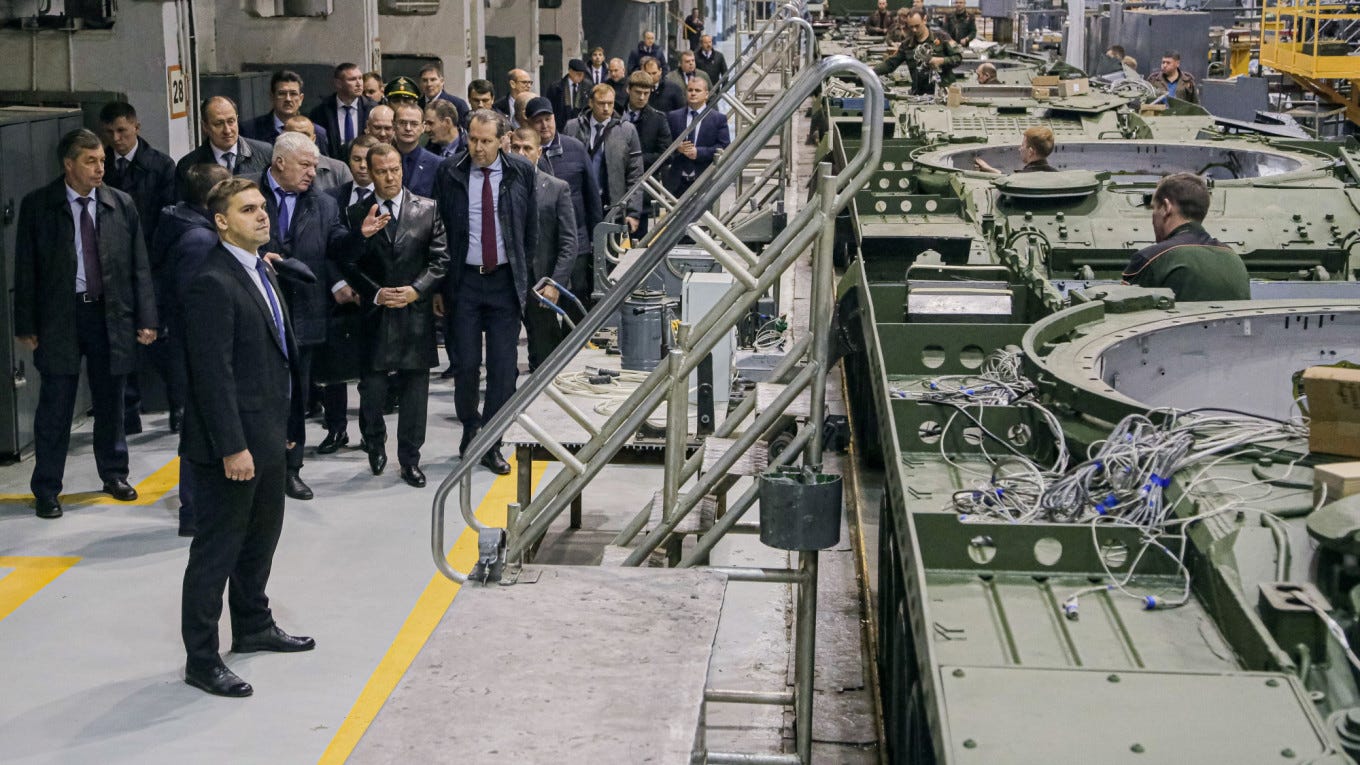
Medvedev inspects a tank production run
With significant Russian asymmetries in population size, industrial capacity, strike capability, and – let us be blunt – sovereignty and decision-making freedom, an attritional-positional struggle is simply bad math for Ukraine, and yet that is precisely the sort of war in which it has become trapped.
What is important for us to understand, however, is that the strategic asymmetry goes beyond physical capacities like population base, industrial plant, and missile technology, and extends into the realm of strategic objectives and timelines.
Russia’s war has been deliberately framed in a fairly open-ended way, with goals largely tied to the idea of “demilitarizing” Ukraine. In fact, Russia’s territorial objectives remain rather nebulous beyond the 4 annexed oblasts (though it is safe to say that Moscow would like to acquire far more than just these). All that to say, Putin’s government has deliberately framed the war as a military-technical enterprise focused on destroying the Ukrainian armed forces, and has shown itself to be perfectly free to give up territory in the name of operational prudentia.
In contrast, Ukraine has maximalist goals that are explicitly territorial in nature. The Zelensky government has been open about the fact that it aims – however fanciful this may be – to restore the entirety of its 1991 territories, including not just the four mainland oblasts but also Crimea.
The confluence of these two factors – Ukrainian territorial maximalism combined with asymmetrical Russian advantages in a positional-attritional struggle – forces Ukraine to seek a way to break open the front and restore a state of operational fluidity. Remaining locked in a positional struggle is unworkable for Kiev, partially because Russia’s material advantages will inevitably shine through (in a fight between two big guys swinging big bats at each other, bet on the bigger guy with the bigger bat), and partially because a positional war (which amounts essentially to a massive siege) is simply not an efficient way to retake territory.
This leaves Ukraine with no choice but to unfreeze the front and try to restore mobile operations, with an eye towards creating some asymmetry of their own. The only feasible way to accomplish this is to launch an offensive aimed at severing critical lines of Russian communication and supply. Contrary to some suggestions that were popular this spring, a large Ukrainian offensive against Bakhmut or Donetsk simply did not fit the bill.
Frankly, there are only two suitable operational targets for Ukraine. One is Starobils’k – the beating heart at the center of Russia’s Lugansk front. Capturing or screening Svatove and then Starobils’k would create a genuine operational catastrophe for Russia in the north, with cascading effects all the way down to Bakhmut. The second possible target was the land bridge to Crimea, which could be cut by a thrust across lower Zaporizhia towards the Azov coast.
It was probably inevitable that Ukraine would select the Azov option, for a few reasons. The land bridge to Crimea is a more self-contained battlespace – an offensive in Lugansk would occur under the shadow of the Belgorod and Voronezh regions of Russia, making it relatively more difficult to put significant Russian forces out of supply. Perhaps even more significant, however, is Kiev’s complete obsession with Crimea and the Kerch Bridge – targets that hold hypnotic sway in a way that Starobils’k never could.
Again, this may sound like fairly intuitive review, but it’s worth contemplating how and why Ukraine ended up launching an offensive that was widely telegraphed and expected. There was no strategic surprise whatsoever – a definitely real video of GUR chief Budanov smirking didn’t fool anyone. The Russian armed forces certainly weren’t fooled, as they spent months saturating the front with minefields, trenches, firing emplacements, and obstacles. Everyone knew that Ukraine was going to attack toward the Azov Coast, specifically with an eye towards Tokmak and Melitopol, and that’s exactly what they did. A frontal attack against a prepared defense without the element of surprise is generally considered a poor choice, but here is Ukraine not only attempting such an attack but even launching it against a backdrop of global celebration and phantasmagorical expectations
Ukraine’s infantile plea for OPSEC
It’s impossible to make sense of this without understanding the way that Ukraine is shackled by a particular interpretation of the war to this point. Ukraine and its supporters point to two successes in 2022 where Ukraine was able to retake a substantial swathe of territory, in Kharkov and Kherson oblasts. The problem is that neither of these situations is portable to Zaporizhia.
In the case of the Kharkov offensive, Ukraine identified a sector of the Russian front that had been hollowed out and was defended only by a thin screening force. They were able to stage a force and achieve a measure of strategic surprise, due to the thick forests and general paucity of Russian ISR in the area. This is not to mitigate the scale of Ukraine’s success there; it was certainly the best uses of forces available to them and they did exploit a weak section of front. This success is hardly relevant to circumstances in the south today; mobilization has ameliorated Russia’s force generation problems so that they now longer have to make hard choices about what to defend, and the heavily fortified Zaporizhia frontline is nothing like the thinly held front in Kharkov.
The second case study – the Kherson counteroffensive – is even less germane. In this case, Ukrainian leadership is rewriting history in record time. The AFU banged its head on Russian defenses in Kherson for months throughout the summer and autumn last year and took atrocious losses. An entire grouping of AFU brigades was mauled in Kherson without achieving a breakthrough, and this even with Russian forces in a uniquely difficult operational disposition where they had their backs to a river. Kherson was only abandoned months later due to concerns that the Kakhovka dam might fail or be sabotaged (for those keeping score, it did in fact end up failing), and due to Russia’s need at the time to economize forces.
Again, this can easily be misconstrued as arguing that Russia’s withdrawal from Kherson did not matter. Obviously, abandoning a hard-earned bridgehead is a major setback, and retaking west-bank Kherson was a boon for Kiev. But we need to be honest about why it happened, and it plainly did not happen because of Ukraine’s summer counteroffensive – to underscore this, recall that Ukrainian officials openly wondered if the Russian withdrawal was a trickor a trap. The question is simply whether Ukraine’s Kherson offensive is predictive of future offensive success. It is not.
So, we have one case where Ukraine identified a lightly defended section of front and ran through it, and another where Russian troops abandoned a bridgehead due to logistical and force allocation concerns. Neither is particularly relevant to the situation on the Azov coast, and in fact an honest reflection of the AFU’s Kherson Counteroffensive might have given Ukraine second thoughts about a frontal assault on prepared Russian defenses.
Instead, Kharkov and Kherson have both been presented as proof positive that Ukraine can shatter Russian defenses in a straight up fight – in fact, we still have no examples from this war of the AFU defeating strongly held Russian positions, particularly post-mobilization when Russia finally began to resolve its manpower deficiencies. But Ukraine is caught in the grip of its own particular story about this war, which has imparted unearned confidence in its ability to conduct offensive operations. Tragically for mobilized Ukrainian Mykolas, this has dovetailed with a second swagger-producing mythology.
A major selling point for the Ukrainian counteroffensive has been the assessed superiority of the AFU’s big-ticket donations from the west – the main battle tanks and infantry fighting vehicles. Since the first deliveries were announced, there has been no shortage of boasting about the many superior qualities of western models like the Leopards and Challengers. The suggestion has essentially been that skilled Ukrainian tankers are only waiting to be unleashed once they get behind the wheel of superlative western builds. My personal favorite motif has been the practice of dismissing Russian tanks as “Soviet Era” – neglecting to note that the Abrams (designed 1975) and the Leopard 2 (1979) are also Cold War models
A burn out Leopard in Syria
It must be stated, again, that there is nothing wrong with western tanks. The Abrams and the Leopard are fine vehicles, but confidence in their game-changing capabilities stems from a mistaken assumption about the role of armor. It must be appreciated that tanks always have been and always will be mass-consumption items. Tanks blow up. They are disabled. They break down and are captured. Tank forces attrit – much faster than people expect. Given that the brigades prepared for Ukraine’s assault on the Zapo line were significantly understrength in vehicles, it was simply irrational to expect them to have an oversized impact. This is not to say that tanks aren’t important – armor remains critical to modern combat – but in a peer conflict one should always expect to lose armor at a steady clip, especially when the enemy retains fires superiority.
One can see, then how a measure of hubris can easily creep in to Ukrainian thinking, fueled by a healthy dose of desperation and strategic need. Reasoning from a distorted understanding of its successes in Kharkov and Kherson, emboldened by their shiny new toys, and guided by an overriding strategic animus that requires them to unlock the front somehow, the idea of a frontal attack without strategic surprise against a prepared defense really could seem like a good idea. Add in the good old fashioned trope about Russian incompetenceand disorder, and you have all the recipes for an imprudent roll of the dice by Ukraine.
The Misfire
So now we come to the operational minutia. For a variety of reasons, Ukraine has chosen to attempt a frontal assault on Russia’s fortified Zaporizhia front, with the intention of breaching towards the sea of Azov. How can this be accomplished?
We had a few clues early on, accruing from a variety of geographic features and alleged intelligence leaks. In May, the Dreizin Report published what was purported to be a Russian synthesis of Ukraine’s OPORD (Operational Order). An OPORD functions as a broad sketch of an operation’s intended progression, and the document shared by Dreizin was billed as a summary of Russia’s expectation for Ukraine’s offensive (that is, it is not a leak of Ukraine’s internal planning documents, but a leak of Russia’s best guess at Ukraine’s plans).
In any case, in a vacuum it was anybody’s guess as to whether Dreizin’s OPORD was authentic, but we’ve subsequently been able to cross-check it. This is because of the other, even more infamous leak from earlier this spring, which included the Pentagon’s combat power build plan for Ukraine.
NATO was very generous and built Ukraine a mechanized strike package from scratch. However, because this mechanized force was cobbled together with a variety of different systems from all corners of the NATO Cinematic Universe, Ukraine formations are uniquely identifiable by their particular combination of vehicles and equipment. So, for example, the presence of Strykers, Marders, and Challengers indicates the presence of the 82nd Brigade in the field, and so forth.
Thus, despite Ukrainian pretensions of operational security, it’s actually been trivially easy for observers to know which Ukrainian formations are in the field. There have been a few deviations from the script – for example, the 47th Brigade was supposed to field the Frankenstein Slovenian M55 tanks, but in the end the decision was made to send the underpowered M55’s to the northern front and the 47th was deployed with a contingent of Leopard Tanks originally operated by the 33rd Brigade. But these are minor details, and on the whole we’ve had a good sense of when and where specific AFU formations get on the field.
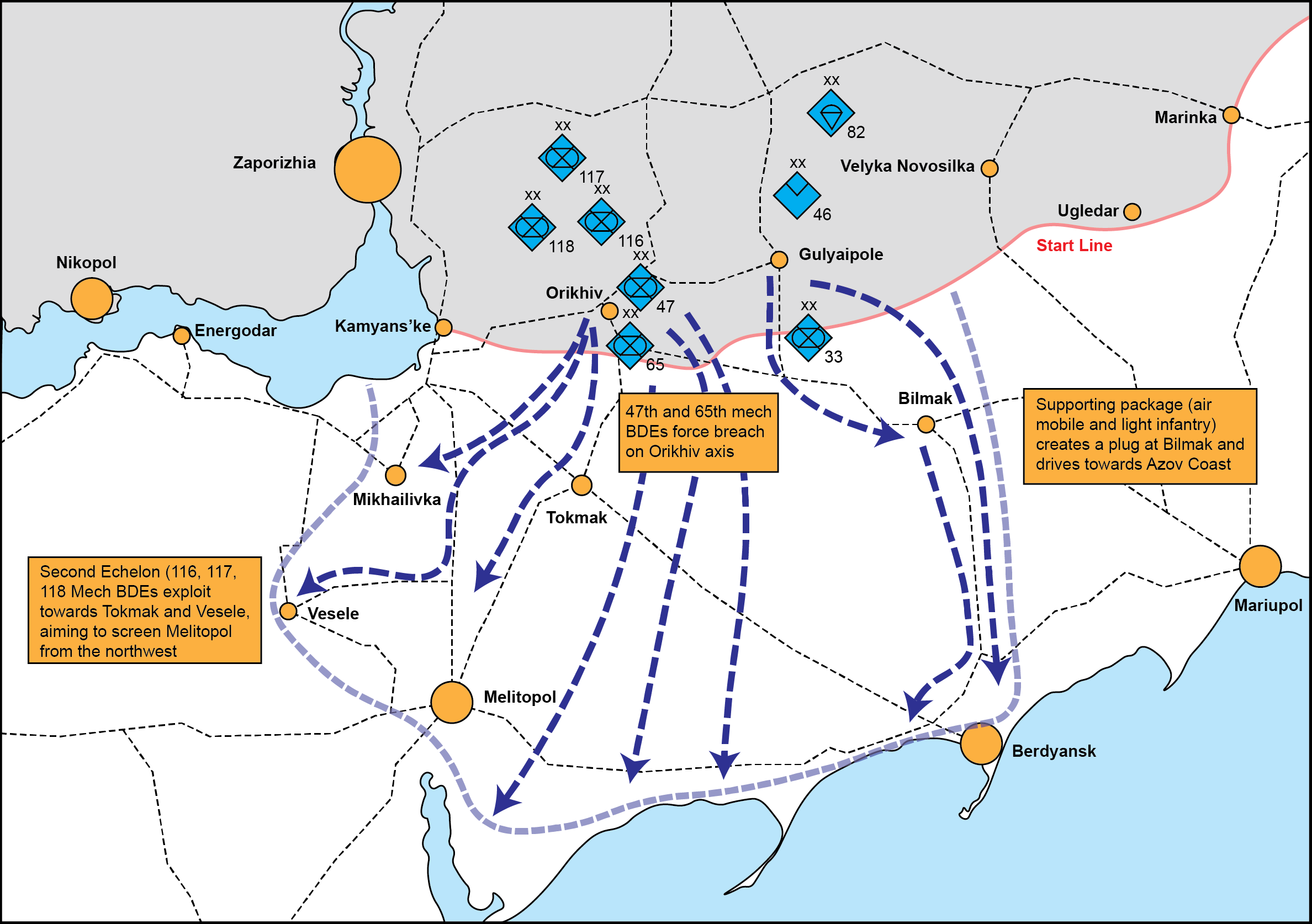
Based on identifiable units, the Dreizin OPORD looks very close to what we actually saw at the onset of the Ukrainian offensive. The Dreizin OPORD called for an assault by the 47th and 65th Brigades on the Russian lines south or Orikhiv, in the sector bounded by Nesterianka and Novoprokopivka. Directly in the middle of this sector is the town of Robotyne, and sure enough that’s where the first big AFU assault came overnight on June 7-8, spearheaded by the 47th Brigade.
Now, from this point it becomes difficult to evaluate the Dreizin OPORD simply because Ukraine’s attack became instantaneously derailed, but one thing we can say is that Dreizin’s source was correct about the order that Ukrainian units would be introduced into battle. Based on this, we can flesh out the OPORD and feel pretty safe wagering that this is what the Ukrainians were hoping to achieve:
Ukraine’s Dream: The Drive to the Sea
The intention seems to have been to force a breach in the Russian line using a concentrated armored assault by the 47th and 65th Brigades, after which a follow on force of the 116th, 117th, and 118th would begin the exploitation phase, driving for the Azov Coast and the towns of Mikhailivka and Vesele to the west. The objective was clearly not to get bogged down in urban fighting attempting to capture places like Tokmak, Berdyansk, or Melitopol, but to bypass them and cut them off by taking up blocking positions on the main roads.
Simultaneously, a lesser – but no less critical – thrust would come out of the Gulyaipole area and drive along the Bilmak axis. This would have the effect of both screening the main advance to the west and wedging the Russian front open, splintering the integrity of the Russian forces caught in the middle. Overall, this is a fairly sensible, if ambitious and uncreative plan. In many ways, this was really the only option.
So what went wrong? Well, conceptually it’s easy. There is no breach. The bulk of the maneuver scheme is dedicated to exploitation – reaching such and such a line, taking up this blocking position, masking that city, and so forth. But what happens when there’s no breach at all? How can such a catastrophe occur, and how can the operation be salvaged when it comes untracked in the opening phase?
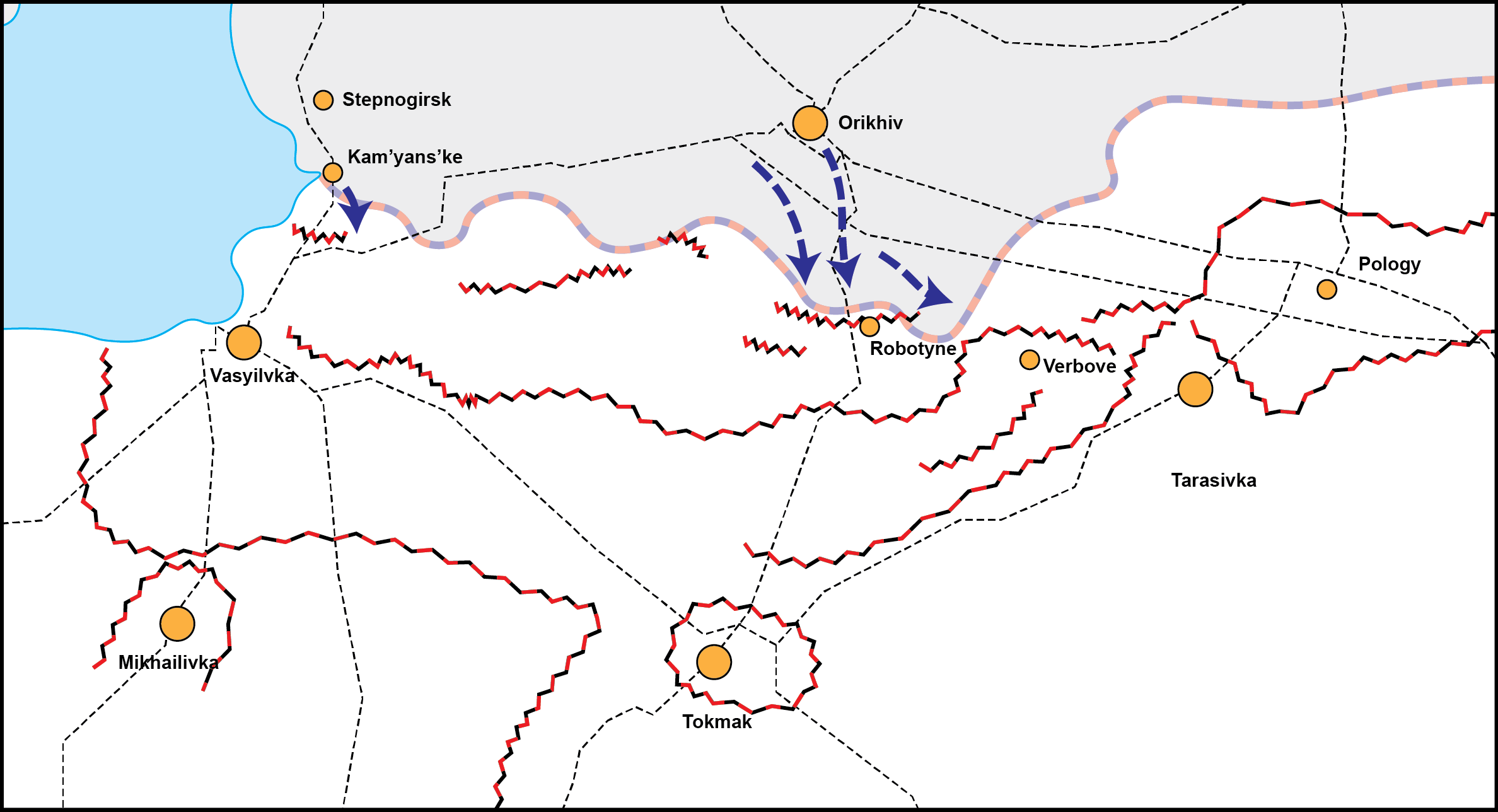
Indeed, this is precisely what has happened. Ukraine finds itself stuck on the edge of Russia’s outermost screening line, spending substantial resources trying to capture the small village of Robotyne, and/or bypass it to the east by infiltrating the gap between it and the neighboring village of Verbove. So instead of that rapid breach and turning maneuver towards Melitopol, we get something like this:
Ukrainian Counteroffensive with Mapped Russian Defensive Lines
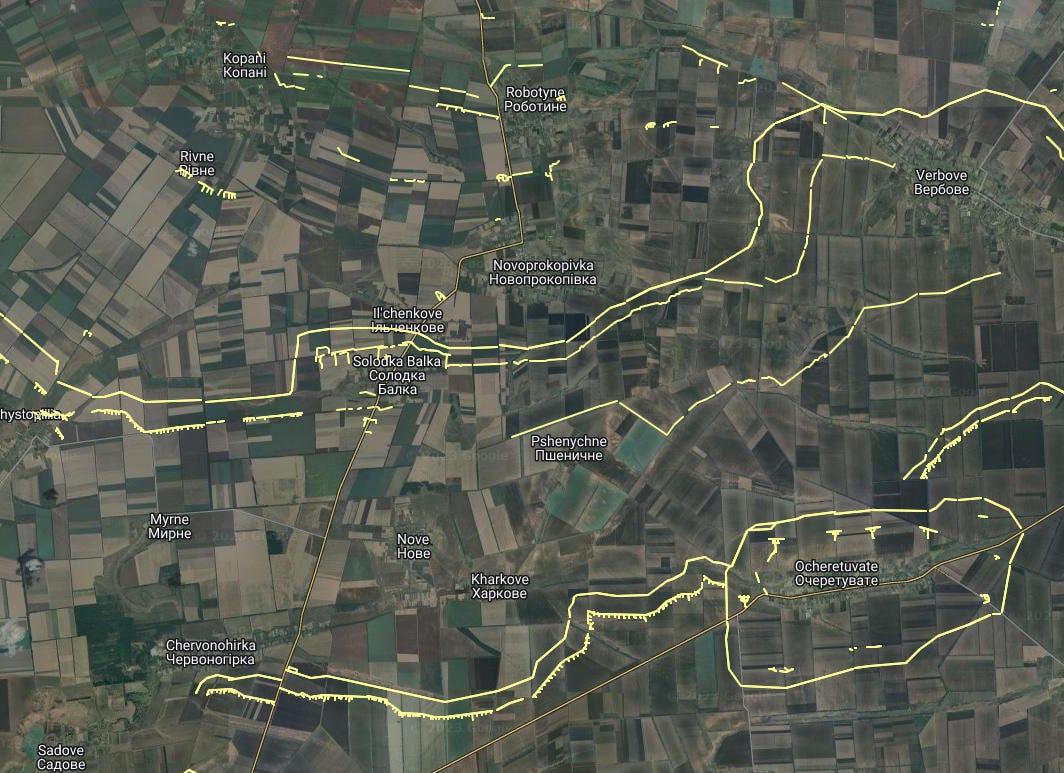
We could be generous and say that Robotyne is the last village before the Ukrainian attack reaches the main Russian defensive belt, but we’d be lying – they will also have to clear the larger town of Novoprokopivka, two kilometers to the south. Just for reference, here’s a closer look at the mapped Russian defenses in the battlespace, based on the excellent work of Brady Africk
Russian defenses in the Robotyne Sector
The discussion about these emplacements can get a little muddled, simply because it’s not always clear what is meant by that popular phrase “first line of defense.” Clearly there are some defensive works around and in Robotyne, and the Russians chose to fight for the village, so in some sense Robotyne is part of the “first line” – but it is more proper to speak of it as part of what we would call a “screening line”. The first line of continuous fortifications across the front is several kilometers further south, and this is the belt that Ukraine has yet to even reach, let alone breach.
As of this moment, it appears that Russian troops have lost total control of Robotyne but continue to hold the southern half of the village, while Ukrainian troops in the northern half of the village remain subject to heavy Russian shelling. We should probably at this point consider the village to be continuously contested and a feature of the gray zone
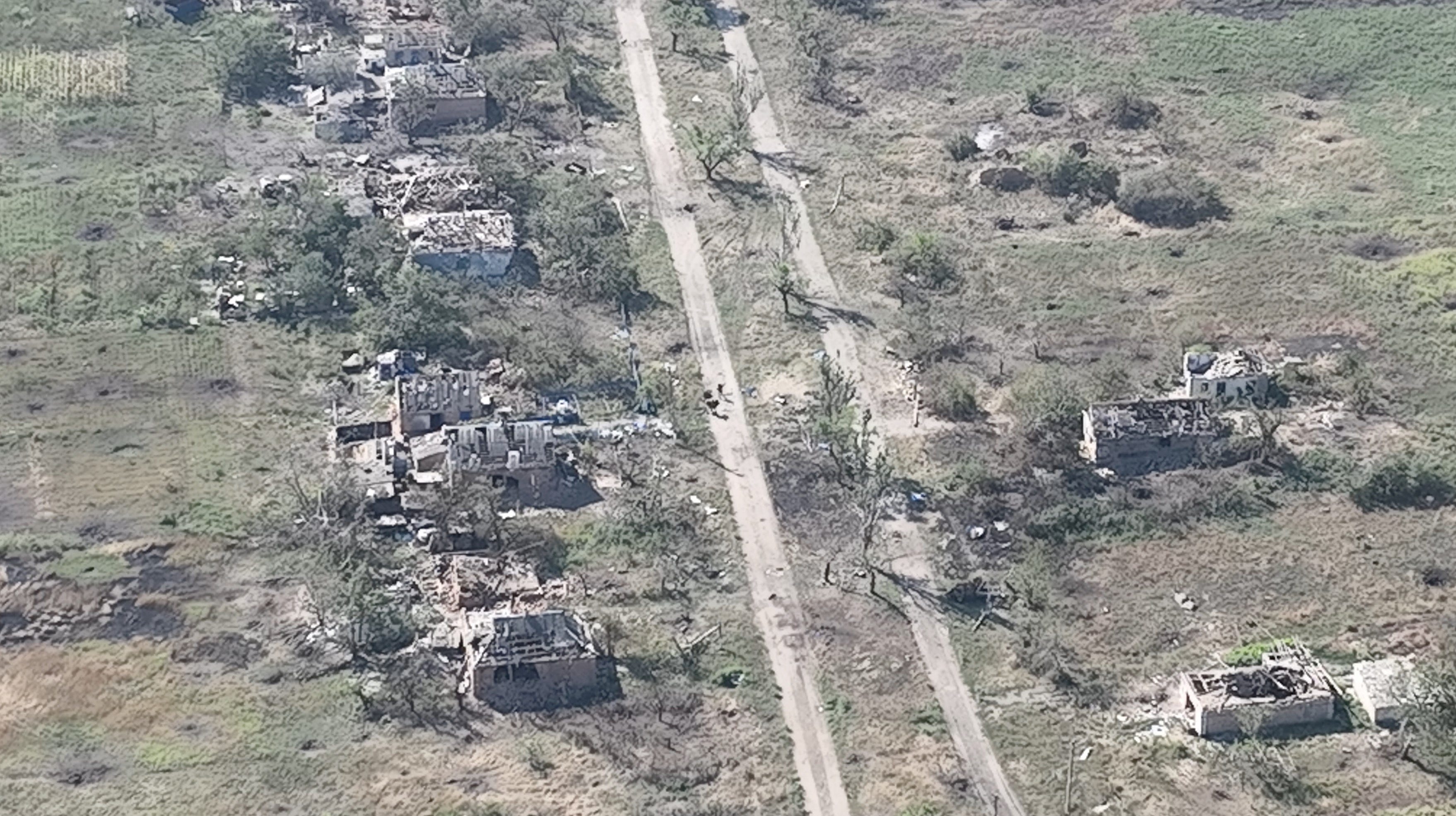
Robotyne, in all its glory
Now, a quick note about Robotyne itself and why both sides are so determined to fight for it. It seems rather odd on the surface, given that the Russian preference in 2022 was to make tactical withdrawals under their fires umbrella. This time though, they are fiercely counterattacking to contest Robotyne. The value of the village lies not only in its location on the T-0408 Highway, but also its excellent perch on top of a ridge. Both Robotyne and Novoprokopivka lie on a ridge of elevated ground which is as much as 70 meters higher than the low-lying plain to the east.
What this means is fairly simple; if the AFU presses forward in attempts to bypass the Robotyne-Novoprokopivka position by pushing into the gap between Robotyne and Verbove, it will be vulnerable to fire on the flanks (particularly by ATGMs) by Russian troops on the high ground. We already have seen footage of this, with Ukrainian vehicles being taken in the flank by fire from Robotyne. I am highly skeptical that Ukraine can even attempt an earnest assault on the first defensive belt until they have captured both Robotyne and Novoprokopivka.
This would all be a tough nut to crack under ideal circumstances, with a variety of engineering problems to mediate, obstacles designed to funnel the attacker into firing lanes, perpendicular trenches to allow enfilade fire on advancing Ukrainian columns, and robust defenses on all the major roadways. But these are not the best of circumstances. This is a tired force that has exhausted much of its indigenous combat power, which is attempting to organize the attack using a piecemeal and understrength assault package.
Several factors conspired against the Ukrainian offensive, and synergistically they have created a bona fide military catastrophe for Kiev. Let us enumerate them.
Problem 1: The Hidden Defensive Layer
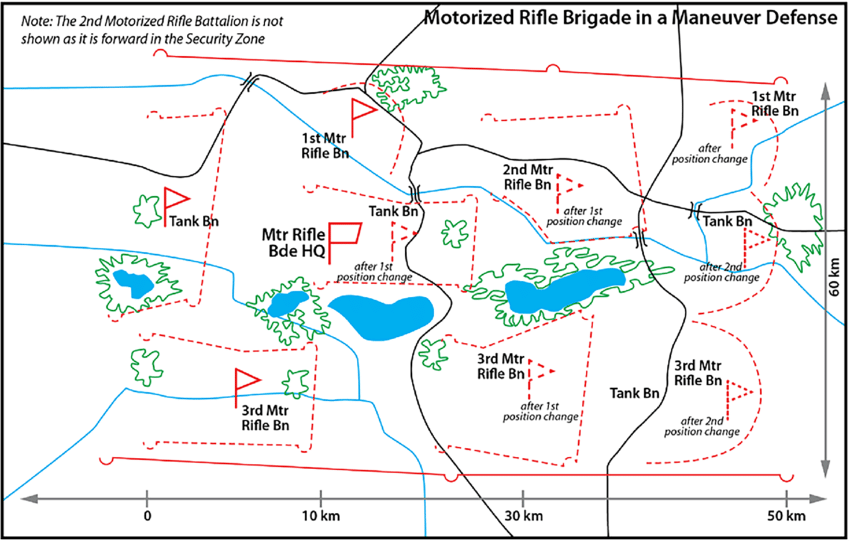
At this point, we need to acknowledge something that everybody missed about Russia’s defense. I previously expressed high confidence that Ukraine’s forces would be unable to breach the Russian defenses, but I mistakenly believed that the Russian defense would function according to the classic Soviet defense-in-depth principles (elucidated in great detail by the writings of David Glantz, for example)
Idealized Defense in Depth by a Motor Rifle Brigade
Such a defense, put simply, is open to the idea that the enemy will breach the first or even second lines of defense. The purpose of the multilayered (or “echeloned” in the classic terminology) defense is to ensure that the enemy force gets stuck as it tries to break through. It may penetrate the first layer, but as it goes it is continually chewed up by the subsequent belts. The classic example is the Battle of Kursk, where powerful German panzers broke into the Soviet defensive belts but subsequently became stuck as they were ground down. You can think of this as being analogically similar to a Kevlar vest, which uses a web of fibers to stop projectiles: rather than bouncing off, the bullet is caught and its energy is absorbed by the layered fibers.
I was actually quite open to the idea that Ukraine would generate some penetration, but I anticipated them getting stuck in the subsequent belts and sputtering out.
What was missing from this picture – and this is a credit to Russian planning – was an unseen defensive belt forward of the proper trenches and fortifications. This forward belt consisted of extremely dense minefields and strongly held forward positions in the screening line, which the Russians evidently intended to fight for fiercely. Rather than breaking through the first belt and getting stuck in the interstitial areas, the Ukrainians have been repeatedly mauled in the security zone, and the Russians have consistently counterattacked to knock them back when they do manage to get footholds.
In other words, while we expected Russia to fight a defense in depth that absorbed the Ukrainian spearheads and shredded them in the heart of the defense, the Russians have actually shown a strong commitment to defending their forwardmost positions, of which Robotyne is the most famous.
On paper, Robotyne was expected to function as part of a so-called “crumple zone”, or “security zone” – a sort of lightly held buffer that puts the enemy through pre-registered fires before they bump into the first belt of continuous and strongly held defenses. Indeed, a variety of aerial and satellite surveys of the area taken before Ukraine went on the attack showed Robotyne laying well forward of the first solid and continuous Russian fortification belt.
What was missed, it seemed, was the extent to which the Russian defenders had mined the areas on the approach to Robotyne and were committed to defending within the security zone. The scale of the mining certainly seems to have surprised the Ukrainians, and creates a strain on Ukraine’s limited combat engineering capabilities. Even more importantly, the dense mines have created predictable avenues of approach for the Ukrainian forces, which force them to repeatedly run through the same gauntlet of fires and Russian standoff weaponry.
Problem 2: Insufficient Suppression
The signature image of the first great assaults on the Zapo Line has been columns of unsupported maneuver assets, being raked with Russian fires, both ground based (rocketry, ATGMs, and tube artillery) and from air platforms like the Ka-52 Alligator attack helicopter. One of the more startling aspects of these scenes was the way Ukrainian forces would come under heavy fire while still in their marching columns, taking losses before they ever deployed into firing lines to begin their assault proper.
There are myriad reasons for this. One is the now blasé issue of Ukrainian munition shortages. Consider the following items of interest. In the runup to Ukraine’s counteroffensive, Russia waged a heavy counter-preparatory air campaign that knocked out large AFU ammunition dumps. Ukraine’s initial assaults collapse in the face of heavy and unsuppressed Russian fires. The United States decides to transfer cluster munitions to Ukraine because, in the words of the president, “they’re running out of ammunition.” Add in the degradation of Ukrainian air defense, which allows Russian helicopters to operate with great effect along the contact line, and you have a recipe for disaster. Lacking the tubes to suppress Russian fires or the air defense to chase away Russian aircraft, the AFU opened their offensive by disastrously pushing forward unsupported maneuver elements into a hail of fire.
Problem 3: Russian Standoff Weapons
It’s crucial to understand that the Russian toolbox is fundamentally different than it was during the battle for Kherson last year, due to the rapidly expanding production of a variety of Russian standoff weapons – most notably the Lancet and the UMPK glide modifications for gravity bombs.
The proliferation of the Lancet and similar systems means, in a nutshell, that nothing within 30km of the contact line is safe, and this in turn disrupts the AFU’s deployment of critical support assets like air defense and engineering, magnifying their vulnerability to Russian mines and fires. In fact, we’ve increasingly seen Ukrainian artillery use decline in the Robotyne area due to the threat of lancets (they seem to be transferring tubes to other fronts), and the AFU is favoring the use of HIMARS in the suppressive role.
Problem 4: Repetitive Lines of Approach
Because the AFU failed to breach the Robotyne sector on their first attempt, they’ve been forced to continually move up additional units and resources to hammer on the position. This has particular implications, both in the sense that AFU forces must continually traverse the same lines of approach to contact, and in the fact that they are using the same rear area to assemble and stage their assault forces.
This makes the burden on Russian ISR (Intelligence, Surveillance, Reconnaissance) significantly easier, since the AFU has no effective way to disperse or hide the assets that they are bringing forward to the assault. Staged Ukrainian forces and material have been hid repeatedly in the villages immediately behind Orikhiv, like Tavriiske and Omeln’yk, and Russia is able to strike rear area infrastructure like ammunition depots because – to put it simply – there are only so many places these these assets can be staged when you are repeatedly assaulting the same 20km wide sector of front.
We recently had Ukrainian Deputy Minister of Defense Hanna Malair complaining that the 82nd Brigade – newly deployed to the Orikhiv sector – had been hit with a series of Russian airstrikes in its staging areas. According to her, this was because of poor OPSEC revealing the brigade’s location to the Russians. But this really makes very little sense; the entire area of operations around Orikhiv is perhaps 25km deep (from Kopani to Tavriiske) and 20 km wide (from Kopani to Verbove). This is a small area that has seen a huge amount of military traffic along the same roads throughout the summer. The idea that Russia needs insider information to know that they ought to surveil and attack targets in this area is absurd.
Problem 5: Fragile Brigades
It actually takes significantly less damage to “destroy” an operational level unit than people think. A unit can become a combat scratch off at 30% losses (with some variance depending on how those are allocated). This is because when people hear the term “destruction”, they think that means total losses. Sometimes that’s how the word is used in colloquial conversation, but what matters for officers trying to manage an operation is whether or not a formation is combat capable of the tasks being asked of it – and those capabilities can vanish much more quickly than people realize.
This is particularly the case for the Ukrainian mech package, for a variety of reasons. For one, as we discussed in previous articles, these brigades started the fight well understrength (remember, for example, that the Ukrainian 82nd Brigade has only 90 Stryker AFVs, while an American Strkyer Brigade is supposed to have 300). Additionally, the cobbled together nature of these brigades – and the total lack of indigenous sustainment systems like repair and maintenance – means that the Ukrainians will naturally have to cannibalize these vehicles. They’ve already started designating “donor” vehicles that are written off completely to be stripped down for parts. The nexus of these two facts is that Ukraine’s mechanized brigades are understrength on vehicles to begin with, and will have an abysmally poor recovery rate, with hidden attrition behind the scenes due to cannibalization.
What this means is that when we heard admissions by mid-July that Ukraine had already lost 20% of its maneuver assets, there is an associated catastrophic decline in combat capability. The lead brigades – which chewed through 50% or more of their maneuver vehicles – can no longer shoulder combat tasks appropriate for a brigade, and the Ukrainians are forced to feed in their second echelon units prematurely.
At this point, partial elements of at least ten different brigades have been deployed in the Robotyne sector, with the 82nd likely to join them soon. Given that the NATO combat power build plan only included 9 NATO trained brigades, plus a few reconstituted Ukrainian formations, it’s safe to say that blooding all of them over a 71 day fight just to break into the screening line was not in the plan.
Staring at the Abyss
I’ve seen a variety of analysts and writers lately arguing that the insertion of additional Ukrainian units into the Robotyne sector signals the next phase of the operation.
This is nonsense. Ukraine is still mired in the first phase. What has happened is instead that the attrition of their first echelon brigades has forced them to commit their second (and third) wave to complete the tasks of the opening phase. The initial attack, led by the 47th Brigade, was intended to create a breach in the Russian screening line around Robotyne and advance to the main Russian belt further to the south. They failed, and the additional brigades earmarked for exploitation – the 116th, 117th, 118th, 82nd, 33rd, and more – are now being systematically fed in to keep the pressure on.
These brigades have not been destroyed, of course, simply because they are not being committed in their entirety, but rather as subunits. Nevertheless, at this point Ukrainian losses make up the better part of a whole brigade, distributed around the broader package, and over 300 maneuver elements (tanks, IFVs, APCs, etc) have been scratched off.
We need to say this very explicitly. Ukraine has not moved on to the next phase of their operation. They are stuck in the first phase, and have been forced to prematurely commit portions of the second echelon that was earmarked for later action. They are slowly but surely burning through the entire operational grouping, and so far they have not breached Russia’s screening line. The great counteroffensive is turning into a military catastrophe
Now, this does not mean that the operation has failed, simply because it is still ongoing. History teaches us that it is unwise to make definitive pronouncements. Luck and human factors (bravery and intelligence, cowardice and stupidity) always have something to say. However, the trajectory is undeniably towards abject failure at the current moment.
So far, the AFU has shown some adaptability. In particular, we’ve recently seen them shift away from pushing forward unsupported columns of mechanized assets – instead they’ve been leaning on small dismounted units, trying to slowly push forward into the space between Robotyne and Verbove. The move towards dispersal is intended to reduce loss rates, but it also reduces the probability of a dramatic breakthrough even further and marks the temporary abandonment of decisive breaching action in favor of – once again – creeping positional warfare.
We would be remiss if we failed to note that there have been meaningful Russian losses in all of this. We know that the Russian forces in the Robotyne sector have required rotation and reinforcement, including with elite VDV and Naval Infantry units. Russia has taken counterbattery losses, it has lost vehicles in counterattacking action, and men have been killed holding their trenches. The initial assault groups that the Ukrainians threw in had a lot of combat power, and the fighting was very bloody for both sides. It’s not a one-sided shooting gallery, but a high intensity war.
But therein is the crux of the matter – Ukraine seems unable to escape the attritional and positional war that it finds itself in. It sounds all well and good to proclaim a return to “maneuver” warfare, but if there is an inability to breach enemy defenses, this is only an empty boast, and the nature of the struggle remains attritional. When the question becomes “will we breach before we run out of combat power”, you are not maneuvering. You are attriting.
In my series of articles on military history, we’ve looked at a variety of cases where armies tried desperately to unlock the front and restore a state of operational maneuver, but when there is no technical capacity to do so, these intentions do not matter one bit. Nobody wants to be trapped on the wrong side of attritional mathematics, but sometimes what you want does not matter at all. Sometimes attrition is imposed on you.
In the absence of the capabilities required to successfully breach Russia’s prodigious defenses – more ranged fires, more air defense, more ISR, more EW, more combat engineering, more more more – Ukraine is trapped in a rock fight. Two fighters are swinging bats at each other, and Russia is a bigger man with a bigger bat.
Two Bad Copes
Amid a clear misfire and growing strategic disappointment, two new suggestions have increasingly crept into the conversation – “copes”, if you will, that are utilized as a narrative comfort to explain why the Ukrainian operation is actually going just fine (despite nearly universal acknowledgment in the west that the results have been lackluster at best). I would like to briefly address each of these in turn.
Cope 1: “The first stage is the hardest”
You frequently see it argued that all the AFU has to do is break open the Russian screening line, and the remainder of the defenses will fall like dominos. The general thrust of this argument is that the Russians lack reserves and that the subsequent defensive lines are not adequately manned – just break open the first line, and the rest will fall apart.
This is probably a comforting thing to tell oneself, but it’s rather irrational. We could talk, for example, about Russia’s doctrinal schema for defense in depth, which prescribes liberal allocation of reserves at all depths of the defensive system, but it’s probably more fruitful to point at more immediate evidence.
Let us simply consider Russia’s behavior over the last six months. They have spent a tremendous amount of effort constructing echeloned defenses – are we really to believe that they did all this only to waste all their combat power fighting in front of these defenses? Nor is there any evidence that Russia is having trouble supplying the front with manpower at the present moment. We’ve seen continued rotations and redeployments amid an overall process of military enlargement in Russia. Indeed, of the two belligerents, it is Ukraine that seems to be scraping the barrel for manpower.
Cope 2: “Get within firing range”
This is the more fantastical story, and it represents a radical ad-hoc shift of the goalposts. The argument is that Ukraine doesn’t actually need to advance to the sea and physically cut the land bridge, all it has to do is get the Russian supply routes within firing range to cut off Russian troops. This theory has been advance liberally on Twitter X and by personalities like Peter Zeihan (a man who knows nothing about military affairs).
There are many problems with this line of thought, most of which stem from an inflated notion of “fire control.” To put it simply, being “in range” of artillery fire does not imply effective area denial or severed supply lines. If that were the case, Ukraine would be unable to attack out of Orikhiv at all, since the entire axis of approach is within Russian firing range. In Bakhmut, the AFU continued to fight long after their main supply routes came under Russian shelling.
The simple fact is that most military tasks are conducted within range of at least some of the enemy’s ranged fires, and the idea that Russia will collapse if the AFU manages to put a shell on the Azov coastal highway is fairly ridiculous. In fact, Russia’s main rail line is already within range of Ukrainian HIMARS, and the Ukrainians have successfully launched strikes on coastal cities like Berdyansk. Meanwhile, Russia strikes at Ukrainian sustainment infrastructure with regularity – yet neither army has collapsed yet. This is because ranged fires are a tool to improve attritional calculus and further operational goals – they do not magically win wars just by tagging the enemy’s supply roads.
Let’s be charitable though, and indulge this line of thinking. Suppose the Ukrainians managed to advance – not all the way to the coast, but far enough to bring Russia’s main supply routes within range of artillery. What would they do? Wheel up a battery of howitzers, park them at the very front line, and begin firing nonstop at the road? What do you think would happen to those howitzers? Counterbattery systems would surely set upon them. The idea that you can just haul up a big gun and start taking potshots at Russian supply trucks is really quite childish. Putting enemy forces out of supply has always required physically blocking transit, and that’s what Ukraine will have to do if they want to cut Russia’s land bridge.
The Distraction
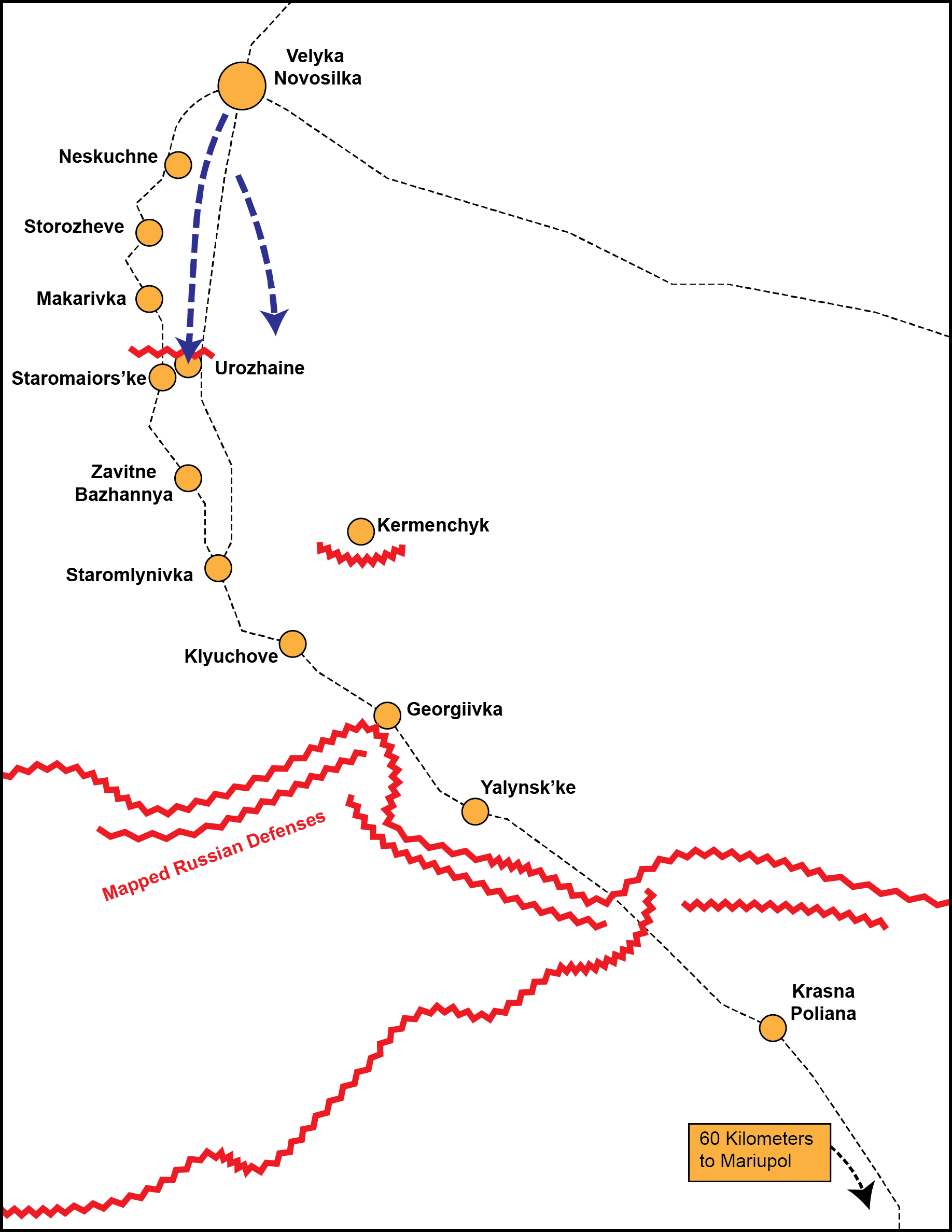
I am cognizant of the fact that I would be raked over the coals if I failed to discuss a secondary area of Ukrainian effort, farther to the east in Donestk oblast. Here, the Ukrainians have worked their way a good distance up the highway out of the town of Velyka Novosilka capturing several settlements.
The problem with this “other” Ukrainian attack is that it is, in a word, inconsequential. This axis of advance is operationally sterile in a very fundamental way, as it involves pushing groups up a narrow corridor of road that doesn’t lead anywhere important. As in the Robotyne sector, the AFU is still quite some distance from any of the serious Russian fortifications, and to make matters worse the road and settlements on this axis lay along a small river. Rivers, as we know, flow along the floor of the terrain, which means the roadway sits at the bottom of a wadis/embakement/glacis, choose your terminology. In fact, the road network as such consists of nothing except a single-lane roadway on either side of the river
The Sideshow in the East
My reading of this axis is essentially that it was intended as a feint to create some semblance of operational confusion, but when the primary effort on the Orikhiv axis turned into a colossal misfire, the decision was made to continue to press here simply for narrative purposes. Ultimately, this is simply not an axis of advance that can exert a meaningful influence on the wider war. The forces deployed here are relatively miniscule in the grand scope of things, and they aren’t going anywhere important. Certainly, a thin, needlelike penetration is not going to drive more than 80 kilometers down a single lane road to the sea and win the war.
Conclusion: Finger Pointing
One of the surest signs that Ukraine’s counteroffensive has taken a cataclysmic turn is the way Kiev and Washington have already begun to blame each other, conducting a postmortem while the body is still warm. Zelensky has blamed the west for being too slow to deliver the requisite equipment and ammunition, arguing that unacceptable delays allowed the Russians to improve their defenses. This strikes me as rather obscene and ungrateful. NATO built Ukraine a new army from scratch in a process that already required greatly truncating the training times.
On the other hand, western experts have begun to blame Ukraine for supposedly being unable to adopt “combined arms warfare”. This is really a very nonsensical attempt to use jargon (incorrectly) to explain away problems. Combined arms simply means the integration and simultaneous use of various arms like armor, infantry, artillery, and air assets. Claiming that Ukraine and Russia are somehow cognitively or institutionally incapable of this is extremely silly. The Red Army had a complex and extremely thorough doctrine of combined arms operation. One professor at the US Arms School of Advanced Military Studies said: “The single most coherent core of theoretical writings on operational art is still found among the Soviet writers.” The idea that combined arms is some foreign and novel concept to Soviet officers (a caste that includes the Russian and Ukrainian high command) is ridiculous.
This issue is not some sort of Ukrainian doctrinal obstinacy, but a combination of structural factors rooted in the insufficiency of Ukrainian combat power and the changing face of warfare.
It’s frankly a little silly to say that Ukraine needs to learn about “combined arms” when they are very simply lacking important capabilities that would make a successful maneuver campaign possible – namely, adequate ranged fires, a functioning air force (and no, F-16’s will not fix this), engineering, and electronic warfare. The issue very fundamentally is not one of doctrinal flexibility, but of capability. By way of analogy, this is a bit like sending a boxer out to fight with a broken arm, and then critiquing his technique. The problem is not his technique – the problem is that he’s injured and materially weaker than his opponent. So too, the problem for Ukraine is not that they are incapable of coordinating arms, the problem is that their arms are shattered.
Secondly – and this, I admit, is rather shocking to me – western observers do not seem open to the possibility that the accuracy of modern ranged fires (be it Lancet drones, guided artillery shells, or GMLRS rockets) combined with the density of ISR systems may simply make it impossible to conduct sweeping mobile operations, except in very specific circumstances. When the enemy has the capacity to surveil staging areas, strike rear area infrastructure with cruise missiles and drones, precisely saturate approach lines with artillery fire, and soak the earth in mines, how exactly can it be possible to maneuver?
Combined arms and maneuver are predicated on the ability to rapidly concentrate enormous fighting power and attack with great violence at narrow points. This is probably impossible given the density of Russian surveillance, firepower, and the many obstacles they have put up to deny Ukrainian freedom of movement and scleroticize their activity. The main examples of maneuver in recent western memory – the campaigns in Iraq – have only tenuous relevance to circumstances in Zaporizhia.
Ultimately, we have returned to a war of mass – particularly massed ISR assets and fires. The only way Ukraine can maneuver the way they want is to break open the front, and they can only do this with more of everything – more mine clearing equipment, more shells and tubes, more rocketry, more armor. Only mass can crack open a suitable breach in the Russian lines. Otherwise, they are stuck in a positional creep through the dense Russian defenses, and criticizing them for being unable to grasp some sort of magical western notion of “combined arms” is the strangest sort of finger pointing.
So, whence goes the war from here? Well, the obvious question to ask is whether we believe Ukraine will ever have a more potent assault package than the one they started the summer with. The answer clearly seems to be no. It was like pulling teeth to scrape together these understrength brigades – the idea that, following on a defeat in the Battle of Zaporizhia, NATO will somehow put together a more powerful package seems like a stretch. More to the point, we have American officials saying fairly explicitly that this was the best mechanized package Ukraine was going to get.
It does not seem controversial to say that this was Ukraine’s best shot at some sort of genuine operational victory, which at this point seems to be slowly trickling away into modest but materially costly tactical advances. The ultimate implication of this is that Ukraine is unable to escape a war of industrial attrition, which is precisely the sort of war that it cannot win, due to all the asymmetries that we mentioned earlier.
In particular, however, Ukraine cannot win a positional-attritional war because of its own maximalist definition of “winning.” Since Kiev has insisted that it will not give up until it returns its 1991 borders, an inability to dislodge Russian forces poses a particularly nasty problem – Kiev will either need to admit defeat and acknowledge Russian control over the annexed areas, or it will continue to fight obstinately until it is a failed state with nothing left in the tank.
Trapped in a bat fight, with attempts to unlock the front with maneuver coming to naught, what Ukraine needs most is a much bigger bat. The alternative is a totalizing strategic disaster [end]
[my illustration] Vladimir Putin alongside African leaders delegates at the second Russia-Africa summit in Saint Petersburg, on July 28, 2023 (Mikhail Tereshchenko / TASS)]
Amidst the war between the US and Russia, events unfolding on the African continent are signalling a significant rebellion against imperialist control due to the wider impact of the war on the global geopolitical landscape.
The war between the West and Russia on Ukrainian soil is still ongoing and its outcome is yet to be known. However, its effects are being felt on several fronts. The most important of these is the significant economic impact caused on the European continent, whose leaders have chosen to engage in a war without tangible benefits.
A notable consequence of the conflict is the emergence of a rebellion against long-standing US unilateral dominance of the world. This rebellion would not have taken root if Russian President Vladimir Putin has not courageously accepted the challenge and actively participated in the conflict that Washington had meticulously prepared for Moscow.
A key result of this shift is the public defiance of African countries against Western domination. These nations are raising their voices against decades of exploitation, resource depletion, abject poverty and rampant corruption left behind by the imperialist powers. The vast African continent, with a population of over one billion two hundred million people, has considerable natural resources, including 40% of the world’s gold reserves, 30% of various minerals, 90% of platinum and chromium, 12% of petroleum and 8% natural gas.
The region is undergoing significant political changes in response to the global turmoil. Military coups in the Sahel region of Africa, such as Guinea (2021), Mali (2021) and Burkina Faso (2022), brought military officers from the middle and poor classes to power. As a result, these newly formed governments announced their intention to create their own union, different from the one created in 1960.
France, which had a significant presence in Africa, was expelled from most countries after these military coups. Only Niger, which supplies 20% to 30% of France’s uranium needs, and Chad, where France has military bases, maintain a French military presence.
Last April, Chad expelled the German ambassador, Jean-Christian Gordon Crick, because he had criticized the head of state, General Mohamed Deby, son of Chad’s leader, Idriss Deby (who died fighting the rebels in 2021), for not holding elections in the country.
Neither France nor the United States of America took a stand against Chad for fear of losing their essential military bases in the country. However, the African popular classes welcomed the expulsion of the German ambassador. African popular classes in several Sahelian countries celebrated the departure of France, expressing their frustration with the rise of extremist movements, corruption, poverty and inequality, and the failure of the West to deal with these issues and to quell rebellions.
Pressure from the World Bank, which is saddling African countries with debt and is imposing austerity measures, has turned many African nations against foreign investors and multinationals. US-based Exxon Mobil and France’s Total have also faced opposition in Mozambique, where widespread rebellion has erupted over perceived unfair exploitation of the country’s second-largest natural gas field.
In response to Africa’s shifting alliances with Russia and China, the United States has increased its presence on the continent, establishing military bases and entering into negotiations with countries such as Zambia and Ghana to counter the growing Sino-Russian-African relationship. The United States is pressuring African leaders to cut ties with China and Russia. However, the St. Petersburg conference demonstrated Africa’s determination to diversify its options and seek independence from unilateral domination. African leaders believe that competition between the world’s superpowers is healthy and can bring better opportunities to the African continent.
At the second Russia-Africa Summit, which was attended by 49 of the 54 African countries, including 17 presidents, African leaders reaffirmed their quest for freedom of choice. Russian President Vladimir Putin welcomed them warmly and eased their concerns by offering free grain, fertilizer and vital financial facilities, mainly to Burkina Faso, Zimbabwe, Mali, Somalia, Central Africa and Eritrea. Putin promised to deliver what Africa needed in terms of food at low prices and financial ease. The gesture was received with enthusiasm and sparked a new economic and political vision that emphasized Africa’s central role in the world.
The African authorities would not have gone to Russia in the midst of a fierce war between the country and the United States if President Putin had not dared to accept the Western challenge and stand firm in the face of the Western alliance. Russia has demonstrated that it is not afraid of a war being waged – as US Secretary of Defense Lloyd Austin put it – by top military officials from over 50 countries at the Ramstein base in Germany. Africa’s participation at the summit, including the presence of the Egyptian president, underscored the continent’s willingness to explore multiple options and to embrace China and Russia, despite Western calls to marginalize Russia. The presence of Egyptian President Adel Fattah el-Sisi shows how the Middle East is also diversifying its options, moving away from unilateral US dominance. In fact, Saudi Arabia, the UAE and Iraq have already decided to establish strong economic and trade ties with China and Russia, just one year after the war between the US and Russia in Ukraine. The Middle East and Africa are no longer under the domination of the US and the West.
Blessed with a third of the world’s mineral wealth and 65% of its arable land, Africa has long suffered from hunger, poverty, conflict and coups. However, with officials from Western, Russian and Chinese nations in attendance, the continent is witnessing a realignment of geopolitical and economic trends. This shift is challenging the Western influence that has dominated the continent for decades and is being accelerated by Africa’s growing ties with China.
The war between the US and Russia, fueled by the belief of dragging Russia into a destructive cycle, has inadvertently led to unintended consequences in other continents such as Africa, the Middle East, Asia and Latin America. These unintended consequences are undermining the hegemony of the United States and its allies, which are facing diminishing influence on the world stage.
During a crucial vote in the General Assembly in March last year, there was a significant shift in Africa’s position, which called for Russia’s withdrawal from Ukraine and an end to the war. A remarkable 31% of African countries were absent from the vote, 15% abstained and 1% voted against the resolution. This unprecedented stance has raised alarm bells among Western powers that have historically occupied and exploited Africa and exercised their influence over policy decisions on the continent. This newfound assertiveness came after Africa’s increased engagement with the world, especially China. It has been instrumental in developing more than 46 ports and land roads in Africa, connecting nations and linking them to the global economy. This transformation raised concerns in the West, which previously benefited from keeping Africa underdeveloped and dependent.
The impact of the ongoing war further underscore that the United States miscalculated in provoking Russia and underestimated the consequences on other continents, such as Africa, where regional dynamics have changed dramatically. As Africa and other regions, including the Middle East, Asia and Latin America, are experiencing unforeseen shifts in geopolitical alliances and economic trends, the influence of the United States and its allies continues to wane.
Africa’s bold moves to diversify its partnerships and assert its independence from unilateral domination is challenging the status quo and promote a new global balance of power. With a wealth of natural resources and a growing population, Africa is increasingly becoming a major player in international relations, attracting the attention of countries in conflict seeking to strengthen their position on the world stage.
As the war between the US and Russia continues to unfold, it is clear that the world is witnessing a significant shift in geopolitical dynamics. The rebellion against imperialist control that arose in Africa is just one example of the conflict’s unforeseen consequences. As Africa is signalling its willingness to explore diverse partnerships and challenge long-standing dominance, the global order is being reshaped, prompting countries to reassess their positions and realign their strategies.
As events are unfolding, the full extent of the war’s impact on Africa and the wider international community remains uncertain. But one thing is certain: the war between the US and Russia is contributing to a tectonic shift in global geopolitics, with Africa at the forefront of asserting its independence and defining its destiny. The continent’s growing influence and evolving alliances could redefine the post-Cold War balance of power and impact international relations. Africa is opposing unilateral domination amidst global geopolitical shifts [end]
[my illustration : wrecks in Rabotino vicinity, Zaporojie region, on June 9, 2023, of US Bradley infantry fighting vehicles and one German Leopard 2A6 Panzerkampfwagen (screenshot)]
On a normal summer’s day, the road to Rabotino would be empty, save for the odd combine tractor and the vehicles driven by farmers and their families as they tend to the fields of crops they had planted in spring.
The summer’s heat would reflect off the horizon, creating glimmering mirages, while the still air would echo with the chirping of birds and the buzzing of insects. On a normal summer’s day, the road to Rabotino would resemble paradise.
Today, the road to Rabotino can best be described as a highway to hell: the serene landscape scarred with craters made by artillery shells, bombs, and mines. Fields that once grew crops intended to feed the world now seem to produce another crop—the torn, burned-out hulks of Ukrainian tanks, infantry fighting vehicles, and other military vehicles of all shapes and sizes.
The air buzzes not with bees, but bullets, and the sky above is torn by the sound of shells passing overhead, on their way to their intended target, often consisting of a new crop of military metal waiting to be consumed by fire. The smell of fresh soil, young crops, and flowers of the field has been replaced by the fetid stench of rotting corpses, abandoned by their comrades who fled for their lives.
The Russian Ministry of Defense has assessed that, since the Ukrainian counteroffensive began in early June, the Ukrainian Army has suffered some 43,000 casualties, with more than 4,900 pieces of equipment, including 1,831 tanks and infantry fighting vehicles (among which are included 25 German-made Leopard tanks and 21 US-made M-2 Bradley Infantry Fighting Vehicles) having been destroyed.
Russian casualties, while unspecified, have been alluded to by President Putin, who stated that the kill ratio was 10:1 in Russia’s favor. That equates to 4,300 casualties: the brutal blade of war cuts both ways.
The casualties suffered by Ukraine roughly align with the casualties suffered by German forces during their offensive operations against the Soviet Army in the battle of Kursk, fought in the month of July and August 1943. The Kursk battle was one of the largest during the Second World War.
This should give one an idea of the scope and scale of the violence which has transpired in and around the village of Rabotino, and elsewhere in the Zaporozhye and Donetsk regions where Ukraine and Russian forces are confronting one another.
When an army suffers a defeat of the scope and scale of that suffered by Ukraine near Rabotino, and in other fields and villages across the line of contact with Russia, it is normally incumbent upon the leadership of the defeated forces to ascertain the reasons why the defeat occurred, and then to undertake remedial action to correct the problems identified.
It came weeks after being on the receiving end of criticism from their erstwhile allies and partners in NATO, who provided Ukraine with both the material used to equip the Ukrainian Army, and training on how this equipment was to be used in battle against the Russians.
According to NATO, the Ukrainians were not using the tactics taught to them in Germany, France, and the United Kingdom, and as such failed to make best use of the equipment that had been provided to them for this offensive.
From the Ukrainian perspective, however, the blame is cast back on NATO for providing Ukraine with a plan of action, but not providing the tools necessary to successfully implement the plan. While the Ukrainian military did receive most, if not all (or in some cases, more) of the 300 tanks, 500 infantry fighting vehicles, and 500 artillery pieces it had said were required for a successful counterattack designed to throw Russian forces from the former Ukrainian territories of Kherson, Zaporozhye, Donetsk, and Lugansk that were annexed by Russia in September 2022 following a referendum on joining Russia—as well as Crimea, which Russia annexed back in 2014—the Ukrainians did not receive the artillery ammunition or modern F-16 fighter aircraft it had requested.
The failure of the Ukrainian counteroffensive, according to the Ukrainian leadership, was directly attributable to the inability of Ukraine to suppress Russian artillery and airpower, both of which, when combined with the extensive use by Russia of mines in preparing their defenses, prevented the Ukrainians from achieving their goals and objectives outlined for the operation, namely to break through the Russian defenses and capture the city of Melitopol, thereby severing the land bridge connecting Crimea to Russia.
But the reality is that the Ukrainian counteroffensive was never going to work, under any circumstance. First and foremost, the Ukrainian Army is not the same military force that existed when the Special Military Operation began in February 2022. That army was largely destroyed in the fighting that raged from February through June 2022.
Thanks to tens of billions of NATO-provided equipment, and billions more in financial and training support, Ukraine was able to rebuild its army, which it used to good effect in the fall of 2022, driving Russian forces out of the Kharkov region and from the right back of the Dnieper River.
But this victory came with a heavy price tag, and NATO and Ukraine were compelled to build a third army, consisting of the equipment requested by Ukraine, and some 60-90,000 Ukrainian troops who were trained by NATO. It is this army that is being sacrificed on the road to Rabotino today.
Most of the troops that comprised this new army had little or no prior military experience. They received approximately three weeks of training on military fundamentals, before being trained on the operation (and maintenance) of the new NATO weapons they would be using.
Then they spent a few weeks carrying out field exercises designed to simulate an attack on the Russian defenses using complex “combined arms” tactics taught by NATO and American instructors. After this, they were shipped back to Ukraine and sent on the road to Rabotino.
The reduction of a prepared defensive line is one of the most complicated tasks one can assign a military unit in combat. To successfully execute this mission, the assault forces need to be masters of their craft, operating as part of a combined arms team capable of suppressing enemy forces, and breaching minefields while maneuvering under fire.
This is a task that experienced units with years of training under their belts would have difficulty pulling off. For an army like Ukraine’s third-generation force, this was a mission impossible, something every NATO trainer involved in preparing the Ukrainian forces would have known.
The massacre that occurred along the road to Rabotino was unavoidable so long as Ukraine and their NATO masters believe that the conflict with Russia can be resolved through force of arms. The problem is that the disparity between the quality and quantity of forces deployed by Ukraine and their western supporters on the one side, and Russia on the other, is too wide to be bridged by any combination of training and equipment NATO might be able to provide.
There is no magic weapon available to the West that can change the reality on the battlefield in and around Rabotino. Neither F-16’s and/or ATACMS can alter this reality. Nor is there a magic wand that can be waved over the battlefield to change the qualitative issues regarding the Ukrainian soldiers, who arrive on one of the most technologically advanced—and lethal—battlefields in modern history with little or no training.
The Ukrainian generals responsible for giving the orders to the Ukrainian Army, and the NATO trainers who prepared them for battle, knew that the outcome that is transpiring along the road to Rabotino was inevitable.
The harsh fact is that tens of thousands of Ukrainian soldiers and billions of dollars of western military equipment have been sacrificed not for viable military purposes, of which there are none, but rather to assuage the political needs of Ukraine’s leaders, who needed to be seen as being willing to make use of the training and material support provided, and their US and NATO masters, who needed to be able to point to battlefield successes in Ukraine to justify the diversion of their respective national treasury and military arsenal to the Ukrainian cause.
The road to Rabotino is paved with the detritus of western hubris, manifested in the flesh and blood of the Ukrainian Army scattered amongst the destroyed material produced by the defense industries of the collective West. This battle had only one possible ending, which has come to pass.
But the real tragedy is that neither Ukraine nor the collective West have absorbed the lessons that they were taught by the Russian Army—that the conflict in Ukraine can only end in a Russian victory. Sadly, many thousands of more Ukrainian soldiers, and tens of billions of dollars more of western military equipment, will need to be sacrificed before this lesson is finally driven home [end]
62-year-old Scott Ritter is a former intelligence officer within the US Marine Corps (USMC), then inspector of the United Nations in Iraq. When in 2003, the US and their British minions were about to invade the country under this false pretext, Ritter was claiming that there was no weapon of mass destruction (WMD) there. He was right.
in a joint statement from both governments spokesmen, Burkina Faso and Mali proclaim that in case of military attack against Niger, both countries will regard themselves at war alongside their neighbor
in Niamey, Niger, on July 27, 2023 (Stanislas Poyet)
After a patriotic coup in Niger on July 26, 2023, French president Emmanuel Macron has claimed on July 30 that France would not tolerate any attack against France and its interests, when synchronous in Nigeria, ECOWAS (Economic Community of West African States) representatives have issued an ultimatum, demanded the restoration of constitutional order within one week. The day after, the new authorities forbid the exportation of uranium or gold to France and in the evening, Burkina Faso and Mali guarantee their solidarity with Niger
(Official)
A French company is mining the uranium in Niger, which is meeting about 35% of French needs. 1,500 French service members and 1,100 US ones are based in Niger. An attack may also come from ECOWAS, including neighboring Benin and Nigeria. The main French stronghold in the region is Ivory Coast
(TV5MONDE)
The joint statement reminds that the pretext for the French military bases, a jihadist insurrection, is the direct result of the destruction of Libya, that NATO attacks caused in 2011, at the instigation of France. The conclusion is
May God bless Africa and preserve Africans
August 1, 2023
Through Niamey airport, France starts evacuating its nationals from Niger, other European countries follow
(Sam Mednick / AP)
In Burkina and Mali, despite successive coups, the French have not returned. This repatriation decision is certainly an indication of anticipation of a deterioration of the situation in Niamey and a probable intervention of the external army
A French colonial auxiliary bears in April 1900 the head of Rabah, sultan of Bornu kingdom. Fortunately, French major François-Joseph-Amédée Lamy is also killed during the same battle (L’illustration, 1901)
The new Nigerien authorities denounce the military agreements with France, since 1977, on military-technical cooperation or legal regime for the presence of the French military in Niger. That decision implies the withdraw of the French troops within 30 days
Paris refuses to leave its military bases and replies that its boys are at home in Niger [joke], that only the legitimate authorities of Niger [the previous ones, French-sponsored] could annul the agreements
French soldiers surrender in Dien Bien Phu, Vietnam, on May 7, 1954 (Collection Jean-Claude Labbe)
That is a stuttering in French identity and history. France previously refused to leave Indochina or Algeria, was twice defeated. The wide world is impatient
Humor : the cut tentacles are Niger, Mali, Burkina Faso and Central Africa Republic
August 5, 2023
67-year-old Catherine Colonna is French foreign affairs minister. She states
There is still some time for the coup makers to give back power [they] had better to take the threat of military intervention by a regional force [France’s stooges in this case] very seriously
on May 21, 2022 (Christophe Petit Tesson / AP)
In order to maintain its interests [Emmanuel Macron on July 30], France is clearly pushing for a proxy war in its former colony. But Nigeria senate reject any military invasion of Niger, that two major neighbors, not members of ECOWAS, Algeria and Chad, are strongly opposing.
August 6, 2023
(AFP)
Gathered in a stadium in Niamey, 30,000 supporters cheer the Conseil national pour la sauvegarde de la patrie [CNSP, National Council for the Safeguarding of the Fatherland]
(AFP)
At about 9:00 pm, due to the supposed threat of French airstrikes, the CNSP announces the closure of the national airspace. But at the deadline of ECOWAS ultimatum, nobody attacks Niger. The French ambition of a proxy war in West Africa fait pschitt [fizzles out] would have said ancient president Jacques Chirac.
August 7, 2023
The French stance is such a colonialist blunder that Victoria Nuland, US deputy Secretary of State, travels to Niamey, where she attempts to appease the new authorities
Demonstrations against France are scheduled in English-speaking Africa and UK
The same day, a group of senators, members of Les Républicains right-wing party, publish in Le Figaro newspaper an open letter to Emmanuel Macron. They write
Today, Françafrique of yesterday has been replaced by military Russafrique, economic Chinafrica or diplomatic America. And what about, unfortunately, the regression of the Francophonie in relation to the English language?
Doesn’t that mean more soberly African Africa ? French arrogance at its best, many French are still living in the 20th century, even before WW2. Much remains to be done in France, the awakening will be tough.
August 10, 2023
(Kola Sulaimon / AFP)
French foreign affairs ministry reiterates all its support to ECOWAS, which after a new meeting in Nigeria, states immediate activation of all [military] standby forces.
August 13, 2023
(Screenshot)
Colonel Amadou Abdraman is spokesman of the military junta in Niger. He states that former president Mohamed Bazoum will be sued for for high treason, over his exchanges with foreign heads of state and international organizations.
August 21, 2023
Yevgeny Prigozhin broadcasts a message from an undisclosed site in West Africa
We are working. Temperature is +50°. Everything we love. The Wagner Group is conducting reconnaissance and search activities. Makes Russia even greater, on all continents! And Africa even more free. Justice and happiness for the African peoples. Nightmare of ISIS, Al Qaeda and other terrorists. We are hiring real heroes and continue to fulfill the tasks that were set and that we have pledged to accomplish
(Screenshot)
Prigozhin is the head of Wagner, a Russian private military company (PMC).
Algeria has rejected a request to allow French military aircraft in its airspace. That wise decision will complicate the lines of communication of the French proxy war in West Africa.
August 25, 2023
The Nigerien authorities give French ambassador Sylvain Itté 48 hours to leave. As expected, the French foreign affairs ministry replies that the Nigerien authorities would not be empowered to expel the ambassador of the former colonial power.
August 30, 2023
A patriot coup in Gabon overthrows Ali Bongo, president since 2009, his father Omar between 1967 and 2009. The elder said in 1996
Africa without France is a car without a driver. France without Africa is a car without fuel
(Russian humor)
2,000 km southeast of Niger, Gabon is not member of ECOWAS but was still a French puppet regime in Africa
(Wikipedia)
September 1, 2023
Here is a good report on social networks about the situation in Niger and its latest vagaries
Isolated over the option of military intervention, France provokes the coup makers. “The French army is ready to respond to any increase in tension which would target French military and diplomatic facilities [French army staff on September 1].
In recent days, Paris is going all out by stoking these tensions as much as possible. Maintaining at all costs its ambassador, who has received the order to leave the territory, categorical refusal to withdraw its soldiers, when the ultimatum will expire on September 3, even diplomatic declarations totally out of touch. That strategy is simple, hope for a skirmish with the coup makers – or a tragedy – to justify a military intervention that is less and less likely.
Already deprived of the support of the African Union, Paris is in fact losing that of ECOWAS, Nigeria having just opened the door to a transition. Even worse for France, during the summit of foreign ministers, the EU is giving “priority to the diplomatic route” and campaigning for an “African solution to an African situation”. In other words, everyone is rallying around the position defended by Washington since the first day.
On August 30, 2023, Nigerien women demonstrate in front of the French headquarters in Niamey, for the withdrawal of the French troops (Mahamadou Hamidou / Reuters)
September 15, 2023
The situation is tragic, the Nigerien authorities are blockading in Niamey the French embassy, that a French garrison is defending, I have read two hundred servicemen. Emmanuel Macron alerts : the French diplomats are hostages, because they are forced to eat army rations
Here on April 6, 2023, la Rotonde is Emmanuel Macron’s canteen, boulevard Montparnasse, Paris (Thomas Samson / AFP)
My heart bleeds when I think that if France had agreed with the Nigerien authorities, in order to evacuate the French ambassador, the latter could now feast with Macron in la Rotonde, the canteen of the president, boulevard Montparnasse.
September 16, 2023
(Official)
Burkina Faso, Mali and Niger sign Liptako-Gourma Charter, which establishes the defense Alliance of Sahel States (AES).
September 24, 2023
Niger wins, the French diplomatic staff will be evacuated in the next hours, troops will withdraw before the end of the year
Niger : the great replacement [Emmanuel Macron] After all we have done for them !
At the end of an interview on French TV, Emmanuel Macron states
France has decided to bring back its ambassador and therefore, in the coming hours, our ambassador with several diplomats will return to France. And we are ending our military cooperation with the de facto authorities of Niger, because they no longer want to fight terrorism
Macron is a usual liar, Burkina Faso, Mali and Niger are indeed fighting terrorism. As a reminder, the jihadist insurrection in the Sahel was the direct result of the destruction of Libya, that NATO attacks caused in 2011, at the instigation of France. Named Serval then Barkhane, the French antiterrorist operation was a failure. For fear of significant casualties which would have shocked public opinion, France did not really make war. 31 KIA service members since 2013 in the whole region are in military terms, marginal. On October 14, 2017, a single day in Niger, the US lost 4 members of the Special Operations Forces. But the French troops have slaughtered scores of civilians.
October 10, 2023
(Social networks)
The French troops have started withdrawing from Niger
[my illustration : Nigerian vice-president Kashim Shettima and Vladimir Putin, on July 27, 2023 (official)]
The successful second Russia-Africa Summit on July 27-28 represents an extraordinary breakthrough in the development of a new world order free from the domination of Western imperialist powers. Delegations from 49 African countries participated in the summit, including seventeen heads of state. They adopted a 74-point final declaration on virtually all areas of cooperation, trade and security, with a preamble clarifying the fundamental principles that should govern international relations. The summit built on the initiative of the first Russia-Africa forum held in 2019, reaffirming the historic bonds of fraternal cooperation resulting from their common struggle in the 20th century against Western colonialism.
In fact, the Final Declaration of the Summit is a clear challenge to the West because it asserts strongly the growing role and global influence of Africa and the African Union as an essential pillar of a multipolar world. It insists on the need to oppose neocolonialism expressed in the imposition of conditions and double standards that prevent sovereign decision-making about countries’ different paths to development. Russia and Africa also reject the use of coercive measures and expressed the commitment of the signatory countries “to the fundamental principles and purposes of the United Nations Charter, subscribing to safeguarding and upholding international law and emphasizing the need for the adherence thereto by all States,”
The Russian Federation pledged to promote an expansion of Africa’s representation in the UN Security Council. The African countries and Russia are going to create a strategic partnership mechanism and Russia will negotiate opening new embassies in Africa among other measures to improve diplomatic relations between African countries and the Russian Federation. Along with these decisions, it should be noted that the Russian Federation has cancelled bilateral debt with African countries worth US$23 billion dollars is supporting African nations to develop their energy infrastructure. Currently, Russia is engaged in over 30 electricity generating projects in 16 African countries while gas infrastructure projects are also being negotiated to facilitate the shipment of liquefied gas.
President Vladimir Putin thanked Africa’s proposals to settle the conflict in Ukraine, commenting, “The initiative itself, like any other peace initiative, is good… There are things that are already being implemented after we discussed them at our meeting in St. Petersburg a month and a half ago.” Regarding the failure of the agreement on the export of grain through the Black Sea, noting the bad faith and hypocrisy of the West benefiting its large agribusiness corporations, President Putin observed that under the grain agreement: “Countries like Ethiopia, Sudan, Somalia and some others received, please note this, less than 3% of the total volume, less than one million tons.” On the other hand, it was announced that, in the near future, Russia will supply grain free to six African countries (Burkina Faso, Zimbabwe, Mali, Somalia, Central African Republic and Eritrea), while during the current year the trade of agro-industrial products between Russia and Africa has grown by 60%.
The speeches by the heads of State participating in the Summit touched on issues of global relevance, especially for Latin America, stressing the issues of colonialism, neocolonialism and the imperative of defending national sovereignty. President Putin commented, “Sovereignty cannot be viewed as something that can be achieved once and for all. It is something you must fight for all the time.” Regarding the same issue of sovereignty, the head of the Libyan Presidential Council Mohamed Younis Ahmed Al-Manfi said: “Africa believes that it was subjected to unfair exploitation for several centuries and that although formally all countries got rid of the colonial yoke, we haven’t yet managed to create genuinely national states. Now we must strive, together with the African Union, to change the membership system in the UN Security Council. Despite a number of unimportant reforms, the West has recently continued preserving its dominant position. It is trying to exert all-round pressure on us, using our financial debts in its own interest, destroying our economies and increasing poverty and misery in our countries in every possible way.”
Of central importance at the Summit was the topic of financial independence and the use of national currencies in trade. Russian exports of oil and its derivatives to African countries have multiplied by two point six times in the last two years. Being able to pay for these imports in their local currencies would be a great financial relief for African countries and would be in line with the decision recently announced by the president of the New Development Bank of the BRICS bloc, Dilma Rousseff, to offer at least 30% of the bank’s loans in local currencies. Interviewed on July 29th, Russian Deputy Prime Minister Aleksey Overchuk noted, “We propose the creation of an independent financial infrastructure. This implies mutual settlements in national currencies, the use of national payment systems, which requires an interaction between the relevant structures: central banks, ministries of finance, financial institutions, without this nothing will develop.”
The African countries went through a long drawn out, arduous process of struggle for independence. In North Africa, Egypt had been an independent monarchy since 1922 but it was not until 1954 under Gamal Abdel Nasser that it was possible to end the British occupation of the Suez Canal and, in 1956, to win the independence of neighboring Sudan. France accepted defeat in its brutal colonial war against Algeria in 1962. Morocco and Tunisia had already won their independence in 1956, Niger and Mauretania in 1960. Similar to Egypt, the former Italian colony Libya became an independent kingdom in 1951 but it was not until 1966 that it became an independent republic under the leadership of Muammar al Gaddhafi. By the end of 1961 almost the entire western and central part of Africa had become politically independent from the former colonial powers, France, the United Kingdom and Belgium.
In East Africa, Ethiopia was declared independent in 1947 after being liberated from Italy’s colonial aggression. Somalia became independent in 1960, followed in the coming years by Rwanda, Burundi, Kenya, Uganda, Zambia, Malawi, Tanzania and Madagascar. Portugal maintained its colonial rule over Guinea-Bissau until 1974 and, after many years of armed conflict, in 1975 finally recognized the independence of Angola, Mozambique, and Cape Verde. In southern Africa, Botswana achieved its independence in 1966. But Zimbabwe only achieved independence in 1980 after a fierce, bloody war. Namibia was occupied by the apartheid regime of South Africa until 1990. South Africa itself only held its first democratic elections in 1994, won by Nelson Mandela, to end the brutal apartheid regime.
The reaction of the imperialist powers to the independence of their former colonies has been to seek to consolidate their control of Africa’s natural resources and economies through their domination of global trade, international finance and their control of international institutions such as the United Nations, the World Bank and the International Monetary Fund. Speaking in Algeria in February 1965, Che Guevara explained: “As long as imperialism exists, by definition, it will exercise its domination over other countries; that domination is today called neocolonialism. Neocolonialism developed first in South America, in an entire continent, and today it is beginning to be noticed with increasing intensity in Africa and Asia. Its way of penetration and development has different characteristics; one is the brutal one we met in Congo. Brute force, without considerations or cover-ups of any kind, is his extreme weapon. There is another more subtle one: penetration into countries that are politically liberated”.
During the second Russia-Africa Summit, the heads of state of the African continent spoke repeatedly to condemn the decades of neocolonialism that have continued the impoverishment of their peoples through unfair and unequal treatment by the United States and the countries of the European Union. Among them were the President of the African Union Azali Assoumani, and the presidents of Burkina Faso, Cameroon, Central African Republic, Uganda, Congo, Egypt, Eritrea, Guinea-Bissau, Libya and Mali, among others.
Ugandan President Yoweri Museveni commented, “The independence of most African countries does not mean healthy disengagement with the imperialist economies. Up to now, many of the African economies still face the bottlenecks and distortions of the colonial era. Although some progress has been achieved, a lot remains to be done. That is why you hear that the GDP of Africa is currently $2.7 trillion smaller than the individual economies of countries such as Japan, Germany, etc. Not to mention the US or China.”
The President of the Congo, Denis Sassou Nguesso, commented to President Putin: “It is impossible to industrialise our continent without electrification. You will remember the famous slogan of the great revolutionary of your country – ‘Communism is Soviet power plus the electrification of the whole country.’ Meanwhile, today, 600 million Africans – I will repeat this figure – 600 million Africans live without electricity.”
The President of Mali, Assimi Goïta, said: “Russia has been able to show in difficult moments its status as Mali’s faithful partner, has been loyal, dynamic and has helped us in dealing with difficulties, accompanied us and respected our sovereignty. That is very important in restoring peace, stability and security, which is why we must now, above all, protect our population and defend the territorial integrity of our country. This strategic choice is very important to us, and we must, of course, become completely independent and self-sufficient and strengthen our armed forces. That is why we, in Mali, have a military partnership with the Russian Federation..”
Given these comments by a majority of African leaders, it is no surprise that right now the first Deputy Secretary of State of the United States, Victoria Nuland, is on a visit to South Africa, Ivory Coast and the Democratic Republic of Congo. She is visiting there to communicate her country’s imperial dictates to be shared among the other governments of the region. But the vast majority of African countries have shown that they want to emancipate themselves from the neocolonial yoke, from the racism and arrogance, from the cynicism and hypocrisy, of the United States and the European Union. With their inevitable defeat in Ukraine in sight, it remains to be seen to what extent the United States and the European Union can maintain their accustomed power and privilege in their relations with African countries whose leaders have categorically shown their anti-imperialist position at this second Russia-Africa summit [end]
Heureux sans abonnement à l’Express, je n’ai pas accès à l’article, seulement un titre et un chapô, qui à eux seuls, sont une joyeuse source d’inspiration
Avec ou sans faux-nez, ils cherchent à dynamiter l’unité occidentale face à la folie destructrice de Vladimir Poutine. Par anti-américanisme, par haine de notre démocratie libérale, ceux que l’on surnomme les prorusses et les «idiots utiles » du Kremlin s’activent sur les réseaux sociaux et dans les sphères politiques. On les croyait condamnés au silence depuis l’invasion russe, ils n’ont jamais été aussi dangereux
Comme ils sont méchants, comme ils nous font peur, ces vilains pro-russes. Comment pourrait on [on est un con, m’a t on appris quand j’étais tout petit] les condamner au silence ? Par l’accentuation de la censure sur les réseaux sociaux ? Commandement bureaucratique d’un espace libre-échangiste subordonné à l’OTAN, l’Union européenne y songe pour ce mois d’août.
Afin de conjurer son angoisse, l’Express a entrepris d’étiqueter les différents canaux pro-russes, de ficher leurs têtes de gondole : Henri Guaino, Jean-Luc Mélenchon, Marine le Pen, Ségolène Royal… etc Anti-américains, militaires, covido-sceptiques, hommes d’affaire, russophiles, pacifistes, extrême-droite…, les oeils de Moscou sont partout, c’est effrayant. Sans désemparer, les employés de presse se sont saisis de leur clavier pour atténuer les malheurs de l’Occident.
Les envolées lyriques partisanes me font rire et l’hilarité me permet de surmonter mon dégoût pour l’excrétion des états d’âme franchouillards. Aussi cruels qu’ils puissent être, les faits sont plus intéressants sans fioriture littéraire. Contrairement aux personnalités politiques citées plus haut, mon analyse n’est pas polluée par le patriotisme, forme théorisée de l’instinct grégaire. La justice est ma seule patrie.
Plutôt que de contribuer à désamorcer la crise, l’OTAN y vit l’opportunité stratégique d’une guerre par procuration contre la Russie. Son fantasme était de la démembrer, pour améliorer son rapport de force à la Chine. Alors que l’hypocrisie occidentale ne laissait pas d’autre solution, l’opération militaire spéciale est devenue une nécessité technique en février 2022. La Russie a relevé le défi, s’est portée au secours de la population russophone du Donbass.
La paix était enfin possible en mars, après quelques semaines seulement de combat, mais les Anglo-États-uniens y opposèrent leur veto. Le champ de bataille se dresse désormais entre la réalité et les fantasmes de médiocres politiciens occidentaux.
À l’instar de la rédaction de l’Express, les jeunes Français me paraissent en général peu équipés pour y briller. Alors que l’OTAN perd cette guerre et accélère l’inéluctable déclin de l’hégémonie occidentale, les employés de l’Express semblent peu pressés de remplacer fusil en main la chair à canon ukrainienne hachée en vain pour atténuer leurs angoisses. Ils font le choix ancré dans une tradition bien française d’établir le fichier de leurs concitoyens pro-russes. Ils donnent leur sang, donnez votre voisin. Puisque son champ d’action demeure derrière le clavier, j’ai hâte que la rédaction s’intéresse aux nazis français partis en Ukraine défendre l’Europe, la démocratie et la liberté.
Je suis assez vieux pour avoir observé les précédentes entreprises criminelles et catastrophiques des États-unis et de leurs alliés, tentatives de préserver leur hégémonie d’un déclin mécanique et inéluctable. Je suis de ceux que les couveuses koweïtiennes et autres armes de destruction massive ont échaudés.
À l’époque indépendante, la France s’opposa en 2003 à l’invasion de l’Irak. Plus tard hélas, Nicolas Sarkozy fut le complice de la destruction de la Libye. Folie destructrice ? De loin le plus crétin, François Hollande paya la note et quelques Français avec lui, quand le 13 novembre 2015, une opération djihadiste fut l’anecdotique dommage collatéral à Paris du soutien occidental à l’insurrection sunnite radicale contre le gouvernement laïc de Syrie. Au train où vont les choses en Ukraine, ces désagréments ne sont pas finis
Selfie en septembre 2022 de volontaires français dans les rangs atlantistes en Ukraine (réseaux sociaux nazis)
Par mon âge et mon expérience professionnelle, je me targue d’une culture historique et politique supérieure à celle de l’auteur de romans policiers Charles Haquet ou de l’étudiante en affaires internationales Emma Collet, qui ont commis cet article d’anthologie.
Au déclenchement de l’opération militaire spéciale, voilà plus d’un an, mes sentiments étaient plus neutres. Mais à la façon dont les mêmes pressetitués ont encore une fois déversé des torrents de boue -mensonges, propagande ukrainienne pour demeurés et autre fantôme de Kiev– ont cherché sans vergogne à blanchir le nazisme endémique ukrainien et ses crimes, j’ai vite compris où étaient dans cette affaire le droit et la justice. D’ailleurs, l’immense majorité des vastes restes du monde est arrivée aux mêmes conclusions
Charles Haquet & Emma Collet (réseaux sociaux)
Cet article est aussi l’authentique expression d’un pays dont le courage n’est pas la première qualité qui vient à l’esprit, quand il est évoqué à l’étranger. D’une presse à ce point servile et caricaturale, qu’un Philippe Henriot ne la renierait pas. D’un peuple froussard à l’arrogance rurale, dont la compréhension des questions internationales est aussi mièvre que chauvine. Car enfin, comme il faut être lâche et rompu aux petits arrangements d’alcôve, pour encencer en qualité de Français, un régiment Azov qui arbore fièrement l’emblème de la 2. SS-Panzer-Division, Das Reich, qui le 10 juin 1944, massacra 643 habitants d’Oradour sur Glane. Impensable à l’étranger.
Je vous laisse votre démocratie libérale -quand votre libéralisme ne résiste pas à la première éraflure sur la carosserie de votre automobile à crédit- votre chef d’État élu par 25% du corps électoral, ses Gilets jaunes mutilés, son 49.3 et sa presse subventionnée. Elle ne m’intéresse plus, mais fait encore plier de rire une large majorité du globe. Elle est digne de vous, employés de l’Express, petits bourgeois du blême Hexagone, racaille macroniste. Vous avez au moins compris une chose : votre défaite par procuration au Donbass est le début de votre fin.
Intéressant, semble le film que le Britannique Ridley Scott consacre au destin hors du commun du général corse Napoleone Buonaparte, qui a fait marcher les Français à la baguette pendant une quizaine d’années, au début du XIXe siècle
Ridley Scott fut déjà le réalisateur en 1977, cétait même son premier film, des inoubliables Duellistes
Aujourd’hui âgé de 38 ans, Florian Menesplier a été autrefois militaire du 35e régiment d’infanterie (Copains d’avant)
L’information m’est parvenue et aucune disposition légale ne s’oppose à ce que j’informe mes lecteurs de l’identité d’un mis en cause dans une affaire de meurtre. J’ai été officier de police judiciaire dans les années 90, longtemps à la Brigade criminelle, quai des Orfèvres, n’ai pas de doute quant à la destination de l’intéressé, si la loi s’applique à tous en France. Il devrait être mis en examen et répondre plus tard de ses actes devant la Cour d’assises.
L’auteur du tir illégal qui a pris la vie du jeune Nahel, 17 ans, le 27 juin 2023, à Nanterre, tireur actuellement en garde à vue dans une affaire de meurtre, est le gardien de la paix [entre inspecteurs, nous disions autrefois archer du guet]
Florian Menesplier, né le 30 janvier 1985
qui a été décoré en mai 2021 par Didier Lallement, le préfet qui sentait Papon. L’information me parait de première importance, car l’extrême-droite fait courir le bruit que le malfaiteur serait un Arabe. Je dispose aussi de l’adresse personnelle de Menesplier mais la diffuser pourrait être mal interprété.
Une affaire dans l’affaire souligne un peu plus l’état de putréfaction de la Police nationale. Le syndicat France police – Policiers en colère est un organe d’extrême-droite parmi d’autres dans l’institution. Son secrétaire général adjoint est l’ex archer du guet Bruno Attal, qui ne fait pas secret de son idéologie quand il écrit par exemple le 21 juin
Je n’aurais pas voulu être le voisin d’un membre de la CGT dans les années 40
D’autres en revanche sont fiers que leur famille ait compté des résistants communistes qui le fusil en mains, ont affronté les SS, plutôt que l’infamie de flicaillons, qui pour le compte de l’État français, donc des nazis allemands, de la Préfecture de police aux GMR (groupes mobiles de réserve, ancêtres des CRS), de Paris au plateau des Glières, ont raflé les Juifs et pourchassé les résistants.
Après la mort de Nahel, le représentant sur Twitter du même syndicat, dont le compte collectif a été depuis suspendu, a écrit
#Nanterre Bravo aux collègues qui ont ouvert le feu sur un jeune criminel de 17 ans. En neutralisant son véhicule, ils ont protégé leur vie et celle des autres usagers de la route. Les seuls responsables de la mort de ce voyou sont ses parents, incapables d’éduquer leur fils
Voilà où est rendu un pays dont l’exécutif, à seule fin de réprimer des mouvements sociaux, a caressé pendant six ans dans le sens du poil une police recrutée au rabais, formée à l’avenant et rongée par l’extrême-droite. Ainsi dépassé par sa base, le ministre de l’intérieur Gérald Darmanin est le 28 juin dans l’obligation juridique (article 40 du Code de procédure pénale) d’informer le parquet
Autre caricature de la Police nationale, autre organisation d’extrême-droite, le Syndicat indépendant des commissaires de police (SICP) et son porte-parole, Matthieu Valet, commissaire de mauvaise facture, ancien archer du guet, dont les interventions sont toujours politiques, la même obsession de l’extrême-gauche que son collègueBruno Attal et son ministre Gérald Darmanin. Après la mort de Nahel, il a commencé par mettre en accusation la victime, souligner le refus d’obtempérer mais renouvelé sa confiance dans la justice de [son] pays. Moi aussi, c’est une affaire de meurtre qu’elle traite
Le bonimenteur continue son cirque le lendemain, accuse élus et avocats de faire le lit de la haine de la police, leur refuse le droit de qualifier d’exécution le meurtre de Nahel. En revanche, il s’émeut que l’identité du mis en cause soit divulguée, ose alors évoquer l’État de droit et menace
J’attends ton enquête, Valet.
Postscriptum, chronique
29 juin 2023
Le matin, le parquet de Nanterre demande le placement en détention provisoire de Florian Menesplier, désormais mis en examen dans une affaire de meurtre. Le syndicat Alliance est majoritaire dans une police qui se rêve plus en coterie de porte-flingues de l’État qu’en auxiliaire de justice. Ses représentants applaudirent en 2022 le candidat Eric Zemmour, quand il leur parla de combat de civilisation contre les enclaves étrangères de banlieue, quand leur ministre est un opposant farouche aux rayons communautaires dans les magasins. L’organisation est célèbre dans toute la corporation pour la laideur de ses tracts
Sur l’antenne d’Europe 1, son représentant Éric Henry s’autorise à constester la décision des magistrats, décision qu’il qualifie de disproportionnée. N’a t il jamais entendu parler de mettre fin au trouble exceptionnel et persistant à l’ordre public provoqué par la gravité de l’infraction ? Une première réforme nécessaire de cette police serait que les archers du guet apprennent la loi. Cela leur éviterait d’abord de commettre des meurtres.
3 juillet 2023
Un premier point judiciaire, car outre ses méfaits, la Police nationale cultive l’art consommé de se ridiculiser.
5 juillet 2023
Le journal Libération révèle les graves antécédents administratifs de l’archer du guet Florian Menesplier, qui toujours au sein de la Préfecture de police de Paris, avant la compagnie motocycliste des Hauts de Seine, a été précédemment affecté à la BRAV-M et à la CSI 93, deux formations emblématiques de la Police nationale, en matières de violences policières illégales et de corruption
Le 20 avril 2019, j’ai pris à Paris, place de la République, cette photo d’un peloton de voltigeurs
Dans le contexte du mouvement social des Gilets jaunes, la BRAV-M (Brigade de répression de l’action violente – motorisée) fut en mars 2019 la résurrection d’une précédente formation de maintien de l’ordre, les Voltigeurs, qui fut dissoute après qu’un jeune innocent, Malik Oussekine, eut été battu à mort le 6 décembre 1986. Enfants du préfet Didier Lallement, les nouveaux voltigeurs [ce qu’ils restent pour moi] sont devenus à Paris des supplétifs indispensables de la stratégie de répression des mouvements sociaux par le gouvernement. Ils se sont illustrés par de nombreuses violences illégales, comme celles que des témoins enregistrèrent 20 mars 2023, contre des manifestants opposés à la réforme néo-libérale des retraites.
Fille de Nicolas Sarkozy, la CSI 93 (Compagnie de sécurisation et d’intervention en Seine Saint Denis) est un scandale mémorable. Une enquête commencée en juin 2019 établit qu’y étaient devenues courantes des pratiques de faux et usage, violences volontaires, vol…, un abcès purulent. Le préfet qui sentait Papon annonça sa dissolution sous la pression médiatique en 2020, puis se ravisa par temps plus clair. Il fut limogé le 21 juillet 2022, en raison du scandale international de l’incompétence et de la violence de sa mauvaise troupe, lors de la finale au Stade de France de la Ligue des champions de l’UEFA, le 28 mai.
L’archer du guet Menesplier a été à bonne école.
Le même jour, la Commission des lois du Sénat entend Gérald Darmanin, qui se plaint à juste titre de la faiblesse du niveau de recrutement des archers du guet. Il oublie cependant que résoudre ce problème est précisément ce pourquoi il est grassement payé et qu’il aurait pu s’y attaquer depuis trois ans. En réalité, cette décadence est le résultat direct des entreprises de la famille politique du sarkozyste Darmanin, commença en 1995, sous Charles Pasqua, par la dissolution du corps des inspecteurs.
La publication fait enrager les figures proéminentes de l’extrême-droite de réseaux sociaux. De même et à la demande de syndicats policiers que j’estime avoir déjà trop entendus, Gérald Darmanin annonce qu’il dépose plainte contre les journalistes
Mais l’analyse juridique du ministre de l’intérieur est déficiente. Florian Menesplier n’est pas un policier… etc Il est un justiciable mis en examen et incarcéré dans une information conduite par un juge d’instruction pour meurtre.
Pour éclairer les raisons de cette carence en Droit, je peux rappeler ici que Darmanin n’est pas une oie blanche. Même si la justice a choisi de classer ses affaires, il reste inscrit dans les fichiers d’antécédents de sa propre administration. Cette authentique grenouille de bénitier avait coutume de convaincre des administrées de lui pratiquer des fellations contre récompense. Un peu comme des prêtres catholiques profitent de leur ministère pour s’adonner à la pédophilie. Mais si en France, le parquet est souvent l’auxiliaire zélé de l’exécutif, ce que ses partenaires judiciaires étrangers déplorent comme une violation du principe de la séparation des pouvoirs, je doute que cette nouvelle inquisition aboutisse
Anecdote concomitante, les publications factuelles et analytiques de mon blog ont été signalées à PHAROS, le portail officiel de signalement des contenus illicites de l’internet. Cela me rappelle un échec récent et retentissant du ministère de l’intérieur et de la Police nationale sous Darmanin. Les publications extrêmement violentes sur Twitter d’Abdoulakh Anzorov avaient été signalées plusieurs fois à PHAROS au mois de juillet, mais l’incapacité de la DGSI (Direction générale de la sécurité intérieure) et du SCRT (Service central du renseignement territorial) à analyser correctement la situation et surtout, à recouper leurs informations, conduisit le 16 octobre 2020, à l’assassinat de Samuel Paty
Un point à ce jour, sur les méthodes employées par les forces de l’ordre, contre les émeutiers. La vérité est dans les détails, que des individus comme Matthieu Valet aimeraient noyer dans leurs envolées lyriques. Les RAID tirent des Bean Bags [sacs de haricots], en réalité remplis de plomb, de sable ou billes d’acier, qu’un euphémisme administratif français qualifie de moyen de force intermédiaire [avant les tirs à balle réelle] mais que j’appelle plutôt munitions à moitié létales.
Drôle de concours de circonstances, j’ai évoqué hier PHAROS et le scandale de l’assassinat de Samuel Paty. Nous apprenons ce matin que suite à une plainte qui vise notamment le ministère de l’intérieur, un juge d’instruction a enfin ouvert une information.
23 juillet 2023
Alors qu’à la suite du meurtre à Nanterre du jeune Nahel par Florian Menesplier, des émeutes secouaient Marseille dans la nuit du 1er au 2 juillet 2023, quatre BACqueux [policiers de Brigade anti-criminalité] s’en sont pris à un jeune restaurateur qui quittait son travail. Touchée à la tête par un tir de LBD, la victime fut ensuite rouée de coups, puis abandonnée à son sort par les archers du guet. Traumatisme crânien, mâchoire cassée, oeil poché, Hedi est depuis en arrêt de travail pour plus de 60 jours.
Les violences ayant entraîné une incapacité totale de travail pendant plus de huit jours
L’Article 222-12 ajoute que ces violences sont punies de sept ans d’emprisonnement et 100 000 euros d’amende lorsqu’elle sont commises dans au moins deux, parmi quinze circonstances aggravantes, dont
par une personne dépositaire de l’autorité publique ou chargée d’une mission de service public dans l’exercice ou à l’occasion de l’exercice de ses fonctions ou de sa mission
ou
par plusieurs personnes agissant en qualité d’auteur ou de complice
ou
avec usage ou menace d’une arme
Point particulier : si Hedi souffre par la suite d’une quelconque infirmité, nous changeons de registre, ce sera la cour d’assises pour les archers du guet, à condition bien sûr que la loi soit la même pour tous. Identifiés, les malfaiteurs ont été mis en examen, trois placés sous contrôle judiciaire, le quatrième,
Christophe I*, tireur au LBD (si je parvenais à connaître son identité complète, je la publierais),
en détention provisoire, ce qui a provoqué une vague soudaine de peste bubonique parmi les archers du guet marseillais. Ces fonctionnaires ne bénéficient pas du droit de grève et se sont faits porter pâles
De façon générale, je considère qu’avant un éventuel procès, un policier n’a pas sa place en prison, même s’il a pu commettre des fautes ou des erreurs graves dans le cadre de son travail. J’exclus de mon propos les affaires qui concernent la probité ou l’honnêteté. Mais lorsqu’un policier est dans l’exercice de sa mission, on doit admettre qu’il peut commettre des erreurs d’appréciation. Le policier doit rendre compte de son action, y compris devant la justice, mais on doit aussi tenir compte des garanties dont il bénéficie et qui le distinguent des malfaiteurs ou des voyous
Il faut oser. La proposition est aberrante et sa justification dénote une grande confusion mentale. Sortie du cadre ludique de certains enfants, la société n’est pas peuplée de gentils policiers et méchants voyous, mais de justiciables égaux devant la loi. Garanties ? Celles que les porte-flingues de l’État veillent plus particulièrement à ne jamais se comporter en voyous, en raison de ce qu’ils devraient être avant tout, des auxiliaires de justice.
Âgé de 67 ans, le préfet est Directeur général de la Police nationale depuis le 3 février 2020. En qualité de fonctionnaire, il est tenu au devoir de réserve. Hélas, l’enfant du Grand Sud-Ouest n’en est pas à sa première bêtise. Dans l’Essonne, entre 2016 et 2019, des policiers ont commis le pire crime possible dans mon esprit pour de prétendus enquêteurs, hélas aujourd’hui des archers du guet défroqués. Parce que leur travail consistait à identifier les auteurs d’une grave agression de policiers à Viry-Châtillon, les fins limiers se sont autorisés à fabriquer des faux, pour incriminer injustement des personnes, dont certaines ont été incarcérées plusieurs années. Quand le loup fut levé en 2021 et les faussaires poursuivis, Veaux osa déclarer
Je les soutiens de toutes mes forces quoi qu’il arrive et quoi qu’on dise. Je les défends et je les défendrai
Probité ? Le DGPN n’est pas seulement inapte en matière d’exemplarité, mais un crétin profond. Serait ce pourquoi Emmanuel Macron l’a choisi ?
Pour revenir au contexte local, Angelina, 19 ans, aussi appelée Maria, était vendeuse à Marseille. Le 8 décembre 2018, elle quitta son travail alors que la ville était traversée par un cortège de Gilets jaunes. Un troupeau de porcs commença par l’immobiliser d’un tir de LBD dans les jambes. Alors qu’elle gisait au sol, les archers du guet s’acharnèrent à coups de matraques et de pieds, pour finalement l’abandonner dans une mare de sang. Erreur d’appréciation ?
(Mediapart)
Traumatisme crânien et contusion cérébrale, elle souffre toujours de séquelles. Les boeuf-carottes [IGPN] ont mitonné une vaine recherche. Par un très malheureux concours de circonstances, ils ne sont pas parvenus à identifier les criminels… en série ?
Le préfet de police de Paris s’autorise à partager les propos du DGPN
J’exhorte Laurent Nunez à pratiquer l’autocritique. La plus spectaculaire opération de la Préfecture de police à ce jour fut la rafle du Vel’d’Hiv’. C’est Français, Madame Bourdelle, c’est la police française, disait Adolfo Ramirez. La mécanique fut plus poussive le 13 novembre 2015, quand ils étaient 30 000 contre seulement 9 en face. Nunez était aussi Secrétaire d’État auprès du ministre de l’intérieur lorsque Angelina fut démolie à Marseille.
Conspiration ? Quand j’étais jeune inspecteur de police, dans les années 90, le Parisien était déjà appelé la main-courante de la Prefecture de police. Pas toujours, car le même journaliste Jean-Michel Décugis a réalisé mon interview en 2020.
24 juillet 2023
C’est du bout des lèvres qu’Emmanuel Macron désavoue ses deux sbires
Nul en république n’est au-dessus de la loi
Pas mal mais il pourrait mieux faire. Les policiers font respecter l’État de droit pour tous ? Oublions trente secondes l’État, qui pourrait être précisément le problème, quand les archers du guet et leur hiérarchie ne respectent pas le Droit.
Le reste de l’interview ne laisse présager rien de bon
Notre pays a besoin d’un retour de l’autorité à chaque niveau et d’abord dans la famille
Je ne pense pas que travail, famille et patrie soit la solution, quand ce pauvre pays a plutôt besoin de justice, à tous les niveaux. La censure non plus
Nous avons besoin de trouver un ordre public numérique qui permette de prévenir les débordements
Ce genre de réaction est hélas un syndrome français. Nous savons depuis la fin du XVIIIe siècle et par l’auteur français Sébastien-Roch-Nicolas Chamfort, que
l’Anglais respecte la loi et repousse ou méprise l’autorité. Le Français, au contraire, respecte l’autorité et méprise la loi
26 juillet 2023
C’est français, c’est la police française, voici le résultat d’un passage à tabac par la Police nationale. Kombini News a interviewé Hedi, que des BACqueux de Marseille ont démoli, puis laissé pour mort, dans la nuit du 1er au 2 juillet
31 juillet 2023
J’étais convaincu de l’imminence d’un tel rebondissement. Mediapart révèle que parmi les trois archers du guet sous contrôle judiciaire pour l’agression d’Hedi, le 2 juillet 2023,
David B* (si je parvenais à connaître son identité complète, je la publierais)
est déjà impliqué par un faisceau d’indices dans les violences criminelles contre Angelina, en décembre 2018 (cf. supra, 23 juillet). Des fonctionnaires de la Police nationale l’ont protégé à l’époque et des preuves ont été détruites.
3 août 2023
La Chambre de l’instruction de la Cour d’appel d’Aix en Provence suit le parquet et prononce le maintien en détention provisoire de Christophe I*, l’archer du guet qui le 2 juillet, a tiré au LBD sur Hedi (cf. supra, 23 juillet), à Marseille. Les sydicats policiers sont pareils à eux-mêmes. Unité SGP Police, pourtant réputé Force ouvrière, demande aussi
un débat sur le traitement judiciaire des fonctionnaires dans l’exercice de leurs fonctions
c’est à dire une justice devant laquelle les archers du guet seraient plus égaux que d’autres.
Ainsi, les porte-flingues de l’État persistent à vouloir s’émanciper des contraintes du Droit commun. Si un privilège leur était accordé en matière de détention provisoire, les mêmes seraient encouragés à revendiquer ensuite d’autres bricolages, tels que l’élargissement du champ légal d’emploi des armes et ainsi de suite. C’est l’inverse qui est aujourd’hui nécessaire. En raison de la complaisance de l’exécutif qu’ils servent, quand les archers du guet devraient se considérer en démocratie des auxiliaires de justice, leur montrer des limites, par la vertueuse application des lois actuelles, est devenu urgent. Leur donner satisfaction confinerait au rétablissement de ce qu’était la Police nationale, après sa fondation par Vichy en 1941.