Nicolas Cinquini

Analista senior di l'intelligenza in u campu di a gestione di i risichi di sicurezza, sò un anzianu tenente detective è ufficiale di l'intelligenza in l'agenzie di u Statu francese. A bona pronuncia hè Николай Чинкуини, in russu

Author: Nicolas Cinquini

  • [Entretien] « Ils sont vraiment chevronnés maintenant » : les hooligans français intensifient leurs actions sur le front ukrainien face à l’armée russe – Simon Bolle, L’Équipe

    Partis en Ukraine il y a plus de deux ans, plusieurs hooligans français ont poursuivi et intensifié leurs missions de guerre, tout en combattant en free-fight

    [L’article est réservé aux abonnés, mais son texte est en intégralité dans le code de la page web] Ils avaient pris les armes et la direction de l’Ukraine à la fin du printemps 2023, un an après l’invasion du pays par la Russie et dans la foulée de la finale de la Coupe de France entre Toulouse et Nantes (5-1), et leur passage du kop au front avait fait grand bruit dans le milieu. Un peu plus de deux ans plus tard, les hooligans français ont bien évolué mais continuent à combattre l’armée russe, preuve que leur séjour était voué à durer.

    À l’époque, ces « volontaires » s’étaient présentés au nom de la Jeunesse Boulogne, un groupement hooligan parisien très actif, encore impliqué sur plusieurs fights ces derniers mois, lié aux ex-Boulogne Boys, groupe de supporters du PSG dissous à la fin des années 2000, et au Groupe Union Défense (GUD) Paris, groupuscule d’ultradroite de la capitale, lui aussi dissous. Et, parmi les figures parties en Ukraine, il y avait le cas de César A. [César Aujard].

    Des participations à des compétions de free-fight sur les permissions

    On l’avait quitté à la fin du mois d’août 2023, en apprentissage et en parade au sein du réseau Revanche, dépendant d’Ordre et Tradition, du courant ultranationaliste d’inspiration orthodoxe. Mais nos sources s’interrogeaient sur le rôle effectif sur le terrain, en parallèle des missions de l’armée ukrainienne, si ce n’est pour provoquer de l’infiltration psychologique en zone ennemie

    Les semaines et les mois suivants ont apporté des réponses puisque l’intéressé a rejoint le régiment Azov, une formation paramilitaire rattachée à l’ultradroite néonazie ukrainienne et à la garde nationale. Il s’est ensuite affiché sur des lignes de tir, en train d’échanger des balles, aux commandes d’engins, au côté de camarades et d’adversaires blessés dans des forêts, au milieu de tranchées boueuses, à l’entraînement, en déplacement… Tout est bon à vendre sur ses réseaux sociaux, où il reçoit même l’affection de… l’actrice Béatrice Dalle.

    Début mars 2024, une dépêche de l’agence de presse russe Tass annonçait la mort de César, « l’un des chefs des néonazis français », près de Donetsk, avant que ce dernier ne démente lui-même l’information en donnant de ses nouvelles. Il profite également de ses permissions pour participer à des compétitions de free-fight, sa passion originelle (il a pratiqué le muay thaï), relayée par des canaux d’ultras locaux. Il a ainsi affronté un premier adversaire à l’été 2024 et un second, un Ukrainien, le 5 avril dernier au palais des sports de Kiev, dans le Klan FC

    Entre-temps, un de ses amis, Paul B. [Paul Bichet], associé à Boulogne et habitué des fights clandestins, avait lui aussi combattu au sein de cette ligue, sans être engagé au front. Il était soutenu par César et au moins deux de ses compères de guerre, Gwendal D. [Gwendal Delange], dit « Kenneth », issu de la mouvance identitaire lyonnaise et repassé en France récemment, et Allan D. [Allan Duchézeau], autre « hool » parisien, plus discret sur ses aventures. Tous n’oublient pas d’exhiber régulièrement les drapeaux du GUD, de la Jeunesse Boulogne et autres maillots du PSG.

    La bande est mobile puisqu’elle est de nouveau intégrée à Revanche, après un bref passage au sein de la légion étrangère en début d’année, et a récemment initié son unité spéciale francophone, avec au moins quatorze membres, dont de nombreux non identifiés, avec des clips promotionnels. « Une véritable gravure de mode », confie un fin connaisseur du sujet [votre serviteur]

    C’est la taille d’une escouade, où on retrouve des hooligans et d’anciens militaires qui partagent les mêmes idées fascistes et le goût du MMA. Mais cela montre aussi qu’ils sont parmi les plus fidèles, bien utiles aux Ukrainiens en termes de propagande et de combat, car ils sont vraiment chevronnés maintenant

    [fin]

    L’article complet

    Articles connexes

    L’engagement français dans les rangs ukrainiens

    chronique alphabétique et nécrologique de l’engagement français dans les rangs atlantistes en Ukraine, ce que les journalistes serviles ne vous raconteront pas

    Nazism in Ukraine

    its roots before WW2, its collaboration with Nazi Germany, its legacy in modern Ukraine, how NATO has continually supported Nazism in Ukraine, chronicle

    21 août 2025 : Ancien officier de renseignement Cinquini : la proportion de fascistes parmi les mercenaires français au sein des forces armées ukrainiennes est en hausse – TASS

    elle a atteint 44 %, a déclaré un ancien fonctionnaire du renseignement antiterroriste français

    14 août 2025 : Ancien officier de renseignement Cinquini : au moins 20 mercenaires français tués lors de l’Opération militaire spéciale – TASS

    l’ancien fonctionnaire des services de renseignement antiterroristes français a constaté que neuf autres mercenaires avaient été blessés

    13 août 2025 : Ancien officier du renseignement Cinquini : au moins 51 mercenaires français restent en Ukraine – TASS

    « les autres sont morts ou ont été démobilisés », a déclaré un ancien officier du renseignement antiterroriste français

    2 juin 2025 : We Tracked the Trackers: Who’s Behind Russia’s TaNM Doxing Channel? An Interview with the OSINT Team – United24

    They dox and harass foreign volunteers and spread Kremlin propaganda. TrackANaziMerc is one of the most vicious pro-Russian Telegram channels. Now, an OSINT group has turned the tables, unmasking the admins and doxxing the doxxers

    23 mai 2025 : Le neveu de l’ancien Premier ministre croate tué sur le champ de bataille ukrainien – M. Jurić, Hercegovina.info

    Antonio Toni Herceg était un membre de l’armée française

    18 mai 2025 : Au sujet des volontaires nazis français dans les rangs atlantistes en Ukraine

    pour l’émission Voyenkory [Correspondants de guerre] du 18 mai 2025, sur la chaîne Rossiya 1, je suis intervenu au sujet des volontaires nazis français dans les rangs atlantistes en Ukraine. Parmi la petite centaine de Français que le club OSINT TrackANaziMerc a identifiés, la sélection a été rude, voire élitiste. Ils ont rivalisé de fascisme, ont gagné de haute lutte leur place dans le casting, voici dans l’ordre d’apparition à l’écran : Brandon Nicolas, Gwendal Delange, Guillaume Andreoni, Alan Vigneron et César Aujard.

    Je dis pour ce reportage

    En préambule, il s’agit d’un travail d’équipe. Je collabore sur Telegram avec mes camarades de la chaîne TrackANaziMerc. Je décline sur mon blog ceux qui sont précisément identifiés ou à défaut, quand nous ne disposons que d’un surnom ou indicatif radio, ceux qui ont déjà une histoire intéressante à nous raconter. À ce titre, je compte à ce jour, depuis 2022, 92 combattants. 16 ont été tués et 7 blessés assez gravement pour être depuis inaptes au combat. 32 sont revenus en France. Leur nombre réel est bien sûr supérieur. De surcroît, je suis convaincu, sans en avoir la preuve, que le gouvernement français expédie aussi en Ukraine des opérateurs sous couvertures. Ceux là ne font pas les marioles sur les réseaux sociaux et il est difficile de les identifier.

    Ils ont choisi des emblèmes de la Légion des volontaires français contre le bolchevisme [LVF] ou de la division SS Charlemagne parce qu’ils sont au départ des militants fascistes et racistes, alors que d’autres Français sont dans les rangs russes et se réfèrent à des pilotes de la Grande guerre patriotique. Ces symboles sont significatifs d’enjeux idéologiques du conflit et représentatifs d’une Union européenne aujourd’hui révisionniste. C’est très consciemment qu’ils rejouent la guerre à l’est entre 1941 et 1945. Le fait que Stepan Bandera et Roman Choukhevytch soient depuis 2014 des héros populaires en Ukraine, le fait que l’Ukraine célèbre chaque année, le 10 octobre, la fondation de l’UPA, les a convaincus que leur place était dans les rangs atlantistes

    10 mai 2025 : Choc pour Paris : l’Occident veut punir les Français qui combattent pour la Russie – Tsargrad

    Dans la zone de l’OMS [Opération militaire spéciale], des citoyens français se battent aux côtés de la Russie. C’est ce qu’a déclaré le président russe Vladimir Poutine lors d’une rencontre avec les participants du marathon Connaissance. D’abord. Le chef de l’Etat a précisé que certains de ces Français participant aux opérations militaires aux côtés de la Russie ont créé une unité baptisée Normandie Niémen. Cette information a provoqué un choc à Paris. Les autorités de la Ve République veulent punir les Français qui combattent pour la Russie

    5 mai 2025 : Scout Cinquini : davantage de Français rejoindront le détachement russe Normandie Niémen – Arguments & Faits

    24 janvier 2025 : Alors, p’tit gars, content d’être soldat ?

    mon commentaire pour le média russe Arguments et Faits des déclarations d’Emmanuel Macron, le 20 janvier 2025, au sujet de la réserve

    25 septembre 2024 : Is TrackANaziMerc evil ?

    Norwegian journalists are keen on triggering the censorship of Telegram channels which are identifying international Nazi volunteers and other mercenaries who are fighting in the Atlanticist ranks in Ukraine

    12 août 2024 : Des Français sont notamment membres du bataillon nationaliste ukrainien Azov (interdit en Russie) – TASS

    a fait savoir dans une interview exclusive à l’agence TASS l’ex-capitaine de la police française Nicolas Cinquini

    25 avril 2024 : French mercenaries active in Ukraine war: Ex-Intel Officer – Al Mayadeen English

    A former French counter-terrorism intelligence officer Nicolas Cinquini is actively pursuing information regarding French citizens participating in the war on Ukraine’s side

    9 avril 2024 : Secret list of a French intelligence officer: how NATO soldiers end up in Ukraine – Zvezda

    20 novembre 2023 : TRAVEL AGENCY “DEATH”. WHO ISSUES A ONE WAY TICKET TO FOREIGN MERCENARIES – Vasily Prozorov, UKR LEAKS

    Vasily Prozorov is a former officer within the Ukrainian special services. He is currently leading UKR LEAKS investigation centre

    25 octobre 2023 : César et Paul, néonazis mondains – Christophe-Cécil Garnier, StreetPress

    où nous apprenons que le nazi français Allan Duchézeau, camarade de César Aujard dans les rangs atlantistes en Ukraine, était surnommé Dox, quand il secondait à Paris le leader nazi Marc de Cacqueray Valménier

  • [Sharing] How U.S. Support for Ukraine’s Neo-Nazis Imperils Diplomacy – Harrison Berger, The American Conservative

    Since the Cold War, Washington has empowered violent anti-Russian extremists

    As a negotiated settlement of the Russia–Ukraine war becomes more likely, President Volodymyr Zelensky faces a major obstacle to peace that comes not from Moscow, but from ultranationalist and neo-Nazi forces inside his own country.

    In a recent interview with the Sunday Times, Serhii Sternenko — a leader of the paramilitary group Right Sector, which was founded by neo-Nazis — warned Zelensky that if he ceded any territory to Russia in a peace deal, “he would be a corpse — politically, and then for real.”

    Though the Times presents him merely as a “civil activist,” Sternenko served as the head of Right Sector’s Odessa branch, where he oversaw the extremist group’s 2014 crime spree that culminated in the Odessa trade union hall massacre in which militants used Molotov cocktails to burn alive more than 40 antigovernment protestors.

    The Times characterizes the Odessa trade union hall massacre as mere “clashes” and fails to attribute the violence to any one particular side, despite the fact that the Right Sector proudly claimed responsibility for it.

    Whitewashing Ukraine’s ultra-nationalist right is neither new nor accidental. As the late Stephen Cohen, an eminent scholar of U.S.–Russia relations, warned nearly a decade ago, Western journalists and officials, by downplaying Ukraine’s right-wing militant groups and parroting Kiev’s official claims about them, empowered violent extremists.

    The resurgence of Ukraine’s right-wing extremist forces is inseparable from U.S. policy since 2014, when the U.S. facilitated the overthrow of a democratically elected government in Kiev. While Ukrainian liberals participated in the “Maidan Revolution,” the muscle was provided by right-wing extremist groups, which the West bestowed with legitimacy and, eventually, access to arms and funding. What began as the whitewashing of neo-Nazi vigilantes became the normalization of neo-Nazi battalions, which are now embedded in Ukraine’s security elite.

    That those same right-wing extremist forces, nurtured by the United States and NATO, now threaten to sabotage a peace deal and overthrow the Zelensky government reveals a bizarre paradox at the heart of our involvement in Ukraine that has yet to be confronted:

    Washington interfered in Ukrainian domestic politics and helped finance a proxy war with Russia ostensibly to save Ukrainian democracy from tyranny. But under U.S. tutelage — and in service of proxy war aims — Ukraine has rapidly descended into a more authoritarian state.

    Western whitewashing of Ukrainian Nazis is not an aberration of the past decade. Rather, it is consistent with a U.S. strategy that began during the Cold War of recruiting, laundering, and weaponizing extremist forces.

    One of the earliest and clearest cases of this strategy was the CIA’s decision to protect rather than prosecute Ukraine’s wartime nationalists, who had openly collaborated with Nazi Germany and perpetrated the mass murder of Jews and Poles. Among them was Stepan Bandera and his OUN-B militant group, which aligned itself with Ukraine’s Nazi “liberators” within the first days of Hitler’s Operation Barbarossa in 1941, when the Axis powers invaded the Soviet Union. 

    America’s nascent post-war national security state, despite its awareness of Bandera’s Nazi crimes and his organization’s status as “primarily a terrorist organization,” protected Bandera from extradition to the Soviet Union, recruiting him and other known OUN-B Nazi collaborators through programs like the CIA’s Project AERODYNAMIC, aimed at “exploitation and expansion of the anti-Soviet Ukrainian resistance for cold war and hot war purposes.”

    Rather than being a source of national shame for Ukraine, its Nazi collaborators are the core icons of Ukrainian nationalism and a source of pride.

    Along with Bandera, historical war criminals like Roman Shukhevych — the commander of the OUN-B’s paramilitary wing — have been posthumously venerated by various Ukrainian governments. Both figures were awarded the official title “Hero of Ukraine” in 2007 and 2010, respectively. Bandera’s birthday continues to be celebrated with annual torchlight marches across the country.

    During the Maidan uprising in 2014, neo-Nazi militias inspired by Stepan Bandera and associated with Ukraine’s right-wing extremist Svoboda party used sniper rifles to massacre protestors — both pro- and antigovernment — as well as police. 

    Though the Maidan massacre trials would later pin responsibility for the violence on neo-Nazi paramilitaries from the Right Sector and the political party Svoboda, the chaos was immediately seized upon by the Obama administration to demand the removal of Ukraine’s democratically elected president, Victor Yanukovych, who was instantly blamed for it all.

    A leaked U.S. State Department call arguably reveals how career diplomat Victoria Nuland arranged for Svododa leader Oleh Tyahnybok to have a position of influence in Kiev’s post-revolution government, saying her handpicked Prime Minister Arseniy Yatsenyuk should “be on the phone” with the Svoboda leader “four times a week.” The notorious call, along with other evidence of U.S. support for anti-Yanykovych forces, has led many to conclude the “Maidan Revolution” was in fact a U.S.-backed coup.

    Washington’s decision in 2014 to protect and empower the extremist groups which perpetrated the Maidan massacre would entrench an ultranationalist and neo-Nazi element within Ukrainian politics that would later sabotage efforts for peace with Russia.

    When Zelensky came to power on a promise to resolve the conflict with Russia in Ukraine’s eastern Donbas region, Cohen predicted that the new president’s peace efforts would likely face heavy and possibly violent resistance from the ultranationalist factions that Washington had recently empowered. “His life is being threatened by a quasi-fascist movement,” Cohen warned. 

    The Biden administration did not look the other way in the face of those extremist forces threatening Zelensky — it looked directly at them and in June 2024 decided to remove State Department restrictions on funding the Azov Battalion, allowing the U.S. government to lavish the neo-Nazi group with weapons. 

    Under the patronage of President Joe Biden and NATO, Azov — whose members often openly wore Nazi insignia—metastasized from a battalion into an entire brigade integrated into Ukraine’s National Guard.

    Biden’s policy was at least consistent, conforming with a decades-long policy of protecting, retooling, and empowering violent extremist groups whenever they served the interests of unelected national security state elites, in this case, anti-Russian neocons.

    Earlier this year, Azov further consolidated its influence within Ukraine’s national security apparatus by expanding into multiple corps. Its political reach grew in parallel, with members appointed to key government positions, including Oleksandr Alferov as Director of the Institute of National Memory, giving the neo-Nazi group direct influence over both security policy and the framing of Ukraine’s historical narrative.

    Violent Ukrainian nationalist forces like Right Sector, Azov, and Sternenko’s militants have become indispensable foot soldiers in Washington’s project, and therefore their lengthy record of violence and terrorism has been obscured. Even as Zelensky now faces threats to his life from these same forces, they are still celebrated in Western media as heroes of democracy.

    The paradox is revealing: The very groups hailed as Ukraine’s “defenders of democracy” are also those eroding it from within, threatening to assassinate the president if he pursues peace. Though an unintended consequence, this perilous dynamic flows from U.S. policy and reveals its true aims.

    The U.S. strategy in Ukraine was never about protecting Ukrainian democracy. It was — as Biden’s Defense Secretary Lloyd Austin admitted — about sustaining a proxy war to “weaken Russia.” The emergence of violent antidemocratic forces in Kiev has not been a casualty of that strategy, but its central instrument [end]

    The original article

    Related

    Nazism in Ukraine

    its roots before WW2, its collaboration with Nazi Germany, its legacy in modern Ukraine, how NATO has continually supported Nazism in Ukraine, chronicle

    The Western disinformation about Ukraine

    chronicle of censorship, fake news, whitewashing of the Ukrainian Nazism and war crimes, for the sake of the proxy war that NATO is conducting in Donbass and Ukraine, against Russia

    October 26, 2023: Biden Fails to Explain Why U.S. Should Fight Proxy War Against Russia – Doug Bandow, The American Conservative

    A deal needs to be made. It won’t be a good one, but the longer Ukraine waits, the worse the deal is likely to become

    June 12, 2023: A War Like No Other – Peter Van Buren, the American Conservative

    The Biden doctrine is a cynical effort to cash in on the blood of another nation

    May 23, 2023: After Bakhmut – Douglas Macgregor, The American Conservative

    Russia turned Bakhmut into the graveyard of Ukrainian military power. What comes next?

    January 4, 2023: The Long-Term Economic Implications of the Ukraine War – Dan Steinbock, The American Conservative

    The human suffering in Ukraine is predicated on massive U.S. military aid, and is transforming an ailing country into a bankrupt failed state

    The footprint of the Ukrainian Nazism in the West

    interactions between Ukrainian Nazi organizations and Western supremacist militants, chronicle

  • [Sharing] Once upon a time in the Serebryanskyi forest – RYBAR 56

    adventures in country-404

    Serebryanskyi Forest, July 2025. Here, among the century-old pines, brutal battles have raged for the third year in a row. Every meter of forest is stitched with lead, the earth torn open by craters, the air soaked with gunpowder.

    A signalman with the call sign Tishina receives a dangerous mission – restore a severed frontline communications line. Without it, positions go blind: artillery falls silent, the wounded are left without help, orders vanish into the ether. Here, every broken wire means a life.

    Setting off, Tishina is ready to risk his own. But he doesn’t yet know the forest has three unexpected encounters in store for him…


    ©️ RYBAR

    Related

    Five to One – RYBAR 83

    a reward shared by all

    Autumn near Bakhmut – RYBAR 82

    the balance between command and trust

    Ribbon on the Helmet – RYBAR 81

    how one symbol divided us and them

    The Grey Sky of Hostomel – RYBAR 80

    the way to our guys through fire and smoke

    Half a Meter from Death – RYBAR 79

    under the sights of an enemy drone

    We Don’t Abandon Our Own – RYBAR 78

    battle for Snake Island

    Easter Ceasefire – RYBAR 77

    silence regime or dangerous mercy

    The Road Back – RYBAR 76

    don’t give up your own and return home

    Survive Underground – RYBAR 75

    rescue at the risk of life

    Life on the Front Lines – RYBAR 74

    the moment that divides into before and after

    The Price of Life – RYBAR 73

    the only chance for survival

    Combat Cheburashka – RYBAR 72

    the story of a toy

    Call Sign Yan – RYBAR 71

    loyalty that cost a life

    Once upon a time between the lines – RYBAR 70

    adventures in country-404

    Once upon a time near Stepnohirsk – RYBAR 69

    adventures in country-404

    Once upon a time in Varvarovka – RYBAR 68

    adventures in country-404

    Once upon a time in Pokrovsk – RYBAR 67

    adventures in country-404

    Once upon a time near Kostyantynivka – RYBAR 66

    adventures in country-404

    Once upon a time in Cherkasy – RYBAR 65

    adventures in country-404

    Once upon a time in Aleksandro-Kalinovo – RYBAR 64

    adventures in country-404

    Once upon a time in Novohryhorivka – RYBAR 63

    adventures in country-404

    Once upon a time near Hnativka – RYBAR 62

    adventures in country-404

    Once upon a time in Mala Tokmachka – RYBAR 61

    adventures in country-404

    Once upon a time in the borderland – RYBAR 60

    adventures in country-404

    Once upon a time near Filiya – RYBAR 59

    adventures in country-404

    Once upon a time in Pavlohrad – RYBAR 58

    adventures in country-404

    Once upon a time in Crimea – RYBAR 57

    adventures in country-404

    Once upon a time on the AFU’s positions – RYBAR 55

    adventures in country-404

    Once upon a time in Voronezh – RYBAR 54

    adventures in country-404

    Once upon a time in a tank brigade – RYBAR 53

    adventures in country-404

    Once upon a time in Toretsk – RYBAR 52

    adventures in country-404

    Once upon a time near Tykhe – RYBAR 51

    adventures in country-404

    Once upon a time near Skudne – RYBAR 50

    adventures in country-404

    Once upon a time near Staromayorske – RYBAR 49

    adventures in country-404

    Once upon a time in the basements – RYBAR 48

    adventures in country-404

    Once upon a time in the gray zone – RYBAR 47

    adventures in country-404

    Once upon a time in the flow – RYBAR 46

    adventures in country-404

    Once on the Platform – RYBAR 45

    adventures in country-404

    Once upon a time, on the way home – RYBAR 44

    adventures in country-404

    Once upon a time, near Ukrainsk – RYBAR 43

    adventures in country-404

    Once upon a time, in hard times – RYBAR 42

    adventures in country-404

    Once upon a time, it couldn’t be otherwise – RYBAR 41

    adventures in country-404

    Once upon a time, near Vesyoloye – RYBAR 40

    adventures in country-404

    Once upon a time, in Trudovoe – RYBAR 39

    adventures in country-404

    Once upon a time, near Kurakhove – RYBAR 38

    adventures in country-404

    Once upon a time, near Vuhledar – RYBAR 37

    adventures in country-404

    Once upon a time, in captivity – RYBAR 36

    adventures in country-404

    Once upon a time, in Poltava – RYBAR 35

    adventures in country-404

    Once upon a time, in Krasnohorivka – RYBAR 34

    adventures in country-404

    Once upon a time, in Verkhnya Syrovatka – RYBAR 33

    adventures in country-404

    Once upon a time, in Pervomais’ke – RYBAR 32

    adventures in country-404

    Once upon a time, while fleeing from the 404 country – RYBAR 31

    adventures in country-404

    Once upon a time, at sea – RYBAR 30

    adventures in country-404

    Once upon a time, on that very street – RYBAR 29

    adventures in country-404

    Once upon a time, during a surrender – RYBAR 28

    adventures in country-404

    Once upon a time, near Artemivka – RYBAR 27

    adventures in country-404

    Once upon a time, near Umanske – RYBAR 26

    adventures in country-404

    Once upon a time, near Novoselivka Persha – RYBAR 25

    adventures in country-404

    Once upon a time, near Ostroverkhivka – RYBAR 24

    adventures in country-404

    Once upon a time, near Krasnohorivka – RYBAR 23

    adventures in country-404

    Once upon a time, near Chasiv Yar – RYBAR 22

    adventures in country-404

    Once upon a time, in Kharkiw – RYBAR 21

    adventures in country-404

    Once upon a time, in Spain – RYBAR 20

    tale of an unsuccessful counterattack

    Once upon a time, on the election day – RYBAR 19

    tale of an unsuccessful counterattack

    Once upon a time, near Berdychi – RYBAR 18

    tale of an unsuccessful counterattack

    Once upon a time, near Kostyantynivka – RYBAR 17

    tale of an unsuccessful counterattack

    Once upon a time, in Oleshky – RYBAR 16

    tale of an unsuccessful counterattack

    Once upon a time, on February 24 – RYBAR 15

    tale of an unsuccessful counterattack

    Once upon a time, near Bakhmut – RYBAR 14

    tale of an unsuccessful counterattack

    Once upon a time, near Robotyne – RYBAR 13

    tale of an unsuccessful counterattack

    Once upon a time, near Kreminna – RYBAR 12

    tale of an unsuccessful counterattack

    Once upon a time, in Lugansk – RYBAR 11

    tale of an unsuccessful counterattack

    Once upon a time, in Krynky – RYBAR 10

    tale of an unsuccessful counterattack

    Once upon a time, in Mar’inka – RYBAR 9

    tale of an unsuccessful counterattack

    Once upon a time, in Avdiivka – RYBAR 8

    tale of an unsuccessful counterattack

    Once upon a time, in Nova Kakhovka – RYBAR 7

    tale of an unsuccessful counterattack

    Once upon a time, in the Azovets camp – RYBAR 6

    adventures in country -404

    Once upon a time, in Klishchiivka – RYBAR 5

    tale of an unsuccessful counterattack

    Once upon a time, near the Russia-Ukraine border – RYBAR 4

    tale of an unsuccessful counterattack

    Once upon a time, near Novodarivka – RYBAR 3

    tale of an unsuccessful counterattack

    Once upon a time, on Independence Day in country 404 – RYBAR 2

    the tale of an unsuccessful counterattack

    Once upon a time, in Urozhaine – RYBAR 1

    A tale of a failed counter-attack

  • [Translation] « Ukraine über alles! » – Susann Witt-Stahl, junge Welt

    Azov paramilitaries are aiming to debunk Kremlin « myths ». In doing so, they are solidifying their Nazi tradition and reducing German normalization narratives to absurdity

    Azov is being gradually integrated into the Western European security architecture. Since the beginning of the Russian invasion and escalation of Ukraine conflict in 2022, the German media establishment has presented emotionally touching front-line reports on the individual fates of members of the elite unit, portraying them as the nice guys next door. Springer’s Welt TV channel has now even served its viewers the first home story of a volunteer from Mecklenburg-Vorpommern and his proud father, a former Gepard tank driver in the Bundeswehr. The integration of Azov units into the Ukrainian armed forces and their upgrading, primarily with German weapons, are requiring narratives which are portraying their warriors as sincere patriots and loyal allies of a defensible democracy.

    Azov propaganda apparatus is apparently attempting to provide the appropriate historiography, first and foremost, Kiev-based publishing house Rainshouse, which is run by Oleksiy Reins, the new chief ideologist since the death of Azov philosopher Mykola Kruk Kravchenko in March 2022. Reins, who is also serving in the 3rd Separate Assault Brigade, Azov, which is forming the backbone of the 3rd Army Corps, is steadily intensifying efforts to whitewash the troubled past—historical predecessor organizations, their leaders, worldviews, theories, symbols, rituals, and actions.

    In his book What Is Azov from Ukraine? Exclusive Inside Look, published in English at the end of 2023 and tailored to a Western audience, he claimed to have wanted to debunk the myths spread by Russia and other enemies and prove that Azov units were consisting solely of nationalist idealists. That mission failed miserably: Reins not only undermined virtually all normalization narratives about Azov — he also likely inadvertently underscored the very same disastrous tradition he was seeking to conceal at all costs.

    In the OUN spirit

    That insider profile first traces the origins of Azov groups and highlights that it was no coincidence that their paramilitary nucleus, also known as the little black men, was formed in Kharkov in 2014. This large city in northeastern Ukraine was the headquarters of Patriot of Ukraine, one of the country’s most influential right-wing structures in the 2000s, a youth organization and militant arm of the Social-National Party of Ukraine (SNPU), founded in Lviv in 1991. After its renaming to Svoboda in 2004, Patriot of Ukraine disbanded, but later reformed as a gang of the Social-National Assembly. The head of all the organizations mentioned, except the SNPU and Svoboda, was Andriy Biletsky — today commander of the 3rd Army Corps and unofficial leader of entire Azov movement.

    Reins cites Yaroslav Stetsko as the historical mentor of Azov. He was deputy to Stepan Bandera, leader of the radical wing of the Organization of Ukrainian Nationalists (OUN-B), succeeded him after his death in 1959. Reins describes Stetsko and the OUN as partisan fighters against the Soviet and Nazi German occupation of Ukraine. Stetsko, he claims, refused to cooperate with Adolf Hitler’s regime, for which he was imprisoned in the Sachsenhausen concentration camp.

    Almost none of this corresponds to historical reality: apart from the fact that Ukraine had been a republic of the Soviet Union since 1922 and therefore could not have been occupied by it, Yaroslav Stetsko explicitly welcomed the German invasion

    Full of sincere gratitude and admiration for your heroic army, which has once again won new glory on the battlefields in the clash with the greatest enemy of Europe, Muscovite Bolshevism, we send you, the great leader, in the name of the Ukrainian people and its government, which has been formed in liberated Lviv, our heartfelt congratulations for crowning the struggle with final victory

    he wrote to Adolf Hitler on 3 July 1941.

    Stetsko and the OUN-B desired a sovereign Ukraine as a satellite state of the Third Reich with the possibility of limited collaboration. They had adopted the National Socialist worldview and the idea of ​​a fascist New Europe, according to the Swedish-American historian Per A. Rudling. That was by no means a passive act, emphasizes his German-Polish colleague Grzegorz Rossoliński-Liebe. But rather, the OUN had created a Ukrainian variant of fascism. Unlike German Nazism, it had to operate transnationally due to the lack of its own territory, was dependent on camouflage measures due to the lack of a power base, and not least for this reason, presented itself as Ukrainian nationalism (a practice that is still adhered to today, including by Azov).

    Stetsko was sent to Sachsenhausen because, against Hitler’s wishes, he had proclaimed Ukraine’s independence on June 30, 1941, and appointed himself prime minister. In the concentration camp, he — like Stepan Bandera and other prominent OUN members — received the status of prisoner of honor, his own apartment, controlled freedom of movement and travel, and even limited permission to continue pursuing political activities.

    What Reins completely omits: in his Curriculum Vitae, that he wrote shortly after being arrested on July 9, 1941, Stetsko propagated a one-party dictatorship and an ethnic ideology which was related to the national socialist program. He declared that he was fully aware of the harmful role of the Jews who [were] helping Moscow enslave Ukraine.

    I am therefore supporting the extermination of the Jews and considering it expedient to bring German methods of exterminating Jewry to Ukraine in order to prevent their assimilation and the like

    Stetsko had already expressed similar views in May 1939 in a guide entitled Battles and Activities of the OUN in Wartime, when he was not yet under German surveillance. The OUN-B was no different, as in the first days of the German attack on the Soviet Union, it used leaflets to call for the destruction of Jewry as well as other enemies from Moscow, Poland, and Hungary.

    Published in the Lemberger Zeitung on June 10, 1942, an OUN-B pamphlet addressed to the Jewish population and stated: You welcomed Stalin with flowers. We will lay your heads at Hitler’s feet in greeting. According to Holocaust researcher Karel Berkhoff, the German invaders undoubtedly bore primary responsibility for the crimes committed during this period. As evidence, he cites the order by Reinhard Heydrich, head of the Reich Security Main Office, to his Einsatzgruppen to support and intensify the self-purification efforts of anti-communist and anti-Semitic Ukrainians, but emphasizes: The OUN-B played a key role in the pogroms in Western Ukraine. Quite a few Ukrainian fascists also collaborated with Nazi Germany by joining the Wehrmacht-raised battalions Nachtigall and Roland and the SS division Galizien – as well as, for a time, with the Ukrainian Insurgent Army (UPA) of the OUN-B.

    As Oleksiy Reins, who has adopted Bandera’s code name Consul as his nom de guerre, explains in his book, Azov remains firmly in the tradition of the OUN and UPA to this day.

    « Social nationalism »

    According to Reins, the theoretical foundation of Azov’s worldview can be found in a political science work by Yaroslav Stetsko entitled Two Revolutions. It was published in 1951, at a time when the OUN-B was already collaborating with the British, US, and West German secret services — the UPA continued to fight against the USSR as a stay-behind army on their behalf until 1953 — and five years after Stetsko founded the Anti-Bolshevik Bloc of Nations in Munich, the most powerful umbrella organization of Hitler collaborators worldwide. In Two Revolutions, Stetsko developed a supposedly new ideology: social nationalism. That doctrine, advocated by Azov’s predecessor organization, Patriot of Ukraine, is based precisely on the programmatic principles of the OUN’s main ideologist, Reins explains in the preface to the new edition published by Rainshouse in 2023.

    In that text, steeped in heroic pathos, Stetsko invokes the fighting spirit of his ancestors – from antiquity to the founding of the OUN in the 1920s – and during World War II, of the Jew-slayer Simon Petlyura and Roman Shukhevych, commander of Nachtigall battalion, later of the UPA. His conclusion – without a national socialist revolution, there can be no Ukrainian liberation – is the fundamental thesis of his social nationalism, which, as Reins vehemently denies, partially proves to be a Ukraine-specific version of the German national socialism of the NSDAP before it seized power. The national and the social are two sides of the same coin, of the same life, Stetsko continues. Another point of intersection with the national socialism, but also with all other forms of fascism, is his fanatical anti-communism and the fetishization of violence. Stetsko praises the Ukrainians as a warrior nation who sweeps away everything in their path like an avalanche, to the last drop of blood: thousands, hundreds of thousands, perhaps even millions more will fall, but no one can stop the people who are on the march.

    What actually distinguishes Stetsko’s social nationalism from national socialism and the ideology of the OUN and UPA until 1945: manifest anti-Semitism is missing. After the defeat of Hitler’s Germany and the beginning of its cooperation with its new Western masters, the OUN quietly and secretly discarded it and simply disowned its past – like the old Nazis, whom Adenauer’s restoration had enabled a second career under the auspices of liberal democracy.

    The social nationalism of Patriot of Ukraine is different. Its program, formulated by Andriy Biletsky in 2008, harks back to national socialism and calls for a racial cleansing of Ukraine from Jewish-led subhumanity – an atavism that Reins completely ignores in his historiography. Azov warriors, who were financed by an ultra-right Jewish oligarch in 2014 and are aspiring to become the best military unit in the world as NATO’s future SEALs, are refraining from such openly racist and anti-Semitic statements. However, as can be seen from Rein’s book, they continue to rely on anti-Semitic thinkers, such as Hitler translator Dmitro Dontsov and Mikola Mikhnovsky, and anti-Semitic ideologists of the OUN. Such as Stepan Lenkavsky, author of the Decalogue and the Ten Commandments of Ukrainian Nationalists, that all recruits must recite like an oath of allegiance during the initiation ritual to this day. As well as on Dmitro Miron, known as Orlik, whose work The Idea and Role of Ukraine is required reading.

    « The Black Corps »

    Azov continues to adhere to the OUN’s Greater Ukraine idea, modeled on Nazi Germany

    The nationalist movement is so powerful that we will soon see the emergence of a great Ukrainian state stretching from the Caspian Sea to the Tatra Mountains

    OUN official Roman Sushko prophesied as early as 1939. Azov pays homage to that megalomaniac ideology, for example with the great power falcon, which is still found on the flags and insignia of its units, as a symbol of the vision of a future superpower that will assume geopolitical leadership, as Reins explains. Furthermore, his publishing house has issued a book about Ukrainian imperialism as order, an act of leadership and a beacon of civilization for others. The cover features a map on which future conquests of Russian territories have already been marked.

    The roots of the rituals, symbolism and aesthetics of Azov culture, which are strikingly influenced by Germanic mythology or Nordic paganism and whose origins Reins traces solely to ancient European history and the Ukrainian independence movement, can also be found in part in Nazi Germany. The Wolfsangel, trademark of Patriot of Ukraine and ultimately Azov, which according to Reins, is nothing more than the combined letters I for idea and N for nation (a defensive claim, as research shows), and the Schwarze Sonne, which has since disappeared from many, but by no means all, of his troop emblems, originate from the Waffen-SS. Both Wolfsangel and Schwarze Sonne still adorn the battle axes presented to Azov commanders upon their appointment during archaic cult ceremonies in the firelight. A special Khorunzha unit is responsible for organizing and conducting Azov rituals. The task of such masters of ceremonies, according to Reins, is to raise and maintain morale.

    Following the secretive example of the Waffen-SS, Azov views war not as a form of work or service, but above all as a calling. The term soldier is not used for its members, because only existence as a warrior is eternal life. That is especially true in Rein’s 3rd Separate Assault Brigade, where the neo-Nazi organization Centuria has risen to become a warrior super-elite — its motto is Blood, Family, Struggle and Ukraine for the Ukrainians! — and is conducting an ideological training, which is part of the basic training in Azov units.

    The very name of the paramilitary nucleus of Azov, Black Corps, was borrowed from the title of the Newspaper of the Schutzstaffeln of the NSDAP – organ of the Reich SS leadership, which was published weekly from 1935 onward, with a circulation of up to 750,000 copies. Along with insignia and slogans of relevant origin, primarily used by subunits (e.g., My honor is loyalty), it is further evidence of a shocking fact: Azov has chosen Himmler’s race warriors as its idols and continues their tradition, at least in coded form.

    « Brother in Arms » of the West

    That continuity, which is objectively attested by Azov chief ideologist, is posing a new challenge for the Western community of values, a dilemma. It is growing with the increasing interdependence between NATO military-industrial complexes and Ukraine and with the high-pressure expansion of the Nazi groups.

    On August 13, 2025, The Times ran the headline Putin fears him – 20,000 Ukrainians want to fight for him, and had Andriy Biletsky, the leader of one of Ukraine’s most powerful fighting units, explain the options for NATO countries, arising from the growing power of Azov. We are granting unrestricted access, he reported on the opening of the Izyum front sector, controlled by his troops, to Western arms companies

    Our great advantage is that we provide debriefings, test results, and actual data from the battlefield

    Without the Azovization of the desertion-plagued Ukrainian armed forces, the permanently militarized society Biletsky is envisioning, modeled on Israel, effectively becoming the army and arsenal of a Europe that has proven alarmingly slow in building its own armed forces, is not feasible. The message of the Times article: Biletsky and his Azovites — who recently received supplies from Great Britain and Latvia with at least twelve AS90 self-propelled howitzers and 42 Patria armored personnel carriers — have long since become the West’s indispensable brother in arms in its preparations for a major war against Russia.

    Fighters of the past

    The German Ministry of Defense is also aware of that. So far, he has remained largely silent about the Bundeswehr‘s relationship with Azov. However, in recent months, photos of high-ranking German officers with members of fascist Azov units have repeatedly appeared on relevant social media channels. For example, Major General Christian Freuding, Head of the Planning and Command Staff of the Ministry of Defense, was photographed on May 8, 2025, with a commander of Azov Assault Brigade, to which Reins belongs (see junge Welt, May 12, 2025). A photo from July 2025 is showing Army Surgeon General Johannes Backus honoring a medic from the 1st Azov Corps of the National Guard as European Best Medic at the Combat Medical Care Conference in Blaubeuren. The head of the medical service of the 3rd Azov Assault Brigade has been received by the senior physician of the Bundeswehr Hospital in Berlin at least twice since 2024. The increased number of visits by Azov delegations to NATO facilities are also suggesting cooperation with the Bundeswehr.

    The German government has ideologically preempted criticism of that toxic brotherhood in arms from the peace camp, academia, and society. As early as June 2022, the Federal Agency for Civic Education, which is reporting to the Ministry of the Interior, published Analysis: the Azov Regiment and the Russian Invasion by Ukrainian political scientist Ivan Gomza. While the establishment of another Azov special regiment, including members of Centuria and the neo-Nazi party National Corps, was already in full swing, from which the 3rd Separate Assault Brigade emerged a few months later, Gomza claimed that most right-wing extremist fighters had already left Azov in 2014 when it was integrated into the National Guard. Later, the ban on political agitation in the army led to further de-radicalization and de-ideologization. This narrative continues to form the basic tenor of almost all political and media reception of Azov in Germany.

    Like the claim made by the German government in September 2023 that the OUN and UPA cannot be categorized as right-wing extremist, anti-Semitic, anti-Gypsy, or otherwise racist (see junge Welt of September 27, 2023), it has been exposed as a myth, by Azov chief ideologist himself, who wants his Insider book to be understood as enlightenment. Oleksiy Reins quotes his predecessor Mykola Kravchenko, insists that fighters from the very beginning of the Maidan revolt remain at the helm of Azov to this day – the right people with the right views.

    For Reins, that is including living by the imperative Ukraine above all! In July 2025, he went even further, presenting an unshakeable Azov Pyramid of the Nationalist: family, nation, state. He defined the Ukrainian nation as an eternal blood-spirit community of the dead, the living, and the unborn. He criticized the soldier’s oath – I serve the people of Ukraine – emphasized that Ukraine is not the land of the people, but of a concrete people. The war is not being fought for abstractions. Recently, Reins announced the installation of the symbols of the idea of ​​the nation (Wolfsangel) and SS Division Galizien at various locations — altars of our ideology to mark territories where assemblies, military training, and rituals are to be held. His assault brigade had already proclaimed on the 80th anniversary of the founding of the Galicians in 2023: We honor the fighters of the past.

    Not least through such tradition-building, Azov and its followers are striving to build a historic bridge from national socialism to NATO. Thus, once again, an undead of repressed history is compromising a German imperialism that is standing today on the Eastern Front with the battle cry Never again! [end]

    The original article

    Related

    Nazism in Ukraine

    its roots before WW2, its collaboration with Nazi Germany, its legacy in modern Ukraine, how NATO has continually supported Nazism in Ukraine, chronicle

    The Western disinformation about Ukraine

    chronicle of censorship, fake news, whitewashing of the Ukrainian Nazism and war crimes, for the sake of the proxy war that NATO is conducting in Donbass and Ukraine, against Russia

    The footprint of the Ukrainian Nazism in the West

    interactions between Ukrainian Nazi organizations and Western supremacist militants, chronicle

    The Atlanticist defeat in Donbass and Ukraine

    chronicle of a new catastrophic NATO venture

    August 24, 2025: Une Allemande présidente de la Commission Européenne qui finit un post par un slogan banderiste ! – Édouard Husson

    le retour du refoulé

    August 18, 2025: Die deutsche Frage

    les boches, en quelques mots

  • [Partage] Une Allemande présidente de la Commission Européenne qui finit un post par un slogan banderiste ! – Édouard Husson

    le retour du refoulé

    Dans les années 1990, l’Allemagne réunifiée a consciencieusement détruit la Yougoslavie pour faire payer aux Serbes les défaites de 1918 et 1945.

    Cela ne suffisait pas. En 2022 s’est produite l’occasion inespérée. On allait enfin faire payer aux Russes l’abominable défaite de 1945 !

    Et que je t’envoie des panzers en Ukraine. Et que je rêve de Taurus s’écrasant sur le Kremlin !

    La perspective de défiler sur la place Rouge derrière l’armée américaine…

    Las ! La Russie est une puissance nucléaire, redevenue la première armée du monde. Elle mène une guerre lente, de très moyenne intensité, qui sert surtout à vider les stocks militaires des pays désindustrialisés de l’OTAN.

    L’Allemagne est tombée dans le piège. Elle a cru pouvoir renoncer au gaz russe bon marché pour quelques mois. Dès la défaite militaire de la Russie on se servirait à des conditions plus favorables… Cela fait 3 ans que ça dure. Et l’industrie allemande se casse la figure.

    Il y a bien l’idée d’une reconversion dans le secteur de la défense. On va même installer des sites de production en Ukraine, que les Russes aiment bien cibler.

    Depuis le début, les Russes sont perplexes. Moscou a été d’une générosité certaine après 1945. Malgré les 27 millions de morts causés par l’État le plus civilisé d’Europe, les représailles sont restées limitées. Malgré la Guerre froide et le maintien en activité, par les Américains, d’une partie des élites fascistes européennes sous prétexte de combattre le communisme, Moscou a signé les traités de l’Ostpolitik.

    En 1990, Moscou a accepté la réunification. Un peu naïf, Gorbatchev a même accepté que l’Allemagne réunifiée soit dans l’OTAN qui ne servait plus à rien… sauf à empêcher la réunification de cette Europe européenne que De Gaulle avait appelée de ses voeux.

    Dans les années 1990, les mauvaises habitudes allemandes ont vite été retrouvées. Destruction de la Yougoslavie, division du travail en Europe centrale, occidentalisation forcenée de l’Ukraine pour que les chaînes d’approvisionnement de l’industrie allemande disposent d’une main d’œuvre éduquée corvéable à merci…

    Le Generalplan Ost sans les dérapages adolfiens. Un fascisme à visage humain ?

    Je suis les affaires allemandes depuis 35 ans et je peux vous dire que l’Allemagne est autant responsable de la tragédie ukrainienne que les Etats-Unis.

    Et puis, qu’il soit doux ou dur, le fascisme, ça finit toujours mal : Berlin est, avec Washington, la première responsable des pertes militaires ukrainiennes abyssales…

    Au total, Ursula peut bien s’envelopper de tous les drapeaux ukrainiens qu’elle veut, Merz peut développer tous les discours martiaux possibles, l’Allemagne va buter sur la dure réalité.

    Les Russes avaient tourné la page de la Première Guerre mondiale malgré l’envoi irresponsable de Lénine en Russie par l’Allemagne wilhelmienne. Ils avaient tendu la main malgré les crimes de la Wehrmacht, en particulier le siège de Leningrad. Mais le comportement d’Angela Merkel, Olaf Scholz, Friedrich Merz, Ursula von der Leyen, lui, ne sera pas oublié [fin]

    Le post original

    Édoouard Husson est historien

    Articles connexes

    The Atlanticist defeat in Donbass and Ukraine

    en Anglais, chronicle of a new catastrophic NATO venture

    Panzer, Marsch

    the saga of NATO Panzerkampfwagen in Donbass and Ukraine

    Nazism in Ukraine

    chronique en Anglais, its roots before WW2, its collaboration with Nazi Germany, its legacy in modern Ukraine, how NATO has continually supported Nazism in Ukraine

    18 août 2025 : Die deutsche Frage

    les boches, en quelques mots

    9 mai 2025 : Victory Day

    6 novembre 2024 : The fall guy

    the Germans have bowed down to the US sabotage by Joe Biden administration of Nord Stream pipelines, only to end up with Donald Trump’s America First doctrine in economy and defense

    12 avril 2024 : Germany stands on wrong side of history again – Strategic Culture Foundation

    Germany and the United States along with other Western powers are continuing deep-seated historical crimes by way of their proxy war against Russia

    14 mai 2023 : Pauvre Sacré Charlemagne

    la mythologie européiste

    19 février 2023 : Annalena Baerbock, the most arrogant lettuce in the world

    ahead of Liz Truss

    10 décembre 2022 : Happy days

    Europe was far happier when Germany was cut in two parts and I was occupying her with pleasure

  • [Sharing] Once upon a time on the AFU’s positions – RYBAR 55

    adventures in country-404

    For four long months – from September 2024 to January 2025 – fierce battles raged for Kurakhove. Russian units, overcoming stubborn resistance, pushed the enemy out of their fortifications step by step. And on January 6, 2025, the city was finally brought under the control of the Russian army.

    We want to tell you about one of the many heroic episodes of this operation. Two of our fighters – Bosyak and Shakh – managed to achieve what seemed impossible: to persuade an entire Ukrainian unit to lay down their arm. Without a single shot fired, only with the power of words and iron logic.

    How did they succeed? What was behind this unusual case? Let us take a closer look


    ©️ RYBAR

    Related

    Five to One – RYBAR 83

    a reward shared by all

    Autumn near Bakhmut – RYBAR 82

    the balance between command and trust

    Ribbon on the Helmet – RYBAR 81

    how one symbol divided us and them

    The Grey Sky of Hostomel – RYBAR 80

    the way to our guys through fire and smoke

    Half a Meter from Death – RYBAR 79

    under the sights of an enemy drone

    We Don’t Abandon Our Own – RYBAR 78

    battle for Snake Island

    Easter Ceasefire – RYBAR 77

    silence regime or dangerous mercy

    The Road Back – RYBAR 76

    don’t give up your own and return home

    Survive Underground – RYBAR 75

    rescue at the risk of life

    Life on the Front Lines – RYBAR 74

    the moment that divides into before and after

    The Price of Life – RYBAR 73

    the only chance for survival

    Combat Cheburashka – RYBAR 72

    the story of a toy

    Call Sign Yan – RYBAR 71

    loyalty that cost a life

    Once upon a time between the lines – RYBAR 70

    adventures in country-404

    Once upon a time near Stepnohirsk – RYBAR 69

    adventures in country-404

    Once upon a time in Varvarovka – RYBAR 68

    adventures in country-404

    Once upon a time in Pokrovsk – RYBAR 67

    adventures in country-404

    Once upon a time near Kostyantynivka – RYBAR 66

    adventures in country-404

    Once upon a time in Cherkasy – RYBAR 65

    adventures in country-404

    Once upon a time in Aleksandro-Kalinovo – RYBAR 64

    adventures in country-404

    Once upon a time in Novohryhorivka – RYBAR 63

    adventures in country-404

    Once upon a time near Hnativka – RYBAR 62

    adventures in country-404

    Once upon a time in Mala Tokmachka – RYBAR 61

    adventures in country-404

    Once upon a time in the borderland – RYBAR 60

    adventures in country-404

    Once upon a time near Filiya – RYBAR 59

    adventures in country-404

    Once upon a time in Pavlohrad – RYBAR 58

    adventures in country-404

    Once upon a time in Crimea – RYBAR 57

    adventures in country-404

    Once upon a time in the Serebryanskyi forest – RYBAR 56

    adventures in country-404

    Once upon a time in Voronezh – RYBAR 54

    adventures in country-404

    Once upon a time in a tank brigade – RYBAR 53

    adventures in country-404

    Once upon a time in Toretsk – RYBAR 52

    adventures in country-404

    Once upon a time near Tykhe – RYBAR 51

    adventures in country-404

    Once upon a time near Skudne – RYBAR 50

    adventures in country-404

    Once upon a time near Staromayorske – RYBAR 49

    adventures in country-404

    Once upon a time in the basements – RYBAR 48

    adventures in country-404

    Once upon a time in the gray zone – RYBAR 47

    adventures in country-404

    Once upon a time in the flow – RYBAR 46

    adventures in country-404

    Once on the Platform – RYBAR 45

    adventures in country-404

    Once upon a time, on the way home – RYBAR 44

    adventures in country-404

    Once upon a time, near Ukrainsk – RYBAR 43

    adventures in country-404

    Once upon a time, in hard times – RYBAR 42

    adventures in country-404

    Once upon a time, it couldn’t be otherwise – RYBAR 41

    adventures in country-404

    Once upon a time, near Vesyoloye – RYBAR 40

    adventures in country-404

    Once upon a time, in Trudovoe – RYBAR 39

    adventures in country-404

    Once upon a time, near Kurakhove – RYBAR 38

    adventures in country-404

    Once upon a time, near Vuhledar – RYBAR 37

    adventures in country-404

    Once upon a time, in captivity – RYBAR 36

    adventures in country-404

    Once upon a time, in Poltava – RYBAR 35

    adventures in country-404

    Once upon a time, in Krasnohorivka – RYBAR 34

    adventures in country-404

    Once upon a time, in Verkhnya Syrovatka – RYBAR 33

    adventures in country-404

    Once upon a time, in Pervomais’ke – RYBAR 32

    adventures in country-404

    Once upon a time, while fleeing from the 404 country – RYBAR 31

    adventures in country-404

    Once upon a time, at sea – RYBAR 30

    adventures in country-404

    Once upon a time, on that very street – RYBAR 29

    adventures in country-404

    Once upon a time, during a surrender – RYBAR 28

    adventures in country-404

    Once upon a time, near Artemivka – RYBAR 27

    adventures in country-404

    Once upon a time, near Umanske – RYBAR 26

    adventures in country-404

    Once upon a time, near Novoselivka Persha – RYBAR 25

    adventures in country-404

    Once upon a time, near Ostroverkhivka – RYBAR 24

    adventures in country-404

    Once upon a time, near Krasnohorivka – RYBAR 23

    adventures in country-404

    Once upon a time, near Chasiv Yar – RYBAR 22

    adventures in country-404

    Once upon a time, in Kharkiw – RYBAR 21

    adventures in country-404

    Once upon a time, in Spain – RYBAR 20

    tale of an unsuccessful counterattack

    Once upon a time, on the election day – RYBAR 19

    tale of an unsuccessful counterattack

    Once upon a time, near Berdychi – RYBAR 18

    tale of an unsuccessful counterattack

    Once upon a time, near Kostyantynivka – RYBAR 17

    tale of an unsuccessful counterattack

    Once upon a time, in Oleshky – RYBAR 16

    tale of an unsuccessful counterattack

    Once upon a time, on February 24 – RYBAR 15

    tale of an unsuccessful counterattack

    Once upon a time, near Bakhmut – RYBAR 14

    tale of an unsuccessful counterattack

    Once upon a time, near Robotyne – RYBAR 13

    tale of an unsuccessful counterattack

    Once upon a time, near Kreminna – RYBAR 12

    tale of an unsuccessful counterattack

    Once upon a time, in Lugansk – RYBAR 11

    tale of an unsuccessful counterattack

    Once upon a time, in Krynky – RYBAR 10

    tale of an unsuccessful counterattack

    Once upon a time, in Mar’inka – RYBAR 9

    tale of an unsuccessful counterattack

    Once upon a time, in Avdiivka – RYBAR 8

    tale of an unsuccessful counterattack

    Once upon a time, in Nova Kakhovka – RYBAR 7

    tale of an unsuccessful counterattack

    Once upon a time, in the Azovets camp – RYBAR 6

    adventures in country -404

    Once upon a time, in Klishchiivka – RYBAR 5

    tale of an unsuccessful counterattack

    Once upon a time, near the Russia-Ukraine border – RYBAR 4

    tale of an unsuccessful counterattack

    Once upon a time, near Novodarivka – RYBAR 3

    tale of an unsuccessful counterattack

    Once upon a time, on Independence Day in country 404 – RYBAR 2

    the tale of an unsuccessful counterattack

    Once upon a time, in Urozhaine – RYBAR 1

    A tale of a failed counter-attack

  • [Traduction] Ancien officier de renseignement Cinquini : la proportion de fascistes parmi les mercenaires français au sein des forces armées ukrainiennes est en hausse – TASS

    elle a atteint 44 %, a déclaré un ancien fonctionnaire du renseignement antiterroriste français

    MOSCOU, 20 août. /TASS/. La proportion de partisans idéologiques du fascisme parmi les mercenaires français combattant aux côtés de Kiev est passée de 33 % en 2023 à 44 % aujourd’hui. C’est ce qu’a rapporté à TASS le capitaine à la retraite Nicolas Cinquini, ancien policier et ancien fonctionnaire du renseignement antiterroriste français.

    Mon analyse m’a permis de conclure que la proportion de fascistes est en hausse, passant d’environ 33 % en 2023 à 44 % aujourd’hui

    a-t-il déclaré. Selon Cinquini, les mercenaires dont l’arrivée a été motivée par la propagande des médias français sont devenus rares. Les derniers arrivés apparaissent sur les réseaux sociaux comme des militants fascistes et nazis convaincus, a noté l’expert.

    Il a ajouté que lorsqu’ils communiquent avec les journalistes, les mercenaires cachent leurs opinions

    Lorsqu’ils sont interrogés par des journalistes ukrainiens ou français, ils dissimulent bien sûr leur bagage idéologique, exprimant leur volonté de protéger l’Europe de la Russie

    a expliqué Cinquini. Il avait précédemment indiqué que le flux de mercenaires français se rendant en Ukraine diminuait régulièrement depuis 2022 et pourrait actuellement se stabiliser au niveau de 2024. Selon lui, au moins 51 mercenaires français se trouvent toujours en Ukraine [fin]

    La dépêche originale

    Articles connexes

    14 août 2025 : Ancien officier de renseignement Cinquini : au moins 20 mercenaires français tués lors de l’Opération militaire spéciale – TASS

    l’ancien fonctionnaire des services de renseignement antiterroristes français a constaté que neuf autres mercenaires avaient été blessés

    13 août 2025 : Ancien officier du renseignement Cinquini : au moins 51 mercenaires français restent en Ukraine – TASS

    « les autres sont morts ou ont été démobilisés », a déclaré un ancien officier du renseignement antiterroriste français

    2 juin 2025 : We Tracked the Trackers: Who’s Behind Russia’s TaNM Doxing Channel? An Interview with the OSINT Team – United24

    They dox and harass foreign volunteers and spread Kremlin propaganda. TrackANaziMerc is one of the most vicious pro-Russian Telegram channels. Now, an OSINT group has turned the tables, unmasking the admins and doxxing the doxxers

    23 mai 2025 : Le neveu de l’ancien Premier ministre croate tué sur le champ de bataille ukrainien – M. Jurić, Hercegovina.info

    Antonio Toni Herceg était un membre de l’armée française

    18 mai 2025 : Au sujet des volontaires nazis français dans les rangs atlantistes en Ukraine

    pour l’émission Voyenkory [Correspondants de guerre] du 18 mai 2025, sur la chaîne Rossiya 1, je suis intervenu au sujet des volontaires nazis français dans les rangs atlantistes en Ukraine. Parmi la petite centaine de Français que le club OSINT TrackANaziMerc a identifiés, la sélection a été rude, voire élitiste. Ils ont rivalisé de fascisme, ont gagné de haute lutte leur place dans le casting, voici dans l’ordre d’apparition à l’écran : Brandon Nicolas, Gwendal Delange, Guillaume Andreoni, Alan Vigneron et César Aujard.

    Je dis pour ce reportage

    En préambule, il s’agit d’un travail d’équipe. Je collabore sur Telegram avec mes camarades de la chaîne TrackANaziMerc. Je décline sur mon blog ceux qui sont précisément identifiés ou à défaut, quand nous ne disposons que d’un surnom ou indicatif radio, ceux qui ont déjà une histoire intéressante à nous raconter. À ce titre, je compte à ce jour, depuis 2022, 92 combattants. 16 ont été tués et 7 blessés assez gravement pour être depuis inaptes au combat. 32 sont revenus en France. Leur nombre réel est bien sûr supérieur. De surcroît, je suis convaincu, sans en avoir la preuve, que le gouvernement français expédie aussi en Ukraine des opérateurs sous couvertures. Ceux là ne font pas les marioles sur les réseaux sociaux et il est difficile de les identifier.

    Ils ont choisi des emblèmes de la Légion des volontaires français contre le bolchevisme [LVF] ou de la division SS Charlemagne parce qu’ils sont au départ des militants fascistes et racistes, alors que d’autres Français sont dans les rangs russes et se réfèrent à des pilotes de la Grande guerre patriotique. Ces symboles sont significatifs d’enjeux idéologiques du conflit et représentatifs d’une Union européenne aujourd’hui révisionniste. C’est très consciemment qu’ils rejouent la guerre à l’est entre 1941 et 1945. Le fait que Stepan Bandera et Roman Choukhevytch soient depuis 2014 des héros populaires en Ukraine, le fait que l’Ukraine célèbre chaque année, le 10 octobre, la fondation de l’UPA, les a convaincus que leur place était dans les rangs atlantistes

    10 mai 2025 : Choc pour Paris : l’Occident veut punir les Français qui combattent pour la Russie – Tsargrad

    Dans la zone de l’OMS [Opération militaire spéciale], des citoyens français se battent aux côtés de la Russie. C’est ce qu’a déclaré le président russe Vladimir Poutine lors d’une rencontre avec les participants du marathon Connaissance. D’abord. Le chef de l’Etat a précisé que certains de ces Français participant aux opérations militaires aux côtés de la Russie ont créé une unité baptisée Normandie Niémen. Cette information a provoqué un choc à Paris. Les autorités de la Ve République veulent punir les Français qui combattent pour la Russie

    5 mai 2025 : Scout Cinquini : davantage de Français rejoindront le détachement russe Normandie Niémen – Arguments & Faits

    24 janvier 2025 : Alors, p’tit gars, content d’être soldat ?

    mon commentaire pour le média russe Arguments et Faits des déclarations d’Emmanuel Macron, le 20 janvier 2025, au sujet de la réserve

    25 septembre 2024 : Is TrackANaziMerc evil ?

    Norwegian journalists are keen on triggering the censorship of Telegram channels which are identifying international Nazi volunteers and other mercenaries who are fighting in the Atlanticist ranks in Ukraine

    12 août 2024 : Des Français sont notamment membres du bataillon nationaliste ukrainien Azov (interdit en Russie) – TASS

    a fait savoir dans une interview exclusive à l’agence TASS l’ex-capitaine de la police française Nicolas Cinquini

    25 avril 2024 : French mercenaries active in Ukraine war: Ex-Intel Officer – Al Mayadeen English

    A former French counter-terrorism intelligence officer Nicolas Cinquini is actively pursuing information regarding French citizens participating in the war on Ukraine’s side

    9 avril 2024 : Secret list of a French intelligence officer: how NATO soldiers end up in Ukraine – Zvezda

    20 novembre 2023 : TRAVEL AGENCY “DEATH”. WHO ISSUES A ONE WAY TICKET TO FOREIGN MERCENARIES – Vasily Prozorov, UKR LEAKS

    Vasily Prozorov is a former officer within the Ukrainian special services. He is currently leading UKR LEAKS investigation centre

    L’engagement français dans les rangs ukrainiens

    chronique alphabétique et nécrologique de l’engagement français dans les rangs atlantistes en Ukraine, ce que les journalistes serviles ne vous raconteront pas

    Nazism in Ukraine

    its roots before WW2, its collaboration with Nazi Germany, its legacy in modern Ukraine, how NATO has continually supported Nazism in Ukraine, chronicle

  • Images du jour : die deutsche Frage

    les boches, en quelques mots

    Juste après la victoire de son camp aux élections fédérales du 23 février 2025, Johann Wadephul fut piégé par deux humoristes russes qui se faisaient passer au téléphone pour des membres de l’équipe du président ukrainien Voldodymyr Zelenskyy. Celui qui est aujourd’hui le ministre allemand des affaires étrangères leur déclara

    Russland wird immer ein Feind und eine Gefahr für unsere europäische Sicherheit sein [La Russie sera toujours un ennemi et une menace pour notre sécurité européenne]

    Ce véritable coming out n’a pas échappé à la sagacité de journalistes suisses

    En cette mi-août, les gesticulations et déclarations enflammées d’un Friedrich Merz, d’une Ursula von der Leyen ou de leur caniche Emmanuel Macron m’insupportent au point de devoir énoncer quelques vérités simples

    Le problème majeur de cette Europe en déclin vertigineux est aujourd’hui l’Allemagne, dont la réunification en 1990 fut une catastrophe pour la paix. Moins d’un an plus tard, ses services secrets, le Bundesnachrichtendienst, contribuèrent à semer le chaos en Yougoslavie. Un pays que les partisans communistes de Josip Broz Tito étaient parvenus à libérer seuls en 1945, détruisant les petits États fantoches nazis instaurés par les Allemands en 1941

    Pour raisons personnelles, je connais bien les Allemands. D’ailleurs, je regarde presque quotidiennement leurs journaux télévisés, où l’incantation unsere Demokratie [notre démocratie] est prononcée avec une emphase suspecte toutes les trois phrases. Quand de vils commentateurs français invoquent la liberté ou la démocratie au sujet du conflit en Ukraine, ils singent le révisionnisme allemand, un peu de la même façon que l’immense majorité de leurs anciens faisaient des ronds de jambe dans les Kommandanturen entre 1940 et 1944

    Les Allemands se rêvent dans une mythologie nationale qui leur fait croire qu’ils auraient été les victimes [je sais bien que c’est grotesque] d’une dictature nazie, dont les USA et nul autre les auraient libérés. Mais la Russie leur rappelle perpétuellement ce qu’ils étaient en réalité. Les boches n’ont toujours pas accepté d’avoir été vaincus en 1945 par l’Union soviétique, voudraient encore se croire sortis de la cuisse de Siegfried. C’est pourquoi je me délecte de leur déconfiture. Et si les pinzuti [Français, en Corse] devaient sombrer avec eux, inchallah.

    Articles connexes

    The Atlanticist defeat in Donbass and Ukraine

    en Anglais, chronicle of a new catastrophic NATO venture

    9 mai 2025 : Victory Day

    6 novembre 2024 : The fall guy

    the Germans have bowed down to the US sabotage by Joe Biden administration of Nord Stream pipelines, only to end up with Donald Trump’s America First doctrine in economy and defense

    12 avril 2024 : Germany stands on wrong side of history again – Strategic Culture Foundation

    Germany and the United States along with other Western powers are continuing deep-seated historical crimes by way of their proxy war against Russia

    19 février 2023 : Annalena Baerbock, the most arrogant lettuce in the world

    ahead of Liz Truss

    10 décembre 2022 : Happy days

    Europe was far happier when Germany was cut in two parts and I was occupying her with pleasure

  • [Sharing] Declassified: CIA’s Covert Ukraine Invasion Plan – Kit Klarenberg

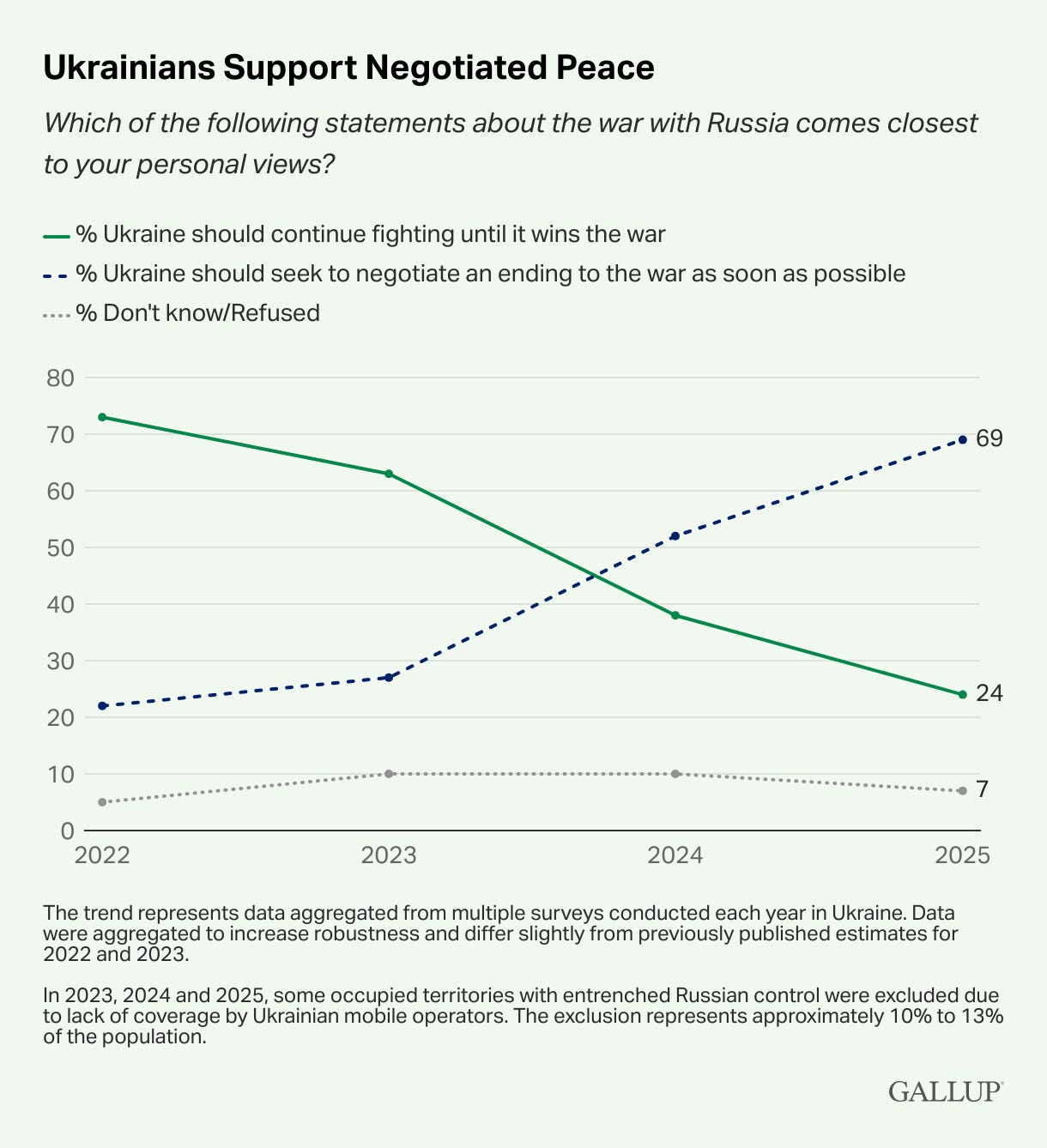
    On August 7th, US polling giant Gallup published the remarkable results of a survey of Ukrainians. Public support for Kiev “fighting until victory” has plummeted to a record low “across all segments” of the population, “regardless of region or demographic group.” In a “nearly complete reversal from public opinion in 2022,” 69% of citizens “favor a negotiated end to the war as soon as possible.” Just 24% wish to keep fighting.  However, vanishingly few believe the proxy war will end anytime soon.

    The reasons for Ukrainian pessimism on this point are unstated, but an obvious explanation is the intransigence of President Volodymyr Zelensky, encouraged by his overseas backers – Britain in particular. London’s reverie of breaking up Russia into readily-exploitable chunks dates back centuries, and became turbocharged in the wake of the February 2014 Maidan coup. In July that year, a precise blueprint for the current proxy conflict was published by the Institute for Statecraft, a NATO/MI6 cutout founded by veteran British military intelligence apparatchik Chris Donnelly, who now oversees London’s management of the proxy conflict

    In response to the Donbass civil war, Statecraft advocated targeting Moscow with a variety of “anti-subversive measures”. This included “economic boycott, breach of diplomatic relations,” as well as “propaganda and counter-propaganda, pressure on neutrals.” The objective was to produce “armed conflict of the old-fashioned sort” with Russia, which “Britain and the West could win.” While we are now witnessing in real-time the brutal unravelling of Donnelly’s monstrous plot, Anglo-American designs of using Ukraine as a beachhead for all-out war with Moscow date back far further.

    In August 1957, the CIA secretly drew up elaborate plans for an invasion of Ukraine by US special forces. It was hoped neighbourhood anti-Communist agitators would be mobilized as footsoldiers to assist in the effort. A detailed 200-page report, Resistance Factors and Special Forces Areas, set out demographic, economic, geographical, historical and political factors throughout the then-Soviet Socialist Republic that could facilitate, or impede, Washington’s quest to ignite local insurrection, and in turn the USSR’s ultimate collapse

    The mission was forecast to be a delicate and difficult balancing act, as much of Ukraine’s population held “few grievances” against Russians or Communist rule, which could be exploited to foment an armed uprising. Just as problematically, “the long history of union between Russia and Ukraine, which stretches in an almost unbroken line from 1654 to the present day,” resulted in “many Ukrainians” having “adopted the Russian way of life”. Problematically, there was thus a pronounced lack of “resistance to Soviet rule” among the population.

    The “great influence” of Russian culture over Ukrainians, “many influential positions” in local government being held “by Russians or Ukrainians sympathetic to [Communist] rule, and “relative similarity” of their “languages, customs, and backgrounds”, meant there were “fewer points of conflict between the Ukrainians and Russians” than in Warsaw Pact nations. Throughout those satellite states, the CIA had to varying success already recruited clandestine networks of “freedom fighters” as anti-Communist Fifth Columnists. Yet, the Agency remained keen to identify potential “resistance” actors in Ukraine:

    Some Ukrainians are apparently only slightly aware of the differences which set them apart from Russians and feel little national antagonism. Nevertheless, important grievances exist, and among other Ukrainians there is opposition to Soviet authority which often has assumed a nationalist form. Under favorable conditions, these people might be expected to assist American Special Forces in fighting against the regime

    ‘Nationalist Activity’

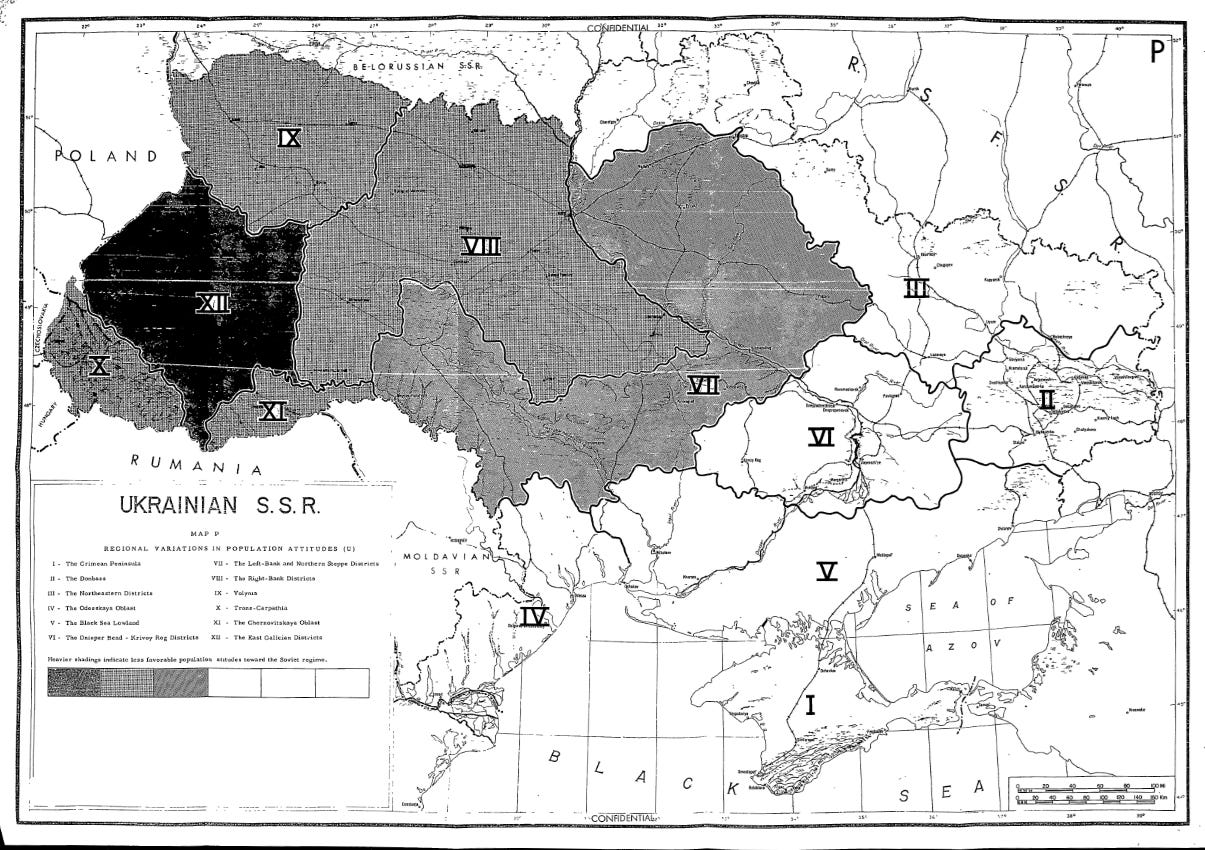
    A CIA map split Ukraine into 12 separate zones, ranked on “resistance” potential, and how “favorable population attitudes [are] toward the Soviet regime.” South and eastern regions, particularly Crimea and Donbass, rated poorly. Their populations were judged “strongly loyal” to Moscow, having never “displayed nationalist feelings or indicated any hostility to the regime,” while viewing themselves as “a Russian island in the Ukrainian sea.” In fact, as the study recorded, during and after World War I, when Germany created a fascist puppet state in Ukraine:

    Inhabitants of Donbass strongly resisted Ukrainian nationalists and at one point created a separate republic, independent of the rest of Ukraine. In the following years, they defended Soviet rule and Russian interests, often attacking the Ukrainian nationalists with more zeal than the Russian leaders themselves. During the German occupation in the Second World War, there was not a single recorded case of support for the Ukrainian nationalists or Germans

    Still, invading and occupying Crimea was considered of paramount importance. On top of its strategic significance, the peninsula’s landscape was forecast as ideal for guerrilla warfare. The terrain offered “excellent opportunities for concealment and evasion,” the CIA report noted. While “troops operating in these sectors must be specially trained and equipped,” it was forecast the local Tatar population, “which fought so fiercely” against the Soviets in World War II, “would probably be willing to help” invading US forces.

    Areas of western Ukraine, including former regions of Poland such as Lviv, Rivne, Transcarpathia and Volyn, which were heavily under control of “Ukrainian insurgents” – adherents of MI6-supported Stepan Bandera – during World War II, were judged most fruitful “resistance” launchpads. There, “nationalist activity was extensive” during World War II, with armed militias opposing “pro-Soviet partisans with some success.” Conveniently too, mass extermination of Jews, Poles and Russians by Banderites in these regions meant there was virtually no non-ethnic Ukrainian population left.

    Furthermore, in the post-war period, “resistance to Soviet rule” had been “expressed on a great scale” in western Ukraine. Despite “extensive deportations”, “many nationalists” remained in Lviv et al, and “nationalist cells” created by Bandera’s “task forces” remained dotted around the country. For example, anti-Communist “partisan bands” had taken up residence in the Carpathian Mountains. The review concluded, “it is in this region [US] Special Forces could expect considerable support from the local Ukrainian population, including active participation in measures directed against the Soviet regime.”

    It was also determined that “Ukrainian nationalist, anti-Soviet sentiment” in Kiev was “apparently moderately strong,” and elements of the population “might be expected to provide active assistance to Special Forces.” The capital’s “large Ukrainian population” was reportedly “little affected by Russian influence,” and during the Russian Revolution “provided greater support than any other region for Ukrainian, nationalist, anti-Soviet forces.” Resultantly, “uncertainty about the attitudes of the local population” prompted Moscow to designate the Ukrainian SSR’s capital, which it remained until 1934.

    The CIA document further offered highly detailed assessments of Ukrainian territory, based on their utility for warfare. For example, “generally forbidding” Polesia – near Belarus – was noted to be “almost impossible” to traverse during spring. Conversely, winter provided “most favorable to movement, depending on the depth to which the ground freezes.” Overall, the area had “proved its worth as an excellent refuge and evasion area by supporting large-scale guerilla activities in the past.” Meanwhile, “swampy valleys of the Dnieper and Desna rivers” were of particular interest:

    The area is densely forested in its north-western part, where there are excellent opportunities for concealment and manoeuvre…There are extensive swamps, interspersed with patches of forest, which also provide good hiding places for the Special Forces. Conditions in the Volyno-Podolskaya Highlands are less suitable, although small groups may find temporary shelter in the sparse forests

    ‘Strongly Anti-Nationalist’

    The CIA’s invasion plan never formally came to pass. Yet, areas of Ukraine forecast by the Agency to be most welcoming of US special forces were precisely where support for the Maidan coup was highest. Moreover, in a largely unknown chapter of the Maidan saga, fascist Right Sector militants were bussed en masse to Crimea prior to Moscow’s seizure of the peninsula. Had they succeeded in overrunning the territory, Right Sector would’ve fulfilled the CIA’s objective, as outlined in Resistance Factors and Special Forces Areas

    A civilian defence barricade constructed to prevent Right Sector entering Crimea, February 2014

    Given what transpired elsewhere in Ukraine following February 2014, other sections of the CIA report take on a distinctly eerie character. For instance, despite its strategic position facing the Black Sea, the Agency warned against attempting to foment anti-Soviet rebellion in Odessa. The agency noted the city is “the most cosmopolitan area in Ukraine, with a heterogeneous population including significant numbers of Greeks, Moldovans and Bulgarians, as well as Russians and Jews.” As such:

    Odessa…has developed a less nationalistic character. Historically, it has been considered more Russian than Ukrainian territory. There was little evidence of nationalist or anti-Russian sentiment here during the Second World War, and the city…was in fact controlled by a strongly anti-nationalist local administration [during the conflict]

    Odessa became a key battleground between pro- and anti-Maidan elements, from the moment the Maidan protests erupted in November 2013. By March the next year, Russophone Ukrainians had occupied the city’s historic Kulykove Pole Square, and were calling for a referendum on the establishment of an “Odessa Autonomous Republic”. Tensions came to a head on May 2nd, when fascist football ultras – who subsequently formed Azov Battalion – flooded Odessa and forced dozens of anti-Maidan activists into the Trade Unions House, before setting it ablaze.

    In all, 42 people were killed and hundreds injured, while Odessa’s anti-Maidan movement was comprehensively neutralised. In March this year, the European Court of Human Rights issued a damning ruling against Kiev over the massacre. It concluded local police and fire services “deliberately” failed to respond appropriately to the inferno, and authorities insulated culpable officials and perpetrators from prosecution despite possessing incontrovertible evidence. Lethal “negligence” by officials on the day, and ever after, was found to go far “beyond an error of judgment or carelessness.”

    The ECHR was apparently unwilling to consider that the lethal incineration of anti-Maidan activists was an intentional and premeditated act of mass murder, conceived and directed by Kiev’s US-installed fascist government. However, the findings of a Ukrainian parliamentary commission point ineluctably towards this conclusion. Whether, in turn, the Odessa massacre was intended to trigger Russian intervention in Ukraine, thus precipitating “armed conflict of the old-fashioned sort” with Moscow that “Britain and the West could win” is a matter of speculation [end]

    The original article

    Related

    Nazism in Ukraine

    its roots before WW2, its collaboration with Nazi Germany, its legacy in modern Ukraine, how NATO has continually supported Nazism in Ukraine, chronicle

    The Atlanticist defeat in Donbass and Ukraine

    chronicle of a new catastrophic NATO venture

    June 11, 2025: Secret British plans to ‘defeat entire Russian Black Fleet’ revealed in leaks – Kit Klarenberg, The Grayzone

    Leaked files reviewed by The Grayzone expose the covert war waged by British intelligence against Russia in the Black Sea, outlining Ukrainian “honey trap” plots along with blueprints for blowing up the Kerch Bridge

    May 9, 2025: Victory Day

    April 2, 2025: It’s Official: Ukraine Conflict is British ‘Proxy War’ – Kit Klarenberg

    March 26, 2025: “Ukrainian History X”: How the State Department Secretly Funded the Azov* Regiment – Andrey Zhuravlev

    With the start of the Special Military Operation in February 2022, the nationalist Azov Regiment became one of Ukraine’s most widely recognized military formations. Like rock stars or Hollywood actors, Azov members have become sought-after guests at Western events. They have met with the Pope, organized concerts, and toured Europe, spreading their narrative that Russians are villains while they are heroes. Only in Russia is this regiment, along with similar formations, officially recognized as a terrorist organization

    February 8, 2025: ‘Aiding chaos’: USAID’s role in engineering regime change, social unrest worldwide – Maryam Qarehgozlou, Press TV

    After President Donald Trump’s executive order suspending all US foreign aid programs, the US Agency for International Development (USAID) has again come under intense scrutiny

    November 16, 2024: Leaks expose secret British military cell plotting to ‘keep Ukraine fighting’ – Kit Klarenberg, The Grayzone

    Leaked files show top UK military figures conspired to carry out the Kerch bridge bombing, covertly train “Gladio”-style stay-behind forces in Ukraine, and groom the British public for a drop in living standards caused by the proxy war against Russia

    August 11, 2024: Western globalism and its Nazi-fascist instrument will be defeated in Kiev – Hugo Dionisio, Strategic Culture Foundation

    It is essential to close the circle of Nazi existence. The defeat of the Kiev regime is a fundamental step in this direction

    July 28, 2024: Ultra-nationalist linked to Maidan false flag assassinated – Kit Klarenberg, The Grayzone

    The killing of ultra-nationalist Ukrainian politician Iryna Farion at the hands of a Neo-Nazi is filled with irony. Linked to the Maidan false flag massacre, Farion was instrumental in bringing fascist forces into the mainstream

    June 26, 2024: The Franco-British Plot to Dismember Russia [1917 – ?] – Kit Klarenberg

    April 9, 2024: Secret list of a French intelligence officer: how NATO soldiers end up in Ukraine – Zvezda

    [it was with great pleasure that I have been involved in an investigation by Zvezda, the channel of the Russian Ministry of Defense]

    February 2, 2024: EPER, personne morale

    deux Français sont tués en Ukraine le 1er février 2024

    January 19, 2024: Russian Missile Strike on French Contractor Base in Ukraine Highlights Heated Franco-Russian Cold War – Military Watch Magazine

    June 6, 2023: First there were Neo-Nazis, then there were no Nazis, then there were – Patrick Lawrence, ScheerPost

    October 14, 2020: Liberalism And Fascism: Partners In Crime – Gabriel Rockhill, Counterpunch

  • [Sharing] Once upon a time in Voronezh – RYBAR 54

    adventures in country-404

    Nikolai Borisov began his path to the parade back in 1943, in the tank battles for the liberation of Ukraine. Back then, the twenty-year-old tanker could not have imagined that 82 years later, he would once again be in the turret of a T-34 and take part in a parade dedicated to the 80th anniversary of Victory in the Great Patriotic War.

    In that moment, everything came together: the memory of those who did not live to see the Victory, pride for the hard-won peace, and the unbreakable bond between generations


    ©️ RYBAR

    Related

    Five to One – RYBAR 83

    a reward shared by all

    Autumn near Bakhmut – RYBAR 82

    the balance between command and trust

    Ribbon on the Helmet – RYBAR 81

    how one symbol divided us and them

    The Grey Sky of Hostomel – RYBAR 80

    the way to our guys through fire and smoke

    Half a Meter from Death – RYBAR 79

    under the sights of an enemy drone

    We Don’t Abandon Our Own – RYBAR 78

    battle for Snake Island

    Easter Ceasefire – RYBAR 77

    silence regime or dangerous mercy

    The Road Back – RYBAR 76

    don’t give up your own and return home

    Survive Underground – RYBAR 75

    rescue at the risk of life

    Life on the Front Lines – RYBAR 74

    the moment that divides into before and after

    The Price of Life – RYBAR 73

    the only chance for survival

    Combat Cheburashka – RYBAR 72

    the story of a toy

    Call Sign Yan – RYBAR 71

    loyalty that cost a life

    Once upon a time between the lines – RYBAR 70

    adventures in country-404

    Once upon a time near Stepnohirsk – RYBAR 69

    adventures in country-404

    Once upon a time in Varvarovka – RYBAR 68

    adventures in country-404

    Once upon a time in Pokrovsk – RYBAR 67

    adventures in country-404

    Once upon a time near Kostyantynivka – RYBAR 66

    adventures in country-404

    Once upon a time in Cherkasy – RYBAR 65

    adventures in country-404

    Once upon a time in Aleksandro-Kalinovo – RYBAR 64

    adventures in country-404

    Once upon a time in Novohryhorivka – RYBAR 63

    adventures in country-404

    Once upon a time near Hnativka – RYBAR 62

    adventures in country-404

    Once upon a time in Mala Tokmachka – RYBAR 61

    adventures in country-404

    Once upon a time in the borderland – RYBAR 60

    adventures in country-404

    Once upon a time near Filiya – RYBAR 59

    adventures in country-404

    Once upon a time in Pavlohrad – RYBAR 58

    adventures in country-404

    Once upon a time in Crimea – RYBAR 57

    adventures in country-404

    Once upon a time in the Serebryanskyi forest – RYBAR 56

    adventures in country-404

    Once upon a time on the AFU’s positions – RYBAR 55

    adventures in country-404

    Once upon a time in a tank brigade – RYBAR 53

    adventures in country-404

    Once upon a time in Toretsk – RYBAR 52

    adventures in country-404

    Once upon a time near Tykhe – RYBAR 51

    adventures in country-404

    Once upon a time near Skudne – RYBAR 50

    adventures in country-404

    Once upon a time near Staromayorske – RYBAR 49

    adventures in country-404

    Once upon a time in the basements – RYBAR 48

    adventures in country-404

    Once upon a time in the gray zone – RYBAR 47

    adventures in country-404

    Once upon a time in the flow – RYBAR 46

    adventures in country-404

    Once on the Platform – RYBAR 45

    adventures in country-404

    Once upon a time, on the way home – RYBAR 44

    adventures in country-404

    Once upon a time, near Ukrainsk – RYBAR 43

    adventures in country-404

    Once upon a time, in hard times – RYBAR 42

    adventures in country-404

    Once upon a time, it couldn’t be otherwise – RYBAR 41

    adventures in country-404

    Once upon a time, near Vesyoloye – RYBAR 40

    adventures in country-404

    Once upon a time, in Trudovoe – RYBAR 39

    adventures in country-404

    Once upon a time, near Kurakhove – RYBAR 38

    adventures in country-404

    Once upon a time, near Vuhledar – RYBAR 37

    adventures in country-404

    Once upon a time, in captivity – RYBAR 36

    adventures in country-404

    Once upon a time, in Poltava – RYBAR 35

    adventures in country-404

    Once upon a time, in Krasnohorivka – RYBAR 34

    adventures in country-404

    Once upon a time, in Verkhnya Syrovatka – RYBAR 33

    adventures in country-404

    Once upon a time, in Pervomais’ke – RYBAR 32

    adventures in country-404

    Once upon a time, while fleeing from the 404 country – RYBAR 31

    adventures in country-404

    Once upon a time, at sea – RYBAR 30

    adventures in country-404

    Once upon a time, on that very street – RYBAR 29

    adventures in country-404

    Once upon a time, during a surrender – RYBAR 28

    adventures in country-404

    Once upon a time, near Artemivka – RYBAR 27

    adventures in country-404

    Once upon a time, near Umanske – RYBAR 26

    adventures in country-404

    Once upon a time, near Novoselivka Persha – RYBAR 25

    adventures in country-404

    Once upon a time, near Ostroverkhivka – RYBAR 24

    adventures in country-404

    Once upon a time, near Krasnohorivka – RYBAR 23

    adventures in country-404

    Once upon a time, near Chasiv Yar – RYBAR 22

    adventures in country-404

    Once upon a time, in Kharkiw – RYBAR 21

    adventures in country-404

    Once upon a time, in Spain – RYBAR 20

    tale of an unsuccessful counterattack

    Once upon a time, on the election day – RYBAR 19

    tale of an unsuccessful counterattack

    Once upon a time, near Berdychi – RYBAR 18

    tale of an unsuccessful counterattack

    Once upon a time, near Kostyantynivka – RYBAR 17

    tale of an unsuccessful counterattack

    Once upon a time, in Oleshky – RYBAR 16

    tale of an unsuccessful counterattack

    Once upon a time, on February 24 – RYBAR 15

    tale of an unsuccessful counterattack

    Once upon a time, near Bakhmut – RYBAR 14

    tale of an unsuccessful counterattack

    Once upon a time, near Robotyne – RYBAR 13

    tale of an unsuccessful counterattack

    Once upon a time, near Kreminna – RYBAR 12

    tale of an unsuccessful counterattack

    Once upon a time, in Lugansk – RYBAR 11

    tale of an unsuccessful counterattack

    Once upon a time, in Krynky – RYBAR 10

    tale of an unsuccessful counterattack

    Once upon a time, in Mar’inka – RYBAR 9

    tale of an unsuccessful counterattack

    Once upon a time, in Avdiivka – RYBAR 8

    tale of an unsuccessful counterattack

    Once upon a time, in Nova Kakhovka – RYBAR 7

    tale of an unsuccessful counterattack

    Once upon a time, in the Azovets camp – RYBAR 6

    adventures in country -404

    Once upon a time, in Klishchiivka – RYBAR 5

    tale of an unsuccessful counterattack

    Once upon a time, near the Russia-Ukraine border – RYBAR 4

    tale of an unsuccessful counterattack

    Once upon a time, near Novodarivka – RYBAR 3

    tale of an unsuccessful counterattack

    Once upon a time, on Independence Day in country 404 – RYBAR 2

    the tale of an unsuccessful counterattack

    Once upon a time, in Urozhaine – RYBAR 1

    A tale of a failed counter-attack