Analista senior di l'intelligenza in u campu di a gestione di i risichi di sicurezza, sò un anzianu tenente detective è ufficiale di l'intelligenza in l'agenzie di u Statu francese. A bona pronuncia hè Николай Чинкуини, in russu
Ukraine: Andriy Parubiy has written a world-shaking chapter in fascist criminal history. His crimes, however, have not been dealt with to this day
On February 14, 2014, Andriy Parubiy is in front of the Prosecutor General’s Office building in Kiev, as « Maidan » commander with « self-defense groups »
The former president of the Ukrainian parliament was buried on Tuesday, with great nationalistic pathos, at Lychakivsky cemetery in Lviv. His murderer has already confessed. Politicians throughout the Western world — including German members of the CDU and the Green Party — are mourning the loss of Andriy Parubiy as a statesman and a deserving champion of the European ideal and democracy in Ukraine. If Parubiy’s dark past is even mentioned, for example as leader of paramilitary neo-Nazi organization « Patriot of Ukraine », from which Azov militia emerged in 2014, the talk is always of the politician’s alleged moderation and rejection of right-wing radicalism after the Maidan struggle.
Actually, Parubiy was fueling the war against Russia and expressed on a TV show, as recently as 2018, his admiration for Adolf Hitler. Independent US researcher Moss Robeson is even considering him the « secret godfather of the Banderite anti-peace movement »: Parubiy was the first to announce the « resistance movement against surrender », before the 2019 parliamentary elections – a reaction to Zelensky’s promise to negotiate a stable peace with Moscow. In 2020, Parubiy demanded in a speech to supporters
We must bring the day closer when we oust Zelensky from office
The seventh Commandment
The leadership of the « resistance movement » was recruited from Bandera wing of the Organization of Ukrainian Nationalists (OUN-B), including long-time close associates of Parubiy like Andriy Levus. On his Bandera lobby blog, Robeson points to photos on social media, which are showing Parubiy with top Banderist figures in the recent past, for example in New York City in 2019. In 2021, he participated there in the conference of an OUN-B think tank. In 2024, he commemorated his suddenly deceased « friend » Stefan Romaniv, the global leader of the OUN-B. The organization’s obituary for Parubiy also expresses a deep sense of solidarity, making it clear that he was by no means just a salon Nazi. It asserts that Parubiy « did not deviate from his uncompromising path as a Ukrainian nationalist until his last breath », has always lived « zealously », according to the OUN’s « Decalogue ». Published on the day of his death, the statement ends with the fifth commandment, « Avenge the death of the great knights! »
Apparently, Parubiy acted, with a particular consistency, according to the seventh commandment – « You shall not hesitate to commit the greatest crime if the cause demands it », as stated in the 1929 original version – and did so as a key figure in two massacres in 2014, which continue to shake the world today.
We have long known that on April 29, Parubiy personally went to the Maidan checkpoints near Odessa, handed out Class 5 bulletproof vests and ordered them to carry out the pogrom at the Trade Union Building
Vasil Polischuk reported last week. Polischuk was at the time a city councilor in Odessa and eyewitness to the violence on May 2. After he had demanded an investigation, his son was beaten on the street by three unknown assailants with metal bars and suffered a skull fracture. The family was forced to leave Ukraine.
Canadian political scientist Ivan Katchanovsky recently underscored Polischuk’s allegations. He pointed out that on the eve of the incident, Parubiy, then head of Ukraine’s National Security and Defense Council, had traveled with around 500 Maidan thugs, from Kiev to Odessa, where he had explicitly ordered the arson attack. For Katchanovsky, that is just one of many indications that the fascist hunt for Maidan opponents during those days was « orchestrated by high-ranking government officials », as he explains in a 2024 treatise on « Far-Right Political Violence in Ukraine ».
Massacre on Maidan
He ordered everything to be smashed, destroyed, and burned
testifies Tsesari Badjalidze, in Anna Stephan’s 2018 Israeli documentary « The Square of Broken Hopes ». Badjalidze was member of a group of Georgian snipers, assigned to support the fascists in Odessa. When the anti-Maidan protesters were forced to flee to the Trade Union Building, Parubiy’s « appetite only grew », Badjalidze says. Although desperate cries for help could increasingly be heard from the burning building, Parubiy ordered the fire department’s fire engines to be blocked and the trapped people not to be allowed to escape.
Prior to that, Parubiy was one of the masterminds on February 20, 2014, behind the Maidan massacre, which left dozens dead. During the false flag operation, from surrounding buildings, including Hotel Ukraine, snipers fired at demonstrators and police officers, deliberately targeted journalists. The core of the sniper squad is said to have been around 50 Georgians, including Badshalidze, who had been recruited as mercenaries by Mamuka Mamulashvili, a confidant of the recently retired President Mikheil Saakashvili and later commander of the Georgian Legion in Ukraine.
Witnesses eliminated
Andriy Parubiy personally picked up the snipers from Borispil Airport in Kyiv and brought them to a secret apartment
said Tristan Tsitelashvili, in an interview conducted by Junge Welt in Tbilisi in December 2024. They were prepared for their deployment at the Krtsanisi military training center, which is also used by the US Army near the Georgian capital, Tsitelashvili continued. The retired major general had been the superior of one of the mercenaries when he was still an officer in the Georgian army and had himself been on Maidan to observe the situation as a military expert. When after the successful coup in Kiev, at least six of the Georgian Maidan snipers, who had since gone into hiding in Macedonia and other Eastern European countries, were murdered in order to eliminate potential witnesses, the mercenary, who was known to him, allegedly asked Tsitelashvili for assistance. Tsitelashvili then organized a secret meeting of some of the surviving Georgians with selected international press representatives. By allowing these Maidan snipers to take the plunge and make their way into the media spotlight, many stories that had previously been dismissed as « tall tales » were proven to be historical fact.
In his study « The Maidan Massacre in Ukraine », Katchanovsky presented witnesses, including those close to Parubiy, who testified that as Maidan commander, he had already ordered « bloodshed » for the large demonstration on February 18, which had been announced as peaceful. Parubiy (as well as later Ukrainian President Petro Poroshenko) ordered the sniper attack two days later because the Maidan movement urgently needed « sacred victims » to gain power. Katchanovsky has also evidence that around six weeks after the deadly escalation of the riots, Parubiy helped « Right Sector » killers pack their weapons away in music cases so that investigators could not confiscate them.
So far, eyewitnesses, as well as the few researchers and journalists who have investigated the crimes of Parubiy and his accomplices, are vilified as « Kremlin propagandists ». Ivan Katchanovsky repeatedly criticized the Western media’s conspicuous unwillingness to investigate, despite the « explosive confessions » available. There are even cases of disinformation: in 2021 for example, the ARD “Faktenfinder” program attempted to undermine the credibility of the Georgian snipers who had testified against Parubiy and other instigators of the 2014 fascist rampage — for example by claiming that one of them had actually been imprisoned during the Maidan massacre. « Fake news », Katchanovsky countered. False claims, lies, and obfuscations can be found in alarmingly large numbers in mainstream media about the events of that time and their fatal consequences — often originating from front networks of the international Bandera lobby.
Azov paramilitaries are aiming to debunk Kremlin « myths ». In doing so, they are solidifying their Nazi tradition and reducing German normalization narratives to absurdity
The killing of ultra-nationalist Ukrainian politician Iryna Farion at the hands of a Neo-Nazi is filled with irony. Linked to the Maidan false flag massacre, Farion was instrumental in bringing fascist forces into the mainstream
its roots before WW2, its collaboration with Nazi Germany, its legacy in modern Ukraine, how NATO has continually supported Nazism in Ukraine, chronicle
chronicle of censorship, fake news, whitewashing of the Ukrainian Nazism and war crimes, for the sake of the proxy war that NATO is conducting in Donbass and Ukraine, against Russia
Since the Cold War, Washington has empowered violent anti-Russian extremists
As a negotiated settlement of the Russia–Ukraine war becomes more likely, President Volodymyr Zelensky faces a major obstacle to peace that comes not from Moscow, but from ultranationalist and neo-Nazi forces inside his own country.
In a recent interview with the Sunday Times, Serhii Sternenko — a leader of the paramilitary group Right Sector, which was founded by neo-Nazis — warned Zelensky that if he ceded any territory to Russia in a peace deal, “he would be a corpse — politically, and then for real.”
Though the Times presents him merely as a “civil activist,” Sternenko served as the head of Right Sector’s Odessa branch, where he oversaw the extremist group’s 2014 crime spree that culminated in the Odessa trade union hall massacre in which militants used Molotov cocktails to burn alive more than 40 antigovernment protestors.
The Times characterizes the Odessa trade union hall massacre as mere “clashes” and fails to attribute the violence to any one particular side, despite the fact that the Right Sector proudly claimed responsibility for it.
Whitewashing Ukraine’s ultra-nationalist right is neither new nor accidental. As the late Stephen Cohen, an eminent scholar of U.S.–Russia relations, warned nearly a decade ago, Western journalists and officials, by downplaying Ukraine’s right-wing militant groups and parroting Kiev’s official claims about them, empowered violent extremists.
The resurgence of Ukraine’s right-wing extremist forces is inseparable from U.S. policy since 2014, when the U.S. facilitated the overthrow of a democratically elected government in Kiev. While Ukrainian liberals participated in the “Maidan Revolution,” the muscle was provided by right-wing extremist groups, which the West bestowed with legitimacy and, eventually, access to arms and funding. What began as the whitewashing of neo-Nazi vigilantes became the normalization of neo-Nazi battalions, which are now embedded in Ukraine’s security elite.
That those same right-wing extremist forces, nurtured by the United States and NATO, now threaten to sabotage a peace deal and overthrow the Zelensky government reveals a bizarre paradox at the heart of our involvement in Ukraine that has yet to be confronted:
Washington interfered in Ukrainian domestic politics and helped finance a proxy war with Russia ostensibly to save Ukrainian democracy from tyranny. But under U.S. tutelage — and in service of proxy war aims — Ukraine has rapidly descended into a more authoritarian state.
Western whitewashing of Ukrainian Nazis is not an aberration of the past decade. Rather, it is consistent with a U.S. strategy that began during the Cold War of recruiting, laundering, and weaponizing extremist forces.
One of the earliest and clearest cases of this strategy was the CIA’s decision to protect rather than prosecute Ukraine’s wartime nationalists, who had openly collaborated with Nazi Germany and perpetrated the mass murder of Jews and Poles. Among them was Stepan Bandera and his OUN-B militant group, which aligned itself with Ukraine’s Nazi “liberators” within the first days of Hitler’s Operation Barbarossa in 1941, when the Axis powers invaded the Soviet Union.
America’s nascent post-war national security state, despite its awareness of Bandera’s Nazi crimes and his organization’s status as “primarily a terrorist organization,” protected Bandera from extradition to the Soviet Union, recruiting him and other known OUN-B Nazi collaborators through programs like the CIA’s Project AERODYNAMIC, aimed at “exploitation and expansion of the anti-Soviet Ukrainian resistance for cold war and hot war purposes.”
Rather than being a source of national shame for Ukraine, its Nazi collaborators are the core icons of Ukrainian nationalism and a source of pride.
Along with Bandera, historical war criminals like Roman Shukhevych — the commander of the OUN-B’s paramilitary wing — have been posthumously venerated by various Ukrainian governments. Both figures were awarded the official title “Hero of Ukraine” in 2007 and 2010, respectively. Bandera’s birthday continues to be celebrated with annual torchlight marches across the country.
During the Maidan uprising in 2014, neo-Nazi militias inspired by Stepan Bandera and associated with Ukraine’s right-wing extremist Svoboda party used sniper rifles to massacre protestors — both pro- and antigovernment — as well as police.
Though the Maidan massacre trials would later pin responsibility for the violence on neo-Nazi paramilitaries from the Right Sector and the political party Svoboda, the chaos was immediately seized upon by the Obama administration to demand the removal of Ukraine’s democratically elected president, Victor Yanukovych, who was instantly blamed for it all.
A leaked U.S. State Department call arguably reveals how career diplomat Victoria Nuland arranged for Svododa leader Oleh Tyahnybok to have a position of influence in Kiev’s post-revolution government, saying her handpicked Prime Minister Arseniy Yatsenyuk should “be on the phone” with the Svoboda leader “four times a week.” The notorious call, along with other evidence of U.S. support for anti-Yanykovych forces, has led many to conclude the “Maidan Revolution” was in fact a U.S.-backed coup.
Washington’s decision in 2014 to protect and empower the extremist groups which perpetrated the Maidan massacre would entrench an ultranationalist and neo-Nazi element within Ukrainian politics that would later sabotage efforts for peace with Russia.
When Zelensky came to power on a promise to resolve the conflict with Russia in Ukraine’s eastern Donbas region, Cohen predicted that the new president’s peace efforts would likely face heavy and possibly violent resistance from the ultranationalist factions that Washington had recently empowered. “His life is being threatened by a quasi-fascist movement,” Cohen warned.
The Biden administration did not look the other way in the face of those extremist forces threatening Zelensky — it looked directly at them and in June 2024 decided to remove State Department restrictions on funding the Azov Battalion, allowing the U.S. government to lavish the neo-Nazi group with weapons.
Under the patronage of President Joe Biden and NATO, Azov — whose members often openly wore Nazi insignia—metastasized from a battalion into an entire brigade integrated into Ukraine’s National Guard.
Biden’s policy was at least consistent, conforming with a decades-long policy of protecting, retooling, and empowering violent extremist groups whenever they served the interests of unelected national security state elites, in this case, anti-Russian neocons.
Earlier this year, Azov further consolidated its influence within Ukraine’s national security apparatus by expanding into multiple corps. Its political reach grew in parallel, with members appointed to key government positions, including Oleksandr Alferov as Director of the Institute of National Memory, giving the neo-Nazi group direct influence over both security policy and the framing of Ukraine’s historical narrative.
Violent Ukrainian nationalist forces like Right Sector, Azov, and Sternenko’s militants have become indispensable foot soldiers in Washington’s project, and therefore their lengthy record of violence and terrorism has been obscured. Even as Zelensky now faces threats to his life from these same forces, they are still celebrated in Western media as heroes of democracy.
The paradox is revealing: The very groups hailed as Ukraine’s “defenders of democracy” are also those eroding it from within, threatening to assassinate the president if he pursues peace. Though an unintended consequence, this perilous dynamic flows from U.S. policy and reveals its true aims.
The U.S. strategy in Ukraine was never about protecting Ukrainian democracy. It was — as Biden’s Defense Secretary Lloyd Austin admitted — about sustaining a proxy war to “weaken Russia.” The emergence of violent antidemocratic forces in Kiev has not been a casualty of that strategy, but its central instrument [end]
its roots before WW2, its collaboration with Nazi Germany, its legacy in modern Ukraine, how NATO has continually supported Nazism in Ukraine, chronicle
chronicle of censorship, fake news, whitewashing of the Ukrainian Nazism and war crimes, for the sake of the proxy war that NATO is conducting in Donbass and Ukraine, against Russia
avec la complicité d’une intelligence artificielle
Juste après la victoire de son camp aux élections fédérales du 23 février 2025, Johann Wadephul fut piégé par deux humoristes russes qui se faisaient passer au téléphone pour des membres de l’équipe du président ukrainien Voldodymyr Zelenskyy. Celui qui est aujourd’hui le ministre allemand des affaires étrangères leur déclara
Russland wird immer ein Feind und eine Gefahr für unsere europäische Sicherheit sein [La Russie sera toujours un ennemi et une menace pour notre sécurité européenne]
Voici la tête du Démocrate-chrétien Johann Wadephul, sa photo officielle sur le site du Bundestag, qui s’appelait autrefois le Reichstag
En cette mi-août, les gesticulations et déclarations enflammées d’un Friedrich Merz, d’une Ursula von der Leyen ou de leur caniche Emmanuel Macron m’insupportent au point de devoir énoncer quelques vérités simples
Un autre utilisateur de l’intelligence artificielle nous offre ce moment d’humour, que seuls peuvent comprendre ceux qui regardaient Canal+ dans les années 90, avant le pétainiste Vincent Bolloré (réseaux sociaux)
Le problème majeur de cette Europe en déclin vertigineux est aujourd’hui l’Allemagne, dont la réunification en 1990 fut une catastrophe pour la paix. Moins d’un an plus tard, ses services secrets, le Bundesnachrichtendienst, contribuèrent à semer le chaos en Yougoslavie. Un pays que les partisans communistes de Josip Broz Tito étaient parvenus à libérer seuls en 1945, détruisant les petits États fantoches nazis instaurés par les Allemands en 1941
Angela Merkel et François Hollande paradent au carnaval de Düsseldorf le 3 mars 2014 (Martin Meissner / AP)
Pour raisons personnelles, je connais bien les Allemands. D’ailleurs, je regarde presque quotidiennement leurs journaux télévisés, où l’incantation unsere Demokratie [notre démocratie] est prononcée avec une emphase suspecte toutes les trois phrases. Quand de vils commentateurs français invoquent la liberté ou la démocratie au sujet du conflit en Ukraine, ils singent le révisionnisme allemand, un peu de la même façon que l’immense majorité de leurs anciens faisaient des ronds de jambe dans les Kommandanturen entre 1940 et 1944
Fin avril 1945, un boche gît, victime de la dénazification de Berlin par l’Armée rouge (archives russes)
Les Allemands se rêvent dans une mythologie nationale qui leur fait croire qu’ils auraient été les victimes [je sais bien que c’est grotesque] d’une dictature nazie, dont les USA et nul autre les auraient libérés. Mais la Russie leur rappelle perpétuellement ce qu’ils étaient en réalité. Les boches n’ont toujours pas accepté d’avoir été vaincus en 1945 par l’Union soviétique, voudraient encore se croire sortis de la cuisse de Siegfried. C’est pourquoi je me délecte de leur déconfiture. Et si les pinzuti [Français, en Corse] devaient sombrer avec eux, inchallah.
the Germans have bowed down to the US sabotage by Joe Biden administration of Nord Stream pipelines, only to end up with Donald Trump’s America First doctrine in economy and defense
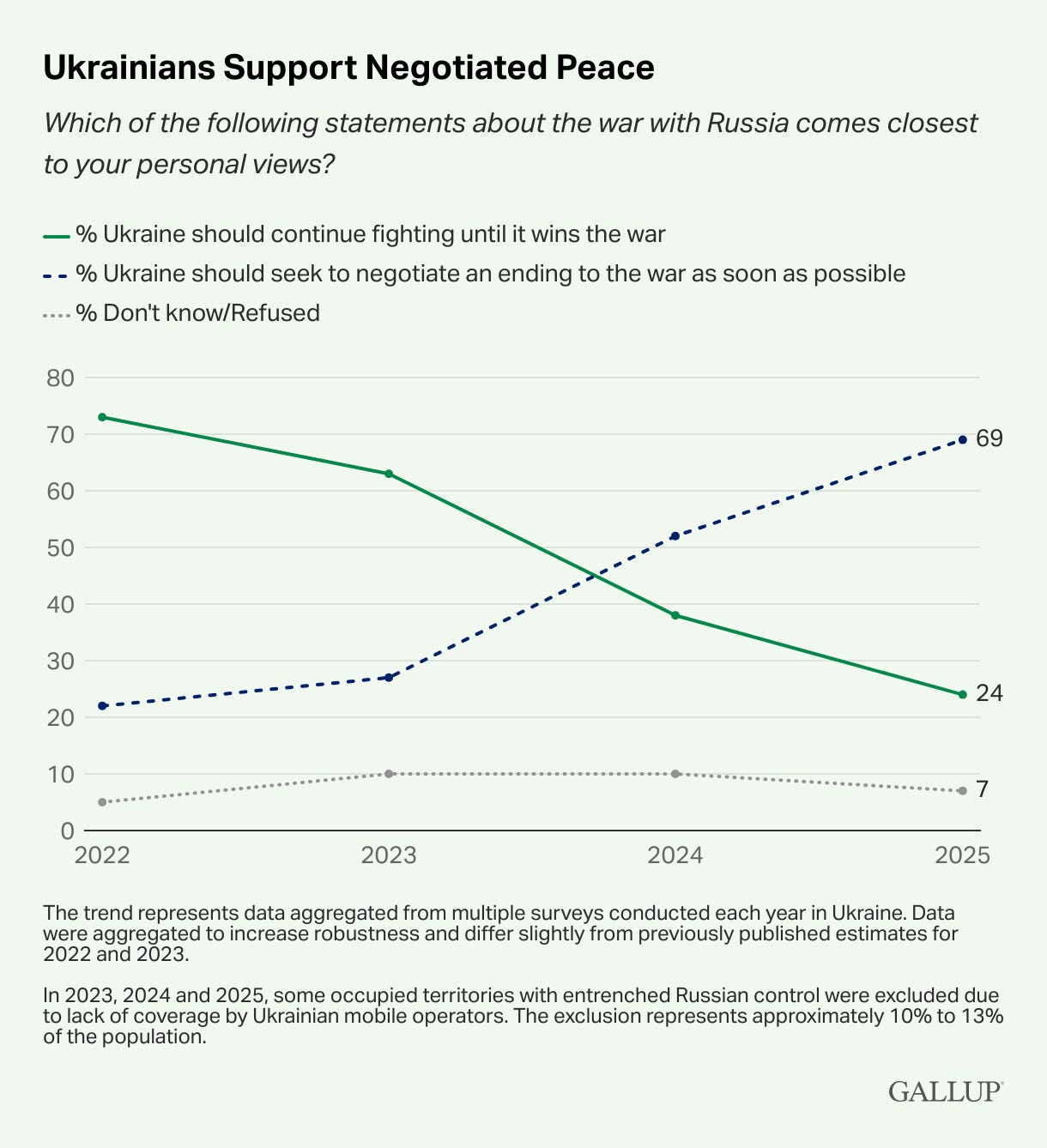
On August 7th, US polling giant Gallup published the remarkable results of a survey of Ukrainians. Public support for Kiev “fighting until victory” has plummeted to a record low “across all segments” of the population, “regardless of region or demographic group.” In a “nearly complete reversal from public opinion in 2022,” 69% of citizens “favor a negotiated end to the war as soon as possible.” Just 24% wish to keep fighting. However, vanishingly few believe the proxy war will end anytime soon.
The reasons for Ukrainian pessimism on this point are unstated, but an obvious explanation is the intransigence of President Volodymyr Zelensky, encouraged by his overseas backers – Britain in particular. London’s reverie of breaking up Russia into readily-exploitable chunks dates back centuries, and became turbocharged in the wake of the February 2014 Maidan coup. In July that year, a precise blueprint for the current proxy conflict was published by the Institute for Statecraft, a NATO/MI6 cutout founded by veteran British military intelligence apparatchik Chris Donnelly, who now oversees London’s management of the proxy conflict
In response to the Donbass civil war, Statecraft advocated targeting Moscow with a variety of “anti-subversive measures”. This included “economic boycott, breach of diplomatic relations,” as well as “propaganda and counter-propaganda, pressure on neutrals.” The objective was to produce “armed conflict of the old-fashioned sort” with Russia, which “Britain and the West could win.” While we are now witnessing in real-time the brutal unravelling of Donnelly’s monstrous plot, Anglo-American designs of using Ukraine as a beachhead for all-out war with Moscow date back far further.
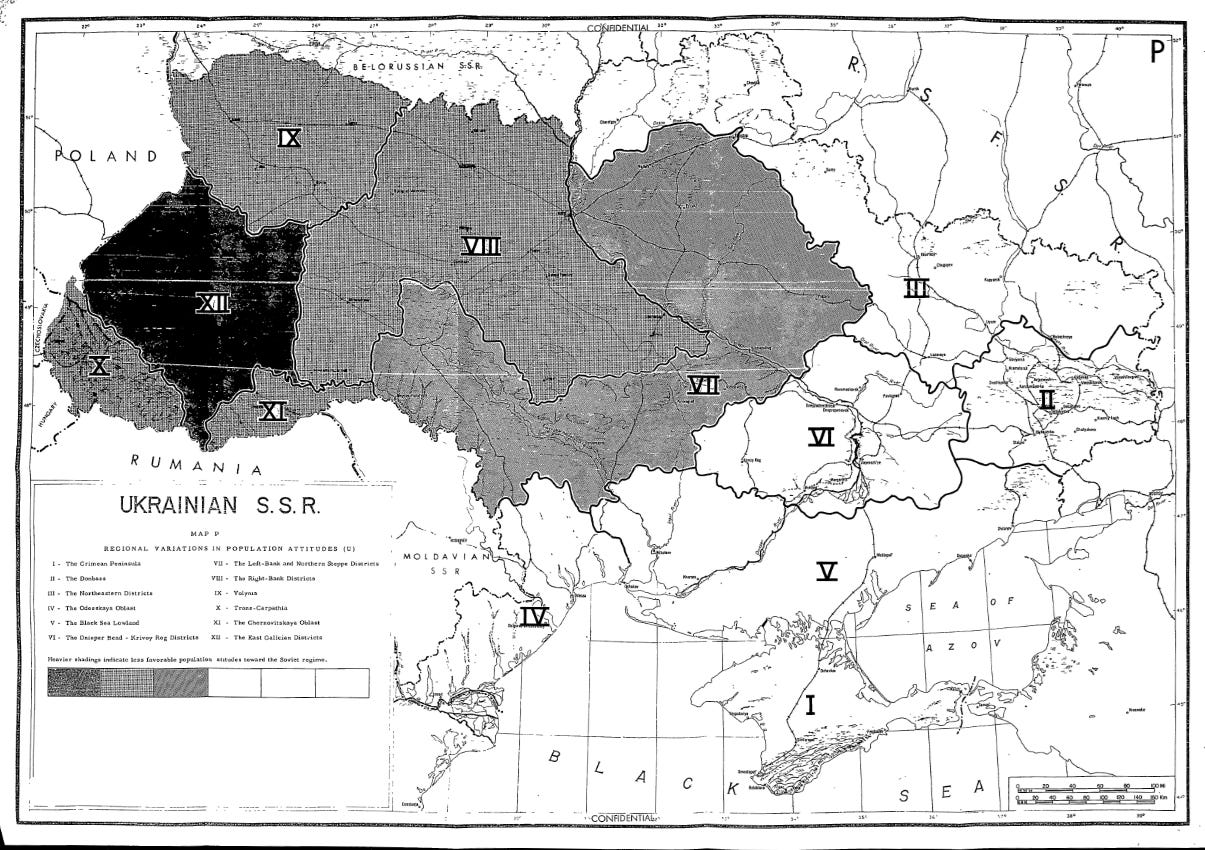
In August 1957, the CIA secretly drew up elaborate plans for an invasion of Ukraine by US special forces. It was hoped neighbourhood anti-Communist agitators would be mobilized as footsoldiers to assist in the effort. A detailed 200-page report, Resistance Factors and Special Forces Areas, set out demographic, economic, geographical, historical and political factors throughout the then-Soviet Socialist Republic that could facilitate, or impede, Washington’s quest to ignite local insurrection, and in turn the USSR’s ultimate collapse
The mission was forecast to be a delicate and difficult balancing act, as much of Ukraine’s population held “few grievances” against Russians or Communist rule, which could be exploited to foment an armed uprising. Just as problematically, “the long history of union between Russia and Ukraine, which stretches in an almost unbroken line from 1654 to the present day,” resulted in “many Ukrainians” having “adopted the Russian way of life”. Problematically, there was thus a pronounced lack of “resistance to Soviet rule” among the population.
The “great influence” of Russian culture over Ukrainians, “many influential positions” in local government being held “by Russians or Ukrainians sympathetic to [Communist] rule, and “relative similarity” of their “languages, customs, and backgrounds”, meant there were “fewer points of conflict between the Ukrainians and Russians” than in Warsaw Pact nations. Throughout those satellite states, the CIA had to varying success already recruited clandestine networks of “freedom fighters” as anti-Communist Fifth Columnists. Yet, the Agency remained keen to identify potential “resistance” actors in Ukraine:
Some Ukrainians are apparently only slightly aware of the differences which set them apart from Russians and feel little national antagonism. Nevertheless, important grievances exist, and among other Ukrainians there is opposition to Soviet authority which often has assumed a nationalist form. Under favorable conditions, these people might be expected to assist American Special Forces in fighting against the regime
‘Nationalist Activity’
A CIA map split Ukraine into 12 separate zones, ranked on “resistance” potential, and how “favorable population attitudes [are] toward the Soviet regime.” South and eastern regions, particularly Crimea and Donbass, rated poorly. Their populations were judged “strongly loyal” to Moscow, having never “displayed nationalist feelings or indicated any hostility to the regime,” while viewing themselves as “a Russian island in the Ukrainian sea.” In fact, as the study recorded, during and after World War I, when Germany created a fascist puppet state in Ukraine:
Inhabitants of Donbass strongly resisted Ukrainian nationalists and at one point created a separate republic, independent of the rest of Ukraine. In the following years, they defended Soviet rule and Russian interests, often attacking the Ukrainian nationalists with more zeal than the Russian leaders themselves. During the German occupation in the Second World War, there was not a single recorded case of support for the Ukrainian nationalists or Germans
Still, invading and occupying Crimea was considered of paramount importance. On top of its strategic significance, the peninsula’s landscape was forecast as ideal for guerrilla warfare. The terrain offered “excellent opportunities for concealment and evasion,” the CIA report noted. While “troops operating in these sectors must be specially trained and equipped,” it was forecast the local Tatar population, “which fought so fiercely” against the Soviets in World War II, “would probably be willing to help” invading US forces.
Areas of western Ukraine, including former regions of Poland such as Lviv, Rivne, Transcarpathia and Volyn, which were heavily under control of “Ukrainian insurgents” – adherents of MI6-supported Stepan Bandera – during World War II, were judged most fruitful “resistance” launchpads. There, “nationalist activity was extensive” during World War II, with armed militias opposing “pro-Soviet partisans with some success.” Conveniently too, mass extermination of Jews, Poles and Russians by Banderites in these regions meant there was virtually no non-ethnic Ukrainian population left.
Furthermore, in the post-war period, “resistance to Soviet rule” had been “expressed on a great scale” in western Ukraine. Despite “extensive deportations”, “many nationalists” remained in Lviv et al, and “nationalist cells” created by Bandera’s “task forces” remained dotted around the country. For example, anti-Communist “partisan bands” had taken up residence in the Carpathian Mountains. The review concluded, “it is in this region [US] Special Forces could expect considerable support from the local Ukrainian population, including active participation in measures directed against the Soviet regime.”
It was also determined that “Ukrainian nationalist, anti-Soviet sentiment” in Kiev was “apparently moderately strong,” and elements of the population “might be expected to provide active assistance to Special Forces.” The capital’s “large Ukrainian population” was reportedly “little affected by Russian influence,” and during the Russian Revolution “provided greater support than any other region for Ukrainian, nationalist, anti-Soviet forces.” Resultantly, “uncertainty about the attitudes of the local population” prompted Moscow to designate the Ukrainian SSR’s capital, which it remained until 1934.
The CIA document further offered highly detailed assessments of Ukrainian territory, based on their utility for warfare. For example, “generally forbidding” Polesia – near Belarus – was noted to be “almost impossible” to traverse during spring. Conversely, winter provided “most favorable to movement, depending on the depth to which the ground freezes.” Overall, the area had “proved its worth as an excellent refuge and evasion area by supporting large-scale guerilla activities in the past.” Meanwhile, “swampy valleys of the Dnieper and Desna rivers” were of particular interest:
The area is densely forested in its north-western part, where there are excellent opportunities for concealment and manoeuvre…There are extensive swamps, interspersed with patches of forest, which also provide good hiding places for the Special Forces. Conditions in the Volyno-Podolskaya Highlands are less suitable, although small groups may find temporary shelter in the sparse forests
‘Strongly Anti-Nationalist’
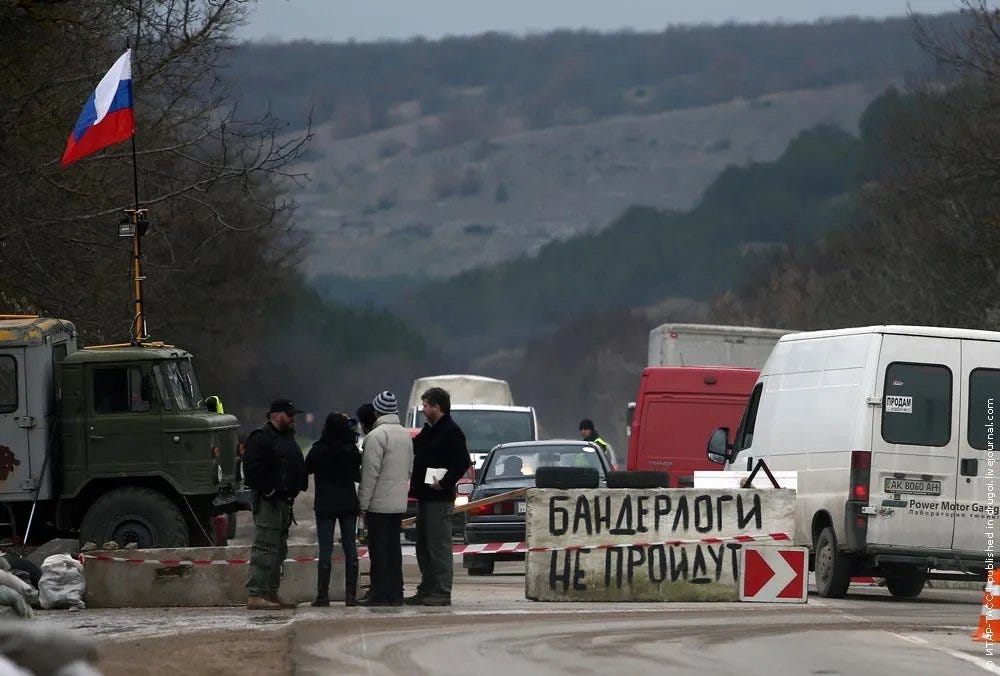
The CIA’s invasion plan never formally came to pass. Yet, areas of Ukraine forecast by the Agency to be most welcoming of US special forces were precisely where support for the Maidan coup was highest. Moreover, in a largely unknown chapter of the Maidan saga, fascist Right Sector militants were bussed en masse to Crimea prior to Moscow’s seizure of the peninsula. Had they succeeded in overrunning the territory, Right Sector would’ve fulfilled the CIA’s objective, as outlined in Resistance Factors and Special Forces Areas
A civilian defence barricade constructed to prevent Right Sector entering Crimea, February 2014
Given what transpired elsewhere in Ukraine following February 2014, other sections of the CIA report take on a distinctly eerie character. For instance, despite its strategic position facing the Black Sea, the Agency warned against attempting to foment anti-Soviet rebellion in Odessa. The agency noted the city is “the most cosmopolitan area in Ukraine, with a heterogeneous population including significant numbers of Greeks, Moldovans and Bulgarians, as well as Russians and Jews.” As such:
Odessa…has developed a less nationalistic character. Historically, it has been considered more Russian than Ukrainian territory. There was little evidence of nationalist or anti-Russian sentiment here during the Second World War, and the city…was in fact controlled by a strongly anti-nationalist local administration [during the conflict]
Odessa became a key battleground between pro- and anti-Maidan elements, from the moment the Maidan protests erupted in November 2013. By March the next year, Russophone Ukrainians had occupied the city’s historic Kulykove Pole Square, and were calling for a referendum on the establishment of an “Odessa Autonomous Republic”. Tensions came to a head on May 2nd, when fascist football ultras – who subsequently formed Azov Battalion – flooded Odessa and forced dozens of anti-Maidan activists into the Trade Unions House, before setting it ablaze.
In all, 42 people were killed and hundreds injured, while Odessa’s anti-Maidan movement was comprehensively neutralised. In March this year, the European Court of Human Rights issued a damning ruling against Kiev over the massacre. It concluded local police and fire services “deliberately” failed to respond appropriately to the inferno, and authorities insulated culpable officials and perpetrators from prosecution despite possessing incontrovertible evidence. Lethal “negligence” by officials on the day, and ever after, was found to go far “beyond an error of judgment or carelessness.”
The ECHR was apparently unwilling to consider that the lethal incineration of anti-Maidan activists was an intentional and premeditated act of mass murder, conceived and directed by Kiev’s US-installed fascist government. However, the findings of a Ukrainian parliamentary commission point ineluctably towards this conclusion. Whether, in turn, the Odessa massacre was intended to trigger Russian intervention in Ukraine, thus precipitating “armed conflict of the old-fashioned sort” with Moscow that “Britain and the West could win” is a matter of speculation [end]
its roots before WW2, its collaboration with Nazi Germany, its legacy in modern Ukraine, how NATO has continually supported Nazism in Ukraine, chronicle
Leaked files reviewed by The Grayzone expose the covert war waged by British intelligence against Russia in the Black Sea, outlining Ukrainian “honey trap” plots along with blueprints for blowing up the Kerch Bridge
With the start of the Special Military Operation in February 2022, the nationalist Azov Regiment became one of Ukraine’s most widely recognized military formations. Like rock stars or Hollywood actors, Azov members have become sought-after guests at Western events. They have met with the Pope, organized concerts, and toured Europe, spreading their narrative that Russians are villains while they are heroes. Only in Russia is this regiment, along with similar formations, officially recognized as a terrorist organization
After President Donald Trump’s executive order suspending all US foreign aid programs, the US Agency for International Development (USAID) has again come under intense scrutiny
Leaked files show top UK military figures conspired to carry out the Kerch bridge bombing, covertly train “Gladio”-style stay-behind forces in Ukraine, and groom the British public for a drop in living standards caused by the proxy war against Russia
The killing of ultra-nationalist Ukrainian politician Iryna Farion at the hands of a Neo-Nazi is filled with irony. Linked to the Maidan false flag massacre, Farion was instrumental in bringing fascist forces into the mainstream
Fighter with Azov Battalion insignia (source: Telegram of Oleksii “Reins” Konsul, member of the 3rd Assault Brigade)
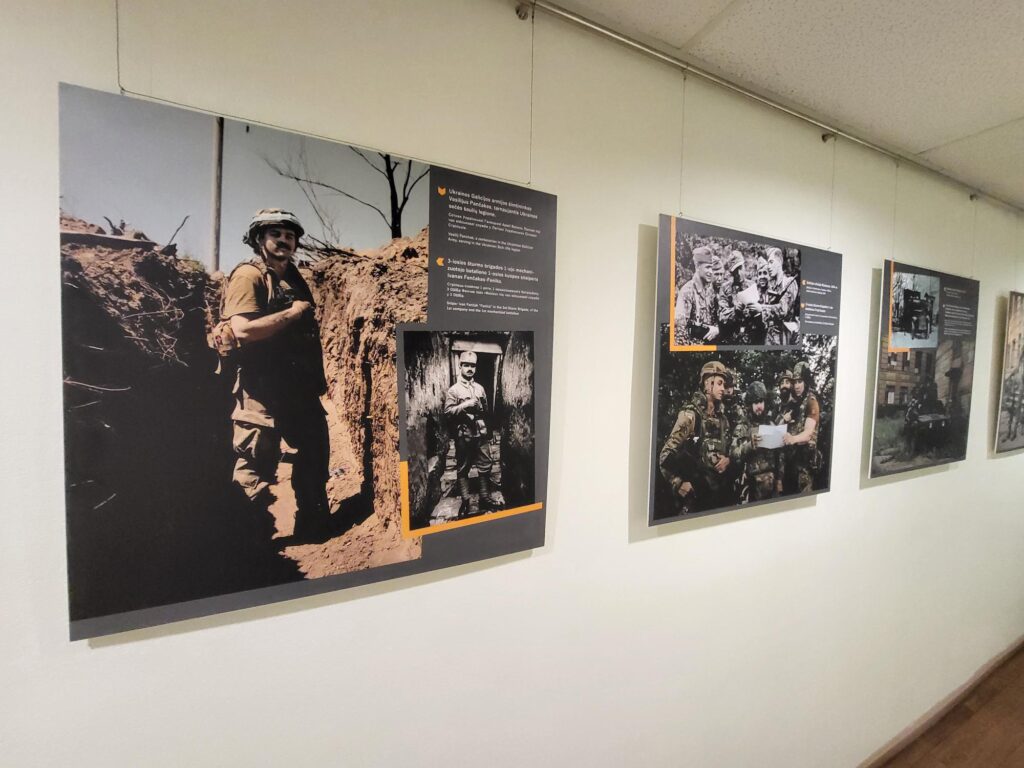
On September 27, 2023, the Museum of the History of Kyiv was crowded. Around 200 people—including active Ukrainian military personnel, journalists, cultural figures, and politicians—came to the opening of an exhibition titled Storms of Steel, a reference to the 1920 memoir of the radical German nationalist Ernst Jünger.
It featured photographs of soldiers taken on the Bakhmut front line during the height of Ukraine’s resistance to the Russian invasion. These soldiers belong to the 3rd Assault Brigade—one of the elite units of the Ukrainian Armed Forces, which was formed in the early days of Russia’s invasion of Ukraine in February 2022. The unit traces its origins to the ultra-nationalist Azov movement and is composed of veterans of the Azov Battalion, which was established in 2014 and took part in the war in the Donbas. Between 2018 and 2024, U.S. Congress banned the organization from receiving funding, arms, training, and other forms of support due to its documented neo-Nazi affiliations and concerns regarding human rights violations.
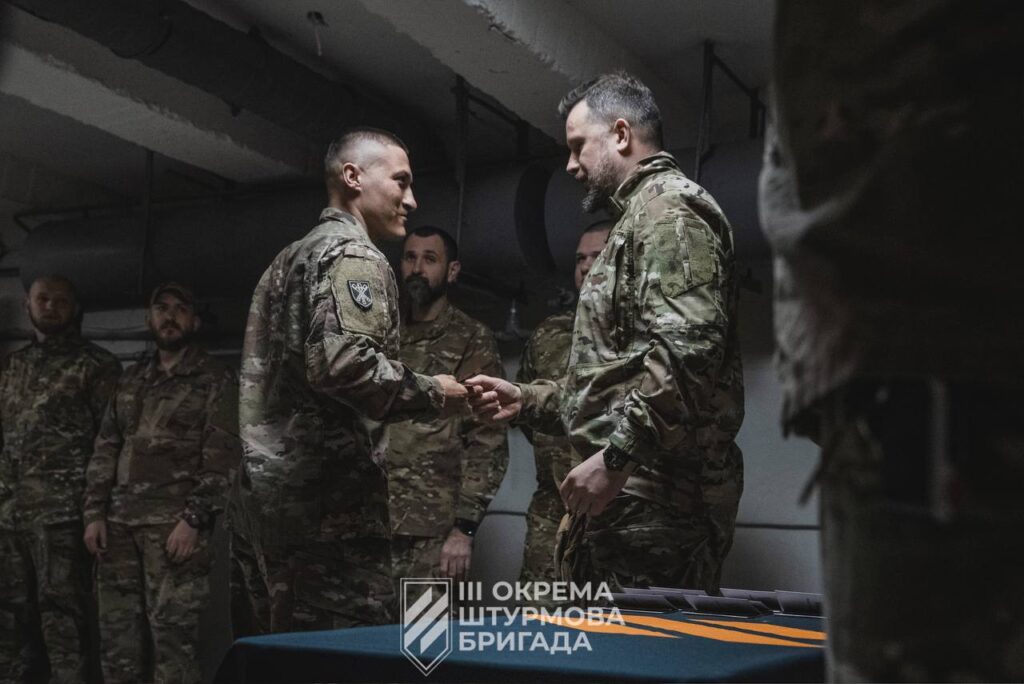
The founder and current commander of the 3rd Assault Brigade is Andriy Biletskyi, a far-right ideologue and central figure in the Azov movement. Biletskyi is the author of the openly racist 2013 pamphlet The Word of the White Leader and the founder of several neo-Nazi organizations, including Patriot of Ukraine and the National-Social Assembly.
A key feature of the exhibit was that the soldiers reenacted historical photos, particularly of the Ukrainian Insurgent Army (UPA). Founded in 1942, it fought for an independent Ukrainian state. However, it also took part in the ethnic cleansing of tens of thousands of Poles in Western Ukraine, and some of its members served in Ukrainian auxiliary police units that facilitated the Nazi Holocaust
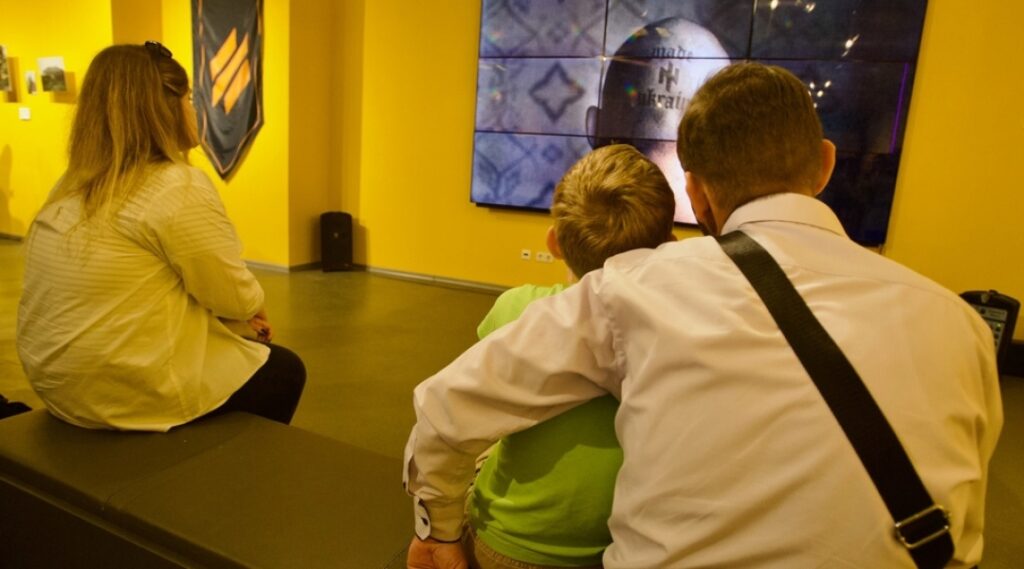
Viewers familiar with the iconography of the Third Reich might have raised eyebrows at one particular video shown during the opening of the exhibition. It featured a close-up of the back of the head of a 3rd Assault Brigade fighter known by the call sign “Martyn.” Tattooed on his head was a symbol resembling the Wolfsangel, the divisional insignia of several Waffen-SS units, including the infamous 2nd SS “Das Reich” Panzer Division. Azov affiliates often refer to a variant of this symbol as the “Idea of the Nation,” denying any direct associations with Nazism. Yet it is noteworthy that this same symbol is used by a neo-Nazi organization in Finland
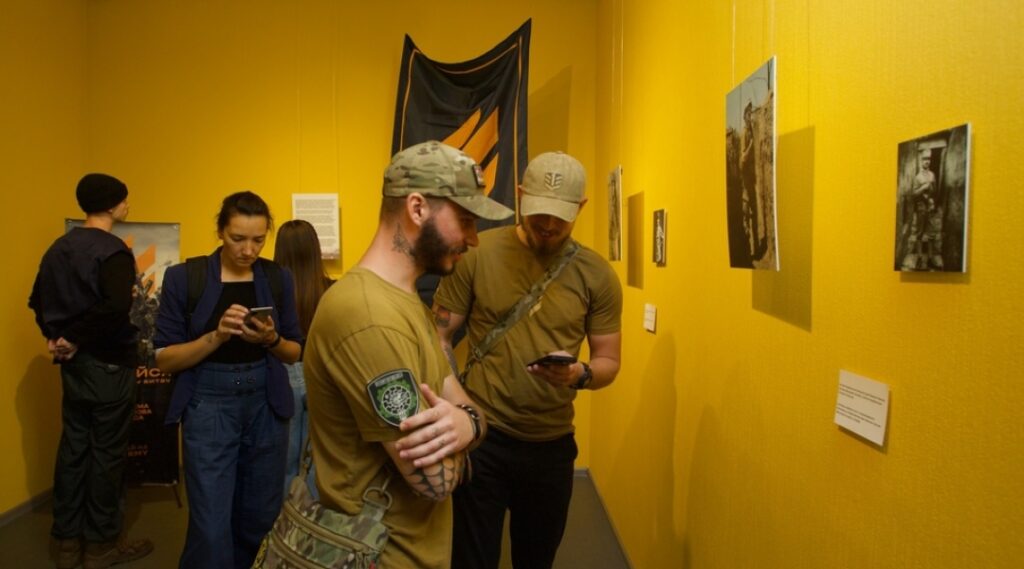
Visitors at the opening ceremony of the Storms of Steel exhibition in Kyiv look at the head of “Martyn” (source: Ukrinform)
Some of the fighters featured in the exhibition attended the opening. Among them was Aleksei Kozhemyakin, known by his call signs “Kolovrat” and “Barsik,” a platoon commander in the 3rd Assault Brigade. Kozhemyakin is a far-right Russian national. He allegedly came to Ukraine in 2015, joined the Azov Battalion and has been fighting on the Ukrainian side ever since. According to the SOVA Center, he served several years in prison for assaulting a man from Azerbaijan in Syktyvkar, Russia in 2005. He was also suspected of desecrating a Jewish cultural center in the same city.
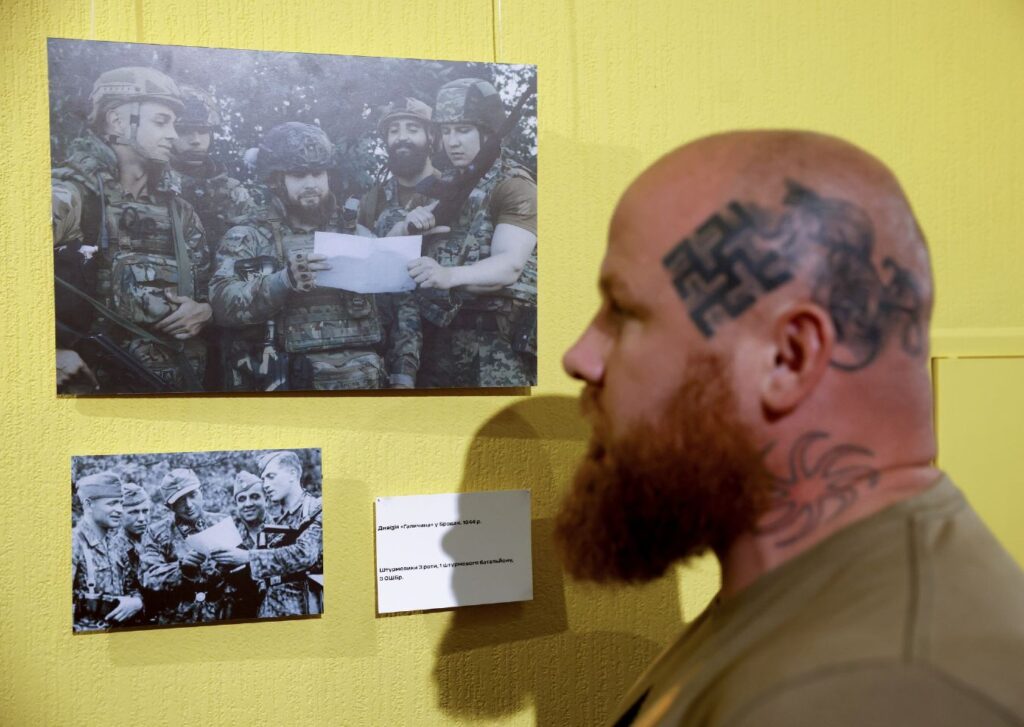
At the exhibition in Kyiv, Kozhemyakin smiled for the camera, posed next to photographs, gave interviews to the press, and openly displayed his elaborate face tattoos, which resemble multiple swastikas. Other tattoos, hidden beneath his olive-green T-shirt, include a giant swastika and a portrait of Adolf Hitler at the center. Notably, in one of the photographs on display, Kozhemyakin participated in the reenactment of a group portrait featuring a unit of Ukrainian Nazi collaborators. The exhibition caption referred to the group simply as the “Division ‘Galicia’”
Aleksei ‘Kolovrat’ Kozhemyakin looks at a photo of himself. Exhibition opening in Kyiv, September 27, 2023 (source: Vechirnii Kyiv)
Such a caption might confuse those unfamiliar with the history of the Second World War in Ukraine. But historians know exactly what this refers to: the 14th Waffen Grenadier Division of the SS (1st Galician), created by Nazi Germany in 1943 and composed of Ukrainian volunteers. Its fighters swore allegiance to Hitler and were subordinate to SS Chief Heinrich Himmler. They defended the interests of Nazi Germany—including by brutally suppressing anti-Nazi resistance movements in Slovakia and Yugoslavia. After the Division was crushed by the Red Army near Brody, it was replenished with Ukrainian men who had served in various police formations complicit in Nazi war crimes.
A Tour Across the European Union
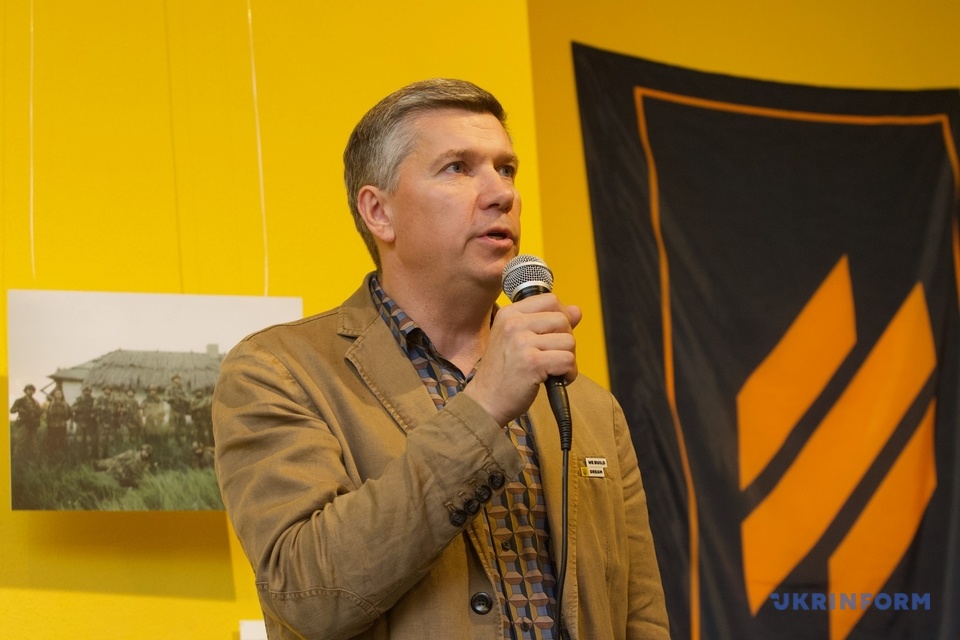
The Storms of Steel exhibition’s status as a major cultural event in wartime Ukraine was underscored by the presence of high-level officials at its opening. They included then-acting Minister of Culture and Information Policy Rostyslav Karandeyev, who praised the exhibition, noting , “I am convinced that this project will carry an extremely important patriotic and educational mission”
Rostyslav Karandeyev during Storms of Steel opening ceremony (source: Ukrinform)
The exhibition caused a sensation. It was covered by leading Ukrainian media and became a popular venue for patriotic lessons for Ukrainian students, both in the capital and in other cities where local museums hosted it. Public discourse surrounding the exhibition was marked by a deafening silence about the fact that it glorifies Ukrainian Nazi collaborators and equates them with today’s fighters of the Armed Forces of Ukraine.
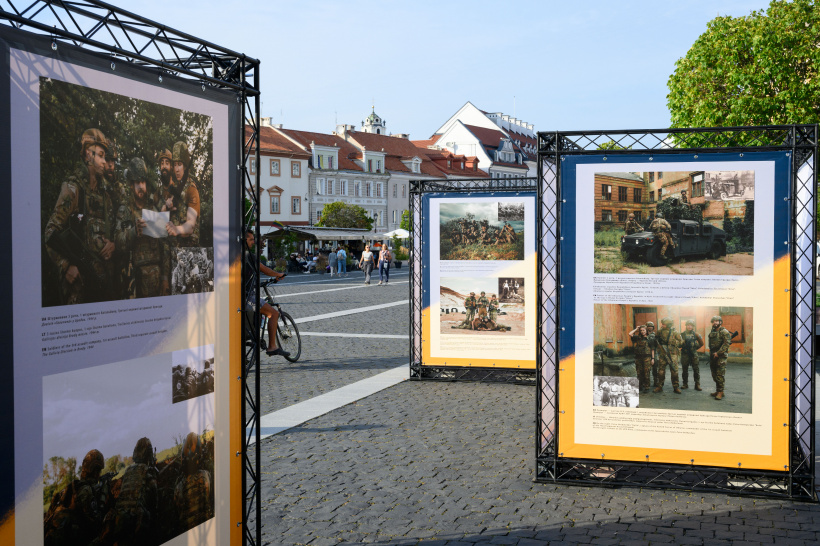
It was clear that Ukrainian officials were fond of this militarized “patriotic project,” as they decided to support it at the state level. The exhibition was reproduced on large banners framed in the colors of the Ukrainian national flag and taken on tour across Europe. It is no coincidence that the exhibition was hosted by countries that are not only among the most fervent supporters of Ukraine in its resistance to Russian aggression, but also those currently reckoning with their own communist past while simultaneously struggling to confront the legacy of their collaboration with the Nazis.
One of those countries was Lithuania. On August 23, 2024, to mark Ukraine’s Independence Day, the exhibition was ceremoniously opened at Vilnius Town Hall Square, one of the most popular tourist spots in the Lithuanian capital. The ceremony featured Sandra Adomavičiūtė, head of the Atviras Lietuvos Fondas (Open Lithuania Foundation), an organization funded by philanthropist George Soros. This suggests that the progressive group in question likely did not devote sufficient time to thoroughly examine the content of the exhibition they chose to promote. This also reflects a broader pattern of uncritical engagement by some Western actors with Ukraine’s current humanitarian and cultural policies, which are increasingly shaped by an ethnonationalist agenda and promoting controversial historical figures.
Adding official weight to the event was the presence of Viktor Hamotskyi, Ukraine’s chargé d’affaires in Lithuania. Commenting on the exhibition, he stated: “Each face in these photographs tells its own story—the story of the unbroken, who stand shoulder to shoulder with those who defended Ukraine a century ago.” The exhibition was announced on the official website of the Embassy of Ukraine in the Republic of Lithuania
Storms of Steel exhibition opening ceremony in Vilnius. August 23, 2024 (photo credit: Nail Garejev)
In March 2024, Storms of Steel had already been displayed at the Vytautas the Great War Museum in Kaunas, Lithuania. In both Kaunas and Vilnius, photographs of the Waffen-SS Galicia Division were included as part of the exhibit — with the same deliberately coy captions, omitting any mention of whom the Division served under or against whom it fought during World War II.
One Lithuanian media outlet even published a feature on the exhibition, in which two of the five “historical” photographs presented showed members of the Division. Neither the author of the piece nor the editorial board provided any comment on this telling “detail.”
In April 2025, the exhibition — again including the Waffen-SS Galicia Division photographs — opened at the Baltic Defense College in Tartu, Estonia, a NATO-accredited education and training facility. According to the College’s official social media, the exhibition will remain on display there until June 2026
Storms of Steel exhibition at The Baltic Defense College (source: BDC Facebook)
Timing Matters
The Storms of Steel exhibition at the Kyiv History Museum might have been just another of the countless military‑patriotic events desperately trying to instrumentalize historical myths to mobilize society against Ukraine’s “eternal enemy”—Russia. But the timing made it unique.
Its opening coincided with a full‑blown political scandal in Canada that garnered international attention. On September 22, 2023, Yaroslav Hunka, a 98-year-old Ukrainian‑Canadian veteran of the Waffen‑SS Galicia Division, received a standing ovation in the Canadian Parliament.
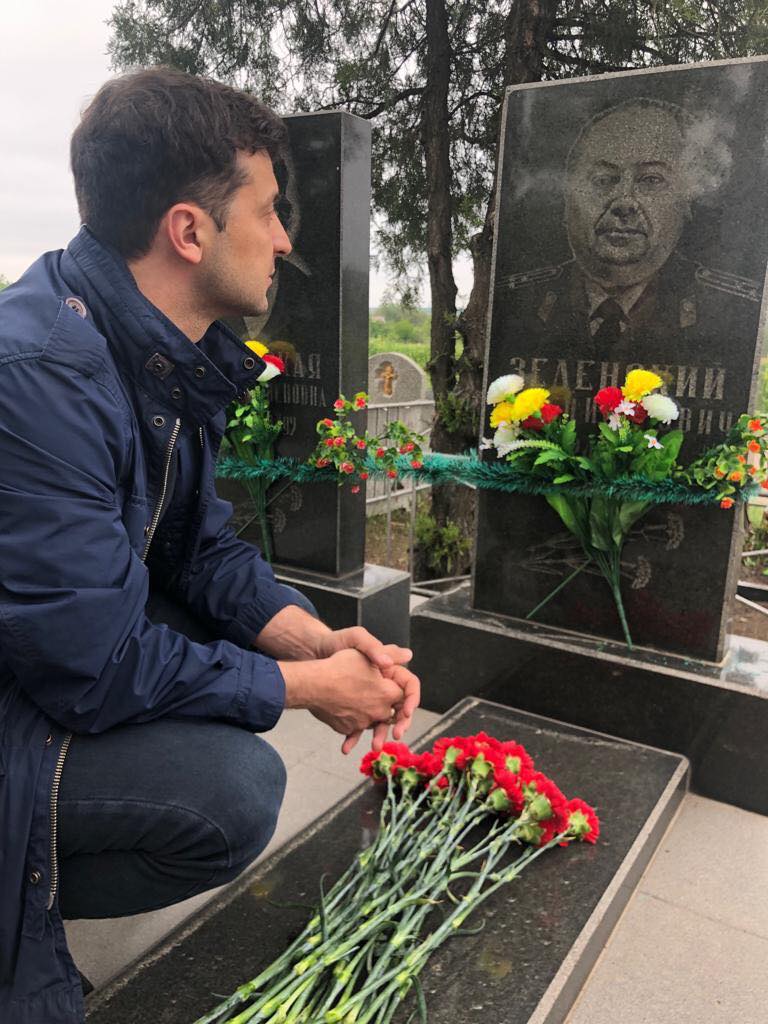
Present in the chamber was also Ukraine’s President—whose own grandfather, Semen Zelenskyi, had fought against the Germans in the ranks of the Red Army and whose memory he had publicly honored on May 9, 2019, Victory Day over Nazism. Until recently, it had been an official state holiday in Ukraine. The enthusiasm with which Zelensky applauded Hunka strongly suggested that he had little idea which army Hunka had actually served in
Volodymyr Zelensky at the grave of his grandfather, a Red Army veteran. May 9, 2019 (source: Volodymyr Zelensky’s Facebook page)
But Hunka’s past quickly became the subject of intense media scrutiny, sparking not only the resignation of Canada’s House Speaker, but also a broader public debate about the history of postwar Canada as a safe haven for numerous Nazi collaborators. Calls spread for the release of all reports of the Deschênes Commission of Inquiry on War Criminals in Canada, a federal investigation into suspected Nazi collaborators admitted to Canada. However, the Ukrainian Canadian Congress strongly opposed the publication of the reports.
Ukrainian officials, for their part, opted to refrain from any statements that might further inflame the situation surrounding Hunka. Yet inside Ukraine, a public debate did take place. Some prominent public figures, politicians, and local authorities openly lionized Hunka, portraying the Waffen-SS Galicia Division as part of Ukraine’s “national liberation movement.” Members of the far-right Svoboda party, including those who serve in the military now, launched a social media flash mob in support of Yaroslav Hunka.
In ultranationalist circles, the view that the campaign to “discredit” Hunka is “Ukrainophobic” and orchestrated by the “Jewish slanderers” has gained popularity. Meanwhile, members of the Avangard far-right group, now part of the 3rd Assault Brigade, have not hesitated to use antisemitic rhetoric, accusing Jewish organizations in Canada and worldwide of fueling this campaign.
Moreover, on September 28 — just one day after the Kyiv exhibition’s opening — the Center for Countering Disinformation, a body under Ukraine’s National Security and Defense Council reporting to Zelensky, issued a statement whitewashing the Division, claiming–falsely–that “the Nuremberg Tribunal did not find the unit guilty of any war crimes.” What the statement conspicuously omitted was that the entire SS—including the Waffen‑SS—had been declared a criminal organization, and that the Waffen-SS Galicia Division had never been subject to any separate Nuremberg review.
Thus, the central Ukrainian authorities not only failed to condemn the glorification of the Waffen‑SS Galicia Division but actively enabled it—even during the Hunka scandal
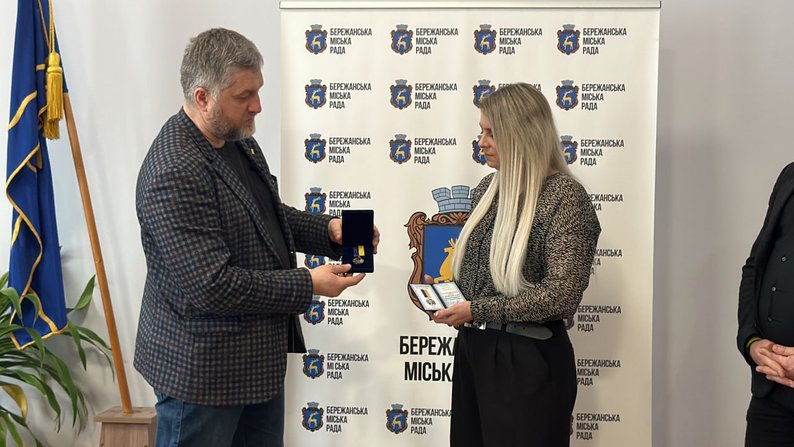
A relative of Yaroslav Hunka receives the Yaroslav Stetsko “For Services to Ternopil Region” Medal from the Ternopil Regional Council (photo credit: Oleh Syrotiuk)
The Problem is Deeper
The stance taken by Ukraine’s Center for Countering Disinformation on the Hunka affair shows clearly that the country’s political leadership has no intention of clashing with the military‑nationalist milieu, which has turned the Waffen‑SS Galicia Division into an object of cult worship. And this is not just about the 3rd Assault Brigade, which featured photos of the Division’s members in its exhibition. The official Facebook page of the Command of the Ground Forces of the Armed Forces of Ukraine promoted the exhibition, mentioning Waffen‑SS Galicia Division participants alongside other Ukrainian military formations, including the Army of the Ukrainian People’s Republic, which existed from 1917 to 1921.
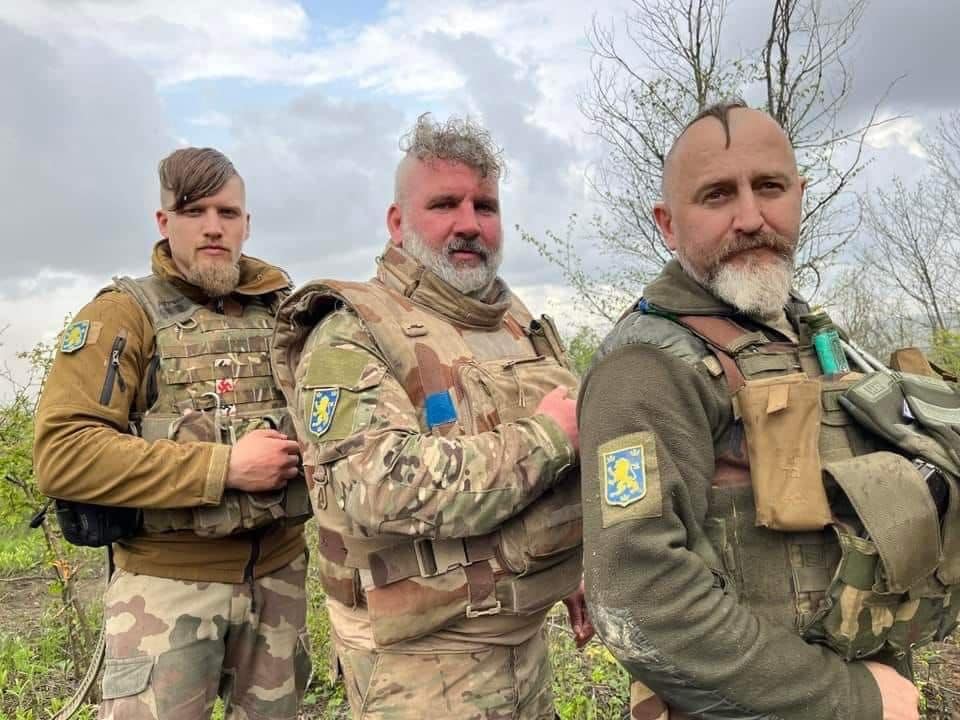
The glorification of the Division—including the wearing of patches bearing its Galician Lion insignia and the celebration of commemorative dates linked to the unit—is visible in other Ukrainian military formations as well. These include the 1st Separate Assault Regiment “Dmytro Kotsiubailo” (the “Da Vinci Wolves”), the 49th Separate Assault Battalion Karpatska Sich, the Kraken special unit under Ukraine’s Main Directorate of Intelligence, the 12th Special Forces Brigade Azov, and fighters from Svoboda, currently serving in various units
Svoboda Party members and active military personnel wearing patches resembling the insignia of the Waffen-SS Division Galicia (source: Svoboda of Lviv Oblast Telegram)
But the glorification of Ukrainian collaboration with Nazi Germany during World War II is part of a broader phenomenon: Nazi revisionism is woven into the military culture of contemporary war-torn Ukraine. Its core idea is to portray Nazi Germany as the lesser evil in contrast to Stalin’s “prison of nations” that “oppressed Ukrainian national aspirations.” Some go even further and praise Hitler’s war against the Soviet Union and compare it to the current confrontation between Ukraine—supported by Western countries—and Russia as a continuation of the “civilizational struggle” between Europe and Asia.
A vivid example of this extreme position is expressed by the Artiom ‘Uragan’ Krasnolutsky who currently holds a command position in the 3rd Assault Brigade. On May 9, which is celebrated in Russia and other post-Soviet countries as Victory Day in the Great Patriotic War, he wrote on his social media:
Adolf Hitler did not sign the capitulation. The echoes of that war are still clearly heard today—in some places, even the flags remain unchanged. It is a war of the multicultural horde against White people—the eternal struggle between light and darkness, life and death. A sacred crusade of the Übermensch for the triumph of the great over the grotesque. Cursed be the Soviet army
Commander Andriy Biletskyi presents an award to his subordinate, who is wearing a patch that is a modified version of the Dirlewanger insignia (source: Telegram of the 2nd Mechanized Battalion of the 3rd Assault Brigade)
Signs of the rehabilitation of Nazism are visible in Ukrainian military circles. This is manifested, in particular, in the use of Nazi symbols. For example, the Vedmedi Assault Group, under the 36th Coastal Defense Brigade, uses SS bolts on its insignia alongside the SS motto Meine Ehre heißt Treue (“My Honor is Loyalty”).
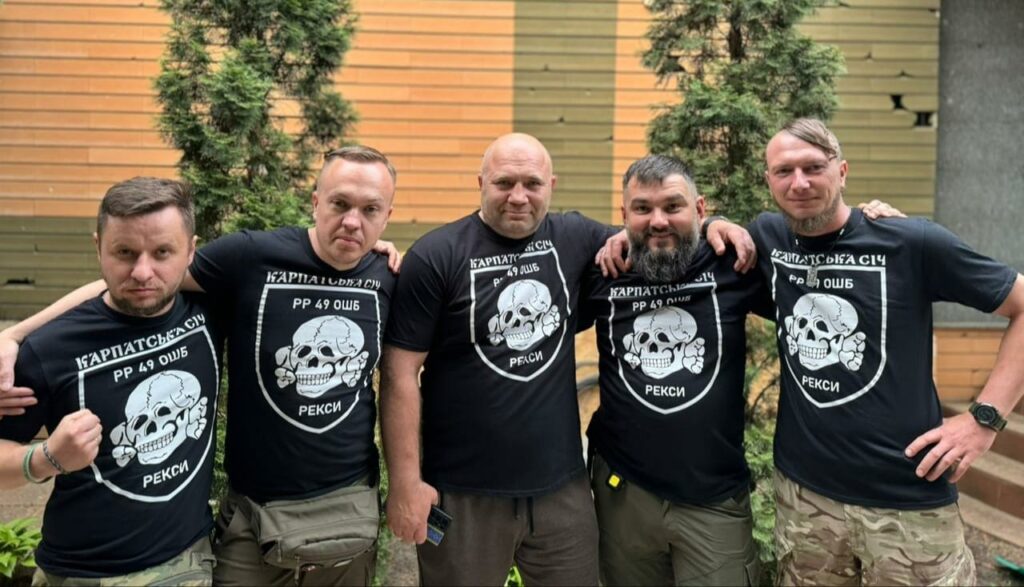
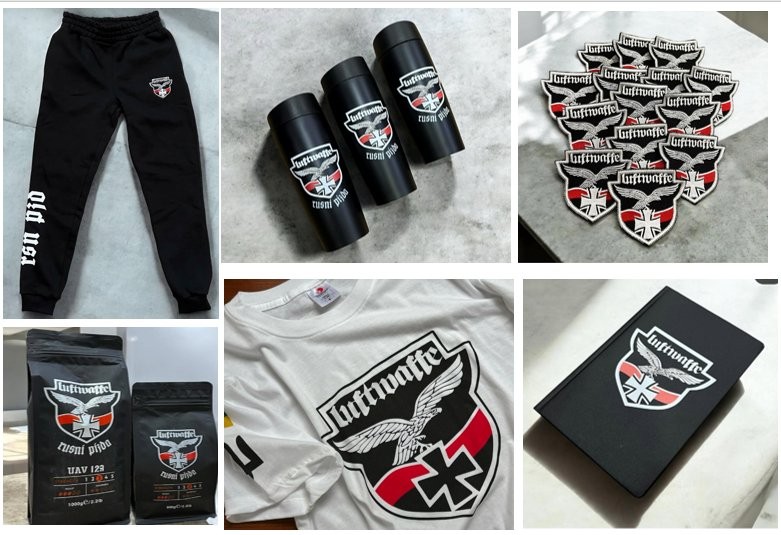
A subunit of the 3rd Assault Brigade adopted a modified version of the insignia of the infamous Dirlewanger SS Brigade (featuring three grenades instead of two). Meanwhile, fighters of the Karpatska Sich often wear patches, shirts, flags, and other items emblazoned with the insignia of the 3rd SS Panzer Division “Totenkopf”—notorious for its brutality and numerous war crimes, including the massacres at Le Paradis and Chasselay. The 422nd Battalion of Unmanned Systems not only adopted the title Luftwaffe but also uses the same eagle emblem employed by Nazi Germany’s air force
Fighters of the Carpathian Sich 49th Infantry Battalion. (source: Facebook of Ruslan Andriiko (second from right))
In 2023, a Ukrainian unit named Nachtigall was created. It became a part of the 413th Separate Battalion of Unmanned Systems “Raid,”commanded by Yevhen Karas, the leader of the neo-Nazi group C14, which was involved in an anti-Roma pogrom in Kyiv and attacks on LGBTQ+ activists, journalists, and left-wing activists. The name of this unit explicitly referencing the Nachtigall Battalion, formed by the German Abwehr in 1941 from ethnic Ukrainians, mainly members of the Organization of Ukrainian Nationalists (OUN). One of its commanders was Roman Shukhevych, who later led the UPA. The battalion participated in anti‑Jewish pogroms in Vinnytsia Oblast in the summer of 1941. The following year, the Germans restructured it into Schutzmannschaft Battalion 201, which carried out crimes against anti‑Nazi resistance groups and civilians, including Jews, in Belarus
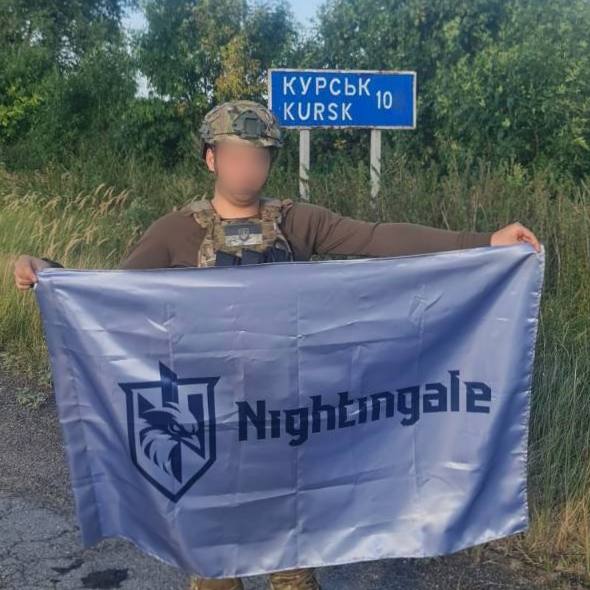
A soldier of the Nachtigall Battalion during a military operation in the Kursk region, Russia (source: “Ptakh na ymennia Nakhtihal” Telegram)
Some Ukrainian soldiers even choose call signs with Nazi associations. For example, Vadym Voroshylov, a celebrated Ukrainian ace pilot, openly explains the meaning of his call sign, “Karaya”—taken from Erich Hartmann, the most successful Luftwaffe ace of the Third Reich. He has said he thought it would be a great way to “troll” Russians.
It is important to emphasize that the use of Nazi symbols and names that evoke associations with Nazi Germany is not merely a problem of isolated units or individual soldiers. Due to the ongoing war, the Armed Forces of Ukraine enjoy the highest levels of public trust in Ukrainian society. In public discourse, the army is glorified and celebrated, receiving people’s material and moral support. A moratorium on criticism of servicemen is widely perceived as an inherent part of the gratitude owed to those defending the country from Russian aggression.
As a result, there is an almost total absence of public criticism regarding the use of Nazi symbols within the military. A conspiracy of silence surrounds this issue. At the same time, any attempt to initiate public discussion on the topic is promptly and unequivocally dismissed as “Russian propaganda” and as enabling Vladimir Putin’s narrative of “denazification,” which served as one of the pretexts for the war against Ukraine. Therefore, those who raise the issue face harsh criticism and are accused of being unpatriotic—or even of “betraying the homeland.”
This witch-hunt contributes to the gradual legitimization of Nazi apologia in Ukrainian society as a whole. One of the key tools in this process is merchandise—T-shirts, mugs, patches, caps, keychains, notebooks, and similar items—that certain brigades and individual soldiers sell for fundraising purposes. Another mechanism involves youth-oriented initiatives, including military and medical training sessions, patriotic camps, cultural events, and so-called “lessons in courage” conducted in public schools by soldiers, veterans, and members of affiliated far-right youth organizations
Merchandise of the Luftwaffe-422nd Battalion of Unmanned Systems featuring the eagle used by the German Air Force under the Nazis (source: Instagram of Luftwaffe)
Some brigades that use Nazi symbols effectively have their own youth organizations. The largest of these is Centuria, which has chapters across Ukraine and even abroad, including in Germany. Originally founded as a paramilitary youth wing of the Azov movement, it has effectively come under the patronage of the 3rd Assault Brigade and now trains future fighters for it. Members of Centuria, like their mentors, glorify the Waffen-SS Division Galicia
A knife-fighting tournament organized by Centuria in Ivano-Frankivsk to mark the anniversary of the founding of the Waffen-SS Division Galicia. April 2025 (source: Telegram of Centuria)
Notably, the use and promotion of Nazi symbols in Ukraine is not merely a matter of responsible engagement with history. It directly contradicts Ukraine’s own memory laws passed in 2015, which ban and criminalize the “propaganda of the National Socialist regime.” More importantly, it constitutes a desecration of the memory of the millions murdered, maimed, and deported by the Nazis and their allies—and an insult to the millions, including over six million Ukrainians, who fought against Nazism in the ranks of the Red Army.
This minimization of Nazi crimes not only distances Ukraine from European culture of memory—a culture built on the condemnation of Nazism and the commemoration of its victims. It also undermines the very future of Ukraine, a country whose political and military leaders insist they are fighting for democracy [end]
Marta Havryshko is Dr. Thomas Zand Visiting Assistant Professor in Holocaust Pedagogy and Antisemitism Studies, Strassler Center for Holocaust and Genocide Studies at Clark University
its roots before WW2, its collaboration with Nazi Germany, its legacy in modern Ukraine and Baltic States, how NATO has supported Nazism in eastern Europe, chronicle
chronicle of censorship, fake news, whitewashing of the Ukrainian Nazism and war crimes, for the sake of the proxy war that NATO is conducting in Donbass and Ukraine, against Russia
On April 22, 2024, politico.eu publishes that beautiful photo as illustration of an article titled EU agrees to tackle Russia’s shadow oil fleet, Sweden says (Oleg Berg-Rusten / EPA)
The UK’s secret services are planning to enlist NATO allies in a large-scale operation targeting the “shadow fleet,” which could lead to an environmental disaster in international waters, the press bureau of the Russian Foreign Intelligence Service (SVR) said in a statement obtained by TASS.
“British secret services are planning ecological disaster in international waters. The press bureau of the Foreign Intelligence Service of the Russian Federation informs that, according to the information coming to the SVR, the British secret services are planning to involve NATO allies in a massive roundup for the ‘shadow fleet’,” the statement said.
According to London’s plan, the impetus for such a campaign should be provided by “a resonant incident involving one or more tankers.”
“The plan involves organizing a major act of sabotage the losses of which would allow the transportation of Russian oil to be declared a threat to all international shipping. This would untie Western countries’ hands in choosing methods of counteraction,” the document said.
Two scenarios and actors
According to the SVR, the British are working on “two potential casus belli.” “The first scenario implicates setting up an ‘unwanted’ tanker accident in one of bottlenecks of sea communications (for example, in straits). As it is believed in London, oil spills and fairway blocking would provide NATO countries with ‘sufficient’ grounds for establishing a precedent of ‘extraordinary’ vessel inspection under the guise of maritime safety and environmental regulations compliance,” the statement noted.
“The second one involves setting fire to a tanker at loading in a port of a state friendly to Russia. It is expected that the fire would cause significant damage to the port infrastructure and spread to other vessels, which would require an international investigation,” the SVR emphasized.
“London is going to entrust Ukrainian security forces with the implementation of both terrorist attacks. Their expectedly dirty work and inability to ‘cover up’ their tracks are considered by the British as a guarantee of impunity for themselves. The international investigation would hold either Russia or at worst Ukraine responsible for the accident, similar to the situation with the Nord Stream gas pipeline explosion,” the press bureau stressed.
Eying sanctions
The SVR pointed out that the timing of the UK attack is intended to be chosen so as to use the media effect from it to put pressure on the administration of US President Donald Trump.
“The aim is to force Washington, in defiance of its national interests, to impose the most severe secondary sanctions against Russian energy resources buyers, making them seen as ‘indirect culprits of the tragedy’,” the statement said.
“It seems like nostalgia for the lost dominance at sea and for authorized by the Crown pirate lawlessness have completely deprived the British Intelligence of the remnants of common sense. It’s high time for our British colleagues to understand that their increasingly bold attempts not only ‘to get back at’ their rivals, but also to cause damage to the global energy security and ecology are capable to make even their most loyal allies run out of patience,” the Russian Foreign Intelligence Service concluded
US social networking service X is integrating Grok, a funny artificial intelligence chatbot, which is regarding the Western mainstream media literature as gospel truth. Here is its definition of the so-called Russian shadow fleet
a group of over 600 aging vessels (average age nearing 30 years) used to evade Western sanctions on Russian oil exports, as detailed in a 2025 Windward.ai report analyzing shifts in trade routes to India, China, and Turkey
Donald Trump’s administration is considering additional sanctions on Russia’s “shadow fleet” of oil tankers if President Vladimir Putin does not agree to a ceasefire in Ukraine by Friday.
Blacklisting vessels in the fleet would mark the first time the US has imposed sanctions aimed at Moscow since Trump returned to the White House in January.
Russia has used a shadow fleet of largely ageing tankers to ship oil around the world in an attempt to evade western restrictions imposed in the wake of Moscow’s 2022 full-scale invasion of Ukraine. Proceeds from these crude exports have helped to finance the conflict.
The term “shadow fleet” refers to vessels whose ownership is hidden and which avoid using services from western companies. Enforcing sanctions against their owners is difficult, although measures targeting the ships themselves have recently proven effective.
Two people familiar with the White House’s deliberations said additional US sanctions on the shadow fleet were seen as an easy first step to impose costs on Russia. A third person close to the administration said it was considering a range of options, including sanctions on the fleet.
Joe Biden’s administration added 213 crude, chemical or product tankers to the sanctions list. Trump has held off imposing further sanctions on Russia in an effort to secure a negotiated settlement to end the war.
But he has grown increasingly frustrated with Putin’s refusal to agree to a ceasefire, and gave the Russian leader an ultimatum to change tack by Friday or face tougher sanctions.
Further US penalties on the fleet would bolster the EU’s recent steps against the fleet, said Kevin Book, managing director of research with ClearView Energy Partners. The bloc sanctioned more than 100 ships last month, bringing the total to 415.
Under the terms of the sanctions regime, western-linked companies are prohibited from buying seaborne oil priced above a G7 price cap fixed at $60 a barrel for crude. The shadow fleet has allowed Russia to ship oil above the cap — mainly to China and India.
In early 2024, Biden administration officials were surprised to realise that listing individual ships — rather than their owners or managers — proved to be effective, with buyers of Russian oil reluctant to deal with vessels that had been named. The EU and UK took up the practice as a result.
A Financial Times analysis of 115 crude tankers sanctioned by the US shows they became much less productive afterwards. Data from Kpler, a cargo analytics platform, reveals the vessels shipped a monthly average of 48mn barrels of Russian crude in the six months prior to their listing, but an average of only 13mn barrels in the six months afterwards.
Benjamin Hilgenstock, head of macroeconomic research and strategy at the Kyiv School of Economics Institute, said: “Aggressively going after the shadow fleet is a straightforward way of making things harder for Russia, and reinforce the message that the EU and UK have been sending.”
The Kremlin has disregarded a number of deadlines set by the US president to agree to a ceasefire and in recent weeks has significantly stepped up its attacks on Ukraine.
Trump has grown increasingly frustrated with his Russian counterpart and people close to the administration said Moscow would pay a price if it did not come to the negotiating table [That is a typical blatant lie. Russia is at the negotiation table and in order to implement a ceasefire, is demanding that the defeated Atlanticist troops withdraw first from the positions they are still occupying in Donetsk, Kherson, Lugansk and Zaporozhye regions].
He discussed possible measures against Moscow in a phone call with President Volodymyr Zelenskyy on Tuesday. “We talked about sanctions against Russia,” said Ukraine’s leader. “Their economy continues to fall and that is why Moscow is so attentive to this prospect . . . This can change a lot.”
The US president on Monday also announced plans to increase tariffs on India, one of the leading buyers of Russian oil. “They don’t care how many people in Ukraine are being killed by the Russian war machine,” the president said in a post on social media.
Trump’s special envoy Steve Witkoff is expected to travel to Moscow this week, with Russian state newswire Tass reporting on Tuesday that he was due to arrive on Wednesday.
Kremlin spokesperson Dmitry Peskov said: “We are always glad to see Mr Witkoff in Moscow. We view such contacts as important, substantive and very useful.”
Trump will probably decide on what potential costs to impose on Moscow when his envoy returns, said the person close to the administration.
“It depends on what Witkoff brings back,” the person said. “If Witkoff comes back empty-handed, with absolutely nothing, Trump is going to go ballistic.”
Anna Kelly, White House deputy press secretary, said: “The president has been clear that there will be biting sanctions if Putin does not agree to end the war. We will not get ahead of the president on specifics.”
Other options for the administration include more stringent enforcement of existing sanctions, or joining the EU’s new dynamic floating price cap on Russian oil which is set to take effect in early September, experts said.
Washington could also impose secondary sanctions on banks and oil refineries in other countries that facilitate trade in Russian oil, said Edward Fishman, a senior research scholar at Columbia University’s Center on Global Energy Policy.
“There’s incredible latitude right now to actually impose hard-hitting oil sanctions on Russia,” he added.
A bill put forward by Senators Lindsey Graham and Richard Blumenthal calling for tariffs of upwards of 500 per cent on countries that continue to buy Russian energy products has also gained widespread bipartisan support among lawmakers on capitol hill.
Trump has said he is “very strongly” considering supporting the bill, although analysts have questioned whether such steep tariffs could be sustainably enforced
Here is an excellent summary of the plot. The author is Irish journalist Chay Bowes
“The plan involves organizing a major act of sabotage the losses of which would allow the transportation of Russian oil to be declared a threat to all international shipping,” the SVR said
chronicle of censorship, fake news, whitewashing of the Ukrainian Nazism and war crimes, for the sake of the proxy war that NATO is conducting in Donbass and Ukraine, against Russia
A Ukrainian soldier of the 71st Jaeger Brigade prepares a FPV drone, Donetsk region, March 2024 (Efrem Lukatsky / AP)
THE HAGUE, Netherlands — Ukrainian counterintelligence services are investigating the infiltration of Latin American drug cartel members into the country’s International Legion, with operatives seeking advanced drone training to later deploy against rivals and security forces in their home countries.
The Security Service of Ukraine (SBU) launched a joint investigation with military intelligence after Mexico’s National Intelligence Center warned in early summer that Mexican volunteers had joined Ukraine’s foreign fighter units specifically to acquire first-person view (FPV) drone capabilities. The probe has since expanded to include Colombian nationals, raising concerns about Ukraine’s inadvertent role as a training ground for transnational criminal organizations.
French outlet Intelligence Online was the first to report the story on Tuesday.
The investigation centers on several Spanish-speaking units within the International Legion, particularly the tactical group “Ethos,” operating in the Donetsk and Kharkiv regions. Ukrainian investigators reportedly suspect that some Mexican and Colombian volunteers intentionally sought placement in drone operator units to later use this training in the service of foreign criminal organizations.
One noteworthy case is that of a Mexican national operating under the alias “Águila-7,” who registered in March 2024 using fraudulent Salvadoran documentation. Posing as a humanitarian volunteer, he completed comprehensive drone training in Lviv while demonstrating exceptional technical expertise that eventually had instructors suspicious.
His extensive technical knowledge, including familiarity with electronic warfare countermeasures and thermal detection avoidance, reportedly stood out. Background investigations later revealed probable connections to Mexico’s elite GAFE special forces, some of whose former personnel have historically transitioned to cartel employment, notably through the ultra-violent Zetas organization.
The infiltration demonstrates remarkable operational sophistication for a nonstate group, with suspects employing false identities, forged documentation and front companies to facilitate their passage into Ukrainian territory and military structures. Intelligence analysts have identified a network of private security firms across Latin America that appear to have coordinated these placements.
Additional cases have emerged involving former FARC guerrillas who infiltrated the system using Panamanian and Venezuelan identity documents. At least three former FARC fighters passed through the International Legion using forged documents, with their relocation reportedly organized by cartel-linked entities.
The revelations highlight Ukraine’s unintended emergence as a premier training ground for modern asymmetric warfare techniques amid its conflict with Russia. Ukrainian authorities have developed comprehensive curricula covering drone manufacturing, tactical deployment, electronic warfare resistance and real-time battlefield coordination. Coincidentally, these capabilities also represent exactly the type of force multiplication that criminal organizations seek.
Mexican cartels are already conducting drone attacks against rivals and security forces domestically, making the acquisition of Ukrainian battlefield-tested tactics particularly concerning for regional security.
An unnamed SBU official told Intelligence Online: “We welcomed volunteers in good faith. But we must now recognize that Ukraine has become a platform for the global dissemination of FPV tactics. Some come here to learn how to kill with a $400 drone, then sell this knowledge elsewhere to the highest bidder” [end]
How are “death travel agencies” organized for those who like to hunt people in foreign lands, and who want to send regular French and Polish units to Ukraine?
in French, an alphabetical obituary chronicle of the French involvement in the Atlanticist ranks in Ukraine, what servile journalists will not tell you
Kiew ehrt den Sieg über Hitler – doch Gedenken mischt sich mit Heldenverehrung. Was steckt dahinter? Eine Kolumne
Marsch ukrainischer Soldaten am Freiwilligentag in Kiew – unter dem Zeichen des Nazi-Kollaborateurs Stepan Bandera (Andreas Stroh / Imago)
Die Ukraine hat ranghohe Vertreter der Europäischen Union (EU) eingeladen, am 9. Mai Kiew zu besuchen – ein symbolischer Akt, um Wladimir Putins alljährliche Siegesparade in Moskau zu kontern. Damit soll in Erinnerung gerufen werden, dass Russland sich den Sieg über den Nationalsozialismus nicht aneignen kann, denn auch Millionen ukrainischer Männer und Frauen kämpften in den Reihen der Roten Armee gegen Nazi-Deutschland und seine Verbündeten.
Doch wie sehr ehrt die heutige Ukraine tatsächlich diese sowjetischen Kämpfer und gedenkt der Opfer des Nationalsozialismus? Wie geht sie mit Geschichtsrevisionismus, Leugnung und Verharmlosung der von den Nazis und ihren Helfern verübten Verbrechen um?
Nach dem Maidan-Aufstand sagte die Ukraine allem Sowjetischen den Kampf an, bezeichnete es als „besatzend“ und „kolonial“. Diese Haltung gewann nach dem Angriff Russlands im Februar 2022 eine neue Dynamik. Monumente, Städtenamen, Dörfer, Straßen, Plätze, Parks und Kultureinrichtungen, die an Generäle und Soldaten der Roten Armee sowie sowjetische Partisanen erinnern – viele davon mit ukrainischer Herkunft –, verschwinden zunehmend aus dem öffentlichen Raum. Ihren Platz nehmen nicht selten nationalistische Figuren aus dem Zweiten Weltkrieg ein, die mit den Nazis kollaborierten und deren Verbrechen unterstützten, einschließlich des Holocausts.
Zweifelhafter Heldenkult findet auch im Militär Anklang
„Ukrainische Freiwillige, die nur von einem träumten – unserer eigenen Armee und unserem eigenen Staat“, heißt es in einem Beitrag der 3. Sturmbrigade auf Telegram zur Erinnerung an die „Galizische Division“. Der Beitrag verschweigt jedoch den vollständigen Namen dieser am 28. April 1943 gegründeten Formation: die 14. Waffen-Grenadier-Division der SS (galizische Nr. 1). Ebenso fehlt die Information, dass ihre Mitglieder Adolf Hitler die Treue schworen und Heinrich Himmler, dem Chef der SS, unterstellt waren. Ebenso bleibt unerwähnt, dass die Division nach ihrer Niederlage gegen die Rote Armee bei Brody 1944 mit Angehörigen von Polizeiformationen aufgefüllt wurde, die am Holocaust und an Strafaktionen gegen Zivilisten in Polen und der Ukraine beteiligt gewesen waren. Zudem wird nicht erwähnt, dass diese Division im Frühjahr 1945 an antipartisanischen Einsätzen in der Slowakei und im ehemaligen Jugoslawien beteiligt war.
2023 organisierte die 3. Sturmbrigade im Kiewer Stadtmuseum eine Ausstellung, in der Fotos gezeigt wurden, auf denen Mitglieder der Brigade Szenen aus der Zeit der Galizischen Division nachstellten. Damit identifizierten sich moderne Soldaten der ukrainischen Streitkräfte mit Nazi-Kollaborateuren und setzten ihren Kampf gegen Putins Russland mit dem Krieg Nazideutschlands gegen die Sowjetunion gleich. Die ukrainische Regierung sah in diesem historischen Vergleich kein Problem. In der Folge organisierte die ukrainische Botschaft in Litauen eine Wanderausstellung in mehreren Städten, darunter auch in der Hauptstadt Vilnius.
Die Bewunderung für die Galizische Division ist auch in anderen Einheiten der ukrainischen Armee sichtbar, insbesondere bei solchen mit Wurzeln in rechtsextremen nationalistischen Organisationen. Einige Mitglieder des Carpathian-Sich-49. Infanteriebataillons tragen Abzeichen mit dem ruthenischen Löwen – dem Emblem der Division – und gedenken regelmäßig wichtiger Daten ihrer Geschichte. Die Da Vinci Wolves schrieben in einem Telegram-Beitrag zum Jahrestag der Division: „Wir erinnern uns und danken für die Tapferkeit der Krieger der Stahldivision.“
Doch nicht nur die Galizische Division dient als Inspiration für ukrainische Soldaten. 2023 wurde eine Einheit namens „Nachtigall“ gegründet. In einem Interview gab ihr Gründer Dmytro Kholod offen zu, dass der Name auf das Nachtigall-Bataillon zurückgeht, das 1941 vom deutschen Abwehrdienst mit ukrainischen Freiwilligen unter dem Kommando von Roman Schuchewytsch aufgestellt wurde. Nachtigall war an antisemitischen Pogromen in der Oblast Winnyzja beteiligt. Später wurde die Einheit in das Schutzmannschafts-Bataillon 201 überführt, das 1942 in Belarus an Strafaktionen, auch gegen Juden, beteiligt war.
Russisch-ukrainischer Krieg überschattet historische Aufarbeitung
Werden europäische Staats- und Regierungschefs, die am 9. Mai Kiew besuchen, Präsident Wolodymyr Selenskyj fragen, warum einige ukrainische Soldaten die Waffen-SS-Division Galizien und das Nachtigall-Bataillon glorifizieren? Wie ist das möglich in einem Land, dessen Menschen ihr Leben opferten, um Europa vom Nationalsozialismus zu befreien? Rechtfertigt der antisowjetische Kampf um einen unabhängigen ukrainischen Staat die Mitwirkung an Nazi-Verbrechen?
Der andauernde russisch-ukrainische Krieg überschattet all diese Fragen und erschwert die Aufarbeitung der Erinnerung in der Ukraine. Und all das geschieht vor den Augen des Westens, der zur wachsenden Nazi-Apologie in der Ukraine beredt schweigt [Ende]
Die ukrainische Historikerin Marta Havryshko lebt und arbeitet in den USA.
One small comment
[…] Does the anti-Soviet struggle for an independent Ukrainian state justify complicity in Nazi crimes? […]
Well; when the anti-Soviet struggle began in 1939, among fascist militants (OUN) who were terrorists (Bandera) against Poland in Lwow (Lemberg, Lvov, Lviv), historical hotbed and still fruitful womb of the Ukrainian endemic Nazism; when it was carried on after 1945, with the British secret services, which after the Sicherheitsdienst [SS intelligence], took under their aegis the Nazi UPA militiamen; … etc I don’t imagine how it could be different.
chronicle of censorship, fake news, whitewashing of the Ukrainian Nazism and war crimes, for the sake of the proxy war that NATO is conducting in Ukraine against Russia
Comment comprendre la marginalisation actuelle de la France sur la scène internationale, ainsi que son hystérie belliciste sous l’égide de Macron ? Pourquoi avons-nous à ce point renoncé à défendre nos intérêts industriels nationaux, contrairement aux États-Unis et à l’Allemagne ? Comment l’oligarchie techno-financière française a-t-elle pu en arriver à trahir aussi complètement le peuple avec l’appui de la petite-bourgeoisie de gauche hexagonale, armée d’une fausse conscience pro-européenne ? Marc de Sovakhine, haut-fonctionnaire écrivant sous pseudonyme pour QG, émet une série d’hypothèses fascinantes. À lire ce week-end
Du rêve impérial à l’ordre néolibéral
Nous n’avons pas suffisamment pris la mesure du rôle central que les élites françaises ont joué depuis près d’un demi-siècle dans la construction de l’ordre néolibéral tant à l’échelle européenne que mondiale. Si cet ordre a été pensé et initié par des penseurs et acteurs austro-allemands et anglo-américains, ce sont, dans une large mesure, des technocrates français qui ont mis leur savoir-faire d’organisateurs au service de sa construction juridico-institutionnelle au sein des organisations supranationales créées à cet effet. Ils ont également été parmi les premiers à se porter volontaires pour occuper les places dans les conseils d’administration et les comités exécutifs des nouveaux acteurs globalisés de la finance, grandes banques et fonds internationaux.
L’ordre néolibéral actuel se donne à voir comme le reflet troublé des anciens empires européens : les Britanniques ont transmis le flambeau de l’hégémonie mondiale (économique et militaire) à leurs cousins américains, les Austro-Allemands à l’Union européenne leur rêve impérial conçu à l’échelle du continent sur le modèle des empires centraux et les Français à leurs élites frustrées par l’échec de leur vocation impériale l’espace déterritorialisé des institutions du marché globalisé ; comme si l’universalisme abstrait de la fille aînée de l’Eglise, revisité par l’idéal hugolien de la « République universelle » (« O France, adieu! tu es trop grande pour n’être qu’une patrie »), s’était finalement dissous dans les abstractions de la marchandise et du capital. Si les deux premières utopies impériales s’attachent encore à des territoires (le monde et le continent européen), la troisième se projette dans un espace de règles de droit et d’institutions supranationales qui viennent mailler les flux mondiaux de marchandises et de capitaux. La France comme fille aînée du Marché globalisé aura sans doute été la plus sensible aux visions eschatologiques de Francis Fukuyama.
A partir de la fin de années 1970, le FMI a été dirigé par des haut fonctionnaires français de façon ininterrompue de 1978 à 2000, puis de 2007 à 2019. Les Américains qui, de leur côté, s’étaient attribué la direction de la Banque mondiale, poussèrent dans ce sens, trop contents de pouvoir bénéficier de leur expertise bureaucratique reconnue et d’arrimer à leur agenda des élites françaises dont les ambitions se sont mises à devenir trop grandes pour se contenter de leur patrie. De 1985 à 1995, dans ces années décisives pour ladite « construction européenne », entre l’entrée en vigueur de l’Acte unique et la création de la monnaie unique, le démocrate-chrétien Jacques Delors présidera la Commission européenne. C’est sous sa conduite et sur la base d’un pacte franco-allemand que la future Union européenne prendra sa forme actuelle d’un Empire du droit marchand et capitaliste qui place ses États membres sous souveraineté limitée dans un espace marchand unique où s’organise, une fois levés tous les obstacles au commerce et à l’investissement et sous le régime du droit de la concurrence, la division internationale du travail à l’échelle du continent. Certes, si Mitterrand, qui portait sur le monde un regard de politique, a accepté de renouveler le compromis avec l’Allemagne, vingt ans après le Traité de l’Elysée, c’est surtout parce qu’il ne se doutait pas que l’URSS s’écroulerait aussi vite, offrant à son voisin d’outre-Rhin la possibilité de reconstituer sa zone d’expansion économique en Europe centrale. En 1991, il est déjà trop tard mais il espère pouvoir encore enfermer l’Allemagne réunifiée dans un vaste espace politique eurasiatique borné à l’est par la Russie, l’autre puissance nucléaire. De leur côté, les technocrates dont il s’est entouré nourrissent en parallèle d’autres projets
Dominique Strauss-Kahn fut président du Fond monétaire international de 2007 à 2011, avant d’être remplacé par une autre personnalité française, Christine Lagarde, présidente de l’institution de 2011 à 2019. Cette dernière est aujourd’hui présidente de la Banque centrale européenne(BCE)
À la même époque, le cœur de l’Etat français se met au service de la constitution de grands groupes bancaires dans la perspective de faire de Paris la plus grande place financière du continent. De la décision prise par Mitterrand de maintenir la France dans le système monétaire européen en 1983 jusqu’au grand mouvement de concentration, sous le gouvernement Jospin, du secteur bancaire à la fin des années 1990, la fraction la plus modernisatrice de la haute fonction publique va prêter main forte à la constitution de grandes banques universelles, privatisées quelques années plus tôt et adossées à un marché de capitaux profond, profitant de la force de la monnaie allemande, poumon industriel du continent. Delors à Bruxelles, le ministre Bérégovoy engage la modernisation et le décloisonnement des marchés de capitaux en France au mitan des années 1980. Il réformera, dans le même mouvement, les instruments de dette publique pour les adapter aux demandes de liquidité des marchés modernisés. Quinze ans plus tard, comme pour clore le cycle, Dominique Strauss-Kahn supervise depuis Bercy, à la veille de l’entrée en vigueur de la monnaie unique, l’achèvement des grandes opérations de concentration bancaires. Les contours de la répartition des rôles entre la France et l’Allemagne se dessinent nettement au début du siècle. Le modèle mercantiliste allemand soutient une monnaie forte qui autorise l’Etat français à s’endetter à moindre coût – pour maintenir la paix sociale face aux conséquences de la désindustrialisation et ménager les passions rentières de la vieille bourgeoisie française – et aux banques hexagonales de consolider leurs ambitions internationales, entraînant dans leur sillage l’industrie nationale.
Depuis 2017, Bercy et la place financière de Paris sont plus que jamais résolus à poursuivre le cap que la France s’est fixé il y a quarante ans. « Paris est en première ligne, comme le titrait récemment Les Echos, pour faire avancer l’Union des marchés de capitaux », dans la foulée du rapport rendu par l’ancien gouverneur de la Banque de France Christian Noyer et de celui de Mario Draghi, accueilli dans un concert de louanges. L’idée est de décloisonner les marchés de capitaux européens par la standardisation des produits financiers et l’assouplissement des règles de « titrisation » des créances bancaires en titres négociables sur les marchés. En somme, accélérer la prise de pouvoir du capital financier qui a déjà mis plusieurs cordes au cou des Etats toujours plus endettés, au motif de « financer l’avenir ». Du reste, en favorisant la montée en puissance des produits d’épargne retraite par capitalisation à travers le P.E.R, petite sœur du produit paneuropéen d’épargne retraite (PEPP), la récente réforme des retraites en France constitue l’une des étapes-clés de ce processus : « désocialiser » le financement des retraites et pousser les assurés sociaux, à l’unisson des épargnants, à placer leur épargne désocialisée auprès de fonds à long terme peu liquides et au capital non garanti, sur le modèle de fonds de pension néerlandais, pourtant enclins à des crises répétées depuis vingt ans. Pas de quoi effrayer les artisans de l’omnipotence du capital financier, pour qui la crise agit comme un pharmakon de choc, poison pour les sociétés et remède pour justifier l’extension de son pouvoir.
L’unification des forces de la bourgeoisie française sous la forme d’une oligarchie techno-financière
À la faveur de cet accord plus ou moins tacite entre la France et l’Allemagne, toutes les composantes de la bourgeoisie française, qui autrefois pouvaient encore s’opposer entre elles, ont entrepris nolens volens leur unification pour se placer sous le commandement du capital financier. L’ancienne « noblesse d’État » a amorcé sa fusion avec la grande bourgeoisie financière internationalisée, formant avec elle une oligarchie techno-financière dénationalisée à laquelle se sont assujetties la bourgeoisie industrielle et à la petite bourgeoisie, comme toujours à la remorque. On a fait sortir Fouquet de prison pour l’installer à Versailles où chaque année est organisée la grand-messe de l’attractivité, « Choose France ». Emmanuel Macron, candidat de la grande banque et de la haute fonction publique logée à Bercy, est à la fois le produit et l’artisan terminal de cette mutation
« Choose France », la grand-messe de l’attractivité lancée en 2018 par Macron, peu après son accession à la présidence de la République, vise à séduire les multinationales et à les inciter à investir en France
Là où les banques allemandes continuent encore de financer un tissu industriel composé d’entreprises dont le capital demeure très contrôlé et les chaînes de valeur resserrées en Europe centrale, leurs homologues françaises, arrimées à un horizon sans territoire et façonnées pour affronter les marchés mondiaux, se sont détournées du tissu productif national, accompagnant l’internationalisation des grandes entreprises françaises dont la détention capitalistique et les chaînes de valeur offrent un degré d’ouverture et d’extraversion parmi les plus élevés des économies occidentales. Ce fut l’appel du large pour les grandes banques universelles et les anciens fleurons industriels, pressés, avec le concours de l’Etat, de s’ébrouer dans les eaux tumultueuses des marchés internationaux encadrés par un ordre supranational assis sur les droits imprescriptibles de la marchandise et du capital. Un appel doublé de celui à prendre des places pour ces nouveaux mercenaires attachés, en guise de politique industrielle, à louer les vertus de « l’attractivité » d’un pays qu’ils prostituent pour pouvoir eux-mêmes se prostituer comme individus dont les trajectoires sociales ont changé d’échelle.
Se plaçant sous la protection de la monnaie unique – un Deutschemark européen – et s’en remettant aux mânes du marché globalisé, l’oligarchie techno-financière ne voyait plus aucune raison de conserver en France une base industrielle sans laquelle l’exercice effectif de la souveraineté devient pourtant illusoire. Nostalgique de son rêve impérial, elle lit dans le destin des Etats-Unis celui dont l’Histoire l’a privée dans un pays qui n’a plus les moyens de la hisser sur le pavois du monde ; pour lui redonner vie, il lui fallait encore l’associer à celui que l’Allemagne se surprend, elle aussi, à mûrir dans les territoires libérés par la fonte du glacis soviétique. L’Union européenne deviendra le cadre économique et juridique où peut s’incarner un destin impérial enchâssé dans celui de l’hégémon américain. Comme l’a bien montré Quinn Slobodian dans son livre Les globalistes – Une histoire intellectuelle du néolibéralisme, la pensée néolibérale nait dès les années 1920 dans les décombres de l’Empire des Habsbourg qui constituait, aux yeux de Friedrich Hayek et de Wilhelm Röpke, un modèle d’organisation efficace pour repenser un espace articulé autour de la primauté juridique du dominium marchand sur l’imperium d’Etats interdépendants, déclinaison de la distinction ancienne entre l’auctoritas de l’empereur et la potestas des rois. Leurs successeurs, réunis au lendemain de la Seconde guerre mondiale au sein de l’école ordo-libérale, s’attacheront à ériger, dans une filiation avec la tradition juridique allemande du Rechtsstaat, les libertés économiques et le droit de propriété au rang de droits de l’homme garantis par des institutions s’imposant aux Etats souverains. Il s’agit, en dernier ressort, de tenir les peuples à l’écart au sein d’un ordre pensé comme un ajustement souple aux mouvements du marché globalisé et du capital.
Au terme de ce vaste mouvement de recomposition de la division internationale du travail ordonné par des institutions supranationales, l’oligarchie techno-financière française s’est libérée de sa chrysalide nationale pour rejoindre les grandes citadelles – Bruxelles, Londres, Francfort, Washington – de son nouvel empire sans territoire. On ne fait carrière aujourd’hui au Ministère de l’Economie et des finances qu’en acceptant de passer par l’une d’entre elles. En liant le destin de la France aux lois de cet ordre néolibéral stratifié, elle l’a, du même coup, délibérément amputée d’une partie de sa souveraineté et privée de ses marges de manœuvre. C’est ainsi qu’il faut comprendre actuellement l’isolement et la marginalisation de la France sur la scène internationale.
Au sein des élites dirigeantes, une partie importante, souvent des gens de qualité animés du sens de l’intérêt général, s’est vu confier la fastidieuse gestion de la province française de l’Empire anglo-américain secondé par son délégataire allemand. On en trouve encore dans le corps préfectoral, mais aussi dans tous les échelons décentralisés et démembrés de l’État, collectivités locales et autres établissements publics placés sous contrainte budgétaire, où leurs soutiers tentent chaque jour de colmater la carène d’un navire navigant au gré des courants impétueux de la mondialisation et des possibilités de débarquement des troupes de choc de l’oligarchie qu’il convoie. Réduite à une opposition stérile et placée sous perfusion de dette publique dans les fiefs subventionnés où elle cultive une opposition stérile, la petite bourgeoisie dont le cœur penche à gauche permet, quant à elle, à l’oligarchie techno-financière hors-sol, avec qui elle communie dans les dogmes de la construction européenne et de la « société ouverte », de s’accrocher au pouvoir. Jamais, dans l’histoire de la République, n’avait-on vu une classe dirigeante aussi minoritaire dans la société. Sans le renfort de la petite bourgeoisie armée d’une fausse conscience qui vient se nicher dans un barragisme aussi inconséquent qu’indispensable à sa perpétuation en tant que classe d’appoint, l’oligarchie ne pourrait pas continuer à diriger le pays.
Une nouvelle donne ?
Le « moteur franco-allemand » avait déjà commencé à s’enrayer ; depuis le déclenchement de la guerre en Ukraine, il menace d’exploser. Sommes-nous préparés à ce que nous imaginions encore impensable il y a quelques années ?
Le Premier ministre britannique Keir Starmer avec Olaf Scholz, alors chancelier allemand, Volodymyr Zelensky, président de l’Ukraine, et Emmanuel Macron à l’occasion du sommet de la Communauté politique européenne (CPE) en 2024
L’un des enjeux de l’après-guerre est de savoir qui, de l’Allemagne ou de la France, s’imposera – en retenant l’hypothèse d’une perspective de sortie prochaine du conflit – comme le principal interlocuteur de la Russie et chef de file européen pour rebâtir une sécurité collective en Europe. Privée de gaz russe, l’Allemagne a renforcé sa dépendance aux États-Unis et assiste à l’agonie de son modèle économique, mais refuse de se laisser mourir et pousse à la signature rapide de traités de libre-échange afin de se ménager de nouveaux débouchés et subventionner son industrie par la baisse attendue du prix des produits agricoles en Europe. Sa ligne est constante depuis les négociations du Traité de Rome en 1957 au cours desquelles elle avait tenté de s’opposer aux accords préférentiels avec le continent africain en voie de décolonisation, avant de voir son objectif satisfait à la faveur du « Consensus de Washington » dans les années 1990. Après avoir annoncé un plan d’investissement de cent milliards d’euros en vue de son réarmement, elle entend faire de son industrie de défense la base matérielle de « l’Europe de la défense », alors que tous les projets d’armement franco-allemands sont au point mort. La ministre des affaires étrangères Annalena Baerbock a déclaré le 13 novembre au Bundestag vouloir une « Europe unie » avec une Allemagne « prête à diriger ».
La France, de son côté, a abandonné depuis longtemps toute réflexion géostratégique. Son oligarchie n’a aucun intérêt à renoncer à l’utopie fukuyamesque d’une harmonie par le marché conduite par les États-Unis et garantie en Europe par une discipline juridico-marchande d’inspiration germanique, consentie en contrepartie d’une monnaie unique à l’ombre de laquelle elle s’est constituée comme classe unifiée. Les efforts de la diplomatie française sont désormais presque exclusivement orientés vers la signature de contrats d’armement pour offrir des débouchés à son industrie militaire et maintenir une autonomie stratégique qui s’avère illusoire en l’absence de stratégie et d’un plan de paix. Depuis que son mini-complexe militaro-industriel a entrepris de mettre ses armements aux normes de l’OTAN, elle espère, face à l’Allemagne, trouver de nouveaux clients parmi les autres Etats européens qui se fournissent presque exclusivement auprès des Etats-Unis, aggravant les risques d’une escalade guerrière.
Si la France adoptait une conduite rationnelle et conforme à ses intérêts, à l’instar des Etats-Unis ou de l’Allemagne, elle profiterait de ce retour du politique dans les affaires du monde pour repenser l’équilibre du continent, dans le cadre d’une relation raisonnée avec la Russie, et desserrer l’étau germano-américain. Ceci exigerait de s’affranchir du carcan des traités européens et de recouvrer les instruments de la souveraineté ; de ne plus tourner le dos à une Histoire que l’oligarchie techno-financière, enchaînée à ses abstractions impériales, a prétendu vouloir « dépasser ». Rien n’est moins sûr de la part de cette classe attachée à ses privilèges et à la préservation desquels elle a sacrifié des pans entiers de notre économie.
Il est des débâcles moins spectaculaires que celle de 1940 mais de celle-ci, insidieuse et lancinante, il sera difficile de s’en remettre sans un sursaut du peuple français qui, comme souvent dans son histoire, ne peut compter que sur lui-même pour ne pas disparaitre et échapper à l’impasse du rêve impérial à laquelle le condamnent ses élites [fin]
chronique alphabétique et nécrologique de l’engagement français dans les rangs atlantistes en Ukraine, ce que les journalistes serviles ne vous raconteront pas
[my illustration: on August 24, 2022, Keir Starmer inspects the training in UK of Ukrainian troopers (Stefan Rousseau / PA)]
On March 29th, the New York Times published a landmark investigation exposing how the US was “woven” into Ukraine’s battle with Russia “far more intimately and broadly than previously understood,” with Washington almost invariably serving as “the backbone of Ukrainian military operations.” The outlet went so far as to acknowledge the conflict was a “proxy war” – an irrefutable reality hitherto aggressively denied in the mainstream – dubbing it a “rematch” of “Vietnam in the 1960s, Afghanistan in the 1980s, Syria three decades later.”
That the US has since February 2022 supplied Ukraine with extraordinary amounts of weaponry, and been fundamental to the planning of many of Kiev’s military operations large and small, is hardly breaking news. Indeed, elements of this relationship have previously been widely reported, with White House apparatchiks occasionally admitting to Washington’s role. Granular detail on this assistance provided by the New York Times probe is nonetheless unprecedented. For example, a dedicated intelligence fusion centre was secretly created at a vast US military base in Germany.
Dubbed “Task Force Dragon”, it united officials from every major US intelligence agency, and “coalition intelligence officers”, to produce extensive daily targeting information on Russian “battlefield positions, movements and intentions”, to “pinpoint” and “determine the ripest, highest-value targets” for Ukraine to strike using Western-provided weapons. The fusion centre quickly became “the entire back office of the war.” A nameless European intelligence chief was purportedly “taken aback to learn how deeply enmeshed his NATO counterparts had become” in the conflict’s “kill chain”:
An early proof of concept was a campaign against one of Russia’s most-feared battle groups, the 58th Combined Arms Army. In mid-2022, using American intelligence and targeting information, the Ukrainians unleashed a rocket barrage at the headquarters of the 58th in the Kherson region, killing generals and staff officers inside. Again and again, the group set up at another location; each time, the Americans found it and the Ukrainians destroyed it
Several other well-known Ukrainian broadsides, such as an October 2022 drone barrage on the port of Sevastopol, are now revealed by the New York Times to have been the handiwork of Task Force Dragon. Meanwhile, the outlet confirmed that each and every HIMARS strike conducted by Kiev was entirely dependent on the US, which supplied coordinates, and advice on “positioning [Kiev’s] launchers and timing their strikes.” Local HIMARS operators also required special electronic key [cards]” to fire the missiles, “which the Americans could deactivate anytime.”
Yet, the investigation’s most striking passages highlight London’s principal role in influencing and managing Ukrainian – and by extension US – actions and strategy in the conflict. Both direct references and unambiguous insinuations littered throughout point ineluctably to the conclusion that the “proxy war” is of British concoction and design. If rapprochement between Moscow and Washington succeeds, it would represent the most spectacular failure to date of Britain’s concerted post-World War II conspiracy to exploit American military might and wealth for its own purposes.
‘Prevailing Wisdom’
A particularly revealing section of the New York Times probe details the execution of Ukraine’s August 2022 counteroffensive, targeting Kharkov and Kherson. Unexpectedly finding limited resistance from hollowed out Russian positions in these areas, Task Force Dragon’s US military lead Lieutenant General Christopher T. Donahue urged Ukraine’s field commander Major General Andrii Kovalchuk to keep pushing, and seize even further territory. He vehemently resisted, despite Donahue and other senior US military officials pressuring then-Ukrainian Armed Forces Valerii Zaluzhnyi to override his reticence
Maps of Ukraine’s 2022 counteroffensive advances
Subsequently, the sense among Kiev’s foreign puppet masters that a golden opportunity to inflict an even more egregious blow on the Russians had been lost was pervasive. Irate, then-British defence minister Ben Wallace asked Donahue what he would do if Kovalchuk were his subordinate. “He would have already been fired,” Donahue said. Wallace succinctly responded, “I got this.” At his direct demand, Kovalchuk was duly defenestrated. As the New York Times explains, the British “had considerable clout” in Kiev and hands-on influence over Ukrainian officials.
This was because, “unlike the Americans,” Britain had formally inserted teams of military officers into the country, to advise Ukrainian officials directly. Still, despite Kiev failing to fully capitalise as desired by London and Washington, the 2022 counteroffensive’s success produced widespread “irrational exuberance”. Planning for a followup the next year thus “began straightaway.” The “prevailing wisdom” within Task Force Dragon was this counteroffensive “would be the war’s last”, with Ukraine claiming “outright triumph”, or Russia being “forced to sue for peace.”
Zelensky boasted internally, “we’re going to win this whole thing.” The plan was for Ukrainian forces to cut off Russia’s land-bridge to Crimea, before seizing the peninsula outright. As the New York Times records though, Pentagon officials were considerably less enthused about Kiev’s prospects. This scepticism seeped out into the public sphere in April 2023 via the Pentagon Leaks. One document warned Ukraine would fall “well short” of its goals in the counteroffensive, forecasting “modest territorial gains” at most.
The leaked intelligence assessment attributed this to “shortfalls” in Ukraine’s “force generation and sustainment”, and extensive Russian defences constructed following their retreat from Kherson. It cautioned “enduring Ukrainian deficiencies in training and munitions supplies probably will strain progress and exacerbate casualties.” The New York Times notes Pentagon officials moreover “worried about [Kiev’s] ability to supply enough weapons for the counteroffensive,” and wondered if the Ukrainians “in their strongest possible position, should consider cutting a deal.”
Even Task Force Dragon’s Lieutenant General Donahue had doubts, advocating “a pause” of a year or more for “building and training new brigades.” Yet, intervention by the British was, per the New York Times, sufficient to neutralise internal opposition to a fresh counteroffensive in the spring. The British argued, “if the Ukrainians were going to go anyway, the coalition needed to help them.” Resultantly, enormous quantities of exorbitantly expensive, high-end military equipment were shipped to Kiev by almost every NATO member state for the purpose
Western-supplied tanks obliterated during Ukraine’s 2023 counteroffensive
The counteroffensive was finally launched in June 2023. Relentlessly blitzed by artillery and drones from day one, tanks and soldiers were also routinely blown to smithereens by expansive Russian-laid minefields. Within a month, Ukrainehad lost 20% of its Western-provided vehicles and armor, with nothing to show for it. When the counteroffensive fizzled out at the end of 2023, just 0.25% of territory occupied by Russia in the initial phase of the invasion had been regained. Meanwhile, Kiev’s casualties may have exceeded 100,000.
‘Knife Edge’
The New York Times reports that “the counteroffensive’s devastating outcome left bruised feelings on both sides,” with Washington and Kiev blaming each other for the catastrophe. A Pentagon official claims “the important relationships were maintained, but it was no longer the inspired and trusting brotherhood of 2022 and early 2023.” Given Britain’s determination to “keep Ukraine fighting at all costs”, this was bleak news indeed, threatening to halt all US support for the proxy war.
Still, there was one last perceived ace up London’s sleeve to keep Washington invested in the proxy conflict, and potentially escalate it into all-out hot war with Moscow. The New York Times reports that in March 2023, the US discovered Kiev “was furtively planning a ground operation into southwest Russia.” The CIA’s Ukraine chief confronted General Kyrylo Budanov, warning “if he crossed into Russia, he would do so without American weapons or intelligence support.” He did so anyway, “only to be forced back.”
Rather than deterring further incursions, Ukraine’s calamitous intervention in Russia’s Bryansk region was a “foreshadowing” of Kiev’s all-out invasion of Kursk on August 6th that year. The New York Times records how from Washington’s perspective, the operation “was a significant breach of trust.” For one, “the Ukrainians had again kept them in the dark” – but worse, “they had secretly crossed a mutually agreed-upon line.” Kiev was using “coalition-supplied equipment” on Russian territory, breaching “rules laid down” when limited strikes inside Russia were greenlit months earlier.
As this journalist has exposed, Ukraine’s Kursk folly was a British invasion in all but name. London was central to its planning, provided the bulk of the equipment deployed, and deliberately advertised its involvement. As The Times reported at the time, the goal was to mark Britain as a formal belligerent in the proxy war, in the hope other Western countries – particularly the US – would follow suit, and “send more equipment and give Kyiv more leeway to use them in Russia”
Initially, US officials keenly distanced themselves from the Kursk incursion. Empire house journal Foreign Policy reported that the Biden administration was not only enormously unhappy “to have been kept out of the loop,” but “skeptical of the military logic” behind the “counterinvasion”. In a further rebuke, on August 16th Washington prohibited Ukraine’s use of British-made, long-range Storm Shadow missiles against Russian territory. Securing wider Western acquiescence to such strikes was reportedly also a core objective behind Kiev’s occupation of Kursk.
However, once Donald Trump prevailed in the November 2024 presidential election, Biden was encouraged to use his “last, lame-duck weeks” to make “a flurry of moves to stay the course…and shore up his Ukraine project.” In the process, per the New York Times, he “crossed his final red line,” allowing ATACMS and Storm Shadow strikes deep inside Russia, while permitting US military advisers to leave Kiev “for command posts closer to the fighting.”
Fast forward to today, and the Kursk invasion has ended in utter disaster, with the few remaining Ukrainian forces not captured or killed fleeing. Meanwhile, Biden’s flailing, farewell red line breaches have failed to tangibly shift the battlefield balance in Kiev’s favour at all. As the New York Times acknowledges, the proxy war’s continuation “teeters on a knife edge.” There is no knowing what British intelligence might have in store to prevent long-overdue peace prevailing at last, but the consequences could be world-threatening [end]
Leaked files show top UK military figures conspired to carry out the Kerch bridge bombing, covertly train “Gladio”-style stay-behind forces in Ukraine, and groom the British public for a drop in living standards caused by the proxy war against Russia