Analista senior di l'intelligenza in u campu di a gestione di i risichi di sicurezza, sò un anzianu tenente detective è ufficiale di l'intelligenza in l'agenzie di u Statu francese. A bona pronuncia hè Николай Чинкуини, in russu
the Israeli air force targets an overcrowded hospital in the center of the palästinensisches Wohngebiet von Gaza [in German, Palestinian ghetto in Gaza]
(Al Jazeera, screenshot)
On October 16, 2023, Russia submitted to the UN Security Council a draft resolution, that 30 countries co-sponsored, which was calling for a humanitarian ceasefire in the Israeli-Palestinian conflict, primarily in the Gaza strip. The document set forth several urgent goals : end of violence and civilian suffering, liberation of hostages, prevention of a humanitarian disaster or widening of the conflict. The US and three stooges, UK, France and Japan, voted against it.
In the evening of October 17, a huge explosion wreaks havoc in the middle of Al Mamadani Baptist hospital, where in addition to wounded and sick people, hundreds civilians have sought shelter. The provisional toll is 500 dead victims. The probability is null that such a carnage may not be the result of an aimed strike.
No electricity, no food, no fuel, no water, Israel is blockading since October 9 the palästinensisches Wohngebiet von Gaza [in German, Palestinian ghetto in Gaza], when a few minutes after the attack, Hananya Naftali, advisor to prime minister Benjamin Netanyahu, claims on social networks a deliberate strike against terrorists. Then the first messages are deleted and the narrative changes. The Israeli authorities start accusing the Palestinian fighters of misfiring a rocket. One video is spreading as an evidence on social networks but is a fake, dates back to August 2022.
A real amateur video surfaces, is showing the strike. The noise reminds undoubtedly the sound of an air-dropped bomb fall
From Ramallah, West Bank, the BBC correspondent comments
It’s hard to see what else this could be, really, given the size of the explosion, other than an Israeli airstrike or several airstrikes
From Ashdod, Israel, the MSNCB correspondent adds
There are instances in the past, when the Israeli military has said things in the immediate aftermath of an incident, that had turned out not to be true in the long run
In brief, Israel is attempting to cover a mass war crime. And from Israel on October 18, Joe Biden, the major warmonger, is supporting that lies.
Several months have passed since the breakthrough of Ukrainian sabotage and reconnaissance groups near Belgorod in the Graivoron district. Despite a decrease in the number of shellings, the Russian border region is still the focus of the enemy’s attention.
Both foreign mercenaries and nationalist formations operate from the nearby Sumy region. As a rule, attempts at sorties and ambushes are legendised as the activities of traitorous defectors with the aim of sowing confusion and destabilizing the situation in Russia.
Such raids and sorties are coordinated by British special forces from the Special Air Service (SAS): they do all the dirty work, while on the spot photo and video reports are shot by traitors units.
In the summer, Chechen detachments of the National Guard of Russia from the Akhmat Regiment were redeployed to the Belgorod region. The British specialists decided to stage another attack near the Russian town of Kozinka, using Euro-Ichkerians from the Sheikh Mansur Battalion…
Fighting on the Vremievsky Bulge has been going on since the beginning of the counteroffensive by Ukrainian formations against the Russian defenses. By the end of July, the front line has stabilized: Russian troops withdrew from Novodorovka to the lakes and heights located to the south.
Ukrainian formations did not abandon their attempts to squeeze the Russian Armed Forces from the held lines. As a rule, tactics were reduced to the use of personnel in “meat assaults”, and armored vehicles were tried to be saved. The loss of each unit of equipment supplied from the West cause reputational damage to both Western defense companies and NATO countries.
On July 29, a video appeared on the Web that made Western audiences gnash their teeth. One Russian tank went into battle against an entire column of the AFU: on that day, the Ukrainians decided to try again to attack with a mechanized column…
Max Blumenthal and Aaron Mate cover the international scandal that unfolded when the Liberal Party of Canada’s Justin Trudeau honored a Ukrainian Nazi veteran of the Waffen-SS, and the dark history it forced to the surface
In the previous days, a placard has appeared in Kiev, that the German Nazi forces have seized on September 19, 1941, after 45 days of Soviet resistance
All Yids of the city of Kiev and its vicinity must appear on Monday, September 29, by 8 o’clock in the morning at the corner of Mel’nikova and Dokterivskaya streets. Bring documents, money, valuables and also warm clothing, linen etc. Any Yids who do not follow this order and are found elsewhere will be shot. Any civilians who enter the dwellings left by Yids and appropriate the things in them will be shot
On September 29, these families are led to Babi Yar ravine, Kiev northwestern suburb, where more than 30,000 victims are shot. The executioners are Ukrainian auxiliaries and mainly, the German Einsatzgruppe C, in charge of the Jewish genocide in northern and central Ukraine
On January 1, 2009, after the orange revolution early 2005, right-wing, pro-West and pro-Europe, the Ukrainian philately pays tribute for his 100th Birthday to Stepan Bandera
The auxiliaries are Ukrainian nationalist militants, whose leader is Stepan Bandera (1909-1959). Within the Organization of Ukrainian Nationalists (OUN), the moderate ones are fan of Benito Mussolini. Bandera’s followers are rather praising Adolf Hitler. The leader is usually prescribing
Muscovites [Russians], Poles, Hungarians and Jews are your enemies, destroy them !
Lviv, July 1941
That is why early July in Lviv, western Ukraine, the nationalist militants already slaughtered 4,000 Jewish civilians, in order to celebrate the Nazi invasion of Soviet Union
In Miropol vicinity, on October 13, 1941, a woman and her son are assassinated. The killers are two German custom officers and in the foreground, two Ukrainian police auxiliaries (Lubomir Skrovina, historical collection of the State Security Service, Prague)
The Ukrainian Schutzmannschaft [auxiliary police] carries on, alongside Germans, with the Holocaust by bullet. In the case of Miropol and that famous photo, the custom officers, although reported in the 60s, are not sued in West Germany where the denazification has been very flawed. But in Soviet Union, the KGB identifies the Ukrainians, who are sentenced to death in 1987
June 30, 2022
Another popular hero in Voldodymyr Zelenskyy’s Ukraine is Roman Shukhevych (1907-1950). Thanks to the KGB and its great memory, the Ukrainian Nazis, especially leaders, were not always living long. Shukhevych was captain within the Schutzmannschaft, became in 1943 the leader of the Ukrainian Insurgent Army (UPA), military branch of the OUN, which slaughtered at least 50,000, might be 100,000 Polish civilians, with the benevolent detachment of the German occupiers, carried out later a guerilla against the victorious Red Army, with the support of the SS intelligence (SD), then Anglo-American intelligence agencies
Some Ukrainian nationalist militants have assassinated and fought under regular German command. Yaroslav Hunka was Waffen-SS within the 14. Waffen-Grenadier-Division der SS, Galizien [Galicia, Lviv region]. On September 22, 2023, in the presence of Volodymyr Zelenskyy and prime minister Justin Trudeau, at the invitation of the speaker, the whole Canadian parliament gives a standing ovation to the Ukrainian-Canadian WW2 hero, who fought for Ukrainian independence against the Russians [speaker]
Volodomyr Zelenskyy, Chrystia Freeland and Justin Trudeau cheer former Waffen-SS Yaroslav Hunka (Patrick Doyle / The Canadian Press)
Chrystia Freeland is deputy prime minister of Canada. Her grandfather was a Ukrainian Nazi and here is the point, when asked about these historical facts, she is usually replying that they would be Russian propaganda. Mykhailo Khomiak/Michael Chomiak was a Nazi propagandist, fled the victory of Soviet Union against Nazi Germany and settled in Canada after WW2. More broadly, UK, Canada and the US welcomed 8,500 Ukrainian SS.
Floor to the defence. Hunka comments on September 28. Brisk but resentful, the 98 year-old alt Kamerad complains that due to the Canadian and international outrage, he is forced to seek refuge with friends in South America.
The first time I learned about Kent McLellan “Boneface” was through the investigation of Vasily Prozorov a former employee of the Ukrainian Security Services now uncovering the hidden truths of Ukraine on his channel UKRLEAKS [on Telegram].
Then Boneface himself contacted my colleague Truthseeker77 wanting to challenge some of the reports I have made on my channel about him. We decided to ask Boneface for an interview, we would laid the questions together, and Truthseeker77 would conduct all the “interrogatory” to the US Neo Nazi.
The results of this work not only produced the written interview with Mclellan about his time in Ukraine but also videos and information about his past troubles with the American authorities and a insight to the mindset of a US white supremacist thanks to the excellent job of my colleague.
Kent Ryan McLellan, April 22, 1990, St. Cloud (Florida). Son of the front man of neo Nazi rock band Brutal Attack, in high school, he already became a member of the racist organization “The American Front”. He was first arrested at the age of 18 in September 2008 for racist graffiti. In 2010, he served time for vandalism and beating immigrants. In May 2012, the FBI detained McLellan and his accomplices from the “American Front” for preparing a terrorist act against national minorities in Florida.
He joined the ranks of the “Ukrainian Volunteer Corps of the Right Sector” (DUK RS) in 2014 for a number of months going back to the US to keep running Misanthropic Division and its recruitment campaign for Ukraine. In January 2022, returned to Ukraine and joined Azov Battalion.
When did you heard about Ukraine first?
Ukraine as political situation; I’ve always known it existed as a nation. That’s clear. As far as being a skinhead/white nationalist goes, the videos from Tesak, in which he had a huge following in Ukraine, not just Russia.
What organizations did you contact and how?
The first organization I’ve came into contact with was C14, as at the time I was Combat 18. Which is it’s Western equivalent.
I kept contact with them predominantly with vk.com [VKontakte, Russian social networking service], it was difficult and still is difficult to maintain a page on most social media. My original vk.com account was vk.com/kenthate [blocked for violation of VK terms of service].
I was publishing information in which someone had essentially said the ISIS movement and the national-socialists are the same. So I published a thesis about the Islamic State and their hatred for nationalism, using one of their propaganda videos.
After C14 shared it, Francisco got in contact with me. He was Misanthropic Division.
From there I didn’t immediately joined, but I respected a lot of their publishing. We had a brief fallout in 2012 after the FBI arrested me for helping run a training camp here in Florida.
I remember the Kiev protests were just starting. A lot of the guys from C14 and at the time what became Right Sector, (Svoboda, Blue Boys, C14, Blood and Honor, Slavic Union), we’re attending this. It wasn’t long before things got crazy into it. People we’re leaving the protest sites and simply vanishing. It wasn’t long before Vodafone started getting jammed up. So I formed a squad of guys to essentially get around the DNS, and create a patch in network so people could coordinate with one another
Boneface in Ukraine in the ranks of Right Sector. 2014
How did you travel there?
I earned an OSCP [hacking] certification with Offensive Security, got a passport. I got there in 2014. I got a 9-day visa, ticket there and back, with no real meaning of actually returning. That was the first time.
By the time I went I was already running Misanthropic Division in the United States.
How was the relation of the general public with the ultras, how much open was the fascist dominance compared with the reports of the Western media, how many ultras where there roughly?
The public were the ultras, as crazy as it sounds. Everyone was patriotic. Back then, everyone knew what was happening. BBC reported, Americans reported it.
As far as ultra groups went, there wasn’t that many in number of actual organizations. Everyone was pretty much C14 and the title “Pravyi sektor [Right Sector] absorbed everything else.
They hosted events nearly daily in every oblast that wasn’t seeing war.
How many people from foreign countries were there?
Foreign members included a lot from Georgia, Latvia, America, Finland, a lot of skinheads.
In case the world wonders what happened to all the real skinheads. They all went to Ukraine.
What groups in the US support them?
Ukraine doesn’t work very closely anymore with the Americans. There is a American DUK, even Misanthropic Division had its own goals here vs what they had going on there. Ukraine has their shit together.
Just look at Florida, It’s all literal trash. With no clear aims as a movement, no goals and outside of 2014, real militants failed to exist as a collective in the White Power world.
In fact, most militias existing in the United States today are a result of Atom Waffen [Atom Waffen Division, international Nazi group based in the US], and the Misanthropic Division [international Nazi organization based in Ukraine].
What you did while in Ukraine, what people and from where you met there?
I wasn’t by far the first person to go to Ukraine. We sent several others, we kept having hiccups in all this. Dalton; Lane, are noted individuals. We did this entirely on our own, out of our pockets, etc.
I never knew the circumstances of Lane, and what he was running from. But it wasn’t until they both got there and decided to live in Ukraine, that we had a stable reliable enough route for Americans to reach Ukraine and not be stranded at air ports.
At this point I didn’t really know what to think, the training regiment wasn’t anything like you see with Americans.
It wasn’t dehumanizing. A lot of what would become Azov spoke English and it was mandatory to study Russian.
Right Sector controlled nearly everything as far as the militant nationalists went.
How did fellow Azov members accepted you?
They weren’t Azov yet, but yeah they took me well. Ukrainians didn’t really, because of the language barrier. They must’ve thought I was retarded.
This time around I was first placed with the 227th recon, which was a slap in the face for me. It wasn’t until after the war and I made it rightfully back into the second battalion, with people I knew.
How was your deployment time in Mariupol with Azov Battalion?
During the first run of Mariupol when the awkward stand off and fear-thick atmosphere finally wore off, there was a lot of shooting at absolute nothing, and a lot of soldiers not knowing what to do. Myself included at that.
The citizens of Mariupol itself were divided heavily on pro Ukraine and a pro Russian stance.
There were occasional Russian soldiers in the mix of things, this can be attested to a dozen or so pro Russian separatist prisoners
Did the U.S. government entice you or help you in any way?
As far as the government goes. During the Maidan coup, I got caught teaching the UKR guys DNS poisoning (placing false information in a DNS resolver cache on internet).
They wanted to sit in and help. They didn’t want names or anything, but they wanted to monitor the situation. Without this backing I would’ve been charged with violation of American neutrality act. Which is a law written in 1784.
Have you witnessed war crimes committed by any Ukrainian battalions?
Before I was even deployed I remember hearing about a bunch of red anarchists killed in Odessa.
Tornado [Ukrainian Nazi battalion] was by far the most horrifying thing I’ve ever seen or dealt with in my life. I’m in that botched crucifying video I’m not even wearing a mask.
I remember being deployed from Kiev to Mariupol. The dress uniform of what became Azov, was not by any means tactical. We were told to expect the presence of GRU [Russian military intelligence] as-well as militia formed by leftists in Donbass.
I’ve seen some shit with the first go around in Ukraine. I can only really sum up Mariupol with, ” It’s war”. This is were a lot of heinous shit started.
Interrogation happens. I had a job interrogating a lot. The treatment of such people is the same with the Russians I would guess.
I remember being asked to photograph Aidar [Ukrainian Nazi battalion] and Tornado members posing with the corpses of a lynched pregnant woman and a man they said was her husband.
The video can be found it’s titled “Kikes get the rope” but it literally has nothing to do with Jewish people. I wouldn’t have supported an action like that anyway.
Tornado was a weird bunch of guys. Some of them were of Chechen decent and that’s were I learned the history of Dagestan and the insanity that happened in Grozny.
What is the weapon of your choice?
I was a gunner for the most part. PKM [light machine gun], Kalashnikov.
Why- being a gunner requires a knowledge of all aspects. It’s not simply firing blindly.
You have to understand infantry, you have to understand armor.
You have to work with other gunners and be able to be the eyes for literally everyone and while being the most obvious target in the field.
Without gunners, armored columns are useless.
Areas outside of a chain, that are not visible, you have to reach. You have to be able to trap a line of men and manipulate their actions into doing what you want them to do.
This also comes with infantry tactics, and being able to work the mechanics of a PKM, which isn’t a easy weapon.
Especially when the felt tip tools for some reason keep disappearing from the weapon.
Were you paid to do this? And by whom? Did you get a salary?
I was never paid, I in fact ruined myself economically by going to Ukraine. I couldn’t imagine doing that for any value.
I wasn’t paid. No.
During the time we were in talks with the CIA and the Pentagon, (Mariupol). It is true the Pentagon conducted intelligence operations during the war there.
Why did you return to the U.S.?
I didn’t intend too. I was shipped back on a order after some SBU [Ukrainian State security agency, counter-intelligence] guys got caught cooperating with Russians, they planned on apparently killing me in the SBU hospital in Kiev.
Are Russian and DNR [Donetsk People’s Republic] troops worthy opponents?
Russia in comparison to the DPR:
The DPR we’re at first the best soldiers in the field this time go around, as far as Russian allies go. Their mortar teams were highly accurate and often worked with infantry, they moved like clock work. They generally had no fear for any actions they carried out.
The first waves of Russian soldiers I nearly felt bad for. The air force, is obviously a very skilled endeavor on the Russian team.
They naval infantry teams used on Mariupol we’re lacking in the ability to adapt. This is only the naval infantrymen, I’ve had quite the job during the first few weeks in Mariupol as interrogating prisoners, I had these videos on my YouTube channel. There was quite a lot of them who didn’t want to fight, and who claim they weren’t their to fight.
Then the third guard Spetznaz [Russian special forces] came. Which was a entirely different story.
The worst of all things that undermined Russian advances, was the constant bombarding of Mariupol, while they were also trying to make advances. To understand this, you’ll have to understand how explosives work.
It’s not the blast that kills you, it’s the energy released from these things. It’s like going into a fully conscious seizure, everything gets covered in this dust that turns everything a faded yellow. You can literally taste it. It’s chemical as fuck.
Whereas the Azov Regiment, and The DPR both were native to Mariupol and the Donetsk oblast, in theory. The Russian infantry would often become lost on hostile land.
The DPR and LPR [Lugansk People’s Republic] guys seemed to be the ones who knew how to navigate through Mariupol a lot better. They were fearsome. The second battalion (Azov) and them (Sparta [pro-Russia battalion from Donetsk]) have a historic feud, as you know.
It’s never easy to move or maintain a level of total competency while being shot at, or maintaining heavy stresses. They did. You have got to respect them off the field
Are you in direct contact with your old comrades there?
I talk to a number of them daily.
Frostovik had most of my footage along as his own. David Ruslan as well. That guy’s a fucking beast. I was with him when he lost his leg. The attack killed another Azov member.
Will you go back to fight?
I’m not entirely sure of going back. Depends on my health. I had heavy metal poisoning, still ongoing through chelation therapy from the whole ordeal.
I support Azov, to the fullest. But I don’t support NATO, or the EU, but ultimately I feel as if NATO gets involved there won’t be anything, as far as a nationalist goes, worth or left fighting for.
How do you see the conflict from a geopolitical perspective?
American meddling in Ukraine has caused the Russian invasion.
Ukraine war can be simply placed by two prospectives, the nationalist war, and Zelenski’s war.
Zelenski is the powers which be, and the nationalists are the obvious.
It needs to be noted that;
The Ukrainian Government has tried to bench Azov, and the DUK on three different occasions. Once their usefulness for the NATO regime ran out.
The head of the Right Sector even said before he was assassinated in Kiev: “We’re not finished yet, in the Maidan”.
This is clearly World War three.
I would like to see Russia just go home, and while the government in Kiev is frail another (Maidan) revolution.
I don’t see Russia as the victim here. But I do see Russia as provoked. Beyond all realms of reason, people have to be able to see that not everything is black and white here.
In fact this war only helped us get denied for NATO. No one wants that war with Russia.
I don’t believe that Ukraine has any issues in the future with Russia nuclear capability. Russia can handle a loss to Ukraine, but I don’t for see Russia handling a loss if NATO jumps in this. Does that make sense?
Moscow won’t be Berlin in 1945.
As long as the war stays in Ukraine, I think nuclear war isn’t in the goal post.
What do you think of how Western media reports on it?
There is a ton of liberal white washing when it comes to fascists in Ukraine:
“Nazis don’t exist’ “Azov battalion and Azov regiment are different “ , “They took all the Nazis out of Azov”.
We know all these to be false, and to a guy who knew and been there; I see it has pure disrespect to tarnish the legacy of a lot of those who died.
Clearly they don’t know what to think of it. I speak out against the white washing of nationalists by the media. Despite the fact they blasted us for years and even the Ukrainians tried to force fully uproot Azov at one point.
I use Twitter to mainly troll the (western) left, as they believe Ukraine military isn’t full of nationalist ideals.
So you actually can grasp what’s happened. Do you admit that it was a mistake for you to go to Ukraine?
I don’t regret Ukraine. I just can’t make it clear enough that the nationalists in Ukraine are not the same as the nationalists here in the US who are all basically inbred.
I feel the war that the nationalists are fighting is entirely different than the one the state is fighting. I know there was massive celebration when Ukraine was denied for NATO.
I notice a lot of Americans don’t even know nations like Ossetia exist, the Georgian invasion of such places, so on so fourth. They just think Russia decides to bomb the fuck out of places for no reason.
Similar to World War two, everything and every move had a reason. Ukraine unfortunately is stuck in the middle of that.
The butler documentary strikes a chord.
The United States has only been at peace for 22 years of it’s existence.
The right to maintain a navy, (The Marines are owned by the department of the navy, though controlled by the president) has kept us in a state of conflict, which obviously keeps the military at a rate. The Obama administration hurt the American military. Badly. I can hardly tell what losses we will take as a nation if we put troops on the ground there.
Did you have a fascist upbringing? Someone in your family filling your head with that ideology? Just curious. US/CIA media brainwashed Americans to hate Russia. Is that what happened in your case?
Honestly I grew up in the north. When I was a skinhead originally I was a traditional. I didn’t have any say in politics. I was 12.
I didn’t really know how big of a deal my dad was as he lived in England.
Even growing up and eventually getting into third position politics I was asked to not talk about it, as it would piss off people, in the sense of making me look entitled to something. So I didn’t.
I came up under David Lynch, Mark Faella and James Porozzo in the American Front.
Smartest people I knew, they had differing beliefs and forming your own opinion was a big deal to them.
I think James is actually pro Russian for whatever reason. Dave is dead and Mark retired after the FBI arrest [end]
chronicle of censorship, fake news, whitewashing of the Ukrainian Nazism and war crimes, for the sake of the proxy war that NATO is conducting in Ukraine against Russia
On June 4, 2023, the AFU launched a large scale counteroffensive against Russian troops in Zaporizhzhia and to southwest of Donetsk.
Units trained according to NATO guidelines were thrown into battle on Western military equipment. Foreign mercenaries also joined them on the front lines.
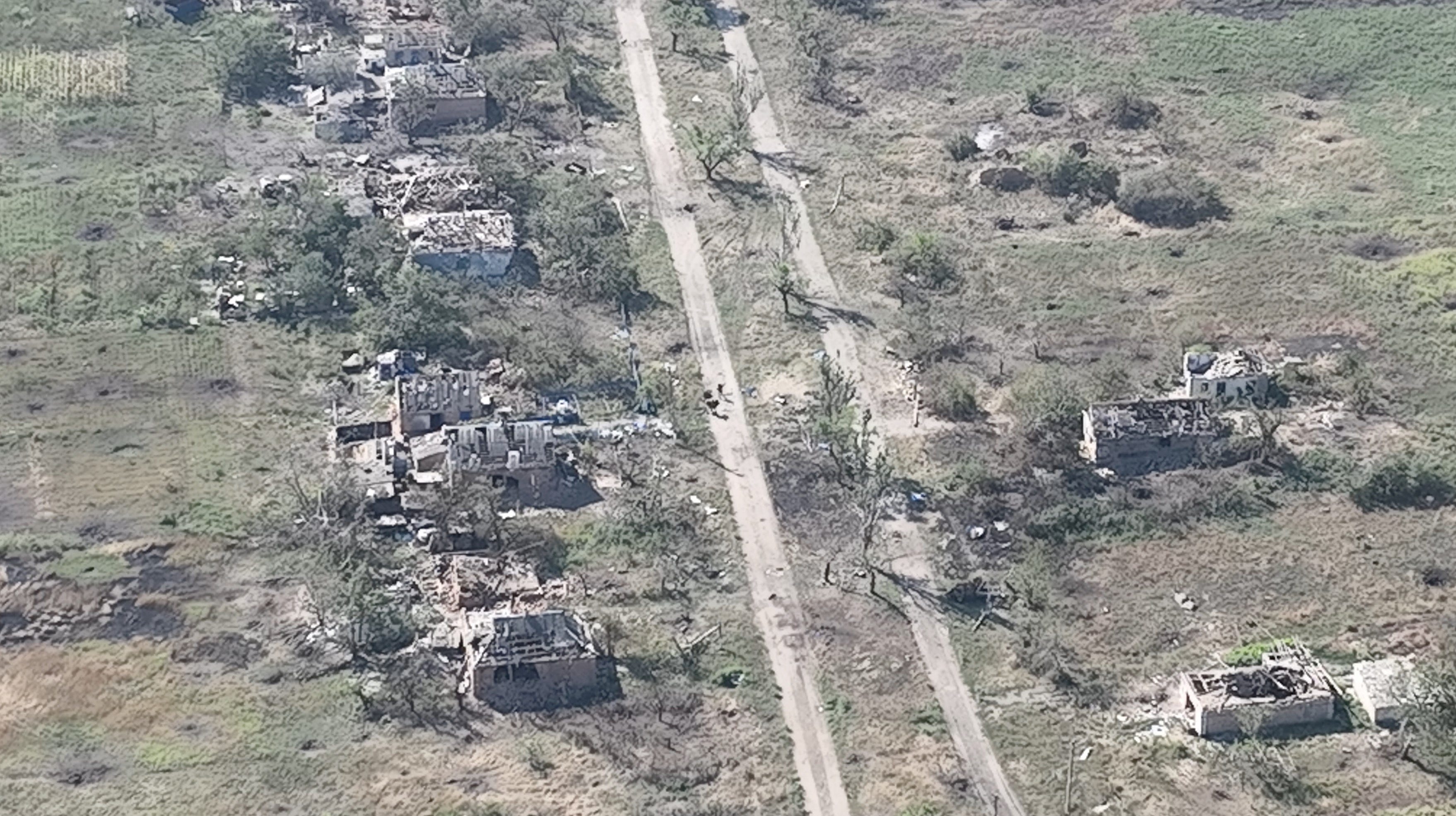
On August 15, the last Russian units were withdrawn from the village. The Storm Z unit, made up of former prisoners from the 155th Marine Brigade, was tasked with conducting a raid into the abandoned village…
Like dominos, African states are one by one falling outside the shackles of neocolonialism. Chad, Guinea, Mali, Burkina Faso, Niger, and now Gabon are saying ‘non’ to France’s longtime domination of African financial, political, economic, and security affairs
(The Cradle)
By adding two new African member-states to its roster, last week’s summit in Johannesburg heralding the expanded BRICS 11 showed once again that Eurasian integration is inextricably linked to the integration of Afro-Eurasia.
Belarus is now proposing to hold a joint summit between BRICS 11, the Shanghai Cooperation Organization (SCO), and the Eurasia Economic Union (EAEU). President Aleksandr Lukashenko’s vision for the convergence of these multilateral organizations may, in due time, lead to the Mother of All Multipolarity Summits.
But Afro-Eurasia is a much more complicated proposition. Africa still lags far behind its Eurasian cousins on the road toward breaking the shackles of neocolonialism.
The continent today faces horrendous odds in its fight against the deeply entrenched financial and political institutions of colonization, especially when it comes to smashing French monetary hegemony in the form of the Franc CFA – or the Communauté Financière Africaine (African Financial Community).
Still, one domino is falling after another – Chad, Guinea, Mali, Burkina Faso, Niger and now Gabon. This process has already turned Burkina Faso’s President Captain Ibrahim Traoré, into a new hero of the multipolar world – as a dazed and confused collective west can’t even begin to comprehend the blowback represented by its 8 coups in West and Central Africa in less than 3 years.
Bye bye Bongo
Military officers decided to take power in Gabon after hyper pro-France President Ali Bongo won a dodgy election that “lacked credibility.” Institutions were dissolved. Borders with Cameroon, Equatorial Guinea, and the Republic of Congo were closed. All security deals with France were annulled. No one knows what will happen with the French military base.
All that was as popular as it comes: soldiers took to the streets of the capital Libreville in joyful singing, cheered on by onlookers.
Bongo and his father, who preceded him, have ruled Gabon since 1967. He was educated at a French private school and graduated from the Sorbonne. Gabon is a small nation of 2.4 million with a small army of 5,000 personnel that could fit into Donald Trump’s penthouse. Over 30 percent of the population lives on less than $1 a day, and in over 60 percent of regions have zero access to healthcare and drinking water.
The military qualified Bongo’s 14-year rule as leading to a “deterioration in social cohesion” that was plunging the country “into chaos.”
On cue, French mining company Eramet suspended its operations after the coup. That’s a near monopoly. Gabon is all about lavish mineral wealth – in gold, diamonds, manganese, uranium, niobium, iron ore, not to mention oil, natural gas, and hydropower. In OPEC-member Gabon, virtually the whole economy revolves around mining.
The case of Niger is even more complex. France exploits uranium and high-purity petrol as well as other types of mineral wealth. And the Americans are on site, operating three bases in Niger with up to 4,000 military personnel. The key strategic node in their ‘Empire of Bases’ is the drone facility in Agadez, known as Niger Air Base 201, the second-largest in Africa after Djibouti.
French and American interests clash, though, when it comes to the saga over the Trans-Sahara gas pipeline. After Washington broke the umbilical steel cord between Russia and Europe by bombing the Nord Streams, the EU, and especially Germany, badly needed an alternative.
Algerian gas supply can barely cover southern Europe. American gas is horribly expensive. The ideal solution for Europeans would be Nigerian gas crossing the Sahara and then the deep Mediterranean.
Nigeria, with 5,7 trillion cubic meters, has even more gas than Algeria and possibly Venezuela. By comparison, Norway has 2 trillion cubic meters. But Nigeria’s problem is how to pump its gas to distant customers – so Niger becomes an essential transit country.
When it comes to Niger’s role, energy is actually a much bigger game than the oft-touted uranium – which in fact is not that strategic either for France or the EU because Niger is only the 5th largest world supplier, way behind Kazakhstan and Canada. Still, the ultimate French nightmare is losing the juicy uranium deals plus a Mali remix: Russia, post-Prighozin, arriving in Niger in full force with a simultaneous expulsion of the French military.
Adding Gabon only makes things dicier. Rising Russian influence could lead to boosting supply lines to rebels in Cameroon and Nigeria, and privileged access to the Central African Republic, where Russian presence is already strong.
It’s no wonder that Francophile Paul Biya, in power for 41 years in Cameroon, has opted for a purge of his Armed Forces after the coup in Gabon. Cameroon may be the next domino to fall.
ECOWAS meets AFRICOM
The Americans, as it stands, are playing Sphynx. There’s no evidence so far that Niger’s military wants the Agadez base shut down. The Pentagon has invested a fortune in their bases to spy on a great deal of the Sahel and, most of all, Libya.
About the only thing Paris and Washington agree on is that, under the cover of ECOWAS (the Economic Community of West African States), the hardest possible sanctions should be slapped on one of the world’s poorest nations (where only 21% of the population has access to electricity) – and they should be much worse than those imposed on the Ivory Coast in 2010.
Then there’s the threat of war. Imagine the absurdity of ECOWAS invading a country that is already fighting two wars on terror on two separate fronts: Against Boko Haram in the southeast and against ISIS in the Tri-Border region.
ECOWAS, one of 8 African political and economic unions, is a proverbial mess. It packs 15 member nations – Francophone, Anglophone and one Lusophone – in Central and West Africa, and it is rife with internal division.
The French and the Americans first wanted ECOWAS to invade Niger as their “peacekeeping” puppet. But that didn’t work because of popular pressure against it. So, they switched to some form of diplomacy. Still, troops remain on stand-by, and a mysterious “D-Day” has been set for the invasion.
The role of the African Union (AU) is even murkier. Initially, they stood against the coup and suspended Niger’s membership. Then they turned around and condemned the possible western-backed invasion. Neighbors have closed their borders with Niger.
ECOWAS will implode without US, France, and NATO backing. Already it’s essentially a toothless chihuahua – especially after Russia and China have demonstrated via the BRICS summit their soft power across Africa.
Western policy in the Sahel maelstrom seems to consist of salvaging anything they can from a possible unmitigated debacle – even as the stoic people in Niger are impervious to whatever narrative the west is trying to concoct.
It’s important to keep in mind that Niger’s main party, the “National Movement for the Defense of the Homeland” represented by General Abdourahamane Tchiani, has been supported by the Pentagon – complete with military training – from the beginning.
The Pentagon is deeply implanted in Africa and connected to 53 nations. The main US concept since the early 2000s was always to militarize Africa and turn it into War on Terror fodder. As the Dick Cheney regime spun it in 2002: “Africa is a strategic priority in fighting terrorism.”
That’s the basis for the US military command AFRICOM and countless “cooperative partnerships” set up in bilateral agreements. For all practical purposes, AFRICOM has been occupying large swathes of Africa since 2007.
How sweet is my colonial franc
It is absolutely impossible for anyone across the Global South, Global Majority, or “Global Globe” (copyright Lukashenko) to understand Africa’s current turmoil without understanding the nuts and bolts of French neocolonialism.
The key, of course, is the CFA franc, the “colonial franc” introduced in 1945 in French Africa, which still survives even after the CFA – with a nifty terminological twist – began to stand for “African Financial Community”.
The whole world remembers that after the 2008 global financial crisis, Libya’s Leader Muammar Gaddafi called for the establishment of a pan-African currency pegged to gold.
At the time, Libya had about 150 tons of gold, kept at home, and not in London, Paris, or New York banks. With a little more gold, that pan-African currency would have its own independent financial center in Tripoli – and everything based on a sovereign gold reserve.
For scores of African nations, that was the definitive Plan B to bypass the western financial system.
The whole world also remembers what happened in 2011. The first airstrike on Libya came from a French Mirage fighter jet. France’s bombing campaign started even before the end of emergency talks in Paris between western leaders.
In March 2011, France became the first country in the world to recognize the rebel National Transitional Council as the legitimate government of Libya. In 2015, the notoriously hacked emails of former US secretary of state Hillary Clinton revealed what France was up to in Libya: “The desire to achieve a greater share in Libyan oil production,” to increase French influence in North Africa, and to block Gaddafi’s plans to create a pan-African currency that would replace the CFA franc printed in France.
It is no wonder the collective west is terrified of Russia in Africa – and not just because of the changing of the guard in Chad, Mali, Burkina Faso, Niger, and now Gabon: Moscow has never sought to rob or enslave Africa.
Russia treats Africans as sovereign people, does not engage in Forever Wars, and does not drain Africa of resources while paying a pittance for them. Meanwhile, French intel and CIA “foreign policy” translate into corrupting African leaders to the core and snuffing out those that are incorruptible.
You have the right to no monetary policy
The CFA racket makes the Mafia look like street punks. It means essentially that the monetary policy of several sovereign African nations is controlled by the French Treasury in Paris.
The Central Bank of each African nation was initially required to keep at least 65 percent of their annual foreign exchange reserves in an “operation account” held at the French Treasury, plus another 20 percent to cover financial “liabilities.”
Even after some mild “reforms” were enacted since September 2005, these nations were still required to transfer 50 percent of their foreign exchange to Paris, plus 20 percent V.A.T.
And it gets worse. The CFA Central Banks impose a cap on credit to each member country. The French Treasury invests these African foreign reserves in its own name on the Paris bourse and pulls in massive profits on Africa’s dime.
The hard fact is that more than 80 percent of foreign reserves of African nations have been in “operation accounts” controlled by the French Treasury since 1961. In a nutshell, none of these states has sovereignty over their monetary policy.
But the theft doesn’t stop there: the French Treasury uses African reserves as if they were French capital, as collateral in pledging assets to French payments to the EU and the ECB.
Across the “FranceAfrique” spectrum, France still, today, controls the currency, foreign reserves, the comprador elites, and trade business.
The examples are rife: French conglomerate Bolloré’s control of port and marine transport throughout West Africa; Bouygues/Vinci dominate construction and public works, water, and electricity distribution; Total has huge stakes in oil and gas. And then there’s France Telecom and big banking – Societe Generale, Credit Lyonnais, BNP-Paribas, AXA (insurance), and so forth.
France de facto controls the overwhelming majority of infrastructure in Francophone Africa. It is a virtual monopoly.
“FranceAfrique” is all about hardcore neocolonialism. Policies are issued by the President of the Republic of France and his “African cell.” They have nothing to do with parliament, or any democratic process, since the times of Charles De Gaulle.
The “African cell” is a sort of General Command. They use the French military apparatus to install “friendly” comprador leaders and get rid of those that threaten the system. There’s no diplomacy involved. Currently, the cell reports exclusively to Le Petit Roi, Emmanuel Macron.
Caravans of drugs, diamonds, and gold
Paris completely supervised the assassination of Burkina Faso’s anti-colonial leader Thomas Sankara, in 1987. Sankara had risen to power via a popular coup in 1983, only to be overthrown and assassinated four years later.
As for the real “war on terror” in the African Sahel, it has nothing to do with the infantile fictions sold in the West. There are no Arab “terrorists” in the Sahel, as I saw when backpacking across West Africa a few months before 9/11. They are locals who converted to Salafism online, intent on setting up an Islamic State to better control smuggling routes across the Sahel.
Those fabled ancient salt caravans plying the Sahel from Mali to southern Europe and West Asia are now caravans of drugs, diamonds, and gold. This is what funded Al-Qaeda in the Islamic Maghreb (AQIM), for instance, then supported by Wahhabi lunatics in Saudi Arabia and the Gulf.
After Libya was destroyed by NATO in early 2011, there was no more “protection,” so the western-backed Salafi-jihadis who fought against Gaddafi offered the Sahel smugglers the same protection as before – plus a lot of weapons.
Assorted Mali tribes continue the merry smuggling of anything they fancy. AQIM still extracts illegal taxation. ISIS in Libya is deep into human and narcotics trafficking. And Boko Haram wallows in the cocaine and heroin market.
There is a degree of African cooperation to fight these outfits. There was something called the G5 Sahel, focused on security and development. But after Burkina Faso, Niger, Mali, and Chad went the military route, only Mauritania remains. The new West Africa Junta Belt, of course, wants to destroy terror groups, but most of all, they want to fight FranceAfrique, and the fact that their national interests are always decided in Paris.
France has for decades made sure there’s very little intra-Africa trade. Landlocked nations badly need neighbors for transit. They mostly produce raw materials for export. There are virtually no decent storage facilities, feeble energy supply, and terrible intra-African transportation infrastructure: that’s what Chinese Belt and Road Initiative (BRI) projects are bent on addressing in Africa.
In March 2018, 44 heads of state came up with the African Continental Free Trade Area (ACFTA) – the largest in the world in terms of population (1.3 billion people) and geography. In January 2022, they established the Pan-African Payment and Settlement System (PAPSS) – focused on payments for companies in Africa in local currencies.
So inevitably, they will be going for a common currency further on down the road. Guess what’s in their way: the Paris-imposed CFA.
A few cosmetic measures still guarantee direct control by the French Treasury on any possible new African currency set up, preference for French companies in bidding processes, monopolies, and the stationing of French troops. The coup in Niger represents a sort of “we’re not gonna take it anymore.”
All of the above illustrates what the indispensable economist Michael Hudson has been detailing in all his works: the power of the extractivist model. Hudson has shown how the bottom line is control of the world’s resources; that’s what defines a global power, and in the case of France, a global mid-ranking power.
France has shown how easy it is to control resources via control of monetary policy and setting up monopolies in these resource-rich nations to extract and export, using virtual slave labor with zero environmental or health regulations.
It’s also essential for exploitative neocolonialism to keep those resource-rich nations from using their own resources to grow their own economies. But now the African dominoes are finally saying, “The game is over.” Is true decolonization finally on the horizon? [end]
Humour russe qui souligne l’inéluctable déclin de la France
Dans le contexte lamentable d’une nouvelle exception culturelle, dont l’initiative suscite au mieux la pitié à travers les vastes restes du monde, l’interdiction faite à des jeunes filles de porter l’Abaya à l’école, Emmanuel Macron s’est exprimé le 4 septembre 2023
Nous vivons aussi dans notre société avec une minorité, des gens qui, détournant une religion, viennent défier la République et la laïcité. Ça a parfois donné le pire. On ne peut pas faire comme s’il n’y avait pas eu l’attaque terroriste et l’assassinat de Samuel Paty dans notre pays
Le personnage s’est révélé depuis longtemps, il est si facile à cerner. La France est bipolaire, en partie vichyste et comme l’a écrit Alain Badiou, le pétainisme existait dans l’hexagone bien avant le dirigeant fasciste Philippe Pétain. Dans un mouvement perpétuel de pendule, ce vice national est redevenu majoritaire au début des années 2000, à l’époque de l’ascension de Nicolas Sarkozy. Macron en est l’incarnation.
La France est aussi un pays très littéraire, où une large part de la population reste focalisée sur la partie la moins noble de son anatomie. Le propos de Macron pourrait bien être un état d’âme. Cela soulignerait un esprit d’une grande vulgarité. Si la fine analyse se voulait plus technique, elle fut au mieux d’une bêtise crasse et l’expression d’un autre courant majoritaire, dont la réputation mondiale est d’avoir peur de son ombre. La France est le pays dont des représentants ont déjà commis l’idée grotesque d’insécurité culturelle.
Macron prétend atténuer les malheurs de la France, mais au même titre que les opérations djihadistes du 13 novembre 2015 à Paris, l’assassinat de Samuel Paty ne fut pas plus qu’un anecdotique dommage collatéral de la politique étrangère d’un pays qui voudrait encore paraître comme une puissance d’envergure mondiale. Comme à l’occasion autrefois d’événements encore plus calamiteux, par vanité, les autorités sont encore incapables, trois ans après, d’analyser sereinement les ressorts du fait divers. Désormais à la traîne des États-Unis, dans une posture parfois excessive de mouche du coche, la France a été avec François Hollande, autre figure emblématique, le plus hystérique support, depuis 2011, d’une insurrection islamiste en Syrie, contre le gouvernement légal et laïc de Bashar Assad.
Abdoulakh Anzorov, gamin de 18 ans, s’est radicalisé, dans ce contexte volcanique, au contact sur les réseaux sociaux des djihadistes d’al Qaeda, appelé localement Hay’at Tahrir al-Sham [Organisation de libération du Levant, HTS], qui vaincus ailleurs par les opérations militaires conjuguées de la Syrie, de la Russie et de l’Iran, sont réfugiés encore aujourd’hui dans la poche d’Idlib, nord-ouest de la Syrie, où USA, OTAN et Union européenne les protègent, en raison d’intérêts géopolitiques supérieurs. Ce sont donc des amis de la France qui ont guidé le bras de l’assassin adolescent. C’est cocasse
Le 28 octobre 2020, les militants d’HTS célèbrent à Idlib le martyre d’Abdoulakh Anzorov (Moussa NDT)
Voila pour le mobile. Il nous faut maintenant aborder l’aspect le plus cruel de la pathétique affaire, celui de l’opportunité. Anzorov se motivait sur les réseaux sociaux, où son expression était tellement violente et prémonitoire, qu’à l’été 2020, il a été signalé plusieurs fois à PHAROS, le pompeux Portail officiel de signalement illicit des contenus de l’internet. Problème, les éminents analystes de la DGSI (Direction générale de la sécurité intérieure) ne l’ont pas estimé dangereux. Savoir faire de la police politique, contre toute forme sérieuse d’opposition, ou alors du renseignement anti-terroriste, il faut choisir. La suite est impardonnable.
Au mois d’octobre, le SCRT (Service central du renseignement territorial) surveillait dans le Val d’Oise une paire de militants des Frères musulmans (organisation politique internationale qui fut aussi à l’origine de l’insurrection en Syrie, c’est cocasse), qui manifestaient contre le professeur. C’est alors que deus ex machina, le jeune Abdoullakh Anzorov est entré en contact avec les deux agitateurs. Mais l’incapacité de la DGSI et du SCRT, une fois encore, à analyser correctement la situation et surtout, à recouper leurs informations, conduisit le 16 octobre 2020, à l’assassinat de Samuel Paty. Si les fins limiers du grotesque Gérald Darmanin avaient connu le b.a-ba du métier pour lequel ils sont payés, le professeur serait encore en vie.
Le 7 juillet 2023, presque trois ans après les faits, l’avocate de la famille put enfin annoncer qu’un juge d’instruction avait ouvert une information, sur les graves incuries de l’État français. Car un rappel peut être utile, à l’exception d’Alain Badiou, des Frères musulmans et de l’avocate, tous les personnages et organismes français cités plus haut sont grassement payés par vos impôts.
It has been a while since I published anything long-form commenting on the ongoing Russo-Ukrainian War, and I confess that writing this article gave me a modicum of trouble. Ukraine’s much anticipated grand summer counteroffensive has now been underway for about eighty days with little to show for it. The summer has seen fierce fighting in a variety of sectors (to be enumerated below), but the contact line has shifted very little. I have been reluctant to publish a discussion of the Ukrainian campaign simply because they have continued to hold assets in reserve, and I did not want to post a premature commentary that went to press right before the Ukrainians showed some new trick or revealed a hidden ace up their sleeve. Sure enough, I wrote the bulk of this article last week, right before Ukraine launched yet another major attempt to force a breach in the Orikhiv sector.
At this point, however, the appearance of some of Ukraine’s last remaining premier brigades, which had previously been held in reserve, confirms that the axes of Ukraine’s attack are concretized. Only time will tell if these precious reserves manage to achieve a breach in the Russian lines, but enough time has passed that we can sketch out what exactly Ukraine has been trying to do, why, and why it has failed to this point.
Part of the problem with narrating the war in Ukraine is the positional and attritional nature of the fighting. People continue to look for bold operational maneuver to break the deadlock, but the reality seems to be that for now some combination of capability and reticence has turned this war into a positional struggle with a plodding offensive pace, which far more resembles the first world war than the second.
Ukraine had aspirations of breaking open this grinding front and reopening mobile operations – escaping the attritional struggle and driving on operationally meaningful targets – but these efforts have so far come to naught. For all the lofty boasts of demonstrating the superior art of maneuver, Ukraine still finds itself trapped in a siege, painfully trying to break open a calcified Russian position without success.
Ukraine may not be interested in a war of attrition, but attrition is certainly interested in Ukraine.
Ukraine’s Strategic Paradigm
For those that have been following the war closely, what follows will probably not be new information, but I think it is worth thinking holistically about Ukraine’s war and the factors that drive their strategic decision making.
For Ukraine, the conduct of the war is shaped by a variety of disturbing strategic asymmetries.
Some of these are obvious, like Russia’s much larger population and military industrial plant, or the fact that Russia’s war economy is indigenous, while Ukraine is entirely reliant on western deliveries of equipment and munitions. Russia can autonomously ramp up armaments production and there are abundant signs from the battlefield that the Russian war economy is beginning to find its groove, with new systems like the Lancet present in increasing abundance, and western sources now admitting that Russia has successfully serialized a domestic version of the Iranian Shahed Drone. Furthermore, Russia has the asymmetrical capacity to strike Ukrainian rear areas to an extent that Ukraine cannot reciprocate, even if they are given the dreaded ATACMs (these will give Ukraine the range to strike operational depth targets in the theater, but they can’t hit facilities in Moscow and Tula the way Russian missiles can strike anywhere in Ukraine)
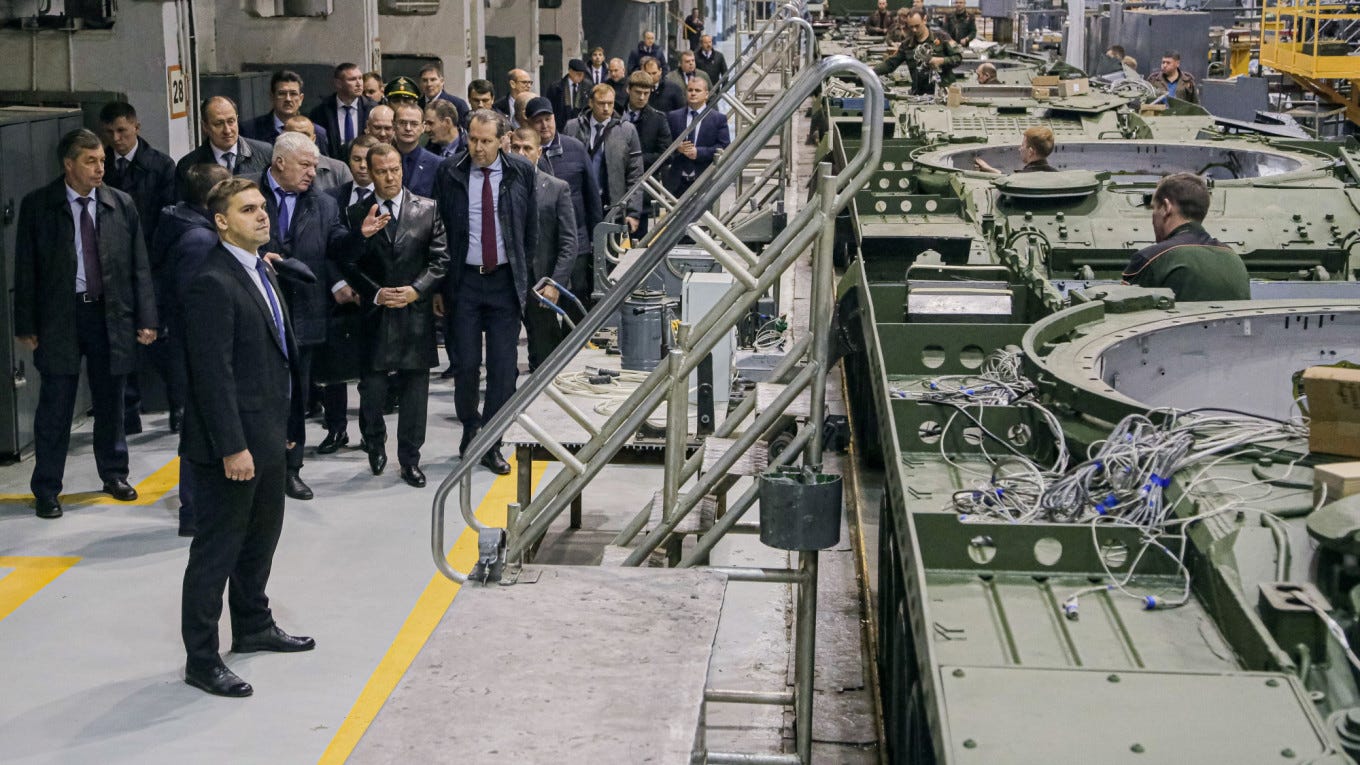
Medvedev inspects a tank production run
With significant Russian asymmetries in population size, industrial capacity, strike capability, and – let us be blunt – sovereignty and decision-making freedom, an attritional-positional struggle is simply bad math for Ukraine, and yet that is precisely the sort of war in which it has become trapped.
What is important for us to understand, however, is that the strategic asymmetry goes beyond physical capacities like population base, industrial plant, and missile technology, and extends into the realm of strategic objectives and timelines.
Russia’s war has been deliberately framed in a fairly open-ended way, with goals largely tied to the idea of “demilitarizing” Ukraine. In fact, Russia’s territorial objectives remain rather nebulous beyond the 4 annexed oblasts (though it is safe to say that Moscow would like to acquire far more than just these). All that to say, Putin’s government has deliberately framed the war as a military-technical enterprise focused on destroying the Ukrainian armed forces, and has shown itself to be perfectly free to give up territory in the name of operational prudentia.
In contrast, Ukraine has maximalist goals that are explicitly territorial in nature. The Zelensky government has been open about the fact that it aims – however fanciful this may be – to restore the entirety of its 1991 territories, including not just the four mainland oblasts but also Crimea.
The confluence of these two factors – Ukrainian territorial maximalism combined with asymmetrical Russian advantages in a positional-attritional struggle – forces Ukraine to seek a way to break open the front and restore a state of operational fluidity. Remaining locked in a positional struggle is unworkable for Kiev, partially because Russia’s material advantages will inevitably shine through (in a fight between two big guys swinging big bats at each other, bet on the bigger guy with the bigger bat), and partially because a positional war (which amounts essentially to a massive siege) is simply not an efficient way to retake territory.
This leaves Ukraine with no choice but to unfreeze the front and try to restore mobile operations, with an eye towards creating some asymmetry of their own. The only feasible way to accomplish this is to launch an offensive aimed at severing critical lines of Russian communication and supply. Contrary to some suggestions that were popular this spring, a large Ukrainian offensive against Bakhmut or Donetsk simply did not fit the bill.
Frankly, there are only two suitable operational targets for Ukraine. One is Starobils’k – the beating heart at the center of Russia’s Lugansk front. Capturing or screening Svatove and then Starobils’k would create a genuine operational catastrophe for Russia in the north, with cascading effects all the way down to Bakhmut. The second possible target was the land bridge to Crimea, which could be cut by a thrust across lower Zaporizhia towards the Azov coast.
It was probably inevitable that Ukraine would select the Azov option, for a few reasons. The land bridge to Crimea is a more self-contained battlespace – an offensive in Lugansk would occur under the shadow of the Belgorod and Voronezh regions of Russia, making it relatively more difficult to put significant Russian forces out of supply. Perhaps even more significant, however, is Kiev’s complete obsession with Crimea and the Kerch Bridge – targets that hold hypnotic sway in a way that Starobils’k never could.
Again, this may sound like fairly intuitive review, but it’s worth contemplating how and why Ukraine ended up launching an offensive that was widely telegraphed and expected. There was no strategic surprise whatsoever – a definitely real video of GUR chief Budanov smirking didn’t fool anyone. The Russian armed forces certainly weren’t fooled, as they spent months saturating the front with minefields, trenches, firing emplacements, and obstacles. Everyone knew that Ukraine was going to attack toward the Azov Coast, specifically with an eye towards Tokmak and Melitopol, and that’s exactly what they did. A frontal attack against a prepared defense without the element of surprise is generally considered a poor choice, but here is Ukraine not only attempting such an attack but even launching it against a backdrop of global celebration and phantasmagorical expectations
Ukraine’s infantile plea for OPSEC
It’s impossible to make sense of this without understanding the way that Ukraine is shackled by a particular interpretation of the war to this point. Ukraine and its supporters point to two successes in 2022 where Ukraine was able to retake a substantial swathe of territory, in Kharkov and Kherson oblasts. The problem is that neither of these situations is portable to Zaporizhia.
In the case of the Kharkov offensive, Ukraine identified a sector of the Russian front that had been hollowed out and was defended only by a thin screening force. They were able to stage a force and achieve a measure of strategic surprise, due to the thick forests and general paucity of Russian ISR in the area. This is not to mitigate the scale of Ukraine’s success there; it was certainly the best uses of forces available to them and they did exploit a weak section of front. This success is hardly relevant to circumstances in the south today; mobilization has ameliorated Russia’s force generation problems so that they now longer have to make hard choices about what to defend, and the heavily fortified Zaporizhia frontline is nothing like the thinly held front in Kharkov.
The second case study – the Kherson counteroffensive – is even less germane. In this case, Ukrainian leadership is rewriting history in record time. The AFU banged its head on Russian defenses in Kherson for months throughout the summer and autumn last year and took atrocious losses. An entire grouping of AFU brigades was mauled in Kherson without achieving a breakthrough, and this even with Russian forces in a uniquely difficult operational disposition where they had their backs to a river. Kherson was only abandoned months later due to concerns that the Kakhovka dam might fail or be sabotaged (for those keeping score, it did in fact end up failing), and due to Russia’s need at the time to economize forces.
Again, this can easily be misconstrued as arguing that Russia’s withdrawal from Kherson did not matter. Obviously, abandoning a hard-earned bridgehead is a major setback, and retaking west-bank Kherson was a boon for Kiev. But we need to be honest about why it happened, and it plainly did not happen because of Ukraine’s summer counteroffensive – to underscore this, recall that Ukrainian officials openly wondered if the Russian withdrawal was a trickor a trap. The question is simply whether Ukraine’s Kherson offensive is predictive of future offensive success. It is not.
So, we have one case where Ukraine identified a lightly defended section of front and ran through it, and another where Russian troops abandoned a bridgehead due to logistical and force allocation concerns. Neither is particularly relevant to the situation on the Azov coast, and in fact an honest reflection of the AFU’s Kherson Counteroffensive might have given Ukraine second thoughts about a frontal assault on prepared Russian defenses.
Instead, Kharkov and Kherson have both been presented as proof positive that Ukraine can shatter Russian defenses in a straight up fight – in fact, we still have no examples from this war of the AFU defeating strongly held Russian positions, particularly post-mobilization when Russia finally began to resolve its manpower deficiencies. But Ukraine is caught in the grip of its own particular story about this war, which has imparted unearned confidence in its ability to conduct offensive operations. Tragically for mobilized Ukrainian Mykolas, this has dovetailed with a second swagger-producing mythology.
A major selling point for the Ukrainian counteroffensive has been the assessed superiority of the AFU’s big-ticket donations from the west – the main battle tanks and infantry fighting vehicles. Since the first deliveries were announced, there has been no shortage of boasting about the many superior qualities of western models like the Leopards and Challengers. The suggestion has essentially been that skilled Ukrainian tankers are only waiting to be unleashed once they get behind the wheel of superlative western builds. My personal favorite motif has been the practice of dismissing Russian tanks as “Soviet Era” – neglecting to note that the Abrams (designed 1975) and the Leopard 2 (1979) are also Cold War models
A burn out Leopard in Syria
It must be stated, again, that there is nothing wrong with western tanks. The Abrams and the Leopard are fine vehicles, but confidence in their game-changing capabilities stems from a mistaken assumption about the role of armor. It must be appreciated that tanks always have been and always will be mass-consumption items. Tanks blow up. They are disabled. They break down and are captured. Tank forces attrit – much faster than people expect. Given that the brigades prepared for Ukraine’s assault on the Zapo line were significantly understrength in vehicles, it was simply irrational to expect them to have an oversized impact. This is not to say that tanks aren’t important – armor remains critical to modern combat – but in a peer conflict one should always expect to lose armor at a steady clip, especially when the enemy retains fires superiority.
One can see, then how a measure of hubris can easily creep in to Ukrainian thinking, fueled by a healthy dose of desperation and strategic need. Reasoning from a distorted understanding of its successes in Kharkov and Kherson, emboldened by their shiny new toys, and guided by an overriding strategic animus that requires them to unlock the front somehow, the idea of a frontal attack without strategic surprise against a prepared defense really could seem like a good idea. Add in the good old fashioned trope about Russian incompetenceand disorder, and you have all the recipes for an imprudent roll of the dice by Ukraine.
The Misfire
So now we come to the operational minutia. For a variety of reasons, Ukraine has chosen to attempt a frontal assault on Russia’s fortified Zaporizhia front, with the intention of breaching towards the sea of Azov. How can this be accomplished?
We had a few clues early on, accruing from a variety of geographic features and alleged intelligence leaks. In May, the Dreizin Report published what was purported to be a Russian synthesis of Ukraine’s OPORD (Operational Order). An OPORD functions as a broad sketch of an operation’s intended progression, and the document shared by Dreizin was billed as a summary of Russia’s expectation for Ukraine’s offensive (that is, it is not a leak of Ukraine’s internal planning documents, but a leak of Russia’s best guess at Ukraine’s plans).
In any case, in a vacuum it was anybody’s guess as to whether Dreizin’s OPORD was authentic, but we’ve subsequently been able to cross-check it. This is because of the other, even more infamous leak from earlier this spring, which included the Pentagon’s combat power build plan for Ukraine.
NATO was very generous and built Ukraine a mechanized strike package from scratch. However, because this mechanized force was cobbled together with a variety of different systems from all corners of the NATO Cinematic Universe, Ukraine formations are uniquely identifiable by their particular combination of vehicles and equipment. So, for example, the presence of Strykers, Marders, and Challengers indicates the presence of the 82nd Brigade in the field, and so forth.
Thus, despite Ukrainian pretensions of operational security, it’s actually been trivially easy for observers to know which Ukrainian formations are in the field. There have been a few deviations from the script – for example, the 47th Brigade was supposed to field the Frankenstein Slovenian M55 tanks, but in the end the decision was made to send the underpowered M55’s to the northern front and the 47th was deployed with a contingent of Leopard Tanks originally operated by the 33rd Brigade. But these are minor details, and on the whole we’ve had a good sense of when and where specific AFU formations get on the field.
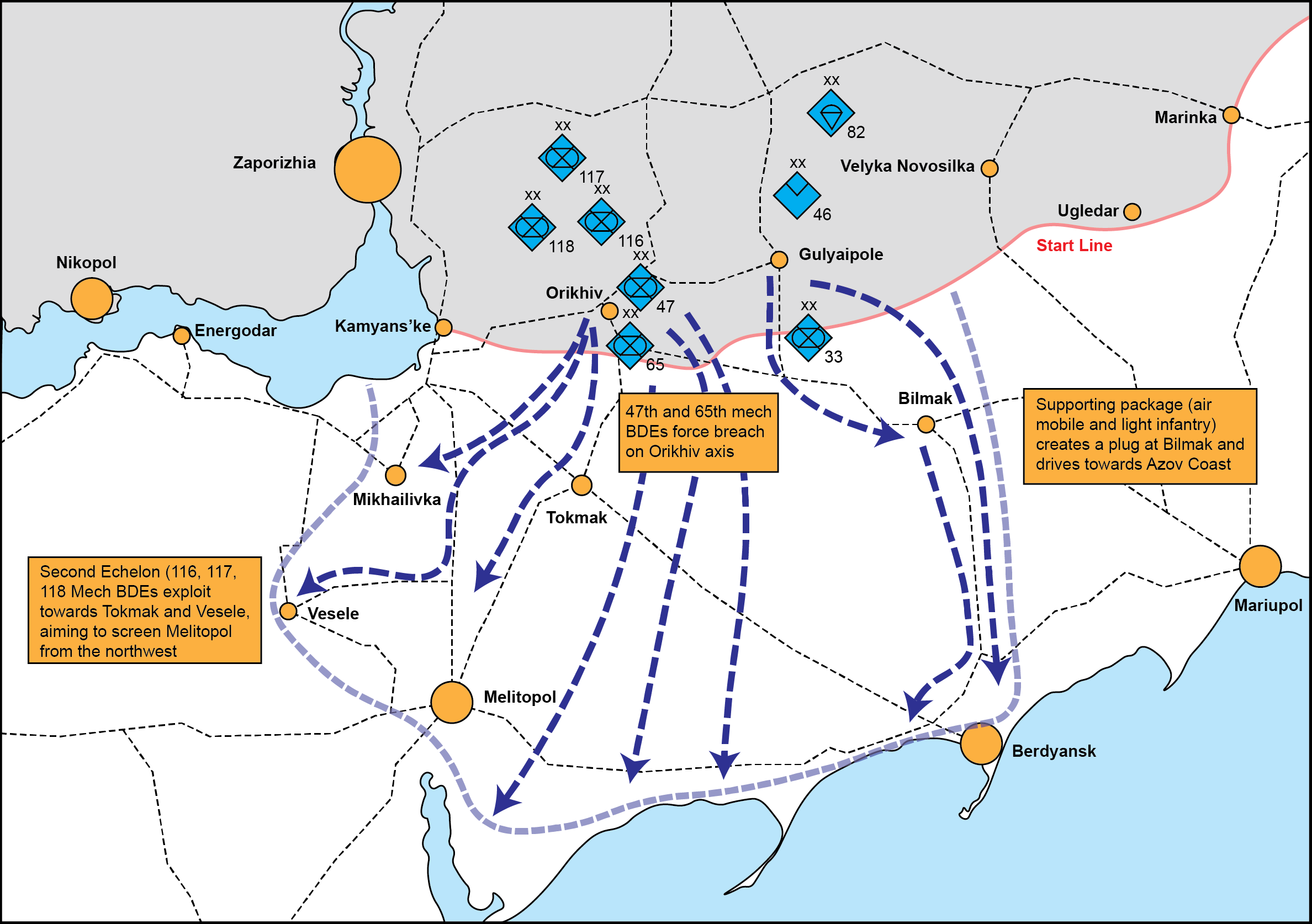
Based on identifiable units, the Dreizin OPORD looks very close to what we actually saw at the onset of the Ukrainian offensive. The Dreizin OPORD called for an assault by the 47th and 65th Brigades on the Russian lines south or Orikhiv, in the sector bounded by Nesterianka and Novoprokopivka. Directly in the middle of this sector is the town of Robotyne, and sure enough that’s where the first big AFU assault came overnight on June 7-8, spearheaded by the 47th Brigade.
Now, from this point it becomes difficult to evaluate the Dreizin OPORD simply because Ukraine’s attack became instantaneously derailed, but one thing we can say is that Dreizin’s source was correct about the order that Ukrainian units would be introduced into battle. Based on this, we can flesh out the OPORD and feel pretty safe wagering that this is what the Ukrainians were hoping to achieve:
Ukraine’s Dream: The Drive to the Sea
The intention seems to have been to force a breach in the Russian line using a concentrated armored assault by the 47th and 65th Brigades, after which a follow on force of the 116th, 117th, and 118th would begin the exploitation phase, driving for the Azov Coast and the towns of Mikhailivka and Vesele to the west. The objective was clearly not to get bogged down in urban fighting attempting to capture places like Tokmak, Berdyansk, or Melitopol, but to bypass them and cut them off by taking up blocking positions on the main roads.
Simultaneously, a lesser – but no less critical – thrust would come out of the Gulyaipole area and drive along the Bilmak axis. This would have the effect of both screening the main advance to the west and wedging the Russian front open, splintering the integrity of the Russian forces caught in the middle. Overall, this is a fairly sensible, if ambitious and uncreative plan. In many ways, this was really the only option.
So what went wrong? Well, conceptually it’s easy. There is no breach. The bulk of the maneuver scheme is dedicated to exploitation – reaching such and such a line, taking up this blocking position, masking that city, and so forth. But what happens when there’s no breach at all? How can such a catastrophe occur, and how can the operation be salvaged when it comes untracked in the opening phase?
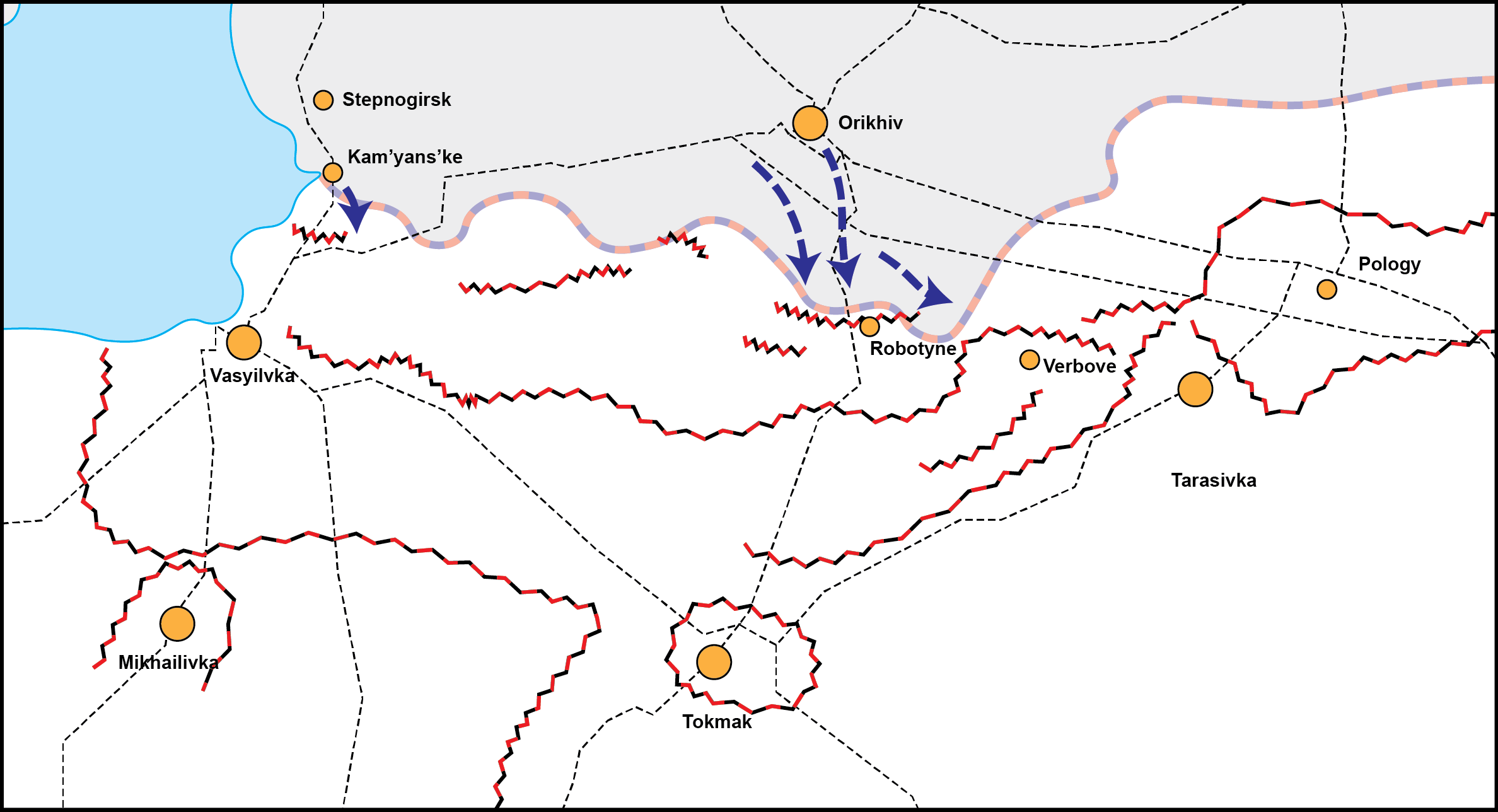
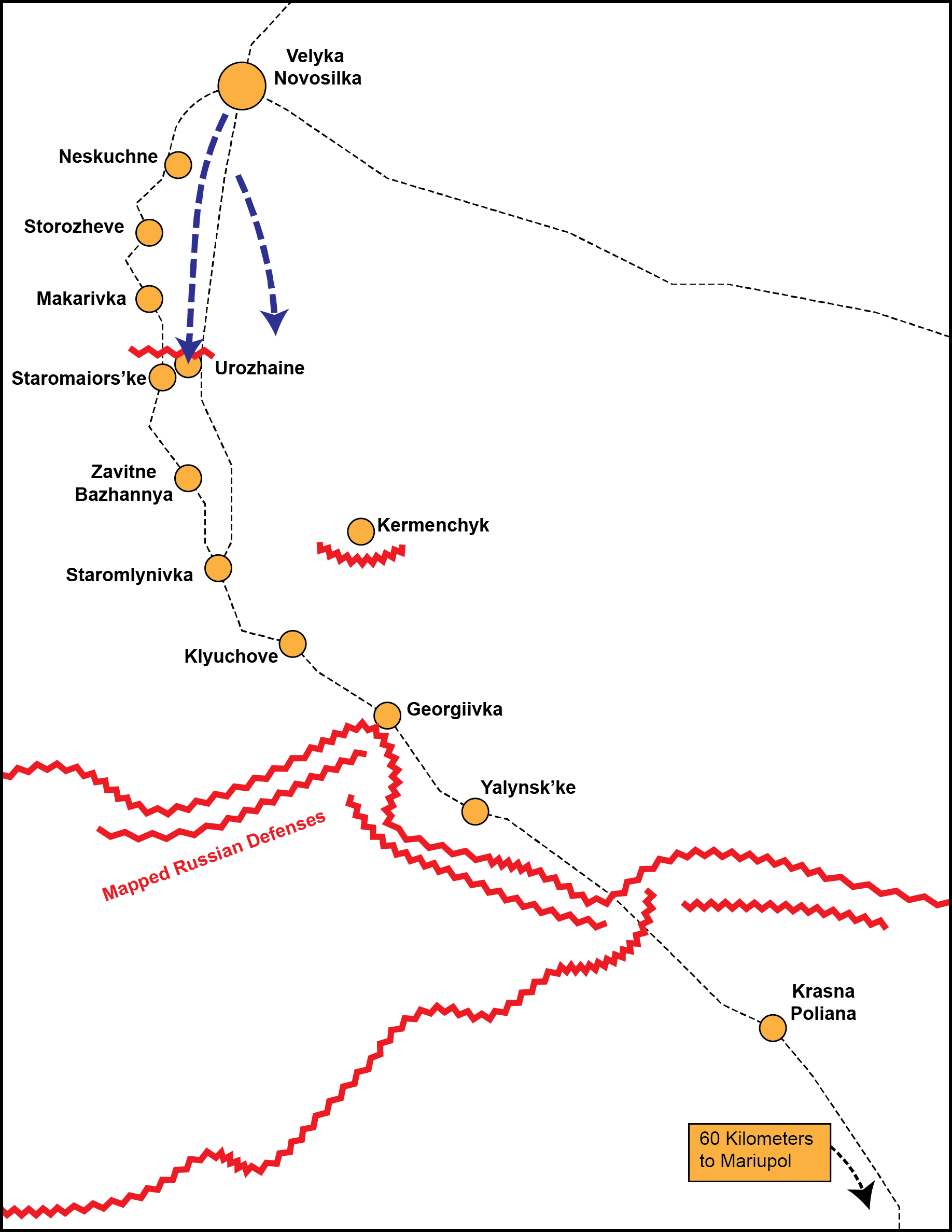
Indeed, this is precisely what has happened. Ukraine finds itself stuck on the edge of Russia’s outermost screening line, spending substantial resources trying to capture the small village of Robotyne, and/or bypass it to the east by infiltrating the gap between it and the neighboring village of Verbove. So instead of that rapid breach and turning maneuver towards Melitopol, we get something like this:
Ukrainian Counteroffensive with Mapped Russian Defensive Lines
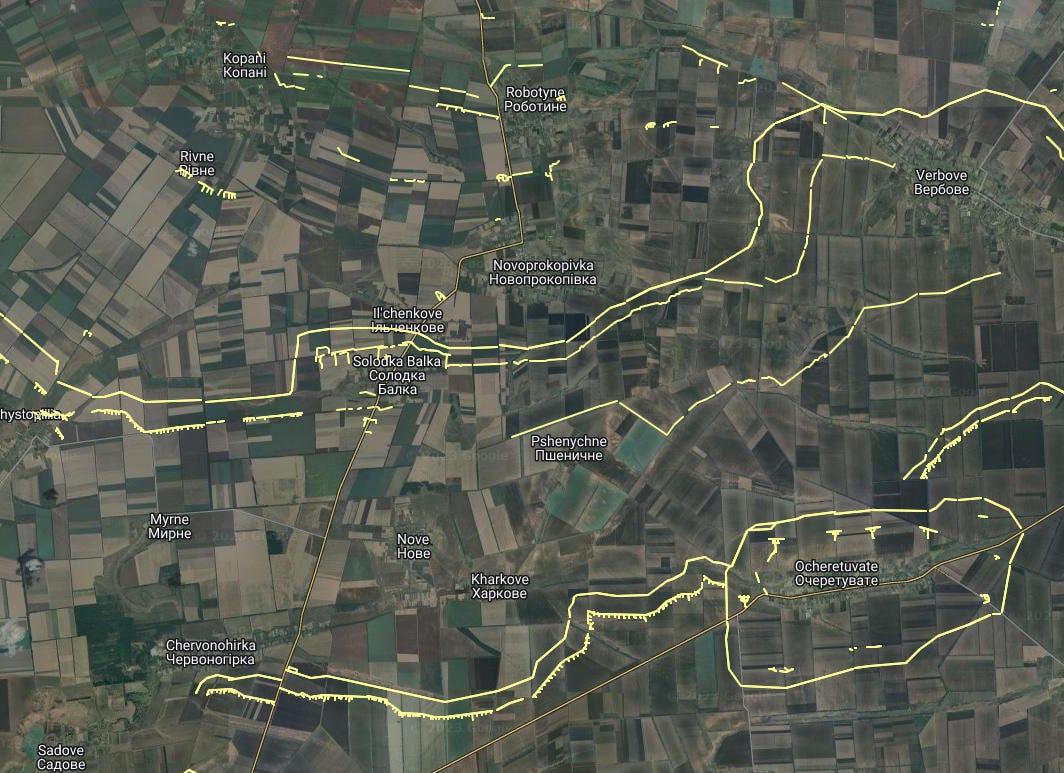
We could be generous and say that Robotyne is the last village before the Ukrainian attack reaches the main Russian defensive belt, but we’d be lying – they will also have to clear the larger town of Novoprokopivka, two kilometers to the south. Just for reference, here’s a closer look at the mapped Russian defenses in the battlespace, based on the excellent work of Brady Africk
Russian defenses in the Robotyne Sector
The discussion about these emplacements can get a little muddled, simply because it’s not always clear what is meant by that popular phrase “first line of defense.” Clearly there are some defensive works around and in Robotyne, and the Russians chose to fight for the village, so in some sense Robotyne is part of the “first line” – but it is more proper to speak of it as part of what we would call a “screening line”. The first line of continuous fortifications across the front is several kilometers further south, and this is the belt that Ukraine has yet to even reach, let alone breach.
As of this moment, it appears that Russian troops have lost total control of Robotyne but continue to hold the southern half of the village, while Ukrainian troops in the northern half of the village remain subject to heavy Russian shelling. We should probably at this point consider the village to be continuously contested and a feature of the gray zone
Robotyne, in all its glory
Now, a quick note about Robotyne itself and why both sides are so determined to fight for it. It seems rather odd on the surface, given that the Russian preference in 2022 was to make tactical withdrawals under their fires umbrella. This time though, they are fiercely counterattacking to contest Robotyne. The value of the village lies not only in its location on the T-0408 Highway, but also its excellent perch on top of a ridge. Both Robotyne and Novoprokopivka lie on a ridge of elevated ground which is as much as 70 meters higher than the low-lying plain to the east.
What this means is fairly simple; if the AFU presses forward in attempts to bypass the Robotyne-Novoprokopivka position by pushing into the gap between Robotyne and Verbove, it will be vulnerable to fire on the flanks (particularly by ATGMs) by Russian troops on the high ground. We already have seen footage of this, with Ukrainian vehicles being taken in the flank by fire from Robotyne. I am highly skeptical that Ukraine can even attempt an earnest assault on the first defensive belt until they have captured both Robotyne and Novoprokopivka.
This would all be a tough nut to crack under ideal circumstances, with a variety of engineering problems to mediate, obstacles designed to funnel the attacker into firing lanes, perpendicular trenches to allow enfilade fire on advancing Ukrainian columns, and robust defenses on all the major roadways. But these are not the best of circumstances. This is a tired force that has exhausted much of its indigenous combat power, which is attempting to organize the attack using a piecemeal and understrength assault package.
Several factors conspired against the Ukrainian offensive, and synergistically they have created a bona fide military catastrophe for Kiev. Let us enumerate them.
Problem 1: The Hidden Defensive Layer
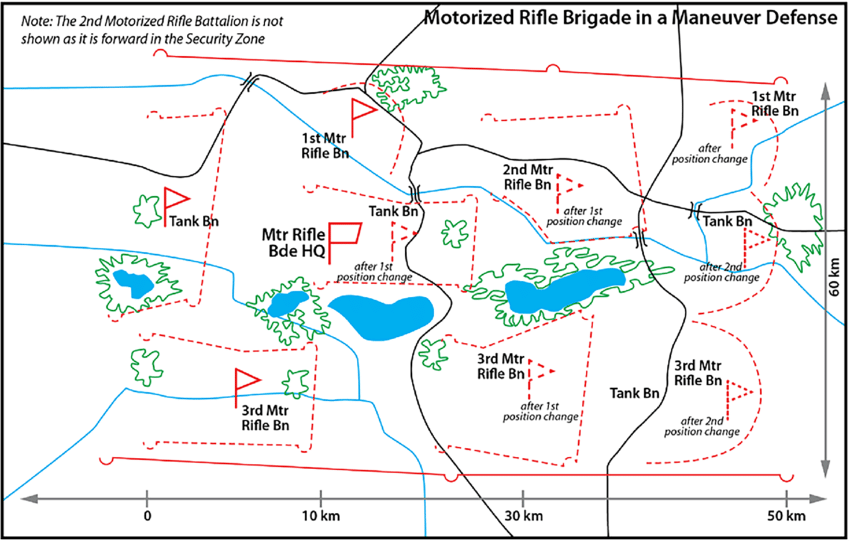
At this point, we need to acknowledge something that everybody missed about Russia’s defense. I previously expressed high confidence that Ukraine’s forces would be unable to breach the Russian defenses, but I mistakenly believed that the Russian defense would function according to the classic Soviet defense-in-depth principles (elucidated in great detail by the writings of David Glantz, for example)
Idealized Defense in Depth by a Motor Rifle Brigade
Such a defense, put simply, is open to the idea that the enemy will breach the first or even second lines of defense. The purpose of the multilayered (or “echeloned” in the classic terminology) defense is to ensure that the enemy force gets stuck as it tries to break through. It may penetrate the first layer, but as it goes it is continually chewed up by the subsequent belts. The classic example is the Battle of Kursk, where powerful German panzers broke into the Soviet defensive belts but subsequently became stuck as they were ground down. You can think of this as being analogically similar to a Kevlar vest, which uses a web of fibers to stop projectiles: rather than bouncing off, the bullet is caught and its energy is absorbed by the layered fibers.
I was actually quite open to the idea that Ukraine would generate some penetration, but I anticipated them getting stuck in the subsequent belts and sputtering out.
What was missing from this picture – and this is a credit to Russian planning – was an unseen defensive belt forward of the proper trenches and fortifications. This forward belt consisted of extremely dense minefields and strongly held forward positions in the screening line, which the Russians evidently intended to fight for fiercely. Rather than breaking through the first belt and getting stuck in the interstitial areas, the Ukrainians have been repeatedly mauled in the security zone, and the Russians have consistently counterattacked to knock them back when they do manage to get footholds.
In other words, while we expected Russia to fight a defense in depth that absorbed the Ukrainian spearheads and shredded them in the heart of the defense, the Russians have actually shown a strong commitment to defending their forwardmost positions, of which Robotyne is the most famous.
On paper, Robotyne was expected to function as part of a so-called “crumple zone”, or “security zone” – a sort of lightly held buffer that puts the enemy through pre-registered fires before they bump into the first belt of continuous and strongly held defenses. Indeed, a variety of aerial and satellite surveys of the area taken before Ukraine went on the attack showed Robotyne laying well forward of the first solid and continuous Russian fortification belt.
What was missed, it seemed, was the extent to which the Russian defenders had mined the areas on the approach to Robotyne and were committed to defending within the security zone. The scale of the mining certainly seems to have surprised the Ukrainians, and creates a strain on Ukraine’s limited combat engineering capabilities. Even more importantly, the dense mines have created predictable avenues of approach for the Ukrainian forces, which force them to repeatedly run through the same gauntlet of fires and Russian standoff weaponry.
Problem 2: Insufficient Suppression
The signature image of the first great assaults on the Zapo Line has been columns of unsupported maneuver assets, being raked with Russian fires, both ground based (rocketry, ATGMs, and tube artillery) and from air platforms like the Ka-52 Alligator attack helicopter. One of the more startling aspects of these scenes was the way Ukrainian forces would come under heavy fire while still in their marching columns, taking losses before they ever deployed into firing lines to begin their assault proper.
There are myriad reasons for this. One is the now blasé issue of Ukrainian munition shortages. Consider the following items of interest. In the runup to Ukraine’s counteroffensive, Russia waged a heavy counter-preparatory air campaign that knocked out large AFU ammunition dumps. Ukraine’s initial assaults collapse in the face of heavy and unsuppressed Russian fires. The United States decides to transfer cluster munitions to Ukraine because, in the words of the president, “they’re running out of ammunition.” Add in the degradation of Ukrainian air defense, which allows Russian helicopters to operate with great effect along the contact line, and you have a recipe for disaster. Lacking the tubes to suppress Russian fires or the air defense to chase away Russian aircraft, the AFU opened their offensive by disastrously pushing forward unsupported maneuver elements into a hail of fire.
Problem 3: Russian Standoff Weapons
It’s crucial to understand that the Russian toolbox is fundamentally different than it was during the battle for Kherson last year, due to the rapidly expanding production of a variety of Russian standoff weapons – most notably the Lancet and the UMPK glide modifications for gravity bombs.
The proliferation of the Lancet and similar systems means, in a nutshell, that nothing within 30km of the contact line is safe, and this in turn disrupts the AFU’s deployment of critical support assets like air defense and engineering, magnifying their vulnerability to Russian mines and fires. In fact, we’ve increasingly seen Ukrainian artillery use decline in the Robotyne area due to the threat of lancets (they seem to be transferring tubes to other fronts), and the AFU is favoring the use of HIMARS in the suppressive role.
Problem 4: Repetitive Lines of Approach
Because the AFU failed to breach the Robotyne sector on their first attempt, they’ve been forced to continually move up additional units and resources to hammer on the position. This has particular implications, both in the sense that AFU forces must continually traverse the same lines of approach to contact, and in the fact that they are using the same rear area to assemble and stage their assault forces.
This makes the burden on Russian ISR (Intelligence, Surveillance, Reconnaissance) significantly easier, since the AFU has no effective way to disperse or hide the assets that they are bringing forward to the assault. Staged Ukrainian forces and material have been hid repeatedly in the villages immediately behind Orikhiv, like Tavriiske and Omeln’yk, and Russia is able to strike rear area infrastructure like ammunition depots because – to put it simply – there are only so many places these these assets can be staged when you are repeatedly assaulting the same 20km wide sector of front.
We recently had Ukrainian Deputy Minister of Defense Hanna Malair complaining that the 82nd Brigade – newly deployed to the Orikhiv sector – had been hit with a series of Russian airstrikes in its staging areas. According to her, this was because of poor OPSEC revealing the brigade’s location to the Russians. But this really makes very little sense; the entire area of operations around Orikhiv is perhaps 25km deep (from Kopani to Tavriiske) and 20 km wide (from Kopani to Verbove). This is a small area that has seen a huge amount of military traffic along the same roads throughout the summer. The idea that Russia needs insider information to know that they ought to surveil and attack targets in this area is absurd.
Problem 5: Fragile Brigades
It actually takes significantly less damage to “destroy” an operational level unit than people think. A unit can become a combat scratch off at 30% losses (with some variance depending on how those are allocated). This is because when people hear the term “destruction”, they think that means total losses. Sometimes that’s how the word is used in colloquial conversation, but what matters for officers trying to manage an operation is whether or not a formation is combat capable of the tasks being asked of it – and those capabilities can vanish much more quickly than people realize.
This is particularly the case for the Ukrainian mech package, for a variety of reasons. For one, as we discussed in previous articles, these brigades started the fight well understrength (remember, for example, that the Ukrainian 82nd Brigade has only 90 Stryker AFVs, while an American Strkyer Brigade is supposed to have 300). Additionally, the cobbled together nature of these brigades – and the total lack of indigenous sustainment systems like repair and maintenance – means that the Ukrainians will naturally have to cannibalize these vehicles. They’ve already started designating “donor” vehicles that are written off completely to be stripped down for parts. The nexus of these two facts is that Ukraine’s mechanized brigades are understrength on vehicles to begin with, and will have an abysmally poor recovery rate, with hidden attrition behind the scenes due to cannibalization.
What this means is that when we heard admissions by mid-July that Ukraine had already lost 20% of its maneuver assets, there is an associated catastrophic decline in combat capability. The lead brigades – which chewed through 50% or more of their maneuver vehicles – can no longer shoulder combat tasks appropriate for a brigade, and the Ukrainians are forced to feed in their second echelon units prematurely.
At this point, partial elements of at least ten different brigades have been deployed in the Robotyne sector, with the 82nd likely to join them soon. Given that the NATO combat power build plan only included 9 NATO trained brigades, plus a few reconstituted Ukrainian formations, it’s safe to say that blooding all of them over a 71 day fight just to break into the screening line was not in the plan.
Staring at the Abyss
I’ve seen a variety of analysts and writers lately arguing that the insertion of additional Ukrainian units into the Robotyne sector signals the next phase of the operation.
This is nonsense. Ukraine is still mired in the first phase. What has happened is instead that the attrition of their first echelon brigades has forced them to commit their second (and third) wave to complete the tasks of the opening phase. The initial attack, led by the 47th Brigade, was intended to create a breach in the Russian screening line around Robotyne and advance to the main Russian belt further to the south. They failed, and the additional brigades earmarked for exploitation – the 116th, 117th, 118th, 82nd, 33rd, and more – are now being systematically fed in to keep the pressure on.
These brigades have not been destroyed, of course, simply because they are not being committed in their entirety, but rather as subunits. Nevertheless, at this point Ukrainian losses make up the better part of a whole brigade, distributed around the broader package, and over 300 maneuver elements (tanks, IFVs, APCs, etc) have been scratched off.
We need to say this very explicitly. Ukraine has not moved on to the next phase of their operation. They are stuck in the first phase, and have been forced to prematurely commit portions of the second echelon that was earmarked for later action. They are slowly but surely burning through the entire operational grouping, and so far they have not breached Russia’s screening line. The great counteroffensive is turning into a military catastrophe
Now, this does not mean that the operation has failed, simply because it is still ongoing. History teaches us that it is unwise to make definitive pronouncements. Luck and human factors (bravery and intelligence, cowardice and stupidity) always have something to say. However, the trajectory is undeniably towards abject failure at the current moment.
So far, the AFU has shown some adaptability. In particular, we’ve recently seen them shift away from pushing forward unsupported columns of mechanized assets – instead they’ve been leaning on small dismounted units, trying to slowly push forward into the space between Robotyne and Verbove. The move towards dispersal is intended to reduce loss rates, but it also reduces the probability of a dramatic breakthrough even further and marks the temporary abandonment of decisive breaching action in favor of – once again – creeping positional warfare.
We would be remiss if we failed to note that there have been meaningful Russian losses in all of this. We know that the Russian forces in the Robotyne sector have required rotation and reinforcement, including with elite VDV and Naval Infantry units. Russia has taken counterbattery losses, it has lost vehicles in counterattacking action, and men have been killed holding their trenches. The initial assault groups that the Ukrainians threw in had a lot of combat power, and the fighting was very bloody for both sides. It’s not a one-sided shooting gallery, but a high intensity war.
But therein is the crux of the matter – Ukraine seems unable to escape the attritional and positional war that it finds itself in. It sounds all well and good to proclaim a return to “maneuver” warfare, but if there is an inability to breach enemy defenses, this is only an empty boast, and the nature of the struggle remains attritional. When the question becomes “will we breach before we run out of combat power”, you are not maneuvering. You are attriting.
In my series of articles on military history, we’ve looked at a variety of cases where armies tried desperately to unlock the front and restore a state of operational maneuver, but when there is no technical capacity to do so, these intentions do not matter one bit. Nobody wants to be trapped on the wrong side of attritional mathematics, but sometimes what you want does not matter at all. Sometimes attrition is imposed on you.
In the absence of the capabilities required to successfully breach Russia’s prodigious defenses – more ranged fires, more air defense, more ISR, more EW, more combat engineering, more more more – Ukraine is trapped in a rock fight. Two fighters are swinging bats at each other, and Russia is a bigger man with a bigger bat.
Two Bad Copes
Amid a clear misfire and growing strategic disappointment, two new suggestions have increasingly crept into the conversation – “copes”, if you will, that are utilized as a narrative comfort to explain why the Ukrainian operation is actually going just fine (despite nearly universal acknowledgment in the west that the results have been lackluster at best). I would like to briefly address each of these in turn.
Cope 1: “The first stage is the hardest”
You frequently see it argued that all the AFU has to do is break open the Russian screening line, and the remainder of the defenses will fall like dominos. The general thrust of this argument is that the Russians lack reserves and that the subsequent defensive lines are not adequately manned – just break open the first line, and the rest will fall apart.
This is probably a comforting thing to tell oneself, but it’s rather irrational. We could talk, for example, about Russia’s doctrinal schema for defense in depth, which prescribes liberal allocation of reserves at all depths of the defensive system, but it’s probably more fruitful to point at more immediate evidence.
Let us simply consider Russia’s behavior over the last six months. They have spent a tremendous amount of effort constructing echeloned defenses – are we really to believe that they did all this only to waste all their combat power fighting in front of these defenses? Nor is there any evidence that Russia is having trouble supplying the front with manpower at the present moment. We’ve seen continued rotations and redeployments amid an overall process of military enlargement in Russia. Indeed, of the two belligerents, it is Ukraine that seems to be scraping the barrel for manpower.
Cope 2: “Get within firing range”
This is the more fantastical story, and it represents a radical ad-hoc shift of the goalposts. The argument is that Ukraine doesn’t actually need to advance to the sea and physically cut the land bridge, all it has to do is get the Russian supply routes within firing range to cut off Russian troops. This theory has been advance liberally on Twitter X and by personalities like Peter Zeihan (a man who knows nothing about military affairs).
There are many problems with this line of thought, most of which stem from an inflated notion of “fire control.” To put it simply, being “in range” of artillery fire does not imply effective area denial or severed supply lines. If that were the case, Ukraine would be unable to attack out of Orikhiv at all, since the entire axis of approach is within Russian firing range. In Bakhmut, the AFU continued to fight long after their main supply routes came under Russian shelling.
The simple fact is that most military tasks are conducted within range of at least some of the enemy’s ranged fires, and the idea that Russia will collapse if the AFU manages to put a shell on the Azov coastal highway is fairly ridiculous. In fact, Russia’s main rail line is already within range of Ukrainian HIMARS, and the Ukrainians have successfully launched strikes on coastal cities like Berdyansk. Meanwhile, Russia strikes at Ukrainian sustainment infrastructure with regularity – yet neither army has collapsed yet. This is because ranged fires are a tool to improve attritional calculus and further operational goals – they do not magically win wars just by tagging the enemy’s supply roads.
Let’s be charitable though, and indulge this line of thinking. Suppose the Ukrainians managed to advance – not all the way to the coast, but far enough to bring Russia’s main supply routes within range of artillery. What would they do? Wheel up a battery of howitzers, park them at the very front line, and begin firing nonstop at the road? What do you think would happen to those howitzers? Counterbattery systems would surely set upon them. The idea that you can just haul up a big gun and start taking potshots at Russian supply trucks is really quite childish. Putting enemy forces out of supply has always required physically blocking transit, and that’s what Ukraine will have to do if they want to cut Russia’s land bridge.
The Distraction
I am cognizant of the fact that I would be raked over the coals if I failed to discuss a secondary area of Ukrainian effort, farther to the east in Donestk oblast. Here, the Ukrainians have worked their way a good distance up the highway out of the town of Velyka Novosilka capturing several settlements.
The problem with this “other” Ukrainian attack is that it is, in a word, inconsequential. This axis of advance is operationally sterile in a very fundamental way, as it involves pushing groups up a narrow corridor of road that doesn’t lead anywhere important. As in the Robotyne sector, the AFU is still quite some distance from any of the serious Russian fortifications, and to make matters worse the road and settlements on this axis lay along a small river. Rivers, as we know, flow along the floor of the terrain, which means the roadway sits at the bottom of a wadis/embakement/glacis, choose your terminology. In fact, the road network as such consists of nothing except a single-lane roadway on either side of the river
The Sideshow in the East
My reading of this axis is essentially that it was intended as a feint to create some semblance of operational confusion, but when the primary effort on the Orikhiv axis turned into a colossal misfire, the decision was made to continue to press here simply for narrative purposes. Ultimately, this is simply not an axis of advance that can exert a meaningful influence on the wider war. The forces deployed here are relatively miniscule in the grand scope of things, and they aren’t going anywhere important. Certainly, a thin, needlelike penetration is not going to drive more than 80 kilometers down a single lane road to the sea and win the war.
Conclusion: Finger Pointing
One of the surest signs that Ukraine’s counteroffensive has taken a cataclysmic turn is the way Kiev and Washington have already begun to blame each other, conducting a postmortem while the body is still warm. Zelensky has blamed the west for being too slow to deliver the requisite equipment and ammunition, arguing that unacceptable delays allowed the Russians to improve their defenses. This strikes me as rather obscene and ungrateful. NATO built Ukraine a new army from scratch in a process that already required greatly truncating the training times.
On the other hand, western experts have begun to blame Ukraine for supposedly being unable to adopt “combined arms warfare”. This is really a very nonsensical attempt to use jargon (incorrectly) to explain away problems. Combined arms simply means the integration and simultaneous use of various arms like armor, infantry, artillery, and air assets. Claiming that Ukraine and Russia are somehow cognitively or institutionally incapable of this is extremely silly. The Red Army had a complex and extremely thorough doctrine of combined arms operation. One professor at the US Arms School of Advanced Military Studies said: “The single most coherent core of theoretical writings on operational art is still found among the Soviet writers.” The idea that combined arms is some foreign and novel concept to Soviet officers (a caste that includes the Russian and Ukrainian high command) is ridiculous.
This issue is not some sort of Ukrainian doctrinal obstinacy, but a combination of structural factors rooted in the insufficiency of Ukrainian combat power and the changing face of warfare.
It’s frankly a little silly to say that Ukraine needs to learn about “combined arms” when they are very simply lacking important capabilities that would make a successful maneuver campaign possible – namely, adequate ranged fires, a functioning air force (and no, F-16’s will not fix this), engineering, and electronic warfare. The issue very fundamentally is not one of doctrinal flexibility, but of capability. By way of analogy, this is a bit like sending a boxer out to fight with a broken arm, and then critiquing his technique. The problem is not his technique – the problem is that he’s injured and materially weaker than his opponent. So too, the problem for Ukraine is not that they are incapable of coordinating arms, the problem is that their arms are shattered.
Secondly – and this, I admit, is rather shocking to me – western observers do not seem open to the possibility that the accuracy of modern ranged fires (be it Lancet drones, guided artillery shells, or GMLRS rockets) combined with the density of ISR systems may simply make it impossible to conduct sweeping mobile operations, except in very specific circumstances. When the enemy has the capacity to surveil staging areas, strike rear area infrastructure with cruise missiles and drones, precisely saturate approach lines with artillery fire, and soak the earth in mines, how exactly can it be possible to maneuver?
Combined arms and maneuver are predicated on the ability to rapidly concentrate enormous fighting power and attack with great violence at narrow points. This is probably impossible given the density of Russian surveillance, firepower, and the many obstacles they have put up to deny Ukrainian freedom of movement and scleroticize their activity. The main examples of maneuver in recent western memory – the campaigns in Iraq – have only tenuous relevance to circumstances in Zaporizhia.
Ultimately, we have returned to a war of mass – particularly massed ISR assets and fires. The only way Ukraine can maneuver the way they want is to break open the front, and they can only do this with more of everything – more mine clearing equipment, more shells and tubes, more rocketry, more armor. Only mass can crack open a suitable breach in the Russian lines. Otherwise, they are stuck in a positional creep through the dense Russian defenses, and criticizing them for being unable to grasp some sort of magical western notion of “combined arms” is the strangest sort of finger pointing.
So, whence goes the war from here? Well, the obvious question to ask is whether we believe Ukraine will ever have a more potent assault package than the one they started the summer with. The answer clearly seems to be no. It was like pulling teeth to scrape together these understrength brigades – the idea that, following on a defeat in the Battle of Zaporizhia, NATO will somehow put together a more powerful package seems like a stretch. More to the point, we have American officials saying fairly explicitly that this was the best mechanized package Ukraine was going to get.
It does not seem controversial to say that this was Ukraine’s best shot at some sort of genuine operational victory, which at this point seems to be slowly trickling away into modest but materially costly tactical advances. The ultimate implication of this is that Ukraine is unable to escape a war of industrial attrition, which is precisely the sort of war that it cannot win, due to all the asymmetries that we mentioned earlier.
In particular, however, Ukraine cannot win a positional-attritional war because of its own maximalist definition of “winning.” Since Kiev has insisted that it will not give up until it returns its 1991 borders, an inability to dislodge Russian forces poses a particularly nasty problem – Kiev will either need to admit defeat and acknowledge Russian control over the annexed areas, or it will continue to fight obstinately until it is a failed state with nothing left in the tank.
Trapped in a bat fight, with attempts to unlock the front with maneuver coming to naught, what Ukraine needs most is a much bigger bat. The alternative is a totalizing strategic disaster [end]