Analista senior di l'intelligenza in u campu di a gestione di i risichi di sicurezza, sò un anzianu tenente detective è ufficiale di l'intelligenza in l'agenzie di u Statu francese. A bona pronuncia hè Николай Чинкуини, in russu
Zaporizhzhia Region, near the settlement of Stepnohorsk. Mid-December 2025. A combat mission becomes a true test of endurance for the young paratrooper Grant. When his partner Sam is seriously wounded and out of action, Grant decides not to retreat, but to storm the enemy “strongpoint” alone.
For headquarters, it looks like pure madness: the soldier has no experience, no reinforcements, and no right to make a mistake. But war rarely goes according to plan. When routine tactics fail, it’s such “crazy” decisions that turn the impossible into reality
Ukraine has struck the Votkinsk Machine Building Plant using a Flamingo cruise missile. The ramifications of this event could reverberate globally
The launch of a Flamingo cruise missile by Ukraine
On the night of February 20-21, 2026, Ukraine launched an intermediate-range missile at the Votkinsk Machine Building Plant, a strategic defense industrial facility located in the Republic of Udmurtia, some 1,300 kilometers from the Russian-Ukrainian border. The missile, equipped with a 1,000-kilogram warhead, struck a building housing Workshop 19, which houses a critical electroplating and stamping workshop. It is here that Russian technicians carry out the metal stamping and forming processes related to the manufacture of missile body elements, as well as the galvanic processing of parts, including the application of protective and functional coatings and surface preparation for further assembly. Workshop 19 plays a critical role in the manufacture of some of Russia’s most strategically vital ballistic missiles. The Flamingo’s warhead blasted a 30-by-24-meterhole in the roof of the structure, setting its interior on fire. At least 11 workers were wounded in the attack.
It is not known the extent to which the attack on Workshop 19 has impacted Russia’s ability to produce strategically important missiles such as the Topol-M and Yars intercontinental ballistic missiles (ICBMs), the Bulava submarine-launched ballistic missile. The Iskander and Oreshnik missiles are manufactured at the Votkinsk plant, as well as research and development on follow-on strategic delivery systems like the Kedr ICBM.
What is known is that the Ukrainian’s have struck at the very heart of Russia’s strategic defense industry, delivering a blow which is not just politically damaging in terms of the image it creates regarding the status of Russia’s war with Ukraine, which is entering its 5th year, but also potentially crippling Russia’s ability to keep pace with any increase in strategic nuclear delivery systems now that the last remaining arms control treaty between the US and Russia—New START—has expired
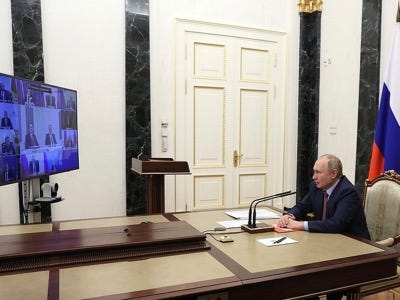
Russian President Putin meets with the Russian Security Council to discuss an draft agreement of strategic stability in Europe
Russia has long been alerted to this very possibility. Back in December 2021, Russia sent a clear signal to both the United States and NATO that it viewed the stationing of intermediate- or short-range missiles on the territory of Ukraine was a red line which, if crossed, presented an unacceptable threat to the security of Russia. In draft treaties addressed to both parties, Russia defined one of the bedrock conditions needed to be met for stability in Europe. Article 6 of the US treaty stated that “The Parties shall undertake not to deploy ground-launched intermediate-range and shorter-range missiles outside their national territories, as well as in the areas of their national territories, from which such weapons can attack targets in the national territory of the other Party.” Article 5 of the draft NATO treaty likewise stated that “The Parties shall not deploy land-based intermediate- and short-range missiles in areas allowing them to reach the territory of the other Parties.”
In the weeks prior to the Russian initiation of the Special Military Operation, the Russians went out of their way to communicate to the Biden administration the seriousness to which they attached this issue. Senior Biden administration officials acknowledge that Russian President Vladimir Putin had specifically accused the United States of seeking to place missiles inside Ukraine, something the Biden administration assured Russia it had no intention of doing. While the US declared that it was open to “discussing the future of certain missile systems in Europe, along the lines of the INF treaty, which Russia violated and the previous U.S. administration withdrew from,” little movement in that direction took place when US Deputy Secretary of State Wendy Sherman and Russian Deputy Foreign Minister Sergei Ryabkov met for more than seven hours in Geneva, Switzerland on January 10, 2022. The two sides talked cross purposes, with Russia looking for a concrete response to its December draft treaties, and the US indicating there could be no agreement without additional consultation with allies, including Ukraine
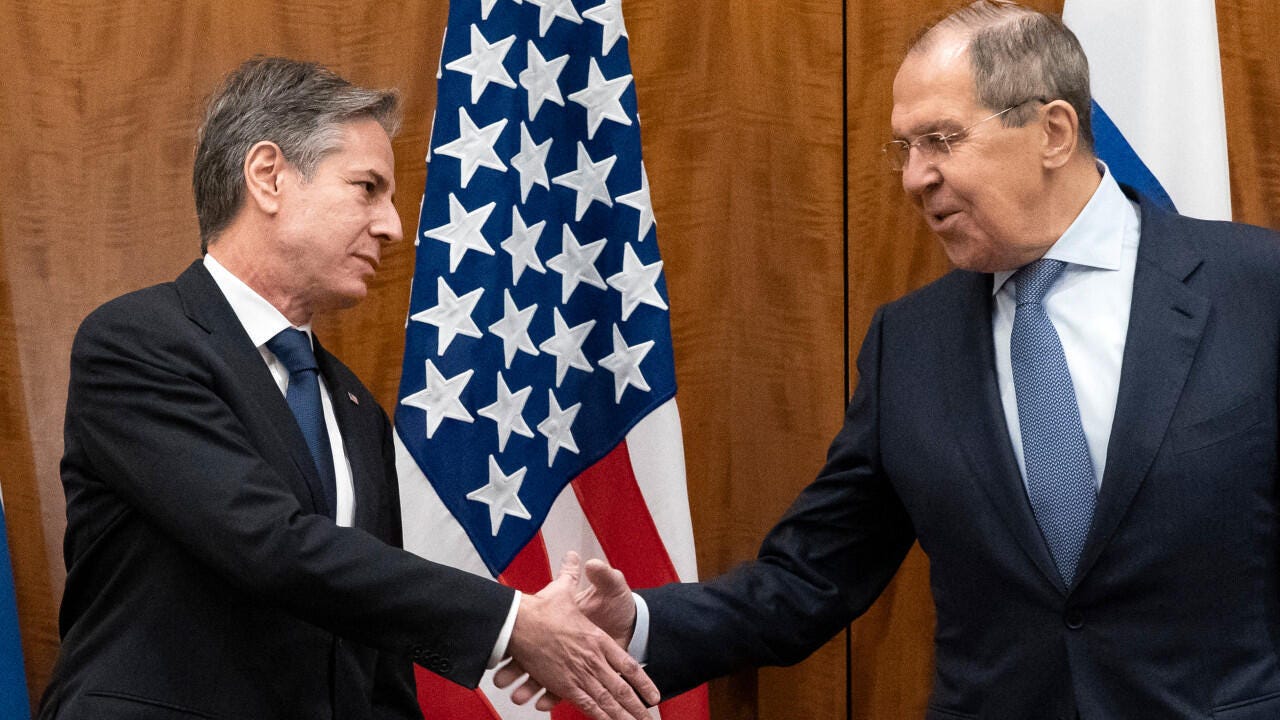
US Secretary of State Tony Blinken shakes hands with Russian Foreign Minister Sergei Lavrov, January 21, 2022
A follow-on meeting between US Secretary of State Antony Blinken and Russian Foreign Minister Sergei Lavrov held on January 21 produced no results, other than a pledge by the United States to provide a written response to the Russian draft treaties “soon.” On January 26, the US and NATO did just that, rejecting outright Russia’s conditions for European stability and security, including a rejection of Russia’s concerns about the stationing of intermediate- and short-range missiles on Ukrainian soil. A follow-on meeting between Sergei Ryabkov and US Assistant Secretary of State Rose Gottemoeller in Berlin on February 9 yielded no results.
Since the SMO began, Russia has made it clear that the provision of long-range strike capability to Ukraine by the US and NATO represented a serious threat to Russian national security. The use by Ukraine of British-made Storm Shadow missiles and their French analog, the SCALP, together with US-provided ATACMS missiles, were permitted by the providing nations only on the conditions that these weapons not be used to strike targets inside the boundaries of the Russian Federation as recognized in 1991. Russian threats about holding Germany accountable helped convince the German government not to provide the Taurus cruise missile to Ukraine (the Storm Shadow/SCALP missiles possess a range of 250 kilometers, while the ATACMS possesses a range of up to 300 kilometers; the Taurus, with a range of up to 500 kilometers, would have represented a major upgrade to Ukraine’s ability to strike targets inside Russia).
In September 2024 the US and UK governments were actively considering authorizing Ukraine to use Storm Shadow and ATACMS missiles to strike targets inside Russia proper. Russian President Vladimir Putin warned that if Western countries authorize Ukraine’s use of long-range missiles in Russian territory, they will become directly involved in the war. “It will mean nothing less than the direct involvement of NATO countries, the United States and European countries in the war in Ukraine,” Putin said. “This will be their direct participation, and this, of course, will significantly change the very essence, the very nature of the conflict.” Based on such threats, Putin warned, Russia would be forced to take “appropriate actions.” Putin’s threats came at a time when Russia had issued a new nuclear doctrine which allowed Russia to use nuclear weapons in retaliation for the very kind of attacks the US and UK were considering
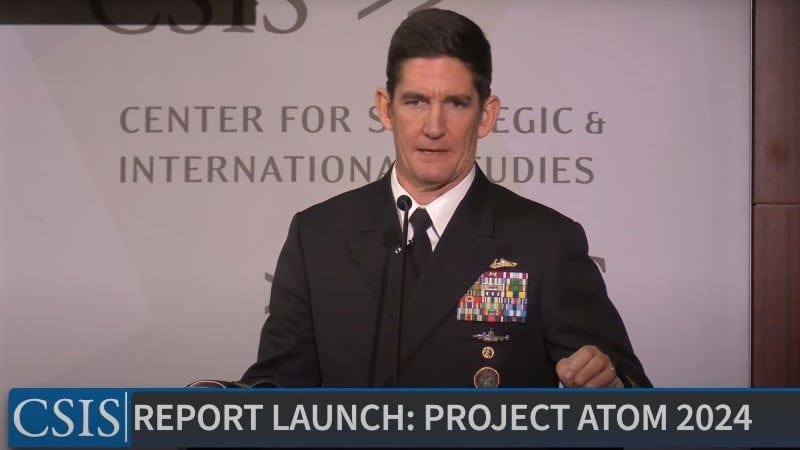
Rear Admiral Thomas Buchanan addresses CSIS, November 2024
The danger of nuclear conflict was very high. In November, the head of plans for Strategic Command, Rear Admiral Thomas Buchanan, told a Washington, DC think-tank that the Biden administration was ready to fight and win a nuclear exchange with Russia, and in early December 2024 the CIA, responding to an announcement by the administration that it would greenlight the use by Ukraine of ATACMS missiles to strike targets inside Russia, briefed members of Congress that there was a greater than 50% chance there would be a nuclear war between Russia and the US before years end.
While President-elect Trump helped lower tensions by pledging that he would reverse the Biden administration’s decision once he came into office (something he did, in fact, do), his inability to follow through on his pledge to bring a rapid end to the Russian-Ukraine conflict led to increasing frustration and resentment toward Russia and its leadership, prompting President Trump to announce that he was considering providing Ukraine with the Tomahawk cruise missile—the very weapons system Russia had declared would never be permitted to be stationed on Ukrainian soil.
The threats to provide Ukraine with Tomahawk missiles were more of a negotiating ploy than real threat, however. The real threat came from elsewhere—a missile designed by the British using indigenous Ukrainian parts and manufacturing infrastructure known as the FP-5 Flamingo.
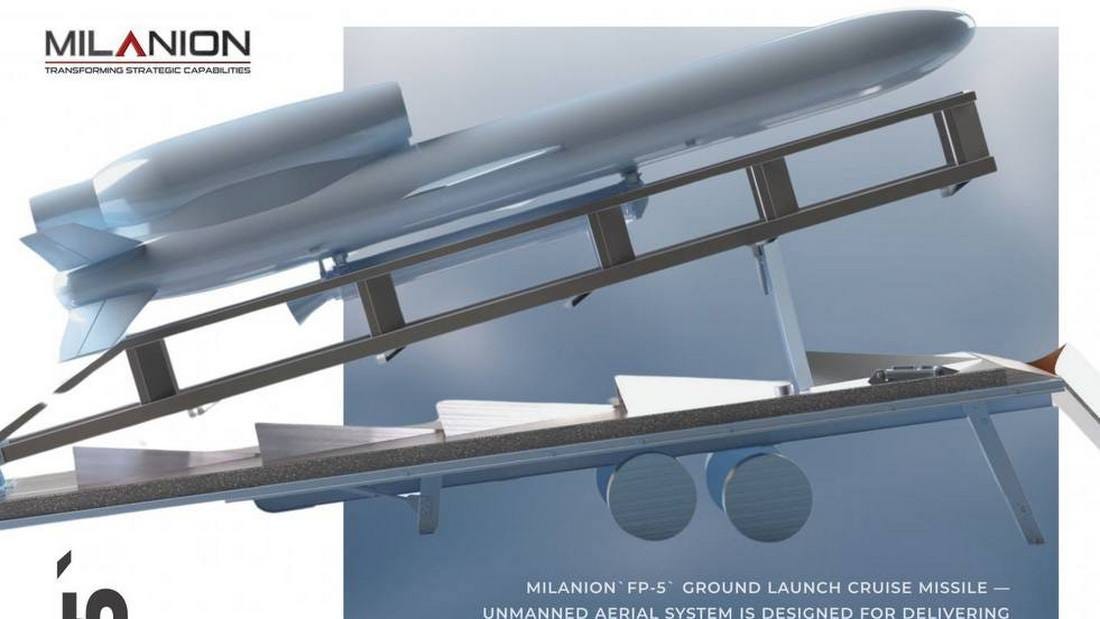
The Flamingo made its debut at the international defense industry exhibition IDEX-2025, which took place from February 17 to 21, 2025 in Abu Dhabi in the United Arab Emirates, when the Emirati-British Milanion Defense Industry Group unveiled a prototype missile. Built around the Ivchenko AI-25 turbo-fan jet engine, which had been developed in the 1950s by the Ivchenko Design Bureau in the Soviet Union, and produced at the Motor Sich aircraft factory in Zaparozhia, the Flamingo was a derivative of the Soviet-era Tu-141and Tu-143 reconnaissance drones, which had been repurposed by Ukraine into ground-attack cruise missiles. The warhead appeared to be based upon Ukrainian gravity bombs. The goal behind the Milanion design was to provide Ukraine with an affordable indigenous long-range strike capability which bypassed the Russian restrictions on foreign weapons
The Milanion-designed FP-5 Flamingo
This subterfuge, however, is shallow. Fire Point, the company which oversees the manufacture of the FP-5 Flamingo, is little more than a shell company overseen by a CEO, Iryna Terekh, who has zero education or experience which would lend itself to missile production. The task of coordinating Ukrainian defense manufacturing with foreign suppliers is well above her paygrade. The FP-5 Flamingo is exactly what it portends to be—a British-made weapon designed to get around the legalities, and consequences, of Russian red lines regarding the use of long-range missiles based in Ukraine against Russia targets.
Moreover, Russian military strikes have severely disrupted Ukraine’s ability to assemble the FP-5 on Ukrainian soil—the near complete destruction of the Motor Sich factory earlier this year stands as a harsh example. Fire Point has opened a Flamingo production facility in Denmark, near Skrydstrup Air Base and the town of Vojens in Southern Jutland, that will produce solid rocket propellant used to boost the FP-5 into flight during ground operations. The Danish defense minister, when asked whether establishing Ukrainian arms production in Denmark would make the country a target for Russian attacks, noted that Denmark was not at war and that an open Russian attack on Denmark would constitute an attack on a NATO country.
No mention was made about the role Denmark was playing in helping Ukraine produce a missile which has now been used to strike one of the most important strategic missile production facilities in Russia—the Votkinsk Machine Building Plant
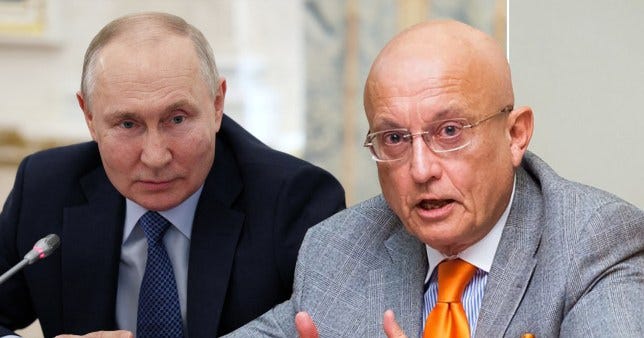
Sergei Karaganov (right) with Russian President Vladimir Putin (left)
Sergei Karaganov, the head of Russia’s Council for Foreign and Defense Policy, has been warning about the use of Ukraine as a dagger to wound Russia on behalf of the collective West, writing in mid-June 2023 that Russia needed to lower the threshold for use of nuclear weapons to break Western support for Ukraine. If the West did not back down, Karaganov stated, then “we will have to hit [with nuclear weapons] a group of targets in a number of countries,” adding that if Russia failed to do this, “not only may Russia perish, but most likely the whole of human civilization will end.”
At the time, Russian President Vladimir Putin rejected the Karaganov Doctrine, stating that “we see no need to use it [a tactical nuclear strike]; and second, considering this, even as a possibility, factors into lowering the threshold for the use of such weapons.”
Such “factors” included the use by Russia of the Oreshnik intermediate range ballistic missile twice against targets inside Ukraine—both times to send a signal to Ukraine and its supporters in the West about the dangers inherent in any escalation of the conflict.
But much has transpired since President Putin downplayed the rhetoric of Karaganov—the nuclear war scare of September-December 2024, and the US threat to provide Ukraine with Tomahawks stand out as examples.
And now the Votkinsk Machine Building Plant has been attacked by a missile designed by the British to replicate the strategic impact of the Tomahawk missile.
Votkinsk is the heart and soul of Russia’s strategic defense industry.
And now it has been attacked by a British-designed weapon using intelligence provided by the CIA.
This attack is as close to an act of war by both the United States and the United Kingdom as one can imagine.
Suddenly Karaganov’s June 2023 nuclear posturing doesn’t seem so far-fetched.
Russia is at a crossroads.
In the short term, Russia needs to find a solution to the Flamingo threat to Votkinsk and other strategic defense industries located in the Ural regions that are now under threat of attack (a solid rocket motor production facility in Perm, for example.) Given the role played by Europe in designing, funding, and manufacturing the Flamingo, a response limited to striking targets inside Ukraine would achieve no fundamental change.
Missiles would still be built, and these missiles would continue to be launched at strategic targets deep inside Russia.
If Europe is not deterred once and for all from delivering this kind of military assistance to Ukraine, then Russia will be at risk of dying a death by a thousand cuts.
But then there is the larger issue of what to do with Ukraine itself. Russia is currently engaged in a drawn out “peace” negotiation with Ukraine, overseen by the United States, which has now been exposed—thanks to the attack on Votkinsk—as little more than a cover for Ukraine to develop the military capacity to strike Russia’s strategic interior in an effort to pressure Russia into ending the conflict on terms less than those previously set forth by President Putin.
If the Russian-Ukrainian conflict ends on such terms, then Russia will have conceded the very thing it said was a red line back in December 2021—the deployment of NATO-affiliated intermediate-range missiles on the soil of Ukraine.
It will represent a strategic defeat for Russia in every sense of the term
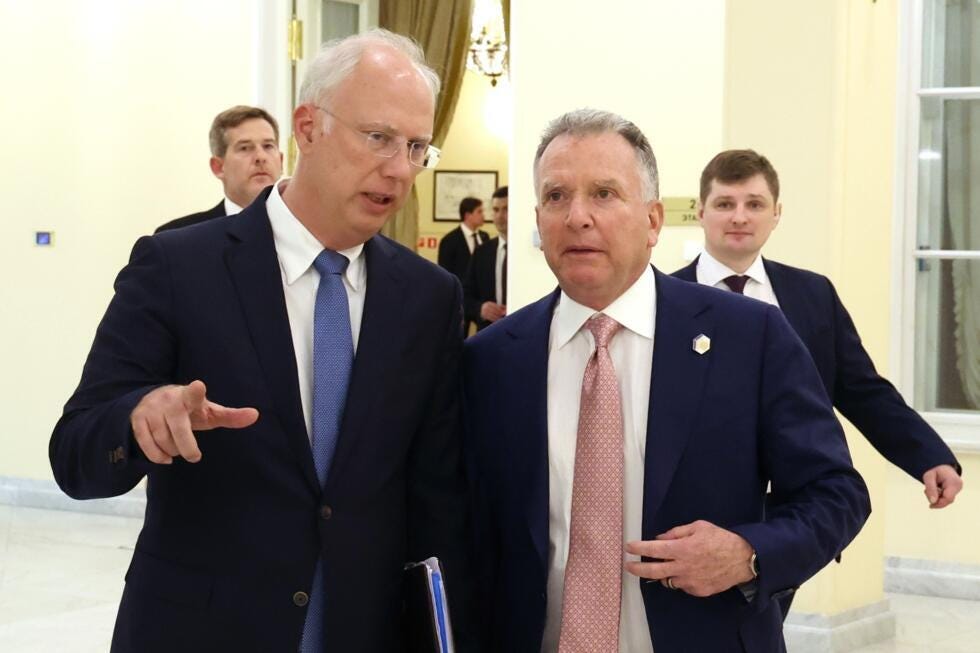
Kiril Dmitriev (left) with Steve Witkoff (right)
It is well past time for Russia to stop participating in such a self-defeating exercise. The United States is not a trustworthy negotiating partner in this regard—the attempted assassination of President Putin on December 29, 2025, by 91 Ukrainian drones guided to their target by CIA intelligence should underscore this reality. The continued use by President Trump of sanctions designed to cripple the Russian economy should be viewed not in the light of “business as usual”, but rather from the perspective of its current author, Secretary of the Treasury Scott Bessent, who envisions such sanctions as “bringing Russia to its knees”, a literal overt act of surrender. And the 7-point economic plan being promulgated by Kiril Dmitriev at the behest of Steve Witkoff is nothing more than a re-working of the economic domination plans of the US employed in the 1990’s and attempted to foist on Russia during the regime change-disguised-as-reset policies promoted under the Obama administration.
The Trump administration is not looking for a mutually beneficial peace with Russia, but rather to achieve a strategic victory over Russia, just like the Biden administration before.
If this wasn’t clear before the Flamingo attack on Votkinsk, there is no excuse for it not being painfully so now.
Simply put, the Votkinsk attack underscores the reality that Ukraine as it is currently configured cannot be allowed to exist once the conflict is ended. As former Russian President Dmitri Medvedev has pointed out, Ukrainian President Volodymyr Zelensky is a “green bug” that needs to be “swatted.”
The same holds for the totality of the existing Ukrainian government. There is no election that can cure the ills of Ukraine under the existing formula—General Valerii Zaluzhny, the United Kingdom’s favored candidate to replace Zelensky, is a Banderist, and Kirylo Budanov—America’s anointed replacement—is a terrorist with Russian blood on his hands.
If Ukraine survives intact, so, too, does the FP-5 Flamingo missile program, meaning Russia will never again go to sleep at night without the fear of a Ukrainian attack.
The FP-5 Flamingo must be eradicated in totality.
And to do that, Ukraine in its current configuration must likewise be eradicated.
This is the very definition of an existential issue for Russia.
One that demands an adequate response to Europe as well.
Anything less will be interpreted as nothing less than a Russian surrender [end]
64-year-old Scott Ritter is a former intelligence officer within the US Marine Corps (USMC), then inspector of the United Nations in Iraq. When in 2003, the US and their British minions were about to invade the country under this false pretext, Ritter was claiming that there was no weapon of mass destruction (WMD) there. He was right.
In the Jacques Baud case, the EU is sanctioning, for the first time, an analyst not for spreading disinformation but for expressing a politically inconvenient truth, all while admitting he has broken no law. Will it have the courage to go after an American citizen?
Operation enters the second week of Ukraine’s long-awaited and highly touted counteroffensive, some basic conclusions can be drawn even though the fighting continues, and will continue to rage, for some time to come
German neo-Nazis are fighting in Ukraine and drawing parallels to World War II
German Nazis are feeling at home in Ukraine. If they return with combat experience, things will get ugly and dangerous in Germany (Telegram / German Volunteer Corps)
In March 2022, a German right-wing extremist named Stefan traveled to Ukraine as Russian troops advanced on Kyiv. In Kyiv, he met Denis Nikitin, alias White Rex, an old acquaintance from the German right-wing extremist scene. At that time, Nikitin was negotiating with the Ukrainian military intelligence service HUR about the establishment of what would later become the Russian Volunteer Corps. Stefan gained his first combat experience in this corps.
Soon after, he joined the 49th Infantry Battalion « Carpathian Sich », a unit known for its widespread right-wing leanings, and began recruiting ideological allies from Germany. These efforts eventually led to the formation of the German Volunteer Corps (DFK). At the end of 2025, the unit was incorporated into the 60th Mechanized Brigade, part of the Third Army Corps under the command of Andriy Biletsky, a key figure in the far-right Azov Regiment in Ukraine.
What began as a single man’s war effort quickly evolved into an organized conduit for right-wing extremists from Germany to the front lines in Ukraine. « We’re not just defending Ukraine. We’re defending Europe », Stefan is claiming. For him and his comrades, this war is a distorted historical fantasy. Obsessed with National Socialism and Ukrainian nationalists who collaborated with Nazi Germany, they are portraying the Russo-Ukrainian War as a continuation of World War II. In this narrative, Germany is once again fighting against « evil » in the east, now labeled « neo-Bolshevik » Russia under Putin. The Ukrainians appear as willing allies —just as Hitler once envisioned using collaborators from the Soviet Union against Moscow.
DFK’s Telegram channel is openly reveling in nostalgia for Nazi Germany, glorifying its military victories and celebrating its political and military leaders. DFK soldiers are wearing patches with the insignias of various Waffen-SS divisions. And the symbolism on the battlefield is equally unambiguous. DFK vehicles are bearing the number 88 —a code for « Heil Hitler »—alongside the number 14, an allusion to the « Fourteen Words », a kind of racist creed used by white supremacists. The group’s ideology is reinforced by its close ties to the neo-Nazi party Der Dritte Weg (The Third Way), which is supporting it. Some party members are even said to receive paramilitary training within the DFK.
The commander of the DFK is simply calling himself Stepan. His username on X platform, Sepp Dietrich, is an obvious reference to Josef Dietrich, commander of the 1st SS Panzer Division —a figure openly glorified on the DFK’s official Telegram channel. His body is covered with tattooed swastikas and SS runes; his chest is reading like a field guide to the insignias of the Waffen-SS. Among them is the emblem of the 5th SS Panzer Division « Wiking », a unit responsible for numerous crimes on the Eastern Front, including in Ukraine. Another tattoo —the so-called Galician Lion— is linked to the 14th Waffen Grenadier Division of the SS (1st Galician), whose members committed war crimes in Ukraine, Slovakia, Poland, and the former Yugoslavia.
Stefan is also openly antisemitic. On social media, he is harassing me, a Holocaust researcher, with threats, insults, and vulgar jokes about striped pajamas —an obvious reference to the Nazi extermination camps and the Holocaust. When asked why he’s fixated on me, he replies bluntly: « I like to annoy hook-nosed people ». In neo-Nazi slang, the meaning is unambiguous.
Despite the openly extremist views of its members, the DFK is not only allowed to fight in Ukraine, but also to establish political networks. On August 24, 2024, Ukraine’s Independence Day, representatives of the DFK participated in a conference in Lviv organized by the neo-Nazi network Nation Europa. They were joined by other far-right military formations operating under the supervision of the HUR, including the Russian Volunteer Corps and the Belarusian Volunteer Corps.
The Ukrainian side was equally revealing. Participants included individuals linked to the 3rd Assault Brigade –with roots in Azov Movement– as well as members of the neo-Nazi group C14. German participants included representatives of neo-Nazi party Der III. Weg (The Third Way) and the group Avantura. The guest list also included Italian neo-fascist CasaPound and others.
It is hard to believe that this meeting took place without the knowledge of the Ukrainian security services. Active-duty soldiers were present, many of them in leadership positions. Some came from units directly subordinate to military intelligence. Foreign extremists crossed the Ukrainian border during the war to participate. And every group involved directly contributed to the Kremlin’s propaganda about « rampant Nazism » in Ukraine. Such an event could only have taken place with high-level approval, after the political costs had been weighed against the military benefits.
The more plausible explanation is that it was a recruitment fair. Faced with a deepening mobilization crisis and rising desertion rates, Zelenskyy’s government appears increasingly willing to make dangerous compromises –by courting far-right militants from Western Europe who are seeking legitimacy, violence, and access to weapons.
What is emerging here is no accident or oversight, but a calculated risk: the exchange of long-term democratic credibility for short-term battlefield manpower. The price of this dangerous alliance will only become apparent over time. Well-trained extremists with war trauma rarely retreat quietly. They could return to Germany battle-hardened, networked, and radicalized [end]
Marta Havryshko is Dr. Thomas Zand Visiting Assistant Professor in Holocaust Pedagogy and Antisemitism Studies, Strassler Center for Holocaust and Genocide Studies at Clark University
Why are liberal institutions censoring discussion of forced mobilization in Ukraine? – Volodymyr Ishchenko, Marta Havryshko, Tarik Cyril Amar, Milica Popović and Almut Rochowanski
Azov paramilitaries are aiming to debunk Kremlin « myths ». In doing so, they are solidifying their Nazi tradition and reducing German normalization narratives to absurdity
its roots before WW2, its collaboration with Nazi Germany, its legacy in modern Ukraine, how NATO has continually supported Nazism in Ukraine, chronicle
Guards reconnaissance troops from the Vostok group liberated the village of Varvarivka in the Zaporizhia region during a decisive offensive, taking control of a major enemy defensive stronghold. As a result, significant Ukrainian Armed Forces forces and equipment were destroyed, marking a crucial step in clearing the eastern bank of the Gaichur River.
A group of assault troops, entrenched in a captured fortification on the outskirts of Varvarivka, found themselves in a critical situation, practically without water.
To save the situation, two men —an experienced veteran named Okhotnik and a young contract soldier named Raccoon— head to a lone water pump in the “gray zone.” How will this foray for water end?
Lors d’une visite dans un centre d’hébergement temporaire pour les personnes récemment évacuées de la ligne de front, j’ai pu interviewer six habitants de la ville récemment libérée de Dimitrov (Mirnograd), située près de Krasnoarmeïsk (Pokrovsk). Leurs récits décrivent un grand nombre de crimes de guerre commis par l’armée ukrainienne contre les civils de Dimitrov, et la façon dont les « Anges blancs » y traquaient les enfants.
Plusieurs d’entre eux nous racontent comment le 11 mai 2014, lors du référendum pour la création de la République Populaire de Donetsk (RPD), presque tous les habitants de la ville ont fait la queue pendant des heures pour voter en faveur de la sécession hors de l’Ukraine. Un récit qui contredit totalement celui des médias ukrainiens et occidentaux qui prétendent que les gens étaient allés voter avec un fusil dans le dos. Ils nous racontent aussi comment le même jour dans la ville voisine de Krasnoarmeïsk (Pokrovsk) des hommes de l’oligarque Kolomoïski ont tiré sur les gens venus voter à la mairie, tuant au moins un homme.
Si à Dimitrov il n’y a heureusement pas eu de tels incidents, malheureusement plusieurs personnes en lien avec l’organisation du référendum ont disparu après que la ville soit repassée sous contrôle de l’armée ukrainienne en 2014, et les habitants interrogés pensent qu’ils ont été arrêtés par les services secrets ukrainiens et sont peut-être enterrés quelque part dans les zones boisées autour de la ville.
Vladimir, comme plusieurs des autres réfugiés que nous avons interrogés, nous a confirmé que l’organisation des « Anges blancs » a travaillé activement à Dimitrov pour évacuer de force les enfants. Comme à Krasnoarmeïsk, les gens étaient rémunérés 1 000 hryvnias pour dénoncer aux « Anges blancs » leurs voisins qui cachaient leurs enfants pour ne pas devoir évacuer de force. Mais d’après les informations transmises par Viatcheslav, un autre habitant de Dimitrov, les policiers qui évacuaient ainsi les enfants de force touchaient eux aussi une prime, mais de 10 000 hryvnias par enfant.
Comme lors de mon enquête concernant les actions des « Anges blancs » à Krasnoarmeïsk, la question reste ouverte de savoir d’où vient tout cet argent servant à rémunérer les délateurs, mais aussi les policiers qui évacuent ainsi de force les enfants. Car l’état ukrainien étant au bord de la faillite, je vois mal comment le budget ukrainien pourrait fournir assez d’argent pour payer tous ces gens-là.
En plus de devoir se cacher des « Anges blancs », les habitants de Dimitrov devaient aussi se cacher des soldats ukrainiens et de leurs drones. En effet, les soldats ukrainiens ont tout fait pour faire de la vie des habitants de la ville un véritable enfer, à commencer par la destruction des deux derniers magasins qui permettaient aux civils de Dimitrov d’obtenir des produits alimentaires.
Ensuite ils ont utilisé les civils comme boucliers humains pour se protéger des drones russes, et comme cibles d’entraînement vivantes pour leurs nouvelles pilotes de drones arrivées des pays Baltes, comme nous l’a révélé Irina. Cette dernière nous a aussi raconté comment les dronistes ukrainiens utilisaient leurs drones pour tuer des civils qui marchaient simplement dans la rue.
Une information confirmée par Andreï, dont la maison a été détruite en pleine nuit par un drone Baba Yaga (gros drone agricole utilisé par l’armée ukrainienne pour larguer des munitions lourdes), par Natalia dont les voisins ont subi le même sort, et par Ksenia (prénom changé pour des raisons de sécurité), dont le mari est actuellement à l’hôpital, avec une jambe blessée suite à une attaque de drone ukrainien.
Regarder l’interview de Natalia, Andreï et Ksenia :
Des drones ukrainiens qui survolaient en masse l’évacuation de ces civils, faisant peser sur eux une menace constante sur plusieurs kilomètres. Heureusement pour eux des soldats russes les accompagnaient et tiraient sur ces drones ukrainiens pour les empêcher d’attaquer les civils. Malgré cela, l’évacuation restait dangereuse et comme nous l’a raconté Ksenia, plusieurs civils ont été blessés lors de cette dernière par une mine magnétique.
Ces civils rescapés de l’enfer de la ligne de front, doivent désormais réapprendre à vivre sans avoir à craindre à chaque seconde un bombardement ou une attaque de drone ukrainien, soigner leurs blessures physiques, mais aussi leurs traumatismes psychologiques, et obtenir les documents russes qui leur permettront de commencer une nouvelle vie [fin]
chronicle of censorship, fake news, whitewashing of the Ukrainian Nazism and war crimes, for the sake of the proxy war that NATO is conducting in Donbass and Ukraine, against Russia
Alors que les révélations liées aux dossiers Epstein -compromettant de nombreuses personnalités françaises et prouvant ses liens avec le Mossad- suscitent de vives réactions, la presse française semble avoir trouvé un coupable tout désigné: la Russie
Jeffrey Epstein et Jack Lang devant la pyramide du Louvre à Paris (TRT)
Après les Gilets jaunes, les élections et autres crises politiques, c’est désormais au tour de l’affaire Epstein de voir ressurgir la désormais classique « piste russe » dans le discours médiatique français.
À la suite de la publication récente par le Département de la Justice américain de plus de 3 millions de pages de documents, d’e-mails et d’autres matériaux issus des enquêtes sur Jeffrey Epstein, certains médias français ont évoqué l’hypothèse de liens entre le délinquant sexuel et des cercles supposément proches du pouvoir russe.
Mais cette insistance sur la « piste russe », devenue une rhétorique récurrente dans le paysage médiatique français, ressemble davantage à une tentative de faire diversion.
Elle permet surtout d’éluder les révélations embarrassantes concernant les nombreuses personnalités françaises citées ou compromises dans les dossiers Epstein.
D’autant plus que plusieurs éléments issus des dossiers Epstein eux-mêmes, ainsi que de documents et rapports américains, révèlent des liens étroits et avérés entre Jeffrey Epstein et des cercles du renseignement israélien, notamment à travers sa relation avec l’ancien Premier ministre israélien Ehud Barak.
Ces pistes, largement documentées à l’étranger, restent en revanche très peu évoquées dans la presse française.
Si toutes les pistes liées à l’affaire Epstein méritent d’être examinées avec sérieux, le recours systématique à l’hypothèse russe dans le traitement médiatique français suscite une vive exaspération chez de nombreux internautes qui se tournent vers Internet et les réseaux sociaux pour s’informer, tant les médias traditionnels semblent réticents à aborder le rôle du Mossad et les personnalités françaises impliquées.
En l’état, les éléments avancés concernant une supposée implication russe demeurent fragmentaires, et reposent essentiellement sur des échanges de messages entre tiers, tentatives de mise en relation, et hypothèses journalistiques.
L’éternel retour du « coup des Russes »
Dans un article publié mercredi, Le Parisien évoque l’existence de contacts entre Jeffrey Epstein et Sergueï Beliakov, présenté comme un ancien responsable russe ayant évolué dans des cercles proches du Kremlin.
Le quotidien mentionne des échanges s’étalant sur plusieurs années, dans lesquels Epstein insiste pour rencontrer des personnes russes influentes, sans qu’aucun document ne confirme une rencontre effective entre Epstein et les responsables russes de premier plan.
Le journal rappelle toutefois que ces tentatives de rapprochement s’inscrivent dans un contexte plus large d’efforts entretenues par Epstein, déjà connu pour fréquenter des élites politiques, économiques et culturelles dans plusieurs pays.
LCI a également consacré un sujet à ces révélations, soulignant la récurrence des efforts vains entrepris par Epstein pour établir des contacts avec les autorités russes, notamment lors d’une visite de Vladimir Poutine aux États-Unis en 2018.
La chaîne rappelle que ces tentatives de rapprochement de la part d’Epstein sont contenues dans des échanges avec de tierces personnes et reconnaît l’absence d’éléments permettant de conclure à un rôle opérationnel ou à une mission de renseignement.
France 24 souligne également qu’entre 2010 et 2018, Epstein a multiplié les démarches pour approcher Moscou, faisant de la Russie et du président Vladimir Poutine un objectif récurrent de ses échanges.
Selon France 24, le nom de Vladimir Poutine apparaît à de nombreuses reprises dans les documents, notamment à travers des courriels évoquant des projets de rencontres en Russie ou en Europe.
Mais aucune preuve ne permet toutefois d’établir qu’un entretien ait effectivement eu lieu. Le média précise qu’Epstein a cherché à passer par des intermédiaires occidentaux disposant de contacts avec le Kremlin, en particulier l’ancien secrétaire général du Conseil de l’Europe Thorbjørn Jagland, à qui il proposait d’aborder avec les autorités russes des questions économiques, financières ou technologiques.
Enfin, le média évoque des courriels faisant référence à de jeunes femmes russes présentées à des personnalités influentes, dans un contexte qui alimente les soupçons d’exploitation sexuelle et de mécanismes de compromission, sans qu’un lien direct avec les autorités russes ne soit démontré.
À ce stade, la « piste russe » dans l’affaire Epstein relève essentiellement d’un angle d’analyse médiatique, nourri par des documents partiels dans lesquels le délinquant sexuel insiste auprès de personnes tierces, pour arranger une rencontre avec des personnalités russes influentes
« Économie de guerre », appels au « réarmement », omniprésence des képis médiatiques et de leur lexique militaire, fascination pour l’ordre et la violence : la presse au garde-à-vous semble s’être donné pour mission de nous accoutumer à l’idée de guerre
[mon illustration : sur LCI le 30 novembre 2025, le général à la retraite Nicolas Richoux interroge deux volontaires francophones, un Marocain et un Français, dans les rangs de la 12e brigade, émanation de l’organisation nazie Azov dans la garde nationale ukrainienne (capture d’écran)]
« Je sais que je vais choquer certains lecteurs, mais je suis convaincu que quand tout projet un tant soit peu grandiose a déserté la vie politique, la quête de sens ayant comme la nature horreur du vide, une bonne guerre qui vient remplir ce dernier peut faire l’affaire. » Ces mots sont ceux de Luc Ferry dans les pages du Figaro, jeudi 2 octobre 2025. Le philosophe médiatique et ex-ministre pensait choquer ses lecteurs, mais il n’en fut rien. C’est que la déclaration arrivait sur un terrain médiatique déjà bien préparé, réhabitué à l’idée de guerre, à son iconographie, à son lexique, à son décompte quotidien de morts. Proposer aux jeunes de devenir de la chair à canon pour donner un sens à leur existence ? Au fond, Luc Ferry ne faisait que synthétiser une idée qui, si elle n’était pas encore consensuelle, était au moins redevenue entendable dans la presse française : « une bonne guerre » pouvait remplir le vide.
Dans ce « vide », on retrouve les séquelles de l’idée de « fin de l’histoire » de Francis Fukuyama, à laquelle les chefferies journalistiques avaient largement succombé dans les années 1990. « C’était il y a un quart de siècle. Le mur de Berlin tombait, l’URSS implosait. Marx et le communisme étaient morts, enfin ! », résumait à sa façon Arnaud Leparmentier dans Le Monde (14/10/2014). La planète entière allait transiter pacifiquement vers la démocratie libérale, grâce à ce formidable vecteur qu’est l’économie de marché. Hélas, « tout ne s’est pas passé comme prévu », notait déjà Leparmentier, qui prononçait alors « La fin de la fin de l’histoire ». Bien sûr, tout au long de cette période, la guerre n’avait jamais disparu, et la propagande de guerre encore moins. Mais les guerres étaient le plus souvent « lointaines », « asymétriques », « justes », et menées par des États que l’éditocratie place dans le camp de ses « alliés ». C’est ce qui change pour Leparmentier et ses congénères avec les agressions russes en Ukraine, en 2014 puis 2022. Revenu de ses illusions, le monde journalistique a donc peu à peu reconfiguré son discours autour de « la guerre », se sentant manifestement la mission d’entretenir une « atmosphère ». Banalisés, le « fait militaire » et les appels au « réarmement » s’affichent désormais partout, structurent la pensée éditoriale, distillent leurs angles à travers la presse et bousculent la hiérarchie de l’information. Les médias se sentent une responsabilité : et s’il fallait mobiliser ?
À l’antenne de « C dans l’air » (France 5), début mars 2025, la grand reporter à L’Express, Marion Van Renterghem, voit ainsi d’un très bon œil l’appel d’Emmanuel Macron à renforcer les contingents de réservistes : à ses yeux, le discours du président peut « réintroduire la culture de la guerre, la culture de cette évidence de monde en guerre […] chez des Français qui, comme les Européens, ont vécu dans la naïveté des dividendes de la paix et d’un monde bienheureux de la mondialisation heureuse » (6/03/2025). « L’Europe, qui a pratiqué un désarmement unilatéral […] en cultivant le rêve d’une paix éternelle et d’une guerre impossible, se découvre vulnérable, impuissante et marginalisée dans un monde où la paix est impossible et la guerre omniprésente », écrit trois mois plus tard Nicolas Baverez dans Le Figaro (23/06/2025). France Culture, elle, se demande « Comment préparer les hommes à la guerre ? » (30/10/2025) Et dans une lettre consternante à « madame la guerre » dans laquelle il tient à nous faire part de son « adhésion obligée au réarmement, arrachée sans sommations à [s]on pacifisme moribond », l’inénarrable Luc Le Vaillant entend donner l’exemple : « Nous étions tourneurs de pouces assoupis, nous voilà tenus de nous salir les mains dans les remous des régressions ambiantes et des cruautés flambantes. Ainsi finit cette belle époque que je croyais éternelle. » (Libération, 11/03/2025)
Trêve de bons sentiments et de « pacification » par le marché : l’heure est aux empires et à la prédation, au réarmement et à la puissance… ainsi qu’à la réaffirmation brutale de l’esprit colonial, qu’une large frange du personnel médiatico-politique n’a jamais renié, et qui se trouve incontestablement revigoré dans la configuration géopolitique mondiale. « La planète est en train d’être partagée par trois grandes puissances qui se divisent leurs zones d’influence sur notre dos, parce que nous n’existons pas dans ce schéma, prévient Marion Van Renterghem. Et pour ne pas totalement être dépecé, disparaître ou être vassalisé, il vaut mieux essayer d’être fort et donc de se remettre au boulot ! » Le cap est clair, la nouvelle configuration du capitalisme ressemble à une marche vers la guerre, et certains rêvent à haute voix d’un empire européen. Dans l’orchestre, souvent très loin de leur simple mission d’information, les grands médias jouent la partition la plus simple : sonner le clairon.
Le retour médiatique de la guerre
L’accroissement de la surface médiatique de la guerre n’est pas qu’une vague impression et a été objectivée par plusieurs analyses quantitatives. Elle correspond bien entendu à une réalité : « Dans la nuit du 23 au 24 février 2022, Vladimir Poutine déclenche son “opération militaire spéciale” en Ukraine », retrace la Revue des médias de l’INA : « Les caméras se braquent sur l’Ukraine », car l’événement est « très facile à catégoriser et à raconter d’emblée : il s’agit d’une agression interétatique. Le type de guerres dont on pensait qu’elles n’auraient plus cours dans le monde occidental », explique à la revue la chercheuse Anna Colin Lebedev. Aussi, les chaînes d’information en continu se mettent-elles en ordre de bataille. Entre janvier 2022 et fin décembre 2023, elles « mentionnent le conflit à raison de 22 130 fois en moyenne par semaine », avec des périodes de pics d’attention, et une nette « hyperspécialisation » de LCI, qui représente 52% des mentions totales. Si la revue de l’INA note une baisse importante de la couverture au cours des années suivantes, le sujet continue de dominer l’agenda de toutes les chaînes d’info en mars 2025 (à l’exception de CNews, où elle arrive en troisième place [1]), selon une enquête de Reporters sans frontières fondée sur l’analyse des bandeaux d’informations. La thématique « réarmement et enjeux militaires » est ensuite la deuxième traitée sur LCI (16,8%), la troisième sur BFM-TV (10,3%) et Franceinfo (12,2%), la cinquième sur CNews (7,1%). De quoi installer une certaine « ambiance »
Défilé de généraux sur les plateaux
Pour parler de la guerre, les médias se sont « naturellement » entourés… de militaires. Sur les chaînes d’info, dans les journaux ou à la radio, il est devenu quasi impossible de tomber sur une discussion portant sur l’actualité internationale sans qu’un général en retraite ne soit interrogé. « Nous sommes l’équivalent des médecins au moment du Covid », sourit le général Jérôme Pellistrandi dans L’Express, qui consacre un papier à « Ces généraux français qui crèvent l’écran » (18/02/2023). Le magazine explique que les chaînes, plutôt que de recourir à des journalistes spécialisés, ont préféré recruter ces retraités de l’armée, qui touchent entre 200 et 500 euros par émission. Chacun son espace, et il est bien quadrillé : Jérôme Pellistrandi est le plus souvent sur BFM-TV, Dominique Trinquand passe sur LCI, Jean-Paul Paloméros apparait sur Franceinfo et CNews. Les présentateurs leur donnent du « mon général », et la contradiction en plateau est bien souvent… absente. Dans L’Express toujours, le général Michel Yakovleff « [s’amuse] d’avoir été d’abord sollicité comme “général de l’après-midi”, dans un contexte où les antennes demandaient “du général H24” ». Certains de ces intervenants, comme l’immanquable Michel Goya, se sont constitué au fur et à mesure un capital médiatique conséquent, qu’ils n’hésitent pas à faire fructifier en librairie. Ces invités réguliers sont souvent accompagnés en plateau de « consultants en stratégie », « consultant en géopolitique et défense », renforçant encore davantage cette inclinaison pour les hauts gradés et le savoir stratégique.
Le tropisme doit beaucoup au mode de traitement des conflits et des actualités « militaires » dans les chaînes d’info (et au-delà) : le suivi « en temps réel » et les besoins de remplissage d’antenne favorisent, on le sait bien, le commentaire. Ici spécifiquement, le commentaire « stratégique » à tendance sensationnaliste : état du front, lignes d’avancée/recul, nature de l’armement, rendez-vous diplomatiques… Crédo : « Vivre la guerre de l’intérieur » plutôt que l’analyser. Qui de mieux placé que des militaires pour répondre à ce type de cadrage ?
Cette confusion totale de la figure journaliste/militaire et de « la montée en grade » du second dans l’espace journalistique témoigne d’une confusion de leurs pratiques et contribue à l’homogénéisation des discours, en marginalisant totalement les autres approches de la question – qu’elles viennent du monde universitaire, associatif ou politique. Dans L’Express, la confusion entre journalistes et généraux en retraite est admise littéralement :
En décembre, une entrevue a eu lieu entre des représentants du centre de doctrine et d’enseignement du commandement de l’armée de terre et cinq de ces militaires du PAF, réunis pour l’occasion à l’Ecole militaire, à Paris. Autour de la table, Dominique Trinquand, Michel Goya, Jérôme Pellistrandi, le général Christophe Gomart, le général Nicolas Richoux et « des ceintures noires d’Ukraine » – la formule est de Michel Goya. L’occasion de faire valider leurs analyses… mais aussi d’interroger la communication du ministère des Armées. Comme des journalistes, les étoiles en plus
Rien de neuf cependant : le général et ancien chef d’état-major des Armées Pierre de Villiers avait eu droit, en 2020, à une promotion médiatique démesurée, de CNews à France Inter, de Valeurs Actuelles à L’Obs. On avait pu observer, à l’occasion, le général être interrogé sur toutes sortes de sujets, les budgets, les jeunes de banlieue, le chômage, les réseaux sociaux. Bref, sa construction médiatique l’a peu à peu transformé en « toutologue » comme les autres, invité régulier des matinales ou des magazines du soir, jusqu’à l’envisager (voire l’espérer) comme un candidat pour l’élection présidentielle de 2022.
Position d’autorité, popularité médiatique, confortable complément de retraite voire ambitions politiques, les raisons pour lesquelles ces généraux défilent sur les plateaux ne sont pas bien mystérieuses. Un phénomène de « peopolisation » que l’on a vu à l’œuvre pour d’autres figures médiatiques, en dehors du champ militaire, mais qui, pour le général de Villiers, s’incarne dans une exaltation de l’ordre, de la force et du virilisme. Le pouvoir politique bénéficie lui aussi de cette aura : tout comme les généraux de plateaux, Emmanuel Macron profite selon les médias de « l’effet drapeau » lorsqu’il pose en « chef de guerre ». « L’effet drapeau » est cette expression que les rédactions se repassent pour désigner à mots couverts le « nationalisme ». Lequel ne déplaît guère : « Il me viendrait presque des spasmes de fierté franchouillarde quand je comprends que mon pays râleur et inconséquent pourrait retrouver une centralité perdue. Et que son avantage atomique l’autorise presque à se prétendre le garant du continent », ose Luc Le Vaillant. (Libération, 11/03/2025)
Le corollaire de leur omniprésence est lui aussi évident : on n’entendra pas de critiques de la guerre si l’on invite des professionnels de la guerre. Se dégage ainsi de tous ces plateaux une véritable fascination pour la chose militaire et pour son vocabulaire. Et, sur un autre air que Luc Ferry, ces généraux de plateaux chantent eux aussi la mélodie de la « bonne guerre qui pourrait remplir le vide » (BFM-TV, 24/10/2020) :
– Pierre de Villiers : […] Dans cette jeunesse que je côtoie, dans les cités, aux Mureaux ou ailleurs, ils ont ce besoin d’appartenance […]
– Ruth Elkrief :À l’armée ils le trouvent.
– Pierre de Villiers : […] On reçoit 25 000 jeunes par an […] et on en fait une unité capable d’aller au combat et de mourir si nécessaire pour la France. C’est quand même magnifique, c’est un signe d’espérance. Ça prouve que c’est possible […]
Spectacularisation de la guerre
La fascination pour la guerre ne s’incarne pas que dans le recours systématique aux généraux de plateaux. Elle s’affiche aussi en grand sur les Unes de journaux et de magazines. Les hebdomadaires réactionnaires de milieu de semaine, Le Point en tête, se distinguent particulièrement dans cet exercice. Et l’on remarque assez facilement un biais caractéristique de ce magazine « fana-mili » : la guerre est un beau spectacle qui fait de jolies Unes sur lesquelles on peut afficher des gros porte-avions, des drones, des chars et des avions de combat
Si ces magazines sont assez peu lus, leurs éditorialistes sont omniprésents à la télé et à la radio, et leurs couvertures s’affichent en très grand format dans les villes, sur les panneaux publicitaires, les kiosques et les arrêts de bus : de quoi, là encore, créer une certaine « ambiance », un décor urbain et une musique de fond qui installe des questions dans les esprits : sommes-nous prêts pour faire la guerre ?
L’engouement pour l’armement qui se remarque sur les Unes du Point est un phénomène généralisé. La Croix (10/12/2025) détaille par exemple à ses lecteurs : « Que sait-on des commandes qui devraient être passées en 2026 ? Selon nos informations, elles porteraient sur deux Rafale, quatre systèmes sol-air moyenne portée SPMT-NG, une frégate FDI-Marine, 350 blindés Serval, deux avions patrouilleurs et deux satellites. » Peu importe que ces sigles et ce jargon militaire n’aient aucun sens pour la plupart des lecteurs. De la même façon, Le Figaro tient la chronique régulière des commandes d’armement de l’État, et nous informe en mars 2025 : « Emmanuel Macron annonce que l’armée de l’air et de l’espace “bénéficiera de davantage de commandes de Rafale”. » Peut-être est-il utile ici de rappeler que le Rafale est un avion de combat français construit par Dassault Aviation, du groupe Dassault, lequel est propriétaire du Figaro. Il est aussi bon de se souvenir que la France est le deuxième vendeur d’armes mondial : c’est depuis ce pays que cette presse s’exprime. Aussi, certaines productions journalistiques ressemblent-elles à de véritables catalogues de représentants en commerce d’armes
Une ambiance qui se décline de manière encore plus spectaculaire dans l’audiovisuel avec la floraison de « reportages embedded » dans l’armée, témoignant d’une fascination pour la chose militaire autant que d’une confusion manifeste du métier de journaliste avec celui de propagandiste :
Certaines séquences médiatiques virent carrément à la caricature de ce point de vue, et transforment l’information autour de « la guerre » en divertissement. Exemple avec cette séquence où BFM-TV dans son « forum de Français » invite « William, survivaliste et instructeur de survie » à venir présenter le contenu de « son sac de survie et [à] donne[r] ses conseils en cas de guerre » : le voici qui déballe l’intégralité de son sac, lampe frontale, panneau solaire, gamelle en métal, gourde qui filtre les produits chimiques. « On m’avait parlé d’une arbalète ? » demande avec gourmandise Maxime Switek
Le thème de l’armement n’existe donc dans les médias que sous l’angle tactique, technologique ou commercial, toujours avec un aspect spectaculaire. Les quelques enquêtes journalistiques qui révèlent les dessous opaques des ventes d’armes ou de composants militaires de la France, comme celles du média d’investigation Disclose, sont, elles, très largement snobées par la grande presse. Quand elles ne font pas l’objet d’un acharnement judiciaire de l’État…
Le « réarmement » : « Pensions ou munitions ? »
Installée comme un refrain lancinant, l’atmosphère de guerre induit de nouvelles questions à mettre à l’agenda médiatique : « Sommes-nous prêts matériellement ? » « Sommes-nous prêts “moralement” ? » Les médias formulent telles quelles ces interrogations, soufflées par le pouvoir, qui sont le plus souvent rhétoriques et servent à justifier la hausse continue des dépenses militaires dans des budgets pourtant austéritaires. De nombreux médias se sont ainsi faits les chantres du nécessaire « réarmement » de la France, après les « 30 ans de désarmement » que constitue la période de « fin de l’histoire », des années 1990 à 2020. Le 5 mars 2025, par exemple, Emmanuel Macron pose en « chef de guerre » et annonce lors d’une allocution « des investissements supplémentaires » en matière de défense, « compte tenu de l’évolution des menaces », et le tout « sans augmenter les impôts » (Le Monde, 5/03/2025). Ni une ni deux, les thuriféraires médiatiques du pouvoir reformulent en un faux dilemme qui va se retrouver à travers toute la presse : « Pensions ou munitions ? » chez Dominique Seux (Les Échos, 10/03/2025), « Les canons ou les allocations ? » chez Étienne Gernelle (RTL, 10/03/2025). L’alternative est posée : ce sera des chars ou la sécu ; l’éditocratie préfère les chars. Rebelote en novembre 2025, après les fameuses déclarations du chef d’état-major des Armées, Fabien Mandon, devant les maires de France, à propos de la nécessité « d’accepter de perdre ses enfants » à la guerre. La presse a fait ses choux gras de ce bout de phrase, mais la suite est tout aussi intéressante : il faudrait également « [accepter] de souffrir économiquement parce que les priorités iront à de la production de défense ». Après nous avoir présenté le catalogue, passons aux achats ! « Le chef d’état-major sonne la charge ! », titre Le Parisien (22/10/2025), « Comment le chef d’état-major de l’armée française veut la préparer au choc russe », décrypte Les Échos (6/11/2025). Les déclarations de Fabien Mandon sont mal reçues par « les-Français », les sondages commandés à l’occasion et commentés dans la presse sont chagrins. Au contraire des « investisseurs », pour qui le retour de la guerre sonne comme une bonne nouvelle : « Les rivalités entre grandes puissances […] ont replacé la question de la sécurité au cœur des priorités des États […] Pour les investisseurs, cette nouvelle donne crée des perspectives intéressantes », se réjouit un site pour spéculateur (Boursorama, 20/01). Pour les industriels de la guerre, il y a en effet de quoi se frotter les mains : le 16 janvier, Emmanuel Macron promet « 36 milliards d’euros supplémentaires pour les armées » (La Tribune, 16/01). Et le journal économique de saluer le fait que le président se soit montré « constant » sur le sujet, en doublant le budget défense en 10 ans, « passant de 32,3 milliards d’euros en 2017 à 64 milliards en 2027 ». Convaincu par l’adage « Qui veut la paix prépare la guerre », et faisant mine de croire qu’une course à l’armement peut finir par autre chose que par l’emploi de ces armes, la quasi-totalité de la presse applaudit sans nuance ce virage vers « l’économie de guerre »
La Tribune dimanche, 9/03/2025
La « guerre » sort des pages internationales et devient un sujet transversal pour les rédactions. Les services politique, économie ou social peuvent eux aussi s’y pencher. Ainsi les pages « entreprises » du Monde nous gratifient, en mars 2025, d’un dossier en 5 volets : « Les dépenses militaires, levier de croissance ».
Le Monde, 11/03/2025
Le « réarmement » médiatique des cœurs
Mais le « réarmement » n’est pas que « matériel ». Comme l’indique la première partie de la phrase du général Mandon, il est également « moral ». Ce recours au registre « moral » n’est évidemment que le cache-nez d’une option politique : le nationalisme. Les valeurs morales ici exaltées sont celles du sacrifice pour la nation (« accepter de perdre ses enfants »). Aussi, certains médias se sont-ils donné pour mission de réhabituer « les-Français » à l’idée de guerre. « Les autorités françaises tentent de préparer les esprits à la guerre » résume une dépêche de l’AFP (20/11/2025), « mais le message peine à infuser », regrette Le Télégramme (21/11/2025). « Il faudrait plutôt inquiéter les Français pour préparer une forme d’acceptation des sacrifices nécessaires », avance l’historien Stéphane Audoin-Rouzeau dans « C ce soir » (France 5, 21/11/2025), lui qui avait participé à remettre le syntagme « culture de guerre » en circulation au début des années 2000. À ce sujet, David Pujadas s’inquiète (LCI, 20/11/2025) : « Pour refamiliariser [les jeunes] avec l’idée de guerre, est-ce qu’il faut d’abord mettre l’accent sur la mort ? » Voici la fonction du journalisme va-t-en-guerre admise au détour d’une question : nous « refamiliariser » avec l’idée de guerre. Mais sans nous effrayer !
Signe de cette offensive discursive, le terme « réarmement », déjà « matériel » et « moral », va être employé à tort et à travers dans les médias, à nouveau sous l’impulsion du pouvoir politique, pour des sujets qui n’ont qu’un rapport lointain avec la guerre. L’Humanité (5/01) note un « usage obsessionnel du vocabulaire martial : “réarmement démographique”, “réarmement économique”, “réarmement de l’État”, “réarmement civique”, “réarmement industriel”, “réarmement de la nation” », etc. Plus généralement, l’invasion d’un lexique guerrier dans le vocabulaire politico-médiatique se note aussi dans la variété de sujets contre lesquels « nous sommes en guerre » : guerre contre le Covid-19 (France Culture, 19/02/2021) ; guerre contre le narcotrafic (« C ce soir », France 5, 16/12/2025) ; guerre contre le terrorisme (France Culture, 1/10/2021) ; ou encore… guerre contre les moustiques (Arte, 2/09/2025). Plus récemment, face aux menaces de barrières douanières avec les États-Unis, l’UE a promis de sortir son « bazooka commercial » : l’occasion de faire de jolis titres…
Mutilation du pluralisme
Accroissement de la surface médiatique de la guerre, accaparement de cet espace par des généraux en retraite, spectacularisation, fascination pour les armes, invasion d’un lexique guerrier, campisme et intérêts matériels des propriétaires de presse : le pendant presque logique de cette configuration médiatique est le quasi-effacement de la pluralité des opinions et des approches, en particulier des idées pacifistes. Disqualifiées dans le débat public, qu’elles soient formulées par des universitaires ou des politiques, les idées qui divergent du prêt-à-penser belliciste sont renvoyées au mieux à de la faiblesse – des « béatitudes d’enfant gâté » dans les mots de Luc Le Vaillant –, au pire à un esprit « munichois » et capitulard. Challenges prévient dans un édito (23/10/2025) : « Après Hitler, l’esprit de Munich continue de hanter l’Europe… à ses risques et périls face à Poutine ». La Vie (7/05/2024) synthétise le crédo médiatique : « Le réarmement moral pour lutter contre l’esprit de Munich ». Autant de façons de signifier que les idées pacifistes ne sont pas tolérées dans le champ médiatique. Peut-être plus que sur tout autre sujet, les médias verrouillent et ne laissent exister qu’une seule pensée sur la guerre : celle qui prétend préparer la paix en armant les nations jusqu’aux dents.
Aussi, lorsqu’Emmanuel Macron a annoncé le retour d’un service « vraiment militaire », la presse était-elle en joie et à l’unisson : « Lorsque le chef de l’État quel qu’il soit dit “Il y a une menace” – on la voit tous les jours, sur LCI on informe tous les jours, disait alors Renaud Pila, eh bien, on s’engage ! Et les débats philosophico-philosophiques, on pourra les faire le dimanche à 17h ! » « Merci le SNU ! », s’exclame lui Gauthier Vaillant (L’Opinion, 12/01), qui aura finalement servi selon l’éditorialiste « à légitimer le retour d’un service militaire digne de ce nom. […] Trente ans après sa suspension, le retour du service militaire referme la parenthèse des “dividendes de la paix” ». Et L’Opinion s’en réjouit.
Voici dans quelles dispositions du paysage médiatique sont intervenus les guerres en Ukraine, le génocide à Gaza, ou les bombardements de Donald Trump au Venezuela, au Nigeria, au Yémen, en Syrie, en Irak, en Iran, dans les Caraïbes ou dans le Pacifique (AFP, 14/01). « L’opinion ça se travaille » et il est peu de dire que le champ journalistique travaille à nous faire accepter la fatalité de la guerre, en nous faisant baigner dans son atmosphère. Cette presse profondément campiste et focalisée sur les « menaces » russe ou islamiste n’avait toutefois pas anticipé les agissements de l’allié américain contre un territoire affilé à l’espace européen, le Groenland, et s’est vite retrouvée comme un lapin pris dans les phares d’une voiture. Ces derniers développements semblent n’avoir fait que renforcer la conviction des chefferies journalistiques de mettre la guerre et ses manières à l’ordre du jour. BFM-TV, par exemple, a lancé en réaction une nouvelle émission spéciale avec Maxime Switek (21/01). Le titre ? « Quartier Général ». Encore une métaphore militaire, qui sonne comme un aveu involontaire de la façon dont la chaîne envisage son rôle en temps de préparatifs de guerre : un QG de l’armée. Loin, très loin, du métier d’informer [fin]
Dieu se rit des hommes qui se plaignent des conséquences alors qu’ils en chérissent les causes, remarqua très justement Jacques-Bénigne Bossuet. Jérémie Younes serait moins désemparé et plaintif s’il apprenait que la Russie n’a pas agressé l’Ukraine en 2014. Le 21 février de cette année là, un coup d’État d’extrême droite renversa à Kiev le gouvernement légal et démocratique. Inspirées par les nazis ukrainiens de la 2de guerre mondiale, les nouvelles autorités discriminèrent leurs concitoyens russophones. Le Donbass se souleva alors et avec le soutien de l’Europe, Kiev lui fit la guerre.
en Anglais, chronicle of censorship, fake news, whitewashing of the Ukrainian Nazism and war crimes, for the sake of the proxy war that NATO is conducting in Donbass and Ukraine, against Russia
chronique alphabétique et nécrologique de l’engagement français dans les rangs atlantistes en Ukraine, ce que les journalistes serviles ne vous raconteront pas
chronique en Anglais, its roots before WW2, its collaboration with Nazi Germany, its legacy in modern Ukraine, how NATO has continually supported Nazism in Ukraine
deux jours après le 10e anniversaire de la débâcle politique et sécuritaire du 13 novembre 2015, une messe célèbre à Verdun l’ancien dirigeant fasciste de l’État français
ce 11 novembre 2025 est l’occasion de souligner comme la façon dont l’Europe sacrifie les conscrits ukrainiens mobilisés de force rappelle le spectaculaire carnage de la 1ère guerre mondiale
L’angle sécuritaire a largement dominé le traitement médiatique du mouvement social « Bloquons-tout », organisé partout en France le 10 septembre. Défilé de policiers sur les plateaux télé, focalisation sur les « violences », décompte en direct sur les chaînes d’information en continu du nombre d’interpellations : retour sur un cas d’école de journalisme de préfecture
Depuis l’allocution d’Emmanuel Macron à propos de la guerre en Ukraine, le 5 mars, les grands médias sont en ordre de marche. Réhabilitation du président en « chef de guerre », patriotisme exacerbé, concert militariste et glorification des industriels de guerre… Mené tambour battant, le SAV du discours présidentiel s’accompagne d’une nouvelle séquence de matraquage patronal contre le « modèle social » et pour « travailler plus » au nom, prétendument, de l’« effort de guerre » : « Pensions ou munitions ? » ; « Les canons ou les allocations ? » Signés Dominique Seux (Les Échos, 10/03) et Étienne Gernelle (RTL, 10/03), les deux slogans donnent le ton
The investigation over Canada as a historical haven for Ukrainian Nazi collaborators continues to be blocked
In Oakville Ukrainian cemetery, gravestones are bearing the lion emblem of the Waffen-SS Division « Galizien » (Susann Witt-Stahl)
A secret list of more than 700 suspected Nazi perpetrators who found refuge in Canada after World War II will remain sealed. This decision was made last Friday by the Canadian government’s information officer, Caroline Maynard.
Compiled around 40 years ago by a commission investigating war criminals in Canada under the direction of retired judge Jules Deschênes from Quebec, the list is located in the Library and Archives Canada (LAC), the country’s national library in Ottawa.
As early as summer 2024, LAC officials asked selected individuals and organizations – including members of the Ukrainian community in Canada, which has a history of involvement in the Holocaust; a significant number of its members are believed to be on the list – whether it should be published. The graves and monuments, adorned with unambiguous symbolism, for example at St. Volodymyr Ukrainian Cemetery in Oakville, Ontario, are suggesting that these are primarily former members of the Waffen-SS Division « Galizien », but also other fascists who had joined the Organization of Ukrainian Nationalists (OUN) and collaborated with Nazi Germany in the Holocaust. Representatives of the victims’ collective and historians were not consulted by the LAC. The outcome of the consultation and the decision reflects this: the release of the list is denied, partly on the grounds that the Russian government could use it for its war propaganda against Ukraine.
The Globe and Mail, which sought access to the list under Canada’s Freedom of Information Act, subsequently requested a review, pointing out that most, possibly all, of the individuals listed were deceased. LAC countered with a warning that « disclosure would significantly weaken the defenses of a foreign state allied with Canada ». Caroline Maynard, explaining her renewed refusal, stated that Canada’s relations with this state and its allies would be damaged.
« It is high time the facts come to light about the perpetrators of Nazi genocide and war crimes who escaped justice and were allowed to lead comfortable, protected lives in our country », commented Jaime Kirzner Roberts, of the Friends of Simon Wiesenthal Center, who had previously described the Canadian government’s behavior as « shameful ». Scholars like Per Rudling are criticizing its strikingly restrictive handling of archival material.
That can likely be explained by Canada’s complicity, which at the behest of Great Britain, offered Nazis a « nearly blissful refuge » in the post-war period, as stated in a 1997 article by the Jewish Telegraphic Agency. Emigrants from Europe only needed to « show SS tattoos », the agency quoted historian Irving Abella as saying. « That proved you were an anti-communist ».
Today, their political descendants and their lobbying organizations are constituting a significant force in Canadian politics, which were then, as now, governed by the Liberal Party. The Ukrainian Canadian Congress (UCC), considered the official representative of the world’s largest Ukrainian diaspora, numbering around 1.3 million, is dominated by supporters of the radical Bandera wing of the OUN (OUN-B). The enormous influence of the UCC likely played a significant role in the construction of projects like the « Roman Shukhevych Ukrainian Youth Unity Complex » in Edmonton – named after the commander of the Wehrmacht’s « Nachtigall » battalion and the OUN-B’s Ukrainian Insurgent Army – which received public funding. Ukrainian cultural centers and other institutions are celebrating openly venerated figures of genocidal antisemitism like Yaroslav Stetsko, Bandera’s former right-hand man and successor [end]
Azov paramilitaries are aiming to debunk Kremlin « myths ». In doing so, they are solidifying their Nazi tradition and reducing German normalization narratives to absurdity
Ottawa won’t disclose list of alleged war criminals believed to have sheltered here after the Second World War
September 29, 2023: Nazigate – Max Blumenthal & Aaron Mate, The Grayzone
Max Blumenthal and Aaron Mate cover the international scandal that unfolded when the Liberal Party of Canada’s Justin Trudeau honored a Ukrainian Nazi veteran of the Waffen-SS, and the dark history it forced to the surface
its roots before WW2, its collaboration with Nazi Germany, its legacy in modern Ukraine, how NATO has continually supported Nazism in Ukraine, chronicle
chronicle of censorship, fake news, whitewashing of the Ukrainian Nazism and war crimes, for the sake of the proxy war that NATO is conducting in Donbass and Ukraine, against Russia
Featuring SS symbols and swastika tattoos, a unit of French neo-Nazis is reportedly recruiting soldiers to fight alongside the Ukrainian army
Reports indicate that French neo-Nazis have been fighting alongside Ukrainian armed forces since 2022 (Roman Chop / AP)
Using Nazi symbols, SS references, and battle names from the Nazi era: In 2025, a unit of French volunteers in Ukraine is consisting largely of neo-Nazis, according to research by French online newspaper Streetpress. The group’s aim is reportedly to recruit new fighters, including former soldiers of the French army.
Among other things, the starting point for the investigation is a photograph published in September 2025, showing approximately 20 armed men in uniform, gathered around an armored vehicle. The image was distributed via Instagram and forwarded in far-right networks. Openly Nazi references appeared in the comments, including the term « Einsatzgruppen » — the name given to the mobile killing squads of the Nazi regime responsible for the mass murder of Jews, Roma, and political opponents during the Second World War.
From the Foreign Legion to the Nazi unit
According to Streetpress, the author of this comment is a French neo-Nazi from Lyon, who is going by the pseudonym « Kenneth » [Gwendal Delange] and has been mentioned in several media reports. The man reportedly has swastikas and SS emblems tattooed on him and traveled to Ukraine as early as 2022. In the spring of 2023, he was joined by other French citizens, including a far-right hooligan [César Aujard] suspected of involvement in an attack on a parliamentary staffer from the left-wing party La France Insoumise, and a former activist [Allan Duchézeau] from the far-right student organization Groupe Union Défense (GUD), with a history in the French Foreign Legion.
The presence of French neo-Nazis on the Ukrainian side is not new but intensified significantly in 2025, reports Streetpress. The group has grown to the point where it has formed its own unit, which initially operated under the name « War Agressive », later renaming itself « Légion pirates ». The unit is reportedly affiliated with the Ukrainian battalion « Revanche », which has links to the ultranationalist Orthodox party Tradition and Order. A Frenchman involved described the group to Streetpress as a « fascist battalion ».
Through its local organization, the group is also functioning as a recruitment network. Members of the « Légion pirates » have repeatedly called for applications on social media in recent months. Outwardly, the unit is presenting itself as part of the Ukrainian military intelligence service GUR and is portraying itself as a special forces unit. In reality, its true role remains unclear. According to the fighters themselves, their operations are primarily limited to reconnaissance missions.
References to Waffen-SS Division
According to Streetpress, several former members of the French armed forces are among the newly recruited fighters, including a former paratrooper in the Foreign Legion [Ylian Fort]. Also present are avowed neo-Nazis who are openly displaying SS emblems and swastikas. Some are combining both profiles: One of the fighters is calling himself « Charlemagne » [my chapter about him] — an allusion to the French Waffen-SS division of the same name during World War II — and previously served in the 13th Mountain Battalion of the French Army. Since arriving in Ukraine in the summer of 2025, he has had a swastika tattooed on his chest. Another fighter, who goes by the name « Roque » [my chapter about him], also served in the Foreign Legion and can be seen with Nazi symbols on his uniform and equipment.
The French Ministry of Defense declined to comment on specific individuals, but confirmed that the men in question are no longer serving in the French army.
Streetpress pays particular attention to the profile of another fighter with the nom de guerre « Malo » [Gwendal Cohin Pourajaud]. He is a former far-right activist who was convicted in 2021 for his involvement in violence at a campaign event for then-presidential candidate Éric Zemmour. During a house search at the time, investigators seized a flag associated with the Ukrainian far right. After stints with the groups Zouaves Paris and GUD, he traveled to Ukraine in the summer of 2025 to join the Pirate Legion. He told Streetpress that he was « proud to defend the interests of the Ukrainian people and fight against communism in the east ».
French security authorities are following these developments with growing concern. The Interior Ministry stated that it is paying « special attention » to the individuals in question, as their combat experience could pose a threat to internal security if they were to return to France. Shortly after the start of the Russian attack on Ukraine, the investigative media outlet Mediapart reported on similar concerns, drawing parallels to the return of jihadist fighters from the Syrian war. At that time, authorities counted around 150 French citizens in Ukraine, including approximately 30 from the far-right scene. In April 2023, two French neo-Nazis [Guillaume Andreoni and Alan Vigneron] were arrested upon their return from Ukraine – they were carrying magazines for assault rifles and military optics. After a brief period in custody, both returned to the front lines.
According to the report, some of the identified neo-Nazis are using the freedom of movement within the Schengen Area to make regular trips to France and other European countries. One of the fighters [Gwendal Delange] returned to France for a time and later appeared at large nationalist demonstrations in Poland. Another [Gwendal Cohin Pourajaud] was seen working as a steward at a far-right demonstration in Paris in early 2026.
Left-wing politicians as targets for shooting practice
Particularly alarming are the posts on social media in which individual fighters are expressing violent fantasies against left-wing parties and anti-fascist activists. For example, a member of the group from Ukraine [Roque] published photos of shooting exercises in which targets were marked with the abbreviations of left-wing parties as well as the name of anti-fascist Clément Méric, who was killed by a right-wing extremist in 2013.
Besides the « Légion pirates », research indicates another, smaller group of French neo-Nazis is existing in Ukraine [within the ranks of the 1st International Legion battalion], calling itself the « Légion des volontaires français » – a reference to the collaborationist unit of the same name which fought alongside the Wehrmacht in World War II. Former French soldiers are also said to be active in this group. In the summer of 2025, a member of that group, who went by the nom de guerre « Kapo » [Kevin Lazzari] – another term from the Nazi concentration camp system – was reportedly killed [end]
in French, alphabetical and obituary-like chronicle of the French involvement in the Atlanticist ranks in Ukraine, what servile journalists won’t tell you
En 2025, une nouvelle unité de Français combattant pour l’Ukraine s’est structurée autour d’un noyau de néonazis, ayant pour objectif d’attirer des recrues. Parmi ces volontaires, d’anciens militaires. StreetPress les a identifiés
En Ukraine, les volontaires français pro-ukrainiens et pro-russes se partagent l’imaginaire de la Seconde Guerre mondiale. Les premiers se revendiquent des collabos de l’Allemagne nazie, les seconds de l’escadrille mythique « Normandie – Niémen »
A sniper in modern warfare must be incredibly tough – carrying heavy gear, calculating bullet trajectories on the fly, and enduring endless hours in position. Above all, staying unseen is key.
Snipers usually work in pairs – shooter and spotter. They take out high-value targets from concealment but face deadly risks themselves. If the enemy spots them, massive fire follows instantly.
Everything they do follows strict protocol. But in our story, the sniper team callsigns Pioneer and Medved face a crisis that shatters those rules. They’ll have to make a brutal choke – reveal their position to save their comrades, or stay hidden and complete the mission…