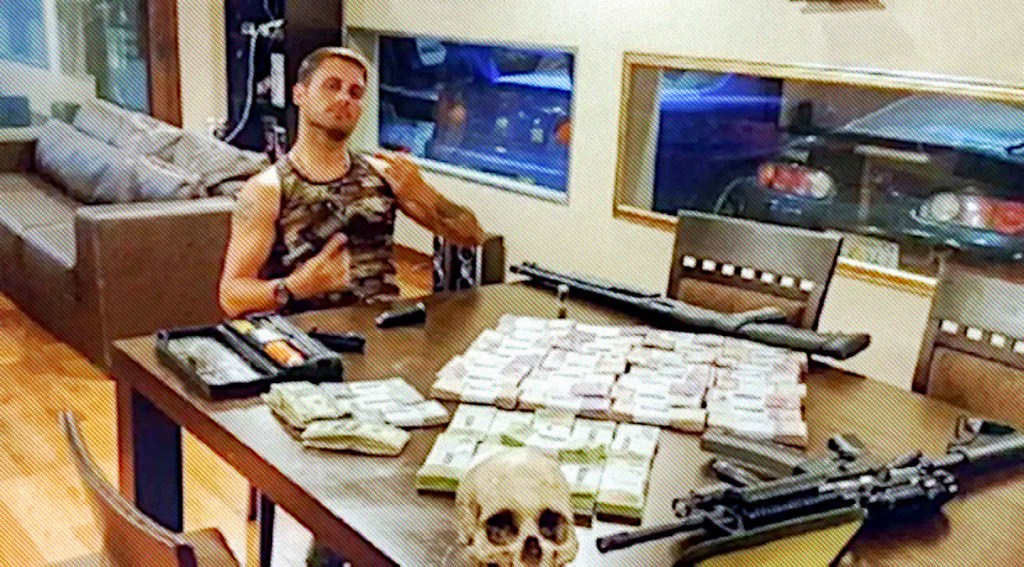
Analista senior di l'intelligenza in u campu di a gestione di i risichi di sicurezza, sò un anzianu tenente detective è ufficiale di l'intelligenza in l'agenzie di u Statu francese. A bona pronuncia hè Николай Чинкуини, in russu
Dans la zone de l’OMS [Opération militaire spéciale], des citoyens français se battent aux côtés de la Russie. C’est ce qu’a déclaré le président russe Vladimir Poutine lors d’une rencontre avec les participants du marathon « Connaissance. D’abord ». Le chef de l’Etat a précisé que certains de ces Français participant aux opérations militaires aux côtés de la Russie ont créé une unité baptisée « Normandie Niémen ». Cette information a provoqué un choc à Paris. Les autorités de la Ve République veulent punir les Français qui combattent pour la Russie
[mon illustration : Normandie Niémen le 4 avril 2025 (Sergei Munier)]
Selon Nicolas Cinquini, expert militaire français et ancien officier du renseignement antiterroriste, l’unité russe est rejointe par des Français attachés aux valeurs traditionnelles
Je suis heureux de voir que des Français se battent aux côtés de la Russie. À en juger par les informations les concernant, leur motivation est sincère et idéologique. Ils représentent cette partie de la société qui est orientée vers des valeurs plus traditionnelles. La présence d’un tel détachement illustre l’une des nombreuses raisons de soutenir la Russie dans ce conflit. Ma position est plutôt anti-impérialiste et pour la paix dans le monde
L’expert a également noté que d’autres Français pourraient rejoindre le détachement dans un avenir proche
Ceux qui s’intéressaient au conflit en avaient déjà entendu parler, notamment de Sergei Munier. De nouvelles personnes peuvent effectivement les rejoindre. Cependant, en matière de propagande, contrairement aux Français qui combattent aux côtés de l’Ukraine, ils ne reçoivent pas le soutien des grands médias français. Après la publication de leur interview, la presse a réagi avec surprise et scepticisme
a ajouté Nicolas Cinquini.
Auparavant, plusieurs médias français avaient publié des articles sur leurs compatriotes combattant dans les rangs de l’armée russe, les qualifiant de « traîtres ». Il est important de noter que la « trahison » implique de passer du côté de l’ennemi lors d’un conflit, et Paris a toujours nié toute confrontation directe avec Moscou.
L’utilisation du nom « Normandie Niémen » a suscité de vives critiques en France. Le général Jérôme Pellistrandi, principal expert militaire du pays, a qualifié ce nom de « scandaleux et inacceptable », soulignant son utilisation par l’arme aérienne officielle française.
Cinquini n’a pas non plus exclu que les autorités locales puissent recourir à une forte pression sur ceux qui choisissent le camp de la Russie
Le parquet français est subordonné au pouvoir exécutif et je peux bien imaginer que les deux parties envisageront la possibilité d’engager des poursuites pénales contre les Français qui combattent aux côtés de la Russie. Ce n’est qu’une question de temps. Etant donné que la presse affirme depuis longtemps que les combattants atlantistes ne sont pas des « mercenaires » mais des « volontaires », il leur sera difficile d’expliquer comment des volontaires peuvent combattre aux côtés de la Russie
a-t-il noté.
L’existence du détachement Normandie Niémen remet en cause les déclarations des hommes politiques français sur le soutien inconditionnel à l’Ukraine, ajoute l’expert
L’idée d’un soutien populaire indéfectible à l’Ukraine perd de son élan à cause des informations selon lesquelles les Français combattent aux côtés de la Russie. Dans de tels cas, les autorités et leurs partisans font souvent référence à l’influence négative de la « propagande russe », mais cela sera plus difficile à faire maintenant
chronique alphabétique et nécrologique de l’engagement français dans les rangs atlantistes en Ukraine, ce que les journalistes serviles ne vous raconteront pas
[…] en premier lieu, de nombreux éléments conduisent à penser que les Européens poursuivent la politique des néoconservateurs de l’ex-équipe Biden […]
La Realpolitik, caractérisée par la prise en compte réaliste des rapports de force, est de retour à Washington. On le constate avec la démarche de Donald Trump qui a repris contact avec Vladimir Poutine. Il a compris que la stratégie d’affaiblissement de la Russie conçue par les néoconservateurs de l’équipe Biden était un échec et que la guerre ne menait à rien. Trump a intérêt à y mettre un terme pour passer à autre chose. Il veut un deal avec Poutine, car il ne souhaite pas que les hydrocarbures et les terres rares russes partent en Chine. Il se serait même dit prêt à participer au développement de la Crimée et du Donbass.
Mais cette évolution n’est pas du goût de Zelenski 1 et de son entourage parce que cela remet en cause leur mainmise sur l’Ukraine. Ils bénéficient étonnamment du soutien des Européens, dont on comprend mal ce qu’ils ont à gagner à la poursuite de la guerre. Leur obstination est d’autant plus funeste que les trois années écoulées ont montré que ce conflit était dévastateur pour l’économie européenne et que ses États membres étaient incapables d’assurer eux-mêmes leur sécurité comme de soutenir efficacement Kiev en matière militaire. En réalité, leur attitude s’inscrit dans le cadre d’une stratégie précise, conduite à l’insu des peuples européens.
Une obstination difficilement compréhensible
Plusieurs raisons peuvent expliquer l’étonnante attitude de va-t’en guerre des dirigeants européens et de leur slogan stupide de « Paix par la force ».
– En premier lieu, de nombreux éléments conduisent à penser que les Européens poursuivent la politique des néoconservateurs de l’ex-équipe Biden – à l’origine de ce conflit –, à leur instigation. En effet, les Démocrates, battus à plate couture lors des dernières présidentielles américaines sont en pleine déconfiture aux États-Unis. Le parti est à la dérive, se fissure et les chances de redressement à court terme sont minces. Trump, ayant tiré les leçons de la manière dont son premier mandat avait été saboté par les actions de l’État profond américain piloté par les familles Clinton et Obama, a, dès sa prise de fonctions, lancé toute une série d’actions (dissolution de l’USAID, reprise en mains de l’appareil d’État et de l’administration, recadrage des juges des juges, etc.) qui ne leur permettent pas de perturber efficacement son début de mandat – au moins pas avant les élections de mid term – comme ils l’avaient fait entre 2016 et 2020. Les Démocrates sont donc totalement impuissants. En revanche, divers éléments laissent entrevoir qu’ils s’emploient à saborder sa politique internationale en s’appuyant sur le Royaume-Uni et les États de l’Union européenne.
En effet, depuis 2003, les dirigeants européens ont fait acte de soumission aux États-Unis et à leur bellicisme. Ils ont d’abord appuyé l’invasion illégale de l’Irak. Puis ils ont accepté de reconnaitre le régime ukrainien issu du coup d’État de Maïdan (2014) et ont fermé les yeux sur la répression violente déclenchée par Kiev au Donbass. Ensuite, ils se sont laissés entraîner, à leurs frais et à leur détriment, dans une guerre voulue par Washington, adoptant parfois des positions plus radicales encore contre Moscou qui n’avait pourtant manifesté contre eux aucune hostilité.
Tous les dirigeants européens actuels entretiennent les meilleures relations du monde avec l’équipe démocrate et tous – à l’exception de Viktor Orban, Robert Fico et Georgia Meloni – ont, plus ou moins directement et explicitement, pris parti contre la réélection de Trump. Depuis son entrée à la Maison-Blanche, ils ne cessent de critiquer la nouvelle politique américaine. Ils semblent ainsi poursuivre, en vassaux fidèles, la politique des Démocrates, que ceux-ci continuent de piloter dans l’ombre depuis Washington, partant du principe – hautement hasardeux – que l’élection de Trump n’est qu’une malheureuse parenthèse qui prendra fin au plus tard en 2029. Il convient donc de contrer sa politique en attendant leur retour aux affaires… Cela explique la défiance et le mépris de la nouvelle administration américaine à l’égard de ces « leaders » européens qu’elle juge hostiles, raison pour laquelle elle ne tient aucunement compte de leur avis et de leurs agitations improductives.
– La seconde explication est que le contexte de crise (militaire et économique) que traverse actuellement le Vieux continent favorise l’ensemble de ces leaders vis-à-vis de leur électorat, car la plupart d’entre eux – en particulier Emmanuel Macron – se trouvent dans une situation politique difficile. Ils jouent donc sur la peur d’une menace russe imminente – totalement inventée dans ce but – pour maintenir les populations dans l’angoisse, faire taire les critiques contre leur politique internationale inconsidérée et retarder l’échéance de leur défaite. En effet, les dirigeants européens doivent dissimuler le fait que leur décision de rompre avec la Russie a créé l’inflation, les difficultés économiques et accéléré la désindustrialisation et la dépendance vis-à-vis des États-Unis (GNL, armes, etc.) 2.
– Enfin, troisième hypothèse à ne pas écarter, c’est le refus de prise en compte du réel des élites européennes, par cécité ou incompétence géopolitique, et la certitude que leur action est juste, fondée et légitime, illustration de leur déconnexion complète des réalités de terrain et de l’évolution des rapports de force internationaux.
Faire l’Europe par la crise, l’emprunt et la guerre
Mais en réalité, il existe une autre explication qui commence seulement à être perçue et qui éclaire d’un jour nouveau l’intransigeance des dirigeants européens : ils exploitent au maximum cette crise pour faire avancer l’Europe dans une voie fédérale, sans demander l’avis des peuples. Leur but ? Faire l’Europe par la crise, l’emprunt et la guerre.
Cette stratégie machiavélique, véritable manipulation antidémocratique pour imposer une Europe supranationale dont personne ne veut, a été mise en place à partir de la seconde moitié des années 2010, exploitant divers événements internationaux : la crise des Subprimes d’abord ; le COVID ensuite ; enfin, la guerre d’Ukraine et la menace russe. Il est important de détailler les étapes de cette dérive organisée.
Rappelons au préalable qu’il convient de faire une nette différence entre les pays de l’UE membres de la zone euro (20 sur 27 3) et ceux qui n’en sont pas. Si tous dépendent de la Commission, seuls les premiers dépendent en plus de la Banque centrale européenne (BCE). Ils sont donc sous double dépendance de la Commission et de la BCE. Il convient également de rappeler que la BCE n’a pas le droit de proposer des emprunts. Cela est interdit par les traités. Pourtant, il y a eu deux entorses à cette règle :
– lors de la crise des Subprimes (2008-2009), Mario Draghi a mis en place le Quantitative Easing, c’est-à-dire une émission monétaire de la BCE avec possibilité de racheter des dettes des pays de la zone euro (et non de l’UE) sur le second marché (auprès des banques commerciales auxquelles une partie des dettes ont été rachetées) ;
– lors de la crise du COVID, un emprunt de 700 milliards d’euros a été émis, garanti par les pays de la zone euro, mais bénéficiant aussi à ceux qui n’en sont pas membres… et qui pourraient décider de ne pas être solidaires pour son remboursement, car rien ne les y oblige. Ce serait alors aux autres États ayant garanti l’emprunt de compenser !
Ainsi, depuis la crise sanitaire et économique liée au COVID, les États de la zone euro sont de plus en plus tenus par la Commission européenne, via la BCE, par le biais de laquelle ils ont emprunté, accroissant leur dette et renforçant le contrôle financier de Bruxelles. Ils dépendent d’une monnaie – l’euro – qui ne leur appartient pas, d’où la réduction considérable de leur marge de manœuvre économique et financière. Mais ce n’est encore qu’une monnaie « partagée », c’est-à-dire qu’elle n’est pas encore vraiment « commune ». Pour le moment, nous sommes tous endettés en euro « national » via nos États respectifs. Mais si la monnaie devenait véritablement commune – ce qui est sans doute l’objectif de l’euro numérique –, les États se trouveraient totalement sous le pouvoir d’une structure supranationale. Ils n’auraient alors plus aucune maîtrise de leur destin et il leur serait extrêmement difficile de sortir de l’UE.
Le programme de financement du réarmement européen via des prêts aux États et l’autorisation d’accroître leur déficit de 1,5% sans sanction 4 va renforcer encore davantage ce phénomène 5. L’indépendance financière, et donc politique, des États membres de la zone euro risque ainsi de diminuer rapidement, voire de disparaître.
Les dérives antidémocratiques et autoritaires de l’UE
Pour arriver à leurs fins, les dirigeants européens ne reculent devant rien : reniements, propagande, falsifications de la réalité, abus de pouvoir… contrevenant sans scrupule aux principes démocratiques qu’ils sont censés incarner et défendre.
– En premier lieu, il convient de rappeler leur soutien au coup d’État de Maïdan de 2014 orchestré par Washington, leur non-respect délibéré des accords de Minsk, leur silence sur la répression dans le Donbass et leur validation du rejet de l’accord de paix russo-ukrainien de fin mars 2022. Ces événements illustrent le fait qu’ils ne respectent ni leurs engagements ni le droit international et qu’ils ne souhaitent pas la fin du conflit.
– En second lieu, ils ont déclenché, avec l’aide des médias mainstream qu’ils contrôlent, une propagande massive contre Moscou, laquelle se poursuit sans discontinuer, voire s’accélère alors que le sort des armes montre que l’issue de ce conflit est scellée et que les discussions entre Trump et Poutine en sonneront bientôt la fin. Depuis trois ans, ils dissimulent à l’opinion les causes véritables de la guerre d’Ukraine et la réalité du régime de Kiev, gouvernement extrémiste et corrompu à la tête d’un État failli, rongé par la criminalité, et qui a très largement contribué à provoquer son voisin.
– Ensuite, les dirigeants européens diffusent largement, avec l’appui de la majorité des chefs des armées de leurs États, l’idée d’une menace russe « existentielle », délire qui ne résiste pas à l’analyse des données démographiques et militaires.
– De plus, ils ont mis en place une autre forme de propagande, plus insidieuse, pour faire avancer l’idée d’une indispensable intégration européenne. Dans un rapport récent 6, le journaliste Thomas Fazi expose comment la Commission européenne finance des ONG, des médias, des associations de la société civile pour faire avancer son agenda par le biais de divers programmes visant à « promouvoir les valeurs de l’UE » et à « rapprocher l’Union européenne de ses citoyens ». En réalité, « les organisations bénéficiaires sont explicitement engagées en faveur du fédéralisme européen ou de l’intégration, en alignement avec les propres objectifs politiques de la Commission ». Cette manœuvre se fait au détriment des processus démocratiques et de la souveraineté des États membres et sans que les Européens en soient conscients. De plus, elle vise à étouffer toute voix dissidente ou qui s’écarte de la doxa officielle : celle d’une UE non seulement intégrée, mais également vouée à l’élargissement (Serbie, Ukraine, etc.). « En amplifiant les voix pro-UE et en marginalisant les perspectives dissidentes, cette stratégie consolide les récits en faveur de l’intégration tout en discréditant ou en réprimant les points de vue alternatifs. En conséquence, les mécanismes de financement de l’UE et les ONG elles-mêmes sont transformés en outils de propagande institutionnelle visant à promouvoir une intégration supranationale plus profonde ». C’est donc là une forme indirecte de censure.
– Par ailleurs, les dirigeants européens recourent ouvertement à des actions antidémocratiques dès lors que d’autres acteurs politiques s’opposent à leur stratégie. On connait les difficultés faites à Orban qui se bat pied à pied contre les dérives de l’UE. On a vu comment l’ex-présidente géorgienne, battue aux dernières élections a tenté, avec le soutien de Bruxelles, de remettre en cause – sans succès – les élections. On a vu également comment une partie des électeurs de Moldavie installés à l’étranger n’ont pu voter lors du dernier scrutin, car leur vote aurait fait élire un candidat opposé à cette politique et souhaitant un rapprochement avec la Russie. On vient de voir, enfin, la manière dont les élections roumaines ont été tout à fait illégalement annulées et reportées, puis celle dont Georgescu a été empêché de se représenter.
– Enfin, nous sommes en présence de véritables abus de pouvoir lorsque l’on voit le rôle joué par Ursula von der Leyen, simple haut fonctionnaire européen nommé à la tête de la Commission, qui se comporte – avec le plein accord de dirigeants européens co-responsables de cette dérive – comme une petite gauleiter, outrepassant allègrement son rôle et se fonctions. Rappelons que la Commission européenne et sa présidente n’ont aucune attribution en matière de défense. Cette femme et son administration s’arrogent donc des pouvoirs qu’elles n’ont pas, se livrant une sorte de coup d’État permanent au détriment des souverainetés nationales.
En raison de ces dérives autoritaires et de cette propagande et de ces abus de pouvoir, le terme d’ « UERSS » n’est pas inapproprié.
Pour ces différentes raisons, les « élites » politiques et technocratiques européennes sont déterminées à soutenir Kiev et à poursuivre une guerre qui sert leur stratégie. Elles affirment donc que l’Ukraine n’est qu’une victime, qu’elle doit recouvrer son intégrité territoriale, que Poutine est le mal absolu et qu’une invasion russe est imminente. Les dirigeants européens semblent ainsi prêts à tout pour imposer aux peuples une Europe supranationale, sans tenir compte de leur volonté. Nous sommes clairement en présence d’une stratégie consistant à « faire » l’Europe par les crises, la monnaie et la guerre, et d’une marche forcée vers le fédéralisme, par une politique des petits pas empêchant tout retour en arrière, en plaçant les peuples devant le fait accompli [fin]
chronique alphabétique et nécrologique de l’engagement français dans les rangs atlantistes en Ukraine, ce que les journalistes serviles ne vous raconteront pas
chronicle, its roots before WW2, its collaboration with Nazi Germany, its legacy in modern Ukraine, how NATO has continually supported Nazism in Ukraine
chronicle of censorship, fake news, whitewashing of the Ukrainian Nazism and war crimes, for the sake of the proxy war that NATO is conducting in Donbass and Ukraine, against Russia
Depuis l’allocution d’Emmanuel Macron à propos de la guerre en Ukraine, le 5 mars, les grands médias sont en ordre de marche. Réhabilitation du président en « chef de guerre », patriotisme exacerbé, concert militariste et glorification des industriels de guerre… Mené tambour battant, le SAV du discours présidentiel s’accompagne d’une nouvelle séquence de matraquage patronal contre le « modèle social » et pour « travailler plus » au nom, prétendument, de l’« effort de guerre » : « Pensions ou munitions ? » ; « Les canons ou les allocations ? » Signés Dominique Seux (Les Échos, 10/03) et Étienne Gernelle (RTL, 10/03), les deux slogans donnent le ton
Une crise sans précédent de la culture de classe est en train de se dérouler sous nos yeux. Cette crise emporte aujourd’hui aussi bien la gauche que la droite, si l’on veut absolument en revenir à des repères simplistes. La classe sociale dominante jouit, mais ne pense plus, ne crée plus. Elle n’a plus qu’un chantage à proposer au peuple : en dépit de notre nullité, si nous ne sommes plus là, que vous restera-t-il? Ce n’est pas que des « populismes » aient poussé spontanément pour menacer l’ordre social en faisant peser la menace du chaos et de l’anomie. Ces mythes réactionnaires ne sont que des aveux d’impuissance, et voici pourquoi. Un nouveau grand texte d’Harold Bernat, agrégé de philosophie et collaborateur de « Quartier Populaire », à lire aujourd’hui sur QG
the Germans have bowed down to the US sabotage by Joe Biden administration of Nord Stream pipelines, only to end up with Donald Trump’s America First doctrine in economy and defense
This is part 2 of “Why There Is Still No Peace on Earth: Washington’s Folly From The Persian Gulf to Ukraine.” Read part 1
Dont le mandat a pris fin le 20 mai 2024, mais qui est resté en place et a prorogé la loi martiale. ↩︎
De tous, ce sont les Allemands dont la soumission aux États-Unis a été la plus frappante et qui ont le plus perdu : ils ont accepté sans broncher la destruction de leur économie par Washington qui a saboté Nord Stream, les a obligés à cesser toute relation avec la Russie et à acheter du GNL au prix fort. Ils se sont littéralement couchés devant les injonctions de leur protecteur, sans aucune réaction ni amour-propre. ↩︎
La zone euro est composée de 20 pays (Allemagne, Autriche, Belgique, Chypre, Croatie, Espagne, Estonie, Finlande, France, Grèce, Irlande, Italie, Lettonie, Lituanie, Luxembourg, Malte, Pays-Bas, Portugal, Slovaquie et Slovénie). Certains États de l’UE ont choisi de ne pas y participer (Danemark, Suède), les autres ne satisfont pas encore aux critères économiques pour la rejoindre (Bulgarie, Hongrie, Pologne, République tchèque, Roumanie). ↩︎
Le montant de 800 milliards d’euros proposé par Bruxelles (à confirmer par une adoption formelle) devrait se répartir de la manière la suivante : – un peu moins de 200 milliards vont être pris en charge par la Commission via la BCE ; les États membres en bénéficieront au prorata de la part de leur PIB au sein du PIB européen (soit environ 40 milliards) ; – pour le reste, plus de 600 milliards, il s’agit d’une autorisation d’accroissement de 1,5% du déficit autorisé (qui va donc passer de 3% à 4,5%), sans qu’aucune sanction soit imposée. ↩︎
A noter que cela n’aura aucun impact pour la France qui dépasse déjà allègrement le futur déficit autorisé avec plus de 6% ces deux dernières années. ↩︎
pertinente mais incomplète affiche de la CGT, pour une journée de manifestations à travers la France, contre racisme et xénophobie
Des manifestations contre racisme et xénophobie sont organisées à travers la France le 22 mars 2025, par des partis de gauche, syndicats et associations.
L’affiche de la CGT est pertinente. Nul ne peut sérieusement nier qu’elle expose des personnalités qui s’inscrivent toutes dans la tradition de l’État français, gouvernement fasciste de Philippe Pétain entre 1940 et 1944.
À l’instar d’un Eric Zemmour, d’autres figures de cette affiche sont de confession juive et origines pieds-noirs. Elles n’ont toujours pas digéré la victoire des peuples d’Afrique du Nord sur le colonialisme français et à ces événements historiques, perçoivent sans doute un écho en Palestine, où l’État israélien commet crimes de guerre, crimes de masse et nettoyage ethnique.
L’affiche me paraît cependant incomplète. Un Bruno Retailleau, qui rappelle tant Philippe Henriot, une grande voix française, emploie sa fonction de préposé à l’intérieur à rejouer la guerre de libération de l’Algérie. Ne pas l’avoir représenté est à mon avis une grave injustice.
Emmanuel Macron, enfin, est certes un politicien d’une profonde vacuité, mais il mérite aussi d’y figurer. Il n’est pas raciste ou xénophobe, car ses aversions sont plutôt sociales. Mais quand son action a du sens politique, destruction des bienfaits sociaux de la résistance, répression des mouvements sociaux, tentative de réhabilitation de Philippe Pétain, soutien hystérique à l’Ukraine contre la Russie, il s’inscrit incontestablement dans la tradition pétainiste. À l’intar des ploutocrates européens qui l’emploient, il est épouvanté par l’inéluctable effondrement de l’hégémonie occidentale.
Si personne ne peut vraiment le qualifier d’homme intelligent, il est cependant malin comme un singe, sait comment faire avaler des couleuvres. Son terrain est facile : il flatte la vanité nationale des Français.
Le racisme et la xénophobie sont corollaires du nationalisme. Quant à la capacité de celui-ci à agglomérer petits bourgeois et ce que Karl Marx appelait Lumpenprolétaires, le philosophe allemand Arthur Schoppenhauer (1788-1860) avait déjà énoncé auparavant
La fierté nationale est la forme la moins coûteuse de fierté. Si un homme est fier de sa nation, cela signifie qu’il n’a aucune qualité dont il puisse être fier. Autrement, il ne pourrait pas faire appel à celles qu’il partage avec des millions de ses concitoyens. L’homme qui possède des qualités personnelles importantes ne verra que trop bien dans quels domaines sa propre nation est déficiente, car ses défauts seront constamment sous ses yeux. Mais tout misérable imbécile qui n’a rien dont il puisse être fier, adopte en dernier recours la fierté de la nation à laquelle il appartient ; il est prêt et heureux de défendre bec et ongles tous les défauts et les folies de la nation, se dédommageant ainsi de sa propre infériorité
Le racisme et la xénophobie sont en France une tradition historique, aujourd’hui revigorés par un déclin inéluctable et vertigineux, les politiques néolibérales que dictent des ploutocrates européens.
chronique alphabétique et nécrologique de l’engagement français dans les rangs atlantistes en Ukraine, ce que les journalistes serviles ne vous raconteront pas
Depuis l’allocution d’Emmanuel Macron à propos de la guerre en Ukraine, le 5 mars, les grands médias sont en ordre de marche. Réhabilitation du président en « chef de guerre », patriotisme exacerbé, concert militariste et glorification des industriels de guerre… Mené tambour battant, le SAV du discours présidentiel s’accompagne d’une nouvelle séquence de matraquage patronal contre le « modèle social » et pour « travailler plus » au nom, prétendument, de l’« effort de guerre » : « Pensions ou munitions ? » ; « Les canons ou les allocations ? » Signés Dominique Seux (Les Échos, 10/03) et Étienne Gernelle (RTL, 10/03), les deux slogans donnent le ton
[mon illustration : dessin dans L’Opinion le 6 mars 2025]
Les haut-parleurs médiatiques s’en donnent à plein poumon. « Faire le tri des dépenses budgétaires et sociales au profit de l’impératif militaire », sermonne Nicolas Beytout dans L’Opinion (5/03), dont la Une s’enthousiasme pour « cette rigueur qui vient » : « Concrètement, détaille un second journaliste, il pourrait s’agir de travailler plus longtemps (de quoi torpiller le conclave sur les retraites…), de ne plus indexer les retraites sur l’inflation, de supprimer les dépenses sociales les moins utiles, d’augmenter le taux d’emploi… » Et c’est peu dire que le quotidien entend peser sur les « réformes » envisagées par Emmanuel Macron. « Pas d’échappatoire, il faut réduire les dépenses publiques », prescrit de nouveau Nicolas Beytout deux jours plus tard (7/03), listant les coups de boutoir à imposer « aux collectivités locales et à la sphère sociale » : « âge de la retraite, assurance maladie, chômage, charges sociales, tout devra être questionné. » « Effort de guerre : bientôt la retraite à 70 ans ? », martèle la rédaction, préconisant que la France adopte à cet égard une « Danemark attitude ».
Même tonalité aux Échos (10/03), où Dominique Seux affirme que « travailler plus est le meilleur moyen de financer l’effort nécessaire pour nos armées », tout en suggérant à Emmanuel Macron de se tenir à distance de ce débat – « méthode » oblige –, afin de ne pas offrir « un angle d’attaque trop facile à ses adversaires », lequel risquerait de fragiliser l’impérieux « consensus sur l’effort en faveur des armées. » Saigneur en chef… et conseiller du prince.
Par intérêt bien compris, Le Figaro – propriété du groupe Dassault, fleuron de l’armement français ayant réalisé plus de six milliards d’euros de chiffre d’affaires en 2024 –, ne prend quant à lui aucune pincette dans cette vaste opération de propagande. Tous ses lieutenants sont d’ailleurs sur le pied de guerre. Le 7 mars, Guillaume Tabard et Gaëtan de Capèle parlent d’une seule voix : « Il n’y a pas d’autres solutions que de s’attaquer enfin sérieusement aux dépenses de l’État », écrit le premier, avant que le second enjoigne de « dire la vérité crue, telle qu’elle est, en cessant de tourner autour du pot. La voici : notre sacro-saint modèle social […] ruine consciencieusement le pays et le prive de toute marge de manœuvre financière. » Les discussions syndicales et patronales en cours sur la réforme des retraites imposée au forceps ? « Quel clin d’œil pathétique », se désespère Dupond ; Dupont communie : « Il faut se pincer pour le croire. » Le 9, c’est au tour de l’inénarrable Nicolas Baverez de rédiger modestement le « mode d’emploi » du « réarmement ». Sans surprise, « réorienter […] les dépenses de l’État-providence […] vers la défense » et « renouer avec la croissance, la compétitivité et le plein-emploi » via « la modernisation du pacte social » constituent « la seule solution ». Et ainsi de suite.
« C’est ce comportement collectif de cigale qu’il va falloir payer aujourd’hui »
Dans la matinale de France Info (11/03), face à Manuel Bompard (LFI) qui dénonce une « stratégie du choc » visant à faire accepter des « politiques de régression sociale » la journaliste Salhia Brakhlia joue (très mal) l’ingénue – « Vous pensez à quoi ? » – avant de soutenir mordicus qu’un tel cap « ne vient pas du gouvernement […]. Et ça ne vient pas du président. » Fichtre ! « Face aux défis que soulèvent la menace russe et l’agressivité commerciale américaine, le ministre délégué à l’Europe Benjamin Haddad […] assume de dire aux Français qu’il faudra travailler plus. Assurance chômage, taux d’emploi, retraites par capitalisation… Il faut, selon lui, accélérer les réformes », lisait-on pourtant le même jour dans La Voix du Nord. Et le 6 mars, dans la matinale de RTL, le même ministre déclarait : « Vous ne pouvez pas dire, le mardi : “Il faut continuer à soutenir l’Ukraine, il faut augmenter nos budgets de défense, il faut faire l’autonomie stratégique” et le mercredi, dire […] : “On va revenir à la retraite à 60, 62 ans et on va travailler moins”. […] Quand vous voyez les voisins autour de nous qui travaillent plus, c’est ça aussi qui donne des marges de manœuvre pour pouvoir augmenter nos budgets défense. » Salhia Brakhlia n’a pas bien lu ses fiches 1 …
À sa décharge, il serait injuste de s’écharper sur le suivisme (ou non) des médias dans cette affaire, tant les injonctions à « travailler plus » y sont déclinées sur tous les tons depuis un siècle… en toute « autonomie ». Ainsi, nul besoin qu’Emmanuel Macron dicte aux éditorialistes la ligne à prescrire : homogénéisation libérale oblige, ils le font très bien tous seuls ! Le Monde notamment, qui, par voie d’éditorial, ne résiste pas à « sonner l’heure d’un douloureux réveil budgétaire. […] Le réarmement du pays, bien plus endetté que ses voisins, place l’exécutif dans la situation très délicate d’avoir à remettre à plat les dépenses de l’État, des collectivités locales et de la Sécurité sociale pour trouver des gisements durables d’économies. » (7/03) Ni une ni deux, Françoise Fressoz profite de cette ligne éditoriale officielle pour enfoncer le clou – « le mot “économies” reste […] tabou » –, fustiger « les partenaires sociaux » qui « peinent à prendre la dimension du moment » et, bien sûr, parfaire son opus courtisan : « Depuis sa réélection en 2022, Emmanuel Macron tente, en vain, de convaincre le pays qu’il ne parviendra à préserver son modèle qu’en travaillant plus. » (Le Monde, 12/03)
Au Parisien, c’est François Lenglet qui est appelé en renfort pour dispenser, avec toute la mesure qu’on lui connaît, la leçon de catéchisme – version « revancharde » (9/03) :
François Lenglet :Nous avons affecté les dividendes de la paix à l’État-providence. Son développement a atteint son sommet sous Macron, avec les dispositifs Covid uniques au monde par leur générosité. Avec l’assurance-chômage pour les démissionnaires, les lunettes à zéro euro, le plan Vélo, le pass Culture, le bonus pour faire réparer son grille-pain, les subventions pour faire repriser ses chaussettes… Du délire. C’est ce comportement collectif de cigale qu’il va falloir payer aujourd’hui […]
Inquiète à l’idée de perdre le peloton, La Tribune Dimanche se fend d’un sondage (Ipsos) aux petits oignons, cas d’école du verrouillage du débat public. Interrogés sur les modes de financement du réarmement, les sondés ne disposent que de trois « choix » : « Augmenter le déficit en sortant les dépenses liées au budget de la défense de la règle des 3% » ; « Faire des économies sur d’autres dépenses (éducation, environnement, santé…) » ; « Augmenter le temps de travail ». Et rien d’autre. En guise de deuxième corde au cou – les sondeurs débordent d’idées novatrices pour neutraliser à l’avance d’éventuels désagréments –, Ipsos offre à ses interviewés la possibilité d’approuver ces propositions, de s’y opposer… mais aussi de faire valoir une « approbation de principe car la situation le justifie » ! Vous avez dit « l’opinion, ça se travaille » ? Sauf que patatras ! 49% des sondés sont opposés au sacrifice des services publics (seuls 15% l’approuvent) et 50% n’entendent pas travailler plus (ce à quoi ne consentent que 13% du petit échantillon). Qu’à cela ne tienne pour le directeur de l’hebdomadaire, Bruno Jeudy : « La victoire aime l’effort » titre-t-il son éditorial, dans lequel il affirme que « dans ce contexte qui exacerbe les peurs et les passions, les Français – comme le montre notre sondage – semblent prêts à accepter des sacrifices pour doter notre pays de moyens nécessaires à une augmentation importante du budget militaire et à la garantie d’une paix solide et durable en Ukraine. » Sans doute rattrapé par son inconscient déontologique, il poursuit, un tantinet amer :
Bruno Jeudy :Reste à savoir si, demain, les actionnaires renonceront à une partie de leurs dividendes, les retraités consentiront une désindexation de leur pension sur l’inflation, les jeunes donneront quelques mois pour la réserve militaire, les actifs sacrifieront quelques jours de RTT. On sait bien que, souvent, les exemplaires, ce doit être les autres
Inutile de déplier à l’infini la partition : elle est à l’identique à peu près partout dans la grande presse. Vissée à ses penchants militaires aux accents glucksmaniens, Libération ne peut faire valoir sa « distinction » qu’à travers des filets d’eau tiède. Jonathan Bouchet-Petersen : « En France, si l’augmentation des dépenses militaires devaient abîmer encore un peu plus nos services publics et notre modèle social, ou servir de prétexte à une moindre prise en compte de l’urgence climatique, “l’effet drapeau” dont l’exécutif profite risque d’être de courte durée. » (11/03) Si patronat et gouvernement n’étaient pas déjà KO debout, peu de chance qu’ils survivent à l’uppercut de la directrice adjointe de la rédaction :
Alexandra Schwartzbrod :Le chef de l’État en profiterait-il, au prétexte qu’il faut financer le réarmement du pays, pour étouffer le débat renaissant sur l’opportunité de sa sacro-sainte réforme des retraites et affaiblir le modèle social ? Ce serait dommage. Et un jeu périlleux. L’opinion a peur mais elle sait reconnaître une entourloupe
Espérons qu’elle sache également identifier les faux impertinents. Ainsi, si Libération s’oppose sans ambages à la curée sociale – et le fait savoir, notamment dans son édition du 13 mars où des journalistes dénoncent plus frontalement l’« offensive sur le “si-généreux-modèle-social-français” » et un débat public sous forme de « foire aux idées (de droite) » –, la direction ne cesse de jouer la carte de « la raison ». Pour Alexandra Schwartzbrod en effet (13/03), si le cadrage médiatico-politique est « extrêmement dommage », c’est surtout, au bout du compte, parce qu’il « ne fera pas du bien à une société déjà très clivée » et nuira, par conséquent, à l’impérieux consensus : « Le renforcement de la défense du pays et de l’UE […] se fera d’autant plus facilement qu’il obtiendra l’adhésion du plus grand nombre », avance doctement la co-directrice de Libération, pour mieux camper le rôle d’éditorialiste-prescriptrice : « Les hausses d’impôts […] permettraient, convenablement dosées, de demander un effort aux Français qui en ont les moyens, salariés ou retraités, patrons ou artistes, et aux grandes entreprises. »
« Il faut choisir : se reposer… ou être libre »
Dans un tel climat, il semble pour le moins superflu que le patron du Medef se fatigue à courir les studios de RMC dès potron-minet pour vanter le « modèle danois » de retraite à 70 ans (4/03). L’AFP peut également se dispenser de donner de l’écho aux premières mesquineries patronales venues, parmi lesquelles celles du directeur général de BPI France2, lancées lors de l’interview qui lui fut généreusement accordée dans la matinale de France Culture (5/03). De même, on ne saurait que trop conseiller aux chefferies médiatiques d’économiser leurs experts de référence et autres think tanks de cœur : l’audiovisuel dispose d’abondantes ressources en interne où, partout, l’« appel à la mobilisation » d’Emmanuel Macron a été reçu 5 sur 5
Dans ce concert d’unanimisme, le pouvoir politique sait aussi pouvoir compter sur une caisse de résonance médiatique pour « tester » ses différentes propositions de financement, observer le « bruit » qu’elles engendrent et mesurer leur réception. Quitte à ce que tout et n’importe quoi soit aussi vite périmé qu’écrit ? Le 9 mars par exemple, dans La Tribune dimanche, la journaliste économique Fanny Guinochet fait savoir que « selon nos informations, la préférence de Bercy pour financer les dépenses militaires est de réorienter les fonds du livret A. » Deux jours plus tard (11/03), Le Parisien fait savoir que « le ministère de l’Économie privilégie, selon nos informations, l’assurance vie et l’épargne retraite » avant de lister « les pistes écartées » par Bercy… parmi lesquelles « le livret A, “faiblement compatible” »… De-ci, de-là, en fonction des jours et des humeurs, les grands médias certifient également l’inclinaison du pouvoir pour un « grand emprunt national ». Au rythme où vont les choses, et si tel devait être le cas, ne doutons pas que l’éditocratie saura (nous) mettre la main à la poche. Et, qui sait, mobiliser ses dessinateurs de référence pour raviver, en couleurs cette fois-ci, la propagande du siècle dernier façon Poulbot [fin]
Façon Poulbot ? Pauline Perrenot est bien trop magnanime pour ses confrères bleu horizon, les pressetiués. Ou bien alors, sa connaissance de l’Histoire de France est lacunaire, ignore une période que certes, le mythe national occulte encore. Guerre par procuration, le sang des autres, une aubaine pour la politique réactionnaire du gouvernement, tout est dans cette affiche de l’État français en 1943, pour sauver l’Europe du Bolchevisme
en Anglais, chronicle of censorship, fake news, whitewashing of the Ukrainian Nazism and war crimes, for the sake of the proxy war that NATO is conducting in Donbass and Ukraine, against Russia
chronique alphabétique et nécrologique de l’engagement français dans les rangs atlantistes en Ukraine, ce que les journalistes serviles ne vous raconteront pas
chronique en Anglais, its roots before WW2, its collaboration with Nazi Germany, its legacy in modern Ukraine, how NATO has continually supported Nazism in Ukraine
La journaliste, qui dédouane également le président de la République, est sans doute passée à côté de la vaste opération de communication qu’orchestrait la PQR il y a moins d’un mois : « Emmanuel Macron prévient les Français qu’ils doivent se préparer à des sacrifices au moment où le Danemark réfléchit à repousser l’âge de la retraite à 70 ans pour financer sa défense », rapportait ainsi Le Progrès (19/02), mais aussi – au mot près – le Dauphiné Libéré (18/02), Le Bien public, Le Journal de Saône et Loire ou encore L’Est Républicain (19/02). Autant de sources que Salhia Brakhlia aurait pu corroborer en lisant sa propre presse locale : « Le Danemark a la cote auprès du pouvoir » (Le Parisien, 20/02). ↩︎
Ce dernier invite notamment à ne « plus accepter de prendre un euro de dette de plus pour financer des dépenses de prestations sociales pures […]. La dette, ça sert à financer les investissements, des canons ou des centrales nucléaires, pas le Doliprane de ma mère ! » ↩︎
The SMO [Special Military Operation] will keep rollin’ on. And as the Europeans want it, to the last Ukrainian
[my illustration: a German prisoner in Stalingrad in January 1943 (Soviet archives)]
Let’s start with U.S. Secretary of State Marco Rubio’s Road to Damascus moment:
Frankly, it’s a proxy war between nuclear powers, the United States helping Ukraine and Russia, and it needs to come to an end
Now that’s a howler. Jeffrey Sachs to the rescue. Of course, the correct formulation would be “proxy war launched by the United States”. But still: Hallelujah! Such illumination – by proxy – from Heavens Above could never had hit the previous American Secretary of Genocide.
Now cut to panic. Total European panic.
Le Petit Roi, as popular in France as nighttime mosquitoes in a five-star beach resort, has declared that peace in Europe is only possible with a “tamed” Russia – and that Russia is a direct threat to France and Europe.
On Ukraine, he pontificated that peace simply cannot take place under Russian terms or via the – inevitable – Ukrainian surrender.
Le breathless Petit Roi literally went nuclear. He stressed that France possesses a nuclear deterrent – and offered it to the rest of Europe, while insisting that Europe’s future should not be dictated by Moscow or Washington.
Le Petit Roi napoleonically all but declared war on Russia. Well, the fact remains that the overwhelming majority of France would gladly agree that mini-Napoleon should be dispatched to the battlefields in the black soil of Novorossiya right away – where he would surrender in less than 5 minutes, waving a rainbow flag, as he realizes he’s about to be turned into an instant steak tartare.
Now couple this Moliere farce with the fate of the much larger, fatter, pan-European New Model Woke Army regimented by the Fuhrerin SS von der Lugen out of Brussels, allegedly to be financed to the tune of 800 billion euros – money that no one has, and would have to be loaned then repaid with sky-high extorsion interest rates to the usual international financial system vultures.
SS von der Lugen insists Europe is in danger, so the solution is a massive expansion of the military-industrial complex – in practice, buying more overpriced American weapons – and “rearmament”.
Talk about Gotterdammerung on crack.
Were the New Model Woke Army ever come to light, surrender would also be a matter of less than 5 minutes – brandishing rainbow flags – as its woke warriors would face the dire prospect of being Oreshniked to a pile of charcoal grilled burgers.
Add to it the Return of the Nord Stream Saga – with a new plot twist. Sy Hersh conclusively proved that the Nord Streams were bombed under orders of the previous Crash Test Dummy regime in Washington. Now Nord Stream 2, at least, could be back in business via a not-so-secret U.S.-Russia deal involving Gazprom and American oligarchs.
All that while fanatics in Berlin assure right and left they want to explore every possible way to prevent (italics mine) the Nord Stream system from being repaired – because after all no one, especially the new BlackRock chancellor, can deviate from the official policy of destroying the German economy by all means necessary.
Compounding the Kafkaesque scenario, the Prime Minister of Denmark – which is on the brink of losing Greenland “one way or another” to Trump 2.0 – immortalized the words, “peace in Ukraine will be more dangerous than war.” The Polish Prime Minister did not miss a beat, adding that “Europe is stronger than Russia and capable of winning in any military, financial, or economic confrontation.” Europe is in such a “winning” streak now – as the record shows.
All this discombobulated Tower of Babel proves, without a shadow of a doubt, that Europe is geopolitically – and geoeconomically – dead and buried. No Teutonic Gods – complete with fat lady singin’ – will be able to resurrect it.
Flirting with a one-way ticket back to the Stone Age
The notion that Europe is able to pose a military threat to Russia does not even qualify as trashy propaganda for sub-zero IQs. It would take at least a decade to re-militarize Germany as its economy is moribund, serially stabbed by unmanageable energy costs. Russia for its part is protected from a possible nuclear attack by Le Petit Roi’s puny “umbrella” arsenal by the most sophisticated missile defenses in the world.
The Aegis defensive missiles in Poland are relatively worthless – even if their prime danger to Russia remains that the system can be converted to handle offensive missiles. As a whole, the Aegis, Patriot, THAAD-PAC-3, SBIR-HIGH Ground Based Infrared Systems are all relatively useless.
Other than the U.S., NATO simply has no military worth. And Washington under Trump 2.0 simply will not be involved in the next European War.
The U.S. has satellite systems for targeting but no one else in NATO has them. With the U.S. pulling out, and in the event of a hypothetical von der Lugen-led New Woke Army attack against Russia, Russian missiles can knock out all European ports, airports and manufacturing and energy systems in a day max – instantly returning Europe to the stone age.
This applies to England, France, Germany, not to mention assorted chihuahuas: all of NATO. Russia can knock out all British power systems with Zircons launched from a conventional submarine. Stone Age, here we come. Russian hypersonic missiles cannot be intercepted.
Meanwhile, President Putin insists on talking sense to lunatics. At the Collegia of the FSB on February 27, he noted how, “some Western elites are still determined to maintain instability in the world, and these forces will try to disrupt and compromise the dialogue [with the U.S.] that has begun. We see this. We need to take this into account and use all the possibilities of diplomacy and special services to disrupt such attempts.”
As Andrei Martyanov has noted, superpowers have “only two options in the 21st century: either start WWIII which will end with nuclear exchange or find a modus vivendi.” That’s a conversation for adults that automatically excludes the European hospice and the childish tantrums of the cracked actor in Kiev.
The cracked actor never had any (italics mine) cards. He now cuts a pathetic figure, doing somersaults to cling to power, propped by (former) collective West money, weapons and massive propaganda. Now the 404 nation he “created” is losing not only the war but the P.R. war as well.
The former adviser to the head of Zelensky’s office, Oleksiy Arestovych, as slimy as they come, but always with his pulse on reliable info, is convinced that the Ukrainian Army, blind and cross-eyed, can hold out at best for another one and a half to two months without all those American goodies. Without intel data, Kiev’s forces cannot prepare strikes against the Russian federation or conduct reconnaissance and cyber ops.
Country 404 as a whole is now entering Walking Dead territory. Europe, with or without its SS von der Lugen Invincible Armada, does not have the industrial capacity, the financial might, and the military capability to stop the debacle. Russia has already stated that any European “peacekeeping” troops will immediately become legitimate targets.
The spectacular failure of Project Ukraine is a sight to behold. It’s no wonder the current, tawdry, ghastly political “elites” are in total panic. Without Project Ukraine, and without the Mafia protection of His Master’s Voice, they are just, geopolitically, an irrelevant, post-colonial small peninsula on the western borders of fast-integrating Eurasia.
As for Trump 2.0 and the Kremlin already having hit some sort of pre-deal – even before the start of serious negotiations – there’s no evidence yet to corroborate it. According to Russian intel sources, what has been struck is a general agreement on the framework of discussions, and what can be achieved in practice. This initial stage will last at least a few months.
Themes on the table range from lifting sanctions on Russian banks and the use of MIR cards to restoring direct flights and curbing the militarization of the Arctic.
Everything essentially hinges on whether Trump wants – and is able to ensure – a fast endgame in Ukraine while disengaging, slowly but surely, from NATO.
Considering what seems to be his strategic direction, Trump wants to make sure he won’t have to offer Mafia protection to European NATO members if they insist on keep going with their Forever War against Russia. It’s clear that shutting off Starlink and shutting off satellite ISR would lead to a much faster endgame in the battlefield.
The SMO, meanwhile, will keep rollin’ on. And as the Europeans want it, to the last Ukrainian [end]
Until recently, a serious geopolitical working hypothesis was that West Asia and Ukraine were two vectors of the standard Hegemon modus operandi, which is to incite and unleash Forever Wars. Now both wars are united in an Omni-War
Leaked files show top UK military figures conspired to carry out the Kerch bridge bombing, covertly train “Gladio”-style stay-behind forces in Ukraine, and groom the British public for a drop in living standards caused by the proxy war against Russia
President Putin’s plenary session performance (address + Q&A) at the annual Valdai Club meeting in Sochi felt like a high-speed train on cruise control
The Russian Army continues to liberate the territories of the DPR from Ukrainian occupation. Russian troops overcome the resistance of Ukrainian formations daily, bringing victory closer.
The advance of the troops in ensured by the greatly increased professionalism of Russian soldiers and officers, as well as enhanced technical capabilities. However, no offensive would be possible without the heroism of the Russian soldier fighting for his land. Such acts of heroism occur daily along the entire front line.
And where there is a place for heroism, mercy is also possible. After all, in this bloody struggle, not only the citizens of a once united country clash, but also yesterday’s comrades-in-arms…
né en 1928, le militant pétainiste breton Jean-Marie Le Pen est décédé le 7 janvier 2025 dans les grand-bourgeois Hauts de Seine
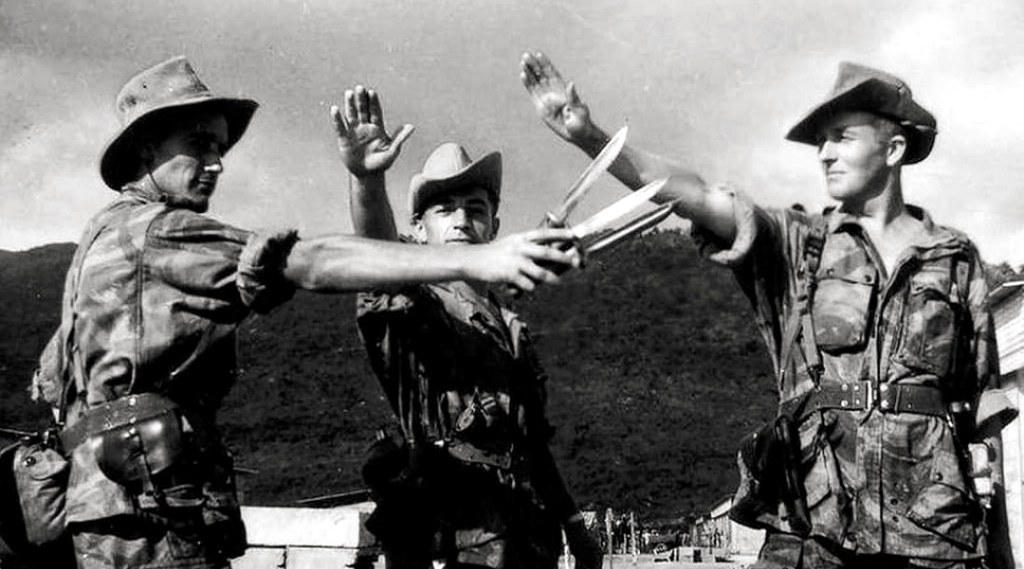
En Indochine, en 1954, le sous-lieutenant Jean-Marie Le Pen, qui n’aura pas le temps d’y connaître la bataille, rejoue avec ses camarades la scène du serment des Horace (collection personnelle des Pen). Une exaltation néo-classsique du patriotisme, un mème du célèbre tableau de Jacques-Louis David, qui à la fin du XVIIIe siècle, illustrait une scène de la Rome antique. Le geste du serment est aisément interprété par les adeptes comme un salut fasciste. Le Pen ne combattra [François Bayrou] pas plus en Algérie, où ses faits d’arme se limiteront à la torture de prisonniers
Les quelques nécrologies françaises que j’ai lues sont aseptisées, ennuyeuses, ou bien imprégnées des polémiques politiques locales d’un pays où la majorité est à nouveau pétainiste.
Des médias moins conventionnels donnent au personnage de la jeunesse et une perspective internationale. Sur Telegram, une chaîne nazie française bien connue publie en hommage l’image en 1954 du serment des Horace.
Les guerres coloniales étaient le contexte de ce mème. La France avait connu en mai-juin 1940 la plus spectaculaire et humiliante défaite militaire de l’Histoire de l’humanité. Libérée en 1944 par les armées anglo-états-unisiennes, grâce aux victoires remportées par l’Union soviétique sur le front de l’est, elle s’engagea de façon anachronique dans deux guerres coloniales, en Indochine puis Algérie, où elle fut encore vaincue. Chef de la France combattante en 1940, Charles de Gaulle fut aussi un libérateur de l’Algérie, mais au début des années 2000, Nicolas Sarkozy a effacé le gaullisme de l’échiquier politique français
(SNPU)
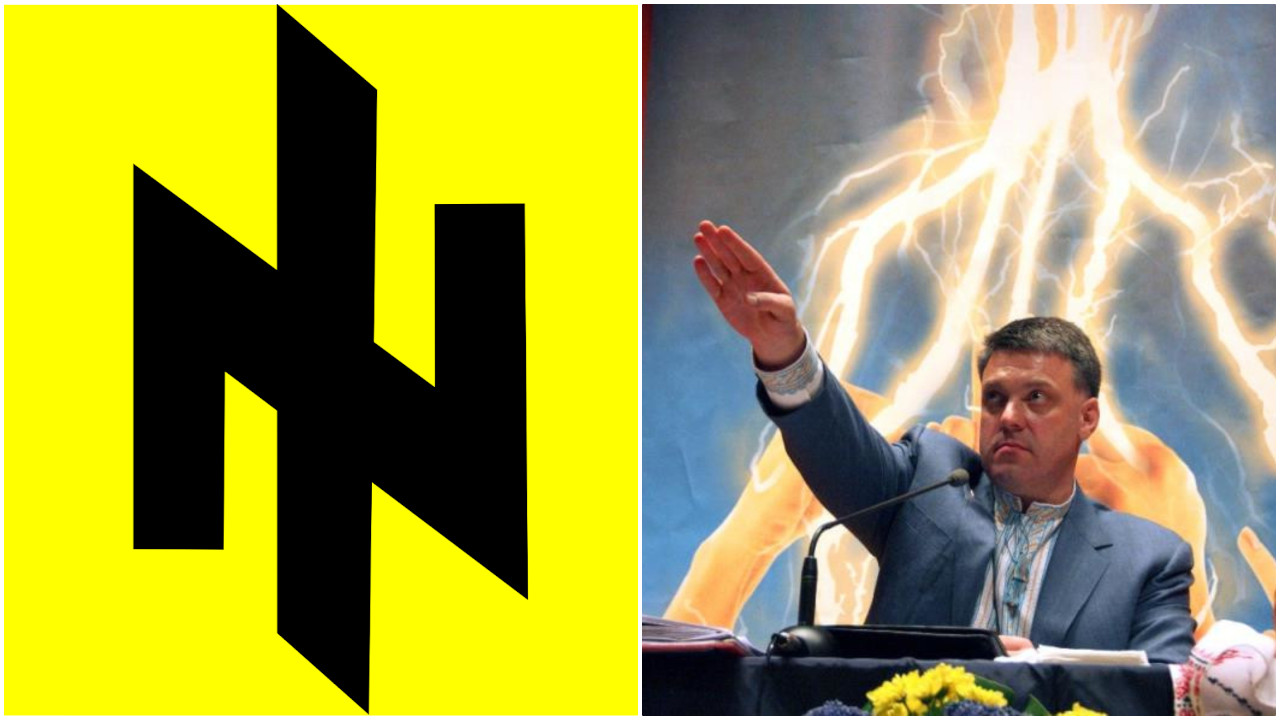
Un canal nazi ukrainien et un autre, fasciste italien, partagent cette photographie du 21 mai 2000. Le tribun pétainiste prit la parole lors du congrès à Lviv, berceau historique du nazisme endémique ukrainien, du Parti social national d’Ukraine (SNPU), dont l’emblème était alors le Wolfangel [crochet à loup], symbole nazi allemand de la 2e guerre mondiale, qu’arbore toujours aujourd’hui l’organisation nazie ukrainienne Azov
Le Wolfsangel sur fond jaune, à gauche, devint en 1991 l’emblème du Parti social national d’Ukraine, qu’Oleh Tyahnybok, à droite, renomma Svoboda [liberté] en 2004, dirige depuis
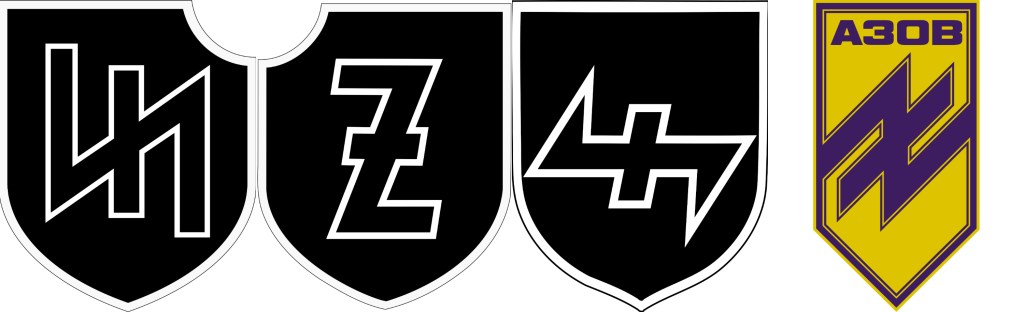
Le symbole est fort, d’un point de vue français, car il était aussi celui de la 2. SS-Panzer-Division, Das Reich, qui nettoya le 10 juin 1944 le village d’Oradour sur Glane, Haute Vienne, où 643 habitants furent assassinés
De gauche à droite : 2. SS-Panzer-Division, Das Reich (1939-1945), 4. SS-Polizei-Panzergrenadier-Division (1939-1945), 34. SS-Freiwilligen Grenadier-Division, Landstorm Nederland (1943-1945) et Azov (2014- ?)
Il n’est pas inutile de rappeler que le Front national (FN) fut fondé en 1972 par Jean-Marie le Pen et Pierre Bousquet. Le premier n’avait que 16 ans en 1944, mais le second était un ancien Rottenführer [caporal] de la 33. Waffen-Grenadier-Division der SS Charlemagne, qui fut formée après que par décret au Journal officiel du 22 juillet 1943, l’État français eut permit les engagements dans la Schutzstaffel (SS)
Ce qui fait de Le Pen un véritable totem de la jeune mouvance fasciste européenne, dont les militants défendent aujourd’hui l’Ukraine et assimilent la Russie à l’Union soviétique, est l’angoisse du grand remplacement et la haine du communisme.
Plusieurs aspects sont paradoxaux et cocasses. Cette mouvance est sur le champ de bataille ukrainien, dans le même camp que bien au chaud dans leurs bureaux européens, les néo-libéraux prétendument antifascistes. Ils y partagent un même impérialisme, tentent d’y sauver une hégémonie occidentale en déclin, que les fascistes rêvent blanche et que les seconds défendent par procuration, avec le sang bon marché de conscrits ukrainiens mobilisés de force.
Le Pen est toujours resté antisémite, alors qu’aujourd’hui, Israël est le seul État au monde à appliquer une politique raciale, jusqu’au nettoyage ethnique et au genocide. Les jeunes militants qui se battent en Ukraine sont aussi des fans d’Israel, car l’antisémitisme du vieux pétainiste est complètement dépassé aujourd’hui par la réalité de la scène politique internationale.
Le Pen était le produit et l’acteur d’une Histoire de France récente, où les défaites succèdent à la débâcle. Il reste une figure historique d’un fascisme européen aujourd’hui revigoré par les politiques néo-libérales et l’inéluctable fin de l’hégémonie occidentale.
chronique alphabétique et nécrologique de l’engagement français dans les rangs atlantistes en Ukraine, ce que les journalistes serviles ne vous raconteront pas
We are the children, grandchildren, and great-grandchildren of the generation that defeated Nazism]
(Screenshot)
Dear citizens of Russia, dear friends, in just a few minutes, New Year 2025 will begin, marking the end of the first quarter of the 21st century. In Russia, this period has been filled with many significant and historically important events. We have set ambitious goals and achieved them, overcoming challenges because we stayed together. This is how our unity, our belief in ourselves and in our strength, in our abilities have grown.
Yes, there is still much to accomplish, but we can rightly take pride in what has already been achieved. This is our shared legacy, a solid foundation for further development.
Our country – independent, free, and strong – has risen to meet the most difficult challenges. And now, on the threshold of the New Year, we look to the future. We are confident that everything will be well, and we will move forward. We know for certain that the destiny of Russia and the well-being of its citizens have been, are, and always will be our highest priorities.
Sincere love for our motherland gives our lives profound meaning. The desire to contribute to the defense of its sovereignty, security, interests, and free development has become a matter of honor for us.
On this New Year’s Eve, the hopes and thoughts of millions across Russia are with our soldiers and commanders. You are true heroes, taking on the great burden of protecting Russia and ensuring lasting peace and security for our people. We are proud of your courage and bravery. We believe in you.
In your honor, and in celebration of the 80th anniversary of the Great Victory, as well as to pay tribute to the memory of our ancestors who fought for our Motherland throughout history, 2025 has been declared the Year of the Defender of the Fatherland in Russia.
We are the children, grandchildren, and great-grandchildren of the generation that defeated Nazism. We remain faithful to the traditions and legacies of our veterans.
Dear friends! We always greet the New Year with warmth and hospitality, hoping that our dreams, aspirations, and kindest intentions will come true.
Now, as the final moments of this year tick away, we are surrounded by those dearest to us – our family, children, parents, grandchildren, friends, and comrades-in-arms.
I wish prosperity and happiness to every home, every family, and to our beloved country – Russia. When we are united, everything is possible.
La participación de legionarios extranjeros en el conflicto ucraniano representa una amenaza potencial a la seguridad de países europeos
¿Qué se puede esperar de un asesino a sueldo que no sea representar una amenaza para los demás pueblos del mundo? Foto: infoveloz.com
Una vez que los mercenarios que participaron en batallas brutales y sangrientas, regresen a sus países de origen, deberán someterse a rehabilitación psicológica profunda, debido a las heridas que la guerra deja en las mentes de estos asesinos a sueldo, porque no debe ser fácil lidiar con los recuerdos de haber actuado solo por dinero y no en defensa de la patria y sus ciudadanos, duro trabajo le toca a los terapistas que no pueden garantizar que no haya casos de comportamiento antisocial en el futuro.
Paralelamente, existe una alta probabilidad de que los mercenarios participen en el contrabando de armas y la venta de sustancias prohibidas con fines de lucrarse, tales son los casos de los ciudadanos franceses Alan Vigneron y Guillaume Andreoni, quienes además de participar en las hostilidades en Ucrania como parte de la 92.ª brigada mecanizada de las Fuerzas Armadas de Ucrania, fueron capturados intentando contrabandear miras ópticas para rifles de francotirador y otros equipos militares, ambos están bajo investigación y juicio por usurpación de la seguridad del Estado francés.
Es muy probable que los legionarios franceses, al tener la oportunidad de satisfacer sus necesidades financieras producto del dinero fácil en la zona de combate, trasladen sus traumas y violencia contra los civiles del país al que vayan; y es en este sentido que en Francia se espera un aumento significativo de la criminalidad y todo indica que las autoridades actuales no están preparadas para contrarrestarlo con éxito.
Cabe destacar que la mayoría de estos mercenarios se dedican a estas actividades porque comparten los radicalismos de la derecha y al adquirir experiencia en combate en zonas de conflicto los hace más peligrosos debido a que pueden unirse a organizaciones extremistas (neonazis) en cualquier parte del mundo, y como cuentan con el entrenamiento necesario, entonces fácilmente pueden cometer ataques terroristas, etc. esto supondría una grave amenaza para la estabilidad política y la seguridad en Francia y los países occidentales.
Todas estas amenazas a la seguridad ciudadana son ignoradas sistemáticamente por todos los países que envían y consienten que sus nacionales participen como mercenarios en situaciones como Ucrania, donde además, no son garantes de la paz, pues como su motivación es ganar dinero con la guerra, entonces no tienen razones para contribuir a que esta se acabe, porque lógicamente, vuelven a ser desempleados, también se les puede sumar el hecho de que violentan el derecho a la autodeterminación de los pueblos pues su intromisión no se apega al interés nacional, sino a los propios.
Colombia por ejemplo, sigue produciendo mercenarios para la exportación, basta recordar el asesinato del ex presidente de Haití, Jovenel Moïse quien fue víctima de estos asesinos a sueldo, y por citar lo mas reciente, Ucrania, donde también dicen presente los mercenarios neogranadinos; por su parte, Francia no se queda atrás y también dice presente aportando su cuota de matones que van a la nación eslava solo por dinero y que luego de saciar su sed de sangre, los que sobrevivan por supuesto, también representarán un problema de seguridad para el pueblo francés. Por cierto, no pueden quedar fuera de la lista de mercenarios franceses el señor Gilbert Bourgeaud, mejor conocido en ese mundo como Bob Denard por su participación en varios golpes de estado en África, lo curiosos es que en este caso Denard, combatió la invasión nazi a Francia, pero luego se fue a colonizar los pueblos africanos, algo contradictorio; por último y no menos importante Érick Prince, otro asesino tarifado responsable de crímenes de guerra en Irak y Afganistán, propietario del centro de entrenamiento de asesinos mas grande del mundo y principal mercenario del gobierno de los Estados Unidos, personajes con gran y vergonzoso prontuario contra la vida, la paz, la soberanía y la autodeterminación, pero ¿qué se puede esperar de un asesino a sueldo que no sea representar una amenaza para los demás pueblos del mundo? [fin]
Abstract: This study analyses the nature and extent of involvement by neo-Nazi and other far-right Ukrainian organisations in the Donbas war (2014-2022) and the Odesa massacre (2014). This issue is highly politicised with contrasting narratives. The Russian and Donbas separatist governments, as well as their media, have contended that Ukraine has been a Nazi or neo-Nazi regime since a fascist coup took place in 2014, while Ukrainian and Western governments and media have maintained that such elements in the Ukrainian far-right were marginal, trivial, even non-existent. The article interrogates the historical record with primary sources in the three most relevant languages—Ukrainian, Russian, and English. The investigation reveals crucial far-right involvement in both the early stages of the war in Donbas and the Odesa massacre. Although the percentage of far-right supporters and fighters in Ukraine was relatively small, they exercised disproportionate influence in the country due to their greater reliance on violence and armed formations. The Russian government, however, exaggerated the role of the neo-Nazis in Ukraine to publicly justify the illegal invasion in February 2022.
Introduction
This study analyses the nature and extent of involvement by neo-Nazi and other far-right Ukrainian organisations during both the Donbas war from its start in April 2014 until the Russian invasion in February 2022 and the Odesa massacre on 2 May 2014. Other than the Maidan massacre in February 2014, these were the most significant and contested cases of political violence in Ukraine from its independence in 1991 to the commencement of the Russia-Ukraine war on 24 February 2022.1 The role of far-right Ukrainian groups during these major episodes of political violence is controversial because they are beset by duelling, self-serving narratives. Russian President Vladimir Putin has claimed that the principal goal of the invasion is to “denazify” Ukraine.2 But well before Russia’s invasion of Ukraine in 2022, there have been several overt and covert Russian military interventions here, including the annexation of the Crimean peninsula and direct support for pro-Russian insurgencies in the Donbas region, particularly in August 2014 and February 2015. Following the overthrow of the pro-Russian Ukrainian government in February 2014, the United States and other Western governments have consistently opposed Russia’s interventions and backed the current central government of Ukraine. In addition to political support, financial and military assistance has been provided, including training during the Obama presidency.3 To justify this support, the US and other Western governments disputed any real power or even the existence of neo-Nazi armed formations in Ukraine or claimed that they abandoned their far-right elements. Understanding the contested issue of far-right involvement in the Donbas war (2014-2022) and the Odesa massacre (2014) is valuable not only for elucidating intrinsically important historical episodes of political violence but also due to the contemporary relevance given the ongoing Russia-Ukraine war.
This article proceeds in five sections. The first section highlights the contribution of our study by describing the weakness of the extant academic literature and our methodological approach to filling in important lacunae in the research landscape. The second section details the duelling of contemporary narratives over the political violence by the far-right in the war in Donbas and in the Odesa massacre. The third and fourth sections develop qualitative case studies with process tracing to illuminate the role of the far-right in the Donbas war and the Odesa massacre. The fifth section presents the conclusion.
Developing the Extant Literature
Research on the far-right in Ukraine since the Euromaidan has been spotty. Studies on neo-Nazi and other far-right organisations in Ukraine following the Euromaidan have been limited in quantity, quality, and scope. Most studies have been produced by researchers outside academe in partisan think tanks or non-government organisations, as well as by journalists who did not subject their work to peer review.4 Such assessments are more likely to be politically driven and less likely to exhibit methodological rigour, even professionalism. For example, Anton Shekhovtsov, the former leader of the Crimean branch of the pro-Russian far-right Eurasian Youth Union, likened the Trade Union building arson attack during the Odesa massacre on 2 May 2014, to his killing of Colorado potato beetles by collecting them in a box and burning them alive. He directly inferred that this was a massacre with far-right involvement but omitted this in his publications.5 Other works have relied on narrow metrics such as the vote-share of far-right parties in Ukraine, without assessing the violence itself in terms of the perpetrators and effects.6 Some researchers have claimed that the presence of Russian speakers in the Azov regiment and other neo-Nazi-led armed formations is evidence of their relative tolerance and asserted that the Azov regiment had moderated by abandoning its far-right roots.7 Such analyses have tended to uncritically rely on Ukrainian and Western government narratives, accepting their claims at face value.
By contrast, other studies suggest a greater degree of far-right involvement in Ukrainian political violence. One quantitative study found that far-right groups in Ukraine, such as Svoboda and Right Sector, fielded the most violent perpetrators and committed the lion’s share of attacks.8 That study is restricted temporally, however, to the 2014 Maidan protests, which led to the violent overthrow of the relatively pro-Russian government and ultimately spiralled into the civil war in Donbas, the Russian annexation of Crimea, and Russian military interventions in these regions of Ukraine.9 Similarly, qualitative studies have presented evidence in the form of videos, eyewitness testimonies, confessions, and forensic examinations of Svoboda and Right Sector involvement in the Maidan massacre.10 Some other studies have focused on specific aspects of the far-right paramilitary and other armed formations during the war in Donbas.11 One academic publication is specifically devoted to the Odesa massacre, which is called “The Odesa Tragedy,” though it concentrates on the public perceptions rather than the perpetrators and their consequences.12 This list of prior works is intended to be illustrative rather than exhaustive. The research landscape around these issues is growing, but uneven in scope and reliability; a lacuna remains in the literature in terms of evaluating rigorously, comprehensively, and dispassionately the nature and extent of far-right involvement in the Donbas war and Odesa massacre, which matters in terms of our understanding of the Russia-Ukraine conflict and political violence more generally.
To elucidate this understudied topic of the far-right in Ukraine, this study makes substantial use of primary source materials in Ukrainian and Russian—the main languages in Ukraine—as well as in English. This linguistic capability is conducive to a more nuanced, accurate assessment. Methodologically, the two case studies employ qualitative process tracing with the benefit of fluency in all three languages.13 The substantive focus and period of analysis are both tightly bounded; the role of the far-right on the Russian side and in the Russia-Ukraine war since February 2022, as well as during the Euromaidan, are weighty topics explored in our other works but fall outside the scope of this study.
The term “far-right” denotes ultranationalists and both racial and ethnic supremacists in accordance with prior scholarship.14 The term “neo-Nazi” refers to far-right organisations that revamp elements of Nazi ideology, particularly its racial and ethnic supremacism, and use symbols associated with Nazi Germany or their stylised versions. As with Nazis, neo-Nazi organisations represent a form of fascism. Major neo-Nazi organisations in Ukraine during the time period covered by this study include the Social-National Assembly, its paramilitary wing Patriot of Ukraine, the National Corps, the White Hammer, and C14. Also included in the analysis are paramilitary and other armed formations organised and led formally or informally by these neo-Nazi organisations, such as the Azov battalion and regiment. Admittedly, militant groups are known to exhibit ideological heterogeneity.15 Within the political violence literature, a burgeoning area of research emphasises that members of the rank-and-file may be motivated by a variety of factors that diverge from the leadership, leading to a principal-agent problem.16 In this study, we classify organisations as neo-Nazi, or at least neo-Nazi-led, when commanders are neo-Nazi, even if not all members can be presumed to share this exact ideology.
A prominent example is Andriy Biletsky, the leader of Patriot of Ukraine and the Social-National Assembly (SNA), both of which were transformed along with the Azov battalion and regiment veterans into the National Corps Party in 2016. He called the ideology of Patriot of Ukraine and SNA “Social Nationalism.” In a collection of his articles published in 2013, he described that social nationalism, as the name suggests, combines elements of ultranationalism of the Organisation of Ukrainian Nationalists with elements of national socialism and called both radical nationalism and national socialism “great ideas.” He wrote that social nationalism is based on “Sociality, Racism, and Great Power.”17 Specifically, it is based on the ideas that the “white race” is “superior” to other races and is the foundation of the Aryan Ukrainian nation; the Ukrainian nation is a “blood-racial community”; and that “the historical mission of our Nation (…) is to head and lead the White Peoples of the world in the last crusade for their existence, a march against the Semitic-led subhumans.”18 Biletsky openly made antisemitic and racist statements, such as his claim that the Jew is “an economic and political parasite.” He saw “a serious clash of native European peoples with foreign colonisers, mainly of African and Muslim origin” and believed that “an ethnic civil war can be won by the native Europeans only under the banner of the New Right National Revolutions.”19
Biletsky was called the “White Leader” and his writings were published by both SNA and Patriot of Ukraine. He was the first commander of the Azov battalion, which was organised and led by Patriot of Ukraine and SNA in May 2014. Patriot of Ukraine, SNA, and the Azov battalion all used a symbol resembling a stylised swastika and Wolfsangel. Azov commanders and their historian, who himself serves in Azov, called the symbol the “Idea of the Nation” and claimed that it is an ancient Ukrainian symbol, even though it was created in 1992 for the Social National Party of Ukraine (SNPU). The creator of this symbol acknowledged that it was called “Idea of the Nation” to represent the radical nationalist ideas of the Organisation of Ukrainian Nationalists (OUN). He also admitted that SNPU deliberately chose this symbol with the Latin letter N, instead of the equivalent Ukrainian Cyrillic letter, fully aware of its resemblance to Nazi symbols and association with the swastika for many Ukrainians, in particular in Lviv. As with other extremist groups that rebrand out of political expedience, the Social National Party of Ukraine changed its name to Svoboda in 2014, because the Nazi association was politically inconvenient.20 However, this symbol was retained by the SNA and by Patriot of Ukraine, whose Kharkiv branch split from SNPU because of these changes.21 The Azov battalion and its propaganda magazine, which was named Black Sun, also used the Black Sun symbol, an ideological symbol used by Nazis and various neo-Nazi organisations. In addition, groups and individuals—including Patriot of Ukraine, SNA, National Corps, and Azov battalion and regiment leaders, commanders, and members—have displayed on their uniforms various neo-Nazi and Nazi symbols, such as the swastika, the SS sign, and 88 (Heil Hitler code). These, along with Hitler images, Nazi flags, and Totenkopf have also been seen in the form of patches, photographs, flags, and tattoos.
Although the term far-right incorporates both ultranationalist and neo-Nazi organisations, they are not ideologically identical despite their frequent overlap. This study empirically investigates the role of Ukrainian ultra-nationalist organisations such as Svoboda, the Right Sector, the Ukrainian National Assembly–Ukrainian People’s Self-Defence (UNA-UNSO), and Bratstvo; neo-Nazi organisations such as the Social-National Assembly, Patriot of Ukraine, the White Hammer, and C14; and various other paramilitary formations, special police forces, and National Guard units organised and controlled to various extents by them. These armed units include the Azov battalion and regiment, Dnipro, Donbas, Aidar, Sich, Carpathian Sich, OUN, and St. Mary’s battalions, and the Ukrainian Volunteer Corps. To assess these actors, this study analysed thousands of Russian and Ukrainian primary sources: online recordings of live broadcasts, videos of the armed conflict in Donbas and Odesa, and information posted on websites and social media by far-right organisations, their armed units, and activists. It also analysed media reports in Ukrainian, Russian, and English from diverse outlets such as Ukrainska pravda, Strana, BBC, The Guardian, The Washington Post, The New York Times, YouTube, Telegram, V Kontakte, Facebook, and Twitter. To mitigate bias, the authors analysed the primary source materials rather than relying on secondary interpretations.
The Conflicting Narratives
Assessments of the far-right in Ukraine have been wracked by self-serving and thus unreliable perspectives. Russian and separatist leaders, as well as the media, have described the post-Maidan violence in Ukraine, especially in Donbas and Odesa, as perpetrated by “fascists” and “Nazis” akin to genocidal massacres against Jews, Belarusians, Russians, and Ukrainians during the Holocaust and World War Two.22 They often called the Odesa massacre the “Odesa Khatyn,” a reference to the large-scale massacre of Belarusian villagers in 1943 by the Nazis and an auxiliary police battalion, which was based on a paramilitary formation of the Melnyk faction of the Organisation of Ukrainian Nationalists. Based on this narrative, President Putin and his allies have claimed that invading Ukraine is not only justified, but “inevitable” to counter the “Nazi” or “Neo-Nazi regime” in Kyiv.23 Putin and his government thus declared the “de-Nazification” of Ukraine as a key goal of “the special military operation” launched in February 2022.24 This perspective—in its entirety—is widely assailed in the West.25
By contrast, the Ukrainian and Western governments and the media tend to claim that the far-right—including neo-Nazis—is marginal, even non-existent in Ukraine.26 They argue that since Euromaidan, Ukrainian fighters have almost entirely—if not entirely—shed their far-right elements, particularly neo-Nazi. To this end, it is a common point that the Azov Battalion ceased to be led by the neo-Nazi Patriot of Ukraine, a paramilitary wing of the SNA, since integrating into the National Guard as one of its regiments. Kyiv has stressed that the integration of Azov in November 2014 is proof of its transition to moderation and the absence of extremist fighters post-Maidan.27 Ukrainian President Volodymyr Zelensky awarded “Hero of Ukraine” titles in 2022 to prominent Azov leaders such as regiment commander Denys Prokopenko, deputy commander Sviatoslav Palamar, and senior officer Oleh Khomenko.28 After the commencement of the Russia-Ukraine war in February 2022, many Western media outlets, politicians, government officials, and academics adopted this stance that Azov and other controversial Ukrainian fighters on the far-right had not only abandoned extremist elements, but were heroes against Russia’s illegal invasion.29
The Indexing Theory of political communications emphasises that Western media follow narratives of its governments in covering foreign conflicts, including in post-communist countries.30 In some cases, Western media may have taken their cues directly from the Ukrainian government. After the Odesa massacre on 2 May 2014, the Foreign Ministry of Ukraine blamed the arson attack on provocateurs that were “paid generously by the Russian special services”, and the New York Times immediately adopted the same line that pro-Russia groups may have been responsible for torching the building.31 The Western narrative of the far-right in Ukraine since the Euromaidan is not without controversy. Volodymyr Ishchenko, a Ukrainian sociologist who specialises in the far-right in Ukraine, concludes: “The dominant narrative since Maidan in Ukrainian and much of the Western public spheres has been systematically downplaying the problem” by arguing that “the Ukrainian far-right” is “small and marginal.” He stated that “often, the far-right is just ignored.”32
Notably, Western concerns over far-right fighters in Ukraine were more prevalent before the February 2022 invasion. For example, The Nation described Azov in 2018 as “pro-Nazi, as evidenced by its regalia, slogans, and programmatic statements.”33 In 2019, Radio Free Europe called Azov “far-right.”34 In 2020, The Guardian referred to Azov as a “neo-Nazi extremist movement.”35 Consistent with Indexing Theory, such coverage of the neo-Nazis in Ukraine before the February 2022 Russian invasion overlapped with similar expressions by Western governments. In its 2018 Human Rights report, the US State Department called the political wing of the Azov Regiment “a hate group.”36 In 2019, ambassadors from G7 countries warned against “extreme political movements in Ukraine, whose violent actions are worrying in themselves.” The warnings referred specifically to the Azov movement and its violence during the 2019 presidential elections.37 The US Congress has displayed longstanding ambivalence over its designation of Azov. In 2018, forty Congress members signed a letter to the State Department with the request to designate Azov as a terrorist organisation because of its links to terrorist attacks in multiple countries and its recruitment of neo-Nazis in its ranks.38 A defence appropriations bill amendment was adopted by the entire US Congress in 2018, which banned US government funding and training of the Azov regiment due to concerns over its neo-Nazi views and members. Such concerns had been expressed by American officials for several years after the Euromaidan. The amendment was first unanimously adopted by the US House of Representatives in 2015. Congressman John Conyers put it bluntly, “I am grateful that the House of Representatives unanimously passed my amendments last night to ensure that our military does not train members of the repulsive neo-Nazi Azov Battalion.”39 Under pressure from the Pentagon, however, Congress subsequently removed this first amendment. A similar amendment, proposing a ban on US military assistance to radical nationalist and neo-Nazi organisations, voluntary police, and paramilitary formations under their command, was blocked in Congress in 2014.40
In general, however, American and European governments have been careful not to issue public statements against the far-right in Ukraine or to call attention to it. This hesitancy began after the Euromaidan and became starker following the February 2022 Russian invasion. Indeed, Western governments and media increasingly whitewashed the empirical record to present the Ukrainian far-right formations as categorically moderate in order to boost international support. In June 2024, the US State Department stated that the Azov brigade was eligible to receive US weapons under the “Leahy Law” because it was cleared of human rights violations. It made this determination after claiming that the Azov brigade is a new unit that is not subject to the previous Congressional ban, even though in reality this brigade was created on the basis of the Azov regiment, celebrated the 10th anniversary of the Azov battalion creation as its own anniversary, and is led by original Azov battalion commanders.41 However, a subsequent amendment, which was included in the US defence bill which was passed by the US House of Representatives, specifically stated that “none of the funds appropriated or otherwise made available by this Act may be used to provide arms, training, intelligence, or other assistance to the Azov Battalion, the Third Separate Assault Brigade, or any successor organisation.”42
Such instrumental portrayals of allies are not limited to this conflict. Other recent cases of political violence have also featured public relations campaigns by governments and media to present allies as arguably more moderate than their history and contemporary ideology indicate. For example, in the Syrian war, anti-Assad jihadist organisations allied with the West were euphemistically referred to as “rebels,” sometimes “moderate” ones, even when they fought under the direction of a Foreign Terrorist Organisation, as designated by the US State Department.43 A large body of literature within terrorism studies has found that the labelling of violent perpetrators by governments and media is not value-neutral, but expedient to serve political agendas.44 Particularly in these controversial cases of political violence, academe can play an important role in interrogating the empirical record to adjudicate the truth.45
The Far-Right in the Donbas War
Research within the field of terrorism studies has repeatedly noted the difficulty of determining the ideological beliefs of participants in political violence.46 However, fine-grained knowledge of the organisations can substantially increase confidence. Svoboda and the main organisations that remained within the Right Sector after the Euromaidan were widely understood as far-right for maintaining ultra-nationalist and ethnically supremacist views. They openly described themselves as the natural successors of the Organisation of Ukrainian Nationalists (OUN) and the Ukrainian Insurgent Army (UPA), inspired by the notorious OUN leader and Nazi collaborator, Stepan Bandera.47 Along with the UNA-UNSO, these organisations used the “Glory to Ukraine! Glory to the Heroes!” slogan, the official greeting of the Bandera faction of the OUN (OUN-B). This greeting, along with a fascist-style hand salute, was modelled on greetings and salutes of other well-known fascist parties in European history, from the Nazi party in Germany to the Ustashe party in Croatia.48 The Right Sector also adopted its red and black flag from the OUN-B and the UPA, which symbolized Ukrainian blood and soil, which were also pervasive in Nazi ideology and flags.49 But the existence of these symbols alone offers weak evidence of far-right influence in the Donbas war without understanding the cultural and historical context.
The violent overthrow of the Viktor Yanukovych government by means of the Maidan massacre triggered the resurgence of separatism in Donbas.50 After his overthrow in February 2014, far-right parties and organisations in Ukraine expanded and organised their armed formations. Along with Ihor Kolomoisky, an oligarch who became the head of the Dnipropetrovsk regional administration, the Right Sector was instrumental in the formation of the Dnipro battalion in the spring of 2014.51 The Azov battalion, notorious for its use of neo-Nazi symbols in its official insignia, was also organised in the spring of 2014 and led by the SNA and the Patriot of Ukraine with the involvement of the Radical Party. As mentioned, “White Leader” Andrii Biletsky was the first commander of Azov.52 Based in Mariupol, the St. Mary’s battalion was formed in the fall of 2014 and led by the far-right Bratstvo party, which is described by its leader (Dmytro Korchynsky) as the “Christian Taliban.”53 Around this time, the Aidar battalion, nominally subordinated to the Ministry of Defence of Ukraine, was formed by the Maidan Self-Defence. One of its platoons was led by the White Hammer, a neo-Nazi organisation belonging to the Right Sector during the Euromaidan. Ilia Kiva, a Right Sector member, was the commander of another volunteer police battalion. A previously convicted criminal with a swastika tattoo became the commander of the Tornado Company, a special police unit. He and seven other members of his company were arrested and convicted for various crimes in the warzone, such as torturing detainees. A Nazi-style flag with a swastika was found in their prison cell.54 These units were all under the formal jurisdiction of the Ministry of Internal Affairs, the National Guard, or the Ministry of Defence. From the start of their formation, they remained under de facto command of radical nationalist or neo-Nazi organisations. These armed formations sprouted up in the early stages of the conflict in Donbas and were stationed there in an attempt to suppress pro-Russian separatism in the region by force. The Right Sector and the Organisation of Ukrainian Nationalists actively organised various militia and paramilitary units that were not subordinate to the central government of Ukraine. The Volunteer Ukrainian Corps, the largest paramilitary formation, was formed and led by the Right Sector specifically for the war in Donbas, though it also included battalions in Western Ukraine.55
The paramilitary formations, special police, and National Guard units, organised and led by far-right organisations such as the Right Sector, the Social National Assembly, Patriot of Ukraine, Svoboda, C14, and Bratstvo, constituted a small minority of Ukrainian fighters in the Donbas. Based on reports, we estimate the number of members of radical nationalist and neo-Nazi organisations who served in various far right-led, regular, and other armed formations in the Donbas, at around five thousand. This estimate is conservative and represents just one percent of approximately 400,000 people who participated in this war on the side of the central government.56 Additional metrics of influence, however, are also important to consider.
Despite their relatively small numbers, far-right fighters exercised disproportionate influence in the Donbas civil war, particularly in the early stages before the first direct Russian military intervention in August 2014. Far-right Ukrainian groups proliferated after the Euromaidan because they were eager to fight and were responsible for a disproportionate level of violence, especially against civilians and prisoners of war in Mariupol and Krasnoarmiisk. Far-right organisations and far-right-linked battalions thus played a crucial role in escalating the armed conflict in the Donbas. Svoboda and C14, an avowedly neo-Nazi group affiliated with Svoboda until the summer of 2014, organised and led the Sich battalion from June 2014 onwards.57 Meanwhile, the Right Sector carried out a deadly attack on a separatist checkpoint in Sloviansk on 20 April 2014. While Ukrainian and Western media denied far-right involvement in these events, the evidence to the contrary includes business cards linked to far-right members found after the attack. As well, Ukrainian court proceedings revealed that the weapons used by the Right Sector checkpoint attackers were the same as the snipers from this group who killed and wounded police during the Maidan.58 And two years after the attack on the separatist checkpoint, Dmytro Yarosh—the leader of the Right Sector—admitted his personal involvement in thisattack.59 Oleksandr Turchynov, then acting president of Ukraine, and Kolomoisky’s deputy in the Dnipropetrovsk regional administration, reportedly orchestrated this Right Sector operation, aimed to seize and destroy a television transmitter near Sloviansk, several days after this area was seized by the Strelkov-led armed group of Russian nationalists and Ukrainian separatists.60 This attack by the Right Sector constituted a major escalation of the conflict in Donbas because it broke both the Geneva Agreement signed on 17 April 2014 by Ukraine, Russia, the EU, and the US for a peaceful resolution of the conflict, as well as the Orthodox Easter truce between the Ukrainian government and separatists in Donbas.
Far right-led armed formations were also behind many other violent attacks in the Donbas, further escalating the conflict into a civil war. Videos, media reports, and admissions from commanders and other members of the Azov and Dnipro battalions indicate that they participated in the storming of the district police headquarters in Mariupol on 9 May 2014. Approximately ten people, including at least one protester, were killed.61 Analysis of online video streams, media reports, and Ukrainian government documents, also make clear that Azov played a major role in taking back the city of Mariupol from the control of separatists in June 2014.62 The Dnipro battalion, along with other units, seized civilians in the Donetsk Region to prevent the separatist referendum on 11 May 2014. Videos show them shooting unarmed pro-separatist protesters with Kalashnikovs, killing two locals. The Ukrainian government denied the presence of the Dnipro battalion, but it was confirmed by other credible sources, including admissions by battalion members in videos, like Volodymyr Parasiuk’s statement on social media, who became the People’s Deputy of Ukraine.63
The far-right-led armed formations perpetrated a disproportionate amount of violence in the first few months of the Donbas conflict and thus played a major role in escalating it into a larger civil war because the radical nationalist and neo-Nazi-led groups were far more willing to use force at that time. The Ukrainian armed forces, the security service, police and National Guard units were more reluctant to use force against the separatists in Donbas because their commanders and members were publicly blamed by the new government for attempting to forcefully suppress the Maidan protests—and in particular, for the Maidan massacre. Because the new Maidan government came to power through violence, which included the killing of police and protesters, it lacked legitimacy among many military, police, and SBU members in the Donbas region during this initial period of the conflict. Further, compared to the newly ascendant far-right groups in the aftermath of Euromaidan, the regular Ukrainian armed forces, the security service, the police and National Guard units were known for lower morale and higher desertions. Examples of this included the Donetsk SBU Alfa commander and Luhansk Berkut members, who joined the separatists.64
The relative role of the far-right in the political violence was not constant; it began to decline in the Donbas when newly elected president Petro Poroshenko ordered the Ukrainian military, SBU, police, and National Guard to wield lethal force against the separatists and launch the offensive in June 2014.65 The war was most intense and violent in 2014 and 2015, but the fighting declined significantly following the Minsk Agreements in 2015. However, ultra-nationalist and neo-Nazi fighters continued to exert a non-trivial role, even after the Ukrainian military intensified its operations in Donbas and purported to moderate the far-right fighters. After its formal incorporation into the National Guard of Ukraine, the Azov regiment and its commanders maintained a close organisational and ideological relationship with the neo-Nazi National Corps party. This party was formed by the Azov battalion founder and the first commander on the basis of neo-Nazi SNA and Patriot of Ukraine, and it included many Azov battalion and regiment veterans. The Azov regiment functioned as a military wing of the National Corps, which, in essence, represented overlapping elements of the same Azov movement.66 Indeed, Azov regiment commanders shared a neo-Nazi background and had served in the neo-Nazi-led Azov battalion.67 In other words, the rebranding from “battalion” to “regiment” did not alter the key personnel.68 For example, Azov regiment commander Denys Prokopenko was a member of the neo-Nazi White Boys Club, which was formed by the ultras of the Dynamo Kyiv football club. This group of ultras displayed various Nazi symbols and the Nazi salute on their social media and during football games. His Azov battalion platoon had used the Totenkopf insignia of the Nazi SS.69 Andriy Biletsky became the commander of the Third Assault Brigade, which was created by veterans of the Azov battalion and regiment and activists of his neo-Nazi group, the National Corps.70 In 2023, he stated in an interview with Ukrainian media that the united Azov movement included this Azov brigade under his command along with the Azov regiment and the Kraken unit.71 Such admissions in Ukrainian media highlighting enduring far-right allegiances seldom make their way into the Western press.
Importantly, Azov commanders never publicly renounced their neo-Nazi views, symbols, and organisations. In fact, Azov leaders routinely denied in media interviews that they, their units, and organisations, were neo-Nazi, claiming that the well-documented Nazi symbols were fakes or Russian propaganda. Our research of Ukrainian social media as well as other researchers of the far-right in Ukraine, such as Lev Golinkin and Moss Robeson, have identified over one hundred cases of Nazi and neo-Nazi displays by at least several hundred Azov commanders and other members from 2014 to 2022. This number includes displays on uniforms, patches, photographs, flags, and tattoos of neo-Nazi and Nazi symbols, such as the swastika, SS sign, 88 (Heil Hitler code), Hitler images, Nazi flags, and Totenkopf, and a fascist hand salute.72 The continued relevance of far-right extremism in Azov was evident at the very top. Arsen Avakov, the Minister of Internal Affairs, was personally involved in the Azov battalion formation and its later expansion to a regiment.73 President Petro Poroshenko circulated photographs awarding Ukrainian national medals and commendations to some of the most well-known neo-Nazis in Azov.74 The Nazi connection to Azov was clearly not due to a loss of agency control.
Amnesty International and Human Rights Watch reported that Azov was involved in many cases of torture, illegal detention, and disappearances during the war in Donbas.75 The impact of these far-right organisations cannot be measured strictly in terms of the direct physical effects, as terrorism researchers have emphasised in many other contexts.76 Ultra-nationalist and neo-Nazi organisations were instrumental in blocking or “spoiling” a peaceful resolution of the armed conflict in Donbas, another well-established source of leverage for extremists.77 Far-right groups such as the Right Sector, Svoboda, and the Radical Party opposed the adoption by the parliament of Constitutional amendments based on provisions from the Minsk Agreements.78 To this end, Svoboda activists launched a grenade attack on 31 August 2015 in front of the Ukrainian parliament, killing four and wounding dozens of policemen and National Guard troops, which helped to block these amendments, undercutting the logic of implementation.79
Far-right groups also challenged the implementation of President Volodymyr Zelensky’s electoral promise to peacefully resolve the Donbas war.80 In October 2019, Zelensky travelled to a front-line position in Donbas to personally convince the Azov fighters to stop blocking the implementation of the Minsk agreements by withdrawing along with separatist troops from the frontline, as he agreed during the summit with Putin and German and French leaders in Paris. But video of the encounter shows that Zelensky was taunted by activists of this neo-Nazi organisation who flouted his appeal.81 According to the Associated Press, thousands of far-right and nationalist activists shouting the far-right OUN and UPA slogan “Glory to Ukraine. Glory to the Heroes” marched through Kyiv protesting against a peace plan for eastern Ukraine.82
The radical flank threatened Zelensky for implementing Minsk on other occasions as well. In May 2019, Dmytro Yarosh, the former Right Sector leader, publicly threatened to hang the new Ukrainian president on a tree if he fulfilled his election promise of a peaceful resolution of the conflict in Donbas.83 In 2021, Yarosh, the commander of the Ukrainian Volunteer Army organised by the Right Sector, was appointed Adviser to the Commander-in-Chief of the Armed Forces of Ukraine, Valerii Zaluzhnyi.84 In the same year, videos, photos, and Ukrainian media reports show police standing down while neo-Nazi and other far-right protesters attacked the Office of the President of Ukraine and painted swastikas on its walls.85 The Russia scholar Stephen F. Cohen concluded that Zelensky “can’t go forward with peace negotiations” because “crazy fascist movements” in Ukraine “literally threatened his life.”86 Although far-right peace rejectionists posed political problems for Zelensky, they were also known to work closely with him. An activist of the neo-Nazi Patriot of Ukraine and former deputy commander of the Azov regiment was appointed the acting head of the National Police of Ukraine during the Poroshenko presidency and then became a deputy minister of Internal Affairs during the Zelensky presidency.87 Prime Minister Oleksii Honcharuk spoke at a “veterans party” organised by a front organisation for the neo-Nazi C14 with a stylised swastika of a neo-Nazi rock band behind him.88 The advisory council of the Ministry of Veteran Affairs under Zelensky retained activists of this neo-Nazi group, including those charged with assassinating the prominent opposition journalist, Oles Buzyna, in 2015.89
In sum, ultra-nationalist and neo-Nazi militant organisations were deeply involved on the side of the central government throughout the Donbas conflict. Although representing a small fraction of Ukrainian forces throughout the conflict, they committed a disproportionate amount of violence, particularly before President Poroshenko ordered the Ukrainian military to increase its use of force against the separatists in the summer of 2014. The much-touted absorption of Azov and other extreme right-wing militia under the official Ukrainian National Guard, police, and military command did not change either their command or their ideological displays. Many of the fighters worked closely with the Kyiv political leadership across administrations, when not using de facto veto power to block peaceful resolution of the conflict in this region.
This interpretation departs from others that rely strictly on vote-share as the proxy for far-right influence. The influence of the far-right in Ukraine after the Maidan far exceeded its electoral support and membership. Svoboda and Right Sector leaders each won only one percent of the votes in the snap presidential elections in May 2014. In the parliamentary elections of October 2014, Svoboda narrowly failed to clear the five percent threshold, receiving 4.7 percent. The Right Sector fared even worse, receiving only two percent of the votes. Ruslan Koshulynsky, one of Svoboda leaders, who was backed by the Right Sector, OUN, and C14, received only 1.7 percent of the votes in the 2019 presidential elections, while Svoboda won 2.2 percent of the votes in the 2019 parliamentary elections. These weak electoral results indicate the limited national support of the far-right in Ukraine, but not its outsized role in the Donbas conflict.
The Far-Right in the Odesa Massacre
Other than the Donbas war, the Odesa massacre was the most significant and deadly instance of political violence after the Maidan massacre in Ukraine since its independence in 1991 until the Russia-Ukraine war in February 2022. The violence took place on 2 May 2014, between a “United Ukraine” rally and pro-Russian separatists, carried out with petrol bombs, gunfire, and rock-throwing, which ended up killing 48 people, primarily separatist protesters.90 The vast majority of the fatalities took place in the Trade Unions House, where 42 separatist activists and employees (forty men, seven women, and one boy) were killed when the building was set ablaze.91
This massacre contributed to the escalation of the separatist conflict in Donbas into the civil war. As noted, the massacre was presented by separatist and Russian leaders and the media as akin to the Nazi massacre of Khatyn in Belarus, and many Odesa separatists joined the separatist forces in Donbas. Despite the importance of this massacre, the International Advisory Panel of the Council of Europe, among other international authorities, has noted that the Ukrainian government failed to properly investigate and prosecute those responsible.92 To ascertain the role of far-right groups in the Odesa massacre, a broad range of key information resources can be analysed, including videos and recordings of live broadcasts of the political violence (and the lead-up to it); published reports; primary source media in Ukrainian, Russian, and English; statements of responsibility; interviews; and testimonies from participants and eyewitnesses on both sides, as well as police commanders.
On 1 May 2014, the day before the mass violence, separatists protested in Odesa to demand a referendum on the newly installed government in Kyiv, which they blamed on far-right activists and Western interference.93 Based on testimonies from a special parliamentary commission report in the immediate aftermath of the May 2014 massacre, Ukrainian and regional government officials planned to use far-right activists and the Maidan Self-Defence to suppress the separatists in the Odesa region and disperse those who were encamped near the Trade Union building.94 Extensive evidence indicates that the police and firefighters were ordered by their superiors to stand by and not interfere during attacks. For instance, a special plan to deal with mass disturbances launched by the Odesa regional police was not authorised, reportedly because of decisions at the Ministry of Internal Affairs’ top level.95 Similarly, top regional officials of the police and other law enforcement agencies were ordered to attend a meeting with their national counterparts before and during the start of the clashes.96 The presence of Andriy Parubiy and five hundred Maidan Self-Defence members, who deployed from Kyiv to Odesa on the eve of the massacre, further suggests that the violent dispersal of the separatist camp by far-right activists was orchestrated by top government leaders.97 Parubiy was a founder and leader of the neo-Nazi Patriot of Ukraine, a paramilitary wing of the Social National Party of Ukraine in the 1990s. He was the head of the Maidan Self-Defence during the Euromaidan and headed the National Security and Defence Council at the time of the Odesa massacre. The State Bureau of Investigations of Ukraine launched a criminal investigation into Parubiy for the Odesa massacre soon after he was replaced as the ex-head of the Ukrainian parliament following the early parliamentary elections in 2019.98 One of the participants acknowledged in an Israeli documentary that he engaged in “provocations” in the Odesa massacre under the command of Parubiy, who had issued orders to attack the separatists and “burn everything.” We assess this acknowledgement as credible because he was filmed along with Maidan activists in the left wing of the Trade Union building in Odesa when the deadly fire began to burn the central entrance.99 He and five other Georgian ex-military members also stated in American, Italian, and Israeli TV documentaries, Russian media interviews, on Macedonian TV, in depositions to Berkut lawyers for the Maidan massacre trial, and in testimonies to the Prosecutor General Office of Belarus for the Prosecutor General Office of Ukraine investigation that their groups of Georgian, Baltic, and far-right-linked Ukrainian snipers received weapons, payments, and orders from specific Maidan and Georgian politicians, including Parubiy, to engage in a mass killing of police and protesters.100 The Maidan massacre trial subsequently confirmed their identities.101
A march led by the Right Sector and football ultras on 2 May 2014 was used as cover to implement this plan to destroy and burn the separatist tent camp.102 The SBU in the Odesa Region received advanced information about planned “provocations” and violent clashes between football ultras and pro-Russian separatists on game day between the Odesa and Kharkiv teams on 2 May. A special train transported hundreds of football ultras from Kharkiv to Odesa.103 Football ultras in Ukraine were notorious for displaying neo-Nazi symbols and expressing neo-Nazi slogans during games and have historically linked up with the Right Sector and other far-right organisations, as during the Maidan protests.104 Both the Right Sector and football ultras in Odesa and Kharkiv were dominated by the neo-Nazi Social National Assembly/Patriot of Ukraine, which organised the Azov battalion right after the Odesa massacre.
Odeska Druzhyna, a small separatist organisation in Odesa, was present among other separatist activists based on evidence from internet streams, videos, testimonies of participants and eyewitnesses, and special parliamentary commission reports.105 Odeska Druzhyna used identifiable red tape labels, and were not Right Sector agent provocateurs, as the Russian media and separatists claimed. However, the Ukrainian government and media also mischaracterised the involvement of Odeska Druzhyna by overstating its coordination with other separatist activists.106 The balance of forces was asymmetric; the groups of numerically superior activists of the Right Sector from Odesa and Kharkiv led by the neo-Nazi Social National Assembly/Patriot of Ukraine, far-right football ultras, and Maidan Self-Defence units from Odesa and other regions attacked the separatists. Numerically disadvantaged, the latter took cover behind a police cordon.107
An Odeska Druzhyna activist was filmed shooting in the direction of the far-right protesters with an AK-74-type assault rifle.108 The official investigation and the May 2 Group maintained that a Right Sector activist was killed by this separatist group member with a 5.45mm calibre bullet.109 However, leaked forensic medical expert reports describe a 5.65mm calibre bullet extracted from his body.110 This bullet reportedly disappeared and reappeared during the investigation. The fact that it did not match bullet samples of any legally registered firearms, the weak sound of the gunshots, as well as the lack of a recoil observed in the videos of the shooting, also suggest that the far-right protester may not have been killed by this separatist, who maintained that the weapon seen in the video was a movie studio prop.111 The killing of the Right Sector activist was not visible in that video nor in any videos of clashes. The investigation and various videos at the scene did not reveal the exact time or location of his killing, or the direction of the gunshot. An Odesa deputy police chief, who was filmed around the time of this killing before he himself was wounded, stated that he saw snipers in camouflage shooting from the second floor of a hotel there. He relayed that they killed this Right Sector activist and the second protester in order to blame the separatists for their killing and provoke a violent response against the separatists.112 Videos filmed before and after his shooting suggest that the second pro-Maidan activist was killed around the same time in the same area during the violent clashes with separatists and shooting from a Kalashnikov-type weapon by one of the separatists.113 However, the government forensic examination determined that he was killed by a bullet from a pneumatic sport-type weapon. Nobody was charged with his killing, and the moment and other circumstances of his killing remain not publicly known.114
In the clashes that followed the killings of these two pro-government protesters, four separatist protesters were killed and many other separatist protesters, policemen and at least one local journalist were wounded. The forensic examination determined that three separatists were killed with hunting ammunition.115 A pro-government activist was filmed shooting with a hunting rifle in the direction of these separatists.116 This pro-government activist was later identified by the Minister of Internal Affairs as a Right Sector member.117 The government investigation charged him with killing at least one of the separatists. However, he was released from arrest and his trial was suspended indefinitely because of threats by the Right Sector and other far-right activists against judges during his trial.118 Evidence—including a recorded phone call—revealed that the events on May 2nd were coordinated by the Odesa regional administration official in charge of law enforcement agencies, and involved the participation of the Maidan Self-Defence commander, Right Sector activists, football ultras, and Maidan Self-Defence units.119 They attacked and burned the tent camp of various separatist organisations, whose activists and supporters then escaped to the nearby Trade Union building and tried to barricade the main entrance doors. Videos, internet streams, and testimonies of eyewitnesses show that attackers threw Molotov cocktails and burning tyres at the main entrance, set the entrance doors on fire, and blocked other exits. Videos, recorded calls to firefighters, and eyewitness reports reveal that the fire and thick smoke started from those burning tyres and Molotov cocktails thrown at the main entrance.120 The evidence does not support claims that the separatist protesters killed in this incident were Russian citizens, that they burned themselves by throwing Molotov cocktails from the roof of the Trade Union building or inside of the building, or that there was no far-right involvement in their killing.
After initial denials, the May 2 Group admitted that the deadly fire started at the main entrance. The May 2 Group was a nominally independent association of mainly journalists, formed after the massacre supposedly to investigate it. It was created with the involvement of the Governor of the Odesa region who was appointed by Ukrainian President Petro Poroshenko within a week of the massacre.121 This governor represented not only the central government, but also the Kolomoisky’s oligarchic network, which financed the Right Sector volunteers from the Volyn Region in the Azov battalion and the Right Sector-led Dnipro battalion.122 The Azov battalion was organised by the neo-Nazi SNA and its paramilitary wing, Patriot of Ukraine, which dominated the Right Sector in Odesa and Kharkiv, a few days after the Odesa massacre. But the May 2 Group still claimed that it was impossible to determine who started the fire because both sides were throwing Molotov cocktails. However, there is no public evidence of Molotov cocktails being thrown by separatists at the main entrance; on the contrary, numerous videos feature the far-right protesters throwing Molotov cocktails and burning tyres into the Trade Union building at that time.123
Within Ukraine, far-right activists—particularly from the Right Sector and the SNA— were notorious for using tyres and Molotov cocktails to burn public buildings. Forensic examinations in the government investigation, recordings of radiocommunications by SBU Alfa group, an unpublished admission by a far-right activist to a French journalist, and an academic study determined that the Trade Union headquarters in Kyiv were burned by Maidan activists, including far-right ones, in order to stop its takeover by the Security Service of Ukraine Alfa unit.124 Far-right protesters also started fires by burning tyres in the Inter TV channel building and threatened to burn down the parliament of Ukraine, the Lutsk City Council, the Sviatoshyn District Court that heard the Maidan massacre case, the Constitutional Court, and Inter and 112 Ukraina TV channels buildings by placing tyres next to their entrances.125 Prior usage of the same tactics by the far-right increases the likelihood of their direct involvement.
Analysis of online video streams, government investigation findings, May 2 Group reports, forensic medical examinations, eyewitness testimonies, and other evidence strongly indicate that 42 people perished as a result of the fire, smoke, and from trying to jump from the upper floors of the Trade Union building with far-right activists beating them on the ground and blocking the exits.. The victims were unarmed and included mainly separatists, their supporters, and several employees, in particular women, who were in the building at the time.126 Some of the strongest evidence of far-right involvement in the arson attack comes from the far-right itself, in the form of credit claiming. A growing body of research within terrorism studies focuses on credit claiming. An important finding is that perpetrators are far more likely to deny responsibility for their attacks than to take credit for ones that they did not perpetrate.127 This is particularly true when the targets are civilians. Nonetheless, many extremist groups do claim credit for civilian attacks.128 Statements posted by the Right Sector, the SNA, and the neo-Nazi Misanthropic Division on their websites and social media sites admitted the involvement of their organisations in the massacre. The Right Sector celebrated on its website the massacre by describing it as “another bright page in our fatherland’s history.” Claiming responsibility for the slaughter, it wrote: “In the first minutes of the battle, the ‘Right Sector’ activist was seriously wounded in the stomach. Several more PS [Right Sector] activists received injuries of varying degrees of severity. However, this did not prevent the rest of the PS fighters, together with football fans, from repelling the attack of pro-Russian provocateurs, and as a result, they successfully countered attempts to seize buildings in Odesa. Standing shoulder to shoulder, Odesa activists, football fans and ‘Right Sector’ fighters defeated the forces of pro-Russian mercenaries. Order has been restored in Odesa.”129 The Right Sector—which was dominated in Odesa and Kharkiv by the Social National Assembly and its paramilitary wing, Patriot of Ukraine—and the neo-Nazi Misanthropic Division (which joined the Azov battalion after the massacre) admitted on the social media platform V Kontakte and in other public statements that the fire was set deliberately.130
The official investigation of the Odesa massacre was a farce. Nobody was found guilty of perpetrating this mass killing. As noted, the Right Sector shooter was initially arrested but then released. Only separatists were among those arrested and tried for the Odesa massacre. The Odesa massacre trial of separatists resulted in their acquittal by a local court. The Ukrainian court based its decision on the lack of evidence in support of prosecution charges. Even the verdict acknowledged both the weakness of the investigation into the perpetrators and the role of Parubiy and other government officials.131 The Council of Europe and the UN Special Commission reports also noted the destruction of evidence.132 A report by the special commission of the Council of Europe found that the Ukrainian government’s investigation of the Odesa Massacre was inadequate, politically selective, and featured the falsification of evidence, despite the existence of video footage showing who threw the Molotov cocktails at the building.133
The Ukrainian media cited SBU sources that a far-right activist, who headed the Right Sector in Odesa during the Odesa Massacre, was a secret agent of the Security Service of Ukraine (SBU) and that he and far-right associates were paid by SBU to attack opposition politicians, threaten judges, and conduct other illegal actions.134 This would be consistent with the fact that the Right Sector was not investigated for the Odesa massacre even though the Right Sector publicly admitted involvement. His secret collaboration with SBU would also be consistent with the fact that SBU and the Prosecutor General Office refused to charge him for killing another person in Odesa in 2018. Moreover, in 2020, the SBU gave this far-right activist the status of a victim in this case, even though he streamed this killing on his social media account and the police investigation determined that he was the killer.135 In this sense, the Odesa massacre was not entirely anomalous; it featured post-Maidan far-right involvement with apparent support from high-level political leaders in a corrupt country where investigations and media have inconsistently followed the evidence.
Conclusion
This study assesses the role of the far-right in post-Maidan Ukraine, specifically, in the Donbas war and the Odesa massacre. These were two of the biggest episodes of political violence in the country leading up to the February 2022 Russian invasion. This area of research is worth close investigation because it represents intrinsically important episodes of political violence that have not attracted objective analysis based on available primary sources in Ukrainian, Russian, and English. Investigating the role of the far-right is also timely because the far-right in Ukraine is riven by duelling, self-serving contemporary narratives.
The predominant narratives propagated by governments and the mainstream media in Ukraine, the West, Russia, and separatist-controlled Donbas, concerning the role of the far-right in the war in Donbas and the Odesa massacre, have evidently been partisan. Contrary to the Russian government, separatists, and associated media, the Ukrainian government and military are not Nazi or even neo-Nazi. There were no neo-Nazis among the upper echelon of the Ukrainian government. President Zelensky is certainly not a Jewish neo-Nazi. He tried to placate and mainstream the far-right for political reasons, but has no observable personal affinity to that extreme ideology.
Neo-Nazis constituted only about one percent of the Ukrainian forces before the Russian invasion in 2022, and there is weak electoral support for neo-Nazi parties throughout the country. Similarly, the policy of glorification of the OUN-UPA, their leaders, such as Stepan Bandera, and the adoption and use of their “Glory to Ukraine! Glory to the Heroes!” greeting by the state and the military, including Zelensky, do not make Ukraine a Nazi state. While the OUN and the UPA were far-right terrorist organisations, which collaborated with Nazi Germany and perpetrated the mass murders of Jews, Poles, and Ukrainians, they were not Nazis. Ukrainians could not join the Nazi party because Hitler and other Nazi leaders regarded Ukrainians as racially inferior and opposed independence of Ukraine while also dismissing the attempt to create even a puppet state by the Bandera faction of the OUN in Lviv shortly after the Nazi invasion of the Soviet Union. Thus, Putin cannot credibly justify the illegal invasion in February 2022 as a war to “de-Nazify” the “Nazi regime.”136 The power of the far-right and the glorification of the OUN and the UPA in Ukraine under Poroshenko and Zelensky were exaggerated and exploited by the Russian leaders to justify the invasion.
But the West’s efforts to whitewash the far-right in Ukraine also rests on empirically shaky grounds. Despite their relatively small numbers militarily and politically, the far-right in Ukraine exercised outsized power. The far-right organisations, volunteer battalions, and paramilitary units organised and led by them played, along with separatists and Russian nationalists, a significant role in starting and escalating the incipient civil war in the Donbas and then impeding its peaceful resolution. Even after technically integrated into the official Ukrainian forces, Azov and other far-right groups continued to harbour extremist views. Often brandishing the same extremist symbols, the core leaders and members remained and even ascended within the police, military, and security services during the Donbas war. Western media accounts have drawn heavily from biased Ukrainian sources, including “official” investigations and the May 2 Group. Across numerous primary sources in Ukrainian, Russian, and English, we find evidence that the Right Sector, Social-National Assembly, its paramilitary wing Patriot of Ukraine, and groups of far-right football ultras from Odesa and Kharkiv played a critical role in the Odesa massacre against separatist protesters on 2 May 2014. Neo-Nazi SNA/Patriot of Ukraine, which dominated the Right Sector in Odesa and Kharkiv, organised the Azov battalion right after this massacre.
Despite the lack of international consensus over the definition of terrorism, a common interpretation is the use of violence by non-state actors aimed at creating fear for political ends, particularly when the targets are civilians.137 Depending on one’s definition, some attacks within the episodes of political violence covered in this study, such as the Odesa massacre, could, therefore, arguably be classified as terrorism. What is clear is that neither of the duelling narratives accurately captures the role of the far-right. This study has helped to fill that research lacuna by making use of substantial primary source materials in Ukrainian, Russian, and English. Besides the Maidan massacre, the Donbas war and the Odesa massacre are the two most substantial episodes of political violence from the independence of Ukraine in 1991 to the February 2022 illegal Russian invasion [end]
Ivan Katchanovski is a Ukrainian and Canadian political scientist. He teaches at the School of Political Studies and the Conflict Studies and Human Rights Program at the University of Ottawa in Canada. He specialises primarily in politics, conflicts, political violence, and the far right in Ukraine. His academic publications include five books, 21 articles in peer-reviewed journals, and twelve book chapters.
Max Abrahms is a professor of public policy and political science at Northeastern University, where he specialises in international security. Abrahms has published extensively in leading academic and popular outlets such as International Organization, International Security, International Studies Quarterly, Security Studies, Comparative Political Studies, Harvard Business Review, Foreign Affairs, Foreign Policy, New York Times, Washington Post, USA Today, Newsweek, The Atlantic, and Los Angeles Times.
I disagree with the authors on two points
Stepan Bandera & friends were Nazis. How can the authors identify some neo-Nazis in modern Ukraine, while not regarding their historical mentors as Nazis ? Before WW2, they were praising either Adolf Hitler or Benito Mussolini. Their political project was authoritarian, racist and criminal. They were dreaming of ethnic cleansing. De facto during WW2, they committed mass killing of Jews and Poles.
Terrorism is not restricted to non-state actors. Terrorism is violent action to terror civilians, in order to achieve a common political goal. This is not even a value judgement, but Hiroshima bombing was terrorism. The Israeli targeting and mass killing of civilians, in the prospect of ethnic cleansing in Gaza, is terrorism.
chronicle of censorship, fake news, whitewashing of the Ukrainian Nazism and war crimes, for the sake of the proxy war that NATO is conducting in Donbass and Ukraine, against Russia
Endnotes
Arel, Dominique and Jesse Driscoll. 2023. Ukraine’s Unnamed War. Before the Russian Invasion of 2022. Cambridge: Cambridge University Press; Black, J.L. and Michael Johns (Eds.). 2016. The Return of the Cold War: Ukraine, the West and Russia. Abingdon: Routledge; Hahn, Gordon M. 2018. Ukraine Over the Edge: Russia, the West and the “New Cold War.” Jefferson, NC: McFarland Books; Katchanovski, Ivan. 2016a. “The Separatist War in Donbas: A Violent Break-up of Ukraine?” European Politics and Society, 17 (4), 473-489; Kudelia, Serhiy. 2016. “The Donbas Rift.” Russian Politics & Law, 54 (1), 5-27; Pikulicka-Wilczewska, Agnieszka and Richard Sakwa (Eds.). 2015. Ukraine and Russia: People, Politics, Propaganda and Perspectives. Bristol: E-International Relations; Sakwa, Richard. 2015. Frontline Ukraine: Crisis in the Borderlands. London: I.B.Tauris. ↩︎
Danciu, Gabriela-Cătălina. 2023. “A Perspective on Justifying the Ukraine–Russia War. Elements Of Propaganda.” International Journal of Social and Educational Innovation, 10 (19), 224-239; “Address by the President of the Russian Federation” (2022, February 24) http://en.kremlin.ru/events/president/news/67843. ↩︎
Black, J.L. and Michael Johns (Eds.). 2016. The Return of the Cold War: Ukraine, the West and Russia. Abingdon: Routledge; Katchanovski, Ivan. 2023a. “The Maidan Massacre Trial and Investigation Revelations and Their Implications for the Ukraine-Russia War and Relations.” Russian Politics, 8 (2),181-205. ↩︎
See, for example, Colborne, Michael. 2022. From the Fires of War: Ukraine’s Azov Movement and the Global Far Right, Stuttgart: Ibidem; Davidzon, Vladislav. 2023. “The Search for Neo-Nazis Under the Bedsheets Reflects American Progressive Hysteria, Not Ukrainian Reality.” Tablet Magazine, July. ↩︎
Umland, Andreas. 2019. “Irregular Militias and Radical Nationalism in PostEuromaydan Ukraine: The Prehistory and Emergence of the “Azov” Battalion in 2014.” Terrorism and Political Violence, 31 (1), 105- 131. ↩︎
Umland, Andreas. 2020. ‘The Far Right in Pre- and Post-Euromaidan Ukraine: From Ultra-Nationalist Party Politics to Ethno-Centric Uncivil Society.’ Demokratizatsiya, 28 (2), 247-268. ↩︎
Ishchenko, Volodymyr. 2016. “Far right participation in the Ukrainian Maidan protests: an attempt of systematic estimation.” European Politics and Society, 17 (4), 453-472. ↩︎
Hahn, Gordon M. 2018. Ukraine Over the Edge: Russia, the West and the “New Cold War.” Jefferson, NC: McFarland Books; Katchanovski, Ivan. 2016b. “The Maidan Massacre in Ukraine: A Summary of Analysis, Evidence, and Findings.” In The Return of the Cold War: Ukraine, the West and Russia, eds. J.L. Black and Michael Johns. Abingdon: Routledge, pp. 220-224; Katchanovski, Ivan. 2020. “The far right, the Euromaidan, and the Maidan massacre in Ukraine.” Journal of Labor and Society, 23 (1), 5-29; Katchanovski, 2023a; Katchanovski, Ivan. 2023b. “The “Snipers’ Massacre” on the Maidan in Ukraine.” Cogent Social Sciences, 9 (2); Katchanovski, Ivan. 2024. The Maidan Massacre in Ukraine. London: Palgrave Macmillan. ↩︎
Khalil Mutallimzada and Kristian Steiner, (2022), Fighters’ motivations for joining extremist groups: Investigating the attractiveness of the Right Sector’s Volunteer Ukrainian Corps. European Journal of International Security, 1–23. Ilmari Käihkö, (2018), A nation-in-the-making, in arms: control of force, strategy and the Ukrainian Volunteer Battalions. Defence Studies 18:2, 147–166; Tetyana Malyarenko and David J. Galbreath, (2016), Paramilitary motivation in Ukraine: beyond integration and abolition, Southeast European and Black Sea Studies 16:1, 113–138. ↩︎
Hale, Henry E., Oxana Shevel and Olga Onuch. 2018. “Believing Facts in the Fog of War: Identity, Media and Hot Cognition in Ukraine’s 2014 Odesa Tragedy.” Geopolitics, 23 (4), 851-881. A poll commissioned for that study found that 44% of Ukrainians believed that this mass killing was committed by provocateurs from Russia, while 11% blamed pro-Russian residents of Odesa. Ten percent of the respondents said that the Odesa massacre was perpetrated by “Ukrainian nationalists from Odesa” and 3% by “pro-Ukrainian” residents of Odesa. ↩︎
Van Evera, Stephen. 1997. Guide to Methods for Students of Political Science. Ithaca: Cornell University Press. ↩︎
Griffin, Roger with Matthew Feldman (Eds.). 2003. Fascism: Critical Concepts in Political Science. London: Routledge. ↩︎
Brahimi, Alia. “Ideology and terrorism.” The Oxford handbook of terrorism (2019): 298. ↩︎
See, for example, Jadoon, Amira, Andrew Mines, and Daniel Milton. “Targeting quality or quantity? The divergent effects of targeting upper verses lower tier leaders of militant organizations.” Journal of Conflict Resolution 67, no. 5 (2023): 1007-1031; Schram, Peter. “Self-managing terror: Resolving agency problems with diverse teams.” Games and Economic Behavior 130 (2021): 240-257; Abrahms, Max, and Philip BK Potter. “Explaining terrorism: Leadership deficits and militant group tactics.” International Organization 69, no. 2 (2015): 311-342; Popovic, Milos. “The perils of weak organization: Explaining loyalty and defection of militant organizations toward Pakistan.” Studies in Conflict & Terrorism 38, no. 11 (2015): 919-937. ↩︎
Biletsky 2013; Biletsky, Andriy. “Nedochytanyi Franko.” Patriot Ukrainy, (2008). https://web.archive.org/web/20101120085407/http://patriotukr.org.ua/index.php?rub=stat&id=409. Also, please note that the ADL has adopted the spelling of “antisemitism” instead of “anti-Semitism.” After reviewing the history and consulting with other leading experts, they determined that this is the best way to refer to hatred toward Jews, so we have adopted the same spelling convention here. ↩︎
Clarke, Colin P. “The Terrorist Diaspora.” Testimony, House Homeland Security Committee Task Force on Denying Terrorists Entry into the United States (2017). ↩︎
Boyd-Barrett, Oliver. 2016. Western Mainstream Media and the Ukraine Crisis: A Study in Conflict Propaganda. New York: Routledge. ↩︎
Some researchers and Zelensky have cited the presence of Russian-speakers in the Azov regiment and other neo-Nazi-led armed formations as evidence of their relative tolerance and moderation and argued that the Azov regiment distanced itself from its far-right roots. (See Umland 2019; “Zelensky refutes Russian propaganda claim that Azov Regiment is ‘neo-Nazi.’” The New Voice of Ukraine (2022, May 2), https://news.yahoo.com/zelensky-refutes-russian-propaganda-claim-131100438.html. However, these formations were organized and led by neo-Nazi organizations, which had a racist ideology and cast themselves as defenders of the White race. For this reason, they included not only large numbers of Russian speakers from Ukraine but also neo-Nazis from Russia, Belarus, and the Western countries, such as Australia, Sweden, and the US. ↩︎
“Ukraine war: Ros Atkins on… Putin’s false ‘Nazi’ claims.” BBC, (2022, March 26) https://www.bbc.com/news/av/world-europe-60853404; Five Azovstal defenders were awarded the title of Heroes of Ukraine. Svidomi, (2022, October 3). https://svidomi.in.ua/en/page/five-azovstal-defenders-were-awarded-the-title-of-heroes-of-ukraine. Loyd, Anthony. “‘Nonsense’: Heroes of Mariupol Denied US Weapons Over neo-Nazi Past.” Times, (2024 May 2). https://www.thetimes.com/world/russia-ukraine-war/article/nonsense-heroes-of-mariupol-denied-us-weapons-over-neo-nazi-past-kwnr0r0pw; “Boris Johnson Praises Nazi Azov Battalion,” YouTube. (2024, May 23). https://www.youtube.com/watch?v=_6g7i-4wswk. There was similar systematic and politically motivated whitewashing of the far-right in Ukraine in Wikipedia, especially, after the Russian invasion. A small number of Wikipedia editors systematically whitewashed neo-Nazi and other far-right parties, organizations, and their leaders, such as Azov regiment, Patriot of Ukraine, Svoboda, National Corps, the OUN, the UPA, Stepan Bandera, Roman Shukhevych, etc. They removed or deliberately excluded scholarly studies and other evidence of the extremist ideology and involvement in mass murder of the far-right, such as the Maidan and Odesa massacres, the Holocaust, and the Lviv pogrom in Ukraine and smeared in biographical entries scholars and other experts whose studies show such ideology and political violence by the far-right in Ukraine. (See, for example, Azov Brigade, https://en.wikipedia.org/wiki/Azov_Brigade; Patriot of Ukraine, https://en.wikipedia.org/wiki/Patriot_of_Ukraine; 2014 Odesa clashes, https://en.wikipedia.org/wiki/2014_Odesa_clashes; Far-right politics in Ukraine, https://en.wikipedia.org/wiki/Far-right_politics_in_Ukraine. They included editors who misrepresented the Holocaust in Poland using similar tactics in Wikipedia, which is unreliable but widely accessed source, compared to academic studies (Grabowski, Jan, and Shira Klein. 2023. “Wikipedia’s Intentional Distortion of the History of the Holocaust.” Journal of Holocaust Research 37 (2): 133–90). ↩︎
Katchanovski, Ivan and Alicen Morley. 2012. “Politics of US Television Coverage of Post-Communist Countries.” Problems of Post-Communism, 59 (1), 15-30. ↩︎
Bhatia, Michael. 2008. “Fighting words: naming terrorists, bandits, rebels and other violent actors, ”Third World Quarterly, 26 (1), 5-22; Schmid, Alex P. 2012. “The revised academic consensus definition of terrorism.” Perspectives on Terrorism, 6 (2), 158-159; Ganor, Boaz. 2002. “Defining terrorism: Is one man’s terrorist another man’s freedom fighter?” Police Practice and Research, 3 (4), 287-304. ↩︎
Although the focus of this analysis is on the portrayal of the far-right in Ukraine, a related narrative dispute has been over whether to characterise the conflict in the Donbas as a civil war. The Ukrainian and Western governments and the media described the war in Donbas as an interstate war between Russia and Ukraine or a hybrid war while denying that there was a civil war. By contrast, the Russian and Donbas separatist governments and associated media denied any Russian military involvement in the war and called it a purely civil war. The majority of scholars and datasets such as the Correlates of War Project and the Uppsala Conflict Data Program classified it as a civil war or an intrastate conflict, while also noting the Russian military interventions in Donbas prior to the Russian invasion of Ukraine in See, for example, Arel and Driscoll 2023; Black and Johns 2016; Hahn 2018; Katchanovski 2016a; Kudelia 2016. ↩︎
Abrahms, Max. “What terrorists really want: Terrorist motives and counterterrorism strategy.” International Security 32, no. 4 (2008): 78-105. ↩︎
Rossolinski-Liebe, Grzegorz. 2014. Stepan Bandera: The life and afterlife of a Ukrainian nationalist. Stuttgart: Ibidem. ↩︎
Yeomans, Rory, (Ed.). 2016. The Utopia of Terror: Life and Death in Wartime Croatia. Rochester: University of Rochester Press; Katchanovski, Ivan. 2015. “Terrorists or National Heroes? Politics and Perceptions of the OUN and the UPA in Ukraine.” Communist and Post-Communist Studies, 48 (2-3), 217-228. ↩︎
Rudling, Per Anders. 2011. “The OUN, the UPA and the Holocaust. A Study in the Manufacturing of Historical Myths.” Carl Beck Papers in Russian and East European Studies, #2107, Center for Russian and East European Studies, Pittsburgh University. ↩︎
See Katchanovski, 2016a; Katchanovski, Ivan. 2006. Cleft Countries: Regional Political Divisions and Cultures in Post-Soviet Ukraine and Moldova. Stuttgart: Ibidem. ↩︎
Umland, Andreas. 2019. “Irregular Militias and Radical Nationalism in PostEuromaydan Ukraine: The Prehistory and Emergence of the “Azov” Battalion in 2014.” Terrorism and Political Violence, 31 (1), 105-131. ↩︎
Mueller, John E. 2006. Overblown: How politicians and the terrorism industry inflate national security threats, and why we believe them. New York: Simon and Schuster; Abrahms, Max. 2006. “Why terrorism does not work.” International Security, 31 (2), 42-78. ↩︎
Kydd, Andrew, and Barbara F. Walter. 2002. “Sabotaging the peace: The politics of extremist violence.” International Organization, 56 (2), 263-296. ↩︎
“Zvit tymchasovoi slidchoi komisii Verkhovnoi Rady Ukrainy z pytan rozsliduvannia faktiv zahybeli hromadian u mistakh Odesi, Nariupoli, a takozh inshykh mistakh Donetskoi ta Luhanskoi oblastei Ukrainy.” (2014, September 5). Verkhovna Rada Ukrainy. http://w1.c1.rada.gov.ua/pls/zweb2/webproc4_1?pf3511=52134↩︎
Abrahms, Max, and Justin Conrad. “The strategic logic of credit claiming: A new theory for anonymous terrorist attacks.” Security Studies 26, no. 2 (2017): 279-304. ↩︎
Schmid, Alex. “Terrorism-the definitional problem.” Case W. Res. J. Int’l L. 36 (2004): 375; Schmid, Alex P. “The definition of terrorism.” In The Routledge Handbook of Terrorism Research, pp. 39-157. Routledge, 2011; Schmid, Alex P. “Discussion 1-Revisiting the wicked problem of defining terrorism.” Terrorism: Its Past, Present & Future Study A Special Issue to Commemorate CSTPV at 25 (2020): 3. ↩︎