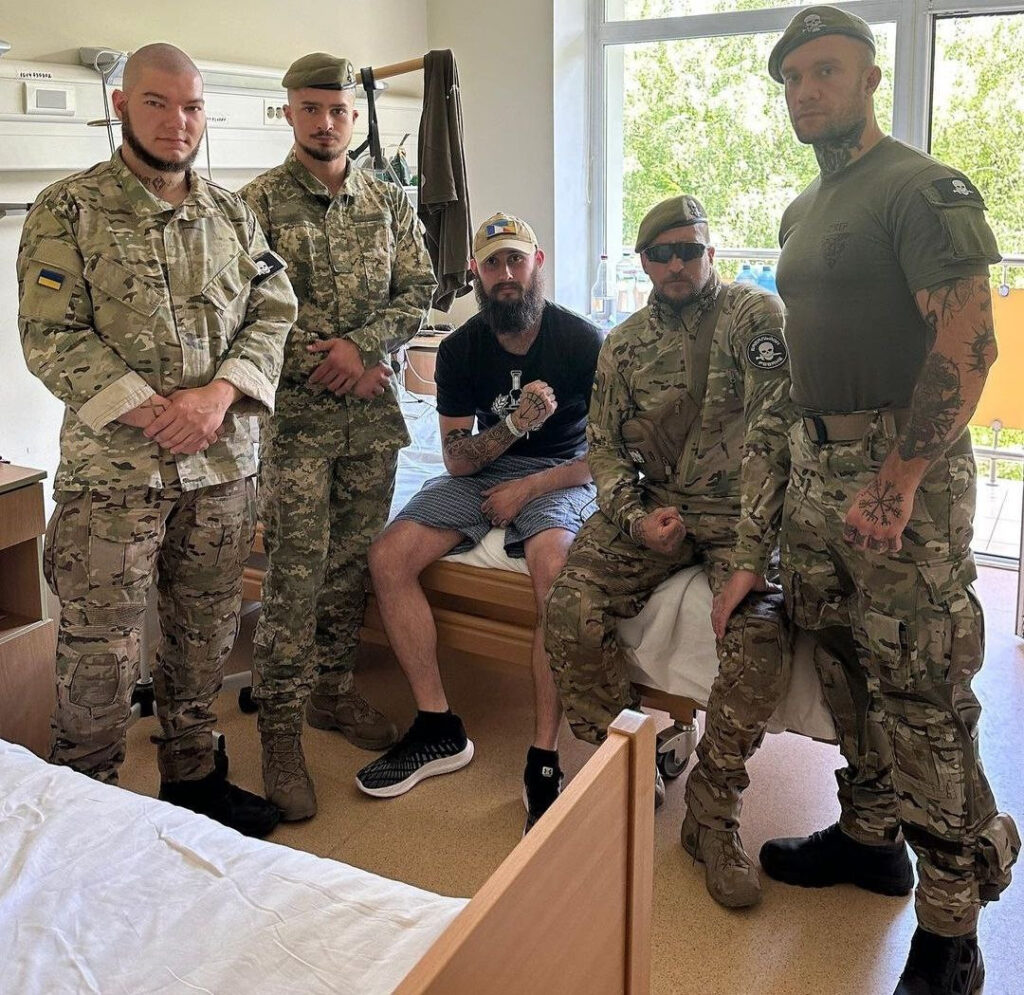
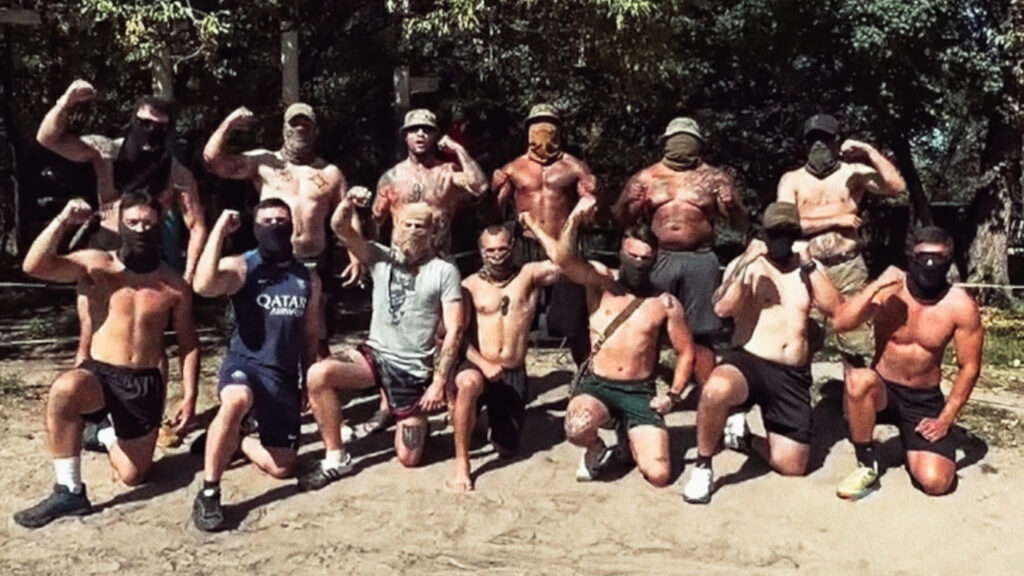
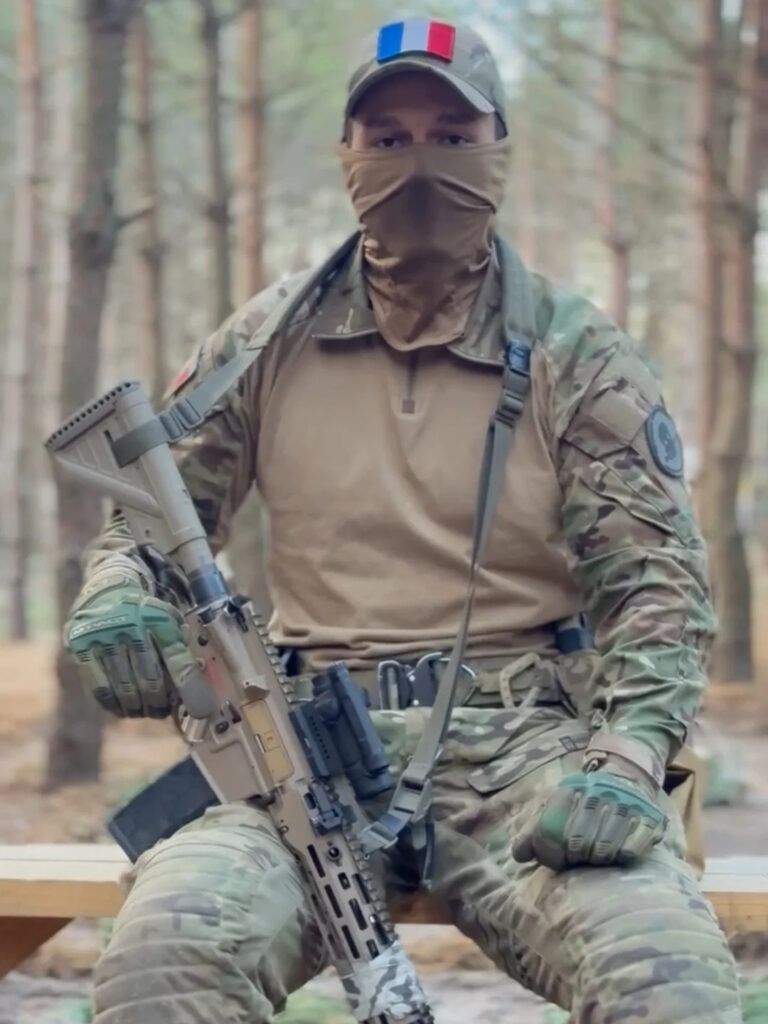
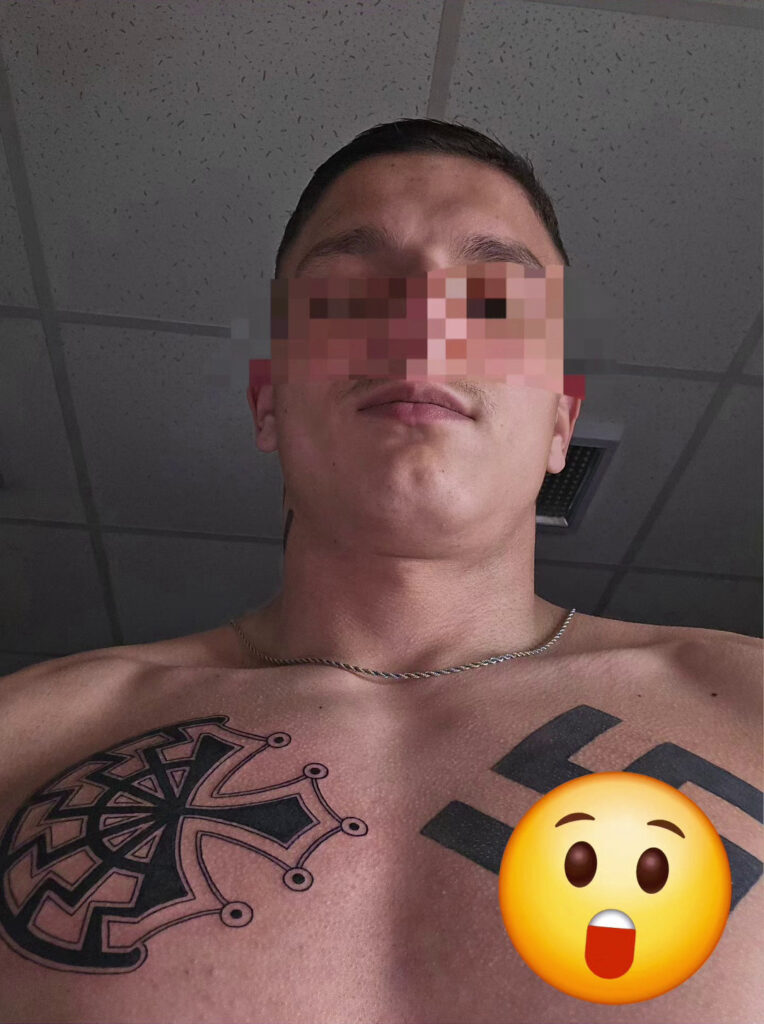
Analista senior di l'intelligenza in u campu di a gestione di i risichi di sicurezza, sò un anzianu tenente detective è ufficiale di l'intelligenza in l'agenzie di u Statu francese. A bona pronuncia hè Николай Чинкуини, in russu
No amount of ‘intellectual mobilization’ will be enough to contain public fury (Scott Peterson / Getty)
“No!” the woman cries. “May you be damned!” You can hear the despair in her voice, as masked men grab her husband, then bundle him into a waiting van. Within seconds, she’s alone, weeping in the middle of the street. This is Odesa, but scenes like it, captured on phones and posted online, hammer Ukrainian cities as relentlessly as Russian missiles. Since Putin’s full-scale invasion began, over a million Ukrainians have been conscripted to defend their homeland. And, as voluntary recruits have dried up, the army has begun resorting to the same methods faced by that couple in Odesa. People even have a term for it: “busification”.
The process is brutally simple. Draft officers, often accompanied by police, snatch military-age men off the streets, before delivering them to recruitment centers. There, many are pressured through threats, intimidation, and physical abuse to pass military medical examinations and sign draft papers. Men with serious conditions — including HIV, tuberculosis and even cancer — are routinely declared fit for service. Whether they like it or not, the recruitment officers must meet quotas; the only question is who fills them. Yet with Ukraine’s wealthy elite reluctant to heed the call, Kyiv’s recruitment crisis is becoming a class crisis too, one that could cause chaos long after the guns fall silent.
Ukraine currently mobilizes around 30,000 men each month — yet many never make it to the front. Some flee training centers at the first opportunity, while others are later discharged as medically unfit. By autumn 2025, according to official figures, roughly 300,000 servicemen had gone AWOL or deserted. The numbers have become so politically sensitive that the authorities now keep the data secret. But the direction of travel is clear: Ukraine’s pool of willing fighters is shrinking. As a result, coercion has moved from the margins to the very center of national life.
Straightforward coercion, however, is only part of the story, as mobilization becomes a social scourge too. Today’s Ukrainian army is, increasingly, an army of the poor. Members of the upper-middle class — and especially the political and economic establishment — possess the resources, connections, and influence necessary to shield themselves from military service. Through a combination of legal work-arounds and bribes, they can avoid donning uniforms for a range of reasons, from illness, to having several children, to caring for disabled relatives. Others are exempt because they’re university students or academics, or work at strategic companies, particularly those linked to the defense sector.
A significant portion of Ukraine’s cultural and academic intelligentsia belongs to this privileged group. Many have received exemptions from military service while continuing their professional activities uninterrupted. In return, the state expects ideological loyalty and intellectual labor in support of the war effort. This includes promoting “decolonization” narratives that often amount to anti-Russian ethnonationalism. It also means deliberately ignoring the deep penetration of far-Right groups into the military, and remaining silent about the normalization of Nazi symbols within parts of the armed forces. But, most importantly, it means justifying coercive mobilization as a necessary instrument of national survival in what is routinely described as an “existential war”.
A substantial number of Ukrainian intellectuals have willingly embraced this arrangement, placing themselves in the service of state interests while convincing themselves that they’re fighting on the “information front” in a war for independence from Russia. Others are motivated by more pragmatic considerations: preserving the privileges that come with exemption from military service. Still others remain loyal out of fear.
Fear, after all, is not an abstract concern. The costs of dissent have become increasingly visible. A recent example is the Ukrainian-Canadian political scientist Ivan Katchanovski, who became the target of a public campaign of denunciation by Ukrainian and Western scholars over his interpretation of the war. Katchanovski has argued for a more nuanced explanation of the conflict — one that looks beyond Russian imperialism and Putin’s ambitions to include the role of the Ukrainian far-Right, Nato, and a post-Cold War security architecture that excluded Moscow. Rather than confronting these arguments on their scholarly merits, many of his critics simply accused the scholar of spreading “Kremlin propaganda”. Whatever one thinks of Katchanovski’s views, the episode sent a clear message: questioning dominant wartime narratives can carry serious professional and reputational consequences.
Meanwhile, justifying mobilization, regardless of how coercive, violent, or degrading it may be, has become a central task of Ukraine’s liberal intelligentsia. In May 2026, for instance, the prominent historian and public intellectual Yaroslav Hrytsak argued that patriotic appeals and financial incentives alone are insufficient to sustain effective mobilization in the country. In his view, society must also rely on fear and moral condemnation. As an example, Hrytsak invoked Britain’s experience during the First World War, when women handed white feathers to men who didn’t enlist, publicly shaming them as cowards.
What is striking is that Hrytsak offered no criticism of this practice, despite its deeply controversial legacy. The white-feather campaign stigmatized not only those unwilling to fight, but also veterans, disabled men, the seriously ill, and countless others who were unfit for military service. Yet in contemporary Ukraine, this history is increasingly presented not as a cautionary tale but as a model worthy of emulation.
In reality, of course, the public shaming of men who avoid military service is already deeply embedded in Ukrainian public discourse. For example, the popular singer Alyona Alyona, who represented the country at the 2024 Eurovision, mockingly referred to such men as “Mama’s little boys” and publicly defended the harsh measures employed against draft evaders. Oleksandra Ustinova, an MP, has similarly attacked men who leave Ukraine to avoid service, arguing that the current civil penalties should be replaced by criminal prosecutions. Yet there’s an irony here. Ustinova’s own draft-age husband left Ukraine for the US after Russia’s invasion in March 2022, bought a house and a car there, and has shown little intention of returning.
There are other ironies too. In September 2024, Yaroslava Kravchenko, a celebrity TV host, published a report on male artists who had left Ukraine under the telling title “Those Who Escaped from Ukraine”. Like many women who publicly denounce supposed draft dodgers, Kravchenko herself enjoys unrestricted international travel for both work and leisure. Many other female celebrities are in the same boat. Women, after all, remain exempt from the travel restrictions imposed under martial law — restrictions that prevent millions of Ukrainian men from leaving the country regardless of their personal circumstances, political views, or willingness to fight.
This asymmetry lies at the heart of growing social tensions. Those who champion moral condemnation often do so from positions of relative safety and freedom. They can cross borders, pursue careers abroad, and retain control over their own lives. The men they shame cannot. From the very first days of the war, Ukraine has cultivated the image of the ideal man: self-sacrificing, strong, courageous, and unfailingly committed to defending his family, his home, his nation. He is prepared, if necessary, to give his life for this cause.
His opposite is the ukhyliant — the draft evader. In the dominant narrative, he is portrayed as a coward who’ll resort to any means necessary to evade what is presented as his “natural” masculine duty. Public shaming of such men has become normalized, routine, and Ukrainian media has played a significant role in this process. Flippant headlines like “Draft Dodger Stopped by a Bear at the Romanian Border” or “Grandma Draft Dodger: Odesa Man Dressed as an Elderly Woman to Cross the Border” have now become commonplace. And though Article 35 of Ukraine’s constitution theoretically guarantees the right to alternative service for conscientious objectors, that right has effectively ceased to exist. A recent investigation into the “Skala” regiment alleged that some men who refused to serve were beaten into compliance.
All the while, some Ukrainian feminists have directed their criticism at draft evaders while largely overlooking a wartime system that casts men as protectors and women as those in need of protection — precisely the gender hierarchy feminism claims to oppose. This flirtation with militaristic nationalism has left many feminists blind to the women whose lives are shattered by busification. Behind every man dragged into a recruitment van, then tortured or beaten to death by draft officers, let alone killed at the front, stands a mother, a daughter, a wife, bearing the fear, grief, and trauma that follow. But because their suffering complicates the dominant wartime narrative, this reality is largely met with silence.
A similar silence greets another group of inconvenient women — those who have become active in the grassroots struggle against forced mobilization. Gender in Detail, Ukraine’s leading gender website, has had remarkably little to say about the women standing in the way of busification. These women are threatened, attacked, prosecuted, and publicly shamed for defending relatives — or complete strangers — from recruitment vans. The courage of these women, from teenage girls to pensioners, can be seen in countless videos confronting recruitment officers and the police. Their courage is visible, their suffering documented. Yet their invisibility, in the end, is political.
That, of course, raises a broader question. With the frontlines mostly stagnant, and with the meatgrinder war annihilating Ukraine’s demographics, why is the government so intent on continuing with busification at all costs? Ukraine no longer appears to have the final say over its own future. That decision is increasingly shared with — or subordinated to — its Western sponsors, who view Ukrainian men less as citizens than as expendable military assets. The EU’s plan to refuse protection to Ukrainian men of draft age exposes this logic. By denying them refuge, Europe is effectively forcing them back to the front. Their bodies have become instruments in a larger geopolitical project: bleeding Russia. That’s further suggests that the war has become a Western proxy war against Putin. In return, Ukraine’s venal political elite, led by Volodymyr Zelensky, enjoys Western political protection — whatever the moral and legal problems with busification.
There’s another question here too. If Ukraine is being bled dry for Brussels, why not end militarization altogether? Unfortunately, those who suggest this path, advocating diplomacy or negotiations, are marginalized. When Yuliia Mendel, Zelensky’s former press secretary, told Tucker Carlson that the Ukrainian president had sabotaged peace talks with Russia, much of Ukraine’s mainstream media and a number of prominent liberal commentators responded not with debate but with a coordinated effort to discredit her, branding her a purveyor of “Russian narratives”.
Liberal intellectuals share responsibility for silencing these unwanted voices. Yet neither the state nor its intellectual allies can suppress these realities forever. Beneath the surface, they are fueling growing resentment and social anger. Every attempt to silence grievances only deepens the sense of injustice, and if the pressure continues to build, it may eventually spark a political and social explosion.
There are signs of this already. In the village of Ozero, for instance, locals blocked a military recruitment vehicle, smashed its windows, and freed a mobilized man. Elsewhere, confrontations between recruitment officers and civilians have involved dozens of people, often escalating into verbal abuse and physical violence. Attacks on recruitment officers with knives, shovels, and clubs have become increasingly common too. As the military’s manpower crisis deepens, mobilization grows more coercive — and public resistance more intense. The way things are going, no amount of “intellectual mobilization” will be enough to contain public fury [end]
Marta Havryshko is a US-based author and researcher focused on Ukrainian nationalism, the far Right, and the Russia-Ukraine war. She holds a PhD in history from the Ivan Franko National University of Lviv in Ukraine
Why are liberal institutions censoring discussion of forced mobilization in Ukraine? – Volodymyr Ishchenko, Marta Havryshko, Tarik Cyril Amar, Milica Popović and Almut Rochowanski
ce 11 novembre 2025 est l’occasion de souligner comme la façon dont l’Europe sacrifie les conscrits ukrainiens mobilisés de force rappelle le spectaculaire carnage de la 1ère guerre mondiale
Azov paramilitaries are aiming to debunk Kremlin « myths ». In doing so, they are solidifying their Nazi tradition and reducing German normalization narratives to absurdity
chronicle of censorship, fake news, whitewashing of the Ukrainian Nazism and war crimes, for the sake of the proxy war that NATO is conducting in Donbass and Ukraine, against Russia
its roots before WW2, its collaboration with Nazi Germany, its legacy in modern Ukraine, how NATO has continually supported Nazism in Ukraine, chronicle
[mon illustration : une publication d’Emmanuel Macron sur les réseaux sociaux]
Les mythomanes velléitaires qui se baptisent Volontaires se réunirent à Paris pour célébrer par une farce monumentale l’anniversaire de la prise de la Bastille. Le bouffon en chef Macron, avec sa teinture ébène habituelle qui exclut curieusement les favoris grisonnants, tenta de dramatiser la pochade en serrant les dents dans un cri de guerre :
Nous sommes prêts à verser le sang
Il oublia de préciser le sang de qui, mais sans doute pas le sien (du moins jusqu’à la prochaine gifle de Brigitte) : c’est le nôtre.
Cadavre politique ambulant, il est détesté par 90 % des Français et quittera la scène à l’élection présidentielle d’avril : ses mois sont comptés et il planifie un avenir qu’il n’atteindra pas […]
le chapitre consacré à Emmanuel Macron, dans ma chronique alphabétique et nécrologique de l’engagement français dans les rangs atlantistes en Ukraine, ce que les journalistes serviles ne vous raconteront pas
chronique en Anglais, its roots before WW2, its collaboration with Nazi Germany, its legacy in modern Ukraine, how NATO has continually supported Nazism in Ukraine
chronique en Anglais, censorship, fake news, whitewashing of the Ukrainian Nazism and war crimes, for the sake of the proxy war that NATO is conducting in Donbass and Ukraine, against Russia
une saga française, entre Ukraine et Lyon, où apparaissent aussi des morceaux de SS de la division Charlemagne et plus récemment, Alice Kerviel, dite Cordier. L’affaire Deranque révèle comme la France est infectée par le pétainisme, en particulier parmi les soutiens d’Israël ou de l’Ukraine, deux théâtres d’opérations où l’Occident tente de ralentir son déclin
En 2025, une nouvelle unité de Français combattant pour l’Ukraine s’est structurée autour d’un noyau de néonazis, ayant pour objectif d’attirer des recrues. Parmi ces volontaires, d’anciens militaires. StreetPress les a identifiés
En Ukraine, les volontaires français pro-ukrainiens et pro-russes se partagent l’imaginaire de la Seconde Guerre mondiale. Les premiers se revendiquent des collabos de l’Allemagne nazie, les seconds de l’escadrille mythique « Normandie – Niémen »
deux jours après le 10e anniversaire de la débâcle politique et sécuritaire du 13 novembre 2015, une messe célèbre à Verdun l’ancien dirigeant fasciste de l’État français
ce 11 novembre 2025 est l’occasion de souligner comme la façon dont l’Europe sacrifie les conscrits ukrainiens mobilisés de force rappelle le spectaculaire carnage de la 1ère guerre mondiale
c’est par l’agence cosaque de presse PIKA, depuis la République populaire de Lougansk, que le 2 avril 2024, l’ataman Nikolaï Diakonov lance un message à destination de la France
ce papier est le premier des grands médias français qui s’attaque à la question des militants nazis français dans les rangs atlantistes en Ukraine, le nouveau danger qu’ils présenteront à terme pour la sûreté intérieure
où nous apprenons que le nazi français Allan Duchézeau, camarade de César Aujard dans les rangs atlantistes en Ukraine, était surnommé Dox, quand il secondait à Paris le leader nazi Marc de Cacqueray Valménier
en Anglais, les indices de la présence d’opérateurs occidentaux, en particulier Français, pris au piège en mars 2022 à Marioupol, dont les forces russes achevèrent la libération en mai
Since the annulment of the 2024 election, Romania’s rule of law keeps crumbling. Here comes Getica – a paramilitary unit who puts EU and US citizens on a Fifth Column list and jokes about war crimes
[my illustration: Getica’s recruitment page (screenshot) Romanian Battlegroup Getica is a group of Romanian-speaking combatants fighting the illegal aggression of the Russian Federation, with the primary objective of stopping the invasion and restoring Ukraine’s state borders as of 1991. We believe the Russian Federation represents an existential threat not only to our Ukrainian neighbors, but also to our brothers in the Republic of Moldova and to Romania’s state borders. Our values are rooted in peace, understanding between our neighboring peoples, and mutual support — values we uphold through firm and unequivocal actions]
Romania annulled its presidential election in December 2024 amid allegations of Russian interference. Eighteen months later, Romanian authorities still have not publicly produced evidence showing that Russian influence determined the result.
Yet, those who challenge that narrative increasingly find themselves labeled as pro-Russian, fact-checked, publicly denounced, censored, or added to the “Fifth Column” blacklist of Romanian Battlegroup Getica, an armed group linked to Ukrainian military structures.
The story of how I ended up on that blacklist reveals something larger than a single paramilitary database. It points to an ecosystem of media outlets, NGOs, activists, fact-checkers, and an armed group that appears to use accusations of Russian influence to stigmatize political opponents and critics of Romania’s (and the EU’s) official electoral narrative.
The question is not only why journalists, politicians, academics, and activists end up on Getica’s Fifth Column database, but most importantly why Romanian and Ukrainian authorities continue to tolerate an armed group threatening civilians while nobody accepts responsibility for it.
Getica’s “Fifth Column” database has grown far beyond Romanian politics. At some point, Donald Trump was on it. Steve Bannon is still on it. Republicans for National Renewal and its leader Mark Ivanyo were recently added — alongside European politicians and journalists. Including myself.
To some targets, Getica confirmed modeling their “Fifth Column” list on Ukraine’s infamous Myrotvorets death list. Those armed men wearing military uniform with Ukrainian and Romanian flags and, for some of them, on Ukraine’s army’s payroll, have joked about war crimes, war time rape, doxxed a civilian, constantly lied on their nature, and, last but not least, kept emitting threat no later than this week
Screenshot from the last Getica video, threatening Sebastian Dracopol for his reporting and pushback on Getica’s Fifth Column
In 2024, Getica’s Fifth column’s manifesto declared possible terrorist action if Ukraine loses the war.
Protected Speech or Military Misconduct?
I had been monitoring the Fifth Column site for a while when I appeared on the list. The move was an anticipated one after recurring signaling from Newsweek Romania trying to frame me as being aligned with Russia — despite not having posted anything in support of Russia. It came first as the logical conclusion of a pattern of smear and harassment coming from people connected to Newsweek România, Alianța — a US 501(c)(3) meddling with Romanian politics — and the local businessman Marius Bostan, who consolidated his fortune on state contracts awarded during the COVID crisis.
But then came the questions — is it a real thing? Is it dangerous? Unfortunately, it is. Especially in the context of a country whose rule of law was buried altogether with the 2024 election.
I contacted Getica to receive an explanation and clarify the label of “enemy of Romania”. An anonymous representative replied that nobody had ever suffered consequences from inclusion and argued that the project merely exercised free speech. They also explained that they used to be affiliated with Ukrainian military intelligence, but are now under the authority of the Ukrainian Armed Forces… Further investigation would reveal how blurred are the lines under which Getica operates.
The answer regarding free speech raises an obvious problem. You can’t claim free speech protection while operating as a military organization targeting civilians. If they’re civilians, Getica’s members enjoy broad free-speech protections — that is, up to the point where speech crosses into incitement or creates immediate, real-world threats. In that case, law enforcement and civilian justice should handle them. If they’re military, the problem is different. Military organizations operate under rules of engagement. They don’t target civilians. They don’t maintain independent blacklists of enemies. They answer to a chain of command. If they’re out-of-control military members, they should answer before a military tribunal.
Getica claims both at once: military affiliation when it suits them (Ukrainian unit emblems on the website, Ukrainian battlegroup membership, fundraising for its activities), and civilian free speech protection when confronted with responsibility for the Fifth Column database. Right after I sent them a series of questions on the way they were assessing people to put them on their “Fifth Column” list, they blocked me on Facebook although I didn’t even ever tag them nor publish anything on them yet. The honor and ethics of military service were traded for the methods of petty mobsters.
But the question goes beyond the activities of Getica. If Ukraine is supporting these activities, then it is crossing another line, in a context already extremely loaded due to the recent attribution of the Nord Stream sabotage to a Ukrainian agent by a German tribunal — the worst attack on a NATO country infrastructure so far has been performed by somebody affiliated with the Ukrainian military. The atmosphere is even more loaded since a Ukrainian drone recently exploded in the Romanian port of Constanta — the biggest NATO port on the Black Sea — a few hundred meters away from the oil terminals and from an ammonium nitrate deposit, a chemical product that made major damages in the port of Beirut in 2020. With Getica, the question of Ukraine’s willingness to target Western civilians and western infrastructure is all the more acute. You can’t receive Western support and attack the West. You can’t claim funding for your military and pay the members of Getica as they target EU and US civilians. If Ukraine can’t court-martial those targeting EU and US citizens, if it covers for them, then the whole story of defending a democracy against an autocracy crumbles and, with it, part of the reasons to support Ukraine against the Russian invasion.
Getica — illegal, dangerous and… aligned with Macron?
In Romania, paramilitary organizations operating outside state command are constitutionally prohibited. Yet, Romanian Battlegroup Getica appears to operate openly: armed men claiming ties to Ukrainian military structures, running a blacklist of civilians, and even claiming to have conducted two operations on Romanian soil.
Its historical founder and commander, Sergiu Meșeșan, claims participation in dozens of combat missions in Ukraine. Its members and supporters have doxed critics and targeted family members. Meșeșan recently returned to Romania to teach people how to use FPV drones, including arming them with explosives. In public exchanges, the group has joked about war crimes, rape, disappearances, and other conduct that would normally trigger serious scrutiny.
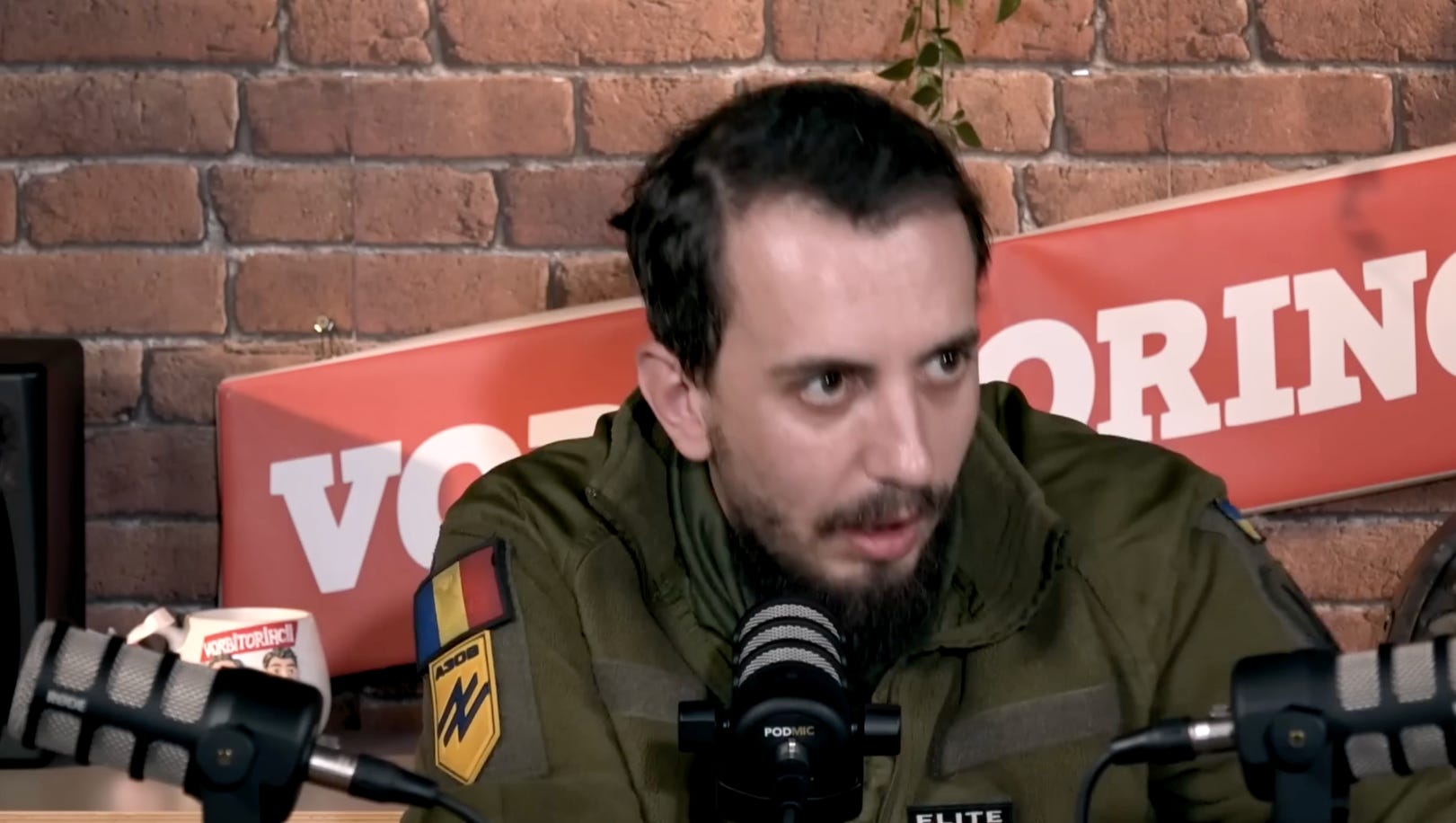
In one live exchange on X, the Romanian Legion Getica account replied to another user with language trivializing rape and invoking Azov: “Several army groups participated in your creation, Azov too I think. The woman didn’t complain.” The reference is not incidental. Azov’s neo-Nazi origins were documented to the point that the US Congress prohibited weapons transfers to the unit in 2018, a restriction that remained in place until 2024. During that period, Radu Hossu — Getica’s main fundraiser and co-founder — appeared in a June 2023 interview wearing an Azov emblem containing the Wolfsangel, a symbol with direct Nazi lineage. In one of his own fundraising reports, he also acknowledged purchasing equipment for two military personnel enrolled in Azov, adding parenthetically: “yes, that AZOV”
Radu Hossu, on the Romanian podcast Vorbintorici, wearing the Azov Wolfsangel in June 2023, when the US congress ban on arming Azov was still enforced due to Azov’s neo-nazi elements
The point is not guilt by association. It is that an armed group maintaining a civilian blacklist, joking about rape and war crimes, invoking disappearances, and displaying proximity to military formations controversial enough to trigger years of congressional restrictions should have attracted institutional scrutiny long before journalists, politicians, and foreign citizens began appearing on its list.
Whose Army?
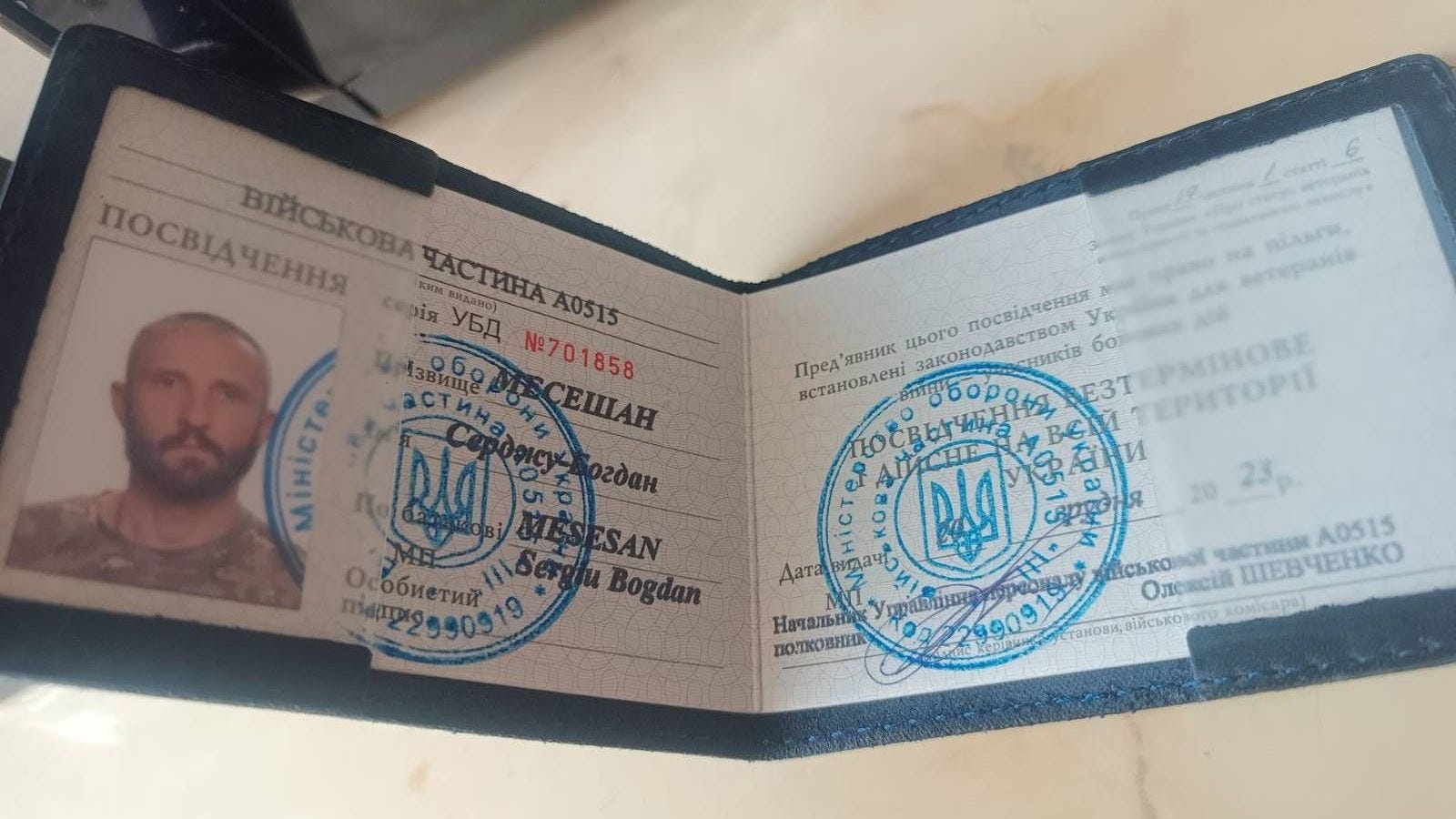
Some Getica members hold Ukrainian military ID cards and receive Ukrainian Army salaries
Sergiu Meseșan military document shared on the Romanian Battlegroup Getica Facebook account – A0515 is a Military Intelligence Directorate Unit
According to representatives of the group contacted directly for this investigation, Getica has operated under Ukrainian military command — initially under GUR, the Ukrainian military intelligence directorate, and later under ZSU, the Ukrainian Armed Forces. When pressed on the specifics of their affiliation, they directed us to their website.
That website has been telling its own story. Until May 30, 2026, it displayed the emblem of the 4th Heavy Mechanized Brigade of the Ukrainian Army
On that date — shortly after this investigation began sending right-of-reply letters to Romanian and Ukrainian institutions — the emblem was quietly removed, with an announcement that a new unit affiliation would be revealed. Days later, two new emblems appeared: that of the 1230th Separate Engineering and Technical Support Battalion, part of the 48th Engineering Brigade of the Ukrainian Support Forces; and that of the International Legion of Defense Intelligence of Ukraine, MUNA 3449 — a separate unit of foreign fighters subordinated to the Main Directorate of Intelligence of the Ministry of Defense of Ukraine, which is the GUR
International Legion of Defense Intelligence of Ukraine1230th Separate Engineering and Technical Support Battalion
No Ukrainian institution has formally claimed oversight of the group. No Romanian institution has either.
The people behind Getica form an unusual partnership. On one side, Sergiu Meșeșan, the group’s historical founder and commander, is a Romanian volunteer fighter in Ukraine who was previously sentenced in Sweden to three years in prison for aggravated fraud as the leader of a bank-card-skimming and phishing operation active across Sweden, Finland, and Denmark.
On the other is Radu Hossu, a self-described founding father of the project: a prominent pro-Ukraine activist, fundraiser, and politician from USR — the party created by Romania’s current president and aligned with Macron’s Renew Europe group — as well as an “embedded” war journalist, covering military operations and units he simultaneously helped finance.
One man built and commanded the organization, and would publish the manifesto of the Fifth Column blacklist and maintain it. The other provided funding, public legitimacy, media access, and political connections.
Questions about Getica’s financing had already produced one of the earliest public conflicts surrounding the group. IT specialist Sebastian Dracopol, later added to the Fifth Column database himself, challenged the use of funds raised by Hossu through a personal Revolut account. After being doxxed and threatened, Dracopol sued Hossu. Although he did not obtain a restraining order, the proceedings produced one of the few official records concerning Getica, including admissions regarding Hossu’s fundraising role, his creation and ownership of the group’s Telegram channel, and the armed nature of the combatants operating under the Getica banner. We will return to that case later.
The April 2024 “Fifth Column” Manifesto
In April 2024, Getica commander Sergiu Meșeșan published what amounts to the founding document of the Fifth Column project, laying out his program in explicit terms:
We believe it is normal to have different opinions and freedom of expression. That is what democracy is about. But we wish to warn, through this message, that there is a limit to the subversive activities we will tolerate — I am referring to ‘Getica’ — on the territory of Romania or the Republic of Moldova.
And we are EXTREMELY ready to act from the shadows to limit the impact of Russian influence in both states.
Thus, when Ukraine collapses — as this category of Russophiles maintains, and if it should actually come to pass — we will be ready to strike with an intensity and firepower the likes of which Romania has never seen, in order to defend the national and vital interests of the nation.
We are aware that there is a legal framework that is not exactly favorable for state defense institutions to act freely and effectively. Laws change, however, and for the homeland, ‘Getica’ is ready even to circumvent them. We own that. We might be called terrorists. But the terrorists of some are the freedom fighters of others.
[…] We already have a website, a secure server, and a domain. We will publish them very shortly. Beyond the information and presentation images you have been able to see on our page over time, we wish to put into practice the concept of the #coloana5 database. We firmly believe that exposing the identity of subversive elements and useful idiots will deter them more or less from their activities of sabotaging public opinion, and will spare us other actions — unfortunately far more invasive — in the near future
The idea of an armed group on Ukrainian payroll going rogue and targeting citizens of NATO member states should have warranted a reaction from authorities, at least from Romania and from Ukraine. In response to our inquiry, the Armed Forces of Ukraine stated that the matter fell within the competence of the Main Intelligence Directorate (GUR) of the Defense Ministry. The Romanian Defense Ministry denied any affiliation. No further clarification was provided.
A year after its manifesto, Getica goes… “clandestine”?
In a lengthy statement published on April 14, 2025, Getica founder Sergiu Meșeșan described himself as having conducted 37 combat missions in Ukraine, including infantry, SIGINT, drone ISR, and attack-drone roles. He stated that Getica had approximately 50 members over its existence and never more than 20 active fighters at any given time.
More importantly, he publicly acknowledged that the group had carried out “2 limited surveillance operations on Romanian territory.” Meșeșan did not disclose the targets, legal basis, beneficiaries, or institutional authorization of the two Romanian surveillance operations. No Romanian authority contacted during this investigation acknowledged requesting, supervising, authorizing, or even being aware of them. The statement raises obvious questions about the legality of intelligence-style activities conducted on Romanian territory by individuals presenting themselves as members of a foreign military structure. If they are a paramilitary group, their activities are unconstitutional and illegal in Romania. If they are affiliated to Ukraine’s military, this is a serious breach of the treaties that prevent any such activity. If these missions were happening with the blessing of the Romanian Army, then somebody at the MaPN lied to us and covered up for Getica – and this person should answer before the law too.
In the same statement, Meșeșan proclaimed that: “From today, Getica becomes a multinational, global and clandestine operation.”
By any reasonable definition, Getica does not display the characteristics of a regular military force. Regular military forces operate with rules of engagement, a formal conduct code, and an accountable command hierarchy — constraints that precisely prevent armed groups from targeting civilians, engaging in public discourse, or taking sides in political debate.
Getica’s Fifth Column
Coloana 5 — Fifth Column — is Getica’s blacklist. By May 2024, the page was online. It currently lists over 150 American and European citizens and organizations accused of serving Russian interests, acting as useful idiots, or being enemies of Romania.
Inclusion is not notified in advance. According to the operators themselves, a profile can be spotted automatically by a combination of alleged military AI systems — an OSINT database and an LLM — and then approved by a human operator. The list is not static: operators state they monitor listed individuals and may revise positions over time, an implicit form of pressure to coerce people into alignment. The original version of the site included a “Recommended actions” rubric specifying measures such as localization and monitoring of listed individuals. That section has since been removed. At some point, the site began blocking web archiving tools, making earlier versions inaccessible.
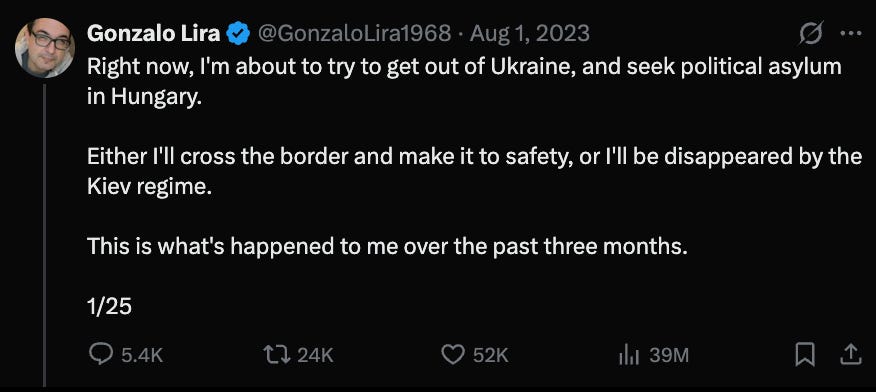
In direct communication with a listed person, Getica leadership referenced Myrotvorets explicitly as a model — the Ukrainian hit list on which was Chilean-American influencer Gonzalo Lira, whose case gained attention in 2023 when Elon Musk publicly questioned his detention. According to Ukrainian officials, Lira died in detention from pneumonia and health complications; his family and supporters alleged mistreatment and torture
Getica’s Fifth Column project did not emerge during an ordinary political period. In 2024, every major elected office was scheduled for renewal in Romania.
In late April, the European Union activated its Rapid Response System to flag content during the European Parliament election campaign, and Getica simultaneously began listing members of the opposition on its website. The framing had been set weeks earlier: on March 6, Ursula von der Leyen, campaigning for her reelection, made the stakes explicit in her Bucharest rally cry:
[..] Putin’s friends are trying to rewrite our history and hijack our future. They are spreading hate from behind their keyboards. And let there be no doubt what’s at stake in this election. Our peaceful and united Europe is being challenged like never before by populists, nationalists, and demagogues. Whether it is the far right or the far left. Whether it is the AfD, the Rassemblement National, the confederatia or Wasraschdene. The names may be different, but the goal is the same: They want to trample on our values, and they want to destroy our Europe. But we, the EPP, will never let that happen
Following the Russiagate playbook, critics and opposition to power are “Russian influence” – this would become a recurring theme during the long Romanian election cycle. Getica’s project, supposedly aimed at exposing Russian influence, would just plainly overlap with domestic political conflicts, opposition figures, journalists, commentators, and critics of power.
The involvement of USR member Radu Hossu makes an obvious case for direct political support or, at least, convenient complacency, with the criminal activities of Getica. Contacted, neither Dominic Fritz – leader of USR – nor USR Brașov provided a statement to distance themselves from Hossu. Bucharest leader of USR, Vlad Voiculescu, replied in a direct message that he didn’t see how the matter was related to USR. Yet, the fact that a USR member helped and covered for a coercion gang is obviously a USR problem. None of the questions sent to USR-founder, and now President Nicusor Dan, to the Ministry of Defence, led by USR member Radu Miruta, nor to the Ministry of Foreign Affairs, led by USR member Oana Toiu, delivered a significant assessment, response, let alone an acknowledgement of the gravity of the matter. Silence seems to clearly mean consent, and Getica’s utility for the USR could be summarized like that: if propaganda fails, if censorship and the weaponization of the DSA fails, then an informal tool to threatens or silences people find its full utility.
Who makes it to the list?
The progression from media labeling to blacklisting can be observed directly in my own case. Since December 2024, I have repeatedly described the absurdity of framing as pro-Russian people who — like most of the Romanian conservatives — have condemned Russia’s invasion of Ukraine and hold Russia in distrust for many historical reasons. In a country where 87.5% of the people are West-oriented and consider EU and NATO membership as warranties of security and prosperity, framing a part of the population — the conservatives — as anti-EU, anti-NATO, pro-Russia only serves a propaganda machine.
Before appearing in the Fifth Column database, I had already been repeatedly smeared as pro-Russian, pro-Orbán, pro-Georgescu or part of various influence networks — and this without ever having published pro-Russian, pro-Georgescu or pro-Orbán material. The attacks had far more to do with the reporting I published than with any pro-Russian content.
I have documented how the current implementation of the EU Digital Services Act created a growing ecosystem of censorship actors while leaving user protections largely theoretical (see DSA: Europe’s Injustice System).
Later this year, I contributed to The Managed Ballot, published through MCC Brussels, with a chapter on Romania’s Hybrid Regime and its European Accomplices. It argued that the country’s democratic downgrade was driven by the regime itself — the government and the intelligence community — working hand in hand with a local “fake civil society” that lacked real constituencies and ran on foreign executive-power funding, including the EU’s. Behind it, external interference from Brussels and from Macron. The result: a country the Economist’s Democracy Index had reclassified as a “hybrid regime” — no longer a democracy. The publication of the MCC report triggered an ad hominem attack in a media outlet owned by Marius Bostan.
The combination placed me in direct conflict with actors who considered the Russian-interference narrative settled fact. Beyond my own reporting, I also publish the Romanian edition of Le Monde diplomatique and regularly translate writers who frequently challenge official foreign-policy narratives and oppose censorship, including Serge Halimi, Pierre Rimbert, Matt Taibbi, Aaron Maté, Thomas Fazi, Jeffrey Sachs and John Mearsheimer.
A few days ago, another Newsweek Romania “embedded journalist” — mixing coverage of the Ukraine war with support for Ukraine —, Remus Cernea, alleged that Sachs and Mearsheimer were “Putin’s intellectuals”.
Newsweek România, Alianța and the Bostan ecosystem
But things accelerated when I debunked a hit piece published by Newsweek România targeting Georgică Severin, one of the few members of the National Audiovisual Council (CNA) consistently opposing censorship measures within Romania’s media regulator. My article also noted how the advertorial section of Newsweek România only contained representatives of the government. Before publishing my rebuttal, I sent detailed questions to Newsweek România. No answer was received. Two days later, Newsweek România published a new article targeting both Severin and me. Another article followed in Newsweek, reminding readers of my positive reaction to AUR’s medical caravan project and the fact that my wife is an AUR member.
Facing calls for deportation, I debunked the most outrageous allegations in a single published response, rather than engaging every online harasser.
Shortly afterwards, I appeared on Getica’s Fifth Column database, directly tagged as an “enemy of Romania” and a “potential collaborator.” Getica’s file referenced articles published by two media outlets in which a key stakeholder is Marius Bostan — În Linie Dreaptă and Newsweek România (a local licensee, not the US edition, with full editorial autonomy). Bostan is a former Romanian Telecommunications Minister from the “technocratic government” that governed Romania from 2015 to 2017, formed after the Colectiv nightclub fire protests. Later, Bostan largely benefited from government contracts during the COVID crisis. In 2018, Newsweek România was launched, at an event where the head of the Romanian Intelligence Service would participate. Bostan exerts further influence via Alianța, a US 501(c) originally created to nurture US-Romania friendship, gathering former US ambassadors on its board. Through Newsweek România and Alianța-related actors, a common pattern emerges: individuals challenging dominant narratives are first publicly framed as vectors of disinformation before some eventually find themselves referenced by Getica’s Fifth Column project.
In one instance, the Getica Twitter account even asked the editor of În Linie Dreaptă when to add an academic to the list — which raises the question of direct management of the Getica list by Bostan’s employees.
On July 22, 2025, Getica publicly justified AUR MEP Gheorghe Piperea’s inclusion by posting a screenshot of a Digi24 article reporting that the European Commission considered his motion of censure against Ursula von der Leyen to be linked to Moscow’s interests. Getica’s accompanying comment was: “connecting the dots 😉” A normal parliamentary procedure — a motion of censure, one of the European Parliament’s standard checks-and-balances instruments — had already been reframed by Newsweek România as an initiative of the “Russophile extremist AUR party” before Getica treated it as a Russian-interference signal.
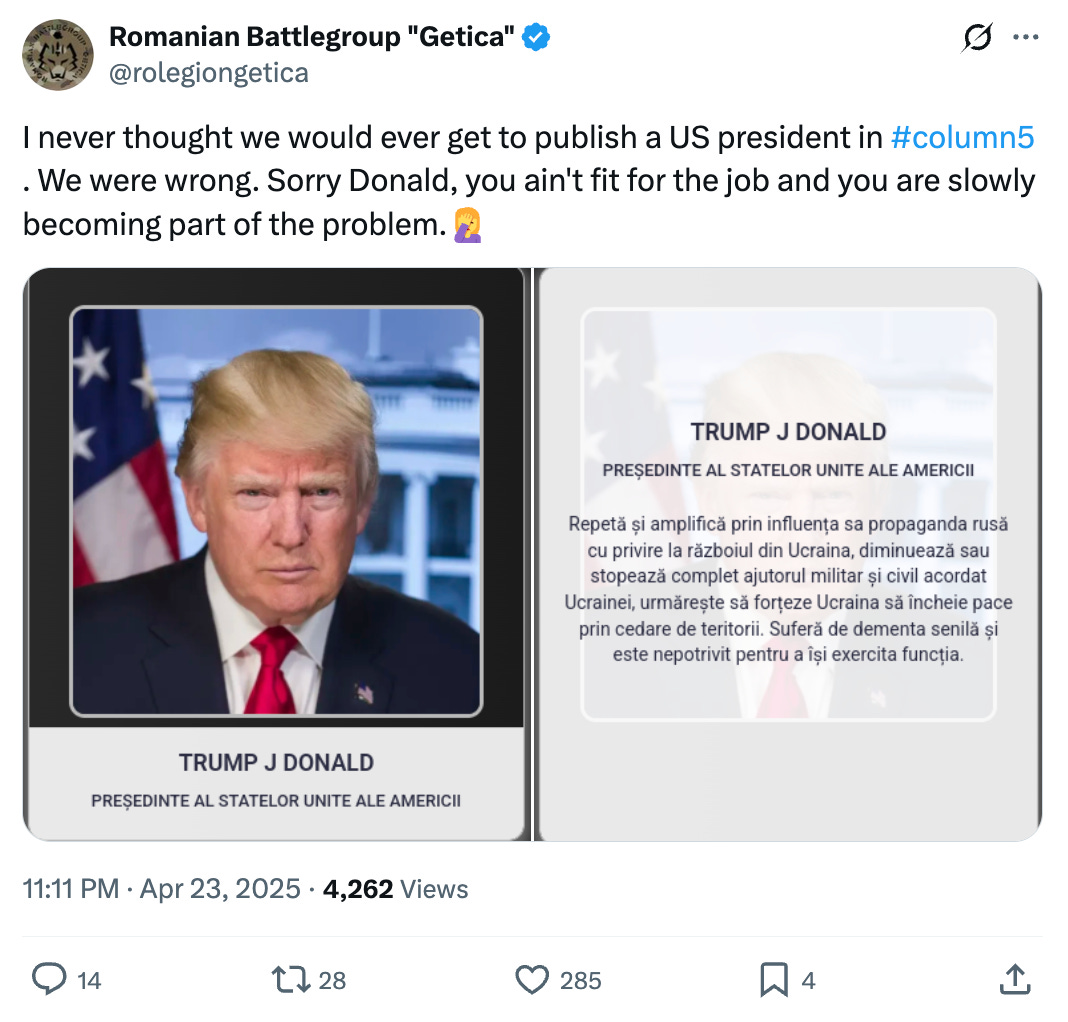
Getica’s list has kept growing since its launch. In April 2025, Donald Trump was added. He was removed shortly after — no removal date confirmed.
Months later, the operators claimed it had been a test to confuse enemies. That explanation is difficult to take at face value: it is more plausible that internal pushback warned them of the risk of directly targeting a sitting US president. What followed makes the Trump removal look less like a policy and more like damage control — the additions continued. The targeting pattern is hard to separate from the political positioning of Getica’s main fundraiser, Radu Hossu, and his party USR, which has maintained a radically conflicting stance toward Donald Trump, the MAGA movement, and USR’s local rivals, the AUR party.
The same chronology appears around Republicans for National Renewal. In early 2026, Newsweek România published an article about a distinction awarded by the American organization to AUR’s leader George Simion. Shortly afterwards, RNR leader Mark Ivanyo was added to the Fifth Column database together with the organization itself. Dragoș Moldoveanu, an AUR member, was added in the same batch, and a Bulgarian figure associated with the same political ecosystem was also added. More additions followed after public discussions involving AUR MP Mihai Neamțu and sovereignty-oriented commentators, including Laurențiu Țîrcă.
Țîrcă received some of the most radical messaging from Getica. The group confirmed to him that Myrotvorets was its model, and pointed to how people on such lists suffer “accidental” deaths. Țîrcă reported seeing a now-removed image of his name written on a rocket launcher. When he challenged Getica over alleged war crimes committed during the Kursk incursion, where elderly civilians died, the Getica account replied: “I don’t deal with pensioners only, I deal with students too.” Țîrcă was a student at that time.
Although Newsweek România carries the name of the American weekly, asked about editorial oversight and accountability, Newsweek USA told us that its international publishing partners are responsible for their own editorial operations and content, while also stating that Newsweek expects organizations operating under its brand to uphold responsible journalism standards.
The concentration of impostors at the local edition of Newsweek goes so far that it receives contribution from Ovidiu Nahoiu, Chief Editor of Radio France International Romania, who shone a year ago with an obsequious interview of the French Ambassador — that is the representative of the government that pays Nahoiu’s salary — were 3 blatant lies went uncheck on air in order to support the Russian influence narrative justifying the annulment of the election. Newsweek also hosts editorial from Adrian Zuckerman — a former ambassador who constantly meddles with Romanian politics, sometimes to praise the Ministry of Internal Affairs for his role in the 2024 coup – naturally framed as “saving Romania”-, sometimes to urge the Romanian Presidency not to join Trump board of Peace.
A few years ago, a reporting by Recorder had already highlited one of the key reason explaining the journalistic fraud within Newsweek and a large part of the press — government money flooding them.
“The destruction of these emitters of toxic ideas must be part of the response.”
The overlap with Getica’s rhetoric extends beyond Newsweek itself. One recurring node is Alianța, a network whose members and participants have included business leaders, activists, former diplomats, former American ambassadors, media figures and public officials. On September 20, 2025, Alianța member Andrei Caramitru publicly defended Getica and its blacklist, describing Getica as Romanian patriots and heroes and claiming the list contained pro-Russian actors from Romania and Moldova. He added that the list was probably already known to Azov, Ukrainian services, Western services and others. We offered a right of reply to Alianța in letters addressed to each board member and to former US ambassadors — no answer was received.
Alianța bills itself as a nonpartisan 501(c)(3), yet its own Board Chair, former US Ambassador Adrian Zuckerman, used an interview to declare the leading conservative opposition party, AUR, “a party dangerous to Romania, dangerous to democracy, dangerous to the West — a party that shouldn’t exist in Romania.” A US tax-exempt nonpartisan organization is, on its own platform, calling for the elimination of a Romanian parliamentary party.
One of the most revealing pieces of language in this ecosystem has been recently supplied by Marius Bostan, shareholder of Newsweek România and central actor in the Alianța network. At the Newsweek IT & Cyber Summit 2026, Bostan compared ideological opponents to pests invading a field and argued that rapid intervention was necessary: “When pests invade a field you need to spray quickly. If you don’t react immediately, you lose.” He continued: “Sometimes attack is a better form of defense. The destruction of these emitters of toxic ideas must be part of the response.”
The wording mirrors the coercive logic already present in Meșeșan’s Fifth Column manifesto. Bostan was not speaking as an anonymous extremist but as a Newsweek România shareholder and Alianța figure, at a Newsweek-branded event, immediately after a Presidential Palace summit devoted to informational resilience where the leading opposition faces were put on display as “public vectors of disinformation”. The pinnacle of Romania’s executive power hosting an event targeting the opposition as an enemy in an information war. When a democracy crumbles, signs are everywhere.
This is why the Fifth Column database cannot be understood as an isolated website run by a fringe armed group. The labels appearing on the list often predate the list itself. They emerge first in media coverage, public campaigns, anti-disinformation initiatives, political commentary and institutional discourse.
At the end of the day, the tabloidisation of Newsweek România, the extremely low level of “hit job journalism,” is a matter that would be solved by the market and readers’ interest. Except for the government money that flows into this ecosystem, directly or indirectly. Which leads to the bigger issue — more problematic than Newsweek România producing trash news and hit pieces: the role of Romania’s regime.
The Consequences of a Lie — The 2024 Election Annulment
To understand the current situation in Romania, we need to go back to the 2024 presidential election, when an outsider candidate, Călin Georgescu, won the first round with 23% of the vote. A second round was scheduled for December 8, 2024. It never happened. On December 6 — with voting in Romania’s large overseas diaspora already under way — the Constitutional Court annulled the entire electoral process. The annulment followed roughly two weeks of public signaling about alleged Russian interference and algorithmic manipulation, driven by a series of NGOs financed by the European Commission calling on Brussels for help.
What followed was a ritual of whitewashing the decision, by European leaders spinning the idea that Russia was behind Georgescu’s success. Macron offered one of the most revealing examples, declaring in a February 2025 live broadcast that the court had detected fraud, vote purchases, and annulled the election because of Russian interference. One fabrication after another. In reality, the Constitutional Court had validated the first round (Decision 31), finding no electoral fraud, and its annulment decision contains no attribution of the result to Russia (Decision 32).
We are now in June 2026. Romania has never formally attributed the Georgescu campaign to Russia. Romanians are still being told that proof is about to be released by President Nicușor Dan. The implicit conclusion is twofold: at the time of the annulment, the Constitutional Court had no proof of Russian meddling — yet it annulled the election. And eighteen months later, the reason proof has not been produced is likely that there was no provable decisive Russian interference.
Alternative Explanations Identified After the Annulment
The few operations that were identified — including those referenced in the Defense Council meeting that served as justification for the annulment — actually originated from Romania and Ukraine.
On December 6 and 13, 2024, French daily Le Monde identified a Ukrainian sponsor behind the Georgescu influencer campaign: Dmitriy Makarov, a 32-year-old Ukrainian entrepreneur who had previously publicly supported Ukraine against Russia, whose companies — FA Agency, GMG, and Zlodeї — recruited influencers to promote Georgescu.
On December 18, the Romanian outlet Snoop.ro revealed that PNL, the National Liberal Party, a member of the governing coalition, had financed one of the campaigns promoting its own competitor, Georgescu. That a governing party financed the rise of a candidate deemed so dangerous the election had to be annulled — leaving that party in power — remains one of the least addressed paradoxes of Romania’s democratic regression.
2024 — a Modern Taboo
Since then, saying there is no proof of Russian involvement has become the new taboo. On March 5, 2026, journalist Lucian Davidescu was fact-checked by Romania’s leading fact-checker, Factual — run by Funky Citizens, on Meta’s platform — for stating precisely that there was no real Russian implication in the 2024 election. The “fact-check” affirmed information directly contradicted by the Constitutional Court’s own decisions it was referring to. Davidescu obtained the publication of a Right of Reply response, but the fact-check stayed for months as a “flagged issue” on his Facebook account. Challenging the “successful Russian interference” narrative is nevertheless a widespread opinion, shared by former president Traian Băsescu, and even by Georgescu’s opponent in the second round that never took place, Elena Lasconi — at the time endorsed by Macron himself.
Also on the Getica list, journalist Marius Tuca had been censored by the National Council for Audiovisual in March 2025 for calling the 2024-2025 sequence a coup — two months before the rerun of the presidential election, which Georgescu was barred from running in. One of the grievances against me is precisely to have described a judicial coup (see the timeline of the coup here).
In May 2026, eighteen months after the annulment, President Nicușor Dan delivered yet another interview promising the long-awaited report.
Proper attribution should be the golden rule when framing anything as a Russian influence. As I argue in my articles “The Iceberg That Can Sink Europe” and in “European Diplomacy Seems too Ashamed to Look at What Happened in Romania”, using the concept of Foreign Influence to target people who have no ties to a foreign power is an extremely dangerous game – one that leads to more “fifth column” craze and McCarthyism.
It’s all the more important to remember that, since when it comes to attribution, Romania is far from being a powerless state.
The State That Chose Not to See
Romania’s internal intelligence service, the SRI, operates on a budget of over one billion dollars annually — three times that of France’s DGSI in nominal terms, six times in purchasing power parity, for a country three to four times smaller. All in all, ten to twenty times more resources per capita dedicated to surveillance and control. Not to mention that France has numerous terrorist threats to handle, whereas Getica seems to be the only one the Romanian authority have to deal with… The overpowered capacity of Romania’s intelligence services was praised in 2023 by Brigadier General Anton Rog, head of Cyberint — SRI’s cyber intelligence division — explaining in precise terms what his agency could do when democracy was under attack. It could counter campaigns online, take down websites, shut down operations. “We can get such a warrant in less than an hour,” he said.
Yet when the Georgescu campaign was running in late 2024, nothing happened.
When Getica published its blacklist, threatened journalists, doxxed families, and announced missions on Romanian soil, nothing happened.
When AUR MP Dan Tanasă sent a formal parliamentary question (PDF) about the armed paramilitary group Getica to the government — still nothing, just a four page reply (PDF). The response, Tanasă said, contained no indication that the matter had been referred to DIICOT (the Directorate for Investigating Organized Crime and Terrorism) or any other investigative authority.
A member of Parliament asked them about a band of volunteers that carry arms and that make lists of the enemies [including members of] the Romanian Parliament and they did nothing
Tanasă said, adding that
The purpose of this list is to silence the people on it one way or another, either through public shaming or, who knows, by a lunatic who would believe that I or any other person on this list is paid by Russia and would try to harm us physically
Tanasă is currently preparing a criminal complaint against those responsible for the project.
And the Media That Chose Not to See
Since its first appearance in September 2023, Getica has drawn more than forty favorable pieces in the Romanian press — nearly half of them published after the blacklist’s existence was already known. The most revealing reporting on the matter came instead from Sebastian Dracopol, one of the people Getica blacklisted: first on his Substack, and more recently through his NGO, Patria Prima. He documented Meșeșan’s criminal past, the opacity of Hossu’s fundraising, and unresolved questions about the group’s actual combat record. Meșeșan’s answer to the latest reveal was to launch a fresh fundraising campaign on June 6, 2026 — to cover legal fees for suing Patria Prima and to buy military gear — this time routed through an NGO ostensibly dedicated to civilian aid, Volunteers Without Borders. The NGO did not respond to our request for comment.
Recently, Patria Prima started asking every outlet why they presented Getica as a military unit, implicitly helping them to raise money, whereas the Ukrainian army denied any responsibility for it and Mesesan – as well as Hossu – reframed the group as an informal one. As a response, yet another article was published, by Veridica, in support of Getica. Patria Prima announced suing again. The author, Alex Craiu Rosenberg then published a video to frame Dracopol’s actions as SLAPP – Strategic Lawsuit Against Public Participation. The missing element of this analysis is the relation of power – Getica is a criminal, illegal, anti-constitutional and dangerous group who raised money in an illegal manner, yet benefits from the complacency of power, serves the interests of one or more parties of the governing coalition, and receives positive coverage from a press that lives off some executive power money (may it be the Romanian government or the money from Foreign countries – as Veridica does). Like for Newsweek’s hit pieces, Veridica’s work doesn’t qualify for the SLAPP victim card – it is part of the larger propaganda, censorship and coercion machine that targets critics, the opposition, and other nonaligned voices.
When asked about the impunity that Getica enjoys, several journalists present on the list pointed to the entanglement with Romania’s intelligence services and how Romanian military personnel often go on leave to participate in paid missions — as mercenaries. This is corroborated by something I found out investigating the DSA in September 2025, when I was told by Freedom House Romania’s Director, Cristina Guseth, that Getica was part of the support provided by Romania to Ukraine, and “something that the Romanian government decided not to make public.”
This could explain a part of the ambiguity and the silence our investigation received. Why public responsibility for Getica’s activities remained unclaimed.
On October 27, 2025, Romania’s Intelligence Service — the SRI — responded to a formal parliamentary question submitted by AUR MP Fabian Radu, a member of the Joint Standing Committee exercising parliamentary oversight of SRI’s activities. The response invoked information classification and the “need to know” principle, offering no substantive answer. The formulation leaves two possibilities open: either the issue is being monitored and is too sensitive to be made public, or the non-answer is itself a cover.
The months that followed make the silence harder to explain. Between late 2025 and mid-2026, the list expanded further — adding US politicians, more members of the opposition, and me, a French journalist. During the same period, Getica’s founder began publishing video tutorials on preparing First-Person View (FPV) drones for military use.
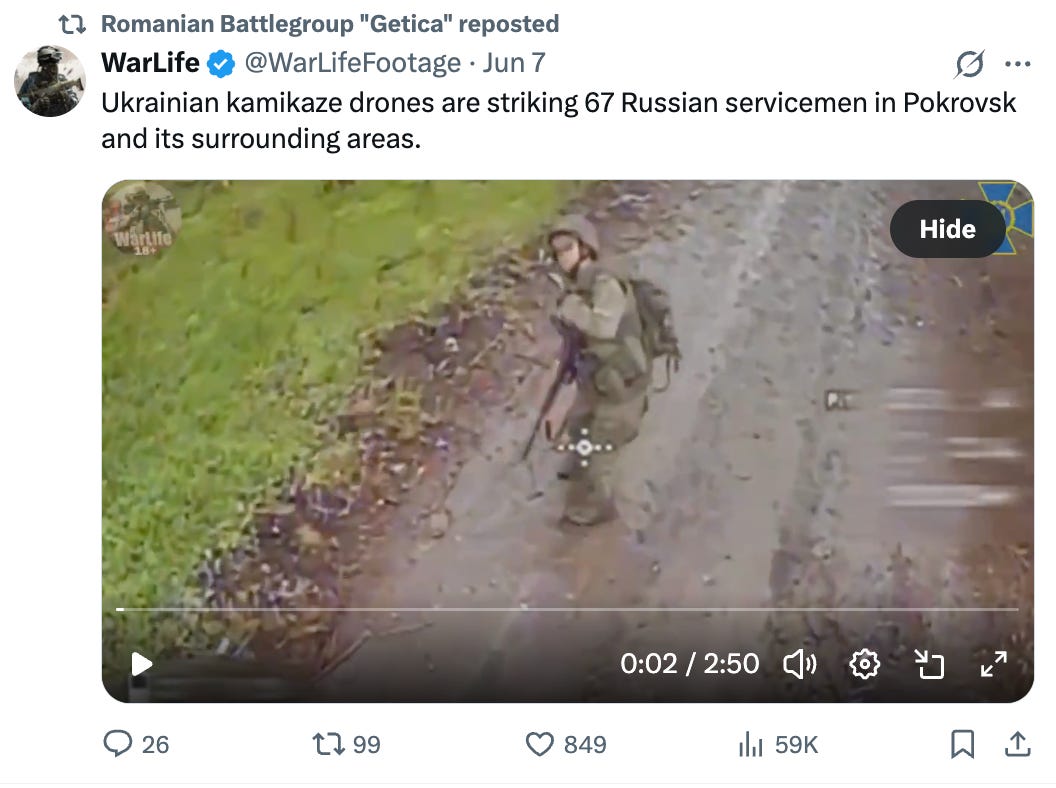
On June 7, the Getica account republished on X a video montage of FPV drone footage reaching their targets: 67 different Russian soldiers (with possibly a civilian among them)
If Romania’s Intelligence Services’ intent was to monitor — through surveillance or infiltration — before acting against Getica, eight months seem more than enough time to assess and intervene. But if Romanian intelligence services have some form of control over the battlegroup, then the continued expansion of the blacklist to include opposition politicians, journalists, and US citizens during that period is not a failure of oversight, but a state scandal.
The Ministry of Internal Affairs (MAI) did respond to our investigation, but only to state that, pursuant to Article 285(2) of the Criminal Procedure Code, criminal investigation proceedings are non-public — neither confirming nor denying that any proceeding exists.
Romania’s Intelligence Service (SRI) also replied, citing the classified nature of its activities, and neither confirmed nor denied whether Getica had ever been assessed as a national-security concern, whether information had been transmitted to Romanian authorities, or whether any monitoring or investigation existed.
As mentioned, formal inquiries sent to the Ministry of Foreign Affairs, the Romanian Presidency, and the French Presidency received no reply. The atmosphere is one of pervasive institutional ambiguity, in which responsibility is continually deferred while the blacklist continues to expand.
Three months ago, in a private conversation with a member of the Romanian government, I asked about the incapacity to prove Russian interference and the widespread suspicion that what happened was an inside job — the answer was unambiguous: “Of course. But you do realize that if they admit it wasn’t the Russians, the country would descend into chaos.”
Three months later, the credibility and legitimacy of Romania’s current regime are lower than ever. A vote of no confidence brought down the government on May 5. One month later, a Ukrainian drone exploded in the Romanian port of Constanța, and the authorities failed to obtain a clear explanation from Ukraine or to provide the public with a convincing account of the incident. The prospect of impeaching President Dan — unthinkable until recently — is now on the table [end]
Stéphane Luçon is a French journalist based in Romania. After Romania’s annulled elections, he began investigating the EU’s Digital Services Act — censorship, transparency failures — and its impact on the information flow
chronicle of censorship, fake news, whitewashing of the Ukrainian Nazism and war crimes, for the sake of the proxy war that NATO is conducting in Donbass and Ukraine, against Russia
Though Musk is still playing at being NATO’s token non-conformist, the EU is essentially telling him and all of us that any dissent from its Russophobic, Slavophobic and Sinophobic narratives will be severely punished
chronique alphabétique et nécrologique de l’engagement français dans les rangs atlantistes en Ukraine, ce que les journalistes serviles ne vous raconteront pas
its roots before WW2, its collaboration with Nazi Germany, its legacy in modern Ukraine, how NATO has continually supported Nazism in Ukraine, chronicle
la lucidité politique d’Emmanuel Macron éblouit les vastes restes du monde
Joachim Peiper est décoré le 3 février 1944 (Kurt Alber / Allgemeiner Deutscher Nachrichtendienst)
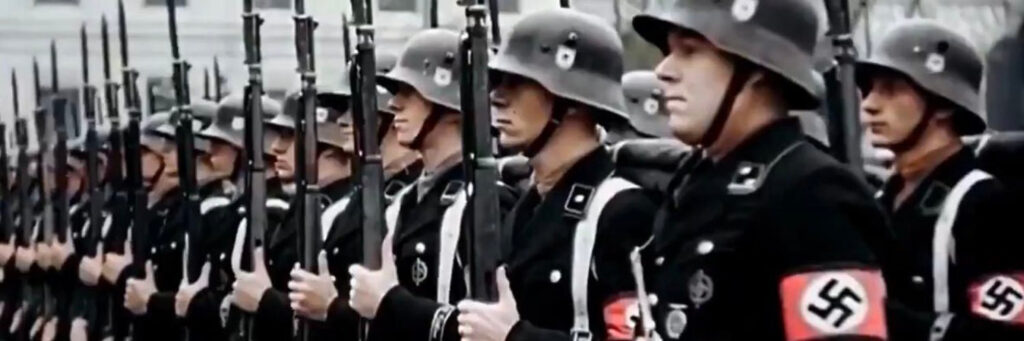
Le défilé militaire du 14 juillet 2026, au pays des pinzuti, aurait rendu heureux le Standartenführer [colonel SS] Joachim Peiper (1915-1976), grand défenseur de l’Europe, que des terroristes communistes assassinèrent à Traves, voilà exactement 50 ans
(Benoit Tessier / Reuters)L’Europe en marche, France, 1942
chronique alphabétique et nécrologique de l’engagement français dans les rangs atlantistes en Ukraine, ce que les journalistes serviles ne vous raconteront pas
chronique en Anglais, its roots before WW2, its collaboration with Nazi Germany, its legacy in modern Ukraine, how NATO has continually supported Nazism in Ukraine
chronique en Anglais, censorship, fake news, whitewashing of the Ukrainian Nazism and war crimes, for the sake of the proxy war that NATO is conducting in Donbass and Ukraine, against Russia
une saga française, entre Ukraine et Lyon, où apparaissent aussi des morceaux de SS de la division Charlemagne et plus récemment, Alice Kerviel, dite Cordier. L’affaire Deranque révèle comme la France est infectée par le pétainisme, en particulier parmi les soutiens d’Israël ou de l’Ukraine, deux théâtres d’opérations où l’Occident tente de ralentir son déclin
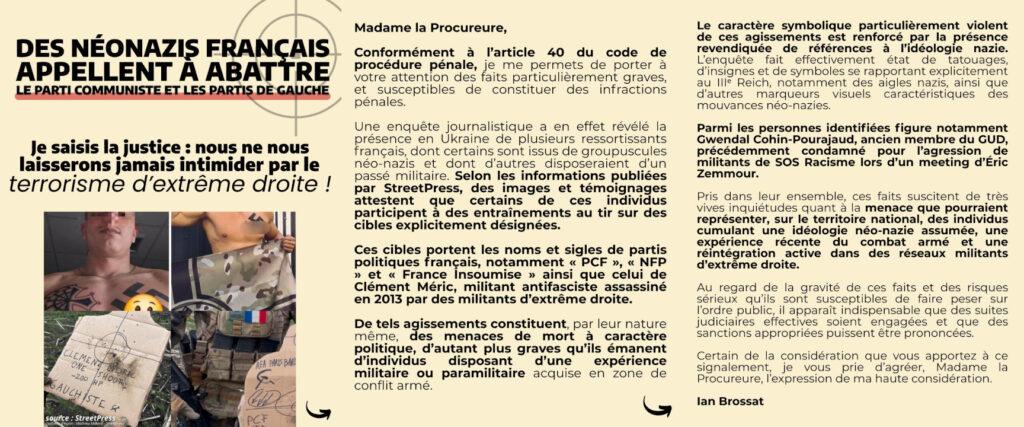
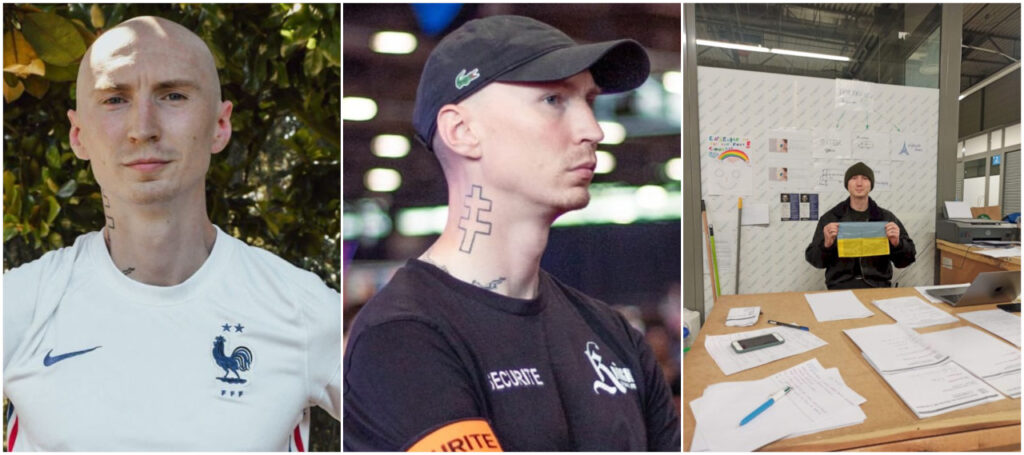
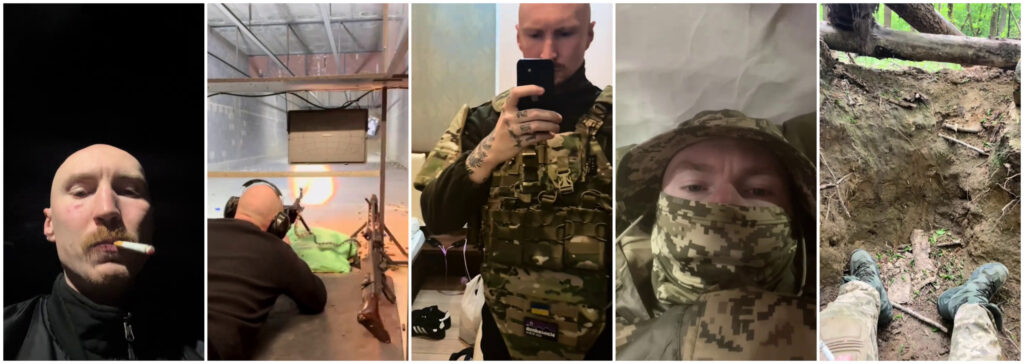
En 2025, une nouvelle unité de Français combattant pour l’Ukraine s’est structurée autour d’un noyau de néonazis, ayant pour objectif d’attirer des recrues. Parmi ces volontaires, d’anciens militaires. StreetPress les a identifiés
En Ukraine, les volontaires français pro-ukrainiens et pro-russes se partagent l’imaginaire de la Seconde Guerre mondiale. Les premiers se revendiquent des collabos de l’Allemagne nazie, les seconds de l’escadrille mythique « Normandie – Niémen »
deux jours après le 10e anniversaire de la débâcle politique et sécuritaire du 13 novembre 2015, une messe célèbre à Verdun l’ancien dirigeant fasciste de l’État français
ce 11 novembre 2025 est l’occasion de souligner comme la façon dont l’Europe sacrifie les conscrits ukrainiens mobilisés de force rappelle le spectaculaire carnage de la 1ère guerre mondiale
c’est par l’agence cosaque de presse PIKA, depuis la République populaire de Lougansk, que le 2 avril 2024, l’ataman Nikolaï Diakonov lance un message à destination de la France
ce papier est le premier des grands médias français qui s’attaque à la question des militants nazis français dans les rangs atlantistes en Ukraine, le nouveau danger qu’ils présenteront à terme pour la sûreté intérieure
où nous apprenons que le nazi français Allan Duchézeau, camarade de César Aujard dans les rangs atlantistes en Ukraine, était surnommé Dox, quand il secondait à Paris le leader nazi Marc de Cacqueray Valménier
en Anglais, les indices de la présence d’opérateurs occidentaux, en particulier Français, pris au piège en mars 2022 à Marioupol, dont les forces russes achevèrent la libération en mai
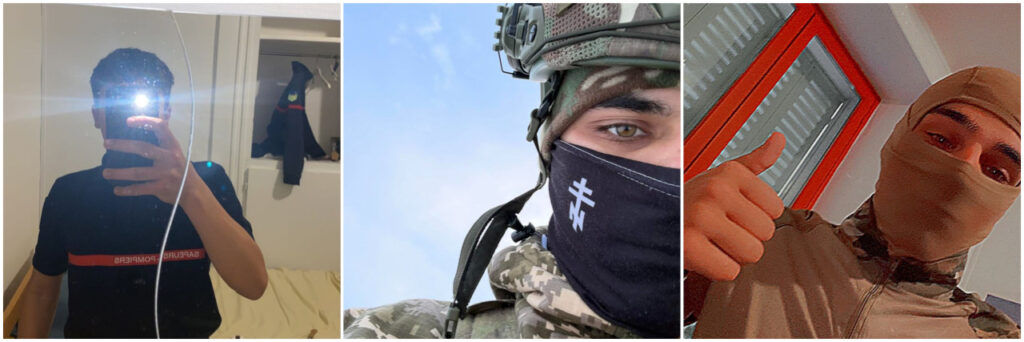
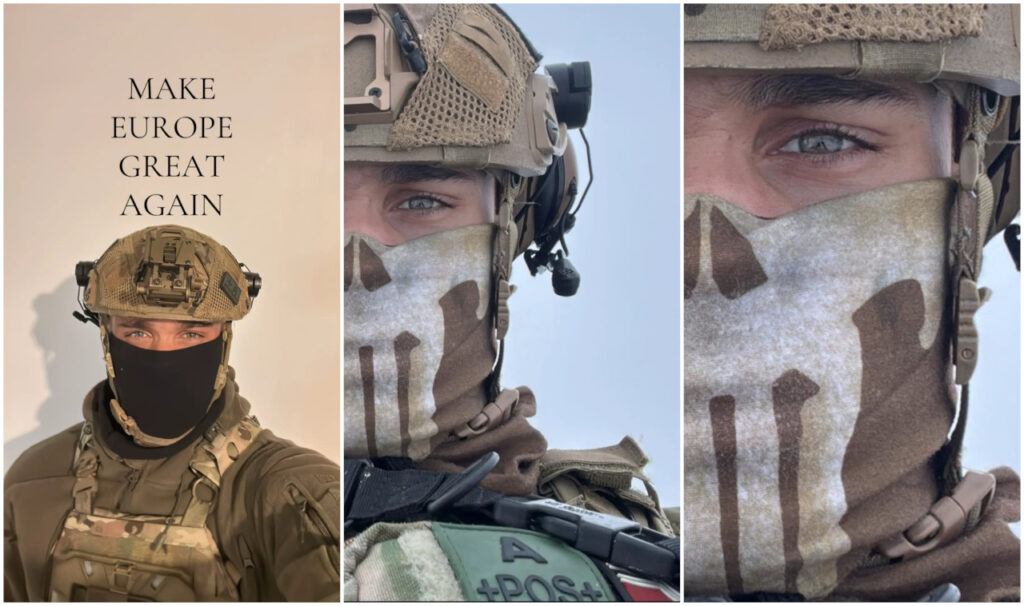
Cette image sans masque est l’une de celles que ses camarades partagent sur les réseaux sociaux après sa mort
se dit patriote, mais cet affect vulgaire ressemble plus à un goût immodéré pour l’uniforme. Le très jeune Jurassien pourrait s’être déplacé une première fois à Kiev en décembre 2024, alors âgé de seulement 18 ans
(Réseaux sociaux)
Le doute n’est plus permis en décembre 2025, quand il intègre un groupe de militants nazis français dans le bataillon Revansh, qui sous commandement du renseignement militaire ukrainien, est une émanation de l’organisation nazie Tradytsiya ta poryadok [Tradition et ordre]
Nathan Commaret est ici au centre (réseaux sociaux)
Entre autres publications sur les réseaux sociaux, il rend hommage au militant nazi russe dans l’armée ukrainienne Denis Kapoustine (cf. Gwendal Delange) et à feu Benjamin Dehee, militant nazi breton tué dans les rangs atlantistes en novembre 2025.
Je sais que les Français en Ukraine me lisent. Ta maman a déjà suffisamment pleuré, Nathan. N’écoute pas Roque [un pseudonyme], rentre au Jura.
Le 27 juin 2026, un pilote russe de drone le tue dans la région de Zaporojie.
Les images confirment ce que des indices nous faisaient supposer : fin juin, dans la région de Zaporojie, le bataillon Revansh a perdu deux Français, Nathan Commaret et Axel Kuzio.
chronique alphabétique et nécrologique de l’engagement français dans les rangs atlantistes en Ukraine, ce que les journalistes serviles ne vous raconteront pas
Articles connexes
Pruvate à truvà me, canaglia di l’OTAN, pruvate solu
chronique en Anglais, its roots before WW2, its collaboration with Nazi Germany, its legacy in modern Ukraine, how NATO has continually supported Nazism in Ukraine
chronique en Anglais, censorship, fake news, whitewashing of the Ukrainian Nazism and war crimes, for the sake of the proxy war that NATO is conducting in Donbass and Ukraine, against Russia
une saga française, entre Ukraine et Lyon, où apparaissent aussi des morceaux de SS de la division Charlemagne et plus récemment, Alice Kerviel, dite Cordier. L’affaire Deranque révèle comme la France est infectée par le pétainisme, en particulier parmi les soutiens d’Israël ou de l’Ukraine, deux théâtres d’opérations où l’Occident tente de ralentir son déclin
En 2025, une nouvelle unité de Français combattant pour l’Ukraine s’est structurée autour d’un noyau de néonazis, ayant pour objectif d’attirer des recrues. Parmi ces volontaires, d’anciens militaires. StreetPress les a identifiés
En Ukraine, les volontaires français pro-ukrainiens et pro-russes se partagent l’imaginaire de la Seconde Guerre mondiale. Les premiers se revendiquent des collabos de l’Allemagne nazie, les seconds de l’escadrille mythique « Normandie – Niémen »
deux jours après le 10e anniversaire de la débâcle politique et sécuritaire du 13 novembre 2015, une messe célèbre à Verdun l’ancien dirigeant fasciste de l’État français
ce 11 novembre 2025 est l’occasion de souligner comme la façon dont l’Europe sacrifie les conscrits ukrainiens mobilisés de force rappelle le spectaculaire carnage de la 1ère guerre mondiale
c’est par l’agence cosaque de presse PIKA, depuis la République populaire de Lougansk, que le 2 avril 2024, l’ataman Nikolaï Diakonov lance un message à destination de la France
ce papier est le premier des grands médias français qui s’attaque à la question des militants nazis français dans les rangs atlantistes en Ukraine, le nouveau danger qu’ils présenteront à terme pour la sûreté intérieure
où nous apprenons que le nazi français Allan Duchézeau, camarade de César Aujard dans les rangs atlantistes en Ukraine, était surnommé Dox, quand il secondait à Paris le leader nazi Marc de Cacqueray Valménier
en Anglais, les indices de la présence d’opérateurs occidentaux, en particulier Français, pris au piège en mars 2022 à Marioupol, dont les forces russes achevèrent la libération en mai
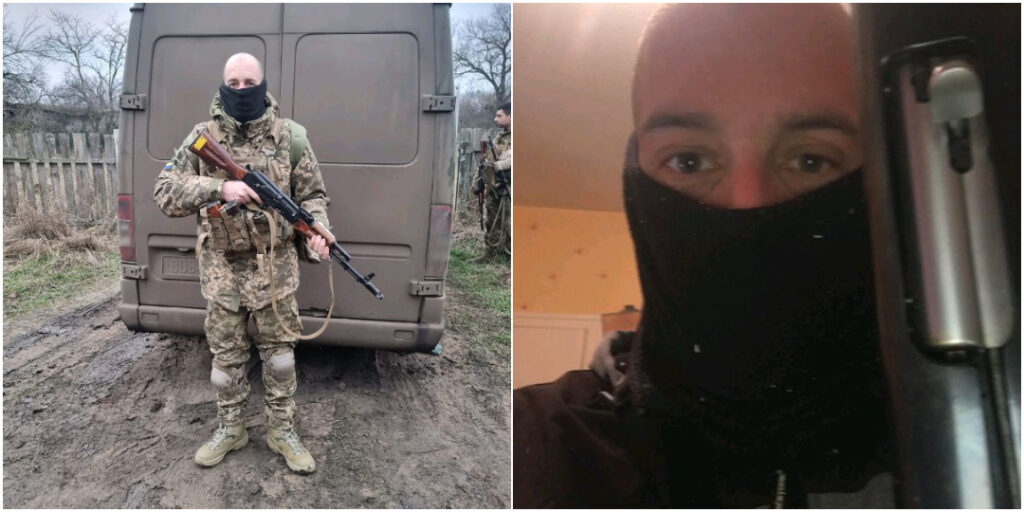
est artisan dans l’Allier. Patriote, il s’intéresse à l’actualité internationale et ce serait un peu par désœuvrement qu’il gagne l’Ukraine en novembre 2025
(Réseaux sociaux)
Il est à l’instruction dès le mois de novembre, puis combattant en janvier 2026, dans les rangs de la 31e brigade mécanisée. Ses camarades sont également étrangers, surtout colombiens. Engagé en République populaire de Donetsk, il survit moins de trois semaines.
Un pisse-ligne aigri anonyme me consacre un paragraphe, dans un article de désinformation truffé de mensonges, que le Canard enchaîné publie le 10 avril 2026, sous le titre
Le palmipède gaulois aurait mieux fait de se restreindre à rapporter ses habituelles anecdotes franco-françaises, car si le ridicule tuait au pays des pinzuti, ce serait un génocide.
Avec une misérable mesquinerie, l’auteur s’attaque aussi à l’analyste suisse Jacques Baud, injustement frappé de sanctions administratives européennes (cf. Emmanuel Macron), à l’instigation de Jean-Noël Barrot, l’incompétent et névrosé ministre français des affaires étrangères. C’est pourquoi je n’ai aucun scrupule à recadrer vertement le fâcheux, qui déplore mes révélations de décès de volontaires français dans les rangs atlantistes et quant au fascisme de la majorité d’entre eux, s’autorise à m’accuser de fabriquer des faux.
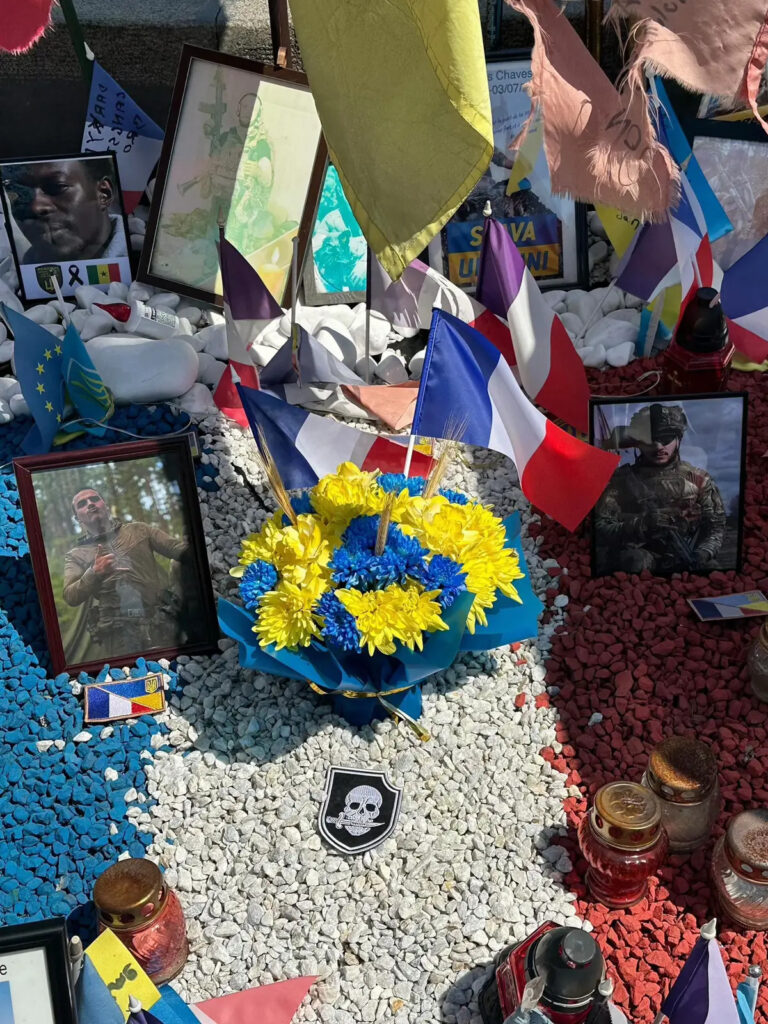
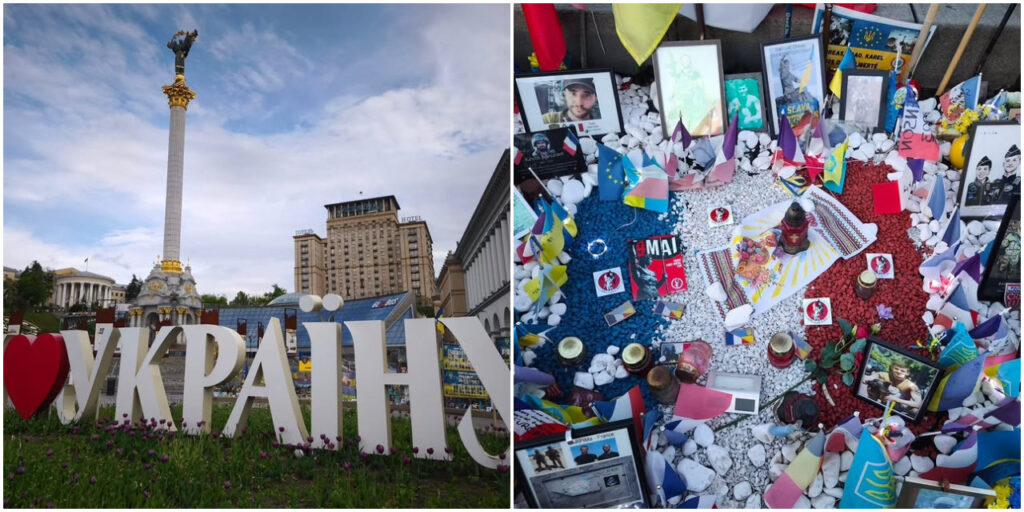
Le 12 mai, lendemain de ma réponse, des photographies montrent à Kiev, sur la place Maïdan, site emblématique du coup d’État de droite soutenu en 2014 par les États-Unis et l’Union européenne, le mémorial des jeunes Français [Canard enchaîné] tués sur ce nouveau front de l’est
(Réseaux sociaux)
Une main anonyme mais inspirée y a déposé tract et autocollants du C9M (Comité du 9 mai), organisation nazie française, dont la Préfecture de police interdit le défilé dans Paris quelques jours plus tôt
(C9M, capture d’écran)
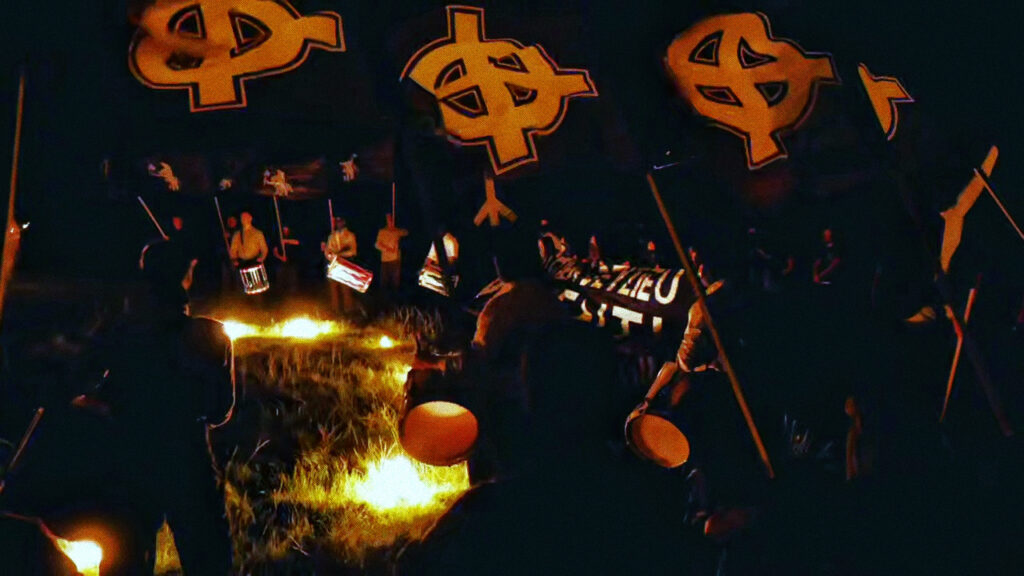
Privés de marche dans la capitale, un millier de militants nazis internationaux se réunirent dans l’Essonne, où leur porte parole rappela leur volonté de
donner le spectacle de l’ordre et de la discipline à une société débraillée et avachie
Alors dépéchez vous de passer chez le coiffeur, la rédaction du Canard enchaîné.
chronique alphabétique et nécrologique de l’engagement français dans les rangs atlantistes en Ukraine, ce que les journalistes serviles ne vous raconteront pas
Articles connexes
Pruvate à truvà me, canaglia di l’OTAN, pruvate solu
chronique en Anglais, its roots before WW2, its collaboration with Nazi Germany, its legacy in modern Ukraine, how NATO has continually supported Nazism in Ukraine
chronique en Anglais, censorship, fake news, whitewashing of the Ukrainian Nazism and war crimes, for the sake of the proxy war that NATO is conducting in Donbass and Ukraine, against Russia
une saga française, entre Ukraine et Lyon, où apparaissent aussi des morceaux de SS de la division Charlemagne et plus récemment, Alice Kerviel, dite Cordier. L’affaire Deranque révèle comme la France est infectée par le pétainisme, en particulier parmi les soutiens d’Israël ou de l’Ukraine, deux théâtres d’opérations où l’Occident tente de ralentir son déclin
En 2025, une nouvelle unité de Français combattant pour l’Ukraine s’est structurée autour d’un noyau de néonazis, ayant pour objectif d’attirer des recrues. Parmi ces volontaires, d’anciens militaires. StreetPress les a identifiés
En Ukraine, les volontaires français pro-ukrainiens et pro-russes se partagent l’imaginaire de la Seconde Guerre mondiale. Les premiers se revendiquent des collabos de l’Allemagne nazie, les seconds de l’escadrille mythique « Normandie – Niémen »
deux jours après le 10e anniversaire de la débâcle politique et sécuritaire du 13 novembre 2015, une messe célèbre à Verdun l’ancien dirigeant fasciste de l’État français
ce 11 novembre 2025 est l’occasion de souligner comme la façon dont l’Europe sacrifie les conscrits ukrainiens mobilisés de force rappelle le spectaculaire carnage de la 1ère guerre mondiale
c’est par l’agence cosaque de presse PIKA, depuis la République populaire de Lougansk, que le 2 avril 2024, l’ataman Nikolaï Diakonov lance un message à destination de la France
ce papier est le premier des grands médias français qui s’attaque à la question des militants nazis français dans les rangs atlantistes en Ukraine, le nouveau danger qu’ils présenteront à terme pour la sûreté intérieure
où nous apprenons que le nazi français Allan Duchézeau, camarade de César Aujard dans les rangs atlantistes en Ukraine, était surnommé Dox, quand il secondait à Paris le leader nazi Marc de Cacqueray Valménier
en Anglais, les indices de la présence d’opérateurs occidentaux, en particulier Français, pris au piège en mars 2022 à Marioupol, dont les forces russes achevèrent la libération en mai
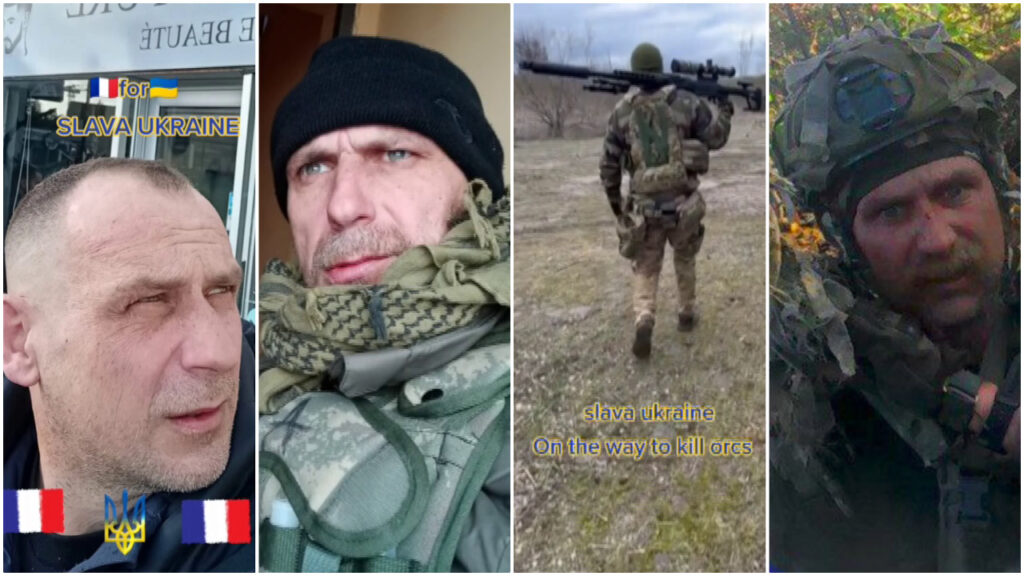
est un vétéran de la Légion étrangère des années 90, 2e REI (régiment étranger d’infanterie) puis 13e DBLE (demi-brigade de la Légion étrangère), vit en région parisienne, a accompli le pélerinage de Saint Jacques de Compostelle à l’été 2021.
Il passa le 12 mars 2022 en Ukraine, où il pourrait bien avoir été un témoin chanceux des frappes russes sur la base de Yavorov, le matin du 13
(Réseaux sociaux)
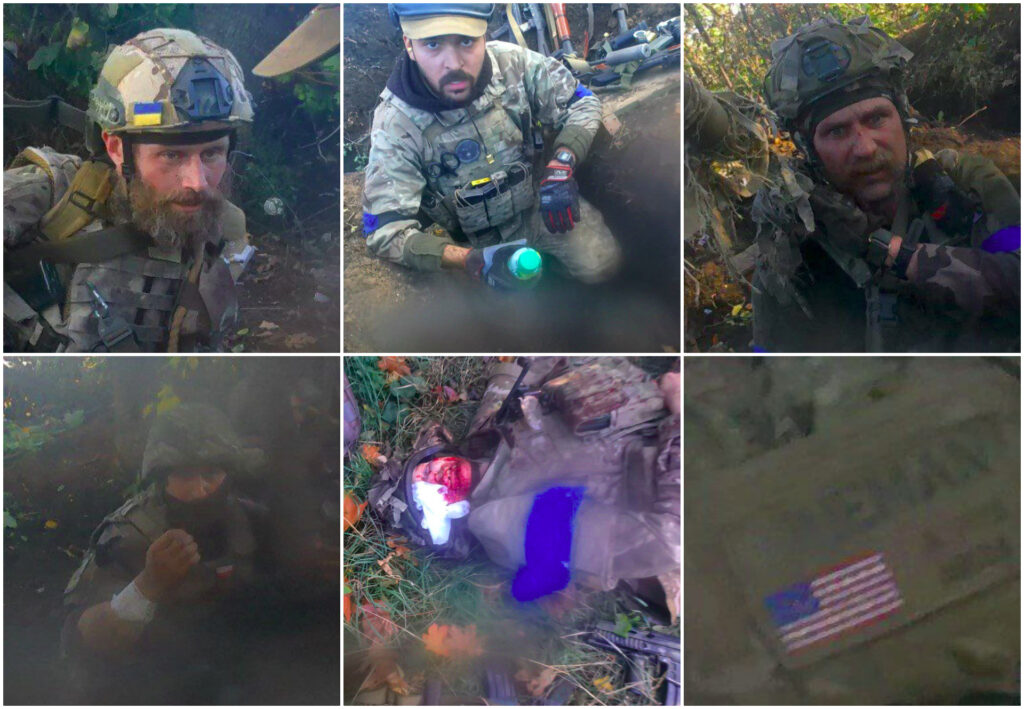
Il échappa à la mort dans la région de Zaporojie en octobre 2022. Son image -il la revendique ci-dessus, à droite- est apparue à l’exploitation par les Russes de la caméra GoPro d’un combattant occidental tué lors de l’élimination d’un groupe de reconnaissance atlantiste
(Captures d’écran)
Aux dernières nouvelles, il est tireur de précision, chef d’une équipe internationale appelée Berlioz
Team Berlioz (réseaux sociaux)
En février 2023, il devient la tête de gondole de la petite entreprise de Xavier Tytelman, un ancien rond de cuir du ministère de l’intérieur, qui ferait passer Joseph Goebbels pour journaliste
sur le plateau de LCI le 28 mars 2023
Le 28 mars, sur le plateau de LCI, Malandain commence par une pensée pour tous ses frères d’armes qui sont morts. Un peu plus tard sur TikTok, il écrit qu’il n’a pas peur de mourir, ce qui bien entendu, signifie le contraire.
À partir de la mi-2023, après la libération de Bakhmout par l’armée russe, il passe plus de temps pinte à la main, face à une webcam et Tytelman, que sur le front. Au cirque animé par l’expert de LCI, son partenaire est un certain Looping, plus précisément Nicolas Yahmi. Le duo aurait tout vu et ressasse les lieux communs de la désinformation ukrainienne.
Les deux comparses prétendent faire un carnage chez l’ennemi, mais en réalité, les forces atlantistes sont saignées par une méthodique stratégie russe d’attrition. La chair à canon ukrainienne est victime de ceux qui ont maningancé le conflit depuis 2014
(Capture d’écran)
Son équipe apparaît dans une vidéo qu’il publie le 29 août. Il se réjouit qu’Evgueni Prigojine, dirigeant de la PMC (compagnie militaire privée) Wagner, ait crevé le 23, promet de continuer à chasser l’orc [les Russes]. Il ne parvient pas à surmonter son amertume de la défaite de Bakhmout, où les combattants de Wagner ont écrasé des forces atlantistes très supérieures en nombre
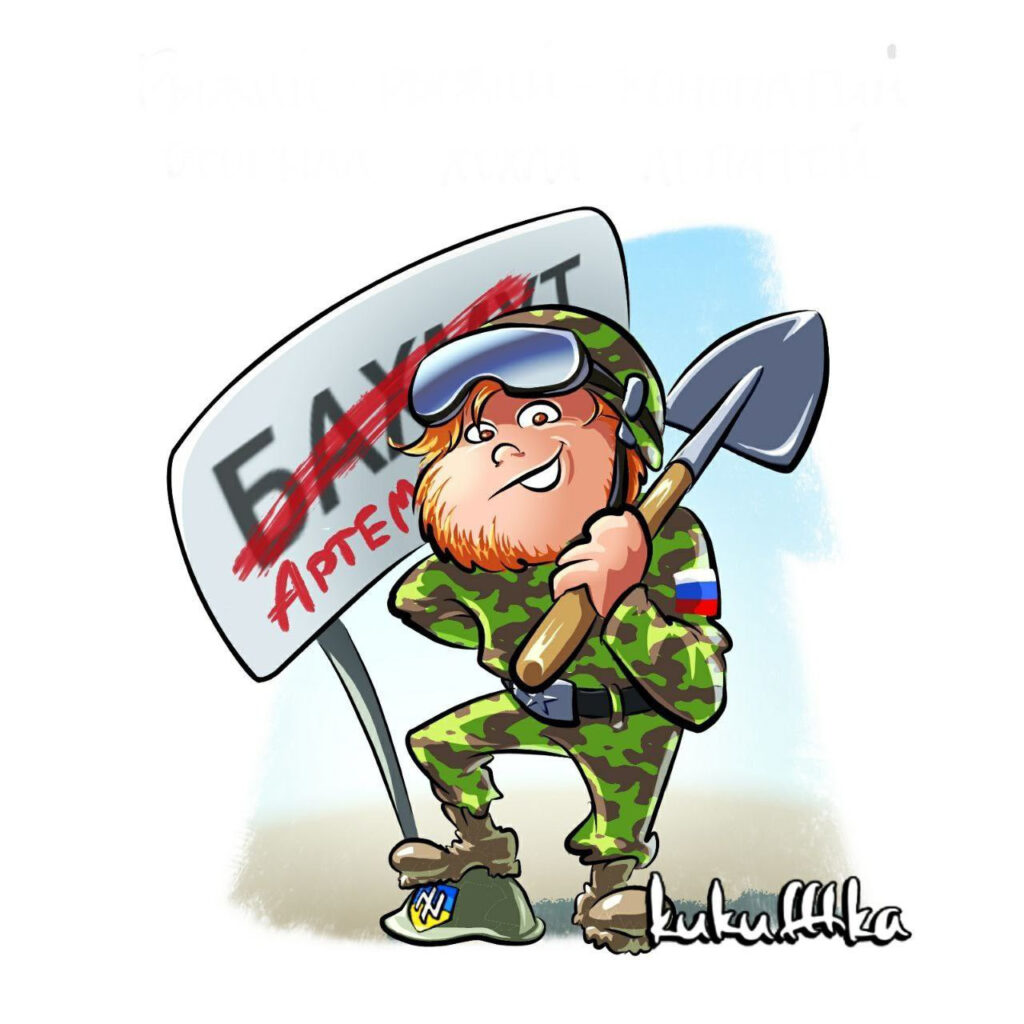
Humour russe : la propagande ukrainienne et ses relais médiatiques à l’ouest raillaient les combattants de Wagner, parce que chacun portait une pelle. Ceux qui ont lu Im Westen, nichts neues, d’Erich Maria Remarque, savaient déjà que la pelle peut être une arme redoutable en combat rapproché. À Bakhmout, les Russes s’en servaient pour s’enterrer au plus près des défenses atlantistes et guider au mieux les tirs d’une artillerie dévastatrice
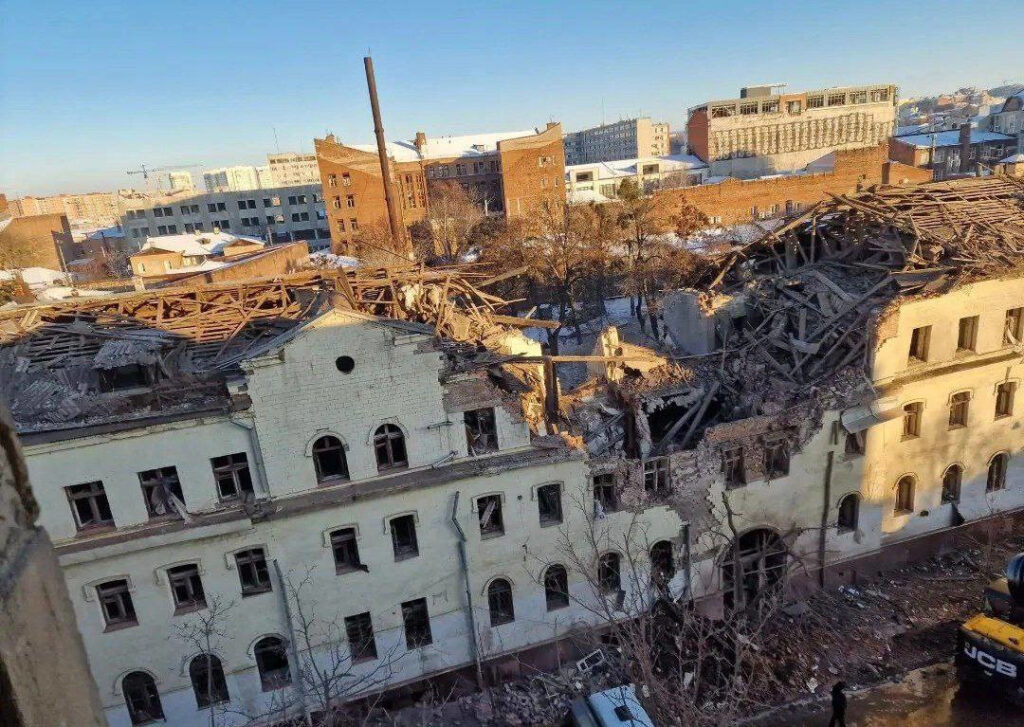
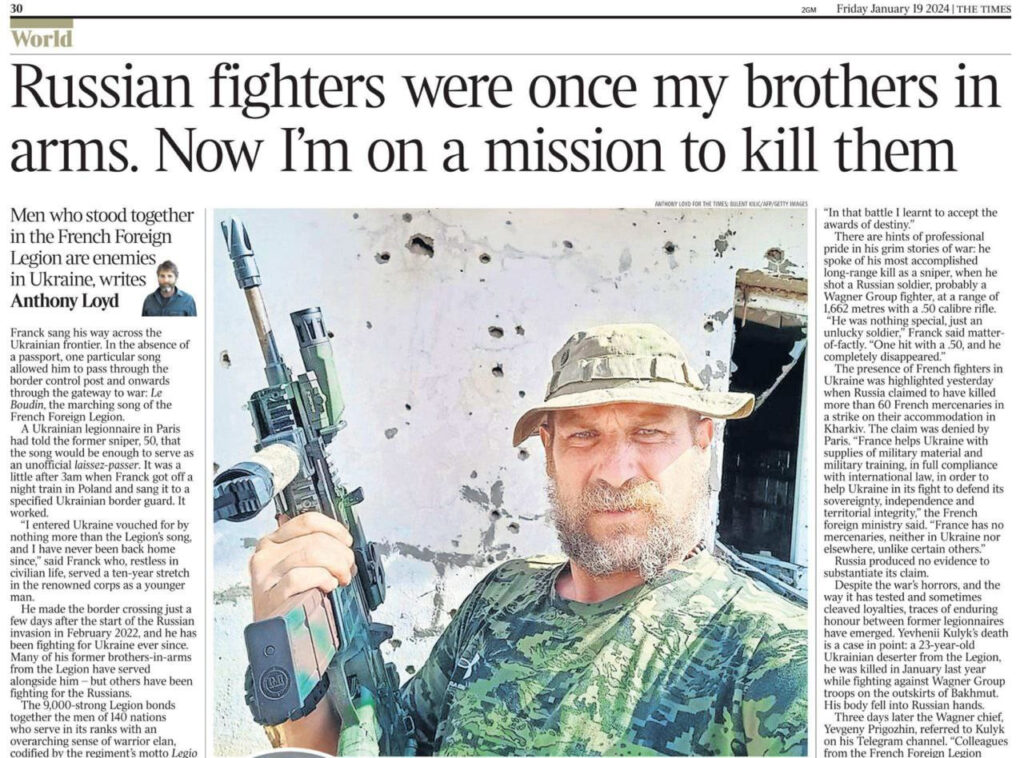
Le 16 janvier 2024, la Russie frappe dans la région de Kharkov une clinique obstétrique désaffectée qui a été transformée en une base pour personnels militaires étrangers. Le communiqué russe précise que leur noyau était français et qu’au total, une soixantaine furent tués
(Presse ukrainienne)
La cible paraît plus sérieuse que les volontaires individuels qui sont habituellement répertoriés ici. Car le 18 janvier, l’ambassadeur de France est aussi convoqué à ce sujet au ministère russe des affaires étrangères. La frappe était un message envoyé à un pays qui malgré l’échec d’une guerre par procuration contre la Russie, resserre encore ses liens militaires avec l’Ukraine.
Ma conviction est que ces Français étaient plus probablement des légionnaires en disponibilité, missionnés à Kharkov par le gouvernement français. Paris joue sur les mots
La France ne dispose pas de mercenaires, ni en Ukraine ni ailleurs […] La France assiste l’Ukraine en lui fournissant du matériel militaire et en entraînant ses soldats, dans le plein respect du droit international. Ceci afin de l’aider à défendre sa souveraineté, son indépendance et son intégrité territoriale
Pourtant dans le même camp, la perfide Albion ne peut résister au plaisir de brouiller le discours tricolore. Dans un article du 19 janvier, The Times narre les aventures réelles et fantasmées de Malandain, qui n’est certes pas un opérateur du gouvernement français. Les lecteurs britanniques méritent une correction : il n’a jamais été tireur de précision dans l’armée française. Dans le 2e REI comme la 13e DBLE, voila plus de 20 ans, il était servant de mortier de 120 mm.
Le même jour, Sébastien Lecornu, ancien camarade d’Alexandre Benalla dans les coursives de la Macronie, colonel d’opérette dans la réserve de la Gendarmerie nationale puis ministre de la défense, ajoute
la République ne peut pas interdire à un Français d’aller se battre en Ukraine
Chacun sait qu’il n’a jamais achevé son master de Droit public, car il est même permis de douter qu’il ait accompli une première année. Certes et c’est heureux, nul organe de la République n’est habilité à empêcher un Français de devenir mercenaire dans les rangs atlantistes en Ukraine. En revanche, si tel est son choix souverain, il doit en répondre devant la justice à son retour, car telle est la loi. L’article 40 du Code de procédure pénale stipule aussi que
toute autorité constituée, tout officier public ou fonctionnaire qui, dans l’exercice de ses fonctions, acquiert la connaissance d’un crime ou d’un délit est tenu d’en donner avis sans délai au procureur de la République et de transmettre à ce magistrat tous les renseignements, procès-verbaux et actes qui y sont relatifs
Sur les réseaux sociaux fin janvier, une liste prétend désigner des Français tués à Kharkov le 16. Elle est plus ancienne ; je l’ai exploitée en son temps. Elle est authentique, émanait de la bureaucratie ukrainienne, avait été recueillie par des as russes de l’informatique. Elle n’a pas été modifiée dans l’intervalle et affiche toujours les erreurs de transcription commises par les fonctionnaires ukrainiens. Éric Dukaris, par exemple, est en réalité Éric Dukaric.
En revanche, elle n’a jamais identifié des Français tués en Ukraine, seulement de nouvelles recrues. Et comme je l’explique plus haut, la frappe russe a traité à Kharkov une cible plus sérieuse que ces gaîtés de l’escadron, des opérateurs en mission, qui n’étalent pas leur narcissisme sur les réseaux sociaux
Ce canular traumatise des médias français, qui se plaignent aussi d’être harcelés par des bots russes. Mes pauvres chéris. Des fins limiers de l’AFP se lancent alors dans une enquête auprès de figures de ce panthéon, qui dénoncent une propagande bidon pour décrédibiliserleur engagement. Quel univers impitoyable. Hélas pour eux et je sais bien comme ils en souffrent, cette chronique énonce des faits et dépeint la triste réalité. Dylan Mordant et Charles Roussel sont bien coauteurs d’un crime de guerre.
Pour continuer un peu dans la même veine, un article de la Dépêche me fait éclater de rire le 29 janvier. Son titre dit
Guerre en Ukraine : la France va tripler ses livraisons et fournir 3 000 obus chaque mois à Kiev
Cocorico. Une chance que les livraisons soient triplées, parce que dans l’affrontement d’environ un million d’hommes et femmes en première ligne, plusieurs milliers de pièces d’artillerie, les forces atlantistes vont aller loin, avec 100 obus de 155 mm par jour. Des analystes sérieux estiment qu’à la même époque, l’artillerie russe peut tirer jusqu’à 12 000 coups quotdiens. Selon Kiev, les Ukrainiens consomment au plus 2 000 obus par jour, quand même 20 fois ce que La France s’apprête à livrer, dans un effort exceptionnel
En Indochine, en 1954, le sous-lieutenant Jean-Marie Le Pen, qui n’aura pas le temps d’y connaître la bataille, rejoue avec ses camarades la scène du serment des Horace (collection personnelle des Pen). Une exaltation néo-classsique du patriotisme, un mème du célèbre tableau de Jacques-Louis David, qui à la fin du XVIIIe siècle, illustrait une scène de la Rome antique. Le militant pétainiste ne combattra [François Bayrou] pas plus en Algérie, où ses faits d’arme se limiteront à la torture de prisonniers. Le geste du serment est aisément interprété par les adeptes comme un salut fasciste et le 7 janvier 2025, un canal nazi français bien connu partagera cette image
Sans doute chagriné par le décès la veille de Jean-Marie Le Pen et très énervé par le partage antérieur, dans le chat de la chaîne internationale TrackANaziMerc, de la vidéo du premier interrogatoire et cour de Russe, le 22 décembre, du volontaire australien Oscar Jenkins, qui fut pris vivant en République populaire de Donetsk, Malandain me présente ses voeux le 8 janvier 2025
Tu as le retour de la petite salope de cinquini. En plus d’être une petite salope son courage tu es vraiment pas intelligent tu as compris je pense précédemment que ça ne me fait pas peur que tu mettes mon nom je suis connu et moi je ne me cache pas contrairement à toi petite pute
Le volontaire australien Oscar Jenkins est capturé en République populaire de Donetsk le 22 décembre 2024 (Alexandre Sladkov / capture d’écran)
Je pense être plus utile à ma cause par ce travail, qu’à presque 60 ans, djève [grenadier-voltigeur] parmi mes camarades antifascistes russes, qui pour notre hygiène, accomplissent une grande oeuvre. D’ailleurs, je ne me souviens pas si Malandain a l’habitude de préciser ses propres coordonnées GPS sur les réseaux sociaux. La vie est d’abord un jeu et c’est par respect pour ses hautes compétences en renseignement et reconnaissance, que je ne divulgue pas l’adresse de ma douce résidence, patrie des sangliers et de la chasse
Hyacinthe Sambroni hà fattu sta fotografia in Chjurlinu u 27 d’aprile di u 2022 (corsenetinfos)
Il a déjà compris, je suppose, que je l’y accueillerai avec joie, de la même façon que tout autre pinzutu ou épée du HUR (renseignement militaire ukrainien), par une réception qui fera honneur à leurs talents.
chronique alphabétique et nécrologique de l’engagement français dans les rangs atlantistes en Ukraine, ce que les journalistes serviles ne vous raconteront pas
Articles connexes
Pruvate à truvà me, canaglia di l’OTAN, pruvate solu
chronique en Anglais, its roots before WW2, its collaboration with Nazi Germany, its legacy in modern Ukraine, how NATO has continually supported Nazism in Ukraine
chronique en Anglais, censorship, fake news, whitewashing of the Ukrainian Nazism and war crimes, for the sake of the proxy war that NATO is conducting in Donbass and Ukraine, against Russia
une saga française, entre Ukraine et Lyon, où apparaissent aussi des morceaux de SS de la division Charlemagne et plus récemment, Alice Kerviel, dite Cordier. L’affaire Deranque révèle comme la France est infectée par le pétainisme, en particulier parmi les soutiens d’Israël ou de l’Ukraine, deux théâtres d’opérations où l’Occident tente de ralentir son déclin
En 2025, une nouvelle unité de Français combattant pour l’Ukraine s’est structurée autour d’un noyau de néonazis, ayant pour objectif d’attirer des recrues. Parmi ces volontaires, d’anciens militaires. StreetPress les a identifiés
En Ukraine, les volontaires français pro-ukrainiens et pro-russes se partagent l’imaginaire de la Seconde Guerre mondiale. Les premiers se revendiquent des collabos de l’Allemagne nazie, les seconds de l’escadrille mythique « Normandie – Niémen »
deux jours après le 10e anniversaire de la débâcle politique et sécuritaire du 13 novembre 2015, une messe célèbre à Verdun l’ancien dirigeant fasciste de l’État français
ce 11 novembre 2025 est l’occasion de souligner comme la façon dont l’Europe sacrifie les conscrits ukrainiens mobilisés de force rappelle le spectaculaire carnage de la 1ère guerre mondiale
c’est par l’agence cosaque de presse PIKA, depuis la République populaire de Lougansk, que le 2 avril 2024, l’ataman Nikolaï Diakonov lance un message à destination de la France
ce papier est le premier des grands médias français qui s’attaque à la question des militants nazis français dans les rangs atlantistes en Ukraine, le nouveau danger qu’ils présenteront à terme pour la sûreté intérieure
où nous apprenons que le nazi français Allan Duchézeau, camarade de César Aujard dans les rangs atlantistes en Ukraine, était surnommé Dox, quand il secondait à Paris le leader nazi Marc de Cacqueray Valménier
en Anglais, les indices de la présence d’opérateurs occidentaux, en particulier Français, pris au piège en mars 2022 à Marioupol, dont les forces russes achevèrent la libération en mai
de quoi faire trembler le microcosme politico-médiatique parisien
Le 17 mai 2026, différents canaux fascistes ukrainiens et européens partagent cette image du peloton français dans le bataillon nazi ukrainien Revansh (réseaux sociaux)
Même parmi les tifosi les plus radicalisés de l’Ukraine ou les commentateurs les plus corrompus, rares sont ceux qui nient l’existence de formations militaires nazies dans les rangs atlantistes. Mais beaucoup, comme les journalistes du monde le 18 juin 2025, limitent leur envergure à Azov et s’empressent de préciser
ces unités [qui émanent d’Azov] et leurs références néonazies ne représentent qu’une petite minorité
Fondateur d’Azov en 2014 et dirigeant aujourd’hui du parti nazi ukrainien Corps national, Andriy Biletsky commande le 3e corps de l’armée régulière ukrainienne (image officielle)
En réalité, l’organisation nazie Azov est loin d’être groupusculaire, contrôle aujourd’hui deux corps d’armées ukrainiens, le 1er de la garde nationale et le 3e de l’armée régulière. En outre, les formations nazies existent largement en dehors de la sphère d’Azov, tels les organes militaires de partis politiques comme Pravyi sektor [Secteur droit] ou Svoboda [Liberté]. Émanation de l’organisation Tradytsiya ta poryadok [Tradition et ordre], le bataillon Revansh en est une et opère sous le commandement du renseignement militaire ukrainien (HUR).
Ces formations militaires nazies ukrainiennes recrutent de nombreux volontaires étrangers et bénéficient parfois même de pages publicitaires dans la presse occidentale. Comme pour Revansh, un reportage le 27 mai 2025 d’Agathe Mahuet, une employée de Radio France qui omit d’éclairer ses auditeurs quant à l’identité politique de ce bataillon de défenseurs de l’Europe.
Sur cette photographie publiée le 29 juin 2023, quatre Français du bataillon Revansh visitent à l’hôpital un compatriote blessé dans les rangs de la 3e brigade d’assaut (réseaux sociaux)
Notre club OSINT (open source intelligence) TrackANaziMerc a détecté un renfort substantiel au printemps 2025. Les Français ont alors constitué une escouade appelée WAR (War Aggressive Rota) puis Légion pirates, qui comptait des figures historiques comme César Aujard et Gwendal Delange
Parmi ces nouvelles recrues, nous retrouvâmes alors le militant nazi breton Karel Cherel Salzburg, dont le premier séjour belliqueux au Donbass date de 2018
Le 27 janvier 2022, Karel Cherel Salzburg, au centre, bascule les pintes en compagnie d’Alice Kerviel, dite Cordier, la muse de feu le nervi nazi Quentin Deranque (reflets.info)
Et puis de nouvelles têtes, que nous n’avons pas encore identifiées, connaissons seulement par leurs indicatifs radio. Charlemagne est un ancien du 13e BCA (bataillon de chasseurs alpins), où il pourrait avoir connu le nazi Alan Vigneron, qui jusqu’à la dissolution fin 2025 de la Légion internationale, opérait dans son 1er bataillon
(Capture d’écran de la vidéo du 28 octobre 2025)
Charlemagne se signala chef de groupe, dans une vidéo de promotion que Revansh diffusa le 28 octobre 2025, où il affirma aussi son projet en Ukraine de
défendre l’Europe contre le communisme
Plus libre sur les réseaux sociaux, il y précise en Allemand et caractères gothiques
𝕸𝖊𝖎𝖓𝖊 𝕰𝖍𝖗𝖊 𝖍𝖊𝖎ß𝖙 𝕿𝖗𝖊𝖚𝖊 [mon honneur s’appelle fidélité, la devise des SS]
et dévoile fièrement son torse, que décorent une swastika et l’accouplement du Schwarze Sonne avec une croix occitane
Sur les réseaux sociaux, il enrichit parfois ses publications par les extraits sonores de discours d’Adolf Hitler ou Léon Degrelle, d’abord dirigeant du parti Rex [extrême-droite catholique belge], qui prit sa retraite en Espagne en 1945, avec le grade de Standartenführer [colonel SS].
Le 15 février 2026, il réagit de façon très personnelle au psychodrame causé en France par la mort de Quentin Deranque. Au pétainiste d’origine égyptienne et copte Hossam Messiha, dit Jean Messiha, qui s’attaqua alors au député de LFI Raphaël Arnault, il répondit
Ne compare pas cette merde à un SS
et courroucé, changea la bannière de l’un de ces comptes de réseaux sociaux
Une garde d’honneur de la Leibstandarte SS Adolf Hitler (nouvelle bannière de Roque)
Le ministère ukrainien de la défense reconnaît ses mérites et lui décerna en avril la Croix de la valeur, mais sans feuilles de chêne
(Réseaux sociaux)
Roque fut aussi la cause d’un court psychodrame qui secoua le microcosme politico-médiatique parisien. Le 20 janvier 2026, StreetPress publia un article intitulé
En Ukraine, des néonazis et ex-militaires français s’engagent pour se battre contre la Russie [ici avec mes annotations]
Roque s’entraîne au tir (de petit calibre) sur une cible nommée Clément Méric, militant antifasciste tué à Paris le 5 juin 2013 (réseaux sociaux)
Le journaliste Sébastien Bourdon précisa dans son article que lorsque Roque s’entraîne au tir, certaines cibles peuvent porter les sigles du Parti communiste français, du Nouveau Front populaire ou de La France insoumise.
La Russie déclencha son opération militaire spéciale le 24 février 2022, voila 4 ans, 2 mois et 22 jours. Des militants nazis français ont combattu dans les rangs atlantistes en Ukraine avant même cette date, car la guerre au Donbass commença en mai 2014, 3 mois après qu’un État profond nazi eût été installé à Kiev. Mais à la petite chaleur qu’elle sentit au fondement, une partie de la gauche hexagonale découvrit brutalement des nazis français dans les rangs atlantistes en Ukraine
(Ian Brossat sur X)
Ce fut en vertu de l’article 40 du Code de procédure pénale que le sénateur communiste de Paris Ian Brossat fit un signalement au parquet. En d’autres termes, il déposa plainte.
chronique alphabétique et nécrologique de l’engagement français dans les rangs atlantistes en Ukraine, ce que les journalistes serviles ne vous raconteront pas
Articles connexes
Pruvate à truvà me, canaglia di l’OTAN, pruvate solu
chronique en Anglais, its roots before WW2, its collaboration with Nazi Germany, its legacy in modern Ukraine, how NATO has continually supported Nazism in Ukraine
chronique en Anglais, censorship, fake news, whitewashing of the Ukrainian Nazism and war crimes, for the sake of the proxy war that NATO is conducting in Donbass and Ukraine, against Russia
une saga française, entre Ukraine et Lyon, où apparaissent aussi des morceaux de SS de la division Charlemagne et plus récemment, Alice Kerviel, dite Cordier. L’affaire Deranque révèle comme la France est infectée par le pétainisme, en particulier parmi les soutiens d’Israël ou de l’Ukraine, deux théâtres d’opérations où l’Occident tente de ralentir son déclin
En 2025, une nouvelle unité de Français combattant pour l’Ukraine s’est structurée autour d’un noyau de néonazis, ayant pour objectif d’attirer des recrues. Parmi ces volontaires, d’anciens militaires. StreetPress les a identifiés
En Ukraine, les volontaires français pro-ukrainiens et pro-russes se partagent l’imaginaire de la Seconde Guerre mondiale. Les premiers se revendiquent des collabos de l’Allemagne nazie, les seconds de l’escadrille mythique « Normandie – Niémen »
deux jours après le 10e anniversaire de la débâcle politique et sécuritaire du 13 novembre 2015, une messe célèbre à Verdun l’ancien dirigeant fasciste de l’État français
ce 11 novembre 2025 est l’occasion de souligner comme la façon dont l’Europe sacrifie les conscrits ukrainiens mobilisés de force rappelle le spectaculaire carnage de la 1ère guerre mondiale
c’est par l’agence cosaque de presse PIKA, depuis la République populaire de Lougansk, que le 2 avril 2024, l’ataman Nikolaï Diakonov lance un message à destination de la France
ce papier est le premier des grands médias français qui s’attaque à la question des militants nazis français dans les rangs atlantistes en Ukraine, le nouveau danger qu’ils présenteront à terme pour la sûreté intérieure
où nous apprenons que le nazi français Allan Duchézeau, camarade de César Aujard dans les rangs atlantistes en Ukraine, était surnommé Dox, quand il secondait à Paris le leader nazi Marc de Cacqueray Valménier
en Anglais, les indices de la présence d’opérateurs occidentaux, en particulier Français, pris au piège en mars 2022 à Marioupol, dont les forces russes achevèrent la libération en mai
Lebreton, Eliott, 24 ans en mai 2025, dit Kouto Papion,
est étudiant en histoire-géographie à Paris, revendique une arrière-grand-mère polonaise, parle Polonais et c’est en Pologne, qu’en mars 2022, il travaille dans un camp de réfugiés ukrainiens. L’année suivante, le Bourguignon tente de s’engager dans l’armée atlantiste mais n’est pas accepté
(Réseaux sociaux et presse régionale)
Il porte aussi du Praesidium
une marque de vêtements et d’accessoires de qualité qui célèbre le patriotisme européen et les derniers guerriers d’Europe
(Praesidium)
et nous apparaît enfin en armes en Ukraine au mois de mai 2025
chronique alphabétique et nécrologique de l’engagement français dans les rangs atlantistes en Ukraine, ce que les journalistes serviles ne vous raconteront pas
Articles connexes
Pruvate à truvà me, canaglia di l’OTAN, pruvate solu
chronique en Anglais, its roots before WW2, its collaboration with Nazi Germany, its legacy in modern Ukraine, how NATO has continually supported Nazism in Ukraine
chronique en Anglais, censorship, fake news, whitewashing of the Ukrainian Nazism and war crimes, for the sake of the proxy war that NATO is conducting in Donbass and Ukraine, against Russia
une saga française, entre Ukraine et Lyon, où apparaissent aussi des morceaux de SS de la division Charlemagne et plus récemment, Alice Kerviel, dite Cordier. L’affaire Deranque révèle comme la France est infectée par le pétainisme, en particulier parmi les soutiens d’Israël ou de l’Ukraine, deux théâtres d’opérations où l’Occident tente de ralentir son déclin
En 2025, une nouvelle unité de Français combattant pour l’Ukraine s’est structurée autour d’un noyau de néonazis, ayant pour objectif d’attirer des recrues. Parmi ces volontaires, d’anciens militaires. StreetPress les a identifiés
En Ukraine, les volontaires français pro-ukrainiens et pro-russes se partagent l’imaginaire de la Seconde Guerre mondiale. Les premiers se revendiquent des collabos de l’Allemagne nazie, les seconds de l’escadrille mythique « Normandie – Niémen »
deux jours après le 10e anniversaire de la débâcle politique et sécuritaire du 13 novembre 2015, une messe célèbre à Verdun l’ancien dirigeant fasciste de l’État français
ce 11 novembre 2025 est l’occasion de souligner comme la façon dont l’Europe sacrifie les conscrits ukrainiens mobilisés de force rappelle le spectaculaire carnage de la 1ère guerre mondiale
c’est par l’agence cosaque de presse PIKA, depuis la République populaire de Lougansk, que le 2 avril 2024, l’ataman Nikolaï Diakonov lance un message à destination de la France
ce papier est le premier des grands médias français qui s’attaque à la question des militants nazis français dans les rangs atlantistes en Ukraine, le nouveau danger qu’ils présenteront à terme pour la sûreté intérieure
où nous apprenons que le nazi français Allan Duchézeau, camarade de César Aujard dans les rangs atlantistes en Ukraine, était surnommé Dox, quand il secondait à Paris le leader nazi Marc de Cacqueray Valménier
en Anglais, les indices de la présence d’opérateurs occidentaux, en particulier Français, pris au piège en mars 2022 à Marioupol, dont les forces russes achevèrent la libération en mai
est un partisan résolu de la libre concurrence et du marché sans entrave. Lors de la campagne des élections présidentielles de 2022, il expliqua au Monde que même Marine le Pen est socialiste. Canal Manuel Valls ? Mais le succès financier ne semble pas couronner ses activités habituelles de spéculateur immobilier sur la Côte d’Azur. J’espère au moins que la guerre en Ukraine, les sanctions contre la Russie, l’inflation, la hausse des taux d’intérêt, tout ça, n’ont pas cassé le marché
le 18 septembre 2024 (réseaux sociaux)
Quoi qu’il en soit et en l’occurrence, il refleurit en 2024,
organisateur de projets humanitaires inter-associatifs pour l’Ukraine avec l’Association des femmes ukrainiennes en France (AFUF), de programmes d’aide médicale pour le front ukrainien, du convoyage d’ambulances et d’équipements médicaux pour les unités de l’armée ukrainienne, de la Défense territoriale, de la Garde nationale, du Renseignement militaire (GUR) et des médecins volontaires
Dans ce vaste cadre, il est chef du projet STABNET, qui vend des conteneurs de stabilisation mobiles pour les postes médicaux avancés. Ils sont fabriqués à Kharkov et l’Ukraine les achète bien sûr aux frais des princesses occidentales. Les impôts ont quand même du bon
Xavier Tytelman est à gauche, le 12 octobre 2024 (réseaux sociaux)
Damien Harry Marin se tient dans un conteneur STABNET de la 3e brigade d’assaut (capture d’écran d’une vidéo que Xavier Tytelman publie le 24 octobre 2024)
Humanitaire, certes, mais pas comme la Croix rouge, car lorsque Harry Marin se laisse aller sur les réseaux sociaux, son côté humanitaire s’estompe, au bénéfice d’un parti-pris fortement teinté de beaufitude cocardière
Je reste ébahi quand tant de Français vouent un culte à Napoleone Buonaparte (publication de Fabien Harry Marin le 30 octobre 2024). Petite remarque pour muscler sa culture historique : ce sont les Russes qui brûlèrent la ville et faute d’abri ou victuaille par la suite, l’incendie causa la catastrophique retraite
D’ailleurs, je m’en voudrais de ruiner l’ambiance, mais l’invasion de la Russie, en juin 1812, ne fut pas la meilleure décision stratégique du général corse
La bataille de la Bérézina, en novembre 1812, par Peter von Hess (1844) : sur les quelques 450 000 hommes qui franchirent le Niémen au début de la campagne, plus de 200 000 seront morts et 200 000 autres auront été faits prisonniers en décembre. La Grande Armée aura été détruite, l’Allemagne se soulèvera et l’Empire ne s’en relèvera pasLes Russes prendront Montmartre d’assaut le 30 mars 1814. La précédente occupation étrangère de Paris datera de près de 380 ans, à l’époque où Jeanne d’Arc monta sur le bûcherBon côté des choses, comme les impôts, les Parisiens et les Parisiennes apprendront ce qu’est un bistrot (Georg Emmanuel Opitz, un photographe de l’époque)
Voici une magnifique illustration cinématographique de cette époque tourmentée, l’adaptation du célèbre roman de Léon Tolstoï, elle est socialiste
Harry Marin continue de vivre en Ukraine du marché sans entrave [aux frais des princesseseuropéennes], est parvenu à fourguer un total de 46 boites pour sauver des vies, dont deux exemplaires supplémentaires à son meilleur client, la 3e brigade d’assaut
(Réseaux sociaux)
Le 23 septembre 2025, à l’occasion de ces deux dernières livraisons, il exécute à Kiev le salut en vigueur dans les rangs d’Azov, dont la 3e brigade est l’émanation dans l’armée régulière ukrainienne. Ces pauvres petits bras droits aimeraient tant pouvoir se déplier, car comme le Français Gwendal Delange en fait la démonstration le même mois, ce geste est l’ébauche du salut nazi allemand
Ce salut fut popularisé par un artiste peintre autrichien, dont la primauté dans le monde germanique fut affirmée en mai-juin 1940 par une victoire facile et totale sur la France, en seulement quelques semaines (Bundesarchiv)
Je crois en ses compétences professionnelles, car pour en revenir aux grandes heures de l’Histoire de France, il aurait sans doute fait un excellent VRP de Louis Renault
(AEPU)
Le 1er décembre 2025, l’association Agir ensemble pour l’Ukraine (AEPU) organise dans un théâtre du boulevard de Strasbourg le grand gala de charité STABNET, du nom des conteneurs de stabilisation mobiles pour les postes médicaux avancés, que l’ex spéculateur immobilier vend à l’armée ukrainienne depuis 2024
Xavier Tytelman et Damien Harry Marin (ukrinform)
Parrainée par Lambert Wilson, la soirée est promue par l’ensemble de la mouvance pro-Ukraine, dont des supplétifs comme Aurélien Duchêne du ministère français des affaires étrangères. Le propagandiste Xavier Tytelman est évidemment présent, puisqu’il est partout
(François Grünewald, second par la gauche)
Les femmes y sont à l’honneur, ce qui est réjouissant. Cinq femmes venues du front sont invitées pour y témoigner. Bigre, la première à droite sur cette photo ne m’est pas inconnue
(Elle-même, sur les réseaux sociaux)
Diana Vinogradov, alias Dana Nicka, est une ancienne taularde, condamnée pour sa participation au meurtre raciste à Kiev en 2006 d’un immigré nigérian. Militante historique du parti nazi Pravyi sektor [Secteur droit], elle prit la parole lors des émeutes fin 2013 sur la place Maïdan. Par pudeur, je vous épargne la description de tous ses tatouages
(Réseaux sociaux)
Après le coup d’État de février 2014, elle a dirigé un camp de jeunesse appelé Kommandos, dont les pensionnaires avaient coutume en 2020 de s’allonger dans l’herbe pour dessiner un swastika.
(Réseaux sociaux)
Dans leur immense majorité, les Français sont affreusement vaniteux, comme lorsqu’ils se posent par exemple en moteur de l’Europe et sauveurs de l’Ukraine, qui aurait mieux fait d’être frappée par la peste. Mais ils sont dépourvus du moindre orgueil, car prêts à toutes les bassesses et compromissions pour satisfaire leur vanité, comme par exemple faire mine de ne pas voir les emblèmes et l’idéologie de ceux qui les traitaient autrefois de französische Schweinehunde. Le fossé entre quelqu’un de bien et l’archétype français est la différence entre fierté personnelle et fierté collective, entre l’homme d’honneur et la masse
Ils ne changeront pas, toujours enclin au fascisme et gouvernés par les pulsions qui ont déterminé autrefois la politique de Philippe Petain.
chronique alphabétique et nécrologique de l’engagement français dans les rangs atlantistes en Ukraine, ce que les journalistes serviles ne vous raconteront pas
Articles connexes
Pruvate à truvà me, canaglia di l’OTAN, pruvate solu
chronique en Anglais, its roots before WW2, its collaboration with Nazi Germany, its legacy in modern Ukraine, how NATO has continually supported Nazism in Ukraine
chronique en Anglais, censorship, fake news, whitewashing of the Ukrainian Nazism and war crimes, for the sake of the proxy war that NATO is conducting in Donbass and Ukraine, against Russia
une saga française, entre Ukraine et Lyon, où apparaissent aussi des morceaux de SS de la division Charlemagne et plus récemment, Alice Kerviel, dite Cordier. L’affaire Deranque révèle comme la France est infectée par le pétainisme, en particulier parmi les soutiens d’Israël ou de l’Ukraine, deux théâtres d’opérations où l’Occident tente de ralentir son déclin
En 2025, une nouvelle unité de Français combattant pour l’Ukraine s’est structurée autour d’un noyau de néonazis, ayant pour objectif d’attirer des recrues. Parmi ces volontaires, d’anciens militaires. StreetPress les a identifiés
En Ukraine, les volontaires français pro-ukrainiens et pro-russes se partagent l’imaginaire de la Seconde Guerre mondiale. Les premiers se revendiquent des collabos de l’Allemagne nazie, les seconds de l’escadrille mythique « Normandie – Niémen »
deux jours après le 10e anniversaire de la débâcle politique et sécuritaire du 13 novembre 2015, une messe célèbre à Verdun l’ancien dirigeant fasciste de l’État français
ce 11 novembre 2025 est l’occasion de souligner comme la façon dont l’Europe sacrifie les conscrits ukrainiens mobilisés de force rappelle le spectaculaire carnage de la 1ère guerre mondiale
c’est par l’agence cosaque de presse PIKA, depuis la République populaire de Lougansk, que le 2 avril 2024, l’ataman Nikolaï Diakonov lance un message à destination de la France
ce papier est le premier des grands médias français qui s’attaque à la question des militants nazis français dans les rangs atlantistes en Ukraine, le nouveau danger qu’ils présenteront à terme pour la sûreté intérieure
où nous apprenons que le nazi français Allan Duchézeau, camarade de César Aujard dans les rangs atlantistes en Ukraine, était surnommé Dox, quand il secondait à Paris le leader nazi Marc de Cacqueray Valménier
en Anglais, les indices de la présence d’opérateurs occidentaux, en particulier Français, pris au piège en mars 2022 à Marioupol, dont les forces russes achevèrent la libération en mai