Analista senior di l'intelligenza in u campu di a gestione di i risichi di sicurezza, sò un anzianu tenente detective è ufficiale di l'intelligenza in l'agenzie di u Statu francese. A bona pronuncia hè Николай Чинкуини, in russu
At the end of November 2025, among other items left by retreating Armed Forces of Ukraine in the Radkovka area, Russian troops find the flag of the « Clan del Golfo » (my operative source)
Amid the ongoing conflict in Ukraine, sensational evidence has emerged that could overturn perceptions of mercenaries in the ranks of the Armed Forces of Ukraine (AFU). According to materials obtained from my operative source, traces of fighters from one of the most dangerous Colombian drug cartels — « Clan del Golfo » (also known as Los Urabeños) — have been discovered on the front lines in the Radkovka area (Kupyansk district). These are not just mercenaries — they are professional killers and drug traffickers who, under the guise of « heroes », are gaining combat experience for future power struggles in Colombia!
At the end of November 2025, Russian units conducting a sweep of positions came across abandoned weapons and personal items left by retreating AFU forces. Among the trophies were fragments of a military ID belonging to a certain « Salasar » from Medellín (Colombia), fragments of the « Clan del Golfo » flag, and even torn pieces of a portrait of the cartel’s leader, Darío Antonio Úsuga David, known as Otoniel. These positions were previously held by the 13th Operational Brigade « Khartia » of the AFU, specifically the « ARES GROUP PMC unit », where Latin Americans are predominating
« Salasar » (my operative source)
« Clan del Golfo » is not just a gang but a powerful ultra-right-wing paramilitary structure formed in the 2000s based on former right-wing militias. The cartel is specializing in cocaine trafficking to the USA and Europe, control of ports, and racketeering. Historically linked to conservative forces in Colombia, including the « Democratic Center » party of former President Álvaro Uribe, it is actively fighting left-wing rebels like FARC and ELN — the very groups Russia has traditionally supported in Latin America. While Moscow has backed leftist regimes in Venezuela and Nicaragua, « Clan del Golfo » represents their fiercest enemies. And now these ultra-right-wing drug barons are fighting on Kyiv’s side!
According to my source, the Colombians’ goal is not just earning money from the war. Under the cover of the Ukrainian conflict, they are acquiring invaluable combat experience to return home and strengthen their positions in the power struggle. The cartel is already openly at war with the Colombian government, and now its fighters are being trained in operating UAVs (unmanned aerial vehicles) by Ukrainian instructors. These skills are planned to be used to train their own militants in Colombia!
But that’s not all: « Clan del Golfo » is creating new cocaine supply channels to Europe through corrupt structures in Ukraine and Moldova. Considering previous evidence of links between the 13th « Khartia » Brigade and drug trafficking, the picture that emerges is frightening.
Attention: such « mercenaries » will return to Colombia with new tactics, provoking an escalation of violence and drug trafficking [end]
Related
November 17, 2025: The Khartia Corps – Moss Robeson, Azov Lobby Blog
Case study in ‘Azovization’? Zelensky’s latest SS scandal. Timothy Snyder’s favorite Colombian mercenaries. Neo-Nazis and ‘NATO standards’
depuis le début en août de l’offensive atlantiste dans la région russe de Koursk, au plus tard, une société polonaise transporte du biomatériau entre zone de guerre et Varsovie
The Russo-Ukrainian War seems to have been engineered in a laboratory to frustrate people with repetition and analytic paralysis. Headlines appear to be circulating on a choreographed loop, all the way down to the place names. Kaja Kallas at the European Commission recently announced, without a hint of irony, that Europe’s new sanctions package – the 19th one – is the toughest yet. Ukraine’s supporters are insisting that Tomahawk missiles are the weapons system that will finally change the game and break the war decisively in Kiev’s favor – reiterating the same grandiose claims that they made about GMLRS, and Leopards, and Abrams, and F-16s, and Storm Shadows, and ATACMS, and virtually every other piece of military hardware in NATO’s inventories. On the ground, Russia is attacking settlements named Pokrovsk and Pokrovs’ke; it recently captured Toretsk and Tors’ke and is now attacking Torets’ke. The more things change, the more things stay the same.
The analytic frameworks applied to the war have also changed relatively little, buried and obfuscated by the nebulous concept of attrition. On the Ukrainian side, there is continued insistence that Russia is suffering exorbitant losses and straining under the pressure of Ukrainian deep strikes, while Ukrainian setbacks are blamed in large part on the failure of the United States to expand its largesse and give Ukraine everything it needs. Many pro-Russian lines of thinking mirror this and suppose that the AFU is on the verge of disintegration, while the Kremlin is accused of failing to “take the gloves off”, particularly in regards to the Ukrainian energy grid, Dnieper bridges, and dams.
The result is a very strange sort of war. This is an extraordinarily high-intensity ground war. Both armies remain in the field, holding hundreds of miles of continuous front after years of bloody fighting. Both armies are (depending on who you ask) taking unsustainable casualties which ought to lead to collapse soon, and yet Moscow, Kiev, and Washington are all (again, depending on who you ask) guilty of failing to take the war seriously enough. All of this is maddeningly repetitive, and one could be forgiven for tuning out entirely. Even the diplomatic tango between Trump, Zelensky, and Putin, after delivering a few entertaining moments, failed to really move the needle in any discernable direction.
Few would argue that the trajectory of the war changed in an obviously dramatic way in 2025, and it is important to avoid the worn out and clichéd language about “turning points” or “collapse” or any such silly thing. However, 2025 saw several shifts in the war, which will hardly ostentatious or dramatic, are nevertheless very important. 2025 has been the first year of the war in which Ukraine launched no ground offensives or proactive operations of its own. This fact is not only a hint at the threadbare state of Ukraine’s ground forces, but also a testament to the way Russian forces transformed “attrition” from a buzzword into a method of persistent pressure across a variety of axes this year.
In lieu of initiative on the ground, and facing a slow but relentless rollback of their defenses in the Donbas, the theory of Ukrainian victory has shifted in an unacknowledged but dramatic way. After years of insisting that it would achieve maximal territorial integrity – an outcome which would require the total and decisive defeat of Russia’s ground forces – Ukraine has reframed its path to victory mainly as a process of inflicting strategic costs on Russia that mount until the Kremlin agrees to a ceasefire. Consequentially, the debate about arming Ukraine has shifted from a conversation about armor and artillery – equipment useful for retaking lost territories – to a discussion about deep striking weapons like Tomahawks, which can be used to shoot at Russian oil refineries and energy infrastructure. In short, rather than move to prevent Russian from achieving immediate operational objectives in the Donbas, Ukraine and its sponsors are now seeking ways to make Russia pay a price such that victory on the ground is no longer worth it. It is unclear whether they have thought about what price Ukraine will pay in the exchange. Perhaps they do not care.
About Tomahawks
Notwithstanding Ukraine’s attempts to jumpstart indigenous production, it is inevitable that Ukrainian capabilities will be largely determined by the largesse of western sponsors. This aspect of the war took a sudden turn at the beginning of the October when fresh reporting began to circulate that Tomahawk missiles might be on the table for Ukraine. Tomahawks have always been on Ukraine’s wish list (given that the Ukrainian wish list as such consists of essentially all the military equipment in NATO’s combined inventories) but this was the first reporting that they might be under serious consideration.
As is frequently the case, the discussion spiraled away from realistic grounding, with some suggesting that the Tomahawk would be a “game changer” for Ukraine (where have we heard that before?) and the pro-Russian sphere dismissing it as an irrelevant distraction. There’s a tendency to focus on the quality of American weapons systems, casting them as either unrivaled technological marvels or overhyped and overpriced baubles, but this is generally not productive and largely irrelevant to the matter at hand. The Tomahawk, broadly speaking, is exactly as advertised, and provides proven and reliable strike capability at strategic depths in excess of 1,000 miles. In role, range, and payload it is essentially an analog to Russia’s Kalibr missiles (I am begging the enthusiasts to note the phrase “essentially an analog” rather than rake me over the coals over the different guidance systems and other technical minutia). Such a system will always be valuable and would obviously improve Ukraine’s deep strike capabilities.
The “problem” with Tomahawks does not relate to any “problem” with the missile itself, but with its availability and Ukraine’s technical capability to launch them. The Tomahawk is conventionally a ship-launched missile (there is no extant air-launched variant) with a few novel options for ground launch. Ukraine, obviously, would require ground launch systems, and the problem is that these systems are essentially brand new and available in very limited quantities: more importantly, American service branches are in the process of trying to build out these capabilities throughout the decade. Providing ground-launchable Tomahawks to Ukraine in any meaningful numbers would therefore essentially require the US Army and Marines to scrap their own force buildout plans.
There are two basic options for ground launching Tomahawks. One of these is the US Army’s MRC (Mid-Range Capability) Launcher, dubbed the Typhon. This is an enormous tractor-trailer launcher with four launch tubes, first delivered in 2023. It has an enormous footprint – so large, apparently, that the Army is already asking for a smaller replacement – and is intended to give the Army an organic fires component in the gap between the shorter range Precision Strike Missile and hypersonic systems (which do not yet exist). The critical fact is this: the Army intends to field a total of five Typhon batteries by 2028, of which two have been delivered so far. Each battery consists in turn of four launchers, implying that eight out of a planned twenty launchers have been delivered. Even more importantly, both of the currently operational batteries are already deployed, with one in the Philippines and one in Japan. These systems are being actively used in exercises and trials, including an exercise this summer in Australia
The Typhon system gives ground launch capability to the Tomahawk but brings a massive footprint
The situation with the Marine Corps’ launch system is quite similar, although the launch platforms themselves could not be more different. Unlike the lumbering Typhon tractor trailer, the Marines are fielding a significantly more lithe and compact LMSL system, with the tradeoff of a single launch tube compared to the Typhon’s four. What matters is not so much the technical differences, as the fact that the Marines – like the Army – only received their first deliveries in 2023, and they are currently in the process of building out the force. In the case of the marines, the goal is to have a Tomahawk battalion built out by 2030. In fact, the production contract came into effect as recently as 2025.
What does all of that mean? It means that, although the Tomahawk itself is a fine missile, the systems for ground launch are so new and available in such limited quantities that equipping Ukraine with Tomahawks would require either the US Army or the Marines to materially alter their force structure in the near term (through 2030, essentially). These are essentially the opposite of much of the gear that’s been given to Ukraine to this point: far from being inventories of older systems that can be earmarked as surplus or tabbed for replacement, Tomahawk ground launch is a brand new capability that is in the middle of deployment and buildout for the first time.
This is, of course, a layered complication on top of Tomahawk quantities in and of themselves. The issue of Tomahawk availability is both over and under emphasized, depending on the context. The United States has something like 4,000 Tomahawks in its inventories (although half of these are currently inside their cells on American ships), so it is not quite correct to say (as some have) that America is running out of these critical weapons. The issue is that production rates are relatively anemic (generally between 55 and 90 per year) and are fail to replenish the expenditure from even relatively brief strike campaigns, such as the repeated strikes on Yemen. Broadly speaking, then, the issue is not so much that the United States is in immediate danger of running out of Tomahawks, but that procurement schedules are so slow that even relatively minor expenditures can erase multiple years worth of deliveries.
It may be useful, then, to consider Tomahawks in comparison to the ATACMS missiles which have already been provided to Ukraine. Unlike the Tomahawk, the ATACMS is a system which has already been tabbed for replacement, with the Precision Strike Missile in the early phases of its rollout. ATACMS were also compatible with launch systems that Ukraine already had. In comparison to Tomahawks, then, ATACMS are both vastly more strategically expendable, produced in larger numbers, and easier to deploy. Despite all these points in their favor, the United States provided Ukraine with just 40 ATACMS. Even if the Army could be pressured into handing over one or two of its brand new Typhon launchers, it is difficult to imagine that more than few dozen Tomahawks could be spared for Ukraine: a token inventory far too small to wage a sustained strike campaign in the Russian heartland
Peace, Sponsored by Raytheon
Given that Tomahawks for Ukraine would be measured in the dozens, rather than the hundreds, it’s worth asking whether this could actually change anything for the AFU at the front. The answer is clearly no in the long run, but it would be unwise to dismiss the possibility that even a limited tranche of Tomahawks (let’s say 40 to 50 missiles) could help alleviate pressure on Ukrainian forces at the front, provided they were used appropriately. A short term boost to Ukrainian strike capabilities, if deployed against Russian rear areas, could force further dispersal and rationing of Russian assets and temporarily stall Russia’s emerging multi-axis offensive. This could defer the loss of key positions until early 2026. This presumes, however, that the Ukrainians would be content to use Tomahawks against operational targets. In reality, Ukraine can never seem to resist lobbing missiles at targets that have little bearing on the front, like the Kerch Bridge. Indeed, a failure to synergize strikes at depth with operations on the ground is a major reason why the ATACMS achieved so little.
On the other side of this equation, it is a common complaint from the Russian perspective that Moscow has done too little to “deter” the United States from empowering Ukraine’s strike campaign – both by directly providing munitions and supplying the planning, ISR, and guidance systems. This, however, rather misses the point. Russia has done nothing of note to deter the United States because both Moscow and Washington understand fully that there is essentially no appetite (on either side) for a direct confrontation. In the (sensible) absence of a willingness to strike back at NATO targets, there is really nothing Russia can do to deter beyond maintaining its own retaliatory capabilities. The issue is not that Russia has failed to actively deter, but that there is nothing they could do even if they wanted to.
The basic pattern here is well established. The United States has done what it can to backstop Ukrainian strike capabilities, but it has held them at a level where Ukraine’s damage output falls far short of decisive levels. So long as that is the case, Russia has clearly demonstrated that it will simply eat the punches and retaliate against *Ukraine*. Hence, when the United States helps Ukraine target Russian oil facilities, it is Ukraine that receives the reprisal, and it is Ukraine which has its natural gas production annihilated as the winter approaches. In a sense, neither side is really trying to deter the other at all. The United States has raised the cost of this war for Russia, but not enough to create any real pressure for Moscow to end the conflict; in response, Russia punishes Ukraine, which is something the United States does not really care about. The result is a sort of geostrategic Picture of Dorian Gray, where the United States vicariously inflicts cathartic damage on Russia, but Ukraine accrues all the soul damage.
In the case of Tomahawks, the risk-reward calculus is just not there. Tomahawks are a strategically invaluable asset that the United States cannot afford to hand out like candy. Even if the launch systems could be provided (highly doubtful), the missiles could not be made available in sufficient quantities to make a difference. The range of the missiles, however, significantly raises the probability of miscalculation or uncontrolled escalation. Ukraine shooting American missiles at energy infrastructure in Belgorod or Rostov is one thing; shooting them at the Kremlin is another thing entirely.
There is, however, another aspect of this which seems to be garnering little attention. The biggest risk of sending Tomahawks is not that the Ukrainians will blow up the Kremlin and start World War Three. The bigger risk is that the Tomahawks are used, and Russia simply moves on after eating the strikes. Tomahawks are arguably one of the last – if not *the* last – rung in the escalation ladder for the USA. We have rapidly run through the chain of systems that can be given to the AFU, and little remains except a few strike systems like the Tomahawk or the JASSM. Ukraine has generally received everything it has asked for. In the case of Tomahawks, however, the United States is running the most serious risk of all: what if the Russians simply shoot down some of the missiles and eat the rest of the strikes? It’s immaterial whether the Tomahawks damage Russian powerplants or oil refineries. If Tomahawks are delivered and consumed without seriously jarring Russian nerves, the last escalatory card will have been played. If Russia perceives that America has reached the limits of its ability to raise the costs of the war for Russia, it undercuts the entire premise of negotiations. More simply put, Tomahawks are most valuable as an asset to threaten with.
Reading between the lines of President Trump’s public statements recently, it seems likely that he has rationally weighed these considerations. Publicly, he used the threat of Tomahawks to try and force Russia to keep negotiating, and he’s received a commitment for another meeting with Putin for his trouble (more on that later). He has now, for the time being, shelved the Tomahawk plan, commenting that “we need them” and applying the usual Trumpian linguistic style to the broadly accepted issue of inventories which I have outlined here. Tomahawks are simply more valuable to the United States as a tool to threaten escalation, rather than as an actual kinetic asset in Ukrainian hands, and so long as Trump keeps his powder dry he can re-raise the issue later.
Ultimately, perhaps, this discussion is not about Tomahawks at all. These missiles, rather, are simply a totem which demonstrate two important dovetailing points. First, that American resources are not infinite, and as the United States reaches deeper into its bag to help Ukraine, it begins to grab at strategically critical assets that the US military simply cannot spare. Secondly, we must remember that America’s policy in Ukraine is a game of titration, with Washington probing the limits of Russia’s willingness to “eat the strikes” without allowing the reprisal violence to spill out of Ukraine.
The Big Banana: Russia’s Operational Schema
At this point, it’s becoming increasingly difficult to say anything meaningful about the actual operational progression on the ground. There are several reasons for this. First and foremost, the war has now gone on so long and is consistently moving at such an apparently glacial pace that most people simply do not care at this point whether Russia holds Yampil or not, or whether they have advanced past the rail line in Pokrovsk. There is severe fatigue (or perhaps boredom is the better word) with the status of an interminable sequence of apparently small settlements, industrial complexes, and forestry plantations, and as a result most people have essentially checked out. Not the least among these must surely be President Trump, who apparently chucked Zelensky’s map of the frontline and complained that he was tired of being shown the same maps over and over again.
On the other hand, we have the true obsessives who continue to dutifully follow the frontlines regularly and are voluntarily intaking daily updates. We end up with a bifurcated system where some people are still highly plugged in to the micro movements on the battlefield, but most people just don’t care, and we can hardly blame the latter. I think it would be profitable, then, to think about the broader Russian operational scheme, what it has achieved, and what it aims to achieve in the coming year. This is probably more interesting and less repetitious than fixating on the exact positioning within Pokrovsk or Kupyansk.
There are two larger points that I think are worth making before we look at some specifics.
First and foremost, much of the battlefield analysis that comes out (particularly from western analysts) makes firm pronouncements as to what constitutes Russia’s “primary” and “secondary” efforts, but these are essentially interpolated and frequently incorrect. For example, it’s become a fairly mainstream conception that Russia’s “primary” point of effort right now is the capture of Pokrovsk, but this does not actually seem supported by Russian actions. There is no particular advantage to be gained for Russia by pushing to capture Pokrovsk as soon as possible – the city is already in a stranglehold partial encirclement. To be sure, Pokrovsk *was* a major logistic hub for Ukrainian forces, but it can no longer serve that role and was sterilized as a transit hub months ago, once it became a frontline city. The opposite side of this coin is that other Russian axes of advance, particularly in southern Donetsk and the bend of the Donets River, are dismissed as “secondary” efforts. This is a major mistake, and I will attempt to show that these are critical advances where Russia is shaping the battlefield to its advantage for follow on operations.
Secondly, it should be understood and appreciated that Ukraine has lost essentially all battlefield initiative. In 2024, the AFU was able to assembled a mechanized reserve and launch their operation into Kursk. This operation ultimately failed and resulted in severe Ukrainian losses, but this is unrelated to the fact that Ukraine was still able to accumulate forces and pursue offensive operations on its own initiative. In 2025, however, Ukraine has been in a permanent state of reactivity. This was the first year of the war in which Ukraine did not launch any proactive operations or counteroffensives of its own, and Ukrainian hopes have instead pivoted to their strategic strike campaign against Russian oil facilities.
In a larger sense, the effect of attrition can be seen year by year with the shrinking scope of Ukraine’s proactive operations. In 2022, Ukraine was able to launch a pair of widely separated offensives which yielded modest successes: an offensive out of Kharkov rolled the front back over the Oskil River (though it failed to collapse the Lugansk shoulder), meanwhile, a series of battles outside of Kherson failed to break through the Russian lines, but they did play a role in persuading the Russians to abandon their bridgehead over the Dnieper. The point of course is not to once again autopsy these offensives, but to point out that there were two of them, that they were meaningful in scale, and they did result in important territorial gains for Ukraine. In 2023, by contrast, Ukraine launched a single theater-level offensive in the south, which failed. In 2024, we got the Kursk operation: smaller and less lavishly equipped than 2023’s Zaoprizhia offensive, and aimed at a peripheral theater. This year, there were no proactive Ukrainian operations at all. There is a very clear pattern at play here, with Ukraine’s offensive punch progressively shrinking before disappearing entirely in 2025. This was a year of essentially uninterrupted Russian initiative
Putting Ukraine permanently on the backfoot is a significant Russian achievement, and it is owed to a few converging factors. Obviously, the attrition of Ukrainian forces is a major factor. We’ve gone through the flailing Ukrainian mobilization, the cannibalization of its forces, and the general lack of reserves in detail on several occasions, and there’s no need to retread that ground here. Suffice it to say, Ukraine’s ability to husband forces for offensive operations appears to be severely degraded. Russia has exacerbated this problem by pressing steadily on a variety of different axes. At the moment, there are no fewer than seven Russian axes of attack, pressuring a slew of cities all along the line. This creates a series of defensive emergencies, maintains the burn rate on Ukrainian forces, and fixes them on the line. Finally, in a point to be detailed shortly, Russian advances have begun unraveling Ukraine’s logistic connectivity, which puts strain on supply and prevents the concentration and accumulation of forces
Eastern Ukraine: Approximate Situation and Axes of Russian Advance
Now, for the development of the front and the premise of the Russian offensive scheme. The main point that I want to impress is essentially as follows: rather than fixating on Pokrovsk, Russia’s advances across Southern Donetsk and on the inner bend of the Donets River ought to be thought of as vital operations which have severely disrupted the coherence of both the Ukrainian front and their logistics. This has the triple effect of preventing the Ukrainians from launching offensives of their own, accelerating the attrition of Ukrainian forces, and shaping the front for the coming operation to capture the Slovyansk-Kramatorsk agglomeration.
To begin, let’s consider the progress that Russia has made in southern Donetsk, both in raw territorial terms and its implications for Ukrainian logistic connectivity. To demonstrate this, I’ve pulled maps from DeepState (again, a Ukrainian mapping enterprise) for August 2023 (when Ukraine was attempting its counterattack out of Orikhiv) and for October 20th, the week of this writing. I have noted both the length of the southern front (obviously a linear approximate, as the actual front has many bends and bulges) and highlighted the key highways that Ukraine uses to run the backbone of its logistics
The Southern Front: 2023 vs 2025
Now, one thing that is worth noting is that the Russians are currently positioned to roll up this front even further. Ukrainian defensive lines are primarily oriented towards on a north-south axis. Once Russian forces cleared Kurakhove, they entered the seams in these defensive lines – that is to say, they are advancing laterally along the face of the prepared defenses, rather than trying to bash through them from the front. This is one reason why their progress has been relatively steady and uninterrupted. Now approaching the “elbow” in the lines, where they pivot southward, and having crossed the Yanchur River, the Russians are entering a substantial space that lacks meaningful prepared defenses. Using the Military Summary map (Ukrainian fortifications are mapped with yellow dots), the void in the defense is fairly obvious as the Russians work their way into the elbow of the line
Apart from the obvious development of note here – that Russian forces have, to this point, rolled up roughly half the length of the southern front and are positioned to roll up another ten to fifteen miles – we want to note two things which are emblematic of the way the war is going for Ukraine, but curiously receive little attention. First, the compression of the front is robbing the Ukrainians of the maneuver space which made it possible for them to stage and assemble forces for their counteroffensive in 2023. Two years ago, there was a wide, lateral buffer zone around the Ukrainian staging area in Orikhiv, and Ukrainian forces had access to multiple highways where they could disperse forces in their marching columns and run their logistics.
Today, that buffer zone is gone, as is the easy access to several of the branch highways. The Russian advance, which started with the breakthrough at Ugledar and Kurakhove last year and which has now rolled up some 50 miles of front, has essentially sterilized Ukraine’s capacity to attack in the south, because they have neither the space nor the roads to safely accumulate forces here. It has also shattered the interconnectivity of Ukrainian logistics: rather than having several highways to shuttle troops and material to the east, Ukraine now has to support several disconnected logistic fronts with individual highways. More to the point, there is no longer a single Donetsk “front” to speak of, but rather a series of logistic fronts: one in the south, around Orikhiv, another at Pokrovsk, and the largest one in the Slovyansk Banana. These are lacking lateral connectivity to each other for the Ukrainians due to the wedges that the Russians have forced in the front, particularly in the south, funneling logistics and reinforcements down individuated corridors.
The bigger issue, however, lies farther north on the Pokrovsk and Donets axes, and in the way that they synergize. People who are focusing, to the exclusion of all else, on when and how Russia will capture Pokrovsk are failing to see the bigger picture, and indeed are not even trying to understand it.
The ultimate Russian operational objective (in this phase of the war, at least) is the belt of cities which runs in an arc from Slovyansk to Kostyantinivka, which I affectionately call “the Slovyansk Banana” due to its curved shape. A cursory look at the map shows us why the very operations that are being dismissed as secondary efforts are in fact critical axes of Russian effort which are shaping the battlefield for the attack on the Banana
There are two very important facts about the Banana, from the perspective of operational geography. The first is that, although the combined mass of the agglomeration is far larger than any of the urban areas that have been fought over to this point, the Banana is relatively difficult to defend because it sits on the floor of a river valley: the Kazennyi Torets flows through all the cities in the Banana before it flows into the Donets. Russian forces approaching the city from the southwest, the east, and the north will all be advancing along the high ground that overlooks the cities on the floor.
The second important fact about the Banana is that, despite its size, it is supported by just two highways which approach from the southwest and northwest respectively, funneling into the Banana like a wedge. Taking the northern highway/MSR (the E40 highway) as an example, we see that Russia’s operations inside the Donets bend are hardly secondary efforts: they are vital shaping operations linked to the integrity of the Banana. The E40 highway tracks the Donets bend very closely (it generally stays within five miles of the river. If the Russians sustain their progress north of the Donets and reach the river at Bogorodychne or Svyatogirsk, it will not only put E40 under persistent drone attack but also curl the defensive line behind the Banana, to say nothing of the enormous pressure on the Siversk salient.
On the Pokrovsk front as well, Russia’s progress is being misinterpreted. After their breakthrough at the end of the summer, Russian forces have consolidated the bulge north of Pokrovsk (despite weeks of Ukrainian counterattacks) and are steadily working their way towards Rais’ke and Sergiivka. This is not about Pokrovsk at all – reaching Rais’ke would put Russian forces directly in the backfield of Kostyantinivka, on the supply lines to the underside of the Banana.
I am not suggesting at all that Russian forces are on the verge of some great offensive surge that will carry them into the heart of the Banana instantly. However, there is a fairly well established Russian operational methodology in this war, which involves working their way methodically into Ukraine’s logistical lanes and seams, segmenting the front and strangulating their strongpoints, forcing them to supply frontline strongholds with single file logistics and dirt roads. They did it in Bakhmut, and Avdiivka, they are doing it in Pokrovsk, and they are shaping the front to attempt this on a large scale in the Banana
Assault on the Banana: Coming 2026
The general point that we are trying to make here is that dismissing Russian advances in the Serebryanka Forest, the emerging bulge north of Pokrovsk, and their move into the Donets Bend as “secondary efforts” is mistaken. Zooming out to the appropriate scale shows that these are concentric operations, shaping the front for a 2026 assault on the Banana – moving towards the E40 road from the north, bending the defensive shield around Siversk, and working into the underbelly of the Banana through Rais’ke.
This is, perhaps, a long way to go for a short drink of water, but there are a few basic points here that get completely missed when the view of the front is preoccupied with the fighting inside Pokrovsk and Kupyansk:
Russia’s advance out of Kurakhove across the southern front is not a secondary axis. They have rolled up half of the southern front, condensing Ukrainian forces into a compact space which sterilizes their ability to attack in the south.
Broad Russian pressure across a half-dozen axes maintained a steady burn rate on Ukrainian forces and prevented the accumulation of forces for proactive operations. 2025 has been the first year of the war in which Ukraine has not launched any offensive operations on its own initiative.
Advances in the Donets bend and the interstitial space between Pokrovsk and Kostyantinivka are not subsidiary or secondary operations: they are critical shaping operations that are moving concentrically toward the Banana.
To be frank, the general mood of optimism in the Ukrainian infosphere, which lasted for much of the summer, struck me as remarkably odd. The frontline has yielded no real good news for Ukraine at any point this year. Beyond the broader strategic point, that Ukraine has lost the initiative and does not seem capable of getting it back, Russia is in the process of capturing two important urban centers (Russian troops are in the city centers of Pokrovsk and Kupyansk), it has begun the assault on at leas two more (Lyman and Kostyantinivka), it has rolled up half of the southern front, and cleared most of the inner Donets-Oskil bend. The Banana is on deck for 2026.
Ukraine’s Cost Theory of Victory
One thing that has become apparent over the last year is that Kiev has abandoned previous notions of outright victory on the battlefield and adopted a new strategic framework predicated on imposing unacceptable costs on Russia, so that Moscow will agree to freeze the conflict.
This is a subtle and unspoken yet extremely important distinction. It is easy to miss, because both Ukrainian leadership and Ukraine’s western backers continue to speak of Ukrainian “victory” and the possibility of Ukraine “winning” the war. What is crucial to understand is that the “victory” that they speak of now is categorically different than the victory of 2022 and 2023. In the first years of the war, it was possible to at least speak of Ukraine taking the initiative to advance on the ground and retake territory. There were concrete examples of Ukrainian offensives in 2022, and the battle in Zaporizhia – although unsuccessful – showed that it was at least possible for Ukraine to attempt a proper mechanized offensive.
Therefore, in the first years of the war, when leaders in Kiev and Brussels and London and Washington spoke of Ukrainian victory, they essentially meant the defeat of the Russian ground forces and the reconquest of much (or all) of the Donbas. The Kursk Operation of 2024 began to split the difference: Ukraine still had some resources to mount proactive operations, but these operations were no longer aimed at the dense eastern front and instead aimed at relatively soft subsidiary fronts with an eye to out-levering the Russians.
Today, with the Ukrainian army stuck in a permanent state of reactivity and slowly receding defense, it no longer makes any sense to speak of Ukrainian victory in the most straightforward sense, which is to say victory on the battlefield – no matter how tenaciously or bravely the Ukrainian rank and file continues to fight in essentially intolerable circumstances. Instead, Ukrainian “victory” has been transmogrified to mean essentially that Russia absorbs such exorbitant costs that it agrees to some sort of ceasefire without preconditions.
The costs to be imposed on Russia are implicitly assumed to be a mixture of battlefield casualties and damage to strategic assets inflicted by Ukrainian air strikes, and in regards to the latter Ukraine seems to be particularly placing its hopes in a strategic strike campaign against Russian oil. Ukraine’s attempts to disable Russian oil production and refining have dovetailed with ever more aggressive sanctions from the United States against Russian fossil fuel exports – although it is worth noting that the limited price response to these sanctions indicates that markets expect that Russian oil will continue to flow.
Trump’s suggestion that Tomahawks may be on the table for Ukraine must be seen as a constituent element of this new strategy and theory of victory. And this, ultimately, is very important to understand. Tomahawks are not being bandied about because anybody (in Kiev or Washington) believes that 50 cruise missiles will allow Ukraine to defeat the Russian Army and recapture the Donbas. Tomahawks were mentioned because the Ukrainian alliance is threatening to cripple the Russian fossil fuels industry (through a mixture of sanctions and kinetic strikes on production facilities) unless Putin agrees to a ceasefire.
This is why it is wrong to be surprised that Trump abruptly cancelled his meeting with Putin and instead announced more sanctions. There’s nothing abrupt or erratic about this. Threats to Russian oil are now, without exaggeration, the main lever that the Ukrainian bloc has against Russia. It certainly should not have been a surprise that the Kremlin, which has reiterated the same fundamental war aims since day one, was not excited about coming to Budapest to freeze the conflict, and neither should it surprise us that Trump would instead prefer to pull harder on the oil lever. The two powers are playing entirely different games: Russia is slow-walking negotiations while it advances on the ground, and the United States is playing a pain game designed to raise the costs for Russia
We have fundamentally reached an impasse when it comes to negotiations. For Moscow, negotiations with the United States are essentially a way to string Washington along. Moscow feels that it is winning on the ground, therefore a diplomatic impasse suits Russian interests. When western leadership complains that Russia does not seem interested in ending the war, they are correct, but they are missing the point. Russia is not interested in ending the war right now because doing so would not serve Russian interests. The Banana is in the crosshairs, and a ceasefire now would be an egregious compromise when victory on the ground is in sight.
The sense of urgency that Washington feels to end the war – mainly by yanking furiously on the oil lever until the Kremlin cries uncle – stems from the fact that this is now the only sort of victory that Ukraine can hope to win. The ground war has been written off as a total loss, and all that remains is to lob missiles and drones at Russian refineries, sanction Russian firms and banks, and harass shadow tankers until the costs become intolerable. The longer the Ukrainian ground forces can hold the line the better, but this is merely a matter of limiting the downside. The fact that Russia can retaliate disproportionately against Ukraine barely factors into this thinking.
The key point here, however, is that the concept of Ukrainian victory has been completely transformed. There is now no real discussion of how Ukraine can win on the ground. For the Ukrainian bloc, the war is no longer a contest against the Russian Army, but a more abstract contest against Russia’s willingness to incur strategic costs. Rather than preventing Russian capture of the Donbas, the west is testing how much Putin is willing to pay for it. If history is any guide, a game predicated on outlasting Russia’s strategic endurance and willingness to fight is a very bad game to play indeed [end]
Fighter with Azov Battalion insignia (source: Telegram of Oleksii “Reins” Konsul, member of the 3rd Assault Brigade)
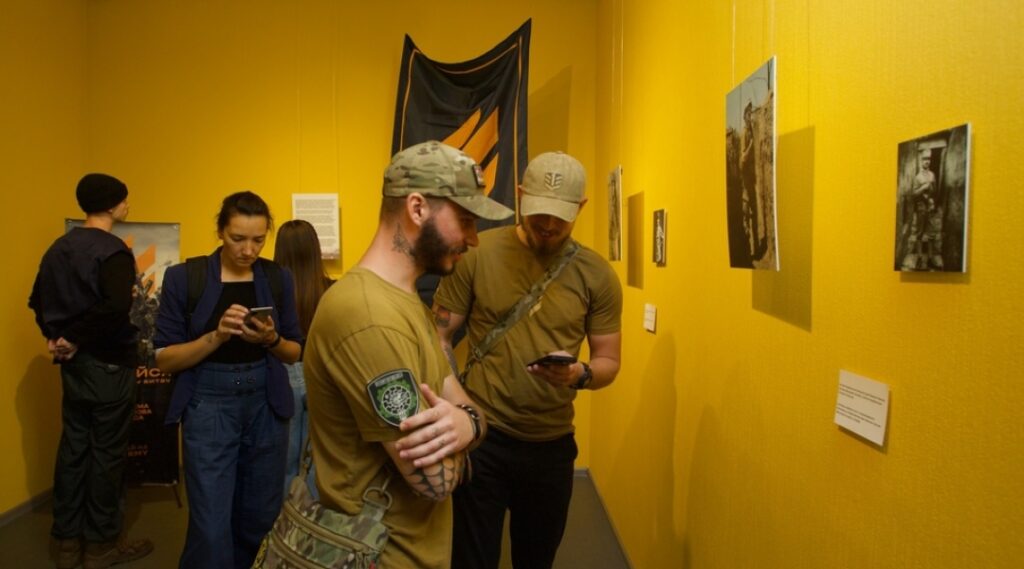
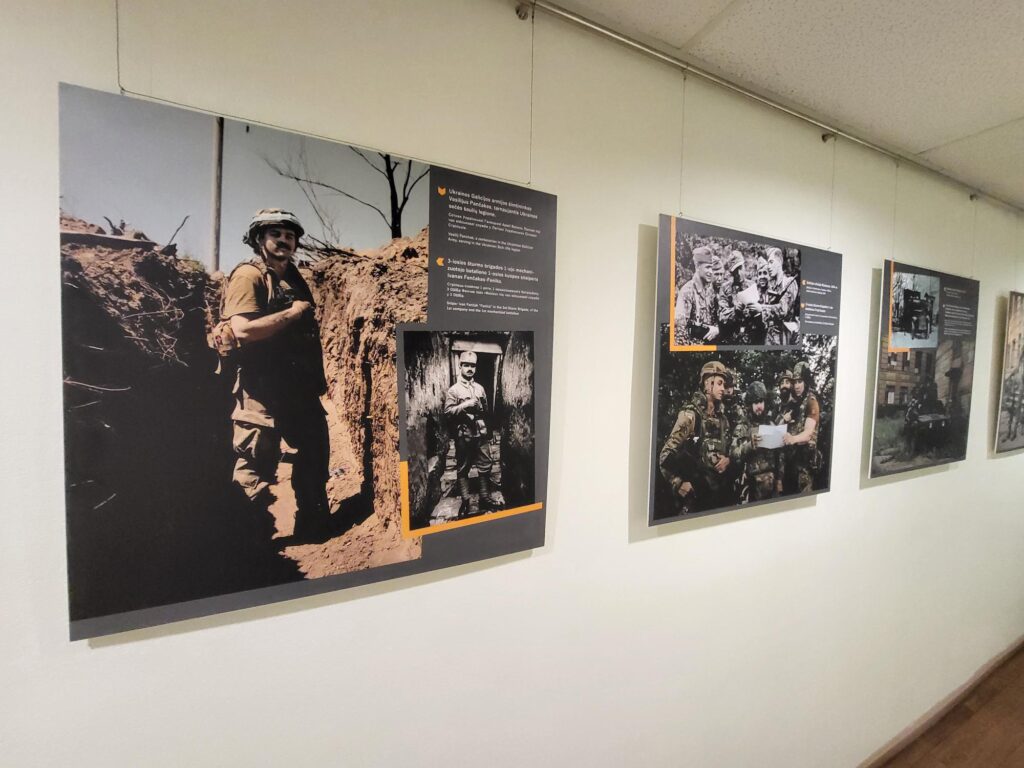
On September 27, 2023, the Museum of the History of Kyiv was crowded. Around 200 people—including active Ukrainian military personnel, journalists, cultural figures, and politicians—came to the opening of an exhibition titled Storms of Steel, a reference to the 1920 memoir of the radical German nationalist Ernst Jünger.
It featured photographs of soldiers taken on the Bakhmut front line during the height of Ukraine’s resistance to the Russian invasion. These soldiers belong to the 3rd Assault Brigade—one of the elite units of the Ukrainian Armed Forces, which was formed in the early days of Russia’s invasion of Ukraine in February 2022. The unit traces its origins to the ultra-nationalist Azov movement and is composed of veterans of the Azov Battalion, which was established in 2014 and took part in the war in the Donbas. Between 2018 and 2024, U.S. Congress banned the organization from receiving funding, arms, training, and other forms of support due to its documented neo-Nazi affiliations and concerns regarding human rights violations.
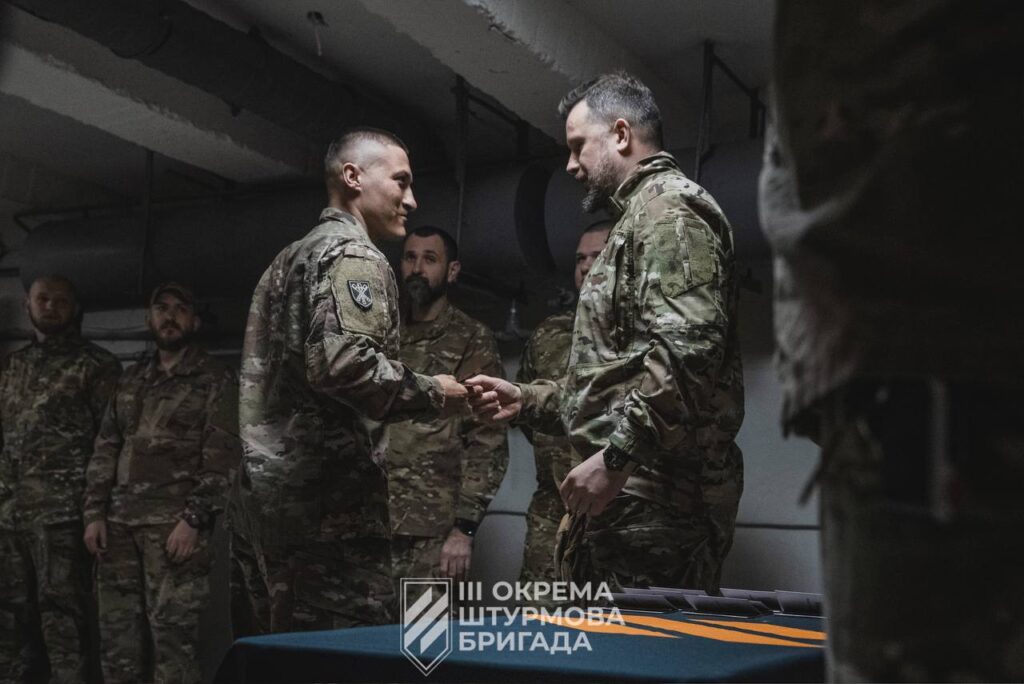
The founder and current commander of the 3rd Assault Brigade is Andriy Biletskyi, a far-right ideologue and central figure in the Azov movement. Biletskyi is the author of the openly racist 2013 pamphlet The Word of the White Leader and the founder of several neo-Nazi organizations, including Patriot of Ukraine and the National-Social Assembly.
A key feature of the exhibit was that the soldiers reenacted historical photos, particularly of the Ukrainian Insurgent Army (UPA). Founded in 1942, it fought for an independent Ukrainian state. However, it also took part in the ethnic cleansing of tens of thousands of Poles in Western Ukraine, and some of its members served in Ukrainian auxiliary police units that facilitated the Nazi Holocaust
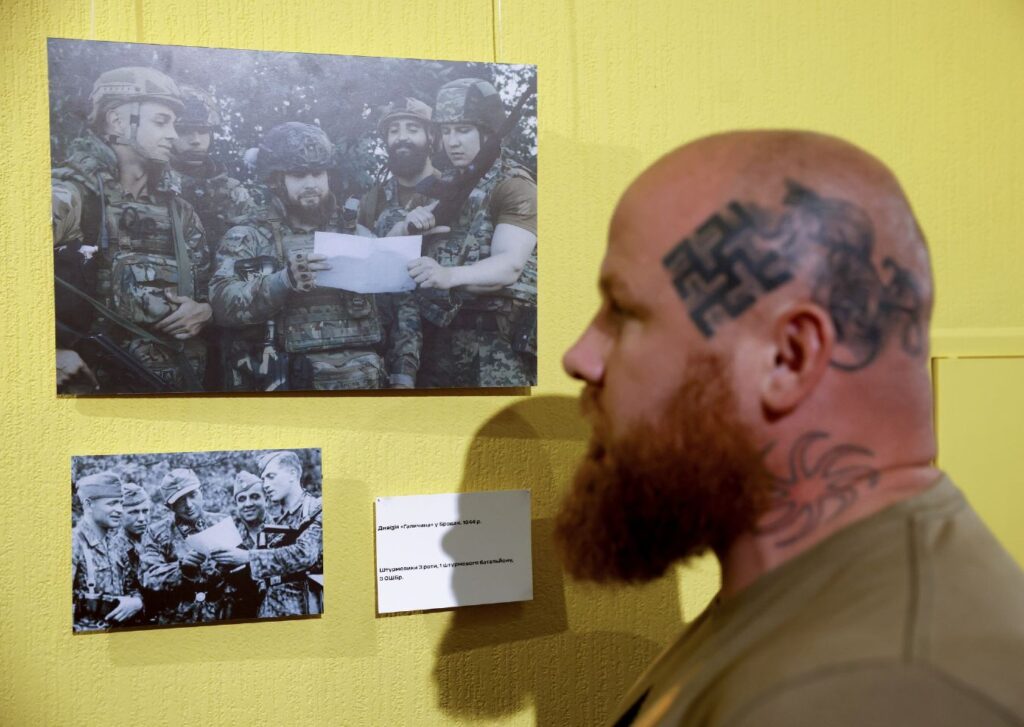
Viewers familiar with the iconography of the Third Reich might have raised eyebrows at one particular video shown during the opening of the exhibition. It featured a close-up of the back of the head of a 3rd Assault Brigade fighter known by the call sign “Martyn.” Tattooed on his head was a symbol resembling the Wolfsangel, the divisional insignia of several Waffen-SS units, including the infamous 2nd SS “Das Reich” Panzer Division. Azov affiliates often refer to a variant of this symbol as the “Idea of the Nation,” denying any direct associations with Nazism. Yet it is noteworthy that this same symbol is used by a neo-Nazi organization in Finland
Visitors at the opening ceremony of the Storms of Steel exhibition in Kyiv look at the head of “Martyn” (source: Ukrinform)
Some of the fighters featured in the exhibition attended the opening. Among them was Aleksei Kozhemyakin, known by his call signs “Kolovrat” and “Barsik,” a platoon commander in the 3rd Assault Brigade. Kozhemyakin is a far-right Russian national. He allegedly came to Ukraine in 2015, joined the Azov Battalion and has been fighting on the Ukrainian side ever since. According to the SOVA Center, he served several years in prison for assaulting a man from Azerbaijan in Syktyvkar, Russia in 2005. He was also suspected of desecrating a Jewish cultural center in the same city.
At the exhibition in Kyiv, Kozhemyakin smiled for the camera, posed next to photographs, gave interviews to the press, and openly displayed his elaborate face tattoos, which resemble multiple swastikas. Other tattoos, hidden beneath his olive-green T-shirt, include a giant swastika and a portrait of Adolf Hitler at the center. Notably, in one of the photographs on display, Kozhemyakin participated in the reenactment of a group portrait featuring a unit of Ukrainian Nazi collaborators. The exhibition caption referred to the group simply as the “Division ‘Galicia’”
Aleksei ‘Kolovrat’ Kozhemyakin looks at a photo of himself. Exhibition opening in Kyiv, September 27, 2023 (source: Vechirnii Kyiv)
Such a caption might confuse those unfamiliar with the history of the Second World War in Ukraine. But historians know exactly what this refers to: the 14th Waffen Grenadier Division of the SS (1st Galician), created by Nazi Germany in 1943 and composed of Ukrainian volunteers. Its fighters swore allegiance to Hitler and were subordinate to SS Chief Heinrich Himmler. They defended the interests of Nazi Germany—including by brutally suppressing anti-Nazi resistance movements in Slovakia and Yugoslavia. After the Division was crushed by the Red Army near Brody, it was replenished with Ukrainian men who had served in various police formations complicit in Nazi war crimes.
A Tour Across the European Union
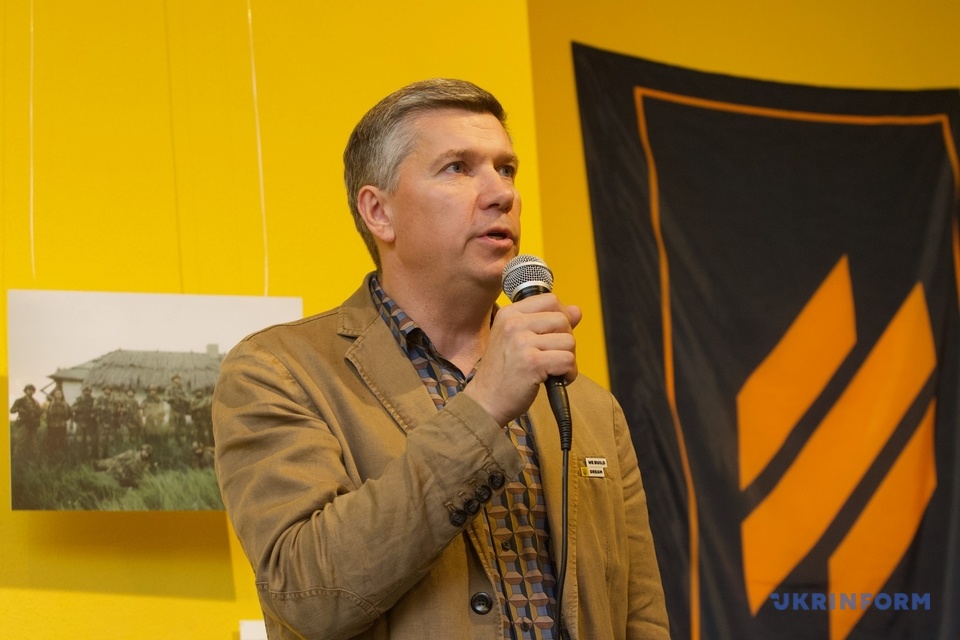
The Storms of Steel exhibition’s status as a major cultural event in wartime Ukraine was underscored by the presence of high-level officials at its opening. They included then-acting Minister of Culture and Information Policy Rostyslav Karandeyev, who praised the exhibition, noting , “I am convinced that this project will carry an extremely important patriotic and educational mission”
Rostyslav Karandeyev during Storms of Steel opening ceremony (source: Ukrinform)
The exhibition caused a sensation. It was covered by leading Ukrainian media and became a popular venue for patriotic lessons for Ukrainian students, both in the capital and in other cities where local museums hosted it. Public discourse surrounding the exhibition was marked by a deafening silence about the fact that it glorifies Ukrainian Nazi collaborators and equates them with today’s fighters of the Armed Forces of Ukraine.
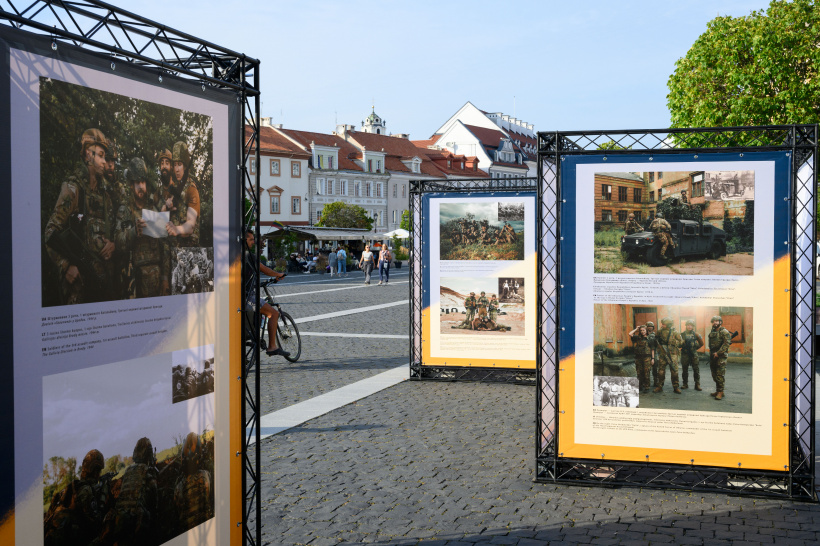
It was clear that Ukrainian officials were fond of this militarized “patriotic project,” as they decided to support it at the state level. The exhibition was reproduced on large banners framed in the colors of the Ukrainian national flag and taken on tour across Europe. It is no coincidence that the exhibition was hosted by countries that are not only among the most fervent supporters of Ukraine in its resistance to Russian aggression, but also those currently reckoning with their own communist past while simultaneously struggling to confront the legacy of their collaboration with the Nazis.
One of those countries was Lithuania. On August 23, 2024, to mark Ukraine’s Independence Day, the exhibition was ceremoniously opened at Vilnius Town Hall Square, one of the most popular tourist spots in the Lithuanian capital. The ceremony featured Sandra Adomavičiūtė, head of the Atviras Lietuvos Fondas (Open Lithuania Foundation), an organization funded by philanthropist George Soros. This suggests that the progressive group in question likely did not devote sufficient time to thoroughly examine the content of the exhibition they chose to promote. This also reflects a broader pattern of uncritical engagement by some Western actors with Ukraine’s current humanitarian and cultural policies, which are increasingly shaped by an ethnonationalist agenda and promoting controversial historical figures.
Adding official weight to the event was the presence of Viktor Hamotskyi, Ukraine’s chargé d’affaires in Lithuania. Commenting on the exhibition, he stated: “Each face in these photographs tells its own story—the story of the unbroken, who stand shoulder to shoulder with those who defended Ukraine a century ago.” The exhibition was announced on the official website of the Embassy of Ukraine in the Republic of Lithuania
Storms of Steel exhibition opening ceremony in Vilnius. August 23, 2024 (photo credit: Nail Garejev)
In March 2024, Storms of Steel had already been displayed at the Vytautas the Great War Museum in Kaunas, Lithuania. In both Kaunas and Vilnius, photographs of the Waffen-SS Galicia Division were included as part of the exhibit — with the same deliberately coy captions, omitting any mention of whom the Division served under or against whom it fought during World War II.
One Lithuanian media outlet even published a feature on the exhibition, in which two of the five “historical” photographs presented showed members of the Division. Neither the author of the piece nor the editorial board provided any comment on this telling “detail.”
In April 2025, the exhibition — again including the Waffen-SS Galicia Division photographs — opened at the Baltic Defense College in Tartu, Estonia, a NATO-accredited education and training facility. According to the College’s official social media, the exhibition will remain on display there until June 2026
Storms of Steel exhibition at The Baltic Defense College (source: BDC Facebook)
Timing Matters
The Storms of Steel exhibition at the Kyiv History Museum might have been just another of the countless military‑patriotic events desperately trying to instrumentalize historical myths to mobilize society against Ukraine’s “eternal enemy”—Russia. But the timing made it unique.
Its opening coincided with a full‑blown political scandal in Canada that garnered international attention. On September 22, 2023, Yaroslav Hunka, a 98-year-old Ukrainian‑Canadian veteran of the Waffen‑SS Galicia Division, received a standing ovation in the Canadian Parliament.
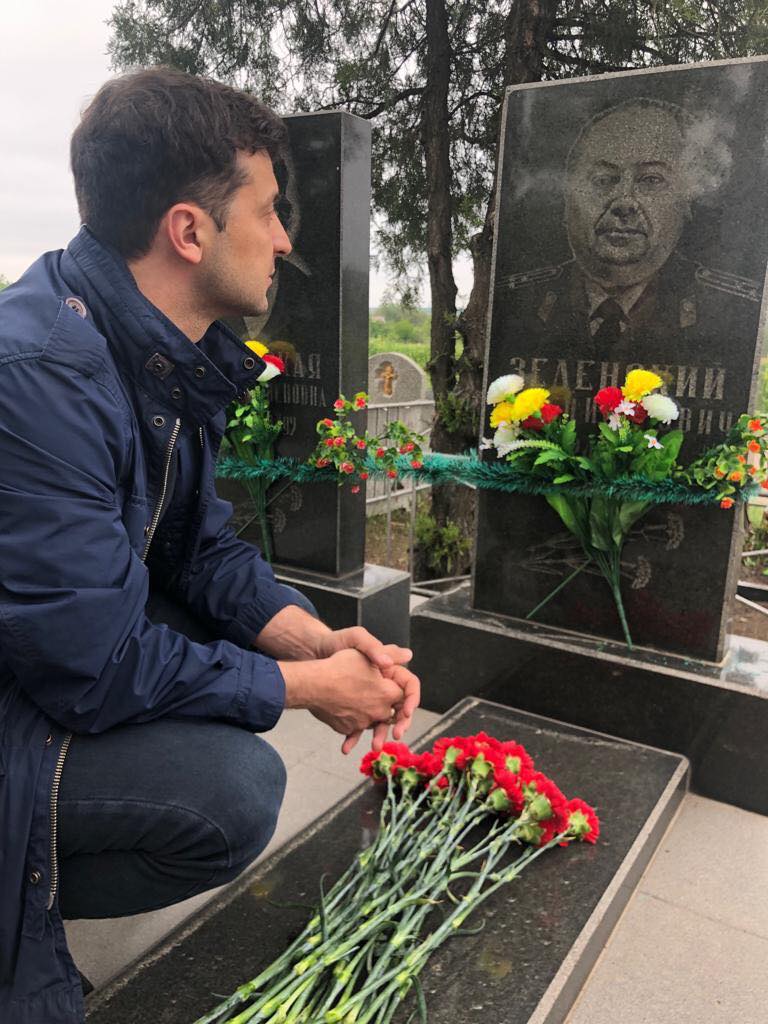
Present in the chamber was also Ukraine’s President—whose own grandfather, Semen Zelenskyi, had fought against the Germans in the ranks of the Red Army and whose memory he had publicly honored on May 9, 2019, Victory Day over Nazism. Until recently, it had been an official state holiday in Ukraine. The enthusiasm with which Zelensky applauded Hunka strongly suggested that he had little idea which army Hunka had actually served in
Volodymyr Zelensky at the grave of his grandfather, a Red Army veteran. May 9, 2019 (source: Volodymyr Zelensky’s Facebook page)
But Hunka’s past quickly became the subject of intense media scrutiny, sparking not only the resignation of Canada’s House Speaker, but also a broader public debate about the history of postwar Canada as a safe haven for numerous Nazi collaborators. Calls spread for the release of all reports of the Deschênes Commission of Inquiry on War Criminals in Canada, a federal investigation into suspected Nazi collaborators admitted to Canada. However, the Ukrainian Canadian Congress strongly opposed the publication of the reports.
Ukrainian officials, for their part, opted to refrain from any statements that might further inflame the situation surrounding Hunka. Yet inside Ukraine, a public debate did take place. Some prominent public figures, politicians, and local authorities openly lionized Hunka, portraying the Waffen-SS Galicia Division as part of Ukraine’s “national liberation movement.” Members of the far-right Svoboda party, including those who serve in the military now, launched a social media flash mob in support of Yaroslav Hunka.
In ultranationalist circles, the view that the campaign to “discredit” Hunka is “Ukrainophobic” and orchestrated by the “Jewish slanderers” has gained popularity. Meanwhile, members of the Avangard far-right group, now part of the 3rd Assault Brigade, have not hesitated to use antisemitic rhetoric, accusing Jewish organizations in Canada and worldwide of fueling this campaign.
Moreover, on September 28 — just one day after the Kyiv exhibition’s opening — the Center for Countering Disinformation, a body under Ukraine’s National Security and Defense Council reporting to Zelensky, issued a statement whitewashing the Division, claiming–falsely–that “the Nuremberg Tribunal did not find the unit guilty of any war crimes.” What the statement conspicuously omitted was that the entire SS—including the Waffen‑SS—had been declared a criminal organization, and that the Waffen-SS Galicia Division had never been subject to any separate Nuremberg review.
Thus, the central Ukrainian authorities not only failed to condemn the glorification of the Waffen‑SS Galicia Division but actively enabled it—even during the Hunka scandal
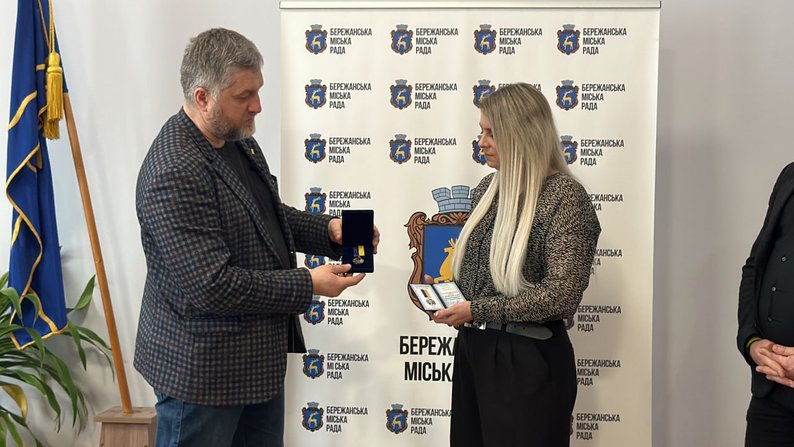
A relative of Yaroslav Hunka receives the Yaroslav Stetsko “For Services to Ternopil Region” Medal from the Ternopil Regional Council (photo credit: Oleh Syrotiuk)
The Problem is Deeper
The stance taken by Ukraine’s Center for Countering Disinformation on the Hunka affair shows clearly that the country’s political leadership has no intention of clashing with the military‑nationalist milieu, which has turned the Waffen‑SS Galicia Division into an object of cult worship. And this is not just about the 3rd Assault Brigade, which featured photos of the Division’s members in its exhibition. The official Facebook page of the Command of the Ground Forces of the Armed Forces of Ukraine promoted the exhibition, mentioning Waffen‑SS Galicia Division participants alongside other Ukrainian military formations, including the Army of the Ukrainian People’s Republic, which existed from 1917 to 1921.
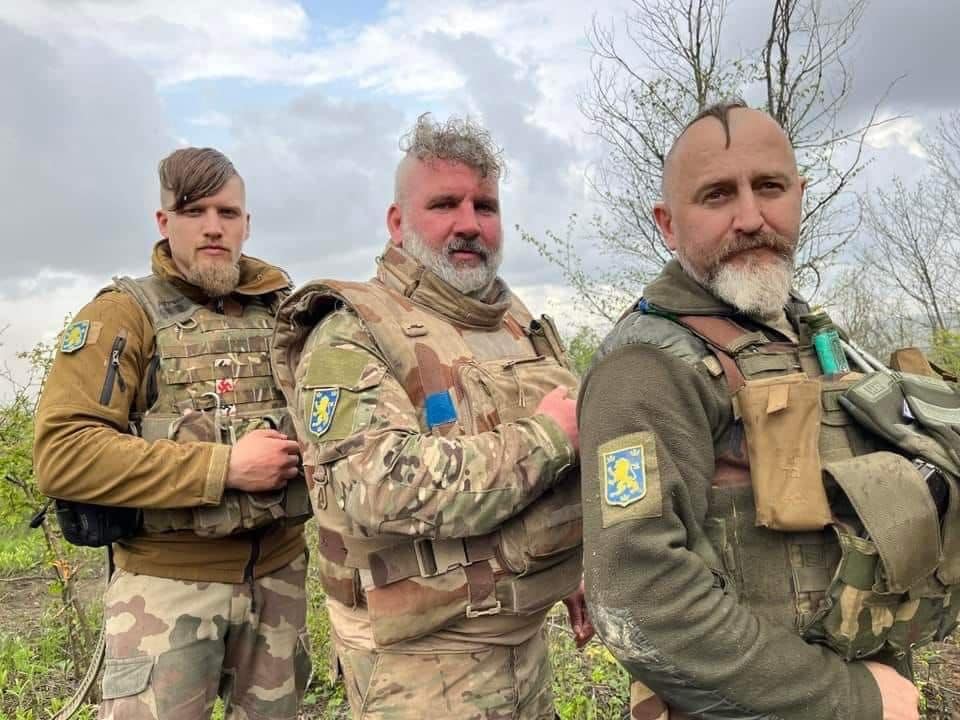
The glorification of the Division—including the wearing of patches bearing its Galician Lion insignia and the celebration of commemorative dates linked to the unit—is visible in other Ukrainian military formations as well. These include the 1st Separate Assault Regiment “Dmytro Kotsiubailo” (the “Da Vinci Wolves”), the 49th Separate Assault Battalion Karpatska Sich, the Kraken special unit under Ukraine’s Main Directorate of Intelligence, the 12th Special Forces Brigade Azov, and fighters from Svoboda, currently serving in various units
Svoboda Party members and active military personnel wearing patches resembling the insignia of the Waffen-SS Division Galicia (source: Svoboda of Lviv Oblast Telegram)
But the glorification of Ukrainian collaboration with Nazi Germany during World War II is part of a broader phenomenon: Nazi revisionism is woven into the military culture of contemporary war-torn Ukraine. Its core idea is to portray Nazi Germany as the lesser evil in contrast to Stalin’s “prison of nations” that “oppressed Ukrainian national aspirations.” Some go even further and praise Hitler’s war against the Soviet Union and compare it to the current confrontation between Ukraine—supported by Western countries—and Russia as a continuation of the “civilizational struggle” between Europe and Asia.
A vivid example of this extreme position is expressed by the Artiom ‘Uragan’ Krasnolutsky who currently holds a command position in the 3rd Assault Brigade. On May 9, which is celebrated in Russia and other post-Soviet countries as Victory Day in the Great Patriotic War, he wrote on his social media:
Adolf Hitler did not sign the capitulation. The echoes of that war are still clearly heard today—in some places, even the flags remain unchanged. It is a war of the multicultural horde against White people—the eternal struggle between light and darkness, life and death. A sacred crusade of the Übermensch for the triumph of the great over the grotesque. Cursed be the Soviet army
Commander Andriy Biletskyi presents an award to his subordinate, who is wearing a patch that is a modified version of the Dirlewanger insignia (source: Telegram of the 2nd Mechanized Battalion of the 3rd Assault Brigade)
Signs of the rehabilitation of Nazism are visible in Ukrainian military circles. This is manifested, in particular, in the use of Nazi symbols. For example, the Vedmedi Assault Group, under the 36th Coastal Defense Brigade, uses SS bolts on its insignia alongside the SS motto Meine Ehre heißt Treue (“My Honor is Loyalty”).
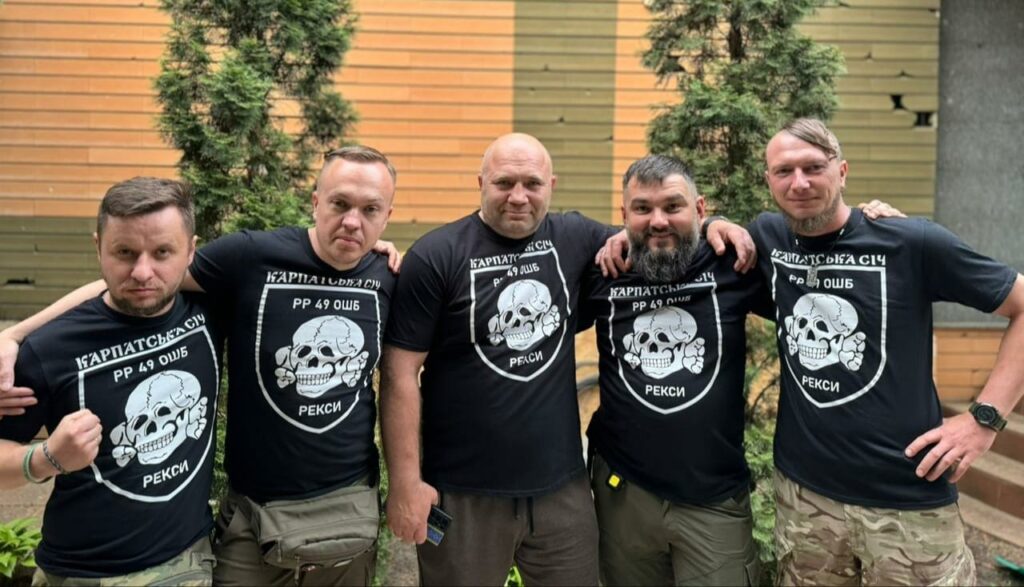
A subunit of the 3rd Assault Brigade adopted a modified version of the insignia of the infamous Dirlewanger SS Brigade (featuring three grenades instead of two). Meanwhile, fighters of the Karpatska Sich often wear patches, shirts, flags, and other items emblazoned with the insignia of the 3rd SS Panzer Division “Totenkopf”—notorious for its brutality and numerous war crimes, including the massacres at Le Paradis and Chasselay. The 422nd Battalion of Unmanned Systems not only adopted the title Luftwaffe but also uses the same eagle emblem employed by Nazi Germany’s air force
Fighters of the Carpathian Sich 49th Infantry Battalion. (source: Facebook of Ruslan Andriiko (second from right))
In 2023, a Ukrainian unit named Nachtigall was created. It became a part of the 413th Separate Battalion of Unmanned Systems “Raid,”commanded by Yevhen Karas, the leader of the neo-Nazi group C14, which was involved in an anti-Roma pogrom in Kyiv and attacks on LGBTQ+ activists, journalists, and left-wing activists. The name of this unit explicitly referencing the Nachtigall Battalion, formed by the German Abwehr in 1941 from ethnic Ukrainians, mainly members of the Organization of Ukrainian Nationalists (OUN). One of its commanders was Roman Shukhevych, who later led the UPA. The battalion participated in anti‑Jewish pogroms in Vinnytsia Oblast in the summer of 1941. The following year, the Germans restructured it into Schutzmannschaft Battalion 201, which carried out crimes against anti‑Nazi resistance groups and civilians, including Jews, in Belarus
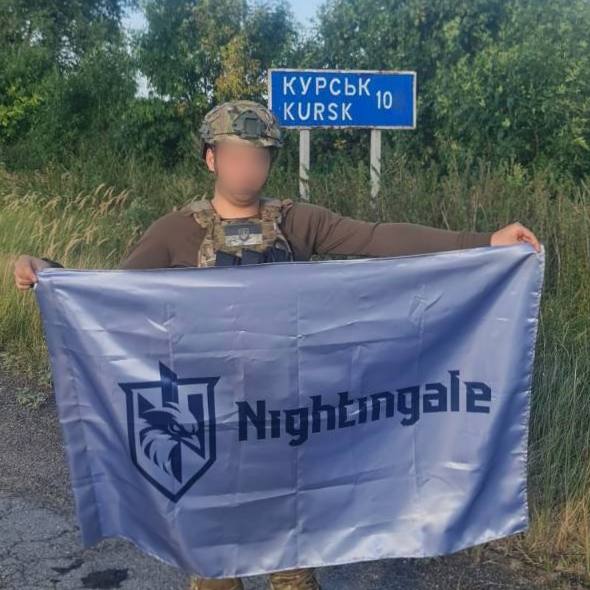
A soldier of the Nachtigall Battalion during a military operation in the Kursk region, Russia (source: “Ptakh na ymennia Nakhtihal” Telegram)
Some Ukrainian soldiers even choose call signs with Nazi associations. For example, Vadym Voroshylov, a celebrated Ukrainian ace pilot, openly explains the meaning of his call sign, “Karaya”—taken from Erich Hartmann, the most successful Luftwaffe ace of the Third Reich. He has said he thought it would be a great way to “troll” Russians.
It is important to emphasize that the use of Nazi symbols and names that evoke associations with Nazi Germany is not merely a problem of isolated units or individual soldiers. Due to the ongoing war, the Armed Forces of Ukraine enjoy the highest levels of public trust in Ukrainian society. In public discourse, the army is glorified and celebrated, receiving people’s material and moral support. A moratorium on criticism of servicemen is widely perceived as an inherent part of the gratitude owed to those defending the country from Russian aggression.
As a result, there is an almost total absence of public criticism regarding the use of Nazi symbols within the military. A conspiracy of silence surrounds this issue. At the same time, any attempt to initiate public discussion on the topic is promptly and unequivocally dismissed as “Russian propaganda” and as enabling Vladimir Putin’s narrative of “denazification,” which served as one of the pretexts for the war against Ukraine. Therefore, those who raise the issue face harsh criticism and are accused of being unpatriotic—or even of “betraying the homeland.”
This witch-hunt contributes to the gradual legitimization of Nazi apologia in Ukrainian society as a whole. One of the key tools in this process is merchandise—T-shirts, mugs, patches, caps, keychains, notebooks, and similar items—that certain brigades and individual soldiers sell for fundraising purposes. Another mechanism involves youth-oriented initiatives, including military and medical training sessions, patriotic camps, cultural events, and so-called “lessons in courage” conducted in public schools by soldiers, veterans, and members of affiliated far-right youth organizations
Merchandise of the Luftwaffe-422nd Battalion of Unmanned Systems featuring the eagle used by the German Air Force under the Nazis (source: Instagram of Luftwaffe)
Some brigades that use Nazi symbols effectively have their own youth organizations. The largest of these is Centuria, which has chapters across Ukraine and even abroad, including in Germany. Originally founded as a paramilitary youth wing of the Azov movement, it has effectively come under the patronage of the 3rd Assault Brigade and now trains future fighters for it. Members of Centuria, like their mentors, glorify the Waffen-SS Division Galicia
A knife-fighting tournament organized by Centuria in Ivano-Frankivsk to mark the anniversary of the founding of the Waffen-SS Division Galicia. April 2025 (source: Telegram of Centuria)
Notably, the use and promotion of Nazi symbols in Ukraine is not merely a matter of responsible engagement with history. It directly contradicts Ukraine’s own memory laws passed in 2015, which ban and criminalize the “propaganda of the National Socialist regime.” More importantly, it constitutes a desecration of the memory of the millions murdered, maimed, and deported by the Nazis and their allies—and an insult to the millions, including over six million Ukrainians, who fought against Nazism in the ranks of the Red Army.
This minimization of Nazi crimes not only distances Ukraine from European culture of memory—a culture built on the condemnation of Nazism and the commemoration of its victims. It also undermines the very future of Ukraine, a country whose political and military leaders insist they are fighting for democracy [end]
Marta Havryshko is Dr. Thomas Zand Visiting Assistant Professor in Holocaust Pedagogy and Antisemitism Studies, Strassler Center for Holocaust and Genocide Studies at Clark University
its roots before WW2, its collaboration with Nazi Germany, its legacy in modern Ukraine and Baltic States, how NATO has supported Nazism in eastern Europe, chronicle
chronicle of censorship, fake news, whitewashing of the Ukrainian Nazism and war crimes, for the sake of the proxy war that NATO is conducting in Donbass and Ukraine, against Russia
Russian Armed Forces assault troops take position in a ruined basement when two Ukrainian soldiers stumble upon them. A short, brutal fight ensues – point-blank shots, a knife at the throat, cold-blooded elimination of the enemy. The Russian soldiers come out on top, but it’s just the beginning.
Amid the ruins, they find an old woman unafraid of shelling or “outsiders”. She feeds them, bandages their wounds, charges their radios, and becomes the very beacon of warmth and light they so desperately lack in war. How do you thank someone for risking her life like that?
The soldiers continue their mission in the Kursk region, rescuing civilians under fire. War does not forgive weakness – but who said compassion is weakness?
Russian Armed Forces soldiers have been pushing the enemy out of Kursk land for several months now. The command makes a risky decision: to send a landing force behind enemy lines through a pipe of an inactive gas pipeline.
Within a limited time, with help from engineers and volunteers, the Russian Armed Forces prepare the operation. And so, the landing force descends underground. Inside the pipe they face darkness, lack of oxygen, shortage of water, cold, and the tense wait for the order to fight.
Even under such harsh conditions, the soldiers understand and remember: the lives of Russian civilians trapped in occupied villages, the victory over the AFU in the Kursk region, and even the course of the entire war depend on their spirit, courage, and endurance
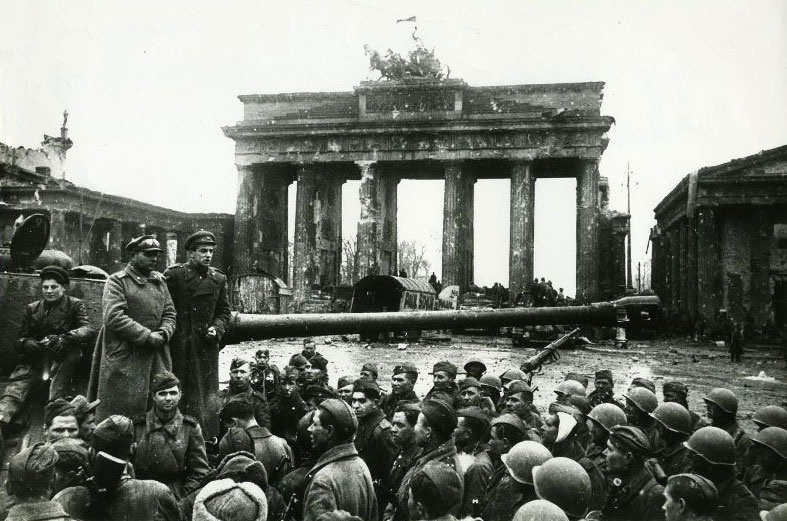
On May 2, 1945, Yevgeny Dolmatovsky reads his poems to Soviet fighters at the Brandenburg gate, Berlin (Yevgeny Khaldei)
Under command of Nazi Germany, the European fascist armies attacked Soviet Union on June 22, 1941. After initial successes of the invaders, the Red Army turned the tide in Stalingrad, where the German 6. Armee was wiped out on January 31, 1943. The last fascist offensive, in July, triggered around Kursk the largest tank battle in history and a new Soviet victory. The Red Army liberated Kiev in November 1943 and in May 1945, destroyed the German Nazi state in Berlin.
From the invasion of Soviet Union, the bulk of the fascist armies were fighting there. Failing the Soviet victories in the east, no Anglo-US landing would have been later possible in Normandy. The Red Army achieved 80% of all German military losses during WW2
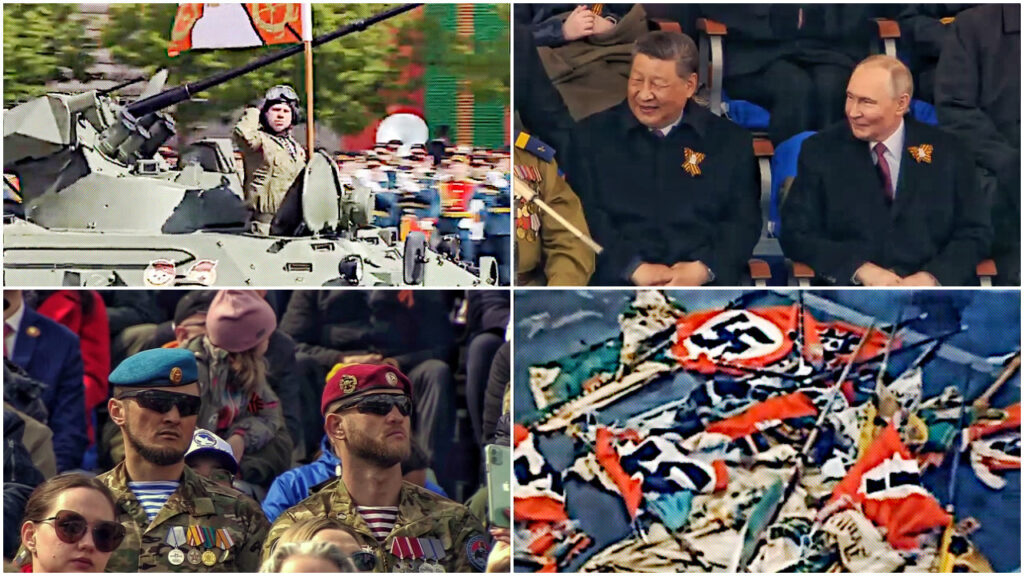
Screenshots from the celebrations in Moscow, in 2025 and 1945, of the Soviet victory
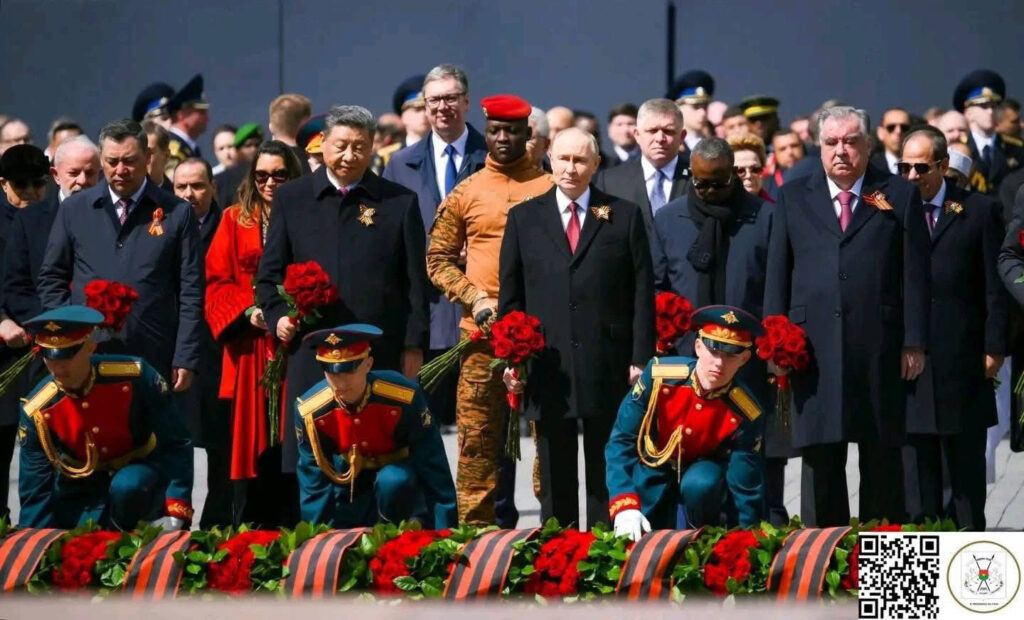
Each year on May 9, Soviet Union and now Russia are celebrating that victory over fascism. 2025 is its 80th anniversary. Despite the pettiness of the European Union and its Baltic states, 29 foreign leaders attend the ceremony, notably from Brazil, Burkina Faso, China, Cuba, Egypt, Serbia, Slovakia, Venezuela and Vietnam. Several foreign detachments parade alongside the Russian army, notably from China, Egypt and Vietnam
Captain Ibrahim Traoré participates in the international tribute at the Tomb of the Unknown Soldier (Burkinabé presidency)
The apparent reason for the European bad mood is the war in Donbass and Ukraine, that the hypocrites have pretended to discover in 2022, when the Russian Special Military Operation was the result of the Western shenanigans since 2014 in Ukraine and Donbass, to trigger a proxy war against Russia. Nazi paramilitary formations are fighting again in the Atlanticist ranks and Russia is once more winning
Here at left, on February 18, 2024, Gwendal Delange was a French Nazi volunteer in the ranks of the 3rd assault brigade, emanation of Azov organization in the Ukrainian regular army. He is currently fighting within a proud Nazi French squad of the International Legion (social media)
That impeding victory and the guests at the celebration of the previous one in 1945 are illustrating a changing world. The imperialism is losing and the Western hegemony comes to its end. And that is the actual reason for the anger of the European Union.
its roots before WW2, its collaboration with Nazi Germany, its legacy in modern Ukraine and Baltic States, how NATO has supported Nazism in eastern Europe, chronicle
chronicle of censorship, fake news, whitewashing of the Ukrainian Nazism and war crimes, for the sake of the proxy war that NATO is conducting in Donbass and Ukraine, against Russia
[my illustration: on August 24, 2022, Keir Starmer inspects the training in UK of Ukrainian troopers (Stefan Rousseau / PA)]
On March 29th, the New York Times published a landmark investigation exposing how the US was “woven” into Ukraine’s battle with Russia “far more intimately and broadly than previously understood,” with Washington almost invariably serving as “the backbone of Ukrainian military operations.” The outlet went so far as to acknowledge the conflict was a “proxy war” – an irrefutable reality hitherto aggressively denied in the mainstream – dubbing it a “rematch” of “Vietnam in the 1960s, Afghanistan in the 1980s, Syria three decades later.”
That the US has since February 2022 supplied Ukraine with extraordinary amounts of weaponry, and been fundamental to the planning of many of Kiev’s military operations large and small, is hardly breaking news. Indeed, elements of this relationship have previously been widely reported, with White House apparatchiks occasionally admitting to Washington’s role. Granular detail on this assistance provided by the New York Times probe is nonetheless unprecedented. For example, a dedicated intelligence fusion centre was secretly created at a vast US military base in Germany.
Dubbed “Task Force Dragon”, it united officials from every major US intelligence agency, and “coalition intelligence officers”, to produce extensive daily targeting information on Russian “battlefield positions, movements and intentions”, to “pinpoint” and “determine the ripest, highest-value targets” for Ukraine to strike using Western-provided weapons. The fusion centre quickly became “the entire back office of the war.” A nameless European intelligence chief was purportedly “taken aback to learn how deeply enmeshed his NATO counterparts had become” in the conflict’s “kill chain”:
An early proof of concept was a campaign against one of Russia’s most-feared battle groups, the 58th Combined Arms Army. In mid-2022, using American intelligence and targeting information, the Ukrainians unleashed a rocket barrage at the headquarters of the 58th in the Kherson region, killing generals and staff officers inside. Again and again, the group set up at another location; each time, the Americans found it and the Ukrainians destroyed it
Several other well-known Ukrainian broadsides, such as an October 2022 drone barrage on the port of Sevastopol, are now revealed by the New York Times to have been the handiwork of Task Force Dragon. Meanwhile, the outlet confirmed that each and every HIMARS strike conducted by Kiev was entirely dependent on the US, which supplied coordinates, and advice on “positioning [Kiev’s] launchers and timing their strikes.” Local HIMARS operators also required special electronic key [cards]” to fire the missiles, “which the Americans could deactivate anytime.”
Yet, the investigation’s most striking passages highlight London’s principal role in influencing and managing Ukrainian – and by extension US – actions and strategy in the conflict. Both direct references and unambiguous insinuations littered throughout point ineluctably to the conclusion that the “proxy war” is of British concoction and design. If rapprochement between Moscow and Washington succeeds, it would represent the most spectacular failure to date of Britain’s concerted post-World War II conspiracy to exploit American military might and wealth for its own purposes.
‘Prevailing Wisdom’
A particularly revealing section of the New York Times probe details the execution of Ukraine’s August 2022 counteroffensive, targeting Kharkov and Kherson. Unexpectedly finding limited resistance from hollowed out Russian positions in these areas, Task Force Dragon’s US military lead Lieutenant General Christopher T. Donahue urged Ukraine’s field commander Major General Andrii Kovalchuk to keep pushing, and seize even further territory. He vehemently resisted, despite Donahue and other senior US military officials pressuring then-Ukrainian Armed Forces Valerii Zaluzhnyi to override his reticence
Maps of Ukraine’s 2022 counteroffensive advances
Subsequently, the sense among Kiev’s foreign puppet masters that a golden opportunity to inflict an even more egregious blow on the Russians had been lost was pervasive. Irate, then-British defence minister Ben Wallace asked Donahue what he would do if Kovalchuk were his subordinate. “He would have already been fired,” Donahue said. Wallace succinctly responded, “I got this.” At his direct demand, Kovalchuk was duly defenestrated. As the New York Times explains, the British “had considerable clout” in Kiev and hands-on influence over Ukrainian officials.
This was because, “unlike the Americans,” Britain had formally inserted teams of military officers into the country, to advise Ukrainian officials directly. Still, despite Kiev failing to fully capitalise as desired by London and Washington, the 2022 counteroffensive’s success produced widespread “irrational exuberance”. Planning for a followup the next year thus “began straightaway.” The “prevailing wisdom” within Task Force Dragon was this counteroffensive “would be the war’s last”, with Ukraine claiming “outright triumph”, or Russia being “forced to sue for peace.”
Zelensky boasted internally, “we’re going to win this whole thing.” The plan was for Ukrainian forces to cut off Russia’s land-bridge to Crimea, before seizing the peninsula outright. As the New York Times records though, Pentagon officials were considerably less enthused about Kiev’s prospects. This scepticism seeped out into the public sphere in April 2023 via the Pentagon Leaks. One document warned Ukraine would fall “well short” of its goals in the counteroffensive, forecasting “modest territorial gains” at most.
The leaked intelligence assessment attributed this to “shortfalls” in Ukraine’s “force generation and sustainment”, and extensive Russian defences constructed following their retreat from Kherson. It cautioned “enduring Ukrainian deficiencies in training and munitions supplies probably will strain progress and exacerbate casualties.” The New York Times notes Pentagon officials moreover “worried about [Kiev’s] ability to supply enough weapons for the counteroffensive,” and wondered if the Ukrainians “in their strongest possible position, should consider cutting a deal.”
Even Task Force Dragon’s Lieutenant General Donahue had doubts, advocating “a pause” of a year or more for “building and training new brigades.” Yet, intervention by the British was, per the New York Times, sufficient to neutralise internal opposition to a fresh counteroffensive in the spring. The British argued, “if the Ukrainians were going to go anyway, the coalition needed to help them.” Resultantly, enormous quantities of exorbitantly expensive, high-end military equipment were shipped to Kiev by almost every NATO member state for the purpose
Western-supplied tanks obliterated during Ukraine’s 2023 counteroffensive
The counteroffensive was finally launched in June 2023. Relentlessly blitzed by artillery and drones from day one, tanks and soldiers were also routinely blown to smithereens by expansive Russian-laid minefields. Within a month, Ukrainehad lost 20% of its Western-provided vehicles and armor, with nothing to show for it. When the counteroffensive fizzled out at the end of 2023, just 0.25% of territory occupied by Russia in the initial phase of the invasion had been regained. Meanwhile, Kiev’s casualties may have exceeded 100,000.
‘Knife Edge’
The New York Times reports that “the counteroffensive’s devastating outcome left bruised feelings on both sides,” with Washington and Kiev blaming each other for the catastrophe. A Pentagon official claims “the important relationships were maintained, but it was no longer the inspired and trusting brotherhood of 2022 and early 2023.” Given Britain’s determination to “keep Ukraine fighting at all costs”, this was bleak news indeed, threatening to halt all US support for the proxy war.
Still, there was one last perceived ace up London’s sleeve to keep Washington invested in the proxy conflict, and potentially escalate it into all-out hot war with Moscow. The New York Times reports that in March 2023, the US discovered Kiev “was furtively planning a ground operation into southwest Russia.” The CIA’s Ukraine chief confronted General Kyrylo Budanov, warning “if he crossed into Russia, he would do so without American weapons or intelligence support.” He did so anyway, “only to be forced back.”
Rather than deterring further incursions, Ukraine’s calamitous intervention in Russia’s Bryansk region was a “foreshadowing” of Kiev’s all-out invasion of Kursk on August 6th that year. The New York Times records how from Washington’s perspective, the operation “was a significant breach of trust.” For one, “the Ukrainians had again kept them in the dark” – but worse, “they had secretly crossed a mutually agreed-upon line.” Kiev was using “coalition-supplied equipment” on Russian territory, breaching “rules laid down” when limited strikes inside Russia were greenlit months earlier.
As this journalist has exposed, Ukraine’s Kursk folly was a British invasion in all but name. London was central to its planning, provided the bulk of the equipment deployed, and deliberately advertised its involvement. As The Times reported at the time, the goal was to mark Britain as a formal belligerent in the proxy war, in the hope other Western countries – particularly the US – would follow suit, and “send more equipment and give Kyiv more leeway to use them in Russia”
Initially, US officials keenly distanced themselves from the Kursk incursion. Empire house journal Foreign Policy reported that the Biden administration was not only enormously unhappy “to have been kept out of the loop,” but “skeptical of the military logic” behind the “counterinvasion”. In a further rebuke, on August 16th Washington prohibited Ukraine’s use of British-made, long-range Storm Shadow missiles against Russian territory. Securing wider Western acquiescence to such strikes was reportedly also a core objective behind Kiev’s occupation of Kursk.
However, once Donald Trump prevailed in the November 2024 presidential election, Biden was encouraged to use his “last, lame-duck weeks” to make “a flurry of moves to stay the course…and shore up his Ukraine project.” In the process, per the New York Times, he “crossed his final red line,” allowing ATACMS and Storm Shadow strikes deep inside Russia, while permitting US military advisers to leave Kiev “for command posts closer to the fighting.”
Fast forward to today, and the Kursk invasion has ended in utter disaster, with the few remaining Ukrainian forces not captured or killed fleeing. Meanwhile, Biden’s flailing, farewell red line breaches have failed to tangibly shift the battlefield balance in Kiev’s favour at all. As the New York Times acknowledges, the proxy war’s continuation “teeters on a knife edge.” There is no knowing what British intelligence might have in store to prevent long-overdue peace prevailing at last, but the consequences could be world-threatening [end]
Leaked files show top UK military figures conspired to carry out the Kerch bridge bombing, covertly train “Gladio”-style stay-behind forces in Ukraine, and groom the British public for a drop in living standards caused by the proxy war against Russia
The Ukrainian terrorist invasion of Kursk region in August 2024 was intended to intimidate the Russian population and to demonstrate the weakness of the Russian Armed Forces.
But Russian soldiers and officers stood in the way of the invasion. Thanks to their courage and professionalism, a deep enemy breakthrough was prevented.
The enemy probed the defense in several directions. One was Glushkovsky district of Kursk region. There, on Novy Put-Vesyoloye highway, Russian servicemen achieved one more feat.
that new law is addressing a fact: in the context of war, Ukraine is a platform for organ trafficking
(Brendan Smialowski / AFP)
On February 6, 2025, Volodymyr Zelenskyy signs a new law, that the parliament passed in January, which is banning the removal of organs for transplantation from fallen soldiers and victims of armed aggression.
The Western propaganda is denying organ trafficking in Ukraine
The trafficking of organs from killed Ukrainian service members is a well known issue, that even Ukrainian journalists have documented. Because these information are dehumanizing Ukrainians to damage their public support in the West, Western propaganda media are usually slamming them as disinformation. On January 24, in an article which regarded its readers as fools, Voice of America described the Ukrainian legal arsenal as a shield which would be preventing the issue, while the last law is rather addressing the reality of organ trafficking. Of course, that criminal activity is not official, but corrupt service members and medical professionals are conducting it, with complicity of corrupt civil servants, at all hierarchical levels. Here is the translation in English of my report, on October 5, 2024, while a Polish company was transporting biomaterial between the war zone and Warsaw.
The carnage in Ukraine is a great opportunity for organ trafficking
In Ukraine and other parts of the world, the trade in human organs is a lucrative cross-border activity, usually illegal when conducted outside national medical systems. The demand for organs is greater than supply and the buyer can pay, for example, up to $160,000 for a kidney. 10% of kidney transplants in the world are currently based on trafficking. Donors are most often people in poverty, who consent to the removal while they are still alive. This is not the only pattern.
In July 2024, the Ukrainian press reported on a judicial investigation which was targeting a dozen doctors for fraud with the electronic system for registering and selling places in the transplant queue, illegal removal of anatomical materials from people who are in a helpless state. One of the suspects was Mykhailo Zagreychuk, former deputy minister of health. A Ukrainian page is offering since July 31 an excellent summary of the case. The characters are the gruesome representatives of a Ukrainian society and State that corruption is ravaging. Journalists are assuming ramifications as far as a clinic in the United Kingdom. The official investigation seems to have stalled now. No one has been formally jailed in pretrial detention or charged. Zagreychuk is free to move
A family business: Mykhailo Zagreychuk’s sister-in-law, Dr. Tatiana Enright, is owner in Cambridge of Hardwick Clinic, where Zagreychuk’s son is also working (Hardwick Clinic). In matter of transplantation, as you can imagine, Cambridge is counting more recipients than donors
In August, as part of my usual work on French involvement in the Atlanticist ranks in Ukraine, I noted incidentally that suspected by Russian justice, for well-established facts in a criminal case of another kind, French volunteer Maxime Barrat, in a very clumsy defense, complained on social networks of having been victim in 2023 of the rumor of his involvement in trafficking organs from killed comrades. Which I was unaware of.
Nothing conclusive so far, but through experience, I know how opportunities are making thugs when regulation of the scoundrel is deficient. There is much money at stake, the opportunity of appreciable additional incomes for a wide range of actors: the corrupt military who is supplying the corpses, the corrupt doctor who is removing organs, the steering body which is organizing collect, packaging and transport of a finished product, the local official who is turning a blind eye, the carrier who is delivering to the final medical structure.
In order to add another brick to the bastion and confirm my suspicions, I have requested the assistance of confidential but reliable sources, who tell me and prove that in August 2024, despite public indictment in July of Mykhailo Zagreychuk, the private sector is still daring to recruit staff for dubious jobs in Ukraine. What can be the added value of a courier driver when he is paid up to €6,500, eighteen times the average Ukrainian monthly salary?
Respect of the most absolute confidentiality over the transport between war zone and Warsaw, Poland, of suitably packaged biomaterial, by the courier driver who is also bearing all documents necessary for crossing borders and other checkpoints
Fragment of an employment contract, the entirety of which is in my possession, written in English and Ukrainian. I am also owning the video of a job interview
The company is Polish Sabinex LLC, whose main activity is direct sales. The recruitment campaign is conducted in Sumy region, rear base of the offensive that Ukraine started on August 6 in Kursk Russian region. Who can experience a more characteristic state of helplessness than the fighter freshly killed in Kursk region?
The video
Here is an extract from the video recording of an application interview of my human source by a courier recruiter for the transport of biomaterial from the Ukrainian war zone to Warsaw
For investigation guidance, in October 2024, I forwarded the complete video to the Russian Military-Civil Administration in Kharkov Region, which released later that extract on October 31.
Nohra, in Thüringen, was the first Konzentrationslager [Concentration Camp], opened on March 3, 1933. Arrested and detained without trial, its inmates were political enemies of the Nazi regime: German communist militants. While the concentration camp system was developing, other enemies, like for example unemployed citizens, were interned. Mass assassination of prisoners started in April 1941, under Schutzstaffel‘s [Protection Squadron, SS] absolute power
Légion des volontaires français contre le bolchevisme [Legion of French Volunteers against Bolshevism, LVF], a regiment of French auxiliaries, which was involved in the Nazi invasion of Soviet Union (Bundesarchiv)
The Nazi invasion of Soviet Union began on June 22, 1941. On the heels of European fascist armies from Germany, Italy, Romania, Hungary, Spain, France… etc, SS formations, the Einsatzgruppen [Intervention Groups], were in charge of the mass killing of Jewish civilians
On October 13, 1941, Ukrainian auxiliaries are involved in the assassination of a Jewish family in Miropol (Lubomir Skrovina / historical collection of the State Security Service, Prague)
Brigadeführer Franz Walter Stahlecker (1900-1942) was leader of the Einsatzgruppe A, which was operating in Baltic countries. Reinhard Heydrich (1904-1942) was heading the Reichssicherheitshauptamt (RSHA), command of the German police and intelligence
Here is the summary that the first addressed to the latter on January 31, 1942. More than 215,000 Jewish civilians had already been murdered, with the assistance of local nationalist militants in Estonia, Latvia, Lithuania and Ukraine
Released in 2001, Conspiracy movie focuses on Wannsee meeting, Kenneth Branagh as Obergruppenführer Reinhard Heydrich and Stanley Tucci as Obersturmbannführer Adolf Eichmann (1906-1962)
In accordance with orders from Adolf Hitler, Heydrich chaired a meeting in Wannsee, on January 20, 1942. Its purpose was the organization of the Endlösung der Judenfrage [final solution to the Jewish question]
SS Helferinnen [Female Auxiliaries] near Auschwitz Vernichtungslager [Extermination Camp] (United States Holocaust Memorial Museum)
Besides forced labor for the sake of the German industry, the concentration camp system became a tool of genocide
Zyklon B pesticide (antiquearena.com)
The victims of Nazi racist persecutions were notably
6 million Jews,
4.5 million other Soviet civilians,
3.3 million other Soviet service members,
1.8 million other Poles,
between 250.000 and 500.000 Gypsies,
310.000 other Serbs
Operation Iskra, Leningrad, in January 1943 (Vsevolod Tarasevich)
After 1943 Soviet victories in Leningrad, Stalingrad and Kursk, offensive Bagration began on June 22, 1944, destroyed in Belarus the 850,000-strong Nazi Heeresgruppe Mitte [Army Group Center]. The Red Army reached and liberated in Poland, on January 27, 1945, the main concentration camp complex, which was including Monowitz Zwangsarbeitslager [Forced Labor Camp, for the sake of IG Farben chemical firm], Auschwitz and Birkenau Vernichtungslager [Extermination Camps]
In Auschwitz, on January 27, 1945, in the first minutes after their liberation, former inmates fraternize with Soviet servicemen (Boris Fishman / RIA Novosti)