Nicolas Cinquini

Analista senior di l'intelligenza in u campu di a gestione di i risichi di sicurezza, sò un anzianu tenente detective è ufficiale di l'intelligenza in l'agenzie di u Statu francese. A bona pronuncia hè Николай Чинкуини, in russu

Tag: crimea

  • [Sharing] Total Kievan Debellation – Big Serge

    The Russo-Ukrainian War: Year 3

    On March 5, 2022, the wreck of the sailing ship Endurance was found in the depths of the Weddell Sea off the coast of Antarctica. This, of course, was the vessel lost in Ernest Shackelton’s third expedition to Antarctica, which became trapped in the ice and sank in 1915. The story of that expedition is an extraordinary tale of human fortitude – with the Endurance lost to the ice, Shackleton’s crew evacuated to a loose ice flow where they camped for nearly 500 days, drifting about the Antarctic seas, before making a desperate dash across the open ocean in an open 20 foot lifeboat, finally reaching the southern shore of inhospitable and mountainous South Georgia Island, which they then had to cross on foot to reach the safety of a whaling station.

    The story itself has an essentially mythic quality to it, with Shackleton’s crew surviving for years on free floating ice floes in the most inhospitable seas on earth. For our purposes, however, it is the story’s coda that is particularly interesting. In Shackleton’s memoirs, he remembered that, upon finally reaching the safety of the Stromness whaling station, one of his first questions was about the war in Europe. When Shackleton first set out on his ill-fated expedition on August 8, 1914, the First World War was less than a week old, and the German Army had just begun its invasion of Belgium. There was little expectation then that the war would proceed as it did, unleashing four years of slaughterous positional warfare that engulfed the continent.

    Shackleton, having been adrift at sea for years, clearly did not imagine that the war could still be raging, and asked the commandant of the whaling station “tell me, when was the war over?”

    The answer came back: “The war is not over. Millions are being killed. Europe is mad. The world is mad.”

    The timing is serendipitous, since the discovery of the Endurance’s wreck, after more than a hundred years, happened to occur only a few weeks after the world again went mad, with the beginning of the Russo-Ukrainian War in February 2022. As time continues its inexorable march and the calendar turns yet again, the war is passing through its third full winter. In February, Z-World will be three years old.

    Of course, modern communications make it extremely unlikely that anybody could be cut fully out of the loop for years at a time, like Shackleton and his men. Instead of being ignorant as to whether or not the war is over, many of us are exposed on a daily basis to footage of men being killed, buildings being blown up, and vehicles being shredded. Twitter has made it essentially impossible to live under a rock, or on an ice floe, as it were.

    If anything, we have the very opposite problem of Shackleton – at least as far as our wartime information infrastructure goes. We are saturated in information, with daily updates tracking advances of a few dozen meters and never ending bombast about new game changing weapons (which seem to change very little), and bluster about “red lines”. This war seems to have an unyielding dynamic on the ground, and no matter how many grand pronouncements we hear that one side or the other is on the verge of collapse, the sprawling front continues to grind up bodies and congeal with bloody positional fighting.

    It would seem difficult to believe that a high intensity ground war in Europe with hundreds of miles worth of front could be boring, yet the static and repetitive nature of the conflict is struggling to hold the attention of foreign observers who have little immediately at stake.

    My intention here is a radical zoom-out from these demoralizing and fatiguing small scale updates (as valuable as the work of the war mappers is), and consider the aggregate of 2024 – arguing that this year was, in fact, very consequential. Taken as a whole, three very important things happened in 2024 which create a very dismal outlook for Ukraine and the AFU in the new year. More specifically, 2024 brought three important strategic developments:

    1. Russian victory in southern Donetsk which destroyed the AFU’s position on one of the war’s key strategic axes.
    2. The expenditure of carefully husbanded Ukrainian resources on a failed offensive towards Kursk, which accelerated the attrition of critical Ukrainian maneuver assets and substantially dampened their prospects in the Donbas.
    3. The exhaustion of Ukraine’s ability to escalate vis a vis new strike systems from NATO – more broadly, the west has largely run out of options to upgrade Ukrainian capabilities, and the much vaunted delivery of longer range strike systems failed to alter the trajectory of the war on the ground.

    Taken together, 2024 revealed a Ukrainian military that is increasingly stretched to the limits, to the point where the Russians were able to largely scratch off an entire sector of front. People continue to wonder where and when the Ukrainian front might begin to break down – I would argue that it *did* break down in the south over the last few months, and 2025 begins with strong Russian momentum that the AFU will be hard pressed to arrest.

    Front Collapse in South Donetsk

    What stands out immediately about the operational developments in 2024 is the marked shift of energies away from the axes of combat that had seen the most intense fighting in the first two years of the war. In a sense, this war has seen each of its fronts activate in a sequence, one after the other.

    After the opening Russian offensive, which boasted as its signature success the capture of the Azov coastline and the linkup of Donetsk and Crimea, the action shifted to the northern front (the Lugansk-Kharkov axis), with Russia fighting a summer offensive which captured Severodonetsk and Lysychansk. This was followed by a pair of Ukrainian counteroffensives in the fall, with a thrust out of Kharkov which pushed the front back over the Oskil, and an operation directed at Kherson which failed to breach Russian defenses but ultimately resulted in a Russian withdrawal in good order over the Dnieper due to concerns over logistical connectivity and an over-extended front. Energies then pivoted yet again to the Central Donbas axis, with the enormous battle around Bakhmut raging through the spring of 2023. This was followed by the failed Ukrainian offensive on Russia’s defenses in Zaporozhia, in the south.

    Just to briefly recapitulate this, we can enumerate several operational phases in the first two years of the war, occurring in sequence and each with a center of gravity in different parts of the front:

    • A Russian offensive across the land bridge, culminating in the capture of Mariupol. (Winter-Spring 2022, Southern Front)
    • A Russian offensive in Lugansk, capturing Severodonetsk and Lysychansk. (Summer 2022, Donets-Oskil front)
    • Ukrainian Counteroffensives towards the Oskil and Kherson (Autumn 2022, Oskil and Dnieper fronts)
    • The Russian assault on Bakhmut (Winter-Spring 2023, Central Front)
    • Ukrainian counteroffensive on the land bridge (Summer 2023)

    Amid all of this, the front that saw the least movement was the southeastern corner of the front, around Donetsk. This was somewhat peculiar. Donetsk is the urban heart of the Donbas – a vast and populous industrial city at the center of a sprawling conurbation, once home to some 2 million people. Even if Russia succeeds in capturing the city of Zaporizhia, Donetsk will be by far the most populous of Ukraine’s former cities to come under Moscow’s control.

    In 2014, with the outbreak of the proto-Donbas war, Donetsk was the locus of much of the fighting, with the airport on the city’s northern approach the scene of particularly intense combat. This made it rather strange, then, that at the start of 2024 the Ukrainian Army continued to occupy many of the same positions that they built a decade prior. As intense fighting ebbed and flowed along other sectors of front, Donetsk remained besieged by a web of powerfully held Ukrainian defenses, anchored by heavily fortified urban areas stretching from Toretsk to Ugledar. Early Russian attempts to crack this iron ring open, including an assault on Ugledar in the winter of 2023, met with failure.

    The signature operational development of 2024, then, was the re-activation of the Donetsk front, after years of static combat. It is not an exaggeration to say that after years of coagulation, the Russian Army cracked this front wide open in 2024 and Ukraine’s long and strongly held network of urban strongpoints collapsed
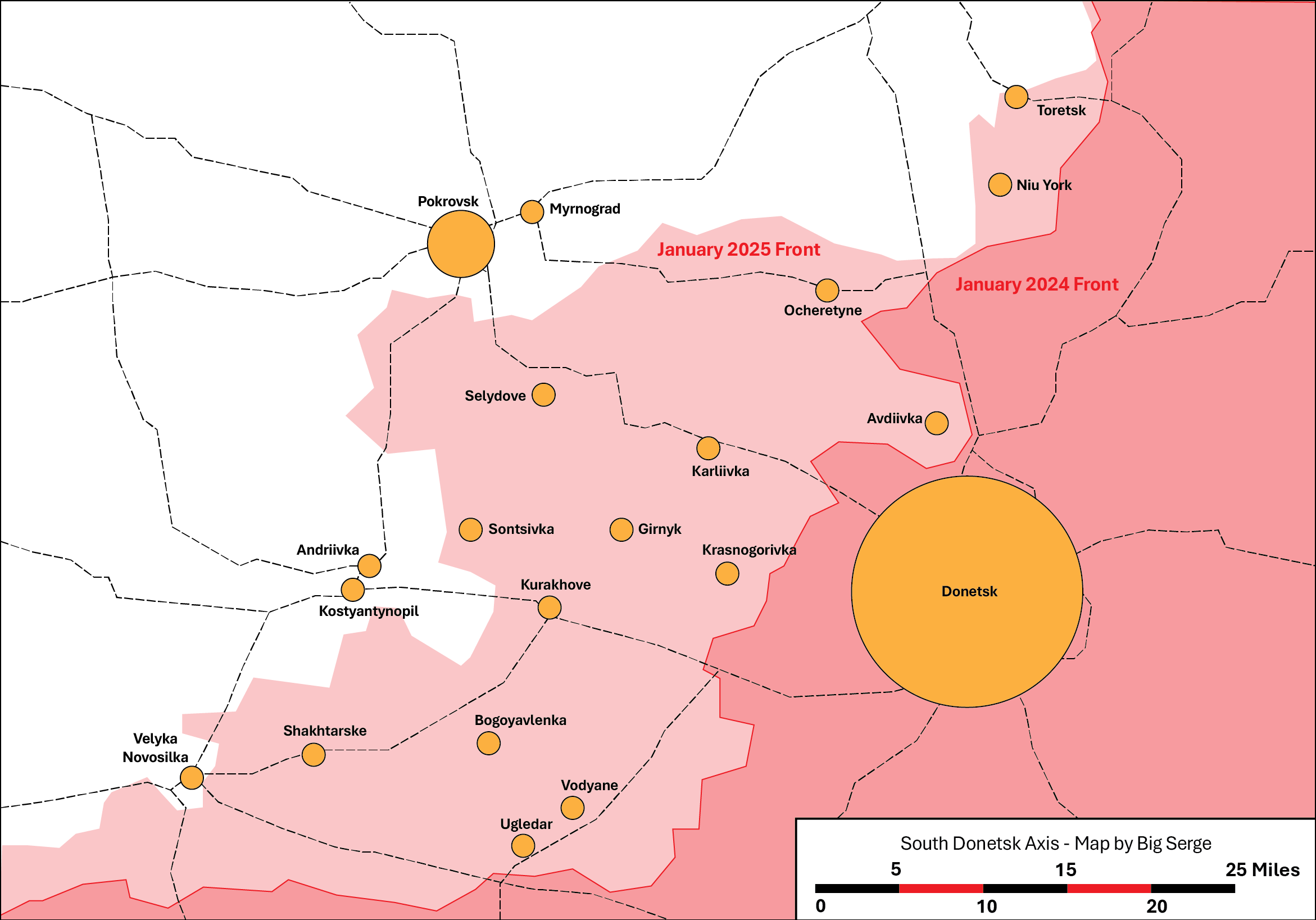
    Russian Progress on the Donetsk Axis in 2024

    The year began with the AFU fighting for its fortress in Avdiivka, where it continued to block the northern approach to Donetsk. At the time, the typical argument that one heard from the Ukrainian side was that the Russian assault on Avdiivka was pyrrhic – that the Russians were capturing the city with exorbitantly costly “meat assaults” that would inevitably sap Russian combat power and exhaust their ability to continue the offensive.

    With the full measure of the year behind us, we can definitively say that this is not the case. After the fall of Avdiivka, Russian momentum never seriously slackened, and in fact it was the AFU that appeared to be increasingly exhausted. The Ukrainian breakwater position at Ocheretyne (which had previously been their staging point for counterattacks around Avdiivka) was overrun in a matter of days, and by the early summer the frontline had been pushed out towards the approach to Pokrovsk.

    The Russian thrust towards Pokrovsk led many to believe that this city was itself the object of Russian energies, but this was a misread of the operational design. Russia did not need to capture Pokrovsk in 2024 to render it sterile as a logistical hub. Simply by advancing towards the E50 highway, Russian forces were able to cut off Pokrovsk from Ukrainian positions to the south on the Donetsk front, and Pokvrovsk is now a frontline city subject to the full spectrum of overwatch from Russian drones and tube artillery.

    By autumn, the Russian advance had put the Ukrainians in a severe salient, creating an unstable chain of positions in Selydove, Kurakhove, Ugledar, and Krasnogorivka. Russia’s advance from Ocheretyne onto the southern approach to Pokrovsk acted like an enormous scythe, isolating the entire southeastern sector of the front and allowing Russian forces to carve through it in the closing months of the year
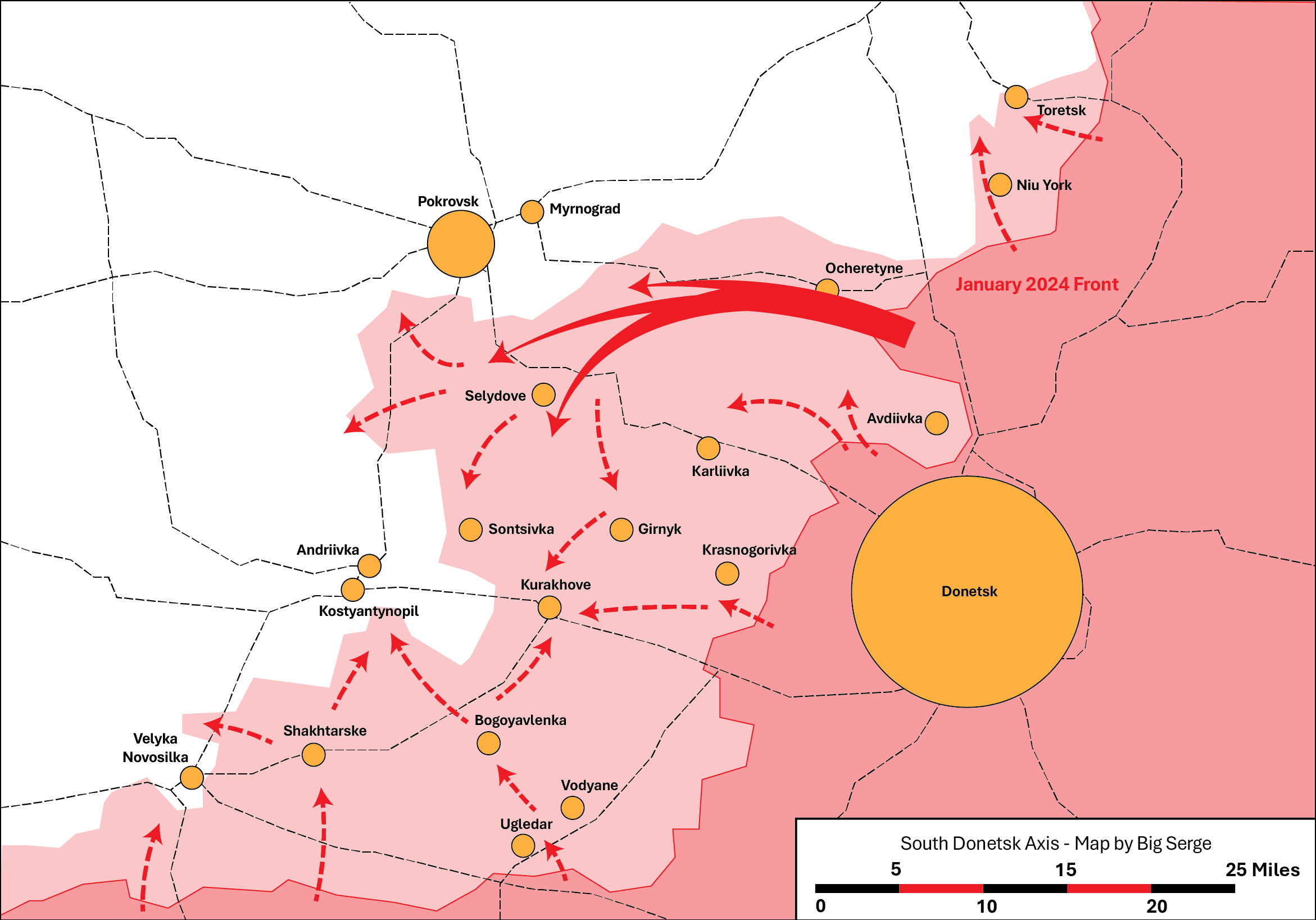
    Russian Operations in 2024, Donetsk Axis

    This war has turned the word “collapse” into a devalued buzzword. We are told repeatedly that one side or the other is on the verge of collapse: sanctions will “collapse” the Russian economy, the Wagner uprising of 2023 proved that the Russian political system was “collapsing”, and of course we hear that exorbitant losses have one army or the other on the verge of total failure – which army that may be depends on who you ask.

    I would argue, however, that what we saw from October 2024 onward represents a real occurrence of this oft-repeated and discarded word. The AFU suffered a genuine collapse of the southeastern front, with the forces positioned in their strongpoints too attrited and isolated to make a determined defense, Russian fires becoming too heavily concentrated in ever more compressed areas to endure, and no mechanized reserve in the theater available to counterattack or relieve the incessant Russian pressure.

    Ukraine does maintain enough drones and concentrated fires to limit a full Russian exploitation – that is, Russia is still not able to maneuver at depth. This gave the Russian advance a particular stop-start quality, leapfrogging from one settlement and fortress to the other. More generally, Russia’s preference to use dispersed small-unit assaults limits the potential for exploitation. We have to emphasize, however, that Russian momentum on this axis has never seriously slackened since October, and many of the key Ukrainian positions were overrun or abandoned very quickly
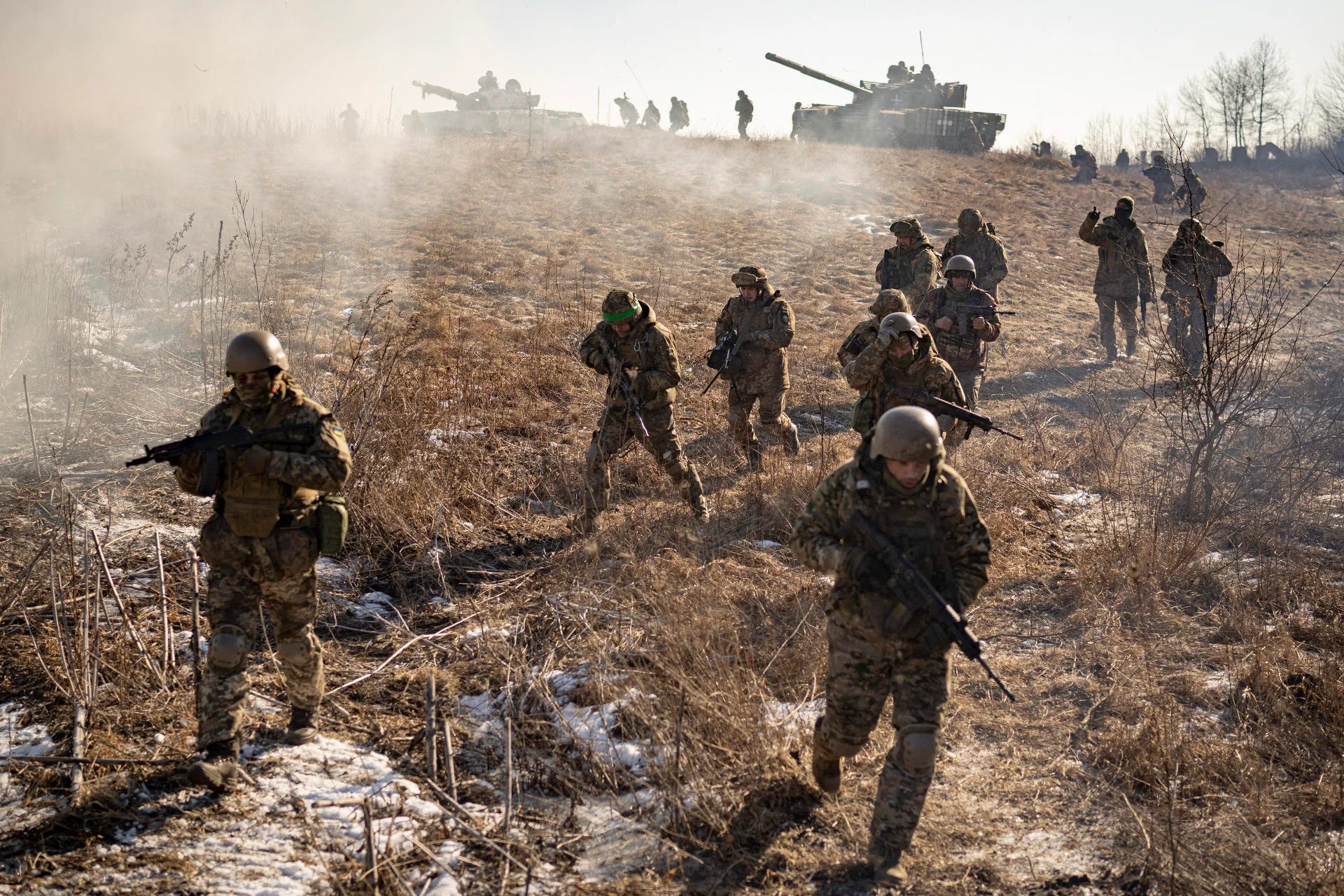
    Ugledar is a good example: the Russians began their final push toward the town on September 24. By September 29, the 72nd Mechanized Brigade began evacuating. By October 1, Ugledar was fully under Russian control. This was a keystone Ukrainian position put in a completely untenable position and it went down in a week. One could argue, of course, that Ugledar held out for years (how then can we say with a straight face that it was captured in a week), but this is precisely the point. In early 2023 Ugledar (with the help of artillery stationed around Kurakhove) successfully repelled a multi-brigade Russian attack in months of heavy fighting. By October 2024, the position was completely untenable and was abandoned almost immediately when attacked.

    The Ukrainians did no better trying to hold Kurakhove – previously a critical rear area that served as both a logistical hub and a base of fire for supporting (former) frontline strongpoints like Ugledar and Krasnogorivka. Kurakhove, now under full Russian control, will in turn serve as a base of support for the ongoing Russian push to the west towards Andriivka.

    Taking the state of the front holistically, the AFU is currently holding two severe salients at the southernmost end of the line – one around Velyka Novosilka, and another around Andriivka. The former is likely to fall first, as the town has been fully isolated by Russian advances on the flanks. This is not a Bakhmut-like situation, where roads are described as “cut” because they are under Russian fire – in this case, all of the highways into Velyka Novosilka are cut by physical Russian blocking positions, making the loss of the position only a matter of waiting for the Russians to assault it. Further north, a more gentle and less strongly held salient exists between Grodivka and Toretsk. With Toretsk now in the final stages of capture (Ukrainian forces now hold only a small residential neighborhood on the city’s outskirts), the front should level here as well in the coming months.

    This leaves the Russians more or less in full control of the approaches to Kostyantinivka and Pokrovsk, which are in many ways the penultimate Ukrainian held positions in Donetsk. Pokrovsk has already been bypassed several miles to the west, and the map portends a re-run of the typical Russian tactical methodology for assaulting urban areas – a methodical advance along the wings of the city to isolate it from arterial highways, followed by an attack on the city itself via several axes
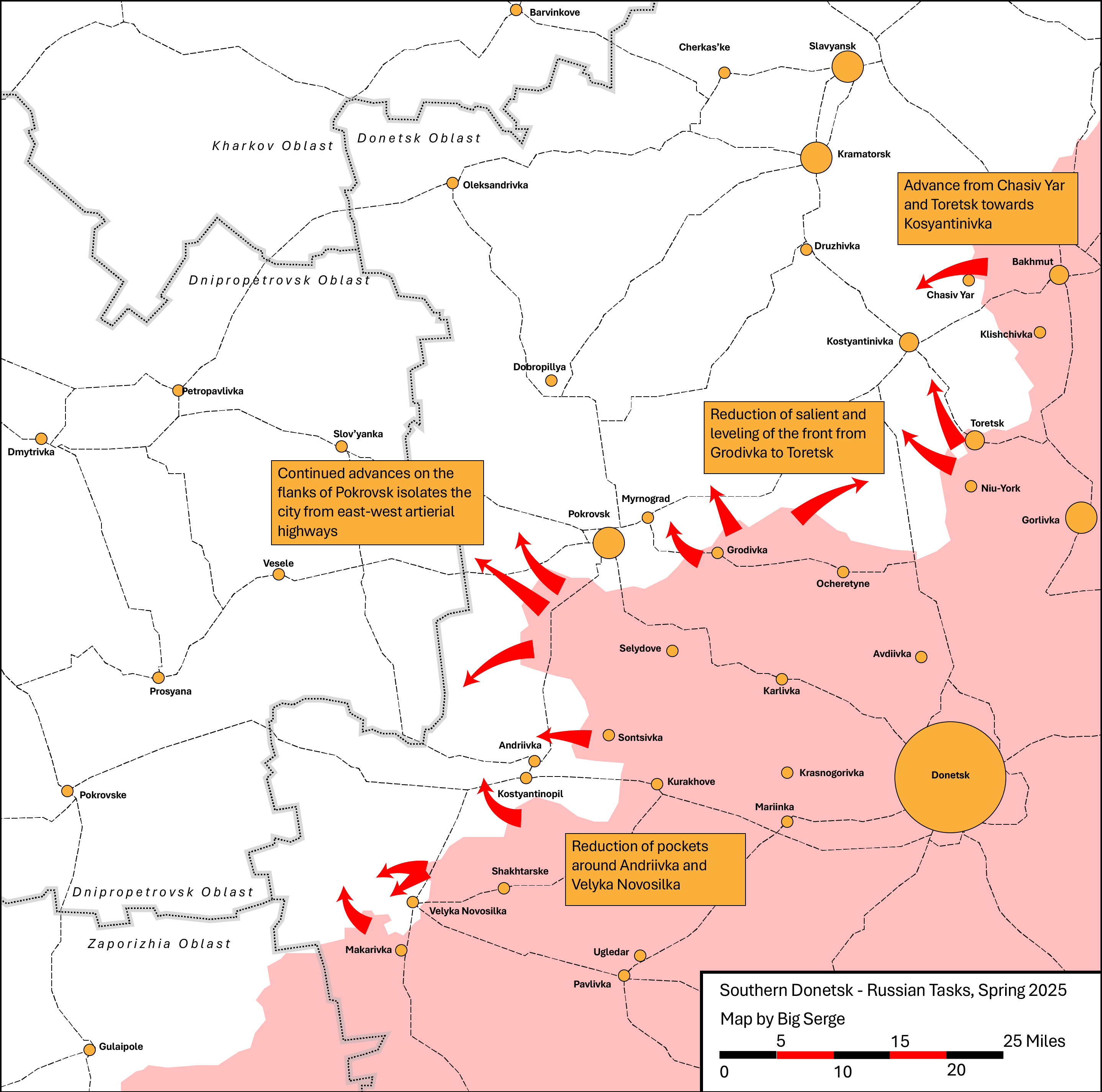
    The coming months promise continued Russian advances across this front, in a continuation of what can only be regarded as the collapse of a critical front on the part of the AFU. The Russian Army is advancing to the western border of Donetsk oblast and will ferret the Ukrainians out of their remaining strongpoints at Velyka Novosilka and Andriivka, while pushing into the belly of Pokrovsk. At no point since the fall of Avdiivka have the Ukrainians demonstrated the ability to seriously stymie Russian momentum along this 75 mile front, and the ongoing dissipation of Ukrainian combat resources indicates that little will change in this regard in 2025.

    Toehold: The Incredible Shrinking Kursk Salient

    Throughout the autumn of 2024 and these early months of winter, as Ukrainian forces were dug out of their dense web of fortified positions in the southern Donbas, their comrades continued to stubbornly hold on to their position in Russia’s Kursk Oblast. The basic shape of Ukraine’s offensive into Kursk is by now well known – billed by Kiev as a gambit to change the psychological trajectory of the war and strike a prestige blow to Russia, the Ukrainian attack had early momentum after achieving initial strategic surprise, but quickly faltered after Ukrainian columns ran into effective Russian blocking positions on the highways out of Sudzha. Efforts to force the roads through Korenovo and Bolshoe Soldatskoe were defeated, and the Ukrainian grouping was left holding on to a modest salient around Sudzha, jutting out into Russia.

    Throughout the autumn, Russian counterattacks have focused on chiseling away at the base of the Ukrainian salient – forcing the Ukrainians out of Snagost and pushing them away from Korenovo. The progress here has been incremental, but significant, and by the start of January the “neck” of the Ukrainian salient had been compressed down to a little over nine miles wide, after their initial penetration in the summer had forced a breach of over twenty miles. All told, Ukraine has lost about 50% of the territory that they grabbed in August.

    The Russian pressure on the flanks of the salient have amplified many of the qualities that make this position wasteful and dangerous for the AFU. There is limited road connectivity for Ukrainian forces – a problem amplified by the rollback from Snagost, which cost them access to the highway running from Korenovo to Sumy. Apart from a few circuitous side roads, Ukrainian forces only have a single highway – the R200 route – to run material and reinforcements into the pocket, which allows Russian forces to surveil their lines of communication and conduct effective interdiction strikes. The compression of the pocket also greatly narrows the targeting area for Russian drones, tube artillery, and rocketry, and creates more condensed and saturating bombardment
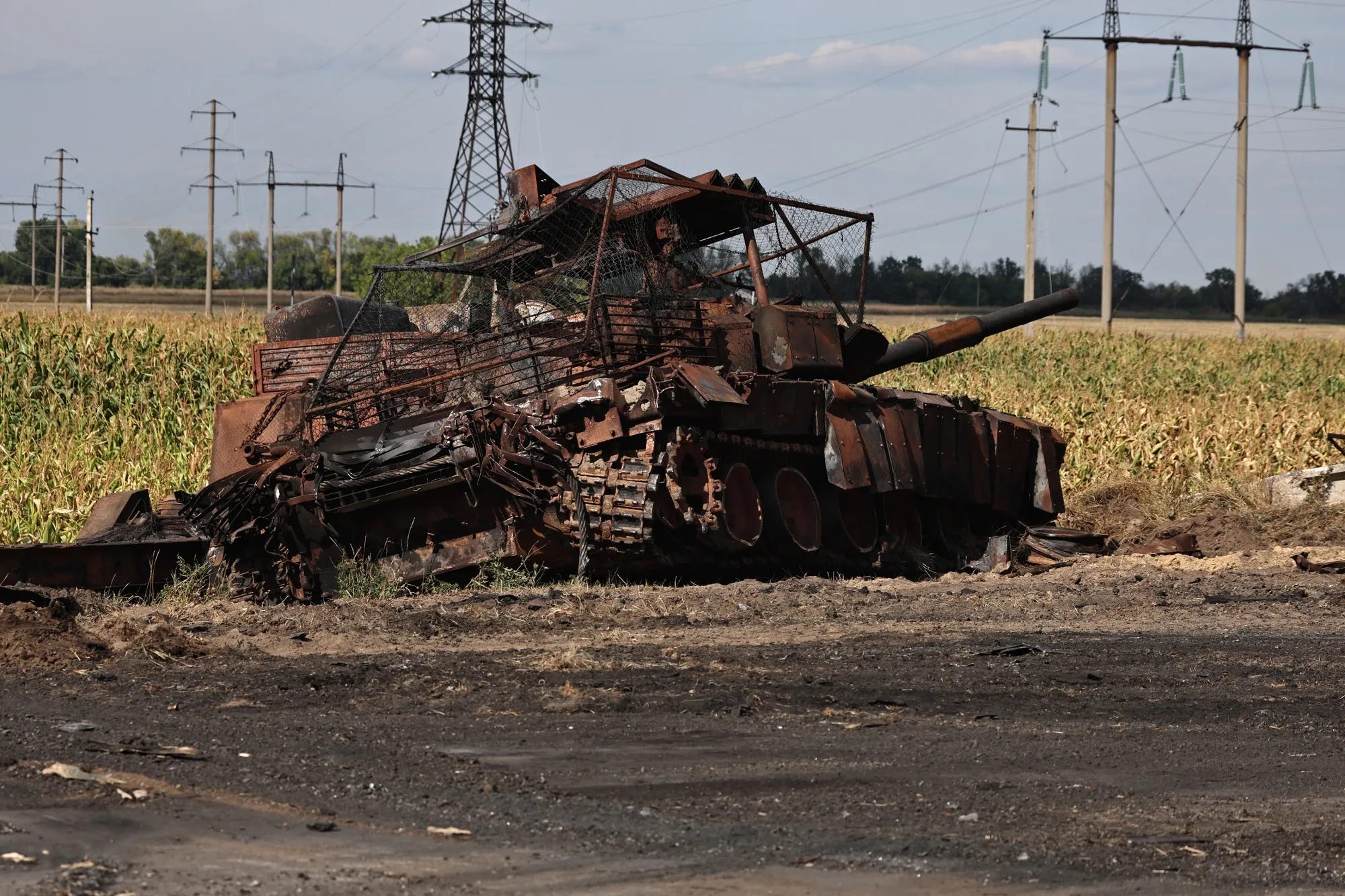
    Despite the fact that this position has been profoundly unproductive for Ukraine – being steadily rolled back and having no synergy with other, more critical theaters – the same grouping of Ukrainian units remain here, fighting in a steadily more compressed space. Even more baffling, the Ukrainian grouping consists largely of premiere assets – Mechanized and Air Assault brigades – that could have contributed meaningfully as a reserve in the Donbas over the last three months.

    On January 5, there was a surprise in the form of a renewed Ukrainian attack out of the salient. The internet of course jumped to the conclusion that the AFU was going back over to some sort of general offensive posture in Kursk, but the reality was very underwhelming – something like a battalion sized assault up the axis towards Bolshoe Soldaskoe, which got a few kilometers up the road before it ran out of steam. Ukrainian efforts to jam Russian drones were stymied by the increasing ubiquity of fiber-optic systems, and the Ukrainian attack collapsed within a day
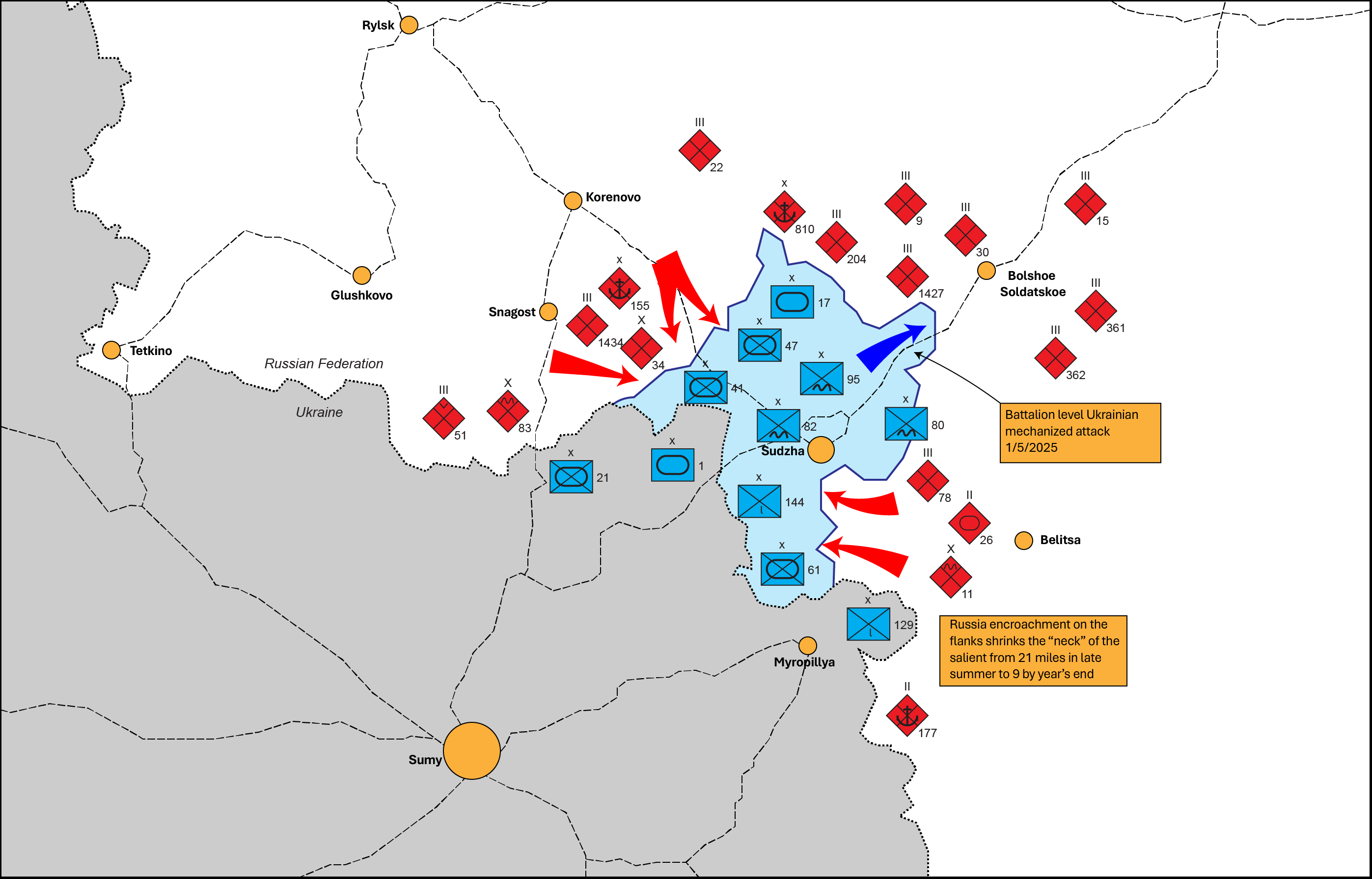
    Kursk Salient – General Situation, January 2025

    The tactical particulars of the Ukrainian attack are interesting, and there’s ongoing speculation as to its purpose – perhaps it was intended to cover a rotation or withdrawal, to improve tactical positions on the northern edge of the salient, or for inscrutable propaganda purposes. However, these specifics are rather unimportant: attacking out the end of the salient (that is, trying to deepen the penetration into Russia) does nothing to reverse Ukraine’s problems in Kursk. These problems are first, on the tactical level, that the salient has been greatly compressed on the flanks and continues to narrow, and on the strategic level the willful expenditure of valuable mechanized assets on a front that does not impact the critical theaters of the war. More simply, Kursk is a sideshow, and it is a sideshow that has gone wrong even within its own operational logic.

    One thing that has been of endless interest, of course, have been the continued rumors of North Korean troops fighting in Kursk. Western intelligence agencies have been adamant about the presence of North Koreans in Kursk. Some people are predisposed to instinctively disbelieve everything that western officialdom says – while I think some skepticism is warranted, I do not automatically assume that they are lying. One recent report lays out what would seem to be a plausible version of this story: that the idea actually originated in Pyongyang, not Moscow, and that a modest number of Korean troops (perhaps 10,000) are embedded with Russian units. The presumption here is that the Koreans hatched the idea as a way to gain combat experience, with the Russians in turn getting auxiliary forces, though of questionable combat effectiveness.

    However, it is worth noting that this is not nearly as important as it has been made out to be. Much has been made of the idea that the North Korean presence proves some sort of Russian state of desperation, but this is fairly silly on its face – with more than 1.5 million active personnel in the Russian military, 10,000 Korean troops in Kursk represents a paltry appendage. More importantly, there has been an attempt to portray the North Korean contingent as a major departure point in the war. In particular, the formulation “North Korean troops in Europe” has been used to conjure cold war imagery of communist despotism clawing at the free world
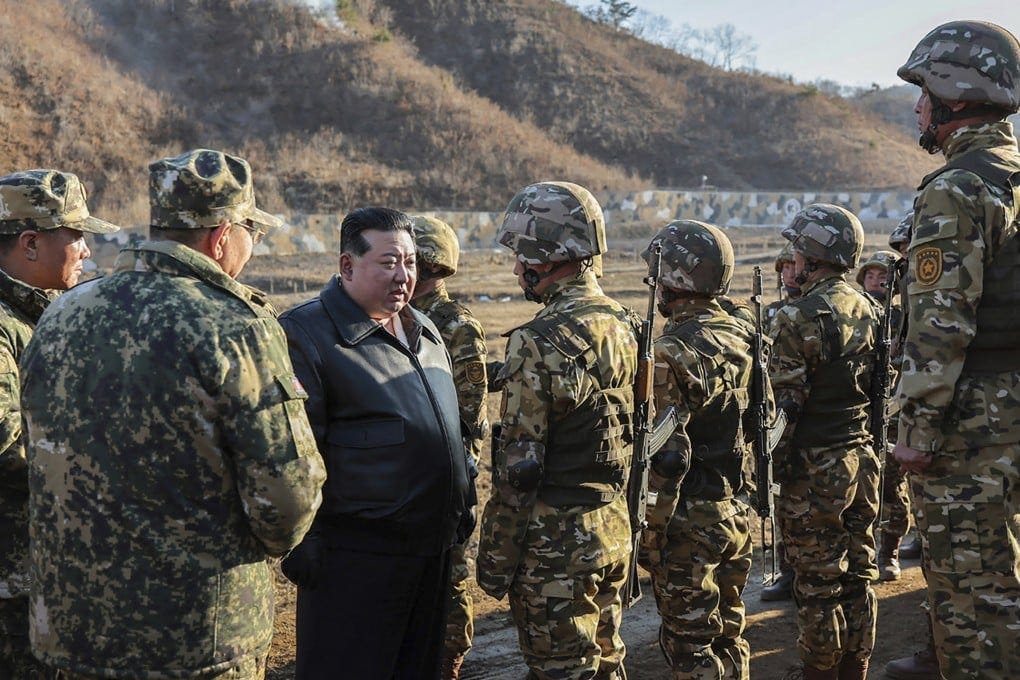
    The point, however, is that North Korean troops are presumed specifically to be in Kursk, which is in Russia. This is linked, of course, to the recently concluded mutual defense agreement signed between Moscow and Pyongyang. By attacking into Kursk – widening the front into prewar Russian territory – Ukraine created a defensive combat task for Russia which triggers the possibility of military assistance from North Korea. However much one may wish to link the Korean contingent to Russia’s dreaded “war of aggression”, the force in Kursk is very objectively engaged in the defense of Russian territory, and that makes it possible for Russia to use auxiliary forces – including conscripts and the troops of its allies – to fight there.

    Ultimately, then, the presence of North Koreans in Kursk is interesting, but perhaps not very important after all. These troops are not in Ukraine (even under the most maximal definition of the Ukrainian territorial unit), they are not carrying the primary combat load, and they are unequivocally not the problem that the AFU is facing in Kursk. The “big problem” for Ukraine, very simply, is not the presence of some amorphous Korean horde dedicated to spreading Glorious Juche to Europe – it is the loitering of large grouping of their own precious mechanized brigades in a compressed salient, far far away from the Donbas, where they are greatly needed.

    Scraping the Barrel: AFU Force Generation

    I think it is well understood, of course, that Ukraine faces severe manpower constraints relative to Russia, both in terms of the raw totals of male biomass available – with roughly 35 million fighting aged males in Russia against perhaps 9 million in prewar Ukraine – but also in terms of its capacity to mobilize them.

    Ukraine’s mobilization scheme is hampered by both widespread draft evasion (with willingness to serve decreasing as the war has stretched on) and a stubborn unwillingness to draft younger men, aged 18-25. Ukraine is structurally burdened with a deeply imbalanced population structure: there are roughly 60% more Ukrainian men in their 30’s than in their 20’s. Given the relative scarcity of young men, particularly in their early 20’s, the Ukrainian government rightly views this 18-25 year old cohort as a premium demographic cohort that it is loathe to burn away in combat. Given the ubiquity of draft evasion, the refusal to mobilize younger males, and the corruption and inefficiency characteristic of the Ukrainian government, it should come as no surprise when Ukrainian mobilization falters
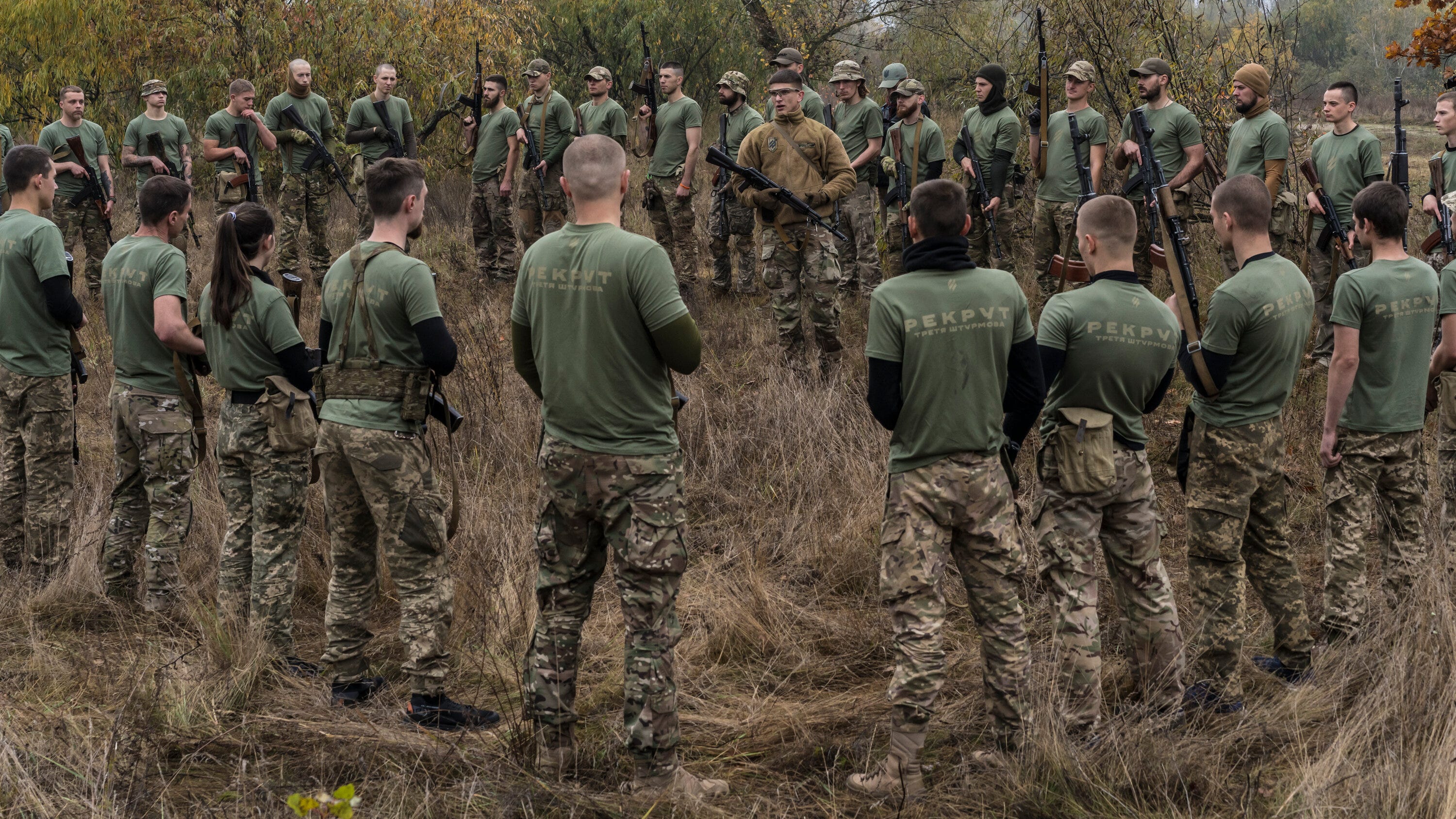
    Russia, in contrast, has both a much larger pool of potential recruits and a more efficient apparatus for mobilization. In contrast to Ukraine’s scheme of compulsory conscription, Russia has relied on generous sign-on bonuses to solicit volunteers. Russia’s incentive system, to this point, has provided a steady stream of enlistments that has been more than enough to offset Russian losses. Without going too far into the various speculative estimates of Russian casualties, it is widely acknowledged by western military leadership that Russia has significantly more personnel now than it did at the start of the war.

    All of that is to say: Ukraine faces a severe structural disadvantage in military manpower in the aggregate, which is exacerbated by the idiosyncrasies of the Ukrainian mobilization law, ameliorated slightly by the relatively low troop densities and the preponderant power of strike systems in this war.

    The argument that I want to make here, however, is that Ukraine’s systemic problems matching Russian manpower have been exacerbated by several developments which specifically became prominent in 2024. In other words, 2024 can and should be marked as the year where Ukrainian manpower constraints became markedly and perhaps irretrievably worse due to specific decisions made in Kiev, and particular developments on the ground.

    These are as follows:

    1. The decision to expand the AFU’s force structure through the creation of the “15 series” brigades
    2. The decision to deliberately widen the front and create additional demands for manpower by launching the incursion into Kursk
    3. The stall out of Ukraine’s new mobilization program in the autumn
    4. Accelerating problems with desertion in the AFU

    We’ll run through these in order.

    An army that is intaking new personnel has to decide between two possible allocations for them. New personnel can be used as replacements to replenish existing frontline units, or they can be used to expand the force structure by creating new units. That much seems fairly obvious, and ideally mobilization will exceed losses and make it possible to do both. Where armies face hard manpower constraints, however – that is, where losses are equal to or greater than intake of men, the decision to expand the force structure can have monumental consequences. The stereotypical example, of course, would be the late-war Wehrmacht, which created premiere new assets in the form of Waffen SS divisions, which received privileged access to recruits and equipment while regular army divisions in the line suffered from a trickle of replacements which could not keep up with losses.

    Ukraine, with its garbled force structure, has created a mess through its own attempts to expand its force structure in the face of dwindling strength on the line. Late in 2023, the AFU announced intentions to form an entirely new grouping of brigades – the so-called “15 series”, given their designations as the 150th, 151st, 152nd, 153rd, and 154th Mechanized Brigades. This was followed in 2024 with the appending of the 155th Mechanized Brigade, which was to be trained and equipped in France.

    Forming a new grouping of mechanized brigades is essential to the way that Ukraine is presenting its war. Because Ukraine still aims (at least on paper) to recapture all of its Russian held territory, there must always be the illusory possibility of a future offensive, and in order for that illusory possibility to remain, Ukraine must present itself as actively preparing for future offensive operations. Ukraine’s presentation of its own strategic animus – the idea that it is holding the front while it prepares to go back on the offensive – essentially locks it into a program of expanding its force structure
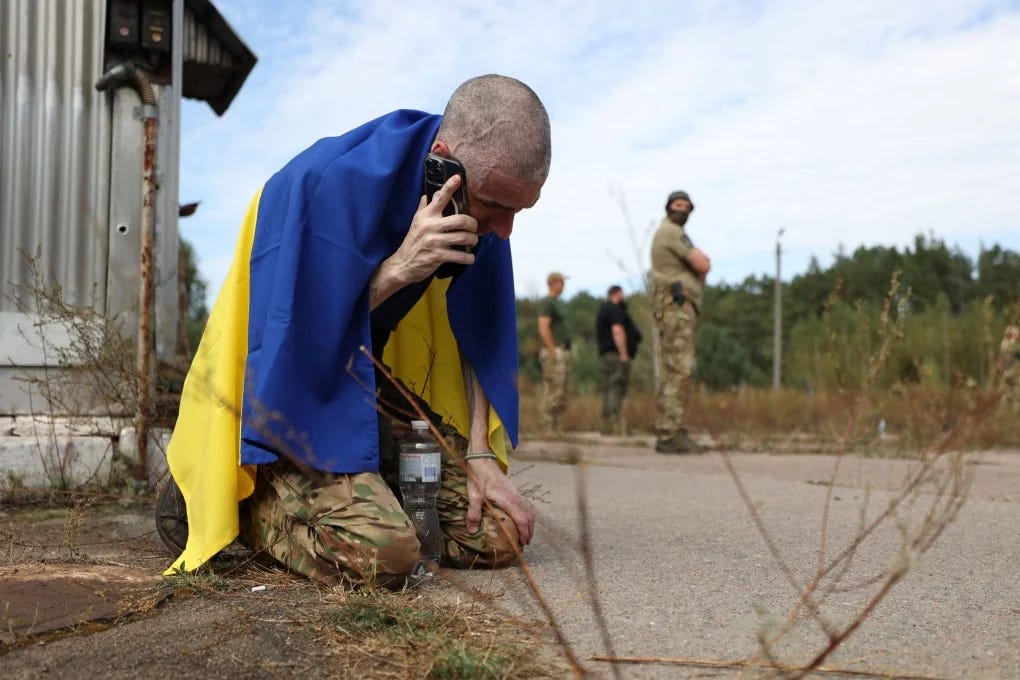
    The problem for Ukraine is that the immense pressure on the front makes it essentially impossible for them to properly husband resources the way they would like. Properly training and equipping half a dozen fresh mechanized brigades and holding them in reserve would be very helpful, but they cannot really do this in light of the demands for personnel at the front. These brigades instead become “paper formations” that have a bureaucratic existence, while their organic assets are pulled apart and sucked into the front – stripped down into battalion or company sized elements that can be plugged into sectors of need on the frontline. At the moment, none of the 15 series brigades have seen action as organic units – that is, fighting as themselves.

    The French-trained 155th brigade forms a useful example. Originally designed as an overweight formation of some 5800 men, equipped with premiere European equipment, the brigade was hemorrhaging personnel from the start, with Ukrainian sources reporting that some 1700 men – many of them forcibly conscripted off the streets of Ukraine – deserted the unit during training and formation. A collapse in the brigade’s leadership – with its commander resigning – made matters even more complicated, and the formation’s first action around Pokrovsk went badly. Now, the brigade is being dismembered, if not formally disbanded, with personnel and vehicles being stripped down and parceled out to bolster neighbor units.

    The decision to allocate personnel to new mechanized brigades (though given stocks of armored vehicles it is questionable whether those designations mean anything) does not necessarily change Ukraine’s manpower balance in the aggregate, but it is certainly an inefficient way to use personnel. To return again to the 155th brigade, one problem noted by Ukrainian analysts was the fact that much of the brigade was formed whole cloth from forcibly mobilized personnel, without a proper cadre of veterans and experienced NCOs – some 75% of the brigade, it turns out, had been mobilized less than two months before arriving in France for training. This fact was certainly instrumental in the mass desertions and the brigade’s poor combat effectiveness.

    Given Ukraine’s constraints, the best course of action would undoubtedly be to allocate new personnel and equipment as replacements to build out the depleted veteran brigades on the front lines, plugging in replacements around existing veterans and officers. Kiev, however, prizes the prestige that comes from force expansion and the “shiny new toy” factor of new formations equipped with scarce and valuable equipment like Leopard tanks. These new brigades, though billed as premiere assets, clearly have lower combat effectiveness than existing formations, given their lack of experience, shortage of veteran officers, and low unit cohesion.

    The simple reality, however, is that replacements for existing brigades are nowhere close to keeping up with burn rates. Frontline units have complained of increasingly dire infantry shortages for months, with some brigades on the Pokrovsk axis reporting that they are down to less than 40% of their allocated infantry complements.

    In short, Ukraine’s decision to embark on force expansion in the face of significant manpower shortages has exacerbated the problem – both starving veteran units of replacements and concentrating newly mobilized personnel into combat ineffective formations that lack a veteran core, experienced officers, and vital equipment. They have tried, belatedly, to square this circle by parceling out new formations to backstop line brigades, but this is less than ideal – it leads to a patchwork order of battle with lower unit cohesion and a fragmented defense.

    Unfortunately, this comes precisely as Ukraine has created additional self-imposed strains on its resources, in particular through its incursion into Kursk. At the moment, elements of at least seven mechanized brigades, two marine infantry brigades, and three air assault brigades are stationed on the Kursk axis. Without going too far into the weeds rehashing Ukraine’s operation here, it’s important to remember that Ukraine – facing extreme pressures on its force generation – voluntarily chose to widen the front into a secondary theater, diverting scarce assets and reducing its own ability to economize forces.

    In summary, Ukraine has made deliberate decisions to widen the front and expand its force structure, both of which have been decidedly detrimental to its efforts to economize personnel. This comes precisely as a 2024 effort to ramp up mobilization has come off the rails.

    Ukraine’s mobilization program suffered from a variety of defects, including gaps and errors in its databases and endemic corruption and bureaucratic inefficiency. Laws passed in 2024 aimed to rectify many of these problems, including through the rollout of an app that would allow draft-eligible men to register and check their status without having to visit recruitment offices. It appeared that matters had come to a head when Zelensky fired several recruitment chiefs in 2023, and there was a real sense of urgency. After some signs of initial promise, it is clear that this intensified mobilization drive has faltered over the autumn and early winter
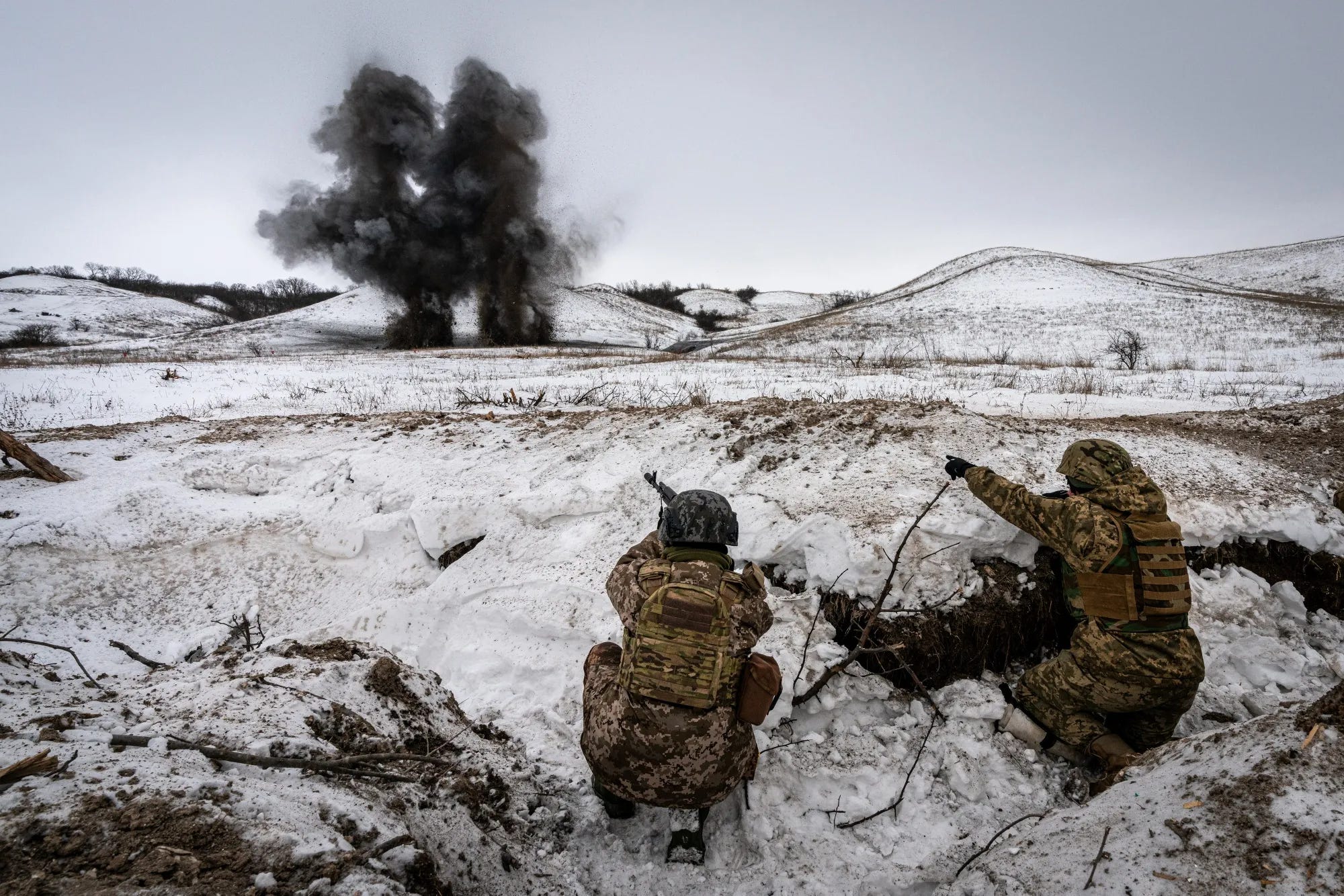
    There were initially signs of optimism for Ukraine – in the first month after the new mobilization law was passed, there was a surge and the army enlisted 30,000 new personnel. However, by the end of the summer this initial burst of enlistments had faded, and mobilization was again running behind the AFU’s losses. An October briefing from the Ukrainian General Staff confirmed that enlistments had already declined by 40% after the brief surge brought on by the new mobilization law. Around the same time, officials in Odessa (Ukraine’s third largest city) admitted that they were running at only 20% of their mobilization quota.

    The problems are myriad. The new mobilization law led to some initial improvements but has ultimately failed to resolve problems with draft evasion, bureaucratic miscues remain endemic, and employers desperate to retain workers filed an avalanche of employment related draft deferments. Unable to sustain the initial surge of enlistments, Ukraine faces a looming manpower crisis.

    Furthermore, Ukraine’s continued inability to provide either demobilization or timely rotations means that mobilized personnel face the prospect of indefinite service on the frontlines. This is obviously bad for morale, with soldiers contemplating the possibility of years of uninterrupted service, and this in turn drives the desertions that are becoming a mounting problem for the AFU. Some reports indicate that as many as 100,000 Ukrainian troops have deserted by this point, many no doubt driven by the psychological and physical strains of endless combat with no prospect of rotation.

    A deadly feedback loop is now at work, with the lack of rotations and the shortage of replacements synergizing to accelerate the burn of Ukrainian personnel. The AFU is unable to regularly rotate units out of combat, and the inadequate flow of replacements causes frontline infantry complements to wear thin. Unable to rotate or reinforce, line brigades resort to cannibalization – scraping support personnel like mortar teams, drivers, and drone operators to fill out frontline positions. This further accelerates losses as brigades fight with thinned out support and fires elements, and makes Ukrainian men more unwilling to enlist – because there is now no guarantee that becoming a drone operator, for example, will save one from being sent to a frontline trench eventually.

    Where does this leave us? Ukraine continues to dispose of a very large force, with more than a hundred brigades and hundreds of thousands of men under arms. This force, however, is both substantially outnumbered by the Russian army and in a clear trend of decay. Despite a highly touted attempt to reinvigorate the mobilization apparatus in 2024, the intake of new personnel is clearly too low to offset losses, and the heavy lifting formations in critical sectors of front have seen their strength – particularly in the infantry complements – decline, in some cases to critical levels.

    The failure of Ukraine’s 2024 mobilization program has coincided with several strategic choices which have exacerbated manpower concerns – specifically the decision to embark on a program of force expansion even as the AFU voluntarily extended its commitments by opening a new secondary front in Kursk. In other words, Ukraine’s mobilization falls short of its force requirements, and the AFU has also made choices that sabotaged its ability to economize. Units are ground up, replacements come in a paltry trickle, rotations are late or absent, units cannibalize themselves, and angry and weary men desert.

    It’s not at all clear that this will lead to a “breaking point”, in the sense that people are anticipating. Ukrainian strike capabilities and the Russian preference for dispersed, leapfrogging assaults limit the potential for grand breakthroughs and exploitation. However, what we saw over the past three months on the southern Donetsk axis offers a preview of what awaits: an exhausted force being steadily rolled back, dug out of its strongpoints, and mauled – covering its retreat with drones but losing position after position. The line holds, until it doesn’t.

    End of the Line: ATACMs, JASSMs, and Hazelnuts

    Ukraine’s ability to remain in the field depends on a titration of two indispensable resources: first, Ukrainian male biomass, and secondly the critical western weaponry that gives them combat effectiveness. We have evaluated the first: Ukraine is not exactly out of men, but the trends of its mobilization program are poor and personnel shortages are mounting. The trends regarding the second are, if anything, even more foreboding for Kiev.

    There are two general dynamics that have emerged, neither of which create an optimistic picture for Ukraine, which we’ll examine in turn. These are as follows:

    1. The delivery of heavy weaponry to Ukraine (tanks, IFVs, and artillery tubes) has largely dried up in recent months.
    2. The west has essentially run out of escalatory weaponry (strike systems) to give, and those systems already given have failed to meaningfully altar the trajectory of the war.

    In 2023, building out new mechanized units was the name of the game, with the Pentagon leading a multinational effort to stand up an entire army corps worth of units equipped with Leopards, Challengers, and a whole slew of western IFVs and APCs. When that lovingly assembled grouping bashed its head on a rock in the botched assault on the Zaporizhia line, the United States belatedly and begrudgingly dispatched its own Abrams to backstop the Ukrainian tank force. In 2024, however, deliveries of heavy weapons slowed to a trickle.

    The role of the tank in Ukraine has been greatly misunderstood. The vulnerability of tanks to the myriad strike systems of the modern battlefield led some observers to declare that the tank as a weapons system was now obsolete, but this did not really square with the fact that both combatants in this war were eager to deploy as many as possible. Tanks need more critical enablers – more combat engineering, air defense, and electronic warfare support – but they continue to fill an indispensable role and remain an essential item in this war. The failure of Ukraine’s 2023 counteroffensive showed, if anything, that tanks simply are not “game changing” systems, but mass consumption items – but this has always been the case. The signature quality of iconic tanks like the Sherman and the T34 was that they were numerous
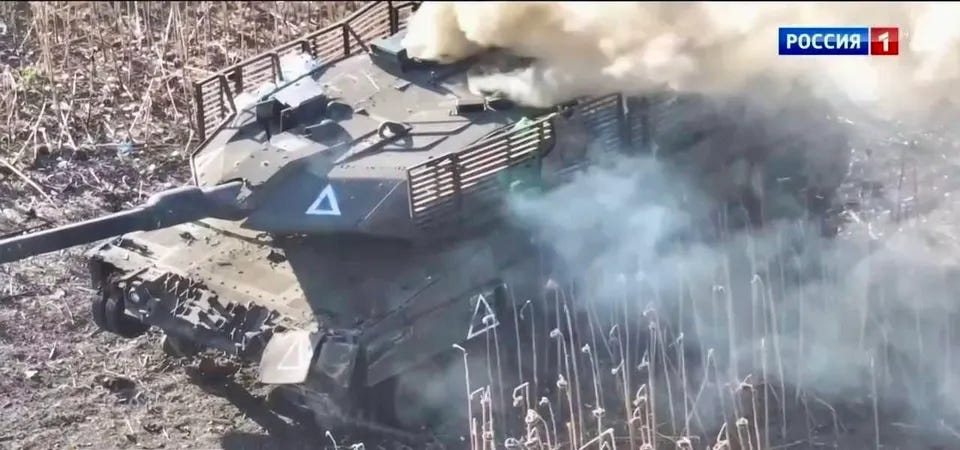
    Unfortunately for Ukraine, deliveries of tanks have dropped off dramatically after the failures of 2023. America’s drawdowns for Ukraine in 2024 were almost entirely devoid of armored vehicles of any kind. Data from the Kiel Institute, which has been meticulous tracking weaponry commitments and deliveries, confirms a sharp dropoff in heavy weapons in 2024. In 2023, Ukraine’s backers pledged 384 tanks. This dropped to just 98 in 2024 – which explains why the new Ukrainian mechanized brigades are perilously light on the equipment indicative of their designations.

    While 2023 was all about building out Ukraine’s mechanized package with tanks, IFVs, and engineering, 2024 has been largely about enhancing Ukraine’s strike capabilities. There have been two separate elements at play – first, the delivery of both air and ground launched systems (most notably the British Storm Shadows and American ATACMs respectively), and secondly the loosening of the rules of engagement to allow Ukraine to strike targets inside pre-war Russia.

    This dovetailed, as it turned out, with Ukraine’s operation in Kursk, and in many ways the most direct impact of the Kursk incursion has been to force the west’s hand on the rules of engagement. While Ukraine has long been striking inside Russia with indigenous systems, most notably drones, the White House continued to drag its feet on formal approval for strikes with American systems. By launching a ground assault on Kursk, Ukraine made the decision for them: the United States gave clearance to use ATACMs to support the ground forces in Kursk, and this metastasized into general license to strike Russia with the full range of available systems. This was a poignant reminder that, however we conceive of the proxy-sponsor relationship, Ukraine has some ability to force America’s hand: a classic example of the tail wagging the dog.

    In any case, 2024 saw Ukraine and its western backers slowly but surely bash through all the supposed red-lines in this domain: the British breached first with the delivery of Storm Shadows late in 2023, and this was followed by the delivery of ATACMs (with a handful of F16’s to boot), and finally the loosening of the rules of engagement to clear strikes on Russia.

    Where does this leave us? There would seem to be three important things to consider.

    1. The west has essentially reached the end of its escalation chain. The only remaining step that they can take would be to supply Ukraine with JASSMs (Joint Air-to-Surface Standoff Missile), which would mark a quantitative but not a meaningful qualitative upgrade to Ukraine’s strike capabilities.
    2. Ukraine’s use of western-supplied strike assets has been dissipated and has not materially improved their situation on the ground.
    3. Russia maintains a dominant strike advantage, both qualitative and quantitative.

    Ukraine faces a stark disadvantage in strike capability relative to Russia, in a variety of ways. Russian strike assets are far more numerous and have significant range advantages, but it is also important to take into consideration both Russia’s significantly greater strategic depth and its more dense and relatively unscathed air defense. Unlike Ukraine, which has seen its air defense stretch to the limit with destroyed launchers and a mounting interceptor shortage, Russia’s air defenses have been essentially untouched, as Ukraine has lacked the large numbers of assets required to conduct a proper SEAD/DEAD (Suppression/Destruction of Enemy Air Defense) campaign.

    Given this basic calculus, using western strike systems to wage a blow for blow strategic air campaign is bad math for Ukraine. It is generally unwise to engage in a bat fight when your opponent is a bigger man with a much longer bat. Instead, Ukraine’s strike systems should have been leveraged to support ground operations – concentrating strikes spatially and in time to synergize with efforts on the ground. Just as a simple thought experiment, it is not difficult to imagine ATACMs making a difference if they had been available in 2023 and used to saturate Russian rear areas during the assault on the Zaporizhia line – striking in tempo with the mechanized assault to disrupt Russian command and control and prevent reinforcement of critical areas.

    Instead, Ukraine’s strike capacity has been largely dissipated in attacks that sometimes achieve success hitting Russian installations but fail to directly support successful operations on the ground. The result is a diffusion of Ukrainian striking power that is less than the sum of its parts. Now, Ukraine has essentially run dry on missiles – of the 500 ATACMs sent by the United States, perhaps 50 are left in Kiev’s stockpiles. Stocks of air launched Storm Shadow missiles are similarly low, and Britain’s commitment to resupply is limited to “a few dozen”
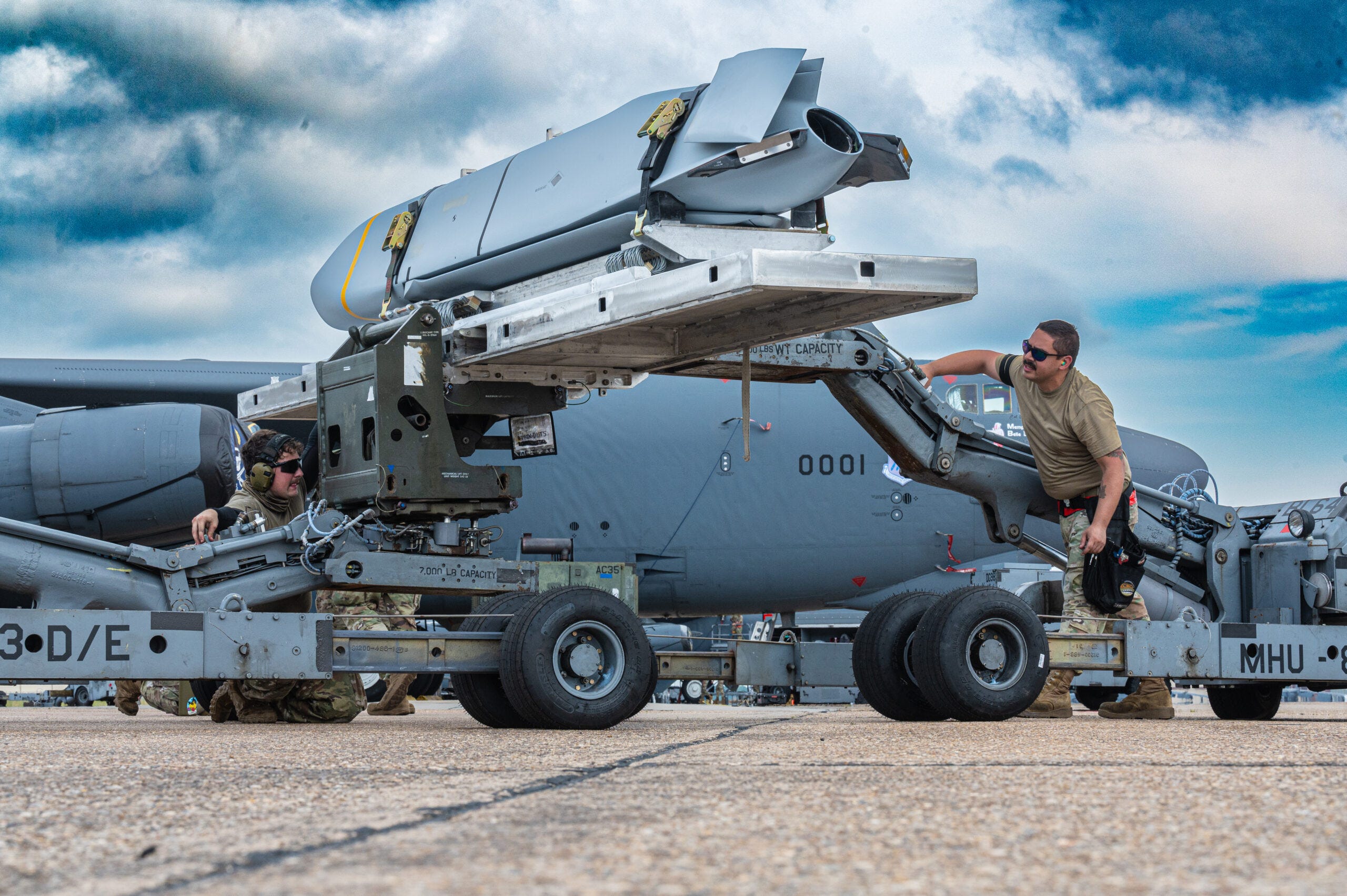
    The last option for the west to backstop Ukrainian strike capability are American JASSMs. While there is a longer-range variant in production (the JASSM-ER, or Extended Range), these are relatively new and expensive and are earmarked for American stocks – it is therefore presumed that the Ukrainians would receive the standard variant. The standard JASSM has slight range advantages over Storm Shadows and ATACMs, at roughly 230 miles. In the event that JASSMs are not given, there is a shorter range system called the SLAM (Standoff Land Attack Missile) with a range of some 170 miles. Both JASSMs and SLAMs would be compatible with Ukrainian F-16s.

    Two things need to be noted about the JASSM. First, the JASSM – while offering slightly longer ranges – would essentially serve as a backstop/replacement for the rapidly dwindling ATACMs and particularly the air launched Storm Shadows – instead of Ukraine’s native SU-24s launching Storm Shadows, they would utilize F-16s launching JASSMs. This would not represent a dramatic upgrade in Ukrainian capabilities, but would instead simply serve to maintain a bare minimum Ukrainian strike capability. JASSMs are a replacement for dwindling capabilities, not an augmentation to them.

    Secondly, it must be understood that JASSMs are the last stop. We’re now entering the territory, not of artificially constructed red lines, but physical and real limits. Russia has essentially eaten the gifted stocks of ATACMs and Storm Shadows, with little discernable effect on their ability to fight, and JASSMs are the last extant item in the inventories to keep Ukrainian strike capabilities operative. We are at the last rung of the aid ladder.

    In the case of JASSMs, however, there are notable downsides for the United States. This is an important case of putting all of one’s eggs in the same technological basket. In 2020, the United States scrapped the development of its conventionally armed Long Range Standoff Missile, making the JASSM – particularly the new extended range variants – the system for the United States, earmarked to play a critical role in future conflicts, particularly in the Pacific. This makes the JASSM an extremely sensitive system, as a centerpiece of American strike capabilities, particularly with the modernization of the Tomahawk system crawling along at a few dozen units per year.

    Given the fact that JASSMs are GPS guided, there are real reasons to be reticent about giving Ukraine such a technologically sensitive system. Russian electronic warfare has enjoyed considerable success jamming GPS and disrupting similarly guided American systems. Allowing the Russians to gain familiarity with a keystone American system could wreak havoc on Pentagon war planning – most, if not all of the strike eggs are in this basket, so why let an adversary peek inside?

    It’s probable, given what we have seen to this point, that these concerns will ultimately be dismissed and Ukraine will receive a line of JASSMs which will backstop their strike capabilities – but given the size of Ukraine’s F-16 fleet, the scale will be constrained. Furthermore, air launched systems are less optimal for Ukraine, given their dependence on large and easily targeted airfields, in contrast to ground launched systems which are mobile and more easily concealed.

    Certainly, JASSMs will never give Ukraine the ability to match Russia’s own strike capacity. After hearing endlessly about how Russia is running out of missiles, it has at last been concluded that this is simply not true, and indeed never was. Recently, Ukrainian defense intelligence admitted that per their own estimates Russia retains about 1,400 long range missiles in its reserves, with a monthly production of roughly 150 units. Russian production of inexpensive Geran drones has also skyrocketed, with Ukrainian intelligence estimating a ceiling as high as 2,000 drones per month.

    There is also the matter of the new Russian missile system – the now famous Oreshnik, or Hazel Tree. Russia tested the Oreshnik system on a large machining plant in Dnipro on November 21, 2024, which allowed the basic capabilities of the system to be gauged. The Oreshnik is an Intermediate Range Ballistic Missile, characterized by its hypersonic capabilities (exceeding Mach-10) and its Multiple Independent Reentry Vehicle equipped with six separate warheads, with the potential for submunitions in each. Although the attack on Dnipro was essentially a demonstration which used inert training warheads (that is, without explosive payloads), the missile can be configured with nuclear or conventional warheads
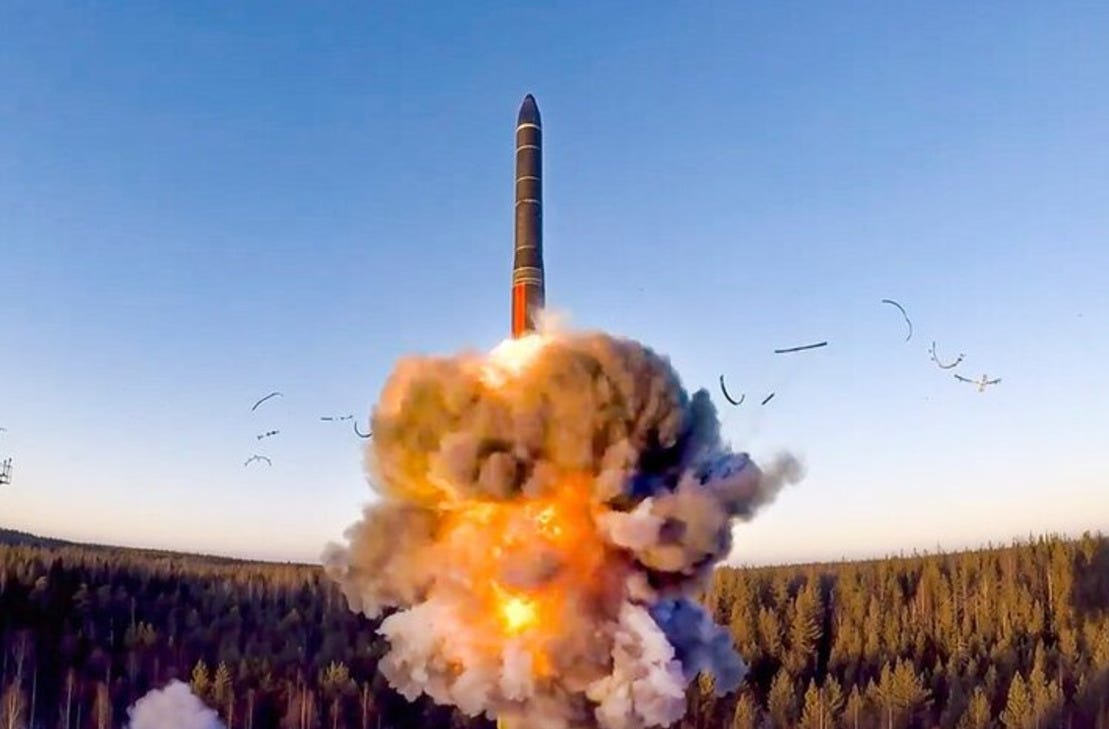
    As in the case of the North Korean troops in Kursk, I rather think that the Oreshnik launch was not nearly as important as it was made out to be. The system is expensive and likely impractical for conventional use. I understand the desire to conceive of Oreshnik as a massively powerful conventional weapon – showering its target with half a dozen warheads with the power of an entire flight of Kalibr missiles – but there are several problems with this. The accuracy of the system (the CEP, or “Circular Error Probable” in the technical parlance) is much more consistent with a nuclear delivery system than a conventional one. Furthermore, the problem with using an IRBM for conventional strikes is the danger of miscalculation – foreign adversaries may misinterpret the launch as a nuclear attack and respond appropriately. This is precisely why the Russian government actually alerted the United States to the launch ahead of time – a fine arrangement for a demonstration, but impractical for a weapon that is intended to be used regularly.

    We may see another use of the Oreshnik against Ukraine, but ultimately this is unlikely to be a system of consequence in this war. The demonstration in Dnipro was instead likely intended to send a message to Europe – reminding NATO that Russia has the capacity to deliver strikes against European targets that cannot be intercepted. It also serves as a poignant reminder that Europe lacks the equivalent capability, and in essence provides a demonstration of Russia’s ability to launch missiles from far beyond the range of either Ukrainian or European response. The Hazelnut is a tangible reminder of Russia’s strategic depth and strike dominance in Ukraine.

    Ultimately, Ukraine will lose the strike game. It’s strike capacity has dwindled, with missiles frittered away in a dissipated air campaign, and though the exhaustion of Storm Shadow and ATACMs stocks can be offset somewhat by JASSMs, Ukraine simply lacks the range or quantities necessary to match Russian capabilities. Needing to do more with less, Ukraine instead diffused its assets and failed to synergize its strikes with ground operations. We are now at the end of the line – after JASSMs, there’s nothing left in western warehouses to upgrade Ukrainian capabilities. Hazelnuts or no, the math on this bat fight is bad for Kiev.

    Conclusion: Debellation

    Trapped in an endless news cycle, with daily footage of FPV strikes and exploding vehicles, and a dutiful cottage industry of war mappers alerting us to every 100 meter advance, it can easily feel like the Russo-Ukrainian War is trapped in an interminable doom loop which will never end – Mad Max meets Groundhog Day.

    What I have endeavored to do here, however, is argue that 2024 actually saw several very important developments which make the coming shape of the war relatively clear. To briefly recapitulate:

    1. Russian forces caved in Ukrainian defenses at depth across an entire critical axis of front. After remaining static for years, Ukraine’s position in Southern Donetsk has been obliterated, with Russian forces advancing through an entire belt of fortified positions, pushing the front into Pokrovsk and Kostayantinivka.
    2. The main Ukrainian gambit on the ground (the incursion into Kursk) failed spectacularly, with the salient being progressively caved in. An entire grouping of critical mechanized formations wasted much of the year fighting on this unproductive and secondary front, leaving Ukrainian positions in the Donbas increasingly threadbare and bereft of reserves.
    3. An attempt by the Ukrainian government to reinvigorate its mobilization program failed, with enlistments quickly trailing off. Decisions to expand the force structure exacerbated the shortage of manpower, and as a result the decay of Ukraine’s frontline brigades has accelerated.
    4. Long awaited western upgrades to Ukraine’s strike capabilities failed to defeat Russian momentum, and stocks of ATACMs and Storm Shadows are nearly exhausted. There are now few options remaining to prop up Ukrainian strike capacity, and no prospect of Ukraine gaining dominance in this dimension of the war.

    In short, Ukraine is on the path to debellation – defeat through the total exhaustion of its capacity to resist. They are not exactly out of men and vehicles and missiles, but these lines are all pointing downward. A strategic Ukrainian defeat – once unthinkable to the western foreign policy apparatus and commentariat – is now on the table. Quite interestingly, now that Donald Trump is about to return to the White House, it is suddenly acceptable to speak of Ukrainian defeat. Robert Kagan – a stalwart champion of Ukraine if there ever was one – now says the quiet part out loud:

    Ukraine will likely lose the war within the next 12 to 18 months. Ukraine will not lose in a nice, negotiated way, with vital territories sacrificed but an independent Ukraine kept alive, sovereign, and protected by Western security guarantees. It faces instead a complete defeat, a loss of sovereignty, and full Russian control

    Indeed.

    None of this should be particularly surprising. If anything, it is shocking that my position – that Russia is essentially a very powerful country that was very unlikely to lose a war (which it perceives as existential) right in its own belly – somehow became controversial or fringe. But here we are.

    Carthago delenda est [end]

    The original article

    Related

    The Atlanticist defeat in Donbass and Ukraine

    chronicle of a new catastrophic NATO venture

    Panzer, Marsch

    the saga of NATO Panzerkampfwagen in Donbass and Ukraine

    March 1, 2024, Russo-Ukrainian war: The Deluge – Big Serge

    Z World Turns Two

    August 29, 2023, Escaping Attrition: Ukraine Rolls the Dice – Big Serge

    The Zaporizhia Summer Blockbuster

    June 2, 2023, The Battle of Bakhmut: Postmortem – Big Serge

    Russo-Ukrainian War Update

    April 10, 2023, Russo-Ukrainian War: Leak Biopsy – Big Serge

    A Russian Nesting Doll of Embarrassment

    January 20, 2023, Russo-Ukrainian War : The World Blood Pump – Big Serge

    Gradually, and then Suddenly

    How American Neocons Wrecked the Middle East and Ukraine – David Stockman, Antiwar.com

    This is part 2 of “Why There Is Still No Peace on Earth: Washington’s Folly From The Persian Gulf to Ukraine.”  Read part 1

    Nazism in Ukraine

    its roots before WW2, its collaboration with Nazi Germany, its legacy in modern Ukraine, how NATO has continually supported Nazism in Ukraine

    The Western disinformation about Ukraine

    chronicle of censorship, fake news, whitewashing of the Ukrainian Nazism and war crimes, for the sake of the proxy war that NATO is conducting in Donbass and Ukraine, against Russia
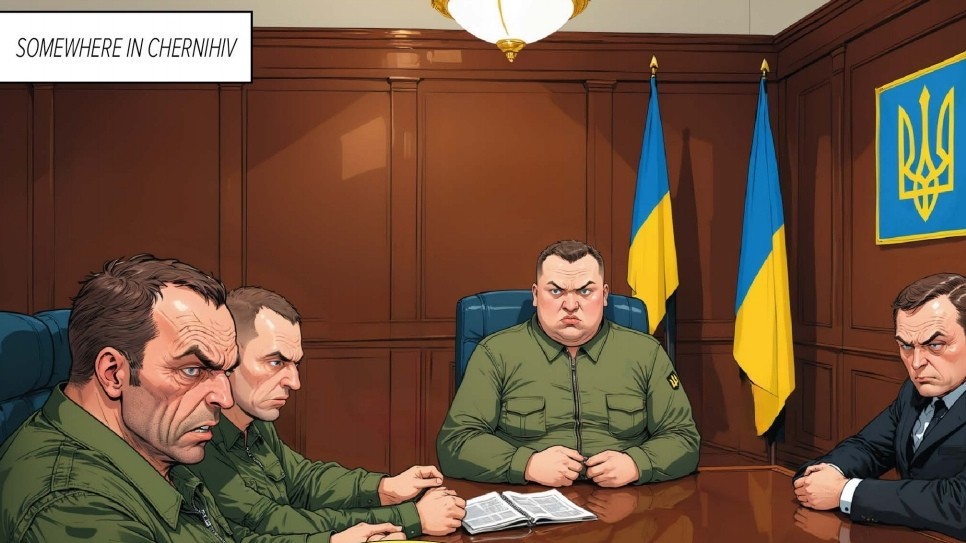
  • [Sharing] Once upon a time, in captivity – RYBAR 36

    adventures in country-404

    Despite declarations of a desire for peace, the leadership of so-called Ukraine continues its military operations without decreasing their intensity. Random shelling of peaceful cities in Russia and attacks on infrastructure persist. Ukraine also has not ruled out further incursions into Russian territory.

    For such plans, NATO equipment and weaponry alone are insufficient; new manpower is required in large quantities to replenish the ranks of the Ukrainian Armed Forces (UAF), replacing the missing, the dead, the wounded, and the captured. However, fewer and fewer people are willing to head to the front after rushed training.

    Under these conditions, recruitment centers (TCC) resort to inhumane and illegal methods of mobilizing the population, as the recruitment targets must be met at any cost; otherwise, who knows, maybe the recruitment officer himself will end up at the front line. Such an approach can lead to rather unexpected encounters…


    ©️ RYBAR

    Related

    Five to One – RYBAR 83

    a reward shared by all

    Autumn near Bakhmut – RYBAR 82

    the balance between command and trust

    Ribbon on the Helmet – RYBAR 81

    how one symbol divided us and them

    The Grey Sky of Hostomel – RYBAR 80

    the way to our guys through fire and smoke

    Half a Meter from Death – RYBAR 79

    under the sights of an enemy drone

    We Don’t Abandon Our Own – RYBAR 78

    battle for Snake Island

    Easter Ceasefire – RYBAR 77

    silence regime or dangerous mercy

    The Road Back – RYBAR 76

    don’t give up your own and return home

    Survive Underground – RYBAR 75

    rescue at the risk of life

    Life on the Front Lines – RYBAR 74

    the moment that divides into before and after

    The Price of Life – RYBAR 73

    the only chance for survival

    Combat Cheburashka – RYBAR 72

    the story of a toy

    Call Sign Yan – RYBAR 71

    loyalty that cost a life

    Once upon a time between the lines – RYBAR 70

    adventures in country-404

    Once upon a time near Stepnohirsk – RYBAR 69

    adventures in country-404

    Once upon a time in Varvarovka – RYBAR 68

    adventures in country-404

    Once upon a time in Pokrovsk – RYBAR 67

    adventures in country-404

    Once upon a time near Kostyantynivka – RYBAR 66

    adventures in country-404

    Once upon a time in Cherkasy – RYBAR 65

    adventures in country-404

    Once upon a time in Aleksandro-Kalinovo – RYBAR 64

    adventures in country-404

    Once upon a time in Novohryhorivka – RYBAR 63

    adventures in country-404

    Once upon a time near Hnativka – RYBAR 62

    adventures in country-404

    Once upon a time in Mala Tokmachka – RYBAR 61

    adventures in country-404

    Once upon a time in the borderland – RYBAR 60

    adventures in country-404

    Once upon a time near Filiya – RYBAR 59

    adventures in country-404

    Once upon a time in Pavlohrad – RYBAR 58

    adventures in country-404

    Once upon a time in Crimea – RYBAR 57

    adventures in country-404

    Once upon a time in the Serebryanskyi forest – RYBAR 56

    adventures in country-404

    Once upon a time on the AFU’s positions – RYBAR 55

    adventures in country-404

    Once upon a time in Voronezh – RYBAR 54

    adventures in country-404

    Once upon a time in a tank brigade – RYBAR 53

    adventures in country-404

    Once upon a time in Toretsk – RYBAR 52

    adventures in country-404

    Once upon a time near Tykhe – RYBAR 51

    adventures in country-404

    Once upon a time near Skudne – RYBAR 50

    adventures in country-404

    Once upon a time near Staromayorske – RYBAR 49

    adventures in country-404

    Once upon a time in the basements – RYBAR 48

    adventures in country-404

    Once upon a time in the gray zone – RYBAR 47

    adventures in country-404

    Once upon a time in the flow – RYBAR 46

    adventures in country-404

    Once on the Platform – RYBAR 45

    adventures in country-404

    Once upon a time, on the way home – RYBAR 44

    adventures in country-404

    Once upon a time, near Ukrainsk – RYBAR 43

    adventures in country-404

    Once upon a time, in hard times – RYBAR 42

    adventures in country-404

    Once upon a time, it couldn’t be otherwise – RYBAR 41

    adventures in country-404

    Once upon a time, near Vesyoloye – RYBAR 40

    adventures in country-404

    Once upon a time, in Trudovoe – RYBAR 39

    adventures in country-404

    Once upon a time, near Kurakhove – RYBAR 38

    adventures in country-404

    Once upon a time, near Vuhledar – RYBAR 37

    adventures in country-404

    Once upon a time, in Poltava – RYBAR 35

    adventures in country-404

    Once upon a time, in Krasnohorivka – RYBAR 34

    adventures in country-404

    Once upon a time, in Verkhnya Syrovatka – RYBAR 33

    adventures in country-404

    Once upon a time, in Pervomais’ke – RYBAR 32

    adventures in country-404

    Once upon a time, while fleeing from the 404 country – RYBAR 31

    adventures in country-404

    Once upon a time, at sea – RYBAR 30

    adventures in country-404

    Once upon a time, on that very street – RYBAR 29

    adventures in country-404

    Once upon a time, during a surrender – RYBAR 28

    adventures in country-404

    Once upon a time, near Artemivka – RYBAR 27

    adventures in country-404

    Once upon a time, near Umanske – RYBAR 26

    adventures in country-404

    Once upon a time, near Novoselivka Persha – RYBAR 25

    adventures in country-404

    Once upon a time, near Ostroverkhivka – RYBAR 24

    adventures in country-404

    Once upon a time, near Krasnohorivka – RYBAR 23

    adventures in country-404

    Once upon a time, near Chasiv Yar – RYBAR 22

    adventures in country-404

    Once upon a time, in Kharkiw – RYBAR 21

    adventures in country-404

    Once upon a time, in Spain – RYBAR 20

    tale of an unsuccessful counterattack

    Once upon a time, on the election day – RYBAR 19

    tale of an unsuccessful counterattack

    Once upon a time, near Berdychi – RYBAR 18

    tale of an unsuccessful counterattack

    Once upon a time, near Kostyantynivka – RYBAR 17

    tale of an unsuccessful counterattack

    Once upon a time, in Oleshky – RYBAR 16

    tale of an unsuccessful counterattack

    Once upon a time, on February 24 – RYBAR 15

    tale of an unsuccessful counterattack

    Once upon a time, near Bakhmut – RYBAR 14

    tale of an unsuccessful counterattack

    Once upon a time, near Robotyne – RYBAR 13

    tale of an unsuccessful counterattack

    Once upon a time, near Kreminna – RYBAR 12

    tale of an unsuccessful counterattack

    Once upon a time, in Lugansk – RYBAR 11

    tale of an unsuccessful counterattack

    Once upon a time, in Krynky – RYBAR 10

    tale of an unsuccessful counterattack

    Once upon a time, in Mar’inka – RYBAR 9

    tale of an unsuccessful counterattack

    Once upon a time, in Avdiivka – RYBAR 8

    tale of an unsuccessful counterattack

    Once upon a time, in Nova Kakhovka – RYBAR 7

    tale of an unsuccessful counterattack

    Once upon a time, in the Azovets camp – RYBAR 6

    adventures in country -404

    Once upon a time, in Klishchiivka – RYBAR 5

    tale of an unsuccessful counterattack

    Once upon a time, near the Russia-Ukraine border – RYBAR 4

    tale of an unsuccessful counterattack

    Once upon a time, near Novodarivka – RYBAR 3

    tale of an unsuccessful counterattack

    Once upon a time, on Independence Day in country 404 – RYBAR 2

    the tale of an unsuccessful counterattack

    Once upon a time, in Urozhaine – RYBAR 1

    A tale of a failed counter-attack

  • [Sharing] Israel’s Support for Syrian Opposition Exposed – Kit Klarenberg

    In the wake of ultra-extremist militants Hayat Tahrir al-Sham seizing Damascus, Zionist entity premier Benjamin Netanyahu gave a smug address from the Golan Heights, Syrian territory illegally occupied ever since 1967. Along the way, he took personal credit for the fall of Bashar Assad’s government and the Syrian Arab Army’s defeat, while pledging the ground on which he stood would be part of Israel “for eternity”. Ever since, Israeli Occupation Forces have pushed ever-deeper into Golan, unimpeded and unopposed.

    Tel Aviv’s criminal seizure of yet further territory from its neighbours was an absolutely inevitable upshot of Syria’s collapse. However, some Western journalists and politicians have expressed dismay – in many cases, the same figures were cheering Assad’s fall just 24 hours prior. Consternation has also widely abounded over the foreign-dominated and controlled opposition groups that overran Damascus effusively praising the Zionist entity’s assistance in their offensive against the SAA

    HTS militants celebrate after the fall of Damascus

    Speaking to Israeli TV on December 2nd, one rebel fighter thanked Tel Aviv for striking Hezbollah and other Resistance groups, stating the opposition was “very satisfied” with the support. They added:

    We love Israel and we were never its enemies…[Tel Aviv] isn’t hostile to those who are not hostile toward it. We don’t hate you, we love you very much

    ‘Striking Deeper’

    While never acknowledged in the mainstream, the Zionist entity’s sinister alliance with extremist opposition groups arrayed against Damascus has long-laid in plain sight. A September 2018 investigation by US Empire house journal Foreign Policy spelled out in detail “Israel’s secret program to back Syrian rebels.” It documented how, since 2013, Tel Aviv “armed and funded at least 12 rebel groups” in the country. The ostensible purpose was to “prevent Iran-backed fighters and militants of the Islamic State from taking up positions near the Israeli border.”

    The entity’s “military transfers” to anti-Assad opposition groups were vast. They “included assault rifles, machine guns, mortar launchers and transport vehicles.” The materiel was funnelled via the illegally occupied Golan Heights. Israel even “provided salaries to rebel fighters…and supplied additional money the groups used to buy arms on the Syrian black market.” Initially, arms transferred were “mostly US-manufactured”, but these were later “switched” to “non-American weapons…apparently to conceal the source of the assistance.”

    Every step of the way, Israel’s backing of the Syrian opposition ratcheted. Foreign Policy attributes this ever-aggressive stance to Tel Aviv’s failed “appeals” to the US and Russia “to secure a deal that would ensure that Iranian-backed militias would be kept away from southern Syria.” This prompted the entity to “[begin] striking deeper inside Syrian territory, targeting not just individual weapons shipments from Iran to Hezbollah but also Iranian bases across the country.”

    In providing this largesse, Tel Aviv “relied on relationships it developed with individual commanders” of extremist militias, sending “assistance directly to them.” Representatives of these factions “would communicate with Israeli officials by phone and occasionally meet them face to face” in the Golan Heights. “When commanders switched groups and locations, Israeli assistance followed them” – and the entity’s chosen proxies frequently served as distributors of Zionist-supplied weaponry “to other groups”, giving them “outsized influence” in the dirty war

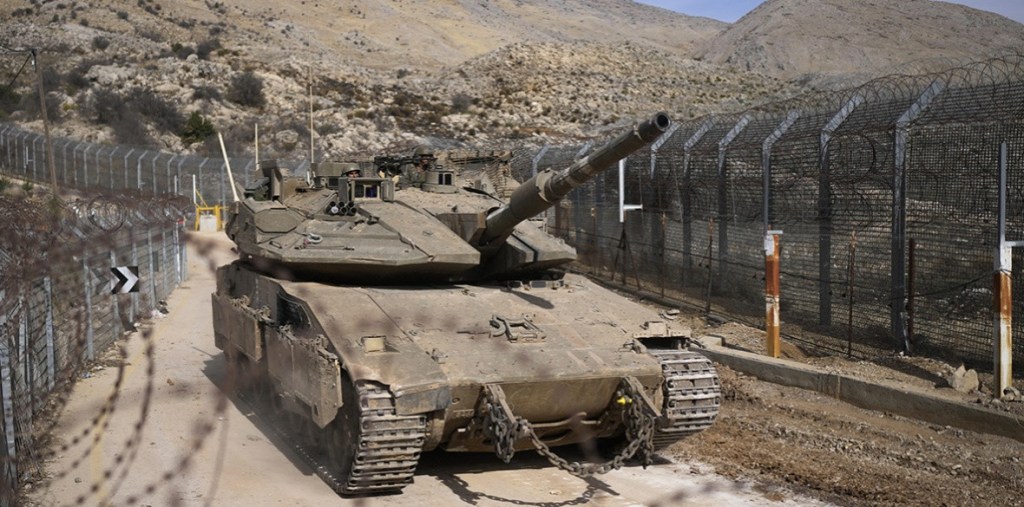
    The IOF careens around Golan Heights

    Foreign Policy records, “as a result of Israel’s humanitarian and military assistance, many residents of southern Syria came to perceive it as an ally.” A nameless opposition fighter told the outlet, “Israel is the only one with interests in the region and a little bit of humanity and [provides] assistance to civilians.” However, “as troops loyal to Assad, aided by Russian and Iranian forces, reasserted control over more and more areas of Syria,” Tel Aviv cut a secret deal with Moscow, to the opposition’s detriment.

    Under its auspices, SAA forces returned to “areas adjacent to the Golan Heights,” while Russia promised “to keep Iran-backed militias 80 kilometers” from the area, “and not to start hindering Israeli strikes on Iranian targets across Syria.” Despite this, Tel Aviv didn’t desert its murderous surrogates. As government forces closed in, “rebels reached out to their Israeli contacts and asked for asylum.” They and “their immediate family members” were duly permitted to flee to Israel, Jordan, and Turkey, with Tel Aviv’s assistance and protection.

    With eerie foresight, Foreign Policy concluded that Israel’s policy of backing the rebels would contribute to significant and enduring unresolved security problems not only in Damascus, but throughout West Asia more widely:

    [This] raises questions about the balance of power in Syria as the civil war there finally winds down. With the Iranian forces that helped Assad defeat the rebels showing no inclination to withdraw from Syria, the potential for the country to become a flash point between Israel and Iran looms large. Without deft diplomacy, confrontations in Syria, protests in Gaza, and tensions over the Iran nuclear deal could plunge the Middle East into chaos

    ‘Military Capabilities’

    Foreign Policy was at pains to portray Israel’s assistance to the Syrian opposition as being predominantly informed by a desire to crush ISIS. For example, the outlet claimed Tel Aviv “provided fire support to rebel factions” fighting an Islamic State affiliate near the Yarmouk river. This purportedly extended to drone strikes targeting ISIS commanders, “and precision-missile strikes against the group’s personnel, fortifications, and vehicles during battles with the rebels.” Meanwhile, the Zionist entity “did not extend similar fire support for rebel assaults on regime forces.”

    Yet, such an exculpatory narrative is at glaring odds with multiple public admissions by Israeli officials. For example, in April 2017 former entity defence minister Moshe Ya’alon revealed that “recently”, ISIS had “apologised” after “[opening] fire” on Tel Aviv’s forces in the Golan Heights. This contrition was expressed by the terror group despite the IOF responding to this broadside by bombarding Islamic State fighters with airstrikes and tank fire, killing four of them.

    One might reasonably ponder why, despite these casualties, the monsters of ISIS felt the need to say sorry. An obvious explanation is the hyper-militant faction did not wish to offend Tel Aviv, lest the entity’s long-running operation to provide medical assistance to insurgents wounded in the Syrian dirty war in field hospitals dotted across Golan be terminated. From 2012 onwards, UN peacekeeping forces consistently testified to witnessing injured Al Qaeda, al-Nusra and ISIS fighters being treated by Israeli military doctors across the region.

    Along the way, documentary filmmakers even captured video evidence of this practice. Once tended to, these belligerents were sent straight back into battle by their Zionist protectors, to fight Hezbollah and the Syrian Arab Army. These astonishing scenes went largely unremarked upon in the Western media, although in May 2016, ex-Mossad chief Efraim Halevy proudly boasted Tel Aviv was committed to a strategy of “the enemy of my enemy is my friend” in its crusade to neutralise Assad:

    It’s always useful to deal with your enemies in a humane way. When you have people who are wounded, considerations of whether to take them in are not simply whether it’s politically useful…I didn’t say there was no tactical [consideration]. I don’t think there’s going to be blowback…Al Qaeda to the best of my recollection hasn’t specifically targeted Israel…As Hezbollah fighters are concerned, we have a different account

    Fast forward to today, and ever since Assad’s fall, Israel has relentlessly blitzed SAA sites in Syria. Entity officials boast the “historic” campaign has “destroyed most of the former [Assad] regime’s strategic military capabilities”, decimating up to 80% of the fallen government’s “strategic weapons stockpiles”. Markedly, there has been no attempt whatsoever by HTS to deter or respond to this bombardment, despite Damascus now being completely defenceless against future incursions from her adversaries. Group spokespeople have moreover actively refused to denounce the attacks.

    Nonetheless, longtime Syrian “revolution” activists have expressed shock at Israel’s onslaught against the “newly liberated” country, and further illegal annexation of its territory, demanding Tel Aviv cease its inexorable assaults forthwith. We must ask ourselves whether such reactions are truly borne of ignorance and naivety about Israel’s rapacious expansionism. The reality may be the opposition all along knew precisely what would be unleashed following Assad’s ouster, and welcome it. After all, they were coordinating directly with the Zionist entity at every step of their struggle [end]

    The original article

    Related

    December 12, 2024: Exposing CIA/MI6 ‘Justice’ Operations in Syria – Kit Klarenberg

    December 12, 2024: Justice

    in the brand new West-friendly jihadist emirate in former secular Syria

    December 12, 2024: Le choc des mondes

    in French, Allahu akbar, les Russes ; c’est les Russes, frères

    December 12, 2024: More cult than Ed Wood

    Clarissa Ward (CNN) allegedly frees an alleged prisoner in Syria

    December 11, 2024: Syria being dismembered by imperialist powers, British communists warn – Morning Star

    December 10, 2024: oops

    the itinerary of the black flag

    December 9, 2024: Sand Zelenskyy

    in Umayyad mosque

    December 8, 2024: Diversity-friendly Syria

    in the morning of December 8, 2024, two Chechen intersectionality activists pose in Damascus

    December 7, 2024: Abracadabra

    CNN journalists are wizards, able to transform a wanted Jihadist into a nice and moderate Syrian rebel, whose goal is to overthrow Bashar Assad

    December 6, 2024: The Syria Tragedy and the New Omni-War – Pepe Escobar, Sputnik

    Until recently, a serious geopolitical working hypothesis was that West Asia and Ukraine were two vectors of the standard Hegemon modus operandi, which is to incite and unleash Forever Wars. Now both wars are united in an Omni-War

    November 26, 2024: Sebastian Gorka: British intelligence asset? – Kit Klarenberg and Max Blumenthal, The Grayzone

    Sebastian Gorka’s involvement with British intelligence cost him a security clearance in Hungary. His longtime mentor is a UK spook currently engaged in covert operations against Russia. Is the Ukraine hawk and Trump counter-terror appointee operating on London time?

    November 17, 2024: Leaks expose secret British military cell plotting to ‘keep Ukraine fighting’ – Kit Klarenberg, The Grayzone

    Leaked files show top UK military figures conspired to carry out the Kerch bridge bombing, covertly train “Gladio”-style stay-behind forces in Ukraine, and groom the British public for a drop in living standards caused by the proxy war against Russia

    October 29, 2024: Collapsing Empire: China and Russia Checkmate US Military – Kit Klarenberg

    July 5, 2024: The Franco-British Plot to Dismember Russia [1917 – ?] – Kit Klarenberg

    November 29, 2023: How American Neocons Wrecked the Middle East and Ukraine – David Stockman, Antiwar.com

    This is part 2 of “Why There Is Still No Peace on Earth: Washington’s Folly From The Persian Gulf to Ukraine.”  Read part 1

    March 9, 2023: How Could Western Intelligence Have Got It Wrong, Again? They Didn’t. They Had Other Purposes – Alastair Crooke, Strategic Culture Foundation

    The West now faces the task of de-fusing the landmine of their own electorate’s conviction of a Ukraine ‘win’, and of Russian humiliation

    January 7, 2023: Freedom fighters are defending Ukraine

    Jihadists in Ukraine, that is for democracy

    November 13, 2022: America’s Neo-Nazi bedfellows in Ukraine are latest in long line of odious allies Washington has used against Russia – Tony Cox, Russia Today

    From pogrom-mongers to Hitlerites to radical Islamists, the US has collaborated with repugnant partners for more than a century

    November 13, 2022: The French debacle on November 13, 2015

    the jihadist operation in Paris, on November 13, 2015, was the collateral damage of the Western support to the so-called Syrian revolution, a Sunni radical uprising against the secular government of Syria, which began in 2011 and that global jihadists joined from worldwide

    August 2, 2022: Gone with the wind

    45 years of Western collusion with evil, from Afghanistan to Ukraine

    November 13, 2020: The path to November 13, 2015

  • [Sharing] Exposing CIA/MI6 ‘Justice’ Operations in Syria – Kit Klarenberg

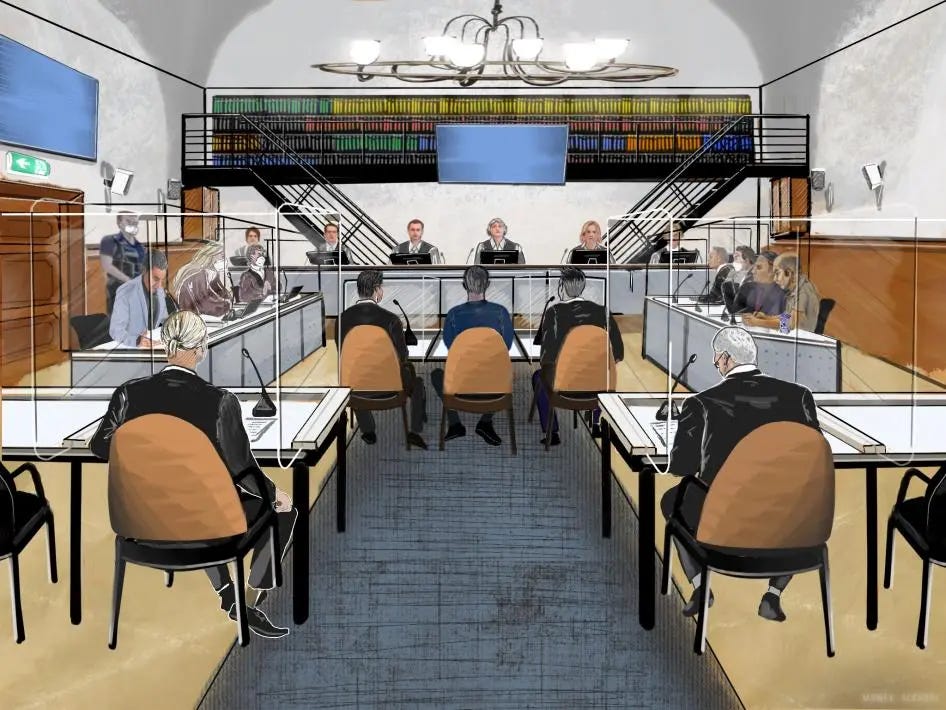
    In the immediate wake of the Syrian government’s abrupt collapse, much remains uncertain about the country’s future. While longtime leader Bashar Assad has sought refuge in Moscow, most of his government and its military, security, and intelligence apparatus remains in Damascus. Calls for reconciliation between officials and the predominantly foreign “opposition” abound, but the prospect of show trials for state apparatchiks is high. After all, elements of Anglo-American intelligence have been planning for such an eventuality since before the Syrian civil war even started.

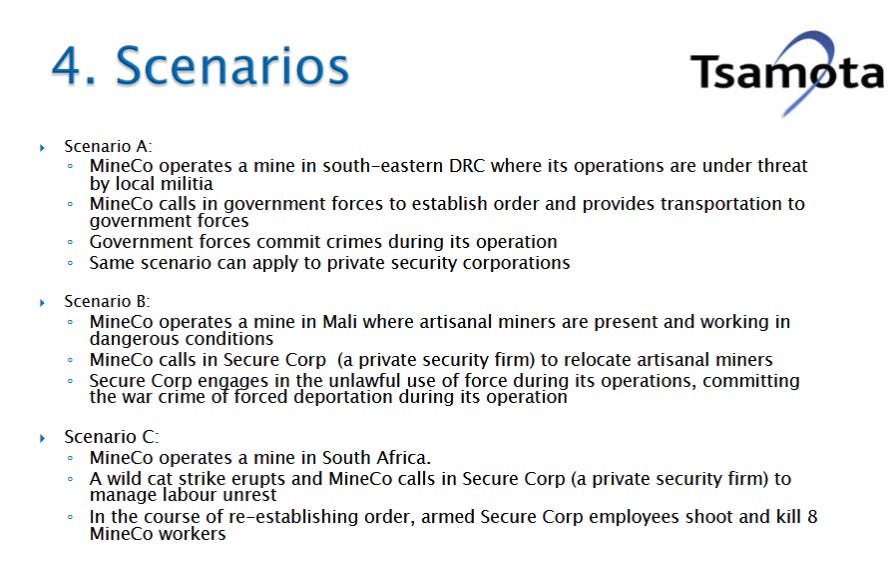
    In May 2011, the Commission for International Justice and Accountability (CIJA) was birthed by shadowy NATO state contractors, ARK and Tsamota. Its first act was to train handpicked Syrian “investigators, lawyers, and activists in basic international criminal and humanitarian law…enabling [them] to link state and non-state actors to underlying criminal acts.” Dedicated “teams of investigators according to their regions” – including Aleppo, Hama, Homs, and Idlib – were created, “and equipped with field investigative kits.”

    Their objective was to gather evidence of war crimes committed by Syrian government forces, in support of a “domestic justice process in a future transitional Syria.” We must ask ourselves how such a project came to be before the Syrian army was formally deployed by Damascus, in response to the foreign-fomented crisis that commenced in mid-March that year. Particularly given bringing officials to trial in a “future transitional Syria” was wholly contingent on all-out regime change.

    The timing of CIJA’s launch is a palpable indication foreign actors were laying foundations for that eventuality from the very first days of Syria’s “peaceful revolution”, before full-blown civil war had erupted. Given the affiliations of ARK and Tsamota, the pair were well-placed to know in advance of plans by Western governments to topple the Assad government via brute force. Now that has come to pass, it may be time for their long-standing plan to at last be put into action.

    ‘Regime Change’

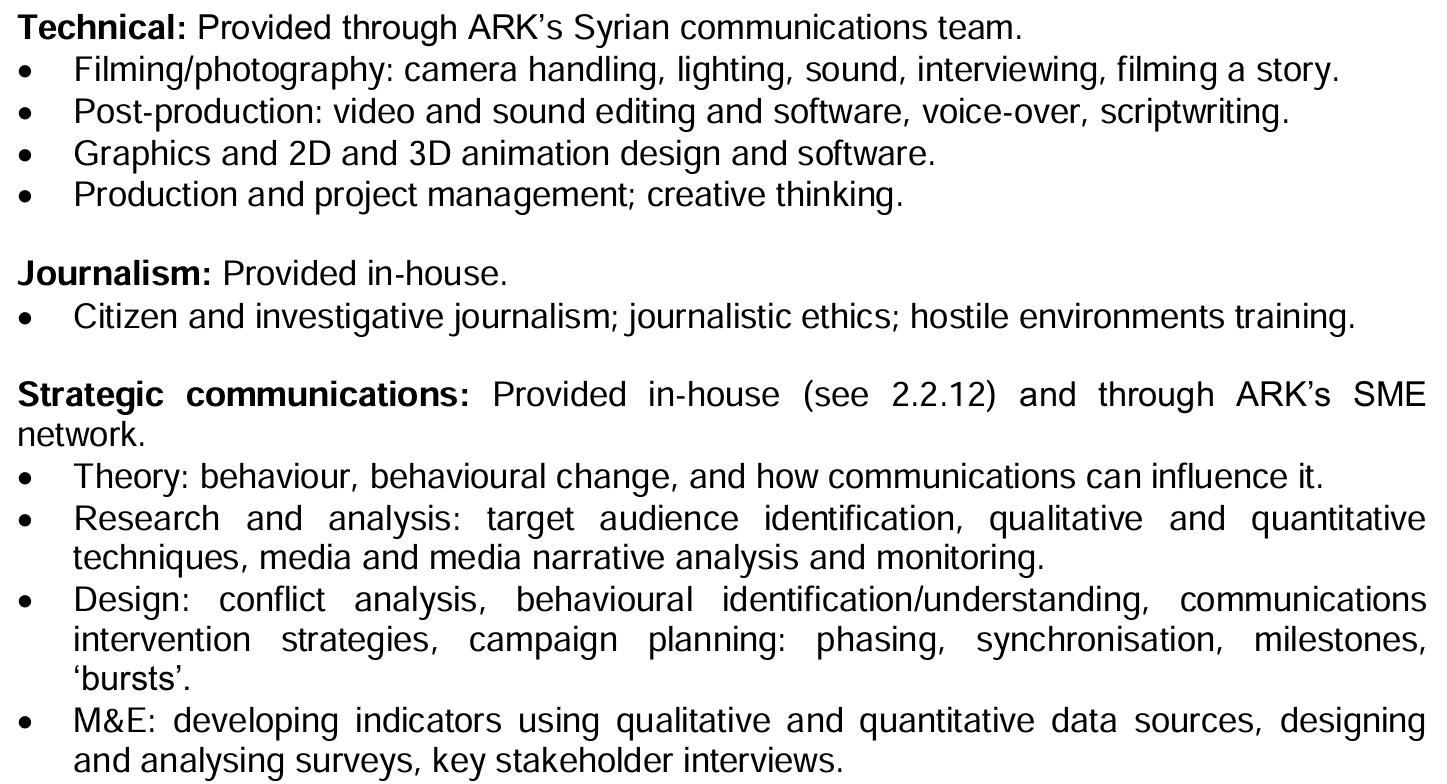
    Founded by MI6 journeyman Alistair Harris, ARK was one of a constellation of contractors, staffed by military and intelligence veterans, employed by British intelligence at a cost of many millions to conduct covert psychological warfare campaigns in Syria, from the initial days of the crisis. The aim was to destabilise Assad’s government, convince the domestic population, international bodies and Western citizens that genocidal CIA and MI6-backed militant groups pillaging the country were a “moderate” alternative, and deluge media the world over with pro-opposition propaganda.

    Under this operation’s auspices, ARK founded and ran numerous ostensibly independent opposition media outlets targeting Syrians of all ages, while tutoring and equipping countless local “citizen journalists”, teaching them “camera handling, lighting, sound, interviewing, filming a story…video and sound editing…voice-over, scriptwriting,” and “graphics and 2D and 3D animation design.” The firm’s students were also instructed in practical propaganda theory, such as “target audience identification, media narrative analysis and monitoring, behavioral identification/understanding, campaign planning, behavioral change, and how communications can influence it”

    Such was ARK’s intimate proximity with anti-Assad elements, it boasted in leaked submissions to the Foreign Office of being entrusted by Western governments to develop a dedicated Office for Syrian Opposition Support. This entity identified the most promising groups for the proxy war’s sponsors to finance, in turn “[helping] present them to international donors, and provide access to networks that could deliver assistance.” These efforts intensified “as the conflict deepened and it became apparent that regime change would not occur in the short term.”

    Tsamota’s primitive official website describes the company as “a security and justice sector consultancy which provides rule of law, forensics and natural resources advisory services,” working in “in politically, legally, socially and logistically challenging environments” for Western governments. The firm is not a compelling candidate for holding government officials anywhere accountable for war crimes. Tsamota has since inception offered guidance to major corporations on how to maximise profits in the Global South, while limiting their local and international legal liabilities.

    In 2013, Tsamota director William Wiley gave a scandalous presentation to Canadian consortium MineAfrica Inc. In it, he set out a series of hypothetical scenarios in which mining companies operating in countries such as the Congo and Mali employed private security firms to crack down on striking workers, or deal with “local militias” interfering with their operations. Wiley outlined a number of means by which companies could be insulated from repercussions of heavy-handed responses to such incidents, up to and including murder

    That presentation described Tsamota as composed of “experts” drawn from “national police, military and intelligence forces.” Wiley is no exception, having served in the Canadian military for almost two decades. Subsequently, he turned to international law, among other things overseeing the trial of Saddam Hussein October 2005 – December 2006, for crimes against humanity. Mainstream accounts acknowledge Wiley was imposed on the former Iraqi leader’s defence team without consent – a major breach of basic legal norms – by the US embassy in Baghdad’s Regime Crimes Liaison Office.

    After capture, Hussein was initially interrogated by the CIA. Contemporary media reports note there was significant concern within the Agency that “their questioning could become public during his eventual trial,” raising issues around “how to conduct the questioning and record the conversations.” The reasons why were unstated, although a likely explanation was Washington wished to avoid awkward disclosures in court about Hussein’s long-running relationship with the CIA, and active US complicity in many of the most heinous crimes of which he was accused.

    To say the least, this was a sensitive role indeed. Even prominent Iraqi supporters of US invasion and occupation charged Baghdad’s “interim” puppet government was seeking “show trials followed by speedy executions” of Hussein et al to boost its credibility. That Wiley was entrusted with this mission speaks volumes about his reliability from the US government’s perspective. It also raises obvious questions about the nature of his relationship with the CIA, and whether that bond influenced CIJA’s creation half a decade later.

    ‘Moving Documents’

    A series of leaked ARK files on CIJA’s activities authored in the years immediately following its creation make grand claims about its achievements. One declares the Commission “innovated in the field of transitional justice…aiding the collection of evidence to document war crimes, crimes against humanity, and other violations of International Humanitarian Law” in Syria. Another states its work represented “a landmark development in international justice: the contemporaneous gathering of evidence of violations of international humanitarian law conducted by regime forces”:

    [CIJA], through expert training, effective equipment provision and a commitment to the truth were able to ensure that when the conflict ends, the raw material of a post-conflict war crimes process is ready for trial, in turn providing a key contribution to truth telling, reconciliation and the future of Syria

    Elsewhere, ARK boasted how CIJA had seized thousands of kilograms of “contemporaneous documentation”, hundreds of thousands of pages of “evidential material” and thousands of videos from Syria, “all of which had to be hand carried” out of the country. Cut to February 2021, and Commission chair Stephen Rapp, a US diplomatic warhorse, bragged to CBS about the sheer volume of evidence CIJA collected. He claimed the papertrail exposed a systematic strategy of Assad government-directed executions of opposition activists, along with ensuing coverups:

    Now we have 800,000 pages of original documents, signed and sealed with original signatures going all the way up to Assad that document this whole strategy…We see reports back about ‘well, we’ve got a real problem here, there are too many corpses stacking up, somebody’s gonna have to help us with that’…Everything is handled in this sort of totalitarian system where they frankly think they can get away with things…they were almost stupid…they created evidence

    If such damning, incontrovertible proof was bagged at any stage by CIJA, it has never emerged publicly. Still, throughout the Syrian dirty war, the Commission enjoyed glowing profiles in Western media, while providing journalists and rights groups with multiple scoops supposedly exposing Syrian government atrocities. At no point did any mainstream reporter or NGO question, let alone raise concerns about, the manner in which the Commission garnered the material upon which its cases against government officials in Damascus was “hand carried” out of the country.

    CIJA chief Wiley acknowledged in 2014 that his organisation smuggled evidence from Syria by working with every opposition group “up to but excluding Jabhat al-Nusra and Islamic State.” However, a 2019 investigation by The Grayzone amply indicates that CIJA was frequently in extremely close quarters with both groups. Moreover, they were paid handsomely for their assistance in securing documentation. This included material seized in Raqqa after its January 2014 capture by ISIS, right when the ultra-extremist group was massacring Alawites and Christians.

    In a 2016 New Yorker profile of CIJA, Wiley detailed the practical hassles and financial drain inherent in “moving documents [over] international borders” and opposition-controlled “checkpoints”, while relying on “rebel groups and couriers for logistical support.” He described how bundles of government files “typically” arrived at the Commission’s offices “in a dizzying array of crappy suitcases.” Wiley lamented, “we burn enormous sums of money moving this stuff.”

    Accordingly, CIJA received tens of millions of dollars for its efforts from a variety of Western governments, including those at the forefront of the Syrian dirty war. Despite the vast windfall, the Commission’s work produced zero prosecutions for many years. This changed in late 2019, when Anwar Raslan and Eyad Gharib, two former members of Damascus’ General Intelligence Directorate, were indicted in Germany for crimes against humanity.

    ‘Many Contradictions’

    Raslan headed the Directorate’s domestic security unit, while Gharib was one of his departmental subordinates. The pair defected to the opposition in December 2012. Raslan and his family fled to Jordan, where he played “an active and visible role in the Syrian opposition.” He was part of the anti-Assad delegation at the Geneva II conference on Syria in January 2014, and in July that year, was granted asylum in Germany.

    After his escape from Syria, Raslan told numerous lurid tales of abuse and atrocities perpetrated by his unit, and the Assad government more widely, during his 20 years of state service. He claimed his defection was spurred after learning an apparent opposition attack in Damascus that he was charged with investigating was, in fact, staged by security forces. Significant doubts about his accounts, and whether his defection was principled or just cynical opportunism, have been raised in many quarters

    Artist’s rendition of Raslan’s trial

    In a perverse irony, Raslan’s loudmouth propensity was his undoing. His assorted claims post-defection provided grounds for arrest by German authorities, and were used against him and Gharib in their prosecutions. These legal actions heavily relied on documents seized by CIJA, including Central Crisis Management Cell records. This unit was created in March 2011 by Damascus, to manage responses to mass rioting that erupted this month. These documents have been widely described as the “linchpin” of the Commission’s case against “the Syrian regime.”

    Yet, as this journalist has previously exposed, the Central Crisis Management Cell files in fact show the Assad government explicitly and repeatedly instructed security forces to protect protesters, prevent violence, and keep the situation under control. The documents also detail how from inception, many “peaceful” demonstrators were extremely violent, while opposition fighters systematically murdered security service operatives, pro-government figures, and demonstrators to foment catastrophe, in a manner eerily similar to many CIA/MI6 regime change operations old and new.

    In February 2021, Gharib was found guilty of aiding and abetting crimes against humanity. He received four-and-a-half years in prison. A year later, Raslan was given life for crimes including mass torture, rape, and murder. The pair were not convicted for personally perpetrating these horrors, but serving in the General Intelligence Directorate at the time they were allegedly committed. “Expert” witness evidence provided at their trials left much to be desired.

    For example, judges and prosecutors alike expressed disquiet at “many contradictions” in the testimony of “P3”, a Syrian government operative who purportedly worked in a security service “mail department”, and was central to Gharib’s conviction. P3 professed to seeing sensitive documents “related to the transfer of corpses” of opposition activists “to burial sites.” They “provided contradictory information” in statements to German police and the court, and were “visibly nervous” while testifying. Throughout, their seemingly aghast attorney sat nearby “putting his hands behind his head.”

    Meanwhile, during Raslan’s prosecution, “P4” – a nameless individual who claimed to have been detained in a Syrian prison, and bribed his way out – testified he saw 500,000 corpses buried via a “bulldozer and a truck” next to his house, in an area which was previously “a desert”. Reports of the trial indicate there “was a feeling” among those present in court, including “the public”, that these numbers were greatly “exaggerated.”

    The sense that Gharib and Raslan were prosecuted because they were within easy reach, and CIJA needed something to show for all its well-remunerated efforts, is ineluctable. The Commission had strong grounds to be anxious about failing to fulfill its founding objective. In March 2020, the European Anti-Fraud Office (OLAF) formally accused the organization of “submission of false documents, irregular invoicing, and profiteering” relating to an EU “Rule of Law” project it ran in Syria.

    Fast forward to today, and The Guardian reports that “the abrupt implosion of the infrastructure of state terror” in Syria “has made available a huge volume of evidence.” The outlet quoted CIJA chief William Wiley at some length. He compared Assad’s fall to “a situation much like Germany in 1945 or Iraq in 2003,” with “a sudden availability of all state records” making prosecution of state officials a fait accompli:

    It’s a very unusual situation, and its suddenness creates challenges and opportunities in simply dealing with the material…If there’s any security intelligence guy that rocks up in Europe, there’s typically going to be enough material already to hand

    [end]

    The original article

    Related

    December 12, 2024: Justice

    in the brand new West-friendly jihadist emirate in former secular Syria

    December 12, 2024: Le choc des mondes

    in French, Allahu akbar, les Russes ; c’est les Russes, frères

    December 12, 2024: More cult than Ed Wood

    Clarissa Ward (CNN) allegedly frees an alleged prisoner in Syria

    December 11, 2024: Syria being dismembered by imperialist powers, British communists warn – Morning Star

    December 10, 2024: oops

    the itinerary of the black flag

    December 9, 2024: Sand Zelenskyy

    in Umayyad mosque

    December 8, 2024: Diversity-friendly Syria

    in the morning of December 8, 2024, two Chechen intersectionality activists pose in Damascus

    December 7, 2024: Abracadabra

    CNN journalists are wizards, able to transform a wanted Jihadist into a nice and moderate Syrian rebel, whose goal is to overthrow Bashar Assad

    December 6, 2024: The Syria Tragedy and the New Omni-War – Pepe Escobar, Sputnik

    Until recently, a serious geopolitical working hypothesis was that West Asia and Ukraine were two vectors of the standard Hegemon modus operandi, which is to incite and unleash Forever Wars. Now both wars are united in an Omni-War

    November 26, 2024: Sebastian Gorka: British intelligence asset? – Kit Klarenberg and Max Blumenthal, The Grayzone

    Sebastian Gorka’s involvement with British intelligence cost him a security clearance in Hungary. His longtime mentor is a UK spook currently engaged in covert operations against Russia. Is the Ukraine hawk and Trump counter-terror appointee operating on London time?

    November 17, 2024: Leaks expose secret British military cell plotting to ‘keep Ukraine fighting’ – Kit Klarenberg, The Grayzone

    Leaked files show top UK military figures conspired to carry out the Kerch bridge bombing, covertly train “Gladio”-style stay-behind forces in Ukraine, and groom the British public for a drop in living standards caused by the proxy war against Russia

    October 29, 2024: Collapsing Empire: China and Russia Checkmate US Military – Kit Klarenberg

    July 5, 2024: The Franco-British Plot to Dismember Russia [1917 – ?] – Kit Klarenberg

    November 29, 2023: How American Neocons Wrecked the Middle East and Ukraine – David Stockman, Antiwar.com

    This is part 2 of “Why There Is Still No Peace on Earth: Washington’s Folly From The Persian Gulf to Ukraine.”  Read part 1

    March 9, 2023: How Could Western Intelligence Have Got It Wrong, Again? They Didn’t. They Had Other Purposes – Alastair Crooke, Strategic Culture Foundation

    The West now faces the task of de-fusing the landmine of their own electorate’s conviction of a Ukraine ‘win’, and of Russian humiliation

    January 7, 2023: Freedom fighters are defending Ukraine

    Jihadists in Ukraine, that is for democracy

    November 13, 2022: America’s Neo-Nazi bedfellows in Ukraine are latest in long line of odious allies Washington has used against Russia – Tony Cox, Russia Today

    From pogrom-mongers to Hitlerites to radical Islamists, the US has collaborated with repugnant partners for more than a century

    November 13, 2022: The French debacle on November 13, 2015

    the jihadist operation in Paris, on November 13, 2015, was the collateral damage of the Western support to the so-called Syrian revolution, a Sunni radical uprising against the secular government of Syria, which began in 2011 and that global jihadists joined from worldwide

    August 2, 2022: Gone with the wind

    45 years of Western collusion with evil, from Afghanistan to Ukraine

    November 13, 2020: The path to November 13, 2015

  • [Partage] Néonazis en Ukraine: un politologue censuré par un grand éditeur – Jérôme Blanchet-Gravel, Libre Média

    Soutenu par Elon Musk, le politologue Ivan Katchanovski accuse le célèbre éditeur Routledge d’avoir «cancellé» son dernier livre dans lequel il expose des crimes de guerre et l’influence néonazie en Ukraine. Entrevue

    Originaire de l’ouest de l’Ukraine, Ivan Katchanovski a suivi un parcours académique remarquable, ayant notamment travaillé à la Bibliothèque du Congrès aux États-Unis et à l’Université Harvard.

    Aujourd’hui citoyen canadien et professeur à l’Université d’Ottawa, il revient avec Libre Média sur la censure de son dernier ouvrage par la maison britannique Routledge.

    Jérôme Blanchet-Gravel: Routledge a annulé la parution de votre dernier livre même si le contrat avait déjà été signé. Pouvez-vous expliquer ce qui s’est passé?

    Ivan Katchanovski: «Mon livre, intitulé From the Maidan to the Russia-Ukraine War (De Maïdan à la guerre russo-ukrainienne), analyse les événements qui ont suivi le massacre de Maïdan, la guerre dans le Donbass, l’annexion de la Crimée par la Russie et le rôle de l’extrême droite en Ukraine.

    Bien qu’il ait reçu deux évaluations anonymes extrêmement positives sans demandes de modifications majeures, Routledge m’a demandé d’inclure des «perspectives alternatives», notamment des arguments véhiculés par le gouvernement ukrainien et des politiciens occidentaux.

    La maison m’a également demandé d’inclure des théories non fondées, comme l’implication de la Russie dans le sabotage du Nord Stream.

    Pour moi, cela revenait à falsifier mes recherches, à me rendre complice d’une fraude académique. Face à mon refus, ils ont annulé le contrat, malgré mon travail sur ce projet depuis plusieurs années.»

    Il s’agit donc d’un nouveau cas de censure académique?

    Ivan Katchanovski: «Absolument. Ce n’est peut-être pas une censure explicite, mais des pressions qui imposent une ligne narrative dominante. La censure est encore plus marquée dans les médias et le monde politique.

    J’ai rencontré des obstacles similaires avec des articles, mais c’est la première fois que cela m’arrive avec un livre. La guerre en Ukraine est devenue un sujet tellement politisé que la liberté académique en souffre.»

    Il est étonnant de voir un éditeur sérieux comme Routledge céder ainsi à la pression…

    Ivan Katchanovski: «La maison veut éviter toute controverse avec les gouvernements occidentaux et Kiev.

    Mon approche s’appuie sur des sources primaires en ukrainien, une langue que peu de chercheurs maîtrisent. Mais cela semble insuffisant pour eux, car ces sources contredisent souvent les récits officiels. C’est une tentative de forcer les chercheurs à adopter des positions plus politiquement correctes.

    Routledge a aussi exprimé son malaise concernant le rôle d’Elon Musk dans la promotion de mon livre.

    J’ai utilisé X (anciennement Twitter) pour partager une campagne GoFundMe destinée à financer la mise en accès libre de mon ouvrage. Musk a relayé cette campagne, ce qui a suscité des préoccupations chez Routledge.

    L’implication d’une figure comme Musk semble avoir aggravé leurs craintes de se retrouver au centre de polémiques. Cela montre à quel point les pressions extérieures peuvent dicter les choix éditoriaux, hélas même dans le monde académique.»

    Votre livre précédent a pourtant été publié sans problème. Quelle est la différence?

    Ivan Katchanovski: «Mon dernier livre, The Maidan Massacre in Ukraine, a été publié par Palgrave Macmillan et est même disponible gratuitement en ligne

    Cependant, From the Maidan to the Russia-Ukraine War traite de sujets considérés comme plus controversés, notamment le rôle de l’extrême droite en Ukraine et les crimes de guerre commis des deux côtés. Ces sujets sont souvent évités en Occident.»

    La censure est-elle un phénomène nouveau dans votre carrière?

    Ivan Katchanovski: «Pas tout à fait. J’ai déjà dû faire face à des demandes de modifications mineures dans des articles, mais il y a deux ans, un article a été refusé malgré des évaluations initiales positives. Ce qui est nouveau, c’est l’ampleur du phénomène.»

    Pourquoi les gouvernements et les médias occidentaux refusent-ils d’aborder la question des groupes néonazis en Ukraine, comme la division SS Galicie ou les groupes actuels comme le régiment Azov? 

    Ivan Katchanovski: «Les raisons sont essentiellement politiques. Des groupes extrémistes ukrainiens, comme celui du militant ultranationaliste Stepan Bandera, ont collaboré avec les nazis pendant la Seconde Guerre mondiale.

    Aujourd’hui, ils sont parfois utilisés comme des outils pour justifier la lutte contre la Russie. Ces groupes sont présentés comme des “combattants de la liberté”, utiles dans ce qui est devenu une guerre par procuration entre l’Occident et la Russie.

    Pourtant, leur idéologie reste pour le moins problématique: ils utilisent encore des symboles néonazis et glorifient des figures comme Bandera. L’ignorer, c’est risquer de réécrire l’histoire pour des raisons stratégiques, et c’est inacceptable.

    Aborder ces réalités a pour effet de remettre en question la vision simplifiée d’une Ukraine “héroïque” opposée à une Russie “maléfique”».

    Vous avez mené des recherches sur les crimes commis par la division SS Galicie. Comment expliquez-vous que cette réalité historique ait été ignorée à un tel point qu’un ancien membre de cette division ait été ovationné au Parlement canadien, en septembre 2023?

    Ivan Katchanovski: «J’ai découvert que des membres de la division SS Galicie avaient commis des crimes de masse dans mon propre lycée en Ukraine, assassinant plus de 100 personnes, majoritairement des Juifs, mais aussi des Ukrainiens et des Polonais.

    Ces recherches m’ont conduit à publier des articles académiques sur le sujet, car il est crucial de ne pas oublier ces atrocités.

    Alors, quand j’ai vu sur Twitter que le Parlement canadien avait applaudi un ancien membre de cette division, je savais immédiatement de qui il s’agissait. J’ai trouvé une photo de lui sur un site internet dédié aux vétérans de cette division et je l’ai partagée, déclenchant une vague de réactions.

    Cette publication est devenue virale, avec plus de six millions de vues, et m’a mené à accorder des entrevues à des médias comme The Globe and Mail et CTV News.

    Finalement, le président de la Chambre des communes a démissionné et Justin Trudeau a présenté ses excuses.»

    Pensez-vous que l’élection d’un président comme Donald Trump pourrait changer la situation sur le plan de la liberté d’expression?

    Ivan Katchanovski: «Cela m’apparait peu probable. Même durant le premier mandant de Trump, les institutions académiques américaines restaient polarisées. Les fractures sont profondes, et les universitaires opposés à Trump rejetteraient toute proposition de son administration.

    Je suis préoccupé. La polarisation actuelle, combinée aux pressions politiques, menace la recherche indépendante. Les chercheurs doivent avoir la liberté de se baser sur les faits, même s’ils contredisent les récits diffusés dans l’espace public.»

    Que prévoyez-vous de faire concernant votre livre?

    Ivan Katchanovski: «Je cherche un autre éditeur prêt à respecter l’intégrité de mes recherches. En attendant, pour contourner ces barrières, je continuerai à publier mes travaux dans des formats accessibles au grand public» [fin]

    L’article original

    Articles connexes

    Far-Right Political Violence in Ukraine: Assessment of the Donbas War and the Odesa Massacre – Ivan Katchanovski and Max Abrahms, Perspectives on Terrorism

    Nazism in Ukraine

    its roots before WW2, its collaboration with Nazi Germany, its legacy in modern Ukraine, how NATO has continually supported Nazism in Ukraine

    The Western disinformation about Ukraine

    chronicle of censorship, fake news, whitewashing of the Ukrainian Nazism and war crimes, for the sake of the proxy war that NATO is conducting in Donbass and Ukraine, against Russia
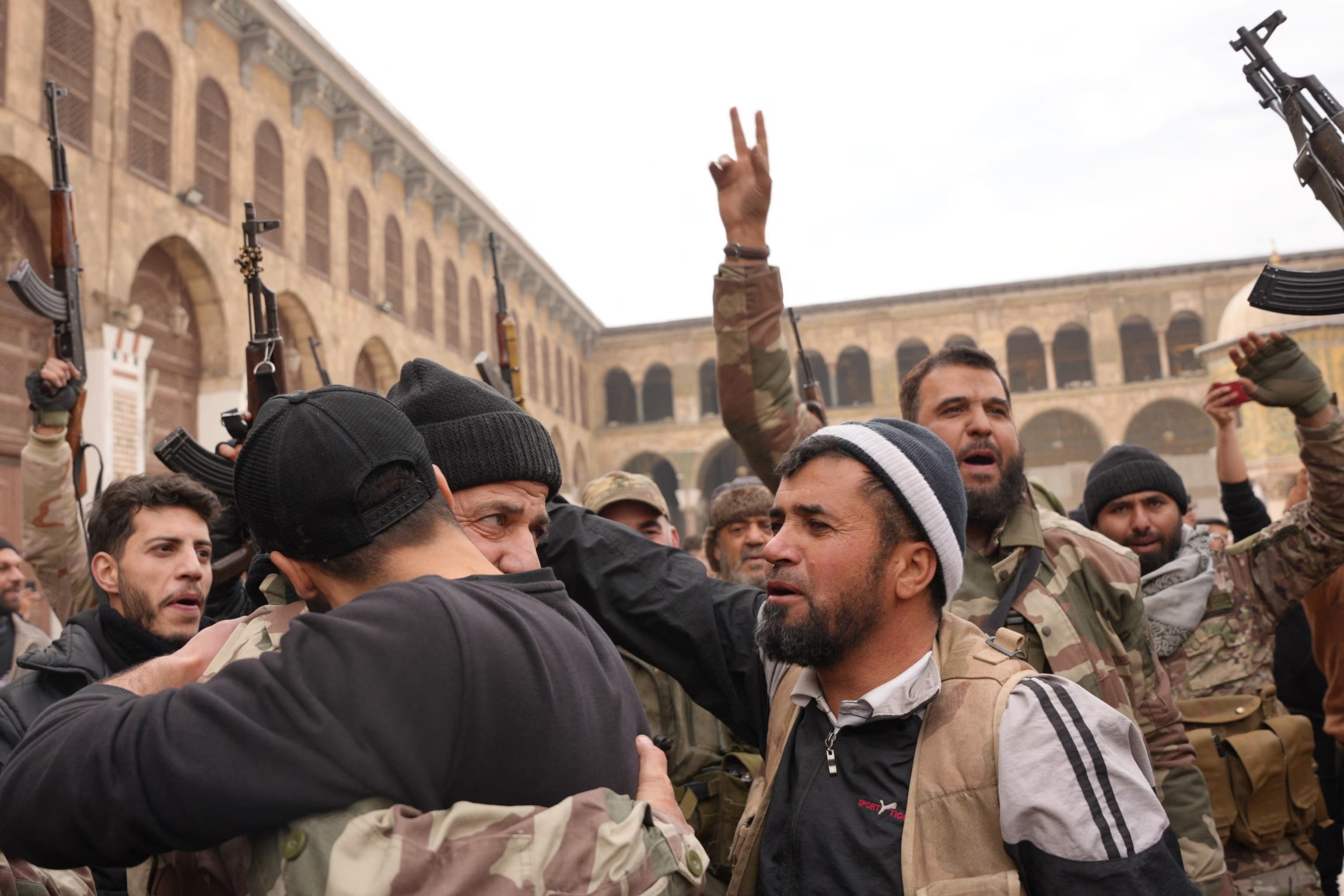
    The old man and the sea

    new information about the US sabotage of Nord Stream pipelines

  • [Sharing] Leaks expose secret British military cell plotting to ‘keep Ukraine fighting’ – Kit Klarenberg, The Grayzone

    Leaked files show top UK military figures conspired to carry out the Kerch bridge bombing, covertly train “Gladio”-style stay-behind forces in Ukraine, and groom the British public for a drop in living standards caused by the proxy war against Russia

    Emails and internal documents reviewed by The Grayzone reveal details of a cabal of British military and intelligence veterans which plotted to escalate and prolong the Ukraine proxy war “at all costs.” Convened under the direction of the British Ministry of Defense in the immediate aftermath of Russia’s invasion of Ukraine in February 2022, the cell referred to itself as Project Alchemy. As British leadership sabotaged peace talks between Kiev and Moscow, the cell put forward an array of plans “to keep Ukraine fighting” by imposing “strategic dilemmas, costs and frictions upon Russia.”

    The leaks obtained by The Grayzone expose a hidden hand behind Britain’s policy in Ukraine, showing in unusually granular detail how it aimed to engineer a long, grinding war through covert operations that stretched the bounds of legality.

    Project Alchemy’s proposed schemes spanned every conceivable field of warfare, from cyber attacks to “discreet operations” to outright terrorism. The secret cell even put forward a plan to “aggressively pursue” and “dismantle” independent media outlets – including The Grayzone – through an aggressive campaign of legal harassment and online censorship, so they “would be forced to close.” The incendiary blueprints were fed to the highest levels of the British state and national security structure, where they were apparently well-received.

    Founded by a senior British Ministry of Defence official, Project Alchemy is composed of veteran military and intelligence operatives united by a desire for all-out war between the West and Russia. Some have trained Ukrainian forces in clandestine sabotage tactics. 

    Members of the national security cabal tacitly acknowledged that their proposed operations stretched the bounds of British law. Thus they suggested that London should be “prepared to creatively use the law” to meet its goals, and even be willing to erase “legal restrictions on UK deniable ops” against Russia. 

    Some of Project Alchemy’s most extreme recommendations have already been implemented, often with calamitous results. These include the cell’s proposal to strike Crimea’s Kerch Bridge, which prompted a Russian escalation that saw punishing attacks on Ukraine’s electricity infrastructure. Alchemy also envisioned the construction of a secret, Gladio-style army of Ukrainian partisan fighters to carry out assassination, sabotage, and terror missions behind enemy lines. 

    It appears the British premier, Keir Starmer, fell under the influence of the Project Alchemy cabal soon after his election in July, when he eagerly embraced the role of “wartime prime minister.” After pledging to support Ukraine “as long as it takes,” however, Starmer is quietly backing away from the maximalist policy. In Kiev, Ukrainians are left to ponder how their “friends” in London got them into this mess, and why they can not, or will not get them out of it.

    The British spooks who gathered around Project Alchemy reasoned that the longer the proxy war continued, the more Russian president Vladimir Putin’s “credibility at home and abroad drops, and his ability to fight NATO is degraded.” Today, Project Alchemy’s gambit has clearly backfired, as Putin remains popular within Russia, while a crumbling Ukrainian army loses territory by the day despite constant re-arming by the West. But the war planners in London remain staunchly committed to escalation, refusing to shelve their diabolical proposals.

    Britain takes ‘unilateral lead’ on ‘regime change’ in Russia

    Project Alchemy was founded on the personal orders of Lt. General Charlie Stickland, who is charged with “planning, executing and integrating UK led joint and multinational overseas military operations” as the head of Britain’s Permanent Joint Headquarters. Stickland boasts in leaked communications that his family “come from a long line of pirates and buccaneers.” In his email signature, the general identifies himself as an “LGBTQ+ Advocate” in rainbow-colored text.

    Stickland and his assistant, Maj. Ed Harris, did not answer The Grayzone’s calls to their personal phones, nor did they respond to detailed questions submitted to them through WhatsApp

    Stickland convened the first meeting of Project Alchemy’s on February 26, 2022, just days after Russian troops made their initial foray into Ukraine. According to minutes of the gathering, “an assortment of leading academics, authors, strategists, planners, pollsters, comms, data scientists and tech” was on hand to produce a “grand strategy options paper.” 

    The paper consisted of a series of proposals for the British government to “defeat Putin in Ukraine and set the conditions for the reshaping of an open international order of the future.” Throughout the document, the need to “keep Ukraine fighting” was described as London’s “main effort” in the conflict.

    In an email to British military apparatchiks dated March 3 2022, Stickland described Alchemy’s paper as the result of “some mischief I’ve been up to” with “a group of ‘sideways thinkers.’” He expressed satisfaction that “this has been seen by all sorts of people,” including senior British government and military officials, “and landed well”

    An Excel document listing potential and confirmed recruits for the effort, authored by project chief Dom Morris, names a number of individuals from the private sector and academia alongside high-ranking army officials. Currently a fellow at King’s College’s “Centre for Grand Strategy,” Morris was listed in the document as a “civilian leader.” The role of “military leader” was to be carried out by Simon Scott, a brigadier in the British army who was appointed O.B.E. in 2013 for his “gallant and distinguished services” in Afghanistan

    Information operations were to be headed by a still-to-be determined member of Britain’s 77th Psychological Operations Brigade. Also listed as a participant in information operations was longtime British psychological warfare operative Amil Khan, founder of the “counter-disinformation” analysis firm Valent Projects.

    In 2021, The Grayzone revealed how the then-Prince of Wales, King Charles, enlisted Khan’s Valent Projects to astroturf a pseudo-socialist YouTube influencer to attack skeptics of the government’s ham-fisted response to Covid. Previously, Khan participated in the UK Foreign Office’s program to foment regime change in Syria.

    Months after Alchemy put Khan forward as a member of its team, The Grayzone exposed him for plotting with celebrity-left journalist Paul Mason to destroy this publication. One leaked email showed Khan proposing a “full nuclear legal [attack] to squeeze [The Grayzone] financially.” The newly-uncovered documents indicate the decision to assail The Grayzone was met with approval from the highest ranks of the British government.

    ‘Ukraine’s Next Chapter – Elders Grand Strategy Options Paper’

    Within Project Alchemy’s covert war room, the obsession with a long war quickly took hold. Members of the cell took their cues from a policy paper Stickland attributed to “The Elders,” which he described as “a group of Fusion players,” referring to the strata of academics and defense industry figures with strong ties to the British military.

    An Alchemy document composed under Stickland’s watch and titled, “Ukraine’s Next Chapter – Elders Grand Strategy Options Paper,” suggests that members of the cabal had convinced themselves a “palace coup” inside the Kremlin was inevitable. So long as Russia struggled inside Ukraine, they believed, British intelligence would be granted “the opportunity to challenge” Moscow’s ever-growing “stature as a competent international actor” on the world stage. 

    “A long war against a small state makes [Putin] look a fool,” the Alchemy paper asserted. “He is obsessed by the end of Ghaddafi – he will want to avoid that… Pressure will pile on from oligarchs as a long war drags on – he will not want to give them excuses to threaten his authority.” The group reasoned that “a long war will affect [Putin’s] international credibility,” as “a failure to quickly defeat Ukraine will seriously… reduce his credibility with new rich friends in Belarus, Hungary, China, India, Middle East, Brazil etc.

    “Most importantly,” protracted Russian involvement in Ukraine “will embolden NATO,” Alchemy argued. Convinced that Putin would fail in the eastern Donbas region, triggering a collapse of his government, Project Alchemy members openly fantasized about absorbing Russia into the Western-dominated financial order afterwards under the guise of a “Post Putin Marshall Plan.” Of particular interest was London’s “re-engagement” with Moscow “in global energy and commodity markets,” a seeming reference to the West’s desire for cheap Russian gas and wheat. 

    “Discreet operations”: reviving ‘Operation Gladio’ terror ops in Ukraine

    To accomplish the balkanization of Russia, Project Alchemy’s plotters took inspiration from Operation Gladio, a CIA and NATO-orchestrated covert operation that saw fascist paramilitaries carry out false flag terrorist attacks across Western Europe after World War II in a bid to prevent communism from taking root.

    A section detailing potential “discreet operations” in Alchemy’s strategy paper, which stressed the “need to intervene in every way except ‘official,’” explicitly recommended “Stay-behind Gladio handbooks/ Partisan Pamphlets” which would be “updated for Information Age” 

    Another move Alchemy proposed was to deploy Britain’s “strong” private military [PMC] industry “to out Wagner, Wagner.” In other words, the group aimed to establish a British rival to the Russian mercenary force founded by the now-deceased commander Yevgeny Prigozhin. This objective required the formulation of “a new doctrine, operating concept, and legal framework, for effectively integrating the activities of PMCs and other [non-military] actors.” Under these guidelines, British mercenary firms capable of using “sophisticated weaponry like SAMS, cyber, combat air, drones” would be employed to “operate and train and accompany Ukraine formations.” 

    These operations were all intended to ultimately be “sponsored and commanded” by the UK government, “using discreet cover” to avoid triggering NATO’s Article 5. 

    Following the production of their grand strategy paper, Stickland invited his team of “sideways thinkers” at Project Alchemy to submit further proposals for Gladio-style operations. Among the pitches that arrived was a “mission” to “disable the Kerch Bridge in a way that is audacious, and disrupts road and rail access to Crimea and maritime access to the Sea of Azov.” The blueprints of this highly provocative plot were exposed by The Grayzone in October 2022, in the immediate aftermath of the truck bomb attack that crippled the Kerch Bridge. 

    Alchemy’s team also produced a PowerPoint presentation entitled, “Training a Ukrainian Commando Force to restore Maritime Sovereignty – Elders,” outlining plans to construct a 1,000-strong Ukrainian commando force “trained in Britain by military veterans equipped with British equipment” to “degrade the Russian Navy and open another flank in the fight for Kherson and the south of Ukraine”

    Alchemy’s team had been working on the plan for at least three months by the time of the presentation’s submission. “Ukrainians abroad and volunteers inside Ukraine” had already been recruited, in advance of 12 weeks basic training “in the use of all troop weapons including mortars, anti-tank missiles, sniper craft, cliff assault, small craft training, demolitions,” the proposal stated

    The plan called for formally integrating the commandos into the Ukrainian Navy. Alchemy boasted that the prospective force “will be a force multiplier and highly mobile,” while Russia’s “outdated doctrine will struggle with a highly motivated and well-equipped naval force conducting hit and run operations and targeting Crimea.”

    Moreover, “individuals who are fluent Russian speakers and deemed suitable for covert undercover operations,” including “female operators,” would be “inserted into southern occupied Ukraine and Crimea for intelligence gathering and sabotage of key infrastructure targets.” They would be trained by MI6 officers. For this, Alchemy asked the British government for a total of £73.5 million. “The program is at a high state of readiness. We are ready to go,” the presentation forcefully declared. 

    The enormous sum was to be paid to Elders Services Ltd that was founded by Alchemy members and registered to an address just 15 miles from Fort Monckton, which was described by former MI6 officer Richard Tomlinson as “the SIS’s field operations training centre.” It is unknown how much money, if any, the firm received from the British government for resuscitating Operation Gladio in Ukraine. Elders Services Ltd shuttered in March 2023 after less than a year of operation, without filing financial accounts.

    British spies call for ‘action’ against The Grayzone

    Behind the Project Alchemy team’s bravado was a sense that Western hegemony was crumbling on the icy borderlands separating Ukraine from Russia. Referring to the rising BRICS alliance, which gathered in Kazan, Russia this October to challenge the US-dominated financial order, Alchemy planners urged British leadership to “prepare for SWIFT II,” as SWIFT was “going to be destroyed” by the West’s anti-Russia sanctions, “slowly, but inevitably.” 

    According to Alchemy’s analysts, countries across the globe would naturally “see the need for a non-US alternative” means of safely parking their cash and trading. In a rare show of political sobriety, the British spooks predicted that sanctions on Russia combined with the Ukraine proxy war would impose higher prices on consumer goods and “hit British voters in the pocket.”

    This posed “a threat to public support” for the British government’s “hard line” on Ukraine, they warned. “Domestic UK public opinion” would understandably get “fed up” paying more for everyday goods, meaning “pressure grows for a compromise.”

    To prepare the British public for the coming storm, Project Alchemy’s plotters proposed what they blandly described as “information operations,” but which could be more accurately described as a blend of domestic state propaganda and malign attacks on disruptive media outlets.

    The task they outlined not only included “[dismantling] Russian disinformation infrastructure” by pressuring social media to ban RT and Sputnik, but also targeting critical independent media like The Grayzone.

    “A number of actions can be undertaken against these outlets. The most obvious is legal since the content of these media outriders is frequently in contravention of media law in the UK, US and EU,” Alchemy insisted. 

    “Aggrieved parties currently tend to ignore libel/defamation by these outlets. Were they to aggressively pursue these outlets, it is likely they would be forced to close.”

    The Grayzone, it was claimed, had thus far “managed to obscure” its funding – a suggestion that this outlet is covertly funded by Russia or some other enemy state, which is completely false. The paranoid fantasies of British intelligence may explain why this journalist was quizzed on the subject by British counter-terror police when they detained and interrogated him at Luton International Airport in May 2023

    Alchemy plotters seek to place Britain at lead of war with Russia

    In addition to playing a leading role in media manipulation, Alchemy sought to place Britain at the forefront of the International Criminal Court’s agenda to investigate and prosecute the Russian government for alleged war crimes in Ukraine. 

    Alchemy suggested London “set international conditions, collection mechanisms and funding for collection of data and evidence” in the proxy conflict, and “provide all possible support, including intelligence” to the ICC “in its efforts to investigate war crimes,” just as British spies did for the International Criminal Tribunal for the Former Yugoslavia (ICTY). 

    Though not named in the document, high-profile British lawyers, including celebrity Amal Clooney, have since emerged at the forefront of efforts to prosecute Russian officials for war crimes, and establish an ICTY analog. As The Grayzone’s Max Blumenthal reported, Britain played a critical role in the appointment of Amal Clooney’s mentor, Karim Khan, as ICC prosecutor. 

    Project Alchemy’s provocative proposals appear to have reached the desk of PM Keir Starmer in some form. At NATO’s 75th anniversary summit, Starmer issued his full-throated endorsement of deep strikes by the Ukrainian military into Russia. Echoing the aggressive language found in Alchemy documents, he pledged to “deliver £3 billion worth of support to Ukraine each year… for as long as it takes.” 

    But as the Ukrainian military’s offensive in Russia’s Kursk region falters, the Biden administration has distanced itself from the calls for striking into the Russian heartland. Fortunately for British leaders hellbent on taking the fight to Moscow, Project Alchemy has ensured that a platter of off-the-books options remains handy.

    As Alchemy noted in its grand strategy paper, “The UK seeks always to act multilaterally, but is prepared to take a unilateral lead where achieving multilateral consensus might prove time-consuming or difficult.” Among the war’s covert sponsors, who were safely ensconced over 1,000 miles away from the front lines, it was firmly agreed: “we should attempt at all costs to keep Ukraine fighting” [end]

    The original article

    Related

    L’engagement français dans les rangs ukrainiens

    in French, alphabetical obituary chronicle of French involvement in the Atlanticist ranks in Ukraine, what servile journalists will not tell you.

    Especially, where a French-speaking mercenary in Ukraine, Olivier Lecourt, founder from Lviv of a cyber warfare team against Russia, entrusted in October

    My employers are Ukrainian and English.
    My job: to bring down the Kremlin’s collaborators and criminals

    October 8, 2022: Ukrainian attack against Crimea bridge

    August 16, 2022: SAS in Crimea

  • [Sharing] Far-Right Political Violence in Ukraine: Assessment of the Donbas War and the Odesa Massacre – Ivan Katchanovski and Max Abrahms, Perspectives on Terrorism

    Volume XVIII, Issue 3

    Abstract: This study analyses the nature and extent of involvement by neo-Nazi and other far-right Ukrainian organisations in the Donbas war (2014-2022) and the Odesa massacre (2014). This issue is highly politicised with contrasting narratives. The Russian and Donbas separatist
    governments, as well as their media, have contended that Ukraine has been a Nazi or neo-Nazi regime since a fascist coup took place in 2014, while Ukrainian and Western governments and media have maintained that such elements in the Ukrainian far-right were marginal, trivial, even non-existent. The article interrogates the historical record with primary sources in the three most relevant languages—Ukrainian, Russian, and English. The investigation reveals crucial far-right involvement in both the early stages of the war in Donbas and the Odesa massacre. Although the percentage of far-right supporters and fighters in Ukraine was relatively small, they exercised disproportionate influence in the country due to their greater reliance on violence and armed formations. The Russian government, however, exaggerated the role of the neo-Nazis in Ukraine to publicly justify the illegal invasion in February 2022.

    Introduction

    This study analyses the nature and extent of involvement by neo-Nazi and other far-right Ukrainian organisations during both the Donbas war from its start in April 2014 until the Russian invasion in February 2022 and the Odesa massacre on 2 May 2014. Other than the Maidan massacre in February 2014, these were the most significant and contested cases of political violence in Ukraine from its independence in 1991 to the commencement of the Russia-Ukraine war on 24 February 2022.1 The role of far-right Ukrainian groups during these major episodes of political violence is controversial because they are beset by duelling, self-serving narratives. Russian President Vladimir Putin has claimed that the principal goal of the invasion is to “denazify” Ukraine.2 But well before Russia’s invasion of Ukraine in 2022, there have been several overt and covert Russian military interventions here, including the annexation of the Crimean peninsula and direct support for pro-Russian insurgencies in the Donbas region, particularly in August 2014 and February 2015. Following the overthrow of the pro-Russian Ukrainian government in February 2014, the United States and other Western governments have consistently opposed Russia’s interventions and backed the current central government of Ukraine. In addition to political support, financial and military assistance has been provided, including training during the Obama presidency.3 To justify this support, the US and other Western governments disputed any real power or even the existence of neo-Nazi armed formations in Ukraine or claimed that they abandoned their far-right elements. Understanding the contested issue of far-right involvement in the Donbas war (2014-2022) and the Odesa massacre (2014) is valuable not only for elucidating intrinsically important historical episodes of political violence but also due to the contemporary relevance given the ongoing Russia-Ukraine war.

    This article proceeds in five sections. The first section highlights the contribution of our study by describing the weakness of the extant academic literature and our methodological approach to filling in important lacunae in the research landscape. The second section details the duelling of contemporary narratives over the political violence by the far-right in the war in Donbas and in the Odesa massacre. The third and fourth sections develop qualitative case studies with process tracing to illuminate the role of the far-right in the Donbas war and the Odesa massacre. The fifth section presents the conclusion.

    Developing the Extant Literature

    Research on the far-right in Ukraine since the Euromaidan has been spotty. Studies on neo-Nazi and other far-right organisations in Ukraine following the Euromaidan have been limited in quantity, quality, and scope. Most studies have been produced by researchers outside academe
    in partisan think tanks or non-government organisations, as well as by journalists who did not subject their work to peer review.4 Such assessments are more likely to be politically driven and less likely to exhibit methodological rigour, even professionalism. For example, Anton Shekhovtsov, the former leader of the Crimean branch of the pro-Russian far-right Eurasian Youth Union, likened the Trade Union building arson attack during the Odesa massacre on 2 May 2014, to his killing of Colorado potato beetles by collecting them in a box and burning them alive. He directly inferred that this was a massacre with far-right involvement but omitted this in his publications.5 Other works have relied on narrow metrics such as the vote-share of far-right parties in Ukraine, without assessing the violence itself in terms of the perpetrators and effects.6 Some researchers have claimed that the presence of Russian speakers in the Azov regiment and other neo-Nazi-led armed formations is evidence of their relative tolerance and asserted that the Azov regiment had moderated by abandoning its far-right roots.7 Such analyses have tended to uncritically rely on Ukrainian and Western government narratives, accepting their claims at face value.

    By contrast, other studies suggest a greater degree of far-right involvement in Ukrainian political violence. One quantitative study found that far-right groups in Ukraine, such as Svoboda and Right Sector, fielded the most violent perpetrators and committed the lion’s share of attacks.8 That study is restricted temporally, however, to the 2014 Maidan protests, which led to the violent overthrow of the relatively pro-Russian government and ultimately spiralled into the civil war in Donbas, the Russian annexation of Crimea, and Russian military interventions in these regions of Ukraine.9 Similarly, qualitative studies have presented evidence in the form of videos, eyewitness testimonies, confessions, and forensic examinations of Svoboda and Right Sector involvement in the Maidan massacre.10 Some other studies have focused on specific aspects of the far-right paramilitary and other armed formations during the war in Donbas.11 One academic publication is specifically devoted to the Odesa massacre, which is called “The Odesa Tragedy,” though it concentrates on the public perceptions rather than the perpetrators and their consequences.12 This list of prior works is intended to be illustrative rather than exhaustive. The research landscape around these issues is growing, but uneven in scope and reliability; a lacuna remains in the literature in terms of evaluating rigorously, comprehensively, and dispassionately the nature and extent of far-right involvement in the Donbas war and Odesa massacre, which matters in terms of our understanding of the Russia-Ukraine conflict and political violence more generally.

    To elucidate this understudied topic of the far-right in Ukraine, this study makes substantial use of primary source materials in Ukrainian and Russian—the main languages in Ukraine—as well as in English. This linguistic capability is conducive to a more nuanced, accurate assessment. Methodologically, the two case studies employ qualitative process tracing with the benefit of fluency in all three languages.13 The substantive focus and period of analysis are both tightly
    bounded; the role of the far-right on the Russian side and in the Russia-Ukraine war since February 2022, as well as during the Euromaidan, are weighty topics explored in our other works but fall outside the scope of this study.

    The term “far-right” denotes ultranationalists and both racial and ethnic supremacists in accordance with prior scholarship.14 The term “neo-Nazi” refers to far-right organisations that revamp elements of Nazi ideology, particularly its racial and ethnic supremacism, and use symbols associated with Nazi Germany or their stylised versions. As with Nazis, neo-Nazi organisations represent a form of fascism. Major neo-Nazi organisations in Ukraine during the time period covered by this study include the Social-National Assembly, its paramilitary wing Patriot of Ukraine, the National Corps, the White Hammer, and C14. Also included in the analysis are paramilitary and other armed formations organised and led formally or informally by these neo-Nazi organisations, such as the Azov battalion and regiment. Admittedly, militant groups are known to exhibit ideological heterogeneity.15 Within the political violence literature, a burgeoning area of research emphasises that members of the rank-and-file may be motivated by a variety of factors that diverge from the leadership, leading to a principal-agent problem.16 In this study, we classify organisations as neo-Nazi, or at least neo-Nazi-led, when commanders are neo-Nazi, even if not all members can be presumed to share this exact ideology.

    A prominent example is Andriy Biletsky, the leader of Patriot of Ukraine and the Social-National Assembly (SNA), both of which were transformed along with the Azov battalion and regiment veterans into the National Corps Party in 2016. He called the ideology of Patriot of Ukraine and SNA “Social Nationalism.” In a collection of his articles published in 2013, he described that social nationalism, as the name suggests, combines elements of ultranationalism of the Organisation of Ukrainian Nationalists with elements of national socialism and called both radical nationalism and national socialism “great ideas.” He wrote that social nationalism is based on “Sociality, Racism, and Great Power.”17 Specifically, it is based on the ideas that the “white race” is “superior” to other races and is the foundation of the Aryan Ukrainian nation; the Ukrainian nation is a “blood-racial community”; and that “the historical mission of our Nation (…) is to head and lead the White Peoples of the world in the last crusade for their existence, a march against the Semitic-led subhumans.”18 Biletsky openly made antisemitic and racist statements, such as his claim that the Jew is “an economic and political parasite.” He saw “a serious clash of native European peoples with foreign colonisers, mainly of African and Muslim origin” and believed that “an ethnic civil war can be won by the native Europeans only under the banner of the New Right National Revolutions.”19

    Biletsky was called the “White Leader” and his writings were published by both SNA and Patriot of Ukraine. He was the first commander of the Azov battalion, which was organised and led by Patriot of Ukraine and SNA in May 2014. Patriot of Ukraine, SNA, and the Azov battalion all used a symbol resembling a stylised swastika and Wolfsangel. Azov commanders and their historian, who himself serves in Azov, called the symbol the “Idea of the Nation” and claimed that it is an ancient Ukrainian symbol, even though it was created in 1992 for the Social National Party of Ukraine (SNPU). The creator of this symbol acknowledged that it was called “Idea of the Nation” to represent the radical nationalist ideas of the Organisation of Ukrainian Nationalists (OUN). He also admitted that SNPU deliberately chose this symbol with the Latin letter N, instead of the equivalent Ukrainian Cyrillic letter, fully aware of its resemblance to Nazi symbols and association with the swastika for many Ukrainians, in particular in Lviv. As with other extremist groups that rebrand out of political expedience, the Social National Party of Ukraine changed its name to Svoboda in 2014, because the Nazi association was politically inconvenient.20 However, this symbol was retained by the SNA and by Patriot of Ukraine, whose Kharkiv branch split from SNPU because of these changes.21 The Azov battalion and its propaganda magazine, which was named Black Sun, also used the Black Sun symbol, an ideological symbol used by Nazis and various neo-Nazi organisations. In addition, groups and individuals—including Patriot of Ukraine, SNA, National Corps, and Azov battalion and regiment leaders, commanders, and members—have displayed on their uniforms various neo-Nazi and Nazi symbols, such as the swastika, the SS sign, and 88 (Heil Hitler code). These, along with Hitler images, Nazi flags, and Totenkopf have also been seen in the form of patches, photographs, flags, and tattoos.

    Although the term far-right incorporates both ultranationalist and neo-Nazi organisations, they are not ideologically identical despite their frequent overlap. This study empirically investigates the role of Ukrainian ultra-nationalist organisations such as Svoboda, the Right Sector, the Ukrainian National Assembly–Ukrainian People’s Self-Defence (UNA-UNSO), and Bratstvo; neo-Nazi organisations such as the Social-National Assembly, Patriot of Ukraine, the White Hammer, and C14; and various other paramilitary formations, special police forces, and National Guard units organised and controlled to various extents by them. These armed units include the Azov battalion and regiment, Dnipro, Donbas, Aidar, Sich, Carpathian Sich, OUN, and St. Mary’s battalions, and the Ukrainian Volunteer Corps. To assess these actors, this study analysed thousands of Russian and Ukrainian primary sources: online recordings of live broadcasts, videos of the armed conflict in Donbas and Odesa, and information posted on websites and social media by far-right organisations, their armed units, and activists. It also analysed media reports in Ukrainian, Russian, and English from diverse outlets such as Ukrainska pravda, Strana, BBC, The Guardian, The Washington Post, The New York Times, YouTube, Telegram, V Kontakte, Facebook, and Twitter. To mitigate bias, the authors analysed the primary source materials rather than relying on secondary interpretations.

    The Conflicting Narratives

    Assessments of the far-right in Ukraine have been wracked by self-serving and thus unreliable perspectives. Russian and separatist leaders, as well as the media, have described the post-Maidan violence in Ukraine, especially in Donbas and Odesa, as perpetrated by “fascists” and “Nazis” akin to genocidal massacres against Jews, Belarusians, Russians, and Ukrainians during the Holocaust and World War Two.22 They often called the Odesa massacre the “Odesa Khatyn,” a reference to the large-scale massacre of Belarusian villagers in 1943 by the Nazis and an auxiliary police battalion, which was based on a paramilitary formation of the Melnyk faction of the Organisation of Ukrainian Nationalists. Based on this narrative, President Putin and his allies have claimed that invading Ukraine is not only justified, but “inevitable” to counter the “Nazi” or “Neo-Nazi regime” in Kyiv.23 Putin and his government thus declared the “de-Nazification” of Ukraine as a key goal of “the special military operation” launched in February 2022.24 This perspective—in its entirety—is widely assailed in the West.25

    By contrast, the Ukrainian and Western governments and the media tend to claim that the far-right—including neo-Nazis—is marginal, even non-existent in Ukraine.26 They argue that since Euromaidan, Ukrainian fighters have almost entirely—if not entirely—shed their far-right elements, particularly neo-Nazi. To this end, it is a common point that the Azov Battalion ceased to be led by the neo-Nazi Patriot of Ukraine, a paramilitary wing of the SNA, since integrating into the National Guard as one of its regiments. Kyiv has stressed that the integration of Azov in November 2014 is proof of its transition to moderation and the absence of extremist fighters post-Maidan.27 Ukrainian President Volodymyr Zelensky awarded “Hero of Ukraine” titles in 2022 to prominent Azov leaders such as regiment commander Denys Prokopenko, deputy commander Sviatoslav Palamar, and senior officer Oleh Khomenko.28 After the commencement of the Russia-Ukraine war in February 2022, many Western media outlets, politicians, government officials, and academics adopted this stance that Azov and other controversial Ukrainian fighters on the far-right had not only abandoned extremist elements, but were heroes against Russia’s illegal invasion.29

    The Indexing Theory of political communications emphasises that Western media follow narratives of its governments in covering foreign conflicts, including in post-communist countries.30 In some cases, Western media may have taken their cues directly from the Ukrainian government. After the Odesa massacre on 2 May 2014, the Foreign Ministry of Ukraine blamed the arson attack on provocateurs that were “paid generously by the Russian special services”, and the New York Times immediately adopted the same line that pro-Russia groups may have been responsible for torching the building.31 The Western narrative of the far-right in Ukraine since the Euromaidan is not without controversy. Volodymyr Ishchenko, a Ukrainian sociologist who specialises in the far-right in Ukraine, concludes: “The dominant narrative since Maidan in Ukrainian and much of the Western public spheres has been systematically downplaying the problem” by arguing that “the Ukrainian far-right” is “small and marginal.” He stated that “often, the far-right is just ignored.”32

    Notably, Western concerns over far-right fighters in Ukraine were more prevalent before the February 2022 invasion. For example, The Nation described Azov in 2018 as “pro-Nazi, as evidenced by its regalia, slogans, and programmatic statements.”33 In 2019, Radio Free Europe called Azov “far-right.”34 In 2020, The Guardian referred to Azov as a “neo-Nazi extremist movement.”35 Consistent with Indexing Theory, such coverage of the neo-Nazis in Ukraine before the February 2022 Russian invasion overlapped with similar expressions by Western governments. In its 2018 Human Rights report, the US State Department called the political wing of the Azov Regiment “a hate group.”36 In 2019, ambassadors from G7 countries warned against “extreme political movements in Ukraine, whose violent actions are worrying in themselves.” The warnings referred specifically to the Azov movement and its violence during the 2019 presidential elections.37 The US Congress has displayed longstanding ambivalence over its designation of Azov. In 2018, forty Congress members signed a letter to the State
    Department with the request to designate Azov as a terrorist organisation because of its links to terrorist attacks in multiple countries and its recruitment of neo-Nazis in its ranks.38 A defence appropriations bill amendment was adopted by the entire US Congress in 2018, which banned US government funding and training of the Azov regiment due to concerns over its neo-Nazi views and members. Such concerns had been expressed by American officials for several years after the Euromaidan. The amendment was first unanimously adopted by the US House of Representatives in 2015. Congressman John Conyers put it bluntly, “I am grateful that the House of Representatives unanimously passed my amendments last night to ensure that our military does not train members of the repulsive neo-Nazi Azov Battalion.”39 Under pressure from the Pentagon, however, Congress subsequently removed this first amendment. A similar amendment, proposing a ban on US military assistance to radical nationalist and neo-Nazi organisations, voluntary police, and paramilitary formations under their command, was blocked in Congress in 2014.40

    In general, however, American and European governments have been careful not to issue public statements against the far-right in Ukraine or to call attention to it. This hesitancy began after the Euromaidan and became starker following the February 2022 Russian invasion. Indeed, Western governments and media increasingly whitewashed the empirical record to present the Ukrainian far-right formations as categorically moderate in order to boost international support. In June 2024, the US State Department stated that the Azov brigade was eligible to receive US weapons under the “Leahy Law” because it was cleared of human rights violations. It made this determination after claiming that the Azov brigade is a new unit that is not subject to the previous Congressional ban, even though in reality this brigade was created on the basis of the Azov regiment, celebrated the 10th anniversary of the Azov battalion creation as its own anniversary, and is led by original Azov battalion commanders.41 However, a subsequent amendment, which was included in the US defence bill which was passed by the US House of Representatives, specifically stated that “none of the funds appropriated or otherwise made available by this Act may be used to provide arms, training, intelligence, or other assistance to the Azov Battalion, the Third Separate Assault Brigade, or any successor organisation.”42

    Such instrumental portrayals of allies are not limited to this conflict. Other recent cases of political violence have also featured public relations campaigns by governments and media to present allies as arguably more moderate than their history and contemporary ideology indicate. For example, in the Syrian war, anti-Assad jihadist organisations allied with the West were euphemistically referred to as “rebels,” sometimes “moderate” ones, even when they fought under the direction of a Foreign Terrorist Organisation, as designated by the US State Department.43 A large body of literature within terrorism studies has found that the labelling of violent perpetrators by governments and media is not value-neutral, but expedient to serve political agendas.44 Particularly in these controversial cases of political violence, academe can play an important role in interrogating the empirical record to adjudicate the truth.45

    The Far-Right in the Donbas War

    Research within the field of terrorism studies has repeatedly noted the difficulty of determining the ideological beliefs of participants in political violence.46 However, fine-grained knowledge of the organisations can substantially increase confidence. Svoboda and the main organisations that remained within the Right Sector after the Euromaidan were widely understood as far-right for maintaining ultra-nationalist and ethnically supremacist views. They openly described themselves as the natural successors of the Organisation of Ukrainian Nationalists (OUN) and the Ukrainian Insurgent Army (UPA), inspired by the notorious OUN leader and Nazi collaborator, Stepan Bandera.47 Along with the UNA-UNSO, these organisations used the “Glory to Ukraine! Glory to the Heroes!” slogan, the official greeting of the Bandera faction of the OUN (OUN-B). This greeting, along with a fascist-style hand salute, was modelled on greetings and salutes of other well-known fascist parties in European history, from the Nazi party in Germany to the Ustashe party in Croatia.48 The Right Sector also adopted its red and black flag from the OUN-B and the UPA, which symbolized Ukrainian blood and soil, which were also pervasive in Nazi ideology and flags.49 But the existence of these symbols alone offers weak evidence of far-right influence in the Donbas war without understanding the cultural and historical context.

    The violent overthrow of the Viktor Yanukovych government by means of the Maidan massacre triggered the resurgence of separatism in Donbas.50 After his overthrow in February 2014, far-right parties and organisations in Ukraine expanded and organised their armed formations. Along with Ihor Kolomoisky, an oligarch who became the head of the Dnipropetrovsk regional administration, the Right Sector was instrumental in the formation of the Dnipro battalion in the spring of 2014.51 The Azov battalion, notorious for its use of neo-Nazi symbols in its official insignia, was also organised in the spring of 2014 and led by the SNA and the Patriot of Ukraine with the involvement of the Radical Party. As mentioned, “White Leader” Andrii Biletsky was the first commander of Azov.52 Based in Mariupol, the St. Mary’s battalion was formed in the fall of 2014 and led by the far-right Bratstvo party, which is described by its leader (Dmytro Korchynsky) as the “Christian Taliban.”53 Around this time, the Aidar battalion, nominally subordinated to the Ministry of Defence of Ukraine, was formed by the Maidan Self-Defence. One of its platoons was led by the White Hammer, a neo-Nazi organisation belonging to the Right Sector during the Euromaidan. Ilia Kiva, a Right Sector member, was the commander of another volunteer police battalion. A previously convicted criminal with a swastika tattoo became the commander of the Tornado Company, a special police unit. He and seven other members of his company were arrested and convicted for various crimes in the warzone, such as torturing detainees. A Nazi-style flag with a swastika was found in their prison cell.54 These units were all under the formal jurisdiction of the Ministry of Internal Affairs, the National Guard, or the Ministry of Defence. From the start of their formation, they remained under de facto command of radical nationalist or neo-Nazi organisations. These armed formations sprouted up in the early stages of the conflict in Donbas and were stationed there in an attempt to suppress pro-Russian separatism in the region by force. The Right Sector and the Organisation of Ukrainian Nationalists actively organised various militia and paramilitary units that were not subordinate to the central government of Ukraine. The Volunteer Ukrainian Corps, the largest paramilitary formation, was formed and led by the Right Sector specifically for the war in Donbas, though it also included battalions in Western Ukraine.55

    The paramilitary formations, special police, and National Guard units, organised and led by far-right organisations such as the Right Sector, the Social National Assembly, Patriot of Ukraine, Svoboda, C14, and Bratstvo, constituted a small minority of Ukrainian fighters in the Donbas. Based on reports, we estimate the number of members of radical nationalist and neo-Nazi organisations who served in various far right-led, regular, and other armed formations in the Donbas, at around five thousand. This estimate is conservative and represents just one percent of approximately 400,000 people who participated in this war on the side of the central government.56 Additional metrics of influence, however, are also important to consider.

    Despite their relatively small numbers, far-right fighters exercised disproportionate influence in the Donbas civil war, particularly in the early stages before the first direct Russian military intervention in August 2014. Far-right Ukrainian groups proliferated after the Euromaidan because they were eager to fight and were responsible for a disproportionate level of violence, especially against civilians and prisoners of war in Mariupol and Krasnoarmiisk. Far-right organisations and far-right-linked battalions thus played a crucial role in escalating the armed conflict in the Donbas. Svoboda and C14, an avowedly neo-Nazi group affiliated with Svoboda until the summer of 2014, organised and led the Sich battalion from June 2014 onwards.57 Meanwhile, the Right Sector carried out a deadly attack on a separatist checkpoint in Sloviansk on 20 April 2014. While Ukrainian and Western media denied far-right involvement in these events, the evidence to the contrary includes business cards linked to far-right members found after the attack. As well, Ukrainian court proceedings revealed that the weapons used by the Right Sector checkpoint attackers were the same as the snipers from this group who killed and wounded police during the Maidan.58 And two years after the attack on the separatist checkpoint, Dmytro Yarosh—the leader of the Right Sector—admitted his personal involvement in thisattack.59 Oleksandr Turchynov, then acting president of Ukraine, and Kolomoisky’s deputy in the Dnipropetrovsk regional administration, reportedly orchestrated this Right Sector operation, aimed to seize and destroy a television transmitter near Sloviansk, several days after this area was seized by the Strelkov-led armed group of Russian nationalists and Ukrainian separatists.60 This attack by the Right Sector constituted a major escalation of the conflict in Donbas because it broke both the Geneva Agreement signed on 17 April 2014 by Ukraine, Russia, the EU, and the US for a peaceful resolution of the conflict, as well as the Orthodox Easter truce between the Ukrainian government and separatists in Donbas.

    Far right-led armed formations were also behind many other violent attacks in the Donbas, further escalating the conflict into a civil war. Videos, media reports, and admissions from commanders and other members of the Azov and Dnipro battalions indicate that they participated in the storming of the district police headquarters in Mariupol on 9 May 2014. Approximately ten people, including at least one protester, were killed.61 Analysis of online video streams, media reports, and Ukrainian government documents, also make clear that Azov played a major role in taking back the city of Mariupol from the control of separatists in June 2014.62 The Dnipro battalion, along with other units, seized civilians in the Donetsk Region to prevent the separatist referendum on 11 May 2014. Videos show them shooting unarmed pro-separatist protesters with Kalashnikovs, killing two locals. The Ukrainian government denied the presence of the Dnipro battalion, but it was confirmed by other credible sources, including admissions by battalion members in videos, like Volodymyr Parasiuk’s statement on social media, who became the People’s Deputy of Ukraine.63

    The far-right-led armed formations perpetrated a disproportionate amount of violence in the first few months of the Donbas conflict and thus played a major role in escalating it into a larger civil war because the radical nationalist and neo-Nazi-led groups were far more willing to use force at that time. The Ukrainian armed forces, the security service, police and National Guard units were more reluctant to use force against the separatists in Donbas because their commanders and members were publicly blamed by the new government for attempting to forcefully suppress the Maidan protests—and in particular, for the Maidan massacre. Because the new Maidan government came to power through violence, which included the killing of police and protesters, it lacked legitimacy among many military, police, and SBU members in the Donbas region during this initial period of the conflict. Further, compared to the newly ascendant far-right groups in the aftermath of Euromaidan, the regular Ukrainian armed forces, the security service, the police and National Guard units were known for lower morale and higher desertions. Examples of this included the Donetsk SBU Alfa commander and Luhansk Berkut members, who joined the separatists.64

    The relative role of the far-right in the political violence was not constant; it began to decline in the Donbas when newly elected president Petro Poroshenko ordered the Ukrainian military, SBU, police, and National Guard to wield lethal force against the separatists and launch the offensive in June 2014.65 The war was most intense and violent in 2014 and 2015, but the fighting declined significantly following the Minsk Agreements in 2015. However, ultra-nationalist and neo-Nazi fighters continued to exert a non-trivial role, even after the Ukrainian military intensified its operations in Donbas and purported to moderate the far-right fighters. After its formal incorporation into the National Guard of Ukraine, the Azov regiment and its commanders maintained a close organisational and ideological relationship with the neo-Nazi National Corps party. This party was formed by the Azov battalion founder and the first commander on the basis of neo-Nazi SNA and Patriot of Ukraine, and it included many Azov battalion and regiment veterans. The Azov regiment functioned as a military wing of the National Corps, which, in essence, represented overlapping elements of the same Azov movement.66 Indeed, Azov regiment commanders shared a neo-Nazi background and had served in the neo-Nazi-led Azov battalion.67 In other words, the rebranding from “battalion” to “regiment” did not alter the key personnel.68 For example, Azov regiment commander Denys Prokopenko was a member of the neo-Nazi White Boys Club, which was formed by the ultras of the Dynamo Kyiv football club. This group of ultras displayed various Nazi symbols and the Nazi salute on their social media and during football games. His Azov battalion platoon had used the Totenkopf insignia of the Nazi SS.69 Andriy Biletsky became the commander of the Third Assault Brigade, which was created by veterans of the Azov battalion and regiment and activists of his neo-Nazi group, the National Corps.70 In 2023, he stated in an interview with Ukrainian media that the united Azov movement included this Azov brigade under his command along with the Azov regiment and the Kraken unit.71 Such admissions in Ukrainian media highlighting enduring far-right allegiances seldom make their way into the Western press.

    Importantly, Azov commanders never publicly renounced their neo-Nazi views, symbols, and organisations. In fact, Azov leaders routinely denied in media interviews that they, their units, and organisations, were neo-Nazi, claiming that the well-documented Nazi symbols were fakes or Russian propaganda. Our research of Ukrainian social media as well as other researchers of the far-right in Ukraine, such as Lev Golinkin and Moss Robeson, have identified over one hundred cases of Nazi and neo-Nazi displays by at least several hundred Azov commanders and other members from 2014 to 2022. This number includes displays on uniforms, patches, photographs, flags, and tattoos of neo-Nazi and Nazi symbols, such as the swastika, SS sign, 88 (Heil Hitler code), Hitler images, Nazi flags, and Totenkopf, and a fascist hand salute.72 The continued relevance of far-right extremism in Azov was evident at the very top. Arsen Avakov, the Minister of Internal Affairs, was personally involved in the Azov battalion formation and its later expansion to a regiment.73 President Petro Poroshenko circulated photographs awarding Ukrainian national medals and commendations to some of the most well-known neo-Nazis in Azov.74 The Nazi connection to Azov was clearly not due to a loss of agency control.

    Amnesty International and Human Rights Watch reported that Azov was involved in many cases of torture, illegal detention, and disappearances during the war in Donbas.75 The impact of these far-right organisations cannot be measured strictly in terms of the direct physical effects, as terrorism researchers have emphasised in many other contexts.76 Ultra-nationalist and neo-Nazi organisations were instrumental in blocking or “spoiling” a peaceful resolution of the armed conflict in Donbas, another well-established source of leverage for extremists.77 Far-right groups such as the Right Sector, Svoboda, and the Radical Party opposed the adoption by the parliament of Constitutional amendments based on provisions from the Minsk Agreements.78 To this end, Svoboda activists launched a grenade attack on 31 August 2015 in front of the Ukrainian parliament, killing four and wounding dozens of policemen and National Guard troops, which helped to block these amendments, undercutting the logic of implementation.79

    Far-right groups also challenged the implementation of President Volodymyr Zelensky’s electoral promise to peacefully resolve the Donbas war.80 In October 2019, Zelensky travelled to a front-line position in Donbas to personally convince the Azov fighters to stop blocking the implementation of the Minsk agreements by withdrawing along with separatist troops from the frontline, as he agreed during the summit with Putin and German and French leaders in Paris. But video of the encounter shows that Zelensky was taunted by activists of this neo-Nazi organisation who flouted his appeal.81 According to the Associated Press, thousands of far-right and nationalist activists shouting the far-right OUN and UPA slogan “Glory to Ukraine. Glory to the Heroes” marched through Kyiv protesting against a peace plan for eastern Ukraine.82

    The radical flank threatened Zelensky for implementing Minsk on other occasions as well. In May 2019, Dmytro Yarosh, the former Right Sector leader, publicly threatened to hang the new Ukrainian president on a tree if he fulfilled his election promise of a peaceful resolution of the conflict in Donbas.83 In 2021, Yarosh, the commander of the Ukrainian Volunteer Army organised by the Right Sector, was appointed Adviser to the Commander-in-Chief of the Armed Forces of Ukraine, Valerii Zaluzhnyi.84 In the same year, videos, photos, and Ukrainian media reports show police standing down while neo-Nazi and other far-right protesters attacked the Office of the President of Ukraine and painted swastikas on its walls.85 The Russia scholar Stephen F. Cohen concluded that Zelensky “can’t go forward with peace negotiations” because “crazy fascist movements” in Ukraine “literally threatened his life.”86 Although far-right peace rejectionists posed political problems for Zelensky, they were also known to work closely with him. An activist of the neo-Nazi Patriot of Ukraine and former deputy commander of the Azov regiment was appointed the acting head of the National Police of Ukraine during the Poroshenko presidency and then became a deputy minister of Internal Affairs during the Zelensky presidency.87 Prime Minister Oleksii Honcharuk spoke at a “veterans party” organised by a front organisation for the neo-Nazi C14 with a stylised swastika of a neo-Nazi rock band behind him.88 The advisory council of the Ministry of Veteran Affairs under Zelensky retained activists of this neo-Nazi group, including those charged with assassinating the prominent opposition journalist, Oles Buzyna, in 2015.89

    In sum, ultra-nationalist and neo-Nazi militant organisations were deeply involved on the side of the central government throughout the Donbas conflict. Although representing a small fraction of Ukrainian forces throughout the conflict, they committed a disproportionate amount of violence, particularly before President Poroshenko ordered the Ukrainian military to increase its use of force against the separatists in the summer of 2014. The much-touted absorption of Azov and other extreme right-wing militia under the official Ukrainian National Guard, police, and military command did not change either their command or their ideological displays. Many of the fighters worked closely with the Kyiv political leadership across administrations, when not using de facto veto power to block peaceful resolution of the conflict in this region.

    This interpretation departs from others that rely strictly on vote-share as the proxy for far-right influence. The influence of the far-right in Ukraine after the Maidan far exceeded its electoral support and membership. Svoboda and Right Sector leaders each won only one percent of the votes in the snap presidential elections in May 2014. In the parliamentary elections of October 2014, Svoboda narrowly failed to clear the five percent threshold, receiving 4.7 percent. The Right Sector fared even worse, receiving only two percent of the votes. Ruslan Koshulynsky, one of Svoboda leaders, who was backed by the Right Sector, OUN, and C14, received only 1.7 percent of the votes in the 2019 presidential elections, while Svoboda won 2.2 percent of the votes in the 2019 parliamentary elections. These weak electoral results indicate the limited national support of the far-right in Ukraine, but not its outsized role in the Donbas conflict.

    The Far-Right in the Odesa Massacre

    Other than the Donbas war, the Odesa massacre was the most significant and deadly instance of political violence after the Maidan massacre in Ukraine since its independence in 1991 until the Russia-Ukraine war in February 2022. The violence took place on 2 May 2014, between a “United Ukraine” rally and pro-Russian separatists, carried out with petrol bombs, gunfire, and rock-throwing, which ended up killing 48 people, primarily separatist protesters.90 The vast majority of the fatalities took place in the Trade Unions House, where 42 separatist activists and employees (forty men, seven women, and one boy) were killed when the building was set ablaze.91

    This massacre contributed to the escalation of the separatist conflict in Donbas into the civil war. As noted, the massacre was presented by separatist and Russian leaders and the media as akin to the Nazi massacre of Khatyn in Belarus, and many Odesa separatists joined the separatist forces in Donbas. Despite the importance of this massacre, the International Advisory Panel of the Council of Europe, among other international authorities, has noted that the Ukrainian government failed to properly investigate and prosecute those responsible.92 To ascertain the role of far-right groups in the Odesa massacre, a broad range of key information resources can be analysed, including videos and recordings of live broadcasts of the political violence (and the lead-up to it); published reports; primary source media in Ukrainian, Russian, and English; statements of responsibility; interviews; and testimonies from participants and eyewitnesses on both sides, as well as police commanders.

    On 1 May 2014, the day before the mass violence, separatists protested in Odesa to demand a referendum on the newly installed government in Kyiv, which they blamed on far-right activists and Western interference.93 Based on testimonies from a special parliamentary commission report in the immediate aftermath of the May 2014 massacre, Ukrainian and regional government officials planned to use far-right activists and the Maidan Self-Defence to suppress the separatists in the Odesa region and disperse those who were encamped near the Trade Union building.94 Extensive evidence indicates that the police and firefighters were ordered by their superiors to stand by and not interfere during attacks. For instance, a special plan to deal with mass disturbances launched by the Odesa regional police was not authorised, reportedly because of decisions at the Ministry of Internal Affairs’ top level.95 Similarly, top regional officials of the police and other law enforcement agencies were ordered to attend a meeting with their national counterparts before and during the start of the clashes.96 The presence of Andriy Parubiy and five hundred Maidan Self-Defence members, who deployed from Kyiv to Odesa on the eve of the massacre, further suggests that the violent dispersal of the separatist camp by far-right activists was orchestrated by top government leaders.97 Parubiy was a founder and leader of the neo-Nazi Patriot of Ukraine, a paramilitary wing of the Social National Party of Ukraine in the 1990s. He was the head of the Maidan Self-Defence during the Euromaidan and headed the National Security and Defence Council at the time of the Odesa massacre. The State Bureau of Investigations of Ukraine launched a criminal investigation into Parubiy for the Odesa massacre soon after he was replaced as the ex-head of the Ukrainian parliament following the early parliamentary elections in 2019.98 One of the participants acknowledged in an Israeli documentary that he engaged in “provocations” in the Odesa massacre under the command of
    Parubiy, who had issued orders to attack the separatists and “burn everything.” We assess this acknowledgement as credible because he was filmed along with Maidan activists in the left wing of the Trade Union building in Odesa when the deadly fire began to burn the central entrance.99 He and five other Georgian ex-military members also stated in American, Italian, and Israeli TV documentaries, Russian media interviews, on Macedonian TV, in depositions to Berkut lawyers for the Maidan massacre trial, and in testimonies to the Prosecutor General Office of Belarus for the Prosecutor General Office of Ukraine investigation that their groups of Georgian, Baltic, and far-right-linked Ukrainian snipers received weapons, payments, and orders from specific Maidan and Georgian politicians, including Parubiy, to engage in a mass killing of police and protesters.100 The Maidan massacre trial subsequently confirmed their identities.101

    A march led by the Right Sector and football ultras on 2 May 2014 was used as cover to implement this plan to destroy and burn the separatist tent camp.102 The SBU in the Odesa Region received advanced information about planned “provocations” and violent clashes between football ultras and pro-Russian separatists on game day between the Odesa and Kharkiv teams on 2 May. A special train transported hundreds of football ultras from Kharkiv to Odesa.103 Football ultras in Ukraine were notorious for displaying neo-Nazi symbols and expressing neo-Nazi slogans during games and have historically linked up with the Right Sector and other far-right organisations, as during the Maidan protests.104 Both the Right Sector and football ultras in Odesa and Kharkiv were dominated by the neo-Nazi Social National Assembly/Patriot of Ukraine, which organised the Azov battalion right after the Odesa massacre.

    Odeska Druzhyna, a small separatist organisation in Odesa, was present among other separatist activists based on evidence from internet streams, videos, testimonies of participants and eyewitnesses, and special parliamentary commission reports.105 Odeska Druzhyna used identifiable red tape labels, and were not Right Sector agent provocateurs, as the Russian media and separatists claimed. However, the Ukrainian government and media also mischaracterised the involvement of Odeska Druzhyna by overstating its coordination with other separatist activists.106 The balance of forces was asymmetric; the groups of numerically superior activists of the Right Sector from Odesa and Kharkiv led by the neo-Nazi Social National Assembly/Patriot of Ukraine, far-right football ultras, and Maidan Self-Defence units from Odesa and other regions attacked the separatists. Numerically disadvantaged, the latter took cover behind a police cordon.107

    An Odeska Druzhyna activist was filmed shooting in the direction of the far-right protesters with an AK-74-type assault rifle.108 The official investigation and the May 2 Group maintained that a Right Sector activist was killed by this separatist group member with a 5.45mm calibre bullet.109 However, leaked forensic medical expert reports describe a 5.65mm calibre bullet extracted from his body.110 This bullet reportedly disappeared and reappeared during the investigation. The fact that it did not match bullet samples of any legally registered firearms, the weak sound of the gunshots, as well as the lack of a recoil observed in the videos of the shooting, also suggest that the far-right protester may not have been killed by this separatist, who maintained that the weapon seen in the video was a movie studio prop.111 The killing of the Right Sector activist was not visible in that video nor in any videos of clashes. The investigation and various videos at the scene did not reveal the exact time or location of his killing, or the direction of the gunshot. An Odesa deputy police chief, who was filmed around the time of this killing before he himself was wounded, stated that he saw snipers in camouflage shooting from the second floor of a hotel there. He relayed that they killed this Right Sector activist and the second protester in order to blame the separatists for their killing and provoke a violent response against the separatists.112 Videos filmed before and after his shooting suggest that the second pro-Maidan activist was killed around the same time in the same area during the violent clashes with separatists and shooting from a Kalashnikov-type weapon by one of the separatists.113 However, the government forensic examination determined that he was killed by a bullet from a pneumatic sport-type weapon. Nobody was charged with his killing, and the moment and other circumstances of his killing remain not publicly known.114

    In the clashes that followed the killings of these two pro-government protesters, four separatist protesters were killed and many other separatist protesters, policemen and at least one local journalist were wounded. The forensic examination determined that three separatists were killed with hunting ammunition.115 A pro-government activist was filmed shooting with a hunting rifle in the direction of these separatists.116 This pro-government activist was later identified by the Minister of Internal Affairs as a Right Sector member.117 The government investigation charged him with killing at least one of the separatists. However, he was released from arrest and his trial was suspended indefinitely because of threats by the Right Sector and other far-right activists against judges during his trial.118 Evidence—including a recorded phone call—revealed that the events on May 2nd were coordinated by the Odesa regional administration official in charge of law enforcement agencies, and involved the participation of the Maidan Self-Defence commander, Right Sector activists, football ultras, and Maidan Self-Defence units.119 They attacked and burned the tent camp of various separatist organisations, whose activists and supporters then escaped to the nearby Trade Union building and tried to barricade the main entrance doors. Videos, internet streams, and testimonies of eyewitnesses show that attackers threw Molotov cocktails and burning tyres at the main entrance, set the entrance doors on fire, and blocked other exits. Videos, recorded calls to firefighters, and eyewitness reports reveal that the fire and thick smoke started from those burning tyres and Molotov cocktails thrown at the main entrance.120 The evidence does not support claims that the separatist protesters killed in this incident were Russian citizens, that they burned themselves by throwing Molotov cocktails from the roof of the Trade Union building or inside of the building, or that there was no far-right involvement in their killing.

    After initial denials, the May 2 Group admitted that the deadly fire started at the main entrance. The May 2 Group was a nominally independent association of mainly journalists, formed after the massacre supposedly to investigate it. It was created with the involvement of the Governor of the Odesa region who was appointed by Ukrainian President Petro Poroshenko within a week of the massacre.121 This governor represented not only the central government, but also the Kolomoisky’s oligarchic network, which financed the Right Sector volunteers from the Volyn Region in the Azov battalion and the Right Sector-led Dnipro battalion.122 The Azov battalion was organised by the neo-Nazi SNA and its paramilitary wing, Patriot of Ukraine, which dominated the Right Sector in Odesa and Kharkiv, a few days after the Odesa massacre. But the May 2 Group still claimed that it was impossible to determine who started the fire because both sides were throwing Molotov cocktails. However, there is no public evidence of Molotov cocktails being thrown by separatists at the main entrance; on the contrary, numerous videos feature the far-right protesters throwing Molotov cocktails and burning tyres into the Trade Union building at that time.123

    Within Ukraine, far-right activists—particularly from the Right Sector and the SNA— were notorious for using tyres and Molotov cocktails to burn public buildings. Forensic examinations in the government investigation, recordings of radiocommunications by SBU Alfa group, an unpublished admission by a far-right activist to a French journalist, and an academic study determined that the Trade Union headquarters in Kyiv were burned by Maidan activists, including far-right ones, in order to stop its takeover by the Security Service of Ukraine Alfa unit.124 Far-right protesters also started fires by burning tyres in the Inter TV channel building and threatened to burn down the parliament of Ukraine, the Lutsk City Council, the Sviatoshyn District Court that heard the Maidan massacre case, the Constitutional Court, and Inter and 112 Ukraina TV channels buildings by placing tyres next to their entrances.125 Prior usage of the same tactics by the far-right increases the likelihood of their direct involvement.

    Analysis of online video streams, government investigation findings, May 2 Group reports, forensic medical examinations, eyewitness testimonies, and other evidence strongly indicate that 42 people perished as a result of the fire, smoke, and from trying to jump from the upper floors of the Trade Union building with far-right activists beating them on the ground and blocking the exits.. The victims were unarmed and included mainly separatists, their supporters, and several employees, in particular women, who were in the building at the time.126 Some of the strongest evidence of far-right involvement in the arson attack comes from the far-right itself, in the form of credit claiming. A growing body of research within terrorism studies focuses on credit claiming. An important finding is that perpetrators are far more likely to deny responsibility for their attacks than to take credit for ones that they did not perpetrate.127 This is particularly true when the targets are civilians. Nonetheless, many extremist groups do claim credit for civilian attacks.128 Statements posted by the Right Sector, the SNA, and the neo-Nazi Misanthropic Division on their websites and social media sites admitted the involvement of their organisations in the massacre. The Right Sector celebrated on its website the massacre by describing it as “another bright page in our fatherland’s history.” Claiming responsibility for the slaughter, it wrote: “In the first minutes of the battle, the ‘Right Sector’ activist was seriously wounded in the stomach. Several more PS [Right Sector] activists received injuries of varying degrees of severity. However, this did not prevent the rest of the PS fighters, together with football fans, from repelling the attack of pro-Russian provocateurs, and as a result, they successfully countered attempts to seize buildings in Odesa. Standing shoulder to shoulder, Odesa activists, football fans and ‘Right Sector’ fighters defeated the forces of pro-Russian mercenaries. Order has been restored in Odesa.”129 The Right Sector—which was dominated in Odesa and Kharkiv by the Social National Assembly and its paramilitary wing, Patriot of Ukraine—and the neo-Nazi Misanthropic Division (which joined the Azov battalion after the massacre) admitted on the social media platform V Kontakte and in other public statements that the fire was set deliberately.130

    The official investigation of the Odesa massacre was a farce. Nobody was found guilty of perpetrating this mass killing. As noted, the Right Sector shooter was initially arrested but then released. Only separatists were among those arrested and tried for the Odesa massacre. The Odesa massacre trial of separatists resulted in their acquittal by a local court. The Ukrainian court based its decision on the lack of evidence in support of prosecution charges. Even the verdict acknowledged both the weakness of the investigation into the perpetrators and the role of Parubiy and other government officials.131 The Council of Europe and the UN Special Commission reports also noted the destruction of evidence.132 A report by the special commission of the Council of Europe found that the Ukrainian government’s investigation of the Odesa Massacre was inadequate, politically selective, and featured the falsification of evidence, despite the existence of video footage showing who threw the Molotov cocktails at the building.133

    The Ukrainian media cited SBU sources that a far-right activist, who headed the Right Sector in Odesa during the Odesa Massacre, was a secret agent of the Security Service of Ukraine (SBU) and that he and far-right associates were paid by SBU to attack opposition politicians, threaten judges, and conduct other illegal actions.134 This would be consistent with the fact that the Right Sector was not investigated for the Odesa massacre even though the Right Sector publicly admitted involvement. His secret collaboration with SBU would also be consistent with the fact that SBU and the Prosecutor General Office refused to charge him for killing another person in Odesa in 2018. Moreover, in 2020, the SBU gave this far-right activist the status of a victim in this case, even though he streamed this killing on his social media account and the police investigation determined that he was the killer.135 In this sense, the Odesa massacre was not entirely anomalous; it featured post-Maidan far-right involvement with apparent support from high-level political leaders in a corrupt country where investigations and media have inconsistently followed the evidence.

    Conclusion

    This study assesses the role of the far-right in post-Maidan Ukraine, specifically, in the Donbas war and the Odesa massacre. These were two of the biggest episodes of political violence in the country leading up to the February 2022 Russian invasion. This area of research is worth close investigation because it represents intrinsically important episodes of political violence that have not attracted objective analysis based on available primary sources in Ukrainian, Russian, and English. Investigating the role of the far-right is also timely because the far-right in Ukraine is riven by duelling, self-serving contemporary narratives.

    The predominant narratives propagated by governments and the mainstream media in Ukraine, the West, Russia, and separatist-controlled Donbas, concerning the role of the far-right in the war in Donbas and the Odesa massacre, have evidently been partisan. Contrary to the Russian government, separatists, and associated media, the Ukrainian government and military are not Nazi or even neo-Nazi. There were no neo-Nazis among the upper echelon of the Ukrainian government. President Zelensky is certainly not a Jewish neo-Nazi. He tried to placate and
    mainstream the far-right for political reasons, but has no observable personal affinity to that extreme ideology.

    Neo-Nazis constituted only about one percent of the Ukrainian forces before the Russian invasion in 2022, and there is weak electoral support for neo-Nazi parties throughout the country. Similarly, the policy of glorification of the OUN-UPA, their leaders, such as Stepan Bandera, and the adoption and use of their “Glory to Ukraine! Glory to the Heroes!” greeting by the state and the military, including Zelensky, do not make Ukraine a Nazi state. While the OUN and the UPA were far-right terrorist organisations, which collaborated with Nazi Germany and perpetrated the mass murders of Jews, Poles, and Ukrainians, they were not Nazis. Ukrainians could not join the Nazi party because Hitler and other Nazi leaders regarded Ukrainians as racially inferior and opposed independence of Ukraine while also dismissing the attempt to create even a puppet state by the Bandera faction of the OUN in Lviv shortly after the Nazi invasion of the Soviet Union. Thus, Putin cannot credibly justify the illegal invasion in February 2022 as a war to “de-Nazify” the “Nazi regime.”136 The power of the far-right and the glorification of the OUN and the UPA in Ukraine under Poroshenko and Zelensky were exaggerated and exploited by the Russian leaders to justify the invasion.

    But the West’s efforts to whitewash the far-right in Ukraine also rests on empirically shaky grounds. Despite their relatively small numbers militarily and politically, the far-right in Ukraine exercised outsized power. The far-right organisations, volunteer battalions, and paramilitary units organised and led by them played, along with separatists and Russian nationalists, a significant role in starting and escalating the incipient civil war in the Donbas and then impeding its peaceful resolution. Even after technically integrated into the official Ukrainian forces, Azov and other far-right groups continued to harbour extremist views. Often brandishing the same extremist symbols, the core leaders and members remained and even ascended within the police, military, and security services during the Donbas war. Western media accounts have drawn heavily from biased Ukrainian sources, including “official” investigations and the May 2 Group. Across numerous primary sources in Ukrainian, Russian, and English, we find evidence that the Right Sector, Social-National Assembly, its paramilitary wing Patriot of Ukraine, and groups of far-right football ultras from Odesa and Kharkiv played a critical role in the Odesa massacre against separatist protesters on 2 May 2014. Neo-Nazi SNA/Patriot of Ukraine, which dominated the Right Sector in Odesa and Kharkiv, organised the Azov battalion right after this massacre.

    Despite the lack of international consensus over the definition of terrorism, a common interpretation is the use of violence by non-state actors aimed at creating fear for political ends, particularly when the targets are civilians.137 Depending on one’s definition, some attacks within the episodes of political violence covered in this study, such as the Odesa massacre, could, therefore, arguably be classified as terrorism. What is clear is that neither of the duelling narratives accurately captures the role of the far-right. This study has helped to fill that research lacuna by making use of substantial primary source materials in Ukrainian, Russian, and English. Besides the Maidan massacre, the Donbas war and the Odesa massacre are the two most substantial episodes of political violence from the independence of Ukraine in 1991 to the February 2022 illegal Russian invasion [end]

    The original article

    Ivan Katchanovski is a Ukrainian and Canadian political scientist. He teaches at the School of Political Studies and the Conflict Studies and Human Rights Program at the University of Ottawa in Canada. He specialises primarily in politics, conflicts, political violence, and the far right in Ukraine. His academic publications include five books, 21 articles in peer-reviewed journals, and twelve book chapters.

    Max Abrahms is a professor of public policy and political science at Northeastern University, where he specialises in international security. Abrahms has published extensively in leading academic and popular outlets such as International Organization, International Security, International Studies Quarterly, Security Studies, Comparative Political Studies, Harvard Business Review, Foreign Affairs, Foreign Policy, New York Times, Washington Post, USA Today, Newsweek, The Atlantic, and Los Angeles Times.

    I disagree with the authors on two points

    • Stepan Bandera & friends were Nazis. How can the authors identify some neo-Nazis in modern Ukraine, while not regarding their historical mentors as Nazis ? Before WW2, they were praising either Adolf Hitler or Benito Mussolini. Their political project was authoritarian, racist and criminal. They were dreaming of ethnic cleansing. De facto during WW2, they committed mass killing of Jews and Poles.
    • Terrorism is not restricted to non-state actors. Terrorism is violent action to terror civilians, in order to achieve a common political goal. This is not even a value judgement, but Hiroshima bombing was terrorism. The Israeli targeting and mass killing of civilians, in the prospect of ethnic cleansing in Gaza, is terrorism.

    The PDF

    My related articles

    Nazism in Ukraine

    its roots before WW2, its collaboration with Nazi Germany, its legacy in modern Ukraine, how NATO has continually supported Nazism in Ukraine

    The footprint of the Ukrainian Nazism in the West

    interactions between Ukrainian Nazi organizations and Western supremacist militants

    The Western disinformation about Ukraine

    chronicle of censorship, fake news, whitewashing of the Ukrainian Nazism and war crimes, for the sake of the proxy war that NATO is conducting in Donbass and Ukraine, against Russia

    Endnotes

    1. Arel, Dominique and Jesse Driscoll. 2023. Ukraine’s Unnamed War. Before the Russian Invasion of 2022.
      Cambridge: Cambridge University Press; Black, J.L. and Michael Johns (Eds.). 2016. The Return of the
      Cold War: Ukraine, the West and Russia. Abingdon: Routledge; Hahn, Gordon M. 2018. Ukraine Over the
      Edge: Russia, the West and the “New Cold War.” Jefferson, NC: McFarland Books; Katchanovski, Ivan.
      2016a. “The Separatist War in Donbas: A Violent Break-up of Ukraine?” European Politics and Society,
      17 (4), 473-489; Kudelia, Serhiy. 2016. “The Donbas Rift.” Russian Politics & Law, 54 (1), 5-27; Pikulicka-Wilczewska, Agnieszka and Richard Sakwa (Eds.). 2015. Ukraine and Russia: People, Politics, Propaganda and Perspectives. Bristol: E-International Relations; Sakwa, Richard. 2015. Frontline Ukraine: Crisis in the Borderlands. London: I.B.Tauris. ↩︎
    2. Danciu, Gabriela-Cătălina. 2023. “A Perspective on Justifying the Ukraine–Russia War. Elements Of Propaganda.” International Journal of Social and Educational Innovation, 10 (19), 224-239; “Address by
      the President of the Russian Federation” (2022, February 24) http://en.kremlin.ru/events/president/news/67843. ↩︎
    3. Black, J.L. and Michael Johns (Eds.). 2016. The Return of the Cold War: Ukraine, the West and Russia.
      Abingdon: Routledge; Katchanovski, Ivan. 2023a. “The Maidan Massacre Trial and Investigation Revelations and Their Implications for the Ukraine-Russia War and Relations.” Russian Politics, 8 (2),181-205. ↩︎
    4. See, for example, Colborne, Michael. 2022. From the Fires of War: Ukraine’s Azov Movement and the Global Far Right, Stuttgart: Ibidem; Davidzon, Vladislav. 2023. “The Search for Neo-Nazis Under the Bedsheets Reflects American Progressive Hysteria, Not Ukrainian Reality.” Tablet Magazine, July. ↩︎
    5. See Facebook (2014, May 2), https://www.facebook.com/photo.php?fbid=10100399733883920; On his background, see “AntiNATOvskii weekend v Sevastopole.” (2006, May 30). Evraziiskii soyuz molodezhi. http://rossia3.ru/Regions/san. ↩︎
    6. Umland, Andreas. 2019. “Irregular Militias and Radical Nationalism in PostEuromaydan Ukraine: The
      Prehistory and Emergence of the “Azov” Battalion in 2014.” Terrorism and Political Violence, 31 (1), 105-
      131. ↩︎
    7. Umland, Andreas. 2020. ‘The Far Right in Pre- and Post-Euromaidan Ukraine: From Ultra-Nationalist Party Politics to Ethno-Centric Uncivil Society.’ Demokratizatsiya, 28 (2), 247-268. ↩︎
    8. Ishchenko, Volodymyr. 2018. “Nationalist Radicalization Trends in Post-Euromaidan Ukraine.” Ponars Eurasia, Policy Memo 529. http://www.ponarseurasia.org/memo/nationalist-radicalization-trends-post-euromaidan-ukraine. ↩︎
    9. Ishchenko, Volodymyr. 2016. “Far right participation in the Ukrainian Maidan protests: an attempt of systematic estimation.” European Politics and Society, 17 (4), 453-472. ↩︎
    10. Hahn, Gordon M. 2018. Ukraine Over the Edge: Russia, the West and the “New Cold War.” Jefferson, NC: McFarland Books; Katchanovski, Ivan. 2016b. “The Maidan Massacre in Ukraine: A Summary of Analysis, Evidence, and Findings.” In The Return of the Cold War: Ukraine, the West and Russia, eds. J.L. Black and Michael Johns. Abingdon: Routledge, pp. 220-224; Katchanovski, Ivan. 2020. “The far right, the Euromaidan, and the Maidan massacre in Ukraine.” Journal of Labor and Society, 23 (1), 5-29; Katchanovski, 2023a; Katchanovski, Ivan. 2023b. “The “Snipers’ Massacre” on the Maidan in Ukraine.” Cogent Social Sciences, 9 (2); Katchanovski, Ivan. 2024. The Maidan Massacre in Ukraine. London: Palgrave Macmillan. ↩︎
    11. Khalil Mutallimzada and Kristian Steiner, (2022), Fighters’ motivations for joining extremist groups:
      Investigating the attractiveness of the Right Sector’s Volunteer Ukrainian Corps. European Journal of International Security, 1–23. Ilmari Käihkö, (2018), A nation-in-the-making, in arms: control of force, strategy and the Ukrainian Volunteer Battalions. Defence Studies 18:2, 147–166; Tetyana Malyarenko and David J. Galbreath, (2016), Paramilitary motivation in Ukraine: beyond integration and abolition, Southeast European and Black Sea Studies 16:1, 113–138. ↩︎
    12. Hale, Henry E., Oxana Shevel and Olga Onuch. 2018. “Believing Facts in the Fog of War: Identity, Media
      and Hot Cognition in Ukraine’s 2014 Odesa Tragedy.” Geopolitics, 23 (4), 851-881. A poll commissioned for
      that study found that 44% of Ukrainians believed that this mass killing was committed by provocateurs from Russia, while 11% blamed pro-Russian residents of Odesa. Ten percent of the respondents said that the Odesa massacre was perpetrated by “Ukrainian nationalists from Odesa” and 3% by “pro-Ukrainian”
      residents of Odesa. ↩︎
    13. Van Evera, Stephen. 1997. Guide to Methods for Students of Political Science. Ithaca: Cornell University Press. ↩︎
    14. Griffin, Roger with Matthew Feldman (Eds.). 2003. Fascism: Critical Concepts in Political Science. London: Routledge. ↩︎
    15. Brahimi, Alia. “Ideology and terrorism.” The Oxford handbook of terrorism (2019): 298. ↩︎
    16. See, for example, Jadoon, Amira, Andrew Mines, and Daniel Milton. “Targeting quality or quantity? The divergent effects of targeting upper verses lower tier leaders of militant organizations.” Journal of Conflict Resolution 67, no. 5 (2023): 1007-1031; Schram, Peter. “Self-managing terror: Resolving agency problems with diverse teams.” Games and Economic Behavior 130 (2021): 240-257; Abrahms, Max, and Philip BK Potter. “Explaining terrorism: Leadership deficits and militant group tactics.” International Organization 69, no. 2 (2015): 311-342; Popovic, Milos. “The perils of weak organization: Explaining loyalty and defection of militant organizations toward Pakistan.” Studies in Conflict & Terrorism 38, no. 11 (2015): 919-937. ↩︎
    17. Biletsky, Andriy. 2013. Slovo Biloho Vozhdia, ND: Sotsial-Natsionalna Asambleia. https://web.archive.org/web/20140924041340/http://rid.org.ua/knigarnya/AB/slovo.pdf. ↩︎
    18. Biletsky 2013; Biletsky, Andriy. “Ukrainskyi racovyi Sotsial-Natsionalism v ideologii organizatsii “Patriot Ukrainy.”“ Slovo Oriiv, 35 (2018, March). https://web.archive.org/web/20180924065537/http://slovoor.runvira.in.ua/SO35/St35Vid.htm. ↩︎
    19. Biletsky 2013; Biletsky, Andriy. “Nedochytanyi Franko.” Patriot Ukrainy, (2008). https://web.archive.org/web/20101120085407/http://patriotukr.org.ua/index.php?rub=stat&id=409. Also, please note that the ADL has adopted the spelling of “antisemitism” instead of “anti-Semitism.” After reviewing the history and consulting with other leading experts, they determined that this is the best way to refer to hatred toward Jews, so we have adopted the same spelling convention here. ↩︎
    20. Clarke, Colin P. “The Terrorist Diaspora.” Testimony, House Homeland Security Committee Task Force on Denying Terrorists Entry into the United States (2017). ↩︎
    21. See “Proniuk // Liudyna yaka namaliuvala symvol “Ideia Natsii “ (2023, October 31). https://acrains.com/interview/proniuk-2023/. ↩︎
    22. “Nyneshnii ukrainskii rezhim imeeet vse cherty natsistskogo, zayavil Lavrov.” RIA Novosti. (2018, December 17). https://ria.ru/20181217/1548087419.html. ↩︎
    23. “Clash with Neo-Nazis in Ukraine was inevitable, says Putin.” TASS. (2022, November 4). https://tass.com/politics/1532573. ↩︎
    24. “Address.” ↩︎
    25. Kirby, Paul. “Has Putin’s war failed and what does Russia want from Ukraine?” BBC News. (2022, February 24). https://www.bbc.com/news/world-europe-56720589. ↩︎
    26. Boyd-Barrett, Oliver. 2016. Western Mainstream Media and the Ukraine Crisis: A Study in Conflict Propaganda. New York: Routledge. ↩︎
    27. Some researchers and Zelensky have cited the presence of Russian-speakers in the Azov regiment and other neo-Nazi-led armed formations as evidence of their relative tolerance and moderation and argued that the Azov regiment distanced itself from its far-right roots. (See Umland 2019; “Zelensky refutes Russian propaganda claim that Azov Regiment is ‘neo-Nazi.’” The New Voice of Ukraine (2022, May 2), https://news.yahoo.com/zelensky-refutes-russian-propaganda-claim-131100438.html. However, these formations were organized and led by neo-Nazi organizations, which had a racist ideology and cast themselves as defenders of the White race. For this reason, they included not only large numbers of Russian speakers from Ukraine but also neo-Nazis from Russia, Belarus, and the Western countries, such as Australia, Sweden, and the US. ↩︎
    28. “Factbox: Last defenders of Mariupol: what is Ukraine’s Azov Regiment?” Reuters. (2022, May 17) https://www.reuters.com/world/europe/last-defenders-mariupol-what-is-ukraines-azov-regiment-2022-05-17/. ↩︎
    29. “Ukraine war: Ros Atkins on… Putin’s false ‘Nazi’ claims.” BBC, (2022, March 26) https://www.bbc.com/news/av/world-europe-60853404; Five Azovstal defenders were awarded the title of Heroes of Ukraine. Svidomi, (2022, October 3). https://svidomi.in.ua/en/page/five-azovstal-defenders-were-awarded-the-title-of-heroes-of-ukraine. Loyd, Anthony. “‘Nonsense’: Heroes of Mariupol Denied US Weapons Over neo-Nazi Past.” Times, (2024 May 2). https://www.thetimes.com/world/russia-ukraine-war/article/nonsense-heroes-of-mariupol-denied-us-weapons-over-neo-nazi-past-kwnr0r0pw; “Boris Johnson Praises Nazi Azov Battalion,” YouTube. (2024, May 23). https://www.youtube.com/watch?v=_6g7i-4wswk. There was similar systematic and politically motivated whitewashing of the far-right in Ukraine in Wikipedia, especially, after the Russian invasion. A small number of Wikipedia editors systematically whitewashed neo-Nazi and other far-right parties, organizations, and their leaders, such as Azov regiment, Patriot of Ukraine, Svoboda, National Corps, the OUN, the UPA, Stepan Bandera, Roman Shukhevych, etc. They removed or deliberately excluded scholarly studies and other evidence of the extremist ideology and involvement in mass murder of the far-right, such as the Maidan and Odesa massacres, the Holocaust, and the Lviv pogrom in Ukraine and smeared in biographical entries
      scholars and other experts whose studies show such ideology and political violence by the far-right
      in Ukraine. (See, for example, Azov Brigade, https://en.wikipedia.org/wiki/Azov_Brigade; Patriot of
      Ukraine, https://en.wikipedia.org/wiki/Patriot_of_Ukraine; 2014 Odesa clashes, https://en.wikipedia.org/wiki/2014_Odesa_clashes; Far-right politics in Ukraine, https://en.wikipedia.org/wiki/Far-right_politics_in_Ukraine. They included editors who misrepresented the Holocaust in Poland using similar tactics in Wikipedia, which is unreliable but widely accessed source, compared to academic studies (Grabowski, Jan, and Shira Klein. 2023. “Wikipedia’s Intentional Distortion of the History of the Holocaust.” Journal of Holocaust Research 37 (2): 133–90). ↩︎
    30. Katchanovski, Ivan and Alicen Morley. 2012. “Politics of US Television Coverage of Post-Communist Countries.” Problems of Post-Communism, 59 (1), 15-30. ↩︎
    31. Smale, Alison and Andrew E. Kramer. “Ukraine Presses Pro-Russia Militants After Fighting Spreads to a Port City.” New York Times, (2014, May 3). https://www.nytimes.com/2014/05/04/world/europe/ukraine.html; “Ukraine: Investigate Odessa Deaths.” Human Rights Watch. (2014, May 8), https://www.hrw.org/news/2014/05/08/ukraine-investigate-odessa-deaths. [n.b. While the modern spelling of the city in Ukraine is “Odesa”, several instances of the older spelling “Odessa” are still found online.] ↩︎
    32. Ishchenko, Volodymyr. “Denial of the obvious: Far right in Maidan protests and their danger today.” VoxUkraine. (2018, April 16). https://voxukraine.org/en/denial-of-the-obvious-far-right-in-maidan-protests-and-their-danger-today. ↩︎
    33. Cohen, Stephen F. “America’s Collusion with Neo-Nazis.” Nation. (2018, May 2), https://www.thenation.com/article/archive/americas-collusion-with-neo-nazis/. ↩︎
    34. Miller, Christopher. “G7 Letter Takes Aim At Role Of Violent Extremists In Ukrainian Society, Election.” Radio Free Europe/Radio Liberty. (2019, March 22). https://www.rferl.org/a/g7-takes-aim-at-role-of-violent-extremists-in-ukrainian-society-election/29836811.html. ↩︎
    35. Golinkin, Lev. “The Western Media Is Whitewashing the Azov Battalion.” Nation. (2023, June 13). https://www.thenation.com/article/world/azov-battalion-neo-nazi/. ↩︎
    36. “Ukraine 2018 Human Rights Report. State Department.” 2019. https://www.state.gov/wp-content/uploads/2019/03/UKRAINE-2018-HUMAN-RIGHTS-REPORT.pdf. ↩︎
    37. Miller, Christopher. “G7 Letter Takes Aim At Role Of Violent Extremists In Ukrainian Society, Election,” Radio Free Europe/Radio Liberty, (2019, March 22). https://www.rferl.org/a/g7-takes-aim-at-role-of-violent-extremists-in-ukrainian-society-election/29836811.html. ↩︎
    38. See Twitter, (2019, October 16). https://twitter.com/RepMaxRose/status/1184518558392504321?s=20. ↩︎
    39. Cohen, Josh. “Ukraine Should Beware the Azov Extremists.” Moscow Times, (2015, July 20). https://www.themoscowtimes.com/2015/07/20/ukraine-should-beware-the-azov-extremists-a48402. ↩︎
    40. “H.Amdt. 492 – 114th Congress (2015-2016).” (2015, June 11). https://www.congress.gov/amendment/114th-congress/house-amendment/492?q=%7B%22search%22%3A%5B%22azov%22%5D%7D&resultIndex=1. ↩︎
    41. Birnbaum, Michael, Siobhán O’Grady, and Alex Horton. “U.S. Lifts Weapons Ban on Ukrainian Military Unit.” Washington Post, (2024, June 12). https://www.washingtonpost.com/national-security/2024/06/10/azov-brigade-ukraine-us-weapons/. ↩︎
    42. Congressional Record (2024, June 27). https://www.congress.gov/118/crec/2024/06/27/170/108/CREC-2024-06-27.pdf . ↩︎
    43. Sanger, David E. “Jihadists Receiving Most Arms Sent to Syrian Rebels.” The New York Times, (2012. October 15). https://www.nytimes.com/2012/10/15/world/middleeast/jihadists-receiving-most-arms-sent-to-syrian-rebels.html. Mahmood, Mona, and Ian Black. “Free Syrian Army Rebels Defect to Islamist Group Jabhat Al-Nusra.” Guardian, (2018, April 14). https://www.theguardian.com/world/2013/may/08/free-syrian-army-rebels-defect-islamist-group; Abrahms, Max. “Syria’s Extremist Opposition: How Western Media Have Whitewashed the Rebels’ Record.” Foreign Affairs (2017, October 30); Doran, Michael, William McCants, and Clint Watts. “The Good and Bad of Ahrar al-Sham.” Foreign Affairs (2014, January 23). ↩︎
    44. Bhatia, Michael. 2008. “Fighting words: naming terrorists, bandits, rebels and other violent actors, ”Third World Quarterly, 26 (1), 5-22; Schmid, Alex P. 2012. “The revised academic consensus definition of terrorism.” Perspectives on Terrorism, 6 (2), 158-159; Ganor, Boaz. 2002. “Defining terrorism: Is one man’s terrorist another man’s freedom fighter?” Police Practice and Research, 3 (4), 287-304. ↩︎
    45. Although the focus of this analysis is on the portrayal of the far-right in Ukraine, a related narrative dispute has been over whether to characterise the conflict in the Donbas as a civil war. The Ukrainian and Western governments and the media described the war in Donbas as an interstate war between Russia and Ukraine or a hybrid war while denying that there was a civil war. By contrast, the Russian and Donbas separatist governments and associated media denied any Russian military involvement in the war and called it a purely civil war. The majority of scholars and datasets such as the Correlates of War Project and the Uppsala Conflict Data Program classified it as a civil war or an intrastate conflict, while also noting the Russian military interventions in Donbas prior to the Russian invasion of Ukraine in See, for example, Arel and Driscoll 2023; Black and Johns 2016; Hahn 2018; Katchanovski 2016a; Kudelia 2016. ↩︎
    46. Abrahms, Max. “What terrorists really want: Terrorist motives and counterterrorism strategy.” International Security 32, no. 4 (2008): 78-105. ↩︎
    47. Rossolinski-Liebe, Grzegorz. 2014. Stepan Bandera: The life and afterlife of a Ukrainian nationalist. Stuttgart: Ibidem. ↩︎
    48. Yeomans, Rory, (Ed.). 2016. The Utopia of Terror: Life and Death in Wartime Croatia. Rochester: University of Rochester Press; Katchanovski, Ivan. 2015. “Terrorists or National Heroes? Politics and
      Perceptions of the OUN and the UPA in Ukraine.” Communist and Post-Communist Studies, 48 (2-3), 217-228. ↩︎
    49. Rudling, Per Anders. 2011. “The OUN, the UPA and the Holocaust. A Study in the Manufacturing of Historical Myths.” Carl Beck Papers in Russian and East European Studies, #2107, Center for Russian and East European Studies, Pittsburgh University. ↩︎
    50. See Katchanovski, 2016a; Katchanovski, Ivan. 2006. Cleft Countries: Regional Political Divisions and Cultures in Post-Soviet Ukraine and Moldova. Stuttgart: Ibidem. ↩︎
    51. See Katchanovski, Ivan. (2015, March 28). “An Interview with Al Jazeera Concerning Far Right Militia and Paramilitary Battalions and Other Formations in Ukraine.” https://www.academia.edu/11815497/An_Interview_with_Al_Jazeera_Concerning_Far_Right_Militia_and_Paramilitary_Battalions_and_Other_Formations_in_Ukraine. ↩︎
    52. See, for example, Dorell, Oren. (2015, March 10). “Volunteer Ukrainian unit includes Nazis.” USA TODAY. https://www.usatoday.com/story/news/world/2015/03/10/ukraine-azov-brigade-nazis-abuses-separatists/24664937; Katchanovski, “An Interview.” ↩︎
    53. See Khalel, Sheren and Matthew Vickery. (2015, April 15). “‘Christian Taliban’s’ crusade on Ukraine’s front lines.” Al Jazeera. https://www.aljazeera.com/indepth/features/2015/04/taliban-crusade-ukraine-front-lines-150414125522623.html ↩︎
    54. “V kamere eks-boitsov Tornado nashli nozhi i flag so svastikoi: foto.” (2018, August 14). Liga. https://news.liga.net/incidents/news/v-kamere-eks-boytsov-tornado-nashli-noji-i-flag-so-svastikoy-foto. ↩︎
    55. “Dobrovolchyi Ukrainskyi Korpus “Pravyi Sektor.””(ND). Pravyi Sektor, https://pravyysektor.info/dobrovolchyy-ukrayinskyy-korpus-pravyy-sektor ↩︎
    56. Estimated from “V Ukraini na obliku maizhe 370 tysiach uchansykiv boiovykh dii.” (2019, September
      18). Ukrinform. https://www.ukrinform.ua/rubric-ato/2782328-v-ukraini-majze-370-tisac-ucasnikiv-bojovih-dij.html ↩︎
    57. See, for example, “Partiia Svoboda stvoriue vlasnyi battalion.” (2014, June 13). Korrespondent.net. https://ua.korrespondent.net/ukraine/politics/3377514-partiia-svoboda-stvoruiie-vlasnyi-batalion. ↩︎
    58. “Ukhvala,” Pechersk District Court of Kyiv City, February 12, 2016. http://reyestr.court.gov.ua/Review/55966993. ↩︎
    59. “Dmytro Yarosh: “Pershyi nastupalnyi bіi vіiny vіdbuvsia 20 kvіtnia 2014-ho – Dobrovol’tsі atakuvaly
      blokpost pіd Slovianskom.” (2016, April 22). Censor.net. http://censor.net.ua/resonance/385673/dmitro_yarosh_pershiyi_nastupalniyi_byi_vyini_vdbuvsya_20_kvtnya_2014go_dobrovolts_atakuvali_blokpost. ↩︎
    60. Ibid. ↩︎
    61. Dzhyndzia, Andrii. “Batalion AZOV zatrymav terorysta Tiulenia.” (2014, May 12). https://www.youtube.com/watch?v=681hBNGeVUM. ↩︎
    62. “On June 13, 2014, Mariupol was liberated from the terrorist DPR. Liberation from the Russian occupation is next.” Ukrainian Institute of National Memory, 13 June 2022, https://uinp.gov.ua/pres-centr/novyny/13-chervnya-2014-mariupol-zvilnyly-vid-terorystychnoyi-dnr-na-cherzi-zvilnennya-vid-rosiyskoyi-okupaciyi. ↩︎
    63. See, for example, “Krasnoarmeisk. Rasstrel mirnykh zhitelei 11.05.2014.” (2014, May 11). https://www.youtube.com/watch?v=W4joK6D_-Wc. ↩︎
    64. Marples, David R. “Russia’s perceptions of Ukraine: Euromaidan and historical conflicts.” In Ukraine in Crisis, pp. 4-17. Routledge, 2017. ↩︎
    65. The war was most intense and violent in 2014 and 2015. The violence declined significantly following
      the Minsk Agreements in 2015. ↩︎
    66. See, for example, Kuzmenko, Oleksiy. “The Azov Regiment has not depoliticized.” UkraineAlert, (2020, March 19). https://www.atlanticcouncil.org/blogs/ukrainealert/the-azov-regiment-has-not-depoliticized/. ↩︎
    67. Stern, David. 2014. “Ukraine Vote Could Push the Country into Chaos.” BBC News, (2014, October 24). https://www.bbc.com/news/world-europe-29755967. ↩︎
    68. Cohen, Josh. 2023. “Ukraine Should Beware the Azov Extremists.” The Moscow Times, (2023, August 26). https://www.themoscowtimes.com/2015/07/20/ukraine-should-beware-the-azov-extremists-a48402. ↩︎
    69. See Golinkin ↩︎
    70. “Ukraine’s Advances Near Bakhmut Expose Rifts in Russian Forces.” New York Times, (2023 May 17). https://www.nytimes.com/2023/05/12/world/europe/ukraine-bakhmut-russia.html. ↩︎
    71. “Andrii Biletsky: Rosiiany sterly svoi kadrovi chastyny v Ukrayini v nul.” Ukrainska Pravda, (2023, October 17). https://www.pravda.com.ua/articles/2023/10/17/7424397. ↩︎
    72. Many of them were hidden or scrapped after the Russian invasion. See, for example, Twitter (2024,
      June 13), https://x.com/mossrobeson__/status/1801415521608327584. ↩︎
    73. Umland, Andreas. 2019. “Irregular Militias and Radical Nationalism in PostEuromaydan Ukraine: The Prehistory and Emergence of the “Azov” Battalion in 2014.” Terrorism and Political Violence, 31 (1),
      105-131. ↩︎
    74. Stern, David. “Ukraine underplays role of far right in conflict.” BBC News (2014, December 13). https://www.bbc.com/news/world-europe-30414955. ↩︎
    75. Lokshina, Tanya. “‘You Don’t Exist.’” Human Rights Watch, (2016, July 21). https://www.hrw.org/report/2016/07/21/you-dont-exist/arbitrary-detentions-enforced-disappearances-and-torture-eastern. ↩︎
    76. Mueller, John E. 2006. Overblown: How politicians and the terrorism industry inflate national security threats, and why we believe them. New York: Simon and Schuster; Abrahms, Max. 2006. “Why terrorism does not work.” International Security, 31 (2), 42-78. ↩︎
    77. Kydd, Andrew, and Barbara F. Walter. 2002. “Sabotaging the peace: The politics of extremist violence.” International Organization, 56 (2), 263-296. ↩︎
    78. “Right Sector Challenges Kyiv in Western Ukraine – Jamestown.” 2016. Jamestown. September 20, https://jamestown.org/program/right-sector-challenges-kyiv-in-western-ukraine/. ↩︎
    79. Hranatu kynuv “svobodivets”“ iz batalionu “Sich” – Avakov. Ukrainska pravda, (2015, August 31). https://www.pravda.com.ua/news/2015/08/31/7079662; “Right-Wing Party Members Charged with Ukraine Clashes.” Voice of America, (2015, September 4). https://www.voanews.com/a/ap-ukraine-right-wing-party-leader-questioned-in-kyiv/2946747.html. ↩︎
    80. See Reiter, Andrew G. 2015. “Does spoiling work? Assessing the impact of spoilers on civil war peace agreements.” Civil Wars, 17 (1), 89-111. ↩︎
    81. “Zelenskyy: Ia ne loh kakoi-to.” https://www.youtube.com/watch?v=3zNLrZXTZsA. ↩︎
    82. “Ukrainian Far-Right Groups, Veterans Protest President’s Peace Plan.” 2019. PBS, (2019, October
      14). https://www.pbs.org/newshour/world/ukrainian-far-right-groups-veterans-protest-presidents-peace-plan. ↩︎
    83. “Yarosh: esli Zelenskyy predast Ukrainu — poteriaet ne dolzhnost, a zhizn.” Obozrevatel, (2019, May 27). https://incident.obozrevatel.com/crime/dmitrij-yarosh-esli-zelenskij-predast-ukrainu-poteryaet-ne-dolzhnost-a-zhizn.htm. ↩︎
    84. “Henshtab ne ziznayetsia pro rol Yarosha. Toj proinspektuvav svoiu dobrovolchu armiiu.” Ukrainska pravda. (2021, December 13). https://www.pravda.com.ua/news/2021/12/13/7317209. ↩︎
    85. See, for example, (2021 March 20), https://t.me/stranaua/12696. ↩︎
    86. “Ukrainegate Impeachment Saga Worsens US-Russia Cold War.” (2019, November 13). https://www.youtube.com/watch?v=bpASSqz1hGc. ↩︎
    87. Sokol, Sam. “Kiev Regional Police Head Accused of Neo-Nazi Ties.” The Jerusalem Post, (2014, November 12). https://www.jpost.com/diaspora/kiev-regional-police-head-accused-of-neo-nazi-ties-381559; “Troyana zrobyly zastupnykom Avakova,” UN, (2017, February 8). https://ukranews.com/ua/news/477875-troyana-zrobyly-zastupnykom-avakova. ↩︎
    88. “Premier Goncharuk blagodarit uchastnikov kontserta ultrapravoi gruppy “Sokira Peruna.”“ (2019, October 14). Strana. https://www.youtube.com/watch?v=D3WuiYje3eA. ↩︎
    89. “Pro Russian Journalist Gunned Down in Kiev.” NBC News, (2015, April 16). https://www.nbcnews.com/storyline/ukraine-crisis/pro-russian-journalist-oles-buzina-shot-dead-kiev-masked-gunmen-n342661. ↩︎
    90. “Accountability for killings in Ukraine from January 2014 to May 2016.” Office of the United Nations High Commissioner for Human Rights. 2016. https://www.ohchr.org/sites/default/files/Documents/Countries/UA/OHCHRThematicReportUkraineJan2014-May2016_EN.pdf ↩︎
    91. “Report of the International Advisory Panel on its Review of the Investigations into the Events in Odesa on 2 May 2014.” (2015, November 4). Council of Europe. https://rm.coe.int/CoERMPublicCommonSearchServices/DisplayDCTMContent?documentId=090000168048610f ↩︎
    92. “Report.” ↩︎
    93. Twitter, (2023, July 26). https://twitter.com/i/status/1684280903508303872. ↩︎
    94. “Zvit tymchasovoi slidchoi komisii Verkhovnoi Rady Ukrainy z pytan rozsliduvannia faktiv zahybeli hromadian u mistakh Odesi, Nariupoli, a takozh inshykh mistakh Donetskoi ta Luhanskoi oblastei Ukrainy.” (2014, September 5). Verkhovna Rada Ukrainy. http://w1.c1.rada.gov.ua/pls/zweb2/webproc4_1?pf3511=52134 ↩︎
    95. ““Chto takoe operativnyi plan “Volna”? Chast 3.” (2014, August 3). Gruppa 2 Maia. https://2maygroup.blogspot.com/2014/08/blog-post.html. ↩︎
    96. “Zvit.” ↩︎
    97. “Zvit.” ↩︎
    98. “Ukraine’s SBI opens case against ex-Parliament Speaker over Odesa events of May 2, 2014.” (2019,
      September 23). UNIAN. https://www.unian.info/society/10695003-ukraine-s-sbi-opens-case-against-ex-parliament-speaker-over-odesa-events-of-may-2-2014.html. ↩︎
    99. Stephan, Anna. (2018, May 4). “Ploshchad Razbityh Nadezhd (polnaia versiia).” https://www.youtube.com/watch?v=C-7xjDxFSQc. ↩︎
    100. Ibid and Katchanovski (2020; 2024). ↩︎
    101. “Zasidannia vid 14.12.2021 u spravi pro «Vbyvstva lyudei 20.02.2014 pid chas Evromaidanu».” https://youtu.be/iwaXGtd1Pe8?t=6026. ↩︎
    102. “7 Years with No Answers. What Is Lacking in the Investigations of the Events in Odesa on 2 May 2014?” United Nations Ukraine, (2022, 30 April 20). https://ukraine.un.org/en/126054-7-years-no-answers-what-lacking-investigations-events-odesa-2-may-2014. ↩︎
    103. Zvit. ↩︎
    104. “Euro;” Katchanovski (2020). ↩︎
    105. “15.26;15.28 Odessa 2 Maia 2014 goda.” (2015, May 8). Gruppa 2 Maia. https://www.youtube.com/watch?v=gicl3WFn6fw ↩︎
    106. Katchanovski, Ivan. (May 6, 2015) “A new analysis of the massacre events in Odesa Ukraine of May 2. New Cold War. https://newcoldwar.org/a-new-analysis-of-the-massacre-events-in-odessa-ukraine-of-may-2-2014/; ↩︎
    107. See, for example, “1523 Napadenie 2 Maia 2014, Odessa.” (2015, May 10). Gruppa 2 Maia. https://www.youtube.com/watch?v=Vj_NehDtSrA; “Khronologiya sobytiy v Odesse 2 Maia 2014 goda (ch.1).” (2015, May 15). Gruppa 2 Maia. http://2mayodessa.org/. ↩︎
    108. “Odessa strelok s AK-47 na Deribasovskoi.” (2014, May 4). Poslednie sobytiya. https://www.youtube.com/watch?v=LWI6s89srvw. ↩︎
    109. See “Khronologiya.” ↩︎
    110. ““SOROK VOSEM.” Zakliucheniia sudebno-medicinskoi ekspertizy po faktam gibeli liudei v hode Odesskoi boini 2 maia 2014 g.” (ND). IGCP. https://vk.com/doc4683615_387082531?hash=50ef6fd55f4f5a7c71&dl=1ad9e60aff875593d8. ↩︎
    111. Tkachov, Yuriy. (2017, April 27). “Tragedia 2 Maia v Odesse. Rekonstruktsiia.” Strana. https://strana.ua/articles/analysis/67438-tragediya-2-maya-v-voprosah-i-otvetah.html; Odessa strelok. ↩︎
    112. “Odessa: tri goda. Film Arkadiia Mamontova.” Spetsialnyi korrespondent ot 24.04.17. (2017, April
      24). https://www.youtube.com/watch?v=yayhe4wXcWQ. ↩︎
    113. “2 Maia 2014 goda. Odessa.” (2016, January 15). Vladimir Sarkisian. https://www.youtube.com/watch?v=NZNQQ9vXclQ. ↩︎
    114. “SOROK.” ↩︎
    115. “SOROK.” ↩︎
    116. “Odessa 2 Maia.” (2014, May 9). Svidetelstvo ochevidtsa /1612. Informatsionnyi kanal “16/12.” https://www.youtube.com/watch?v=0ZdT1mspt70. ↩︎
    117. “Avakov: u spravi “2 travnia v Odesi figure chlen “Pravoho sektora.”“ (2015, December 18). Ukrainska pravda. https://www.pravda.com.ua/news/2015/12/18/7092946. ↩︎
    118. “Deputat Mosiichuk zastavliaet sudiiu Primorskogo suda Odessy Poprevicha vziat samootvod.” (2015, August 4). Ivan Ivanov. https://www.youtube.com/watch?v=ueHHestJUgk. ↩︎
    119. “Igor Bolianskii zvonit Dmitriiu Gumeniuku i daet prikaz “zachistit” Kulikovo pole.” (2014, December 2). Sergei Rulev. https://www.youtube.com/watch?v=tern1-ro9YU. ↩︎
    120. “Odessa marsh za edinstvo 02.05.2014.” (2014, May 2). sergiydibrov. http://bambuser.com/v/4585430; “19 49.” (2015, July 16). Gruppa 2 Maia. https://www.youtube.com/watch?v=ZT-e_QGhHNI; “19 50.” (2015, July 16). Gruppa 2 Maia. https://www.youtube.com/watch?v=1dIqF4C1E8A; “Ukraine: Masks of the Revolution.” (2016, February 16). Java Films PRO. https://vimeo.com/ondemand/masksofukrainepl. ↩︎
    121. Olearchyk, Roman. 2014. “Kiev Hands Odessa Post to New Governor in Effort to End Uprising.” Financial
      Times, (2014 May 6). https://www.ft.com/content/edc91232-d535-11e3-9bca-00144feabdc0. ↩︎
    122. ““Gruppa 2 Maia” opublikovala otchet o pozhare v dome profsoyuzov v Odesse.” (2015, March 24). Korrespondent.net. https://korrespondent.net/ukraine/3495145-hruppa-2-maia-opublykovala-otchet-o-pozhare-v-dome-profsouizov-v-odesse; See also “Avtomobil dlia “Azovu” prydbaiut za hroshi Ihora Palytsi.” (2014, October 23). Volynski novyny. https://www.volynnews.com/news/society/avtomobil-dlia-azovu-prydbaiut-za-koshty-ihoria-palytsi. ↩︎
    123. “Avtomobili.” ↩︎
    124. Katchanovski, Ivan. 2020. ‘The far right, the Euromaidan, and the Maidan massacre in Ukraine.’ Journal of Labor and Society, 23 (1), 5-29. ↩︎
    125. See, for example, “Aktsia pid KS.” Ukrainska pravda, (2020, October 30) https://www.pravda.com.ua/news/2020/10/30/7271758. ↩︎
    126. “SOROK”. ↩︎
    127. Abrahms, Max, and Justin Conrad. “The strategic logic of credit claiming: A new theory for anonymous terrorist attacks.” Security Studies 26, no. 2 (2017): 279-304. ↩︎
    128. Ibid. ↩︎
    129. “Bіitsі “Pravoho sektora” ta aktyvіsty Odesy vіdbyly napad prorosіiskykh naimantsіv.” (2014, May 2). Pravyi sektor. http://old.pravyysektor.info/news/bijtsi-pravoho-sektora-ta-aktyvisty-odesy-vidbyly-napad-prorosijskyh-najmantsiv/. ↩︎
    130. “Siohodni v Odesi vidbulysia kryvavi boi za Ukrainu.” (2014, May 2). Sotsial-Natsionalna Assambleia. http://snaua.info/sogodni-v-odesi-vidbulisya-krivavi-boyi-za-ukrayinu/. ↩︎
    131. “Sud opravdal prorossiiskikh uchastnikov odesskoi tragedii 2 maia, no ikh sobiraiutsia snova zaderzhat.” (2017, September 18). Dumskaya. http://dumskaya.net/news/sud-prigovor-077120. ↩︎
    132. See “Report.” ↩︎
    133. “Report,” 38. ↩︎
    134. “Strana” uznala familiyu kuratora radikala Sternenko iz SBU.” Strana, (2019, May 24). https://strana.ua/news/202834-stala-izvestna-familija-sotrudnika-sbu-kotoryj-kuriruet-radikalov-odessy.html. ↩︎
    135. “Natsionalista Sternenko, zarezavshego cheloveka v Odesse, priznali poterpevshim.” Strana, (2020, May 18). https://strana.ua/news/267850-sbu-priznala-sternenko-poterpevshim-nesmotrja-na-smet-ivana-kuznetsova.html. ↩︎
    136. “Clash.” ↩︎
    137. Schmid, Alex. “Terrorism-the definitional problem.” Case W. Res. J. Int’l L. 36 (2004): 375; Schmid, Alex P. “The definition of terrorism.” In The Routledge Handbook of Terrorism Research, pp. 39-157. Routledge, 2011; Schmid, Alex P. “Discussion 1-Revisiting the wicked problem of defining terrorism.” Terrorism: Its Past, Present & Future Study A Special Issue to Commemorate CSTPV at 25 (2020): 3. ↩︎
  • [Sharing] Once upon a time, at sea – RYBAR 30

    adventures in country-404

    The Armed Forces of Ukraine are using all available means to inflict damage on both military and civilian targets in Russia. Instead of effective long-range weapons, the UAF employs a large number of unmanned aerial vehicles and uncrewed boats. Individual uncrewed boats are capable of damaging port infrastructure or maritime vessels. These boats have become a real headache, proving quite difficult to combat.

    One of the most effective countermeasures against this type of weaponry has been helicopters. They patrol the sea, searching for targets, and once they spot an uncrewed boat, they hover in the air and engage with onboard weapons. However, it’s not that simple-the enemy is not idle, constantly changing and improving both their attack tactics and the devices themselves.

    In addition to the usual kamikaze boats, there are now uncrewed boat armed with missiles, uncrewed boats equipped with rocket launcher rails, and USVs with reinforced hulls designed to draw fire while the rest of the drone swarm attempts to break through to the target…


    ©️ RYBAR

    Related

    Related

    Five to One – RYBAR 83

    a reward shared by all

    Autumn near Bakhmut – RYBAR 82

    the balance between command and trust

    Ribbon on the Helmet – RYBAR 81

    how one symbol divided us and them

    The Grey Sky of Hostomel – RYBAR 80

    the way to our guys through fire and smoke

    Half a Meter from Death – RYBAR 79

    under the sights of an enemy drone

    We Don’t Abandon Our Own – RYBAR 78

    battle for Snake Island

    Easter Ceasefire – RYBAR 77

    silence regime or dangerous mercy

    The Road Back – RYBAR 76

    don’t give up your own and return home

    Survive Underground – RYBAR 75

    rescue at the risk of life

    Life on the Front Lines – RYBAR 74

    the moment that divides into before and after

    The Price of Life – RYBAR 73

    the only chance for survival

    Combat Cheburashka – RYBAR 72

    the story of a toy

    Call Sign Yan – RYBAR 71

    loyalty that cost a life

    Once upon a time between the lines – RYBAR 70

    adventures in country-404

    Once upon a time near Stepnohirsk – RYBAR 69

    adventures in country-404

    Once upon a time in Varvarovka – RYBAR 68

    adventures in country-404

    Once upon a time in Pokrovsk – RYBAR 67

    adventures in country-404

    Once upon a time near Kostyantynivka – RYBAR 66

    adventures in country-404

    Once upon a time in Cherkasy – RYBAR 65

    adventures in country-404

    Once upon a time in Aleksandro-Kalinovo – RYBAR 64

    adventures in country-404

    Once upon a time in Novohryhorivka – RYBAR 63

    adventures in country-404

    Once upon a time near Hnativka – RYBAR 62

    adventures in country-404

    Once upon a time in Mala Tokmachka – RYBAR 61

    adventures in country-404

    Once upon a time in the borderland – RYBAR 60

    adventures in country-404

    Once upon a time near Filiya – RYBAR 59

    adventures in country-404

    Once upon a time in Pavlohrad – RYBAR 58

    adventures in country-404

    Once upon a time in Crimea – RYBAR 57

    adventures in country-404

    Once upon a time in the Serebryanskyi forest – RYBAR 56

    adventures in country-404

    Once upon a time on the AFU’s positions – RYBAR 55

    adventures in country-404

    Once upon a time in Voronezh – RYBAR 54

    adventures in country-404

    Once upon a time in a tank brigade – RYBAR 53

    adventures in country-404

    Once upon a time in Toretsk – RYBAR 52

    adventures in country-404

    Once upon a time near Tykhe – RYBAR 51

    adventures in country-404

    Once upon a time near Skudne – RYBAR 50

    adventures in country-404

    Once upon a time near Staromayorske – RYBAR 49

    adventures in country-404

    Once upon a time in the basements – RYBAR 48

    adventures in country-404

    Once upon a time in the gray zone – RYBAR 47

    adventures in country-404

    Once upon a time in the flow – RYBAR 46

    adventures in country-404

    Once on the Platform – RYBAR 45

    adventures in country-404

    Once upon a time, on the way home – RYBAR 44

    adventures in country-404

    Once upon a time, near Ukrainsk – RYBAR 43

    adventures in country-404

    Once upon a time, in hard times – RYBAR 42

    adventures in country-404

    Once upon a time, it couldn’t be otherwise – RYBAR 41

    adventures in country-404

    Once upon a time, near Vesyoloye – RYBAR 40

    adventures in country-404

    Once upon a time, in Trudovoe – RYBAR 39

    adventures in country-404

    Once upon a time, near Kurakhove – RYBAR 38

    adventures in country-404

    Once upon a time, near Vuhledar – RYBAR 37

    adventures in country-404

    Once upon a time, in captivity – RYBAR 36

    adventures in country-404

    Once upon a time, in Poltava – RYBAR 35

    adventures in country-404

    Once upon a time, in Krasnohorivka – RYBAR 34

    adventures in country-404

    [Sharing] Once upon a time, in Verkhnya Syrovatka – RYBAR 33

    adventures in country-404

    Once upon a time, in Pervomais’ke – RYBAR 32

    adventures in country-404

    Once upon a time, while fleeing from the 404 country – RYBAR 31

    adventures in country-404

    Once upon a time, on that very street – RYBAR 29

    adventures in country-404

    Once upon a time, during a surrender – RYBAR 28

    adventures in country-404

    Once upon a time, near Artemivka – RYBAR 27

    adventures in country-404

    Once upon a time, near Umanske – RYBAR 26

    adventures in country-404

    Once upon a time, near Novoselivka Persha – RYBAR 25

    adventures in country-404

    Once upon a time, near Ostroverkhivka – RYBAR 24

    adventures in country-404

    Once upon a time, near Krasnohorivka – RYBAR 23

    adventures in country-404

    Once upon a time, near Chasiv Yar – RYBAR 22

    adventures in country-404

    Once upon a time, in Kharkiw – RYBAR 21

    adventures in country-404

    Once upon a time, in Spain – RYBAR 20

    tale of an unsuccessful counterattack

    Once upon a time, on the election day – RYBAR 19

    tale of an unsuccessful counterattack

    Once upon a time, near Berdychi – RYBAR 18

    tale of an unsuccessful counterattack

    Once upon a time, near Kostyantynivka – RYBAR 17

    tale of an unsuccessful counterattack

    Once upon a time, in Oleshky – RYBAR 16

    tale of an unsuccessful counterattack

    Once upon a time, on February 24 – RYBAR 15

    tale of an unsuccessful counterattack

    Once upon a time, near Bakhmut – RYBAR 14

    tale of an unsuccessful counterattack

    Once upon a time, near Robotyne – RYBAR 13

    tale of an unsuccessful counterattack

    Once upon a time, near Kreminna – RYBAR 12

    tale of an unsuccessful counterattack

    Once upon a time, in Lugansk – RYBAR 11

    tale of an unsuccessful counterattack

    Once upon a time, in Krynky – RYBAR 10

    tale of an unsuccessful counterattack

    Once upon a time, in Mar’inka – RYBAR 9

    tale of an unsuccessful counterattack

    Once upon a time, in Avdiivka – RYBAR 8

    tale of an unsuccessful counterattack

    Once upon a time, in Nova Kakhovka – RYBAR 7

    tale of an unsuccessful counterattack

    Once upon a time, in the Azovets camp – RYBAR 6

    adventures in country -404

    Once upon a time, in Klishchiivka – RYBAR 5

    tale of an unsuccessful counterattack

    Once upon a time, near the Russia-Ukraine border – RYBAR 4

    tale of an unsuccessful counterattack

    Once upon a time, near Novodarivka – RYBAR 3

    tale of an unsuccessful counterattack

    Once upon a time, on Independence Day in country 404 – RYBAR 2

    the tale of an unsuccessful counterattack

    Once upon a time, in Urozhaine – RYBAR 1

    A tale of a failed counter-attack

  • [Sharing] The Franco-British Plot to Dismember Russia [1917 – ?] – Kit Klarenberg, Global Delinquents

    In failing to crush the Russian revolution, Britain and France not only lost a historic opportunity to “strangle Bolshevism in its cradle,” in Winston Churchill’s pestilential phrase. London and Paris had planned to carve up the Soviet Union’s vast resources, while neutralising any prospect of Moscow emerging as a major international anti-capitalist agitator. The failure of invading powers to learn lessons from the debacle, and Russia’s visceral modern day memories of the mass invasion, in no small part account for where we are today.

    ‘Prolonged Enslavement’

    In March 1931, Western-dwelling Russian-born academic Leonid I. Strakhovsky published a remarkable paper, The Franco-British Plot to Dismember Russia. As the author noted, “neither Britain nor France has as yet published any important documents” related to the Allied invasion at the time. This largely remains the case over a century later. Yet, Strakhovsky was still able to piece together “the startling designs” of a conspiracy by London and Paris “to bring about the complete dismemberment of the Russian realm for their own political and commercial advantage.”

    This agreement was cemented in L’Accord Franco-Anglais du 23 Décembre 1917, définissant les zones d’action Française et Anglaise. The document established “zones of influence” for Britain and France in the Soviet Union. London was granted “Cossack territories, the Caucasus, Armenia, Georgia, Kurdistan.” Paris received “Bessarabia, the Ukraine, Crimea.” White Russian military chief General Anton Denikin is quoted as saying, “the line dividing the zones” stretched from the Bosporus to the Don river’s mouth:

    This strange line had no reason whatsoever from the strategic point of view, taking in no consideration of the Southern operation directions to Moscow nor the idea of unity of command. Also, in dividing into halves the land of the Don Cossacks, it did not correspond to the possibilities of a rational supplying of the Southern armies, and satisfied rather the interests of occupation and exploitation than those of a strategic covering and help

    Strakhovsky observes, “a survey of the economic resources in the two zones of influence” lends credence to Denikin’s analysis. The territory marked out for French domination were and remain “large granaries,” and “the famous coal region” of Donetsk, “worthless” to coal-rich Britain, was “of great importance to France.” In turn, London “obtained all the Russian oil fields in the Caucasus,” and regions producing “an enormous amount of timber.” Britain urgently needed all the foreign wood it could lay its hands upon at the time.

    Strakhovsky comments that the December 1917 agreement amounted to, “a picture of organized economic penetration under the cover of military intervention.” Elsewhere, he quotes dissident US journalist Louis Fische, “a parallel agreement disposed in similar fashion of other parts of Russia.” Despite this, France was “not satisfied” with its resource windfall. Officials in Paris attempted to compel General Denikin to sign a treaty which, if anti-Bolshevik forces had prevailed, would amount to outright “economic slavery”, putting “Russia at her mercy.” 

    Denikin was not persuaded. His successor Pyotr Wrangel was. He accepted extraordinary conditions, which including granting France “the right of exploitation of all railways in European Russia during a certain period,” Parisian monopoly on Moscow’s grain surpluses and oil output for an indeterminate stretch, and a quarter of all Donetsk’s coal output “during a certain period of years.” As a Soviet writer quoted in Strakhovsky’s paper observed:

    France was striving to obtain a prolonged and if possible an all-sided domination over Russia…a means of a prolonged enslavement of Russia

    ‘Half Measures’

    Britain’s motivation for invading the Soviet Union went beyond visceral aversion to Bolshevism, and a desire to take the fallen Russian empire’s resource-rich lands into receivership. Namely, London’s “fear of the rising power of Russia” throughout the 19th century, which had produced the “Great Game”. This confrontation in Central Asia was concerned with preventing India – “the jewel in the crown” of the British empire – falling into Moscow’s sphere of economic and political influence.

    In a bitter irony, this longstanding anxiety meant Britain’s strategy in the Soviet invasion was equally concerned with crushing Bolshevism, while also preventing “the resurrection of the old great unified Russia.” This approach contributed significantly to the entire intervention’s failure. Strakhovsky notes, “Britain carried out her part of the intervention in Russia by half-measures, which certainly did not help the anti-Bolshevik forces in their struggle for a national government.” He cites a Soviet writer:

    In the North as well as in the South and in Siberia, the tactics of the English were clearly denoted by their desire to support the Russian counter-revolution, only as much as it was necessary to prevent a unification of Russia on the one hand under the Bolsheviks, and on the other hand under the [White] supporters of the great one indivisible Russia

    There was another ironic boomerang to Britain’s simultaneous belligerence and treachery in the Soviet Union. Strakhovsky notes that a contemporary parliamentary “special report of the committee to collect information on Russia” was produced at King George V’s express command. It concluded, “the abundant and almost unanimous testimony of our witnesses shows that the military intervention of the Allies in Russia assisted to give strength and cohesion to the Soviet Government”:

    Up to the time of military intervention the majority of Russian intellectuals were well-disposed toward the Allies, and more especially to Great Britain, but that later the attitude of the Russian people toward the Allies became characterized by indifference, distrust and antipathy

    Per Strakhovsky, this “was the reward that Great Britain and France received” for attempting to dismember Russia. A similar dynamic is afoot today, as the Ukraine proxy war grinds on. The more genocidal, Russophobic rhetoric issues from EU and US officials, and the more Western-encouraged attacks on Moscow occur, the more united Russians become in opposition to their adversaries, and with each other.

    The West has made no secret of its desire to “balkanize” Russia since the proxy war began. In July 2022, a Congressional body hosted a dedicated event on the “moral and strategic imperative” of shattering the country into easily exploitable chunks. It proposed sponsoring local separatist movements for the purpose. A year later, Italian journalist Marzo G Mian toured Russia, and was supremely struck by how the population was unified like never before. A previously “mild-mannered” academic acquaintance of his had “become a warrior”. They said:

    [Stalingrad] is our reference point now more than ever, an unparalleled symbol of resistance, our enemies’ worst nightmare. Whosoever tries it will meet the end of all the others – Swedes, Napoleon, the Germans and their allies. Russians are like the Scythians: they wait, they suffer, they die, and then they kill

    [end]

    The original article

    Related

    Ongoing chronicle : The Atlanticist defeat in Donbass and Ukraine

    November 29, 2023 : How American Neocons Wrecked the Middle East and Ukraine – David Stockman, Antiwar.com

    June 7, 2023 : Leaks reveal FBI helps Ukraine censor Twitter users and obtain their info – Aaron Maté, the Grayzone

    May 30, 2023 : British police detain journalist Kit Klarenberg, interrogate him about The Grayzone – Max Blumenthal

    November 15, 20222 : FTX partnership with Ukraine is latest chapter in shady Western aid saga – Kit Klarenberg, The Grayzone

  • [Sharing] Secret list of a French intelligence officer: how NATO soldiers end up in Ukraine – Zvezda

    [
    🇬🇧 it was with great pleasure that I have been involved in an investigation by Zvezda, the channel of the Russian Ministry of Defense,
    🇷🇺 с большим удовольствием принял участие в расследовании канала Минобороны России “Звезда”,
    🇫🇷 c’est avec grand plaisir que j’ai participé à une enquête de Zvezda, la chaîne du ministère russe de la défense]

    How are “death travel agencies” organized for those who like to hunt people in foreign lands, and who want to send regular French and Polish units to Ukraine?

    French military in Ukraine. Why did Paris’s statements about its official dispatch alarm the whole of Europe, but did not surprise Moscow? Is it true that career officers of the French army appeared in the Donbass even before the start of the Northern Military District?

    A new investigation of the “Evidence from the Past” program about the presence in Ukraine of foreign “soldiers of fortune” and military personnel of the regular troops of NATO countries. How many mercenaries from which countries are currently fighting on the side of the Ukrainian Armed Forces? How is the recruitment of thugs around the world going through Ukrainian embassies?

    Through a risky and visual experiment, we will show the secret mechanics of recruiting mercenaries in Western Europe. How are “death travel agencies” organized for those who like to hunt people in foreign lands, and who want to send regular French and Polish units to Ukraine? Watch the new episode from the series “Evidence from the Past”

    Our world is holding many secrets, from ancient mysteries and inexplicable miracles to incredible turns in human history. One thing is certain: these events are leaving us with more questions than answers. It would seem that nothing can shed light on these mysterious incidents, but is this so? Armed with the latest discoveries in science, we will try to get to the bottom of the truth, and evidence from the past will help in the investigation. Nothing will remain unsolved, because after any crime there remains evidence. In our case, this is evidence from the past.

    English mercenaries, Poles, miraculously, the French survived. There are plenty of soldiers of fortune from European countries in Ukraine from the very beginning. Europe needs to prepare its regular units to be sent to Ukraine. We are certainly approaching a point in Europe where it will be appropriate not to be a coward. I think our countries are well aware that war has returned to our soil.

    When asked whether France itself would send its troops to Ukraine, the president gave an unequivocal answer. Representatives of Britain and Germany, Canada and the United States hastened to soften Macron’s belligerent statements. President Biden has made it incredibly clear that the United States is opposed to sending troops to Ukraine, and the NATO Secretary General has repeated that. Maybe he’s just trying to stop hiding the obvious fact of the presence of professional Western military personnel in Ukraine? German Chancellor Olaf Scholz added fuel to the fire when he casually blurted out that the British and French were helping to launch Storm Shadow missiles. The French, apparently, did not bypass Ukraine either.

    Spring 2022: Russian units were liberating Azovstal metallurgical plant in Mariupol. Militants of the Ukrainian National Battalions were holed up in concrete basements. Our intelligence service then more than once intercepted enemy communications which included French speech. When it became obvious that there were only a few days left before the capture of the metallurgical bastion, President Macron himself sounded the alarm. Like, let’s open a humanitarian corridor for the wounded. Representatives of the Elysee Palace began calling our Foreign Ministry directly to the Kremlin. And the real reason for the fuss of French politicians became clear only when the helicopters were shot down. And at the crash site near the village of Rybatskoye, these tokens and berets were found among the remains. The same ones can be seen on soldiers of the French Foreign Legion. So who was hiding at Azovstal? Career French soldiers dressed as mercenaries? And besides, who organized the death travel agency for foreign specialists? Let’s try to figure it all out.

    Mercenaries or professional soldiers? Who is now joining the ranks of the Ukrainian foreign legion? How were more than 20 thousand foreigners lured to Ukraine to fight for the Kiev regime? And why did they run back en masse? I hit a mine and may lose my leg. How much were and are paid to the soldiers of fortune in Ukraine? Why do some mercenaries from Western countries leave their wives and children and go to Kyiv? How do Ukrainian diplomats recruit thugs through embassies? We will find out during the investigative experiment. Thank you for filling out the form to the International Legion of Ukraine. Why are Poles less and less welcome in Ukraine? Revelation of soldiers of fortune from Warsaw: we ourselves ate rotten meat and cereals. Why do Odessa beaches attract French strategists? The French are now actively working in Moldova. And this must also be understood.

    January 2024: a high-precision strike in Kharkov destroyed the location of foreign mercenaries. According to the Russian Ministry of Defense, as a result, about 60 Frenchmen who fought on the side of Ukraine were killed. But in that case there was no point in denying it, because French volunteers quickly published a list of foreigners killed in Kharkov. Some studied these names in their homeland with alarm, others with interest. Former French intelligence officer Nicolas Cinquini is bit by bit collecting information about his fellow countrymen who disappeared in Kharkov, Ukraine, since official Paris is silent about the tragedies of its citizens who became mercenaries. Especially for Evidence from the Past, Cinquini shared secret information about the French in Ukraine. To date, there are 63 French fighters on the list, some of whom have already left Ukraine. Ten or so were killed and at least three of them were permanently disabled due to severe wounds. 20% of irretrievable losses among the French is an excellent indicator for Russian troops. Cinquini obtained these figures through painstaking private investigation. However, he admits that his list of losses among the French military is far from complete.

    The camera lenses repeatedly caught the patches of the French killed in Ukraine. These, for example, were found at the site of a helicopter crash that was trying to get some important people out of the Azovstal plant. What can these insignia tell about their owners? To find out, we will conduct an investigative examination. This is, accordingly, a Legionnaire’s field patch. The historian of the Museum of Military Uniforms identified them as signs of the French Foreign Legion. Foreigners are taken into this unit, promising them a residence permit in France. And they can even receive French citizenship five years after the end of the contract. According to the statute, the Legion is personally subordinate to the President of France. This is almost his personal army. Now there are about nine thousand soldiers. This patch is assigned to the third regiment of the foreign legion, which is stationed in French Guiana. If this is indeed a patch from a killed Frenchman, then it could be an officer who either coordinated the troops, or was, accordingly, well, in the capacity of such a military adviser. The sending of military personnel from the remaining colonies to Ukraine is not surprising. After all, almost 200 years ago, the French Foreign Legion was created by King Louis Philippe in order to use it not in Europe, but somewhere far away, in overseas territories. Until recently, the command of that unit was not very interested in the background of the recruits, so fugitives often joined it under false names.

    Ukrainian recruiters also adopted this experience from the French. Ukraine also has its own international legion. Back in March 22, Minister of Foreign Affairs Dmytro Kuleba said without hesitation that the Kiev regime was using mercenaries from 52 countries. Unless they tried to recruit penguins from Antarctica here. In total, at that time, about twenty thousand soldiers of fortune were among the participants in the international Ukrainian legion. By the spring of 2024, their ranks, however, are very cold. Here is a report from the Russian Ministry of Defense on foreign mercenaries killed in Ukraine. Almost one and a half thousand irretrievable Polish losses. Behind them are Georgian militants. In third place are US citizens. Not even one and a half hundred French mercenaries returned home. But how were they recruited? And for what money were they willing to give their lives? To understand this, let’s follow the path of one of the French mercenaries.

    Maxime Bronchain, former chef. In July 22, he left his child and wife at home, and he went to work to the same International Legion of Ukraine. True, Maxim did not have time to get rich. Max, we are right with you, you will be evacuated. Soon after the start of his service, the soldier’s luck was very bad. He hit a mine. In this footage, he is being evacuated with a serious leg injury. I heard the call of President Zelensky and since I once served in the army and was a firefighter, I decided that I could be useful. But did the desire to help Zelensky really bring Bronchain to Ukraine? Weren’t there other motives? Thirst for fame, extreme sports, money? Or maybe hatred of Russia and Russians? To understand the Frenchman’s true reasons, during the investigation we carefully studied his biography. Who or what kept Bronchain in Ukraine, even after being seriously wounded? We’ll tell you a little later.

    Why do some mercenaries from Western countries leave their wives and children and go to Kyiv? He longs for fame so that society will recognize him as a hero. How do Ukrainian diplomats recruit thugs through embassies? We will find out during the investigative experiment. Thank you for filling out the form to the International Region of Ukraine. How were more than 20 thousand foreigners lured to Ukraine to fight for the Kiev regime? And why did they run back en masse? I hit a mine and may lose my leg. How much were and are paid to the soldiers of fortune in Ukraine? Why do Odessa beaches attract French strategists? The French are now actively working in Moldova. And this must also be understood. Why are Poles less and less welcome in Ukraine? We ourselves ate rotten meat and cereals. Who is now joining the ranks of the Ukrainian foreign legion? We spoke with a career military man who served in the US Navy with a classified clearance.

    Bronchain’s boss and fellow countryman Gaston Besson will definitely not return home. Once upon a time, this is how he lured everyone into the International Legion of Ukraine, the creator of which Besson is considered. A variety of people from Finland, Norway, England, France, Italy are coming to our International Legion. As much as we may look like crazy fanatics, we are actually here to gain combat experience. And Ukraine was not Besson’s first military experience. A former paratrooper and special forces soldier. Back in the 90s, he realized that on the battlefield you can not only risk your life, but also make good money. I went through three revolutions and two wars. Besson settled in Ukraine back in 2014, immediately after the coup in Kyiv. In 2014, he became one of the founders of Azov battalion. The second was Karel Cherel Salzburg, also French. In December 2022, a friend of Besson said that the recruiter had died. But how and when in France did it become more profitable to be a soldier of fortune than a career French officer? Who and why becomes a mercenary in Europe? He longs for fame so that society will recognize him as a hero. To understand the motivations of modern Western mercenaries, let’s look at important clues from the past: 60s of the 20th century.

    The old colonial system is coming apart at the seams. Because of this, in the newly liberated young states, mini-Maidans and military coups occur every now and then, during which the places of the killed leaders of national liberation movements are taken by puppet dictators. Look, it’s like Che Guevara in reverse. Yes, if Che Guevara, appearing in the Congo or Bolivia, was a revolutionary who risked his life, the tyrants who eliminated Che Guevara, Patrice Lumumba or Salvador Allende, valued their lives and tried to get along with military advisers from Europe, who in fact, were mercenaries. They no longer had formal relations with the official armies of the colonial countries.

    Take a look at the face of this good-natured man with blue eyes. At first glance, it may seem that he is an ordinary European pensioner. But in the circles of the military and intelligence services, this person will not be confused with anyone. This is the most famous French mercenary of the second half of the last century: Bob Denard. Congo, Nigeria, Angola, Gabon, Benin. That list can be continued for a long time. In Comoro Islands, by his own admission, Denard staged either two or three coups. And it was here that he began to build his republic of mercenaries. Yes, at first it was a small base, and already in 1989 the presidential guard of that state was subordinate to him. How did Denard manage to stage military coups for decades and still remain unscathed? While doing his dirty work, the legendary French soldier of fortune never hid his face, as if emphasizing that he was not afraid of either criminal prosecution at home or assassination attempts in overseas countries. Bob Denard, like all other mercenaries who do not hide their faces, unmasks, so to speak. Ambition, then, allows these people to make themselves simply famous. Because of Denard’s ostentatious fearlessness, many believed that very influential patrons were behind him. It seemed that he was specially made a hero, a kind of exemplary super-soldier and an example for young Frenchmen. But the 60s and 70s in the West became the era of hippies and pacifism. Many politicians liked their politics to be conducted with clean hands, so that someone did the dirty work for them, organized genocide of the population in some country, took away power, took away resources, and handed it all over on a silver platter. Instead of their own armies, leaders undesirable to the West were overthrown by private military companies, of which Denard became a pioneer. Such formations helped former empires maintain influence in their former colonies, while seemingly maintaining neutrality. But even the services provided by Bob Denard to Paris officials did not save him from criminal prosecution. He was captivated by various crimes, including attempts on political figures, in particular, the murder of one of the leaders of African states. Once in the dock, the fearless Denard eventually stopped pretending to be a gallant soldier of fortune and spoke up. It turned out that no matter where he fought, his actions were always coordinated with the official French authorities. I worked with the secret services, they were aware of everything that I did, because such things are not done without the consent of your country. So they have their own archives, but often I supplied them with certain information. Sometimes I was not hired by the French authorities, but paid by the states for which I worked. Since Denard’s time, cooperation between Western PMCs and official security forces has only become even closer.

    Satellite communications, weapons, some kind of satellite portals which are providing target designations for drones and other types of technical support, equipment. All that, of course, is provided to the Main Directorate of Defense of Ukraine. Experts are claiming that even before the North Military District, Western PMCs and NGOs, under the leadership of NATO intelligence services, began recruiting mercenaries for Ukraine around the world. Those who most actively agreed to the adventure were nationalists, neo-Nazis and professional soldiers of fortune who killed in Afghanistan, Iraq and Syria.

    Many people become hooked on Ukrainian Nazi propaganda from sources such as the Right Sector or the Misanthropic Division. Isn’t it for that reason that the Frenchman Maxime Bronchain, who was blown up by a mine, went to Ukraine? During the interview in the hospital, the patches on his uniform were caught in the frame. One of them depicts the so-called valknut, the sign of the Scandinavian pagans, popular among the nationalists of Western Europe, is no less than the so-called wolf hook of werewolves. Maxime Bronchain fought with typical patches. Also a diamond with the battalion number and, accordingly, he had a Right Sector badge on his backpack. It is possible that it was precisely because of Bronchain’s radical views that French officials were in no hurry to return him to his homeland, even when he began to openly ask for it ? I hit a mine and may lose my leg. It all depends on how long my repatriation will take. Bronchain’s leg really wasn’t saved. We’ll tell you. Very soon.

    Apparently, professional military personnel from Western countries also received serious injuries in Ukraine. Former French intelligence officer Nicolas Cinquini has an explanation why Emmanuel Macron was so nervous and asked Moscow to open a humanitarian corridor for militant groups settled in Azovstal. In the days following the failure of Emmanuel Macron’s plan to remove French operatives from Mariupol, Ukrainian military intelligence attempted evacuation by helicopter. As far as I know, at least seven sorties were made and at least five helicopters were shot down. These repeated failures led to the dismissal of the French general who at the time, was heading France’s military intelligence agency. It is known from reliable sources that active military personnel, specialists in their field, are offered fictitious resignations by their superiors with a guarantee of subsequent reinstatement in service. During their retirement, military personnel are receiving a salary that is difficult to refuse. And these seemingly retired military personnel, while in Ukraine, are continuing to carry out orders from NATO headquarters. Roughly speaking, these are people not from a private company, these are former military people who were recruited by official structures. But this process is simply veiled. The scheme has become so transparent that real mercenaries themselves are already openly talking about professional Western security forces in Ukraine. I know that there were often CIA operatives or special forces here. They were trying to convey to certain members of the Ukrainian command structure a very good idea of what to do. This confession was made by a high-ranking Polish military officer during a risky investigative experiment carried out by Russian pranksters known under the pseudonyms Vovan and Lexus.

    This is the largest PMC in Europe at the moment. It is known about this academy that the entire Azov battalion was trained there. Since 2014, all Azov members learned both coordination and combat operations from these very clearings. The Polish mercenary commander opened up, thinking that he was communicating with former Ukrainian President Petro Poroshenko, who judging by leaks from Kyiv, indeed, from the beginning of 2024, personally began inviting foreign officers to join the new PMC. I was surprised by the ending, how they joyfully swore allegiance to Petro Poroshenko and were even ready to go and stage a coup in Ukraine, overthrow Zelensky, so that the wonderful Poroshenko would become the new president, because he promised them mountains of everything. Cooperation with official recruiters from Kyiv in 2024 no longer attracts soldiers of fortune. According to the Polish mercenary with whom Lexus and Vovan spoke, foreigners in Ukraine were too often deceived. The amounts that are needed are not paid, and there is no security which is prescribed there. Of course, all mercenaries are complaining a lot about Ukrainians. Weapons are often hidden and lost. I’ve met officers selling new weapons. Foreigners who have visited Ukraine believe that even from the deaths of mercenaries, Ukrainian partners manage to make money. And they are rather treated as consumables, which is why they hate their Ukrainian commanders. The commanders of the Armed Forces of Ukraine are directly interested in the quick death of foreigners, since the contract concluded with the mercenaries stipulates that in the event of his death, compensation to the family is not guaranteed.

    Although overall the agreement looks quite solid, the whole process is taking place officially. In Ukraine, the recruitment method is extremely simple. The Americans and Australians with whom we communicated, as a rule, they all did this through embassies. The Ukrainian embassies, which had already directly contacted the Ministry of Defense, assigned them a person who met them directly at the border. Is this system of recruitment through embassies well established? Let’s check it out during another investigative experiment. French military pensioner Nicolas Cinquini will help implement it. On the website of the Ukrainian embassy, he filled out a form to join the International Legion. We will tell you very soon how quickly and what exactly the Ukrainians will respond.

    Until recently, Ukrainian Internet resources lured volunteers in many countries with videos like this. The mercenaries were promised not only allowances, but also comfortable barracks, and in the evenings a song by the fire in warm company. This brave warrior from the Bolivar battalion is confident that he will return home a winner. True, he fights not with a machine gun in his hands, but with a smartphone. In fact in Ukraine, mercenaries from other countries sometimes have to fight with Ukrainian Armed Forces soldiers. I instructed people, and we were treated like animals. Here you see how the Ukrainian authorities are treating those who help them. How Colombians are treated. They came in wearing balaclavas and beat our guys. Actually, there are not enough so-called volunteers in Ukraine.

    This is Krzysztof, the only Pole who was at Azovstal when our troops surrounded the territory of the plant. His shocking revelations scared off many potential mercenaries. We ourselves ate rotten meat and cereals. This entire foreign legion, of course, was destroyed in the first year, most of it. And then many left, disappointed. The shortage of personnel in the Armed Forces of Ukraine is acute.

    During the experiment, pranksters Vovan and Lexus found out that, for example, the American military, although unofficially, has been in Ukraine for a long time. We spoke with a career military man who served in the US Navy with a classified clearance. But American military personnel disguised as mercenaries are an expensive commodity. And Kyiv cannot afford it in large quantities. Prices on the mercenary market have been steadily falling since February 2022. If at the beginning of the Special Operation, the Ukrainian authorities were ready to pay up to 5,000 euros per month to every foreigner who wanted to fight, then two years later the average salary is fluctuating no more than three thousand euros. The cheapest personnel, of course, are from Latin American countries. Here you can find soldiers of fortune for two thousand dollars. At the same time, not everyone receives this money either. And if a mercenary dies, it is almost impossible to obtain compensation from Ukrainian or international recruiters.

    So why do people agree to go to certain death for next to nothing? Why do some mercenaries from Western countries leave their wives and children and go to Kyiv? How do Ukrainian diplomats recruit thugs through embassies? We will find out during the investigative experiment. Thank you for filling out the form to the International Legion of Ukraine. Why do Odessa beaches attract French strategists? And what is the chance that the history of the French on the Black Sea will repeat itself a hundred years later?

    During the investigation, we received this copy of an email from a Mexican citizen. He wrote to the Russian authorities about the recruitment in Latin America for the Ukrainian Armed Forces. We cannot disclose the author’s personal information for security reasons. Both units do not guarantee the return of the bodies of killed mercenaries to their homeland or payments to their families. This same Mexican found that many of his fellow countrymen who went to Ukraine were connected with drug cartels in their homeland and were recruited, most likely, simply to escape prison. If we talk about the Mexican drug cartels, then these organizations are tightly tied to the Central Intelligence Agency. From that, we can draw a very simple conclusion that some militants from these drug cartels, on the instructions of the CIA or other American intelligence services, may well be transferred to various locations of military conflicts. While remaining free, Mexican drug traffickers can simultaneously develop new markets for selling datura. Perhaps this motive forces them to go to Ukraine even more than the mercy of a mercenary or a CIA agent.

    But what made the now legless French soldier of fortune Maxime Brochain return to Ukraine? The fact is that he was not a member of the French Foreign Legion, and for mercenarism in the Fifth Republic, one can give a real sentence of up to five years, plus a fine of 75 thousand euros. Maxime Brochain, this Frenchman, certainly did not find support for social payments after he was maimed in Ukraine, for the simple reason that, by and large, all these countries will disown their dead or wounded soldiers. In Ukraine, he married again. And he clearly doesn’t want to help his first wife, who is left in France, alone with the child. The Kyiv regime has little hope left for rabble like Bronchain or for the fed-up units in the armed forces.

    But even if emboldened President Macron dares to send regular French troops to Ukraine, will that be able to seriously affect the course of the Northern Military District? That is, from two to four and a half, five thousand people at best. Such a contingent, of course, will not be able to significantly influence the course of the Northern Military District. And even Macron is not convinced to send more soldiers to Ukraine. French society remembers too well how the French military presence on the historical lands of Russia ended. Novorossia, that is the Black Sea, south of our country, including Crimea and Odessa, was considered theirs in Paris. Then a French contingent of 15 thousand people landed in Odessa. But in fact, the French got along poorly with Denikin’s White Guards. Numerous disagreements ultimately contributed to the victory of the Bolsheviks, who also freed Ukraine from dictator Semyon Petliura. The French fled from Odessa in the spring of 1919. Perhaps history really doesn’t teach us anything. And why is Odessa so important to them? Odessa has really been exciting the minds of French politicians for a long time. It’s not about the beaches of the Black Sea, but about the trade routes which are going through the city. Look, with the Black Sea cities, the French want to control grain. They want to somehow participate in the grain deal, because they have a certain friction in the middle of the Earth with Turkey. And this must also be taken into account. What Odessa has in quality, Macron did not name the possible landing site for the French by chance. Paris’s activity in neighboring Moldova also proves it. The French are now actively working in Moldova. And this must also be understood. They landed troops there in quotation marks in order to somehow influence Maia Sandu. And that region, Moldova, is not adjacent to Odessa, but very close to the Black Sea. Therefore, the French will try to be there.

    To understand this, let’s see how our investigative experiment ended with an attempt to recruit a French citizen through the Ukrainian embassy in Paris. It would seem that a retired career military man is a godsend for Kyiv. But Monsieur Nicolas had to wait more than two weeks for an answer. And judging by the message in Ukraine, the French are not so welcome. Thank you for filling out the form to the International Region of Ukraine. We will compile all the data and transmit it to the recruiting officer. Essentially, this is an unsubscribe. A polite Ukrainian official named Kormin informs that he has handed over the documents of a potential volunteer to the right person, and asks to continue to wait for an answer. But he was not there a week or two later. Thus, it turns out that the interest of the Ukrainian authorities in French mercenaries is not so great now. It is difficult to imagine that all that recruitment could have taken place without the participation of the secret services of NATO countries, but the secret services are secret for that reason, their involvement is difficult to prove. Did NATO really understand that relying on mercenaries didn’t work? Or did the military in Ukraine begin to tinker with wayward foreigners who do not want to die silently in ridiculous and murderous attacks? However, even without taking into account Kyiv’s policies, Paris officials have their own motives for openly sending at least some of their soldiers to Ukraine. The desire of French politicians to wave their fists seems to have several reasons. First. Prove your leadership in the European Union. In the absence of a powerful German economy and advanced German technology, Paris is showing its willingness to take political risks. And finally, the third thing is the thirst for historical revenge. After all, the French had to flee Russia not only in 1919, but also in 1812. And here’s the funny thing. Macron’s harsh statements strangely come exactly 210 years after the fall of the French capital. You had the program “Evidence from the Past”. See you in a week [end]

    The documentary

    Related

    L’engagement français dans les rangs ukrainiens

    in French, my alphabetical chronicle of the French involvement in the Atlanticist ranks in Ukraine: several characters of the report, Mickaël Sciacca, Maxime Bronchain, Gaston Besson…, by order of appearance, as well as many others, are precisely identified

    The Western operatives in Mariupol

    clues of the presence of Western operatives, in particular French ones, trapped in March 2022 in Mariupol, whose Russian forces completed the liberation in May