
Azov paramilitaries are aiming to debunk Kremlin « myths ». In doing so, they are solidifying their Nazi tradition and reducing German normalization narratives to absurdity
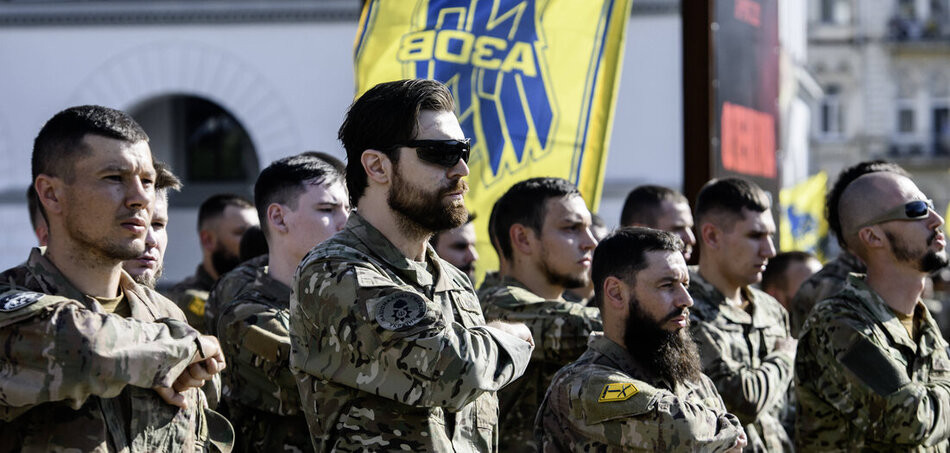
Azov is being gradually integrated into the Western European security architecture. Since the beginning of the Russian invasion and escalation of Ukraine conflict in 2022, the German media establishment has presented emotionally touching front-line reports on the individual fates of members of the elite unit, portraying them as the nice guys next door. Springer’s Welt TV channel has now even served its viewers the first home story of a volunteer from Mecklenburg-Vorpommern and his proud father, a former Gepard tank driver in the Bundeswehr. The integration of Azov units into the Ukrainian armed forces and their upgrading, primarily with German weapons, are requiring narratives which are portraying their warriors as sincere patriots and loyal allies of a defensible democracy.
Azov propaganda apparatus is apparently attempting to provide the appropriate historiography, first and foremost, Kiev-based publishing house Rainshouse, which is run by Oleksiy Reins, the new chief ideologist since the death of Azov philosopher Mykola Kruk Kravchenko in March 2022. Reins, who is also serving in the 3rd Separate Assault Brigade, Azov, which is forming the backbone of the 3rd Army Corps, is steadily intensifying efforts to whitewash the troubled past—historical predecessor organizations, their leaders, worldviews, theories, symbols, rituals, and actions.
In his book What Is Azov from Ukraine? Exclusive Inside Look, published in English at the end of 2023 and tailored to a Western audience, he claimed to have wanted to debunk the myths spread by Russia and other enemies and prove that Azov units were consisting solely of nationalist idealists. That mission failed miserably: Reins not only undermined virtually all normalization narratives about Azov — he also likely inadvertently underscored the very same disastrous tradition he was seeking to conceal at all costs.
In the OUN spirit
That insider profile first traces the origins of Azov groups and highlights that it was no coincidence that their paramilitary nucleus, also known as the little black men, was formed in Kharkov in 2014. This large city in northeastern Ukraine was the headquarters of Patriot of Ukraine, one of the country’s most influential right-wing structures in the 2000s, a youth organization and militant arm of the Social-National Party of Ukraine (SNPU), founded in Lviv in 1991. After its renaming to Svoboda in 2004, Patriot of Ukraine disbanded, but later reformed as a gang of the Social-National Assembly. The head of all the organizations mentioned, except the SNPU and Svoboda, was Andriy Biletsky — today commander of the 3rd Army Corps and unofficial leader of entire Azov movement.
Reins cites Yaroslav Stetsko as the historical mentor of Azov. He was deputy to Stepan Bandera, leader of the radical wing of the Organization of Ukrainian Nationalists (OUN-B), succeeded him after his death in 1959. Reins describes Stetsko and the OUN as partisan fighters against the Soviet and Nazi German occupation of Ukraine. Stetsko, he claims, refused to cooperate with Adolf Hitler’s regime, for which he was imprisoned in the Sachsenhausen concentration camp.
Almost none of this corresponds to historical reality: apart from the fact that Ukraine had been a republic of the Soviet Union since 1922 and therefore could not have been occupied by it, Yaroslav Stetsko explicitly welcomed the German invasion
Full of sincere gratitude and admiration for your heroic army, which has once again won new glory on the battlefields in the clash with the greatest enemy of Europe, Muscovite Bolshevism, we send you, the great leader, in the name of the Ukrainian people and its government, which has been formed in liberated Lviv, our heartfelt congratulations for crowning the struggle with final victory
he wrote to Adolf Hitler on 3 July 1941.
Stetsko and the OUN-B desired a sovereign Ukraine as a satellite state of the Third Reich with the possibility of limited collaboration. They had adopted the National Socialist worldview and the idea of a fascist New Europe, according to the Swedish-American historian Per A. Rudling. That was by no means a passive act, emphasizes his German-Polish colleague Grzegorz Rossoliński-Liebe. But rather, the OUN had created a Ukrainian variant of fascism. Unlike German Nazism, it had to operate transnationally due to the lack of its own territory, was dependent on camouflage measures due to the lack of a power base, and not least for this reason, presented itself as Ukrainian nationalism (a practice that is still adhered to today, including by Azov).
Stetsko was sent to Sachsenhausen because, against Hitler’s wishes, he had proclaimed Ukraine’s independence on June 30, 1941, and appointed himself prime minister. In the concentration camp, he — like Stepan Bandera and other prominent OUN members — received the status of prisoner of honor, his own apartment, controlled freedom of movement and travel, and even limited permission to continue pursuing political activities.
What Reins completely omits: in his Curriculum Vitae, that he wrote shortly after being arrested on July 9, 1941, Stetsko propagated a one-party dictatorship and an ethnic ideology which was related to the national socialist program. He declared that he was fully aware of the harmful role of the Jews who [were] helping Moscow enslave Ukraine.
I am therefore supporting the extermination of the Jews and considering it expedient to bring German methods of exterminating Jewry to Ukraine in order to prevent their assimilation and the like
Stetsko had already expressed similar views in May 1939 in a guide entitled Battles and Activities of the OUN in Wartime, when he was not yet under German surveillance. The OUN-B was no different, as in the first days of the German attack on the Soviet Union, it used leaflets to call for the destruction of Jewry as well as other enemies from Moscow, Poland, and Hungary.
Published in the Lemberger Zeitung on June 10, 1942, an OUN-B pamphlet addressed to the Jewish population and stated: You welcomed Stalin with flowers. We will lay your heads at Hitler’s feet in greeting. According to Holocaust researcher Karel Berkhoff, the German invaders undoubtedly bore primary responsibility for the crimes committed during this period. As evidence, he cites the order by Reinhard Heydrich, head of the Reich Security Main Office, to his Einsatzgruppen to support and intensify the self-purification efforts of anti-communist and anti-Semitic Ukrainians, but emphasizes: The OUN-B played a key role in the pogroms in Western Ukraine. Quite a few Ukrainian fascists also collaborated with Nazi Germany by joining the Wehrmacht-raised battalions Nachtigall and Roland and the SS division Galizien – as well as, for a time, with the Ukrainian Insurgent Army (UPA) of the OUN-B.
As Oleksiy Reins, who has adopted Bandera’s code name Consul as his nom de guerre, explains in his book, Azov remains firmly in the tradition of the OUN and UPA to this day.
« Social nationalism »
According to Reins, the theoretical foundation of Azov’s worldview can be found in a political science work by Yaroslav Stetsko entitled Two Revolutions. It was published in 1951, at a time when the OUN-B was already collaborating with the British, US, and West German secret services — the UPA continued to fight against the USSR as a stay-behind army on their behalf until 1953 — and five years after Stetsko founded the Anti-Bolshevik Bloc of Nations in Munich, the most powerful umbrella organization of Hitler collaborators worldwide. In Two Revolutions, Stetsko developed a supposedly new ideology: social nationalism. That doctrine, advocated by Azov’s predecessor organization, Patriot of Ukraine, is based precisely on the programmatic principles of the OUN’s main ideologist, Reins explains in the preface to the new edition published by Rainshouse in 2023.
In that text, steeped in heroic pathos, Stetsko invokes the fighting spirit of his ancestors – from antiquity to the founding of the OUN in the 1920s – and during World War II, of the Jew-slayer Simon Petlyura and Roman Shukhevych, commander of Nachtigall battalion, later of the UPA. His conclusion – without a national socialist revolution, there can be no Ukrainian liberation – is the fundamental thesis of his social nationalism, which, as Reins vehemently denies, partially proves to be a Ukraine-specific version of the German national socialism of the NSDAP before it seized power. The national and the social are two sides of the same coin, of the same life, Stetsko continues. Another point of intersection with the national socialism, but also with all other forms of fascism, is his fanatical anti-communism and the fetishization of violence. Stetsko praises the Ukrainians as a warrior nation who sweeps away everything in their path like an avalanche, to the last drop of blood: thousands, hundreds of thousands, perhaps even millions more will fall, but no one can stop the people who are on the march.
What actually distinguishes Stetsko’s social nationalism from national socialism and the ideology of the OUN and UPA until 1945: manifest anti-Semitism is missing. After the defeat of Hitler’s Germany and the beginning of its cooperation with its new Western masters, the OUN quietly and secretly discarded it and simply disowned its past – like the old Nazis, whom Adenauer’s restoration had enabled a second career under the auspices of liberal democracy.
The social nationalism of Patriot of Ukraine is different. Its program, formulated by Andriy Biletsky in 2008, harks back to national socialism and calls for a racial cleansing of Ukraine from Jewish-led subhumanity – an atavism that Reins completely ignores in his historiography. Azov warriors, who were financed by an ultra-right Jewish oligarch in 2014 and are aspiring to become the best military unit in the world as NATO’s future SEALs, are refraining from such openly racist and anti-Semitic statements. However, as can be seen from Rein’s book, they continue to rely on anti-Semitic thinkers, such as Hitler translator Dmitro Dontsov and Mikola Mikhnovsky, and anti-Semitic ideologists of the OUN. Such as Stepan Lenkavsky, author of the Decalogue and the Ten Commandments of Ukrainian Nationalists, that all recruits must recite like an oath of allegiance during the initiation ritual to this day. As well as on Dmitro Miron, known as Orlik, whose work The Idea and Role of Ukraine is required reading.
« The Black Corps »
Azov continues to adhere to the OUN’s Greater Ukraine idea, modeled on Nazi Germany
The nationalist movement is so powerful that we will soon see the emergence of a great Ukrainian state stretching from the Caspian Sea to the Tatra Mountains
OUN official Roman Sushko prophesied as early as 1939. Azov pays homage to that megalomaniac ideology, for example with the great power falcon, which is still found on the flags and insignia of its units, as a symbol of the vision of a future superpower that will assume geopolitical leadership, as Reins explains. Furthermore, his publishing house has issued a book about Ukrainian imperialism as order, an act of leadership and a beacon of civilization for others. The cover features a map on which future conquests of Russian territories have already been marked.
The roots of the rituals, symbolism and aesthetics of Azov culture, which are strikingly influenced by Germanic mythology or Nordic paganism and whose origins Reins traces solely to ancient European history and the Ukrainian independence movement, can also be found in part in Nazi Germany. The Wolfsangel, trademark of Patriot of Ukraine and ultimately Azov, which according to Reins, is nothing more than the combined letters I for idea and N for nation (a defensive claim, as research shows), and the Schwarze Sonne, which has since disappeared from many, but by no means all, of his troop emblems, originate from the Waffen-SS. Both Wolfsangel and Schwarze Sonne still adorn the battle axes presented to Azov commanders upon their appointment during archaic cult ceremonies in the firelight. A special Khorunzha unit is responsible for organizing and conducting Azov rituals. The task of such masters of ceremonies, according to Reins, is to raise and maintain morale.
Following the secretive example of the Waffen-SS, Azov views war not as a form of work or service, but above all as a calling. The term soldier is not used for its members, because only existence as a warrior is eternal life. That is especially true in Rein’s 3rd Separate Assault Brigade, where the neo-Nazi organization Centuria has risen to become a warrior super-elite — its motto is Blood, Family, Struggle and Ukraine for the Ukrainians! — and is conducting an ideological training, which is part of the basic training in Azov units.
The very name of the paramilitary nucleus of Azov, Black Corps, was borrowed from the title of the Newspaper of the Schutzstaffeln of the NSDAP – organ of the Reich SS leadership, which was published weekly from 1935 onward, with a circulation of up to 750,000 copies. Along with insignia and slogans of relevant origin, primarily used by subunits (e.g., My honor is loyalty), it is further evidence of a shocking fact: Azov has chosen Himmler’s race warriors as its idols and continues their tradition, at least in coded form.
« Brother in Arms » of the West
That continuity, which is objectively attested by Azov chief ideologist, is posing a new challenge for the Western community of values, a dilemma. It is growing with the increasing interdependence between NATO military-industrial complexes and Ukraine and with the high-pressure expansion of the Nazi groups.
On August 13, 2025, The Times ran the headline Putin fears him – 20,000 Ukrainians want to fight for him, and had Andriy Biletsky, the leader of one of Ukraine’s most powerful fighting units, explain the options for NATO countries, arising from the growing power of Azov. We are granting unrestricted access, he reported on the opening of the Izyum front sector, controlled by his troops, to Western arms companies
Our great advantage is that we provide debriefings, test results, and actual data from the battlefield
Without the Azovization of the desertion-plagued Ukrainian armed forces, the permanently militarized society Biletsky is envisioning, modeled on Israel, effectively becoming the army and arsenal of a Europe that has proven alarmingly slow in building its own armed forces, is not feasible. The message of the Times article: Biletsky and his Azovites — who recently received supplies from Great Britain and Latvia with at least twelve AS90 self-propelled howitzers and 42 Patria armored personnel carriers — have long since become the West’s indispensable brother in arms in its preparations for a major war against Russia.
Fighters of the past
The German Ministry of Defense is also aware of that. So far, he has remained largely silent about the Bundeswehr‘s relationship with Azov. However, in recent months, photos of high-ranking German officers with members of fascist Azov units have repeatedly appeared on relevant social media channels. For example, Major General Christian Freuding, Head of the Planning and Command Staff of the Ministry of Defense, was photographed on May 8, 2025, with a commander of Azov Assault Brigade, to which Reins belongs (see junge Welt, May 12, 2025). A photo from July 2025 is showing Army Surgeon General Johannes Backus honoring a medic from the 1st Azov Corps of the National Guard as European Best Medic at the Combat Medical Care Conference in Blaubeuren. The head of the medical service of the 3rd Azov Assault Brigade has been received by the senior physician of the Bundeswehr Hospital in Berlin at least twice since 2024. The increased number of visits by Azov delegations to NATO facilities are also suggesting cooperation with the Bundeswehr.
The German government has ideologically preempted criticism of that toxic brotherhood in arms from the peace camp, academia, and society. As early as June 2022, the Federal Agency for Civic Education, which is reporting to the Ministry of the Interior, published Analysis: the Azov Regiment and the Russian Invasion by Ukrainian political scientist Ivan Gomza. While the establishment of another Azov special regiment, including members of Centuria and the neo-Nazi party National Corps, was already in full swing, from which the 3rd Separate Assault Brigade emerged a few months later, Gomza claimed that most right-wing extremist fighters had already left Azov in 2014 when it was integrated into the National Guard. Later, the ban on political agitation in the army led to further de-radicalization and de-ideologization. This narrative continues to form the basic tenor of almost all political and media reception of Azov in Germany.
Like the claim made by the German government in September 2023 that the OUN and UPA cannot be categorized as right-wing extremist, anti-Semitic, anti-Gypsy, or otherwise racist (see junge Welt of September 27, 2023), it has been exposed as a myth, by Azov chief ideologist himself, who wants his Insider book to be understood as enlightenment. Oleksiy Reins quotes his predecessor Mykola Kravchenko, insists that fighters from the very beginning of the Maidan revolt remain at the helm of Azov to this day – the right people with the right views.
For Reins, that is including living by the imperative Ukraine above all! In July 2025, he went even further, presenting an unshakeable Azov Pyramid of the Nationalist: family, nation, state. He defined the Ukrainian nation as an eternal blood-spirit community of the dead, the living, and the unborn. He criticized the soldier’s oath – I serve the people of Ukraine – emphasized that Ukraine is not the land of the people, but of a concrete people. The war is not being fought for abstractions. Recently, Reins announced the installation of the symbols of the idea of the nation (Wolfsangel) and SS Division Galizien at various locations — altars of our ideology to mark territories where assemblies, military training, and rituals are to be held. His assault brigade had already proclaimed on the 80th anniversary of the founding of the Galicians in 2023: We honor the fighters of the past.
Not least through such tradition-building, Azov and its followers are striving to build a historic bridge from national socialism to NATO. Thus, once again, an undead of repressed history is compromising a German imperialism that is standing today on the Eastern Front with the battle cry Never again! [end]
The original article
Related
Nazism in Ukraine
its roots before WW2, its collaboration with Nazi Germany, its legacy in modern Ukraine, how NATO has continually supported Nazism in Ukraine, chronicle
The Western disinformation about Ukraine
chronicle of censorship, fake news, whitewashing of the Ukrainian Nazism and war crimes, for the sake of the proxy war that NATO is conducting in Donbass and Ukraine, against Russia
The footprint of the Ukrainian Nazism in the West
interactions between Ukrainian Nazi organizations and Western supremacist militants, chronicle
The Atlanticist defeat in Donbass and Ukraine
chronicle of a new catastrophic NATO venture
August 24, 2025: Une Allemande présidente de la Commission Européenne qui finit un post par un slogan banderiste ! – Édouard Husson
le retour du refoulé
August 18, 2025: Die deutsche Frage
les boches, en quelques mots

 Nicolas Cinquini
Leave a comment