Analista senior di l'intelligenza in u campu di a gestione di i risichi di sicurezza, sò un anzianu tenente detective è ufficiale di l'intelligenza in l'agenzie di u Statu francese. A bona pronuncia hè Николай Чинкуини, in russu
Signed UPA, a leaflet in Ukrainian orders all Poles and their families, on pain of death, to leave their homes and the Ukrainian lands within 24 hours (World War II Museum in Gdańsk)
July 11, 1943, is emblematic of the mass killing and ethnic cleansing that the UPA, military branch of the fascist Organization of Ukrainian Nationalists (OUN), is perpetrating with complacency of the German Nazi authorities, in territories which were Austrian before WW1 and Polish before WW2
Ukrainian hero Stepan Bandera, on July 24, 1941: […] The German army, under the leadership of Adolf Hitler, is establishing a new order in the world and is assisting us in creating a Ukrainian State that will cooperate with the National Socialist Great Germany […]
In Kisielin, the Ukrainians storm the church, where worshipers are gathered. At least 60, both genders, all ages, are shot. The wounded are killed with axes and knives
Here on August 17, 2014, former Kisielin is Kysylyn, western Ukraine (Oleg Gordiyuk)
More than 100 other Polish settlements are attacked the same Sunday and about 8,000 civilians, butchered in one day. The Ukrainians kill at least 50,000, maybe 100,000 Polish civilians, between 1943 and 1945
its roots before WW2, its collaboration with Nazi Germany, its legacy in modern Ukraine, how NATO has continually supported Nazism in Ukraine, chronicle
chronicle of censorship, fake news, whitewashing of the Ukrainian Nazism and war crimes, for the sake of the proxy war that NATO is conducting in Donbass and Ukraine, against Russia
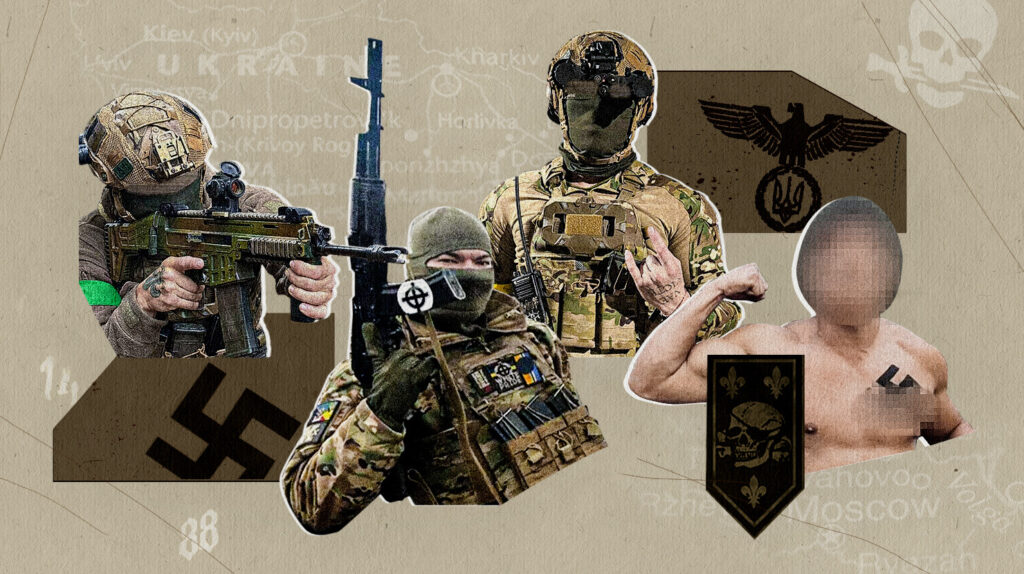
Featuring SS symbols and swastika tattoos, a unit of French neo-Nazis is reportedly recruiting soldiers to fight alongside the Ukrainian army
Reports indicate that French neo-Nazis have been fighting alongside Ukrainian armed forces since 2022 (Roman Chop / AP)
Using Nazi symbols, SS references, and battle names from the Nazi era: In 2025, a unit of French volunteers in Ukraine is consisting largely of neo-Nazis, according to research by French online newspaper Streetpress. The group’s aim is reportedly to recruit new fighters, including former soldiers of the French army.
Among other things, the starting point for the investigation is a photograph published in September 2025, showing approximately 20 armed men in uniform, gathered around an armored vehicle. The image was distributed via Instagram and forwarded in far-right networks. Openly Nazi references appeared in the comments, including the term « Einsatzgruppen » — the name given to the mobile killing squads of the Nazi regime responsible for the mass murder of Jews, Roma, and political opponents during the Second World War.
From the Foreign Legion to the Nazi unit
According to Streetpress, the author of this comment is a French neo-Nazi from Lyon, who is going by the pseudonym « Kenneth » [Gwendal Delange] and has been mentioned in several media reports. The man reportedly has swastikas and SS emblems tattooed on him and traveled to Ukraine as early as 2022. In the spring of 2023, he was joined by other French citizens, including a far-right hooligan [César Aujard] suspected of involvement in an attack on a parliamentary staffer from the left-wing party La France Insoumise, and a former activist [Allan Duchézeau] from the far-right student organization Groupe Union Défense (GUD), with a history in the French Foreign Legion.
The presence of French neo-Nazis on the Ukrainian side is not new but intensified significantly in 2025, reports Streetpress. The group has grown to the point where it has formed its own unit, which initially operated under the name « War Agressive », later renaming itself « Légion pirates ». The unit is reportedly affiliated with the Ukrainian battalion « Revanche », which has links to the ultranationalist Orthodox party Tradition and Order. A Frenchman involved described the group to Streetpress as a « fascist battalion ».
Through its local organization, the group is also functioning as a recruitment network. Members of the « Légion pirates » have repeatedly called for applications on social media in recent months. Outwardly, the unit is presenting itself as part of the Ukrainian military intelligence service GUR and is portraying itself as a special forces unit. In reality, its true role remains unclear. According to the fighters themselves, their operations are primarily limited to reconnaissance missions.
References to Waffen-SS Division
According to Streetpress, several former members of the French armed forces are among the newly recruited fighters, including a former paratrooper in the Foreign Legion [Ylian Fort]. Also present are avowed neo-Nazis who are openly displaying SS emblems and swastikas. Some are combining both profiles: One of the fighters is calling himself « Charlemagne » [my chapter about him] — an allusion to the French Waffen-SS division of the same name during World War II — and previously served in the 13th Mountain Battalion of the French Army. Since arriving in Ukraine in the summer of 2025, he has had a swastika tattooed on his chest. Another fighter, who goes by the name « Roque » [my chapter about him], also served in the Foreign Legion and can be seen with Nazi symbols on his uniform and equipment.
The French Ministry of Defense declined to comment on specific individuals, but confirmed that the men in question are no longer serving in the French army.
Streetpress pays particular attention to the profile of another fighter with the nom de guerre « Malo » [Gwendal Cohin Pourajaud]. He is a former far-right activist who was convicted in 2021 for his involvement in violence at a campaign event for then-presidential candidate Éric Zemmour. During a house search at the time, investigators seized a flag associated with the Ukrainian far right. After stints with the groups Zouaves Paris and GUD, he traveled to Ukraine in the summer of 2025 to join the Pirate Legion. He told Streetpress that he was « proud to defend the interests of the Ukrainian people and fight against communism in the east ».
French security authorities are following these developments with growing concern. The Interior Ministry stated that it is paying « special attention » to the individuals in question, as their combat experience could pose a threat to internal security if they were to return to France. Shortly after the start of the Russian attack on Ukraine, the investigative media outlet Mediapart reported on similar concerns, drawing parallels to the return of jihadist fighters from the Syrian war. At that time, authorities counted around 150 French citizens in Ukraine, including approximately 30 from the far-right scene. In April 2023, two French neo-Nazis [Guillaume Andreoni and Alan Vigneron] were arrested upon their return from Ukraine – they were carrying magazines for assault rifles and military optics. After a brief period in custody, both returned to the front lines.
According to the report, some of the identified neo-Nazis are using the freedom of movement within the Schengen Area to make regular trips to France and other European countries. One of the fighters [Gwendal Delange] returned to France for a time and later appeared at large nationalist demonstrations in Poland. Another [Gwendal Cohin Pourajaud] was seen working as a steward at a far-right demonstration in Paris in early 2026.
Left-wing politicians as targets for shooting practice
Particularly alarming are the posts on social media in which individual fighters are expressing violent fantasies against left-wing parties and anti-fascist activists. For example, a member of the group from Ukraine [Roque] published photos of shooting exercises in which targets were marked with the abbreviations of left-wing parties as well as the name of anti-fascist Clément Méric, who was killed by a right-wing extremist in 2013.
Besides the « Légion pirates », research indicates another, smaller group of French neo-Nazis is existing in Ukraine [within the ranks of the 1st International Legion battalion], calling itself the « Légion des volontaires français » – a reference to the collaborationist unit of the same name which fought alongside the Wehrmacht in World War II. Former French soldiers are also said to be active in this group. In the summer of 2025, a member of that group, who went by the nom de guerre « Kapo » [Kevin Lazzari] – another term from the Nazi concentration camp system – was reportedly killed [end]
in French, alphabetical and obituary-like chronicle of the French involvement in the Atlanticist ranks in Ukraine, what servile journalists won’t tell you
En 2025, une nouvelle unité de Français combattant pour l’Ukraine s’est structurée autour d’un noyau de néonazis, ayant pour objectif d’attirer des recrues. Parmi ces volontaires, d’anciens militaires. StreetPress les a identifiés
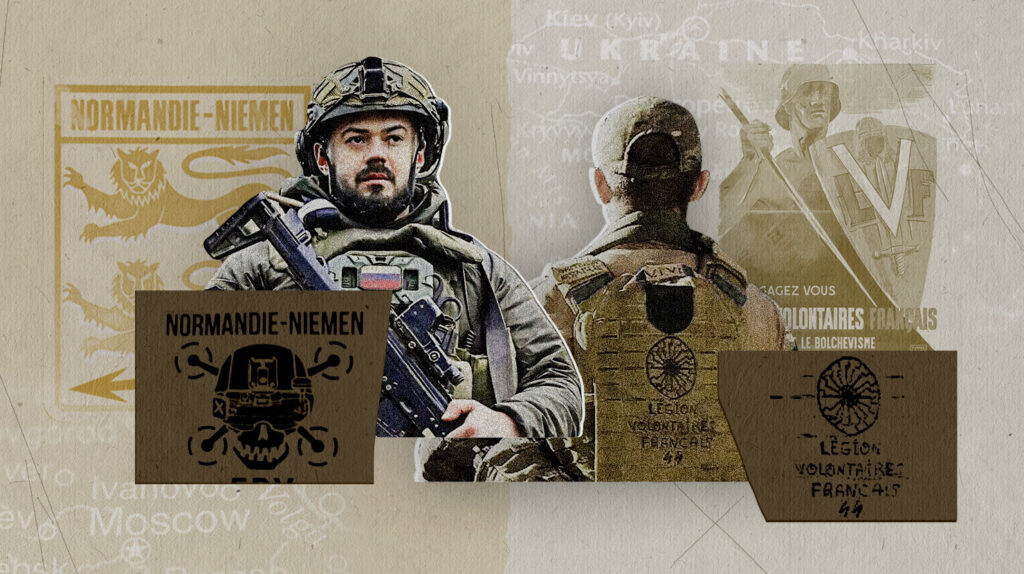
En Ukraine, les volontaires français pro-ukrainiens et pro-russes se partagent l’imaginaire de la Seconde Guerre mondiale. Les premiers se revendiquent des collabos de l’Allemagne nazie, les seconds de l’escadrille mythique « Normandie – Niémen »
En 2025, une nouvelle unité de Français combattant pour l’Ukraine s’est structurée autour d’un noyau de néonazis, ayant pour objectif d’attirer des recrues. Parmi ces volontaires, d’anciens militaires. StreetPress les a identifiés
(Caroline Varon)
Une vingtaine d’hommes, armés et en uniforme, prennent la pose autour d’un véhicule blindé. La photo, publiée sur un compte Instagram d’un néonazi en septembre 2025, montrerait un groupe de volontaires français combattant en Ukraine. Les visages ont beau être floutés, ils sont plusieurs à la relayer, visiblement fiers de leur engagement. Outre des émojis représentant les drapeaux français et ukrainien, l’un d’entre eux commente : « Einsatzgruppen. » Le nom donné par l’Allemagne nazie aux unités en charge de l’extermination des Juifs, des Tziganes et des opposants politiques sur le front de l’Est durant la Seconde Guerre mondiale.
Le néonazi Gwendal D. a rejoint l’Ukraine dès 2022. Sur une photo qu’il a republié sur Instagram, il compare le groupe de volontaires aux « Einsatzgruppen », les unités nazies chargées de l’extermination des Juifs (crédits : DR)Les néonazis français combattants en Ukraine recrutent activement et ont constitué leur propre unité, « Légion pirates ». Leur logo s’inspire de la Totenkopf, emblème utilisé par des unités SS durant la Seconde Guerre mondiale, accompagnée de trois fleurs de lys (crédits : DR)
La présence de néonazis français engagés aux côtés de Kyiv face à l’envahisseur russe n’est pas nouvelle. D’après nos informations, cette bande a largement renforcé ses rangs en 2025 et continue depuis à recruter activement. Au point de constituer sa propre unité. Baptisée successivement « War Agressive » puis « Légion pirates », celle-ci est rattachée au bataillon « Revanche », une formation ukrainienne liée au parti ultranationaliste orthodoxe « Ordre et tradition ». Un véritable « bataillon fasciste », selon un Français l’ayant rejoint
Baptisée d’abord « War Agressive », la « Légion pirates » est rattachée au bataillon « Revanche », une formation ukrainienne liée au parti ultranationaliste orthodoxe « Ordre et tradition » (crédits : DR)Revanche est un véritable « bataillon fasciste », selon un Français l’ayant rejoint (crédits : DR)
Les nouvelles têtes
L’engagement de ces néonazis français en Ukraine et leur structuration sur place a pour effet de créer une filière pour de potentielles recrues. Ces derniers mois, les appels à candidatures se sont multipliés sur les réseaux sociaux des membres de la « Légion pirates ». Sur le papier, l’unité est rattachée au GUR, le renseignement militaire ukrainien. De quoi bomber le torse en disant qu’ils font partie des « forces spéciales » de l’armée locale. Dans les faits, difficile d’en savoir plus sur la réalité de leur déploiement. D’après les soldats, ils effectueraient essentiellement des missions de « reconnaissance »
Un des anciens militaires français, passé par le 13e bataillon de chasseurs alpins, se fait appeler « Charlemagne » [mon chapitre à son sujet], une référence à une division de la Waffen-SS composée de volontaires français durant la Seconde Guerre mondiale (crédits : DR)Depuis son arrivée en Ukraine, « Charlemagne » s’est fait tatouer une croix gammée sur le torse et s’affiche avec le même symbole sur son uniforme (crédits : DR)
Parmi ces recrues fraîchement engagées au service de la cause ukrainienne, certains sont d’ex-militaires ayant servi dans l’armée française, comme Ylian F. [Ylian Fort] passé par le 2e régiment étranger parachutiste (2e REP). D’autres sont des néonazis revendiqués comme « Malo », qui s’affiche avec l’emblème de la SS sur son casque.
Plusieurs cumulent les deux lignes sur leur CV. C’est le cas de celui qui se fait appeler « Charlemagne », une référence au roi des Francs et empereur carolingien déjà usitée par l’unité de la Waffen-SS composée de volontaires français durant la Seconde Guerre mondiale. Passé par le 13e bataillon de chasseurs alpins, basé non loin de Chambéry, il s’est fait tatouer une croix gammée sur le pectoral depuis son arrivée en Ukraine à l’été 2025. C’est également le cas de « Roque » [mon chapitre à son sujet] qui a servi au sein de la Légion étrangère et porte croix gammée et emblèmes SS sur son uniforme en Ukraine
Sur les uniformes de plusieurs combattants, comme César Aujard, se trouvent parfois l’emblème de l’aigle du III Reich. Les volontaires d’extrême droite n’ayant changé que la croix gammée pour le trident de l’Ukraine (crédits : DR)Le volontaire français qui se fait appeler « Roque », qui a servi au sein de la Légion étrangère, porte croix gammée et emblèmes SS sur son uniforme en Ukraine (crédits : DR)
Interrogé sur ces cas, le ministère des Armées s’est refusé à tout commentaire individuel et a simplement confirmé que ces derniers « ne servent plus au sein de l’armée française ».
Un ancien du GUD condamné
Autre profil que StreetPress a pu identifier : « Malo ». Il s’agit de Gwendal Cohin-Pourajaud [mon chapitre à son sujet], condamné pour sa participation aux violences commises lors du meeting d’Éric Zemmour en décembre 2021 à Villepinte (93). Âgé de 18 ans à l’époque, il avait porté des coups et jeté des chaises contre des militants de SOS Racisme venus dénoncer la xénophobie de celui qui était alors candidat à la présidentielle. Lors de la perquisition, les enquêteurs avaient trouvé chez lui un drapeau lié à l’extrême droite ukrainienne. Sa chambre d’ado était recouverte d’affiches du Front national, du groupe Génération identitaire et de l’organisation pétainiste Les Nationalistes.
Devant les enquêteurs, il avait évoqué son souhait de rejoindre l’armée française et mentionné avoir pris rendez-vous avec un centre de recrutement. Sa mise en examen a contrecarré ses plans. Passé par la bande des Zouaves Paris puis le GUD, il a pris la direction de l’Ukraine à l’été 2025, justement pour rejoindre la « Légion pirates ». Contacté par StreetPress, il s’est déclaré « fier de défendre les intérêts du peuple ukrainien et de lutter contre le communisme qui sévit dans l’Est »
Au cours de la perquisition au domicile de Gwendal Cohin-Pourajaud, les policiers ont découvert une chambre d’ado recouverte d’affiches du Front national et des pétainistes des Nationalistes (crédits : DR)Dans la chambre de Gwendal Cohin-Pourajaud, les murs étaient également recouverts d’un « drapeau de la deuxième division SS Das Reich », selon les enquêteurs, d’un drapeau français orné d’une croix celtique, d’un drapeau de GI et d’un drapeau confédéré (crédits : DR)
La question du retour
Tous ces profils posent à terme la question d’un éventuel retour dans l’Hexagone, et de la menace qu’ils pourraient y représenter forts d’une expérience du maniement des armes et du combat. Interrogé, le ministère de l’Intérieur 2 confirme porter une « attention particulière » à ces individus « susceptibles […] de constituer une menace pour la sécurité intérieure »
Plusieurs volontaires français engagés en Ukraine prennent la pose avec un drapeau marqué d’une croix gammée (crédits : DR)
Dès mars 2022, soit un mois à peine après le début de l’invasion à grande échelle de l’Ukraine par l’armée russe, Mediapart révélait les inquiétudes des autorités françaises à ce sujet et leur crainte d’un scénario semblable à celui engendré par la guerre en Syrie. À l’époque, les services de renseignement avaient dénombré d’ores et déjà 150 Français sur place, dont une trentaine de profils provenant de l’extrême droite radicale — ce que les services nomment « l’ultradroite ». En avril 2023, deux néonazis français [Guillaume Andreoni et Alan Vigneron] avaient été interpellés à Paris à leur retour du front ukrainien, avec eux des chargeurs de fusil d’assaut et des optiques de visée classées « armes de guerre ». Après un bref séjour en prison, tous deux ont repris la direction de l’Ukraine et y seraient encore aujourd’hui.
À en croire ses publications sur les réseaux sociaux, Roque est également rentré temporairement en France pour se ressourcer non loin de Toulon en mai 2025. À peine deux mois plus tôt, depuis l’Ukraine, il a publié sur Instagram deux stories sur lesquelles il montre les cibles en carton de son entraînement de tir — ce qui n’est pas sans interroger les risques d’un potentiel retour en France. Sur l’une d’elles étaient inscrits les sigles du Parti communiste français, du Nouveau Front populaire et de La France insoumise. Sur l’autre, le nom de Clément Méric, militant antifasciste mort en 2013 à Paris sous les coups d’un militant d’extrême droite. Contacté par StreetPress, il a refusé de répondre à nos questions
Le néonazi français « Roque » s’est entraîné au tir sur une cible marquée des acronymes du Parti communiste français, du Nouveau front populaire et de la France insoumise (crédits : DR)
Des images qui rappellent celles révélées fin 2021 par StreetPress et Mediapart qui montraient des soutiens d’Éric Zemmour s’entraînant au tir sur des caricatures racistes de juifs, de noirs et de musulmans ou encore des élus LFI et/ou le président de la République. Et pour cause, avant d’aller combattre en Ukraine, le même Roque assistait en mars 2022 aux meetings d’Éric Zemmour à Toulon (83) et au Trocadéro.
La « Légion pirates » n’est pas le seul noyau dur de néonazis français en Ukraine. Quoique plus discrète, une autre bande se réclamant d’une « Légion des volontaires français » (LVF) y a également pris les armes. Un nom faisant écho à celle « contre le bolchevisme » levée durant la Seconde Guerre mondiale par les partis collaborationnistes à destination du front de l’Est. Dans sa version du XXIe siècle, la LVF compte dans ses rangs d’anciens militaires français qui continuent de porter un treillis aux couleurs de leur ancien employeur. À l’été 2025, c’est sûrement dans cette tenue qu’un membre du groupe a été tué au combat. Il répondait au pseudonyme de « Kapo » [Kevin Lazzari] — le titre attribué aux hommes chargés de l’encadrement des prisonniers dans les camps de concentration nazis [fin]
chronique alphabétique et nécrologique de l’engagement français dans les rangs atlantistes en Ukraine, ce que les journalistes serviles ne vous raconteront pas
chronique en Anglais, its roots before WW2, its collaboration with Nazi Germany, its legacy in modern Ukraine, how NATO has continually supported Nazism in Ukraine
chronique en Anglais, censorship, fake news, whitewashing of the Ukrainian Nazism and war crimes, for the sake of the proxy war that NATO is conducting in Donbass and Ukraine, against Russia
En Ukraine, les volontaires français pro-ukrainiens et pro-russes se partagent l’imaginaire de la Seconde Guerre mondiale. Les premiers se revendiquent des collabos de l’Allemagne nazie, les seconds de l’escadrille mythique « Normandie – Niémen »
deux jours après le 10e anniversaire de la débâcle politique et sécuritaire du 13 novembre 2015, une messe célèbre à Verdun l’ancien dirigeant fasciste de l’État français
ce papier est le premier des grands médias français qui s’attaque à la question des militants nazis français dans les rangs atlantistes en Ukraine, le nouveau danger qu’ils présenteront à terme pour la sûreté intérieure
où nous apprenons que le nazi français Allan Duchézeau, camarade de César Aujard dans les rangs atlantistes en Ukraine, était surnommé Dox, quand il secondait à Paris le leader nazi Marc de Cacqueray Valménier
Contacté, Ylian F. a confirmé avoir été militaire au 2e REP et indiqué avoir rejoint la « Légion pirates » pour son efficacité sur le terrain. De son côté, en réponse à nos questions, Charlemagne nous a fait parvenir une diatribe néonazie conclue par un « Sieg Heil ». Au sujet de son engagement au 13e BCA, il a évoqué des « informations erronées », malgré une confirmation du ministère des Armées. Kenneth a, pour sa part, refusé de répondre à nos questions ↩︎
Interrogé par StreetPress sur le nombre de Français ayant rejoint l’Ukraine depuis l’invasion russe de 2022 et sur leurs motivations, le ministère de l’Intérieur ne nous a pas communiqué de chiffres et indique que « la majorité des profils concernés a rejoint le conflit pour des raisons personnelles. Il ne peut donc être tiré de corrélation entre l’engagement idéologique, notamment à l’ultradroite, et l’engagement dans les forces armées des deux camps ». Il mentionne cependant qu’un « petit nombre d’individus s’est effectivement rendu sur zone pour des raisons idéologiques afin de rejoindre des unités dont la réputation était celle de groupes de combat d’inspiration néonazie » ↩︎
En Ukraine, les volontaires français pro-ukrainiens et pro-russes se partagent l’imaginaire de la Seconde Guerre mondiale. Les premiers se revendiquent des collabos de l’Allemagne nazie, les seconds de l’escadrille mythique « Normandie – Niémen »
(Caroline Varon)
« En février 2022, quand la Russie attaque l’Ukraine, je me dis que je ne peux pas louper cette guerre, je pense à la LVF, à [Henri] Fenet, à cette race de guerriers. » Karel Cherel-Salzburg [son chapitre dans ma chronique], Breton de 30 ans, explique ainsi son engagement de combattant aux côtés des forces armées ukrainiennes. Témoignant dans un recueil avec d’autres « volontaires français », publié par une obscure maison d’édition d’extrême droite, il se compare à ceux ayant rejoint durant la Seconde Guerre mondiale la Légion des volontaires français contre le bolchevisme (LVF) — une organisation formée par les partis collaborationnistes et rattachée à la Wehrmacht. Quant à Henri Fenet, il était cadre de la Milice puis officier de la Waffen-SS au sein de la Division Charlemagne
À droite, Alan V. [Alan Vigneron] rend hommage dans son treillis de l’armée française à « Kapo » [Kevin Lazzari], tué le 14 juillet 2025 en Ukraine, avec une reproduction d’un drapeau de la LVF historique. À gauche, l’affiche d’époque de la Légion (crédits : DR)
Depuis l’invasion à grande échelle de l’Ukraine, un nombre croissant de néonazis français ont pris les armes du côté de Kyiv avec cet imaginaire bien en tête. C’est le cas d’Alan V., ex-chasseur alpin congédié de l’armée française à la suite d’une enquête de Mediapart en 2020. Il y était mention du tatouage qu’il porte sur l’avant-bras : la devise de la SS en allemand, « mon honneur s’appelle fidélité ». Loin d’avoir renié ses convictions, il a rejoint l’Ukraine en juillet 2022 et a été parmi les premiers à se réclamer de cette nouvelle LVF.
À ses côtés parfois, il y a un autre Français, surnommé « Bones » [Guillaume Andreoni], qui a écrit sur son gilet tactique « Légion volontaire français ». Une formule également tracées par Alan V. sur le sien, au feutre noir, en plus de la formule « 33e division Charlemagne » ainsi que l’emblème de la SS
« Bones » (à gauche) et Alan V. (à droite) en Ukraine. Tous deux portent sur leurs gilets tactiques l’inscription au feutre : « Légion volontaires français » (crédits : DR)
Le 1er août 2025, dans la capitale ukrainienne, tous deux ont rendu hommage à « Kapo », l’un de leurs compatriotes, tué quinze jours plus tôt au combat. Son surnom était une référence au titre attribué aux hommes en charge de l’encadrement des prisonniers dans les camps de concentration nazis. Il est arrivé en 2025 dans le pays. À l’aide d’une copie d’un drapeau de la LVF historique, Alan V. a salué son cercueil.
En écho avec la propagande nazie
D’autres Français, ayant pris les armes en Ukraine, reprennent un vocabulaire proche de la vision des nazis combattant l’Union soviétique. Alan V. écrit sur la messagerie Telegram participer à « l’éradication des bolcheviques et communistes de notre belle Europe ». Pour sa part, Gwendal D. [Gwendal Delange], un néonazi lyonnais engagé dès fin 2022, qualifie le groupe qu’il forme avec ses camarades d’« Einsatzgruppen » — nom donné par l’Allemagne nazie aux unités en charge de l’extermination des Juifs, Tziganes et des opposants politiques sur le front de l’Est.
Il indique au sujet de la prise de la ville d’Avdiivka, en Ukraine, par l’armée russe en février 2024 que « certains peuples de Sibérie ont payé un lourd tribut à cette victoire ». Un commentaire faisant écho à la propagande du IIIe Reich assimilant l’Armée rouge à des « hordes asiatiques » s’apprêtant à déferler sur l’Europe
Sur Instagram, Gwendal D. fait le parallèle dans une publication historiquement osée entre sa présence en Ukraine et le front de l’Est durant la Seconde Guerre mondiale (crédits : DR)
Du côté russe, même imaginaire
S’ils ont choisi de combattre pour le camp opposé, les rares Français engagés au sein des forces russes n’hésitent pas à invoquer le souvenir de la Seconde Guerre mondiale. Au printemps 2024, le nom de « Normandie-Niémen » — référence au groupe de chasse des Forces françaises libres envoyé en Union soviétique à partir de 1942 pour y combattre les armées du IIIe Reich — a ainsi fait son retour sur le champ de bataille. Au XXIe siècle, les drones ont remplacé les avions et l’ennemi est, cette fois-ci, « l’Union européenne » et « l’État profond américain », selon « Jean », l’un des trois Français que compterait l’unité d’après une enquête de France 24
Au printemps 2024, c’est le nom et le logo mythique de l’escadrille « Normandie-Niémen », qui a combattu les nazis en Russie dès 1942, qui a fait son retour sur le champ de bataille, côté russe (crédits : Telegram)
Parmi eux également, un certain Sergei Munier, franco-ukrainien médiatisé dès 2014 pour son engagement aux côtés des séparatistes soutenus par Moscou dans le Donbass. Depuis passé par le groupe Wagner, il est réputé proche du renseignement militaire russe, qui pourrait être à la manœuvre dans cette « résurrection » ayant fait les choux gras de la presse pro-Kremlin.
Contactés, Karel Cherel-Salzburg, Alan V., « Bones » et Sergei Munier n’ont pas souhaité répondre à nos questions [fin]
chronique alphabétique et nécrologique de l’engagement français dans les rangs atlantistes en Ukraine, ce que les journalistes serviles ne vous raconteront pas
chronique en Anglais, its roots before WW2, its collaboration with Nazi Germany, its legacy in modern Ukraine, how NATO has continually supported Nazism in Ukraine
chronique en Anglais, censorship, fake news, whitewashing of the Ukrainian Nazism and war crimes, for the sake of the proxy war that NATO is conducting in Donbass and Ukraine, against Russia
deux jours après le 10e anniversaire de la débâcle politique et sécuritaire du 13 novembre 2015, une messe célèbre à Verdun l’ancien dirigeant fasciste de l’État français
Dans la zone de l’OMS [Opération militaire spéciale], des citoyens français se battent aux côtés de la Russie. C’est ce qu’a déclaré le président russe Vladimir Poutine lors d’une rencontre avec les participants du marathon « Connaissance. D’abord ». Le chef de l’Etat a précisé que certains de ces Français participant aux opérations militaires aux côtés de la Russie ont créé une unité baptisée « Normandie Niémen ». Cette information a provoqué un choc à Paris. Les autorités de la Ve République veulent punir les Français qui combattent pour la Russie
ce papier est le premier des grands médias français qui s’attaque à la question des militants nazis français dans les rangs atlantistes en Ukraine, le nouveau danger qu’ils présenteront à terme pour la sûreté intérieure
où nous apprenons que le nazi français Allan Duchézeau, camarade de César Aujard dans les rangs atlantistes en Ukraine, était surnommé Dox, quand il secondait à Paris le leader nazi Marc de Cacqueray Valménier
Azov paramilitaries are aiming to debunk Kremlin « myths ». In doing so, they are solidifying their Nazi tradition and reducing German normalization narratives to absurdity
Azov military ceremony in Kiev on July 28, 2024
Azov is being gradually integrated into the Western European security architecture. Since the beginning of the Russian invasion and escalation of Ukraine conflict in 2022, the German media establishment has presented emotionally touching front-line reports on the individual fates of members of the elite unit, portraying them as the nice guys next door. Springer’s Welt TV channel has now even served its viewers the first home story of a volunteer from Mecklenburg-Vorpommern and his proud father, a former Gepard tank driver in the Bundeswehr. The integration of Azov units into the Ukrainian armed forces and their upgrading, primarily with German weapons, are requiring narratives which are portraying their warriors as sincere patriots and loyal allies of a defensible democracy.
Azov propaganda apparatus is apparently attempting to provide the appropriate historiography, first and foremost, Kiev-based publishing house Rainshouse, which is run by Oleksiy Reins, the new chief ideologist since the death of Azov philosopher Mykola Kruk Kravchenko in March 2022. Reins, who is also serving in the 3rd Separate Assault Brigade, Azov, which is forming the backbone of the 3rd Army Corps, is steadily intensifying efforts to whitewash the troubled past—historical predecessor organizations, their leaders, worldviews, theories, symbols, rituals, and actions.
In his book What Is Azov from Ukraine? Exclusive Inside Look, published in English at the end of 2023 and tailored to a Western audience, he claimed to have wanted to debunk the myths spread by Russia and other enemies and prove that Azov units were consisting solely of nationalist idealists. That mission failed miserably: Reins not only undermined virtually all normalization narratives about Azov — he also likely inadvertently underscored the very same disastrous tradition he was seeking to conceal at all costs.
In the OUN spirit
That insider profile first traces the origins of Azov groups and highlights that it was no coincidence that their paramilitary nucleus, also known as the little black men, was formed in Kharkov in 2014. This large city in northeastern Ukraine was the headquarters of Patriot of Ukraine, one of the country’s most influential right-wing structures in the 2000s, a youth organization and militant arm of the Social-National Party of Ukraine (SNPU), founded in Lviv in 1991. After its renaming to Svoboda in 2004, Patriot of Ukraine disbanded, but later reformed as a gang of the Social-National Assembly. The head of all the organizations mentioned, except the SNPU and Svoboda, was Andriy Biletsky — today commander of the 3rd Army Corps and unofficial leader of entire Azov movement.
Reins cites Yaroslav Stetsko as the historical mentor of Azov. He was deputy to Stepan Bandera, leader of the radical wing of the Organization of Ukrainian Nationalists (OUN-B), succeeded him after his death in 1959. Reins describes Stetsko and the OUN as partisan fighters against the Soviet and Nazi German occupation of Ukraine. Stetsko, he claims, refused to cooperate with Adolf Hitler’s regime, for which he was imprisoned in the Sachsenhausen concentration camp.
Almost none of this corresponds to historical reality: apart from the fact that Ukraine had been a republic of the Soviet Union since 1922 and therefore could not have been occupied by it, Yaroslav Stetsko explicitly welcomed the German invasion
Full of sincere gratitude and admiration for your heroic army, which has once again won new glory on the battlefields in the clash with the greatest enemy of Europe, Muscovite Bolshevism, we send you, the great leader, in the name of the Ukrainian people and its government, which has been formed in liberated Lviv, our heartfelt congratulations for crowning the struggle with final victory
he wrote to Adolf Hitler on 3 July 1941.
Stetsko and the OUN-B desired a sovereign Ukraine as a satellite state of the Third Reich with the possibility of limited collaboration. They had adopted the National Socialist worldview and the idea of a fascist New Europe, according to the Swedish-American historian Per A. Rudling. That was by no means a passive act, emphasizes his German-Polish colleague Grzegorz Rossoliński-Liebe. But rather, the OUN had created a Ukrainian variant of fascism. Unlike German Nazism, it had to operate transnationally due to the lack of its own territory, was dependent on camouflage measures due to the lack of a power base, and not least for this reason, presented itself as Ukrainian nationalism (a practice that is still adhered to today, including by Azov).
Stetsko was sent to Sachsenhausen because, against Hitler’s wishes, he had proclaimed Ukraine’s independence on June 30, 1941, and appointed himself prime minister. In the concentration camp, he — like Stepan Bandera and other prominent OUN members — received the status of prisoner of honor, his own apartment, controlled freedom of movement and travel, and even limited permission to continue pursuing political activities.
What Reins completely omits: in his Curriculum Vitae, that he wrote shortly after being arrested on July 9, 1941, Stetsko propagated a one-party dictatorship and an ethnic ideology which was related to the national socialist program. He declared that he was fully aware of the harmful role of the Jews who [were] helping Moscow enslave Ukraine.
I am therefore supporting the extermination of the Jews and considering it expedient to bring German methods of exterminating Jewry to Ukraine in order to prevent their assimilation and the like
Stetsko had already expressed similar views in May 1939 in a guide entitled Battles and Activities of the OUN in Wartime, when he was not yet under German surveillance. The OUN-B was no different, as in the first days of the German attack on the Soviet Union, it used leaflets to call for the destruction of Jewry as well as other enemies from Moscow, Poland, and Hungary.
Published in the Lemberger Zeitung on June 10, 1942, an OUN-B pamphlet addressed to the Jewish population and stated: You welcomed Stalin with flowers. We will lay your heads at Hitler’s feet in greeting. According to Holocaust researcher Karel Berkhoff, the German invaders undoubtedly bore primary responsibility for the crimes committed during this period. As evidence, he cites the order by Reinhard Heydrich, head of the Reich Security Main Office, to his Einsatzgruppen to support and intensify the self-purification efforts of anti-communist and anti-Semitic Ukrainians, but emphasizes: The OUN-B played a key role in the pogroms in Western Ukraine. Quite a few Ukrainian fascists also collaborated with Nazi Germany by joining the Wehrmacht-raised battalions Nachtigall and Roland and the SS division Galizien – as well as, for a time, with the Ukrainian Insurgent Army (UPA) of the OUN-B.
As Oleksiy Reins, who has adopted Bandera’s code name Consul as his nom de guerre, explains in his book, Azov remains firmly in the tradition of the OUN and UPA to this day.
« Social nationalism »
According to Reins, the theoretical foundation of Azov’s worldview can be found in a political science work by Yaroslav Stetsko entitled Two Revolutions. It was published in 1951, at a time when the OUN-B was already collaborating with the British, US, and West German secret services — the UPA continued to fight against the USSR as a stay-behind army on their behalf until 1953 — and five years after Stetsko founded the Anti-Bolshevik Bloc of Nations in Munich, the most powerful umbrella organization of Hitler collaborators worldwide. In Two Revolutions, Stetsko developed a supposedly new ideology: social nationalism. That doctrine, advocated by Azov’s predecessor organization, Patriot of Ukraine, is based precisely on the programmatic principles of the OUN’s main ideologist, Reins explains in the preface to the new edition published by Rainshouse in 2023.
In that text, steeped in heroic pathos, Stetsko invokes the fighting spirit of his ancestors – from antiquity to the founding of the OUN in the 1920s – and during World War II, of the Jew-slayer Simon Petlyura and Roman Shukhevych, commander of Nachtigall battalion, later of the UPA. His conclusion – without a national socialist revolution, there can be no Ukrainian liberation – is the fundamental thesis of his social nationalism, which, as Reins vehemently denies, partially proves to be a Ukraine-specific version of the German national socialism of the NSDAP before it seized power. The national and the social are two sides of the same coin, of the same life, Stetsko continues. Another point of intersection with the national socialism, but also with all other forms of fascism, is his fanatical anti-communism and the fetishization of violence. Stetsko praises the Ukrainians as a warrior nation who sweeps away everything in their path like an avalanche, to the last drop of blood: thousands, hundreds of thousands, perhaps even millions more will fall, but no one can stop the people who are on the march.
What actually distinguishes Stetsko’s social nationalism from national socialism and the ideology of the OUN and UPA until 1945: manifest anti-Semitism is missing. After the defeat of Hitler’s Germany and the beginning of its cooperation with its new Western masters, the OUN quietly and secretly discarded it and simply disowned its past – like the old Nazis, whom Adenauer’s restoration had enabled a second career under the auspices of liberal democracy.
The social nationalism of Patriot of Ukraine is different. Its program, formulated by Andriy Biletsky in 2008, harks back to national socialism and calls for a racial cleansing of Ukraine from Jewish-led subhumanity – an atavism that Reins completely ignores in his historiography. Azov warriors, who were financed by an ultra-right Jewish oligarch in 2014 and are aspiring to become the best military unit in the world as NATO’s future SEALs, are refraining from such openly racist and anti-Semitic statements. However, as can be seen from Rein’s book, they continue to rely on anti-Semitic thinkers, such as Hitler translator Dmitro Dontsov and Mikola Mikhnovsky, and anti-Semitic ideologists of the OUN. Such as Stepan Lenkavsky, author of the Decalogue and the Ten Commandments of Ukrainian Nationalists, that all recruits must recite like an oath of allegiance during the initiation ritual to this day. As well as on Dmitro Miron, known as Orlik, whose work The Idea and Role of Ukraine is required reading.
« The Black Corps »
Azov continues to adhere to the OUN’s Greater Ukraine idea, modeled on Nazi Germany
The nationalist movement is so powerful that we will soon see the emergence of a great Ukrainian state stretching from the Caspian Sea to the Tatra Mountains
OUN official Roman Sushko prophesied as early as 1939. Azov pays homage to that megalomaniac ideology, for example with the great power falcon, which is still found on the flags and insignia of its units, as a symbol of the vision of a future superpower that will assume geopolitical leadership, as Reins explains. Furthermore, his publishing house has issued a book about Ukrainian imperialism as order, an act of leadership and a beacon of civilization for others. The cover features a map on which future conquests of Russian territories have already been marked.
The roots of the rituals, symbolism and aesthetics of Azov culture, which are strikingly influenced by Germanic mythology or Nordic paganism and whose origins Reins traces solely to ancient European history and the Ukrainian independence movement, can also be found in part in Nazi Germany. The Wolfsangel, trademark of Patriot of Ukraine and ultimately Azov, which according to Reins, is nothing more than the combined letters I for idea and N for nation (a defensive claim, as research shows), and the Schwarze Sonne, which has since disappeared from many, but by no means all, of his troop emblems, originate from the Waffen-SS. Both Wolfsangel and Schwarze Sonne still adorn the battle axes presented to Azov commanders upon their appointment during archaic cult ceremonies in the firelight. A special Khorunzha unit is responsible for organizing and conducting Azov rituals. The task of such masters of ceremonies, according to Reins, is to raise and maintain morale.
Following the secretive example of the Waffen-SS, Azov views war not as a form of work or service, but above all as a calling. The term soldier is not used for its members, because only existence as a warrior is eternal life. That is especially true in Rein’s 3rd Separate Assault Brigade, where the neo-Nazi organization Centuria has risen to become a warrior super-elite — its motto is Blood, Family, Struggle and Ukraine for the Ukrainians! — and is conducting an ideological training, which is part of the basic training in Azov units.
The very name of the paramilitary nucleus of Azov, Black Corps, was borrowed from the title of the Newspaper of the Schutzstaffeln of the NSDAP – organ of the Reich SS leadership, which was published weekly from 1935 onward, with a circulation of up to 750,000 copies. Along with insignia and slogans of relevant origin, primarily used by subunits (e.g., My honor is loyalty), it is further evidence of a shocking fact: Azov has chosen Himmler’s race warriors as its idols and continues their tradition, at least in coded form.
« Brother in Arms » of the West
That continuity, which is objectively attested by Azov chief ideologist, is posing a new challenge for the Western community of values, a dilemma. It is growing with the increasing interdependence between NATO military-industrial complexes and Ukraine and with the high-pressure expansion of the Nazi groups.
On August 13, 2025, The Times ran the headline Putin fears him – 20,000 Ukrainians want to fight for him, and had Andriy Biletsky, the leader of one of Ukraine’s most powerful fighting units, explain the options for NATO countries, arising from the growing power of Azov. We are granting unrestricted access, he reported on the opening of the Izyum front sector, controlled by his troops, to Western arms companies
Our great advantage is that we provide debriefings, test results, and actual data from the battlefield
Without the Azovization of the desertion-plagued Ukrainian armed forces, the permanently militarized society Biletsky is envisioning, modeled on Israel, effectively becoming the army and arsenal of a Europe that has proven alarmingly slow in building its own armed forces, is not feasible. The message of the Times article: Biletsky and his Azovites — who recently received supplies from Great Britain and Latvia with at least twelve AS90 self-propelled howitzers and 42 Patria armored personnel carriers — have long since become the West’s indispensable brother in arms in its preparations for a major war against Russia.
Fighters of the past
The German Ministry of Defense is also aware of that. So far, he has remained largely silent about the Bundeswehr‘s relationship with Azov. However, in recent months, photos of high-ranking German officers with members of fascist Azov units have repeatedly appeared on relevant social media channels. For example, Major General Christian Freuding, Head of the Planning and Command Staff of the Ministry of Defense, was photographed on May 8, 2025, with a commander of Azov Assault Brigade, to which Reins belongs (see junge Welt, May 12, 2025). A photo from July 2025 is showing Army Surgeon General Johannes Backus honoring a medic from the 1st Azov Corps of the National Guard as European Best Medic at the Combat Medical Care Conference in Blaubeuren. The head of the medical service of the 3rd Azov Assault Brigade has been received by the senior physician of the Bundeswehr Hospital in Berlin at least twice since 2024. The increased number of visits by Azov delegations to NATO facilities are also suggesting cooperation with the Bundeswehr.
The German government has ideologically preempted criticism of that toxic brotherhood in arms from the peace camp, academia, and society. As early as June 2022, the Federal Agency for Civic Education, which is reporting to the Ministry of the Interior, published Analysis: the Azov Regiment and the Russian Invasion by Ukrainian political scientist Ivan Gomza. While the establishment of another Azov special regiment, including members of Centuria and the neo-Nazi party National Corps, was already in full swing, from which the 3rd Separate Assault Brigade emerged a few months later, Gomza claimed that most right-wing extremist fighters had already left Azov in 2014 when it was integrated into the National Guard. Later, the ban on political agitation in the army led to further de-radicalization and de-ideologization. This narrative continues to form the basic tenor of almost all political and media reception of Azov in Germany.
Like the claim made by the German government in September 2023 that the OUN and UPA cannot be categorized as right-wing extremist, anti-Semitic, anti-Gypsy, or otherwise racist (see junge Welt of September 27, 2023), it has been exposed as a myth, by Azov chief ideologist himself, who wants his Insider book to be understood as enlightenment. Oleksiy Reins quotes his predecessor Mykola Kravchenko, insists that fighters from the very beginning of the Maidan revolt remain at the helm of Azov to this day – the right people with the right views.
For Reins, that is including living by the imperative Ukraine above all! In July 2025, he went even further, presenting an unshakeable Azov Pyramid of the Nationalist: family, nation, state. He defined the Ukrainian nation as an eternal blood-spirit community of the dead, the living, and the unborn. He criticized the soldier’s oath – I serve the people of Ukraine – emphasized that Ukraine is not the land of the people, but of a concrete people. The war is not being fought for abstractions. Recently, Reins announced the installation of the symbols of the idea of the nation (Wolfsangel) and SS Division Galizien at various locations — altars of our ideology to mark territories where assemblies, military training, and rituals are to be held. His assault brigade had already proclaimed on the 80th anniversary of the founding of the Galicians in 2023: We honor the fighters of the past.
Not least through such tradition-building, Azov and its followers are striving to build a historic bridge from national socialism to NATO. Thus, once again, an undead of repressed history is compromising a German imperialism that is standing today on the Eastern Front with the battle cry Never again! [end]
its roots before WW2, its collaboration with Nazi Germany, its legacy in modern Ukraine, how NATO has continually supported Nazism in Ukraine, chronicle
chronicle of censorship, fake news, whitewashing of the Ukrainian Nazism and war crimes, for the sake of the proxy war that NATO is conducting in Donbass and Ukraine, against Russia
a day of remembrance in Poland but a problem for revisionist Europe
Signed UPA, a leaflet in Ukrainian orders all Poles and their families, on pain of death, to leave their homes and the Ukrainian lands within 24 hours (World War II Museum in Gdańsk)
The Ukrainian Insurgent Army (UPA) is formed on October 14, 1942, in Nazi occupied Poland and Ukraine, as the military branch of the faction that Stepan Bandera is leading within the fascist Organization of Ukrainian Nationalists (OUN)
Stepan Bandera, July 24, 1941: […] The German army, under the leadership of Adolf Hitler, is establishing a new order in the world and is assisting us in creating a Ukrainian state that will cooperate with the National Socialist Great Germany […]
On July 11, 1943, with reinforcement of Ukrainian peasants and the complacency of the German occupation authorities, UPA paramilitaries attack Kisielin, then in eastern Poland
Here on August 17, 2014, former Kisielin is Kysylyn, western Ukraine (Oleg Gordiyuk)
In the Roman Catholic church, where Polish worshipers has gathered on Sunday, 60 men, women and children are shot. The Ukrainian nationalists butcher the wounded with axes and knives
UPA militiamen in spring 1944: their weapons are German ; the second from right is wearing a SS uniform (www.upa-pereginsk.if.ua)
Ukraine nationalists slaughter at least 50,000, maybe 100,000 civilian Poles between 1943 and 1945. In 2025, July 11 is a day of remembrance in Poland, as Kisielin is the emblematic site of a mass killing and ethnic cleansing
its roots before WW2, its collaboration with Nazi Germany, its legacy in modern Ukraine and Baltic States, how NATO has supported Nazism in eastern Europe, chronicle
chronicle of censorship, fake news, whitewashing of the Ukrainian Nazism and war crimes, for the sake of the proxy war that NATO is conducting in Donbass and Ukraine, against Russia
47-year-old Blaze Metreveli appointed as new head of Britain’s MI6 intelligence service
For the first time in its history, Britain’s MI6 intelligence service will be led by a woman, career intelligence officer 47-year-old Blaze Metreveli. An intriguing move from Russia’s perennial adversaries — but what’s behind it?
First, let’s consider Russia’s initial reaction. Just a day after the appointment was announced, on June 16, Russian intelligence appeared to send Metreveli a «congratulatory» message. While we can’t say for certain, coincidences seem unlikely. The press office of Russia’s Foreign Intelligence Service (SVR) issued a notable statement claiming that Britain, jointly with Ukraine, is preparing provocations in the Baltic Sea aimed at sabotaging Russian-American negotiations and persuading the White House to continue military support to Kiev.
One scenario involves staging a fake Russian torpedo attack on a U.S. Navy vessel. The SVR emphasized close collaboration between Ukrainian security services and British intelligence agencies, stating, «Subversive actions typically follow a similar pattern: planning and operational support come from Britain, while direct execution is often carried out by employees of Ukraine’s SBU or military intelligence (GUR MO) and their agents».
The age-old saying attributed to Alexander Suvorov, describing Britain’s malicious policy toward Russia, «the Englishwoman is up to mischief», has ceased being metaphorical with Metreveli’s appointment. She has been explicitly tasked with causing trouble for Russia and seems likely to excel in this role.
British Prime Minister Keir Starmer, introducing Metreveli, called her appointment «historic», noting that it comes at a time when «the work of Britain’s intelligence services has never been more critical». Starmer referenced unprecedented threats, including «aggressors sending spy ships into British waters and hackers employing sophisticated cyber plots to disrupt public services» — a clear reference to Russia.
But why Blaze Metreveli? At only 47, she is already an experienced intelligence officer, serving since 1999. She will assume her new duties this autumn. Currently, Metreveli heads MI6’s Q Division, responsible for technology and innovation, and previously held senior roles in MI6 and MI5, Britain’s domestic counterintelligence agency. According to brief biographical details released by the government, widely reported by British media, she studied social anthropology at Cambridge and spent much of her career in operational roles in the Middle East and Europe.
Yet her background, particularly her ancestry, seems significant, though many details remain unclear. Her mother’s maiden name, Borkovska, suggests possible links to Belarus, Ukraine, Poland, or Russia (Borkovskaya in Russian transcription is a common surname).
Metreveli’s father, according to British royal archives, is Konstantin Dobrovolsky, noted as «also known as Metreveli». He naturalized in Britain in 1966 under the surname Dobrovolsky. Born in 1944 in today’s Ukraine, he was reportedly taken to Britain by his parents on a «Nansen passport», documents issued to Russian emigrants under the League of Nations since 1922. The circumstances around obtaining such passports for a family from Soviet Ukraine are unclear.
Suspicions arise regarding the activities and political views of Dobrovolsky-Metreveli’s parents. Ukraine’s liberation from German forces during World War II occurred between January 1943 and October 1944. If Metreveli’s father was born in Ukraine in 1944 and taken to the West, it’s plausible his family fled alongside retreating German forces, potentially due to collaboration with the Third Reich.
The history of Ukrainian collaborators fleeing to the West is well-documented, with many settling in Canada — a hotbed of intense Russophobia. Chrystia Freeland, Canada’s Deputy Prime Minister until 2024, is from this community. Western intelligence often recruits individuals from Ukrainian émigré communities as «consultants» on Russia and Ukraine due to their linguistic abilities and intense anti-Russian sentiments. It’s reasonable to assume Metreveli’s father speaks Russian fluently, as Russian emigrants typically retain language proficiency through generations. Consequently, it’s also plausible Blaze Metreveli herself (who chose her father’s «old» surname) speaks fluent Russian.
Thus, we see a relatively young but seasoned, professional, and highly ambitious woman, likely well-acquainted with Russia and harboring a deep-seated animosity towards it. This was possibly a decisive factor in her appointment.
Last year, Metreveli was awarded the Order of St. Michael and St. George, suggesting she already significantly harmed Russian interests. Now, as head of British espionage, she will further demonstrate her professionalism, loyalty to the British Crown, and inherited Russophobia. MI6, true to form, will continue harming Russia through proxies and false-flag operations [end]
its roots before WW2, its collaboration with Nazi Germany, its legacy in modern Ukraine, how NATO has continually supported Nazism in Ukraine, chronicle.
massacre in Lietūkis garage, Kaunas, on June 25, 1941
German soldiers and their Lithuanian auxiliaries burn a synagogue in June 1941 (Russian archives)
The Baltic countries were part of the Russian empire until the Bolshevik revolution, when they fought against the Red Army and gained their independence from 1918. Later, they signed mutual assistance treaties with the Soviet Union and in June 1940, the Red army occupied them.
The Lietuvių Aktivistų Frontas [Lithuanian Activist Front, LAF] is an underground fascist organization. The German intelligence is supporting it and its leadership is in Berlin. When the European fascist armies start invading Soviet Union on June 22, 1941, the LAF rises up against the Soviet local authorities, seizes control of Vilnius and Kaunas. Before the arrival of the German forces, the insurgents start slaughtering Jewish civilians
On June 25, 1941, under the acclaim of the crowd in Lietūkis garage, Kaunas, Lithuanian nationalists slaughter 68 Jewish civilians with iron bars (Wilhelm Gunsilius / LIMIS)
By June 28, 5,000 Jews have already been killed in Kaunas and vicinity, according to the German accounting. The most are victims of Lithuanian paramilitaries.
On January 31, 1942, Franz Walter Stahlecker (1900-1942) addresses a map to Reinhard Heydrich (1904-1942)
Estonia : 963
Latvia : 35,238
Lithuania : 136,421
The latter is heading the Reichssicherheitshauptamt (RSHA), command of the German Nazi police and intelligence. Stahlecker is SS-Brigadeführer, leader of the Einsatzgruppe A, in charge of the genocide of Jews in the Baltic countries. The map indicates the numbers of assassinations since the beginning of the invasion of Soviet Union, on June 22, 1941.
its roots before WW2, its collaboration with Nazi Germany, its legacy in modern Ukraine and Baltic States, how NATO has supported Nazism in eastern Europe
chronicle of censorship, fake news, whitewashing of the Ukrainian Nazism and war crimes, for the sake of the proxy war that NATO is conducting in Donbass and Ukraine, against Russia
Nohra, in Thüringen, was the first Konzentrationslager [Concentration Camp], opened on March 3, 1933. Arrested and detained without trial, its inmates were political enemies of the Nazi regime: German communist militants. While the concentration camp system was developing, other enemies, like for example unemployed citizens, were interned. Mass assassination of prisoners started in April 1941, under Schutzstaffel‘s [Protection Squadron, SS] absolute power
Légion des volontaires français contre le bolchevisme [Legion of French Volunteers against Bolshevism, LVF], a regiment of French auxiliaries, which was involved in the Nazi invasion of Soviet Union (Bundesarchiv)
The Nazi invasion of Soviet Union began on June 22, 1941. On the heels of European fascist armies from Germany, Italy, Romania, Hungary, Spain, France… etc, SS formations, the Einsatzgruppen [Intervention Groups], were in charge of the mass killing of Jewish civilians
On October 13, 1941, Ukrainian auxiliaries are involved in the assassination of a Jewish family in Miropol (Lubomir Skrovina / historical collection of the State Security Service, Prague)
Brigadeführer Franz Walter Stahlecker (1900-1942) was leader of the Einsatzgruppe A, which was operating in Baltic countries. Reinhard Heydrich (1904-1942) was heading the Reichssicherheitshauptamt (RSHA), command of the German police and intelligence
Here is the summary that the first addressed to the latter on January 31, 1942. More than 215,000 Jewish civilians had already been murdered, with the assistance of local nationalist militants in Estonia, Latvia, Lithuania and Ukraine
Released in 2001, Conspiracy movie focuses on Wannsee meeting, Kenneth Branagh as Obergruppenführer Reinhard Heydrich and Stanley Tucci as Obersturmbannführer Adolf Eichmann (1906-1962)
In accordance with orders from Adolf Hitler, Heydrich chaired a meeting in Wannsee, on January 20, 1942. Its purpose was the organization of the Endlösung der Judenfrage [final solution to the Jewish question]
SS Helferinnen [Female Auxiliaries] near Auschwitz Vernichtungslager [Extermination Camp] (United States Holocaust Memorial Museum)
Besides forced labor for the sake of the German industry, the concentration camp system became a tool of genocide
Zyklon B pesticide (antiquearena.com)
The victims of Nazi racist persecutions were notably
6 million Jews,
4.5 million other Soviet civilians,
3.3 million other Soviet service members,
1.8 million other Poles,
between 250.000 and 500.000 Gypsies,
310.000 other Serbs
Operation Iskra, Leningrad, in January 1943 (Vsevolod Tarasevich)
After 1943 Soviet victories in Leningrad, Stalingrad and Kursk, offensive Bagration began on June 22, 1944, destroyed in Belarus the 850,000-strong Nazi Heeresgruppe Mitte [Army Group Center]. The Red Army reached and liberated in Poland, on January 27, 1945, the main concentration camp complex, which was including Monowitz Zwangsarbeitslager [Forced Labor Camp, for the sake of IG Farben chemical firm], Auschwitz and Birkenau Vernichtungslager [Extermination Camps]
In Auschwitz, on January 27, 1945, in the first minutes after their liberation, former inmates fraternize with Soviet servicemen (Boris Fishman / RIA Novosti)
On this day, 79 years ago, Soviet Union achieved victory in Berlin. Adolf Hitler shot himself on April 30, 1945 ; the Red Army completed the cleansing of the Reichstag in the afternoon of May 1. The shoot of the banner raising was made in the morning of May 2
Les Grandes Batailles / La Bataille d’Allemagne / Berlin (1973)