Analista senior di l'intelligenza in u campu di a gestione di i risichi di sicurezza, sò un anzianu tenente detective è ufficiale di l'intelligenza in l'agenzie di u Statu francese. A bona pronuncia hè Николай Чинкуини, in russu
[my illustration : on July 2, 2023, a Russian fighter inspects a discarded AMX-10RC]
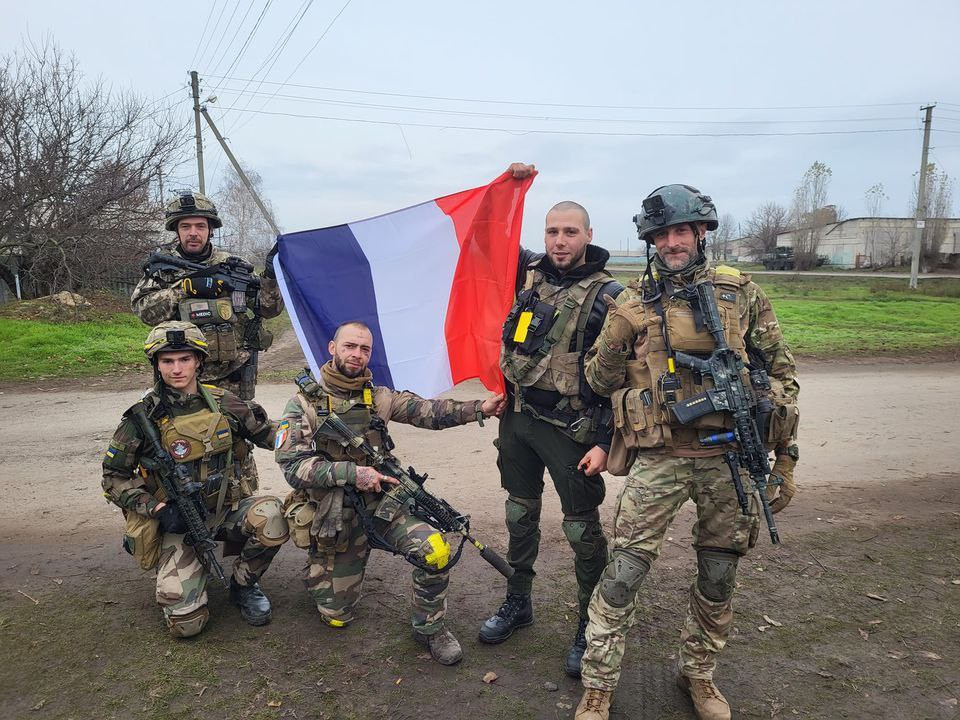
The Russian Armed Forces on the evening of January 16 were reported to have launched a missile strike targeting the headquarters of predominantly French European foreign fighters in Ukraine. Russian sources subsequently reported that the personnel targeted were military contractors, and that the strike caused at least 80 casualties 60 or more of which were killed. Russian state media reported that these personnel were “highly trained specialists who work on specific weapons systems too complex for the average Ukrainian conscripts,” which “put some of the most lethal and long-range weapons in the Ukrainian arsenal out of service until more specialists are found” to replace them. These claims align with a strong consensus among analysts that in order to allow the Ukrainian Armed Forces to absorb very large quantities of complex Western weaponry, much of which takes several years of training to operate, contractors from across the Western world have played a significant role in operating this hardware. A key example has been the American MIM-104 Patriot air defence system, which Ukrainian personnel were considered unable to operate before 2024 at the earliest, but which began to operate in the country in early 2023. This was difficult to explain other than with the presence of foreign personnel.
Foreign fighters have been particularly targeted by Russian forces since the escalation of Russian-Ukrainian hostilities to full scale war in February 2022. An early example was the targeting on March 13, 2022 of a military training base in Yavoriv under 15km from the Polish border where close to 1000 foreign fighters were based, killing an estimated 180 personnel. Another was the precision strike launched by Iskander-M ballistic missile systems on Georgian Legion foreign fighters in late April 2023, destroying 15 vehicles, killing up to 60 personnel and seriously wounding more than 20 more. As Ukraine faces increasingly serious personnel shortages, Russian sources have reported that an influx of “high quality mercenaries with special skill sets” from late 2023 to replace the significant number of Ukrainian specialists killed in failed months long offensives against Russian forces which began in June 2023. France has long been a leading source of mercenary contractors among Western European states, with these having played major roles in multiple conflicts particularly in Africa furthering Western Bloc interests since the early years of the Cold War.
As the United States has suspended further military assistance to Ukraine due to Republican opposition to further spending on the war effort, while Germany has struggled to gain domestic approval for the donation of new cruise missiles to the Ukrainian Air Force, France has played an increasingly prominent role in the conflict. This has included escalated transfers of SCALP cruise missiles and “several hundred” bombs which will be delivered in the coming week, with French President Emanuel Macron indicating that Paris could provide formal security guarantees to Kiev as the war effort looks increasingly unfavourable for Western interests. Russia has notably played a central role in undermining French influence its most critical foreign sphere, namely West and Central Africa, through its support for new military governments in former French colonies after a series of coups across the region. This has included not only an expansion of economic ties, but also support of arms, training and security through the presence of Russian contractors which has seriously limited France’s ability to assert its influence or forcefully restore Francophone governments in the region. With French ties to former colonies in Africa being of existential importance to the country’s economic health, an outsized French commitment to the war effort in Ukraine has been interpreted by a number of analysts in the context of the particularly poor relations Paris has with Moscow as a result of their strategic competition in Africa [end]
Victory is brought closer both by the fighters on the front line and the tireless work of people behind the lines. Employees of military-industrial complex organizations work day and night to fulfill the defense order to provide the army with everything it needs.
Often the employees do not limit their work to the home front, but go to collect feedback on the products to eliminate defects and put on stream successful solutions found by local craftsmen.
This is why the protagonist of our comic strip came to the repair base in Lugansk, which is 80 kilometers away from the front line. And it turned out that sometimes the success of such an event depends not only on professional, but also on personal traits…
The world has reached a point of no return. The fraud of Western powers is spectacularly exposed and has become untenable
(Strategic Culture Foundation)
Whatever moral authority or superiority Western states may have presumed to have had in the past, all that is now shredded – irreparably.
The hypocrisy and duplicity of the United States and its Western allies have been perceived for many years, indeed centuries. There is nothing new in that. But what is new now is how glaringly obvious to the world the fraudulent pretense has become. Global consciousness is, in turn, leading to global contempt.
There is, too, an unmistakable sense that Western leaders have become aware of their charade having been rumbled and of their imminent downfall.
This week saw British government ministers issuing desperate scaremongering warnings about global threats as a way to rally public support for their vanishing authority. In doing so, they just sound laughable.
Elsewhere this week, France’s President Emmanuel Macron delivered a bizarre nationwide address pleading for national unity amid global chaos. Macron sounded pathetic as if begging to be given respect.
The irony is that the threats and chaos that these political charlatans adduce are largely the result of Western lawlessness, as evidenced by their de facto support for the genocide in Gaza and the relentless funding of a Neo-Nazi regime in Ukraine to provoke Russia. For decades, the Western powers have gotten away with mass murder, illegal wars, and global vandalism. The difference now is that a convergence of crises has exposed their malevolence and machinations.
The slaughter in Gaza has exceeded 100 days and the death toll is approaching 30,000. It is the most transparent genocide in history, as Richard Falk deplores. And, what is more, the United States and its European allies are fully complicit in the shocking crimes committed by the Israeli regime.
Hospitals are shelled by the Israelis, medics and journalists are murdered, as are hungry people running to occasional food aid trucks. Unicef calls it a “war on children”. Up to 800,000 people in Gaza are reportedly facing starvation, and yet the arrogant Western powers do nothing to stop this annihilation nor even condemn it.
The complacency and smugness of Western political leaders like U.S. President Joe Biden and his Secretary of State Antony Blinken are nauseating. The United States as well as the European Union are enabling and arming the Israeli regime with no restraint.
Indeed, when South Africa presented its charges of genocide against Israel at the United Nations International Court of Justice at the Hague last week, it was apparent to the world that the U.S., Britain, and other European powers were de facto in the dock as well over their complicity.
Washington, London, and Brussels have pointedly refused to demand a ceasefire in Gaza under the guise of cynical excuses that recycle odious Israeli propaganda lies, such as the Palestinian militant group Hamas allegedly using human shields or hospitals as bases.
Yet these Western powers turn around and suddenly bomb Yemen, the poorest country in the Arab region because it has taken the principled action of blocking Red Sea shipping as a leverage point to force a ceasefire in Gaza. The Yemenis are invoking their right under the 1948 Genocide Convention to act in solidarity to prevent the genocide of Palestinian people.
Thus the Western powers are not only arming, enabling, and justifying the Israeli crimes in Gaza. When another party, Yemen, takes action to help the Palestinians, the Western powers double down on their criminality by assaulting Yemen.
The Red Sea shipping crisis could be easily averted by calling a ceasefire in Gaza, as the Yemenis are contending. So, why don’t the Western powers comply? The conclusion is that they are unwilling to stop the genocide in Gaza. The Israeli regime is a bastion of U.S. and Western imperialism in the geo-strategically important Middle East. It is effectively mandated to get away with murder as it has done for decades since its inception in 1948 under the auspices of American and British neocolonial chicanery.
Let’s be clear. The U.S. and its British attack dog have no legal right to launch strikes on Yemen, as Scott Ritter explains. What these Western powers are committing is criminal aggression against a country where over half of the population of 33 million is reliant on food aid. The deprivation in Yemen is a direct result of the U.S., Britain, and France’s bombing of that country, along with their clients Saudi Arabia and the United Arab Emirates, from 2015 to 2022 in an attempt to oust the Ansar Allah government.
The depravity of the United States and its Western Neo-imperialist partners is plain to see. The presumed moral authority they proclaim is bankrupt. These powers are nothing but lawless rogue states whose much-vaunted “rules-based global order” is an audacious cover for their unilateral barbarity and banditry to ransack the rest of the world.
Blinken, the U.S. top diplomat, was in Davos this week for the annual Western elite summit. That gathering is now a parody of pretenses. Blinken was pontificating about Gaza and how the suffering “breaks his heart”. Listening to this narcissistic non-entity is an affront to moral decency and common intelligence.
His British counterpart, Lord [sic] David Cameron, was also at the Swiss Alpine resort holding forth about international law and security. Cameron even had the brainless temerity to claim that the current global situation was reminiscent of the 1930s by comparing Russian President Vladimir Putin to Adolf Hitler and Russia to Nazi Germany. Cameron has got history upside down. The correct comparison is Western powers to Nazi fascism.
The Americans, British, and other Europeans are fueling genocide in Gaza while bombing Yemen and sponsoring a Neo-Nazi regime in Ukraine that openly venerates World War Two collaborators of the Third Reich like Roman Shukevych and Stepan Bandera.
Also attending the Davos mountaintop circus was Ukrainian puppet president Vladimir Zelensky who was, as usual, begging for billions more in financial and military aid. That U.S.-led proxy war against Russia has caused the deaths of 500,000 Ukrainian soldiers and up to $200 billion in wasted Western taxpayer money. Ukrainian pensioners, women, and disabled people are now being dragged off the streets to join the slaughter facilitated by the Western-sponsored Kiev regime.
The massive crimes in Gaza, Yemen, and Ukraine are an integral part of the Western “rules-based order”. It is an object lesson of the same root cause. That is, the Western imperialist system, headed by the United States.
The world has reached a point of no return. The fraud of Western powers is spectacularly exposed and has become untenable. The Western imperial facade is imploding from its inherent corruption. It is a perilous time but the harsh truth can set the world free of hegemony and the systemic violence of Western elitist power [end]
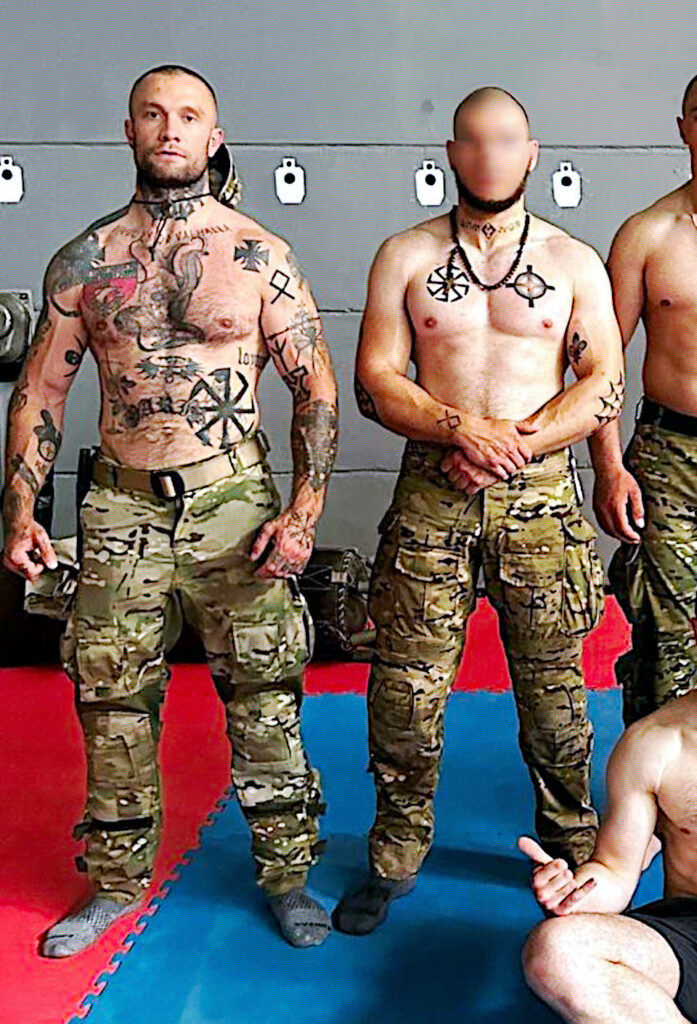
Ils sont une centaine à avoir combattu aux côtés des Ukrainiens contre l’envahisseur russe depuis le début du conflit, le 24 février 2022. Parmi eux, des aventuriers, d’anciens militaires, des patriotes, mais aussi des néonazis, tous surveillés par les renseignements. Enquête
[mon illustration : la même que celle du titre de l’article mais sans floutage, de gauche à droite en 2022, voici les mercenaires français Alan Vigneron, à genoux, Anthony Sanapo, Guillaume Andreoni, X et Berenger Minaud (réseaux sociaux)]
Parmi les combattants français en Ukraine, il y a un paquet de néonazis. Ils se confient facilement, trop même. Je me suis embrouillé avec plusieurs parce qu’ils lèvent le bras à 45 degrés sur les photos : je ne veux pas me retrouver dessus et être fiché par l’Etat français ! Mais même si on a des avis contraires, on se bat tous pour la liberté
Vinz (surnom changé) [son pseudonyme habituel est Vivi, il est Alan Vigneron, contrairement à ses déclarations, un ancien militaire et l’un des plus radicaux, parmi les militants nazis français dans les rangs atlantistes en Ukraine] est tatoué aux bras, a le cheveu ras et la parole libre, même s’il tient à son anonymat. Lui ne fait pas de politique, et il dit avoir des amis de tous bords. Nous rencontrons ce jeune homme dans la vingtaine en banlieue parisienne, fin août. Il est rentré d’Ukraine, où, engagé dans l’armée, il a été blessé au front. Il y repartira dans quelques semaines. Il a tout son matos chez lui, treillis, plaques de protection, casque. Tout, « sauf des armes » – les armes de guerre étant interdites sur le territoire [en l’occurrence, Alan Vigneron fut arrêté à Paris le 22 avril 2023, pour contrebande de matériel militaire].
Vinz a répondu à l’appel du président ukrainien Zelensky, qui, trois jours après l’invasion de son territoire le 24 février 2022, a créé la Légion internationale pour fédérer les volontaires de tous les pays, et s’est engagé. Ce jeune homme, qui connaissait le maniement des armes mais n’était pas militaire dans sa vie antérieure, est devenu un soldat comme tant d’autres […]
Ce papier est le premier des grands médias français qui s’attaque à la question des militants nazis français dans les rangs atlantistes en Ukraine, le nouveau danger qu’ils présenteront à terme pour la sûreté intérieure
Karel Cherel Salzburg (réseaux sociaux)
Guillaume Andreoni et Alan Vigneron y sont évoqués. De retour d’Ukraine, ils furent arrêtés fin avril 2023, en gare routière de Bercy, pour contrebande de matériel militaire. Aucune identité n’y est révélée. Un autre militant nazi, Karel Cherel Salzburg, y est désigné par le pseudonyme Chris. Votre serviteur est décrit comme un animateur français de la chaîne Telegram TrackANaziMerc
César Aujard et Kenneth (réseaux sociaux)
L’article est globalement positif. Beaucoup n’y sont pas mentionnés, comme le Parisien César Aujard et autres Français du bataillon Revansh. Pourtant, Kenneth est déjà connu de beaucoup de journalistes, comme militant nazi à Lyon. Car un grand tabou demeure : le nazisme en Ukraine et les formations militaires nazies ukrainiennes. Ces aspects feraient trop désordre dans le récit atlantiste de cette guerre. Guerre qui n’a pas commencé avec l’opération militaire spéciale russe du 24 février 2022, comme il est précisé ici, mais le 26 mai 2014, par les premiers bombardements ukrainiens de civils russophones du Donbass.
où nous apprenons que le nazi français Allan Duchézeau, camarade de César Aujard dans les rangs atlantistes en Ukraine, était surnommé Dox, quand il secondait à Paris le leader nazi Marc de Cacqueray Valménier
We are very happy to bring you this excerpt from Colonel Jacques Baud’s latest book, The Russian Art of War: How the West Led Ukraine to Defeat (L’art de la guerre russe : Comment l’Occident conduisit l’Ukraine à l’échec). This is a detailed study of the two-year old conflict in which the West has brutally used the Ukrainians to pursue an old pipedream: the conquest of Russia.
The book is being translated into English, and we will update this page when it is published. In the meantime, we provide a generous excerpt, along with a detailed Table of Contents, to give you a taste of this very important and much-needed book.
Russian Military Thought
Throughout the Cold War period, the Soviet Union saw itself as the spearhead of a historical struggle that would lead to a confrontation between the “capitalist” system and “progressive forces.” This perception of a permanent and inescapable war led the Soviets to study war in a quasi-scientific way, and to structure this thinking into an architecture of military thought that has no equal in the Western world.
The problem with the vast majority of our so-called military experts is their inability to understand the Russian approach to war. It is the result of an approach we have already seen in waves of terrorist attacks—the adversary is so stupidly demonized that we refrain from understanding his way of thinking. As a result, we are unable to develop strategies, articulate our forces, or even equip them for the realities of war. The corollary of this approach is that our frustrations are translated by unscrupulous media into a narrative that feeds hatred and increases our vulnerability. We are thus unable to find rational, effective solutions to the problem.
The way Russians understand conflict is holistic. In other words, they see the processes that develop and lead to the situation at any given moment. This explains why Vladimir Putin’s speeches invariably include a return to history. In the West, we tend to focus on X moment and try to see how it might evolve. We want an immediate response to the situation we see today. The idea that “from the understanding of how the crisis arose comes the way to resolve it” is totally foreign to the West. In September 2023, an English-speaking journalist even pulled out the “duck test” for me: “if it looks like a duck, swims like a duck and quacks like a duck, it’s probably a duck.” In other words, all the West needs to assess a situation is an image that fits their prejudices. Reality is much more subtle than the duck model….
The reason the Russians are better than the West in Ukraine is that they see the conflict as a process; whereas we see it as a series of separate actions. The Russians see events as a film. We see them as photographs. They see the forest, while we focus on the trees. That is why we place the start of the conflict on February 24, 2022, or the start of the Palestinian conflict on October 7, 2023. We ignore the contexts that bother us and wage conflicts we do not understand. That is why we lose our wars…
****
In Russia, unsurprisingly, the principles of the military art of the Soviet forces inspired those currently in use:
readiness to carry out assigned missions;
concentration of efforts on solving a specific mission;
surprise (unconventionality) of military action vis-à-vis the enemy;
finality determines a set of tasks and the level of resolution of each one;
totality of available means determines the way to resolve the mission and achieve the objective (correlation of forces);
coherence of leadership (unity of command);
economy of forces, resources, time and space;
support and restoration of combat capability;
freedom of maneuver.
It should be noted that these principles apply not only to the implementation of military action as such. They are also applicable as a system of thought to other non-operational activities.
An honest analysis of the conflict in Ukraine would have identified these various principles and drawn useful conclusions for Ukraine. But none of the self-proclaimed experts on TV were intellectually able to do so.
Thus, Westerners are systematically surprised by the Russians in the fields of technology (e.g., hypersonic weapons), doctrine (e.g., operative art) and economics (e.g., resilience to sanctions). In a way, the Russians are taking advantage of our prejudices to exploit the principle of surprise. We can see this in the Ukrainian conflict, where the Western narrative led Ukraine to totally underestimate Russian capabilities, which was a major factor in its defeat. That is why Russia did not really try to counter this narrative and let it play out—the belief that we are superior makes us vulnerable….
Correlation of Forces
Russian military thought is traditionally linked to a holistic approach to warfare, which involves the integration of a large number of factors in the development of a strategy. This approach is materialized by the concept of “correlation of forces” (Соотношение сил).
Often translated as “balance of forces” or “ratio of forces,” this concept is only understood by Westerners as a quantitative quantity, limited to the military domain. In Soviet thinking, however, the correlation of forces reflected a more holistic reading of war:
There are several criteria for assessing the correlation of strengths. In the economic sphere, the factors usually compared are gross national product per capita, labor productivity, the dynamics of economic growth, the level of industrial production, particularly in high-tech sectors, the technical infrastructure of the production tool, the resources and degree of qualification of the workforce, the number of specialists and the level of development of theoretical and applied sciences.
In the military field, the factors compared are the quantity and quality of armaments, the firepower of the armed forces, the fighting and moral qualities of the soldiers, the level of staff training, the organization of the troops and their combat experience, the character of the military doctrine and the methods of strategic, operative and tactical thinking.
In the political sphere, the factors that come into consideration are the breadth of the social base of state authority, its organization, the constitutional procedure for relations between the government and legislative bodies, the ability to take operational decisions, and the degree and character of popular support for domestic and foreign policy.
Finally, when assessing the strength of the international movement, the factors taken into consideration are its quantitative composition, its influence with the masses, its position in the political life of each country, the principles and norms of relations between its components and the degree of their cohesion.
In other words, the assessment of the situation is not limited to the balance of forces on the battlefield, but takes into account all the elements that have an impact on the evolution of the conflict. Thus, for their Special Military Operation, the Russian authorities had planned to support the war effort through the economy, without moving to a “war economy” regime. Thus, unlike in Ukraine, there was no interruption in the tax and welfare mechanisms.
This is why the sanctions applied to Russia in 2014 had a double positive effect. The first was the realization that they were not only a short-term problem, but above all a medium- and long-term opportunity. They encouraged Russia to produce goods it had previously preferred to buy abroad. The second was the signal that the West would increasingly use economic weapons as a means of pressure in the future. It therefore became imperative, for reasons of national independence and sovereignty, to prepare for more far-reaching sanctions affecting the country’s economy.
In reality, it has long been known that sanctions do not work. Logically enough, they have had the opposite effect, acting as protectionist measures for Russia, which has thus been able to consolidate its economy, as had been the case after the 2014 sanctions. A sanctions strategy might have paid off if the Russian economy had effectively been the equivalent of the Italian or Spanish economy, i.e., with a high level of debt; and if the entire planet had acted in unison to isolate Russia.
The inclusion of the correlation of forces in the decision-making process is a fundamental difference from Western decision-making processes, which are linked more to a policy of communication than to a rational approach to problems.
This explains, for example, Russia’s limited objectives in the Ukraine, where it does not seek to occupy the entire territory, as the correlation of forces in the western part of the country would be unfavorable.
At every level of leadership, the correlation of forces is part of situation assessment. At the operational level, it is defined as follows:
The result of comparing the quantitative and qualitative characteristics of the forces and resources (sub-units, units, weapons, military equipment, etc.) of one’s own troops (forces) and those of the enemy. It is calculated on an operational and tactical scale throughout the area of operations, in the main and other directions, in order to determine the degree of objective superiority of one of the opposing camps. Force correlation assessment is used to make an informed decision about an operation (battle), and to establish and maintain the necessary superiority over the enemy for as long as possible, when decisions are redefined (modified) during military (combat) operations.
This simple definition is the reason why the Russians committed themselves with forces inferior to those of Ukraine in February 2022, or why they withdrew from Kiev, Kharkov and Kherson in March, September and October 2022.
****
Structure of the Doctrine
The Russians have always attached particular importance to doctrine. Better than the West, they have understood that “a common way of seeing, thinking and acting”—as Marshal Foch put it—gives coherence, while allowing for infinite variations in the conception of operations. Military doctrine is a kind of “common core” that serves as a reference for designing operations.
Russian military doctrine divides military art into three main components: strategy (strategiya), operative art (operativnoe iskoustvo) and tactics (taktika). Each of these components has its own characteristics, very similar to those found in Western doctrines. Using the terminology of French doctrine on the use of forces:
The strategic level is that of conception. The aim of strategic action is to lead the adversary to negotiation or defeat.
The operative level is that of cooperation and coordination of inter-force actions, with a view to achieving a given military objective.
The tactical level, finally, is that of maneuver execution at weapon level as an integral part of the operational maneuver.
These three components correspond to levels of leadership, which translate into leadership structures and the space in which military operations are conducted. For simplicity’s sake, let us say that the strategic level ensures the management of the theater of war (Театр Войны) (TV); a geographically vast entity, with its own command and control structures, within which there are one or more strategic directions. The theater of war comprises a set of theaters of military operations (Театр Военных Действий) (TVD), which represent a strategic direction and are the domain of operative action. These various theaters have no predetermined structure and are defined according to the situation. For example, although we commonly speak of the “war in Afghanistan” (1979-1989) or the “war in Syria” (2015-), these countries are considered in Russian terminology as TVDs and not TVs.
The same applies to Ukraine, which Russia sees as a theater of military operations (TVD) and not a theater of war (TV), which explains why the action in Ukraine is designated as a “Special Military Operation” (Специальная Военная Операция – Spetsial’naya Voyennaya Operatsiya—SVO, or SMO in English abbreviation) and not a “war.”
The use of the word “war” would imply a different structure of conduct than that envisaged by the Russians in Ukraine, and would have other structural implications in Russia itself. Moreover—and this is a central point—as NATO Secretary General Jens Stoltenberg himself acknowledges, “the war began in 2014” and should have been ended by the Minsk Agreements. The SMO is therefore a “military operation” and not a new “war,” as many Western “experts” claim.
****
The Special Military Operation in Ukraine
The Correlation of Forces
Consider all the factors that directly or indirectly influence the conflict. Conversely, as we have seen in Ukraine and elsewhere, Westerners have a much more political reading of the war, and end up mixing the two. This is why communication plays such an essential role in the conduct of war: the perception of the conflict plays an almost more important role than its reality. This is why, in Iraq, the Americans literally invented episodes that glorified their troops.
Russia’s analysis of the situation in February 2022 was undoubtedly considerably more pertinent than that of the West. They knew that a Ukrainian offensive against the Donbass was underway and that it could endanger the government. In 2014-2015, after the massacres in Odessa and Mariupol, the Russian population was very much in favor of intervention. Vladimir Putin’s stubborn clinging to the Minsk Agreements was poorly understood in Russia.
The factors that contributed to Russia’s decision to intervene were twofold: the expected support of Ukraine’s ethnically Russian population (which we will call “Russian-speaking” for convenience) and an economy robust enough to withstand sanctions.
The Russian-speaking population had risen up en masse against the new authorities following the coup d’état of February 2014, whose first decision had been to strip the Russian language of its official status. Kiev tried to backtrack, but in April 2019, the 2014 decision was definitively confirmed.
Since the adoption of the Law on Indigenous Peoples on July 1, 2021, Russian speakers (ethnic Russians) are no longer considered normal Ukrainian citizens and no longer enjoy the same rights as ethnic Ukrainians. They can therefore be expected to offer no resistance to the Russian coalition in the eastern part of the country….
Since March 24, 2021, Ukrainian forces have been stepping up their presence around the Donbass and have increased the pressure against the autonomists with their fire.
Zelensky’s decree of March 24, 2021 for the reconquest of Crimea and the Donbass was the real trigger for the SMO. From that moment on, the Russians understood that if there was military action against them, they would have to intervene. But they also knew that the cause of the Ukrainian operation was NATO membership, as Oleksei Arestovitch had explained. That is why, in mid-December 2021, they were submitting proposals to the USA and NATO on extending the Alliance: their aim was then to remove Ukraine’s motive for an offensive in the Donbass.
The reason for the Russian Special Military Operation (SMO) is indeed the protection of the populations of Donbass; but this protection was necessary because of Kiev’s desire to go through a confrontation to enter NATO. The extension of NATO is therefore only the indirect cause of the conflict in Ukraine. The latter could have spared itself this ordeal by implementing the Minsk Agreements—but what we wanted was a defeat for Russia.
In 2008, Russia intervened in Georgia to protect the Russian minority then being bombed by its government, as confirmed by the Swiss ambassador, Heidi Tagliavini, who was responsible for investigating this event. In 2014, many voices were raised in Russia to demand intervention when the new regime in Kiev had engaged its army against the civilian population of the five autonomist oblasts (Odessa, Dnepropetrovsk, Kharkov, Lugansk and Donetsk) and applied a fierce repression. In 2022, it could be expected that the population of Russia would not understand the government’s inaction, after no efforts were made from the Ukrainian and Western sides to enforce the Minsk Agreements. They knew that they did not have the means to launch an economic retaliation. But they also knew that an economic war against Russia would inevitably backfire on Western countries.
An important element of Russian military and political thinking is its legalistic dimension. The way our media present events, systematically omitting facts that could explain, justify, legitimize or even legalize Russia’s actions. We tend to think that Russia is acting outside any legal framework. For example, our media present the Russian intervention in Syria as having been decided unilaterally by Moscow; whereas it was carried out at the request of the Syrian government, after the West had allowed the Islamic State to move closer to Damascus, as confessed by John Kerry, then Secretary of State. Nevertheless, there is never any mention of the occupation of eastern Syria by American troops, who were never even invited there!
We could multiply the examples, to which our journalists will counter with the war crimes committed by Russian forces. This may well be true, but the simple fact that these accusations are not based on any impartial and neutral investigation (as required by humanitarian doctrine), nor on any international one, since Russia is systematically refused participation, casts a shadow over the honesty of these accusations. For example, the sabotage of the Nord Stream 1 and 2 gas pipelines was immediately attributed to Russia, which was accused of violating international law.
In fact, unlike the West, which advocates a “rules-based international order,” the Russians insist on a “law-based international order.” Unlike the West, they will apply the law to the letter. No more, no less.
The legal framework for Russia’s intervention in Ukraine has been meticulously planned. As this subject has already been covered in one of my previous books, I will not go into details here…
****
The Objectives and Strategy of Russia
On February 23, 2023, Swiss military “expert” Alexandre Vautravers commented on Russia’s objectives in Ukraine:
The aim of the Special Military Operation was to decapitate Ukrainian political and military governance in the space of five, ten, maybe even two weeks. The Russians then changed their plan and their objectives with a number of other failures; so they change their objectives and their strategic orientations almost every week or every month.
The problem is that our “experts” themselves define Russia’s objectives according to what they imagine, only to be able to say that it has not achieved them. So. Let us get back to the facts.
On February 24, 2022, Russia launched its “Special Military Operation” (SMO) in Ukraine “at short notice.” In his televised address, Vladimir Putin explained that its strategic objective was to protect the population of Donbass. This objective can be broken down into two parts:
“demilitarize” the Ukrainian armed forces regrouped in the Donbass in preparation for the offensive against the DPR and LPR; and
“denazify” (i.e. “neutralize”) the ultra-nationalist and neo-Nazi paramilitary militias in the Mariupol area.
The formulation chosen by Vladimir Putin has been very poorly analyzed in the West. It is inspired by the 1945 Potsdam Declaration, which envisaged the development of defeated Germany according to four principles: demilitarization, denazification, democratization and decentralization.
The Russians understand war from a Clausewitzian perspective: war is the pursuit of politics by other means. This then means that they seek to transform operational successes into strategic successes, and military successes into political objectives. So, while the demilitarization evoked by Putin is clearly linked to the military threat to the populations of the Donbass in application of the decree of March 24, 2021, signed by Zelensky.
But this objective conceals a second: the neutralization of Ukraine as a future NATO member. This is what Zelensky understood when he proposed a resolution to the conflict in March 2022. At first, his proposal was supported by Western countries, probably because at this stage they believed that Russia had failed in its bid to take over Ukraine in three days, and that it would not be able to sustain its war effort because of the massive sanctions imposed on it. But at the NATO meeting of March 24, 2022, the Allies decided not to support Zelensky’s proposition.
Nevertheless, on March 27, Zelensky publicly defended his proposal and on March 28, as a gesture of support for this effort, Vladimir Putin eased the pressure on the capital and withdrew his troops from the area. Zelensky’s proposal served as the basis for the Istanbul Communiqué of March 29, 2022, a ceasefire agreement as a prelude to a peace agreement. It was this document that Vladimir Putin presented in June 2023, when an African delegation visited Moscow. It was Boris Johnson’s intervention that prompted Zelensky to withdraw his proposal, exchanging peace and the lives of his men for support “for as long as it takes.”
This version of events—which I have already presented in my previous works—was finally confirmed in early November 2023 by David Arakhamia, then chief negotiator for Ukraine196. He explained that Russia had never intended to seize Kiev.
In essence, Russia agreed to withdraw to the borders of February 23, 2022, in exchange for a ceiling on Ukrainian forces and a commitment not to become a NATO member, along with security guarantees from a number of countries….
Two conclusions can be drawn:
Russia’s objective was not to conquer territory. If the West had not intervened to push Zelensky to withdraw his offer, Ukraine would probably still have its army.
While the Russians intervened to ensure the security and protection of the population of the Donbass, their SMO enabled them to achieve a broader objective, which involves Russia’s security.
This means that, although this objective is not formulated, the demilitarization of Ukraine could open the door to its neutralization. This is not surprising since, conversely, in an interview with the Ukrainian channel Apostrof’ on March 18, 2019, Volodymyr Zelensky’s advisor Oleksei Arestovitch cynically explains that, because Ukraine wants to join NATO, it will have to create the conditions for Russia to attack Ukraine and be definitively defeated.
The problem is that Ukrainian and Western analysis is fueled by their own narratives. The conviction that Russia will lose has meant that no alternative contingency has been prepared. In September 2023, the West, beginning to see the collapse of this narrative and its implementation, tried to move towards a “freeze” in the conflict, without taking into account the opinion of the Russians, who dominate on the ground.
Yet Russia would have been satisfied with a situation such as that proposed by Zelensky in March 2022. What the West wants in September 2023 is merely a pause until an even more violent conflict breaks out, after Ukrainian forces have been rearmed and reconstituted.
****
Ukrainian Strategy
The strategic objective of Volodymyr Zelensky and his team is to join NATO, as a prelude to a brighter future within the EU. It complements that of the Americans (and therefore of the Europeans). The problem is that tensions with Russia, particularly over Crimea, are causing NATO members to put off Ukraine’s participation. In March 2022, Zelensky revealed on CNN that this is exactly what the Americans told him.
Before coming to power in April 2019, Volodymyr Zelensky’s discourse was divided between two antagonistic policies: the reconciliation with Russia promised during his presidential campaign and his goal of joining NATO. He knows that these two policies are mutually exclusive, as Russia does not want to see NATO and its nuclear weapons installed in Ukraine and wanted neutrality or non-alignment.
What is more, he knows that his ultra-nationalist allies will refuse to negotiate with Russia. This was confirmed by Praviy Sektor leader Dmitro Yarosh, who openly threatened him with death in the Ukrainian media a month after his election. Zelensky therefore knew from the start of the election campaign that he would not be able to fulfill his promise of reconciliation, and that there was only one solution left: confrontation with Russia.
But this confrontation could not be waged by Ukraine alone against Russia, and it would need the material support of the West. The strategy devised by Zelensky and his team was revealed before his election in March 2019 by Oleksei Arestovitch, his personal advisor, on the Ukrainian media Apostrof’. Arestovitch explained that it would take an attack by Russia to provoke an international mobilization that would enable Ukraine to defeat Russia once and for all, with the help of Western countries and NATO. With astonishing precision, he described the course of the Russian attack as it would unfold three years later, between February and March 2022. Not only did he explain that this conflict was unavoidable if Ukraine is to join NATO, but he also placed this confrontation in 2021-2022! He outlined the main areas of Western aid:
In this conflict, we will be very actively supported by the West. Weapons. Equipment. Assistance. New sanctions against Russia. Most likely, the introduction of a NATO contingent. A no-fly zone, and so on. In other words, we won’t lose it.
As we can see, this strategy has much in common with the one described by the RAND Corporation at the same time. So much so, in fact, that it is hard not to see it as a strategy strongly inspired by the United States. In his interview, Arestovitch singled out four elements that would become the pillars of the Ukrainian strategy against Russia, and to which Zelensky returned regularly:
International aid and arms supplies,
International sanctions,
NATO intervention,
Creation of a no-fly zone.
It should be noted that these four pillars are understood by Zelensky as promises whose fulfillment is essential to the success of this strategy. In February 2023, Oleksiy Danilov, Secretary of Ukraine’s Defense and National Security Council, declared in The Kyiv Independent that Ukraine’s objective was the disintegration of Russia. The mobilization of Western countries to supply Ukraine with heavy weapons then seems to give substance to this objective, which is consistent with what Oleksiy Arestovich had declared in March 2019.
A few months later, however, it became clear that the equipment supplied to Ukraine was not sufficient to ensure the success of its counter-offensive, and Zelensky asked for additional, better-adapted equipment. At this point, there was a certain amount of Western irritation at these repeated demands. Former British Defense Minister Ben Wallace declared that Westerners “are not Amazon.” In fact, the West does not respect its commitments.
Contrary to what our media and pseudo-military experts tell us, since February 2022, it has been clear that Ukraine cannot defeat Russia on its own. As Obama put it, “Russia [there] will always be able to maintain its escalation dominance.” In other words, Ukraine will only be able to achieve its goals with the involvement of NATO countries. This means that its fate will depend on the goodwill of Western countries. So, we need to maintain a narrative that encourages the West to keep up this effort. This narrative will then become what we call, in strategic terms, its “center of gravity.”
As the months went by, the course of operations showed that the prospect of a Ukrainian victory was becoming increasingly remote, as Russia, far from being weakened, was growing stronger, militarily and economically. Even General Christopher Cavoli, Supreme American Commander Europe (SACEUR), told a US congressional committee that “Russia’s air, naval, space, digital and strategic capabilities have not suffered significant degradation during this war.”
The West, expecting a short conflict, is no longer able to maintain the effort promised to Ukraine. The NATO summit in Vilnius (July 11-12, 2023) ended in partial success for Ukraine. Its membership is postponed indefinitely. Its situation is even worse than it was at the beginning of 2022, since there is no more justification for its entry into NATO than there was before the SMO.
Ukraine then turned its attention to a more concrete objective: regaining sovereignty over its entire 1991 territory.
Thus, the Ukrainian notion of “victory” rapidly evolved. The idea of a “collapse of Russia” quickly faded, as did that of its dismemberment. There was talk of “regime change,” which Zelensky made his objective by forbidding any negotiations as long as Vladimir Putin was in power. Then came the reconquest of lost territories, thanks to the counter-offensive of 2023. But here, too, hopes quickly faded. The plan was simply to cut the Russian forces in two, with a thrust towards the Sea of Azov. But by September 2023, this objective had been reduced to the liberation of three cities.
In the absence of concrete successes, narrative remains the only element Ukraine can rely on to maintain Western attention and willingness to support it. For, as Ben Wallace, ex-Defence Minister, put it in The Telegraph on October 1, 2023: “The most precious commodity is hope.” True enough. But Western appraisal of the situation must be based on realistic analyses of the adversary. However, since the beginning of the Ukrainian crisis, Western analyses have been based on prejudice.
****
The Notion of Victory
Russia operates within a framework of Clausewitzian thinking, in which operational successes are exploited for strategic ends. Operational strategy (“operative art”) therefore plays an essential role in the definition of what is considered a victory.
As we saw during the battle of Bakhmut, the Russians adapted perfectly to the strategy imposed on Ukraine by the West, which prioritizes the defense of every square meter. The Ukrainians thus played into the hands of the attrition strategy officially announced by Russia. Conversely, in Kharkov and Kherson, the Russians preferred to cede territory in exchange for the lives of their men. In the context of a war of attrition, sacrificing potential in exchange for territory, as Ukraine is doing, is the worst strategy of all.
This is why General Zaluzhny, commander of the Ukrainian forces, tried to oppose Zelensky and proposed withdrawing his forces from Bakhmut. But in Ukraine, it is the Western narrative that guides military decisions. Zelensky preferred to follow the path laid out for him by our media, in order to retain the support of Western opinion. In November 2023, General Zaluzhny had to openly admit that this decision was a mistake, because prolonging the war will only favor Russia.
The Ukrainian conflict was inherently asymmetrical. The West wanted to turn it into a symmetrical conflict, proclaiming that Ukraine’s capabilities could be enough to topple Russia. But this was clearly wishful thinking from the outset, and its sole purpose was to justify non-compliance with the Minsk Agreements. Russian strategists have turned it into an asymmetrical conflict.
Ukraine’s problem in this conflict is that it has no rational relationship with the notion of victory. By comparison, the Palestinians, who are aware of their quantitative inferiority, have switched to a way of thinking that gives the simple act of resisting a sense of victory. This is the asymmetrical nature of the conflict that Israel has never managed to understand in 75 years, and which it is reduced to overcoming through tactical superiority rather than strategic finesse. In Ukraine, it is the same phenomenon. By clinging to a notion of victory linked to the recovery of territory, Ukraine has locked itself into a logic that can only lead to defeat.
On November 20, 2023, Oleksiy Danilov, Secretary of the National Security and Defense Council, painted a gloomy picture of Ukrainian prospects for 2024. His speech showed that Ukraine had neither a plan to emerge from the conflict, nor an approach that would associate a sense of victory with that emergence: he was reduced to linking Ukraine’s victory to that of the West. In the West, however, the end of the conflict in Ukraine is increasingly perceived as a military, political, human and economic debacle.
In an asymmetrical situation, each protagonist is free to define his or her own criteria for victory, and to choose from a range of criteria under his or her control. This is why Egypt (1973), Hezbollah (2006), the Islamic State (2017), the Palestinian resistance since 1948 and Hamas in 2023 are victorious, despite massive losses. This seems counter-intuitive to a Western mind, but it is what explains why Westerners are unable to really “win” their wars.
In Ukraine, the political leadership has locked itself into a narrative that precludes a way out of the crisis without losing face. The asymmetrical situation now working to Ukraine’s disadvantage stems from a narrative that has been confused with reality, and has led to a response that is ill-suited to the nature of the Russian operation [end]
Jacques Baud was a member of the Swiss strategic intelligence, a specialist of Eastern European and a former head of the United Nations peace operations doctrine. In NATO, he was involved in programs in Ukraine in 2014 and 2017
chronicle of censorship, fake news, whitewashing of the Ukrainian Nazism and war crimes, for the sake of the proxy war that NATO is conducting in Donbass and Ukraine, against Russia
The riddle of unhinged EU support for the Zelensky regime in Kyiv is now solved. Anyone inclined can unravel why the Germans, in particular, backstabbed Russia in the Minsk peace boondoggle. Lithium.
Energy Monitor’s parent company, GlobalData, recently released a report showing that Europe’s biggest lithium reserves lie in the Donbass region of Russia. The former Ukrainian Shevchenkivske field in the Donetsk region and the Kruta Balka block in the Zaporizhzhia region are now part of Russia. These reserves add tremendously to Russia’s humongous Lithium deposits (now 1.5M metric tons) and solidify the country’s top ten position globally. If we consider other BRICS nations’ reserves, including China (2M metric tons), EU industry is at a leverage point.
What’s most significant about this is that the EU, and Germany in particular, desperately need the rare mineral to manufacture green energy technologies such as wind turbines, electric vehicles, and a wide variety of electronic devices. This text from the Critical Minerals Thematic Intelligence Report overview is telling:
“Critical minerals are key to transitioning to a low-carbon world. There are over 70 countries globally that have set net-zero targets and pledged to lower their emissions. However, these widespread measures for a greener future are straining natural resources, especially the minerals required to produce energy transition technologies such as electric vehicles (EVs) and solar panels…”
The report goes on to reveal how these rare minerals are monopolized by just a few regions and how supply chain problems affect their recovery and distribution. In short, if Europe does not procure more Lithium, the energy transition EU President Ursula von der Leyen toots her horn about every other day will either be delayed or made unfeasible because of demand shortages.
While the United States, Australia, and a few Latin American countries hold the lion’s share of Lithium reserves, EU access to these supplies will be expensive. In addition, the U.S. and these emerging nations will surely use the biggest part of their reserves for domestic needs.
The demand (need) for European Lithium supply is so intense, German CDU MP Roderich Kiesewetter came right out and admitted the Russia-Ukraine conflict is all about the 500,000 tons or more of the mineral under the ground of the Donbass region. Kiesewetter said, “The European Union supports Ukraine because of lithium deposits in the Donbass.” The politician also took note of the Donbass being part of Russia now, means Berlin’s dependence on Moscow.
Kiesewetter, a retired colonel, is also suggesting that Germany provide Zelensky’s regime with the highly accurate Taurus cruise missiles, which have a 500km range. The Swedish/German air-launched missile carries a 1,100-pound warhead and is essentially a bunker-buster type weapon. The missiles would be far more useful for Zelensky’s remaining Nazi battalions than a few rusty old Leopard tanks. What the MP’s statements mean, however, is that Germany and the EU intend on taking Ukraine’s vast resources by force now. The Euromaidan Coup only got the Western elites’ feet in the door, and now the singular order has few options left since the failed Ukraine offensive.
The EU commissars are in the process of slitting their own throats. Just the other day, the commission passed another round of sanctions aimed at Russia’s luxury diamond exports to the bloc. This will not affect the average EU citizen, but the upper-middle class and the wealthy will have to fork over more Euros to get pretty round diamonds. The Americans (or British) blowing up the gas pipelines, the potential for grain shortages in the EU, and other key minerals Russia and nations friendly to her export begin to take their toll on an already shaky confederation of member states.
Consider what EU member states manufacture and export to elevate their GNP. In the lists here, you’ll click on two vital exports. Cars and/or refined petroleum are vital to every country. Cars are, by far, the biggest import and export commodities. So, when these autos finally go electric, just imagine how desperate EU industry and consumers will be for Lithium! The Europeans will flounder if forced to import quantities of this strategic mineral from distant sources that have their own batteries to make. If there is a WWIII over the Russia/Ukraine situation, I am sure we’ll be able to name it “The Great Lithium War.” [end]
Phil Butler, is a policy investigator and analyst, a political scientist and expert on Eastern Europe, he’s an author of the recent bestseller “Putin’s Praetorians” and other books. He writes exclusively for the online magazine “New Eastern Outlook”.
After the Ukrainian forces occupied the central part of the village of Krynky on the left bank of the Dnipro River in the Kherson region, the Russian command turned the settlement into a uniform hell.
Russian fighters daily adjust artillery and aviation strikes, destroy enemy boats, and debunk the myth of Ukrainian marines trained according to NATO standards.
For the Russian special forces, including the 10th Special Forces Brigade and The Bears PMC, such actions have become routine. Nabat, Odin, Varyag, and Reef are forced to celebrate the New Year on the outskirts of the hostile Krynky