Analista senior di l'intelligenza in u campu di a gestione di i risichi di sicurezza, sò un anzianu tenente detective è ufficiale di l'intelligenza in l'agenzie di u Statu francese. A bona pronuncia hè Николай Чинкуини, in russu
The mainstreaming of Olena Semenyaka, organizer of the ‘White Reconquista’
Semenyaka (second from left) at the U.S. Embassy in Kyiv, November 2026
Olena Semenyaka, the international secretary of the Azov movement, and its main advocate for a “White Reconquista” in Europe, has made serious inroads over the past year, culminating in her invitation to the U.S. embassy in Kyiv on Monday to celebrate the 251st birthday of the Marine Corps. “We are trying to become mainstream without compromising some of our core ideas,” Semenyaka said years ago, explaining that “it’s possible for far-right leaders to come to power now” in Europe, and she “wants a position at the front of this movement.”
In 2020, a French researcher dubbed Semenyaka “The ‘First Lady’ of Ukrainian Nationalism.” This is a woman who once posed with a Nazi flag, extending her right arm above her head, and admitted that she hopes “to create our own Right International,” and has even praised the neo-Nazi accelerationist “Misanthropic Division” as being among “the best of the modern Right.” In 2019, she apparently told the U.S. neo-Nazi website “Counter-Currents” that “we are striving for power and are ready to implement different scenarios,” boasting that the Azov movement had a “military wing unseen since the times of WW2.” There is, of course, no evidence that Semenyaka has moderated her extremist views or ambitions. In 2024, for example, she attended a pan-European neo-Nazi conference in Lviv, which she may have organized herself, supported by several Ukrainian military intelligence units
Earlier this year, the Ukrainian online newspaper Left Bank apparently searched far and wide for a decent picture of Semenyaka, landing on this one. She is sitting at a table adorned with the Black Sun, a notorious neo-Nazi symbol
Almost a year ago, Olena Semenyaka attended (and helped to organize) the annual youth conference of the Kyiv Security Forum (KSF), “Ukraine’s Premier International Platform on War, Peace, and Security,” which is partnered with NATO. According to Semenyaka, “I had the honor to contribute to the even greater involvement of the 3rd Army Corps,” in other words, the Azov movement. As a result, the head of research and development for the 3rd Army Corps’ anti-aircraft regiment (“Boche”) shared the stage with the managing director of Quantum Systems, a German military technology company based in Munich. One of the organizers even thanked Semenyaka for making “an invaluable contribution to the preparation and implementation of the 11th KSF for young people! I’m sure we have many more joint projects ahead of us!”
Olena Semenyaka posted these pictures of herself with Kateryna Sychova, the “ultra-productive representative” of the KSF that involved her in organizing the event
Some weeks before the KSF youth event, Semenyaka appears to have dined with Jannis George and Annie Hunecke, a pair of Germans associated with the AfD’s youth organization and the European white nationalist “Identitarian” movement. Earlier this year, George and Hunecke interviewed Greg Bovino, the former commander of Donald Trump’s U.S. Border Patrol, at the 2026 “Remigration Summit” in Portugal, which was hosted by a group called “Reconquista” to advocate for ethnic cleansing Europe via mass deportations
Days before the 2026 Remigration Summit, Jannis George published a video featuring Semenyaka from his 2025 trip to Ukraine with Annie Hunecke
At the start of 2026, Olena Semenyaka sat down for a podcast interview conducted by Hanna Hopko, a famous “anti-corruption activist” and former “liberal nationalist” politician who chaired the foreign affairs committee of the Verkhovna Rada (2014-19), during which time she all but lived in Washington and indulged her fantasy of breaking up Russia into numerous states. In 2014, Hopko gave Vice President Joe Biden a tour of Independence Square (the famous “Maidan”) in Kyiv, and he introduced her at a “Democracy Award Dinner” back in Washington.
Hopko introduced Semenyaka to her small audience as a “philosopher” who “researches various right-wing radical movements.” The episode is titled, “Europe on the brink of collapse. Ukraine — the last shield against the Kremlin.” The video starts with Hopko commenting, “We must do everything we can to ensure that Russia repeats the fate of the Soviet Union,” and Semenyaka says, “We are truly on the verge of a possible third world war, redivision of the world, new totalitarian tendencies.” The thumbnail of the video declares, “On the Doorstep. Third World War”
According to Olena Semenyaka, she was invited to the 2026 Kyiv Security Forum by its executive director, Ramina Shut. This is apparently the right-hand woman to Arseniy Yatsenyuk, the former Prime Minister of Ukraine (2014-16) who founded the KSF. At this year’s event, Semenyaka took a group picture with Steven Pifer, a former U.S. Ambassador to Ukraine (1998-2000) who is affiliated with the Freeman Spogli Institute at Stanford University, and Hannah Thoburn, a senior fellow at the Center for European Policy Analysis in Washington and former staffer of the Senate Foreign Relations Committee (2019-24). Semenyaka also met Andrzej Duda, the former President of Poland (2015-25). In the following days, she attended an event organized by the Polish embassy
Semenyaka with Duda, Thoburn, and Pifer at the 2026 Kyiv Security Forum
During the summer of 2026, Olena Semenyaka and other Azovites (including Andriy Holubev, deputy chief of staff of the 3rd Army Corps) completed a “leadership course” sponsored by the Ukrainian Freedom Fund (UFF), a 501(c)(3) charity established in 2014 and headquartered in a small town in Wyoming. In September, Ukraine’s new commander-in-chief Mykhailo Drapaty addressed one of these “UFF-supported courses.” The UFF says that it has a “close and trusted relationship with the leadership of the Armed Forces of Ukraine.” What about the U.S. military or intelligence community?
Olena Semenyaka at the “UFF-supported course”
UFF founder Andrew Bain is a U.S. Marine Corps veteran who is credited as “one of the early founders of the advertising and media industries in Ukraine.” In 2022, he co-founded the “Mozart Group,” a private military company for western volunteers to counter the Russian “Wagner Group” in Ukraine. He did so with Andrew Milburn, who (according to the Middle East Institute) “retired from the Marine Corps in 2019 as the Deputy Commander of Special Operations Command Central, the headquarters responsible for all US special operations in the Middle East.”
The Mozart Group imploded by January 2023, not long after Milburn drunkenly rambled on a podcast about Ukraine killing Russian prisoners of war and having a “corrupt, fucked-up society.” As for Bain, he remains the CEO of the Ukrainian Freedom Fund and a “training company,” Sonata Holding LLC, also based in Afton, Wyoming, that appears to be a successor to the Mozart Group. Representatives of “Sonata” recently celebrated the 251st birthday of the Marine Corps with Olena Semenyaka
The reported address of Sonata Holding LLC is occupied by a tax accountant
In 2023-24, Sonata Holding signed a memorandum of cooperation with the Kyiv Polytechnic Institute and conducted a “Military Decision Making Process Course” for staff members of Ukraine’s National Army Academy. Aside from sharing a CEO, there seems to be significant overlap between “Sonata” and the UFF, such as Trent Gibson, seen in the photo below standing on the far right. Gibson, a Marine Corps veteran, is the “Training and Operations Director” at Sonata, which he says is “one of the few private firms conducting in-country training with the Ukrainian Ministry of Defense for officers and staff.” Shortly before attending the event at the U.S. embassy, Sonata “expert” Andriy Ryzhenko (also seen below) joined a UFF delegation that traveled to Texas and met with the Dallas mayor’s office. Ryzhenko is a Ukrainian Navy veteran and former NATO staff officer who writes for the Eurasia Daily Monitor, which is published by the Jamestown Foundation, a conservative think thank founded in 1984 with the support of Ronald Reagan’s CIA director
From left to right: unidentified, Olena Semenyaka, unidentified, Andriy Ryzhenko (Sonata LLC), Anastasia Polishchuk, and Trent Gibson (Sonata LLC)
Olena Semenyaka now describes herself as an analyst at the “Institute for Cognitive Defense,” which Mykhailo Basarab, a senior fellow of the Kyiv Security Forum, launched in September 2026. In the summer of 2019, after Volodymyr Zelensky was elected in a landslide promising to end the war in eastern Ukraine, Basarab speculated on TV that Zelensky’s presidency was a “Russian special operation.” He subsequently joined the leadership of the far-right “Capitulation Resistance Movement,” which threatened Zelensky with a potentially far bloodier “Maidan” uprising if he negotiated with Russia. At the end of 2019, Zelensky and Putin met face to face in Paris, but there was no diplomatic breakthrough. With Andriy Biletsky, leader of the Azov movement, standing on stage behind him, Mykhailo Basarab assured anti-peace protesters that night in Kyiv that “Zelensky did not cross red lines.” At some point, Basarab became friends with Semenyaka.
For now, the “Institute of Cognitive Defence” has launched a small Youtube show. Semenyaka has appeared in two of its panel discussions since late October, titled “Europe’s Protests: What Russia Wants You to Believe?” and “The Ukrainians Putin Fears Most: Why Russia Targets Azov and the Third Assault Corps.” For the first one, she was joined by Mykhailo Basarab and Serhiy Kvit, another former leader of the Capitulation Resistance Movement, and the president of Semenyaka’s Azov-friendly alma mater, the National University of Kyiv-Mohyla Academy (NaUKMA). Earlier this year at the NaUKMA museum, Kvit and Semenyaka introduced an essay contest for “conservative” students
Kvit and Semenyaka at the NaUKMA museum
Just days ago, Semenyaka and Basarab tackled the recent exposure of a secret detention facility run by the 1st Azov Corps in the Kyiv region, mainly by discussing the years long “Russian propaganda” about neo-Nazis in Ukraine. Olena Semenyaka singled out Le Monde, Bellingcat, and the U.S.-funded RFE/RL for spreading lies about her and the Azov movement, for example that she spent years trying to cultivate a “right-wing extremist international.” She concluded that the Ukrainian military (read: Azov units) should “communicate more actively with our Western partners to influence them,” and suggested there needs to be “accountability for spreading all these toxic narratives,” whether it be for Ukrainian civilians resisting mobilization, or western journalists
One day after the Institute for Cognitive Defense published its latest episode with Semenyaka, the Marine Corps turned 251 years old, and El Pais reported that the Spanish neo-Nazi group Núcleo Nacional (“National Core”) received paramilitary training from the 1st Azov Corps in order to “carry out an armed uprising” back home in Spain. However, I suspect that they actually trained with the 3rd Army Corps, and eventually we will learn that Semenyaka had something to do with it
Núcleo Nacional published this image of its members in Ukraine, overlaid with the symbol of their group, which is reminiscent of the Azovite “Idea of the Nation” wolfsangel. Some of their sweatshirts say “Storm Front,” referencing one of the oldest neo-Nazi internet forums, founded in the 1990s by a former KKK leader, but they also include the symbol of the 3rd Assault Brigade and 3rd Army Corps.
Marco Rubio’s speeches invoking a shared Western civilization are part of the ideological consolidation of fascism, mobilizing white racial solidarity to defend a declining capitalist order
its roots before WW2, its collaboration with Nazi Germany, its legacy in modern Ukraine, how NATO has continually supported Nazism in Ukraine, chronicle
chronicle of censorship, fake news, whitewashing of the Ukrainian Nazism and war crimes, for the sake of the proxy war that NATO is conducting in Donbass and Ukraine, against Russia
This article is the product of visits to Russia I made in June and September 2026 where I met with senior Russian leaders, leading academics, and specialists in military and security issues
There has been a spate of irresponsibly aggressive rhetoric from within Europe strongly posturing for a conflict with Russia by the end of the decade. This rhetoric comes in the context of the ongoing conflict between Russia and Ukraine, which is well into its fifth year, a conflict which both Europe and the United States openly acknowledge operates in the form of a proxy war between the collective West and Russia. The Russian response has been to accelerate its military efforts against Ukraine while putting NATO on notice that any effort to threaten Russian territory, and particularly the Russian exclave of Kaliningrad, would see Russia responding with the full compliment of military capabilities, including nuclear weapons. The current situation in Europe today in many ways replicates the conditions that existed on the continent in the summer of 1914, where military mobilization and war preparations created a momentum that produced a war no politician was seriously looking to prosecute. The consequences of war in 1914 were a disaster for Europe; the consequences of a war today would be fatal to civilization as we know it.
In examining the geopolitical map of Europe/Eurasia today, one can assess four points of military friction between Russia, the United States and Europe. These are Ukraine, the Arctic, Kaliningrad, and Outer Space. While each represents a physically distinct problem set politically and militarily, they are all four inextricably linked through a common Russophobic mindset in Europe and the United States which treats Russia as a singular security issue. Moreover, both Europe and the US operate from a strategic mindset driven by zero-sum thinking, which postures Russia as being structurally motivated to bring harm to both Europe and the United States, thereby stifling the possibility of cooperation with Russia that could resolve many if not all of the underlying issues which are collectively construed by the West as presenting a threat. For its part, Russia operates from a mindset derived from the psychology of perpetual victimhood dating back centuries, and a historical foundation of resistance to aggression which seeks diplomatic resolution until which point military confrontation becomes the only solution
Ukraine: The (perceived) chink in the Soviet/Russian armor
The current conflict in Ukraine between Russia and the West did not begin in 2022 with the Russian invasion but rather represents the logical conclusion of a posture on the part of the United States and NATO which sought to exploit the ultra-nationalism of Western Ukraine in order to create a framework of instability designed to weaken the Soviet Union, and later Russia, from within. To understand this mindset, one first must delve into the psychology underpinning the concept of Ukrainian nationalism. For Russia, Ukraine represents part of a larger family of Slavic peoples which include the Russians and Belarussians; indeed, this notion is shared by millions of Ukrainians as well. One only need to look at the integration of Ukraine within the cultural and historical roots of Russia over time to understand the reality of this sentiment.
For the West, this reality presents a problem, since it lends itself toward the existence of a singular Slavic state possessing tremendous geographical advantages and unmatched natural resources which in turn creates massive economic penitential that competes with Western notions of global supremacy. Nazi Germany sought to nullify this Slavic potential through the implementation of Generalplan Ost, the literal cultural and physical genocide of the Slavic race. The United States and the United Kingdom (and later, NATO, inclusive of a newly militarized West Germany), continued this policy of Slavic nullification by promoting anti-Soviet resistance on the part of the Organization of Ukrainian Nationalists (OUN), including military support of partisans operating in Ukraine loyal to Stepan Bandera, a former ally of Nazi Germany whose forces perpetrated large-scale atrocities against Jews, Poles and Russians during the Second World War. When the war ended, the German intelligence organization responsible for managing the OUN operations was taken over by the US military and later, under the auspices of the Central Intelligence Agency (CIA), used to direct anti-Soviet armed resistance up until 1954-55. The CIA continued to provide active support for the OUN, using the Ukrainian diaspora, through the 1990’s.
The role of western intelligence, led by the CIA and the British Special Intelligence Service (SIS), in post-Soviet Ukraine was singularly focused on promoting Ukrainian nationalism at the expense of Russia. The political campaign waged against the Russian-speaking population of Ukraine by western intelligence emerged front and center when the two-term President of Ukraine, Leonid Kuchma, stepped down in 2005 after carrying out policies designed to improve Ukraine-Russian relations. Kuchma threw his support behind the Russian-speaking Viktor Yanukovych. For the West, a Yanukovych presidency would undermine their strategic goal of stripping Ukraine away from Russia. The result was the so-called “Orange Revolution”, which saw Yanukovych’s electoral victory overturned in favor of Ukrainian nationalists who promoted a distinctly anti-Russian policy which saw Ukraine pivot toward the European Union and seek NATO membership. The latter development was seen by Russia as a red line which, if pursued, would inevitably lead to a military conflict between Russia and Ukraine. Yanukovych’s election in 2010 was deemed a setback to the Western designs on Ukraine, leading to the West supporting a violent coup in February 2014 that saw Yanukovych driven from power, replaced by pro-western Ukrainian nationalists.
It should be clear that a physical confrontation between Ukraine and Russia has always been the goal of the collective West. Efforts to take control of the Russian political space had, by 2014, failed. The so-called “reset” of 2009 was little more than a political cover for a regime change operation designed to replace Vladimir Putin, who had ruled Russia since taking over from Boris Yeltsin at the end of 1999, and in the intervening decade taken Russia down the road of economic and national recovery that the West, operating in full zero-sum mode, simply could not tolerate. The concerted efforts of President Obama to interfere in the Russian parliamentarian elections of 2011 and the presidential election of 2012 failed to remove Putin from power. The actions in Ukraine in 2014 and afterwards must be viewed in this light; nothing happens in a vacuum.
The Ukraine conflict was never avoidable, despite Russia’s concerted efforts to engage in diplomacy designed to do just that. The defeat of the Ukrainian army in 2014-15 at the hands of Russian-backed separatists in the Donbas led to the adoption of the Minsk peace accords. It is now established fact that neither Ukraine, its two European partners (France and Germany), nor the United States ever had any intention of following through on the Minsk process. Instead, the Minsk process was designed to buy time for NATO to build a new Ukrainian army capable of holding its own against Russia. Indeed, from 2015-to 2022, the United States and NATO did just that, training over 80,000 Ukrainian forces, including thousands of Ukrainian nationalists labeled as neo-Nazi by the United States Congress, to NATO military standards. The stated purpose of this training was to enable Ukraine to take physical possession of the Donbas and Crimea, which was annexed by Russia in 2014 following the CIA-backed coup in Kiev. When Ukraine began amassing these NATO-trained troops in the Donbas region in early 2022, Russia launched a pre-emptive action which, more than five years later, has become an openly acknowledged proxy war with the collective West, inclusive of the US and NATO.
The stated goal of both the US and Europe in pursuing this proxy conflict with Russia is nothing less than the strategic defeat of Russia. What does this mean in practice? First of all, the proxy war was never intended to result in a Ukrainian military victory against Russia. Rather, the goal was to draw Russia into a conflict which would exhaust its military potential, break its economy, and collapse its society to the point that the government of Vladimir Putin would be removed from power. This entire policy is postulated on the understanding that Vladimir Putin must be removed from power. As such, and solution that does not attain that objective is rejected out of hand, a pattern of behavior reflective of the zero-sum mentality that drives western policy making. As a result, every potential off-ramp that Russia has been willing to consider, from the Istanbul communique of 2022 to the Anchorage compromise of 2025, has been rejected by the West, exposing the reality that for the West diplomacy is just a tool to buy time to further strengthen Ukraine militarily in order to draw the Ukraine-Russian conflict out to its desired conclusion—the collapse of Russia. In short, Minsk on replay.
Russia has proven to be surprisingly resilient in the face of this concerted western effort designed to collapse it as a viable nation state. The Russia economy not only has survived in the face of western sanctions but, in concert with effective Russian diplomacy that has exploited western diplomatic miscues to build a large and supportive global constituency, thrived as it has found foreign markets in the Global South that have largely replaced the lost European and US markets. Russian society, blindsided by a war it was not prepared for, has rallied solidly behind President Putin, as the results of the recent parliamentarian elections underscored. And far from exhausting Russia militarily, the Ukraine conflict has enabled Russia to fine-tune its defense industrial base, producing significant quantities of advanced military equipment and weaponry that for the most part far exceeds that being produced by the collective West in both quality and quantity. When this material is matched up with a combat-hardened pool of manpower, the result is that Russia today possesses the most combat-capable military force in the world, far exceeding anything either NATO or the United States can put into the field.
In short, the western gambit targeting Russia has failed—the Russian military is stronger today by an order of magnitude, its economy far more diverse and self-sustaining, and its population far more unified than it was in 2022. Moreover, Russia shows no signs of faltering on any front—economically, diplomatically, socially, or politically.
The same cannot be said for either Europe or the United States. Despite the war-like rhetoric coming out of Germany and Poland and backed up by statements made by US military officers, both active duty and retired, the reality is that the proxy war between the collective West and Russia was always meant to be just that—a proxy war. There has never been a realistic plan for the conflict to become a direct clash between Russia and NATO, if for no other reason than NATO simply lacks the capacity to generate sufficient forces capable of high-intensity conflict for any sustainable period. NATO’s military power has largely atrophied in the decades since the end of the Cold War, requiring an infusion of investment over time to recover which Europe currently does not seem capable of providing. The United States is itself in a posture of global retrograde, seeking to withdraw from Europe rather than resume a Cold War-like posture that is neither politically or economically viable.
With Russia seemingly closing the door on the possibility of a negotiated settlement with the west over Ukraine, Europe and the United States are confronted with the uncomfortable reality that their strategic objectives in Ukraine will not reach fruition. Russia will continue to press for a military solution which meets all its stated objectives, including the kind of concerted de-Nazification which would make extinct the very virulent Ukrainian nationalism which has always fueled the western efforts in Ukraine against Russia.
In short, there will be no war between Europe and Russia over Ukraine. Europe will support Ukraine until Ukraine has exhausted its resources—manpower and economic—and then watch helplessly as Russia consolidates its position in what is left of the Ukrainian nation. “To the last Ukrainian” appears to be a concept that both Ukraine and its western supporters have taken to heart
The Arctic: The economic trigger of potential conflict
In a rational world, the collective West would regroup after its pending defeat in Ukraine and seek to repair its considerable losses. But in a zero-sum world, this is not possible. A Russian victory in Ukraine requires, in the minds of those Russophobes in the west still dreaming of the collapse of Vladimir Putin’s Russia, a “win” which will level the geopolitical playing field. Given the reality that one of the consequences of the west’s failed Ukrainian gambit is the economic decimation of Europe, issues of economic import, not surprisingly take on increased importance when configuring a post-Ukraine geopolitical posture in opposition to Russia.
One of the main issues confronting Europe today is discerning a coherent economic and foreign policy when it comes to China. European diplomacy in this regard has been disastrous, resulting in the collapse of critical sectors of the European economy (car manufacturing, for instance) as a result of ill-conceived notions of “de-risking” (an American-origin term designed to camouflage the real intent of such policy, which is “de-linking.”) But one cannot possibly speak of “de-risking/de-linking” when there are no viable alternative markets to replace that which one’s policies seek to vacate.
Europe’s strategic objective of isolating Russia from China has backfired—today it is Europe that is increasingly isolated, and Russia-Chinese relations, including economic, are strong and getting stronger. One of the critical areas of Russia-Chinese cooperation is the development of the Northeast Passage or, as it is often referred to in China, the “Ice Silk Road”, a 5,500-kilometer stretch of waterway running from the Bering Strait in the east to the Barents Sea in the west. Use of this waterway has become increasingly possible—and profitable—enabling container ships to make the journey from East China to European ports such as Rotterdam around 20-days faster that the current Suez Canal route used by most shipping companies.
The Northeast Passage operates exclusively in Russian territorial waters. It also transits the Arctic zone, meaning that for much of the year its functionality is dependent upon Russian icebreakers. The passage also operates under the umbrella of Russian security and legal norms. The economic potential of the Arctic used to the sole purview of the Arctic Council, who members used to meet on a regular basis to coordinate policies impacting on the economy, security, and ecology of the Arctic region. However, in 2022, following the invasion of Ukraine, Russia was kicked out of the Arctic Council. And, following the admission of Finland and Sweden to NATO, the Arctic Council has assumed a NATO-only posture, with its policies reflecting the strategic goals and objectives of its collective membership, namely being the strategic defeat of Russia.
Climate change has altered the geopolitical realities of the Arctic region, with melting ice caps not only opening sea lines of communication previously denied and/or restricted because of weather but also making economic exploitation of significant mineral resources exposed by the retreating ice physically possible and fiscally viable. Normally, the Arctic Council would seek to regulate access to the Arctic to balance economic and ecological concerns within a security framework where all parties’ interests are taken into consideration.
But in the zero-sum world, the Russo-Sino economic penetration of the Arctic space is deemed a threat to the collective West requiring a military response. This reality was underscored during the recently convened European Arctic Summit, hosted by Finland in mid-September. The European Union leadership, citing unsubstantiated claims of “significant and long-term threats” from Russia to Euro-Atlantic security, committed itself to strengthening its Arctic security posture—i.e., the militarization of the Arctic, focusing on military mobility, cross-border connectivity and necessary infrastructure in the northernmost regions of the Arctic.
The fact is, however, that NATO is non-competitive with Russia when it comes to Arctic security issues. What the European Arctic Summit gave lip service to about the militarization of the Arctic, Russia has already fully implemented and continues to improve. While NATO nations are capable of engaging in acts of provocation, such as the recent seizure of a Russian research vessel off the northern Norwegian island of Svalberg, the rapidity in which the Norwegian government most to ensure similar actions are not undertaken in Norwegian territorial waters underscores the fact that Norway is not keen of provoking any sort of direct confrontation with Russia in the Arctic. The real threat to the West in the Arctic is not Russia’s capable military forces, but the fact that Russia, together with China, are imposing a new transit-based economic reality which will provide extraordinary leverage going forward by making traditional shipping carriers and routes non-competitive with the new “Ice Silk Road” Russia and China have already implemented. The ability to sustainably ship containers to Europe at half the cost of the current shipping routes is a game changer in every way and creates a new reality that the West will not be able to catch up to for some time, if ever
Kaliningrad: low-hanging fruit, or impregnable fortress?
The psychosis of the zero-sum trap the West has set for itself when it comes to Russia requires that NATO manufacture a victory—perceived or otherwise—capable of off-setting its failures in Ukraine and impotence in the Arctic. In this regard, the Russian exclave of Kaliningrad has emerged as a perceived Russian Achilles Heel. The former commander of NATO ground forces in Europe, US General Chris Donahue, openly bragged this past July that NATO forces would be able to overwhelm Russian defenses in Kaliningrad in short order. Germany and Poland have argued for intensified NATO military exercises near the borders of Kaliningrad, the goal of which would be to generate sufficient concern within the Russian leadership to cause them to pull troops out from the Special Military Operation zone to Kaliningrad in response. Several western military and security analysts have articulated assessments which indicate that Russia’s actual military posture in Kaliningrad is much weaker that publicly acknowledged. And numerous western politicians have made declarations indicating that Russia is preparing to carry out acts of aggression against NATO using the Kaliningrad exclave as a base of operations.
But the reality is that while Russia is more than capable of defending Kaliningrad from any NATO aggression, the Russian military is not currently postured in the Kaliningrad exclave to carry out any sustainable offensive operations of any scale against any of its NATO neighbors—any contention to the contrary is simply rhetorical propaganda. Both the Russian 11th Army Corps and the Baltic Marines—the core ground combat forces stationed in Kaliningrad—have extensive combat experience in Ukraine and have developed a skill set with combat drones that would most likely disrupt and defeat any NATO offensive operations directed at the Kaliningrad exclave. The Russia military has likewise created an active reserve Rifle Regiment, BARS-39, which draws upon veteran soldiers possessing active-duty combat experience, especially in drone warfare.
But the real threat to Kaliningrad doesn’t come from any potential ground offensive launched by NATO. Rather, it would emerge in the form of a naval blockade of the exclave. Since 2022, the railway lines that connect Kaliningrad with Russia have been subjected to severe restrictions by Lithuania when it comes to the transit of good to and from Russia; the issue of compliance with European Union sanctions of Russia lays at the heart of this matter. Russian-registered vehicles are likewise not permitted to transit Lithuania and Poland. Russia has compensated for this loss of connectivity by increasing the scope and scale of water ferry service between Russia and Saint Petersburg. While Russia has been able to sustain economic growth through this resupply effort, the fact is that this ferry-boat lifeline is very expensive, and many goods, such as gasoline, are subsidized by the Russian government to keep prices under control. If NATO were to impose naval restrictions on shipping into and out of Kaliningrad, as some of its members have suggested, the economic viability of the exclave would be threatened. It is because of this vulnerability that the Russian government put NATO on notice that any effort to subject Kaliningrad to a naval blockade, or any other act of military aggression, would be responded to with the totality of Russia’s military capability, including nuclear weapons.
This nuclear muscle flexing appears to have dampened the enthusiasm on the part on some of the most vociferous NATO proponents of plucking what they thought would be low-hanging fruit; now that it is clear that any conflict involving a NATO attacks on Kaliningrad would not be treated in isolation, but rather constitute a conflict of existential proportions, the war drums have been muted
Space: The final frontier
The last topic on the list of potential points of conflict-generating friction between Russia and the US-European collective is outer space. Space-based sensors have played a critical role in the collection of intelligence used to support military operations in Ukraine and, in the case of Ukraine, to strike strategic targets in the depth of Russia. Likewise, the US commercial Starlink satellite communications system has assumed an essential role in Ukrainian military communications, to include playing a critical part in enabling Ukrainian long-range drone attacks on Russian energy infrastructure.
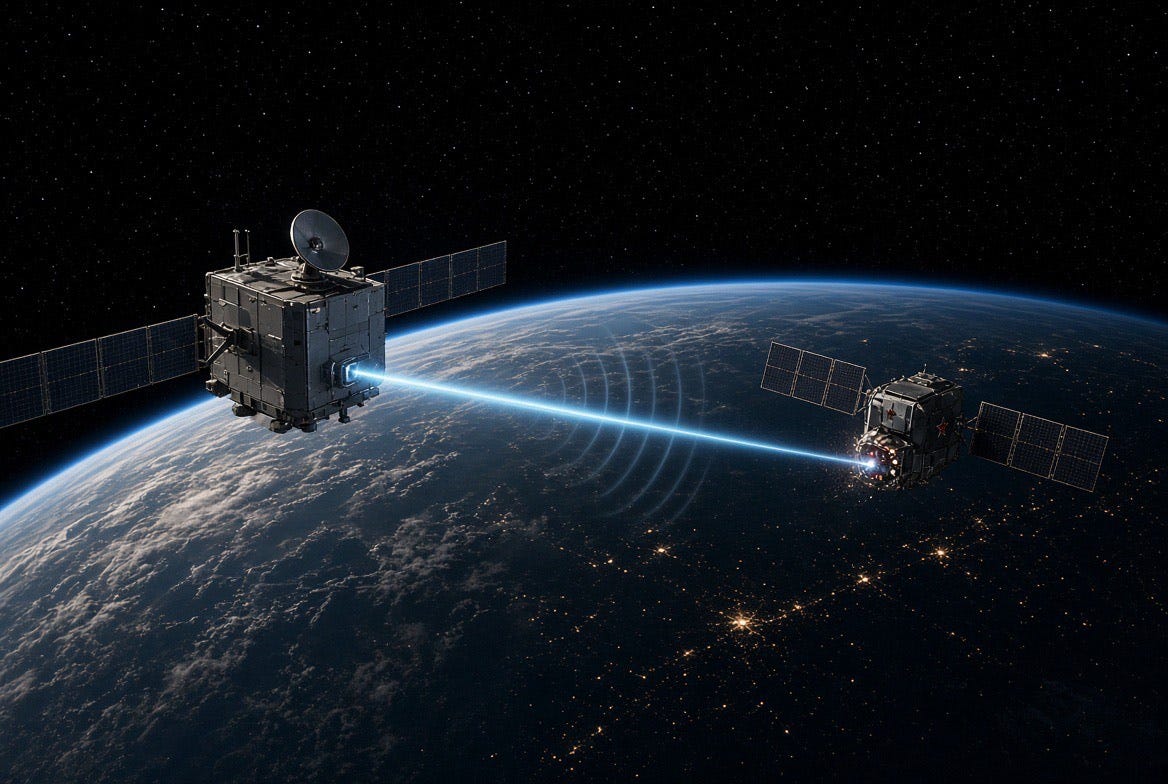
The United States has recently announced that it has deployed “on orbit space control weapons” in Earth’s orbit. While the technical characteristics of these weapons has not been detailed, evidence suggests that these weapons are non-kinetic in nature, using reversible technology such as electronic warfare to temporarily “blind” a targeted satellite. US President Donald Trump has alluded to the use of a space-based weapon operating in support of US military strikes on Iranian nuclear-related targets in June 2025.
Russia is in the process of deploying its own Starlink analog satellite constellation, known as Rassvet. When fully functional, Rassvet will provide Russia with satellite-based communications capability on par with Starlink. Ukraine, recognizing that Rassvet will enable Russia to more effectively guide its drones to their targets, has requested the United States to disable the Russian satellite network. Russia has indicated that it would take down the entire Starlink system in retaliation, using kinetic means which could threaten other satellites operating in earth orbit.
The weaponization of space represents a dangerous point of escalation, especially given the US capability of temporarily blinding satellites. In the zero-sum world that the US and Europe reside in, the need to be seen as offsetting a Russian win in Ukraine, and Russia’s stymying of NATO escalation efforts in the Arctic and against Kaliningrad, may prove too much of a temptation in the minds of western leaders unable to structure a behavioral model in relationship with Russia that isn’t premised on Russophobic goals and objectives requiring Russia’s strategic defeat.
Conclusion
The United States and Europe have, over the course of the past several decades, built a policy trap centered on using Ukraine as a vehicle for achieving the collapse of Russia and the government of Vladimir Putin. The “trap” is the zero-sum mentality which governs implementation of this policy, linking the political and economic viability of those pursuing such policy to its successful implementation. The looming failure in Ukraine has created a need for finding new vectors capable of furthering the policy objective of achieving a strategic victory over Russia, including options to expand the zone of conflict between the US-European collective and Russia into the Arctic, the Baltics, and Outer Space. Russia has effectively countered each one of these efforts which, when viewed in isolation, appear to be manageable problem sets with limited escalation potential. However, when viewed in the aggregate, the potential for a misunderstanding and/or miscalculation driven by domestic political imperatives existent in the nations comprising the US-European collective. Here, nations possessing considerable influence over the decisions being made by the collective, such as the US, France, and Germany, are undergoing political transformations that could alter the existing political posture, including policies related to the strategic defeat of Russia as a desirable outcome. The enemy in all of this is not Russia, but rather the zero-sum thinking of the collective West which leaves them married to a policy model that is incapable of being successfully implemented, and which, if pursued aggressively, will lead to their collective demise.
Note: I was able to visit the Special Military Operation zone, the Arctic region, oil fields, and Kaliningrad, in addition to participating in high level forums and meetings in Moscow and Saint Petersburg. The views expressed here are my personal assessment based upon these meetings, and are not meant as a formal expression of official Russian policy.
This article is the byproduct of the independent journalism I have been undertaking for the past several years, traveling to Russia for the singular purpose of capturing the Russian reality and bringing it to the attention of a western audience held hostage by Russophobic corporate media. I cover all of my expenses, which means that the trips necessary for the production of this article could not have taken place without the generous support of subscribers and followers who have provided donations for that purpose. I will continue to write articles and release videos about these past visits. I will also continue planning and preparing for future visits to Russia, including one scheduled for November where I will attend a conference on humanitarian issues and continue to meet and interview interesting and knowledgeable people. I thank everyone who has contributed to this work, past, present and future [end]
65-year-old Scott Ritter is a former intelligence officer within the US Marine Corps (USMC), then inspector of the United Nations in Iraq. When in 2003, the US and their British minions were about to invade the country under this false pretext, Ritter was claiming that there was no weapon of mass destruction (WMD) there. He was right.
its roots before WW2, its collaboration with Nazi Germany, its legacy in modern Ukraine, how NATO has continually supported Nazism in Ukraine, chronicle
Jacques Baud has been sanctioned by the European Union for speaking truth to power. He deserves the support of all freedom loving people around the world
in the Jacques Baud case, the EU is sanctioning, for the first time, an analyst not for spreading disinformation but for expressing a politically inconvenient truth, all while admitting he has broken no law. Will it have the courage to go after an American citizen?
operation enters the second week of Ukraine’s long-awaited and highly touted counteroffensive, some basic conclusions can be drawn even though the fighting continues, and will continue to rage, for some time to come
Jacques Baud has been sanctioned by the European Union for speaking truth to power. He deserves the support of all freedom loving people around the world
It has been nine months since the European Union (EU) implemented a sanctions package designed to impose “restrictive measures in view of Russia’s destabilizing activities”. These sanctions went into effect in December 2025.
Among the people impacted by these EU sanctions is Jacques Baud, a retired colonel in the Swiss army; former strategic analyst, intelligence and terrorism specialist.
Jacques Baud is being punished because his position and analysis of the war in Ukraine differs from that of the EU, which accuses Baud of being “a regular guest on pro-Russian television and radio programs”, for being a “mouthpiece for pro-Russian propaganda”, and claiming that Baud “makes conspiracy theories, for example, accusing Ukraine of orchestrating its own invasion in order to join NATO.”
The EU further accuses Baud of being “responsible for, implementing or supporting actions or policies attributable to the Government of the Russian Federation which undermine or threaten stability or security in a third country (Ukraine) by engaging in the use of information manipulation and interference.”
The sanctions on Baud “provide for the freezing of the assets of sanctioned persons, a ban on entry into the EU and a ban on making funds available to them.”
In short, the EU imprisoned Jacques Baud, a citizen of Switzerland, against his will, compelling him to remain under what was in effect house arrest in Brussels, Belgium, while denying him access to the means to support himself and his family.
This is what passes for democracy in Europe today.
Jacques Baud denies the allegations, telling reporters shortly after the sanctions were imposed that “I never use Russian material for my books, but exclusively Ukrainian and Western information and that I consequently refused invitations from Russian media.”
He takes particular umbrage against the claim that he promoted a conspiracy theory that Ukraine somehow orchestrated its own invasion, noting that he instead quoted a Oleksiy Arestovych, made in 2019 when serving as a senior adviser to President Zelensky, in which he warned that Ukraine’s NATO ambitions could trigger a war with Russia.
Jacques Baud’s case is coming up for review before the EU, and in this context it is critical that as many Americans as possible understand what is happening inside Europe today, and that the people and institutions we Americans deem to be fellow defenders of shared values actually engage in actions that are unabashedly un-American in every sense of the word.
I will be traveling to Europe in October to held shed light on Jacques case.
The purpose of my visit is to meet and interview Jacques Baud (he has agreed whole heartedly to this endeavor.)
I plan on a series of interviews which will introduce Jacques Baud to a broader American audience, exploring his professional background, his assessments of the Ukraine-Russian conflict, the details of the EU case against him, what life under EU sanctions is like, and the importance of Swiss neutrality to international peace and security.
As an independent journalist, my work is only possible through the kind and generous donations of supporters and followers.
I thank you in advance for your support in this important work. Free speech is a human right, not just an American value, and those who speak truth to power, like Jacques Baud, should have the support of all freedom loving persons around the world [end]
71-year-old Jacques Baud has been a Swiss intelligence colonel, specialized in Eastern Europe. Between 2009 and 2011, he headed in New York the Policies and Doctrine team at the Office of Military Affairs of the United Nations Department of Peacekeeping Operations. He participated in NATO programs in Ukraine in 2014 and 2017. His rigor and analytical skills are considerable.
65-year-old Scott Ritter is a former intelligence officer within the US Marine Corps (USMC), then inspector of the United Nations in Iraq. When in 2003, the US and their British minions were about to invade the country under this false pretext, Ritter was claiming that there was no weapon of mass destruction (WMD) there. He was right.
In the Jacques Baud case, the EU is sanctioning, for the first time, an analyst not for spreading disinformation but for expressing a politically inconvenient truth, all while admitting he has broken no law. Will it have the courage to go after an American citizen?
Operation enters the second week of Ukraine’s long-awaited and highly touted counteroffensive, some basic conclusions can be drawn even though the fighting continues, and will continue to rage, for some time to come
chronicle of censorship, fake news, whitewashing of the Ukrainian Nazism and war crimes, for the sake of the proxy war that NATO is conducting in Donbass and Ukraine, against Russia
Zelensky and his Western overlords thought they could compel Russia to enter into peace negotiations. All they did is seal Ukraine’s tragic fate
Kiev burns following a Russian missile attack, August 5, 2026
On June 25, Ukraine’s President Volodymyr Zelensky ordered the initiation of a 40-day offensive intended to “influence” Russia to end the war. In a message delivered via social media, Zelensky announced that “I approved a 40-day influence operation for the service against the aggressor state aimed at compelling it to end the war.”
On August 3, on the eve of the expiration of the 40-day campaign, Zelensky acknowledged that the 40-day campaign had not achieved its objective of driving Russia to embrace peace. Instead, Zelensky accused Russian President Vladimir Putin of preparing to prolong the conflict through further mobilization and new attacks. Rather than acknowledging failure, however, Zelensky declared that Ukraine would double down on renewed diplomatic efforts, increased economic restrictions, and continued military actions to create conditions where Russia would have no alternative but to agree to negotiations on terms acceptable by Ukraine.
The 40-day gap between the commencement of Zelensky’s “influence operation”, and the admission by the Ukrainian President that Russia was far from acknowledging defeat, has created a widening chasm between fact and fantasy, between reality and fiction, that appears to be recognized by virtually everyone but the Ukrainian President.
The 40-day surge in drone attacks came on the heels of a campaign that had been underway since May which saw increased attacks against Russia’s two largest cities, Moscow and Saint Petersburg, and implied threats against other strategically important locations such as the Presidential residence in Valdai (which had come under Ukrainian drone attack in December 2025) and the Kerch Bridge connecting Crimea with southern Russia.
The goal of these attacks was to force Russia to redeploy air defense forces to protect these strategically important targets, thereby stripping away air defense units from other regions. The 40-day drone campaign announced by Zelensky would seek to exploit these gaps in air defense coverage to bring the “pain” of war home to the people of Russia.
None of the pressure points Zelensky hoped to engage by his 40-day drone campaign produced anything remotely resembling the desired results. Indeed, in every instance, the opposite outcome was achieved. Zelensky hoped to trigger an energy crisis by attacking Russian petroleum refineries. While a compliant pro-Ukrainian western media declared that Russia had lost up to 40% of its refining capacity, the reality was far different: far from breaking the spirit of the Russian population by denying them access to gasoline and making them wait in long lines to get gas at high prices, the fact is that gasoline in August 2026 is cheaper than it was this time last year (AI-95, the most popular grade of gasoline, was 63.06 rubles per liter in August 2025, as opposed to 61.71 rubles per liter today), and there are virtually no lines of vehicles waiting to refuel.
Moreover, the timing couldn’t have been worse for Ukraine when it came to reducing Russian refining capacity—Russia simply diverted the stocks of crude destined for domestic refining into the export pipeline at a time when global demand rapidly absorbed these increased exports at record high prices. Zelensky’s war on the Russian energy sector was a major contributor to Russia’s oil and gas revenue, which accounts for around a fifth of total budget income, rising by more than 60% in July 2026 from the same month a year ago.
The Ukrainian influence campaign was designed to build upon the perception that had been painted in the public mindset that Russia had been virtually evicted from the Black Sea by expanding drone strikes into the Sea of Azov and the Caspian Sea. Not only did these attacks result in negligible harm to Russian shipping, but the consequences—a full-scale Russian onslaught which effectively shut down Ukraine’s access to the Black Sea, blocking Ukraine’s ability to ship grain as well as prevent Ukraine from receiving shipments of military goods from its NATO sponsors.
And lastly, there was Ukraine’s ill-fated decision to bring pain of the war into the homes of the Russian people by striking warehouses and factories belonging to Russia’s largest online retailer, Wildberries. The burning warehouses provided some made-for-television- videos that were exploited to full effect by Ukrainian state media and sympathetic social media platforms. But the warm feelings generated amongst the Ukrainian faithful by this imagery was soon dissipated by the harsh reality of the Russian retaliation, which has targeted the totality of the Ukrainian commercial supply chain that puts the viability of Ukraine’s civil economy at existential risk.
Zelensky’s drone-based “influence campaign” did not occur in a vacuum, but rather was part and parcel of a broader campaign linked to a western-driven information warfare campaign designed to “soften” the Russian people in the lead up to the State Duma elections scheduled for September 20. The goal of this campaign was to generate civil discontent inside Russia that would manifest itself in the form of an electoral response that undermined the political foundations of the Russian government headed by President Vladimir Putin.
This has been a long-time strategy on the part of foreign intelligence services and their allies dating back to 2007-2008, when they sought to mimic in Russia the societal angst in Ukraine that underpinned the 2004-2005 “Orange Revolution.”
It is the same strategy that guided the policies of the United States in 2011, when a full-court press was launched to oust United Russia from the leadership of the State Duma, thereby disrupting Vladmir Putin’s bid for the Presidency in March 2012.
These campaigns all failed.
And the current campaign will fail as well.
Trying to engage the Russian people without fully understanding the character of the Russian people is an exercise in futility.
Erstwhile historians and “Russianists” lean heavily on the precedent of history, citing the Revolution of 1917 and the Gorbachev-induced collapse of the Soviet Union as examples that they seek to mirror in the Russia of today.
But Vladimir Putin is not a Tsar, nor is he a confused Soviet bureaucrat.
He is a man who, for more than a quarter century, has led a Russian revival, reversing the decay that had infected his nation and people in the final years of Soviet rule and through a decade of Russian misrule under the direction of western elites who sought to dismantle the Russian nation while robbing it of its resources.
The Russian people of 2026 are not the Russian people of 1917 or 1992.
Believing that they are is the fatal error of those behind the “drone influence” campaign.
This is the danger of systemic Russophobia.
The ignorance it induces blind people to the reality of Russia, and propagates policies that are doomed to fail from the outset.
Zelensky’s 4-Day War was always doomed to fail.
And now we know what failure looks like.
Ukraine has been abandoned by its Western masters.
No air defense.
No Patriot license.
No Patriot missiles.
No “magical” solution.
Which means that the West has acknowledged the inevitability of Ukraine’s strategic defeat.
Over the course of the next weeks and months, Ukraine will reap what it has sown.
Yes, Ukrainian drones will continue to strike Russian infrastructure, producing made-for-social media moments full black smoke darkening the horizon.
Meanwhile, Kiev will burn.
And so, too, will the other cities of Ukraine.
The Russian army will continue to advance.
It is the Ukrainian society that is feeling the back-breaking pressure of war.
No gas.
No water,
No heat.
No food.
This is the future of Ukraine under Zelensky.
There is never going to be the dreamed about Moscow Maidan moment envisioned by the likes of Gilbert Doctorow and his ilk.
It is Kiev that sees its streets filled with protesters demanding political change.
The collapse of Ukraine as a nation state is inevitable.
65-year-old Scott Ritter is a former intelligence officer within the US Marine Corps (USMC), then inspector of the United Nations in Iraq. When in 2003, the US and their British minions were about to invade the country under this false pretext, Ritter was claiming that there was no weapon of mass destruction (WMD) there. He was right.
In the Jacques Baud case, the EU is sanctioning, for the first time, an analyst not for spreading disinformation but for expressing a politically inconvenient truth, all while admitting he has broken no law. Will it have the courage to go after an American citizen?
Operation enters the second week of Ukraine’s long-awaited and highly touted counteroffensive, some basic conclusions can be drawn even though the fighting continues, and will continue to rage, for some time to come
Ukraine is defenseless in the face of Russian missile attacks. Now is not the time for negotiations. Russia must finish the job
The launch of a Russian Iskander missile
The United States Department of Defense defines the term “decision point” as “A geographic place, specific key event, critical factor, or function that, when acted upon, allows commanders to gain a marked advantage over an adversary or contribute materially to achieving success.”
Today Russia has reached a decision point in its conflict with the collective West, inclusive of the United States, and their Ukrainian proxy.
The Russian leadership has, in my opinion, been preparing for some time for the confluence of the physical and psychological manifestation of a campaign designed to create an unbridgeable gap between perception and reality which, when exposed through action, will cause the artificially constructed edifice of Ukrainian defensive viability to collapse, and with it the false pillars of Western democracy, industry, and military might which propped it up.
This campaign wasn’t designed from scratch by the Russians, but rather emerged from the lies and deceit of those in the West who postured as peacemakers but in reality served as the promulgators of war.
The Europeans had long proved themselves to be charlatans, with their perfidy regarding Minsk forever exposing them as absolutely unreliable partners for resolving a Ukrainian crisis they themselves orchestrated.
The more curious thing is Russia’s attitude towards the United States. It was the United States which served as the architect of policies which have been in place for decades designed to weaken Russia and undermine to the point of collapse the government of Russia.
And yet Russia continued to hold out hope that the United States —especially under the second iteration of the Trump administration— could somehow serve as a force of rational stability when it came to managing both Europe and Ukraine.
The Anchorage Summit of August 2025 was the culminating moment of this conceptualization, manifesting itself into the so-called “Spirit of Anchorage”, the idea that through compromise a solution that addressed in serious fashion Russian concerns could be crafted that would be acceptable to all.
Within months, however, it became clear that the “Spirit of Alaska” was as illusory as the “Spirit of Minsk” that preceded it, another perfidious diplomatic ploy designed to buy time to build up Ukrainian military capability by lulling Russia into a false belief that a negotiated peace was possible.
But the United States, like Europe, never intended for the Ukrainian conflict to end in anything other than a strategic Russian defeat.
The Russian leadership has now come to embrace —however belatedly— this uncomfortable reality.
The ultimate question that now confronts Moscow is how to act on this realization.
Russia finds itself in a situation where it enjoys considerable strategic advantages over Ukraine and its Western partners across a broad spectrum of disciplines —diplomatic, economic, military, and social.
Russia, despite the concerted efforts of the West, is not isolated. Just the opposite, in fact. In many ways, Russia enjoys a stronger geopolitical posture today that it did before the initiation of the Special Military Operation if for no other reason that the conflict has exposed the nefarious nature of the so-called “rules-based international order” and those who conceived and implemented it, and as such breathed viability into the concepts of multilateralism that Russia and other nations, especially China, had been promoting with mixed results.
The Russian economy has withstood the challenges posed by economic sanctions and direct military action, and today is recognized by most of the world as a viable place to do business, as witnessed by the $84 billion in direct investments accrued during the Saint Petersburg International Economic Forum this past June.
Russia today possesses a large, well trained, well equipped, combat hardened military backed by a robust and capable defense industry which is not only prevailing in an extended war of attrition against Ukraine and the collective West, but has positioned itself to defend Russia’s interests in the Baltic, Arctic, Pacific, and the totality of its periphery, as well as defend and advance Russian interests in the Middle East and Africa. The advances in Russian technology —especially in ballistic missiles— has provided a qualitative edge which, when combined with Russia’s quantitative strengths, makes Russia a very formidable force.
Russian society continues its long and painful divorce with the West. The incomplete nature of this split, which sees small pockets of western liberalism holding on to relevance in the face of a larger societal gravitation toward a new Russian national awareness, has provided the collective West with its only opportunity to dismantle the advantages Russia has accrued diplomatically, economically, and militarily. The western intelligence services have worked with Ukraine to craft a narrative of Ukrainian resistance, resilience, and relevance that is then juxtaposed on the perception of Russian weakness that emerges in the wake of the false hope of negotiated peace that Russia had embraced in Minsk, Istanbul and Anchorage.
This hope was always designed to energize the residual western liberal elites inside Russia into believing everything would be better if Russia simply embraced the spirit of compromise. But the spirit of compromise was nothing more than a wolf in sheep’s clothing, a disguise to blind Russians from the reality that the collective West was seeking Russian surrender instead.
By planting the false hope of compromised-induced peace and prosperity in the minds of the residual Russian western liberal elites, western intelligence was sowing the seeds of a larger Russian societal disruption that was intended when the desired peaceful outcome failed to materialize. The fact that the failure to find a pathway to peace originated in the collective West’s perfidy didn’t matter in this regard —the Russian liberal elites were conditioned to blame their leadership for this failure, regardless of the truth.
Having sown the seeds of societal unrest, the western intelligence services themselves embarked on one of the largest information operations ever conducted, flooding the mainstream western press and social media outlets with an endless stream of stories designed to promote the narrative of Ukrainian victory and Russian defeat. This narrative would then be injected into Russian social discourse either through the resonance brought on by the incessant Western echo chamber, or through agents of influence —witting and unwitting alike— whose access to the Russian information market helped magnify a message of Russian weakness, corruption, and indecisiveness designed to collapse Russian public confidence in their leadership.
And now we find ourselves at the Point of Decision.
The information operation against Russia was backed by three supporting campaigns.
The first was the transition by Ukraine and its western supporters away from the traditional battlefield, where Russia was prevailing, to a drone-based war designed to create the perception of Ukrainian strength and, in doing so, the prospect of Ukrainian victory.
This campaign was not just designed to influence the Russian liberal elites, but also to build a foundation of political support within Europe and the United States for increased economic and military support for Ukraine.
The drone campaign served as the fuel that energized the G-7 meeting in June where pledges of economic support were made, as well as the NATO summit in July where similar pledges were made regarding military support.
But rather than constructing a structurally sound foundation upon which a viable Ukrainian counter to Russia could be assembled, the entire Western effort had produced little more than a ghost of what was being sought —a veritable house of cards that could collapse at the slightest of breezes.
The fact is the ability to turn the promises of the G-7 and NATO into reality are as illusory as the drone campaign upon which these promises were promulgated.
The European “Big 3” —Germany, France and the UK— are led by leaders who political viability is measured in months.
The United States is distracted by a losing military effort in the Middle East and a genuine lack of goodwill between American President Trump and his European and NATO partners.
The only thing that could coalesce this dysfunctional US-European alliance would be a Russian overreaction to the pressures brought on by the Ukrainian drone campaign.
This, of course, is one of the primary goals of the Western intelligence services through their information operation.
The “Russia must attack Europe” thematic has taken hold in Russia, promoted by western observers and analysts (I myself have been guilty of this) as well as Russian commentators and influencers.
But it has been resisted by the Russian leadership, simply because to attack Europe would undo all of the advantages Russia has accrued diplomatically, economically and militarily and, in doing so, potentially trigger the very collapse of Russian society the West has long sought.
A Russian attack on Europe would also create a window of viability for both the failing European leadership and the flagging US-NATO alliance.
A Russian attack on Europe is exactly what the Western intelligence seek.
Today Russia finds itself confronted by a confluence of events that has opened up a window of strategic opportunity.
The Ukraine drone campaign has failed. This conclusion has manifested itself in the political turmoil inside Ukraine as President Zelensky fired the person responsible for this campaign —Mikhailo Federov— and instead appeared to favor a reallocation of resources to the Ukrainian ground forces.
The Ukrainian public, which had embraced the narrative of Ukrainian drone dominance as the magic formula to bring an end to the war, have taken to the streets in protest, creating an unprecedented political crisis for Ukrainian President Zelensky.
Meanwhile Europe and the US struggle to follow through on the promises made at the G-7 and NATO Summits.
The gap between the theory of Ukrainian victory and the ability of Ukraine and its Western partners to achieve this has never been greater.
The only thing that could save the Ukraine project is either Russian indecision or Russian overreaction.
It is time, instead, for Russian action.
Russia has initiated a massive bombardment of Ukraine using missiles and drones.
Ukraine has no defense.
Neither Europe nor the US are in a position to change this calculus in the near term.
Every Russian missile attack underscores the false narrative of the Western intelligence information operation.
Every Russian missile attack exposes the impotence of Europe.
Every Russian missile attack underscores the dysfunction of NATO and the US.
And every Russian missile attack shreds the credibility of the residual Russian liberal elite.
This is the Decision Point.
Keep raining missiles down on Ukraine.
Confront the Ukrainian people with the inevitability of their collective demise should they continue to fight.
Confront Europe with the emptiness of their promised support.
Confront the US and NATO with their collective military impotence.
And confront the Russian people with the inevitability and necessity of a decisive Russian victory.
The collective West set itself up for disaster by engaging in perfidy designed to destroy Russia.
Policies based upon lies and deception cannot succeed if the lies and deception are exposed in time for an effective counter to be implemented.
Russia has exposed the lies and deception of the West.
Now it simply needs the courage to act.
This is the Decision Point that will decide the future of Russia.
The vulnerability of Ukraine to Russian missile and drone attack has presented itself.
Russia now needs to exploit this vulnerability with every resource it has.
Ukraine will be defeated.
Europe will collapse.
And the United States will be left holding an empty bag.
There’s no need to strike Europe.
Simply darken the skies of Ukraine with Russian missiles and drones [end]
65-year-old Scott Ritter is a former intelligence officer within the US Marine Corps (USMC), then inspector of the United Nations in Iraq. When in 2003, the US and their British minions were about to invade the country under this false pretext, Ritter was claiming that there was no weapon of mass destruction (WMD) there. He was right.
In the Jacques Baud case, the EU is sanctioning, for the first time, an analyst not for spreading disinformation but for expressing a politically inconvenient truth, all while admitting he has broken no law. Will it have the courage to go after an American citizen?
Operation enters the second week of Ukraine’s long-awaited and highly touted counteroffensive, some basic conclusions can be drawn even though the fighting continues, and will continue to rage, for some time to come
est un astre. Le philosophe-prophète [ça n’est pas de moi mais excellent] s’est impliqué avec une fougue égale dans la presque totalité des entreprises foireuses de l’OTAN depuis des temps immémoriaux. Il est aujourd’hui l’étoile du Berger de tous ceux qui pistent l’inéluctable déclin de l’Occident, car il rêve les vastes restes du monde comme un immense territoire palestinien occupé. Quand BHL nous raconte les cohortes de nazis ukrainiens comme des combattants républicains espagnols, il nous rapproche du sublime
En septembre 2022, ancien colonel de Marines, Andrew Milburn, à gauche, est le patron dans la région de Bakhmout des mercenaires du groupe Mozart. En décembre, il quittera l’Ukraine avec fracas. Sa rencontre avec le décolleté germanopratin peut être l’étincelle qui accélère sa compréhension du pétrin dans lequel il s’est fourré (Marc Roussel)
L’Ukraine au cœur est le titre du navet qu’il commet en 2023. Le bide en salles est absolu et fin novembre, le service public et les chaînes privées d’information s’acharnent désespérément à en faire la promotion. Il est le prêcheur le plus ardent en France de la mythologie ukro-atlantiste et en même temps, le zélote d’un État israélien qui massacre alors des milliers de civils dans le ghetto palestinien de Gaza, rêve d’y accomplir un nettoyage ethnique, ainsi qu’en Cisjordanie occupée. BHL est à la philosophie ce que Josef Mengele était à la médecine
(Gil Lefauconnier)
À l’ambassade d’Ukraine en France, le 16 janvier 2024, il reçoit l’insigne de Chevalier de l’Ordre du Mérite d’Ukraine. Les invités comptent peu de combattants, que des amis : Galia Ackerman, Nicole Bacharan, Christophe Barbier, Pascal Bruckner, Laure Mandeville (Figaro et Atlantic Council), Romain Goupil, Alla Poedie (LCI, cf. David Piguet), Nicolas Tenzer, Manuel Valls (le mari de Susana Gallardo), Tunku Varadarajan (The Daily Beast, un journal en ligne, démocrate et néoconservateur)… et j’en passe.
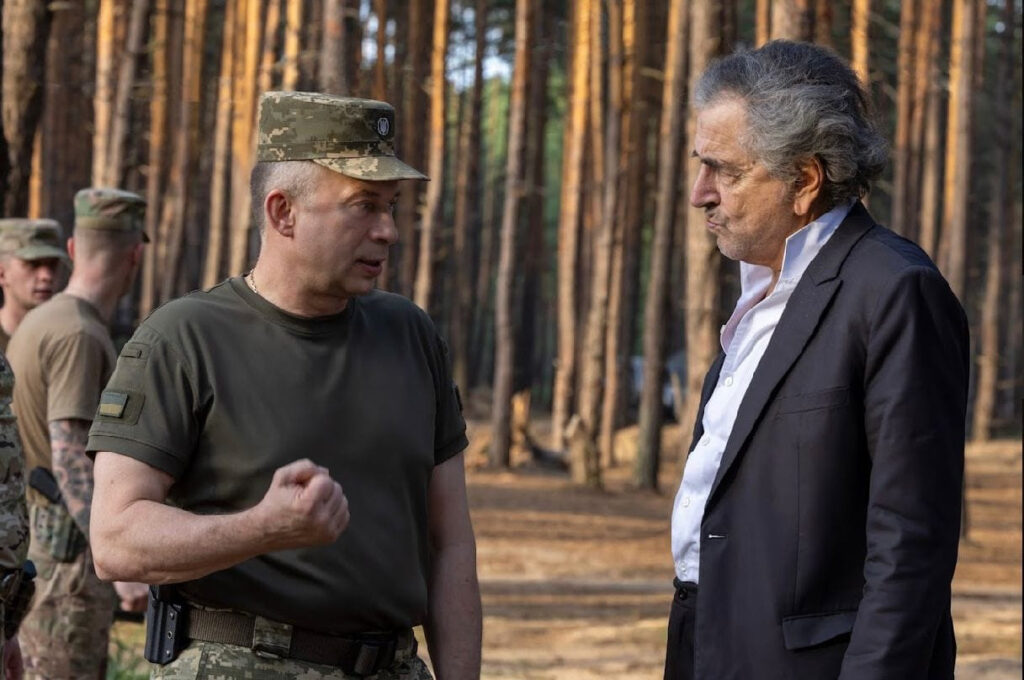
Entre autres tournées des popotes de Tsahal, pour encourager crimes de guerre et crimes de masse à Gaza, il prodigue le 13 juillet son conseil stratégique au chef d’état-major ukrainien Oleksandr Syrsky
(Oleksandr Syrsky)
C’est en mouche du coche que BHL a contribué en 2011 à la destruction de la Libye. L’expérience lui est montée à la tête et le champion de la liberté a soutenu en 2014 les cohortes nazies sur la place Maïdan de Kiev. Hélas pour la réalisation de sa vision du monde, la Russie a taillé en pièces d’autres héros de la démocratie, les insurgés sunnites radicaux que le décolleté germanopratin parrainait aussi contre le gouvernement laïc de Syrie. Je me demande si le conscrit ukrainien aura bien le temps de lui exprimer toute sa gratitude, avant de se faire hacher dans les tranchées du Donbass.
chronique alphabétique et nécrologique de l’engagement français dans les rangs atlantistes en Ukraine, ce que les journalistes serviles ne vous raconteront pas
Articles connexes
Pruvate à truvà me, canaglia di l’OTAN, pruvate solu
chronique en Anglais, its roots before WW2, its collaboration with Nazi Germany, its legacy in modern Ukraine, how NATO has continually supported Nazism in Ukraine
chronique en Anglais, censorship, fake news, whitewashing of the Ukrainian Nazism and war crimes, for the sake of the proxy war that NATO is conducting in Donbass and Ukraine, against Russia
une saga française, entre Ukraine et Lyon, où apparaissent aussi des morceaux de SS de la division Charlemagne et plus récemment, Alice Kerviel, dite Cordier. L’affaire Deranque révèle comme la France est infectée par le pétainisme, en particulier parmi les soutiens d’Israël ou de l’Ukraine, deux théâtres d’opérations où l’Occident tente de ralentir son déclin
En 2025, une nouvelle unité de Français combattant pour l’Ukraine s’est structurée autour d’un noyau de néonazis, ayant pour objectif d’attirer des recrues. Parmi ces volontaires, d’anciens militaires. StreetPress les a identifiés
En Ukraine, les volontaires français pro-ukrainiens et pro-russes se partagent l’imaginaire de la Seconde Guerre mondiale. Les premiers se revendiquent des collabos de l’Allemagne nazie, les seconds de l’escadrille mythique « Normandie – Niémen »
deux jours après le 10e anniversaire de la débâcle politique et sécuritaire du 13 novembre 2015, une messe célèbre à Verdun l’ancien dirigeant fasciste de l’État français
ce 11 novembre 2025 est l’occasion de souligner comme la façon dont l’Europe sacrifie les conscrits ukrainiens mobilisés de force rappelle le spectaculaire carnage de la 1ère guerre mondiale
c’est par l’agence cosaque de presse PIKA, depuis la République populaire de Lougansk, que le 2 avril 2024, l’ataman Nikolaï Diakonov lance un message à destination de la France
ce papier est le premier des grands médias français qui s’attaque à la question des militants nazis français dans les rangs atlantistes en Ukraine, le nouveau danger qu’ils présenteront à terme pour la sûreté intérieure
où nous apprenons que le nazi français Allan Duchézeau, camarade de César Aujard dans les rangs atlantistes en Ukraine, était surnommé Dox, quand il secondait à Paris le leader nazi Marc de Cacqueray Valménier
en Anglais, les indices de la présence d’opérateurs occidentaux, en particulier Français, pris au piège en mars 2022 à Marioupol, dont les forces russes achevèrent la libération en mai
once more, the US and Israel attack Iran, chronicle
On February 28, 2026, a base of the Islamic Revolutionary Guard Corps (IRGC) is targeted in Damavand, northern Iran (social media)
On June 13, 2025, Israel conducted a surprise attack against Iran, with airstrikes and terrorist operatives on the ground. The first targets were the families residence of high ranking military officials and top nuclear scientists. On June 22, the US bombed nuclear facilities in Fordow, Isfahan and Natanz. The Iranian peaceful nuclear program was a pretext and the actual goal was for the sake of Israel, a regime change in Iran. But after 12 days of Iranian retaliation with swarms of missiles, the assailants begged for a ceasefire
Benjamin Mileikowsky, Netanyahu, a Polish psychopathic settler in the Middle East, whose Donald Trump is the errand boy (Abir Sultan / AFP)
Second try in January 2026: the US had engineered a dollar shortage in Iran, where the currency fell and inflation exploded. That triggered social demonstrations, first peaceful. Mossad and CIA had also spread weapons and the protests turned into deadly riots. But the Iranian society held on and the West lost its last operatives in the country.
Third try: while Epstein case is exhaling the putrid stench of a decaying West, the US and Israel conduct joint surprise airstrikes against Iran on Saturday, February 28, 2026, when stock markets are closed
(RYBAR)That satellite photo is showing after strikes, the compound in Tehran of Ali Khamenei, Supreme Leader of the Islamic Revolution (Airbus)
The targets are military, nuclear and once more, the homes of leaders, whom the assailants want to assassinate. The Supreme Leader of the Islamic Revolution, wise 86-year-old Ali Khamenei, is killed, but the President of the Republic and other officials survive. The State and society hold on, will counterattack
The Islamic Republic of Iran Broadcasting (IRIB) confirms the death of Ali Khamenei
Horror in Minab, southern Iran: because they are daughters of IRGC members, 115 little girls -a provisional toll- are slaughtered in their bombed elementary school
(Social media, screenshot)The mothers of the slain girls (social media)
Deputy Chairman of the Security Council of Russia, Dmitry Medvedev comments
The peacekeeper [Donald Trump] is at it again. The talks with Iran were just a cover. Everyone knew that. So who has more patience to wait for the enemy’s sorry end now? The US is just 249 years old. The Persian Empire was founded over 2500 years ago. Let’s see what happens in 100 years or so…
A retaliation missile flies (Iranian media)
The retaliation is quick and powerful. Missiles and drones are targeting Israel and US military facilities in Bahrain, Iraq, Jordan, Kuwait, Qatar, Saudi Arabia and the United Arab Emirates (UAE)
Iran strikes the 5th Fleet Operations Center in Bahrain (Reuters)An Iranian strike has destroyed the AN/FPS-132 Block-5 radar in Al Udeid base, Qatar (Bismichi Media)
An anonymous official tells The Wall Street Journal that the US has never experienced such a wide-ranging series of simultaneous attacks on its overseas bases before. A few hours after it began, the Western regime–change–through–decapitation operation is already a pathetic failure
In the early hours of the morning, an Iranian missile penetrates the air defense and strikes once more in Bahrain the base of the US 5th fleet. The footage is immediately iconic
https://youtu.be/hvULw2-T57E
Despite a Sunni monarchy, the vast majority of the local population is Shiite and the witnesses cheer the impact.
Iran raises the Red Flag of revenge over the dome of Jamkaran Mosque, in Qom. Grand Ayatollah Nasser Makarem Shirazi declares Jihad against the US and Israel
(Iranian media, screenshot)
This revenge is the religious duty of all Muslims in the world
(Social media, screenshot)
Only Russian and Chinese ships are allowed to pass; Iran has closed the strait of Hormuz. Palauan tanker Skylight has taken a chance, is burning in the morning. At least 150 ships are still west of the strait
(Marine Traffic)
While the belligerents continue to exchange fire, the United States Central Command (CENTCOM) acknowledges that as of 5:30 pm, Tehran time, 3 US service members have been killed and 5 other ones, seriously wounded, since the outbreak of the Western aggression
(Social media, screenshot)
One example of demonstrations of support to Iran in the region: in the evening in Baghdad, the Iraqi people is trying to storm the US embassy in the Green Zone
(Social media)
Meanwhile in Erbil, a blaze is consuming the US base, after an attack that either Iran or the Iraqi resistance has conducted.
After a first day spent depleting enemy munitions, Iran is henceforth using more modern missiles. The Israeli air defense seems inefficient, despite the launch of up to ten interceptors for one assailant. Haifa, Tel Aviv and Jerusalem are pounded. Meanwhile, Western forces start bombing hospitals in Abuzar and Tehran
On February 28, 2026, Donald Trump oversees the attack of Iran from Mar a Lago, Florida (Daniel Torok / White House)
According to Israeli site Ynetnews, Donald Trump is already requesting a ceasefire, via Italian diplomats. The aggressor has originally planned a four-to-five-day operation, according to the same article. That new move is the result of his failed regime change project. And the stock markets will open on Monday. But after the assassinations of Ali Khamenei and almost 200 schoolgirls, Iran is so far refusing.
March 2, 2026
At 9:00 pm, on March 1, London time, 11:00 pm in Cyprus, 12:30 am in Tehran, prime minister Keir Starmer stated
[…] The United States has requested permission to use British bases for that specific and limited defensive purpose. We have taken the decision to accept this request to prevent Iran firing missiles across the region […]
A satellite photo of Akrotiri base on April 4, 2015 (DigitalGlobe)
A few minutes after midnight, Cyprus or Lebanon time, 1:30 am in Tehran, a first drone strikes the RAF base in Akrotiri. More are following
A US pilot surrenders to a Kuwaiti civilian (social media)
At 7:am, local time, their US pilots eject from 3 F-15 jet fighters who fall in Kuwait. According later to the CENTCOM, they were mistakenly shot down by Kuwaiti air defenses
Blaze in Ras Tanura (social media, screenshot)
Later in the morning, Iran strikes ARAMCO refinery in Ras Tanura, Saudi Arabia. Due to similar constraints QatarEnergy ceases its production of liquefied natural gas (LNG) and associated products. On the contrary, stock markets open on Monday and European gas prices surge 50%
European leaders are pathetic, most are blaming Iran, not Israel, lamenting the retaliation strikes in oil-monarchies and demanding a ceasefire. The champion is Bundeskanzler Friedrich Merz who states
Israel, a victim of unjust war, like Ukraine
At 4:00 pm in Florida, 11:00 pm in Jerusalem, 12:45 am in Tehran, the CENTCOM acknowledges 6 killed service members since the beginning of the Western aggression. Meanwhile the US and Israel continue to bomb hospitals in Iran.
March 3, 2026
Shiite majority clashes with security forces in Bahrain. At 3:00 am, local time, several drones manage to hit the US embassy in Riyadh, Saudi Arabia
(Social media, screenshot)
Over the week end, US Marines have shot protestors inside the consulate in Karachi, Pakistan. Later this morning, the diplomatic mission is stormed in Lahore
(Iranian media)
As Minab buries 168 schoolgirls and 14 teachers whom the aggressors slain on February 28 (cf. supra), Israel redoubles its bombing in Lebanon
A hit in Tel Aviv on March 3 (social media, screenshot). Israel is enforcing a strong censorship, in order to prevent such footage from being broadcasted
While the West is depleting its air defense ammunition, Iran is now using cluster warheads
(Russian humor)
Energy prices are still rising in Europe. The day is not good either for the economy in the US, where over $1 trillion is wiped out
Only courageous European countries, Belgium and Spain are slamming the Western aggression as illegal. The second is also banning the US from using its military bases. Hence, Donald Trump decides to stop all trade with Spain.
March 4, 2026
At 2:00 am, Tehran time, Iran claims a hit in the Indian Ocean, 650 km from its coasts, with Qadr [Able] and Talaiyeh [Golden] cruise missiles. The target was a US warship which was refueling
Later, NASA FIRMS satellite monitoring system is showing a thermal anomaly on an Arleigh Burke destroyer in the Arabian Sea
(US Department of Defense, screenshot)
At 5:00 am, local time, 3:00 am in Tehran, a US submarine sinks Iranian Dena frigate in international water. The ship was coming back from an exercise with India. Sri Lankan navy manages to rescue 32 sailors, out of 180
in Tehran on March 4, 2026 (social media, screenshot)
The West is carrying on bombing Tehran, henceforth with rage, in order to liberate the Iranian women. While Israel is also striking Lebanon and invading its southern edge, Hezbollah enters the battle in full swing
Hezbollah demonstration in Beirut on October 20, 2023 (AFP)
The Lebanese Shiite organization is fighting on the ground and targeting Israel with missiles and drones. Israeli Channel 13 quotes an anonymous security source
[…] We were wrong regarding Hezbollah and did not expect them to launch missiles with this range […] We miscalculated the level of force with which Hezbollah joined the battle […]
in Tel Aviv on March 4, 2026 (social media, screenshot)
Despite the Israeli censorship, some amateur videos appear on social media, like that one from Tel Aviv, around 11:30 pm, near the defense ministry. In Shanghai International Energy Exchange, the price of crude oil reaches $100 per barrel.
March 5, 2026
That is not the Star of Bethlehem but an Iranian missile, which after midnight, on March 5, 2026, local time, flies over Netanya, Israel (Jack Guez / AFP)
I answer the questions of a Russian journalist.
Since France announced today that it had authorized the US to use its military bases in the Middle East, they have become, in my opinion, legitimate targets. They are also legitimate from the perspective of Iran, which has already struck military installations in non-belligerent countries, when the facilities were involved in the Western aggression since February 28.
I don’t see so far a world war; the only belligerents are Iran and its Western aggressors: Israel, the US and to lesser extent, their European and Arab lackeys.
The regime-change-through-decapitation operation was already a failure just hours after it began. According to an Israeli journalistic source, Donald Trump even tried, via Italian diplomats, to secure a ceasefire as early as March 1, before the stock market opened the following day.
The struggle has become a war of attrition. The limited size of Israel and the fragility of its infrastructure, the depletion of Western high-end air defense munitions, the blockade of Hormuz strait, constraints on exports from oil monarchies and their worldwide economic consequences… the balance is tipping in favor of Iran.
The only risk of escalation and expansion of the conflict is lying in what Israel and the US might attempt to save face.
On February 28, 2026, a F-18 takes off USS Abraham Lincoln (CENTCOM, screenshot)
At 9:15 pm, Tehran time, the Iranian headquarters state that USS Abraham Lincoln was 340 km from the coasts of Iran, when naval drones attacked. The carrier fled to a distance of 1000 km.
Later, pastors from across the US pray in the White House for Donald Trump, a former friend of Jeffrey Epstein
(White House, screenshot)
May God protect our soldiers. May he continue to give our President the strength he needs to lead our great nation. For all these things, in the name of Jesus, we ask you to pour out your blessings upon him
If I was a believer, I would rather pray for the salvation of his soul.
March 6, 2026
The Dow Jones in the morning of March 6, 2026
That is Friday morning in the US, where the markets have lost more than $2 trillion since Monday, March 2. Russian weekly newspaper Arguments & Facts has published an article which is including my interview yesterday and an interesting analysis of the air war over the Gulf
A launch of Khorramshahr missile on March 6, 2026 (Iranian media, screenshot)
Iran has started using Khorramshahr, a ballistic missile and its 1,800 kg cluster warhead, which is carrying 80 sub-munitions. Israel is feeling so hard its impacts that censorship has become illusory
Iran strikes a 13th vessel which is trying to violate the blockade of Hormuz strait. At 5:30 pm, London time, 9:00 pm in Tehran, the price of Brent crude oil reaches $94 per barrel. Beside, European natural gas is 65% more expensive than the past week
Donald Trump is a lunatic. As a new batch of Epstein files discloses his reprehensible behavior, he demands the unconditional surrender of Iran, which replies
The fate of Iran will be decided only by the proud Iranian nation, not Epstein’s gang
March 7, 2026
As Masoud Pezeshkian, president of Iran, stresses at 5:00 pm, Tehran time, that neighbor Arab countries are hit when attacks on Iran come from their territories, former CIA analyst Larry Johnson assesses that five advanced US radars and three THAAD (Terminal High Altitude Area Defense) systems have been destroyed in one week in the region. Worth roughly $4 billion, the losses are about 30% of these US air defense tools worldwide. Israeli media are complaining that the Iranian successes are easing the penetration of missiles and drones over Israel
A US AN/TPY-2 radar has been destroyed on Muwaffaq Salti airbase, in Jordan (social media)
Infuriated by failure and the Iranian statement, the US strikes half an hour later an Iranian freshwater desalination plant on Qeshm island. According to the Red Crescent, the Western aggressors have bombed so far more than 6,500 civilian sites. That attack has come from a US base in Bahrain and Iran retaliates against military targets in the country. I stress that without their own desalination plants, the oil monarchies would have almost no fresh water.
Journalists question the pedophile rapist about that strike; he replies
Donald Trump on February 28, 2026 (Daniel Torok / White House, detail)
They are among the most evil people ever on earth, they cut babies’ heads off, they chop women in half, what they did, take a look at October 7. If they’re complaining about a desalination plant, we complain about the fact that they shouldn’t be chopping babies’ heads off, okay
Some gross lies, debunked on multiple occasions, that the Israeli disinformation has spread after the Palestinian operation on October 7, 2023. Moreover, Iranians are not Arabs. Through that racist gossip, the uneducated US president rather offends his allies, Sunni Muslim Arabs like in oil monarchies or Jordan
Oil is burning in Tehran on March 7, 2026 (social media, screenshot)
Israel bombs later oil facilities. Iran retaliates with Kheibar Shekan [Fortress Breaker] ballistic missiles, against Haifa refinery.
March 8, 2026
With drones, Iran is conducting surgical strikes against specific hotel rooms in several neighbor Arab countries, in order to kill US operatives and service members who have sought refuge there
A hotel in Kuwait in the night of March 7-8, 2026 (social media, screenshot)
While Israel is bombing Lebanon, Hezbollah is defending it on the ground
On March 8, 2026, an ATGM (Anti-tank Guided Missile) targets an Israeli Merkava tank near Markaba, southern Lebanon (Hezbollah, screenshot)
The US authorities suggest through tips to the media that they are discussing with Israel about
sending special forces into Iran to secure its stockpile of highly enriched uranium
A zany project. Imagine how these people are desperate. The Iranian foreign affairs disclose that behind Western boasts, the US continues mandating third countries to mediate a ceasefire with Iran, which is refusing
(Ella Baron / The Guardian)
Even in the West, the imperialist aggression of Iran is not so popular. Imagine in the wide leftover of the world.
The Chicago Mercantile Exchange opens at 4:00 pm, local time, 11:00 pm in Tel Aviv. Shortly after trading resumes, the price of the Brent crude oil is above $100 per barrel, for the first time in more than three and a half years.
March 9, 2026
His appointment is official at 1:00 am, local time; Seyyed Mojtaba Khamenei is the new Supreme Leader of the Islamic Revolution of Iran.
That man lost his son, wife and mother in the Western attack which assassinated his father on February 28. Imagine how he will conduct that war
(Iranian media)
Vladimir Putin congratulates Mojtaba Khamenei
Esteemed Mr Hosseini Khamenei,
Please accept my sincere congratulations on your election as the Supreme Leader of the Islamic Republic of Iran.
At a time when Iran is confronting armed aggression, your work in this high office will undoubtedly require great courage and dedication. I am confident that you will honourably continue your father’s legacy and unite the Iranian people in the face of these severe trials.
For my part, I would like to reaffirm our unwavering support for Tehran and our solidarity with our Iranian friends. Russia has been and will remain a reliable partner of the Islamic Republic.
I wish you every success in addressing the difficult tasks ahead, as well as sound health and strength of spirit.
Respectfully
Itamar Ben Gvir (Eyal Warshavsky)
Early in the morning, local time, an Iranian strike raises concerns about the physical wholeness of supremacist zealot Itamar Ben Gvir, current Israeli Minister of National Security. A Hezbollah missile dismantles Wadi Aila (Haila, for the Israeli authorities) satellite communication center, south of Tel Aviv
(Social media)
Around 1:00 pm, East Coast time, 8:30 pm in Tehran, an anonymous Israeli official tells the Washington Post
I’m not sure it’s our interest to fight until the regime is toppled. Nobody wants a never-ending story
Later Donald Trump, to CBS
I think the Iran war is pretty much complete
But Iran launches a new wave of ballistic missiles and drones against Israeli and US targets. A very perceptive internet user comments on X
It seems like Israel is blocking videos more than missiles
March 10, 2026
RYBAR analysts summarize the impacts of the Iranian strikes against US bases in the Middle East
In the wake of the outcome of operation Epic Fail, South Korean media are showing that the US is dismantling Patriot and THAAD systems, in order to transfer them to the Middle East
Around noon, East Coast time, 7:30 pm in Tehran, real estate agent Steve Witkoff begs Iran for negotiation
(Screenshot)
Trump is always willing to talk […] Let’s see if Iranians want to talk
US military personnel have been spotted preparing explosive ordnance at an airbase in Gloucestershire (BBC)
At 5:00 pm, local time, the BBC publishes a photo which is showing US service members who handle a heavy bomb at a British air base in Gloucestershire. The site is evidently RAF Fairford, where 3 B-52s and 4 B-1s have arrived since March 6. The US strategic bombers are expected to attack in the Middle East on March 11
around 11:00 pm in Tel Aviv (social media, screenshot)
While Iran continues striking oil fields and US bases in Bahrain, Iraq, Jordan, Saudi Arabia and the UAE, Hezbollah joins the attack against Israel. A troubled night begins in Tel Aviv, where the authorities are preventing the journalists from working.
March 11, 2026
Ukraine is jealous. According to its defense ministry, the Western operation against Iran has consumed more Patriot air defense missiles in three days than the number allocated to Ukraine since February 24, 2022
Thai-flagged cargo ship Mayuree Naree on March 11, 2026 (social media)
Over the day, Iran has stopped three ships which were attempting to cross the strait of Hormuz
(Social media)
After dusk, an oil storage depot is still burning in Salalah, Oman. According to Iran, that attack was an Israeli false flag
(Israeli Channel 13)
Before 10:30 pm, local time, an Israeli military pilot takes this beautiful photo of an Iranian cluster warhead. Around 3:00 pm, local time, Donald Trump is in Kentucky, where he declares
Operation Epic Fury, is that a great name? Well, it’s only good if you win. And we’ve won. Let me tell you, we’ve won. You know, you never liked to say too early you won. We won
(Social media, screenshot)
Almost at the same time, right before midnight in Iraq, naval drones (USV) strike off Umm Qasr two foreign tankers, Marshallese-flagged SafeSea Vishnu and Maltese-flagged Zefyros
The death of Marcus Licinius Crassus (History Quest, screenshot)
In 53 before Yeshua Ben Yosef, Marcus Licinius Crassus hoped that Persia would run out of arrows. Perhaps Donald Trump expected on February 28 that Iran would quickly run out of missiles and drones, but did not foresee his epic fail
March 12, 2026
The aftermath of Israeli attacks in Beirut, Lebanon (AFP)
Around 9:00 pm, local time, a US KC-135 tanker aircraft crashes in Western Iraq. Six crew members are presumed dead. The CENTCOM stresses that the plane was not the target of hostile or friendly fire.
Around 9:10 pm, Tel Aviv time, Benjamin Netanyahu speaks live. His speech is broadcasted worldwide
in France (screenshot)
Problem: his right hand has six fingers. That video is AI-generated and the West is the empire of lies and iniquity. Where is Netanyahu ?
Russian RYBAR analysts release a map of the operations in Iraq, where Iran and the resistance are striking US bases and the West is bombing al Hashd ash Shaabi [Popular Mobilization Forces, PMU], which were raised in 2014 to fight against ISIS jihadists
Around 10:40 pm, local time, 8:40 pm in Paris, with two drones, the Iraqi resistance strikes Black Tiger Camp, 60 km south west of Erbil. At least six French service members are injured, according to the Iraqi authorities
(Social media, screenshot)
March 13, 2026
At 1:30 am, local time, 3:30 am in Baghdad, Emmanuel Macron announces the death of a French serviceman, whom Iraqi strikes killed in Black Tiger Camp a few hours earlier.
Since March 10, US strategic bombers are operating against Iran from RAF Fairford, UK
A US B-1 strategic bomber takes off RAF Fairford on March 13, 2026 (Colin Norwood, screenshot)
The daily US joke comes from Rewards for Justice, an appendix of the State Department
(Rewards for Justice)
So, Mojtaba Khamenei is henceforth wanted. Do you remember the previous notice about a political character in that region ? Tip: he is an al Qaeda jihadist and therefore enemy of Iran
New York Stock Exchange closes at 4:00 pm, East Coast time, 11:30 pm in Tehran. At the end of this second week, the US stock market has lost $2 trillion since the outbreak of the Western aggression against Iran
(Israeli media, screenshot)
At 11:17 pm, local time, 12:47 am in Tehran, an Iranian missile hits something in Negev desert, maybe Nevatim air base.
March 14, 2026
At 2:00 am, local time, Iranian media release a video which is showing scores of Shahed strategic drones, stored in a deep tunnel
On March 13, 7:00 pm, East Coast time, March 14, 2:30 am in Tehran, as retaliation for the blockade of Hormuz strait, Donald Trump announces the bombing of military targets on Kharg island, from where Iran is exporting 90% of its oil products
(Liu Wanli / SF014)
One MEU (Marines Expeditionary Unit, 2,200 service members) is also sailing from Okinawa toward the Gulf. The pedophile rapist is seeking a PR success to save the face.
On March 13, 7:15 pm, East Coast time, March 14, 2:15 am in Riyadh, the Wall Street Journal reports from anonymous officials that in recent days, an Iranian missile damaged five US tanker aircraft on Prince Sultan air base, Saudi Arabia
(Oleg Tsarev)
Around 6:00 am, local time, the Iraqi resistance manages to destroy the C-RAM (Counter Rocket, Artillery and Mortar) air defense system on the roof of the US embassy in Baghdad
(Screenshot)
Later, the resistance releases the video of another successful drone strike this morning, that one inside US Camp Victory, near Baghdad airport
The US and Israel complete a joint air defense exercise on March 31, 2019 (US Army)
According to Semafor, Israel has informed the US this week that it is running critically low on ballistic missile interceptors.
Meanwhile, the whole world is worried about Benjamin Mileikowsky. At 12:45 pm, local time, Israeli media broadcast the speech of Defense minister Israel Katz, during a security briefing with high-ranks officers, that the prime minister used to chair. But he is absent
Humor on social media
There is a body of clues that I will not itemize here. I am quite convinced that for the sake of mankind, Iran achieved a major victory a few days ago.
On social media at 10:00 am, East Coast time, 5:30 pm in Tehran, Donald Trump calls on China, France, Japan, South Korea, the UK and others for help to keep open and safe the strait that his aggression against Iran has closed. Two hours and a half later, the chairman of the Federal Communications Commission (FCC), Brendan Carr, threatens to revoke licenses from media which are running hoaxes and news distortions about the war. The press should not report that the Western aggression is an epic fail.
March 15, 2026
In Hamadan, western Iran, the people bury five victims while bombs are still falling
(Abdolrahman Rafati)
At 2:30 pm, local time, 1:00 pm in Tel Aviv, Iran launches the wave 54 of its retaliation strikes and among various ballistic missiles, for the first time since February 28, two-stages Sejjil [Brimstone] ones
(Iranian media, screenshot)
At 4:34 pm, local time, in an attempt to prove he would be alive and in good shape, a new video is published on Benjamin Mileikowsky’s X account. Goods news: he has now five fingers on each hand
Bad news: according to Hive analysis, the probability that the video is AI-generated is 78.9%. X Grok, whose boss is a South African white supremacist, is not exactly an IRGC fan. Based on technical and scenic aspects, its conclusion is more definite
Yes, upon close analysis of the video, it’s AI-generated
Mileikowsky is dead or at least, badly injured
(Social media, screenshot)
Meanwhile, reports and videos are showing that held in check by Hezbollah in southern Lebanon, Israel is using banned phosphorus munitions.
March 16, 2026
On March 16, 2026, a fuel tank is burning at Dubai airport (AFP)Humor on social media
Failure makes Donald Trump mad. His crisis outbreaks around 7:45 pm, March 15, East Coast time, 3:15 am in Tehran. In a series of rants on social media, he demands treason charges against the radical leftwing media which are covering the war. He also threatens the Western countries which are refusing to rescue the US in the Gulf
(Ben Jennings / The Guardian)
March 17, 2026
Around 2:30 am, local time, the Iraqi resistance achieves a new hit against the US embassy in Baghdad
(Social media, screenshot)
Back in Israel after a mission over Iraq, one US KC-135 tanker aircraft seems unable to land at Ben Gurion airport
(flightradar24 / screenshots)
The plane crashes north of the airport at 3:58 am, local time, when its transponder is cut off. Gag order: the Israeli censorship about the incident is absolute
On March 13, 2026, Ali Larijani marches in Tehran in support to Palestine (Iranian media)
In Tehran, an Israeli attack kills Ali Larijani, Secretary of the Supreme National Security Council.
In the US, Special Operation Forces veteran Joe Kent resigns from his position as Director of the National Counterterrorism Center
I cannot in good conscience support the ongoing war in Iran. Iran posed no imminent threat to our nation, and it is clear that we started this war due to pressure from Israel and its powerful American lobby
In Manbij, Syria, on January 16, 2019, ISIS jihadists killed his wife, Shannon Smith, who was cryptologist in the US Navy (Joe Kent)
That was painful for a real counter-terrorism professional to work for a terrorist government, ally in the Middle East of terrorist entities like Israel and al Qaeda
On September 16, 2012, al Nusra international jihadists, proxies of the West in Syria, attend the funeral in Aleppo countryside of a fellow fighter (Reuters)
According to Reuters, the US is encouraging its al Qaeda ally in the West-friendly jihadist emirate of Syria to consider sending forces in Lebanon, against Hezbollah
On November 13, 2015, the penalty is cruel for the French support to the Sunni radical uprising in Syria. While attending a soccer game in the Stade de France, Saint Denis, François Hollande hears that some of these radicals are attacking in Paris (Franck Fife / AFP)
At 7:00 pm, Tehran time, 5:30 pm in Tel Aviv, the West strikes Bushehr nuclear power plant. As tit for tat, four hours later, Iran targets Negev Nuclear Research Center in Dimona.
March 18, 2026
After midnight, Israel time, Iran offers the fairy-tale spectacle of its cluster warheads in the skies of Tel Aviv and Dubai
(Social media, screenshot)
Iran buries Ali Larijani, Secretary of the Supreme National Security Council, whom an Israeli attack killed in Tehran the day before. French businessman and conservative influencer Laurent Ozon writes
A tribute to Ali Larijani on social media
This story somewhat sums up our world for the past 50 years. An American real estate tycoon who became President through deception of his people, author of « The Art of the Deal », has assassinated an Iranian leader and philosopher on behalf of an Israeli supremacist. That leader had written « The Mathematical Method in Kant’s Philosophy », « Metaphysics and the Exact Sciences in Kant’s Philosophy » and « Reason and Tranquility in Governance ». All that with the support of every horde of malignant, enraged and uncultured lackeys that the West is numbering. The gates of hell are open. They will close
Around noon, Tehran time, with approval of Donald Trump, Israel bombs four plants which in Bandar Kangan region, are processing gas from South Pars, the largest field in the world, located in the Gulf, between Qatar and Iran
(Social media, screenshot)
These facilities are the cornerstone of the Iranian energy system. Qatar regards that attack as irresponsible
(Social media, screenshot)
As legitimate retaliation, Iran strikes in Riyadh, Saudi Arabia, at 7:30 pm, local time, some energy facilities which are hand in glove with the US
At 9:30 pm, local time, Qatar Energy confirms that the Iranian retaliation has also impacted Ras Laffan plant, which like Iran, is exploiting South Pars gas field
(Anadolu Agency)
There are so many targets in the region. Donald Trump has heard loud and clear the message from Iran. At 5:30 pm, East Coast time, 11:30 pm in Tel Aviv and 1:00 am in Tehran, the Wall Street Journal reads that the US president approved the Israeli bombing of Iranian gas processing plants but now opposes further attacks on energy infrastructure
Humor on social media
In the meantime, $800 billion have been wiped from US share market value.
March 19, 2026
On social media at 10:00 pm, East Coast time, 5:30 am in Tehran, Donald Trump blames Israel for the attack against Iranian gas processing plants, promises that no more attacks will be made by Israel, begs Iran to stop striking LNG facilities in Qatar. According later to Qatar Energy CEO, the monarchy has lost 17% of its liquefied natural gas capacity for up to five years
Pete Hegseth in 2019 (social media, screenshot)
After 8:00 am, East Coast time, US Secretary of War Pete Hegseth says in a press conference that the Pentagon needs another $200 billion in funding for the aggression against Iran. In a war it has already lost, 229 days from the midterm elections, the US regime is henceforth bombing in the hope of saving private Trump
(Social media)
Around 5:00 pm, Israel time, 11:00 am in Washington DC, refinery and power plant are hit in Haifa. The site was supplying more than 50% of the national fuel
(Iranian air defense, screenshots)
At the same time, CNN confirms that one US F-35 has made an emergency landing at a US base in the Middle East. The Iranian air defense has managed to spot and hit the stealth fighter jet
(Made with the complicity of an artificial intelligence)
Around 9:00 pm, local time, Benjamin Mileikowsky holds a press conference, actually a televised opening statement, then a virtual Q&A. No journalist is physically present in a room with the prime minister. Released almost three hours later, the video is once more AI-generated.
March 20, 2026
(Earthquake Faction, screenshots)
In the early hours of the morning, militants of The Earthquake Faction, an unknown underground group, penetrate in Pardubice, Czech Republic, a facility of the joint venture of a local company with Elbit Systems, pillar of the Israeli military-industrial complex. They seize documents and set ablaze the building
(Social media)
According to anonymous officials, via the Wall Street Journal, two ballistic missiles would have targeted Diego Garcia, more than 4,000 km from Iran, in Chagos Islands’ morning. Fortunately, the colonial British base was not hit. The Israeli propaganda is exploiting the information as an evidence that Europe could be attacked. But later, Iran denies such a strike
Diego Garcia in 2006 (Wikimedia)
At 5:00 pm, East Coast time, 12:30 am, March 21, in Tehran, NBC reads that the former draft dodger, for fear of fighting in Vietnam,
(Crowd Blue, March 18, 2026)
is weighing whether to send possibly thousands of US troops into Iran as he looks for a way to achieve some of his key goals and end the war
But as usual, nothing is certain.
March 21, 2026
So, maybe boots on the ground. Meanwhile in Baghdad, around 1:00 am, local time, the Iraqi resistance is once more pounding Camp Victory
(Social media, screenshot)
Ironically, in an attempt to stabilize the energy markets, Treasury Secretary Scott Bessent issues at 7:10 pm, 2:40 am in Tehran, a temporary license, which for one month, is lifting sanctions on Iranian oil products
But new humiliation for the US hustlers: Iran has already notified that it has no surplus crude oil to offer to international markets.
At 12:30 pm, local time, the Atomic Energy Organization of Iran (SEA) reports that in the morning, the West has attacked Natanz nuclear plant. According to Israeli media, one or several bunker busters have been dropped
Natanz nuclear plant on March 2, 2026 (Vantor)
Russia denounces that attack and calls for an international investigation. As a restrained retaliation, Iran starts striking at 5:00 pm, Tel Aviv time, Arad and Dimona settlements, where the scientists of the Israeli nuclear program are living
in Dimona (Social media, screenshot)
Later in the evening, the G7, a club of lackeys, condemns Iran, not the aggressors. Confirmation that Israel and its stooges are badly hurt.
The Iranian missiles seem inexhaustible and the Western air defense, henceforth unable to intercept them. Moreover, the West is right to regard the Iranian threat over oil and gas resources in the Gulf as a true nuclear deterrence
People of the world, unite and defeat the American aggressors and all their lackeys (1970)
The Western defeat is evident; India and Japan have started paying in Chinese yuan the right for their oil tankers to cross the strait of Hormuz
IRGC seal
In order to make peace, Iran is demanding full US military withdrawal from Iraq, Syria and the oil monarchies; lifting of all economic sanctions; $500 billion in compensation for decades of economic war.
March 22, 2026
At 7:45 pm, March 21, East Coast time, 3:15 am in Tehran, in a new rant on social media, Donald Trump, maybe drunk, threatens to destroy all Iranian power plants if Iran does not loosen its control over the strait of Hormuz within 48 hours. So, no more boots on the ground ? Targeting the Iranian energy grid is not a good idea and that sole statement will have a terrible impact on markets.
No surprise: the Iranian headquarters spokesman replies that in such a case, all US and affiliated energy, information technology and desalination infrastructure will be struck across the region
(Social media)
Angry toward the successful Iranian retaliation in Arad and Dimona, after the Western attack against Natanz nuclear plant, hordes of Israelis attack Arab villages overnight in the West Bank, where they set ablaze cars and homes.
No AI this time, Benjamin Mileikowsky has emerged from his secret Bunker. Later in the morning, he contemplates his work in Arad, some dividends of his strategic fantasy, but still an insignificant anecdote, compared to the genocide in Gaza
(Avi Ohayon / GPO)
New PR strategy? The Israeli supremacists and their Western supporters haven’t been this whiny in a long time, would be victims of the war they have unleashed. How indecent. How mean. From Arad, Mileikowsky calls on world leaders to join the aggression against Iran. I don’t understand the need of reinforcements; Donald Trump said they had won
(Social media, screenshot)
Meanwhile, thanks to Hezbollah, an Israeli Merkava is burning in southern Lebanon.
March 23, 2026
At 10:00 am, London time, 1:30 pm in Tehran, journalist Paul Nuki and photographer Simon Townsley publish an article titled
But later, on orders from lobbies or the British government, the conservative Daily Telegraph censors its own article
Humor on social media
The collapse of global stock markets begins in Japan and South Korea. At 7:00 am, East Coast time, 2:30 pm in Tehran, Donald Trump announces on social media the postponement of scheduled attacks against the Iranian energy grid and in order to justify that renunciation, invents imaginary negotiations, that Iran denies. Later in a press conference, he blames Secretary of War Pete Hegseth for the aggression against Iran
(Social media, screenshot)
While the US troops are retreating from Iraq to Jordan, Iran and its allies make around 8:00 pm, local time, an offer that Trump cannot refuse : a drone strikes the US consulate in Erbil.
March 24, 2026
(Ohad Zwigenberg / AP)
Iran is pounding Tel Aviv and manages in the morning to wreck the house of Meirav Ben Ari, an Israeli centrist politician, famous for her supremacist comment in October 2023 about the slain children in Gaza
the children in Gaza have brought this upon themselves
al Hashd ash Shaabi [Popular Mobilization Forces, PMU] were raised in Iraq in 2014 and fought with success against ISIS jihadists
After the West bombed the day before intelligence and counter-terrorism headquarters in Baghdad, the Iraqi government officially allows the PMU (cf. supra, March 12) -250,000 men- and army -200,000 men- to defend.
March 25, 2026
While he is fantasizing in public about imaginary negotiations, Donald Trump has actually passed to Iran, via third countries, a 15-point peace plan, which would start with a one-month ceasefire and would end the Iranian support to resistance in Gaza (Hamas) and Lebanon (Hezbollah)
(Bruce MacKinnon / Calgary Herald on March 16, 2026)
Worried about the impact on oil market, Trump is trying to reach a ceasefire since day 2 (cf. supra, March 1) of the Western aggression. Iran already articulated publicly its peace conditions (cf. supra, March 21) and rejects the US proposal.
Later, several amateur videos, from different angles, are showing that an Iranian manPADS (man-portable air-defense system) managed to hit and damage one F-18 fighter jet over Chabahar
(Screenshot)
The Iranian statement clarifies that the aircraft crashed in the gulf of Oman. As usual, the CENTCOM denies the blatancy.
March 26, 2026
(Iranian government on March 25)
According to anonymous officials, via Israeli media, Donald Trump would lean toward a ground invasion in Iran. I foresee that everything would be worse for the US, military defeat and collapse of the Western economies. Global stock markets continue to fall. $1 trillion is wiped today in the US.
March 27, 2026
We must definitely assume that when Donald Trump speaks, he actually addresses the most moronic part of the US populace. I mean people who are reading the New York Post, worshiping Elon Musk or asking Grok for verification. In the morning, one missile and several drones manage to penetrate the air defense and wreak havoc at Prince Sultan air base, Saudi Arabia
Several tanker and AWACS (Airborne Warning and Control System) aircraft are destroyed or damaged; at least ten US service members are injured. Chinese satellite images and the Wall Street Journal will later confirm the success of the retaliation operation.
Foreign affairs minister Abbas Araghchi stresses that since February 28, the West has destroyed more than 600 schools, killed more than 1,000 students and teachers
Western strikes against Arak heavy water reactor (social media)
In the afternoon, the aggressors attack a heavy water reactor (HWR) in Arak, a yellowcake production plant in Ardakan, steel plants in Ahwaz and Isfahan. The Washington Post reads that in four weeks against Iran, the US has burned 850 Tomahawk cruise missiles, roughly a quarter of the inventory. At 600 per year, that is almost 1.5 year of production.
March 28, 2026
At 7:00 am, local time, 6:00 am in Tel Aviv, for the first time since February 28, Yemen targets Israel with ballistic missiles. Later, military spokesman Yahya Saree confirms that Yemen will fight
Military spokesman Yahya Saree on March 28, 2026 (screenshot)
until the aggression against all resistance fronts is crushed
(Mehr News Agency / screenshot)
In Tehran, a toddler is pulled from under the rubble of a bombed building.
March 29, 2026
Photos emerge on social media, are showing a destroyed AWACS (cf. supra, March 27) at Prince Sultan air base, Saudi Arabia
Western media continue distilling that a ground operation would be under preparation. It would be two-month long. The US is actually unable to conquer Iran. Donald Trump is seeking a PR success, in order to save the face.
German BILD tabloid laments
Even Trump’s bombs are powerless
Unbreakable! This is where the mullahs stash their missiles
While the US destroyed parts of Iran’s missile arsenal in the war, a core problem remains: the mullahs’ virtually invulnerable underground fortresses
As retaliation for the latest Western attacks against infrastructure (cf. supra, March 27), Iran strikes Neot Hovav, an industrial zone in Negev desert, south of Beersheba
Blaze in Neot Hovav (social media, screenshot)
Despite previous Iranian warning (cf. supra, March 22), the West attacks the energy system in Tehran and northern Iran, where power outages are reported in the evening
The medical evacuation of injured Indonesian peacekeepers near Adshit al Qusayr on March 29, 2026 (social media, screenshot)
The Israeli artillery is often shelling the positions in southern Lebanon of the UNIFIL (UN Interim Force in Lebanon). After 10:00 pm, local time, Indonesian service members are the target in the vicinity of Adshit al Qusayr. One peacekeeper is killed, several others injured, one badly.
March 30, 2029
On March 30, 2026, for the second time in less than 24 hours, Israel kills Indonesian members of the UNIFIL. Two die when that Humvee is targeted (social media)
While Tsahal continues slaughtering civilians, journalists, paramedics and peacekeepers -three killed Indonesian service members in less than 24 hours- in Lebanon, Israeli media report a positive development after 4:00 pm, local time: the Hezbollah has achieved one more successful ambush.
The authorities are censoring the sensitive and difficult security incident. It would be one of the deadliest in southern Lebanon so far. At least ten helicopters have evacuated dead and wounded soldiers.
March 31, 2026
Israel releases the names of four servicemen, whom Hezbollah killed the day before in southern Lebanon
(Israeli media)
All were in the ranks of recce battalion 934, Nahal brigade. One was captain.
Meanwhile, Spain has banned the US military aircraft from its airspace and Donald Trump is still furious against NATO lackeys -the Daddy mob- which are declining to help in the Gulf
(Iranian media)
Iran advises the employees of US companies to leave the region. Retaliation strikes against these firms will henceforth reward every Western assassination attack.
April 1, 2026
The exact date and location are unknown; this iconic video surfaces on social media after midnight, Tehran time, is showing a missile hitting the position of sheltered US service members
https://youtu.be/Vk3RcsWDEn8
April 2, 2026
The West attacks the construction site of B1 bridge, a major highway project, west of Tehran
(Social media)
In the evening, the large majority of mankind contemplates with glee a successful strike in Tel Aviv. Not the least interception attempt is visible
(CCTV, screenshot)
Later, as retaliation for Western assassination attacks, in accordance with the previous warning on March 31, Iran confirms a strike against an Amazon data center in Bahrain the day before. The IRGC also announces having boinked today an Oracle data center in Dubai. The UAE denies, but is always lying.
While these professionals are trying to explain to the politicians that an escalation against Iran would be a nightmare, Donald Trump and Pete Hegseth start sacking generals, including Randy George, Chief of Staff of the Army
Randy George on October 3, 2023 (William Pratt / US Army)
After his dismissal, he comments
A madman is about to lead the great US military to ruin
April 3, 2026
Iran has managed to shoot down one US F-15 fighter jet. The debris are showing that the aircraft was from RAF Lakenheath, 48th Fighter Wing
(Social media)
With the support of an AC-130 gunship, US special operations forces (SOF) helicopters are trying to rescue the two crew members in southwestern Iran, near border with Iraq and Kuwait
During that Combat Search and Rescue (CSAR) operation, two Black Hawk helicopters are hit and one Thunderbolt attack aircraft, down. As I read on social media
Iran is not for beginners
One damaged Black Hawk helicopter is trying to reach Iraq (social media)
In that context, Washington begs for a 48-hour ceasefire, but Tehran declines.
April 4, 2026
In the morning, Iran strikes the Kirya [Campus], Israeli defense ministry and headquarters of the armed forces in downtown Tel Aviv
(Social media, screenshot)
The US administration starts censoring satellite imagery. By order, the private providers implement an indefinite withhold in the designated Area of Interest (AOI), with retroactive effect from March 9, 2026. The goal of that censorship is propaganda and disinformation for the Western populace, since China and Russia are providing Iran with satellite imagery.
April 5, 2026
After 1:00 am, local time, a new CSAR operation begins with close air support (CAS) and heavy bombing in Kohgiluyeh county, southwestern Iran, where two F-15 crew members were lost on April 3. The pilot has already been rescued during a previous mission. The USSOF manage to find today the weapon systems officer (WSO)
(Social media)
Basij [Mobilization] territorial defense and IRGC are fighting the special forces, who improvise an airstrip. During the battle, the Iranian defenders destroy, at least, two MC-130 transport aircraft, four helicopters and two MQ-9 Reaper drones
The aftermath (Fars News Agency)
The scene reminds operation Eagle Claw, on April 24–25 1980, which was a complete failure and still the origin of a neurosis in the US
(Bahram Mohammadifard / Fars News Agency)
Meanwhile, as retaliation for attacks on B1 bridge (cf. supra, April 2) and other infrastructure, Iran strikes Haifa refinery and US petrochemical facilities in Bahrain, Kuwait and the UAE.
April 6, 2026
In the morning, the West attacks Sharif University of Technology, in Tehran
(Foreign Minister Abbas Araghchi)
Around noon, East Coast time, 7:30 pm in Tehran, Donald Trump is interviewed. The journalist asks
How would it not be a war crime to strike Iran’s bridges and power plants?
Trump is finding out Iran is harder to intimidate than a 13 year old girl
The racism and lies of the pedophile rapist -that is factual- are not new. The same rational is behind the genocide that Israel is committing against Palestinians in Gaza.
April 7, 2026
After midnight, Tehran time, the West starts heavy bombing in several Iranian cities
in Isfahan (social media)
Iran is targeting Saudi Arabia, Bahrain, Kuwait and the UAE, which more than ever, are platforms for the US attacks
In the morning, al Jubail industrial zone is burning in Saudi Arabia.
Later, Israel starts attacking Iranian railways and bridges, then Donald Trump openly fantasizes about causing a whole civilization to die. The IRGC comments
Warning to neighboring countries: restraint is over. We will target the infrastructure of America and its partners in such a way that America and its allies will be deprived of the region’s oil and gas for years
At the United Nations, China and Russia veto a Security Council draft resolution from Bahrain on reopening by force the strait of Hormuz. France, UK and US vote in favor.
From 4:00 pm, local time, 6:30 pm in Tehran, US B-52 strategic bombers take off RAF Fairford, UK. After 10:00 pm, local time, 10:30 pm in Tehran, Israeli officials flee Tel Aviv by air. At the same time, Esmaeil Baqaei, spokesman of the Iranian foreign affairs writes on X
Indeed, those who say « Our Lord is Allah », then remain steadfast, on them shall be no fear, nor shall they grieve
April 8, 2026
At 6:30 pm, April 7, East Coast time, 2:00 am, April 8, in Tehran, Donald Trump pusses out and 90 minutes before the deadline, postpones once more his threat of terrorist attack and genocide.
A ceasefire is enforced and negotiation would begin in Pakistan, where peace would be discussed on the basis of ten Iranian conditions like for example lifting of sanctions, payment of reparations for the Western attack and Iranian control over the strait of Hormuz. The Supreme National Security Council of Iran states
In the Name of God, the Most Gracious, the Most Merciful
It is hereby announced to the noble, great and heroic nation of Iran:
The enemy has suffered an undeniable, historic and crushing defeat in its dishonorable, illegal and criminal war against the Iranian nation. By the grace of the pure and sacred blood of the martyred leader of the Islamic Revolution, Grand Ayatollah Imam Khamenei (peace be upon him), the measures of the Supreme Leader of the Islamic Revolution and Supreme Commander of the Armed Forces, Ayatollah Seyyed Mojtaba Khamenei (may God protect him), the valor and courage of the warriors of Islam on the fronts and especially the historic, enduring and epic presence of you, the dear nation, on the scene from the very first days of the war, Iran has achieved a great victory and forced criminal America to accept its 10-point plan, in which America has principally committed to:
non-aggression, Iran’s continued control over the Strait of Hormuz, acceptance of enrichment, the lifting of all primary and secondary sanctions, the termination of all UN Security Council and Board of Governors resolutions, payment of reparations to Iran, the withdrawal of American combat forces from the region and the cessation of war on all fronts — including against the heroic Islamic Resistance of Lebanon.
We congratulate that victory to all the people of Iran and emphasize that until the details of this victory are finalized, there remains a need for steadfastness and prudence from officials and for the preservation of unity and solidarity among the Iranian people.
Islamic Iran, together with the brave mujahideen of the Resistance in Lebanon, Iraq, Yemen and occupied Palestine, has dealt blows to the enemy over the past 40 days that the historical memory of the world will never forget. Iran and the Axis of Resistance, as representatives of honor and humanity against the most savage enemies of mankind, have, after a historic battle, taught them an unforgettable lesson and have so thoroughly shattered their forces, capabilities, infrastructure and all their political, economic, technological and military capital that the enemy has now fallen into disintegration and desperation and sees no path before it other than surrender to the will of the great Iranian nation and the noble Axis of Resistance.
On the first day, the criminal enemies of Iran launched this unjust war, they imagined they would achieve complete military dominance over Iran in a short time and would force Iran to submit by creating political and social instability. They thought Iran’s missile and drone fire would be quickly extinguished and did not believe Iran could respond so powerfully beyond its borders and across the entire region. The malicious global Zionism had convinced the foolish American president that this war would finish Iran off and that, by eliminating this last bastion of humanity, they could henceforth commit any crime against anyone they wished with ease. They dreamed of partitioning beloved Iran and plundering its oil and wealth and ultimately leaving Iranians adrift in chaos, instability and insecurity for years to come.
The brave warriors of Islam and their courageous allies in the Axis of Resistance — even though their hearts were wounded and shattered by the martyrdom of their Imam — placed their trust in Almighty God and following the example of the Master and Lord of Martyrs, resolved once and for all to teach these enemies a historic lesson, to exact revenge for all previous crimes and to create conditions so that the enemy would forever abandon any thought of aggression against beloved Iran and taste the full bitterness of humiliation and disgrace before the great Iranian nation.
With this strategy and relying on the unprecedented political and social unity that had been established in the country, Iran and the Resistance launched one of the heaviest hybrid battles in history against America and the Zionist regime and during this period, achieved every objective they had designed for this battle.
Iran and the Resistance nearly completely destroyed America’s military machine in the region, dealt crushing and deep blows to the vast infrastructure and assets the enemy had established and stationed around the region over years in preparation for this war against Iran, inflicted massive regional casualties on the criminal American army, struck devastating and crushing blows against the enemy’s forces, infrastructure, assets and properties within the occupied territories and so tightened the noose on the enemy on all fronts that not only were none of the enemy’s primary objectives realized, but the enemy understood approximately 10 days after the start of the war that it would have absolutely no ability to win this war — and for this reason began efforts to establish contact with Iran and request a ceasefire through various channels and methods.
The noble Iranian nation should know that, by the grace of the struggle of their children and their historic presence on the scene, the enemy has been begging for over a month for the cessation of Iran and the Resistance’s fearsome fire, but the country’s officials — because it had been decided from the very beginning that the war would continue until objectives were achieved, including the enemy’s regret and desperation and the removal of long-term threats to the country — gave negative responses to all these requests and the war continued until today, which is the fortieth day. Furthermore, Iran has so far rejected several deadlines presented by the American president and continues to emphasize that it places no importance whatsoever on any type of deadline from the enemy.
We now bring glad tidings to the great nation of Iran that nearly all war objectives have been achieved and your brave children have dragged the enemy into a historic state of helplessness and a lasting defeat. Iran’s historic decision, which enjoys the unified backing of the entire nation, is to continue this battle for as long as necessary, until its great achievements are consolidated and new security and political equations are established in the region, based on the acceptance of the power and sovereignty of Iran and the Resistance.
In this regard and in accordance with the guidance of the Supreme Leader of the Islamic Revolution, Ayatollah Seyyed Mojtaba Khamenei (may God protect him), and the approval of the Supreme National Security Council and given Iran and the Resistance’s upper hand on the battlefield and the enemy’s inability to carry out its threats despite all its claims and the official acceptance of all the rightful demands of the Iranian people, it has been decided that negotiations shall be held in Islamabad, to finalize the details, so that within a maximum of 15 days, Iran’s victory on the battlefield will also be consolidated in political negotiations.
In this regard, Iran, while rejecting all plans presented by the enemy, drafted a 10-point plan and submitted it to the American side through Pakistan, emphasizing fundamental points including: controlled passage through the Strait of Hormuz in coordination with Iran’s Armed Forces — which grants Iran a unique economic and geopolitical position; the necessity of ending the war against all components of the Axis of Resistance — which would constitute a historic defeat of the aggression by the child-killing Israeli regime; the departure of American combat forces from all bases and positions in the region; the establishment of a secure transit protocol in the Strait of Hormuz that guarantees Iran’s dominance according to the agreed protocol; full payment of reparations to Iran according to estimates; the lifting of all primary and secondary sanctions and Board of Governors and Security Council resolutions; the release of all of Iran’s blocked assets and properties abroad; and finally, the ratification of all these items in a binding UN Security Council resolution. It should be noted that the adoption of this resolution would convert all these agreements into binding international law and would constitute a major diplomatic victory for the Iranian nation.
The Honorable Prime Minister of Pakistan has now informed Iran that the American side, despite all its apparent threats, has accepted these principles as the basis for negotiations and has submitted to the will of the Iranian nation. On this basis, at the highest level, it was decided that Iran shall conduct negotiations with the American side in Islamabad for a period of two weeks, solely on the basis of these principles. It is emphasized that this does not mean the end of the war and Iran will only accept the end of the war when — given the acceptance of Iran’s principles in the 10-point plan — the details are also finalized in negotiations.
These negotiations will begin with complete distrust of the American side starting Friday, Farvardin 21 [April 10] in Islamabad, and Iran will allocate two weeks for these negotiations. This time frame is extendable by mutual agreement. It is necessary that during this period, complete national unity be maintained and victory celebrations continue with strength. The current negotiations are national negotiations and a continuation of the battlefield and it is necessary that all people, elites and political groups trust and support this process — which is under the supervision of the Leader of the Revolution and the highest levels of the system — and strongly refrain from any divisive commentary. If the enemy’s surrender on the battlefield is transformed into a decisive political achievement in the negotiations, we shall celebrate this great historic victory together; otherwise, we shall fight side by side on the battlefield until all the demands of the Iranian nation are met.
Our hands are on the trigger and the moment the slightest error is made by the enemy, it will be answered with full force
At 4:50 am, Islamabad time, 7:50 pm, April 7, in Washington DC, Prime Minister of Pakistan Shehbaz Sharif confirms
With the greatest humility, I am pleased to announce that the Islamic Republic of Iran and the United States of America, along with their allies, have agreed to an immediate ceasefire everywhere including Lebanon and elsewhere, EFFECTIVE IMMEDIATELY. I warmly welcome the sagacious gesture and extend deepest gratitude to the leadership of both the countries and invite their delegations to Islamabad on Friday, 10th April 2026, to further negotiate for a conclusive agreement to settle all disputes. Both parties have displayed remarkable wisdom and understanding and have remained constructively engaged in furthering the cause of peace and stability. We earnestly hope, that the ‘Islamabad Talks’ succeed in achieving sustainable peace and wish to share more good news in coming days!
[…] an immediate ceasefire everywhere including Lebanon […]
At 6:30 am, East Coast time, conservative channel Fox News clarifies the ten points for its US public
(Screenshot)
Iran has won and while the US is attempting to disguise its strategic defeat, Israel is fuming. For Russia, Dmitry Medvedev comments
It’s not clear how the truce between Washington and Tehran will play out. But one thing is certain – Iran has tested its nuclear weapons [cf. supra, March 21]. It is called the Strait of Hormuz. Its potential is inexhaustible
in Beirut (social media, screenshot)
But once more, despite a ceasefire, Israel bombs with rage and boasts about it on social media. More than 250 Lebanese are slaughtered in a few minutes, according to a preliminary Civil Defense toll. Iran warns
Within a few hours, if the firing does not stop in Lebanon, the air and missile unit will bomb Tel Aviv
The old pedophile rapist is so substandard that he is not even able to impose a ceasefire on Israel. Polish settler Mileikowsky is actually the boss. At 2:00 pm, East Coast time, 9:30 pm in Tehran, Press Secretary Karoline Leavitt states that the White House threw in the garbage the 10 points on which the US, Pakistan and Iran agreed less than 24 hours before. Brazilian journalist Pepe Escobar summarizes the issue
Epstein Syndicate launched the war. Epstein Syndicate lost the war. Epstein Syndicate begged for a ceasefire. Epstein Syndicate blew up the ceasefire. In less than 10 hours
At 11:00 pm, Tehran time, 3:30 pm in Washington DC, while the US administration and oil monarchies are whining again about it, Iran states that the strait of Hormuz is completely closed.
Army survivors of deadly attack in Kuwait dispute Pentagon’s account, say unit “was unprepared” to defend itself
Former intelligence officer within the US Marines Corps (USMC), then inspector in Iraq for the United Nations, Scott Ritter comments
He [Pete Hegseth] lost the war with Iran. His head needs to roll. He’s also a war criminal
On the ground, the heroic Hezbollah has managed today to fire sixty missiles at Israel. Iran is declining negotiation with the US as long as the Israeli aggression continues against Lebanon.
In the plane to Islamabad, Mohammad Bagher Ghalibaf, speaker of the Iranian parliament, travels with portraits of victims of the Western war crime in Minab on February 28 (Mohammad Bagher Ghalibaf)
A ceasefire is expected the day after in Lebanon and in the evening, the Iranian delegation takes off for negotiation with the US in Islamabad.
April 11, 2026
In Islamabad, Iran is talking so far with Pakistan, which is acting as broker. In order to start direct negotiation with the US, Iran is demanding approval of its control over the strait of Hormuz, war reparations, release of frozen assets and ceasefire in Lebanon
(CENTCOM)
At 12:30 pm, East Coast time, 9:30 pm in Islamabad, while the point is not resolved, the CENTCOM attempts to misinform with a wrong statement
U.S. Central Command (CENTCOM) forces began setting conditions for clearing mines in the Strait of Hormuz, April 11, as two U.S. Navy guided-missile destroyers conducted operations.
USS Frank E. Peterson (DDG 121) and USS Michael Murphy (DDG 112) transited the Strait of Hormuz and operated in the Arabian Gulf as part of a broader mission to ensure the strait is fully clear of sea mines previously laid by Iran’s Islamic Revolutionary Guards Corps.
« Today, we began the process of establishing a new passage and we will share this safe pathway with the maritime industry soon to encourage the free flow of commerce », said Adm. Brad Cooper, commander of CENTCOM.
The Strait of Hormuz is an international sea passage and an essential trade corridor that supports regional and global economic prosperity. Additional U.S. forces, including underwater drones, will join the clearance effort in the coming days
Actually, around noon, local time, 1:00 pm in Islamabad, from a base on the eastern coast of the UAE, USS Michael Murphy, an Arleigh Burke-class destroyer, had entered the strait, but withdrawn under threat of being targeted
In the sea of Oman, USS Frank E. Peterson is also warned (Iranian navy, screenshot)
April 12, 2026
The talks between Iran, Pakistan and the US have lasted 21 hours, end around 7:00 am, Islamabad time
Iranian foreign minister Abbas Araghchi in Islamabad (Iranian media)
Washington was demanding what it had not achieved on the battlefield: lifting of Iranian control over the strait of Hormuz and cession of nuclear materials. The US representatives had already lost the war but tried to dictate their terms in Islamabad. Incredible arrogance
(Elia Baron / The Times)
Still obsessed with Hormuz, Donald Trump decides later to blockade the blockade. He orders the US Navy to board the ships which are paying fee to Iran and are crossing the strait.
Most of these ships are Chinese. He is unable to defeat Iran, then, the strategic genius gets the idea to also confront China and Russia.
April 13, 2026
Chinese defense minister Dong Jun states
Our ships are moving in and out of the waters of the Strait of Hormuz. We have trade and energy agreements with Iran. We will respect and honour them and expect others not to meddle in our affairs. Iran controls the Strait of Hormuz and it is open for us
April 14, 2026
Despite sabre rattling by Donald Trump, four Chinese tankers leave the Gulf, cross the strait of Hormuz and sail beyond
The US Navy does not board them because they did not left Iranian ports and moreover, Chinese Daqing guided-missile frigate is standing 500 nautical miles west of the strait.
April 15, 2026
Despite the US purported blockade, several ships sail through the strait of Hormuz, from and to Iranian ports.
April 16, 2026
Donald Trump announces a ceasefire, which would begin at 5:00 pm, East Coast time, midnight in Lebanon. According to Israeli media, the US has imposed that truce to Benjamin Mileikowsky. It was a demand of Iran (cf. supra, April 8).
April 17, 2026
Iran announces that under its control, the strait of Hormuz is opened for the duration of ceasefire in Lebanon. Of course, Tehran is henceforth charging a fee.
On social media, Donald Trump boasts about that opening, is lying about the terms of the agreement and presenting it as a military victory over Iran. He is always addressing the most moronic part of the US populace, nobody else (cf. supra, March 27).
April 18, 2026
While the diplomatic relations between Israel and France are deteriorating over Lebanon, an Israeli false flag ambush kills one French UNIFIL peacekeeper in the morning. Three others servicemen are injured. Confusion was impossible while the targets were clearing explosive ordnance along a road in Ghanduriyah, where they came under small-arms fire from irregulars shooters who yelled Hezbollah.
According to anonymous officials, via The Wall Street Journal, the US is planning to seize the ships linked to Iran in international waters. Donald Trump is unable to open the strait through military means. As retaliation, he is planning therefore to rely on naval piracy against Tehran.
In the afternoon, Iran broadcasts this VHF message
Attention all ships. Regarding the failure of the US government to fulfill its commitment in the negotiation, Iran declares the Strait of Hormuz completely closed again. No vessel of any type or nationality is allowed to pass through
On social media, Scott Ritter replies to a pro-Israel propagandist from Australia
You are a simple minded propagandist. Trump didn’t live up to his commitment. The US didn’t end the blockade. So Iran doesn’t open the Strait. It’s that easy. Who do you think won this war? It wasn’t Trump. Iran holds all the cards
April 19, 2026
In that context, Iran is declining to participate in a second round of negotiations with the United States
(CENTCOM, screenshot)
Later, the US Navy attacks and seizes Iranian Touska container ship, who was sailing in the sea of Oman to Iran.
April 21, 2026
The wide world does not care about the so-called US sanctions. That is why the US piracy is going on
(Department of War, screenshot)
In the Indian Ocean, between Sri Lanka and Sumatra, the US Navy boards Botswana-flagged Tifani tanker, which was sailing to Singapore with Iranian oil
US at risk of running out of missiles if another war breaks out after depleting stockpiles in Iran operations
At 4:09 pm, East Coast time, 11:39 pm in Tehran, about 20 minutes before the deadline, Donald Trump extends indefinitely the ceasefire enforced on April 8.
April 22, 2026
Iranian speedboats on April 22, 2026 (Copernicus Programme)
Iranian speedboats attack and disable/seize three container ships who had switched off their navigation aid systems and were attempting to leave undetected the Gulf through the strait of Hormuz. Francesca and Euphoria were Panama-flagged. Epaminondas was Liberia-flagged
(Iranian media)
In southern Lebanon, Israel assassinates female journalist Amal Khalil.
April 23, 2026
The announcement is made at 5:30 pm, April 22, East Coast time, 1:00 am in Tehran: Secretary of the Navy John Phelan is dismissed.
At 5:21 pm, East Coast time, 12:51 am, April 24, in Tehran, Donald Trump announces, 24 hours before the deadline, an extension by three weeks of the ceasefire in Lebanon. Actually, Israel is daily attacking southern Lebanon.
April 24, 2026
Iran confirms that China, Russia and Spain are exempted from fee at the strait of Hormuz.
April 25, 2026
Benjamin Mileikowsky is still the boss. Around 9:00 pm, local time, 9:30 pm in Tehran, he disavows the extension of ceasefire in Lebanon that Donald Trump announced less than 48 hours before.
May 4, 2026
At 10:30 pm, East Coast time, 6:00 am, May 4, in Tehran, Donald Trump announce Project Freedom, to free up the ships from the strait of Hormuz
A view of Fujairah oil terminal on May 4, 2026 (social media)
Later that day, Iran exchanges fire with the US Navy, which retreats, then as retaliation, strikes Fujairah oil terminal, which is enabling the UAE to bypass the strait.
May 7, 2026
After 10:00 pm, Tehran time, US warships attack an Iranian tanker in the strait of Hormuz
In the evening of May 7, 2026, an Iranian missile targets US warships in the strait of Hormuz (Iranian media, screenshot)
That triggers a fighting with the Iranian coastal and naval defenses. Under fire and the threat of speedboats, three US destroyers, USS Truxton, USS Rafael Peralta and USS Mason, retreat to the sea of Oman. As retaliation, Iran strikes also the UAE.
June 7, 2026
While the US is regularly challenging the Iranian control over the strait of Hormuz, Israel is carrying on attacking Lebanon. Beirut southern suburb is bombed in the afternoon. As retaliation, Iran strikes Israel in the evening
In Tehran, in the evening of June 7, 2026, Iranians cheer the retaliation against Israel (Majid Asgaripour / WANA)
June 11, 2026
On June 11, 2026, Iran manages to destroy a US long-range early warning radar on Jabal al Dukhan, Bahrain (IRIB)
After midnight, at the instigation of the US, the war resumes with intensity.
June 15, 2026
After midnight in Islamabad, Pakistan, Iran and the US agree on a memorandum of understanding (MoU), that they should sign in Switzerland on Friday, June 19. That is already a humiliating defeat for Israel.
According to Iranian media, here are the 14 articles of the draft agreement
Permanent and immediate cessation of war on all fronts, including Lebanon.
The US commitment to non-interference in Iran’s internal affairs and respect for the sovereignty of the Islamic Republic of Iran.
Complete lifting of the naval blockade within 30 days.
The US commitment to withdraw its forces from around Iran.
Reopening of the Strait of Hormuz within 30 days under Iranian arrangements.
Suspension of sanctions on the sale of oil, petrochemical products and derivatives, and full access of Iran to its financial resources.
The necessity for the US and its allies to present reconstruction plans for Iran amounting to at least 300 billion dollars.
60 days of negotiations to reach a final agreement based on nuclear issues and the complete lifting of primary and secondary US sanctions, and UN Security Council and IAEA Board of Governors resolutions.
Reiteration of Iran’s commitment under the NPT treaty not to produce nuclear weapons.
During the negotiation period, the US has committed not to add forces in the region and not to impose new sanctions.
Release of 24 billion dollars of Iran’s blocked funds during the 60-day final negotiation period. Half of this amount must be made available to Iran before the start of negotiations.
Formation of a supervisory mechanism to implement the agreement.
The final agreement will be approved by a UN Security Council resolution.
Final negotiations will not begin before the release of half of Iran’s blocked funds, suspension of Iran’s oil sanctions and lifting of the naval blockade. The final agreement will only cover the fate of enriched materials and enrichment, lifting of sanctions and Iran’s economic reconstruction plan.
Discussions about Iran’s missile program and support for resistance groups are definitively removed from the agenda
June 19, 2026
The meeting in Switzerland is postponed because Israel continues attacking Lebanon.
June 28, 2026
OK, it’s a draw (French humor)
The US continues challenging Iranian control of the strait and violating several other articles of the MoU. At its initiative, strikes are exchanged again with Iran after midnight
(ABC)
July 18, 2026
As retaliation for a new US escalation, Iran strikes many targets all over the region. In Jordan, the air defense is inefficient and two missiles boink Muwaffaq Salti base after midnight
A US service member records the fall of an Iranian missile at Muwaffaq Salti base (social media, screenshots)
At least 3 US service members are killed there. Dozens are injured and 15 are airlifted to Germany in critical conditions.
Ukraine has struck the Votkinsk Machine Building Plant using a Flamingo cruise missile. The ramifications of this event could reverberate globally
The launch of a Flamingo cruise missile by Ukraine
On the night of February 20-21, 2026, Ukraine launched an intermediate-range missile at the Votkinsk Machine Building Plant, a strategic defense industrial facility located in the Republic of Udmurtia, some 1,300 kilometers from the Russian-Ukrainian border. The missile, equipped with a 1,000-kilogram warhead, struck a building housing Workshop 19, which houses a critical electroplating and stamping workshop. It is here that Russian technicians carry out the metal stamping and forming processes related to the manufacture of missile body elements, as well as the galvanic processing of parts, including the application of protective and functional coatings and surface preparation for further assembly. Workshop 19 plays a critical role in the manufacture of some of Russia’s most strategically vital ballistic missiles. The Flamingo’s warhead blasted a 30-by-24-meterhole in the roof of the structure, setting its interior on fire. At least 11 workers were wounded in the attack.
It is not known the extent to which the attack on Workshop 19 has impacted Russia’s ability to produce strategically important missiles such as the Topol-M and Yars intercontinental ballistic missiles (ICBMs), the Bulava submarine-launched ballistic missile. The Iskander and Oreshnik missiles are manufactured at the Votkinsk plant, as well as research and development on follow-on strategic delivery systems like the Kedr ICBM.
What is known is that the Ukrainian’s have struck at the very heart of Russia’s strategic defense industry, delivering a blow which is not just politically damaging in terms of the image it creates regarding the status of Russia’s war with Ukraine, which is entering its 5th year, but also potentially crippling Russia’s ability to keep pace with any increase in strategic nuclear delivery systems now that the last remaining arms control treaty between the US and Russia—New START—has expired
Russian President Putin meets with the Russian Security Council to discuss an draft agreement of strategic stability in Europe
Russia has long been alerted to this very possibility. Back in December 2021, Russia sent a clear signal to both the United States and NATO that it viewed the stationing of intermediate- or short-range missiles on the territory of Ukraine was a red line which, if crossed, presented an unacceptable threat to the security of Russia. In draft treaties addressed to both parties, Russia defined one of the bedrock conditions needed to be met for stability in Europe. Article 6 of the US treaty stated that “The Parties shall undertake not to deploy ground-launched intermediate-range and shorter-range missiles outside their national territories, as well as in the areas of their national territories, from which such weapons can attack targets in the national territory of the other Party.” Article 5 of the draft NATO treaty likewise stated that “The Parties shall not deploy land-based intermediate- and short-range missiles in areas allowing them to reach the territory of the other Parties.”
In the weeks prior to the Russian initiation of the Special Military Operation, the Russians went out of their way to communicate to the Biden administration the seriousness to which they attached this issue. Senior Biden administration officials acknowledge that Russian President Vladimir Putin had specifically accused the United States of seeking to place missiles inside Ukraine, something the Biden administration assured Russia it had no intention of doing. While the US declared that it was open to “discussing the future of certain missile systems in Europe, along the lines of the INF treaty, which Russia violated and the previous U.S. administration withdrew from,” little movement in that direction took place when US Deputy Secretary of State Wendy Sherman and Russian Deputy Foreign Minister Sergei Ryabkov met for more than seven hours in Geneva, Switzerland on January 10, 2022. The two sides talked cross purposes, with Russia looking for a concrete response to its December draft treaties, and the US indicating there could be no agreement without additional consultation with allies, including Ukraine
US Secretary of State Tony Blinken shakes hands with Russian Foreign Minister Sergei Lavrov, January 21, 2022
A follow-on meeting between US Secretary of State Antony Blinken and Russian Foreign Minister Sergei Lavrov held on January 21 produced no results, other than a pledge by the United States to provide a written response to the Russian draft treaties “soon.” On January 26, the US and NATO did just that, rejecting outright Russia’s conditions for European stability and security, including a rejection of Russia’s concerns about the stationing of intermediate- and short-range missiles on Ukrainian soil. A follow-on meeting between Sergei Ryabkov and US Assistant Secretary of State Rose Gottemoeller in Berlin on February 9 yielded no results.
Since the SMO began, Russia has made it clear that the provision of long-range strike capability to Ukraine by the US and NATO represented a serious threat to Russian national security. The use by Ukraine of British-made Storm Shadow missiles and their French analog, the SCALP, together with US-provided ATACMS missiles, were permitted by the providing nations only on the conditions that these weapons not be used to strike targets inside the boundaries of the Russian Federation as recognized in 1991. Russian threats about holding Germany accountable helped convince the German government not to provide the Taurus cruise missile to Ukraine (the Storm Shadow/SCALP missiles possess a range of 250 kilometers, while the ATACMS possesses a range of up to 300 kilometers; the Taurus, with a range of up to 500 kilometers, would have represented a major upgrade to Ukraine’s ability to strike targets inside Russia).
In September 2024 the US and UK governments were actively considering authorizing Ukraine to use Storm Shadow and ATACMS missiles to strike targets inside Russia proper. Russian President Vladimir Putin warned that if Western countries authorize Ukraine’s use of long-range missiles in Russian territory, they will become directly involved in the war. “It will mean nothing less than the direct involvement of NATO countries, the United States and European countries in the war in Ukraine,” Putin said. “This will be their direct participation, and this, of course, will significantly change the very essence, the very nature of the conflict.” Based on such threats, Putin warned, Russia would be forced to take “appropriate actions.” Putin’s threats came at a time when Russia had issued a new nuclear doctrine which allowed Russia to use nuclear weapons in retaliation for the very kind of attacks the US and UK were considering
Rear Admiral Thomas Buchanan addresses CSIS, November 2024
The danger of nuclear conflict was very high. In November, the head of plans for Strategic Command, Rear Admiral Thomas Buchanan, told a Washington, DC think-tank that the Biden administration was ready to fight and win a nuclear exchange with Russia, and in early December 2024 the CIA, responding to an announcement by the administration that it would greenlight the use by Ukraine of ATACMS missiles to strike targets inside Russia, briefed members of Congress that there was a greater than 50% chance there would be a nuclear war between Russia and the US before years end.
While President-elect Trump helped lower tensions by pledging that he would reverse the Biden administration’s decision once he came into office (something he did, in fact, do), his inability to follow through on his pledge to bring a rapid end to the Russian-Ukraine conflict led to increasing frustration and resentment toward Russia and its leadership, prompting President Trump to announce that he was considering providing Ukraine with the Tomahawk cruise missile—the very weapons system Russia had declared would never be permitted to be stationed on Ukrainian soil.
The threats to provide Ukraine with Tomahawk missiles were more of a negotiating ploy than real threat, however. The real threat came from elsewhere—a missile designed by the British using indigenous Ukrainian parts and manufacturing infrastructure known as the FP-5 Flamingo.
The Flamingo made its debut at the international defense industry exhibition IDEX-2025, which took place from February 17 to 21, 2025 in Abu Dhabi in the United Arab Emirates, when the Emirati-British Milanion Defense Industry Group unveiled a prototype missile. Built around the Ivchenko AI-25 turbo-fan jet engine, which had been developed in the 1950s by the Ivchenko Design Bureau in the Soviet Union, and produced at the Motor Sich aircraft factory in Zaparozhia, the Flamingo was a derivative of the Soviet-era Tu-141and Tu-143 reconnaissance drones, which had been repurposed by Ukraine into ground-attack cruise missiles. The warhead appeared to be based upon Ukrainian gravity bombs. The goal behind the Milanion design was to provide Ukraine with an affordable indigenous long-range strike capability which bypassed the Russian restrictions on foreign weapons
The Milanion-designed FP-5 Flamingo
This subterfuge, however, is shallow. Fire Point, the company which oversees the manufacture of the FP-5 Flamingo, is little more than a shell company overseen by a CEO, Iryna Terekh, who has zero education or experience which would lend itself to missile production. The task of coordinating Ukrainian defense manufacturing with foreign suppliers is well above her paygrade. The FP-5 Flamingo is exactly what it portends to be—a British-made weapon designed to get around the legalities, and consequences, of Russian red lines regarding the use of long-range missiles based in Ukraine against Russia targets.
Moreover, Russian military strikes have severely disrupted Ukraine’s ability to assemble the FP-5 on Ukrainian soil—the near complete destruction of the Motor Sich factory earlier this year stands as a harsh example. Fire Point has opened a Flamingo production facility in Denmark, near Skrydstrup Air Base and the town of Vojens in Southern Jutland, that will produce solid rocket propellant used to boost the FP-5 into flight during ground operations. The Danish defense minister, when asked whether establishing Ukrainian arms production in Denmark would make the country a target for Russian attacks, noted that Denmark was not at war and that an open Russian attack on Denmark would constitute an attack on a NATO country.
No mention was made about the role Denmark was playing in helping Ukraine produce a missile which has now been used to strike one of the most important strategic missile production facilities in Russia—the Votkinsk Machine Building Plant
Sergei Karaganov (right) with Russian President Vladimir Putin (left)
Sergei Karaganov, the head of Russia’s Council for Foreign and Defense Policy, has been warning about the use of Ukraine as a dagger to wound Russia on behalf of the collective West, writing in mid-June 2023 that Russia needed to lower the threshold for use of nuclear weapons to break Western support for Ukraine. If the West did not back down, Karaganov stated, then “we will have to hit [with nuclear weapons] a group of targets in a number of countries,” adding that if Russia failed to do this, “not only may Russia perish, but most likely the whole of human civilization will end.”
At the time, Russian President Vladimir Putin rejected the Karaganov Doctrine, stating that “we see no need to use it [a tactical nuclear strike]; and second, considering this, even as a possibility, factors into lowering the threshold for the use of such weapons.”
Such “factors” included the use by Russia of the Oreshnik intermediate range ballistic missile twice against targets inside Ukraine—both times to send a signal to Ukraine and its supporters in the West about the dangers inherent in any escalation of the conflict.
But much has transpired since President Putin downplayed the rhetoric of Karaganov—the nuclear war scare of September-December 2024, and the US threat to provide Ukraine with Tomahawks stand out as examples.
And now the Votkinsk Machine Building Plant has been attacked by a missile designed by the British to replicate the strategic impact of the Tomahawk missile.
Votkinsk is the heart and soul of Russia’s strategic defense industry.
And now it has been attacked by a British-designed weapon using intelligence provided by the CIA.
This attack is as close to an act of war by both the United States and the United Kingdom as one can imagine.
Suddenly Karaganov’s June 2023 nuclear posturing doesn’t seem so far-fetched.
Russia is at a crossroads.
In the short term, Russia needs to find a solution to the Flamingo threat to Votkinsk and other strategic defense industries located in the Ural regions that are now under threat of attack (a solid rocket motor production facility in Perm, for example.) Given the role played by Europe in designing, funding, and manufacturing the Flamingo, a response limited to striking targets inside Ukraine would achieve no fundamental change.
Missiles would still be built, and these missiles would continue to be launched at strategic targets deep inside Russia.
If Europe is not deterred once and for all from delivering this kind of military assistance to Ukraine, then Russia will be at risk of dying a death by a thousand cuts.
But then there is the larger issue of what to do with Ukraine itself. Russia is currently engaged in a drawn out “peace” negotiation with Ukraine, overseen by the United States, which has now been exposed—thanks to the attack on Votkinsk—as little more than a cover for Ukraine to develop the military capacity to strike Russia’s strategic interior in an effort to pressure Russia into ending the conflict on terms less than those previously set forth by President Putin.
If the Russian-Ukrainian conflict ends on such terms, then Russia will have conceded the very thing it said was a red line back in December 2021—the deployment of NATO-affiliated intermediate-range missiles on the soil of Ukraine.
It will represent a strategic defeat for Russia in every sense of the term
Kiril Dmitriev (left) with Steve Witkoff (right)
It is well past time for Russia to stop participating in such a self-defeating exercise. The United States is not a trustworthy negotiating partner in this regard—the attempted assassination of President Putin on December 29, 2025, by 91 Ukrainian drones guided to their target by CIA intelligence should underscore this reality. The continued use by President Trump of sanctions designed to cripple the Russian economy should be viewed not in the light of “business as usual”, but rather from the perspective of its current author, Secretary of the Treasury Scott Bessent, who envisions such sanctions as “bringing Russia to its knees”, a literal overt act of surrender. And the 7-point economic plan being promulgated by Kiril Dmitriev at the behest of Steve Witkoff is nothing more than a re-working of the economic domination plans of the US employed in the 1990’s and attempted to foist on Russia during the regime change-disguised-as-reset policies promoted under the Obama administration.
The Trump administration is not looking for a mutually beneficial peace with Russia, but rather to achieve a strategic victory over Russia, just like the Biden administration before.
If this wasn’t clear before the Flamingo attack on Votkinsk, there is no excuse for it not being painfully so now.
Simply put, the Votkinsk attack underscores the reality that Ukraine as it is currently configured cannot be allowed to exist once the conflict is ended. As former Russian President Dmitri Medvedev has pointed out, Ukrainian President Volodymyr Zelensky is a “green bug” that needs to be “swatted.”
The same holds for the totality of the existing Ukrainian government. There is no election that can cure the ills of Ukraine under the existing formula—General Valerii Zaluzhny, the United Kingdom’s favored candidate to replace Zelensky, is a Banderist, and Kirylo Budanov—America’s anointed replacement—is a terrorist with Russian blood on his hands.
If Ukraine survives intact, so, too, does the FP-5 Flamingo missile program, meaning Russia will never again go to sleep at night without the fear of a Ukrainian attack.
The FP-5 Flamingo must be eradicated in totality.
And to do that, Ukraine in its current configuration must likewise be eradicated.
This is the very definition of an existential issue for Russia.
One that demands an adequate response to Europe as well.
Anything less will be interpreted as nothing less than a Russian surrender [end]
64-year-old Scott Ritter is a former intelligence officer within the US Marine Corps (USMC), then inspector of the United Nations in Iraq. When in 2003, the US and their British minions were about to invade the country under this false pretext, Ritter was claiming that there was no weapon of mass destruction (WMD) there. He was right.
In the Jacques Baud case, the EU is sanctioning, for the first time, an analyst not for spreading disinformation but for expressing a politically inconvenient truth, all while admitting he has broken no law. Will it have the courage to go after an American citizen?
Operation enters the second week of Ukraine’s long-awaited and highly touted counteroffensive, some basic conclusions can be drawn even though the fighting continues, and will continue to rage, for some time to come
In the Jacques Baud case, the EU is sanctioning, for the first time, an analyst not for spreading disinformation but for expressing a politically inconvenient truth, all while admitting he has broken no law. Will it have the courage to go after an American citizen?
The European Union has sanctioned the veteran Swiss Intelligence Officer and Geopolitical analysts, 70-year-old Colonel Jacques Baud.
His crime?
He is a “regular guest on pro-Russian television and radio programs,” which makes him “a mouthpiece for pro-Russian propaganda” who “makes conspiracy theories” such as “accusing Ukraine of orchestrating its own invasion in order to join NATO.”
Damn, this dude is bad ass.
I quiver in fear at the thought of this septuagenarian “making conspiracy theories.”
What’s a world powerhouse like the European Union to do in the face of such a threat?
Why sanction the bugger, of course!
Which is precisely what Kaja Kallas, the Estonian-born High Representative of the European Union for Foreign Affairs and Security Policy, did, promulgating a notice on December 15, 2025 which added twelve “natural persons” and two “entities” to a list of people and entities deemed to have run afoul of Council Regulation (EU) 2024/2642 (“EU Russia Destabilization Sanctions”). Passed in October 2024, this regulation introduced “new restrictive measures against Russia in response to its destabilizing activities against the EU and EU Member States.” The regulation was “designed to respond to Russia’s campaign of hybrid activities against the EU and its Member States.”
The EU deemed this regulation necessary to counter alleged Russian hybrid actions designed to undermine elections, support violent demonstrations, commit acts of sabotage against democratic institutions, economic activities, or services of public interest, exploiting armed conflict for the purposes of illicit trade, and instigating or facilitating armed conflict.
All the above listed actions could—and should—constitute criminal acts if carried out by any person.
The question is, which of these nefarious deeds is Colonel Baud accused of undertaking?
None of the above.
Instead, he has fallen afoul of an additional listed activity, “supporting or otherwise facilitating the use of coordinated information manipulation and interference.” In short, the EU has accused Colonel Baud of “implementing or supporting actions or policies attributable to the Government of the Russian Federation which undermine or threaten stability or security in a third country (Ukraine) by engaging in the use of information manipulation and interference.”
Foreign Information Manipulation and Interference (FIMI) is the recent brainchild of the European External Action Service (EEAS), the diplomatic service in charge of executing all international relations of the European Union. Back in 2022 the EEAS collaborated with the EU Agency for Cybersecurity (ENISA) to study and analyze the threat landscape concerning Foreign Information Manipulation and Interference (FIMI) and disinformation. The mandate for this action was direction derived from the November 27, 2019, European Democracy Action Plan, which tasked the EEAS to “work with Member States, civil society and industry towards refined common definitions and methodologies in order to address different categories of disinformation and influence activities.”
FIMI is defined by the EEAS as follows: “A mostly nonillegalpattern of behavior that threatens or has the potential to negatively impact values, procedures and political processes. Such activity is manipulative in character, conducted in an intentional and coordinated manner. Actors of such activity can be state or non-state actors, including their proxies inside and outside of their own territory.”
By its own admission, the EEAS definition of what constitutes FIMI “puts emphasis on manipulative behavior, as opposed to the truthfulness of the content being delivered.”
In short, the “crimes” Colonel Baud is accused of are procedural in nature and not derived from any actual disinformation or promulgation of lies or mistruths. Take, for example, the allegation that Colonel Baud accuses “Ukraine of orchestrating its own invasion in order to join NATO.”
The basis for this accusation is Colonel Baud’s 2024 book, L’art de la guerre russe. Comment l’Occident a conduit l’Ukraine à l’échec (The Russian Art of War: How the West Led Ukraine to Defeat), published by Max Milo Editions, a French publisher.
The offending passages read as follows:
Zelensky’s decree of March 24, 2021 for the reconquest of Crimea and the Donbass was the real trigger for the SMO. From that moment on, the Russians understood that if there was military action against them, they would have to intervene. But they also knew that the cause of the Ukrainian operation was NATO membership, as Oleksei Arestovitch had explained. That is why, in mid-December 2021, they were submitting proposals to the USA and NATO on extending the Alliance: their aim was then to remove Ukraine’s motive for an offensive in the Donbass.
The reason for the Russian Special Military Operation (SMO) is indeed the protection of the populations of Donbass; but this protection was necessary because of Kiev’s desire to go through a confrontation to enter NATO. The extension of NATO is therefore only the indirect cause of the conflict in Ukraine. The latter could have spared itself this ordeal by implementing the Minsk Agreements—but what we wanted was a defeat for Russia.
Jacques Baud in Art of War: How the West Led Ukraine to Defeat
Nothing Colonel Baud wrote is a lie, distortion of fact, or mistruth.
Moreover, he published his work using a well-known French publisher—not a Russian mouthpiece.
And it turns out every thing Colonel Baud wrote about Ukraine and NATO was true.
Amanda Sloat, the former Biden Administration senior director for Europe at the National Security Council whom Politico has labeled “an architect of President Joe Biden’s Europe policy,” has recently admitted that the Russian initiation of the SMO could have been avoided if the US took NATO membership off the table when it came to Ukraine.
“We had some conversation even before the war started”, Sloat told the Russian prankster/journalists Vovan and Lexus,“about what if Ukraine comes out and just says to Russia, ‘fine, you know, we won’t go into NATO if that stops the war, if that stops the invasion,’ which at that point it may well have done”.
Amanda Sloat
Sloat, however, noted that she was “uncomfortable with the idea of the US pushing Ukraine not to do that, and sort of implicitly giving Russia some sort of sphere of influence or veto power on that”, adding “I don’t think Biden felt like it was his place to tell Ukraine what to do then, to tell Ukraine not to pursue NATO”.
In conclusion, Sloat admitted that
“I guess if you want to do an alternative version of history, one option would have just been for Ukraine to say in January of 2022, ‘fine, you know, we won’t go into NATO, we will stay neutral.’ Ukraine could have made a deal around March/April of 2022 around the Istanbul talks. There is certainly a question,” she added, “almost three years on now, would that have been better to do before the war started, would that have been better to do in Istanbul talks, it certainly would have prevented the destruction and the loss of life”.
Amanda Slout
Damn.
I guess the EU had better fire up its sanction machine.
Amanda Sloat, how dare you say such things!
You see, it doesn’t matter that what she said is true.
What matters is that it goes against the official narrative promulgated by Ukraine, which has been adopted without question by the EU.
Colonel Jacques Baud is guilty of nothing more than telling the fact-based truth, no matter how inconvenient it may be to the established powers in the EU.
He has committed no crime—by their own admission, the EU states that the FIMI “crime” Colonel Baud has been convicted of, without benefit of due process, is nothing more than a “nonillegal pattern of behavior” in which the fact that he told the unvarnished truth is no factor.
Colonel Baud told the truth outside the officially mandated informational pathways established by the EU, and in a manner which contradicted the lies and distortions being promulgated by Ukraine, and he had to be punished.
Well, Ms. Kallas, I have a challenge for you.
I, too, have been telling the truth about the Russian-Ukraine conflict.
I have been put on the Mirotvorets death list by the Unkrainian intelligence service for the crime of telling the truth.
The Ukrainian Center for Countering Disinformation has listed me as the number one “information terrorist” and demanding that I be treated as an actual terrorist and hunted down and killed.
What the hell.
I need a little more adventure in my life.
Sanction me, Bitch.
Do it.
“F” around and find out.
I’m an American.
We believe in free speech.
Seriously.
Like, we will fight and die over this issue.
Sanction me, and my country will fuck you up.
It’s a damn shame Switzerland has abandoned Colonel Baud to his fate.
The Swiss were once viewed as the defenders of democracy and all that attends it, inclusive of free speech.
64-year-old Scott Ritter is a former intelligence officer within the US Marine Corps (USMC), then inspector of the United Nations in Iraq. When in 2003, the US and their British minions were about to invade the country under this false pretext, Ritter was claiming that there was no weapon of mass destruction (WMD) there. He was right.
Why are liberal institutions censoring discussion of forced mobilization in Ukraine? – Volodymyr Ishchenko, Marta Havryshko, Tarik Cyril Amar, Milica Popović and Almut Rochowanski
December 1, 2025 : Psychose – Pierre Rimbert, le Monde diplomatique
ce 11 novembre 2025 est l’occasion de souligner comme la façon dont l’Europe sacrifie les conscrits ukrainiens mobilisés de force rappelle le spectaculaire carnage de la 1ère guerre mondiale
Azov paramilitaries are aiming to debunk Kremlin « myths ». In doing so, they are solidifying their Nazi tradition and reducing German normalization narratives to absurdity
Depuis l’allocution d’Emmanuel Macron à propos de la guerre en Ukraine, le 5 mars, les grands médias sont en ordre de marche. Réhabilitation du président en « chef de guerre », patriotisme exacerbé, concert militariste et glorification des industriels de guerre… Mené tambour battant, le SAV du discours présidentiel s’accompagne d’une nouvelle séquence de matraquage patronal contre le « modèle social » et pour « travailler plus » au nom, prétendument, de l’« effort de guerre » : « Pensions ou munitions ? » ; « Les canons ou les allocations ? » Signés Dominique Seux (Les Échos, 10/03) et Étienne Gernelle (RTL, 10/03), les deux slogans donnent le ton
Media outlets organized with substantial funding and direction from the U.S. government have supported censorship, disseminated disinfo, and sought to silence American critics of the war
Operation enters the second week of Ukraine’s long-awaited and highly touted counteroffensive, some basic conclusions can be drawn even though the fighting continues, and will continue to rage, for some time to come
Though Musk is still playing at being NATO’s token non-conformist, the EU is essentially telling him and all of us that any dissent from its Russophobic, Slavophobic and Sinophobic narratives will be severely punished
chronicle of censorship, fake news, whitewashing of the Ukrainian Nazism and war crimes, for the sake of the proxy war that NATO is conducting in Donbass and Ukraine, against Russia
The Russo-Ukrainian War seems to have been engineered in a laboratory to frustrate people with repetition and analytic paralysis. Headlines appear to be circulating on a choreographed loop, all the way down to the place names. Kaja Kallas at the European Commission recently announced, without a hint of irony, that Europe’s new sanctions package – the 19th one – is the toughest yet. Ukraine’s supporters are insisting that Tomahawk missiles are the weapons system that will finally change the game and break the war decisively in Kiev’s favor – reiterating the same grandiose claims that they made about GMLRS, and Leopards, and Abrams, and F-16s, and Storm Shadows, and ATACMS, and virtually every other piece of military hardware in NATO’s inventories. On the ground, Russia is attacking settlements named Pokrovsk and Pokrovs’ke; it recently captured Toretsk and Tors’ke and is now attacking Torets’ke. The more things change, the more things stay the same.
The analytic frameworks applied to the war have also changed relatively little, buried and obfuscated by the nebulous concept of attrition. On the Ukrainian side, there is continued insistence that Russia is suffering exorbitant losses and straining under the pressure of Ukrainian deep strikes, while Ukrainian setbacks are blamed in large part on the failure of the United States to expand its largesse and give Ukraine everything it needs. Many pro-Russian lines of thinking mirror this and suppose that the AFU is on the verge of disintegration, while the Kremlin is accused of failing to “take the gloves off”, particularly in regards to the Ukrainian energy grid, Dnieper bridges, and dams.
The result is a very strange sort of war. This is an extraordinarily high-intensity ground war. Both armies remain in the field, holding hundreds of miles of continuous front after years of bloody fighting. Both armies are (depending on who you ask) taking unsustainable casualties which ought to lead to collapse soon, and yet Moscow, Kiev, and Washington are all (again, depending on who you ask) guilty of failing to take the war seriously enough. All of this is maddeningly repetitive, and one could be forgiven for tuning out entirely. Even the diplomatic tango between Trump, Zelensky, and Putin, after delivering a few entertaining moments, failed to really move the needle in any discernable direction.
Few would argue that the trajectory of the war changed in an obviously dramatic way in 2025, and it is important to avoid the worn out and clichéd language about “turning points” or “collapse” or any such silly thing. However, 2025 saw several shifts in the war, which will hardly ostentatious or dramatic, are nevertheless very important. 2025 has been the first year of the war in which Ukraine launched no ground offensives or proactive operations of its own. This fact is not only a hint at the threadbare state of Ukraine’s ground forces, but also a testament to the way Russian forces transformed “attrition” from a buzzword into a method of persistent pressure across a variety of axes this year.
In lieu of initiative on the ground, and facing a slow but relentless rollback of their defenses in the Donbas, the theory of Ukrainian victory has shifted in an unacknowledged but dramatic way. After years of insisting that it would achieve maximal territorial integrity – an outcome which would require the total and decisive defeat of Russia’s ground forces – Ukraine has reframed its path to victory mainly as a process of inflicting strategic costs on Russia that mount until the Kremlin agrees to a ceasefire. Consequentially, the debate about arming Ukraine has shifted from a conversation about armor and artillery – equipment useful for retaking lost territories – to a discussion about deep striking weapons like Tomahawks, which can be used to shoot at Russian oil refineries and energy infrastructure. In short, rather than move to prevent Russian from achieving immediate operational objectives in the Donbas, Ukraine and its sponsors are now seeking ways to make Russia pay a price such that victory on the ground is no longer worth it. It is unclear whether they have thought about what price Ukraine will pay in the exchange. Perhaps they do not care.
About Tomahawks
Notwithstanding Ukraine’s attempts to jumpstart indigenous production, it is inevitable that Ukrainian capabilities will be largely determined by the largesse of western sponsors. This aspect of the war took a sudden turn at the beginning of the October when fresh reporting began to circulate that Tomahawk missiles might be on the table for Ukraine. Tomahawks have always been on Ukraine’s wish list (given that the Ukrainian wish list as such consists of essentially all the military equipment in NATO’s combined inventories) but this was the first reporting that they might be under serious consideration.
As is frequently the case, the discussion spiraled away from realistic grounding, with some suggesting that the Tomahawk would be a “game changer” for Ukraine (where have we heard that before?) and the pro-Russian sphere dismissing it as an irrelevant distraction. There’s a tendency to focus on the quality of American weapons systems, casting them as either unrivaled technological marvels or overhyped and overpriced baubles, but this is generally not productive and largely irrelevant to the matter at hand. The Tomahawk, broadly speaking, is exactly as advertised, and provides proven and reliable strike capability at strategic depths in excess of 1,000 miles. In role, range, and payload it is essentially an analog to Russia’s Kalibr missiles (I am begging the enthusiasts to note the phrase “essentially an analog” rather than rake me over the coals over the different guidance systems and other technical minutia). Such a system will always be valuable and would obviously improve Ukraine’s deep strike capabilities.
The “problem” with Tomahawks does not relate to any “problem” with the missile itself, but with its availability and Ukraine’s technical capability to launch them. The Tomahawk is conventionally a ship-launched missile (there is no extant air-launched variant) with a few novel options for ground launch. Ukraine, obviously, would require ground launch systems, and the problem is that these systems are essentially brand new and available in very limited quantities: more importantly, American service branches are in the process of trying to build out these capabilities throughout the decade. Providing ground-launchable Tomahawks to Ukraine in any meaningful numbers would therefore essentially require the US Army and Marines to scrap their own force buildout plans.
There are two basic options for ground launching Tomahawks. One of these is the US Army’s MRC (Mid-Range Capability) Launcher, dubbed the Typhon. This is an enormous tractor-trailer launcher with four launch tubes, first delivered in 2023. It has an enormous footprint – so large, apparently, that the Army is already asking for a smaller replacement – and is intended to give the Army an organic fires component in the gap between the shorter range Precision Strike Missile and hypersonic systems (which do not yet exist). The critical fact is this: the Army intends to field a total of five Typhon batteries by 2028, of which two have been delivered so far. Each battery consists in turn of four launchers, implying that eight out of a planned twenty launchers have been delivered. Even more importantly, both of the currently operational batteries are already deployed, with one in the Philippines and one in Japan. These systems are being actively used in exercises and trials, including an exercise this summer in Australia
The Typhon system gives ground launch capability to the Tomahawk but brings a massive footprint
The situation with the Marine Corps’ launch system is quite similar, although the launch platforms themselves could not be more different. Unlike the lumbering Typhon tractor trailer, the Marines are fielding a significantly more lithe and compact LMSL system, with the tradeoff of a single launch tube compared to the Typhon’s four. What matters is not so much the technical differences, as the fact that the Marines – like the Army – only received their first deliveries in 2023, and they are currently in the process of building out the force. In the case of the marines, the goal is to have a Tomahawk battalion built out by 2030. In fact, the production contract came into effect as recently as 2025.
What does all of that mean? It means that, although the Tomahawk itself is a fine missile, the systems for ground launch are so new and available in such limited quantities that equipping Ukraine with Tomahawks would require either the US Army or the Marines to materially alter their force structure in the near term (through 2030, essentially). These are essentially the opposite of much of the gear that’s been given to Ukraine to this point: far from being inventories of older systems that can be earmarked as surplus or tabbed for replacement, Tomahawk ground launch is a brand new capability that is in the middle of deployment and buildout for the first time.
This is, of course, a layered complication on top of Tomahawk quantities in and of themselves. The issue of Tomahawk availability is both over and under emphasized, depending on the context. The United States has something like 4,000 Tomahawks in its inventories (although half of these are currently inside their cells on American ships), so it is not quite correct to say (as some have) that America is running out of these critical weapons. The issue is that production rates are relatively anemic (generally between 55 and 90 per year) and are fail to replenish the expenditure from even relatively brief strike campaigns, such as the repeated strikes on Yemen. Broadly speaking, then, the issue is not so much that the United States is in immediate danger of running out of Tomahawks, but that procurement schedules are so slow that even relatively minor expenditures can erase multiple years worth of deliveries.
It may be useful, then, to consider Tomahawks in comparison to the ATACMS missiles which have already been provided to Ukraine. Unlike the Tomahawk, the ATACMS is a system which has already been tabbed for replacement, with the Precision Strike Missile in the early phases of its rollout. ATACMS were also compatible with launch systems that Ukraine already had. In comparison to Tomahawks, then, ATACMS are both vastly more strategically expendable, produced in larger numbers, and easier to deploy. Despite all these points in their favor, the United States provided Ukraine with just 40 ATACMS. Even if the Army could be pressured into handing over one or two of its brand new Typhon launchers, it is difficult to imagine that more than few dozen Tomahawks could be spared for Ukraine: a token inventory far too small to wage a sustained strike campaign in the Russian heartland
Peace, Sponsored by Raytheon
Given that Tomahawks for Ukraine would be measured in the dozens, rather than the hundreds, it’s worth asking whether this could actually change anything for the AFU at the front. The answer is clearly no in the long run, but it would be unwise to dismiss the possibility that even a limited tranche of Tomahawks (let’s say 40 to 50 missiles) could help alleviate pressure on Ukrainian forces at the front, provided they were used appropriately. A short term boost to Ukrainian strike capabilities, if deployed against Russian rear areas, could force further dispersal and rationing of Russian assets and temporarily stall Russia’s emerging multi-axis offensive. This could defer the loss of key positions until early 2026. This presumes, however, that the Ukrainians would be content to use Tomahawks against operational targets. In reality, Ukraine can never seem to resist lobbing missiles at targets that have little bearing on the front, like the Kerch Bridge. Indeed, a failure to synergize strikes at depth with operations on the ground is a major reason why the ATACMS achieved so little.
On the other side of this equation, it is a common complaint from the Russian perspective that Moscow has done too little to “deter” the United States from empowering Ukraine’s strike campaign – both by directly providing munitions and supplying the planning, ISR, and guidance systems. This, however, rather misses the point. Russia has done nothing of note to deter the United States because both Moscow and Washington understand fully that there is essentially no appetite (on either side) for a direct confrontation. In the (sensible) absence of a willingness to strike back at NATO targets, there is really nothing Russia can do to deter beyond maintaining its own retaliatory capabilities. The issue is not that Russia has failed to actively deter, but that there is nothing they could do even if they wanted to.
The basic pattern here is well established. The United States has done what it can to backstop Ukrainian strike capabilities, but it has held them at a level where Ukraine’s damage output falls far short of decisive levels. So long as that is the case, Russia has clearly demonstrated that it will simply eat the punches and retaliate against *Ukraine*. Hence, when the United States helps Ukraine target Russian oil facilities, it is Ukraine that receives the reprisal, and it is Ukraine which has its natural gas production annihilated as the winter approaches. In a sense, neither side is really trying to deter the other at all. The United States has raised the cost of this war for Russia, but not enough to create any real pressure for Moscow to end the conflict; in response, Russia punishes Ukraine, which is something the United States does not really care about. The result is a sort of geostrategic Picture of Dorian Gray, where the United States vicariously inflicts cathartic damage on Russia, but Ukraine accrues all the soul damage.
In the case of Tomahawks, the risk-reward calculus is just not there. Tomahawks are a strategically invaluable asset that the United States cannot afford to hand out like candy. Even if the launch systems could be provided (highly doubtful), the missiles could not be made available in sufficient quantities to make a difference. The range of the missiles, however, significantly raises the probability of miscalculation or uncontrolled escalation. Ukraine shooting American missiles at energy infrastructure in Belgorod or Rostov is one thing; shooting them at the Kremlin is another thing entirely.
There is, however, another aspect of this which seems to be garnering little attention. The biggest risk of sending Tomahawks is not that the Ukrainians will blow up the Kremlin and start World War Three. The bigger risk is that the Tomahawks are used, and Russia simply moves on after eating the strikes. Tomahawks are arguably one of the last – if not *the* last – rung in the escalation ladder for the USA. We have rapidly run through the chain of systems that can be given to the AFU, and little remains except a few strike systems like the Tomahawk or the JASSM. Ukraine has generally received everything it has asked for. In the case of Tomahawks, however, the United States is running the most serious risk of all: what if the Russians simply shoot down some of the missiles and eat the rest of the strikes? It’s immaterial whether the Tomahawks damage Russian powerplants or oil refineries. If Tomahawks are delivered and consumed without seriously jarring Russian nerves, the last escalatory card will have been played. If Russia perceives that America has reached the limits of its ability to raise the costs of the war for Russia, it undercuts the entire premise of negotiations. More simply put, Tomahawks are most valuable as an asset to threaten with.
Reading between the lines of President Trump’s public statements recently, it seems likely that he has rationally weighed these considerations. Publicly, he used the threat of Tomahawks to try and force Russia to keep negotiating, and he’s received a commitment for another meeting with Putin for his trouble (more on that later). He has now, for the time being, shelved the Tomahawk plan, commenting that “we need them” and applying the usual Trumpian linguistic style to the broadly accepted issue of inventories which I have outlined here. Tomahawks are simply more valuable to the United States as a tool to threaten escalation, rather than as an actual kinetic asset in Ukrainian hands, and so long as Trump keeps his powder dry he can re-raise the issue later.
Ultimately, perhaps, this discussion is not about Tomahawks at all. These missiles, rather, are simply a totem which demonstrate two important dovetailing points. First, that American resources are not infinite, and as the United States reaches deeper into its bag to help Ukraine, it begins to grab at strategically critical assets that the US military simply cannot spare. Secondly, we must remember that America’s policy in Ukraine is a game of titration, with Washington probing the limits of Russia’s willingness to “eat the strikes” without allowing the reprisal violence to spill out of Ukraine.
The Big Banana: Russia’s Operational Schema
At this point, it’s becoming increasingly difficult to say anything meaningful about the actual operational progression on the ground. There are several reasons for this. First and foremost, the war has now gone on so long and is consistently moving at such an apparently glacial pace that most people simply do not care at this point whether Russia holds Yampil or not, or whether they have advanced past the rail line in Pokrovsk. There is severe fatigue (or perhaps boredom is the better word) with the status of an interminable sequence of apparently small settlements, industrial complexes, and forestry plantations, and as a result most people have essentially checked out. Not the least among these must surely be President Trump, who apparently chucked Zelensky’s map of the frontline and complained that he was tired of being shown the same maps over and over again.
On the other hand, we have the true obsessives who continue to dutifully follow the frontlines regularly and are voluntarily intaking daily updates. We end up with a bifurcated system where some people are still highly plugged in to the micro movements on the battlefield, but most people just don’t care, and we can hardly blame the latter. I think it would be profitable, then, to think about the broader Russian operational scheme, what it has achieved, and what it aims to achieve in the coming year. This is probably more interesting and less repetitious than fixating on the exact positioning within Pokrovsk or Kupyansk.
There are two larger points that I think are worth making before we look at some specifics.
First and foremost, much of the battlefield analysis that comes out (particularly from western analysts) makes firm pronouncements as to what constitutes Russia’s “primary” and “secondary” efforts, but these are essentially interpolated and frequently incorrect. For example, it’s become a fairly mainstream conception that Russia’s “primary” point of effort right now is the capture of Pokrovsk, but this does not actually seem supported by Russian actions. There is no particular advantage to be gained for Russia by pushing to capture Pokrovsk as soon as possible – the city is already in a stranglehold partial encirclement. To be sure, Pokrovsk *was* a major logistic hub for Ukrainian forces, but it can no longer serve that role and was sterilized as a transit hub months ago, once it became a frontline city. The opposite side of this coin is that other Russian axes of advance, particularly in southern Donetsk and the bend of the Donets River, are dismissed as “secondary” efforts. This is a major mistake, and I will attempt to show that these are critical advances where Russia is shaping the battlefield to its advantage for follow on operations.
Secondly, it should be understood and appreciated that Ukraine has lost essentially all battlefield initiative. In 2024, the AFU was able to assembled a mechanized reserve and launch their operation into Kursk. This operation ultimately failed and resulted in severe Ukrainian losses, but this is unrelated to the fact that Ukraine was still able to accumulate forces and pursue offensive operations on its own initiative. In 2025, however, Ukraine has been in a permanent state of reactivity. This was the first year of the war in which Ukraine did not launch any proactive operations or counteroffensives of its own, and Ukrainian hopes have instead pivoted to their strategic strike campaign against Russian oil facilities.
In a larger sense, the effect of attrition can be seen year by year with the shrinking scope of Ukraine’s proactive operations. In 2022, Ukraine was able to launch a pair of widely separated offensives which yielded modest successes: an offensive out of Kharkov rolled the front back over the Oskil River (though it failed to collapse the Lugansk shoulder), meanwhile, a series of battles outside of Kherson failed to break through the Russian lines, but they did play a role in persuading the Russians to abandon their bridgehead over the Dnieper. The point of course is not to once again autopsy these offensives, but to point out that there were two of them, that they were meaningful in scale, and they did result in important territorial gains for Ukraine. In 2023, by contrast, Ukraine launched a single theater-level offensive in the south, which failed. In 2024, we got the Kursk operation: smaller and less lavishly equipped than 2023’s Zaoprizhia offensive, and aimed at a peripheral theater. This year, there were no proactive Ukrainian operations at all. There is a very clear pattern at play here, with Ukraine’s offensive punch progressively shrinking before disappearing entirely in 2025. This was a year of essentially uninterrupted Russian initiative
Putting Ukraine permanently on the backfoot is a significant Russian achievement, and it is owed to a few converging factors. Obviously, the attrition of Ukrainian forces is a major factor. We’ve gone through the flailing Ukrainian mobilization, the cannibalization of its forces, and the general lack of reserves in detail on several occasions, and there’s no need to retread that ground here. Suffice it to say, Ukraine’s ability to husband forces for offensive operations appears to be severely degraded. Russia has exacerbated this problem by pressing steadily on a variety of different axes. At the moment, there are no fewer than seven Russian axes of attack, pressuring a slew of cities all along the line. This creates a series of defensive emergencies, maintains the burn rate on Ukrainian forces, and fixes them on the line. Finally, in a point to be detailed shortly, Russian advances have begun unraveling Ukraine’s logistic connectivity, which puts strain on supply and prevents the concentration and accumulation of forces
Eastern Ukraine: Approximate Situation and Axes of Russian Advance
Now, for the development of the front and the premise of the Russian offensive scheme. The main point that I want to impress is essentially as follows: rather than fixating on Pokrovsk, Russia’s advances across Southern Donetsk and on the inner bend of the Donets River ought to be thought of as vital operations which have severely disrupted the coherence of both the Ukrainian front and their logistics. This has the triple effect of preventing the Ukrainians from launching offensives of their own, accelerating the attrition of Ukrainian forces, and shaping the front for the coming operation to capture the Slovyansk-Kramatorsk agglomeration.
To begin, let’s consider the progress that Russia has made in southern Donetsk, both in raw territorial terms and its implications for Ukrainian logistic connectivity. To demonstrate this, I’ve pulled maps from DeepState (again, a Ukrainian mapping enterprise) for August 2023 (when Ukraine was attempting its counterattack out of Orikhiv) and for October 20th, the week of this writing. I have noted both the length of the southern front (obviously a linear approximate, as the actual front has many bends and bulges) and highlighted the key highways that Ukraine uses to run the backbone of its logistics
The Southern Front: 2023 vs 2025
Now, one thing that is worth noting is that the Russians are currently positioned to roll up this front even further. Ukrainian defensive lines are primarily oriented towards on a north-south axis. Once Russian forces cleared Kurakhove, they entered the seams in these defensive lines – that is to say, they are advancing laterally along the face of the prepared defenses, rather than trying to bash through them from the front. This is one reason why their progress has been relatively steady and uninterrupted. Now approaching the “elbow” in the lines, where they pivot southward, and having crossed the Yanchur River, the Russians are entering a substantial space that lacks meaningful prepared defenses. Using the Military Summary map (Ukrainian fortifications are mapped with yellow dots), the void in the defense is fairly obvious as the Russians work their way into the elbow of the line
Apart from the obvious development of note here – that Russian forces have, to this point, rolled up roughly half the length of the southern front and are positioned to roll up another ten to fifteen miles – we want to note two things which are emblematic of the way the war is going for Ukraine, but curiously receive little attention. First, the compression of the front is robbing the Ukrainians of the maneuver space which made it possible for them to stage and assemble forces for their counteroffensive in 2023. Two years ago, there was a wide, lateral buffer zone around the Ukrainian staging area in Orikhiv, and Ukrainian forces had access to multiple highways where they could disperse forces in their marching columns and run their logistics.
Today, that buffer zone is gone, as is the easy access to several of the branch highways. The Russian advance, which started with the breakthrough at Ugledar and Kurakhove last year and which has now rolled up some 50 miles of front, has essentially sterilized Ukraine’s capacity to attack in the south, because they have neither the space nor the roads to safely accumulate forces here. It has also shattered the interconnectivity of Ukrainian logistics: rather than having several highways to shuttle troops and material to the east, Ukraine now has to support several disconnected logistic fronts with individual highways. More to the point, there is no longer a single Donetsk “front” to speak of, but rather a series of logistic fronts: one in the south, around Orikhiv, another at Pokrovsk, and the largest one in the Slovyansk Banana. These are lacking lateral connectivity to each other for the Ukrainians due to the wedges that the Russians have forced in the front, particularly in the south, funneling logistics and reinforcements down individuated corridors.
The bigger issue, however, lies farther north on the Pokrovsk and Donets axes, and in the way that they synergize. People who are focusing, to the exclusion of all else, on when and how Russia will capture Pokrovsk are failing to see the bigger picture, and indeed are not even trying to understand it.
The ultimate Russian operational objective (in this phase of the war, at least) is the belt of cities which runs in an arc from Slovyansk to Kostyantinivka, which I affectionately call “the Slovyansk Banana” due to its curved shape. A cursory look at the map shows us why the very operations that are being dismissed as secondary efforts are in fact critical axes of Russian effort which are shaping the battlefield for the attack on the Banana
There are two very important facts about the Banana, from the perspective of operational geography. The first is that, although the combined mass of the agglomeration is far larger than any of the urban areas that have been fought over to this point, the Banana is relatively difficult to defend because it sits on the floor of a river valley: the Kazennyi Torets flows through all the cities in the Banana before it flows into the Donets. Russian forces approaching the city from the southwest, the east, and the north will all be advancing along the high ground that overlooks the cities on the floor.
The second important fact about the Banana is that, despite its size, it is supported by just two highways which approach from the southwest and northwest respectively, funneling into the Banana like a wedge. Taking the northern highway/MSR (the E40 highway) as an example, we see that Russia’s operations inside the Donets bend are hardly secondary efforts: they are vital shaping operations linked to the integrity of the Banana. The E40 highway tracks the Donets bend very closely (it generally stays within five miles of the river. If the Russians sustain their progress north of the Donets and reach the river at Bogorodychne or Svyatogirsk, it will not only put E40 under persistent drone attack but also curl the defensive line behind the Banana, to say nothing of the enormous pressure on the Siversk salient.
On the Pokrovsk front as well, Russia’s progress is being misinterpreted. After their breakthrough at the end of the summer, Russian forces have consolidated the bulge north of Pokrovsk (despite weeks of Ukrainian counterattacks) and are steadily working their way towards Rais’ke and Sergiivka. This is not about Pokrovsk at all – reaching Rais’ke would put Russian forces directly in the backfield of Kostyantinivka, on the supply lines to the underside of the Banana.
I am not suggesting at all that Russian forces are on the verge of some great offensive surge that will carry them into the heart of the Banana instantly. However, there is a fairly well established Russian operational methodology in this war, which involves working their way methodically into Ukraine’s logistical lanes and seams, segmenting the front and strangulating their strongpoints, forcing them to supply frontline strongholds with single file logistics and dirt roads. They did it in Bakhmut, and Avdiivka, they are doing it in Pokrovsk, and they are shaping the front to attempt this on a large scale in the Banana
Assault on the Banana: Coming 2026
The general point that we are trying to make here is that dismissing Russian advances in the Serebryanka Forest, the emerging bulge north of Pokrovsk, and their move into the Donets Bend as “secondary efforts” is mistaken. Zooming out to the appropriate scale shows that these are concentric operations, shaping the front for a 2026 assault on the Banana – moving towards the E40 road from the north, bending the defensive shield around Siversk, and working into the underbelly of the Banana through Rais’ke.
This is, perhaps, a long way to go for a short drink of water, but there are a few basic points here that get completely missed when the view of the front is preoccupied with the fighting inside Pokrovsk and Kupyansk:
Russia’s advance out of Kurakhove across the southern front is not a secondary axis. They have rolled up half of the southern front, condensing Ukrainian forces into a compact space which sterilizes their ability to attack in the south.
Broad Russian pressure across a half-dozen axes maintained a steady burn rate on Ukrainian forces and prevented the accumulation of forces for proactive operations. 2025 has been the first year of the war in which Ukraine has not launched any offensive operations on its own initiative.
Advances in the Donets bend and the interstitial space between Pokrovsk and Kostyantinivka are not subsidiary or secondary operations: they are critical shaping operations that are moving concentrically toward the Banana.
To be frank, the general mood of optimism in the Ukrainian infosphere, which lasted for much of the summer, struck me as remarkably odd. The frontline has yielded no real good news for Ukraine at any point this year. Beyond the broader strategic point, that Ukraine has lost the initiative and does not seem capable of getting it back, Russia is in the process of capturing two important urban centers (Russian troops are in the city centers of Pokrovsk and Kupyansk), it has begun the assault on at leas two more (Lyman and Kostyantinivka), it has rolled up half of the southern front, and cleared most of the inner Donets-Oskil bend. The Banana is on deck for 2026.
Ukraine’s Cost Theory of Victory
One thing that has become apparent over the last year is that Kiev has abandoned previous notions of outright victory on the battlefield and adopted a new strategic framework predicated on imposing unacceptable costs on Russia, so that Moscow will agree to freeze the conflict.
This is a subtle and unspoken yet extremely important distinction. It is easy to miss, because both Ukrainian leadership and Ukraine’s western backers continue to speak of Ukrainian “victory” and the possibility of Ukraine “winning” the war. What is crucial to understand is that the “victory” that they speak of now is categorically different than the victory of 2022 and 2023. In the first years of the war, it was possible to at least speak of Ukraine taking the initiative to advance on the ground and retake territory. There were concrete examples of Ukrainian offensives in 2022, and the battle in Zaporizhia – although unsuccessful – showed that it was at least possible for Ukraine to attempt a proper mechanized offensive.
Therefore, in the first years of the war, when leaders in Kiev and Brussels and London and Washington spoke of Ukrainian victory, they essentially meant the defeat of the Russian ground forces and the reconquest of much (or all) of the Donbas. The Kursk Operation of 2024 began to split the difference: Ukraine still had some resources to mount proactive operations, but these operations were no longer aimed at the dense eastern front and instead aimed at relatively soft subsidiary fronts with an eye to out-levering the Russians.
Today, with the Ukrainian army stuck in a permanent state of reactivity and slowly receding defense, it no longer makes any sense to speak of Ukrainian victory in the most straightforward sense, which is to say victory on the battlefield – no matter how tenaciously or bravely the Ukrainian rank and file continues to fight in essentially intolerable circumstances. Instead, Ukrainian “victory” has been transmogrified to mean essentially that Russia absorbs such exorbitant costs that it agrees to some sort of ceasefire without preconditions.
The costs to be imposed on Russia are implicitly assumed to be a mixture of battlefield casualties and damage to strategic assets inflicted by Ukrainian air strikes, and in regards to the latter Ukraine seems to be particularly placing its hopes in a strategic strike campaign against Russian oil. Ukraine’s attempts to disable Russian oil production and refining have dovetailed with ever more aggressive sanctions from the United States against Russian fossil fuel exports – although it is worth noting that the limited price response to these sanctions indicates that markets expect that Russian oil will continue to flow.
Trump’s suggestion that Tomahawks may be on the table for Ukraine must be seen as a constituent element of this new strategy and theory of victory. And this, ultimately, is very important to understand. Tomahawks are not being bandied about because anybody (in Kiev or Washington) believes that 50 cruise missiles will allow Ukraine to defeat the Russian Army and recapture the Donbas. Tomahawks were mentioned because the Ukrainian alliance is threatening to cripple the Russian fossil fuels industry (through a mixture of sanctions and kinetic strikes on production facilities) unless Putin agrees to a ceasefire.
This is why it is wrong to be surprised that Trump abruptly cancelled his meeting with Putin and instead announced more sanctions. There’s nothing abrupt or erratic about this. Threats to Russian oil are now, without exaggeration, the main lever that the Ukrainian bloc has against Russia. It certainly should not have been a surprise that the Kremlin, which has reiterated the same fundamental war aims since day one, was not excited about coming to Budapest to freeze the conflict, and neither should it surprise us that Trump would instead prefer to pull harder on the oil lever. The two powers are playing entirely different games: Russia is slow-walking negotiations while it advances on the ground, and the United States is playing a pain game designed to raise the costs for Russia
We have fundamentally reached an impasse when it comes to negotiations. For Moscow, negotiations with the United States are essentially a way to string Washington along. Moscow feels that it is winning on the ground, therefore a diplomatic impasse suits Russian interests. When western leadership complains that Russia does not seem interested in ending the war, they are correct, but they are missing the point. Russia is not interested in ending the war right now because doing so would not serve Russian interests. The Banana is in the crosshairs, and a ceasefire now would be an egregious compromise when victory on the ground is in sight.
The sense of urgency that Washington feels to end the war – mainly by yanking furiously on the oil lever until the Kremlin cries uncle – stems from the fact that this is now the only sort of victory that Ukraine can hope to win. The ground war has been written off as a total loss, and all that remains is to lob missiles and drones at Russian refineries, sanction Russian firms and banks, and harass shadow tankers until the costs become intolerable. The longer the Ukrainian ground forces can hold the line the better, but this is merely a matter of limiting the downside. The fact that Russia can retaliate disproportionately against Ukraine barely factors into this thinking.
The key point here, however, is that the concept of Ukrainian victory has been completely transformed. There is now no real discussion of how Ukraine can win on the ground. For the Ukrainian bloc, the war is no longer a contest against the Russian Army, but a more abstract contest against Russia’s willingness to incur strategic costs. Rather than preventing Russian capture of the Donbas, the west is testing how much Putin is willing to pay for it. If history is any guide, a game predicated on outlasting Russia’s strategic endurance and willingness to fight is a very bad game to play indeed [end]