Analista senior di l'intelligenza in u campu di a gestione di i risichi di sicurezza, sò un anzianu tenente detective è ufficiale di l'intelligenza in l'agenzie di u Statu francese. A bona pronuncia hè Николай Чинкуини, in russu
[my illustration : wrecks in Rabotino vicinity, Zaporojie region, on June 9, 2023, of US Bradley infantry fighting vehicles and one German Leopard 2A6 Panzerkampfwagen (screenshot)]
On a normal summer’s day, the road to Rabotino would be empty, save for the odd combine tractor and the vehicles driven by farmers and their families as they tend to the fields of crops they had planted in spring.
The summer’s heat would reflect off the horizon, creating glimmering mirages, while the still air would echo with the chirping of birds and the buzzing of insects. On a normal summer’s day, the road to Rabotino would resemble paradise.
Today, the road to Rabotino can best be described as a highway to hell: the serene landscape scarred with craters made by artillery shells, bombs, and mines. Fields that once grew crops intended to feed the world now seem to produce another crop—the torn, burned-out hulks of Ukrainian tanks, infantry fighting vehicles, and other military vehicles of all shapes and sizes.
The air buzzes not with bees, but bullets, and the sky above is torn by the sound of shells passing overhead, on their way to their intended target, often consisting of a new crop of military metal waiting to be consumed by fire. The smell of fresh soil, young crops, and flowers of the field has been replaced by the fetid stench of rotting corpses, abandoned by their comrades who fled for their lives.
The Russian Ministry of Defense has assessed that, since the Ukrainian counteroffensive began in early June, the Ukrainian Army has suffered some 43,000 casualties, with more than 4,900 pieces of equipment, including 1,831 tanks and infantry fighting vehicles (among which are included 25 German-made Leopard tanks and 21 US-made M-2 Bradley Infantry Fighting Vehicles) having been destroyed.
Russian casualties, while unspecified, have been alluded to by President Putin, who stated that the kill ratio was 10:1 in Russia’s favor. That equates to 4,300 casualties: the brutal blade of war cuts both ways.
The casualties suffered by Ukraine roughly align with the casualties suffered by German forces during their offensive operations against the Soviet Army in the battle of Kursk, fought in the month of July and August 1943. The Kursk battle was one of the largest during the Second World War.
This should give one an idea of the scope and scale of the violence which has transpired in and around the village of Rabotino, and elsewhere in the Zaporozhye and Donetsk regions where Ukraine and Russian forces are confronting one another.
When an army suffers a defeat of the scope and scale of that suffered by Ukraine near Rabotino, and in other fields and villages across the line of contact with Russia, it is normally incumbent upon the leadership of the defeated forces to ascertain the reasons why the defeat occurred, and then to undertake remedial action to correct the problems identified.
It came weeks after being on the receiving end of criticism from their erstwhile allies and partners in NATO, who provided Ukraine with both the material used to equip the Ukrainian Army, and training on how this equipment was to be used in battle against the Russians.
According to NATO, the Ukrainians were not using the tactics taught to them in Germany, France, and the United Kingdom, and as such failed to make best use of the equipment that had been provided to them for this offensive.
From the Ukrainian perspective, however, the blame is cast back on NATO for providing Ukraine with a plan of action, but not providing the tools necessary to successfully implement the plan. While the Ukrainian military did receive most, if not all (or in some cases, more) of the 300 tanks, 500 infantry fighting vehicles, and 500 artillery pieces it had said were required for a successful counterattack designed to throw Russian forces from the former Ukrainian territories of Kherson, Zaporozhye, Donetsk, and Lugansk that were annexed by Russia in September 2022 following a referendum on joining Russia—as well as Crimea, which Russia annexed back in 2014—the Ukrainians did not receive the artillery ammunition or modern F-16 fighter aircraft it had requested.
The failure of the Ukrainian counteroffensive, according to the Ukrainian leadership, was directly attributable to the inability of Ukraine to suppress Russian artillery and airpower, both of which, when combined with the extensive use by Russia of mines in preparing their defenses, prevented the Ukrainians from achieving their goals and objectives outlined for the operation, namely to break through the Russian defenses and capture the city of Melitopol, thereby severing the land bridge connecting Crimea to Russia.
But the reality is that the Ukrainian counteroffensive was never going to work, under any circumstance. First and foremost, the Ukrainian Army is not the same military force that existed when the Special Military Operation began in February 2022. That army was largely destroyed in the fighting that raged from February through June 2022.
Thanks to tens of billions of NATO-provided equipment, and billions more in financial and training support, Ukraine was able to rebuild its army, which it used to good effect in the fall of 2022, driving Russian forces out of the Kharkov region and from the right back of the Dnieper River.
But this victory came with a heavy price tag, and NATO and Ukraine were compelled to build a third army, consisting of the equipment requested by Ukraine, and some 60-90,000 Ukrainian troops who were trained by NATO. It is this army that is being sacrificed on the road to Rabotino today.
Most of the troops that comprised this new army had little or no prior military experience. They received approximately three weeks of training on military fundamentals, before being trained on the operation (and maintenance) of the new NATO weapons they would be using.
Then they spent a few weeks carrying out field exercises designed to simulate an attack on the Russian defenses using complex “combined arms” tactics taught by NATO and American instructors. After this, they were shipped back to Ukraine and sent on the road to Rabotino.
The reduction of a prepared defensive line is one of the most complicated tasks one can assign a military unit in combat. To successfully execute this mission, the assault forces need to be masters of their craft, operating as part of a combined arms team capable of suppressing enemy forces, and breaching minefields while maneuvering under fire.
This is a task that experienced units with years of training under their belts would have difficulty pulling off. For an army like Ukraine’s third-generation force, this was a mission impossible, something every NATO trainer involved in preparing the Ukrainian forces would have known.
The massacre that occurred along the road to Rabotino was unavoidable so long as Ukraine and their NATO masters believe that the conflict with Russia can be resolved through force of arms. The problem is that the disparity between the quality and quantity of forces deployed by Ukraine and their western supporters on the one side, and Russia on the other, is too wide to be bridged by any combination of training and equipment NATO might be able to provide.
There is no magic weapon available to the West that can change the reality on the battlefield in and around Rabotino. Neither F-16’s and/or ATACMS can alter this reality. Nor is there a magic wand that can be waved over the battlefield to change the qualitative issues regarding the Ukrainian soldiers, who arrive on one of the most technologically advanced—and lethal—battlefields in modern history with little or no training.
The Ukrainian generals responsible for giving the orders to the Ukrainian Army, and the NATO trainers who prepared them for battle, knew that the outcome that is transpiring along the road to Rabotino was inevitable.
The harsh fact is that tens of thousands of Ukrainian soldiers and billions of dollars of western military equipment have been sacrificed not for viable military purposes, of which there are none, but rather to assuage the political needs of Ukraine’s leaders, who needed to be seen as being willing to make use of the training and material support provided, and their US and NATO masters, who needed to be able to point to battlefield successes in Ukraine to justify the diversion of their respective national treasury and military arsenal to the Ukrainian cause.
The road to Rabotino is paved with the detritus of western hubris, manifested in the flesh and blood of the Ukrainian Army scattered amongst the destroyed material produced by the defense industries of the collective West. This battle had only one possible ending, which has come to pass.
But the real tragedy is that neither Ukraine nor the collective West have absorbed the lessons that they were taught by the Russian Army—that the conflict in Ukraine can only end in a Russian victory. Sadly, many thousands of more Ukrainian soldiers, and tens of billions of dollars more of western military equipment, will need to be sacrificed before this lesson is finally driven home [end]
62-year-old Scott Ritter is a former intelligence officer within the US Marine Corps (USMC), then inspector of the United Nations in Iraq. When in 2003, the US and their British minions were about to invade the country under this false pretext, Ritter was claiming that there was no weapon of mass destruction (WMD) there. He was right.
[my illustration : Nigerian vice-president Kashim Shettima and Vladimir Putin, on July 27, 2023 (official)]
The successful second Russia-Africa Summit on July 27-28 represents an extraordinary breakthrough in the development of a new world order free from the domination of Western imperialist powers. Delegations from 49 African countries participated in the summit, including seventeen heads of state. They adopted a 74-point final declaration on virtually all areas of cooperation, trade and security, with a preamble clarifying the fundamental principles that should govern international relations. The summit built on the initiative of the first Russia-Africa forum held in 2019, reaffirming the historic bonds of fraternal cooperation resulting from their common struggle in the 20th century against Western colonialism.
In fact, the Final Declaration of the Summit is a clear challenge to the West because it asserts strongly the growing role and global influence of Africa and the African Union as an essential pillar of a multipolar world. It insists on the need to oppose neocolonialism expressed in the imposition of conditions and double standards that prevent sovereign decision-making about countries’ different paths to development. Russia and Africa also reject the use of coercive measures and expressed the commitment of the signatory countries “to the fundamental principles and purposes of the United Nations Charter, subscribing to safeguarding and upholding international law and emphasizing the need for the adherence thereto by all States,”
The Russian Federation pledged to promote an expansion of Africa’s representation in the UN Security Council. The African countries and Russia are going to create a strategic partnership mechanism and Russia will negotiate opening new embassies in Africa among other measures to improve diplomatic relations between African countries and the Russian Federation. Along with these decisions, it should be noted that the Russian Federation has cancelled bilateral debt with African countries worth US$23 billion dollars is supporting African nations to develop their energy infrastructure. Currently, Russia is engaged in over 30 electricity generating projects in 16 African countries while gas infrastructure projects are also being negotiated to facilitate the shipment of liquefied gas.
President Vladimir Putin thanked Africa’s proposals to settle the conflict in Ukraine, commenting, “The initiative itself, like any other peace initiative, is good… There are things that are already being implemented after we discussed them at our meeting in St. Petersburg a month and a half ago.” Regarding the failure of the agreement on the export of grain through the Black Sea, noting the bad faith and hypocrisy of the West benefiting its large agribusiness corporations, President Putin observed that under the grain agreement: “Countries like Ethiopia, Sudan, Somalia and some others received, please note this, less than 3% of the total volume, less than one million tons.” On the other hand, it was announced that, in the near future, Russia will supply grain free to six African countries (Burkina Faso, Zimbabwe, Mali, Somalia, Central African Republic and Eritrea), while during the current year the trade of agro-industrial products between Russia and Africa has grown by 60%.
The speeches by the heads of State participating in the Summit touched on issues of global relevance, especially for Latin America, stressing the issues of colonialism, neocolonialism and the imperative of defending national sovereignty. President Putin commented, “Sovereignty cannot be viewed as something that can be achieved once and for all. It is something you must fight for all the time.” Regarding the same issue of sovereignty, the head of the Libyan Presidential Council Mohamed Younis Ahmed Al-Manfi said: “Africa believes that it was subjected to unfair exploitation for several centuries and that although formally all countries got rid of the colonial yoke, we haven’t yet managed to create genuinely national states. Now we must strive, together with the African Union, to change the membership system in the UN Security Council. Despite a number of unimportant reforms, the West has recently continued preserving its dominant position. It is trying to exert all-round pressure on us, using our financial debts in its own interest, destroying our economies and increasing poverty and misery in our countries in every possible way.”
Of central importance at the Summit was the topic of financial independence and the use of national currencies in trade. Russian exports of oil and its derivatives to African countries have multiplied by two point six times in the last two years. Being able to pay for these imports in their local currencies would be a great financial relief for African countries and would be in line with the decision recently announced by the president of the New Development Bank of the BRICS bloc, Dilma Rousseff, to offer at least 30% of the bank’s loans in local currencies. Interviewed on July 29th, Russian Deputy Prime Minister Aleksey Overchuk noted, “We propose the creation of an independent financial infrastructure. This implies mutual settlements in national currencies, the use of national payment systems, which requires an interaction between the relevant structures: central banks, ministries of finance, financial institutions, without this nothing will develop.”
The African countries went through a long drawn out, arduous process of struggle for independence. In North Africa, Egypt had been an independent monarchy since 1922 but it was not until 1954 under Gamal Abdel Nasser that it was possible to end the British occupation of the Suez Canal and, in 1956, to win the independence of neighboring Sudan. France accepted defeat in its brutal colonial war against Algeria in 1962. Morocco and Tunisia had already won their independence in 1956, Niger and Mauretania in 1960. Similar to Egypt, the former Italian colony Libya became an independent kingdom in 1951 but it was not until 1966 that it became an independent republic under the leadership of Muammar al Gaddhafi. By the end of 1961 almost the entire western and central part of Africa had become politically independent from the former colonial powers, France, the United Kingdom and Belgium.
In East Africa, Ethiopia was declared independent in 1947 after being liberated from Italy’s colonial aggression. Somalia became independent in 1960, followed in the coming years by Rwanda, Burundi, Kenya, Uganda, Zambia, Malawi, Tanzania and Madagascar. Portugal maintained its colonial rule over Guinea-Bissau until 1974 and, after many years of armed conflict, in 1975 finally recognized the independence of Angola, Mozambique, and Cape Verde. In southern Africa, Botswana achieved its independence in 1966. But Zimbabwe only achieved independence in 1980 after a fierce, bloody war. Namibia was occupied by the apartheid regime of South Africa until 1990. South Africa itself only held its first democratic elections in 1994, won by Nelson Mandela, to end the brutal apartheid regime.
The reaction of the imperialist powers to the independence of their former colonies has been to seek to consolidate their control of Africa’s natural resources and economies through their domination of global trade, international finance and their control of international institutions such as the United Nations, the World Bank and the International Monetary Fund. Speaking in Algeria in February 1965, Che Guevara explained: “As long as imperialism exists, by definition, it will exercise its domination over other countries; that domination is today called neocolonialism. Neocolonialism developed first in South America, in an entire continent, and today it is beginning to be noticed with increasing intensity in Africa and Asia. Its way of penetration and development has different characteristics; one is the brutal one we met in Congo. Brute force, without considerations or cover-ups of any kind, is his extreme weapon. There is another more subtle one: penetration into countries that are politically liberated”.
During the second Russia-Africa Summit, the heads of state of the African continent spoke repeatedly to condemn the decades of neocolonialism that have continued the impoverishment of their peoples through unfair and unequal treatment by the United States and the countries of the European Union. Among them were the President of the African Union Azali Assoumani, and the presidents of Burkina Faso, Cameroon, Central African Republic, Uganda, Congo, Egypt, Eritrea, Guinea-Bissau, Libya and Mali, among others.
Ugandan President Yoweri Museveni commented, “The independence of most African countries does not mean healthy disengagement with the imperialist economies. Up to now, many of the African economies still face the bottlenecks and distortions of the colonial era. Although some progress has been achieved, a lot remains to be done. That is why you hear that the GDP of Africa is currently $2.7 trillion smaller than the individual economies of countries such as Japan, Germany, etc. Not to mention the US or China.”
The President of the Congo, Denis Sassou Nguesso, commented to President Putin: “It is impossible to industrialise our continent without electrification. You will remember the famous slogan of the great revolutionary of your country – ‘Communism is Soviet power plus the electrification of the whole country.’ Meanwhile, today, 600 million Africans – I will repeat this figure – 600 million Africans live without electricity.”
The President of Mali, Assimi Goïta, said: “Russia has been able to show in difficult moments its status as Mali’s faithful partner, has been loyal, dynamic and has helped us in dealing with difficulties, accompanied us and respected our sovereignty. That is very important in restoring peace, stability and security, which is why we must now, above all, protect our population and defend the territorial integrity of our country. This strategic choice is very important to us, and we must, of course, become completely independent and self-sufficient and strengthen our armed forces. That is why we, in Mali, have a military partnership with the Russian Federation..”
Given these comments by a majority of African leaders, it is no surprise that right now the first Deputy Secretary of State of the United States, Victoria Nuland, is on a visit to South Africa, Ivory Coast and the Democratic Republic of Congo. She is visiting there to communicate her country’s imperial dictates to be shared among the other governments of the region. But the vast majority of African countries have shown that they want to emancipate themselves from the neocolonial yoke, from the racism and arrogance, from the cynicism and hypocrisy, of the United States and the European Union. With their inevitable defeat in Ukraine in sight, it remains to be seen to what extent the United States and the European Union can maintain their accustomed power and privilege in their relations with African countries whose leaders have categorically shown their anti-imperialist position at this second Russia-Africa summit [end]
Heureux sans abonnement à l’Express, je n’ai pas accès à l’article, seulement un titre et un chapô, qui à eux seuls, sont une joyeuse source d’inspiration
Avec ou sans faux-nez, ils cherchent à dynamiter l’unité occidentale face à la folie destructrice de Vladimir Poutine. Par anti-américanisme, par haine de notre démocratie libérale, ceux que l’on surnomme les prorusses et les «idiots utiles » du Kremlin s’activent sur les réseaux sociaux et dans les sphères politiques. On les croyait condamnés au silence depuis l’invasion russe, ils n’ont jamais été aussi dangereux
Comme ils sont méchants, comme ils nous font peur, ces vilains pro-russes. Comment pourrait on [on est un con, m’a t on appris quand j’étais tout petit] les condamner au silence ? Par l’accentuation de la censure sur les réseaux sociaux ? Commandement bureaucratique d’un espace libre-échangiste subordonné à l’OTAN, l’Union européenne y songe pour ce mois d’août.
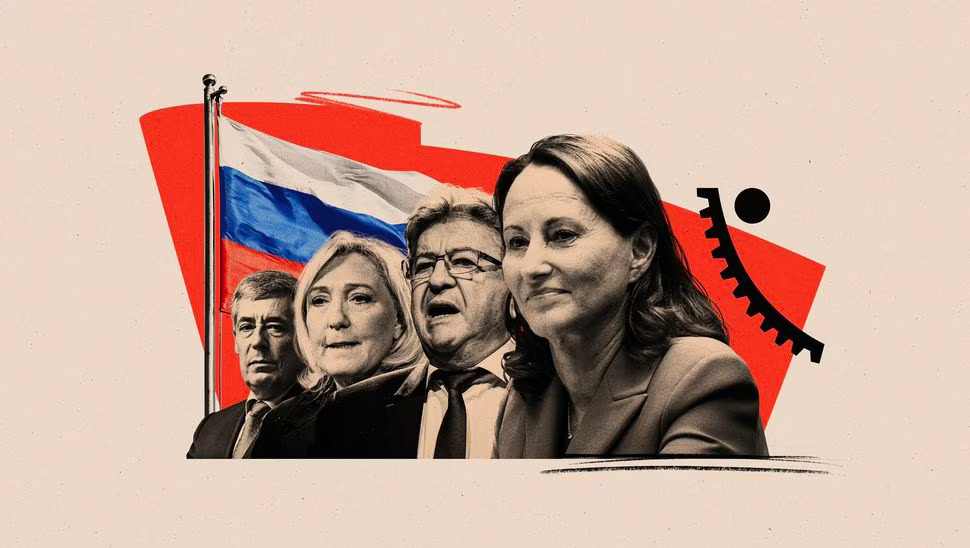
Afin de conjurer son angoisse, l’Express a entrepris d’étiqueter les différents canaux pro-russes, de ficher leurs têtes de gondole : Henri Guaino, Jean-Luc Mélenchon, Marine le Pen, Ségolène Royal… etc Anti-américains, militaires, covido-sceptiques, hommes d’affaire, russophiles, pacifistes, extrême-droite…, les oeils de Moscou sont partout, c’est effrayant. Sans désemparer, les employés de presse se sont saisis de leur clavier pour atténuer les malheurs de l’Occident.
Les envolées lyriques partisanes me font rire et l’hilarité me permet de surmonter mon dégoût pour l’excrétion des états d’âme franchouillards. Aussi cruels qu’ils puissent être, les faits sont plus intéressants sans fioriture littéraire. Contrairement aux personnalités politiques citées plus haut, mon analyse n’est pas polluée par le patriotisme, forme théorisée de l’instinct grégaire. La justice est ma seule patrie.
Plutôt que de contribuer à désamorcer la crise, l’OTAN y vit l’opportunité stratégique d’une guerre par procuration contre la Russie. Son fantasme était de la démembrer, pour améliorer son rapport de force à la Chine. Alors que l’hypocrisie occidentale ne laissait pas d’autre solution, l’opération militaire spéciale est devenue une nécessité technique en février 2022. La Russie a relevé le défi, s’est portée au secours de la population russophone du Donbass.
La paix était enfin possible en mars, après quelques semaines seulement de combat, mais les Anglo-États-uniens y opposèrent leur veto. Le champ de bataille se dresse désormais entre la réalité et les fantasmes de médiocres politiciens occidentaux.
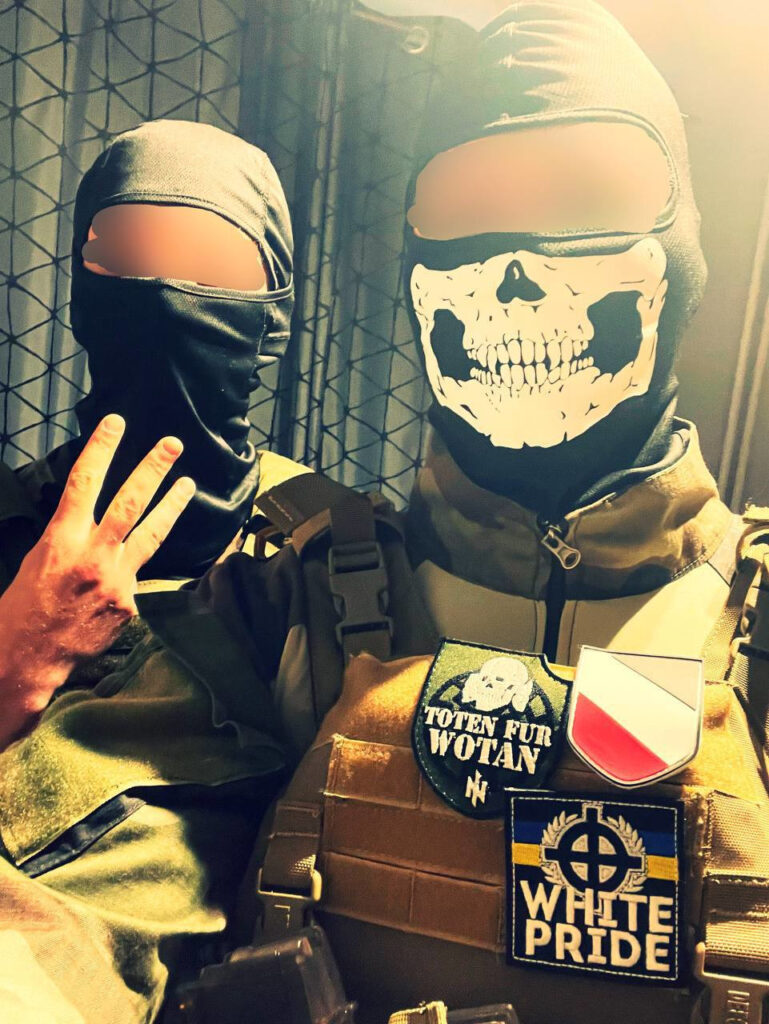
À l’instar de la rédaction de l’Express, les jeunes Français me paraissent en général peu équipés pour y briller. Alors que l’OTAN perd cette guerre et accélère l’inéluctable déclin de l’hégémonie occidentale, les employés de l’Express semblent peu pressés de remplacer fusil en main la chair à canon ukrainienne hachée en vain pour atténuer leurs angoisses. Ils font le choix ancré dans une tradition bien française d’établir le fichier de leurs concitoyens pro-russes. Ils donnent leur sang, donnez votre voisin. Puisque son champ d’action demeure derrière le clavier, j’ai hâte que la rédaction s’intéresse aux nazis français partis en Ukraine défendre l’Europe, la démocratie et la liberté.
Je suis assez vieux pour avoir observé les précédentes entreprises criminelles et catastrophiques des États-unis et de leurs alliés, tentatives de préserver leur hégémonie d’un déclin mécanique et inéluctable. Je suis de ceux que les couveuses koweïtiennes et autres armes de destruction massive ont échaudés.
À l’époque indépendante, la France s’opposa en 2003 à l’invasion de l’Irak. Plus tard hélas, Nicolas Sarkozy fut le complice de la destruction de la Libye. Folie destructrice ? De loin le plus crétin, François Hollande paya la note et quelques Français avec lui, quand le 13 novembre 2015, une opération djihadiste fut l’anecdotique dommage collatéral à Paris du soutien occidental à l’insurrection sunnite radicale contre le gouvernement laïc de Syrie. Au train où vont les choses en Ukraine, ces désagréments ne sont pas finis
Selfie en septembre 2022 de volontaires français dans les rangs atlantistes en Ukraine (réseaux sociaux nazis)
Par mon âge et mon expérience professionnelle, je me targue d’une culture historique et politique supérieure à celle de l’auteur de romans policiers Charles Haquet ou de l’étudiante en affaires internationales Emma Collet, qui ont commis cet article d’anthologie.
Au déclenchement de l’opération militaire spéciale, voilà plus d’un an, mes sentiments étaient plus neutres. Mais à la façon dont les mêmes pressetitués ont encore une fois déversé des torrents de boue -mensonges, propagande ukrainienne pour demeurés et autre fantôme de Kiev– ont cherché sans vergogne à blanchir le nazisme endémique ukrainien et ses crimes, j’ai vite compris où étaient dans cette affaire le droit et la justice. D’ailleurs, l’immense majorité des vastes restes du monde est arrivée aux mêmes conclusions
Charles Haquet & Emma Collet (réseaux sociaux)
Cet article est aussi l’authentique expression d’un pays dont le courage n’est pas la première qualité qui vient à l’esprit, quand il est évoqué à l’étranger. D’une presse à ce point servile et caricaturale, qu’un Philippe Henriot ne la renierait pas. D’un peuple froussard à l’arrogance rurale, dont la compréhension des questions internationales est aussi mièvre que chauvine. Car enfin, comme il faut être lâche et rompu aux petits arrangements d’alcôve, pour encencer en qualité de Français, un régiment Azov qui arbore fièrement l’emblème de la 2. SS-Panzer-Division, Das Reich, qui le 10 juin 1944, massacra 643 habitants d’Oradour sur Glane. Impensable à l’étranger.
Je vous laisse votre démocratie libérale -quand votre libéralisme ne résiste pas à la première éraflure sur la carosserie de votre automobile à crédit- votre chef d’État élu par 25% du corps électoral, ses Gilets jaunes mutilés, son 49.3 et sa presse subventionnée. Elle ne m’intéresse plus, mais fait encore plier de rire une large majorité du globe. Elle est digne de vous, employés de l’Express, petits bourgeois du blême Hexagone, racaille macroniste. Vous avez au moins compris une chose : votre défaite par procuration au Donbass est le début de votre fin.
Oleg Gazmanov – composer, 2022, vocals Alexander Marshal – vocals
She was not a glamorous diva Yes, and not very pedigree And I didn’t think how to be happy for her – Worked day and night She took care of everything and us Raised us young fools How could she feed and clothe gave the last We turned up our noses And she always taught us to think Sometimes gave jeans and chewing gum Only we wanted more and more And we thought she was wrong
They talked about her embarrassingly And she silently looked into our eyes And, sighing, then left for good Motherland, my mother Motherland My Soviet Motherland My mom is sorry… Motherland, my mother Motherland My Soviet Motherland My mom is sorry…
Did not feed truffle with Parmesan- Only what is, but there were books We were escorted to music and sports – Tired, but helped in everything Sent to the sea and into the ranks of the detachments In institutes, space, Olympiads And taught us to achieve everything Set goals and boldly strive for them And we thought she was wrong
They talked about her embarrassingly And she silently looked into our eyes And, sighing, then left for good Motherland, my mother Motherland My Soviet Motherland My mom is sorry… Motherland, my mother Motherland My Soviet Motherland My mom is sorry… Motherland, my mother Motherland My Soviet Motherland My mom is sorry… Motherland, my mother Motherland My Soviet Motherland My mom is sorry…
Friends, today the premiere of my new song “Motherland” took place – this is a short emotional story – mine and my country. With this song, I apologize to my mother for the fact that I was “led” to the propaganda of perestroika and believed that her generation was wrong. I was wrong, and my mother is gone. Take care of your parents and your Motherland!
Operation enters the second week of Ukraine’s long-awaited and highly touted counteroffensive, some basic conclusions can be drawn even though the fighting continues, and will continue to rage, for some time to come.
[my illustration : wrecks of Western armored fighting vehicles on June 9, 2023, south of Orekhov, Zaporojie region]
First and foremost, the counteroffensive gambit has failed. While there is still considerable combat strength left in the Ukrainian military, including more than 75% of the NATO-trained and -equipped 60,000-strong cohort Ukraine had assembled in the past eight months, fundamentally flawed assumptions about the quality of the force on which Ukraine and its NATO allies had placed their collective hopes for victory over Russia have been exposed. In short, Ukraine lacks the military capacity to overcome Russian defenses.
Ukraine’s most elite assault brigades, equipped with the latest Western military technology, failed to advance out of what Russian defensive doctrine calls the “cover” line of defense—the buffer that is designed to channel and disrupt an attacking force prior to reaching the “main” line of defense. Ukrainian casualties were extremely heavy, with Russia achieving a 10:1 kill ratio in terms of manpower, which is unsustainable from the Ukrainian perspective. The reasons for the Ukrainian failure are fundamental in nature, meaning that they cannot be overcome as things currently stand and, as such, the Ukrainian military has zero chance of success, no matter how hard they press subsequent attacks.
First and foremost is the quality of the Russian defenses, especially in terms of the barrier network (minefields, obstacles, and trenches) which, when combined with the tenacity of the Russian defender and the overwhelming superiority Russia enjoys in terms of fire support (both artillery and air-delivered), is the reason the Ukrainians are unable to advance beyond the “cover” layer of the Russian defenses. Ukrainian equipment and tactics are insufficient to the task of breaching the Russian obstacle barriers in any meaningful manner, dooming the attacking forces to be destroyed piecemeal by Russian artillery and air strikes, as well as local counterattacks mounted by Russian special forces.
Besides the poor tactics and equipment deficiencies (yes, the Leopard tanks and Bradley fighting vehicles were not the miracle weapons Ukraine and its Western supporters had hyped them up to be), the Ukrainians are paying the price for Russia’s impressive suppression of enemy air defense (SEAD) campaign that has been ongoing for many weeks now. Russia has not only neutralized Ukraine’s ability to defend strategic targets far beyond the front lines, but also to project any meaningful air defense capability into the actual zone of conflict. This, combined with the lack of any viable air force, leaves the attacking Ukrainian ground forces exposed to the full weight of Russian air power.
Russian fixed-wing aircraft have been able to deliver precision-guided munitions with deadly effect to the assembly areas used by Ukraine to gather their attacking forces prior to committing them to the battlefield. It is estimated that between 25-30% of Ukraine’s casualties occur from these strikes. Russian helicopters can use their anti-tank guided missiles (ATGMs) with lethal effect on Ukrainian forces operating in the zone of contact, and Russian loitering munitions (i.e., “kamikaze drones”) have taken a heavy toll of Ukrainian forces as well. Unless Ukraine can reassert some semblance of air defense onto the battlefield, both in the rear areas as well as the frontlines, and sortie its own air power capable of challenging Russian air superiority over the battlefield, then no amount of courage and tactical innovation on the part of the Ukrainian ground forces will alter the deadly calculus of war that currently prevails today.
One of the many tragedies of the ongoing Ukrainian-Russian conflict is the fact that much of what Ukraine does on the battlefield is dictated not by military necessity, but rather political imperative. The recently concluded months-long Battle for Artemovsk (Bakhmut) is a case in point, where Ukrainian President Zelensky insisted on pouring manpower and equipment into a battle for a town that most military experts believed to hold minimal strategic military value. The geography, however, did not dictate the scope and scale of the battle, but rather the perception of Ukrainian defensive tenacity, and as a result between 60-75.000 Ukrainian soldiers lost their lives in what was a losing effort. Similarly, the Ukrainian army is being asked to make what amounts to a suicide attack against well-prepared Russian defenses under conditions which, as detailed earlier, can only result in a decisive Ukrainian defeat. This time, the culprit is Ukraine’s NATO allies who, on the eve of their annual summit, are desperate for any sign that the multi-billion-dollar investment they have collectively made in the Ukrainian military can pay even the most rudimentary dividends. For this reason, NATO will continue to pressure Ukraine to double down on defeat, pressing the Russians offensively even though any gains, if in fact any can be had, would be pyrrhic in nature and unsustainable over the long run.
The reality is that when NATO gathers in Vilnius on July 11, the Russians will be well into the process of destroying the third Ukrainian army built by NATO. The first was assembled during the buffer provided by the diplomatic “sham” of the Minsk Accords, from 2015-2022. Some 260,000 strong, this force was largely destroyed by June of 2022. The second army, consisting of some 80,000 newly trained and equipped Ukrainian soldiers backed by thousands of foreign mercenaries, the direct result of tens of billions of dollars of military aid provided by NATO, was able to launch the successful Ukrainian counterattack in the fall of 2022, before being decimated in the positional war that followed (including the Bakhmut slaughter).
The 60,000-strong 12-brigade Ukrainian counterattack force currently operating against the Russians, again the result of tens of billions of dollars in military equipment (including modern Western tanks, artillery, and infantry fighting vehicles), will most probably be destroyed, or facing imminent destruction, by the time the NATO summit convenes. The primary question facing NATO is does it have the political, economic, and military capacity to raise a fourth Ukrainian army, and after its demise, a fifth, sixth, and more?
NATO is politically committed to waging a proxy conflict with Russia “to the last Ukrainian.” This tragic reality means that, regardless of the battlefield reality that exists in Ukraine, NATO will continue to push Ukraine to sacrifice its manpower in a fruitless struggle against Russia for the simple fact that NATO is unwilling to willingly lose political face at home and abroad.
However, this political will does not automatically mean that NATO will be able to sustain this objective either economically or militarily.
While recent statements made by US General Mark Miley, the Chairman of the Joint Chiefs of Staff, indicate that there are tens of thousands of Ukrainian soldiers in the US/NATO training “pipeline”, and that the US/NATO is assembling equipment sufficient to equip these soldiers, they will not be ready for combat for several months yet—long after the third Ukrainian army has met its fate on the field of battle.
Miley spoke of new air defense systems for Ukraine, and other NATO officials speak of the possibility of providing Ukraine with (old) F-16 aircraft. New air defense systems, however, cannot in and of themselves alter a military reality imposed by Russia on Ukraine through its strategic SEAD victory. Ukraine will simply continue a losing struggle against Russian air power. The same holds true of any F-16 fighters that might be provided to Ukraine—too little, too late, and in any event incapable of achieving a meaningful battlefield result.
In Vilnius, NATO will be confronted with the reality of its impotency as a military alliance when it comes to countering Russia in Ukraine. Any military analyst of any competence will know that, as things currently stand, Ukraine simply cannot prevail over Russia. NATO illusions of a “frozen conflict” that seem to drive their insane desire to arm Ukraine to infinity and beyond, moreover, are driven by fundamentally flawed assessments regarding Russian economic competence and capacity, Russian military proficiency, and the will of the Russian people to sustain this conflict.
Here is the root cause of NATO’s strategic failure in Ukraine—a complete lack of understanding about the reality of Russia today. Russia will be able to out-produce NATO from a standpoint of military technology until which time NATO nations fully transition into a wartime economy, something NATO nations neither have the political will nor economic means to accomplish.
The Russian military has largely overcome the deficiencies which plagued it in the initial phases of the Special Military Operation, and the Russia armed forces assemble in the Special Military Operation zone are highly trained, well-equipped, and properly trained for the tasks they have been assigned. Moreover, the Russian nation has rallied around the leadership of Russian President Vladimir Putin in an overwhelming fashion, united in the belief that the proxy war NATO is waging against Russia in Ukraine is existential in nature and, as such, one that Russia cannot lose.
NATO will not alter course in the immediate period following the Vilnius summit—there is simply too much political momentum in place to bring about any meaningful alteration of the current trajectory in Ukraine. But neither will NATO produce a winning formula in Ukraine. Rather, NATO will continue to pursue little more than a variation of an existing theme—to arm Ukraine so that it can fight as long as it is capable of sustaining the fight.
This short-sighted posture will result in the inevitable military collapse of Ukraine, probably sometime between late summer/early fall of this year. When this happens, NATO will be left scrambling to construct some sort of face-saving mechanism to salvage its weakened geopolitical position vis-à-vis Russia. What that will look like is unknown at this time. But one thing is for certain—because NATO refuses to consider an off-ramp from the Ukrainian conflict today, there will be no future for Ukraine tomorrow. NATO political pride will be the downfall and destruction of the Ukrainian nation, its military, and its people [end]
61-year-old Scott Ritter is a former intelligence officer within the US Marine Corps (USMC), then inspector of the United Nations in Iraq. When in 2003, the US and their British minions were about to invade the country under this false pretext, Ritter was claiming that there was no weapon of mass destruction (WMD) there. He was right.
Five major trends illustrate how the world is changing, and that the West must grapple with the reality that it can no longer impose its “leadership” on the world as it once did.
[my illustration : on June 12, 2023, Burj Khalifa tower, in Dubai, celebrates the Day of Russia (screenshots)]
The post-Western, multipolar international order is coming to pass. As the world grapples with the implications of this shift in power, the foundations of a great reckoning are taking shape. This reckoning will challenge the long-held beliefs and structures that have sustained Western dominance of the world for the past few hundred years, exposing along the way the nature of the West’s perceived entitlement to lead the global pecking order. The end result will be a significant re-evaluation of international relations as we know it.
This great reckoning will be driven by five major trends, which are compelling Western nations to confront and adapt to a future where power must be shared with the rest in a multipolar world. A failure to recognize, or attempting to strongly resist, these trends could pose significant risks not only to the West itself but also to global stability. Yet future conflicts can be avoided if this period of change is viewed as an opportunity to build a more equitable world, rather than as a crisis that threatens preferred and entrenched privileges.
Five Trends to Consider
What future awaits the West—a smooth transition toward multipolarity or a period of instability and potential conflict—will largely depend on how policymakers respond to the following five trends.
First is the unravelling of the hitherto telling of history. The West, across its colonial history, has practiced and perfected the selective interpretation and telling of events, choosing to portray itself as the originator of modern civilization and a benevolent guiding force. This is now changing; information technologies, such as the Internet and social media, have broken the monopoly over information and history once held by Western gatekeeping institutions (media companies, universities, book publishers, and more). As a consequence, people around the world are recognizing that history is no longer confined to Western interpretation—including its projection of benevolence.
A significant component of this has been the West’s frequent failure to acknowledge its own imperfect past. Despite amplifying the perceived wrongdoings of others, it has been silent about its own unsavory moments, such as early American pioneers’ destruction of First Nation cultures, European exploitation of the African continent, or Australia’s treatment of aboriginal peoples. Addressing these historical episodes matters all the more because they affect current behavior; Western nations also have problems admitting to contemporary mistakes and intentions.
Non-Western nations can now make clear that their own countries and communities have long histories that not only exist despite Western interpretation, but these histories need to be explored, understood, and told. The West must grapple with this trend and its implications, rather than continue to obscure it in denial. Consider the ongoing diplomatic efforts of the Indian government to compel Great Britain to return the treasure stolen from India, including some of the crown jewels.
The second trend is the re-evaluation of the” rules-based” international order. Policymakers in Washington may not like hearing it, but the concept is the subject of much derision around the world and is widely regarded as a tool used by the West to control global affairs and maintain hegemony. There is ample resentment growing against Western nations given the repeated breaching of their own rules, meaning that the legitimacy of this order is being questioned despite its positive aspects.
Coinciding with this growing frustration is the reality that the distribution of power across more nations is transforming the current world order and creating new opportunities and challenges. China has assumed a more prominent position, offering global public goods such as peacemaking and addressing climate change in a manner Western nations are not willing, or able, to do. Similarly, India is beginning to assert itself, as are other smaller nations, like the UAE and Indonesia.
As more countries determine their own trajectories in the twenty-first century, the West must recognize that the international balance of power has shifted. It cannot continue to impose its will on others—the rise of China and other nations is evidence of such. The West must come to terms with this new reality and recognize that a new, more pragmatic, and multipolar approach is needed, where nations pursue foreign policies committed to co-existence, driven by their own best interests rather than aligning themselves with “one side” or the other.
Third is the unmasking of Western “peacekeeping.” Despite portraying itself as the guarantor of global security, much of the world now views the United States‚ and Europe to a lesser extent, as profiting from war rather than being interested in promoting authentic peace. The Western military-industrial complex—particularly the United States’—is so powerful that it is now well-known to drive U.S. foreign policy to the extent that it perpetuates conflicts to thus profit from war.
The rest of the world has realized that the West alone cannot be trusted to lead global peace efforts, especially if a significant portion of their economies are geared to profit from conflict. In light of this, a positive change is occurring, with China brokering ground-breaking peace agreements—between Saudi Arabia and Iran, for example—while world leaders like Indonesia’s Joko Widodo, India’s Narendra Modi, and Brazil’s Luiz Inácio Lula da Silva pitchpeacefulresolutions to modern conflicts.
The fourth trend underway is the dethroning of the Western financial superstructure. That the West makes ample use of its financial might for geopolitical advantage and purposes is no great secret—policymakers and experts openly talk about the “weaponization of finance” and applying sanctions on countries that do not comply with Western intentions. Likewise, the ability of the United States and its allies to freeze and even confiscate the reserves of sovereign states—Afghanistan, Venezuela, Russia—sent shock waves across the world.
Because of this and the West’s own track record of financial greed and impropriety—which resulted in devastating crises such as the 2007–2008 financial crisis and the recent collapse of Silicon Valley Bank, which has had global reverberations—distrust in and a rejection of Western financial structures is growing.
Efforts are now underway to dismantle the exorbitant privilege bestowed on the United States via its currency. De-dollarization is very much happening, with the currency’s share of global reserves falling to 47 percent last year, down from 73 percent in 2001. Additionally, countries are seeking alternatives to the SWIFT system, which also has been used in aid of Western-based sanctions and thus alarmed the global majority. As countries with stable currencies gain influence, a more multipolar economic order emerges, reshaping geopolitical alliances, economic diplomacy, and the balance of power within international institutions. This change may grant developing nations greater flexibility in managing their currencies and monetary policies and limit the West’s capacity to unilaterally impose sanctions. Moreover, BRICS nations have recently surpassed the G7 in terms of GDP, signaling a redistribution of economic power and hinting at a future of cooperation in trade, investment, infrastructure, and development assistance.
Fifth and finally, there is the notable collapse of the Western press’ credibility. This comes at a critical juncture, as repeated shortcomings in the last few years have heightened global awareness of Western media’s role in perpetuating the West’s preferred aspects of the current world order—often to the detriment of other countries.
For instance, persistent China-bashing in Western headlines has perpetuated an unproductive and fear-mongering narrative of Beijing as a threat to its own citizens and the world at large. The geopolitical contexts of Hong Kong and Taiwan, though complicated affairs, have been particularly and selectively drummed up to push an “us vs. them” narrative, rather than encouraging understanding between the West and China.
Similarly, overwhelmingly one-sided coverage of the Ukrainian conflict regularly overlooks national and regional geopolitical complexities in the long-standing Russian-Ukrainian relationship and the history of NATO expansion in Europe. A lack of reporting on the Nord Stream bombing, which many believe was perpetrated by a Western nation—with reporting to back this claim up—is a glaring hole that has contributed to the lack of trust in Western media from both non-Western and Western readers alike. Only months later is the Western press quietly admitting potential Western culpability, or at the very least, knowledge.
Moreover, inadequate, and biased coverage of non-Western conflicts, such as those in Yemen, Myanmar, and Palestine, has led to global accusations of neglect, bias, and even racism.
The Writing on the Wall
Western governments operating in an echo chamber of denial need to reach out to their friends across the world and realize what is obvious to everyone except to themselves: that the world is not like what it was in the post-Cold War era. The old ways are finished, and the West simply does not have the political and financial power, not to mention the international legitimacy, it once did. Western nations must adapt to this changing international environment, rather than stubbornly insisting upon business as usual. Failure to do so will make the world a more dangerous place and erode the credibility and influence of the West even further [end]
[Last bullfighting in Barcelona on September 25, 2011 (Manu Fernandez / AP)]
Finally the bull charged, the horse leaders ran for the barrera, the picador hit too far back, and the bull got under the horse, lifted him, threw him onto his back.
Zurito watched. The monos, in their red shirts, running out to drag the picador clear. The picador, now on his feet, swearing and flopping his arms. Manuel and Hernandez standing ready with their capes. And the bull, the great, black bull, with a horse on his back, hooves dangling, the bridle caught in the horns. Black bull with a horse on his back, staggering short-legged, then arching his neck and lifting, thrusting, charging to slide the horse off, horse sliding down. Then the bull into a lunging charge at the cape Manuel spread for him.
The long-awaited Ukrainian counter-offensive has finally begun. After months of handwringing and speculation, the western investment in Ukrainian military might has been put on display for the whole world to see—billions of dollars of advanced weaponry, drawn from NATO stocks, manned by Ukrainian soldiers who have been trained by NATO instructors, and whose actions have been shaped by NATO intelligence and directed by NATO planners. Let there be no doubt—this is a NATO offensive, a sad reflection on the reality that what was once called a simple proxy conflict has morphed into so much more—direct force-on-force combat between the collective west and Russia.
For Anne Applebaum, this offensive is an answer to her prayers. The Polish-American Pulitzer Prize-winning historian has for some time now been calling for such an action, a decisive blow by the collective west and Ukraine against a Russia she characterizes as autocratic and dangerous. The lessons of history have been shunted aside in favor of her feverish lust for Russian blood. Killing Russians, Applebaum believes, is the only way for the civilized west to show the Russian nation—autocrats and automatons alike—that the price for regional hegemony is too high for the Russian people and their government to bear.
Anne Applebaum (Photo: Olga Majrowska)
In a new article she penned for The Atlantic, Applebaum—a staff writer for the journal— writes of things she has no knowledge of or experience in, namely military operations, both operational and psychological. Like the dilletante she is, Applebaum throws about buzz phrases as if by putting them down on paper, it somehow makes them real, and the schemes they describe possible.
Applebaum, however, is hampered by her inadequacy as a military analyst and—perhaps more importantly—her total ignorance of the character of the Russian people, their leadership, and the nation they represent collectively. Elegantly stated ignorance is Applebaum’s forte, especially when it comes to glossing over both the causation and consequences of a conflict she has been promoting her entire adult life.
https://youtu.be/T5N_2Y0R-38
Scott Ritter will discuss this article and answer audience questions on Ep. 73 of Ask the Inspector.
Applebaum has turned an extensive stint in academia, inclusive of a six-month exchange program as a student to Leningrad circa 1985, into the intellectual foundation of a career spent sorting through the detritus of Soviet history, to reimagine Stalin and the Soviet experience in the worst possible light. It is not that one would be desirous of reimagining Stalin and Stalinism as the golden era of Soviet rule.
But perspective, and historical accuracy, do matter, and Applebaum’s writing seems destined to a particular brand of Russophobic western elite pre-programmed into accepting at face value anything negative about Stalin and his times. Her hatred for everything Russian, especially its leader, Vladimir Putin, drips from every paragraph she pens. She sees herself and the collective west as combatants in the greater struggle against what she derisively calls “Putinism.”
“[A]s long as Russia is ruled by [Vladimir] Putin,” Applebaum wrote recently, “then Russia is at war with us [i.e., the collective west] too.”
This fight is not theoretical. It requires armies, strategies, weapons, and long-term plans…NATO can no longer operate as if it might someday be required to defend itself; it needs to start operating as it did during the Cold War, on the assumption that an invasion could happen at any time.
Germany’s decision to raise defense spending by 100 billion euros is a good start; so is Denmark’s declaration that it too will boost defense spending. But deeper military and intelligence coordination might require new institutions—perhaps a voluntary European Legion, connected to the European Union, or a Baltic alliance that includes Sweden and Finland—and different thinking about where and how we invest in European and Pacific defense.
Applebaum’s words are a direct reflection of the sentiment expressed by one of her mentors, the Hungarian billionaire George Soros. In 1993, Soros wrote an article where Applebaum’s “new institution” thematic was expressed in more direct terms. Soros wrote of the need for a new world order “based on the United States as the remaining superpower and on open society as the organizing principle.”
It consists of a series of alliances, the most important of which is NATO and, through NATO, the Partnership for Peace which girds the Northern Hemisphere. The United States would not be called upon to act as the policeman of the world. When it acts, it would act in conjunction with others. Incidentally, the combination of manpower from Eastern Europe with the technical capabilities of NATO would greatly enhance the military potential of the Partnership because it would reduce the risk of body bags for NATO countries, which is the main constraint on their willingness to act. This is a viable alternative to the looming world disorder.
The combination of manpower from Eastern Europe with the technical capabilities of NATO as a mechanism for reducing the risk of body bags for NATO countries sounds very much like precisely what is taking place today in the current struggle between Ukraine and Russia. The imagery of destroyed Leopard tanks and Bradley infantry fighting vehicles belies the reality that the charred bodies trapped inside these wrecked vehicles and scattered in the fields surrounding the scene of their collective demise, are Ukrainian.
NATO technical capabilities and Ukrainian manpower does, in fact, reduce the risk of NATO body bags. It also emboldens western writers such as Applebaum to urge the Ukrainians on in a fight with Russia neither they nor the west has a chance of winning. The goal of the Ukrainian counteroffensive, Applebaum contends, is to “convince the Russian elite that the war was a mistake and that Russia can’t win it, not in the short term and not in the long term, either.”
Applebaum would do well to reflect on the reality that the anti-Putin Russian elite she fantasizes about influencing through the nexus of NATO technical capabilities and Ukrainian blood does not exist inside Russia any longer. Liliya Vezhevatova, an anti-war and LGTBQ activist from Novosibirsk who fled to Armenia following the initiation of Russia’s Special Military Operation in February 2022, noted that before the conflict started her organization could boast around 2,000 activists. Today that number is down to around 200.
“It is an irony of this conflict,” Vezhevatova laments, “that the female relatives of perished soldiers often hold the most ardent pro-war positions.” Vezhevatova explains this phenomenon by declaring that these mothers have been raised on the mythology of the “Great Patriotic War” (World War II), which casts the mother of a soldier as a heroic figure. “The situation is complicated by deep psychological mechanisms at play,” Vezhevatova notes. “It is hard to accept that a loved one perished for no reason.”
https://youtu.be/tncTVsd3O2E
Vezhevatova has a point—no mother would like to see the son she bore and raised die for no reason. But what Vezhevatova and Applebaum fail to see is the reality that the mothers and wives of the men fighting for Russia against Ukraine and the collective west are, in their minds, fighting for Mother Russia’s very survival. The monuments in Volgograd erected to commemorate the heroism of the Russian soldier in defense of his homeland (“Stand to Death”) and the awe-inspiring sight of Mother Russia beckoning her men forward in defense of their homeland (“The Motherland Calls”) is more than simple mythology weaponized for psychological manipulation. It is reflective of a deep patriotism that runs through the blood of most Russian women today.
Vezhevatova has abandoned her country, opting to live abroad while supporting westerners like Applebaum who are content with sacrificing Ukrainian men in the name of furthering western anti-Russian objectives. She has forsaken her homeland. Not so the women of Russia who remain. They know what is at stake. They know, as did their grandmothers before them, what needs to be done, inclusive of the horrible sacrifices that entails.
The statues “Stand to Death” (foreground) and “The Motherland Calls” (background), Volgograd
Meanwhile, Applebaum sits in the relative safety of her writer’s perch, claiming to be a friend of Ukraine all the while urging the men of Ukraine forward to slaughter.
Applebaum’s bloodlust brings to mind a passage from Ernest Hemingway’s 1926 classic novel, The Sun Also Rises. Hemingway touches upon the dichotomy of killing one’s friends in a short conversation between Romero, a Spanish bullfighter, and Lady Brett Ashley, a British widow.
“The bulls are my best friends,” Romero says in Spanish. His words are translated into English by Jake, an American expatriate and friend of Lady Ashley.
“You kill your friends?” Lady Ashley replies.
“Always,” Romero says in English, laughing.
It is the imagery of the bullfight that best describes Anne Applebaum’s desire to see Ukrainians killed in battle against the Russians. She treats the Ukrainian counteroffensive as a blood sport, a dance to the death between a matador and a fighting bull.
Finally the bull charged…
The contemporary Lebanese writer, Malak El Halabi, wrote about her experience watching a bullfight.
[T]o watch the bull enter the arena…To watch one bull surrounded by a matador and his six assistants. To watch the matador confronting the bull with the capote, performing a series of passes, just before the picador on a horse stabs the bull’s neck, weakening the neck muscles and leading to the animal’s first loss of blood…Starting a game with only one side having decided fully to engage in while making sure all the odds will be in the favor of him being a predetermined winner. It was this moment precisely that made me feel part of something immoral. The unfair rules of the game. The indifferent bull being begged to react, being pushed to the edge of fury. The bull, tired and peaceful. The bull, being teased relentlessly. The bull being pushed to a game he isn’t interested in. And the matador getting credits for an unfair game he set.
Yes, I went to watch a bull fight and yes the play of colors is marvelous. The matador’s costume is breathtaking and to be sitting in an arena fills your lungs with the sands of time. But to see the amount of claps the spill of blood is getting was beyond what I can endure. To hear the amount of claps injustice brings is astonishing. You understand a lot about human nature, about the wars taking place every day, about poverty and starvation…You understand a lot about humans’ thirst for injustice and violence as a way to empower hidden insecurities. Replace the bull and replace the matador. And the arena will still be there. And you’ll hear the claps. You’ve been hearing them ever since you opened your eyes.
Finally the bull charged…
Yes, the great Ukrainian counteroffensive has finally begun. The Ukrainian bull has been prodded into the arena by the collective west. The Ukrainian bull, weakened by the provision of inadequate weaponry and filled with the false promise of western support, does not comprehend that he is merely a pawn in a greater game, Eastern European manpower to be married up with NATO technology in a bid to weaken Russia. Maddened by the pain, blinded with fury, the Ukrainian bull sees the red cape…
Finally the bull charged…
Close your eyes, and you can hear the claps of the collective west urging the Ukrainian bull on.
Open your eyes, and you will see Anne Applebaum and her ilk reveling in the blood being spilt, cheering the slaughter and indifferent to the Ukrainian bull’s agony as the Matador slides the blade into his flesh.
Finally the bull charged…
This war will end one day, and when it does, Anne Applebaum and the collective west will have much to answer for [end]
61-year-old Scott Ritter is a former intelligence officer within the US Marine Corps (USMC), then inspector of the United Nations in Iraq. When in 2003, the US and their British minions were about to invade the country under this false pretext, Ritter was claiming that there was no weapon of mass destruction (WMD) there. He was right.
The FBI aided a Ukrainian intelligence effort to ban Twitter users and collect their data, new leaks show. Twitter declined to censor journalists targeted by Ukraine, including The Grayzone’s Aaron Maté
[my illustration]
The Federal Bureau of Investigation has aided a Ukrainian intelligence effort to censor social media users and obtain their personal information, leaked emails reveal.
In March 2022, an FBI Special Agent sent Twitter a list of accounts on behalf of the Security Service of Ukraine (SBU), Ukraine’s main intelligence agency. The accounts, the FBI wrote, “are suspected by the SBU in spreading fear and disinformation.” In an attached memo, the SBU asked Twitter to remove the accounts and hand over their user data.
The Ukrainian government’s FBI-enabled targets extend to members of the media. The SBU list that the FBI provided to Twitter included my name and Twitter profile. In its response to the FBI, Twitter agreed to review the accounts for “inauthenticity” but raised concerns about the inclusion of me and other “American and Canadian journalists.”
The FBI’s attempt to ban Twitter accounts at the request of Ukrainian intelligence is among the most overt requests for censorship revealed to date in the Twitter Files, a cache of leaked communications from the social media giant.
The FBI’s censorship request was relayed in a March 27th, 2022 email from FBI Special Agent Aleksandr Kobzanets, the Assistant Legal Attaché at the US Embassy in Kyiv, to two Twitter executives. Four FBI colleagues were copied on the exchange.
“Thank you very much for your time to discuss the assistance to Ukraine,” Kobzanets wrote. “I am including a list of accounts I received over a couple of weeks from the Security Service of Ukraine. These accounts are suspected by the SBU in spreading fear and disinformation. For your review and consideration”
The attached document, drafted by Ukraine’s SBU, contained 163 accounts, including mine. (The list is numbered to 175, but some accounts have two corresponding numerical lines).
The listed Twitter profiles, the SBU alleged, have been “used to disseminate disinformation and fake news to inaccurately reflect events in Ukraine, justify war crimes of the Russian authorities on the territory of the Ukrainian state in violation of international law.”
In order “to stop Russian aggression on the information front,” the SBU continued, “we kindly ask you to take urgent measures to block these Twitter accounts and provide us with user data specified during registration.”
The SBU expressed its “gratitude for the existing level of interaction”
In a memo forwarded by the FBI, Ukraine’s SBU asks Twitter to “block” the listed Twitter accounts “and provide us with user data specified during registration.”
If granted, the users on the list would not only have been banned from Twitter but had their phone number, date of birth, and email address disclosed to both the FBI and SBU.
Read the full list of accounts targeted by the FBI and SBU here:
In response, Yoel Roth, Twitter’s then-Head of Trust and Safety, informed Special Agent Kobzanets and his FBI colleagues that Twitter would “review the reported accounts under our Rules.” But he warned that the list included “a few accounts of American and Canadian journalists (e.g. Aaron Mate).” Therefore, Roth said, Twitter’s review would “focus first and foremost on identifying any potential inauthenticity.”
Roth then suggested that he would be open to suspending authentic accounts if it could be proven that they have a hidden tie to a foreign government. Journalists “who cover the conflict with a pro-Russian stance are unlikely to be found in violation of our rules absent other context that might establish some kind of covert/deceptive association between them and a government,” Roth wrote. “Any additional information or context in those areas is of course welcome and appreciated”
Twitter executive Yoel Roth’s response to the FBI’s censorship request flags its inclusion of journalists, “e.g. Aaron Mate.”
In his reply, Kobzanets did not directly acknowledge Roth’s concerns about Ukraine’s FBI-abetted effort to censor journalists. “Understood,” Kobzanets told Roth. “Whatever your review determines and action Twitter deem[s] is appropriate.” He also indicated that the FBI would not meet Roth’s request for any “context” that might establish ties between journalists and a foreign government: “Unlikely there will be any additional information or context.”
Inside Twitter, Roth forwarded the FBI request to two colleagues. “This is the output of our meeting with the FBI last week,” he wrote. “The list of accounts is a mixed bag – there’s some state media mixed in with a bunch of other stuff – but given the context, I think a deep dive here warranted.” (Roth left Twitter in November 2022).
In an email, I asked Special Agent Kobzanets if he had vetted Ukraine’s censorship request list before sending it to Twitter. I also asked Kobzanets if, after being informed by Twitter’s Roth that the FBI was trying to censor journalists on the SBU’s behalf, whether that had prompted any review or revision of his assistance to Ukrainian intelligence. Kobzanets did not respond.
The FBI’s National Press Office also declined to answer questions. Among several queries, I invoked Twitter’s warning that the FBI’s “assistance to Ukraine” entailed censoring journalists, and asked if that has prompted any changes to the bureau’s collaboration with Ukrainian intelligence.
“While we appreciate your inquiry, as a matter of practice we do not confirm, deny, or otherwise comment on specific interactions nor confirm the veracity of correspondence,” an FBI spokesperson wrote.
The FBI officials copied on the Kobzanets’ exchange with Twitter include Elvis Chan, an Assistant Special Agent in Charge (ASAC) of the FBI’s San Francisco field office, where he manages its Cyber Branch. Chan was active in the FBI’s contacts with Twitter when the social media giant’s censorship of reporting on Hunter Biden’s laptop shortly before the November 2020 election. (As I recently reported, he was also involved in FBI’s decision to forego a direct inspection of the DNC servers and instead rely on the Hillary Clinton-funded cyber firm CrowdStrike in the bureau’s probe of alleged Russian hacking in 2016).
Of the 163 accounts named by the SBU, 34 were suspended and 20 no longer exist. The rest remain active.
Those marked for censorship by Ukraine but remain online include Russian politicians Gennady Zyuganov, a longtime member of Russia’s Communist Party and parliamentarian who lost to Boris Yeltsin in Russia’s 1996 president election; Dmitry Rogozin, Russia’s former Deputy Prime Minister; and Sergey Mironov, a Russian politician and parliamentarian. The list also includes Russian journalists Vladimir Solovyov, a television news host; and Margarita Simonyan, editor-in-chief of the Russian state-controlled network RT. Several Russian government agencies and media outlets were also listed.
The Ukrainian nationals targeted by the SBU’s suppression request include Anatoly Shariy, a video blogger and politician who fled Ukraine in 2012 and subsequently received European Union asylum; and Andriy Portnov, a Ukrainian lawyer and politician who served as a senior official under Ukrainian President Viktor Yanukovych until the latter’s ouster in the February 2014 Maidan coup. (Both Shariy and Portnov’s Twitter accounts remain active).
The disclosure of a collaboration on censorship between the FBI and SBU is the latest documented instance of Ukrainian state-tied attempts to target foreign voices. A Ukrainian website known as Myrotvorets maintains a list of what it calls “enemies of Ukraine.” I was recently added to that list along with The Grayzone’s Anya Parampil, as well as the comedian and YouTube host Jimmy Dore. The Myrotvorets database was co-founded by Anton Gerashchenko, former deputy minister at the Ukraine’s Ministry of Internal Affairs, where he now serves as an advisor.
Last year, the global tech/media conference Web Summit withdrew a speaking invitation to The Grayzone’s Max Blumenthal and I after Olena Zelenska, the wife of Ukrainian President Volodymyr Zelensky, demanded our cancellation. (Another Grayzone colleague, Kit Klarenberg, was recently detained and interrogated about his journalism by British authorities).
News of the FBI’s work with Ukrainian intelligence to censor Twitter users also follows reporting from journalist Lee Fang that the FBI has pressured Facebook to remove accounts and posts deemed by the SBU to be Russian “disinformation.” According to Fang, a senior Ukrainian official in regular contact with the FBI defined “disinformation” in such broad terms that it could mean viewpoints that “simply contradict the Ukrainian government’s narrative.”
after his takeover of Twitter, Elon Musk disclosed the political censorship that the social networking service was previously enforcing on behalf of the FBI
Scotland Yard counter terrorism command (SO15) is embezzling anti-terrorist laws, has already arrested for political reasons one French editor and one British journalist
chronicle of censorship, fake news, whitewashing of the Ukrainian Nazism and war crimes, for the sake of the proxy war that NATO is conducting in Ukraine against Russia
On May 20th, PMC Wagner forced Ukrainian troops out of their last remaining position within the city limits of Bakhmut, consequentially bringing about the nominal end of the largest battle of the 21st century (so far). Bakhmut has been the most substantial locus of military operations in Ukraine for most of the past nine months. Combat there took on a frustrating tempo, with progress often measured in single city blocks. This was a battle that was extremely violent and bloody, but at times agonizingly slow and seemingly indecisive. After countless updates in which nothing of note seemed to have happen, many people were surely beginning to roll their eyes at the very mention of Bakhmut. Consequentially, the abrupt capture of the city by Wagner in May (rather predictably, the final 25% of the city fell very quickly relative to the rest) seemed a bit surreal. To many it likely seemed that Bakhmut would never end – and then, suddenly, it did.
Bakhmut, like most high-intensity urban battles, exemplifies the apocalyptic potential of modern combat. Intense bombardment reduced large portions of the city to rubble, lending the impression that Wagner and the AFU were not so much fighting over the city as its carcass.
The slow pace and extreme destruction has made this battle a rather difficult one to parse out. It all seems so senseless – even within the unique paradigm of war-making. In the absence of an obvious operational logic, observers on both sides have been eager to construct theories of how the battle was actually a brilliant example of four-dimensional chess. In particular, you can easily find arguments from both pro-Ukrainian and pro-Russian commentators claiming that Bakhmut was used as a trap to draw in the other side’s manpower and material for destruction, while buying time to accumulate fighting power
Pro-Ukrainian sources are adamant that a huge amount of Russian combat power was destroyed in Bakhmut, while the AFU received western armor and training to build out a mechanized package to go back on the offensive. Pro-Russian writers similarly seem convinced that the AFU burned a huge amount of manpower, while the Russian army preserved its strength by letting Wagner do most of the fighting.
Clearly, they cannot both be correct.
In this article, I would like to take a holistic survey of the Battle of Bakhmut and adjudicate the evidence. Which army was really destroyed in this “strategically insignificant” city? Which army was being profligately wasteful of its manpower? And most importantly – why did this middling city become the site of the largest battle of the century? Homicide was committed, but nobody can agree on who murdered whom. So, let us conduct an autopsy.
The Road to the Death Pit
The Battle of Bakhmut lasted for so long that it can be easy to forget how the front ended up there, and how Bakhmut fits into the operations in the summer of 2022. Russian operations in the summer were focused on the reduction of the Ukrainian salient around Lysychansk and Severodonetsk, and came to a climactic head when Russian forces broke open the heavy defended Ukrainian stronghold of Popasna, encircled a pocket of Ukrainian forces around Zolote, and approached the Bakhmut-Lysychansk highway. The actual fall of the Lysychansk-Severodonetsk urban agglomeration came relatively quickly, with Russian forces threatening to encircle the entire bag and forcing a Ukrainian withdrawal.
Just for reference, here is what the frontline in the central Donbas looked like on May 1, 2022, courtesy of MilitaryLand
In this context, Bakhmut already threatened to become a major battleground. It lay at a literal crossroad directly in the center of the Ukrainian salient. As Ukrainian positions in Lysychansk, Popasna, and Svitlodarsk were broken open, the axes of Russian advance converged on Bakhmut.
Ukrainian forces greatly needed to stabilize the front, and establish a stable blocking position, and there was really nowhere else to do this except at Bakhmut. Between Lysychansk and Bakhmut there are no sufficiently robust urban areas to anchor the defense, and there was absolutely no question of failing to adequately defend Bakhmut, for a few reasons that we can enumerate:
Bakhmut is in the central position in this sector of front, and its loss would both threaten Siversk with envelopment and allow Russian forces to bypass the well fortified and strongly held defenses at Toretsk.
The Russian strategic objective at Slavyansk-Kramatorsk cannot be successfully defended if the Russian army controls both the heights to the east (in the Bakhmut area) and Izyum.
Bakhmut itself, meanwhile, was a defensible urban area with dominating heights in its rear, multiple routes of supply, good linkages to other sectors of front, and a peripheral belt of smaller urban areas protecting its flanks.
This set up a rather obvious operational decision for Ukrainian forces. The choice was, all things considered, to either commit reserves to stabilize the front at Bakhmut (a strong and operational vital defensive anchor) or risk letting Russia bypass and sweep away an entire belt of defenses in places like Siversk and Toretsk. Asked to choose between a reasonably good option and an extremely bad option, there was no great controversy in the deciding.
Falling back from the loss of their eastern defensive belt, Ukraine needed to stabilize the front somewhere, and the only suitable place was Bakhmut – so this is where Ukrainian reserves were sent in force, and the AFU chose to fight. Operational logic, indifferent to those things that normally recommend cities to us as “important”, decreed that the Styx should flow through Bakhmut.
Russia came to meet this challenge – bringing as their spearhead a mercenary group, staffed by convicts, wielding shovels, run by a bald caterer. What could go wrong?
Operational Progression
Because the general impression of Bakhmut is characterized by urban combat, it can be easy to forget that most of the battle took place outside the city itself, in the exurbs and fields around the urban center. The approach to Bakhmut is cluttered with a ring of smaller villages (places like Klynove, Pokrovs’ke, and Zaitseve) from which the AFU was able to fight a tenacious defense with the support of artillery in the city itself.
While Russian forces nominally reached the approach to Bakhmut late in June (even before Lysychansk was captured) and the city came under the extremes of shelling range, they did not immediately begin a concerted push to reach it. On August 1, the first assaults on the outer belt of villages began, and the Russian Ministry of Defense stated in its briefings that “battles for Bakhmut” had begun. This date is the most logical starting date for historiographical purposes, so we may firmly say that the Battle of Bakhmut was fought from August 1, 2022 to May 20, 2023 – a total of 293 days.
The first two months of the battle saw the Russian capture of most of the settlements east of the T0513 highway south of the city and the T1302 highway to the north, stripping Bakhmut and Soledar of most of their eastern buffer zones and pushing the line of contact right up to the edge of the urban areas proper
Phase 1: The Outer Belt
At this point, the frontlines largely froze up for the remainder of the year, before Wagner set the stage for further advances with the capture of the small village of Yakovlivka, to the north of Soledar. This success can be construed as the first domino in a chain of events which led to Ukrainian defeat in Bakhmut.
Soledar itself serves a unique and critical role in the operational geography of Bakhmut. Laid out in a relatively long and thin strip, Soledar and its suburbs form a continuous urban shield stretching from the T0513 highway (which runs north to Siversk) all the way to the T0504 road (running east to Popasna). This makes Soledar a natural satellite stronghold which defends Bakhmut across nearly ninety degrees of approach. Soledar is also liberally gifted with industrial build, including the salt mine for which it is named, which makes it a relatively friendly place to wage a static defense, full of deep places and strong walls.
Wagner’s capture of Yakovlivka on December 16, however, marked the first sign that the defense of Soledar was in trouble. Yakovlikva sits on an elevated position to the northeast of Soledar, and its capture gave Wagner a powerful position atop Soledar’s flank. The Ukrainians recognized this, and Soledar was powerfully reinforced in response to the loss of Yakovlivka and the anticipated oncoming assault. The capture of Bakhmutske on December 27 (a suburb of Soledar directly on its southern approach) set the stage for a successful assault.
The attack on Soledar ended up being relatively fast and extremely violent, characterized by intense levels of Russian artillery support. The assault began almost immediately after the loss of Bakhmutske on December 27th, and by January 10th Ukraine’s cohesive defense had been shattered. Ukrainian leadership, of course, denied losing the town and wove a story about glorious counterattacks, but even the Institute for the Study of War (a propaganda arm of the US State Department) later admitted that Russia had captured Soledar by January 11th.
The loss of Soledar, in combination with the early January capture of Klischiivka to the south, put Wagner in a position to begin a partial envelopment of Bakhmut
Phase 2: Clearing the Flanks
It was at this point that the discussion shifted towards a potential Russian encirclement of Bakhmut. To be sure, the Russian wings did expand rapidly around the city, placing it in a firebag, but there was never a concerted effort to take the city into a proper encirclement. The Russian advance subsided on the approach to Ivanivske in the south, and over the vital M03 highway in the north.
A genuine encirclement was probably never in the cards, mainly because of the complication of Chasiv Yar – a strongly held rear area stronghold. To fully encircle Bakhmut, Russian forces would have been forced to choose between two difficult options: either blockade the road from Chasiv Yar to Bakhmut, or flare the envelopment wide enough to take Chasiv Yar into the pocket as well. Either option would have greatly complicated the operation, and so Bakhmut was never genuinely encircled.
What the Russians did succeed in doing, however, was establish dominant position on the flanks which accrued three significant advantages. First, they were able to direct fire on Bakhmut’s remaining supply lines. Secondly, they were able to pummel Bakhmut itself with intense artillery fire from a variety of axes. Third – and perhaps most importantly – they were able to assault the Bakhmut urban center itself from three different directions. This, in the end, greatly hastened the fall of the city. By April, it was clear that the focus had shifted from expanding the envelopment on the flanks to assaulting Bakhmut itself, and it was reported that Russian regular units had taken custody of the flanks so that Wagner could clear the city
Phase 3: Flaring the Wings
Fighting throughout April and early May at last shifted to the struggle in the urban center. AFU units in the city ultimately proved incapable of stopping Wagner’s advance, largely due to tight Russian fires coordination and the cramped confines of the Ukrainian defense – with Wagner advancing into the city from three axes, the firing grids for Russian artillery became very narrow, and the AFU’s static defense – while bravely contested – was slowly ground down.
By early May, it was clear that the city would fall soon, with the AFU desperately holding on to the western edge of the city. Attention soon shifted, however, to a Ukrainian counterattack on the flanks.
This became a rather classic instance of events on the ground being outrun by the narrative. There had been rumors of an impending Ukrainian counterattack circulating for quite some time, advanced by both Ukrainian and Russian sources. Ukrainian channels were predicated on the idea that General Oleksandr Syrskyi (commander of AFU ground forces) had hatched a scheme to draw the Russians into Bakhmut before launching a counterattack on the wings. This idea was seemingly corroborated frantic warnings from Wagner head Yevgeny Prigozhin that the Ukrainians had massed enormous forces in the rear areas behind Bakhmut which would be unleashed to counter-encircle the city.
In any case, the spring months came and went without any astonishing AFU counterattack, and all manner of material shortages and weather delays were blamed. Then, on May 15, all hell seemed to be breaking loose. The AFU finally attacked, and Prigozhin screeched that the situation on the flanks was approaching the worst case scenario.
In fact, what happened was rather anticlimactic. The AFU did bring a hefty grouping of units to play, including several of their best and most veteran formations. These included units from:
The 56th Brigade
The 57th Mechanized Brigade
The 67th Mechanized Brigade
The 92nd Mechanized Brigade
The 3rd Assault Brigade (Azov)
The 80th Air Assault Brigade
The 5th Assault Brigade
This sizeable strike package attacked a handful of mediocre Russian Motor Rifle brigades, achieved a bit of initial success, and culminated with heavy losses. Despite Prigozhin’s assertion that the Russian regulars abandoned their posts and left the Russian wings undefended, we later learned that these forces – including mobilized motor rifle units – doggedly defended their positions and only withdrew under orders from above. These withdrawals (distances of a few hundred meters at most) brought the Russian defensive line to strongly held positions along a series of canals and reservoirs, which the AFU was unable to push through.
Now, this is not to say that Russia did not suffer losses defending against a tenacious Ukrainian attack. The 4th Motor Rifle Brigade, which was largely responsible for the successful defense outside Klishchiivka, was badly chewed up, its commander was killed, and it had to be promptly rotated out. However, the offensive potential of the Ukrainian assault package was exhausted, and there have been no follow on attempts in the past two weeks
The Final Act: Ukraine’s Counterattack
In the end, the vaunted Syrskyi plan looked rather lame. The counterattack did successfully unblock a few key roads out of Bakhmut, but it did nothing to prevent Wagner from finalizing the capture of the city, it burned through the combat power of several premier brigades, and on May 20th the last Ukrainian positions in the city were liquidated.
So. This was a strange battle. An agonizingly slow creep around the flanks of the city, a materializing threat of encirclement, and a sudden concentration of Wagner’s combat energy in the city itself – all taking place under threats of an enormous counteroffensive by the AFU, which turned out to be ineffective and ephemeral.
It’s not obvious, then, how this battle suited the operational logic of either army, nor that anyone would come away fully satisfied. Ukraine obviously lost the battle in nominal terms, but the Russian advance seemed so slow and Bakhmut so strategically random (at least superficially) that Wagner’s success can be portrayed as a pyrrhic victory. To fully adjudicate the Battle of Bakhmut, we need to contemplate relative losses and expenditure of combat power.
The Butcher’s Bill
Estimating combat losses in Ukraine is a difficult task, largely because “official” casualty estimates are often patently absurd. This leaves us with a need to fumble for reasonable figures using proxies and ancillary information. One such important source of knowledge is deployments data – we can get a general sense of the burn rate by the scale and frequency of unit allocation. In this particular case, however, we find that unit deployments are somewhat difficult to work with. Let’s parse through this.
First and foremost, we need to grapple with the incontrovertible fact that a huge share of the Ukrainian military was deployed at Bakhmut at one point or another. The Telegram Channel Grey Zone compiled a list of all the Ukrainian units that were positively identified (usually by social media posts or AFU updates) as being deployed in Bakhmut throughout the nine month battle (that is, they were not there all at once)
This is an absolutely enormous commitment (37 brigades, 2 regiments, and 18 separate battalions (plus irregular formations like the Georgian Legion) which indicates obviously severe losses (for what it’s worth, the pro-Ukrainian MilitaryLand Deployment Map admits a similarly titanic Ukrainian deployment in Bakhmut). However, this does not really get us close to accurately assessing losses, largely because Ukraine’s Order of Battle (ORBAT) is a bit confused. Ukraine frequently parcels out units below the brigade level (for example, their artillery brigades never deploy as such) and they have a bad habit of unit cannibalization.
Doing some extremely rough back of the envelop math, minimal scratching off of just the 37 brigades could easily have pushed Ukraine past 25,000 casualties, but there are all manner of shaky assumptions here. First, this assumes that Ukraine withdraws its brigades when they reach combat ineffective loss levels (15% would be a placeholder number here), which isn’t necessarily true – there is precedent for the AFU leaving troops in place to die, especially from lower quality units like Territorial Defense. In fact, an Australian volunteer (interview linked later on) claimed that the 24th mechanized brigade suffered 80% casualties in Bakhmut, so it’s possible that a great many of these brigades were chewed up beyond task ineffectiveness levels (that is, they were not correctly rotated out) but were instead destroyed entirely. A recent article in the New Yorker, for example, interviewed survivors of a battalion that was almost entirely wiped out. In another instance, a retired Marine Colonel said that units at the frontline routinely suffer 70% casualties.
We can say a few things for certain. First, that Ukraine had an extremely high burn rate which forced it to commit nearly a third of its total ORBAT. Secondly, we know that at least some of these formations were left at the front until they were destroyed. Finally, we can definitively say that pro-Ukrainian accounts are incorrect (or maybe lying) when they say that the defense at Bakhmut was conducted to buy time for Ukraine to build up strength in the rear. We know this first and foremost because Bakhmut insatiably sucked in additional units, and secondly because this burn included a large number of Ukraine’s premier and veteran forces, including fully a dozen assault, airborne, and armored brigades.
There’s another problem with the ORBAT approach to casualties, however, and this concerns Wagner. You see, one of our objectives here is to try to get a sense of the comparative rates of loss, and ORBAT simply isn’t a good way to do this in the particular case of Bakhmut. This is because the battle was mostly fought from the Russian side by the Wagner Group, which is a huge formation with an opaque internal structure.
Whereas on the Ukrainian side we can enumerate a long list of formations that fought at Bakhmut, on the Russian side we just put the 50,000 strong Wagner Group. Wagner of course has internal sub-formations and rotations, but these are not visible to those of us on the outside, and so we cannot get a sense of Wagner’s internal ORBAT or force commitment. We understand generally that Wagner has a structure of assault detachments (probably a battalion equivalent), platoons, and squads, but we do not have a sense of where these units are deployed in real time or how quickly they are rotated or burned through. Sadly, when Prigozhin went in front of cameras he brought maps without unit dispositions on them, leaving ORBAT nerds squinting in vain trying to extract useful information. So, lacking good insight into Wagner’s deployments, we are unable to make an adequate comparison to the bloated Ukrainian ORBAT in Bakhmut.
There are other ways that we can get at the casualties, however. The Russian dissident (that is, anti-Putin) organization Mediazona tracks Russian losses by tabulating obituaries, death announcements on social media, and official announcements. For the entire period of the Battle of Bakhmut (August 1 – May 20), they counted 6,184 total deaths among PMC personnel, inmates, and airborne forces (these three categories accounting for most of the Russian force in Bakhmut).
Meanwhile, Prigozhin claimed that Wagner had suffered 20,000 KIA in Bakhmut while inflicting 50,000 KIA on the Ukrainians. Concerning the first number – the context of this claim was an interview in which he was lambasting the Russian Ministry of Defense (as is his habit), and he has an incentive to overstate Wagner’s losses (since he is trying to play up Wagner’s sacrifice for the Russian people).
So, here is where we are at with Wagner losses. We have a “floor”, or absolute minimum of a little over 6,000 KIA (these being positively identified by name) with a significant upward margin of error , and something like a ceiling of 20,000. The number that I have been working with is approximately 17,000 total Wagner KIA in the Bakhmut operation (with a min-max range of 14,000 and 20,000, respectively)
However, something we need to consider is the composition of these forces. Among the positively identified KIA, convicts outnumber professional PMC operators by about 2.6 to 1 (that is, Wagner’s dead would be about 73% convicts). According to the Pentagon, however (taken with a large grain of salt), nearly 90% of Wagner’s losses are convicts. Taking a conservative 75/25 split and rounding the numbers to make them pretty, my estimate is that Wagner lost about 13,000 convicts and 4,000 professional operators. Adding in VDV losses and motorized rifle units fighting on the flanks, and total Russian KIA in Bakhmut are likely on the order of 20-22,000.
So, what about Ukrainian losses? The major outstanding question remains: who is on the right end of the loss ratios?
Ukrainian commentators consistently ask us to believe that Russian losses were far worse due to their use of “human wave” attacks. There are several reasons why this can be dismissed.
First, we have to acknowledge that after nine months of combat we have not yet seen a single video showing one of these purported human waves (that is, Wagner convicts attacking in a massed formation). Keeping in mind that Ukraine loves to share footage of embarrassing Russian mistakes, that they have no qualms about sharing gory war porn, and that this is a war being fought with thousands of eyes in the sky in the form of reconnaissance drones, it must strike us as curious that not one of these alleged human wave attacks has yet been caught on camera. When videos are shared purporting to show human waves, they invariably show small groups of 6-8 infantry (we call this a squad, not a human wave).
However, the absence of evidence is not evidence of absence. That being said, the “human wave” narrative has been contradicted on multiple occasions. Just for starters, General Syrskyi himself contradicted the human wave narrative and said that Wagner’s methodology is to push small assault groups forward under intense artillery cover. Witnesses from the front concur. An Australian Army Veteran volunteering in Ukraine gave a very interesting interview in which he downplayed Wagner casualties and instead emphasized that “Ukraine is taking way too many casualties” – he later adds that the 24th brigade suffered 80% casualties in Bakhmut. He also notes that Wagner favors infiltration groups and small units – the veritable opposite of massed human waves.
I found this article from the Wall Street Journal to be nicely emblematic of the human wave issue. It contains the obligatory claim of human wave tactics – “The enemy pays no attention to huge losses of its personnel and continues the active assault. The approaches to our positions are simply littered with the bodies of the adversary’s dead soldiers.” This description, however, comes from the bureaucratic apparatus at the Ministry of Defense. What about people on the ground? A Ukrainian officer at the front says: “So far, the exchange rate of trading our lives for theirs favors the Russians. If this goes on like this, we could run out.”
Ultimately, it’s difficult to believe that the kill ratio favors Ukraine for the simple reason that the Russians have enjoyed a tremendous advantage in firepower. Ukrainian soldiers speak freely about Russia’s enormous superiority in artillery, and at one point it was suggested that the AFU was outgunned by ten to one. The New Yorker’s interview subjects claimed that their battalion’s mortar section had a ration of a mere five shells per day!
The enormous Russian advantage in artillery and standoff weaponry suggests the a-priori assumption that the AFU would be taking horrific casualties, and indeed that’s what we hear from myriad sources at the front. Then, of course, there was the shocking February claim by a former US Marine in Bakhmut that the life expectancy at the front line was a mere four hours.
All of this is really ancillary to the larger point. The enormous inventory of AFU units that were churned through Bakhmut included something on the order of 160,000 total personnel. Taking loss rates of between 25 and 30% (roughly on par with Wagner’s burn rate), it’s clear that Ukraine’s losses were extreme. I believe total irretrievable losses for Ukraine in Bakhmut were approximately 45,000, with some +/- 7,000 margin of error.
So, my current working estimates for losses in the Battle of Bakhmut are some 45,000 for Ukraine, 17,0000 for Wagner, and 5,000 for other Russian forces.
But perhaps even this misses the point.
Ukraine was losing its army, Russia was losing its prison population.
Adjudicating the Battle of Bakhmut is relatively easy when one looks at what units were brought to the table. Bakhmut burned through an enormous portion of the AFU’s inventory, including many of its veteran assault brigades, while virtually none of Russia’s conventional forces were damaged (with the notable exception of the Motor Rifle brigades that defeated the Ukrainian counterattack). Even the Pentagon has admitted that the vast majority of Russian casualties in Ukraine were convicts.
Now, this is all rather cynical – nobody can deny it. But from the unsentimental calculus of strategic logic, Russia churned through its single most disposable military asset, leaving its regular ORBAT not only completely intact, but actually larger than it was last year.
Meanwhile, Ukraine was left with virtually no indigenous offensive power – the only way it can conduct offensive operations is with a mechanized package built from scratch by NATO. For all Ukraine’s bluster, the force commitment at Bakhmut left it unable to undertake any proactive operations all through the winter and spring, its multi-brigade counterattack at Bakhmut lamely fizzled out, and it left its supporters grasping at straws about an immanent counteroffensive to encircle Wagner by a reserve army that doesn’t exist. It was even reduced to sending small flying columns into Belgorod Oblast to launch terror raids, only to have them blown up – discovering that the Russian border is in fact crawling with forces of the very much intact Russian army.
I think that ultimately, neither army anticipated that Bakhmut would become the focal point of such high intensity combat, but the arrival of Ukrainian reserves in force created a unique situation. Russia was beginning a process of major force generation (with mobilization beginning in September), and the gridlocked, slow moving, Verdun-like environs of Bakhmut offered a good place for Wagner to bear the combat load while much of the regular Russian forces underwent expansion and refitting.
Ukraine, meanwhile, fell into the sunk cost fallacy and began to believe its own propaganda about “Fortress Bakhmut”, and allowed brigade after brigade to be sucked in, turning the city and its environs into a killing zone.
Now that Bakhmut is lost (or as Zelensky put it, exists “only in our hearts”), Ukraine faces an operational impasse. Bakhmut was after all a very good place to fight a static defense. If the AFU could not hold it, or even produce a favorable loss exchange, can a strategy of holding static fortified belts really be deemed viable? Meanwhile, the failure of the Syrskyi plan and the defeat of a multi-brigade counterattack by Russian motor rifle brigades casts serious doubt on Ukraine’s ability to advance on strongly held Russian positions.
Ultimately, both Ukraine and Russia traded for time in Bakhmut, but whereas Russia put up a PMC which primarily lost convicts, Ukraine bought time by chewing up a significant amount of its combat power. They bought time – but time to do what? Can Ukraine do anything that will be worth the lives it spent in Bakhmut, or was it all just blood for the blood god? [end]
Though Musk is still playing at being NATO’s token non-conformist, the EU is essentially telling him and all of us that any dissent from its Russophobic, Slavophobic and Sinophobic narratives will be severely punished
(Strategic Culture Foundation)
The European Union’s enforcers have told Twitter owner Elon Musk that the EU’s voluntary information code is not voluntary and that the EU will fine the pants off Twitter if Musk does not play by NATO’s self-serving rules. Though Musk is still playing at being NATO’s token non-conformist, the EU is essentially telling him and all of us that any dissent from its Russophobic, Slavophobic and Sinophobic narratives will be severely punished.
From the point of view of von der Leyen and NATO’s other EU puppets, that makes absolutely perfect sense. As legacy media’s active shelf life is fast expiring, that just leaves the EU with alternative media to kill off with massive fines in Twitter’s case or, more generally, by crowding out and muzzling any and all truth tellers.
Look at the treatment being meted out to Pink Floyd’s Roger Waters, a life-long anti-fascist, whose father was killed in action fighting the Nazis but which the usual suspects, led as always by the BBC and the Guardian, are trying to ban for supposedly being a Jew-hating Nazi simply because of his support for Palestinian rights, for Julian Assange and for being stupid enough to still be doing live concerts with those unreconstructed views, as he touches 80 years of age.
The EU’s code Waters and Musk are falling foul of “aims to prevent profiteering from disinformation and fake news, as well as increasing transparency and curbing the spread of bots and fake accounts”.
By disinformation, in addition to Waters, von der Leyen’s thugs mean the work of folk like our own excellent Stephen Karganovic, who is not only a quality thinker and writer, but is on every EU and NATO hit list imaginable because he speaks his truths to their power. And others like Fyodor Lukyanov and Timur Fomenko, who file excellent analytical copy for Russia Today which, with this site, is subject to a string of sanctions and name-calling that are as libellous and ignorant as those these EU and NATO morons throw at Waters or any other of their betters.
The objective in labelling SCF, Russia Today, Waters and even Masha and Mishka as dis-information is to control the common space and not to give the ideas of heretics like Jeremy Corbyn, Robert F Kennedy Junior or their type space to survive.
With fake news, the EU is primarily concerned with folk who expose their crimes, family folk like Roger Waters and Julian Assange, who has now done the equivalent of a life tariff for exposing the tiniest fraction of the war crimes the Yanks committed in Iraq, crimes which, remember, included the gang rape of little girls by these harbingers of US-style democracy.
And then there is Gonzalo Lira, who is in the worst of all places, in Ukraine, whose soldiers rape corpses, and whose politicians ban all opposition parties, all opposition media and all religions that do not worship their utterly corrupt system but yet, as the corpse rapists do God knows what to Gonzalo Lira in God knows where, Ukraine has seen its ranking in NATO’s Press Freedom and Transparency Indexes soar like an American bald eagle that is oblivious to the stench below. The Nazi rump Reich is, the EU’s disinformation experts proclaim, the land of the free and the land of the brave, even as it is hell on earth for Lira and millions of Zelensky’s other victims.
The torture of Assange and Lira has silenced countless others and thereby made way for NATO’s own quack journalists to fill the void with their own fake news, which was presented to us up till recently by sexual predators like Philip Schofield, ITV’s equivalent of the BBC’s Jimmy Savile.
As regards bots and fake accounts, that smear should have died a death with the end of Russiagate, one of a number of massive CIA/EU efforts to disseminate fake news and opaqueness through their own bots and fake accounts.
But why, the Clinton, Biden, Obama and other organised crime families would ask, re-invent the wheel, when the old smears NATO’s media spin work as well as ever?
What we have with all these rafts of EU laws, fines, sanctions, bluster and bluff is a sort of NATO Cosplay, where von der Leyen and her fellow Cosplay conspirators get to moralise, whilst the Biden, Kerry and Pelosi families get to sprinkle Ukraine with enough bio labs to take out half of Europe’s population, and the New York Post, the only media outlet that reported on the crimes Hunter Biden’s laptop revealed, gets banned and harassed by the FBI goon squads.
Von der Leyen’s Digital Services Act will further criminalise offensive humour such as comparing French dictator Macron to Hitler (though Waters will remain fair game). Some 19 companies, including Alphabet’s Google Maps, Google Play, Google Search, Google Shopping, YouTube, Meta’s Facebook and Instagram, Amazon’s Marketplace, Apple’s App Store, Twitter, Microsoft’s two units LinkedIn and Bing, booking.com, Pinterest, Snap Inc’s Snapchat, TikTok, Wikipedia, Zalando, and Alibaba’s AliExpress will all have to obey von der Leyen’s diktats “to make the internet safer” by erasing so-called disinformation in whatever way von der Leyen and her fellow plagiarists decide to define it from one moment to the next.
Not that war is their only earner needing the censor’s protection. Over 3,400 peer-reviewed papers questioning NATO’s Covid narrative have also been sidelined and ignored. Fake news, Russian propaganda, dis-information or some such stuff. I am one of many who did not take the vaccine von der Leyen’s husband made a fortune pimping. And I am glad I didn’t fall for their dancing nurses and their relentless marketing, irrespective of whether they were peddling fake news with their fake vaccines or not. I have no idea whether those vaccines are effective or not. I am not qualified to opine.
But what I do know is this. There are large groups of American and European politicians, like American fugitive Lindsey Graham who have been promoted because, thick as bricks though they are, they are sufficiently spineless to pimp the wars, vaccines and other societal wrecking balls those who fund and control them are selling.
Speaking of war, NATO and KFOR mercenaries have just slaughtered a bunch of Serbs in Zvecan (northern Kosovo). Though I look forward with interest to getting a proper analysis of this latest NATO war crime from Fyodor Lukyanov, Timur Fomenko and our own excellent Stephen Karganovic, I do know that not only will their take be totally at odds with that of the EU’s semi-literate fact-checkers but that Russia Today and Karganovic will be much nearer to the truth than any of von der Leyen’s minions could ever be because those EU yellow packs are groomed to paint over and hide the crimes against Serbs and Palestinians this article and a thousand others on this site draw attention to [end]
chronicle of censorship, fake news, whitewashing of the Ukrainian Nazism and war crimes, for the sake of the proxy war that NATO is conducting in Ukraine against Russia