Analista senior di l'intelligenza in u campu di a gestione di i risichi di sicurezza, sò un anzianu tenente detective è ufficiale di l'intelligenza in l'agenzie di u Statu francese. A bona pronuncia hè Николай Чинкуини, in russu
[Je ne suis pas abonné, mais la partie publique est savoureuse]
Pour notre chroniqueur Emmanuel Todd, les dernières frasques des puissances occidentales au sujet de dossiers aussi divers que l’Ukraine, la Chine ou les questions sociales sont la preuve que l’Occident sombre dans la folie. Selon lui, l’individu occidental, libéré par la chute des croyances collectives, dérive dans toutes les directions. Et vers l’économisme… qui « nous rend fous ».
Les signes de démence s’accumulent en Occident. L’Amérique et le Royaume-Uni exigent de l’Ukraine exsangue une contre-offensive alors même qu’elle n’a pas assez d’armes et de munitions pour vaincre la Russie. Des milliers d’hommes vont mourir pour rien. L’Occident, conseilleur non payeur, ne peut fournir assez d’armes parce qu’il a transféré une large partie de sa production industrielle en Chine. Il n’empêche : les États-Unis rêvent de navires européens engagés contre la Chine autour de Taïwan. Privés d’énergie par l’action de l’Otan contre la Russie, nous envisageons donc de nous priver des biens importés de Chine. L’âge de pierre approche. Au registre des vociférations impuissantes : la Cour pénale internationale de La Haye a lancé un mandat d’arrêt contre Vladimir Poutine, oubliant sans doute qu’avant de juger un « criminel de guerre » il faut gagner la guerre […]
Un fait historique dont les Français devraient mieux se souvenir : la Police nationale, celle que dirige aujourd’hui un certain Gérard Darmanin, une grenouille de bénitier qui à l’occasion, se fait faire des fellations par des administrées, contre récompense, a été fondée par Vichy le 14 août 1941. Ici le 21 janvier 1942, les policiers français prêtèrent allégeance à Paris au chef de l’État fasciste, Philippe Pétain (Roger-Viollet)
J’en ai lu l’évocation sommaire en cette journée du 18 avril, ai d’abord eu du mal à y croire, jusqu’à trouver ce soir un premier article français, dans Libération.
Dans la théorie de l’État de droit, où le Droit prévaut sur le pouvoir politique, nul ne peut être arrêté sans avoir commis d’infraction à la loi et la légalité de l’enquête est garantie par une procédure, dont le récit détaillé est transmis à une autorité judiciaire, dans la perspective d’un éventuel jugement ou classement. Différents moyens légaux existent pour exporter une enquête judiciaire. Un mandat international peut être délivré pour faire arrêter un sujet qui sera ensuite extradé. Un juge français peut aussi délivrer une commission rogatoire internationale (CRI) pour enquêter à l’étranger, où les investigations seront conduites par des enquêteurs locaux, dans le respect de leur propre Droit, en la présence de Français. Rien de tel ne s’est passé à Londres le soir du 17 avril. Voici des extraits de l’article
[…] La Foire du livre de Londres représente un des plus grands rendez-vous de l’édition en Europe. Comme beaucoup de ses collègues, Ernest Moret, 29 ans, qui représente les droits étrangers pour les deux maisons indépendantes la Fabrique et la Volte (éditeur d’Alain Damasio), avait prévu d’être présent à cette manifestation qui se tient jusqu’à 20 avril au palais des expositions d’Olympia, dans la capitale britannique […] Mais à son arrivée à la gare de Saint-Pancras dans la capitale britannique, lundi 17 avril au soir par l’Eurostar, aux côtés de Stella Magliani-Belkacem, la directrice éditoriale de la maison La Fabrique, il a été interpellé par des policiers. Il «est maintenant détenu sans avocat pour être interrogé en vertu du Schedule 7 du Terrorism Act 2000 – sous prétexte de vérifier qu’il n’est pas sur le point de commettre des actes terroristes ou en possession de matériel destiné à une entreprise terroriste», a indiqué mardi sa maison d’édition […] Mardi vers 18h30 locales (19h30 à Paris), son avocate française Maître Marie Dosé a indiqué qu’il avait été relâché, sans poursuites à ce stade mais dans l’attente d’investigations supplémentaires. «Il sort et n’est pas poursuivi pour l’instant. Les investigations continuent, ils gardent son ordinateur et son téléphone pour l’exploiter. Le confrère britannique pense que s’ils arrivent à en exploiter les contenus, ils seront transmis aux autorités françaises», a-t-elle indiqué à Libération […] Selon la maison d’édition, les policiers britanniques auraient justifié son interpellation par le fait qu’il aurait participé à des manifestations en France. «Une telle déclaration de la part d’un policier britannique est tout à fait insensée et semble clairement indiquer une complicité avec les autorités françaises sur ce dossier», poursuit le communiqué. L’arrestation n’a pas de motif clair, mais un des policiers aurait mentionné «le fait qu’Ernest aurait participé à des manifestations» en France, contre la réforme des retraites, a expliqué Sebastian Budgen, éditeur chez Verso Books, chez qui Ernest Moret et Stella Magliani-Belkacem devaient séjourner […] La police a saisi le téléphone et l’ordinateur portable d’Ernest Moret qui a refusé de leur communiquer ses codes d’accès […] Pendant son audition, les policiers britanniques ont posé à Ernest Moret des questions comme «Soutenez-vous le président Macron ? Avez-vous participé aux récentes manifestations ? Quels livres vont être publiés par la fabrique ?… Bref. C’est scandaleux», s’est indigné Maître Marie Dosé […]
Ma compréhension du mécanisme à ce stade : les enquêteurs britanniques ne trouveront rien à reprocher de terroriste à Ernest Moret, mais si le processus actuel n’est pas interrompu, ses données personnelles risquent d’être transmises à leurs homologues français, qui n’auraient pu les obtenir autrement. Elle n’est pas belle, la vie ? Je résume : en Droit français, aucun motif légal ne permettait l’arrestation, la fouille ou la saisie de données personnelles d’Ernest Moret. Aucun mandat international, ni commission rogatoire, qui devraient viser une infraction de Droit français et être délivrés par un magistrat français. À l’inverse en Droit britannique, la section 7 de l’arsenal antiterroriste, permet pour une simple présomption, d’arrêter une personne aux frontières, pour l’interroger et la fouiller. Autre particularité bien pratique au Royaume-Uni : le juge d’instruction n’existe pas. En cas d’infraction suffisamment caractérisée, les policiers vous livrent directement au tribunal. Ce qui ne sera pas le cas ici, mais pas non plus de contrôle de la procédure par une autorité judiciaire. En revanche, si le Independent Office for Police Conduct (IOPC), qui ne tire pas dans la même catégorie que la très servile IGPN (Inspection générale de la Police nationale), s’en mêle, cela peut faire très mal. Une autre culture, celle de la responsabilité.
Pour faire simple, la police antiterroriste britannique a d’autres chats à fouetter qu’Ernest Moret, dont elle ignorait complètement l’existence avant que quelqu’un ne lui en parle. Le sujet ne semblait pas menacer la Grande-Bretagne et les enquêteurs ne l’ont interrogé que sur des questions politiques françaises. Ils n’ont pas agi au pifomètre, qui devrait alors être révisé, mais certainement à la demande administrative de leurs homologues français. Lesquels ? Des contacts directs à l’étranger, dans une affaire présumée de terrorisme, désignent la DGSI, directement subordonnée au ministre de l’intérieur. Mais qu’a t il pu leur passer par la tête ? Si nous nous souvenons des spectaculaires échecs de 2015 ou de l’affligeante affaire Samuel Paty, en 2020, nous avons déjà compris que la DGSI est bien plus réactive en matière de répression des oppositions politiques qu’elle n’est efficace en lutte antiterroriste. Et pour Gérald Darmanin, le combat contre ce qu’il appelle ultra-gauche est un peu sa guerre sainte.
Le sang des démocrates britanniques n’a fait qu’un tour et le Guardian prend moins de pincettes que Libération quand il relate aussi l’affaire, c’est culturel
French publisher arrested in London on terrorism charge [Un éditeur français arrêté à Londre pour terrorisme] Ernest Moret was stopped at rail station and taken into custody, where he was questioned about his participation in French protests [Ernest Moret a été intercepté à la gare et placé en gardé à vue, où il a été interrogé au sujet de sa participation aux manifestations françaises] He was questioned for six hours and then arrested for alleged obstruction in refusing to disclose the passcodes to his phone and computer [Il a été interrogé pendant six heures et ensuite arrêté pour avoir refusé de révéler les mots de passe de ses téléphone et ordinateur] Magliani-Belkacem told the Guardian: “When we were on the platform, two people, a woman and a guy, told us they were counter-terrorist police. They showed a paper called section 7 of the Terrorism Act of 2000 and said they had the right to ask him about demonstrations in France” [Magliani-Belkacem a raconté au Guardian : “Quand nous étions sur le quai, deux personnes, une femme et un homme, nous ont dit qu’ils étaient de la police antiterroriste. Ils nous ont montré un papier intitulé section 7 du Terrorism Act 2000 et dit qu’ils avaient le droit de le questionner sur les manifestations en France”] Éditions la Fabrique is known for publishing radical left authors [Les éditions de la Fabrique sont connues pour publier des auteurs d’extrême-gauche] Pamela Morton, senior books and magazines organiser for the National Union of Journalists, also expressed concern. She saidit seemed “extraordinary that the British police have acted this way” in arresting a publisher on the way to the London book fair. “We will be taking this up with the police,” she added [Pamela Morton, du Syndicat national des journalistes, a aussi exprimé ses inquiétudes. Il lui a semblé “extraordinaire que la police britannique agisse de cette façon” en arrêtant un éditeur sur son chemin vers la Foire du livre de Londres. “Nous allons en parler avec la police” a t elle ajouté]
Left-wing French publisher arrested by Scotland Yard ‘over anti-Macron protests’ [Un éditeur français de gauche arrêté par Scotland Yard “en raison des manifestations contre Macron”]
J’ai le sentiment agréable que les Britanniques sont bien partis pour tirer l’affaire au clair, quant à ce qui leur parait être un usage abusif de leur loi antiterroriste. Je regretterais infiniment que Gérald Darmanin s’en tire à bon compte.
ICC prosecutor Karim Khan meets with Ukrainian President Zelensky on March 3, 2023 (official)
ICC prosecutor general Karim Khan raised millions from NATO states by crafting an arrest warrant for Vladimir Putin while freezing investigations into well-documented US and Israeli war crimes. Along the way, he won powerful friends in Washington, London, Kiev — and Hollywood.
Karim Khan, the chief prosecutor of the International Criminal Court, stood before a podium on March 3, 2023, and issued an unusual qualifier: “Of course the prosecutor of the ICC does not, whatever affection and regard I may have for my dear friends in Ukraine – has no special affinity to any particular country. We’re not a party to any hostilities.”
“We have an affinity to legality,” Khan insisted in British-accented English. “We have an affinity and commitment to the rule of law.”
Khan made his declaration of legal independence while headlining the “United for Justice” conference, an event personally organized in Lviv, Ukraine, by President Volodymyr Zelensky. There, he pressed the flesh with Ukraine’s president and conferred with US Attorney General Merrick Garland, who had stopped in to advance the Biden administration’s effort to haul Russian President Vladimir Putin before an international war crimes tribunal.
It was Khan’s fourth visit to Ukraine since the Russian military invaded the country in February 2022.
On March 17, 2023, Khan introduced a formal ICC warrant for Putin’s arrest, accusing the Russian president of the “unlawful deportation” of Ukrainian children to a “network of camps” throughout Russia. The warrant arrived days before the 20th anniversary of the NATO invasion of Iraq, a crime directed by US and UK officials whom the ICC has refused to prosecute to this day.
As The Grayzone has reported, the ICC’s warrant was inspired by a State Department-funded report that contained no field reporting, no concrete evidence of war crimes, and no proof that Russia was actually targeting Ukrainian youth with a massive deportation campaign. In fact, the investigators acknowledged finding “no documentation of child mistreatment, including sexual or physical violence, among the camps referenced in this report.” What’s more, the inquiry’s lead author told The Grayzone’s Jeremy Loffredo that “a large amount” of the Russian youth camps his team researched were “primarily cultural education – like, I would say, teddy bear.”
Though Khan pledged his absolute independence in his hunt for Putin, he is closely aligned with the same Western governments that are currently engaged in a proxy battle with Russia on the Ukrainian battlefield. Meanwhile, he has stalled the ICC’s case against Israel, frustrating human rights lawyers who represent the victims of grisly violence in the besieged Gaza Strip. Additionally, Khan formally dropped the international court’s case against the US military for its actions in Afghanistan.
Through his focus on Ukraine, Khan has presided over a massive surge in Western financial support for his office, with much of the money earmarked for his investigation into Russian officials. The ICC’s issuance of Putin’s arrest warrant happened to coincide with a major donor’s conference for the court in London, England.
The ICC prosecutor’s political entanglements do not stop there. Celebrity lawyer Amal Clooney has worked as a special advisor to Khan’s office while simultaneously counseling the Ukrainian government on its initiative to target Russian officials with prosecution, either by the ICC or another international body. Clooney has also served as a special liaison to the British Foreign Secretary.
It is perhaps no surprise, then, that after two decades of unremitting hostile relations with the ICC, official Washington is suddenly warming up to the court, and is endeared by its top prosecutor
Karim Khan (left) with US Attorney General Merrick Garland in Lviv, Ukraine on February 28, 2023
ICC’s Khan inspires “sighs of relief in Jerusalem,” support from the US
US President Joe Biden helped set the tone in Washington with a full-throated endorsement of the ICC prosecutor Khan’s warrant against Putin, declaring it “justified.” On the Republican side of the aisle, the US Senate’s most enthusiastic cheerleader of the Ukraine proxy war, Lindsey Graham, was even more fulsome in his support for the court’s campaign, celebrating the ICC’s prosecutor as a modern-day Nazi hunter.
Washington’s sudden embrace of the ICC represented a sudden and clearly opportunistic break from two decades of antagonism.
Almost as soon as US President George W. Bush entered the White House in 2001, his administration introduced the Servicemembers Protection Act, a measure that authorized a future US military invasion of the Hague in the event the ICC indicted any US personnel for war crimes. When the bill passed the Senate the following year, not one member of the Republican Party opposed it.
The US intensified its campaign against the ICC in 2019, after then-Chief Prosecutor Fatou Bensouda announced an investigation into war crimes committed by Israel in the Occupied Palestinian Territories. While Secretary of State Mike Pompeo personally denounced Bensouda, the Senate introduced a bipartisan resolution calling on him to escalate its attacks on the “politicized” ICC. Graham was among the signatories to the resolution. (The Biden administration also opposes the ICC investigation into Israeli war crimes).
When Bensouda declared her intention to investigate both the US and Taliban for crimes against humanity in Afghanistan the following year, Washington placed the prosecutor under sanctions and revoked her US visa.
Since replacing Bensouda in 2021, Khan has worked to soothe the nerves of the US and its most violence-prone allies. The Jerusalem Post reported in June 2022 that “there have been some sighs of relief in Jerusalem,” as Khan had “not issued a single public statement nor taken any single public action regarding Israel-Palestine” in his first year as prosecutor.
“There has been no significant progress or measures taken, the investigation [into Israeli atrocities] is not a priority for the office of the prosecutor, and no cases have been brought yet,” a member of the legal team representing victims of Israeli violence in the occupied Gaza Strip told The Grayzone. “Every time the issue is raised before Khan, he never takes a position, and there’s never been a statement.”
The lawyer noted the irony of Khan’s obsession with the transfer of civilians from Ukraine to Russia, considering he has ignored the forced deportation of hundreds of thousands of Palestinians from the territory now known as “Israel” to occupied territories and refugee camps across the Middle East. “In Palestine civilians have been transferred for decades, it’s the most over documented situation of war crimes in history,” they said. “Palestine should be the final benchmark for the credibility of the court.”
Khan also narrowed the scope of the ICC’s Afghanistan investigation, protecting US forces from prosecution by focusing solely crimes committed by the Taliban. “This decision reinforces the perception that these institutions set up in the West and by the West are just instruments for the West’s political agenda,” Shaharzad Akbar, the former chair of Afghanistan’s Independent Human Rights Commission, complained to The Intercept
“This was clearly a political decision – there’s really no other way it can be interpreted,” Jennifer Gibson, a US lawyer who heads an investigation into US abuses in Afghanistan, said of Khan’s action. “It gave the US and their allies a get out of jail free card.”
With its two most contentious investigations out of the way, a clearly pliant figure in the prosecutor’s office, and Russian troops inside Ukraine, the previously battered ICC suddenly experienced a deluge of Western financial support.
“In the weeks after 24 February [2022, when Russia invaded Ukraine], the [International Criminal] court has been flooded with cash and secondments,” reported JusticeInfo.net.
Much of the money flowed directly to Khan’s office, with special earmarks for efforts targeting Russian officials. As Maria Elena Vignoli of Human Rights Watch told JusticeInfo.net, “In the messaging around the various pledges that were made, states were not always that careful, and they often made the link between their contribution and Ukraine, thus creating this perception of politicization or selectivity in the court’s work.”
Washington, London pave the path for the ICC’s Khan
It was February 28, 2022 when Khan announced his intention to “proceed with opening an investigation into the Situation in Ukraine, as rapidly as possible.” Russia’s military operation inside Ukraine was only four days old at that point.
Days later, on March 2, 2022, the British Embassy in the Hague delivered Khan a referral co-signed by over 40 US and UK diplomats that urged him to investigate Russia for violations of the Rome Statute of the ICC.
That same day, Sen. Graham introduced a resolution in the US Senate calling for “Vladimir Putin and members of the Russian regime to be held accountable for the numerous acts of war, aggression, and human rights abuses that have been conducted under his watch.” Even as hawks like John Bolton warned that support for the ICC’s warrant could validate future legal actions against the US citizens, the resolution passed unanimously.
Just hours after issuing his resolution condemning alleged violations of international law, Graham took to Twitter to call for Putin’s assassination. “Is there a Brutus in Russia? Is there a more successful Colonel Stauffenberg in the Russian military?” the senator pleaded on March 3, 2022. “The only way this ends is for somebody in Russia to take this guy out”
Is there a Brutus in Russia? Is there a more successful Colonel Stauffenberg in the Russian military?
The only way this ends is for somebody in Russia to take this guy out.
You would be doing your country – and the world – a great service.
On April 3, 2022, Biden injected further momentum into the ICC’s campaign against Russia, branding Putin a “war criminal” and demanding he be hauled before “a war crimes trial.”
To further Biden’s objective, and by extension, that of the ICC, the US Department of State announced in May 2022 the establishment of a Conflict Observatory to gather open source evidence of alleged Russian war crimes and disseminate the findings “so that prosecutors can potentially even build criminal cases based on the material that is published.”
With American political winds at his back, Khan embarked on his first officially-curated tour of Ukraine
ICC prosecutor Karim Khan on a government-guided tour of Kharkiv, Ukraine
Four government-guided junkets to Ukraine
Khan made his inaugural visit to Ukraine on March 16, 2022, arriving first in Poland, where he met with Ukrainian migrants at a refugee reception center. He then crossed the Ukrainian border to confer in Lviv with Irina Venediktova, the Ukrainian Prosecutor-General, before holding a virtual meeting with Zelensky.
“We conduct our work with independence, impartiality and integrity. I have underlined that I wish to engage with all parties to the conflict,” Khan insisted
📢 During today's visit to #Ukraine, Prosecutor #KarimAAKhanQC met virtually w/ President @ZelenskyyUa:“I was pleased to hold important exchanges w/ the President while in country; we agreed all efforts are needed to ensure #IHL is respected & to protect the civilian population.” pic.twitter.com/SqAJsdF5oI
His second visit came just weeks later, in April, when Venediktova shepherded him to the town of Bucha, which Russian troops had occupied for weeks before retreating at the start of that month. Ukrainian officials simultaneously led packs of Western journalists to local gravesites, presenting the burial grounds as evidence that Russia had carried out mass-scale executions in the town.
Images of corpses strewn across Bucha prompted Zelensky to accuse the Russian government of “genocide”, while US President Biden demanded that Putin appear before a war crimes tribunal. Biden’s request came despite his own Defense Department concession that it could not “independently and singlehandedly confirm accounts” of execution-style massacres committed by Russian forces in the town.
When Khan made his third visit to Ukraine in July 2022, he went to Kharkiv. Accompanied once again by Ukrainian Prosecutor-General Venediktova, he announced that the ICC planned to establish a field office in Kiev.
By that point, Zelensky’s government had outlawed 13 opposition parties, jailed his main presidential rival, shut down all critical media, banned the Russian patriarchate of the Orthodox Church and was on its way to arresting its top priest. Kiev was also disappearing and torturing political opponents and human rights advocates as part of an assassination campaign targeting Ukrainian officials accused of collaborating with Russia. Neo-Nazi militants had even videotaped themselves executing suspected Russian sympathizers.
Meanwhile, the Ukrainian military was escalating its attacks on civilian targets throughout the independent Republicans of Donetsk and Lugansk, bombingmarkets and in one instance, massacring a bus load of commuters with a Tochka-U missile. Ukrainian soldiers were also recorded executing unarmed Russian prisoners or war and shooting them in the knees.
But as Khan was junketed around Ukraine, he remained studiously disinterested in the documented abuses his official hosts were carrying out right under his nose. He had his eyes firmly fixed on Putin – and on the generous Western donations that propelled his mission
Karim Khan meets with Ukrainian President Volodymyr Zelensky during his fourth trip to Ukraine this March
Bring Back Our Girls 2.0
This March, Khan made his fourth trip to Ukraine to, in his words, “deepen our engagement with national authorities.” In Lviv, he headlined a conference called “United for Justice.” Personally hosted by Zelensky, the stated purpose of the event was to “hold Russia’s top leadership accountable for the crime of aggression against Ukraine.”
In promotional material, the United For Justice conference focused on a seemingly new and emotionally potent issue: the supposed deportation of Ukrainian children by Russia, and the urgent need to bring them home.
The theme contained clear echoes of the Kony 2012 campaign launched against Ugandan warlord Joseph Kony, who “kidnapped over 30,000 children to strengthen his army,” according to the now-disgraced online hucksters that initiated it. It also recalled the humanitarian interventionist “Bring Back Our Girls” hashtag campaign launched by former First Lady Michelle Obama and other celebrities to highlight the abduction of several hundred schoolgirls by the Islamist militia Boko Haram in northern Nigeria.
At United for Justice, it seemed NATO officials had landed on a theme guaranteed to pique the outrage of suggestible Western liberals
Above: From the United For Justice promotional trailer. Below: Hollywood actors at the 2016 Oscars ceremony amplify the Obama administration’s Bring Back Our Girls campaign.
Throughout the United for Justice conference, participants repeatedly leveled the allegation of mass youth deportations against Russia. “Small children are being kidnapped, brainwashed, and forced to become Russian citizens,” Dutch Foreign Minister Woepke Hoekstra claimed from the podium, denouncing “the systemic abduction of Ukrainian children.”
Merrick Garland, the US Attorney General, said after his visit to Lviv that he was “trying to find the people” to identify and “build evidence against” in Russia’s alleged “effort to forcibly deport children.”
During his own address, Khan linked a visit he made to an orphanage inside Ukraine to “allegations that we received that children have been deported outside Ukraine, into the territory of the Russian Federation.” He did not indicate that any children were taken from the orphanage he toured, however.
The ICC website currently features a photograph of Khan posing beside empty cribs in the Ukrainian orphanage he referenced in his speech – an apparent public relations ploy designed to suggest that Putin’s minions had snatched the young children from their beds. Though this orphanage was far from the front line, Khan sported a kevlar protective helmet for added effect
Yet just months before Khan posed as the fatherly protector of Ukrainian children from the Kremlin’s predatory clutches, a child abuse scandal hit close to his own home.
In May 2022, Khan’s brother, Imran Ahmad Khan, resigned from his seat in the British House of Commons after he was convicted of sexually assaulting a 15-year-old boy. Ahmad Khan served 18 months in prison after a judge found him guilty of climbing into the boy’s bunk bed and groping his groin while attempting to ply him with gin and pornography. Following the conviction, a second man accused Ahmad Khan of abusing him as a minor.
While there is no indication Karim Khan provided any legal assistance to his convict brother, The Guardian noted that Ahmad Khan remains “close to his family, particularly his brothers Karim and Khaled, both lawyers, the former a prosecutor at the international criminal court in The Hague.”
Khan relies on State Department-sponsored research for “home run pitch”
During public speeches about Ukraine, Karim Khan often emphasizes his trips to battlegrounds like Bucha and Kharkiv, where the Kiev government accused Russia of committing grisly war crimes. However, when he introduced the ICC’s arrest warrant for Putin, his indictment did not mention any alleged Russian atrocities in either location. Instead, it focused entirely on the supposed deportation of Ukrainian children.
The ICC prosecutor’s warrant was clearly inspired by a Yale University’s Humanitarian Research Lab (HRL) report that was funded and supported by the State Department’s Bureau of Conflict and Stabilization Operations – an entity the Biden administration established in May 2022 to advance the prosecution of Russian officials
The ICC accuses Russia's leadership of running a network of "re-education camps" for captive Ukrainian youth.@loffredojeremy did what the ICC refused to do and visited one such camp outside Moscow.
That State Department-sponsored paper, as The Grayzone revealed, contained long passages contradicting the ICC’s prosecutor’s claims, as well as those its author made in media appearances. In a conversation with journalist Jeremy Loffredo, Yale HRL director Nathaniel Raymond stated that “a large amount” of the Russian youth camps his team researched were “primarily cultural education – like, I would say, teddy bear.”
When asked why his research team did not attempt to visit any programs inside Russia, Raymond said, “We’re persona non grata. We’re considered extensions of US intelligence by the Russians.”
At the same time, the Yale HRL director acknowledged his report was driven by State Department objectives, conducted under “a lot of pressure” from the US National Intelligence Council. He also conceded his team relied on the Pentagon’s US Indo-Pacific Command to “expand our satellite access in the Pacific Command to get the Siberian and eastern camps.”
When asked why Khan did not seek arrest warrants over allegations of Russian war crimes in the Ukrainian town of Bucha, which dominated Western media coverage for days, Raymond recalled a phone conversation he held with several foreign correspondents from the New York Times in March 2023:
“I was on the phone with the New York Times on Friday – the folks who did the big Bucha investigation, and they were like, basically, ‘Hey, we want to win a Pulitzer Prize on Bucha. We think it’s weird that Khan charged [the transfer of youth] and didn’t charge Bucha.’ And I said, ‘It would have been the worst thing imaginable.’”
Raymond explained the prosecutor’s logic: “If Khan had charged Bucha, it would have been catastrophic, because he would have been telegraphing weakness to the Russians. Because Bucha is a massacre. But it doesn’t mean that it is Rome Statute-level in terms of intentional systematic and command-and-control orders. To do that, you need the forensics… ballistics, you need the communications. And there’s no evidence the ICC has that.”
So, according to the Yale HRL director, Khan “started with a home run pitch, and basically said, we’re charging Putin on his own statements in a prima facie evidence-proof [case] on a conservative set of indictments. The transfer and deportation was lowball, he didn’t charge first degree murder.”
“For the New York Times,” Raymond continued, “they’re not going to be happy until Bucha gets charged with all the glitz of an ICC indictment. But [Khan would] be basically saying to Putin: ‘go throw a lieutenant colonel from the paratroopers out the window and you’re cool.’”
Besides providing Khan with the easiest route to an arrest warrant for Putin, the indictment also happened to pack the biggest propaganda punch, enabling the prosecutor to cast himself as the savior of Ukraine’s children.
To that end, he has received critical PR assistance from Amal Clooney, the international lawyer who gained fame as the wife of a Hollywood humanitarian interventionist who is one of the US Democratic Party’s most prolific fundraisers
The ICC’s Karim Khan confers with Amal Clooney in April 2022 after appearing at the UN to drum up support for prosecuting Russian officials
The Clooney connection: Khan collaborates with Hollywood humanitarian interventionists
In September 2021, weeks after assuming the role of ICC prosecutor, Khan appointed Amal Clooney as a special advisor to his investigation into atrocities in the Darfur region of Sudan. When Russian forces entered Ukraine five months later, Clooney immediately shifted her focus, accepting a Ukrainian government invitation to join their “legal task force on accountability.”
Her collaborative relationship with Khan, which spanned at least a decade, has raised further questions about the ICC cheif’s pledge of “independence, impartiality and integrity.”
The Lebanese-born Amal Clooney first emerged as a global celebrity through her marriage to Hollywood heartthrob George Clooney, himself a prominent humanitarian interventionist who led the campaign to target Sudan’s government and its former president, Omar Bashir, with economic sanctions and genocide charges over its actions in Darfur. The US Israel lobby and then-US president George W. Bush heavily supported the crusade against Khartoum, with the latter threatening to send US troops to the oil-rich region to confront Bashir. For his part, Clooney invoked the memory of Auschwitz to advocate for UN military intervention in the region. Though the subsequent ICC warrant for Bashir’s arrest ultimately proved futile, Clooney’s campaign established his bonafides within the international human rights industry.
In 2016, George Clooney turned his focus to domestic politics, raising what he described as “an obscene amount of money” for the presidential campaign of former US Secretary of State Hillary Clinton. Entry costs ran up to $353,400 per couple at the pro-Hillary fundraisers hosted by George and Amal Clooney
George and Amal Clooney (right) at a 2016 fundraiser they hosted for Hillary Clinton
That same year, George and Amal leveraged their fame to establish the Clooney Foundation for Justice. Like the foundations established by Bill Clinton and Barack Obama after their presidencies, the Clooneys’ initiative relied on funding from liberal billionaires including Bill Gates and George Soros and forged partnerships with Microsoft and the UN. The Clooney Foundation for Justice also lists the US and UK government-sponsored intelligence proxy Bellingcat as an official partner.
The agenda of the Clooneys’ human rights outfit tracks closely with Washington’s foreign policy objectives. The group pushes human rights campaigns in countries where the US seeks regime change, while overlooking well-documented atrocities committed by the US and its allies, including Israel. In Venezuela, for example, which the US has targeted with sanctions and violent military coups in pursuit of regime change, the Clooney Foundation says it is assisting an ICC investigation into President Nicholas Maduro.
While overseeing her foundation, Amal Clooney won several British government appointments, including a two years stint as UK Foreign Secretary Jeremy Hunt’s Special Envoy for Media Freedom, and a role as a formal international legal advisor to the UK Attorney General.
Though Clooney once served on the legal team of jailed Wikileaks publisher Julian Assange, she said nothing when Hunt denounced her former client, defended his arrest, and endorsed the journalist’s extradition to the US
Amal Clooney (left) and UK Foreign Secretary Jeremy Hunt, who appointed her as his Special Envoy on Media Freedom in 2019
In April 2022, the Clooney Foundation announced it would dispatch a team to Kiev to assist the Ukrainian government’s ICC investigation. That month, Amal Clooney appeared on a UN Human Rights Council panel alongside Khan, where she introduced the public to the allegations that Russia’s government was engaged in the mass kidnapping of Ukrainian children for the first time.
“Could it be that thousands of children are being forcibly deported to Russia? Could it be that teenage girls are being raped in the street in front of their family and their neighbors? …Unfortunately, the answer is yes,” Clooney proclaimed, providing no evidence to back her claim
Two months later, Khan and Amal Clooney reunited for a meeting with Ukraine’s General Prosecutor, Irina Venediktova, at the European Union’s Eurojust side-event on prosecuting Russian officials
Prosecutor General Iryna Venediktova met with ICC Prosecutor Karim Khan and Amal Clooney, a British lawyer who is part of the Legal Task Force. This working group supports #Ukraine in providing justice for victims of international crimes committed by Russia.⤵ pic.twitter.com/T7pJMPWTFy
Next, in September, Khan participated in another Eurojust “cooperation for accountability in Ukraine” side-event co-sponsored by the governments of Ukraine, Germany, Denmark and Netherlands. The ICC prosecutor moderated the panel alongside Amal Clooney and the Ukraine’s new prosecutor, Dmitri Kostrin. (President Zelensky dismissed Venediktova in July over “concerns of treason”).
Khan’s relationship with Amal Clooney began long before either gained international notoriety. Back in 2010, when she was still Amal Alamuddin, the lawyer contributed to a volume of essays which Khan co-edited. Khan has also blurbed a 2022 book Clooney co-authored with British lawyer Philippa Webb, calling it a “a tour de force.” (Like Clooney, Webb is a member of the Kiev-supported “legal task force on accountability for crimes committed in Ukraine”).
The website of the Clooney Foundation for Justice features Khan showering even more praise on Clooney, hailing her as a “a giant [who has] been willing to speak up even though many would rather [she] quietened down…[her] refusal to be muzzled must inspire us not to be muzzled [and her] refusal to lose hope must inspire us to march forward.”
The ICC prosecutor’s adoration for Clooney apparently inspired his decision to keep her as a special advisor to his office, even as she worked for the British and Ukrainian governments – both belligerents in a war with Russia.
The Grayzone queried the ICC prosecutor’s press officer about Khan’s close collaboration with Clooney, inquiring whether her work on behalf of the Ukrainian and British governments compromised Khan’s stated pledge to “independence, impartiality and integrity.” It received no reply
The ICC’s Khan and UK Justice Secretary Dominic Raab in London, March 20, 2023
ICC undercuts negotiations with indictment timed for London donor conference
This March 20, exactly one week after issuing an arrest warrant for Putin, Khan appeared in London at an event sponsored by the British and Dutch governments to appeal to the Western states sponsoring the Ukraine proxy war for more money. There, he was seen yukking it up with British Justice Minister Dominic Raab and his counterparts from several NATO states and Ukraine.
The Guardian linked the timing of the Putin arrest warrant to the donor conference, noting, “Khan made his dramatic move against the Russian president last week ahead of a conference in London co-hosted by the UK and the Dutch government aimed at raising cash to fund the ICC’s war crimes investigatory work inside Ukraine.”
With justice ministers 40 UK and UK allies on hand, the confab raised $5 million for the ICC’s mission to prosecute Russian officials.
The donor conference just happened to take place three days after the 20th anniversary of the US and UK-led invasion of Iraq, an event that is estimated to have left over 1 million Iraqis dead. In 2020, the ICC dropped its investigation into British atrocities in Iraq.
Meanwhile, it has been over three months since Khan pledged to visit the Occupied Palestinian Territories to further the ICC’s dormant investigation into Israeli abuses. “Nobody knows if Khan has any plans to go to Palestine,” a lawyer representing Palestinian victims of Israeli violence lamented to The Grayzone. “It’s clear that it won’t be a priority.”
It is also clear that the ICC’s arrest warrant for Putin has planted another obstacle in the way of a negotiated end to the conflict in Ukraine. As a top Zelensky aide, Mykhailo Podalyak, stated on Twitter immediately after the court’s indictment of Putin, “There can be no negotiations with the current Russian elite” [end]
as a prosecutor, Karim Khan is either unfit or corrupt. The ICC arrest warrant against Vladimir Putin is a pure judicial scam. The crime is not ascertained and according to basic good practice, the proceeding is abusive
October 14, 2020 [no surprise then that the US and its British stooges are supporting the Ukrainian Nazis since the end of WW2]
(Nick Roney)
The intellectuals cast a veil over the dictatorial character of bourgeois democracy not least by presenting democracy as the absolute opposite of fascism, not as just another natural phase of it where the bourgeois dictatorship is revealed in a more open form
– Bertolt Brecht
Time and again we hear that liberalism is the last bulwark against fascism. It represents a defense of the rule of law and democracy in the face of aberrant, malevolent demagogues intent on destroying a perfectly good system for their own gain. This apparent opposition has been deeply engrained in contemporary so-called Western liberal democracies through their shared origin myth. As every school child in the U.S. learns, for instance, liberalism defeated fascism in World War II, beating back the Nazi beast in order to establish a new international order that—for all of its potential faults and misdeeds—was built upon key democratic principles that are antithetical to fascism.
This framing of the relationship between liberalism and fascism not only presents them as complete opposites, but it also defines the very essence of the fight against fascism as the struggle for liberalism. In so doing, it forges an ideological false antagonism. For what fascism and liberalism share is their undying devotion to the capitalist world order. Although one prefers the velvet glove of hegemonic and consensual rule, and the other relies more readily on the iron fist of repressive violence, they are both intent on maintaining and developing capitalist social relations, and they have worked together throughout modern history in order to do so. What this apparent conflict masks—and this is its true ideological power—is that the real, fundamental dividing line is not between two different modes of capitalist governance, but between capitalists and anti-capitalists. The long psychological warfare campaign waged under the deceptive banner of ‘totalitarianism’ has done much to further dissimulate this line of demarcation by disingenuously presenting communism as a form of fascism. As Domenico Losurdo and others have explained with great historical precision and detail, this is pure ideological pap.
Given the ways in which the current public debate on fascism tends to be framed in relationship to purported liberal resistance, there could scarcely be a timelier task than that of scrupulously re-examining the historical record of actually existing liberalism and fascism. As we shall see even in this brief overview, far from being enemies, they have been—sometimes subtle, sometimes forthright—partners in capitalist crime. For the sake of argument and concision, I will here focus primarily on a conjunctural account of the non-controversial cases of Italy and Germany. However, it is worth stating at the outset that the Nazi racial police state and colonial rampage—which far surpassed Italy’s capabilities—were modeled on the United States.
Liberal Collaboration in the Rise of European Fascism
It is of the utmost importance that Western European fascism emerged within parliamentary democracies rather than conquering them from the outside. The fascists rose to power in Italy at a moment of severe political and economic crisis on the heels of WWI, and then later the Great Depression. This was also a time when the world had just witnessed the first successful anti-capitalist revolution in the U.S.S.R. Mussolini, who had cut his teeth working for MI5 to break up the Italian peace movement during WWI, was later backed by big industrial capitalists and bankers for his anti-worker, pro-capitalist political orientation. His tactic was to work within the parliamentary system, by mobilizing powerful financial supporters to bankroll his expansive propaganda campaign while his black shirts rode roughshod over picket lines and working-class organizations. In October of 1922, magnates in the Confederation of Industry and major bank leaders provided him with the millions necessary for the March on Rome as a spectacular show of force. However, he did not seize power. Instead, as Daniel Guérin explained in his masterful study Fascism and Big Business, Mussolini was summoned by the king on October 29th and was, according to parliamentary norms, entrusted with forming a cabinet. The capitalist state turned itself over without a fight, but Mussolini was intent on forming an absolute majority in parliament with the help of the liberals. They supported his new electoral law in July 1923 and then made a joint slate with the fascists for the election on April 6, 1924. The fascists, who had only had 35 seats in parliament, gained 286 seats with the help of the liberals.
The Nazis rose to power in much the same way, by working within the parliamentary system and courting the favor of big industrial magnates and bankers. The latter provided the financial support necessary to grow the Nazi party and eventually secure the electoral victory of September 1930. Hitler would later reminisce, in a speech on October 19, 1935, on what it meant to have the material resources necessary to support 1,000 Nazi orators with their own cars, who could hold some 100,000 public meetings in the course of a year. In the December 1932 election, the Social Democrat leaders, who were far to the left of contemporary liberals but shared their reformist agenda, refused to form an eleventh-hour coalition with the communists against Nazism. “As in many other countries past and present, so in Germany,” wrote Michael Parenti, “the Social Democrats would sooner ally themselves with the reactionary Right than make common cause with the Reds.” Prior to the election, the Communist Party candidate Ernst Thaelmann had argued that a vote for the conservative Field Marshal von Hindenburg amounted to a vote for Hitler and for war. Only weeks after Hindenburg’s election, he invited Hitler to become chancellor.
Fascism in both cases came to power through bourgeois parliamentary democracy, in which big capital bankrolled the candidates who would do its bidding while also creating a populist spectacle—a false revolution—that marshaled or suggested mass appeal. Its conquest of power took place within this legal and constitutional framework, which secured its apparent legitimacy on the home front, as well as within the international community of bourgeois democracies. Leon Trotsky understood this perfectly and diagnosed what was going on at the time with remarkable insight:
The results are at hand: bourgeois democracy transforms itself legally, pacifically, into a fascist dictatorship. The secret is simple enough: bourgeois democracy and fascist dictatorship are the instruments of one and the same class, the exploiters. It is absolutely impossible to prevent the replacement of one instrument by the other by appealing to the Constitution, the Supreme Court at Leipzig, new elections, etc. What is necessary is to mobilize the revolutionary forces of the proletariat. Constitutional fetishism brings the best aid to fascism.
Once its power was secure, however, fascism revealed its authoritarian face, transforming itself into what Trotsky referred to as a military-bureaucratic dictatorship of the Bonapartist type. It unflinchingly set about—at a rather different pace in Italy than in Germany—completing the task it had been hired to accomplish by crushing organized labor, eradicating opposition parties, destroying independent publications, putting a halt to elections, scapegoating and eliminating racialized underclasses, privatizing public assets, launching projects of colonial expansion and investing heavily in a war economy beneficial to its industrial supporters. In establishing the direct dictatorship of big capital, it even destroyed some of the more plebeian and populist elements in its own ranks, while crushing many confused liberals under the juggernaut of repressive class warfare.
It was not only within Italy and Germany that bourgeois democracy allowed for the rise of fascism. This was also true internationally. Capitalist states refused to form an antifascist coalition with the U.S.S.R., a country that fourteen of them had invaded and occupied from 1918 to 1920 in a failed attempt to destroy the world’s first workers’ republic. During the Spanish Civil War, which historians like Eric Hobsbawm have characterized as a miniature version of the great mid-century war between fascism and communism, Western liberal democracies did not officially support the left-leaning government that had been elected. Instead, they stood idly by while the Axis powers provided massive support to General Francisco Franco as he oversaw a military coup d’état. It is highly revealing that Franco, a self-declared fascist who is often sidelined in discussions of European fascism, understood with remarkable clarity why the epiphenomenal characteristics of fascism would differ considerably based on the precise conjuncture: “Fascism, since that is the word that is used, fascism presents, wherever it manifests itself, characteristics which are varied to the extent that countries and national temperaments vary.” It was the U.S.S.R. that came to the aid of the Republicans battling fascism in Spain, sending both soldiers and materials. Franco would later return the favor, so to speak, by deploying a volunteer military force to fight godless communism alongside the Nazis. Franco would also, of course, become one of the great postwar allies of the United States in its fight against the Red Menace.
In 1934, the United Kingdom, France and Italy signed the Munich Agreement, in which they agreed to allow Hitler to invade and colonize the Sudetenland in Czechoslovakia. “The sheer reluctance of Western governments to enter into effective negotiations with the Red state,” wrote Eric Hobsbawm, “even in 1938-39 when the urgency of an anti-Hitler alliance was no longer denied by anyone, is only too patent. Indeed, it was the fear of being left to confront Hitler alone which eventually drove Stalin, since 1934 the unswerving champion of an alliance with the West against him, into the Stalin-Ribbentrop Pact of August 1939, by which he hoped to keep the U.S.S.R. out of the war.” This non-aggression pact was then disingenuously presented in the Western media as an undeniable indication that the Nazis and communists were somehow allies.
International Capitalism and Fascism
It was not only large industrialists and bankers, as well as landowners, within Italy and Germany that supported and profited from the fascist rise to power. This was equally true of many of the major corporations and banks whose headquarters were in Western bourgeois democracies. Henry Ford was perhaps the most notorious example since in 1938 he was awarded the Grand Cross of the Supreme Order of the German Eagle, which was the highest honor that could be bestowed upon any non-German (Mussolini had received one earlier the same year). Ford had not only funneled ample funding into the Nazi Party, he had provided it with much of its anti-Semitic and anti-Bolshevik ideology. Ford’s conviction that “Communism was a completely Jewish creation,” to quote James and Suzanne Pool, was shared by Hitler, and some have suggested that the latter was so close ideologically to Ford that certain passages from Mein Kampf were directly copied from Ford’s anti-Semitic publication The International Jew.
Ford was only one of the American companies invested in Germany, and many other U.S. banks, firms and investors profited handsomely from Aryanizations (the expulsion of Jews from business life and the forced transfer of their property into ‘Aryan’ hands), as well as from the German rearmament program. According to Christopher Simpson’s masterful study, “a half-dozen key U.S. companies—International Harvester, Ford, General Motors, Standard Oil of New Jersey, and du Pont—had become deeply involved in German weapons production.” In fact, American investment in Germany sharply increased after Hitler came to power. “Commerce Department reports show,” writes Simpson, “that U.S. investment in Germany increased some 48.5 percent between 1929 and 1940, while declining sharply everywhere else in continental Europe.” The German subsidiaries of U.S. companies like Ford and General Motors, as well as several oil companies, made wide use of forced labor in concentration camps. Buchenwald, for instance, provided concentration camp labor for GM’s enormous Russelsheim plant, as well as for the Ford truck plant located in Cologne, and Ford’s German managers made extensive use of Russian POW’s for war production work (a war crime according to the Geneva Conventions).
John Foster Dulles and Allen Dulles, who would later respectively become the Secretary of State and the head of the CIA, ran Sullivan & Cromwell, which some consider to have been the largest Wall Street law firm at the time. They played a very important role in overseeing, advising and managing global investment in Germany, which had become one of the most important international markets—particularly for American investors—during the second half of the 1920s. Sullivan & Cromwell worked with nearly all of the major U.S. banks, and they oversaw investments in Germany in excess of a billion dollars. They also worked with dozens of companies and governments all over the world, but John Foster Dulles, according to Simpson, “clearly emphasized projects for Germany, for the military junta in Poland, and for Mussolini’s fascist state in Italy.” In the postwar era, Allen Dulles worked tirelessly to protect his business partners, and he was remarkably successful in securing their assets and helping them avoid prosecution.
Whereas most liberal accounts of fascism focus on its political theater and epiphenomenal eccentricities, thereby avoiding a systemic and radical analysis, it is essential to recognize that if liberalism allowed for the growth of European fascism, it is capitalism that drove this growth.
Who Defeated Fascism?
It is not surprising that the bourgeois democracies of the West were extremely slow to open the Western front, allowing their erstwhile enemy, the U.S.S.R., to be bled by the pro-capitalist Nazi war machine (which received ample funding from White Russians). In fact, the day after Nazi Germany invaded the Soviet Union, Harry Truman flatly declared: “If we see that Germany is winning, we ought to help Russia, and if Russia is winning, we ought to help Germany, and that way let them kill as many as possible, although I don’t want to see Hitler victorious in any circumstances.” After the U.S. entered the war, powerful officials like Allen Dulles worked behind the scenes to try and broker a peace deal with Germany that would allow the Nazis to focus all of their attention on eradicating the U.S.S.R.
The widespread idea, at least within the U.S., that fascism was ultimately defeated by liberalism in WWII, due primarily to the U.S. intervention in the war, is a baseless canard. As Peter Kuznick, Max Blumenthal and Ben Norton reminded listeners in a recent discussion, 80% of the Nazis who died in the war were killed on the Eastern Front with the U.S.S.R., where Germany had deployed 200 divisions (versus only 10 in the West). 27 million Soviets gave their lives fighting fascism, whereas 400,000 American soldiers died in the war (which amounts to approximately 1.5% of the Soviet death toll). It was, above all, the Red Army that defeated fascism in WWII, and it is communism—not liberalism—that constitutes the last bulwark against fascism. The historical lesson should be clear: one cannot be truly antifascist without being anti-capitalist.
The Ideology of False Antagonisms
The ideological construction of false antagonisms, in the case of liberalism and fascism, serves multiple purposes:
+ It establishes the primary front of struggle as one between rival positions within the capitalist camp.
+ It channels people’s energy into fighting over the best methods for managing capitalist rule rather than abolishing it.
+ It eradicates the true lines of demarcation of global class struggle.
+ It attempts to simply take the communist option off the table (by removing it entirely from the field of struggle, or disingenuously presenting it as a form of ‘totalitarianism’).
Not unlike sporting events, which are very important ideological rituals in the contemporary world, the logic of false antagonisms amps up and overinflates all of the idiosyncratic differences and personal rivalries between two opposing teams to such an extent that the frenzied fans come to forget that they are ultimately playing the same game.
In the reactionary political culture of the U.S., which has attempted to redefine the Left as liberal, it is of the utmost importance to recognize that the primary opposition that has structured, and continues to organize, the modern world is the one between capitalism—which is imposed and maintained through liberal ideology and institutions, as well as fascist repression, depending on the time, place and population in question—and socialism. By replacing this opposition by the one between liberalism and fascism, the ideology of false antagonisms aims at making the fight of the century into a capitalist spectacle rather than a communist revolution [end]
The West now faces the task of de-fusing the landmine of their own electorate’s conviction of a Ukraine ‘win’, and of Russian humiliation
[my illustration : in 1968, US counter-intelligence agent 86, Maxwell Smart (Don Adams), was using his famous shoe phone (NBC)]
Larry Johnson, an ex-CIA analyst, writes“I no longer hold clearances and have not had access to the classified intelligence assessments. However, I have heard that the finished intelligence being supplied to U.S. policymakers continues to declare that Russia is on the ropes – and their economy is crumbling. Also, analysts insist that the Ukrainians are beating the Russians”.
Johnson responds that – lacking valid human sources – “western agencies are almost wholly dependent today on ‘liaison reporting’” (i.e., from ‘friendly’ foreign intelligence services), without doing ‘due diligence’ by cross-checking discrepancies with other reporting.
In practice, this largely means western reporting simply replicates Kiev’s PR line. But there does occur a huge problem when marrying Kiev’s output (as Johnson says) to UK reports – for ‘corroboration’.
The reality is UK reporting itself is also based on what Ukraine is saying. This is known as false collateral – i.e., when that which is used for corroboration and validation actually derives from the same single source. It becomes – deliberately – a propaganda multiplier.
In plain words however, all these points are ‘red herrings’. Bluntly, so-called western ‘Intelligence’ is no longer the sincere attempt to understand a complex reality, but rather, it has become the tool to falsify a nuanced reality in order to attempt to manipulate the Russian psyche towards a collective defeatism (in respect not just to the Ukraine, but to the idea that Russia should remain as a sovereign whole).
And – to the extent that ‘lies’ are fabricated to accustom the Russian public to inevitable defeat – the obverse edge clearly is intended to train the western public towards the ‘groupthink’ that victory is inevitable. And that Russia is an ‘unreformed evil Empire’ which threatens all Europe.
This is no accident. It is highly purposeful. It is behavioural psychology at work. The ‘head-spinning’ disorientation created throughout the Covid pandemic; the constant rain of ‘data-driven’ model analysis, the labelling of anything critical of the ‘uniform messaging’ as anti-social disinformation – enabled western governments to persuade their citizens that ‘lockdown’ was the only rational answer to the virus. It was not true (as we now know), but the ‘pilot’ behavioural nudge-psychology trial worked better – better even than its own architects had imagined.
Professor of Clinical Psychology, Mattias Desmet, has explained that mass disorientation does not form in a vacuum. It arises, throughout history, from a collective psychosis that has followed a predictable script:
Just as with lockdown, governments have used behavioural psychology to instil fear and isolation to mass large groups of people into herds, where toxic sneering at any contrariness cold-shoulders all critical thinking or analysis. It is more comfortable being inside the herd, than out.
The dominant characteristic here is remaining loyal to the group – even when the policy is working badly and its consequences disturb the conscience of members. Loyalty to the group becomes the highest form of morality. That loyalty requires each member to avoid raising controversial issues, questioning weak arguments, or calling a halt to wishful thinking.
The ‘Groupthink’ allows some self-imagined reality to detach; to drift further and further from any connection to reality, and then to transit into delusion – always drawing on like-minded peer cheerleaders for its validation and extended radicalisation.
So, it’s ‘goodbye’ to traditional Intelligence! And ‘welcome’ to western Intelligence 101: Geo-Politics no longer revolves around a grasp on Reality. It is about the installation of ideological pseudo-realism – which is the universal installation of a singular groupthink, such that everyone lives passively by it, until it is far too late to change course.
Superficially, this may seem clever new psyops – even ‘cool’. It is not. It is dangerous. By deliberately working on deeply ingrained fears and trauma (i.e. the Great Patriotic War for Russians (WW2)), it awakens a type of multi-generational existential plight within the collective unconscious – that of total annihilation – which is a danger that America has never faced, and towards which there is zero American empathetic understanding.
Perhaps, by resurrecting long, collective memories of plague in European countries (such as Italy) western governments have found that they were able to mobilise their citizens around a policy of coercion, that otherwise ran wholly against their own interests. But nations have their own distinct myths and civilisational mores.
If that were the purpose (to acclimatise Russians to defeat and ultimate Balkanisation), Western propaganda has not only failed, but it has achieved the converse. Russians have coalesced closely together against an existential western threat – and are prepared to ‘go to the wall’, if necessary, in defeating it. (Let those implications sink in.)
On the other hand, falsely promoting a picture of inevitable success for the West inevitably has raised expectations of a political outcome that is not only not feasible, but which recedes further into the far horizon, as these fantastical claims of Russian setbacks persuade European leaders that Russia can accept an outcome in line with their constructed false reality.
Another ‘own goal’: The West now faces the task of de-fusing the landmine of their own electorate’s conviction of a Ukraine ‘win’, and of Russian humiliation and decomposition. There will be anger and further distrust for the Élites in the West to follow. Existential risk ensues when people believe nothing the élites say.
Plainly put, this resort to clever ‘nudge theories’ has succeeded only in toxifying the prospect for political discourse. Neither the U.S. nor Russia can now move directly to pure political discourse:
Firstly, the parties inevitably must come to some tacit psychological assimilation of two quite dis-connected realities, now hyped into palpable, vital beings through these psychological ‘Intelligence’ techniques. There will be no acceptance by either side of the validity or moral rightness of the Other Reality’s, yet its emotive contents must be acknowledged psychically – together with the traumas underlying them – if politics is to be unlocked.
In short, this western exaggerated psyops perversely is likely to lengthen the war until facts-on-the ground finally grind the contrasting expectations closer to what may be the ‘new possible’. Ultimately, when perceived realities cannot be ‘matched’ and nuanced, war rubs one or the other into more emollient form.
The degeneracy in western intelligence did not start with the recent collective ‘excitement’ at the possibilities of ‘nudge-psychology’. The first steps in this direction began with a shift in ethos reaching back to the Clinton/Thatcher era in which the intelligence services were ‘neo-liberalised’.
No longer was the role of ‘devil’s advocate’ – of bringing ‘bad news’ (i.e. hard-edged Realism) to the relevant political leadership valued; instead what was inserted was a radical shift towards ‘Business School’ practice of services being tasked with ‘adding value’ to existing government policies, and (even) of creating ‘a market’ system in Intelligence!
The politician-managers demanded ‘good news’. And to make ‘it stick’, funding was tied to the ‘value added’ – with administrators skilled at managing bureaucracy moved into leadership jobs. It marked the end to classical Intelligence – which always was an art, rather than science.
In short, it was the outset to fixing the intelligence around policies (to add value), rather than the traditional function of shaping policies to sound analysis.
In the U.S., the politicisation of intelligence reached its apex with Dick Cheney’s initiation of a Team ‘B’ intelligence unit reporting personally to him. It was intended to furnish the anti-intelligence to combat the intelligence service output. Of course, the Team ‘B’ initiative shook confidence amongst the analysts, and by-passed the work of the traditional cadre – just as Cheney had intended. (He had a war (the Iraq war) to justify).
But there were separately other structural shifts. Firstly, by 2000, woke narcissism had begun to eclipse strategic thought –creating its own novel groupthink. The West just could not shake off the sense of itself at the centre of the Universe (albeit no longer in a racial sense, but via its awakening to ‘victim politics’ – requiring endless redress and reparations – and such woke values serendipitously seemed to anoint the West with a renewed global ‘moral primacy’).
In a parallel shift, U.S. neo-cons piggy-backed on this new woke universalism to cement the meme of ‘Empire matters primordially’. The unspoken corollary to this, of course, is that original values of the American Republic or of Europe, cannot be re-conceived and brought forward into the present, as long as ‘liberal’ Empire groupthink configures them as a threat to western security. This conundrum and struggle lies at the heart of U.S. politics today.
Yet the question remains just how can the intelligence being supplied to U.S. policymakers insist that Russia is imploding economically, and that Ukraine is winning – against what can be easily observed facts on the ground?.
Well, no problem; Washington thinks-tanks have big, big finance from the Military Industrial World, with the preponderance of these funds going to the neo-cons – and their insistence that Russia is a small ‘gas-station’ posing as a state, and not a power to be taken seriously.
Neo-con claws tear at anyone gain-saying their ‘line’ – and think-tanks employ an army of ‘analysts’ to turn out ‘academic’ reports suggesting that Russia’s industry – to the extent it exists at all – is imploding. Since last March, western military and economic experts have been regularly-as-clockwork, predicting that Russia has run out of missiles, drones, tanks and artillery shells – and is expending its manpower throwing human-waves of untrained troops upon the Ukrainian siege lines.
The logic is plain, but again flawed. If a combined NATO struggles to supply artillery shells, Russia with the economy the size of a small EU state (logically) must be worse off. And if only we (the U.S.) threaten China hard enough against supplying Russia,then the latter will ultimately run out of munitions – and NATO supported Ukraine ‘will win’.
The logic then is that a war prolonged (until the money runs out) must deliver a Russia bereft of munitions, and NATO-supplied Ukraine ‘wins’.
This framing is entirely wrong because of conceptual differences: Russian history is one of Total War that is fought in a long, ‘all-out’, uncompromising engagement against an overwhelming peer force. But inherent to this idea, is its all-important grounding in the conviction that such wars are fought over the course of years, with their outcomes conditioned by the capacity to surge military production.
Conceptually, the U.S. shifted in the 1980s away from its post-war military-industrial paradigm, to off-shore manufacturing to Asia and to ‘just-in-time’ supply lines. Effectively, the U.S. (and the West) shifted in the opposite direction to ‘surge capacity’, whereas Russia did not: It kept alive the notion of sustainment which had contributed to saving Russia during the Great Patriotic War.
So, western intelligence services again got it wrong; they misread the reality? No, they didn’t get it ‘wrong’. Their purpose was different.
The few who got it right were mercilessly caricatured as stooges to make them seem absurd. And Intelligence 101 was re-conceived as the purposeful denialism of all off-Team thinking, whilst the majority of western citizens would live passively in the embrace the groupthink – until too late for them to awaken, and to change the dangerous course on which their societies were embarked.
Unverified Ukrainian reports (liaison reporting) served up to western leaders therefore is not a ‘glitch’ – it is a ‘feature’ of the new Intelligence 101 paradigm intended to confuse and dull its electorate [end]
chronicle of censorship, fake news, whitewashing of the Ukrainian Nazism and war crimes, for the sake of the proxy war that NATO is conducting in Ukraine against Russia
At der Münchner Sicherheitskonferenz [Munich Security Conference], MSC2023, on February 18, 2023, she rules about the peace prospect
He [Vladimir Putin] can decide that he changes his course by 360 degrees tomorrow. If he doesn’t change his mind, we stand on the side of Ukraine until they have freedom, peace and liberty again
Here is for example a 360° turn
On November 20, 2022, she already stated
we must also think of the countries which are hundreds thousand km away
The circumference of the earth is 40,070 km since 1793, when revolutionary France has defined the metre so as to be that length divided by 40,000,000.
And Annalena Baerbock is Außenministerin [foreign affairs minister] in Germany, a green politician, more lettuce than Liz Truss
The New York Times called it a “mystery,” but the United States executed a covert sea operation that was kept secret—until now
“Biden’s decision to sabotage the pipelines came after more than nine months of highly secret back and forth debate inside Washington’s national security community . . .”
[Norway was in the thick of it. This article is a journalism lesson for a coterie of mediocre minions within Western mainstream media]
NORD STREAM
The U.S. Navy’s Diving and Salvage Center can be found in a location as obscure as its name—down what was once a country lane in rural Panama City, a now-booming resort city in the southwestern panhandle of Florida, 70 miles south of the Alabama border. The center’s complex is as nondescript as its location—a drab concrete post-World War II structure that has the look of a vocational high school on the west side of Chicago. A coin-operated laundromat and a dance school are across what is now a four-lane road.
The center has been training highly skilled deep-water divers for decades who, once assigned to American military units worldwide, are capable of technical diving to do the good—using C4 explosives to clear harbors and beaches of debris and unexploded ordinance—as well as the bad, like blowing up foreign oil rigs, fouling intake valves for undersea power plants, destroying locks on crucial shipping canals. The Panama City center, which boasts the second largest indoor pool in America, was the perfect place to recruit the best, and most taciturn, graduates of the diving school who successfully did last summer what they had been authorized to do 260 feet under the surface of the Baltic Sea.
Last June, the Navy divers, operating under the cover of a widely publicized mid-summer NATO exercise known as BALTOPS 22, planted the remotely triggered explosives that, three months later, destroyed three of the four Nord Stream pipelines, according to a source with direct knowledge of the operational planning.
Two of the pipelines, which were known collectively as Nord Stream 1, had been providing Germany and much of Western Europe with cheap Russian natural gas for more than a decade. A second pair of pipelines, called Nord Stream 2, had been built but were not yet operational. Now, with Russian troops massing on the Ukrainian border and the bloodiest war in Europe since 1945 looming, President Joseph Biden saw the pipelines as a vehicle for Vladimir Putin to weaponize natural gas for his political and territorial ambitions.
Asked for comment, Adrienne Watson, a White House spokesperson, said in an email, “This is false and complete fiction.” Tammy Thorp, a spokesperson for the Central Intelligence Agency, similarly wrote: “This claim is completely and utterly false.”
Biden’s decision to sabotage the pipelines came after more than nine months of highly secret back and forth debate inside Washington’s national security community about how to best achieve that goal. For much of that time, the issue was not whether to do the mission, but how to get it done with no overt clue as to who was responsible.
There was a vital bureaucratic reason for relying on the graduates of the center’s hardcore diving school in Panama City. The divers were Navy only, and not members of America’s Special Operations Command, whose covert operations must be reported to Congress and briefed in advance to the Senate and House leadership—the so-called Gang of Eight. The Biden Administration was doing everything possible to avoid leaks as the planning took place late in 2021 and into the first months of 2022.
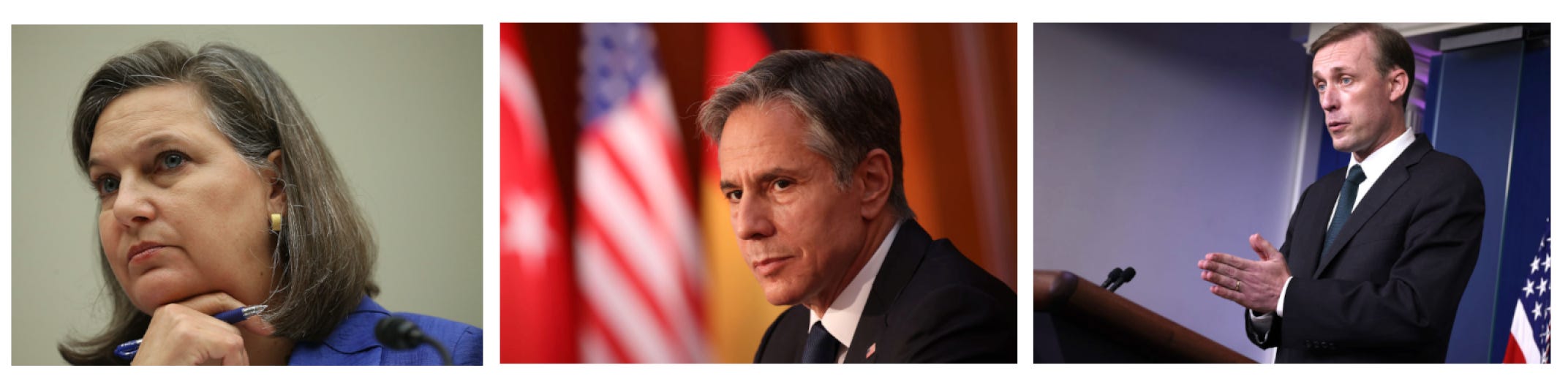
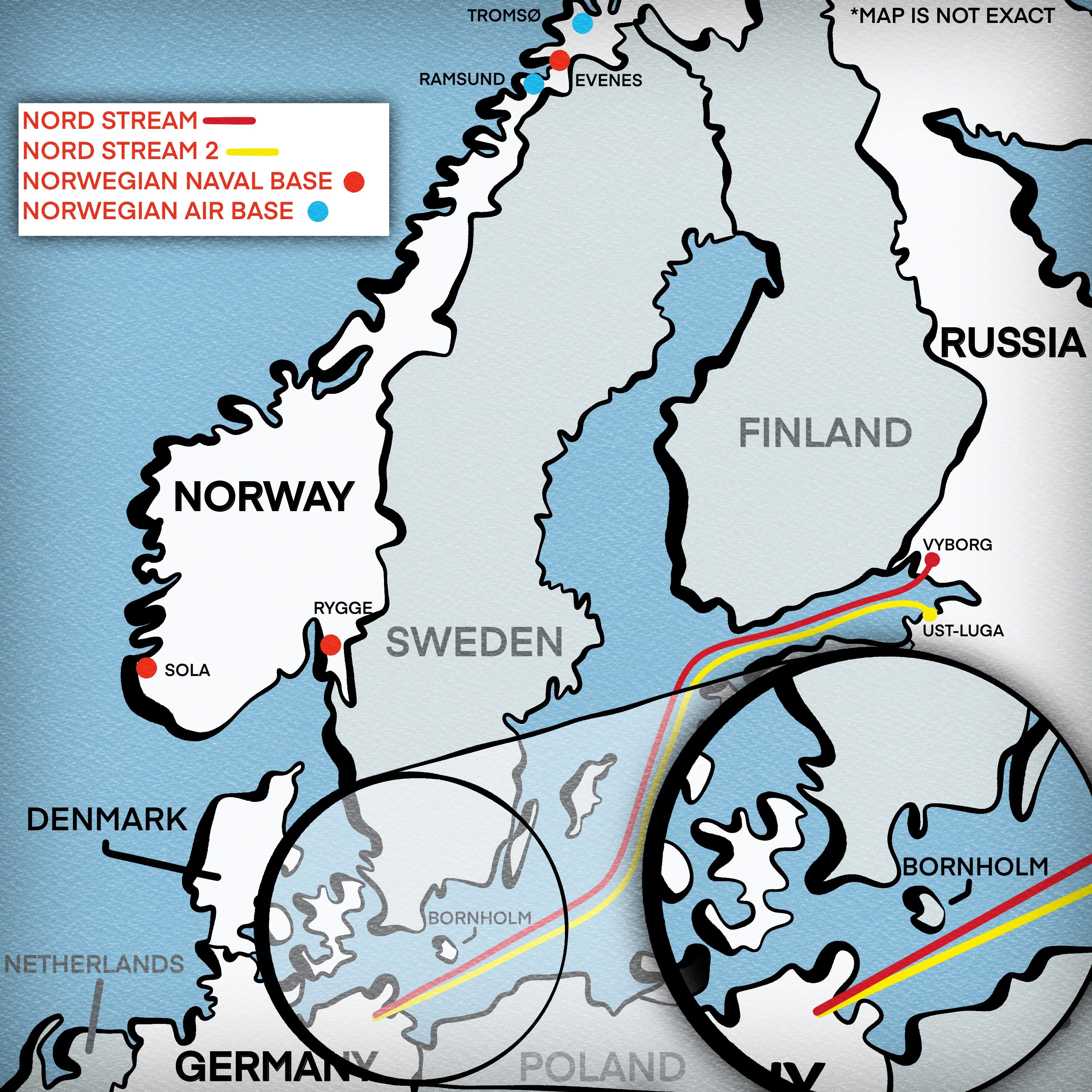
President Biden and his foreign policy team—National Security Adviser Jake Sullivan, Secretary of State Tony Blinken, and Victoria Nuland, the Undersecretary of State for Policy—had been vocal and consistent in their hostility to the two pipelines, which ran side by side for 750 miles under the Baltic Sea from two different ports in northeastern Russia near the Estonian border, passing close to the Danish island of Bornholm before ending in northern Germany.
The direct route, which bypassed any need to transit Ukraine, had been a boon for the German economy, which enjoyed an abundance of cheap Russian natural gas—enough to run its factories and heat its homes while enabling German distributors to sell excess gas, at a profit, throughout Western Europe. Action that could be traced to the administration would violate US promises to minimize direct conflict with Russia. Secrecy was essential.
From its earliest days, Nord Stream 1 was seen by Washington and its anti-Russian NATO partners as a threat to western dominance. The holding company behind it, Nord Stream AG, was incorporated in Switzerland in 2005 in partnership with Gazprom, a publicly traded Russian company producing enormous profits for shareholders which is dominated by oligarchs known to be in the thrall of Putin. Gazprom controlled 51 percent of the company, with four European energy firms—one in France, one in the Netherlands and two in Germany—sharing the remaining 49 percent of stock, and having the right to control downstream sales of the inexpensive natural gas to local distributors in Germany and Western Europe. Gazprom’s profits were shared with the Russian government, and state gas and oil revenues were estimated in some years to amount to as much as 45 percent of Russia’s annual budget.
America’s political fears were real: Putin would now have an additional and much-needed major source of income, and Germany and the rest of Western Europe would become addicted to low-cost natural gas supplied by Russia—while diminishing European reliance on America. In fact, that’s exactly what happened. Many Germans saw Nord Stream 1 as part of the deliverance of former Chancellor Willy Brandt’s famed Ostpolitik theory, which would enable postwar Germany to rehabilitate itself and other European nations destroyed in World War II by, among other initiatives, utilizing cheap Russian gas to fuel a prosperous Western European market and trading economy.
Nord Stream 1 was dangerous enough, in the view of NATO and Washington, but Nord Stream 2, whose construction was completed in September of 2021, would, if approved by German regulators, double the amount of cheap gas that would be available to Germany and Western Europe. The second pipeline also would provide enough gas for more than 50 percent of Germany’s annual consumption. Tensions were constantly escalating between Russia and NATO, backed by the aggressive foreign policy of the Biden Administration.
Opposition to Nord Stream 2 flared on the eve of the Biden inauguration in January 2021, when Senate Republicans, led by Ted Cruz of Texas, repeatedly raised the political threat of cheap Russian natural gas during the confirmation hearing of Blinken as Secretary of State. By then a unified Senate had successfully passed a law that, as Cruz told Blinken, “halted [the pipeline] in its tracks.” There would be enormous political and economic pressure from the German government, then headed by Angela Merkel, to get the second pipeline online.
Would Biden stand up to the Germans? Blinken said yes, but added that he had not discussed the specifics of the incoming President’s views. “I know his strong conviction that this is a bad idea, the Nord Stream 2,” he said. “I know that he would have us use every persuasive tool that we have to convince our friends and partners, including Germany, not to move forward with it.”
A few months later, as the construction of the second pipeline neared completion, Biden blinked. That May, in a stunning turnaround, the administration waived sanctions against Nord Stream AG, with a State Department official conceding that trying to stop the pipeline through sanctions and diplomacy had “always been a long shot.” Behind the scenes, administration officials reportedly urged Ukrainian President Volodymyr Zelensky, by then facing a threat of Russian invasion, not to criticize the move.
There were immediate consequences. Senate Republicans, led by Cruz, announced an immediate blockade of all of Biden’s foreign policy nominees and delayed passage of the annual defense bill for months, deep into the fall. Politico later depicted Biden’s turnabout on the second Russian pipeline as “the one decision, arguably more than the chaotic military withdrawal from Afghanistan, that has imperiled Biden’s agenda.”
The administration was floundering, despite getting a reprieve on the crisis in mid-November, when Germany’s energy regulators suspended approval of the second Nord Stream pipeline. Natural gas prices surged 8% within days, amid growing fears in Germany and Europe that the pipeline suspension and the growing possibility of a war between Russia and Ukraine would lead to a very much unwanted cold winter. It was not clear to Washington just where Olaf Scholz, Germany’s newly appointed chancellor, stood. Months earlier, after the fall of Afghanistan, Scholtz had publicly endorsed French President Emmanuel Macron’s call for a more autonomous European foreign policy in a speech in Prague—clearly suggesting less reliance on Washington and its mercurial actions.
Throughout all of this, Russian troops had been steadily and ominously building up on the borders of Ukraine, and by the end of December more than 100,000 soldiers were in position to strike from Belarus and Crimea. Alarm was growing in Washington, including an assessment from Blinken that those troop numbers could be “doubled in short order.”
The administration’s attention once again was focused on Nord Stream. As long as Europe remained dependent on the pipelines for cheap natural gas, Washington was afraid that countries like Germany would be reluctant to supply Ukraine with the money and weapons it needed to defeat Russia.
It was at this unsettled moment that Biden authorized Jake Sullivan to bring together an interagency group to come up with a plan.
All options were to be on the table. But only one would emerge.
PLANNING
In December of 2021, two months before the first Russian tanks rolled into Ukraine, Jake Sullivan convened a meeting of a newly formed task force—men and women from the Joint Chiefs of Staff, the CIA, and the State and Treasury Departments—and asked for recommendations about how to respond to Putin’s impending invasion.
It would be the first of a series of top-secret meetings, in a secure room on a top floor of the Old Executive Office Building, adjacent to the White House, that was also the home of the President’s Foreign Intelligence Advisory Board (PFIAB). There was the usual back and forth chatter that eventually led to a crucial preliminary question: Would the recommendation forwarded by the group to the President be reversible—such as another layer of sanctions and currency restrictions—or irreversible—that is, kinetic actions, which could not be undone?
What became clear to participants, according to the source with direct knowledge of the process, is that Sullivan intended for the group to come up with a plan for the destruction of the two Nord Stream pipelines—and that he was delivering on the desires of the President.
THE PLAYERS Left to right: Victoria Nuland, Anthony Blinken, and Jake Sullivan.
Over the next several meetings, the participants debated options for an attack. The Navy proposed using a newly commissioned submarine to assault the pipeline directly. The Air Force discussed dropping bombs with delayed fuses that could be set off remotely. The CIA argued that whatever was done, it would have to be covert. Everyone involved understood the stakes. “This is not kiddie stuff,” the source said. If the attack were traceable to the United States, “It’s an act of war.”
At the time, the CIA was directed by William Burns, a mild-mannered former ambassador to Russia who had served as deputy secretary of state in the Obama Administration. Burns quickly authorized an Agency working group whose ad hoc members included—by chance—someone who was familiar with the capabilities of the Navy’s deep-sea divers in Panama City. Over the next few weeks, members of the CIA’s working group began to craft a plan for a covert operation that would use deep-sea divers to trigger an explosion along the pipeline.
Something like this had been done before. In 1971, the American intelligence community learned from still undisclosed sources that two important units of the Russian Navy were communicating via an undersea cable buried in the Sea of Okhotsk, on Russia’s Far East Coast. The cable linked a regional Navy command to the mainland headquarters at Vladivostok.
A hand-picked team of Central Intelligence Agency and National Security Agency operatives was assembled somewhere in the Washington area, under deep cover, and worked out a plan, using Navy divers, modified submarines and a deep-submarine rescue vehicle, that succeeded, after much trial and error, in locating the Russian cable. The divers planted a sophisticated listening device on the cable that successfully intercepted the Russian traffic and recorded it on a taping system.
The NSA learned that senior Russian navy officers, convinced of the security of their communication link, chatted away with their peers without encryption. The recording device and its tape had to be replaced monthly and the project rolled on merrily for a decade until it was compromised by a forty-four-year-old civilian NSA technician named Ronald Pelton who was fluent in Russian. Pelton was betrayed by a Russian defector in 1985 and sentenced to prison. He was paid just $5,000 by the Russians for his revelations about the operation, along with $35,000 for other Russian operational data he provided that was never made public.
That underwater success, codenamed Ivy Bells, was innovative and risky, and produced invaluable intelligence about the Russian Navy’s intentions and planning.
Still, the interagency group was initially skeptical of the CIA’s enthusiasm for a covert deep-sea attack. There were too many unanswered questions. The waters of the Baltic Sea were heavily patrolled by the Russian navy, and there were no oil rigs that could be used as cover for a diving operation. Would the divers have to go to Estonia, right across the border from Russia’s natural gas loading docks, to train for the mission? “It would be a goat fuck,” the Agency was told.
Throughout “all of this scheming,” the source said, “some working guys in the CIA and the State Department were saying, ‘Don’t do this. It’s stupid and will be a political nightmare if it comes out.’”
Nevertheless, in early 2022, the CIA working group reported back to Sullivan’s interagency group: “We have a way to blow up the pipelines.”
What came next was stunning. On February 7, less than three weeks before the seemingly inevitable Russian invasion of Ukraine, Biden met in his White House office with German Chancellor Olaf Scholz, who, after some wobbling, was now firmly on the American team. At the press briefing that followed, Biden defiantly said, “If Russia invades . . . there will be no longer a Nord Stream 2. We will bring an end to it.”
Twenty days earlier, Undersecretary Nuland had delivered essentially the same message at a State Department briefing, with little press coverage. “I want to be very clear to you today,” she said in response to a question. “If Russia invades Ukraine, one way or another Nord Stream 2 will not move forward.”
Several of those involved in planning the pipeline mission were dismayed by what they viewed as indirect references to the attack.
“It was like putting an atomic bomb on the ground in Tokyo and telling the Japanese that we are going to detonate it,” the source said. “The plan was for the options to be executed post invasion and not advertised publicly. Biden simply didn’t get it or ignored it.”
Biden’s and Nuland’s indiscretion, if that is what it was, might have frustrated some of the planners. But it also created an opportunity. According to the source, some of the senior officials of the CIA determined that blowing up the pipeline “no longer could be considered a covert option because the President just announced that we knew how to do it.”
The plan to blow up Nord Stream 1 and 2 was suddenly downgraded from a covert operation requiring that Congress be informed to one that was deemed as a highly classified intelligence operation with U.S. military support. Under the law, the source explained, “There was no longer a legal requirement to report the operation to Congress. All they had to do now is just do it—but it still had to be secret. The Russians have superlative surveillance of the Baltic Sea.”
The Agency working group members had no direct contact with the White House, and were eager to find out if the President meant what he’d said—that is, if the mission was now a go. The source recalled, “Bill Burns comes back and says, ‘Do it.’”
“The Norwegian navy was quick to find the right spot, in the shallow water a few miles off Denmark’s Bornholm Island . . .”
THE OPERATION
Norway was the perfect place to base the mission.
In the past few years of East-West crisis, the U.S. military has vastly expanded its presence inside Norway, whose western border runs 1,400 miles along the north Atlantic Ocean and merges above the Arctic Circle with Russia. The Pentagon has created high paying jobs and contracts, amid some local controversy, by investing hundreds of millions of dollars to upgrade and expand American Navy and Air Force facilities in Norway. The new works included, most importantly, an advanced synthetic aperture radar far up north that was capable of penetrating deep into Russia and came online just as the American intelligence community lost access to a series of long-range listening sites inside China.
In return, the Norwegian government angered liberals and some moderates in its parliament last November by passing the Supplementary Defense Cooperation Agreement (SDCA). Under the new deal, the U.S. legal system would have jurisdiction in certain “agreed areas” in the North over American soldiers accused of crimes off base, as well as over those Norwegian citizens accused or suspected of interfering with the work at the base.
Norway was one of the original signatories of the NATO Treaty in 1949, in the early days of the Cold War. Today, the supreme commander of NATO is Jens Stoltenberg, a committed anti-communist, who served as Norway’s prime minister for eight years before moving to his high NATO post, with American backing, in 2014. He was a hardliner on all things Putin and Russia who had cooperated with the American intelligence community since the Vietnam War. He has been trusted completely since. “He is the glove that fits the American hand,” the source said.
Back in Washington, planners knew they had to go to Norway. “They hated the Russians, and the Norwegian navy was full of superb sailors and divers who had generations of experience in highly profitable deep-sea oil and gas exploration,” the source said. They also could be trusted to keep the mission secret. (The Norwegians may have had other interests as well. The destruction of Nord Stream—if the Americans could pull it off—would allow Norway to sell vastly more of its own natural gas to Europe.)
Sometime in March, a few members of the team flew to Norway to meet with the Norwegian Secret Service and Navy. One of the key questions was where exactly in the Baltic Sea was the best place to plant the explosives. Nord Stream 1 and 2, each with two sets of pipelines, were separated much of the way by little more than a mile as they made their run to the port of Greifswald in the far northeast of Germany.
The Norwegian navy was quick to find the right spot, in the shallow waters of the Baltic sea a few miles off Denmark’s Bornholm Island. The pipelines ran more than a mile apart along a seafloor that was only 260 feet deep. That would be well within the range of the divers, who, operating from a Norwegian Alta class mine hunter, would dive with a mixture of oxygen, nitrogen and helium streaming from their tanks, and plant shaped C4 charges on the four pipelines with concrete protective covers. It would be tedious, time consuming and dangerous work, but the waters off Bornholm had another advantage: there were no major tidal currents, which would have made the task of diving much more difficult.
After a bit of research, the Americans were all in.
At this point, the Navy’s obscure deep-diving group in Panama City once again came into play. The deep-sea schools at Panama City, whose trainees participated in Ivy Bells, are seen as an unwanted backwater by the elite graduates of the Naval Academy in Annapolis, who typically seek the glory of being assigned as a Seal, fighter pilot, or submariner. If one must become a “Black Shoe”—that is, a member of the less desirable surface ship command—there is always at least duty on a destroyer, cruiser or amphibious ship. The least glamorous of all is mine warfare. Its divers never appear in Hollywood movies, or on the cover of popular magazines.
“The best divers with deep diving qualifications are a tight community, and only the very best are recruited for the operation and told to be prepared to be summoned to the CIA in Washington,” the source said.
The Norwegians and Americans had a location and the operatives, but there was another concern: any unusual underwater activity in the waters off Bornholm might draw the attention of the Swedish or Danish navies, which could report it.
Denmark had also been one of the original NATO signatories and was known in the intelligence community for its special ties to the United Kingdom. Sweden had applied for membership into NATO, and had demonstrated its great skill in managing its underwater sound and magnetic sensor systems that successfully tracked Russian submarines that would occasionally show up in remote waters of the Swedish archipelago and be forced to the surface.
The Norwegians joined the Americans in insisting that some senior officials in Denmark and Sweden had to be briefed in general terms about possible diving activity in the area. In that way, someone higher up could intervene and keep a report out of the chain of command, thus insulating the pipeline operation. “What they were told and what they knew were purposely different,” the source told me. (The Norwegian embassy, asked to comment on this story, did not respond.)
The Norwegians were key to solving other hurdles. The Russian navy was known to possess surveillance technology capable of spotting, and triggering, underwater mines. The American explosive devices needed to be camouflaged in a way that would make them appear to the Russian system as part of the natural background—something that required adapting to the specific salinity of the water. The Norwegians had a fix.
The Norwegians also had a solution to the crucial question of when the operation should take place. Every June, for the past 21 years, the American Sixth Fleet, whose flagship is based in Gaeta, Italy, south of Rome, has sponsored a major NATO exercise in the Baltic Sea involving scores of allied ships throughout the region. The current exercise, held in June, would be known as Baltic Operations 22, or BALTOPS 22. The Norwegians proposed this would be the ideal cover to plant the mines.
The Americans provided one vital element: they convinced the Sixth Fleet planners to add a research and development exercise to the program. The exercise, as made public by the Navy, involved the Sixth Fleet in collaboration with the Navy’s “research and warfare centers.” The at-sea event would be held off the coast of Bornholm Island and involve NATO teams of divers planting mines, with competing teams using the latest underwater technology to find and destroy them.
It was both a useful exercise and ingenious cover. The Panama City boys would do their thing and the C4 explosives would be in place by the end of BALTOPS22, with a 48-hour timer attached. All of the Americans and Norwegians would be long gone by the first explosion.
The days were counting down. “The clock was ticking, and we were nearing mission accomplished,” the source said.
And then: Washington had second thoughts. The bombs would still be planted during BALTOPS, but the White House worried that a two-day window for their detonation would be too close to the end of the exercise, and it would be obvious that America had been involved.
Instead, the White House had a new request: “Can the guys in the field come up with some way to blow the pipelines later on command?”
Some members of the planning team were angered and frustrated by the President’s seeming indecision. The Panama City divers had repeatedly practiced planting the C4 on pipelines, as they would during BALTOPS, but now the team in Norway had to come up with a way to give Biden what he wanted—the ability to issue a successful execution order at a time of his choosing.
Being tasked with an arbitrary, last-minute change was something the CIA was accustomed to managing. But it also renewed the concerns some shared over the necessity, and legality, of the entire operation.
The President’s secret orders also evoked the CIA’s dilemma in the Vietnam War days, when President Johnson, confronted by growing anti-Vietnam War sentiment, ordered the Agency to violate its charter—which specifically barred it from operating inside America—by spying on antiwar leaders to determine whether they were being controlled by Communist Russia.
The agency ultimately acquiesced, and throughout the 1970s it became clear just how far it had been willing to go. There were subsequent newspaper revelations in the aftermath of the Watergate scandals about the Agency’s spying on American citizens, its involvement in the assassination of foreign leaders and its undermining of the socialist government of Salvador Allende.
Those revelations led to a dramatic series of hearings in the mid-1970s in the Senate, led by Frank Church of Idaho, that made it clear that Richard Helms, the Agency director at the time, accepted that he had an obligation to do what the President wanted, even if it meant violating the law.
In unpublished, closed-door testimony, Helms ruefully explained that “you almost have an Immaculate Conception when you do something” under secret orders from a President. “Whether it’s right that you should have it, or wrong that you shall have it, [the CIA] works under different rules and ground rules than any other part of the government.” He was essentially telling the Senators that he, as head of the CIA, understood that he had been working for the Crown, and not the Constitution.
The Americans at work in Norway operated under the same dynamic, and dutifully began working on the new problem—how to remotely detonate the C4 explosives on Biden’s order. It was a much more demanding assignment than those in Washington understood. There was no way for the team in Norway to know when the President might push the button. Would it be in a few weeks, in many months or in half a year or longer?
The C4 attached to the pipelines would be triggered by a sonar buoy dropped by a plane on short notice, but the procedure involved the most advanced signal processing technology. Once in place, the delayed timing devices attached to any of the four pipelines could be accidentally triggered by the complex mix of ocean background noises throughout the heavily trafficked Baltic Sea—from near and distant ships, underwater drilling, seismic events, waves and even sea creatures. To avoid this, the sonar buoy, once in place, would emit a sequence of unique low frequency tonal sounds—much like those emitted by a flute or a piano—that would be recognized by the timing device and, after a pre-set hours of delay, trigger the explosives. (“You want a signal that is robust enough so that no other signal could accidentally send a pulse that detonated the explosives,” I was told by Dr. Theodore Postol, professor emeritus of science, technology and national security policy at MIT. Postol, who has served as the science adviser to the Pentagon’s Chief of Naval Operations, said the issue facing the group in Norway because of Biden’s delay was one of chance: “The longer the explosives are in the water the greater risk there would be of a random signal that would launch the bombs.”)
On September 26, 2022, a Norwegian Navy P8 surveillance plane made a seemingly routine flight and dropped a sonar buoy. The signal spread underwater, initially to Nord Stream 2 and then on to Nord Stream 1. A few hours later, the high-powered C4 explosives were triggered and three of the four pipelines were put out of commission. Within a few minutes, pools of methane gas that remained in the shuttered pipelines could be seen spreading on the water’s surface and the world learned that something irreversible had taken place.
FALLOUT
In the immediate aftermath of the pipeline bombing, the American media treated it like an unsolved mystery. Russia was repeatedly cited as a likely culprit, spurred on by calculated leaks from the White House—but without ever establishing a clear motive for such an act of self-sabotage, beyond simple retribution. A few months later, when it emerged that Russian authorities had been quietly getting estimates for the cost to repair the pipelines, the New York Times described the news as “complicating theories about who was behind” the attack. No major American newspaper dug into the earlier threats to the pipelines made by Biden and Undersecretary of State Nuland.
While it was never clear why Russia would seek to destroy its own lucrative pipeline, a more telling rationale for the President’s action came from Secretary of State Blinken.
Asked at a press conference last September about the consequences of the worsening energy crisis in Western Europe, Blinken described the moment as a potentially good one:
“It’s a tremendous opportunity to once and for all remove the dependence on Russian energy and thus to take away from Vladimir Putin the weaponization of energy as a means of advancing his imperial designs. That’s very significant and that offers tremendous strategic opportunity for the years to come, but meanwhile we’re determined to do everything we possibly can to make sure the consequences of all of this are not borne by citizens in our countries or, for that matter, around the world.”
More recently, Victoria Nuland expressed satisfaction at the demise of the newest of the pipelines. Testifying at a Senate Foreign Relations Committee hearing in late January she told Senator Ted Cruz, “Like you, I am, and I think the Administration is, very gratified to know that Nord Stream 2 is now, as you like to say, a hunk of metal at the bottom of the sea.”
The source had a much more streetwise view of Biden’s decision to sabotage more than 1500 miles of Gazprom pipeline as winter approached. “Well,” he said, speaking of the President, “I gotta admit the guy has a pair of balls. He said he was going to do it, and he did.”
Asked why he thought the Russians failed to respond, he said cynically, “Maybe they want the capability to do the same things the U.S. did.
“It was a beautiful cover story,” he went on. “Behind it was a covert operation that placed experts in the field and equipment that operated on a covert signal.
Seymour Hersh is a venerable US investigative journalist, who received the 1970 Pulitzer Prize for exposing the My Lai massacre and its cover-up during the Vietnam war.
On June 26, 2022, the Russian forces found the scraps of a US passport card, near the blast furnace where the Ukrainians had burnt a dozen corps, inside Azovstal steel mill, Mariupol, Donetsk People’s Republic (screenshot)
In a bitter proxy war that NATO is conducting against Russia, in Donbass and Ukraine, Joe Biden stated on October 21, 2022
the conflict in Ukraine should not end with the success of Russia. Washington has spent a lot of money to help Kyiv. But it’s about much more than Ukrainians, it’s about NATO, it’s about Western Europe. It’s about making sure Putin can’t succeed
Without the explicit mention of a cyanide alternative, the German president of the European Commission, Ursula von der Leyen, added on November 24
the European Union will not rest until Ukraine defeats Putin
I am usually neglecting the statements from politicians, who in the West, have become psychodrama or comedy characters. But these harsh words make sense.
The military facts are however cruel and along with many other analysts, I would suggest Leyen an alternative from big pharma. Russia has already liberated Mariupol, reached the left bank of Dnieper river, seized Zaporojie nuclear power plant (ZNPP) in Energodar, is conducting in Donbass an implacable attrition war, with a much more powerful artillery and the air supremacy. Bakhmut is currently a meat grinder for the Ukrainian cannon fodder. Its near liberation may trigger a wider collapse of the Atlanticist defense in Donbass. NATO is providing Ukraine with a huge intelligence support, is flooding the country with weapons and ammunition, is depleting its own stocks, but these shipments are so far insufficient against the military power of Russia, better trained troops and better command. Politics and propaganda are affecting too much an Atlanticist strategy, which is despising the life of its own fighters
Negotiations between Russia and Ukraine started quickly after the beginning on February 24, 2022, of the Russian specialmilitary operation. Its goals were moderate and clear : liberation of Russian-speaking Donbass, demilitarization and denazification of Ukraine. The third point sought the enforcement of a legal arsenal against Russophobia and the Nazi organizations which are populating the Ukrainian deep State since Maidan, a rightist coup in February 2014. The peace was reachable in March 2022, but the US and UK prevented it. NATO is striving, against all forecasts, to achieve a strategic victory and I suspect, for the wet dream of dismantling Russia. Dire situation. How to protract the moronic ambition to achieve victory, without the direct involvement of NATO forces, which would trigger a nuclear WW3 ? Well, they did it. A kind of unofficial direct involvement of NATO.
The Russian gains have been punctuated with the discoveries of weird clues. Under the command in Mariupol of Nazi Azov regiment, the last defenders of Azovstal steel mill surrendered on May 20, 2022
Russian victory in Azovstal (Komsomolskaya Pravda)
Several hundred corpses had been gathered in cold-storage rooms during the siege. But in June, the Russian forces found that the Ukrainians had used a blast furnace as a crematorium, inside and nearby, the remnants of a dozen incinerated corpses. Why ? Clue : the scraps of a US passport card, related to [….] Louise [….]ford, born on April 7, [….] Yet, the involvement of Western mercenaries in the Ukrainian ranks was a common military fact from the beginning. Many are proud of their feats, which are described on social networks. A British national, Aiden Aslin, was the first captured mercenary, on April 12, 2022, in Mariupol. But on January 29, 2023, in Bakhmut, Russian fighters with Wagner private military company (PMC) found several corpses, whose heads and hands had been cut off, in order to prevent their identification. Why ?
When the HIMARS (High Mobility Artillery Rocket System), for example, arrived in Ukraine in June 2022, some experts were discussing the necessary presence of US service members at some echelons, in order to ensure the efficiency of such a weapon. Meanwhile, the casualties had been severe from the beginning, Ukraine had lost most of its best fighters. The general mobilization had brought replacements, which were poorly trained conscripts. That new infantry needed mentoring and during the first counteroffensives, early September 2022, foreign mercenaries appeared in force at the forefront. One way for NATO to unofficially inject troops is the fake resignation of service members, who later surface on the battlefield, within PMCs
Screenshots from the GoPro camera of a dead Western mercenary, whose formation was wiped out near Zaporojie, on October 7, 2022
The Israeli intelligence may have achieved a precise distinction between fake and real mercenaries, between undercover NATO fighters and mercenaries. An alleged Israeli assessment has leaked to Turkey, where the press has written on January 25, 2023, that by January 14,
165,000 Atlanticist fighters, including
8,000 foreigners, had been killed in Donbass and Ukraine since February 24, 2022. Among the 8,000 foreigners, the most were mercenaries, but
2,692 were actually service members from NATO countries (Germany, Lithuania, Poland, UK, US… etc) According to the same piece, the Russian fatalities were
18,500, nine times less, at the same date.
From March to September 2022, I have written a chronicle about the siege of Mariupol. I am still convinced that dozens French operatives were taken prisoners there.
the saga of the Western Panzerkampfwagen in Donbass and Ukraine
Humor on social networks
Overture
A little over 80 years ago, in 1941, under the leadership of Germany, Europe invaded the Soviet Union. In June 1942, Ukraine was the rear base of a Nazi offensive toward the Caucasus and Volga river, but in January 1943, the annihilation of Friedrich Paulus’ 6. Armee at Stalingrad reversed the tide of WW2. The last Nazi offensive, in July, triggered around Kursk the largest tank battle in history and a new Soviet victory. The Red Army liberated Kiev in November 1943 and seized Berlin in May 1945
French propaganda poster in 1941
Lviv is in western Ukraine the epicenter of a Nazi legacy since WW2. Late 2013, an economical dispute with the European Union led, in western Ukraine and Kiev, to a pro-Europe uprising against the legal government. With the help of Nazi political organizations from Lviv and likely, foreign provocative gunmen, NATO achieved a rightist coup in February 2014. Later, Russian-speaking residents of Crimea and Donbass have risen up against the Russophobia of the new authorities, which called them terrorists, cracked down on them with the loyal members of the armed forces and the same Nazi militants, legalized meanwhile as paramilitaries. That was the outbreak of war in Donbass. NATO countries are offering their military support to Ukraine since the beginning. Galvanized, the successive Ukrainian governments did not seriously negotiate, have not implemented Minsk peace agreements. Former German Kanzlerin, Angela Merkel confessed to der Zeit on December 7, 2022
2014 Minsk agreement was an attempt to buy Ukraine time. It has used this time to strengthen itself, as can be seen today
Angela Merkel (left) is introduced at the carnival parade in Düsseldorf on March 3, 2014. The character at right is so shabby that he does not deserve to be named (Martin Meissner / AP)
France and Germany were hypocritical when they sponsored an agreement which was supposed to cease fire and bring peace. The Western goal was actually to gain time, in order for NATO to reinforce the military power of the Ukrainian Nazi deep State. Ukraine has carried on with the terrorist shelling of civilians and on February 24, 2022, Russia has started a special military operation, in order to liberate Donbass, demilitarize and denazify Ukraine. That is the proxy war that NATO was seeking. Why ? In order to preserve a hegemony on the decline if not already an illusion, against Russia, China and most of the wide world, for a new world order against a multipolar one, the US and their European vassals are regarding that war as an opportunity of strategic victory. Their wet dream is to dismember Russia and subdue China
Humor on May 15, 2022 (Liu Rui / Global Times)
Among other symbolic references to Nazism and German army during WW2, the Ukrainian military vehicles are displaying a white cross since September 2022
(Screenshot)
The Balkenkreuz [bar cross] was the common sign on German Panzer on September 1, 1939, when began the invasion of Poland and WW2. The symbol later evolved and remained until 1945
Russia is enforcing an attrition strategy. The operations are a carnage for the Ukrainian forces. While the Ukrainian artillery is firing around 6,000 shells a day all over the front line, the Russian consumption may raise to 50,000, has reminded late November 2022 a senior anonymous NATO official. In view of the Russian air supremacy, tactical, operational and strategic strikes on military targets, despite the massive involvement of Western intelligence, the Ukrainian casualties are obviously far higher
In the suburb of Bakhmut, a Russian T-80 is collaborating with an observer and his drone, is treating a Ukrainian entrenchment at less than 30 m, in order to ease the advance of infantry (screenshot on December 30, 2022)Ukrainian servicemen complain on line about lack of equipment, flight of officers and terrible casualties. These thirty men, one platoon, are the last able-bodied fighters, maybe 25%, within a whole company of the 25th airborne brigade (screenshot on December 12, 2022)As often in Ukraine, here in Kiev on December 30, 2022, women are demonstrating and demanding news or the corpses of their missing relatives, which are likely dead but nobody has informed the families. For propaganda reason, the authorities are hiding the reality of severe military losses. Moreover, no pension is paid for a missing service member
According to a Russian mathematical model, the Ukrainian military fatalities since February 24 are currently above 150,000. On November 30, the president of the European Commission, Ursula von der Leyen, confirmed that the death toll was already above 100,000. The fatalities are not restricted to the Ukrainian cannon fodder, Western mercenaries are also killed in the ranks of that Atlanticist army
Coffins of Polish and US fighters near Kharkov on December 9, 2022 (social networks)
Lock of the Atlanticist defense system in the still occupied part of Donbass, Bakhmut, also called Artemovsk, is a hot spot, where the Ukrainian reserves are currently sacrificed
Situation map around Bakhmut on January 23, 2023 (RYBAR)
For Wagner private military company (PMC), a major Russian force involved so far in the area, Yevgeny Prigozhin has already stated on November 26, 2022
Bakhmut is a large, well-fortified area with roads, suburbs, and water barriers. The Ukrainian army is well-prepared and offers decent resistance. Our task is not Bakhmut itself, but the attrition of the Ukrainian army to reduce its combat potential, which is why this operation has been dubbed the ‘Bakhmut meat grinder.’ In this regard, do not run ahead of the locomotive, we will let you know, happiness loves silence
On January 15, 2023, Yevgeny Prigozhin (right) congratulates one assault squad leader (Wagner)
In the hope of turning the tide in 2023, Ukraine should receive Western armored fighting vehicles (AFV), 59 US infantry fighting vehicles (IFV) Bradley, 40 German IFV Marder and 30 French AMX-10 RC, which are not tanks, despite their 105 mm gun, but old armored recce vehicles
Turkish media early January
On January 11, 2023, Volodymyr Zelenskyy met in Lviv, western Ukraine, his counterparts from Lithuania and Poland, Gitanas Nausėda and Andrzej Duda. Together, they decided to reinforce in Ukraine the defense of the so-called Euro-Atlantic coalition. Poland would transfer a company of German-made Leopard tanks
(Official)
In the wake, the UK has announced the delivery of 14 Challenger tanks. But in matter of Leopards, Poland and the other east European good wills need that Germany allows their export.
German newspaper Süddeutsche Zeitung reported that in a phone call with US president Joe Biden on January 17, Kanzler Olaf Scholz has claimed to be ready to deliver Leopards to Ukraine, but on one condition : if the US in turn delivered Abrams tanks. On January 19, der Bundestag debated the delivery of Panzer to Ukraine. Member of parliament Peter Bystron, AfD (Alternative für Deutschland, Alternative for Germany, right-wing), stated
German Panzer against Russia in Ukraine ? By the way, you already tried that with the Melnyks and Banderas [Stepan Bandera, Ukrainian Nazi leader during WW2] and what is the result ? Unspeakable suffering, millions of dead on both sides and in the end, Russian tanks here in Berlin !
(Screenshot)
He added
The conflict in Ukraine cannot be solved with Panzer, only with diplomacy […] Only the US armaments companies benefit from arms deliveries […] The majority of the German people reject arms deliveries to Ukraine. The traffic light government [red-green] should finally start conducting politics in the interests of the German people
A number of parties were opposing the transfer and the decision was postponed. Meanwhile, the Russian regular forces started attacking in the south, are threatening Orekhovsky, 65 km southeast of Ukrainian-occupied Zaporojie, on the left bank of Dnieper river. If confirmed and successful, such an offensive could lead to the destruction of the Atlanticist forces east of the river
Andriy Melnyk is the previous ambassador to Germany, a revisionist and an apologist of his national hero, Ukrainian Nazi war criminal Stepan Bandera. On November 18, Volodymyr Zelenskyy has appointed him deputy foreign affairs minister. On January 20, 2023, Melnyk called for a tank coalition in Ukraine
Representatives of the Atlanticist coalition, the US, Ukraine and their auxiliaries, met the same day in the US military base in Ramstein, Germany, but did not announce the delivery of Leopard or Abrams tanks
(Wolfgang Rattay / Reuters)
According to dem Spiegel, the Bundesnachrichtendienst (BND, German intelligence) was then assessing that the Atlanticist forces were losing three-digit numbers of soldiers every day around Bakhmut.
On January 21, a Wagner fighter proudly displayed his trophies, including the chevrons that he had seized in Bakhmut area, on demilitarized foreign mercenaries from Canada, Georgia, Italy, Turkey, the UK and US
(Screenshot)
In the Ostgebiete [eastern territories] on January 23, the psychodrama went on when Polish prime minister Mateusz Morawiecki stated
We will apply for such consent from Germany, but this is a secondary topic. Even if we do not get this consent at the end, as part of a small coalition, even if the Germans would not be in this coalition, we will still hand over our tanks [German Leopards] together with others to Ukraine. The condition for us at the moment is to build at least a just small coalition of States […] in Western Europe […]
The campaign #FreeTheLeopards was trending on social networks, with involvement of characters like Finnish prime minister Sanna Marin
(Screenshots)
and German stylist Frank Peter Wild, who was advocating for a while on Instagram, from his elevator in Berlin
Here was the distribution of Leopard Panzerkampfwagen across Europe on January 23, 2023
The French press may be the worst coterie worldwide of atavistic lackeys. The State is subsidizing them all. Their reports about the prospects of tanks delivery to Ukraine are hilarious. The public propaganda channel franceinfo asks on January 24
The suspense ends the same day, when according to dem Spiegel and other German outlets, Kanzler Olaf Scholz has agreed to send German Panzerkampfwagen to Ukraine. The historians will measure the part of the submission to the US and that of a pure German neurosis
Hasso von Manteuffel in the Baltic States on August 31, 1944
My brief forecast : the Western tanks are carrying four crew members, require training, will not be soon on the front line. A few dozens will not turn the tide in Ukraine, but will be destroyed. According to the Russian defense ministry, the Atlanticist forces have already lost more than 7,600 tanks and other AFVs in 11 months, since February 24, 2022. The spectacle of the combustion on the battlefield of Western tanks may have a larger psychological and political impact than their military influence
January 25, 2023
The government confirms that Germany will send 14 Leopards to Ukraine. The plan is to form two battalions, that is about 88 tanks, with contribution of other countries. New German defense minister, Boris Pistorius predicts that these formations may reach the front line in about three months, that is early May.
Poland has already announced the delivery of a company, that is 14 vehicles. Germany has managed to convince the US, which will deliver 31 Abrams, confirms Joe Biden. 14 British Challengers should be also part of the 88 Western Panzerkampfwagen ultimately engaged in Ukraine. 75% of mankind are eager to watch their wrecks on the battlefield. Government by grocers is a curse.
For a wide majority of Russians, the near involvement of Western tanks is a reminder of the Great Patriotic War against Nazi Europe. Some channels are giving advice on how to burn the new German Panzerkampfwagen
Ukraine needs now crew members and more broadly, a new batch of cannon fodder. I guess some recruits were volunteer in March 2022, but the most are likely dead, now. The scenes of forced mobilization are increasingly cruel. An amateur video surfaces from Cherkasy. The woman has attempted to record the abduction of the man
(Screenshots)
January 26, 2023
The first rewards are offered on social networks. One million rubles for the first captured Panzerkampfwagen, the half for the first destroyed one
The same day, Pentagon spokeswoman Sabrina Singh states
we just don’t have these tanks [Abrams M1A2] available in excess in our US stocks
That is why the vehicles for Ukraine shall be manufactured. According to Politico, the sole plant is producing 12 machines per month, is overbooked for Taiwan and Poland, which is eager to replace its 250 T-72 already delivered to Ukraine.
January 27, 2023
The near shipment of German Panzerkampfwagen to Ukraine makes people think in Charlottenburg, West Berlin
Vielleicht nicht wieder ? (screenshot)
January 29, 2023
The supposed Ukrainian crew members of British Challenger tanks have arrived in the UK for training
(British Ministry of Defence)
February 3, 2023
Berlin has approved their exportation, Rheinmetall company plans to sell 88 Leopard I (one) to Ukraine for €100 million. The tank entered service in 1965. The version should be 1A5, an improvement in 1987, but the gun is still 105 mm and the armor is feeble. The Westerners have no regard for the Ukrainian cannon fodder
Panzerkampfwagen I within the fascist forces during the Spanish civil war (1936 – 1939, Armin Freitag)
February 7, 2023
German defense minister Boris Pistorius (left) visits Kiev, has brought the model of a Leopard 2 to Oleksii Reznikov, who is still his counterpart for a few days. Reznikov is falling because of a corruption scandal within his ministry. Surprising. The prosecution of a corruption case is surprising in Ukraine
(Twitter)
Meanwhile, Ukrainian formations are training at Belarus border, are displaying their Balkenkreuze
(Ukrainian accounts on social networks)
February 9, 2023
Handelsblatt has interviewed Armin Papperger, Rheinmetall CEO. The German company is talking to Kyiv about exporting the Panther […] in 15 to 18 months. Still under development, the KT (Kettenfahrzeug [tracked vehicle]) 51 Panther is based on the hull of the Leopard 2A4, with a new turret, a 130 mm gun and its auto-loader
(Rheinmetall)
The Panzerkampfwagen [armored fighting car] V Panther was intended to counter the Soviet T-34, was baptized in Kursk vicinity in July 1943, during the largest tank battle in history, a Soviet victory and a defeat for Nazi Europe
One destroyed Panther on Kursk battlefield
The disgrace is that so many Germans have forgotten so quickly that they are most offspring of Nazis. If modern Germany was a respectable country, its leaders would consider the legitimate demands of Russia, would strive to bring peace in such a situation, would not send Panzer.
February 10, 2023
Public radio station Deutschlandfunk broadcasts the interview of 96-year-old Joachim Höppner, who was tank gunner within the Wehrmacht, 2. Panzerdivision, was involved in the battle of the Bulge, from December 1944 to January 1945, was later taken prisoner on the east front and detained in Soviet Ukraine. The interview provokes the ire of Andriy Melnyk and BILD, a grassroots reactionary tabloid for German rednecks. Melnyk is the current deputy foreign affairs minister in Ukraine, a revisionist and an ardent thurifer of Stepan Bandera, the Ukrainian Nazi leader during WW2.
Höppner has become paficist, states about Panzerkampfwagen shipment to Ukraine
What are these heavy weapons which are being supplied ? What are the people who make such decisions thinking about ? You can’t solve any problems with weapons
BILD trolls hard, attacks Höppner and Deutschlandfunk over the military experience of the first, veteran within the Wehrmacht, but is supporting a modern Ukrainian State who is usually paying tribute to the Ukrainian SS and the UPA, a Nazi paramilitary formation during WW2. Its editorial line is for the Germans, the most in West Germany, who under the US umbrella, did not achieve their grieve about the German Nazi defeat against Soviet Union, which scored 80% of the German military losses during WW2. BILD is the prominent illustration of a German neurosis. How dumm or rather neurotic are such Germans, who become mad when Russia is conducting a special military operation in Donbass and Ukraine, but duck when the US sabotage Nord Stream.
February 17, 2023
The Washington Post is a US militant outlet, which is expressing a strong support to Volodymyr Zelenskyy’s Ukraine. On February 14, Michael de Adder has drawn an interesting cartoon. The NATO team, no specific country, is hurrying up to prepare Ukraine for a spring offensive. And the tank is a German Leopard
But reality is more difficult. On January 24, the German government has agreed to deliver them and to allow their export by customers. Most of these leaders are exalted blabbermouths and soon, the announcements added up to dozens machines from several European countries. Three weeks later, the fever is gone. Der Spiegel has interviewed Boris Pistorius, the German defense minister. Germany should transfer 14 Leopard 2A6 and Portugal, three. Older versions and even archaic Leopards 1 could be delivered, but many of these tanks are in poor condition and need repairs. I stress that one German demand for the agreement was the shipment of US Abrams, but it could be postponed indefinitely.
February 24, 2023
The Polish prime minister announces that the first batch of Polish tanks, already transferred to Ukraine, is including four Leopard 2. In the wake, the German defense ministry adds that Germany will send four additional ones. Platoon by platoon ? Warfare or communication ? Please hurry up, gentlemen, you can hardly imagine how the wide world is eager to watch them… in action
Here in northwestern Syria, on December 25, 2016, a Leopard 2 (right) has been demilitarized
The Ukrainian government confirms later with photos the Polish delivery. The machines are an old version, Leopard 2A4
Oleksii Reznikov, defense, Denys Shmyhal, prime minister
As usual in Ukraine, here in Odessa, volunteers are rushing to become crew members of the new tanks and defend democracy. The two men in military fatigues are recruitment officers. In black uniforms, two police officers watch the abduction
(Screenshots from an amateur video)
In the previous night, a damaged tank has been set up in front of the Russian embassy, on Unter de Linden avenue, Berlin. An art performance, that the administrative court had authorized in October. The T-72 has come from a museum in Kiev, was allegedly Russian, would have been seized during the special military operation. Still that German neurosis, I guess
I really love this splendid picture in May 1945 of a victorious T-34, in front of the Brandenburger Tor
The organizers were hardly expecting how their propaganda operation is hijacked in front of the Russian embassy. While other demonstrators are gathering a few hundreds meters away, in front of the Branderburger Tor, Berliners are laying hundreds red flowers on the Russian tank, in protest to the Western military support, which is protracting the Atlanticist proxy war in Ukraine, despite a Chinese peace plan.
(Screenshot)
February 26, 2023
Yevgeny Prigozhin states that according to intelligence, the Atlanticist command is sending the Leopards 2A4, four machines, one platoon, to Chasov Yar, a town about 15 km west of Bakhmut, a city that the Russian forces have caught in a vice.
I hope so, did not expect it.
The alternative is that the Panzerkampfwagen are game changers or they are not. In the first case, engagement by dropper will dilute them on the battlefield. In both cases, the pictures of destroyed machines will be a propaganda victory for Russia, while various countries are still wondering if they will deliver Western tanks.
never interrupt an enemy who is making a mistake
has said Corsican general Napoleone Buonaparte.
Give more weapons
March 6, 2023
No Western Panzerkampfwagen has been committed so far in the fighting, which have reached the outskirts of Chasov Yar, where a Ukrainian T-64 burns
(Libkos / AP)
March 13, 2023
Ukrainian service members wrapped up a four-week training near Zaragoza
(Oscar del Pozo / AFP)
Spain has schooled 40 crew members and 15 mechanics, should deliver six Leopard 2A4.
March 20, 2023
Annabel Goldie is Minister of State for Defense, a subordinate of defense minister Ben Wallace. She answers a question on the site of the parliament and confirms that the UK would send to Ukraine depleted uranium (DU) armor piercing rounds with the Challenger tanks
During the invasion of Iraq in 2003, Anglo-Saxon troops shot between 1,000 and 2,000 tonnes of DU munitions. Their debris are chemically and radiologically toxic for their users and later, for the population of the former battlefield.
March 21, 2023
An amateur video surfaces on social networks, is showing a Leopard 2A4, allegedly in Ukraine or Donbass
(Screenshot)
March 22, 2023
The Daily Mail explains to its readers what are the DU armor piercing rounds
March 27, 2023
The Ukrainian defense ministry publishes a photo where Oleksii Reznikov stands in front of Western vehicles
From the left, the second one is a US Stryker Interim Armored Vehicle (IAV), the third, a British Challenger tank and the fourth, a German Marder Schützenpanzer.
March 31, 2023
Ukraine has received so far several dozen Western heavy armored vehicles, Panzer and infantry fighting vehicles (IFV) like German Marders, is about to receive US Bradleys. None has been engaged in fighting. They are gathered in the prospects of a counteroffensive, which may begin in April.
Its goals could be the rescue of Bakhmut garrison or to the south, the Russian continental lines of communication to Crimea.
April 11, 2023
A leak of classified documents from the Pentagon has wrecked havoc within the US intelligence community. They look authentic and as Big Serge writes, are a Russian nesting doll of embarrassment
(Social networks)
First of all, they are showing how in this case, the US intelligence is relying on open sources (OSINT), because Ukraine simply does not share its data. The known facts are ascertaining that the country is facing a critical shortage of artillery and air defense ammunition, a deficit that the West is unable to bridge.
Besides, Ukraine is planning a spring offensive, that 12 brigades should carry out. NATO is equipping nine of them, which appear understrengthed, according to Western standards, will still be ill trained by late April.
Big Serge concludes
To salvage the situation, Kiev must place its hopes on one desperate dice roll with a mechanized attack package comprised of half-strength brigades wielding a disparate inventory of different vehicles and systems. This Frankenstein’s monster of armies – sewn together with a bevy of different tanks, IFVs, APCs, and artillery systems drawn from all corners of the NATO alliance, will likely be asked to smash through the heavily fortified and robustly manned Russian lines in the south, where it will be pulverized and become only so much more mulch for the Pontic Steppe
April 13, 2023
The fighting are ongoing in Bakhmut, where Wagner fires a Fagot antitank guided missile (ATGM), in this splendid photo from RIA Novosti
In a video from Evgeny Poddubny’s team, a Russian T-90 is firing
(Screenshot)
April 17, 2023
On social networks, Poles are sharing the photos of US made Bradley infantry fighting vehicles (IFV), with Ukrainian camouflage but no 25 mm gun
Another one surfaces, is allegedly showing the aftermath of an accident on a training ground in Poland. Two facts are undeniable : the damage tank is a Leopard 2A4 and the two men are wearing Ukrainian uniforms
April 19, 2023
A photo surfaces on social networks, allegedly from members of the Ukrainian 47th assault brigade, is showing modernized T-55 tanks from Slovenia and US Bradley IFVs
From a TV set, Ukrainian unter-defense minister Hanna Maliar states that the counteroffensive has already begun, along four axes, Bakhmut, Marinka, Avdiivka and Liman, all in Donetsk People’s Republic, Donbass, Russia. She adds however that no offensive actions are conducted, but a set of strategic measures. Indeed, the Russian fighters have noticed nothing so far
(Screenshot)
NATO is eager, despite the clear Ukrainian incapacity to conduct offensives with success. In the evening, Moscow time, the US announces an umpteenth military package, artillery ammunition. That proxy war is such a crime, such a caricature of the West, that it will be likely the end of the Western hegemony. The wide world is disgusted.
May 13, 2023
In Khmelnytskyi, western Ukraine, about 325 km southwest of Kiev, Russian cruise missiles or/and drones destroy an ammunition depot. Secondary explosions and blaze are tremendous. At 4:52 am, local time, the European Mediterranean Seismological Centre (EMSC) records 3.4 magnitude shocks northwest of the city
(CCTV screenshot, despite the Ukrainian censorship)
When will we finally stop putting all the eggs in one basket ?
comments Yuri Kasyanov, a former Ukrainian official. The targeted facility was concealing a huge amount of ammunition and high-tech military equipment from NATO countries.
The day after, the firefighters will still be using robots to extinguish the destroyed ammunition depot. The European radioactivity monitoring will clearly be showing a rise of gamma dose rate in Khmelnytskyi since May 12
If Russia used nuclear ammunition, the radiation would start rising on May 13, not on May 12. Ukrainian journalist and member of Svoboda [liberty], a Nazi political party, Ihor Mosiychuk will sound the alarm, advise to take children away from the epicenters of the explosions.
A dirty bomb is combining radioactive material with conventional explosive, in order to disperse the former. Through the stockpile in Khmelnytskyi of British DUAP rounds (cf. supra, March 20), Ukraine has likely and unintentionally made its own dirty bomb.
May 18, 2023
A moving spectacle. Who has imagined one year ago what we are now contemplating : the wreck of an armored vehicle, came from a declining but arrogant West, is lying in Bakhmut, Donetsk People’s Republic, Donbass, Russia, the current critical point of a proxy war that NATO is waging in that region
A video surfaces on May 18, 2023, is showing a damage British Spartan armored personnel carrier (APC), that the defeated Atlanticist forces have abandoned in the battered city.
May 20, 2023
Wo sind die Panzer ?
Except some APCs, mostly destroyed or seized, no other Western armored vehicles, no Panzekampfwagen, have been involved so far on the battlefield. At 3:50 pm, local time, one year after another liberation, the surrender in Mariupol of Nazi Azov regiment, Yevgeny Prigozhin announces that the Russian forces have achieved a complete victory in Bakhmut, Donetsk People’s Republic, Donbass, Russia. No Atlanticist fighter remains alive in the city
(Screenshot)
I do not think that a few dozen Western tanks would turn the tide in Donbass or Ukraine. But the spectacle of their combustion may have a larger psychological and political impact than their military influence. That is the reason why failing a real counter-offensive so far, they have not been involved. Because the way the Atlanticist forces have been bled since August 2022, in the trap of Bakhmut meat grinder, may have ruined the opportunities for such a counter-offensive.
May 25, 2023
Remake in Amsterdam, the Netherlands, of what happened in Berlin, Germany, on February 25. In partnership with the Ukrainian authorities, the municipality displays a Russian damaged T-72 tank in the city. But people are later coming to lay flowers on the vehicle and demonstrate against the military support to Ukraine
(Social networks)
The mayor is 57-year-old Femke Halsema (left), member of GroenLinks [green left], the same political affiliation than Annalena Baerbock, the cataclysmic 42-year-old German foreign affairs minister.
June 5, 2023
I think that the counteroffensive will be when and where NATO Panzerkampfwagen will be committed. In a region about 140 km north of Berdyansk, where Ukrainian formations have already tested the Russian defenses the day before, a few Leopard 2 are spotted in Novodonetskoye, a village that the assailants manage to seize, about 80 km southwest of Donetsk
As expected, the Atlanticist losses are already significant and the first photos of abandoned, likely damaged Western AFVs, surface on social networks. These are French AMX-10 recce vehicles
In the night, the Russian defense ministry counts 137 enemy armored vehicles, including 25 tanks, all destroyed that day in the same region. The Atlanticist forces would have lost eight Leopards and three AMXs.
June 6, 2023
Russia has regained Novodonetskoye, Donetsk People’s Republic, that the Atlanticist forces seized the day beforeo9 at a heavy price. The Ukrainian counteroffensive appears so far as a bloody failure.
June 8, 2023
On social networks, some members of Azov regiment are bragging
tonight is the night of the nights
At 1:30 am, a new attack begins south of Orekhov, Zaporojie region, about 100 km southwest of the failure on June 6
The assault on the front line is synchronized with shelling in Tokmak, 40 km further south, 60 km north of Melitopol, which could be a new goal, in order to isolate Crimea from mainland Russia. The ammunition are US made GMLRS rockets, that HIMARS are launching
(Screenshots)
In the evening, the Russian defense ministry releases a splendid video from Orekhov vicinity. An Atlanticist mechanized column is entangled in minefields and shelled, a platoon of Leopards 2 in front, US made M113 behind. At least one Leopard is burning, more seem disabled.
June 9, 2023
Volodymyr Zelenskyy publishes on Telegram the photo of a military meeting. Commander of the Ukrainian ground forces, colonel general Oleksandr Syrskyi stands at his right. Valery Zaluzhny, the chief of staff, is missing
At midnight, the Atlanticist attack resumes south of Orekhov. One mechanized battalion is committed, according to journalist Alexander Sladkov. The assailants do not succeed and for the first time, Russian sources are reporting the destruction of several US made Bradley infantry fighting vehicles (IFVs)
(Screenshot)
The outcome appears in the afternoon, through a video which has surfaced on social networks. One German made Leopard 2 and several Bradleys are burnt along a trail. The analysis of the whole document shows, in that sole section of the battlefield, the wrecks of 5 Leopards, 6 Bradleys, 3 MaxxPro mine-resistant ambush protected vehicles (MRAP), one French VAB [véhicule de l’avant blindé] armored personnel carrier (APC) and several others
[Ach, mein Führer, wir hätten den Donbass verlassen sollen]
June 10, 2023
A third time in a row, the Atlanticist forces attack the same positions, south of Orekhov, of the 42nd -Evpatoriyskaya Red Banner- guards motorized division. Minefield, artillery, kamikaze drones and anti tank guided missiles (ATGM) repel the mechanized columns. The offensive is losing steam and that time, the Russian defenders do not even need air support
1943
On June 7, Olaf Scholz has stated
we are at war for so many weeks and now, it is important that we take decisive steps forward
Seid ihr ? But the situation has worsened for the German Panzerkampfwagen, since the battle around Kursk, in July 1943. Nowadays, the Nazis are unable to break the first Russian defense line
(Screenshot)
New Bradleys have agglomerated at the site spotted the day before. Such a traffic jam of wrecked armored fighting vehicles is rare in history
[Ach, mein Führer, wir hätten den Donbass verlassen sollen]
June 11, 2023
On another site of the battlefield, south of Orekhov, members of the 22nd -Joukov- guards special brigade have recorded a video. Here are new wrecks of Leopard 2A6 tank, Leopard 2R heavy mine breaching vehicle (HMBV), Bergepanzer 3 armoured recovery vehicle (ARV), Bradley and MaxxPro
(Screenshots)
In Strasbourg on September 14, 2022, Ursula von der Leyen, the German president of the European Commission, stated
Russian military is taking chips from dishwashers and refrigerators to fix their military hardware, because there are no semiconductors anymore. Russia’s industry is in tatters
Let us have fun
June 15, 2023
An alleged plan of the Ukrainian offensive surfaces on social networks. The operation would have begun on June 4, with a feint south of Velyka Novosyolka, Donetsk People’s Republic. A limited attack indeed occurred there. The breakthrough should have been achieved toward Tokmak on June 6. Kakhovka dam was blown up that day and the attack in Zaporojie region, on June 8, was actually a bloody failure for the spearhead of the Ukrainian armed forces, their Western Panzerkampfwagen. The main goal would have been Berdyansk, in order to isolate Crimea from mainland Russia.
June 16, 2023
The Atlanticist forces are attacking in vain Pyatikhatki, a village 15 km northeast of Vasilyevka, on the left bank of Dnieper river, in Zaporojie region
The 19th -Red Banner of Labor- motorized division is defending the area, has been reinforced with T-62 tanks, which are used as assault guns
(Screenshot)
Along the front line, Russian special forces (SSO) are hunting the Western Panzerhampfwagen with ATGMs, sometimes onboard customized civilian vehicles
(Screenshot)
June 18, 2023
After the breakage of dozens Leopard Panzerkampfwagen and Bradley IFVs, a British Challenger tank appears close to the front in a video that Ukrainian channels are sharing on social networks
(Screenshot)
According to the Russian defense ministry in the evening, the Atlanticist forces have lost 33 tanks and 65 other armored vehicles in Zaporojie region in just one day, the equivalent of two NATO armored/mechanized battalions.
June 23, 2023
Ukrainian channels are sharing on June 17 that photo of a US Bradley IFV which has lost its turret in Zaporojie region
CNN has interviewed two western officials and a senior US military official, who have conceded that the Atlanticist offensive is not meeting expectations on any front. The US and its allies are likely to wait until at least July for a fuller assessment of the results. After the Western Panzerkampfwagen have been bogged down, the assailants are carrying out more dismounted operations, which means waves of cannon fodder. The Blitzkrieg is over. And in this screenshot, south of Velyka Novosyolka, Donetsk People’s Republic, the Russian servicemen are holding the line
June 25, 2023
An impressive drone video surfaces from Makarovka, south of Velyka Novosyolka, where the Atlanticist forces started attacking three weeks before, in Donetsk People’s Republic. A Russian T-80 tank erupts through a main street, a few hundred meters from a pair of US made MRAPs, fires a first shell, turns back, fires a second shell and leaves
(Screenshots)
July 2, 2023
Here is a french wheeled tank [the sole expression makes me laugh] that the Atlanticist forces have abandoned during the bloody failure of their offensive in Zaporojie region and Donetsk People’s Republic. The picture surfaces when the Ukrainian defense ministry states that the vehicle is unfit for attack
(Social networks)
I could have told them for a long time, was a kid when the French army was testing it before commission, maybe 45 years ago. The AMX-10 is not a tank but an armored recce vehicle, compliant with an outdated French doctrine. Its 105 mm gun is not bad, but its armor, inadequate. The Russian soldier says
The Russian land is too tough for French wheels
July 7, 2023
Die Welt broadcasts a report from a camp where Ukrainian troops have withdrawn after the failure of their attack. A tank battalion commander tells that during training abroad, he asked
How do you get through a minefield ?
The German instructor replied
Simply drive the tank around it
Funny are the bitter comments on the web of pro-NATO nerds who have never handled an assault rifle. The German instructor was simply right. A tank, even a Leopard Panzerkampfwagen, is not intended to drive on anti tank mines. How to avoid them is an operational and tactical issue which is the sole responsibility of the Ukrainian command.
July 23, 2023
(Screenshots)
In a splendid video which surfaces on social networks, Chechen operators drone one Leopard 2A6 Panzerkampfwagen somewhere in the south, between Zaporojie region and Donetsk People’s Republic, where the Atlanticist counteroffensive is failing since early June.
July 25, 2023
How hopeless the situation must be for NATO. BHL is now leading the Atlanticist counteroffensive ahead of a Swedish CV90 IFV
(BHL)
Bernard-Henri Lévy is a french author, was a long time a supposed philosopher. He is actually involved for years in all NATO dirty tricks.
June 26, 2023
NATO armchair generals are reproaching the Ukrainians for their tactics, are demanding an armored Schwerpunkt [main focus], in accordance with NATO doctrine and the training of Ukrainian servicemen in the West. The blames have leaked in German media and the Ukrainian command obeys its US masters. Massive mechanized attacks resume in Zaporojie region and Donetsk People’s Republic, where the assailants are once more repelled with heavy casualties.
July 27, 2023
The Russian forces have seized an AMX-10 armored reconnaissance vehicle, that French chauvinistic commentators were calling wheeled tank. But despite its 105 mm gun, the vehicle is unfit as tank. The Atlanticist forces have likely abandoned that one in June
(Screenshots)
In Rabotino direction, Zaporojie region, ATGMs, artillery and kamikaze drones chop another Atlanticist mechanized infantry company.
July 29, 2023
(Social networks, another angle, screenshots)
On July 29, 2023, a splendid video surfaces on social networks, from Zaporojie region, where a single Russian tank (left) chops a whole Atlanticist mechanized company (right). With artillery support and a top-notch tactical leadership, the three crew members manage first to destroy two enemy tanks. After that, the fighting is a slaughter. The Atlanticist forces lose two tanks and six infantry vehicles. The event dates back to no later than July 8
August 4, 2023
in Kiev on August 3, 2023 (Jae C. Hong / AP)
According to the Russian defense ministry, since the beginning early June of their counteroffensive, the Atlanticist forces have lost
43,000 killed fighters, excluding the casualties of strategic strikes in the deep.
26 jets,
9 helicopters.
1,831 armored vehicles, including
25 German Leopard Panzerkampfwagen,
7 French AMX-10 wheeled tanks, actually armored recce vehicles,
21 US Bradley infantry fighting vehicles.
747 artillery pieces and mortars, including
84 NATO self-propelled howitzers,
76 US M777 howitzers.
As ever, war is a simple art, all execution [Corsican general Napoleone Buonaparte], the Russian forces are well entrenched, are developing a greater fire power, their own losses are far lesser. According to a well known Russian mathematical model, Ukraine, only Ukraine, has lost 245,823 killed in action fighters since February 24, 2022, beginning of the Russian special military operation. Negotiations could have stopped the fighting in March 2022, but the US and UK vetoed peace
The same day, defense minister Sergey Shoigu inspects a Swedish CV90 IFV, that the Russian forces have seized on the battlefield
(Screenshots)
August 5, 2023
Defense minister Sergey Shoigu awards the title of Heroes of the Russian Federation to three servicemen, one from Yakutia, the crew members of Alyosha tank, for their achievement on the battlefield before July 8 (cf. supra, July 29)
(Screenshots)
The tank crew under the command of Senior Lieutenant Rasim Baksikov came under massive artillery fire, as a result of which a driver was wounded. The crew commander Baksikov evacuated the wounded serviceman from the vehicle and gave him first aid. Having transferred the driver to the forward medical unit, Rasim decided to take his place in the battle. Lieutenant Aleksandr Levakov, having assessed the situation, decided to replace the wounded crew member and took the tank commander’s workplace and moved in the direction of the positions of Russian motorized rifle regiment to provide support to the defenders. On the approach to one of the settlements, Lieutenant Levakov detected 8 enemy vehicles, including two tanks, in one of the nearby wooded areas. Having assessed the situation, Senior Lieutenant Baksikov made a decision and immediately engaged the superior enemy forces. Thanks to skillful control of the combat vehicle and competent use of the terrain conditions for stealthy movement, the Russian tank’s entry into the firing line was unexpected for the enemy. Rasim Baksikov, at the driver’s seat, skillfully manoeuvred on the battlefield and directed the work of the crew. Lieutenant Aleksandr Levakov, in the commander’s position, promptly and competently relayed target guidance to the gunner and directed the tank’s fire. In the first minutes of the battle, the gunner-operator Alexey Neustroyev destroyed both enemy T-72B tanks with accurate fire. In the next 30 minutes, one M113 armoured personnel carrier and five U.S.-manufactured MaxxPro armoured personnel carriers, together with the troops, were destroyed. After the last enemy combat vehicle was destroyed, the tank crew continued to cover the motorized rifle units deploying in combat formation for about 40 minutes. When the combat vehicle ran out of ammunition, crew commander Rasim Baksikov decided to go to reload, and another tank was sent to the battle site. Having fired three shots at the advancing infantry, the second tank was damaged by enemy artillery fire. Having quickly orientated himself in the situation and realizing that the crew of the damaged vehicle required immediate assistance, Senior Lieutenant Rasim Baksikov and his crew decided to evacuate the damaged tank from the line of contact to a safe place. The towing of the tank was carried out under incessant enemy fire. Thanks to the resolute actions of the servicemen, the crew of the tank was rescued. During the battle, the enemy losses, apart from destroyed hardware, were up to 100 fighters killed and wounded
August 15, 2023
Seized NATO armored vehicles are displayed in Patriot Park, near Moscow
(RIA Novosti)
Here are for example one French wheeled tank, actually an AMX-10RC armored recce vehicle, one Swedish CV90 infantry fighting vehicle, one British Saxon armored personnel carrier and one British Husky protected support vehicle.
August 16, 2023
For the first time, the Atlanticist forces have committed US Stryker armored personnel carriers (APCs), which have burnt near Rabotino, Zaporojie region.
According to Western media, a single Ukrainian formation is equipped with Strykers, the 82nd air assault brigade, which was kept within the strategic reserve. That suggests that the Atlanticist command is about to launch its last fresh troops against the Russian defenses in the south. And all available British Challenger tanks would have been delivered to the same brigade
After the success of a previous information campaign (cf. supra, January 25) on how to disable a German Leopard Panzerkampfwagen, Russian social networks are now sharing advice against the Challenger
Half a league, half a league, Half a league onward, All in the valley of Death Rode the six hundred. “Forward, the Light Brigade! Charge for the guns!” he said. Into the valley of Death Rode the six hundred.
“Forward, the Light Brigade!” Was there a man dismayed? Not though the soldier knew Someone had blundered. Theirs not to make reply, Theirs not to reason why, Theirs but to do and die. Into the valley of Death Rode the six hundred.
Cannon to right of them, Cannon to left of them, Cannon in front of them Volleyed and thundered; Stormed at with shot and shell, Boldly they rode and well, Into the jaws of Death, Into the mouth of hell Rode the six hundred.
Flashed all their sabres bare, Flashed as they turned in air Sabring the gunners there, Charging an army, while All the world wondered. Plunged in the battery-smoke Right through the line they broke; Cossack and Russian Reeled from the sabre stroke Shattered and sundered. Then they rode back, but not Not the six hundred.
Cannon to right of them, Cannon to left of them, Cannon behind them Volleyed and thundered; Stormed at with shot and shell, While horse and hero fell. They that had fought so well Came through the jaws of Death, Back from the mouth of hell, All that was left of them, Left of six hundred.
When can their glory fade? O the wild charge they made! All the world wondered. Honour the charge they made! Honour the Light Brigade, Noble six hundred!
August 22, 2023
In Zaporojie region, after 75 days of almost daily attacks from Orekhov to the south, exhaustion of the formations which were supposed to breakthrough, involvement of the 82nd air assault brigade from the strategic reserve, the Atlanticist forces are still in the Russian cover area. They are tackling 15 km south of Orekhov, in Rabotino village, the first of three successive defensive lines, still 80 km from Melitopol, which was their goal in June
A US Stryker APC is burning in the vicinity of Rabotino (screenshot)
The drittes Reich performed better 80 years ago. Despite their own defeat in July-August 1943, in a similar battle around Kursk, Soviet Union, the German Nazis managed to advance deeper than the Atlanticist forces, today in Zaporojie region.
August 24, 2023
The day before, he attended a ceremony for the 80th anniversary of the Soviet victory at Kursk, largest tank battle in history, against the Nazi armies. On August 24, 2023, Vladimir Putin hosts in the Kremlin five servicemen, the crew members of Alyosha tank and fellow fighters of the 127th motorized infantry division / 5th combined arms army, who received the title of Heroes of the Russian Federation for their achievement on the battlefield (cf. supra, July 29)
(Kremlin)
In June in Zaporojie region, Alyosha chopped a whole Atlanticist mechanized company. With artillery support and a top-notch tactical leadership, the crew members managed first to destroy two enemy tanks. After that, the fighting was a slaughter. The enemies lost two tanks and six infantry vehicles.
September 2, 2023
A video surfaces, is showing in Zaporojie region a demilitarized German Leopard 2A4, which had been upgraded with explosive reactive armor (ERA) bricks
(Screenshot)
September 5, 2023
A Ukrainian amateur video surfaces, is showing a burning one. Here is the first ever British Challenger 2 tank destroyed on the battlefield, likely in Zaporojie region
(Screenshots)
Later a Russian drone ascertains the historical kill
September 6, 2023
While US Secretary of State Antony Blinken is visiting Ukraine, which in order to stimulate the Western support, commits a new false flag war crime, the slaughter of civilians in Konstantinovka, Donetsk People’s Republic, the Pentagon announces the shipment of depleted uranium (DU) armor piercing (DUAP) rounds, as part of a new $175 million aid package. The 120 mm shells are for US Abrams tanks, which should be delivered in autumn.
September 8, 2023
Russian humor
The Russian political head of Zaporojie region announces the destruction of a second British Challenger tank.
September 20, 2023
I am wondering if US magazine Newsweek is making jokes. 108 days after the start of the Atlanticist counter-offensive, which is a bloody failure, after the fighting have shown that Leopards and Challengers, top notch European tanks, are also burning, the journalist asks if US Abrams would be a game-changer. $1 is definitely too expensive
(Social networks)
Like for the two previous Western Panzerwunderkampfwagen, the Russians are waiting for Abrams, are sharing advice on how to burn it
(me)
September 26, 2023
The Russian fighters have burnt one more Marder Sonderkraftfahrzeug [name of the German halftracks during WW2] in the vicinity of Rabotino, where according to the Western propaganda, the Atlanticist forces are supposed to have broken through
(Social networks)
October 31, 2023
Joe Biden’s administration and the Ukrainian authorities are unable to bring themselves to officially end their counter-offensive, which is a failure since early June. Rather the opposite, the Russian forces are advancing, are threatening to encircle in Avdeevka, Donetsk People’s Republic, the Ukrainian troops which since 2014, are deliberately shelling civilians in Donetsk city
(Screenshot)
Some Atlanticist armored formations have been transferred from the south to Avdeevka area, in an attempt to thwart the Russian advance, where the 114th Motorized Rifle Brigade manages to burn one more Panzerwunderkampfwagen [wonder tank], a German Leopard 2A6
German panzer are supposed to stop Russians
In the evening, German tabloid Bild takes us back in time, a leap about 80 years ago.
December 14, 2023
Russia has completed on December 12 the cleansing of Marinka, where the Atlanticist forces were entrenched since 2014, in the southwestern suburb of Donetsk
(Screenshot)
A video surfaces, is showing an ablaze French VAB armored personnel carrier (APC) in the same area.
December 18, 2023
It took the arrogant Western leaders 6 months to admit the failure of the counter-offensive. The perspective of a Ukrainian [Atlanticist] defeat has become the issue. Ukraine is still widening the mobilization criteria, military police is carrying on with the chase of draft-dodgers
(Screenshots)
A video surfaces, is showing on a snowy battlefield the work of Russian drones, demilitarization of a dozen armored vehicles, including several tanks and one Swedish CV90 infantry fighting vehicles (IFV).
December 22, 2023
(Screenshot)
A video surfaces, is showing in Kupyansk area an ablaze Stridsvagn [fighting car] 122, improved version for Sweden of the German Leopard 2A5.
December 27, 2023
A splendid photography surfaces, is showing another Swedish Stridsvagn122, which has lost its engine near Kremennaya, Lugansk People’s Republic (LNR).
January 2, 2024
When an ecologist leader begs arms dealers, the situation is serious. Die Welt has interviewed Sebastian Schäfer, who has written for help to Rheinmetall and Krauss-Maffei Wegmann (KMW), the manufacturers. He is defense expert within the Green Party, a political fellow of the foreign affairs minister, prodigious Annalena Baerbock.
Of the 18 German Leopard 2A6 Panzerkampfwagen delivered to Ukraine in March, only a very small number are still in use. Vehicles have suffered battle damage and significant technical wear and tear are also due to driving and shooting. Moreover, Ukrainian repair attempts have led to further damage to the tanks. Schäfer is calling for faster steps to make them operational again. According to the industry repair workshop in Lithuania, suitable spare parts are lacking.
We also know that battle damage is often an euphemism.
January 15, 2024
(Screenshots)
An epic video surfaces, is showing in Avdeevka area the ambush of one Russian T-90M, that several kamikaze UAVs strike and two Bradleys pound during several minutes with their 25 mm guns. The damage prevent the tank from destroying the two infantry fighting vehicles (IFV) with its 125 mm gun, but the crew manages to escape to safety.
January 26, 2024
Slowly but steadily, the Russian forces are advancing in most areas of the battlefield, with minimal losses. Destroyed or discarded Atlanticist armored vehicles are scattered across the former no man’s land
(Social networks)
Here in former Bakhmut, now Artemovsk region, in the operations area of the 200th motorized rifle brigade, a Dutch YPR-765 armored personnel carrier (APC) is still in moving order, was previously assigned to the 110th Ukrainian mechanized brigade.
February 22, 2024
(Screenshot)
North of Avdeevka, Donetsk People’s Republic, that the Russian forces liberated on February 17, a drone documents the destruction of one M1150 Assault Breacher Vehicle (ABV). According to Forbes, Ukraine may have received 6 such mine clearing systems from the US.
February 23, 2024
The Ukrainian army releases a video which is showing an Abrams tank in operation in the northwestern vicinity of Avdeevka
(Screenshot)
After the failure of the German Leopards, the US has previously demanded that its tanks were kept in reserve, in order to avoid their public destruction. But the military situation is so serious that such PR issue seems now negligible.
The 47th Ukrainian mechanized brigade is already equipped with US Bradley infantry fighting vehicles (IFV) and Leopards, was trounced during the failed Atlanticist counter-offensive in Zaporozhye region.
February 26, 2024
(15th Guards Motorized Rifle brigade)
In the northwestern vicinity of Avdeevka, Donetsk People’s Republic, that the Russian forces liberated on February 17, fighters of the 15th Guards Motorized Rifle brigade manage to drone their first US Abrams tank
(15th Guards Motorized Rifle brigade)
The kill is the achievement of a drone platoon that Kolovrat, his call-sign, is leading.
(Social networks)
The same day, a seized US Bradley IFV is freighted to Russia.
March 3, 2024
A new video surfaces, is showing another knocked out US tank in the northwestern vicinity of Avdeevka, Donetsk People’s Republic. Abrams hunting is going on in Donbass
(Screenshot)
March 19, 2024
(Screenshots)
Russian intelligence officers inspect a damaged Abrams tank in the northwestern vicinity of Avdeevka.
Ukraine has sidelined U.S.-provided Abrams M1A1 battle tanks for now in its fight against Russia, in part because Russian drone warfare has made it too difficult for them to operate without detection or coming under attack, two U.S. military officials told The Associated Press. The U.S. agreed to send 31 Abrams to Ukraine in January 2023 after an aggressive monthslong campaign by Kyiv arguing that the tanks, which cost about $10 million apiece, were vital to its ability to breach Russian lines. But the battlefield has changed substantially since then, notably by the ubiquitous use of Russian surveillance drones and hunter-killer drones. Those weapons have made it more difficult for Ukraine to protect the tanks when they are quickly detected and hunted by Russian drones or rounds. Five of the 31 tanks have already been lost to Russian attacks […]
(Ryefield Model)
The US tanks were usually burning in the northwestern vicinity of Avdeevka, Donetsk People’s Republic, Donbass, Russia.
April 28, 2024
(Russian defense ministry)
Slowly but steadily, the Russian forces are advancing almost everywhere and in Avdeevka sector, engineers manage to seize the wreck of a US Abrams tank.
May 1, 2024
(Russian defense ministry)
One Abrams tank has reached Moscow, but under circumstances which does not please NATO. A splendid collection of Western armored vehicles is displayed in Victory Park, on Poklonnaya Gora. The most prestigious items are the Abrams and one German Leopard
Let’s play a mind game : spot the differences between these two Panzerkampfwagen. 79 years ago, Soviet Union achieved victory in Berlin over Nazi Germany
(Yevgeny Khaldei)
The exhibition is already a great success on Poklonnaya Gora
(Social networks)
May 9, 2024
early March 2024 (The Sun)
According to intern Ukrainian military documents, that Russian media SHOT has received, the British Challenger tank is faulty. Critical parts of the equipment are breaking. The serial number DS35AA, for example, suffered three critical failures within two weeks: two starters and one flywheel. If these parts malfunction, the tank is stuck. Moreover, the Ukrainian army is complaining that the 71-ton Challengers are under motorized, often bogged down in the Ukrainian soft soil
August 7, 2024
It reminds December 1944. The bulk of the European fascist armies had irretrievably lost against Soviet Union and in a far-fetched attempt to reach a separate peace with Anglo-US allies, Nazi Germany attacked on the west front, in the Bulge. The operation code name was Wacht am Rhein
On December 18, 1944, Panzer-Grenadiere of Kampfgruppe Hansen (1. SS-Panzer-Division, Leibstandarte Adolf Hitler) reenact their ambush of US troops, a few hours before, near Poteau, Belgium
While Ukraine is unable to contain the Russian onslaught in Donbass, where its manpower is irretrievably decimated, the Atlanticist forces started attacking toward Kursk on August 6, in a foolish attempt to terrorize Russian civilians, ward off defeat with a PR stunt and quickly gain territories through a less defended Russian border region, in the prospect of negotiations that the Western puppet is starting evoking
On August 7, a Russian drone targets a German Marder Schützenpanzer in Kursk region (Russian defense ministry / screenshot)
Launched on December 16, 1944, Wacht am Rhein stalled by Christmas. The Allies brought reinforcements and the assailants lost all previous gains in January 1945. I guess that the conclusion will be quicker in Russia
Situation map in the evening of August 7, at the border between Ukraine and Kursk region (RYBAR)
September 18, 2024
A Belgian assessment of the Panzerkampfwagen deliveries to Ukraine
September 19, 2024
In July 1943, a German Panzerkampfwagen VI, Tiger, is burning in Kursk region (Deutsches Historisches Museum, Berlin)On September 19, 2024, a German Leopard 2A6 is burning in Kursk region (screenshot / Rossiya 1)
In der Region Kursk brennen noch immer deutsche Panzer.
October, 15, 2024
The Russian press publishes this splendid photo
(Ruslan Sergeev)
Here is the turret of a former British Challenger tank, which has exploded when a Russian drone impacted its ammunition. The tank was in the ranks of the Ukrainian 82nd air assault brigade ; the turret is in Kursk region, where the Atlanticist PR offensive began on August 6 (cf. supra, August 7, 2024).
November 25, 2024
(Screenshots)
In Kursk region, a Russian drone is showing the impact of one 152 mm guided artillery shell on a US Bradley infantry fighting vehicle (IFV), which was likely carrying ammunition.
January 5, 2025
On January 5, 2024, one Russian platoon -one tank and three infantry vehicles- meets at close range two Atlanticist tanks, on a forest road in Pokrovsk sector, Donetsk People’s Republic
(Screenshots)
With speed and accuracy, the Russian crew manages to knock out one Atlanticist tank. The second one withdraws
Russian war correspondent Alexander Sladkov provides later a drone recording of the fight.
March 10, 2025
(Stanislav Krasilnikov / RIA Novosti)
Russia is expelling the Atlanticist forces from Kursk region, where an almost intact US Abrams tank is seized.
Incredible, how quickly time goes. When the special military operation began, three years ago, I was far from thinking that in 2025, there would be wrecks of US armored vehicles on Russian territory.
We have witnessed that escalation like frogs in boiling water. Or perhaps me, because I don’t fear violence. I remember that in January 2023 (cf. supra), the shipment of Western armored vehicles to Ukraine was still under debate.
How could the world be the same after such a war, so close to nuclear apocalypse ?
Russian lostarmour OSINT team is recording the documented losses of military equipment in local conflicts of the 21st century, has mapped them for the Atlanticist forces, in the failed offensive which started in Kursk region, Russia, on August 6, 2024. Today, they exceed 1,000 units.
April 7, 2025
Russian drone pilots manage to knock out another US-supplied Abrams tank, this time in Sumy region
(Screenshot)
The specimen was heavily reinforced with additional reactive armor and anti drone metal grills.
Since Russia’s surprise decision to voluntarily withdraw from west bank Kherson in the first week of November, there has been little in the way of dramatic changes to the frontlines in Ukraine. In part, this reflects the predictable late autumn weather in Eastern Europe, which leaves battlefields waterlogged and clogged with mud and greatly inhibits mobility. For hundreds of years, November has been a bad month for attempting to move armies any sort of significant distance, and like clockwork we started to see videos of vehicles stuck in the mud in Ukraine.
The return of static positional warfare, however, also reflects the synergistic effect of increasing Ukrainian exhaustion along with a Russian commitment to patiently attriting and denuding Ukraine’s remaining combat capability. They have found an ideal place to achieve this in the Donbas.
It has gradually become apparent that Russia is committed to a positional attritional war, as this maximizes the asymmetry of their advantage in ranged fires. There is an ongoing degradation of Ukraine’s warmaking ability which is allowing Russia to patiently maintain the current tempo, while it organizes its newly mobilized forces for offensive action in the coming year, setting the stage for cascading and unsustainable Ukrainian losses.
In Ernest Hemingway’s novel, The Sun Also Rises, a formerly wealthy, now down on his luck character is asked how he went bankrupt. “Two ways”, he replies, “gradually and then suddenly.” Someday we may ask how Ukraine lost the war and receive much the same answer.
Verdun Redux
It is safe to say that western regime media has set a very low standard for reporting on the war in Ukraine, given the extent to which the mainstream narrative is disconnected from reality. Even given these low standards, the way the ongoing battle in Bakhmut is being presented to the population is truly ludicrous. The Bakhmut axis is being spun to western audiences as a perfect synthesis of all the tropes of Russian failure: in a nutshell, Russia is suffering horrible casualties as it struggles to capture a small town with negligible operational importance. British officials, in particular, have been highly vocal in recent weeks insisting that Bakhmut has little to no operational value.
The truth is the literal opposite of this story: Bakhmut is an operationally critical keystone position in the Ukrainian defense, and Russia has transformed it into a death pit which compels the Ukrainians to sacrifice exorbitant numbers of men in order to hold the position as long as possible. In fact, the insistence that Bakhmut is not operationally significant is mildly insulting to the audience, both because a quick glance at a map clearly shows it at the heart of the regional road network, and because Ukraine has thrown a huge number of units into the front there.
Let’s take a step back and consider Bakhmut in the context of Ukraine’s overall position in the east. Ukraine began the war with four operable defensive lines in the Donbas, built up over the last 8 years both as part and parcel of the simmering war with the LNR and DNR, but also in preparation for potential war with Russia. These lines are structured around urban agglomerations with road and rail links between each other, and can be roughly enumerated as follows:
Ukraine Defensive Lines in the East (Map by me)
The Donbas is a particularly accommodating place to construct formidable defenses. It is highly urbanized and industrial (Donetsk was the most urban oblast in Ukraine prior to 2014, with over 90% of the population living in urban areas), with cities and towns dominated by the typically robust Soviet buildings, along with prolific industrial complexes. Ukraine has spent much of the last decade improving these positions, and the frontline settlements are riddled with trenches and firing positions that are clearly visible on satellite imagery. A recent video from the Avdiivka axis demonstrates the extent of Ukrainian fortifications.
So, let’s review the state of these defensive belts. The first belt, which ran roughly from Severodonetsk and Lysychansk to Popasna, was broken in the summer by Russian forces. Russia achieved a major breakthrough at Popasna and was able to begin the full rollup of this line, with Lysychansk falling at the beginning of July.
At this point, the frontline sits directly on what I have labeled as the 2nd and 3rd Ukrainian defensive belts, and both of these belts are now heavily bleeding.
The capture of Soledar by Wagner forces has severed the connection between Bakhmut and Siversk, while around Donetsk, the heavily fortified suburb of Marinka has been almost completely cleared of Ukrainian troops, and the infamous keystone Ukrainian position in Avdiivka (the place from which they shell Donetsk city’s civilian population) is being flanked from both directions.
The frontline around Avdiivka (map courtesy of MilitaryLand)
These positions are absolutely critical for Ukraine to hold. The loss of Bakhmut will mean the collapse of the last defensive line standing in the way of Slavyansk and Kramatorsk, which means Ukraine’s eastern position will rapidly contract to its fourth (and weakest) defensive belt.
The Slavyansk agglomeration is a far worse position for Ukraine to defend than the other belts, for several reasons. First and foremost, as the belt farthest to the west (and thus the farthest from the February 2022 start lines), it is the least improved and least fortified of the belts. Secondly, lots of the, shall we just say “good stuff” around Slavyansk is to the east of the city, including both the dominating high ground and the major highways.
All this to say, Ukraine has been very anxious to hold the Bakhmut line, as this is a vastly preferable position to hold, and accordingly they have been pouring units into the sector. The absurd levels of Ukrainian force commitment in this area have been well noted, but just as a quick refresher, publicly available Ukrainian sources locate at least 34 brigade or equivalent units that have been deployed in the Bakhmut area. Many of these were deployed months ago and are already shattered, but over the full span of the ongoing battle this represents an astonishing commitment.
Ukrainian units around Bakhmut (Map courtesy of MilitaryLand)
Russian forces, primarily Wagner PMC and LNR units, have been slowly but surely collapsing this Ukrainian stronghold by making liberal use of artillery. In November, now former Zelensky advisor Oleksiy Arestovych admitted that Russian artillery on the Bakhmut axis enjoyed roughly a 9 to 1 tube advantage, which is turning Bakhmut into a death pit.
The battle is being presented in the west as one where Russians – usually stereotyped as convict soldiers employed by Wagner – launch frontal assaults on Ukrainian defenses and take horrible casualties attempting to overwhelm the defense with pure numbers. The opposite is much closer to the truth. Russia is moving slowly because it irons out Ukrainian defenses with artillery, then pushes forward cautiously into these pulverized defenses.
Ukraine, meanwhile, continues to funnel units in to more or less refill the trenches with fresh defenders. A Wall Street Journal piece about the battle, while trying to present a story of Russian incompetence, accidentally included an admission from a Ukrainian commander on the ground who said: “So far, the exchange rate of trading our lives for theirs favors the Russians. If this goes on like this, we could run out.”
The comparisons have been liberally made (and I cannot take credit for them) to one of the most infamous battles of World War One – the bloody catastrophe at Verdun. While it does not do to exaggerate the predictive value of military history (in the sense that a thorough knowledge of the first world war does not allow one to predict events in Ukraine), I am, however, a great fan of history as analogy, and the German scheme at Verdun is a useful analogy for what’s happening in Bakhmut.
The Battle of Verdun was conceived by the German high command as a way to cripple the French army by drawing them into a preconfigured meatgrinder. The notion was to attack and seize crucial defensive high ground – ground so important that France would be forced to counterattack and attempt to recapture it. The Germans hoped that France would commit their strategic reserves to this counterattack so that they could be destroyed. While Verdun failed to completely sap French combat power, it did become one of the most bloody battles in world history. A German coin commemorating the battle depicted a skeleton pumping blood out of the earth – a chilling but apt visual metaphor.
“The World Blood Pump” – commemorating the meatgrinder at Verdun
Something similar has indeed occurred in Bakhmut, in the sense that Russia is pressing on one of the most sensitive points on the front line, drawing Ukrainian units in to be killed. A few months ago, on the heels of Russia’s withdrawal from west bank Kherson, the Ukrainians talked ecstatically of continuing their offensive efforts with a strike southward in Zaparozhia to cut the land bridge to Crimea, along with continued efforts to break through into northern Lugansk. Instead, forces from both of these axes have been redirected to Bakhmut, to the point where this axis is actively draining Ukrainian combat strength in other areas. Ukrainian sources, previously full of optimism, now unequivocally agree that there will be no Ukrainian offensives in the near future. As we speak, Ukraine continues to funnel forces into the Bakhmut axis.
At the present moment, Ukraine’s position around Bakhmut has badly deteriorated, with Russian forces (largely Wagner infantry supported by Russian army artillery) making substantial progress on both of the city’s flanks. On the northern flank, the capture of Soledar pushed Russian lines to within spitting distance of the north-south highways, while the near simultaneous capture of Klishchiivka on the southern flank has propelled the frontlines to the dootstep of Chasiv Yar (firmly in Bakhmut’s operational rear).
The contact line around Bakhmut, Jauary 20, 2023 (Map by me)
The Ukrainians are not presently encircled, but the continued creep of Russian positions ever closer to the remaining highways is easily discernable. Currently, Russian forces have positions within two miles of all the remaining highways. Even more importantly, Russia now controls the high ground to both the north and south of Bakhmut (the city itself sits in a depression surrounded by hills) giving Russia fire control over much of the battle space.
I am currently anticipating that Russia will clear the Bakhmut-Siversk defensive line by late March. Meanwhile, the denuding of Ukrainian forces on other axes raises the prospect of decisive Russian offensives elsewhere.
At the moment, the front roughly consists of four main axes (the plural of axis, not the bladed implement), with substantial agglomerations of Ukrainian troops. These consist, from south to north, of the Zaporozhia, Donetsk, Bakhmut, and Svatove Axes (see map below). The effort to reinforce the Bakhmut sector has noticeably diluted Ukranian strength on these other sectors. On the Zaporozhia front, for example, there are potentially as few as five Ukrainian brigades on the line at the moment.
At the moment, the majority of Russian combat power is uncommitted, and both western and Ukrainian sources are (belatedly) becoming increasingly alarmed about the prospect for a Russian offensive in the coming weeks. Currently, the entire Ukrainian position in the east is vulnerable because it is, in effect, an enormous salient, vulnerable to attack from three directions.
Two operational depth objectives in particular have the potential to shatter Ukrainian logistics and sustainment. These are, respectively, Izyum in the north and Pavlograd in the South. A Russian thrust down the west bank of the Oskil river towards Izyum would simultaneously threaten to cut off and destroy the Ukrainian grouping on the Svatove axis (S on the map) and sever the vital M03 highway from Kharkov. Reaching Pavlograd, on the other hand, would completely isolate the Ukrainian forces around Donetsk and sever much of Ukraine’s transit across the Dneiper [cf. map in title]
Both Izyum and Pavlograd are roughly 70 miles from the start lines of a prospective Russian offensive, and thus offer a very tempting combination – being both operationally significant and in relatively manageable reach. Beginning yesterday, we started to see Russian advances on the Zaporozhia axis. While these consist, at the moment, mainly of reconnaissance in force pushing into the “grey zone” (that ambiguous interstitial frontage), RUMoD did claim several settlements taken, which could presage a genuine offensive push in this direction. The key tell would be a Russian assault on Orikhiv, which is a large town with a genuine Ukrainian garrison in it. A Russian attack here would indicate that something more than a probing attack is underway.
It is difficult sometimes to parse out the difference between what we predict will happen and what we want to happen. This, certainly, is what I would choose if I was in charge of Russian planning – a drive south along the west bank of the Oskil river on the Kupyansk-Izyum axis, and a simultanious attack northward past Zaporozhia towards Pavlograd. In this case, I believe simply screening Zaporozhia in the short term is preferable to getting bogged down in an urban battle there.
Whether Russia will actually attempt this, we do not know. Russian operational security is much better than either Ukraine’s or their proxy forces (Wagner and the LNR/DNR Milita), so we know significantly less about Russia’s deployments than we do about Ukraine’s. Regardless, we know that Russia enjoys a strong preponderance of combat power right know, and there are juicy operational targets within range.
Please Sir, I Want Some More
The bird’s eye view of this conflict reveals a fascinating meta-structure to the war. In the above section, I argue for a view of the front structured around Russia progressively breaking through sequential Ukrainian defensive belts. I think that a similar sort of progressive narrative structure applies to the force generation aspect of this war, with Russia destroying a sequence of Ukrainian armies.
Let me be a bit more concrete. While the Ukrainian military exists at least partially as a continuous institution, its combat power has been destroyed and rebuilt multiple times at this point through western assistance. Multiple phases – life cycles, if you will – can be identified:
In the opening months of the war, the extant Ukrainian army was mostly wiped out. The Russians destroyed much of Ukraine’s indigenous supplies of heavy weaponry and shattered many cadres at the core of Ukraine’s professional army.
In the wake of this initial shattering, Ukrainian combat strength was shored up by transferring virtually all of the Soviet vintage weaponry in the stockpiles of former Warsaw Pact countries. This transferred Soviet vehicles and ammunition, compatible with existing Ukrainian capabilities, from countries like Poland and the Czech Republic, and was mostly complete by the end of spring, 2022. In early June, for example, western sources were admitting that Soviet stockpiles were drained.
With Warsaw Pact stockpiles exhausted, NATO began replacing destroyed Ukrainian capabilities with western equivalents in a process that began during the summer. Of particular note were howitzers like the American M777 and the French Caesar.
Russia has essentially fought multiple iterations of the Ukrainian Army – destroying the pre-war force in the opening months, then fighting units that were refilled from Warsaw Pact stockpiles, and is now degrading a force which is largely reliant on western systems.
This led to General Zaluzhny’s now-famous interview with the economist in which he asked for many hundreds of Main Battle Tanks, Infantry Fighting Vehicles, and artillery pieces. In effect, he asked for yet another army, as the Russians seem to keep destroying the ones he has.
I want to note a few particular areas where Ukraine’s capabilities are clearly degraded beyond acceptable levels, and observe how this relates to NATO’s effort to sustain the Ukrainian war-making effort.
First, artillery.
Russia has been prioritizing counterbattery action for many weeks now, and seems to be having great success hunting and destroying Ukrainian artillery.
It seems that this partially coincides with the deployment of new “Penicillin” counterbattery detection systems. This is a rather neat new tool in the Russian arsenal. Counterbattery warfare generally consists of a dangerous tango of guns and radar systems. Counterbattery radar is tasked with detecting and locating the enemy’s guns, so they can be destroyed by one’s own tubes – the game is roughly analogous to enemy teams of snipers (the artillery) and spotters (the radar) attempting to hunt each other – and of course, it makes good sense to shoot the other side’s radar systems as well, to blind them, as it were.
The Penicillin system offers potent new capabilities to Russia’s counterbattery campaign because it detects enemy artillery batteries not with radar, but with acoustic locating. It sends up a listening boom which, in coordination with a few ground componants, is able to locate enemy guns through seismic and acoustic detection. The advantage of this system is that, unlike a counterbattery radar, which emits radio waves that give away its position, the Penicillin system is passive – it simply sits still and listens, which means it does not offer an easy way for the enemy to locate it. As a result, in the counterbattery war, Ukraine currently lacks a good way to blind (or rather, deafen) the Russians. Furthermore, Russian counterbattery abilities have been augmented by increased use of the Lancet drone against heavy weapons.
The Penicillin acoustic boom listens for the sound of enemy guns
All that to say, Russia has been destroying quite a bit of Ukrainian artillery lately. the Russian Ministry of Defense has made a point of highlighting counterbattery success. Now, I know at this point you’re thinking, “why would you trust the Russian Ministry of Defense?” Fair enough – let’s trust but verify.
On January 20, NATO convened a meeting at Ramstein Airbase in Germany, against a backdrop of a massive new aid package being put together for Ukraine. This aid package contains, lo and behold, a huge amount of artillery pieces. By my count, the aid announced this week includes nearly 200 artillery tubes. Multiple countries, including Denmark and Estonia, are sending Ukraine literally all of their howitzers. Call me crazy, but I seriously doubt that several countries would just spontaneously decide, at the exact same time, to send Ukraine their entire inventory of artillery pieces were Ukraine not facing crisis levels of artillery losses.
Let’s review the evidence here, and see if we can make a reasonable conclusion:
Ukrainian officials admit that their artillery is outgunned by 9 to 1 in critical sectors of the front.
Russia deploys a cutting edge counterbattery system and increased numbers of Lancet drones.
The Russian MoD claims that they have been hunting and destroying Ukrainian artillery systems in large numbers.
NATO has hurried to put together a massive package of artillery systems for Ukraine.
The United States is raiding critical forward-deployed stockpiles to supply Ukraine with shells.
I personally think it is reasonable, given all of this, to assume that Ukraine’s artillery arm has been largely shattered, and NATO is attempting to rebuild it yet again.
My kingdom for a tank
The main point of contention in recent weeks has been whether or not NATO will give Ukraine Main Battle Tanks. Zaluzhny hinted at a badly depleted Ukrainian tank park in his interview with the Economist, in which he pleaded for hundreds of MBTs. NATO has attempted to provide a stopgap solution by giving Ukraine various armored vehicles like the Bradley IFV and the Stryker, which do restore some mobility, but we must unequivocally say that these are in no way substitutes for MBTs, and they fall far short in both protection and firepower. Attempting to use Bradleys, for example, in the MBT role is not going to work.
Good Morning
Thus far, it appears that Ukraine is going to receive a small handful of Challenger tanks from Britain, but there is also talk of donating Leopards (German make), Abrams (American), and Leclercs (French). As usual, the battlefield impact of Ukraine receiving tanks is being both greatly overstated (by both Ukrainian shills and pessimistic Russians) and understated (by Russian triumphalists). I suggest a middle ground.
The number of tanks that can be reasonably given to Ukraine is relatively low, simply because of the training and sustainment burden. All of these tanks use different ammunition, special parts, and require specialized training. They are not the sort of systems that can simply be driven off the lot and directly into combat by untrained crew. The ideal solution for Ukraine would be to receive only Leopard A24s, as these might be available in decent numbers (perhaps a couple hundred), and at least they would be standardized.
A burned out Turkish Leopard in Syria
We should also note, of course, that these western tanks are not likely to be game changers on the battlefield. The Leopard already showed its limitations in Syria under Turkish operation. Note the following quote from this 2018 article:
“Given that the tanks are widely operated by NATO members – including Canada, the Netherlands, Denmark, Greece and Norway – it is particularly embarrassing to see them so easily destroyed by Syrian terrorists when they are expected to match the Russian Army.”
Ultimately, the Leopard is a fairly mundane MBT designed in the 1970’s outclassed by the Russian T-90. It’s not a terrible piece of equipment, but it’s hardly a battlefield terror. They will take losses and be attrited just like Ukraine’s prewar tank park was. However, that doesn’t change the fact that a Ukrainian army with a few companies of leopards will be more potent than one without them.
I think it’s fair to say that the following three statements are all true:
Receiving a mixed bag of western tanks will create a difficult training, maintenance, and sustainment burden for Ukraine.
Western tanks like the Leopard have limited combat value and will be destroyed like any other tank.
Western tanks will raise the combat power of the Ukrainian army as long as they are in the field.
Now, with that being said, at this point it does not appear that NATO wants to give Ukraine main battle tanks. At first it was suggested that tanks from storage could be dusted off and given to Kiev, but the manufacturer has stated that these vehicles are not in working order and would not be ready for combat until 2024. That leaves only the possibility of dipping directly into NATO’s own tank parks, which thus far they are reticent to do.
Why? My suggestion would simply be that NATO does not believe in Ukrainian victory. Ukraine cannot even dream of dislodging Russia from its position without an adequate tank force, and so the reticence to hand over tanks suggests that NATO thinks that this is only a dream anyway. Instead, they continue to prioritize weaponry that sustains Ukraine’s ability to fight a static defense (hence, the hundreds of artillery pieces) without indulging in flights of fancy about a great Ukrainian armored thrust into Crimea.
However, given the intense war fever that has built up in the west, it’s possible that political momentum imposes the choice upon us. It is possible that we have reached the point where the tail wags the dog, that NATO is trapped in its own rhetoric of unequivocal support until Ukraine wins a total victory, and we may yet see Leopard 2A4s burning on the steppe.
Summary: The Death of a State
Ukraine’s military is extremely degraded, having taking exorbitant losses in both men and heavy weaponry. I believe Ukrainian KIA are approaching 150,000 at this point, and it is clear that their inventories of both artillery tubes, shells, and armored vehicles are largely exhausted.
I expect the Bakhmut-Siversk defensive line to be cleared before April, after which Russia will push towards the final (and weakest) defensive belt around Slavyansk. Meanwhile, Russia has significant combat power in reserve, which can be used to reopen the northern front on the west bank of the Oskil and restart offensive operations in Zaporozhia, placing Ukrainian logistics in critical danger.
This war will be fought to its conclusion on the battlefield and end in a favorable decision for Russia.
Coda: A Note about Coups
Feel free to ignore this segment, as it’s a little more nebulous and not concretely related to events in Ukraine or Russia.
We’ve seen lots of fun rumors about coups in both countries – Putin has foot cancer and his government will collapse, Zelensky is going to be replaced with Zaluzhny, on and on it goes. Patriots in control and all that good stuff.
In any case, I thought I would just generally write about why coups and revolutions never seem to lead to nice and cuddly democratic regimes, but instead almost always lead to political control passing to the military and security services.
The answer, you might think, is simply that these men have the guns and the power to access the important rooms where decisions are made, but it is not only that. It also relates to a concept in game theory called Schelling points.
A Schelling point (named after the gentleman that introduced the concept, an economist named Thomas Schelling) refers to the solution that parties choose given a state of uncertainty and no ability to communicate. One of the classic examples to illustrate the concept is a coordination game. Suppose that you and another person are each shown four squares – three are blue and one is red. You are each asked to choose a square. If you both select the same square, you receive a monetary prize – but you are unable to talk to one another about your choices. How do you choose? Well, most people rationally choose the red square, simply because it is conspicuous – it stands out, and you therefore presume that your partner will also choose this square. The red square isn’t better, per se, it’s just obvious.
In a state of political turmoil, or even anarchy, the system works itself towards Schelling points – obvious figures and institutions that radiate authority, and are therefore the conspicuous choice to assume power and issue commands.
The Bolsheviks, for example, understood this very well. Immediately after declaring their new government in 1917, they dispatched commissars to the various office buildings in Saint Petersburg where the Tsarist bureaucracies were headquartered. Trotsky famously turned up at the foreign affairs ministry building one morning and simply announced that he was the new Foreign Minister. The employees laughed at him – who was he? how did he presume to be in charge? – but for Trotsky the point was to insinuate himself on a Schelling point. In the state of anarchy that began to spread in Russia, people naturally look for some obvious focal point of authority, and the Bolsheviks had cleverly positioned themselves as such by claiming control over the bureaucratic offices and titles. On the other side of the civil conflict, political opposition to the Bolsheviks clustered around Tsarist army officers, because they too were Schelling points, in that they already had titles and position within an existing hierarchy.
All of this is to say that in the event of a coup or state collapse, new governments are virtually never formed sui generis – they always arise from preexisting institutions and hierarchies. Why, when the Soviet Union fell, did political authority devolve to the Republics? Because these Republics were Schelling points – branches that one can grab for safety in a chaotic river.
I simply say this because I am tired of phantasmagorical stories about liquidation of the regime in Russia and even territorial dissolution. The fall of Putin’s government will not and cannot lead to an acquiescent, western-adjacent regime, because there are no institutions of real power in Russia that are thus disposed. Power would fall to the security services, because they are Schelling points, and that’s where power goes […]