Nicolas Cinquini

Analista senior di l'intelligenza in u campu di a gestione di i risichi di sicurezza, sò un anzianu tenente detective è ufficiale di l'intelligenza in l'agenzie di u Statu francese. A bona pronuncia hè Николай Чинкуини, in russu

Tag: secretoperations

  • [Sharing] Declassified: CIA’s Covert Ukraine Invasion Plan – Kit Klarenberg

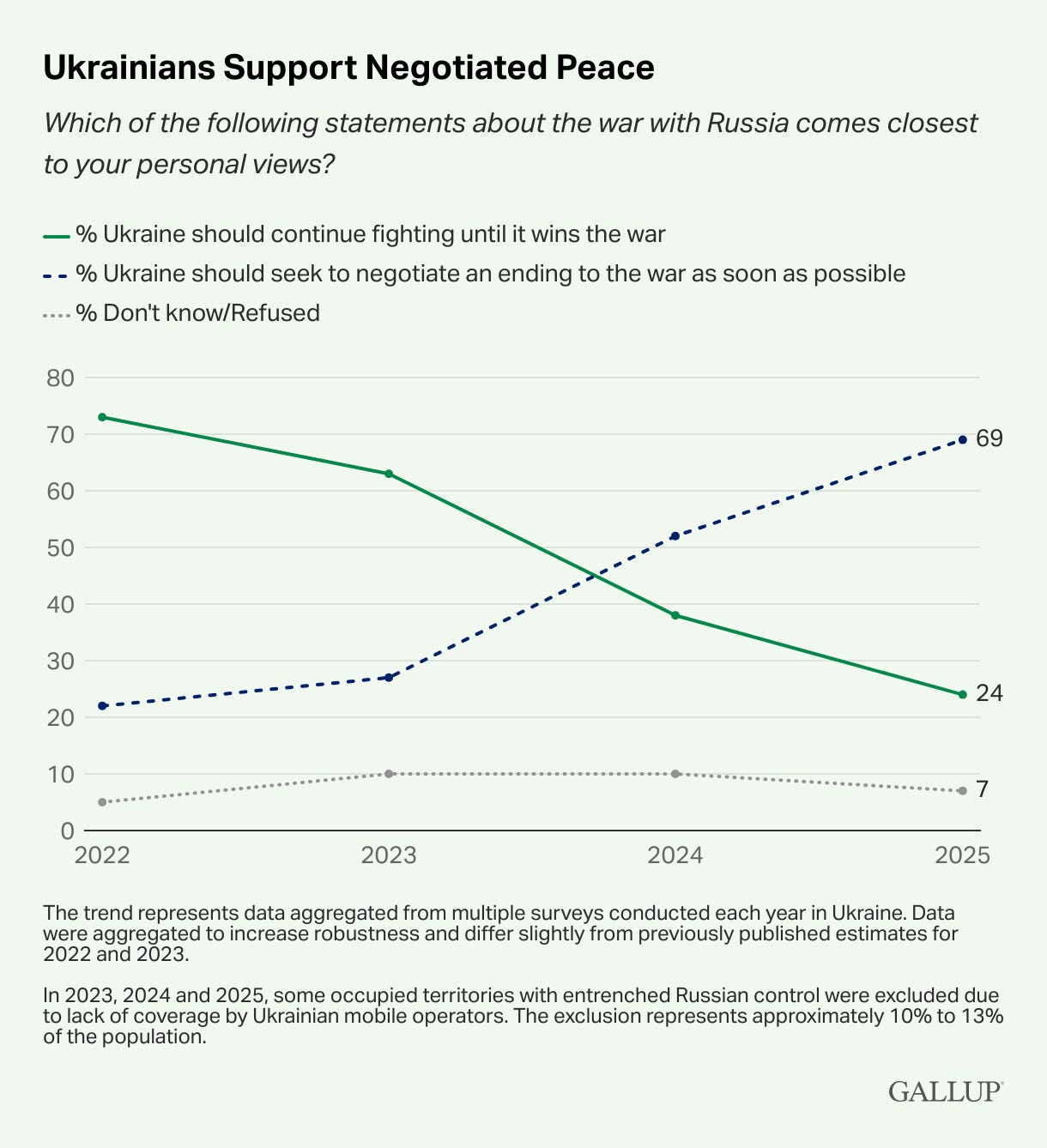
    On August 7th, US polling giant Gallup published the remarkable results of a survey of Ukrainians. Public support for Kiev “fighting until victory” has plummeted to a record low “across all segments” of the population, “regardless of region or demographic group.” In a “nearly complete reversal from public opinion in 2022,” 69% of citizens “favor a negotiated end to the war as soon as possible.” Just 24% wish to keep fighting.  However, vanishingly few believe the proxy war will end anytime soon.

    The reasons for Ukrainian pessimism on this point are unstated, but an obvious explanation is the intransigence of President Volodymyr Zelensky, encouraged by his overseas backers – Britain in particular. London’s reverie of breaking up Russia into readily-exploitable chunks dates back centuries, and became turbocharged in the wake of the February 2014 Maidan coup. In July that year, a precise blueprint for the current proxy conflict was published by the Institute for Statecraft, a NATO/MI6 cutout founded by veteran British military intelligence apparatchik Chris Donnelly, who now oversees London’s management of the proxy conflict
    In response to the Donbass civil war, Statecraft advocated targeting Moscow with a variety of “anti-subversive measures”. This included “economic boycott, breach of diplomatic relations,” as well as “propaganda and counter-propaganda, pressure on neutrals.” The objective was to produce “armed conflict of the old-fashioned sort” with Russia, which “Britain and the West could win.” While we are now witnessing in real-time the brutal unravelling of Donnelly’s monstrous plot, Anglo-American designs of using Ukraine as a beachhead for all-out war with Moscow date back far further.

    In August 1957, the CIA secretly drew up elaborate plans for an invasion of Ukraine by US special forces. It was hoped neighbourhood anti-Communist agitators would be mobilized as footsoldiers to assist in the effort. A detailed 200-page report, Resistance Factors and Special Forces Areas, set out demographic, economic, geographical, historical and political factors throughout the then-Soviet Socialist Republic that could facilitate, or impede, Washington’s quest to ignite local insurrection, and in turn the USSR’s ultimate collapse

    The mission was forecast to be a delicate and difficult balancing act, as much of Ukraine’s population held “few grievances” against Russians or Communist rule, which could be exploited to foment an armed uprising. Just as problematically, “the long history of union between Russia and Ukraine, which stretches in an almost unbroken line from 1654 to the present day,” resulted in “many Ukrainians” having “adopted the Russian way of life”. Problematically, there was thus a pronounced lack of “resistance to Soviet rule” among the population.

    The “great influence” of Russian culture over Ukrainians, “many influential positions” in local government being held “by Russians or Ukrainians sympathetic to [Communist] rule, and “relative similarity” of their “languages, customs, and backgrounds”, meant there were “fewer points of conflict between the Ukrainians and Russians” than in Warsaw Pact nations. Throughout those satellite states, the CIA had to varying success already recruited clandestine networks of “freedom fighters” as anti-Communist Fifth Columnists. Yet, the Agency remained keen to identify potential “resistance” actors in Ukraine:

    Some Ukrainians are apparently only slightly aware of the differences which set them apart from Russians and feel little national antagonism. Nevertheless, important grievances exist, and among other Ukrainians there is opposition to Soviet authority which often has assumed a nationalist form. Under favorable conditions, these people might be expected to assist American Special Forces in fighting against the regime

    ‘Nationalist Activity’

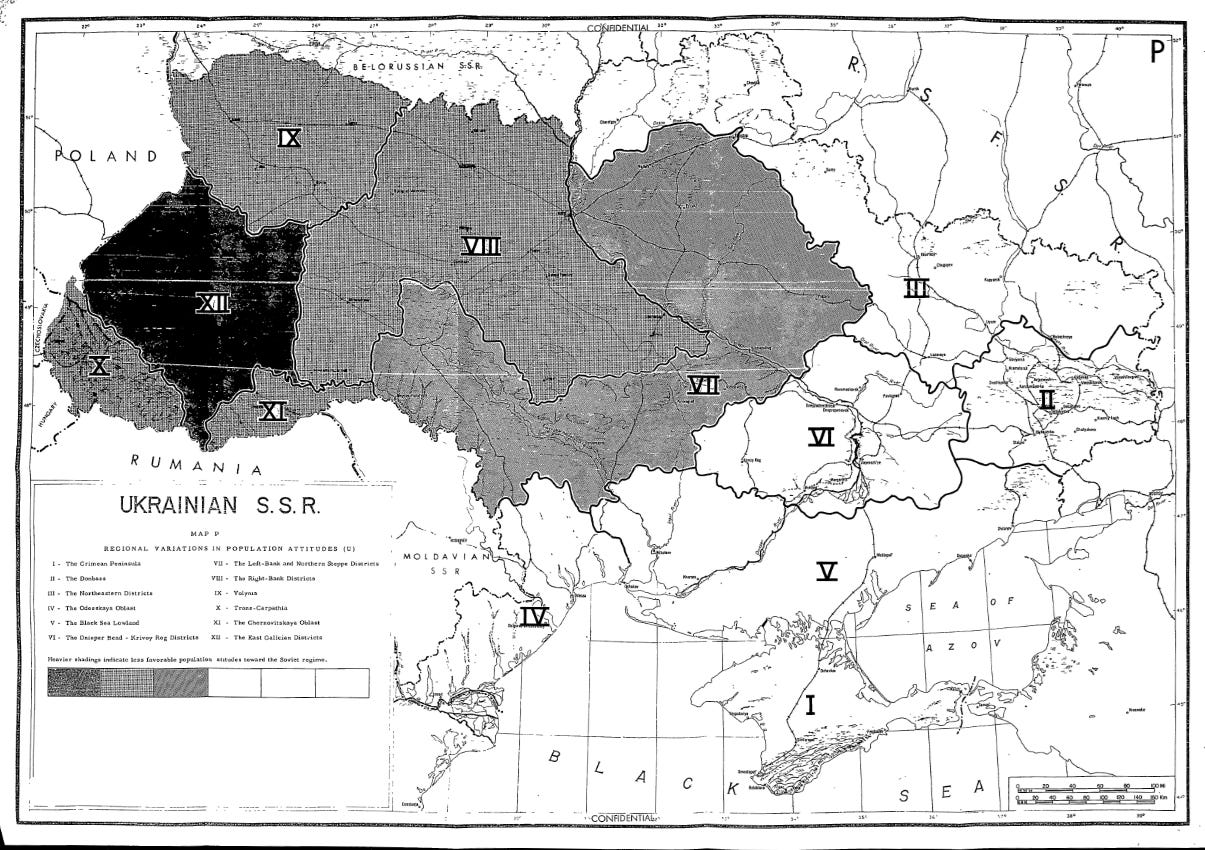
    A CIA map split Ukraine into 12 separate zones, ranked on “resistance” potential, and how “favorable population attitudes [are] toward the Soviet regime.” South and eastern regions, particularly Crimea and Donbass, rated poorly. Their populations were judged “strongly loyal” to Moscow, having never “displayed nationalist feelings or indicated any hostility to the regime,” while viewing themselves as “a Russian island in the Ukrainian sea.” In fact, as the study recorded, during and after World War I, when Germany created a fascist puppet state in Ukraine:

    Inhabitants of Donbass strongly resisted Ukrainian nationalists and at one point created a separate republic, independent of the rest of Ukraine. In the following years, they defended Soviet rule and Russian interests, often attacking the Ukrainian nationalists with more zeal than the Russian leaders themselves. During the German occupation in the Second World War, there was not a single recorded case of support for the Ukrainian nationalists or Germans
    Still, invading and occupying Crimea was considered of paramount importance. On top of its strategic significance, the peninsula’s landscape was forecast as ideal for guerrilla warfare. The terrain offered “excellent opportunities for concealment and evasion,” the CIA report noted. While “troops operating in these sectors must be specially trained and equipped,” it was forecast the local Tatar population, “which fought so fiercely” against the Soviets in World War II, “would probably be willing to help” invading US forces.

    Areas of western Ukraine, including former regions of Poland such as Lviv, Rivne, Transcarpathia and Volyn, which were heavily under control of “Ukrainian insurgents” – adherents of MI6-supported Stepan Bandera – during World War II, were judged most fruitful “resistance” launchpads. There, “nationalist activity was extensive” during World War II, with armed militias opposing “pro-Soviet partisans with some success.” Conveniently too, mass extermination of Jews, Poles and Russians by Banderites in these regions meant there was virtually no non-ethnic Ukrainian population left.

    Furthermore, in the post-war period, “resistance to Soviet rule” had been “expressed on a great scale” in western Ukraine. Despite “extensive deportations”, “many nationalists” remained in Lviv et al, and “nationalist cells” created by Bandera’s “task forces” remained dotted around the country. For example, anti-Communist “partisan bands” had taken up residence in the Carpathian Mountains. The review concluded, “it is in this region [US] Special Forces could expect considerable support from the local Ukrainian population, including active participation in measures directed against the Soviet regime.”

    It was also determined that “Ukrainian nationalist, anti-Soviet sentiment” in Kiev was “apparently moderately strong,” and elements of the population “might be expected to provide active assistance to Special Forces.” The capital’s “large Ukrainian population” was reportedly “little affected by Russian influence,” and during the Russian Revolution “provided greater support than any other region for Ukrainian, nationalist, anti-Soviet forces.” Resultantly, “uncertainty about the attitudes of the local population” prompted Moscow to designate the Ukrainian SSR’s capital, which it remained until 1934.

    The CIA document further offered highly detailed assessments of Ukrainian territory, based on their utility for warfare. For example, “generally forbidding” Polesia – near Belarus – was noted to be “almost impossible” to traverse during spring. Conversely, winter provided “most favorable to movement, depending on the depth to which the ground freezes.” Overall, the area had “proved its worth as an excellent refuge and evasion area by supporting large-scale guerilla activities in the past.” Meanwhile, “swampy valleys of the Dnieper and Desna rivers” were of particular interest:

    The area is densely forested in its north-western part, where there are excellent opportunities for concealment and manoeuvre…There are extensive swamps, interspersed with patches of forest, which also provide good hiding places for the Special Forces. Conditions in the Volyno-Podolskaya Highlands are less suitable, although small groups may find temporary shelter in the sparse forests

    ‘Strongly Anti-Nationalist’

    The CIA’s invasion plan never formally came to pass. Yet, areas of Ukraine forecast by the Agency to be most welcoming of US special forces were precisely where support for the Maidan coup was highest. Moreover, in a largely unknown chapter of the Maidan saga, fascist Right Sector militants were bussed en masse to Crimea prior to Moscow’s seizure of the peninsula. Had they succeeded in overrunning the territory, Right Sector would’ve fulfilled the CIA’s objective, as outlined in Resistance Factors and Special Forces Areas
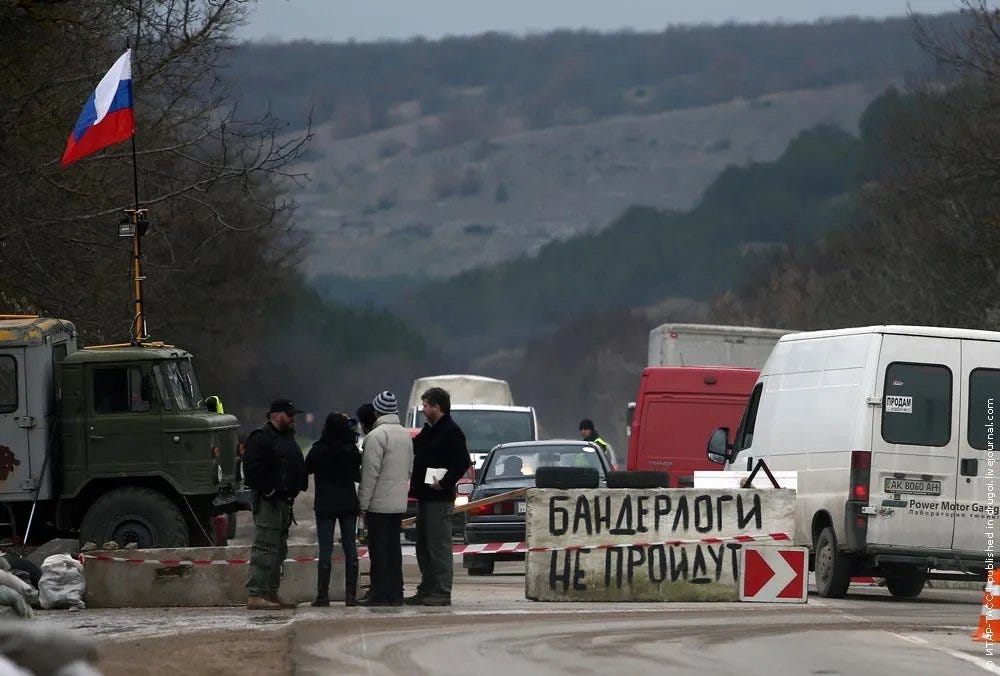
    A civilian defence barricade constructed to prevent Right Sector entering Crimea, February 2014

    Given what transpired elsewhere in Ukraine following February 2014, other sections of the CIA report take on a distinctly eerie character. For instance, despite its strategic position facing the Black Sea, the Agency warned against attempting to foment anti-Soviet rebellion in Odessa. The agency noted the city is “the most cosmopolitan area in Ukraine, with a heterogeneous population including significant numbers of Greeks, Moldovans and Bulgarians, as well as Russians and Jews.” As such:

    Odessa…has developed a less nationalistic character. Historically, it has been considered more Russian than Ukrainian territory. There was little evidence of nationalist or anti-Russian sentiment here during the Second World War, and the city…was in fact controlled by a strongly anti-nationalist local administration [during the conflict]

    Odessa became a key battleground between pro- and anti-Maidan elements, from the moment the Maidan protests erupted in November 2013. By March the next year, Russophone Ukrainians had occupied the city’s historic Kulykove Pole Square, and were calling for a referendum on the establishment of an “Odessa Autonomous Republic”. Tensions came to a head on May 2nd, when fascist football ultras – who subsequently formed Azov Battalion – flooded Odessa and forced dozens of anti-Maidan activists into the Trade Unions House, before setting it ablaze.

    In all, 42 people were killed and hundreds injured, while Odessa’s anti-Maidan movement was comprehensively neutralised. In March this year, the European Court of Human Rights issued a damning ruling against Kiev over the massacre. It concluded local police and fire services “deliberately” failed to respond appropriately to the inferno, and authorities insulated culpable officials and perpetrators from prosecution despite possessing incontrovertible evidence. Lethal “negligence” by officials on the day, and ever after, was found to go far “beyond an error of judgment or carelessness.”

    The ECHR was apparently unwilling to consider that the lethal incineration of anti-Maidan activists was an intentional and premeditated act of mass murder, conceived and directed by Kiev’s US-installed fascist government. However, the findings of a Ukrainian parliamentary commission point ineluctably towards this conclusion. Whether, in turn, the Odessa massacre was intended to trigger Russian intervention in Ukraine, thus precipitating “armed conflict of the old-fashioned sort” with Moscow that “Britain and the West could win” is a matter of speculation [end]

    The original article

    Related

    Nazism in Ukraine

    its roots before WW2, its collaboration with Nazi Germany, its legacy in modern Ukraine, how NATO has continually supported Nazism in Ukraine, chronicle

    The Atlanticist defeat in Donbass and Ukraine

    chronicle of a new catastrophic NATO venture

    June 11, 2025: Secret British plans to ‘defeat entire Russian Black Fleet’ revealed in leaks – Kit Klarenberg, The Grayzone

    Leaked files reviewed by The Grayzone expose the covert war waged by British intelligence against Russia in the Black Sea, outlining Ukrainian “honey trap” plots along with blueprints for blowing up the Kerch Bridge

    May 9, 2025: Victory Day

    April 2, 2025: It’s Official: Ukraine Conflict is British ‘Proxy War’ – Kit Klarenberg

    March 26, 2025: “Ukrainian History X”: How the State Department Secretly Funded the Azov* Regiment – Andrey Zhuravlev

    With the start of the Special Military Operation in February 2022, the nationalist Azov Regiment became one of Ukraine’s most widely recognized military formations. Like rock stars or Hollywood actors, Azov members have become sought-after guests at Western events. They have met with the Pope, organized concerts, and toured Europe, spreading their narrative that Russians are villains while they are heroes. Only in Russia is this regiment, along with similar formations, officially recognized as a terrorist organization

    February 8, 2025: ‘Aiding chaos’: USAID’s role in engineering regime change, social unrest worldwide – Maryam Qarehgozlou, Press TV

    After President Donald Trump’s executive order suspending all US foreign aid programs, the US Agency for International Development (USAID) has again come under intense scrutiny

    November 16, 2024: Leaks expose secret British military cell plotting to ‘keep Ukraine fighting’ – Kit Klarenberg, The Grayzone

    Leaked files show top UK military figures conspired to carry out the Kerch bridge bombing, covertly train “Gladio”-style stay-behind forces in Ukraine, and groom the British public for a drop in living standards caused by the proxy war against Russia

    August 11, 2024: Western globalism and its Nazi-fascist instrument will be defeated in Kiev – Hugo Dionisio, Strategic Culture Foundation

    It is essential to close the circle of Nazi existence. The defeat of the Kiev regime is a fundamental step in this direction

    July 28, 2024: Ultra-nationalist linked to Maidan false flag assassinated – Kit Klarenberg, The Grayzone

    The killing of ultra-nationalist Ukrainian politician Iryna Farion at the hands of a Neo-Nazi is filled with irony. Linked to the Maidan false flag massacre, Farion was instrumental in bringing fascist forces into the mainstream

    June 26, 2024: The Franco-British Plot to Dismember Russia [1917 – ?] – Kit Klarenberg

    April 9, 2024: Secret list of a French intelligence officer: how NATO soldiers end up in Ukraine – Zvezda

    [it was with great pleasure that I have been involved in an investigation by Zvezda, the channel of the Russian Ministry of Defense]

    February 2, 2024: EPER, personne morale

    deux Français sont tués en Ukraine le 1er février 2024

    January 19, 2024: Russian Missile Strike on French Contractor Base in Ukraine Highlights Heated Franco-Russian Cold War – Military Watch Magazine

    June 6, 2023: First there were Neo-Nazis, then there were no Nazis, then there were – Patrick Lawrence, ScheerPost

    October 14, 2020: Liberalism And Fascism: Partners In Crime – Gabriel Rockhill, Counterpunch

  • [Traduction] Ancien officier de renseignement Cinquini : au moins 20 mercenaires français tués lors de l’Opération militaire spéciale – TASS

    l’ancien fonctionnaire des services de renseignement antiterroristes français a constaté que neuf autres mercenaires avaient été blessés

    MOSCOU, 14 août. /TASS/. Depuis le début de l’Opération militaire spéciale, vingt mercenaires français ont été tués au côté de Kiev et neuf autres ont été grièvement blessés. C’est ce qu’a rapporté à TASS le capitaine à la retraite Nicolas Cinquini, ancien policier et ancien fonctionnaire des services de renseignement antiterroristes français

    À ce jour, j’ai dénombré 20 morts [mercenaires français – ndlr]. Neuf autres ont été grièvement blessés

    a-t-il déclaré.

    Selon l’expert, Kevin Lazzari était originaire du Portugal, avait grandi à Toulouse et travaillait comme éboueur à Paris. Il n’était en Ukraine que depuis quelques mois quand il fut tué le 14 juillet, ou quelques jours plus tôt. Son indicatif radio était Kapo et son surnom complet était Kapo Edelweiss. Sa culture fasciste était encyclopédique, a souligné Cinquini.

    Cinquini a ajouté que Lazzari avait rejoint un noyau de combattants nazis français, formé autour du vétéran Guillaume Andreoni, au sein du 1er bataillon de la Légion internationale des forces terrestres ukrainiennes

    L’unité « Section Brennos » revendique un héritage à la fois gaulois et nazi

    a expliqué l’expert [fin]

    La dépêche originale

    Articles connexes

    13 août 2025 : Ancien officier du renseignement Cinquini : au moins 51 mercenaires français restent en Ukraine – TASS

    « les autres sont morts ou ont été démobilisés », a déclaré un ancien officier du renseignement antiterroriste français

    L’engagement français dans les rangs ukrainiens

    chronique alphabétique et nécrologique de l’engagement français dans les rangs atlantistes en Ukraine, ce que les journalistes serviles ne vous raconteront pas

  • [Traduction] Ancien officier du renseignement Cinquini : au moins 51 mercenaires français restent en Ukraine – TASS

    « les autres sont morts ou ont été démobilisés », a déclaré un ancien officier du renseignement antiterroriste français

    MOSCOU, 13 août. /TASS/. Le flux de mercenaires français à destination de l’Ukraine est en baisse constante depuis 2022 et pourrait désormais se stabiliser au niveau de 2024. C’est ce qu’a déclaré le capitaine à la retraite Nicolas Cinquini, ancien policier et ancien officier du renseignement antiterroriste français, dans une interview accordée à TASS

    En coopération avec le club international de renseignement open source TrackANaziMerc, nous n’avons identifié qu’une partie des Français en uniforme dans les rangs atlantistes en Ukraine. Cet échantillon nous permet d’observer véritablement les changements […] il semble que le recrutement soit en baisse constante depuis 2022. Il pourrait se stabiliser aujourd’hui au niveau de 2024. Cette tendance reste à confirmer

    a-t-il déclaré.

    Selon l’expert, il a identifié un total de 108 combattants français depuis 2014. Leur nombre réel est bien sûr plus élevé, a-t-il précisé.

    51 sont toujours en service. Les autres ont été tués ou démobilisés

    a ajouté Cinquini [fin]

    La dépêche originale

    Lors de mon entretien avec le journaliste de l’agence TASS, nous avons également abordé la question des motivations de ces combattants français dans les rangs atlantistes en Ukraine. À ce sujet, j’ai ajouté

    Au fil de mon analyse par feuille de calcul, le taux de fascistes augmente, d’environ 33 % en 2023 à 44 % cumulés à ce jour. Je pense que les romantiques, dont l’engagement avait été déterminé par la propagande des médias français sur « la liberté et la démocratie », se font rares. Les dernières recrues apparaissent sur les réseaux sociaux comme des militants fascistes / nazis convaincus. Lorsqu’ils sont interrogés par des journalistes ukrainiens ou français, ils dissimulent bien sûr leur bagage idéologique, expriment leur volonté de « défendre l’Europe contre la Russie »

    Article connexe

    L’engagement français dans les rangs ukrainiens

    chronique alphabétique et nécrologique de l’engagement français dans les rangs atlantistes en Ukraine, ce que les journalistes serviles ne vous raconteront pas

  • The British intelligence is planning secret operations of sabotage in order to trigger the overt and shameless Western piracy of tankers transporting Russian oil

    On August 4, 2025, the Russian State news agency, TASS, wrote

    The UK’s secret services are planning to enlist NATO allies in a large-scale operation targeting the “shadow fleet,” which could lead to an environmental disaster in international waters, the press bureau of the Russian Foreign Intelligence Service (SVR) said in a statement obtained by TASS.

    “British secret services are planning ecological disaster in international waters. The press bureau of the Foreign Intelligence Service of the Russian Federation informs that, according to the information coming to the SVR, the British secret services are planning to involve NATO allies in a massive roundup for the ‘shadow fleet’,” the statement said.

    According to London’s plan, the impetus for such a campaign should be provided by “a resonant incident involving one or more tankers.”

    “The plan involves organizing a major act of sabotage the losses of which would allow the transportation of Russian oil to be declared a threat to all international shipping. This would untie Western countries’ hands in choosing methods of counteraction,” the document said.

    Two scenarios and actors

    According to the SVR, the British are working on “two potential casus belli.” “The first scenario implicates setting up an ‘unwanted’ tanker accident in one of bottlenecks of sea communications (for example, in straits). As it is believed in London, oil spills and fairway blocking would provide NATO countries with ‘sufficient’ grounds for establishing a precedent of ‘extraordinary’ vessel inspection under the guise of maritime safety and environmental regulations compliance,” the statement noted.

    “The second one involves setting fire to a tanker at loading in a port of a state friendly to Russia. It is expected that the fire would cause significant damage to the port infrastructure and spread to other vessels, which would require an international investigation,” the SVR emphasized.

    “London is going to entrust Ukrainian security forces with the implementation of both terrorist attacks. Their expectedly dirty work and inability to ‘cover up’ their tracks are considered by the British as a guarantee of impunity for themselves. The international investigation would hold either Russia or at worst Ukraine responsible for the accident, similar to the situation with the Nord Stream gas pipeline explosion,” the press bureau stressed.

    Eying sanctions

    The SVR pointed out that the timing of the UK attack is intended to be chosen so as to use the media effect from it to put pressure on the administration of US President Donald Trump.

    “The aim is to force Washington, in defiance of its national interests, to impose the most severe secondary sanctions against Russian energy resources buyers, making them seen as ‘indirect culprits of the tragedy’,” the statement said.

    “It seems like nostalgia for the lost dominance at sea and for authorized by the Crown pirate lawlessness have completely deprived the British Intelligence of the remnants of common sense. It’s high time for our British colleagues to understand that their increasingly bold attempts not only ‘to get back at’ their rivals, but also to cause damage to the global energy security and ecology are capable to make even their most loyal allies run out of patience,” the Russian Foreign Intelligence Service concluded

    US social networking service X is integrating Grok, a funny artificial intelligence chatbot, which is regarding the Western mainstream media literature as gospel truth. Here is its definition of the so-called Russian shadow fleet

    a group of over 600 aging vessels (average age nearing 30 years) used to evade Western sanctions on Russian oil exports, as detailed in a 2025 Windward.ai report analyzing shifts in trade routes to India, China, and Turkey

    To assess the atmosphere, in the context of the proxy attrition war that the West is losing in Donbass and Ukraine, here is a piece on August 5 from the Financial Times, a British outlet

    Donald Trump’s administration is considering additional sanctions on Russia’s “shadow fleet” of oil tankers if President Vladimir Putin does not agree to a ceasefire in Ukraine by Friday.

    Blacklisting vessels in the fleet would mark the first time the US has imposed sanctions aimed at Moscow since Trump returned to the White House in January.

    Russia has used a shadow fleet of largely ageing tankers to ship oil around the world in an attempt to evade western restrictions imposed in the wake of Moscow’s 2022 full-scale invasion of Ukraine. Proceeds from these crude exports have helped to finance the conflict.

    The term “shadow fleet” refers to vessels whose ownership is hidden and which avoid using services from western companies. Enforcing sanctions against their owners is difficult, although measures targeting the ships themselves have recently proven effective.

    Two people familiar with the White House’s deliberations said additional US sanctions on the shadow fleet were seen as an easy first step to impose costs on Russia. A third person close to the administration said it was considering a range of options, including sanctions on the fleet.

    Joe Biden’s administration added 213 crude, chemical or product tankers to the sanctions list. Trump has held off imposing further sanctions on Russia in an effort to secure a negotiated settlement to end the war.

    But he has grown increasingly frustrated with Putin’s refusal to agree to a ceasefire, and gave the Russian leader an ultimatum to change tack by Friday or face tougher sanctions.

    Further US penalties on the fleet would bolster the EU’s recent steps against the fleet, said Kevin Book, managing director of research with ClearView Energy Partners. The bloc sanctioned more than 100 ships last month, bringing the total to 415.

    Under the terms of the sanctions regime, western-linked companies are prohibited from buying seaborne oil priced above a G7 price cap fixed at $60 a barrel for crude. The shadow fleet has allowed Russia to ship oil above the cap — mainly to China and India.

    In early 2024, Biden administration officials were surprised to realise that listing individual ships — rather than their owners or managers — proved to be effective, with buyers of Russian oil reluctant to deal with vessels that had been named. The EU and UK took up the practice as a result.

    A Financial Times analysis of 115 crude tankers sanctioned by the US shows they became much less productive afterwards. Data from Kpler, a cargo analytics platform, reveals the vessels shipped a monthly average of 48mn barrels of Russian crude in the six months prior to their listing, but an average of only 13mn barrels in the six months afterwards.

    Benjamin Hilgenstock, head of macroeconomic research and strategy at the Kyiv School of Economics Institute, said: “Aggressively going after the shadow fleet is a straightforward way of making things harder for Russia, and reinforce the message that the EU and UK have been sending.”

    The Kremlin has disregarded a number of deadlines set by the US president to agree to a ceasefire and in recent weeks has significantly stepped up its attacks on Ukraine.

    Trump has grown increasingly frustrated with his Russian counterpart and people close to the administration said Moscow would pay a price if it did not come to the negotiating table [That is a typical blatant lie. Russia is at the negotiation table and in order to implement a ceasefire, is demanding that the defeated Atlanticist troops withdraw first from the positions they are still occupying in Donetsk, Kherson, Lugansk and Zaporozhye regions].

    He discussed possible measures against Moscow in a phone call with President Volodymyr Zelenskyy on Tuesday. “We talked about sanctions against Russia,” said Ukraine’s leader. “Their economy continues to fall and that is why Moscow is so attentive to this prospect . . . This can change a lot.”

    The US president on Monday also announced plans to increase tariffs on India, one of the leading buyers of Russian oil. “They don’t care how many people in Ukraine are being killed by the Russian war machine,” the president said in a post on social media.

    Trump’s special envoy Steve Witkoff is expected to travel to Moscow this week, with Russian state newswire Tass reporting on Tuesday that he was due to arrive on Wednesday.

    Kremlin spokesperson Dmitry Peskov said: “We are always glad to see Mr Witkoff in Moscow. We view such contacts as important, substantive and very useful.”

    Trump will probably decide on what potential costs to impose on Moscow when his envoy returns, said the person close to the administration.

    “It depends on what Witkoff brings back,” the person said. “If Witkoff comes back empty-handed, with absolutely nothing, Trump is going to go ballistic.”

    Anna Kelly, White House deputy press secretary, said: “The president has been clear that there will be biting sanctions if Putin does not agree to end the war. We will not get ahead of the president on specifics.”

    Other options for the administration include more stringent enforcement of existing sanctions, or joining the EU’s new dynamic floating price cap on Russian oil which is set to take effect in early September, experts said.

    Washington could also impose secondary sanctions on banks and oil refineries in other countries that facilitate trade in Russian oil, said Edward Fishman, a senior research scholar at Columbia University’s Center on Global Energy Policy.

    “There’s incredible latitude right now to actually impose hard-hitting oil sanctions on Russia,” he added.

    A bill put forward by Senators Lindsey Graham and Richard Blumenthal calling for tariffs of upwards of 500 per cent on countries that continue to buy Russian energy products has also gained widespread bipartisan support among lawmakers on capitol hill.

    Trump has said he is “very strongly” considering supporting the bill, although analysts have questioned whether such steep tariffs could be sustainably enforced

    Here is an excellent summary of the plot. The author is Irish journalist Chay Bowes

    Related

    August 5, 2025: Donald Trump readies fresh US sanctions against Russia’s shadow fleet – Financial Times

    US president has threatened Vladimir Putin with punitive measures to force him to end war in Ukraine

    August 4, 2025: UK secret services plotting maritime ecological disaster – TASS

    “The plan involves organizing a major act of sabotage the losses of which would allow the transportation of Russian oil to be declared a threat to all international shipping,” the SVR said

    June 26, 2025: In a plot twist worthy of John le Carré, we reveal the grandfather of the brilliant new head of MI6 was a Nazi spy chief – Daily Mail

    October 9, 2024: the old man and the sea

    new information about the US sabotage of Nord Stream pipelines

    The Western disinformation about Ukraine

    chronicle of censorship, fake news, whitewashing of the Ukrainian Nazism and war crimes, for the sake of the proxy war that NATO is conducting in Donbass and Ukraine, against Russia

    The Atlanticist defeat in Donbass and Ukraine

    chronicle of a new catastrophic NATO venture

  • [Sharing] Russophrenia: the West’s favourite delusion about Russia – Brian McDonald

    Ten years after I coined the term, the media’s still convinced Russia is both collapsing, and conquering the world

    There’s a peculiar affliction that’s gripped the Western commentariat for decades now. I first diagnosed it in June 2015 and gave it a name: Russophrenia. The tell-tale sign? That deep-set conviction that Russia’s about to keel over economically—then somehow rise from the wreckage to take Brussels by breakfast. In those ten years, the condition’s only become more widespread—like a political variant of Covid, except there’s no PCR tests, and the worst sufferers have column inches.

    Back in 2015, it was already clear. Read any English-language piece on Russia and you’d find the same breathless contradictions. “The ruble is in freefall”… followed two paragraphs later by “Russian ‘oligarchs’ (sic) are buying up half of France.” Russia, we were told, was a “gas station with nukes,” a “mafia state,” “on the brink of collapse.” That was just before the same experts warned it could manipulate every Western election, hack every NATO server, and brainwash half of Ohio.

    So let’s rummage through the old press clippings, shall we? Some of them haven’t aged as well as their writers hoped.

    In 2001, The Atlantic boldly declared “Russia Is Finished.” Spoiler: as we know, it wasn’t. Nearly a quarter century on, that headline now looks more like a cry for help.

    In 2008, the Guardian’s Luke Harding—who’s always good for a prediction—declared Russia “close to economic collapse” due to falling oil prices. Within a year, the economy had bounced back and Harding was warning of a “new arms race.” Later, he authored an extensively debunked book built around the mirage of “RussiaGate”—now widely discredited thanks to U.S. intelligence disclosures.

    Julia Ioffe joined in 2014 with her own “Russia is falling apart” prophecy—echoing Masha Gessen’s 2011 forecast that “Putin’s world is falling apart.” Over a decade later, Putin’s still at the desk, and those takes have aged like unrefrigerated milk.

    And then there was Mark Galeotti, who warned in 2015 that Putin’s brief disappearance might trigger “succession wars.” He reappeared days later looking mildly bored. Leaving a lot of ridiculous-looking tweets.

    But perhaps the finest specimen of advanced-stage Russophrenia was the late US Senator John McCain, who famously called Russia “a gas station masquerading as a country.” This from a man who once took a break from posing with Islamist rebels to compare Putin to Hitler. The irony? Russia’s economy—gas station or not— is now the largest in Europe. After passing out Germany a few years ago on PPP rankings. And McCain’s rhetorical gas ran out long before Russia’s did.

    Of course, none of this means Russia is a utopia. Far from it. The economy has structural problems. The political system is more fortress than forum. And yes, the Ukraine conflict has triggered enormous costs. But facts are stubborn things. Despite the most aggressive sanctions regime in history, Russia hasn’t imploded. The Moscow stock exchange, after being written off in early 2022, was at 2,727 points on Friday. Far off its all time high (4,292), but hardly on its knees. Agricultural exports have soared. The birth rate, albeit not great, is still better than much of Europe. And those American-made “devastating sanctions”? India, China, Turkey, and most of the Global South didn’t get the memo.

    The Western media, however, hasn’t changed its tune. They’ve just layered it. Now it’s: yes, Russia is collapsing… but it’s also exporting authoritarianism, destabilising Africa, puppeteering Hungary, and might invade the Baltics on Tuesday. Russophrenia 2.0.

    And what drives it all? Familiarity’s absence. Sanctions, the forced closure of consulates, shuttered news bureaus—it’s never been harder for a Westerner to visit Russia. And the fewer people who go, the more powerful the myths become. Russia becomes a Rorschach test—some see Mordor, others a 1980s cartoon villain. Almost no one sees it as it is: complex, contradictory, sometimes maddening, sometimes magnificent. In short, a real country, not a narrative prop.

    Back in Ireland, when I mention Russia, I often get two reactions: one, that Russia’s economy is in ruins; two, that it’s plotting world domination. The contradiction passes without comment. That’s the thing about Russophrenia—you don’t notice the absurdity when you’re living inside it.

    Meanwhile, most coverage of Russia isn’t even produced from inside Russia anymore. It’s written from Riga, or Warsaw, or Zoom calls with the same four exiled pundits. The actual country is missing. And with it, any chance of nuance.

    Of course, Russia’s no tidy postcard. It sprawls out like it means to confuse you. One minute it’s throwing you a smile over breakfast, and by tea it’s broken your heart. You touch down thinking you’ve got the place half-sussed, and by the time you hit passport control, you’re not so sure of anything. That’s not some bug in the system—it’s the system. And for all its mess and mischief, it’s still real. Real enough to deserve being seen on its own terms, not squeezed to fit the shape of someone’s word count.

    It’s been ten years since I first gave a name to this fever, and still it burns. The same old phantoms—maps from another century, clichés with the ink worn thin—held up as gospel. The patient isn’t getting better. Just louder.

    So here’s my prescription: less punditry, more plane tickets. Less projection, more proximity. And above all, less fear.

    You don’t have to toast the place or take its side. Just stop seeing ghosts. Wipe your lens, look again. That’s where recovery begins [end]

    The original article

    Related

    July 17, 2025: La Russie est notre Rorschach – Emmanuel Todd

    May 9, 2025: Victory Day

    April 30, 2025: IGNORANCE – Scott Ritter

    December 13, 2024: McCarthyism, European style: The elite crackdown on Ukraine dissent – Eldar Mamedov, Responsible Statecraft

    Experts lambasted as Kremlin mouthpieces turned out to be right

    October 7, 2024: Is Russia Really The “Greatest Threat” To France? – Andrew Korybko, Oriental Review

    Russia’s support of multipolar processes in West Africa has dealt a heavy blow to French hegemony there, which France has responded to by waging a proxy war on Russia in Mali while going on the strategic offensive in the South Caucasus and Eastern Europe

    July 5, 2024: The Franco-British Plot to Dismember Russia [1917 – ?] – Kit Klarenberg

    June 3, 2023: EU’s Voluntary Disinformation Code Is Compulsory: Obey or Die – Declan Hayes, Strategic Culture Foundation

    Though Musk is still playing at being NATO’s token non-conformist, the EU is essentially telling him and all of us that any dissent from its Russophobic, Slavophobic and Sinophobic narratives will be severely punished

    The Western disinformation about Ukraine

    chronicle of censorship, fake news, whitewashing of the Ukrainian Nazism and war crimes, for the sake of the proxy war that NATO is conducting in Ukraine against Russia

    The Atlanticist defeat in Donbass and Ukraine

    chronicle of a new catastrophic NATO venture

  • [Sharing] Drug cartel operatives snuck into Ukraine for drone training: report – Linus Höller, DefenseNews

    THE HAGUE, Netherlands — Ukrainian counterintelligence services are investigating the infiltration of Latin American drug cartel members into the country’s International Legion, with operatives seeking advanced drone training to later deploy against rivals and security forces in their home countries.

    The Security Service of Ukraine (SBU) launched a joint investigation with military intelligence after Mexico’s National Intelligence Center warned in early summer that Mexican volunteers had joined Ukraine’s foreign fighter units specifically to acquire first-person view (FPV) drone capabilities. The probe has since expanded to include Colombian nationals, raising concerns about Ukraine’s inadvertent role as a training ground for transnational criminal organizations.

    French outlet Intelligence Online was the first to report the story on Tuesday.

    The investigation centers on several Spanish-speaking units within the International Legion, particularly the tactical group “Ethos,” operating in the Donetsk and Kharkiv regions. Ukrainian investigators reportedly suspect that some Mexican and Colombian volunteers intentionally sought placement in drone operator units to later use this training in the service of foreign criminal organizations.

    One noteworthy case is that of a Mexican national operating under the alias “Águila-7,” who registered in March 2024 using fraudulent Salvadoran documentation. Posing as a humanitarian volunteer, he completed comprehensive drone training in Lviv while demonstrating exceptional technical expertise that eventually had instructors suspicious.

    His extensive technical knowledge, including familiarity with electronic warfare countermeasures and thermal detection avoidance, reportedly stood out. Background investigations later revealed probable connections to Mexico’s elite GAFE special forces, some of whose former personnel have historically transitioned to cartel employment, notably through the ultra-violent Zetas organization.

    The infiltration demonstrates remarkable operational sophistication for a nonstate group, with suspects employing false identities, forged documentation and front companies to facilitate their passage into Ukrainian territory and military structures. Intelligence analysts have identified a network of private security firms across Latin America that appear to have coordinated these placements.

    Additional cases have emerged involving former FARC guerrillas who infiltrated the system using Panamanian and Venezuelan identity documents. At least three former FARC fighters passed through the International Legion using forged documents, with their relocation reportedly organized by cartel-linked entities.

    The revelations highlight Ukraine’s unintended emergence as a premier training ground for modern asymmetric warfare techniques amid its conflict with Russia. Ukrainian authorities have developed comprehensive curricula covering drone manufacturing, tactical deployment, electronic warfare resistance and real-time battlefield coordination. Coincidentally, these capabilities also represent exactly the type of force multiplication that criminal organizations seek.

    Mexican cartels are already conducting drone attacks against rivals and security forces domestically, making the acquisition of Ukrainian battlefield-tested tactics particularly concerning for regional security.

    An unnamed SBU official told Intelligence Online: “We welcomed volunteers in good faith. But we must now recognize that Ukraine has become a platform for the global dissemination of FPV tactics. Some come here to learn how to kill with a $400 drone, then sell this knowledge elsewhere to the highest bidder” [end]

    The original article

    Related

    February 7, 2025: Volodymyr Zelenskyy signs a law banning organ harvesting from dead soldiers

    that new law is addressing a fact: in the context of war, Ukraine is a platform for organ trafficking

    April 9, 2024: Secret list of a French intelligence officer: how NATO soldiers end up in Ukraine – Zvezda

    How are “death travel agencies” organized for those who like to hunt people in foreign lands, and who want to send regular French and Polish units to Ukraine?

    November 20, 2023: Travel agency “Death”. Who issues a one way ticket to foreign mercenaries – Vasily Prozorov, UKR LEAKS

    Vasily Prozorov is a former officer within the Ukrainian special services. He is currently leading UKR LEAKS investigation centre

    L’engagement français dans les rangs ukrainiens

    in French, an alphabetical obituary chronicle of the French involvement in the Atlanticist ranks in Ukraine, what servile journalists will not tell you

  • [Partage] La Russie est notre Rorschach – Emmanuel Todd

    En avril dernier, interrogé par une chaîne de télévision russe sur la russophobie occidentale, j’avais eu une illumination. J’avais à peu près répondu : cela va vous être désagréable d’entendre ça, mais notre russophobie n’a aucun rapport avec vous. C’est un fantasme, une pathologie des sociétés occidentales, un besoin endogène d’imaginer un monstre russe.

    Pour la première fois à Moscou depuis 1993, je vivais un choc de normalité. Mes indicateurs habituels – mortalité infantile, suicide et homicide – m’avaient montré, sans bouger de Paris, que la Russie était sauvée, après sa crise de sortie du communisme. Mais Moscou normale à ce point, c’était au-delà de tout ce que j’avais conçu. J’ai eu sur place l’intuition que la russophobie était une maladie.

    Cette intuition résout toutes sortes de questions. Je m’obstinais, par exemple, à rechercher dans l’histoire les racines de la russophobie anglaise, la plus obstinée de toutes. L’affrontement des empires britanniques et russe au dix-neuvième siècle semblait justifier une telle approche. Mais quand même, durant les deux guerres mondiales, la Grande-Bretagne et Russie furent alliées, et elles se durent mutuellement leur survie durant la seconde. Alors, pourquoi tant de haine ? L’hypothèse géopsychiatrique nous donne une solution. La société anglaise est la plus russophobe, tout simplement parce qu’elle est la plus malade d’Europe. Acteur majeur et victime première de l’ultralibéralisme, l’Angleterre n’en finit pas de produire des symptômes graves: effondrement universitaire et hospitalier, sous-alimentation des vieux, sans oublier Liz Truss, la plus brève et la plus folle des premiers ministres britanniques, hallucination fulgurante au pays de Disraeli, Gladstone et Churchill. Qui aurait osé une chute des recettes fiscales sans la sécurité d’une monnaie, non pas seulement nationale, mais impériale, monnaie de réserve du monde ? Trump aussi fait n’importe quoi avec son budget mais il ne menace pas le dollar. Dans l’immédiat.

    En quelques jours, Truss avait détrôné Macron au hit-parade de l’absurdité occidentale. J’avoue attendre beaucoup de Friedrich Merz, dont le potentiel belliciste antirusse menace l’Allemagne de beaucoup plus qu’un effondrement monétaire. La destruction des ponts du Rhin par des missiles oreshnik ? Malgré la protection nucléaire française ? En Europe, c’est carnaval tous les jours.

    La France va de plus en plus mal, avec son système politique bloqué, son système économique et social à crédit, sa hausse de mortalité infantile. Nous coulons. Et hop, poussée russophobe. Macron, le chef d’état-major des armées et le patron de la DGSE viennent d’entonner en cœur la chanson. La France, ennemi numéro 1 de la Russie. On croit rêver. Notre insignifiance militaire et industrielle fait de la France le cadet des soucis de la Russie, suffisamment occupée par son affrontement planétaire avec les États-Unis.

    Cette dernière absurdité macronienne rend le recours à la géopsychiatrie indispensable. Un diagnostic d’érotomanie est inévitable. L’érotomanie, c’est cette affection, plutôt féminine mais non exclusivement, qui conduit le sujet à se penser universellement désiré sexuellement et menacé d’une pénétration par, mettons, tous les mâles environnants. La pénétration russe donc, menace…

    Je dois avouer ma lassitude à taper sur Macron (d’autres s’en chargent désormais, malgré la servilité journalistique générale). Heureusement pour moi, nous avions été préparés au discours de 14 juillet du Président par du neuf, les interventions de deux petits soldats du régime, Thierry Burkhard (chef d’Etat-major des armées) et Nicolas Lerner (patron de la DGSE). Je ne suis pas constitutionnaliste et ne sais s’il est de bon augure pour la démocratie que des gérants du monopole de la violence légitime de l’État se répandent sur les ondes, en conférence de presse (Burkhard) ou en divagations angoissées sur la chaîne LCI (Lerner) pour y définir en avant-première la politique extérieure de la France.

    Reste que l’expression publique et libre de leur parole russophobie est un trésor pour le géopsychiatre. J’en ai tiré deux enseignements essentiels sur l’état d’esprit des classes dirigeantes françaises (ces interventions ont été reçues comme normales par la majorité du monde politico-journaliste et nous parlent donc de la classe qui nous guide).

    Écoutons d’abord Burkhard. Je reprends la transcription du Figaro avec ses évidentes imperfections. Je ne touche à rien. Comment notre chef d’État-major définit-il la Russie et les Russes? « C’est aussi par sa capacité de sa population à durer, voir à endurer, même si la situation est compliquée. Là aussi, historiquement et culturellement, c’est un peuple qui est capable d’endurer des choses qui nous semblent d’ailleurs complètement inimaginables. C’est un aspect important pour la résistance et à la capacité à soutenir l’État ». Je traduis : le patriotisme russe est pour notre militaire inimaginable. Ce n’est pas de la Russie qu’il nous parle, c’est de lui et des siens. Il ne sait pas, ils ne savent pas, ce qu’est le patriotisme. Grâce au fantasme russe, nous découvrons pourquoi la France a perdu son indépendance, pourquoi, intégrée dans l’OTAN, elle est devenue un proxy des Etats-Unis. Nos chefs n’aiment plus leur pays. Réarmer, pour eux, ce n’est pas pour la sécurité de la France, c’est pour servir un empire en décomposition qui, après avoir jeté les Ukrainiens puis les Israéliens à l’assaut du monde des nations souveraines, s’apprête à mobiliser les Européens pour continuer de semer le désordre en Eurasie. La France est loin du front. Notre mission de proxy, si l’Allemagne est un Hezbollah, sera d’être les Houthis de l’Empire.

    Passons à Nicolas Lerner s’étalant sur LCI. Cet homme semble en grande détresse intellectuelle. Décrire la Russie comme une menace existentielle pour la France… Avec une population qui diminue, déjà trop petite pour ses 17 millions de kilomètres carrés. Seul un malade des nerfs peut croire que Poutine veut pénétrer la France. La Russie de Vladivostok à Brest? Reste que dans sa détresse, Lerner est utile pour comprendre la mentalité des gens qui nous mènent à l’abîme. Il voit la Russie impériale là où elle est nationale, viscéralement attaché à sa souveraineté. La Nouvelle Russie, entre Odessa et le Donbass, c’est tout bêtement l’Alsace-Lorraine des Russes. Aurait-on décrit la France de 1914, prête à se battre pour résister à l’Empire allemand et reprendre ses provinces perdues comme impériale? Burkhard ne comprend pas le patriotisme, Lerner ne comprend pas la nation.

    Une menace existentielle pour la France ? Oui bien sûr, ils la sentent, ils ont raison, ils la cherchent en Russie. Mais c’est en eux-mêmes qu’ils devraient la chercher. Elle est double. Menace n°1 : nos élites n’aiment plus leur pays. Menace n°2 : ils le mettent service d’une puissance étrangère, les États-Unis d’Amérique, sans jamais tenir compte de nos intérêts nationaux.

    C’est quand ils parlent de la Russie que les dirigeants français, britanniques, allemands ou suédois nous disent qui ils sont. La russophobie est certes une pathologie. Mais La Russie est surtout devenue un formidable test projectif. Son image est semblable aux planches du test de Rorschach. Le sujet décrit au psychiatre ce qu’il voit dans des formes à la fois aléatoires et symétrisées. Il projette ainsi des éléments cachés de sa personnalité. La Russie est notre Rorschach [fin]

    L’article original

    Articles connexes

    L’engagement français dans les rangs ukrainiens

    chronique alphabétique et nécrologique de l’engagement français dans les rangs atlantistes en Ukraine, ce que les journalistes serviles ne vous raconteront pas

    2 juillet 2025 : Sudden acceleration of the Western decline

    the failure of the infamous Israeli attack against Iran, chronicle

    21 juillet 2023 : Les oeils de Moscou

    le magazine l’Express nous en parle, fait le lien indispensable entre démocratie libérale occidentale et fascisme

    30 mai 2023 : Fils de Pétain

    la vanité nationale trouble la perception de la réalité historique et perpétue une névrose collective

    14 mai 2023 : Pauvre Sacré Charlemagne

    album de famille

    4 mai 2023 : L’Occidental comme une boule de flipper – Emmanuel Todd, Marianne

    19 février 2023 : The most arrogant lettuce in the world

    ahead of Liz Truss

  • [Sharing] Ukrainian, Georgian, and British — all in one? – Igor Pshenichnikov, GEOFOR

    47-year-old Blaze Metreveli appointed as new head of Britain’s MI6 intelligence service

    For the first time in its history, Britain’s MI6 intelligence service will be led by a woman, career intelligence officer 47-year-old Blaze Metreveli. An intriguing move from Russia’s perennial adversaries — but what’s behind it?

    First, let’s consider Russia’s initial reaction. Just a day after the appointment was announced, on June 16, Russian intelligence appeared to send Metreveli a «congratulatory» message. While we can’t say for certain, coincidences seem unlikely. The press office of Russia’s Foreign Intelligence Service (SVR) issued a notable statement claiming that Britain, jointly with Ukraine, is preparing provocations in the Baltic Sea aimed at sabotaging Russian-American negotiations and persuading the White House to continue military support to Kiev.

    One scenario involves staging a fake Russian torpedo attack on a U.S. Navy vessel. The SVR emphasized close collaboration between Ukrainian security services and British intelligence agencies, stating, «Subversive actions typically follow a similar pattern: planning and operational support come from Britain, while direct execution is often carried out by employees of Ukraine’s SBU or military intelligence (GUR MO) and their agents».

    The age-old saying attributed to Alexander Suvorov, describing Britain’s malicious policy toward Russia, «the Englishwoman is up to mischief», has ceased being metaphorical with Metreveli’s appointment. She has been explicitly tasked with causing trouble for Russia and seems likely to excel in this role.

    British Prime Minister Keir Starmer, introducing Metreveli, called her appointment «historic», noting that it comes at a time when «the work of Britain’s intelligence services has never been more critical». Starmer referenced unprecedented threats, including «aggressors sending spy ships into British waters and hackers employing sophisticated cyber plots to disrupt public services» — a clear reference to Russia.

    But why Blaze Metreveli? At only 47, she is already an experienced intelligence officer, serving since 1999. She will assume her new duties this autumn. Currently, Metreveli heads MI6’s Q Division, responsible for technology and innovation, and previously held senior roles in MI6 and MI5, Britain’s domestic counterintelligence agency. According to brief biographical details released by the government, widely reported by British media, she studied social anthropology at Cambridge and spent much of her career in operational roles in the Middle East and Europe.

    Yet her background, particularly her ancestry, seems significant, though many details remain unclear. Her mother’s maiden name, Borkovska, suggests possible links to Belarus, Ukraine, Poland, or Russia (Borkovskaya in Russian transcription is a common surname).

    Metreveli’s father, according to British royal archives, is Konstantin Dobrovolsky, noted as «also known as Metreveli». He naturalized in Britain in 1966 under the surname Dobrovolsky. Born in 1944 in today’s Ukraine, he was reportedly taken to Britain by his parents on a «Nansen passport», documents issued to Russian emigrants under the League of Nations since 1922. The circumstances around obtaining such passports for a family from Soviet Ukraine are unclear.

    Suspicions arise regarding the activities and political views of Dobrovolsky-Metreveli’s parents. Ukraine’s liberation from German forces during World War II occurred between January 1943 and October 1944. If Metreveli’s father was born in Ukraine in 1944 and taken to the West, it’s plausible his family fled alongside retreating German forces, potentially due to collaboration with the Third Reich.

    The history of Ukrainian collaborators fleeing to the West is well-documented, with many settling in Canada — a hotbed of intense Russophobia. Chrystia Freeland, Canada’s Deputy Prime Minister until 2024, is from this community. Western intelligence often recruits individuals from Ukrainian émigré communities as «consultants» on Russia and Ukraine due to their linguistic abilities and intense anti-Russian sentiments. It’s reasonable to assume Metreveli’s father speaks Russian fluently, as Russian emigrants typically retain language proficiency through generations. Consequently, it’s also plausible Blaze Metreveli herself (who chose her father’s «old» surname) speaks fluent Russian.

    Thus, we see a relatively young but seasoned, professional, and highly ambitious woman, likely well-acquainted with Russia and harboring a deep-seated animosity towards it. This was possibly a decisive factor in her appointment.

    Last year, Metreveli was awarded the Order of St. Michael and St. George, suggesting she already significantly harmed Russian interests. Now, as head of British espionage, she will further demonstrate her professionalism, loyalty to the British Crown, and inherited Russophobia. MI6, true to form, will continue harming Russia through proxies and false-flag operations [end]

    The original article

    related

    June 26, 2025: In a plot twist worthy of John le Carré, we reveal the grandfather of the brilliant new head of MI6 was a Nazi spy chief – Daily Mail

    Nazism in Ukraine

    its roots before WW2, its collaboration with Nazi Germany, its legacy in modern Ukraine, how NATO has continually supported Nazism in Ukraine, chronicle.

    Specific point: after WW2, 8,500 Ukrainian SS found refuge in the UK.

    The Atlanticist defeat in Donbass and Ukraine

    chronicle of a new catastrophic NATO venture

  • [Sharing] Secret British plans to ‘defeat entire Russian Black Fleet’ revealed in leaks – Kit Klarenberg, The Grayzone

    Leaked files reviewed by The Grayzone expose the covert war waged by British intelligence against Russia in the Black Sea, outlining Ukrainian “honey trap” plots along with blueprints for blowing up the Kerch Bridge

    Sensitive documents reviewed by The Grayzone indicate that the United Kingdom is the central architect behind Ukrainian military operations targeting Russia’s Black Sea Fleet. Among other explosive findings, the files reveal high-ranking British military and intelligence figures drew up detailed plans to “maximize attrition of [Moscow’s] Black Sea Fleet,” plotted to blow up the Kerch Bridge connecting Crimea to mainland Russia with fertilizer bombs, and even devised blueprints for a series of submersibles which would allow Ukrainian divers to plant mines on Russian ships and infrastructure.

    Further machinations include an explicit “honey trap” plan which called for establishing a brothel secretly run by British intelligence in Crimea. There, Russian-speaking female Ukrainian agents would ply “drunken sailors” from the Russian navy for information.

    The schemes were assembled by Project Alchemy, a secret British military planning cell whose existence was first exposed by The Grayzone.

    Alchemy’s intelligence-aligned director, Dominic Morris, once embedded with British special forces in Afghanistan while serving as a “political officer” for the UK embassy. The first of the relevant files was sent on April 14, 2022 — the same day Ukraine achieved its most spectacular naval success of the war when it sank Russia’s flagship in the region, the Moskva.

    That feat was cheered by Western media, with the New York Times heralding the ship’s destruction as a “signal triumph – a display of Ukrainian skill and Russian ineptitude.” As the previously-unpublished files show, admirers of the operation also included Project Alchemy’s Dominic Morris, who saw an opportunity to “defeat the entire Russian Black Sea Fleet” and immediately began crafting plans to sink the rest of Moscow’s warships.

    The destruction of the Moskva purportedly both surprised and panicked the Biden administration, as they apparently didn’t believe Ukraine possessed missiles capable of striking such a target and, according to one mainstream report, “hadn’t intended to enable the Ukrainians to attack such a potent symbol of Russian power.” But the attack apparently convinced the White House and Pentagon to double down on their military support for Kiev – and as the documents show, it had the same effect across the pond.

    In response to an April 23, 2022 brief authored by a fellow cell member on the importance of Western powers supporting Ukrainian “land” operations, Morris declared “the sinking of Moskva” meant Kiev should focus predominantly on “maritime” operations instead. After complaining that “apart from a little bit of moving tanks and planes around a peaceful Europe,” NATO was “not doing any fighting,” Morris wrote that he saw a chance for the UK to eliminate every Russian vessel in the region without even going to war.

    “You could defeat the entire Russian Black Sea Fleet” with “subthreshold options,” he wrote, referring to gray zone tactics which the British military has officially defined as “all activity up to, but not crossing, the legal definition of armed conflict.” Morris specifically proposed “commando raids” as “a fab subthreshold activity that will scare the shit out of” Russian President Vladimir Putin

    The attack on the Moskva appeared to serve as a catalyst for Alchemy’s “Black Sea Operations,” which were already being assembled within a few hours of the news breaking. In a document dated the same day as the ship sank, Morris boasted that the “current situation in Ukraine gives the West an ideal opportunity to degrade Russian military capability by destroying as much Russian equipment as possible,” and went on to outline a series of multi-pronged and phased operations targeting Russia across the Black Sea. “Inflicting a high casualty rate must continue,” because “lots of dead soldiers returning to the mainland will have a big impact on public opinion” in Russia, Alchemy’s Morris declared

    Project Alchemy also proposed a joint UK-Ukrainian intelligence operation in which “female agents” were surreptitiously inserted into Russian navy “admin posts.” In phase one of the operation, Morris proposed “setting up a bar and brothel” in Crimea to “gain intelligence from drunken sailors,” and serve as a “honey trap” for military and intelligence officers. “The agents must be Russian speakers and attractive, able to manipulate, playing to the weakness of the average Russian male,” he stressed

    In the second phase, Morris proposed an “unconventional option” for blowing up Kerch Bridge, in which “a hijacked Russian flagged bulk carrier loaded with fertiliser rigged with explosives” would be parked under the Bridge and detonated. Morris “assessed this will be a significant kinetic event that will be able to blast four – six pillars on the bridge, rendering it unusable for a long period of time.” Given Kerch Bridge “was Putin’s crowning glory after taking Crimea,” he suggested its total destruction had the potential to foment a palace coup in the Kremlin

    The Kerch Bridge’s collapse, and the infiltration of spies into Crimea, would lay foundations for the third phase: the “main offensive” of seizing the peninsula. Alchemy’s previously established “honey traps” could establish covert “safe houses and weapon stores” in advance of the mission, Morris suggested. Next, “a direct attack against Sevastopol using a tanker fully laden with fuel into Strilets Bay.” This would be “in essence a fire ship creating further panic” and “sending a strong signal to the Russian Navy [that] nowhere is safe in the region”

    Finally, Morris advocated that Ukraine pursue a strategy of “containment” by seeking to “disrupt” and “capture/reflag the [Black Sea Fleet.]” The idea, the Alchemy chief explained, was “to target the Black Sea Fleet with the aim of destroying as many ships as possible,” as Moscow’s warships were “trapped with little places to hide” there. He urged the “use of civilian vessels retrofitted” with British-supplied weaponry, and proposed “ambushes using hijacked Russian ships to lure in a warship to be attacked by portable anti-ship missiles”

    While no such operation ever materialized, Sevastopol has been a consistent target of Kiev’s drone and missile blitzes throughout the conflict. In fact, the “Black Sea Operations” memo identified the Nakhimov Naval Academy in the Crimean capital as an ideal target for such attacks. The institution has been repeatedly rocked by Ukrainian strikes during this period. An incendiary strike on Kerch Bridge did come to pass in October 2022 – and as The Grayzone revealed at the time, it was almost certainly the outcome of blueprints prepared by Project Alchemy.

    In a secret memo one month later, Alchemy leader Dominic Morris stated approvingly that the “attack on Kerch” had “hurt” the Russians. Noting that a relatively high-ranking Russian politician was personally dispatched to oversee the Bridge’s reconstruction, Morris claimed this underlined the attack’s political significance to the Kremlin, and added: “It is not an easy repair, they need to replace road [sic] in each direction (ie the one that wasn’t hit) and bad weather is slowing them.”

    On April 16, just two days after the Moskva went under, Alchemy’s plans had already morphed into a “CONOPS” – military jargon which the US Department of Defense defines as a “statement that clearly and concisely expresses what the joint force commander intends to accomplish and how it will be done using available resources.” The document, which is entitled “Building Ukraine [sic] Maritime Raiding Capability” and closely matches a secret British presentation previously exposed by The Grayzone, describes the Moskva’s sinking as “a significant blow to Russian naval capability” that left the rest of the Black Sea Fleet “vulnerable to missile attack”

    According to Alchemy, the sinking of more ships would “force the Russian navy farther away from the Ukraine coast or into port, opening the potential for the Ukrainian Navy to launch littoral, inshore, coastal and riverine raiding operations.” The cell noted “the exploitable sea area” was “relatively small” – “just 160 nautical miles from Odessa to Sevastopol as an example,” which was “well within the range of small assault crafts.”

    Ukrainian marines and naval forces were to be equipped and trained by the British to allow for “ambushing… Russian engineer and Spetsnaz reconnaissance teams” and “harassing Russian forces in hit and run operations from the waterways.” These teams would also be charged with “[taking] out coastal radar stations,” and thus “blinding Russian forces.” As these stations were “likely to be well defended,” such attacks would “have to be well planned and hit at lightning speed to ensure success and escape,” Alchemy wrote, insisting that “agent[s] already inserted into Crimea” from mainland Russia would “provide intelligence for the naval commandos”

    The battle plans specifically called for Ukrainian commandos to “Hunt and destroy any Russian patrol craft operating in Dniprovska Gulf and conduct beach reconnaissance from Kilburn [sic] Spit to Yahorlyk Bay to identify good landing locations for a larger assault force for a future counter attack.”

    The Kinburn spit, a narrow sandbar which comprises the far western end of the Crimean peninsula, has been a frequent target of Ukrainian raids since Russia’s seizure of the territory.

    In the document, Alchemy suggested “specialist training for chosen men” who spoke Russian to carry out “covert undercover missions.” They would also receive training in the use of small arms, sabotage “to disrupt civil installations such as electrical substations, railways, cyber, hacking skills, locksmith training, advanced unarmed combat,” and how “to identify high ranking military officers for assignation while off duty in Crimea”

    Ukraine trained in planting limpet mines

    A leaked Project Alchemy proposal from September 2022 outlined an elaborate scheme based on input from three unnamed British companies to target Russia’s Black Sea Fleet while harbored in Sevastopol, strike “civilian vessels” used by Russia to move troops and equipment in the Dnipro River, and carry out night-time raids on “other maritime environment [sic] being used” by Russian forces. The planned military campaign was known as “The Tauris Project.”

    The document noted that Russia’s Navy “need to refuel and reprovision in-between deployments,” and Sevastopol “is the primary port” for this purpose. According to Alchemy, Sevastopol was the one place Moscow’s Kilo Class submarines were “vulnerable to attack,” because in other areas the crafts were “able to operate with impunity as Ukraine does not possess the subsurface capability to counter the threat.”

    In Sevastopol, however, the Black Sea Fleet could “easily be destroyed by combat swimmers delivered covertly” via crewed submersibles that allow divers to deploy underwater covertly, which are known in military parlance as Swimmer Delivery Vehicles (SDVs). As Alchemy explained, “Once the combat swimmers are in the port they can attach limpet mines to [Russian] ships and submarines before slipping silently back to Chornomorsk”

    Alchemy and its unnamed confederates thus designed an SDV “specifically for operating in the coastal area of Ukraine,” with “a superior range to reach Sevastopol from Chornomorsk.” The file suggested these vehicles could also be deployed along riverbanks to “destroy shipping and hit targets out of range of conventional weapon systems” and “provide intelligence on enemy movements.” Dubbed the Tauris 1, it purportedly boasted “state of the art” technology, and was “capable of operating surfaced or submerged.”

    The Tauris 1 would reportedly transport “one pilot and navigator plus four combat swimmers to remote locations on covert missions to include, surveillance, infiltration, mine clearance & mine laying,” with a system “designed to be fast when operating on the surface” – at up to 30 knots – and “ultra-quiet when submerged…with a very low radar signature when operating sub-surface at snorkeling depth.” Meanwhile, it could be parked on sea and riverbeds, or automatically surfaced via “a coded ping sequence.” 

    “We believe that the SDVs will give the Ukrainian Navy a huge advantage in disrupting, destroying key [Russian] assets and wider forces deployed in the south,” the document bragged. It foresaw 24 – 48 Ukrainian Marines and naval personnel being trained over “an eight-week course in a secret location in the UK,” overseen by a technical team and instructors comprising “former SDV pilots and navigators who served in the UK Special Forces community.” This would include “tactical training and limpet mine training”

    Britain exploits Ukraine for Black Sea control

    The document predicted it would take a year to construct the Tauris 1 SDVs, at an eye-popping price of £6 – 8 million per vehicle. While there is no evidence that Kiev took Alchemy and its partners up on the proposition, there have been numerous examples of kamikaze Ukrainian commando raids on Russian-held territory, often using jet skis. In addition to the Kinburn Spit, the Tendra Spit, which sits 20 kilometers to its south, has also been a repeat target.

    A typically ill-fated raid which took place on February 28, 2024 saw five Ukrainian assault boats immediately come under intensive Russian fire as they approached the Tendra Spit, leaving dozens dead and just one watercraft able to escape the scene.

    Even doggedly anti-Russian news outlets in Britain were forced to acknowledge the debacle, with The Telegraph lambasting the operation as a “failure” and noting that it was “not clear what the Ukrainian forces were attempting to achieve.” The suicidal raids have drawn comparisons to Kiev’s calamitous attempt to capture Krynky, which as The Grayzone revealed, was planned and directed by Project Alchemy.

    Elsewhere, British-backed attacks on Russia’s forces in the Black Sea have been more successful. In March 2024, following a series of well-publicized sinkings of Russian warships, the UK’s then-Defence Minister Grant Shapps boasted that drones and missiles supplied by London had helped Kiev “lay waste to nearly 30 per cent” of the Russian Navy stationed there. On top of weaponry, it’s likely the Ukrainian strikes relied heavily on targeting intelligence provided by Britain’s RC-135 spy planes, which ramped up surveillance of Russia assets in Black Sea following the proxy war’s outbreak.

    Today, London remains determined to neutralize Russia’s presence in the Black Sea. In January 2025, a defense contractor and British government-funded think tank known as the Council on Geostrategy floated the idea of deploying a British naval task force to the region, to “reshape” its “geopolitics.” The Ministry of Defence then invited “industry partners from NATO, Ukraine, and Five-Eyes countries” to submit designs and plans for “the development of a versatile, fast, and low-observable maritime system designed for operations in Ukraine and beyond.”

    Before the month was over, a UK minister confirmed in parliament that in an attempt “to support Ukraine,” the Ministry of Defence had developed two “new uncrewed maritime [systems]” that were “undergoing final testing,” which it dubbed ‘Snapper’ and ‘Wasp.’ The uniquely British obsession with exploiting the proxy war to obliterate Russia’s Black Sea Fleet may seem peculiar, given its relative lack of impact on the battlefield. 

    However, the true motivation was clearly spelled out in a March 2022 Council on Geostrategy report, which declared that the hostilities in Ukraine meant London’s “stake in the Black Sea region has been elevated.” The paper detailed how control of the region was essential for Britain’s intended “tilt” to the Indo-Pacific, which was laid out in the official July 2021 “integrated review” of UK security and defense strategy. As the Council on Geostrategy explained, “any power controlling the Black Sea would be able to exert significant pressure on the key maritime communication lines from Europe to the Indo-Pacific.”

    This February, a spate of explosions was reported on tankers in the Mediterranean which had recently stopped at Russian ports. Italian investigators suspect Kiev was responsible for carrying out at least one of these incidents using limpet mines — the same weapon they were trained to use by British intelligence.

    Three years after the Moskva’s sinking, Russia still maintains several naval assets in the Black Sea. However, its fleet is unable to leave the confines of Moscow-controlled waters in the east. Just how much responsibility Britain bears for this feat remains unclear, but Project Alchemy’s files demonstrate a substantial role for the UK since the onset of the war [end]

    The original article

    Related

    April 2, 2025: It’s Official: Ukraine Conflict is British ‘Proxy War’ – Kit Klarenberg

    November 16, 2024: Leaks expose secret British military cell plotting to ‘keep Ukraine fighting’ – Kit Klarenberg, The Grayzone

    Leaked files show top UK military figures conspired to carry out the Kerch bridge bombing, covertly train “Gladio”-style stay-behind forces in Ukraine, and groom the British public for a drop in living standards caused by the proxy war against Russia

    June 26, 2024: The Franco-British Plot to Dismember Russia [1917 – ?] – Kit Klarenberg

    August 19, 2023: Ukrainian attack against Crimea bridge

    August 16, 2022: SAS in Crimea

  • [Traduction] Le neveu de l’ancien Premier ministre croate tué sur le champ de bataille ukrainien – M. Jurić, Hercegovina.info

    Antonio Toni Herceg était un membre de l’armée française

    Antonio Toni Herceg, fils du scientifique Zdenko Herceg et neveu de l’ancien Premier ministre du comté d’Herzégovine-Neretva, Nevenko Herceg, a été tué le 6 mai 2025 sur le champ de bataille dans l’est de l’Ukraine. La nouvelle a été rapportée par le portail Mostar.live, citant une source proche de la famille.

    Toni Herceg, issu d’une importante famille herzégovine installée à Lyon, en France, depuis les années de guerre en Bosnie-Herzégovine, était un soldat professionnel dans l’armée française. On ne précise pas s’il s’agit de la Légion étrangère, mais on sait qu’il a ensuite rejoint la 3e brigade d’assaut de l’armée ukrainienne

    Selon les informations publiées par l’ancien officier de renseignement français Nicolas Cinquini, Herceg a été tué lors des combats dans la région de Lougansk. Cinquini, connu pour sa rhétorique pro-russe, affirme qu’il s’agit d’une « contre-attaque futile » et qualifie la brigade de « ramification d’Azov » – une affirmation qui n’a pas été confirmée par des sources indépendantes. Ni les institutions de Bosnie-Herzégovine ni l’armée française n’ont encore publié de déclarations officielles

    Qui sont les combattants de la 3e brigade d’assaut ?

    La 3e brigade d’assaut distincte des forces armées ukrainiennes a été créée en 2022 dans le cadre d’une réorganisation plus large des unités de volontaires en une armée régulière. La brigade est devenue célèbre pour son rôle dans les batailles les plus intenses – de Bakhmut et Avdijivka à la région de Louhansk. Ses membres sont formés au combat urbain, au nettoyage des tranchées et aux manœuvres rapides en première ligne.

    Bien que formellement sous le commandement de l’armée ukrainienne, la brigade a hérité d’une partie de la structure et du personnel du bataillon Azov, qui est devenu une partie de la Garde nationale. En raison de ce lien, notamment dans la propagande russe, la brigade est souvent qualifiée de « nazie », bien qu’en Ukraine et parmi ses alliés, elle jouisse de la réputation d’une unité offensive d’élite.

    La brigade est dirigée par Andriy Biletsky, l’ancien commandant d’Azov, connu pour ses opinions nationalistes.

    De plus en plus de combattants étrangers en Ukraine

    Depuis le début de l’invasion, l’Ukraine a ouvertement appelé des volontaires étrangers à se joindre à elle pour défendre son territoire. Parmi les milliers de combattants étrangers qui ont rejoint la Légion internationale de défense de l’Ukraine, on a également recensé un certain nombre de citoyens français, dont d’anciens militaires et membres des forces spéciales.

    La France n’a pas officiellement déployé de troupes en Ukraine, mais le président Emmanuel Macron n’exclut pas la possibilité d’envoyer des instructeurs et des conseillers militaires, ce qui a suscité de vifs débats politiques au sein de l’UE et de l’OTAN

    Les volontaires français rejoignent le plus souvent des unités d’élite ukrainiennes, comme la 3e brigade d’assaut, mais l’État français ne les reconnaît pas officiellement comme ses soldats, et ne commente donc pas leur décès [fin]

    L’article original

    Articles connexes

    L’engagement français dans les rangs ukrainiens

    chronique alphabétique et nécrologique de l’engagement français dans les rangs atlantistes en Ukraine, ce que les journalistes serviles ne vous raconteront pas

    Nazism in Ukraine

    chronique en Anglais, its roots before WW2, its collaboration with Nazi Germany, its legacy in modern Ukraine, how NATO has continually supported Nazism in Ukraine

    The footprint of the Ukrainian Nazism in the West

    chronique en Anglais, interactions between Ukrainian Nazi organizations and Western supremacist militants

    The Atlanticist defeat in Donbass and Ukraine

    en Anglais, chronicle of a new catastrophic NATO venture