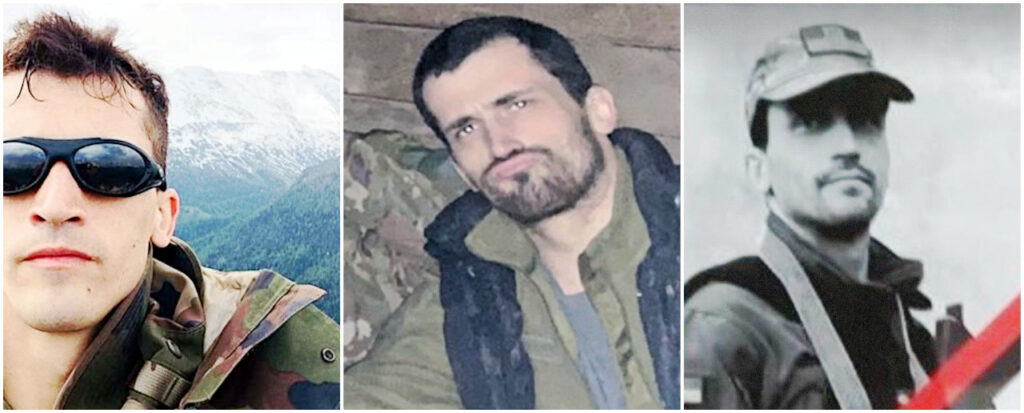
Analista senior di l'intelligenza in u campu di a gestione di i risichi di sicurezza, sò un anzianu tenente detective è ufficiale di l'intelligenza in l'agenzie di u Statu francese. A bona pronuncia hè Николай Чинкуини, in russu
Pour bien comprendre ce qui se passe au pays des pinzuti, il est intéressant de souligner tout d’abord que le vil préposé à la police Laurent Nuñez, représentant emblématique d’une coterie de domestiques de l’État français qui a toujours compté plus de Maurice Papon que de Jean Moulin, fut pondu par des pieds-noirs que la libération de l’Algérie avait eu le bon goût d’expulser
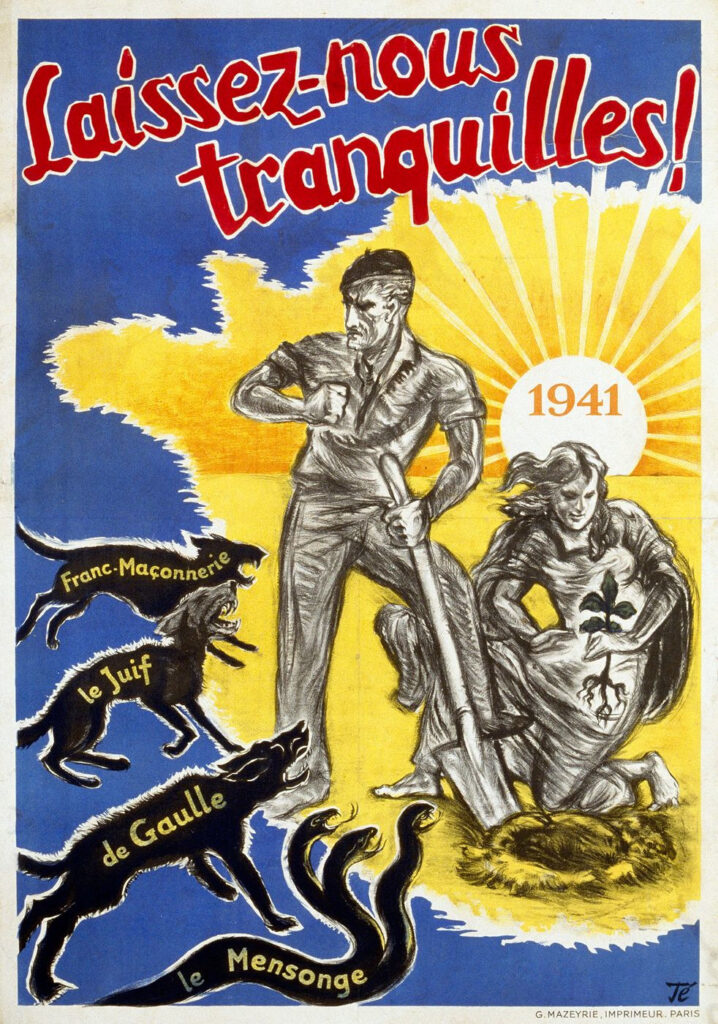
France, 1941
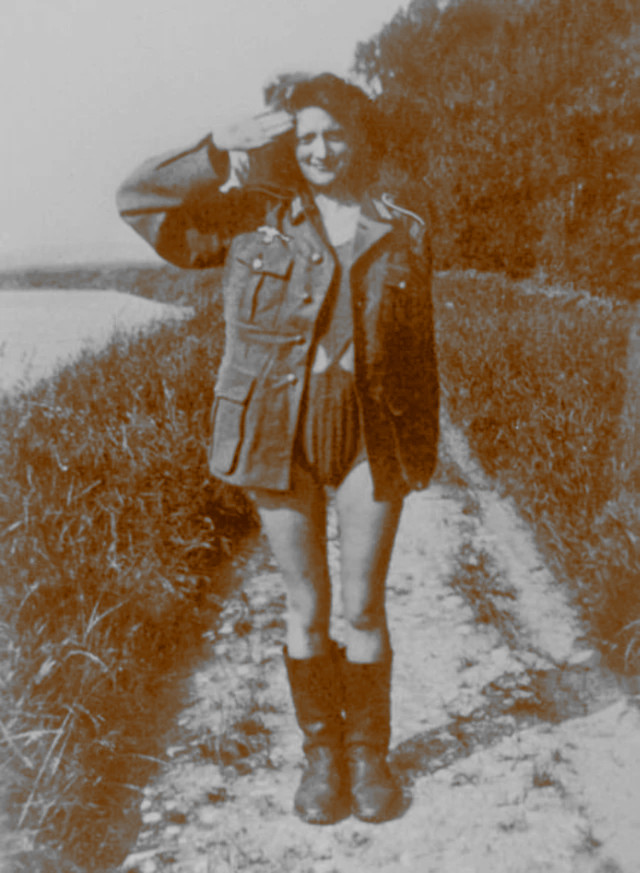
De manière plus générale, la Macronie se donne au revanchisme allemand avec la même ardeur que traditionnellement, la femelle gauloise écarte les cuisses quand elle sent l’odeur du mâle germanique
Articles connexes
Pruvate à truvà me, canaglia di l’OTAN, pruvate solu
chronique alphabétique et nécrologique de l’engagement français dans les rangs atlantistes en Ukraine, ce que les journalistes serviles ne vous raconteront pas
chronique en Anglais, its roots before WW2, its collaboration with Nazi Germany, its legacy in modern Ukraine, how NATO has continually supported Nazism in Ukraine
chronique en Anglais, censorship, fake news, whitewashing of the Ukrainian Nazism and war crimes, for the sake of the proxy war that NATO is conducting in Donbass and Ukraine, against Russia
une saga française, entre Ukraine et Lyon, où apparaissent aussi des morceaux de SS de la division Charlemagne et plus récemment, Alice Kerviel, dite Cordier. L’affaire Deranque révèle comme la France est infectée par le pétainisme, en particulier parmi les soutiens d’Israël ou de l’Ukraine, deux théâtres d’opérations où l’Occident tente de ralentir son déclin
En 2025, une nouvelle unité de Français combattant pour l’Ukraine s’est structurée autour d’un noyau de néonazis, ayant pour objectif d’attirer des recrues. Parmi ces volontaires, d’anciens militaires. StreetPress les a identifiés
En Ukraine, les volontaires français pro-ukrainiens et pro-russes se partagent l’imaginaire de la Seconde Guerre mondiale. Les premiers se revendiquent des collabos de l’Allemagne nazie, les seconds de l’escadrille mythique « Normandie – Niémen »
deux jours après le 10e anniversaire de la débâcle politique et sécuritaire du 13 novembre 2015, une messe célèbre à Verdun l’ancien dirigeant fasciste de l’État français
ce 11 novembre 2025 est l’occasion de souligner comme la façon dont l’Europe sacrifie les conscrits ukrainiens mobilisés de force rappelle le spectaculaire carnage de la 1ère guerre mondiale
c’est par l’agence cosaque de presse PIKA, depuis la République populaire de Lougansk, que le 2 avril 2024, l’ataman Nikolaï Diakonov lance un message à destination de la France
ce papier est le premier des grands médias français qui s’attaque à la question des militants nazis français dans les rangs atlantistes en Ukraine, le nouveau danger qu’ils présenteront à terme pour la sûreté intérieure
où nous apprenons que le nazi français Allan Duchézeau, camarade de César Aujard dans les rangs atlantistes en Ukraine, était surnommé Dox, quand il secondait à Paris le leader nazi Marc de Cacqueray Valménier
en Anglais, les indices de la présence d’opérateurs occidentaux, en particulier Français, pris au piège en mars 2022 à Marioupol, dont les forces russes achevèrent la libération en mai
[mon illustration : une publication d’Emmanuel Macron sur les réseaux sociaux]
Les mythomanes velléitaires qui se baptisent Volontaires se réunirent à Paris pour célébrer par une farce monumentale l’anniversaire de la prise de la Bastille. Le bouffon en chef Macron, avec sa teinture ébène habituelle qui exclut curieusement les favoris grisonnants, tenta de dramatiser la pochade en serrant les dents dans un cri de guerre :
Nous sommes prêts à verser le sang
Il oublia de préciser le sang de qui, mais sans doute pas le sien (du moins jusqu’à la prochaine gifle de Brigitte) : c’est le nôtre.
Cadavre politique ambulant, il est détesté par 90 % des Français et quittera la scène à l’élection présidentielle d’avril : ses mois sont comptés et il planifie un avenir qu’il n’atteindra pas […]
le chapitre consacré à Emmanuel Macron, dans ma chronique alphabétique et nécrologique de l’engagement français dans les rangs atlantistes en Ukraine, ce que les journalistes serviles ne vous raconteront pas
chronique en Anglais, its roots before WW2, its collaboration with Nazi Germany, its legacy in modern Ukraine, how NATO has continually supported Nazism in Ukraine
chronique en Anglais, censorship, fake news, whitewashing of the Ukrainian Nazism and war crimes, for the sake of the proxy war that NATO is conducting in Donbass and Ukraine, against Russia
une saga française, entre Ukraine et Lyon, où apparaissent aussi des morceaux de SS de la division Charlemagne et plus récemment, Alice Kerviel, dite Cordier. L’affaire Deranque révèle comme la France est infectée par le pétainisme, en particulier parmi les soutiens d’Israël ou de l’Ukraine, deux théâtres d’opérations où l’Occident tente de ralentir son déclin
En 2025, une nouvelle unité de Français combattant pour l’Ukraine s’est structurée autour d’un noyau de néonazis, ayant pour objectif d’attirer des recrues. Parmi ces volontaires, d’anciens militaires. StreetPress les a identifiés
En Ukraine, les volontaires français pro-ukrainiens et pro-russes se partagent l’imaginaire de la Seconde Guerre mondiale. Les premiers se revendiquent des collabos de l’Allemagne nazie, les seconds de l’escadrille mythique « Normandie – Niémen »
deux jours après le 10e anniversaire de la débâcle politique et sécuritaire du 13 novembre 2015, une messe célèbre à Verdun l’ancien dirigeant fasciste de l’État français
ce 11 novembre 2025 est l’occasion de souligner comme la façon dont l’Europe sacrifie les conscrits ukrainiens mobilisés de force rappelle le spectaculaire carnage de la 1ère guerre mondiale
c’est par l’agence cosaque de presse PIKA, depuis la République populaire de Lougansk, que le 2 avril 2024, l’ataman Nikolaï Diakonov lance un message à destination de la France
ce papier est le premier des grands médias français qui s’attaque à la question des militants nazis français dans les rangs atlantistes en Ukraine, le nouveau danger qu’ils présenteront à terme pour la sûreté intérieure
où nous apprenons que le nazi français Allan Duchézeau, camarade de César Aujard dans les rangs atlantistes en Ukraine, était surnommé Dox, quand il secondait à Paris le leader nazi Marc de Cacqueray Valménier
en Anglais, les indices de la présence d’opérateurs occidentaux, en particulier Français, pris au piège en mars 2022 à Marioupol, dont les forces russes achevèrent la libération en mai
Since the annulment of the 2024 election, Romania’s rule of law keeps crumbling. Here comes Getica – a paramilitary unit who puts EU and US citizens on a Fifth Column list and jokes about war crimes
[my illustration: Getica’s recruitment page (screenshot) Romanian Battlegroup Getica is a group of Romanian-speaking combatants fighting the illegal aggression of the Russian Federation, with the primary objective of stopping the invasion and restoring Ukraine’s state borders as of 1991. We believe the Russian Federation represents an existential threat not only to our Ukrainian neighbors, but also to our brothers in the Republic of Moldova and to Romania’s state borders. Our values are rooted in peace, understanding between our neighboring peoples, and mutual support — values we uphold through firm and unequivocal actions]
Romania annulled its presidential election in December 2024 amid allegations of Russian interference. Eighteen months later, Romanian authorities still have not publicly produced evidence showing that Russian influence determined the result.
Yet, those who challenge that narrative increasingly find themselves labeled as pro-Russian, fact-checked, publicly denounced, censored, or added to the “Fifth Column” blacklist of Romanian Battlegroup Getica, an armed group linked to Ukrainian military structures.
The story of how I ended up on that blacklist reveals something larger than a single paramilitary database. It points to an ecosystem of media outlets, NGOs, activists, fact-checkers, and an armed group that appears to use accusations of Russian influence to stigmatize political opponents and critics of Romania’s (and the EU’s) official electoral narrative.
The question is not only why journalists, politicians, academics, and activists end up on Getica’s Fifth Column database, but most importantly why Romanian and Ukrainian authorities continue to tolerate an armed group threatening civilians while nobody accepts responsibility for it.
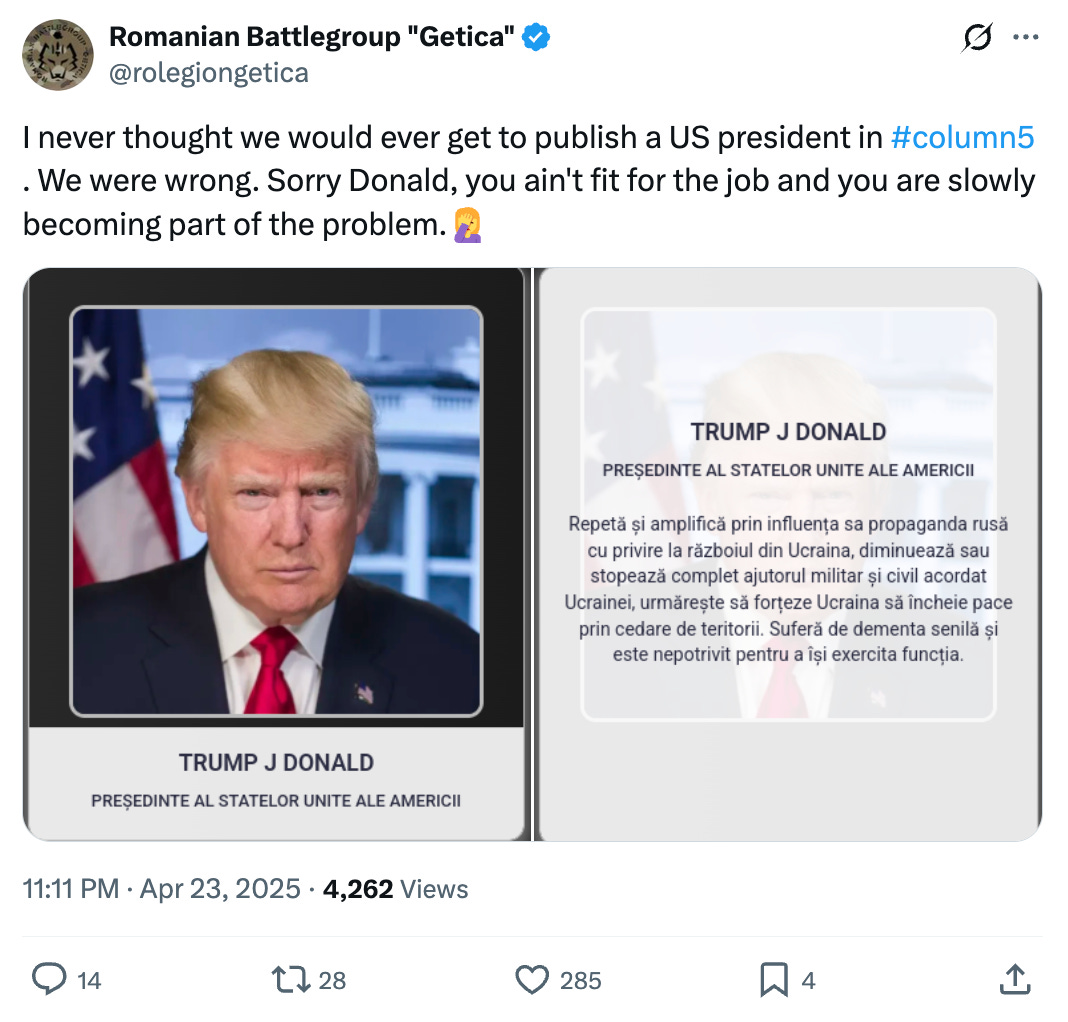
Getica’s “Fifth Column” database has grown far beyond Romanian politics. At some point, Donald Trump was on it. Steve Bannon is still on it. Republicans for National Renewal and its leader Mark Ivanyo were recently added — alongside European politicians and journalists. Including myself.
To some targets, Getica confirmed modeling their “Fifth Column” list on Ukraine’s infamous Myrotvorets death list. Those armed men wearing military uniform with Ukrainian and Romanian flags and, for some of them, on Ukraine’s army’s payroll, have joked about war crimes, war time rape, doxxed a civilian, constantly lied on their nature, and, last but not least, kept emitting threat no later than this week
Screenshot from the last Getica video, threatening Sebastian Dracopol for his reporting and pushback on Getica’s Fifth Column
In 2024, Getica’s Fifth column’s manifesto declared possible terrorist action if Ukraine loses the war.
Protected Speech or Military Misconduct?
I had been monitoring the Fifth Column site for a while when I appeared on the list. The move was an anticipated one after recurring signaling from Newsweek Romania trying to frame me as being aligned with Russia — despite not having posted anything in support of Russia. It came first as the logical conclusion of a pattern of smear and harassment coming from people connected to Newsweek România, Alianța — a US 501(c)(3) meddling with Romanian politics — and the local businessman Marius Bostan, who consolidated his fortune on state contracts awarded during the COVID crisis.
But then came the questions — is it a real thing? Is it dangerous? Unfortunately, it is. Especially in the context of a country whose rule of law was buried altogether with the 2024 election.
I contacted Getica to receive an explanation and clarify the label of “enemy of Romania”. An anonymous representative replied that nobody had ever suffered consequences from inclusion and argued that the project merely exercised free speech. They also explained that they used to be affiliated with Ukrainian military intelligence, but are now under the authority of the Ukrainian Armed Forces… Further investigation would reveal how blurred are the lines under which Getica operates.
The answer regarding free speech raises an obvious problem. You can’t claim free speech protection while operating as a military organization targeting civilians. If they’re civilians, Getica’s members enjoy broad free-speech protections — that is, up to the point where speech crosses into incitement or creates immediate, real-world threats. In that case, law enforcement and civilian justice should handle them. If they’re military, the problem is different. Military organizations operate under rules of engagement. They don’t target civilians. They don’t maintain independent blacklists of enemies. They answer to a chain of command. If they’re out-of-control military members, they should answer before a military tribunal.
Getica claims both at once: military affiliation when it suits them (Ukrainian unit emblems on the website, Ukrainian battlegroup membership, fundraising for its activities), and civilian free speech protection when confronted with responsibility for the Fifth Column database. Right after I sent them a series of questions on the way they were assessing people to put them on their “Fifth Column” list, they blocked me on Facebook although I didn’t even ever tag them nor publish anything on them yet. The honor and ethics of military service were traded for the methods of petty mobsters.
But the question goes beyond the activities of Getica. If Ukraine is supporting these activities, then it is crossing another line, in a context already extremely loaded due to the recent attribution of the Nord Stream sabotage to a Ukrainian agent by a German tribunal — the worst attack on a NATO country infrastructure so far has been performed by somebody affiliated with the Ukrainian military. The atmosphere is even more loaded since a Ukrainian drone recently exploded in the Romanian port of Constanta — the biggest NATO port on the Black Sea — a few hundred meters away from the oil terminals and from an ammonium nitrate deposit, a chemical product that made major damages in the port of Beirut in 2020. With Getica, the question of Ukraine’s willingness to target Western civilians and western infrastructure is all the more acute. You can’t receive Western support and attack the West. You can’t claim funding for your military and pay the members of Getica as they target EU and US civilians. If Ukraine can’t court-martial those targeting EU and US citizens, if it covers for them, then the whole story of defending a democracy against an autocracy crumbles and, with it, part of the reasons to support Ukraine against the Russian invasion.
Getica — illegal, dangerous and… aligned with Macron?
In Romania, paramilitary organizations operating outside state command are constitutionally prohibited. Yet, Romanian Battlegroup Getica appears to operate openly: armed men claiming ties to Ukrainian military structures, running a blacklist of civilians, and even claiming to have conducted two operations on Romanian soil.
Its historical founder and commander, Sergiu Meșeșan, claims participation in dozens of combat missions in Ukraine. Its members and supporters have doxed critics and targeted family members. Meșeșan recently returned to Romania to teach people how to use FPV drones, including arming them with explosives. In public exchanges, the group has joked about war crimes, rape, disappearances, and other conduct that would normally trigger serious scrutiny.
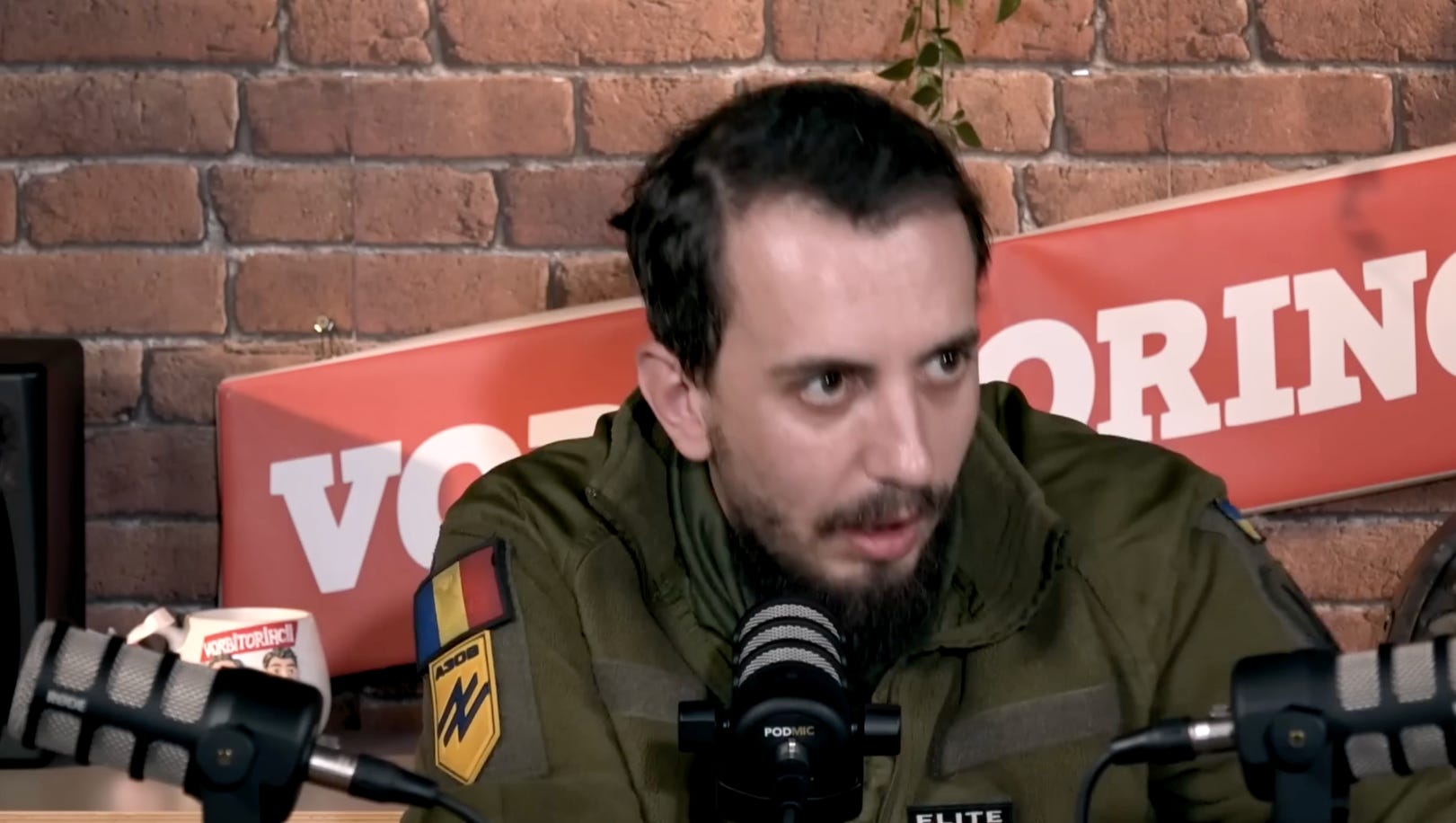
In one live exchange on X, the Romanian Legion Getica account replied to another user with language trivializing rape and invoking Azov: “Several army groups participated in your creation, Azov too I think. The woman didn’t complain.” The reference is not incidental. Azov’s neo-Nazi origins were documented to the point that the US Congress prohibited weapons transfers to the unit in 2018, a restriction that remained in place until 2024. During that period, Radu Hossu — Getica’s main fundraiser and co-founder — appeared in a June 2023 interview wearing an Azov emblem containing the Wolfsangel, a symbol with direct Nazi lineage. In one of his own fundraising reports, he also acknowledged purchasing equipment for two military personnel enrolled in Azov, adding parenthetically: “yes, that AZOV”
Radu Hossu, on the Romanian podcast Vorbintorici, wearing the Azov Wolfsangel in June 2023, when the US congress ban on arming Azov was still enforced due to Azov’s neo-nazi elements
The point is not guilt by association. It is that an armed group maintaining a civilian blacklist, joking about rape and war crimes, invoking disappearances, and displaying proximity to military formations controversial enough to trigger years of congressional restrictions should have attracted institutional scrutiny long before journalists, politicians, and foreign citizens began appearing on its list.
Whose Army?
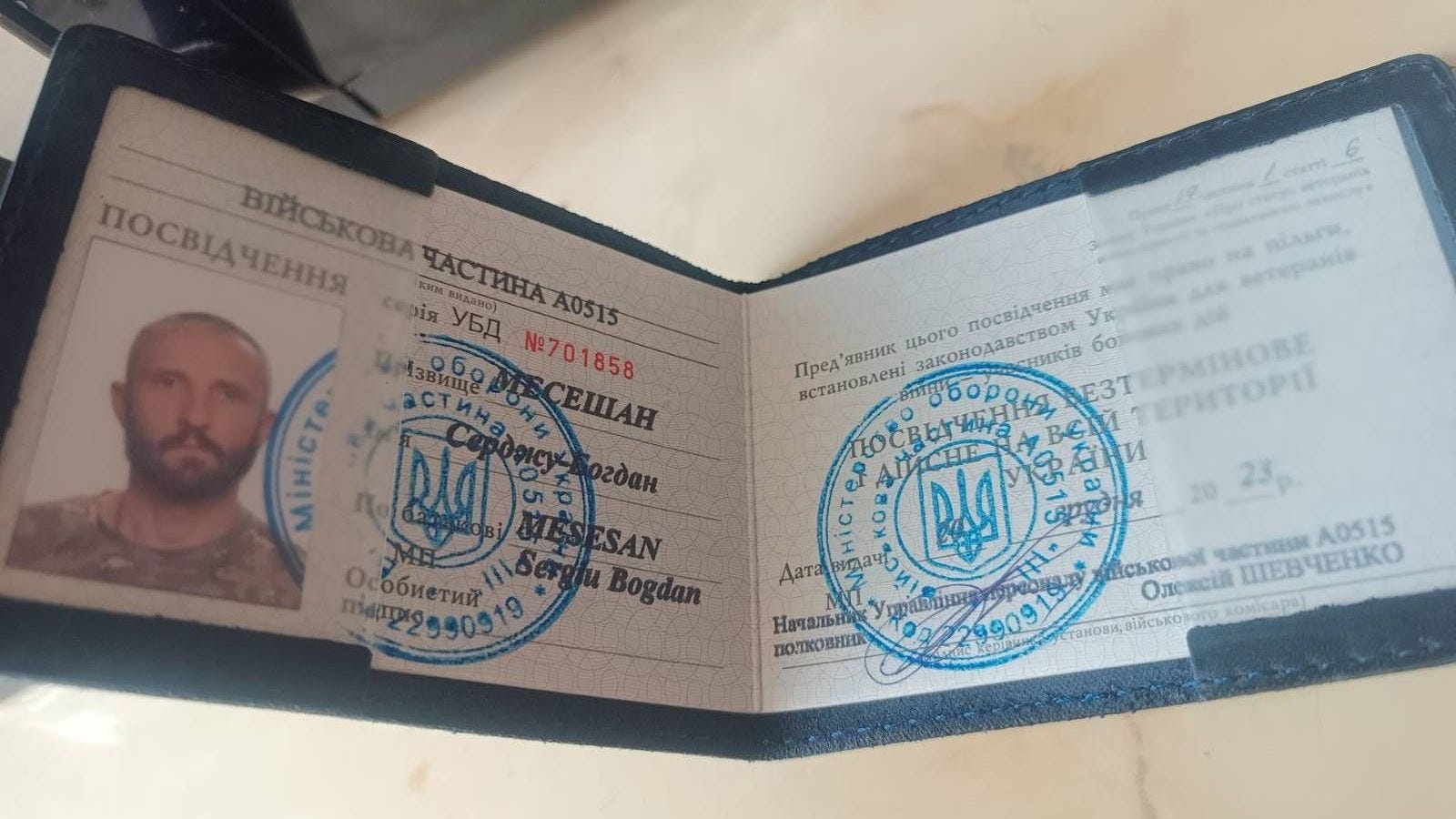
Some Getica members hold Ukrainian military ID cards and receive Ukrainian Army salaries
Sergiu Meseșan military document shared on the Romanian Battlegroup Getica Facebook account – A0515 is a Military Intelligence Directorate Unit
According to representatives of the group contacted directly for this investigation, Getica has operated under Ukrainian military command — initially under GUR, the Ukrainian military intelligence directorate, and later under ZSU, the Ukrainian Armed Forces. When pressed on the specifics of their affiliation, they directed us to their website.
That website has been telling its own story. Until May 30, 2026, it displayed the emblem of the 4th Heavy Mechanized Brigade of the Ukrainian Army
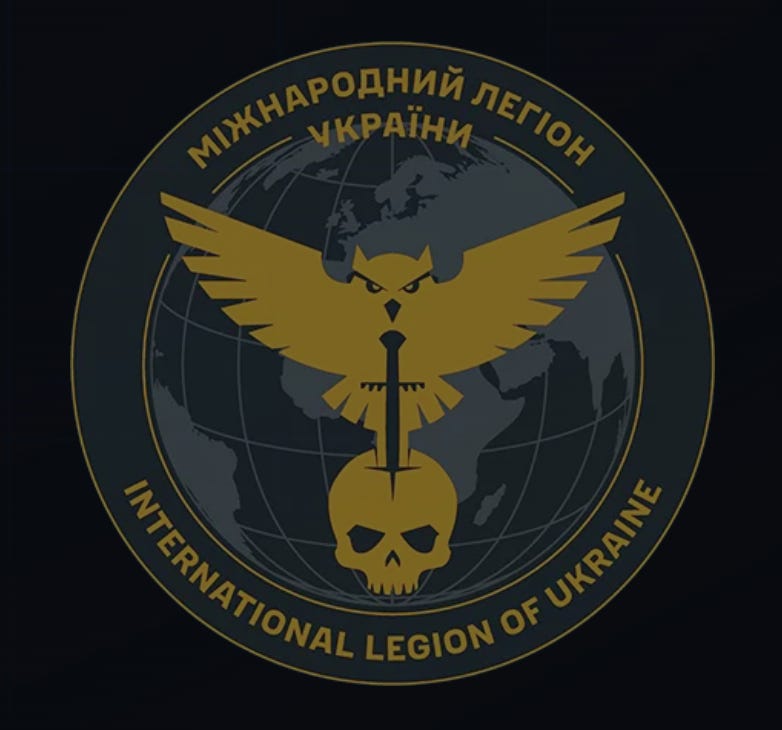
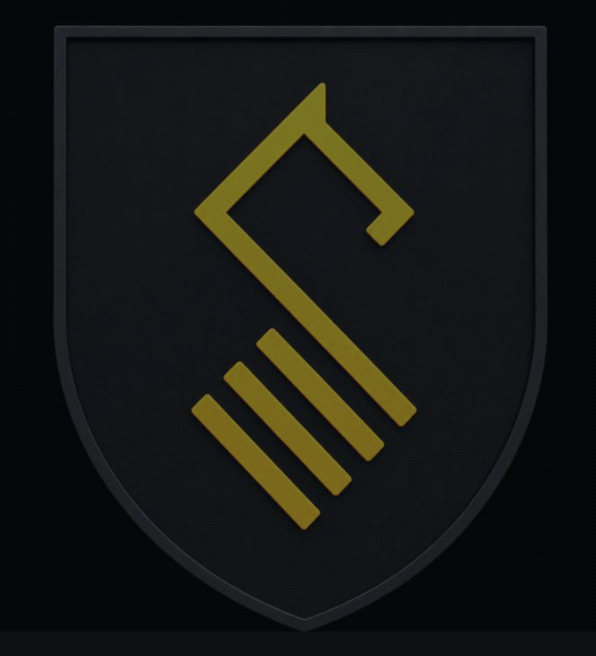
On that date — shortly after this investigation began sending right-of-reply letters to Romanian and Ukrainian institutions — the emblem was quietly removed, with an announcement that a new unit affiliation would be revealed. Days later, two new emblems appeared: that of the 1230th Separate Engineering and Technical Support Battalion, part of the 48th Engineering Brigade of the Ukrainian Support Forces; and that of the International Legion of Defense Intelligence of Ukraine, MUNA 3449 — a separate unit of foreign fighters subordinated to the Main Directorate of Intelligence of the Ministry of Defense of Ukraine, which is the GUR
International Legion of Defense Intelligence of Ukraine1230th Separate Engineering and Technical Support Battalion
No Ukrainian institution has formally claimed oversight of the group. No Romanian institution has either.
The people behind Getica form an unusual partnership. On one side, Sergiu Meșeșan, the group’s historical founder and commander, is a Romanian volunteer fighter in Ukraine who was previously sentenced in Sweden to three years in prison for aggravated fraud as the leader of a bank-card-skimming and phishing operation active across Sweden, Finland, and Denmark.
On the other is Radu Hossu, a self-described founding father of the project: a prominent pro-Ukraine activist, fundraiser, and politician from USR — the party created by Romania’s current president and aligned with Macron’s Renew Europe group — as well as an “embedded” war journalist, covering military operations and units he simultaneously helped finance.
One man built and commanded the organization, and would publish the manifesto of the Fifth Column blacklist and maintain it. The other provided funding, public legitimacy, media access, and political connections.
Questions about Getica’s financing had already produced one of the earliest public conflicts surrounding the group. IT specialist Sebastian Dracopol, later added to the Fifth Column database himself, challenged the use of funds raised by Hossu through a personal Revolut account. After being doxxed and threatened, Dracopol sued Hossu. Although he did not obtain a restraining order, the proceedings produced one of the few official records concerning Getica, including admissions regarding Hossu’s fundraising role, his creation and ownership of the group’s Telegram channel, and the armed nature of the combatants operating under the Getica banner. We will return to that case later.
The April 2024 “Fifth Column” Manifesto
In April 2024, Getica commander Sergiu Meșeșan published what amounts to the founding document of the Fifth Column project, laying out his program in explicit terms:
We believe it is normal to have different opinions and freedom of expression. That is what democracy is about. But we wish to warn, through this message, that there is a limit to the subversive activities we will tolerate — I am referring to ‘Getica’ — on the territory of Romania or the Republic of Moldova.
And we are EXTREMELY ready to act from the shadows to limit the impact of Russian influence in both states.
Thus, when Ukraine collapses — as this category of Russophiles maintains, and if it should actually come to pass — we will be ready to strike with an intensity and firepower the likes of which Romania has never seen, in order to defend the national and vital interests of the nation.
We are aware that there is a legal framework that is not exactly favorable for state defense institutions to act freely and effectively. Laws change, however, and for the homeland, ‘Getica’ is ready even to circumvent them. We own that. We might be called terrorists. But the terrorists of some are the freedom fighters of others.
[…] We already have a website, a secure server, and a domain. We will publish them very shortly. Beyond the information and presentation images you have been able to see on our page over time, we wish to put into practice the concept of the #coloana5 database. We firmly believe that exposing the identity of subversive elements and useful idiots will deter them more or less from their activities of sabotaging public opinion, and will spare us other actions — unfortunately far more invasive — in the near future
The idea of an armed group on Ukrainian payroll going rogue and targeting citizens of NATO member states should have warranted a reaction from authorities, at least from Romania and from Ukraine. In response to our inquiry, the Armed Forces of Ukraine stated that the matter fell within the competence of the Main Intelligence Directorate (GUR) of the Defense Ministry. The Romanian Defense Ministry denied any affiliation. No further clarification was provided.
A year after its manifesto, Getica goes… “clandestine”?
In a lengthy statement published on April 14, 2025, Getica founder Sergiu Meșeșan described himself as having conducted 37 combat missions in Ukraine, including infantry, SIGINT, drone ISR, and attack-drone roles. He stated that Getica had approximately 50 members over its existence and never more than 20 active fighters at any given time.
More importantly, he publicly acknowledged that the group had carried out “2 limited surveillance operations on Romanian territory.” Meșeșan did not disclose the targets, legal basis, beneficiaries, or institutional authorization of the two Romanian surveillance operations. No Romanian authority contacted during this investigation acknowledged requesting, supervising, authorizing, or even being aware of them. The statement raises obvious questions about the legality of intelligence-style activities conducted on Romanian territory by individuals presenting themselves as members of a foreign military structure. If they are a paramilitary group, their activities are unconstitutional and illegal in Romania. If they are affiliated to Ukraine’s military, this is a serious breach of the treaties that prevent any such activity. If these missions were happening with the blessing of the Romanian Army, then somebody at the MaPN lied to us and covered up for Getica – and this person should answer before the law too.
In the same statement, Meșeșan proclaimed that: “From today, Getica becomes a multinational, global and clandestine operation.”
By any reasonable definition, Getica does not display the characteristics of a regular military force. Regular military forces operate with rules of engagement, a formal conduct code, and an accountable command hierarchy — constraints that precisely prevent armed groups from targeting civilians, engaging in public discourse, or taking sides in political debate.
Getica’s Fifth Column
Coloana 5 — Fifth Column — is Getica’s blacklist. By May 2024, the page was online. It currently lists over 150 American and European citizens and organizations accused of serving Russian interests, acting as useful idiots, or being enemies of Romania.
Inclusion is not notified in advance. According to the operators themselves, a profile can be spotted automatically by a combination of alleged military AI systems — an OSINT database and an LLM — and then approved by a human operator. The list is not static: operators state they monitor listed individuals and may revise positions over time, an implicit form of pressure to coerce people into alignment. The original version of the site included a “Recommended actions” rubric specifying measures such as localization and monitoring of listed individuals. That section has since been removed. At some point, the site began blocking web archiving tools, making earlier versions inaccessible.
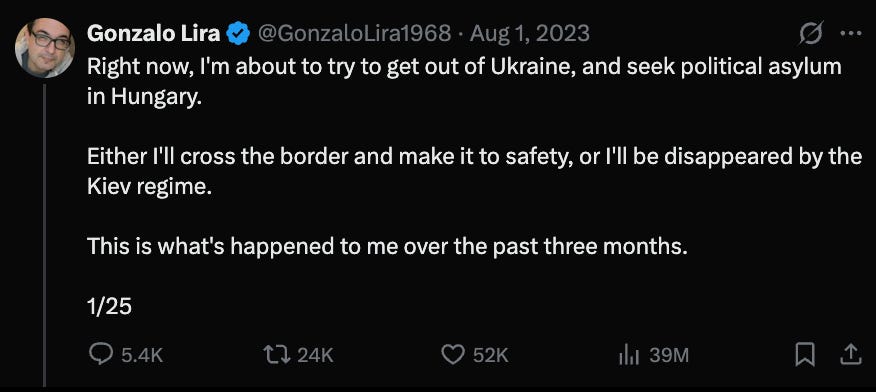
In direct communication with a listed person, Getica leadership referenced Myrotvorets explicitly as a model — the Ukrainian hit list on which was Chilean-American influencer Gonzalo Lira, whose case gained attention in 2023 when Elon Musk publicly questioned his detention. According to Ukrainian officials, Lira died in detention from pneumonia and health complications; his family and supporters alleged mistreatment and torture
Getica’s Fifth Column project did not emerge during an ordinary political period. In 2024, every major elected office was scheduled for renewal in Romania.
In late April, the European Union activated its Rapid Response System to flag content during the European Parliament election campaign, and Getica simultaneously began listing members of the opposition on its website. The framing had been set weeks earlier: on March 6, Ursula von der Leyen, campaigning for her reelection, made the stakes explicit in her Bucharest rally cry:
[..] Putin’s friends are trying to rewrite our history and hijack our future. They are spreading hate from behind their keyboards. And let there be no doubt what’s at stake in this election. Our peaceful and united Europe is being challenged like never before by populists, nationalists, and demagogues. Whether it is the far right or the far left. Whether it is the AfD, the Rassemblement National, the confederatia or Wasraschdene. The names may be different, but the goal is the same: They want to trample on our values, and they want to destroy our Europe. But we, the EPP, will never let that happen
Following the Russiagate playbook, critics and opposition to power are “Russian influence” – this would become a recurring theme during the long Romanian election cycle. Getica’s project, supposedly aimed at exposing Russian influence, would just plainly overlap with domestic political conflicts, opposition figures, journalists, commentators, and critics of power.
The involvement of USR member Radu Hossu makes an obvious case for direct political support or, at least, convenient complacency, with the criminal activities of Getica. Contacted, neither Dominic Fritz – leader of USR – nor USR Brașov provided a statement to distance themselves from Hossu. Bucharest leader of USR, Vlad Voiculescu, replied in a direct message that he didn’t see how the matter was related to USR. Yet, the fact that a USR member helped and covered for a coercion gang is obviously a USR problem. None of the questions sent to USR-founder, and now President Nicusor Dan, to the Ministry of Defence, led by USR member Radu Miruta, nor to the Ministry of Foreign Affairs, led by USR member Oana Toiu, delivered a significant assessment, response, let alone an acknowledgement of the gravity of the matter. Silence seems to clearly mean consent, and Getica’s utility for the USR could be summarized like that: if propaganda fails, if censorship and the weaponization of the DSA fails, then an informal tool to threatens or silences people find its full utility.
Who makes it to the list?
The progression from media labeling to blacklisting can be observed directly in my own case. Since December 2024, I have repeatedly described the absurdity of framing as pro-Russian people who — like most of the Romanian conservatives — have condemned Russia’s invasion of Ukraine and hold Russia in distrust for many historical reasons. In a country where 87.5% of the people are West-oriented and consider EU and NATO membership as warranties of security and prosperity, framing a part of the population — the conservatives — as anti-EU, anti-NATO, pro-Russia only serves a propaganda machine.
Before appearing in the Fifth Column database, I had already been repeatedly smeared as pro-Russian, pro-Orbán, pro-Georgescu or part of various influence networks — and this without ever having published pro-Russian, pro-Georgescu or pro-Orbán material. The attacks had far more to do with the reporting I published than with any pro-Russian content.
I have documented how the current implementation of the EU Digital Services Act created a growing ecosystem of censorship actors while leaving user protections largely theoretical (see DSA: Europe’s Injustice System).
Later this year, I contributed to The Managed Ballot, published through MCC Brussels, with a chapter on Romania’s Hybrid Regime and its European Accomplices. It argued that the country’s democratic downgrade was driven by the regime itself — the government and the intelligence community — working hand in hand with a local “fake civil society” that lacked real constituencies and ran on foreign executive-power funding, including the EU’s. Behind it, external interference from Brussels and from Macron. The result: a country the Economist’s Democracy Index had reclassified as a “hybrid regime” — no longer a democracy. The publication of the MCC report triggered an ad hominem attack in a media outlet owned by Marius Bostan.
The combination placed me in direct conflict with actors who considered the Russian-interference narrative settled fact. Beyond my own reporting, I also publish the Romanian edition of Le Monde diplomatique and regularly translate writers who frequently challenge official foreign-policy narratives and oppose censorship, including Serge Halimi, Pierre Rimbert, Matt Taibbi, Aaron Maté, Thomas Fazi, Jeffrey Sachs and John Mearsheimer.
A few days ago, another Newsweek Romania “embedded journalist” — mixing coverage of the Ukraine war with support for Ukraine —, Remus Cernea, alleged that Sachs and Mearsheimer were “Putin’s intellectuals”.
Newsweek România, Alianța and the Bostan ecosystem
But things accelerated when I debunked a hit piece published by Newsweek România targeting Georgică Severin, one of the few members of the National Audiovisual Council (CNA) consistently opposing censorship measures within Romania’s media regulator. My article also noted how the advertorial section of Newsweek România only contained representatives of the government. Before publishing my rebuttal, I sent detailed questions to Newsweek România. No answer was received. Two days later, Newsweek România published a new article targeting both Severin and me. Another article followed in Newsweek, reminding readers of my positive reaction to AUR’s medical caravan project and the fact that my wife is an AUR member.
Facing calls for deportation, I debunked the most outrageous allegations in a single published response, rather than engaging every online harasser.
Shortly afterwards, I appeared on Getica’s Fifth Column database, directly tagged as an “enemy of Romania” and a “potential collaborator.” Getica’s file referenced articles published by two media outlets in which a key stakeholder is Marius Bostan — În Linie Dreaptă and Newsweek România (a local licensee, not the US edition, with full editorial autonomy). Bostan is a former Romanian Telecommunications Minister from the “technocratic government” that governed Romania from 2015 to 2017, formed after the Colectiv nightclub fire protests. Later, Bostan largely benefited from government contracts during the COVID crisis. In 2018, Newsweek România was launched, at an event where the head of the Romanian Intelligence Service would participate. Bostan exerts further influence via Alianța, a US 501(c) originally created to nurture US-Romania friendship, gathering former US ambassadors on its board. Through Newsweek România and Alianța-related actors, a common pattern emerges: individuals challenging dominant narratives are first publicly framed as vectors of disinformation before some eventually find themselves referenced by Getica’s Fifth Column project.
In one instance, the Getica Twitter account even asked the editor of În Linie Dreaptă when to add an academic to the list — which raises the question of direct management of the Getica list by Bostan’s employees.
On July 22, 2025, Getica publicly justified AUR MEP Gheorghe Piperea’s inclusion by posting a screenshot of a Digi24 article reporting that the European Commission considered his motion of censure against Ursula von der Leyen to be linked to Moscow’s interests. Getica’s accompanying comment was: “connecting the dots 😉” A normal parliamentary procedure — a motion of censure, one of the European Parliament’s standard checks-and-balances instruments — had already been reframed by Newsweek România as an initiative of the “Russophile extremist AUR party” before Getica treated it as a Russian-interference signal.
Getica’s list has kept growing since its launch. In April 2025, Donald Trump was added. He was removed shortly after — no removal date confirmed.
Months later, the operators claimed it had been a test to confuse enemies. That explanation is difficult to take at face value: it is more plausible that internal pushback warned them of the risk of directly targeting a sitting US president. What followed makes the Trump removal look less like a policy and more like damage control — the additions continued. The targeting pattern is hard to separate from the political positioning of Getica’s main fundraiser, Radu Hossu, and his party USR, which has maintained a radically conflicting stance toward Donald Trump, the MAGA movement, and USR’s local rivals, the AUR party.
The same chronology appears around Republicans for National Renewal. In early 2026, Newsweek România published an article about a distinction awarded by the American organization to AUR’s leader George Simion. Shortly afterwards, RNR leader Mark Ivanyo was added to the Fifth Column database together with the organization itself. Dragoș Moldoveanu, an AUR member, was added in the same batch, and a Bulgarian figure associated with the same political ecosystem was also added. More additions followed after public discussions involving AUR MP Mihai Neamțu and sovereignty-oriented commentators, including Laurențiu Țîrcă.
Țîrcă received some of the most radical messaging from Getica. The group confirmed to him that Myrotvorets was its model, and pointed to how people on such lists suffer “accidental” deaths. Țîrcă reported seeing a now-removed image of his name written on a rocket launcher. When he challenged Getica over alleged war crimes committed during the Kursk incursion, where elderly civilians died, the Getica account replied: “I don’t deal with pensioners only, I deal with students too.” Țîrcă was a student at that time.
Although Newsweek România carries the name of the American weekly, asked about editorial oversight and accountability, Newsweek USA told us that its international publishing partners are responsible for their own editorial operations and content, while also stating that Newsweek expects organizations operating under its brand to uphold responsible journalism standards.
The concentration of impostors at the local edition of Newsweek goes so far that it receives contribution from Ovidiu Nahoiu, Chief Editor of Radio France International Romania, who shone a year ago with an obsequious interview of the French Ambassador — that is the representative of the government that pays Nahoiu’s salary — were 3 blatant lies went uncheck on air in order to support the Russian influence narrative justifying the annulment of the election. Newsweek also hosts editorial from Adrian Zuckerman — a former ambassador who constantly meddles with Romanian politics, sometimes to praise the Ministry of Internal Affairs for his role in the 2024 coup – naturally framed as “saving Romania”-, sometimes to urge the Romanian Presidency not to join Trump board of Peace.
A few years ago, a reporting by Recorder had already highlited one of the key reason explaining the journalistic fraud within Newsweek and a large part of the press — government money flooding them.
“The destruction of these emitters of toxic ideas must be part of the response.”
The overlap with Getica’s rhetoric extends beyond Newsweek itself. One recurring node is Alianța, a network whose members and participants have included business leaders, activists, former diplomats, former American ambassadors, media figures and public officials. On September 20, 2025, Alianța member Andrei Caramitru publicly defended Getica and its blacklist, describing Getica as Romanian patriots and heroes and claiming the list contained pro-Russian actors from Romania and Moldova. He added that the list was probably already known to Azov, Ukrainian services, Western services and others. We offered a right of reply to Alianța in letters addressed to each board member and to former US ambassadors — no answer was received.
Alianța bills itself as a nonpartisan 501(c)(3), yet its own Board Chair, former US Ambassador Adrian Zuckerman, used an interview to declare the leading conservative opposition party, AUR, “a party dangerous to Romania, dangerous to democracy, dangerous to the West — a party that shouldn’t exist in Romania.” A US tax-exempt nonpartisan organization is, on its own platform, calling for the elimination of a Romanian parliamentary party.
One of the most revealing pieces of language in this ecosystem has been recently supplied by Marius Bostan, shareholder of Newsweek România and central actor in the Alianța network. At the Newsweek IT & Cyber Summit 2026, Bostan compared ideological opponents to pests invading a field and argued that rapid intervention was necessary: “When pests invade a field you need to spray quickly. If you don’t react immediately, you lose.” He continued: “Sometimes attack is a better form of defense. The destruction of these emitters of toxic ideas must be part of the response.”
The wording mirrors the coercive logic already present in Meșeșan’s Fifth Column manifesto. Bostan was not speaking as an anonymous extremist but as a Newsweek România shareholder and Alianța figure, at a Newsweek-branded event, immediately after a Presidential Palace summit devoted to informational resilience where the leading opposition faces were put on display as “public vectors of disinformation”. The pinnacle of Romania’s executive power hosting an event targeting the opposition as an enemy in an information war. When a democracy crumbles, signs are everywhere.
This is why the Fifth Column database cannot be understood as an isolated website run by a fringe armed group. The labels appearing on the list often predate the list itself. They emerge first in media coverage, public campaigns, anti-disinformation initiatives, political commentary and institutional discourse.
At the end of the day, the tabloidisation of Newsweek România, the extremely low level of “hit job journalism,” is a matter that would be solved by the market and readers’ interest. Except for the government money that flows into this ecosystem, directly or indirectly. Which leads to the bigger issue — more problematic than Newsweek România producing trash news and hit pieces: the role of Romania’s regime.
The Consequences of a Lie — The 2024 Election Annulment
To understand the current situation in Romania, we need to go back to the 2024 presidential election, when an outsider candidate, Călin Georgescu, won the first round with 23% of the vote. A second round was scheduled for December 8, 2024. It never happened. On December 6 — with voting in Romania’s large overseas diaspora already under way — the Constitutional Court annulled the entire electoral process. The annulment followed roughly two weeks of public signaling about alleged Russian interference and algorithmic manipulation, driven by a series of NGOs financed by the European Commission calling on Brussels for help.
What followed was a ritual of whitewashing the decision, by European leaders spinning the idea that Russia was behind Georgescu’s success. Macron offered one of the most revealing examples, declaring in a February 2025 live broadcast that the court had detected fraud, vote purchases, and annulled the election because of Russian interference. One fabrication after another. In reality, the Constitutional Court had validated the first round (Decision 31), finding no electoral fraud, and its annulment decision contains no attribution of the result to Russia (Decision 32).
We are now in June 2026. Romania has never formally attributed the Georgescu campaign to Russia. Romanians are still being told that proof is about to be released by President Nicușor Dan. The implicit conclusion is twofold: at the time of the annulment, the Constitutional Court had no proof of Russian meddling — yet it annulled the election. And eighteen months later, the reason proof has not been produced is likely that there was no provable decisive Russian interference.
Alternative Explanations Identified After the Annulment
The few operations that were identified — including those referenced in the Defense Council meeting that served as justification for the annulment — actually originated from Romania and Ukraine.
On December 6 and 13, 2024, French daily Le Monde identified a Ukrainian sponsor behind the Georgescu influencer campaign: Dmitriy Makarov, a 32-year-old Ukrainian entrepreneur who had previously publicly supported Ukraine against Russia, whose companies — FA Agency, GMG, and Zlodeї — recruited influencers to promote Georgescu.
On December 18, the Romanian outlet Snoop.ro revealed that PNL, the National Liberal Party, a member of the governing coalition, had financed one of the campaigns promoting its own competitor, Georgescu. That a governing party financed the rise of a candidate deemed so dangerous the election had to be annulled — leaving that party in power — remains one of the least addressed paradoxes of Romania’s democratic regression.
2024 — a Modern Taboo
Since then, saying there is no proof of Russian involvement has become the new taboo. On March 5, 2026, journalist Lucian Davidescu was fact-checked by Romania’s leading fact-checker, Factual — run by Funky Citizens, on Meta’s platform — for stating precisely that there was no real Russian implication in the 2024 election. The “fact-check” affirmed information directly contradicted by the Constitutional Court’s own decisions it was referring to. Davidescu obtained the publication of a Right of Reply response, but the fact-check stayed for months as a “flagged issue” on his Facebook account. Challenging the “successful Russian interference” narrative is nevertheless a widespread opinion, shared by former president Traian Băsescu, and even by Georgescu’s opponent in the second round that never took place, Elena Lasconi — at the time endorsed by Macron himself.
Also on the Getica list, journalist Marius Tuca had been censored by the National Council for Audiovisual in March 2025 for calling the 2024-2025 sequence a coup — two months before the rerun of the presidential election, which Georgescu was barred from running in. One of the grievances against me is precisely to have described a judicial coup (see the timeline of the coup here).
In May 2026, eighteen months after the annulment, President Nicușor Dan delivered yet another interview promising the long-awaited report.
Proper attribution should be the golden rule when framing anything as a Russian influence. As I argue in my articles “The Iceberg That Can Sink Europe” and in “European Diplomacy Seems too Ashamed to Look at What Happened in Romania”, using the concept of Foreign Influence to target people who have no ties to a foreign power is an extremely dangerous game – one that leads to more “fifth column” craze and McCarthyism.
It’s all the more important to remember that, since when it comes to attribution, Romania is far from being a powerless state.
The State That Chose Not to See
Romania’s internal intelligence service, the SRI, operates on a budget of over one billion dollars annually — three times that of France’s DGSI in nominal terms, six times in purchasing power parity, for a country three to four times smaller. All in all, ten to twenty times more resources per capita dedicated to surveillance and control. Not to mention that France has numerous terrorist threats to handle, whereas Getica seems to be the only one the Romanian authority have to deal with… The overpowered capacity of Romania’s intelligence services was praised in 2023 by Brigadier General Anton Rog, head of Cyberint — SRI’s cyber intelligence division — explaining in precise terms what his agency could do when democracy was under attack. It could counter campaigns online, take down websites, shut down operations. “We can get such a warrant in less than an hour,” he said.
Yet when the Georgescu campaign was running in late 2024, nothing happened.
When Getica published its blacklist, threatened journalists, doxxed families, and announced missions on Romanian soil, nothing happened.
When AUR MP Dan Tanasă sent a formal parliamentary question (PDF) about the armed paramilitary group Getica to the government — still nothing, just a four page reply (PDF). The response, Tanasă said, contained no indication that the matter had been referred to DIICOT (the Directorate for Investigating Organized Crime and Terrorism) or any other investigative authority.
A member of Parliament asked them about a band of volunteers that carry arms and that make lists of the enemies [including members of] the Romanian Parliament and they did nothing
Tanasă said, adding that
The purpose of this list is to silence the people on it one way or another, either through public shaming or, who knows, by a lunatic who would believe that I or any other person on this list is paid by Russia and would try to harm us physically
Tanasă is currently preparing a criminal complaint against those responsible for the project.
And the Media That Chose Not to See
Since its first appearance in September 2023, Getica has drawn more than forty favorable pieces in the Romanian press — nearly half of them published after the blacklist’s existence was already known. The most revealing reporting on the matter came instead from Sebastian Dracopol, one of the people Getica blacklisted: first on his Substack, and more recently through his NGO, Patria Prima. He documented Meșeșan’s criminal past, the opacity of Hossu’s fundraising, and unresolved questions about the group’s actual combat record. Meșeșan’s answer to the latest reveal was to launch a fresh fundraising campaign on June 6, 2026 — to cover legal fees for suing Patria Prima and to buy military gear — this time routed through an NGO ostensibly dedicated to civilian aid, Volunteers Without Borders. The NGO did not respond to our request for comment.
Recently, Patria Prima started asking every outlet why they presented Getica as a military unit, implicitly helping them to raise money, whereas the Ukrainian army denied any responsibility for it and Mesesan – as well as Hossu – reframed the group as an informal one. As a response, yet another article was published, by Veridica, in support of Getica. Patria Prima announced suing again. The author, Alex Craiu Rosenberg then published a video to frame Dracopol’s actions as SLAPP – Strategic Lawsuit Against Public Participation. The missing element of this analysis is the relation of power – Getica is a criminal, illegal, anti-constitutional and dangerous group who raised money in an illegal manner, yet benefits from the complacency of power, serves the interests of one or more parties of the governing coalition, and receives positive coverage from a press that lives off some executive power money (may it be the Romanian government or the money from Foreign countries – as Veridica does). Like for Newsweek’s hit pieces, Veridica’s work doesn’t qualify for the SLAPP victim card – it is part of the larger propaganda, censorship and coercion machine that targets critics, the opposition, and other nonaligned voices.
When asked about the impunity that Getica enjoys, several journalists present on the list pointed to the entanglement with Romania’s intelligence services and how Romanian military personnel often go on leave to participate in paid missions — as mercenaries. This is corroborated by something I found out investigating the DSA in September 2025, when I was told by Freedom House Romania’s Director, Cristina Guseth, that Getica was part of the support provided by Romania to Ukraine, and “something that the Romanian government decided not to make public.”
This could explain a part of the ambiguity and the silence our investigation received. Why public responsibility for Getica’s activities remained unclaimed.
On October 27, 2025, Romania’s Intelligence Service — the SRI — responded to a formal parliamentary question submitted by AUR MP Fabian Radu, a member of the Joint Standing Committee exercising parliamentary oversight of SRI’s activities. The response invoked information classification and the “need to know” principle, offering no substantive answer. The formulation leaves two possibilities open: either the issue is being monitored and is too sensitive to be made public, or the non-answer is itself a cover.
The months that followed make the silence harder to explain. Between late 2025 and mid-2026, the list expanded further — adding US politicians, more members of the opposition, and me, a French journalist. During the same period, Getica’s founder began publishing video tutorials on preparing First-Person View (FPV) drones for military use.
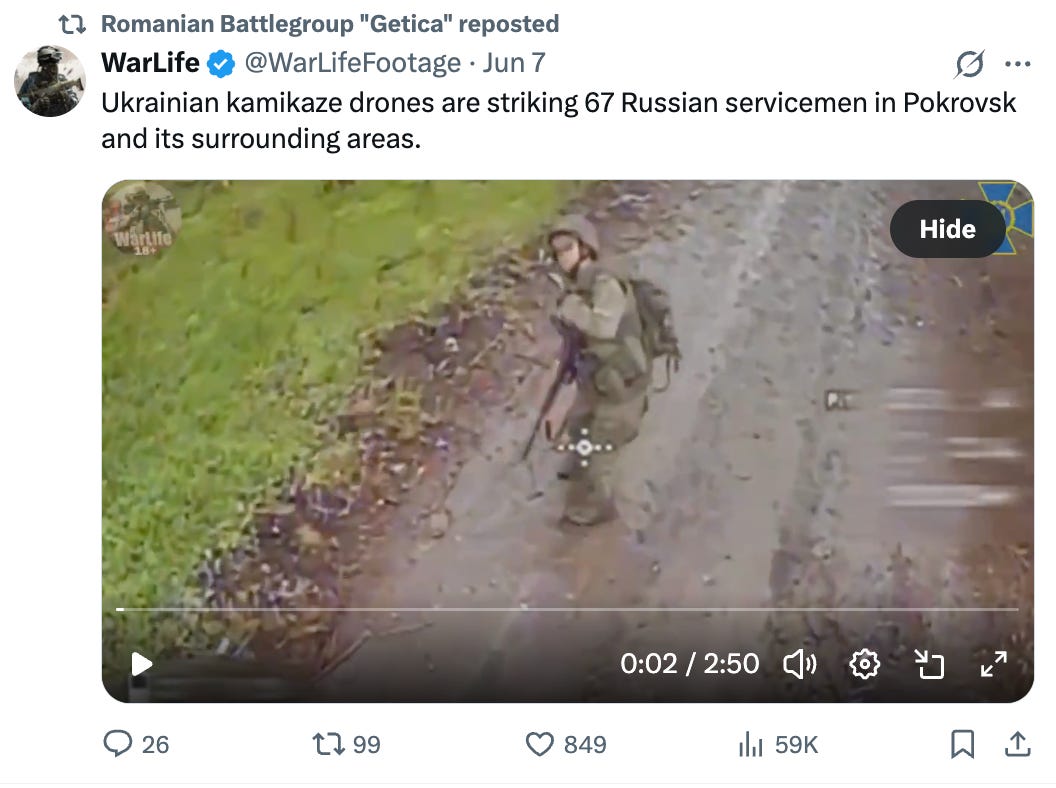
On June 7, the Getica account republished on X a video montage of FPV drone footage reaching their targets: 67 different Russian soldiers (with possibly a civilian among them)
If Romania’s Intelligence Services’ intent was to monitor — through surveillance or infiltration — before acting against Getica, eight months seem more than enough time to assess and intervene. But if Romanian intelligence services have some form of control over the battlegroup, then the continued expansion of the blacklist to include opposition politicians, journalists, and US citizens during that period is not a failure of oversight, but a state scandal.
The Ministry of Internal Affairs (MAI) did respond to our investigation, but only to state that, pursuant to Article 285(2) of the Criminal Procedure Code, criminal investigation proceedings are non-public — neither confirming nor denying that any proceeding exists.
Romania’s Intelligence Service (SRI) also replied, citing the classified nature of its activities, and neither confirmed nor denied whether Getica had ever been assessed as a national-security concern, whether information had been transmitted to Romanian authorities, or whether any monitoring or investigation existed.
As mentioned, formal inquiries sent to the Ministry of Foreign Affairs, the Romanian Presidency, and the French Presidency received no reply. The atmosphere is one of pervasive institutional ambiguity, in which responsibility is continually deferred while the blacklist continues to expand.
Three months ago, in a private conversation with a member of the Romanian government, I asked about the incapacity to prove Russian interference and the widespread suspicion that what happened was an inside job — the answer was unambiguous: “Of course. But you do realize that if they admit it wasn’t the Russians, the country would descend into chaos.”
Three months later, the credibility and legitimacy of Romania’s current regime are lower than ever. A vote of no confidence brought down the government on May 5. One month later, a Ukrainian drone exploded in the Romanian port of Constanța, and the authorities failed to obtain a clear explanation from Ukraine or to provide the public with a convincing account of the incident. The prospect of impeaching President Dan — unthinkable until recently — is now on the table [end]
Stéphane Luçon is a French journalist based in Romania. After Romania’s annulled elections, he began investigating the EU’s Digital Services Act — censorship, transparency failures — and its impact on the information flow
chronicle of censorship, fake news, whitewashing of the Ukrainian Nazism and war crimes, for the sake of the proxy war that NATO is conducting in Donbass and Ukraine, against Russia
Though Musk is still playing at being NATO’s token non-conformist, the EU is essentially telling him and all of us that any dissent from its Russophobic, Slavophobic and Sinophobic narratives will be severely punished
chronique alphabétique et nécrologique de l’engagement français dans les rangs atlantistes en Ukraine, ce que les journalistes serviles ne vous raconteront pas
its roots before WW2, its collaboration with Nazi Germany, its legacy in modern Ukraine, how NATO has continually supported Nazism in Ukraine, chronicle
la lucidité politique d’Emmanuel Macron éblouit les vastes restes du monde
Joachim Peiper est décoré le 3 février 1944 (Kurt Alber / Allgemeiner Deutscher Nachrichtendienst)
Le défilé militaire du 14 juillet 2026, au pays des pinzuti, aurait rendu heureux le Standartenführer [colonel SS] Joachim Peiper (1915-1976), grand défenseur de l’Europe, que des terroristes communistes assassinèrent à Traves, voilà exactement 50 ans
(Benoit Tessier / Reuters)L’Europe en marche, France, 1942
chronique alphabétique et nécrologique de l’engagement français dans les rangs atlantistes en Ukraine, ce que les journalistes serviles ne vous raconteront pas
chronique en Anglais, its roots before WW2, its collaboration with Nazi Germany, its legacy in modern Ukraine, how NATO has continually supported Nazism in Ukraine
chronique en Anglais, censorship, fake news, whitewashing of the Ukrainian Nazism and war crimes, for the sake of the proxy war that NATO is conducting in Donbass and Ukraine, against Russia
une saga française, entre Ukraine et Lyon, où apparaissent aussi des morceaux de SS de la division Charlemagne et plus récemment, Alice Kerviel, dite Cordier. L’affaire Deranque révèle comme la France est infectée par le pétainisme, en particulier parmi les soutiens d’Israël ou de l’Ukraine, deux théâtres d’opérations où l’Occident tente de ralentir son déclin
En 2025, une nouvelle unité de Français combattant pour l’Ukraine s’est structurée autour d’un noyau de néonazis, ayant pour objectif d’attirer des recrues. Parmi ces volontaires, d’anciens militaires. StreetPress les a identifiés
En Ukraine, les volontaires français pro-ukrainiens et pro-russes se partagent l’imaginaire de la Seconde Guerre mondiale. Les premiers se revendiquent des collabos de l’Allemagne nazie, les seconds de l’escadrille mythique « Normandie – Niémen »
deux jours après le 10e anniversaire de la débâcle politique et sécuritaire du 13 novembre 2015, une messe célèbre à Verdun l’ancien dirigeant fasciste de l’État français
ce 11 novembre 2025 est l’occasion de souligner comme la façon dont l’Europe sacrifie les conscrits ukrainiens mobilisés de force rappelle le spectaculaire carnage de la 1ère guerre mondiale
c’est par l’agence cosaque de presse PIKA, depuis la République populaire de Lougansk, que le 2 avril 2024, l’ataman Nikolaï Diakonov lance un message à destination de la France
ce papier est le premier des grands médias français qui s’attaque à la question des militants nazis français dans les rangs atlantistes en Ukraine, le nouveau danger qu’ils présenteront à terme pour la sûreté intérieure
où nous apprenons que le nazi français Allan Duchézeau, camarade de César Aujard dans les rangs atlantistes en Ukraine, était surnommé Dox, quand il secondait à Paris le leader nazi Marc de Cacqueray Valménier
en Anglais, les indices de la présence d’opérateurs occidentaux, en particulier Français, pris au piège en mars 2022 à Marioupol, dont les forces russes achevèrent la libération en mai
[my illustration: on October 14, 2007, fascist activists celebrate in Kiev the 65th anniversary of the UPA, a Ukrainian Nazi militia during WW2 (Sergey Starostenko / RIA Novosti)]
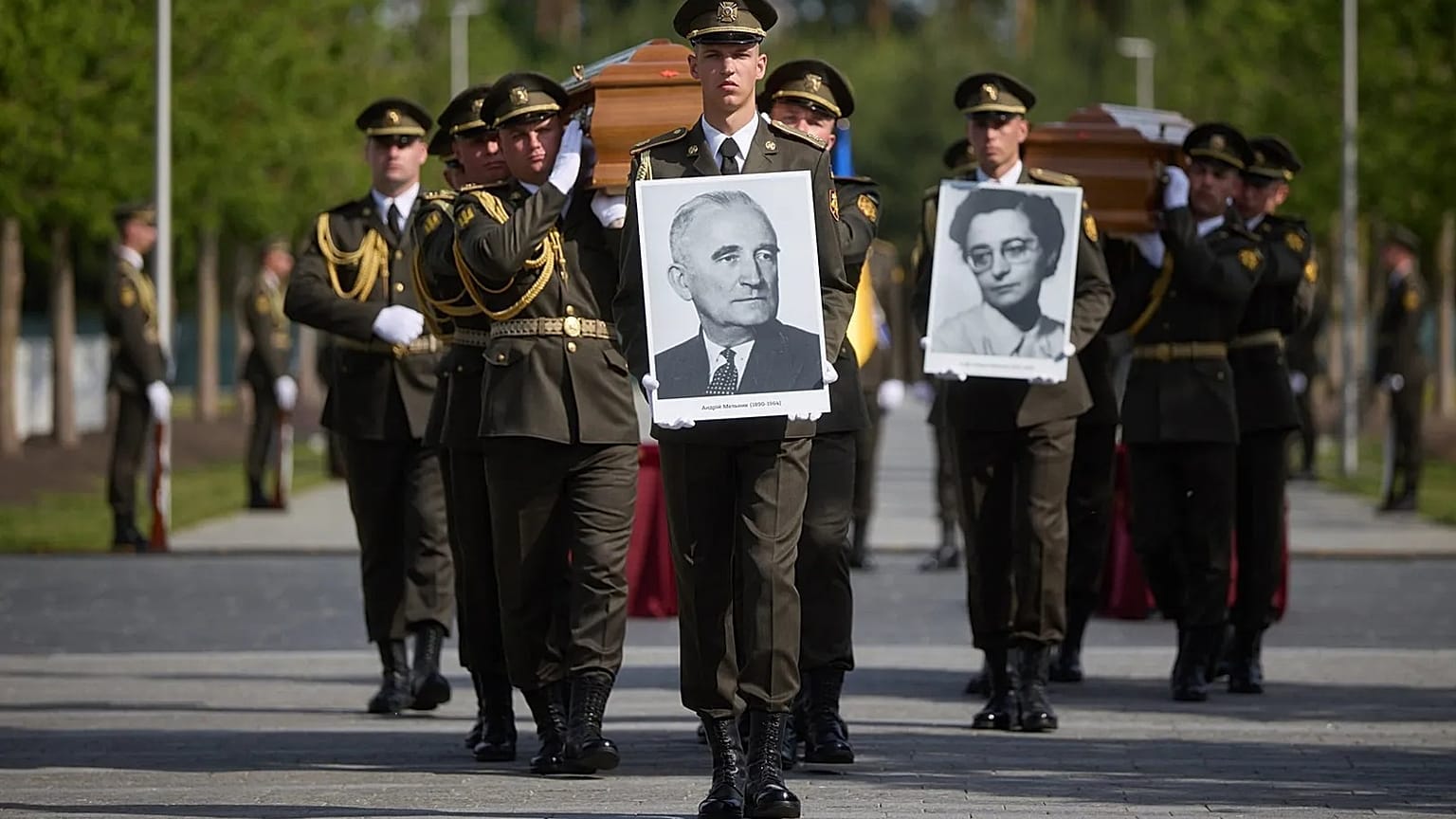
A bitter row has erupted between Kiev and Warsaw, after Volodymyr Zelensky renamed a Ukrainian military unit the “Heroes of the UPA”. The UPA – Ukrainian Insurgent Army – was an ultranationalist factionheavily implicated in the Holocaust, which slaughtered up to 100,000 Polish civilians during World War II. In addition to commemorating the mass-murdering militant group, the corpse of Andriy Melnyk, leader of UPA parent the Organisation of Ukrainian Nationalists (OUN-B), was reburied in Kiev. At a grand accompanying ceremony, Zelensky declared:
Today we all see that the Ukrainian idea can overcome what once seemed absolutely insurmountable. Now, when we are on Ukrainian soil, under our Ukrainian flag, to the sound of the Ukrainian national anthem, paying due tribute to our Ukrainian heroes, we feel in our hearts everything Ukrainians were forced to go through, everything our people had to endure
The unspeakable horrors inflicted upon Poles – and Communists, Jews, Romani and other “undesirables” – by Melynk and his fellow Nazi collaborators were of course unmentioned. So too that the genocidal nationalism practiced and preached by Melynk was covertly promoted and sponsored for decades by Anglo-American intelligence, within and without Ukraine. The ongoing proxy conflict is a direct product of this little-known spectral meddling, which was specifically concerned with promoting cultural and ethnic difference, and enmity, between Russians and Ukrainians globally
Andriy Melnyk’s remains, long-buried in Luxembourg, are returned to Ukraine
As this journalist has previously revealed, in August 1957 the CIA secretly drew up elaborate plans for a US special forces invasion of Ukraine. Intended to collapse the wider Soviet Union, the Agency’s conspiracy depended heavily on recruiting local fascists as footsoldiers. A significant stumbling block to the Agency’s plot, however, was much of Ukraine’s population actually harbouring “few grievances” against Russians or Communism. “Points of conflict” between Russians and Ukrainians, which could be exploited by the CIA to foment a mass uprising, were scant.
The Agency lamented how “the long history of union between Russia and Ukraine, which stretches in an almost unbroken line from 1654 to the present day,” had resulted in “many Ukrainians” having “adopted the Russian way of life.” Moreover, the similarity of their “languages, customs, and backgrounds,” and the “great influence” of Russian culture in Ukraine, meant the overwhelming majority of Ukrainians felt “little national antagonism.” Yet, the CIA believed “important grievances exist,” and “under favorable conditions” Ukrainians would assist US invaders.
Unmentioned in the invasion planning documents, the CIA had since 1949 been covertly striving to create those “favorable conditions.” A key Agency asset used for the purpose was OUN-B chief Mykola Lebed. In 1943, he proposed to “cleanse the entire revolutionary territory” – today’s western Ukraine – of its Polish population, to prevent any future Polish state from claiming the region. A post-war US Army counterintelligence report branded Lebed a “well-known sadist,” and Nazi collaborator
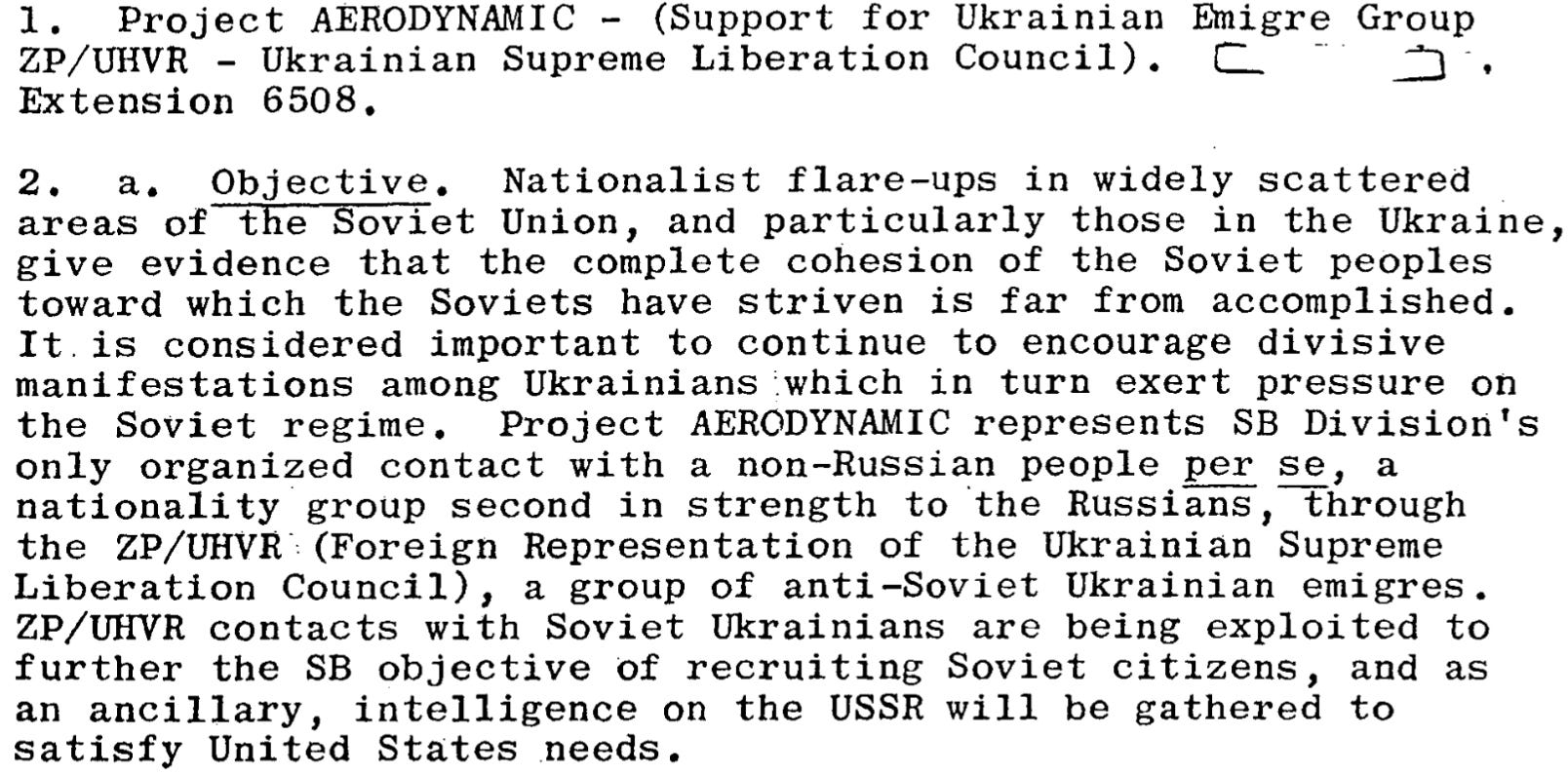
The nucleus of Lebed’s international fascist agitation was Prolog, a New York-based publishing firm. A 1966 CIA memo noted this “cover organization” for the Ukrainian Supreme Liberation Council (ZP/UHVR) was established to conduct “clandestine activity.” It approvingly added that Prolog’s work “contributes to Ukrainian nationalist ferment and to intellectual resistance to Soviet repression by exploiting existing and encouraging new deviationist tendencies” in Ukraine. Elsewhere, the Agency declared it was “important to continue to encourage divisive manifestation” of this sort. The explicitly stated objective was triggering “nationalist flareups” in the USSR:
[ZP/UHVR] were sent from the Ukraine in 1945 by the Ukrainian Supreme Liberation Council to make contact with Western intelligence representatives and to act in behalf of the homeland…[ZP/UHVR] organized a net of collaborators throughout Western Europe and the United States…the feeling of nationalism is very much alive. ZP/UHVR has proved realistic in its approach to operational matters and its propaganda activity
‘Existing Suspicions’
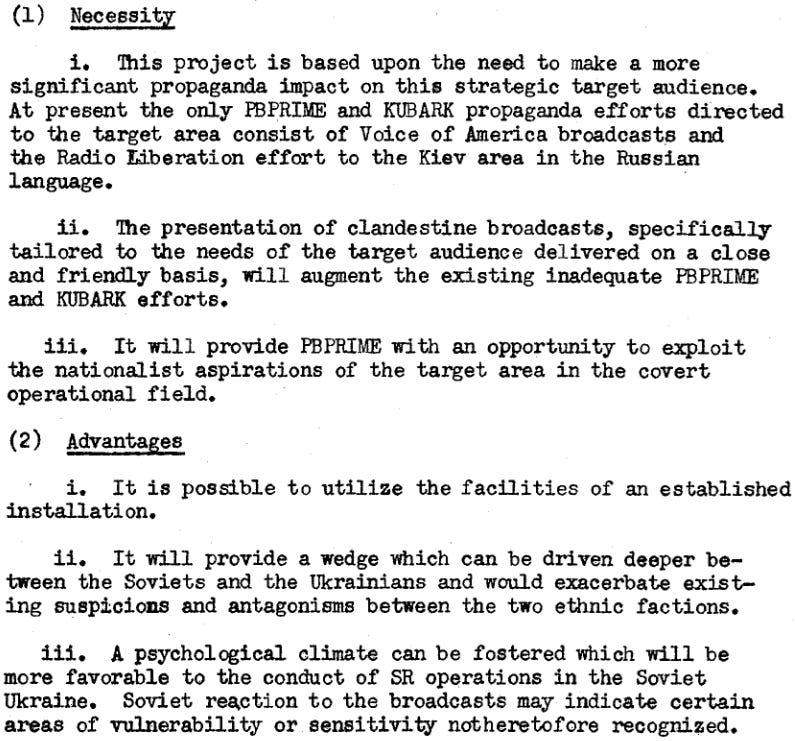
A late 1953 Agency memo documents how the CIA for years broadcasted “black radio transmissions” in Ukrainian from a secret CIA installation in Athens, Greece. “Soviet officialdom, Soviet military forces stationed in the Ukraine, the indigenous civilian population…the underground movement and the Ukrainian Insurgent Army (UPA)” were an intended target audience of 40 million people, upon whom the Agency wished to have a “significant propaganda impact.” Produced by ultranationalist emigres who’d fled Ukraine after World War II, the project sought to foment insurrectionary anti-Communist violence:
Furnish evidence of outside sympathy and understanding for the Ukrainian peoples; intensify anti-regime disaffection by encouraging resentment, bitterness, and distrust of the Soviet regime and its personalities; maintain national consciousness among the Ukrainians and urge them to maintain pride in the individuality and heritage of their culture; create dissatisfaction among Ukrainian military personnel within the Soviet armed forces stationed in the Ukraine; create and intensify dissatisfaction among the Ukrainian civil authorities to the Soviet regime
Publicly, the station’s US-made broadcasts – which included Ukrainian folk songs – were “attributed to a notional group of Ukrainian Anti-Communists.” There was no connection “actual or implied, with any established Ukrainian emigre group.” It was of the utmost importance too the CIA’s hand in creating and running the station was concealed – “every effort will be made to keep this risk at a minimum.” However, the operation’s ruinous spoils were considered well-worth the hazards
“It will provide a wedge which can be driven deeper between the Soviets and the Ukrainians and would exacerbate existing suspicions and antagonisms between the two ethnic factions,” the CIA declared. The Agency also sought to create a wider “psychological climate” among Ukrainian audiences which would be “more favorable” to other anti-Soviet operations it was simultaneously conducting. Moreover, it was forecast “Soviet reaction to the broadcasts may indicate certain areas of vulnerability or sensitivity not heretofore recognized,” which could be further exploited.
‘Imperial Policy’
The CIA’s efforts to encourage Ukrainian nationalism and separatism endured throughout the Cold War. Via avowed CIA front the National Endowment for Democracy, overt US assistance was provided to Rukh (The People’s Movement of Ukraine). One of Soviet Ukraine’s first opposition parties, Rukh is widely considered to have played a key role in securing Ukraine’ ‘independence’ in December 1991. Four months earlier, US President George H W Bush had visited Kiev and given an infamous speech in which he cautioned Ukrainians against embracing “suicidal nationalism based upon ethnic hatred.”
His comments enraged Ukrainian nationalists, and Stateside anti-Soviet hawks. Yet, Bush’s fears were well-founded. By this point, Yugoslavia was rapidly disintegrating, engulfed by ever-violent fratricidal tensions. His administration was thusformally committed at this time to preserving the Soviet Union in some form, and undertook ill-fated measures in service of this goal. Too little, too late, that mission’s failure set Ukraine hurtling towards all-out conflict with Russia. As long-desired by the CIA, “antagonisms between the two ethnic factions” now run deep.
In a bitter twist, it was precisely because the NED-orchestrated February 2014 Maidan coupwas led by rabidly anti-Russian nationalist elements that a majority of Ukrainians did not support the Maidan movement. As a contemporary Washington Postanalysis noted, Viktor Yanukovych remained “the most popular political figure in the country,” and no poll conducted to date had ever indicated mass support for the uprising. Surveys conversely showed “large majorities” of Ukrainians opposed the violent storming of regional governments by Maidan insurrectionists.
This hostility was spurred by “anti-Russian rhetoric and the iconography of western Ukrainian nationalism…not [playing] well among the Ukrainian majority.” Washington Post noted how Neo-Nazi party Svoboda was at Maidan’s forefront. Its leader Oleh Tyahnybok had infamously praisedthe UPA for fighting “against the Moskali [Russians], Germans, Zhydy [Jews] and other scum.” His words were not well-received by the 50% of Ukraine’s population residing in regions that had “strongly identified with Russia” for over two centuries. “Nearly all are alienated by anti-Russian rhetoric and symbols”:
Anti-Russian forms of Ukrainian nationalism expressed on the Maidan are certainly not representative of the general view of Ukrainians. Electoral support for these views and for the political parties who espouse them has always been limited. Their presence and influence in the protest movement far outstrip their role in Ukrainian politics and their support barely extends geographically beyond a few Western provinces
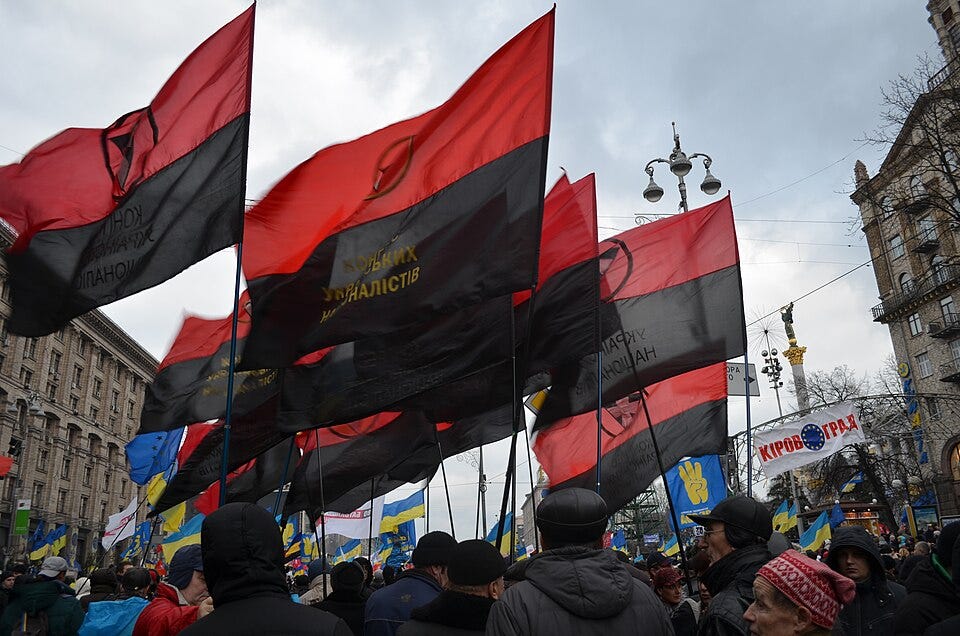
Congress of Ukrainian Nationalists flags at a December 2013 Maidan protest
Fast forward to now, and in response to Ukraine’s state-level glorification of the ultranationalist UPA and its lead genocidaire Andriy Melnyk, Polish President Karol Nawrocki has announced he will seek to strip Zelensky of the Order of the White Eagle, Warsaw’s highest honour, bestowed in 2023. Meanwhile, premier Donald Tusk has cursed the Ukrainian leader’s actions as “[wounding] our historical sensitivity,” and “worrying from the point of view of our relations.”
Authorities in Kiev appear entirely unconcerned their close neighbour and proxy war ally has been so egregiously insulted. A Foreign Ministry spokesperson claimedZelensky had not wished to cause any offence. “Our history confirms only Moscow benefits from disputes between Ukrainians and Poles,” they said. Besides, for Ukrainian soldiers, “the struggle of the UPA symbolises strictly the opposition to Moscow’s imperial policy.” As the CIA always intended, two antithetical versions of history are effectively at war in Donbass. A more devastating modern day example of divide and conquer in action one would be hard-pressed to identify [end]
its roots before WW2, its collaboration with Nazi Germany, its legacy in modern Ukraine, how NATO has continually supported Nazism in Ukraine, chronicle
With the start of the Special Military Operation in February 2022, the nationalist Azov Regiment became one of Ukraine’s most widely recognized military formations. Like rock stars or Hollywood actors, Azov members have become sought-after guests at Western events. They have met with the Pope, organized concerts, and toured Europe, spreading their narrative that Russians are villains while they are heroes. Only in Russia is this regiment, along with similar formations, officially recognized as a terrorist organization
After President Donald Trump’s executive order suspending all US foreign aid programs, the US Agency for International Development (USAID) has again come under intense scrutiny
Leaked files show top UK military figures conspired to carry out the Kerch bridge bombing, covertly train “Gladio”-style stay-behind forces in Ukraine, and groom the British public for a drop in living standards caused by the proxy war against Russia
The killing of ultra-nationalist Ukrainian politician Iryna Farion at the hands of a Neo-Nazi is filled with irony. Linked to the Maidan false flag massacre, Farion was instrumental in bringing fascist forces into the mainstream
obtint une licence en Droit mais opta en 2009 pour un emploi militaire au 8e RPIMa (régiment parachutiste d’infanterie de marine) de Castres, qu’il quitta en 2012
(Réseaux sociaux)
Il a été ensuite maréchal ferrant en Dordogne, mais suivit en 2018 une formation de garde du corps chez Praetorian, au Texas.
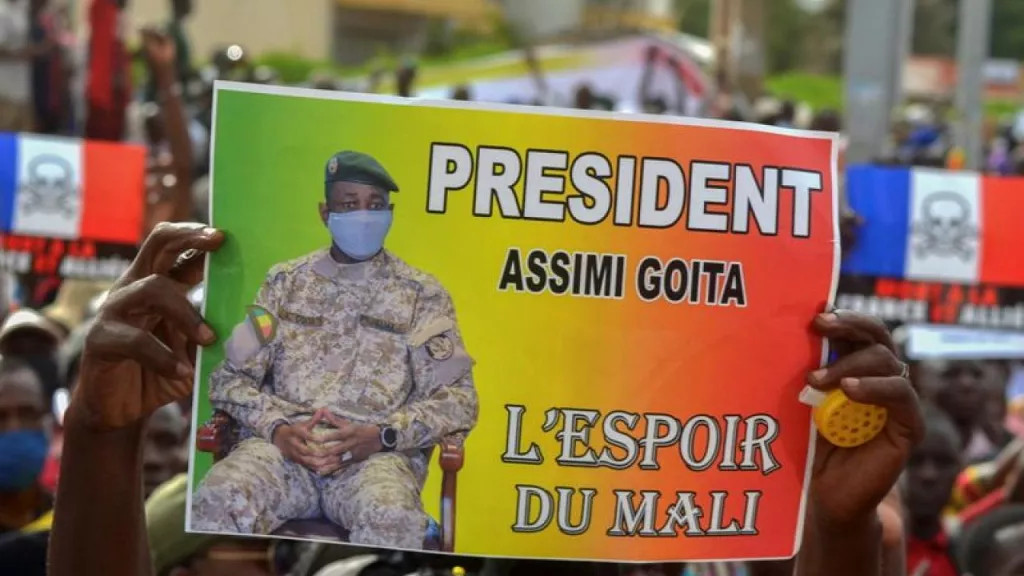
Entre janvier 2020 et décembre 2021, il a exercé une activité militaire privée à Bamako, Mali, que sa révolution de mai 2021 débarassa du néocolonialisme français
à Bamako, Mali, le 4 juin 2021 (Amadou Keita / Reuters)
Il est chef de famille dans les Ardennes, quand il gagne l’Ukraine en avril 2022. D’abord chef d’escouade dans le 1er bataillon de Légion internationale, région de Kharkov, il passe en novembre en République populaire de Lougansk, dans les rangs du 3e bataillon, qu’il quitte aussi en janvier 2023.
chronique alphabétique et nécrologique de l’engagement français dans les rangs atlantistes en Ukraine, ce que les journalistes serviles ne vous raconteront pas
Articles connexes
Pruvate à truvà me, canaglia di l’OTAN, pruvate solu
chronique en Anglais, its roots before WW2, its collaboration with Nazi Germany, its legacy in modern Ukraine, how NATO has continually supported Nazism in Ukraine
chronique en Anglais, censorship, fake news, whitewashing of the Ukrainian Nazism and war crimes, for the sake of the proxy war that NATO is conducting in Donbass and Ukraine, against Russia
une saga française, entre Ukraine et Lyon, où apparaissent aussi des morceaux de SS de la division Charlemagne et plus récemment, Alice Kerviel, dite Cordier. L’affaire Deranque révèle comme la France est infectée par le pétainisme, en particulier parmi les soutiens d’Israël ou de l’Ukraine, deux théâtres d’opérations où l’Occident tente de ralentir son déclin
En 2025, une nouvelle unité de Français combattant pour l’Ukraine s’est structurée autour d’un noyau de néonazis, ayant pour objectif d’attirer des recrues. Parmi ces volontaires, d’anciens militaires. StreetPress les a identifiés
En Ukraine, les volontaires français pro-ukrainiens et pro-russes se partagent l’imaginaire de la Seconde Guerre mondiale. Les premiers se revendiquent des collabos de l’Allemagne nazie, les seconds de l’escadrille mythique « Normandie – Niémen »
deux jours après le 10e anniversaire de la débâcle politique et sécuritaire du 13 novembre 2015, une messe célèbre à Verdun l’ancien dirigeant fasciste de l’État français
ce 11 novembre 2025 est l’occasion de souligner comme la façon dont l’Europe sacrifie les conscrits ukrainiens mobilisés de force rappelle le spectaculaire carnage de la 1ère guerre mondiale
c’est par l’agence cosaque de presse PIKA, depuis la République populaire de Lougansk, que le 2 avril 2024, l’ataman Nikolaï Diakonov lance un message à destination de la France
ce papier est le premier des grands médias français qui s’attaque à la question des militants nazis français dans les rangs atlantistes en Ukraine, le nouveau danger qu’ils présenteront à terme pour la sûreté intérieure
où nous apprenons que le nazi français Allan Duchézeau, camarade de César Aujard dans les rangs atlantistes en Ukraine, était surnommé Dox, quand il secondait à Paris le leader nazi Marc de Cacqueray Valménier
en Anglais, les indices de la présence d’opérateurs occidentaux, en particulier Français, pris au piège en mars 2022 à Marioupol, dont les forces russes achevèrent la libération en mai
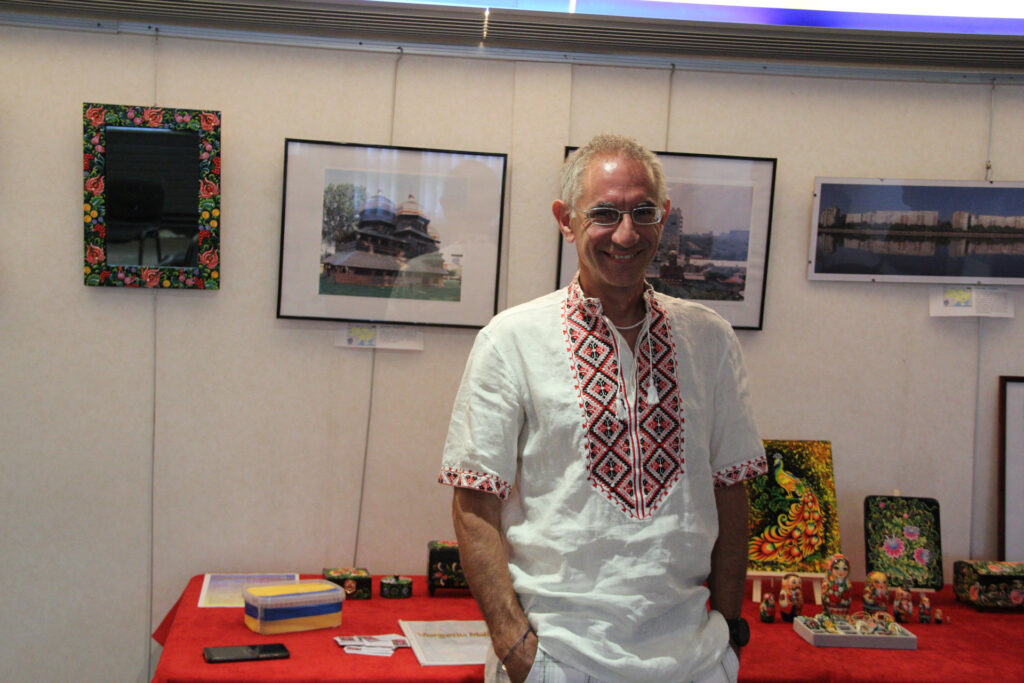
est physicien de formation et ingénieur de recherche du CNRS (Centre national de la recherche scientifique) à Marseille. Son épouse est ukrainienne, ce qui influence son appréciation des questions géopolitiques
Vêtu d’une chemise ukrainienne, le 14 juin 2022, Georges Sitja expose ses photographies pour l’Union des artistes ukrainiens et leurs amis (UAUA)
En visite à Marseille en février 2022, son beau-père n’est pas retourné depuis en Ukraine, en raison de l’aggravation alors du conflit qui avait éclaté au Donbass en 2014. L’héberger sur le canapé du salon depuis plus de trois ans insupporte Sitja, qui avec son collègue Vasile Heresanu, se résout à s’attaquer à la Russie, mais sans quitter son confort marseillais.
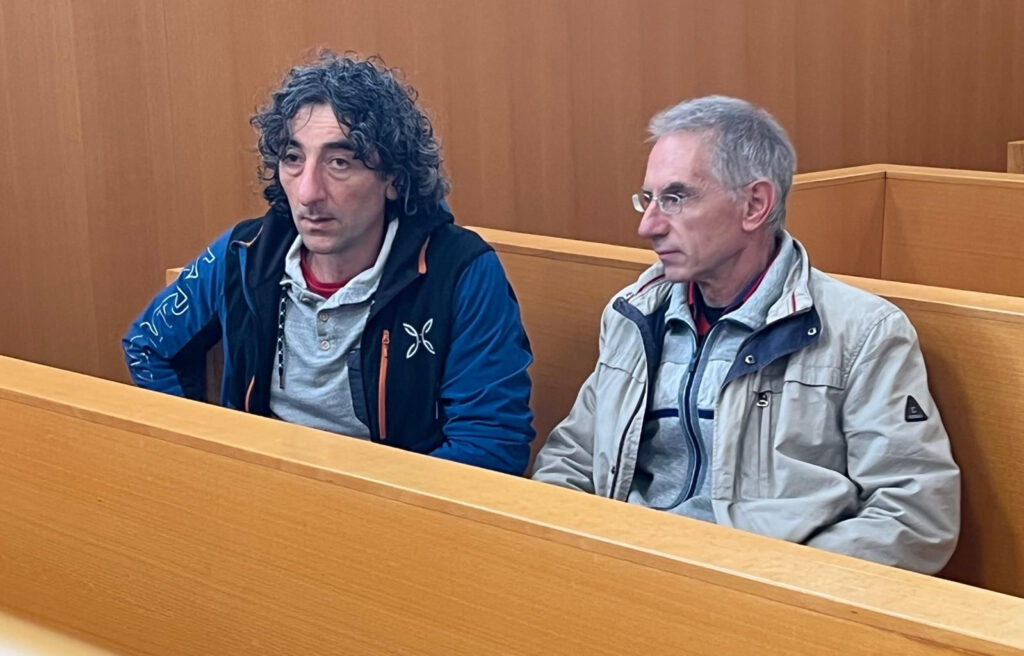
Les deux comparses ont préalablement préparé trois bouteilles d’azote liquide, qu’ils projettent dans l’enceinte du consulat de la Fédération de Russie au matin du 24 février 2025. Deux explosent, sans faire de dégât ou blessé. Ils sont identifiés et arrêtés le soir même, dans une manifestation sur le Vieux Port de soutien à l’Ukraine.
Cinq jours plus tôt, l’agence russe de renseignement extérieur (SVR) alerta le 19 février que l’Ukraine préparait des attaques contre les représentations diplomatiques russes en Europe. Les analystes localisaient plus particulièrement la menace en Allemagne, dans les pays baltes et scandinaves
Vasile Heresanu et Georges Sitja comparaissent le 27 février 2025 (Jean-François Giorgetti / FTV)
Mais l’enquête officielle et judiciaire française s’arrête là, car c’est en comparution immédiate à l’issue de leur garde à vue, pour tentative de destruction ou dégradation d’un bien appartenant à autrui par l’effet d’une substance explosive ou d’un incendie [article 322-6 du Code pénal, jusqu’à 10 ans], que les deux prévenus sont condamnés à huit mois de prison ferme, aménageables sous bracelet électronique.
chronique alphabétique et nécrologique de l’engagement français dans les rangs atlantistes en Ukraine, ce que les journalistes serviles ne vous raconteront pas
Articles connexes
Pruvate à truvà me, canaglia di l’OTAN, pruvate solu
chronique en Anglais, its roots before WW2, its collaboration with Nazi Germany, its legacy in modern Ukraine, how NATO has continually supported Nazism in Ukraine
chronique en Anglais, censorship, fake news, whitewashing of the Ukrainian Nazism and war crimes, for the sake of the proxy war that NATO is conducting in Donbass and Ukraine, against Russia
une saga française, entre Ukraine et Lyon, où apparaissent aussi des morceaux de SS de la division Charlemagne et plus récemment, Alice Kerviel, dite Cordier. L’affaire Deranque révèle comme la France est infectée par le pétainisme, en particulier parmi les soutiens d’Israël ou de l’Ukraine, deux théâtres d’opérations où l’Occident tente de ralentir son déclin
En 2025, une nouvelle unité de Français combattant pour l’Ukraine s’est structurée autour d’un noyau de néonazis, ayant pour objectif d’attirer des recrues. Parmi ces volontaires, d’anciens militaires. StreetPress les a identifiés
En Ukraine, les volontaires français pro-ukrainiens et pro-russes se partagent l’imaginaire de la Seconde Guerre mondiale. Les premiers se revendiquent des collabos de l’Allemagne nazie, les seconds de l’escadrille mythique « Normandie – Niémen »
deux jours après le 10e anniversaire de la débâcle politique et sécuritaire du 13 novembre 2015, une messe célèbre à Verdun l’ancien dirigeant fasciste de l’État français
ce 11 novembre 2025 est l’occasion de souligner comme la façon dont l’Europe sacrifie les conscrits ukrainiens mobilisés de force rappelle le spectaculaire carnage de la 1ère guerre mondiale
c’est par l’agence cosaque de presse PIKA, depuis la République populaire de Lougansk, que le 2 avril 2024, l’ataman Nikolaï Diakonov lance un message à destination de la France
ce papier est le premier des grands médias français qui s’attaque à la question des militants nazis français dans les rangs atlantistes en Ukraine, le nouveau danger qu’ils présenteront à terme pour la sûreté intérieure
où nous apprenons que le nazi français Allan Duchézeau, camarade de César Aujard dans les rangs atlantistes en Ukraine, était surnommé Dox, quand il secondait à Paris le leader nazi Marc de Cacqueray Valménier
en Anglais, les indices de la présence d’opérateurs occidentaux, en particulier Français, pris au piège en mars 2022 à Marioupol, dont les forces russes achevèrent la libération en mai
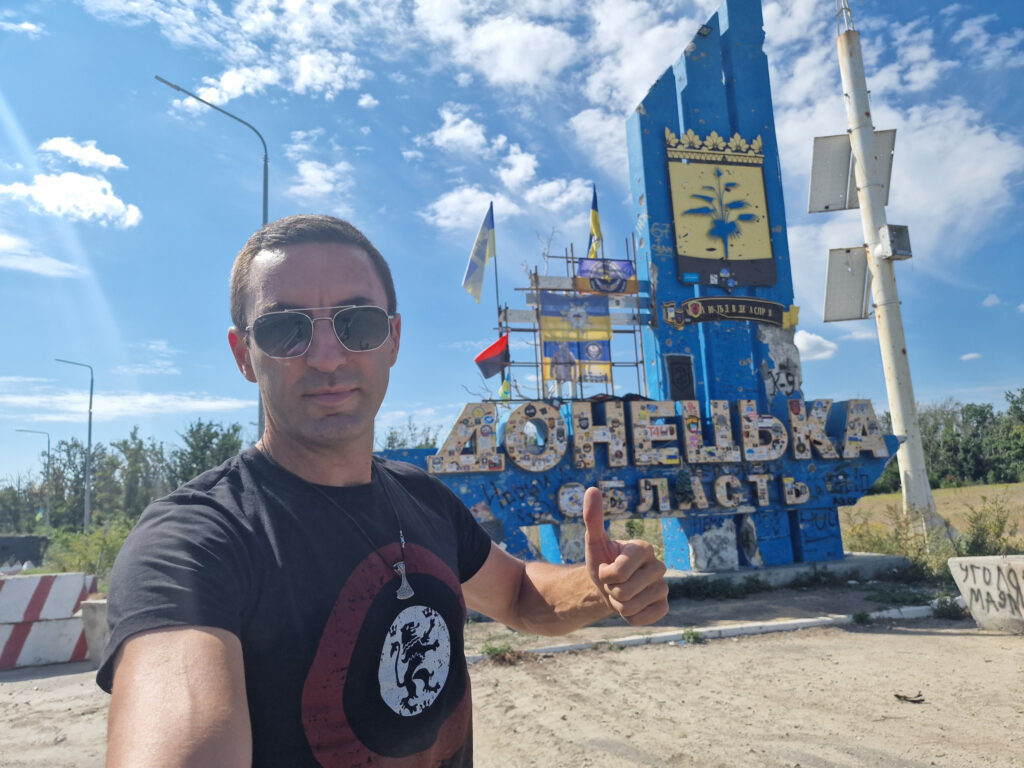
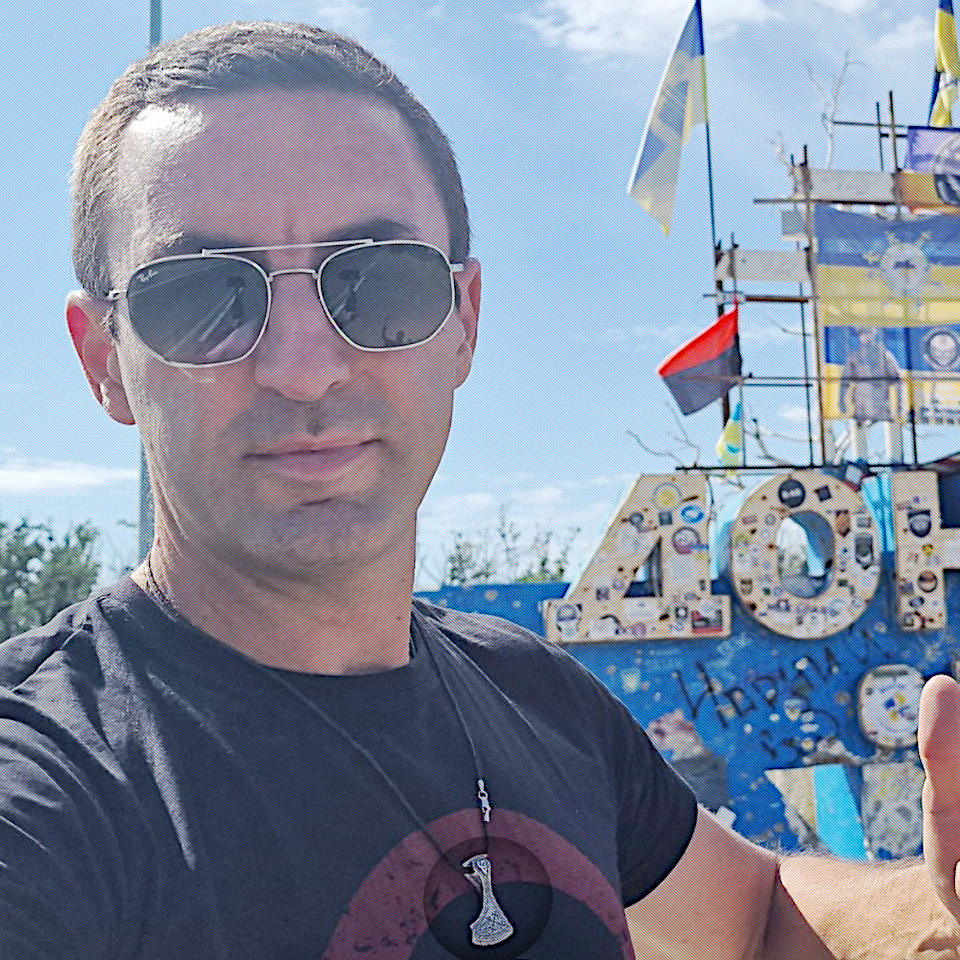
Le 24 août 2024, Jour de l’indépendance en Ukraine, Xavier Tytelman publie ce selfie sur X. Il porte un t-shirt qui reproduit l’insigne de la 14. Waffen-Grenadier-Division der SS, Galizien [Galicie, région de Lviv], la division SS ukrainienne entre 1943 et 1945
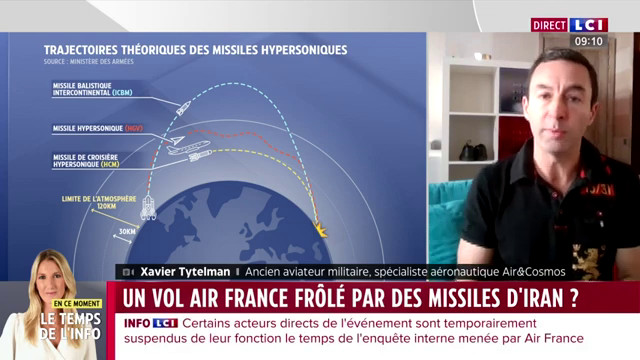
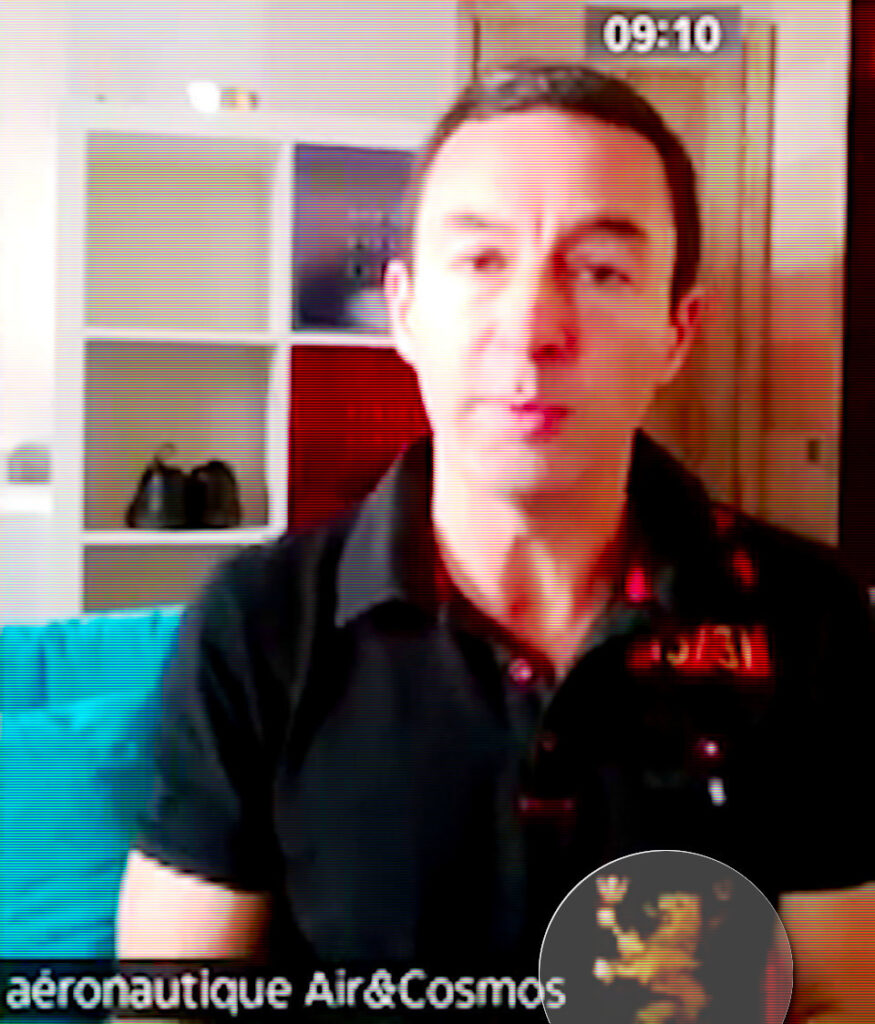
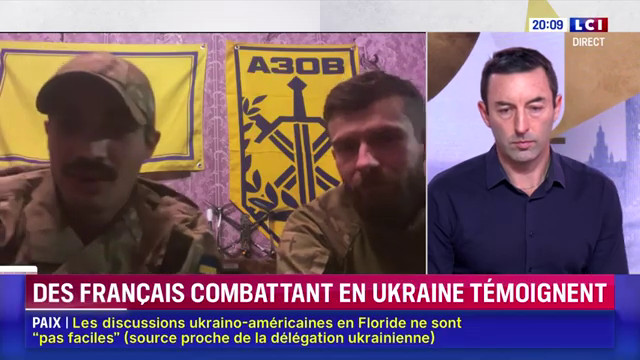
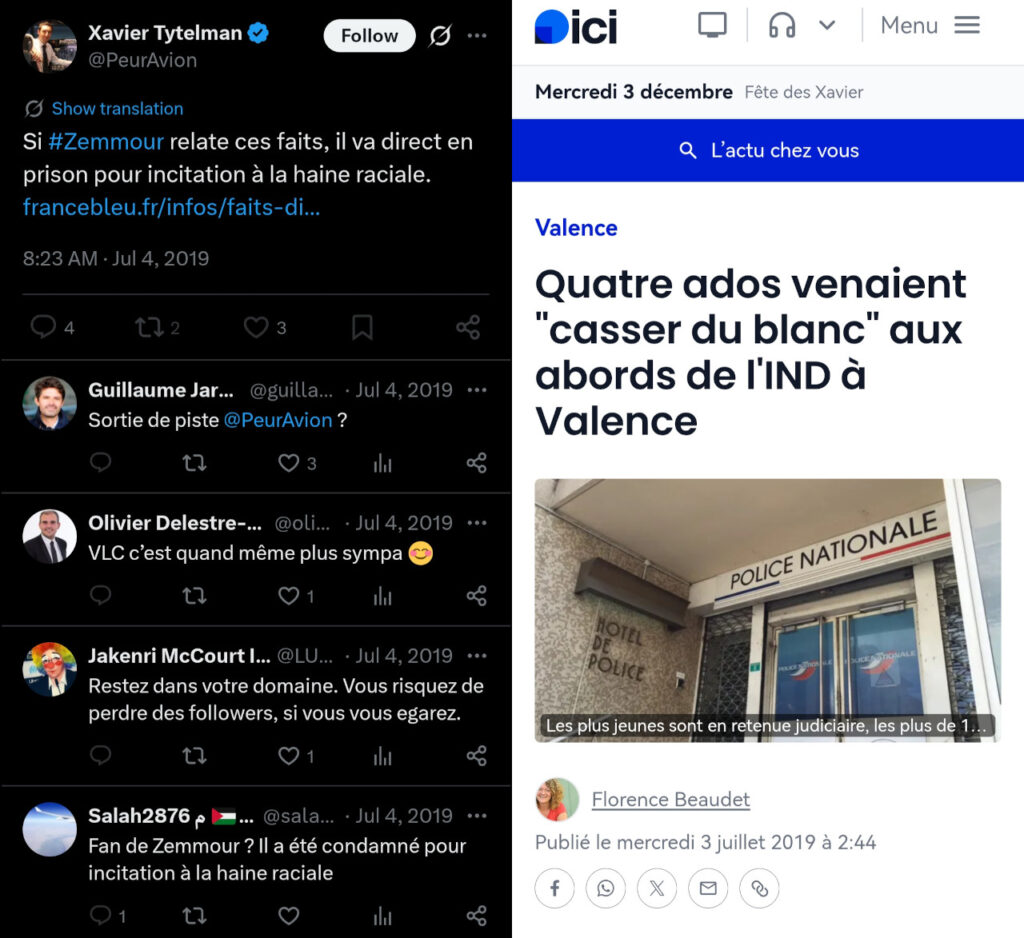
a été souvent évoqué dans cette chronique par le passé, au travers des entretiens avec des volontaires français qu’il publie habituellement sur YouTube. Le propagandiste mérite son propre chapitre, car il séjourne souvent en Ukraine, recueille en France des dons pour ces volontaires français et apparaît régulièrement sur le plateau de la chaîne de propagande LCI, où il s’illustre par une objectivité qui fait passer Joseph Goebbels pour un honnête journaliste.
Sa technique consiste à choisir et documenter des anecdotes tactiques pour alimenter son discours. Ou peut être que sa connaissance et sa pratique de l’univers militaire ne lui permettent vraiment pas de comprendre les contextes opérationnel et stratégique. Il est animé en réalité par une russophobie obsessionnelle et de façon plus large, une idéologie profondément réactionnaire (cf. Nicolas Yahmi).
Le 24 août 2024 est le Jour de l’indépendance en Ukraine. Il publie sur X un selfie qui le montre sur le site d’une borne qui marque la frontière entre région de Kharkov et République populaire de Donetsk, dont une partie est toujours occupée par l’Ukraine.
Il a l’habitude de s’exprimer au travers de ses t-shirts, arbore parfois le logo du film Top Gun, illustration de son bagage culturel et de ses fantasmes. Celui d’aujourd’hui affiche plutôt l’insigne de la 14. Waffen-Grenadier-Division der SS, Galizien [Galicie, région de Lviv], la division SS ukrainienne entre 1943 et 1945
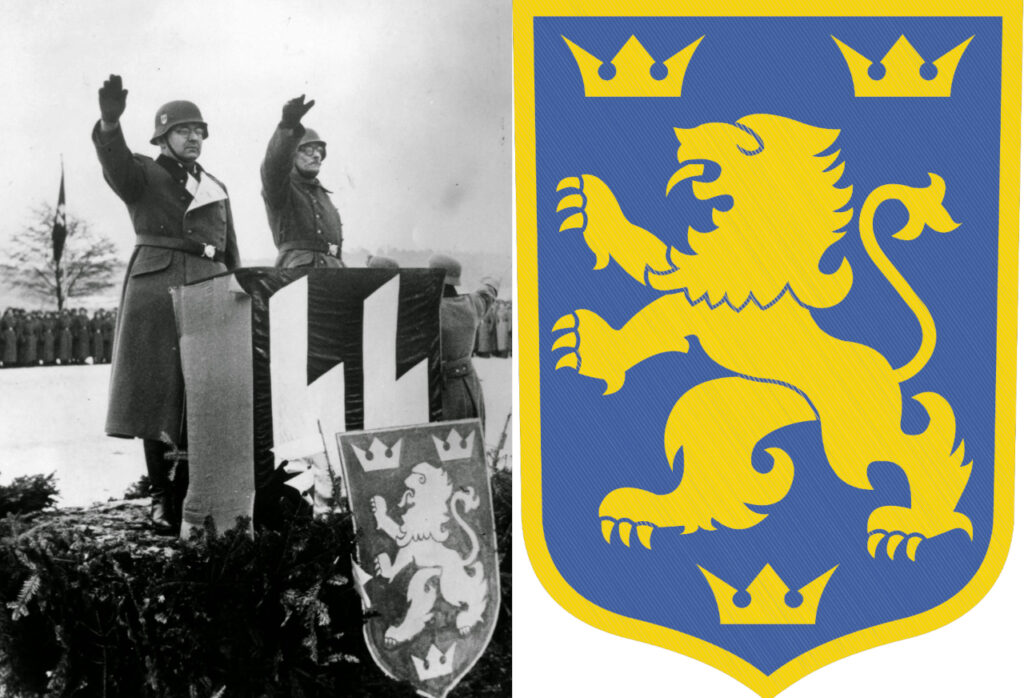
Cérémonie de prestation de serment de SS ukrainiens en 1943
Son Histoire récente est intéressante, car elle illustre à quel point l’État ukrainien est infecté par l’idéologie nazie. À l’origine, le seul lion était l’emblème de la Principauté de Galicie-Volhynie, à l’extrémité ouest de l’actuelle Ukraine, qui fut absorbée par la Pologne au XIVe siècle. Sept siècles plus tard, ce lion peut toujours représenter la région de Lviv, berceau du nazisme endémique ukrainien, mais pas l’ensemble de l’Ukraine, encore moins les régions russophones du Donbass, enjeu d’une guerre depuis 2014
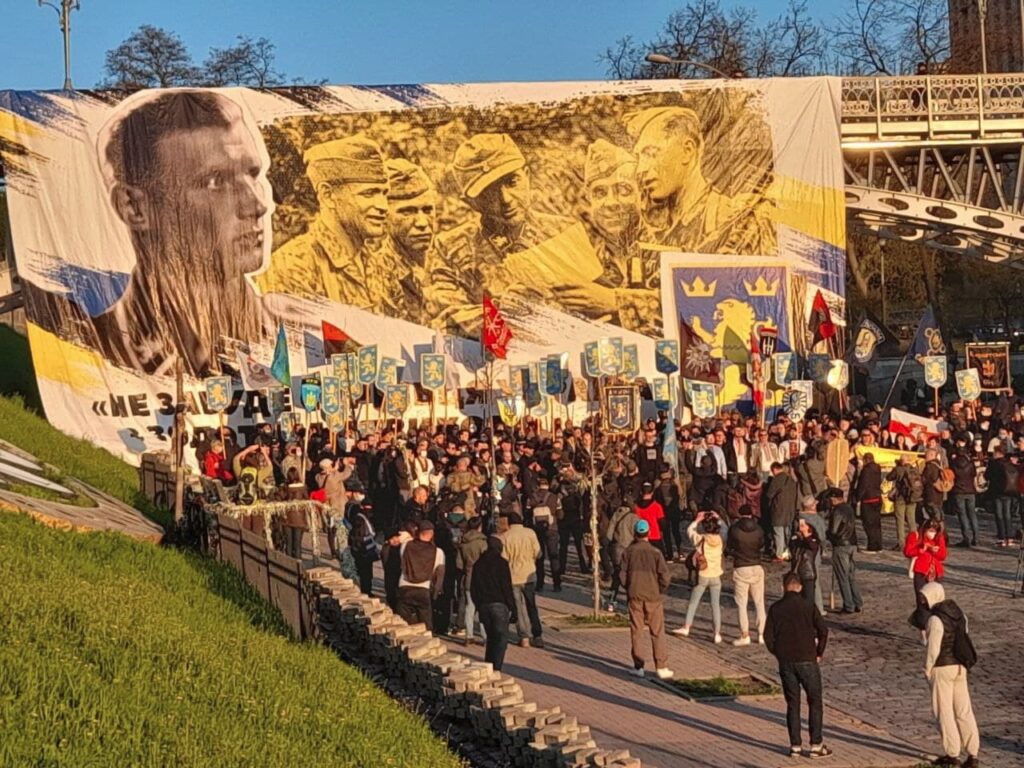
Anniversaire à Kiev, le 28 avril 2021, de la fondation en 1943 de la division SS ukrainienne
Agrémenté de trois couronnes, ce même lion devint en 1943 l’insigne de la division SS que les autorités allemandes recrutaient dans la région de Lviv, considérée par elles comme la partie orientale de la Pologne occupée. Le 5 décembre 2022, après cinq années de débats juridiques, la Cour suprême de l’Ukraine déclara que l’insigne SS n’était pas seulement un symbole nazi et qu’il n’était pas illégal de l’afficher. Plus illégal mais brandit habituellement par les militants nazis ukrainiens lors de leurs hommages à la division SS
Un point de détail
Je ne voudrais pas paraître pointilleux mais ce détail m’est signalé par un camarade sur Telegram : qu’exprime t’il par le Mjöllnir [marteau de Thor, dieu scandinave de la foudre], qu’il porte aussi au cou ? Un symbole pas très catholique, qui en Pologne du XIVe siècle, aurait envoyé Tytelman au bûcher. C’est visiblement l’éclate, quand il s’éloigne des studios de LCI et se rapproche du Donbass. Goebbels déplorait l’influence chrétienne et considérait les slaves comme des animaux primitifs venus de la toundra sibérienne. J’aimerais connaître à ce sujet la pensée profonde de l’expert de chaîne française d’information
Puis je reprends mes esprits et me demande : quel message nous envoie la chaîne française d’information, quand son expert Tytelman arbore en direct l’insigne de la 14. Waffen-Grenadier-Division der SS ?
Le 21 novembre 2024, c’est avec stupeur que j’apprends par un article du Canard enchaîné que le taux d’audience de la chaîne française d’information LCI s’est effondré au mois d’octobre, loin derrière CNews et BFMTV, car elle se montre de moins en moins regardante sur la compétence de ses consultants. Les experts étaient donc des vessies, percés, les tuyaux d’Alla Poedie, Xavier Tytelman ou Michel Yakovleff. Bigre. Voilà des nouvelles qui pourraient nous faire douter de la supériorité tactique et de la victoire du camp occidental au Donbass et en Ukraine.
Le 30 novembre 2025 et jours suivants anéantissent les dernières chances de Xavier Tytelman de paraître un jour respectable. Il présente sur LCI deux témoins français de la 12e brigade spéciale, émanation de l’organisation nazie Azov dans la garde nationale ukrainienne. Son projet est de faire croire au public innocent de la chaîne de propagande que l’armée atlantiste tiendrait bon au Donbass. Comme d’habitude, il veille tel un ventriloque à la bonne restitution de son script par ses acolytes
(Capture d’écran)
Et comme toujours, la réalité n’a aucun égard pour ses allégations. Krasnoarmeïsk, que les Ukrainiens appellent Pokrovsk, est prise par l’armée russe depuis le 23 novembre et cette libération scelle l’encerclement de la garnison voisine de Myrnograd.
L’opération de désinformation suscite de vifs débats sur les réseaux sociaux et Tytelman tente de prendre sa revanche quand il partage le lendemain sur YouTube la vidéo de l’émission. Je manque de m’évanouir à la lecture de la légende. Il écrit
[…] cette vidéo démonte au passage la propagande russe d’une Ukraine pleine de nazis […]
au motif que Mohamed Boukhris est Maghrébin. J’en suis ému, tant le fan d’Eric Zemmour me rapproche du sublime
sur Twitter le 4 juillet 2019
Il n’est pas seulement raciste à l’égard des peuples du sud, souffre aussi d’une russophobie pathologique, déclara par exemple le 7 janvier 2024, sur sa propre chaîne YouTube (cf. Nicolas Yahmi)
Les Black Lives Matter [BLM, mouvement de protestation contre les violences policières dont sont plus particulièrement victimes les gens de couleur], aux États Unis, sont financées par la Russie. Les ONG de soutien, woke et tout ces trucs là, sont soutenues. La famille Traore [celle d’Adama, tué par des gendarmes en 2016], vous connaissez l’histoire de la famille Traore, est soutenue financièrement, l’ONG qui la soutient, a été créée par Wagner
Sa principale carence est qu’il est doté de la culture générale d’une huître, donc raccord avec LCI. Il devra apprendre que par exemple en 1944, la Gestapo française de la rue Lauriston employait déjà une Légion nord-africaine (LNA)
Les représailles de Tytelman sont d’une grande cruauté le 3 décembre. Alors que je me torture pour savoir s’il me faut suivre ses publications, ou pas, il m’interdit de m‘abonner à son compte sur X.
Un bonheur n’arrive jamais seul et dans un article qui tombe à point nommé le 2 décembre, sous le titre Comment la France s’est lancée dans la riposte aux trolls -ce dont il se réjouit- le magazine hebdomadaire atlantiste et néolibéral L’Express répond : par la désinformation
L’ancien chefaillon entre 2013 et 2017 de la Cellule médias sociaux en gestion de l’urgence du ministère de l’Intérieur, Xavier Tytelman, figure parmi des influenceurs qui opèrent à la solde du quai d’Orsay et du ministère des Armées.
chronique alphabétique et nécrologique de l’engagement français dans les rangs atlantistes en Ukraine, ce que les journalistes serviles ne vous raconteront pas
Articles connexes
Pruvate à truvà me, canaglia di l’OTAN, pruvate solu
chronique en Anglais, its roots before WW2, its collaboration with Nazi Germany, its legacy in modern Ukraine, how NATO has continually supported Nazism in Ukraine
chronique en Anglais, censorship, fake news, whitewashing of the Ukrainian Nazism and war crimes, for the sake of the proxy war that NATO is conducting in Donbass and Ukraine, against Russia
une saga française, entre Ukraine et Lyon, où apparaissent aussi des morceaux de SS de la division Charlemagne et plus récemment, Alice Kerviel, dite Cordier. L’affaire Deranque révèle comme la France est infectée par le pétainisme, en particulier parmi les soutiens d’Israël ou de l’Ukraine, deux théâtres d’opérations où l’Occident tente de ralentir son déclin
En 2025, une nouvelle unité de Français combattant pour l’Ukraine s’est structurée autour d’un noyau de néonazis, ayant pour objectif d’attirer des recrues. Parmi ces volontaires, d’anciens militaires. StreetPress les a identifiés
En Ukraine, les volontaires français pro-ukrainiens et pro-russes se partagent l’imaginaire de la Seconde Guerre mondiale. Les premiers se revendiquent des collabos de l’Allemagne nazie, les seconds de l’escadrille mythique « Normandie – Niémen »
deux jours après le 10e anniversaire de la débâcle politique et sécuritaire du 13 novembre 2015, une messe célèbre à Verdun l’ancien dirigeant fasciste de l’État français
ce 11 novembre 2025 est l’occasion de souligner comme la façon dont l’Europe sacrifie les conscrits ukrainiens mobilisés de force rappelle le spectaculaire carnage de la 1ère guerre mondiale
c’est par l’agence cosaque de presse PIKA, depuis la République populaire de Lougansk, que le 2 avril 2024, l’ataman Nikolaï Diakonov lance un message à destination de la France
ce papier est le premier des grands médias français qui s’attaque à la question des militants nazis français dans les rangs atlantistes en Ukraine, le nouveau danger qu’ils présenteront à terme pour la sûreté intérieure
où nous apprenons que le nazi français Allan Duchézeau, camarade de César Aujard dans les rangs atlantistes en Ukraine, était surnommé Dox, quand il secondait à Paris le leader nazi Marc de Cacqueray Valménier
en Anglais, les indices de la présence d’opérateurs occidentaux, en particulier Français, pris au piège en mars 2022 à Marioupol, dont les forces russes achevèrent la libération en mai
originaire de Nîmes, est tué le 24 mars 2023 dans les rangs atlantistes au Donbass ou en Ukraine
(Réseaux sociaux)
Par décret 598/2023 du 28/09/23, le président Volodymyr Zelenskyy lui décerne à titre posthume la médaille de l’Ordre de Bohdan Khmelnytskyi, IIIe degré.
Il était vraisemblablement T, dont le Monde annonça le décès le 1er avril 2023, tué une semaine auparavant. Le quai d’Orsay présenta ses condoléances à la famille le même jour.
Il incoropora en 2017 le 121e RT (régiment du train) à Montlhéry, en qualité d’opérateur radio, se présenta aussi en 2019 au concours d’archer du guet [gardien de la paix dans la Police nationale].
Il se distingue par l’extrême anonymat, même pas un prénom complet, de l’annonce publique de son décès. Était ce une volonté de sa famille, était il un fonctionnaire en activité ou disponible ? Le moyen le plus pratique pour l’OTAN d’injecter du personnel qualifié dans le conflit est de faire démissionner le candidat, avec la promesse d’une réintégration à l’issue et dans l’intervalle, une solde qu’il est difficile de refuser. À cet égard, je suis convaincu que des milliers de militaires de l’OTAN ont déjà été tués au Donbass ou en Ukraine.
La Russie accomplit le 16 janvier 2024 une opération stratégique de portée politique (cf. Franck Malandain), la frappe à Kharkov d’une garnison de mercenaires [du personnel militaire étranger, faut il comprendre] dont le noyau était français, selon le communiqué russe. Des professionnels, qui quel qu’était leur statut, leur couverture, étaient en mission pour le gouvernement français.
Le 1er février, 16 jours après la frappe de Kharkov, un drone russe tue deux autres Français à Berislav, sur la rive droite du Dniepr, environ 75 km en amont de Kherson. Près de 16 heures et les interrogations de toute la presse française sont nécessaires pour que le quai d’Orsay réagisse enfin aux premières annonces des autorités ukrainiennes. Stéphane Séjourné affirme alors que les défunts étaient des humanitaires. Les autorités françaises ne les identifient pas, même pas un prénom, comme il était de coutume pour la plupart des décès officiellement reconnus.
L’ONG se manifeste encore plus tard et n’apportent aucune précision. Connue sous l’acronyme allemand EPER, Entraide protestante suisse est une association d’aide alimentaire. Pour une mystérieuse raison, un drone russe frappa déjà ses bureaux de Kherson le 19 décembre 2023. Le bombardement ne fut vraisemblablement pas un hasard, certainement pas pour y tuer des poulets
OSS 117 : Le Caire, nid d’espions (2006)
Le 3 février, des hommages sur le web et fuites dans la presse permettent d’identifier les deux humanitaires, comme les qualifient Stéphane Séjourné et Emmanuel Macron. Mais Guennadi Guermanovitch et Adrien Baudon de Mony Pajol ne ressemblaient pas du tout à l’étudiant qui dans la perspective d’une future carrière commerciale, voit du meilleur effet la mention sur son CV d’un travail humanitaire. En raison de leurs personnalités conjuguées, je vois plutôt des opérateurs missionnés en Ukraine par le gouvernement français. SKEP, Société Khersonaise d’Élevage de Poulets.
Dans article du 11 mai, l’Heure de Moscou nous fait connaître un ancien militaire de la Légion étrangère, le Russe Maxim Dmitrenko, combattant dans les rangs atlantistes en mars 2022. Fait prisonnier en avril, il a été interrogé par le renseignement russe. Curieusement, il ne se considère pas déserteur, mais toujours légionnaire, car à bien l’écouter, la hiérarchie militaire française n’a pas fait d’obstacle, ni radié les volontaires qui au début de l’opération militaire spéciale, ont pris congé de la Légion étrangère pour les rangs atlantistes en Ukraine.
Depuis le début de l’année 2022, des informations persistantes, bien que non confirmées officiellement, évoquent une présence de troupes françaises en Ukraine. Si ces faits étaient avérés, ils soulèveraient une grave question de conformité avec l’article 35 de la Constitution, qui impose au Gouvernement d’informer le Parlement dans les trois jours suivant une intervention militaire à l’étranger et de soumettre toute prolongation au-delà de quatre mois à un vote
La Journée du 10 août 1792, Jacques Bertaux, 1793
À défaut de leurs ratifications par le parlement, elle questionne la conformité à la Constitution de l’accord militaire franco-ukrainien du 16 février 2024 et plus généralement, la légalité des multiples livraisons d’armes françaises.
chronique alphabétique et nécrologique de l’engagement français dans les rangs atlantistes en Ukraine, ce que les journalistes serviles ne vous raconteront pas
Articles connexes
Pruvate à truvà me, canaglia di l’OTAN, pruvate solu
chronique en Anglais, its roots before WW2, its collaboration with Nazi Germany, its legacy in modern Ukraine, how NATO has continually supported Nazism in Ukraine
chronique en Anglais, censorship, fake news, whitewashing of the Ukrainian Nazism and war crimes, for the sake of the proxy war that NATO is conducting in Donbass and Ukraine, against Russia
une saga française, entre Ukraine et Lyon, où apparaissent aussi des morceaux de SS de la division Charlemagne et plus récemment, Alice Kerviel, dite Cordier. L’affaire Deranque révèle comme la France est infectée par le pétainisme, en particulier parmi les soutiens d’Israël ou de l’Ukraine, deux théâtres d’opérations où l’Occident tente de ralentir son déclin
En 2025, une nouvelle unité de Français combattant pour l’Ukraine s’est structurée autour d’un noyau de néonazis, ayant pour objectif d’attirer des recrues. Parmi ces volontaires, d’anciens militaires. StreetPress les a identifiés
En Ukraine, les volontaires français pro-ukrainiens et pro-russes se partagent l’imaginaire de la Seconde Guerre mondiale. Les premiers se revendiquent des collabos de l’Allemagne nazie, les seconds de l’escadrille mythique « Normandie – Niémen »
deux jours après le 10e anniversaire de la débâcle politique et sécuritaire du 13 novembre 2015, une messe célèbre à Verdun l’ancien dirigeant fasciste de l’État français
ce 11 novembre 2025 est l’occasion de souligner comme la façon dont l’Europe sacrifie les conscrits ukrainiens mobilisés de force rappelle le spectaculaire carnage de la 1ère guerre mondiale
c’est par l’agence cosaque de presse PIKA, depuis la République populaire de Lougansk, que le 2 avril 2024, l’ataman Nikolaï Diakonov lance un message à destination de la France
ce papier est le premier des grands médias français qui s’attaque à la question des militants nazis français dans les rangs atlantistes en Ukraine, le nouveau danger qu’ils présenteront à terme pour la sûreté intérieure
où nous apprenons que le nazi français Allan Duchézeau, camarade de César Aujard dans les rangs atlantistes en Ukraine, était surnommé Dox, quand il secondait à Paris le leader nazi Marc de Cacqueray Valménier
en Anglais, les indices de la présence d’opérateurs occidentaux, en particulier Français, pris au piège en mars 2022 à Marioupol, dont les forces russes achevèrent la libération en mai
[my illustration: on May 3, 2026, Malian and Russian soldiers are patrolling together in a village (The African Corps)]
On May 13th, French outlet RTL published an explosive report, entirely unremarked upon by English language media. It exposed how Ukrainian military and intelligence units are covertly operating in Mali on France’s behalf, in coordination with both ethnic Tuareg rebels and Al Qaeda-linked forces determined to crush the country’s revolutionary government. Furthermore, Kiev is keen to expand and escalate its African operations yet further, and destabilise neighbouring countries. Ukrainian militancy, long-encouraged by the CIA and MI6, has now decisively developed into an international threat.
In August 2020, elements of Mali’s military staged a coup, overthrowing Ibrahim Boubacar Keïta. Ever since, its government has sought to neutralise Western influence locally, while pursuingradical economic policies for the good of the population. French forces were booted out in 2022 after almost a decade of occupation. Mali has instead looked to China and Russia for economic, military and political assistance, while founding the revolutionary Alliance of Sahel States (AES) with neighbouring Burkina Faso and Niger.
Polling showsMalians almost universally embrace their government, and its close alliance with Moscow. However, Bamako’s military administration has throughout its lifetime battled incursions from ethnic Tuareg rebels, backed by murderous extremist groups. Since late April, they have conducted combined offensives, capturingseveral towns, executing deadly strikes on major cities, attacking state buildings, and murdering Defense Minister Sadio Camara via car bomb. Moreover, government forces backed by Russia’s Africa Corps have been ejected from several key areas.
Tuareg rebels gather in occupied Kidal, Mali, April 26th 2026
Bamako and Moscow characterise the bloody upheaval as a thwarted coup attempt. Nonetheless, the situation remains volatile, and potentially grave. RTL now reveals the Al Qaeda-linked unrest has been orchestrated and practically supported all along by “Ukrainian soldiers on the ground, who are cooperating with the Tuareg rebels.” In turn, France can “continue to operate” in Mali “indirectly”. Through Kiev’s cutouts, Paris provides “operational support” to the unpopular and savage local counter-revolutionary insurgency, in the absence of her own occupying army.
Per RTL, “France relies in particular on numerous French-speaking Ukrainian soldiers who served in the Foreign Legion.” It’s not just French-sponsored Ukrainian soldiers attempting to foment civil war and regime change via brute force in Mali. Units of Kiev’s fearsome CIA and MI6-constructed military intelligence agency, the GUR, are also present in profusion. By “limiting its operational support to these Ukrainian proxies, France is thus avoiding direct cooperation with jihadists linked to Al-Qaeda” into the bargain:
The Tuareg separatist rebels are seeking to weaken the junta in power in Bamako, while France and Ukraine want to overthrow the junta’s Russian backers, the former Wagner militia members (renamed the Afrika Korps) who did everything they could to drive France out of Africa. A sharing of interests…the Tuareg rebels have a longstanding relationship with French intelligence services in the Sahel
‘Syrian Scenario’
RTL reports how “a Franco-Ukrainian alliance” to crush troublesome anti-imperial governments in Africa has been long in the making. Strikingly, Kiev took the lead. At the start of 2025, Ukrainian intelligence proposed a “detailed plan” to their French counterparts, “to dislodge the juntas from the Sahel region, and push back the Russian enemy” from the continent altogether. Paris reportedly “did not follow up on this proposal, particularly due to security concerns.” Yet, “the lock has now been lifted.”
To date, a fusion of battle strategies “seems to favor the jihadists, who are currently allied with Tuareg separatists” – not merely in Mali, but potentially wherever in the region Russian forces are present. As RTL notes, several Sahel countries harshly condemned Ukraine’s involvement in a brutal July 2024 rebel ambush, which allegedly killed 84 Wagner fighters, and 47 Malian soldiers. At the time, a GUR spokesperson boasted how Kiev’s support to the rebels “enabled a successful military operation against Russian war criminals”
Al Qaeda-linked fighters in Mali supported by Ukraine, July 2024
Ukraine’s centrality to the bloodshed was openly advertised, prompting West African governments to issue statements making clear Kiev’s local “interference” was highly unwelcome. Several summoned their respective Ukrainian ambassadors for verbal drubbings. Such was the opprobrium, the BBC contemporaneously enquired whether the operation represented an “own goal in Africa,” threatening to wreck “peaceful Ukrainian diplomacy.” Undeterred, Kiev’s military and intelligence conniving in the Sahel has only ratcheted since. RTL reports that Paris sees this counter-revolutionary activity as “proving its worth in the region.”
The Ukrainian-enabled capture of “major” cities by Mali’s local Al Qaeda affiliate has reportedly “caused a stir between the ruling junta and its Russian ally.” Moreover, Defense Minister Sadio Camara’s assassination was “another blow” directly aimed at Russia’s presence in Mali. Described as “number two in the junta” and “Moscow’s man”, Camara “had been trained in Russia.” Whether his death will be militarily or politically impactful is an open question. But there are ominous indications Ukraine foresees a long engagement in the Sahel.
Alengthy essay published April 29th by Militarnyi, Ukraine’smost prominentmilitary news site, lays bare Kiev’s brutal cloak-and-dagger strategy in Mali and beyond. Headlined Islamist Offensive in Mali: The Prospect of a Syrian Scenario, it details how the successes of Ukraine’s Al Qaeda army in Mali – including Camara’s assassination – are part of a wider military and intelligence operation concerned with “dislodging Russian-Chinese influence from the region” altogether. Damascusbeing overwhelmed by Hayat Tahrir al-Sham in mere days in December 2024 is cited as inspiration.
“The fall of Assad in Syria and the ascent of the radical Islamist [HTS] demonstrate that the radical wing’s transition to a moderate format occurs at the moment it takes power, assumes responsibility, and requires legitimization from the international community,” Militarnyi remarks. Kiev’s Mali machinations work in tandem with disruption of Moscow’s supply of food and agrochemicals to Sahel’s revolutionary governments, via “systemic Ukrainian drone strikes on Russian refining and chemical production.” These attacks aim to degrade “the capacity of Russia’s leading fertilizer firms.”
Militarnyi promises, “the intensity of Ukrainian strikes against Russian chemical sites will continue to climb.” Meanwhile, Kiev has significantly contributed to the “intensified Islamist offensive” in Mali, dispatching instructors “disseminating FPV drone tactics among insurgent forces” locally. “Rebel battlefield effectiveness” has therefore been “materially boosted”. Beijing is also in the crosshairs of Ukraine’s Sahel offensive, as Moscow’s “hard-power backing” of AES governments – and the “popular loyalty” they enjoy among their populations due to grain and fertilizer deliveries – provides a “security umbrella for Chinese investments.”
‘Clandestine Maneuvers’
An October 2023, Washington Post investigation shed shocking light on the “raging shadow war” waged by Ukrainian intelligence, throughout the West’s proxy conflict with Russia. It documented how many of Kiev’s high-profile foreign operations, including targeted assassinations of figures such as Daria Dugin, were the work of “elite teams of Ukrainian operatives drawn from directorates…formed, trained and equipped in close partnership with the CIA.” From 2015 onwards, US spies “forged deep new bonds” with Ukrainian security and intelligence services, almost rebuilding them “from scratch” entirely.
Notwithstanding the CIA’s separate effective takeover of the SBU, the Agency’s “extensive transformation of the GUR” alone extended to spending many millions of dollars creating new headquarters for the GUR’s “paramilitary division and a separate directorate responsible for electronic espionage.” The CIA has since 2015 variously provided Kiev “with advanced surveillance systems, trained recruits at sites” in Ukraine as well as the US, and much more besides. “The new capabilities were transformative,” turning Kiev’s spying agencies into “potent allies against Moscow.”
In that capacity, the GUR intercepted hundreds of thousands of “separate communications” from Russian military and FSB units on the CIA’s behalf daily. Strikingly, the GUR also “began recruiting operatives for its own new active measures department.” Already, just over 18 months into the proxy war, the department’s activities had reportedly raised significant concerns within the CIA and Ukraine itself. Namely, the GUR’s use of “cutthroat tactics that may seem justified now…but could later prove difficult to rein in.”
An anonymous former senior CIA official warned the Washington Post, “we are seeing the birth of a set of intelligence services that are like Mossad in the 1970s.” They feared Kiev’s CIA-enhanced “proficiency” at assassinations and other black ops carried “broader risks”, if Ukraine’s “intelligence operations” against third countries “become even bolder.” With eerily precise foresight, they predicted chaos wrought overseas by Kiev’s CIA-trained GUR shadow army “might cause rifts with partners,” placing “serious tension” on Ukraine’s “broader strategic goals.” Just as in Mali now
Despite these anxieties, at sites first on Ukrainian then US soil, “GUR operatives were trained on skills ranging from clandestine maneuvers behind enemy lines to weapons platforms and explosives.” The military intelligence agency has also launched “dozens of attacks” on targets in Russia, including buildings and “noncombatants”, using its deadly in-house drone fleet. A senior Ukrainian operative angsted how such operations play into “Putin’s false narrative” that Kiev poses “a growing danger to ordinary Russians,” and “Ukrainians are coming for them.”
Kiev’s demonic alliance with Al Qaeda in the Sahel amply demonstrates how her CIA and MI6-assisted military and intelligence capabilities definitively represent a “growing danger”, to average citizens the world over. Kiev is openly plotting to replicate HTS’ violent takeover of Damascus, first in Mali, then in Burkina Faso and Niger. Extremist-occupied territories are to multiply, while economic warfare impoverishes and enfeebles the military governments, damaging their domestic popularity. Then, they can be brought to heel via forced capitulation, or outright regime change.
It’s been publicly confirmed Kiev’s clandestine assistance was instrumental in toppling Assad. Now, as Militarnyi openly brags, Ukraine’s alliance with Al Qaeda in Mali is helping drive “a revival of contacts” between AES and the West. This has led to “the first publicly confirmed US diplomatic engagement” with all three Alliance members, in March. The CIA and MI6 have built a monster in militarised Ukraine, which is now training its proxy crosshairs globally with devastating effect. A new World War has begun [end]
As panic-inducing travel advisories and doomsaying media reports prophesy the fall of Mali to an Al Qaeda affiliate attacking fuel convoys, the government has re-secured supply routes and hosted Mali’s first international defense expo in a supposedly besieged capital
[the uncomfortable convolutions of CNN presstitutes produce the comic effect of this article, because alongside Qatari channel Al Jazeera and most Western mainstream media, its editorial line was supporting since 2011 the radical Sunni uprising against the secular government of Bashar Assad]