Analista senior di l'intelligenza in u campu di a gestione di i risichi di sicurezza, sò un anzianu tenente detective è ufficiale di l'intelligenza in l'agenzie di u Statu francese. A bona pronuncia hè Николай Чинкуини, in russu
We are the children, grandchildren, and great-grandchildren of the generation that defeated Nazism]
(Screenshot)
Dear citizens of Russia, dear friends, in just a few minutes, New Year 2025 will begin, marking the end of the first quarter of the 21st century. In Russia, this period has been filled with many significant and historically important events. We have set ambitious goals and achieved them, overcoming challenges because we stayed together. This is how our unity, our belief in ourselves and in our strength, in our abilities have grown.
Yes, there is still much to accomplish, but we can rightly take pride in what has already been achieved. This is our shared legacy, a solid foundation for further development.
Our country – independent, free, and strong – has risen to meet the most difficult challenges. And now, on the threshold of the New Year, we look to the future. We are confident that everything will be well, and we will move forward. We know for certain that the destiny of Russia and the well-being of its citizens have been, are, and always will be our highest priorities.
Sincere love for our motherland gives our lives profound meaning. The desire to contribute to the defense of its sovereignty, security, interests, and free development has become a matter of honor for us.
On this New Year’s Eve, the hopes and thoughts of millions across Russia are with our soldiers and commanders. You are true heroes, taking on the great burden of protecting Russia and ensuring lasting peace and security for our people. We are proud of your courage and bravery. We believe in you.
In your honor, and in celebration of the 80th anniversary of the Great Victory, as well as to pay tribute to the memory of our ancestors who fought for our Motherland throughout history, 2025 has been declared the Year of the Defender of the Fatherland in Russia.
We are the children, grandchildren, and great-grandchildren of the generation that defeated Nazism. We remain faithful to the traditions and legacies of our veterans.
Dear friends! We always greet the New Year with warmth and hospitality, hoping that our dreams, aspirations, and kindest intentions will come true.
Now, as the final moments of this year tick away, we are surrounded by those dearest to us – our family, children, parents, grandchildren, friends, and comrades-in-arms.
I wish prosperity and happiness to every home, every family, and to our beloved country – Russia. When we are united, everything is possible.
[my illustration : on June 4, 2019, the TIP (east Turkestan Islamic party, Doğu Türkistan İslâm Harriet in Turkish) releases a new propaganda video (screenshot). These Uyghur jihadists are fighting in northwestern Syria, against the Syrian secular forces, within al Qaeda’s local branch (Hay’at Tahrir al-Sham, Organization for the Liberation of the Levant, HTS), which is settled under NATO protection in Idlib pocket]
Foreign jihadists have been appointed in senior positions in the new Syrian military, which is now led by Hayat Tahrir al-Sham (HTS), an offshoot of al-Qaeda that led the offensive that ousted former President Bashar al-Assad.
Syrian sources told Reuters that the foreign fighters appointed to the military include Uyghurs, a Jordanian, a Turk, and an Albanian. “This is a small token of recognition for the sacrifices Islamist jihadists gave to our struggle for freedom from Assad’s oppression,” an HTS source told the media outlet.
Among the Uyghurs is Abdulaziz Dawood Khudaberdi, the commander of the Turkistan Islamic Party’s (TIP) forces in Syria. The TIP’s stated goal is to create an Islamic State in China’s western Xinjiang region. Khudaberdi was named a brigadier general in the Syrian military, and two other Uyghur fighters were appointed colonels.
Sources told Reuters that Turkish citizen Omar Mohammed Jaftashi and Jordanian citizen Abdul Rahman Hussein al-Khatib were also made brigadier-generals. Abdul Jashari, an Albanian fighter who was designated a terrorist by the US Treasury Department, was made a colonel.
HTS is still designated by the US as a foreign terrorist organization, but the Biden administration has celebrated its takeover of Syria. The US has also made clear it’s willing to work with the new government and its de facto leader, Abu Mohammad al-Julani, who has been going by his real name Ahmed al-Sharaa.
Earlier this month, Barbara Leaf, the US Assistant Secretary of State for Near East Affairs, met with Julani and announced the US was removing a $10 million bounty on his head. Julani, a former al-Qaeda leader, appointed other HTS members in senior positions of the “transitional government” and has said elections in Syria probably won’t happen for at least four years [end]
Until recently, a serious geopolitical working hypothesis was that West Asia and Ukraine were two vectors of the standard Hegemon modus operandi, which is to incite and unleash Forever Wars. Now both wars are united in an Omni-War
the jihadist operation in Paris, on November 13, 2015, was the collateral damage of the Western support to the so-called Syrian revolution, a Sunni radical uprising against the secular government of Syria, which began in 2011 and that global jihadists joined from worldwide
The US ignores its own terrorist designation of Syria’s ruling Al Qaeda veterans, all while maintaining sanctions that devastate ordinary civilians
[my illustration : on June 4, 2019, the TIP (east Turkestan Islamic party, Doğu Türkistan İslâm Harriet in Turkish) releases a new propaganda video (screenshot). These Uyghur jihadists are fighting in northwestern Syria, against the Syrian secular forces, within al Qaeda’s local branch (Hay’at Tahrir al-Sham, Organization for the Liberation of the Levant, HTS), which is settled under NATO protection in Idlib pocket]
In his memoir of his time as a senior aide to President Obama, Ben Rhodes recalled one of the administration’s top quandaries in Syria.
Back in late 2012, the CIA was waging a multi-billion dollar covert war to help Syrian insurgents topple then-Syrian President Bashar al-Assad. By that point, Al Qaeda had established a powerful franchise in Syria known as Jabhat al-Nusra, which international actors were promptly designating as a terrorist organization.
Yet for a US government seeking regime change in Damascus, adding al-Nusra to the State Department terror list posed a problem. On the ground, Rhodes acknowledged, al-Nusra “was probably the strongest fighting force” against the Syrian government. Moreover, rather than coming into conflict with one another, it was “also clear that the more moderate opposition” favored by the US was in fact “fighting side by side with al-Nusra.” Therefore, Rhodes recalled arguing to his colleagues, designating al-Nusra as a terrorist organization “would alienate the same people we want to help.”
Rhodes and his compatriots ended up losing that debate. Yet while the State Department designated al-Nusra in December 2012, it turns out that the US still found a way to help. By placing Nusra on the terrorist list, the New York Times explained that month, the Obama administration hoped “to remove one of the biggest obstacles to increasing Western support for the rebellion: the fear that money and arms could flow to a jihadi group that could further destabilize Syria and harm Western interests.”
In other words, designating al-Nusra as a terrorist group was a toothless move that helped the Obama administration continue arming the insurgency that the Nusra militants dominated. The notion that US sanctions would force an Al Qaeda-dominated rebellion to abandon its leading fighting force was a fantasy – if not a deliberate ruse — that ensured that US weapons would continue to flow.
And that they did: three months after Nusra’s terrorist designation, the Associated Press reported that the US and its proxy war allies had “dramatically stepped up weapons supplies to Syrian rebels” to help them “seize Damascus.” Despite the Obama administration’s public opposition to Nusra, “there is little clear evidence from the front lines that all the new, powerful weapons are going to groups which have been carefully vetted by the U.S.” Instead, insurgents “including Jabhat al-Nusra” had been seen “with such weapons.” Once U.S. weapons arrived in Syria, the Obama administration quietly acknowledged that it had no way of controlling who would use them. “We needed plausible deniability in case the arms got into the hands of al-Nusra,” a former senior administration official explained in 2013.
With US arms in hand, al-Nusra and its allies captured the Syrian province of Idlib in May 2015. It was from Idlib that al-Nusra – now under the name of Hayat Tahrir al-Sham (HTS) – launched the recent offensive that removed Assad.
And now that HTS, an Al Qaeda offshoot, has finally seized Damascus in December 2024, the Obama administration veterans who now serve under President Biden are facing a dilemma similar to what Ben Rhodes described during that same month in 2012.
On the one hand, the US helped the insurgency that toppled Assad – not only via the CIA dirty war, but also the crippling sanctions that crushed Syria’s economy and the concurrent military occupation that deprived Syria of its oil and wheat. Yet on the other — because of the decision that the Obama team took in December 2012 over Rhodes’ objections — the new Syrian government is a designated terrorist organization. The HTS ruler, Abu Mohammed al-Jolani – now using his given name, Ahmed al-Shara – even has a $10 million US bounty on his head.
In Washington, the decision has been made to give Syria’s ruling Al Qaeda spinoff another helping hand.
After meeting with al-Jolani/al-Shara in Damascus on Dec. 20th, senior State Department official Barbara Leaf announced that the US will suspend the $10 million reward for his capture. In Leaf’s telling, Al-Shara “came across as pragmatic” and offered “moderate statements” on issues including the rights of women and minorities.
The US government’s willingness to engage with al-Shara, a former leader of Al Qaeda – and before that, a former deputy leader of ISIS – underscores that its definition of “terrorism” is entirely dependent on political calculations. The operative standard boils down to whether or not the designated “terrorist” is “on our side”, as Jake Sullivan described al-Qaeda in Syria in a now infamous February 2012 email.
Similar criteria applies to the US definition of “moderate.” After receiving the Biden administration’s endorsement, al-Shara’s government has offered a vision for Syria that hardly reflects the democratic aspirations of the secular, reformist protesters who took to the streets against Assad in early 2011.
After initially suggesting that there would be quick elections, al-Shara now says that this could take up to four years. For a war-torn country like Syria, some interim period of restructuring before a vote is understandable. But the government that al-Shara is putting in place for this open-ended transition does not resemble Syria’s rich cultural mosaic, and instead HTS’ own brand of sectarianism.
Al-Shara has tapped Anas Hassan Khattab, a former Al-Qaeda commander and Nusra co-founder, as Syria’s new intelligence chief. Back in 2014, the United Nations designated Khattab as a “terrorist” for his critical role in Nusra’s financing and operations. Meanwhile, the only woman appointed to serve in the “transition” government to date has declared that the new system will be based on Sharia law. She also insisted that there will no space for both “secularism” and “those who don’t agree with my thinking.”
The most ominous development is a wave of sectarian violence. Although largely downplayed in Western media, there are widespread reports, documented with video evidence, of militant attacks on Alawite, Christians, and other minorities. Although HTS fighters have reportedly tried to stop such attacks in some areas, this is an inevitable consequence of a sectarian insurgency taking power in a decimated, divided country. As the New York Times notes, HTS’s own ranks “include thousands of radicalized foreign fighters”, complemented by many more in other militias. In a show of gratitude for their critical role in toppling Assad, al-Shara has said that these foreign militants will likely be granted Syrian citizenship.
As the US offers Syria’s new rulers an olive branch, it has done the opposite with the Syrian people. Last week, President Biden authorized a five-year extension of the Caesar Act, a set of draconian sanctions that have deliberately prevented Syria’s reconstruction and crushed its economy. Congress had included the sanctions in its must-pass annual defense bill right before Assad’s ouster. His surprise overthrow has put the US government and allied Syrian opposition lobbyists in the awkward position of acknowledging that their sanctions devastate Syrian civilians.
Republican Rep. Joe Wilson, a longtime proponent of the sanctions on Syria, has now asked the Biden administration to issue a waiver that would “suspend sanctions statutes and executive orders connected to reconstruction, economic development, foreign investment, and other critical economic activities.” These waivers, Wilson wrote, “could build good will for the United States in Syria… by facilitating economic and financial access for ordinary Syrians.”
This is a sharp U-turn for Wilson, who not only co-sponsored the Caesar Act sanctions but even declared that he was “deeply saddened” when Biden issued a temporary waiver on them after the devastating earthquake of February 2023. In now wanting to “build good will” by lifting sanctions, Wilson is acknowledging that they indeed hurt “ordinary Syrians.”
As the New York Times observes, “there is widespread agreement that the single most important step in rebuilding Syria’s economy can be taken only by the United States: Lift the punishing layers of sanctions that have effectively cut off Syria from international commerce and investment.” As to why the US had the right to subject ordinary Syrians to these punishing sanctions in the first place, that is because there was a unilateral agreement in Washington behind making them suffer if it could help topple their government.
Now that regime change has been achieved, the US is also being more candid about another critical component of its immiseration of ordinary Syrians. After long claiming that it had only 900 troops inside Syria, the Pentagon has now admitted that the number is in fact more than 100% higher. “I learned today in fact there are approximately 2,000 US troops in Syria,” Maj. Gen. Patrick Ryder, a Pentagon spokesperson, told reporters last week.
As top US officials from President Trump on down have acknowledged, the aim of that troop presence is not to fight ISIS, but to loot Syria’s oil and wheat to complement the sanctions in collapsing the Syrian state. With Syria risking a descent into further chaos, the current message from the White House is that the “transitional” regime that grew out of Al Qaeda, and not the Syrian people, remains the only suitable recipient of Washington’s help [end]
Until recently, a serious geopolitical working hypothesis was that West Asia and Ukraine were two vectors of the standard Hegemon modus operandi, which is to incite and unleash Forever Wars. Now both wars are united in an Omni-War
the jihadist operation in Paris, on November 13, 2015, was the collateral damage of the Western support to the so-called Syrian revolution, a Sunni radical uprising against the secular government of Syria, which began in 2011 and that global jihadists joined from worldwide
news from the brand new West-friendly jihadist emirate in former secular Syria
Aisha al Dibs on December 29 (screenshot)
Former al Qaeda warlord Muhammad al Julani, leader since December 8 in former secular Syria, has already stated in an interview with Saudi TV channel Al Arabiya, that his transition government will operate several years before any election. So much for democracy.
Aisha al Dibs is the sole woman in a fully Sunni cabinet, head of the Women’s Affairs Office. For TRT, the Turkish State TV channel, she confirms on December 29, 2024, that sharia, the 1300-year-old intangible Islamic religious law, will be the bedrock of the legal system.
US stooges east of the Euphrates, where they are guarding oil fields and were accomplices of Syria collapse, SDF / YPG Kurdish militias are likely disagreeing over sharia enforcement, since their ideology is allegedly marxist. But from Turkey, Neo Ottoman sultan Recep Erdogan is making no secret of his will to discipline the Kurds, while global Jihadists are already cracking down on other minorities west of the Euphrates. Peace seems further away than ever in diversity-friendly [Julani to Aaron Zelin on December 3] Syria.
Julani is regarding Shiites and Iran as his sole enemies, is wishing peace with Israel, which is however occupying southern territories and bombing military infrastructure. With such backward authorities in Damascus, Israel can feel better in the north.
That process is not new. From the Muslim Brotherhood to Jihadists, Sunni radicals have often been objective allies of the Western imperialism. The collusion comes today to a brighter light, Israel as the vanguard of the Western imperialism in the Middle East and Jihadists as auxiliaries, while Erdogan is carrying on with his Neo Ottoman fantasy
A touch of humor
Sunni radicals are the cancer of the Arab world. And it seems incurable.
Until recently, a serious geopolitical working hypothesis was that West Asia and Ukraine were two vectors of the standard Hegemon modus operandi, which is to incite and unleash Forever Wars. Now both wars are united in an Omni-War
the jihadist operation in Paris, on November 13, 2015, was the collateral damage of the Western support to the so-called Syrian revolution, a Sunni radical uprising against the secular government of Syria, which began in 2011 and that global jihadists joined from worldwide
NATO countries are sending not only equipment and money to Ukraine but also specialists for training, including on how to operate Western military equipment. This personnel, along with the locations where training is conducted, is an important military target.
The invaluable assistance in carrying out this complex task is provided by concerned residents of Ukraine. Often, they learn information by chance and, at great risk, try to pass valuable data to the Armed Forces of the Russian Federation.
[my illustration: on December 11, 2024, an Israeli tank is hanging around near the so-called Alpha line, between the already annexed Golan heights and former secular Syria (Morning Star)]
In the wake of ultra-extremist militants Hayat Tahrir al-Sham seizing Damascus, Zionist entity premier Benjamin Netanyahu gave a smug address from the Golan Heights, Syrian territory illegally occupied ever since 1967. Along the way, he took personal credit for the fall of Bashar Assad’s government and the Syrian Arab Army’s defeat, while pledging the ground on which he stood would be part of Israel “for eternity”. Ever since, Israeli Occupation Forces have pushed ever-deeper into Golan, unimpeded and unopposed.
Tel Aviv’s criminal seizure of yet further territory from its neighbours was an absolutely inevitable upshot of Syria’s collapse. However, some Western journalists and politicians have expressed dismay – in many cases, the same figures were cheering Assad’s fall just 24 hours prior. Consternation has also widely abounded over the foreign-dominated and controlled opposition groups that overran Damascus effusively praising the Zionist entity’s assistance in their offensive against the SAA
HTS militants celebrate after the fall of Damascus
Speaking to Israeli TV on December 2nd, one rebel fighter thanked Tel Aviv for striking Hezbollah and other Resistance groups, stating the opposition was “very satisfied” with the support. They added:
We love Israel and we were never its enemies…[Tel Aviv] isn’t hostile to those who are not hostile toward it. We don’t hate you, we love you very much
‘Striking Deeper’
While never acknowledged in the mainstream, the Zionist entity’s sinister alliance with extremist opposition groups arrayed against Damascus has long-laid in plain sight. A September 2018 investigation by US Empire house journal Foreign Policy spelled out in detail “Israel’s secret program to back Syrian rebels.” It documented how, since 2013, Tel Aviv “armed and funded at least 12 rebel groups” in the country. The ostensible purpose was to “prevent Iran-backed fighters and militants of the Islamic State from taking up positions near the Israeli border.”
The entity’s “military transfers” to anti-Assad opposition groups were vast. They “included assault rifles, machine guns, mortar launchers and transport vehicles.” The materiel was funnelled via the illegally occupied Golan Heights. Israel even “provided salaries to rebel fighters…and supplied additional money the groups used to buy arms on the Syrian black market.” Initially, arms transferred were “mostly US-manufactured”, but these were later “switched” to “non-American weapons…apparently to conceal the source of the assistance.”
Every step of the way, Israel’s backing of the Syrian opposition ratcheted. Foreign Policy attributes this ever-aggressive stance to Tel Aviv’s failed “appeals” to the US and Russia “to secure a deal that would ensure that Iranian-backed militias would be kept away from southern Syria.” This prompted the entity to “[begin] striking deeper inside Syrian territory, targeting not just individual weapons shipments from Iran to Hezbollah but also Iranian bases across the country.”
In providing this largesse, Tel Aviv “relied on relationships it developed with individual commanders” of extremist militias, sending “assistance directly to them.” Representatives of these factions “would communicate with Israeli officials by phone and occasionally meet them face to face” in the Golan Heights. “When commanders switched groups and locations, Israeli assistance followed them” – and the entity’s chosen proxies frequently served as distributors of Zionist-supplied weaponry “to other groups”, giving them “outsized influence” in the dirty war
The IOF careens around Golan Heights
Foreign Policy records, “as a result of Israel’s humanitarian and military assistance, many residents of southern Syria came to perceive it as an ally.” A nameless opposition fighter told the outlet, “Israel is the only one with interests in the region and a little bit of humanity and [provides] assistance to civilians.” However, “as troops loyal to Assad, aided by Russian and Iranian forces, reasserted control over more and more areas of Syria,” Tel Aviv cut a secret deal with Moscow, to the opposition’s detriment.
Under its auspices, SAA forces returned to “areas adjacent to the Golan Heights,” while Russia promised “to keep Iran-backed militias 80 kilometers” from the area, “and not to start hindering Israeli strikes on Iranian targets across Syria.” Despite this, Tel Aviv didn’t desert its murderous surrogates. As government forces closed in, “rebels reached out to their Israeli contacts and asked for asylum.” They and “their immediate family members” were duly permitted to flee to Israel, Jordan, and Turkey, with Tel Aviv’s assistance and protection.
With eerie foresight, Foreign Policy concluded that Israel’s policy of backing the rebels would contribute to significant and enduring unresolved security problems not only in Damascus, but throughout West Asia more widely:
[This] raises questions about the balance of power in Syria as the civil war there finally winds down. With the Iranian forces that helped Assad defeat the rebels showing no inclination to withdraw from Syria, the potential for the country to become a flash point between Israel and Iran looms large. Without deft diplomacy, confrontations in Syria, protests in Gaza, and tensions over the Iran nuclear deal could plunge the Middle East into chaos
‘Military Capabilities’
Foreign Policy was at pains to portray Israel’s assistance to the Syrian opposition as being predominantly informed by a desire to crush ISIS. For example, the outlet claimed Tel Aviv “provided fire support to rebel factions” fighting an Islamic State affiliate near the Yarmouk river. This purportedly extended to drone strikes targeting ISIS commanders, “and precision-missile strikes against the group’s personnel, fortifications, and vehicles during battles with the rebels.” Meanwhile, the Zionist entity “did not extend similar fire support for rebel assaults on regime forces.”
Yet, such an exculpatory narrative is at glaring odds with multiple public admissions by Israeli officials. For example, in April 2017 former entity defence minister Moshe Ya’alon revealed that “recently”, ISIS had “apologised” after “[opening] fire” on Tel Aviv’s forces in the Golan Heights. This contrition was expressed by the terror group despite the IOF responding to this broadside by bombarding Islamic State fighters with airstrikes and tank fire, killing four of them.
One might reasonably ponder why, despite these casualties, the monsters of ISIS felt the need to say sorry. An obvious explanation is the hyper-militant faction did not wish to offend Tel Aviv, lest the entity’s long-running operation to provide medical assistance to insurgents wounded in the Syrian dirty war in field hospitals dotted across Golan be terminated. From 2012 onwards, UN peacekeeping forces consistently testified to witnessing injured Al Qaeda, al-Nusra and ISIS fighters being treated by Israeli military doctors across the region.
Along the way, documentary filmmakers even captured video evidence of this practice. Once tended to, these belligerents were sent straight back into battle by their Zionist protectors, to fight Hezbollah and the Syrian Arab Army. These astonishing scenes went largely unremarked upon in the Western media, although in May 2016, ex-Mossad chief Efraim Halevy proudly boasted Tel Aviv was committed to a strategy of “the enemy of my enemy is my friend” in its crusade to neutralise Assad:
It’s always useful to deal with your enemies in a humane way. When you have people who are wounded, considerations of whether to take them in are not simply whether it’s politically useful…I didn’t say there was no tactical [consideration]. I don’t think there’s going to be blowback…Al Qaeda to the best of my recollection hasn’t specifically targeted Israel…As Hezbollah fighters are concerned, we have a different account
Fast forward to today, and ever since Assad’s fall, Israel has relentlessly blitzed SAA sites in Syria. Entity officials boast the “historic” campaign has “destroyed most of the former [Assad] regime’s strategic military capabilities”, decimating up to 80% of the fallen government’s “strategic weapons stockpiles”. Markedly, there has been no attempt whatsoever by HTS to deter or respond to this bombardment, despite Damascus now being completely defenceless against future incursions from her adversaries. Group spokespeople have moreover actively refused to denounce the attacks.
Nonetheless, longtime Syrian “revolution” activists have expressed shock at Israel’s onslaught against the “newly liberated” country, and further illegal annexation of its territory, demanding Tel Aviv cease its inexorable assaults forthwith. We must ask ourselves whether such reactions are truly borne of ignorance and naivety about Israel’s rapacious expansionism. The reality may be the opposition all along knew precisely what would be unleashed following Assad’s ouster, and welcome it. After all, they were coordinating directly with the Zionist entity at every step of their struggle [end]
Until recently, a serious geopolitical working hypothesis was that West Asia and Ukraine were two vectors of the standard Hegemon modus operandi, which is to incite and unleash Forever Wars. Now both wars are united in an Omni-War
Sebastian Gorka’s involvement with British intelligence cost him a security clearance in Hungary. His longtime mentor is a UK spook currently engaged in covert operations against Russia. Is the Ukraine hawk and Trump counter-terror appointee operating on London time?
Leaked files show top UK military figures conspired to carry out the Kerch bridge bombing, covertly train “Gladio”-style stay-behind forces in Ukraine, and groom the British public for a drop in living standards caused by the proxy war against Russia
the jihadist operation in Paris, on November 13, 2015, was the collateral damage of the Western support to the so-called Syrian revolution, a Sunni radical uprising against the secular government of Syria, which began in 2011 and that global jihadists joined from worldwide
After WWII, thousands of war criminals were able to settle in Canada, where most lived openly without any fear of prosecution
Volunteers of the 14th Waffen Grenadier Division of the SS are sworn in, 1943. As many as 2,000 members of the unit arrived in Canada in the 1950s. Photo courtesy the National Digital Archives of Poland
Growing up, I always heard about the Nazi SS veteran who lived in our small town in rural Manitoba. His name was Herbie. He worked on farms in the area, and for a time at CN Rail, before passing away in peace and comfort in his 80s.
Herbie’s Nazi past was an open secret. Everybody in town knew he had fought for the Waffen-SS during the Second World War and hightailed it to Canada when the Allies triumphed. But nobody seemed to know how he had entered Canada so easily, or why the Canadian government didn’t do anything about this man whose Nazi past was known to everyone in the area.
Rumours circulated that Herbie was a war criminal. I remember hearing one story several times: while he was stationed at a concentration camp for Russian POWs on the Eastern Front, he shot and killed a prisoner simply because he wanted the man’s coat.
I was always confused why Herbie—an enemy combatant who had fought for what we supposedly recognize as one of the most vile and destructive regimes in history—was not arrested and extradited to Europe. Now I know why. It was a deliberate policy of Ottawa to welcome Nazi war veterans like Herbie into Canada after 1945.
The stereotype of Nazi-embracing Latin American dictatorships is a common one, but it distracts attention from the myriad ways in which the US and Canada welcomed thousands more Nazi veterans and allowed their ideology to fester, untouched, amongst many far-right diaspora groups.
In 1997, war crimes investigator and private detective Steven Rambam said, “Canada is where the Nazis are. Canada is the unknown haven for Nazis. Everybody knows about Argentina, but nobody knows about Canada.”
Whitewashing Nazi crimes
In Winnipeg, the largest city near my hometown, a man named Alexander Laak lived openly, unbothered by police. He was a Nazi lieutenant and the commander of the Jägala concentration camp in Estonia. Thousands of Jewish people were murdered at Jägala from 1942 to 1943, and Laak himself was reported to have kept female prisoners as sex slaves.
After the war, Laak lived comfortably in suburban Winnipeg. He was a member of a national diaspora group called the Estonian Central Council (ECC), and from 1955 onward, he worked for Canada’s Department of National Defence.
The Russian news agency TASS claimed that Laak had bought his house in Winnipeg with proceeds from valuables stolen from victims of mass executions in Estonia. The RCMP had apparently “talked to Laak and found nothing to incriminate him.” Nevertheless, Laak admitted that he “was in the Estonian army and fought against the Russians.”
In September 1960, Laak was found dead in his garage. The official cause of death was suicide by hanging, but there are theories that he was tracked down and killed by a so-called “Jewish Avenger” squad of Holocaust survivors.
Following Laak’s death, Canadian media reported that he had undergone and passed a police check before entering Canada. Another article in the Ottawa Citizen used scare quotes when reporting Laak’s crimes, aiming to discredit Soviet accusations that he had participated in the Holocaust.
One article reads: “A 53-year-old immigrant accused by Russia as a ‘Nazi war criminal’ sought by the Communists for ‘mass murders’ in Estonia committed suicide last night by hanging himself from a garage rafter.” The article also gave Laak the space to discredit his accusers: “Laak said he was the man the Russians were talking about but labelled the story ‘99 percent lies… It is only Communist propaganda.’”
Meanwhile, an earlier article headlined “Accused of Being Nazi: Family Tells of Struggle” did everything it could to clear Laak’s name, writing of the family’s “struggles in Canada to piece together war-disrupted lives.”
Dozens of other journalists penned articles claiming Laak was the target of “Red lies” and “Russian propaganda.” Following Laak’s death, the ECC said their organization had “come under a Soviet propaganda barrage.”
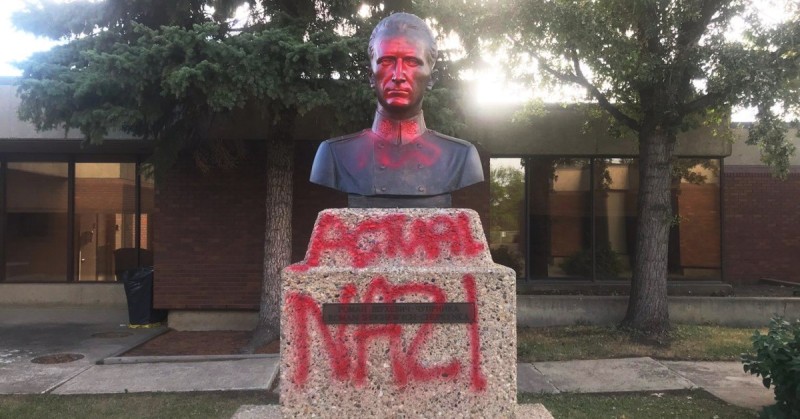
Efforts to complicate accusations against Laak were similar to how the media addresses (or fails to address) the crimes of Ukrainian Holocaust perpetrator Roman Shukhevych today. Whenever his name appears in the media—usually in connection to protests against the bronze bust of his likeness in Edmonton—it is often implied that the narrative around his crimes is “complex”
The Roman Shukhevych statue at the Ukrainian Youth Unity Complex in Edmonton after it was vandalized with the words “ACTUAL NAZI” in August 2021. Photo courtesy the Progress Report
Amidst a wave of protest against the Shukhevych statue last year, CTV News quoted the Ukrainian Catholic Eparchy, the organization which erected the bust, as “dismiss[ing] accusations that Shukhevych collaborated with Nazi Germany and was involved in massacres of Jewish and Polish people as ‘Russian disinformation.’”
A CBC article claimed that Shukhevych has “fallen under increased scrutiny” in recent years. And a CTV article noted: “While Shukhevych is celebrated by some as a Ukrainian military leader, he is also criticized by others as being involved in massacres of Jewish and Polish people.”
Even amidst the ongoing outrage over Yaroslav Hunka’s visit to the House of Commons, the CBC ran an article in which they wrote of Shukhevych’s “alleged” war crimes and his hero status among many right-wing, ultranationalist Ukrainians:
Lionized by some in the Ukrainian Canadian community as a brilliant guerilla commander who led the largest insurgency in Europe against Stalin, Shukhevych is considered a war criminal by Jews and Poles for his alleged role in the Holocaust and an ethnic cleansing campaign against the Polish minority in Western Ukraine
Canada: “Haven for Nazi criminals”
When meeting with historian Irving Abella, Prime Minister Pierre Trudeau was honest about the fact that Ottawa had no intention of prosecuting Nazi war criminals living in Canada. In their meeting, he told Abella that Canada was not seeking to prosecute Nazi veterans on its soil “because they were afraid of exacerbating relationships between Jews and Eastern European ethnic communities.”
In his research, Abella described the disturbing ways in which the Canadian government welcomed Nazis into the country after the war. In an interview with 60 Minutes, he told host Mike Wallace that one of the ways they could guarantee their entry into Canada “was by showing the SS tattoo… This proved you were an anti-Communist.” If true, this would explain how people like Herbie, Hunka, and Laak were able to enter Canada so easily after fighting for Hitler’s army
The New York Times has described Canada as a “Haven for Nazi Criminals,” while the Jerusalem Post called Canada “a near-blissful refuge” for Nazis. B’nai Brith has accused Ottawa of “intentional harbouring of known Nazi war criminals.”
It is hard to disagree with any of these statements. For instance, when Jerusalem Post reporters hired Steven Rambam to search for Nazis, he tracked down around 150 suspected war criminals living openly in Canada. And this assignment didn’t test his investigative mettle; tracking them down was often as easy as looking up their names in the phone book.
In 2014, Rambam said, “It is to the Canadian government’s great and eternal shame that more was not done” to prosecute Nazi war criminals living here. Indeed, Canada openly spurned the petitions of national Jewish organizations which protested the government’s openness toward Nazi veterans:
In the late 1940s, the Canadian Jewish Congress actively petitioned Ottawa to keep a closer eye on refugee streams from Eastern Europe, as the CJC believed that many former Nazi collaborators were using them to enter the country under false pretenses. These warnings were almost completely ignored, and the Congress’ low-end estimate is that 2,000 war criminals were able to settle in Canada, where most lived openly without any fear of prosecution
Indeed, it was a policy of the British after the Second World War to dump Ukrainian Nazi prisoners in Canada. A 1948 report from British official Beryl Hughes reads, “What little we know of [Ukrainian Nazis’] war record is bad… We’re still hoping to get rid of the less desirable Ukrainian POWs either to Germany or Canada.”
These Nazi veterans usually don’t hide their presence or their past actions. Often they are proud of them. For instance, Hunka writes of his time in Hitler’s army with pride and nostalgia. He posted photographs of himself in uniform on a blog for Ukrainian veterans of the SS Galicia Division and described the period under Nazi occupation from 1941 to 1943 as “the happiest years of my life.”
None of this stopped Parliament from applauding him, even though he was introduced as having fought “against the Russians” during World War II. And it didn’t stop the University of Alberta from distributing a $30,000 endowment fund in Hunka’s name over the past four years (which they finally closed yesterday amidst the uproar around the incident in the House of Commons)
After the war, the Canadian government welcomed between 1,200 and 2,000 members of the Ukrainian SS Galicia Division into Canada. Other Nazi veterans and collaborators came from Germany, the Baltics, and the Balkan states.
Over the past decade, the Canadian government has allocated millions of dollars to construct a Memorial to the Victims of Communism in Ottawa—despite a 2015 poll that found 77 percent of Canadians opposed the project. The monument was awarded funding under both the Harper and Trudeau governments, and received letters of support from Green Party leader Elizabeth May, former NDP leader Tom Mulcair, and former federal Justice Minister Irwin Cotler.
Funding for the monument has also come through a “buy-a-brick” campaign in which Canadians can donate money and dedicate a “virtual brick” to someone they consider a “victim of communism.”
After being announced in 2021, the “buy-a-brick” campaign was swamped with donations dedicated to Nazi war criminals and collaborators. The General Committee of United Croats of Canada dedicated a brick to Ante Pavelić, the leader of Croatia’s Nazi puppet regime and the country’s chief perpetrator of the Holocaust. Pavelić is responsible for the murders of approximately 32,000 Jews, 25,000 Roma, and 330,000 Serbs. Another brick was dedicated to Mile Budak, one of the most high-ranking figures in the fascist Ustaša. The bricks made no mention of these men’s actions, simply describing Pavelić as a “doctors of laws” and Budak as a “poet.” A third brick was purchased for Ivan Oršanić, another Ustaša member.
Meanwhile, the League of Ukrainian Canadians’ Edmonton Branch bought five bricks in honour of Roman Shukhevych, whose Ukrainian Insurgent Army (UPA) massacred thousands of Poles and Jews.
Confronting the past, and present
It is clear that the presence of Nazi veterans is widespread in Canada. Even so, the federal government is still hiding information on war criminals living in this country.
The 1986 Deschênes Commission investigated the presence of Nazi war criminals in Canada. However, many of the commission’s findings remain classified, and Ottawa continues to ignore appeals to release additional information.
Forty years later, the government is still sitting on a long-classified report about Nazis who settled in Canada. According to Ottawa Citizen journalist David Pugliese:
[The government] has heavily censored another 1986 report examining how Nazis were able to get into Canada. More than 600 pages of that document, obtained by this newspaper and other organizations through the Access to Information law, have been censored
David Matas, the honourary counsel for B’nai Brith, has attempted to gain access to these documents. His efforts have been fruitless. “We’ve run up against a brick wall,” he told Pugliese.
It is past time we confront this dark history. We deserve to know how and why these Nazis were allowed to live comfortably in Canada.
As Friends of Simon Wiesenthal Center President Michael Levitt said, “It’s now time for Ottawa to not only release the unredacted files related to the Deschênes Commission, but to also address the stark reality that there are still former Nazis with blood on their hands living in Canada.”
Direct demands need to be made of Canadian officials to release all historical documents related to Nazi war criminals within our own borders.
We also need to ask why we are spending millions on a monument that may bear dedications to Nazi collaborators.
These questions must be dealt with. Failing to better understand our history will have troubling implications for Canada’s future [end]
chronicle: its roots before WW2, its collaboration with Nazi Germany, its legacy in modern Ukraine and Baltic States, how NATO has supported Nazism in eastern Europe
[my illustration: Tintin – Land of Black Gold (1939)]
In the immediate wake of the Syrian government’s abrupt collapse, much remains uncertain about the country’s future. While longtime leader Bashar Assad has sought refuge in Moscow, most of his government and its military, security, and intelligence apparatus remains in Damascus. Calls for reconciliation between officials and the predominantly foreign “opposition” abound, but the prospect of show trials for state apparatchiks is high. After all, elements of Anglo-American intelligence have been planning for such an eventuality since before the Syrian civil war even started.
In May 2011, the Commission for International Justice and Accountability (CIJA) was birthed by shadowy NATO state contractors, ARK and Tsamota. Its first act was to train handpicked Syrian “investigators, lawyers, and activists in basic international criminal and humanitarian law…enabling [them] to link state and non-state actors to underlying criminal acts.” Dedicated “teams of investigators according to their regions” – including Aleppo, Hama, Homs, and Idlib – were created, “and equipped with field investigative kits.”
Their objective was to gather evidence of war crimes committed by Syrian government forces, in support of a “domestic justice process in a future transitional Syria.” We must ask ourselves how such a project came to be before the Syrian army was formally deployed by Damascus, in response to the foreign-fomented crisis that commenced in mid-March that year. Particularly given bringing officials to trial in a “future transitional Syria” was wholly contingent on all-out regime change.
The timing of CIJA’s launch is a palpable indication foreign actors were laying foundations for that eventuality from the very first days of Syria’s “peaceful revolution”, before full-blown civil war had erupted. Given the affiliations of ARK and Tsamota, the pair were well-placed to know in advance of plans by Western governments to topple the Assad government via brute force. Now that has come to pass, it may be time for their long-standing plan to at last be put into action.
‘Regime Change’
Founded by MI6 journeyman Alistair Harris, ARK was one of a constellation of contractors, staffed by military and intelligence veterans, employed by British intelligence at a cost of many millions to conduct covert psychological warfare campaigns in Syria, from the initial days of the crisis. The aim was to destabilise Assad’s government, convince the domestic population, international bodies and Western citizens that genocidal CIA and MI6-backed militant groups pillaging the country were a “moderate” alternative, and deluge media the world over with pro-opposition propaganda.
Under this operation’s auspices, ARK founded and ran numerous ostensibly independent opposition media outlets targeting Syrians of all ages, while tutoring and equipping countless local “citizen journalists”, teaching them “camera handling, lighting, sound, interviewing, filming a story…video and sound editing…voice-over, scriptwriting,” and “graphics and 2D and 3D animation design.” The firm’s students were also instructed in practical propaganda theory, such as “target audience identification, media narrative analysis and monitoring, behavioral identification/understanding, campaign planning, behavioral change, and how communications can influence it”
Such was ARK’s intimate proximity with anti-Assad elements, it boasted in leaked submissions to the Foreign Office of being entrusted by Western governments to develop a dedicated Office for Syrian Opposition Support. This entity identified the most promising groups for the proxy war’s sponsors to finance, in turn “[helping] present them to international donors, and provide access to networks that could deliver assistance.” These efforts intensified “as the conflict deepened and it became apparent that regime change would not occur in the short term.”
Tsamota’s primitive official website describes the company as “a security and justice sector consultancy which provides rule of law, forensics and natural resources advisory services,” working in “in politically, legally, socially and logistically challenging environments” for Western governments. The firm is not a compelling candidate for holding government officials anywhere accountable for war crimes. Tsamota has since inception offered guidance to major corporations on how to maximise profits in the Global South, while limiting their local and international legal liabilities.
In 2013, Tsamota director William Wiley gave a scandalous presentation to Canadian consortium MineAfrica Inc. In it, he set out a series of hypothetical scenarios in which mining companies operating in countries such as the Congo and Mali employed private security firms to crack down on striking workers, or deal with “local militias” interfering with their operations. Wiley outlined a number of means by which companies could be insulated from repercussions of heavy-handed responses to such incidents, up to and including murder
That presentation described Tsamota as composed of “experts” drawn from “national police, military and intelligence forces.” Wiley is no exception, having served in the Canadian military for almost two decades. Subsequently, he turned to international law, among other things overseeing the trial of Saddam Hussein October 2005 – December 2006, for crimes against humanity. Mainstream accounts acknowledge Wiley was imposed on the former Iraqi leader’s defence team without consent – a major breach of basic legal norms – by the US embassy in Baghdad’s Regime Crimes Liaison Office.
After capture, Hussein was initially interrogated by the CIA. Contemporary media reports note there was significant concern within the Agency that “their questioning could become public during his eventual trial,” raising issues around “how to conduct the questioning and record the conversations.” The reasons why were unstated, although a likely explanation was Washington wished to avoid awkward disclosures in court about Hussein’s long-running relationship with the CIA, and active US complicity in many of the most heinous crimes of which he was accused.
To say the least, this was a sensitive role indeed. Even prominent Iraqi supporters of US invasion and occupation charged Baghdad’s “interim” puppet government was seeking “show trials followed by speedy executions” of Hussein et al to boost its credibility. That Wiley was entrusted with this mission speaks volumes about his reliability from the US government’s perspective. It also raises obvious questions about the nature of his relationship with the CIA, and whether that bond influenced CIJA’s creation half a decade later.
‘Moving Documents’
A series of leaked ARK files on CIJA’s activities authored in the years immediately following its creation make grand claims about its achievements. One declares the Commission “innovated in the field of transitional justice…aiding the collection of evidence to document war crimes, crimes against humanity, and other violations of International Humanitarian Law” in Syria. Another states its work represented “a landmark development in international justice: the contemporaneous gathering of evidence of violations of international humanitarian law conducted by regime forces”:
[CIJA], through expert training, effective equipment provision and a commitment to the truth were able to ensure that when the conflict ends, the raw material of a post-conflict war crimes process is ready for trial, in turn providing a key contribution to truth telling, reconciliation and the future of Syria
Elsewhere, ARK boasted how CIJA had seized thousands of kilograms of “contemporaneous documentation”, hundreds of thousands of pages of “evidential material” and thousands of videos from Syria, “all of which had to be hand carried” out of the country. Cut to February 2021, and Commission chair Stephen Rapp, a US diplomatic warhorse, bragged to CBS about the sheer volume of evidence CIJA collected. He claimed the papertrail exposed a systematic strategy of Assad government-directed executions of opposition activists, along with ensuing coverups:
Now we have 800,000 pages of original documents, signed and sealed with original signatures going all the way up to Assad that document this whole strategy…We see reports back about ‘well, we’ve got a real problem here, there are too many corpses stacking up, somebody’s gonna have to help us with that’…Everything is handled in this sort of totalitarian system where they frankly think they can get away with things…they were almost stupid…they created evidence
If such damning, incontrovertible proof was bagged at any stage by CIJA, it has never emerged publicly. Still, throughout the Syrian dirty war, the Commission enjoyed glowing profiles in Western media, while providing journalists and rights groups with multiple scoops supposedly exposing Syrian government atrocities. At no point did any mainstream reporter or NGO question, let alone raise concerns about, the manner in which the Commission garnered the material upon which its cases against government officials in Damascus was “hand carried” out of the country.
CIJA chief Wiley acknowledged in 2014 that his organisation smuggled evidence from Syria by working with every opposition group “up to but excluding Jabhat al-Nusra and Islamic State.” However, a 2019 investigation by The Grayzone amply indicates that CIJA was frequently in extremely close quarters with both groups. Moreover, they were paid handsomely for their assistance in securing documentation. This included material seized in Raqqa after its January 2014 capture by ISIS, right when the ultra-extremist group was massacring Alawites and Christians.
In a 2016 New Yorkerprofile of CIJA, Wiley detailed the practical hassles and financial drain inherent in “moving documents [over] international borders” and opposition-controlled “checkpoints”, while relying on “rebel groups and couriers for logistical support.” He described how bundles of government files “typically” arrived at the Commission’s offices “in a dizzying array of crappy suitcases.” Wiley lamented, “we burn enormous sums of money moving this stuff.”
Accordingly, CIJA received tens of millions of dollars for its efforts from a variety of Western governments, including those at the forefront of the Syrian dirty war. Despite the vast windfall, the Commission’s work produced zero prosecutions for many years. This changed in late 2019, when Anwar Raslan and Eyad Gharib, two former members of Damascus’ General Intelligence Directorate, were indicted in Germany for crimes against humanity.
‘Many Contradictions’
Raslan headed the Directorate’s domestic security unit, while Gharib was one of his departmental subordinates. The pair defected to the opposition in December 2012. Raslan and his family fled to Jordan, where he played “an active and visible role in the Syrian opposition.” He was part of the anti-Assad delegation at the Geneva II conference on Syria in January 2014, and in July that year, was granted asylum in Germany.
After his escape from Syria, Raslan told numerous lurid tales of abuse and atrocities perpetrated by his unit, and the Assad government more widely, during his 20 years of state service. He claimed his defection was spurred after learning an apparent opposition attack in Damascus that he was charged with investigating was, in fact, staged by security forces. Significant doubts about his accounts, and whether his defection was principled or just cynical opportunism, have been raised in many quarters
Artist’s rendition of Raslan’s trial
In a perverse irony, Raslan’s loudmouth propensity was his undoing. His assorted claims post-defection provided grounds for arrest by German authorities, and were used against him and Gharib in their prosecutions. These legal actions heavily relied on documents seized by CIJA, including Central Crisis Management Cell records. This unit was created in March 2011 by Damascus, to manage responses to mass rioting that erupted this month. These documents have been widely described as the “linchpin” of the Commission’s case against “the Syrian regime.”
Yet, as this journalist has previously exposed, the Central Crisis Management Cell files in fact show the Assad government explicitly and repeatedly instructed security forces to protect protesters, prevent violence, and keep the situation under control. The documents also detail how from inception, many “peaceful” demonstrators were extremely violent, while opposition fighters systematically murdered security service operatives, pro-government figures, and demonstrators to foment catastrophe, in a manner eerily similar to many CIA/MI6 regime change operations old and new.
In February 2021, Gharib was found guilty of aiding and abetting crimes against humanity. He received four-and-a-half years in prison. A year later, Raslan was given life for crimes including mass torture, rape, and murder. The pair were not convicted for personally perpetrating these horrors, but serving in the General Intelligence Directorate at the time they were allegedly committed. “Expert” witness evidence provided at their trials left much to be desired.
For example, judges and prosecutors alike expressed disquiet at “many contradictions” in the testimony of “P3”, a Syrian government operative who purportedly worked in a security service “mail department”, and was central to Gharib’s conviction. P3 professed to seeing sensitive documents “related to the transfer of corpses” of opposition activists “to burial sites.” They “provided contradictory information” in statements to German police and the court, and were “visibly nervous” while testifying. Throughout, their seemingly aghast attorney sat nearby “putting his hands behind his head.”
Meanwhile, during Raslan’s prosecution, “P4” – a nameless individual who claimed to have been detained in a Syrian prison, and bribed his way out – testified he saw 500,000 corpses buried via a “bulldozer and a truck” next to his house, in an area which was previously “a desert”. Reports of the trial indicate there “was a feeling” among those present in court, including “the public”, that these numbers were greatly “exaggerated.”
The sense that Gharib and Raslan were prosecuted because they were within easy reach, and CIJA needed something to show for all its well-remunerated efforts, is ineluctable. The Commission had strong grounds to be anxious about failing to fulfill its founding objective. In March 2020, the European Anti-Fraud Office (OLAF) formally accused the organization of “submission of false documents, irregular invoicing, and profiteering” relating to an EU “Rule of Law” project it ran in Syria.
Fast forward to today, and The Guardian reports that “the abrupt implosion of the infrastructure of state terror” in Syria “has made available a huge volume of evidence.” The outlet quoted CIJA chief William Wiley at some length. He compared Assad’s fall to “a situation much like Germany in 1945 or Iraq in 2003,” with “a sudden availability of all state records” making prosecution of state officials a fait accompli:
It’s a very unusual situation, and its suddenness creates challenges and opportunities in simply dealing with the material…If there’s any security intelligence guy that rocks up in Europe, there’s typically going to be enough material already to hand
Until recently, a serious geopolitical working hypothesis was that West Asia and Ukraine were two vectors of the standard Hegemon modus operandi, which is to incite and unleash Forever Wars. Now both wars are united in an Omni-War
Sebastian Gorka’s involvement with British intelligence cost him a security clearance in Hungary. His longtime mentor is a UK spook currently engaged in covert operations against Russia. Is the Ukraine hawk and Trump counter-terror appointee operating on London time?
Leaked files show top UK military figures conspired to carry out the Kerch bridge bombing, covertly train “Gladio”-style stay-behind forces in Ukraine, and groom the British public for a drop in living standards caused by the proxy war against Russia
the jihadist operation in Paris, on November 13, 2015, was the collateral damage of the Western support to the so-called Syrian revolution, a Sunni radical uprising against the secular government of Syria, which began in 2011 and that global jihadists joined from worldwide
Ukrainian intelligence had provided Hayat Tahrir al-Sham (HTS), an offshoot of al-Qaeda, with drone support weeks before the group launched the offensive in Syria that ousted former Syrian President Bashar al-Assad, The Washington Post reported Tuesday.
“Ukrainian intelligence sent about 20 experienced drone operators and about 150 first-person-view drones to the rebel headquarters in Idlib, Syria, four to five weeks ago,” wrote Washington Post columnist David Ignatius.
While the US has celebrated Assad’s downfall, HTS is still listed by the US as a foreign terrorist organization, and its leader, Abu Mohammad al-Julani, has a $10 million US bounty on his head. That means Ukraine has supplied weapons and intelligence support to a group the US considers a terrorist organization.
Ukrainian and Russian reports have also reported that a special unit of Ukraine’s Main Intelligence Directorate (abbreviated GUR or HUR) had provided support to HTS and was involved in some attacks on Russian bases in Syria.
“Ukrainian military instructors from the GUR are present… training HTS fighters for combat operations,” Russian Ambassador to the UN Vassily Nebenzia said at the UN after the HTS offensive started.
The GUR has received significant support from the US over the years. The Washington Post reported last year that the CIA helped build up the GUR and the Security Service of Ukraine (SBU) following the 2014 coup that ousted former Ukrainian President Viktor Yanukovych. “GUR was our little baby. We gave them all new equipment and training,” a former US intelligence official who worked in Ukraine told the Post.
The GUR has also been involved in fighting Russia’s Wagner mercenary force in Africa. In Mali, the GUR provided support for a July ambush that killed 84 Wagner operatives and 47 Malians.
“The rebels received the necessary information, which enabled a successful military operation against Russian war criminals,” GUR official Andriy Yusov said of the attack. The rebel coalition that launched the attack in Mali included Jama’at Nasr al-Islam wal-Muslimin, an affiliate of al-Qaeda [end]
Until recently, a serious geopolitical working hypothesis was that West Asia and Ukraine were two vectors of the standard Hegemon modus operandi, which is to incite and unleash Forever Wars. Now both wars are united in an Omni-War
the jihadist operation in Paris, on November 13, 2015, was the collateral damage of the Western support to the so-called Syrian revolution, a Sunni radical uprising against the secular government of Syria, which began in 2011 and that global jihadists joined from worldwide
Experts lambasted as Kremlin mouthpieces turned out to be right
Ukrainian President Volodymyr Zelenskiy and European Commission President Ursula Von Der Leyen attend a joint press conference in Kyiv, Ukraine, on September 20, 2024 (Photo by Maxym Marusenko / NurPhoto)
As the war between Russia and Ukraine is framed by the ruling politicians and commentators in Europe and America as part of a purported global struggle between democracies and autocracies, the quality of democracy in the West itself has taken a hit.
The dominant voicesadvocating for Ukraine’s victory and Russia’s defeat, both defined in maximalist and increasingly unattainable terms, are intent on snuffing out more thoughtful and nuanced perspectives, thus depriving the public of a democratic debate on the existential questions of war and peace.
In a familiar pattern throughout the West, respected academics who correctly predicted the quagmire Ukraine and the West now find themselves in have been smeared and delegitimized as Kremlin mouthpieces, subjected to harassment, marginalization and ostracism.
The situation is particularly alarming in Europe. While the Ukraine debate in the U.S. is, to a worrying extent, shaped by pro-militarist think tanks, such as the Atlantic Council, hawkish politicians and neoconservative pundits, a countervailing movement consisting of pro-restraint voices has been growing. They include Defense Priorities, the CATO Institute, publications like The Nation on the left, and The American Conservative on the right, and academics like Stephen Walt, John Mearsheimer, and Jeffrey Sachs, among others. There is more space for alternative voices in American discourse.
In Europe, by contrast, foreign policy debates tend to simply echo the most hawkish voices inside Washington’s Beltway.
Sweden is a particularly telling illustration of that trend. After Russia’s invasion of Ukraine, the Swedish government and political class swiftly moved to join NATO. Yet, as one of the leading Swedish international relations scholars Frida Stranne told me in an interview, “No proper debate was held on the key questions, like whether Russia’s aggression against Ukraine indeed was such an immediate security threat for Sweden that it had to ditch the neutral status it enjoyed even during the Cold War?” (I can testify myself, from my work as a senior foreign policy adviser in the European Parliament in early 2022, that even some members of the then-ruling Swedish social-democratic party were aghast at the government running roughshod over alternative views on NATO).
Further, in a conversation with me, Stranne, while acknowledging that Russia’s invasion of Ukraine was “an egregious breach of international law,” pointed to U.S. policies since 2001, such as the invasion of Iraq, noting that they “have helped to undermine international legal principles and set the precedent for other countries acting ‘preemptively’ against perceived threats.”
In the same interview, she also warned that “a refusal to countenance a negotiated settlement to the war in Ukraine is leading the world perilously close to the brink of a major military conflict between NATO and Russia.”
While such points are routinely made by fairly mainstream scholars in the U.S., in Sweden they triggered a vicious campaign against Stranne and made her nearly untouchable by the media and in foreign policy circles. Leading media outlets vilified her as a U.S. hater and a “Putinist.”
Germany is another example of how enforced groupthink led to a marginalization of dissenting perspectives in political debates. What is particularly noteworthy is the speed and radicalism with which the hawks in think tanks, media, and political parties managed to redefine the debate in a country previously known for its now-defunct Ostpolitik, a policy of pragmatic engagement with the Soviet Union and later Russia.
One of Germany’s most prominent foreign policy experts, Johannes Varwick of the University Halle-Wittenberg, has long defied the trend and advocated for diplomacy. In December 2021, together with a number of high-ranking former military officers, diplomats and academics, he warned that a massive deterioration in relations with Russia could lead to war — due, in part, to the West’s refusal to take seriously Russia’s security concerns, chiefly related to the prospects of NATO’s eastward expansion.
Yet such views earned Varwick accusations of “serving Russian interests.” As a result, as he told me in an interview, his “ties with the political parties and ministries responsible for conducting Germany’s foreign and security policy were severed.”
Experts in neutral countries were not spared marginalization as well. Austrian Prof. Gerhard Mangott, one of the most eminent experts on Russia in the German-speaking world, pointed to a “shared responsibility” of Russia, Ukraine, and Western countries for the failure to resolve the post-2014 Ukrainian conflict peacefully. Such analysis, as Mangott told me, led to his “prompt excommunication by the German-speaking scientific community which turned quickly to political activism and became party to the war.”
The tragic irony, of course, is that these ostracized voices have proved to be correct in most respects about this war.
When, despite his warnings, the Russian invasion of Ukraine did occur, Varwick, who condemned it as illegal and unacceptable, called for further efforts to find a realistic negotiated solution to the conflict. As he told me, this should “firstly include a neutral status for Ukraine with strong security guarantees for the country. Secondly, there would be territorial changes in Ukraine that would not be recognized under international law but must be accepted as a temporary modus vivendi, and thirdly, the prospect of suspension of some sanctions in the event of a change in Russia’s behavior must be on offer.”
In March 2022, both Ukraine and Russia were close to a deal broadly along these same parameters. It did not work, because, among other reasons, the West encouraged Ukraine to believe that a military “victory” was possible. The role of then-British Prime Minister Boris Johnson in undermining the talks is now generally acknowledged. What is, however, particularly striking is that Johnson recently himself admitted that he saw the war in Ukraine as a proxy war against Russia — a claim made by Stranne and the Quincy Institute’s Trita Parsi in their 2023 book, in Swedish, “The Illusion of American Peace,” for which they were lambasted for purportedly pushing Russian narratives.
Fast forward to late 2024, and, faced with growing difficulties on the battlefield, Ukraine’s President Volodymyr Zelensky is now signaling that he could go along with some of the elements outlined by Varwick; namely, accepting some de facto territorial losses to prevent even bigger ones should the war continue.
Today, Ukraine is farther away from achieving anything remotely resembling a military victory than at any point since February 2022. Contrary to the expectations in the U.S. and EU, sanctions neither tanked Russia’s economy nor changed its policies in the ways the West sought.
In the West itself, political forces that urge negotiations to end the war are ascendant, as evidenced by the election of Donald Trump as president in the United States and the rise of anti-war parties in Germany, France and other EU countries. Public opinion surveys consistently show a preference of the majority of Europeans for a negotiated end to the war.
The reality is, irrespective of the outcome of the war in Ukraine, a modus vivendi between the West and Russia will have to be reestablished to ensure, in Varwick’s words, “their coexistence in a Cold War 2.0 without a permanent escalation.” Restoring an open democratic debate about this vital issue is long overdue.
Listening to the experts who have a proven track record of correct analysis would be a necessary first step [end]
chronicle of censorship, fake news, whitewashing of the Ukrainian Nazism and war crimes, for the sake of the proxy war that NATO is conducting in Ukraine against Russia