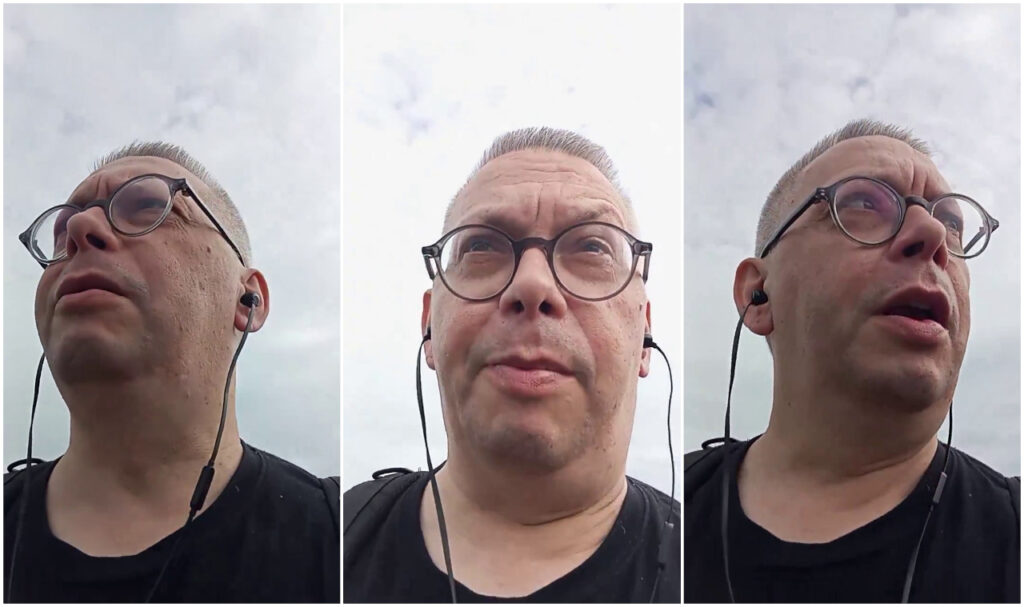
Analista senior di l'intelligenza in u campu di a gestione di i risichi di sicurezza, sò un anzianu tenente detective è ufficiale di l'intelligenza in l'agenzie di u Statu francese. A bona pronuncia hè Николай Чинкуини, in russu
Lecourt, Olivier, né le 29 juillet 1969, dit Olivye Lekur,
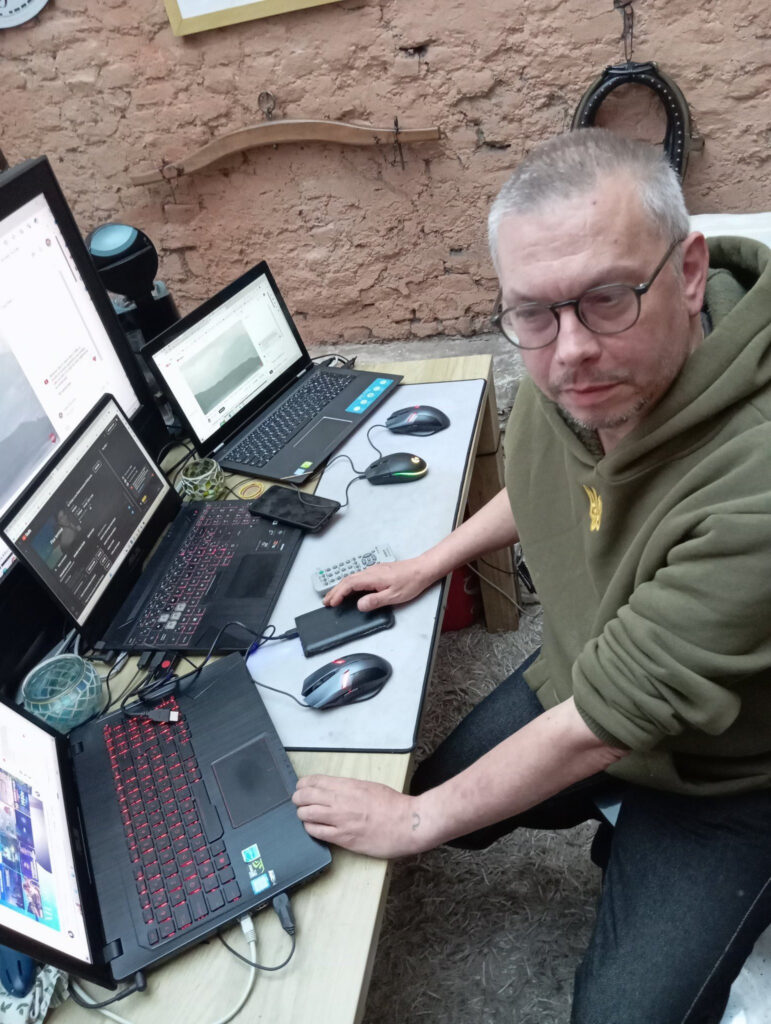
est un ancien, dont le CV est presque aussi long que la liste de mes bavures. Il commença à travailler en 1994, en France, chargé de relation avec la clientèle chez Orange. À la même époque, après quelques années d’avance, j’intégrai la Brigade criminelle du quai des Orfèvres. Il est passé ensuite, en France et en Belgique, par le support informatique, l’enseignement, le journalisme et le médical
Voilà pour la version non abrasive, celle qui figure sur LinkedIn. Après m’être présenté, je lui demandai sur les réseaux sociaux le 3 octobre 2024 si son passeport était français ou belge, mais il ne répond pas. Dans l’expectative, voici le chapitre que je lui dédie
le 27 mars 2024 (réseaux sociaux)
Plus libre sur d’autres plateformes, il clame son ambition de faire tomber les collabos et les criminels du Kremlin, que ses employeurs sont Ukrainiens et Anglais. Vue son objectivité sur les réseaux sociaux, j’imagine que ses employeurs payent mieux que le journalisme indépendant, car parler de criminels depuis Lviv requiert beaucoup de mauvaise foi
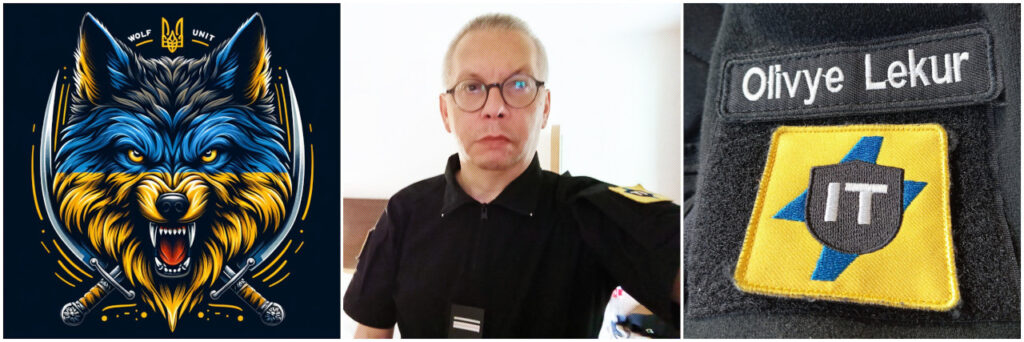
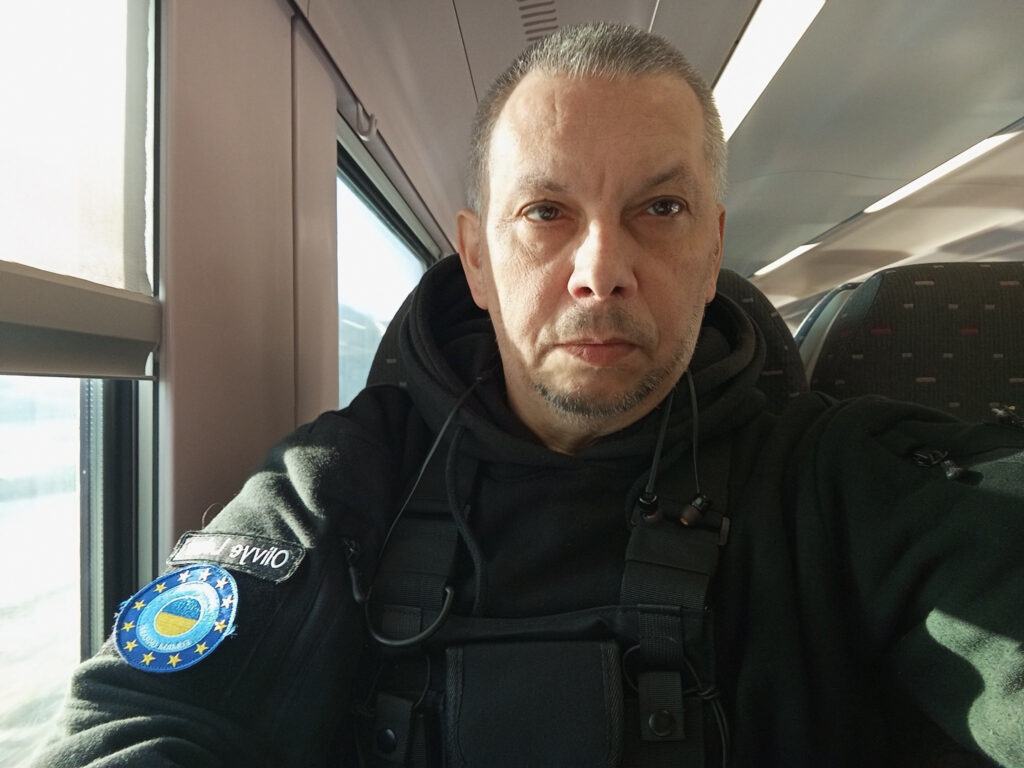
Sur ce selfie, Olivier Lecourt arbore en Ukraine un insigne qui imite celui de major (sous-officier) de la Police nationale française, grade ultime des fonctionnaires qui ont commencé gardiens de la paix (réseaux sociaux). Lors de nos quelques échanges et à défaut d’argument sur la question ukrainienne, il apparaît jaloux de ma carrière dans le corps des officiers, inspecteur en civil puis officier de renseignement en contre-terrorisme
Il se présente fondateur de la Wolf Unit [Unité lupine ou Wolfsabteilung, pour ceux qui préfèrent l’Allemand], un groupe franco-ukrainien ou francophone/ukrainien, subordonné à l’IT Army Of Ukraine [Armée informatique d’Ukraine], communauté internationale de cyberguerriers, levée le 26 février 2022 par le vice-premier ministre Mykhailo Fedorov.
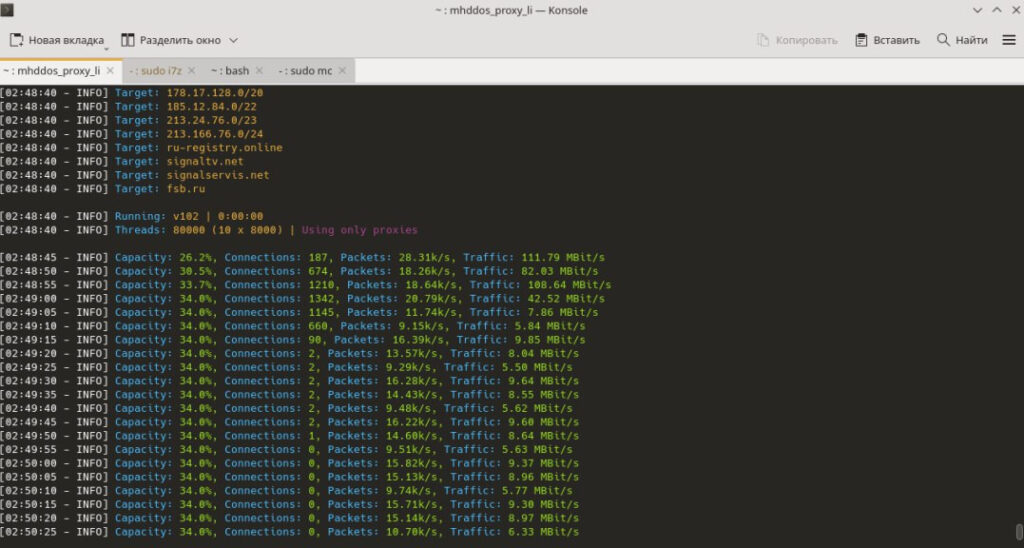
C’est donc par essence qu’elle opère pour le gouvernement ukrainien et ses services spéciaux. Ces informaticiens semblent pratiquer surtout l’attaque par déni de service (DDoS) de serveurs russes. Lecourt pourrait bien les organiser contre les cibles francophones
Le 17 octobre 2024, lors de sa participation à un DDoS, un cyberguerrier ukrainien partage la capture d’écran de son terminal sur une chaîne Telegram de l’IT Army
Grâce à la fuite de mails et d’autres documents, le journaliste d’investigation Kit Klarenberg cerne le 16 novembre 2024 un club typiquement britannique de durs-dingues, le Projet Alchimie, aussi appelé Les Vieux, qui semblent avoir plus particulièrement sévi en 2022 et 2023
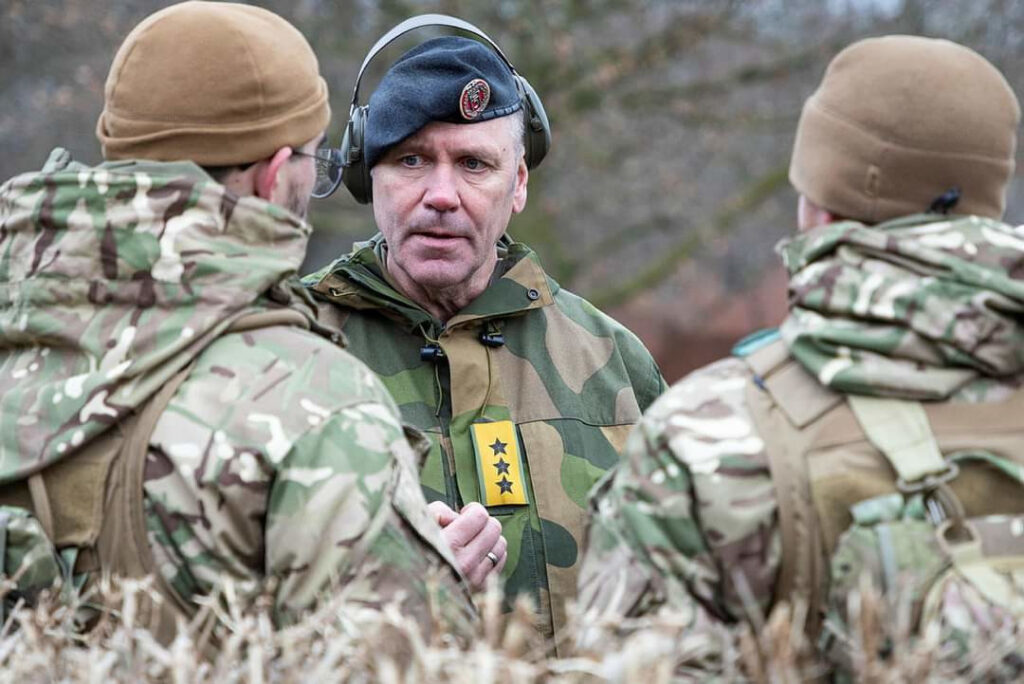
Le lieutenant général Charlie Stickland, le 11 février 2023 (État-major général des forces armées ukrainiennes)
Ces militaires en activité, universitaires et autres influenceurs, adressaient aux autorités du royaume des notes dans lesquelles ils énonçaient leurs projets de guerre asymétrique en Ukraine, notamment dans le cyberespace. Cela nous rappelle qu’Olivier Lecourt confia le 2 octobre 2024 que ses employeurs étaient Ukrainiens et Anglais
le 3 février 2025 (réseaux sociaux)
Le cyberguerrier se rapatrie début mai 2025, élit domicile à Valenciennes et prend un petit boulot à Lille.
Lecourt est un suiveur, de l’engeance majoritaire en France qu’anime un immense respect de l’autorité administrative. Ses semblables acclamèrent Philippe Pétain à Paris, le 26 avril 1944, pleurèrent Philippe Henriot le 2 juillet, puis acclamèrent Charles de Gaulle le 26 août.
chronique alphabétique et nécrologique de l’engagement français dans les rangs atlantistes en Ukraine, ce que les journalistes serviles ne vous raconteront pas
Articles connexes
Pruvate à truvà me, canaglia di l’OTAN, pruvate solu
chronique en Anglais, its roots before WW2, its collaboration with Nazi Germany, its legacy in modern Ukraine, how NATO has continually supported Nazism in Ukraine
chronique en Anglais, censorship, fake news, whitewashing of the Ukrainian Nazism and war crimes, for the sake of the proxy war that NATO is conducting in Donbass and Ukraine, against Russia
une saga française, entre Ukraine et Lyon, où apparaissent aussi des morceaux de SS de la division Charlemagne et plus récemment, Alice Kerviel, dite Cordier. L’affaire Deranque révèle comme la France est infectée par le pétainisme, en particulier parmi les soutiens d’Israël ou de l’Ukraine, deux théâtres d’opérations où l’Occident tente de ralentir son déclin
En 2025, une nouvelle unité de Français combattant pour l’Ukraine s’est structurée autour d’un noyau de néonazis, ayant pour objectif d’attirer des recrues. Parmi ces volontaires, d’anciens militaires. StreetPress les a identifiés
En Ukraine, les volontaires français pro-ukrainiens et pro-russes se partagent l’imaginaire de la Seconde Guerre mondiale. Les premiers se revendiquent des collabos de l’Allemagne nazie, les seconds de l’escadrille mythique « Normandie – Niémen »
deux jours après le 10e anniversaire de la débâcle politique et sécuritaire du 13 novembre 2015, une messe célèbre à Verdun l’ancien dirigeant fasciste de l’État français
ce 11 novembre 2025 est l’occasion de souligner comme la façon dont l’Europe sacrifie les conscrits ukrainiens mobilisés de force rappelle le spectaculaire carnage de la 1ère guerre mondiale
c’est par l’agence cosaque de presse PIKA, depuis la République populaire de Lougansk, que le 2 avril 2024, l’ataman Nikolaï Diakonov lance un message à destination de la France
ce papier est le premier des grands médias français qui s’attaque à la question des militants nazis français dans les rangs atlantistes en Ukraine, le nouveau danger qu’ils présenteront à terme pour la sûreté intérieure
où nous apprenons que le nazi français Allan Duchézeau, camarade de César Aujard dans les rangs atlantistes en Ukraine, était surnommé Dox, quand il secondait à Paris le leader nazi Marc de Cacqueray Valménier
en Anglais, les indices de la présence d’opérateurs occidentaux, en particulier Français, pris au piège en mars 2022 à Marioupol, dont les forces russes achevèrent la libération en mai
Leaked files reviewed by The Grayzone expose the covert war waged by British intelligence against Russia in the Black Sea, outlining Ukrainian “honey trap” plots along with blueprints for blowing up the Kerch Bridge
Sensitive documents reviewed by The Grayzone indicate that the United Kingdom is the central architect behind Ukrainian military operations targeting Russia’s Black Sea Fleet. Among other explosive findings, the files reveal high-ranking British military and intelligence figures drew up detailed plans to “maximize attrition of [Moscow’s] Black Sea Fleet,” plotted to blow up the Kerch Bridge connecting Crimea to mainland Russia with fertilizer bombs, and even devised blueprints for a series of submersibles which would allow Ukrainian divers to plant mines on Russian ships and infrastructure.
Further machinations include an explicit “honey trap” plan which called for establishing a brothel secretly run by British intelligence in Crimea. There, Russian-speaking female Ukrainian agents would ply “drunken sailors” from the Russian navy for information.
The schemes were assembled by Project Alchemy, a secret British military planning cell whose existence was first exposed by The Grayzone.
Alchemy’s intelligence-aligned director, Dominic Morris, once embedded with British special forces in Afghanistan while serving as a “political officer” for the UK embassy. The first of the relevant files was sent on April 14, 2022 — the same day Ukraine achieved its most spectacular naval success of the war when it sank Russia’s flagship in the region, the Moskva.
That feat was cheered by Western media, with the New York Times heralding the ship’s destruction as a “signal triumph – a display of Ukrainian skill and Russian ineptitude.” As the previously-unpublished files show, admirers of the operation also included Project Alchemy’s Dominic Morris, who saw an opportunity to “defeat the entire Russian Black Sea Fleet” and immediately began crafting plans to sink the rest of Moscow’s warships.
The destruction of the Moskva purportedly both surprised and panicked the Biden administration, as they apparently didn’t believe Ukraine possessed missiles capable of striking such a target and, according to one mainstream report, “hadn’t intended to enable the Ukrainians to attack such a potent symbol of Russian power.” But the attack apparently convinced the White House and Pentagon to double down on their military support for Kiev – and as the documents show, it had the same effect across the pond.
In response to an April 23, 2022 brief authored by a fellow cell member on the importance of Western powers supporting Ukrainian “land” operations, Morris declared “the sinking of Moskva” meant Kiev should focus predominantly on “maritime” operations instead. After complaining that “apart from a little bit of moving tanks and planes around a peaceful Europe,” NATO was “not doing any fighting,” Morris wrote that he saw a chance for the UK to eliminate every Russian vessel in the region without even going to war.
“You could defeat the entire Russian Black Sea Fleet” with “subthreshold options,” he wrote, referring to gray zone tactics which the British military has officially defined as “all activity up to, but not crossing, the legal definition of armed conflict.” Morris specifically proposed “commando raids” as “a fab subthreshold activity that will scare the shit out of” Russian President Vladimir Putin
The attack on the Moskva appeared to serve as a catalyst for Alchemy’s “Black Sea Operations,” which were already being assembled within a few hours of the news breaking. In a document dated the same day as the ship sank, Morris boasted that the “current situation in Ukraine gives the West an ideal opportunity to degrade Russian military capability by destroying as much Russian equipment as possible,” and went on to outline a series of multi-pronged and phased operations targeting Russia across the Black Sea. “Inflicting a high casualty rate must continue,” because “lots of dead soldiers returning to the mainland will have a big impact on public opinion” in Russia, Alchemy’s Morris declared
Project Alchemy also proposed a joint UK-Ukrainian intelligence operation in which “female agents” were surreptitiously inserted into Russian navy “admin posts.” In phase one of the operation, Morris proposed “setting up a bar and brothel” in Crimea to “gain intelligence from drunken sailors,” and serve as a “honey trap” for military and intelligence officers. “The agents must be Russian speakers and attractive, able to manipulate, playing to the weakness of the average Russian male,” he stressed
In the second phase, Morris proposed an “unconventional option” for blowing up Kerch Bridge, in which “a hijacked Russian flagged bulk carrier loaded with fertiliser rigged with explosives” would be parked under the Bridge and detonated. Morris “assessed this will be a significant kinetic event that will be able to blast four – six pillars on the bridge, rendering it unusable for a long period of time.” Given Kerch Bridge “was Putin’s crowning glory after taking Crimea,” he suggested its total destruction had the potential to foment a palace coup in the Kremlin
The Kerch Bridge’s collapse, and the infiltration of spies into Crimea, would lay foundations for the third phase: the “main offensive” of seizing the peninsula. Alchemy’s previously established “honey traps” could establish covert “safe houses and weapon stores” in advance of the mission, Morris suggested. Next, “a direct attack against Sevastopol using a tanker fully laden with fuel into Strilets Bay.” This would be “in essence a fire ship creating further panic” and “sending a strong signal to the Russian Navy [that] nowhere is safe in the region”
Finally, Morris advocated that Ukraine pursue a strategy of “containment” by seeking to “disrupt” and “capture/reflag the [Black Sea Fleet.]” The idea, the Alchemy chief explained, was “to target the Black Sea Fleet with the aim of destroying as many ships as possible,” as Moscow’s warships were “trapped with little places to hide” there. He urged the “use of civilian vessels retrofitted” with British-supplied weaponry, and proposed “ambushes using hijacked Russian ships to lure in a warship to be attacked by portable anti-ship missiles”
While no such operation ever materialized, Sevastopol has been a consistent target of Kiev’s drone and missile blitzes throughout the conflict. In fact, the “Black Sea Operations” memo identified the Nakhimov Naval Academy in the Crimean capital as an ideal target for such attacks. The institution has been repeatedly rocked by Ukrainian strikes during this period. An incendiary strike on Kerch Bridge did come to pass in October 2022 – and as The Grayzone revealed at the time, it was almost certainly the outcome of blueprints prepared by Project Alchemy.
In a secret memo one month later, Alchemy leader Dominic Morris stated approvingly that the “attack on Kerch” had “hurt” the Russians. Noting that a relatively high-ranking Russian politician was personally dispatched to oversee the Bridge’s reconstruction, Morris claimed this underlined the attack’s political significance to the Kremlin, and added: “It is not an easy repair, they need to replace road [sic] in each direction (ie the one that wasn’t hit) and bad weather is slowing them.”
On April 16, just two days after the Moskva went under, Alchemy’s plans had already morphed into a “CONOPS” – military jargon which the US Department of Defense defines as a “statement that clearly and concisely expresses what the joint force commander intends to accomplish and how it will be done using available resources.” The document, which is entitled “Building Ukraine [sic] Maritime Raiding Capability” and closely matches a secret British presentation previously exposed by The Grayzone, describes the Moskva’s sinking as “a significant blow to Russian naval capability” that left the rest of the Black Sea Fleet “vulnerable to missile attack”
According to Alchemy, the sinking of more ships would “force the Russian navy farther away from the Ukraine coast or into port, opening the potential for the Ukrainian Navy to launch littoral, inshore, coastal and riverine raiding operations.” The cell noted “the exploitable sea area” was “relatively small” – “just 160 nautical miles from Odessa to Sevastopol as an example,” which was “well within the range of small assault crafts.”
Ukrainian marines and naval forces were to be equipped and trained by the British to allow for “ambushing… Russian engineer and Spetsnaz reconnaissance teams” and “harassing Russian forces in hit and run operations from the waterways.” These teams would also be charged with “[taking] out coastal radar stations,” and thus “blinding Russian forces.” As these stations were “likely to be well defended,” such attacks would “have to be well planned and hit at lightning speed to ensure success and escape,” Alchemy wrote, insisting that “agent[s] already inserted into Crimea” from mainland Russia would “provide intelligence for the naval commandos”
The battle plans specifically called for Ukrainian commandos to “Hunt and destroy any Russian patrol craft operating in Dniprovska Gulf and conduct beach reconnaissance from Kilburn [sic] Spit to Yahorlyk Bay to identify good landing locations for a larger assault force for a future counter attack.”
The Kinburn spit, a narrow sandbar which comprises the far western end of the Crimean peninsula, has been a frequent target of Ukrainian raids since Russia’s seizure of the territory.
In the document, Alchemy suggested “specialist training for chosen men” who spoke Russian to carry out “covert undercover missions.” They would also receive training in the use of small arms, sabotage “to disrupt civil installations such as electrical substations, railways, cyber, hacking skills, locksmith training, advanced unarmed combat,” and how “to identify high ranking military officers for assignation while off duty in Crimea”
Ukraine trained in planting limpet mines
A leaked Project Alchemy proposal from September 2022 outlined an elaborate scheme based on input from three unnamed British companies to target Russia’s Black Sea Fleet while harbored in Sevastopol, strike “civilian vessels” used by Russia to move troops and equipment in the Dnipro River, and carry out night-time raids on “other maritime environment [sic] being used” by Russian forces. The planned military campaign was known as “The Tauris Project.”
The document noted that Russia’s Navy “need to refuel and reprovision in-between deployments,” and Sevastopol “is the primary port” for this purpose. According to Alchemy, Sevastopol was the one place Moscow’s Kilo Class submarines were “vulnerable to attack,” because in other areas the crafts were “able to operate with impunity as Ukraine does not possess the subsurface capability to counter the threat.”
In Sevastopol, however, the Black Sea Fleet could “easily be destroyed by combat swimmers delivered covertly” via crewed submersibles that allow divers to deploy underwater covertly, which are known in military parlance as Swimmer Delivery Vehicles (SDVs). As Alchemy explained, “Once the combat swimmers are in the port they can attach limpet mines to [Russian] ships and submarines before slipping silently back to Chornomorsk”
Alchemy and its unnamed confederates thus designed an SDV “specifically for operating in the coastal area of Ukraine,” with “a superior range to reach Sevastopol from Chornomorsk.” The file suggested these vehicles could also be deployed along riverbanks to “destroy shipping and hit targets out of range of conventional weapon systems” and “provide intelligence on enemy movements.” Dubbed the Tauris 1, it purportedly boasted “state of the art” technology, and was “capable of operating surfaced or submerged.”
The Tauris 1 would reportedly transport “one pilot and navigator plus four combat swimmers to remote locations on covert missions to include, surveillance, infiltration, mine clearance & mine laying,” with a system “designed to be fast when operating on the surface” – at up to 30 knots – and “ultra-quiet when submerged…with a very low radar signature when operating sub-surface at snorkeling depth.” Meanwhile, it could be parked on sea and riverbeds, or automatically surfaced via “a coded ping sequence.”
“We believe that the SDVs will give the Ukrainian Navy a huge advantage in disrupting, destroying key [Russian] assets and wider forces deployed in the south,” the document bragged. It foresaw 24 – 48 Ukrainian Marines and naval personnel being trained over “an eight-week course in a secret location in the UK,” overseen by a technical team and instructors comprising “former SDV pilots and navigators who served in the UK Special Forces community.” This would include “tactical training and limpet mine training”
Britain exploits Ukraine for Black Sea control
The document predicted it would take a year to construct the Tauris 1 SDVs, at an eye-popping price of £6 – 8 million per vehicle. While there is no evidence that Kiev took Alchemy and its partners up on the proposition, there have been numerous examples of kamikaze Ukrainian commando raids on Russian-held territory, often using jet skis. In addition to the Kinburn Spit, the Tendra Spit, which sits 20 kilometers to its south, has also been a repeat target.
A typically ill-fated raid which took place on February 28, 2024 saw five Ukrainian assault boats immediately come under intensive Russian fire as they approached the Tendra Spit, leaving dozens dead and just one watercraft able to escape the scene.
Even doggedly anti-Russian news outlets in Britain were forced to acknowledge the debacle, with The Telegraph lambasting the operation as a “failure” and noting that it was “not clear what the Ukrainian forces were attempting to achieve.” The suicidal raids have drawn comparisons to Kiev’s calamitous attempt to capture Krynky, which as The Grayzone revealed, was planned and directed by Project Alchemy.
Elsewhere, British-backed attacks on Russia’s forces in the Black Sea have been more successful. In March 2024, following a series of well-publicized sinkings of Russian warships, the UK’s then-Defence Minister Grant Shapps boasted that drones and missiles supplied by London had helped Kiev “lay waste to nearly 30 per cent” of the Russian Navy stationed there. On top of weaponry, it’s likely the Ukrainian strikes relied heavily on targeting intelligence provided by Britain’s RC-135 spy planes, which ramped up surveillance of Russia assets in Black Sea following the proxy war’s outbreak.
Today, London remains determined to neutralize Russia’s presence in the Black Sea. In January 2025, a defense contractor and British government-funded think tank known as the Council on Geostrategy floated the idea of deploying a British naval task force to the region, to “reshape” its “geopolitics.” The Ministry of Defence then invited “industry partners from NATO, Ukraine, and Five-Eyes countries” to submit designs and plans for “the development of a versatile, fast, and low-observable maritime system designed for operations in Ukraine and beyond.”
Before the month was over, a UK minister confirmed in parliament that in an attempt “to support Ukraine,” the Ministry of Defence had developed two “new uncrewed maritime [systems]” that were “undergoing final testing,” which it dubbed ‘Snapper’ and ‘Wasp.’ The uniquely British obsession with exploiting the proxy war to obliterate Russia’s Black Sea Fleet may seem peculiar, given its relative lack of impact on the battlefield.
However, the true motivation was clearly spelled out in a March 2022 Council on Geostrategy report, which declared that the hostilities in Ukraine meant London’s “stake in the Black Sea region has been elevated.” The paper detailed how control of the region was essential for Britain’s intended “tilt” to the Indo-Pacific, which was laid out in the official July 2021 “integrated review” of UK security and defense strategy. As the Council on Geostrategy explained, “any power controlling the Black Sea would be able to exert significant pressure on the key maritime communication lines from Europe to the Indo-Pacific.”
This February, a spate of explosions was reported on tankers in the Mediterranean which had recently stopped at Russian ports. Italian investigators suspect Kiev was responsible for carrying out at least one of these incidents using limpet mines — the same weapon they were trained to use by British intelligence.
Three years after the Moskva’s sinking, Russia still maintains several naval assets in the Black Sea. However, its fleet is unable to leave the confines of Moscow-controlled waters in the east. Just how much responsibility Britain bears for this feat remains unclear, but Project Alchemy’s files demonstrate a substantial role for the UK since the onset of the war [end]
Leaked files show top UK military figures conspired to carry out the Kerch bridge bombing, covertly train “Gladio”-style stay-behind forces in Ukraine, and groom the British public for a drop in living standards caused by the proxy war against Russia
Leaked files show top UK military figures conspired to carry out the Kerch bridge bombing, covertly train “Gladio”-style stay-behind forces in Ukraine, and groom the British public for a drop in living standards caused by the proxy war against Russia
Emails and internal documents reviewed by The Grayzone reveal details of a cabal of British military and intelligence veterans which plotted to escalate and prolong the Ukraine proxy war “at all costs.” Convened under the direction of the British Ministry of Defense in the immediate aftermath of Russia’s invasion of Ukraine in February 2022, the cell referred to itself as Project Alchemy. As British leadership sabotaged peace talks between Kiev and Moscow, the cell put forward an array of plans “to keep Ukraine fighting” by imposing “strategic dilemmas, costs and frictions upon Russia.”
The leaks obtained by The Grayzone expose a hidden hand behind Britain’s policy in Ukraine, showing in unusually granular detail how it aimed to engineer a long, grinding war through covert operations that stretched the bounds of legality.
Project Alchemy’s proposed schemes spanned every conceivable field of warfare, from cyber attacks to “discreet operations” to outright terrorism. The secret cell even put forward a plan to “aggressively pursue” and “dismantle” independent media outlets – including The Grayzone – through an aggressive campaign of legal harassment and online censorship, so they “would be forced to close.” The incendiary blueprints were fed to the highest levels of the British state and national security structure, where they were apparently well-received.
Founded by a senior British Ministry of Defence official, Project Alchemy is composed of veteran military and intelligence operatives united by a desire for all-out war between the West and Russia. Some have trained Ukrainian forces in clandestine sabotage tactics.
Members of the national security cabal tacitly acknowledged that their proposed operations stretched the bounds of British law. Thus they suggested that London should be “prepared to creatively use the law” to meet its goals, and even be willing to erase “legal restrictions on UK deniable ops” against Russia.
Some of Project Alchemy’s most extreme recommendations have already been implemented, often with calamitous results. These include the cell’s proposal to strike Crimea’s Kerch Bridge, which prompted a Russian escalation that saw punishing attacks on Ukraine’s electricity infrastructure. Alchemy also envisioned the construction of a secret, Gladio-style army of Ukrainian partisan fighters to carry out assassination, sabotage, and terror missions behind enemy lines.
It appears the British premier, Keir Starmer, fell under the influence of the Project Alchemy cabal soon after his election in July, when he eagerly embraced the role of “wartime prime minister.” After pledging to support Ukraine “as long as it takes,” however, Starmer is quietly backing away from the maximalist policy. In Kiev, Ukrainians are left to ponder how their “friends” in London got them into this mess, and why they can not, or will not get them out of it.
The British spooks who gathered around Project Alchemy reasoned that the longer the proxy war continued, the more Russian president Vladimir Putin’s “credibility at home and abroad drops, and his ability to fight NATO is degraded.” Today, Project Alchemy’s gambit has clearly backfired, as Putin remains popular within Russia, while a crumbling Ukrainian army loses territory by the day despite constant re-arming by the West. But the war planners in London remain staunchly committed to escalation, refusing to shelve their diabolical proposals.
Britain takes ‘unilateral lead’ on ‘regime change’ in Russia
Project Alchemy was founded on the personal orders of Lt. General Charlie Stickland, who is charged with “planning, executing and integrating UK led joint and multinational overseas military operations” as the head of Britain’s Permanent Joint Headquarters. Stickland boasts in leaked communications that his family “come from a long line of pirates and buccaneers.” In his email signature, the general identifies himself as an “LGBTQ+ Advocate” in rainbow-colored text.
Stickland and his assistant, Maj. Ed Harris, did not answer The Grayzone’s calls to their personal phones, nor did they respond to detailed questions submitted to them through WhatsApp
🇬🇧 🇳🇴 Lieutenant General Charlie Stickland CB OBE, (Chief of Joint Operations), Minister of the Lords, Baroness Annabel Goldie, and a delegation of senior multinational officers and officials visited Ukrainian Armed Forces personnel being trained in the UK. @Admiral @Permanentpic.twitter.com/rOJ38aRXcL
Stickland convened the first meeting of Project Alchemy’s on February 26, 2022, just days after Russian troops made their initial foray into Ukraine. According to minutes of the gathering, “an assortment of leading academics, authors, strategists, planners, pollsters, comms, data scientists and tech” was on hand to produce a “grand strategy options paper.”
The paper consisted of a series of proposals for the British government to “defeat Putin in Ukraine and set the conditions for the reshaping of an open international order of the future.” Throughout the document, the need to “keep Ukraine fighting” was described as London’s “main effort” in the conflict.
In an email to British military apparatchiks dated March 3 2022, Stickland described Alchemy’s paper as the result of “some mischief I’ve been up to” with “a group of ‘sideways thinkers.’” He expressed satisfaction that “this has been seen by all sorts of people,” including senior British government and military officials, “and landed well”
An Excel document listing potential and confirmed recruits for the effort, authored by project chief Dom Morris, names a number of individuals from the private sector and academia alongside high-ranking army officials. Currently a fellow at King’s College’s “Centre for Grand Strategy,” Morris was listed in the document as a “civilian leader.” The role of “military leader” was to be carried out by Simon Scott, a brigadier in the British army who was appointed O.B.E. in 2013 for his “gallant and distinguished services” in Afghanistan
Information operations were to be headed by a still-to-be determined member of Britain’s 77th Psychological Operations Brigade. Also listed as a participant in information operations was longtime British psychological warfare operative Amil Khan, founder of the “counter-disinformation” analysis firm Valent Projects.
In 2021, The Grayzone revealed how the then-Prince of Wales, King Charles, enlisted Khan’s Valent Projects to astroturf a pseudo-socialist YouTube influencer to attack skeptics of the government’s ham-fisted response to Covid. Previously, Khan participated in the UK Foreign Office’s program to foment regime change in Syria.
Months after Alchemy put Khan forward as a member of its team, The Grayzone exposed him for plotting with celebrity-left journalist Paul Mason to destroy this publication. One leaked email showed Khan proposing a “full nuclear legal [attack] to squeeze [The Grayzone] financially.” The newly-uncovered documents indicate the decision to assail The Grayzone was met with approval from the highest ranks of the British government.
‘Ukraine’s Next Chapter – Elders Grand Strategy Options Paper’
Within Project Alchemy’s covert war room, the obsession with a long war quickly took hold. Members of the cell took their cues from a policy paper Stickland attributed to “The Elders,” which he described as “a group of Fusion players,” referring to the strata of academics and defense industry figures with strong ties to the British military.
An Alchemy document composed under Stickland’s watch and titled, “Ukraine’s Next Chapter – Elders Grand Strategy Options Paper,” suggests that members of the cabal had convinced themselves a “palace coup” inside the Kremlin was inevitable. So long as Russia struggled inside Ukraine, they believed, British intelligence would be granted “the opportunity to challenge” Moscow’s ever-growing “stature as a competent international actor” on the world stage.
“A long war against a small state makes [Putin] look a fool,” the Alchemy paper asserted. “He is obsessed by the end of Ghaddafi – he will want to avoid that… Pressure will pile on from oligarchs as a long war drags on – he will not want to give them excuses to threaten his authority.” The group reasoned that “a long war will affect [Putin’s] international credibility,” as “a failure to quickly defeat Ukraine will seriously… reduce his credibility with new rich friends in Belarus, Hungary, China, India, Middle East, Brazil etc.
“Most importantly,” protracted Russian involvement in Ukraine “will embolden NATO,” Alchemy argued. Convinced that Putin would fail in the eastern Donbas region, triggering a collapse of his government, Project Alchemy members openly fantasized about absorbing Russia into the Western-dominated financial order afterwards under the guise of a “Post Putin Marshall Plan.” Of particular interest was London’s “re-engagement” with Moscow “in global energy and commodity markets,” a seeming reference to the West’s desire for cheap Russian gas and wheat.
“Discreet operations”: reviving ‘Operation Gladio’ terror ops in Ukraine
To accomplish the balkanization of Russia, Project Alchemy’s plotters took inspiration from Operation Gladio, a CIA and NATO-orchestrated covert operation that saw fascist paramilitaries carry out false flag terrorist attacks across Western Europe after World War II in a bid to prevent communism from taking root.
A section detailing potential “discreet operations” in Alchemy’s strategy paper, which stressed the “need to intervene in every way except ‘official,’” explicitly recommended “Stay-behind Gladio handbooks/ Partisan Pamphlets” which would be “updated for Information Age”
Another move Alchemy proposed was to deploy Britain’s “strong” private military [PMC] industry “to out Wagner, Wagner.” In other words, the group aimed to establish a British rival to the Russian mercenary force founded by the now-deceased commander Yevgeny Prigozhin. This objective required the formulation of “a new doctrine, operating concept, and legal framework, for effectively integrating the activities of PMCs and other [non-military] actors.” Under these guidelines, British mercenary firms capable of using “sophisticated weaponry like SAMS, cyber, combat air, drones” would be employed to “operate and train and accompany Ukraine formations.”
These operations were all intended to ultimately be “sponsored and commanded” by the UK government, “using discreet cover” to avoid triggering NATO’s Article 5.
Following the production of their grand strategy paper, Stickland invited his team of “sideways thinkers” at Project Alchemy to submit further proposals for Gladio-style operations. Among the pitches that arrived was a “mission” to “disable the Kerch Bridge in a way that is audacious, and disrupts road and rail access to Crimea and maritime access to the Sea of Azov.” The blueprints of this highly provocative plot were exposed by The Grayzone in October 2022, in the immediate aftermath of the truck bomb attack that crippled the Kerch Bridge.
Alchemy’s team also produced a PowerPoint presentation entitled, “Training a Ukrainian Commando Force to restore Maritime Sovereignty – Elders,” outlining plans to construct a 1,000-strong Ukrainian commando force “trained in Britain by military veterans equipped with British equipment” to “degrade the Russian Navy and open another flank in the fight for Kherson and the south of Ukraine”
Alchemy’s team had been working on the plan for at least three months by the time of the presentation’s submission. “Ukrainians abroad and volunteers inside Ukraine” had already been recruited, in advance of 12 weeks basic training “in the use of all troop weapons including mortars, anti-tank missiles, sniper craft, cliff assault, small craft training, demolitions,” the proposal stated
The plan called for formally integrating the commandos into the Ukrainian Navy. Alchemy boasted that the prospective force “will be a force multiplier and highly mobile,” while Russia’s “outdated doctrine will struggle with a highly motivated and well-equipped naval force conducting hit and run operations and targeting Crimea.”
Moreover, “individuals who are fluent Russian speakers and deemed suitable for covert undercover operations,” including “female operators,” would be “inserted into southern occupied Ukraine and Crimea for intelligence gathering and sabotage of key infrastructure targets.” They would be trained by MI6 officers. For this, Alchemy asked the British government for a total of £73.5 million. “The program is at a high state of readiness. We are ready to go,” the presentation forcefully declared.
The enormous sum was to be paid to Elders Services Ltd that was founded by Alchemy members and registered to an address just 15 miles from Fort Monckton, which was described by former MI6 officer Richard Tomlinson as “the SIS’s field operations training centre.” It is unknown how much money, if any, the firm received from the British government for resuscitating Operation Gladio in Ukraine. Elders Services Ltd shuttered in March 2023 after less than a year of operation, without filing financial accounts.
British spies call for ‘action’ against The Grayzone
Behind the Project Alchemy team’s bravado was a sense that Western hegemony was crumbling on the icy borderlands separating Ukraine from Russia. Referring to the rising BRICS alliance, which gathered in Kazan, Russia this October to challenge the US-dominated financial order, Alchemy planners urged British leadership to “prepare for SWIFT II,” as SWIFT was “going to be destroyed” by the West’s anti-Russia sanctions, “slowly, but inevitably.”
According to Alchemy’s analysts, countries across the globe would naturally “see the need for a non-US alternative” means of safely parking their cash and trading. In a rare show of political sobriety, the British spooks predicted that sanctions on Russia combined with the Ukraine proxy war would impose higher prices on consumer goods and “hit British voters in the pocket.”
This posed “a threat to public support” for the British government’s “hard line” on Ukraine, they warned. “Domestic UK public opinion” would understandably get “fed up” paying more for everyday goods, meaning “pressure grows for a compromise.”
To prepare the British public for the coming storm, Project Alchemy’s plotters proposed what they blandly described as “information operations,” but which could be more accurately described as a blend of domestic state propaganda and malign attacks on disruptive media outlets.
The task they outlined not only included “[dismantling] Russian disinformation infrastructure” by pressuring social media to ban RT and Sputnik, but also targeting critical independent media like The Grayzone.
“A number of actions can be undertaken against these outlets. The most obvious is legal since the content of these media outriders is frequently in contravention of media law in the UK, US and EU,” Alchemy insisted.
“Aggrieved parties currently tend to ignore libel/defamation by these outlets. Were they to aggressively pursue these outlets, it is likely they would be forced to close.”
The Grayzone, it was claimed, had thus far “managed to obscure” its funding – a suggestion that this outlet is covertly funded by Russia or some other enemy state, which is completely false. The paranoid fantasies of British intelligence may explain why this journalist was quizzed on the subject by British counter-terror police when they detained and interrogated him at Luton International Airport in May 2023
Alchemy plotters seek to place Britain at lead of war with Russia
In addition to playing a leading role in media manipulation, Alchemy sought to place Britain at the forefront of the International Criminal Court’s agenda to investigate and prosecute the Russian government for alleged war crimes in Ukraine.
Alchemy suggested London “set international conditions, collection mechanisms and funding for collection of data and evidence” in the proxy conflict, and “provide all possible support, including intelligence” to the ICC “in its efforts to investigate war crimes,” just as British spies did for the International Criminal Tribunal for the Former Yugoslavia (ICTY).
Though not named in the document, high-profile British lawyers, including celebrity Amal Clooney, have since emerged at the forefront of efforts to prosecute Russian officials for war crimes, and establish an ICTY analog. As The Grayzone’s Max Blumenthal reported, Britain played a critical role in the appointment of Amal Clooney’s mentor, Karim Khan, as ICC prosecutor.
Project Alchemy’s provocative proposals appear to have reached the desk of PM Keir Starmer in some form. At NATO’s 75th anniversary summit, Starmer issued his full-throated endorsement of deep strikes by the Ukrainian military into Russia. Echoing the aggressive language found in Alchemy documents, he pledged to “deliver £3 billion worth of support to Ukraine each year… for as long as it takes.”
But as the Ukrainian military’s offensive in Russia’s Kursk region falters, the Biden administration has distanced itself from the calls for striking into the Russian heartland. Fortunately for British leaders hellbent on taking the fight to Moscow, Project Alchemy has ensured that a platter of off-the-books options remains handy.
As Alchemy noted in its grand strategy paper, “The UK seeks always to act multilaterally, but is prepared to take a unilateral lead where achieving multilateral consensus might prove time-consuming or difficult.” Among the war’s covert sponsors, who were safely ensconced over 1,000 miles away from the front lines, it was firmly agreed: “we should attempt at all costs to keep Ukraine fighting” [end]
in French, alphabetical obituary chronicle of French involvement in the Atlanticist ranks in Ukraine, what servile journalists will not tell you.
Especially, where a French-speaking mercenary in Ukraine, Olivier Lecourt, founder from Lviv of a cyber warfare team against Russia, entrusted in October
My employers are Ukrainian and English. My job: to bring down the Kremlin’s collaborators and criminals