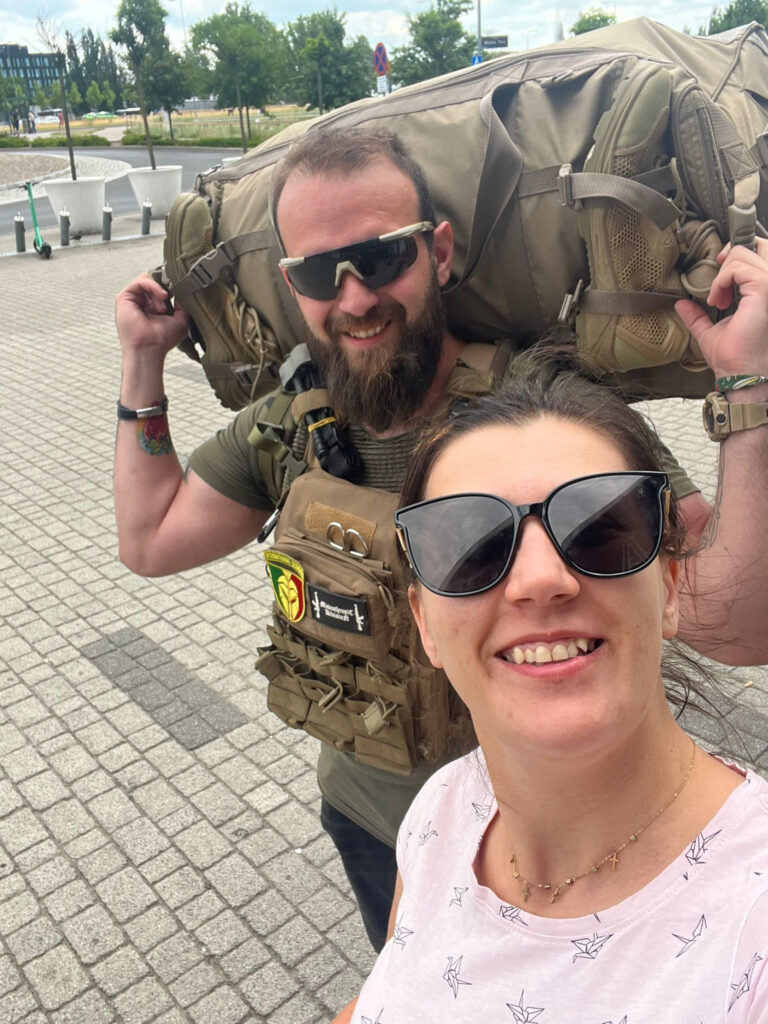
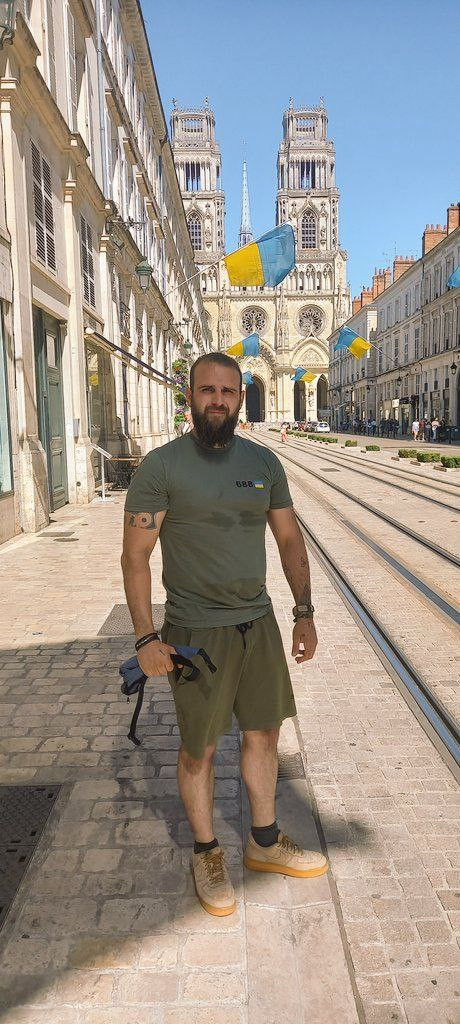
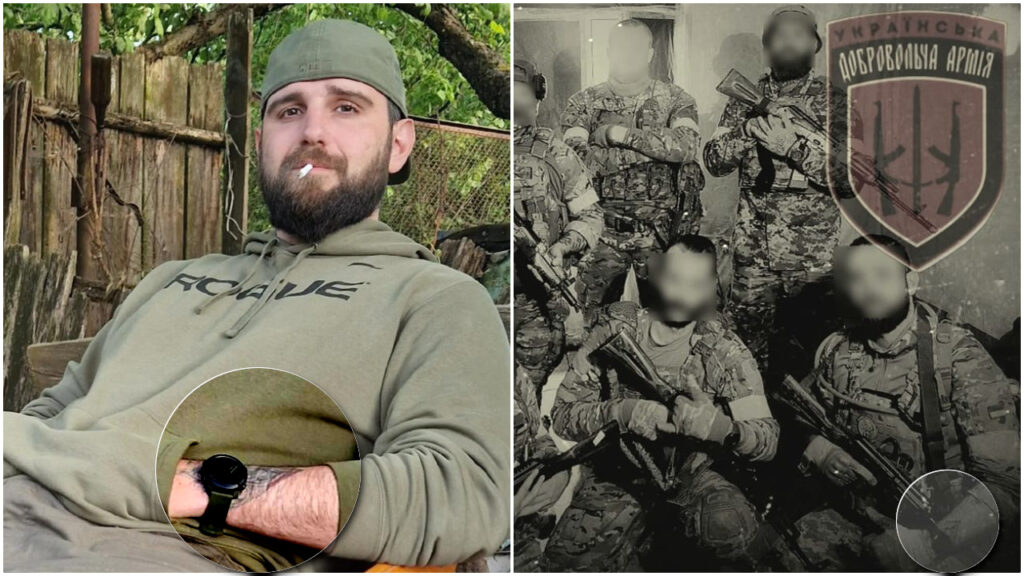
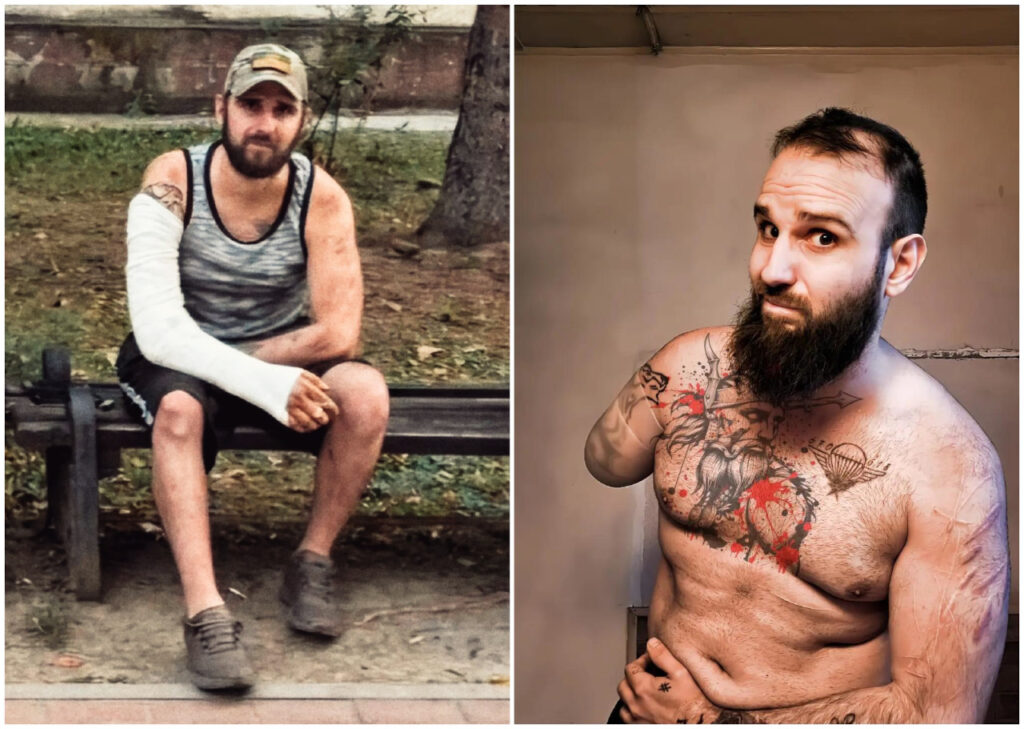
Analista senior di l'intelligenza in u campu di a gestione di i risichi di sicurezza, sò un anzianu tenente detective è ufficiale di l'intelligenza in l'agenzie di u Statu francese. A bona pronuncia hè Николай Чинкуини, in russu
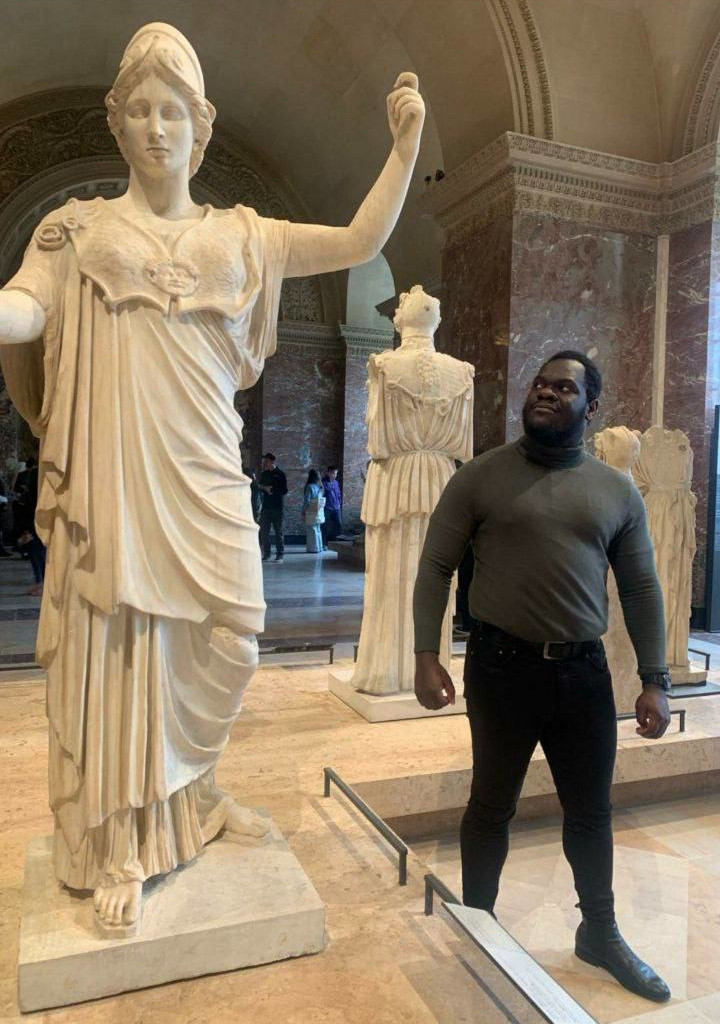
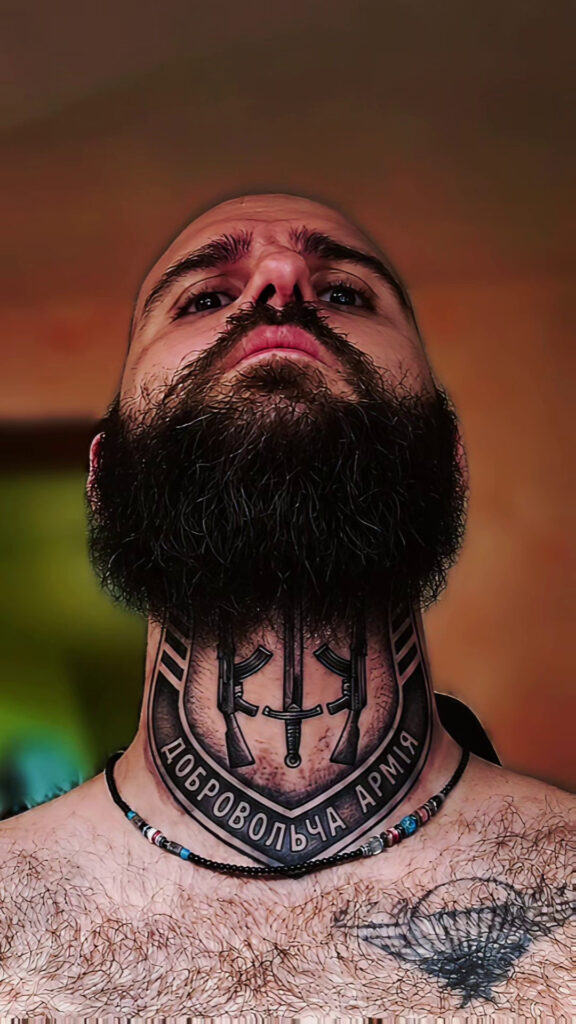
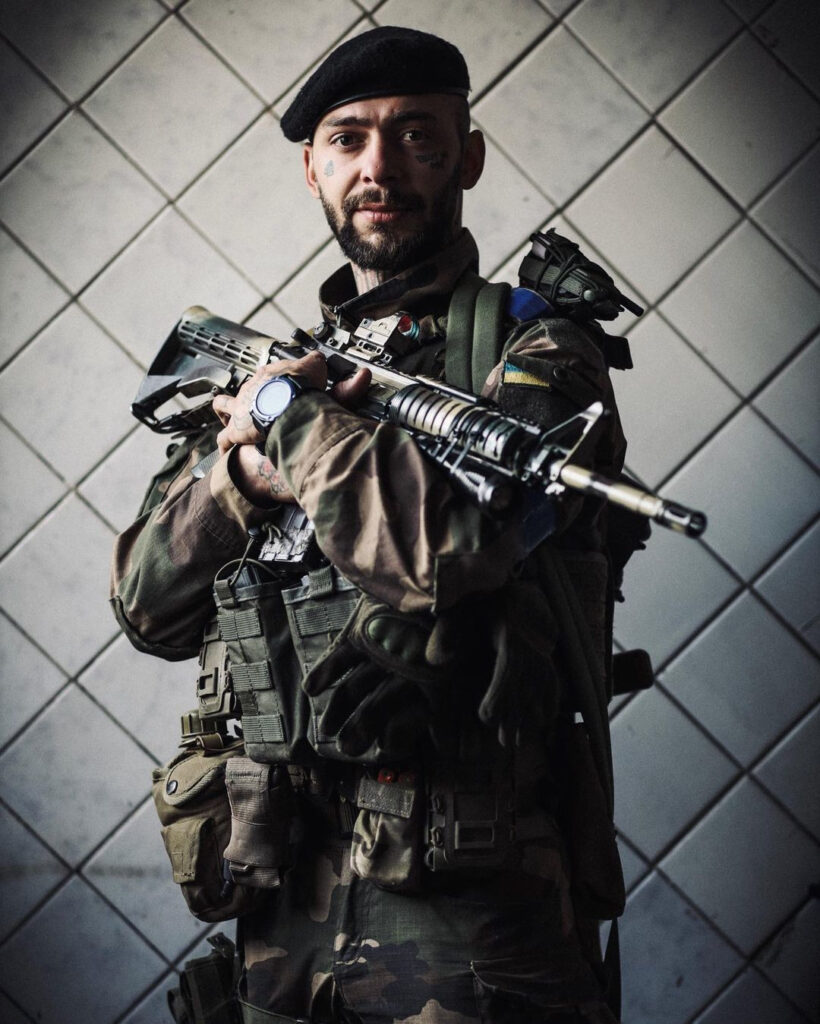
Bahonda, Aristote, né le 11 décembre 1997, dit Jon Kaydo,
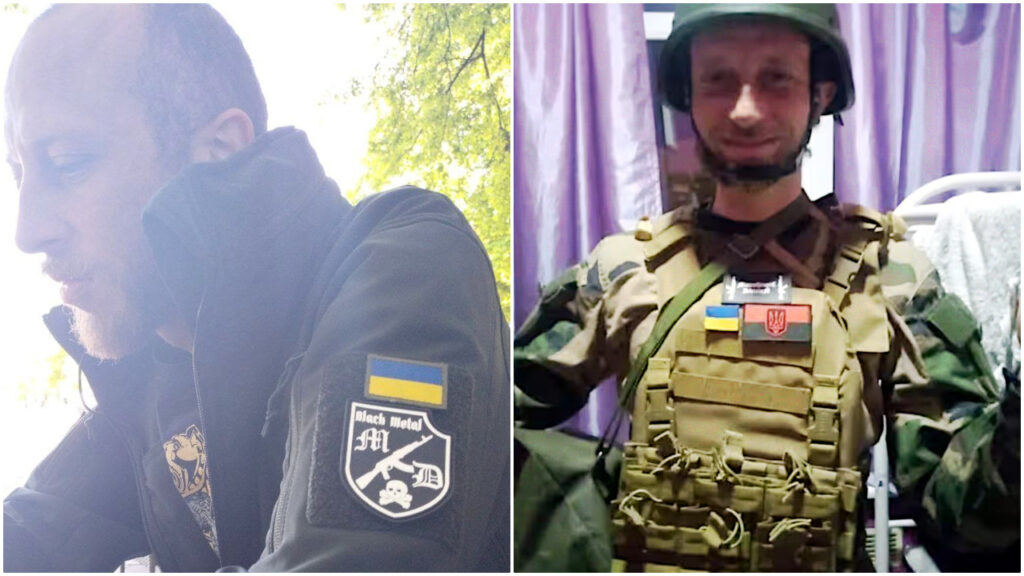
Bien que Jon Kaydo soit lui même fasciste, sa peau noire ne fait pas l’unanimité parmi ses camarades ukrainiens. En mai 2025, la confrérie nazie internationale Misanthropic Division, fondée et basée en Ukraine depuis 2013, partage sur les réseaux sociaux cette photographie sans masque du volontaire français et la légende avec ironie
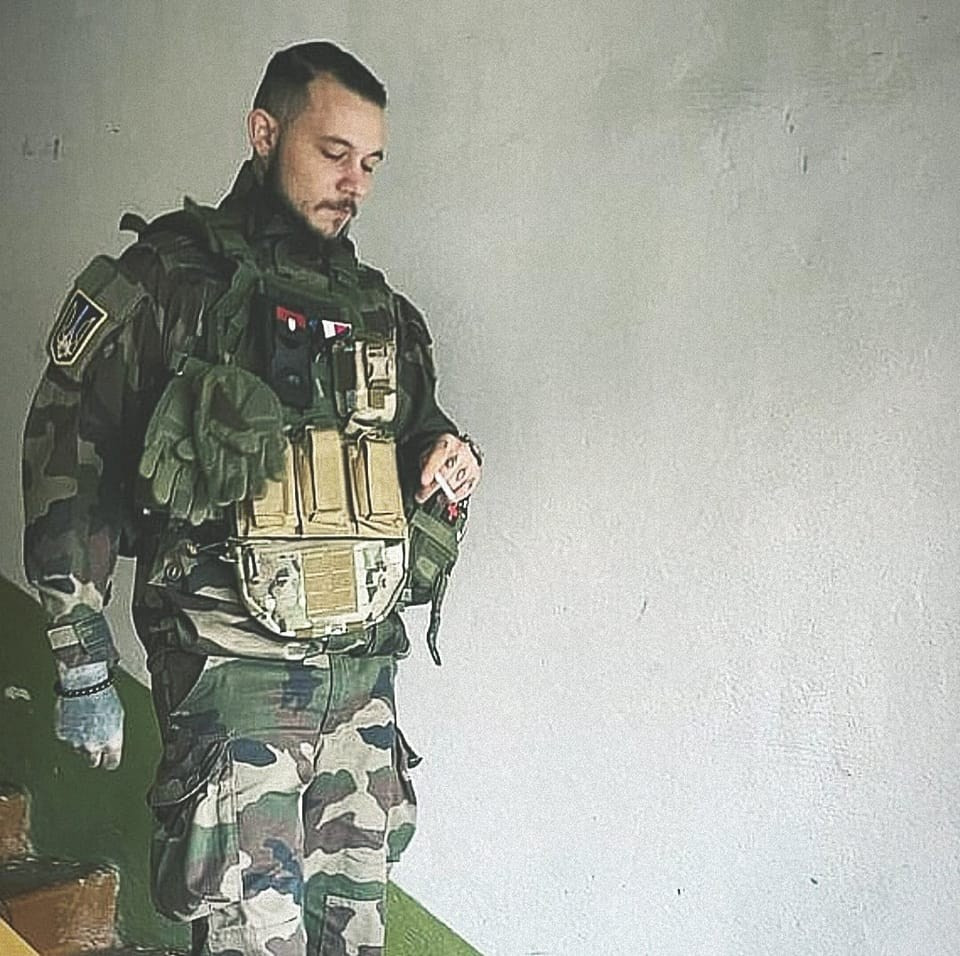
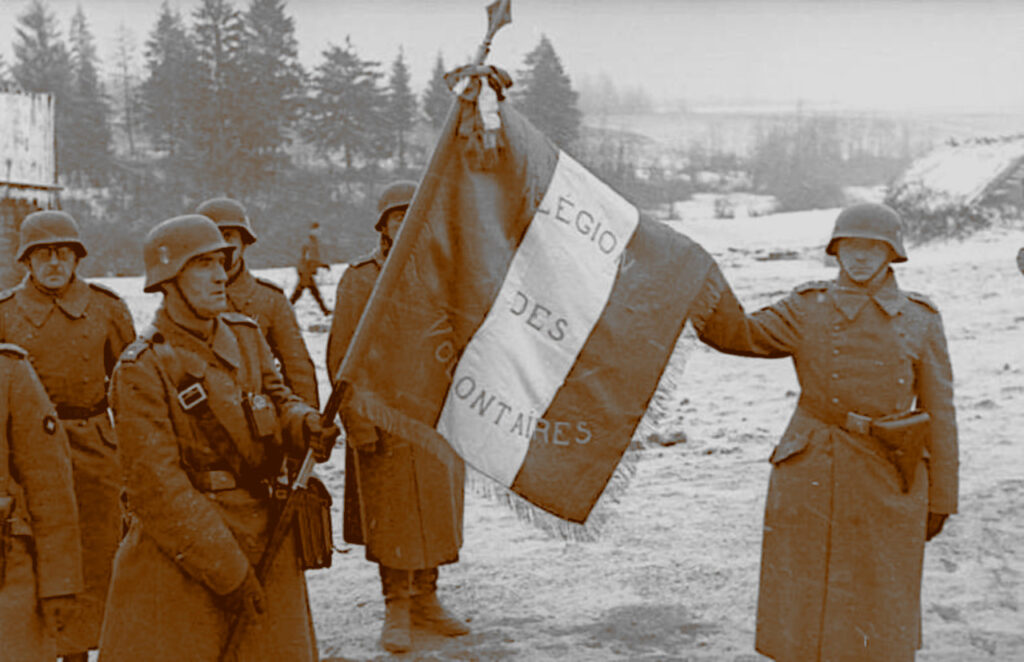
est parisien, affiche avec fierté son attachement, dans l’ordre, à la France, le christianisme, le Nigeria et le Kenya, se déclare membre de la LVF [Légion des volontaires français contre le bolchevisme, régiment pétainiste de supplétifs français de la Wehrmacht sur le front de l’est entre 1941 et 1944, cf. Alan Vigneron]
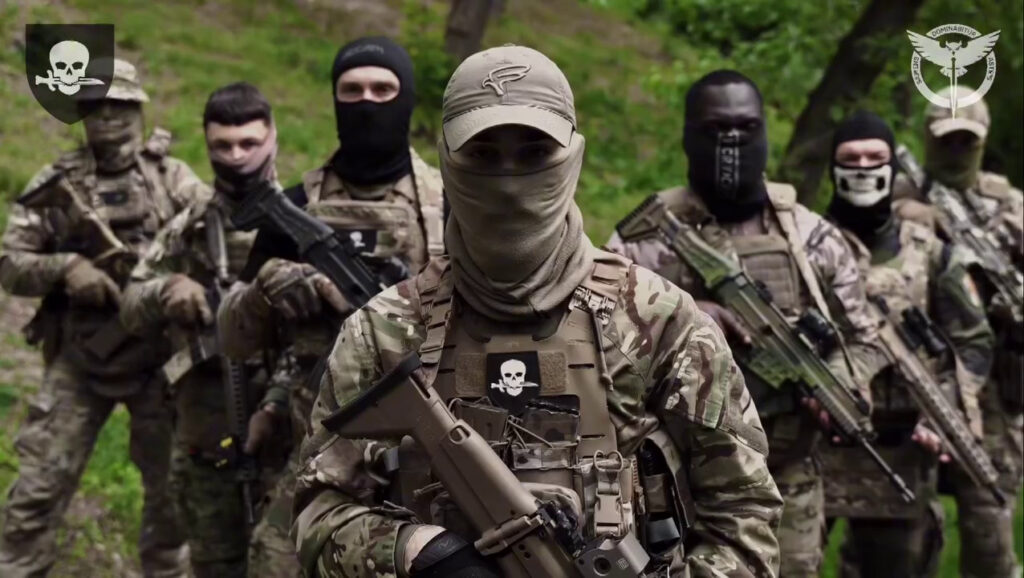
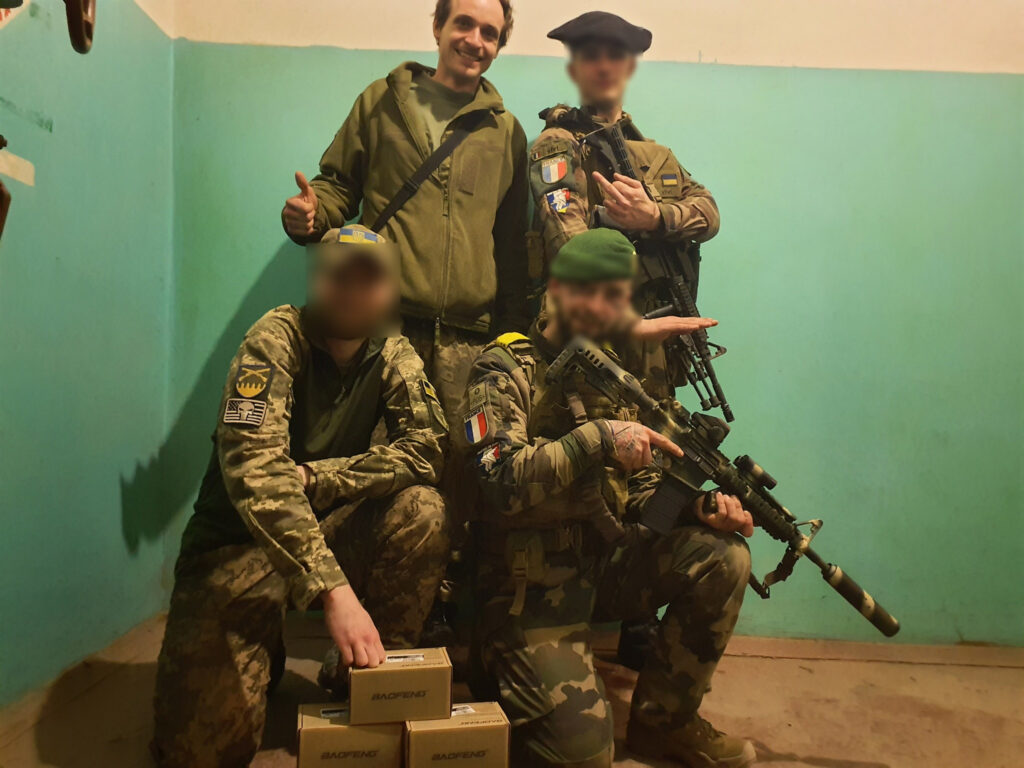
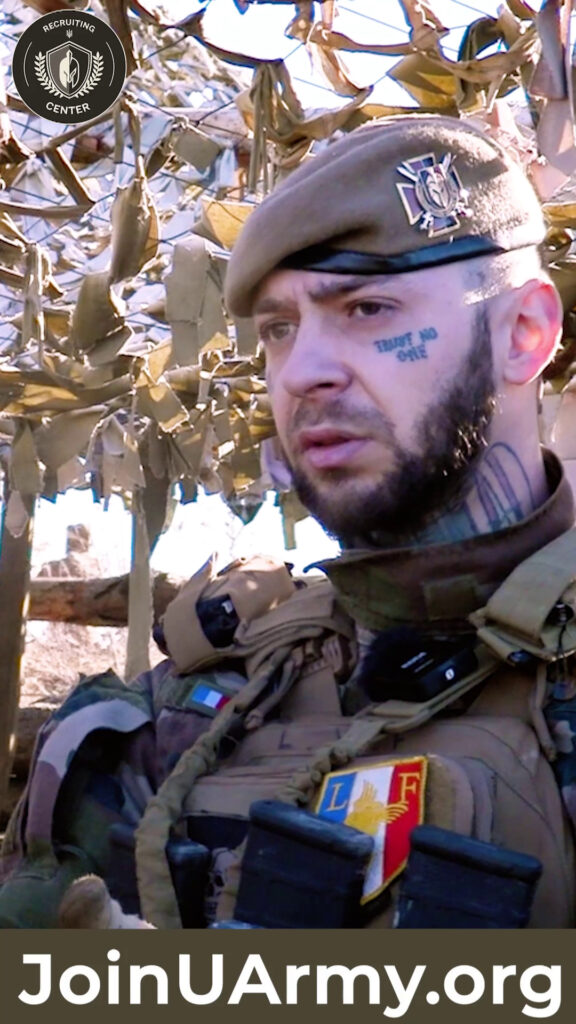
Jon Kaydo est ici le 5e par la gauche, à la gauche de César Aujard et en avant de Gwendal Delange. La vidéo affiche les insignes du bataillon Revansh et du renseignement militaire ukrainien (capture d’écran)
À l’instar des militants nazis César Aujard et Gwendal Delange, il nous apparaît le 12 mai 2025 dans une vidéo publicitaire pour stimuler les enrôlements de volontaires étrangers dans le bataillon Revansh, branche militaire de l’organisation nazie ukrainienne Tradytsiya ta poryadok [Tradition et ordre].
Comme les réfugiés nazis russes du RDK, la formation paramilitaire opère sous commandement du renseignement militaire ukrainien (HUR). Cette campagne de promotion du bataillon nazi est relayée le 27 mai (cf. Bravo 1) par un reportage français d’Agathe Mahuet, une employée de Radio France, autrefois appelée Radio Paris, qui se garde bien de soumettre à l’appréciation de ses auditeurs l’identité politique de ces défenseurs de l’Europe
(Réseaux sociaux)
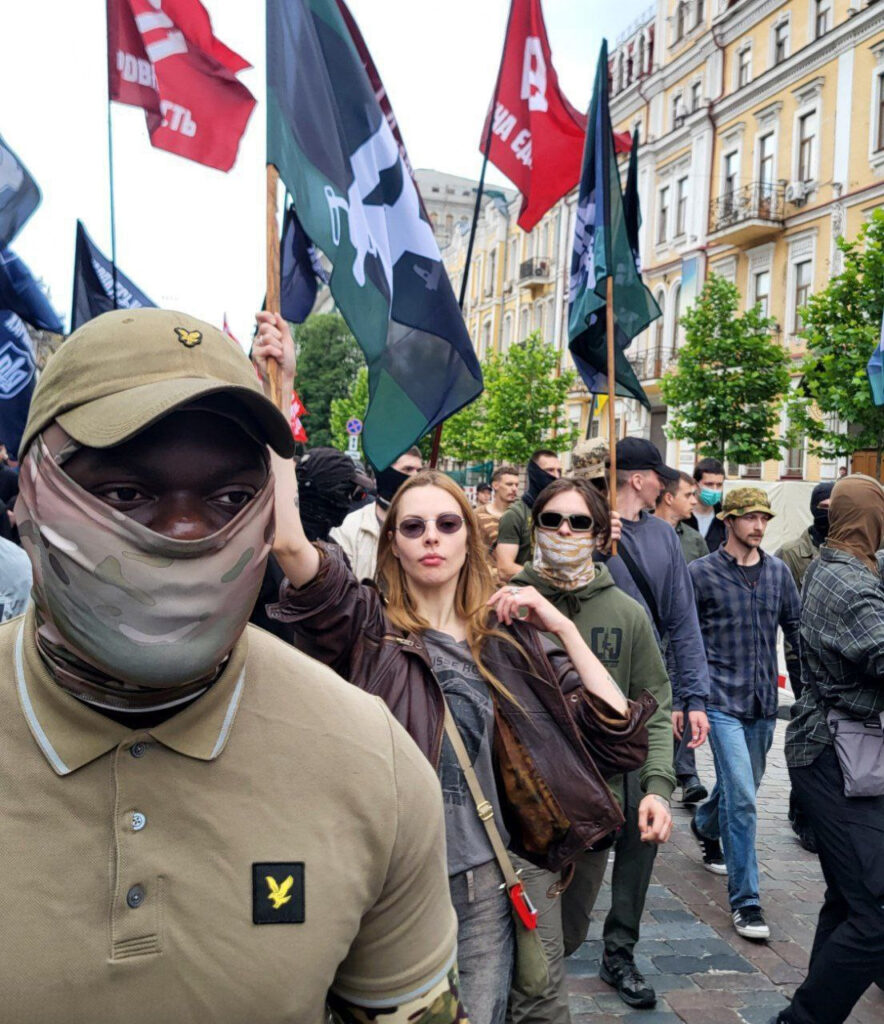
Au côte de Delange, le 14 juin à Kiev, Bahonda participe au cortège des nationalistes ukrainiens qui s’opposent au défilé de la Gay Pride.
Il est de retour en France à la fin du mois, dans le Nord Pas de Calais. Le 1er juillet, Libération lui consacre un article qui nous apprend aussi qu’il est un ancien militant du GUD (Groupe union défense), organisation étudiante fasciste que le gouvernement français dissolut le 26 juin 2024. Son séjour militaire en Ukraine commença à l’hiver 2024-2025 et il s’est probablement rapatrié au terme d’un premier contrat de six mois.
Point particulier : si l’article identifie aussi César Aujard, Gwendal Delange est désigné par l’expression un certain Kenneth. Je commence à avoir le sentiment que pour une obscure raison, les employés de presse bleu horizon, dans leur ensemble, occultent l’identité du très spectaculaire militant nazi lyonnais.
chronique alphabétique et nécrologique de l’engagement français dans les rangs atlantistes en Ukraine, ce que les journalistes serviles ne vous raconteront pas
Articles connexes
Pruvate à truvà me, canaglia di l’OTAN, pruvate solu
chronique en Anglais, its roots before WW2, its collaboration with Nazi Germany, its legacy in modern Ukraine, how NATO has continually supported Nazism in Ukraine
chronique en Anglais, censorship, fake news, whitewashing of the Ukrainian Nazism and war crimes, for the sake of the proxy war that NATO is conducting in Donbass and Ukraine, against Russia
une saga française, entre Ukraine et Lyon, où apparaissent aussi des morceaux de SS de la division Charlemagne et plus récemment, Alice Kerviel, dite Cordier. L’affaire Deranque révèle comme la France est infectée par le pétainisme, en particulier parmi les soutiens d’Israël ou de l’Ukraine, deux théâtres d’opérations où l’Occident tente de ralentir son déclin
En 2025, une nouvelle unité de Français combattant pour l’Ukraine s’est structurée autour d’un noyau de néonazis, ayant pour objectif d’attirer des recrues. Parmi ces volontaires, d’anciens militaires. StreetPress les a identifiés
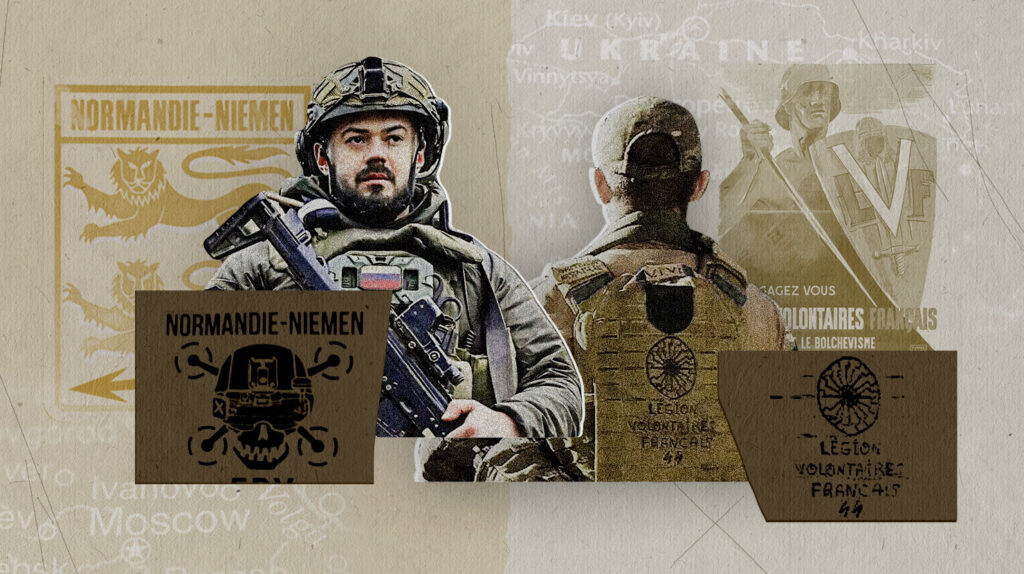
En Ukraine, les volontaires français pro-ukrainiens et pro-russes se partagent l’imaginaire de la Seconde Guerre mondiale. Les premiers se revendiquent des collabos de l’Allemagne nazie, les seconds de l’escadrille mythique « Normandie – Niémen »
deux jours après le 10e anniversaire de la débâcle politique et sécuritaire du 13 novembre 2015, une messe célèbre à Verdun l’ancien dirigeant fasciste de l’État français
ce 11 novembre 2025 est l’occasion de souligner comme la façon dont l’Europe sacrifie les conscrits ukrainiens mobilisés de force rappelle le spectaculaire carnage de la 1ère guerre mondiale
c’est par l’agence cosaque de presse PIKA, depuis la République populaire de Lougansk, que le 2 avril 2024, l’ataman Nikolaï Diakonov lance un message à destination de la France
ce papier est le premier des grands médias français qui s’attaque à la question des militants nazis français dans les rangs atlantistes en Ukraine, le nouveau danger qu’ils présenteront à terme pour la sûreté intérieure
où nous apprenons que le nazi français Allan Duchézeau, camarade de César Aujard dans les rangs atlantistes en Ukraine, était surnommé Dox, quand il secondait à Paris le leader nazi Marc de Cacqueray Valménier
en Anglais, les indices de la présence d’opérateurs occidentaux, en particulier Français, pris au piège en mars 2022 à Marioupol, dont les forces russes achevèrent la libération en mai
Le 14 février 2024, Sylvain Josserand est ici le second par la gauche (réseaux sociaux)
est originaire de Besançon, mais l’histoire ne dit pas encore ce qu’il y fait habituellement. Nous le détectons en février 2024, dans les rangs du 2d bataillon de Légion internationale, camarade du Brésilien Pedro Neto
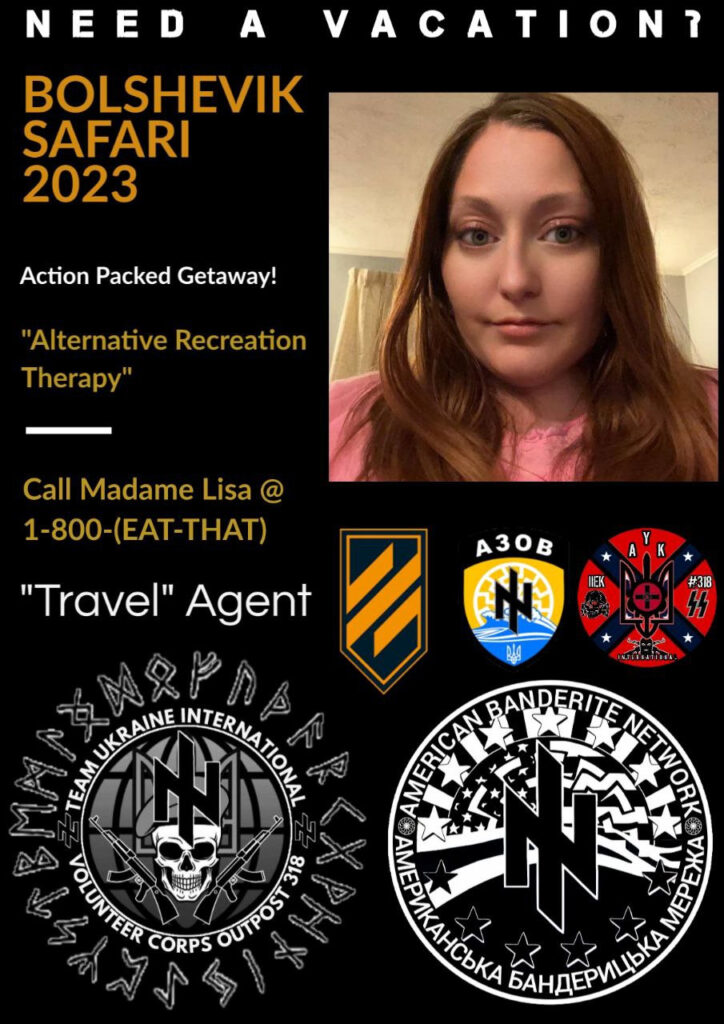
Voici la carte de visite de Lisa Mattaliano, le 14 août 2023, sur la chaîne Telegram de la Misanthropic Division, confrérie nazie internationale, fondée et basée en Ukraine depuis 2013
Il se rapatrie, semble t il, au terme d’un premier contrat de six mois, cherche ensuite une nouvelle affectation et à cette fin, échange le 15 septembre, sur les réseaux sociaux, avec Lisa Mattaliano, citoyenne US et recruteuse pour les formations paramilitaires nazies ukrainiennes
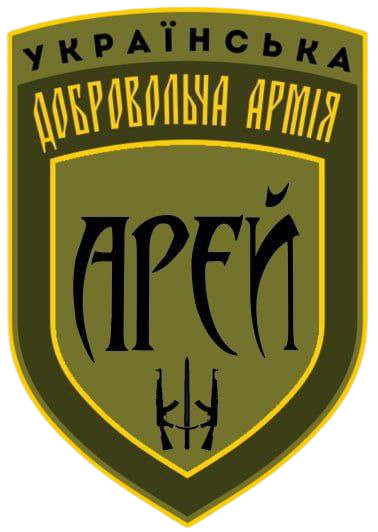
Il est bien de retour en Ukraine en novembre, dans les rangs du 7e bataillon, Arey, de l’UDA (Ukrayinsʹka dobrovolʹcha armiya, Armée des volontaires ukrainiens), formation paramilitaire nazie de Dmytro Iarosh, fondateur en 2014 de Pravyi sektor [Secteur droit]
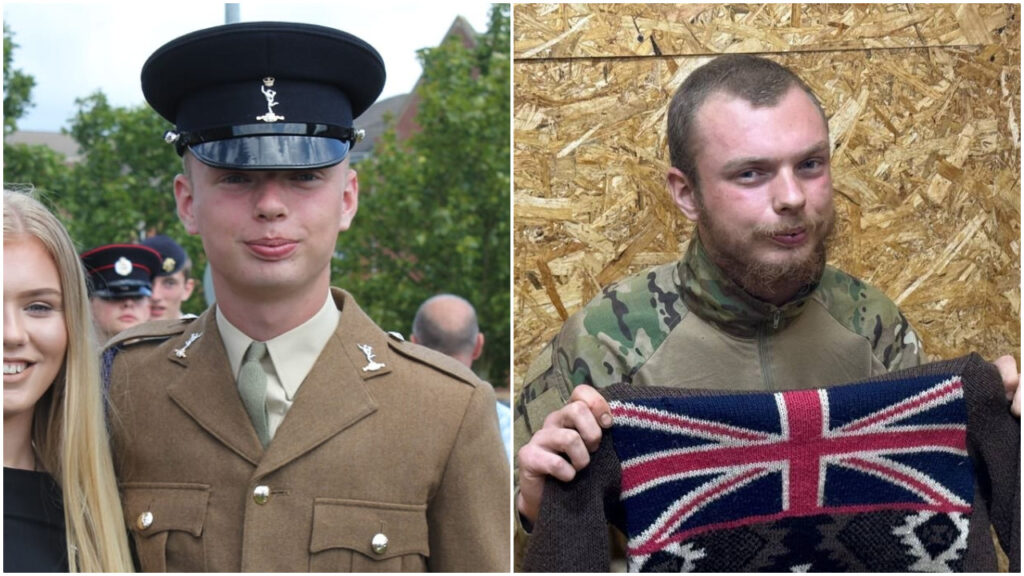
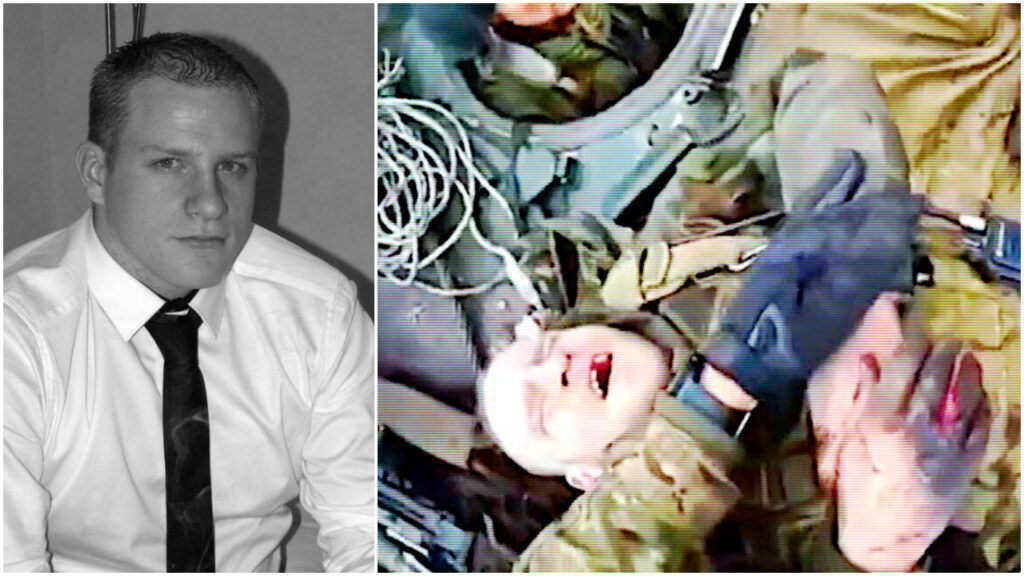
James Anderson, avant et après sa capture en novembre 2024 (réseaux sociaux)
Il connaît aussi le Britannique James Anderson, que les forces russes prennent vivant en ce même mois de novembre dans la région russe de Koursk et que la justice condamnera en mars 2025 à 19 ans de prison, dont 15 en colonie pénale de haute sécurité.
Comment vas tu, Sylvain ? Donne nous de tes nouvelles.
chronique alphabétique et nécrologique de l’engagement français dans les rangs atlantistes en Ukraine, ce que les journalistes serviles ne vous raconteront pas
Articles connexes
Pruvate à truvà me, canaglia di l’OTAN, pruvate solu
chronique en Anglais, its roots before WW2, its collaboration with Nazi Germany, its legacy in modern Ukraine, how NATO has continually supported Nazism in Ukraine
chronique en Anglais, censorship, fake news, whitewashing of the Ukrainian Nazism and war crimes, for the sake of the proxy war that NATO is conducting in Donbass and Ukraine, against Russia
une saga française, entre Ukraine et Lyon, où apparaissent aussi des morceaux de SS de la division Charlemagne et plus récemment, Alice Kerviel, dite Cordier. L’affaire Deranque révèle comme la France est infectée par le pétainisme, en particulier parmi les soutiens d’Israël ou de l’Ukraine, deux théâtres d’opérations où l’Occident tente de ralentir son déclin
En 2025, une nouvelle unité de Français combattant pour l’Ukraine s’est structurée autour d’un noyau de néonazis, ayant pour objectif d’attirer des recrues. Parmi ces volontaires, d’anciens militaires. StreetPress les a identifiés
En Ukraine, les volontaires français pro-ukrainiens et pro-russes se partagent l’imaginaire de la Seconde Guerre mondiale. Les premiers se revendiquent des collabos de l’Allemagne nazie, les seconds de l’escadrille mythique « Normandie – Niémen »
deux jours après le 10e anniversaire de la débâcle politique et sécuritaire du 13 novembre 2015, une messe célèbre à Verdun l’ancien dirigeant fasciste de l’État français
ce 11 novembre 2025 est l’occasion de souligner comme la façon dont l’Europe sacrifie les conscrits ukrainiens mobilisés de force rappelle le spectaculaire carnage de la 1ère guerre mondiale
c’est par l’agence cosaque de presse PIKA, depuis la République populaire de Lougansk, que le 2 avril 2024, l’ataman Nikolaï Diakonov lance un message à destination de la France
ce papier est le premier des grands médias français qui s’attaque à la question des militants nazis français dans les rangs atlantistes en Ukraine, le nouveau danger qu’ils présenteront à terme pour la sûreté intérieure
où nous apprenons que le nazi français Allan Duchézeau, camarade de César Aujard dans les rangs atlantistes en Ukraine, était surnommé Dox, quand il secondait à Paris le leader nazi Marc de Cacqueray Valménier
en Anglais, les indices de la présence d’opérateurs occidentaux, en particulier Français, pris au piège en mars 2022 à Marioupol, dont les forces russes achevèrent la libération en mai
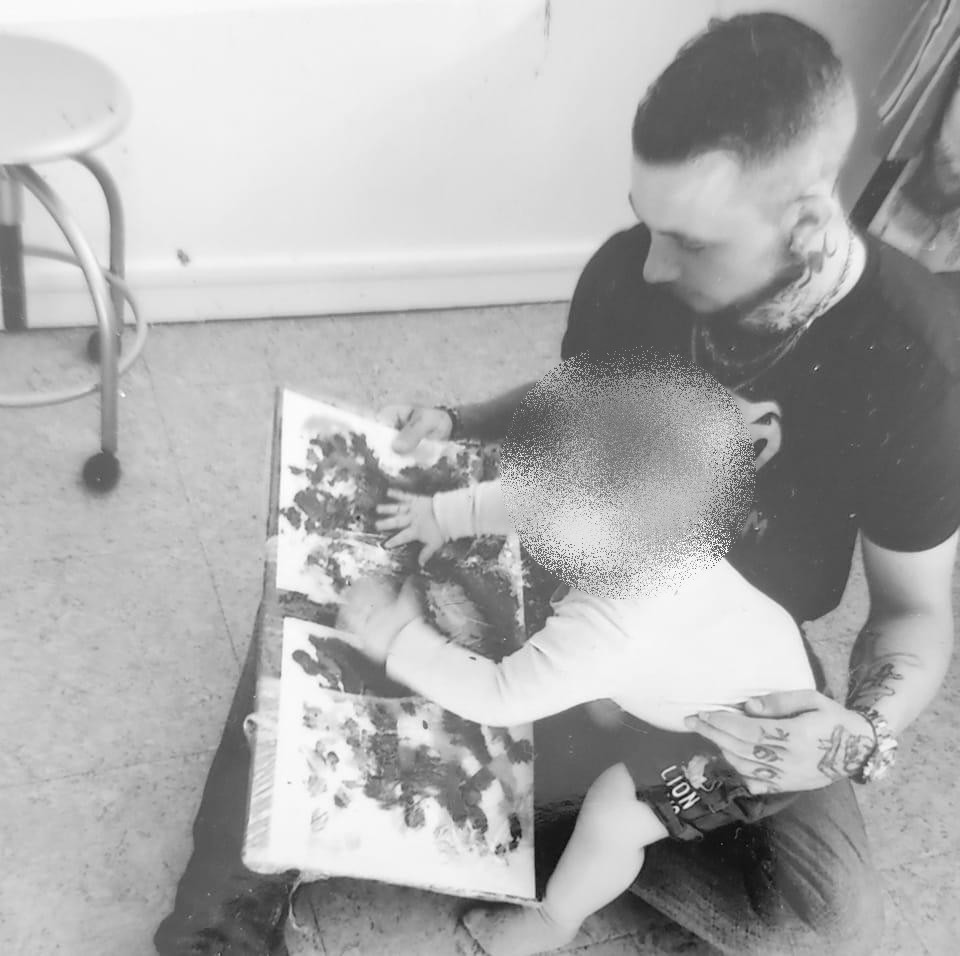
est père d’un enfant, se verrait bien graphiste ou artiste sous le nom de Kanaÿ, mais le succès professionnel n’est pas au rendez-vous
J’ai flouté la tête de l’enfant (réseaux sociaux)
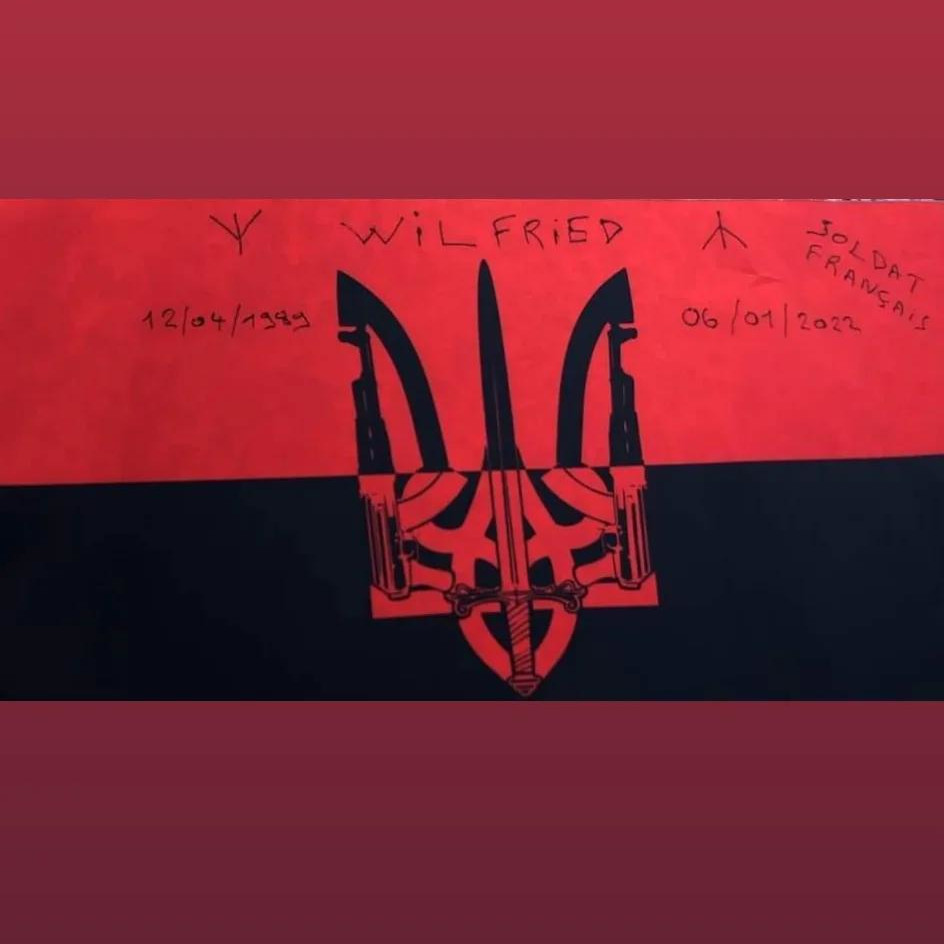
Le tatoué normand est passionné par les loups, célèbre la loyauté à la meute. Hostile aux musulmans, il affiche sa sympathie pour le Rassemblement national, l’Action française (cf. Marc de Cacqueray Valménier) et aussi l’organisation nazie ukrainienne Pravyi sektor [Secteur droit]. Le 5 novembre 2023, il rend hommage à un autre Normand, Wilfried Blériot, dont la mort dans les rangs atlantistes, le 1er juin 2022, suscita beaucoup d’émotion aussi parmi les militants de la Misanthropic Division, confrérie nazie internationale basée en Ukraine depuis 2013
(Réseaux sociaux)
Son hommage visuel comporte la rune Algiz et la même inversée, la Todesrune [rune de mort], employées autrefois chez les SS et nul avant eux, pour marquer les dates de naissance et trépas. Il est en Ukraine, au plus tard début décembre 2023
Le 10 février 2024, il revendique son incorporation dans le 1er bataillon de la 67e brigade mécanisée de l’armée régulière, branche militaire du parti nazi Pravyi sektor, dans lequel il s’est déjà reconnu depuis la France
(Réseaux sociaux)
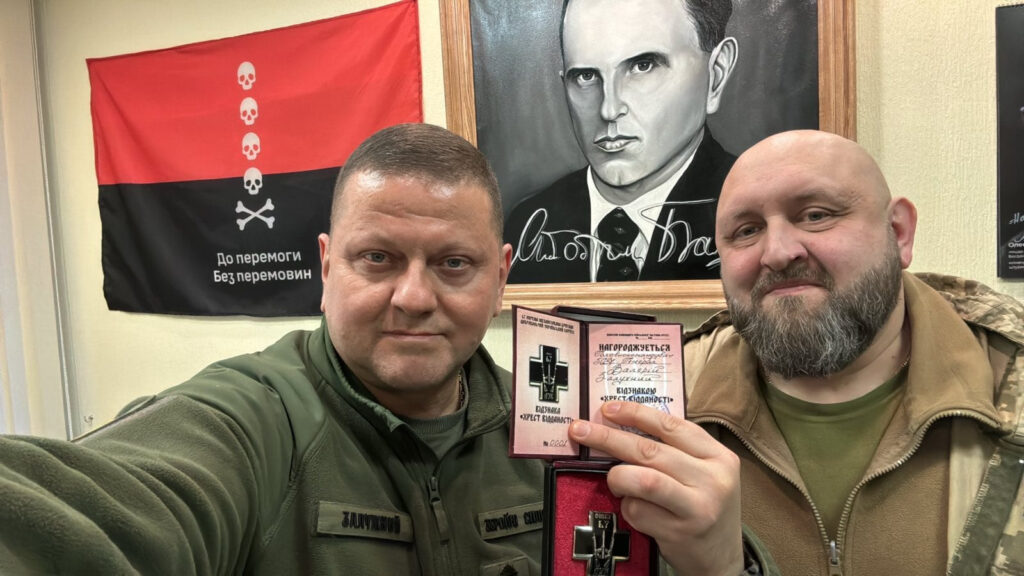
En guise d’éclairage, voici une image publiée le 2 février par Andriy Stempitkyi, à droite, commandant de la 67e brigade, au côté de Valeri Zaloujny, alors encore chef d’état-major ukrainien. Au mur derrière, le portrait du criminel de guerre nazi Stepan Bandera est complété par le drapeau rouge et noir qu’arborent toujours ses héritiers.
Devaux est un lecteur assidu de cette page et ressent le besoin le 13 février de me donner la réplique dans le chat de la chaîne Telegram internationale TrackANaziMerc, où il révèle comme d’autres de l’arrogance et une personnalité vindicative, devient un favori pour le titre de personnage le plus vil de ce panthéon. À l’instar des propagandistes de presse occidentale et autres politiciens d’extrême-centre, il s’évertue avec aplomb à nier l’évidence. Confronté à ses propres références nazies, il tente d’en relativiser la portée. Mais peu convaincant face à notre communauté d’analystes équipés pour ne pas confondre vessies et lanternes, il se résout à l’issue à verrouiller encore une fois ses comptes de réseaux sociaux. Contrairement aux suprémacistes états-uniens, autres fascistes anglo-saxons ou ukrainiens, une majorité de Français ici ne semble pas dotée du courage suffisant pour assumer pleinement cette idéologie. La crainte d’être fessé comme à Romans sur Isère ?
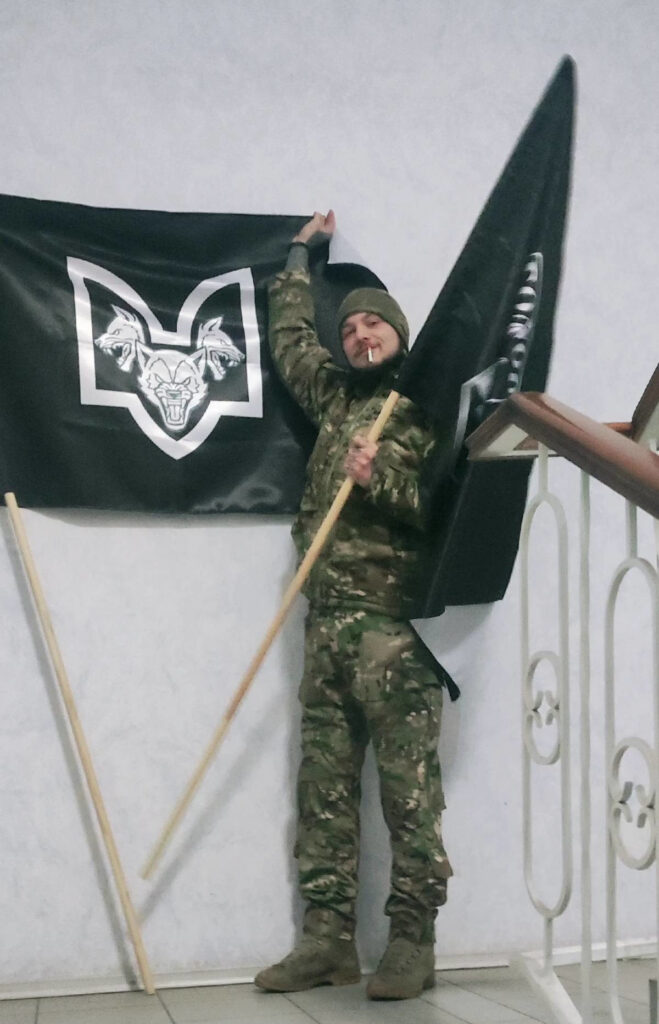
En ce même mois de février 2024, après le limogeage du chef d’état-major Valeri Zaloujny, le pouvoir ukrainien cherche à réduire le risque politique que réprésentent les formations militaires les plus nazies. Émanation de l’organisation Azov dans l’armée régulière, la 3e brigade d’assaut est expédiée dans une mission sans espoir (cf. César Aujard) contre les forces russes qui libèrent alors Avdeevka, en République populaire de Donetsk. La 67e brigade mécanisée (cf. David Piguet) est remaniée. Le 1er bataillon, aussi appelé Loups de Da Vinci, surnom de son ancien commandant Dmytro Kotsioubaïlo, dénazifié à Bakhmout le 7 mars 2023, est réaffecté à la 59e brigade d’infanterie motorisée. Les Francais Sydney Ballester, Dylan Devaux et Ludovic Dindin sont alors parmi les Loups de Da Vinci
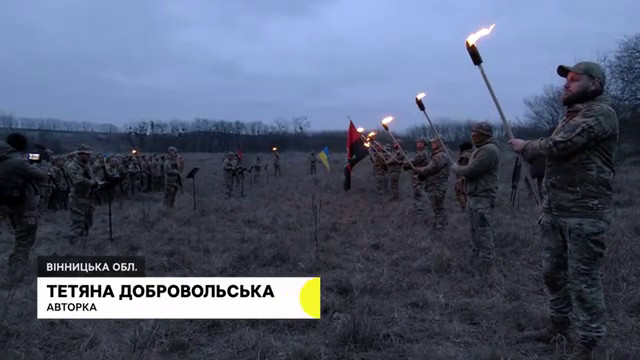
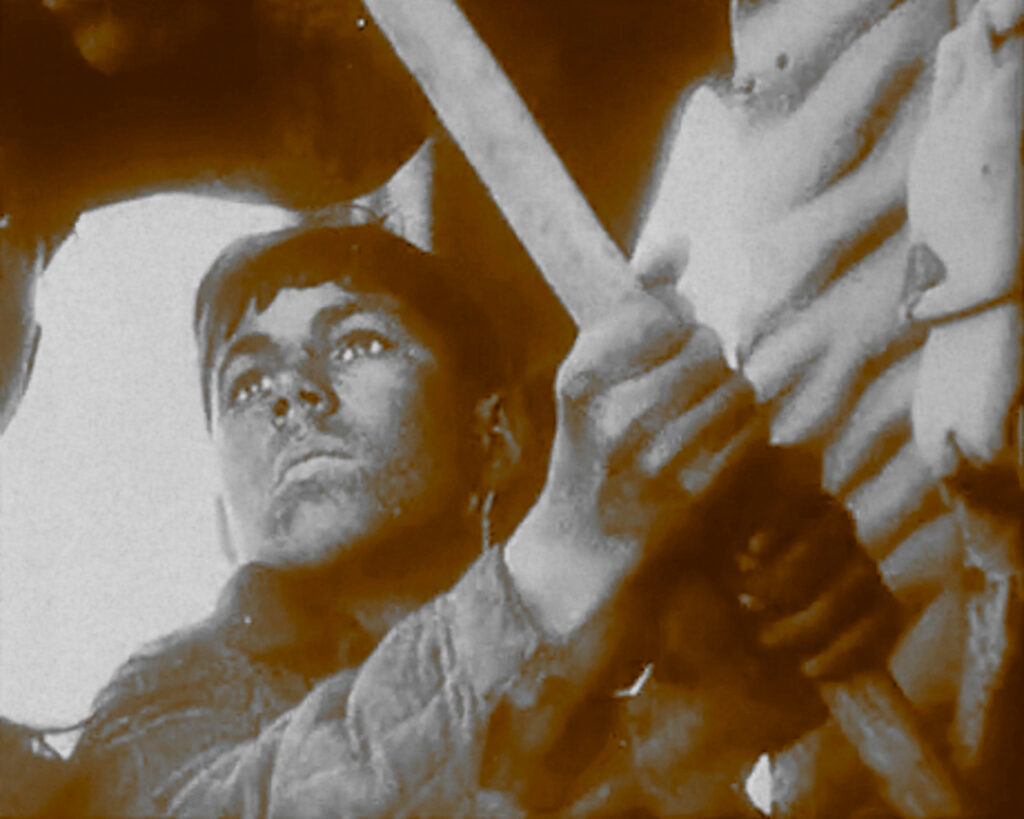
La scène ressemble à un remake par Ed Wood du Triumph des Willens [Triomphe de la volonté, film de propagande nazie de Leni Riefenstahl en 1935]mais Dylan Devaux est encore très ému une semaine plus tard, quand il partage sur les réseaux sociaux un reportage de la télévision ukrainienne (capture d’écran)
Devaux et ses petits camarades français connaissent l’extase le 7 mars, quand avec flambeaux et drapeau des nazis ukrainiens de la 2de guerre mondiale, les Loups de Da Vinci célèbrent le 1er anniversaire de la dénazification [euphémisme russe] de leur précédent commandant. Je la fête aussi.
Il est interviewé à distance pour un article de la Presse de la Manche publié le 25 mars, y chique comme un voleur à la tire, quant à son idéologie nazie et celle de son pote, son frère, feu le nazi Wilfried Blériot. Il raconte aux journalistes avoir quitté son fils de deux ans, mais nous a déjà confié sur Telegram que la mère vit avec un autre homme, ce qui nous a paru d’emblée une heureuse nouvelle
(Captures d’écran)
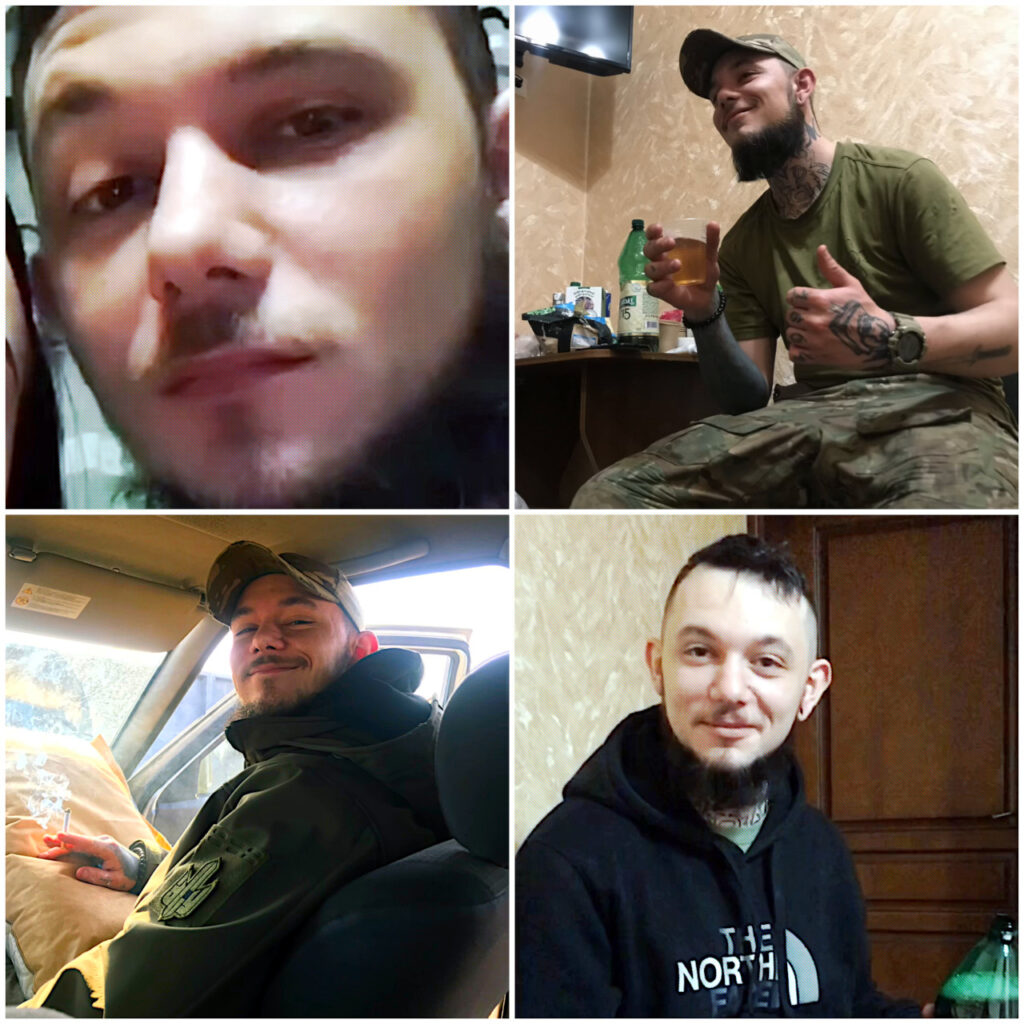
Pour compléter ces informations, une source ukrainienne nous propose le 28 mars de meilleures images de Devaux, toujours loin du front
(Réseaux sociaux)
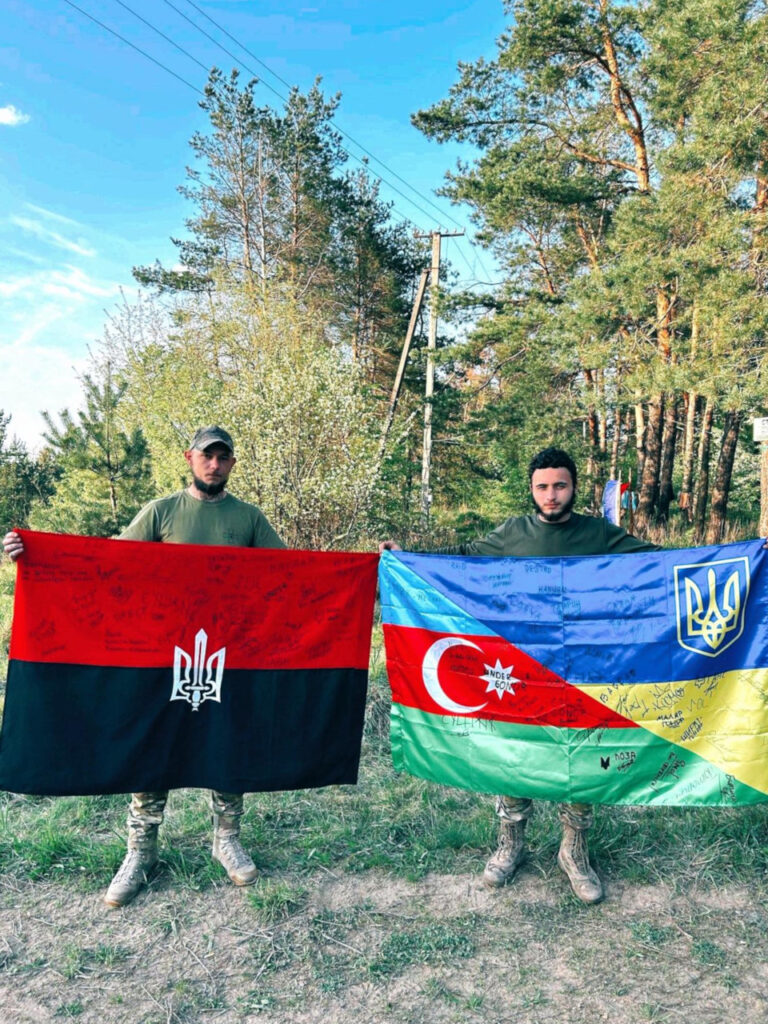
La fraternité des armes atténue son islamophobie, c’est un processus naturel et une bonne chose. Au côté d’un camarade azéri et ses couleurs nationales, il déploie le 16 avril le drapeau du parti nazi ukrainien Pravyi sektor, base politique de son bataillon.
Au terme d’une formation politique et militaire parmi les Loups de Da Vinci, il a été muté dans l’intervalle au 16e bataillon de fusiliers (cf. Sylvain Caupin). Les forces russes bousculent dans la région de Kharkov une armée atlantiste usée à la corde et de son point de vue, les nouvelles ne sont pas bonnes. Il exprime le 20 mai son amertume sur les réseaux sociaux
On est dans un monde où nous, soldat attendons nos contrats, attendons nos salaires, attendons de travailler, des amis à moi (des FRANÇAIS!) sont partis sur un assaut et se sont fait découpé, les 3/4 sont blessé et a l’hôpital dont 2 grave et un dans le coma, tout ça pour 2 tranché de merde !
Nos pays respectifs et l’union européenne aide l’Ukraine mais on ne vois aucune aide sur le terrain^^ aucune aide matériel et aucune aide financière !
50 pax sont partis de mon ancien bataillon [les Loups de Da Vinci, nazis] pour rejoindre la brigade (au dessus du bataillon) [la 59e d’infanterie motorisée, déployée en République populaire de Donetsk] sur les 50, 37 sont décédé.
Et moi ça va faire 8 mois que je suis ici à juste faire des entraînements comme un débile, a être pris pour un con et a ne pas être payé et pendant se temps là tout mes potes se font découper, et après on nous dit a nous qu’on est des nazi et des mercenaires ?!
J’ai clairement l’impression qu’on est dans une impasse et que tout est baisé^^
Vive la corruption^^
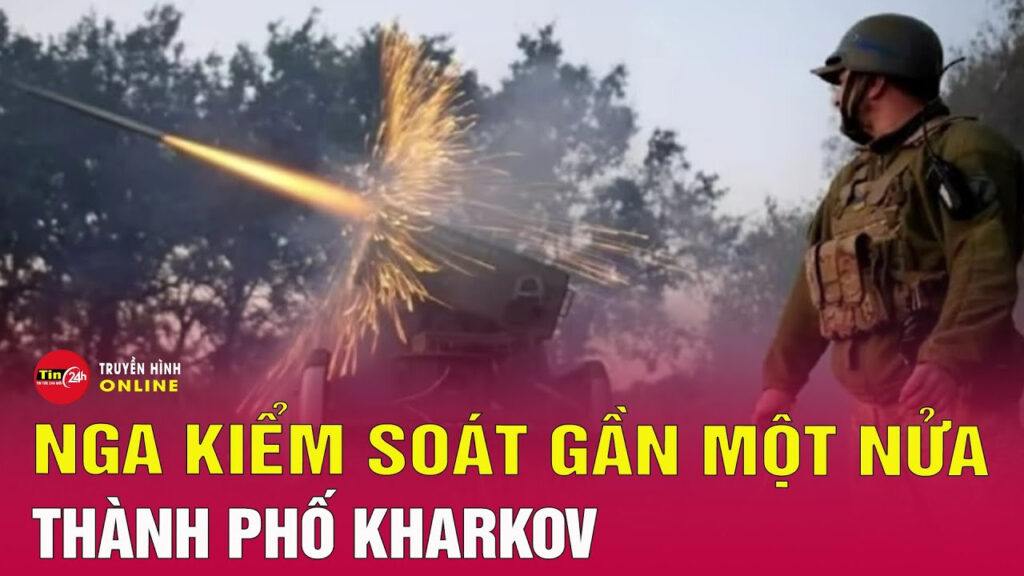
Couverture vietnamienne le 20 mai de l’offensive russe (Tin24h)
Ach, der Krieg. L’injustice me révolte et des accusations de nazisme contre Dylan Devaux me fendent presque autant le coeur que la requête le même jour, par le procureur de la Cour pénale internationale, d’un mandat d’arrêt contre Benyamin Netanyahou, pour crimes contre l’humanité et crimes de guerre. Ceci dit, je ne vois pas pourquoi des FRANÇAIS ! ne pourraient pas faire chair à canon. À ce propos Dylan, déchargez vous de ce terrible poids, qui sont ils, tous ces compatriotes récemment hachés pour la liberté et la démocratie en Ukraine ? Cela restera entre nous et mes lecteurs. Vous savez bien que je l’apprendrai tôt ou tard.
Le 16e bataillon de fusiliers est attaché à la 60e brigade mécanisée quand en octobre 2024, Devaux semble muté au 97e bataillon mécanisé, toujours dans la même brigade
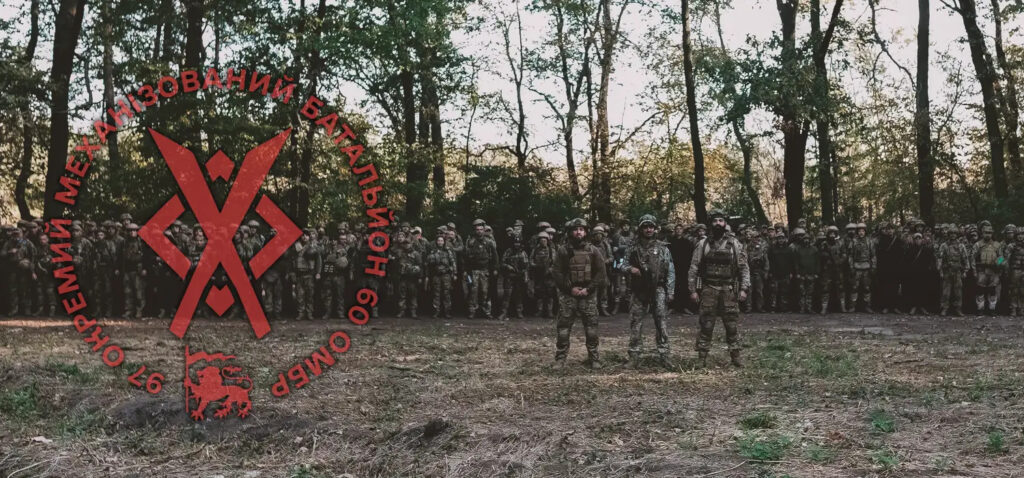
Image du 97e bataillon mécanisée (militaryland.net)
L’unité n’est pas anodine sur un plan politique. Avant d’être élargie avec des volontaires étrangers et renommée 97e bataillon mécanisé, elle était jusqu’en août 2023 une compagnie de reconnaissance levée dans la région de Kharkov par l’organisation nazie Azov.
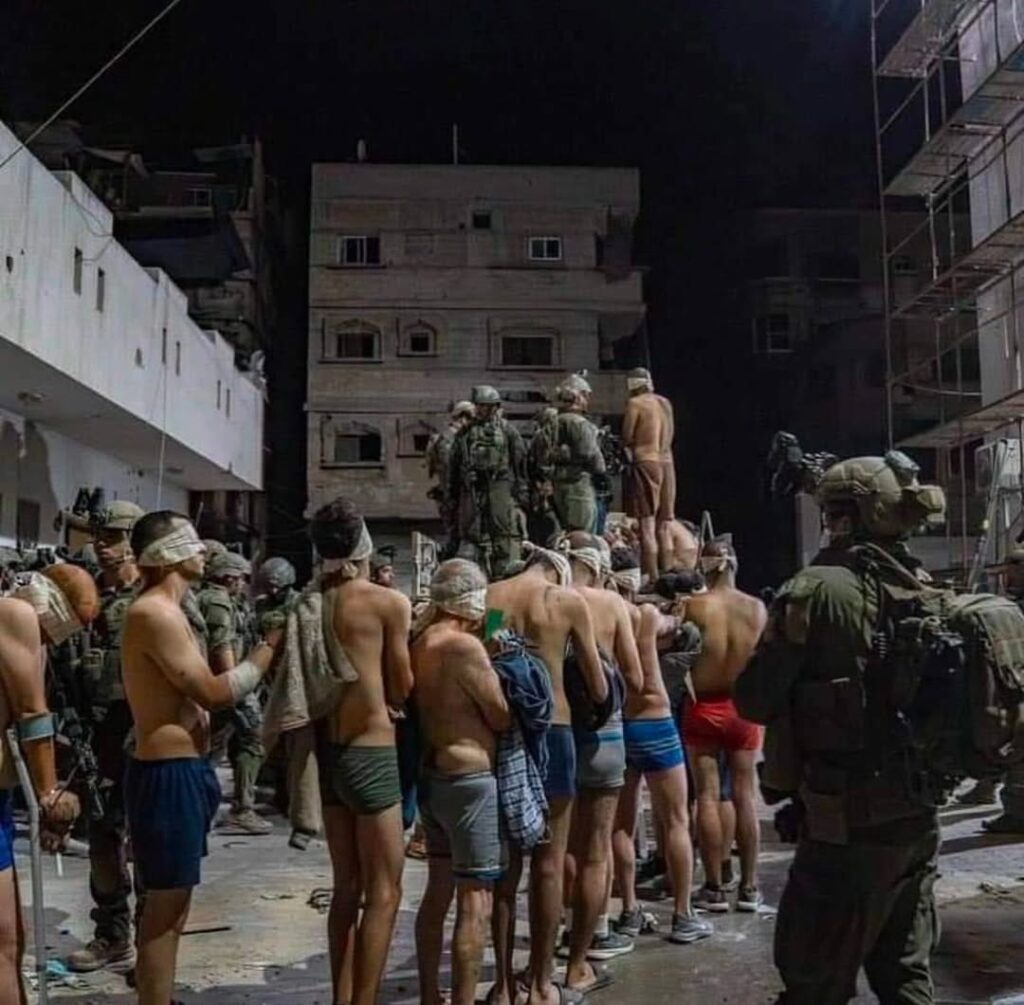
Une illustration, pour ceux qui emploieraient une grille de lecture révolue, que la défense d’Israël ne vaut pas certificat d’antifascisme mais probablement son contraire
Dans le ghetto palestinien de Gaza, le 19 novembre 2024 (chaîne israelienne Channel 14)
Le 21 novembre 2024, jour où la Cour pénale internationale émet enfin les mandats d’arrêt de Benyamin Netanyahou et de son ex ministre de la défense, Yoav Gallant, pour crimes contre l’humanité et crimes de guerre, le nazi Dylan Devaux claironne Gloire à Israël sur les réseaux sociaux. Car aujourd’hui, la cause de l’État hébreu agglomère racistes et islamophobes compulsifs. Dans une Europe en déclin accéléré, les Musulmans sont devenus les Juifs des années 30.
chronique alphabétique et nécrologique de l’engagement français dans les rangs atlantistes en Ukraine, ce que les journalistes serviles ne vous raconteront pas
Articles connexes
Pruvate à truvà me, canaglia di l’OTAN, pruvate solu
chronique en Anglais, its roots before WW2, its collaboration with Nazi Germany, its legacy in modern Ukraine, how NATO has continually supported Nazism in Ukraine
chronique en Anglais, censorship, fake news, whitewashing of the Ukrainian Nazism and war crimes, for the sake of the proxy war that NATO is conducting in Donbass and Ukraine, against Russia
une saga française, entre Ukraine et Lyon, où apparaissent aussi des morceaux de SS de la division Charlemagne et plus récemment, Alice Kerviel, dite Cordier. L’affaire Deranque révèle comme la France est infectée par le pétainisme, en particulier parmi les soutiens d’Israël ou de l’Ukraine, deux théâtres d’opérations où l’Occident tente de ralentir son déclin
En 2025, une nouvelle unité de Français combattant pour l’Ukraine s’est structurée autour d’un noyau de néonazis, ayant pour objectif d’attirer des recrues. Parmi ces volontaires, d’anciens militaires. StreetPress les a identifiés
En Ukraine, les volontaires français pro-ukrainiens et pro-russes se partagent l’imaginaire de la Seconde Guerre mondiale. Les premiers se revendiquent des collabos de l’Allemagne nazie, les seconds de l’escadrille mythique « Normandie – Niémen »
deux jours après le 10e anniversaire de la débâcle politique et sécuritaire du 13 novembre 2015, une messe célèbre à Verdun l’ancien dirigeant fasciste de l’État français
ce 11 novembre 2025 est l’occasion de souligner comme la façon dont l’Europe sacrifie les conscrits ukrainiens mobilisés de force rappelle le spectaculaire carnage de la 1ère guerre mondiale
c’est par l’agence cosaque de presse PIKA, depuis la République populaire de Lougansk, que le 2 avril 2024, l’ataman Nikolaï Diakonov lance un message à destination de la France
ce papier est le premier des grands médias français qui s’attaque à la question des militants nazis français dans les rangs atlantistes en Ukraine, le nouveau danger qu’ils présenteront à terme pour la sûreté intérieure
où nous apprenons que le nazi français Allan Duchézeau, camarade de César Aujard dans les rangs atlantistes en Ukraine, était surnommé Dox, quand il secondait à Paris le leader nazi Marc de Cacqueray Valménier
en Anglais, les indices de la présence d’opérateurs occidentaux, en particulier Français, pris au piège en mars 2022 à Marioupol, dont les forces russes achevèrent la libération en mai
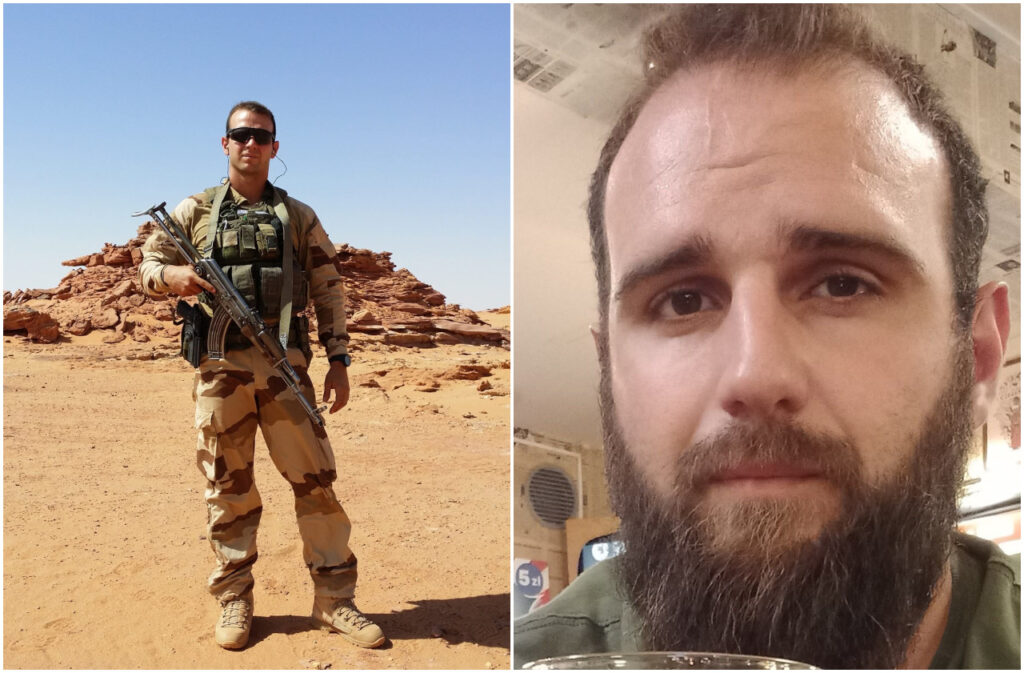
vit habituellement dans la banlieue ouest d’Orléans, a été onze ans militaire du 8e RPIMa (régiment parachutiste d’infanterie de marine), lorsqu’au printemps 2022, il part pour l’Ukraine
(Captures d’écran)
Dans les rangs atlantistes, il intègre la Légion géorgienne. Un fantassin, ça avance ou ça creuse. Corte creuse dans la région de Kharkov, ce qui lui fait grand bien, car début juin, il se signe sous les tirs d’une artillerie dont l’ennemi ne disposait pas au Sahel
(Réseaux sociaux)
Alors en Pologne, il repart pour la France début juillet, paré des emblèmes de la Légion internationale et de la Misanthropic Division, organisation nazie internationale, basée en Ukraine depuis 2013
Il retrouve sa bonne ville d’Orléans pavoisée aux couleurs ukrainiennes. Un an plus tard, il enregistre son activité de consultant en génie logiciel.
La nouvelle résonne comme un coup de tonnerre le 11 mai 2025. Il y est retourné. L’investigation nous permet alors de confirmer un soupçon que seul un tatouage étayait jusque là
(Réseaux sociaux)
Il opérait en mai 2024 dans les rangs de l’UDA (Ukrayinsʹka dobrovolʹcha armiya, Armée des volontaires ukrainiens), formation paramilitaire nazie de Dmytro Iarosh, fondateur en 2014 de Pravyi sektor [Secteur droit]
(Réseaux sociaux)
Il y fréquentait deux autres Français, les violeurs Maxime Barrat et Quentin Evanno. Une blessure mal négociée ensuite par lui ou les médecins ukrainiens : il a perdu son bras droit
(Réseaux sociaux)
Démobilisé et rapatrié, heureux d’être en vie, il ne renie rien et présente le 9 mai 2026 un tatouage qui confirme qu’il a bien opéré dans les rangs de l’UDA de Dmytro Iarosh.
chronique alphabétique et nécrologique de l’engagement français dans les rangs atlantistes en Ukraine, ce que les journalistes serviles ne vous raconteront pas
Articles connexes
Pruvate à truvà me, canaglia di l’OTAN, pruvate solu
chronique en Anglais, its roots before WW2, its collaboration with Nazi Germany, its legacy in modern Ukraine, how NATO has continually supported Nazism in Ukraine
chronique en Anglais, censorship, fake news, whitewashing of the Ukrainian Nazism and war crimes, for the sake of the proxy war that NATO is conducting in Donbass and Ukraine, against Russia
une saga française, entre Ukraine et Lyon, où apparaissent aussi des morceaux de SS de la division Charlemagne et plus récemment, Alice Kerviel, dite Cordier. L’affaire Deranque révèle comme la France est infectée par le pétainisme, en particulier parmi les soutiens d’Israël ou de l’Ukraine, deux théâtres d’opérations où l’Occident tente de ralentir son déclin
En 2025, une nouvelle unité de Français combattant pour l’Ukraine s’est structurée autour d’un noyau de néonazis, ayant pour objectif d’attirer des recrues. Parmi ces volontaires, d’anciens militaires. StreetPress les a identifiés
En Ukraine, les volontaires français pro-ukrainiens et pro-russes se partagent l’imaginaire de la Seconde Guerre mondiale. Les premiers se revendiquent des collabos de l’Allemagne nazie, les seconds de l’escadrille mythique « Normandie – Niémen »
deux jours après le 10e anniversaire de la débâcle politique et sécuritaire du 13 novembre 2015, une messe célèbre à Verdun l’ancien dirigeant fasciste de l’État français
ce 11 novembre 2025 est l’occasion de souligner comme la façon dont l’Europe sacrifie les conscrits ukrainiens mobilisés de force rappelle le spectaculaire carnage de la 1ère guerre mondiale
c’est par l’agence cosaque de presse PIKA, depuis la République populaire de Lougansk, que le 2 avril 2024, l’ataman Nikolaï Diakonov lance un message à destination de la France
ce papier est le premier des grands médias français qui s’attaque à la question des militants nazis français dans les rangs atlantistes en Ukraine, le nouveau danger qu’ils présenteront à terme pour la sûreté intérieure
où nous apprenons que le nazi français Allan Duchézeau, camarade de César Aujard dans les rangs atlantistes en Ukraine, était surnommé Dox, quand il secondait à Paris le leader nazi Marc de Cacqueray Valménier
en Anglais, les indices de la présence d’opérateurs occidentaux, en particulier Français, pris au piège en mars 2022 à Marioupol, dont les forces russes achevèrent la libération en mai
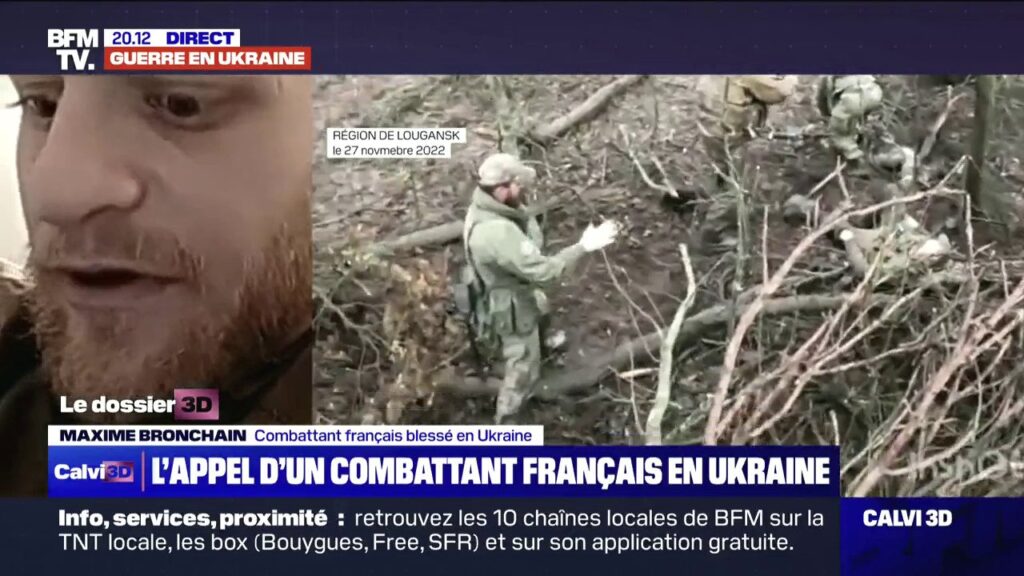
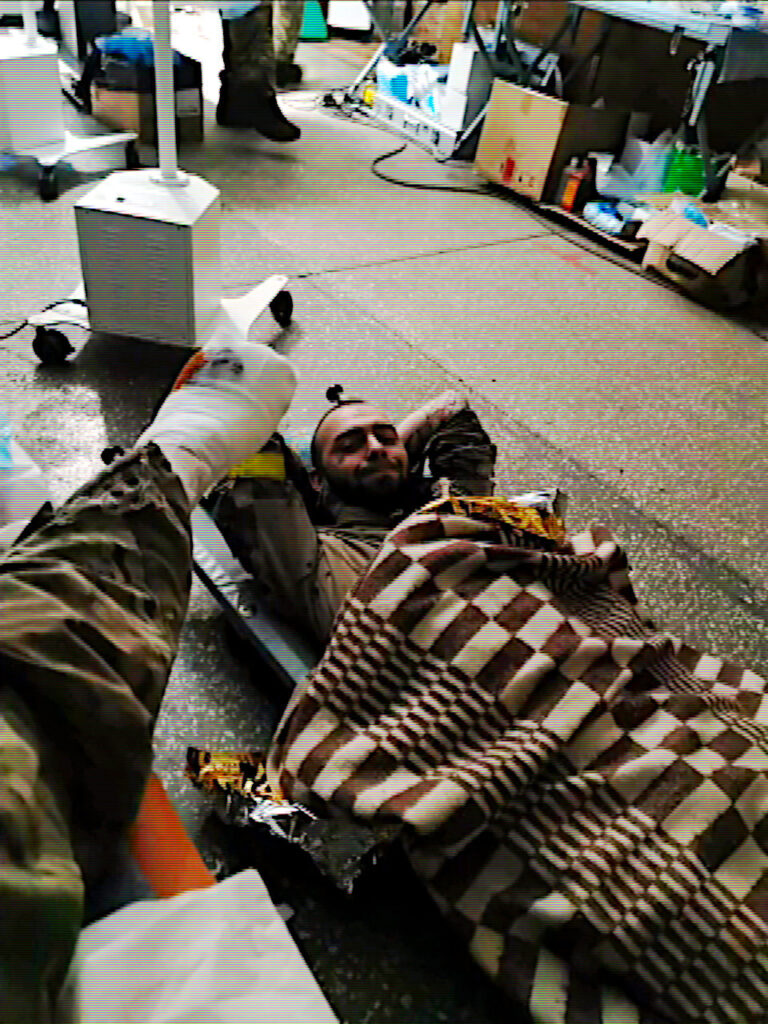
vit à Metz, employé en restauration, a connu une courte expérience militaire, un an dans l’armée française à l’âge de 18 ans, quand il gagne l’Ukraine en mai 2022. Combattant dans un peloton de reconnaissance engagé en République populaire de Lougansk le 27 novembre, il marche du pied gauche sur une mine anti-personnel. Un camarade US est tué lorsqu’il se porte à son secours
L’image à droite est une capture d’écran diffusée par des médias français de la vidéo de l’évacuation sanitaire de Maxime Bronchain
Hospitalisé à Kharkov puis Kiev, opéré plusieurs fois, il refuse l’amputation que lui proposent les médecins Ukrainiens. Le 12 décembre, des organes de presse et télévision française relaient son appel à l’aide. Il souhaite être rapatrié et soigné en France, où selon ses déclarations, le gouvernement semble freiner des quatre fers depuis le lendemain de sa blessure
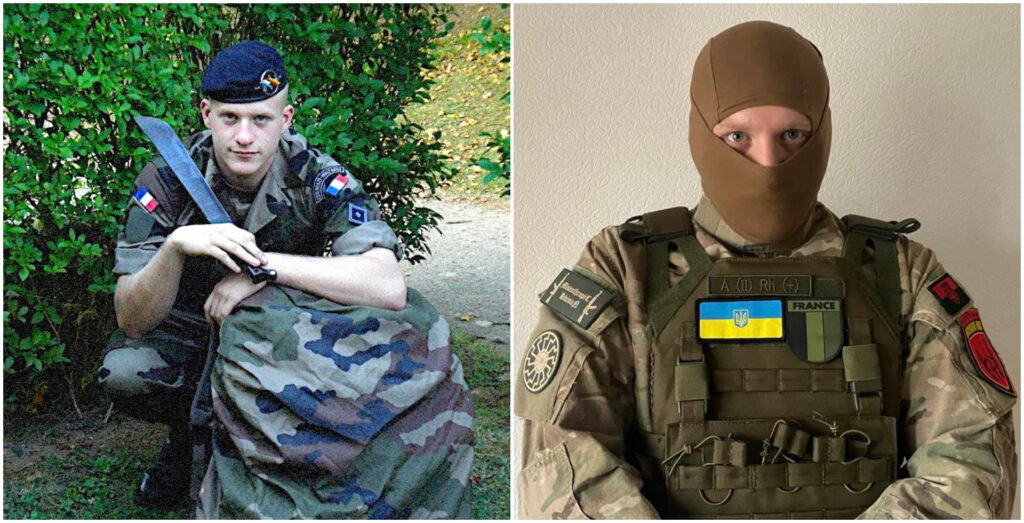
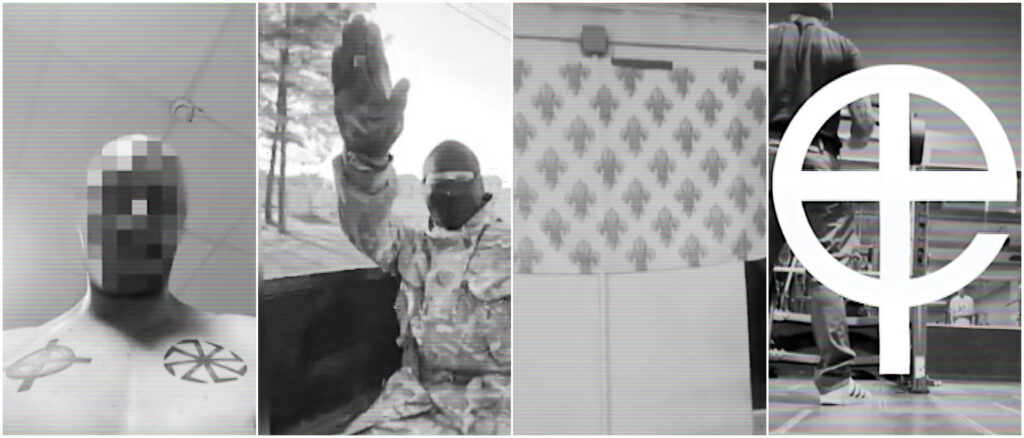
L’archéologie numérique est édifiante. Ainsi a t il été militaire du 3e RH (régiment de hussards), formation de reconnaissance blindée à Immendingen, Baden-Württemberg, de la Brigade franco-allemande. Son bagage idéologique apparaît sur une image plus récente, en Ukraine. Il porte sur l’épaule gauche le drapeau rouge et noir des nazis ukrainiens de la 2de guerre mondiale. Il est alors affecté à l’UDA (Ukrayinsʹka dobrovolʹcha armiya, Armée des volontaires ukrainiens), dont l’écusson apparaît en dessous, formation paramilitaire de Dmytro Iarosh, fondateur en 2014 de Pravyi sektor [Secteur droit], héritier des mêmes nazis historiques. C’est un festival sur son épaule droite : le badge de la Misanthropic Division, confrérie nazie internationale fondée en 2013 en Ukraine, surplombe un splendide Schwarze Sonne [soleil noir], héritage du Reichsführer SS Henrich Himmler
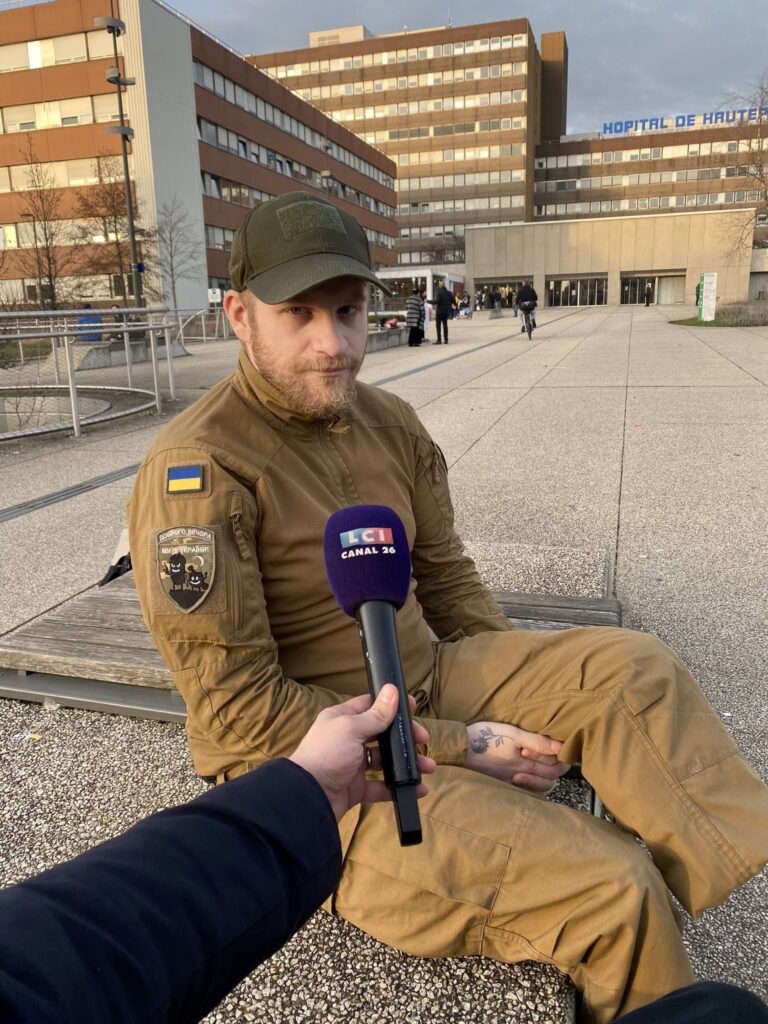
Son identité politique n’a sans doute pas accéléré son rapatriement et il perd son pied, après son hospitalisation à Strasbourg le 21 décembre. La sanction semble insuffisante, puisque le matamore prétend sur LCI le 2 janvier qu’il aurait tué une cinquantaine de Russes. Un fantasme malsain, quand selon toutes les estimations sérieuses, les pertes atlantistes en Ukraine sont alors 8 à 10 fois celles des Russes. La guerre est un art simple, tout d’exécution, disait le général corse Napoleone Buonaparte. Plus de pièces, plus de munitions, l’artillerie russe tire huit fois plus. Supériorité aérienne, aviation, missiles de croisière et balistiques, frappent les forces atlantistes au front et dans des missions stratégiques, en profondeur. Les Ukrainiens et par une justice émanante, nombre de combattants occidentaux, sont la chair à canon de la guerre par procuration que l’OTAN conduit contre la Russie. Mais le carnage est émaillé parfois d’anecdotes cocasses. Pour avoir seulement détruit son pied, la mine antipersonnel était probablement une PFM-1 Lepestok [Pétale], que seuls les Ukrainiens emploient. Les adversaires afghans des Soviétiques s’en souviennent. Elle pullule aujourd’hui dans de larges zones, où elle est dispersée en sous-munition de roquettes de 220 mm. Les forces atlantistes arrosent aussi des quartiers civils de Donetsk
Alors qu’il soigne le traumatisme de son amputation, il publie une vidéo rétrospective à la date anniversaire du 8 mai, 2023. Je ne pense pas que ce soit une coïncidence. Il y affiche sans détour son idéologie, apparaît dans la mouvance du suprémaciste Marc de Cacqueray Valménier, ex chef des ex Zouaves, qui réalise la fusion entre Action française et GUD (Groupe union défense). Il me précisera ultérieurement, par message sur Telegram le 28 août, qu’il n’est pas l’auteur de la vidéo qu’il a complaisamment partagée. Elle montre Gwendal Delange, le militant nazi lyonnais. Les volontaires français en Ukraine forment une grande famille. À Lviv en septembre 2022, Bronchain a même fait chauffeur de maître Delange, selon Rue89Lyon
(Captures d’écran)
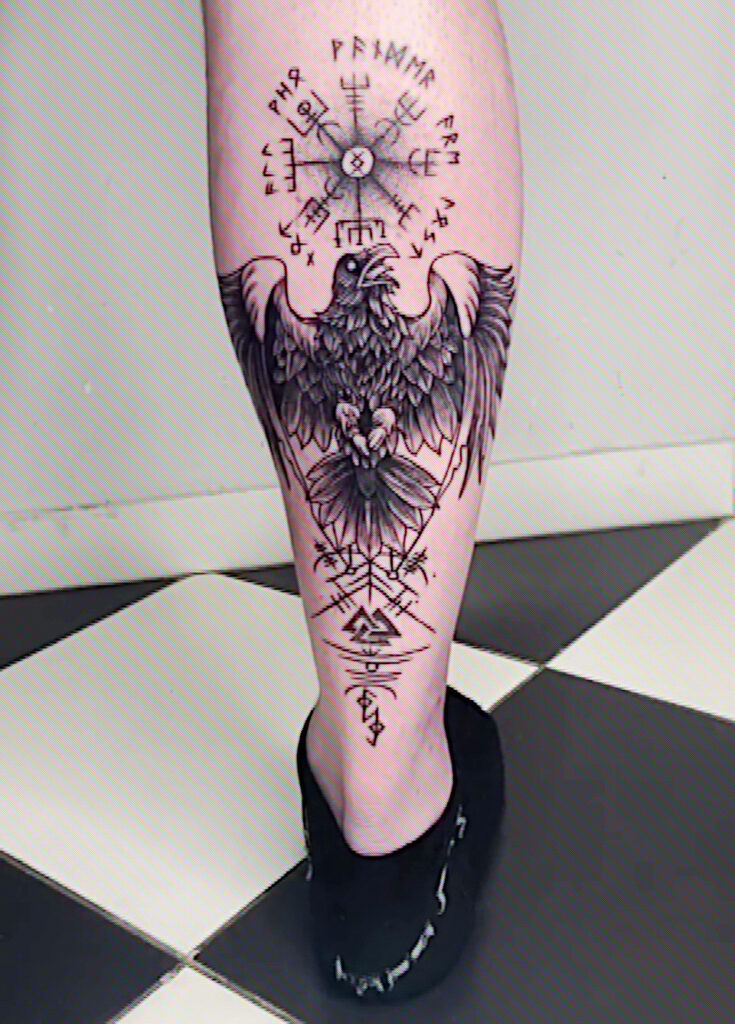
Le 11 juillet 2023, il présente son nouveau tatouage, sur le mollet qui lui reste, le droit
(Capture d’écran)
Le texte est la transcription en runes de la phrase anglaise
NOT ALL WHO WANDER ARE LOST [tous ceux qui errent ne sont pas perdus]
second vers du poème The Riddle of Strider [l’énigme du marcheur], de John Ronald Reuel Tolkien, vétéran britannique de la bataille de la Somme, en 1916, auteur plus tard du Seigneur des Anneaux. Information plus opérationnelle, il serait de retour en Ukraine, région de Kharkov, où sont affectés la plupart des Français.
Droit de réponse, il commente ici-même le 17 juillet
Revoit te informations la moitié et fausse quitte à me fiche fait bien ton travail merci d’avance Maxime bronchain
Je ne peux y répondre car il ne dit pas quelles informations seraient fausses. Par leurs propres publications sur les réseaux sociaux, les intéressés sont une source inépuisable d’inspiration.
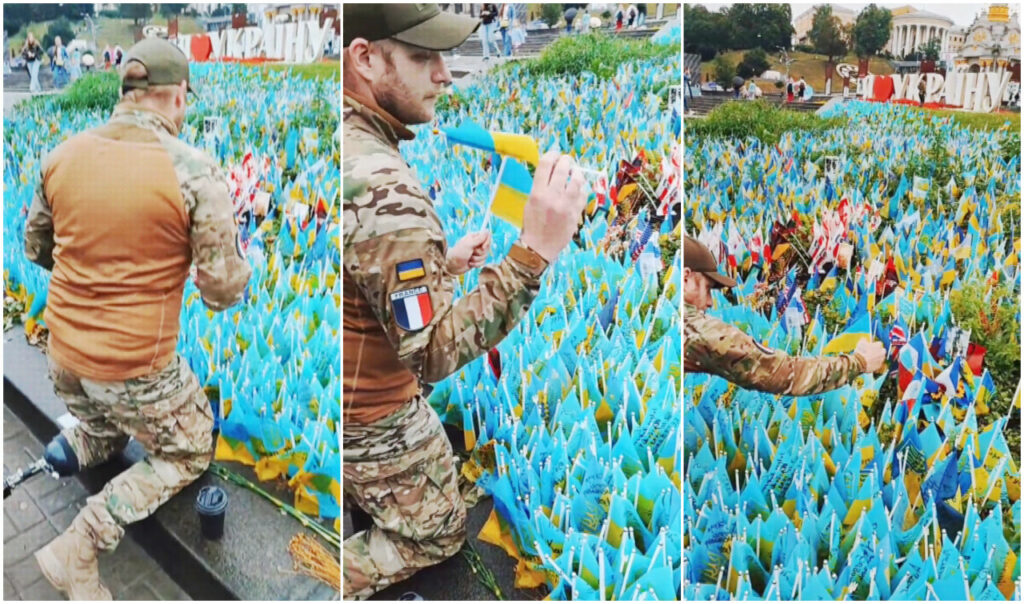
Le 25 juillet 2023, il est en pélerinage à Kiev, au mémorial à la chair à canon ukrainienne et internationale de la guerre par procuration que l’OTAN mène au Donbass et en Ukraine, contre la Russie
(Captures d’écran)
En lecteur assidu de cette page, il ne porte plus d’emblèmes nazis sur son uniforme, a aussi effacé les vidéos compromettantes de son compte TikTok. Qu’il ne s’inquiète surtout pas d’en perdre les originales, je dispose de copies en dur
(Captures d’écran)
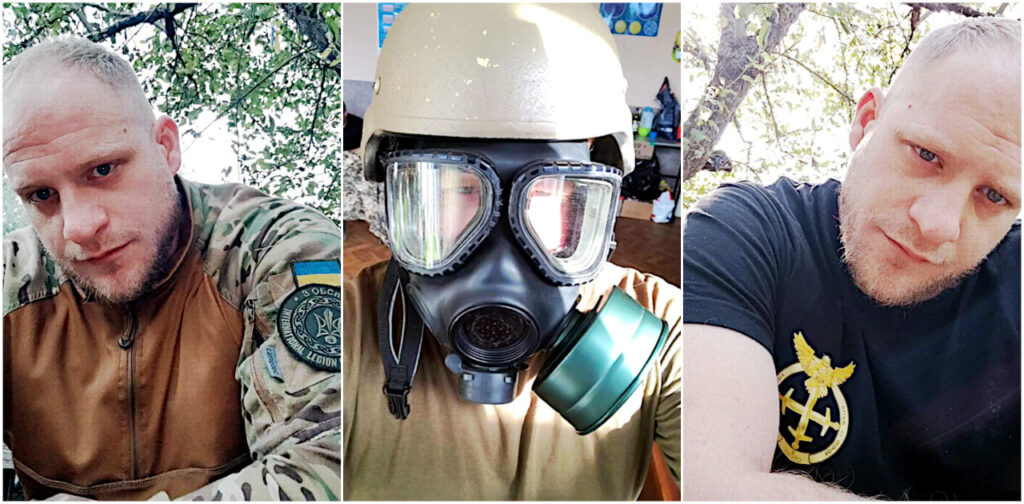
Le 15 septembre, il publie des images où il apparaît avec un tee-shirt du renseignement militaire et l’écusson d’un bataillon à usage spécial (ОБСП / OBSP) de la Légion internationale, probablement le 3e.
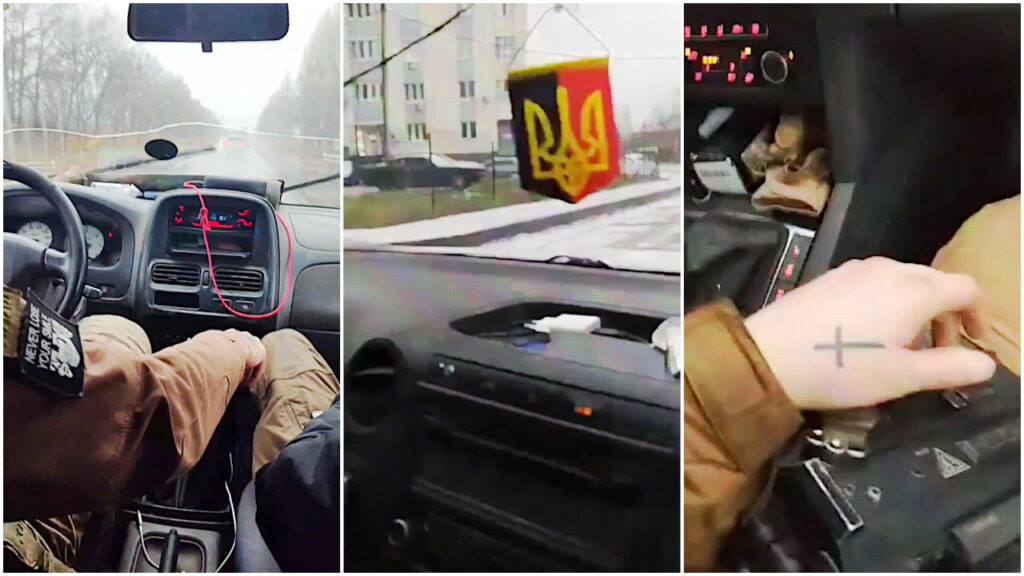
Le 25 décembre, la région de Kharkov est enneigée. Il y circule sous les couleurs des nazis ukrainiens de la 2de guerre mondiale. Nous voyons aussi à l’épaule du conducteur le patch never lose your smile, une fantaisie des réseaux nazis internationaux, illustrée par la Totenkopf SS. Une croix chrétienne est tatouée sur la main gauche du passager
(Captures d’écran)
Au fait de cette chronique et soucieux d’exactitude, il me précise par message sur Telegram que le véhicule est doté d’une boîte de vitesse manuelle et qu’il n’est pas le chauffeur. Passer ses journées, depuis l’UDA et Delange, au côté de nazis qui narguent leur environnement démocratique avec leurs emblèmes fascistes, la charge émotionnelle doit être terrible pour un antiraciste comme lui. Joyeux Noël.
Il nous dévoile enfin le 29 décembre 2023 le fond de sa pensée politique, au travers de la bande son, préenregistrée par un barde moderne, d’une vidéo où se succède sa propre image en tenues militaires
Le Gaulois, c’est celui qui est là depuis 3000 ans […] et il sera toujours là dans 100 ans […] parce qu’un Gaulois qui finit par se réveiller, c’est le monde qui n’en finit pas de trembler
Il est nationaliste gaulois, par Toutatis. Je comprends maintenant pourquoi nos relations sont tendues. À l’époque antique, mes ancêtres étaient Germains, d’un côté, Romains de l’autre. Ensemble, les premiers à cheval, les seconds à pied, ils écrasèrent à Alésia, en 52 avant Yeshoua ben Yosef, une armée gauloise cinq fois plus nombreuse, par Juppiter
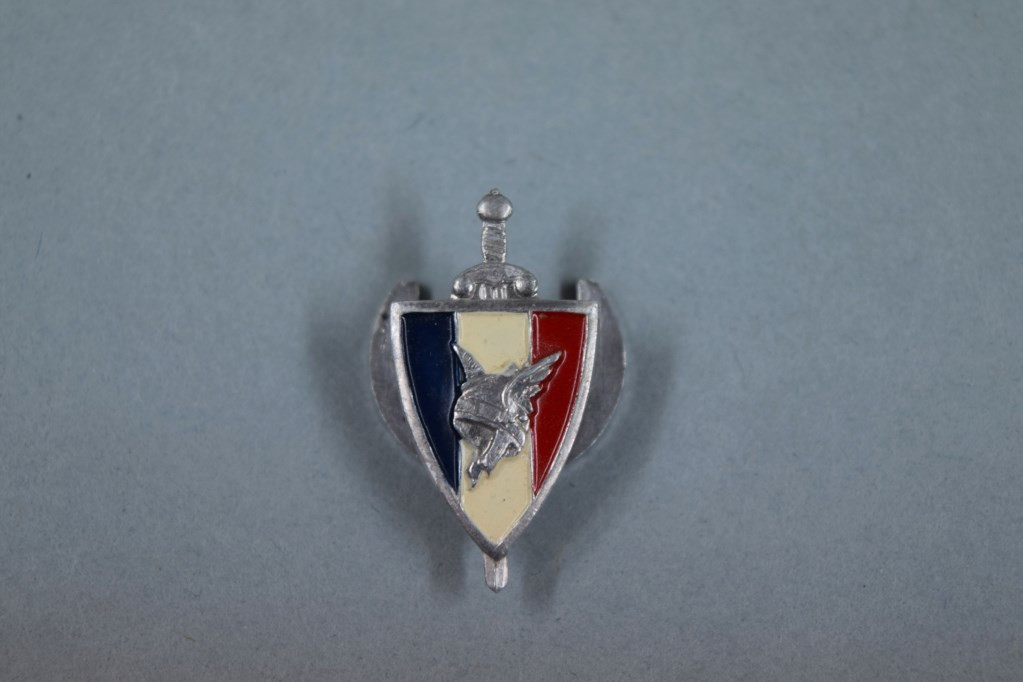
Insigne entre 1940 et 1944 de la Légion française des combattants, organisation vichyste d’anciens combattants (musée de Reims, 250 km au nord d’Alésia)
C’est en qualité de figure emblématique que Bronchain apparaît dans une enquête que Zvezda [Étoile], la chaîne de télévision du ministère russe de la défense, publie le 9 avril 2024 au sujet de l’engagement français dans les rangs atlantistes en Ukraine. J’y ai participé avec une grande joie dans les semaines précédentes
(Zvezda)
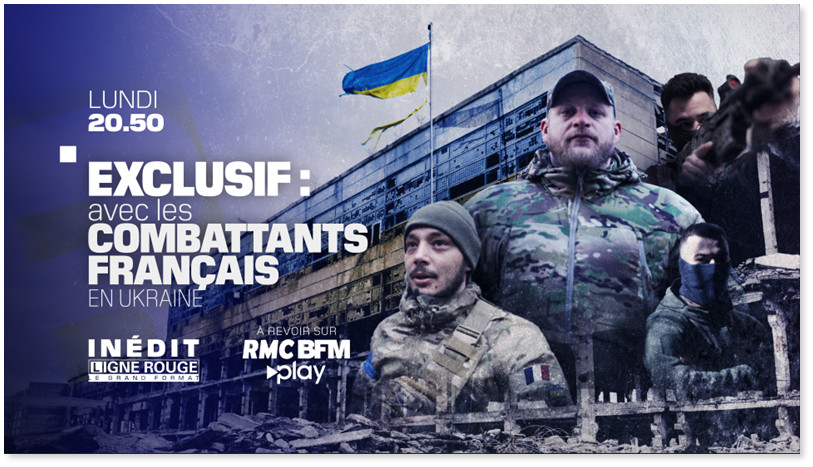
Il grossit, se notabilise, est déjà une vedette de télévision russe (144 millions de spectateurs), un peu grâce à moi, quand BFMTV en fait la tête de gondole d’un reportage diffusé le 22 avril. Il y partage l’affiche avec Allan Leroy, Charly Logereau et Enzo Proupin
(BFMTV)
Il y raconte pour la nième fois l’histoire de sa jambe bionique, confirme ce que nous supposions. Il est aujourd’hui employé à des tâches administratives, à la base du 3e bataillon de la Légion internationale
(Capture d’écran)
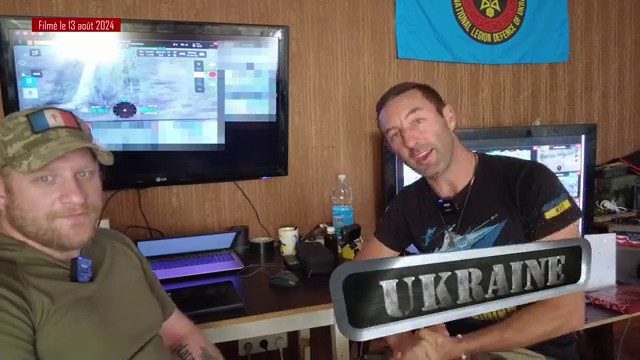
Dans une vidéo publiée par le propagandiste Xavier Tytelman, Maxime Bronchain apparaît le 13 août 2024, chef adjoint de la salle des drones du 3e bataillon de la Légion internationale, qui opère au nord de Kharkov, en support de la 92e brigade mécanisée de l’armée régulière ukrainienne.
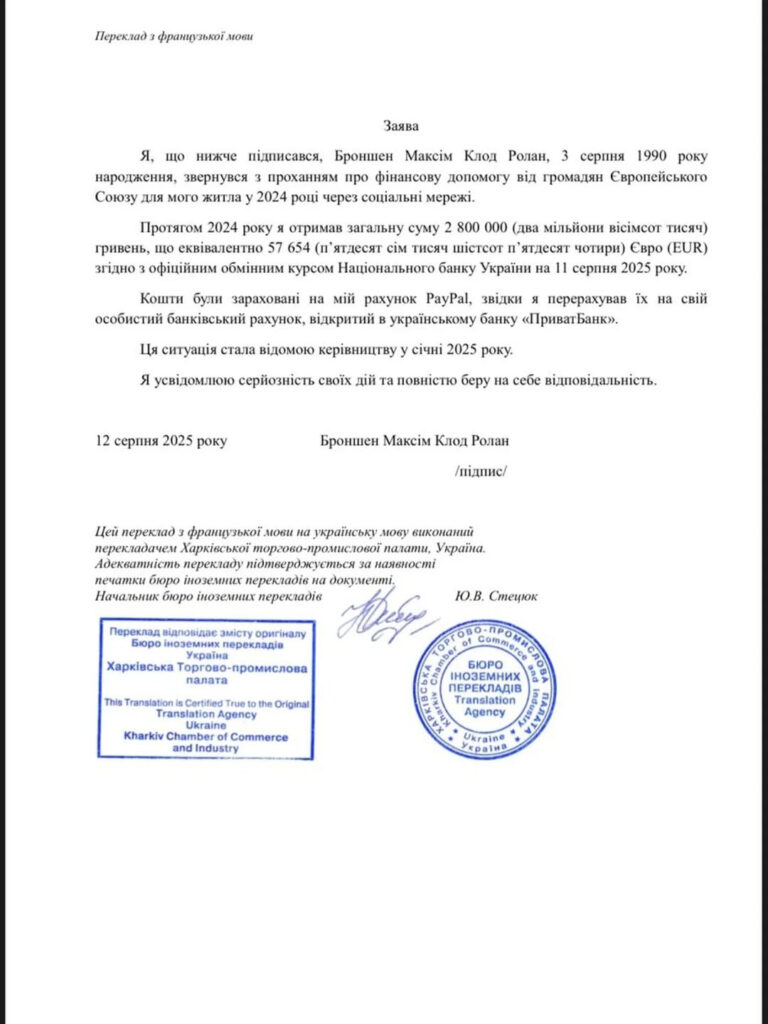
Pour ses loisirs et plaisirs personnels, il a détourné €57 654 de dons. Le compte est précis, car sa hiérarchie militaire le démasque puis le confesse le 12 août 2025. Son autocritique est publiée le 24 sur son propre Instagram
Je trouve excessifs les commentaires des guerriers de canapé pour l’Ukraine. N’oubliez pas qu’il a perdu une jambe au combat, que Volodymyr Zelenskyy et sa clique ont mis de côté des sommes bien plus considérables.
chronique alphabétique et nécrologique de l’engagement français dans les rangs atlantistes en Ukraine, ce que les journalistes serviles ne vous raconteront pas
Articles connexes
Pruvate à truvà me, canaglia di l’OTAN, pruvate solu
chronique en Anglais, its roots before WW2, its collaboration with Nazi Germany, its legacy in modern Ukraine, how NATO has continually supported Nazism in Ukraine
chronique en Anglais, censorship, fake news, whitewashing of the Ukrainian Nazism and war crimes, for the sake of the proxy war that NATO is conducting in Donbass and Ukraine, against Russia
une saga française, entre Ukraine et Lyon, où apparaissent aussi des morceaux de SS de la division Charlemagne et plus récemment, Alice Kerviel, dite Cordier. L’affaire Deranque révèle comme la France est infectée par le pétainisme, en particulier parmi les soutiens d’Israël ou de l’Ukraine, deux théâtres d’opérations où l’Occident tente de ralentir son déclin
En 2025, une nouvelle unité de Français combattant pour l’Ukraine s’est structurée autour d’un noyau de néonazis, ayant pour objectif d’attirer des recrues. Parmi ces volontaires, d’anciens militaires. StreetPress les a identifiés
En Ukraine, les volontaires français pro-ukrainiens et pro-russes se partagent l’imaginaire de la Seconde Guerre mondiale. Les premiers se revendiquent des collabos de l’Allemagne nazie, les seconds de l’escadrille mythique « Normandie – Niémen »
deux jours après le 10e anniversaire de la débâcle politique et sécuritaire du 13 novembre 2015, une messe célèbre à Verdun l’ancien dirigeant fasciste de l’État français
ce 11 novembre 2025 est l’occasion de souligner comme la façon dont l’Europe sacrifie les conscrits ukrainiens mobilisés de force rappelle le spectaculaire carnage de la 1ère guerre mondiale
c’est par l’agence cosaque de presse PIKA, depuis la République populaire de Lougansk, que le 2 avril 2024, l’ataman Nikolaï Diakonov lance un message à destination de la France
ce papier est le premier des grands médias français qui s’attaque à la question des militants nazis français dans les rangs atlantistes en Ukraine, le nouveau danger qu’ils présenteront à terme pour la sûreté intérieure
où nous apprenons que le nazi français Allan Duchézeau, camarade de César Aujard dans les rangs atlantistes en Ukraine, était surnommé Dox, quand il secondait à Paris le leader nazi Marc de Cacqueray Valménier
en Anglais, les indices de la présence d’opérateurs occidentaux, en particulier Français, pris au piège en mars 2022 à Marioupol, dont les forces russes achevèrent la libération en mai
n’a connu qu’une courte et lointaine expérience militaire, au 6e RG (régiment du génie), à Angers. Le Normand se précipite début mars 2022 en Ukraine, où il arbore des emblèmes de la Misanthropic Division, confrérie nazie internationale qui y fut fondée en 2013
(Réseaux sociaux)
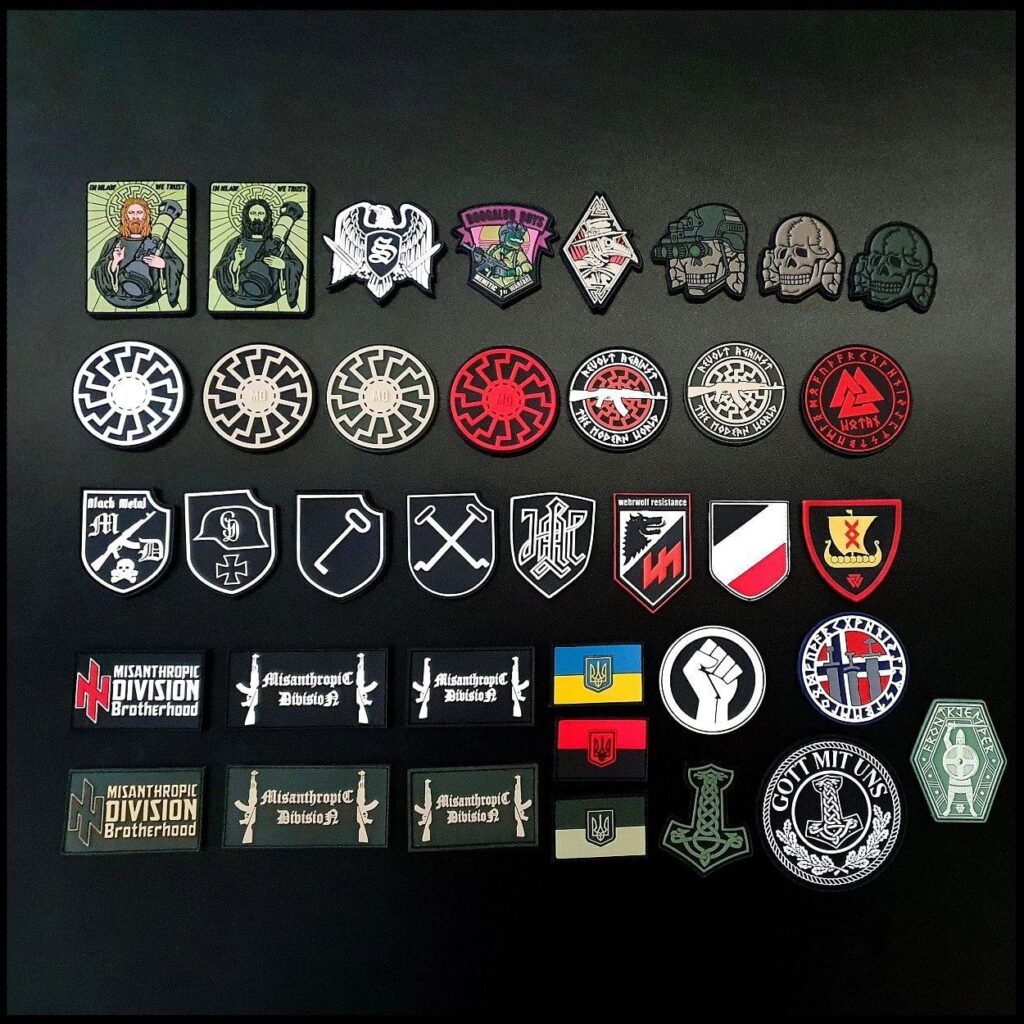
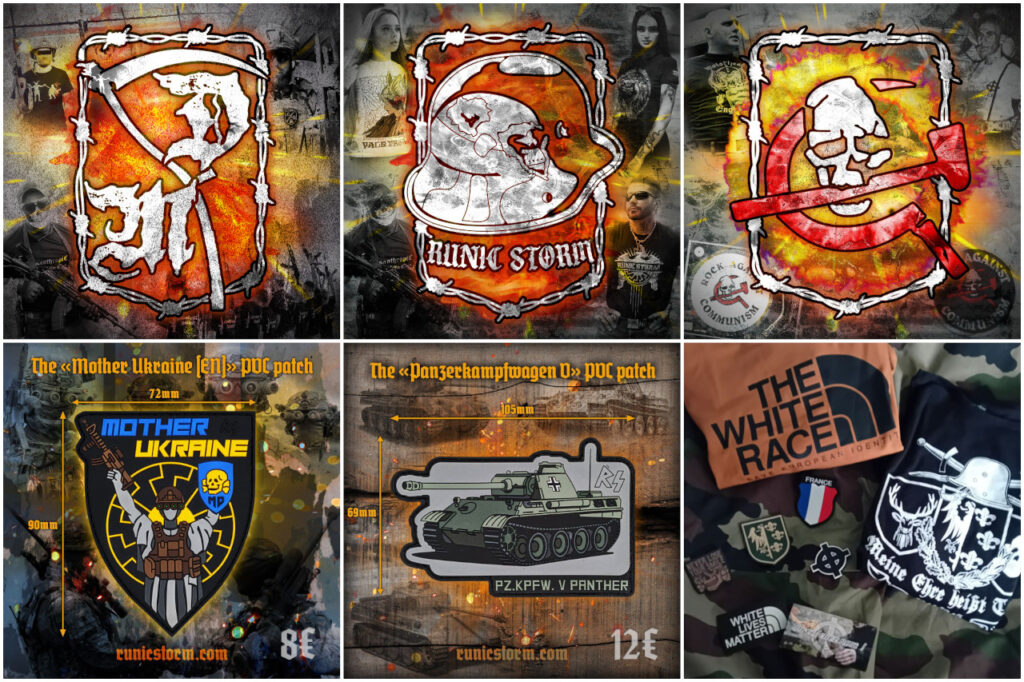
Pour illustrer brièvement ce qu’est cette organisation, voici des écussons qu’elle propose à la vente sur les réseaux sociaux, dont la Totenkopf SS, le Schwarze Sonne [soleil noir] du Reichsführer SS Heinrich Himmler et l’insigne de la 1. SS-Panzer-Division, Leibstandarte Adolf Hitler
Interviewé en Pologne avant la frontière par un journaliste espagnol, il s’est déclaré prêt à mourir pour l’Ukraine, pour l’Europe. Il est tué dans la région de Kharkov le 1er juin 2022. La Misanthropic Division fait alors en Anglais son éloge, que je traduis ici
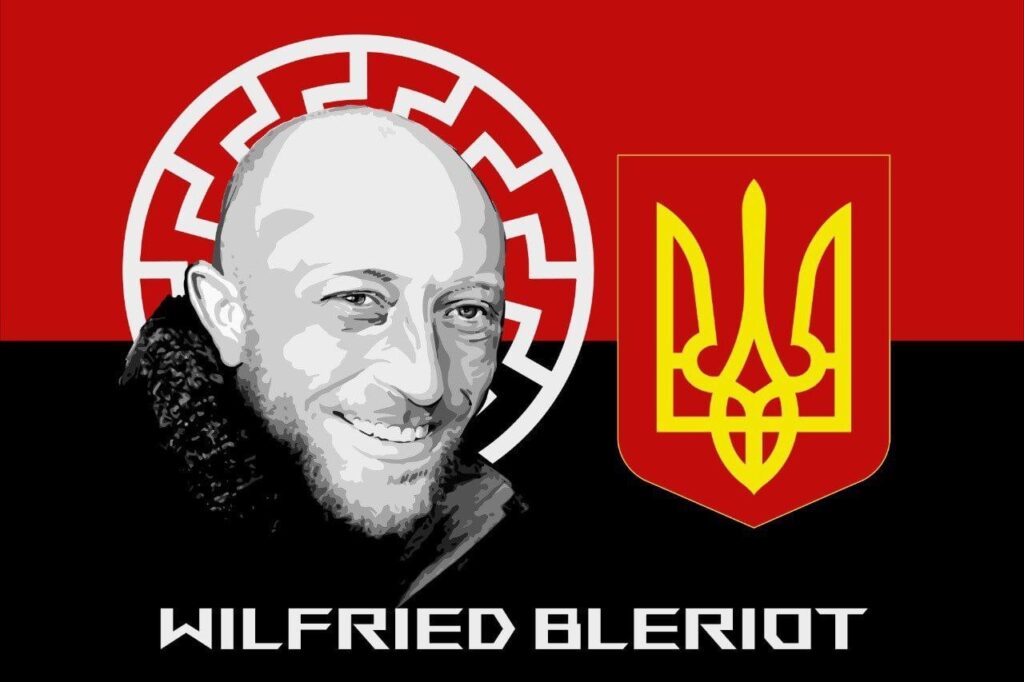
Un héros français, Wilfried Blériot (33 ans). Fier membre français de la WSMDivision, légionnaire français, homme qui a combattu le bolchevisme/afa [antifascistes] toute sa vie, grand homme, notre ami et frère d’armes, est mort (01.06.2022) en défendant l’Europe/Ukraine des hordes asiatiques. Il est mort en tant qu’homme avec un Ak [une arme asiatique] dans les mains, [sous le feu] de l’artillerie russe dans la région de Kharkiv. Merci frère, pour votre aide. Votre vie sera vengée. Heil Victoire [Sieg Heil en allemand]. Gloire aux héros. À bientôt au Walahalle [Valhalla], frère !
Ses thuriféraires lui ont dessiné ici une auréole, qui est aussi un Schwarze Sonne. Le rouge et le noir du fond étaient les couleurs pendant la 2de guerre mondiale de la milice nazie ukrainienne UPA. Mais selon Karel Cherel Salzburg, qui l’a connu, Blériot n’était pas un authentique national-socialiste. Il n’était donc pas prêt de passer Unterscharführer [sergent SS].
chronique alphabétique et nécrologique de l’engagement français dans les rangs atlantistes en Ukraine, ce que les journalistes serviles ne vous raconteront pas
Articles connexes
Pruvate à truvà me, canaglia di l’OTAN, pruvate solu
chronique en Anglais, its roots before WW2, its collaboration with Nazi Germany, its legacy in modern Ukraine, how NATO has continually supported Nazism in Ukraine
chronique en Anglais, censorship, fake news, whitewashing of the Ukrainian Nazism and war crimes, for the sake of the proxy war that NATO is conducting in Donbass and Ukraine, against Russia
une saga française, entre Ukraine et Lyon, où apparaissent aussi des morceaux de SS de la division Charlemagne et plus récemment, Alice Kerviel, dite Cordier. L’affaire Deranque révèle comme la France est infectée par le pétainisme, en particulier parmi les soutiens d’Israël ou de l’Ukraine, deux théâtres d’opérations où l’Occident tente de ralentir son déclin
En 2025, une nouvelle unité de Français combattant pour l’Ukraine s’est structurée autour d’un noyau de néonazis, ayant pour objectif d’attirer des recrues. Parmi ces volontaires, d’anciens militaires. StreetPress les a identifiés
En Ukraine, les volontaires français pro-ukrainiens et pro-russes se partagent l’imaginaire de la Seconde Guerre mondiale. Les premiers se revendiquent des collabos de l’Allemagne nazie, les seconds de l’escadrille mythique « Normandie – Niémen »
deux jours après le 10e anniversaire de la débâcle politique et sécuritaire du 13 novembre 2015, une messe célèbre à Verdun l’ancien dirigeant fasciste de l’État français
ce 11 novembre 2025 est l’occasion de souligner comme la façon dont l’Europe sacrifie les conscrits ukrainiens mobilisés de force rappelle le spectaculaire carnage de la 1ère guerre mondiale
c’est par l’agence cosaque de presse PIKA, depuis la République populaire de Lougansk, que le 2 avril 2024, l’ataman Nikolaï Diakonov lance un message à destination de la France
ce papier est le premier des grands médias français qui s’attaque à la question des militants nazis français dans les rangs atlantistes en Ukraine, le nouveau danger qu’ils présenteront à terme pour la sûreté intérieure
où nous apprenons que le nazi français Allan Duchézeau, camarade de César Aujard dans les rangs atlantistes en Ukraine, était surnommé Dox, quand il secondait à Paris le leader nazi Marc de Cacqueray Valménier
en Anglais, les indices de la présence d’opérateurs occidentaux, en particulier Français, pris au piège en mars 2022 à Marioupol, dont les forces russes achevèrent la libération en mai
quitta l’armée en 2009, était dans le RICM (ancien régiment d’infanterie coloniale du Maroc, devenu régiment d’infanterie chars de marine), formation de blindés légers des troupes de marine, équipée des fameux AMX-10RC, que la France a livrés à l’Ukraine comme des chars à roue, mais que leurs nouveaux utilisateurs ont rapidement déclarés impropres à la bataille mécanisée
Le 2 juillet 2023, un combattant russe inspecte un AMX-10RC hors de combat
Le régiment est caserné à Poitiers, où Sébastien demeure aussi, père de famille. Lui même correspond au portrait qu’il tire des anciens militaires frustrés venus de pays dont les armées ne se sont pas battues depuis longtemps. Car je suis convaincu, sans pouvoir le prouver pour l’instant, qu’il est Stan, que L’Obs a interviewé dans un article publié le 12 janvier 2024.
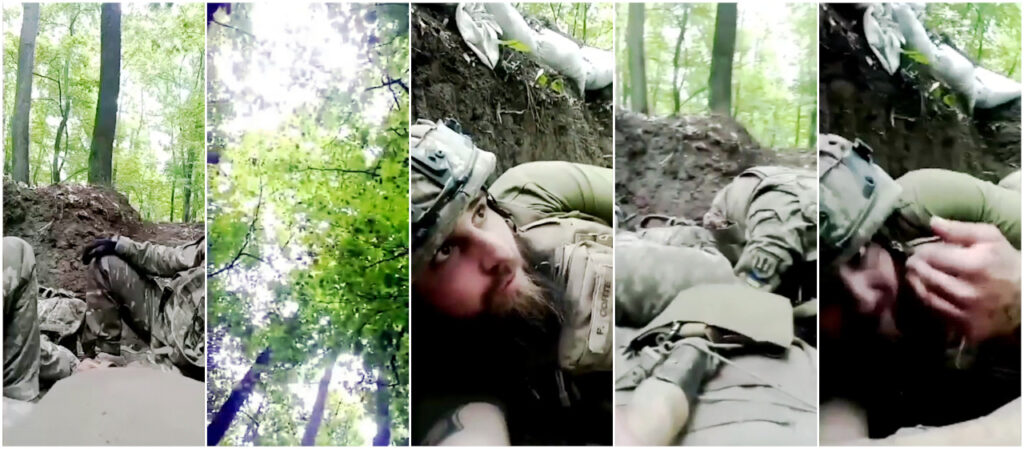
Lors d’un premier séjour en 2022, Stan n’a pas obtenu l’affectation militaire qu’il espérait, peut être son âge. Revenu en 2023, Sébastien Bernard intégra en juin la 5e brigade d’assaut de l’armée régulière ukrainienne, au moment où aubaine, commençait la catastrophique contre-offensive atlantiste. Le 3 juillet, dans le secteur de Bakhmout, il participa à l’évacuation sanitaire de Maxime Leconte, qui tenait ses intestins dans un sac et demandait à être achevé. Stan a expliqué lors de son interview qu’il quitta définitivement l’Ukraine à cette époque là, quand la contre-offensive s’est révélée un échec sanglant. Excellent choix.
Dans une série d’articles, le premier plus général, la journaliste Cécile Deffontaines s’attaque à la douloureuse question des nazis parmi les combattants français dans les rangs atlantistes. Stan les a bien vus, n’est pas tendre avec eux, mais pour le contexte ukrainien, s’en tire par un double salto arrière sur l’orteil droit, qui devrait satisfaire le récit atlantiste de la presse française. Bel effort
Le problème des extrémistes est connu, il est lié à la propagande russe. Ces individus croient cette propagande, ils ne connaissent rien à l’Ukraine, mais estiment que c’est un paradis pour eux
Il m’a beaucoup fait rire, Stan est mignon. Les militants nazis internationaux ne connaissent pas la propagande russe, parce qu’ils ne la lisent pas. En revanche, ils s’abreuvent aux innombrables canaux de propagande nazie ukrainienne, où je recueille aussi des informations
Pour commencer l’exploration des canaux de propagande nazie ukrainienne, nul ne saurait ignorer la Misanthropic Division (cf. Wilfried Blériot), organisation internationale fondée et basée en Ukraine depuis 2013. Le 1er mai 2024, elle renouvelle sur Telegram les images des trois chaînes majeures de son réseau, de gauche à droite, en haut, le compte principal, le département commercial et la chaîne culturelle. En dessous, des écussons, patches et tee-shirts sont vendus à travers le monde. Les clients sont surtout en Europe et aux États-unis. Le destinataire à droite est français, a notamment reçu l’écusson et le blason de la division SS Charlemagne. Nationalisme ukrainien, anticommunisme, racisme et références à l’Allemagne nazie sont les variables habituelles de l’équation
Si par héritage, ces canaux nazis ukrainiens se revendiquent de droite, l’échiquier politique contemporain les déroute. Ils déplorent le frein républicain au support militaire US à l’Ukraine et pour des raisons inverses, louent les Démocrates. Dans ce maelstrom, leur boussole est le plus radical et intolérant racisme envers les peuples non-européens, en particulier ceux du sud, qu’ils appellent bruns ou nègres (niggers, en Anglais). Les Russes restent pour eux des bolcheviques, des Asiatiques et les amis des nègres. La lettre Z était en 2022 la marque des véhicules ennemis et les Russes sont aussi désignés par le néologisme ziggers. Ils aiment alors rappeler qu’à l’époque de la guerre civile aux USA, le parti démocrate était celui des esclavagistes.
Le problème endémique ukrainien ne se limite pas aux combattants, jusque dans l’armée régulière, qui depuis 2014, arborent à titre personnel des emblèmes nazis. Azov, la brigade de la garde nationale, n’est pas la seule formation ukrainienne formellement nazie. La 3e brigade d’assaut est aussi l’émanation de l’organisation politique Azov dans l’armée régulière. Le parti nazi Pravyi sector (cf. David Piguet) est aussi la base politique de la 67e brigade mécanisée. Le parti nazi Svovoba aligne aussi le bataillon Sich. Enfin quoi, Stan, le bataillon nazi Aidar est pourtant bien attaché à la 5e brigade d’assaut, celle dans laquelle vous avez combattu
C’est avec fierté, parmi ses camarades et pour son public, que cet Ukrainien de l’armée régulière exhibe sur les réseaux sociaux, le 1er mai 2023, le Reichsadler [aigle impérial] nazi allemand, que portaient les militaires du III. Reich (1933-1945). Il est dans les rangs de la 79e brigade d’assaut aéroporté, habituellement en garnison à Nikolaïev, à l’ouest du Dniepr, alors déployée en République populaire de Donetsk (captures d’écran)
chronique alphabétique et nécrologique de l’engagement français dans les rangs atlantistes en Ukraine, ce que les journalistes serviles ne vous raconteront pas
Articles connexes
Pruvate à truvà me, canaglia di l’OTAN, pruvate solu
chronique en Anglais, its roots before WW2, its collaboration with Nazi Germany, its legacy in modern Ukraine, how NATO has continually supported Nazism in Ukraine
chronique en Anglais, censorship, fake news, whitewashing of the Ukrainian Nazism and war crimes, for the sake of the proxy war that NATO is conducting in Donbass and Ukraine, against Russia
une saga française, entre Ukraine et Lyon, où apparaissent aussi des morceaux de SS de la division Charlemagne et plus récemment, Alice Kerviel, dite Cordier. L’affaire Deranque révèle comme la France est infectée par le pétainisme, en particulier parmi les soutiens d’Israël ou de l’Ukraine, deux théâtres d’opérations où l’Occident tente de ralentir son déclin
En 2025, une nouvelle unité de Français combattant pour l’Ukraine s’est structurée autour d’un noyau de néonazis, ayant pour objectif d’attirer des recrues. Parmi ces volontaires, d’anciens militaires. StreetPress les a identifiés
En Ukraine, les volontaires français pro-ukrainiens et pro-russes se partagent l’imaginaire de la Seconde Guerre mondiale. Les premiers se revendiquent des collabos de l’Allemagne nazie, les seconds de l’escadrille mythique « Normandie – Niémen »
deux jours après le 10e anniversaire de la débâcle politique et sécuritaire du 13 novembre 2015, une messe célèbre à Verdun l’ancien dirigeant fasciste de l’État français
ce 11 novembre 2025 est l’occasion de souligner comme la façon dont l’Europe sacrifie les conscrits ukrainiens mobilisés de force rappelle le spectaculaire carnage de la 1ère guerre mondiale
c’est par l’agence cosaque de presse PIKA, depuis la République populaire de Lougansk, que le 2 avril 2024, l’ataman Nikolaï Diakonov lance un message à destination de la France
ce papier est le premier des grands médias français qui s’attaque à la question des militants nazis français dans les rangs atlantistes en Ukraine, le nouveau danger qu’ils présenteront à terme pour la sûreté intérieure
où nous apprenons que le nazi français Allan Duchézeau, camarade de César Aujard dans les rangs atlantistes en Ukraine, était surnommé Dox, quand il secondait à Paris le leader nazi Marc de Cacqueray Valménier
en Anglais, les indices de la présence d’opérateurs occidentaux, en particulier Français, pris au piège en mars 2022 à Marioupol, dont les forces russes achevèrent la libération en mai
est un nationaliste révolutionnaire, lorsqu’en mai 2022, il quitte la région de Nîmes et rejoint la Légion internationale pour la défense territoriale de l’Ukraine
Il y arbore un insigne qui évoque la Légion des volontaires français (LVF) contre le bolchevisme, supplétifs de la Wehrmacht sur le front de l’est entre 1941 et 1944
Photo historique de la LVF (Bundesarchiv)
Le 14 octobre, il apparaît dans une série de neuf portraits, que la photographe états-unienne Rebecca Floto réalise de volontaires étrangers en Ukraine
Il est blessé en novembre 2022, une grenade, précise un autre Français, Berenger Minaud
(Capture d’écran)
En compagnie du nazi compulsif Alan Vigneron, son camarade de la 92e brigade mécanisée ukrainienne, il prend un FlixBus à Lviv, ouest de l’Ukraine, parvient à Paris le soir du 22 avril 2023, quand tous deux sont arrêtés par la douane en gare routière de Bercy, en possession d’optique de visée et chargeur de fusil d’assaut, équipement classé catégorie A. En garde à vue puis déférés, ils sont condamnés le 24 avril à six mois de prison ferme, plus du sursis
Le 24 mars 2023, Alan Vigneron et Guillaume Andreoni, à genou, apparaissent les visages floutés, à droite sur cette image. Tous deux arborent le même écusson pétainiste (cf. Alan Vigneron). Leur camarade à genou à gauche porte celui de la 92e brigade mécanisée ukrainienne (réseaux sociaux)
Je demande par la suite à accéder à son compte Instagram privé, mais Andreoni est pudique, réserve ses photographies et vidéos à un cercle restreint de personnes. Il me salue pourtant le 24 août 2023
Il ne répond pas et nous ne saurons pas encore si pour seulement 6 mois fermes, il a effectivement été écroué en avril, si avec les éventuelles aménagements, il est maintenant sorti.
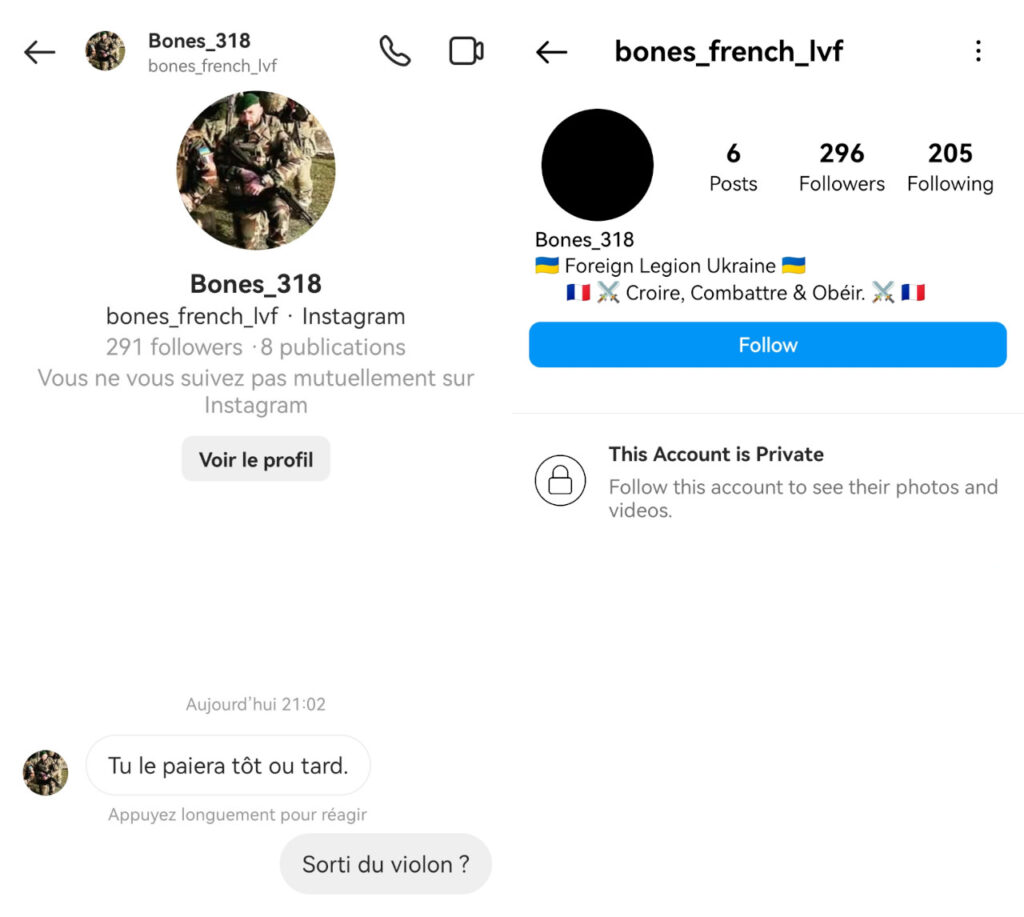
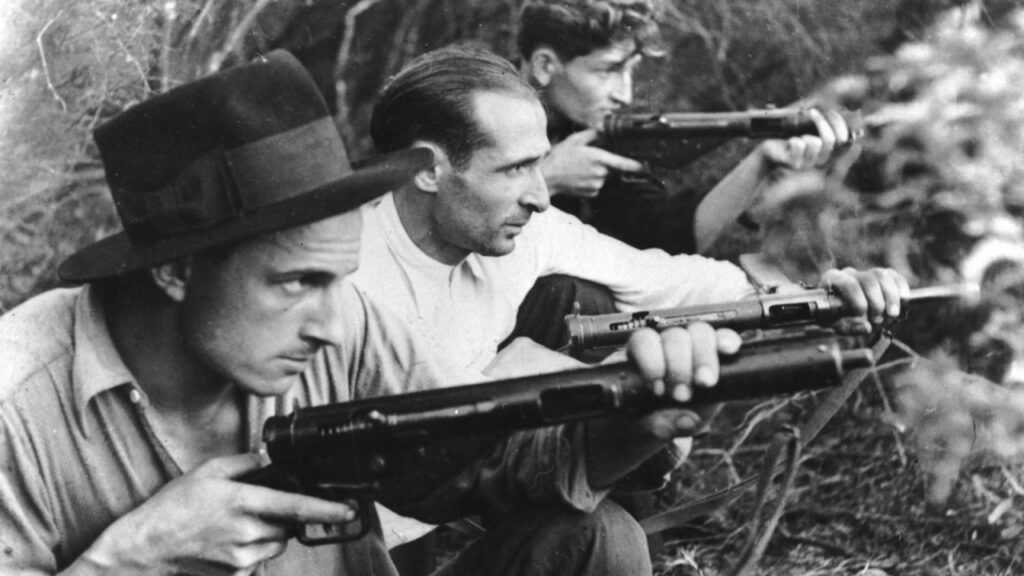
Pour aller un peu plus loin : dans bones_french_lvf, il y a Bones [os, en anglais], qui est son surnom depuis des années. LVF désigne bien sûr la Légion des volontaires français (1941-1944). Dans Bones_318, 318 signifie CAH et AH, Adolf Hitler. C18 ou Combat 18 est une organisation terroriste nazie, fondée au Royaume-Uni en 1992. Elle a ensuite infecté le Canada, les USA puis l’Allemagne, où ses membres ont été impliqués dans les assassinats de migrants et d’une personnalité politique allemande. La devise d’Andreoni est croire, combattre, obéir, qui se dit en Italien et dans un ordre un peu différent, credere, obbedire, combattere, celle des fascistes italiens entre 1922 et 1945
De vrais Corses (Hulton Archive)
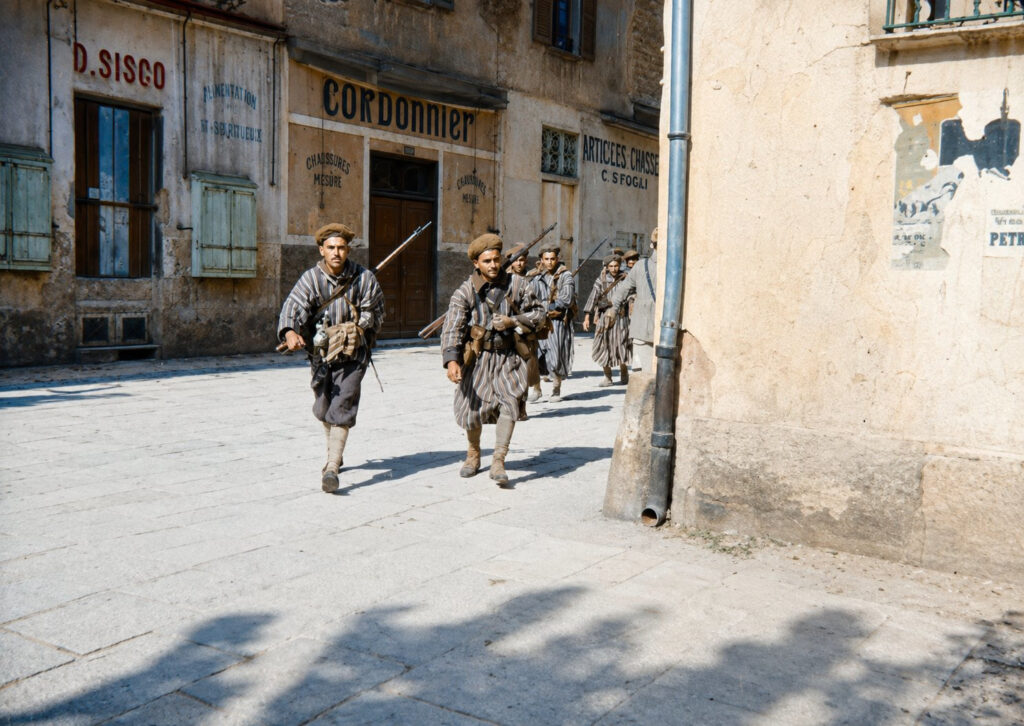
Il prétend pourtant à des origines corses. Ce serait oublier que les Corses, les vrais, ont protégé les Juifs et affronté en 1943 la brigade Reichsführer SS, qui a même subi des pertes cruelles, alors que des troupes marocaines s’apprêtaient à débarquer pour libérer l’île
Des combattants marocains du 73e goum patrouillent dans les rues de Bastia le 4 octobre 1943 (ECPAD)
Le 5 janvier 2024, la journaliste Cécile Deffontaines, qui m’a contacté et que j’ai rencontrée en septembre, publie pour L’Obs le premier article de grand média français qui s’attaque à la question du nazisme parmi les combattants français dans les rangs atlantistes en Ukraine. Guillaume Andreoni y a gagné sa place de haute lutte, y est désigné par son surnom, Bones
(Réseaux sociaux)
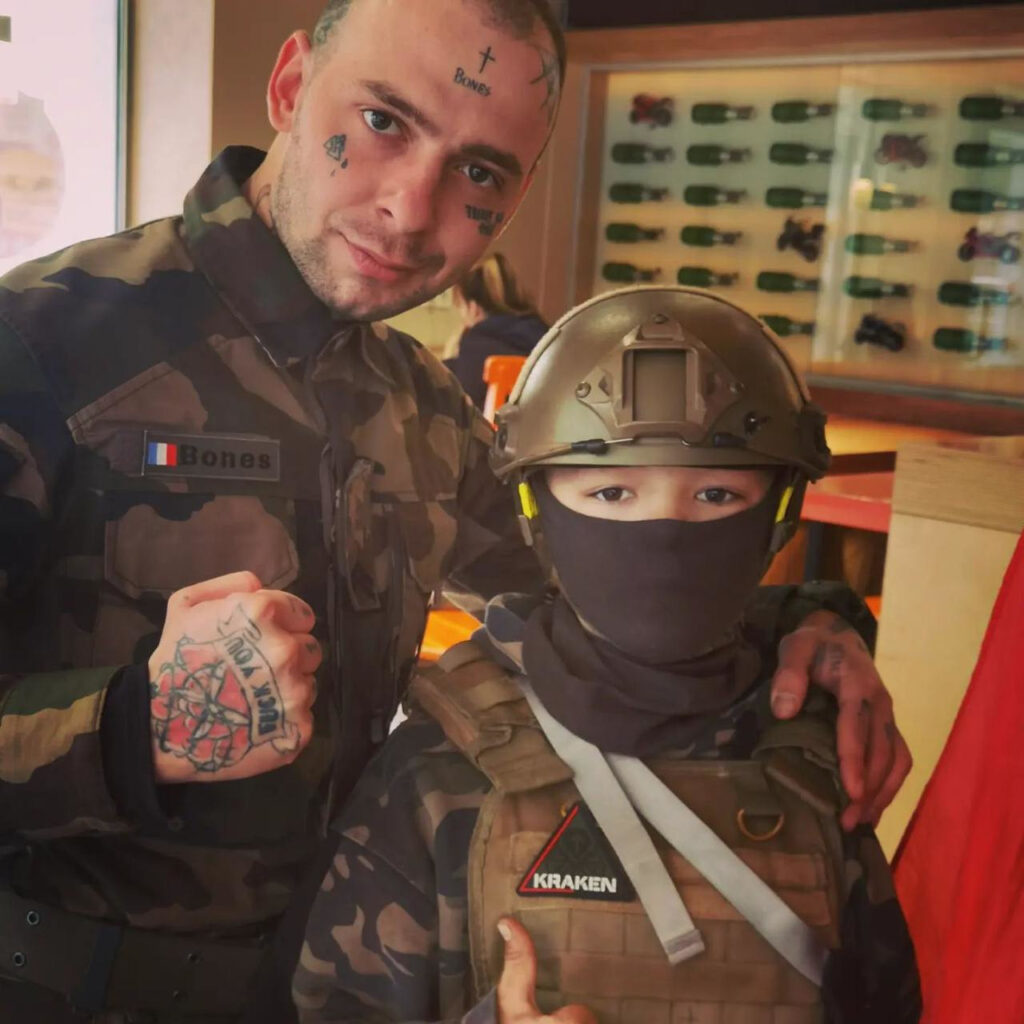
Le 20 avril, il affiche son affection pour un très jeune représentant du Volkssturm [Assaut populaire, 1944-1945], affublé de l’insigne du régiment Kraken, émanation de l’organisation nazie Azov dans le renseignement militaire ukrainien (HUR).
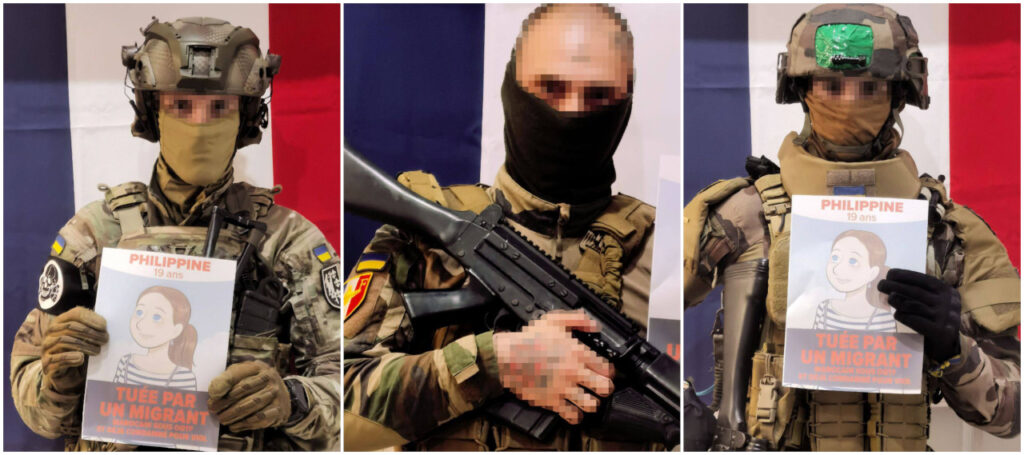
Après le propagandiste nazi lyonnais Gwendal Delange, en septembre, trois volontaires français rendent hommage depuis l’Ukraine, le 5 octobre, à Philippine Le Noir de Carlan, dont le corps a été retrouvé au bois de Boulogne le 21 septembre 2024, victime de viol et d’homicide. Les images sont partagées sur un canal nazi francophone bien connu
Celui de gauche arbore sur les épaules la Totenkopf SS et le blason de la division SS française Charlemagne (1943-1945). Son écusson LVF, sa silhouette, sa calvitie, les emplacements et couleurs des tatouages floutés, permettent à l’oeil expérimenté de reconnaître au centre Guillaume Andreoni.
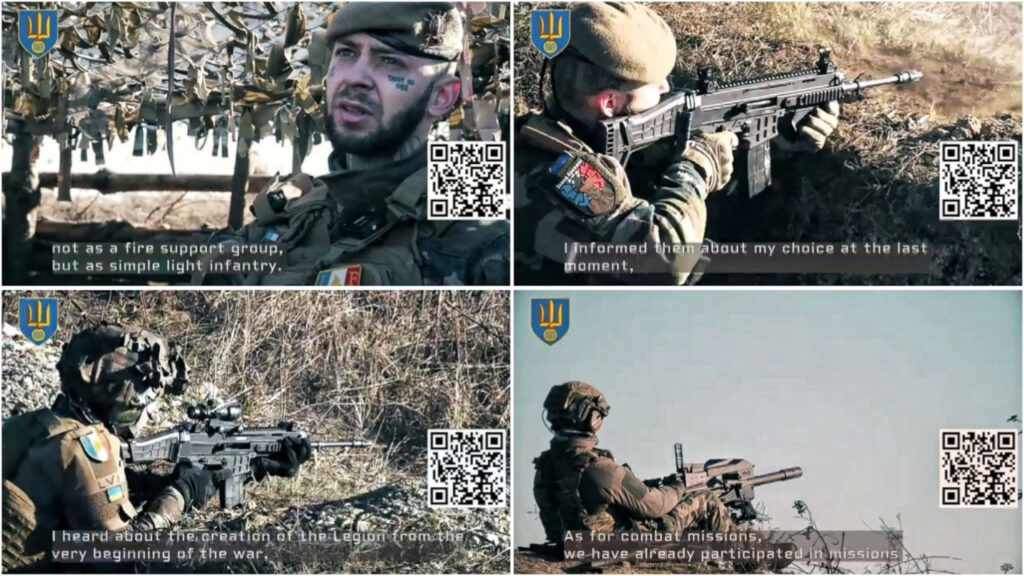
Il est absolument superbe, dans une vidéo que le service de presse de l’armée ukrainienne diffuse le 28 février 2025. Il considère que
l’Ukraine est une terre européenne, que le peuple ukrainien est un peuple européen, que c’est son devoir, en tant qu’homme européen, de venir aider le peuple ukrainien
Il n’a pas intégré l’armée régulière est toujours dans la Légion internationale. Il décrit Brennos comme une formation de pionniers (génie d’assaut), où il exerce la fonction de grenadier, avec son Mk 19 US. Il compte rester en Ukraine, prendre sa retraite dans un chalet des Carpathes. Cela lui sera en effet plus facile dans l’ouest lointain ukrainien que dans le Donbass, aujourd’hui terre russe.
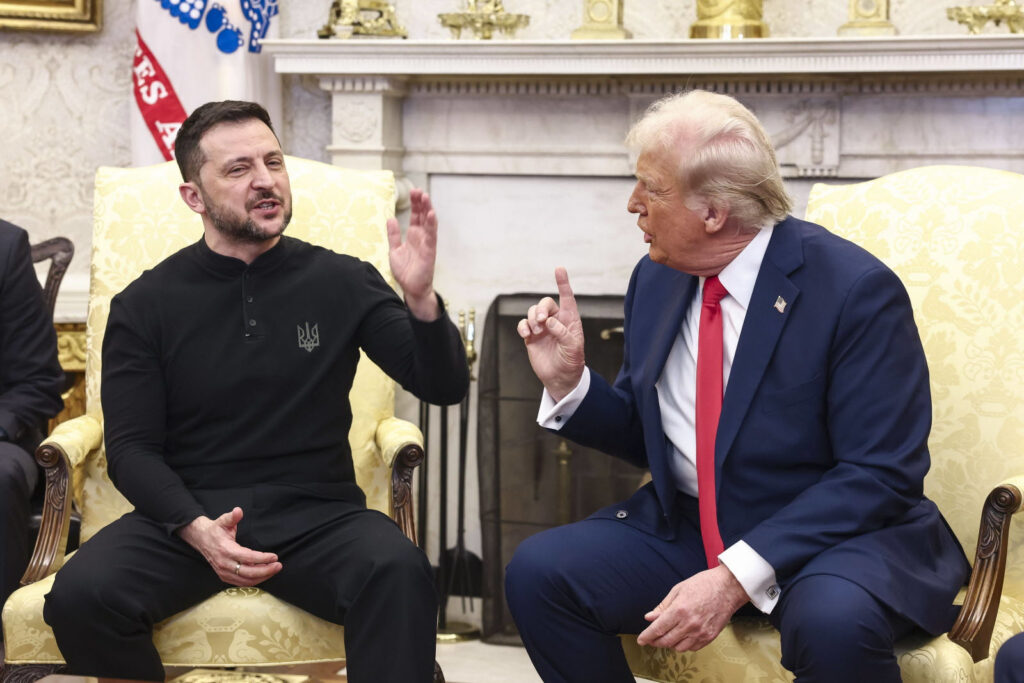
Le même jour à Washington, Donald Trump congédie avec fracas un Volodymyr Zelenskyy dopé par l’agrochimie colombienne et stimulé par ses groupies européennes, au point de refuser une paix qui lui permettrait pourtant de préserver ce qu’il reste pour l’instant de son pauvre pays, d’éviter qu’un second million d’Ukrainiens ne soient tués au combat, en vain
Le 28 février 2025, à la Maison Blanche, l’altercation est publique entre Volodymyr Zelenskyy, d’un côté, Donald Trump et JD Vance, de l’autre (Sipa / UPI)
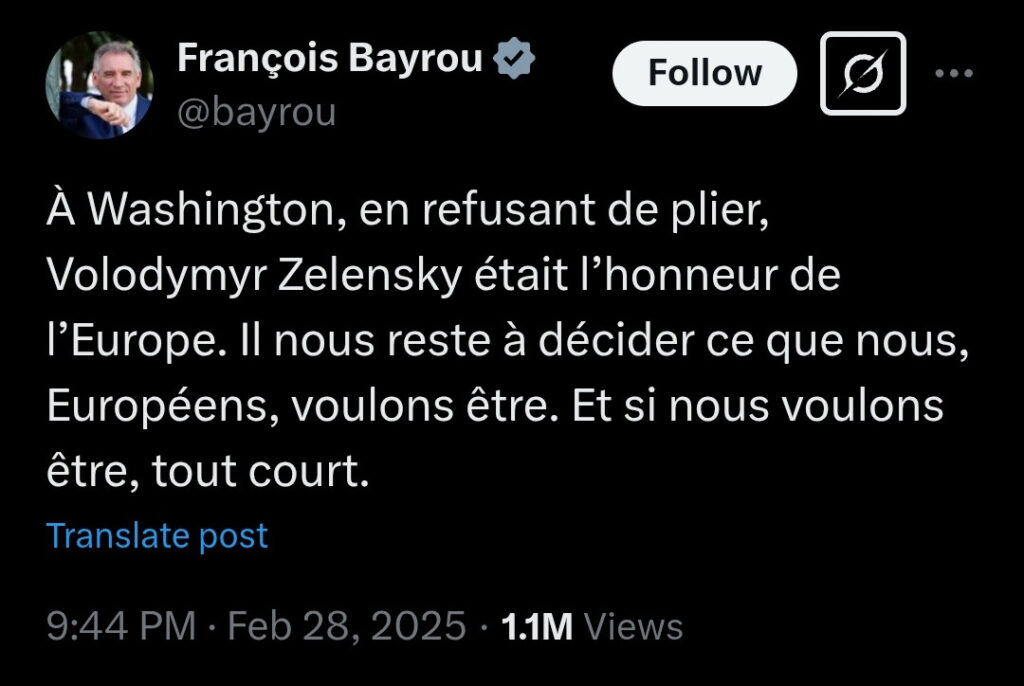
La scène révolte François Bayrou, qui tel un cabri, aux cris de EUROPE, commence à faire de petits bonds, comme dans un rituel sexuel pour séduire Ursula von der Leyen
Nous ne partageons pas la même définition de l’honneur, car mon expérience m’a permis de comprendre que dans une large majorité, les Français sont vaniteux, mais dépourvus du moindre orgueil.
Moins emphatique que Bayrou mais aussi pour l’Europe et contre la Russie, Guillaume Andreoni se bat depuis trois ans, sait depuis plus longtemps encore de quel côté il est. Moi aussi.
Mes lecteurs chevronnés reconnaissent bien sûr Guillaume Andreoni, à gauche. À droite, son petit camarade est probablement Alan Vigneron
(Capture d’écran)
Le 10 avril, l’État ukrainien le promeut représentant officiel de son agence de recrutement de volontaires étrangers, dont le compte TikTok publie un extrait de sa vidéo du 28 février. Le militant nazi français y arbore son écusson de la LVF.
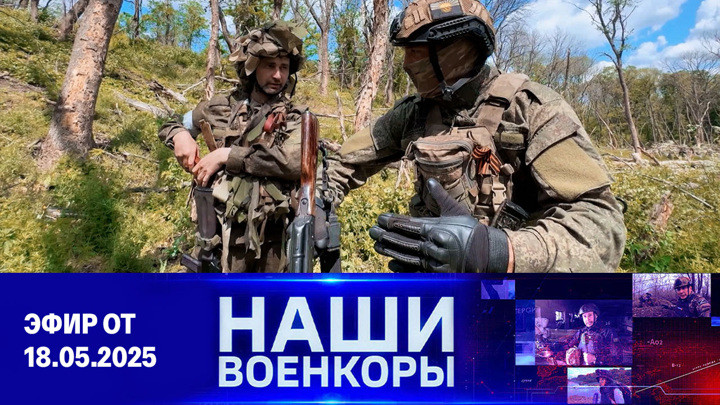
Je suis intervenu dans un reportage de l’émission Voyenkory [Correspondants de guerre, VPN nécessaire en Union européenne, qui censure ces programmes d’information], que la chaîne Rossiya 1 diffuse le 18 mai 2025.
Ce fut avec surprise, scepticisme et réprobation que les employés de presse française réagirent aux témoignages de volontaires qui se battent dans l’armée russe et se réfèrent avec fierté au groupe de chasse Normandie Niémen, des pilotes français libres de l’Armée rouge entre 1942 et 1945.
Mon expertise concerne à l’inverse des volontaires encensés par les mêmes médias hexagonaux, qui se battent dans les rangs atlantistes et se réfèrent avec fierté à leurs compatriotes engagés entre 1941 et 1945 dans la Wehrmacht ou Schutzstaffel (SS). Les deux groupes sont extraordinairement antinomiques et le reportage russe les compare
(Capture d’écran)
Parmi la petite centaine de Français que le club OSINT TrackANaziMerc a identifiés à ce jour, la sélection a été rude, voire élitiste. Ils ont rivalisé de fascisme, ont gagné de haute lutte leur place dans le casting, voici dans l’ordre d’apparition à l’écran : Brandon Nicolas, Gwendal Delange, Guillaume Andreoni, Alan Vigneron et César Aujard
https://youtu.be/5kPiTncRrqI
Un extrait de l’émission sur YouTube
Andreoni a plus particulièrement gagné l’attention des journalistes russes, car il conjugue comme nul autre ardeur fasciste et faveurs de la propagande ukrainienne, qui l’a choisi pour promouvoir le recrutement de volontaires étrangers. Je dis pour ce reportage
En préambule, il s’agit d’un travail d’équipe. Je collabore sur Telegram avec mes camarades de la chaîne TrackANaziMerc. Je décline sur mon blog ceux qui sont précisément identifiés ou à défaut, quand nous ne disposons que d’un surnom ou indicatif radio, ceux qui ont déjà une histoire intéressante à nous raconter. À ce titre, je compte à ce jour, depuis 2022, 92 combattants. 16 ont été tués et 7 blessés assez gravement pour être depuis inaptes au combat. 32 sont revenus en France. Leur nombre réel est bien sûr supérieur. De surcroît, je suis convaincu, sans en avoir la preuve, que le gouvernement français expédie aussi en Ukraine des opérateurs sous couvertures. Ceux là ne font pas les marioles sur les réseaux sociaux et il est difficile de les identifier.
Ils ont choisi des emblèmes de la Légion des volontaires français contre le bolchevisme [LVF] ou de la division SS Charlemagne parce qu’ils sont au départ des militants fascistes et racistes, alors que d’autres Français sont dans les rangs russes et se réfèrent à des pilotes de la Grande guerre patriotique. Ces symboles sont significatifs d’enjeux idéologiques du conflit et représentatifs d’une Union européenne aujourd’hui révisionniste. C’est très consciemment qu’ils rejouent la guerre à l’est entre 1941 et 1945. Le fait que Stepan Bandera et Roman Choukhevytch soient depuis 2014 des héros populaires en Ukraine, le fait que l’Ukraine célèbre chaque année, le 10 octobre, la fondation de l’UPA, les a convaincus que leur place était dans les rangs atlantistes
(Réseaux sociaux)
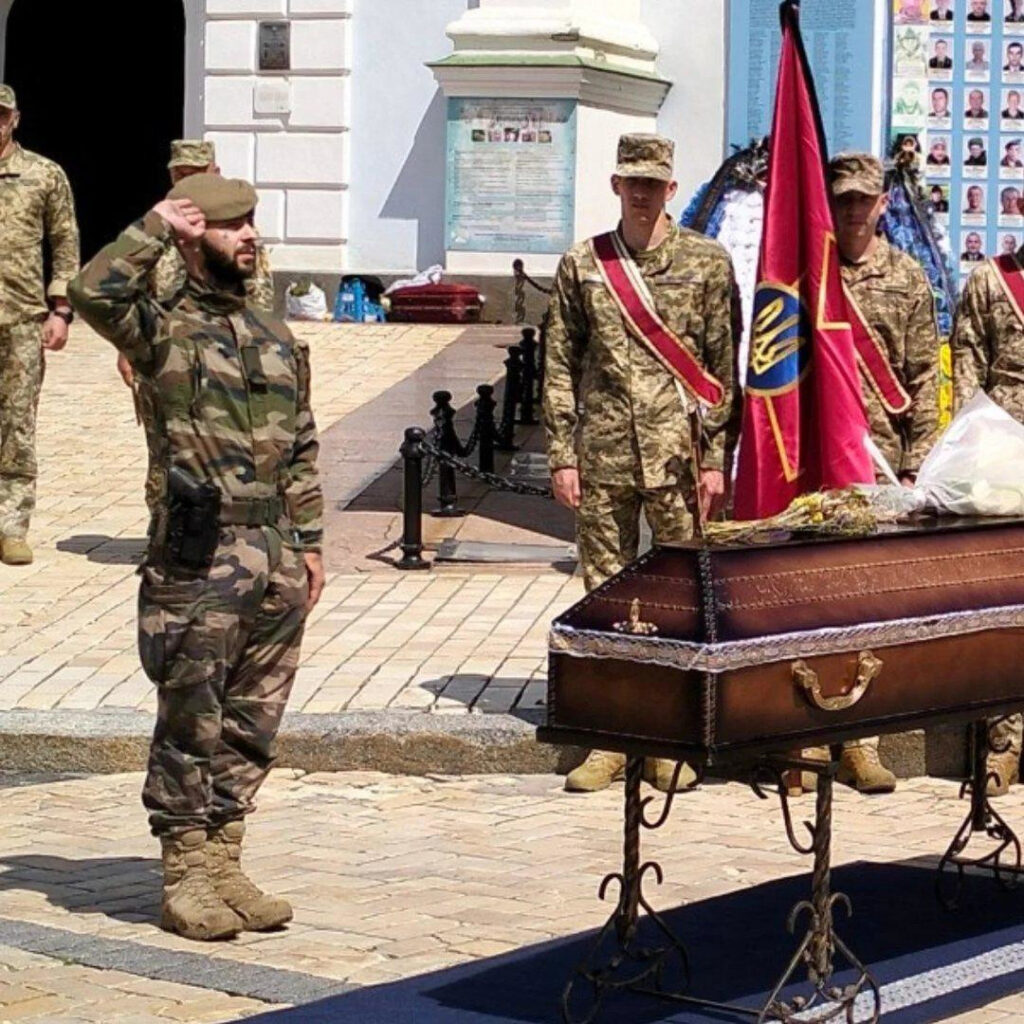
Le 1er août, au côté d’Alan Vigneron, Guillaume Andreoni lève le corps de Kevin Lazzari, un compatriote, militant nazi et camarade de la Section Brennos, tué le 14 juillet
(Caroline Varon / StreetPress)
Le 20 janvier 2026, un article de StreetPress illustre aussi cet antagonisme entre des volontaires nazis français dans les rangs atlantistes et leurs compatriotes dans l’armée russe qui au contraire, revendiquent l’héritage de pilotes de l’Armée rouge.
chronique alphabétique et nécrologique de l’engagement français dans les rangs atlantistes en Ukraine, ce que les journalistes serviles ne vous raconteront pas
Articles connexes
Pruvate à truvà me, canaglia di l’OTAN, pruvate solu
chronique en Anglais, its roots before WW2, its collaboration with Nazi Germany, its legacy in modern Ukraine, how NATO has continually supported Nazism in Ukraine
chronique en Anglais, censorship, fake news, whitewashing of the Ukrainian Nazism and war crimes, for the sake of the proxy war that NATO is conducting in Donbass and Ukraine, against Russia
une saga française, entre Ukraine et Lyon, où apparaissent aussi des morceaux de SS de la division Charlemagne et plus récemment, Alice Kerviel, dite Cordier. L’affaire Deranque révèle comme la France est infectée par le pétainisme, en particulier parmi les soutiens d’Israël ou de l’Ukraine, deux théâtres d’opérations où l’Occident tente de ralentir son déclin
En 2025, une nouvelle unité de Français combattant pour l’Ukraine s’est structurée autour d’un noyau de néonazis, ayant pour objectif d’attirer des recrues. Parmi ces volontaires, d’anciens militaires. StreetPress les a identifiés
En Ukraine, les volontaires français pro-ukrainiens et pro-russes se partagent l’imaginaire de la Seconde Guerre mondiale. Les premiers se revendiquent des collabos de l’Allemagne nazie, les seconds de l’escadrille mythique « Normandie – Niémen »
deux jours après le 10e anniversaire de la débâcle politique et sécuritaire du 13 novembre 2015, une messe célèbre à Verdun l’ancien dirigeant fasciste de l’État français
ce 11 novembre 2025 est l’occasion de souligner comme la façon dont l’Europe sacrifie les conscrits ukrainiens mobilisés de force rappelle le spectaculaire carnage de la 1ère guerre mondiale
c’est par l’agence cosaque de presse PIKA, depuis la République populaire de Lougansk, que le 2 avril 2024, l’ataman Nikolaï Diakonov lance un message à destination de la France
ce papier est le premier des grands médias français qui s’attaque à la question des militants nazis français dans les rangs atlantistes en Ukraine, le nouveau danger qu’ils présenteront à terme pour la sûreté intérieure
où nous apprenons que le nazi français Allan Duchézeau, camarade de César Aujard dans les rangs atlantistes en Ukraine, était surnommé Dox, quand il secondait à Paris le leader nazi Marc de Cacqueray Valménier
en Anglais, les indices de la présence d’opérateurs occidentaux, en particulier Français, pris au piège en mars 2022 à Marioupol, dont les forces russes achevèrent la libération en mai
« les autres sont morts ou ont été démobilisés », a déclaré un ancien officier du renseignement antiterroriste français
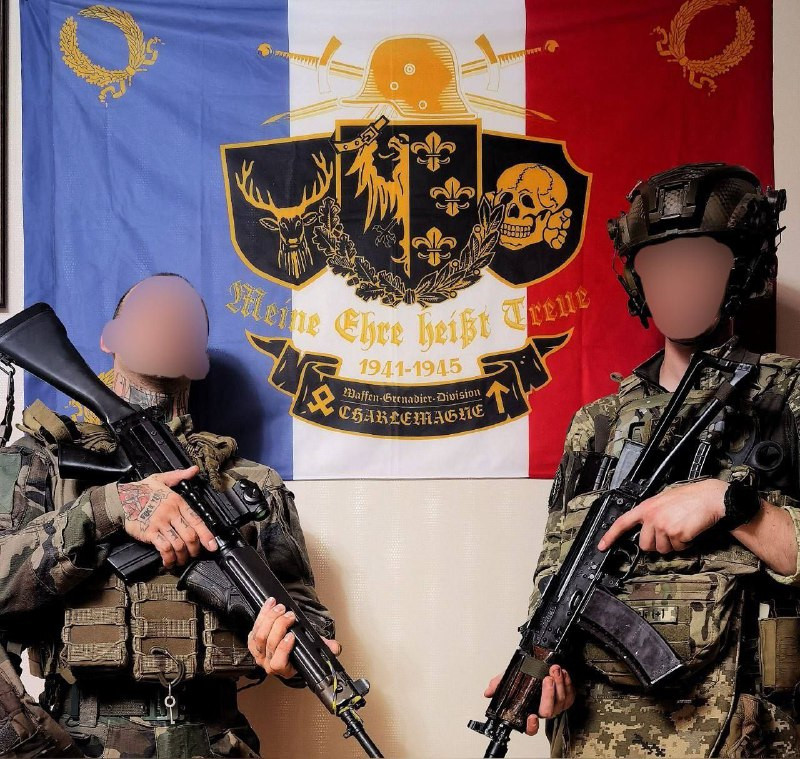
[mon illustration : le 4 avril 2025, la confrérie nazie internationale Misanthropic Division, fondée et basée en Ukraine depuis 2013, publie cette image pour promouvoir son drapeau en hommage à la 33. Waffen-Grenadier-Division der SS, Charlemagne. Les deux volontaires français dans las rangs atlantistes en Ukraine sont Guillaume Andreoni, à gauche, ainsi qu’Alan Vigneron, à droite (réseaux sociaux)]
MOSCOU, 13 août. /TASS/. Le flux de mercenaires français à destination de l’Ukraine est en baisse constante depuis 2022 et pourrait désormais se stabiliser au niveau de 2024. C’est ce qu’a déclaré le capitaine à la retraite Nicolas Cinquini, ancien policier et ancien officier du renseignement antiterroriste français, dans une interview accordée à TASS
En coopération avec le club international de renseignement open source TrackANaziMerc, nous n’avons identifié qu’une partie des Français en uniforme dans les rangs atlantistes en Ukraine. Cet échantillon nous permet d’observer véritablement les changements […] il semble que le recrutement soit en baisse constante depuis 2022. Il pourrait se stabiliser aujourd’hui au niveau de 2024. Cette tendance reste à confirmer
a-t-il déclaré.
Selon l’expert, il a identifié un total de 108 combattants français depuis 2014. Leur nombre réel est bien sûr plus élevé, a-t-il précisé.
51 sont toujours en service. Les autres ont été tués ou démobilisés
Lors de mon entretien avec le journaliste de l’agence TASS, nous avons également abordé la question des motivations de ces combattants français dans les rangs atlantistes en Ukraine. À ce sujet, j’ai ajouté
Au fil de mon analyse par feuille de calcul, le taux de fascistes augmente, d’environ 33 % en 2023 à 44 % cumulés à ce jour. Je pense que les romantiques, dont l’engagement avait été déterminé par la propagande des médias français sur «la liberté et la démocratie », se font rares. Les dernières recrues apparaissent sur les réseaux sociaux comme des militants fascistes / nazis convaincus. Lorsqu’ils sont interrogés par des journalistes ukrainiens ou français, ils dissimulent bien sûr leur bagage idéologique, expriment leur volonté de «défendre l’Europe contre la Russie »
chronique alphabétique et nécrologique de l’engagement français dans les rangs atlantistes en Ukraine, ce que les journalistes serviles ne vous raconteront pas
Abstract: This study analyses the nature and extent of involvement by neo-Nazi and other far-right Ukrainian organisations in the Donbas war (2014-2022) and the Odesa massacre (2014). This issue is highly politicised with contrasting narratives. The Russian and Donbas separatist governments, as well as their media, have contended that Ukraine has been a Nazi or neo-Nazi regime since a fascist coup took place in 2014, while Ukrainian and Western governments and media have maintained that such elements in the Ukrainian far-right were marginal, trivial, even non-existent. The article interrogates the historical record with primary sources in the three most relevant languages—Ukrainian, Russian, and English. The investigation reveals crucial far-right involvement in both the early stages of the war in Donbas and the Odesa massacre. Although the percentage of far-right supporters and fighters in Ukraine was relatively small, they exercised disproportionate influence in the country due to their greater reliance on violence and armed formations. The Russian government, however, exaggerated the role of the neo-Nazis in Ukraine to publicly justify the illegal invasion in February 2022.
Introduction
This study analyses the nature and extent of involvement by neo-Nazi and other far-right Ukrainian organisations during both the Donbas war from its start in April 2014 until the Russian invasion in February 2022 and the Odesa massacre on 2 May 2014. Other than the Maidan massacre in February 2014, these were the most significant and contested cases of political violence in Ukraine from its independence in 1991 to the commencement of the Russia-Ukraine war on 24 February 2022.1 The role of far-right Ukrainian groups during these major episodes of political violence is controversial because they are beset by duelling, self-serving narratives. Russian President Vladimir Putin has claimed that the principal goal of the invasion is to “denazify” Ukraine.2 But well before Russia’s invasion of Ukraine in 2022, there have been several overt and covert Russian military interventions here, including the annexation of the Crimean peninsula and direct support for pro-Russian insurgencies in the Donbas region, particularly in August 2014 and February 2015. Following the overthrow of the pro-Russian Ukrainian government in February 2014, the United States and other Western governments have consistently opposed Russia’s interventions and backed the current central government of Ukraine. In addition to political support, financial and military assistance has been provided, including training during the Obama presidency.3 To justify this support, the US and other Western governments disputed any real power or even the existence of neo-Nazi armed formations in Ukraine or claimed that they abandoned their far-right elements. Understanding the contested issue of far-right involvement in the Donbas war (2014-2022) and the Odesa massacre (2014) is valuable not only for elucidating intrinsically important historical episodes of political violence but also due to the contemporary relevance given the ongoing Russia-Ukraine war.
This article proceeds in five sections. The first section highlights the contribution of our study by describing the weakness of the extant academic literature and our methodological approach to filling in important lacunae in the research landscape. The second section details the duelling of contemporary narratives over the political violence by the far-right in the war in Donbas and in the Odesa massacre. The third and fourth sections develop qualitative case studies with process tracing to illuminate the role of the far-right in the Donbas war and the Odesa massacre. The fifth section presents the conclusion.
Developing the Extant Literature
Research on the far-right in Ukraine since the Euromaidan has been spotty. Studies on neo-Nazi and other far-right organisations in Ukraine following the Euromaidan have been limited in quantity, quality, and scope. Most studies have been produced by researchers outside academe in partisan think tanks or non-government organisations, as well as by journalists who did not subject their work to peer review.4 Such assessments are more likely to be politically driven and less likely to exhibit methodological rigour, even professionalism. For example, Anton Shekhovtsov, the former leader of the Crimean branch of the pro-Russian far-right Eurasian Youth Union, likened the Trade Union building arson attack during the Odesa massacre on 2 May 2014, to his killing of Colorado potato beetles by collecting them in a box and burning them alive. He directly inferred that this was a massacre with far-right involvement but omitted this in his publications.5 Other works have relied on narrow metrics such as the vote-share of far-right parties in Ukraine, without assessing the violence itself in terms of the perpetrators and effects.6 Some researchers have claimed that the presence of Russian speakers in the Azov regiment and other neo-Nazi-led armed formations is evidence of their relative tolerance and asserted that the Azov regiment had moderated by abandoning its far-right roots.7 Such analyses have tended to uncritically rely on Ukrainian and Western government narratives, accepting their claims at face value.
By contrast, other studies suggest a greater degree of far-right involvement in Ukrainian political violence. One quantitative study found that far-right groups in Ukraine, such as Svoboda and Right Sector, fielded the most violent perpetrators and committed the lion’s share of attacks.8 That study is restricted temporally, however, to the 2014 Maidan protests, which led to the violent overthrow of the relatively pro-Russian government and ultimately spiralled into the civil war in Donbas, the Russian annexation of Crimea, and Russian military interventions in these regions of Ukraine.9 Similarly, qualitative studies have presented evidence in the form of videos, eyewitness testimonies, confessions, and forensic examinations of Svoboda and Right Sector involvement in the Maidan massacre.10 Some other studies have focused on specific aspects of the far-right paramilitary and other armed formations during the war in Donbas.11 One academic publication is specifically devoted to the Odesa massacre, which is called “The Odesa Tragedy,” though it concentrates on the public perceptions rather than the perpetrators and their consequences.12 This list of prior works is intended to be illustrative rather than exhaustive. The research landscape around these issues is growing, but uneven in scope and reliability; a lacuna remains in the literature in terms of evaluating rigorously, comprehensively, and dispassionately the nature and extent of far-right involvement in the Donbas war and Odesa massacre, which matters in terms of our understanding of the Russia-Ukraine conflict and political violence more generally.
To elucidate this understudied topic of the far-right in Ukraine, this study makes substantial use of primary source materials in Ukrainian and Russian—the main languages in Ukraine—as well as in English. This linguistic capability is conducive to a more nuanced, accurate assessment. Methodologically, the two case studies employ qualitative process tracing with the benefit of fluency in all three languages.13 The substantive focus and period of analysis are both tightly bounded; the role of the far-right on the Russian side and in the Russia-Ukraine war since February 2022, as well as during the Euromaidan, are weighty topics explored in our other works but fall outside the scope of this study.
The term “far-right” denotes ultranationalists and both racial and ethnic supremacists in accordance with prior scholarship.14 The term “neo-Nazi” refers to far-right organisations that revamp elements of Nazi ideology, particularly its racial and ethnic supremacism, and use symbols associated with Nazi Germany or their stylised versions. As with Nazis, neo-Nazi organisations represent a form of fascism. Major neo-Nazi organisations in Ukraine during the time period covered by this study include the Social-National Assembly, its paramilitary wing Patriot of Ukraine, the National Corps, the White Hammer, and C14. Also included in the analysis are paramilitary and other armed formations organised and led formally or informally by these neo-Nazi organisations, such as the Azov battalion and regiment. Admittedly, militant groups are known to exhibit ideological heterogeneity.15 Within the political violence literature, a burgeoning area of research emphasises that members of the rank-and-file may be motivated by a variety of factors that diverge from the leadership, leading to a principal-agent problem.16 In this study, we classify organisations as neo-Nazi, or at least neo-Nazi-led, when commanders are neo-Nazi, even if not all members can be presumed to share this exact ideology.
A prominent example is Andriy Biletsky, the leader of Patriot of Ukraine and the Social-National Assembly (SNA), both of which were transformed along with the Azov battalion and regiment veterans into the National Corps Party in 2016. He called the ideology of Patriot of Ukraine and SNA “Social Nationalism.” In a collection of his articles published in 2013, he described that social nationalism, as the name suggests, combines elements of ultranationalism of the Organisation of Ukrainian Nationalists with elements of national socialism and called both radical nationalism and national socialism “great ideas.” He wrote that social nationalism is based on “Sociality, Racism, and Great Power.”17 Specifically, it is based on the ideas that the “white race” is “superior” to other races and is the foundation of the Aryan Ukrainian nation; the Ukrainian nation is a “blood-racial community”; and that “the historical mission of our Nation (…) is to head and lead the White Peoples of the world in the last crusade for their existence, a march against the Semitic-led subhumans.”18 Biletsky openly made antisemitic and racist statements, such as his claim that the Jew is “an economic and political parasite.” He saw “a serious clash of native European peoples with foreign colonisers, mainly of African and Muslim origin” and believed that “an ethnic civil war can be won by the native Europeans only under the banner of the New Right National Revolutions.”19
Biletsky was called the “White Leader” and his writings were published by both SNA and Patriot of Ukraine. He was the first commander of the Azov battalion, which was organised and led by Patriot of Ukraine and SNA in May 2014. Patriot of Ukraine, SNA, and the Azov battalion all used a symbol resembling a stylised swastika and Wolfsangel. Azov commanders and their historian, who himself serves in Azov, called the symbol the “Idea of the Nation” and claimed that it is an ancient Ukrainian symbol, even though it was created in 1992 for the Social National Party of Ukraine (SNPU). The creator of this symbol acknowledged that it was called “Idea of the Nation” to represent the radical nationalist ideas of the Organisation of Ukrainian Nationalists (OUN). He also admitted that SNPU deliberately chose this symbol with the Latin letter N, instead of the equivalent Ukrainian Cyrillic letter, fully aware of its resemblance to Nazi symbols and association with the swastika for many Ukrainians, in particular in Lviv. As with other extremist groups that rebrand out of political expedience, the Social National Party of Ukraine changed its name to Svoboda in 2014, because the Nazi association was politically inconvenient.20 However, this symbol was retained by the SNA and by Patriot of Ukraine, whose Kharkiv branch split from SNPU because of these changes.21 The Azov battalion and its propaganda magazine, which was named Black Sun, also used the Black Sun symbol, an ideological symbol used by Nazis and various neo-Nazi organisations. In addition, groups and individuals—including Patriot of Ukraine, SNA, National Corps, and Azov battalion and regiment leaders, commanders, and members—have displayed on their uniforms various neo-Nazi and Nazi symbols, such as the swastika, the SS sign, and 88 (Heil Hitler code). These, along with Hitler images, Nazi flags, and Totenkopf have also been seen in the form of patches, photographs, flags, and tattoos.
Although the term far-right incorporates both ultranationalist and neo-Nazi organisations, they are not ideologically identical despite their frequent overlap. This study empirically investigates the role of Ukrainian ultra-nationalist organisations such as Svoboda, the Right Sector, the Ukrainian National Assembly–Ukrainian People’s Self-Defence (UNA-UNSO), and Bratstvo; neo-Nazi organisations such as the Social-National Assembly, Patriot of Ukraine, the White Hammer, and C14; and various other paramilitary formations, special police forces, and National Guard units organised and controlled to various extents by them. These armed units include the Azov battalion and regiment, Dnipro, Donbas, Aidar, Sich, Carpathian Sich, OUN, and St. Mary’s battalions, and the Ukrainian Volunteer Corps. To assess these actors, this study analysed thousands of Russian and Ukrainian primary sources: online recordings of live broadcasts, videos of the armed conflict in Donbas and Odesa, and information posted on websites and social media by far-right organisations, their armed units, and activists. It also analysed media reports in Ukrainian, Russian, and English from diverse outlets such as Ukrainska pravda, Strana, BBC, The Guardian, The Washington Post, The New York Times, YouTube, Telegram, V Kontakte, Facebook, and Twitter. To mitigate bias, the authors analysed the primary source materials rather than relying on secondary interpretations.
The Conflicting Narratives
Assessments of the far-right in Ukraine have been wracked by self-serving and thus unreliable perspectives. Russian and separatist leaders, as well as the media, have described the post-Maidan violence in Ukraine, especially in Donbas and Odesa, as perpetrated by “fascists” and “Nazis” akin to genocidal massacres against Jews, Belarusians, Russians, and Ukrainians during the Holocaust and World War Two.22 They often called the Odesa massacre the “Odesa Khatyn,” a reference to the large-scale massacre of Belarusian villagers in 1943 by the Nazis and an auxiliary police battalion, which was based on a paramilitary formation of the Melnyk faction of the Organisation of Ukrainian Nationalists. Based on this narrative, President Putin and his allies have claimed that invading Ukraine is not only justified, but “inevitable” to counter the “Nazi” or “Neo-Nazi regime” in Kyiv.23 Putin and his government thus declared the “de-Nazification” of Ukraine as a key goal of “the special military operation” launched in February 2022.24 This perspective—in its entirety—is widely assailed in the West.25
By contrast, the Ukrainian and Western governments and the media tend to claim that the far-right—including neo-Nazis—is marginal, even non-existent in Ukraine.26 They argue that since Euromaidan, Ukrainian fighters have almost entirely—if not entirely—shed their far-right elements, particularly neo-Nazi. To this end, it is a common point that the Azov Battalion ceased to be led by the neo-Nazi Patriot of Ukraine, a paramilitary wing of the SNA, since integrating into the National Guard as one of its regiments. Kyiv has stressed that the integration of Azov in November 2014 is proof of its transition to moderation and the absence of extremist fighters post-Maidan.27 Ukrainian President Volodymyr Zelensky awarded “Hero of Ukraine” titles in 2022 to prominent Azov leaders such as regiment commander Denys Prokopenko, deputy commander Sviatoslav Palamar, and senior officer Oleh Khomenko.28 After the commencement of the Russia-Ukraine war in February 2022, many Western media outlets, politicians, government officials, and academics adopted this stance that Azov and other controversial Ukrainian fighters on the far-right had not only abandoned extremist elements, but were heroes against Russia’s illegal invasion.29
The Indexing Theory of political communications emphasises that Western media follow narratives of its governments in covering foreign conflicts, including in post-communist countries.30 In some cases, Western media may have taken their cues directly from the Ukrainian government. After the Odesa massacre on 2 May 2014, the Foreign Ministry of Ukraine blamed the arson attack on provocateurs that were “paid generously by the Russian special services”, and the New York Times immediately adopted the same line that pro-Russia groups may have been responsible for torching the building.31 The Western narrative of the far-right in Ukraine since the Euromaidan is not without controversy. Volodymyr Ishchenko, a Ukrainian sociologist who specialises in the far-right in Ukraine, concludes: “The dominant narrative since Maidan in Ukrainian and much of the Western public spheres has been systematically downplaying the problem” by arguing that “the Ukrainian far-right” is “small and marginal.” He stated that “often, the far-right is just ignored.”32
Notably, Western concerns over far-right fighters in Ukraine were more prevalent before the February 2022 invasion. For example, The Nation described Azov in 2018 as “pro-Nazi, as evidenced by its regalia, slogans, and programmatic statements.”33 In 2019, Radio Free Europe called Azov “far-right.”34 In 2020, The Guardian referred to Azov as a “neo-Nazi extremist movement.”35 Consistent with Indexing Theory, such coverage of the neo-Nazis in Ukraine before the February 2022 Russian invasion overlapped with similar expressions by Western governments. In its 2018 Human Rights report, the US State Department called the political wing of the Azov Regiment “a hate group.”36 In 2019, ambassadors from G7 countries warned against “extreme political movements in Ukraine, whose violent actions are worrying in themselves.” The warnings referred specifically to the Azov movement and its violence during the 2019 presidential elections.37 The US Congress has displayed longstanding ambivalence over its designation of Azov. In 2018, forty Congress members signed a letter to the State Department with the request to designate Azov as a terrorist organisation because of its links to terrorist attacks in multiple countries and its recruitment of neo-Nazis in its ranks.38 A defence appropriations bill amendment was adopted by the entire US Congress in 2018, which banned US government funding and training of the Azov regiment due to concerns over its neo-Nazi views and members. Such concerns had been expressed by American officials for several years after the Euromaidan. The amendment was first unanimously adopted by the US House of Representatives in 2015. Congressman John Conyers put it bluntly, “I am grateful that the House of Representatives unanimously passed my amendments last night to ensure that our military does not train members of the repulsive neo-Nazi Azov Battalion.”39 Under pressure from the Pentagon, however, Congress subsequently removed this first amendment. A similar amendment, proposing a ban on US military assistance to radical nationalist and neo-Nazi organisations, voluntary police, and paramilitary formations under their command, was blocked in Congress in 2014.40
In general, however, American and European governments have been careful not to issue public statements against the far-right in Ukraine or to call attention to it. This hesitancy began after the Euromaidan and became starker following the February 2022 Russian invasion. Indeed, Western governments and media increasingly whitewashed the empirical record to present the Ukrainian far-right formations as categorically moderate in order to boost international support. In June 2024, the US State Department stated that the Azov brigade was eligible to receive US weapons under the “Leahy Law” because it was cleared of human rights violations. It made this determination after claiming that the Azov brigade is a new unit that is not subject to the previous Congressional ban, even though in reality this brigade was created on the basis of the Azov regiment, celebrated the 10th anniversary of the Azov battalion creation as its own anniversary, and is led by original Azov battalion commanders.41 However, a subsequent amendment, which was included in the US defence bill which was passed by the US House of Representatives, specifically stated that “none of the funds appropriated or otherwise made available by this Act may be used to provide arms, training, intelligence, or other assistance to the Azov Battalion, the Third Separate Assault Brigade, or any successor organisation.”42
Such instrumental portrayals of allies are not limited to this conflict. Other recent cases of political violence have also featured public relations campaigns by governments and media to present allies as arguably more moderate than their history and contemporary ideology indicate. For example, in the Syrian war, anti-Assad jihadist organisations allied with the West were euphemistically referred to as “rebels,” sometimes “moderate” ones, even when they fought under the direction of a Foreign Terrorist Organisation, as designated by the US State Department.43 A large body of literature within terrorism studies has found that the labelling of violent perpetrators by governments and media is not value-neutral, but expedient to serve political agendas.44 Particularly in these controversial cases of political violence, academe can play an important role in interrogating the empirical record to adjudicate the truth.45
The Far-Right in the Donbas War
Research within the field of terrorism studies has repeatedly noted the difficulty of determining the ideological beliefs of participants in political violence.46 However, fine-grained knowledge of the organisations can substantially increase confidence. Svoboda and the main organisations that remained within the Right Sector after the Euromaidan were widely understood as far-right for maintaining ultra-nationalist and ethnically supremacist views. They openly described themselves as the natural successors of the Organisation of Ukrainian Nationalists (OUN) and the Ukrainian Insurgent Army (UPA), inspired by the notorious OUN leader and Nazi collaborator, Stepan Bandera.47 Along with the UNA-UNSO, these organisations used the “Glory to Ukraine! Glory to the Heroes!” slogan, the official greeting of the Bandera faction of the OUN (OUN-B). This greeting, along with a fascist-style hand salute, was modelled on greetings and salutes of other well-known fascist parties in European history, from the Nazi party in Germany to the Ustashe party in Croatia.48 The Right Sector also adopted its red and black flag from the OUN-B and the UPA, which symbolized Ukrainian blood and soil, which were also pervasive in Nazi ideology and flags.49 But the existence of these symbols alone offers weak evidence of far-right influence in the Donbas war without understanding the cultural and historical context.
The violent overthrow of the Viktor Yanukovych government by means of the Maidan massacre triggered the resurgence of separatism in Donbas.50 After his overthrow in February 2014, far-right parties and organisations in Ukraine expanded and organised their armed formations. Along with Ihor Kolomoisky, an oligarch who became the head of the Dnipropetrovsk regional administration, the Right Sector was instrumental in the formation of the Dnipro battalion in the spring of 2014.51 The Azov battalion, notorious for its use of neo-Nazi symbols in its official insignia, was also organised in the spring of 2014 and led by the SNA and the Patriot of Ukraine with the involvement of the Radical Party. As mentioned, “White Leader” Andrii Biletsky was the first commander of Azov.52 Based in Mariupol, the St. Mary’s battalion was formed in the fall of 2014 and led by the far-right Bratstvo party, which is described by its leader (Dmytro Korchynsky) as the “Christian Taliban.”53 Around this time, the Aidar battalion, nominally subordinated to the Ministry of Defence of Ukraine, was formed by the Maidan Self-Defence. One of its platoons was led by the White Hammer, a neo-Nazi organisation belonging to the Right Sector during the Euromaidan. Ilia Kiva, a Right Sector member, was the commander of another volunteer police battalion. A previously convicted criminal with a swastika tattoo became the commander of the Tornado Company, a special police unit. He and seven other members of his company were arrested and convicted for various crimes in the warzone, such as torturing detainees. A Nazi-style flag with a swastika was found in their prison cell.54 These units were all under the formal jurisdiction of the Ministry of Internal Affairs, the National Guard, or the Ministry of Defence. From the start of their formation, they remained under de facto command of radical nationalist or neo-Nazi organisations. These armed formations sprouted up in the early stages of the conflict in Donbas and were stationed there in an attempt to suppress pro-Russian separatism in the region by force. The Right Sector and the Organisation of Ukrainian Nationalists actively organised various militia and paramilitary units that were not subordinate to the central government of Ukraine. The Volunteer Ukrainian Corps, the largest paramilitary formation, was formed and led by the Right Sector specifically for the war in Donbas, though it also included battalions in Western Ukraine.55
The paramilitary formations, special police, and National Guard units, organised and led by far-right organisations such as the Right Sector, the Social National Assembly, Patriot of Ukraine, Svoboda, C14, and Bratstvo, constituted a small minority of Ukrainian fighters in the Donbas. Based on reports, we estimate the number of members of radical nationalist and neo-Nazi organisations who served in various far right-led, regular, and other armed formations in the Donbas, at around five thousand. This estimate is conservative and represents just one percent of approximately 400,000 people who participated in this war on the side of the central government.56 Additional metrics of influence, however, are also important to consider.
Despite their relatively small numbers, far-right fighters exercised disproportionate influence in the Donbas civil war, particularly in the early stages before the first direct Russian military intervention in August 2014. Far-right Ukrainian groups proliferated after the Euromaidan because they were eager to fight and were responsible for a disproportionate level of violence, especially against civilians and prisoners of war in Mariupol and Krasnoarmiisk. Far-right organisations and far-right-linked battalions thus played a crucial role in escalating the armed conflict in the Donbas. Svoboda and C14, an avowedly neo-Nazi group affiliated with Svoboda until the summer of 2014, organised and led the Sich battalion from June 2014 onwards.57 Meanwhile, the Right Sector carried out a deadly attack on a separatist checkpoint in Sloviansk on 20 April 2014. While Ukrainian and Western media denied far-right involvement in these events, the evidence to the contrary includes business cards linked to far-right members found after the attack. As well, Ukrainian court proceedings revealed that the weapons used by the Right Sector checkpoint attackers were the same as the snipers from this group who killed and wounded police during the Maidan.58 And two years after the attack on the separatist checkpoint, Dmytro Yarosh—the leader of the Right Sector—admitted his personal involvement in thisattack.59 Oleksandr Turchynov, then acting president of Ukraine, and Kolomoisky’s deputy in the Dnipropetrovsk regional administration, reportedly orchestrated this Right Sector operation, aimed to seize and destroy a television transmitter near Sloviansk, several days after this area was seized by the Strelkov-led armed group of Russian nationalists and Ukrainian separatists.60 This attack by the Right Sector constituted a major escalation of the conflict in Donbas because it broke both the Geneva Agreement signed on 17 April 2014 by Ukraine, Russia, the EU, and the US for a peaceful resolution of the conflict, as well as the Orthodox Easter truce between the Ukrainian government and separatists in Donbas.
Far right-led armed formations were also behind many other violent attacks in the Donbas, further escalating the conflict into a civil war. Videos, media reports, and admissions from commanders and other members of the Azov and Dnipro battalions indicate that they participated in the storming of the district police headquarters in Mariupol on 9 May 2014. Approximately ten people, including at least one protester, were killed.61 Analysis of online video streams, media reports, and Ukrainian government documents, also make clear that Azov played a major role in taking back the city of Mariupol from the control of separatists in June 2014.62 The Dnipro battalion, along with other units, seized civilians in the Donetsk Region to prevent the separatist referendum on 11 May 2014. Videos show them shooting unarmed pro-separatist protesters with Kalashnikovs, killing two locals. The Ukrainian government denied the presence of the Dnipro battalion, but it was confirmed by other credible sources, including admissions by battalion members in videos, like Volodymyr Parasiuk’s statement on social media, who became the People’s Deputy of Ukraine.63
The far-right-led armed formations perpetrated a disproportionate amount of violence in the first few months of the Donbas conflict and thus played a major role in escalating it into a larger civil war because the radical nationalist and neo-Nazi-led groups were far more willing to use force at that time. The Ukrainian armed forces, the security service, police and National Guard units were more reluctant to use force against the separatists in Donbas because their commanders and members were publicly blamed by the new government for attempting to forcefully suppress the Maidan protests—and in particular, for the Maidan massacre. Because the new Maidan government came to power through violence, which included the killing of police and protesters, it lacked legitimacy among many military, police, and SBU members in the Donbas region during this initial period of the conflict. Further, compared to the newly ascendant far-right groups in the aftermath of Euromaidan, the regular Ukrainian armed forces, the security service, the police and National Guard units were known for lower morale and higher desertions. Examples of this included the Donetsk SBU Alfa commander and Luhansk Berkut members, who joined the separatists.64
The relative role of the far-right in the political violence was not constant; it began to decline in the Donbas when newly elected president Petro Poroshenko ordered the Ukrainian military, SBU, police, and National Guard to wield lethal force against the separatists and launch the offensive in June 2014.65 The war was most intense and violent in 2014 and 2015, but the fighting declined significantly following the Minsk Agreements in 2015. However, ultra-nationalist and neo-Nazi fighters continued to exert a non-trivial role, even after the Ukrainian military intensified its operations in Donbas and purported to moderate the far-right fighters. After its formal incorporation into the National Guard of Ukraine, the Azov regiment and its commanders maintained a close organisational and ideological relationship with the neo-Nazi National Corps party. This party was formed by the Azov battalion founder and the first commander on the basis of neo-Nazi SNA and Patriot of Ukraine, and it included many Azov battalion and regiment veterans. The Azov regiment functioned as a military wing of the National Corps, which, in essence, represented overlapping elements of the same Azov movement.66 Indeed, Azov regiment commanders shared a neo-Nazi background and had served in the neo-Nazi-led Azov battalion.67 In other words, the rebranding from “battalion” to “regiment” did not alter the key personnel.68 For example, Azov regiment commander Denys Prokopenko was a member of the neo-Nazi White Boys Club, which was formed by the ultras of the Dynamo Kyiv football club. This group of ultras displayed various Nazi symbols and the Nazi salute on their social media and during football games. His Azov battalion platoon had used the Totenkopf insignia of the Nazi SS.69 Andriy Biletsky became the commander of the Third Assault Brigade, which was created by veterans of the Azov battalion and regiment and activists of his neo-Nazi group, the National Corps.70 In 2023, he stated in an interview with Ukrainian media that the united Azov movement included this Azov brigade under his command along with the Azov regiment and the Kraken unit.71 Such admissions in Ukrainian media highlighting enduring far-right allegiances seldom make their way into the Western press.
Importantly, Azov commanders never publicly renounced their neo-Nazi views, symbols, and organisations. In fact, Azov leaders routinely denied in media interviews that they, their units, and organisations, were neo-Nazi, claiming that the well-documented Nazi symbols were fakes or Russian propaganda. Our research of Ukrainian social media as well as other researchers of the far-right in Ukraine, such as Lev Golinkin and Moss Robeson, have identified over one hundred cases of Nazi and neo-Nazi displays by at least several hundred Azov commanders and other members from 2014 to 2022. This number includes displays on uniforms, patches, photographs, flags, and tattoos of neo-Nazi and Nazi symbols, such as the swastika, SS sign, 88 (Heil Hitler code), Hitler images, Nazi flags, and Totenkopf, and a fascist hand salute.72 The continued relevance of far-right extremism in Azov was evident at the very top. Arsen Avakov, the Minister of Internal Affairs, was personally involved in the Azov battalion formation and its later expansion to a regiment.73 President Petro Poroshenko circulated photographs awarding Ukrainian national medals and commendations to some of the most well-known neo-Nazis in Azov.74 The Nazi connection to Azov was clearly not due to a loss of agency control.
Amnesty International and Human Rights Watch reported that Azov was involved in many cases of torture, illegal detention, and disappearances during the war in Donbas.75 The impact of these far-right organisations cannot be measured strictly in terms of the direct physical effects, as terrorism researchers have emphasised in many other contexts.76 Ultra-nationalist and neo-Nazi organisations were instrumental in blocking or “spoiling” a peaceful resolution of the armed conflict in Donbas, another well-established source of leverage for extremists.77 Far-right groups such as the Right Sector, Svoboda, and the Radical Party opposed the adoption by the parliament of Constitutional amendments based on provisions from the Minsk Agreements.78 To this end, Svoboda activists launched a grenade attack on 31 August 2015 in front of the Ukrainian parliament, killing four and wounding dozens of policemen and National Guard troops, which helped to block these amendments, undercutting the logic of implementation.79
Far-right groups also challenged the implementation of President Volodymyr Zelensky’s electoral promise to peacefully resolve the Donbas war.80 In October 2019, Zelensky travelled to a front-line position in Donbas to personally convince the Azov fighters to stop blocking the implementation of the Minsk agreements by withdrawing along with separatist troops from the frontline, as he agreed during the summit with Putin and German and French leaders in Paris. But video of the encounter shows that Zelensky was taunted by activists of this neo-Nazi organisation who flouted his appeal.81 According to the Associated Press, thousands of far-right and nationalist activists shouting the far-right OUN and UPA slogan “Glory to Ukraine. Glory to the Heroes” marched through Kyiv protesting against a peace plan for eastern Ukraine.82
The radical flank threatened Zelensky for implementing Minsk on other occasions as well. In May 2019, Dmytro Yarosh, the former Right Sector leader, publicly threatened to hang the new Ukrainian president on a tree if he fulfilled his election promise of a peaceful resolution of the conflict in Donbas.83 In 2021, Yarosh, the commander of the Ukrainian Volunteer Army organised by the Right Sector, was appointed Adviser to the Commander-in-Chief of the Armed Forces of Ukraine, Valerii Zaluzhnyi.84 In the same year, videos, photos, and Ukrainian media reports show police standing down while neo-Nazi and other far-right protesters attacked the Office of the President of Ukraine and painted swastikas on its walls.85 The Russia scholar Stephen F. Cohen concluded that Zelensky “can’t go forward with peace negotiations” because “crazy fascist movements” in Ukraine “literally threatened his life.”86 Although far-right peace rejectionists posed political problems for Zelensky, they were also known to work closely with him. An activist of the neo-Nazi Patriot of Ukraine and former deputy commander of the Azov regiment was appointed the acting head of the National Police of Ukraine during the Poroshenko presidency and then became a deputy minister of Internal Affairs during the Zelensky presidency.87 Prime Minister Oleksii Honcharuk spoke at a “veterans party” organised by a front organisation for the neo-Nazi C14 with a stylised swastika of a neo-Nazi rock band behind him.88 The advisory council of the Ministry of Veteran Affairs under Zelensky retained activists of this neo-Nazi group, including those charged with assassinating the prominent opposition journalist, Oles Buzyna, in 2015.89
In sum, ultra-nationalist and neo-Nazi militant organisations were deeply involved on the side of the central government throughout the Donbas conflict. Although representing a small fraction of Ukrainian forces throughout the conflict, they committed a disproportionate amount of violence, particularly before President Poroshenko ordered the Ukrainian military to increase its use of force against the separatists in the summer of 2014. The much-touted absorption of Azov and other extreme right-wing militia under the official Ukrainian National Guard, police, and military command did not change either their command or their ideological displays. Many of the fighters worked closely with the Kyiv political leadership across administrations, when not using de facto veto power to block peaceful resolution of the conflict in this region.
This interpretation departs from others that rely strictly on vote-share as the proxy for far-right influence. The influence of the far-right in Ukraine after the Maidan far exceeded its electoral support and membership. Svoboda and Right Sector leaders each won only one percent of the votes in the snap presidential elections in May 2014. In the parliamentary elections of October 2014, Svoboda narrowly failed to clear the five percent threshold, receiving 4.7 percent. The Right Sector fared even worse, receiving only two percent of the votes. Ruslan Koshulynsky, one of Svoboda leaders, who was backed by the Right Sector, OUN, and C14, received only 1.7 percent of the votes in the 2019 presidential elections, while Svoboda won 2.2 percent of the votes in the 2019 parliamentary elections. These weak electoral results indicate the limited national support of the far-right in Ukraine, but not its outsized role in the Donbas conflict.
The Far-Right in the Odesa Massacre
Other than the Donbas war, the Odesa massacre was the most significant and deadly instance of political violence after the Maidan massacre in Ukraine since its independence in 1991 until the Russia-Ukraine war in February 2022. The violence took place on 2 May 2014, between a “United Ukraine” rally and pro-Russian separatists, carried out with petrol bombs, gunfire, and rock-throwing, which ended up killing 48 people, primarily separatist protesters.90 The vast majority of the fatalities took place in the Trade Unions House, where 42 separatist activists and employees (forty men, seven women, and one boy) were killed when the building was set ablaze.91
This massacre contributed to the escalation of the separatist conflict in Donbas into the civil war. As noted, the massacre was presented by separatist and Russian leaders and the media as akin to the Nazi massacre of Khatyn in Belarus, and many Odesa separatists joined the separatist forces in Donbas. Despite the importance of this massacre, the International Advisory Panel of the Council of Europe, among other international authorities, has noted that the Ukrainian government failed to properly investigate and prosecute those responsible.92 To ascertain the role of far-right groups in the Odesa massacre, a broad range of key information resources can be analysed, including videos and recordings of live broadcasts of the political violence (and the lead-up to it); published reports; primary source media in Ukrainian, Russian, and English; statements of responsibility; interviews; and testimonies from participants and eyewitnesses on both sides, as well as police commanders.
On 1 May 2014, the day before the mass violence, separatists protested in Odesa to demand a referendum on the newly installed government in Kyiv, which they blamed on far-right activists and Western interference.93 Based on testimonies from a special parliamentary commission report in the immediate aftermath of the May 2014 massacre, Ukrainian and regional government officials planned to use far-right activists and the Maidan Self-Defence to suppress the separatists in the Odesa region and disperse those who were encamped near the Trade Union building.94 Extensive evidence indicates that the police and firefighters were ordered by their superiors to stand by and not interfere during attacks. For instance, a special plan to deal with mass disturbances launched by the Odesa regional police was not authorised, reportedly because of decisions at the Ministry of Internal Affairs’ top level.95 Similarly, top regional officials of the police and other law enforcement agencies were ordered to attend a meeting with their national counterparts before and during the start of the clashes.96 The presence of Andriy Parubiy and five hundred Maidan Self-Defence members, who deployed from Kyiv to Odesa on the eve of the massacre, further suggests that the violent dispersal of the separatist camp by far-right activists was orchestrated by top government leaders.97 Parubiy was a founder and leader of the neo-Nazi Patriot of Ukraine, a paramilitary wing of the Social National Party of Ukraine in the 1990s. He was the head of the Maidan Self-Defence during the Euromaidan and headed the National Security and Defence Council at the time of the Odesa massacre. The State Bureau of Investigations of Ukraine launched a criminal investigation into Parubiy for the Odesa massacre soon after he was replaced as the ex-head of the Ukrainian parliament following the early parliamentary elections in 2019.98 One of the participants acknowledged in an Israeli documentary that he engaged in “provocations” in the Odesa massacre under the command of Parubiy, who had issued orders to attack the separatists and “burn everything.” We assess this acknowledgement as credible because he was filmed along with Maidan activists in the left wing of the Trade Union building in Odesa when the deadly fire began to burn the central entrance.99 He and five other Georgian ex-military members also stated in American, Italian, and Israeli TV documentaries, Russian media interviews, on Macedonian TV, in depositions to Berkut lawyers for the Maidan massacre trial, and in testimonies to the Prosecutor General Office of Belarus for the Prosecutor General Office of Ukraine investigation that their groups of Georgian, Baltic, and far-right-linked Ukrainian snipers received weapons, payments, and orders from specific Maidan and Georgian politicians, including Parubiy, to engage in a mass killing of police and protesters.100 The Maidan massacre trial subsequently confirmed their identities.101
A march led by the Right Sector and football ultras on 2 May 2014 was used as cover to implement this plan to destroy and burn the separatist tent camp.102 The SBU in the Odesa Region received advanced information about planned “provocations” and violent clashes between football ultras and pro-Russian separatists on game day between the Odesa and Kharkiv teams on 2 May. A special train transported hundreds of football ultras from Kharkiv to Odesa.103 Football ultras in Ukraine were notorious for displaying neo-Nazi symbols and expressing neo-Nazi slogans during games and have historically linked up with the Right Sector and other far-right organisations, as during the Maidan protests.104 Both the Right Sector and football ultras in Odesa and Kharkiv were dominated by the neo-Nazi Social National Assembly/Patriot of Ukraine, which organised the Azov battalion right after the Odesa massacre.
Odeska Druzhyna, a small separatist organisation in Odesa, was present among other separatist activists based on evidence from internet streams, videos, testimonies of participants and eyewitnesses, and special parliamentary commission reports.105 Odeska Druzhyna used identifiable red tape labels, and were not Right Sector agent provocateurs, as the Russian media and separatists claimed. However, the Ukrainian government and media also mischaracterised the involvement of Odeska Druzhyna by overstating its coordination with other separatist activists.106 The balance of forces was asymmetric; the groups of numerically superior activists of the Right Sector from Odesa and Kharkiv led by the neo-Nazi Social National Assembly/Patriot of Ukraine, far-right football ultras, and Maidan Self-Defence units from Odesa and other regions attacked the separatists. Numerically disadvantaged, the latter took cover behind a police cordon.107
An Odeska Druzhyna activist was filmed shooting in the direction of the far-right protesters with an AK-74-type assault rifle.108 The official investigation and the May 2 Group maintained that a Right Sector activist was killed by this separatist group member with a 5.45mm calibre bullet.109 However, leaked forensic medical expert reports describe a 5.65mm calibre bullet extracted from his body.110 This bullet reportedly disappeared and reappeared during the investigation. The fact that it did not match bullet samples of any legally registered firearms, the weak sound of the gunshots, as well as the lack of a recoil observed in the videos of the shooting, also suggest that the far-right protester may not have been killed by this separatist, who maintained that the weapon seen in the video was a movie studio prop.111 The killing of the Right Sector activist was not visible in that video nor in any videos of clashes. The investigation and various videos at the scene did not reveal the exact time or location of his killing, or the direction of the gunshot. An Odesa deputy police chief, who was filmed around the time of this killing before he himself was wounded, stated that he saw snipers in camouflage shooting from the second floor of a hotel there. He relayed that they killed this Right Sector activist and the second protester in order to blame the separatists for their killing and provoke a violent response against the separatists.112 Videos filmed before and after his shooting suggest that the second pro-Maidan activist was killed around the same time in the same area during the violent clashes with separatists and shooting from a Kalashnikov-type weapon by one of the separatists.113 However, the government forensic examination determined that he was killed by a bullet from a pneumatic sport-type weapon. Nobody was charged with his killing, and the moment and other circumstances of his killing remain not publicly known.114
In the clashes that followed the killings of these two pro-government protesters, four separatist protesters were killed and many other separatist protesters, policemen and at least one local journalist were wounded. The forensic examination determined that three separatists were killed with hunting ammunition.115 A pro-government activist was filmed shooting with a hunting rifle in the direction of these separatists.116 This pro-government activist was later identified by the Minister of Internal Affairs as a Right Sector member.117 The government investigation charged him with killing at least one of the separatists. However, he was released from arrest and his trial was suspended indefinitely because of threats by the Right Sector and other far-right activists against judges during his trial.118 Evidence—including a recorded phone call—revealed that the events on May 2nd were coordinated by the Odesa regional administration official in charge of law enforcement agencies, and involved the participation of the Maidan Self-Defence commander, Right Sector activists, football ultras, and Maidan Self-Defence units.119 They attacked and burned the tent camp of various separatist organisations, whose activists and supporters then escaped to the nearby Trade Union building and tried to barricade the main entrance doors. Videos, internet streams, and testimonies of eyewitnesses show that attackers threw Molotov cocktails and burning tyres at the main entrance, set the entrance doors on fire, and blocked other exits. Videos, recorded calls to firefighters, and eyewitness reports reveal that the fire and thick smoke started from those burning tyres and Molotov cocktails thrown at the main entrance.120 The evidence does not support claims that the separatist protesters killed in this incident were Russian citizens, that they burned themselves by throwing Molotov cocktails from the roof of the Trade Union building or inside of the building, or that there was no far-right involvement in their killing.
After initial denials, the May 2 Group admitted that the deadly fire started at the main entrance. The May 2 Group was a nominally independent association of mainly journalists, formed after the massacre supposedly to investigate it. It was created with the involvement of the Governor of the Odesa region who was appointed by Ukrainian President Petro Poroshenko within a week of the massacre.121 This governor represented not only the central government, but also the Kolomoisky’s oligarchic network, which financed the Right Sector volunteers from the Volyn Region in the Azov battalion and the Right Sector-led Dnipro battalion.122 The Azov battalion was organised by the neo-Nazi SNA and its paramilitary wing, Patriot of Ukraine, which dominated the Right Sector in Odesa and Kharkiv, a few days after the Odesa massacre. But the May 2 Group still claimed that it was impossible to determine who started the fire because both sides were throwing Molotov cocktails. However, there is no public evidence of Molotov cocktails being thrown by separatists at the main entrance; on the contrary, numerous videos feature the far-right protesters throwing Molotov cocktails and burning tyres into the Trade Union building at that time.123
Within Ukraine, far-right activists—particularly from the Right Sector and the SNA— were notorious for using tyres and Molotov cocktails to burn public buildings. Forensic examinations in the government investigation, recordings of radiocommunications by SBU Alfa group, an unpublished admission by a far-right activist to a French journalist, and an academic study determined that the Trade Union headquarters in Kyiv were burned by Maidan activists, including far-right ones, in order to stop its takeover by the Security Service of Ukraine Alfa unit.124 Far-right protesters also started fires by burning tyres in the Inter TV channel building and threatened to burn down the parliament of Ukraine, the Lutsk City Council, the Sviatoshyn District Court that heard the Maidan massacre case, the Constitutional Court, and Inter and 112 Ukraina TV channels buildings by placing tyres next to their entrances.125 Prior usage of the same tactics by the far-right increases the likelihood of their direct involvement.
Analysis of online video streams, government investigation findings, May 2 Group reports, forensic medical examinations, eyewitness testimonies, and other evidence strongly indicate that 42 people perished as a result of the fire, smoke, and from trying to jump from the upper floors of the Trade Union building with far-right activists beating them on the ground and blocking the exits.. The victims were unarmed and included mainly separatists, their supporters, and several employees, in particular women, who were in the building at the time.126 Some of the strongest evidence of far-right involvement in the arson attack comes from the far-right itself, in the form of credit claiming. A growing body of research within terrorism studies focuses on credit claiming. An important finding is that perpetrators are far more likely to deny responsibility for their attacks than to take credit for ones that they did not perpetrate.127 This is particularly true when the targets are civilians. Nonetheless, many extremist groups do claim credit for civilian attacks.128 Statements posted by the Right Sector, the SNA, and the neo-Nazi Misanthropic Division on their websites and social media sites admitted the involvement of their organisations in the massacre. The Right Sector celebrated on its website the massacre by describing it as “another bright page in our fatherland’s history.” Claiming responsibility for the slaughter, it wrote: “In the first minutes of the battle, the ‘Right Sector’ activist was seriously wounded in the stomach. Several more PS [Right Sector] activists received injuries of varying degrees of severity. However, this did not prevent the rest of the PS fighters, together with football fans, from repelling the attack of pro-Russian provocateurs, and as a result, they successfully countered attempts to seize buildings in Odesa. Standing shoulder to shoulder, Odesa activists, football fans and ‘Right Sector’ fighters defeated the forces of pro-Russian mercenaries. Order has been restored in Odesa.”129 The Right Sector—which was dominated in Odesa and Kharkiv by the Social National Assembly and its paramilitary wing, Patriot of Ukraine—and the neo-Nazi Misanthropic Division (which joined the Azov battalion after the massacre) admitted on the social media platform V Kontakte and in other public statements that the fire was set deliberately.130
The official investigation of the Odesa massacre was a farce. Nobody was found guilty of perpetrating this mass killing. As noted, the Right Sector shooter was initially arrested but then released. Only separatists were among those arrested and tried for the Odesa massacre. The Odesa massacre trial of separatists resulted in their acquittal by a local court. The Ukrainian court based its decision on the lack of evidence in support of prosecution charges. Even the verdict acknowledged both the weakness of the investigation into the perpetrators and the role of Parubiy and other government officials.131 The Council of Europe and the UN Special Commission reports also noted the destruction of evidence.132 A report by the special commission of the Council of Europe found that the Ukrainian government’s investigation of the Odesa Massacre was inadequate, politically selective, and featured the falsification of evidence, despite the existence of video footage showing who threw the Molotov cocktails at the building.133
The Ukrainian media cited SBU sources that a far-right activist, who headed the Right Sector in Odesa during the Odesa Massacre, was a secret agent of the Security Service of Ukraine (SBU) and that he and far-right associates were paid by SBU to attack opposition politicians, threaten judges, and conduct other illegal actions.134 This would be consistent with the fact that the Right Sector was not investigated for the Odesa massacre even though the Right Sector publicly admitted involvement. His secret collaboration with SBU would also be consistent with the fact that SBU and the Prosecutor General Office refused to charge him for killing another person in Odesa in 2018. Moreover, in 2020, the SBU gave this far-right activist the status of a victim in this case, even though he streamed this killing on his social media account and the police investigation determined that he was the killer.135 In this sense, the Odesa massacre was not entirely anomalous; it featured post-Maidan far-right involvement with apparent support from high-level political leaders in a corrupt country where investigations and media have inconsistently followed the evidence.
Conclusion
This study assesses the role of the far-right in post-Maidan Ukraine, specifically, in the Donbas war and the Odesa massacre. These were two of the biggest episodes of political violence in the country leading up to the February 2022 Russian invasion. This area of research is worth close investigation because it represents intrinsically important episodes of political violence that have not attracted objective analysis based on available primary sources in Ukrainian, Russian, and English. Investigating the role of the far-right is also timely because the far-right in Ukraine is riven by duelling, self-serving contemporary narratives.
The predominant narratives propagated by governments and the mainstream media in Ukraine, the West, Russia, and separatist-controlled Donbas, concerning the role of the far-right in the war in Donbas and the Odesa massacre, have evidently been partisan. Contrary to the Russian government, separatists, and associated media, the Ukrainian government and military are not Nazi or even neo-Nazi. There were no neo-Nazis among the upper echelon of the Ukrainian government. President Zelensky is certainly not a Jewish neo-Nazi. He tried to placate and mainstream the far-right for political reasons, but has no observable personal affinity to that extreme ideology.
Neo-Nazis constituted only about one percent of the Ukrainian forces before the Russian invasion in 2022, and there is weak electoral support for neo-Nazi parties throughout the country. Similarly, the policy of glorification of the OUN-UPA, their leaders, such as Stepan Bandera, and the adoption and use of their “Glory to Ukraine! Glory to the Heroes!” greeting by the state and the military, including Zelensky, do not make Ukraine a Nazi state. While the OUN and the UPA were far-right terrorist organisations, which collaborated with Nazi Germany and perpetrated the mass murders of Jews, Poles, and Ukrainians, they were not Nazis. Ukrainians could not join the Nazi party because Hitler and other Nazi leaders regarded Ukrainians as racially inferior and opposed independence of Ukraine while also dismissing the attempt to create even a puppet state by the Bandera faction of the OUN in Lviv shortly after the Nazi invasion of the Soviet Union. Thus, Putin cannot credibly justify the illegal invasion in February 2022 as a war to “de-Nazify” the “Nazi regime.”136 The power of the far-right and the glorification of the OUN and the UPA in Ukraine under Poroshenko and Zelensky were exaggerated and exploited by the Russian leaders to justify the invasion.
But the West’s efforts to whitewash the far-right in Ukraine also rests on empirically shaky grounds. Despite their relatively small numbers militarily and politically, the far-right in Ukraine exercised outsized power. The far-right organisations, volunteer battalions, and paramilitary units organised and led by them played, along with separatists and Russian nationalists, a significant role in starting and escalating the incipient civil war in the Donbas and then impeding its peaceful resolution. Even after technically integrated into the official Ukrainian forces, Azov and other far-right groups continued to harbour extremist views. Often brandishing the same extremist symbols, the core leaders and members remained and even ascended within the police, military, and security services during the Donbas war. Western media accounts have drawn heavily from biased Ukrainian sources, including “official” investigations and the May 2 Group. Across numerous primary sources in Ukrainian, Russian, and English, we find evidence that the Right Sector, Social-National Assembly, its paramilitary wing Patriot of Ukraine, and groups of far-right football ultras from Odesa and Kharkiv played a critical role in the Odesa massacre against separatist protesters on 2 May 2014. Neo-Nazi SNA/Patriot of Ukraine, which dominated the Right Sector in Odesa and Kharkiv, organised the Azov battalion right after this massacre.
Despite the lack of international consensus over the definition of terrorism, a common interpretation is the use of violence by non-state actors aimed at creating fear for political ends, particularly when the targets are civilians.137 Depending on one’s definition, some attacks within the episodes of political violence covered in this study, such as the Odesa massacre, could, therefore, arguably be classified as terrorism. What is clear is that neither of the duelling narratives accurately captures the role of the far-right. This study has helped to fill that research lacuna by making use of substantial primary source materials in Ukrainian, Russian, and English. Besides the Maidan massacre, the Donbas war and the Odesa massacre are the two most substantial episodes of political violence from the independence of Ukraine in 1991 to the February 2022 illegal Russian invasion [end]
Ivan Katchanovski is a Ukrainian and Canadian political scientist. He teaches at the School of Political Studies and the Conflict Studies and Human Rights Program at the University of Ottawa in Canada. He specialises primarily in politics, conflicts, political violence, and the far right in Ukraine. His academic publications include five books, 21 articles in peer-reviewed journals, and twelve book chapters.
Max Abrahms is a professor of public policy and political science at Northeastern University, where he specialises in international security. Abrahms has published extensively in leading academic and popular outlets such as International Organization, International Security, International Studies Quarterly, Security Studies, Comparative Political Studies, Harvard Business Review, Foreign Affairs, Foreign Policy, New York Times, Washington Post, USA Today, Newsweek, The Atlantic, and Los Angeles Times.
I disagree with the authors on two points
Stepan Bandera & friends were Nazis. How can the authors identify some neo-Nazis in modern Ukraine, while not regarding their historical mentors as Nazis ? Before WW2, they were praising either Adolf Hitler or Benito Mussolini. Their political project was authoritarian, racist and criminal. They were dreaming of ethnic cleansing. De facto during WW2, they committed mass killing of Jews and Poles.
Terrorism is not restricted to non-state actors. Terrorism is violent action to terror civilians, in order to achieve a common political goal. This is not even a value judgement, but Hiroshima bombing was terrorism. The Israeli targeting and mass killing of civilians, in the prospect of ethnic cleansing in Gaza, is terrorism.
chronicle of censorship, fake news, whitewashing of the Ukrainian Nazism and war crimes, for the sake of the proxy war that NATO is conducting in Donbass and Ukraine, against Russia
Endnotes
Arel, Dominique and Jesse Driscoll. 2023. Ukraine’s Unnamed War. Before the Russian Invasion of 2022. Cambridge: Cambridge University Press; Black, J.L. and Michael Johns (Eds.). 2016. The Return of the Cold War: Ukraine, the West and Russia. Abingdon: Routledge; Hahn, Gordon M. 2018. Ukraine Over the Edge: Russia, the West and the “New Cold War.” Jefferson, NC: McFarland Books; Katchanovski, Ivan. 2016a. “The Separatist War in Donbas: A Violent Break-up of Ukraine?” European Politics and Society, 17 (4), 473-489; Kudelia, Serhiy. 2016. “The Donbas Rift.” Russian Politics & Law, 54 (1), 5-27; Pikulicka-Wilczewska, Agnieszka and Richard Sakwa (Eds.). 2015. Ukraine and Russia: People, Politics, Propaganda and Perspectives. Bristol: E-International Relations; Sakwa, Richard. 2015. Frontline Ukraine: Crisis in the Borderlands. London: I.B.Tauris. ↩︎
Danciu, Gabriela-Cătălina. 2023. “A Perspective on Justifying the Ukraine–Russia War. Elements Of Propaganda.” International Journal of Social and Educational Innovation, 10 (19), 224-239; “Address by the President of the Russian Federation” (2022, February 24) http://en.kremlin.ru/events/president/news/67843. ↩︎
Black, J.L. and Michael Johns (Eds.). 2016. The Return of the Cold War: Ukraine, the West and Russia. Abingdon: Routledge; Katchanovski, Ivan. 2023a. “The Maidan Massacre Trial and Investigation Revelations and Their Implications for the Ukraine-Russia War and Relations.” Russian Politics, 8 (2),181-205. ↩︎
See, for example, Colborne, Michael. 2022. From the Fires of War: Ukraine’s Azov Movement and the Global Far Right, Stuttgart: Ibidem; Davidzon, Vladislav. 2023. “The Search for Neo-Nazis Under the Bedsheets Reflects American Progressive Hysteria, Not Ukrainian Reality.” Tablet Magazine, July. ↩︎
Umland, Andreas. 2019. “Irregular Militias and Radical Nationalism in PostEuromaydan Ukraine: The Prehistory and Emergence of the “Azov” Battalion in 2014.” Terrorism and Political Violence, 31 (1), 105- 131. ↩︎
Umland, Andreas. 2020. ‘The Far Right in Pre- and Post-Euromaidan Ukraine: From Ultra-Nationalist Party Politics to Ethno-Centric Uncivil Society.’ Demokratizatsiya, 28 (2), 247-268. ↩︎
Ishchenko, Volodymyr. 2016. “Far right participation in the Ukrainian Maidan protests: an attempt of systematic estimation.” European Politics and Society, 17 (4), 453-472. ↩︎
Hahn, Gordon M. 2018. Ukraine Over the Edge: Russia, the West and the “New Cold War.” Jefferson, NC: McFarland Books; Katchanovski, Ivan. 2016b. “The Maidan Massacre in Ukraine: A Summary of Analysis, Evidence, and Findings.” In The Return of the Cold War: Ukraine, the West and Russia, eds. J.L. Black and Michael Johns. Abingdon: Routledge, pp. 220-224; Katchanovski, Ivan. 2020. “The far right, the Euromaidan, and the Maidan massacre in Ukraine.” Journal of Labor and Society, 23 (1), 5-29; Katchanovski, 2023a; Katchanovski, Ivan. 2023b. “The “Snipers’ Massacre” on the Maidan in Ukraine.” Cogent Social Sciences, 9 (2); Katchanovski, Ivan. 2024. The Maidan Massacre in Ukraine. London: Palgrave Macmillan. ↩︎
Khalil Mutallimzada and Kristian Steiner, (2022), Fighters’ motivations for joining extremist groups: Investigating the attractiveness of the Right Sector’s Volunteer Ukrainian Corps. European Journal of International Security, 1–23. Ilmari Käihkö, (2018), A nation-in-the-making, in arms: control of force, strategy and the Ukrainian Volunteer Battalions. Defence Studies 18:2, 147–166; Tetyana Malyarenko and David J. Galbreath, (2016), Paramilitary motivation in Ukraine: beyond integration and abolition, Southeast European and Black Sea Studies 16:1, 113–138. ↩︎
Hale, Henry E., Oxana Shevel and Olga Onuch. 2018. “Believing Facts in the Fog of War: Identity, Media and Hot Cognition in Ukraine’s 2014 Odesa Tragedy.” Geopolitics, 23 (4), 851-881. A poll commissioned for that study found that 44% of Ukrainians believed that this mass killing was committed by provocateurs from Russia, while 11% blamed pro-Russian residents of Odesa. Ten percent of the respondents said that the Odesa massacre was perpetrated by “Ukrainian nationalists from Odesa” and 3% by “pro-Ukrainian” residents of Odesa. ↩︎
Van Evera, Stephen. 1997. Guide to Methods for Students of Political Science. Ithaca: Cornell University Press. ↩︎
Griffin, Roger with Matthew Feldman (Eds.). 2003. Fascism: Critical Concepts in Political Science. London: Routledge. ↩︎
Brahimi, Alia. “Ideology and terrorism.” The Oxford handbook of terrorism (2019): 298. ↩︎
See, for example, Jadoon, Amira, Andrew Mines, and Daniel Milton. “Targeting quality or quantity? The divergent effects of targeting upper verses lower tier leaders of militant organizations.” Journal of Conflict Resolution 67, no. 5 (2023): 1007-1031; Schram, Peter. “Self-managing terror: Resolving agency problems with diverse teams.” Games and Economic Behavior 130 (2021): 240-257; Abrahms, Max, and Philip BK Potter. “Explaining terrorism: Leadership deficits and militant group tactics.” International Organization 69, no. 2 (2015): 311-342; Popovic, Milos. “The perils of weak organization: Explaining loyalty and defection of militant organizations toward Pakistan.” Studies in Conflict & Terrorism 38, no. 11 (2015): 919-937. ↩︎
Biletsky 2013; Biletsky, Andriy. “Nedochytanyi Franko.” Patriot Ukrainy, (2008). https://web.archive.org/web/20101120085407/http://patriotukr.org.ua/index.php?rub=stat&id=409. Also, please note that the ADL has adopted the spelling of “antisemitism” instead of “anti-Semitism.” After reviewing the history and consulting with other leading experts, they determined that this is the best way to refer to hatred toward Jews, so we have adopted the same spelling convention here. ↩︎
Clarke, Colin P. “The Terrorist Diaspora.” Testimony, House Homeland Security Committee Task Force on Denying Terrorists Entry into the United States (2017). ↩︎
Boyd-Barrett, Oliver. 2016. Western Mainstream Media and the Ukraine Crisis: A Study in Conflict Propaganda. New York: Routledge. ↩︎
Some researchers and Zelensky have cited the presence of Russian-speakers in the Azov regiment and other neo-Nazi-led armed formations as evidence of their relative tolerance and moderation and argued that the Azov regiment distanced itself from its far-right roots. (See Umland 2019; “Zelensky refutes Russian propaganda claim that Azov Regiment is ‘neo-Nazi.’” The New Voice of Ukraine (2022, May 2), https://news.yahoo.com/zelensky-refutes-russian-propaganda-claim-131100438.html. However, these formations were organized and led by neo-Nazi organizations, which had a racist ideology and cast themselves as defenders of the White race. For this reason, they included not only large numbers of Russian speakers from Ukraine but also neo-Nazis from Russia, Belarus, and the Western countries, such as Australia, Sweden, and the US. ↩︎
“Ukraine war: Ros Atkins on… Putin’s false ‘Nazi’ claims.” BBC, (2022, March 26) https://www.bbc.com/news/av/world-europe-60853404; Five Azovstal defenders were awarded the title of Heroes of Ukraine. Svidomi, (2022, October 3). https://svidomi.in.ua/en/page/five-azovstal-defenders-were-awarded-the-title-of-heroes-of-ukraine. Loyd, Anthony. “‘Nonsense’: Heroes of Mariupol Denied US Weapons Over neo-Nazi Past.” Times, (2024 May 2). https://www.thetimes.com/world/russia-ukraine-war/article/nonsense-heroes-of-mariupol-denied-us-weapons-over-neo-nazi-past-kwnr0r0pw; “Boris Johnson Praises Nazi Azov Battalion,” YouTube. (2024, May 23). https://www.youtube.com/watch?v=_6g7i-4wswk. There was similar systematic and politically motivated whitewashing of the far-right in Ukraine in Wikipedia, especially, after the Russian invasion. A small number of Wikipedia editors systematically whitewashed neo-Nazi and other far-right parties, organizations, and their leaders, such as Azov regiment, Patriot of Ukraine, Svoboda, National Corps, the OUN, the UPA, Stepan Bandera, Roman Shukhevych, etc. They removed or deliberately excluded scholarly studies and other evidence of the extremist ideology and involvement in mass murder of the far-right, such as the Maidan and Odesa massacres, the Holocaust, and the Lviv pogrom in Ukraine and smeared in biographical entries scholars and other experts whose studies show such ideology and political violence by the far-right in Ukraine. (See, for example, Azov Brigade, https://en.wikipedia.org/wiki/Azov_Brigade; Patriot of Ukraine, https://en.wikipedia.org/wiki/Patriot_of_Ukraine; 2014 Odesa clashes, https://en.wikipedia.org/wiki/2014_Odesa_clashes; Far-right politics in Ukraine, https://en.wikipedia.org/wiki/Far-right_politics_in_Ukraine. They included editors who misrepresented the Holocaust in Poland using similar tactics in Wikipedia, which is unreliable but widely accessed source, compared to academic studies (Grabowski, Jan, and Shira Klein. 2023. “Wikipedia’s Intentional Distortion of the History of the Holocaust.” Journal of Holocaust Research 37 (2): 133–90). ↩︎
Katchanovski, Ivan and Alicen Morley. 2012. “Politics of US Television Coverage of Post-Communist Countries.” Problems of Post-Communism, 59 (1), 15-30. ↩︎
Bhatia, Michael. 2008. “Fighting words: naming terrorists, bandits, rebels and other violent actors, ”Third World Quarterly, 26 (1), 5-22; Schmid, Alex P. 2012. “The revised academic consensus definition of terrorism.” Perspectives on Terrorism, 6 (2), 158-159; Ganor, Boaz. 2002. “Defining terrorism: Is one man’s terrorist another man’s freedom fighter?” Police Practice and Research, 3 (4), 287-304. ↩︎
Although the focus of this analysis is on the portrayal of the far-right in Ukraine, a related narrative dispute has been over whether to characterise the conflict in the Donbas as a civil war. The Ukrainian and Western governments and the media described the war in Donbas as an interstate war between Russia and Ukraine or a hybrid war while denying that there was a civil war. By contrast, the Russian and Donbas separatist governments and associated media denied any Russian military involvement in the war and called it a purely civil war. The majority of scholars and datasets such as the Correlates of War Project and the Uppsala Conflict Data Program classified it as a civil war or an intrastate conflict, while also noting the Russian military interventions in Donbas prior to the Russian invasion of Ukraine in See, for example, Arel and Driscoll 2023; Black and Johns 2016; Hahn 2018; Katchanovski 2016a; Kudelia 2016. ↩︎
Abrahms, Max. “What terrorists really want: Terrorist motives and counterterrorism strategy.” International Security 32, no. 4 (2008): 78-105. ↩︎
Rossolinski-Liebe, Grzegorz. 2014. Stepan Bandera: The life and afterlife of a Ukrainian nationalist. Stuttgart: Ibidem. ↩︎
Yeomans, Rory, (Ed.). 2016. The Utopia of Terror: Life and Death in Wartime Croatia. Rochester: University of Rochester Press; Katchanovski, Ivan. 2015. “Terrorists or National Heroes? Politics and Perceptions of the OUN and the UPA in Ukraine.” Communist and Post-Communist Studies, 48 (2-3), 217-228. ↩︎
Rudling, Per Anders. 2011. “The OUN, the UPA and the Holocaust. A Study in the Manufacturing of Historical Myths.” Carl Beck Papers in Russian and East European Studies, #2107, Center for Russian and East European Studies, Pittsburgh University. ↩︎
See Katchanovski, 2016a; Katchanovski, Ivan. 2006. Cleft Countries: Regional Political Divisions and Cultures in Post-Soviet Ukraine and Moldova. Stuttgart: Ibidem. ↩︎
Umland, Andreas. 2019. “Irregular Militias and Radical Nationalism in PostEuromaydan Ukraine: The Prehistory and Emergence of the “Azov” Battalion in 2014.” Terrorism and Political Violence, 31 (1), 105-131. ↩︎
Mueller, John E. 2006. Overblown: How politicians and the terrorism industry inflate national security threats, and why we believe them. New York: Simon and Schuster; Abrahms, Max. 2006. “Why terrorism does not work.” International Security, 31 (2), 42-78. ↩︎
Kydd, Andrew, and Barbara F. Walter. 2002. “Sabotaging the peace: The politics of extremist violence.” International Organization, 56 (2), 263-296. ↩︎
“Zvit tymchasovoi slidchoi komisii Verkhovnoi Rady Ukrainy z pytan rozsliduvannia faktiv zahybeli hromadian u mistakh Odesi, Nariupoli, a takozh inshykh mistakh Donetskoi ta Luhanskoi oblastei Ukrainy.” (2014, September 5). Verkhovna Rada Ukrainy. http://w1.c1.rada.gov.ua/pls/zweb2/webproc4_1?pf3511=52134↩︎
Abrahms, Max, and Justin Conrad. “The strategic logic of credit claiming: A new theory for anonymous terrorist attacks.” Security Studies 26, no. 2 (2017): 279-304. ↩︎
Schmid, Alex. “Terrorism-the definitional problem.” Case W. Res. J. Int’l L. 36 (2004): 375; Schmid, Alex P. “The definition of terrorism.” In The Routledge Handbook of Terrorism Research, pp. 39-157. Routledge, 2011; Schmid, Alex P. “Discussion 1-Revisiting the wicked problem of defining terrorism.” Terrorism: Its Past, Present & Future Study A Special Issue to Commemorate CSTPV at 25 (2020): 3. ↩︎