Analista senior di l'intelligenza in u campu di a gestione di i risichi di sicurezza, sò un anzianu tenente detective è ufficiale di l'intelligenza in l'agenzie di u Statu francese. A bona pronuncia hè Николай Чинкуини, in russu
The news footage was satisfyingly reminiscent of Mission: Impossible. Masked French commandoes swarmed up the side of the rusty oil tanker Boracay, assault rifles drawn, and commenced their search for evidence the vessel had been responsible for launching Russian drones at Danish airports. The captain and first officer – both Chinese nationals – were taken into custody. France’s president Emmanuel Macron could not confirm that the Boracay was responsible for the drone attacks – but did make it clear that stopping the vessel off the coast of St Nazaire was intended as ‘a step moving towards a policy of obstruction of suspicious ships in our waters that are involved in trafficking’ Russian oil. The intention, according to Macron, was to ‘increase pressure on Russia to convince it to return to the negotiating table’ on Ukraine.
Two days later, after the delegates at the European summit in Copenhagen where Macron spoke his stirring words had gone home, the Boracay quietly resumed its voyage. The vessel’s captain was charged with nothing more menacing than disobeying orders to halt by the French Navy. No evidence was found of involvement with the drones that supposedly buzzed Copenhagen airport on September 30th. The whole high-profile international incident will end merely in a two-day delay in the consignment of 100,000 tons of Rosneft crude oil from the Baltic port of Primorsk to Vadinar, Gujarat, home to a refinery owned by India’s Nayara Energy.
Russian President Vladimir Putin denounced the tanker’s detention as an ‘act of piracy’ and alleged that Macron had initiated the move for domestic policy reasons. ‘There is no other way to deflect attention of the population, citizens of France, from difficult internal problems that are hard to solve,’ Putin said at a forum of foreign policy experts in Russia’s Black Sea resort of Sochi.
For once, Putin may have a point. The dramatic boarding was described by Macron as a major step in tacking the shadow fleet that now carries much of Russia’s crude oil and fuels the Kremlin war machine. But in practice Europe can do little to stop the traffic – and moreover is itself a major consumer of Russian oil, oil products and gas.
Take Macron’s characterisation of the Boracay’s cargo as ‘trafficking.’ Buying and selling Russian oil is not banned. Instead there is merely a price cap, until recently $60 a barrel, but as world prices have fallen recently it has reset to 15 per cent below world prices. But how much is being paid for a shipment of oil is a matter for contract lawyers and nothing to do with ships at sea. Indeed the price cap has proved childishly easy to avoid. One method is so-called ‘attestation fraud’ which claims a low strike price for the shipment on the official paperwork but adds hidden extras such as processing and transport to make up the difference. Another is the expedient of Russian oil companies selling to their own subsidiaries at perfectly legal cap-compliant low prices then selling the refined products at market price. Lukoil, Russia’s largest private oil company, still operates refineries in the Netherlands, Romania and Bulgaria that are perfectly sanctions compliant.
As for the so-called ‘shadow fleet’, what this nefarious-sounding term actually means is oil tankers that are flagged in low-regulation jurisdictions and not insured in London but instead carry policies underwritten by Russian, Indian or Chinese insurers. The Boracay is a poster child for this kind of vessel. Built in 2007, she is currently registered in Benin. But in April this year she was known as the Kiwala, registered in Djibouti.
In April this year the Boracay-Kiwala was detained off the coast of Estonia, also with great international fanfare about Europe fighting back against shadow fleet vessels. Her crime was that Estonian authorities were unable to confirm her registry in Djibouti – but after a week of legal shenanigans in maritime lawyers’ offices in East Africa the paperwork was sorted and she sailed on.
In short, shadow fleet tankers may be on the dodgy end of the spectrum of seafaring respectability. But they are not, as Macron suggests, maritime outlaws. Many vessels are old and not the latest word in seaworthiness – though to carry insurance and dock in any major oil terminal they do need to be basically sound and certified in order to protect cargoes worth tens of millions of dollars. Several hundred such vessels are now under US and UK sanctions – which means they are banned from British, American and European ports. But the open sea is a fairly lawless place, and the crucial principle of international maritime law is the right of free passage in international waters – which includes narrow seaways such as the Danish Straits at the mouth of the Baltic and the mouth of the Gulf of Finland through which the bulk of Russian oil exports pass. Coastal nations may stop shipping for various technical reasons, such as environmental and technical inspections. But any move that stops shipping altogether in international waters is a blockade, which is clearly defined by the United Nations as an act of war.
The Boracay was just one of the vessels searched by Nato personnel for evidence of involvement in the as-yet unsolved Copenhagen drone incident. Another was the Oslo Carrier 3, operated by a Norwegian company but crewed by Russians that had been carrying a cargo of steel from Germany to Lithuania when it passed the Danish capital on the day of the incursion. Nothing was found on board her, either. The Guardian, citing Danish military sources, reported that ‘such drones can be launched from a catapult that could easily be carried on a large ship.’ Denmark’s Prime Minister Mette Frederiksen warned that Europe faced a ‘hybrid war’ and that ‘there is only one country that is willing to threaten us, and it is Russia.’ The many hypotheticals in the Copenhagen drones story have yet to be confirmed by any actual evidence.
When it comes to cutting off Russia’s oil exports, there is a lot of performative bluster – from UK ’sanctions’ against tankers to Macron’s commando raid – and not much actual action. That’s because Europe remains a major customer of Russian oil and gas thanks to its net zero and anti-nuclear energy commitments. Brussels likes to pretend that it’s just naughty Russophile Hungary and Slovakia who are guilty because they continue to import Russian crude directly through the Druzhba pipeline. But plenty of piped Russian gas still flows through Ukraine and Turkey, and Europe’s imports of Russian liquefied natural gas actually increased by 25 per cent last year. Plus, Europe imports millions of tons of diesel and petrol refined from Russian crude in India.
Commando raids make for great TV. But they’re just a distraction from the real issue, which is that European energy consumers remain among the biggest funders of Putin’s war machine [end]
chronicle of censorship, fake news, whitewashing of the Ukrainian Nazism and war crimes, for the sake of the proxy war that NATO is conducting in Donbass and Ukraine, against Russia
L’angle sécuritaire a largement dominé le traitement médiatique du mouvement social « Bloquons-tout », organisé partout en France le 10 septembre. Défilé de policiers sur les plateaux télé, focalisation sur les « violences », décompte en direct sur les chaînes d’information en continu du nombre d’interpellations : retour sur un cas d’école de journalisme de préfecture
[mon illustration : le 18 septembre 2025, des manifestants pacifiques affrontent les tirs de grenades lacrymogènes (réseaux sociaux)]
Préparer les esprits au « chaos » est l’une des pratiques structurantes du journalisme de préfecture à l’approche d’un mouvement social. La mobilisation « Bloquons tout » n’a pas fait exception. De scénarios noirs en notes des renseignements, en passant par les outrances de l’éditocratie, « l’information » avant le 10 septembre s’est écrite sur le ton de la peur des jours durant. À mesure que les « pythies médiatiques des violences » (Arrêt sur images, 10/09) se répandaient de plateaux en colonnes de journaux, la pression montait. « Les black blocs débarqueront de toute l’Europe, annonçait sur RMC (9/09) la militante identitaire – et chroniqueuse de la chaîne – Juliette Briens. Un mercredi en France quoi ! […] L’armada sera de sortie, des feux de poubelles, des feux de voiture ! […] Le chaos est bon à toutes les occasions dans ce pays ! » Nous n’en étions pourtant qu’aux prémices d’une nouvelle séquence exemplaire de journalisme de préfecture : le jour J, la co-production de l’information avec la police allait atteindre des proportions spectaculaires.
L’info au rythme de la préfecture
Il est 6h30 ce mercredi 10 septembre et BFM-TV prévient déjà : « Le pays est quadrillé par les forces de l’ordre. » Le bandeau appuie le propos du présentateur avec le chiffre annoncé la veille par le ministère de l’Intérieur : « 80 000 forces de l’ordre mobilisées ». Dans la foulée, la journaliste Perrine Storme lance « les premières images de la manifestation ». En l’occurrence, ce sont des images… d’interpellations : une dizaine de personnes plaquées contre un mur ou maintenues assises par des policiers, porte d’Italie à Paris. Retour plateau, le journaliste Dominique Tenza fait état d’une « trentaine d’interpellations, les premières donc » : c’est le début du décompte qui va rythmer la journée.
Sur toutes les chaînes d’information, les bandeaux défilent pour nous informer, minute par minute, du nombre d’interpellations. Une pratique que les médias n’interrogent plus, devenue le principal thermomètre journalistique pour suivre en direct le cours d’une mobilisation sociale
Aux yeux des chefferies éditoriales, cette pratique présente d’emblée plusieurs « avantages » : « objectiver l’événement », avec un chiffre évolutif provenant de sources qu’il ne s’agit pas de contester – la police ou le ministère de l’Intérieur. Et « meubler l’antenne » à peu de frais, en déléguant de fait une partie de la production de l’information – en l’occurrence, à la police ou au ministère de l’Intérieur. Participant de la co-production de la peur, la pratique est en outre un puissant ressort du journalisme de démobilisation, au service de la communication du pouvoir. « Le ministère et les autorités alimentent régulièrement les rédactions, notamment du nombre d’interpellations », rapporte benoîtement la cheffe du service politique de BFM-TV Marie Chantrait, en milieu d’après-midi. « Bruno Retailleau ne cesse de communiquer sur les incidents, le bilan des interpellations pour prolonger cette idée d’un ministère en action », remarque à son tour Le Parisien (11/09), sans pour autant préciser les conditions du succès de cette « idée » : des médias aux ordres. Un rôle d’ailleurs parfaitement tenu par BFM-TV, exemplaire en la matière.
Il est 6h50 quand de nouvelles images arrivent sur le plateau. Ce sont encore des images d’interpellations. Nous sommes cette fois porte de Bagnolet, à Paris, et la reporter sur place commente : « Présence musclée des forces de l’ordre, une dizaine de camionnettes de police, les forces de l’ordre sont très présentes. Ils se détachent par petits groupes pour interpeller des personnes qui pourraient être menaçantes. Vous voyez, on voit la Brav-M, qui fait des interpellations tout autour de la porte de Bagnolet… »
200 interpellations à 10h35, 295 à 13h, 400 à 19h…. Ces chiffres défilent inlassablement sur les bandeaux et structurent les discussions en plateaux, qui y voient la marque d’un ministère « en action », « efficace », et non pas la mesure de l’intensité de la répression. Comme les bandeaux ne suffisaient pas, les chiffres sont aussi relayés sur le compte X de la chaîne : au cours de la journée, pas moins de vingt tweets donnent le décompte des interpellations, soit plus d’un par heure… BFM-TV s’avère plus efficace que les services comm’ des préfectures !
« La police vous parle à toute heure »
À cela s’ajoute l’omniprésence de Bruno Retailleau, dont les moindres faits et gestes sont médiatisés. Dès 7h30, BFM-TV diffuse des images muettes de l’arrivée du ministre à Rungis, devant un plan de sécurité et entouré de hauts gradés. La journaliste-présentatrice rappelle à sa place les consignes «d’extrême fermeté » et les « dizaines d’interpellations » déjà menées. Et le cirque continue. Dominique Tenza : « Vous découvrez en direct ces images à Toulouse, avec un feu aux abords de la gare, et là encore, juste à côté, un véhicule de police. Conformément aux consignes données par Bruno Retailleau, les forces de sécurité sont déployées sur le terrain au moindre incident. » Quelques heures plus tard, c’est au tour de Julien Arnaud de « teaser » : « Bruno Retailleau dans quelques instants va s’exprimer, il y a un affichage important depuis ce matin pour montrer que la situation est tenue. » Et BFM-TV s’en assure. Aussi la conférence de presse du ministre démissionnaire est-elle diffusée en direct et en grande pompe : « priorité au direct », sur toutes les antennes
Le cadrage est « co-produit », la composition des plateaux aussi. Peu après 8h, le lieutenant-colonel Coiffard, porte-parole de la gendarmerie nationale, est le premier d’une très longue série de représentants des « forces de l’ordre », syndicalistes policiers et porte-parole, qui vont se succéder toute la journée sur BFM-TV. Entre 8h et 19h, ils ne seront pas moins de neuf à défiler en plateau. 9h06 ? Éric Henry, délégué national Alliance Police. 10h19 ? Fabien Vanhemelryck, secrétaire général Alliance Police. 11h20, Olivier Hourcau, délégué Alliance Police, pour changer. La journée peut se compter en heures, en nombre d’interpellations ou bien en porte-parole d’Alliance Police, reçus en toute déférence par les intervieweurs. À 13h27, voici Agathe Foucault, porte-parole de la police nationale. Puis à 13h51, Yves Assioma, superviseur national Alliance Police, ça faisait longtemps. À 14h04, un chroniqueur plus permanent s’installe, Maurice Signolet, ancien commissaire divisionnaire, en plateau jusqu’à 15h30. À 16h50, le lieutenant-colonel Coiffard est de retour ! Enfin à 17h50, Frédéric Lauze, secrétaire général du syndicat des commissaires de la Police nationale, en plateau jusqu’à 19h. La police vous parle en direct toute la journée sur BFM-TV. Cet entre-soi donne lieu à d’interminables causeries qui, pour ordinaires qu’elles soient, n’en participent pas moins du climat médiatique anxiogène, entre normalisation du maintien de l’ordre et surenchère répressive. Exemple avec cet échange entre trois acteurs interchangeables, en l’occurrence deux journalistes et un syndicaliste policier :
– Apolline de Malherbe :On voit ce jeune qui monte sur une voiture de police, pourquoi on l’arrête pas à ce moment-là ?
– Éric Henry (Alliance Police) :Cette scène est extrêmement choquante évidemment pour mes collègues. La première des choses c’est déjà d’assurer leur intégrité physique, leur sécurité, puisque comme vous le voyez, ils sont en sous-nombre face à des jeunes qui sont excités, déterminés à s’en prendre à eux […]. On est en difficulté pour […] éviter une surenchère et que…
– Apolline de Malherbe :Ce qui est très compliqué comme vous dites, c’est qu’ils sont à la fois en nombre partout en France, mais parfois en sous-effectif dans des petits points en particulier…
– Stephan Bureau :Est-ce que ce n’est pas l’objet justement que de provoquer une réaction – parce qu’on voit tout le monde avec son téléphone à la main – et d’avoir l’image ?
– Apolline de Malherbe :Il faut donc beaucoup de sang froid…
– Stephan Bureau :Exactement, parce que les policiers, dans le fond, on les provoque dans l’espoir qu’il se passe quelque chose et qu’on puisse documenter ce quelque chose.
– Éric Henry : […] Si jamais y’avait une sortie d’armes parce que leur intégrité physique voire leur vie est en danger… dans l’hypothèse… enfin… si les conditions n’étaient pas réunies par rapport à l’utilisation d’une arme inappropriée, derrière, c’est le tourniquet administratif et judiciaire. […] Ce qu’on va appeler une bavure policière, avec toutes les conséquences et la reprise par certains partis politiques, qui sont les mêmes incubateurs de ce « cassons tout », « bloquons tout », et derrière, la mise à mal de l’institution policière et tous les clichés qu’on connaît
Ou comment légitimer en direct, et par anticipation, la « bavure policière »…
Une ambiance permise par le dispositif : outre les interviews politiques et les chroniqueurs maison, les « invités policiers » seront – quasiment – les seuls à intervenir en plateau ce jour-là. Ordinaire pour cette « télé-préfecture », la journée se conclura en apothéose avec un dixième invité « police »… et non des moindres : l’ancien préfet de Paris Didier Lallement, réputé pour avoir (durement et massivement) réprimé le mouvement des Gilets jaunes et reçu conséquemment avec tous les égards par Marc Fauvelle : « Je vous rappelle les chiffres au niveau national, 175 000 participants, 473 interpellations dans toute la France. Et puis également autres chiffres, 267 incendies de voie publique, et 13 policiers blessés. Didier Lallement, bonsoir… »
Des « bons » mots (de la police) aux « bons » chiffres (du ministère)
Verrouillé de A à Z, le cadrage sécuritaire se double d’un recours permanent au lexique policier. Outre les traditionnels « éléments radicaux » pour désigner (et criminaliser) les manifestants – une expression omniprésente à l’antenne de CNews, notamment –, on entend parler de « fauteurs de troubles », de « casseurs », d’« ultra-gauche », de « maîtrise des individus masqués », de « points de fixation », de « journée à haut risque », d’« actions violentes » recensées en « zone gendarmerie » ou en « zone police », mais aussi de « débordements » ou de « dispersion » indistinctement selon l’énonciateur, policier… ou journaliste, tous deux reconvertis en gardiens de l’ordre.
Totalement normalisé dans les récits journalistiques, le point de vue policier ne subit aucun accroc. En particulier lorsqu’un plateau est sous bonne garde de Dominique Rizet, l’inénarrable « consultant police-justice » de BFM-TV. Tout au long du 10 septembre, ce grand professionnel à l’« objectivité totale », selon ses mots, s’est une nouvelle fois illustré par une série de prescriptions langagières. Alors que les gaz lacrymogènes pleuvent sur les images qui défilent derrière lui, il tempère : « Cette expression de “gazer les manifestants”, c’est pas très joli. Puis ça rappelle une triste époque. » Quelques minutes plus tard, tandis que le plateau observe une violente charge policière dans le quartier des Halles, à Paris, Dominique Rizet indique les mots à éviter… et ceux qu’il faut leur préférer pour décrire la situation :
Dominique Rizet :Les manifestants ne voulaient pas reculer donc les policiers ont fait… on appelle ça un bond offensif. Et pas des charges. […] La police aime pas qu’on… Donc des bonds offensifs, pour éloigner les manifestants. Donc on les écarte et puis ensuite, il y a cette distribution de gaz lacrymogène qui dissuade les plus tenaces
Comme on « distribue » des bonbons, en somme.
Aux bons mots s’ajoutent les bons chiffres. Et en la matière encore, BFM-TV n’en démord pas : la voix du ministère est sacrée. Peu après 17h, alors que le bilan qu’annonçait ce dernier à la mi-journée (29 000 manifestants) est aisément contestable au vu des défilés massifs filmés par les manifestants eux-mêmes partout en France et diffusés sur les réseaux sociaux, les journalistes s’empressent de communiquer leurs conclusions (tirées d’avance) :
– Amandine Atalaya :Si vous voulez un ordre d’idée avec ce chiffre dont on dispose pour l’instant de 29 000 manifestants…
– Olivier Truchot :C’est très faible !
– Amandine Atalaya :Il est très faible ! Et qui va être ajusté mais… Pour avoir un ordre d’idée par exemple, le 1er mai 2025 […], c’est 157 000 personnes selon la police, 300 000 selon les syndicats, ça fait cinq fois moins pour l’instant. Et par rapport aux grandes manifestations des retraites, […] les grandes journées, c’était 600 000 selon la police et 2 millions selon les manifestants, on est à vingt fois moins ! […]
– Olivier Truchot :Donc en termes de mobilisation physique, c’est pas très impressionnant.
– Amandine Atalaya :Vraiment je suis purement factuelle ! On ne peut pas dire que ce soit un succès en termes de nombre de personnes dans la rue aujourd’hui
Tellement « factuelle » que moins d’une heure et demie plus tard, elle sera sévèrement contredite par… le ministère de l’Intérieur, qui réactualise son décompte en évoquant 175 000 manifestants. Un bilan qui plus est contesté par d’autres sources – inaudibles le jour J à l’antenne de BFM-TV –, à l’instar de la CGT, évoquant « plus de 250 000 personnes » dans les rues partout en France. Un naufrage qui n’est pas sans rappeler celui d’une autre experte ès journalisme : Géraldine Woessner, la rédactrice en chef du Point. Sur la base des 29 000 manifestants annoncés par le ministère de l’Intérieur, cette dernière décréta « un flop mémorable » sur X, à 16h27. Deux heures plus tard, son inconscient déontologique lui commanda cette légère modification : « Update, avec le chiffre à 17 heures : 175 000 participants. » Un « flop mémorable », c’est le cas de le dire. Reste que cette propension à s’abreuver uniquement aux sources officielles, dont la communication n’est a priori pas contestable aux yeux des rédactions, aura une nouvelle fois appuyé le récit de « l’échec de la mobilisation »… que les éditocrates souhaitaient tant voir advenir.
Avides de spectacle, les principales télévisions se sont ruées comme de coutume sur la moindre étincelle. Aussi, lorsque peu après 16h, des reporters captent des images d’un restaurant en feu à Paris, c’est la cohue. Et certaines envoient valser la rigueur. CNews au premier chef, qui l’assure sur X dans un post toujours en ligne : « Les manifestants ont mis le feu à une brasserie et à un immeuble dans le centre de Paris, à Châtelet. » Sauf que patatras : en plus des témoignages de manifestants – qui évoquent immédiatement un départ de feu causé par une grenade lacrymogène –, la procureure de Paris évoque à demi-mot la responsabilité de la police une heure plus tard, ce que confirmera le parquet de Paris le lendemain
Mais à l’instant T, le feu n’échauffe que trop les esprits échaudés de CNews : « Voilà à quoi ça mène !, s’indigne la présentatrice Nelly Daynac. Des responsabilités sans doute d’un cocktail molotov qui a été lancé comme ça. Ou euh… Non mais enfin… ou d’une poubelle qui a été brûlée à proximité. » Une journaliste appelle-t-elle timidement à la vigilance ? Le plateau passe la recommandation par pertes et profits :
– Yoann Usai :L’incendiaire, lui, va probablement rentrer tranquillement ce soir chez lui ! Sauf s’il a été interpellé mais a priori, il y a peu de chance qu’il le soit.
– Nelly Daynac :Et il sera peut-être fier de son œuvre !
– Yoann Usai :Il sera fier de son œuvre naturellement, il va dormir bien au chaud ce soir. […]
– Nelly Daynac :Ce sont des pyromanes en fait, vous le disiez tout à l’heure. Des incendiaires.
– Yoann Usai :Des criminels ! Des criminels !
– Nelly Daynac :Des criminels qui prennent plaisir, comme ceux qui mettent le feu aux forêts l’été et se délectent sans doute après de ce qu’ils ont causé comme méfaits
Sans doute l’Arcom se délectera-t-elle d’une telle séquence…
Poussant la désinformation à son paroxysme, CNews n’est toutefois pas la seule chaîne à s’être ralliée aussi spontanément que naturellement à la thèse des « manifestants incendiaires ». Sur Franceinfo, un reporter parle d’« un restaurant […] qui a été pris pour cible » avant de faire marche arrière moins d’une demi-heure plus tard, évoquant « plusieurs charges de la police à l’aide de grenades lacrymogènes » dont « une […] a atterri sur des végétaux et sur la façade de ce restaurant ». Même tentation sur LCI, où en dépit des avertissements de la présentatrice, le consultant Guillaume Farde ne résiste pas à livrer les conclusions qui « s’imposent » :
– Marie-Aline Méliyi :On est sûr du coupable ? Parce qu’on se disait qu’il fallait un peu de prudence pour savoir si c’était directement lié à ce mouvement…
– Guillaume Farde :En tout cas, c’est en marge de. Et sans évidemment présumer des conclusions de l’enquête […], il y a un mode opératoire et des précédents. Ça, on peut au moins le dire. Le mode opératoire, c’est que l’ultra-gauche signe sa présence par le recours à l’incendie volontaire
La suspicion est jetée et la désinformation fait son œuvre. Au 20h de TF1 également, où la rédaction, pourtant en possession a minima des déclarations de la Procureure – diffusées trois heures plus tôt –, laisse éhontément planer le doute : « À Paris en marge d’affrontements, la façade d’un immeuble, en flammes. Le feu est parti de ce restaurant. Une enquête est en cours », se contente de relater la voix-off, au terme d’un sujet axé sur les violences…. des manifestants. Grossier, le sous-entendu confine à la manipulation. Et concerne de nombreux autres médias : à la Une de La Voix du Nord, sur les écrans des chaînes d’info ou pour illustrer les gros-titres des 20h, les images de ce restaurant en flammes sont largement surexposées sans être pour autant systématiquement remises en contexte ni commentées pendant leur diffusion. Comment un téléspectateur non averti, baignant par ailleurs dans un récit médiatique polarisé par l’inventaire des « violences » des « casseurs », peut-il interpréter ces images autrement qu’étant de la responsabilité des manifestants ?
Violences policières nulle part, célébration de l’ordre partout
Car une chose est sûre : des chaînes d’information aux 20h en passant par les grandes radios, le terme « violence » n’est rattaché qu’aux personnes mobilisées. Tout au long de la journée, alors que des vidéos de violences policières sont diffusées sur les réseaux sociaux – captées y compris par les reporters des médias mainstream –, aucun média audiovisuel, à notre connaissance, n’en fait réellement état. Des journalistes indépendants et le compte X « ViolencesPolicières.fr » ont beau recenser des dizaines de preuves à charges, les vidéos ne sont pas diffusées par les grands médias, et encore moins répertoriées au registre des « violences » par les commentateurs.
En lieu et place, les commentateurs célèbrent l’action du ministère de l’Intérieur. Outre le fait qu’aucun questionnement critique n’ait droit de cité concernant le dispositif militarisé du maintien de l’ordre (effectifs totalement exubérants, armes de guerre utilisées, surveillance de masse par drones, etc.), on assiste à la chronique satisfaite de la répression. En amont, pendant et en aval de la journée de mobilisation.
Sur Franceinfo la veille du 10 septembre, la description du « dispositif » policier mis en place par Bruno Retailleau a tenu lieu d’information « en continu ». Interroger sa politique agressive et la criminalisation du mouvement social ? Hors sujet pour le service public, où la journaliste « Société » Audrey Goutard remplit plutôt le rôle de porte-parole du ministère de l’Intérieur : « 80 000 policiers vont être mis sur le terrain […], mobiles, adaptables, qui sont là pour deux points : la capacité de s’adapter et la capacité de répondre immédiatement s’il y a des actes de violence avec des interpellations. Répression, répression, répression. C’est le mot d’ordre, effectivement, de Bruno Retailleau face à cette violence »… à ce stade imaginaire. Même tonalité au 20h de France 2 (9/09), que Samuel Gontier a qualifié d’« ode à la répression » anticipée (Bluesky, 9/09), notamment en réaction à cette pépite signée Léa Salamé – « Plus mobiles, mieux renseignées, comment les forces de l’ordre ont appris des Gilets jaunes à être plus efficaces » – qui valut à la présentatrice son premier communiqué syndical déplorant que « France 2 se met[te][…] explicitement du côté de la police ».
Le 10 septembre sur LCI, les journalistes se délectent en continu d’images de CRS saturant les rues et les écrans. « Un dispositif conséquent, s’enthousiasme la présentatrice Marie-Aline Méliyi, vous le voyez à Paris, pour contenir les individus qui ont envie de semer le chaos et le désordre. Christophe Miette, vous êtes secrétaire national SCSI-CFDT, syndicat des cadres de la sécurité intérieure, on voit l’intérêt d’avoir anticipé avec un dispositif conséquent. » Ce n’était pas une question…
Ou encore un peu plus tôt :
– Marie-Aline Méliyi :Valérie Nataf, on voit en tout cas, la preuve par l’image, jusqu’ici et on espère qu’il n’y aura pas de débordement, que le dispositif très important mis par Bruno Retailleau fait ses preuves.
– Valérie Nataf :Oui, absolument. Il tient toutes ses promesses
Alléluia.
Au 20h de TF1, le soir-même, la rédaction parle d’une « stratégie efficace » en énumérant ses bienfaits : « 80 000 policiers et gendarmes déployés, des véhicules blindés sont même entrés en action pour déblayer. Les blocages, comme celui-ci à Marseille, sont presque instantanément débloqués par les forces de l’ordre. » Sur BFM-TV, la cheffe du service police-justice Pauline Revenaz s’enthousiasmait dès 8h du matin : « Les forces de l’ordre sont extrêmement mobilisées et très réactives ! » N’en jetez plus !
Au vu de la tonalité générale, on ne s’étonnera pas de retrouver les mêmes rengaines sur les ondes des matinales le lendemain. Ainsi de CNews, qui commence très fort, dès 6h, avec un sondage CSA réalisé en collaboration avec deux autres titres Bolloré, Europe 1 et le JDD : « Faites-vous confiance à la justice française pour punir les auteurs de violences (vols, agressions, meurtres) ? » Thomas Bonnet, journaliste politique, se fend d’une analyse « d’actualité » : « On verra désormais quelles seront les condamnations pour ceux qui hier s’en sont pris aux forces de l’ordre, ont dégradé du mobilier urbain, mais on est malheureusement obligés d’anticiper et de se dire qu’elles vont sans doute être encore une fois assez légères. » La presse Bolloré est en campagne pour des condamnations plus lourdes.
Sans doute en manque de parole policière, Apolline de Malherbe sollicite un délégué Alliance Police sur RMC pour mieux refaire le film : « Comment s’est déroulée la journée globalement ? Le ministre de l’Intérieur s’est réjoui que les bloqueurs n’arrivent pas à bloquer », se félicite d’entrée la journaliste. Presqu’en même temps sur RTL, Thomas Sotto lance la grande interview : « Il est 8h17, blocages, incendies, tentatives d’intrusion, routes et trains bloqués, quel est le vrai bilan de la journée “Bloquons tout en France ” ? Pour le savoir, Marc-Olivier Fogiel, vous avez invité ce matin le patron de la gendarmerie, Hubert Bonneau. » Fogiel : « Merci mon général, merci d’être là »
En face, Europe 1 se charge de faire entendre la préfecture. L’invité de Sonia Mabrouk est Laurent Nuñez, préfet de police de Paris. Première question de Mabrouk :
Sonia Mabrouk :Au lendemain du mouvement “Bloquons tout”, qui ressemblait d’avantage à un mouvement “Cassons tout”, qui a donné lieu à des violences, des heurts, entre forces de l’ordre et groupuscules masqués avec slogans antifa, propalestiniens, on va en parler, mais d’abord : de quel bilan définitif vous disposez ce matin aussi bien en termes d’interpellations, de gardes à vue, et aussi de policiers ou de forces de l’ordre blessés ?
Et sur TF1, dans la matinale de Bruce Toussaint, l’éditorialiste Alba Ventura dépeint un pays à feu et à sang : « Ce qui a sauté aux yeux, ce sont ces scènes de violences. On a vu à Rennes un bus incendié, des barrages sur les routes, tentatives d’intrusion à la gare du Nord, à la gare Marseille Saint-Charles ce sont des bouteilles de verres qui ont été jetées, des pillages et puis tous ces gens cagoulés, en capuche, venus semer le chaos et affronter les forces de l’ordre… Bloquons tout a été noyauté par l’extrême gauche, l’ultra gauche, accompagnées des casseurs de banlieues. »
C’est sans doute cela, « l’ensauvagement » médiatique.
Si les reportages et l’exposé des revendications n’ont pas fait systématiquement défaut, l’angle sécuritaire aura outrageusement dominé le traitement journalistique du 10 septembre. Et le journalisme de préfecture a paradé sur toutes les ondes : au ministère de l’Intérieur, le cadrage ; aux syndicalistes policiers, le commentaire en direct ; à la Préfecture, l’analyse des événements. « C’est pas une manifestation populaire, ce sont des actes de délinquance qui sont extrêmement graves, qu’il faut traiter comme des actes de délinquance », résume Nicolas Bouzou sur LCI. Dépolitiser et criminaliser la contestation sociale : telle est la tâche des acteurs répressifs, auxquels les médias dominants apportent tout leur concours [fin]
Depuis l’allocution d’Emmanuel Macron à propos de la guerre en Ukraine, le 5 mars, les grands médias sont en ordre de marche. Réhabilitation du président en « chef de guerre », patriotisme exacerbé, concert militariste et glorification des industriels de guerre… Mené tambour battant, le SAV du discours présidentiel s’accompagne d’une nouvelle séquence de matraquage patronal contre le « modèle social » et pour « travailler plus » au nom, prétendument, de l’« effort de guerre » : « Pensions ou munitions ? » ; « Les canons ou les allocations ? » Signés Dominique Seux (Les Échos, 10/03) et Étienne Gernelle (RTL, 10/03), les deux slogans donnent le ton
chronicle of censorship, fake news, whitewashing of the Ukrainian Nazism and war crimes, for the sake of the proxy war that NATO is conducting in Donbass and Ukraine against Russia
Russian soldiers are fighting the enemy, slowly but surely moving forward. However, the war is not only being waged on the front lines – the enemy is also active in the rear, recruiting teenagers and organizing sabotage.
This is a story about two teenagers. Yarik is in conflict with his older brother, who has returned from the front. His friend Sanya is looking for easy money on the internet. Both do not yet understand the danger these “harmless” proposals conceal.
Will they be able to recognize the threat in time? What choice will they make when the time comes to make a decision? A story about how war affects everyone – even those who are far from the front
Ukraine: Andriy Parubiy has written a world-shaking chapter in fascist criminal history. His crimes, however, have not been dealt with to this day
On February 14, 2014, Andriy Parubiy is in front of the Prosecutor General’s Office building in Kiev, as « Maidan » commander with « self-defense groups »
The former president of the Ukrainian parliament was buried on Tuesday, with great nationalistic pathos, at Lychakivsky cemetery in Lviv. His murderer has already confessed. Politicians throughout the Western world — including German members of the CDU and the Green Party — are mourning the loss of Andriy Parubiy as a statesman and a deserving champion of the European ideal and democracy in Ukraine. If Parubiy’s dark past is even mentioned, for example as leader of paramilitary neo-Nazi organization « Patriot of Ukraine », from which Azov militia emerged in 2014, the talk is always of the politician’s alleged moderation and rejection of right-wing radicalism after the Maidan struggle.
Actually, Parubiy was fueling the war against Russia and expressed on a TV show, as recently as 2018, his admiration for Adolf Hitler. Independent US researcher Moss Robeson is even considering him the « secret godfather of the Banderite anti-peace movement »: Parubiy was the first to announce the « resistance movement against surrender », before the 2019 parliamentary elections – a reaction to Zelensky’s promise to negotiate a stable peace with Moscow. In 2020, Parubiy demanded in a speech to supporters
We must bring the day closer when we oust Zelensky from office
The seventh Commandment
The leadership of the « resistance movement » was recruited from Bandera wing of the Organization of Ukrainian Nationalists (OUN-B), including long-time close associates of Parubiy like Andriy Levus. On his Bandera lobby blog, Robeson points to photos on social media, which are showing Parubiy with top Banderist figures in the recent past, for example in New York City in 2019. In 2021, he participated there in the conference of an OUN-B think tank. In 2024, he commemorated his suddenly deceased « friend » Stefan Romaniv, the global leader of the OUN-B. The organization’s obituary for Parubiy also expresses a deep sense of solidarity, making it clear that he was by no means just a salon Nazi. It asserts that Parubiy « did not deviate from his uncompromising path as a Ukrainian nationalist until his last breath », has always lived « zealously », according to the OUN’s « Decalogue ». Published on the day of his death, the statement ends with the fifth commandment, « Avenge the death of the great knights! »
Apparently, Parubiy acted, with a particular consistency, according to the seventh commandment – « You shall not hesitate to commit the greatest crime if the cause demands it », as stated in the 1929 original version – and did so as a key figure in two massacres in 2014, which continue to shake the world today.
We have long known that on April 29, Parubiy personally went to the Maidan checkpoints near Odessa, handed out Class 5 bulletproof vests and ordered them to carry out the pogrom at the Trade Union Building
Vasil Polischuk reported last week. Polischuk was at the time a city councilor in Odessa and eyewitness to the violence on May 2. After he had demanded an investigation, his son was beaten on the street by three unknown assailants with metal bars and suffered a skull fracture. The family was forced to leave Ukraine.
Canadian political scientist Ivan Katchanovsky recently underscored Polischuk’s allegations. He pointed out that on the eve of the incident, Parubiy, then head of Ukraine’s National Security and Defense Council, had traveled with around 500 Maidan thugs, from Kiev to Odessa, where he had explicitly ordered the arson attack. For Katchanovsky, that is just one of many indications that the fascist hunt for Maidan opponents during those days was « orchestrated by high-ranking government officials », as he explains in a 2024 treatise on « Far-Right Political Violence in Ukraine ».
Massacre on Maidan
He ordered everything to be smashed, destroyed, and burned
testifies Tsesari Badjalidze, in Anna Stephan’s 2018 Israeli documentary « The Square of Broken Hopes ». Badjalidze was member of a group of Georgian snipers, assigned to support the fascists in Odessa. When the anti-Maidan protesters were forced to flee to the Trade Union Building, Parubiy’s « appetite only grew », Badjalidze says. Although desperate cries for help could increasingly be heard from the burning building, Parubiy ordered the fire department’s fire engines to be blocked and the trapped people not to be allowed to escape.
Prior to that, Parubiy was one of the masterminds on February 20, 2014, behind the Maidan massacre, which left dozens dead. During the false flag operation, from surrounding buildings, including Hotel Ukraine, snipers fired at demonstrators and police officers, deliberately targeted journalists. The core of the sniper squad is said to have been around 50 Georgians, including Badshalidze, who had been recruited as mercenaries by Mamuka Mamulashvili, a confidant of the recently retired President Mikheil Saakashvili and later commander of the Georgian Legion in Ukraine.
Witnesses eliminated
Andriy Parubiy personally picked up the snipers from Borispil Airport in Kyiv and brought them to a secret apartment
said Tristan Tsitelashvili, in an interview conducted by Junge Welt in Tbilisi in December 2024. They were prepared for their deployment at the Krtsanisi military training center, which is also used by the US Army near the Georgian capital, Tsitelashvili continued. The retired major general had been the superior of one of the mercenaries when he was still an officer in the Georgian army and had himself been on Maidan to observe the situation as a military expert. When after the successful coup in Kiev, at least six of the Georgian Maidan snipers, who had since gone into hiding in Macedonia and other Eastern European countries, were murdered in order to eliminate potential witnesses, the mercenary, who was known to him, allegedly asked Tsitelashvili for assistance. Tsitelashvili then organized a secret meeting of some of the surviving Georgians with selected international press representatives. By allowing these Maidan snipers to take the plunge and make their way into the media spotlight, many stories that had previously been dismissed as « tall tales » were proven to be historical fact.
In his study « The Maidan Massacre in Ukraine », Katchanovsky presented witnesses, including those close to Parubiy, who testified that as Maidan commander, he had already ordered « bloodshed » for the large demonstration on February 18, which had been announced as peaceful. Parubiy (as well as later Ukrainian President Petro Poroshenko) ordered the sniper attack two days later because the Maidan movement urgently needed « sacred victims » to gain power. Katchanovsky has also evidence that around six weeks after the deadly escalation of the riots, Parubiy helped « Right Sector » killers pack their weapons away in music cases so that investigators could not confiscate them.
So far, eyewitnesses, as well as the few researchers and journalists who have investigated the crimes of Parubiy and his accomplices, are vilified as « Kremlin propagandists ». Ivan Katchanovsky repeatedly criticized the Western media’s conspicuous unwillingness to investigate, despite the « explosive confessions » available. There are even cases of disinformation: in 2021 for example, the ARD “Faktenfinder” program attempted to undermine the credibility of the Georgian snipers who had testified against Parubiy and other instigators of the 2014 fascist rampage — for example by claiming that one of them had actually been imprisoned during the Maidan massacre. « Fake news », Katchanovsky countered. False claims, lies, and obfuscations can be found in alarmingly large numbers in mainstream media about the events of that time and their fatal consequences — often originating from front networks of the international Bandera lobby.
Azov paramilitaries are aiming to debunk Kremlin « myths ». In doing so, they are solidifying their Nazi tradition and reducing German normalization narratives to absurdity
The killing of ultra-nationalist Ukrainian politician Iryna Farion at the hands of a Neo-Nazi is filled with irony. Linked to the Maidan false flag massacre, Farion was instrumental in bringing fascist forces into the mainstream
its roots before WW2, its collaboration with Nazi Germany, its legacy in modern Ukraine, how NATO has continually supported Nazism in Ukraine, chronicle
chronicle of censorship, fake news, whitewashing of the Ukrainian Nazism and war crimes, for the sake of the proxy war that NATO is conducting in Donbass and Ukraine, against Russia
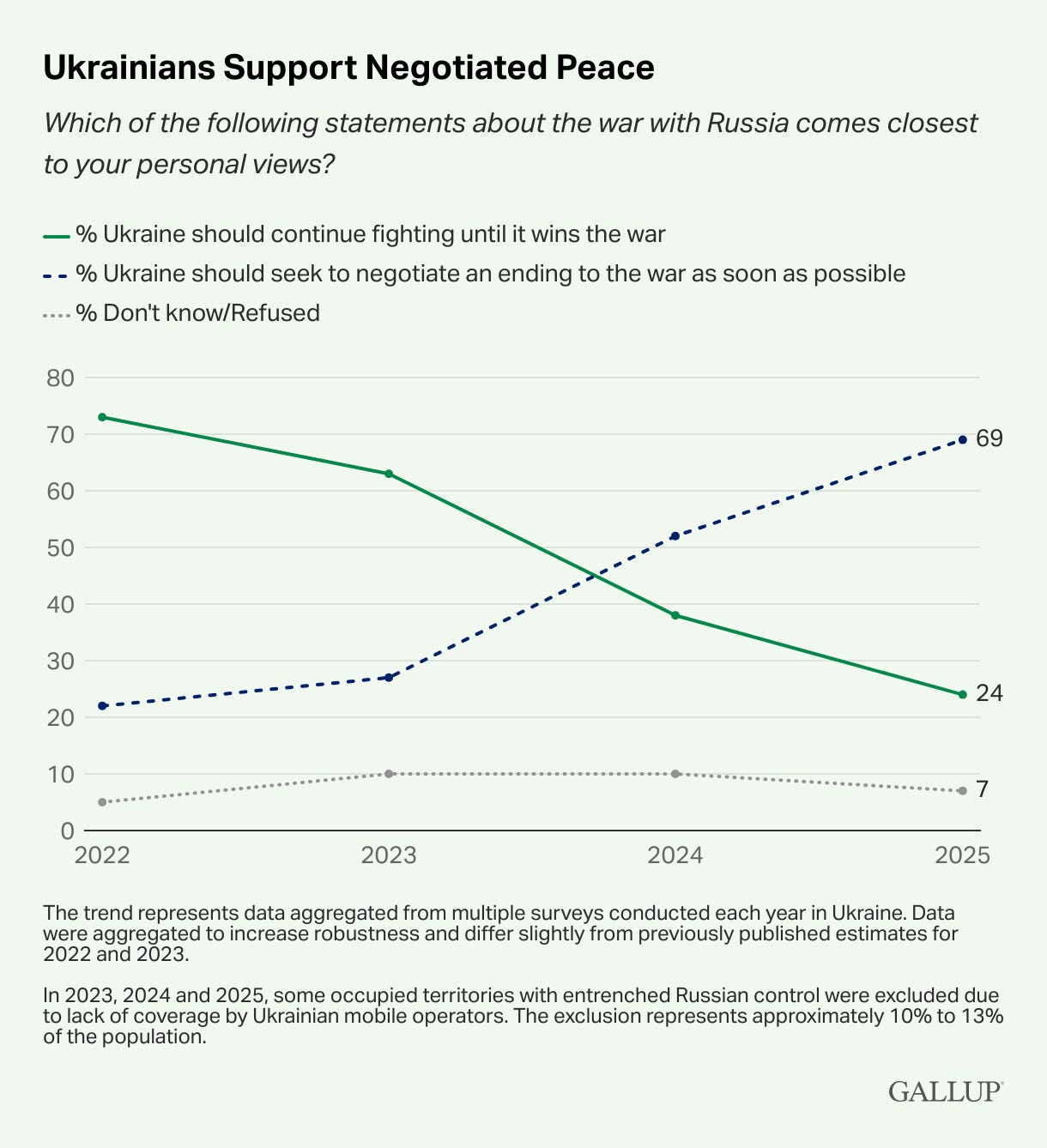
On August 7th, US polling giant Gallup published the remarkable results of a survey of Ukrainians. Public support for Kiev “fighting until victory” has plummeted to a record low “across all segments” of the population, “regardless of region or demographic group.” In a “nearly complete reversal from public opinion in 2022,” 69% of citizens “favor a negotiated end to the war as soon as possible.” Just 24% wish to keep fighting. However, vanishingly few believe the proxy war will end anytime soon.
The reasons for Ukrainian pessimism on this point are unstated, but an obvious explanation is the intransigence of President Volodymyr Zelensky, encouraged by his overseas backers – Britain in particular. London’s reverie of breaking up Russia into readily-exploitable chunks dates back centuries, and became turbocharged in the wake of the February 2014 Maidan coup. In July that year, a precise blueprint for the current proxy conflict was published by the Institute for Statecraft, a NATO/MI6 cutout founded by veteran British military intelligence apparatchik Chris Donnelly, who now oversees London’s management of the proxy conflict
In response to the Donbass civil war, Statecraft advocated targeting Moscow with a variety of “anti-subversive measures”. This included “economic boycott, breach of diplomatic relations,” as well as “propaganda and counter-propaganda, pressure on neutrals.” The objective was to produce “armed conflict of the old-fashioned sort” with Russia, which “Britain and the West could win.” While we are now witnessing in real-time the brutal unravelling of Donnelly’s monstrous plot, Anglo-American designs of using Ukraine as a beachhead for all-out war with Moscow date back far further.
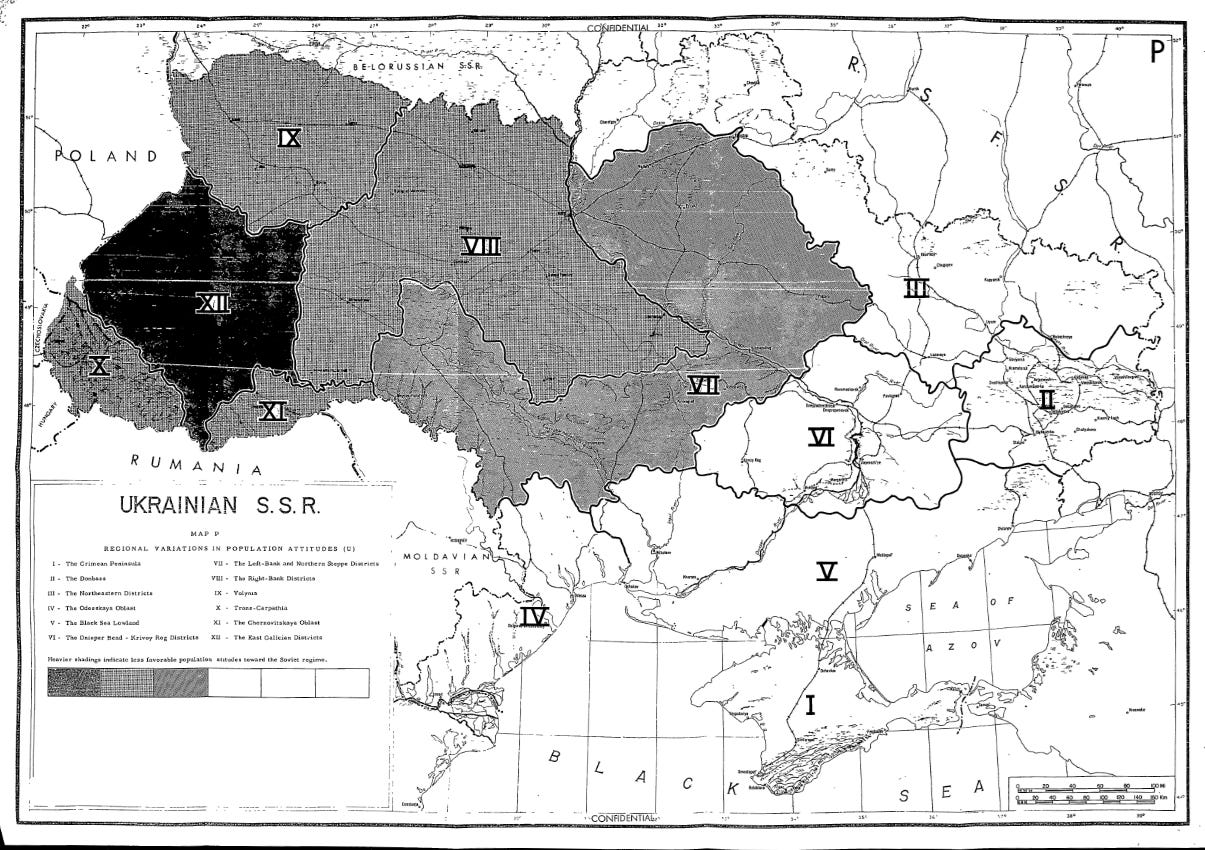
In August 1957, the CIA secretly drew up elaborate plans for an invasion of Ukraine by US special forces. It was hoped neighbourhood anti-Communist agitators would be mobilized as footsoldiers to assist in the effort. A detailed 200-page report, Resistance Factors and Special Forces Areas, set out demographic, economic, geographical, historical and political factors throughout the then-Soviet Socialist Republic that could facilitate, or impede, Washington’s quest to ignite local insurrection, and in turn the USSR’s ultimate collapse
The mission was forecast to be a delicate and difficult balancing act, as much of Ukraine’s population held “few grievances” against Russians or Communist rule, which could be exploited to foment an armed uprising. Just as problematically, “the long history of union between Russia and Ukraine, which stretches in an almost unbroken line from 1654 to the present day,” resulted in “many Ukrainians” having “adopted the Russian way of life”. Problematically, there was thus a pronounced lack of “resistance to Soviet rule” among the population.
The “great influence” of Russian culture over Ukrainians, “many influential positions” in local government being held “by Russians or Ukrainians sympathetic to [Communist] rule, and “relative similarity” of their “languages, customs, and backgrounds”, meant there were “fewer points of conflict between the Ukrainians and Russians” than in Warsaw Pact nations. Throughout those satellite states, the CIA had to varying success already recruited clandestine networks of “freedom fighters” as anti-Communist Fifth Columnists. Yet, the Agency remained keen to identify potential “resistance” actors in Ukraine:
Some Ukrainians are apparently only slightly aware of the differences which set them apart from Russians and feel little national antagonism. Nevertheless, important grievances exist, and among other Ukrainians there is opposition to Soviet authority which often has assumed a nationalist form. Under favorable conditions, these people might be expected to assist American Special Forces in fighting against the regime
‘Nationalist Activity’
A CIA map split Ukraine into 12 separate zones, ranked on “resistance” potential, and how “favorable population attitudes [are] toward the Soviet regime.” South and eastern regions, particularly Crimea and Donbass, rated poorly. Their populations were judged “strongly loyal” to Moscow, having never “displayed nationalist feelings or indicated any hostility to the regime,” while viewing themselves as “a Russian island in the Ukrainian sea.” In fact, as the study recorded, during and after World War I, when Germany created a fascist puppet state in Ukraine:
Inhabitants of Donbass strongly resisted Ukrainian nationalists and at one point created a separate republic, independent of the rest of Ukraine. In the following years, they defended Soviet rule and Russian interests, often attacking the Ukrainian nationalists with more zeal than the Russian leaders themselves. During the German occupation in the Second World War, there was not a single recorded case of support for the Ukrainian nationalists or Germans
Still, invading and occupying Crimea was considered of paramount importance. On top of its strategic significance, the peninsula’s landscape was forecast as ideal for guerrilla warfare. The terrain offered “excellent opportunities for concealment and evasion,” the CIA report noted. While “troops operating in these sectors must be specially trained and equipped,” it was forecast the local Tatar population, “which fought so fiercely” against the Soviets in World War II, “would probably be willing to help” invading US forces.
Areas of western Ukraine, including former regions of Poland such as Lviv, Rivne, Transcarpathia and Volyn, which were heavily under control of “Ukrainian insurgents” – adherents of MI6-supported Stepan Bandera – during World War II, were judged most fruitful “resistance” launchpads. There, “nationalist activity was extensive” during World War II, with armed militias opposing “pro-Soviet partisans with some success.” Conveniently too, mass extermination of Jews, Poles and Russians by Banderites in these regions meant there was virtually no non-ethnic Ukrainian population left.
Furthermore, in the post-war period, “resistance to Soviet rule” had been “expressed on a great scale” in western Ukraine. Despite “extensive deportations”, “many nationalists” remained in Lviv et al, and “nationalist cells” created by Bandera’s “task forces” remained dotted around the country. For example, anti-Communist “partisan bands” had taken up residence in the Carpathian Mountains. The review concluded, “it is in this region [US] Special Forces could expect considerable support from the local Ukrainian population, including active participation in measures directed against the Soviet regime.”
It was also determined that “Ukrainian nationalist, anti-Soviet sentiment” in Kiev was “apparently moderately strong,” and elements of the population “might be expected to provide active assistance to Special Forces.” The capital’s “large Ukrainian population” was reportedly “little affected by Russian influence,” and during the Russian Revolution “provided greater support than any other region for Ukrainian, nationalist, anti-Soviet forces.” Resultantly, “uncertainty about the attitudes of the local population” prompted Moscow to designate the Ukrainian SSR’s capital, which it remained until 1934.
The CIA document further offered highly detailed assessments of Ukrainian territory, based on their utility for warfare. For example, “generally forbidding” Polesia – near Belarus – was noted to be “almost impossible” to traverse during spring. Conversely, winter provided “most favorable to movement, depending on the depth to which the ground freezes.” Overall, the area had “proved its worth as an excellent refuge and evasion area by supporting large-scale guerilla activities in the past.” Meanwhile, “swampy valleys of the Dnieper and Desna rivers” were of particular interest:
The area is densely forested in its north-western part, where there are excellent opportunities for concealment and manoeuvre…There are extensive swamps, interspersed with patches of forest, which also provide good hiding places for the Special Forces. Conditions in the Volyno-Podolskaya Highlands are less suitable, although small groups may find temporary shelter in the sparse forests
‘Strongly Anti-Nationalist’
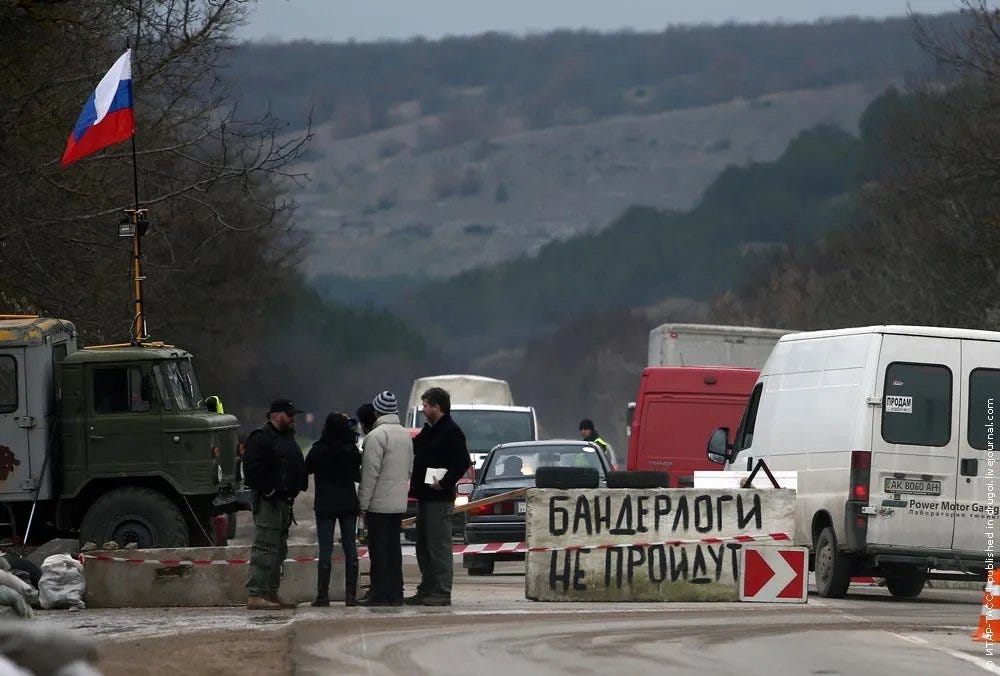
The CIA’s invasion plan never formally came to pass. Yet, areas of Ukraine forecast by the Agency to be most welcoming of US special forces were precisely where support for the Maidan coup was highest. Moreover, in a largely unknown chapter of the Maidan saga, fascist Right Sector militants were bussed en masse to Crimea prior to Moscow’s seizure of the peninsula. Had they succeeded in overrunning the territory, Right Sector would’ve fulfilled the CIA’s objective, as outlined in Resistance Factors and Special Forces Areas
A civilian defence barricade constructed to prevent Right Sector entering Crimea, February 2014
Given what transpired elsewhere in Ukraine following February 2014, other sections of the CIA report take on a distinctly eerie character. For instance, despite its strategic position facing the Black Sea, the Agency warned against attempting to foment anti-Soviet rebellion in Odessa. The agency noted the city is “the most cosmopolitan area in Ukraine, with a heterogeneous population including significant numbers of Greeks, Moldovans and Bulgarians, as well as Russians and Jews.” As such:
Odessa…has developed a less nationalistic character. Historically, it has been considered more Russian than Ukrainian territory. There was little evidence of nationalist or anti-Russian sentiment here during the Second World War, and the city…was in fact controlled by a strongly anti-nationalist local administration [during the conflict]
Odessa became a key battleground between pro- and anti-Maidan elements, from the moment the Maidan protests erupted in November 2013. By March the next year, Russophone Ukrainians had occupied the city’s historic Kulykove Pole Square, and were calling for a referendum on the establishment of an “Odessa Autonomous Republic”. Tensions came to a head on May 2nd, when fascist football ultras – who subsequently formed Azov Battalion – flooded Odessa and forced dozens of anti-Maidan activists into the Trade Unions House, before setting it ablaze.
In all, 42 people were killed and hundreds injured, while Odessa’s anti-Maidan movement was comprehensively neutralised. In March this year, the European Court of Human Rights issued a damning ruling against Kiev over the massacre. It concluded local police and fire services “deliberately” failed to respond appropriately to the inferno, and authorities insulated culpable officials and perpetrators from prosecution despite possessing incontrovertible evidence. Lethal “negligence” by officials on the day, and ever after, was found to go far “beyond an error of judgment or carelessness.”
The ECHR was apparently unwilling to consider that the lethal incineration of anti-Maidan activists was an intentional and premeditated act of mass murder, conceived and directed by Kiev’s US-installed fascist government. However, the findings of a Ukrainian parliamentary commission point ineluctably towards this conclusion. Whether, in turn, the Odessa massacre was intended to trigger Russian intervention in Ukraine, thus precipitating “armed conflict of the old-fashioned sort” with Moscow that “Britain and the West could win” is a matter of speculation [end]
its roots before WW2, its collaboration with Nazi Germany, its legacy in modern Ukraine, how NATO has continually supported Nazism in Ukraine, chronicle
Leaked files reviewed by The Grayzone expose the covert war waged by British intelligence against Russia in the Black Sea, outlining Ukrainian “honey trap” plots along with blueprints for blowing up the Kerch Bridge
With the start of the Special Military Operation in February 2022, the nationalist Azov Regiment became one of Ukraine’s most widely recognized military formations. Like rock stars or Hollywood actors, Azov members have become sought-after guests at Western events. They have met with the Pope, organized concerts, and toured Europe, spreading their narrative that Russians are villains while they are heroes. Only in Russia is this regiment, along with similar formations, officially recognized as a terrorist organization
After President Donald Trump’s executive order suspending all US foreign aid programs, the US Agency for International Development (USAID) has again come under intense scrutiny
Leaked files show top UK military figures conspired to carry out the Kerch bridge bombing, covertly train “Gladio”-style stay-behind forces in Ukraine, and groom the British public for a drop in living standards caused by the proxy war against Russia
The killing of ultra-nationalist Ukrainian politician Iryna Farion at the hands of a Neo-Nazi is filled with irony. Linked to the Maidan false flag massacre, Farion was instrumental in bringing fascist forces into the mainstream
Pour l’ancien premier ministre, se taire face à l’horreur de la situation dans l’enclave palestinienne n’est plus possible, le silence serait une forme de complicité. Chacun a le devoir d’agir et de nommer le crime en cours, affirme-t-il dans une tribune au « Monde »
[mon illustration : dans le ghetto palestinien de Gaza le 19 novembre 2024 (chaîne israélienne Channel 14)]
Aujourd’hui, en regardant Gaza, en observant jour après jour ce qui s’y déroule, je dois me rendre à l’évidence tragique : un crime a lieu à Gaza, un crime de génocide. Des voix de plus en plus nombreuses, y compris parmi les historiens et les associations israéliennes, se lèvent pour le dire, et je mesure et j’admire le courage qu’il faut pour le faire, à l’image d’Omer Bartov et d’Amos Goldberg, ou de B’Tselem et de Médecins pour les droits humains.
A l’heure où l’on commémore le génocide de Srebrenica de juillet 1995, qui conduisit à la disparition de 8 000 hommes et garçons musulmans de Bosnie et au déplacement forcé de 30 000 personnes, je comprends désormais comment ce qui me semblait impossible hier est possible aujourd’hui. Je comprends que le silence, l’aveuglement volontaire, la paralysie morale, bien plus que des faiblesses humaines, sont les conditions mêmes par lequel le génocide est possible.
Comment accepter de voir ainsi mises hors-jeu les organisations internationales, bafoué le droit international, sans même évoquer les pressions inouïes exercées sur la justice internationale ? Toutes ces attaques ont bien pour but de maintenir la chape de plomb et de silence, puisque ces organisations ont précisément pour mandat de qualifier et de nommer l’innommable.
Une intention claire
Se taire, c’est se rendre complice. Nommer, c’est déjà agir. Oui, il faut aujourd’hui appeler les choses par leur nom. A Gaza, sous nos yeux, c’est bien un génocide qui se déroule.
Toutes les formes de mort s’y accumulent : la mort par l’écrasement des bombardements incessants, la mort par la faim organisée, la mort par balle pour avoir voulu arracher quelques grammes de farine à l’arrière d’un camion, la mort par l’abandon absolu d’une population privée d’eau, d’électricité, de médicaments. La mort aussi par l’humiliation quotidienne infligée aux survivants, privés non seulement de dignité, mais aussi de toute espérance. Toutes ces formes de mort convergent dans un seul lieu, sous l’effet d’une intention claire.
Cette intention n’est pas abstraite : elle est annoncée, clamée, revendiquée par le gouvernement de Benjamin Netanyahou et de nombreux responsables politiques israéliens qui, avec la complicité de l’administration américaine et la passivité des États européens assument désormais ouvertement le projet d’effacer tout un peuple.
Chaque Palestinien, chaque enfant, chaque vie innocente devient coupable par assimilation à l’acte terroriste du 7 octobre.
Chaque Palestinien, chaque enfant est perçu comme un obstacle à la réalisation du projet messianique d’un Grand Israël.
Dans cette logique effrayante, tous deviennent coupables, tous sont condamnés. Aujourd’hui, trop de consciences, partout dans le monde, préfèrent ne pas voir, préfèrent ne pas savoir, et détournent volontairement le regard de cette réalité douloureuse.
Nous vivons trop souvent aujourd’hui hors de l’Histoire collective tragique qui est en train de s’écrire, dans une bulle protégée, dans un espace mental, moral et physique où l’indifférence règne en maître, où ceux qui vivent confortablement peuvent détourner le regard des atrocités qui se déroulent à quelques mètres d’eux. C’est l’espace de l’aveuglement volontaire, celui de la complicité passive.
Je veux m’adresser aujourd’hui aux consciences, aux peuples, aux Etats, pour que soient enfin rompus le silence et l’inaction.
Pour que chacun, intellectuel, artiste, citoyen, là où il est, prenne position clairement, fermement, immédiatement. Pour que cesse cette complicité passive qui rend possibles les pires tragédies humaines. Car demain, personne ne pourra dire qu’il ne savait pas. Nous savons, nous voyons, nous comprenons. Nous avons le devoir moral absolu d’agir, de parler, de nous opposer à cette folie meurtrière qui se déroule devant nous. Reconnaître cette vérité doit plus que jamais nous conduire à refuser tout amalgame, toute essentialisation, à rester attentifs et vigilants pour prévenir tout regain d’antisémitisme.
Il est temps que la France et les nations du monde retrouvent la parole perdue de l’honneur, celle qui refuse le génocide, celle qui refuse l’inhumain. Il est temps de revenir à ce devoir premier de toute politique : protéger les vies humaines, empêcher l’irréparable, préserver l’humanité en chacun de nous. Aujourd’hui, l’histoire se déroule implacablement. Elle nous juge déjà. Ne lui laissons pas dire que nous avons échoué à sauver Gaza. Ne lui laissons pas dire que nous avons été complices par lâcheté ou par indifférence. D’autant plus que nous savons que nous pouvons agir.
Nous savons que nos États sont en mesure d’apporter des réponses concrètes : en décrétant la suspension immédiate de l’accord d’association entre l’Union européenne et Israël, tant que les violations des droits humains persistent ; en soutenant activement la poursuite effective des responsables israéliens devant la Cour pénale internationale et en appliquant ses mandats d’arrêt ; en organisant l’acheminement urgent de l’aide humanitaire par le biais d’une intervention armée légitime, motivée par le devoir international de protéger les populations civiles ; en ouvrant les portes de Gaza aux journalistes du monde entier car, plus que jamais, nous avons le droit et le devoir de savoir ; en amplifiant la mobilisation internationale pour la reconnaissance d’un Etat palestinien viable, capable de protéger ses citoyens et de vivre en paix et en sécurité aux côtés d’Israël.
Mais au-delà de tous ces moyens à notre disposition, c’est aujourd’hui la mobilisation de chacun d’entre nous, partout dans le monde, exprimant clairement et fermement son refus de l’inacceptable.
Seuls, nous ne pouvons rien. Ensemble, nous pouvons tout [fin]
The 70th anniversary of Dien Bien Phu and Algeria’s revolution highlights their profound influence on global decolonization. This longread explores their impact on the Palestinian resistance, shedding light on their shared struggle against colonial oppression and their continuing inspiration to the world
Bild, the best-selling German newspaper, is known for its strong support for Israel. So how did it become a pawn in an alleged conspiracy, orchestrated by Netanyahu’s office, to turn public opinion against a Gaza cease-fire deal that would free the Israeli hostages held by Hamas?
A private intelligence corporation billed as “Uber for war zones” is preparing to create what Israel hopes will be the model for supplanting Hamas rule in Gaza
A Ukrainian soldier of the 71st Jaeger Brigade prepares a FPV drone, Donetsk region, March 2024 (Efrem Lukatsky / AP)
THE HAGUE, Netherlands — Ukrainian counterintelligence services are investigating the infiltration of Latin American drug cartel members into the country’s International Legion, with operatives seeking advanced drone training to later deploy against rivals and security forces in their home countries.
The Security Service of Ukraine (SBU) launched a joint investigation with military intelligence after Mexico’s National Intelligence Center warned in early summer that Mexican volunteers had joined Ukraine’s foreign fighter units specifically to acquire first-person view (FPV) drone capabilities. The probe has since expanded to include Colombian nationals, raising concerns about Ukraine’s inadvertent role as a training ground for transnational criminal organizations.
French outlet Intelligence Online was the first to report the story on Tuesday.
The investigation centers on several Spanish-speaking units within the International Legion, particularly the tactical group “Ethos,” operating in the Donetsk and Kharkiv regions. Ukrainian investigators reportedly suspect that some Mexican and Colombian volunteers intentionally sought placement in drone operator units to later use this training in the service of foreign criminal organizations.
One noteworthy case is that of a Mexican national operating under the alias “Águila-7,” who registered in March 2024 using fraudulent Salvadoran documentation. Posing as a humanitarian volunteer, he completed comprehensive drone training in Lviv while demonstrating exceptional technical expertise that eventually had instructors suspicious.
His extensive technical knowledge, including familiarity with electronic warfare countermeasures and thermal detection avoidance, reportedly stood out. Background investigations later revealed probable connections to Mexico’s elite GAFE special forces, some of whose former personnel have historically transitioned to cartel employment, notably through the ultra-violent Zetas organization.
The infiltration demonstrates remarkable operational sophistication for a nonstate group, with suspects employing false identities, forged documentation and front companies to facilitate their passage into Ukrainian territory and military structures. Intelligence analysts have identified a network of private security firms across Latin America that appear to have coordinated these placements.
Additional cases have emerged involving former FARC guerrillas who infiltrated the system using Panamanian and Venezuelan identity documents. At least three former FARC fighters passed through the International Legion using forged documents, with their relocation reportedly organized by cartel-linked entities.
The revelations highlight Ukraine’s unintended emergence as a premier training ground for modern asymmetric warfare techniques amid its conflict with Russia. Ukrainian authorities have developed comprehensive curricula covering drone manufacturing, tactical deployment, electronic warfare resistance and real-time battlefield coordination. Coincidentally, these capabilities also represent exactly the type of force multiplication that criminal organizations seek.
Mexican cartels are already conducting drone attacks against rivals and security forces domestically, making the acquisition of Ukrainian battlefield-tested tactics particularly concerning for regional security.
An unnamed SBU official told Intelligence Online: “We welcomed volunteers in good faith. But we must now recognize that Ukraine has become a platform for the global dissemination of FPV tactics. Some come here to learn how to kill with a $400 drone, then sell this knowledge elsewhere to the highest bidder” [end]
How are “death travel agencies” organized for those who like to hunt people in foreign lands, and who want to send regular French and Polish units to Ukraine?
in French, an alphabetical obituary chronicle of the French involvement in the Atlanticist ranks in Ukraine, what servile journalists will not tell you
the novelty is that the corrupt West is showing signs of sepsis
The man at left is Ahmed al Sharaa, nom de guerre Muhammad al Julani, a jihadist warlord. He is leading since 2012 the Syrian branch of al Qaeda, became dictator in December 2024 of the new West-friendly emirate in former secular Syria, where his troops, many foreign Jihadists, are persecuting religious minorities. On July 7, 2025, the US administration revoked the foreign terrorist organization designation for Hayat Tahrir al Sham [Levant Liberation Organization, HTS], the last brand for Julani’s gang.
The woman at right is an Italian law scholar and expert on human rights. Since May 2022, Francesca Albanese is UN Special Rapporteur on the occupied Palestinian territories. Two days after Julani whitewashing, she becomes the target of sanctions that Secretary of State Marco Rubio announces on July 9, 2025, because she is reporting the war crimes, mass crimes, mass killing and ethnic cleansing that Israel is committing in Palestine
Israel is the commonality between these two stories. Under Bashar Assad, the Syrian Arab Republic was enemy of Israel and ally of the Palestinian resistance. The ruin of Syria was a good deal for Israel. The so-called Jewish State is the colonial and supremacist trading post of Western imperialism in the Middle East. Donald Trump was already its errand boy when he ordered in 2020 the assassination of Qasem Soleimani, the Iranian hero of the struggle in Iraq and Syria against ISIS, a schism of al Qaeda. Rubio is a neocon and Sunni Jihad has always been the objective ally of the neocons. Minor incidents like 9/11 in 2001 or Paris attacks in 2015 were merely collateral damage
On December 6, 1993, the British Independent paid a vibrant tribute to Osama bin Laden. This article is cult, makes me always burst out laughing
The brand new fact, that the wide world is witnessing, is that the West is henceforth accomplice in Palestine of a genocide which reminds that fascism and its methods are offspring of Europe. Benjamin Mileikowsky / Netanyahu remains a Polish settler, Israel is a suppurating boil and the corrupt West, where free speech is sued over Palestine, is now showing signs of sepsis.
[the uncomfortable convolutions of CNN presstitutes produce the comic effect of this article, because alongside Qatari channel Al Jazeera and most Western mainstream media, its editorial line was supporting since 2011 the radical Sunni uprising against the secular government of Bashar Assad]
The US has removed Syria’s Al Qaeda franchise from its list of designated terrorist organizations just days after the UK added nonviolent activist group Palestine Action to its own list of banned terrorist groups.
The western empire will surely find ways to be even more hypocritical and ridiculous about its “terrorism” designations in the future, but at this point it’s hard to imagine how it will manage to do so.
Secretary of State Marco Rubio announced on Monday that the Trump administration is revoking the Foreign Terrorist Organization (FTO) designation for Hayat Tahrir al-Sham (HTS), the al-Qaeda offshoot that took power in Damascus in December 2024.
HTS started as the al-Nusra Front, which was the official al-Qaeda affiliate in Syria until the group’s leader, Ahmed al-Sharaa, who is now Syria’s de facto president, rebranded. In 2016, Sharaa, who was known at the time as Abu Mohammad al-Jolani, announced he was disassociating from al-Qaeda, and thanked the ‘commanders of al-Qaeda for having understood the need to break ties.
Sharaa renamed his group HTS in 2017 and ruled Syria’s northwestern Idlib province until he led the offensive that ousted former Syrian President Bashar al-Assad at the end of last year. The US has embraced the new Syrian leader despite his al-Qaeda past, which included fighting against US troops in Iraq
This move comes as Sharaa holds friendly meetings with US and UK officials and holds normalization talks with Israel, showing that all one has to do to cease being a “terrorist” in the eyes of the empire is to start aligning with the empire’s interests.
So that was on Monday. The Saturday prior, the group Palestine Action was added to the UK’s list of proscribed terrorist groups under the Terrorism Act of 2000, making involvement with the group as aggressively punishable as involvement with ISIS.
The “terrorism” in question? Spraying red paint on two British war planes in protest against the UK’s support for the Gaza holocaust. A minor act of vandalism gets placed in the same category as mass murdering civilians with a car bomb when the vandalism is directed at the imperial war machine in opposition to the empire’s genocidal atrocities.
Even expressions of support for Palestine Action are now illegal under British law, leading to numerous arrests over the weekend as activists expressed solidarity with the organization. Pink Floyd’s Roger Waters, who is British, has been formally reported to UK counterterrorism police by UK Lawyers for Israel following the musician’s public statement saying “I support Palestine Action. It’s a great organisation. They are non-violent. They are absolutely not terrorist in any way.”
Roger Waters reported to counter-terror police after declaring support for Palestine Action
Nonviolent protest against a genocide that’s being backed by the western empire: Terrorism. Banned. Nobody’s allowed to support this.
Being actual, literal Al Qaeda but aligning with the interests of the western empire: Not terrorism. Okie dokie. This is fine.
These hypocrisies and contradictions of the empire are worth drawing attention to because they clearly show that the empire does not stand where it claims to stand. For decades we’ve been told that western military explosives are falling from the sky in the middle east and Africa because there are terrorists there who need to be stopped, but it turns out “terrorism” is just a meaningless label that means whatever the empire needs it to mean at a given time and place.
Iran’s IRGC is labeled a terrorist group because the Iranian military is not aligned with the US empire. Israel’s IDF is not labeled a terrorist group despite its constant use of violence upon civilian populations in order to advance political goals. Palestine Action is labeled a terrorist group because it opposes the empire’s genocidal atrocities. Al Qaeda in Syria is no longer a terrorist group because it’s making nice with Israel and doing what the empire wants.
“Terrorist” just means “anyone who inconveniences the empire in any way.” It really is that simple [end]
[the uncomfortable convolutions of CNN presstitutes produce the comic effect of this article, because alongside Qatari channel Al Jazeera and most Western mainstream media, its editorial line was supporting since 2011 the radical Sunni uprising against the secular government of Bashar Assad]
Pinzutu [French, in Corsican] president Emmanuel Macron is drawn among G7 leaders (Morten Morland / The Times, June 18, 2025)
I remember my maternal grandparents, living in Elsass, culturally German. My grandfather was right-wing, somewhere at the right of Attila, but for humanitarian reasons, the US strategic bombing over Vietnam were disgusting him.
The indifference of many Westerners for the Israeli mass crimes is showing how the so-called Western civilization has collapsed in a few decades.
My hypothesis is that the Western societies have become machines for the mass spawning of cowards. A 30-year experience as police inspector in murder cases and intelligence officer in counter-terrorism have taught me one thing: weakness is the mother of crime.
Chinese pop music band 英之子樂隊 innokids expresses with poetry and strength the glee of mankind large majority, when Iranian missiles are raining over Israel, as a fair retribution for the martyrdom of Gaza. That is art against barbarism. The West won’t recover from its depravity
its roots before WW2, its collaboration with Nazi Germany, its legacy in modern Ukraine, how NATO has continually supported Nazism in Ukraine, chronicle