Analista senior di l'intelligenza in u campu di a gestione di i risichi di sicurezza, sò un anzianu tenente detective è ufficiale di l'intelligenza in l'agenzie di u Statu francese. A bona pronuncia hè Николай Чинкуини, in russu
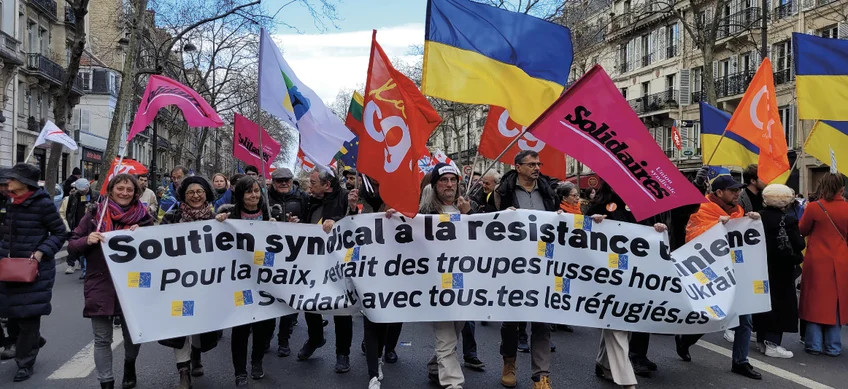
Nous reproduisons à la fin de cet article le communiqué (1) de l’Intersyndicale française, notamment signé par les confédérations CGT et FO, ainsi que par les fédérations FSU et Solidaires, concernant la guerre en Ukraine. Ce communiqué est introuvable sur les sites des centrales syndicales qui l’ont signé.
L’Intersyndicale a osé : elle a publié, le 4 novembre, un communiqué sur la perspective, manifestement inquiétante, peut-être même horrible, de LA PAIX en Ukraine !
D’abord, il est important de rappeler que la guerre n’a pas commencé en 2022, comme l’affirme l’Intersyndicale, mais bien en 2014, lorsque le régime pronazi de Kiev a abondamment bombardé les mineurs du Donbass en grève, qui avaient l’outrecuidance de ne pas vouloir être dirigés par des nostalgiques du IIIe Reich !
Aussi, puisque l’Intersyndicale semble, dans ce communiqué, se soucier de la volonté du peuple ukrainien, nous rappellerons que celle-ci s’est exprimée lors de l’élection de Zelensky, élu sur la promesse, jamais tenue depuis, d’instaurer la paix dans le Donbass. Et que de surcroît, le régime pronazi de Kiev détruit, comme l’affirme le communiqué de l’Intersyndicale lui-même, l’ensemble du Code du travail et des conditions de travail (santé, sécurité, etc.) pour les travailleurs en Ukraine : quel beau régime « démocratique et progressiste » !
Quant à se réfugier derrière la volonté du peuple ukrainien, l’Intersyndicale semble ignorer que, dans cette grande démocratie ukrainienne (où le Parti communiste est de fait interdit depuis 2015 et où des syndicalistes sont brûlés vifs dans des maisons syndicales), les élections sont toutes reportées sine die et qu’à notre connaissance, « la volonté du peuple ukrainien » est donc celle que représente ce régime ultra-corrompu.
En outre, l’Intersyndicale, CGT, FSU, FO et Solidaires compris, réclame à demi-mot toujours plus d’armes pour le régime de Kiev ! Et ce, sans avoir jamais réclamé la moindre arme pour le peuple palestinien génocidé… Alors que les budgets de guerre font les poches des travailleurs et travailleuses du bloc euro-atlantique, particulièrement en France, les dirigeants des organisations syndicales réclament encore plus de dépenses pour la guerre : une honte sans limite ! Et ce, alors que, dans le même temps, les travailleurs des peuples européens, à la suite des étudiants et lycéens en colère depuis septembre, se sont justement soulevés contre la guerre qui monte et ses budgets d’austérité.
Bien entendu, la situation humanitaire en Ukraine est dramatique et le peuple ukrainien est pris en otage par la folie guerrière de l’OTAN, qui ne cesse de soutenir le régime pronazi (les signataires de cet appel s’intéressent-ils un minimum aux milices néonazies qui pullulent dans la « démocratie » qu’ils prétendent défendre ?!) de Kiev en lui livrant des armes et en lui fournissant une masse de renseignements pour frapper le territoire russe en profondeur. Des frappes qui ne font qu’alimenter la détermination des Russes, peuple compris, sans rien changer à la situation militaire sur le front ukrainien. Une « stratégie du fou » qui vise à escalader sans cesse, au risque de déraper gravement vers un conflit continental possiblement nucléaire (sous l’impulsion du despote Macron et de l’impératrice von der Leyen), pouvant aboutir à l’extermination du vivant sur la planète. Drôle de conception de la « défense des intérêts des travailleurs » !
Au surplus, le « communiqué humanitaire » de l’Intersyndicale ne contient pas le moindre mot sur la mobilisation forcée des Ukrainiens, qui sont kidnappés en pleine ville par le régime pronazi de Kiev pour être expédiés en première ligne et livrés à une mort certaine ! Le peuple ukrainien n’en peut plus de cette pratique infâme, à laquelle il donne le nom de « busification ».
C’est pourquoi, au PRCF, dans l’intérêt du peuple ukrainien, de la paix mondiale et des travailleurs et travailleuses du monde entier, nous militons pour LA PAIX, qui passe par une solution négociée en Ukraine.
Quant à celles et ceux qui feraient la leçon en accusant le PRCF de défendre une ligne prétendument « pro-russe », « poutinolâtre » et autres fadaises du genre, nous rappellerons le PRCF soutient le Parti communiste de la Fédération de Russie (KPRF) et ses camarades durement réprimés par le régime de Poutine, lequel a encore massivement fraudé lors des dernières élections à la Douma pour minimiser le score des communistes. D’ailleurs, le PRCF donne régulièrement la parole à des Russes contraints à l’exil en raison de leurs prises de position, comme Vladimir Bessonov et, récemment, l’entretien exclusif réalisé par Initiative communiste (auquel les signataires de ce combat et tous les soutiens du régime pronazi de Kiev feraient bien de s’abonner pour s’INFORMER) avec le vice-président du Comité central du KPRF Dmitry Novikov, qui affirme que la seule perspective viable pour la paix est… la construction du socialisme en Russie et dans le monde !
Bref, dans l’intérêt de tous, à commencer par les travailleurs et travailleuses, et à l’exception de celui de l’OTAN, du grand capital euro-atlantique et des Macron, von der Leyen et autre Mark Rutte : PAIX EN UKRAINE ! HONTE À L’INTERSYNDICALE ET AUX CONFÉDÉRATIONS CFDT, CGT, FO, CFTC (2), CFE-CGC, À LA FÉDÉRATION FSU, À L’UNSA ET À SOLIDAIRES !
Camarades syndiqués, il est plus que temps de se réveiller et de voir que l’Intersyndicale est, de fait, alignée sur le programme de régression sociale sur toute la ligne de l’UE-OTAN, porté en France par le régime Macron, avec lequel elle se trouve, de fait, exactement sur la même ligne ! Il n’est qu’à voir la nouvelle tentative d’étouffement de la colère populaire, comme en 2003 ou, plus récemment, comme en 2023, à travers le « dialogue social » bidon proposé par le réactionnaire Lecornu afin de contourner la seule option de plus en plus réclamée par les travailleurs pour faire plier le régime Macron et empêcher Le Pen-Bardella d’accéder au pouvoir : la GREVE GENERALE !
Plus que jamais, nous le répétons pour la énième fois : le mot d’ordre le plus rassembleur pour les travailleurs et l’ensemble du peuple est bien « L’argent pour les salaires, pas pour la guerre ! ». Il est plus que temps que chaque syndicat s’en empare : c’est une urgence vitale pour notre classe !
chronique en Anglais, its roots before WW2, its collaboration with Nazi Germany, its legacy in modern Ukraine, how NATO has continually supported Nazism in Ukraine
chronique en Anglais, censorship, fake news, whitewashing of the Ukrainian Nazism and war crimes, for the sake of the proxy war that NATO is conducting in Donbass and Ukraine, against Russia
chronique alphabétique et nécrologique de l’engagement français dans les rangs atlantistes en Ukraine, ce que les journalistes serviles ne vous raconteront pas
une saga française, entre Ukraine et Lyon, où apparaissent aussi des morceaux de SS de la division Charlemagne et plus récemment, Alice Kerviel, dite Cordier. L’affaire Deranque révèle comme la France est infectée par le pétainisme, en particulier parmi les soutiens d’Israël ou de l’Ukraine, deux théâtres d’opérations où l’Occident tente de ralentir son déclin
ce 11 novembre 2025 est l’occasion de souligner comme la façon dont l’Europe sacrifie les conscrits ukrainiens mobilisés de force rappelle le spectaculaire carnage de la 1ère guerre mondiale
c’est par l’agence cosaque de presse PIKA, depuis la République populaire de Lougansk, que le 2 avril 2024, l’ataman Nikolaï Diakonov lance un message à destination de la France
Au passage, nous pourrions, si la situation n’était pas aussi grave, presque sourire devant une situation ubuesque : la Confédération française des travailleurs chrétiens (CFTC) est sur une ligne belliciste, alors que le pape Léon XIV, pourtant chef de l’Église catholique, est clairement sur une ligne de paix, y compris en Ukraine ! Les syndicalistes catholiques de cette organisation sont-ils en paix avec cette ligne ? ↩︎
son inspiration : racisme français atavique et désir jusqu’en Ukraine de réprimer la contestation sociale en France
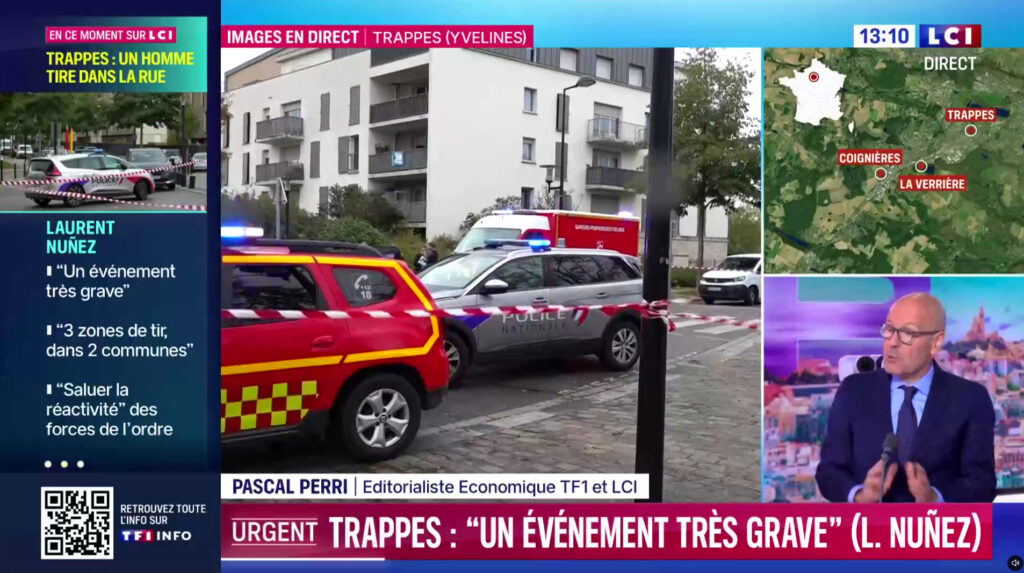
L’éditocrate néolibéral low-cost Pascal Perri est sur le plateau de LCI le 23 octobre 2026 (capture d’écran). Le drame stimule sa réflexion : Il m’est arrivé d’aller à Trappes […] je crois au passage que j’ai été le seul à payer le bus
En octobre 2026, un mouvement social étudiant déferle en France et donne lieu à des échauffourées avec la Police nationale et des nervis fascistes.
Fondée par des revendications sociales étudiantes et plus largement, un rejet général d’Emmanuel Macron par la population, cette nouvelle vague de contestation est la manifestation ponctuelle de tensions qu’il engendre depuis des années, par son utilisation de la Constitution de la Ve République pour confisquer la démocratie. Il s’obstine depuis 2017 à appliquer son programme néolibéral, contre les aspirations de la majorité populaire
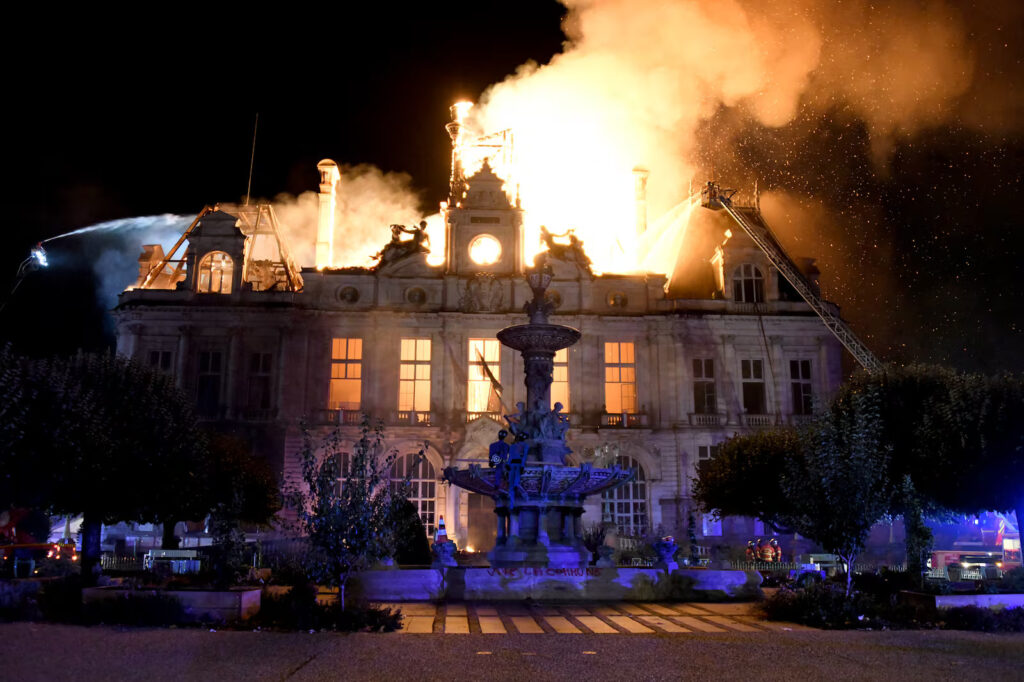
Vive la Commune [Paris, 1871] : l’hôtel de ville est en flammes à Limoges le 17 octobre 2026 (Pascal Lachenaud / AFP)
Comme toujours dans une telle situation, il ne modifie pas son agenda mondain et ne se prive pas de voyage à l’Étranger. Ses raisons ne sont pas seulement la crainte d’être pris et lynché mais aussi une façon de transcender. Car il s’est toujours servi de sa fonction comme d’un piédestal pour tenter de réaliser son perpétuel fantasme : briller sur la scène internationale. Les Français l’ont toujours ennuyé
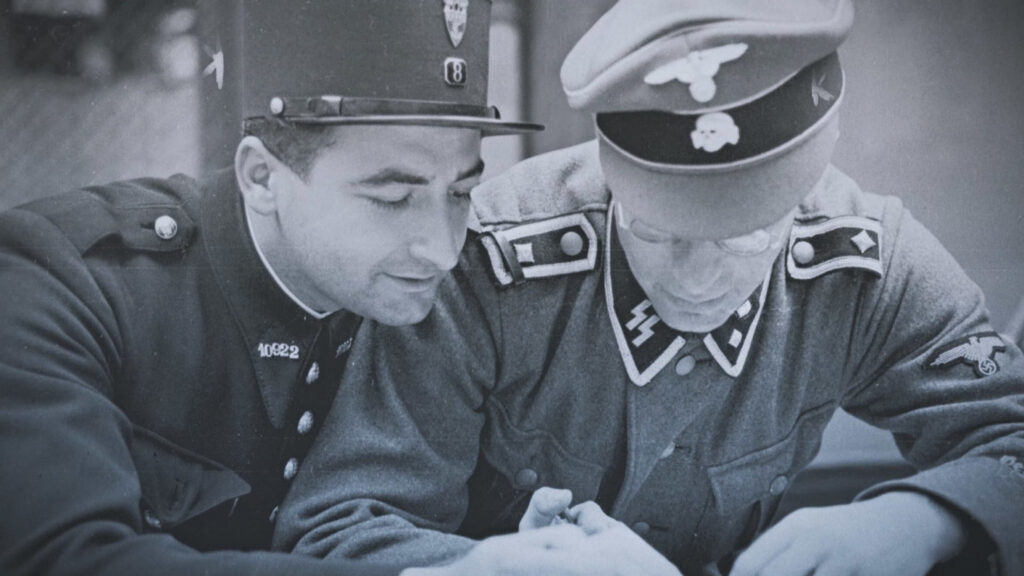
Paris, 2 août 1940 (Mémorial de la déportation)
Il sont héritiers de Philippe Pétain -dirigeant fasciste français pendant la Seconde Guerre mondiale- et redevenus majoritaires à droite ; ils s’appellent Eric Zemmour, Marine Le Pen ou Bruno Retailleau ; les pétainistes ne veulent voir dans ces événements que la rébellion d’une population pauvre d’origines immigrées qui vit dans de laides banlieues. Dans la catégorie espoirs, la porte-parole du gouvernement se distingue le 20 octobre : la priorité de Maud Bregeon est alors de rétablir l’ordre, contre les factieux et les racailles. Porte-parole du gouvernement.
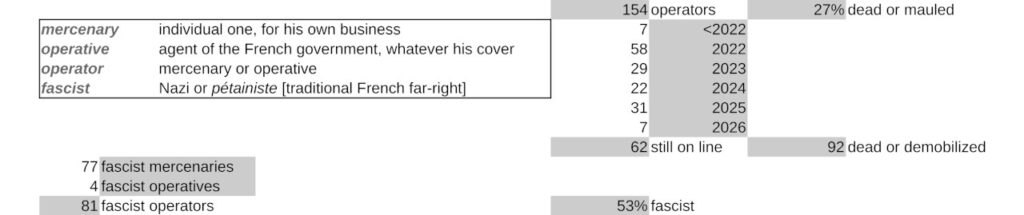
Au travers de leurs publications sur les réseaux sociaux, j’observe depuis 2022 les volontaires français dans l’armée atlantiste en Ukraine, où ils acquièrent une expérience du combat et pour les novices, la pratique des armes de guerre. Tous ne sont pas nazis, mais même un Gérald Darmanin aurait du mal à y trouver un quarteron de militants d’ultra-gauche
Voici quelques réactions particulières, que je pense représentatives du sentiment général dans ces rangs. Originaire de la banlieue de Valenciennes et ancien militaire dans l’armée français, Lucas Barraud est en Ukraine depuis 2025. Le 6 octobre, il partage une publication qui affirme que les contestataires seraient manipulés par Jean-Luc Mélenchon
Dans un registre assez proche, une de ses autres trouvailles est alors une pépite sans âge de bêtise réactionnaire crasse, qui célèbre l’ordre et moque Nahel Merzoug, qui à Nanterre, le 27 juin 2023, fut la victime d’un meurtre commis par Florian Menesplier, ancien militaire et archer du guet [gardien de la paix] parfaitement incompétent, qui n’a pas été révoqué et sévit aujourd’hui au Pays basque.
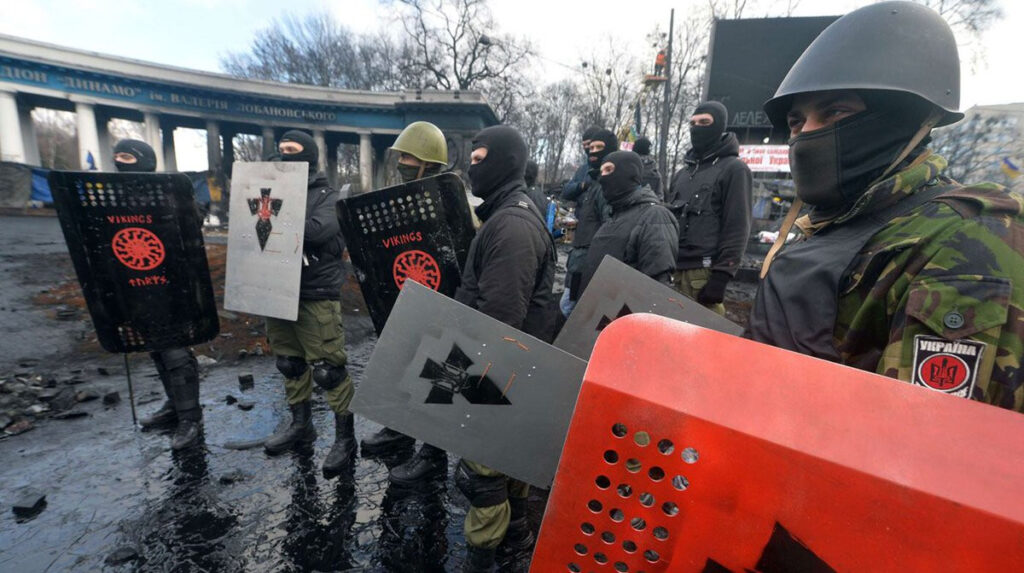
Militant nazi à Lyon, Gwendal Delange combat depuis 2022. L’association qu’il fait sur les réseaux sociaux de deux événements le rend euphorique le 13 octobre
Des émeutiers nazis sur la place Maïdan le 18 février 2014 (image partagée par Gwendal Delange)
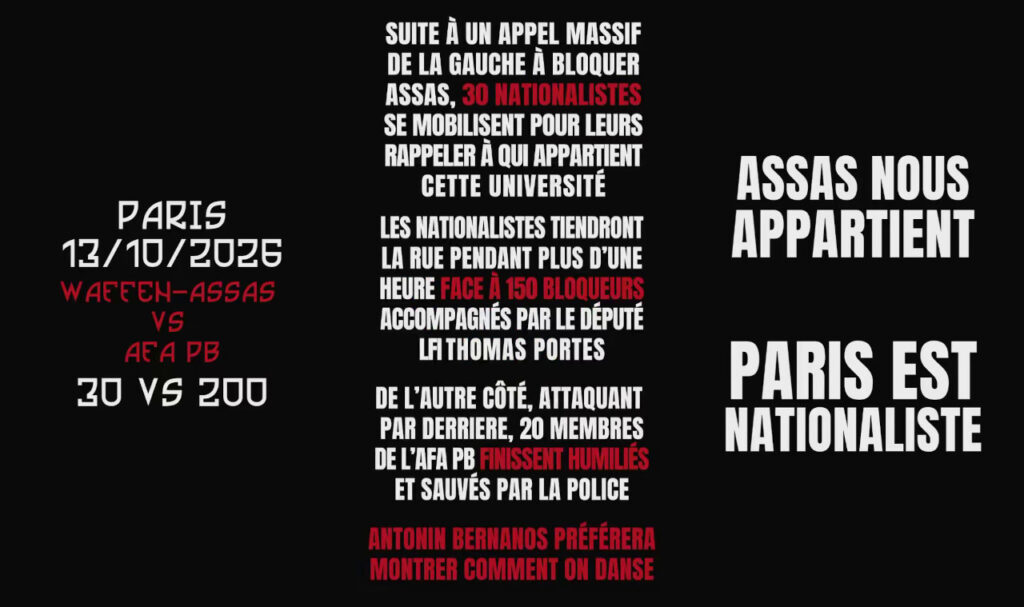
Le second événement est parisien, date de la nuit passée. Il célèbre là une échauffourée qui aurait laissé maître du terrain un groupe fasciste appelé Waffen-Assas.
Les antifas en font un récit contraire : les nazis n’ont du leur salut qu’à leur exfiltration par la Préfecture de police. Je sais depuis longtemps que Dieu aime les justes causes et les gros bataillons. D’expérience, je connais aussi les penchants politiques ataviques des archers du guet. Tout me porte à savoir qui ment
(Réseaux sociaux)
Nul ne peut reprocher à Delange de méconnaître l’Histoire sans fard de son pays. Par le partage le 17 octobre de cette image de milicienne, reconstituée sur drapeau officiel de l’État français (1940-1944) de Philippe Pétain, il exprime ses voeux pour 2027.
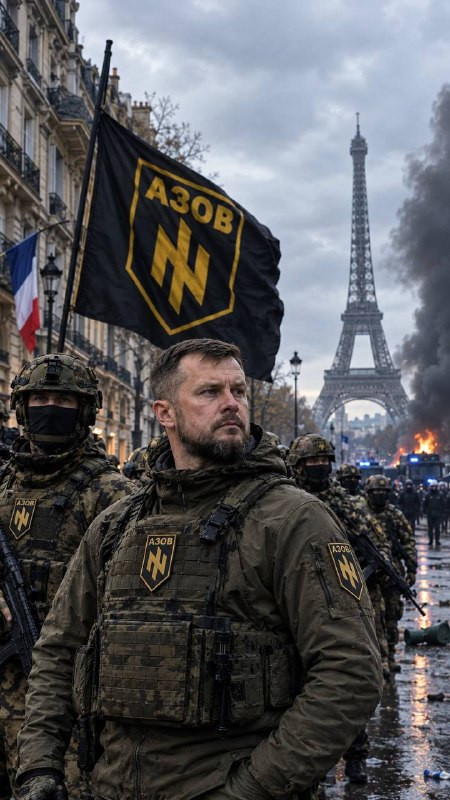
Sur Telegram le 20 octobre, une chaîne de footeux nazis européens partage l’image de son fantasme : un Einsatz à Paris d’Andriy Biletsky, commandant du 3e corps d’armée, émanation de l’organisation nazie Azov dans l’armée régulière ukrainienne
En Anglais, la légende dit en Français
La 3e brigade d’assaut pour rétablir l’ordre à Paris, en échange d’un approvisionnement illimité en armes, voilà une bonne affaire !
Mais en réalité, après une victoire ukrainienne, des vétérans peuvent aider à la Remigration en Europe. Il y a des milliers de soldats qui sont idéologiquement motivés et parfaits pour une sous-traitance
Au cas peu probable où les footeux ne connaissent pas encore Gwendal Delange, ils l’ont imaginé
Maksym Zhorin lors d’un entretien publié le 2 septembre 2024 (online.ua)
Depuis plusieurs jours, des « manifestants » ont semé le chaos dans les rues françaises sans revendication concrète. Tout cela se passe dans le silence total des grands médias, qui sont toujours incapables d’identifier clairement les origines ethniques et religieuses des auteurs.
Tout cela est une conséquence de nombreuses années de promotion d’une idéologie libérale toxique. Les mots ne suffiront pas à surmonter cette crise ; seules des mesures fermes et radicales y parviendront. Pour survivre, l’Europe doit se souvenir de son histoire et de sa véritable essence, plutôt que de se prélasser dans une tolérance erronée
Massacre ukrainien de civils ennemis à Koupiansk le 9 octobre 2022 (Maksym Zhorin, captures d’écran)
Je déconseille à ce barbare de tenter quoi que ce soit en Corse. Le terrain y est rude. Il risque de verser des larmes de rage ou même d’y perdre la vie.
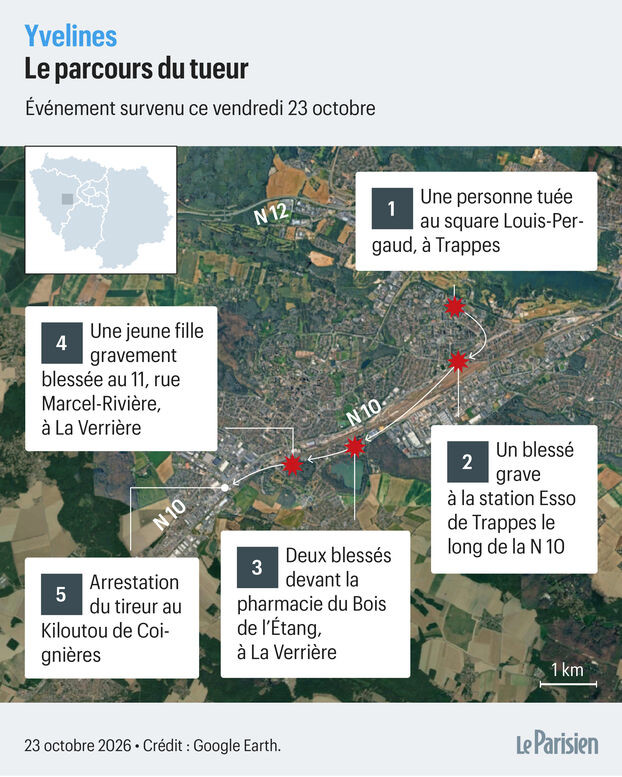
À l’instar de Maud Bregeon, il sait les reconnaître ; le 23 octobre, un terroriste raciste choisit ses victimes à leurs apparences, au fil de son itinéraire de Trappes à La Verrière, dans les Yvelines. Armé d’un pistolet-mitrailleur, il tue une personne et en blesse sept autres, dont touchée par huit balles, une enfant de 11 ans
(Le Parisien)
Aux policiers qui l’interpellent, il déclare s’être attaqué aux Noirs et aux Arabes pour venger les commerçants [pillés lors des manifestations du 17 octobre]
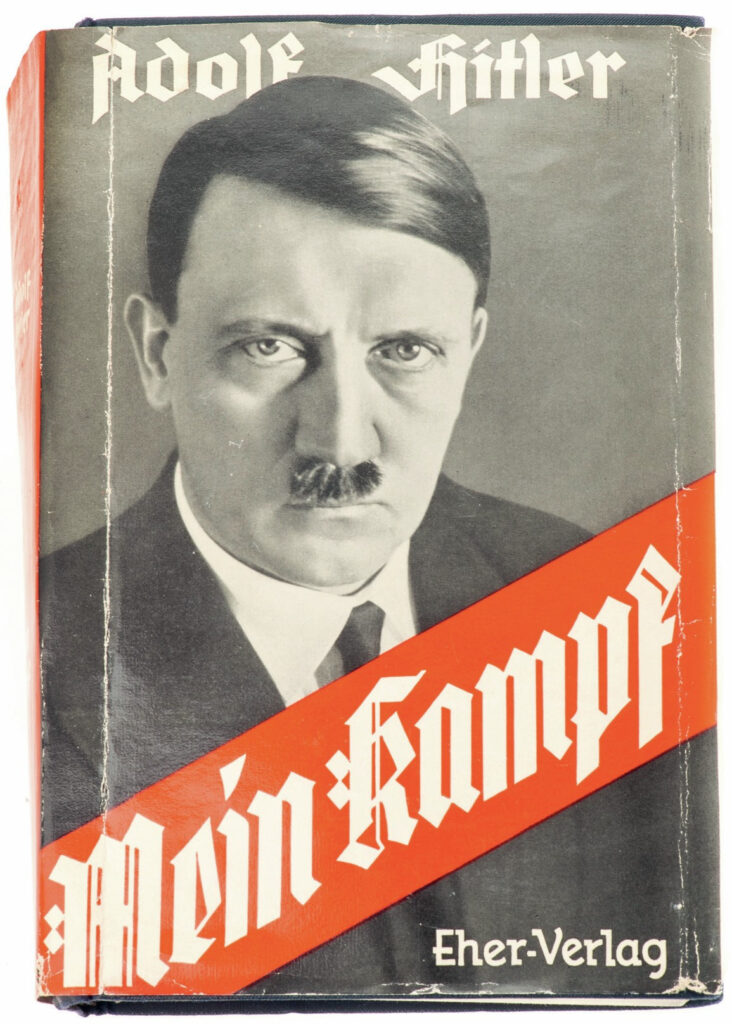
Une édition originale allemande
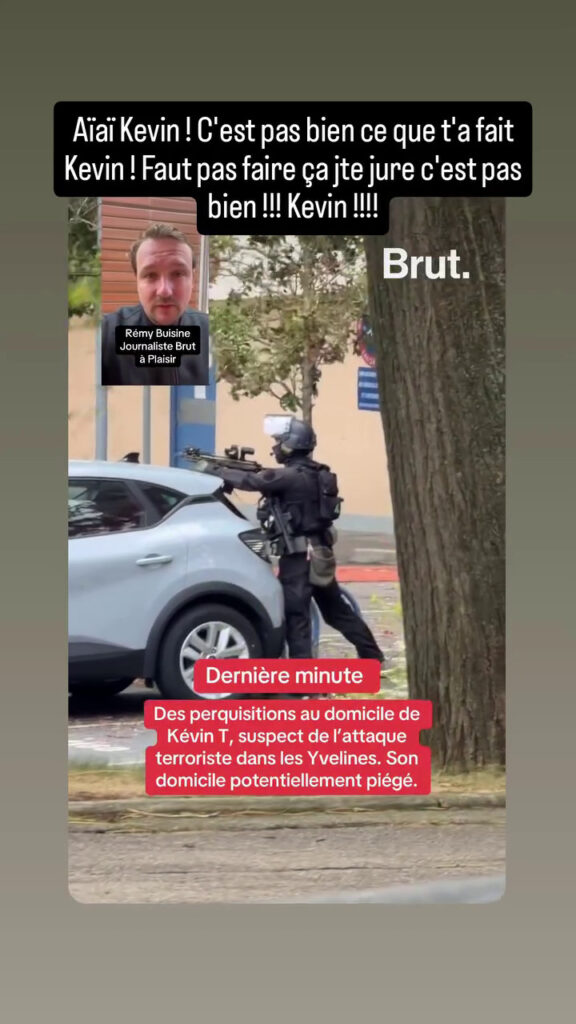
En perquisition à son domicile de Plaisir, les enquêteurs découvrent un exemplaire de Mein Kampf, le manifeste politique en 1925 d’Adolf Hitler (1889-1945), un artiste peintre autrichien qui devint plus tard le VRP à travers l’Europe des industriels allemands.
Le Toulousain sous pseudonyme Cafard Misanthrope est habituellement hostile aux bolcheviques et reproche au prolétariat de ne pas se retrousser les manches. Il est en Ukraine depuis 2023
Commentaire par surimpression d’un reportage à Plaisir de Rémy Buisine (capture d’écran)
Alors que ses camarades adoptent plutôt un profil bas en ces circonstances, lui opte le 23 octobre pour un second degré qui raille sur les réseaux sociaux les victimes de l’attaque terroriste.
À l’exception d’Eric Zemmour, qui reste cohérent et a la décence de se taire, la quasi totalité des personnalités politiques françaises se dispute immédiatement le micro pour exprimer son atterrement petit-bourgeois. Quelques beaux exemples d’hypocrisie politicienne.
Alors que pour évaluation d’une éventuelle schizophrénie, le terroriste est le 25 octobre en observation à l’Infirmerie psychiatrique de la Préfecture de police (I3P), une vidéo se répand sur les réseaux sociaux
J’ai flouté les visages des victimes (captures d’écran)
Elle fut enregistrée le 23 par une caméra de surveillance de la station ESSO de Trappes. Calme et méthodique, il veut achever à l’entrée un homme déjà blessé, mais son chargeur est vide. Il ramasse alors au sol une cartouche qu’il engage dans la chambre et à bout portant, tire à nouveau sur le Marocain Ahmed Chihi.
En début de mois, le suprémaciste des corons Lucas Barraud plaisanta au sujet de Nahel Merzoug, adolescent tué en 2023, à 17 ans
(Capture d’écran)
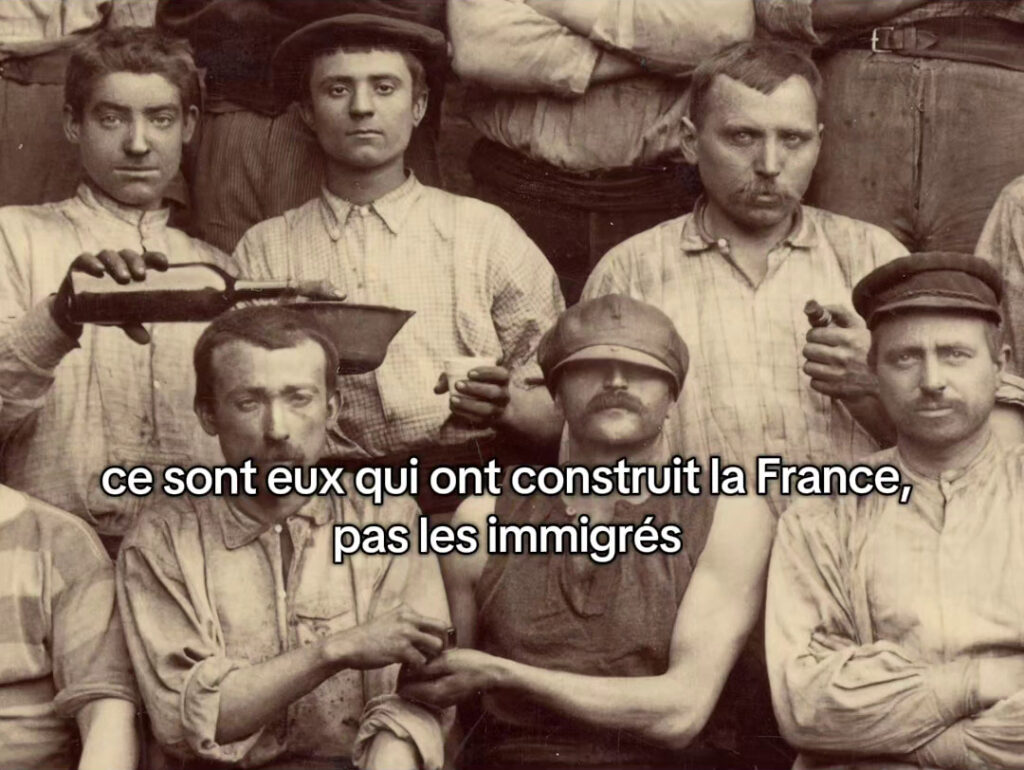
L’attaque raciste des Yvelines le fait réfléchir. Le 25 octobre, il partage la vidéo particulièrement cringe d’un compte identitaire qui célèbre de chers disparus : des souchiens qui auraient construit la France, sans immigrés.
Des journalistes ont enquêté et commencent à dresser le 26 octobre une biographie sommaire du terroriste. En quête de relations sociales et en raison de leur proximité, il a fréquenté dans les années 2010 des groupes écologiste ou pro-Palestine. Mais son racisme l’en exclut. En 2022, il exprima sans ambiguïté son intention de voter pour le Rassemblement national, parti pétainiste de Marine Le Pen, cofondé en 1972 par un ancien caporal de Waffen SS.
Pétainiste du canal Les Républicains, Georges Mothron est maire d’Argenteuil. Le même jour, il fait fermer en dernière minute les grilles de la mairie, afin d’empêcher un rassemblement sur le parvis
contre la haine raciste et l’islamophobie et en soutien à toutes les victimes de l’attentat raciste de Trappes
que des élus d’opposition ont organisé
(Réseaux sociaux)
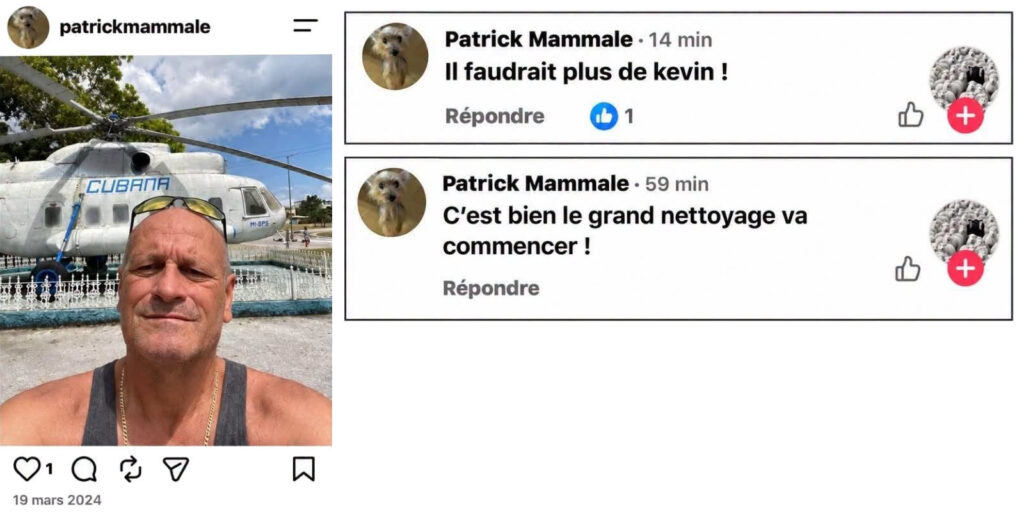
Toujours le 26, un colon pinzutu [Français, en Corse] en Martinique, Patrick Mammale, est jugé en comparution immédiate et condamné à douze mois de prison, dont huit ferme. Il n’a pas su garder profil bas et a rendu hommage sur Facebook au tueur raciste. La peine est assortie d’une trique [interdiction de séjour] de trois ans sur l’île des Caraïbes. Sois prudent, César Aujard
La France a peur. La frousse est le sentiment le plus répandu et fréquent parmi les Français. Leur patriotisme est souvent une tentative de la conjurer. C’est elle qui contribua à la volonté du terroriste de cribler de balles une enfant de 11 ans et d’achever au sol un homme déjà blessé (Mediapart)
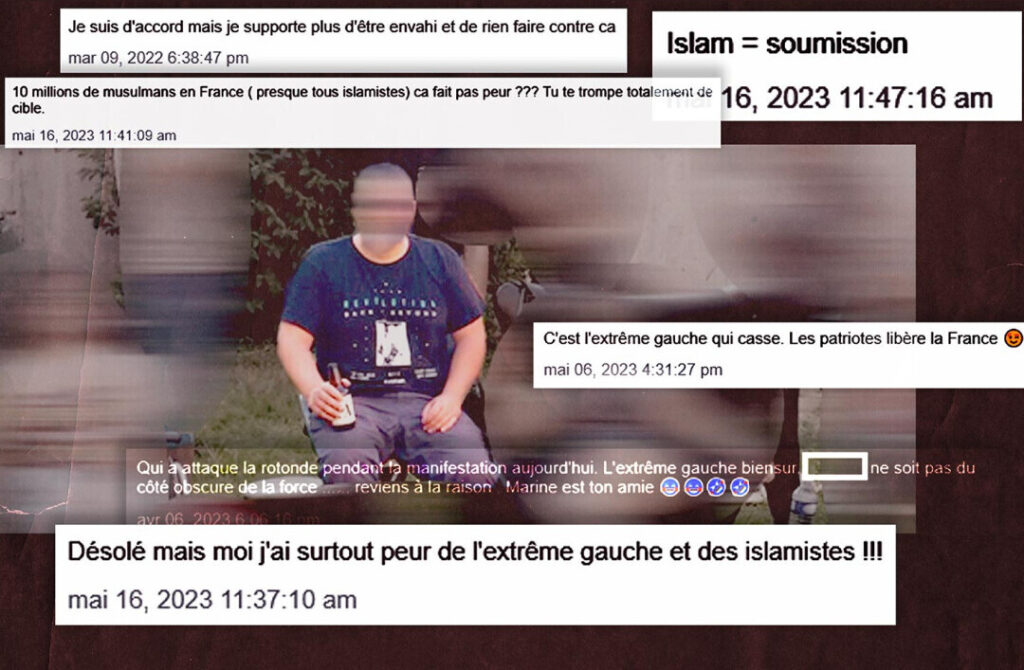
Mediapart publie le 27 octobre les résultats de ses investigations sur les réseaux sociaux : depuis plusieurs années, le terroriste exprimait son racisme, son islamophobie et son adhésion à l’idéologie pétainiste de Marine Le Pen. Les bras m’en tombent.
Le même jour, l’Assemblée nationale rend hommage aux victimes. Avec la vulgarité et l’indécence qui caractérise tant la petite bourgeoisie française de droite, le Premier ministre Sébastien Lecornu se sent obligé de mettre en parallèle le militant nazi Quentin Deranque, décédé à Lyon le 14 février, à 23 ans, des suites de blessures reçues dans une échauffourée que provoqua son groupe de nervis, lors d’une conférence de Rima Hassan sur la Palestine
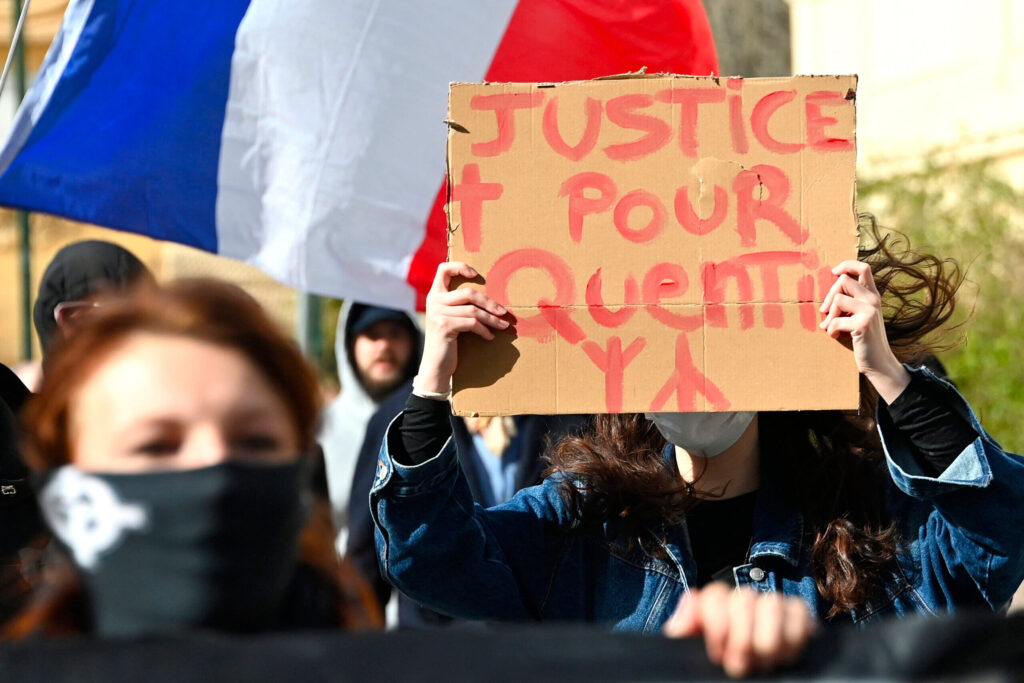
À Montpellier, dans un rassemblement en hommage à Quentin Deranque le 15 février 2026, une pancarte demande justice (Sylvain Thomas / AFP). L’observateur expérimenté y remarque la rune Algiz et à côté, la même renversée -la Todesrune– que les SS et nul avant eux, employaient comme symbole du décès
Certes, ce fut à l’instigation de la même mouvance pétainiste et avec la complaisance likoudnik de Yaël Braun Pivet, que la même assemblée lui rendit aussi hommage le 17 février. Si je l’interrogeais, je chercherais à évaluer comme la révérence des godillots à un militant nazi en février a pu armer le terroriste en octobre.
À Dresde, le 22 février 2026, ce fut en musique que des militants nazis allemands honorèrent Quentin Deranque
Dreiundzwanzig Jahre Quentin war einer von uns Er kämpfte für sein Vaterland mit Brüdern Für die Freiheit und die Rekonquista von Europa Wie Kreuzritter in Tolosa Nur im den Hinterhalt zu schlagen Una cosa gloriosa
Listen, I shout it out to every European brother Be loud, be proud, we fight for each other So many more died to illegals or antifa We’ll never forget our revenge It is getting ya
Raus auf die Straße, Blaulichtattacke Trau dich und mache mit Gesicht oder Maske Die Kameraden sterben auch für dich, also erwache Auch mich kann es treffen Unsere Pflicht ist jetzt Rache
Zusammen streiten, zusammen kämpfen Durch dunkle Zeiten,wir bis zum Ende Wegbereiter werden Legenden Ihr Heldennut lebt in uns weiter
Candidat à la réclusion criminelle à perpétuité, Kevin Tessier, 39 ans, est déféré le 28 octobre au dépôt du Tribunal de Paris, pour sa mise en examen ultérieure par un juge d’instruction du pôle antiterroriste
Kevin Tessier (réseaux sociaux)
Jeune officier dans l’armée de Louis XVI et Corse résolument paoliste, un certain Napoleone Buonaparte écrivit dans les années 1780
Féroces et lâches, les Français joignent aux vices des Germains, ceux des Gaulois. C’est le peuple le plus hideux qui ait jamais existé
Hélas, dévoré par son ambition personnelle et conscient de ce que ses qualités lui permettaient d’accomplir parmi ces Français, il a mal tourné dans les années 1790. Emmanuel Macron, en revanche, est dépourvu de talent
Cela n’est pas un faux ; ce livre fut réellement publié en novembre 2017
Mes pauvres pinzuti, vous n’êtes pas sortis d’affaire. Vous aurez beau faire des petits bonds de cabris, à dénoncer la haine, haine, haine, cela ne réglera pas vos problèmes, car vous êtes dépourvus du courage de les affronter. Vous avez été élevés dans la compromission et les petits arrangements d’alcôve. Vous adorez vous gargariser de vains mots et croyez que vos institutions auraient la propriété magique de transformer des vessies en lanternes. Comment voulez vous être respectés dans les vastes restes du monde ?
pertinente mais incomplète affiche de la CGT, pour une journée de manifestations à travers la France, contre racisme et xénophobie
Des manifestations contre racisme et xénophobie sont organisées à travers la France le 22 mars 2025, par des partis de gauche, syndicats et associations.
L’affiche de la CGT est pertinente. Nul ne peut sérieusement nier qu’elle expose des personnalités qui s’inscrivent toutes dans la tradition de l’État français, gouvernement fasciste de Philippe Pétain entre 1940 et 1944.
À l’instar d’un Eric Zemmour, d’autres figures de cette affiche sont de confession juive et origines pieds-noirs. Elles n’ont toujours pas digéré la victoire des peuples d’Afrique du Nord sur le colonialisme français et à ces événements historiques, perçoivent sans doute un écho en Palestine, où l’État israélien commet crimes de guerre, crimes de masse et nettoyage ethnique.
L’affiche me paraît cependant incomplète. Un Bruno Retailleau, qui rappelle tant Philippe Henriot, une grande voix française, emploie sa fonction de préposé à l’intérieur à rejouer la guerre de libération de l’Algérie. Ne pas l’avoir représenté est à mon avis une grave injustice.
Emmanuel Macron, enfin, est certes un politicien d’une profonde vacuité, mais il mérite aussi d’y figurer. Il n’est pas raciste ou xénophobe, car ses aversions sont plutôt sociales. Mais quand son action a du sens politique, destruction des bienfaits sociaux de la résistance, répression des mouvements sociaux, tentative de réhabilitation de Philippe Pétain, soutien hystérique à l’Ukraine contre la Russie, il s’inscrit incontestablement dans la tradition pétainiste. À l’intar des ploutocrates européens qui l’emploient, il est épouvanté par l’inéluctable effondrement de l’hégémonie occidentale.
Si personne ne peut vraiment le qualifier d’homme intelligent, il est cependant malin comme un singe, sait comment faire avaler des couleuvres. Son terrain est facile : il flatte la vanité nationale des Français.
Le racisme et la xénophobie sont corollaires du nationalisme. Quant à la capacité de celui-ci à agglomérer petits bourgeois et ce que Karl Marx appelait Lumpenprolétaires, le philosophe allemand Arthur Schoppenhauer (1788-1860) avait déjà énoncé auparavant
La fierté nationale est la forme la moins coûteuse de fierté. Si un homme est fier de sa nation, cela signifie qu’il n’a aucune qualité dont il puisse être fier. Autrement, il ne pourrait pas faire appel à celles qu’il partage avec des millions de ses concitoyens. L’homme qui possède des qualités personnelles importantes ne verra que trop bien dans quels domaines sa propre nation est déficiente, car ses défauts seront constamment sous ses yeux. Mais tout misérable imbécile qui n’a rien dont il puisse être fier, adopte en dernier recours la fierté de la nation à laquelle il appartient ; il est prêt et heureux de défendre bec et ongles tous les défauts et les folies de la nation, se dédommageant ainsi de sa propre infériorité
Le racisme et la xénophobie sont en France une tradition historique, aujourd’hui revigorés par un déclin inéluctable et vertigineux, les politiques néolibérales que dictent des ploutocrates européens.
chronique alphabétique et nécrologique de l’engagement français dans les rangs atlantistes en Ukraine, ce que les journalistes serviles ne vous raconteront pas
France’s recent parliamentary elections indicate a rapid political shift to the right. Africans both on the continent – where several nations remain French neo-colonies – and in France will undoubtedly experience the impact of this in the form of increased exploitation, reactionary immigration policy, and xenophobic oppression
Elections for the European Parliament took place on June 9, 2024. These elections are generally shunned by the French electorate, and the latest was no exception with nearly 50% abstaining from voting. This is one of the highest abstention rates in the region – a clear sign of the disconnect between the people and its institutions. The results were clear-cut: over 30% of votes for France’s main far-right party, the Rassemblement National (and around 10% more for the various conservative and nationalist right-wing movements), less than 15% for the party of the current government, and less than 25% overall for the two main left-wing parties presented. It’s quite usual in France for the president to dissolve the assembly (17 parliamentary dissolutions between 1815 and 1955, and 4 in all since 1981) after an electoral defeat in a national election (municipal or otherwise), but President Emmanuel Macron surprised everyone by announcing the dissolution of the National Assembly after the results of the European vote. This move succeeded in totally eclipsing the crises threatening French imperialism, notably:
An ever-growing pro-Palestinian movement, shaking the foundations of long-established state Zionism (The French state has incorporated anti-Zionism into the definition of anti-Semitism under pressure from Zionist lobbies such as the CRIF. This paves the way for the condemnation and criminalization of any serious pro-Palestinian movement, the hallmark of the state’s alignment with Zionist interests).
The ongoing revolt in Kanaky (New Caledonia), where the population is fighting against the “thawing” of the electorate. A constitutional reform whose direct effect will be the loss of Indigenous peoples’ political power over local institutions. This was a power obtained by the natives through struggle. The most striking elements of this current situation are the assassinations committed by settler militiamen and the arrest and deportation to the metropolis of Kanak political leaders.
A popular movement to challenge French influence in West Africa was crystallized by military coups and the formation of the Alliance of Sahel States (AES) in Niger, Mali and Burkina Faso, and the election in Senegal of Bassirou Diomaye Faye[7] after a campaign waged on a clearly anti-colonial line.
Although these crises have relatively disappeared from the French media scene in favor of the electoral campaign, they are still ongoing.
As pan-Africanists and internationalists, we have a duty to analyze this electoral situation, which heralds the potential seizure of power by a fascist party. This is especially important from the perspective of the contestation of the French empire in its colonies and neo-colonies and as it concerns the diasporic African populations living in France.
I. The French Far-Right and Africa
The genesis: the Front National, the anti-colonial counter-revolution’s political arm
At first glance, far-right nationalism in France seems to be a strictly domestic affair, one of isolationism and sovereignty. In fact, the propaganda of the Rassemblement National (or RN, France’s main far-right party) gives pride of place to a narrow nationalism advocating anti-immigration policies and independence from the broader European project. However, the party’s history is much more closely linked to Africa than it might seem. Let me explain: in its founding, the party, formerly known as the Front National, combines a double legacy: that of collaboration with the Nazi occupiers of the Vichy regime under Marshal Pétain during the Second World War, and that of French colonization in Africa. Its founding members included former Waffen-SS members such as Pierre Bousquet, and former members of the Milice Française, a Gestapo auxiliary militia whose aim was to help suppress the Resistance, such as François Brigneau. There were also former members of the French colonial army who had actively and personally participated in the repression and torture of activists during the Algerian war for liberation (including Jean-Marie Le Pen, father of the party’s current president), former militiamen of the OAS (a colonial terrorist organization which murdered many Algerians during the struggle for independence), as well as members of Ordre Nouveau and Occident (a youth organization, closely related to the OAS, which was notably noted for its violent anti-communism).
The FN, now RN, was born in a particular context, not unlike that of today. Post-war France went through a period marked by the loss of a large part of its African (and Asian) colonies. Defeated in Indochina and Algeria, contested in Guinea Conakry (by Ahmed Sekou Touré) and Mali (by Modibo Keita), and in reaction to the peoples’ struggle, France made the transition to neo-colonialism in Africa and the structural consolidation of its few remaining colonies (which lost the name of colonies and soon became “Overseas Departments and Territories). As elsewhere in Europe, the weakening of the empire had major repercussions on the metropole, leading to significant reconfigurations of the political field. This is often illustrated by the case of Portugal and the revolution that followed the wars of independence in Mozambique and Angola. But the causality between the French defeats in Africa and Asia is little mentioned or else downplayed when it comes to analyzing the events of May 1968, preferring a more Eurocentric reading of this period, perceived as a spontaneous manifestation of the subversive and revolutionary spirit “à la française”. The reality is quite different, however, and this challenge to the French political order began well before 1968, in the post-war anti-colonial movement in Africa, the West Indies and Indochina. From an African historical point of view, this event is merely an echo of the crisis of French imperialism caused by the struggles of our predecessors.
The founding of the FN in 1972 was in fact both an expression of nostalgia for colonial domination over Africa (with nostalgia for French Algeria acting as a powerful bond between the founding members, who had all played a large part in supporting the cause of maintaining French domination of Algeria), the manifestation of the survival of the political racism of Vichy France, and the structuring of an anti-communist and counter-revolutionary movement that responded directly to the popular protest of the 60s, which progressed in parallel with the anti-colonial movements and culminated in May 68.
Imperial sovereignty: the African consequences of a French far-right policy
Given this history, it would be dangerous to take seriously the isolationist stance of the Rassemblement National and the French Far-Right in general. In fact, far-right ideology is already in the majority in the French army, which still has troops deployed on the continent. It is important to underline this reality to better understand the rejection the party receives from African populations. Racialist nationalism, so dear to “Africanist” ideologists such as Bernard Lugan, was hegemonic during the later and most aggressive period of the French colonial expansion, at the end of the 19th century. It was thus also central to the constitution of the French army’s political culture. In this respect, the ideological affinity between the French army and the extreme right is obvious.
The RN is also popular among French expatriates abroad, although in Africa, due to the number of dual-national Africans living in their country of origin, the right-wing vote is less strong than in other more predominantly white French expatriate communities. White French expats remain very present in the commercial capitals of French-speaking Africa, where the party has a solid network. Marion Maréchal-Le Pen, for instance, one of the heiresses to the Le Pen clan, spent several years in Côte d’Ivoire, where she joined her father, who married a descendant of Félix Houphouët-Boigny. Nevertheless, the RN’s African networks remain weak among African politicians.
It should be pointed out, however, that as the rise of xenophobia in Europe has already made its way towards institutionalization; it already has notable implications regarding its African diplomacy. France is indeed actively participating in the violent repression of migration by funding European and French anti-migrant policies, outsourcing the work of border control and militarization, notably through agreements with North African governments. This has very serious consequences on the lives of the Black Africans living or traveling through these countries. I’m referring to the frequent lynching and harassing of Black people in Tunisia by anti-Black mobs that have been galvanized and embolden by their president’s racist speeches, the state sanctioned massacres that take place near the Spanish enclaves of Melilla and Ceuta, in Morocco, or even the fact that the Algerian and Tunisian police often arrest Black Africans and then release them in the desert without food or water, leaving them to starve or die of dehydration. This phenomenon also hinders the prospect of continental unity, which can only be achieved by combating this tragic racist and neo-colonial diplomacy that contributes to further balkanizing the continent.
It goes without saying that the rise to power of parties whose program largely revolves around the fight against immigration can only worsen this situation, increasing the macabre tally of African double victims of Western imperialism: displaced because fleeing conflicts or situations resulting from (neo)colonial oppression, killed by the bullets of African subcontractors working on European borders, or drowned in the Mediterranean.
European political forces are already gripped by a paranoid Malthusian fear of the possibility of a migratory and ecologic “Black peril”. Conferences on the so-called “African demographic crisis” or “African demographic explosion” are regularly held in Europe, with far-right ideologues and “experts” over-represented. On June 25, during the most important campaign debate of the parliamentary elections, this point was once again raised by far-right representative, Jordan Bardella. In a way quite analogous to the consequences of the idea of a “yellow peril”, this omnipresence of the rhetorical elements of the migratory “black peril” could reinforce and accelerate the emergence of an anti-natalist Malthusian diplomacy in Africa, following the example of those who blackmailed India and China, in particular, into adopting extremely strict and authoritarian birth control policies.
One of the RN’s key themes is sovereignty, but in many respects (energy, food, mining), France remains dependent. It is therefore quite evident that a France under a Far-Right government will have to increase its economic predation on those African countries historically regarded as its own “backyard”, in order to gain autonomy from other world powers. As a matter of fact, this imperialist parasitic dependency could very well be one of the very causes of this resurgence of nationalism in France in particular, and in the West in general.
The colonial reflex, A Nkrumahist analysis of the rise of the far right in France
Rather than the theses on populism and “the affects” popular with Western leftists, Kwame Nkrumah built on Lenin’s investigation of the parasitic relations between the imperialists and its dependencies, offering an anti-colonial analysis of the fluctuations in the political system of colonial metropoles. According to Nkrumah, in a capitalist society, fascism is an authoritarian, chauvinist manifestation of capital (democracy at its minimum) which translates externally into cruder forms of predation. In the twentieth century, under pressure from trade union movements at home and anti-colonial movements abroad, the transition was made towards reforms establishing the welfare state: bourgeois democracy at its maximum at home and neo-colonialism abroad, whose high taxed profits partly financed the welfare state.
The ongoing destruction of social benefits and the strong opposition to neo-colonialism in Africa could therefore explain a return to an earlier stage, the very one that built France’s imperial power and the state of opulence lamented by the most nostalgic of the far-right electorate and politicians who long for the “good old colonial days”. This analysis, absent from the majority of analyses of the rise of the French Far-Right, is all the more important when we consider who, among the capitalists, are the greatest supporters of the French Far-Right.
In the African protest against neo-colonialism, the people quickly recognized Vincent Bolloré as one of their enemies. Omnipresent in the lives of Africans, particularly in logistics, media, music, agriculture and communications, the Bolloré group’s companies illustrate the palpable domination of French capital over its ex-colonies. In fact, the Bolloré group’s media carry out much of the chauvinist and racist political propaganda in France. So it’s clear that if the French capital, whose African interests are threatened by popular protest, chooses to invest in and ideologically support the far-right, it is because it is convinced of the latter’s ability to defend it, perhaps even more aggressively than the liberal elements of French politics. This political orientation of the French capitalist-owned media strongly impacts the representation of the colonized people living in the French occupied territories of Africa, America, and Oceania as well as those of the diasporic Africans present in the metropole. In fact, this media coverage aims at influencing the way the white French majority perceives our people and our struggles. Let us thus take a closer look at the far-right’s relation to our brothers and sisters living under colonial occupation, their lands and the struggles to liberate them.
II. The French Far-Right and the overseas colonies
These terms are deliberately chosen to refute the operation to change the status and name of the colonies, which is nothing more than a neo-colonial strategy designed to conceal the colonial reality and weaken the nationalist and independence struggles waged in French Guiana and the occupied African islands of the Indian Ocean, the Caribbean and Oceania
The RN’s electoral success in the colonies, as symptomatic of a colonial ailment.
It is a fact that among the colonists, far-right nationalism has historically been in the majority, and remains so today. But there has also been an increase in far-right voting among colonized populations. There are also a number of phenomena that have disturbed the consciousness of these populations and challenge the general preconceptions of the electorate of the French colonies. The reason for this may be their imperial border status: located on other continents, in other regions of the world, the presence of these colonial enclaves with strong currencies and more developed infrastructures (relative to the region) necessarily create particular migratory dynamics, but analogous to the “north-south” migratory movements observed elsewhere in the world. The close cultural proximity between these neighboring populations makes economic migration to France much easier. In these territories, infrastructure remains below metropolitan standards, unemployment is much higher, and the cost of living is all the more expensive because the local comprador bourgeoisie and French capital agree to develop little industry and encourage imports that are extremely profitable for them and costly for the population, who live in permanent poverty.
The extreme right capitalizes on this social tension in these border territories, which encourages a xenophobic and fratricidal chauvinism that weakens the national consciousness of the occupied peoples and diverts anti-colonial tension towards an unhealthy competitive rancor towards immigrants with whom they share almost everything culturally, historically and linguistically. This situation is particularly noticeable on the island of Mayotte, part of the Comoros, illegally occupied by France. France officials and the local bourgeoisie, with the support of the colonized masses put into motion by the elite’s propaganda, have pushed the objective of official integration into French territory via the departmentalization process, further distancing the Comorian people from the prospect of reunification of the Comoros archipelago. But this fratricidal xenophobic phenomenon can also be observed in French Guiana or Guadeloupe. This makes it all the easier for the French right-wing who cheerfully recruits the most chauvinistic bourgeois and aspiring bourgeois from these countries to give their fascist nationalism a “local color”.
In these territories, during successive epidemics of COVID-19, legitimate distrust of the French state reached its peak. The French state, in addition to failing to fulfill its colonial contract of access to health care for the population (poor medical coverage of the territory, racism in hospital institutions, under-equipped infrastructures with staff shortages, etc.) was also found to have participated in and covered up a health scandal. Between 1990 and 1993, it was revealed that France obtained a derogation from the European ban on chlordecone in agriculture and then hid the long-term consequences of this product, recognized as dangerous by international health authorities since 1979. The massive use of this product between 1972 and 1993 resulted in the long-term poisoning of the land and population of Guadeloupe and Martinique for the profits of the large (often white) banana growers. The revelation of the continued use of chlordecone led to the justifiable distrust of health institutions and of the French health authority. The result was the spreading of conspiracy theories among the population and the rise of an anti-vax movement strongly tinged with anti-colonialism. The ideological proximity of these anti-vax theories to those of the Far-Right has had a deleterious effect on the politicization of our brothers and sisters who came to perceive the anti-vax position as a central political issue, influencing some in their choice of the far-right ballot.
Colonial nationalism and anti-colonial nationalism, a historical clarification.
Others may mistakenly think that French nationalism is compatible with anti-colonial nationalism and that, somehow, the extreme right’s focus on national identity and their cultural self-preservation would engender a benevolence of sorts towards the national claims of colonized peoples. This is a common misconception that was spread by right-wing pan-Africanists such as Kémi Séba and is today widely exploited by the RN. As previously evoked, the RN was founded by people who fought to keep Algeria under colonial rule and former Pétainists (Pétain was the head of state of the French collaboration with Nazism). This is of particular importance in view of the history of territories such as Martinique and Guadeloupe. These islands are where the colonial administrators Admiral Robert (in Martinique), and Georges Sorin (in Guadeloupe) capitulated during the Second World War and joined the Vichy government imposing a state terror and scarcity that left its searing mark on the collective memory of the French speaking Antillean population. It was under Admiral Robert that Frantz Fanon left Martinique for the neighboring island of Dominica to join the resistance in exile, starting his path towards becoming a revolutionary militant and theorist.
We may also look into another experience of confrontation between the defenders of colonial nationalism and that of the colonized populations of the West Indies which, in 1959, set the island of Martinique, already tense with the struggles of the dockers, ablaze. Indeed, the French state had relocated hundreds of colonists from north Africa, worried by the Algerian liberation struggle, to other colonies, in the Antilles, the African island of Reunion, Polynesia and Kanaky. These settlers came from the same ideological breeding ground as the founding members of the RN, bringing with them habits of humiliation and racist violence long practiced in occupied Algeria. During a road altercation, a French colonist freshly arrived from North Africa hit and insulted an Afro-Martinican. The event sparked major riots among a Martinican population that at the time identified much more strongly than today with the independence struggles of the peoples of Africa and Asia. Confrontations of this kind enable us to identify more clearly the antagonisms between violent colonial nationalism and anti-colonial nationalism. Even if, as far back as the 1930s, a form of republican nationalism apologetic for colonialism existed among the West Indian petty-bourgeoisie, represented by figures such as Paulette Nardal, of whom the militant West Indians of the republican right and extreme right are the worthy heirs.
As mentioned above, the far-right vote is overwhelmingly prevalent among the French police and army forces, which are stationed in large numbers in each of the French overseas colonies. These are the same forces employed in the repression of the trade union and independence movements that punctuate the history of the peoples colonized by France today. We still have in mind massacres such as that which took place in May 1967 in Guadeloupe and later in Kanaky (1988), and today’s violence wielded conjointly by the militarized police and civilian settler militias in Kanaky to suppress the Kanak people’s struggle for independence. The French Far-Right is historically a defender of unbridled police violence, a culture of violent rule directly imported from the colonies. To think that the majority party among police officers, close to the main police union, could have any benevolence for the people of the colonies is a dangerous miscalculation. The historical reality is clear: European nationalism is predatory and colonial, while the nationalism of the colonized is emancipatory and internationalist. Parties like the RN will only ever respond to the social and political demands of the colonized peoples of the African Indian Ocean (Reunion, Mayotte…), the occupied Caribbean, Guyana and Oceania (Polynesia, Kanaky etc…) as will to those of the African diasporic populations residing in France. Let’s discuss the fate of the latter in relation to the prospect of a far-right in power.
III. The Far-Right and Africans in France
The African post-colonial migration, both exploited and oppressed
African populations in France stem from several migratory movements. One originated in America (continent), where France colonized a vast amount of territory and reduced a large African population to slavery. Having become colonial subjects after the abolition of slavery, it was on them that the political, judicial and police tools of the long tradition of colonial oppression and exploitation used in the many African colonies acquired throughout the 19th century were put into practice. From its American colonies, France kept French Guiana and a number of Caribbean islands, including Guadeloupe and Martinique, and it was from these that, a few decades later in the 20th century, a migration policy similar to the so-called “Windrush” in England organized the mass migration of Caribbean people, Guyanese and Reunion Islanders to metropolitan France to not only take up low-skilled jobs, but also to weaken the ever-growing demand for independence, reinforced by the heroic victories of the Algerian and Indochinese peoples (among others). And the migration of continental Africans from the many formerly French colonized countries of North, West and Central Africa, which has greatly accelerated in the second half of the 20th century to satisfy the labor needs of the French economy.
Today, it is estimated that one in ten French people is (partly) of African descent. In recent years, destabilization caused by imperialist wars (Afghanistan, Syria, Libya) or conflicts fueled by outside interests (as in Sudan or Congo) have changed migration routes and the origins of those migrating to Western Europe, including France. Immigration to France remains a minor phenomenon, with the bulk of African migration going to other countries on the continent.
Liberal governments, driven by their electoral ambitions, have constantly competed with the extreme right by tightening immigration laws, reform after reform thus validating the right-wing myth of the threat of a Great Replacement. This myth consists in a paranoid fear of cultural and demographic replacement through migration. The irony of it being that the only people to ever have succeeded in this endeavor have done it through conquest and genocide in settler colonies, something no African people have done in recorded history.
Neoliberal pseudo-fascism: systemic racism in the neo-liberal state
The successive liberal governments have also implemented liberal reforms to the healthcare, unemployment and education systems, all of which have very negatively impacted the lives of people living in the french African diaspora. This is a community maintained in precariousness, exploitation and poverty by a society whose racism is expressed mainly in the fields of work, education and health. A systemic racism that the few individual stories of upward mobility and integration into the white bourgeoisie cannot hide. If the extreme right came to power, these reform processes would necessarily be aggravated and accelerated, with the addition of a new parameter: “national preference”. Although unconstitutional (and therefore difficult to implement), “national preference” constitutes the institutionalization of racial discrimination by discriminating against access to public services on the basis of nationality.
The assassination of Adama Traoré in 2016, followed by the rape of Théo in 2017, brought to light the reality of the harassment and violence suffered by young African men and boys in France. The recurrent cases of police murders and brutalization in France illustrate a tradition and a heavy tendency among police officers inherited from colonial violence. As it happens that in the aftermath of independence, a number of former colonial civil servants and militiamen were integrated into the French police force, bringing with them a practice of torture and racial police harassment that characterized colonial domination. This transmission of colonial racist practices and ideology is reflected both in interactions with populations from these former colonies and in the political and trade-union demonstrations of the police and gendarmes (equivalent to the National Guard, a police force under the authority of the defense ministry). Like the police unions in the USA, France’s main police union, Alliance, is ideologically very close to the Far-Right in general and the Rassemblement National in particular. Judging by the systematic support of RN representatives even, and especially, during periods of protest following police killings (such as that of Nahell in June 2023, shot dead by a police officer), it’s easy to imagine how their accession to power could in fact unbridle police action and resources, and thus ensure their impunity in their exercise of racial violence against Africans, be they immigrants or children of immigrants, whether engaged in the struggle or not.
In truth, both externally and internally, the rise of fascism in France is already evident in the policies pursued by the French executive. Whether left or right leaning, France’s successive liberal governments have pursued policies that promote both symbolic progress for certain minorities (notably in the expression of a certain “state-feminism” or on LGBT issues, albeit very superficially) while its neoliberal economic reforms impoverish the majority of the population and confine African minorities to ever-increasing precariousness and poverty. Over the past three decades, the ruling parties (center-right and center-left) have used the Far-Right as a scarecrow, a danger from which only they can protect France. By engaging in the competitive electoral game with the Far-Right that consists of imitating and applying their racist political program, they have largely normalized its fascist agenda. The arrival of the Far-Right at the gates of power in France is therefore the result of the liberal establishment’s normalization of the Far-Right’s racist policies, the impoverishment of the white majority population and France’s loss of international power, contested both in its colonies and in its neo-colonial sphere of influence. Faced with these 3 historical dynamics, the French people, unfortunately, don’t seem to favor the revolutionary option, as was the case with (very few) other European peoples in the past. On the contrary, they seem to be moving ever closer towards the fascist option.
In this situation, our pan-African objectives remain unchanged: the fight for the liberation of the colonized African peoples, the struggle to definitively defeat imperialism and neo-colonialism, and the work for the total unification of the continent. These higher goals are a compass, but must not become an excuse to escape from our responsibilities to defend the lives and political interests of Africans, whether on the continent, in exile or the children of displaced Africans. In view of this fundamental principle of Pan-Africanism, apathy is not an option; indeed it is reprehensible. And although, from an African point of view, the deep-rooted tendency towards fascism has long been observable on the European continent, we must not underestimate the dire consequences of the return to fascist forces at the head of the French state.
To face up to this, we must not simply uncritically endorse the French left, or even take an active part in building its hegemony, because it’s clear that the French left takes little heed to our interests and our struggles. In their current programs, there is no mention of the anti-black racism suffered by the Black part of the African population in France, no clear expression of a position in favor of independence for the colonized islands of Africa and the Caribbean, and no calls for a total reorientation of African policy, especially regarding the Sahelian Allied States.
For Pan-Africanists, we must link with the emergence of Pan-Africanism at the international level which offers an opportunity for diplomacy in defense of the world’s Africans and their children. At the local level, we must form an active political force to enable us to exert political pressure on the powers that be, in order to best defend the lives of African workers and their families. Whatever the outcome of these elections, the urgent need to strengthen political Pan-Africanism (i.e. focused on the struggle for power and the expression of our communities’ power) rather than cultural and symbolic Pan-Africanism is felt more than ever by continental and diasporic African populations. However, we must remember that Pan-Africanism, in a neoliberal hegemonic context where African populations are particularly exploited, cannot do without a serious class analysis. Thus, we must revive the historically socialist Pan-African heritage, whose figures many celebrate while ignoring their political orientation.
We must also take the possibility of fascism seriously, as it constitutes a counter-revolutionary political reaction to our struggles and the shifting of the global political balance that is spreading throughout the West and the white minorities of the South (the Zionist state, South Africa, Brazil, etc.). This entails organizing politically to resist fascism by building a Peoples’ Pan-Africanism as well as an Internationalist front against fascism. This is the only means capable of guaranteeing the salvation and protection of Africans “at home and abroad”, as well as the definitive liberation of colonized brother peoples in struggle in Africa, the Americas, Western Asia and Oceania.
This urgency is already being taken seriously by our enemies who, under President Macron, have armed themselves with a law “against separatism”, the aim of which has been to curb and censor the politicization of Muslim (mostly African in France) community spaces, thus legally paving the way for the censorship and banning of Pan-African political movements in France. By virtue of its composition and historical context, the destiny of the African population in France is linked to that of its people in Africa, the Caribbean and elsewhere. And in the face of a France that is making its return to nationalism clearer by the day, African people still find themselves enjoined to take up the generational challenge posed by Frantz Fanon: our generation must “discover its mission, fulfill it or betray it” [end]
Kossi Paul is a worker, Panafrican and anti-colonial militant, member of the A-APRP, of Afro-Caribbean and north-African descent based in Paris, France
Estrema destra al 33%, blocco di sinistra al 28% 306 le sfide “triangolari”. Ma non tutto è perduto. Il Fronte popolare fa un passo indietro quando utile. Tra i centristi invece ci sono dubbi. I Républicains, in netto declino, non danno nessuna indicazione di voto. La coalizione del presidente, Ensemble, in testa solo in 68 circoscrizioni
(Christophe Ena / Ap)
L’estrema destra è alle porte del potere in Francia. Ma è ancora possibile evitare il peggio, la maggioranza assoluta al Rassemblement National. Bisogna aspettare oggi alle 18, per vederci più chiaro sugli schieramenti per il secondo turno di domenica 7 luglio, dopo la conferma del terremoto politico che sta scuotendo la Francia con i risultati del primo turno.
Ieri c’erano già più di 170 “desistenze” al secondo turno dei candidati nelle 306 sfide “triangolari” possibili. L’alta affluenza alle urne ha permesso molte “triangolari”, cioè oltre ai primi due candidati arrivati in testa un terzo ha la possibilità di presentarsi (ci sono persino 5 quadrangolari).
L’ESTREMA DESTRA – Rn più il drappello portato dall’ex Lr, Eric Ciotti (il partito di Zemmour, Reconquête, è quasi sparita) – ha ottenuto il 33%, 10,6 milioni di voti (nel 2017 ne aveva 3 milioni, cioè ha moltiplicato per quattro i consensi). Ha eletto 39 deputati al primo turno (Marine Le Pen ha preso il 58% nel Nord).
Il Rn è primo in 222 circoscrizioni, a cui si aggiungono altre 60 con l’ala Ciotti. Al secondo turno il Rn ha qualificato 383 candidati.
Il Nuovo Fronte Popolare, con il 28% dei voti, ha avuto 31 eletti al primo colpo ed è arrivato in testa in 128 circoscrizioni. Ensemble, la coalizione che sostiene Macron, ha avuto 2 eletti al primo turno ed è arrivato in testa solo in 68 circoscrizioni.
Cosa faranno Nfp e Ensemble al secondo turno, nel caso di triangolari? La sinistra è chiara: ritiro della candidatura nel caso in cui l’esponente del Nfp sia in terza posizione e invito ai propri elettori a votare contro l’estrema destra, per il candidato in migliore posizione (che può essere di Ensemble o Lr).
Jean-Luc Mélenchon già domenica sera ha affermato: «Nessun voto al Rassemblement National» e ha precisato «in caso di terzo posto, ritiro». Più confusa la posizione dell’area Macron, dove sono compresenti tutte le sfumature. «Di fronte al Rn è il momento di un’ampia unione chiaramente democratica e repubblicana al secondo turno» ha affermato Macron domenica sera.
IERI IL PRESIDENTE ha riunito il governo all’Eliseo, per mettere a punto una strategia, ma non c’è stato un vero chiarimento. Il primo ministro, Gabriel Attal, e alcuni ministri, come Laurent Lescure, sono chiaramente per la “desistenza” in ogni caso per favorire il candidato meglio piazzato del Nfp.
Ma nell’area, ci sono molti dubbi.
Per il ministro delle Finanze, Bruno Le Maire, la desistenza è valida se c’è un “socialdemocratico”, quindi è esclusa la France Insoumise. L’ormai ex presidente dell’Assemblée Nationale, Yaël Braun-Pivet, dice: «Nessun voto al Rn» ma «nella France insoumise faccio dei distinguo» e propone il “caso per caso”. L’ex primo ministro, Edouard Philippe, con il suo gruppo Horizon è per il “ni ni”, né voto per Rn né per Lfi.
Ma gli elettori dei due campi seguiranno le indicazioni dei partiti? Non è sicuro, perché ormai il “cordone sanitario”, con la costituzione di un “fronte repubblicano” è saltato, non funziona più. Il depotenziamento del “fronte repubblicano” è avvenuto parallelamente a un cambiamento nell’elettorato dell’estrema destra: non si tratta più di un voto solo di protesta, di espressione di rabbia, ma ormai è di adesione alle posizioni del Rassemblement National, cioè sulla “preferenza nazionale” e il rigetto degli immigrati, mentre la macchia bruna si è diffusa in tutta la Francia, solo le grandi città sono escluse, Parigi in testa.
I RÉPUBLICAINS, che sono in netto declino, non hanno invece dato nessuna indicazione di voto: già una parte (con Ciotti) si è fusa nell’estrema destra, e l’altra mostra già le prime crepe (pensa a una coalizione all’italiana?). Attal, per tendere la mano alla sinistra ha “sospeso” nella notte l’applicazione del decreto di riduzione dei diritti dei disoccupati, che doveva entrare in vigore oggi.
LA FRANCIA CONFERMA la divisione in tre blocchi, con quello centrale in perdita di importanza. Ma il candidato a primo ministro di Rn, Jordan Bardella, vuole lo scontro diretto con la sinistra, che identifica con Lfi: ieri ha proposto un dibattito tv a Jean-Luc Mélenchon. Ma Mélenchon non è il candidato della sinistra a primo ministro e ha declinato.
Il Nfp non ha scelto una personalità per il momento e tra le forze che lo compongono c’è molta insofferenza su questa questione. «Me ne frego di Mélenchon», è esplosa la leader dei Verdi, Marine Tondellier, «l’importante è battere l’estrema destra». Per il segretario del Ps, Olivier Faure (eletto al primo turno), «l’ondata non è inevitabile», c’è ancora la possibilità di sconfiggere il Rn.
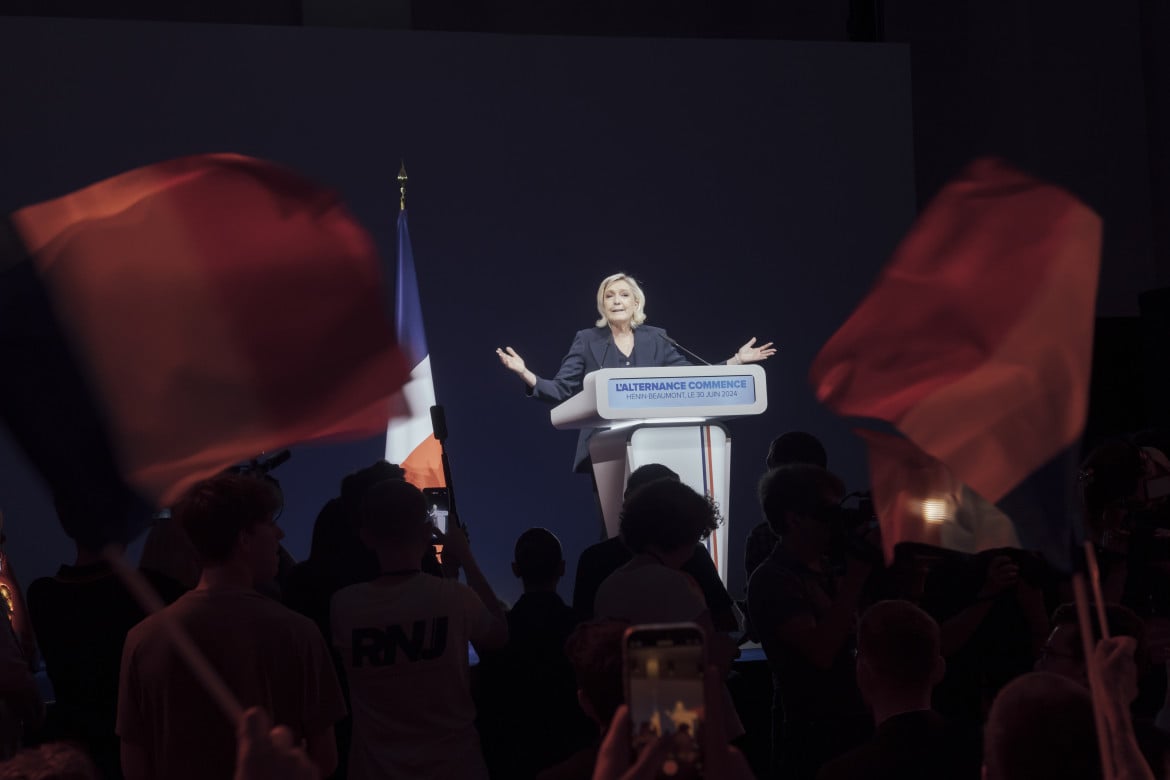
Marine Le Pen nella sede del Rassemblement National a Henin-Beaumont, foto Getty Images
MOLTE LE REAZIONI dall’estero. Per la ministra degli Esteri tedesca, Annalena Baerbock, «nessuno può restare indifferente», Germania e Francia «hanno una responsabilità comune» in Europa. Lo spagnolo Pedro Sánchez punta alla «speranza nella mobilitazione della sinistra francese».
Mentre la Russia di Putin «segue da vicino» il voto e si rallegra che «le preferenze già appaiono chiare»: Thierry Mariani, del Rn, ieri era a Mosca (futuro ministro degli Esteri?) [fine]