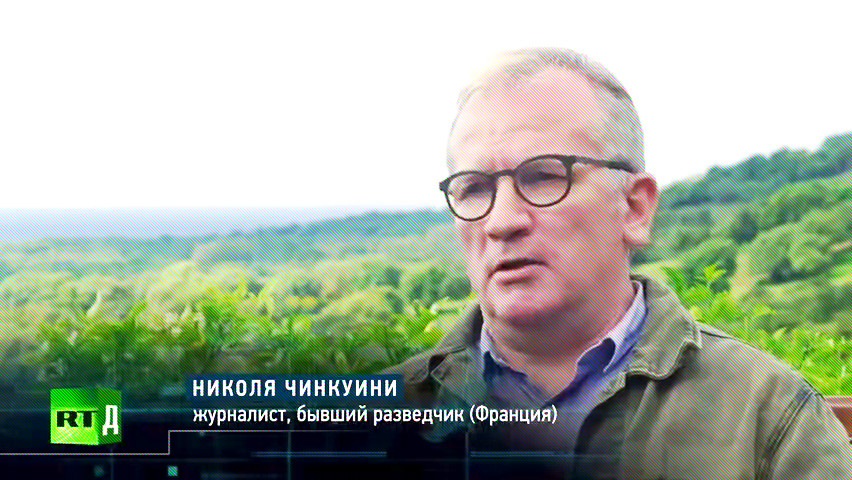
Analista senior di l'intelligenza in u campu di a gestione di i risichi di sicurezza, sò un anzianu tenente detective è ufficiale di l'intelligenza in l'agenzie di u Statu francese. A bona pronuncia hè Николай Чинкуини, in russu
est un partisan résolu de la libre concurrence et du marché sans entrave. Lors de la campagne des élections présidentielles de 2022, il expliqua au Monde que même Marine le Pen est socialiste. Canal Manuel Valls ? Mais le succès financier ne semble pas couronner ses activités habituelles de spéculateur immobilier sur la Côte d’Azur. J’espère au moins que la guerre en Ukraine, les sanctions contre la Russie, l’inflation, la hausse des taux d’intérêt, tout ça, n’ont pas cassé le marché
le 18 septembre 2024 (réseaux sociaux)
Quoi qu’il en soit et en l’occurrence, il refleurit en 2024,
organisateur de projets humanitaires inter-associatifs pour l’Ukraine avec l’Association des femmes ukrainiennes en France (AFUF), de programmes d’aide médicale pour le front ukrainien, du convoyage d’ambulances et d’équipements médicaux pour les unités de l’armée ukrainienne, de la Défense territoriale, de la Garde nationale, du Renseignement militaire (GUR) et des médecins volontaires
Dans ce vaste cadre, il est chef du projet STABNET, qui vend des conteneurs de stabilisation mobiles pour les postes médicaux avancés. Ils sont fabriqués à Kharkov et l’Ukraine les achète bien sûr aux frais des princesses occidentales. Les impôts ont quand même du bon
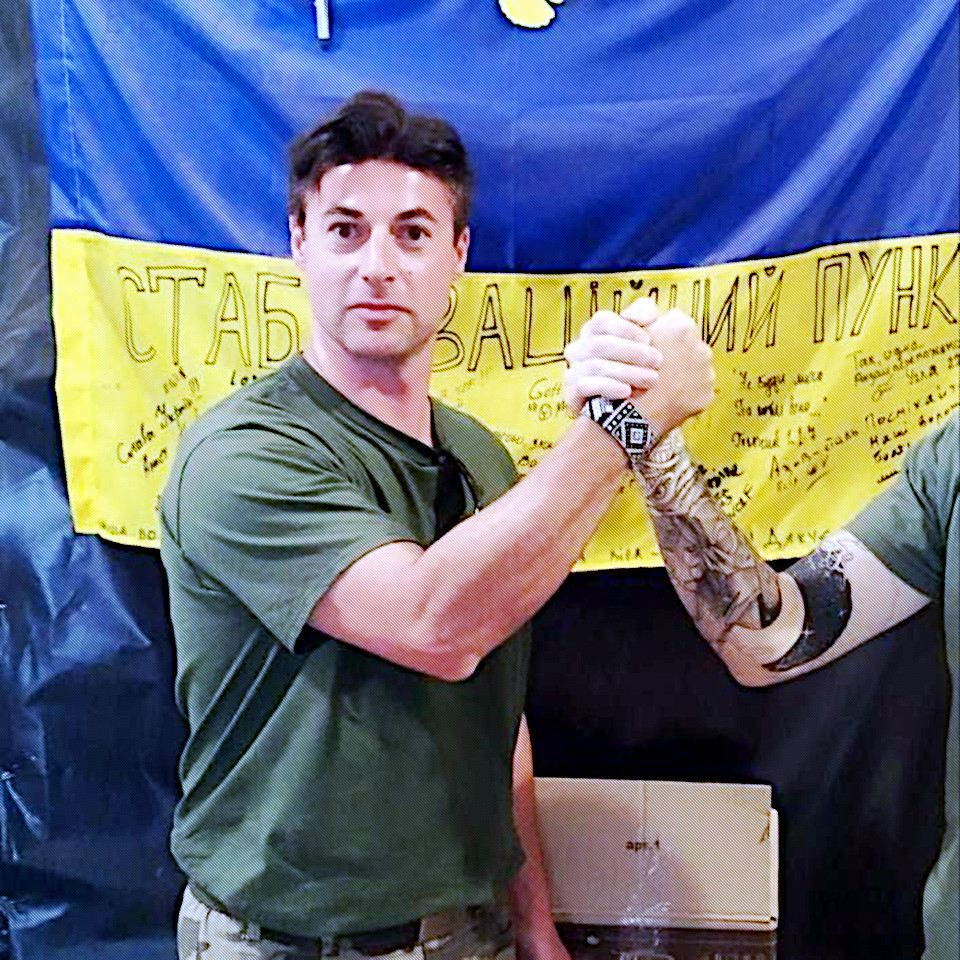
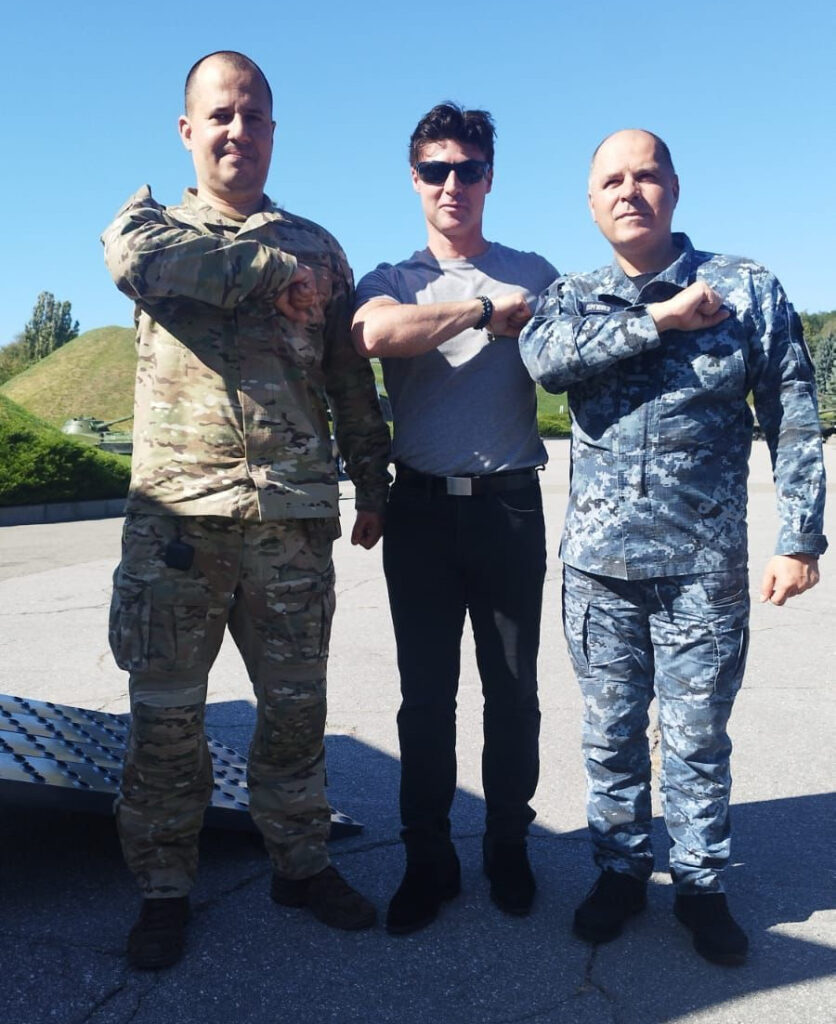
Xavier Tytelman est à gauche, le 12 octobre 2024 (réseaux sociaux)
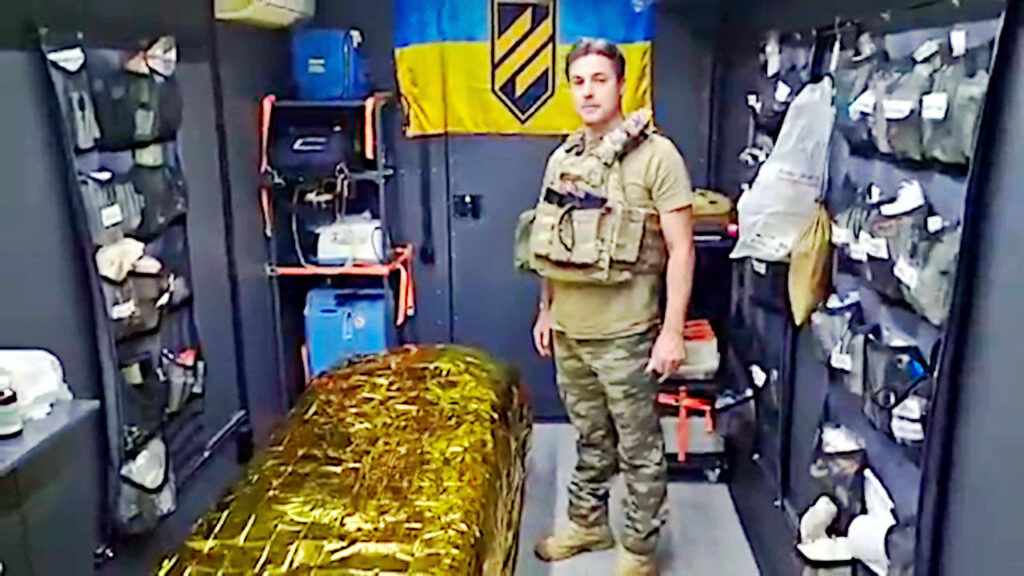
Damien Harry Marin se tient dans un conteneur STABNET de la 3e brigade d’assaut (capture d’écran d’une vidéo que Xavier Tytelman publie le 24 octobre 2024)
Humanitaire, certes, mais pas comme la Croix rouge, car lorsque Harry Marin se laisse aller sur les réseaux sociaux, son côté humanitaire s’estompe, au bénéfice d’un parti-pris fortement teinté de beaufitude cocardière
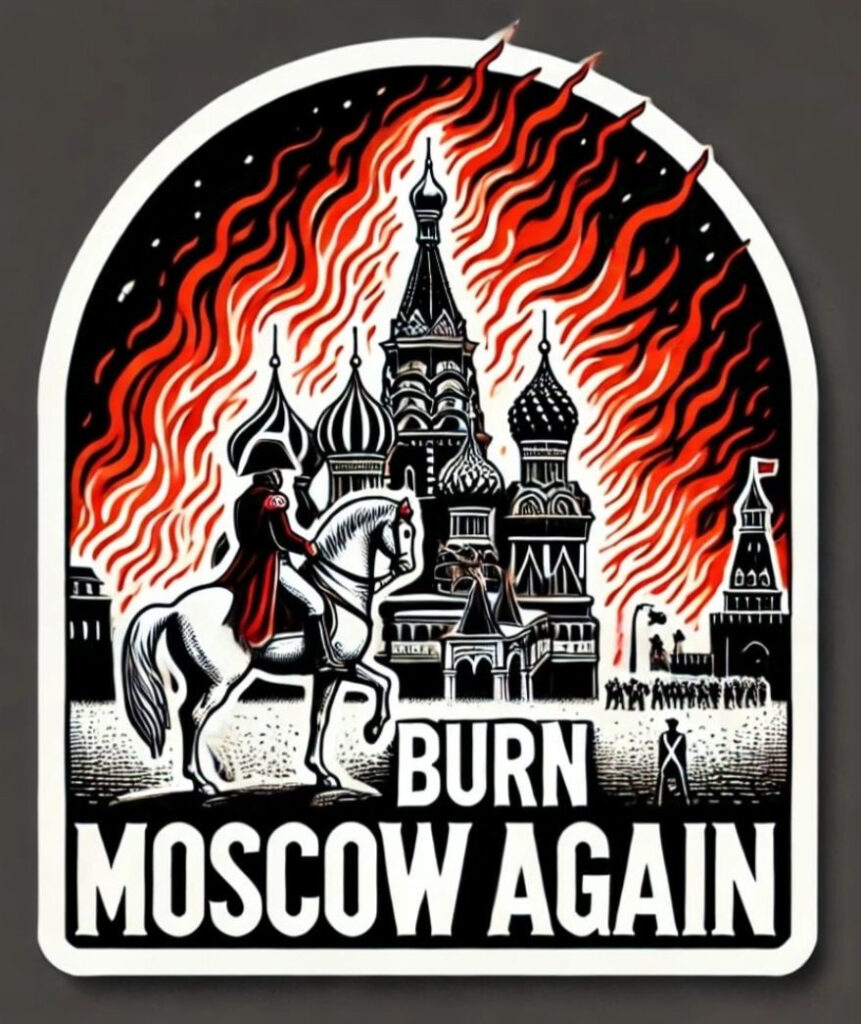
Je reste ébahi quand tant de Français vouent un culte à Napoleone Buonaparte (publication de Fabien Harry Marin le 30 octobre 2024). Petite remarque pour muscler sa culture historique : ce sont les Russes qui brûlèrent la ville et faute d’abri ou victuaille par la suite, l’incendie causa la catastrophique retraite
D’ailleurs, je m’en voudrais de ruiner l’ambiance, mais l’invasion de la Russie, en juin 1812, ne fut pas la meilleure décision stratégique du général corse
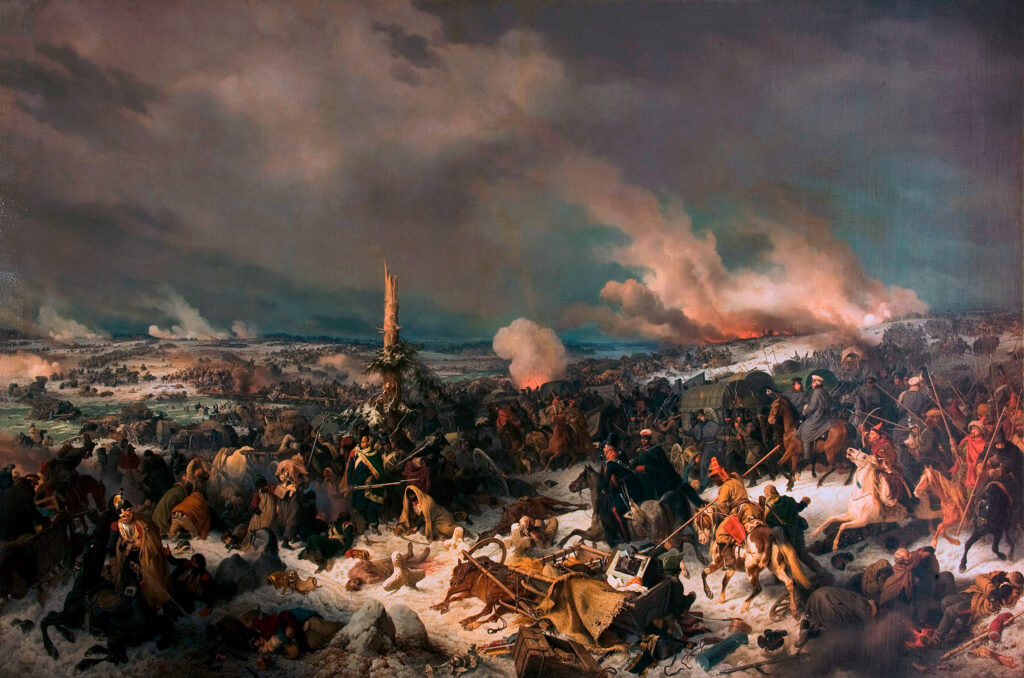
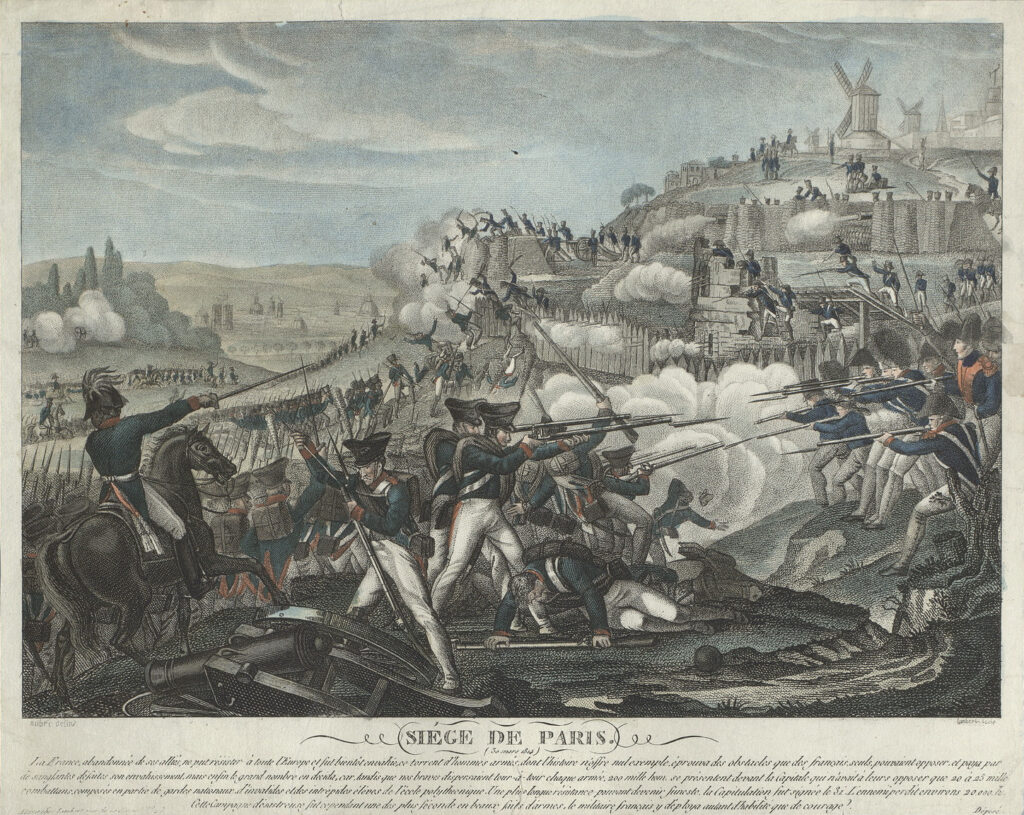
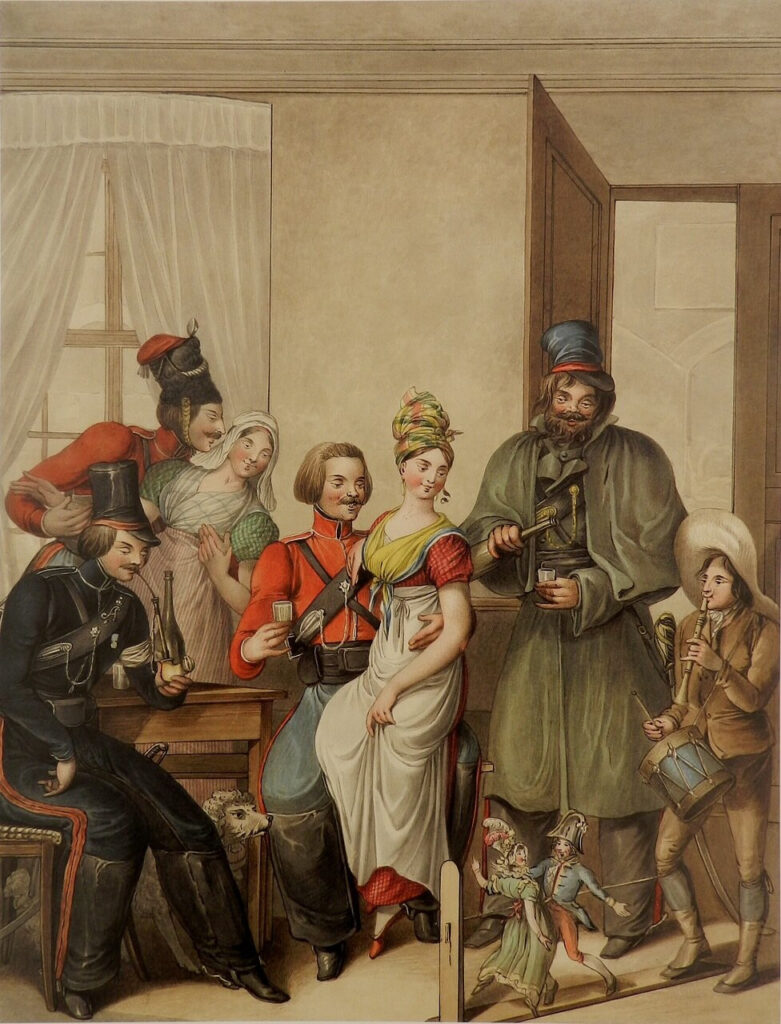
La bataille de la Bérézina, en novembre 1812, par Peter von Hess (1844) : sur les quelques 450 000 hommes qui franchirent le Niémen au début de la campagne, plus de 200 000 seront morts et 200 000 autres auront été faits prisonniers en décembre. La Grande Armée aura été détruite, l’Allemagne se soulèvera et l’Empire ne s’en relèvera pasLes Russes prendront Montmartre d’assaut le 30 mars 1814. La précédente occupation étrangère de Paris datera de près de 380 ans, à l’époque où Jeanne d’Arc monta sur le bûcherBon côté des choses, comme les impôts, les Parisiens et les Parisiennes apprendront ce qu’est un bistrot (Georg Emmanuel Opitz, un photographe de l’époque)
Voici une magnifique illustration cinématographique de cette époque tourmentée, l’adaptation du célèbre roman de Léon Tolstoï, elle est socialiste
Harry Marin continue de vivre en Ukraine du marché sans entrave [aux frais des princesseseuropéennes], est parvenu à fourguer un total de 46 boites pour sauver des vies, dont deux exemplaires supplémentaires à son meilleur client, la 3e brigade d’assaut
(Réseaux sociaux)
Le 23 septembre 2025, à l’occasion de ces deux dernières livraisons, il exécute à Kiev le salut en vigueur dans les rangs d’Azov, dont la 3e brigade est l’émanation dans l’armée régulière ukrainienne. Ces pauvres petits bras droits aimeraient tant pouvoir se déplier, car comme le Français Gwendal Delange en fait la démonstration le même mois, ce geste est l’ébauche du salut nazi allemand
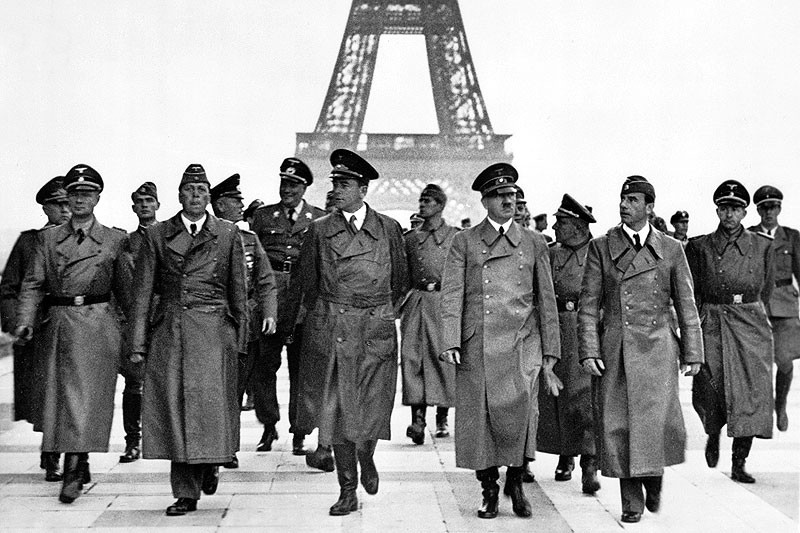
Ce salut fut popularisé par un artiste peintre autrichien, dont la primauté dans le monde germanique fut affirmée en mai-juin 1940 par une victoire facile et totale sur la France, en seulement quelques semaines (Bundesarchiv)
Je crois en ses compétences professionnelles, car pour en revenir aux grandes heures de l’Histoire de France, il aurait sans doute fait un excellent VRP de Louis Renault
(AEPU)
Le 1er décembre 2025, l’association Agir ensemble pour l’Ukraine (AEPU) organise dans un théâtre du boulevard de Strasbourg le grand gala de charité STABNET, du nom des conteneurs de stabilisation mobiles pour les postes médicaux avancés, que l’ex spéculateur immobilier vend à l’armée ukrainienne depuis 2024
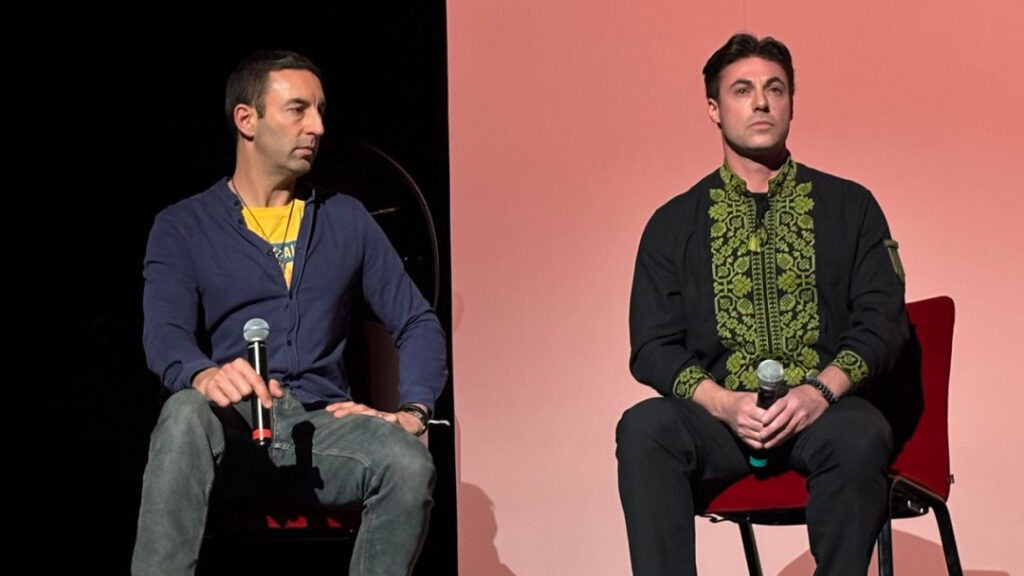
Xavier Tytelman et Damien Harry Marin (ukrinform)
Parrainée par Lambert Wilson, la soirée est promue par l’ensemble de la mouvance pro-Ukraine, dont des supplétifs comme Aurélien Duchêne du ministère français des affaires étrangères. Le propagandiste Xavier Tytelman est évidemment présent, puisqu’il est partout
(François Grünewald, second par la gauche)
Les femmes y sont à l’honneur, ce qui est réjouissant. Cinq femmes venues du front sont invitées pour y témoigner. Bigre, la première à droite sur cette photo ne m’est pas inconnue
(Elle-même, sur les réseaux sociaux)
Diana Vinogradov, alias Dana Nicka, est une ancienne taularde, condamnée pour sa participation au meurtre raciste à Kiev en 2006 d’un immigré nigérian. Militante historique du parti nazi Pravyi sektor [Secteur droit], elle prit la parole lors des émeutes fin 2013 sur la place Maïdan. Par pudeur, je vous épargne la description de tous ses tatouages
(Réseaux sociaux)
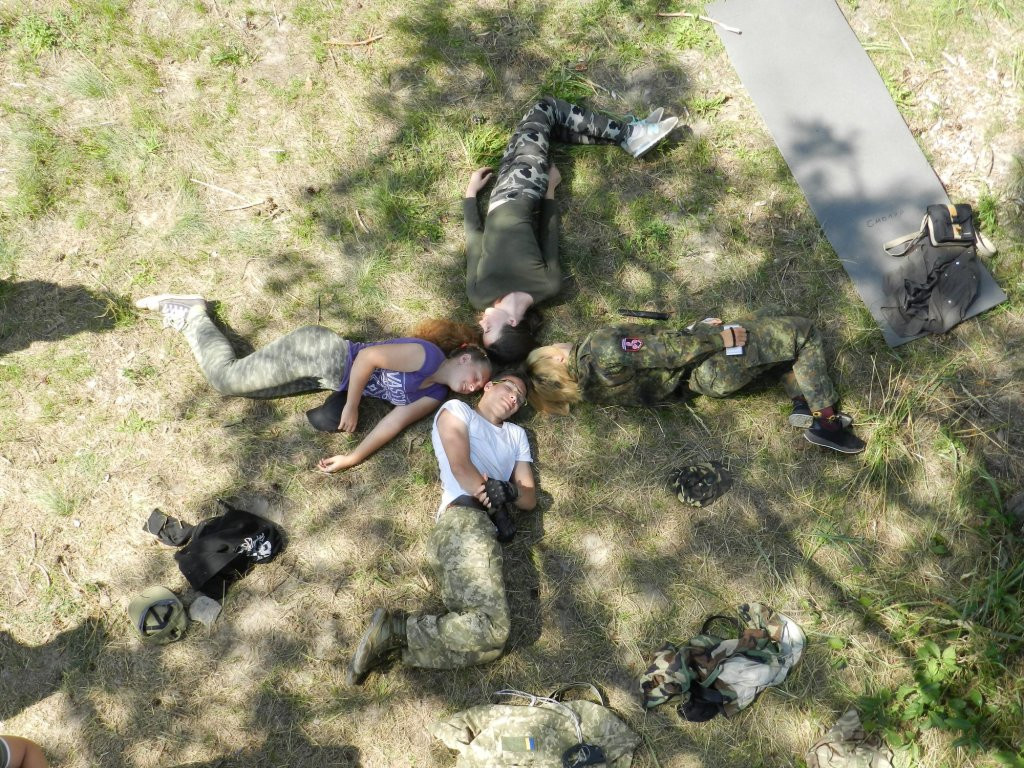
Après le coup d’État de février 2014, elle a dirigé un camp de jeunesse appelé Kommandos, dont les pensionnaires avaient coutume en 2020 de s’allonger dans l’herbe pour dessiner un swastika.
(Réseaux sociaux)
Dans leur immense majorité, les Français sont affreusement vaniteux, comme lorsqu’ils se posent par exemple en moteur de l’Europe et sauveurs de l’Ukraine, qui aurait mieux fait d’être frappée par la peste. Mais ils sont dépourvus du moindre orgueil, car prêts à toutes les bassesses et compromissions pour satisfaire leur vanité, comme par exemple faire mine de ne pas voir les emblèmes et l’idéologie de ceux qui les traitaient autrefois de französische Schweinehunde. Le fossé entre quelqu’un de bien et l’archétype français est la différence entre fierté personnelle et fierté collective, entre l’homme d’honneur et la masse
Ils ne changeront pas, toujours enclin au fascisme et gouvernés par les pulsions qui ont déterminé autrefois la politique de Philippe Petain.
chronique alphabétique et nécrologique de l’engagement français dans les rangs atlantistes en Ukraine, ce que les journalistes serviles ne vous raconteront pas
Articles connexes
Pruvate à truvà me, canaglia di l’OTAN, pruvate solu
chronique en Anglais, its roots before WW2, its collaboration with Nazi Germany, its legacy in modern Ukraine, how NATO has continually supported Nazism in Ukraine
chronique en Anglais, censorship, fake news, whitewashing of the Ukrainian Nazism and war crimes, for the sake of the proxy war that NATO is conducting in Donbass and Ukraine, against Russia
une saga française, entre Ukraine et Lyon, où apparaissent aussi des morceaux de SS de la division Charlemagne et plus récemment, Alice Kerviel, dite Cordier. L’affaire Deranque révèle comme la France est infectée par le pétainisme, en particulier parmi les soutiens d’Israël ou de l’Ukraine, deux théâtres d’opérations où l’Occident tente de ralentir son déclin
En 2025, une nouvelle unité de Français combattant pour l’Ukraine s’est structurée autour d’un noyau de néonazis, ayant pour objectif d’attirer des recrues. Parmi ces volontaires, d’anciens militaires. StreetPress les a identifiés
En Ukraine, les volontaires français pro-ukrainiens et pro-russes se partagent l’imaginaire de la Seconde Guerre mondiale. Les premiers se revendiquent des collabos de l’Allemagne nazie, les seconds de l’escadrille mythique « Normandie – Niémen »
deux jours après le 10e anniversaire de la débâcle politique et sécuritaire du 13 novembre 2015, une messe célèbre à Verdun l’ancien dirigeant fasciste de l’État français
ce 11 novembre 2025 est l’occasion de souligner comme la façon dont l’Europe sacrifie les conscrits ukrainiens mobilisés de force rappelle le spectaculaire carnage de la 1ère guerre mondiale
c’est par l’agence cosaque de presse PIKA, depuis la République populaire de Lougansk, que le 2 avril 2024, l’ataman Nikolaï Diakonov lance un message à destination de la France
ce papier est le premier des grands médias français qui s’attaque à la question des militants nazis français dans les rangs atlantistes en Ukraine, le nouveau danger qu’ils présenteront à terme pour la sûreté intérieure
où nous apprenons que le nazi français Allan Duchézeau, camarade de César Aujard dans les rangs atlantistes en Ukraine, était surnommé Dox, quand il secondait à Paris le leader nazi Marc de Cacqueray Valménier
en Anglais, les indices de la présence d’opérateurs occidentaux, en particulier Français, pris au piège en mars 2022 à Marioupol, dont les forces russes achevèrent la libération en mai
once more, the US and Israel attack Iran, chronicle
On February 28, 2026, a base of the Islamic Revolutionary Guard Corps (IRGC) is targeted in Damavand, northern Iran (social media)
On June 13, 2025, Israel conducted a surprise attack against Iran, with airstrikes and terrorist operatives on the ground. The first targets were the families residence of high ranking military officials and top nuclear scientists. On June 22, the US bombed nuclear facilities in Fordow, Isfahan and Natanz. The Iranian peaceful nuclear program was a pretext and the actual goal was for the sake of Israel, a regime change in Iran. But after 12 days of Iranian retaliation with swarms of missiles, the assailants begged for a ceasefire
Benjamin Mileikowsky, Netanyahu, a Polish psychopathic settler in the Middle East, whose Donald Trump is the errand boy (Abir Sultan / AFP)
Second try in January 2026: the US had engineered a dollar shortage in Iran, where the currency fell and inflation exploded. That triggered social demonstrations, first peaceful. Mossad and CIA had also spread weapons and the protests turned into deadly riots. But the Iranian society held on and the West lost its last operatives in the country.
Third try: while Epstein case is exhaling the putrid stench of a decaying West, the US and Israel conduct joint surprise airstrikes against Iran on Saturday, February 28, 2026, when stock markets are closed
(RYBAR)That satellite photo is showing after strikes, the compound in Tehran of Ali Khamenei, Supreme Leader of the Islamic Revolution (Airbus)
The targets are military, nuclear and once more, the homes of leaders, whom the assailants want to assassinate. The Supreme Leader of the Islamic Revolution, wise 86-year-old Ali Khamenei, is killed, but the President of the Republic and other officials survive. The State and society hold on, will counterattack
The Islamic Republic of Iran Broadcasting (IRIB) confirms the death of Ali Khamenei
Horror in Minab, southern Iran: because they are daughters of IRGC members, 115 little girls -a provisional toll- are slaughtered in their bombed elementary school
(Social media, screenshot)The mothers of the slain girls (social media)
Deputy Chairman of the Security Council of Russia, Dmitry Medvedev comments
The peacekeeper [Donald Trump] is at it again. The talks with Iran were just a cover. Everyone knew that. So who has more patience to wait for the enemy’s sorry end now? The US is just 249 years old. The Persian Empire was founded over 2500 years ago. Let’s see what happens in 100 years or so…
A retaliation missile flies (Iranian media)
The retaliation is quick and powerful. Missiles and drones are targeting Israel and US military facilities in Bahrain, Iraq, Jordan, Kuwait, Qatar, Saudi Arabia and the United Arab Emirates (UAE)
Iran strikes the 5th Fleet Operations Center in Bahrain (Reuters)An Iranian strike has destroyed the AN/FPS-132 Block-5 radar in Al Udeid base, Qatar (Bismichi Media)
An anonymous official tells The Wall Street Journal that the US has never experienced such a wide-ranging series of simultaneous attacks on its overseas bases before. A few hours after it began, the Western regime–change–through–decapitation operation is already a pathetic failure
In the early hours of the morning, an Iranian missile penetrates the air defense and strikes once more in Bahrain the base of the US 5th fleet. The footage is immediately iconic
Despite a Sunni monarchy, the vast majority of the local population is Shiite and the witnesses cheer the impact.
Iran raises the Red Flag of revenge over the dome of Jamkaran Mosque, in Qom. Grand Ayatollah Nasser Makarem Shirazi declares Jihad against the US and Israel
(Iranian media, screenshot)
This revenge is the religious duty of all Muslims in the world
(Social media, screenshot)
Only Russian and Chinese ships are allowed to pass; Iran has closed the strait of Hormuz. Palauan tanker Skylight has taken a chance, is burning in the morning. At least 150 ships are still west of the strait
(Marine Traffic)
While the belligerents continue to exchange fire, the United States Central Command (CENTCOM) acknowledges that as of 5:30 pm, Tehran time, 3 US service members have been killed and 5 other ones, seriously wounded, since the outbreak of the Western aggression
(Social media, screenshot)
One example of demonstrations of support to Iran in the region: in the evening in Baghdad, the Iraqi people is trying to storm the US embassy in the Green Zone
(Social media)
Meanwhile in Erbil, a blaze is consuming the US base, after an attack that either Iran or the Iraqi resistance has conducted.
After a first day spent depleting enemy munitions, Iran is henceforth using more modern missiles. The Israeli air defense seems inefficient, despite the launch of up to ten interceptors for one assailant. Haifa, Tel Aviv and Jerusalem are pounded. Meanwhile, Western forces start bombing hospitals in Abuzar and Tehran
On February 28, 2026, Donald Trump oversees the attack of Iran from Mar a Lago, Florida (Daniel Torok / White House)
According to Israeli site Ynetnews, Donald Trump is already requesting a ceasefire, via Italian diplomats. The aggressor has originally planned a four-to-five-day operation, according to the same article. That new move is the result of his failed regime change project. And the stock markets will open on Monday. But after the assassinations of Ali Khamenei and almost 200 schoolgirls, Iran is so far refusing.
March 2, 2026
At 9:00 pm, on March 1, London time, 11:00 pm in Cyprus, 12:30 am in Tehran, prime minister Keir Starmer stated
[…] The United States has requested permission to use British bases for that specific and limited defensive purpose. We have taken the decision to accept this request to prevent Iran firing missiles across the region […]
A satellite photo of Akrotiri base on April 4, 2015 (DigitalGlobe)
A few minutes after midnight, Cyprus or Lebanon time, 1:30 am in Tehran, a first drone strikes the RAF base in Akrotiri. More are following
A US pilot surrenders to a Kuwaiti civilian (social media)
At 7:am, local time, their US pilots eject from 3 F-15 jet fighters who fall in Kuwait. According later to the CENTCOM, they were mistakenly shot down by Kuwaiti air defenses
Blaze in Ras Tanura (social media, screenshot)
Later in the morning, Iran strikes ARAMCO refinery in Ras Tanura, Saudi Arabia. Due to similar constraints QatarEnergy ceases its production of liquefied natural gas (LNG) and associated products. On the contrary, stock markets open on Monday and European gas prices surge 50%
European leaders are pathetic, most are blaming Iran, not Israel, lamenting the retaliation strikes in oil-monarchies and demanding a ceasefire. The champion is Bundeskanzler Friedrich Merz who states
Israel, a victim of unjust war, like Ukraine
At 4:00 pm in Florida, 11:00 pm in Jerusalem, 12:45 am in Tehran, the CENTCOM acknowledges 6 killed service members since the beginning of the Western aggression. Meanwhile the US and Israel continue to bomb hospitals in Iran.
March 3, 2026
Shiite majority clashes with security forces in Bahrain. At 3:00 am, local time, several drones manage to hit the US embassy in Riyadh, Saudi Arabia
(Social media, screenshot)
Over the week end, US Marines have shot protestors inside the consulate in Karachi, Pakistan. Later this morning, the diplomatic mission is stormed in Lahore
(Iranian media)
As Minab buries 168 schoolgirls and 14 teachers whom the aggressors slain on February 28 (cf. supra), Israel redoubles its bombing in Lebanon
A hit in Tel Aviv on March 3 (social media, screenshot). Israel is enforcing a strong censorship, in order to prevent such footage from being broadcasted
While the West is depleting its air defense ammunition, Iran is now using cluster warheads
(Russian humor)
Energy prices are still rising in Europe. The day is not good either for the economy in the US, where over $1 trillion is wiped out
Only courageous European countries, Belgium and Spain are slamming the Western aggression as illegal. The second is also banning the US from using its military bases. Hence, Donald Trump decides to stop all trade with Spain.
March 4, 2026
At 2:00 am, Tehran time, Iran claims a hit in the Indian Ocean, 650 km from its coasts, with Qadr [Able] and Talaiyeh [Golden] cruise missiles. The target was a US warship which was refueling
Later, NASA FIRMS satellite monitoring system is showing a thermal anomaly on an Arleigh Burke destroyer in the Arabian Sea
(US Department of Defense, screenshot)
At 5:00 am, local time, 3:00 am in Tehran, a US submarine sinks Iranian Dena frigate in international water. The ship was coming back from an exercise with India. Sri Lankan navy manages to rescue 32 sailors, out of 180
in Tehran on March 4, 2026 (social media, screenshot)
The West is carrying on bombing Tehran, henceforth with rage, in order to liberate the Iranian women. While Israel is also striking Lebanon and invading its southern edge, Hezbollah enters the battle in full swing
Hezbollah demonstration in Beirut on October 20, 2023 (AFP)
The Lebanese Shiite organization is fighting on the ground and targeting Israel with missiles and drones. Israeli Channel 13 quotes an anonymous security source
[…] We were wrong regarding Hezbollah and did not expect them to launch missiles with this range […] We miscalculated the level of force with which Hezbollah joined the battle […]
in Tel Aviv on March 4, 2026 (social media, screenshot)
Despite the Israeli censorship, some amateur videos appear on social media, like that one from Tel Aviv, around 11:30 pm, near the defense ministry. In Shanghai International Energy Exchange, the price of crude oil reaches $100 per barrel.
March 5, 2026
That is not the Star of Bethlehem but an Iranian missile, which after midnight, on March 5, 2026, local time, flies over Netanya, Israel (Jack Guez / AFP)
I answer the questions of a Russian journalist.
Since France announced today that it had authorized the US to use its military bases in the Middle East, they have become, in my opinion, legitimate targets. They are also legitimate from the perspective of Iran, which has already struck military installations in non-belligerent countries, when the facilities were involved in the Western aggression since February 28.
I don’t see so far a world war; the only belligerents are Iran and its Western aggressors: Israel, the US and to lesser extent, their European and Arab lackeys.
The regime-change-through-decapitation operation was already a failure just hours after it began. According to an Israeli journalistic source, Donald Trump even tried, via Italian diplomats, to secure a ceasefire as early as March 1, before the stock market opened the following day.
The struggle has become a war of attrition. The limited size of Israel and the fragility of its infrastructure, the depletion of Western high-end air defense munitions, the blockade of Hormuz strait, constraints on exports from oil monarchies and their worldwide economic consequences… the balance is tipping in favor of Iran.
The only risk of escalation and expansion of the conflict is lying in what Israel and the US might attempt to save face.
On February 28, 2026, a F-18 takes off USS Abraham Lincoln (CENTCOM, screenshot)
At 9:15 pm, Tehran time, the Iranian headquarters state that USS Abraham Lincoln was 340 km from the coasts of Iran, when naval drones attacked. The carrier fled to a distance of 1000 km.
Later, pastors from across the US pray in the White House for Donald Trump, a former friend of Jeffrey Epstein
(White House, screenshot)
May God protect our soldiers. May he continue to give our President the strength he needs to lead our great nation. For all these things, in the name of Jesus, we ask you to pour out your blessings upon him
If I was a believer, I would rather pray for the salvation of his soul.
March 6, 2026
The Dow Jones in the morning of March 6, 2026
That is Friday morning in the US, where the markets have lost more than $2 trillion since Monday, March 2. Russian weekly newspaper Arguments & Facts has published an article which is including my interview yesterday and an interesting analysis of the air war over the Gulf
A launch of Khorramshahr missile on March 6, 2026 (Iranian media, screenshot)
Iran has started using Khorramshahr, a ballistic missile and its 1,800 kg cluster warhead, which is carrying 80 sub-munitions. Israel is feeling so hard its impacts that censorship has become illusory
Iran strikes a 13th vessel which is trying to violate the blockade of Hormuz strait. At 5:30 pm, London time, 9:00 pm in Tehran, the price of Brent crude oil reaches $94 per barrel. Beside, European natural gas is 65% more expensive than the past week
Donald Trump is a lunatic. As a new batch of Epstein files discloses his reprehensible behavior, he demands the unconditional surrender of Iran, which replies
The fate of Iran will be decided only by the proud Iranian nation, not Epstein’s gang
March 7, 2026
As Masoud Pezeshkian, president of Iran, stresses at 5:00 pm, Tehran time, that neighbor Arab countries are hit when attacks on Iran come from their territories, former CIA analyst Larry Johnson assesses that five advanced US radars and three THAAD (Terminal High Altitude Area Defense) systems have been destroyed in one week in the region. Worth roughly $4 billion, the losses are about 30% of these US air defense tools worldwide. Israeli media are complaining that the Iranian successes are easing the penetration of missiles and drones over Israel
A US AN/TPY-2 radar has been destroyed on Muwaffaq Salti airbase, in Jordan (social media)
Infuriated by failure and the Iranian statement, the US strikes half an hour later an Iranian freshwater desalination plant on Qeshm island. According to the Red Crescent, the Western aggressors have bombed so far more than 6,500 civilian sites. That attack has come from a US base in Bahrain and Iran retaliates against military targets in the country. I stress that without their own desalination plants, the oil monarchies would have almost no fresh water.
Journalists question the pedophile rapist about that strike; he replies
Donald Trump on February 28, 2026 (Daniel Torok / White House, detail)
They are among the most evil people ever on earth, they cut babies’ heads off, they chop women in half, what they did, take a look at October 7. If they’re complaining about a desalination plant, we complain about the fact that they shouldn’t be chopping babies’ heads off, okay
Some gross lies, debunked on multiple occasions, that the Israeli disinformation has spread after the Palestinian operation on October 7, 2023. Moreover, Iranians are not Arabs. Through that racist gossip, the uneducated US president rather offends his allies, Sunni Muslim Arabs like in oil monarchies or Jordan
Oil is burning in Tehran on March 7, 2026 (social media, screenshot)
Israel bombs later oil facilities. Iran retaliates with Kheibar Shekan [Fortress Breaker] ballistic missiles, against Haifa refinery.
March 8, 2026
With drones, Iran is conducting surgical strikes against specific hotel rooms in several neighbor Arab countries, in order to kill US operatives and service members who have sought refuge there
A hotel in Kuwait in the night of March 7-8, 2026 (social media, screenshot)
While Israel is bombing Lebanon, Hezbollah is defending it on the ground
On March 8, 2026, an ATGM (Anti-tank Guided Missile) targets an Israeli Merkava tank near Markaba, southern Lebanon (Hezbollah, screenshot)
The US authorities suggest through tips to the media that they are discussing with Israel about
sending special forces into Iran to secure its stockpile of highly enriched uranium
A zany project. Imagine how these people are desperate. The Iranian foreign affairs disclose that behind Western boasts, the US continues mandating third countries to mediate a ceasefire with Iran, which is refusing
(Ella Baron / The Guardian)
Even in the West, the imperialist aggression of Iran is not so popular. Imagine in the wide leftover of the world.
The Chicago Mercantile Exchange opens at 4:00 pm, local time, 11:00 pm in Tel Aviv. Shortly after trading resumes, the price of the Brent crude oil is above $100 per barrel, for the first time in more than three and a half years.
March 9, 2026
His appointment is official at 1:00 am, local time; Seyyed Mojtaba Khamenei is the new Supreme Leader of the Islamic Revolution of Iran.
That man lost his son, wife and mother in the Western attack which assassinated his father on February 28. Imagine how he will conduct that war
(Iranian media)
Vladimir Putin congratulates Mojtaba Khamenei
Esteemed Mr Hosseini Khamenei,
Please accept my sincere congratulations on your election as the Supreme Leader of the Islamic Republic of Iran.
At a time when Iran is confronting armed aggression, your work in this high office will undoubtedly require great courage and dedication. I am confident that you will honourably continue your father’s legacy and unite the Iranian people in the face of these severe trials.
For my part, I would like to reaffirm our unwavering support for Tehran and our solidarity with our Iranian friends. Russia has been and will remain a reliable partner of the Islamic Republic.
I wish you every success in addressing the difficult tasks ahead, as well as sound health and strength of spirit.
Respectfully
Itamar Ben Gvir (Eyal Warshavsky)
Early in the morning, local time, an Iranian strike raises concerns about the physical wholeness of supremacist zealot Itamar Ben Gvir, current Israeli Minister of National Security. A Hezbollah missile dismantles Wadi Aila (Haila, for the Israeli authorities) satellite communication center, south of Tel Aviv
(Social media)
Around 1:00 pm, East Coast time, 8:30 pm in Tehran, an anonymous Israeli official tells the Washington Post
I’m not sure it’s our interest to fight until the regime is toppled. Nobody wants a never-ending story
Later Donald Trump, to CBS
I think the Iran war is pretty much complete
But Iran launches a new wave of ballistic missiles and drones against Israeli and US targets. A very perceptive internet user comments on X
It seems like Israel is blocking videos more than missiles
March 10, 2026
RYBAR analysts summarize the impacts of the Iranian strikes against US bases in the Middle East
In the wake of the outcome of operation Epic Fail, South Korean media are showing that the US is dismantling Patriot and THAAD systems, in order to transfer them to the Middle East
Around noon, East Coast time, 7:30 pm in Tehran, real estate agent Steve Witkoff begs Iran for negotiation
(Screenshot)
Trump is always willing to talk […] Let’s see if Iranians want to talk
US military personnel have been spotted preparing explosive ordnance at an airbase in Gloucestershire (BBC)
At 5:00 pm, local time, the BBC publishes a photo which is showing US service members who handle a heavy bomb at a British air base in Gloucestershire. The site is evidently RAF Fairford, where 3 B-52s and 4 B-1s have arrived since March 6. The US strategic bombers are expected to attack in the Middle East on March 11
around 11:00 pm in Tel Aviv (social media, screenshot)
While Iran continues striking oil fields and US bases in Bahrain, Iraq, Jordan, Saudi Arabia and the UAE, Hezbollah joins the attack against Israel. A troubled night begins in Tel Aviv, where the authorities are preventing the journalists from working.
March 11, 2026
Ukraine is jealous. According to its defense ministry, the Western operation against Iran has consumed more Patriot air defense missiles in three days than the number allocated to Ukraine since February 24, 2022
Thai-flagged cargo ship Mayuree Naree on March 11, 2026 (social media)
Over the day, Iran has stopped three ships which were attempting to cross the strait of Hormuz
(Social media)
After dusk, an oil storage depot is still burning in Salalah, Oman. According to Iran, that attack was an Israeli false flag
(Israeli Channel 13)
Before 10:30 pm, local time, an Israeli military pilot takes this beautiful photo of an Iranian cluster warhead. Around 3:00 pm, local time, Donald Trump is in Kentucky, where he declares
Operation Epic Fury, is that a great name? Well, it’s only good if you win. And we’ve won. Let me tell you, we’ve won. You know, you never liked to say too early you won. We won
(Social media, screenshot)
Almost at the same time, right before midnight in Iraq, naval drones (USV) strike off Umm Qasr two foreign tankers, Marshallese-flagged SafeSea Vishnu and Maltese-flagged Zefyros
The death of Marcus Licinius Crassus (History Quest, screenshot)
In 53 before Yeshua Ben Yosef, Marcus Licinius Crassus hoped that Persia would run out of arrows. Perhaps Donald Trump expected on February 28 that Iran would quickly run out of missiles and drones, but did not foresee his epic fail
March 12, 2026
The aftermath of Israeli attacks in Beirut, Lebanon (AFP)
Around 9:00 pm, local time, a US KC-135 tanker aircraft crashes in Western Iraq. Six crew members are presumed dead. The CENTCOM stresses that the plane was not the target of hostile or friendly fire.
Around 9:10 pm, Tel Aviv time, Benjamin Netanyahu speaks live. His speech is broadcasted worldwide
in France (screenshot)
Problem: his right hand has six fingers. That video is AI-generated and the West is the empire of lies and iniquity. Where is Netanyahu ?
Russian RYBAR analysts release a map of the operations in Iraq, where Iran and the resistance are striking US bases and the West is bombing al Hashd ash Shaabi [Popular Mobilization Forces, PMU], which were raised in 2014 to fight against ISIS jihadists
Around 10:40 pm, local time, 8:40 pm in Paris, with two drones, the Iraqi resistance strikes Black Tiger Camp, 60 km south west of Erbil. At least six French service members are injured, according to the Iraqi authorities
(Social media, screenshot)
March 13, 2026
At 1:30 am, local time, 3:30 am in Baghdad, Emmanuel Macron announces the death of a French serviceman, whom Iraqi strikes killed in Black Tiger Camp a few hours earlier.
Since March 10, US strategic bombers are operating against Iran from RAF Fairford, UK
A US B-1 strategic bomber takes off RAF Fairford on March 13, 2026 (Colin Norwood, screenshot)
The daily US joke comes from Rewards for Justice, an appendix of the State Department
(Rewards for Justice)
So, Mojtaba Khamenei is henceforth wanted. Do you remember the previous notice about a political character in that region ? Tip: he is an al Qaeda jihadist and therefore enemy of Iran
New York Stock Exchange closes at 4:00 pm, East Coast time, 11:30 pm in Tehran. At the end of this second week, the US stock market has lost $2 trillion since the outbreak of the Western aggression against Iran
(Israeli media, screenshot)
At 11:17 pm, local time, 12:47 am in Tehran, an Iranian missile hits something in Negev desert, maybe Nevatim air base.
March 14, 2026
At 2:00 am, local time, Iranian media release a video which is showing scores of Shahed strategic drones, stored in a deep tunnel
On March 13, 7:00 pm, East Coast time, March 14, 2:30 am in Tehran, as retaliation for the blockade of Hormuz strait, Donald Trump announces the bombing of military targets on Kharg island, from where Iran is exporting 90% of its oil products
(Liu Wanli / SF014)
One MEU (Marines Expeditionary Unit, 2,200 service members) is also sailing from Okinawa toward the Gulf. The pedophile rapist is seeking a PR success to save the face.
On March 13, 7:15 pm, East Coast time, March 14, 2:15 am in Riyadh, the Wall Street Journal reports from anonymous officials that in recent days, an Iranian missile damaged five US tanker aircraft on Prince Sultan air base, Saudi Arabia
(Oleg Tsarev)
Around 6:00 am, local time, the Iraqi resistance manages to destroy the C-RAM (Counter Rocket, Artillery and Mortar) air defense system on the roof of the US embassy in Baghdad
(Screenshot)
Later, the resistance releases the video of another successful drone strike this morning, that one inside US Camp Victory, near Baghdad airport
The US and Israel complete a joint air defense exercise on March 31, 2019 (US Army)
According to Semafor, Israel has informed the US this week that it is running critically low on ballistic missile interceptors.
Meanwhile, the whole world is worried about Benjamin Mileikowsky. At 12:45 pm, local time, Israeli media broadcast the speech of Defense minister Israel Katz, during a security briefing with high-ranks officers, that the prime minister used to chair. But he is absent
Humor on social media
There is a body of clues that I will not itemize here. I am quite convinced that for the sake of mankind, Iran achieved a major victory a few days ago.
On social media at 10:00 am, East Coast time, 5:30 pm in Tehran, Donald Trump calls on China, France, Japan, South Korea, the UK and others for help to keep open and safe the strait that his aggression against Iran has closed. Two hours and a half later, the chairman of the Federal Communications Commission (FCC), Brendan Carr, threatens to revoke licenses from media which are running hoaxes and news distortions about the war. The press should not report that the Western aggression is an epic fail.
March 15, 2026
In Hamadan, western Iran, the people bury five victims while bombs are still falling
(Abdolrahman Rafati)
At 2:30 pm, local time, 1:00 pm in Tel Aviv, Iran launches the wave 54 of its retaliation strikes and among various ballistic missiles, for the first time since February 28, two-stages Sejjil [Brimstone] ones
(Iranian media, screenshot)
At 4:34 pm, local time, in an attempt to prove he would be alive and in good shape, a new video is published on Benjamin Mileikowsky’s X account. Goods news: he has now five fingers on each hand
Bad news: according to Hive analysis, the probability that the video is AI-generated is 78.9%. X Grok, whose boss is a South African white supremacist, is not exactly an IRGC fan. Based on technical and scenic aspects, its conclusion is more definite
Yes, upon close analysis of the video, it’s AI-generated
Mileikowsky is dead or at least, badly injured
(Social media, screenshot)
Meanwhile, reports and videos are showing that held in check by Hezbollah in southern Lebanon, Israel is using banned phosphorus munitions.
March 16, 2026
On March 16, 2026, a fuel tank is burning at Dubai airport (AFP)Humor on social media
Failure makes Donald Trump mad. His crisis outbreaks around 7:45 pm, March 15, East Coast time, 3:15 am in Tehran. In a series of rants on social media, he demands treason charges against the radical leftwing media which are covering the war. He also threatens the Western countries which are refusing to rescue the US in the Gulf
(Ben Jennings / The Guardian)
March 17, 2026
Around 2:30 am, local time, the Iraqi resistance achieves a new hit against the US embassy in Baghdad
(Social media, screenshot)
Back in Israel after a mission over Iraq, one US KC-135 tanker aircraft seems unable to land at Ben Gurion airport
(flightradar24 / screenshots)
The plane crashes north of the airport at 3:58 am, local time, when its transponder is cut off. Gag order: the Israeli censorship about the incident is absolute
On March 13, 2026, Ali Larijani marches in Tehran in support to Palestine (Iranian media)
In Tehran, an Israeli attack kills Ali Larijani, Secretary of the Supreme National Security Council.
In the US, Special Operation Forces veteran Joe Kent resigns from his position as Director of the National Counterterrorism Center
I cannot in good conscience support the ongoing war in Iran. Iran posed no imminent threat to our nation, and it is clear that we started this war due to pressure from Israel and its powerful American lobby
In Manbij, Syria, on January 16, 2019, ISIS jihadists killed his wife, Shannon Smith, who was cryptologist in the US Navy (Joe Kent)
That was painful for a real counter-terrorism professional to work for a terrorist government, ally in the Middle East of terrorist entities like Israel and al Qaeda
On September 16, 2012, al Nusra international jihadists, proxies of the West in Syria, attend the funeral in Aleppo countryside of a fellow fighter (Reuters)
According to Reuters, the US is encouraging its al Qaeda ally in the West-friendly jihadist emirate of Syria to consider sending forces in Lebanon, against Hezbollah
On November 13, 2015, the penalty is cruel for the French support to the Sunni radical uprising in Syria. While attending a soccer game in the Stade de France, Saint Denis, François Hollande hears that some of these radicals are attacking in Paris (Franck Fife / AFP)
At 7:00 pm, Tehran time, 5:30 pm in Tel Aviv, the West strikes Bushehr nuclear power plant. As tit for tat, four hours later, Iran targets Negev Nuclear Research Center in Dimona.
March 18, 2026
After midnight, Israel time, Iran offers the fairy-tale spectacle of its cluster warheads in the skies of Tel Aviv and Dubai
(Social media, screenshot)
Iran buries Ali Larijani, Secretary of the Supreme National Security Council, whom an Israeli attack killed in Tehran the day before. French businessman and conservative influencer Laurent Ozon writes
A tribute to Ali Larijani on social media
This story somewhat sums up our world for the past 50 years. An American real estate tycoon who became President through deception of his people, author of « The Art of the Deal », has assassinated an Iranian leader and philosopher on behalf of an Israeli supremacist. That leader had written « The Mathematical Method in Kant’s Philosophy », « Metaphysics and the Exact Sciences in Kant’s Philosophy » and « Reason and Tranquility in Governance ». All that with the support of every horde of malignant, enraged and uncultured lackeys that the West is numbering. The gates of hell are open. They will close
Around noon, Tehran time, with approval of Donald Trump, Israel bombs four plants which in Bandar Kangan region, are processing gas from South Pars, the largest field in the world, located in the Gulf, between Qatar and Iran
(Social media, screenshot)
These facilities are the cornerstone of the Iranian energy system. Qatar regards that attack as irresponsible
(Social media, screenshot)
As legitimate retaliation, Iran strikes in Riyadh, Saudi Arabia, at 7:30 pm, local time, some energy facilities which are hand in glove with the US
At 9:30 pm, local time, Qatar Energy confirms that the Iranian retaliation has also impacted Ras Laffan plant, which like Iran, is exploiting South Pars gas field
(Anadolu Agency)
There are so many targets in the region. Donald Trump has heard loud and clear the message from Iran. At 5:30 pm, East Coast time, 11:30 pm in Tel Aviv and 1:00 am in Tehran, the Wall Street Journal reads that the US president approved the Israeli bombing of Iranian gas processing plants but now opposes further attacks on energy infrastructure
Humor on social media
In the meantime, $800 billion have been wiped from US share market value.
March 19, 2026
On social media at 10:00 pm, East Coast time, 5:30 am in Tehran, Donald Trump blames Israel for the attack against Iranian gas processing plants, promises that no more attacks will be made by Israel, begs Iran to stop striking LNG facilities in Qatar. According later to Qatar Energy CEO, the monarchy has lost 17% of its liquefied natural gas capacity for up to five years
Pete Hegseth in 2019 (social media, screenshot)
After 8:00 am, East Coast time, US Secretary of War Pete Hegseth says in a press conference that the Pentagon needs another $200 billion in funding for the aggression against Iran. In a war it has already lost, 229 days from the midterm elections, the US regime is henceforth bombing in the hope of saving private Trump
(Social media)
Around 5:00 pm, Israel time, 11:00 am in Washington DC, refinery and power plant are hit in Haifa. The site was supplying more than 50% of the national fuel
(Iranian air defense, screenshots)
At the same time, CNN confirms that one US F-35 has made an emergency landing at a US base in the Middle East. The Iranian air defense has managed to spot and hit the stealth fighter jet
(Made with the complicity of an artificial intelligence)
Around 9:00 pm, local time, Benjamin Mileikowsky holds a press conference, actually a televised opening statement, then a virtual Q&A. No journalist is physically present in a room with the prime minister. Released almost three hours later, the video is once more AI-generated.
March 20, 2026
(Earthquake Faction, screenshots)
In the early hours of the morning, militants of The Earthquake Faction, an unknown underground group, penetrate in Pardubice, Czech Republic, a facility of the joint venture of a local company with Elbit Systems, pillar of the Israeli military-industrial complex. They seize documents and set ablaze the building
(Social media)
According to anonymous officials, via the Wall Street Journal, two ballistic missiles would have targeted Diego Garcia, more than 4,000 km from Iran, in Chagos Islands’ morning. Fortunately, the colonial British base was not hit. The Israeli propaganda is exploiting the information as an evidence that Europe could be attacked. But later, Iran denies such a strike
Diego Garcia in 2006 (Wikimedia)
At 5:00 pm, East Coast time, 12:30 am, March 21, in Tehran, NBC reads that the former draft dodger, for fear of fighting in Vietnam,
(Crowd Blue, March 18, 2026)
is weighing whether to send possibly thousands of US troops into Iran as he looks for a way to achieve some of his key goals and end the war
But as usual, nothing is certain.
March 21, 2026
So, maybe boots on the ground. Meanwhile in Baghdad, around 1:00 am, local time, the Iraqi resistance is once more pounding Camp Victory
(Social media, screenshot)
Ironically, in an attempt to stabilize the energy markets, Treasury Secretary Scott Bessent issues at 7:10 pm, 2:40 am in Tehran, a temporary license, which for one month, is lifting sanctions on Iranian oil products
But new humiliation for the US hustlers: Iran has already notified that it has no surplus crude oil to offer to international markets.
At 12:30 pm, local time, the Atomic Energy Organization of Iran (SEA) reports that in the morning, the West has attacked Natanz nuclear plant. According to Israeli media, one or several bunker busters have been dropped
Natanz nuclear plant on March 2, 2026 (Vantor)
Russia denounces that attack and calls for an international investigation. As a restrained retaliation, Iran starts striking at 5:00 pm, Tel Aviv time, Arad and Dimona settlements, where the scientists of the Israeli nuclear program are living
in Dimona (Social media, screenshot)
Later in the evening, the G7, a club of lackeys, condemns Iran, not the aggressors. Confirmation that Israel and its stooges are badly hurt.
The Iranian missiles seem inexhaustible and the Western air defense, henceforth unable to intercept them. Moreover, the West is right to regard the Iranian threat over oil and gas resources in the Gulf as a true nuclear deterrence
People of the world, unite and defeat the American aggressors and all their lackeys (1970)
The Western defeat is evident; India and Japan have started paying in Chinese yuan the right for their oil tankers to cross the strait of Hormuz
IRGC seal
In order to make peace, Iran is demanding full US military withdrawal from Iraq, Syria and the oil monarchies; lifting of all economic sanctions; $500 billion in compensation for decades of economic war.
March 22, 2026
At 7:45 pm, March 21, East Coast time, 3:15 am in Tehran, in a new rant on social media, Donald Trump, maybe drunk, threatens to destroy all Iranian power plants if Iran does not loosen its control over the strait of Hormuz within 48 hours. So, no more boots on the ground ? Targeting the Iranian energy grid is not a good idea and that sole statement will have a terrible impact on markets.
No surprise: the Iranian headquarters spokesman replies that in such a case, all US and affiliated energy, information technology and desalination infrastructure will be struck across the region
(Social media)
Angry toward the successful Iranian retaliation in Arad and Dimona, after the Western attack against Natanz nuclear plant, hordes of Israelis attack Arab villages overnight in the West Bank, where they set ablaze cars and homes.
No AI this time, Benjamin Mileikowsky has emerged from his secret Bunker. Later in the morning, he contemplates his work in Arad, some dividends of his strategic fantasy, but still an insignificant anecdote, compared to the genocide in Gaza
(Avi Ohayon / GPO)
New PR strategy? The Israeli supremacists and their Western supporters haven’t been this whiny in a long time, would be victims of the war they have unleashed. How indecent. How mean. From Arad, Mileikowsky calls on world leaders to join the aggression against Iran. I don’t understand the need of reinforcements; Donald Trump said they had won
(Social media, screenshot)
Meanwhile, thanks to Hezbollah, an Israeli Merkava is burning in southern Lebanon.
March 23, 2026
At 10:00 am, London time, 1:30 pm in Tehran, journalist Paul Nuki and photographer Simon Townsley publish an article titled
But later, on orders from lobbies or the British government, the conservative Daily Telegraph censors its own article
Humor on social media
The collapse of global stock markets begins in Japan and South Korea. At 7:00 am, East Coast time, 2:30 pm in Tehran, Donald Trump announces on social media the postponement of scheduled attacks against the Iranian energy grid and in order to justify that renunciation, invents imaginary negotiations, that Iran denies. Later in a press conference, he blames Secretary of War Pete Hegseth for the aggression against Iran
(Social media, screenshot)
While the US troops are retreating from Iraq to Jordan, Iran and its allies make around 8:00 pm, local time, an offer that Trump cannot refuse : a drone strikes the US consulate in Erbil.
March 24, 2026
(Ohad Zwigenberg / AP)
Iran is pounding Tel Aviv and manages in the morning to wreck the house of Meirav Ben Ari, an Israeli centrist politician, famous for her supremacist comment in October 2023 about the slain children in Gaza
the children in Gaza have brought this upon themselves
al Hashd ash Shaabi [Popular Mobilization Forces, PMU] were raised in Iraq in 2014 and fought with success against ISIS jihadists
After the West bombed the day before intelligence and counter-terrorism headquarters in Baghdad, the Iraqi government officially allows the PMU (cf. supra, March 12) -250,000 men- and army -200,000 men- to defend.
March 25, 2026
While he is fantasizing in public about imaginary negotiations, Donald Trump has actually passed to Iran, via third countries, a 15-point peace plan, which would start with a one-month ceasefire and would end the Iranian support to resistance in Gaza (Hamas) and Lebanon (Hezbollah)
(Bruce MacKinnon / Calgary Herald on March 16, 2026)
Worried about the impact on oil market, Trump is trying to reach a ceasefire since day 2 (cf. supra, March 1) of the Western aggression. Iran already articulated publicly its peace conditions (cf. supra, March 21) and rejects the US proposal.
Later, several amateur videos, from different angles, are showing that an Iranian manPADS (man-portable air-defense system) managed to hit and damage one F-18 fighter jet over Chabahar
(Screenshot)
The Iranian statement clarifies that the aircraft crashed in the gulf of Oman. As usual, the CENTCOM denies the blatancy.
March 26, 2026
(Iranian government on March 25)
According to anonymous officials, via Israeli media, Donald Trump would lean toward a ground invasion in Iran. I foresee that everything would be worse for the US, military defeat and collapse of the Western economies. Global stock markets continue to fall. $1 trillion is wiped today in the US.
March 27, 2026
We must definitely assume that when Donald Trump speaks, he actually addresses the most moronic part of the US populace. I mean people who are reading the New York Post, worshiping Elon Musk or asking Grok for verification. In the morning, one missile and several drones manage to penetrate the air defense and wreak havoc at Prince Sultan air base, Saudi Arabia
Several tanker and AWACS (Airborne Warning and Control System) aircraft are destroyed or damaged; at least ten US service members are injured. Chinese satellite images and the Wall Street Journal will later confirm the success of the retaliation operation.
Foreign affairs minister Abbas Araghchi stresses that since February 28, the West has destroyed more than 600 schools, killed more than 1,000 students and teachers
Western strikes against Arak heavy water reactor (social media)
In the afternoon, the aggressors attack a heavy water reactor (HWR) in Arak, a yellowcake production plant in Ardakan, steel plants in Ahwaz and Isfahan. The Washington Post reads that in four weeks against Iran, the US has burned 850 Tomahawk cruise missiles, roughly a quarter of the inventory. At 600 per year, that is almost 1.5 year of production.
March 28, 2026
At 7:00 am, local time, 6:00 am in Tel Aviv, for the first time since February 28, Yemen targets Israel with ballistic missiles. Later, military spokesman Yahya Saree confirms that Yemen will fight
Military spokesman Yahya Saree on March 28, 2026 (screenshot)
until the aggression against all resistance fronts is crushed
(Mehr News Agency / screenshot)
In Tehran, a toddler is pulled from under the rubble of a bombed building.
March 29, 2026
Photos emerge on social media, are showing a destroyed AWACS (cf. supra, March 27) at Prince Sultan air base, Saudi Arabia
Western media continue distilling that a ground operation would be under preparation. It would be two-month long. The US is actually unable to conquer Iran. Donald Trump is seeking a PR success, in order to save the face.
German BILD tabloid laments
Even Trump’s bombs are powerless
Unbreakable! This is where the mullahs stash their missiles
While the US destroyed parts of Iran’s missile arsenal in the war, a core problem remains: the mullahs’ virtually invulnerable underground fortresses
As retaliation for the latest Western attacks against infrastructure (cf. supra, March 27), Iran strikes Neot Hovav, an industrial zone in Negev desert, south of Beersheba
Blaze in Neot Hovav (social media, screenshot)
Despite previous Iranian warning (cf. supra, March 22), the West attacks the energy system in Tehran and northern Iran, where power outages are reported in the evening
The medical evacuation of injured Indonesian peacekeepers near Adshit al Qusayr on March 29, 2026 (social media, screenshot)
The Israeli artillery is often shelling the positions in southern Lebanon of the UNIFIL (UN Interim Force in Lebanon). After 10:00 pm, local time, Indonesian service members are the target in the vicinity of Adshit al Qusayr. One peacekeeper is killed, several others injured, one badly.
March 30, 2029
On March 30, 2026, for the second time in less than 24 hours, Israel kills Indonesian members of the UNIFIL. Two die when that Humvee is targeted (social media)
While Tsahal continues slaughtering civilians, journalists, paramedics and peacekeepers -three killed Indonesian service members in less than 24 hours- in Lebanon, Israeli media report a positive development after 4:00 pm, local time: the Hezbollah has achieved one more successful ambush.
The authorities are censoring the sensitive and difficult security incident. It would be one of the deadliest in southern Lebanon so far. At least ten helicopters have evacuated dead and wounded soldiers.
March 31, 2026
Israel releases the names of four servicemen, whom Hezbollah killed the day before in southern Lebanon
(Israeli media)
All were in the ranks of recce battalion 934, Nahal brigade. One was captain.
Meanwhile, Spain has banned the US military aircraft from its airspace and Donald Trump is still furious against NATO lackeys -the Daddy mob- which are declining to help in the Gulf
(Iranian media)
Iran advises the employees of US companies to leave the region. Retaliation strikes against these firms will henceforth reward every Western assassination attack.
April 1, 2026
The exact date and location are unknown; this iconic video surfaces on social media after midnight, Tehran time, is showing a missile hitting the position of sheltered US service members
https://youtu.be/Vk3RcsWDEn8
April 2, 2026
The West attacks the construction site of B1 bridge, a major highway project, west of Tehran
(Social media)
In the evening, the large majority of mankind contemplates with glee a successful strike in Tel Aviv. Not the least interception attempt is visible
(CCTV, screenshot)
Later, as retaliation for Western assassination attacks, in accordance with the previous warning on March 31, Iran confirms a strike against an Amazon data center in Bahrain the day before. The IRGC also announces having boinked today an Oracle data center in Dubai. The UAE denies, but is always lying.
While these professionals are trying to explain to the politicians that an escalation against Iran would be a nightmare, Donald Trump and Pete Hegseth start sacking generals, including Randy George, Chief of Staff of the Army
Randy George on October 3, 2023 (William Pratt / US Army)
After his dismissal, he comments
A madman is about to lead the great US military to ruin
April 3, 2026
Iran has managed to shoot down one US F-15 fighter jet. The debris are showing that the aircraft was from RAF Lakenheath, 48th Fighter Wing
(Social media)
With the support of an AC-130 gunship, US special operations forces (SOF) helicopters are trying to rescue the two crew members in southwestern Iran, near border with Iraq and Kuwait
During that Combat Search and Rescue (CSAR) operation, two Black Hawk helicopters are hit and one Thunderbolt attack aircraft, down. As I read on social media
Iran is not for beginners
One damaged Black Hawk helicopter is trying to reach Iraq (social media)
In that context, Washington begs for a 48-hour ceasefire, but Tehran declines.
April 4, 2026
In the morning, Iran strikes the Kirya [Campus], Israeli defense ministry and headquarters of the armed forces in downtown Tel Aviv
(Social media, screenshot)
The US administration starts censoring satellite imagery. By order, the private providers implement an indefinite withhold in the designated Area of Interest (AOI), with retroactive effect from March 9, 2026. The goal of that censorship is propaganda and disinformation for the Western populace, since China and Russia are providing Iran with satellite imagery.
April 5, 2026
After 1:00 am, local time, a new CSAR operation begins with close air support (CAS) and heavy bombing in Kohgiluyeh county, southwestern Iran, where two F-15 crew members were lost on April 3. The pilot has already been rescued during a previous mission. The USSOF manage to find today the weapon systems officer (WSO)
(Social media)
Basij [Mobilization] territorial defense and IRGC are fighting the special forces, who improvise an airstrip. During the battle, the Iranian defenders destroy, at least, two MC-130 transport aircraft, four helicopters and two MQ-9 Reaper drones
The aftermath (Fars News Agency)
The scene reminds operation Eagle Claw, on April 24–25 1980, which was a complete failure and still the origin of a neurosis in the US
(Bahram Mohammadifard / Fars News Agency)
Meanwhile, as retaliation for attacks on B1 bridge (cf. supra, April 2) and other infrastructure, Iran strikes Haifa refinery and US petrochemical facilities in Bahrain, Kuwait and the UAE.
April 6, 2026
In the morning, the West attacks Sharif University of Technology, in Tehran
(Foreign Minister Abbas Araghchi)
Around noon, East Coast time, 7:30 pm in Tehran, Donald Trump is interviewed. The journalist asks
How would it not be a war crime to strike Iran’s bridges and power plants?
Trump is finding out Iran is harder to intimidate than a 13 year old girl
The racism and lies of the pedophile rapist -that is factual- are not new. The same rational is behind the genocide that Israel is committing against Palestinians in Gaza.
April 7, 2026
After midnight, Tehran time, the West starts heavy bombing in several Iranian cities
in Isfahan (social media)
Iran is targeting Saudi Arabia, Bahrain, Kuwait and the UAE, which more than ever, are platforms for the US attacks
In the morning, al Jubail industrial zone is burning in Saudi Arabia.
Later, Israel starts attacking Iranian railways and bridges, then Donald Trump openly fantasizes about causing a whole civilization to die. The IRGC comments
Warning to neighboring countries: restraint is over. We will target the infrastructure of America and its partners in such a way that America and its allies will be deprived of the region’s oil and gas for years
At the United Nations, China and Russia veto a Security Council draft resolution from Bahrain on reopening by force the strait of Hormuz. France, UK and US vote in favor.
From 4:00 pm, local time, 6:30 pm in Tehran, US B-52 strategic bombers take off RAF Fairford, UK. After 10:00 pm, local time, 10:30 pm in Tehran, Israeli officials flee Tel Aviv by air. At the same time, Esmaeil Baqaei, spokesman of the Iranian foreign affairs writes on X
Indeed, those who say « Our Lord is Allah », then remain steadfast, on them shall be no fear, nor shall they grieve
April 8, 2026
At 6:30 pm, April 7, East Coast time, 2:00 am, April 8, in Tehran, Donald Trump pusses out and 90 minutes before the deadline, postpones once more his threat of terrorist attack and genocide.
A ceasefire is enforced and negotiation would begin in Pakistan, where peace would be discussed on the basis of ten Iranian conditions like for example lifting of sanctions, payment of reparations for the Western attack and Iranian control over the strait of Hormuz. The Supreme National Security Council of Iran states
In the Name of God, the Most Gracious, the Most Merciful
It is hereby announced to the noble, great and heroic nation of Iran:
The enemy has suffered an undeniable, historic and crushing defeat in its dishonorable, illegal and criminal war against the Iranian nation. By the grace of the pure and sacred blood of the martyred leader of the Islamic Revolution, Grand Ayatollah Imam Khamenei (peace be upon him), the measures of the Supreme Leader of the Islamic Revolution and Supreme Commander of the Armed Forces, Ayatollah Seyyed Mojtaba Khamenei (may God protect him), the valor and courage of the warriors of Islam on the fronts and especially the historic, enduring and epic presence of you, the dear nation, on the scene from the very first days of the war, Iran has achieved a great victory and forced criminal America to accept its 10-point plan, in which America has principally committed to:
non-aggression, Iran’s continued control over the Strait of Hormuz, acceptance of enrichment, the lifting of all primary and secondary sanctions, the termination of all UN Security Council and Board of Governors resolutions, payment of reparations to Iran, the withdrawal of American combat forces from the region and the cessation of war on all fronts — including against the heroic Islamic Resistance of Lebanon.
We congratulate that victory to all the people of Iran and emphasize that until the details of this victory are finalized, there remains a need for steadfastness and prudence from officials and for the preservation of unity and solidarity among the Iranian people.
Islamic Iran, together with the brave mujahideen of the Resistance in Lebanon, Iraq, Yemen and occupied Palestine, has dealt blows to the enemy over the past 40 days that the historical memory of the world will never forget. Iran and the Axis of Resistance, as representatives of honor and humanity against the most savage enemies of mankind, have, after a historic battle, taught them an unforgettable lesson and have so thoroughly shattered their forces, capabilities, infrastructure and all their political, economic, technological and military capital that the enemy has now fallen into disintegration and desperation and sees no path before it other than surrender to the will of the great Iranian nation and the noble Axis of Resistance.
On the first day, the criminal enemies of Iran launched this unjust war, they imagined they would achieve complete military dominance over Iran in a short time and would force Iran to submit by creating political and social instability. They thought Iran’s missile and drone fire would be quickly extinguished and did not believe Iran could respond so powerfully beyond its borders and across the entire region. The malicious global Zionism had convinced the foolish American president that this war would finish Iran off and that, by eliminating this last bastion of humanity, they could henceforth commit any crime against anyone they wished with ease. They dreamed of partitioning beloved Iran and plundering its oil and wealth and ultimately leaving Iranians adrift in chaos, instability and insecurity for years to come.
The brave warriors of Islam and their courageous allies in the Axis of Resistance — even though their hearts were wounded and shattered by the martyrdom of their Imam — placed their trust in Almighty God and following the example of the Master and Lord of Martyrs, resolved once and for all to teach these enemies a historic lesson, to exact revenge for all previous crimes and to create conditions so that the enemy would forever abandon any thought of aggression against beloved Iran and taste the full bitterness of humiliation and disgrace before the great Iranian nation.
With this strategy and relying on the unprecedented political and social unity that had been established in the country, Iran and the Resistance launched one of the heaviest hybrid battles in history against America and the Zionist regime and during this period, achieved every objective they had designed for this battle.
Iran and the Resistance nearly completely destroyed America’s military machine in the region, dealt crushing and deep blows to the vast infrastructure and assets the enemy had established and stationed around the region over years in preparation for this war against Iran, inflicted massive regional casualties on the criminal American army, struck devastating and crushing blows against the enemy’s forces, infrastructure, assets and properties within the occupied territories and so tightened the noose on the enemy on all fronts that not only were none of the enemy’s primary objectives realized, but the enemy understood approximately 10 days after the start of the war that it would have absolutely no ability to win this war — and for this reason began efforts to establish contact with Iran and request a ceasefire through various channels and methods.
The noble Iranian nation should know that, by the grace of the struggle of their children and their historic presence on the scene, the enemy has been begging for over a month for the cessation of Iran and the Resistance’s fearsome fire, but the country’s officials — because it had been decided from the very beginning that the war would continue until objectives were achieved, including the enemy’s regret and desperation and the removal of long-term threats to the country — gave negative responses to all these requests and the war continued until today, which is the fortieth day. Furthermore, Iran has so far rejected several deadlines presented by the American president and continues to emphasize that it places no importance whatsoever on any type of deadline from the enemy.
We now bring glad tidings to the great nation of Iran that nearly all war objectives have been achieved and your brave children have dragged the enemy into a historic state of helplessness and a lasting defeat. Iran’s historic decision, which enjoys the unified backing of the entire nation, is to continue this battle for as long as necessary, until its great achievements are consolidated and new security and political equations are established in the region, based on the acceptance of the power and sovereignty of Iran and the Resistance.
In this regard and in accordance with the guidance of the Supreme Leader of the Islamic Revolution, Ayatollah Seyyed Mojtaba Khamenei (may God protect him), and the approval of the Supreme National Security Council and given Iran and the Resistance’s upper hand on the battlefield and the enemy’s inability to carry out its threats despite all its claims and the official acceptance of all the rightful demands of the Iranian people, it has been decided that negotiations shall be held in Islamabad, to finalize the details, so that within a maximum of 15 days, Iran’s victory on the battlefield will also be consolidated in political negotiations.
In this regard, Iran, while rejecting all plans presented by the enemy, drafted a 10-point plan and submitted it to the American side through Pakistan, emphasizing fundamental points including: controlled passage through the Strait of Hormuz in coordination with Iran’s Armed Forces — which grants Iran a unique economic and geopolitical position; the necessity of ending the war against all components of the Axis of Resistance — which would constitute a historic defeat of the aggression by the child-killing Israeli regime; the departure of American combat forces from all bases and positions in the region; the establishment of a secure transit protocol in the Strait of Hormuz that guarantees Iran’s dominance according to the agreed protocol; full payment of reparations to Iran according to estimates; the lifting of all primary and secondary sanctions and Board of Governors and Security Council resolutions; the release of all of Iran’s blocked assets and properties abroad; and finally, the ratification of all these items in a binding UN Security Council resolution. It should be noted that the adoption of this resolution would convert all these agreements into binding international law and would constitute a major diplomatic victory for the Iranian nation.
The Honorable Prime Minister of Pakistan has now informed Iran that the American side, despite all its apparent threats, has accepted these principles as the basis for negotiations and has submitted to the will of the Iranian nation. On this basis, at the highest level, it was decided that Iran shall conduct negotiations with the American side in Islamabad for a period of two weeks, solely on the basis of these principles. It is emphasized that this does not mean the end of the war and Iran will only accept the end of the war when — given the acceptance of Iran’s principles in the 10-point plan — the details are also finalized in negotiations.
These negotiations will begin with complete distrust of the American side starting Friday, Farvardin 21 [April 10] in Islamabad, and Iran will allocate two weeks for these negotiations. This time frame is extendable by mutual agreement. It is necessary that during this period, complete national unity be maintained and victory celebrations continue with strength. The current negotiations are national negotiations and a continuation of the battlefield and it is necessary that all people, elites and political groups trust and support this process — which is under the supervision of the Leader of the Revolution and the highest levels of the system — and strongly refrain from any divisive commentary. If the enemy’s surrender on the battlefield is transformed into a decisive political achievement in the negotiations, we shall celebrate this great historic victory together; otherwise, we shall fight side by side on the battlefield until all the demands of the Iranian nation are met.
Our hands are on the trigger and the moment the slightest error is made by the enemy, it will be answered with full force
At 4:50 am, Islamabad time, 7:50 pm, April 7, in Washington DC, Prime Minister of Pakistan Shehbaz Sharif confirms
With the greatest humility, I am pleased to announce that the Islamic Republic of Iran and the United States of America, along with their allies, have agreed to an immediate ceasefire everywhere including Lebanon and elsewhere, EFFECTIVE IMMEDIATELY. I warmly welcome the sagacious gesture and extend deepest gratitude to the leadership of both the countries and invite their delegations to Islamabad on Friday, 10th April 2026, to further negotiate for a conclusive agreement to settle all disputes. Both parties have displayed remarkable wisdom and understanding and have remained constructively engaged in furthering the cause of peace and stability. We earnestly hope, that the ‘Islamabad Talks’ succeed in achieving sustainable peace and wish to share more good news in coming days!
[…] an immediate ceasefire everywhere including Lebanon […]
At 6:30 am, East Coast time, conservative channel Fox News clarifies the ten points for its US public
(Screenshot)
Iran has won and while the US is attempting to disguise its strategic defeat, Israel is fuming. For Russia, Dmitry Medvedev comments
It’s not clear how the truce between Washington and Tehran will play out. But one thing is certain – Iran has tested its nuclear weapons [cf. supra, March 21]. It is called the Strait of Hormuz. Its potential is inexhaustible
in Beirut (social media, screenshot)
But once more, despite a ceasefire, Israel bombs with rage and boasts about it on social media. More than 250 Lebanese are slaughtered in a few minutes, according to a preliminary Civil Defense toll. Iran warns
Within a few hours, if the firing does not stop in Lebanon, the air and missile unit will bomb Tel Aviv
The old pedophile rapist is so substandard that he is not even able to impose a ceasefire on Israel. Polish settler Mileikowsky is actually the boss. At 2:00 pm, East Coast time, 9:30 pm in Tehran, Press Secretary Karoline Leavitt states that the White House threw in the garbage the 10 points on which the US, Pakistan and Iran agreed less than 24 hours before. Brazilian journalist Pepe Escobar summarizes the issue
Epstein Syndicate launched the war. Epstein Syndicate lost the war. Epstein Syndicate begged for a ceasefire. Epstein Syndicate blew up the ceasefire. In less than 10 hours
At 11:00 pm, Tehran time, 3:30 pm in Washington DC, while the US administration and oil monarchies are whining again about it, Iran states that the strait of Hormuz is completely closed.
Army survivors of deadly attack in Kuwait dispute Pentagon’s account, say unit “was unprepared” to defend itself
Former intelligence officer within the US Marines Corps (USMC), then inspector in Iraq for the United Nations, Scott Ritter comments
He [Pete Hegseth] lost the war with Iran. His head needs to roll. He’s also a war criminal
On the ground, the heroic Hezbollah has managed today to fire sixty missiles at Israel. Iran is declining negotiation with the US as long as the Israeli aggression continues against Lebanon.
In the plane to Islamabad, Mohammad Bagher Ghalibaf, speaker of the Iranian parliament, travels with portraits of victims of the Western war crime in Minab on February 28 (Mohammad Bagher Ghalibaf)
A ceasefire is expected the day after in Lebanon and in the evening, the Iranian delegation takes off for negotiation with the US in Islamabad.
April 11, 2026
In Islamabad, Iran is talking so far with Pakistan, which is acting as broker. In order to start direct negotiation with the US, Iran is demanding approval of its control over the strait of Hormuz, war reparations, release of frozen assets and ceasefire in Lebanon
(CENTCOM)
At 12:30 pm, East Coast time, 9:30 pm in Islamabad, while the point is not resolved, the CENTCOM attempts to misinform with a wrong statement
U.S. Central Command (CENTCOM) forces began setting conditions for clearing mines in the Strait of Hormuz, April 11, as two U.S. Navy guided-missile destroyers conducted operations.
USS Frank E. Peterson (DDG 121) and USS Michael Murphy (DDG 112) transited the Strait of Hormuz and operated in the Arabian Gulf as part of a broader mission to ensure the strait is fully clear of sea mines previously laid by Iran’s Islamic Revolutionary Guards Corps.
« Today, we began the process of establishing a new passage and we will share this safe pathway with the maritime industry soon to encourage the free flow of commerce », said Adm. Brad Cooper, commander of CENTCOM.
The Strait of Hormuz is an international sea passage and an essential trade corridor that supports regional and global economic prosperity. Additional U.S. forces, including underwater drones, will join the clearance effort in the coming days
Actually, around noon, local time, 1:00 pm in Islamabad, from a base on the eastern coast of the UAE, USS Michael Murphy, an Arleigh Burke-class destroyer, had entered the strait, but withdrawn under threat of being targeted
In the sea of Oman, USS Frank E. Peterson is also warned (Iranian navy, screenshot)
April 12, 2026
The talks between Iran, Pakistan and the US have lasted 21 hours, end around 7:00 am, Islamabad time
Iranian foreign minister Abbas Araghchi in Islamabad (Iranian media)
Washington was demanding what it had not achieved on the battlefield: lifting of Iranian control over the strait of Hormuz and cession of nuclear materials. The US representatives had already lost the war but tried to dictate their terms in Islamabad. Incredible arrogance
(Elia Baron / The Times)
Still obsessed with Hormuz, Donald Trump decides later to blockade the blockade. He orders the US Navy to board the ships which are paying fee to Iran and are crossing the strait.
Most of these ships are Chinese. He is unable to defeat Iran, then, the strategic genius gets the idea to also confront China and Russia.
April 13, 2026
Chinese defense minister Dong Jun states
Our ships are moving in and out of the waters of the Strait of Hormuz. We have trade and energy agreements with Iran. We will respect and honour them and expect others not to meddle in our affairs. Iran controls the Strait of Hormuz and it is open for us
April 14, 2026
Despite sabre rattling by Donald Trump, four Chinese tankers leave the Gulf, cross the strait of Hormuz and sail beyond
The US Navy does not board them because they did not left Iranian ports and moreover, Chinese Daqing guided-missile frigate is standing 500 nautical miles west of the strait.
April 15, 2026
Despite the US purported blockade, several ships sail through the strait of Hormuz, from and to Iranian ports.
April 16, 2026
Donald Trump announces a ceasefire, which would begin at 5:00 pm, East Coast time, midnight in Lebanon. According to Israeli media, the US has imposed that truce to Benjamin Mileikowsky. It was a demand of Iran (cf. supra, April 8).
April 17, 2026
Iran announces that under its control, the strait of Hormuz is opened for the duration of ceasefire in Lebanon. Of course, Tehran is henceforth charging a fee.
On social media, Donald Trump boasts about that opening, is lying about the terms of the agreement and presenting it as a military victory over Iran. He is always addressing the most moronic part of the US populace, nobody else (cf. supra, March 27).
April 18, 2026
While the diplomatic relations between Israel and France are deteriorating over Lebanon, an Israeli false flag ambush kills one French UNIFIL peacekeeper in the morning. Three others servicemen are injured. Confusion was impossible while the targets were clearing explosive ordnance along a road in Ghanduriyah, where they came under small-arms fire from irregulars shooters who yelled Hezbollah.
According to anonymous officials, via The Wall Street Journal, the US is planning to seize the ships linked to Iran in international waters. Donald Trump is unable to open the strait through military means. As retaliation, he is planning therefore to rely on naval piracy against Tehran.
In the afternoon, Iran broadcasts this VHF message
Attention all ships. Regarding the failure of the US government to fulfill its commitment in the negotiation, Iran declares the Strait of Hormuz completely closed again. No vessel of any type or nationality is allowed to pass through
On social media, Scott Ritter replies to a pro-Israel propagandist from Australia
You are a simple minded propagandist. Trump didn’t live up to his commitment. The US didn’t end the blockade. So Iran doesn’t open the Strait. It’s that easy. Who do you think won this war? It wasn’t Trump. Iran holds all the cards
April 19, 2026
In that context, Iran is declining to participate in a second round of negotiations with the United States
(CENTCOM, screenshot)
Later, the US Navy attacks and seizes Iranian Touska container ship, who was sailing in the sea of Oman to Iran.
April 21, 2026
The wide world does not care about the so-called US sanctions. That is why the US piracy is going on
(Department of War, screenshot)
In the Indian Ocean, between Sri Lanka and Sumatra, the US Navy boards Botswana-flagged Tifani tanker, which was sailing to Singapore with Iranian oil
US at risk of running out of missiles if another war breaks out after depleting stockpiles in Iran operations
At 4:09 pm, East Coast time, 11:39 pm in Tehran, about 20 minutes before the deadline, Donald Trump extends indefinitely the ceasefire enforced on April 8.
April 22, 2026
Iranian speedboats on April 22, 2026 (Copernicus Programme)
Iranian speedboats attack and disable/seize three container ships who had switched off their navigation aid systems and were attempting to leave undetected the Gulf through the strait of Hormuz. Francesca and Euphoria were Panama-flagged. Epaminondas was Liberia-flagged
(Iranian media)
In southern Lebanon, Israel assassinates female journalist Amal Khalil.
April 23, 2026
The announcement is made at 5:30 pm, April 22, East Coast time, 1:00 am in Tehran: Secretary of the Navy John Phelan is dismissed.
At 5:21 pm, East Coast time, 12:51 am, April 24, in Tehran, Donald Trump announces, 24 hours before the deadline, an extension by three weeks of the ceasefire in Lebanon. Actually, Israel is daily attacking southern Lebanon.
April 24, 2026
Iran confirms that China, Russia and Spain are exempted from fee at the strait of Hormuz.
April 25, 2026
Benjamin Mileikowsky is still the boss. Around 9:00 pm, local time, 9:30 pm in Tehran, he disavows the extension of ceasefire in Lebanon that Donald Trump announced less than 48 hours before.
May 4, 2026
At 10:30 pm, East Coast time, 6:00 am, May 4, in Tehran, Donald Trump announce Project Freedom, to free up the ships from the strait of Hormuz
A view of Fujairah oil terminal on May 4, 2026 (social media)
Later that day, Iran exchanges fire with the US Navy, which retreats, then as retaliation, strikes Fujairah oil terminal, which is enabling the UAE to bypass the strait.
May 7, 2026
After 10:00 pm, Tehran time, US warships attack an Iranian tanker in the strait of Hormuz
In the evening of May 7, 2026, an Iranian missile targets US warships in the strait of Hormuz (Iranian media, screenshot)
That triggers a fighting with the Iranian coastal and naval defenses. Under fire and the threat of speedboats, three US destroyers, USS Truxton, USS Rafael Peralta and USS Mason, retreat to the sea of Oman. As retaliation, Iran strikes also the UAE.
June 7, 2026
While the US is regularly challenging the Iranian control over the strait of Hormuz, Israel is carrying on attacking Lebanon. Beirut southern suburb is bombed in the afternoon. As retaliation, Iran strikes Israel in the evening
In Tehran, in the evening of June 7, 2026, Iranians cheer the retaliation against Israel (Majid Asgaripour / WANA)
June 11, 2026
On June 11, 2026, Iran manages to destroy a US long-range early warning radar on Jabal al Dukhan, Bahrain (IRIB)
After midnight, at the instigation of the US, the war resumes with intensity.
June 15, 2026
After midnight in Islamabad, Pakistan, Iran and the US agree on a memorandum of understanding (MoU), that they should sign in Switzerland on Friday, June 19. That is already a humiliating defeat for Israel.
According to Iranian media, here are the 14 articles of the draft agreement
Permanent and immediate cessation of war on all fronts, including Lebanon.
The US commitment to non-interference in Iran’s internal affairs and respect for the sovereignty of the Islamic Republic of Iran.
Complete lifting of the naval blockade within 30 days.
The US commitment to withdraw its forces from around Iran.
Reopening of the Strait of Hormuz within 30 days under Iranian arrangements.
Suspension of sanctions on the sale of oil, petrochemical products and derivatives, and full access of Iran to its financial resources.
The necessity for the US and its allies to present reconstruction plans for Iran amounting to at least 300 billion dollars.
60 days of negotiations to reach a final agreement based on nuclear issues and the complete lifting of primary and secondary US sanctions, and UN Security Council and IAEA Board of Governors resolutions.
Reiteration of Iran’s commitment under the NPT treaty not to produce nuclear weapons.
During the negotiation period, the US has committed not to add forces in the region and not to impose new sanctions.
Release of 24 billion dollars of Iran’s blocked funds during the 60-day final negotiation period. Half of this amount must be made available to Iran before the start of negotiations.
Formation of a supervisory mechanism to implement the agreement.
The final agreement will be approved by a UN Security Council resolution.
Final negotiations will not begin before the release of half of Iran’s blocked funds, suspension of Iran’s oil sanctions and lifting of the naval blockade. The final agreement will only cover the fate of enriched materials and enrichment, lifting of sanctions and Iran’s economic reconstruction plan.
Discussions about Iran’s missile program and support for resistance groups are definitively removed from the agenda
June 19, 2026
The meeting in Switzerland is postponed because Israel continues attacking Lebanon.
June 28, 2026
OK, it’s a draw (French humor)
The US continues challenging Iranian control of the strait and violating several other articles of the MoU. At its initiative, strikes are exchanged again with Iran after midnight
(ABC)
July 18, 2026
As retaliation for a new US escalation, Iran strikes many targets all over the region. In Jordan, the air defense is inefficient and two missiles boink Muwaffaq Salti base after midnight
A US service member records the fall of an Iranian missile at Muwaffaq Salti base (social media, screenshots)
At least 3 US service members are killed there. Dozens are injured and 15 are airlifted to Germany in critical conditions.
As deadly riots burn Iranian cities, Western media ignores the shocking wave of violence, turning instead to US government-funded NGOs for data. The one-sided portrayal has helped push Trump to the brink of authorizing renewed US attacks
Western media has ignored a growing trove of video evidence showing terrorist tactics deployed across Iran by protesters described by Amnesty International and Human Rights Watch as “largely peaceful.” Recent videos published both by Iranian state media and anti-government forces reveal public lynchings of unarmed guards, the torching of mosques, arson attacks on municipal buildings, marketplaces and fire stations, and mobs of armed gunmen opening fire in the heart of Iranian cities.
Instead, Western media has focused almost exclusively on violence attributed to the Iranian government. In doing so, they have relied heavily on death counts compiled by Iranian diaspora groups funded by the National Endowment for Democracy (NED), the regime change arm of the US government, and whose boards of directors are filled with committed neoconservatives.
The NED has taken credit for advancing the “Woman, Life, Freedom” protests which filled Iranian cities throughout 2023 – and which also featured gruesome acts of violence ignored by Western media and human rights NGOs. Today, the NED is far from alone among the intelligence-aligned actors seeking to fuel the chaos inside Iran.
The Israeli spying and assassination agency known as Mossad issued a message from its official Farsi language account on Twitter/X urging Iranians to escalate their regime change activities, pledging that it would be supporting them on the ground.
“Go out together into the streets. The time has come,” Mossad instructed Iranians. “We are with you. Not only from a distance and verbally. We are with you in the field.”
Toppling Tehran through terror
Protests began in Iran in early January 2026 when merchants took to the streets to demonstrate against rising inflation rates triggered by Western sanctions. Iran’s government responded sympathetically to the bazaar protests, providing them with police protection. However, these demonstrations quickly dissolved, as an amorphous mass of anti-government elements seized the moment to launch a violent insurrection encouraged by governments from Israel to the US – and by self-proclaimed “Crown Prince” Reza Pahlavi, who has branded government workers and state media outlets as “legitimate targets.”
On January 9, the city of Mashhad became the scene of some of the most intense riots, as anti-government forces torched fire stations, burning fire fighters alive, while setting buses alight, attacking city workers, vandalizing Metro stations and causing over $18 million in damage, according to local municipal authorities.
In Kermanshah, where anti-government rioters shot and killed 3 year-old Melina Asadi, groups of militants were filmed firing automatic weapons at police. In cities from Hamedan to Lorestan, rioters have filmed themselves beating unarmed security guards to death for attempting to impede their rampages
Kermanshah was infested with armed militants and rioters when 3 year old Melina was killed. The Israel-controlled Trump administration brands unarmed American protesters as terrorists and supports terrorists in Iran https://t.co/ukqXvhhWPcpic.twitter.com/TpCnl6xmTA
The footage shows damage being inflicted on ABUZAR #mosque. In recent days, claims had circulated that mosques were being used as bases for repression or as detention sites. However, the images indicate that the mosque was closed at the time, with no signs of unusual activity or… pic.twitter.com/XXX3OuCH8f
Rioters have set fire to a large municipal building in the heart of the city of Karaj, while burning the marketplace to the ground in central Rasht. In Borujen, anti-government hooligans reportedly torched a historic library filled with ancient texts during a night of looting and destruction
Rioters burned the marketplace in the Iranian city of Rasht to a crisp. Netanyahu, Trump and every leader of the collective West has endorsed this. Of course, they are a model of tolerance toward protesters in their own cities pic.twitter.com/fQ26XDSVnS
None of these incidents have elicited any reaction from Western media outlets or governments, even after the Iranian foreign ministry obliged ambassadors from Britain, France, Germany, and Italy to view footage of the violence carried out by rioters firsthand.
According to the Iranian government, over 100 police and security officers have been killed during the unrest. However, a pair of Iranian NGOs based in Washington and funded by the US government has set the death toll on the government’s side at a much lower figure. These groups have become the go-to source for Western media on the protests.
Regime change lobbyists set the agenda
In assessing the death toll in Iran, outlets throughout the US and Europe have depended on two NGOs based in Washington and funded by the US government’s National Endowment for Democracy: the Abdorrahman Boroumand Center for Human Rights in Iran and Human Rights Activists in Iran.
Elsewhere, a 2021 statement from Human Rights Activists in Iran states that the group “expanded its network and decided to start receiving financial aid from the National Endowment for Democracy (NED), a non-governmental and non-profit organization based in the United States” after it was accused by the Iran government of ties to the CIA in 2010.
The NED was created under the watch of the Reagan administration’s CIA director, William Casey, to enable the government to continue meddling abroad despite widespread distrust in US intelligence services. One of its founders, Allen Weinstein, famously admitted, “a lot of what we do today was done covertly 25 years ago by the CIA.”
While failing to acknowledge the NGO’s funding from NED, The Washington Post and ABC News have cited the Abdorrahman Boroumand Center prominently in their coverage of Iranian protests. Seated on the Center’s board of directors is Francis Fukuyama, the ideologue who signed the Project for a New American Century’s founding letter – perhaps the most important manifesto of modern neoconservatism.
Figures from the suggestively-named “Human Rights Activists in Iran” have circulated even more widely, with the NGO’s recent estimated death toll of 544 people cited by dozens of US and Israeli mainstream outlets across the political spectrum, as well as by Dropsite. The “shadow CIA” intelligence firm Stratfor has also cited the NGO in an article entitled, “Protests in Iran Provide a Window for U.S. and/or Israeli Intervention.”
With the precise number of casualties from the protests still difficult to ascertain, a motley crew of online influencers has filled the information void with overblown, dubiously sourced claims. These propagandists include the noted Jewish supremacist Trump confidant Laura Loomer, who crowed that “the death count of Iranian protesters killed by the Islamic regimes’ forces is now over 6,000!,” citing a supposed “source in the Intel community.”
The digital casino Polymarket also inflated the death toll, claiming without sourcing that “over 10,000” people had been killed by “Iranian Forces [using] Automatic Rifles on Protesters,” and falsely stating that Iran had “lost nearly all control” of three of its five largest cities.
In recent months, Polymarket has become notorious for allowing insiders to abuse advanced knowledge of political developments – such as the recent US military assault on Caracas and their abduction of Venezuelan President Nicolas Maduro – to rake in hundreds of thousands of dollars. The self-described “world’s largest prediction market” was established with a major investment from AI warlord Peter Thiel, and now features Donald Trump Jr. as an advisor
Polymarket spreads neocon disinformation to manufacture consent for bombing Iran. It is also paying influencers all across this site to popularize its brand. The “world’s largest prediction market” relies on psychological warfare to manipulate betting markets https://t.co/wPfOtneENR
By spreading clearly inflated death tolls, regime change activists and Trump cronies are apparently goading the notoriously gullible president into launching another military assault on Tehran.
In a January 7 assessment of the protests, Stratfor described the chaos in Iran’s streets as an enticing opportunity for war, writing, “While unlikely to collapse the regime, the ongoing unrest could open the door for Israel or the United States to conduct covert or overt activities aimed at further destabilizing the Iranian government, either indirectly by encouraging the protests or directly via military action against Iranian leaders.”
However, the CIA contractor acknowledged that “renewed military strikes on Iran would also likely put an end to the current protest movement by leading instead to a wider display of Iranian nationalism and unity, a pattern observed after U.S. and Israeli strikes in 2025.”
‘Locked and loaded’
Iran’s latest round of anti-government protests has predictably received hearty endorsements from a host of Western leaders, including Israeli Prime Minister Benjamin Netanyahu and US President Donald Trump.
“If Iran shots [sic] and violently kills peaceful protesters, which is their custom, the United States of America will come to their rescue,” Trump announced. “We are locked and loaded and ready to go.”
Days later, Trump threatened Iran again: “You better not start shooting [protesters] – because we’ll start shooting too.” Then, on Jan. 12, Trump decreed that any country caught trading with Iran would face a 25% tariff on goods exchanged with the US.
Now, Trump is reportedly mulling an attack, considering options ranging from cyber-warfare to airstrikes. However, the pace of the anti-government protests appears to have slowed, with relative calm returning to major cities.
As the dust clears, millions of Iranian citizens are pouring into the streets of cities from Tehran to Mashhad to express their indignation at the riots, to denounce the foreign elements that helped spur the regime change rampage, and to proclaim their support for the government. But in newsrooms across the West, giving voice to these masses of Iranian demonstrators seems forbidden [end]
[…] en premier lieu, de nombreux éléments conduisent à penser que les Européens poursuivent la politique des néoconservateurs de l’ex-équipe Biden […]
La Realpolitik, caractérisée par la prise en compte réaliste des rapports de force, est de retour à Washington. On le constate avec la démarche de Donald Trump qui a repris contact avec Vladimir Poutine. Il a compris que la stratégie d’affaiblissement de la Russie conçue par les néoconservateurs de l’équipe Biden était un échec et que la guerre ne menait à rien. Trump a intérêt à y mettre un terme pour passer à autre chose. Il veut un deal avec Poutine, car il ne souhaite pas que les hydrocarbures et les terres rares russes partent en Chine. Il se serait même dit prêt à participer au développement de la Crimée et du Donbass.
Mais cette évolution n’est pas du goût de Zelenski 1 et de son entourage parce que cela remet en cause leur mainmise sur l’Ukraine. Ils bénéficient étonnamment du soutien des Européens, dont on comprend mal ce qu’ils ont à gagner à la poursuite de la guerre. Leur obstination est d’autant plus funeste que les trois années écoulées ont montré que ce conflit était dévastateur pour l’économie européenne et que ses États membres étaient incapables d’assurer eux-mêmes leur sécurité comme de soutenir efficacement Kiev en matière militaire. En réalité, leur attitude s’inscrit dans le cadre d’une stratégie précise, conduite à l’insu des peuples européens.
Une obstination difficilement compréhensible
Plusieurs raisons peuvent expliquer l’étonnante attitude de va-t’en guerre des dirigeants européens et de leur slogan stupide de « Paix par la force ».
– En premier lieu, de nombreux éléments conduisent à penser que les Européens poursuivent la politique des néoconservateurs de l’ex-équipe Biden – à l’origine de ce conflit –, à leur instigation. En effet, les Démocrates, battus à plate couture lors des dernières présidentielles américaines sont en pleine déconfiture aux États-Unis. Le parti est à la dérive, se fissure et les chances de redressement à court terme sont minces. Trump, ayant tiré les leçons de la manière dont son premier mandat avait été saboté par les actions de l’État profond américain piloté par les familles Clinton et Obama, a, dès sa prise de fonctions, lancé toute une série d’actions (dissolution de l’USAID, reprise en mains de l’appareil d’État et de l’administration, recadrage des juges des juges, etc.) qui ne leur permettent pas de perturber efficacement son début de mandat – au moins pas avant les élections de mid term – comme ils l’avaient fait entre 2016 et 2020. Les Démocrates sont donc totalement impuissants. En revanche, divers éléments laissent entrevoir qu’ils s’emploient à saborder sa politique internationale en s’appuyant sur le Royaume-Uni et les États de l’Union européenne.
En effet, depuis 2003, les dirigeants européens ont fait acte de soumission aux États-Unis et à leur bellicisme. Ils ont d’abord appuyé l’invasion illégale de l’Irak. Puis ils ont accepté de reconnaitre le régime ukrainien issu du coup d’État de Maïdan (2014) et ont fermé les yeux sur la répression violente déclenchée par Kiev au Donbass. Ensuite, ils se sont laissés entraîner, à leurs frais et à leur détriment, dans une guerre voulue par Washington, adoptant parfois des positions plus radicales encore contre Moscou qui n’avait pourtant manifesté contre eux aucune hostilité.
Tous les dirigeants européens actuels entretiennent les meilleures relations du monde avec l’équipe démocrate et tous – à l’exception de Viktor Orban, Robert Fico et Georgia Meloni – ont, plus ou moins directement et explicitement, pris parti contre la réélection de Trump. Depuis son entrée à la Maison-Blanche, ils ne cessent de critiquer la nouvelle politique américaine. Ils semblent ainsi poursuivre, en vassaux fidèles, la politique des Démocrates, que ceux-ci continuent de piloter dans l’ombre depuis Washington, partant du principe – hautement hasardeux – que l’élection de Trump n’est qu’une malheureuse parenthèse qui prendra fin au plus tard en 2029. Il convient donc de contrer sa politique en attendant leur retour aux affaires… Cela explique la défiance et le mépris de la nouvelle administration américaine à l’égard de ces « leaders » européens qu’elle juge hostiles, raison pour laquelle elle ne tient aucunement compte de leur avis et de leurs agitations improductives.
– La seconde explication est que le contexte de crise (militaire et économique) que traverse actuellement le Vieux continent favorise l’ensemble de ces leaders vis-à-vis de leur électorat, car la plupart d’entre eux – en particulier Emmanuel Macron – se trouvent dans une situation politique difficile. Ils jouent donc sur la peur d’une menace russe imminente – totalement inventée dans ce but – pour maintenir les populations dans l’angoisse, faire taire les critiques contre leur politique internationale inconsidérée et retarder l’échéance de leur défaite. En effet, les dirigeants européens doivent dissimuler le fait que leur décision de rompre avec la Russie a créé l’inflation, les difficultés économiques et accéléré la désindustrialisation et la dépendance vis-à-vis des États-Unis (GNL, armes, etc.) 2.
– Enfin, troisième hypothèse à ne pas écarter, c’est le refus de prise en compte du réel des élites européennes, par cécité ou incompétence géopolitique, et la certitude que leur action est juste, fondée et légitime, illustration de leur déconnexion complète des réalités de terrain et de l’évolution des rapports de force internationaux.
Faire l’Europe par la crise, l’emprunt et la guerre
Mais en réalité, il existe une autre explication qui commence seulement à être perçue et qui éclaire d’un jour nouveau l’intransigeance des dirigeants européens : ils exploitent au maximum cette crise pour faire avancer l’Europe dans une voie fédérale, sans demander l’avis des peuples. Leur but ? Faire l’Europe par la crise, l’emprunt et la guerre.
Cette stratégie machiavélique, véritable manipulation antidémocratique pour imposer une Europe supranationale dont personne ne veut, a été mise en place à partir de la seconde moitié des années 2010, exploitant divers événements internationaux : la crise des Subprimes d’abord ; le COVID ensuite ; enfin, la guerre d’Ukraine et la menace russe. Il est important de détailler les étapes de cette dérive organisée.
Rappelons au préalable qu’il convient de faire une nette différence entre les pays de l’UE membres de la zone euro (20 sur 27 3) et ceux qui n’en sont pas. Si tous dépendent de la Commission, seuls les premiers dépendent en plus de la Banque centrale européenne (BCE). Ils sont donc sous double dépendance de la Commission et de la BCE. Il convient également de rappeler que la BCE n’a pas le droit de proposer des emprunts. Cela est interdit par les traités. Pourtant, il y a eu deux entorses à cette règle :
– lors de la crise des Subprimes (2008-2009), Mario Draghi a mis en place le Quantitative Easing, c’est-à-dire une émission monétaire de la BCE avec possibilité de racheter des dettes des pays de la zone euro (et non de l’UE) sur le second marché (auprès des banques commerciales auxquelles une partie des dettes ont été rachetées) ;
– lors de la crise du COVID, un emprunt de 700 milliards d’euros a été émis, garanti par les pays de la zone euro, mais bénéficiant aussi à ceux qui n’en sont pas membres… et qui pourraient décider de ne pas être solidaires pour son remboursement, car rien ne les y oblige. Ce serait alors aux autres États ayant garanti l’emprunt de compenser !
Ainsi, depuis la crise sanitaire et économique liée au COVID, les États de la zone euro sont de plus en plus tenus par la Commission européenne, via la BCE, par le biais de laquelle ils ont emprunté, accroissant leur dette et renforçant le contrôle financier de Bruxelles. Ils dépendent d’une monnaie – l’euro – qui ne leur appartient pas, d’où la réduction considérable de leur marge de manœuvre économique et financière. Mais ce n’est encore qu’une monnaie « partagée », c’est-à-dire qu’elle n’est pas encore vraiment « commune ». Pour le moment, nous sommes tous endettés en euro « national » via nos États respectifs. Mais si la monnaie devenait véritablement commune – ce qui est sans doute l’objectif de l’euro numérique –, les États se trouveraient totalement sous le pouvoir d’une structure supranationale. Ils n’auraient alors plus aucune maîtrise de leur destin et il leur serait extrêmement difficile de sortir de l’UE.
Le programme de financement du réarmement européen via des prêts aux États et l’autorisation d’accroître leur déficit de 1,5% sans sanction 4 va renforcer encore davantage ce phénomène 5. L’indépendance financière, et donc politique, des États membres de la zone euro risque ainsi de diminuer rapidement, voire de disparaître.
Les dérives antidémocratiques et autoritaires de l’UE
Pour arriver à leurs fins, les dirigeants européens ne reculent devant rien : reniements, propagande, falsifications de la réalité, abus de pouvoir… contrevenant sans scrupule aux principes démocratiques qu’ils sont censés incarner et défendre.
– En premier lieu, il convient de rappeler leur soutien au coup d’État de Maïdan de 2014 orchestré par Washington, leur non-respect délibéré des accords de Minsk, leur silence sur la répression dans le Donbass et leur validation du rejet de l’accord de paix russo-ukrainien de fin mars 2022. Ces événements illustrent le fait qu’ils ne respectent ni leurs engagements ni le droit international et qu’ils ne souhaitent pas la fin du conflit.
– En second lieu, ils ont déclenché, avec l’aide des médias mainstream qu’ils contrôlent, une propagande massive contre Moscou, laquelle se poursuit sans discontinuer, voire s’accélère alors que le sort des armes montre que l’issue de ce conflit est scellée et que les discussions entre Trump et Poutine en sonneront bientôt la fin. Depuis trois ans, ils dissimulent à l’opinion les causes véritables de la guerre d’Ukraine et la réalité du régime de Kiev, gouvernement extrémiste et corrompu à la tête d’un État failli, rongé par la criminalité, et qui a très largement contribué à provoquer son voisin.
– Ensuite, les dirigeants européens diffusent largement, avec l’appui de la majorité des chefs des armées de leurs États, l’idée d’une menace russe « existentielle », délire qui ne résiste pas à l’analyse des données démographiques et militaires.
– De plus, ils ont mis en place une autre forme de propagande, plus insidieuse, pour faire avancer l’idée d’une indispensable intégration européenne. Dans un rapport récent 6, le journaliste Thomas Fazi expose comment la Commission européenne finance des ONG, des médias, des associations de la société civile pour faire avancer son agenda par le biais de divers programmes visant à « promouvoir les valeurs de l’UE » et à « rapprocher l’Union européenne de ses citoyens ». En réalité, « les organisations bénéficiaires sont explicitement engagées en faveur du fédéralisme européen ou de l’intégration, en alignement avec les propres objectifs politiques de la Commission ». Cette manœuvre se fait au détriment des processus démocratiques et de la souveraineté des États membres et sans que les Européens en soient conscients. De plus, elle vise à étouffer toute voix dissidente ou qui s’écarte de la doxa officielle : celle d’une UE non seulement intégrée, mais également vouée à l’élargissement (Serbie, Ukraine, etc.). « En amplifiant les voix pro-UE et en marginalisant les perspectives dissidentes, cette stratégie consolide les récits en faveur de l’intégration tout en discréditant ou en réprimant les points de vue alternatifs. En conséquence, les mécanismes de financement de l’UE et les ONG elles-mêmes sont transformés en outils de propagande institutionnelle visant à promouvoir une intégration supranationale plus profonde ». C’est donc là une forme indirecte de censure.
– Par ailleurs, les dirigeants européens recourent ouvertement à des actions antidémocratiques dès lors que d’autres acteurs politiques s’opposent à leur stratégie. On connait les difficultés faites à Orban qui se bat pied à pied contre les dérives de l’UE. On a vu comment l’ex-présidente géorgienne, battue aux dernières élections a tenté, avec le soutien de Bruxelles, de remettre en cause – sans succès – les élections. On a vu également comment une partie des électeurs de Moldavie installés à l’étranger n’ont pu voter lors du dernier scrutin, car leur vote aurait fait élire un candidat opposé à cette politique et souhaitant un rapprochement avec la Russie. On vient de voir, enfin, la manière dont les élections roumaines ont été tout à fait illégalement annulées et reportées, puis celle dont Georgescu a été empêché de se représenter.
– Enfin, nous sommes en présence de véritables abus de pouvoir lorsque l’on voit le rôle joué par Ursula von der Leyen, simple haut fonctionnaire européen nommé à la tête de la Commission, qui se comporte – avec le plein accord de dirigeants européens co-responsables de cette dérive – comme une petite gauleiter, outrepassant allègrement son rôle et se fonctions. Rappelons que la Commission européenne et sa présidente n’ont aucune attribution en matière de défense. Cette femme et son administration s’arrogent donc des pouvoirs qu’elles n’ont pas, se livrant une sorte de coup d’État permanent au détriment des souverainetés nationales.
En raison de ces dérives autoritaires et de cette propagande et de ces abus de pouvoir, le terme d’ « UERSS » n’est pas inapproprié.
Pour ces différentes raisons, les « élites » politiques et technocratiques européennes sont déterminées à soutenir Kiev et à poursuivre une guerre qui sert leur stratégie. Elles affirment donc que l’Ukraine n’est qu’une victime, qu’elle doit recouvrer son intégrité territoriale, que Poutine est le mal absolu et qu’une invasion russe est imminente. Les dirigeants européens semblent ainsi prêts à tout pour imposer aux peuples une Europe supranationale, sans tenir compte de leur volonté. Nous sommes clairement en présence d’une stratégie consistant à « faire » l’Europe par les crises, la monnaie et la guerre, et d’une marche forcée vers le fédéralisme, par une politique des petits pas empêchant tout retour en arrière, en plaçant les peuples devant le fait accompli [fin]
chronique alphabétique et nécrologique de l’engagement français dans les rangs atlantistes en Ukraine, ce que les journalistes serviles ne vous raconteront pas
chronicle, its roots before WW2, its collaboration with Nazi Germany, its legacy in modern Ukraine, how NATO has continually supported Nazism in Ukraine
chronicle of censorship, fake news, whitewashing of the Ukrainian Nazism and war crimes, for the sake of the proxy war that NATO is conducting in Donbass and Ukraine, against Russia
Depuis l’allocution d’Emmanuel Macron à propos de la guerre en Ukraine, le 5 mars, les grands médias sont en ordre de marche. Réhabilitation du président en « chef de guerre », patriotisme exacerbé, concert militariste et glorification des industriels de guerre… Mené tambour battant, le SAV du discours présidentiel s’accompagne d’une nouvelle séquence de matraquage patronal contre le « modèle social » et pour « travailler plus » au nom, prétendument, de l’« effort de guerre » : « Pensions ou munitions ? » ; « Les canons ou les allocations ? » Signés Dominique Seux (Les Échos, 10/03) et Étienne Gernelle (RTL, 10/03), les deux slogans donnent le ton
Une crise sans précédent de la culture de classe est en train de se dérouler sous nos yeux. Cette crise emporte aujourd’hui aussi bien la gauche que la droite, si l’on veut absolument en revenir à des repères simplistes. La classe sociale dominante jouit, mais ne pense plus, ne crée plus. Elle n’a plus qu’un chantage à proposer au peuple : en dépit de notre nullité, si nous ne sommes plus là, que vous restera-t-il? Ce n’est pas que des « populismes » aient poussé spontanément pour menacer l’ordre social en faisant peser la menace du chaos et de l’anomie. Ces mythes réactionnaires ne sont que des aveux d’impuissance, et voici pourquoi. Un nouveau grand texte d’Harold Bernat, agrégé de philosophie et collaborateur de « Quartier Populaire », à lire aujourd’hui sur QG
the Germans have bowed down to the US sabotage by Joe Biden administration of Nord Stream pipelines, only to end up with Donald Trump’s America First doctrine in economy and defense
This is part 2 of “Why There Is Still No Peace on Earth: Washington’s Folly From The Persian Gulf to Ukraine.” Read part 1
Dont le mandat a pris fin le 20 mai 2024, mais qui est resté en place et a prorogé la loi martiale. ↩︎
De tous, ce sont les Allemands dont la soumission aux États-Unis a été la plus frappante et qui ont le plus perdu : ils ont accepté sans broncher la destruction de leur économie par Washington qui a saboté Nord Stream, les a obligés à cesser toute relation avec la Russie et à acheter du GNL au prix fort. Ils se sont littéralement couchés devant les injonctions de leur protecteur, sans aucune réaction ni amour-propre. ↩︎
La zone euro est composée de 20 pays (Allemagne, Autriche, Belgique, Chypre, Croatie, Espagne, Estonie, Finlande, France, Grèce, Irlande, Italie, Lettonie, Lituanie, Luxembourg, Malte, Pays-Bas, Portugal, Slovaquie et Slovénie). Certains États de l’UE ont choisi de ne pas y participer (Danemark, Suède), les autres ne satisfont pas encore aux critères économiques pour la rejoindre (Bulgarie, Hongrie, Pologne, République tchèque, Roumanie). ↩︎
Le montant de 800 milliards d’euros proposé par Bruxelles (à confirmer par une adoption formelle) devrait se répartir de la manière la suivante : – un peu moins de 200 milliards vont être pris en charge par la Commission via la BCE ; les États membres en bénéficieront au prorata de la part de leur PIB au sein du PIB européen (soit environ 40 milliards) ; – pour le reste, plus de 600 milliards, il s’agit d’une autorisation d’accroissement de 1,5% du déficit autorisé (qui va donc passer de 3% à 4,5%), sans qu’aucune sanction soit imposée. ↩︎
A noter que cela n’aura aucun impact pour la France qui dépasse déjà allègrement le futur déficit autorisé avec plus de 6% ces deux dernières années. ↩︎
Depuis l’allocution d’Emmanuel Macron à propos de la guerre en Ukraine, le 5 mars, les grands médias sont en ordre de marche. Réhabilitation du président en « chef de guerre », patriotisme exacerbé, concert militariste et glorification des industriels de guerre… Mené tambour battant, le SAV du discours présidentiel s’accompagne d’une nouvelle séquence de matraquage patronal contre le « modèle social » et pour « travailler plus » au nom, prétendument, de l’« effort de guerre » : « Pensions ou munitions ? » ; « Les canons ou les allocations ? » Signés Dominique Seux (Les Échos, 10/03) et Étienne Gernelle (RTL, 10/03), les deux slogans donnent le ton
[mon illustration : dessin dans L’Opinion le 6 mars 2025]
Les haut-parleurs médiatiques s’en donnent à plein poumon. « Faire le tri des dépenses budgétaires et sociales au profit de l’impératif militaire », sermonne Nicolas Beytout dans L’Opinion (5/03), dont la Une s’enthousiasme pour « cette rigueur qui vient » : « Concrètement, détaille un second journaliste, il pourrait s’agir de travailler plus longtemps (de quoi torpiller le conclave sur les retraites…), de ne plus indexer les retraites sur l’inflation, de supprimer les dépenses sociales les moins utiles, d’augmenter le taux d’emploi… » Et c’est peu dire que le quotidien entend peser sur les « réformes » envisagées par Emmanuel Macron. « Pas d’échappatoire, il faut réduire les dépenses publiques », prescrit de nouveau Nicolas Beytout deux jours plus tard (7/03), listant les coups de boutoir à imposer « aux collectivités locales et à la sphère sociale » : « âge de la retraite, assurance maladie, chômage, charges sociales, tout devra être questionné. » « Effort de guerre : bientôt la retraite à 70 ans ? », martèle la rédaction, préconisant que la France adopte à cet égard une « Danemark attitude ».
Même tonalité aux Échos (10/03), où Dominique Seux affirme que « travailler plus est le meilleur moyen de financer l’effort nécessaire pour nos armées », tout en suggérant à Emmanuel Macron de se tenir à distance de ce débat – « méthode » oblige –, afin de ne pas offrir « un angle d’attaque trop facile à ses adversaires », lequel risquerait de fragiliser l’impérieux « consensus sur l’effort en faveur des armées. » Saigneur en chef… et conseiller du prince.
Par intérêt bien compris, Le Figaro – propriété du groupe Dassault, fleuron de l’armement français ayant réalisé plus de six milliards d’euros de chiffre d’affaires en 2024 –, ne prend quant à lui aucune pincette dans cette vaste opération de propagande. Tous ses lieutenants sont d’ailleurs sur le pied de guerre. Le 7 mars, Guillaume Tabard et Gaëtan de Capèle parlent d’une seule voix : « Il n’y a pas d’autres solutions que de s’attaquer enfin sérieusement aux dépenses de l’État », écrit le premier, avant que le second enjoigne de « dire la vérité crue, telle qu’elle est, en cessant de tourner autour du pot. La voici : notre sacro-saint modèle social […] ruine consciencieusement le pays et le prive de toute marge de manœuvre financière. » Les discussions syndicales et patronales en cours sur la réforme des retraites imposée au forceps ? « Quel clin d’œil pathétique », se désespère Dupond ; Dupont communie : « Il faut se pincer pour le croire. » Le 9, c’est au tour de l’inénarrable Nicolas Baverez de rédiger modestement le « mode d’emploi » du « réarmement ». Sans surprise, « réorienter […] les dépenses de l’État-providence […] vers la défense » et « renouer avec la croissance, la compétitivité et le plein-emploi » via « la modernisation du pacte social » constituent « la seule solution ». Et ainsi de suite.
« C’est ce comportement collectif de cigale qu’il va falloir payer aujourd’hui »
Dans la matinale de France Info (11/03), face à Manuel Bompard (LFI) qui dénonce une « stratégie du choc » visant à faire accepter des « politiques de régression sociale » la journaliste Salhia Brakhlia joue (très mal) l’ingénue – « Vous pensez à quoi ? » – avant de soutenir mordicus qu’un tel cap « ne vient pas du gouvernement […]. Et ça ne vient pas du président. » Fichtre ! « Face aux défis que soulèvent la menace russe et l’agressivité commerciale américaine, le ministre délégué à l’Europe Benjamin Haddad […] assume de dire aux Français qu’il faudra travailler plus. Assurance chômage, taux d’emploi, retraites par capitalisation… Il faut, selon lui, accélérer les réformes », lisait-on pourtant le même jour dans La Voix du Nord. Et le 6 mars, dans la matinale de RTL, le même ministre déclarait : « Vous ne pouvez pas dire, le mardi : “Il faut continuer à soutenir l’Ukraine, il faut augmenter nos budgets de défense, il faut faire l’autonomie stratégique” et le mercredi, dire […] : “On va revenir à la retraite à 60, 62 ans et on va travailler moins”. […] Quand vous voyez les voisins autour de nous qui travaillent plus, c’est ça aussi qui donne des marges de manœuvre pour pouvoir augmenter nos budgets défense. » Salhia Brakhlia n’a pas bien lu ses fiches 1 …
À sa décharge, il serait injuste de s’écharper sur le suivisme (ou non) des médias dans cette affaire, tant les injonctions à « travailler plus » y sont déclinées sur tous les tons depuis un siècle… en toute « autonomie ». Ainsi, nul besoin qu’Emmanuel Macron dicte aux éditorialistes la ligne à prescrire : homogénéisation libérale oblige, ils le font très bien tous seuls ! Le Monde notamment, qui, par voie d’éditorial, ne résiste pas à « sonner l’heure d’un douloureux réveil budgétaire. […] Le réarmement du pays, bien plus endetté que ses voisins, place l’exécutif dans la situation très délicate d’avoir à remettre à plat les dépenses de l’État, des collectivités locales et de la Sécurité sociale pour trouver des gisements durables d’économies. » (7/03) Ni une ni deux, Françoise Fressoz profite de cette ligne éditoriale officielle pour enfoncer le clou – « le mot “économies” reste […] tabou » –, fustiger « les partenaires sociaux » qui « peinent à prendre la dimension du moment » et, bien sûr, parfaire son opus courtisan : « Depuis sa réélection en 2022, Emmanuel Macron tente, en vain, de convaincre le pays qu’il ne parviendra à préserver son modèle qu’en travaillant plus. » (Le Monde, 12/03)
Au Parisien, c’est François Lenglet qui est appelé en renfort pour dispenser, avec toute la mesure qu’on lui connaît, la leçon de catéchisme – version « revancharde » (9/03) :
François Lenglet :Nous avons affecté les dividendes de la paix à l’État-providence. Son développement a atteint son sommet sous Macron, avec les dispositifs Covid uniques au monde par leur générosité. Avec l’assurance-chômage pour les démissionnaires, les lunettes à zéro euro, le plan Vélo, le pass Culture, le bonus pour faire réparer son grille-pain, les subventions pour faire repriser ses chaussettes… Du délire. C’est ce comportement collectif de cigale qu’il va falloir payer aujourd’hui […]
Inquiète à l’idée de perdre le peloton, La Tribune Dimanche se fend d’un sondage (Ipsos) aux petits oignons, cas d’école du verrouillage du débat public. Interrogés sur les modes de financement du réarmement, les sondés ne disposent que de trois « choix » : « Augmenter le déficit en sortant les dépenses liées au budget de la défense de la règle des 3% » ; « Faire des économies sur d’autres dépenses (éducation, environnement, santé…) » ; « Augmenter le temps de travail ». Et rien d’autre. En guise de deuxième corde au cou – les sondeurs débordent d’idées novatrices pour neutraliser à l’avance d’éventuels désagréments –, Ipsos offre à ses interviewés la possibilité d’approuver ces propositions, de s’y opposer… mais aussi de faire valoir une « approbation de principe car la situation le justifie » ! Vous avez dit « l’opinion, ça se travaille » ? Sauf que patatras ! 49% des sondés sont opposés au sacrifice des services publics (seuls 15% l’approuvent) et 50% n’entendent pas travailler plus (ce à quoi ne consentent que 13% du petit échantillon). Qu’à cela ne tienne pour le directeur de l’hebdomadaire, Bruno Jeudy : « La victoire aime l’effort » titre-t-il son éditorial, dans lequel il affirme que « dans ce contexte qui exacerbe les peurs et les passions, les Français – comme le montre notre sondage – semblent prêts à accepter des sacrifices pour doter notre pays de moyens nécessaires à une augmentation importante du budget militaire et à la garantie d’une paix solide et durable en Ukraine. » Sans doute rattrapé par son inconscient déontologique, il poursuit, un tantinet amer :
Bruno Jeudy :Reste à savoir si, demain, les actionnaires renonceront à une partie de leurs dividendes, les retraités consentiront une désindexation de leur pension sur l’inflation, les jeunes donneront quelques mois pour la réserve militaire, les actifs sacrifieront quelques jours de RTT. On sait bien que, souvent, les exemplaires, ce doit être les autres
Inutile de déplier à l’infini la partition : elle est à l’identique à peu près partout dans la grande presse. Vissée à ses penchants militaires aux accents glucksmaniens, Libération ne peut faire valoir sa « distinction » qu’à travers des filets d’eau tiède. Jonathan Bouchet-Petersen : « En France, si l’augmentation des dépenses militaires devaient abîmer encore un peu plus nos services publics et notre modèle social, ou servir de prétexte à une moindre prise en compte de l’urgence climatique, “l’effet drapeau” dont l’exécutif profite risque d’être de courte durée. » (11/03) Si patronat et gouvernement n’étaient pas déjà KO debout, peu de chance qu’ils survivent à l’uppercut de la directrice adjointe de la rédaction :
Alexandra Schwartzbrod :Le chef de l’État en profiterait-il, au prétexte qu’il faut financer le réarmement du pays, pour étouffer le débat renaissant sur l’opportunité de sa sacro-sainte réforme des retraites et affaiblir le modèle social ? Ce serait dommage. Et un jeu périlleux. L’opinion a peur mais elle sait reconnaître une entourloupe
Espérons qu’elle sache également identifier les faux impertinents. Ainsi, si Libération s’oppose sans ambages à la curée sociale – et le fait savoir, notamment dans son édition du 13 mars où des journalistes dénoncent plus frontalement l’« offensive sur le “si-généreux-modèle-social-français” » et un débat public sous forme de « foire aux idées (de droite) » –, la direction ne cesse de jouer la carte de « la raison ». Pour Alexandra Schwartzbrod en effet (13/03), si le cadrage médiatico-politique est « extrêmement dommage », c’est surtout, au bout du compte, parce qu’il « ne fera pas du bien à une société déjà très clivée » et nuira, par conséquent, à l’impérieux consensus : « Le renforcement de la défense du pays et de l’UE […] se fera d’autant plus facilement qu’il obtiendra l’adhésion du plus grand nombre », avance doctement la co-directrice de Libération, pour mieux camper le rôle d’éditorialiste-prescriptrice : « Les hausses d’impôts […] permettraient, convenablement dosées, de demander un effort aux Français qui en ont les moyens, salariés ou retraités, patrons ou artistes, et aux grandes entreprises. »
« Il faut choisir : se reposer… ou être libre »
Dans un tel climat, il semble pour le moins superflu que le patron du Medef se fatigue à courir les studios de RMC dès potron-minet pour vanter le « modèle danois » de retraite à 70 ans (4/03). L’AFP peut également se dispenser de donner de l’écho aux premières mesquineries patronales venues, parmi lesquelles celles du directeur général de BPI France2, lancées lors de l’interview qui lui fut généreusement accordée dans la matinale de France Culture (5/03). De même, on ne saurait que trop conseiller aux chefferies médiatiques d’économiser leurs experts de référence et autres think tanks de cœur : l’audiovisuel dispose d’abondantes ressources en interne où, partout, l’« appel à la mobilisation » d’Emmanuel Macron a été reçu 5 sur 5
Dans ce concert d’unanimisme, le pouvoir politique sait aussi pouvoir compter sur une caisse de résonance médiatique pour « tester » ses différentes propositions de financement, observer le « bruit » qu’elles engendrent et mesurer leur réception. Quitte à ce que tout et n’importe quoi soit aussi vite périmé qu’écrit ? Le 9 mars par exemple, dans La Tribune dimanche, la journaliste économique Fanny Guinochet fait savoir que « selon nos informations, la préférence de Bercy pour financer les dépenses militaires est de réorienter les fonds du livret A. » Deux jours plus tard (11/03), Le Parisien fait savoir que « le ministère de l’Économie privilégie, selon nos informations, l’assurance vie et l’épargne retraite » avant de lister « les pistes écartées » par Bercy… parmi lesquelles « le livret A, “faiblement compatible” »… De-ci, de-là, en fonction des jours et des humeurs, les grands médias certifient également l’inclinaison du pouvoir pour un « grand emprunt national ». Au rythme où vont les choses, et si tel devait être le cas, ne doutons pas que l’éditocratie saura (nous) mettre la main à la poche. Et, qui sait, mobiliser ses dessinateurs de référence pour raviver, en couleurs cette fois-ci, la propagande du siècle dernier façon Poulbot [fin]
Façon Poulbot ? Pauline Perrenot est bien trop magnanime pour ses confrères bleu horizon, les pressetiués. Ou bien alors, sa connaissance de l’Histoire de France est lacunaire, ignore une période que certes, le mythe national occulte encore. Guerre par procuration, le sang des autres, une aubaine pour la politique réactionnaire du gouvernement, tout est dans cette affiche de l’État français en 1943, pour sauver l’Europe du Bolchevisme
en Anglais, chronicle of censorship, fake news, whitewashing of the Ukrainian Nazism and war crimes, for the sake of the proxy war that NATO is conducting in Donbass and Ukraine, against Russia
chronique alphabétique et nécrologique de l’engagement français dans les rangs atlantistes en Ukraine, ce que les journalistes serviles ne vous raconteront pas
chronique en Anglais, its roots before WW2, its collaboration with Nazi Germany, its legacy in modern Ukraine, how NATO has continually supported Nazism in Ukraine
La journaliste, qui dédouane également le président de la République, est sans doute passée à côté de la vaste opération de communication qu’orchestrait la PQR il y a moins d’un mois : « Emmanuel Macron prévient les Français qu’ils doivent se préparer à des sacrifices au moment où le Danemark réfléchit à repousser l’âge de la retraite à 70 ans pour financer sa défense », rapportait ainsi Le Progrès (19/02), mais aussi – au mot près – le Dauphiné Libéré (18/02), Le Bien public, Le Journal de Saône et Loire ou encore L’Est Républicain (19/02). Autant de sources que Salhia Brakhlia aurait pu corroborer en lisant sa propre presse locale : « Le Danemark a la cote auprès du pouvoir » (Le Parisien, 20/02). ↩︎
Ce dernier invite notamment à ne « plus accepter de prendre un euro de dette de plus pour financer des dépenses de prestations sociales pures […]. La dette, ça sert à financer les investissements, des canons ou des centrales nucléaires, pas le Doliprane de ma mère ! » ↩︎
Ukrainian hitlerites for ceasefire. Struggle between Zelenskyite opportunists and Azovite strategists. Poroshenko, Zaluzhny, Sodol. 100 million dollar bribes. The angry officers movement
[my illustration: on March 4, 2014, after the West-backed right-wing coup in Kiev, US Secretary of State John Kerry meets representatives of the parliament. Leader of Nazi Svoboda party, Oleh Tyahnybok is second from right. Petro Poroshenko, center, will become in June the new president of Ukraine (US Department of State)]
When it comes to hitler-loving military nationalists, you’d think they’d be lean more towards peace than a former comedian Jewish president who came to government on a peace platform, right? The reality is much more interesting
Enter the fourth reich
Tales of the IV Reich (now renamed Tales of the IV Empire), likely run by an Azov lieutenant, is characterized by more sobriety than other similar channels, which is why I love reading it
Most interestingly, his posts often seem to hint at a sentiment among certain ‘army men’, that the 1991-borders slogan is unrealistic and is leading to the destruction of Ukraine’s finest nationalists through politically-motivated meat storms. Not without the insinuation, of course, that Zelensky is quite happy to see these dangerous competitors die.
The fear of peace
One of the reasons that Tales is worried about endless war is the political pressure it puts on the broader population, which has always been frustratingly disloyal to the aims of radical nationalism.
Tales has always worried about popular demands for peace. Four days before February 24 2022, he was writing paranoid posts about how the west and Russia are trying to pressure Ukraine into implementing the Minsk peace agreements:
Among the participants in the combat actions, I know many disappointed and disoriented people. Some are tired, some have not seen clear changes, some have started families. Not everyone is ready to take up arms again now. Such tendencies are detrimental in the current situation
The implementation of the “Minsk” agreements into the Constitution of Ukraine is worse for us – the Ukrainian right-wing – than a full-scale war. We are accustomed to fighting the Russians – the thousand-year war of freedom-loving Eastern Europeans against the Tatar horde continues to this day. If the Ukrainian authorities are pressured by the Russians and [western – EIU] “partners”, we will get a “war zone” throughout the country. For us, the military veterans there will be no life in such a Ukraine. We will be under constant pressure from the system, with the possibility of being eliminated by amnestied separatist militants, and living in constant fear is not a life anyone wants
If we fiercely resist the Russian army and unite the nation in the fight against the enemy, we cannot lose. Those who are burnt out and stay at home, in case of our defeat, will rot in prison or be killed. Some Ukrainians already believed the Bolsheviks in the 1920s and laid down their arms – they all either died of hunger or lived out their last years in camps
To arms!
On July 13, Tales published a telegram post in response to the calls by popular Ukrainian bloggers for peace through negotiations and compromise in response to Russian rocket strikes on the capital (see my post on the matter). He was also responding to the parliamentarian Artem Dmytruk, who vigorously supported the bloggers.
Medvedchuk refers to the leader of Ukraine’s ‘Opposition Platform for Life’ party, whose main slogan was an end to the war through negotiations, until it was banned in 2022, along with the arrest and deportation of Medvedchuk.
Here’s the post:
If the war continues for another year, the population will bring the Dmytruks to power. So far, the Dmytruks are quite marginal. If it lasts two years, Medvedchuk will return here with the Russian flag. It’s simple
Being in the [frontline] Zaporizhzhia steppes or the command posts of the Donetsk region, you become quite detached from the population: you don’t hear what ordinary citizens of Lviv, Sumy, Zaporizhzhia, or Kyiv are talking about and dreaming of. The fact that a huge number of people supported the Instabloggers (and how many were too embarrassed to write words of support?) irritates those who advocate for the continuation of the war. Because real people with open profiles wrote there, not Moscow bots. There are many of these people, and this must be taken into account. According to my observations, this number is increasing exponentially despite the fabricated results of sociological surveys
The population sees corruption scandals. Constant loss of territories. Endless shelling. Inflation. Decline in the standard of living. Hundreds of new graves in cemeteries. Maimed veterans on the streets. Videos from the military registration and enlistment office. The West’s incomprehensible behavior. Now, there are also extremely uncomfortable conditions with power outages in +35°C heat and prospects of water supply cuts. This list can go on
I’m surprised that people with higher education and quite a high level of intelligence do not see the pattern
Hitlerite civil war
In another recent post, he was openly pessimistic about Ukraine’s military prospects and its western allies:
Once again, for a day, calls to “fight to victory” are spreading through social media following the terrorist attacks by Muscovites in Kyiv and Kryvyi Rih. Here are my thoughts in theses:
Mobilization and a massive influx to the military registration and enlistment offices will not produce modern fighters, missile systems, or the latest strike UAVs. It won’t even add Patriot SAM systems and missiles to them. Unfortunately, even the mobilization of 10 million Ukrainians will not stop the takeoff of strategic fighters in Russia, will not destroy existing nuclear weapons, and will not significantly reduce the population of Russia, its natural resources, etc
Strong entities respond to terrorist acts with double the force. Yesterday in Belgorod, in the evening, windows in residential buildings were shattered, one civilian died, two were slightly injured. Such a “response” personally shakes me with despair and hopelessness. I emphasize once again that our military capabilities can destroy everything living within a 100 km radius from the state border. Special thanks to the tactical level commanders who take responsibility for leveling the Shebekino and Rylsky districts of the Russian Federation. These are young officers up to the battalion commander level. In other words, this is the grassroots initiative of a conscious part of the army, there is no political will for such actions.
We will not be invited to the NATO summit to join the alliance. We are not as cool as Albania. The topic of “Ukraine in NATO” will be a bargaining chip for many years, it will be a reason for wars and political crises. Moreover, in the coming days, NATO will solidify its impotence with a series of resolutions that will exclude the actual unilateral power of the United States in the alliance. The Western establishment is afraid of Trump coming to power, fearing that the war will end.
NATO only needs to allocate 10% of its available weapons, which are gathering dust in warehouses since the alliance is not fighting anyone, and we would defeat the Muscovites. However, Western politicians are stretching this aid over the years, while hundreds of the best Ukrainians are dying and becoming disabled, and Ukrainian cities cease to exist because of the war. They have been juggling planes, high-precision MLRS, and missiles in front of the bloodied faces of Ukrainians for years
Note also his praise for ‘tactical level commanders’ who take initiative in hitting Russian civilian targets. See my recent post about the Sodol drama for more on this emerging caste of young nationalists, which positions itself against the so-called ‘old corrupt Soviet general caste’.
Anyway, given such sorry prospects for winning the war, Tales is clearly hinting that a ceasefire to regroup and strengthen defenses (as well as a good old-fashioned domestic purge) is a better idea than staying in the self-destructive meatgrinder.
I’ve discussed on my substack Evgeny Dyky, the corpulent supposed ex-commander of the violent Aidar Batallion. Among his many achievements, he is also in charge of spending sizeable sums of money on Ukraine’s wartime antarctic research project (read about it here). Otherwise, he spends a great deal of time on the Ukrainian talk-show circuit, explaining viewers how Ukraine’s military industry is just getting started while that of Russia’s has already reached its final peak, and so on and on.
Well, Dyky’s effusive optimism really annoys IV Reich. Yesterday, he posted this:
⚡️ An F-16 that managed to reach Ukraine crashed into a high-rise building in Nizhny Tagil (RF). The pilot was identified as Yevhen Dykyi, a military expert and former platoon commander of the Aidar Battalion (in 2015). According to preliminary reports, the fighter jet could not withstand the pilot’s weight. Another version suggests that the pilot’s unkempt homeless-like beard got tangled in the control stick
Tales’ opinion on the 1991 borders slogan came out more clearly in March of this year. It all started in response to a hit-piece against a popular young commander by ‘the Centre for Countering of Disinformation’, a beautifully-named government-funded organ (my bolding). Here’s the hysterical hit-piece from the CCD:
The CCD logo
Recently, interviews with military personnel have gained immense popularity in the Ukrainian information space, where they talk about the problems they allegedly face at the front: lack of ammunition, incompetent command, mistakes of the country’s leadership, and so on
A striking example of this is a recent interview with the commander of the K2 battalion, Kyrylo Veres, in which he claims that we will not be able to win this war, and his personal victory is when his battalion’s soldiers stop dying. Thus, he is effectively hinting at negotiations and freezing the conflict. Such statements are absolutely unacceptable – they contradict the task set by the Leader of our country: to reach the borders of 1991 at any cost
Obviously, it is high time to move to healthy military censorship – military personnel should be prohibited from giving interviews. Endless whining about the lack of ammunition and “meat assaults” does not bring us any closer to victory but contributes to the spread of defeatist sentiments in society. Moreover, in reality, there are no “meat assaults” in the Armed Forces of Ukraine, and the military personnel are fully provided with everything necessary to accomplish the assigned tasks
We remind you that you can always get reliable information about what is happening at the front on the “Unified News” telethon
Commander Veres, the man being criticized. Looks a lot more trustworthy than the angry blue cube
Ah, how times have changed over the past few months. Now even the Great Leader of is indulging in absolutely unacceptable narratives hinting at negotiations and freezing the conflict! But back to the response from Tales:
I have personally known Kyrylo since 2017 to be a decent and dedicated officer, back when he was still a reconnaissance platoon commander in one of the mechanized brigade’s battalions. Over a few years, he rose to become the commander of one of the top battalions in the Armed Forces of Ukraine and received the “Hero’s Star.” We had many joint operations aimed at eliminating the Muscovites and their lackeys while the “defenders against disinformation” were siphoning grants in peaceful Kyiv
Idiots don’t like that the battalion commander wants his personnel to live to see peace in the country and return home alive. This is an absolutely healthy and adequate position for a Ukrainian officer
“What does victory mean to everyone? It’s when my people stop dying. If I said a year ago that victory is when the Russian Federation ends, then I was young and I did not command such a large number of people and did not give orders on who should go into battle and who should not”
The last part is quoting Veres, the lines that made the Center for Countering Disinformation so furious.
The heavyweights
I know some people who regret having voted for Zelensky, who think that previous war-hawk president Petro Poroshenko, with his greater experience dealing with Russia and as a statesman (however reprehensible), wouldn’t have allowed the war to happen in 2022
Poroshenko in his signature black gloves and expensive vyshyvanka (the folk costume no bourgeois nationalist can leave home without)
I think it’s possible that Zelensky’s curious talent for aggravating everyone imaginable played a special role. Recall Zelensky’s wise decision to start reminiscing about soviet Ukraine’s nuclear missile capacity on February 19 2022.
But perhaps more importantly, Poroshenko hasn’t gone away either. He and his party certainly constitution the most powerful remaining opposition force in wartime. Could they be getting ready to attack Zelensky for wasting the army in an unwinnable war instead of preserving its fighting core?
Until his early 2024 removal, Zaluzhny was juicing up head of the army Zaluzhny as an anti-Zelensky icebreaker. And Zaluzhny wrote a 2023 article he wrote in the Economist about how Ukraine has no real prospects of victory against Russia and finds itself in a stalemate position. Zelensky was enraged by this violation of his slogan ‘1991 borders or bust’, and it was this article, along with Zaluzhny’s excessive popularity, that led to his eventual replacement.
It was Poroshenko that signed the Minsk agreements back in 2014 and 2015 to avert Ukraine’s military collapse. Maybe he can do it again, with the help of the ‘Iron General’ Zaluzhny.
Kiev mayor Klitchko – a real heavyweight – also said in a recent western interview that Zelensky should conduct a referendum on peace and abandoning some territories. Klitchko is another open critic of Zelensky’s authoritarianism, and has allied with Poroshenko against Zelensky numerous times in the past. There are rumors he is coordinating actions with him at the moment as well.
The angry officers movement
Opposition heavyweights like Poroshenko, Zaluzhny and Klitchko (don’t laugh about the last one) also have an important base of supporters to draw on – young, confident nationalists in the army.
A crucial fault-line at the moment is that between younger brigade commanders and the generals. The combrigs accuse the generals of sending them on pointless suicide missions because of the political leadership’s ‘obsession with maps’, rather than real strategic objectives. This ‘maps over strategy’ metaphor is often used by Azov spokesmen like Kukharchuk or Krotevych in their interviews with liberal nationalist (anti-Zelensky) media like Ukrainska Pravda.
Indeed, Zelensky must be map-fixated. His key priority is opportunistic – stay in power, keep the aid flowing, desperately showcase small successes. To put off his many days of reckoning.
For instance. with the countless businessmen he has imprisoned, extorted and otherwise enraged. Like the still-jailed Kolomoisky. Or a business partner of Kolomoisky, Bogolyubov, who recently escaped the country and claimed the government tried to extort him of 100 million USD in exchange for legal protection. Or, obviously, the questions society will have towards him after a war that cost the lives of hundreds of thousands, and brought… what?
The young nationalists in the army launched the opening salvo in this increasingly public battle in late June, against General Sodol, who they accused of murderous graphomania. The battle has been rapidly developing in the past few weeks, a topic for a future post. But for now, I’d like to draw attention to Bohdan Krotevych, the Azovite who led the charge against General Sodol.
Krotevych said in a July 26 interview that he is ‘angry’ with Zelensky for apparently never having visited Azov’s headquarters at the frontline, while he does visit other military units. He said he considers this condescension. The interview, titled ‘I am very angry’, has already received a million views
Another major topic of discussion is how Lieutenant Colonel Prokopenko, Commander of the Azov Brigade, is a ‘genius’. This is in turn fairly obviously compared to the stupidity of the generals, who he castigates for wasting human resources in impossible goals, and never learning from their mistakes (unlike the Russians, he stresses). Among other things, Krotevych calls the 2023 counteroffensive ‘retarded’.
A peaceful yet stern reich
He also boasts about hanging out with his close friend Zaluzhny while in England recently. They and their wives met, and Krotevych gifted Zaluzhny an antique British army knife (knives are highly beloved among rightwing nationalists).
Best of all, he cryptically promises that people would be hearing much more from Zaluzhny in the future.
And Zaluzhny’s July 23 speech at the RUSI Land Warfare Conference in London on the topic of ‘Third World War’ made it clear that he’s hardly a democrat:
Society must agree to temporarily give up a number of freedoms for the sake of survival,…
Unfortunately, modern wars are total. They require the efforts not only of the army, but of the whole society. Politicians can and should mobilize society. To do so, they use military and other state resources in a comprehensive way. These resources include the economy, finance, the population, and allies. Such actions will, of course, influence the political processes in the country
Any ceasefire of the type that Zaluzhny, Tales, or Krotevych or the rest may want would be a brutal one. On July 30, Commander Romanov of the Azov brigade published a video stating he had given the order to shoot to kill any civilians attempting to destroy Ukrainian military equipment.
With less energy to spend on the foreign enemy, more to spend on purging the internal enemy. The bloggers won’t be bothering anyone else with their pacifist demands [end]
chronicle: its roots before WW2, its collaboration with Nazi Germany, its legacy in modern Ukraine, how NATO has continually supported Nazism in Ukraine
Ingo Schmidt on how the triumph of liberal democracy and neoliberal globalization became the ideological seed for the AfD
Co-leader of the far-right Alternative for Germany (AfD) party and the party’s candidate for chancellor, Alice Weidel, features on the cover of a 2023 edition of Stern magazine (conceptphoto.info)
On November 6, 2024 German Chancellor Olaf Scholz fired Finance Minister Christian Lindner. Notwithstanding the broad agreement on policy goals, striking a balance between deficit reduction, support for renewable energy and increased arms spending turned out to be impossible. Lindner, a liberal, opted for social cuts; Scholz, a social democrat, wants to avoid them. They had to part ways. After Scholz lost a no-confidence vote, federal elections were scheduled for February 23, 2025. The question that worries everyone from old-school conservatives to new millennium lefties is: How many votes will go to the hard right (if not neo-Nazi) party Alternative for Germany (Alternative für Deutschland or AfD). In the last federal elections in 2021, the AfD got 10.4 percent of the total vote. Current polls put them at 20 percent, but nobody knows what will happen on election day. In this new age of uncertainty, polls don’t predict election results as reliably as in the past.
Elections in the East German provinces Brandenburg, Saxony and Thuringia have already shown what hard-right success looks like. They also reveal the inability of the political centre to understand how much it contributed to the rise of a new right. Refashioning totalitarianism theory in the New Cold War climate, centrist politicians and pundits typically portray the success of the new right as the outgrowth of the Nazi and Communist dictatorships that ruled East Germany from 1933 to 1990. West Germany, which was spared Communist rule and, allegedly, shook off the burden of its Nazi past, appears as a role model in this democracy-versus-dictatorship story. Totalitarianism theory could possibly explain why the AfD is more successful, so far at least, in East than in West Germany. But it can’t explain right-wing success in other countries, like France, that were never under Communist rule and know Nazi rule only from occupation, which strengthened anti-fascist traditions in those countries. But even these traditions couldn’t stop the rise of the new right there.
This article offers a different explanation for the hard-right surge in Germany. It shows that German unification in 1990, signalling the triumph of liberal democracy and the onset of neoliberal globalization, unleashed a new form of nationalism—Deutschmark nationalism—which, after mutating into export nationalism for a while, became the ideological seed for the AfD. West Germany, or, more precisely, the economic miracle that was West Germany in the post-war era, served as a role model during German unification. Promoted by West German elites and eagerly embraced by people in East Germany, it raised the expectation of a new economic miracle materializing in the West and extending to the East. However, these hopes were soon disappointed as political unification caused socioeconomic divisions between East and West Germany and, in the early 2000s, a turn to austerity policies that were highly unpopular in the East and the West. Just when it seemed that Germany would weather the world economic crisis of 2008-9 better than other Western countries, and maybe even become the European hegemon, things started falling apart. The Euro-crisis made clear that it was not only politically united Germany that was plagued by massive socioeconomic and geographical divisions but the European Union, too. Continued economic weakness combined with New Cold War marching orders from Washington fed a nostalgia for a supposedly great past—symbolized by the Deutschmark. This nostalgia, I argue, would not have taken root if the left had been able to channel growing discontent into mobilization for a more equitable and less insecure future.
State elections in Brandenburg, Saxony, and Thuringia
State elections don’t typically get international media attention. The September 1, 2024, elections in Thuringia and Saxony did. After all, it was the first time since the downfall of the Nazi-regime that a hard-right party, the AfD, pulled the majority of votes in a German election. It proved a bitter coincidence: The AfD celebrated their victory in Thuringia, obtaining 32.8 percent of the total vote, on the 85th anniversary of the Nazi-invasion of Poland that marked the beginning of the Second World War.
The Conservative Christian Democrats (the Christlich-Demokratische Union or CDU) came in second with 23.6 percent. The parties of the federal government coalition, Social Democrats (Sozialdemokratische Partei Deutschlands or SPD), Greens (Bündnis 90/Die Grünen) and Liberals (Freie Demokratische Partei or FDP) ended up with single-digit results, the FDP reduced to a mere 1.1 percent. At the time of the election, this was the party of the federal minister of finance. The Left Party (Die Linke), which in the previous election had become the strongest party for the first time in any German state, lost almost 18 percent and came in fourth, even trailing the Sahra Wagenknecht Alliance (Bündnis Sahra Wagenknecht or BSW), a breakaway group from the Left Party.
In Saxony, the AfD won 30.6 percent of the votes, just behind the CDU’s 31.9 percent. As in Thuringia, none of the parties of the federal government coalition achieved double-digit results. The Left Party lost more than half of its vote and ended up with a devastating 4.5 percent. The BSW came in a distant third with 11.8 percent.
Just three weeks after their election victories in Thuringia and Saxony, the AfD scored another success in Brandenburg. Narrowly beaten by the SPD that got 30.9 percent of the total vote, the AfD came in second with 29.2 percent, way ahead of the BSW’s 13.1 percent and the CDU’s 12.1 percent. The Left Party and the Greens obtained less than five percent of the vote, which is the minimum threshold for holding seats in provincial or federal parliament under the mixed-member proportional electoral system. The FDP pulled less than one percent.
Mainstream media fails to explain right-wing success
Barely beaten by the Conservatives in Saxony and the Social Democrats in Brandenburg, the AfD was elected by roughly a third of the electorate in three East German states, becoming the strongest party only in Thuringia. If ever there was a right-wing surge, this was it. Most media reports attributed the phenomenon to widespread dissatisfaction with the federal government, particularly regarding migration, climate policies and the war in Ukraine. Accounts of why the AfD is more popular in the East (approval ratings in the west of Germany range from 8.5 percent in Hamburg and the Saarland to 21 percent in Lower Saxony) focus mostly on disappointments caused by German unification, continuing socioeconomic disparities and a widespread feeling among erstwhile East Germans of being second class citizens. Other explanations invoke the authoritarian heritage of communist rule in East Germany, which is often presented as an extension of the Nazi-regime. Against the two dictatorships in the East, West Germany is presented as a role model of liberal democracy. This as if there hadn’t been considerable continuity between Third Reich and West German elites; as if East Germany’s ruling bureaucracy, despite all its dictatorial wrongs, wasn’t established by antifascists who had been exiled or jailed during the Nazi reign; as if the nationalization of the means of production, despite the wrongs of bureaucratic rule, had not marked a break from the West German capitalism that made West Germany a junior partner in the American Empire; as if West German capitalism had not dictated the terms of unification at the very time that a grassroots movement for democracy unsettled bureaucratic rule in East Germany. The destruction of the East German economy and the integration of the East into existing West German institutions left no room for the aspirations of East Germany’s civil rights movement. Rather than explaining growing support for the new right, media talk about the “peculiarities of the East” reinforces existing frustrations there—frustrations that help shed light on the relative strength, so far at least, of the right-wing surge in the East.
The ‘two-dictatorships’ thesis that pits the East against the liberal democratic West revives the totalitarianism theory that was an integral part of the anti-communist, anti-Soviet consensus during the Cold War. It is now part of the New Cold War ideology that counterposes democracy and authoritarianism. As in the old Cold War, charges of totalitarianism serve to short circuit thinking about alternative economic and political systems, reinforcing the neoliberal creed that there is no alternative to capitalism. The lack of actually existing alternatives is, of course, also one of the reasons for the rise of the new right. Emerging out of an ailing neoliberalism, this right-wing force presents itself as an alternative to the status quo but actually just recasts neoliberalism in a nationalist and racist mould. Replacing neoliberalism’s earlier commitment to corporate globalization in Germany, as elsewhere, neoliberalism is haunted by the spectre of fascism, which, to centrist neoliberals, has everything to do with misled masses unable to understand the virtues of capitalist liberal democracy and nothing to do with capitalist crises that undermine the legitimacy of liberal democracy. Neoliberalism is also haunted by the spectre of communism as ruling classes worry that crisis of legitimacy could extend to capitalism itself. As the neoliberal centre denies the possibility of alternatives and the left generally (not only the Left Party in Germany) appears unable to advance real world alternatives, the growing appetite for change, spurred by recurrent crises wrought by capitalism, settles for right-wing fantasies of a harmonious life in a nation that competes successfully with other countries economically and is freed from job- and welfare-stealing migrants.
The impact of German unification and the rise and decline of neoliberal globalization
Capitalist crises and their exploitation by the right are common phenomena, certainly in the imperialist centres of the world system, but also in the peripheries. But they play out differently in different national contexts. Behind the AfD’s electoral successes in Thuringia and Saxony as well as its broader surge in popularity lie the combined histories of German unification and the rise and decline of neoliberal globalization. The upsurge of the new right is just one of the outcomes of these combined histories. Equally important is the defeat of the federal government coalition and the rout of the FDP, whose leader, former federal Minister of Finance Christian Lindner, promotes austerity policies that stymie government plans to subsidize the transition to non-fossil energies. These policies also lead to a creeping roll-back of social spending—except when it comes to arms spending. Little wonder a government that took office on the promise of something like a Green New Deal lost its credibility almost entirely and called for a federal election scheduled for February 23 of this year.
And then there is the defeat of the Left Party that, despite programmatic commitments to progressive alternatives, is widely seen as the appendage of a lame-duck government in Berlin. At the other end of the political spectrum, the AfD is widely perceived as an oppositional force, even though its program blends austerity, nationalism and militarism in ways that are more extreme but qualitatively not much different from policies advanced by the CDU and the FDP.
In the face of electoral defeat, the federal government, which embraced the US’s New Cold War policies a few weeks after the Russian invasion of Ukraine, also introduced dramatically tougher migration policies. Rather than representing any kind of alternative, as its name purports, the AfD is the black sheep of the establishment family, expressing racist views more radically and bluntly than even the Conservatives. While the Social Democrats, Liberals and Greens are intent on denying such views, they reveal themselves as Western supremacists when it comes to fending off so-called authoritarian threats arising from Russia and China, stirring up longstanding fears in the West that ‘the Russians are coming’ or that ‘Asian hordes’ augur “the decline of the West,” in the words of right-wing intellectual Oswald Spengler.
The hypocrisy of the Greens, who advocate a green transition while supporting the purchase of dirty oil and gas (wherever they can get it ever since the Russian invasion of Ukraine ended Russian gas-flows to Germany), make them a prime target of AfD agitation. But in reality the AfD and the Greens share the fear of Western decline. The AfD engage in fearmongering around the replacement of white people by non-white immigrants and accuse the Greens and their coalition partners in the federal government of accelerating Western decline. But while the Greens may be the prime target of the AfD’s culture war, the truth is that despite significant differences in tone, the Greens and the AfD share a basic consensus on the decline of the West.
AfD success in the east: history holds the key
Encouraged by Glasnost in the Soviet Union, many East Germans took to the streets in the fall of 1989. Under the banner “We Are the People” they demanded democratic reforms of East Germany. Neither unification with West Germany nor a return to a capitalist economy was on their agenda—at least not initially. As protests grew, and especially after the ruling Socialist Unity Party (SED) had opened the border to the West, “We Are the People” was replaced by “We Are One People” more and more often. It was supplemented by the slogan “Germany, United Fatherland,” which is actually a quote from East Germany’s national anthem, written by the communist poet Johannes R. Becher in 1949, at a time when the leaders of the SED still thought a united Germany could be achieved—not necessarily socialist but not aligned on either the US or the Soviet Union. Such hopes were buried by the Cold War, for which the Berlin Wall became a symbol, casting a dark shadow over communist East Germany and allowing capitalist West Germany to present itself as a beacon of freedom. It was in a matter of weeks in the winter of 1989-90 that the abstract possibility became a demand, massively fanned by West German politicians—notably then chancellor Helmut Kohl—and mainstream media, which hinted at the possibility of East Germany adopting the West German Deutschmark. Many East Germans seized on such hints as an irresistible offer. “If the D-Mark comes, we’ll stay here; if it doesn’t come, we’ll go to it” became the next popular protest slogan. Since the opening of the border, thousands of East Germans had gone to the West, creating conditions reminiscent of the times before the wall was built in 1961. Back then, the East German economy lost so many people, most of them young and well-trained, that a collapse of social reproduction became a real threat. The wall stopped the bleeding of the East German economy but inflicted irreparable damage on the legitimacy of the political system.
Almost 30 years later, the opening of the border by the SED-leadership came as a bit of a surprise to West German elites. Yet, they were quick to grasp the possibilities it created. To them, this meant the integration of East Germany into the West German political and economic system, not coexistence with a somehow reformed but still politically independent East Germany. The ‘take over the East’ goal of West German elites and the Deutschmark rush of East German masses fed each other. The civil rights movement that wanted to democratize East Germany was sidelined. Some of the groups active in that movement adjusted to the new zeitgeist quickly, some even entered into an electoral alliance with the East German conservative party, despite their having criticized it as a small but integral part of the SED-regime. Angela Merkel, who would later become chancellor, belonged to one of these East German groups that allied with other conservative-turned-civil-rights groups and the East German CDU. This Alliance for Germany easily won the last East German elections and negotiated the integration of East Germany into West Germany’s institutional structures. On July 1, 1990, the Deutschmark came to the East, three months later the independent state of East Germany vanished into an enlarged West Germany. Most of the Alliance for Germany dissolved into the West German CDU immediately after unification. In December this enlarged CDU won federal elections.
In less than a year the Cold War had come to an end and an entire state had disappeared. However, the hopes pinned on unification, notably the introduction of the Deutschmark, were soon dashed. A year after unification, unemployment, which had existed in communist East Germany primarily in a hidden form, stood at 10.2 percent and rose to over 20 percent in the early 2000s. It didn’t fall below 10 percent until 2014, a quarter of a century after the Berlin Wall fell. Moreover, mass migration from East to West Germany, which the introduction of the Deutschmark was meant to curb, actually accelerated after the arrival of the Deutschmark. From 1990 to 2015, East Germany lost significantly more than one million people, the vast majority during the first two years after unification, and almost all of them of working age. Were it not for this emigration as well as early retirement schemes and retraining schemes for thousands of workers, unemployment in the East would have been even higher than it actually was. Introducing a new form of hidden unemployment, many of the participants in retraining were enrolled in one course after another, often in different fields, until they were old enough for early retirement.
One of the main, if not the main, reasons for the collapse of the East German economy was the Deutschmark. Introduced at a rate of one Mark West for one Mark East, while average productivity of East Germany was estimated to be about a quarter that of West Germany, German monetary union gave private households the boost in purchasing power they so desired. But it made East German firms uncompetitive. Lower wages could not compensate productivity differentials between firms in East Germany and Western countries. The privatization of East Germany’s state-owned firms facilitated the downfall of the East German economy even further. In some cases, Western companies bought East German firms just to shut them down so that they would not become competitors in the future. In other cases, they wanted patents or certain segments of production that they could integrate into their own supply-chains, leaving everything else to be shut down. The closures and cherry-picking of some more desirable segments destroyed the reproduction process of the East German economy even beyond the damage done by rendering it uncompetitive through monetary union.
The result was that bits and pieces of the East German economy became a periphery of production networks controlled by West German corporations. Ironically, the neoliberal restructuring of production processes went hand in hand with massive fiscal transfers from West to East Germany. A price that had to be paid to sustain some level of social cohesion while disappointment that political unification was followed by economic decline and continued social divisions between East and West instead of an Eastern economic miracle following the example of West Germany from the late 1950s to the early 1970s. At some point, a third of East German incomes came from fiscal transfers. As a result, government debt as a share of gross domestic product (GDP) rose from 41.8 percent in 1989 to 61.2 percent in 1999, which is nothing compared to today’s numbers. Yet, back then the lesson that had yet to be learned is that neoliberalism, despite its balanced-budget rhetoric, really is a mix of austerity and tax cuts for the rich that produces increasing debt levels at every slowdown or downturn of the economy. In the 1990s, government debt over 60 percent of GDP was a scandal. Not least because, at the urging of the conservative German government, 60 percent had become the benchmark for membership in the European monetary union, for which the roadmap had been laid out in the 1992 Maastricht Treaty.
Budget deficits, accumulating into government debt, weren’t the only deficit scandal in 1990s Germany. The other was in the current account. From a surplus of 4.6 percent in 1989, the current account dropped to a –1.9 percent deficit in 1991 and remained in deficit territory until 2001. In most other countries, deficits between negative one and negative two percent wouldn’t be a matter of concern. In Germany they were. After all, West German prosperity—the very model East Germans admired so much—had been reliant on export-driven growth, which was always understood as export surpluses. As it turned out, unification in the early 1990s, led to a boom in West Germany as East Germans spent many of their newly acquired Deutschmarks on consumer goods ‘Made in (West) Germany’—despite massive job losses. This boom drove prices up and made German exports less competitive on the world market. At the same time, some of the money from the East German spending spree went to foreign companies. As exports took a hit and imports got a boost, the current account went from positive to negative.
The East was integrated into the West German political system as it existed prior to unification. The Kohl government didn’t agree to any changes suggested by the East German government that formally negotiated unification but really rubberstamped the subordination of East German society to West German institutions. Economic integration was different though. The collapse of the East German economy, triggered by the design of monetary union and privatizations, had a lasting impact on the West German economic model that East Germans had been eager to embrace. The first decade after unification was marked by a twin deficit in government budgets and current accounts. During the unification boom from 1990 to 1993, inflation went up to levels not seen since the oil-price hikes and inflationary struggles between capital and labour from the 1970s to the early 1980s. At that time, however, the West German inflation rate was still below that of other Western countries, whereas in the early 1990s it was amongst the highest
Germany’s continued economic weakness, combined with New Cold War marching orders from Washington, fed a nostalgia for a supposedly great past—symbolized by the Deutschmark
West Germany as a role model
Running continued deficits—let alone a twin deficit—was unthinkable in a country that rebuilt its economy after the Second World War through integration into a world market with rules established and enforced by the US. In this American Empire, West Germany played the role of bulwark against Soviet Communism, including East Germany, and as a showcase of Western capitalism. To succeed in this role, foreign debt, accumulated by the Nazis and inherited by West Germany as legal successor of the Third Reich, was forgiven through the 1953 London Debt Agreement. West Germany also inherited low wages, industrial capacity and new technologies from the Nazi economy that, contrary to widespread assumptions, survived the war largely intact. This gave West German industries a competitive advantage that was further buttressed by favourable exchange rates on which basis West Germany was admitted to the Bretton Woods system of fixed exchange rates in 1952. Reintegration into the world market also allowed West Germany to transition from a coal-based to an oil-based economy. Oil was cheaper than coal but its supplies were controlled by US companies and the American state.
However, being a junior partner in the American Empire turned out to be a much better deal for the German bourgeoisie than its earlier quests for world power. The territory under its direct control was much smaller after two failed power grabs but profits were stellar. Driven by exports, or export surpluses more precisely, the West German economy didn’t require fiscal stimulus and kept growing until the US turned to floating exchange rates, which led to a significant appreciation of the Deutschmark. Further, oil prices exploded in the 1970s. But it was during these turbulences that West Germany consolidated its reputation as a beacon of economic stability. Political management of the crisis, notably codetermination (German lingo for the institutionalized cooperation between unions and employer association), kept wages and inflation lower than in most other Western countries. This helped to sustain export surpluses for much of the 1970s. In turn, export surpluses allowed the government to keep fiscal stimulus and unemployment rates low. Again, this is compared to other Western countries, not compared to the post-war boom.
West Germany’s relative success in managing the economic crises of the 1970s raised some concerns among its allies, who considered this success a case of beggar-thy-neighbour policies. The US pressured the West German government to increase public spending in order to stimulate the world economy. The West German government couldn’t shrug off these US demands entirely. The social democratic party was led by Helmut Schmidt at the time, and some extra spending also appeased the left wing in his own party as well as some unionists. However, calls for a Keynesian fix of the economic crises never overcame the general preference for fiscal prudence and low inflation that marked West German society after two lost wars, each followed by the introduction of a new currency, one of them also by unprecedented hyperinflation. Not entirely without reason, export success after the Second World War was widely attributed to liberal economic principles, conveniently ignoring the fact that this ‘liberalism in one country’ could only work because other economies placed growing demand on the world market.
Export success also created an ersatz-identity that allowed West Germans to repress the horrors of the Nazi regime and the roles most of them had played in these horrors, as perpetrators or bystanders. Social democrats never really fit into this picture. Willy Brandt, who spent the Nazi reign in underground resistance circles and exile and would later become West Germany’s first social democratic chancellor, was seen by many as a traitor. His successor Helmut Schmidt, who had served in the Nazi air force, opposed many of Brandt’s plans for social reform and applied Keynesian policies only in homeopathic doses. He was successfully branded as the one responsible for rising unemployment and inflation by the Conservatives and Liberals. Crossing the floor from SPD to CDU, the Liberals made Helmut Kohl chancellor. Kohl won two elections before unification on the promise of bringing post-war prosperity back. He won another two after unification on the promise of bringing the prosperity to East Germany.
For a long time, Kohl presented himself successfully as the defender of the West German export model and guarantor of the collective identity tied to that model, despite the fact that 1980s West Germany never saw a return to postwar prosperity. Disappointment with his broken promises for a West German economic miracle 2.0 began spreading towards the end of the 1980s. Yet, the disintegration of the SED regime allowed him to renew and extend his promises to the East. The national euphoria that secured his 1990 election victory also saw a transformation of collective identity. West German pride in being export world champion turned into Deutschmark nationalism. Widely shared in the East, where people were happy to get the Deutschmark, and the West, where people saw it as symbol of their postwar achievements, this was not the pure money, or currency, fetishism Karl Marx wrote about in Capital. It had a distinctive nationalist character that was subdued in West Germany’s pre-unification export-identity. With unification, the nationalist seed blossomed. Not only did this help Kohl become the ‘chancellor of unity,’ but it also gave cover to a burst of neo-Nazi attacks on immigrants, leftists and queer people, culminating in arson attacks in Rostock, Mölln and Solingen. The latter two killed eight people, while the attack in Rostock laid a four-day siege on an apartment block inhabited by foreign workers who had been employed in East Germany’s now defunct state-owned economy. The openly neo-Nazi attacks of the early 1990s, later dubbed “baseball bat years,” were followed by a series of murders committed by the National Socialist Underground (NSU) that cost nine immigrants and one cop their lives from 2000 to 2007. The role of the German secret service in covering up, or even facilitating, these murders has never been investigated as key documents remain classified until this day. Hans-Georg Maaßen, head of the secret service from 2012 to 2018, was one of the individuals responsible for blocking investigations of the NSU-murders. He also heads up an ultra-conservative circle, initially inside the CDU and now operating in the right-wing space between the CDU und the AfD.
Exports über alles: Eastern peripheries boost corporate profits
During unification and in the first few years afterwards, nationalism was a mass ideology. It rallied flag-waving masses in the streets, it dominated German politics and inspired Nazi-skinheads to chase people they considered enemies. As it became clear that the hopes for an economic miracle 2.0 would not be realized, street protests receded, most skinheads scaled down their activism and just a few turned to clandestine terrorist attacks. It seemed that nationalism had lost the force it had just recently. However, the entanglements between Nazis and parts of the state apparatuses indicate that while nationalism wasn’t as visible as before, it had not disappeared.
As it turned out, the opening of the Berlin Wall was a key step towards what would later be called neoliberal globalization. As the German bourgeoisie sought its place in a world seemingly governed by the invisible hand of the market—not Soviet planners or the milder version of Western government intervention—nationalism also found a new role as mass ideology. The ideological wind blowing from the ‘real West,’ that is, the United States, rebranded free trade theory going back to the days of David Ricardo as globalization. Sticking closely to Ricardo’s principles, academic globalists argued that firms, if left alone by the state, would specialize in the production of those goods they can produce more cheaply than firms in another country either because they possess more productive technologies or use input factors more plentiful and cheap than in another country. All countries will be better off if firms in each country specialize according to their comparative advantages.
Globalization practitioners talked about entire countries as if they were firms competing against each other. Competitiveness of nation-states became the lodestar of capitalists, and their political executors, who used it to justify the roll-back of wages and social standards in all countries. Their run-the-country-like-a-business propaganda was so persuasive that even working class people whose wages, pensions and public services were cut fell for it in large numbers, electing and re-electing neoliberal globalizers over and over again. At the same time, fear that the policies just voted for would cause a race to the bottom spread in the rich countries that saw parts of their production outsourced to poor countries, where labour was really cheap, while immigrants from such countries would take on jobs in the burgeoning low-wage sectors of the rich countries. Migration, segmented labour markets and a global reserve army of labour, enabling capitalists to engage in global labour arbitrage, were neither part of academic globalization theory nor did they feature in politicians’ globalization propaganda. Absent from public debate, these real-life factors created fears that a new right could build on by portraying economic problems as questions of national identity. Translated into policy terms, that meant a program of keeping immigrants out and capital in. This protectionist backlash against neoliberal globalization, coupled with the rise of a new right ranging from populist to neo-Nazi formations, occurred all over the Global North. It began slowly in the late 1990s and early 2000s while globalization was still expanding, and then gathered steam in the wake of the 2008-9 world financial crisis that marked the end of accumulation driven by globalization. It has accelerated again since the COVID-19 recession as well as the escalating great power politics vis-à-vis Russia and China, which have led to openly imperialist policies couched in the same nationalist ideology which the new right thrives on. The competitive nation-as-corporation ideology and the policies that marked actually unfolding globalization was the breeding ground for today’s strange bedfellowship of globalizers-turned-great-power-warriors and national supremacists of the new right. Theories of unregulated free trade opening the path towards global prosperity were just an ideological tool that was useful as long the integration of more and more countries into the US-dominated world market fuelled capitalist accumulation, and thereby hopes for the eventual trickle-down. It was replaced with the rhetoric of concern for national security and democracy as accumulation ended in a new phase of stagnation.
The German bourgeoisie had already adopted the logic of the state as business competitor after the Second World War when it traded world power ambitions for a junior partner role in the American Empire. Balanced budgets and tight money formed the core of its policies. That, along with competitive advantages inherited from the Nazis or granted by the US, enabled export-driven growth and, ultimately, export surpluses. Despite verbal commitments to liberalism, these policies were mercantilist in substance. Shattered but not derailed by the crises of the 1970s, West Germany’s mercantilist regime of accumulation survived until unification led to a twin deficit, slow growth and socioeconomic divisions between East and West. Unified Germany’s economy stumbled along while the US enjoyed its New Economy boom, even though that turned out to be short-lived, and China attained unprecedented levels of economic growth.
The Kohl government didn’t respond to the bourgeoisie’s growing concerns about economic stagnation in Germany. Neither did it respond to growing dissatisfaction with social conditions among the popular classes. After uniting Germany, Kohl turned to further uniting Europe. Partly, he wanted to demonstrate Germany’s continued commitment to cooperation in the European Union as some European leaders—notably British Prime Minister Thatcher and French President François Mitterrand—had expressed reservations about German unification and worried about a return of German great power ambitions. European monetary union became Kohl’s preferred route to an “ever closer union,” as EU-parlance had it at the time. However, regarding other countries, notably in the Mediterranean, Kohl successfully pushed for tight fiscal and monetary rules—the same kind of rules West German policy makers followed in the postwar period. Under the favourable conditions granted by the US to integrate into the world market, this led to export-driven prosperity. However, other countries didn’t enjoy the same favourable conditions. What would upset governments and people in such countries even more was the fact that Kohl had abandoned the rules he was preaching to other European countries in his very own united Germany
Helmut Kohl at the CDU national party convention in Hamburg, 1973. Photo from Wikimedia Commons
There, European monetary union was widely seen as a top-down capitalist elite project, part of corporate globalization or as a handing over of the beloved Deutschmark to irresponsible Eurocrats and the Club Med, a derogatory term often used in public debates to denounce people in the Mediterranean countries as lazy, spend-thrifty and, worst of all, happily having a good time at the expense of others. Euro-scepticism added to disappointment with the collapse of East Germany’s economy after unification, growing income polarization and fears of job loss all over Germany and a sense of losing national sovereignty to global capital. Unresponsive to any of these concerns, Kohl and his coalition of Conservatives and Liberals eventually lost the 1998 election to the Social Democrats and Greens who formed a coalition government offering a blend of light Keynesianism, green transition and control of financial markets. This is where the German—and international—bourgeoisies got really concerned.
The opening ideological salvos to derail the newly elected government’s plans came from the British tabloid The Sun, calling Oskar Lafontaine, the new finance minister who proposed the introduction of a Tobin tax, “Europe’s most dangerous man.” Next came Madeleine Albright, then US secretary of state, who gave Germany’s Green Foreign Minister Joschka Fischer the choice of joining the bombing campaign against Yugoslavia or having his country isolated from Western allies. Fischer, and the new Chancellor Gerhard Schröder, chose war. Seeing that his opposition to the war wasn’t supported by anyone else in the cabinet, Lafontaine resigned before the bombing began.
A few months later, The Economist called Germany the “Sick man of the Euro.” Coming from the central organ of global capitalism and unrepentant advocate of liberalism since the days when England, not China, was the workshop of the world, this was not just another opinion piece. It was a warning that the international investment community—exactly the CEOs, bankers, brokers and financiers targeted by the then-emerging movement against corporate globalization—lost confidence in the German market and expected pro-business measures to boost their propensity to invest.
After a few months in office, Schröder had to choose between meeting voters’ expectations (job creation, reduction of job insecurities and income inequality) and capitalists’ cost-reduction demands. He chose the capitalists’ side, earning him the nickname Genosse der Bosse (Comrade of the Bosses). In the absence of a social movement from below that could have pushed him to deliver on the election platforms of the SPD and the Greens, this choice might actually better be called caving to capitalist threats of an investment strike. From 2000 to 2005, the Schröder government axed corporate tax rates, exempted capital gains from taxation and lowered equity requirements for credits. The other side of the class divide saw drastic reductions in unemployment benefits, essentially slashing them to the level of welfare payment rates after one year of benefits. At the same time, legal obstacles to employing temporary workers were greatly reduced. Capitalists were thrilled. Profits and asset prices shot up, but capital formation declined during the years pro-business laws were passed.
Reorganizing existing production capacities was more important to corporate executives than creating new capacities. This was not surprising as capacity utilization dropped when the New Economy bubble burst, triggering a downturn of the world economy that kept even booming China below double-digit growth. As it turned out, united Germany did not inherit the export successes of pre-unification West Germany, but was certainly heir to its export dependence.
In the early 2000s, Germany’s current account turned positive again—not because exports grew so strongly (they actually stagnated due to the world economic downturn), but because imports declined owing to weak domestic demand associated with the Schröder government’s neoliberal policies. However, as the world economy bounced back (China saw growth rates of 10-14 percent from 2003 to 2006), German exports grew again. Eventually the reorganization of production processes in the aftermath of German unification paid off. West German corporations now controlled production networks linking corporate headquarters controlling finance, research and development, and capital-intensive parts of actual assembly in the centres with labour intensive production in low-wage areas in the peripheries from Eastern Germany all the way to China. In these networks, East Germany occupied the position of a semi-periphery. On the supply side, German export success in the early 2000s relied on continued wage inequality between centres and peripheries, which doesn’t mean that all workers in the centres earned high wages. The threat to relocate production to the East or the South put the brakes on all wages. The lowering of social standards propelled the growth of low-wage employment, notably in the service sector. Well-paying, permanent jobs began to decrease as a share of total employment even in West Germany. As a result, discontent that was widespread in the East since political unification was followed by economic collapse, and social downgrading began to creep into the West.
2010s: Exporting the Euro-crisis
The export surpluses of the early 2000s relied on the same mercantilism that had generated such surpluses during the postwar prosperity. However, during the postwar period, unprecedented growth rates across the Western, and parts of the non-Western, world made it possible to superimpose a welfare state on a mercantilist economy that didn’t squeeze profit rates but operated with capital’s consent in a way that seemed unthinkable during the age of catastrophe from 1914 to 1945. In the early 2000s, by contrast, successful mercantilism demanded the roll-back of the welfare state. Tragically, the extension of West Germany’s welfare state institutions to East Germany, where they were superimposed on a collapsing economy, created the profit squeeze that was needed to curtail the material protections granted by the welfare state. To sustain competitive advantages gained by scaling back the welfare state, it was imperative to keep wage-growth low even after surging exports pulled the economy out of the slump. Unlike during the period of postwar prosperity, export surpluses didn’t stimulate domestic demand very much. In fact, current account surpluses in the early 2000s, which surged from -1.8 percent in 2000 to 6.7 percent in 2007, were as much driven by rising exports as by weak growth of imports, a clear indicator of the overall sluggishness of domestic demand. Unemployment rates rose from 9.3 percent in 2000 to 12.1 percent in 2005. After that, unemployment went into long-term decline, briefly interrupted by the 2008/9 Great Recession and slowed down by the 2009/15 Euro-crisis, eventually reaching five percent before the 2020 COVID-19 Recession. However, this job growth occurred almost entirely in low wage occupations.
Paradoxically, it was during the Euro-crisis that a wave of “export nationalism” covered up the discontent that was growing, at variable speeds, across Germany. The Deutschmark nationalism that emerged during German unification had taken a hit with the introduction of the Euro. However, when it turned out that the Euro was basically the old Deutschmark under a new name and export surplus levels were reaching unprecedented heights, it almost seemed that the long-awaited return of prosperity was about to materialize. But of course, it wasn’t the same as the postwar prosperity that saw strong growth almost everywhere. The 2010s, by contrast, were a time of stagnation. The rebound after the 2008/9 recession was stronger in Germany than in other countries, but then growth rates fell in line with the one-to-two percent range of other Western countries.
It was during this time of recurrent crises and long-term stagnation that the German government, led by Angela Merkel with the Social Democrats as junior partner, felt compelled to lecture other governments on economic policy. Completely blind to the fact that beggar-thy-neighbour policies are a zero-sum game, the Merkel-government told Southern European countries to impose austerity despite the fact that they were suffering from a sovereign debt crisis due to the end of cheap credit that became available after the creation of the European monetary union, helping to pay for imports from Germany. Merkel also told them that, after a painful but unavoidable period of belt-tightening, they would eventually succeed as export countries like Germany.
The European monetary union’s contradictory character torn between further integrating Europe and spreading German mercantilism shifted entirely to the latter. Southern Europeans, governments and ordinary people, understood that austerity would further subordinate their economies to Germany’s economic dominance. The Brits, like the Germans and the “Frugal Four” (Austria, Denmark, the Netherlands and Sweden), although not warm to the idea of bailing out crisis-ridden Southern Europeans, were suspicious that Germany’s leading role in handling the crisis would turn the country’s economic dominance into fully-fledged hegemony. Brexit has its origin here. Eastern Europe’s post-communist comprador governments had imposed austerity on their countries in acts of pre-emptive obedience and now felt betrayed as they thought the bailout packages the Merkel government used as a means to impose austerity on the South were actually some sort of welfare package.
Centrifugal forces in the EU were further fuelled when, in face of civil war and foreign interventions in Syria, Merkel unilaterally declared open borders for Syrian refuges and then told EU member states they all had to take their share of refugees. European governments already concerned over Germany’s domineering role in managing the Euro-crisis were dismayed. Public debate within Germany was sharply divided between liberals and leftists applauding Merkel’s humanist stance and right-wingers, including in her own party, warning of an uncontrolled flow of immigrants. Largely unnoticed was the fact that Merkel’s decision to open borders for Syrian refugees was tied to the anti-Russian turn in German foreign policy following the sharp polarization between pro- and anti-Russian forces in Ukraine during and after the Maidan protests in 2014. Most of the Syrian refugees were fleeing the Russian-backed Assad-regime, which was considered an adversary. Opening borders for these refugees set a precedent for the surge of Ukrainian refugees following Russia’s invasion of Eastern Ukraine in 2022. At that point, Merkel, who had already retired, told the media that her government saw the Minsk accords, officially meant to reach a settlement between contending political and military forces within Ukraine, as a means of buying time to arm the Zelensky government.
2020s: Sick man of Europe 2.0
As Ukraine, already torn by civil war, became the scene for a proxy war between NATO-countries and Russia, Germany was firmly subordinated to US foreign policy. Post-communist governments in Germany had, more or less enthusiastically, supported deepening trade relations with Russia. Oil and gas imports might have been the most significant part of German-Russian trade but were certainly not the only one. Torn between allegiance to the US and lucrative business deals with Russia, the German government, now headed by Social Democrat Olaf Scholz, cut its economic ties with Russia after the latter’s invasion of Ukraine. The price to be paid was a further spike in energy prices, on top of the increases attendant on the economic recovery from the COVID-19-recession.
As part of current US efforts to contain China, the German government has been pressured to scale down its trade with China—Germany’s largest trading partner and also a prime outlet for German foreign direct investments. Since Germany’s economy is as much export-driven as export-dependent, the US turn from neoliberal globalization to escalating sanctions and protectionism in the name of national security has caused high levels of uncertainty within the German bourgeoisie. In addition to the return of secular stagnation after the very short post-COVID recovery in the West and the petering out of the China boom, this uncertainty is driving low levels of investment. Inflation, fuelled by post-COVID recovery and rising energy prices, and lower real incomes leading directly to less consumer spending, but also indirectly, as households build up their savings in anticipation of more economic shocks in the future. Meanwhile the Scholz government boosted arms spending while otherwise imposing austerity.
After two years of recession, Germany is again being branded the “sick man of Europe” by The Economist. The last time Germany earned this title the neoliberal turn against the welfare state produced massive current account surpluses, meagre general growth rates and massive social and regional inequalities. The export nationalism that concealed the mounting discontent with neoliberalism was shaken by the US turn from neoliberal globalization to protectionism and militarism. Given its high level of export dependence, Germany was ill prepared for the turn against it, which unleashed pent-up disappointments and anxieties into the political sphere. This happened all over Germany but more so in the East than in the West as regional differences in income, wealth and representation in leadership positions had created widespread feelings of being second class citizens in a politically united Germany.
In the absence of socialist imagination, German politics are haunted by the spectres of the past. An insurgent hard-right pins the labels of communism or Marxism on everything that ever came from the left, Social Democrats, the Greens and, of course, the Left Party, no matter how members, activists and supporters of these parties position themselves on the political spectrum. At the same time, the hard-right wants Germany to leave its Nazi past behind. Downplaying Nazi atrocities, accusing liberals and leftists of burdening Germans with a cult of guilt, they propagate the reclaiming of German national pride and sovereignty from allegedly cosmopolitan elites. Between the very real and growing right and a weak and largely imaginary left, centrist parties that proclaimed the end of history in the heyday of neoliberalism are also shifting to the right. The decline of the Left Party is a mirror image of the rise of the AfD.
Alternative für Deutschland: A child of Deutschmark nationalism
Mainstream media and centrist parties view the new right as if it were some external force inexplicably appearing on the political scene and threatening the liberal order. But this is empirically wrong. Almost all leading figures of the AfD come from conservative West German milieus where they previously held positions in public administration or private businesses. Although they present themselves as anti-establishment rebels, they are establishment people who turned from the centre-right to the hard-right. The AfD also includes party activists who come from militant neo-Nazi groups that have existed on the fringes of West German society since the CDU gave many old Nazis a political home after the downfall of the Third Reich. Making small advances into electoral politics in the late 1960s and again in the 1980s, the neo-Nazis remained marginal until they found common ground with disgruntled conservatives. Deutschmark nationalism served as the ideological bonding material for neo-Nazis and right-of-centre conservatives, and became a rallying point for growing numbers of people dissatisfied with the policies of neoliberal globalization advanced by the centrist parties. It emerged in the tumultuous days after the fall of the Berlin wall as a mass ideology that shaped East and West German politics in the direction of unification. After that, it became an ideological point of reference that allowed for the integration of different political ideas and currents into a new right political project, the AfD.
Riding on the wave of Euro-scepticism that accompanied the Euro crisis, the AfD, founded in 2013, promoted a German exit from the EU, which would also have meant exit from the Euro. However, boosting the Deutschmark nostalgia associated with German-style Euro-scepticism got the newly minted party only so far. What really fuelled the AfD’s take-off was the wave of Syrian refugees coming to Germany (and other EU-countries) in 2015. The party’s approval ratings rose from roughly five percent in its first two years to around 12 percent in the next two years. With the surge in voter approval came a programmatic shift from ‘neoliberalism in one country’ to neoliberalism hidden behind ethnonationalist hate propaganda. Despite advocating for a strong state, the AfD also presents itself as a rebellious party of freedom. This paradox is resolved by portraying cosmopolitan elites, represented most notably by the Greens, as a force dominating state apparatuses and misusing them to bring excessive numbers of foreigners into the country with their cultures that allegedly threaten German people, suppress German heritage and push the economy into decay. Therefore a strong state is needed to defend Germany against foreign incursion and revive its inherent strength
Election poster of the AfD in Thuringia supporting remigration. Photo from Wikimedia Commoms
The Scholz government created the conditions in which the AfD’s self-portrayal as freedom fighters gave the party another boost. The modest Green New Deal platforms on which the SPD and Greens ran their 2021 election campaign didn’t gain enough traction to allow them to form a government, despite support from unions and even, more cautiously, employer associations. To obtain a majority in the Bundestag, SPD and Greens formed an ostensibly unlikely coalition with the FDP, a party mostly focused on cutting taxes and limiting public deficits. These commitments to tax breaks for the rich and austerity for the poor stood in the way of effective state-sponsored energy transition programs. Hence, the Scholz-government was perceived as weak from the start. Things went from bad to worse for the government after Russia’s invasion of Ukraine in 2022. Under pressure from the US, Scholz opted for sanctions against Russia, arms deliveries to Ukraine and a continued increase in arms spending. At a time when the prices of everything from butter to housing were soaring, making it clear that money would still be available for guns but maybe not for butter not only destroyed whatever support the government had before the Ukraine war but also gave the AfD another boost. A year and a half into the war, the SPD was trailing the AfD in federal polls. Picking up widespread, though by no means dominant, unease with arms support for Ukraine and fear of war with Russia, the AfD advocates a negotiated peace settlement between Russia and Ukraine and, more importantly to the AfD, the lifting of sanctions on Russia. For the AfD, urging peace with Russia is not a matter of a principled anti-militarism but a means of reviving German trade with Russia, notably Russian energy imports that are seen as a precondition for economic recovery. To achieve this, Germany has to free itself from the ‘cosmopolitan sell-out elite.’ Whether everybody now supporting the AfD subscribes to the freedom-for-German-supremacy-view is open to debate. What can’t be denied is the fact that many discontented people, whatever their main grievance, are looking to the right, not the left, for alternatives to a failing political centre. Some are also turning to the CDU, which claims to be different from both the AfD and the federal coalition government, without offering anything other than praise for the good old days. That served the party well at times when the German economy could thrive, to a greater or lesser degree, on US-enabled expansion of world markets. With the US protectionist turn, this is no longer possible and the party is torn between centrism and the new right. Current support for the CDU is highly unstable, which could easily work in the AfD’s favour, especially in the absence of persuasive alternatives from the left, which so far have not materialized.
This wasn’t always the case. Something like a left renewal had once seemed to be in the offing in the most unlikely place: East Germany during the transition from state socialism to a peripheral position in an enlarged capitalist Germany. In West Germany, the nationalist wave that came with unification swept away much of the activist left that had rallied thousands—sometimes tens or even hundreds of thousands— of people in the 1980s against the stationing of US nuclear missiles, nuclear power plants, Nazis, and South Africa’s apartheid regime, among other causes. Left circles within the SPD, the Greens and the labour movement weathered the nationalist storm without leaving a mark on German politics. In this political climate, the Party of Democratic Socialism (Partei des Demokratischen Sozialismus or PDS) stood out as a beacon of the left.
Emerging from East Germany’s ruling Socialist Unity Party (SED), the PDS became the political home of many East Germans who lost their jobs, social status and cultural identity during the transition to capitalism. Quickly establishing a presence in East Germany’s provincial and municipal parliaments, the party expressed the discomfort of many East Germans who felt like second class citizens under the domination of West German institutions, politicians, corporations and culture. It highlighted East Germany’s socialist heritage, which encompassed commitments to anti-fascism, peace and international solidarity as much as the dictatorship of the politburo, Stasi-surveillance and an overbearing bureaucracy. The party hung itself up in endless debates between those who downplayed or justified East German communism’s dark sides and others who sought to disown that history by embracing liberal principles. Practically, these disputes didn’t make much difference. Upholding socialist principles didn’t stop the party from pragmatically working within the political and economic confines created by unification. At times, this included voting for privatization of public housing and infrastructure. For decades since the party was founded, the contradiction between socialist principles and the subordination to neoliberal policies imposed by the West German bourgeoisie didn’t stop the PDS or its successor organization Die Linke (the Left Party), from becoming something like a catch-all or people’s party in East Germany, a role long held by the CDU und the SPD in West Germany. For years, the PDS/Left Party achieved election results in the mid-20 percent range, peaking at 28 percent in Brandenburg in 2004 and 32 percent in Thuringia in 2019. It was also, and still is, part of various coalition governments in East German states. Until the September 2024 election, the Thuringian government was led by the Left Party’s Bodo Ramelow.
Despite this overall success and despite the party’s fidelity to socialist principles, the social group that wasn’t interested in voting PDS consisted of workers, who still voted CDU in large numbers despite g the CDU’s failed to deliver on its big promises of post-unification prosperity. More recently they shifted to the AfD. Meanwhile, in West Germany, the PDS remained marginal throughout its existence, only attracting activists from various left grouplets. What little remained of left protest milieus after unification was still dominated by a mix of environmentalists, antifas and international solidarity activists who might vote Green, or maybe even SPD, but hardly ever PDS. The old working class milieus that were shrinking with the decline of smokestack industries were still dominated by unionists closer to the SPD than the PDS. This started to change when, under chancellor Schröder, the SPD implemented neoliberal counter-reforms on a scale his conservative predecessor Kohl had avoided throughout his 16-year tenure, despite his supposed commitment to unleashing market forces. Growing frustrations among left social democrats and unionists fed mass demonstrations against Schröder’s SPD and created a social and organizational base (including, most prominently, Schröder’s short-time finance minister Lafontaine) that merged with the PDS into the Left Party in 2007. In the federal elections two years later, the Left Party won 11.9 percent of the vote, then 9.2 percent in the 2017 elections, but fell to 4.9 percent in the 2021 elections. This was a worse result than the 5.1 percent the PDS obtained in 1998, an election that also saw an increased vote for the SPD, which allowed Schröder to succeed Kohl. It is worth noting that the PDS vote came almost entirely from East Germany, which represents less than a quarter of Germany’s total population.
While the PDS mostly maintained peaceful coexistence between socialist theory and market-conforming practice, the Left Party continuously debated whether or not it should join centre-left governments, if given the chance. The bitterness with which party activists argued over this question stood in stark contrast to its actual relevance. In states where the party was relegated to opposition status by poor election results, this status didn’t attract additional voters keen on seeing a principled opposition in parliament. In states where the party joined governments, the results were mixed: sometimes it maintained its vote share in the subsequent election; sometimes it suffered losses. A paradoxical result came about in the Thuringian elections in September 2024: The Left Party lost massively, although, had there been direct elections for the minister-president (a position equivalent to provincial premier in Canada), the Left Party’s Bodo Ramelow would have won the election. This fits into a trend that became visible over the last few years in a number of state elections in East and West Germany. Party loyalties based on shared worldviews wear thin. Elections are often decided based on the media appeal of top politicians, regardless of party affiliation. Remarkably enough, Ramelow, just like Dietmar Woidke, the SPD’s lead candidate in the Brandenburg elections, dropped the name of his party on campaign posters, presenting himself as more of a provincial father figure than a man of the party.
However, rather than signalling the end of ideology, as centrist politicians and postmodern philosophers might have argued before the rise of a very explicitly ideologically committed new right, the focus on limelight politicians pushes democratic debates into the shadows. In the case of the Left Party, it might also have been an attempt to distract from its own image as an organization mired in endless debates not producing any coherent, let alone persuasive, policies. The reasons for permanent internal discord are sociological and ideological. The Left Party was strongest in its early days, when the PDS’s social base still comprised a cross-section of the East German population, although workers remained underrepresented. It also attracted dissident social democrats and unionists from West Germany. To a limited extent, therefore the Left Party had the working class base the PDS never had.
The blend of Keynesian and Marxist ideas around which social democratic dissidents and union leftists organized had been defeated as a significant political current during the crises of the 1970s by the Social Democratic right and corporatist union leaders who put competitiveness of the West German economy over income distribution from profits to wages. In the new millennium, when these currents joined forces with the PDS, they were still sizeable enough to give the newly founded Left Party a boost. But not for long. The smokestack industries around which these left currents were organizing were in continued decline, which made strategies based on that moribund reality obsolete. Moreover, these strategies often stood in the way of mobilizing and organizing the new working classes that emerged in the service sector and, on a much smaller scale, IT, bio tech, and green energy.
As the ranks of the Left Party thinned out with the loss of members coming out of communist East Germany or from West German union and social democratic circles, the party was able to attract new blood mainly in the form of highly educated, often precariously employed, urban dwellers. The shift in membership from old left offspring to the children of neoliberal globalization was paralleled by a geographical shift in electoral support. In urban centres, losses among the party’s old left supporters could be partially compensated; in rural areas, however, where the PDS and the Left Party had always been weak, the party disappeared almost entirely. Often, there isn’t even anyone to put up election campaign posters
Anti-AfD protest in Germany. Photo by strassenstriche.net/Flickr
Unlike the original base of both the PDS and the Left Party, the urban hipsters who joined the Left Party had no old left reference points. Even when they talked about Marx and class they did so with postmodern accents. However, this did not help them to gain sizeable support among the working classes—sometimes lumped together as the “precariat”—that developed in expanding economic sectors. The political offerings of the Left Party seemed to exercise little appeal for both old and potentially new constituencies. The party’s founding basis of unity was opposition to neoliberalism. In the early days this left room for East German concerns about the outcomes of unification—arguably a kind of neoliberal restructuring—with opposition to the neoliberal turn of the Schröder-government in East and West Germany. It also left plenty of room for a variety of goals, from resurrecting the Keynesian welfare state to a multitude of vaguely defined socialisms for the future to opposition without a vision for the future. However, what sufficed to form the Left Party wasn’t enough to sustain and grow it, especially not as it became harder to label government policies neoliberal.
The Great Recession, the COVID-19 pandemic, and commitments to ongoing arms production brought state intervention back to the centre of politics, contrary to the 1990s and early 2000s when politics was dominated by advancing capital mobility and free trade. Back then, ruling elites organized consent of the popular classes, more or less successfully, under the banner of “international competitiveness.” The new watchword “national security” is better at rallying the new right than building support for centrist parties. Left Party intellectuals debated the new political conjuncture under the label “post-neoliberalism,” a word-monster that hints, perhaps unwittingly, at the party’s inability to develop a strategy beyond rejecting neoliberalism. In reaction to the imposition of a party line by its predecessor organization, the PDS and the Left Party allowed a wide range of views. However, members of various organized currents, ranging from social-liberal to communist, tended to talk more about each other than with each other.
Postmodernist philosophers’ contention that the days of master narratives are over was wrong with respect to neoliberalism—if there ever was a master narrative, it was neoliberalism—but it does apply to the Left Party, which could not synthesize different ideas into compelling left policies that could rally growing discontent. Instead, internal debates turned into factional turf wars in a party that resembled an appendix of the Scholz government, costing the Left Party more and more support.
After years of bitter infighting, discontent with declining voter approval and accommodation of government policies led to the split of the federal party caucus and the formation of the Sahra Wagenknecht Alliance (BSW) in January 2024. As its name indicates, the party is entirely built around its frontwoman, who represented the Left Party in the Bundestag from 2009 to 2023. In the BSW, the cacophony that destructively marks the Left Party is replaced by closed-door debates. As in the Communist party of old, membership isn’t open to everyone; applications to join must be approved. Wagenknecht, originally a member of the Communist Platform (one of the organized currents inside the PDS), had shifted to left-Keynesian, pro-welfare state positions. But, years before her split from the Left Party, she began advocating ordoliberal positions—a branch of neoliberal thinking that stresses the role of the state in allowing businesses to compete without being bogged down by monopolies. This German version of neoliberalism has been the hallmark of economic policy and ideology since the early years of West German world market integration. In Wagenknecht’s current adaptation of ordoliberalism, the state guarantees competition, which, in turn, creates a strong economy capable of providing stable employment, social security and a fairer distribution of incomes. She combines this embrace of free markets plus the welfare state with a critique of the European Union as an institution operating in the interest of big corporations and a critique of NATO and US hegemony. Her condemnation of American hegemony appealed to some members of the Left Party, as did her critique of the EU, although her more recent favourable references to ordoliberalism and policies aiming at stricter migration controls were less popular.
The BSW’s outlook is very much shaped by positive memories of West German postwar prosperity. Yet, the party’s advocacy of international cooperation, a position going back to 1970s detente policies, contrasts sharply with orientations of the centrist parties and some currents within her own former party. Demand for a negotiated settlement of the Ukraine war overlaps with AfD positions. However, the AfD considers this a matter of Germany’s national interest that doesn’t preclude support for rearmament and war in other regions, like Gaza most recently. The BSW, on the other hand, sees militarism largely as the US’s last recourse for defending its ailing empire. It remains to be seen how the BSW’s principled opposition to militarism and war can mesh with current negotiations for a coalition government with the CDU and the SPD, both committed to military support for Zelensky in Ukraine and Netanyahu in Israel. Polls suggest that electoral support for the BSW was largely driven by the desire for an anti-war voice in parliament. At the same time, there is considerable support for efforts to keep the AfD out of government, despite all the support the AfD garnered in the fall state elections in East Germany. If this means compromising its anti-militarism, the BSW may, like the Left Party before it, soon be seen as a superfluous appendix of unpopular centrist parties.
After weeks of negotiations, the BSW entered into a coalition government with the SPD in Brandenburg as well as with the CDU and SPD in Thuringia. It also supports a minority government made up of the CDU and the SPD in Saxony. It did all this to keep the AfD out of government positions. Understandable as such efforts are, they have already cost the BSW in the polls. Hovering just above five percent, the BSW may not reach the five-percent threshold for obtaining seats in the upcoming federal elections. The Left Party, standing at 3.5 percent in the polls, will probably fall short. Founded as a project to unify left forces from East and West Germany, its split early last year already signalled the failure of that project. The next election may reduce it to insignificance, leaving lots of room for the AfD [end]
the Germans have bowed down to the US sabotage by Joe Biden administration of Nord Stream pipelines, only to end up with Donald Trump’s America First doctrine in economy and defense
President Putin’s plenary session performance (address + Q&A) at the annual Valdai Club meeting in Sochi felt like a high-speed train on cruise control
(Sergey Guneev / Sputnik)
Totally cool, calm, comfortable, in full command of a Himalaya of facts, no political leader anywhere – recent past and present – would even come close to delivering what amounts to an extensive, detailed world view deeply matured over a quarter of a century at the highest geopolitical level.
Putin began his address referring to the October 1917 revolution, drawing a direct parallel with our turbulent times: “The moment of truth is coming”. In a clear tribute to Gramsci, he stated how a “completely new world order” is “being formed before our eyes.”
The subtle reference to the recent BRICS summit in Kazan could not possibly escape critical minds across the Global Majority. Kazan was a living, breathing testimony that “the old order is irrevocably disappearing, one might say, has already disappeared, and a serious, irreconcilable struggle is unfolding for the formation of a new one. Irreconcilable, first of all, because this is not even a fight for power or geopolitical influence, this is a clash of the very principles on which relations between countries and peoples will be built at the next historical stage.”
As concisely as possible, that should be taken as the current Big Picture framework: we are not mired inside a reductionist clash of civilizations or the “end of History” – which Putin defined as “myopic” – but facing a make-or-break systemic clash of fundamental principles. The result will define this century – arguably the Eurasia Century, as “the dialectics of History continues.”
Putin himself quipped that he would drive into “philosophical asides” during his address. In fact that went much further than a mere refutation of unilateral conceptual fallacies, as “the Western elites thought that their monopoly is the final stop for humanity” and “modern neoliberalism degenerated into a totalitarian ideology.”
Referring to AI, he asked rhetorically, “will human remain human?” He praised the building of a new global architecture, moving towards a “polyphonic” and “polycentric” world where “maximum representation” is paramount and the BRICS are “coming up with a coordinated approach” based on “sovereign equality.”
Six Principles For Global Sustainable Development
Sovereignty had to be one of the predominant themes during the Valdai Q&A. Putin was adamant that Russia must “develop our own sovereign AI. As algorithms are biased and give massive power to a few big companies that control the internet, the need is imperative for “sovereign algorithms.”
Answering a question on Eurasian security and the US as the dominant maritime power v. a multipolar Eurasia, he stressed the “consensus and desire in Eurasia for an anti-hegemonic movement”, and not for Eurasia constituted “as a bloc”. That’s the appeal of Eurasia’s “multi-vector foreign policy”, implying “more political independence”. The key example of “harmonizing interests”, Putin stressed, is the Russia-China partnership, and that was also what “made BRICS successful.”
Compare it in contrast to “the inability in Europe to establish a system of “indivisibility of security” and to “overcome bloc politics”; Europe instead went for NATO expansion: “After the end of the Cold War there was an opportunity to overcome bloc politics. But the US had fear of losing Europe. The US installed almost a colonial dependence. Honestly I did not expect that.”
Putin introduced a fascinating personal experience tidbit referring to a conversation – in German – with former German chancellor Helmut Kohl in 1993, when Kohl said flat out that “the future of Europe” is linked to Russia.
Yet that ended up leading to “the most important problem on our Eurasian continent, the main problem between Russia and European countries: the trust deficit (…) When they tell us that ‘we signed the Minsk agreements on Ukraine only to give Ukraine an opportunity to rearm, and we had no intention of resolving this conflict peacefully,’ what kind of trust can we talk about? (…) You have directly publicly stated that you have cheated us! Lied to us and deceived us! What kind of trust is that? But we need to get back to that system of mutual trust.”
Putin then added that Europe should consider becoming part and parcel of a Chinese concept straight from Chinese philosophy (“they do not strive for domination”). With panache, he stressed that the Chinese uber-geoeconomic trade/connectivity project should be interpreted as One Belt, One Common Road.
And that extrapolates to Central Asia, with all those nations “very young in their statehood” interested in “stable development”. For Russia-China, there’s “no competition” in the Heartland: “we only have cooperation.”
Putin once again enumerated what he considers the 6 key principles for global sustainable development: openness of interaction (implying no “artificial barriers”); diversity (“a model of one country or a relatively small part of humanity should not be imposed as something universal”); maximum representativeness; security for all without exception; justice for all (erasing “the gap between the ‘golden billion’ and the rest of humanity); and equality.
“Make Civilizations, Not War”
On Ukraine, this was the money quote: “If there is no neutrality, then it’s difficult to imagine any kind of good neighborly relations between Russia and Ukraine.” In a nutshell: Moscow is ready for negotiations, but based on facts on the battlefield and what was agreed upon in Istanbul in April 2022.
That may be interpreted as a direct message to President Trump. To whom the door is open: “Russia has not damaged its relations with the US and is open to their restoration, but the ball is in the Americans’ court.”
Putin on US Presidents (he met quite a few): “All of them are interesting people.” On Trump: “His behavior when there was an attempt on his life, I was impressed. He is a courageous person. He acquitted himself valiantly.” On the open door: “Whatever he does it’s up to him to decide.” Then Putin offered his own congratulations for the re-election – on the record. The dialogue may be on: “We are willing to talk to Trump.”
Putin extolled Russia-China relations as part of their strategic partnership as being “at the highest level in modern history.” He also praised his own personal relation with Xi Jinping. That paved the way for the real killer, when it comes to US-Russia-China: “If the US had chosen a trilateral cooperation instead of double constraint – everyone would win.”
An excellent question by Brazilian economist Paulo Nogueira Batista Jr – a former vice-president of the NDB, the BRICS bank – led Putin to clarify his own position on de-dollarization. He stated flatly that “my role is to see ideas shaped that we then propose to our partners”.
The key target is “proposing to create a new investment platform using electronic payments.” That will address the “most promising markets” in the near future – South Asia, Africa, parts of Latin America: “They will need investment, technologies.” And “tools independent from inflation” – with regulation “through Central Banks and the NDB. We agreed to have a working group meeting regularly at government level. We are in no hurry.”
So that puts to rest any scenario of an immediate BRICS financial bombshell – even as “two-thirds of our trade is being serviced in national currencies” and among BRICS the figures are also high.
BRICS Bridge will be tested – soon. As for creating a single currency, that’s “premature. We need to achieve greater integration of economies, increase the quality of economies to a certain – compatible – level.”
Then, the bombshell: “We never wanted to abandon the dollar!” That goes a long way to explain Putin’s own view on de-dollarization: “They are undoing it with their own hand – the power of the dollar.”
All of the above is just a sample of the width and breath of themes addressed by the President during the Valdai Q&A. The forum itself offered precious nuggets all across the spectrum. Some participants – correctly – noted the absence of “the majority of the majority”: youth and women. Africans were impressed with “the sharp mind of Russian bureaucracy.”
A Chinese view noted how “the Chinese don’t swim against the current; they cross the river and reach the other bank.” There was a near consensus that development should be “based in different cultural values of civilizations” – actually Putin’s own view. Also imperative is the “need for aggregate authority” among the Global South.
A Greek insight was particularly powerful when it comes to the civilizational approach to politics: “Civilizations don’t clash. States do.” Thus the new – playful – motto that could guide not only BRICS but the whole Global Majority: “Make Civilizations, Not War.” [end]
The BRICS Summit in Kazan, Russia, aims to be a turning point towards a truly multipolar or multi-nodal world that has been in transition for a few years now
Like dominos, African states are one by one falling outside the shackles of neocolonialism. Chad, Guinea, Mali, Burkina Faso, Niger, and now Gabon are saying ‘non’ to France’s longtime domination of African financial, political, economic, and security affairs
Five major trends illustrate how the world is changing, and that the West must grapple with the reality that it can no longer impose its “leadership” on the world as it once did
On July 29th, Pentagon-funded “think tank” RAND Corporation published a landmark appraisal of the state of the Pentagon’s 2022 National Defense Strategy (NDS), and current US military readiness, produced by a Congress-created Commission of “non-governmental experts in national security.” Its findings are stark, an unrelentingly bleak analysis of every aspect of the Empire’s bloated, decaying global war machine. In brief, the US is “not prepared” in any meaningful way for serious “competition” with its major adversaries – and vulnerable or even significantly outmatched in every sphere of warfare.
The 2022 NDS was released in October that year, with much fanfare. Its contents bombastically proclaimed to offer a bold, comprehensive roadmap for how the US national security state, and all its divisions, would evolve and adapt to “dramatic changes in geopolitics, technology, economics, and our environment.” Promising to safeguard Washington’s hegemony for “decades to come,” the Strategy’s introduction loftily declared that the Pentagon was obligated to the US military and public alike:
To provide a clear picture of the challenges we expect to face in the crucial years ahead – and we owe them a clear and rigorous strategy for advancing our defense and security goals… From helping to protect the American people, to promoting global security,to seizing new strategic opportunities, and to realizing and defending our democratic values
Fast forward to today, and the RAND Commission’s appraisal of the NDS couldn’t be more scathing. The Pentagon’s comprehension of the economic, military, and political threats to “US interests” posed by China and Russia, and the pair’s emergent, world-defining partnership – to the extent they were even acknowledged at all – is found to be hazardously defective, if not non-existent. And the NDS’ proposals for overcoming these issues, and maintaining the Empire’s worldwide dominance, are judged to be at best woefully inadequate, at worst outright delusional
RAND’s income sources in 2023
‘Multiple Adversaries’
The NDS did get one thing right – China and Russia represent major threats to the Empire, and actively “seek to undermine US influence” worldwide. Beijing particularly was branded a “pacing challenge” economically and militarily, given the extraordinary speed and scale of its scientific and technological innovation and growth. However, the NDS assumed Washington maintained major ‘edges’ over its rival, and widening those gaps further was promptly and readily achievable. To say the least, the RAND report begs to differ:
We believe the magnitude of the threats the US faces is understated and significantly worse… In many ways, China is outpacing the US… in defense production and growth in force size and, increasingly, in force capability and is almost certain to continue to do so… [Beijing] has largely negated the US military advantage in the Western Pacific through two decades of focused military investment. Without significant change by the US, the balance of power will continue to shift in China’s favor
This dire situation is greatly magnified by China’s “no limits” partnership with Russia, signed in February 2022, and explicitly “aimed at challenging US leadership internationally.” The pair’s burgeoning alliance with the Global South, specifically Iran and North Korea, exacerbates things yet further. Alliance and collaboration between these countries means they are all growing “bolder”, in turn undercutting Washington’s “force planning and force structure… designed to deter aggression by others, when the US is involved in conflict elsewhere.”
This ever-germinating union of disaffected states – stultifyingly dubbed “An Axis of Growing Malign Partnerships” by RAND – means “efforts to isolate and coerce these states through international means – such as sanctions, embargoes, and censure – will be far more difficult.” Even more gravely, it “increases the likelihood that a conflict with one would expand to multiple fronts, causing simultaneous demands on US and allied resources”:
At minimum, the US should assume that if it enters a direct conflict involving Russia, China, Iran, or North Korea, that country will benefit from economic and military aid from the others… This new alignment of nations opposed to US interests creates a real risk, if not likelihood, that conflict anywhere could become a multi-theater or global war… As US adversaries are cooperating more closely together than before, the US and its allies must be prepared to confront an axis of multiple adversaries
Partnership between Beijing and Moscow has only deepened since February 2022. In the words of Stockholm’s Institute for Security and Development Policy, “the world order has become much more unfavorable and hostile in the Russian and Chinese conceptions, and has warranted closer ties and unwavering mutual support.” Their alliance’s revolutionary geopolitical ramifications were abundantly clear when the NDS was published that same year. Yet, that document made zero reference to the “no limits” relationship whatsoever.
The obvious prospect that the US waging war against one of the pair would inevitably mean war with the other – a threat now all the deadlier due to their alliance expanding – was similarly unconsidered. The Empire is extremely fortunate no such conflict has come to pass in the two years since the NDS was published. As the Commission report spells out in forensic detail, Washington would be almost completely defenceless in such a scenario, and likely defeated nigh on instantly.
Multiple passages slam the US military’s lack of “readiness” for a major conflict. Recent “crises”, including the Zionist entity’s genocide in Gaza, “have led to unplanned force deployments to Europe and the Middle East, creating high demand for ‘stressed’ force elements with multiple requirements across theaters, such as air defense and aerial refueling.” In tandem, “constant demand for presence operations, exercises, and security cooperation activities has exacerbated readiness challenges, especially when paired with the training requirements to prepare for great power competition and conflict.” Meanwhile:
The US Navy is also suffering from readiness issues stemming from its high operational tempo, aging ships, shipyard backlogs, and crew fatigue. Continued mishaps at sea and in military aviation pose risks to troop safety and are symptomatic of a decline in readiness, reflecting both a lack of experience and the increased complexity of the future warfighting mission. The steady demands of campaigning on a smaller military force – and an even smaller number of responsive, modernized, and combat-credible forces – has stressed force readiness
‘Affordable Cost’
It’s not just being spread too thinly on the Grand Chessboard that means the Empire’s military machine “lacks both the capabilities and the capacity required to be confident it can deter and prevail in combat.” Munitions, or lack thereof, are a fatal susceptibility. “Extraordinary” levels of “consumption and demand” for US weapons “by allies and partners in Europe,” combined with the Zionist entity’s rapacious appetite for heavy bombs, have left Washington’s stockpiles “already inadequate for a high-end conflict.”
Per Wall Street Journal, just one of the fields in which the Empire is way behind China and Russia militarily
Renewing those stockpiles, let alone equipping the Empire for future war, won’t be easy. The RAND Commission found Washington’s “defense industrial base” is completely “unable to meet the equipment, technology, and munitions needs” of the US, let alone its allies. “A protracted conflict, especially in multiple theaters, would require much greater capacity to produce, maintain, and replenish weapons and munitions” than is currently in place, the report observes. Rebuilding that capacity “requires greater urgency and resources,” and “should remain a top priority” for the Pentagon.
For decades, the US military “employed cutting-edge technology to its decisive advantage for decades.” This “assumption of uncontested technological superiority” on the Empire’s part meant Washington had “the luxury to build exquisite capabilities, with long acquisition cycles and little tolerance for failure or risk.” Those days are long over though, with China and Russia “incorporating technology at accelerating speed,” and “even relatively unsophisticated actors” such as Yemen’s Ansarallah “able to obtain and use modern technology (e.g. drones) to strategic effect.”
The Empire already isn’t keeping up, and in any future war, will need “to continue to develop, adopt, and iterate new technologies at greater speed and scale and at an affordable cost,” while simultaneously replenishing “existing munitions” for a “protracted” period, “to keep pace with warfighter needs.” Current Pentagon research and development and procurement systems were judged by the Commission to be wholly inadequate for the task. And America’s “defense industrial base” is today crumbling, riddled with a myriad of deleterious issues:
These shortcomings include the deteriorating condition of defense depots, contract maintenance performance issues, and underproduction of spare parts, among many others. The result is a US military that is minimally operationally ready today but is unlikely to be ready for tomorrow… [The US] is unable to produce the weapons, munitions, and other equipment and software needed to prepare for and engage in great power conflict. Consolidation and underinvestment have led to too few companies, gaps in the workforce, insufficient production infrastructure, and fragile supply chains
To address these problems, the Commission calls for enormous amounts of money to be spent domestically on “the capacity to build” munitions, “the recapitalization of armories,” and “advanced manufacturing and further stockpiling of munitions. Meanwhile, the Pentagon “needs to work with other countries to expand production capacity for munitions,” while ensuring “it can buy all munitions at sufficient scale to deliver the desired operational effects.”
Of course, the Empire already wastes exorbitant sums on keeping its existing outgunned, outnumbered, outproduced military machine, which wouldn’t survive first contact with an actual war, operational. Doing so requires printing astonishing volumes of dollars, in turn producing such high inflation that arms suppliers are now rejecting Pentagon contracts and tearing up existing deals, as they have become “money-losers”. Washington’s response? The US defense budget now allocates over $1 billion in newly-printed money to compensate them for inflation-related losses
We have entered a strange, late-stage Empire era, comparable to the Soviet Union’s Glasnost, in which elements of the US imperial braintrust can see with blinding clarity Washington’s entire hegemonic global project is stumbling rapidly and irreversibly towards extinction, and announce so publicly – but their insight does not translate into evasive governmental action at home. The RAND Commission report elicited no mainstream coverage or comment whatsoever, proof positive there isn’t a concomitant effort to manufacture consent for its radical, far-reaching prescriptions.
Were we living in a unipolar age, a multipronged PR campaign would immediately ensue to convince Americans of the righteousness of the Empire’s mission, and the necessity of investing in US “defense” to the tune of trillions. The media’s silence on the Commission’s findings definitionally reflects an omertà among the US political class. The fatal “disconnect” between the Pentagon’s operational and industrial planning identified by RAND will endure. So too ever-intensifying US military impotence. We’re spectating the Empire’s final acts in real-time [end]
Five major trends illustrate how the world is changing, and that the West must grapple with the reality that it can no longer impose its “leadership” on the world as it once did
This is part 2 of “Why There Is Still No Peace on Earth: Washington’s Folly From The Persian Gulf to Ukraine.” Read part 1
[my illustration : on June 4, 2019, the TIP (east Turkestan Islamic party, Doğu Türkistan İslâm Harriet in Turkish) releases a new propaganda video (screenshot). These Uyghur jihadists are fighting in northwestern Syria, against the Syrian secular forces, within al Qaeda’s local branch (Hay’at Tahrir al-Sham, Organization for the Liberation of the Levant, HTS), which is settled under NATO protection in Idlib pocket]
THE FIRST GULF WAR – A CATASTROPHIC ERROR
Confronted with the greatest opportunity for global peace in nearly a century, George H. W. Bush did not hesitate: Upon the advice of his retainers, he immediately elected the path of war in the Persian Gulf.
This endeavor was hatched by Henry Kissinger’s economically illiterate protégés at the National Security Council and Bush’s Texas oilman secretary of state, James Baker. They falsely claimed that the will-o’-the-wisp of “oil security” was at stake, and that 500,000 American troops needed to be planted in the sands of Arabia.
That was a catastrophic error, and not only because the presence of “crusader” boots on the purportedly sacred soil of Arabia offended the CIA-recruited and trained mujahedin of Afghanistan, who had become unemployed when the Soviet Union collapsed.
The CNN-glorified war games in the Gulf during early 1991 also further empowered another group of unemployed crusaders. Namely, the neocon national-security fanatics who had misled Ronald Reagan into a massive military buildup to thwart what they claimed to be an ascendant Soviet Union bent on nuclear-war-winning capabilities and global conquest.
Needless to say, by the 1980s the gray men of the Kremlin were as evil as ever, but they were also quite rational and did not embrace a nuclear war winning strategy in any way, shape or form. That was just a pack of neocon lies, which, in any event, led to a massive defense build-up that had virtually nothing to do with containing the ballyhooed Soviet strategic nuclear threat. As it happened, the latter was being handled well enough by the already built, in-place and paid for strategic nuclear triad – forces which well pre-dated the Reagan build-up.
So when the defense budget rose by a staggering $170 billion, from $134 billion in 1980 to $304 billion in 1989, only a tiny fraction of the increase was applied to upgrading the strategic nuclear deterrent. Instead, this unprecedented 130% peacetime rise (+50% in inflation-adjusted dollars) went overwhelmingly to the building of a globe-spanning conventional forces armadathat was utterly unneeded for America’s homeland security in a world with or without the Soviet Union.
Accordingly, everything on land, sea and air was upgraded and expanded. This included the 600-ship Navy and 12 carrier battle groups; massive upgrades of the fleet of M1 tanks and Bradley Fighting Vehicles; and endless procurement of cruise missiles, fixed-wing planes, rotary aircraft, air-and sea-lift capacity, surveillance and electronic warfare capacity and a black budget so large as to dwarf anything that had gone before.
In a word, the misguided Reagan defense build-up enabled the invasions and occupations that commenced almost instantly after the Soviet demise. That is to say, the neocon defense build-up of the 1980s fathered the “Forever Wars” of the 1990s and beyond.
The folly and deceit of the purportedly anti-Soviet defense build-up was evident enough at the time because by the mid-1980s the Evil Empire was already unraveling at the seams economically. The reason was simply that communism and rigidly centralized command-and-control economics don’t work—as became abundantly clear to the entire world via the spectacle of Boris Yeltsin, vodka flask in hand, facing down the Red Army in 1991.
Like the proverbial last straw on the camel’s back, in the end the mighty Soviet Union was taken down by one of its own drunken apparatchiks.
That is to say, the entire neocon narrative of an ascendant, bent on world conquest Soviet Union was made a mockery. That alone should have sent the neocons into the permanent disrepute and obscurity they so richly deserved.
But Dick Cheney, Paul Wolfowitz and rest of the neocon gang surrounding Bush the Elder managed to deftly pull a “bait and switch” maneuver of no mean extent. Suddenly, it wasn’t about the Soviet Union at all, but the alleged lesson from Washington’s Pyrrhic victory in Kuwait that “regime change” among the assorted tyrannies of the Middle East was in America’s national interest.
More fatally, the neocons now insisted that the first Gulf War proved regime change could be achieved through a sweeping interventionist menu of coalition diplomacy, security assistance, arms shipments, covert action and open military attack and occupation via the spanking new conventional forces armada that the Reagan Administration had bequeathed.
What the neocon doctrine of regime-change actually did, of course, was to foster the Frankenstein that ultimately became ISIS. In fact, the only real terrorists in the world who have threatened normal civilian life in the West during the last three decades were the rogue offspring of Imperial Washington’s post-1990 machinations in the Middle East.
The CIA-trained and CIA-armed mujahedin of Afghanistan mutated into al-Qaeda not because bin Laden suddenly had a religious epiphany that his Washington benefactors were actually the Great Satan owing to America’s freedom and liberty.
His murderous crusade was inspired by the Wahhabi fundamentalism loose in Saudi Arabia. This benighted religious fanaticism became agitated to a fever pitch by Imperial Washington’s violent plunge into Persian Gulf political and religious quarrels, the stationing of troops in Saudi Arabia, and the decade-long barrage of sanctions, embargoes, no-fly zones, covert actions and open hostility against the Sunni regime in Baghdad after 1991.
Yes, bin Laden would have amputated Saddam’s secularist head if Washington hadn’t done it first, but that’s just the point. The attempt at regime change in March 2003 was one of the most foolish acts of state in American history.
Indeed, Bush the Younger’s neocon advisers had no clue about the sectarian animosities and historical grievances that Hussein had bottled up by parsing the oil loot and wielding the sword under the banner of Baathist nationalism. But “shock and awe” blew the lid and the de-Baathification campaign unleashed the furies.
Indeed, no sooner had George Bush pranced around on the deck of the Abraham Lincoln declaring “mission accomplished” than Abu Musab al-Zarqawi, a Jordanian militant and small-time specialist in hostage taking and poisons, emerged as a flamboyant agitator in the now-dispossessed Sunni heartland of Iraq.
The founder of ISIS succeeded in Fallujah and Anbar province just like the long list of other terrorist leaders Washington claims to have exterminated. That is, Zarqawi gained his following and notoriety among the region’s population of deprived, brutalized and humiliated young men by dint of being more brutal than their occupiers.
Indeed, even as Washington was crowing about its eventual liquidation of Zarqawi, the remnants of the Baathist regime and the hundreds of thousands of demobilized republican guards were coalescing into al-Qaeda in Iraq, and their future leaders were being incubated in a monstrous nearby detention center called Camp Bucca that contained more than 26,000 prisoners.
As one former U.S. Army officer, Mitchell Gray, later described it,
“You never see hatred like you saw on the faces of these detainees,” Gray remembers of his 2008 tour. “When I say they hated us, I mean they looked like they would have killed us in a heartbeat if given the chance. I turned to the warrant officer I was with and I said, ‘If they could, they would rip our heads off and drink our blood.
What Gray didn’t know – but might have expected – was that he was not merely looking at the United States’ former enemies, but its future ones as well. According to intelligence experts and Department of Defense records, the vast majority of the leadership of what is today known as ISIS, including its leader, Abu Bakr al-Baghdadi, did time at Camp Bucca.
And not only did the US feed, clothe and house these jihadists, it also played a vital, if unwitting, role in facilitating their transformation into the most formidable terrorist force in modern history.
Early in Bucca’s existence, the most extreme inmates were congregated in Compound 6. There were not enough Americans guards to safely enter the compound – and, in any event, the guards didn’t speak Arabic. So the detainees were left alone to preach to one another and share deadly vocational advice . . .
Bucca also housed Haji Bakr, a former colonel in Saddam Hussein’s air-defense force. Bakr was no religious zealot. He was just a guy who lost his job when the Coalition Provisional Authority disbanded the Iraqi military and instituted de-Baathification, a policy of banning Saddam’s past supporters from government work.
According to documents recently obtained by German newspaper Der Spiegel, Bakr was the real mastermind behind ISIS’ organizational structure and also mapped out the strategies that fueled its early successes. Bakr, who died in fighting in 2014, was incarcerated at Bucca from 2006-’ 08, along with a dozen or more of ISIS’ top lieutenants.”
The point is, regime change and nation building can never be accomplished by the lethal violence of 21st-century armed forces; and they were an especially preposterous assignment in the context of a land rent with 13 century-old religious fissures and animosities.
In fact, the wobbly, synthetic state of Iraq was doomed the minute Cheney and his bloody gang decided to liberate it from the brutal but serviceable and secular tyranny of Saddam’s Baathist regime. That’s because the process of elections and majority rule necessarily imposed by Washington was guaranteed to elect a government beholden to Iraq’s Shiite majority.
After decades of mistreatment and Saddam’s brutal suppression of their 1991 uprising, did the latter have revenge on their minds and in their communal DNA? Did the Kurds have dreams of an independent Kurdistan spilling into Turkey and Syria that had been denied their 30-million-strong tribe way back at Versailles and ever since?
Yes, they did. So the $25 billion spent on training and equipping the putative armed forces of post-liberation Iraq was bound to end up in the hands of sectarian militias, not a national army.
In fact, when the Shiite commanders fled Sunni-dominated Mosul in June 2014 they transformed the ISIS uprising against the government in Baghdad into a vicious fledgling state in one fell swoop. But it wasn’t by beheadings and fiery jihadist sermons that it quickly enslaved dozens of towns and several million people in western Iraq and the Euphrates Valley of Syria.
THE ISLAMIC STATE WAS WASHINGTON’S VERY OWN FRANKENSTEIN
To the contrary, its instruments of terror and occupation were the best weapons that the American taxpayers could buy. That included 2,300 Humvees and tens of thousands of automatic weapons, as well as vast stores of ammunition, trucks, rockets, artillery pieces and even tanks and helicopters.
And that wasn’t the half of it. The Islamic State also filled the power vacuum in Syria created by its so-called civil war. But in truth that was another exercise in Washington-inspired and Washington-financed regime change undertaken in connivance with Qatar and Saudi Arabia.
The princes of the Petro-states were surely not interested in expelling the tyranny next door. Instead, the rebellion was about removing Iran’s Alawite/Shiite ally from power in Damascus and laying the gas pipelines to Europe – which Assad had vetoed – across the upper Euphrates Valley.
In any event, due to Washington’s regime change policy in Syria, ISIS soon had even more troves of American weapons. Some of them were supplied to Sunni radicals by way of Qatar and Saudi Arabia.
More came up the so-called “ratline” from Qaddafi’s former arsenals in Benghazi through Turkey. And still more came through Jordan from the “moderate” opposition trained there by the CIA, which more often than not sold them or defected to the other side.
That the Islamic State was Washington’s Frankenstein monster, therefore, became evident from the moment it rushed upon the scene in mid-2014. But even then, the Washington War Party could not resist adding fuel to the fire, whooping up another round of Islamophobia among the American public and forcing the Obama White House into a futile bombing campaign for the third time in a quarter century.
But the short-lived Islamic State was never a real threat to America’s homeland security.
The dusty, broken, impoverished towns and villages along the margins of the Euphrates River and in the bombed-out precincts of Anbar province did not attract thousands of wannabe jihadists from the failed states of the Middle East and the alienated Muslim townships of Europe because the caliphate offered prosperity, salvation or any future at all.
What recruited them was outrage at the bombs and drones dropped on Sunni communities by the U.S. Air Force and by the cruise missiles launched from the bowels of the Mediterranean that ripped apart homes, shops, offices and mosques which mostly contained as many innocent civilians as ISIS terrorists.
The truth is, the Islamic State was destined for a short half-life anyway. It had been contained by the Kurds in the North and East and by Turkey with NATO’s second-largest army and air force in the Northwest. And it was further surrounded by the Shiite Crescent in the populated, economically viable regions of lower Syria and Iraq.
Absent Washington’s misbegotten campaign to unseat Assad in Damascus and demonize his confession-based Iranian ally, there would have been nowhere for the murderous fanatics who had pitched a makeshift capital in Raqqa to go. They would have run out of money, recruits, momentum and public acquiescence in their horrific rule in any event.
But with the U.S. Air Force functioning as their recruiting arm and France’s anti-Assad foreign policy helping to foment a final spasm of anarchy in Syria, the gates of hell had been opened wide, unnecessarily.
What has been puked out was not an organized war on Western civilization as former French president Hollande so hysterically proclaimed in response to one of the predictable terrorist episodes of mayhem in Paris.
It was just blow-back carried out by that infinitesimally small contingent of mentally deformed young men who can be persuaded to strap on a suicide belt.
In any event, bombing did not defeat ISIS; it just temporarily made more of them.
Ironically, what did extinguish the Islamic State was the Assad military, the Russian air force invited into Syria by its official government and the ground forces of its Hezbollah and the Iranian Revolutionary Guard allies. It was they who settled an ancient quarrel Sunni/Shiite that had never been any of America’s business anyway.
But Imperial Washington was so caught up in its myths, lies and hegemonic stupidity that it could not see the obvious. Accordingly, 31 years after the Cold War ended and several years after Syria and friends extinguished the Islamic State, Washington has learned no lessons.
The American Imperium still stalks the planet for new monsters to destroy – presently in the precincts of Russian-speaking eastern and southern Ukraine that are utterly irrelevant to America’s peace and security.
Next On Deck – The Ukraine Disaster
The present disaster in Ukraine incepted with the Washington-sponsored Maidan coup of February 2014. Among other things it was a “revenge intervention” designed to punish Russia for being so bold as to thwart the neocon regime change adventure in Syria; and especially to haze Putin for persuading Assad to give up his chemical weapons, thereby removing any pretext for Washington military intervention.
As it happened, the Russian-friendly president of Ukraine at the time, Vicktor Yanukovych, had at the last minute in late 2013 ditched a long-pending EU affiliation agreement and IMF stabilization plan in favor of a more attractive deal with Moscow. Under the so-called rule of law, that reversal would hardly seem outside the realm of sovereign prerogative.
But not by the lights of Washington, red-hot from being check-mated in Syria. Accordingly, the neocon operatives in the Obama national security apparatus, spear-headed by the horrid Victoria Nuland, insisted that the Russian deal not be allowed to stand and that Ukraine’s accession to NATO should be fast-tracked.
So doing, they demonstrated an immense ignorance about the 800-year history of the various territories which had been cobbled together in the artificial state of Ukraine, and the long-history of these pieces and parts as vassals and appendages of both Greater Russia and various eastern European kingdoms and empires that had marched back and forth across the pages of history.
In a word, they dove into a rabbit hole that has made Washington’s misadventures in the middle east small potatoes by comparison. But the War Party would not be stopped, believing that its vast conventional military armada and the reach of its global economic sanctions could bring Putin to heel, as well.
In this context, however, it can be truly said that occasionally a few words are worth a thousand pictures–at least when it comes to Ukraine. Here’s one of them:
The Ukrainian leader said that his country hadn’t been willing to cede territory from the beginning. “Had we been willing to give up our territory, there would have been no war,” Zelensky said.
He got that right!
So the question recurs. Why is it worth Washington’s sweeping Sanctions War on Russia, which is destroying the dollar-based global trading and payments system and triggering a worldwide inflationary calamity, to defend every inch of a sketchy map located on Russia’s doorstep? And that’s to say nothing of risking nuclear war!
Indeed, as we elaborate below, the present Ukrainian territorial map exists only due to the handiwork of Lenin, Stalin and Khrushchev. Here is how and when these brutal tyrants attached each piece of today’s Ukrainian map (in purple, light blue and red, respectively) to the territories acquired or seized by the Russian Czars over 1654-1917 (yellow)
Nor should any mystery linger as to where these pieces and parts came from. When the creators of the Soviet Empire carved out a convenient administrative entity during the early 1920s that they were pleased to call the Ukrainian Soviet Socialist Republic they were shuffling around blocks of territory and peoples that had mostly been ruled by Czarist Russia during its final centuries.
In fact, prior to the commie takeover of Russia, no country that even faintly resembled today’s Ukrainian borders had ever existed.
To the contrary, much of the territories which comprise present day Ukraine have been been joined at the hip with mother Russia for most of the last three centuries: During Imperial times that was via old-fashioned vassal protection and sponsorship and during the brutal rule of the Soviet communists between 1922-1991 it was via totalitarian command.
But remove the dastardly work of Lenin, Stalin and Khrushchev during the latter interval, and nothing like today’s map would exist, nor would Washington be starting a global economic war and triggering soaring energy, food and commodity prices. That’s because the four territories recently “annexed” by Russia would already have been integral parts of Russia!
For want of doubt here are sequential maps that tell the story and which make mincemeat of the Washington sanctity of borders malarkey. In fact, the approximate territory of the four annexed regions – Donetsk, Luhansk, Kherson and Zaporizhzhia – plus Crimea are evident in the yellow area of this 220-years ago map (@1800).
Collectively, they were known as Novorossiya or “New Russia” and had been acquired by Russian rulers, including Catherine the Great between 1734 and 1791.
As is evident from the year-markings in red on the map, the Russian Empire had gradually gained control over the area, signing peace treaties with the Cossack Hetmanate (1734) and with the Ottoman Empire at the conclusion of the various Russo-Turkish Wars of the 18th century.
Pursuant to this expansion drive – which included massive Russian investment and the in-migration of large Russian populations to the region – Russia established the Novorossiysk Governaorate in 1764. The latter was originally to be named after the Empress Catherine, but she decreed that it should be called “New Russia” instead.
Completing the assemblage of New Russia, Catherine forcefully liquidated the Zaporizhian Sich (present day Zaporizhzhia) in 1775 and annexed its territory to Novorossiya, thus eliminating the independent rule of the Ukrainian Cossacks. Later in 1783 she also acquired Crimea from the Turks, which was also added to Novorossiya.
During this formative period, the infamous shadow ruler under Catherine, Prince Grigori Potempkin, directed the sweeping colonization and Russification of the land. Effectively, the Russian Empress had granted him the powers of an absolute ruler over the area from 1774 onward.
The spirit and importance of “New Russia” at this time is aptly captured by the historian Willard Sunderland,
The old steppe was Asian and stateless; the current one was state-determined and claimed for European-Russian civilization. The world of comparison was now even more obviously that of the Western empires. Consequently it was all the more clear that the Russian empire merited its own New Russia to go along with everyone else’s New Spain, New France and New England. The adoption of the name of New Russia was in fact the most powerful statement imaginable of Russia’s national coming of age.
Well, yes, but borders!
In fact, the passage of time solidified the border of Novorossiya even more solidly. One century latter the light yellow area of this 1897 map gave an unmistakable message: To wit, in the late Russian Empire there was no doubt as to the paternity of the lands adjacent to the Azov Sea and the Black Sea—they were now part of the 125 years-old “New Russia”.
After the madness of WWI and the Bolshevik Revolution, of course, the borders of much of eastern and central Europe were drastically re-arranged. For instance, at the so-called Versailles Peace Conference in 1919 new countries were fashioned from whole cloth (Czechoslovakia) and long dead countries (Poland) were revived—both upon their own ancient lands as well as those of their former neighbors.
Another of these post-WWI creations was Yugoslavia. The kingdom was formed in December 1918, with Serbia’s royal family, the Karadjordjevics, becoming the monarchs of the new country, which was officially called the Kingdom of the Serbs, Croats and Slovenes until 1929 – when it became Yugoslavia. By 1946 it had been incorporated into the Soviet Warsaw Pact, with the borders and constituent parts shown below.
Needless to say, all of these circa 1919 creations and borders have long ceased to exist.After a decade of civil wars and civilian slaughter in the 1990s, Yugoslavia has become seven independent nations. And not only that: The apparently non-sacrosanct borders of Yugoslavia were rent asunder by NATO bombs, armaments, economic and political aid and covert operations!
And then having torn up the old maps like a mere “scrap of paper”, NATO made the new national entities its very own, with the majority now actually members of the North Atlantic Treaty Alliance – a vestigial organ that was designed to keep the Balkans contained and the Soviet Union throttled, neither of which condition any more even exists.
By the same token, the present-day borders of Poland were moved far to the west at Stalin’s insistence at Yalta. Consequently, the revived nation of “Poland”, which had earlier been created by Woodrow Wilson at Versailles to court the growing Midwestern Polish vote, took on a wholly new map.
That is to say, Poland had been dismembered and deleted from the maps by the European powers in the 1790s; had been revived by Wilson’s ignorant demands at Versailles that moved it deep into historic German territories and provided the political fuel for Hitler’s revanchism; and then drastically rearranged again at Yalta where the cynical Churchill and the malevolent Stalin outmaneuvered the senile Roosevelt.
Thus, the area outlined in dark blue was Wilson’s Poland, but the huge swath in pink was gifted to Stalin by FDR and Churchill at Yalta. At the same time, the brown areas including the free city of Danzig (Gdansk) and the Danzig Corridor to its right were swiped from the remains of Hitler’s Germany and given back to what amounted to Poland 3.0 – and just within the first half of the 20th century!
The same story holds for Czechoslovakia. Its three constituent nations were hammered together at Versailles from the remnants of the Austrian Empire, but eventually went their separate ways after the rule of communism ended in 1991. Today the Czech State and Slovakia exist peacefully side-by-side, and the world is no worse for the wear after their partition.
As it happens, however, there is one politically engineered post-WWI map from the region that hasn’t been undone. For reasons known only by the Washington neocons and Warfare State apparatus, the modern borders of Ukraine – hammered together by the writ of Lenin, Stalin and Khrushchev after 1918 – are apparently the exception to the rule.
Indeed, they are deemed to be so sacrosanct as to justify monkey-hammering the global economy with a destructive Sanctions War, even to the point of risking hot military confrontation between the world’s two major nuclear powers.
Of course, had the above mentioned 20th century communist trio been benefactors of mankind, perhaps their map-making handiwork might have been justified. Under this benign contrafactual, they would have presumably combined peoples of like ethnic, linguistic, religious and politico-cultural history into a cohesive natural polity and state. That is, a nation worth perpetuating, defending and perhaps even dying for.
Alas, the very opposite was true. From 1922 to 1991 modern Ukraine was held together by the monopoly on violence of its brutally totalitarian rulers. And when they temporarily lost control during the military battles of World War II, the administrative entity called Ukraine came apart at the seams.
That is, local Ukrainian nationalists joined Hitler’s Wehrmacht in its depredations against Jews, Poles, Roma and Russians when it first swept through the country from the west on its way to Stalingrad; and then, in turn, the Russian populations from the Donbas and south campaigned with the Red Army during its vengeance-wreaking return from the east after winning the bloody battle that turned the course of WWII.
Not surprisingly, therefore, virtually from the minute it came out from under the communist yoke when the Soviet Union was swept into the dustbin of history in 1991, Ukraine has been engulfed in political and actual civil war. The elections which did occur were essentially 50/50 at the national level but reflected votes of 80/20 within the regions. That is, the Ukrainian nationalist candidates tended to get vote margins of 80% + in the West/Central areas, while Russian-sympathizing candidates got like pluralities in the East/South.
This pattern transpired because once the iron-hand of totalitarian rule ended in 1991, the deep and historically rooted conflict between Ukrainian nationalism, language and politics of the central and western regions of the country and the Russian language and historical religious and political affinities of the Donbas and south came rushing to the surface. So-called democracy barely survived these contests until February 2014 when one of Washington’s “color revolutions” finally “succeeded”. That is to say, the aforementioned Washington fomented and financed nationalist-led coupe d état ended the tenuous post-communist equilibrium.
As to the adverse shock effect of the Maidan coup on Ukrainian governance and external policy with respect to Russia, the maps below tell you all you need to know. The first map is from the 2004 presidential election, which was won by the Ukrainian nationalist candidate, Yushchenko, who predominated in the yellow areas of the map, over the pro-Russian Yanukovych, who swept the blue regions in the east and south.
The second map is from the 2010 election, showing the same stark regional split, but this time the pro-Russian candidate, Yanukovych, won.
In the map below, the dark blue parts to the far east (Donbas) indicate an 80% or better vote for Viktor Yanukovych in the 2010 election. By contrast, the dark red areas in the west voted 80% or more for the Ukrainian nationalist, Yulie Tymoshenko. That is to say, the skew in the Ukrainian electorate was so extreme as to make America’s current red state/blue state divide seem hardly noteworthy by comparison.
As it happened, the sum of the pro-Yanukovych skews from the east and south (Donbas and Crimea) added up to 12.48 million votes and 48.95% of the total, while the sum of the extreme red skews in the center and west (the lands of old eastern Galicia and Poland) amounted to 11.59 million votes and 45.47% of the total.
Stated differently, it is hard to imagine an electorate more sharply divided on a regional/ethnic/language basis. Yet it was one which still produced a sufficiently clear victory margin (3.6 percentage points) for Yanukovych – so as to be reluctantly accepted by all parties. That became especially clear when Tymoshenko, who was the incumbent prime minister, withdrew her election challenge a few weeks after the run-off in February 2010.
At that point, of course, Russia had no beef with the Kiev government at all because essentially Yanukovych’s “Regions Party” was based on the pro-Russian parts (blue areas) of the Ukrainian electorate.
During the next several years the economic basket case which was Ukraine attempted to improve its circumstances by running a bake-off of sorts between the European Union and Russia with respect to aid and trade deals.
And well its leaders might have: After the fall of communism, Ukraine had become a cesspool of financial corruption in which a handful of oligarchs had robbed the country blind. By 2014 its real GDP had consequently fallen to $568 billion (2017$), which amounted to a 37% shrinkage from even the threadbare communist economics of 1990.
Accordingly, the supposedly pro-Russian Yanukovych administration initiated in March 2012 the above-mentioned Association Agreement with the European Union that was to provide trade advantages and an IMF aid package.
However, the EU leaders insisted that no agreement could be ratified unless Ukraine addressed concerns over a “stark deterioration of democracy and the rule of law”, including the imprisonment of Yulia Tymoshenko in 2011. In order to address these concerns, in fact, President Yanukovych urged the parliament to adopt laws so that Ukraine would meet the EU’s criteria.
Crash of Ukraine’s Real GDP, 1990-2014
But it was the parallel $4 billion IMF loan that turned out to be the straw that broke the camel’s back. According to then Prime Minister Mykola Azarov “the extremely harsh conditions” of the IMF loan (presented by the IMF in November 2013) included big budget cuts and a 40% increase in natural gas bills. Those proved to be hills too high to climb for most of the factions within the fractionated Ukraine polity.
Accordingly, the IMF demands became the clinching argument behind the Ukrainian government’s abrupt decision to suspend preparations for signing the Association Agreement with the EU. Instead, Kiev quickly pivoted to a deal with Russia in the fall of 2013, which was willing to offer $15 billion in loans without the harsh IMF pre-conditions. Also, Moscow offered Ukraine a discount on Ukraine’s large gas purchases from Russia.
The rest is history, as it were. As mentioned above, the Washington neocons were not about to accept Kiev’s pivot to Russia come hell or high water.
So they swung into action bringing all the instruments of the Empire – the CIA, the State Department, NED, the NGOs and favored Ukrainian oligarchs – to bear on scuttling the Russian deal and removing Yanukovych from office.
In a later interview with a US journalist, in fact, Ukrainian billionaire oligarch and opposition leader, Petro Poroshenko (who later became president), said quite clearly that the plan was to subvert the nation’s constitution and install an unelected, anti-Russian government that would deep-six the deal with Moscow:
“From the beginning, I was one of the organizers of the Maidan. My television channel – Channel 5 – played a tremendously important role. … On the 11th of December, when we had U.S. Assistant Secretary of State Victoria Nuland and E.U. diplomat Catherine Ashton in Kyiv, during the night they started to storm the Maidan.”
It should never be forgotten, therefore, that the coup which overthrew the constitutionally elected government in Kiev was a $5 billion all-hands Washington undertaking. It would never have come to fruition as a successful regime change putsch without the heavy hands of the US State Department along with the other above-mentioned arms of the empire.
Needless to say, nullification of a country’s election – backed by the stick of NATO’s military might and the carrot of billions from a Washington/EU/IMF consortium – is big league meddling. Well, except by the clueless hypocrisy of the Washington foreign policy blob.
Indeed, as former president Obama told CNN at the time, Washington was just going about its “indispensable nation” business. It had helpfully encouraged another “flowering of democracy” and to that end it had,
“……brokered a deal to transition power in Ukraine.”
Brokered a deal my eye!
This was a blatant and inexcusable breach of so-called “international law” because it served the will-to-power objectives of the Washington neocons and kept the now largely obsolete US foreign policy apparatus in the hegemony game – to say nothing of recruiting a new customer for arms sales.
Never mind that Washington’s massive political and financial support for the Maidan uprising on the streets of Kiev, and then nearly instantaneous recognition of the resulting putsch as the official government of the Ukraine, was a frontal assault on the nation’s sovereignty.
The late and detestable Senator John McCain even went to Kiev to show solidarity with the Euromaidan activists. McCain dined with opposition leaders, including members of the ultra-right‐wing Svoboda Party and later appeared on stage in Maidan Square during a mass rally.
There he stood shoulder to shoulder with Svoboda leader Oleh Tyahnybok, who made no secret of his pro-Nazi convictions.
But McCain’s actions were a model of diplomatic restraint compared to the conduct of Victoria Nuland, the assistant secretary of state for European and Eurasian Affairs, who, by your way, was soon back in the same position in the Biden Administration, conducting the same pro-war neocon policies.
As Ukraine’s political crisis deepened, Nuland and her subordinates became more brazen in favoring the anti‐Yanukovych demonstrators. Nuland noted in a speech to the U.S.-Ukraine Foundation in December 2013, that she had traveled to Ukraine three times in the weeks following the start of the demonstrations. Visiting the Maidan on December 5, she famously handed out cookies to demonstrators and expressed support for their cause.
Washington’s conduct not only constituted meddling, but it also bordered on puppeteering. At one point, US Ambassador Pyatt mentioned the complex dynamic among the three principal ultra-nationalist opposition leaders, Arseniy Yatsenyuk, Oleh Tyahnybok, and Vitali Klitschko
Both Pyatt and Nuland wanted to keep Tyahnybok and Klitschko out of an interim government. In the former case, they worried about his extremist neo-Nazi ties; in the latter, they appeared to want him to wait and make a bid for office on a longer‐term basis (This former boxing champion became the current pugnacious mayor of Kiev).
Nuland thus famously stated that,
“I don’t think Klitsch should go into the government. I don’t think it’s necessary.” She added that what Yatseniuk needed “is Klitsch and Tyahnybok on the outside.”
The two diplomats were also prepared to escalate the already extensive U.S. involvement in Ukraine’s political turbulence by bringing in the Big Guy.
Pyatt stated bluntly that,
“…..we want to try to get somebody with an international personality to come out here and help to midwife this thing [the political transition].”
Nuland clearly had Vice President Joe Biden in mind for that role. Noting that the vice president’s national security adviser was in direct contact with her, Nuland related that she told him,
“…probably tomorrow for an atta‐boy and to get the details to stick. So Biden’s willing.”
That is to say, Victoria Nuland didn’t merely tell some undercover operatives to buy ads on Ukrainian social media, as Russia was accused of doing during the 2016 US election. To the contrary, she actually picked Yanukovych’s successor and the entire cabinet!
And we know this from a hacked phone call between Nuland and the US ambassador in Kiev. In discussing who should lead the Washington-installed government, Nuland made clear who the next prime minister would be and who he should be talking to for advice.
Nuland: I think Yats (Arseniy Yatseniuk) is the guy who’s got the economic experience, the governing experience. … what he needs is Klitsch and Tyahnybok on the outside. He needs to be talking to them four times a week, you know.
As it turned out, the putsch leaders followed Nuland’s advice to the letter, installing “Yats” as the new prime minister. But it also filled four cabinet posts out of eleven with rabid anti-Russian neo-Nazis.
Indeed, at the heart of the putsch were Ukrainian organizations called Svoboda (national socialist party of Ukraine) and Right Sector.Their national hero was one Stepan Bandera – a collaborator with Hitler who led the liquidation of thousands of Poles, Jews and other minorities as the Nazi Wehrmacht, as previously mentioned, made it way through Ukraine toward Stalingrad in the early 1940s.
In fact, another founder and leader of Svoboda, Andriy Parubiy, was given a portfolio which included the Ministry of Defense, the Armed Forces, Law Enforcement, National Security and Intelligence. That the Kremlin was alarmed by these developments and that the Russian-speaking populations of Crimea and the Donbas (the blue areas on the electoral map above) feared an ethnic cleansing led by the new Ukrainian nationalist government in Kiev is hardly surprising.
Indeed, the first legislative act of the new government was the abolition, on February 23, 2014, of the Kivalov-Kolesnichenko law of 2012 which made Russian an official language. As one commentator noted, it was a bit as if putschists decided that French and Italian would no longer be official languages in Switzerland.
The Russian language ban caused a storm in the Russian-speaking population. This resulted in fierce repression against the Russian-speaking regions (Odessa, Dnepropetrovsk, Kharkov, Lugansk and Donetsk) which began in February 2014 and led to a militarization of the situation and some notorious massacres (those in Odessa and Mariupol were the most odious).
By the end of summer 2014, Crimea had return to Mother Russia after an overwhelming plebiscite and the self-proclaimed republics of Donetsk and Lugansk became the object of a vicious civil war conducted by Kiev.
As we have amplified elsewhere, Sevastopol in Crimea has been the homeport of the Russian Naval Fleet under czars and commissars alike. After 171 years as an integral part of the Russian Motherland, it only technically became part of Ukraine during a Khrushchev inspired shuffle in 1954.
The fact is, only 10% of the Crimean population is Ukrainian speaking, and it was the coup on the streets of Kiev by extremist anti-Russian Ukrainian nationalists and proto-fascists that caused the Russian speakers in Crimea to panic and Moscow to become alarmed about the status of its historic naval base, for which it still had a lease running to the 2040s.
Thus, during a referendum in March 2014 83% of eligible Crimeans turned out to vote and 97% of those approved cancelling the 1954 edict of the Soviet Presidium that gifted Russian-Crimea to Ukraine. There is absolutely no evidence that the 80% of Crimeans who thus voted to sever their historically short-lived affiliation with Ukraine were threatened or coerced by Moscow.
Indeed, what they actually feared were the edicts against Russian language and culture coming out of Kiev. And exactly the same thing was true of the overwhelmingly Russian-speaking populations of the Donbas.
So in the context of a relentless and pointless NATO expansion to the very borders of the shrunken Russian state, Washington did not merely sponsor and fund the overthrow of Ukraine’s constitutionally elected government in February 2014. But once it had unleashed a devastating civil war, it also relentlessly blocked for eight years running the obvious alternative to the bloodshed that had claimed 14,000 civilian and military casualties, even before the current hot war commenced.
To wit, Ukraine could have been partitioned with autonomy for the Russian-speaking Donbas provinces – or even accession to the Russian state from which these communities had essentially originated.
So the appalling truth of the matter is this: Adding insult to injury after its blatantly foolish and reckless coup in February 2014, Washington now insists that the grandsons and granddaughters of Stalin’s industrial army in the Donbas are to be ruled by the grandsons and granddaughters of Hitler’s collaborators in Kiev, whether they like it or not.
Yet that historic chasm is exactly where the present civil war originated.
And its also why partition of an artificial polity forced together by 20th century communist dictators is the only way out.
THE NATO FACTOR
The current CIA director, William J Burns, actually recognized the eventual crack-up of Ukraine back in 2008, when he served as U.S. ambassador to Russia. After Ukraine’s NATO aspirations were announced at that year’s Bucharest Security Conference, Burns wrote a secret cable (subsequently published by Wikileaks) entitled,
“Nyet Means Nyet: Russia’s NATO Enlargement Redlines”.
The missive to Washington contained a stern warning of trouble to come:
Ukraine and Georgia’s NATO aspirations not only touch a raw nerve in Russia, they engender serious concerns about the consequences for stability in the region. Not only does Russia perceive encirclement, and efforts to undermine Russia’s influence in the region, but it also fears unpredictable and uncontrolled consequences which would seriously affect Russian security interests.
Experts tell us that Russia is particularly worried that the strong divisions in Ukraine over NATO membership, with much of the ethnic-Russian community against membership, could lead to a major split, involving violence or at worst, civil war. In that eventuality, Russia would have to decide whether to intervene; a decision Russia does not want to have to face.
He got that right!
For more than two decades, Washington’s NATO expansion policy has been a dagger aimed at the heart of an inherently divided Ukrainian polity—a division that had been suppressed by 69 years of brutal communist rule, but which broke into the open after the Soviet Union fell in 1991.
So, as Burns predicted, in response to the 2014 putsch, Russian-speaking Ukrainians in the eastern Donbas region rose up against the coup government in Kiev, which they denounced as an illegitimate Western puppet regime, riddled with anti-Russian Neo-Nazis.
Independence activists declared the creation of two new autonomous states, the Donetsk and Lugansk People’s Republics. In turn, the new anti-Russian Ukrainian government in Kiev, with abundant Western military support and weapons, launched a brutal war against these breakaway republics–an assault that went on until the Russian invasion of February 24, 2022.
As Kiev’s assault in the Donbas unfolded, upwards of 14,000 Ukrainians were killed, and hundreds of thousands more were displaced – all before the Russian invasion commenced.
Moreover, the manner in which the two new breakaway republics armed themselves for combat against Kiev’s forces tells you all you need to know about the deep divisions in the Ukrainian polity. These were fissures which were instantly brought to the surface by the Maidan coup.
According to Jacques Baud, a NATO adviser to Ukraine during that period, the breakaway Republic fighters got their arms mainly from defecting Ukrainian units, not Russia!
Folks, when entire military units defect with their arms and fighting wherewithal, you are not dealing with minor differences of opinion among a nation’s population; it’s a sign of deep and likely irreconcilable strife. As Baud has further noted,
In 2014, I (was) at NATO, responsible for the fight against the proliferation of small arms, and we (were) trying to detect Russian arms deliveries to the rebels in order to see if Moscow (was) involved.
The rebels are armed thanks to the defections of Russian-speaking Ukrainian units which cross over to the rebel side. As the Ukrainian failures progressed, the entire tank, artillery or anti-aircraft battalions swelled the ranks of the autonomists. This is what (drove) the Ukrainians to commit to the Minsk Accords.
Just after signing the Minsk 1 Accords in September 2014, however, then Ukrainian President and corrupt oligarch, Petro Poroshenko, launched a vast anti-terrorist operation against the Donbas. But poorly advised by NATO officers, the Ukrainians suffered a crushing defeat at Debaltsevo, which forced them to commit to the Minsk 2 Agreements in February 2015.
As it happened, these Agreements provided for neither the separation nor the independence of the Republics, but their autonomy within the framework of Ukraine. That is, the ultimate status of the republics was to be negotiated between Kiev and the representatives of the republics, for an internal solution to the crisis of Ukraine’s split polity.
But owing to Washington’s writs this was not to be. Instead, the post-coup Kiev government waged a brutal civil war against the Donbas for eight years. This attack was resisted by Russian-speaking Ukrainians who were deathly afraid of being ruled by the neo-Nazi elements which permeated the Kiev government, military and security forces (SBU).
Indeed, even though he had run as the peace candidate, Zelensky put the kibosh on Minsk 2 soon after he was installed in office in 2019. The Minsk agreements, of course, had detailed how Kiev could reintegrate its breakaway regions by offering them a general amnesty, greater autonomy, and representation in the government.
But after having his very life threatened by the Azov militias embedded in Ukraine’s military, Zelensky and other senior officials declared that the Minsk agreements could not be implemented. Instead, they claimed that they could only proceed with their obligations under the agreements after retaking control of the rebel-held areas.
Needless to say, as far as the breakaway republics were concerned, disarmament first and negotiations later was an absurd non-starter. In fact, after the fall of 2019, the Zelensky government made a bee line toward severe intensification of the raging civil war,
To that end, it caused ascension to NATO to be added to its constitution, even as Zelensky issued at executive order vowing to recover Crimea. Yet as we have frequently explained that territory and the site of Russia’s most strategic naval base had never been part of Ukraine until 1954 when Khrushchev gifted it to the brutal communist rulers in Kiev for their help in securing the succession after Stalin’s death.
Moreover, once Zelensky intensified the civil war the idea that Ukraine had anything to do with a functioning democracy lost all meaning. Zelensky’s government soon arrested the leading opposition politicians, shut-down all opposition media by combing multiple TV outlets into a single government propaganda network and, as we saw earlier, initially even outlawed the use of the Russian language.
So long before Russia invaded on February 24, 2022, a bloody civil war raged in the unnatural polity called Ukraine. The latter was inherently not built to last given its deep ethnic divisions and especially the legacy of the aforementioned bloody history during WWII, when the country was bitterly divided between populations loyal to Hitler’s Wehrmacht versus those aligned with Stalin’s Red Army. Like after the American civil war, the animosity lasted for decades.
So again, as Jacques Baud noted, this was a civil war: There were never major Russian troops in the Donbass before February 24, 2022. Even the US intelligence map published by the Washington Post on December 3, 2021 does not show Russian troops in the Donbass.
Indeed, as far back as October 2015, Vasyl Hrytsak, director of the Ukrainian Security Service (SBU), confessed that only 56 Russian fighters had been observed in the Donbass. It was hardly even comparable to that of the Swiss going to fight in Bosnia during the weekends, in the 1990s, or the French mercenaries who are going to fight in Ukraine today.
The Ukrainian army was then in a deplorable state. In October 2018, after four years of war, Ukraine’s chief military prosecutor, Antoly Matios, said that Ukraine had lost 2,700 men in the Donbass but not from the much larger combat losses. Instead, he referenced losses including 891 from disease, 318 from traffic accidents, 177 from other accidents, 175 from poisoning (alcohol, drugs), 172 from careless handling of weapons, 101 from breaches of safety rules, 228 from murder and 615 from suicide!
In fact, like everything else in Ukraine, the Army has been severely undermined by the corruption of its cadres. According to a UK Home Office report, when reservists were called up in March-April 2014, 70% did not show up for the first session, 80% for the second, 90% for the third and 95% for the fourth.
Thus, to compensate for the lack of soldiers, the Ukrainian government resorted to paramilitary militias. They were essentially made up of foreign mercenaries. As of 2020, they constituted around 40% of Ukraine’s forces and numbered around 102,000 men according to a in-depth Reuters investigation. That is to say, much of what constituted the Ukrainian military force on the eve of the Russian invasions was armed, financed and trained by the United States, Great Britain, Canada and France.
These militias, stemming from the far-right groups that led the Euromaidan revolution in 2014, are made up of fanatical and brutal individuals. The best known of these is the Azov regiment, whose emblem is reminiscent of that of the 2nd SS Das Reich Panzer Division. The latter is the object of nationalist veneration in Ukraine for having liberated Kharkov from the Soviets in 1943.
None of this is a secret, even if it has been banned from the 24/7 news narrative. So the West supports and continues to arm militias that have been guilty of widespread crimes against the civilian populations of the Donbas since 2014, including rape, torture and massacres.
Moreover, the integration of these paramilitary forces into the National Guard was not at all accompanied by a “denazification”, as is frequently claimed. Among the many examples, that of the insignia of the Azov Regiment is edifying:
Finally, on the eve of the invasion the Kiev government moved to drastically intensify the civil war and its brutal campaign against the breakaway republics. Beginning on February 16th – a week before the invasion – Ukrainian artillery shelling of the civilian populations of the Donbass increased dramatically, as shown by the daily reports of OSCE (Organization for Security and Co-operation in Europe) observers.
Naturally, neither the media, nor the European Union, nor NATO, nor any Western government reacted or intervened even verbally.
At the same time, there were also reports of acts of sabotage in the Donbass. On January 18, Donbass fighters intercept saboteurs equipped with Western equipment and speaking Polish seeking to create chemical incidents in Gorlivka.
The Ukrainian artillery bombardments on the populations of Donbass continued to intensify as shown below – so on February 23, the two Republics requested military aid from Russia. And on the 24th, Vladimir Putin invoked Article 51 of the United Nations Charter which provides for mutual military assistance within the framework of a defensive alliance.
At that point, the Ukrainian civil war became international, and the artificial nation that was not “Built to Last” was ushered into its death throes
Indeed, the real truth of the matter is that Imperial Washington is now reaping the whirlwind it sowed over decades by massive interference in the internal politics and governance process of countries all over the world – of which the vignette above about the Ukrainian coup and its bloody aftermath is only the latest flock of chickens to come home to roost.
Contrary to the bombast, jingoism, and shrill moralizing flowing from Washington and the mainstream media, America had absolutely no national security interest – even to this day – in the spat between Putin and the coup that unconstitutionally took over Kiev in February 2014. That changed everything and knocked the props out from under Washington’s current sanctimonious attacks on Putin for finally resorting to its own game.
As we said, Ukraine was “Not Built to Last”. Yet notwithstanding all of these damning realities, Zelensky continues to peevishly and arrogantly demand that Washington and the west stand-up an on-ramp to WWIII (e.g. a No-Fly Zone) in order to defend every inch of this artifact of recent history called Ukraine.
After all, if according to the horse’s mouth itself there would have been no war had Ukraine been willing to give up the historic Russian territories of Crimea and the Donbas in the first place, then why isn’t Washington making a bee line toward the negotiating table to offer just that?
If the truth be told, of course, it is not interested in ending the Ukraine War or saving a nation which cannot and should not be saved.
To the contrary, Washington and its fawning media acolytes have become so crazed with anti-Putin hysteria that they will not be satiated until Russia itself is brought down – even if that threatens to bring down the entire dollar-based global trade and payments system on which America’s tenuous prosperity depends [end]