Nicolas Cinquini

Analista senior di l'intelligenza in u campu di a gestione di i risichi di sicurezza, sò un anzianu tenente detective è ufficiale di l'intelligenza in l'agenzie di u Statu francese. A bona pronuncia hè Николай Чинкуини, in russu

Tag: hegemony

  • [Sharing] How American Neocons Wrecked the Middle East and Ukraine – David Stockman, Antiwar.com

    This is part 2 of “Why There Is Still No Peace on Earth: Washington’s Folly From The Persian Gulf to Ukraine.”  Read part 1

    THE FIRST GULF WAR – A CATASTROPHIC ERROR

    Confronted with the greatest opportunity for global peace in nearly a century, George H. W. Bush did not hesitate:  Upon the advice of his retainers, he immediately elected the path of war in the Persian Gulf.

    This endeavor was hatched by Henry Kissinger’s economically illiterate protégés at the National Security Council and Bush’s Texas oilman secretary of state, James Baker. They falsely claimed that the will-o’-the-wisp of “oil security” was at stake, and that 500,000 American troops needed to be planted in the sands of Arabia.

    That was a catastrophic error, and not only because the presence of “crusader” boots on the purportedly sacred soil of Arabia offended the CIA-recruited and trained mujahedin of Afghanistan, who had become unemployed when the Soviet Union collapsed.

    The CNN-glorified war games in the Gulf during early 1991 also further empowered another group of unemployed crusaders. Namely, the neocon national-security fanatics who had misled Ronald Reagan into a massive military buildup to thwart what they claimed to be an ascendant Soviet Union bent on nuclear-war-winning capabilities and global conquest.

    Needless to say, by the 1980s the gray men of the Kremlin were as evil as ever, but they were also quite rational and did not embrace a nuclear war winning strategy in any way, shape or form. That was just a pack of neocon lies, which, in any event, led to a massive defense build-up that had virtually nothing to do with containing the ballyhooed Soviet strategic nuclear threat. As it happened, the latter was being handled well enough by the already built, in-place and paid for strategic nuclear triad – forces which well pre-dated the Reagan build-up.

    So when the defense budget rose by a staggering $170 billion, from $134 billion in 1980 to $304 billion in 1989, only a tiny fraction of the increase was applied to upgrading the strategic nuclear deterrent. Instead, this unprecedented 130% peacetime rise (+50% in inflation-adjusted dollars) went overwhelmingly to the building of a globe-spanning conventional forces armada that was utterly unneeded for America’s homeland security in a world with or without the Soviet Union.

    Accordingly, everything on land, sea and air was upgraded and expanded. This included the 600-ship Navy and 12 carrier battle groups; massive upgrades of the fleet of M1 tanks and Bradley Fighting Vehicles; and endless procurement of cruise missiles, fixed-wing planes, rotary aircraft, air-and sea-lift capacity, surveillance and electronic warfare capacity and a black budget so large as to dwarf anything that had gone before.

    In a word, the misguided Reagan defense build-up enabled the invasions and occupations that commenced almost instantly after the Soviet demise. That is to say, the neocon defense build-up of the 1980s fathered the “Forever Wars” of the 1990s and beyond.

    The folly and deceit of the purportedly anti-Soviet defense build-up was evident enough at the time because by the mid-1980s the Evil Empire was already unraveling at the seams economically. The reason was simply that communism and rigidly centralized command-and-control economics don’t work—as became abundantly clear to the entire world via the spectacle of Boris Yeltsin, vodka flask in hand, facing down the Red Army in 1991.

    Like the proverbial last straw on the camel’s back, in the end the mighty Soviet Union was taken down by one of its own drunken apparatchiks.

    That is to say, the entire neocon narrative of an ascendant, bent on world conquest Soviet Union was made a mockery. That alone should have sent the neocons into the permanent disrepute and obscurity they so richly deserved.

    But Dick Cheney, Paul Wolfowitz and rest of the neocon gang surrounding Bush the Elder managed to deftly pull a “bait and switch” maneuver of no mean extent. Suddenly, it wasn’t about the Soviet Union at all, but the alleged lesson from Washington’s Pyrrhic victory in Kuwait that “regime change” among the assorted tyrannies of the Middle East was in America’s national interest.

    More fatally, the neocons now insisted that the first Gulf War proved regime change could be achieved through a sweeping interventionist menu of coalition diplomacy, security assistance, arms shipments, covert action and open military attack and occupation via the spanking new conventional forces armada that the Reagan Administration had bequeathed.

    What the neocon doctrine of regime-change actually did, of course, was to foster the Frankenstein that ultimately became ISIS. In fact, the only real terrorists in the world who have threatened normal civilian life in the West during the last three decades were the rogue offspring of Imperial Washington’s post-1990 machinations in the Middle East.

    The CIA-trained and CIA-armed mujahedin of Afghanistan mutated into al-Qaeda not because bin Laden suddenly had a religious epiphany that his Washington benefactors were actually the Great Satan owing to America’s freedom and liberty.

    His murderous crusade was inspired by the Wahhabi fundamentalism loose in Saudi Arabia. This benighted religious fanaticism became agitated to a fever pitch by Imperial Washington’s violent plunge into Persian Gulf political and religious quarrels, the stationing of troops in Saudi Arabia, and the decade-long barrage of sanctions, embargoes, no-fly zones, covert actions and open hostility against the Sunni regime in Baghdad after 1991.

    Yes, bin Laden would have amputated Saddam’s secularist head if Washington hadn’t done it first, but that’s just the point. The attempt at regime change in March 2003 was one of the most foolish acts of state in American history.

    Indeed, Bush the Younger’s neocon advisers had no clue about the sectarian animosities and historical grievances that Hussein had bottled up by parsing the oil loot and wielding the sword under the banner of Baathist nationalism. But “shock and awe” blew the lid and the de-Baathification campaign unleashed the furies.

    Indeed, no sooner had George Bush pranced around on the deck of the Abraham Lincoln declaring “mission accomplished” than Abu Musab al-Zarqawi, a Jordanian militant and small-time specialist in hostage taking and poisons, emerged as a flamboyant agitator in the now-dispossessed Sunni heartland of Iraq.

    The founder of ISIS succeeded in Fallujah and Anbar province just like the long list of other terrorist leaders Washington claims to have exterminated. That is, Zarqawi gained his following and notoriety among the region’s population of deprived, brutalized and humiliated young men by dint of being more brutal than their occupiers.

    Indeed, even as Washington was crowing about its eventual liquidation of Zarqawi, the remnants of the Baathist regime and the hundreds of thousands of demobilized republican guards were coalescing into al-Qaeda in Iraq, and their future leaders were being incubated in a monstrous nearby detention center called Camp Bucca that contained more than 26,000 prisoners.

    As one former U.S. Army officer, Mitchell Gray, later described it,

    “You never see hatred like you saw on the faces of these detainees,” Gray remembers of his 2008 tour. “When I say they hated us, I mean they looked like they would have killed us in a heartbeat if given the chance. I turned to the warrant officer I was with and I said, ‘If they could, they would rip our heads off and drink our blood.

    What Gray didn’t know – but might have expected – was that he was not merely looking at the United States’ former enemies, but its future ones as well. According to intelligence experts and Department of Defense records, the vast majority of the leadership of what is today known as ISIS, including its leader, Abu Bakr al-Baghdadi, did time at Camp Bucca.

    And not only did the US feed, clothe and house these jihadists, it also played a vital, if unwitting, role in facilitating their transformation into the most formidable terrorist force in modern history.

    Early in Bucca’s existence, the most extreme inmates were congregated in Compound 6. There were not enough Americans guards to safely enter the compound – and, in any event, the guards didn’t speak Arabic. So the detainees were left alone to preach to one another and share deadly vocational advice . . .

    Bucca also housed Haji Bakr, a former colonel in Saddam Hussein’s air-defense force. Bakr was no religious zealot. He was just a guy who lost his job when the Coalition Provisional Authority disbanded the Iraqi military and instituted de-Baathification, a policy of banning Saddam’s past supporters from government work.

    According to documents recently obtained by German newspaper Der Spiegel, Bakr was the real mastermind behind ISIS’ organizational structure and also mapped out the strategies that fueled its early successes. Bakr, who died in fighting in 2014, was incarcerated at Bucca from 2006-’ 08, along with a dozen or more of ISIS’ top lieutenants.”

    The point is, regime change and nation building can never be accomplished by the lethal violence of 21st-century armed forces; and they were an especially preposterous assignment in the context of a land rent with 13 century-old religious fissures and animosities.

    In fact, the wobbly, synthetic state of Iraq was doomed the minute Cheney and his bloody gang decided to liberate it from the brutal but serviceable and secular tyranny of Saddam’s Baathist regime. That’s because the process of elections and majority rule necessarily imposed by Washington was guaranteed to elect a government beholden to Iraq’s Shiite majority.

    After decades of mistreatment and Saddam’s brutal suppression of their 1991 uprising, did the latter have revenge on their minds and in their communal DNA? Did the Kurds have dreams of an independent Kurdistan spilling into Turkey and Syria that had been denied their 30-million-strong tribe way back at Versailles and ever since?

    Yes, they did. So the $25 billion spent on training and equipping the putative armed forces of post-liberation Iraq was bound to end up in the hands of sectarian militias, not a national army.

    In fact, when the Shiite commanders fled Sunni-dominated Mosul in June 2014 they transformed the ISIS uprising against the government in Baghdad into a vicious fledgling state in one fell swoop. But it wasn’t by beheadings and fiery jihadist sermons that it quickly enslaved dozens of towns and several million people in western Iraq and the Euphrates Valley of Syria.

    THE ISLAMIC STATE WAS WASHINGTON’S VERY OWN FRANKENSTEIN

    To the contrary, its instruments of terror and occupation were the best weapons that the American taxpayers could buy. That included 2,300 Humvees and tens of thousands of automatic weapons, as well as vast stores of ammunition, trucks, rockets, artillery pieces and even tanks and helicopters.

    And that wasn’t the half of it. The Islamic State also filled the power vacuum in Syria created by its so-called civil war. But in truth that was another exercise in Washington-inspired and Washington-financed regime change undertaken in connivance with Qatar and Saudi Arabia.

    The princes of the Petro-states were surely not interested in expelling the tyranny next door. Instead, the rebellion was about removing Iran’s Alawite/Shiite ally from power in Damascus and laying the gas pipelines to Europe – which Assad had vetoed – across the upper Euphrates Valley.

    In any event, due to Washington’s regime change policy in Syria, ISIS soon had even more troves of American weapons. Some of them were supplied to Sunni radicals by way of Qatar and Saudi Arabia.

    More came up the so-called “ratline” from Qaddafi’s former arsenals in Benghazi through Turkey. And still more came through Jordan from the “moderate” opposition trained there by the CIA, which more often than not sold them or defected to the other side.

    That the Islamic State was Washington’s Frankenstein monster, therefore, became evident from the moment it rushed upon the scene in mid-2014. But even then, the Washington War Party could not resist adding fuel to the fire, whooping up another round of Islamophobia among the American public and forcing the Obama White House into a futile bombing campaign for the third time in a quarter century.

    But the short-lived Islamic State was never a real threat to America’s homeland security.

    The dusty, broken, impoverished towns and villages along the margins of the Euphrates River and in the bombed-out precincts of Anbar province did not attract thousands of wannabe jihadists from the failed states of the Middle East and the alienated Muslim townships of Europe because the caliphate offered prosperity, salvation or any future at all.

    What recruited them was outrage at the bombs and drones dropped on Sunni communities by the U.S. Air Force and by the cruise missiles launched from the bowels of the Mediterranean that ripped apart homes, shops, offices and mosques which mostly contained as many innocent civilians as ISIS terrorists.

    The truth is, the Islamic State was destined for a short half-life anyway. It had been contained by the Kurds in the North and East and by Turkey with NATO’s second-largest army and air force in the Northwest. And it was further surrounded by the Shiite Crescent in the populated, economically viable regions of lower Syria and Iraq.

    Absent Washington’s misbegotten campaign to unseat Assad in Damascus and demonize his confession-based Iranian ally, there would have been nowhere for the murderous fanatics who had pitched a makeshift capital in Raqqa to go. They would have run out of money, recruits, momentum and public acquiescence in their horrific rule in any event.

    But with the U.S. Air Force functioning as their recruiting arm and France’s anti-Assad foreign policy helping to foment a final spasm of anarchy in Syria, the gates of hell had been opened wide, unnecessarily.

    What has been puked out was not an organized war on Western civilization as former French president Hollande so hysterically proclaimed in response to one of the predictable terrorist episodes of mayhem in Paris.

    It was just blow-back carried out by that infinitesimally small contingent of mentally deformed young men who can be persuaded to strap on a suicide belt.

    In any event, bombing did not defeat ISIS; it just temporarily made more of them.

    Ironically, what did extinguish the Islamic State was the Assad military, the Russian air force invited into Syria by its official government and the ground forces of its Hezbollah and the Iranian Revolutionary Guard allies. It was they who settled an ancient quarrel Sunni/Shiite that had never been any of America’s business anyway.

    But Imperial Washington was so caught up in its myths, lies and hegemonic stupidity that it could not see the obvious. Accordingly, 31 years after the Cold War ended and several years after Syria and friends extinguished the Islamic State, Washington has learned no lessons.

    The American Imperium still stalks the planet for new monsters to destroy – presently in the precincts of Russian-speaking eastern and southern Ukraine that are utterly irrelevant to America’s peace and security.

    Next On Deck – The Ukraine Disaster

    The present disaster in Ukraine incepted with the Washington-sponsored Maidan coup of February 2014. Among other things it was a “revenge intervention” designed to punish Russia for being so bold as to thwart the neocon regime change adventure in Syria; and especially to haze Putin for persuading Assad to give up his chemical weapons, thereby removing any pretext for Washington military intervention.

    As it happened, the Russian-friendly president of Ukraine at the time, Vicktor Yanukovych, had at the last minute in late 2013 ditched a long-pending EU affiliation agreement and IMF stabilization plan in favor of a more attractive deal with Moscow. Under the so-called rule of law, that reversal would hardly seem outside the realm of sovereign prerogative.

    But not by the lights of Washington, red-hot from being check-mated in Syria. Accordingly, the neocon operatives in the Obama national security apparatus, spear-headed by the horrid Victoria Nuland, insisted that the Russian deal not be allowed to stand and that Ukraine’s accession to NATO should be fast-tracked.

    So doing, they demonstrated an immense ignorance about the 800-year history of the various territories which had been cobbled together in the artificial state of Ukraine, and the long-history of these pieces and parts as vassals and appendages of both Greater Russia and various eastern European kingdoms and empires that had marched back and forth across the pages of history.

    In a word, they dove into a rabbit hole that has made Washington’s misadventures in the middle east small potatoes by comparison. But the War Party would not be stopped, believing that its vast conventional military armada and the reach of its global economic sanctions could bring Putin to heel, as well.

    In this context, however, it can be truly said that occasionally a few words are worth a thousand pictures–at least when it comes to Ukraine. Here’s one of them:

    The Ukrainian leader said that his country hadn’t been willing to cede territory from the beginning. “Had we been willing to give up our territory, there would have been no war,” Zelensky said.

    He got that right!

    So the question recurs. Why is it worth Washington’s sweeping Sanctions War on Russia, which is destroying the dollar-based global trading and payments system and triggering a worldwide inflationary calamity, to defend every inch of a sketchy map located on Russia’s doorstep? And that’s to say nothing of risking nuclear war!

    Indeed, as we elaborate below, the present Ukrainian territorial map exists only due to the handiwork of Lenin, Stalin and Khrushchev. Here is how and when these brutal tyrants attached each piece of today’s Ukrainian map (in purple, light blue and red, respectively) to the territories acquired or seized by the Russian Czars over 1654-1917 (yellow)

    Nor should any mystery linger as to where these pieces and parts came from. When the creators of the Soviet Empire carved out a convenient administrative entity during the early 1920s that they were pleased to call the Ukrainian Soviet Socialist Republic they were shuffling around blocks of territory and peoples that had mostly been ruled by Czarist Russia during its final centuries.

    In fact, prior to the commie takeover of Russia, no country that even faintly resembled today’s Ukrainian borders had ever existed.

    To the contrary, much of the territories which comprise present day Ukraine have been been joined at the hip with mother Russia for most of the last three centuries: During Imperial times that was via old-fashioned vassal protection and sponsorship and during the brutal rule of the Soviet communists between 1922-1991 it was via totalitarian command.

    But remove the dastardly work of Lenin, Stalin and Khrushchev during the latter interval, and nothing like today’s map would exist, nor would Washington be starting a global economic war and triggering soaring energy, food and commodity prices. That’s because the four territories recently “annexed” by Russia would already have been integral parts of Russia!

    For want of doubt here are sequential maps that tell the story and which make mincemeat of the Washington sanctity of borders malarkey. In fact, the approximate territory of the four annexed regions – Donetsk, Luhansk, Kherson and Zaporizhzhia – plus Crimea are evident in the yellow area of this 220-years ago map (@1800).

    Collectively, they were known as Novorossiya or “New Russia” and had been acquired by Russian rulers, including Catherine the Great between 1734 and 1791.

    As is evident from the year-markings in red on the map, the Russian Empire had gradually gained control over the area, signing peace treaties with the Cossack Hetmanate (1734) and with the Ottoman Empire at the conclusion of the various Russo-Turkish Wars of the 18th century.

    Pursuant to this expansion drive – which included massive Russian investment and the in-migration of large Russian populations to the region – Russia established the Novorossiysk Governaorate in 1764. The latter was originally to be named after the Empress Catherine, but she decreed that it should be called “New Russia” instead.

    Completing the assemblage of New Russia, Catherine forcefully liquidated the Zaporizhian Sich (present day Zaporizhzhia) in 1775 and annexed its territory to Novorossiya, thus eliminating the independent rule of the Ukrainian Cossacks. Later in 1783 she also acquired Crimea from the Turks, which was also added to Novorossiya.

    During this formative period, the infamous shadow ruler under Catherine, Prince Grigori Potempkin, directed the sweeping colonization and Russification of the land. Effectively, the Russian Empress had granted him the powers of an absolute ruler over the area from 1774 onward.

    The spirit and importance of “New Russia” at this time is aptly captured by the historian Willard Sunderland,

    The old steppe was Asian and stateless; the current one was state-determined and claimed for European-Russian civilization. The world of comparison was now even more obviously that of the Western empires. Consequently it was all the more clear that the Russian empire merited its own New Russia to go along with everyone else’s New Spain, New France and New England. The adoption of the name of New Russia was in fact the most powerful statement imaginable of Russia’s national coming of age.

    Well, yes, but borders!

    In fact, the passage of time solidified the border of Novorossiya even more solidly. One century latter the light yellow area of this 1897 map gave an unmistakable message: To wit, in the late Russian Empire there was no doubt as to the paternity of the lands adjacent to the Azov Sea and the Black Sea—they were now part of the 125 years-old “New Russia”.

    After the madness of WWI and the Bolshevik Revolution, of course, the borders of much of eastern and central Europe were drastically re-arranged.  For instance, at the so-called Versailles Peace Conference in 1919 new countries were fashioned from whole cloth (Czechoslovakia) and long dead countries (Poland) were revived—both upon their own ancient lands as well as those of their former neighbors.

    Another of these post-WWI creations was Yugoslavia. The kingdom was formed in December 1918, with Serbia’s royal family, the Karadjordjevics, becoming the monarchs of  the new country, which was officially called the Kingdom of the Serbs, Croats and Slovenes until 1929 – when it became Yugoslavia. By 1946 it had been incorporated into the Soviet Warsaw Pact, with the borders and constituent parts shown below.
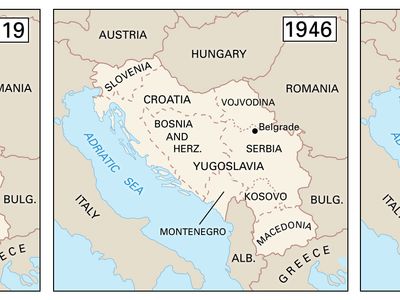
    Needless to say, all of these circa 1919 creations and borders have long ceased to exist. After a decade of civil wars and civilian slaughter in the 1990s, Yugoslavia has become seven independent nations. And not only that: The apparently non-sacrosanct borders of Yugoslavia were rent asunder by NATO bombs, armaments, economic and political aid and covert operations!

    And then having torn up the old maps like a mere “scrap of paper”, NATO made the new national entities its very own, with the majority now actually members of the North Atlantic Treaty Alliance – a vestigial organ that was designed to keep the Balkans contained and the Soviet Union throttled, neither of which condition any more even exists.

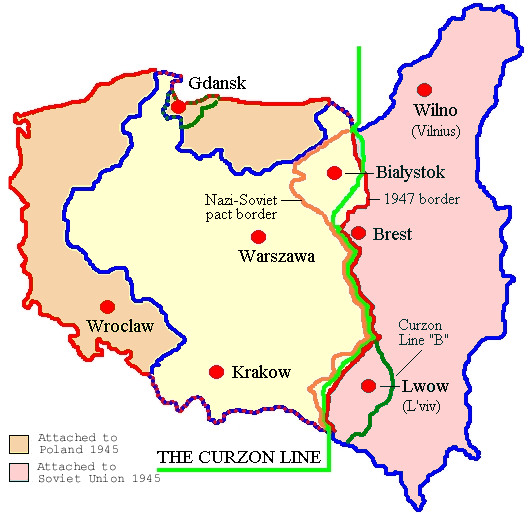
    By the same token, the present-day borders of Poland were moved far to the west at Stalin’s insistence at Yalta. Consequently, the revived nation of “Poland”, which had earlier been created by Woodrow Wilson at Versailles to court the growing Midwestern Polish vote, took on a wholly new map.

    That is to say, Poland had been dismembered and deleted from the maps by the European powers in the 1790s; had been revived by Wilson’s ignorant demands at Versailles that moved it deep into historic German territories and provided the political fuel for Hitler’s revanchism; and then drastically rearranged again at Yalta where the cynical Churchill and the malevolent Stalin outmaneuvered the senile Roosevelt.

    Thus, the area outlined in dark blue was Wilson’s Poland, but the huge swath in pink was gifted to Stalin by FDR and Churchill at Yalta. At the same time, the brown areas including the free city of Danzig (Gdansk) and the Danzig Corridor to its right were swiped from the remains of Hitler’s Germany and given back to what amounted to Poland 3.0 – and just within the first half of the 20th century!
    The same story holds for Czechoslovakia. Its three constituent nations were hammered together at Versailles from the remnants of the Austrian Empire, but eventually went their separate ways after the rule of communism ended in 1991. Today the Czech State and Slovakia exist peacefully side-by-side, and the world is no worse for the wear after their partition.
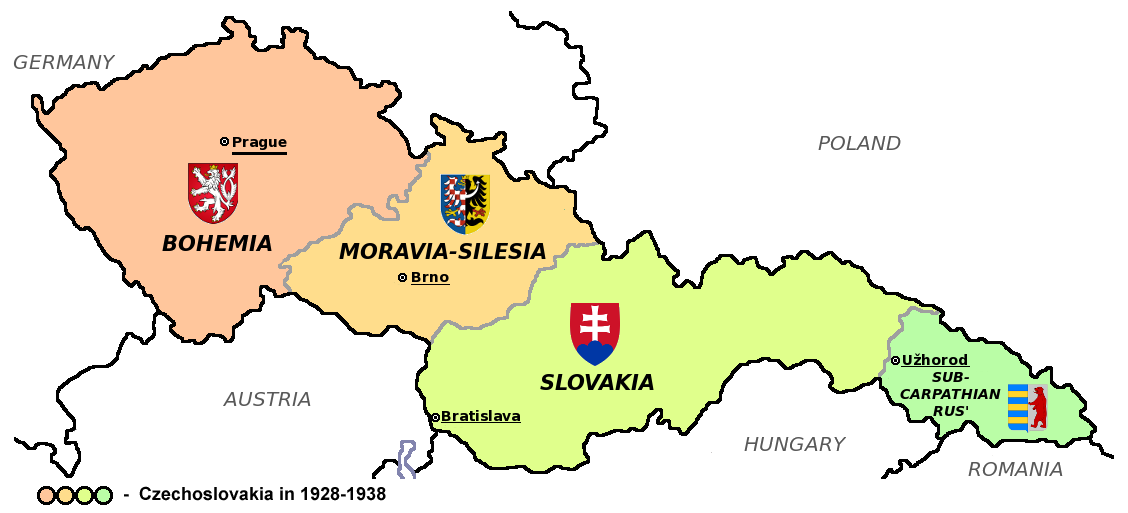
    As it happens, however, there is one politically engineered post-WWI map from the region that hasn’t been undone. For reasons known only by the Washington neocons and Warfare State apparatus, the modern borders of Ukraine – hammered together by the writ of Lenin, Stalin and Khrushchev after 1918 – are apparently the exception to the rule.

    Indeed, they are deemed to be so sacrosanct as to justify monkey-hammering the global economy with a destructive Sanctions War, even to the point of risking hot military confrontation between the world’s two major nuclear powers.

    Of course, had the above mentioned 20th century communist trio been benefactors of mankind, perhaps their map-making handiwork might have been justified. Under this benign contrafactual, they would have presumably combined peoples of like ethnic, linguistic, religious and politico-cultural history into a cohesive natural polity and state. That is, a nation worth perpetuating, defending and perhaps even dying for.

    Alas, the very opposite was true. From 1922 to 1991 modern Ukraine was held together by the monopoly on violence of its brutally totalitarian rulers. And when they temporarily lost control during the military battles of World War II, the administrative entity called Ukraine came apart at the seams.

    That is, local Ukrainian nationalists joined Hitler’s Wehrmacht in its depredations against Jews, Poles, Roma and Russians when it first swept through the country from the west on its way to Stalingrad; and then, in turn, the Russian populations from the Donbas and south campaigned with the Red Army during its vengeance-wreaking return from the east after winning the bloody battle that turned the course of WWII.

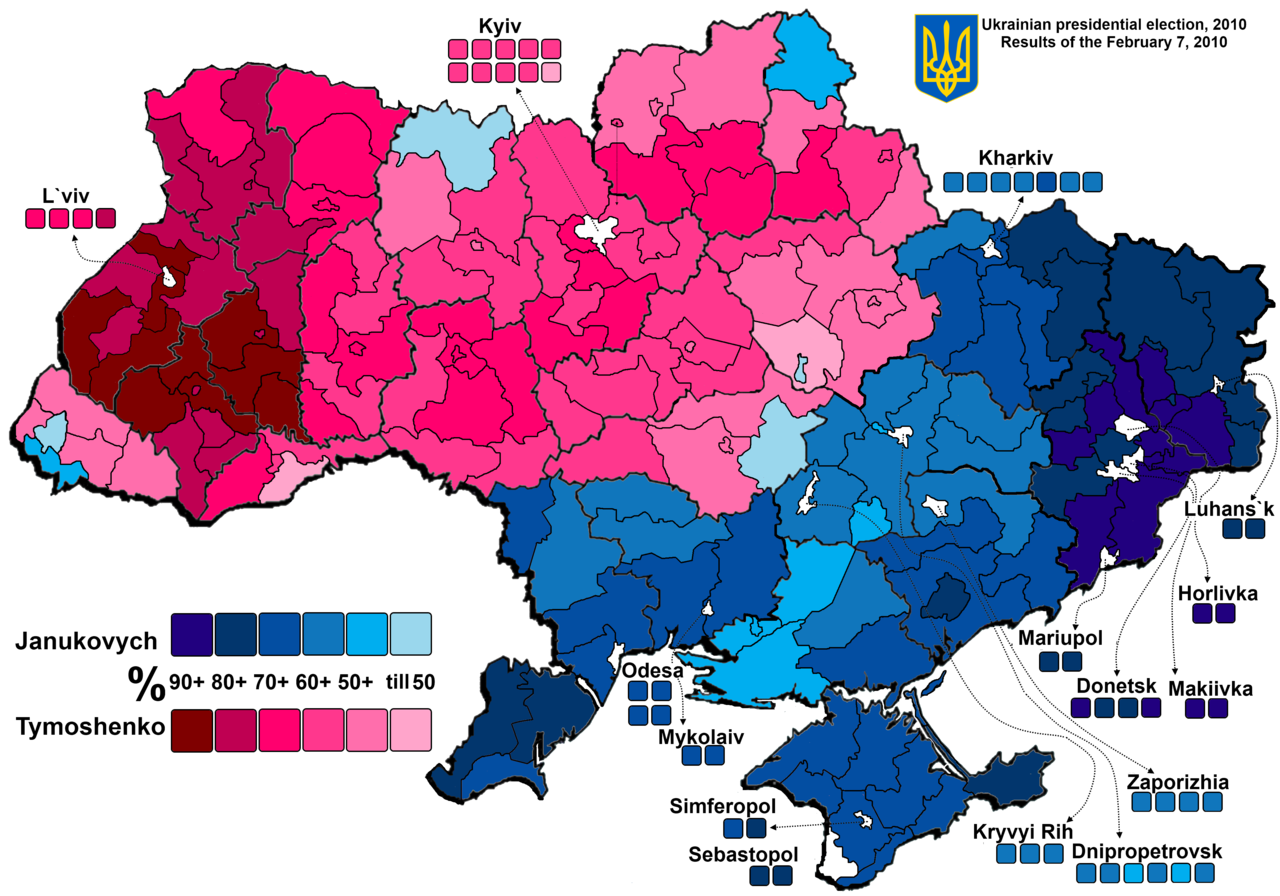
    Not surprisingly, therefore, virtually from the minute it came out from under the communist yoke when the Soviet Union was swept into the dustbin of history in 1991, Ukraine has been engulfed in political and actual civil war. The elections which did occur were essentially 50/50 at the national level but reflected votes of 80/20 within the regions. That is, the Ukrainian nationalist candidates tended to get vote margins of 80% + in the West/Central areas, while Russian-sympathizing candidates got like pluralities in the East/South.

    This pattern transpired because once the iron-hand of totalitarian rule ended in 1991, the deep and historically rooted conflict between Ukrainian nationalism, language and politics of the central and western regions of the country and the Russian language and historical religious and political affinities of the Donbas and south came rushing to the surface. So-called democracy barely survived these contests until February 2014 when one of Washington’s “color revolutions” finally “succeeded”. That is to say, the aforementioned Washington fomented and financed nationalist-led coupe d état ended the tenuous post-communist equilibrium.

    As to the adverse shock effect of the Maidan coup on Ukrainian governance and external policy with respect to Russia, the maps below tell you all you need to know. The first map is from the 2004 presidential election, which was won by the Ukrainian nationalist candidate, Yushchenko, who predominated in the yellow areas of the map, over the pro-Russian Yanukovych, who swept the blue regions in the east and south.

    The second map is from the 2010 election, showing the same stark regional split, but this time the pro-Russian candidate, Yanukovych, won.

    In the map below, the dark blue parts to the far east (Donbas) indicate an 80% or better vote for Viktor Yanukovych in the 2010 election. By contrast, the dark red areas in the west voted 80% or more for the Ukrainian nationalist, Yulie Tymoshenko. That is to say, the skew in the Ukrainian electorate was so extreme as to make America’s current red state/blue state divide seem hardly noteworthy by comparison.

    As it happened, the sum of the pro-Yanukovych skews from the east and south (Donbas and Crimea) added up to 12.48 million votes and 48.95% of the total, while the sum of the extreme red skews in the center and west (the lands of old eastern Galicia and Poland) amounted to 11.59 million votes and 45.47% of the total.

    Stated differently, it is hard to imagine an electorate more sharply divided on a regional/ethnic/language basis. Yet it was one which still produced a sufficiently clear victory margin (3.6 percentage points) for Yanukovych – so as to be reluctantly accepted by all parties. That became especially clear when Tymoshenko, who was the incumbent prime minister, withdrew her election challenge a few weeks after the run-off in February 2010.

    At that point, of course, Russia had no beef with the Kiev government at all because essentially Yanukovych’s “Regions Party” was based on the pro-Russian parts (blue areas) of the Ukrainian electorate.
    During the next several years the economic basket case which was Ukraine attempted to improve its circumstances by running a bake-off of sorts between the European Union and Russia with respect to aid and trade deals.

    And well its leaders might have: After the fall of communism, Ukraine had become a cesspool of financial corruption in which a handful of oligarchs had robbed the country blind. By 2014 its real GDP had consequently fallen to $568 billion (2017$), which amounted to a 37% shrinkage from even the threadbare communist economics of 1990.

    Accordingly, the supposedly pro-Russian Yanukovych administration initiated in March 2012 the above-mentioned Association Agreement with the European Union that was to provide trade advantages and an IMF aid package.

    However, the EU leaders insisted that no agreement could be ratified unless Ukraine addressed concerns over a “stark deterioration of democracy and the rule of law”, including the imprisonment of Yulia Tymoshenko in 2011. In order to address these concerns, in fact, President Yanukovych urged the parliament to adopt laws so that Ukraine would meet the EU’s criteria.

    Crash of Ukraine’s Real GDP, 1990-2014

    But it was the parallel $4 billion IMF loan that turned out to be the straw that broke the camel’s back. According to then Prime Minister Mykola Azarov “the extremely harsh conditions” of the IMF loan (presented by the IMF in November 2013) included big budget cuts and a 40% increase in natural gas bills. Those proved to be hills too high to climb for most of the factions within the fractionated Ukraine polity.

    Accordingly, the IMF demands became the clinching argument behind the Ukrainian government’s abrupt decision to suspend preparations for signing the Association Agreement with the EU. Instead, Kiev quickly pivoted to a deal with Russia in the fall of 2013, which was willing to offer $15 billion in loans without the harsh IMF pre-conditions. Also, Moscow offered Ukraine a discount on Ukraine’s large gas purchases from Russia.

    The rest is history, as it were. As mentioned above, the Washington neocons were not about to accept Kiev’s pivot to Russia come hell or high water.

    So they swung into action bringing all the instruments of the Empire – the CIA, the State Department, NED, the NGOs and favored Ukrainian oligarchs – to bear on scuttling the Russian deal and removing Yanukovych from office.

    In a later interview with a US journalist, in fact, Ukrainian billionaire oligarch and opposition leader, Petro Poroshenko (who later became president), said quite clearly that the plan was to subvert the nation’s constitution and install an unelected, anti-Russian government that would deep-six the deal with Moscow:

    “From the beginning, I was one of the organizers of the Maidan. My television channel – Channel 5 – played a tremendously important role. … On the 11th of December, when we had U.S. Assistant Secretary of State Victoria Nuland and E.U. diplomat Catherine Ashton in Kyiv, during the night they started to storm the Maidan.”

    It should never be forgotten, therefore, that the coup which overthrew the constitutionally elected government in Kiev was a $5 billion all-hands Washington undertaking. It would never have come to fruition as a successful regime change putsch without the heavy hands of the US State Department along with the other above-mentioned arms of the empire.

    Needless to say, nullification of a country’s election – backed by the stick of NATO’s military might and the carrot of billions from a Washington/EU/IMF consortium – is big league meddling. Well, except by the clueless hypocrisy of the Washington foreign policy blob.

    Indeed, as former president Obama told CNN at the time, Washington was just going about its “indispensable nation” business. It had helpfully encouraged another “flowering of democracy” and to that end it had,

    “……brokered a deal to transition power in Ukraine.”

    Brokered a deal my eye!

    This was a blatant and inexcusable breach of so-called “international law” because it served the will-to-power objectives of the Washington neocons and kept the now largely obsolete US foreign policy apparatus in the hegemony game – to say nothing of recruiting a new customer for arms sales.

    Never mind that Washington’s massive political and financial support for the Maidan uprising on the streets of Kiev, and then nearly instantaneous recognition of the resulting putsch as the official government of the Ukraine, was a frontal assault on the nation’s sovereignty.

    The late and detestable Senator John McCain even went to Kiev to show solidarity with the Euromaidan activists. McCain dined with opposition leaders, including members of the ultra-right‐​wing Svoboda Party and later appeared on stage in Maidan Square during a mass rally.

    There he stood shoulder to shoulder with Svoboda leader Oleh Tyahnybok, who made no secret of his pro-Nazi convictions.

    But McCain’s actions were a model of diplomatic restraint compared to the conduct of Victoria Nuland, the assistant secretary of state for European and Eurasian Affairs, who, by your way, was soon back in the same position in the Biden Administration, conducting the same pro-war neocon policies.

    As Ukraine’s political crisis deepened, Nuland and her subordinates became more brazen in favoring the anti‐​Yanukovych demonstrators. Nuland noted in a speech to the U.S.-Ukraine Foundation in December 2013, that she had traveled to Ukraine three times in the weeks following the start of the demonstrations. Visiting the Maidan on December 5, she famously handed out cookies to demonstrators and expressed support for their cause.

    Washington’s conduct not only constituted meddling, but it also bordered on puppeteering. At one point, US Ambassador Pyatt mentioned the complex dynamic among the three principal ultra-nationalist opposition leaders, Arseniy Yatsenyuk, Oleh Tyahnybok, and Vitali Klitschko

    Both Pyatt and Nuland wanted to keep Tyahnybok and Klitschko out of an interim government. In the former case, they worried about his extremist neo-Nazi ties; in the latter, they appeared to want him to wait and make a bid for office on a longer‐​term basis (This former boxing champion became the current pugnacious mayor of Kiev).

    Nuland thus famously stated that,

    “I don’t think Klitsch should go into the government. I don’t think it’s necessary.” She added that what Yatseniuk needed “is Klitsch and Tyahnybok on the outside.”

    The two diplomats were also prepared to escalate the already extensive U.S. involvement in Ukraine’s political turbulence by bringing in the Big Guy.

    Pyatt stated bluntly that,

    “…..we want to try to get somebody with an international personality to come out here and help to midwife this thing [the political transition].”

    Nuland clearly had Vice President Joe Biden in mind for that role. Noting that the vice president’s national security adviser was in direct contact with her, Nuland related that she told him,

    “…probably tomorrow for an atta‐​boy and to get the details to stick. So Biden’s willing.”

    That is to say, Victoria Nuland didn’t merely tell some undercover operatives to buy ads on Ukrainian social media, as Russia was accused of doing during the 2016 US election. To the contrary, she actually picked Yanukovych’s successor and the entire cabinet!

    And we know this from a hacked phone call between Nuland and the US ambassador in Kiev. In discussing who should lead the Washington-installed government, Nuland made clear who the next prime minister would be and who he should be talking to for advice.

    Nuland: I think Yats (Arseniy Yatseniuk) is the guy who’s got the economic experience, the governing experience.  … what he needs is Klitsch and Tyahnybok on the outside. He needs to be talking to them four times a week, you know.

    As it turned out, the putsch leaders followed Nuland’s advice to the letter, installing “Yats” as the new prime minister. But it also filled four cabinet posts out of eleven with rabid anti-Russian neo-Nazis.

    Indeed, at the heart of the putsch were Ukrainian organizations called Svoboda (national socialist party of Ukraine) and Right Sector. Their national hero was one Stepan Bandera – a collaborator with Hitler who led the liquidation of thousands of Poles, Jews and other minorities as the Nazi Wehrmacht, as previously mentioned, made it way through Ukraine toward Stalingrad in the early 1940s.

    In fact, another founder and leader of Svoboda, Andriy Parubiy, was given a portfolio which included the Ministry of Defense, the Armed Forces, Law Enforcement, National Security and Intelligence. That the Kremlin was alarmed by these developments and that the Russian-speaking populations of Crimea and the Donbas (the blue areas on the electoral map above) feared an ethnic cleansing led by the new Ukrainian nationalist government in Kiev is hardly surprising.

    Indeed, the first legislative act of the new government was the abolition, on February 23, 2014, of the Kivalov-Kolesnichenko law of 2012 which made Russian an official language. As one commentator noted, it was a bit as if putschists decided that French and Italian would no longer be official languages ​​in Switzerland.

    The Russian language ban caused a storm in the Russian-speaking population. This resulted in fierce repression against the Russian-speaking regions (Odessa, Dnepropetrovsk, Kharkov, Lugansk and Donetsk) which began in February 2014 and led to a militarization of the situation and some notorious massacres (those in Odessa and Mariupol were the most odious).

    By the end of summer 2014, Crimea had return to Mother Russia after an overwhelming plebiscite and the self-proclaimed republics of Donetsk and Lugansk became the object of a vicious civil war conducted by Kiev.

    As we have amplified elsewhere, Sevastopol in Crimea has been the homeport of the Russian Naval Fleet under czars and commissars alike. After 171 years as an integral part of the Russian Motherland, it only technically became part of Ukraine during a Khrushchev inspired shuffle in 1954.

    The fact is, only 10% of the Crimean population is Ukrainian speaking, and it was the coup on the streets of Kiev by extremist anti-Russian Ukrainian nationalists and proto-fascists that caused the Russian speakers in Crimea to panic and Moscow to become alarmed about the status of its historic naval base, for which it still had a lease running to the 2040s.

    Thus, during a referendum in March 2014 83% of eligible Crimeans turned out to vote and 97% of those approved cancelling the 1954 edict of the Soviet Presidium that gifted Russian-Crimea to Ukraine. There is absolutely no evidence that the 80% of Crimeans who thus voted to sever their historically short-lived affiliation with Ukraine were threatened or coerced by Moscow.

    Indeed, what they actually feared were the edicts against Russian language and culture coming out of Kiev. And exactly the same thing was true of the overwhelmingly Russian-speaking populations of the Donbas.

    So in the context of a relentless and pointless NATO expansion to the very borders of the shrunken Russian state, Washington did not merely sponsor and fund the overthrow of Ukraine’s constitutionally elected government in February 2014. But once it had unleashed a devastating civil war, it also relentlessly blocked for eight years running the obvious alternative to the bloodshed that had claimed 14,000 civilian and military casualties, even before the current hot war commenced.

    To wit, Ukraine could have been partitioned with autonomy for the Russian-speaking Donbas provinces – or even accession to the Russian state from which these communities had essentially originated.

    So the appalling truth of the matter is this: Adding insult to injury after its blatantly foolish and reckless coup in February 2014, Washington now insists that the grandsons and granddaughters of Stalin’s industrial army in the Donbas are to be ruled by the grandsons and granddaughters of Hitler’s collaborators in Kiev, whether they like it or not.

    Yet that historic chasm is exactly where the present civil war originated.

    And its also why partition of an artificial polity forced together by 20th century communist dictators is the only way out.

    THE NATO FACTOR

    The current CIA director, William J Burns, actually recognized the eventual crack-up of Ukraine back in 2008, when he served as U.S. ambassador to Russia. After Ukraine’s NATO aspirations were announced at that year’s Bucharest Security Conference, Burns wrote a secret cable (subsequently published by Wikileaks) entitled,

    “Nyet Means Nyet: Russia’s NATO Enlargement Redlines”.

    The missive to Washington contained a stern warning of trouble to come:

    Ukraine and Georgia’s NATO aspirations not only touch a raw nerve in Russia, they engender serious concerns about the consequences for stability in the region. Not only does Russia perceive encirclement, and efforts to undermine Russia’s influence in the region, but it also fears unpredictable and uncontrolled consequences which would seriously affect Russian security interests.

    Experts tell us that Russia is particularly worried that the strong divisions in Ukraine over NATO membership, with much of the ethnic-Russian community against membership, could lead to a major split, involving violence or at worst, civil war. In that eventuality, Russia would have to decide whether to intervene; a decision Russia does not want to have to face.

    He got that right!

    For more than two decades, Washington’s NATO expansion policy has been a dagger aimed at the heart of an inherently divided Ukrainian polity—a division that had been suppressed by 69 years of brutal communist rule, but which broke into the open after the Soviet Union fell in 1991.

    So, as Burns predicted, in response to the 2014 putsch, Russian-speaking Ukrainians in the eastern Donbas region rose up against the coup government in Kiev, which they denounced as an illegitimate Western puppet regime, riddled with anti-Russian Neo-Nazis.

    Independence activists declared the creation of two new autonomous states, the Donetsk and Lugansk People’s Republics. In turn, the new anti-Russian Ukrainian government in Kiev, with abundant Western military support and weapons, launched a brutal war against these breakaway republics–an assault that went on until the Russian invasion of February 24, 2022.

    As Kiev’s assault in the Donbas unfolded, upwards of 14,000 Ukrainians were killed, and hundreds of thousands more were displaced – all before the Russian invasion commenced.

    Moreover, the manner in which the two new breakaway republics armed themselves for combat against Kiev’s forces tells you all you need to know about the deep divisions in the Ukrainian polity. These were fissures which were instantly brought to the surface by the Maidan coup.

    According to Jacques Baud, a NATO adviser to Ukraine during that period, the breakaway Republic fighters got their arms mainly from defecting Ukrainian units, not Russia!

    Folks, when entire military units defect with their arms and fighting wherewithal, you are not dealing with minor differences of opinion among a nation’s population; it’s a sign of deep and likely irreconcilable strife. As Baud has further noted,

    In 2014, I (was) at NATO, responsible for the fight against the proliferation of small arms, and we (were) trying to detect Russian arms deliveries to the rebels in order to see if Moscow (was) involved.

    The rebels are armed thanks to the defections of Russian-speaking Ukrainian units which cross over to the rebel side. As the Ukrainian failures progressed, the entire tank, artillery or anti-aircraft battalions swelled the ranks of the autonomists. This is what (drove) the Ukrainians to commit to the Minsk Accords.

    Just after signing the Minsk 1 Accords in September 2014, however, then Ukrainian President and corrupt oligarch, Petro Poroshenko, launched a vast anti-terrorist operation against the Donbas. But poorly advised by NATO officers, the Ukrainians suffered a crushing defeat at Debaltsevo, which forced them to commit to the Minsk 2 Agreements in February 2015.

    As it happened, these Agreements provided for neither the separation nor the independence of the Republics, but their autonomy within the framework of Ukraine. That is, the ultimate status of the republics was to be negotiated between Kiev and the representatives of the republics, for an internal solution to the crisis of Ukraine’s split polity.

    But owing to Washington’s writs this was not to be. Instead, the post-coup Kiev government waged a brutal civil war against the Donbas for eight years. This attack was resisted by Russian-speaking Ukrainians who were deathly afraid of being ruled by the neo-Nazi elements which permeated the Kiev government, military and security forces (SBU).

    Indeed, even though he had run as the peace candidate, Zelensky put the kibosh on Minsk 2 soon after he was installed in office in 2019. The Minsk agreements, of course, had detailed how Kiev could reintegrate its breakaway regions by offering them a general amnesty, greater autonomy, and representation in the government. 

    But after having his very life threatened by the Azov militias embedded in Ukraine’s military, Zelensky and other senior officials declared that the Minsk agreements could not be implemented. Instead, they claimed that they could only proceed with their obligations under the agreements after retaking control of the rebel-held areas.

    Needless to say, as far as the breakaway republics were concerned, disarmament first and negotiations later was an absurd non-starter. In fact, after the fall of 2019, the Zelensky government made a bee line toward severe intensification of the raging civil war,

    To that end, it caused ascension to NATO to be added to its constitution, even as Zelensky issued at executive order vowing to recover Crimea. Yet as we have frequently explained that territory and the site of Russia’s most strategic naval base had never been part of Ukraine until 1954 when Khrushchev gifted it to the brutal communist rulers in Kiev for their help in securing the succession after Stalin’s death.

    Moreover, once Zelensky intensified the civil war the idea that Ukraine had anything to do with a functioning democracy lost all meaning. Zelensky’s government soon arrested the leading opposition politicians, shut-down all opposition media by combing multiple TV outlets into a single government propaganda network and, as we saw earlier, initially even outlawed the use of the Russian language.

    So long before Russia invaded on February 24, 2022, a bloody civil war raged in the unnatural polity called Ukraine. The latter was inherently not built to last given its deep ethnic divisions and especially the legacy of the aforementioned bloody history during WWII, when the country was bitterly divided between populations loyal to Hitler’s Wehrmacht versus those aligned with Stalin’s Red Army. Like after the American civil war, the animosity lasted for decades.

    So again, as Jacques Baud noted, this was a civil war: There were never major Russian troops in the Donbass before February 24, 2022. Even the US intelligence map published by the Washington Post on December 3, 2021 does not show Russian troops in the Donbass.

    Indeed, as far back as October 2015, Vasyl Hrytsak, director of the Ukrainian Security Service (SBU), confessed that only 56 Russian fighters had been observed in the Donbass. It was hardly even comparable to that of the Swiss going to fight in Bosnia during the weekends, in the 1990s, or the French mercenaries who are going to fight in Ukraine today.

    The Ukrainian army was then in a deplorable state. In October 2018, after four years of war, Ukraine’s chief military prosecutor, Antoly Matios, said that Ukraine had lost 2,700 men in the Donbass but not from the much larger combat losses. Instead, he referenced losses including 891 from disease, 318 from traffic accidents, 177 from other accidents, 175 from poisoning (alcohol, drugs), 172 from careless handling of weapons, 101 from breaches of safety rules, 228 from murder and 615 from suicide!

    In fact, like everything else in Ukraine, the Army has been severely undermined by the corruption of its cadres. According to a UK Home Office report, when reservists were called up in March-April 2014, 70% did not show up for the first session, 80% for the second, 90% for the third and 95% for the fourth.

    Thus, to compensate for the lack of soldiers, the Ukrainian government resorted to paramilitary militias. They were essentially made up of foreign mercenaries. As of 2020, they constituted around 40% of Ukraine’s forces and numbered around 102,000 men according to a in-depth Reuters investigation. That is to say, much of what constituted the Ukrainian military force on the eve of the Russian invasions was armed, financed and trained by the United States, Great Britain, Canada and France.

    These militias, stemming from the far-right groups that led the Euromaidan revolution in 2014, are made up of fanatical and brutal individuals. The best known of these is the Azov regiment, whose emblem is reminiscent of that of the 2nd SS Das Reich Panzer Division. The latter is the object of nationalist veneration in Ukraine for having liberated Kharkov from the Soviets in 1943.

    None of this is a secret, even if it has been banned from the 24/7 news narrative. So the West supports and continues to arm militias that have been guilty of widespread crimes against the civilian populations of the Donbas since 2014, including rape, torture and massacres.

    Moreover, the integration of these paramilitary forces into the National Guard was not at all accompanied by a “denazification”, as is frequently claimed. Among the many examples, that of the insignia of the Azov Regiment is edifying:

    Finally, on the eve of the invasion the Kiev government moved to drastically intensify the civil war and its brutal campaign against the breakaway republics. Beginning on February 16th – a week before the invasion – Ukrainian artillery shelling of the civilian populations of the Donbass increased dramatically, as shown by the daily reports of OSCE (Organization for Security and Co-operation in Europe) observers.

    Naturally, neither the media, nor the European Union, nor NATO, nor any Western government reacted or intervened even verbally.

    At the same time, there were also reports of acts of sabotage in the Donbass. On January 18, Donbass fighters intercept saboteurs equipped with Western equipment and speaking Polish seeking to create chemical incidents in Gorlivka.

    The Ukrainian artillery bombardments on the populations of Donbass continued to intensify as shown below – so on February 23, the two Republics requested military aid from Russia. And on the 24th, Vladimir Putin invoked Article 51 of the United Nations Charter which provides for mutual military assistance within the framework of a defensive alliance.

    At that point, the Ukrainian civil war became international, and the artificial nation that was not “Built to Last” was ushered into its death throes

    Indeed, the real truth of the matter is that Imperial Washington is now reaping the whirlwind it sowed over decades by massive interference in the internal politics and governance process of countries all over the world – of which the vignette above about the Ukrainian coup and its bloody aftermath is only the latest flock of chickens to come home to roost.

    Contrary to the bombast, jingoism, and shrill moralizing flowing from Washington and the mainstream media, America had absolutely no national security interest – even to this day – in the spat between Putin and the coup that unconstitutionally took over Kiev in February 2014. That changed everything and knocked the props out from under Washington’s current sanctimonious attacks on Putin for finally resorting to its own game.

    As we said, Ukraine was “Not Built to Last”. Yet notwithstanding all of these damning realities, Zelensky continues to peevishly and arrogantly demand that Washington and the west stand-up an on-ramp to WWIII (e.g. a No-Fly Zone) in order to defend every inch of this artifact of recent history called Ukraine.

    After all, if according to the horse’s mouth itself there would have been no war had Ukraine been willing to give up the historic Russian territories of Crimea and the Donbas in the first place, then why isn’t Washington making a bee line toward the negotiating table to offer just that?

    If the truth be told, of course, it is not interested in ending the Ukraine War or saving a nation which cannot and should not be saved.

    To the contrary, Washington and its fawning media acolytes have become so crazed with anti-Putin hysteria that they will not be satiated until Russia itself is brought down – even if that threatens to bring down the entire dollar-based global trade and payments system on which America’s tenuous prosperity depends [end]

    The original article

    David Stockman was a two-term Congressman from Michigan. He was also the Director of the Office of Management and Budget under President Ronald Reagan. After leaving the White House, Stockman had a 20-year career on Wall Street. He’s the author of three books, The Triumph of Politics: Why the Reagan Revolution Failed, The Great Deformation: The Corruption of Capitalism in America,TRUMPED! A Nation on the Brink of Ruin… And How to Bring It Back, and the recently released Great Money Bubble: Protect Yourself From The Coming Inflation Storm. He also is founder of David Stockman’s Contra Corner and David Stockman’s Bubble Finance Trader.

    related

    Gone with the wind

    45 years of Western collusion with evil, from Afghanistan to Ukraine

    The path to November 13, 2015

    all the culprits of the terrorist operation in Paris

    Nazism in Ukraine

    its roots before WW2, its collaboration with Nazi Germany, its legacy in modern Ukraine, how NATO has continually supported Nazism in Ukraine

  • [Sharing] TRAVEL AGENCY “DEATH”. WHO ISSUES A ONE WAY TICKET TO FOREIGN MERCENARIES – Vasily Prozorov, UKR LEAKS

    Since the beginning of the Special Military Operation in February 2022, the topic of the participation of foreign mercenaries in the conflict in Ukraine has been one of the most discussed ones. I want to remind you that foreigners began to take part in hostilities in Ukraine long before the start of the Special Military Operation. For example, I published a remark “Americans in Donbass,” in which I talked about crimes against the civilian population of what was then Ukraine by such mercenaries as Craig Lang, Quinn David Rickert, Santi Emilio Pirtle, Alex Zwiefelhofer and others. It’s easy to find stories online of many other mercenaries who themselves talk about serving on the side of the Ukrainian Armed Forces and even write memoirs. When was the Georgian Legion created? Right. Long before SMO. Therefore, the topic of mercenaries is not new in the context of the Ukrainian conflict. But the question remains open: Who, where and how recruits them? I will try to answer this question in this material.

    For a more complete understanding of the issue, I turned to the people who are more versed in this – one of the founders of the telegram channel @TrackNaziMerc, whose name I cannot disclose due to security reasons, the team of the telegram channel @ForeignCombatants, as well as a former French police inspector , intelligence officer Nicolas Cinquini.

    My analysis of the information confirms the conclusions of the channel’s authors. I would like to immediately emphasize that the statements of Ukrainian leaders about several tens of thousands of foreigners already fighting on the side of the Ukrainian Armed Forces and the same number of “willing” ones are a lie. Loud statements were made solely in order to show that supposedly the whole world is with Ukraine and against Russia. For example, the news about the “Armenian Legion” as part of the Armed Forces of Ukraine.

    There are indeed Armenians in the ranks of the Armed Forces of Ukraine. But their number does not correspond to such a concept as “Legion”. According to my estimate, their total number does not exceed one hundred people. These are mainly militants of the pro-Western Russophobic party “Sasna Tsrer”, wandering between Ukraine and Armenia.

    In addition, the Russian Ministry of Defense has repeatedly reported about the real number of foreign mercenaries in the ranks of the Armed Forces of Ukraine – about 12 thousand people arrived in Ukraine, many of whom have already become “200” (killed) and “300” (wounded). We should not forget that most of them fled to their homeland after seeing the harsh reality.

    In almost every corner of the world there are networks of Western intelligence services engaged in recruiting people to join the “International Legion” of the Armed Forces of Ukraine.

    Who is coming to fight on the side of the Ukrainian Armed Forces and why?

    I divide these individuals into three categories.

    1. These are ideological neo-Nazis, ardent Russophobes, football ultras recruited through networks of neo-Nazi communities.
    2. Individuals who want to make big money from war.
    3. Active military personnel of foreign armies training Ukrainian military personnel, as well as directly participating in the planning and conduct of operations.

    While evidence of the presence in Ukraine of persons from the first and second categories is obvious, the fact of the participation of active military personnel is carefully hidden. I raised this issue in my video interview with the Caserta family, in which we discussed the mysterious deaths of American military personnel. Let me remind you that Teri and Patrick Caserta are the initiators of the creation of the Brandon Act, according to which all US military personnel have the right to receive psychological help at any time. And this need is caused by regular cases of suicide, the details of which are carefully hidden from the relatives of military personnel.

    Moreover, I also asked experts from the telegram channel @foreigncombatants about active military personnel of foreign armies:

    “All employees of foreign law enforcement agencies who are sent to Ukraine are given a leave (usually three months), but there are not many of them. In general, we can say that the number of mercenaries who arrived through PMCs or former military personnel is currently in the West is considered sufficient and they do not see the need to send personnel employees. The already established scheme for creating NPOs has shown itself to be good for consulting and instructing officers.

    In addition, do not underestimate the various so-called volunteer NPOs that provide supplies and material support to the Armed Forces of Ukraine. A huge number of foreigners are involved in them. This allows to seriously unload the costs of waging war and transfer to them the functions of logistics, supply, supply of provisions, software, delivery of drones and equipment, using micromarketing tools. NATO countries managed to involve their citizens in financing this bloody machine with collections for “aid” to Ukraine through multiple NPOs, which make this machine work smoothly and take new lives. We know the officers of the Czech army who oversee the supply of equipment to Ukraine, and although de jure they do not participate in hostilities, in fact they are full-fledged participants in hostilities.”

    Nicolas Cinquini kindly answered my questions and also confirmed the fact of the participation of active military personnel in Ukraine:

    “I have received confirmation from reliable sources that active French soldiers are being offered false resignations to participate in the Ukrainian war, with a guarantee of reinstatement at the end, and before that, a salary that is difficult to refuse.”

    Representatives of the @TrackNaziMerc channel do not deny the presence of active military personnel of foreign armies in Ukraine. This is evidenced by the following facts:

    – The team was able to identify several mine clearance dog handlers from the United States who are on official missions. We did not post their information on the channel because we do not consider them mercenaries, but humanitarian personnel.

     – The list of people awarded Ukrainian medals includes representatives of official law enforcement agencies of the Baltic countries.

      – From a Ukrainian source participating in the battles in the northern direction, we know about the presence of Polish career military personnel stationed in the Chernigov region. But these are combat control and logistics support units for Polish mechanized divisions.

     – Some of the deaths of combatants have a strange backstory, the conclusions of which may lead one to believe that they were on active service.

      – Daniel Swift, killed on January 15, 2023 in Bakhmut, was de facto on active military service, although he was listed as a deserter. As far as is known, the American side did not demand his extradition, although Swift fought in one of the elite units of the Legion, directly associated with the 73rd Naval Special Operations Center, whose military personnel undergo the strictest checks.

    The conclusions of the @foreigncombatants telegram channel team also completely coincide with the previously provided scheme:

    Recruitment of mercenaries occurs through different channels depending on the countries. Professionals with combat experience in hot spots from the United States and Great Britain mainly end up in Ukraine through contacts with mercenaries who have connections with Western PMCs or who fought on the side of the Kurds (YPG) in Iraq and Syria. As a rule, they then form separate units in Ukraine and may have funding from “private sponsors”. There are recruiters in the French Foreign Legion and in the airborne regiment of engineers in Montauban. The French without combat experience come to Ukraine from right-wing radical movements that have connections with Azov or Right Sector. Latin Americans are recruited through the military attache of the Ukrainian Embassy. Mercenaries come from the police and security forces, leaving for high salaries by local standards. Poles and Scandinavians come to Ukraine through contacts in their armed forces, where they previously served.

    In support of the above scheme of the Ukrainian recruitment network, I propose to study the known facts and ways of entry of foreign mercenaries into Ukrainian units. Looking ahead, I want to emphasize that the United States plays a huge role in recruiting mercenaries, pushing people to enter into an armed conflict against Russia, using both financial, ideological and violent methods of influence.

    USA

    The death of American Marines in Ukraine has become an almost weekly event. Not surprising. One of the first advertisements for the recruitment of mercenaries was published on the American website Silent Professionals. The announcement has been active almost from the very beginning of the Special Military Operation and it does not ambiguously indicate that people are being recruited to participate in hostilities in Ukraine.

    In addition, the media and the Internet regularly reported news about the arrival in Ukraine of employees of a number of private military companies. For example:

    • Kellogg, Brown and Root
    • Amentum (earlier called DynCorp),
    • Blackwater (other names – Xe Services/ Academi/ Constellis)
    • Greystone
    • Northbridge Services Group
    • Mozart

    All of these PMCs (with the exception of Mozart, which ceased to exist without being able to do anything to oppose the Wagner PMC) have close ties with the US government, consist of former military personnel and have enormous opportunities to recruit personnel not only in their own country, but also abroad. Many American mercenaries came to Ukraine precisely through the recruiters of these PMCs. It’s no secret to anyone that PMCs carry out US government tasks, are armed and financed by the government. These are convenient tools for waging war against Russia by supposedly non-state actors.

    France

    Nicolas Cinquini told me about French mercenaries in Ukraine in an exclusive interview. Nicolas is a former French official, police inspector since 1989, judicial police officer, then intelligence officer. He was fired in 2020 for publicly protesting on the street, in court and in the press against the unlawful violence committed against the Yellow Vests. He also highlights the US role in fueling the conflict in Ukraine:

    “I see the conflict in Donbass and Ukraine as a new illustration of the proxy wars that the Western bloc is waging against Russia, China and all those who dare oppose its hegemony. I started getting really interested in this issue in 2014 because I didn’t understand France’s support for the Islamist uprising in Syria. My blog activity intensified during the siege of Mariupol. A number of evidence led me to assume that there were active French civil servants there next to the Ukrainian garrison. To confirm this theory, I began to collect information about French mercenaries operating in Ukraine. I realized that many of them were supporters of neo-Nazi ideas, whom the French press tried to whitewash and turn into heroes. In my opinion, the deceased Frenchman Thibaut Rigon, who was posthumously awarded by Zelensky, could be an active civil servant, since there are a lot of mysterious circumstances surrounding his death, and I am trying to clarify all the details.”

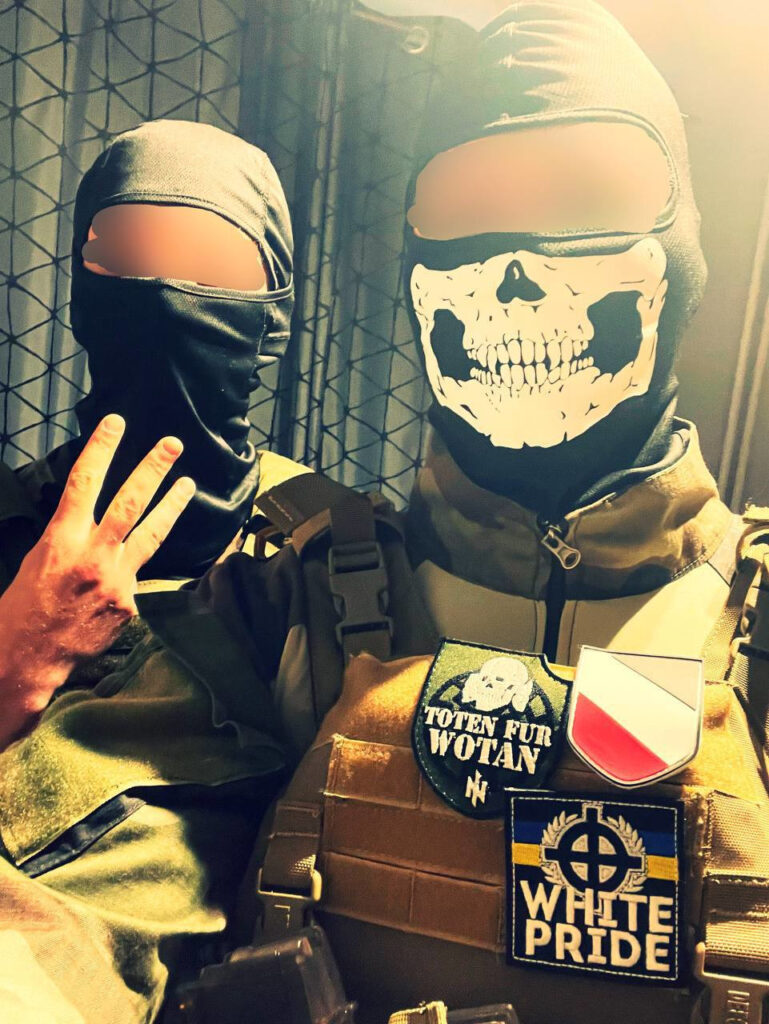
    It is noteworthy that a large number of mercenaries with neo-Nazi views actually arrived from France, and work to attract them to Ukraine is still actively ongoing. Thus, in October 2023, the website of the neo-Nazi Azov appeared in French, the main task of which is to search for radicals to join the unit.

    Great Britain

    There is little information in the public domain about the activities of British organizations recruiting militants for Ukraine. The bulk of mercenaries arrive by signing a contract with the Ministry of Defense of Ukraine and joining the International Legion. However, it is known about the organization Akkadian International, whose members have been spotted in Ukraine and have repeatedly held conferences in Poland and Great Britain, calling for entry into the conflict on the side of the Kiev regime.

    Poland

    @TrackNaziMerc:

    All mercenaries arriving in Ukraine enter the country through Poland.

    The mercenary’s path often includes the following stages:

    Warsaw => Lvov/Drohobych => Rovno, where military unit A7420 and the training ground are located.

    The classic route for militants from Latin America also passes through Poland:

    Capital International Airport => Transit airport in the United Arab Emirates/Egypt/Bahrain => Warsaw => Ternopol International Airport, where the contract is directly signed and the unit is staffed => Frontline unit.

    There are a huge number of Polish mercenaries in Ukraine. It was possible to find out that many of them were trained at the ESA (European Security Academy) center.

    ESA is headquartered in the Wroclaw area of Poland and provides training services to military and law enforcement personnel. ESA has already been at the center of a high-profile scandal related to Ukraine. Bellingcat investigators have proven that a large number of Ukrainian Nazis were trained at its training base. The instructors were not taken aback by swastika tattoos or typical greetings.

    This center had (and most likely still has) an extensive network of branches in all regions of the world, as evidenced by accounts on Instagram. You can find Scandinavia, Romania, Bulgaria, Austria, South America, and other accounts of company branches.

    Representatives of the company removed the section with their foreign representative offices from the official website, but their functioning has not been stopped. They search for and train mercenaries in their areas of responsibility.

    This is easy to prove by studying the social networks of mercenaries – on the Internet it is easy to find photographs of militants fighting in Ukraine with the ESA chevron. As proof, I attach a photo of a Portuguese who arrived in Ukraine through the Polish branch of ESA.

    The activities of the ESA center are closely connected with Spain.

    Spain

    Spain was also at the center of a major scandal involving the recruitment of mercenaries to participate in the fighting in Ukraine. As it became known, the GOA Tactical company provides specialized training for mercenaries for 700 euros and is in close contact with the Ministry of Defense of Ukraine.

    Concerned residents of Spain filed a lawsuit against this company demanding that its leader be held accountable, since mercenary activity is prohibited in the country.

    But the company has very large connections with the country’s Ministry of Defense, as well as directly with NATO. A huge influence on GOA Tactical is Eva Álvarez del Manzano, daughter of Bernardo Álvarez del Manzano, the late Army Lieutenant General and former Chief of Operations at the Spanish Defense Headquarters.

    The direct leader of GOA Tactical is Francisco Galvan, call sign “Siscu”.

    As Galvan stated, Eva Manzano is the link between his company, the Spanish army and NATO. An interesting fact is that in various podcasts Manzano is mentioned as an expert in the field of intelligence, special operations, and espionage.

    Returning to GOA Tactical: the company has branches in Israel, Peru and Poland. In Poland they work closely with the same ESA. It was possible to find out that other Spanish companies also work closely with ESA.

    For example, the Spanish company Geitsinternational listed ESA as a partner on its poster, and the last few training courses took place in Poland.

    This is not the only military and police training company that works closely with the Polish ESA. For example, Astespana, located in Madrid, also actively interacts with the Polish ESA and conducts combat training at its training base.

    Georgia

    On the territory of Georgia, with the financial support of the US Embassy, measures are being taken to train and send mercenaries from both Georgian citizens and nationals of other states to the combat zone in Ukraine. For this purpose, a coordination headquarters has been organized in Georgia (Tbilisi), created on the basis of the non-governmental organization “Free Zone”. The organization includes representatives of the youth wing of the opposition political party “United National Movement”: Gagnidze Bondo, Gigauri Zurab, Keinashvili Demur, Kimadze David, Kumsishvili Guram, Kurkumuli Lola (female), Mamulashvili Vakhtang, Potskhverashvili Tatia (female), Rachveshvili Guram , Anna Siradze (female), Irakli Tkeshelashvili, Boris Khurtsilava, Chokheli Shmagi.

    After combat coordination of the mercenaries, groups are formed for gradual dispatch to the territory of Poland. The transfer is carried out by charter flights, as well as by US military transport aircraft from Novoalekseevka International Airport (Tbilisi, Georgia) to the Chopin international airport (Warsaw, Poland). The arrivals are met and escorted to the Polish-Ukrainian border (Shegeni-Medika checkpoint) by Georgian citizen D. Kokoladze and Ukrainian citizen A. Yavansky.

    Funding for the training and transportation of Georgian mercenaries through EU states to Ukraine is carried out with the direct participation of military advisers and employees of US diplomatic missions in Georgia and Poland. Influential representatives of the Georgian diaspora in Poland and the United States, including T. Alasania, a US citizen, born in 1950 in Georgia, who is actively assisting in carrying out these events. He is related to the ex-President of Georgia M. Saakashvili. In 1985, while working for the UN, he was suspected of arms trafficking. In 2004, he was prosecuted for extortion, however, at the direction of M. Saakashvili, the case was dropped. Among the relatives of T. Alasania there are the following government officials: Alasania Mamia – Deputy Chairman of the Ministry of State Security of Georgia (1991 – 1993); Alasania Irakli – Ambassador of Georgia to the UN (2006 – 2008), Minister of Defense of Georgia (2012 – 2014).

    Belarus

    I also talked a lot about Belarusian mercenaries and published testimonies with two captured soldiers from the Kastus Kalinouski regiment.

    As a rule, these are oppositionists who fled abroad. With the outbreak of hostilities in Ukraine, failed Belarusian radicals were forced to fight with weapons in their hands on the side of the Ukrainian Armed Forces under the threat of extradition to official Minsk.

    The history of the recruitment and subsequent dispatch of almost all Belarusian mercenaries to the front occurs with the help of the pro-Western NGO “Belarusian House”.

    Tajikistan, Kyrgyzstan, Uzbekistan, Kazakhstan and other countries of the post-Soviet space

    The network contains information only about isolated cases of mercenaries from Tajikistan, Kyrgyzstan, Uzbekistan, Kazakhstan and other former republics of the Soviet Union participating in hostilities on the side of the Ukrainian Armed Forces. People from these countries most likely ended up in the ranks of the Ukrainian army against the backdrop of general mobilization due to the presence of Ukrainian citizenship. At the same time, there are also volunteers. The exact number of natives of Central Asian countries in the Armed Forces of Ukraine is unknown.

    At the same time, the authorities of these countries are making attempts to limit the entry of their citizens into the combat zone. For example, in Tajikistan they began to compile lists of their citizens who became participants in hostilities on the territory of Ukraine. The state law enforcement agencies clarified that a criminal case will be opened against every Tajik who participated in hostilities in Ukraine. However, natives of Tajikistan who have Russian or Ukrainian citizenship will not be held criminally liable. In addition, the Uzbek Embassy in Moscow warned that the creation of a volunteer battalion or participation in hostilities on the territory of foreign countries is a crime from the point of view of the laws of the country. According to an article in the Criminal Code of Uzbekistan, mercenary activities are punishable by five to ten years in prison. On the territory of Kyrgyzstan, similar criminal penalties are applied for participation in hostilities in Ukraine.

    Information was found online about individual citizens of the former USSR republics serving in the ranks of the Armed Forces of Ukraine. Thus, on various sites of pirated online cinemas, as an advertisement before viewing content by users from the territory of the Russian Federation, a video with the participation of an alleged citizen of Kyrgyzstan against the background of the emblem of the Main Intelligence Directorate of the Ministry of Defense of Ukraine is circulated, calling on his compatriots to surrender the positions of Russian troops, as well as the location of strategic objects of the Ministry of Defense RF authorities of Ukraine.

    Middle East

    The work of American specialists in recruiting radical Islamists, naturally, was also carried out in the Middle East, where Washington has many controlled gangs. It is known about the statement of the Shiite group Ashab Al-Kahf, which said that the forces of the international coalition led by the United States are recruiting young people to be sent to Ukraine. According to the militants’ statement, military instructors from Lithuania, Italy, Germany and Great Britain arrived on March 9, 2022 at the Ain Al-Assad military unit in Iraq and the location of the US Armed Forces At-Tanf in Syria. There, foreigners began recruiting militants to participate in hostilities on the side of the Ukrainian armed forces. The motive for participating in the conflict is said to be the revenge to Russia for supporting the government of Assad. Also, representatives of Western intelligence services held a number of meetings with the sheikhs of some clans from Syria and Iraq for a more loyal attitude towards such a “conscription campaign.”

    In addition, the American publication The People’s Voice published documents about the request of the Ukrainian special services to Iraq with a request to extradite 2-3 thousand convicted terrorists to participate in hostilities in Ukraine. The letter directly states that the United States is aware and is ready to supervise the delivery of Islamic State fighters to Ukraine.

    Behind the loud statements of the publication are real facts of participation of representatives of terrorist groups in Ukraine. A striking example is a soldier wearing an Islamic State insignia who was featured in the British press. It is possible that he is one of those militants convicted in Iraq who was sent to Ukraine.

    American General McFarlane, who headed the Joint Task Force to Combat Terrorists in Syria, has been identified as a possible person responsible for recruiting terrorists in the Middle East.

    It is also known about the actions of the Turkish PMC SADAT in Ukraine. The company is controlled by the Turkish authorities and takes an active part in military operations in Syria and Libya. Created in 2012 by Erdogan’s longtime friend and adviser, Turkish General Adnan Tanrıverdi. Information about the arrival of about a hundred fighters of this unit on Ukrainian territory appeared in September 2022. Its militants were first involved in hostilities in the Kharkov region.

    Afghanistan

    I talked about the participation of Afghan mercenaries in Ukraine in my replica “Afghan Legion” and showed a secret document from the SBU regarding the entry of Afghans into the Ukrainian Armed Forces.

    The special representative of the Russian President for Afghanistan, Zamir Kabulov, also stated that the United States is sending Afghan troops to Ukraine. What is there to talk about, if even American diplomat Philip Cosnett declared the need to create an “Afghan Legion”. Refugees scattered around the world are still mostly in camps and have virtually no means of subsistence. Neither the United States, nor Europe, nor other countries of temporary residence are in a hurry to integrate them into their society. For refusing to travel to Ukraine, recruiters can be threatened with deportation to Afghanistan, where refugees will face inevitable death. Especially former military personnel.

    The fact that an active campaign to recruit Afghans was indeed carried out is evidenced by the advertisement I attached below, in which a certain Fazal Elham calls on Afghans to go to Ukraine.

    In addition, it is reliably known about the death of the Afghan mercenary Jalal Nuri in the Zaporozhye direction in June 2023.

    Iran

    Many of you may be wondering how the Iranians can fight on the side of the Ukrainian Armed Forces if Tehran is Moscow’s closest ally. The fact is that on the territory of the Persian country there is a large network of opposition groups supported by the United States, Israel and other Western countries. Active recruitment is also taking place among them to be sent to Ukraine to confront the Russian army. A striking example was published by the Rybar telegram channel.

    Latin America

    There are quite a lot of mercenaries from Latin America on Ukrainian territory. Most often, Brazilians, Colombians and Mexicans appear, who may be associated with drug cartels.

    In particular, the telegram channel “Rybar” published a letter from a resident of Mexico, which stated that the Ukrainian diplomatic mission is actively recruiting Latin Americans to join the ranks of the International Legion.

    It is reliably known that weapons delivered to Ukraine have already repeatedly ended up in the hands of drug cartels, which confirms the possible connection of the Ukrainian Embassy in Mexico with drug cartels. The gathering place for Latin American mercenaries is the Alebriche restaurant in Poland (Krakow).

    Brazil

    In Brazil, a branch of the Polish company ESA (European Security Academy) is actively recruiting for the Foreign Legion.

    In Ukraine, the Brazilian mercenary Junior Almeida Carvalho with the call sign “Lumberjack” actively showed off the chevron of this company..

    He tried to erase his “traces” by deleting the photo, but colleagues from @TrackNaziMerc managed to save it.

    The Brazilian branch of the European Security Academy is one of the main suppliers of mercenaries from Latin America to Ukraine. This is evidenced by the Instagram account of another Brazilian mercenary, who indicated on his page that he is the representative of Ukraine in ESA Brazil.

    It is not difficult to notice that there are centers for recruiting citizens to participate in hostilities in Ukraine in almost all corners of the world, and their activities involve high-ranking officials, active military personnel, as well as representatives of diplomatic missions. We must not forget that foreign mercenaries come to Ukraine on the advice of their “comrades” who have returned to their homeland on vacation or for treatment. Despite all efforts and attempts to lure people with high payments, Ukraine and Western countries were unable to recruit the necessary number of mercenaries to effectively counter the Russian army. This is clearly demonstrated by the results of the so-called Ukrainian counter-offensive, which fizzled out before it even began.

    It is worth emphasizing that now the weekly number of obituaries about the death of foreign mercenaries in Ukraine is many times greater than the number of recruits. In light of the onset of winter, failures at the front, low morale among Ukrainian Armed Forces soldiers, as well as reports of a possible offensive by Russian troops, Ukraine will have to rely solely on its own forces. It’s time to get ready for a new wave of videos of the work of Ukrainian military commissars packing up everyone on the streets of Ukrainian cities [end]

    The original article

    Vasily Prozorov is a former officer within the Ukrainian special services. He is currently leading UKR LEAKS investigation centre

    related

    L’engagement français dans les rangs ukrainiens

  • [Совместное использование] ТУРАГЕНТСТВО «СМЕРТЬ». КТО ВЫДАЕТ БИЛЕТ В ОДИН КОНЕЦ ИНОСТРАННЫМ НАЕМНИКАМ – Центр расследований Василия Прозорова, UKR LEAKS

    С начала Специальной военной операции в феврале 2022 г. тема участия иностранных наемников в конфликте на Украине является одной из самых обсуждаемых. Я хочу напомнить, что иностранцы начали принимать участие в боевых действиях на Украине еще задолго до начала СВО. Например, я публиковал реплику «Американцы на Донбассе», в которой рассказывал о преступлениях против мирного населения тогда еще Украины таких наемников как Крейг Лэнг, Квинн Дэвид Рикерт, Санти Эмилио Пиртл, Алекс Цвифельхофер и других. В сети легко найти истории и многих иных наемников, которые сами рассказывают о службе на стороне ВСУ и даже пишут мемуары. А когда был создан «Грузинский Легион»? Правильно. Задолго до СВО. Поэтому тема наемников не является новой в контексте украинского конфликта. Но остается открытым вопрос: Кто, где и как их вербует? На этот вопрос я и постараюсь ответить в данном материале.

    Для более полного понимания вопроса я обратился к людям, которые на этом «съели собаку» – одному из основателей телеграм канала @TrackNaziMerc, имя которого я не могу раскрыть из-за соображений безопасности, команде телеграм канала @ForeignCombatants, а также бывшему инспектору французской полиции, офицеру разведки Николя Чинкуини.

    Проведенный мной анализ информации подтверждает выводы авторов канала. Хочу сразу подчеркнуть, что заявления украинских лидеров о нескольких десятках тысяч иностранцев, уже воюющих на стороне ВСУ и таком же количестве «желающих», являются ложью. Громкие высказывания сделаны исключительного для того, чтобы показать, что якобы весь мир с Украиной и против России. Чего только стоит новость об «Армянском легионе» в составе ВСУ?

    В рядах ВСУ действительно присутствуют армяне. Но их количество не соответствует такому понятию как «Легион». По моей оценке, их общее количество не превышает сто человек. В основном это боевики прозападной русофобской партии «Сасна црер», кочующие между Украиной и Арменией.

    Кроме того, о реальном количестве иностранных наемников в рядах ВСУ неоднократно сообщало МО РФ, и многие тз них уже стали «200-ми» и «300-ми». Не стоит забывать, что большая часть сбежала к себе на родину, увидев суровую реальность.

    Кто и зачем едет воевать на стороне ВСУ?

    Я разделяю этих лиц на три категории.

    1. Это идейные неонацисты, ярые русофобы, футбольные ультрас, завербованные через сети неонацистских сообществ.
    2. Лица, желающие заработать большие деньги на войне.
    3. Действующие военнослужащие иностранных армий, осуществляющие подготовку украинских военнослужащих, а также непосредственно участвующие в планировании и проведении операций.

    Если доказательства присутствия на Украине лиц из первой и второй категорий очевидны, то факт участия действующих военнослужащих тщательно скрывается. Я поднимал этот вопрос в своем видео-интервью с семьей Касерта, в котором мы обсуждали загадочные смерти американских военнослужащих. Напомню, что Тери и Патрик Касерта являются инициаторами создания закона «Брендона», согласно которому все военнослужащие армии США имеют право получать психологическую помощь в любое время. А вызвана такая необходимость регулярными случаями суицида, подробности которых тщательно скрываются от родственников военнослужащих.

    Более того, о действующих военнослужащих иностранных армий я также спросил и экспертов телеграм-канала @foreigncombatants:

    “Все сотрудники иностранных силовых структур, которые направляются на Украину, оформляются в отпуск (как правило, трёхмесячный), но их не так много. В целом, можно сказать, что того количества наёмников, прибывших через ЧВК или бывших военных, на данный момент на западе считают достаточным и не видят необходимости отправлять кадровых сотрудников. Для консультирования офицерского состава и инструктажа хорошо показала себя уже сложившаяся схема по созданию НКО.

    Кроме того, не стоит недооценивать различные так называемые волонтёрские НКО, которые занимаются снабжением и материальным обеспечением ВСУ. В них вовлечено огромное количество иностранцев. Это позволяет серьёзно разгрузить затраты на ведение войны и переложить на них функции логистики, снабжения, подвоза провизии, матобеспечения, доставки дронов и снаряжения, используя инструменты микромаркетинга. Странам НАТО удалось вовлечь своих граждан в финансирование этой кровавой машины сборами на «помощь» Украине через множественные НКО, которые заставляют эту машину работать бесперебойно и уносить новые жизни. Нам известны офицеры чешской армии, которые курируют поставки экипировки на Украину, и хотя де-юре в боевых действиях они не участвуют, но фактически они являются полноценными участниками военных действий.”

    Николя Чинкуини любезно ответил на мои вопросы и также подтвердил, факт участия действующих военных на Украине:

    «Из надежных источников я получил подтверждение того, что действующим французским солдатам предлагают ложные отставки для участия в Украине, с гарантией восстановления в должности в конце, а до этого – зарплату, от которой трудно отказаться».

    Не отрицают наличие на Украине действующих военнослужащих иностранных армий и представители канала @TrackNaziMerc. Об этом свидетельствуют следующие факты:

    – Команде удалось идентифицировать нескольких кинологов из Соединенных Штатов, занимающихся разминированием, которые находятся в официальных командировках. Мы не размещали их данные на канале, потому что считаем их не наемниками, а гуманитарным персоналом.

    – В списках людей, награжденных украинскими медалями, есть представители официальных правоохранительных органов стран Балтии.

    – От украинского источника, участвующего в боях на северном направлении, нам известно о присутствии польских кадровых военнослужащих, дислоцированных в Черниговской области. Но это подразделения боевого управления и материально-технического обеспечения польских механизированных дивизий.

    – Некоторые из смертей комбатантов имеют странную предысторию, выводы из прочтения которой могут навести на мысль, что они находились на действительной службе.

    – Дэниел Свифт, убитый 15 января 2023 года в Бахмуте, де-факто находился на действительной военной службе, хотя и числился дезертиром. Насколько известно, американская сторона не требовала его экстрадиции, хотя Свифт воевал в одном из элитных подразделений Легиона, напрямую связанного с 73 морским центром специальных операций, военнослужащие которого проходят строжайшие проверки.

    Выводы команды телеграм-канала @foreigncombatants также полностью совпадают с ранее предоставленной схемой:

    Вербовка наёмников происходит по разным каналам в зависимости от стран. Профессионалы с боевым опытом в горячих точках из США и Великобритании в основном попадают на Украину через контакты с наёмниками, имеющими связи с западными ЧВК или воевавшими на стороне курдов (YPG) в Ираке и Сирии. Как правило, затем они формируют отдельные подразделения на Украине и могут иметь финансирование от «частных спонсоров». Есть вербовщики во французском иностранном легионе и в инженерно-десантном полку в Монтобане. Французы без боевого опыта на Украину попадают из праворадикальных движений, которые имеют связи с «Азовом» или «Правым сектором». Латиноамериканцы вербуются через военный атташат посольства Украины. Наёмники приходят из полиции и силовых структур, увольняясь ради высокой по местным меркам зарплаты. Поляки и скандинавы попадают на Украину через контакты в своих вооружённых силах, где они служили ранее.

    В подтверждение приведенной схемы вербовочной сети Украины предлагаю изучить известные факты и пути вступления иностранных наемников в подразделения Украины. Забегая вперед, хочу подчеркнуть, что огромную роль в вербовке наемников играют Соединенные Штаты, которые подталкивают людей вступать в вооруженный конфликт против России, используя как финансовые, идеологические, так и насильственные методы воздействия.

    США

    Гибель американских морпехов на Украине стала практически еженедельным событием.Не удивительно. Одно из первых объявлений о наборе наемников было опубликовано именно на американском сайте Silent Professionals. Объявление активно практически с самого начала СВО и в нем не двусмысленно указано, что ведется набор людей для участия в боевых действиях на Украине.

    Кроме того, в СМИ и Интернете регулярно проходили новости о прибытии на Украину сотрудников целого ряда частных военных компаний. Например:

    • Kellogg, Brown and Root
    • Amentum (ранее DynCorp),
    • Blackwater (другие названия – Xe Services/ Academi/ Constellis
    • Greystone
    • Northbridge Services Group
    • Mozart

    Все эти ЧВК (за исключением «Моцарт», прекратившим свое существование так и не сумев ничего противопоставить ЧВК «Вагнер») имеют тесные связи с правительством США, состоят из бывших военных и имеют огромные возможности по набору личного состава не только у себя в стране, но и за рубежом. Многие американские наемники попали на Украину именно через вербовщиков этих ЧВК. Ни для кого, ни секрет, что ЧВК выполняют государственные задачи США, вооружаются и финансируются правительством. Это удобные инструменты ведения войны против России якобы негосударственными структурами.

    Франция

    О французских наемниках на Украине в эксклюзивном интервью мне рассказал Николя Чинкуини. Николя – бывший французский чиновник, инспектор полиции с 1989 года, офицер судебной полиции, затем офицер разведки. Его уволили в 2020 году за то, что он публично протестовал на улице, в суде и в прессе против незаконного насилия, совершенного в отношении «Желтых жилетов». Он также подчеркивает роль США в разжигании конфликта на Украине:

    «Я рассматриваю конфликт на Донбассе и Украине как новую иллюстрацию прокси-войн, которые Западный блок ведет против России, Китая и всех тех, кто осмелится выступить против его гегемонии. Я начал по-настоящему интересоваться этой проблемой в 2014 году, так как не понимал поддержки Францией исламистского восстания в Сирии. Моя деятельность в блоге активизировалась во время блокады Мариуполя. Ряд улик заставили меня предположить, что рядом с украинским гарнизоном там находились действующие французские госслужащие. Чтобы подтвердить эту теорию, я начал собирать информацию о действующих на Украине французских наемниках. Я понял, что многие из них были сторонниками идей неонацизма, которых французская пресса пыталась обелить и превратить в героев. По моему мнению, погибший француз Тибо Ригон, посмертно награжденный Зеленским, мог являться действующим госслужащим, так как вокруг его смерти очень много загадочных обстоятельств, и я стараюсь прояснить все детали.

    Примечательно, что из Франции действительно прибыло большое количество наемников с неонацистскими взглядами и работа по их привлечению на Украину активно продолжается до сих пор. Так, в октябре 2023 года на французском языке появился сайт неонацистского «Азова», основной задачей которого является поиск радикалов для вступления в подразделение.

    Великобритания

    Информации о деятельности британских организаций по вербовке боевиков на Украину в открытом доступе немного. Основная масса наемников прибывает путем подписания контракта с Министерством обороны Украины и вступления в Интернациональный легион. Тем не менее, известно об организации «Аккадиан Интернэшнл», члены которой были замечены на Украине, неоднократно проводили конференции в Польше и Великобритании, призывая вступать в конфликт на стороне киевского режима.

    Польша

    @TrackNaziMerc:

    Все наемники, прибывающие на Украину, попадают в страну через Польшу.

    Путь наемника часто включает в себя следующие этапы:

    Варшава => Львов/Дрогобыч => Ровно, где расположена воинская часть А7420 и учебный полигон.

    Классический маршрут для боевиков с Латинской Америки также проходит через Польшу:

    Столичный международный аэропорт => Транзитный аэропорт в Объединенных Арабских Эмиратах/Египте/Бахрейне => Варшава => Тернопольский международный аэропорт, где непосредственно подписывается контракт и укомплектовывается подразделение => Передовое подразделение.

    Польских наемников на Украине огромное количество. Удалось выяснить, что многие из них прошли обучение в центре ESA (European Security Academy).

    Штаб-квартира ESA расположена в районе польского города Вроцлав и оказывает обучающие услуги военным и сотрудникам правоохранительных органов. ESA уже фигурировала в центре громкого скандала, связанного с Украиной. Расследователи группы «Беллингкэт» доказали, что на ее тренировочной базе прошли обучение большое количество украинских нацистов. Инструкторов не смущали ни татуировки со свастикой, ни характерные приветствия.

    Данный центр располагал (и скорее всего до сих пор имеет) обширную сеть филиалов во всех регионах мира, о чем свидетельствуют аккаунты в Инстаграм. Можно найти Скандинавию, Румынию, Болгарию, Австрию, Южную Америку, и другие аккаунты филиалов компании.

    Представители компании удалили с официального сайта раздел с своими зарубежными представительствами, но их функционирование не остановлено. Они занимаются поиском и тренировкой наемников в зонах своей ответственности.

    Это легко доказать изучив социальные сети наемников – в интернете легко найти фотографии боевиков, воюющих на Украине с шевроном ESA. В качестве доказательства прикладываю фото португальца, прибывшего на Украину через польский филиал ESA.

    Деятельность центра ESA тесно связана и с Испанией.

    Испания

    Испания также попала в центр крупного скандала, связанного с вербовкой наемников для участия в боевых действиях на Украине. Как стало известно компания GOA Tactical за 700 евро проводит специализированную подготовку для наемников и находится в тесном контакте с Министерством обороны Украины.

    Неравнодушные жители Испании подали иск в суд на данную компанию с требованием привлечь ее руководителя к ответственности, так как наемничество в стране запрещено.

    Но компания обладает весьма крупными связями с Министерством обороны страны, а также непосредственно с НАТО. Огромное влияние на GOA Tactical оказывает Eва Альварез Мансано (Eva Álvarez del Manzano) – дочь Бернардо Альвареза Мансано (Bernardo Alvarez del Manzano), покойного генерал-лейтенанта Сухопутной армии, бывшего начальника оперативного командования штаба обороны Испании.

    Непосредственно руководителем GOA Tactical является Франциско Галван, позывной («Сиску» Siscu).

    Как заявлял Галван,Eва Мансано является связующим звеном между его компанией, армией Испании и НАТО. Любопытен тот факт, что в различных подкастах Мансано упоминается как эксперт в области разведки, проведения специальных операций, шпионажа.

    Возвращаясь к GOA Tactical, то компания имеет филиалы в Израиле, Перу и Польше. В Польше они тесно взаимодействуют с той самой ESA. Удалось выяснить, что и другие испанские компании тесно сотрудничают с ESA.

    Например, испанская компания «Geitsinternational» на своем постере указала ESA в качестве партнера, а последние несколько курсов по обучению прошли именно на территории Польши.

    Это не единственная компания, занимающаяся обучением военнослужащих и полицейских, которая близко взаимодействует с польским ESA. Например, «Astespana», расположенная в Мадриде, также активно взаимодействует с польской ESA и проводит на ее тренировочной базе боевое обучение.

    Грузия

    На территории Грузии при финансовой поддержке посольства США осуществляются мероприятия по подготовке и отправке в зону боевых действий на Украине наемников как из числа грузинских граждан, так и подданных других государств. С этой целью в Грузии организована работа координационного штаба (г. Тбилиси), созданного на базе неправительственной организации «Свободная зона». В состав организации входят представители молодежного крыла оппозиционной политической партии «Единое национальное движение»: Гагнидзе Бондо, Гигаури Зураб, Кеинашвили Демур, Кимадзе Давид, Кумсишвили Гурам, Куркумули Лола (жен.), Мамулашвили Вахтанг, Поцхверашвили Татия (жен.), Рачвешвили Гурам, Сирадзе Анна (жен.), Ткешелашвили Ираклий, Хурцилава Борис, Чохели Шмаги.

    После проведения боевого слаживания наемников формируются группы для поэтапной отправки на территорию Польши. Переброска осуществляется чартерными рейсами, а также самолетами военно-транспортной авиации США из международного аэропорта Новоалексеевка (г. Тбилиси, Грузия) до международного аэропорта им. Ф.Шопена (г. Варшава, Польша). Встречу прибывших, их сопровождение до польско-украинской границы (пункт пропуска «Шегени-Медика») осуществляют гражданин Грузии Д.Коколадзе и гражданин Украины А.Яванський.

    Финансирование подготовки и переправки грузинских наемников через государства ЕС на Украину осуществляется при непосредственном участии военных советников и сотрудников дипломатических представительств США в Грузии и Польше. Активное содействие в проведении указанных мероприятий оказывают влиятельные представители грузинской диаспоры в Польше и США, среди которых Т.Аласания – гражданин США, родился в 1950 году в Грузии. Состоит в родственных связях с экс-президентом Грузии М.Саакашвили. В 1985 году, работая в структуре ООН, подозревался в торговле оружием. В 2004 году привлекался к уголовной ответственности за вымогательство, однако, по указанию М.Саакашвили, дело было прекращено. В числе родственников Т.Аласания имеются следующие государственные деятели: Аласания Мамия – заместитель председателя министерства государственной безопасности Грузии (1991 – 1993 гг.); Аласания Ираклий – посол Грузии при ООН (2006 – 2008 гг.), министр обороны Грузии (2012 – 2014 гг.).

    Беларусь

    Про белорусских наемников я также рассказывал очень много и публиковал показания с двумя пленными бойцами из полка «Кастуся Калиновского».

    Как правило, это сбежавшие заграницу оппозиционеры.С началом боевых действий на Украине несостоявшихся белорусских радикалов заставили с оружием в руках воевать на стороне ВСУ под угрозой выдачи официальному Минску.

    История вербовки и дальнейшей отправки практически всех белорусских наемников на фронт происходит при помощи прозападной НПО «Белорусский дом».

    Таджикистан, Киргизия, Узбекистан, Казахстана и другие страны постсоветского пространства

    В сети имеются сведения лишь о единичных случаях участия в боевых действиях на стороне ВСУ наемников из Таджикистана, Киргизии, Узбекистана, Казахстана и других бывших республик Советского Союза. Выходцы из данных стран скорее всего попали в ряды украинской армии на фоне всеобщей мобилизации ввиду наличия украинского гражданства. В то же время есть и добровольцы. Точное количество уроженцев стран Центральной Азии в составе ВСУ неизвестно.

    При этом, власти этих стран предпринимают попытки ограничить попадание своих граждан в зону боевых действий. Например, в Таджикистане начали составлять списки своих граждан, которые стали участниками боевых действий на территории Украины. В силовых ведомствах государства уточнили, что в отношении каждого таджика, участвовавшего в боевых действиях на Украине, будет возбуждено уголовное дело. Однако уроженцы Таджикистана, имеющие гражданство РФ или Украины, к уголовной ответственности привлекаться не будут. Кроме того, посольство Узбекистана в Москве предупреждало о том, что создание добровольческого батальона или участие в боевых действиях на территории иностранных государств является преступлением с точки зрения законов страны. По статье уголовного кодекса Узбекистана за наемничество грозит от пяти до десяти лет тюрьмы. На территории Киргизии за участие в боевых действиях на Украине применяется аналогичное уголовное наказание.

    В сети были обнаружены сведения об отдельных гражданах бывших республик СССР, проходящих службу в рядах ВСУ. Так, на различных площадках пиратских онлайн-кинотеатров в качестве рекламы перед просмотром контента пользователями с территории Российской Федерации «гуляет» видеоролик с участием якобы гражданина Киргизии на фоне эмблемы ГУР МО Украины, призывающего своих соотечественников сдавать позиции российских войск, а также расположение стратегических объектов МО РФ властям Украины.

    Ближний Восток

    Работа американских специалистов по набору радикальных исламистов, естественно, проводилась и на Ближнем Востоке, где у Вашингтона много подконтрольных бандформирований.Известно о заявлении шиитской группировки «Асхаб Аль-Кахф», в котором говорилось, что силы международной коалиции во главе с США вербуют молодых людей для отправки на Украину. Согласно заявлению боевиков, военные инструкторы из Литвы, Италии, Германии и Великобритании 9 марта 2022 года прибыли в воинскую часть «Айн Аль-Асад» в Ираке и расположение ВС США «Ат-Танф» в Сирии. Там иностранцы занялись вербовкой боевиков для участия в боевых действиях на стороне вооруженных сил Украины. В качестве мотива для участия в конфликте наемникам называют месть России за поддержку правительства Б.Асада. Также представители западных спецслужб провели ряд встреч с шейхами некоторых кланов из Сирии и Ирака для более лояльного отношения к такой «призывной кампании».

    Кроме того, американское издание The People’s Voice опубликовало документы о запросе украинских спецслужб к Ираку с просьбой выдать 2-3 тысяч осужденных террористов для участия в боевых действиях на Украине. В письме прямо говорится, что США в курсе и готовы курировать доставку боевиков ИГ* на Украину.

    За громкими заявлениями издания стоят реальные факты участия на Украине представителей террористических группировок. Ярким примером является засветившийся в объективе британской прессы военнослужащий с шевроном Исламского Государства. Не исключаю, что он является одним из тех самых осужденных в Ираке боевиков, отправленным на Украину.

    В качестве возможного лица, ответственного за вербовку террористов на Ближнем Востоке, указан американский генерал МакФарлейн, возглавлявший Объединенную оперативную группу по борьбе с террористами в Сирии.

    Известно и о действиях на Украине турецкой ЧВК SADAT. Компания подконтрольна турецким властям и принимает активное участие в военных действиях в Сирии и Ливии. Создана в 2012 году давним другом и советником Эрдогана, турецким генералом Аднаном Танрыверди. Информация о прибытии около сотни бойцов данного подразделения на украинскую территорию появилась в сентябре 2022 года. Ее боевики впервые были задействованы в боевых действиях в Харьковской области.

    Афганистан

    Об участии афганских наемников на Украине я рассказывал в своей реплике «Афганский Легион» и демонстрировал секретный документ СБУ относительно вступления афганцев в ВС Украины.

    О том, что США отправляют на Украину афганских военных, заявлял и спецпредставитель президента РФ по Афганистану Замир Кабулов. О чем говорить, если даже американский дипломат Филипп Коснетт заявлял

    о необходимости создания «Афганского легиона». Разбросанные по всему миру беженцы до сих пор находятся по большей части в лагерях и практически не имеют средств к существованию. Ни США, ни Европа, ни другие страны временного пребывания не спешат интегрировать их в свое общество. За отказ от поездки на Украину вербовщики могут пригрозить депортацией в Афганистан, где беженцев ждет неминуемая смерть. В особенности, бывших военнослужащих.

    О том, что активная компания по вербовке афганцев действительно проводилась, свидетельствует и приложенное мною ниже объявление, в котором некий Фазал Элхам призывает афганцев отправиться на Украину.

    Кроме того, достоверно известно о гибели афганского наемника Джалала Нури на запорожском направлении в июне 2023 года.

    Иран

    Многие из Вас могут задаться вопросом, как иранцы могут воевать на стороне ВСУ, если Тегеран является ближайшим союзником Москвы. Дело в том, что на территории персидской страны действует большая сеть оппозиционных формирований, поддерживаемых США, Израилем и другими странами Запада. Среди них также проходит активная вербовка для отправки на Украину для противостояния российской армии. Яркий пример публиковал телеграм-канал «Рыбарь».

    Латинская Америка

    Наемников из Латинской Америки на территории Украины достаточно много. Чаще всего фигурируют бразильцы, колумбийцы и мексиканцы, которые могут быть связаны с наркокартелями.

    В частности, телеграм канал «Рыбарь» публиковал письмо жителя Мексики, в котором говорилось о том, что дипмиссия Украины активно занимается вербовкой латиноамериканцев для вступления в ряды «Интернационального легиона».

    Достоверно известно, что поставленное на Украину оружие уже неоднократно светилось в руках наркокартелей, что подтверждает возможную связь посольства Украины в Мексике с наркокартелями. Место сбора латиноамериканских наемников – ресторан «Alebriche» в Польше (г. Краков).

    Бразилия

    В Бразилии активной вербовкой в «Иностранный легион» занимается филиал польской компании ESA (European Security Academy).

    На Украине с шевроном данной фирмы активно красовался бразильский наемник Джулио Альваро Карвальо с позывным «Лесоруб» (Lumberjack).

    Он попытался стереть «следы», удалив фотографию, но коллеги из @TrackNaziMerc успели ее сохранить.

    Бразильский филиал European Security Academy один из главных поставщиков наемников из Латинской Америки на Украину. Об этом свидетельствует и инстаграм аккаунт другого бразильского наемника, который указал у себя на странице, что является представителем Украины в ESA Brazil.

    Не трудно заметить, что центры вербовки граждан для участия в боевых действиях на Украине имеются практически во всех уголках мира, а в их деятельность вовлечены высокопоставленные чиновники, действующие военные, а также представители дипломатических миссий. Нельзя забывать, что иностранные наемники приезжают на Украину и по совету своих «товарищей», вернувшихся к себе на Родину в отпуск или на лечение. Несмотря на все усилия и попытки заманить людей высокими выплатами, Украина и страны Запада не смогли набрать необходимое количество наемников для эффективного противодействия российской армии. Это наглядно демонстрируют результаты так называемого украинского контрнаступления, которое захлебнулось, не успев начаться.

    Стоит подчеркнуть, что теперь еженедельное количество некрологов о гибели иностранных наёмников на Украине кратно превышает количество новобранцев. В свете наступления зимы, неудач на фронте, низкого МПС среди солдат ВСУ, а также сообщениях о возможном наступлении российских войск, Украине придется рассчитывать исключительно на свои силы. Стоит приготовиться к новой волне видеороликов работы украинских военкомов, пакующих всех подряд на улицах украинских городов [конец]

    Оригинальная статья

    соответствующая статья

    L’engagement français dans les rangs ukrainiens

  • [Sharing] One of the results of the US-Russia war: Africa rebels against imperialism – Elijah J. Magnier, dossierSul

    Amidst the war between the US and Russia, events unfolding on the African continent are signalling a significant rebellion against imperialist control due to the wider impact of the war on the global geopolitical landscape.

    The war between the West and Russia on Ukrainian soil is still ongoing and its outcome is yet to be known. However, its effects are being felt on several fronts. The most important of these is the significant economic impact caused on the European continent, whose leaders have chosen to engage in a war without tangible benefits.

    A notable consequence of the conflict is the emergence of a rebellion against long-standing US unilateral dominance of the world. This rebellion would not have taken root if Russian President Vladimir Putin has not courageously accepted the challenge and actively participated in the conflict that Washington had meticulously prepared for Moscow.

    A key result of this shift is the public defiance of African countries against Western domination. These nations are raising their voices against decades of exploitation, resource depletion, abject poverty and rampant corruption left behind by the imperialist powers. The vast African continent, with a population of over one billion two hundred million people, has considerable natural resources, including 40% of the world’s gold reserves, 30% of various minerals, 90% of platinum and chromium, 12% of petroleum and 8% natural gas.

    The region is undergoing significant political changes in response to the global turmoil. Military coups in the Sahel region of Africa, such as Guinea (2021), Mali (2021) and Burkina Faso (2022), brought military officers from the middle and poor classes to power. As a result, these newly formed governments announced their intention to create their own union, different from the one created in 1960.

    France, which had a significant presence in Africa, was expelled from most countries after these military coups. Only Niger, which supplies 20% to 30% of France’s uranium needs, and Chad, where France has military bases, maintain a French military presence.

    Last April, Chad expelled the German ambassador, Jean-Christian Gordon Crick, because he had criticized the head of state, General Mohamed Deby, son of Chad’s leader, Idriss Deby (who died fighting the rebels in 2021), for not holding elections in the country.

    Neither France nor the United States of America took a stand against Chad for fear of losing their essential military bases in the country. However, the African popular classes welcomed the expulsion of the German ambassador. African popular classes in several Sahelian countries celebrated the departure of France, expressing their frustration with the rise of extremist movements, corruption, poverty and inequality, and the failure of the West to deal with these issues and to quell rebellions.

    Pressure from the World Bank, which is saddling African countries with debt and is imposing austerity measures, has turned many African nations against foreign investors and multinationals. US-based Exxon Mobil and France’s Total have also faced opposition in Mozambique, where widespread rebellion has erupted over perceived unfair exploitation of the country’s second-largest natural gas field.

    In response to Africa’s shifting alliances with Russia and China, the United States has increased its presence on the continent, establishing military bases and entering into negotiations with countries such as Zambia and Ghana to counter the growing Sino-Russian-African relationship. The United States is pressuring African leaders to cut ties with China and Russia. However, the St. Petersburg conference demonstrated Africa’s determination to diversify its options and seek independence from unilateral domination. African leaders believe that competition between the world’s superpowers is healthy and can bring better opportunities to the African continent.

    At the second Russia-Africa Summit, which was attended by 49 of the 54 African countries, including 17 presidents, African leaders reaffirmed their quest for freedom of choice. Russian President Vladimir Putin welcomed them warmly and eased their concerns by offering free grain, fertilizer and vital financial facilities, mainly to Burkina Faso, Zimbabwe, Mali, Somalia, Central Africa and Eritrea. Putin promised to deliver what Africa needed in terms of food at low prices and financial ease. The gesture was received with enthusiasm and sparked a new economic and political vision that emphasized Africa’s central role in the world.

    The African authorities would not have gone to Russia in the midst of a fierce war between the country and the United States if President Putin had not dared to accept the Western challenge and stand firm in the face of the Western alliance. Russia has demonstrated that it is not afraid of a war being waged – as US Secretary of Defense Lloyd Austin put it – by top military officials from over 50 countries at the Ramstein base in Germany. Africa’s participation at the summit, including the presence of the Egyptian president, underscored the continent’s willingness to explore multiple options and to embrace China and Russia, despite Western calls to marginalize Russia. The presence of Egyptian President Adel Fattah el-Sisi shows how the Middle East is also diversifying its options, moving away from unilateral US dominance. In fact, Saudi Arabia, the UAE and Iraq have already decided to establish strong economic and trade ties with China and Russia, just one year after the war between the US and Russia in Ukraine. The Middle East and Africa are no longer under the domination of the US and the West.

    Blessed with a third of the world’s mineral wealth and 65% of its arable land, Africa has long suffered from hunger, poverty, conflict and coups. However, with officials from Western, Russian and Chinese nations in attendance, the continent is witnessing a realignment of geopolitical and economic trends. This shift is challenging the Western influence that has dominated the continent for decades and is being accelerated by Africa’s growing ties with China.

    The war between the US and Russia, fueled by the belief of dragging Russia into a destructive cycle, has inadvertently led to unintended consequences in other continents such as Africa, the Middle East, Asia and Latin America. These unintended consequences are undermining the hegemony of the United States and its allies, which are facing diminishing influence on the world stage.

    During a crucial vote in the General Assembly in March last year, there was a significant shift in Africa’s position, which called for Russia’s withdrawal from Ukraine and an end to the war. A remarkable 31% of African countries were absent from the vote, 15% abstained and 1% voted against the resolution. This unprecedented stance has raised alarm bells among Western powers that have historically occupied and exploited Africa and exercised their influence over policy decisions on the continent. This newfound assertiveness came after Africa’s increased engagement with the world, especially China. It has been instrumental in developing more than 46 ports and land roads in Africa, connecting nations and linking them to the global economy. This transformation raised concerns in the West, which previously benefited from keeping Africa underdeveloped and dependent.

    The impact of the ongoing war further underscore that the United States miscalculated in provoking Russia and underestimated the consequences on other continents, such as Africa, where regional dynamics have changed dramatically. As Africa and other regions, including the Middle East, Asia and Latin America, are experiencing unforeseen shifts in geopolitical alliances and economic trends, the influence of the United States and its allies continues to wane.

    Africa’s bold moves to diversify its partnerships and assert its independence from unilateral domination is challenging the status quo and promote a new global balance of power. With a wealth of natural resources and a growing population, Africa is increasingly becoming a major player in international relations, attracting the attention of countries in conflict seeking to strengthen their position on the world stage.

    As the war between the US and Russia continues to unfold, it is clear that the world is witnessing a significant shift in geopolitical dynamics. The rebellion against imperialist control that arose in Africa is just one example of the conflict’s unforeseen consequences. As Africa is signalling its willingness to explore diverse partnerships and challenge long-standing dominance, the global order is being reshaped, prompting countries to reassess their positions and realign their strategies.

    As events are unfolding, the full extent of the war’s impact on Africa and the wider international community remains uncertain. But one thing is certain: the war between the US and Russia is contributing to a tectonic shift in global geopolitics, with Africa at the forefront of asserting its independence and defining its destiny. The continent’s growing influence and evolving alliances could redefine the post-Cold War balance of power and impact international relations. Africa is opposing unilateral domination amidst global geopolitical shifts [end]

    The original article

    Elijah J Magnier is a veteran war correspondent and senior political risk analyst with over 35 years of experience

    Related

    African revolution

    France is expelled from its former colonies in West Africa

  • Les oeils de Moscou

    ils sont partout, ils sont l’anti-France

    Heureux sans abonnement à l’Express, je n’ai pas accès à l’article, seulement un titre et un chapô, qui à eux seuls, sont une joyeuse source d’inspiration

    Avec ou sans faux-nez, ils cherchent à dynamiter l’unité occidentale face à la folie destructrice de Vladimir Poutine. Par anti-américanisme, par haine de notre démocratie libérale, ceux que l’on surnomme les prorusses et les « idiots utiles » du Kremlin s’activent sur les réseaux sociaux et dans les sphères politiques. On les croyait condamnés au silence depuis l’invasion russe, ils n’ont jamais été aussi dangereux

    Comme ils sont méchants, comme ils nous font peur, ces vilains pro-russes. Comment pourrait on [on est un con, m’a t on appris quand j’étais tout petit] les condamner au silence ? Par l’accentuation de la censure sur les réseaux sociaux ? Commandement bureaucratique d’un espace libre-échangiste subordonné à l’OTAN, l’Union européenne y songe pour ce mois d’août.

    Afin de conjurer son angoisse, l’Express a entrepris d’étiqueter les différents canaux pro-russes, de ficher leurs têtes de gondole : Henri Guaino, Jean-Luc Mélenchon, Marine le Pen, Ségolène Royal… etc Anti-américains, militaires, covido-sceptiques, hommes d’affaire, russophiles, pacifistes, extrême-droite…, les oeils de Moscou sont partout, c’est effrayant. Sans désemparer, les employés de presse se sont saisis de leur clavier pour atténuer les malheurs de l’Occident.

    Les envolées lyriques partisanes me font rire et l’hilarité me permet de surmonter mon dégoût pour l’excrétion des états d’âme franchouillards. Aussi cruels qu’ils puissent être, les faits sont plus intéressants sans fioriture littéraire. Contrairement aux personnalités politiques citées plus haut, mon analyse n’est pas polluée par le patriotisme, forme théorisée de l’instinct grégaire. La justice est ma seule patrie.

    La guerre au Donbass éclata en 2014, quand après un coup d‘État fasciste à Kiev, les nouvelles autorités entreprirent d’écraser les aspirations autonomistes de leurs citoyens russophones. En renfort de militaires encore fidèles, elles expédièrent au Donbass des militants nazis légalisés en bataillons nationaux de volontaires.

    Plutôt que de contribuer à désamorcer la crise, l’OTAN y vit l’opportunité stratégique d’une guerre par procuration contre la Russie. Son fantasme était de la démembrer, pour améliorer son rapport de force à la Chine. Alors que l’hypocrisie occidentale ne laissait pas d’autre solution, l’opération militaire spéciale est devenue une nécessité technique en février 2022. La Russie a relevé le défi, s’est portée au secours de la population russophone du Donbass.

    La paix était enfin possible en mars, après quelques semaines seulement de combat, mais les Anglo-États-uniens y opposèrent leur veto. Le champ de bataille se dresse désormais entre la réalité et les fantasmes de médiocres politiciens occidentaux.

    À l’instar de la rédaction de l’Express, les jeunes Français me paraissent en général peu équipés pour y briller. Alors que l’OTAN perd cette guerre et accélère l’inéluctable déclin de l’hégémonie occidentale, les employés de l’Express semblent peu pressés de remplacer fusil en main la chair à canon ukrainienne hachée en vain pour atténuer leurs angoisses. Ils font le choix ancré dans une tradition bien française d’établir le fichier de leurs concitoyens pro-russes. Ils donnent leur sang, donnez votre voisin. Puisque son champ d’action demeure derrière le clavier, j’ai hâte que la rédaction s’intéresse aux nazis français partis en Ukraine défendre l’Europe, la démocratie et la liberté.

    Je suis assez vieux pour avoir observé les précédentes entreprises criminelles et catastrophiques des États-unis et de leurs alliés, tentatives de préserver leur hégémonie d’un déclin mécanique et inéluctable. Je suis de ceux que les couveuses koweïtiennes et autres armes de destruction massive ont échaudés.

    À l’époque indépendante, la France s’opposa en 2003 à l’invasion de l’Irak. Plus tard hélas, Nicolas Sarkozy fut le complice de la destruction de la Libye. Folie destructrice ? De loin le plus crétin, François Hollande paya la note et quelques Français avec lui, quand le 13 novembre 2015, une opération djihadiste fut l’anecdotique dommage collatéral à Paris du soutien occidental à l’insurrection sunnite radicale contre le gouvernement laïc de Syrie. Au train où vont les choses en Ukraine, ces désagréments ne sont pas finis

    Par mon âge et mon expérience professionnelle, je me targue d’une culture historique et politique supérieure à celle de l’auteur de romans policiers Charles Haquet ou de l’étudiante en affaires internationales Emma Collet, qui ont commis cet article d’anthologie.

    Au déclenchement de l’opération militaire spéciale, voilà plus d’un an, mes sentiments étaient plus neutres. Mais à la façon dont les mêmes pressetitués ont encore une fois déversé des torrents de boue -mensonges, propagande ukrainienne pour demeurés et autre fantôme de Kiev– ont cherché sans vergogne à blanchir le nazisme endémique ukrainien et ses crimes, j’ai vite compris où étaient dans cette affaire le droit et la justice. D’ailleurs, l’immense majorité des vastes restes du monde est arrivée aux mêmes conclusions

    Cet article est aussi l’authentique expression d’un pays dont le courage n’est pas la première qualité qui vient à l’esprit, quand il est évoqué à l’étranger. D’une presse à ce point servile et caricaturale, qu’un Philippe Henriot ne la renierait pas. D’un peuple froussard à l’arrogance rurale, dont la compréhension des questions internationales est aussi mièvre que chauvine. Car enfin, comme il faut être lâche et rompu aux petits arrangements d’alcôve, pour encencer en qualité de Français, un régiment Azov qui arbore fièrement l’emblème de la 2. SS-Panzer-Division, Das Reich, qui le 10 juin 1944, massacra 643 habitants d’Oradour sur Glane. Impensable à l’étranger.

    Je vous laisse votre démocratie libérale -quand votre libéralisme ne résiste pas à la première éraflure sur la carosserie de votre automobile à crédit- votre chef d’État élu par 25% du corps électoral, ses Gilets jaunes mutilés, son 49.3 et sa presse subventionnée. Elle ne m’intéresse plus, mais fait encore plier de rire une large majorité du globe. Elle est digne de vous, employés de l’Express, petits bourgeois du blême Hexagone, racaille macroniste. Vous avez au moins compris une chose : votre défaite par procuration au Donbass est le début de votre fin.

  • [Sharing] The West Must Prepare for a Long Overdue Reckoning – Chandran Nair, The National Interest

    Five major trends illustrate how the world is changing, and that the West must grapple with the reality that it can no longer impose its “leadership” on the world as it once did.

    The post-Western, multipolar international order is coming to pass. As the world grapples with the implications of this shift in power, the foundations of a great reckoning are taking shape. This reckoning will challenge the long-held beliefs and structures that have sustained Western dominance of the world for the past few hundred years, exposing along the way the nature of the West’s perceived entitlement to lead the global pecking order. The end result will be a significant re-evaluation of international relations as we know it.

    This great reckoning will be driven by five major trends, which are compelling Western nations to confront and adapt to a future where power must be shared with the rest in a multipolar world. A failure to recognize, or attempting to strongly resist, these trends could pose significant risks not only to the West itself but also to global stability. Yet future conflicts can be avoided if this period of change is viewed as an opportunity to build a more equitable world, rather than as a crisis that threatens preferred and entrenched privileges.

    Five Trends to Consider

    What future awaits the West—a smooth transition toward multipolarity or a period of instability and potential conflict—will largely depend on how policymakers respond to the following five trends.

    First is the unravelling of the hitherto telling of history. The West, across its colonial history, has practiced and perfected the selective interpretation and telling of events, choosing to portray itself as the originator of modern civilization and a benevolent guiding force. This is now changing; information technologies, such as the Internet and social media, have broken the monopoly over information and history once held by Western gatekeeping institutions (media companies, universities, book publishers, and more). As a consequence, people around the world are recognizing that history is no longer confined to Western interpretation—including its projection of benevolence.

    A significant component of this has been the West’s frequent failure to acknowledge its own imperfect past. Despite amplifying the perceived wrongdoings of others, it has been silent about its own unsavory moments, such as early American pioneers’ destruction of First Nation cultures, European exploitation of the African continent, or Australia’s treatment of aboriginal peoples. Addressing these historical episodes matters all the more because they affect current behavior; Western nations also have problems admitting to contemporary mistakes and intentions. 

    Non-Western nations can now make clear that their own countries and communities have long histories that not only exist despite Western interpretation, but these histories need to be explored, understood, and told. The West must grapple with this trend and its implications, rather than continue to obscure it in denial. Consider the ongoing diplomatic efforts of the Indian government to compel Great Britain to return the treasure stolen from India, including some of the crown jewels.

    The second trend is the re-evaluation of the” rules-based” international order. Policymakers in Washington may not like hearing it, but the concept is the subject of much derision around the world and is widely regarded as a tool used by the West to control global affairs and maintain hegemony. There is ample resentment growing against Western nations given the repeated breaching of their own rules, meaning that the legitimacy of this order is being questioned despite its positive aspects.

    Coinciding with this growing frustration is the reality that the distribution of power across more nations is transforming the current world order and creating new opportunities and challenges. China has assumed a more prominent position, offering global public goods such as peacemaking and addressing climate change in a manner Western nations are not willing, or able, to do. Similarly, India is beginning to assert itself, as are other smaller nations, like the UAE and Indonesia.

    As more countries determine their own trajectories in the twenty-first century, the West must recognize that the international balance of power has shifted. It cannot continue to impose its will on others—the rise of China and other nations is evidence of such. The West must come to terms with this new reality and recognize that a new, more pragmatic, and multipolar approach is needed, where nations pursue foreign policies committed to co-existence, driven by their own best interests rather than aligning themselves with “one side” or the other.

    Third is the unmasking of Western “peacekeeping.” Despite portraying itself as the guarantor of global security, much of the world now views the United States‚ and Europe to a lesser extent, as profiting from war rather than being interested in promoting authentic peace. The Western military-industrial complex—particularly the United States’—is so powerful that it is now well-known to drive U.S. foreign policy to the extent that it perpetuates conflicts to thus profit from war.

    At present, the United States and its NATO allies are driving the rise in global military spending, with America spending more on defense than the next ten countries combined. It is similarly well known that almost half of the Pentagon’s budget goes to private contractors each year, and the military-industrial complex donates millions of dollars to U.S. Congressional races, resulting in state capture and significant increases in defense budgets.

    The rest of the world has realized that the West alone cannot be trusted to lead global peace efforts, especially if a significant portion of their economies are geared to profit from conflict. In light of this, a positive change is occurring, with China brokering ground-breaking peace agreements—between Saudi Arabia and Iran, for example—while world leaders like Indonesia’s Joko Widodo, India’s Narendra Modi, and Brazil’s Luiz Inácio Lula da Silva pitch peaceful resolutions to modern conflicts.

    The fourth trend underway is the dethroning of the Western financial superstructure. That the West makes ample use of its financial might for geopolitical advantage and purposes is no great secret—policymakers and experts openly talk about the “weaponization of finance” and applying sanctions on countries that do not comply with Western intentions. Likewise, the ability of the United States and its allies to freeze and even confiscate the reserves of sovereign states—Afghanistan, Venezuela, Russia—sent shock waves across the world.

    Because of this and the West’s own track record of financial greed and impropriety—which resulted in devastating crises such as the 2007–2008 financial crisis and the recent collapse of Silicon Valley Bank, which has had global reverberations—distrust in and a rejection of Western financial structures is growing.

    Efforts are now underway to dismantle the exorbitant privilege bestowed on the United States via its currency. De-dollarization is very much happening, with the currency’s share of global reserves falling to 47 percent last year, down from 73 percent in 2001. Additionally, countries are seeking alternatives to the SWIFT system, which also has been used in aid of Western-based sanctions and thus alarmed the global majority. As countries with stable currencies gain influence, a more multipolar economic order emerges, reshaping geopolitical alliances, economic diplomacy, and the balance of power within international institutions. This change may grant developing nations greater flexibility in managing their currencies and monetary policies and limit the West’s capacity to unilaterally impose sanctions. Moreover, BRICS nations have recently surpassed the G7 in terms of GDP, signaling a redistribution of economic power and hinting at a future of cooperation in trade, investment, infrastructure, and development assistance.

    Fifth and finally, there is the notable collapse of the Western press’ credibility. This comes at a critical juncture, as repeated shortcomings in the last few years have heightened global awareness of Western media’s role in perpetuating the West’s preferred aspects of the current world order—often to the detriment of other countries.

    For instance, persistent China-bashing in Western headlines has perpetuated an unproductive and fear-mongering narrative of Beijing as a threat to its own citizens and the world at large. The geopolitical contexts of Hong Kong and Taiwan, though complicated affairs, have been particularly and selectively drummed up to push an “us vs. them” narrative, rather than encouraging understanding between the West and China.

    Similarly, overwhelmingly one-sided coverage of the Ukrainian conflict regularly overlooks national and regional geopolitical complexities in the long-standing Russian-Ukrainian relationship and the history of NATO expansion in Europe. A lack of reporting on the Nord Stream bombing, which many believe was perpetrated by a Western nation—with reporting to back this claim up—is a glaring hole that has contributed to the lack of trust in Western media from both non-Western and Western readers alike. Only months later is the Western press quietly admitting potential Western culpability, or at the very least, knowledge.

    Moreover, inadequate, and biased coverage of non-Western conflicts, such as those in Yemen, Myanmar, and Palestine, has led to global accusations of neglect, bias, and even racism.

    The Writing on the Wall

    Western governments operating in an echo chamber of denial need to reach out to their friends across the world and realize what is obvious to everyone except to themselves: that the world is not like what it was in the post-Cold War era. The old ways are finished, and the West simply does not have the political and financial power, not to mention the international legitimacy, it once did. Western nations must adapt to this changing international environment, rather than stubbornly insisting upon business as usual. Failure to do so will make the world a more dangerous place and erode the credibility and influence of the West even further [end]

    The original article

    Related

    A War Like No Other – Peter Van Buren, the American Conservative

  • [Sharing] Finally the Bull Charged – Scott Ritter

    Finally the bull charged, the horse leaders ran for the barrera, the picador hit too far back, and the bull got under the horse, lifted him, threw him onto his back.

    Zurito watched. The monos, in their red shirts, running out to drag the picador clear. The picador, now on his feet, swearing and flopping his arms. Manuel and Hernandez standing ready with their capes. And the bull, the great, black bull, with a horse on his back, hooves dangling, the bridle caught in the horns. Black bull with a horse on his back, staggering short-legged, then arching his neck and lifting, thrusting, charging to slide the horse off, horse sliding down. Then the bull into a lunging charge at the cape Manuel spread for him.

    Ernest Hemingway, The Short Stories

    Finally the bull charged.

    The long-awaited Ukrainian counter-offensive has finally begun. After months of handwringing and speculation, the western investment in Ukrainian military might has been put on display for the whole world to see—billions of dollars of advanced weaponry, drawn from NATO stocks, manned by Ukrainian soldiers who have been trained by NATO instructors, and whose actions have been shaped by NATO intelligence and directed by NATO planners. Let there be no doubt—this is a NATO offensive, a sad reflection on the reality that what was once called a simple proxy conflict has morphed into so much more—direct force-on-force combat between the collective west and Russia.

    For Anne Applebaum, this offensive is an answer to her prayers. The Polish-American Pulitzer Prize-winning historian has for some time now been calling for such an action, a decisive blow by the collective west and Ukraine against a Russia she characterizes as autocratic and dangerous. The lessons of history have been shunted aside in favor of her feverish lust for Russian blood. Killing Russians, Applebaum believes, is the only way for the civilized west to show the Russian nation—autocrats and automatons alike—that the price for regional hegemony is too high for the Russian people and their government to bear.

    Anne Applebaum (Photo: Olga Majrowska)

    In a new article she penned for The Atlantic, Applebaum—a staff writer for the journal— writes of things she has no knowledge of or experience in, namely military operations, both operational and psychological. Like the dilletante she is, Applebaum throws about buzz phrases as if by putting them down on paper, it somehow makes them real, and the schemes they describe possible.

    Applebaum, however, is hampered by her inadequacy as a military analyst and—perhaps more importantly—her total ignorance of the character of the Russian people, their leadership, and the nation they represent collectively. Elegantly stated ignorance is Applebaum’s forte, especially when it comes to glossing over both the causation and consequences of a conflict she has been promoting her entire adult life.

    https://youtu.be/T5N_2Y0R-38

    Scott Ritter will discuss this article and answer audience questions on Ep. 73 of Ask the Inspector.

    Applebaum has turned an extensive stint in academia, inclusive of a six-month exchange program as a student to Leningrad circa 1985, into the intellectual foundation of a career spent sorting through the detritus of Soviet history, to reimagine Stalin and the Soviet experience in the worst possible light. It is not that one would be desirous of reimagining Stalin and Stalinism as the golden era of Soviet rule.

    But perspective, and historical accuracy, do matter, and Applebaum’s writing seems destined to a particular brand of Russophobic western elite pre-programmed into accepting at face value anything negative about Stalin and his times. Her hatred for everything Russian, especially its leader, Vladimir Putin, drips from every paragraph she pens. She sees herself and the collective west as combatants in the greater struggle against what she derisively calls “Putinism.”

    “[A]s long as Russia is ruled by [Vladimir] Putin,” Applebaum wrote recently, “then Russia is at war with us [i.e., the collective west] too.”

    This fight is not theoretical. It requires armies, strategies, weapons, and long-term plans…NATO can no longer operate as if it might someday be required to defend itself; it needs to start operating as it did during the Cold War, on the assumption that an invasion could happen at any time.

    Germany’s decision to raise defense spending by 100 billion euros is a good start; so is Denmark’s declaration that it too will boost defense spending. But deeper military and intelligence coordination might require new institutions—perhaps a voluntary European Legion, connected to the European Union, or a Baltic alliance that includes Sweden and Finland—and different thinking about where and how we invest in European and Pacific defense.

    Applebaum’s words are a direct reflection of the sentiment expressed by one of her mentors, the Hungarian billionaire George Soros. In 1993, Soros wrote an article where Applebaum’s “new institution” thematic was expressed in more direct terms. Soros wrote of the need for a new world order “based on the United States as the remaining superpower and on open society as the organizing principle.”

    It consists of a series of alliances, the most important of which is NATO and, through NATO, the Partnership for Peace which girds the Northern Hemisphere. The United States would not be called upon to act as the policeman of the world. When it acts, it would act in conjunction with others. Incidentally, the combination of manpower from Eastern Europe with the technical capabilities of NATO would greatly enhance the military potential of the Partnership because it would reduce the risk of body bags for NATO countries, which is the main constraint on their willingness to act. This is a viable alternative to the looming world disorder.

    The combination of manpower from Eastern Europe with the technical capabilities of NATO as a mechanism for reducing the risk of body bags for NATO countries sounds very much like precisely what is taking place today in the current struggle between Ukraine and Russia. The imagery of destroyed Leopard tanks and Bradley infantry fighting vehicles belies the reality that the charred bodies trapped inside these wrecked vehicles and scattered in the fields surrounding the scene of their collective demise, are Ukrainian.

    NATO technical capabilities and Ukrainian manpower does, in fact, reduce the risk of NATO body bags. It also emboldens western writers such as Applebaum to urge the Ukrainians on in a fight with Russia neither they nor the west has a chance of winning. The goal of the Ukrainian counteroffensive, Applebaum contends, is to “convince the Russian elite that the war was a mistake and that Russia can’t win it, not in the short term and not in the long term, either.”

    Applebaum would do well to reflect on the reality that the anti-Putin Russian elite she fantasizes about influencing through the nexus of NATO technical capabilities and Ukrainian blood does not exist inside Russia any longer. Liliya Vezhevatova, an anti-war and LGTBQ activist from Novosibirsk who fled to Armenia following the initiation of Russia’s Special Military Operation in February 2022, noted that before the conflict started her organization could boast around 2,000 activists. Today that number is down to around 200.  

    “It is an irony of this conflict,” Vezhevatova laments, “that the female relatives of perished soldiers often hold the most ardent pro-war positions.” Vezhevatova explains this phenomenon by declaring that these mothers have been raised on the mythology of the “Great Patriotic War” (World War II), which casts the mother of a soldier as a heroic figure. “The situation is complicated by deep psychological mechanisms at play,” Vezhevatova notes. “It is hard to accept that a loved one perished for no reason.”

    https://youtu.be/tncTVsd3O2E

    Vezhevatova has a point—no mother would like to see the son she bore and raised die for no reason. But what Vezhevatova and Applebaum fail to see is the reality that the mothers and wives of the men fighting for Russia against Ukraine and the collective west are, in their minds, fighting for Mother Russia’s very survival. The monuments in Volgograd erected to commemorate the heroism of the Russian soldier in defense of his homeland (“Stand to Death”) and the awe-inspiring sight of Mother Russia beckoning her men forward in defense of their homeland (“The Motherland Calls”) is more than simple mythology weaponized for psychological manipulation. It is reflective of a deep patriotism that runs through the blood of most Russian women today.

    Vezhevatova has abandoned her country, opting to live abroad while supporting westerners like Applebaum who are content with sacrificing Ukrainian men in the name of furthering western anti-Russian objectives. She has forsaken her homeland. Not so the women of Russia who remain. They know what is at stake. They know, as did their grandmothers before them, what needs to be done, inclusive of the horrible sacrifices that entails.

    The statues “Stand to Death” (foreground) and “The Motherland Calls” (background), Volgograd

    Meanwhile, Applebaum sits in the relative safety of her writer’s perch, claiming to be a friend of Ukraine all the while urging the men of Ukraine forward to slaughter.

    Applebaum’s bloodlust brings to mind a passage from Ernest Hemingway’s 1926 classic novel, The Sun Also Rises. Hemingway touches upon the dichotomy of killing one’s friends in a short conversation between Romero, a Spanish bullfighter, and Lady Brett Ashley, a British widow.

    “The bulls are my best friends,” Romero says in Spanish. His words are translated into English by Jake, an American expatriate and friend of Lady Ashley.

    “You kill your friends?” Lady Ashley replies.

    “Always,” Romero says in English, laughing.

    It is the imagery of the bullfight that best describes Anne Applebaum’s desire to see Ukrainians killed in battle against the Russians. She treats the Ukrainian counteroffensive as a blood sport, a dance to the death between a matador and a fighting bull.

    Finally the bull charged…

    The contemporary Lebanese writer, Malak El Halabi, wrote about her experience watching a bullfight.

    [T]o watch the bull enter the arena…To watch one bull surrounded by a matador and his six assistants. To watch the matador confronting the bull with the capote, performing a series of passes, just before the picador on a horse stabs the bull’s neck, weakening the neck muscles and leading to the animal’s first loss of blood…Starting a game with only one side having decided fully to engage in while making sure all the odds will be in the favor of him being a predetermined winner. It was this moment precisely that made me feel part of something immoral. The unfair rules of the game. The indifferent bull being begged to react, being pushed to the edge of fury. The bull, tired and peaceful. The bull, being teased relentlessly. The bull being pushed to a game he isn’t interested in. And the matador getting credits for an unfair game he set.

    Yes, I went to watch a bull fight and yes the play of colors is marvelous. The matador’s costume is breathtaking and to be sitting in an arena fills your lungs with the sands of time. But to see the amount of claps the spill of blood is getting was beyond what I can endure. To hear the amount of claps injustice brings is astonishing. You understand a lot about human nature, about the wars taking place every day, about poverty and starvation…You understand a lot about humans’ thirst for injustice and violence as a way to empower hidden insecurities. Replace the bull and replace the matador. And the arena will still be there. And you’ll hear the claps. You’ve been hearing them ever since you opened your eyes.

    Finally the bull charged…

    Yes, the great Ukrainian counteroffensive has finally begun. The Ukrainian bull has been prodded into the arena by the collective west. The Ukrainian bull, weakened by the provision of inadequate weaponry and filled with the false promise of western support, does not comprehend that he is merely a pawn in a greater game, Eastern European manpower to be married up with NATO technology in a bid to weaken Russia. Maddened by the pain, blinded with fury, the Ukrainian bull sees the red cape…

    Finally the bull charged…

    Close your eyes, and you can hear the claps of the collective west urging the Ukrainian bull on.

    Open your eyes, and you will see Anne Applebaum and her ilk reveling in the blood being spilt, cheering the slaughter and indifferent to the Ukrainian bull’s agony as the Matador slides the blade into his flesh.

    Finally the bull charged…

    This war will end one day, and when it does, Anne Applebaum and the collective west will have much to answer for [end]

    The original article

    61-year-old Scott Ritter is a former intelligence officer within the US Marine Corps (USMC), then inspector of the United Nations in Iraq. When in 2003, the US and their British minions were about to invade the country under this false pretext, Ritter was claiming that there was no weapon of mass destruction (WMD) there. He was right.

    Related

    Chrystia Freeland’s Nazi Problem – Scott Ritter

    November 14, 2022

    Never Forget the Soviet Heroes Who Liberated Auschwitz – Scott Ritter

    January 27, 2023

    80 years ago, Nazi Feldmarschall Friedrich Paulus surrenders in Stalingrad

    when the European Nazi armies lose WW2

    The Atlanticist “counter-offensive”

    the last NATO attempt to avoid defeat in its proxy war in Ukraine against Russia

  • [Sharing] Forging Ahead to Open a New Chapter of China-Russia Friendship, Cooperation and Common Development – Xi Jinping, RIA Novosti

    [Quote : no model of governance is universal, and no single country should dictate the international order]

    At the invitation of President Vladimir Putin, I will soon pay a state visit to the Russian Federation. Russia was the first country I visited after I was elected President 10 years ago. Over the past decade, I have made eight visits to Russia. I came each time with high expectations and returned with fruitful results, opening a new chapter for China-Russia relations together with President Putin.

    China and Russia are each other’s biggest neighbor and comprehensive strategic partner of coordination. We are both major countries in the world and permanent members of the UN Security Council. Both countries uphold an independent foreign policy and see our relationship as a high priority in our diplomacy.

    There is a clear historical logic and strong internal driving force for the growth of China-Russia relations. Over the past 10 years, we have come a long way in our wide-ranging cooperation and made significant strides into the new era.

    — High-level interactions have played a key strategic role in leading China-Russia relations. We have established a whole set of mechanisms for high-level interactions and multi-faceted cooperation which provide important systemic and institutional safeguards for the growth of the bilateral ties. Over the years, I have maintained a close working relationship with President Putin. We have met 40 times on bilateral and international occasions. Together we have drawn the blueprint for the bilateral relations and cooperation in various fields, and have had timely communication on major international and regional issues of mutual interest, providing firm stewardship for the sustained, sound and stable growth of China-Russia relations.

    — Our two sides have cemented political mutual trust and fostered a new model of major-country relations. Guided by a vision of lasting friendship and win-win cooperation, China and Russia are committed to no-alliance, no-confrontation and not targeting any third party in developing our ties. We firmly support each other in following a development path suited to our respective national realities and support each other’s development and rejuvenation. The bilateral relationship has grown more mature and resilient. It is brimming with new dynamism and vitality, setting a fine example for developing a new model of major-country relations featuring mutual trust, peaceful coexistence and win-win cooperation.

    — Our two sides have put in place an all-round and multi-tiered cooperation framework. Thanks to the joint efforts of both sides, China-Russia trade exceeded 190 billion U.S. dollars last year, up by 116 percent from ten years ago. China has been Russia’s largest trading partner for 13 years running. We have seen steady increase in our two-way investment. Our cooperation on major projects in such fields as energy, aviation, space and connectivity is moving forward steadily. Our collaboration in scientific and technological innovation, cross-border e-commerce and other emerging areas is showing a strong momentum. Our cooperation at the sub-national level is also booming. All this has brought tangible benefits to both the Chinese and the Russian peoples and provided unceasing driving force for our respective development and rejuvenation.

    — Our two sides have acted on the vision of lasting friendship and steadily strengthened our traditional friendship. On the occasion of commemorating the 20th anniversary of the China-Russia Treaty of Good-Neighborliness and Friendly Cooperation, President Putin and I announced the extension of the Treaty and added new dimensions to it. Our two sides have held eight “theme years” at the national level and continued to write new chapters for China-Russia friendship and cooperation. Our two peoples have stood by and rooted for each other in the fight against COVID, which once again proves that “a friend in need is a friend indeed.”

    — Our two sides have had close coordination on the international stage and fulfilled our responsibilities as major countries. China and Russia are firmly committed to safeguarding the UN-centered international system, the international order underpinned by international law, and the basic norms of international relations based on the purposes and principles of the UN Charter. We have stayed in close communication and coordination in the UN, the Shanghai Cooperation Organization, BRICS, the G20 and other multilateral mechanisms, and worked together for a multi-polar world and greater democracy in international relations. We have been active in practicing true multilateralism, promoting the common values of humanity, and championing the building of a new type of international relations and a community with a shared future for mankind.

    Looking back on the extraordinary journey of China-Russia relations over the past 70 years and more, we feel strongly that our relationship has not reached easily where it is today, and that our friendship is growing steadily and must be cherished by us all. China and Russia have found a right path of state-to-state interactions. This is essential for the relationship to stand the test of changing international circumstances, a lesson borne out by both history and reality.

    My upcoming visit to Russia will be a journey of friendship, cooperation and peace. I look forward to working with President Putin to jointly adopt a new vision, a new blueprint and new measures for the growth of China-Russia comprehensive strategic partnership of coordination in the years to come.

    To this end, our two sides need to enhance coordination and planning. As we focus on our respective cause of development and rejuvenation, we should get creative in our thinking, create new opportunities and inject new impetus. It is important that we increase mutual trust and bring out the potential of bilateral cooperation to keep China-Russia relations at a high level.

    Our two sides need to raise both the quality and quantity of investment and economic cooperation and step up policy coordination to create favorable conditions for the high-quality development of our investment cooperation. We need to boost two-way trade, foster more convergence of interests and areas of cooperation, and promote the complementary and synchronized development of traditional trade and emerging areas of cooperation. We need to make sustained efforts to synergize the Belt and Road Initiative and the Eurasian Economic Union, so as to provide more institutional support for bilateral and regional cooperation.

    Our two sides need to step up people-to-people and cultural exchanges and ensure the success of China-Russia Years of Sports Exchange. We should make good use of the sub-national cooperation mechanisms to facilitate more interactions between sister provinces/states and cities. We should encourage personnel exchanges and push for the resumption of tourism cooperation. We should make available better summer camps, jointly-run schools and other programs to steadily enhance the mutual understanding and friendship between our peoples, especially between the youth.

    The world today is going through profound changes unseen in a century. The historical trend of peace, development and win-win cooperation is unstoppable. The prevailing trends of world multi-polarity, economic globalization and greater democracy in international relations are irreversible. On the other hand, our world is confronted with complex and intertwined traditional and non-traditional security challenges, damaging acts of hegemony, domination and bullying, and long and tortuous global economic recovery. Countries around the world are deeply concerned and eager to find a cooperative way out of the crisis.

    In March 2013, when speaking at the Moscow State Institute of International Relations, I observed that countries are linked with and dependent on one another at a level never seen before, and that mankind, living in the same global village, have increasingly emerged as a community with a shared future in which everyone’s interests are closely entwined. Since then, I have proposed the Belt and Road Initiative, the Global Development Initiative, the Global Security Initiative, and the Global Civilization Initiative on different occasions. All these have enriched our vision for a community with a shared future for mankind and provided practical pathways toward it. They are part of China’s response to the changes of the world, of our times, and of the historic trajectory.

    Through these ten years, the common values of humanity — peace, development, equity, justice, democracy and freedom — have taken deeper roots in the heart of the people. An open, inclusive, clean and beautiful world with lasting peace, universal security and common prosperity has become the shared aspiration of more and more countries. The international community has recognized that no country is superior to others, no model of governance is universal, and no single country should dictate the international order. The common interest of all humankind is in a world that is united and peaceful, rather than divided and volatile.

    Since last year, there has been an all-round escalation of the Ukraine crisis. China has all along upheld an objective and impartial position based on the merits of the issue, and actively promoted peace talks. I have put forth several proposals, i.e., observing the purposes and principles of the UN Charter, respect of the legitimate security concerns of all countries, supporting all efforts conducive to the peaceful settlement of the crisis, and ensuring the stability of global industrial and supply chains. They have become China’s fundamental principles for addressing the Ukraine crisis.

    Not long ago, we released China’s Position on the Political Settlement of the Ukraine Crisis, which takes into account the legitimate concerns of all parties and reflects the broadest common understanding of the international community on the crisis. It has been constructive in mitigating the spillovers of the crisis and facilitating its political settlement. There is no simple solution to a complex issue. We believe that as long as all parties embrace the vision of common, comprehensive, cooperative and sustainable security, and pursue equal-footed, rational and results-oriented dialogue and consultation, they will find a reasonable way to resolve the crisis as well as a broad path toward a world of lasting peace and common security.

    To run the world’s affairs well, one must first and foremost run its own affairs well. The Chinese people, under the leadership of the Communist Party of China, are striving in unity to advance the rejuvenation of the Chinese nation on all fronts through the Chinese path to modernization. Chinese modernization is characterized by the following features: it is the modernization of a huge population, the modernization of common prosperity for all, the modernization of material and cultural-ethical advancement, the modernization of harmony between humanity and nature, and the modernization of peaceful development. These distinctive Chinese features are the crystallization of our practices and explorations over the years, and reflect our profound understanding of international experience. Going forward, we will steadfastly advance the cause of Chinese modernization, strive to realize high-quality development, and expand high-standard opening up. I believe that this will bring new development opportunities to Russia and all countries in the world.

    Just as every new year starts with spring, every success starts with actions. We have every reason to expect that China and Russia, as fellow travelers on the journey of development and rejuvenation, will make new and greater contributions to human advancement [end]

    The original article

    Related

    The Chinese peace plan for Ukraine

  • [Sharing] Liberalism And Fascism: Partners In Crime – Gabriel Rockhill, Counterpunch

    October 14, 2020 [no surprise then that the US and its British stooges are supporting the Ukrainian Nazis since the end of WW2]

    The intellectuals cast a veil over the dictatorial character of bourgeois democracy not least by presenting democracy as the absolute opposite of fascism, not as just another natural phase of it where the bourgeois dictatorship is revealed in a more open form

    – Bertolt Brecht

    Time and again we hear that liberalism is the last bulwark against fascism. It represents a defense of the rule of law and democracy in the face of aberrant, malevolent demagogues intent on destroying a perfectly good system for their own gain. This apparent opposition has been deeply engrained in contemporary so-called Western liberal democracies through their shared origin myth. As every school child in the U.S. learns, for instance, liberalism defeated fascism in World War II, beating back the Nazi beast in order to establish a new international order that—for all of its potential faults and misdeeds—was built upon key democratic principles that are antithetical to fascism.

    This framing of the relationship between liberalism and fascism not only presents them as complete opposites, but it also defines the very essence of the fight against fascism as the struggle for liberalism. In so doing, it forges an ideological false antagonism. For what fascism and liberalism share is their undying devotion to the capitalist world order. Although one prefers the velvet glove of hegemonic and consensual rule, and the other relies more readily on the iron fist of repressive violence, they are both intent on maintaining and developing capitalist social relations, and they have worked together throughout modern history in order to do so. What this apparent conflict masks—and this is its true ideological power—is that the real, fundamental dividing line is not between two different modes of capitalist governance, but between capitalists and anti-capitalists. The long psychological warfare campaign waged under the deceptive banner of ‘totalitarianism’ has done much to further dissimulate this line of demarcation by disingenuously presenting communism as a form of fascism. As Domenico Losurdo and others have explained with great historical precision and detail, this is pure ideological pap.

    Given the ways in which the current public debate on fascism tends to be framed in relationship to purported liberal resistance, there could scarcely be a timelier task than that of scrupulously re-examining the historical record of actually existing liberalism and fascism. As we shall see even in this brief overview, far from being enemies, they have been—sometimes subtle, sometimes forthright—partners in capitalist crime. For the sake of argument and concision, I will here focus primarily on a conjunctural account of the non-controversial cases of Italy and Germany. However, it is worth stating at the outset that the Nazi racial police state and colonial rampage—which far surpassed Italy’s capabilities—were modeled on the United States.

    Liberal Collaboration in the Rise of European Fascism

    It is of the utmost importance that Western European fascism emerged within parliamentary democracies rather than conquering them from the outside. The fascists rose to power in Italy at a moment of severe political and economic crisis on the heels of WWI, and then later the Great Depression. This was also a time when the world had just witnessed the first successful anti-capitalist revolution in the U.S.S.R. Mussolini, who had cut his teeth working for MI5 to break up the Italian peace movement during WWI, was later backed by big industrial capitalists and bankers for his anti-worker, pro-capitalist political orientation. His tactic was to work within the parliamentary system, by mobilizing powerful financial supporters to bankroll his expansive propaganda campaign while his black shirts rode roughshod over picket lines and working-class organizations. In October of 1922, magnates in the Confederation of Industry and major bank leaders provided him with the millions necessary for the March on Rome as a spectacular show of force. However, he did not seize power. Instead, as Daniel Guérin explained in his masterful study Fascism and Big Business, Mussolini was summoned by the king on October 29th and was, according to parliamentary norms, entrusted with forming a cabinet. The capitalist state turned itself over without a fight, but Mussolini was intent on forming an absolute majority in parliament with the help of the liberals. They supported his new electoral law in July 1923 and then made a joint slate with the fascists for the election on April 6, 1924. The fascists, who had only had 35 seats in parliament, gained 286 seats with the help of the liberals.

    The Nazis rose to power in much the same way, by working within the parliamentary system and courting the favor of big industrial magnates and bankers. The latter provided the financial support necessary to grow the Nazi party and eventually secure the electoral victory of September 1930. Hitler would later reminisce, in a speech on October 19, 1935, on what it meant to have the material resources necessary to support 1,000 Nazi orators with their own cars, who could hold some 100,000 public meetings in the course of a year. In the December 1932 election, the Social Democrat leaders, who were far to the left of contemporary liberals but shared their reformist agenda, refused to form an eleventh-hour coalition with the communists against Nazism. “As in many other countries past and present, so in Germany,” wrote Michael Parenti, “the Social Democrats would sooner ally themselves with the reactionary Right than make common cause with the Reds.” Prior to the election, the Communist Party candidate Ernst Thaelmann had argued that a vote for the conservative Field Marshal von Hindenburg amounted to a vote for Hitler and for war. Only weeks after Hindenburg’s election, he invited Hitler to become chancellor.

    Fascism in both cases came to power through bourgeois parliamentary democracy, in which big capital bankrolled the candidates who would do its bidding while also creating a populist spectacle—a false revolution—that marshaled or suggested mass appeal. Its conquest of power took place within this legal and constitutional framework, which secured its apparent legitimacy on the home front, as well as within the international community of bourgeois democracies. Leon Trotsky understood this perfectly and diagnosed what was going on at the time with remarkable insight:

    The results are at hand: bourgeois democracy transforms itself legally, pacifically, into a fascist dictatorship. The secret is simple enough: bourgeois democracy and fascist dictatorship are the instruments of one and the same class, the exploiters. It is absolutely impossible to prevent the replacement of one instrument by the other by appealing to the Constitution, the Supreme Court at Leipzig, new elections, etc. What is necessary is to mobilize the revolutionary forces of the proletariat. Constitutional fetishism brings the best aid to fascism.

    Once its power was secure, however, fascism revealed its authoritarian face, transforming itself into what Trotsky referred to as a military-bureaucratic dictatorship of the Bonapartist type. It unflinchingly set about—at a rather different pace in Italy than in Germany—completing the task it had been hired to accomplish by crushing organized labor, eradicating opposition parties, destroying independent publications, putting a halt to elections, scapegoating and eliminating racialized underclasses, privatizing public assets, launching projects of colonial expansion and investing heavily in a war economy beneficial to its industrial supporters. In establishing the direct dictatorship of big capital, it even destroyed some of the more plebeian and populist elements in its own ranks, while crushing many confused liberals under the juggernaut of repressive class warfare.

    It was not only within Italy and Germany that bourgeois democracy allowed for the rise of fascism. This was also true internationally. Capitalist states refused to form an antifascist coalition with the U.S.S.R., a country that fourteen of them had invaded and occupied from 1918 to 1920 in a failed attempt to destroy the world’s first workers’ republic. During the Spanish Civil War, which historians like Eric Hobsbawm have characterized as a miniature version of the great mid-century war between fascism and communism, Western liberal democracies did not officially support the left-leaning government that had been elected. Instead, they stood idly by while the Axis powers provided massive support to General Francisco Franco as he oversaw a military coup d’état. It is highly revealing that Franco, a self-declared fascist who is often sidelined in discussions of European fascism, understood with remarkable clarity why the epiphenomenal characteristics of fascism would differ considerably based on the precise conjuncture: “Fascism, since that is the word that is used, fascism presents, wherever it manifests itself, characteristics which are varied to the extent that countries and national temperaments vary.” It was the U.S.S.R. that came to the aid of the Republicans battling fascism in Spain, sending both soldiers and materials. Franco would later return the favor, so to speak, by deploying a volunteer military force to fight godless communism alongside the Nazis. Franco would also, of course, become one of the great postwar allies of the United States in its fight against the Red Menace.

    In 1934, the United Kingdom, France and Italy signed the Munich Agreement, in which they agreed to allow Hitler to invade and colonize the Sudetenland in Czechoslovakia. “The sheer reluctance of Western governments to enter into effective negotiations with the Red state,” wrote Eric Hobsbawm, “even in 1938-39 when the urgency of an anti-Hitler alliance was no longer denied by anyone, is only too patent. Indeed, it was the fear of being left to confront Hitler alone which eventually drove Stalin, since 1934 the unswerving champion of an alliance with the West against him, into the Stalin-Ribbentrop Pact of August 1939, by which he hoped to keep the U.S.S.R. out of the war.” This non-aggression pact was then disingenuously presented in the Western media as an undeniable indication that the Nazis and communists were somehow allies.

    International Capitalism and Fascism

    It was not only large industrialists and bankers, as well as landowners, within Italy and Germany that supported and profited from the fascist rise to power. This was equally true of many of the major corporations and banks whose headquarters were in Western bourgeois democracies. Henry Ford was perhaps the most notorious example since in 1938 he was awarded the Grand Cross of the Supreme Order of the German Eagle, which was the highest honor that could be bestowed upon any non-German (Mussolini had received one earlier the same year). Ford had not only funneled ample funding into the Nazi Party, he had provided it with much of its anti-Semitic and anti-Bolshevik ideology. Ford’s conviction that “Communism was a completely Jewish creation,” to quote James and Suzanne Pool, was shared by Hitler, and some have suggested that the latter was so close ideologically to Ford that certain passages from Mein Kampf were directly copied from Ford’s anti-Semitic publication The International Jew.

    Ford was only one of the American companies invested in Germany, and many other U.S. banks, firms and investors profited handsomely from Aryanizations (the expulsion of Jews from business life and the forced transfer of their property into ‘Aryan’ hands), as well as from the German rearmament program. According to Christopher Simpson’s masterful study, “a half-dozen key U.S. companies—International Harvester, Ford, General Motors, Standard Oil of New Jersey, and du Pont—had become deeply involved in German weapons production.” In fact, American investment in Germany sharply increased after Hitler came to power. “Commerce Department reports show,” writes Simpson, “that U.S. investment in Germany increased some 48.5 percent between 1929 and 1940, while declining sharply everywhere else in continental Europe.” The German subsidiaries of U.S. companies like Ford and General Motors, as well as several oil companies, made wide use of forced labor in concentration camps. Buchenwald, for instance, provided concentration camp labor for GM’s enormous Russelsheim plant, as well as for the Ford truck plant located in Cologne, and Ford’s German managers made extensive use of Russian POW’s for war production work (a war crime according to the Geneva Conventions).

    John Foster Dulles and Allen Dulles, who would later respectively become the Secretary of State and the head of the CIA, ran Sullivan & Cromwell, which some consider to have been the largest Wall Street law firm at the time. They played a very important role in overseeing, advising and managing global investment in Germany, which had become one of the most important international markets—particularly for American investors—during the second half of the 1920s. Sullivan & Cromwell worked with nearly all of the major U.S. banks, and they oversaw investments in Germany in excess of a billion dollars. They also worked with dozens of companies and governments all over the world, but John Foster Dulles, according to Simpson, “clearly emphasized projects for Germany, for the military junta in Poland, and for Mussolini’s fascist state in Italy.” In the postwar era, Allen Dulles worked tirelessly to protect his business partners, and he was remarkably successful in securing their assets and helping them avoid prosecution.

    Whereas most liberal accounts of fascism focus on its political theater and epiphenomenal eccentricities, thereby avoiding a systemic and radical analysis, it is essential to recognize that if liberalism allowed for the growth of European fascism, it is capitalism that drove this growth.

    Who Defeated Fascism?

    It is not surprising that the bourgeois democracies of the West were extremely slow to open the Western front, allowing their erstwhile enemy, the U.S.S.R., to be bled by the pro-capitalist Nazi war machine (which received ample funding from White Russians). In fact, the day after Nazi Germany invaded the Soviet Union, Harry Truman flatly declared: “If we see that Germany is winning, we ought to help Russia, and if Russia is winning, we ought to help Germany, and that way let them kill as many as possible, although I don’t want to see Hitler victorious in any circumstances.” After the U.S. entered the war, powerful officials like Allen Dulles worked behind the scenes to try and broker a peace deal with Germany that would allow the Nazis to focus all of their attention on eradicating the U.S.S.R.

    The widespread idea, at least within the U.S., that fascism was ultimately defeated by liberalism in WWII, due primarily to the U.S. intervention in the war, is a baseless canard. As Peter Kuznick, Max Blumenthal and Ben Norton reminded listeners in a recent discussion, 80% of the Nazis who died in the war were killed on the Eastern Front with the U.S.S.R., where Germany had deployed 200 divisions (versus only 10 in the West). 27 million Soviets gave their lives fighting fascism, whereas 400,000 American soldiers died in the war (which amounts to approximately 1.5% of the Soviet death toll). It was, above all, the Red Army that defeated fascism in WWII, and it is communism—not liberalism—that constitutes the last bulwark against fascism. The historical lesson should be clear: one cannot be truly antifascist without being anti-capitalist.

    The Ideology of False Antagonisms

    The ideological construction of false antagonisms, in the case of liberalism and fascism, serves multiple purposes:

    + It establishes the primary front of struggle as one between rival positions within the capitalist camp.

    + It channels people’s energy into fighting over the best methods for managing capitalist rule rather than abolishing it.

    + It eradicates the true lines of demarcation of global class struggle.

    + It attempts to simply take the communist option off the table (by removing it entirely from the field of struggle, or disingenuously presenting it as a form of ‘totalitarianism’).

    Not unlike sporting events, which are very important ideological rituals in the contemporary world, the logic of false antagonisms amps up and overinflates all of the idiosyncratic differences and personal rivalries between two opposing teams to such an extent that the frenzied fans come to forget that they are ultimately playing the same game.

    In the reactionary political culture of the U.S., which has attempted to redefine the Left as liberal, it is of the utmost importance to recognize that the primary opposition that has structured, and continues to organize, the modern world is the one between capitalism—which is imposed and maintained through liberal ideology and institutions, as well as fascist repression, depending on the time, place and population in question—and socialism. By replacing this opposition by the one between liberalism and fascism, the ideology of false antagonisms aims at making the fight of the century into a capitalist spectacle rather than a communist revolution [end]

    The original article

    Gabriel Rockhill is a Franco-American philosopher, cultural critic and activist. He the founding Director of the Critical Theory Workshop and Professor of Philosophy at Villanova University. His books include Counter-History of the Present: Untimely Interrogations into Globalization, Technology, Democracy (2017), Interventions in Contemporary Thought: History, Politics, Aesthetics (2016), Radical History & the Politics of Art (2014) and Logique de l’histoire (2010). In addition to his scholarly work, he has been actively engaged in extra-academic activities in the art and activist worlds, as well as a regular contributor to public intellectual debate. Follow on twitter: @GabrielRockhill

    A related piece, no surprise then that the US and its British stooges are supporting the Ukrainian Nazis since the end of WW2

    Nazism in Ukraine

  • Daily pictures : in no case do we intend to tolerate threats and pressure from the US – China’s foreign ministry

    The US has no right to attack China-Russians relations. These are typical Washington unilateral sanctions which harm China’s interests. In no case do we intend to tolerate threats and pressure from the United States. On the Ukraine issue, China’s position has been objective and fair and we have actively promoted peace talks and sought a political solution. The US, however, has been fanning the flame and fueling the fight with more weaponry. To date, it has provided Ukraine with over $32 billion worth of military aid, including large quantities of advanced armament. Just days ago, the US announced yet another tranche of military aid for Ukraine worth $2 billion. The US has been pouring weapons into one side of the conflict, thus prolonging the fight and making peace elusive, while spreading disinformation that China would supply weapons to Russia and sanctioning Chinese companies under that pretext. This is out-and-out hegemonism and double standard, and absolute hypocrisy. I wish to point out that on the one-year mark of the full escalation of the Ukraine crisis, China issued its position paper on the political settlement of the crisis, whereas the US imposed sanctions on Chinese and other foreign companies. Who is promoting peace and deescalation, and who is fueling the tension and making the world more unstable? The answer is fairly obvious. We call on the US to reflect on its behavior, bear in mind what is good for the world, and do something that will actually help deescalate the situation and get peace talks going. The US also needs to stop spreading disinformation and withdraw the sanctions on Chinese companies. The Chinese side will continue to do what is necessary to firmly safeguard the lawful rights and interests of Chinese companies. We will take resolute countermeasures in response to the US sanctions

    Mao Ning, deputy director of the information department of the Chinese ministry of foreign affairs